Title: The history of the Norman conquest of England, its causes and its results, Volume 3 (of 6)
Author: Edward A. Freeman
Release date: March 5, 2026 [eBook #78122]
Language: English
Original publication: Oxford: Clarendon, 1867
Other information and formats: www.gutenberg.org/ebooks/78122
Credits: MWS and the Online Distributed Proofreading Team at https://www.pgdp.net (This file was produced from images generously made available by The Internet Archive/Canadian Libraries)
Quum ingressus fueris terram quam Dominus Deus tuus dabit tibi et possederis eam, habitaverisque in illâ, et dixeris; Constituam super me Regem, sicut habent omnes per circuitum nationes; eum constitues quem Dominus Deus tuus elegerit de numero fratrum tuorum. Non poteris alterius gentis hominem Regem facere, qui non sit frater tuus.—Deut. xvii. 14, 15.
The appearance of this volume has been delayed for a considerable time in order to obtain for it a special advantage, namely an accurate military ground-plan of the battle-field of Senlac. For this my best thanks are owing to Colonel Sir Henry James, R.E. and to Captain Edward R. James, R.E. I had, on June 2nd, the great advantage of a final examination of the battle-ground in company with Captain James and Mr. Bryce. My account of the battle was then already printed, but I am glad to say that our examination led only to one or two small changes which I have made in the Additions and Corrections. Captain James has had the kindness to put my ideas of the battle, as drawn from the original writers, into scientific military shape. He is not responsible for my historical view of the battle, neither am I responsible for such purely vimilitary points as the extent and arrangement of the palisade. The relative position of the different divisions in the two armies seems beyond doubt, but the extent of ground occupied by each division must be matter of pure conjecture. The one absolutely certain point is the position of the English Standard and the fact that it was against that point that the main attack under William himself was made.
Besides my great obligations to Sir Henry James and Captain James, I am no less indebted to His Grace the Duke of Cleveland for the free and repeated access which he has allowed me to all parts of the battle-field, a large part of which lies within his private grounds at Battle Abbey. Without this kindness on his Grace’s part no satisfactory account of the battle could have been written. I owe deep thanks also to my two companions at Stamfordbridge, Archdeacon Jones and Mr. J. R. Green, of whom Mr. Green also accompanied me on one of my visits to Senlac, as well as to many of the places described in Normandy and Maine. I have also to thank Mr. Dawkins for much valuable advice with regard to the map of the Campaign of Hastings, and M. Le Gost-Clerisse of Caen for his kind and valuable guidance to the field of Varaville. Neither viimust I forget the good-humoured readiness which Mr. H. O. Coxe has so often shown in verifying references in the Bodleian Library, and the benefit of unrestrained resort on all questions to Professor Stubbs may be taken for granted at every stage of every undertaking of mine. And there are others whose names cannot well appear in print to whom I am also indebted for much ready and zealous help in many ways.
| CHAPTER XI. | ||
| THE ELECTION OF HAROLD. | ||
| January 5th–April 6th, 1066. | ||
| A. D. | PAGE | |
|---|---|---|
| 1065–1066 | Preeminent importance of the year 1066 | 3–5 |
| § 1. Sickness and Death of Eadward. December 28, 1065–January 5, 1066. | ||
| National anxiety as to the succession; state of the royal line | 5–7 | |
| Position of Eadgar, Harold, William, and Tostig | 7 | |
| Importance of Eadward’s dying recommendation | 8 | |
| December 28–January 5 | Progress of Eadward’s illness | 9 |
| He recovers his speech; his vision and prophecy | 9–13 | |
| Question of the succession; Eadward names Harold as his successor | 14 | |
| His last directions and wishes | 14–16 | |
| January 5 | His death; English spirit of his last days | 16–19 |
| § 2. The Election and Coronation of Harold. January 5–6, 1066. | ||
| January 5 | Vacancy of the throne; the Witan meet and elect Harold | 19–21 |
| Position of Harold; he accepts the Crown | 22–26 | |
| January 6 | Double rites of the Epiphany; necessity for a speedy burial and coronation | 27 |
| Burial of Eadward; position of Stigand; general sorrow at Eadward’s death | 28–30 | |
| His popular canonization | 31–32 | |
| 1102 | His posthumous history; first examination of his body by Gilbert and Gundulf | 32–33x |
| 1140 | Attempt of Prior Osbert to procure his canonization | 33–34 |
| 1161 | Eadward canonized by Alexander the Third | 34 |
| October 13, 1163 | First Translation of his body | 34–35 |
| October 13, 1269 | Second Translation of his body; rebuilding of Westminster by Henry the Third; Henry’s likeness to Eadward; presence of Edward the First | 35–39 |
| 1074 | The royal tombs around Eadward’s shrine; burial of Eadgyth | 39 |
| 1118 | Burial of Eadgyth–Matilda | 39 |
| 1557 | The body removed by Henry the Eighth and restored by Philip and Mary | 40–41 |
| January 6, 1066 | Coronation of Harold; Ealdred officiates | 41–43 |
| Order of the ceremony; the election in the church | 43–44 | |
| The Unction and Crowning | 45–48 | |
| Question of the Marriage and Crowning of Ealdgyth | 48 | |
| § 3. The First Days of Harold’s Reign. January 6–April 16, 1066. | ||
| No Earl of the West-Saxons appointed; Harold keeps the South in his own hands and entrusts the North to Eadwine and Morkere | 49–51 | |
| Character of Harold’s government; Norman and English accounts; no general expulsion of Normans | 51–54 | |
| Harold’s military preparations and coinage | 54 | |
| His relations to the Church, to Gisa, Wulfstan, and other Prelates | 55–56 | |
| Formal concurrence of Northumberland in the election; Northumberland never fairly represented in the Witenagemót | 57–58 | |
| Refusal of the Northumbrians to acknowledge Harold; probable agency of Eadwine and Morkere | 58–60 | |
| Harold, accompanied by Wulfstan, goes to York and wins over the Northumbrians | 60–65 | |
| April 16–23, 1066 | Harold’s Easter Feast and Gemót at Westminster | 65 |
| Effect of Harold’s reign on London | 65–66 | |
| Eadgyth at Winchester | 67 | |
| Ecclesiastical appointments in the Gemót; Ealdred of Abingdon and Thurstan of Ely; importance of Thurstan’s appointment | 68–70 | |
| January 15? | The Crown challenged by William | 70–71 |
| April 24–30 | The Comet; its effects on men’s minds | 71–74 |
| Summary | 74xi | |
| CHAPTER XII. | ||
| THE LATER REIGN OF WILLIAM IN NORMANDY. 1051–1066. | ||
| 1051 | Recapitulation; William returns from England | 75 |
| Character and divisions of the period; William’s wars with France; his war with Maine; the Breton war and the oath of Harold | 76–78 | |
| § 1. The Marriage of William and Matilda. 1049–1060. | ||
| Position of William; political necessity of his marriage; domestic purity of his life | 78–80 | |
| His counsellors recommend a marriage with Matilda of Flanders | 80 | |
| Position and greatness of the Counts of Flanders | 81–83 | |
| 1036–1067 | Reign of Baldwin the Fifth; his connexion with France and England | 83–84 |
| Matilda’s former marriage and children | 84–87 | |
| 1048–1049 | Beginning of William’s courtship; the marriage forbidden by the Council of Rheims | 87–89 |
| 1053 | Celebration of the marriage; its coincidence with the captivity of Leo the Ninth | 90–93 |
| Opposition of Archbishop Malger; his character | 93–96 | |
| 1055 | Malger deposed; his banishment and death | 96–98 |
| 1055–1069 | Maurilius, Archbishop of Rouen, his life and character | 98–101 |
| Lanfranc opposes the marriage; his quarrel and reconciliation with the Duke | 101–103 | |
| 1054–1059 | Lanfranc supports the marriage at Rome | 104–106 |
| 1059–1060 | Lanfranc returns with the dispensation | 106 |
| Foundation of the two Abbeys of Caen | 108–110 | |
| 1066? | Anselm Prior of Bec; excellence of William’s ecclesiastical appointments | 110–111 |
| Children of William and Matilda | 111–113 | |
| § 2. William’s Wars with France. 1053–1060. | ||
| Character of the period; Norman rebellions supported by France and Anjou | 113–114 | |
| Greatness of Normandy; its natural hostility to France | 114–116 | |
| 1048–1053 | Revolt of William Busac | 116 |
| The Counts of Eu; their ecclesiastical foundations | 116–118 | |
| William Busac defends Eu against the Duke; he is banished | 118–119 | |
| 1058 | He takes refuge in France and receives the County of Soissons | 119–120xii |
| 1053 | Revolt of William of Arques; his former conduct; the Duke occupies the castle; description of Arques | 120–125 |
| The castle betrayed to Count William; his revolt; march of the Duke from Valognes | 125–128 | |
| The Duke blockades the castle; King Henry helps the rebels; ambush at Saint Aubin | 129–133 | |
| Death of Ingelram; history of the Counts of Ponthieu | 134–136 | |
| The King retires; Moulins betrayed to him | 136–138 | |
| The castle surrenders; Count William retires to Boulogne | 138–140 | |
| Hatred of the French towards Normandy; enmity of Geoffrey of Anjou and other princes; great confederacy against Normandy | 140–144 | |
| 1054 | Double invasion of Normandy under King Henry and his brother Odo | 144–150 |
| William’s preparations; his plan of defence and division of his forces | 150–153 | |
| Ravages of the French; they reach Mortemer | 153–155 | |
| The French surprised and cut to pieces at Mortemer; imprisonment of Guy of Ponthieu | 155–158 | |
| Promotion of William of Warren; he marries the Duke’s step-daughter Gundrada | 158 | |
| The news brought to William; his stratagem and message to the King | 158–160 | |
| Panic and retreat of the French army | 161 | |
| Illustrations of the Norman national character | 161–163 | |
| William fortifies Breteuil | 163–164 | |
| 1055 | Peace with France; William authorized to make conquests at the expense of Anjou | 164 |
| 1048–1063 | Extension of William’s frontier to the south; Domfront and Ambrières | 164–166 |
| 1055 | New fortifications at Ambrières; William and Geoffrey before Ambrières; flight of Count Geoffrey and homage of Geoffrey of Mayenne | 166–169 |
| Further extension of William’s frontier towards Anjou | 169 | |
| 1055–1058 | Three years’ peace | 170 |
| August, 1058 | Last French and Angevin invasion; William’s defensive policy; advance and ravages of the French | 170–172 |
| The French at Varaville; William’s march; the French surprised and cut to pieces; the King retreats | 172–177 | |
| Peace with France; restoration of Tillières | 177 | |
| 1060 | Death of King Henry; his Russian marriage | 177–178 |
| 1059 | Coronation of Philip the First | 178 |
| 1060 | Baldwin of Flanders Regent for Philip; death of Geoffrey Martel; his dominions divided between his nephews | 179–180xiii |
| 1058 | Coincidence of the Battle of Varaville with Harold’s pilgrimage; change in the state of Gaul after the deaths of Henry and Geoffrey | 180–182 |
| § 3. The War of Maine. 1060–1064. | ||
| 1060–1063 | Banishment of various Norman nobles; affairs of Saint Evroul; Synod of Caen | 183–185 |
| Old Norman claims over Maine; early history of the country; ecclesiastical and popular element at Le Mans | 185–188 | |
| 924–978 | Alleged grants of Maine to Rolf, to Hugh the Great, and to Geoffrey Grisegonelle | 188–189 |
| Rivalry of the Counts of Maine with the Bishops and with the Counts of Anjou | 189 | |
| 960–994 | Count Hugh and Bishop Sainfred | 189–190 |
| 987–994 | Fulk Nerra overruns Maine | 190 |
| 1015–1036 | Count Herbert Wake-the-Dog | 190–193 |
| 994–1036 | Avesgaud Bishop of Le Mans; his disputes with Herbert | 190–192 |
| 1016–1028 | Herbert’s relations with Anjou; his share in the Battle of Pontlevois; his imprisonment at Saintes | 191–192 |
| 1035–1051 | Hugh Count of Maine; regency of Herbert Bacco | 193 |
| 1036–1058 | Gervase Bishop of Le Mans; he commends the Bishoprick to Geoffrey Martel; expulsion of Herbert Bacco | 193–194 |
| 1044–1051 | Gervase imprisoned by Geoffrey Martel | 195 |
| 1051–1061 | Geoffrey Martel occupies Le Mans | 195 |
| 1051–1058 | Gervase takes refuge in Normandy; he becomes Archbishop of Rheims | 195–196 |
| 1060 | Herbert commends himself to William on the death of Geoffrey; settlement of the succession | 196–199 |
| 1063 | Herbert dies childless; succession of Walter and Biota | 199–200 |
| War of Maine; William ravages the country; surrender of Le Mans | 201–207 | |
| Death of Walter and Biota; William charged with poisoning them | 207–208 | |
| Geoffrey of Mayenne still holds out; conquest of Mayenne | 208–212 | |
| Betrothal and death of Margaret of Maine | 212–213 | |
| Importance of the conquest of Maine; its connexion with that of England | 213–215 | |
| § 4. The Visit of Harold and the Breton War. 1064? | ||
| Position of William and Harold | 215–216xiv | |
| Their meeting; contradictory nature of the stories; connexion between the bequest of Eadward and the oath of Harold | 217–218 | |
| Three different versions; Harold’s presence in Normandy probably accidental; probable presence of other members of his family | 219–221 | |
| Harold sets sail at Bosham; he is wrecked in Ponthieu and imprisoned by Guy | 222–223 | |
| He is delivered by William | 224–226 | |
| Harold at Rouen; he engages to marry William’s daughter and receives knighthood | 226–229 | |
| Harold joins William in the war against Britanny | 229 | |
| 1040–1066 | Conan Count of the Bretons | 230 |
| 1056–1062 | Relations of Conan, Odo, and Hoel; a party in Britanny favourable to William | 230–231 |
| Conan’s challenge; Dol held for William | 232–233 | |
| March of William and Harold to Dol; description of the city | 233–237 | |
| Flight of Conan from Dol | 237 | |
| Siege and surrender of Dinan | 238–240 | |
| Harold’s oath; various statements as to time, place, and terms; question of the relics | 240–247 | |
| Probable nature of the oath; an engagement to marry William’s daughter, combined with a formal homage | 248–251 | |
| Moral aspect of the case; the English people not affected | 252–253 | |
| Summary | 254 | |
| CHAPTER XIII. | ||
| THE NEGOTIATIONS OF DUKE WILLIAM. | ||
| January–August, 1066. | ||
| Position of William at Eadward’s death | 255 | |
| Effect on his schemes of Harold’s sudden election | 256 | |
| § 1. The Negotiations between William and Harold. | ||
| The news brought to William; his dialogue with William Fitz-Osbern | 256–259 | |
| January 15? 1066 | William’s Embassy to Harold; its object; its possible connexion with the Northumbrian discontents | 259–262 |
| Constitutional language attributed to Harold | 262–265 | |
| William’s point gained in the Embassy | 265xv | |
| § 2. Claims and Arguments of William. | ||
| No hope for William but in war; no English party in his favour | 266 | |
| Difficulties of the enterprise; comparison with the Norman exploits in Apulia | 267–268 | |
| William’s appeal to his own Duchy; influence of Lanfranc; religious character given to the enterprise | 268–272 | |
| No right of any kind in William; Harold’s oath irrelevant to the question | 272–273 | |
| Bearing of William’s appeal to public opinion and to the Papacy | 273–274 | |
| Fair colouring put on a bad cause | 274–275 | |
| Harold’s claim unintelligible on the Continent | 275–276 | |
| William’s claim adapted to continental opinion | 276–279 | |
| Wrong done to the Norman saints; forestalling of the crusading spirit | 280 | |
| General character of William’s case; various motives appealed to; Norman grudge against England | 281–283 | |
| Charges against the English Church; William outwitted by Hildebrand | 284–286 | |
| § 3. The Norman Council and the Assembly of Lillebonne. | ||
| 1066 | William consults a select Council | 286–288 |
| Its members pledge their own services, but recommend the calling of a larger assembly | 288 | |
| The Assembly of Lillebonne; its constitution | 289–290 | |
| Position and history of Lillebonne | 290–292 | |
| Parliamentary spirit of the Assembly; strong opposition to the enterprise | 292–295 | |
| Attempt of William Fitz-Osbern to cajole the Assembly; his speech to William; his offers disowned by the Barons | 295–297 | |
| No vote passed, but the Barons severally won over by William | 297–299 | |
| § 4. William’s Alliance with Tostig. | ||
| William’s supporters in England to be found only among the Norman settlers | 299 | |
| Position of Tostig; his alliance with William | 300–303 | |
| May, 1066 | He attacks England with William’s consent | 304 |
| § 5. William’s Negotiations with Foreign Powers. | ||
| William invites volunteers from all parts | 305xvi | |
| The Conquest not a national Norman enterprise, but a Norman character impressed on the whole | 305–306 | |
| The foreign troops mainly adventurers; few foreign princes served | 306 | |
| William’s embassies to foreign powers; he sends to King Henry of Germany | 306–307 | |
| 1056–1066 | Condition of the Empire in the early days of Henry the Fourth; comparison of his minority with that of William | 307–308 |
| No mention of the Norman embassy in German writers; probable state of the case | 308–309 | |
| Alleged embassy to Swend of Denmark | 309–310 | |
| Embassy to Philip of France; William offers to hold England of him | 310–311 | |
| Negotiations with Baldwin of Flanders | 312 | |
| Zeal of Eustace of Boulogne; Arnold of Ardres | 312–313 | |
| Great number of Breton auxiliaries; Alan Fergant | 313–314 | |
| 1066 | Volunteers from Anjou, &c.; state of Anjou; war between Geoffrey and Fulk | 314–315 |
| 1066 | War of Conan of Britanny against Anjou; legend of his death | 315–316 |
| William charged with the death of Conan | 316 | |
| 1061–1073 | Negotiations with Rome; Papacy of Alexander the Second; influence of Hildebrand | 317 |
| William’s embassy; debate in the Conclave and strong opposition | 317–319 | |
| Decision in favour of William; bull and gifts of Alexander | 320–321 | |
| Complete success of William’s diplomacy | 321–322 | |
| Summary | 322 | |
| CHAPTER XIV. | ||
| THE NORWEGIAN INVASION AND THE CAMPAIGN OF STAMFORDBRIDGE. | ||
| May–September, 1066. | ||
| Course of events before William’s invasion | 323 | |
| § 1. The First Expedition of Tostig. May, 1066. | ||
| Easter, 1066 | Harold in full possession of England | 324 |
| May | Tostig lands in Wight; his ravages | 324–325 |
| May–September | Great preparations of Harold; he hastens to meet Tostig | 325–326 |
| Tostig ravages Lindesey; he is driven away by Eadwine and Morkere, and takes refuge in Scotland | 326–327xvii | |
| § 2. Tostig’s Applications to Swend and Harold Hardrada. | ||
| Saga of Harold Hardrada; mythical character of its details | 327–328 | |
| 1064 | War between Harold Hardrada and Swend; peace concluded between them | 328 |
| Contradictions between the English, Norwegian, and Norman stories | 329 | |
| Norwegian version; Tostig asks help of Swend and is refused | 329–330 | |
| He goes to Harold Hardrada; discussion between Tostig and Harold | 331–333 | |
| Harold determines on the expedition; no mention of any Thing as consulted; Norwegian estimate of the English Housecarls | 333–334 | |
| § 3. The Invasion of Harold Hardrada. September, 1066. | ||
| Preparations of Harold of England for the defence of the South; the North left to Eadwine and Morkere; difficulty of keeping the fyrd on foot | 335–337 | |
| September 8, 1066 | The army disbanded; Harold returns to London with the fleet; question of naval operations against the Normans | 338–339 |
| Harold Hardrada sets sail; he designs to reign in England; his wives, children, and treasures | 339–341 | |
| Greatness of the expedition; the last Scandinavian expedition against England; omens on the voyage | 341–343 | |
| Harold Hardrada in Orkney | 344 | |
| 1014–1064 | Reign of Thorfinn in Orkney | 344 |
| Tostig and Harold Hardrada meet in the Tyne | 345 | |
| Policy of Malcolm; accession of various princes and volunteers | 345–346 | |
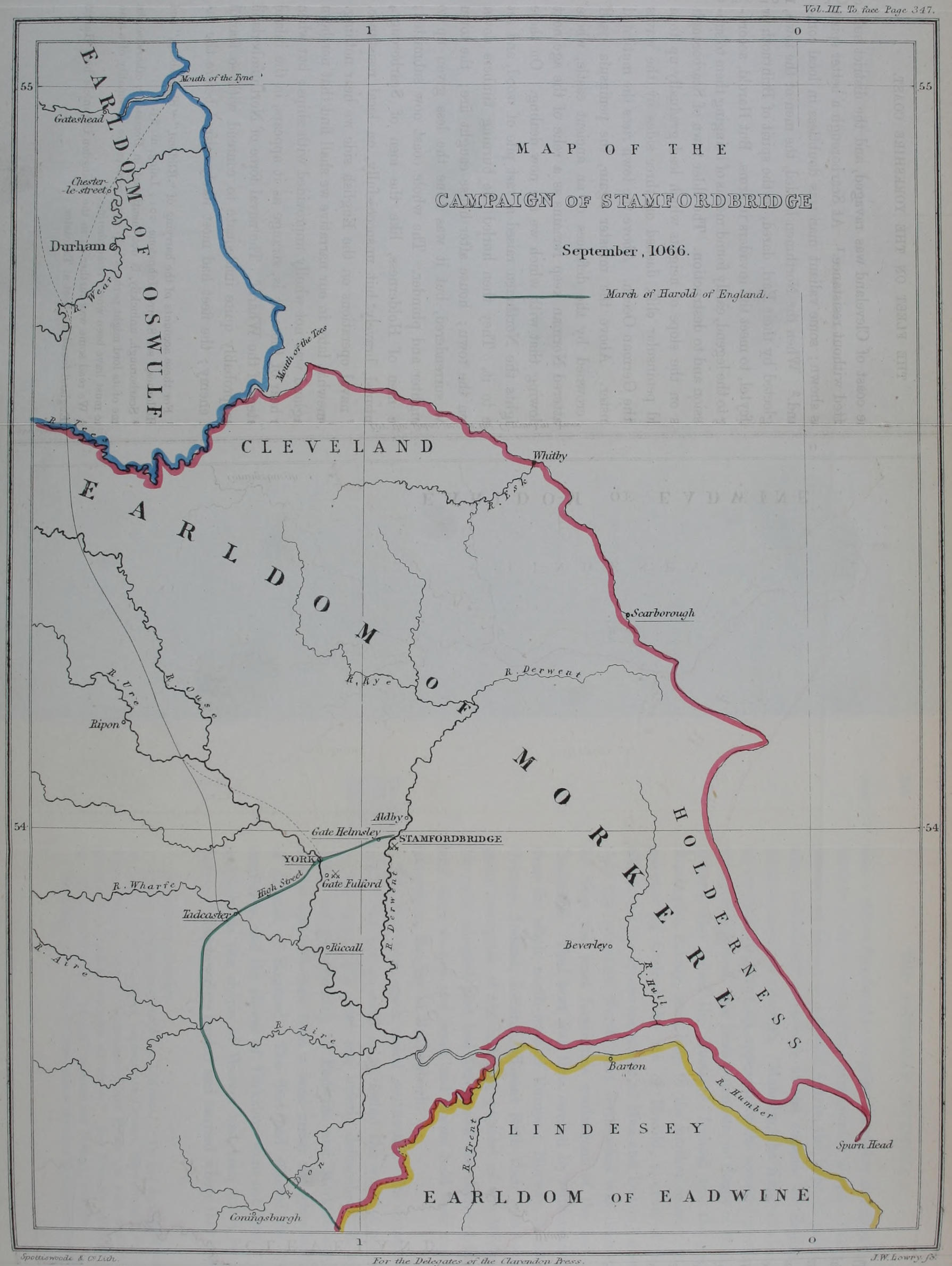
| The fleet on the coast of Yorkshire; its ravages; burning of Scarborough; the English fleet retires into the Wharf | 346–347 | |
| The Northmen sail up the Humber, and land at Riccall; Tostig and Harold Hardrada march on York | 348–349 | |
| Wednesday, September 20, 1066 | Eadwine and Morkere march to meet them; Battle of Fulford; defeat of the English | 349–351 |
| Sunday, 24 | Surrender of York | 352–353 |
| § 4. The March of Harold and the Battle of Stamfordbridge. | ||
| Hostages from Yorkshire to be delivered to Harold Hardrada at Stamfordbridge; description of Stamfordbridge and Aldby | 353–356xviii | |
| Position of the Norwegian army | 357 | |
| News of the Norwegian landing brought to Harold of England; he determines to march to the North; legend of his sickness and recovery | 357–360 | |
| Harold’s march; gathering of recruits | 360–362 | |
| Sunday, 24 | He reaches Tadcaster and reviews the fleet | 362 |
| Monday, 25 | He passes through York; Battle of Stamfordbridge | 362–363 |
| The Norwegian Saga; its mythical character | 363–367 | |
| Sudden advance of the English; loyalty of the country | 367–368 | |
| The battle begins on the right side of the Derwent | 369 | |
| The bridge defended by a single Northman | 369–370 | |
| The English cross the bridge; main fight on the left side; complete victory of the English | 370–371 | |
| Deaths of Tostig, Harold Hardrada, &c.; escape of Godred; burial of Tostig | 371–373 | |
| Harold’s mild dealing with Olaf | 374–375 | |
| October 1? | Harold at York; news of William’s landing | 375–376 |
| CHAPTER XV. | ||
| THE NORMAN INVASION AND THE CAMPAIGN OF HASTINGS. | ||
| August–October, 1066. | ||
| § 1. The Building of the Fleet. | ||
| Success of all William’s negotiations | 377–378 | |
| Summer, 1066 | Formation of the Norman fleet; contributions of ships; gifts of Remigius of Fécamp and of the Duchess Matilda | 378–380 |
| Number and character of the ships | 381 | |
| June 15 | Ecclesiastical affairs; Council at Bonneville; Lanfranc Abbot of Saint Stephen’s | 381–382 |
| June 18 | Consecration of the Holy Trinity at Caen; dedication of Cecily | 383 |
| § 2. The Embarcation and Voyage of William. August–September, 1066. | ||
| August 12 | The fleet at the mouth of the Dive | 384–386 |
| Delay at the Dive; good order maintained in the army | 386–387 | |
| Numbers of the army | 387 | |
| Spies sent by Harold; their treatment by William | 388–389xix | |
| [September 8] | William changes his position; probable influence of the disbanding of Harold’s army | 389–390 |
| September 12 | William sails to Saint Valery; description and history of the place | 391–392 |
| September 12–27 | Losses of the fleet; further delay at Saint Valery; religious ceremonies and procession | 392–395 |
| Wednesday, 27 | The south-wind blows; the embarcation | 395–397 |
| William sets sail; details of the voyage | 398–400 | |
| Thursday, 28 | William lands at Pevensey; history and description of the place | 400–402 |
| 491 | Taking of Anderida by Ælle and Cissa | 402–404 |
| Defenceless state of the coast; no resistance to William’s landing | 404–405 | |
| Details of the landing; William’s ready wit | 405–407 | |
| Friday, September 29 | William marches to Hastings; history and importance of the town; he encamps on the hill | 407–409 |
| Question of losses and skirmishes; fate of the soothsayer | 410–411 | |
| William systematically ravages the country | 411–412 | |
| Robert the son of Wymarc counsels William to retreat; his answer | 413–416 | |
| § 3. The Southern March of Harold. October 1–13, 1066. | ||
| October 1? | The news brought to Harold at York; messengers from Pevensey and from Hastings | 416–419 |
| Harold’s position; his Council at York; he begins his march to London | 420–421 | |
| Merlswegen in command of the North; Eadwine and Morkere keep back from the war | 421–422 | |
| General zeal of the nation; charge of parsimony against Harold | 422–423 | |
| The army joined by the men of Wessex, East-Anglia, and Eastern Mercia; loyalty of the Earldom of Waltheof; special position of the men of Kent and London | 423–424 | |
| Names of Englishmen preserved; Esegar, Ælfric, Breme, Godric, Thurkill, Eadric the Deacon; the Abbots Leofric and Ælfwig | 425–427 | |
| October 5–11 | Harold reaches London; he waits for fresh troops | 427 |
| His visit to Waltham; his vow; miracle of the Holy Rood | 428–430 | |
| Messages between William and Harold; mission of Hugh Margot to Harold; Harold’s counter-message and challenge | 430–433xx | |
| Harold eager for battle; advice of Gyrth; Harold refuses to ravage the land | 433–437 | |
| Thursday, October 12 | Harold marches from London; number of his army; his plan and tactics; he fights on ground of his own choice | 437–440 |
| Friday, 13 | Harold encamps on Senlac; description of the site; its advantages; he fortifies the hill | 441–445 |
| Stories of desertions, spies, &c.; William’s last message and challenge; Harold refuses the single combat | 445–450 | |
| § 4. The Battle. October 14, 1066. | ||
| The night before the battle; ceremonial devotion of the Normans; alleged revelry of the English | 450–453 | |
| Saturday, 14 | Battle of Senlac; William’s speech to his army | 453–454 |
| The Normans march to Telham and arm; story of the reversed hauberk | 455–457 | |
| Vital brings news of the English army; William vows to build a monastery on Senlac | 457–458 | |
| Threefold division of William’s army; on the left the Bretons, on the right the French; the Normans in the centre | 458–461 | |
| Armour and weapons of the Normans | 462 | |
| The standard and the group around it; William and his brothers; the standard borne by Toustain the White | 462–465 | |
| The Norman chivalry; William Patry, Roger the Bigod, William Malet | 465–467 | |
| Three classes of troops in each division; order of the attack | 467–468 | |
| The two armies in sight; Harold’s speech; story of the English spy; Harold dismounts at the Standard | 468–469 | |
| Tales of Harold and Gyrth | 469–471 | |
| Defences and close array of the English; their armour and weapons | 471–474 | |
| The English ensigns; post of the King and his kinsfolk by the Standard | 475–476 | |
| Points of attack of the three divisions of the enemy | 477 | |
| 9 A.M. | Beginning of the battle; exploits of Taillefer | 477–478 |
| First attack; Norman and English war-cries; the Normans beaten back | 479–481 | |
| Flight of the Bretons on the left; the light-armed English pursue; panic of the Normans; William and Odo recall the fugitives | 481–484xxi | |
| Second attack; personal exploits of William; deaths of Gyrth and Leofwine | 484–487 | |
| Partial success of the French on the right, but the general attack repulsed | 487–488 | |
| William orders the stratagem of the feigned flight; the English on the right pursue; the Bretons turn | 488–490 | |
| Slaughter of the French at the detached hill and in the western ravine | 490 | |
| 3 P.M. | The Normans ride up the hill; single combats; personal exploits of William, Harold, and others | 491–495 |
| The English resistance slackens, but the battle undecided while Harold lives | 495–496 | |
| 6 P.M. | The archers shoot in the air; Harold wounded in the eye and disabled | 497–498 |
| Fight round the Standard; the Dragon borne off and the Standard beaten down | 498 | |
| Harold killed by Eustace and others; insults to his body | 499–500 | |
| Resistance and slaughter of the King’s following | 500–501 | |
| Escape of the wounded Esegar and Leofric | 501 | |
| Flight of the light-armed; pursuit of the Normans and slaughter of the pursuers in Malfosse; end of the battle | 502–503 | |
| Effect of the death of Harold | 504 | |
| Military estimate of the battle | 503–507 | |
| § 5. The Burial of Harold. October–December, 1066. | ||
| William returns to the hill; his midnight feast | 507–509 | |
| Sunday, October 15 | Burial of the dead; burial of the English allowed; discovery of Ælfwig and his monks; Harold’s body not forthcoming | 509–510 |
| Osgod, Æthelric, and Gytha ask for the body; William commands that it shall be buried on the sea-shore | 511–513 | |
| The body found by Eadgyth Swanneshals, and buried on the hill at Hastings by William Malet | 513–514 | |
| Legend of Harold’s escape, penitence, and death at Chester; mythical character of the story | 515–518 | |
| 1066–1540 | Harold’s alleged burial at Waltham; his translation; destruction of his tomb | 518–520 |
| 1307 | The body of Edward the First at Waltham; comparison between Harold and Edward | 521–522xxii |
| CHAPTER XVI. | ||
| THE INTERREGNUM. | ||
| October 15–December 25, 1066. | ||
| The throne vacant; William expects a general submission; no submission as yet | 523–524 | |
| The news brought to London; Eadwine and Morkere reach London, and send Ealdgyth to Chester | 525 | |
| Gemót in London to choose a King; no qualified candidate; candidature of Eadwine and Morkere; election of Eadgar | 525–527 | |
| Character of the choice; consent of Eadwine and Morkere; alleged opposition of certain Bishops | 528–529 | |
| November 1 | Eadgar not crowned; death of Abbot Leofric; the choice of his successor Brand confirmed by Eadgar | 530 |
| The Londoners and others eager for battle; treason of Eadwine and Morkere; no further general combination against William | 531–532 | |
| October 15–20 | William at Hastings; his policy of subduing the country piecemeal | 533 |
| 20 | His ravages; he marches to Romney; his vengeance | 533–534 |
| 21 | He marches to Dover; description of the castle; its surrender; the town accidentally burned | 535–538 |
| October 29 | The Kentish towns submit; William marches towards Canterbury and receives its submission on the road | 538–539 |
| October 31–December 1 | William encamps at the Broken Tower; his sickness and consequent delay | 540 |
| He sends an embassy to Winchester; position of Eadgyth; Winchester submits | 540–541 | |
| c. December 1 | London still holds out; William marches against it; skirmish and burning of Southwark | 541–542 |
| He keeps on the right bank of the Thames and crosses at Wallingford; object of this course | 543–544 | |
| Esegar in command in London; tale of his communications with William; his messenger deceived by William | 544–546 | |
| Submission to William agreed on in London | 546 | |
| William at Berkhampstead; Eadgar, Ealdred, and others submit to him there and are graciously received | 547–548 | |
| William invited to assume the Crown; probable feelings of Englishmen at the moment | 548–550 | |
| William’s council; his professed unwillingness to accept the Crown | 550–551xxiii | |
| Speech of Hamon of Thouars; William accepts the Crown; the coronation fixed for Christmas | 551–553 | |
| Position of William; triumph of his policy | 553 | |
| He sends to fortify a post in London | 553 | |
| His march to London; opposite accounts of his conduct | 554–555 | |
| Alleged refusal of Stigand to consecrate William; Stigand’s real position and share in the ceremony; Ealdred the actual consecrator | 555–557 | |
| December 25 | Coronation of William; the approach to the church guarded by Norman horsemen | 557 |
| The procession and ecclesiastical election | 558–559 | |
| The Normans fire the houses near the church; William left alone with the officiating clergy | 560 | |
| William’s oath and consecration | 560–561 | |
| Summary | 561–562 | |
| APPENDIX. | ||
| Note A. | The Authority of the Bayeux Tapestry | 563 |
| B. | Eadward’s Bequest of the Crown to Harold | 576 |
| C. | The Election of Harold | 597 |
| D. | The Coronation of Harold | 612 |
| E. | The Ancient Coronation Office | 622 |
| F. | The Date of the Marriage of Harold and Ealdgyth | 625 |
| G. | The Character of Harold’s Government | 627 |
| H. | The Coinage of Harold | 631 |
| I. | The Opposition of Northumberland to Harold’s Accession | 632 |
| K. | The Political Position of the Lady Eadgyth | 635 |
| L. | The Affairs of the Abbey of Ely at the time of Harold’s Accession | 636 |
| M. | The Comet of 1066 | 640 |
| N. | The Marriage of William and Matilda | 645 |
| O. | The Children of William and Matilda | 658 |
| P. | The Revolt of William Busac | 662 |
| Q. | The Revolt of William of Arques | 664 |
| R. | The Bequest of Eadward to William and the Oath of Harold | 667 |
| S. | The Ælfgyva of the Bayeux Tapestry | 696 |
| T. | The Breton Campaign of William and Harold | 700 |
| U. | The Embassies exchanged between William and Harold | 701xxiv |
| W. | William’s Councils and Negotiations | 703 |
| X. | The Movements of Tostig after his Banishment | 708 |
| Y. | Arnold of Ardres | 713 |
| Z. | The Death of Conan | 714 |
| AA. | The Operations of the English Fleet in 1066 | 716 |
| BB. | The March of Harold to York | 718 |
| CC. | The Details of the Battle of Stamfordbridge | 720 |
| DD. | William’s Ravages in Sussex | 728 |
| EE. | Names of Englishmen at Senlac | 729 |
| FF. | The Dates of the Events between the two Great Battles | 732 |
| GG. | The Messages between Harold and William | 733 |
| HH. | The English Numbers at Senlac | 740 |
| II. | The Miraculous Warning given to Harold before the Battle | 742 |
| KK. | The Details of the Battle of Senlac | 743 |
| LL. | Ralph of Norfolk | 751 |
| MM. | The Burial of Harold | 754 |
| NN. | Eadgyth Swanneshals | 763 |
| OO. | The Ætheling Eadgar | 766 |
| PP. | The Submission at Berkhampstead | 767 |
p. 6, l. 14. For “boy,” here and in one or two other places, it would be safer to say “young.” On Eadgar’s probable age see p. 766.
p. 37, l. 14, for “among all the Kings whose tombs are gathered together” read “among all the tombs of Kings which are gathered together.”
p. 52, p. 24, and p. 53, note 1. I see that, when I wrote this, I had not fully seen my way to the true history of the two East-Anglian Ralphs. The Staller died soon after Eadward’s death, and his son, the future Earl, was banished. See Appendix LL.
p. 55, note 2, for “amplori” read “ampliori.”
p. 118, l. 13. Bishop Hugh had a son named Roger, “Rogerius Hugonis Episcopi filius.” See the Trinity Cartulary at Rouen, pp. 442, 443.
p. 133, note 1, for “sur” read “tur.”
p. 135, l. 2. On Nithard’s birth and his father’s works at Saint Riquier, see also Nithard’s own History, iv. 5.
p. 136, note 4, add “Ord. Vit. 504 A.”
p. 139, note 2, for “armatura” read “armaturæ.”
p. 156, note 3, after “the war” read “took place.”
p. 179, note 2, for “ut pote” read “utpote.”
p. 183, l. 5, for “we presently find” read “we shall presently find,” and l. 13, for “the” read “their.”
p. 190, note 3, for “Fulko” read “Fulco.”
p. 195, last side-note, for “1061” read “1051.”
p. 224, note 1. Guy had two children, Ivo, who was at Senlac (see p. 499, note 4), and Agnes, wife of Robert of Belesme, who succeeded him. It should be noticed that in the Tapestry, pl. 4, he rides on a mule.
p. 227, l. 12. I now feel very little doubt that Harold’s marriage happened after his coronation, at the time of his journey to York.
p. 234, note 1, for “makes” read “puts.”
p. 244, l. 5 from the bottom. I here meant William of Poitiers, who makes no mention of the marriage in his direct account of the oath, though he afterwards takes it for granted in an incidental allusion. See pp. 687, 701.
p. 247, side-note, for “into breach” read “into a breach.”
p. 264, note 1, put a sign of interrogation after “permittere.”
p. 266, l. 7 from bottom. The case of Ralph of Norfolk as a possible exception is to be borne in mind.
p. 276, l. 7, for “looked upon as, wherever” read “looked upon, as wherever.”
p. 312, l. 6 from bottom. On the relations between William and Eustace see p. 748.
p. 343, l. 4, for “Northern King” read “a Northern King.”
xxvip. 363, l. 11, for “smite” read “strike.”
p. 377, note 1. I ought here to have quoted Orderic’s fuller estimate of William of Poitiers and of Guy of Amiens (503 D); “De cujus [Guillelmi Regis] probitate, et eximiis moribus ac prosperis eventibus et strenuis admirandisque actibus Guillelmus Pictavinus, Lexoviensis Archidiaconus, affluenter tractavit, et librum polito sermone et magni sensûs profunditate præclarum edidit. Ipse siquidem prædicti Regis Capellanus longo tempore exstitit, et ea quæ oculis suis viderit et quibus interfuerit longo relatu vel copioso indubitanter enucleare studuit, quamvis librum usque ad finem Regis adversis casibus impeditus perducere nequiverit. Guido etiam Præsul Ambianensis metricum carmen edidit, quo Maronem et Papinium gesta heroum pangentes imitatus Senlacium bellum descripsit, Heraldum vituperans et condemnans, Guillermum verò collaudans et magnificans.” This is at least as true of the Archdeacon as it is of the Bishop.
p. 383, note 1. The charter of Roger of Montgomery is a grant to the Trinity monastery at Rouen. Another grant of the same date to the same monastery I have mentioned, as bearing on another point in the history, in p. 717. In p. 451, on the same cartulary, we find the donation of a companion of William, who seems to have been mortally wounded or worn out in the campaign; “Eâ tempestate quâ Guillelmus, Dux Normannorum egregius, cum classico apparatu ingentique exercitu Anglorum terram expetiit, quidam miles, nomine Osmundus de Bodes, cum aliis illuc profectus, et languore correptus atque ad extrema perductus, pro animæ suæ remedio, dedit Sanctæ Trinitati omnem decimam terræ suæ in alodio,” &c.
p. 384, l. 8 from bottom. On William’s possible precautions with regard to Maine, see p. 683.
p. 428, note 2, for “mere” read “more.”
p. 433, note 1, for “Chronicles” read “Chronicle.”
p. 445, l. 5, dele “threefold.”
p. 458, note, for “adjuventur congruum,” read “adjuventur, congruum.”
p. 466, note 4. On compater see Earle, Parallel Chronicles, p. 318. What a gap between this use of the word and the Sedition of the Ciompi.
p. 467, note. On the origin of Ælfgifu the wife of Ælfgar, see p. 699, and vol. ii. p. 629.
p. 472, l. 12. On placing the inferior troops in the rear, see the tactics of Eadmund at Sherstone, vol. i. p. 424.
p. 474, note 1, for “συμβουλύοις” read “συμβουλεύοις.”
p. 476, note 2. Cf. vol. i. p. 577.
p. 477, l. 14, read, “at the eastern corner of the hill, where the present road from Hastings enters the town of Battle.”
p. 483, l. 1. Cf. the account of the danger of Severus at the battle of Lyons, Dion. lxxv. 6; αὐτὸς τὸν ἵππον ἀποβαλὼν ἐκινδύνευσεν, ὡς δὲ εἶδε φεύγοντας πάντας τοὺς ἑαυτοῦ, τὴν χλαμύδα περιῥῤηξάμενος καὶ τὸ ξίφος σπασάμενος, ἐς τοὺς φεύγοντας εἰςεπήδησεν ὅπως ἢ αἰσχυνθέντες ὑποστρέψωσιν ἢ καὶ αὐτὸς αὐτοῖς συναπόληται. So Ælius Spartianus, Severus, 11; “Ingens periculum equi casu adiit, ita ut mortuus ictu plumbeæ crederetur.”
p. 486, l. i. On the sword, see p. 749.
xxviip. 491, l. 2 from bottom, dele “with a slight inclination of the ground in their favour.”
p. 511, note 1. I accept this implied statement of Florence that the son of Harold and Ealdgyth was named Ulf, rather than the other statement in the “Genealogia Regum West-Saxonum” (Thorpe, i. 276), which gives him the name of his father; “Haroldus ... de Reginâ Aldgithâ, Comitis Ælfgari filiâ, habuit filium Haroldum;” though this passage is a strong confirmation of my conjecture in p. 764 that Harold’s other sons were children of Eadgyth Swanneshals. I cannot help thinking that the statement of William of Malmesbury (iv. 329) that Magnus of Norway in his expedition to Anglesey was accompanied by a “Haroldus, filius Haroldi Regis quondam Angliæ,” is a confusion, arising perhaps from the description in Florence of Magnus himself, as a grandson of Harold Hardrada. No such person appears in the account in Florence or Orderic (768), and the Chronicle simply calls the invaders “utwikingas.”
p. 527, note 2. On the other hand the Legend of Siward (Chroniques Anglo-Normandes, ii. 111) expressly denies that Waltheof was at Senlac; “Comes Waldevus non interfuit conflictui quum Dux Willelmus Bastardus Anglos oppressit et devicit.” The conflicting authorities are about equally worthless.
p. 533, last line. On the physical changes along this coast, see Earle, Parallel Chronicles, 315–317.
p. 539, note 1. This legend is doubtless the same as the legend of Birnam Wood coming to Dunsinane.
p. 543, note 3. Another provision of the same kind for the Housecarls is found at Dorchester in Dorsetshire, Domesday, 75.
p. 557, last line. Why did William have a new crown made? One would have thought that he would have made a special point of being crowned with the crown which had been worn by Eadward. Was it held to be desecrated by the irregular coronation of Harold?
p. 607, l. 11 from bottom, for “thirteenth” read “twelfth.”
p. 620, l. 11 from bottom, after “takes its place,” add “Harold the First seems to have been crowned at Oxford, Harthacnut at Canterbury; Eadward was crowned at Winchester, perhaps at Canterbury also.”
p. 624, l. 20. See also Depping, Expeditions Maritimes des Normands, i. 216; Pearson, Early and Middle Ages, i. 188. Depping’s speculations are amusing enough, though he does not go quite so deep as Ménard.
p. 641, l. 15. To these German accounts add Annales Wirziburgenses (Pertz, ii. 245), “A. 1066. Cometa videtur; et Anglia a Normannis subjicitur,” and Annales Besuenses (ii. 249), “A. 1066. Stella cometes apparuit, et eo anno Rex Anglorum Haroaldus occiditur.”
p. 660, l. 9 from bottom. See p. 703.
p. 668, l. 4, for “fratuelis” read “fratruelis.”
p. 670, l. 14, for “need” read “accept.”
p. 684, l. 18. It is a charter to Westminster, quoted by Ellis, i. 312.
p. 685, l. 3 from bottom. For another oath taken “supra philacteria reliquiarum,” see Dudo, 126 C.
xxviiip. 694, l. 11 from bottom. Yet compare the strange statement of the Encomiast (see vol. i. p. 454) about the Æthelings Eadward and Ælfred being sent into Normandy for education.
p. 709, l. 9. I ought not to have called “Ordericus Angligena” a “foreign writer,” but he wrote in a foreign country, and from a foreign point of view. For all these purposes he counts as a Norman writer.
p. 714, l. 19. “Ernulfus” or “Arnulfus de Hesding” occurs also as a large landowner in Wiltshire, Domesday, 66, 69 b, and in other counties.
p. 730, l. 24. I know not whether I ought to have added to my list two other Hampshire Thegns of small estate, Eadnoth and Eadwig, who appear in the same page of Domesday; “Sudberie tenuerunt Ednod et Edui in alodius de Rege E. et post mortem ejus ipsi quoque sunt mortui. Quidam vero proximus eorum Cola redemit terram de Willelmo Comite.” This does not positively show that Eadnoth and Eadwig died at Senlac, but the time of their death and the apparent confiscation of their lands look like it.
p. 731, l. 23. Several curious personal details of Godric will be found in Domesday, 57 b, 58, 149.
p. 736, l. 2, for “six” read “twelve.”
p. 738, l. 6, for “in vigiles” read “invigiles.”
p. 745, l. 11. Sir Edward Creasy, in his lately published History of England (i. 208), shows a better understanding of the ground than most modern writers.
p. 748, l. 7 from bottom. One or other of these stories about Eustace, it is hard to see which, seems to be darkly alluded to by William of Malmesbury (iii. 244). After mentioning how William had three horses killed under him (see p. 485, note 2), he adds, “Perstitit tamen magnanimi Ducis et corpus et animus, quamvis familiari susurro a custodibus corporis revocaretur; perstitit, inquam, donec victoriam plenam superveniens nox infunderet.”
p. 750, l. 3 from bottom. Thomas Wikes, in the opening of his history, ingeniously rolls together several accounts, and makes altogether short work of the battle. “In primo conflictu totum pondus prœlii conversum est in Regem, qui coxâ prope nates pene præcisâ, letaliter vulneratus post modicum tempus interiit. Compertâ Regis morte dilapsus est ejus exercitus, fere omnibus qui fugere non poterant interfectis.” This reminds one of a passage of William of Malmesbury, which I ought to have quoted elsewhere. After his description of the battle, which he certainly makes out to have been hard fought enough, he goes on to make his celebrated comparison between the Normans and the English. After speaking of the English love of eating and drinking, he adds (iii. 245), “Sequebantur vitia ebrietatis socia, quæ virorum animos effœminant. Hinc factum est, ut magis temeritate et furore præcipiti quam scientiâ militari Willelmo congressi, uno prœlio, et ipso perfacili, servituti se patriamque pessumdederint.” I believe that some modern writers have inferred from this that the English went drunk into the battle, and have taken this as a text to preach the advantages of temperance.
p. 751, l. 2 from bottom, for “difference” read “differences.”
p. 754, l. 6, for “text” read “notes.”
The central stage of our journey is now reached. We are now on the threshold of the great year, of that year whose effects on all later English, on all later European, 4history can never be wiped out. No one year in later English history can for a moment compare, in lasting importance, with the year which, with some small exaggeration, we may call the year of the Norman Conquest. |No later time in which one year and one day stand out in the same way.| There have indeed been later periods in our history which have been as memorable in their results as the invasion of William itself. The events of the thirteenth, of the sixteenth, of the seventeenth century, are all fully entitled to be set side by side with the events of the eleventh. But in all these cases we have to set the work of a whole generation against the work of a single year. One age is famous for the great struggle against alien domination, and for the final establishment of English freedom in its later form. Another age gave us all the results, for good and for evil, of the great Reformation of religion. A third age confirmed on a surer and more lasting basis those political rights which the thirteenth century had won back, but which the fifteenth and sixteenth had once more brought into jeopardy. But, in all these great periods of change, the work was gradual; there is no single moment, no single year, on which we can place our finger as the moment or the year when the work was actually done. In the eleventh century the work was gradual also. A long series of events prepared the way for William’s enterprise, and, when he began his work, it needed more than a single day or a single year to put him in full possession of the Empire for which he had yearned so long. Still in the eleventh century there is a single year and a single day which stand forth in a way in which no single day or year stands forth in the ages after them. There is no later year to compare to the year in which the Crown 5of England was worn by the last King of the old sacred and immemorial stock, by the first and last King who reigned purely because he was the best and bravest among his people, and by the first and last King who could boast that he held his Kingdom purely of God and his own sword. There is no one day in later times to compare to that memorable morning when Northern and Southern Europe, when England and Normandy, when Harold and William, met face to face in the great wager of battle on the day of Saint Calixtus. For days of equal moment in our history we must go back to far earlier times, to times which are still half shrouded in the mist of legend. For a day like the day when England bowed to her first purely foreign lord, we must go back to the day when the first Englishman was baptized into the faith of Christ, to the day when the first Englishman set foot on the shores of Britain.
We left Eadward on his death-bed. His work was over; his newly built minster was hallowed, though he had been himself shut out from taking any part in that great ceremony. The Witan had been gathered, as usual, for the Christmas festival; the special summons to the dedication of Saint Peter’s, and, still more, the pressing urgency of the national affairs, had, we may well believe, called together a greater number than usual of the Thegns and Prelates |National anxiety as to the succession.| of the land. It was plain that the nation would soon be called on to elect a King, and to elect a King under circumstances of which no past age had ever seen the like. Perhaps vague reports may already have found their way into the land, warning men of the dangers which were likely to threaten England alike from her own exiles and from the foreign kinsman of the dying King. But, 6even if no thought of Tostig or of William crossed men’s minds, there was enough to make those days of Eadward’s last sickness days of the deepest anxiety to every patriotic Englishman. From the beginning of Eadward’s sickness, no hope of his recovery seems to have been entertained. The question in every man’s mind must have been, who should fill his place when he was taken from them. The choice of the electors would be perfectly free. Things were not as they had been when Swend and Cnut were in the land, claiming the votes of the Witan at the point of the sword. But |State of the royal line.| things were as they had never been before since the line of Cerdic had ruled over united England. The King who lay at the point of death was, with the single exception of the boy Eadgar and his sisters, the last of his race. The names of Christina and Margaret were most likely never uttered; England had never yet dreamed of giving herself a female ruler. A sentimental interest might gather round Eadgar as the last male of the kingly house, but a sentimental interest was all that he could awaken. His age and, as events proved, his character rendered him wholly unfit for rule. And Eadgar, it should be borne in mind, did not possess that constitutional claim to a preference which was all that, before the actual election, would have belonged even to a son of the dying King. At three earlier times had the royal line been reduced so low as to number none but members of an age too young for personal government. Eadwig, Eadward the Martyr, Æthelred, had all been chosen in their non-age. But the princes so chosen were all of them true Æthelings, Englishmen born, sons of an English King by an English mother. And, in those days, as there was no better qualified candidate in the royal house, so there was no man out of it marked out by the hand of nature as a born King of Men. In those days the greatest of living Englishmen was no Thegn or Ealdorman, but the renowned Primate Dunstan. England had 7therefore, in all those cases, accepted a King in his boyhood or even in his childhood. There was now no such need. |No constitutional preference due to Eadgar.| Eadgar, grandson of Ironside as he was, had no constitutional claim upon the votes of the Witan beyond any other male person in the realm. He was not born in the land; he was not the son of a crowned King and his Lady. |Position of Harold.| And close beside the throne, just beyond the strict limits of the royal house, stood the foremost man in England, already, it may be, associated in some sort to the honours of royalty, already an Under-King who received the oaths and homage of vassal princes, as a sharer in the rule of the Empire of Britain.[2] Whether he had been marked out by any formal act or not, we cannot doubt that men had long learned to look to Harold the son of Godwine as their future King. And yet, when the day of choice drew near, men might well stop and wonder at the step which they were about to take. The Law justified the act; the needs of the time commanded it; but it was a strange and unwonted |Novelty of an election from beyond the royal house.| act nevertheless. It was something new, something which might well set the minds and tongues of men at work, to be called on, freely and under no fear of the Danish axe, to choose a King who had no royal forefathers, a King who came not of the stock of Ecgberht, Cerdic, and Woden. Men whose office or whose sagacity had taught them to scan the chances of the time might ask how such |Attitude of William and Tostig.| a choice would be looked on by the exile at the court of Baldwin, and by the prince who now, in the height of success and glory, had made the Norman land the wonder of continental Europe. Rumours might already be afloat that the English Earl, soon about to become the English King, had, in some strange and unknown way, already |Possible attitude of Northumberland.| become the man of the Norman Duke. And without going so far afield, men might ask how the great land north of the Humber would look on the choice which to Wessex 8and East-Anglia seemed the only choice possible. The Thegns and Prelates of Northumberland might give their votes with the other Witan, but would the fierce people of that proud and distant province submit, without a blow or a murmur, to the kingship of a West-Saxon, a son of Godwine, a brother of Tostig? The days when thoughts like these were working in men’s minds must have been days of |Importance of Eadward’s dying recommendation.| care and perplexity. There was one source from which light and help might be looked for, light and help which might in some sort seem to come directly from heaven. The words of a dying man have been in all times looked on as solemn and almost prophetic utterances. The words of a dying King were, by the traditional feelings of Englishmen, clothed with an authority second only to that of the Law itself. Eadward was a dying man and a dying King. And he was yet more. Strange as it seems to us, he was already beginning to be looked on with somewhat of the reverence due to a Saint. The will of Eadward had perhaps never been held to be of such moment, his voice had perhaps never been so eagerly listened for in the Councils of his Kingdom, as when he lay, helpless and wellnigh speechless, on his bed at Westminster. Men waited for the voice of the dying man, the dying King, the dying Saint, to confirm once more with his last breath the nomination of the successor on whom, amidst all doubts and dangers, the heart of England still was fixed. In choosing for the first time a King not of the blood of Cerdic, it would be no small strength and comfort if they knew that the step was taken with the full approval and the full bidding of the last King of Cerdic’s house. The King was sick unto death; the Witan were gathered round his palace. The moment the breath was out of his body, it would become their duty to choose his successor. It was doubtless with no small anxiety, with somewhat even of religious awe, that they awaited the last expression of the will of Eadward as to who that successor should be.
9The West Minster was consecrated on Wednesday; the news was brought to the King, who, as his legend says, on hearing it laid his head on his pillow as if to say, It is finished.[3] For five days his sickness increased, and the public anxiety heightened at every stage of the disorder.[4] |He becomes speechless. Tuesday, January 3, 1066.| On the sixth day from the consecration, his speech began to fail him; his voice was so feeble that his words could no longer be understood; for two days he lay worn out by the extremity of his sickness.[5] It was no time to trouble the weary sufferer with questions even as to the |He recovers his speech. Thursday, January 5.| welfare of his Kingdom. At last, on the following Thursday, the eve of the Epiphany, his flagging powers rallied, as the powers of dying men often do rally at the point of death. He awoke from his sleep in the full possession of |The group round his bed.| his senses and of his speech. On either side of his bed stood the two great chiefs of his realm, Harold the Earl and Stigand the Archbishop.[6] At the bed’s head, in still more immediate personal attendance on his master, stood the Staller, Robert the son of Wymarc, a man of Norman birth, but whom history does not charge with treason towards 10England. On the ground, close by the foot of the bed, sat the Lady Eadgyth, the sister of the great Earl, cherishing the feet of her royal husband in her bosom. Her thoughts wandered perhaps to the brother beyond the sea, the brother on whose behalf she had so deeply sinned, the brother who had so lately held the place nearest to Eadward’s heart, but who was now for ever cut off from all hopes of crowns or earldoms. The tongue of Eadward was loosened, but his first words were words of prayer.[7] In his long slumber he had seen a vision; if that vision were truly from heaven, he prayed that he might have strength to declare it; if it were but the phantom of a disordered brain, he would that his tongue should rather cleave to the roof of his mouth. He sat up in his bed, supported in the arms of Robert. But the message which he had to declare from heaven called for a larger audience than the four favoured ones who were gathered round him. A few more of his chosen friends—their names are not recorded—were summoned to |He declares his vision.| the bedside of the dying King.[8] He then, fluently and with energy,[9] poured forth the awful words of warning. 11“Long ago, when I was a youth in Normandy, I knew two monks, most holy men and most dear to me. Many long years have passed away since they were taken away from the cares and sorrows of this world. But now, in my trance, God hath sent them again to me to speak to me in His holy name. ‘Know,’ said they to me, ‘that they who hold the highest place in thy realm of England, the Earls, the Bishops, the Abbots, the men in holy orders of every rank, are not what they seem to be in the eyes of men. In the eye of God they are but |He foretells the sorrows of England.| ministers of the fiend. Therefore hath God put a curse upon thy land; therefore hath He given thy land over into the hand of the enemy. Within a year and a day from thy death, shall fiends stalk through thy whole land, and shall harry it from one end to another with fire and sword and the hand of plunder.’ Then said I to them, ‘Let me then show these things to my people in the name of God. Haply they will repent, and His loving-kindness will have mercy upon them. For He had mercy on the men of Nineveh, when they heard the voice of His threatening, and repented them of their evil ways.’ But they answered me, ‘They will not repent, neither shall the mercy of God come |Allegory of the green tree.| nigh unto them.’ Then said I, ‘What shall be the time or the way in which we may look for these your threatenings to come to an end?’ ‘In that day,’ they answered, ‘when a green tree shall be cut away from the midst of its trunk, when it shall be carried away for the space of three furlongs from its root, when, without the help of man, it shall join itself again to its trunk, and shall again put forth leaves and bear fruit in its season. Then first shall be the time when the woes of England shall come to an end.’”[10]
12The King ceased his words of prophecy. Harold, Eadgyth, Robert, all who had been gathered to hear, were struck with awe, and remained speechless. One heart alone, we are |disbelief of Stigand.| told, was hardened. Stigand leaned over the King’s bed, and whispered in the ear of Earl Harold that all this prophetic talk was but the babbling of an old man worn out by sickness.[11] The Primate, stout-hearted Englishman as we know him, was, we may well believe, a hard and worldly man, and his experience of men of his own calling, his familiarity with what others looked on as miracle and prophecy, may well have made him less inclined to superstition 13than to unbelief. The lay heart was more easily touched; the female heart most easily of all. Eadgyth, and others who were devoutly given, knew well, we are told, the sins of England. They shuddered as they thought how often the warning voice of the Roman Pontiff, how often the voice of Eadward and of Eadgyth herself, had spoken in vain to the guilty nation.[12] The pious Lady perhaps deemed that the uncanonical appointment of Stigand was more likely to bring down the wrath of God than the murder of Gospatric. At the last Christmas feast, she whose heart was now so deeply stirred at the thought of ecclesiastical corruptions, had in that very palace stretched forth her hand to shed blood which no Law had bidden to be shed, blood which, as far at least as she was concerned, was innocent.
But there was other work to be done that day besides hearkening to foretellings of evil, besides disputing as to the degree of trust to be placed in the words of him who foretold it. The moment was come when the all-important question might be pressed on the mind of the dying King. His friends stood and wept around him; the tears of the 14Lady as she sat at his feet fell faster and more thickly still. He gave orders for his burial. He checked the grief of his friends; he bade them rejoice at his coming deliverance, and he craved the prayers of his people for his soul.[13] He spoke of the constant love and devotion which had been ever shown him by the wife whom he had once driven away from his hearth and board. She had ever been to him as a loving and dutiful daughter;[14] God would reward her for her good deeds in this world and in the next. At last Harold and Stigand—nor have we any right to exclude Robert from their counsels—found means of calling Eadward’s mind to the great subject which then filled the whole heart of England. When all was over, when his body was laid in his new minster, when his soul had gone to its reward, who should fill the place which he had so long filled on earth? Who, when he was gone, should wear the royal crown of England, the Imperial |Eadward names Harold as his successor.| diadem of Britain? Eadward, at that last moment, was not wanting to his last duty. He stretched forth his hand towards the Earl of the West-Saxons, and spake the words, “To thee, Harold my brother, I commit my Kingdom.”[15] He then went on to declare his last wishes to his chosen |Eadward’s last wishes.| successor. For Eadward to give Harold instructions in the art of government was certainly needless, and the dying man doubtless felt it to be so. But there were a few personal wishes which were near to his heart; there were a few personal favourites whom he wished to commend to the 15|He commends to Harold’s care the Lady| favourable care of his successor. First among these was the Lady herself. I need not again enlarge on the mysterious relations between Eadward and Eadgyth; but, in these his last days at least, she is described as enjoying his perfect confidence and affection. But a sister who certainly abetted Tostig, who perhaps abetted William, against the brother who was now called to reign,[16] might be thought likely to meet with less consideration at the hands of Harold than she had, latterly at least, met with at the hands of Eadward. The King commended her who was so soon to be his widow to the friendly care of his successor. Let him show to her, as a Lady and a sister, all faithful worship and service, and never, while she lived, let her lose |and the Norman favourites.| the honours which he had bestowed upon her.[17] He commended also to Harold his Norman favourites, those whom, in his simplicity, he spoke of as men who had left their native land for love of him.[18] Those who were willing to abide in the land as English subjects under Harold’s allegiance he prayed him to keep and to protect. Those who refused to become the men of the new King he prayed him to dismiss under his safe-conduct to their own land, taking with them all the goods which they had acquired by his own favour.[19]
The King had now done the last act of his kingly office. With this last request to Harold all thought of earthly things passed away from the mind of Eadward. But the man and the saint had still friends to comfort; he had a 16soul for which to request their prayers; he had a body to be committed to the ground with the solemn rites of the Church. He craved that his body might be buried in the minster which he had reared, in a special spot within the hallowed walls which their inmates would point out to |His death not to be concealed, lest he lose the prayers of his people.| those who stood round him.[20] One faint thought of earth perhaps came back to his mind, when he bade them not to hide his death from his people. At such a moment it might perhaps be convenient to let men believe that Eadward still lived, till every arrangement could be made for the quiet election and consecration of his successor. But Eadward’s care for his own soul made him tremble at such a prospect. “Let my death,” he earnestly prayed, “be at once announced everywhere, that all the faithful may at once call on the mercy of Almighty God for me a sinner.”[21] Eadgyth meanwhile wept without ceasing. Eadward comforted her with the allegorical words; “Fear not; I shall not die, but by God’s grace, I shall soon arise to better health.”[22] But the last moment was clearly drawing near; the last comfort of the Church had to be |He communicates and dies. Thursday, January 5, 1066.| given. The dying saint received the Body of his Lord, seemingly at the hands of Stigand; the irregularity of his position as Primate was perhaps not held to affect acts done by him as a simple priest.[23] Strengthened by this spiritual 17food; Eadward’s soul gently passed away, and the last King of the House of Cerdic was no more. His body lay as in sleep; his cheeks like the rose, his beard like the lily, his white hands falling peacefully by his side; men saw written on the face of the departed saint that he had gone to his Creator.[24]
The King was dead. The last day of his kingship had been the worthiest. After all the errors and follies of his reign, Eadward died, not only as a saint, but as an Englishman and a patriot. For the last thirteen years of his life Harold had been his guide and guardian; for the last nine years he had been the expectant successor of the Crown. And now the day had come and the word was spoken. Those years of faithful guardianship had not been without their fruit; Eadward, with Harold and Stigand at his side, had become another man from Eadward who had once listened to every lie which rose to the lips of Robert of Jumièges.[25] The old wayward spirit had again burst forth when revolt overthrew his last favourite;[26] but his last favourite was at least an Englishman and a son of Godwine. |English spirit of Eadward’s last requests.| And the latest act of all had made up for all that had gone before. Eadward showed on his death-bed that he had at last learned that the Norman could never bear sway in England with the good-will of the English people. The dream of the Norman Duke as the heir of the English Crown had passed away. The dream of England portioned out among Norman Earls, Prelates, and Knights had passed away with it. England was to have an English King, the noblest man of the English people. No stranger 18was to be endured in the land, but such as would plight their homage to the King of England’s choice. For others, however dear to him, all that Eadward now craved was that they might depart, unhurt and unplundered, from the land. Visions of danger may have flitted across his mind, and in the delirium of sickness, in the mere excitement of pious fear, they may have shaped themselves into vague foreshadowings of the wrath to come. But what the last dying wishes of Eadward were we know beyond a doubt. His last wishes, his last hopes, were the same as the wishes and the hopes of every faithful Englishman. His last earthly desire was that Harold should wear his Crown, that Harold should reign over a land freed from the presence of every man whose presence he might find inconsistent with the welfare of England and her King.
And he has had his reward. Far more precious than the vulgar praises of Norman legend-makers, far more precious even than the wrought up panegyric of the courtly chaplain of his widow, is the song in Eadward’s honour preserved in our national Chronicles from the hands of a gleeman of his own time and of his own people.[27] The English poet sang of Eadward’s early troubles, how he had to seek a foreign land, when Cnut overcame the race of Æthelred, and when Danes wielded the dear realm of England for eight and twenty winters.[28] He sang of Eadward’s personal virtues; how he was holy, clean, and mild, how the baleless King was ever blithe of mood.[29] He sang of the glories of his reign; how he guarded his land and people; how renowned 19warriors stood around his throne; how the son of Æthelred ruled over Angles and Saxons, how Welsh and Scots and Britons all obeyed the mighty sway of the noble Eadward.[30] But before his song ceases, the minstrel has yet to tell of one deed far above all, of one last act which made the name of Eadward truly glorious. Bitter death snatched the noble King from earth; angels bore his truthful soul to |The poet dwells on the nomination of Harold.| heaven. But a truer note of patriotic feeling rings forth in the words which tell us how the wise King made fast his realm to Harold the noble Earl, in the words which, bursting from the poet’s heart, tell us how well the noble Earl deserved the greatest of earthly gifts. He in all time by words and deeds had truly obeyed his lord, and had left nought undone which was needful for the ruler of his people.[31]
The throne of England was now vacant, vacant under circumstances such as England had never seen before. The late King’s dying orders were obeyed, and, as soon as Eadward’s breath was out of his body, the Witan of England knew that their King was dead. But by the Law of England in the eleventh century, the announcement that the King was dead could not be answered by a cry for the long life of the King who still was living.[32] The 20Witan, not yet departed from their Christmas gathering, heard that the throne was vacant, and they knew that it was for them alone to fill it. And, with the news that they had no longer a King, came the news that the last wish of the King who was gone had pointed out to them whom he wished to fill his kingly seat after him. All scruple was taken from every mind when men knew that the son of Æthelred, the heir of Cerdic, had, as his last act, named as his successor the son of Godwine, the grandson |Meeting of the Witan. January 5, 1066.| of Wulfnoth. It was no time for delay. Men came together as speedily upon the death of Eadward as they had come together to choose Eadward himself upon the death of Harthacnut. The King lay dead in his palace, while Earls and Prelates, Thegns and citizens, came together to choose the King who should reign in his stead. |Doubtful candidature of William and Eadgar.| The choice was speedy and unanimous. Later writers speak of voices being raised for Eadgar, even of voices being raised for William.[33] And so it may have been. Here and there sentimental feelings may have caused this or that voice to utter the name of the royal boy, even in preference to the noblest of a merely subject house. And, in our land of free debate, some daring Norman may even have ventured to breathe the thought that the King’s kinsman, who had made Normandy so great and flourishing, might make England no less great and flourishing also. But words |No sign of local jealousies.| like these told not on the spirit of the Assembly. Nor do we hear of any expression of those local jealousies which had divided England on more than one earlier vacancy. We hear nothing of any rivalry of the House of Leofric against the House of Godwine; we hear nothing of any murmurs of the fierce Danes of the North against the 21inauguration of a new West-Saxon dynasty. If the sons of Ælfgar dreamed, as they doubtless did, of a divided Kingdom—of the Imperial Crown for one of themselves they hardly could have dreamed—their hopes were doomed to disappointment. Such thoughts, as we shall soon see, still lived in men’s minds, but in that great Gemót of London[34] they found no open spokesman. It was not only London, ever foremost in every patriotic cause; it was not only Wessex, proud of her illustrious son; it was not only East-Anglia, cherishing the recollections of his earliest rule; it was not only Hereford, rejoicing in her recovered being, safe alike against British foes and Norman governors; it was the Witan, not of this or that shire or ancient |Harold chosen by all England.| Kingdom, but of the whole realm of England, who chose Harold the son of Godwine to fill the vacant throne.[35] His reign had long been looked for, and now the dying voice of Eadward had marked him out as the worthiest object of their choice. The wise ruler, the unconquered warrior, the bountiful founder,—the shield of the Kingdom, the shelter of the oppressed, the judge of the fatherless and the widow[36]—the Earl of the West-Saxons, the conqueror of Gruffydd, the pacificator of Northumberland, the founder of Waltham—stood forth before them as the foremost man of England. He, and he alone, stood forth above other men, sprung from no line of Kings, but the son of a father greater than Kings, the man who in long years of rule had shown that there was none like him worthy to fill the throne of the heroes of old time, worthy, as none of royal race were worthy, to wield the sword of Æthelstan and sit upon the judgement-seat of Ælfred. The assembled people of England, in the exercise of their ancient and 22undoubted right, chose with one voice Harold the son of Godwine to be King of the English and Lord of the Isle of Britain. On no day in their annals did the English people win for themselves a higher or a purer fame.
The choice of the Assembly had now to be announced to the King-elect. We know not whether that choice was made in his presence. Possibly he may have deemed that his most fitting place was still with his departed brother-in-law and his widowed sister. But, in any case, two members of the Assembly were sent, in the name of all, to offer the Crown of England, as the gift of the people of England, to the man whom they had chosen as their King. Who discharged that office we know not. None but men of the highest rank would be sent on such an errand. In the pictured record of that day’s acts they appear, not as Prelates but as lay chieftains. One bears the official axe;[37] the other bears the Crown itself, and points towards the chamber of the dead, whence the Crown had doubtless been brought for the purpose of this symbolic offering.[38] Who then were the men whom England thus 23trusted to speak such weighty words in her name? Were they the two Northern Earls, perhaps already the brothers-in-law of the elected King, stifling, as they best might, their local and family jealousies, their hopes of a divided kingdom? Or were they rather the two Earls of Eastern England, sons worthy of Godwine, brothers worthy of Harold, who were sent to bear the gift of England to the chief of their own house? That day’s vote had placed that house above the royalties of Gaul and Denmark; it had placed the line of Godwine on a height lower by one step only than the line whose youthful chief now sat on the throne of Augustus. It was for Gyrth and Leofwine, rather than for any other two men in England, to act on |Position of Harold.| that day as the spokesmen of their country. Harold stood, axe in hand, to receive them. The day for which he had looked so long had at last come. The path from which so many obstacles had been so strangely cleared away had at last brought him close to the great object of his life. He had now, not in figure, but in very truth, only to stretch forth his hand, and to grasp the Crown of England, the free gift of the people of England. No surprise could have filled his mind; for years he had been marked out, practically if not by a formal vote, as the man to whom that gorgeous gift must one day come. And yet that moment of realized dreams must have been a moment of anxiety, and even of fear. For him, no son of a kingly father, no scion of legendary heroes and of Gods of the elder faith, to see with his own eyes the diadem of Ecgberht and Cerdic ready for his grasp, was of itself a strange and wondrous feeling, such as few men but him in the world’s history can have felt. He was not like others before and since, who by fraud or violence have risen to royalty or more than royalty. Harold was not a Dionysios, a Cæsar, a Cromwell, or a Buonaparte, whose throne was reared upon the ruins of the freedom of his country. He was not an Eastern Basileus, climbing to 24the seat from which a fortunate battle or a successful conspiracy had hurled a murdered or blinded predecessor. He was not a Pippin, whose elevation, however expedient and rightful, could be brought about only by the displacement of a lawful, though an incompetent, King. He was not even a Rudolf, whose election, free and honourable as it was, came when the royal office had long been discredited in men’s eyes, and when traditional reverence no longer attached to any one ancient royal house. Harold was freely offered the Crown of England in all its glory and greatness, a Crown which had never before been offered to any but men of royal birth,[39] which had never before been freely offered to any but men of the one Imperial House of Cerdic. |Difficulties of his situation.| He may well have paused as he looked at the glittering gift, through the mere greatness and strangeness of the position in which he stood. And other thoughts may well have pressed upon his mind, before he spoke the word which should change the Earl into a King. Harold knew better than any man the dangers which threatened himself |Double danger from Tostig and William.| and which threatened England. He knew what she had to fear from the vengeance of her own banished son, a vengeance which would be kindled into a sevenfold flame if Harold were King in a land where Tostig might not hold even an Earldom. He knew also, as no man knew, how much more she had to fear from the claims of the mighty and |Effects of the oath to William.| wily Duke beyond the sea. And heavy on his soul may still have pressed the memory of that fatal day when he had become the sworn man of that dangerous rival.[40] If he had promised more than simple homage, casuistry and more than casuistry, the instinctive feeling of every honest man, 25would declare that an extorted promise, unlawful and impossible to fulfil, was perhaps a crime in him who had plighted it, but could be no crime in him who should obey a higher law by breaking it. But since that day, the heart of Harold could never have beaten so high, his step could never have been so light and joyous, as in the days when his faith was wholly free, when even his enemies could not impeach his truthfulness. And now the full weight of that day’s act must have stared him in the face. Let him accept the Crown now offered him by England, and Normandy |Harold’s anxiety, as expressed in the Tapestry.| would at once declare him a perjurer and a traitor. No wonder then if, as the picture sets him before us, he looked at the Crown at once wistfully and anxiously, and half drew back the hand which was stretched forth to grasp the glittering gift. And yet the risk had to be run. A path of danger opened before him, and yet duty no less than |Greater danger if he declined the Crown.| ambition bade him to enter upon the thorny road. If he declined the Crown, to whom should England offer it? Would the risk be less if the boy Eadgar could win the votes of the Witan, and if to the other dangers of England were to be added all the dangers which beset the land whose King is a child?[41] What if the young Ætheling failed, as he doubtless would fail, to stand his ground at such a |Danger of a division of the Kingdom.| moment? Could the land hope to be united in any single choice? Would Mercia and Northumberland submit to the rule of some West-Saxon boasting neither the royal blood of Eadgar nor the personal glory of Harold? Would Wessex and East-Anglia, would mighty and growing London, submit to Eadwine or Morkere or to the youthful son of Siward? The dangers of accepting the Crown were great, but the dangers of refusing it were greater. Whoever reigned, Tostig and William would still try their chance, and, if it were not Harold who reigned, they would try their chance with far greater hope of success. The accession 26of Harold would indeed put fresh weapons into the hand of William, but it was not likely that the Duke would wholly cast aside his claims and his projects, simply because he would have some other King, and not Harold, to strive against. The fear indeed was that, if Harold shrank from the burthen, William would find no one single King to resist him. He would win an easy victory over a divided land, a land split asunder as it had been in the days of Harthacnut and the earlier Harold, a land, it might be, already torn in pieces by civil war. Under Harold alone could there be the faintest hope that England would offer an united front to either of the invaders who were sure to attack her. The danger then had to be faced. The call of patriotism distinctly bade Harold not to shrink at the last moment from the post to which he had so long looked forward, and which had at last become his own. The first man in England, first in every gift of war and peace, first in the love of his countrymen, first in renown in other lands, was bound to be first alike in honour and in danger. The gift now lay before him. Ambition bade him seize it. Duty in no way |The Crown accepted by Harold.| held back his hand. The offered gift was accepted. The eve of that great Epiphany, the day on which King Eadward was alive and dead,[42] saw the Crown pass away for ever from the male line of Cerdic, and the next day saw it solemnly placed upon the brow of Harold. The evening of Eadward’s death must have been spent in preparation for the two great ceremonies of the morrow. On the morning of that short winter’s day, the Earl of the West-Saxons had kept his watch by the dying bed of his King and brother. Before its last hour had passed, he had become, not yet indeed a crowned and anointed King, but one called to kingship by the unanimous voice of his country, a King-elect 27of the English, who on the morrow might claim the sceptre and the diadem as his own.
The morning of the Epiphany dawned. It was the Feast of the Kings, a fitting day for an august rite within the walls of that minster which was reared to be specially the home of Kings alike in life and in death. On that day began that long series of national ceremonies which has gone on uninterruptedly to our own time, and which has made the Abbey of Saint Peter the hearth and Prytaneion of the English nation. The octave of the consecration-day |Necessity for a speedy coronation,| had barely passed, and there was already a King to be buried and a King to be crowned. Earl Harold was King-elect by the choice of the Witan of all England; but he was not “full King” till he and his people had exchanged their mutual promises, till he had been arrayed with the outward badges of his kingly office, till the blessing of the Church and the unction of her highest minister had made the chosen of the people also the Anointed of the Lord. Those were not days when that crowning rite could be delayed for one needless moment. England could not be safely left for a single day without a King. The twofold right of the new Sovereign, as King alike by the election of the people and by the consecration of the Church, must be at once placed beyond all reach of doubt or cavil. The Christmas feast was not yet over, but it was the last day of the holy season; the Witan were still assembled; to have waited for another feast of the Church, for another gathering of the nation, would have been simple madness.[43] The day of the coronation of Harold must therefore follow at once on the day |and therefore for a speedy burial.| of his election. And the coronation of Harold involved the previous burial of Eadward. England could not see two Kings of the English above ground at the same moment. 28Before then the Crown could be set on the brow of the King-elect, the hallowed soil of Saint Peter’s must close over the King who was no more. The day of the burial of Eadward must therefore follow at once on the day of his death. And never, even in the long history of that venerable Abbey, has there been such another day. Other |Greatness of the occasion.| Kings have been buried and crowned within its walls; but there has been no day like that, which beheld the last of one kingly line borne to his grave in the holy house of his own building, and which beheld the first—could men deem that he would be also the last?—of a newly-chosen race raised to the vacant throne alike by the bequest of his predecessor and by the will of his people. Of all the gorgeous rites celebrated by Kings and Prelates beneath the vaults of the West Minster, the twofold rite of that great Epiphany, which haste and urgency may well have rendered the least gorgeous of them all, is that around which the national memory of Englishmen may well centre most fondly. The first royal burial, the first royal consecration, within the newly-hallowed temple, possess an historic interest and an historic import beyond all those which have followed them.
The body of Eadward had been prepared for burial almost as soon as his soul had passed away. Decked in royal robes, the crown on his head, the pilgrim’s ring, so legend said, upon his hand, the saint lay ready for his last home. Stigand, who had stood by him in his last moments, seems to have stayed to help in paying this last tribute to his departed master.[44] But the Primate, patriot in the eyes of 29Englishmen, schismatic in the eyes of Rome, was not to |Position of Stigand.| minister in either of the ceremonies of the morrow. As a Prelate of doubtful right, he was deemed unfit to hear the chief part in the consecration of Harold. As a simple priest, he might perhaps have been allowed to officiate at the funeral rites of Eadward. But it may well be that the newly-won privileges of the house of Saint Peter gave to the head of that house the ministration of all rites within its walls which did not need the special powers of a consecrated Bishop to give them sacramental efficacy. And Eadward doubtless sought, above all things, the prayers which the monks of the house which he himself had reared would |Stigand did not officiate at the funeral.| put up to Heaven for the soul of their founder. At all events, the priest who holds the first place in Eadward’s funeral procession is not set before us in our pictured record as adorned with any badge of pontifical rank.[45] We may perhaps be allowed to guess that the chief ministry in the funeral rites of Eadward was assigned to his friend and bedesman, Abbot Eadwine. Early on the winter’s morning,[46] perhaps while the minster still needed torchlight within the deep gloom of its massive walls and narrow windows, |Funeral of Eadward.| the King was carried to his grave. The body of Eadward, his form shrouded from sight, was borne on the shoulders of eight of his subjects, laymen all, and doubtless men of high degree. There was no need, as in the case of some later Kings, to assure his people, by the sight of his uncovered body, that he had not come unfairly by his end. Boys ringing bells walked on either side of the bier; behind them followed a crowd of clergy, surrounding the two chief ministers of the funeral ceremony, who walked bearing their 30office-books in their hands. In this guise the procession moved from the palace to the western door of the newly-hallowed minster. They swept along the nave, between the long rows of tall and massive pillars still fresh from the axe and hammer of the craftsman. They passed beneath the mighty arches, which, in all the strength and solidity of those early days of art, bore up the great central tower like a vast canopy over the choir below. They bore their burthen to the spot which Eadward had long before chosen as his place of burial, and there, before the altar of the saint whom he so deeply reverenced, the patron alike of Westminster and of Rome,[47] the body of the last King of |General sorrow for Eadward.| the olden stock received its last kingly honours. We can well believe that, not only the poor whom he had relieved, the churchmen whom he had enriched, and the strangers on whom he had lavished the wealth of England, but that Englishmen of all ranks might well weep in awe and in sorrow over the grave of the last son of Cerdic and Woden. At such a moment, reversing the poet’s rule, the good that men have done lives after them and the evil is interred with their bones. There, by his grave in his own church, men’s thoughts would dwell on the virtues rather than on |Causes of sorrow and anxiety.| the weaknesses of the King who was taken from them. His faults as a King were great; but men would then think rather of all that was worthy in him as a man, and they might well deem that his last kingly act had covered a multitude of errors. In the crowd which filled the church, there could have been few whom Eadward had personally wronged; there must have been many whom he had personally benefitted. And, more than this, men must have felt that the two great rites of that day placed a great gulf 31between them and a long and honoured past, while a future rose before them, bright indeed with glorious hopes, but around which two dark clouds were gathering in opposite quarters of the heaven. No wonder then that by the grave of Eadward men wept and trembled.[48] Psalms were sung, masses were said, alms were scattered abroad with a bounteous hand, needless offerings it might seem for a soul which men deemed that angels had already borne to the beatific vision.[49] For three hundred days, days which stretch beyond the reign of Harold, the masses, the hymns, |Miracles wrought at the tomb.| the alms, continued to be daily offered.[50] And wonders soon were wrought at the tomb of the royal saint. The blind received their sight, the lame walked, the sick were healed, the sorrowing received comfort.[51] So thought men of his own day, men who had seen him in the flesh, and who have not shrunk from handing down to us even the less worthy actions of his life. If we deem such a belief and such a worship to be, not only superstitious in itself, but to have been thrown away on an unworthy object, we must remember with how fond a memory men must, ere a year had passed, have looked back to the happy days of the baleless King. We must remember how easily men would forget that the calm of those happy days was due, far less to the crowned monk upon the throne, than to the man of the stout heart and the strong arm who stood beside him. And let us remember too that the canonizing voice of 32|Other causes of popular canonization.| England was not always raised only to commemorate mere monastic virtues like those of Eadward. Foreign Kings and foreign Pontiffs might forbid, but a day came when England looked with no less devout reverence on the true heroes and martyrs of our land. If miracles adorned the tomb of Eadward at Westminster, no less mighty works were soon deemed to be wrought before Waltheof’s tomb in the chapter-house of Crowland, and two ages later, the sick were again healed and the blind again saw, before the tomb where English hearts still revered the relics which were all that the foeman’s sword had left of the mangled form of the martyr of Evesham.[52]
The funeral rites were over; but the history of Eadward, as the history of a saint, is one which reaches beyond the grave. A King at whose tomb wonders were daily wrought, a King whom two hostile races could unite to look upon with reverence, gradually filled a larger and a larger space in men’s minds. Such a King, already canonized by the popular voice, a King who had done more than any King before him to bring the English Church into close connexion with the Roman See, could not fail, ere long, to obtain, by Papal authority, a formal admission into the register of the saints. But the steps by which he won his saint’s rank were gradual. Six-and-thirty years after 33|Examination of his body by Abbot Gilbert. 1102.| Eadward’s death, a Bishop and an Abbot of Norman birth, who had most likely never seen him in the flesh, were the first whom pious curiosity led to disturb the rest of the departed. It was already whispered that the body of Eadward, the instrument of so many miracles, was itself the subject of miracle. The holy King, men said, had never seen corruption. Abbot Gilbert, one of the great Norman line of Crispin, whom Lanfranc had put in charge of the house of Westminster,[53] deemed it his duty to see whether the tale that so often met his ears were true. In company with Bishop Gundulf of Rochester, the Prelate to whose skill we owe the White Tower of London and the lowlier keep of Malling, and with other noble and pious persons, he opened the grave of Eadward. A sweet savour filled the minster; they unfolded the garments in which Eadward had been wrapped under the eyes of Stigand; the body lay as in sleep; the powers of nature had failed to do their work; the skin was still white and rosy; the limbs were still flexible; they might deem that he might again arise from his trance and again denounce the sins of England. The Bishop would fain have carried off one hair of his snowy beard to keep as a relic more precious than all the treasures of the earth.[54] But not a hair could be pulled away from the face of the sleeping saint. The Abbot, with a reverence to which those ages were commonly strangers, checked the attempt; he restored the vestments and the body to their place, and bade that the remains of the man of God should rest in peace.
Thirty-eight years later a vain attempt was made by Osbert, Prior of Westminster, the special trumpeter of 34|Eadward’s canonization. 1140.| Eadward’s renown,[55] to obtain formal canonization for him from Innocent the Second. But a day came when the House of William had passed away like the House of Cerdic, a day when men had taught themselves to hail a stranger from Anjou as the corner-stone which united Norman |Eadward canonized by Alexander the Third. 1161.| and English royalty. Then, at last, the influence of a King who reigned from the Orkneys to the Pyrenees was able to procure from Rome the decree which placed the predecessor whom all his subjects agreed to reverence among authorized objects of religious honour.[56] The green tree had now returned to the trunk; it had brought forth its queenly leaves and its kingly fruit, and the day was now come to do special homage to the seer who had foretold that the good time would at last come back again. As one Pope Alexander had given the blessing of Rome to the enterprise of the Norman invader, his next successor of the same name might seem in some sort to undo the wrong by making the last King of the old royal stock of England |First Translation of Eadward. October 13, 1163.| an object of worship to the Church Universal. In the presence of the Angevin King, in whom men now saw the heir of Eadward, in the presence of the Norman Primate whom England learned to love as her champion and martyr, the body of Eadward was translated from his royal tomb to the shrine which was the fitting resting-place of the 35relics of a saint in glory. Things were not now as they were in the days of Abbot Gilbert. Then the body, entitled only to the reverence due to the remains of a departed Christian, was allowed to return unhurt and unplundered to the grave. But now that Eadward claimed the worship due to a canonized saint, whatever had touched the holy corpse became endowed with sanctity and miraculous power. The ring, the subject of so many legends, was drawn from his finger and was preserved as a wonder-working relic. The royal robes in which the body had been enfolded were borne away from the tomb and became vestments for the holiest worship of the sanctuary.[57] And the anniversary of that day still preserves the memory of Eadward in the Kalendar of the English Church. It was not without a certain fitness that the Feast of the Translation of Saint Eadward should be kept, not on the eve of the Epiphany, but on the eve of the day of Saint Calixtus. It is well that two successive days should remind us of the memory of Eadward and of the memory of him who fell on the morrow of his festival.
Years rolled on, and the spot to which Eadward had been moved on his first translation was now deemed unworthy of a Saint who was already looked upon as the patron of England. A King now sat on the throne of Eadward, who was in many points a reproduction of Eadward himself. The same fervent zeal for God, the same neglect of duty towards man, the same vehemence in speech and weakness in action, the same love for men of foreign lands, the same spiritual bondage to a foreign yoke, the same deep and lavish devotion to the holy house of Saint Peter, appeared in Henry the Third which had already appeared in the predecessor whom he reverenced and resembled. The King who, like Eadward, aroused the feelings of the nation 36by his wasteful preference for strangers of every land, chose as the special objects of his religious devotion two royal saints of English birth. Before all other saints, King Henry’s worship was paid to the East-Anglian Eadmund and the West-Saxon Eadward. By his act those kingly names again found their way into the royal house, and the name of the saint himself became the most glorious in the later history of England.[58] In honour of |Rebuilding of the West Minster. 1245.| Eadward the work of Eadward was destroyed.[59] The church which he himself had reared was now deemed unworthy to be the dwelling-place of so great a saint.[60] The “massive arches, broad and round,”[61] of the church which so long was the model for all England,[62] now gave way to 37those slender pillars and soaring arches which, alone among English minsters, go some way to reproduce the boundless height of Amiens and of Beauvais. There, alone among English minsters of its own date,[63] did the tall apse and its surrounding chapels crown the eastern end of what was now the church of Saint Eadward. But that apse was not reared, as at Amiens and at Le Mans, at Pershore and at Tewkesbury, to form the most glorious of canopies for the |The shrine of Eadward.| altar of the Most High. Not in any subordinate chapel, but in the noblest spot of all, in the spot which elsewhere was reserved for the highest acts of Christian worship, was the new shrine of Eadward reared. And the workmanship of that gorgeous shrine was of a type fit for him who reared it, and for him in whose honour it was reared. Among all the Kings whose tombs are gathered together in that solemn spot, two alone reveal in their style of art the work of craftsmen from beyond the sea and even from beyond the |Comparison of Eadward and Henry the Third.| mountains. The resting-places of the two Kings in whose heart beat no English feeling, the two Kings who loved to be surrounded by men of any nation rather than their own, the two Kings who, more than any other Kings in English history, laid England, of their own act, prostrate at the feet of Rome,[64] the shrine of Eadward, the tomb of Henry, are fittingly adorned with forms which awake no English associations, the work not of English but of |The Translation. October 13, 1269.| Italian hands. To that shrine, a hundred and three years after its first translation, the body of the saint was borne by a crowd of the noblest of the land.[65] Among them two 38Kings and two Kings’ sons bowed their shoulders beneath the hallowed weight. The two highest of earthly rulers, the continental and the insular Basileus, Richard of Germany and Henry of England, were foremost to bear the burthen to which it was deemed a holy work to stretch forth a single finger.[66] With the one English Augustus there joined in the task his nephew, the one Englishman besides himself who ever bore the titles of foreign royalty, Edmund of Lancaster, whose vain pretensions to the Sicilian crown had been already transferred to the stronger hand of the conqueror from Anjou. Fit bearers for the foreign-hearted saint were an English King who hated Englishmen, and English princes who wasted English |Presence of Edward the First.| treasure in seeking after the kingship of other lands. But there was one who shared in their work who might seem sent there expressly to remind us that the object of their worship was, after all, an Englishman. Among those who bent to bear Eadward’s body was the prince who was named after his name, but whose life reproduced, not the life of Eadward the Confessor, but the life of Eadward the Unconquered.[67] Those who then pressed to win spiritual blessings by touching the corpse of Eadward hardly deemed that among themselves was one who was to make his name more worthy of honour among Englishmen than the royal saint could ever make it. It was then deemed an honour and a privilege to draw near to the body of Eadward. Was it not rather the highest of honours paid to Eadward 39himself, that Harold stood by his side at his first burial, and that in the great rite of his translation a share was borne by him who did in truth live to wield the sceptre of the Isle of Albion, and in whom the Scot and the Briton once more bowed to an Eadward of England as their father and their lord?[68]
But the posthumous history of Eadward the Confessor did not end even with this crowning triumph. His shrine at Westminster became the centre of a group of royal tombs such as gathered in earlier times in the more ancient seats of royalty at Winchester and Sherborne. Or a closer parallel still might be looked for in that renowned sanctuary of the West, the resting-place of Eadward’s nobler brother, where Briton and Englishman agreed to revere the name of the legendary Arthur, as at Westminster Englishman and Norman agreed to revere the name of the now well-nigh |Burial of Eadgyth, 1074;| legendary Eadward.[69] Eight years after the burial of Eadward, his widow, the loving sister of Tostig, the loyal subject of William, was laid by his side before the altar of Saint Peter.[70] The zeal of King Henry thought of her also, and her remains, translated to the chapel of her husband, were laid as near to his side as the remains of an ordinary sinful mortal might lie to those of a wonder-working saint. |of Eadgyth-Matilda, 1118.| To the other side of his shrine was moved the dust of another Eadgyth, disguised in history by her Norman name Matilda, her in whom the green tree first began to return to the trunk, and in whose grandson Normandy and England alike became parts of the dominions of the Angevin.[71] No legend or effigy marks the graves of these royal Ladies, but soon the choicest skill of the craftsman was lavished on the tombs of Kings and princes which crowded round the 40shrine of their sainted predecessor. To the north King |Henry the Third.| Henry sleeps in his tomb of foreign work, beneath the |Edward and Eleanor.| shadow of the patron whom he had so deeply honoured.[72] Worthier dust lies east and west of him. No graven figure marks the resting-place of his immortal son, but the loveliest work of all within that mighty charnel-house records the love and grief of the great King for a consort worthy of him. Succeeding ages surrounded the sacred spot with the sculptured forms of succeeding generations of English royalty. There sleeps the victor of Crecy and the victor of |Richard the Second.| Azincourt; there sleeps, beside his nobler Queen, the King from whom the Parliament of England, in the exercise of its |1399.| ancient right, took away the Crown of which he had shown himself unworthy. Thus around the shrine of Eadward were gathered the successors who in life had sworn to keep his fancied Laws, and who deemed it their highest honour to wear his Crown and to sit upon his royal seat. At last a King arose in whose eyes the wealth which earlier Kings had lavished on that spot outweighed the reverence with which so many ages had surrounded Eadward’s name. One Henry had reared alike the shrine and the pile which held it; the word of another Henry went forth to cast to the owls and to the bats all that earlier ages had deemed holy. |The body of Eadward removed under Henry the Eighth,| And yet some remorse seems to have smitten the soul of the destroyer before the shrine of the royal patron and lawgiver of England. Elsewhere the shrines of more ancient saints were levelled with the ground; elsewhere the dust of Kings and heroes was scattered to the winds. The wealth of Eadward’s shrine was indeed borne away to be sported broadcast among the minions of Henry’s court, but the empty casket still stood untouched, and the hallowed remains found another, if a lowlier, resting-place within the 41minster-walls. And the days yet came when one translation |and restored under Philip and Mary.| more restored the corpse of Eadward to its place of honour. And again it was from fitting hands that he received this last act of veneration. The foreign-hearted Eadward had been first placed in that shrine by the foreign-hearted Henry, the King whose foreign marriage proved the curse of England, and whose foreign tastes made England the victim and the bondslave of Rome. Shorn of his honours by a King who, with all his crimes, was at least an Englishman, Eadward was brought back to his shrine by a Queen whose work it was to bend the neck of England beneath the spiritual yoke of the Roman See and the temporal yoke of her Spanish husband.[73] Translated first by the zeal of Henry and Eleanor, he was again restored to his old honours by the zeal of Philip and Mary. And now, while the dust of Eadmund and Harold is scattered to the winds, Eadward still sleeps in his shrine, unworshipped indeed but undisturbed; and the spot where an Englishman would best love to stand and muse in awe and wonder has become ground from which the votaries of devotion and art and history are bidden to turn away.
But we must come back to the doings of the great Epiphany. The last King of the House of Cerdic was laid in his grave; it was time for the first King of the House of Godwine to be placed upon his throne. Short as the interregnum had been, England could not go a moment 42longer without a crowned and anointed ruler. From the burial of Eadward men turned at once to the coronation of Harold. That great rite was performed with all solemnity, no doubt according to those venerable forms whose substance has been followed in the consecration of every English King down to our own time.[74] The chief actor in that august ceremony was one not wholly unworthy of so high a function. The Primate of all England, while his canonical right to his see was called in question at home and abroad, could not be allowed to discharge the highest duty belonging to his office. The hands of Stigand might not minister an unction which was held to confer somewhat |The ceremony performed by Ealdred.| of sacramental grace and even of priestly sanctity.[75] In his stead, the rite was performed by the Primate of Northumberland, his marked adhesion to the new King being perhaps taken as one pledge of the allegiance of his distant province. No living Englishman had seen so much of other lands, none had so often stood face to face with the rulers of other nations, as he who was now called upon to set the English Crown upon the brow of Harold. Ealdred, alone of living English Prelates, had gone, at the bidding of his King or at the call of his own devotion, to the banks of the Rhine, the Tiber, and the Jordan. He alone had stood, as the representative of England, before the thrones of the spiritual and the temporal chiefs of Christendom. He alone had gone, with such worship as none had gone before him,[76] far beyond the threshold of the Apostles, to the city where the Infidel bore sway over the very spot of 43man’s redemption. He had tarried in the court of Cæsar, he had knelt at the tomb of Christ; but in all his wanderings he had never seen such a day or such a scene as when the Witan of all England came together to choose their Father and their Lord, and the diadem of Ecgberht rested on the lordly brow of the King chosen from his brethren. Could he have deemed that, at the next Christmas Feast, he should be called upon again to repeat that solemn rite on the same spot, under circumstances yet more new and wonderful? In the whole range of history, it is hard to point to a stranger fate than that of him to whose lot it fell to receive, within a single year, the coronation-oath of Harold and the coronation-oath of William.
The rite began. Earl Harold, the King-elect, was led by two Bishops, with hymns and processions, up to the high altar of the minster. Later usage assigned that honourable function to the Prelates of Durham and of Wells.[77] It may then well be that Gisa, the supposed victim and enemy of Harold, really discharged one of the chief parts in his admission to his kingly office. The hymn sung by the choir in that great procession prayed that the hand of Harold might be strengthened and exalted, that justice and judgement might be the preparation of his seat, that mercy and truth might go before his face.[78] Before the high altar the Earl of the West-Saxons bowed himself to the ground, and while he lay grovelling, the song of Ambrose, the song of faith and of victory, was sung over one whose sin at Porlock, whose atonement at Waltham, might well make him seem another Theodosius.[79] The Earl then rose from 44the pavement, and for the last time he looked on the crowd |The Ecclesiastical Election.| around him, the Prelates and Thegns and the whole people of England, as still one of their own number. Their voice had already named him as their King, but a still more solemn election before the altar of God was needed before the Church admitted him to the sacramental unction. Once more the voice of Ealdred demanded of the English people, in ancient form, whether they would that Earl Harold should be crowned as their Lord and King. A loud shout |The Coronation oath.| of assent rang through the minster. Chosen thus by Prelates and people,[80] the King-elect swore with a loud voice his threefold oath to God and to all his folk. Kings swore in after days that they would observe all the rights and liberties which the glorious Eadward had granted to his clergy and his people. The oath of the prince who had so lately renewed the Laws of Cnut was of a simpler form. Earl Harold swore to preserve peace to the Church of God and to all Christian people. He swore to forbid wrong and robbery to men of every rank within his realm. He swore to enforce justice and mercy in all his judgements, as he would that God should have mercy upon him. And all the people said Amen. The Bishops then prayed for the ruler whom they had chosen, for his guidance by the Spirit of wisdom in the government of his realm, for peace to his Church and people, for his welfare in this world and in the next.[81] Then a yet more solemn prayer from the lips of Ealdred followed. In that ancient English form, which other nations have been fain to borrow of us,[82] the God who had wrought His mighty works by the hands of Abraham and Moses and Joshua and David and Solomon was implored to shower down all the gifts and graces of those famous worthies upon him who was that day chosen to be King of the Angles and Saxons. Ealdred prayed that Harold, 45faithful as Abraham, gentle as Moses, brave as Joshua, humble as David, wise as Solomon, might teach and rule and guard the Church and realm of the Angles and Saxons[83] against all visible and invisible foes. With feelings too deep for words must that prayer have risen from the hearts of all who could already see the gathering storm, which was still but like a little cloud out of the sea. The Primate prayed that their chosen King might never fail the throne and sceptre of the Angles and Saxons, that for long years of life he might reign over a faithful people, in peace and concord, and, if need be, in victory. Christ Himself was prayed to raise him to the throne of His kingdom, and to pour down upon him the unction of the Holy One.
“The oaths were said, the prayers were prayed.”[84] And now came the sacramental rite itself which changed an Earl into a King, and which gave him, so men then deemed, grace from on high to discharge the duties which were laid upon him. The holy oil was poured by Ealdred upon the head of Earl Harold.[85] And while the symbolic act was in doing, the choir raised their voices in that glorious strain to which the noblest music of later times has given a still higher majesty. The walls of the West Minster echoed to the anthem which told how Zadok the Priest and Nathan the Prophet anointed Solomon King, and which added the prayer of England that Harold might live for ever.[86] Again the Primate prayed that, as of old Kings and Priests and Prophets were anointed with oil, so now the oil poured on 46the head of God’s servant might be a true sign of the inner unction of the heart, a means of grace for His glory and the |The Investiture.| welfare of His people.[87] And now King Harold, the Lord’s Anointed, the chosen of the people, the consecrated of the Church, vested in the robes of royalty and priesthood,[88] received in due order the insignia of his kingly office. The sword was placed in his hand, with the prayer that he might therewith defend his realm, and smite his enemies and the |The Crowning.| enemies of the Church of God.[89] The King then bowed his head, and the Imperial diadem of Britain was placed by the hand of Ealdred on the head of the King of the Angles and Saxons, the Emperor of the Isle of Albion.[90] God was again implored to crown His Anointed with glory and justice and might, and to give him a yet brighter Crown in a more enduring Kingdom. Then the sceptre crowned with the cross, and the rod crowned with the holy dove, were placed, one after the other, in the royal hands. Prayer was again made that the sceptre of Harold’s Kingdom might be a sceptre of righteousness and strength, that he who had been anointed with the oil of gladness above his fellows might through all his days be a lover of righteousness and a hater of iniquity.[91] Further prayers, further blessings, followed; the prayers and merits of all the saints, of the Virgin Mother of God, of the Prince of the Apostles, and of his successor the special Apostle of the English nation,[92] were 47|“Hic residet Harold Rex Anglorum.”| implored on behalf of the crowned and anointed King. And now King Harold of England sat on his royal throne, the crown upon his brow, in his right hand the sceptre, in his left the orb of Empire,[93] the proud badge which belonged of right to the Cæsar of another world. Two chiefs, perhaps his faithful brothers, bore the sword at his side; his people stood and gazed upon him with wonder and |Import of the ceremony.| delight.[94] The day at last had come for which Harold and England had looked so long. The reward of thirteen years of loyal service had been given by the nation to her noblest son. And the die too had been cast; the danger was now to be faced in common; King and people were pledged to stand by one another in the struggle which was to come. And King and people did stand by one another, and, if they both fell, they both fell gloriously. The rite of that great day gave Harold, instead of the long and peaceful reign prayed for by his consecrator, a reign of nine months of little stillness.[95] Then England was given over to bondage, and the name of Harold was given over to the voice of slander. But in the eye of truth, those nine months of little stillness, spent in the cause of England, were better than long years of inglorious ease and luxury, better than long years of hardly less inglorious sloth and superstition. As the momentary glory of Eadmund follows on the weary years of Æthelred, so the momentary glory of Harold followed on those years of Eadward which Harold alone had saved from being as weary as those of his father. And, in the eye of authentic history, never was crown more lawfully won, more worthily worn, than that which Ealdred placed that day on the head of him whom calumny marked so long as Harold the Usurper. If there ever was a lawful ruler in this world, such of a truth was Harold, King of the 48English and Lord of the Isle of Britain—King, not by the mouldering titles of a worn-out dynasty, not by the gold of the trafficker or the steel of the invader, but by the noblest title by which one man can claim to rule over his fellows, the free choice of a free people.
The rite was over. Earl Harold was now King; but we cannot help asking whether he stood alone in the great ceremony which had made him so. Did the Lady Ealdgyth, once again the wife of a King, share in the consecration of her husband? Her coronation is nowhere distinctly spoken of, but our ancient ritual provides a form for the anointing of the King’s consort, and for her investiture with the ring and crown.[96] There is no reason to suppose that the wife of Harold, the grand-daughter of Leofric, would be debarred from any honour befitting the wife of a King, the mother of future Æthelings. But, in the absence of direct testimony, I do not venture to affirm the fact. Indeed I must confess that I feel less certain than I did when writing my last chapter, whether the marriage of Harold and Ealdgyth may not have followed his election to the Crown.[97] Whether then the new King had a consort to share in his honours is a point which I must leave uncertain. But, according to all precedent, on the coronation followed the mass, with prayers and collects appropriate for the great solemnity.[98] At that mass the King partook of the holiest rite of Christian worship. On the mass followed the banquet, and there, on the last day of the Christmas Festival, we cannot doubt that King Harold, in all the glory of his new dignity, wore his Crown with all kingly state in what was now his Palace of Westminster. The old dynasty had passed away; the new dynasty had taken possession; but not many days had gone before voices of warning came which 49showed that King Harold of England would soon have to do battle for his Crown.
Within the bounds of his former Earldom the rule of Harold, King of the English, was simply a continuation of the rule of Harold, Earl of the West-Saxons. It is plain that no other Earl of the great southern Earldom was appointed in his place. In any view of general policy this might be looked on as a backward step. It might be looked on as again uprearing a throne which should be West-Saxon rather than English. It might be looked on as again reducing Mercia and Northumberland from integral parts of the realm into dependent provinces.[99] But under the circumstances of the moment, it would seem to have been the wiser course. England was threatened by two enemies in different quarters, and even the energy of Harold could not personally provide for the safety of the |Necessity of confidence in Eadwine and Morkere.| land against both. It was absolutely necessary, in Harold’s position, to treat the Earls of the Northumbrians and the Mercians, perhaps already his brothers-in-law, with a degree of confidence which they certainly did not deserve. It was something that they had allowed his election and coronation to take place without any open opposition. It was something that he had received the votes of the Northumbrian Witan, and had been crowned and anointed by the hands of the Northumbrian Primate. Harold could not do otherwise than at least affect to treat Eadwine and Morkere as |Division of labour between them and the King.| loyal subjects or even as loving brothers. He was obliged to trust to them for the defence of Northern England. And, if they could be trusted for anything, they might surely, it would seem, be trusted to keep their personal enemy 50Tostig out of their own Earldoms. While they guarded the North against the English exile, it was Harold’s own work to guard the South against the foreign pretender. In the eastern shires, from the Wash to the Straits of Dover, he had the trustiest of lieutenants in his brothers Gyrth and Leofwine. It was clearly his own business, while not abdicating his duty of general care over the whole Kingdom, to undertake as his special work the defence of the lands which had formed his own Earldom. No one could do that work |No available candidate for the West-Saxon Earldom.| so well as himself. We can hardly see whom Harold, had he been so inclined, could have invested with the West-Saxon Earldom. Every man who could lay claim to so high a dignity on the score either of birth or of merit was already provided for. The King’s remaining brother Wulfnoth was probably a hostage in Normandy; his own sons, his nephew Hakon, were all young and untried. The representatives of the two Northumbrian families, Waltheof and Oswulf, were equally untried, and they were already invested with the government of districts with which they had an ancestral connexion. Nor can we point to the name of any West-Saxon of special personal eminence beyond the |Military policy of keeping Wessex in the King’s own hands.| limits of the great houses. It was clearly the policy of the moment, a moment when military considerations must have been supreme above all others, for the King to keep the immediate administration of the South in his own hands, availing himself only of the co-operation of his brothers the two Eastern Earls. And, after all, though Northumberland and Mercia again became in a sense dependencies on the West-Saxon Crown, the arrangement might very well suit the purposes of Eadwine and Morkere. They might deem that a step was thereby taken towards the division of the Kingdom, when its administration was practically divided between the House of Leofric and the House of Godwine, and when the King took his own share along with his brothers and brothers-in-law. A King who had his own portion of the 51Kingdom in his own hands might seem to be less painfully exalted over their heads, he might seem to remain more nearly on their own level, than a King who acted simply as a central power, equally controlling every portion of the realm. Harold therefore kept the West-Saxon Earldom in his own hands. But it is clear that he kept a watchful eye over his whole Kingdom, and that he was ready to act at a moment’s notice in any part of his Kingdom where his presence might be needed.
On the character of Harold’s government as King there is no need to enlarge. His government as King was, as I have just before said, simply a continuation of his government as Earl. Whatever was the character of the one was |Norman calumnies.| the character of the other. The Norman writers describe his government as stained by frightful crimes. As usual, stories grow and become more definite as they are further removed from the time. The slanderers of Harold’s own age veiled their charges in the most general terms; but the slanderers of the thirteenth century were ready with long stories of rapine and sacrilege and evil doings of every kind, and the slanderers of a still later age knew perfectly well how cruelly Harold enforced the forest laws, and how the husband of Ealdgyth remained without a wife, that he might the more easily carry off the wives and daughters |Asserted general expulsion of Normans.| of the “Barons” of the realm.[100] A charge which better deserves serious examination is that Harold drove out of the land all the Normans who were settled in it, doubtless confiscating their lands.[101] Now the dying charge of Eadward himself suggested the banishment, though not the 52spoliation, of any Normans who might refuse to become the men of the new King.[102] The fact that the charge is brought against Harold may lead us to think that some such cases actually occurred, and that Eadward’s rule was |Some Normans at least remained in England.| put in force with regard to them. But it is quite impossible to believe that all the Frenchmen who were naturalized in England[103] were now driven out. Some record of such a process would certainly have found its way into Domesday. And we know for certain that some |Bishop William and Robert the son of Wymarc not molested.| Normans of high rank were not driven out. William of London retained his Bishoprick. His name does not actually occur in the history of Harold’s reign, but it is quite certain that, if he had been meddled with, some Norman writer or other would have taken care to record the fact. The wrongs of the living Bishop of London would have made an excellent sequel to the wrongs of the dead Archbishop of Canterbury. And we know distinctly, from the testimony of Norman writers,[104] that Robert the son of Wymarc was living quietly in England, as a man of wealth and importance, at the time of William’s landing. He clearly retained his lands; there is no evidence whether |Other Stallers.| he did or did not retain his office of Staller. Nor have we any direct evidence as to the position retained in Harold’s reign by Robert’s fellow-Staller Ralph,[105] or by any other of Eadward’s Norman favourites. We cannot say whether Hugolin the Treasurer and Reginbald the Chancellor[106] retained their offices in the Court of the English King. We can only say that, among the English Stallers employed by 53Eadward, three at least, Bondig,[107] Esegar, and Eadnoth, retained their offices. Esegar and Bondig play not unimportant |Eadnoth.| parts in the great struggles of the year.[108] Eadnoth, who held large possessions in the western shires, was probably a man who had risen by the favour of Harold during his government of Wessex as Earl. We shall hear |1067.| of him again as acting against the son of his benefactor.
In opposition to the slanders of his enemies, Harold appears in the national writers as the model of a patriot King. In the words of the splendid panegyric which became almost a set form among all true Englishmen, “he began to abolish unrighteous laws, to establish righteous ones, to be the patron of churches and monasteries, to reverence Bishops, Abbots, monks, and churchmen of every sort, to show himself pious, lowly, and affable to all good men, and to be the enemy of all evil doers.”[109] We are told how he bade his Earls, Sheriffs, and magistrates of every kind, and generally all his Thegns, to seize all thieves, robbers, and disturbers of the public peace, while he himself laboured for the defence of the country by sea and land.[110] That is to say, his government as King was a continuation of his government as Earl. We must not infer from the opening words of the description that Harold appeared at all as a lawgiver. Those few months 54of little stillness were not likely to be largely devoted either to the repeal of old laws or to the enactment of new ones. By good and bad law is meant, as usual,[111] good and bad government. What we are to understand is that Harold’s rule continued to be as just and as vigorous as it had ever been. It would in truth be more vigorous, now that he could act freely for himself, and had no longer to take the pleasure of the wayward Eadward upon any matter. His strictness against all breaches of the peace is simply his old virtue as Earl;[112] only we see, what of course naturally follows from the state of things at the time, that this duty was now, more than it had been before, thrown upon the King’s officers and representatives, while the King himself was mainly occupied with his military |His military preparations began early in his reign.| preparations. We see also that those preparations began from the very beginning of his reign, that there is no ground to believe that Harold despised either of his enemies, or that he failed from the first to make ready for anything that might happen. His great difficulty must have been to make others feel the importance of the crisis as he felt it himself, and at the same time to avoid anything which could dishearten men’s minds or chill the warmth of the hopes kindled by a new reign and a new dynasty. The spirit of Harold’s rule is impressed in a striking, and even touching, way on the few material monuments of his |His coinage.| short reign. The new King found time for a new coinage, and the device on Harold’s coin well spoke the longings of a King whose heart yearned for peace, though he knew that peace could be had only through war. On the one side is the simple legend, PAX, on the other side the King wears the Imperial Diadem.[113] All that man could do for his realm and people King Harold did. The evil 55was that, according to the old Greek saying, even Hêraklês could not struggle with two foes at once.[114]
As for Harold’s devotion to the Church, which is so strongly insisted on by his panegyrist, we can see that he had every motive at this time to make friends of all classes of men, and to make friends of the clergy more than of any other class. He must have known that something like a holy war was likely to be proclaimed against him. He must have felt that he had, wittingly or unwittingly, done an act which ran counter to the religious feelings of the time. If Harold had really done despite to the bones of the Norman Saints, it was the more needful for him to show to other lands that he enjoyed the confidence of the national Church, and to show to the national Church that he was a King who did not belie the oil of his consecration. |His relations to the monks.| It is quite possible, and it may be implied in the words of the panegyric, that the founder of Waltham, the great patron of the seculars, now found it expedient to extend more of his countenance than before to the religious foundations of his Kingdom. It is certain that the few notices that we have of the reign of Harold show that more of his attention was given to ecclesiastical matters than might have been looked for in a reign so short and so |His further gifts to Waltham.| stormy. He continued his care and bounty to his own foundation at Waltham; what the Earl had loved, the |His writ to Gisa.| King could not love less.[115] If Bishop Gisa had any fears, they were quieted by a writ securing him in all the rights and possessions of his see.[116] The construction which we 56put upon this act must depend upon the view which we take of the relations between Harold and Gisa at this moment. We have seen that, according to Gisa’s own account, the King promised to restore the disputed lands, and was hindered only by his death.[117] At any rate, Harold showed either that he was unconscious of wrong, or that, if he was conscious, he was anxious to make atonement. |His friendship with the Abbots Leofric and Æthelwig;| Among the monastic Prelates, the history will show that he could count on the loyal service, not only of his uncle at the New Minster of Winchester,[118] but of the member of the rival house who ruled over the Golden Borough.[119] Peterborough, it should be remembered, is the only monastic foundation of which Harold is distinctly recorded as a benefactor.[120] The intercourse between Harold and Abbot Leofric was plainly one of mutual confidence and mutual good offices. Æthelwig also, the prudent Abbot of Evesham, stood high in the new King’s favour. The soul of the saintly Mannig had passed away at the same hour as the soul of the saintly Eadward,[121] and the church of Evesham was now under the sole rule of the Prelate whose wisdom had already commended him to Ealdred and was afterwards still more specially to commend him to William. With Harold the influence of Æthelwig was great; the Abbot, we are told, obtained from the King whatever he asked.[122] One would like to know more clearly the nature of the requests made by such a Prelate to such a King. |and with Saint Wulfstan.| But among the ranks of monks and Bishops there was one greater than Gisa or Leofric or Æthelwig, one whose prayers and whose counsels Harold had long learned to value. The holy Wulfstan had for years been his tried friend, and it was on the tried friendship of that true man of God that 57Harold chose to lean in the first of the many trials of his short reign.
There can be no doubt that the Witan of Northumberland, no less than the Witan of the rest of England, had concurred in the election of Harold. The expressions of our best authorities declare that the chief men of all England concurred in the choice;[123] the Primate of the Northumbrians had filled the first place in the work of Harold’s formal admission to his Kingdom, and there is nothing to show that the Earl of the Northumbrians openly dissented. But a little thought will show that the real feelings of Northumberland could not be so easily tested in an Assembly held in London as the real feelings of Wessex and East-Anglia. We cannot suppose that the North was represented in such an Assembly in anything like the same proportion as the districts nearer to the place of meeting. |Working of the Witenagemót as a Primary Assembly.| This is always one of the weak points of a Primary, as distinguished from a Representative, Assembly. In a Representative Assembly, if members are fairly apportioned to districts, a part of the country far away from the place of meeting may be as well represented as one that is close to it. In a Primary Assembly the different parts of the country cannot be put on an equality except by taking the votes, not by heads, but by tribes, cities, or cantons.[124] Northumberland might, by this means, have had an equal voice with Wessex in the national Councils, though the West-Saxons present might have been counted by hundreds or thousands, and the Northumbrians only by tens or units. But this political subtlety does not seem to have been thought of in the primitive parliamentary system of our forefathers. It follows then that, wherever a Gemót was held, some part of the country was placed at a disadvantage. 58East-Anglia was placed at a disadvantage when the Gemót was held at Gloucester; Western Mercia was placed at a disadvantage when the Gemót was held in London. |Northumberland never fairly represented.| And as no regular Gemót seems to have been held in Eadward’s time at any place north of Gloucester,[125] Northumberland was always placed at a disadvantage. We may conceive that, in the Gemót which elected Harold, that is, the Gemót assembled for the consecration of the West Minster, Wessex, East-Anglia, and south-eastern Mercia were largely represented. The citizens of London were ready on the spot. But it is not likely that the Northumbrians present would be more than a mere handful. The Archbishop, the Earls, the Bishop of Durham, and a few of the leading Thegns would doubtless obey the royal summons. But it is not likely that many besides these would undertake such a journey in the middle of winter. We can therefore fully understand that the mass of the Northumbrian people might feel that an election had been made to which they had not consented. The election had been made in all due constitutional form. Still a most important step, a step affecting the whole Kingdom, a step likely to be in many ways repugnant to Northumbrian feeling, a step to which Northumberland had practically not been a consenting party, had been taken by a part of England in the name of the whole. By that step the mass of the Northumbrian people refused to be bound.[126]
That the old provincial jealousy should break out again at this moment was not wonderful. It was something strange and new even for West-Saxons to set over them a King of their own blood, who was not of the royal house. But it was something stranger and newer still for Northumbrians to be called on to acknowledge a King, 59who was neither of their own blood nor of the blood of their old West-Saxon conquerors, but who sprang from a West-Saxon house which, two generations back, had been undistinguished, perhaps ignoble. This feeling on the part of the Northumbrian people was short-sighted and ungenerous, but it was perfectly natural. The question is, how far the sons of Ælfgar, who had not dared to oppose Harold’s election in open Gemót, now stirred up, or took advantage of, the natural feeling of the Northumbrian people. Our evidence is very slight, but the conduct of Eadwine and Morkere a few months later makes it almost impossible to doubt that they saw, in the unwillingness of Northumberland to acknowledge the newly-chosen King, an admirable means towards carrying out their schemes for the division of the Kingdom. We have no distinct details of what actually happened in Northumberland at this moment. The one writer who tells the story wraps |The Northumbrians refuse to acknowledge Harold.| up the minuter facts in a cloud of rhetoric.[127] It is plain however that the Northumbrians did, in some shape or other, refuse to acknowledge Harold as their King. There is nothing to show that there was any armed resistance, or that any Northumbrian Gemót took upon itself to elect another King. The resistance to Harold’s authority was probably passive, but resistance of some kind there was. |Similar position of Harold in January and of William in December.| Harold, in short, found himself in January in very nearly the same position with regard to the northern part of his Kingdom in which William found himself in December. Each alike had been elected and crowned; each had received the allegiance of the Northumbrian Earl, and had been hallowed as King by the Northumbrian Primate. But Harold and William alike found that the submission of Morkere and the benediction of Ealdred did not necessarily carry with them any practical authority over the old Northumbrian realm. And we cannot doubt that 60|Probable agency of Eadwine and Morkere.| the heart of Morkere went forth as little in his oath to Harold as it went forth in his oath to William. We cannot doubt that Morkere, and Eadwine also, took advantage, in the former case as in the latter, of the natural disposition of the Northumbrian people. The momentary hopes which were roused by the unwillingness of the Danish and Anglian North to acknowledge the West-Saxon King overcame the fear lest Tostig should come to recover his Earldom by force. Weighed against such hopes, the tie of allegiance, the tie of gratitude, the tie of affinity, was not likely to be strong. The claims of a King, a benefactor, perhaps a brother, would seem small compared with a chance of personal exaltation. The duty of keeping England united in the face of her foes would seem as nothing compared with the chance of gratifying a paltry provincial jealousy. I may seem to be passing a harsh judgement on the sons of Ælfgar in a matter in which their names are not directly mentioned. But I am simply supposing that their conduct now was of a piece with their conduct a few months before and a few months after. And it is hard to see what form could be taken by even a passive resistance to Harold’s authority, unless that resistance was fostered by the connivance, to say the least, of the reigning Earl.
Harold then found himself in January, as William found himself in December, King of a realm of which Northumberland constitutionally formed a part, but a King to whom Northumberland presented a front of at least passive resistance. But Harold’s way of bringing in the proud Danes of the North to his obedience was not exactly the same as William’s way. Harold knew how to win back the revolted province without shedding a drop of blood and without harrying a single acre of ground. It is small blame to William, granting his position in England at all, that no such peaceful means were open to him as 61were open to Harold. But, if Harold’s way of recovering rebels differed widely from William’s, it differed no less widely from that of Harthacnut, of Tostig, or of Eadward himself. Three months before, the saintly King had been eager to carry fire and sword into a province which, though it despised his authority, does not seem to have disputed his title. His good genius, in the shape of Harold, had then kept him back from a bootless war against his own people.[128] That same province was now in revolt against Harold himself; but it was soon shown that the policy of Harold the King was in no way changed from the policy of Harold the Earl. The conqueror of Gruffydd was less eager for war and bloodshed than the King who had never grasped axe or sword except in a peaceful pageant. King Harold showed that the motto on his coin was one which he was ready fully to carry out in practice. He at least knew that, at such a moment, civil war, civil dissension, between |He determines to visit Northumberland in person.| Englishmen, was simple madness. With that noble and generous daring which is sometimes the highest prudence, Harold determined to trust himself in the hands of the people who refused to acknowledge him. Those his enemies who would not that he should reign over them, instead of being brought and slain before him, were to be won over by the magic of his personal presence in their own land. We know not whether Harold had ever before set foot on Northumbrian ground. His vast possessions indeed extended beyond the Humber. The lordship of Coningsburgh, more famous in romance than in history, together with a large surrounding territory, owned Harold as its lord.[129] A house of Harold’s probably marked the height which is now crowned by the renowned castle of later times; but we know not whether the great Earl ever found leisure to visit a possession so far removed 62both from the scenes of his labours at Gloucester, Winchester, and London, and from the scenes of his pleasure and devotion in his own woods and by his own minster at Waltham. But one thing is certain, that years had |1031. Rarity of royal visits to the North.| passed since Northumberland had seen a King. Thirty-five years earlier Cnut had passed through the land on his victorious march against the Scots.[130] Whether the first Harold, whose capital seems to have been Oxford, ever found his way to York is uncertain. But there is nothing to lead us to suppose that Harthacnut or Eadward had ever seen any part of their dominions north of Shrewsbury, perhaps not even north of Gloucester.[131] Thus the mere presence of a King in the North of England would be something strange and exciting, and the mere presence of a King can, as we all know, often work wonders. Harold then set off for Northumberland, to win over the disaffected province, not by arms, but by the power of speech and the magic of royal courtesy. But he went |He takes Bishop Wulfstan with him.| not alone. The companion whom he chose seems to show how important a part of Harold’s policy it was at this moment to show himself as the choice and the friend of the national Church. With the King went the best and holiest Prelate in England, his old and tried friend, the saintly Bishop of Worcester. On the example and the eloquence of Wulfstan Harold relied to win over those in whose ears he might himself charm in vain.
Harold and Wulfstan then set forth on their journey northward. They would probably take with them Housecarls enough for their own personal protection, but it is plain that they took with them no force capable of controlling or overawing the country. The power of speech and of reason, 63the example and the influence of the brightest light of the national priesthood, were the arms to which Harold trusted. |Harold and Wulfstan persuade the Northumbrians to submit.| Our narrative tells us only the result and not the process. The proud Danes, unconquerable by steel,[132] bowed their necks to the gentle yoke of Harold and Wulfstan, and the authority of the new King was acknowledged throughout Northumberland. One could well wish to know more of the details. The biographer of Wulfstan attributes the happy result wholly to the reverence with which the Saint inspired the fierce spirits of the North. From the merits and the honour of Wulfstan, a true Saint and the chosen friend of Harold, I should be sorry to derogate one jot or one tittle. But I cannot but think that the presence, the arguments, the eloquence, of the hero-King himself must have had some share in winning over his people to his |Harold in the Gemót at York.| allegiance. In the Gemót at York, which was evidently summoned for the purpose,[133] he might appeal to every feeling of patriotism, and conjure them, as Englishmen, not, at such a moment, to separate the cause of one Earldom from the common cause of England. If England were torn by civil war, even if England were peacefully divided, what assurance was there that Wessex alone could withstand the attacks of William, that Northumberland alone could withstand the attacks of Tostig? But if England were united—and under none but Harold could she be united—she might be able to hold up against both enemies at once. He might appeal to every feeling of personal gratitude; he might remind the Northumbrian people how lately he had sacrificed his brother to their will, how lately he had saved them from a civil war, when King Eadward was eager to march his armies against them. The personal 64pleadings of a King, even when they are far weaker in themselves, are seldom heard in vain; and the voice of reason and prudence, speaking from the lips of such a King as Harold, was still less likely to be without fruit. The Northumbrian Danes had received from Harold a mark of consideration and confidence such as they had hardly |Harold acknowledged in Northumberland.| received from any King since the days of Eadgar.[134] It is no wonder then that the mission of the King and his saintly companion was successful for the moment. Harold was received as King by Northumberland, as he had already been received as King by the rest of England. Perhaps none of his exploits was more glorious than thus to win for himself a great province, an ancient Kingdom, by the mere force of reason and justice. And there is nothing to show that the Northumbrian people fell away from their loyalty, or showed themselves unworthy of the trust which |Continued dangers from Eadwine and Morkere.| their King had placed in them. But the root of evil was left behind. On the decisive step of removing the sons of Ælfgar from their Earldoms Harold could not venture. He was obliged to leave a portion of the Kingdom stretching at least from the Welland to the Tweed in the hands of rulers who could not be trusted. The very ease with which Harold had won the hearts of the Northumbrian people would be of itself a root of bitterness in the hearts of Eadwine and Morkere. They were now further than ever from any hopes of peaceful kingship. They must either be loyal lieutenants of their brother-in-law[135] or else open or secret rebels against him. We shall see what was the fate of Northumberland and of England, when so vast a power had to be left in such unworthy hands.
But for the moment King Harold was indeed King over the whole realm. He had won the hearts of the whole 65|over all England.| English people from Wight to Lindisfarne, as perhaps no other King had won them since England had acknowledged a single King. It may be that the holy man whom he had chosen as his guide and partner chose that moment of his highest exaltation to set before him a picture of the sins of England, and to exhort him to devote himself to their reformation.[136] Or it may be that the warnings of Wulfstan to Harold, like the warnings of Solon to Crœsus, are merely part of a grand dramatic picture, showing how the shadow of the wrath to come was already spreading over the land. But, for the moment, all was brighter than at any other moment of the year. King Harold, full King over all England, came back in peace to his palace at Westminster.
It was there that he kept the Easter Festival, and held his Easter Gemót, the one recorded Festival and the one recorded Gemót of his short reign.[137] But the reign of Harold, short as it was, marks an important stage in the |Increased importance of London under Harold.| gradual process by which London became the capital of England. Eadward and Harold were both, by widely different motives, drawn to Westminster as their chief dwelling-place. Eadward loved to dwell under the shadow of the church which he was rearing. Harold saw that London was the fittest spot for the ordinary abode of a King who might at any moment be called to the defence |Advantages of the position of London.| of any part of his Kingdom. Less suited than Oxford to be the gathering-place of assemblies from North and South, the great inland haven of the Thames, the city guarded alike by its Roman walls and by the strong hearts of its citizens, was the best centre for operations which might 66have to be carried on by land or by sea, eastward, northward, or southward. Wales was subdued; Ireland was seemingly friendly; at any rate the danger from both those quarters was comparatively trifling, and the western shore and the western frontier might be left to take care of themselves. But the whole southern and eastern coast of England was exposed to the double enemy, and for the defence of the southern and eastern coast London was obviously the best centre. For that part of England which was under the immediate rule of the new royal house, for Harold’s own Wessex, for the Earldoms of Gyrth and Leofwine, the city was almost geographically central. London then became, under Harold, a more constant royal dwelling-place |Four successive festivals at Westminster. Christmas 1065–1066; Easter 1066; Pentecost 1066; Christmas 1066–1067.| than it had ever been before. It had perhaps never before happened that four successive festivals of the Church were kept by an English King on the same spot. But such must have been the case at Westminster during this year of wonders. Gloucester had been forsaken for that great Midwinter Feast at Westminster, in which the Crown was worn by Eadward on the day of the Nativity and by Harold on the day of the Epiphany. Winchester was now forsaken for Harold’s one Paschal festival. For Pentecost Westminster was now the usual place, and if King Harold found time to hold a Whitsun Feast at all, it was doubtless at Westminster that he held it. At the next Midwinter Feast Westminster again beheld another master, and her church and palace became the scene of other crowning rites. Thick and fast indeed came the events which caused the creation of Eadward to become, from its very birth, the hearth and home of the English nation.
It is possible that Harold may have had another, a secondary, motive, which led him to hold his Festival in some other place than the capital of his former Earldom, the resting-place of his father and of his murdered cousin. Harold had faithfully carried out all the dying wishes of 67Eadward. Those of Eadward’s Norman friends who were willing to dwell peaceably in the land were not disturbed. Every day of Harold’s reign saw masses and prayers go up from the altars of the West Minster on behalf of the soul of its founder. And Eadward’s other request, that his widow might keep her royal rank and honours, was carried |Eadgyth at Winchester.| out no less faithfully. Eadgyth, now, in Old-English phrase, the Old Lady, withdrew to that royal dwelling-place at Winchester which seems, in this age, to have been specially reserved for the widows of Kings. There Emma had spent the last days of her life,[138] and there now Eadgyth |Her apparent disaffection.| dwelt with all the honours of her rank, but in all probability as no faithful subject of her royal brother. Her sisterly affection was set upon Tostig, and it would even seem that, after Tostig’s overthrow, her sympathies were transferred from the brother who had overthrown him to the invader who might be looked on as his avenger.[139] It is possible that Harold might feel inclined to avoid a city whose chief inhabitant was a sister in such a frame of mind. But it may simply be that he found London the best centre for his councils and operations. And we may add that the mere fact of Winchester being assigned as the place of dowry to the widows of Cnut and Eadward shows of itself that the old West-Saxon capital was fast yielding the first place among the cities of England to the great military and commercial post on the Thames.
At Westminster then King Harold held his one Easter Feast, and there doubtless he wore his Crown in the same kingly state as the Kings who had gone before him. The Feast implies the Gemót, and of the main subjects of debate in a Gemót at such a moment we can have little doubt. It would be the King’s business to obtain from the assembled nation every help that was needed for the defence of the country. It would be his business to 68warn his people alike against unworthy fear, against unreasonable confidence, and against that mere slowness of movement, that shrinking from prolonged and wearying service, which were the besetting sins of Englishmen. It was in short the part of Harold to inspire his people, as far as might be, with that unconquerable energy which was the distinguishing feature of his own character. But of the acts of that Assembly we have no record. All that we can say is that it must have been at that Easter gathering that the two recorded ecclesiastical appointments of Harold’s reign were made. At the time of Eadward’s death the great Abbey of Ely was without an Abbot, and Harold had been only a few weeks on the throne when a vacancy also occurred in the Abbey of Abingdon. To this last house the Earl of the West-Saxons had more than once acted a friendly part, sanctioning and suggesting the benefactions of others, even if he did not directly appear as a benefactor |Death of Ordric, Abbot of Abingdon. January 22.| himself.[140] Seventeen days after the death of Eadward Abbot Ordric of Abingdon died.[141] The appointment of his successor, Ealdred, a monk of the house, must have taken place at the Easter Gemót. Of the new Prelate we shall hear again during the troubles of the next reign.[142]
The appointment to Ely is of more moment, as it plainly sets forth Harold in the character of an ecclesiastical reformer. The last Abbot Wulfric, who is spoken of as |The Abbey held in plurality by Stigand.| a kinsman of King Eadward, had lately died. On his death the Abbey was given to Archbishop Stigand, as an addition to his already large stock of preferment. 69Neither Wulfric nor Stigand is spoken of as a good husband of his church’s worldly wealth. Wulfric had secretly conveyed some of the lands of the Abbey to his brother Guthmund, and he is described as dying of grief and shame for this sin. Stigand now, we are told, suggested to Harold the appointment of an Abbot. But, with Florence’s panegyric before us, we may be inclined to believe that Harold, now at least become the patron of monks and monasteries, was anxious that his reign should be an æra of ecclesiastical reform. It would be a good beginning to put a stop to the scandal of the Archbishop of Canterbury holding the Abbey of Ely in plurality. Possibly the exhortations of Saint Wulfstan may have dwelt upon this evil, as upon so many others. We may therefore be inclined to believe that it was Harold who suggested to Stigand, rather than Stigand who suggested to Harold, the appointment of an independent |Thurstan appointed Abbot. 1066–1076.| Abbot. At any rate an appointment was made by the royal authority, and we cannot doubt that it was duly made by King Harold and his Witan at this Easter Gemót. The new Prelate, Thurstan, whose name proclaims his Danish descent, bears a good character in the local history; he had been brought up in the house from his childhood, and had been well instructed in the learning of |He is blessed by Stigand.| the times. By the King’s order, he received the abbatial benediction from the Archbishop who had made way for him. Stigand had before been deemed fit to bless an Abbot, though not to consecrate a King or a Bishop.[143] The new Abbot’s reign was a busy and a troubled one. We shall hear again of him and of his house in the course of the great struggle against the Conqueror. At present he had to deal |Lands of Ely detained by Stigand and Guthmund.| with adversaries on a smaller scale. Stigand, like many other Prelates on resigning one preferment for another, and especially on resigning one held in plurality, continued, so 70the local writers tell us, to keep a large share of the lands of Ely in his own hands. He made up however in some measure for this fault by the most splendid gifts to the church of Ely in the way of vessels and ornaments.[144] With Stigand perhaps it might not have been prudent for the new Abbot to meddle, but he did his best to recover the lands which Wulfric had conveyed to his brother. Guthmund was brought to a compromise not unusual in such cases, by which the lands were to revert to the Abbey at his death. But the coming overthrow of England carried the stolen possessions away alike from Guthmund and from Saint Æthelthryth. In the storms which soon fell upon the monastery of Ely, the lands of which Abbot Wulfric had defrauded his brotherhood came into the hands of the Norman Hugh of Montfort.[145]
Signs of those no longer distant days were already beginning to show themselves in the heaven above and in the earth beneath. Perhaps at that very Easter Feast, perhaps at some yet earlier moment of Harold’s reign,[146] came the message which told him to his face, what he had all along known in his heart, that his reign over England would not be undisputed. Harold was King, acknowledged as King by every Earldom and every shire in England. He was King, alike by the will of his predecessor, by the choice of his people, by the consecration of the Church, by the homage of the Thegns and Prelates of England. But now a 71voice came proclaiming aloud to Harold, to England, and to Europe, that another claimed the Crown he wore, and claimed it by an earlier bequest of Eadward, by an earlier homage of Harold himself. The great enemy had at last openly thrown down the gauntlet. Duke William of Normandy had proclaimed himself to all the world as the true heir of Eadward, as the lawful King of the English. The benediction of Thurstan of Ely was the last peaceful event of Harold’s reign. Wars and rumours of wars, challenges and answers between leaders of armies, fill up the six months which still divide us from the last act of the great tragedy.
And, if those days were on earth days of distress of nations and perplexity, days when men’s hearts were failing them for fear, they were days too in which the men of those times were led to deem that the very powers of heaven were shaken. Strange and awful signs, mighty storms, a horror of great darkness at noon-day, are recorded in the chronicles of distant lands among the portents of this memorable year.[147] But there was one sign above all which struck the hearts of all mankind with awe. Men looked to the sky, and there they saw such a token in the heavens as no man had ever seen before.[148] Not only over all England, but, as men deemed, over the whole world,[149] the sky was ablaze with a mighty mass of flame, which no man doubted was sent to kindle a fire upon the earth. The octave of the Easter Feast had barely passed, when, on the evening of the ninth day, the 72hairy star, the comet as some had learned to call it,[150] shone over the land with a fearful glare. For seven—some say for thirty—nights,[151] from sunset to dawn,[152] its bright orb blazed with rays like the noon-tide sun, while the vast train of light streaming behind it seemed to set the whole |Effect of its appearance on men’s minds.| southern quarter of the heavens on fire. Men gazed and wondered in every land. The appearance of that great star is recorded in chronicles written too far from our shores for the fate of Harold or of England to be deemed of any moment. But no man in any land ventured to deem that such a token came without its mission. As of old the stars in their courses fought against Sisera, so now that wondrous star was doubtless sent to fight against some one among the great ones of the earth. And in England, where men’s minds must already have been wrought up to the highest pitch, where a new native dynasty had just arisen, where two foreign invaders were already threatening, the wonder and anxiety must have been even greater than in other lands. The vulgar gazed in silence, lifting up their hands in wonder. The more learned or the more daring took on them to expound the prodigy to their fellows. One such interpreter of the future bore the news of the token to King Harold on his throne.[153] Holy men, prophets of evil, spoke openly, in the spirit of Kalchas, of Micaiah, or of Eadward himself, of the woes which were coming upon the land. Far away in his cell at Malmesbury, an aged monk, Æthelmær by name, a dabbler in arts and sciences beyond his age,[154] broke forth into a flood of vague and terrible prediction. 73The star had come to bring tears to many mothers; he had beheld the same sign in former days, but now it had come to bring a far more fearful overthrow upon his native |Comet of 975;| land.[155] The sign was indeed one of awe and warning. Ninety years before, such another sign had been seen in the heavens, and fast on its appearance had followed the troubles of the reign of the martyred Eadward.[156] Famines, earthquakes, civil commotions, had followed hard upon the track of the |of 989.| blazing beacon. Only a few years later, so the reckonings of astronomers tell us, the very comet on which men were now gazing must have come to herald in the great renewal |[991–994.]| of the Scandinavian invasions, the terrible invasions of Olaf and Swend, the fight of Maldon and the general ravaging of England.[157] Still the message of warning was not necessarily a message of despair. Another such token had—not |of 1017.| ushered in but closed—the horrors of the year of strife between Cnut and Eadmund;[158] it had come as it were to shine over the grave of the English hero, to shine as a beacon lighting the path of glory which opened before the Danish conqueror. So now, some great event was doubtless portended; some mighty ruler was soon to meet with his overthrow; but who could say whether the fiery sword which hung over the world was drawn on behalf of Harold or on behalf of William? But from that day forth no man doubted that the sword of the Lord was drawn; no man 74doubted that that sword could not be quiet, and that it would not return to its scabbard till it had drunk its fill.
We must now turn from that great Easter Feast at Westminster, and from the portent which must have served to light the Witan of England to their homes. We leave King Harold on his throne, the acknowledged chief of his own people, but with his right challenged by the one man among living princes who could stand forth and defy the chosen of England as an equal and worthy rival. The details and the substance of that challenge form the beginning of another portion of my tale. I reserve them therefore till we have traced out the later actions, the wars and the intrigues, of the great enemy beyond the sea. I have now to sketch the events of years neither few nor unimportant in the history of William, and therein to bring to light one page which I would gladly blot out in the history of Harold. I have now to take up the thread of my Norman history, from the day when William, the guest of Eadward, went back to his own land, already deeming himself the heir of England, to the day when, as the open rival of Harold, he put forth before heaven and earth his claim to the Crown which the choice of England had given to another.
We left the Duchy of Normandy in the enjoyment of a short season of unusual peace, after the energy of its great Duke had for a moment quelled all enemies at home and |1051.| abroad. We saw the Duke himself received as a cherished guest at the Court of England, during those gloomy months when England, in the absence of her defenders, seemed to have already become a Norman land. We saw him return to his home, clothed, there can be little doubt, in his own eyes, with the character of the lawful heir of the English Crown. We have now to trace out his history and that of his Duchy from the time of his return from his first English sojourn till he again steps upon the field of English history as an avowed claimant of the Kingdom of England. The intervening time fills a space of fifteen 76|Character of the period in Norman history.| years, years crowded with stirring and memorable events in the history of Normandy. But they are events which, till quite the end of the period, have no direct connexion with the history of England. It is only in the last stage of the present Chapter that the two streams of our narrative must again converge, at the moment when the two great figures of our drama meet face to face in the memorable and fatal visit of Earl Harold to the Norman court. The earlier years of the period are wholly occupied with the affairs of William and his Duchy, his marriage, his ecclesiastical reforms and foundations, his wars against rebellious kinsmen within his Duchy and with French and Angevin enemies beyond its bounds. But these things all form part of our story. No part of the life of the great Conqueror is foreign to the history of the Conquest of England. Every blow dealt by William against his restless neighbours or against his jealous overlord formed part of his military schooling for the greatest day of his military life. Every exercise of that political craft in which he surpassed all men made his hand more skilful for the weaving of that masterpiece of subtlety by which, even more than by his lance and bow, he knew how to make England his own.
The period will fall naturally into four divisions. First |William’s marriage.| comes William’s marriage with Matilda of Flanders, a step which was, in itself, of no small moment in William’s career, and which, as I have already hinted,[160] supplies some |His French wars. 1050–1058.| most characteristic illustrations of William’s temper. Next come the wars of William with the King of the French and his allies, those allies being not only the ceaseless enemy of Normandy, the Count of Anjou, but also enemies of William’s within his own Duchy and within his own |His war for Maine. 1061–1063.| ducal house. Thirdly comes the later stage of the Angevin war, when it became almost wholly resolved into a struggle for the possession of Maine. Lastly, we come to William’s 77|The Breton War and the oath of Harold.| Breton campaigns, which, in our point of view, necessarily become a mere adjunct to the great question of the visit and the oath of Harold. I have purposely reserved that question for this stage of my history. As the date is uncertain, and as the event is recorded by no contemporary English writer, I could find no fitting place for it in the |The oath a Norman rather than an English question.| course of my purely English narrative. Recorded only by Norman writers, it seems essentially a piece of Norman history, and the question of right or wrong is essentially a Norman question.[161] It has no bearing on the events narrated and discussed in my last Chapter; it has the closest bearing on the events which will be narrated in later Chapters. |Its bearing on the history.| Any personal obligations towards William, which Harold had contracted or which Harold had broken, formed altogether a personal question between William and Harold. It was a question with which the English nation had in strictness nothing to do.[162] They might take it into consideration as a matter of prudence; they had nothing to do with it as a matter of right. If any wrong was done to William, it was done, not by England, but by Harold personally. It might be a crime in Harold to accept the Crown to which he was chosen, but that in no way affected the right of the English people to choose him. The question then, up to this point, is a Norman question; it became an English question only when William claimed the English Crown, and put forth the alleged perjury of Harold as one of the grounds of his claim. I have therefore reserved the consideration of the whole story for the present Chapter. It comes in here as a part of the Norman history, which has no direct bearing on the purely English 78events which have gone before, but which has the most direct and important bearing on the combined Norman and English events which are to follow.
William, at the time of his visit to Eadward, had reached the age of about twenty-four years. The negotiations for |1049.| his marriage had already begun at least two years before.[163] A marriage into some princely house was an object of no small moment for one in William’s position. The Bastard, the Tanner’s grandson, had now abundantly made good his position within his own Duchy, and he had shown to his neighbours that he was one whose borders could not be insulted with impunity. The victor of Val-ès-dunes, the avenger of Alençon, the man to whom the impregnable steep of Domfront had yielded in sheer dread of his wrath,[164] already held no small place among the princes of Gaul and of Europe. The rulers of the lands nearest to his own had had abundant means of judging of his prowess. His royal overlord at Paris had witnessed what William could do as an ally, and his restless rival at Angers had felt yet more keenly what he could do as an enemy. Alike in warfare and in internal government, he had shown himself in every way the peer of Kings and of long-descended Dukes and Counts. It remained now to be seen whether |A princely marriage desirable for him.| the rulers of other European states were ready to receive him as their social peer, and to allow their blood to mingle with the blood of the son of Herleva. His own panegyrist has indeed no doubt on the point. The Duke of the Normans had only to choose his wife at his will from the 79houses of whichever of the neighbouring princes he thought good. Nay, distant Kings would have vied with one another in offering their daughters to such a bridegroom.[165] Notwithstanding this rhetoric, we may be allowed to suspect that, when the chief men of Normandy urged on their sovereign the prudence of an early marriage, they thought somewhat of the advantage of fixing the position of William in the eyes of the world as well as of the necessity of securing the Norman succession.[166] This last object |Importance of direct heirs to William.| indeed was a matter of paramount importance. Nothing but the life of the reigning Duke stood between his Duchy and the repetition of such anarchy as his own early years had witnessed. A bastard could, in strict law, have no heirs but heirs of his own body; and, even setting aside William’s bastardy, it was as hard now as it had been at the death of Robert to say who was the lawful presumptive heir to the Norman Duchy. It was before all things necessary that William should, with all speed, raise up sons of his own to |Domestic purity of William’s life.| sit on his ducal chair. And it is to the eternal honour of the young Duke that there was no fear of the rights of William’s lawful sons being interfered with by the claims of any elder but unlawful issue. There was no fear of William’s bride, whoever she might be, having to share her place in his house or in his heart with any unlawful or irregular consort. Alone of all his race, William set an example to all the princes of his time of a domestic life of unsullied purity. He had marked, it may well be, the shame, the sorrow, the anarchy, which had been brought upon 80himself and his country by the youthful error of his own parents, or rather—it might be fairer to say—by the neglect of his father to redeem that youthful error by a later marriage. He was determined that no such evils should ever arise from any such error on his own part. No mistress, no Danish wife, appeared in William’s days in the palace of Rouen; and this virtue, so unusual in one surrounded by all the temptations of youth and power, seems to have become the subject of foolish and brutal jests among the profligate scoffers of his Court.[167] The private life of William is a bright feature among the varied traits of his strangely mingled character. In this respect the noblest of women would have been no more than an help meet for him. And such an one he found in the wife whom he sought with such characteristic pertinacity, and who, in the end, shared his cares and his glories for more than thirty years.
The counsels of the wise men of Normandy both pressed William to marry, and further suggested the expediency of selecting for his bride the daughter of some neighbouring prince.[168] The weighty matter was long and anxiously discussed, but at last either the counsels of his advisers or his own inclination disposed William in favour of the daughter of the reigning Count of Flanders. It may be that, if the English Court had been adorned with a princess, he would have sought, by a marriage with a 81daughter of Eadward, to strengthen the hopes which he may have already begun to cherish in the direction of Eadward’s Crown. But no such help was to be looked for in the house of his childless cousin; still, as I have already hinted, it is possible that one of the merits in his eyes of the wife whom he did choose was that she sprang by direct, if only by female descent, from the blood of Ælfred.[169] It is possible that other princesses might have been found who had the same amount of connexion with English royalty,[170] but it would have been hard to find one who united a descent of this kind with the great European position which attached to a daughter of Baldwin. The laureate of William taxes his powers to the uttermost to set forth the greatness of the prince who was thought worthy to become the father-in-law |Descent of the Counts of Flanders.| of his hero. No line was so exalted as that of the Count of Flanders, or as, in contempt of the geography of his own time, he wishes rather to call him, the Satrap of the Morini.[171] The lowly origin of Lyderic the Forester[172] was forgotten among the splendours of a house which, by successive intermarriages, could boast of a descent from the Kings of Wessex, Italy, and Burgundy, and from the Imperial stock of the Great Charles.[173] The Flemish Count 82was in name a vassal of the Roman Emperor; in truth he was the stay and glory of his counsels. Rarely did he condescend to visit the Imperial Court; when he stooped so far, Counts, Marquesses, Dukes, the mighty Primates of the German Church, even Kings themselves, looked on him |Their power and dignity.| with wonder and admiration.[174] Without accepting all this rhetoric, it is certain that, next to a marriage into the house of an anointed King, no connexion could have been found more exalted than that which William sought to form with the prince whom his contemporaries spoke of as the mighty |Importance of their border position.| Marquess.[175] No description could be more apt. It was to their position as Marquesses in the strict sense of the word, as princes holding a border land between France and Germany,[176] as vassals of both Crowns, but no very humble subjects of either, that the Counts of Flanders owed their special greatness among European princes. Their land, with its sea-board and its rivers, was marked out by nature as the land where commerce and civic greatness were to take a firmer hold than in any other land north of the Alps.[177] 83And its hardy, sharp-witted, and industrious inhabitants, |Character of the people.| near kinsmen of our own Nether-Dutch stock, were no less renowned in warfare than they were in the peaceful arts of commerce and manufacture. And we must not forget that, in those days, the Flemish dominion, and, with it, the Low-Dutch speech, reached far to the south of the narrow frontier which is all that successive French aggressions have left to the modern Kingdom of Belgium. The Marquess of Flanders was a near neighbour of the Duke of the Normans. Between them lay only the small Counties of Ponthieu and Boulogne, the representatives of the old disputed land of Herlwin of Montreuil.[178] On every political ground, no alliance could be more desirable for the young Duke than one which brought him into close and friendly connexion with this mighty house.
Of the reigning Count, Baldwin the Fifth, Baldwin of Lisle or Yssel,[179] Baldwin the Debonnaire, we have often heard in other parts of our history. We first heard of him as a rebel against his own father, and as being brought to reason by the potent influence of Duke Robert.[180] We next heard of his constant reception of English and other exiles, and of his wars with the Empire, in which England bore a part against him.[181] In those wars his Norman panegyrist represents him as invariably successful.[182] We have seen how far this description departs from the truth of history; |Baldwin’s second rebellion and reconciliation. 1054–1056.| but in after times, when the might of Rome and Germany was represented by a woman and a child, it is said that Baldwin gained concessions which he was not likely to gain at the hands of Henry the Third.[183] With his other 84overlord, the Parisian King, he had formed the closest tie of affinity; his wife was Adela, the daughter of King |His Regency in France. 1061.| Robert and sister of the reigning King Henry.[184] In after times, on the death of Henry, Count Baldwin was called on to act as Regent or Protector over the realm of his wife’s young nephew Philip.[185] His marriage with Adela gave him two sons, Baldwin and Robert, both of whom afterwards reigned over Flanders.[186] Judith, who a few |1051.| years later became the wife of Tostig the son of Godwine, is often spoken of as his daughter, but she was in truth his sister, the child of his father’s old age,[187] and probably in years the contemporary of his own children. But, if the sister of Baldwin shared the viceregal seat of Northumberland, his daughter was fated to yet higher honour within |His daughter Matilda.| our island. Matilda, the child of Baldwin and Adela, in after days to be crowned at Westminster as Lady of the English, was the princess whom the advice of William’s wisest counsellors selected as the fittest bride for their young Duke.
One might be curious to know how far this choice was at all prompted in the beginning by personal inclination on William’s part. It is certain that Matilda won and retained William’s deepest affection, that he had to struggle hard to obtain her hand, and that he made her a faithful and loving husband throughout their joint lives. But modern researches have shown that there was a mystery about the marriage which no one would have guessed from the fluent narratives of the Norman writers. They enlarge on 85Matilda’s beauty, on her accomplishments and her virtues.[188] But, just as the Encomiast of Emma keeps out of sight the fact that his heroine was a widow and a mother at the time of her marriage with Cnut,[189] so the panegyrists of William keep out of sight the fact, revealed to us by a comparison of several documents and incidental statements, that |Matilda’s former marriage and children.| Matilda was the mother of a son and a daughter of whom William was not the father.[190] Some of them further conceal, what others have the honesty to allow, that the marriage of the Duke was objected to on canonical grounds, and that an interval of some years took place between the first proposal of marriage and the actual celebration of the rite. The language of William’s laureate would lead us to believe that Count Baldwin brought his daughter across the Norman frontier almost as soon as William’s ambassadors had reached his court with William’s proposal.[191] A more minute examination reveals the fact that the marriage was first |1049–1053.| thought of before the murder of Beorn, but that the lovers were not joined together by the Church till the year of the death of Godwine.
The scandal of a later age told the tale how one Brihtric, a Thegn of Gloucestershire, was sent as an ambassador from 86the King of the English to the court of Bruges, how the daughter of the Count cast an eye of love on the tall stalwart Englishman, how she offered herself to him in marriage, how he refused her advances, and how in later times Matilda, the Lady of the English, found means of ample revenge for the slight which he had offered to Matilda, the Flemish princess. William, we are told, not considering, it would seem, that such hatred might be deemed to savour of love, easily granted his wife’s prayer for the imprisonment of Brihtric and for the transfer of his lands to herself.[192] The tale is evidently mythical, but it preserves the kernel of truth that William was not the |Gerbod, first husband of Matilda.| first love, or indeed the first husband, of Matilda. She had been already married to Gerbod, a man of distinction in Flanders, whose title was taken from his hereditary office as Advocate of the great Abbey of Saint Bertin at |Her children, Gerbod and Gundrada.| Saint Omer. To him she had borne two children, a son who bore his father’s name, and who, in after times, when his step-father filled the English throne, held and resigned the great Earldom of Chester, the special home of the house of Leofric.[193] The other child of Gerbod and Matilda was a daughter, Gundrada by name, who became the wife of William of Warren, and whose tomb and its inscription have long been among the favourite objects of antiquarian research.[194] That tomb was placed in a minster of her own rearing, which has now vanished from the earth, in that great Priory of Saint Pancras at Lewes, whose walls |1264.| sheltered the King and the enemies of England in the next great struggle for her freedom. For a long while 87Gundrada was looked on as a daughter of William himself,[195] but there is no doubt that both she and her brother Gerbod were the children of Matilda by her first husband. The question now arises, which I shall discuss elsewhere,[196] whether the elder Gerbod was dead at the time of William’s first courtship, or whether the delays and difficulties which beset the marriage of William and Matilda were not, partly at least, caused by the necessity of procuring a divorce between the Flemish princess and her first husband. The |Matilda probably a widow.| balance of evidence and of probability seems to me to be decidedly in favour of the belief that Matilda was now a widow. But at any rate it is certain, though no one would have guessed it from any of the writers who record the marriage, that the bride of William was already the mother of two children by another man. The whole story forcibly reminds us of the marriage of Cnut and Emma, except that, while Emma was clearly many years older than Cnut, Matilda, married no doubt to Gerbod when very young, must have been about William’s own age.[197] Another point is plain that, even if the marriage was first thought of as a matter of policy, William’s affections were soon firmly fixed upon the woman whose hand he was seeking. No otherwise can we explain the desperate pertinacity with which he pursued his object in defiance of difficulties to which a merely political suitor would soon have yielded.
The scheme of the marriage must have been first broached soon after the war of Domfront and Alençon. For in the year following that war the marriage met with the most formidable of all obstacles. It was forbidden by an express 88command of the common Father of Christendom, speaking at the head of an Assembly which had a real claim to command no small share of the reverence of Western |The Council of Rheims. 1049.| Europe. The good Pope Leo had gathered together at Rheims that famous Council of some of whose acts I have had occasion to speak earlier in my history.[198] For one of those moments which come few and far between in the annals of nations and Churches, the two lights of the Christian firmament shone in friendship side by side; the two swords no longer clashed against each other, but were drawn at the same bidding to chastise the same offenders. At the summons of a Pope and an Emperor each alike worthy of his throne, clerks and laymen had assembled from distant lands, among which England had not been slow to send her representatives.[199] The abbatial minster of Saint Remigius had been hallowed by the Pope himself; and a number of Princes and Prelates were next called to account by the assembled Fathers for various breaches of the law, canonical and moral. There, as we have seen, a Norman Bishop, a member of the mightiest house in Normandy, had to defend himself on a charge of sacrilegious destruction of his own cathedral.[200] There a Prelate of the Ducal Burgundy, Hugh of Langres, was deposed from his episcopal office for various acts of cruelty and adultery.[201] But Pope Leo did not shrink from smiting offenders yet more exalted, and among them he struck the most grievous of personal blows at the Duke of the Normans |Enforcement of the ecclesiastical laws of marriage.| himself. One special object of the Council was the stricter enforcement of the Church’s law of marriage, a point on which the princes and great nobles of Gaul would seem just then to have been specially lax. Among the canons of the Council, two are aimed specially at 89offences of this kind, and the Pope and the assembled Fathers at once proceeded to launch the censures of the Church against offenders of every degree. A whole train of princes were summoned before the Synod, and some of them were actually excommunicated. Among them |Censures pronounced on various French Princes.| were the two princes who held the border lands between Flanders and Normandy, two princes of one of whom we have already heard but too much in our history, and of both of whom we shall hear again. Eustace of Boulogne, the brother-in-law of King Eadward, and Ingelram, seemingly the son of the reigning Count of Ponthieu, were both smitten with excommunication on charges of incest the evidence for which seems to be no longer forthcoming. Theobald of Chartres, the son of Odo the old enemy of Normandy, was also called to account on a charge of putting away his lawful wife without cause.[202] And it was now that an order went forth which touched the |Baldwin forbidden to give his daughter to William.| two mightier neighbours of all these princes. Count Baldwin of Flanders was forbidden to give his daughter in marriage to William the Norman, and he, William, was forbidden to receive her. Such is the only description vouchsafed to the great Duke. The other princes receive their usual titles of honour, but it would almost seem that any such respectful mention was still looked on as not due of right to the grandson of the Tanner.
90At the date then of the Council of Rheims, the marriage had not yet been celebrated, though William’s first proposals must have been already made to Baldwin, and must have been favourably listened to by him. The Papal prohibition seemingly stopped the marriage for four years. |Alleged consanguinity of William and Matilda.| The ground of objection was, according to all the evidence which we have on the subject, the usual ground of nearness of kin. Yet it is by no means easy, either to trace up the pedigree of William and Matilda to a common ancestor, or to see any reasonable ground for the prohibition on any of the usual ecclesiastical theories of affinity. But it certainly seems more reasonable to suppose the existence of some unrecorded hindrance of this kind than to believe that William sought the hand of Matilda, and that her father favoured his suit, at a time when she was actually the |The marriage delayed.| wife of another man.[203] At all events, the marriage was delayed, and the moment when it was actually celebrated |Coincidence of its celebration with the captivity of Pope Leo.| coincides so remarkably with one of the most memorable exploits of William’s countrymen in another part of Europe that it is hard to believe that the one event had not some influence on the other. The Normans were now pressing their conquests in the South of Italy, and Pope Leo did |1053–1054.| not deem it inconsistent with his duty to endeavour to check their progress even by force of arms.[204] His own prowess, tried in earlier warfare, the lofty stature and heavy swords of his German auxiliaries, availed him not.[205] 91|Leo’s wars with the Normans of Apulia. His defeat and imprisonment.| The Pontiff became a captive in the hands of enemies who knew as well how to make the most of an advantage as if William himself had been their leader. And in truth there was one in their ranks with a head well nigh as cunning to devise, and an arm well nigh as strong to execute, as the head and the arm of William himself. For the Norman host was commanded by the sons of Tancred |Policy of Robert Wiscard.| of Hauteville, and among them, as yet the least renowned among his brethren, stood the man before whom Cæsars as well as Pontiffs were to quail.[206] There stood the founder of the Apulian Duchy, the remote founder of the Sicilian Kingdom, the man who did less only than William himself to make the Norman name famous and terrible throughout the world. The true spirit of Robert Wiscard appears in the demeanour of conquerors who bowed in the lowliest reverence to their holy captive, and who at the same time knew how to win from him what might pass as a lawful investiture |Origin of the Sicilian Kingdom.| of all their conquests. Such were the beginnings of that Norman Kingdom of the South whose fate forms so striking a contrast to that of their northern conquest. Thus arose that Sicilian realm, whose Crown shone the brightest among the Pleiads which decked the brow of 92the Wonder of the World,[207] and which, in its lowest depth of degradation, we have seen merged in a realm of happier |1860.| omen at the mere approach of the wonder-worker of our own day.
It was while Leo was thus kept in the power of the Normans of the South that William seems to have thought that the hour was at last come when he might venture to trample under foot the prohibition of the Council of Rheims. It may be that the reverential gaolers of the Pope had contrived to wring from him some concession to the prince whom, if they did not look on as their sovereign, they must at least have honoured as the most renowned of all who bore the Norman name. Or it may be that William and Baldwin deemed that, during such a collapse of the Papal authority, any breach of ecclesiastical discipline might safely be dared, in the hope that an absolution after the fact might be won from some successor less austere than the saintly Leo. At all events the marriage was celebrated while Leo was still in durance. Count Baldwin himself led his daughter through Ponthieu to the Norman frontier. She was there met by the bridegroom who had so long and so patiently waited for her. The marriage ceremony was performed, by what daring priest or Prelate we know not, in the church of the ducal town which stood nearest to the Flemish border. At Eu, under the shadow of the old fortress of Rolf, in the minster which had been lately reared by the bounty of Count William and his half-canonized wife,[208] Duke William received the hand of the bride whose possession had been forbidden to him by the judgement of Pope and Council. From the border castle the new Duchess was led in all fitting state |Matilda’s reception at Rouen.| to her husband’s capital. The metropolitan city received the Lady of Normandy with every expression of joy. Any doubts as to the canonical validity of the marriage 93were likely to give way before the charm of Matilda’s presence, before the mere novelty of seeing the Court of Rouen, after an interval of perhaps thirty years,[209] once more adorned by the grace and dignity of a reigning Duchess.
But, in an age and country where the religious spirit was so actively at work as it was in Normandy in the days of William, it was not likely that any breach of canonical law, even on the part of the sovereign, should pass unchallenged. Men were found who feared not, perhaps in the spirit of the Baptist, to rebuke the prince who had dared so direct a breach of the orders of so revered an assembly as the Council of Rheims. And the opposition was led by one from whom, according to all the accounts of his character which have been handed down to us, we should not have looked for any special zeal either for ecclesiastical discipline |Censure pronounced by Archbishop Malger.| or for Christian morality. At the head of the Norman Church now stood William’s uncle Malger, a man who, as I have already said,[210] is described to us only in the darkest colours. Yet almost the only act recorded of him is one which, in the life of a saint, would undoubtedly have been set down as one of the most striking proofs of his sanctity. The Primate of Normandy did not shrink from reproving his prince, and that prince the Great William, for the breach of canonical law which he had committed in marrying his kinswoman. He at least threatened, if he did not actually publish, a sentence of excommunication against the princely |His probable motives.| offender.[211] Was his motive in so doing simply disloyalty? 94Was he, as one account seems to imply, in league with his brother the Count of Arques, to overthrow William’s throne?[212] Or are we to suppose that Malger was really stirred up by a holy zeal to denounce a breach of ecclesiastical law, however exalted the offenders? Such is the equally distinct statement of another of our authorities, less open than those who are hardest upon Malger to the influences |Nature of the charges against Malger.| of flattery or prejudice.[213] After all, if we come to distinguish the crimes alleged against Malger from the declamation which is used about them, they are not crimes of any enormous dye. They are the follies and vices which could hardly fail to be expected from a young prince thrust into a great ecclesiastical office to which he clearly had no real call. He is allowed not to have been deficient in the learning of the time.[214] But he was fonder of hunting than became an Archbishop, a charge which seems a little hard in an age when an extravagant devotion to brutal sports was not deemed inconsistent with the highest saintliness.[215] He kept too splendid a table,[216] and wasted the wealth, and even the ornaments, of his church in reckless largesses.[217] All this is likely enough, and the existence of 95his son Michael shows that he was no strict observer of ecclesiastical rule on other points.[218] And we can well believe that Duke William, most of whose own faults were of a kind exactly opposite to those of his uncle, was diligent in rebuking one who certainly departed widely from his ideal of a Prelate.[219] But when these intelligible and probable charges are mixed up with vague stories of robbery and other unnamed crimes,[220] we begin to have our doubts. |His lack of the Pallium.| We are told also that successive Pontiffs had refused him the pallium, as being unworthy of his office,[221] so that Rouen was now in much the same case as Canterbury. He also neglected to attend more than one Council at Rome to which he was summoned.[222] All Rouen and all Normandy, we are told, were utterly weary of their Primate and his doings.[223]
All this may well have been so; yet the excommunication, or threatened excommunication, of the Duke, more especially when we remember that the fact is left out by those who draw the worst picture of Malger, suggests that there may have been another side to the story. 96The excommunication does not read like the act of one who was utterly dead to the duties and decencies of his office. It reads more like the act of one who, conscious that he had greatly neglected those duties and decencies, was anxious to make amends for past offences by an act of saintly zeal and boldness. It is the sort of act which may well have been meant as the first step |William’s indignation at him.| in an amended career. And there is strong ground for believing that it was this over zealous discharge of ecclesiastical duty, quite as much as any of his ecclesiastical or moral offences, which finally brought down on Malger the wrath of his nephew and sovereign. It would be altogether of a piece with William’s conduct in greater matters still, if his personal indignation, and the complaints and entreaties of Matilda, were mixed up with a real |Malger deposed at Council of Lisieux. 1055.| feeling of the unfitness of Malger for his office.[224] At all events, two years after William’s marriage, long before that marriage was recognized at Rome, Malger was formally deposed from his see by a joint exercise of the ducal and the pontifical authority. Ermenfrid, Bishop of Sitten, a Prelate who seems to have been specially employed to represent the Roman See beyond the Alps, was |1062, 1070.| now sent into Normandy, as he was in after years twice sent into England. William gathered a Council at Lisieux, in which all the Bishops of Normandy, under the presidency of the Papal Legate, sat in judgement on their erring metropolitan. Malger was unanimously condemned, and the Duke decreed his deposition from his see.[225] He was banished to the Isles of the Côtentin, so 97|His banishment and death.| familiar to us as the Channel Islands.[226] His life there is said to have still given scandal;[227] if Malger’s ebullition of zeal against William was really the beginning of his own reformation, nothing was more likely to throw him back in the work of amendment than the consequences which his over diligence had brought upon him. One of the charges against him was that of dealing with a familiar spirit,[228] a charge which has been ingeniously explained by the supposition that the learning of Malger took in mathematics and astronomy, and that, as in the ease of Gerbert and many others, the reputation of practising magic was the penalty of knowledge beyond his age.[229] It was his custom to sail about among the islands, and sometimes to visit the mainland of the Côtentin. One day, on 98entering the vessel, his supernatural power enabled him to prophesy that one of the company would die that day. He knew not however who was the doomed person, nor by what means he would perish. His prediction was fulfilled in himself: he fell overboard and was drowned. His body was afterwards found among the rocks, and he was buried at Cherbourg.[230]
A Prelate of a very different stamp from Malger succeeded him on the metropolitan throne of Rouen. William |His life and character.| had now fully learned that the high places of the Church could not be rightly turned into mere provisions for the younger members of sovereign houses. He determined to give the Norman Church a thoroughly worthy chief pastor, and in his choice he overlooked all prejudices of family and even of nation. This willingness to recognize the claims of merit in strangers from every land has been already spoken of as one of the marked features of the Norman national character.[231] The new Primate, Maurilius, was a man of foreign birth, one who had seen much of various parts of the world, and who seems to have made choice of Normandy as his adopted country. His |His birth near Rheims, and studies at Lüttich.| career in many respects reminds us of that of Lanfranc, with this difference, that the earlier years of Lanfranc were spent in a character wholly lay, while Maurilius had first entered the ecclesiastical calling as a secular priest. He was a Frenchman by birth, born of a noble house in the neighbourhood of Rheims.[232] But his higher 99education was Teutonic. He first studied at home at Rheims, then at Lüttich, and lastly, as the reward of his proficiency in learning, he was raised to the dignity of |He becomes “Scholasticus” at Halberstadt.| “Scholasticus,” Chancellor or Lecturer, in the cathedral church of Halberstadt, one of the richest secular foundations in the Saxon Church.[233] But the zeal of Maurilius soon aspired to a straiter life than that of a secular canon. He |He becomes a monk at Fécamp. 1001–1031.| left his stall at Halberstadt, he betook himself into Normandy, and there became a monk in the Abbey of Fécamp.[234] That great house, the favourite foundation of Richard the Fearless, and one of the objects of the misapplied bounty of our own Eadward, was now flourishing in all the odour of |Secular Canons at Fécamp. 990.| youthful sanctity.[235] The secular canons, who had been its first inmates, had, under the rule of Richard the Good, the patron and father of monks, made way for regulars of |Benedictine Monks. 1001.| the Benedictine order, under the rule of their first Abbot, the renowned and holy William, a native of Italy, and of illustrious birth. He it was who received the Chancellor of |Maurilius leaves Fécamp, and| Halberstadt as one of his spiritual household,[236] till, like Lanfranc,[237] the neophyte sought for a still more complete 100|becomes a hermit in Italy.| isolation from the world, and, with the leave of his Abbot, Maurilius left Fécamp for some undescribed part of Italy, where he led a hermit’s life, supporting himself by the work of his own hands.[238] His sanctity at last drew on him |He is made Abbot of Saint Mary’s at Florence by the Marquess Boniface. [1027–1052.]| the attention of the famous Boniface, Marquess of Tuscany, the father of the more famous Countess Matilda. This prince constrained him, much against his will, to undertake the government and the reform of the great monastery of Saint Mary in the city of Florence. He laboured there for some years, and brought his monks into some degree of order and good living. But the elder members of the brotherhood, accustomed to the lax government of former Abbots, proved too much for his powers |He returns to Fécamp.| of reformation.[239] He resigned his dignity and returned to Fécamp, where he lived for some years as a private monk, |Abbot John. 1031–1080.| under the new Abbot John. This Prelate was another Italian, high in favour alike with the Duke of the Normans and with the King of the English, who, like so many others of his order, found it to his advantage to cross the |Maurilius Archbishop of Rouen. 1055–1069.| sea and visit the saintly Eadward face to face.[240] Under his rule the ex-Abbot of Florence lived in peace, till he was called by Duke William to the highest place in the Norman Church. He held more than one Council of his Province.[241] He also finished the rebuilding of the metropolitan 101Church, which had been begun by his predecessor Robert, and had been possibly interrupted during the unthrifty reign of Malger. The church of Maurilius, which has |He completes and consecrates Rouen Cathedral. 1063.| wholly made way for the works of later architects, was consecrated three years before the invasion of England, in the presence of all the Bishops of his Province, and of Duke William himself.[242] He survived this great ceremony six years, and died in the full odour of sanctity, having seen his sovereign and benefactor for three years on the throne of England.
The deposition of Malger, the succession of Maurilius, and the men to whom the career of the new Primate introduces us, serve well to illustrate that great religious movement which was now going on in Normandy,[243] and which was beyond doubt greatly fostered by the wise appointments which William had now learned to make to the great ecclesiastical offices in his gift. But the unlucky Archbishop was not the only churchman who felt that it was dangerous to administer rebuke to one of William’s temper. A greater than Malger or Maurilius also took upon him the function of Micaiah, and, strangely enough, he found, through a temporary disgrace, a path to a higher place in the favour of his |His present favour with William.| prince. Lanfranc, now Prior of Bec, already high in the Duke’s favour and a sharer in his inmost counsels,[244] perhaps took upon him personally to rebuke his sovereign 102for his uncanonical marriage; at all events he was known to have spoken his mind freely and openly on the subject.[245] |Papal Interdict on Normandy?| The writer whom we have to follow for the share taken by Lanfranc in the affair adds that all Normandy was laid under an interdict by Papal authority as a punishment for the sin of its prince.[246] The contemporary writers so evidently avoid the whole subject that their silence counts for less than it otherwise would; but it would certainly be strange if so memorable an exercise of Papal authority as the interdiction of divine offices throughout the Duchy found no one to record it except the local chronicler of Bec. But, however this may be, we need not doubt that Lanfranc spoke out on the subject in a way which was far from agreeable to the Duke and probably still less agreeable to the Duchess. The darker side of William’s character now stands forth. He was already stark beyond |William’s incapacity to bear personal insult.| measure to the men who withstood his will.[247] With all his great qualities, he could not endure anything which savoured of personal insult, least of all when that insult touched his wife as well as himself. The stern executor of justice, the reformer of the Norman Church, is forgotten for a while in the man who mutilated his prisoners at Alençon,[248] and who, years after, burned Mantes to punish a silly jest of its sovereign. Lanfranc had also enemies at hand, who did not fail to stir up the mind of the Duke against him.[249] The vengeance taken by William 103was cruel, one might almost add, cowardly. For the fault or virtue of one member he punished the whole society, and, as commonly happened in such cases, the punishment fell more heavily on the dependants of the society than |He orders the banishment of Lanfranc, and burns the “Park” of the Abbey.| on the society itself.[250] William ordered that Lanfranc should at once be dismissed from the monastery and banished from Normandy. But he also ordered the ravaging and burning of part of the possessions of the Abbey.[251] He was obeyed in both orders. Lanfranc set forth from Bec, to seek his fortune once more, and he set forth in a guise almost as lowly as that in which he first appeared in the presence of Herlwin. But his journey |Reconciliation of Lanfranc and the Duke.| was not a long one. By chance or by design, he met William on the way;[252] the visible change in his fortunes, aided by his own ready wit, procured him an audience of the Duke, and in that audience terms of reconciliation were readily agreed on. Lanfranc was again admitted to William’s full favour, confirmed by the kiss of peace.[253] 104The damage done to the estates of the House of Bec was more than made good.[254] But Lanfranc was required in return to withdraw his opposition to the Duke’s marriage, |Lanfranc becomes the champion of the marriage.| and even to make himself the champion of his cause. A man of scrupulous honour, according to modern ideas of honour, would not have accepted such an office. But modern ideas of honour differ widely from monastic ideas of conscience. There was nothing in the terms agreed to by Lanfranc at which the most tender and the most formal conscience could be offended.[255] Lanfranc had denounced the marriage as sinful, and he was not called on to withdraw that denunciation. He might still look upon the act as sinful, but he pledged himself to do his best to procure that the sin should be forgiven. The marriage was at most a breach of a canonical restriction, and it was not beyond the power of the Apostolic See to heal such a breach even after the fact. Lanfranc then was to go to 105Rome, and to use all the power of his learning and eloquence to obtain from the Pontiff a dispensation which would make good the marriage which had been irregularly contracted.[256]
If these transactions between William and Lanfranc took place soon after the celebration of the marriage, the negotiations with the Roman Court must have been prolonged indeed. William’s anxiety to keep his wife would seem to have proved as fertile a source for canonical disputations as the anxiety of Henry the Eighth to get rid of his. It is at least certain that the matter was not finally settled till the Pontificate of Nicolas the Second, the Pontiff who yielded so readily to the threats of the English Earl Tostig,[257] and who found it equally expedient to yield to the milder persuasions of the orator of Pavia. |Succession of Popes. [Victor the Second. 1055–1057. Stephen the Ninth. 1057–1058. Benedict the Tenth. 1058–1059. Nicolas the Second. 1059–1061.]| But Nicolas did not ascend the Papal throne till six years after the marriage ceremony at Eu. It is quite possible that stern and resolute Popes like Victor the Second and Stephen the Ninth refused to grant any concession, and it is probable that the scruples of Lanfranc, perhaps those of William himself, would forbid any application to the usurper Benedict.[258] But, in any case, Nicolas granted the required dispensation. Lanfranc visited Rome, both on the Duke’s errand and on his own. The theological dispute with Berengar of Tours[259] was still |Second Lateran Council. April 13, 1059.| going on, and in the second Lateran Council, held under the presidency of Nicolas, the heretic publicly retracted his errors.[260] Lanfranc was again present as the champion |Lanfranc again opposes Berengar;| of orthodoxy,[261] and his performances in this way may well have inclined Pope and Council to listen favourably to his petitions on other subjects. He pleaded the cause of his 106|and pleads for William and Matilda.| sovereign firmly and effectually, and he seems to have used language nearly as plain-spoken as Tostig did two years later. William, he argued, was determined not to give up his wife;[262] the Pope would therefore do well to yield, for ecclesiastical censures—the interdict is clearly intended—would fall quite as heavily on the innocent as on the guilty.[263] Another argument is also put into Lanfranc’s mouth, that the pride of Count Baldwin would not endure to have his daughter returned on his hands—he might have added with a second brood of children, and those too of doubtful legitimacy. War would certainly break out between Normandy and Flanders, and it was the duty of the common Father of Christendom to hinder, as far |Nicholas grants the dispensation. Lanfranc returns to Normandy. 1059–1060.| as in him lay, the shedding of Christian blood. To these various arguments the mind of Pope Nicolas yielded. Lanfranc at last returned with the wished-for dispensation which at last ratified by the highest ecclesiastical authority the marriage which had been, in ecclesiastical eyes, rashly and irregularly entered into six years before.[264]
So great a favour however was not to be granted, except on condition that the sinners should atone for their fault by worthy works of penance. The Duke and the Duchess were each to rear and endow a monastery for religious persons of their respective sexes.[265] Another 107account adds that four foundations of still more direct usefulness, hospitals namely for the sick, blind, and aged, were also to be established in four of the chief towns of Normandy, at Rouen, Bayeux, Caen, and Cherbourg.[266] The discharge of the former part of the Papal command caused the creation of two of the noblest architectural monuments of the Duchy. The two stately Abbeys of Caen arose as at once the monument and the atonement of the irregular marriage of William and Matilda. Each |Character of the buildings.| of those noble piles retains to this day large portions of the original work of its founder, and each exhibits a character of its own, a sort of personality received from |Matilda’s church of the Holy Trinity.| its founder’s hand. The church of Matilda, the Abbey of the Holy Trinity, the first to be begun, the last to be brought to perfection, bears witness, we may say, to the feminine impatience of the Duchess, to her anxiety not 108to delay the work of atonement for her fault. Her church |Its consecration. June 18, 1066.| was so far completed as to be ready for consecration in the year of the great crisis of her husband’s life, and its solemn hallowing forms an incident which will again claim our attention even in the midst of William’s preparations for the invasion of our island.[267] But the church then hallowed seems to have been a mere fragment, simply so much as was necessary for the devotions of the sisterhood; the greater portion of the present fabric belongs to a somewhat later age. But enough remains of Matilda’s own work to show that the building was carried on in the full spirit of her original design. No contrast between two buildings so nearly alike in plan and style can be more striking than the contrast between the minster of William and the |William’s church of Saint Stephen, begun 1064?| minster of Matilda. William was no more inclined to hurry in this undertaking than in any other undertaking of his life. His wife hastened to consecrate a fragment; but William knew how to bide his time as much in a work |consecrated 1077.| of architecture as in a work of war or politics. Eleven years later,[268] William and Lanfranc, now promoted to be the 109Cæsar and the Pontiff of another world,[269] were present at the consecration of the great Abbey of Saint Stephen, perfect from east to west, save only that the addition of |1086.| the western towers was a later work, and was probably |Character of the Conqueror impressed on his building.| celebrated with a second feast of dedication. And that mighty pile, perhaps the noblest and most perfect work of its own date, shows us the spirit of the Conqueror impressed on every stone. The choir has given way to a later creation; but the nave of William and Lanfranc is still there,[270] precisely such a nave as we should expect to arise at the bidding of William the Great. Erected at the moment when the Romanesque of Normandy had cast aside the earlier leaven of Bernay and Jumièges, and had not yet begun to develope into the more florid style of Bayeux and Saint Gabriel, the church of William, vast in scale, bold and simple in its design, disdaining ornament, but never sinking into rudeness, is indeed a church worthy of its founder. The minster of Matilda, far richer, even in its earliest parts, smaller in size, more delicate in workmanship, has nothing of that simplicity and grandeur of proportion which marks the work of her husband. The one is the expression in stone of the imperial will of the conquering Duke; the other breathes the true spirit of his loving and faithful Duchess.
But, though the completion of William’s minster was delayed till a much later date, yet, according to the custom of the founders of monasteries,[271] the society itself, furnished no doubt with a temporary church and other temporary buildings, was established as soon as possible after the 110receipt of the Papal rescript. The monks of Saint Stephen already dwelt in their suburb beyond the walls of Caen, and the care of their founder had already given them the most famous man in his dominions for their ruler. In the same year in which the sister church was dedicated, in the same year in which England was invaded, the house was fit for at least the temporary accommodation of its new ruler. |Lanfranc first Abbot. June 15, 1066.| Lanfranc, the Prior of Bec, was called to the office of Abbot of the rising house. It was fitting that the man who had wrought the reconciliation between the Duke and the Holy See should receive the dignity which came into being as the fruit and seal of that reconciliation. Lanfranc long resisted;[272] he had no wish to encumber himself with the cares and responsibilities of a post which was designed to hold a high place among the Norman Prelacy. His learned retirement at Bec was far more to his taste. But the will of Duke William was not to be withstood, either by those to whom he would give or by those from whom he would take away. Lanfranc became the first Abbot of the great |Anselm, born 1033; Monk of Bec 1060; Prior 1066? Abbot of Bec 1078; Archbishop of Canterbury 1093–1109.| house of Saint Stephen. In the office which he vacated at Bec he was succeeded by one no less renowned than himself. A few years before the foundation of Saint Stephen’s, another wanderer from the South had found his way to the holy shelter of Bec, and had become one of the spiritual household of Abbot Herlwin. Anselm of Aosta, the profoundest of metaphysicians and divines, the father of all Christian theology since his time, had heard of the fame of Lanfranc, and he had left his home and his heritage to sit at his feet as his scholar. He soon, by the counsel of Lanfranc himself and of Archbishop Maurilius, became not only his scholar, but his brother in the monastic profession. He now succeeded him in his office of Prior;[273] he 111lived to succeed their common father Herlwin in the abbatial chair of Bec, and at last to succeed Lanfranc himself on the |Excellence of William’s ecclesiastical appointments.| throne of Augustine. We have now reached quite another æra in the history of the Norman Church from that when Robert and Malger and Odo were thrust into the highest ranks of the priesthood. Lanfranc, Anselm, Maurilius, the worthiest men of every land—such were now the chief pastors to whom William, in this at least a true nursing father, entrusted the care of the spiritual welfare of his people.
William had thus, after so many troubles and difficulties, won, or rather wrested, the highest ecclesiastical sanction for the marriage which he had so dearly at heart. That marriage proved happy and fruitful. The abiding affection of William and Matilda endured no shock till, in their later days, a subject of difference between them was stirred up by the misconduct of their eldest son.[274] That son was the first-born of a house as numerous, as flourishing, and well |His sons.| nigh as ill-fated as the House of Godwine himself. Four sons were born to William and Matilda. Two of them seem to have been born before the Papal confirmation of their parents’ marriage,[275] but we do not read that any objection |Robert, b. 1056? d. 1135.| to their legitimacy was raised on that ground. Of these two, Robert, the eldest, twice failed of the Crown of England, and ruled Normandy to his shame and sorrow. Still the bold Crusader, the generous brother, the chosen friend of the last male of the House of Cerdic, the only one of his own house who had not the opportunity, perhaps had not the will, to be a tyrant over England, may perhaps claim some small sympathy at English hands. The second brother, 112|Richard, b. 1058? d. after 1066. William, b. 1060? d. 1100. Henry, b. 1068, d. 1135.| Richard, was cut off in his youth by that mysterious doom which made the woods of Hampshire fatal to William’s house. The third, William the Red, a man of natural powers perhaps hardly inferior to those of his father, lived to leave behind him a name more detested than any other name in the dark catalogue of royal oppressors. The fourth was the mighty Henry, the Lion of Justice, an Englishman so far as birth on English soil could make him one, the one son of their Conqueror whom Englishmen recognized as a true Ætheling, the child of a crowned King and a crowned Lady. In him we see once more, if not the personal virtues, yet at least the vigorous government, the far-seeing policy, which became a son of William the Great. Deeply as he was stained with crimes and vices, it is not without a certain reverence that we look back to the King in whom the green tree began at last to return to its place, to him of whom our own Chronicler could say that “a good man was he and mickle awe was there of him,” and who won for himself a praise like that of Godwine, of Harold, and of William, the praise that “no man durst hurt other in his days.”[276]
Such were the sons of the Conqueror. The names and number of his daughters are given with such strange variation that I must examine the different statements more |Adela, wife of Stephen of Blois.| minutely elsewhere.[277] But among them we see clearly the noble Adela, through whom the once hostile land of Chartres and Blois became a land friendly to Normandy, a land |Cecily, Abbess of Caen.| which gave a King to England. Clearly too we see Cecily, a virgin consecrated to God from her childhood, dedicated at the altar which her mother had reared, and where she was herself so long to bear rule over her holy sisterhood. More |Other daughters, Adeliza, &c.| dimly pass before our eyes the forms of daughters wedded or betrothed to a Duke in neighbouring Britanny and to a King in distant Spain. And one there was to whom 113a higher honour than all was for a moment offered, the betrothed for a day of the one man who could bear himself as the born peer of her mighty father, the bride whose sad betrothal directly led to all the woes which the warfare of those two master spirits was to bring upon the land for which they strove.
The many points which are suggested by William’s marriage have led us some years away from our strict |Character of the period.| chronological order. But the years which were occupied by these discussions and delays were important and busy years in many ways. William, still young, was now in the full maturity of mind and body, and the renown of his exploits was spreading far beyond the bounds of his own Duchy. But he had still to struggle for its possession |Rebellions within Normandy supported by Anjou and France.| against foes both within and without its borders. Faithless vassals and jealous kinsmen were still constantly rising up against him, nor did they ever fail to find neighbouring potentates ready to abet them against their sovereign. The restless enmity of the Angevin never slept, and now King Henry himself relapsed into that same position of constantly recurring hostility which had marked the earlier days of William’s reign. Henry had acted as a good and faithful overlord at Val-ès-dunes; but William had paid the debt in full by no less good and faithful service against the King’s enemies. It was indeed in the King’s cause that he had drawn upon himself the abiding enmity of the Count of Anjou. But now we see France and Anjou leagued together against Normandy. Every Norman rebel is aided in his revolt and sheltered in his exile. Once at least, King and 114Count pass the Norman frontier together, but only to feel both the strength of the Norman arm and the subtlety of the Norman brain. Henry in short plays the part which he played in the days before Val-ès-dunes, and |France and Normandy naturally hostile.| he now has the power of Anjou to help him. The relapse on the King’s part is not wonderful; the real wonder is that he ever left his course of obvious, though crooked, policy, in order to act for once as a generous and honourable neighbour and suzerain. It was only natural that every advance which was made by the lord of Rouen, whether in the way of external greatness or of internal prosperity, should be felt by the lord of Paris as |Greatness of Normandy even in later times.| a blow dealt against himself and his kingdom. We may perhaps better understand the greatness of Normandy in the days of its independence, if we look at some of the signs of the greatness which it retained after two centuries and a half of subjection, after having long served as the chief battle-ground between England and France. In the days of Lewis the Eleventh, Normandy, far from being a third part in extent, was in wealth and importance a third part of the kingdom into which it had been merged, and it furnished a third part of the revenue of the Parisian Crown. The great object of every enemy of the Parisian Kingdom was to wrest Normandy from its grasp. No blow could be so great as to give even a qualified independence to the great province which cut off the city which was the cradle and kernel of the Kingdom from |Its importance in the English and Burgundian Wars.| all communication with the English seas. There was no object on which the enemies of France, English and Burgundian, were more strongly bent, than on the separation of Normandy from the French Crown. There was no sacrifice which a French King would not make rather than surrender the noblest province of his Kingdom. The last |1421.| dying injunction of the great English conqueror of France was, at all risks, at all sacrifices, to keep Normandy in full 115|1465.| possession.[278] One main object of the great Burgundian rival of France was to give Normandy a Duke of her own,[279] even though that Duke was himself a member of |Spirit of Norman independence still remaining in the fifteenth century.| the royal house of France. And, whatever we say of the wish of the Englishman, the wish of the Burgundian was certainly met by a strong vein of local feeling in Normandy itself. Even in those times, Norman patriotism still held that Normandy was too great for simple incorporation with France, and that so great a Duchy ought not to be without its Duke.[280] On the other hand, there was no sacrifice from which French policy so instinctively shrank. Lewis the Eleventh, who at least knew his own interests, was willing to surrender anything rather than make that one great sacrifice. He would give up Champagne, even Aquitaine, far greater in extent than Normandy, anything rather than the |Independent Normandy threatening to France.| precious dominion itself.[281] And, if the extended France of the fifteenth century could so little afford to see Normandy separated from its body, even though it was to form an appanage of one of its own princes, how far more threatening must a practically independent, and often hostile, Normandy have been to the infant France of the eleventh century, when Champagne and Anjou were the fiefs 116of princes well nigh as powerful as their overlord, when Aquitaine was, in all save a nominal homage, a foreign land? Independent Normandy, flourishing under its illustrious Duke, was as sharp an eye-sore to Paris as ever Aigina was to Peiraieus.[282] As he who held Dêmêtrias, Chalkis, and Akrokorinthos was said to hold the fetters of Greece,[283] so he who held Eu, Cherbourg, Honfleur, and Rouen, might truly be said to hold the fetters of royal France.
The King of the French then, throughout this period, is the arch-disturber, powerfully helped on occasion by his now loyal vassal the Count of Anjou. We shall see both of them advance, step by step, from giving shelter and comfort to Norman rebels to giving them active help in their warfare, and from giving them active help in their warfare to formal invasions of the Norman land at the head of their own armies.
The first revolt against William after the war of Domfront and Alençon is wrapped up in great obscurity. One ancient writer alone records it; among modern writers, some pass it by unnoticed, while others recount it with a singular amount of confusion.[284] But there seems reason to believe that, at the beginning of this period, at some time after the affair of William of Mortain,[285] the Duke was disturbed by a revolt of another kinsman of his |The Counts of Eu.| own name at the other end of his Duchy. Duke Richard the Good had granted to his half-brother William the castle and county of Eu, the old border-fortress of Rolf.[286] |Castle of Eu.| That famous spot, known in modern times as the last home of lawful royalty in France, was marked by a castle, 117every trace of which has given way to a palace of the sixteenth century, but which was long the chief guard of Normandy towards the frontier of Ponthieu. It was no hill-fort, like Domfront or, in another way, like Falaise. |The earlier Norman sites on the coast.| It was a fortress of the older Norman type, a stronghold of the days when the Normans had not yet cast off the feelings of the old Wikings, when to command the sea was their main object, and when princes placed their dwelling-places on points close to the sea or to some navigable river. Placed on comparatively low ground, with hills overlooking town and castle on every side, the fortress of Eu no doubt had its value in the days of Hasting and Rolf. It immediately commands the flats, in those days no doubt not fully reclaimed from the sea, which lie skirted by the hills which end in the cliffs of Tréport. Count William and his wife Lescelina were among the most lavish benefactors of the Church |Church of Eu founded for secular Canons, 1002; changed to regulars, 1177.| among the princes and nobles of Normandy. The church of Eu was built and endowed by Count William as a foundation of secular canons, which, like so many other foundations of the same kind, like Waltham in the very same year, was afterwards changed into an establishment of regulars.[287] Small, if any, are the traces which remain of the church where the Great William received his bride;[288] it is to the monastic occupants of Eu that we owe that stately and soaring pile which needs only fitting towers to rank among the noblest |Other ecclesiastical foundations of the family.| minsters of Normandy. Lescelina, the Count’s wife, who herself in her widowhood took the monastic habit, lives in Norman ecclesiastical history as the foundress of the Abbey of Saint Peter on the Dive,[289] whose noble tower forms the most striking object on the way from the birthplace of the Great William to the place of his 118|Sons of William and Lescelina; Robert Count of Eu;| burial. Two of their sons, the eldest and the youngest, walked in the steps of their parents. Robert succeeded his father in the County of Eu; he lived a loyal and honoured subject of Duke William, one of his chosen counsellors and valiant soldiers, whose name will often occur in this history alike among the defenders of Normandy and the invaders of England. He too was bountiful to ecclesiastical foundations, and at his bidding the Abbey of Tréport[290] arose on the rocks which bound the view from the now forsaken walks which surround his |Hugh, Bishop of Lisieux. 1050–1077.| dwelling-place. His younger brother, Hugh, mounted the episcopal throne of Lisieux. In that office he is described as showing himself a model of ecclesiastical |His virtues.| perfection of every kind.[291] Among his other good deeds, his panegyrist records that, when the synod was held in his own church for the trial of his kinsman and metropolitan Malger, he preferred the cause of God to the ties of blood, and was foremost to give his voice against the son of his uncle.[292] There is no need to doubt the purity of Hugh’s motives; yet an historian who judged Norman Bishops by a rule as uncharitable as that by which his panegyrist judges English Earls might doubt whether it was necessarily a disinterested act when the Bishop of Lisieux pleaded for the condemnation of the Archbishop of Rouen. The eldest and the third son of William and Lescelina were thus memorable and honoured |William Busac.| in their several walks. Their second son, William, called Busac, has left behind him a less worthy name. He is 119|His rebellion.| known in Norman history only for his rebellion, a rebellion of which the exact cause and the exact date are alike uncertain. But it is plain that he asserted a right to the Duchy.[293] This claim must have been made on much more frivolous grounds than those which had been put forth by some other pretenders; for, to say nothing of his having an elder brother living, the birth of his father was as distinctly illegitimate as the birth of the reigning Duke. William Busac seems to have been at this time, by what means does not appear, in possession of his brother’s fortress of Eu, which he made the centre of his revolt. |Duke William takes Eu.| But he had provoked a foe stronger than himself. Duke William gathered a force, and besieged and took the fortress of his great ancestor.[294] He acted with the same politic lenity which, at this time of his life, he always showed, except when his passions were specially aroused |William Busac banished. He takes refuge in France, and receives the County of Soissons. 1058.| in the way that they had been at Alençon. He merely required his rebellious kinsman to go into banishment. The castle of Eu was restored to its lawful owner Count Robert. As for William Busac, he distinctly gained by his exile. A younger son in Normandy, he became the founder of a great house in a foreign land. He took shelter in France, where King Henry received him with all honour, and after a while promoted him to a splendid marriage and a great fief. He bestowed on the exile the hand of Adelaide, heiress of Reginald Count of Soissons, sprung from a younger branch of that house of Vermandois which traced its descent from the direct and legitimate male line of Charles the Great.[295] But the direct line 120of the banished rebel did not flourish. Two sons succeeded Count William in the possession of Soissons, and the heritage then passed away into the hands of descendants in the female line.[296]
The next revolt against which the Duke had to struggle was of a much more formidable kind. Of no man could it be more truly said than of William that his foes were they of his own household. The rebel was again a kinsman, and the scene of the rebellion was again laid in those lands beyond Seine which had remained loyal during the revolt which ended at Val-ès-dunes.[297] William, in short, was destined to fight for his crown with every branch of his family, and with the men of every part of his dominions. The kinsman who now revolted was an uncle, another William, a son of Richard the Good by Papia, a brother therefore of Archbishop Malger. The legitimacy of his own birth was perhaps not absolutely beyond doubt,[298] yet we are told that he, like Guy of Burgundy and others,[299] as the son of a lawful wife,[300] despised the Bastard of Herleva, |Wide-spread movement| and asserted his own better right to the Duchy. In this movement against Duke William many conspirators, both 121|against the Duke;| in and out of Normandy, had a share. And at their head stood one, the highest of all in rank, and now again the |share taken by King Henry;| foremost in hatred against the prince by whose side he once had fought, Henry, King of the French. It is also |perhaps by Archbishop Malger.| quite possible that the Primate of Normandy himself had a share in his brother’s intrigues. Acts of distinct treason may thus have been among the causes which led to his deposition, as well as either neglect of ecclesiastical rule in his own person or an intemperate zeal for its observance in |The Duke suspects William of Arques.| the persons of others.[301] At all events, the Primate’s brother was now strongly, most likely deservedly, suspected by the |His earlier conduct;| Duke. We are told that he had been engaged in secret plots ever since William’s childhood;[302] but it is certain that |his desertion at Domfront. 1048–1049.| his name has not openly appeared in any of the conspiracies and revolts which we have thus far had to record. We are told also that, at the siege of Domfront, he acted something like the part of a deserter, leaving his post without any |Duke William occupies the castle of Arques.| leave from his sovereign and general.[303] On these and on other grounds it was that Duke William, as a matter of precaution, without as yet interfering with any other of the rights and possessions of his uncle, took possession of and garrisoned his castle of Arques.[304]
122Arques, the small capital of the district of Talou,[305] plays a part in warfare both earlier and later than the days with which we are concerned. Its name is now best known through the victory which was won in its neighbourhood by Henry of Navarre over the forces of the League. |1589.| But Arques had become famous in far earlier times. In the troubled minority of Richard the Fearless, when King |944.| Lewis of Laôn and Count Arnulf of Flanders invaded the Duchy, the Flemish Count, in marching along the Norman coast, had been checked by the resistance of the Norman garrison which defended Arques.[306] The position then contended for was probably the town of Arques, now sunk to a village, but which was in those days a place of some importance. As an important position according to earlier Norman ideas,[307] it became an occasional dwelling-place of the Dukes, and it was in its neighbourhood that Duke Richard first made the acquaintance of the famous Gunnor.[308] Arques had also given its name to a line of Viscounts, themselves descended from another daughter of the lucky forester, and whose names will be found enrolled |Duke William grants the County to his Uncle.| among the conquerors of England.[309] But the County of Arques or Talou had been granted, seemingly by William himself in the early part of his reign,[310] to his uncle the son of Papia. Count William now proceeded, after the 123|Count William builds the Castle of Arques.| manner of that time, to secure himself by the erection of a fortress on a new site, a fortress which is undoubtedly one of the earliest and most important in the history of Norman military architecture. The castle of Arques, the work of William’s rebellious uncle and namesake,[311] is one of the few examples still remaining of the castles which were raised by the turbulent Norman barons in |The later Norman castles on heights.| the stormy days of William’s minority.[312] In the stage of the military art which now opens, the lower ground is forsaken, and the square donjon is almost always found placed on a height. Such a position at once added to the strength of the castle in case of attack, and enabled it to command the surrounding country like an eagle’s nest perched on a rock. Still, in days before the introduction of artillery, it was no objection to a site, otherwise convenient, that it was commanded by ground higher still. It was not till the days of the English wars that William’s own Falaise had been commanded by the rock on the opposite side of his maternal beck.[313] An insular or peninsular site was specially preferred; and this is very |Position of Arques.| conspicuously seen in the site of the Castle of Arques. At a distance of about three miles from the haven whose name of Dieppe is but a slight corruption of the old Teutonic deeps, near the point of junction of the river of the same name with the Eaulne and with the northern Varenne, a 124narrow tongue of land immediately commands the low, and in old times marshy, flats which lie between the high ground and the sea. The range of hills which ends in the cliffs of Dieppe rises close to the left; to the right, at a greater distance, lie the heights covered by the Forest of Arques. These heights are separated from the peninsular hill by the town of Arques, with its rich and picturesque church of the latest mediæval work, and by the battle-ground which made Arques famous in later days. In fact both Williams, the founder and the Conqueror alike, seem to be eclipsed even in local memory by the fame of the more modern hero.[314] It was on the end of this tongue of land that Count William fixed his castle, the outer wall fencing in the greater part of the peninsula, while the donjon itself |Strength of the castle.| was placed on the neck of the isthmus. At Arques no artificial mound was needed; the sides of the hill are naturally of no slight steepness; but, even on such a site as this, a Norman castle-builder was not satisfied with trusting to natural defences only. Between the wall and the slope of the hill Count William dug a fosse of enormous depth, such a fosse as may be seen in our own land at Old Sarum. An enemy who scaled the sides of the hill thus found himself, not under the castle wall, but on a narrow ledge of ground, a mere pathway in short, with a deep and wide ditch between himself and the fortress. This gigantic work still remains; so does the donjon itself, but, stripped as it is of all its smooth stone and of every fragment of architectural detail, it appears to the ordinary eye little more than a shapeless mass. The inner gate and part of the outer wall are perhaps also of the original work; but the castle received large additions and alterations in very late times, some of 125which did not even spare the donjon itself.[315] Still the site remains untouched, and the huge stern mass of the donjon is still there, at least more fortunate in its decay than Falaise in its “restoration.” There is no spot in Normandy on which the true Norman spirit is more thoroughly impressed.
Such a fortress as this Duke William could not afford to |Duke William puts a garrison in the castle.| leave in the hands of a suspected enemy. He therefore, as I have just said, placed a garrison in the castle of Arques, seemingly thinking that, in so doing, he had done enough to provide for the safety of that quarter of the Duchy. At all events he did not think that his personal presence was |Duke William at Valognes.| needed; for we find him once more in the distant Côtentin, once more, as before the day of Val-ès-dunes, to be summoned from his quarters at Valognes[316] by the news of a rebellion in the land. This time it was not his personal safety that was threatened, but everything was in jeopardy for which William could deem it worth while to reign or to |The Duke’s garrison at Arques betrays the castle to Count William.| live. The garrison which he had placed on the steep of Arques had proved faithless. Count William had appeared before the gate of the fortress which he had himself raised; threats, gifts, promises, solicitations of every kind, had won over the minds of its unsteady defenders.[317] The Lord of |Count William openly revolts.| Arques once more stood as master within his own castle, and now, in reliance on the support of their common overlord, he openly defied his nephew and immediate sovereign.[318]
126The anarchy which had overspread all Normandy in the days of Duke William’s childhood, now broke forth again, |Ravages of the rebels.| no less terrible in kind if greatly narrowed in extent. But it was at least spread over as wide a range as could be commanded from the Castle of Arques. The hill-fortress became a mere nest of robbers, by whom every sort of damage was ceaselessly inflicted on the country around. As ever happened in these wretched conflicts, the blow fell heaviest on those who were least able to bear it. The goods of the churches, the crops and cattle of the peasant, the wares of the travelling merchant, became the prey of Count William and his soldiers. This kind of excess it was ever the great Duke’s boast, as it was his highest glory, to put down with all the weight of his hand. We may well believe his panegyrist when he tells us that it was in answer to the cry of his suffering people, no less than to avenge the insult done to his own authority,[319] that William set forth in all haste |Duke William’s march from Valognes.| from Valognes. He set forth on a march only less speedy than the headlong ride which had once borne him across the estuary of the Vire and by the minster and the mount of the faithful Hubert.[320] No longer alone, he again made his way across the ford which he had passed on that memorable night, but now he had no need to slink in by-paths or to fear to present himself before the gates of any city in his dominions. He pressed on by now loyal Bayeux, safe under the episcopal care of his brother, or rather of those who ruled under the name of the youthful Prelate.[321] He 127passed by Caen, where the anathema had been spoken against evil-doors such as those whom he was hastening to chastise.[322] There he made a feint of going on towards his capital; but he turned his steps to Pontaudemer, he crossed the Seine at Caudebec, one of the spots where the ancient speech of the Northman still lives in the local name;[323] he hastened on by Baons-le-Comte, till he found himself, at the head of |He reaches Arques with a small company,| six followers only, at the foot of the hill of Arques.[324] All the rest of the company at whose head he had set forth from Valognes had broken down on the way beneath the |and meets a reinforcement from Rouen.| haste and weariness of that terrible ride. But a reinforcement was already waiting for him. Some of the Duke’s chiefest and most trusty vassals had deemed that, in such a moment of peril, there was no need to wait for formal orders to do the duty of every loyal subject. They had set forth from Rouen at the head of a troop numbering three hundred knights, meaning to keep the revolters in check and to hinder the carrying of any kind of provisions into the rebellious fortress.[325] But they found the forces gathered in the castle to be so numerous, and they found the loyalty of some of their own men to be so doubtful, that, on the second day of their adventure, they made up their minds to turn home again before the dawn of the next day. Hard by the castle |William exhorted to delay.| they found the Duke with his small company. They told him the state of affairs; the disaffection was greater than he thought; nearly the whole neighbourhood—that is, we may suppose, the noble portion of its inhabitants—was hostile; it was dangerous to go on further with so small a force. But the victor of Val-ès-dunes and Domfront had learned something like confidence in his star. “The rebels,” 128said the Duke, “if once they see me face to face, will |He hastens on; his successful skirmish before the gates.| never dare to withstand me.”[326] At once, we are told, he spurred on his horse at full speed. His rebel uncle and his followers, a greater company than his own, were to be seen on the steep, returning, it would seem, from a plundering excursion. They were therefore no doubt disordered and encumbered with booty. The Duke determined on an instant attack. He followed them up to the only accessible point of the hill, by the path leading straight to the gate of the castle. A skirmish followed before the gateway, on the ground now covered by the later defences of the castle. The defenders of the fortress gave way before the impetuous charge of the Duke, and it was only, we are told, through their suddenly shutting the gates that the quarrel failed to be decided on the very day in which William had come in sight of the rebel stronghold.
The castle of Arques might possibly have been taken by such a sudden blow as the Duke had done his best to deal; but he knew well that to attempt to carry his uncle’s fortress by storm while its defenders were on their guard was an undertaking which surpassed even his prowess. Horse and foot could only have pressed up the sides of the peninsula, probably to fall headlong into the deep chasm which yawned between them and the outer walls of the castle.[327] Duke William was too wary a warrior to waste his strength on such attempts as this; moreover, at this time of his life at least, he had no mind for wanton slaughter, and he wished for the honour of recovering the castle and subduing the rebellion without the shedding of Norman blood.[328] A blockade was therefore 129|William blockades the castle.| the only course open to him; Arques was to be another Brionne.[329] The Duke had now been joined by a large following, counting among them some of the best knights of Normandy.[330] He could therefore afford to divide his forces. One party was left to continue the blockade of the castle. |Walter Giffard commands the blockading party.| Its command was entrusted to Walter Giffard, a loyal knight of the neighbourhood. He was a kinsman of William of Arques, that is, not of the rebel Count, but of the faithful Viscount, and a more distant kinsman of the Duke himself, both owning a common ancestor in the forester of Equiqueville, the father of Gunnor and her sisters.[331] The chief who now commanded below the steep of Arques lived to refuse to bear the banner of Normandy below the steep of Senlac. He lived to make up for a forced inaction against rebels in his own land, by dealing blows with all the remaining strength of his aged arm against men who were fighting for their homes against an unprovoked invasion. He lived to have his name written in the great record of the Conquest, and to found, like so many others among the baronage of Normandy, a short-lived Earldom in the land which he helped to conquer. The force under Walter now remained to guard the works which the 130Duke raised for the blockade of the castle. A ditch and palisade at the foot of the hill protected a wooden tower,[332] which was raised, as usual, in order to cut off the besieged from all communication with the neighbourhood. With the other party William himself departed, to keep in check some of the more powerful allies by whom it was likely that supplies or reinforcements would be furnished to the besieged.[333]
At the head of these was King Henry. It would seem that a scruple of feudal honour made William shrink from meeting his lord face to face in battle, even though his lord was in the act of committing a breach of every feudal tie towards a vassal who had fully discharged every feudal |William’s feudal scruple against meeting the King in arms.| duty. One reason, we are told, for the Duke’s entrusting the blockade to others was that the King was known to be marching to the relief of the castle. Rather than do aught against his oath of homage, William would run all the risk involved in carrying his own arms elsewhere, while he left others to head the resistance against the most dangerous 131of his foes.[334] And so it happened. The King came and went unhurt in person, but he was far from |Ambush of the Normans at Saint Aubin.| being successful in his enterprise. The besiegers laid an ambush in the way of the French army, near the dwelling of one of the few men in the County of Talou who remained loyal. The scene of this stratagem was the castle of Saint Aubin, a point on the Dieppe at a short |Loyalty of Richard of Hugleville.| distance above Arques. There dwelt a valiant knight of princely descent, Richard of Hugleville, a son of Papia, a daughter of Richard the Good. She had married beyond the limits of Normandy. Her husband was Gulbert, Advocate of Saint Valery in Ponthieu, a name soon to become so famous in Norman history. The Ponthevin dignity continued in the elder branch of the family; but Richard, the second son of Gulbert and Papia, had received an establishment in the land of Talou, and he now stood firmly by his cousin the Duke, while nearly the whole of the surrounding country was hostile.[335] With him no doubt stood his son, the younger 132|His son Gulbert.| Gulbert, a man whose name we shall again greet with honour, one whom Englishmen at least may look on as the noblest among the chivalry of Normandy.[336] With Richard too stood his son-in-law Geoffrey, the husband of his daughter Ada, and Geoffrey’s brother Hugh, the sons of Thurcytel who held the lordship of Neufmarché by the famous forest of Lions. Of these, Hugh had already fallen in an earlier |Richard’s son-in-law Geoffrey and his son Bernard of Newmarch.| skirmish with the rebels of Arques.[337] Geoffrey lived to be father of one who made himself a name in a remote corner of our own island. Bernard of Newmarch, the son of Ada the daughter of Richard of Hugleville, became as terrible an enemy to the central land of the Cymry, as the son of Hamon Dentatus showed himself to the Cymry of the southern coasts.[338] His fame still |His priory and castle at Brecknock.| lives, far away from the forest of Lions and the hill of Arques, where the minster and the castle of Brecknock look forth on the vale of the Welsh Axe, and on the mountain rampart which, when Arques was beleaguered and defended, still guarded the realm of Gruffydd the son of Rhydderch.[339]
The King of the French and his comrades must have been strangely ignorant of the state of the country, when they chose a spot for their halting-place so near to the home of such tried and loyal warriors as these. They had brought with them a good stock of provisions of corn and of wine, for the relief of the besieged of Arques. At Saint Aubin they began to make ready a train of sumpter-horses with a military convoy, to carry these good things to their suffering friends, just as if they had been in a country where 133no danger was to be looked for.[340] But, no doubt by the help of the loyal lord of Saint Aubin,[341] the besiegers of Arques, in their wooden castle,[342] soon learned the careless |Success of the Norman ambush.| approach of the French. A plan was speedily devised; an ambush was laid; a smaller party was sent forth to practise that stratagem of pretended flight which Norman craft was to display thirteen years later on a greater scale.[343] The Normans turned; the French pursued; presently the liers-in-wait were upon them, and the noblest and bravest of the invading host were slaughtered or taken prisoners before |Capture of Hugh Bardulf.| the eyes of their King.[344] One Norman traitor at least was taken. “Hugh Bardulf himself, that great man,”[345] was among the captives. The exact nature and measure of Hugh’s greatness does not appear; but his capture is 134spoken of as one of the most important events of the fight. I know of no record of his earlier exploits or of his later fate; but the name of Bardulf occurs repeatedly in the later records both of the Norman and of the English Exchequer, and one at least of his descendants seems to have been as |Death of Count Ingelram of Ponthieu.| little amenable to lawful authority as his ancestor.[346] By the side of the captive Bardulf died a sovereign prince, a neighbour of Normandy, bound by ties of the closest affinity |The Counts of Ponthieu.| alike to William the Duke and to William the rebel. The house of the Counts of Ponthieu is one whose name will meet us more than once again in the course of the present volume. Sprung of the blood of Herlwin of Montreuil, a name so familiar to us in Norman history a hundred years before,[347] they held, as he had done, the border land between Normandy and Flanders. But they had held it by various |Hugh the First, Advocate of Saint Riquier.| tenures and under various titles. Hugh, the great-grandfather of the present ruler, a prince, if we may so call him, high in the favour of his namesake the Parisian King, had borne no title but that of Advocate of Saint Riquier.[348] He was, as the chronicles of the Abbey take care to tell us, enriched at the expense of the great monastery of which he was bound to be the defender.[349] The house of Saint Riquier was the work of the bounty of the great Charles; it was 135the house where a saintly Abbot and an Emperor’s daughter so strangely became the parents of that famous Nithard, who figures alike as Count and as Abbot, and who is yet more renowned as a lay historian in whose steps neither Æthelweard |Ingelram the First, Count of Ponthieu or Abbeville.| nor Fulk knew how to walk.[350] The son of Hugh, Ingelram or Enguerrand[351] the First, was the first to bear the title of Count of Ponthieu, a title sometimes exchanged for that of Count of Abbeville.[352] The grange stolen away from the house of Saint Riquier grew into the capital of a principality, and the town was in after days adorned with that unfinished minster, which, as it is looked at from the west or from the east, may be called the noblest or the meanest in France. This elder Ingelram has already appeared in our history as a foe of Count Gilbert of Brionne, his antagonist on the field where Herlwin, not yet of Bec, taught the contending chiefs how a Christian soldier had learned to |Hugh the Second. 1046–1052.| return good for evil.[353] From him the County passed to a second Hugh, and from him, only a year before, it had |Ingelram the Second. 1052–1053.| passed to a second Ingelram. This prince now, whether led by border enmity, by loyalty to his suzerain, or by preference to one domestic tie over another, had joined the call of King |His affinity with both Williams.| Henry to an invasion of the Norman Duchy. The Count of Ponthieu went forth to help the husband of his sister against the brother of his wife. Count Hugh had given 136his daughter in marriage to William of Arques,[354] but his son was also the husband of a full sister of Duke William.[355] As such, he was himself the son-in-law of the Tanner’s daughter, and he had therefore no right to join the Lord of Arques in his sneers at the Bastard of Falaise. He now felt the strength of the Norman steel, even in the absence of the Prince against whom he came. He fell in the ambush |Guy, 1053–1100.| of Saint Aubin;[356] his County passed to his brother Guy, soon again to appear in our story;[357] but his daughters, |Daughters of Ingelram.| the nieces of Duke William, were treated as members of the ducal family, and one of them, Judith the wife of Waltheof, lived to leave behind her an evil renown in the history of our own land.[358]
The Count of Ponthieu was thus slain fighting valiantly.[359] His overlord King Henry escaped the ambush, and pressed on towards the hill of Arques, in the hope of relieving the besieged. But he found Duke William’s wooden castle too strong, and the courage of its defenders too determined, for his attacks upon it to prevail.[360] He accordingly 137returned home, having done nothing towards the immediate object of his journey, the relief of the besieged Count of Arques.[361] He had however gained some partizans in Normandy, and one Norman fortress at least was betrayed into his hands. Its position shows that the rebellion must have spread far beyond the immediate neighbourhood of |Moulins betrayed to the King by Wimund.| Arques. One Wimund, who commanded the fortress of Moulins, surrendered it to the King.[362] The fortress thus gained by Henry lay on the other side of the Seine, in the County of Hiesmes and Diocese of Seez, on the very frontier of the debateable land of the House of Belesme.[363] |It is garrisoned under Guy of Poitiers or Gascony.| The post was therefore an important one. It received a French garrison, and its command was entrusted to a man of princely rank from a distant quarter of Gaul, whose presence in the royal host is not the least perplexing thing about the story. This was Guy-Geoffrey, Count of Gascony,[364] son of that William of Aquitaine who bore the title of the Great. He was therefore brother of the prince who had suffered so hardly at the hands of Geoffrey of Anjou; he was brother of the reigning Duke, who, from 138Peter, had changed his name to William,[365] and brother too of Agnes, the wife of the reigning Emperor, whose name was soon to become famous during the minority of her son.[366] Guy-Geoffrey himself, on his accession to his brother’s dominions a few years later, also changed his baptismal name |1058–1087.| for that so familiar to his family, and reigned as William |Return of Duke William.| the Eighth of Aquitaine and Sixth of Poitiers.[367] By this time Duke William had returned to the siege; he had no longer to fear the commission of any feudal offence by |The besieged hard pressed.| fighting personally against his lord. The defenders of Arques were now sorely pressed by hunger. They contrived to send messages to King Henry; but all was in vain; no help came from their royal ally.[368] At last the sure but slow means to which the Duke had trusted had |The castle surrenders; wretched state of the besieged.| thoroughly done its work; Count William and his garrison surrendered, on the sole condition that the horrors of Alençon were not to be repeated. Safety for life and limb was promised; the gates were opened, and a company came forth in whose sad condition the Norman panegyrist sees at least as much matter for scorn as for pity. Knights of renown throughout France and Normandy came forth with marks of hunger on their faces, and with their necks bowed down alike by hunger and by shame. Some rode on famished horses, whose feeble feet could hardly raise the dust or give forth an audible sound as they crept 139along. Others came forth on foot, booted and spurred, bearing saddles on their backs, seemingly ready for that last symbolical rite of humiliation in which the vanquished offered himself for the victor to mount upon his back.[369] And, if the proud gentlemen of France and Normandy were brought so low as this, it is not wonderful if the aspect of their more lowly followers, the light-armed troops |Guy of Poitiers surrenders Moulins.| of the garrison, was equally sad.[370] The news soon reached the fortress of Moulins, which was still held by the French troops under Guy of Aquitaine. The Poitevin prince, the brother-in-law of Cæsar, had no mind to tempt the strength of the Norman. He and his garrison, and the garrisons of such other posts as had been occupied by the royal forces, fled |The Duke’s clemency to his uncle.| out of the land without waiting to be attacked.[371] Towards his own subjects the Duke more than kept the terms of his capitulation. Count William was not even required to leave Normandy. He was offered licence to remain in the land and to retain possession of a considerable estate, of which however it need hardly be said that his own famous hill-fortress was not to form a part.[372] But life in his native |Count William of Arques retires to Boulogne.| country had no longer any charms for him. The dispossessed Count and his wife, the sister of the slain Count of Ponthieu, retired to the court of Count Eustace of 140Boulogne.[373] The fall of one William of Arques led the way to the advancement of the other. The Viscount had had no share in the treasons of the Count. He was not indeed raised to fill a place which the Duke had learned to be |The castle intrusted to William the Viscount.| too dangerous an elevation for any subject. The County of Talou was abolished; the castle of Arques became a ducal possession; but the care of the fortress reared by the William of Arques who figures in Norman history was entrusted to that other William of Arques whose name is written in Domesday.[374]
Duke William was now allowed a few months of peace, and, having brought one troublesome matter to a happy end, he seems to have thought it a fitting time to bring another matter of no less moment in his eyes to an end no less happy. It was in this year, therefore probably in the short interval between the French invasion which we have thus far followed and the second invasion which followed it in the next year, that William at last won his long-wished-for bride. Count Baldwin now brought his daughter to the frontier castle of Eu, and William led her thence to his palace at Rouen.[375] I have already discussed the puzzling circumstances of this marriage; I have already spoken of the indignation which it called forth among men so unlike one another as Malger and Lanfranc.[376] Malger, it must not be forgotten, was a brother of the fallen Count of Arques; he may have been concerned in his treason; his deposition may have been his punishment. But the clemency which William showed towards the uncle who had been actually in arms may make us doubt whether he would have taken this kind of revenge on a kinsman who was at least not more guilty.[377]
141King Henry had failed to give any help to the defenders of Arques in their last extremity; but hatred towards Normandy was far from being lulled to rest in the breasts |Hatred of the French towards Normandy.| either of the French King or of the French people. We seem to be carried back a hundred years, to the wars waged by Lewis and Hugh and Arnulf against the defenceless childhood of William Longsword. Through the whole extent of the King’s domains, and through the domains of his chief vassals, the feeling of jealousy against Normandy was bitter indeed. The King complained that Normandy, a land which had been part of the immediate possessions of his forefathers, even before they wore a Crown,[378] had now itself become almost a Kingdom.[379] He, a crowned King, the overlord of so many Princes, the ally of the Roman Emperor himself,[380] looked with an evil eye on the one corner of his realm whose master paid him no obedience.[381] We may doubt whether the vassalage of Flanders or Aquitaine, to say nothing of Barcelona, involved more of practical submission than the vassalage of Normandy; but, as I have explained more than once, there was no other among the great vassals of the Crown whose greatness seemed so directly stolen from that of the Crown itself, no other whose fief, by its very position, seemed |Jealousy of the other Princes against William.| so literally to hold its royal overlord in fetters.[382] And jealousy of William and his Duchy was by no means confined to the King and his immediate subjects; nearly all 142the Princes of Gaul seem to have been for once ready to abet their suzerain against one whom they all equally |Geoffrey Martel;| dreaded and envied. That the Hammer of Anjou was eagerly waiting for the fitting moment to deal another |Theobald of Blois and Champagne;| blow need hardly be said. And the old hereditary grudge may have rankled in the breast of Theobald of Blois, now rejoicing in the higher dignity of Count of Champagne. He had won that County by driving out his nephew Odo,[383] and the favourable reception which the dispossessed prince found at the court of William, his marriage with a near kinswoman of the Duke,[384] may have been either the cause or |William [Peter] of Aquitaine.| the result of his uncle’s enmity. But it is hard to see how the power of Normandy could be threatening to a prince so distant as the Count of Poitiers and Duke of Aquitaine. Nor had William given his southern namesake any offence, unless indeed the Duke of Aquitaine thought it his duty to avenge the ignominious escape of his brother from the dominions of the Duke of the Normans. Yet all these princes, we are told, were eager, in an unusual fit of loyalty, to avenge the wrongs of the King whom they all so faithfully served, but to whom the upstart Bastard at Rouen refused all obedience.[385] And all, King and Princes, were specially stirred up by certain members of the royal family, whom it is not easy to identify, but who are said to have thought that Normandy, or some part of it, might 143form convenient appanages for themselves.[386] A joint expedition against Normandy, on a scale which should surpass all former expeditions, was agreed upon.
The panegyrist of William lavishes all his rhetoric and all his powers of classical allusion to set forth the greatness of the danger by which Normandy was now |Danger of Normandy.| threatened. Cæsar himself, the conqueror of the Gauls, or a general greater than Cæsar, if Rome herself had produced a greater, might have felt fear at the approach of such a host as was now poured from every region of Gaul upon the devoted Duchy.[387] The whole land was stirred even to its remotest corners. The movement reached to the Ducal Burgundy, the most eastern fief of the Parisian Crown. It aroused the Gascon at the foot of the Pyrenees, and the men who dwelt among the volcanic peaks of less distant Auvergne. All these drew the sword; but France and Britanny, as the nearest of all to the Norman land, were the most eager for its destruction.[388] Through all Normandy, the men of peaceful callings, the priest, the peasant, the burgher, all trembled for their wives, their children, their goods, their very lives. But they thought what a champion they had in their mighty Duke, and their hearts were comforted. Laying aside flourishes like these, and confessing the extreme difficulty of seeing the warriors of Gascony and Auvergne, or even those of Burgundy, there 144is no doubt that a great and unusual effort was made, both by the King and by those of his great vassals who were |Union of several Princes against Normandy.| most immediately open to his influence. An invasion of Normandy was decreed, which really was planned on a greater scale, and carried out in a more systematic way, than any that had ever gone before it. The whole forces of the royal domain—of France, in the language of the time—together |Guy of Ponthieu and Theobald.| with the forces of Count Theobald and of Count Guy of Ponthieu, were assembled for a combined attack |Seeming absence of Geoffrey of Anjou.| on the Duchy. Guy came, naturally enough, to avenge the death of his brother;[389] what is most to be remarked is the seeming absence of the Prince whom we should have expected to find first at the muster, the restless Hammer of Anjou. Some of his subjects seem indeed to have shared in the expedition, but there is no certain account of Geoffrey himself till the campaign was over.[390] His absence is not easily to be accounted for. The chronicles of his own country do not supply us with any records of other undertakings which might explain his failure to share in an enterprise which one would have thought would have had every charm for him. But, even in his |Double invasion of Normandy. 1054.| absence, the muster was a great one. The forces of the King and his vassals were divided into two armies for the invasion of Normandy at two distinct points. Our Latin authorities, glad as ever to fall back on the geography of a past age, tell us how the forces both of Celtic and of 145Belgic Gaul were gathered together in two divisions. The Celtic host was to march under the command of the King in person, the forces of the Belgian lands under that of his brother Odo. With Odo was joined in command the King’s special favourite, Reginald of Clermont, not the more famous Clermont in the distant land of Auvergne, but the lowlier Clermont in the nearer land of Beauvais. With them marched two other leaders of the rank of Count, Ralph of Montdidier and he of whom we have already heard, Guy of Ponthieu.[391] The vernacular poet more kindly helps us to the real names of the districts which are veiled under the obsolete titles delighted in by the Latin writers. Normandy was to be invaded on each side of the Seine, and the Seine was taken as the limit alike of the lands to be invaded and of the hosts which |Forces of “Belgic Gaul” under Odo.| were severally to invade them.[392] The Northern, the Belgic, host was to enter the elder Normandy, the first home of Rolf, the French-speaking land of Rouen. They were to enter by way of Beauvais, to advance and ravage the land of Caux, the coast-land to the right of the Seine, the land around the minster of Fécamp and the castle of Lillebonne. They were to harry the whole district and diocese of Rouen, and to carry their ravages up to the metropolis 146itself.[393] To the muster of Odo came the men of primatial Rheims; the men too of Soissons, once the home of Merovingian royalty, and so soon to become the guerdon of a Norman traitor.[394] There also were the men of Laôn, where the line of the Teutonic Emperor had so long lingered, and the men of Noyons, the city which had beheld the permanent inauguration of the Parisian Kingdom.[395] There marched the forces of Vermandois, whose Carolingian Lord appeared as the loyal homager of the upstart dynasty.[396] The promise of Norman spoil drew the men of Amiens, soon to become the flock of the Prelate whose verse was to hand down to us the minutest contemporary record of Norman victory.[397] Himself, not yet a father of the Church, may well have followed, among the men of his native Ponthieu, to avenge a slaughtered nephew and a self-banished niece.[398] Thither men came from Meulan on the Seine and from Beaumont on the Oise,[399] from the corn-fields of Brie and from the rose-gardens[400] of 147Provins. By twenties, by hundreds, by thousands, the force of all the lands right of the Seine gathered under the banners of Guy and Odo, to carry slaughter and devastation through those parts of Normandy which lay on their own side of the great Norman river. |Forces of “Celtic Gaul” under the King.| The other muster gathered round the standard of the King himself. Thither came the men of those ancient cities of central Gaul, which, now no less than then, which then no less than in the days of Cæsar and in the old time before him, still sit, each one as a lady for ever,[401] by the banks of their ancient rivers or on the proud crests of their everlasting hills. If their peaceful calling did not keep them by their thrones and altars, the crosses of three Metropolitans might have been borne to the camp of Henry. The men of Bourges and Berry[402] came from around the steep of old Avaricum, whence Ambigatus had sent forth his swarming colonists to more southern lands,[403] and where Vercingetorix had bid defiance to the mightiest of southern invaders.[404] Thither too came the men of Sens, the countrymen of Brennus and his host, the city whose sons had encamped upon the Roman forum and had wound their way round the steep of the Roman capitol.[405] And from the banks of the rushing Loire, from around the towers of Saint Martin and Saint Gatian, came the men 148of Tours, the fellow-citizens of so many saints, whose land, now crushed beneath the Hammer of Anjou, had once seen |732.| the Hammer of Christendom break in pieces the hosts of the False Prophet. Thither too came the contingents of the other cities by the great boundary stream, the men of Count Theobald’s Blois and of King Henry’s Orleans. There were the men of the border-land of Perche, and of the King’s own towns of Etampes and Montlhery, towns whose fame, such as it is, was reserved for later days. Thither came the men of the bocage and the men of the plain,[406] the men of the vast cornland which surrounds the hill of Chartres, the hill where Druids had once held their orgies, but where the rites of the heathen had now given way to the learning and holiness of Prelates like Fulbert and like Ivo. Full no doubt of faith in that revered relic before which Rolf and his pirate-host had quailed,[407] the land of the old enemy of Richard the Fearless[408] sent forth its forces to wreak a tardy vengeance on the successor alike of Rolf and of Richard.
The host of Celtic Gaul held its trysting-place at a spot doomed to be memorable and fatal above all other spots in the history of the Conqueror. King Henry’s standard was pitched in the border town of Mantes, the town ruled by a grandson of Æthelred, a nephew of Eadward,[409] a prince whose death was to bring undeserved reproach upon the Conqueror’s name and whose city was to behold the last |Description of the town.| and the least worthy of his exploits. Mantes, the frontier post of France against Normandy, was a spot whose position had made it a favourite haunt of William’s Wiking 149fathers in the days when Rouen was still a post to be won, and when Paris was still a post to be threatened. No other spot lay as a more convenient centre between the two great cities of the Seine. On the left bank, the higher ground on which the town itself stands slopes gently to the river. A range of loftier hills, as all along this part of the course of the Seine, bounds the valley on the other side. But at this point the stream divides, and two large islands, resorts such as the pirates of the North so dearly loved, at once divide and unite by bridges, old and new, the town itself and its suburb of Limay. The islands of the Seine, like the islands of the Loire, had ofttimes seen Rolf and Hasting moor their barks and tell over their plunder; and now it was around those islands that the host assembled which was at last to take vengeance for those old wrongs, and to bring the sons of the Pirates to an utter, if a tardy, submission. The host that gathered at Mantes, the host under the command of the King himself, was to enter and harry the land of Evreux and the land of Rouen; the King of the French would ride by Lisieux to the sea from which the hated intruders could no longer keep him; he would return by Auge, lord of all those lands within the Norman border where the tongue and life of France had taken root, and whose inhabitants had been his brothers-in-arms on the day of Val-ès-dunes.[410] The Bastard might perhaps still be allowed to reign over his old enemies; the rough Northern blood of Bayeux and Coutances might have him, if they would, for their ruler; but the old grant, wrung in the days of weakness from King Charles and Duke Robert, should be recovered by a prince who united the claims of Laôn and of Paris, and 150who had made up his mind to be no longer kept out of his own Rouen and cut off from the mouth of his own Seine.
The preparations of Duke William were equal to the |He gathers two armies.| great emergency in which he found himself. He called out the whole force of his Duchy. To meet the twofold invasion he gathered a twofold army, each division of which was to defend one side of the Seine against the |His own division is opposed to the King.| approaching enemy. For his own share he took the defence of the lands on the left bank of the river, the lands threatened by the King in person. Had he cast |Question of the feudal scruple.| away the feudal scruple which we have seen acting upon his mind during the siege of Arques? Did he now deem that so many injuries had at last absolved him from every duty of a vassal, and that he might now, without a stain on his honour or his conscience, go forth, and, if need be, meet his lord in battle face to face? Or did he foresee that, as the event proved, no such meeting would be needful? Did he know that the surest way to avoid meeting his lord face to face was to go forth in person to meet him? However this may be, William now took on himself the immediate duty of protecting the lands against which King Henry was marching, the lands between the |William’s muster from Western Normandy.| Seine and the Dive.[411] For their defence he gathered the forces of the neighbouring districts. The warriors of the hilly land of Auge, where the mouth of the Dive was then a famous haven, came to meet the King who had specially marked out their district as one object of his attack. The men of Falaise and of the whole County of Hiesmes pressed as ever to the standard of the sovereign who was 151more specially their own. Ralph of Tesson, no longer doubtful, no longer hesitating between his loyalty and his plighted oath, came once more to yield that help which had been found so effectual on an earlier day of battle.[412] All these were men who had fought on William’s side when the French monarch had passed as a deliverer through the lands which he now entered as an enemy. |Loyalty of the Bessin and the Côtentin.| But others came on that day to William’s muster who, at Henry’s former coming, had fought against King and Duke alike. The men of the Bessin were there to atone for the error of the day when they had met their prince in arms. Hamon Dentatus slept in his honoured tomb at Esquay;[413] Grimbald lay with his fettered limbs in some lowlier grave;[414] and, since they were gone, no traitor had disturbed the fidelity of the Saxon land. And it is with a special thrill of pride that the island poet tells us how the Barons of the Côtentin[415] were there too, ready as before to break a lance with the French invader,[416] but this time to break it not as the rebels but as the loyal subjects of their own prince. And from still more distant corners of his Duchy men pressed to William’s standard. The brother whom he had advanced, Robert the son of Herleva and Herlwin, led the men of his county to |Contingent from Mortain,| the ducal muster. He came from the fortress of which the Duke had deprived, perhaps defrauded, his cousin and namesake, now a wanderer and an adventurer in the most distant field of Norman valour.[417] The Lord of Mortain had fixed his home in perhaps the most picturesque of all the picturesque sites in which the Norman chiefs seem to have delighted. His castle on the rock has been wantonly destroyed to make way for one of the barbarous official 152buildings of modern France. But the land from which Robert brought his warriors still retains its charm; the cliffs, the winding dells, and, rarest sight of all, the waterfalls, great and small, bounding from one rocky stage to another, are there still; the grand and simple church, of a somewhat later age, still remains, and, yet above town and castle, rise still loftier heights, from which the eye may range as far as the Mount of the Archangel. And, |and Avranches.| more distant still[418] than the men of Mortain, came the men of the march against the Breton, the men of Avranches, viscounty and city, where the proudest steep in all the Norman land, crowned, alas, no longer by its vanished minster, takes in the Archangel’s Mount as but one point in a landscape where half Normandy and Britanny seem to lie at the beholder’s feet. From the Coesnon to the Dive, from Seez to Cherbourg, all were there, stout of heart and ready of hand, to guard their country and their sovereign against the attacks of their faithless overlord.
The plan of the Duke was to stand wholly on the defensive. All provisions of every kind were to be moved out of the King’s line of march; the cattle were to be driven to the woods, and the peasants to be sent to take care of them there.[419] He would himself with his division follow the King’s steps; he would encamp near him, and be sure to cut off every man who strayed from the royal camp for forage or plunder.[420] The like policy was enjoined 153|The leaders beyond the Seine.| on the defenders of the lands beyond the Seine. The men of Caux and of the other districts in that quarter were placed under four of the chief men of their own district. Old Hugh of Gournay, at the head of the men of Braye, came from his frontier town by the minster of Saint Hildebert, the town whose name he was to transfer to more than one spot in conquered England.[421] Count Robert of Eu came from the other frontier town so lately honoured by the marriage rites of his sovereign. William Crespin came from the less famous Bec of the land of Caux,[422] whose name is eclipsed by that more honoured namesake which was then the light of Normandy. And Walter Giffard, who had so well kept the wooden castle below the steep of Arques,[423] was now to take his share in warfare of a freer and a wilder kind. Till the whole force of the land could be got together, the Barons of Eastern Normandy were bidden to watch the foe, to skulk in the woods, and to give the invaders no opportunity for an attack.[424]
The right division of the French army, the division of Belgic Gaul, seems to have entered Normandy somewhere near the frontier town of Aumale. They passed on, committing every sort of ravage as they went. Saracens, we are told, could not have done worse.[425] Houses great and small were burned, so were churches and monasteries, moveable 154goods were carried off, among which, as in old Greek warfare, human prey seems to have been thought not the least valuable. The peasants whom they fell in with were seized and carried off;[426] women were everywhere ravished; children and old men seem to have been dispatched at |They reach Mortemer.| once.[427] In this way they marched on till they reached Mortemer, not Mortemer by the forest of Lions, but a more northern Mortemer, which draws its whole claim to remembrance from the events of this campaign. The country through which they passed may be called hilly; but the hills have no specially marked or picturesque character. The town of Aumale stands on a comparative height, which slopes away by a gradual descent to the west. A bottom, in no way specially marked by nature, divides this hill from another of the same kind, the road over which leads the traveller to the town of Drincourt on the Dieppe, now known as Neufchâtel-in-Braye. From the neighbourhood of this point the river Eaulne flows down to meet the Dieppe and the Varenne |Description of the place.| by the castle of Arques. In the space between the two hills, a little way from the road, and almost hidden by trees, lie the shell of a round tower on its mound, a church of but small attractions, and a few scattered houses and gardens, so far from forming a town that they are hardly |The town destroyed and not rebuilt.| worthy to be called a village. That spot is Mortemer; and the absence of anything remarkable in the Mortemer of the present day is the best witness of the event which made Mortemer famous in the days of William. In those days Mortemer was evidently a town of some size, according to the standard of the eleventh century. There is no sign that the town was fortified; the tower which still 155remains has doubtless supplanted a donjon of the earlier type; but it was the mere private fortress of the lord and not the defence of the town itself. The change in the condition of the place must have been great. Mortemer could now hardly supply entertainment to a passing traveller; but we are told that the French army took up their head-quarters there, on account of the good and plentiful accommodation which the town afforded.[428] Mortemer became a centre of systematic plunder. The French devoted the day to pillage; the neighbourhood was harried with fire and sword; stores of cattle and wine were brought in to Mortemer; and the night was given to feasting, drinking, and every sort of excess.[429]
The Norman leaders had been well served by spies, and they had now found exactly the opportunity for which they had been waiting. One vigorous blow might crush one division of the invaders altogether, and the force of all Normandy might then turn against the other. The four leaders, with Hugh of Montfort, and Roger of Mortemer, the lord of the town in which the enemy had fixed themselves, at the head of the whole levies of the country, made a night march upon the unexpecting invaders. The Norman force reached Mortemer at day-break. They found no preparations for defence; most of the French were still asleep. With the true Norman instinct, fire was the first means of attack resorted to. The Frenchmen were awakened by the burning of the houses in which they were quartered. The confusion was frightful; 156men had to arm themselves in the midst of the flames and with the enemy pressing around them. One man would fain mount his horse, but he could not find his bridle; another, still less lucky, could not find the door of the house in which he was lodged.[430] The most part strove to cut their way out of the burning town, but they found the head of each street guarded by Norman soldiers.[431] Yet, according to every account, the French, though taken at such a disadvantage, resisted manfully, and kept up the struggle for several hours, from the dawn of a winter’s day, |Utter discomfiture of the French.| till three hours after noon.[432] The great mass of the French were cut to pieces; a few escaped to skulk in the woods, but the greater number were cut down either in the town itself or in the attempt to escape. The burned and charred ruins, the dunghills, the fields and paths around the town, were covered with dead and wounded men. Only those were spared who were worth sparing for the sake of their ransom. Many a Norman soldier, down to the meanest serving-man in the ranks, carried off his French prisoner; many an one carried off his two or three goodly steeds with their rich harness. In all Normandy there was not 157a prison that was not full of Frenchmen.[433] As for the leaders |Fate of the leaders. Escape of Odo and Reginald.| of the expedition, Odo the King’s brother was among the first to escape; Reginald of Clermont was equally lucky.[434] But the princes of Ponthieu were less fortunate. Waleran, |Death of Waleran of Ponthieu.| the Count’s brother, was slain, fighting valiantly.[435] Count |Imprisonment of Count Guy.| Guy himself was taken prisoner, and was kept as the Duke’s captive at Bayeux for two years. He was at last |He is released on doing homage to William.| released, but only on doing homage and binding himself to the Duke of the Normans for the yearly service of a hundred knights whenever called upon.[436] Ralph of Montdidier fell into the hands of Roger of Mortemer, whose castle, perhaps |Roger of Mortemer releases Ralph of Montdidier through a feudal scruple.| the only stone building in the town, remained standing among the flames. By one of those strange feudal complications which we so often meet with in those times, the Lord of Mortemer had become the man of the Count of Montdidier.[437] Roger remembered his duty to his lord, even when that lord appeared in the guise of an enemy. He tended him friendly in his castle for three days, and then took him to his own house in peace.[438] But this discharge of feudal duty was held by Duke William to be inconsistent 158with his duty as the vassal and the subject of a greater master. All Roger’s services could not plead against this |Roger banished by the Duke, and his castle confiscated,| ill-timed tenderness to a foe. He was banished from Normandy, and, though after a while he was allowed to return and to receive again the rest of his lands, the castle from which he drew his name was withheld from him. |and bestowed on William of Warren.| That castle the Duke granted to a brave and rising knight, William of Warren,[439] who took his name from a fortress by the northern Varenne which has since exchanged its name for that of Bellencombre.[440] He, like his predecessor Roger, and so many others, was the Duke’s kinsman through the forester of Caux;[441] he lived to become the husband of the Duke’s stepdaughter,[442] to win for himself an Earldom in England, and to be the forefather of one who, two hundred years later, could appeal, like the Bastard himself, to his own sword as the surest tenure by which he held it.[443]
The joyful news, we are told, was carried the same night[444] to the Duke in his quarters on the other side of the Seine. His first impulse was thankfulness to God, who had given him so great a success without any loss, at any rate without any considerable loss, of his own men.[445] 159His next thought was how to improve the occasion so as to get rid of the other division of the invading army with |His stratagem and message to the King.| even less trouble. He would himself send the news to his royal overlord. We are not told exactly where the two armies were encamped, but it was doubtless somewhere between the Seine and the Dive, and one description places the French army by the side of a river with overhanging cliffs.[446] The camp of the Duke was not far off. A messenger was at once sent off, to announce in a startling way the loss which had fallen on the royal army on the |Ralph of Toesny.| other side of the Seine. Some make the messenger chosen for his task a man of lofty and famous lineage. He was, we are told, Ralph of Toesny or of Conches, the grandson of the famous Roger, the proud descendant of Malahulc, the man who had sought for a kingdom in Spain, and had been one of the scourges of Normandy in the days of William’s childhood.[447] Of Ralph we shall hear again at Senlac, how he refused, like Walter Giffard, to discharge any function, however honourable, which kept him back from dealing his blows against the English.[448] Thus high of birth and of spirit, he and his were connected by marriage with other houses of equal fame. His own wife was of the line of Montfort;[449] his sister was the wife of the famous William Fitz-Osbern,[450] and his son, in after 160years, when his house was transferred from Normandy to England, became the husband of one of the daughters |Delivery of the message at midnight.| of our martyred Waltheof.[451] Ralph of Toesny then, or it may be some lowlier messenger, rode to the French camp; he climbed, some say a tree, some say a lofty rock, which overlooked the tent of the King.[452] The stillness of the night was broken, the slumbers of the King were disturbed, by a voice, which might seem to come from another world, shouting aloud, “Frenchmen, awake, ye are sleeping too long; go forth and bury your friends who lie dead at Mortemer.” The King and his friends talked together and wondered. But the tidings thus strangely brought to them were soon spread abroad. Some make the Norman Baron reveal himself, and tell in his own person how Odo had fled, how Guy was in bonds, how Waleran was slain.[453] Others seem to make the news come from some other source, from some fugitive escaped from Mortemer, or from that mere mysterious power of rumour which seems to travel faster than any 161|Panic and retreat of the French army.| post.[454] At all events we are told that a panic fell on King Henry and his host. Before the sun had well dawned, all was ready for a retreat. Horsemen were mounted, sumpter-horses were loaded, the tents and huts which had formed the royal camp were all burning. All faces were now turned, not towards Rouen or Lisieux, but towards Paris or more distant cities. The retreat was a hasty one; men were glad to get as fast as they could out of so dangerous a land. Their march, or rather their flight, was undisturbed by William; King Henry reached his capital in safety, and his Barons and other followers, the mighty armament of all Celtic Gaul, were scattered every man to his own home.[455]
There is something half romantic, half grotesque, about the details of this campaign. Yet the substance of the tale comes from contemporary writers, and the whole story is eminently characteristic of William, and indeed of his people. No people of warriors were ever more ready than the Normans to exchange, whenever need called for the exchange, the skin of the lion for that of the fox.[456] Assuredly neither William the Bastard nor Robert Wiscard was at all lacking in any form of courage; but it was, after all, their 162craft rather than their courage which set them so high |Illustration of William’s character.| above the rest of the world. It is quite possible that seven years may have abated somewhat of that impetuous energy of early youth with which William spurred across the plain of Val-ès-dunes to smite the rebel of Bayeux |His policy.| with his own hand.[457] He may have learned—perhaps from the teaching of King Henry himself[458]—that it is not always the duty of a general to thrust himself forward wherever danger happens to be keenest. But it is certain that, twelve years later, William was as ready as he had ever been for deeds of the highest personal prowess, whenever personal prowess was the surest way to success. The difference between William and most men of his age was that he had now learned that it was no mark of wisdom or of courage to run risks which might be avoided, or to jeopard his own life and the lives of his followers, when the same object might be gained by easier means. He had, by this time at least, learned to rise above the follies of mere chivalry, above the mere senseless love of giving and taking blows without an object. Nor had he a spark of that impetuous patriotism which led the nobler soul of Harold to deem no shame so great as the shame of leaving a rood of English ground to be harried by the stranger. We may acquit William of all wanton oppression; we may fully believe that the sufferings of his people roused his indignation.[459] But he could stifle that indignation; he could stand calmly by and behold their sufferings, if he thought that he could gain his object better by biding his time and letting the |Vein of pleasantry in the Norman character.| enemy for a while work his wicked will. And, mingled with all this, there is a certain element of grim merriment, a delight in a joke spoken or acted, which runs through the whole career of the Conqueror. It needed a ready wit to send Roger of Toesny, or any other man, to the top of a tree or of a rock to announce in the dead of the night that the 163French had been cut to pieces at Mortemer. Here again William is only a representative of his people. A touch of pleasantry, however rough, runs through most Norman sayings and doings. We may be sure that the messenger, whoever he was, thoroughly enjoyed his errand and entered into its spirit. And the policy of William in this campaign, whatever we think of it in any other light, had at least, as his policy commonly had, the merit of success. Most princes of his time would have sought eagerly for a pitched battle. Most of the few princes who might have shrunk from a pitched battle would have been unable to form any intelligible military plan of any other kind. William, evidently seconded by men who understood him, knew how to win victories without fighting. His dominions were invaded by two powerful armies at once. He laid his plans; he bode his time. One army was cut to pieces with hardly the loss of a Norman life. The other was hurried out of the land without so much as striking a blow.
King Henry seems by this time to have had enough of Norman warfare for a while. We hear vaguely of hostilities still going on,[460] but there is only one act on either side of which we meet with any distinct mention. This is the fortification by the Duke of a post which was intended to check for the future such incursions as his southern march had just undergone. The time had not yet come for William again to demand that fortress of Tillières of which Henry had so unfairly dispossessed him in the early days of his reign.[461] But he now raised a counter-fortress within his own dominions, which was expressly designed to act as a check on Tillières itself.[462] This was 164at Breteuil on the Iton, a tributary of the Eure, near the wood of its own name, in the Diocese of Evreux, not far |It is entrusted to William Fitz-Osbern.| from Ralph of Toesny’s castle and abbey of Conches. The castle was built, and was committed to the trusty care of William Fitz-Osbern.[463]
At last the King sought for peace. His main object was to bring about the redemption of the many French captives who were still lingering in Norman prison-houses. The knights were at last set free on paying their ransoms, but their harness remained as the prey of the victors.[464] |William authorized to make conquests at the expense of Anjou.| A more remarkable article of the peace was that by which the King engaged not to interfere with any conquests which William had made, or might make, at the expense of the Count of Anjou. Henry indeed seems to have done more, and to have promised William the regular feudal investiture of any such possible conquests.[465] This agreement seems to amount almost to proof positive that Geoffrey had not had any share in the late invasion of Normandy. It was seemingly as a punishment for his defection that his possessions were now openly offered to the Norman. Before long we shall again find Henry and Geoffrey allied against William, but just at this moment we must look upon King and Duke as once more allies against the Angevin Count.
It was in William’s earlier days of good service to his overlord that he had first carried his arms, and extended 165his dominion, beyond the range of hills which seems to form the natural southern frontier of Western Normandy. In his first campaign against the Angevin he had added or restored to his Duchy the Cenomannian fortress of |Domfront.| Domfront,[466] a prize which was no unworthy instalment of the nobler and more distant prize in the same region which was, before many years, to fall into his hands. That first campaign, William’s first deed of prowess beyond the bounds of his own Duchy, had made him master of a fortress which men deemed impregnable, and of a district which, as his earliest conquest, he no doubt looked on with special affection. That part of the ancient Cenomannian Diocese and County which surrounds the hill of Domfront has remained to this day an integral portion of the Norman land. The southern bulwark of William’s Duchy was now the proud fortress by the Varenne, the town which, still largely girded by its ancient walls, abides to this day perched on its ancient eyrie, and has not, like so many greater cities, descended into the plain below. The shattered donjon,[467] reared, like that of his own Falaise, on wild and craggy rocks, looks forth on the wilder and heath-crowned rocks of a rival height, whose distorted strata bear witness to the struggles and revolutions of days before man had yet appeared on earth. The fortress won by the terror of his name, once an outpost threatening the Norman border, was now the surest guard of the Norman heights to the north, the most threatening menace to that boundless plain, broken by gentler hills, which stretched away over the disputed land of Maine towards the home of the hostile Angevin. Around the hill lay the thickly wooded land, rich in the silvan sports so dear to William’s heart, the land which 166the Hammer of Anjou had yielded without a stroke to the youthful lord of Normandy. Lower down the stream stood what was now his furthest outpost, his own creation |Ambrières.| of Ambrières, another donjon on a height, hard by the point where the Varenne joins the greater stream of the Mayenne. The shattered walls of that donjon still bear the impress of William’s age, though the district in which it stands is no longer entitled to the honours of the Norman name.
Domfront then had passed irrevocably into William’s hands, but Ambrières was still, in some way or other, a |Its former occupation by William, [1049];| subject of contention. There seems no doubt that William had occupied and fortified the post in the earlier campaign.[468] Possibly it had been since that time taken and dismantled by Geoffrey; possibly the post was to be made stronger and more extensive, with a view to further conquests in the same direction. At all events, works of some kind at |its present rebuilding or strengthening.| Ambrières, whether works of mere strengthening or of construction from the ground, were just now an object on which William’s mind was eagerly set. His first act after the conclusion of the peace with France, at the very meeting—was it a meeting with the King in person?—at which the peace was signed, was to summon all the chief military tenants of Normandy to appear within forty days to help in carrying on the needful works at Ambrières.[469] A message to the same effect was sent to Count Geoffrey. |William’s challenge to Geoffrey Martel.| The Duke of the Normans would, on the fortieth day, appear at Ambrières with his force and take possession of his fortress.[470] The prospect of so terrible a neighbour 167struck dread into the heart of the nearest vassal of Anjou, |Geoffrey of Mayenne;| Geoffrey, Lord of Mayenne, a town on the lower course of the river from which it takes its name, and which was, a few years later, to be the scene of one of William’s |his counsel to Geoffrey Martel.| boldest exploits.[471] The Lord of Mayenne poured his forebodings into the ears of his own lord at Angers. If the Normans were allowed to take possession of Ambrières, nothing but ravage and utter destruction would be the fate of the Angevin lands. The heart of Count Geoffrey was lifted up, and he bade his namesake of Mayenne cast him aside as a base and shameful lord, if he allowed the threats of the Norman to be carried |William at Ambrières.| out in act.[472] The appointed day came; the Duke appeared at Ambrières; the works, of whatever nature, were begun.[473] News came that Geoffrey Martel was |Geoffrey’s delay.| on his march. William waited a while, but the enemy came not, and provisions began to fail. Great and small began to complain of the lack of food; and no doubt, in Normandy as well as in England, men were much more ready to fight than to remain under arms without fighting.[474] |William garrisons the castle, and goes away.| The Duke therefore left a garrison in Ambrières, and retired with the remainder of his army, bidding them hold themselves in readiness to assemble again at a moment’s notice.[475] It would have been foolhardiness indeed 168to have shut himself up without any adequate cause |Geoffrey and his allies come to Ambrières.| within the walls of a border fortress. But, if the Norman historian is to be believed, the Norman Duke’s back was no sooner turned[476] than the Angevin Count and his allies came hastening to the siege of the stronghold of Ambrières. |William of Aquitaine.| With Count Geoffrey came his lord, as he is called[477]—at all events his step-son—Peter, now William, Count of Poitou and Duke of Aquitaine.[478] He came perhaps to avenge the ignominious flight of his brother from Moulins;[479] but with him came another chief in whose heart many an old enmity must have been choked, many a bitter remembrance must have been handed over to forgetfulness, before he could consent to take service in the same host as Geoffrey. |Odo of Britanny.| Yet so it was; a Breton prince, Odo, the uncle of the reigning Count Conan,[480] came to fight under the Angevin banner |They besiege Ambrières.| against the common enemy at Rouen. The three princes attacked the castle of Ambrières with all the resources known to the military art of the time. An attempt at a storm was beaten back by the defenders. The archers shot their arrows, the petraria hurled its stones, the ram was dashed against the wall, but all was in vain.[481] Meanwhile the news of the siege, and of the gallant resistance of the |Return of William.| garrison, was borne to Duke William. He collected his troops with all speed, and hastened, with such haste as he knew how to use when haste was needed,[482] to the relief of 169|Flight of the besiegers.| Ambrières. At his mere approach, we are told, the three allied Counts took to flight.[483] The Lord of Mayenne was less lucky; he was carried off as a prisoner into the |Homage of Geoffrey of Mayenne.| furthest parts of Normandy, and he was not released till he had acknowledged himself the man of Duke William.[484]
The fame of William was no doubt widely spread by this series of successful exploits and stratagems, and his direct influence was distinctly increased by his receiving the homage of the Count of Ponthieu in one direction and |Extension of his frontier towards Anjou.| of the Lord of Mayenne in another. It would seem also that this was the time when William made, in conformity with the licence granted him by King Henry,[485] a further acquisition of Cenomannian territory at the cost of the Count of Anjou. It was not unimportant to him to extend his power as far as might be in the district through |1049.| which he had, six years before, made his famous night-march from Domfront to Alençon.[486] At a short distance west of Alençon, and south-west of the episcopal town of Seez, the Sarthon, a small tributary of the Sarthe, was the boundary between Normandy and Maine. The Duke now took possession of a point beyond the frontier stream; a castle and town arose, which were entrusted to the care of Roger of Montgomery. It lay in the near neighbourhood of the hereditary possessions of his wife, and from her the new bulwark of Normandy was honoured or disgraced by the name of the Rock of Mabel.[487]
170The strength of William’s enemies seems to have been nearly exhausted by their late efforts, or else their courage was chilled by the ill success of their arms. For three years Normandy saw neither rebellion nor foreign war. William thus had time to devote himself either to the prosecution of his vengeance, or to the vindication of ecclesiastical discipline, in the deposition of his uncle the |1055.| Primate Malger.[488] This took place in the same year as the campaign of Ambrières. After that date, besides the Duke’s quarrel and reconciliation with Lanfranc,[489] there is nothing to recount till, three years later, we come to another, and the last, invasion of Normandy by the combined |Last French and Angevin invasion. August, 1058.| forces of France and Anjou. Geoffrey, the old enemy, was, we are told, ever ready to strike a blow at Normandy,[490] and no doubt the memory of his late losses rankled in his mind. Another great expedition was planned and carried out. In August, when the corn was on the ground,[491] the King and the Count entered Normandy in the quarter most convenient for a junction of French and Angevin forces, in William’s own County of Hiesmes.[492] Their design was a systematic plundering expedition through all Normandy west of the Seine. They were to pass through the district of Hiesmes into the land of Bayeux and Caen; then they were to cross the Dive and, after harrying Auge and the district of Lisieux, to return 171home with their plunder.[493] Above all things, they were to reach the sea in the districts both west and east of the Dive, and to show that the upstart Duke of the Pirates could no |William’s scheme of defence. He waits at Falaise till the enemy reach the Dive.| longer keep his liege lord barred up in an inland prison. The scheme was laid, and one half of it was carried out. William determined not to attack the invaders on their entrance into his Duchy. His plan was to wait for a favourable moment when he might smite them on their return, gorged with the plunder of his subjects, and no doubt with their discipline and their energy not a little relaxed. He gathered his knights, not indeed for immediate action; he gave orders for the strengthening of castles and the cleansing of their fosses; and then, leaving the open country exposed to the ravages of the enemy, he waited in his own stronghold of Falaise for the moment which |Advance and ravages of the French.| he knew would not fail soon to come.[494] The French and Angevin host entered Normandy, and passed through the land burning and plundering in the usual fashion. They took the town of Hiesmes, which gave its name to the County. They then marched on to Saint Peter on the Dive; they occupied the whole town, and the King was lodged at the great Abbey, then in all the freshness of its new foundation by the pious Lescelina of Eu.[495] They then struck westward, ravaging the whole Bessin; but the city itself, as well as the various castles of the district, seems to have remained untouched. The sea-coast especially, the 172land of William’s faithful Hubert, was harried as far as the mouth of the Seule. The enemy then marched in a |Caen as yet unfortified.| south-easterly direction to Caen. That town was growing in importance, but as yet it neither contained anything which could withstand the attacks of an enemy nor anything which was likely to remain to later days as a memorial of his visit. Caen was as yet undefended by walls or castle;[496] the foundations of the two great Abbeys which are its chief glory were as yet not laid. Whatever Caen then consisted of, it was certainly sacked, most likely burned. King Henry and Count Geoffrey had now successfully carried out one half of their scheme of ravage. They had now to cross the Dive, and to carry fire and sword into the other half of the doomed region.
The moment for which William had so long been waiting had at last come. His policy had been in some sort a cruel policy for his Duchy; but it now enabled him to strike a vigorous and decisive blow at the retreating enemy. French warfare in Normandy was destined to be successful only when the banners of King and Duke floated side by side. King Henry had shared in the triumph of Val-ès-dunes; his men had been smitten by William’s men in the ambush of Saint Aubin and in the surprise of Mortemer; he had now himself to feel the might of William’s own |They reach the Dive at Varaville.| hand in the second surprise of Varaville. In their march eastward the French had reached the village of that name, the point which had been chosen for their passage across the Dive into the land of Auge. Varaville, now, and probably then, only a small village, lies north-east of Caen, a little way from the left bank of the old frontier stream. It was an old battle-ground of France and Normandy. On that spot, or at least in that neighbourhood, it was that King Harold 173of Denmark and King Lewis of France had met face to face; |945.| it was there that the Karling had found his master in the valiant heathen who came to defend the last planted outpost of his race.[497] And now another King of the French, of another line, of another speech, and another royal city, came to undergo an overthrow yet more ignominious at the hands of a Norman Duke who could now hold his own independently alike of French and of Danish help. Varaville was seemingly an usual point for crossing into the lands on the right bank |Description of the spot.| of the river. The contrast between the two sides of the Dive is here very striking. On the left, the side of Varaville, the land is flat, and it was in those days doubtless a mere marsh. A causeway, which still exists, and which is maintained as a modern road, leads from the village to a point where the stream has for many ages been crossed by a bridge, but which, in the eleventh century, seems to have been known only as a ford.[498] Here the French army was to pass over to the opposite side, the land of Auge. There, within the original settlement of Rolf, the country is of quite a different character. The right bank of the Dive is backed at a short distance by a range of hills of height considerable enough to form a very marked 174object in any country not strictly mountainous. They form in fact a bold and picturesque range, stretching right away to the seashore. Over these hills the army had to make its way into the rich land of Lisieux. |The French vanguard crosses the river.| The vanguard, under the command of the King, had already begun to climb the heights, when unexpected sounds from the rearward smote on their ears. From the high ground of Bastebourg,[499] commanding a view of the whole valley, King Henry turned round only to behold the |William’s march.| utter discomfiture of his host. The Duke of the Normans had laid his plan with all the subtlety of his wily brain, and he was now carrying it out with all the might of his irresistible arm. He had watched the spot, he had watched the hour, which the enemy seem not to have watched, and he came upon them at the very moment when he was able to strike a deadly blow with most effect, and at the same time once more to avoid the necessity of meeting his lord face to face in battle. William knew every movement of the enemy; when the right time was come, he marched forth from Falaise with such troops as he had kept around him, and summoned all the peasantry of the district to join them. They came, armed as they were able to arm themselves, with clubs, darts, anything; no sort of warrior, no sort of weapon, was unfit to bear a part in the enterprise |Battle of Varaville. August, 1058.| which William now designed. He marched in stealth up the valley by Bavent, and reached Varaville in the very nick of time.[500] The King and his vanguard were, as we 175have seen, far ahead; the long baggage train, rich with Norman spoil, and the whole rear-guard of the army, were still on the left bank. The tide was flowing in, and it soon became impossible to cross. The French stood in perplexity, one half of the army finding itself utterly cut off from the other half.[501] In a moment Duke William was upon them. Every weapon known to Norman warfare was at once in its fullest activity; the lance and the sword of the knight on his destrier, the club and dart of the peasant on foot, |First mention of the Norman archers.| were all alike plied against the unlucky Frenchmen. And along with these older arms, we now hear for the first time of another weapon, destined to be, above all others, terrible and deadly upon a more awful field. For the first time in our story, the thunder-shower of the Norman arrows[502] is heard of as carrying dismay and slaughter among the ranks of the enemy. And no enemy could well be more helpless than those on whom knights, archers, clubmen, were now called on to display their prowess. Encumbered as they were with their baggage train, huddled together on the long, narrow, neglected[503] causeway, resistance |The French rear-guard cut to pieces.| was almost impossible. A desperate effort carried the foremost among them to the banks of the river; but, except to skilful swimmers, the ford was impassable because of the tide. Multitudes fell into the water and were drowned; the surface of the Dive was soon covered 176with floating bodies and harness.[504] Others strove to escape how they might among the ditches and paths of the marshy shore. They cast away their weapons, and blundered on hopelessly through the unknown and treacherous country. The Normans, knowing the ground, followed, and cut them down without mercy. Of the whole rear-guard of the French army not a man is said to have escaped. All were slain, or taken captive, or swept away by the waters.
It must not be forgotten that all this went on under the eye of the King of the French—and doubtless of his Angevin ally also—who was looking down from the high ground which the vanguard had already reached. Beneath him in full view lay the plain, the causeway, the stream, the marshes, where the work of death was going on. Like Xerxes, Henry beheld his subjects cut in pieces before his eyes; but unlike Xerxes, he was at least eager to go to their help. The Norman poet tells us how the King saw his men speared and shot down, some struggling in the waters, some bound and borne off as captives.[505] His limbs trembled, his face was hot with rage, he was eager and yet unable to strike a blow or take any step for the rescue of his unfortunate soldiers. In a moment of desperation he proposed to descend the hill, and to seek for some other 177spot where he might cross the river, and do something at least to avenge, if not to rescue, his rear-guard.[506] But he had men around him who knew the hopelessness of |His retreat.| such an attempt. Their counsels persuaded him to submit to a fate which he could not resist, and to march with all speed out of the Norman land with the half of his army which was still left to him.
The battle, or rather massacre, of Varaville was the last act of the wars between William and Henry. The King was now growing old, and he might well think that he had had enough of Norman warfare. He presently brought himself to ask for peace, and to offer as its price the restoration of the famous fortress of which he had deprived William in his childhood. The terms were accepted; peace was made, and Tillières, so long lost to Normandy, became |Death of Henry. 1060.| once more a bulwark of the Norman frontier.[507] Henry did not long survive this happy ending of this long struggle. Two years afterwards he died. His death was attributed to poison, seemingly accidentally administered.[508] He left his Crown to an heir still under age. The mother of the new |His Russian marriage.| King had been brought from a distant land. Henry saw the difficulty of finding any wife among the princely houses of Western Europe who was not related to him within the forbidden degrees; he was specially warned by the troubles 178which his father had undergone through his first uncanonical marriage.[509] He therefore sought for a bride in a land among whose princes there was little fear of any kindred or affinity with a King of the French. He married Anne, the daughter of the Russian Duke Yaroslaf.[510] The princes of Russia boasted of a connexion with the Emperors of the East;[511] and the happy ambiguity of the Macedonian name[512] had led the great dynasty which was founded by a Slavonian groom to identify itself with the ancient Kings of Pella and Edessa. The Russian princess brought with her into France the ancient Macedonian name of Philip, and her son became the first of a long line of Kings, princes, and nobles, through whom a name hitherto unknown to Western Europe became one of |Coronation and accession of Philip the First. 1059–60.| the most renowned in French history. In the last year of his father’s lifetime, the young Philip was, according to several precedents, crowned at Rheims, and the ceremony was attended by most of the great vassals of his Kingdom.[513] We do not however hear whether the Duke of the Normans so far honoured his youthful overlord as to make one of the illustrious assemblage. But the ties between Normandy and France were now for a time drawn much more closely than before. Henry had chosen the nearest ally of William as the guardian of his son and as the 179|Baldwin of Flanders Regent of France.| Regent of his Kingdom. During the minority of the young King, the government of the royal domain was placed in the hands of William’s father-in-law, the “mighty Marquess”[514] of Flanders. Baldwin honourably fulfilled his trust towards France, and we need not say that he kept the peace towards Normandy.[515]
The same year which beheld the death of King Henry beheld also the death of the most inveterate enemy of Normandy among his great vassals. The Angevin chroniclers significantly cut short the Norman warfare of Geoffrey Martel, a sure sign that, however much Norman vanity may have exaggerated in detail, the general result of the struggle cannot have been greatly misrepresented. |Last days and death of Geoffrey Martel. 1060.| Geoffrey’s last days seem to have been clouded over by ill-success in other quarters. He indeed recovered the city of Nantes from Hoel of Britanny.[516] But we also read of his 180being besieged by his step-son, Peter or William of Poitiers, in the castle of Saumur, on the steep which looks down, not on the Varenne or on the Mayenne, but on the mighty Loire itself.[517] The siege was raised through the sudden death of the Aquitanian prince,[518] and we hear of no further |His dominions divided between his nephews, Geoffrey and Fulk Rechin.| exploit on the part of Geoffrey of the Hammer. On the day before his death he assumed the monastic habit,[519] and, as he left no sons, he divided his dominions between the two sons of his sister Hermengarde, the wife of Alberic, Count of the Gatinois. To his namesake Geoffrey, surnamed the Bearded, he left Anjou and Saintogne, while Fulk Rechin, already known to us as one of our authorities for Angevin history, received the city and county of Tours.[520] Normandy was thus delivered from both her enemies. In her next warfare we shall find her seeking, not merely to defend her borders, but to extend them.
It may be worth notice that the great invasion of Normandy which ended, so disastrously for the French, in the rout of Varaville, happened in the very year in which there is every reason to believe that Earl Harold made his remarkable journey to examine into the political state of Gaul.[521] His inquiries might perhaps lead him to different conclusions, according as his visit happened before or after the utter discomfiture of Henry and Geoffrey. Yet the 181campaign of Varaville could do little more than add one more to the many proofs that William was a foe whom no |Harold’s possible negotiations.| enemy could afford to neglect. I have already hinted that the mysterious words of Eadward’s Biographer[522] might perhaps be taken as implying that Harold sought the friendship, if not the actual alliance, of the King or of some of his great vassals, as a support in case of any hostile movements on the part of Normandy. If this be so, we may see in the almost contemporary deaths of so many French princes a reason why such negotiations bore |Changes in the aspect of Gaul by the deaths of Geoffrey Martel and King Henry.| no fruit. King Henry, Geoffrey Martel, William of Aquitaine, all died within two years after Harold’s journey. By their deaths the political state of Gaul was altogether changed, and changed in a direction altogether favourable to William of Normandy. William of Aquitaine was the only one of the three who had a successor at all likely to act as a check upon any designs of his Norman namesake. Guy, Geoffrey, or William, whichever we are to call the prince who made so hasty a flight from Moulins,[523] was not likely to cherish much love for William of Normandy, but he seems to have been mainly occupied by wars with Anjou, and by an expedition into Spain, in which last, by some means or other, he was followed by Norman warriors.[524] In any case his solitary help could be of little service. If Harold hoped to meet any attack on England on the part of William by a diversion in his rear in the form of a joint attack of his continental neighbours, the chance of organizing such a confederacy died with King Henry and Geoffrey Martel. Under the Regency of Baldwin the Court of Paris became the closest ally of Normandy, and the new Count of Anjou 182seems to have been fully occupied at home. We hear of him chiefly as engaged in asserting certain novel claims over the Abbey of Marmoutiers,[525] and as having, at the very crisis of the fate of England, to defend his dominions against his brother Fulk.[526] He was therefore by no means likely to bear a part in any schemes of policy which reached |England’s lack of continental allies.| as far as Britain.[527] The death of the Emperor Henry a few years earlier had deprived England of another friend. She had in short no continental ally left except Swend of Denmark. I merely throw out these remarks as vague hints on a very obscure subject; but it certainly is striking that the intentionally mystified language of the Biographer should admit of an interpretation which falls in so well with the state of things at the particular moment of Harold’s journey.
The main interest of this period of William’s reign gathers round his great conquest of the Cenomannian County and City. But before we enter on the narrative of that campaign, a few events in the internal history of his Duchy may be usefully cleared out of the way.
William was already beginning to show himself, in the words of the English Chronicler, beyond measure stark to all who withstood his will.[528] The unrestrained exercise 183|Banishment of various Norman nobles.| of power seems to have wrought its usual bad effect. We now begin to find a prince who had hitherto been distinguished for clemency to rebellious enemies meting out, to say the least, somewhat hasty sentences against some of the chief men of his dominions. We presently find him giving ground for suspicions, unfounded as they doubtless were, that he had learned to stoop to the base trade of the poisoner.[529] Several of his nobles were banished about this time, and every account seems to describe them as banished without just cause, through the false accusations of envious persons. Among these false accusers Roger of Montgomery and his wicked wife Mabel stand pre-eminent.[530] The first recorded victim was Ralph of Toesny, whom we have seen as, according to one account, the bearer of the news of the defeat of Mortemer to the French King.[531] He was banished; but he must have returned within a few years, and he had his share in the Conquest of England. We may say the same of Hugh of Grantmesnil, one of the joint founders of Saint Evroul.[532] The banishment of Arnold of Escalfoy is not wonderful, as both he and his uncle Robert seem to have ventured on open rebellion. They seem even to have taken the Angevin side against their country, either in the wars which have been already described, or in some of the border skirmishes which no doubt still continued. Robert defended his castle against 184|Mysterious death of Robert the son of Geroy. 1060.| the Duke, and he died by a strange and suspicious death in the year which carried off King Henry and Count Geoffrey. He sat one day in a merry mood by his winter fire with his wife Adelaide, a kinswoman of the Duke. She had four apples in her hand; he snatched two from her in jest; he |Adventures and death of Arnold of Escalfoy. 1063.| ate of them and died.[533] His nephew Arnold succeeded him, and for three years he carried on a devastating warfare in the neighbourhood of Lisieux.[534] He then made peace with the Duke, on condition of going to the wars in Apulia.[535] After a while he returned, but only to die by poison administered to him through the plots of the ruthless daughter of William Talvas.[536]
Another person who now fell under the Duke’s displeasure was Robert of Grantmesnil, brother of Hugh, and co-founder, and now himself Abbot, of Saint Evroul. He was now deposed and banished by William. I forbear to enter on the interminable details of the negotiations for his restoration, from which I shrank at an earlier stage of my Norman history.[537] But two points are of importance. It is made a distinct charge against William that he ventured to depose a churchman without the sentence of 185any ecclesiastical Synod, and seemingly without any form of trial at all.[538] One account also distinctly says that the Duke’s motive was hostility to Robert’s family.[539] It is hard to judge on such slight evidence; but it is to be noticed, on the one hand, that William’s special panegyrist is silent on the whole subject of these banishments, and on the other that William’s ecclesiastical government is the part of his character in which we should least readily look for an unworthy motive.
The fortunes of an Abbot bring us once more within the ecclesiastical circle. In the year after King Henry’s death, in a Synod held at Caen by the Duke’s authority, and attended by Bishops, Abbots, and Barons, it was ordered that a bell should be rung every evening, at hearing of which prayer should be offered, and all people should get within their houses and shut their doors.[540] This odd mixture of piety and police seems to be the origin of the famous and misrepresented curfew. Whatever was its object, it was at least not ordained as any special hardship on William’s English subjects.
We now come to that great acquisition of William’s arms and policy which ranks in the annals of his reign next to the Conquest of England itself. The various fortunes, the takings and the retakings, of the city of Le Mans and its County, form a constantly recurring subject throughout the remaining history of William and 186of his sons. And the object struggled for was worthy of the |Old Norman claims over Maine.| struggle. The land and city over which William was now about to extend his long dormant claims was a prize which became one of the proudest jewels in his continental coronet. The Duke of the Normans, even the King of the English, thought it no scorn to add to those loftier titles a third which dated from this earlier conquest. |Beginning of Norman aggrandizement on the Continent.| As Prince or Count of the Cenomannians, William began the first of those stages of continental aggrandizement, which, before another century had passed, extended the sway of the sovereign of England and Normandy from the Orkneys to the Pyrenees, and made him master of the mouths of the Loire and the Garonne no less than of those of the Seine and the Thames. The work had been begun by the conquest of Domfront and Ambrières; it was now to be extended over the whole of the land which lies between |History of Maine.| Normandy and Anjou. A long history, princely, municipal, and episcopal, forms the annals of the Cenomannian |The ancient Cenomanni in Gaul and Italy.| state and city. The Cenomannian tribe[541] was illustrious in the earliest legendary history of Gaul; it shares with the Senones the credit of that ancient colonization in Italy which brought Rome so near to her downfall.[542] But it had no part in the actual beleaguering of Rome by the Senonian |Their close connexion with Rome.| Brennus. The Cenomanni beyond the Alps were ever found among the faithful allies of Rome, just as their mother state remains to this day proud of the relics of Roman dominion. Even during the storm of the Hannibalian War, the Cenomanni remained faithful to the Republic.[543] Their metropolis is perhaps less prominent in the pages of Cæsar than we might have looked for; still the name 187|The Cenomanni of Gaul support Vercingetorix.| of the tribe occurs among those who sent their contingents to the host of Vercingetorix.[544] Under the Roman domination, we are told that Cenomannia was among the first parts of Gaul to receive the Christian faith, and the local |Early preaching of Christianity.| legend traces that line of Bishops which became so famous in after days up to the very days of the Apostles. |Succession of Bishops of Le Mans.| In the days of Nerva and Trajan the Cenomannian Church was founded by Saint Julian, whose name still lives as the patron of the cathedral of Le Mans. Unlike most of his |Legend of Saint Julian.| apostolic brethren, the crown of martyrdom was not destined for him. He died in peace, having fully organized the local Church, and having been aided in all things by his convert the local Prince Defensor.[545] In this last mythical personage we of course see a personification of the Defensores Civitatis, the local Tribunes, under the later |Special ecclesiastical and popular elements in the history of Maine.| Roman and early Frankish rulers.[546] This early friendship between the Bishop and the local magistrate not inaptly prefigures a state of things with which William himself had to contend. The vast power of the local Church sometimes combined with the popular element of the city to 188|Maine under the Frankish Kings; a march against Bretons and Northmen.| withstand the more distant sovereign.[547] I pass lightly over the days of the Merwings and the early Karlings. In those times the name of Cenomannia, city and district, appears over and over again, as a post of importance, an outpost against Breton enemies and afterwards against Scandinavian invaders.[548] It was not uncommonly placed in the hands of members of the royal house.[549] But these intermediate times do less to illustrate the events with which we are immediately concerned than the history or legends of the earliest days. These last, mythical as they may be, are at least happily invented to adorn the beginnings of a state which so long remained at once so intensely Roman and so intensely ecclesiastical.
The history of Maine and Le Mans with which we are immediately concerned begins in the tenth century. We have |Alleged grants to Rolf, 924; to Hugh the Great, 924; and to Geoffrey Grisegonelle, 978?| seen[550] that the Norman Dukes put forward some shadow of a claim to Maine by virtue of a grant in the days of King Rudolf, at the same time that Rolf obtained his second grant, that of the district of Bayeux.[551] But the chronicler who records this fact records also a grant of earlier date, but within the same year, to Hugh the Great of Paris.[552] A grant to Geoffrey Grisegonelle of Anjou is also, on no less 189authority than that of Count Fulk Nerra himself, attributed, by some strange confusion of chronology, to King |Maine part of the Duchy of France.| Robert.[553] On the whole, there can be little doubt that Maine formed a part of the great Duchy of France, and there is still less doubt as to the rivalry and hatred which reigned between the Angevin Counts and the dynasty which we find established in Maine towards the end of |Rivalry of the Counts and Bishops.| the tenth century. There is as little doubt as to the position of the local Bishops, always at variance, sometimes at war, with the local Counts, but keeping up a close connexion both with the King and with the |Count David. 922–970?| Counts of Anjou. I do not presume to decide whether the Hugh, the David, and the Hugh-David, whom we |955–1015?| hear of as reigning in Maine in the course of the tenth century, and as claiming a descent from Charles the Great, were really one prince, or two, or three.[554] But there is no doubt that a Hugh, whether surnamed after the Hebrew King or not, was reigning late in the tenth and early in the eleventh century, and that he was the father of |Sainfred Bishop of Le Mans. 960–994.| the better known Count Herbert. He had great disputes with Bishop Sainfred of the house of Belesme, a Prelate 190of whom the chronicler of the Cenomanniam Bishops draws |Fulk Nerra overruns Maine. 987–994?| no favourable picture.[555] He is charged with wasting the revenues of his see in grants to Fulk of Anjou and to Burchard Count of Vendôme, in order to gain their help against the nearer enemy.[556] It was perhaps through the instigation of the Prelate that Fulk invaded Maine, and brought the land and its ruler into vassalage, if not into |Hugh escapes from Tillières. 996–1015.| actual subjection.[557] Hugh appears also as an enemy of Normandy, as an ally of Odo of Chartres in an attempt on Tillières, and as escaping only by a mean disguise from the pursuit of its valiant defenders.[558] This must have been towards the end of his days, as the foundation of Tillières |Herbert Wake-Dog Count 1015–1036.| comes within the reign of Richard the Good. The enmity between the temporal and spiritual chiefs of Maine went on during the reign of Hugh’s famous son Herbert, and |Avesgaud Bishop 994–1036.| during the long episcopate of Avesgaud, the nephew and successor of Sainfred, and like him a member of the border |Herbert wars with the House of Belesme.| house of Belesme.[559] With that house, a house loyal to neither of its lords and terrible to all its neighbours, Count Herbert had much warfare, and we have come across more than one incidental mention of those wars, 191as affording scope for the valour and faithfulness of the house of Geroy.[560] The impression given by these stories is that the mighty Lords Marchers found the Cenomannian |He disputes with Bishop Avesgaud.| Count at least their match. The ecclesiastical historian implies that this warfare began by William of Belesme coming to the help of his brother the Bishop. It is certain that Avesgaud had constantly to contend against Count Herbert both by temporal and by spiritual arms, and that he called in against him the help both of spiritual and of temporal allies. At one time we find him defending the stronghold of La Fertè Bernard[561] against the Count, who could dislodge him only by the help of a Breton |Fulbert of Chartres excommunicates Herbert.| force obtained from Count Alan.[562] At another time he called in the help of the holy Bishop Fulbert of Chartres, the great letter-writer of the age, who, on what principle of ecclesiastical law it is not easy to see, addressed an epistle of excommunication to the Count of Maine, which brought about a temporary peace.[563] But Herbert was not afraid to measure himself against a much more dangerous enemy. It was in warfare against Fulk of Anjou, whose authority he cast aside, that he won his surname of 192|His name of Wake-Dog, from his nightly raids against Anjou.| Wake-Dog.[564] So constant were the nightly raids of Count Herbert that, not only in the open country, in the flat land of Anjou, but in the fortified towns of the province, nay in the city itself, in Black Angers on its steep by the Mayenne, men and dogs were ever on the alert, and ventured not to slumber.[565] These exploits must belong to the later years of his reign; for, at its beginning, |His share in the battle of Pontlevois. 1016.| we find him acting as an ally or vassal of Anjou at the battle of Pontlevois against Odo of Chartres.[566] Indeed the Angevin writers allow that the victory on their side was in a great measure owing to the courage and conduct of |Fulk imprisons Herbert at Saintes. 1026–1028.| Herbert and his followers.[567] Ten years later, we find Fulk, according to the approved custom of his house, dealing with Herbert much as his son dealt with Theobald of Chartres and with William of Aquitaine.[568] He beguiled him into a visit at Saintes, and there kept him in ward two years till he agreed to the hard conditions on which liberty was offered.[569] After an active reign of twenty-one 193years, Herbert died. His daughter Biota became the wife of Walter of Mantes, the elder son of Drogo and |Hugh. (1035–1051).| Godgifu, and nephew of King Eadward of England.[570] His young son Hugh succeeded him in the County of Maine, |Regency of Herbert Bacco.| seemingly under the guardianship of a great uncle, Herbert Bacco.[571] Bishop Avesgaud died on a pilgrimage to Jerusalem, and was succeeded in the almost hereditary Bishoprick |Gervase Bishop. 1036–1058.| by his nephew Gervase.[572] This Prelate was the godfather of the young Count, and he is described as his defender against his faithless uncle as well as the defender |He commends the Bishoprick to Geoffrey of Anjou.| of the rights of his own see.[573] He took one step however than which none could be more fatal, and one which illustrates the peculiar position of the Bishoprick. It would seem that, after all the grants that had been made of the temporal sovereignty of Maine, the royal rights over the Church of Le Mans were still in the hands of the King. Whether he held them strictly as King, or as Duke of the French, was now no longer a practical question.[574] In either case the Bishop still held, not of the local Count but of his overlord at Paris. In short, throughout the territories which 194had formed part of the Duchy of France, the surrender of the royal rights, especially in ecclesiastical matters, was by no means so complete as it was in the great Duchies north and south of the royal dominions.[575] The Count of Anjou or of Maine did not, after all, possess the same undivided and uninterrupted sovereignty within his own states which belonged to the Duke of the Normans. Bishop Gervase, a vassal of the King, unable to defend himself against his neighbour the Count or the Count’s guardian, receiving no help from his own lord, petitioned the King to grant the royal rights over the see, the rights of advocacy and |Herbert Bacco driven out and Hugh restored.| patronage, to the Count of Anjou for life.[576] The grant was made; greater strife than before arose between the Bishop and the guardian uncle; a popular movement, headed by the Prelate, expelled Herbert Bacco, and restored the young Count Hugh to his lawful rights.[577] The Prelate’s next business was to seek, like Jehoiada of old, a wife for the prince whom he had taken under his |Marriage of Hugh.| guardianship. He found one in the sister of Count Theobald,[578] the widow of that Count Alan of Britanny whom we have seen die of poison while besieging a Norman castle.[579] The marriage was supposed to be in 195some way dangerous to the interests of the Count of Anjou, and Martel now poured forth his whole wrath upon the |Bishop Gervase imprisoned by Geoffrey Martel. 1044–1051.| Bishop who had advised it. By some of his usual tricks, he gained possession of the Bishop’s person, and kept him in prison for seven years. As was usual with the prisoners of an Angevin Count, he had the option of obtaining his liberty by the surrender of some part of his possessions. The ransom demanded by Geoffrey was the surrender of a strong castle which was valiantly defended by the |His liberation demanded by the Council of Rheims. 1049.| Bishop’s soldiers.[580] A demand of the Council of Rheims for the liberation of the Prelate had no effect on the obdurate mind of Geoffrey.[581] Gervase seems all this while to have looked forward to deliverance through his godson, we can hardly say his sovereign, the Count of Maine. But at last he heard that Hugh was dead, |Geoffrey Martel occupies Le Mans. 1051–1061.| that Geoffrey had taken possession of Le Mans, that the citizens had received him joyfully, and had driven out the widow and children of Hugh.[582] Gervase now thought it was time to yield; he gave up his castle, |Release of Gervase; he takes refuge in Normandy. 1061.| but even now he only obtained his freedom on condition of never setting foot in his own city during Geoffrey’s life-time.[583] Banished in this way, he sought for shelter at the court of the Duke of the Normans.[584] It does not seem 196that William actively interfered on his behalf, but he gave him an honourable reception, and retained him as his guest, till a prospect was opened to the homeless Prelate of obtaining at once a higher and a more peaceful position |Gervase Archbishop of Rheims.| among the Prelates of Gaul. While Gervase tarried in Normandy, the primatial see of Rheims became vacant by the death of its Archbishop Guy. Gervase now obtained the first place among the Prelates and Princes of the Parisian Kingdom, and it fell to his lot to pour the oil of Remigius and Hlodwig on the head of the youthful Philip.[585]
The affairs of Normandy and Maine have now become directly connected, and the connexion between the two countries becomes closer at every moment. The death of Geoffrey seemed to open to Herbert a chance of recovering the dominions which he had never possessed.[586] The years during which Le Mans was occupied by Geoffrey had been spent by the widow and children of Hugh in some part of |Herbert’s three sisters.| Germany.[587] Besides Herbert, Hugh had three daughters, whose marriages and betrothals are of no small moment in the history. One, Gersendis, was first married to Theobald of Chartres.[588] By him she was divorced, and this divorce 197|Gersendis, married, 1st, to Theobald of Chartres; 2nd, to Azo of Liguria.| was one of the many irregularities in that way which called down the censures of Pope Leo and the Fathers of Rheims.[589] She then made a more splendid alliance beyond the Alps. She became the second wife of the famous Azo, Marquess of Este and Liguria, renowned in his own day for his wealth, his good fortune, and for attaining, though not till long after the marriage and the death of Gersendis, the age of a hundred years.[590] By his first wife Cunegund he became the ancestor of the House of Brunswick, and the children of Gersendis of Maine produced the long line of Lords, Marquesses, and Dukes of Ferrara and Modena. How this marriage affected the history of Maine, of Normandy, and of England, we shall Another sister mother of Helias of La Flèche. |Another sister mother of Helias of La Flèche.| see at a later stage. Another sister married John of La Flèche, and by him became the mother of three sons. One of them bore the familiar Teutonic name of Gilbert; the two others were honoured with the patriarchal appellations of Enoch and Elijah, and the bearer of the last name, under the modified form of Helias or Helie, plays an important |Margaret.| part in the history of the next generation.[591] Margaret, the other daughter, who must have been many years younger than Gersendis, and of whose beauty and virtues we read rapturous descriptions, was still unmarried.[592] Herbert now 198|Herbert applies to Duke William. 1061.| addressed himself to the Duke of the Normans. William’s own days of trial and persecution were now over; he had come forth honourably out of all his difficulties; he had smitten all his enemies at home and abroad; he was now well fitted to appear either as a protector or as a conqueror. Moreover he was actually in possession of part of the Cenomannian County; all his conquests up to this time, Domfront, Ambrières, and the Rock of Mabel,[593] had been made at what might be called the expense of Herbert himself. There was no great chance of recovering them from the prince who had so vigorously clutched the straw at the moment of his birth,[594] and who in his later days as firmly refused to take off his clothes before he went to bed. But, at any rate, more might be gained by way of submission |He commends himself to William.| than by way of aggression. Herbert therefore commended[595] himself to William; he became his man; he engaged to hold Maine as a fief of Normandy, according to the ancient grant which Rolf had received from King Rudolf.[596] Special terms, all favourable to the lord, were attached to the |Terms of the homage; William to have Maine, if Herbert died childless, and Margaret to marry Robert.| homage. If Herbert died childless, Duke William’s lordship was to be converted into immediate sovereignty; the Duke of the Normans was to become the Count of 199the Cenomannians.[597] But, in order that the principality might still remain to the descendants of its ancient lords, Herbert’s sister Margaret was to be given in marriage to William’s young son Robert.[598] William himself would thus be the only interloper; Robert would reign in right of his wife, and in the next generation, a descendant, if only in the female line, of Herbert Wake-Dog would again rule upon the steep of Le Mans.[599]
Whether Herbert ever obtained actual possession of his new fief does not certainly appear. If he did, his enjoyment |Herbert dies childless. 1063.| of it was very short. Within two years he died, and died childless. By the terms of the treaty, Maine now passed to William. According to Norman accounts, Herbert’s last breath was spent in asserting the rights of the Norman Duke, and in exhorting his friends and subjects to seek for no other as their lord. Almost forestalling the words of the English Chronicler, he warned them that the yoke of William would be light to those who accepted |Unwillingness of Maine to submit to William.| it willingly, but heavy indeed to those who dared to withstand him.[600] But the mass of the people of city and county were of another mind. They doubted the lightness of the Norman yoke in any case.[601] And the treaty between 200Herbert and William had sacrificed the rights of several members of Herbert’s family. Herbert had, as he hoped, secured the succession to the descendants of one of his sisters. But no such descendants were in being; Robert and Margaret were not married, nor seemingly even betrothed, at the time of his death. There was therefore no sort of security that, if William were once admitted, the County would ever return to the descendants of its ancient lords. Then again, though Herbert had left no male heir, he had kinsfolk in the female line whose rights were as good as those of the unborn posterity of Margaret. We read of no movements at this time on behalf either of the Marquess of Liguria or of the Lord of La Flèche, the claims of both |The patriotic party assert the rights of Walter and Biota.| of whom were pressed in after times. But a strong party, the patriotic party, as it would seem, throughout the province, asserted the rights of Herbert’s aunt Biota and of her husband Walter of Mantes, the nephew of Eadward of England. The city was held for them by several of the chief lords of the country, among whom we hear specially of Hubert of Saint-Susanna, and of Geoffrey of Mayenne, of whom we have already heard in the wars between Anjou and Normandy.[602] The citizens seem to have been on the same side. Of the Bishop, for once in Cenomannian history, we hear nothing. The line of Bishops of the fierce house of Belesme had come to an end, and the line of eminent Prelates appointed under |Bishop Vulgrin. 1058–1059.| Norman rule had not yet begun. The reigning Bishop Vulgrin was a good, prudent, and peaceful monk, whose monastic virtues had been proved by his reform of the 201Abbey of Saint Sergius without the walls of Angers,[603] and whose chief object at Le Mans was to rebuild the church of Saint Julian on a greater scale.[604] In this revolution then the ecclesiastical power seems to have been neutral, while nobles and citizens were united for Count Walter and against the Norman.
A struggle therefore could not be avoided. William was the least likely of all men tamely to give up either a real or a fancied right, or even to pass by a decent pretext for extending his power. Maine was to be conquered. But William was no more disposed to hurry in |His measures at home.| the business of conquest than in any other business. He began by healing a few wounds at home. It was now that he called back from banishment Hugh of Grantmesnil and Ralph of Toesny,[605] men whose offences were very doubtful, and whose services in the war were likely to be useful. It was now also that he made that agreement with Arnold of Escalfoy, by which that turbulent spirit |His plans for the campaign.| was sent off to the wars in Apulia.[606] The plan of the campaign was thoroughly characteristic. William saw 202that the prize must be his in the long run. Maine alone could not resist Normandy, and Walter’s chance of finding allies was just now not great. William’s panegyrist tells us—and we have no reason to doubt the fact—that he was anxious to win his conquest with the least possible amount of bloodshed.[607] It was a policy still more obvious to forbear to destroy or damage a noble city which he designed to be one of the chief jewels of his coronet. And it was only reasonable military foresight to avoid the risk of a rash attack on a strong fortress which might be won in |He determines to harry the country and to keep the attack on the city for the last.| another way.[608] The city was the main object; we see throughout that the capital was in a special manner the head of the province, that Le Mans was Maine in a sense in which Rouen certainly was not Normandy.[609] The city then was reserved by William to be the last object of attack. But the city was strongly defended by Geoffrey of Mayenne, whom Walter had made his chief adviser, and who seems to have been equally in the confidence of the citizens.[610] A hasty attack might have seriously jeoparded the success of William’s plans. His course therefore was to impoverish, and at the same time to frighten, the besiegers by a systematic harrying of the whole country. 203Vineyards, fields, detached houses, were everywhere |The country gradually subdued.| ravaged; the smaller fortified posts of the province were taken one by one; garrisons were left wherever they were called for by the scheme of the campaign;[611] the capital was left to be devoured the last. This mode of warfare gradually wore out the patience, as it weakened the resources, of the defenders of the city. At last, when well nigh every other fortress of Maine had come into |The city reduced to surrender.| William’s hands,[612] the citizens were reduced to submit to a surrender, and William found himself in a position to enter the city at whose possession he had been so long aiming, as a conquest won without a battle or a siege.
The city into which William had now to make his triumphal entry was one which might have added fresh lustre even to an Imperial diadem. In his day it was a possession which could hardly be overvalued as a strong military post, as the centre of a rich and flourishing province, as a city itself rich and flourishing, according to the standard of those times. To us it is mainly attractive as a spot on which the history of a long series of ages, before and after the days of William, is still legibly written. Le Mans is one of a type of cities which is spread over a great part of Gaul, but to which England, and even Normandy, can present but feeble approaches. A steep hill rises abruptly above the river Sarthe to the west, and somewhat less abruptly above the lower ground to the east. The ground also falls away in the like sort to the south, while the hill is continued in the higher ground to the north, of which it forms the natural termination. The height, therefore, though washed by the river on one side only, does in effect assume a sort of peninsular shape. Like most elevated sites of towns, the rise of the ground 204is such as would not be remarkable in a hill whose sides were covered with verdure or forest, but it is quite enough to make the post strongly defensible, and to make the streets of the still existing city steep and hard of ascent. |Growth of the Gaulish hill-fort into the Roman, the mediæval, and the modern city.| This point, like so many points of the same kind, had, in unrecorded days, become the site of a Gaulish hill-fort, and the Gaulish hill-fort had, as usual, grown into a Roman city. The name of the universal conquerors still dwells there, and the most ancient quarter of the city is still traditionally known as La vieille Rome. The original Gaulish rampart was, in the later days of the Empire, exchanged, at the bidding of the great Constantine, for a wall of Roman masonry, large portions of which still remain. They show how small a part of the existing town was covered by the famous city of old. The Roman wall still fences in only the higher ground; the fortifications were not brought down to the river till Cenomannia had, in the thirteenth century, been constrained to bow to Paris. Two great monasteries lay, as usual, without the walls. They were placed at the foot of the hill on either side, one of them even lay beyond the river. The growth of the modern city has embraced both, leaving the ancient fortified circuit as a venerable acropolis, retaining its place even now as the ecclesiastical and municipal hearth of the city. To the west the city still presents a stately front to the river. Walls and houses, the dwellings of priests and citizens, still showing, in their rich and early work, the importance of both classes in the Cenomannian state, still rise, stage above stage, up to the highest ridge crowned |The Palace of the Counts.| by the two dominant buildings of the city. To the south-east, on the Roman wall itself, incorporating within itself the very fortifications of the elder Empire, stood, and still stands, the palace of the ancient rulers, the Hughs |The Cathedral.| and the Herberts of Cenomannia. In the north-east corner of the original city, rose the Minster of Saint 205Julian, the cathedral church of that famous Bishoprick. That soaring apse, which the glories even of Beauvais and Amiens can hardly surpass, had not as yet demanded the sacrifice of that portion of the ancient rampart which hindered the full developement of the mighty temple. Even the stately nave, so strangely attached to the later and loftier choir, itself one of the works in which the builders of the twelfth century aimed most successfully at reproducing the gorgeous foliage of Rome and Corinth, had not as yet assumed its present shape. But the earlier temple out of which it was as it were hewn, whose masonry bespeaks, not the deliberate imitation, but the immemorial retention of Roman forms, was a work of William’s age, and its earliest portions were probably slowly rising at the |William’s “Joyeuse Entrée” at Le Mans.| time of William’s conquest.[613] The stern and massive portal which still forms its principal approach, may well have been the one through which the procession swept, which went forth singing hymns and swinging censers, to welcome the prince who had won the city without shedding the blood of friend or foe.[614] With equal joy, real or pretended, 206men of all ranks in the city went forth to greet the conqueror; shouts of applause met the ear of William as he entered; men knelt as he drew near, and hailed the Duke of the Normans as the lawful lord of Le Mans. |Walter consents to the surrender.| Walter, putting the best face upon the matter, agreed to the surrender with apparent willingness. William had neither motive nor temptation to further harshness. He took peaceful possession of his conquest, but he took care to guard it after the ordinary fashion of a Norman conqueror. |William builds a castle near the cathedral.| In the north-western angle of the city, near the point where William, advancing from his own Duchy, had doubtless made his triumphal entry, a Norman donjon now rose in dangerous neighbourhood to the minster and to the dwelling of its Prelate. So near were the two buildings that, in later days, the towers which, as at Exeter and Geneva, formed the finish of the transepts were deemed to be a standing menace to the royal fortress. Of these towers the reign of William’s immediate successor has a strange tale to tell.[615] They have however left more speaking traces behind them than the fortress which was now the outward trophy of William’s victory. While Le Mans can still boast such splendid remains of the works both of earlier and of later days, the politic devastation of the seventeenth century has left only a few shapeless fragments of wall to bear witness to the former being of the castle with which the Conqueror sought to curb the lofty spirit of the city which was as yet his noblest conquest.[616]
207Le Mans then was won, and with Le Mans the whole Cenomannian land formally passed into the hand of the conqueror.[617] The rival pretender to the County had given up his claims, for fear, we are told, lest in seeking what was another’s he should lose his own. While the harrying of Maine had been going on, other Norman bands had crossed another part of the frontier, and had carried havoc through Walter’s original possessions of Mantes and Chaumont.[618] |Death of Walter and Biota.| He and his wife soon disappear from the scene. We have no trustworthy details of their death, but rumour affirmed |William charged with poisoning them.| that both of them died by poison. In the mouths of William’s enemies, rumour further added that the poison was administered to them by William’s order, when they were his guests in his own castle at Falaise. This is one of those occasions on which the remark must be again repeated that the charge of secret poisoning is one which it is easy to bring and hard to disprove. In this case the charge is certainly not brought home to William by any direct evidence. It seems indeed to rest on nothing better than the wild assertions of William’s enemies at a drunken revel.[619] 208To stoop to a crime of this kind, which admitted of no defence, and which could be cloked by no self-delusion, seems to me to be quite inconsistent with a character like William’s, in which, among all its darker features, a certain regard to the first principles of morality, a distinct element of the fear of God, was never wholly wanting. I venture therefore to dismiss the tale as simply part of that stock of uncertified scandal of which William’s age was so fruitful.
One enemy had however still to be brought into subjection before William could boast that he was undisputed master of the whole Cenomannian land. Geoffrey of Mayenne, the brave defender of Le Mans, seems to have refused to have any share in the surrender of the city; he had withdrawn so as not to be a witness of William’s triumphal entry; he had been often summoned, but he had neglected every summons, to appear and do a vassal’s duty to his new sovereign.[620] Such an enemy was one of whom it was manifestly fitting to make an example. Call him rebel or patriot as we will, Geoffrey of Mayenne was the sort of man with whom it did not suit William’s purposes to put up with for a moment. If the Duke knew when to 209delay, he also knew when to hasten. He had won Le Mans without a blow; he had gained his point more easily by bringing a gradual process of terror and distress to bear on the minds of its defenders. No such process would answer with a single determined enemy. It was for the new Lord of Maine to show, once for all, that no man in his |William besieges Mayenne. 1063.| new dominion could resist him with impunity. The Duke therefore led his forces at once against Geoffrey’s town and fortress of Mayenne.[621] The castle was strong, and men deemed an assault to be an hazardous undertaking.[622] But the prince to whom Domfront and Alençon and Arques had yielded, who had himself carried the bulwarks of his own Falaise by sheer strength of onslaught,[623] was not to be baffled by works which were at least not stronger than |Description of the place.| those of so many famous fortresses. The position of the castle of Mayenne is one which bears more likeness to that of Alençon[624] than to that of Falaise or Domfront. It is no Gaulish hill-fortress which has grown by degrees into a Roman and into a modern city. The town of Mayenne stands on both sides of the river from which it takes its name, a river of far greater width than the maternal beck at Falaise or even than the Varenne at Domfront. It may well be that the light craft of the Northmen, who so long harassed the shores and islands of the Loire and its tributaries, may have made their way even to this inland post. At all events, the main point in the fortification of Mayenne was to secure the river. The town covers the steep slopes on either side, and the right[625] bank of the 210stream still washes the walls of the castle. No buildings now remain which can have witnessed the wars of William and Geoffrey, but the later castle evidently occupies the ancient site. A noble range of bastions rising above the stream, a miniature as it were of the mighty pile of dark and frowning Angers, contrasts well with the steep and narrow streets of the town itself, with the varied and eccentric outline of the great church of Our Lady, and with the thick woods which still overshadow the river close up to the buildings of the town. The greater part of the modern town lies on the right bank, and in William’s time, when Mayenne was less a town than a military post, it was doubtless this part alone, as in the elder Angers, that was encompassed by a wall.[626] But the date of the church of Saint Martin beyond the river shows that, as at Angers, the opposite shore must, at this time, or soon after, have become the site of a populous suburb. To a modern and non-military eye, the site of Mayenne, which could easily be commanded from the higher ground above, does not seem so formidable as that of other places which had yielded to William’s arms; but it must be remembered that, before the invention of cannon, a fortress did not suffer as it now does by being open to the missiles of the enemy. No more striking instance of this difference can be found than in the long resistance which William himself met with before the river fortress of Brionne.[627] At all events, Mayenne is spoken of as a post well defended by the river on one side and by both nature and art on the other, and which was looked on as almost hopeless to carry by 211|Difficulties of the siege.| assault. Horse and foot, lances, swords, and arrows, the ram and the catapult themselves, were all, we are told, deemed useless.[628] Famine alone could be looked to for the reduction of the impregnable fortress.[629] One only hope of |The Normans fire the town.| immediate success presented itself. Fire at least was at hand, and fire was a weapon with which the Normans were always ready. By the Duke’s order, flaming materials of some sort were hurled over the walls of the town.[630] As ever happened among the wooden houses of those times, the flames spread fast, and did their work fully as well as the sword.[631] The defenders of the town walls and town gates left their posts to rescue, as far as might be, their own houses and goods. The Normans rushed in with a loud and joyful shout. The spoils were abundant; horses, arms, household stuff of every kind, were found in plenty. And all was, by |The castle surrenders. Probable absence of Geoffrey.| the liberality of the Duke, given up to his soldiers.[632] The town was thus taken, and the next day the castle surrendered.[633] This speedy surrender, as well as some other expressions of our historian, might lead us to think that 212Geoffrey himself was not present in person.[634] Of his |His later history. 1073–1098.| immediate fate we hear nothing; but, thirty years later, either himself, or perhaps a son of the same name, again played an important part in Cenomannian history.[635] The town was restored by William;[636] a garrison was left in the castle; the Duke and his army went home rejoicing,[637] and the few who still ventured to hold up their heads against him within his new dominions soon submitted.[638]
The fate of one person has still to be spoken of. The house of the Counts of Maine might seem to have lain under a ban of fate. Herbert, Walter, Biota, had all been swept away.[639] It may strengthen the belief that William had no hand in their removal when we find that they were soon followed to the grave by a member of the same house whom William had no possible motive to destroy, but rather every possible motive to keep alive. Herbert 213had died before the marriage of his sister with the Duke’s |Margaret brought from Germany.| son could be carried out. William now sent for her from her German shelter, meaning to bring her up in his own land as the bride of its future sovereign. On account of her youth, the actual marriage was put off for a while, and the fair and pious Margaret was entrusted to the care of discreet persons of both sexes.[640] Before the time for the |Her death.| marriage came, the bride was no more.[641] The tale is told of her, as it is told of one of William’s own daughters, that she shrank from the prospect of an earthly bridegroom, and prayed to be released from so hard a necessity.[642] After her death, as in the case of so many saints, a hair-shirt was found on her, with which, young as she was, she had already learned to bring the flesh into subjection.[643] The body thus early inured to austerity found its last home in the minster of Fécamp, which, along with other churches of her adopted country, she had already learned to love and honour.[644]
The conquest of Maine is one of the most important events in the life of William. It stands second only to the Conquest of England. It was in truth William’s first great appearance in the character of the Conqueror, it was a sort of prelude to the still greater work which he had to do beyond the sea. The two events indeed have a direct connexion. William’s rival for the possession of Maine 214was, if not an English Ætheling, yet the grandson of an English King, a possible, though not a likely, competitor for the English Crown.[645] But the conquest of Maine connects itself with the conquest of England in a more instructive way than through the fact that Walter of Mantes was the son of a daughter of Æthelred. The |Analogies between the two.| circumstances of the two conquests are strangely alike, and the earlier and lesser success may well have served both as a happy omen and as an actual school for the later and greater enterprise. In each case, William took possession of a land, at once against the will of its inhabitants, and to the prejudice of members of the reigning family. In each case, William trampled alike on hereditary right and on popular election. But in neither ease was it the mere brute force of the sword which he opposed to them. Those wonderful arts by which he deceived others, by which he most likely deceived even himself, in the matter of England, were practised with almost equal skill, though in a narrower field, in the matter of Maine. In the case of Maine, as in the case of England, William contrived to give his claims an aspect of strict legality. In both cases he could allege a bequest of a reigning sovereign; in both cases he could allege an act of homage done by a rival: in both cases a marriage, which in neither case ever took effect, was designed to connect William’s house with the house of the rival who thus became his vassal. The circumstances indeed differed in the two stories; the parts in the two dramas were differently arranged. In the Cenomannian version, the bequest of Eadward and the homage of Harold are both united in the person of Herbert. The part of Harold is therefore divided between Herbert and Walter, or rather between Herbert and the valiant Geoffrey of Mayenne. Such differences will always occur, for no events in history exactly reproduce one another. But in 215each story we see the bequest, the commendation, the intended marriage. In each the conquest is made to take the shape of a legal claim, which is unavoidably backed by force. In each the conqueror contrives to be received with at least the outward consent of the conquered. The two stories are so like one another that we may be sure that the likeness was present to the keen and busy mind of the hero of both. While winning Maine, William was, beyond all doubt, planning how he might win England. He was feeling his way; he was learning his trade; he was practising his prentice hand in the great arts of diplomacy and invasion. It is therefore not only the mere probable chronological sequence, but a close connexion in the subjects themselves, which leads us directly from William’s Cenomannian conquest to the subject of the last section of the Chapter, to the visit of Earl Harold to the Norman Court, and to the memorable oath, whatever was its exact nature, which he is alleged to have plighted to the Norman Duke.
The time was now come for the two born leaders of men around whose career our whole history gathers to meet face to face. As yet, for a little while, their meeting was to be friendly; but in that friendly meeting the seeds were sown of their last meeting on the battle-field. The Duke of the Normans and the Earl of the West-Saxons were now each of them at the height of his glory. The most famous exploits of each had happened within a single year. About the time that William had been receiving the submission of Le Mans and Mayenne, Harold had been waging his great campaign against the 216Welsh, and, if he had not been winning crowns for himself, he had been disposing of crowns to others and |William and Harold at the moment the two first men in Western Europe.| receiving the homage of their wearers.[646] It is not too much to say that, at that moment, William and Harold were the two foremost men of Western Europe. The great Emperor was gone; the great Pope had not yet risen on the world, though Hildebrand the Archdeacon had already begun to guide the policy of the Court of which he was before long to be the avowed as well as the virtual ruler. Among Western crowns, those of France and Germany were worn by children; on what brow the Crown of England rested I need not again set forth. Kings of greater renown than Eadward or Philip reigned in Northern Europe; but the persevering prudence of Swend, the knight-errantry of Harold Hardrada, can hardly be put on a level with the union of every kingly gift alike in the great Englishman and in the great Norman. Few words are needed to show how far, in Gaul and in Britain respectively, the great Duke and the great Earl outshone the sovereigns to whom the accident of birth had given the right to claim the vassal’s homage from the one and the subject’s duty from the other. Among princes not bearing the royal title, Baldwin, Count of Flanders and Regent of France, could alone be compared with them in power. But no one would bring his personal character and personal exploits into rivalry with those of the renowned rulers of Normandy and Wessex. Harold and William then were the first men in Western Christendom, the one the first in continental lands, the other the first within the Island Empire. |The rivalry between them as yet not avowed.| Nothing had as yet happened to make either the avowed enemy of the other, and two such men must have looked admiringly on each other’s great deeds. Yet each must 217have looked on the other as a lion in his path; both were already aiming at the same prize, and each must have known that that prize was not likely to be won without |Their meeting. Question whether it was their first meeting.| a struggle with a worthy rival. It is a striking episode in our story when these two mighty men, so soon to be the deadliest of enemies, could meet yet once, as host and guest, in peace and friendship. Whether they had before seen each other is uncertain. They had not met on English ground, for at the time of William’s visit to Eadward, Harold, I need not say, was a banished man in Ireland. Whether they met on Norman ground in the course of Harold’s earlier continental journey we have no certain evidence. If they had met at any earlier moment, their earlier meeting no doubt taught each of them what manner of man he had to deal with in the other. But in no case had that earlier meeting any such direct results on the events of our history as those which sprang out of the strange accident which now for a while made Earl Harold the guest, the friend, the companion in arms, of the Norman Duke.
I have said a strange accident, because, among all the various statements which are handed down to us as to the occasion of Harold’s visit to Normandy and his alleged oath to William, I am inclined to prefer that version which represents his presence in Normandy as being wholly the result of chance. I need hardly say that there is no portion of our history, perhaps no portion of any history, which is more entangled in the mazes of contradictory, and often impossible, statements than that on which we are now entering. I have already touched incidentally on the |Probable groundwork of truth.| subject in an earlier Chapter.[647] I there said that, with regard both to the alleged bequest of Eadward to William and to the alleged oath of Harold to William, I could not 218but hold that there is some groundwork of truth in both stories. I held that the absolute silence of the contemporary English writers told, under the circumstances, in favour of a bequest of some kind and an oath of some kind. But the details, as I there said, are told with such an amount of contradiction, many of the statements are so manifestly impossible, it is so hard to fix the date of the event or to piece it on in any way to the undoubted facts of the history, that we can hardly admit anything as certain beyond these bare facts of a bequest of some kind and an oath of some kind. As for the bequest, I trust that I have shown[648] that the groundwork of William’s claim as testamentary successor to Eadward was, in all probability, a promise of the succession, or at least a promise of a royal recommendation to the Witan, |1051.| made by Eadward to William at the time of the Duke’s visit to England. I trust that I have also shown that that promise was set aside by later arrangements in favour, first of the Ætheling Eadward, and then of Earl Harold.[649] |Connexion between the bequest of Eadward and the oath of Harold.| With regard to the oath, it is, in the Norman accounts, inextricably mixed up with the bequest. In one version Harold is actually represented as being sent into Normandy to announce the devise of the Crown in favour of William. In all the received versions the intentions of Eadward in favour of his Norman kinsman are taken for granted as the ground on which the oath is demanded. The two questions then must be discussed together. As usual, I shall discuss them at large in another part of this volume.[650] I shall here do little more than tell the tale itself, in that shape in which it seems to me to have least of improbability about it. But, as I before said, I can look upon nothing in the whole story as absolutely certain, except that Harold made some engagement or other, which 219was capable of being construed as an admission of William’s claim to the Crown, and which made his own later acceptance of the Crown capable of being represented as an act of perjury.
There are three chief statements as to the causes which took Harold into Normandy. According to a version which I have already mentioned, Eadward, perhaps after the death of the Ætheling, determined to make William his heir. He therefore sent Harold over to announce his intention to the Norman Duke, and to confirm the appointment by an oath in his own person. This account I believe to be absolutely fabulous. According to another |2. Harold goes to reclaim the hostages given by Godwine in 1052.| account, Godwine, on his reconciliation with Eadward, gave hostages to the King for his good behaviour, in the persons of his youngest son Wulfnoth and his grandson Hakon the son of Swegen. These hostages were given by the King to the safe keeping of the Duke of the Normans. Now that years had rolled by, now that Godwine was dead, now that Eadward was, as this version of the story implies, on perfectly good and confidential terms with Godwine’s successor Harold, there no longer seemed any reason why a brother and a nephew of the first man in England should linger any longer in foreign banishment. Harold therefore asks the King’s leave to go to the Court of William and ask for their release. The King warns his brother-in-law against so perilous an adventure; he knew William well, and some harm was sure to happen to Harold, if he trusted himself in his power. The impetuous spirit of the Earl refuses to hearken to the warnings of the Saint. He wrings an unwilling permission from the King, and goes on his errand. He is entrapped into an oath binding him in the fullest way to support William’s claims. He returns to England to receive much more of sorrowful reproof and warning from the King who had 220foreseen the future so much more clearly than himself.[651]
This tale I do not believe any more than the other, but it apparently differs from it as not being pure invention, but as being grounded on a certain basis of fact. Both stories, it will be observed, assume the loyalty of Harold and the confidence placed in him by Eadward, and they thereby at once contradict those other Norman statements which describe Harold as acting with insolence to Eadward, and Eadward as being afraid of Harold’s power.[652] The former story indeed, by representing Harold as sent to announce and confirm Eadward’s choice, implies that Harold had himself no designs on the Crown, or, at all events, that Eadward had no suspicion that he had any. But the second story distinctly implies that, at the time of the journey, Eadward had no intentions in favour of William, perhaps that he had intentions in favour of Harold. This version therefore comes nearer to the true state of the case than the other. With regard to the hostages, I do not believe the tale, but I still suspect that some small amount of truth lurks under it. No English account of the restoration of Godwine mentions that he gave hostages to the King, still less that any such hostages were entrusted to the keeping of Duke William. Such |Improbability of the story of the hostages; its origin.| a story is most improbable in itself, and it distinctly contradicts the real facts of the case. Hostages were given and exchanged many times in the course of the banishment and return of Godwine, once indeed so late as the day of his return, the day before the famous Mickle Gemót.[653] But this was because matters were still under debate, and, when hostages were given, they were given on both sides. When the controversy was over, when Godwine was fully restored to his old honours, there was no longer any need 221or any room for hostages. At such a moment as that, when Godwine’s family and the whole patriotic party were in the full swing of triumph, when decrees were being passed for their restoration to all their honours, when other decrees were pronouncing banishment against the leaders of the Norman faction, when every road was thronged with Norman knights and priests fleeing for their lives,—at such a moment as this, it is utterly inconceivable that two members of the House of Godwine, a son and a grandson of the great Earl, should have been sent off into what would be in truth captivity, however honourable captivity, at the Norman Court. Nothing short of the express authority of the English Chronicles could make us accept a statement so utterly incredible. And instead of being supported by their authority, it is implicitly contradicted by it. The banishment of Wulfnoth and Hakon is manifestly inconsistent with the statement that all the members of Godwine’s family were restored to what they had before held.[654] I therefore altogether disbelieve in the story of the hostages. But I think that it may not be difficult to trace its origin, which I shall accordingly attempt to do elsewhere.[655] |Third story; Harold’s presence in Normandy accidental, through stress of weather.| I accept then the third version, according to which Harold’s presence in Normandy was purely accidental. According to this account, he was not going to William’s court, either on the King’s errand or on his own. He was sailing elsewhere, to Wales or to Flanders, or simply taking his pleasure in the Channel. I am inclined to think that this last was really the case, and I further suspect that he was accompanied on his pleasure-trip by |Possible presence of other members of his family.| some of the younger members of his family, by his brother Wulfnoth, his nephew Hakon, and possibly his sister Ælfgifu.[656] At all events, the Earl set forth at the head of a considerable company, enough to fill three of the 222vessels of the time,[657] and he went accompanied by dogs and hawks, ready to enjoy the sports of the field at any points |They set sail at Bosham.| at which they might land.[658] The place of embarcation was close by the favourite South-Saxon abode of Godwine and Harold, the land-locked haven of Bosham.[659] The contemporary record sets them before our eyes as first paying their devotions in that venerable church which still remains as one of the living witnesses of their age,[660] and then as feasting in the Earl’s hall, before their temporary farewell to their native land.[661] As for their voyage, nearly all accounts agree that, whatever was their original destination, |They are driven by a storm to the coast of Ponthieu.| Harold’s ships were driven by stress of weather to the coast of Ponthieu. They were there in the dominions of Count Guy, who, since the slaughter of Mortemer, had become, first the prisoner, and then the vassal, of William.[662] Guy, like the |The right of Wreck. Barbarous treatment of shipwrecked persons.| princes and inhabitants of various parts of Gaul, exercised the right of wreck in all its fulness. Their barbarous and unchristian practice on this head is strongly and justly denounced by the panegyrist of William.[663] The shipwrecked man, instead of being looked on as an object of humanity and Christian charity, was looked on as a wretch forsaken of God and man, who became the lawful 223spoil of the lord into whose hands he was thrown. Indeed the words used might almost be taken as meaning that they were not even satisfied with those unfortunates whom accident threw in their way. Fraud of some kind, false lights or the like, would seem to have been used to entrap the unwary.[664] And woeful indeed was the doom of the unlucky wretch who fell into their hands. Imprisonment was his usual fate, and to imprisonment torture was often added. The higher and more illustrious the victim, the harder was his doom, as from such captives more might be wrung in the way of ransom than could be gained from meaner men. Such was now the fate which threatened the foremost man |Harold betrayed to Guy of Ponthieu and seized by him.| of England, the brother-in-law of its King. A fisherman, we are told, who frequented the English coast, knew the person of the Earl of the West-Saxons. He hastened to Count Guy; for twenty pounds he would show him a captive who would gladly pay a hundred pounds for his ransom.[665] The Count rode in person to the coast, and the |He is imprisoned at Beaurain.| English Earl was seized in his presence.[666] Harold was now kept in prison, perhaps actually in fetters,[667] not, as has been sometimes thought, on the sea-shore at Saint Valery, but in the inland fortress of Beaurain near Hesdin.[668] Some 224|He sends a message to William.| however of the party contrived to escape; an Englishman, charged with a message from Earl Harold, made his way to the palace of Rouen and to the presence of William. The messenger knelt before the Duke, and told him the tale of wrong, how the great English Earl, without any offence on his part, had been seized by a vassal of Normandy, and was at that moment held in bonds at Beaurain.[669] We can well understand the mingled feelings of William on hearing such a piece of news. The nobler elements of his nature would sincerely abhor the base act of Guy; but his crafty policy would at once discern how great and manifold were the advantages which he |William’s interest in the matter.| might draw out of the crime of his vassal.[670] His rival, not yet his open enemy, was thrown into his hands by an accident which made generosity at once the surest policy. No greater good fortune could befall William 225than that which made him the benefactor, the liberator, of Harold. He might disarm him by benefits; he might win him over by cajolery; he might entrap him into some engagement, which might be craftily represented as binding the English Earl to something which he had himself perhaps never dreamed of. He could, in any case, establish a claim upon his gratitude; he might perhaps establish a claim upon his honour. Whatever course events might take, some gain, greater or smaller, could hardly fail to accrue to William. His course therefore was clear; Harold was to be set free at any cost. |He sends to Guy and demands Harold’s enlargement.| Messengers were sent, bidden to hasten to Beaurain with the full speed of Norman horsemanship.[671] They were to ask in the Duke’s name for the enlargement of the illustrious captive; they were, if it proved needful, to demand it with threats.[672] Guy, himself for two years the captive of William, had no mind to bring on himself the wrath |Guy brings Harold to William at Eu.| of his new overlord a second time. He put the best face on the matter;[673] the Earl was at once released from prison, and Guy and Harold rode together, hawk on hand, to meet Duke William. The Duke had by this time reached the border fortress of Eu, the castle of the brave and loyal 226Count Robert.[674] Instead of being the prisoner of Guy, |William’s rewards to Guy.| Harold was now the guest of William. The prompt obedience of the Count of Ponthieu to the bidding of the Duke was rewarded with fitting thanks, with money—no doubt to the amount of Harold’s ransom—and moreover with a large and goodly grant of lands by the banks of the Eaulne.[675] The price was a heavy one, but it was a price which William could well afford to pay for the great advantage which a freak of fortune had thus unexpectedly thrown into his hands.
Harold was now the honoured guest of William. The Duke of the English, as he appeared in Norman eyes,[676] accompanied his Norman brother to his palace at Rouen.[677] There he was entertained with martial exercises;[678] he received every mark of respect which was due to so illustrious a visitor; he was admitted to the closest intimacy with the Duke and his family. One writer, whose minute knowledge 227of the subject is a little startling, tells us that William used always to go to bed early, and to leave |Blandishments of Matilda.| Harold conversing with Matilda to a later hour.[679] The winning graces of the Duchess are said to have had no small share in gaining the consent of the English Earl to one part of the engagement which was to be presently |Doubtful date of the events, but before Harold’s marriage with Ealdgyth.| required of him. The date of these events, I need not say, is one of the most puzzling features of the whole story, and it is impossible to do more than approach it by conjecture.[680] But, if there be any truth at all in the tale, it must have taken place before Harold’s marriage with Ealdgyth, itself |Harold engages to marry a daughter of William.| an event whose date is not a little doubtful.[681] One feature in Harold’s engagement, one which is insisted on in every account save one,[682] and one which in many accounts is made the most prominent of all, is his promise to marry a daughter of William. The daughters of William and Matilda were still quite children, while Harold was older than their father;[683] yet we are told that the renown and lofty bearing of the English Earl made so deep an impression on the heart of one of them, that, when she found herself forsaken by Harold, she shrank from the thought of another, even a royal, bridegroom.[684] Whatever we may 228think of this tale, it can hardly be doubted that Harold allowed himself to be entangled into some engagement of the kind. Such engagements were often lightly entered into, without much serious thought of their accomplishment. And, in the case of an engagement between Harold and a daughter of William, mere difference of age would |Harold’s sister [Ælfgifu?] to be married to a Norman.| make the chances rather against its fulfilment. At the same time, we are told, it was arranged that Harold’s sister—that is, doubtless, Ælfgifu, who was perhaps then present at Rouen—should be given in marriage to a Norman noble.[685] Harold, in short, seems to have been for a while altogether fascinated by the splendid reception which he had met |Harold receives knighthood from William, and joins in an expedition against Britanny.| with at the Norman court. He even agreed, like Jehoshaphat on his visit to Ahab, to accompany William in an expedition which he was preparing against the Bretons, and, either before setting forth or after his return, he allowed himself to receive knighthood after the Norman fashion from the Duke’s hand.[686] It is not hard to understand how Harold may have been beguiled into these certainly unwise compliances. He may well have been dazzled by finding himself an object of the highest honour at the court of the most renowned sovereign in Europe. And he undoubtedly owed William a debt of solid gratitude |Influences brought to bear on Harold’s mind.| for his deliverance from Guy’s dungeon at Beaurain. We can understand too the arts by which William might entrap the conqueror of Gruffydd into taking a share in warfare against an enemy of the same race. An expedition against 229the continental Briton might be pressed in the most flattering and attractive shapes upon the man who had been the first to show how the insular Briton might be effectually subdued. Gratitude, curiosity, love of adventure, personal and national ambition, a half laudable desire to display the might of Harold and of England in the eyes of Norman comrades,[687] would all work upon his mind. All these motives would unite to lead him to waste time among the fascinations, peaceful and warlike, offered him by his Norman sojourn, time which would undoubtedly have been more wisely spent within his own island and his own Earldom. A speedy return to England was Harold’s wisest policy. But a speedy return would have been uncourteous, |Harold practically a prisoner.| perhaps impossible. Harold was, after all, in William’s power. The palace of Rouen differed in every external aspect from the dungeon of Beaurain. But Harold was perhaps hardly more of a free agent in the hands of William than he had been in the hands of Guy. His fetters were gilded, but he was still in fetters. The guest of William was practically his prisoner; nay, unless Harold walked warily on such dangerous ground, he might, like the guests of Geoffrey of Anjou, exchange the hall of the ducal palace for its prison-house.
Of the Breton war in which Harold was thus induced to take a share, it is very hard to make out anything at all clearly. I can find nothing to throw any light upon it in the Breton or Angevin chronicles, and the Norman accounts are anything but satisfactory or coherent.[688] The 230|Conan Count of the Bretons. 1040–1066.| reigning Count Conan, son of that Alan who had acted so faithfully as William’s guardian,[689] was a kinsman of the Duke’s, each of them owning a common ancestor in Richard the Fearless.[690] It will be remembered that, in the days of William’s childhood, Alan had been looked upon as a possible competitor for the succession of Duke Robert;[691] but we have hardly heard of him during the later years of |His relations to his uncle Odo.| William. We have seen his uncle and guardian Odo acting against William in the campaign which followed the rout of Mortemer.[692] But Odo had been, since that |1056.| time, seized and imprisoned by his nephew Conan,[693] and a war had since gone on between the Count and Odo’s son, Hoel Count of Nantes. That war however seems to have come to an end before the time which seems the least |1062.| improbable date for the joint expedition of William and Harold.[694] The Norman account represents Conan as rising in rebellion against William, whose somewhat antiquated suzerain rights are set forth in the strongest language.[695] 231|A Breton party said to be favourable to Normandy.| But it also implies that some at least of the Breton chieftains took the Norman side against Conan. Conan is further described as being aided by Geoffrey of Anjou, no longer of course the famous Martel, but his less terrible nephew, |Alleged alliance between Britanny and Anjou.| Geoffrey the Bearded.[696] Here again I am unable to confirm the Norman account by any statement to the same effect elsewhere. In fact, the narrative of this campaign, which one would have thought there was no temptation to falsify, is every whit as puzzling as those parts of the story which one may conceive as being misrepresented to the prejudice of Harold.
The panegyrist of William takes this opportunity of setting forth in strong terms the formidable nature of a Breton war, as well as the barbarism and wickedness of the Breton people. Of this subject we have heard something already from other sources.[697] The land was populous, a fact which is oddly attributed to the polygamous habits of the people. One man had, like the ancient Moors, ten wives or more, and became the father of fifty children.[698] That such an arrangement must have doomed nine men or more to celibacy, and could therefore be hardly looked on as on 232the whole conducive to population, does not seem to have occurred to the Norman Archdeacon. The land, we are told, was fertile in pasture; it produced vast herds of cattle of all kinds; but tillage was hardly known. Milk—and, one may presume, flesh also—was the chief diet of the people; bread was a rarity.[699] Delighting in warfare, the Bretons were no mean adversaries, even for Normans; terrible in the attack, they were used to conquer, and with difficulty brought themselves to retreat.[700] Their intervals of peace were spent in plunder and slaughter of one another.[701] The whole picture is one deeply coloured by national hatred. But the Breton prince must at least have had the spirit—not to say the follies—of chivalry in him in full measure. |Conan’s challenge to William.| Like William himself, in his warfare with Anjou,[702] Conan, we are told, sent word to William on what day he purposed to cross the Norman frontier.[703] To meet this threatened invasion, the Duke of the Normans set forth at the head of his host, with the Duke of the English as his comrade.
The object of Conan’s attack was most likely the castle of Saint James, a border fortress which had been lately raised by William himself some way south of Avranches, in the south-western corner of his dominions.[704] William however forestalled his assailant, and met him within the 233Breton territory on the day appointed for the invasion of |Dol held for William by Rhiwallon.| Normandy.[705] William’s immediate object was to relieve one of those Breton chiefs who held for him against their immediate lord. The famous but most unfortunate city of Dol was now held in William’s interest by a leader bearing, it seems, the genuine Celtic name of Rhiwallon.[706] This, it will be remembered, was the name of one of the brothers to whom Harold had committed the under-kingship of the insular Britons.[707] |Former history of Dol; ravages of the Northmen. 944. 1013.| No town of Gaul or Britain had suffered more in the days of Scandinavian invasion than the once metropolitan city of Armorica. Once in the days of Richard the Fearless,[708] once in the days of Richard the Good,[709] had Dol been seized, plundered, or burned by Northern pirates. It was now, |Dol besieged by Conan; William comes to raise the siege.| by another turn of fortune, besieged by its own sovereign;[710] and the Norman Duke, accompanied by his English ally, drew near with the purpose of raising the siege.
It would be an interesting question to determine how far the Celtic language has gone back, and how far the Romance language has advanced, along the frontier which now became the seat of war. The country through which William and Harold passed is now wholly French in speech, and in outward appearance it offers hardly any strictly Breton peculiarities.[711] Into what is still the true Britanny further to the west the line of their campaign |March of William and Harold.| did not reach. Their march led them only through those border-lands of Normandy and Britanny, where the 234trees, the hedges, the rich pastures, the orchards loaded with their autumnal wealth,[712] might have made the English Earl still deem himself within the fairest regions |Avranches.| of his own Wessex. Their course must have passed by Avranches, the city so lately enlightened by the learning, and made illustrious by the fame, of Lanfranc. From the height where the now vanished minster once crowned the city, the eye of Harold would rest for the first time on that other and far more wondrous minster which crowns the island rock in the distance, the minster which Æthelred in his wrath and pride had feared to injure,[713] the guardian |Saint Michael’s Mount.| Mount of the Archangel, Saint Michael in Peril of the Sea. That princely Abbey is marked as one of the halting-places of the host, and the rude art of the times still preserves the pictured representation of the Duke and his host passing below the sea-girt sanctuary.[714] Beneath its walls the army crossed over that vast expanse of sand, where the frontier stream of the Norman and the Breton, |Passage of the Coesnon;| the deep and rushing Coesnon, then no doubt unfettered by dykes and fences, pours its flood into the bay at the foot of the consecrated Mount. In that dangerous passage the |Harold saves the drowning soldiers.| careless traveller might easily be engulfed. Even soldiers of the Norman army were sinking in the sands or were being carried away by the stream, when the strong arm of the English Earl was stretched forth to save them. This feat of Harold’s bodily prowess, the ease with which his single strength raised up the sinking men, made an impression on the minds of his companions which still lives in the truest record of the one campaign in which Harold and 235William fought side by side.[715] The stream was crossed, and the Norman Duke and his English guest were now landed on Breton ground, where Harold was ready, perhaps eager, to display the same prowess which he had already shown in his own island in warfare against a kindred enemy. |They reach Dol; description of the city.| A short march from the frontier stream brought them to the first important post of eastern Britanny, the city which they came to rescue. The ancient ill luck of Dol has pursued it in all ages, and warfare later than the days of Harold has swept away nearly every trace of the city on which he could have gazed. Its cathedral church, small as compared with the gigantic piles of Amiens and Ely, yields to none in true stateliness and vigour of design, and it draws only greater solemnity from its rugged material, the granite of the neighbouring rock. But that church, even now unfinished, is a work of the thirteenth century, and it owes its origin to a calamity which fell upon the city in the wars of John Lackland. And now Dol has wholly sunk from its old ecclesiastical rank; the church which once aspired to metropolitan honours has lost even its diocesan Bishop; the cathedral has sunk to a parish church; the parish church, the only building which can date from the days of William and Harold, is put to profane uses. The city itself hardly ranks above a village, though, in the varied and curious architecture of its long street, its houses ranging from the twelfth century onwards, we see abundant traces of the greatness which has passed away. Still Dol has features wrought by the hand of nature, and by the hand of man in earlier days, which remain now as they were when Harold and William rode forth to the war |Primæval remains in the neighbourhood.| against Conan. At no great distance to the south of the city stands one of the hugest of those huge stones, which were as mysterious in the days of Harold as they are in 236our own. There it still abides, reared, it may well be, by the hands of men by whose side the Briton himself might stand abashed as a modern intruder. On that rude pillar the zeal of later days has reared the triumphant cross, to crown the vast work of heathen times, the monument, it may well be, of heathen worship. And to the north of the city lies the great natural feature of the district, the Mount |Mount Dol.| of Dol. The elevation of the city itself is small; its walls indeed crown what passes for a height in that vast plain, a height great enough to give the minster yet further stateliness in the view from the lower ground. But Dol is no hill-fortress, like Le Mans, Angers, and Domfront. The spot where one would have almost looked to find the city is the mount itself, which still rises, a huge stern mass of granite, well nigh as wild and untilled as in the days of its first inhabitants. But the presence of man and the dominion of the Christian faith are witnessed by the village, with its rude and ancient church, nestling at the base, by the small chapel and the vast statue of Our Lady which crown the height itself. From that height the eye ranges far and wide over that noble bay, over the shores of Britanny and of the Constantine peninsula, over islands dotted here and there, the proud Mount of the Archangel rising in the foreground as if alike to guard and to sanctify the landscape. From that height the trembling watchers of Dol had gazed in fear, when in earlier days the sails of the heathen pirates were seen in the far horizon. They had gazed, perhaps in hope, when the fleet of Æthelred drew near to ravage the Norman shore. They had gazed again in fear, when Duke Robert, when his hopes of English conquest were dashed to the ground, turned his wrath on neighbours who were at least guiltless of the death of Ælfred or of the banishment of Eadward.[716] And now from that height, not indeed the men of Dol, but the spies of 237the besieging host of Conan, doubtless looked forth as the Duke of the Normans and his renowned English guest |Union of Normans and English against the Celts on both sides of the Channel.| drew nigh. The men of Britanny might well quake with greater fear than ever as the two mightiest warriors of their age marched against them side by side. The presence of William and Harold in the same host might seem to show that the old strifes of Angle and Saxon and Dane and Frank and Roman were lulled to rest, that the powers of North and South were joined together in one great effort to crush the persecuted Briton in each of his two last homes on either side of his own sea.
The besieging host, we are told, did not dare to meet in the field the enemy whose presence their prince had so unwisely challenged. At the approach of William the Breton Count fled, laying himself open to the jeers and mockeries of his rebellious subject within the besieged city.[717] Nothing could check his flight, which seems not to have stopped till he found himself safe in his own |Rhiwallon complains of the damage done by the Normans.| capital at Rennes.[718] Dol was saved; but its commander found his deliverers almost as destructive as his enemies. The Norman host, encamped round the city, was fast eating up the fruits of the ground. Rhiwallon represented to his Norman ally that it mattered little to him and to his neighbours whether it was by Norman or by Breton destroyers that their goods were lost to them.[719] The flight of Conan, however glorious to William, had as yet done no good to the men of Dol.[720] In the narrative of the expedition, a 238|William’s return.| narrative by no means easy to follow, we are told that these considerations of prudence or humanity were enough to induce William to withdraw his troops at the end of a month’s campaign.[721] This retreat however has a strange sound, when we go on to hear that an Angevin host was said to have suddenly appeared in support of Conan.[722]
On the whole it seems most probable that Harold accompanied William in more than one expedition against Britanny.[723] It was most likely in another raid, though in one, we may be sure, which followed pretty soon after the earlier one, that William and his English guest made their way somewhat further into the Breton territory, though still without reaching the districts most strongly marked with Breton characteristics. In a campaign of which we have no further account, Conan was driven to take shelter in what was doubtless one of the most important |Siege of Dinan.| strongholds of his dominions. His last stand was made at Dinan, the fortress by the Rance, than which no town in all Gaul better preserves the character, expressed perhaps in its Celtic name, of the old Gaulish |Description of the town.| hill-fort. No remains of castle or minster are there which can have witnessed the approach of the Norman Conqueror and the English hero. The chief church, a building which seems more like the work of Aquitanian than of Breton hands, dates only from the next age, and the noble mass of the castle, the almost perfect circuit of the town-walls, are the work of still later times. The heroic associations of Dinan gather round the name of Bertrand Du Guesclin rather than round those of Conan, William, or Harold. 239Yet, save the heights crowned by the donjons of Domfront and Falaise, few of the spots which figure in our history more thoroughly preserve the general aspect which they must have borne in the eleventh century. The peninsular height looking down on the Rance, the hills, the rocks, the woods, remain doubtless unchanged. The neighbouring group of buildings at Lehon, the monastery in the vale, the castle on the height, though their existing buildings all belong to later times, speak to us of the tastes alike of the monks and of the warriors of William’s day. They tell of times when the armed chief reared his eagle’s nest on the height, and when the peaceful brotherhood below sought for a spot where wood and water would never fail them.[724] And the town itself, still almost wholly contained within its ancient walls, crowns the main hill exactly as it must have done in the days of William. Unmarked as it is by the soaring spires of Angers, by the spreading apse of Le Mans, or by the twin towers of Exeter and Geneva, no town better sets before us that distinctive feature of early times, the city set on an hill which cannot be hid. The ancient bridge remains, now guarded only by a mere village suburb; it is only the modern viaduct, a work worthy of old Roman days, which speaks at all forcibly of the changes which have passed over the world since William and Harold encamped beneath the height. They crossed the stream, they compassed the town, and doubtless made their attack on the western side, where the fall is gentler, where the later fortifications are stronger, and where the comparatively modern castle no doubt occupies the site of the donjon of Conan.
We have no details of the siege. It must be in a great degree a fancy picture which represents the Norman horsemen as charging with lifted lances against the defenders of the fortress.[725] But the same representation implies a 240vigorous defence on the part of the besieged, and it shows that the post was at last won by the familiar Norman means, the application of fire.[726] This seems, as at Mayenne, to have broken the spirits of the defenders, and, |Conan surrenders the town.| in our one representation of the siege, Conan is shown, according to the custom of the time, surrendering the keys of his fortress by offering them on the point of a spear to his conqueror. It is in the like fashion that the conqueror receives his submission.[727] This is all that we hear of the expedition in which Harold took a part. Whatever may have been its real nature and results, it at least did not lead to any permanent Norman occupation of the country which had been the seat of war. Dol and Dinan both remained Breton. And, at a later period of William’s life, when he could command the whole force of England and not only an occasional English volunteer, we shall |1076.| find him again in arms before Dol, but this time as the besieger of the doomed city, not as its deliverer.[728]
According to one account, according to that account on which I look with less of distrust than on the others,[729] |Knighthood of Harold.| Harold’s knighthood and Harold’s oath did not go before, but followed, the Breton campaign, and the knighthood seems to be set forth as taking place within or under the walls of Dinan, immediately after the capture of the town. Such a ceremony, possibly amounting to a tie of sworn brotherhood[730] between the two companions-in-arms, may very well have followed the capture of a town won by the joint prowess of the Norman Duke and the English |Question of Harold’s oath.| Earl. But the more famous oath, the oath on which so much of the history turns, wherever and whenever it was 241|Contradiction as to time and place. Probably at Bayeux after the Breton War.| taken, was, at any rate, taken on Norman ground. One version, as we have seen, places it before the Breton expedition; the account which I am inclined to follow places it immediately after. From Dinan William returned to Bayeux, and at Bayeux it was that Harold took the fatal engagement upon his soul.[731] Other accounts place it at Bonneville; others at Rouen, either in the palace, or under |Contradiction as to the nature of the Oath.| an oak near the city. The nature of the oath, is as little certain as its time or place. As I have already said,[732] nearly every account represents it as containing an engagement to marry one of William’s daughters; some accounts seem to make that engagement and its breach the whole ground of quarrel between the two Princes. Others add that Harold further engaged to give his |Statements as to its terms.| sister in marriage to an unnamed Norman noble. Most accounts add also far more important political stipulations. Harold is to become the man of William; he is to receive him, on Eadward’s death, as his successor on the throne of England; meanwhile he is to be the guardian of William’s interests in England, and to act in some sort as his lieutenant. He is at once to give up the castle of Dover, with its well, to the Duke, and to receive a Norman garrison in it; he is to build other castles at other points of English ground, where the Duke may think good, and there also he is to receive and maintain Norman garrisons. The highest place in William’s favour, when he shall have attained the English Crown, honours, grants, even to the half of the Kingdom, are of course promised to Harold as the reward of faithfully carrying out all these promises.
To all this, or to some part of all this, we are told that Harold swore. He swore, it is said, after some form of more than usual solemnity, something beyond the ordinary oath of homage. He swore upon the relics of the 242|Trick played by William about the relics.| saints.[733] And one famous version of the tale represents this more solemn form of oath as something into which Harold was unwittingly entrapped by a base trick on the part of William. It is not an English apologist of Harold, but a Norman admirer of William,[734] who tells us how the Duke filled a chest with all the holiest relics of the saints of Normandy; how Harold swore on the chest, not knowing on what he swore; how William then drew away the covering with which the holy things had been hidden, and bade Harold see how fearful was the oath which he had taken, and how awful was the vengeance which would light on him who failed to keep it. His hand trembled and his flesh quivered[735] when he laid his hand on the chest, while still unknowing of all that was in it; how much more frightened was he when he knew by how awful a sanction he had unwittingly bound his soul.[736] This may be history or it may be legend; at any rate it is the honour of the Norman rather than that of the Englishman which is staked on its truth or falsehood.
The oath then, whatever was its nature, being sworn, Harold left, or was allowed to leave, the Norman Court. He returned to England in full outward friendship with the Norman Duke, as his sworn man, his future son-in-law. With Hakon, and with his sister, if she had accompanied him, he sailed back to England. Wulfnoth, it would seem, was left with the Duke as a hostage for his brother’s fidelity.[737]
243I have told this famous tale in that one of the many shapes which it has taken which seems least widely removed from the probabilities of the case. It is at least not impossible, which is more than can be said of some of the other shapes. But I would not be understood as pledging myself to the accuracy of a single detail. The charge of perjury against Harold is a charge in which there is no statement for the defence, while the witnesses |Negative evidence of the English writers.| for the prosecution contradict one another. To my own mind, as I have before said,[738] the strongest argument against Harold is that there is no statement for the defence. Had there been a single distinct English contradiction of the story, direct or implied, I should have cast away the whole tale as pure invention. But, while we have such contradictions on almost every other point, on this point we have none. It was clearly a weak point in Harold’s case; it was a subject on which his friends shrank from entering. This to my mind proves a great deal; but we must beware of dealing with it as if it proved more than it really does. It proves that there was something wrong, something about which Harold’s friends could not speak freely. It proves that there was some groundwork for the Norman story; it proves that Harold took some engagement the breach of which could easily be represented as perjury. But it proves no more. The different forms of the Norman story remain as contradictory to one another, as lacking in all corroborative evidence, as they were before. Harold swore. |No certainty as to the time,| But when? All kinds of dates are given; our only means of choosing one date rather than another is by choosing the most vacant year in the English annals. We know that it must have been before Harold’s marriage with Ealdgyth; but the date of that marriage is itself matter of conjecture.[739] Again, we could fix the date, if we had any 244independent accounts of the campaigns of Dol and Dinan. But no Breton writer mentions those campaigns at all; no Norman writer mentions them except in connexion with the visit and oath of Harold. I have myself placed the event at the point of time which on the whole seemed least unlikely; but I confess to have had all along a lurking feeling that the whole story may have arisen out of something which happened in that earlier French journey of Harold’s, of which we have no details.[740] Harold then, I admit, swore, but when he swore must remain matter of conjecture.
And, if we are thus left to conjecture as to the time when Harold swore, we are equally left to conjecture as to the place. The scene of such an event might have been expected to be well known. We are told that the oath was taken in the presence of a full assembly of the Norman nobles;[741] but even contemporary authorities do not agree as to the spot where this great council was gathered together. We have to choose at our pleasure between Bonneville, Bayeux, and Rouen. These glaring contradictions do not indeed affect the belief that there is some groundwork of fact for the story, but they are quite enough to hinder us from putting implicit faith in a single uncorroborated detail.
Still more important than the questions when and where Harold swore, is the question what he swore. Even here the witness of his accusers does not agree together. The engagement to marry William’s daughter, so prominent in most of the accounts, is passed by in one which ought to be the most trustworthy of any. There is an utter uncertainty as to which of William’s many daughters it was that Harold engaged to marry. According to one version, this part at least of the oath, if not kept, was 245at least not broken; one statement, and that put into Harold’s own mouth,[742] affirms, with whatever truth, that the daughter of William to whom he had plighted himself died before his accession to the Crown. Even the most important engagement of all, the promise to secure William’s succession, or at least to do all that one man could do to secure it, appears in different shapes in the different |Impossibility of some of its alleged terms.| accounts. In most of them it is accompanied by lesser engagements which carry their own confutation with them. Harold is made to promise to do various things on William’s behalf forthwith. The engagements to receive a Norman garrison in Dover Castle, to build other castles elsewhere, and to receive and maintain Norman garrisons in them—these were engagements the fulfilment of which was not to wait till the death of Eadward. They were engagements to be fulfilled at once, as pledges of Harold’s faith, and as means of paving the way for William’s succession when the day should come. But it is certain that these lesser engagements never were fulfilled; it is nowhere stated that any complaint was made during Eadward’s life as to their non-fulfilment. We hear nothing of any complaint, of any message, on the part of William, until after Harold’s election and coronation. They were in truth stipulations the fulfilment of which was simply impossible, and a prince so clear-sighted as William must have seen that it was impossible. Harold might indeed do all that was in one man’s power to secure the election of William whenever the throne should become vacant; but it would have been beyond the power of any man, even of an Earl of the West-Saxons, to surrender English fortresses to William while Eadward still lived. When Eadward was dead, the Witan might of course, if they would, choose William as his successor. But, while 246William was not yet King, it would have been simple treason in an English Earl to surrender to him a fortress which the King and people of England had entrusted to his keeping. It is highly probable that William himself knew the English Constitution much better than the historians who write as his advocates and flatterers. But it called for no special knowledge of the English Constitution, it was little more than a matter of common sense, to see that no subject, however exalted, either could, or ought to, hand over English fortresses to a foreign prince, even though that foreign prince was the destined successor to the English Crown.
Harold then, as I hold, swore, but what he swore is as uncertain as it is when and where he swore it. We are left as completely to conjecture as to the matter of his oath as we are left as to its time and its place. We know only that it was something which gave William a great advantage, something which enabled him, without much difficulty, to represent his rival as guilty of a signal perjury. But we can say no more. If Harold really promised to accept William as King after the death of Eadward, and to use every means in his power to bring about his acceptance by the rest of the nation, such an oath could have been taken only under compulsion. If Harold took such an oath, it could only have been because he felt that his position in the Norman Court, however honourable in appearance, was practically the position of a prisoner. For such an oath was one which he certainly had no intention of keeping. And, however reckless Harold may have been with regard to oaths,[743] this was an oath which neither Harold nor any other man in his senses would have willingly taken, unless he had meant to keep it. To take such an oath, and then to break it, was to give the enemy the greatest possible advantage. We may therefore feel sure that, if Harold 247did swear to all which the Norman accounts represent him as swearing to, he must have sworn simply because he felt himself in bonds, because he saw no other way of escaping from Normandy and returning to England.[744]
On the other hand, if William required such an oath, he could have required it only because he knew that it would not be kept. It is quite impossible to believe that, at the time when Harold’s visit is commonly placed, William did not know perfectly well that Harold had designs on the English Crown, even if Harold were not in some sort already recognized as Eadward’s destined successor. William could not be so blind as to think that an extorted oath on the part of Harold would really hinder the English people from electing Harold King, or would even hinder Harold from accepting the election of the English people. A formal oath to receive William as King could have been required with no other object than that of gaining, on some future day, the advantage of representing Harold as a perjured man. Harold, in short, was called on to take an oath, simply in the hope that he might break it. Great as William’s character was in many ways, I fear that this sort of trick to entrap a rival would have seemed to him simply a praiseworthy stratagem. We may be sure that William’s religious feelings, to speak of no other motive, would have kept him back from a wilfully false oath in his own person. But the formal religion of those times would perhaps not have kept him back from throwing an occasion of sin in the way of another, provided his own hands were kept formally clean from all share in it. A more enlightened morality will pronounce that, if William really did thus purposely entrap Harold into the crime of 248perjury, the guilt of William was far blacker than the guilt of Harold.
But perhaps it is not necessary to suppose that Harold really did swear to William’s succession in the full and formal way which the Norman writers assert. It is remarkable how prominent a place is filled in nearly every account by Harold’s promise to marry William’s daughter. And it is further remarkable that this promise is the only part of the story which seems to have reached some writers |An engagement to marry William’s daughter,| in other lands.[745] I am inclined to suspect that we have here before us the germ of the whole matter. Harold may have promised, promised, as we are told his manner was, too hastily, to marry one of William’s daughters. He may easily have been thus far cajoled by the blandishments of Matilda, and even, as some accounts suggest, by the expressed preference of the princess herself. When once out of the snare, he may have forgotten or laughed at his promise to so youthful a bride, and love, or policy, or both, may have attracted him to the widow of Gruffydd. We must remember how very lightly matrimonial engagements of this sort were both entered into and cancelled. The whole history of the middle ages is full of stories of princesses whose marriage engagements were lightly made and lightly broken, sometimes through the inconstancy of suitors, sometimes through that of fathers. The diplomacy of days a little later than those of Harold and William shows us many a treaty of marriage which became a dead letter almost as soon as it was signed. In the morality of those times, Harold’s breach of his promise to marry Adeliza or Agatha, or whatever the maiden’s name was, would certainly not be set down as a very deadly sin. But, deadly or not deadly, it was manifestly a sin out of which William could reap no small advantage, one which could easily be employed to discredit the cause of his adversary. 249|combined with an act of formal homage.| The case would be still stronger if we could suppose, what is really not unlikely, that either Harold’s knighthood or his engagement to marry William’s daughter was accompanied by some formal act of homage done by Harold to William.[746] We must remember that Harold owed William a real and deep debt of gratitude for his deliverance from Guy’s dungeon. He consented to serve in William’s army in a quarrel which concerned neither himself nor his country; and, though older than William, he did not scruple to enter into what was in some sort a filial relation |Probability of such homage on Harold’s part.| towards him. It would really not be wonderful if, under this combination of circumstances, Harold consented to become William’s man. We must again bear in mind how lightly engagements of this kind were entered into, |Complications of the feudal relation.| and how perplexing and clashing were the endless complications of feudalism. Men did homage on all kinds of grounds, on the receipt of almost any kind of benefit, and they were often bound by the tie of homage to several lords at the same time. William himself was the man of King Henry; but he seems also to have looked on himself as the man of King Eadward;[747] it is within the compass of possibility that he did homage to Eadward as his chosen successor at the time of his visit to England. Herbert of Maine might have been claimed as the man of the King of the French, of the Duke of the Normans, and of the Count of Anjou, all at once. Roger of Mortemer was undoubtedly the man of Duke William; but he was also the man of so small a lord as Ralph of Montdidier; and we have seen the difficulties into which he was brought through this divided allegiance.[748] King Malcolm was the man of Eadward and the sworn brother of Tostig; yet neither of these obligations kept him back from ravaging Northumberland.[749] In 250short the instances are endless. Most public men of the eleventh century must have been like the English statesman of the seventeenth, who had taken a great many oaths, |Effect of homage done by Harold to William.| and was afraid that he had not kept them all.[750] In such a state of things it would be nothing amazing if Harold became the man of his benefactor, his future father-in-law, his military commander in the Breton war. Such an act of homage would undoubtedly not bind him, either in its terms or in its spirit, to receive William as Eadward’s |The advantage given by it to William.| successor on the throne of England. But it would give William a great advantage nevertheless. Nothing would be more easy than for William to construe the oath of homage in one way and for Harold to construe it in another. When the man assumed a crown to which the lord laid claim, such conduct might easily be represented as a breach of the man’s duty to his lord. The man had promised to do his lord faithful service, and he had failed to do that faithful service in the matter which, of all others, was nearest the lord’s heart. Here was quite material enough for the craft of William to take advantage of, and to turn to the discredit of his rival. The relations of lord and vassal in those days were in a state somewhat like that in which other relations of life have been at other |Fluctuating public opinion as to the obligations of homage.| times. There must have been few princes or nobles in western Europe who had not, at some time or other, been guilty of some breach of the strict duty of a man to his lord. The fault thus lightly committed was often as lightly pardoned. Yet, as special acts of fidelity called for special admiration, so it was not hard, whenever it was convenient, to insist on and to aggravate the offence of the faithless vassal.[751] The offence was one which could, almost 251at pleasure, be either passed by as altogether trivial or held up to execration as a sin of the most heinous dye. The latter course, I need not say, was that which would be followed with unrelenting eagerness, when the breach of duty to be held up for scorn and vengeance was one committed by Harold and against William.
And, in the ideas of those days, it would be held as further strengthening the case of William, as further aggravating the crime of Harold, if the oath taken and broken was not merely the common oath of a man to his lord, but an oath of unusual sanctity, an oath taken upon the relics of the saints. We must look at the matter with |General case with regard to oaths.| the feelings of those times. In any enlightened view of morality, one promise is as binding as another; the word of an honest man is as sacred as a thousand oaths. But the fact that oaths are required among all nations and under all religions shows that this is a morality so high that the mass of mankind do not practically act upon it. Every oath is in truth a curse, a religious threat, a calling down of the vengeance of an unseen power on the man who shall break it. A man, under different forms of religion, swears by such a god or by such a saint. If he breaks his oath, he offers a personal insult to the god or the saint by |Personal enmity of the saints incurred by a false oath on their relics.| whom he swears. The power whom he thus offends becomes his personal enemy, and may be expected to mark him out as an object for personal vengeance. If therefore the story of the relics be true, William’s object was to work on Harold’s mind by dint of the extreme of superstitious dread, by pointing to all the saints of Normandy as about to become his personal enemies in case he should break his oath. The strange thing to our minds is that it does not 252seem to have struck any one that the real sinner against |True moral aspect of the case. William more guilty than Harold.| the saints was not Harold but William. If the saints in glory are conceived as being still capable of personal human passions, one would have expected that they would look on no insult as so great, so direct, so unpardonable, as that of profaning their holy relics to a purpose of deliberate fraud. Harold is made to swear; then, after he has sworn, he is told that he has sworn on these awful and wonder-working relics, whose vengeance, in case of breach of faith, will track him like that of the Erinnyes. Strange to say, the author of so base a deception is looked on as a pious worshipper, deserving the highest favour of every holy person of whom a bone or a fragment of clothing lay within the chest. It is the unwitting victim of fraud whom the saints mark out for what, in the intercourse of mortals upon earth, would be looked on as a somewhat unjust vengeance. The reader must judge for himself as to the probability of the tale. The strongest argument in its favour is that Harold’s alleged perjury seems to have aroused greater general indignation than could have been aroused by a mere breach of the common oath of homage. At any rate, the question whether such a tale be true or false is certainly one which comes much more nearly home to the apologist of William than to the apologist of Harold.
As to the bearing of the transaction on Harold’s character, the morality of the question is easily summed up. Whatever was the engagement which Harold broke, whether it was a promise to betray England to the stranger or simply to contract a marriage of absurd disparity in point of years, his sin lay wholly in taking the oath, not in breaking it. He yielded to threats or to blandishments, to a vague sense of danger, to a vague impulse of gratitude or to a momentary inclination, when in strict morality he ought to have stood firm against every temptation and every threat. Through one or other of these 253motives he allowed himself to be cajoled into making a promise which he had no serious intention of fulfilling. He incurred whatever amount of guilt is incurred by thus trifling with what ought to be solemn engagements. No one, I suppose, will argue that he would at all have mended matters, had he fulfilled his promise by any act of treason towards his country. This of course goes on the supposition that his promise really involved any such acts of treason. But it is just as likely that Harold really broke no promise of greater moment than that of marrying, at some unfixed time, a child whose father was younger than himself.
I found the question involved in darkness, and I must leave it in the darkness in which I found it. I have offered some conjectures, but it is simply as conjectures that I have offered them. The tale is so beset with contradictions that it is impossible to attain to anything like certainty on |The oath in no case affected the English people.| any single point of detail. One thing at least is certain. However deeply Harold may have sinned against William, England sinned not at all. No promise or oath of Harold could bind the people of England, or could give William any right over them which he did not possess before. If Harold sinned, his guilt was on his own head. The people of England were guiltless, and William’s invasion of England was none the less an unprovoked attack on a people who had never wronged him. And, if we accept the most famous and most striking part of the story, it is clear that the guilt of the deceiver was far heavier than the guilt of the deceived. The question is therefore a Norman rather than an English question, and as a Norman question I have dealt with it in one of the Norman chapters of my history.
I may seem, in the course of this long chapter, to have wandered far away from Harold and from England. But 254the whole career of the Conqueror is an essential part of my subject. Every step in that career is a step towards the great enterprise of his life. Every event which illustrates his character belongs alike to the history of both the lands over which he ruled. We have now seen him completely establish himself within his own Duchy; we have seen him successful alike against domestic and against foreign enemies; we have seen him extend his dominions by a continental conquest which seemed almost designed as a forestalling of his coming conquest beyond the sea. We again entered on the direct stream of English history, when we reached that obscure and mysterious event, which, in some way or another, placed the hero of England in his power. Our long episode is therefore over. We return to the point where we left the affairs of England. Harold, in Norman eyes the faithless vassal of William, is chosen and consecrated to the Crown which William claimed as his own. We have now to see what steps William took, when the news reached him of what he deemed, or professed to deem, so great a wrong. A few bootless attempts at negotiation alone separate us from actual wars and rumours of wars. A few more pages, and we shall have fairly entered on the central scene of the great tragedy. We shall soon have to look on the last warfare of Teutonic England under the King of her own choice. We shall soon have to behold the twofold invasion, the twofold struggle, the last and greatest victory of Harold, his first and his last defeat.
The people of England had made their choice. They had placed the Crown of England upon the head of the foremost man of their own race. Harold, the son of Godwine, the son of Wulfnoth, sat in the kingly seat which had never before received an occupant of other than kingly birth. The news was not slow in reaching the ears of that mighty rival beyond the sea, who had long marked that kingly seat as his own heritage, and who could now complain to the world that his heritage had been torn from him by his own sworn vassal. We cannot doubt that William had long been watching every breeze which could bring tidings from England. The failing health of Eadward was known at Rouen as well as at Westminster,[753] and William was doubtless ready to put in his claim at the first moment that the throne should be actually vacant. Even after the homage done by Harold, even if we enlarge that homage to the full extent which it assumes in the statements of William’s own laureate, the Duke could hardly have looked forward with any confidence to a peaceful succession to the English Crown. He might well doubt how far he had really bound Harold, and, if he had bound Harold, he had at least not bound England. 256|Effect on his scheme of the sudden election of Harold.| But William was doubtless ready for every occasion, ready, whatever might happen, with a plausible case to set before the world on his own behalf. His claim was not likely to meet with any acknowledgement in England, but it would at least be a gain for him to be able to say that it had been formally put forth at the right moment. And yet the course which events really took was perhaps, after all, still more to the wily Duke’s advantage. The death, the burial, the coronation, followed so fast upon one another that William had no opportunity of pressing his claim till after the choice of England had been irrevocably made. He might now, if he would, call on the reigning King to descend from an usurped throne; he could not call on the English nation to elect himself to a vacant throne. But he gained thereby an advantage of which the writers in his interest have not been slow to make use, the advantage of being able to represent the reigning King as an intruder. He could speak of him as one placed on the throne by some hasty and irregular act, as one reigning in any case in opposition to William’s own earlier right, perhaps even as reigning without the full and free consent of the English people. It is not to be forgotten that one count which Norman partizans bring against England is that the English people failed in gratitude to the deliverer who came to set them free from a tyrannical usurper.[754]
Events had happened so fast at Westminster, on the eve of the Epiphany and on the festival itself, that the Duke of the Normans heard the whole story in a single message.[755] 257An English ship carried the news to Normandy; whether it was sent specially by any of William’s friends in England, or whether it went simply in the ordinary course of communication between two friendly countries, we are not distinctly told. But, as a special messenger brought the news to the Duke, we may conceive that some of the strangers whom Harold’s clemency had allowed to remain in the land[756] took the earliest opportunity of sending the news |Reception of the news by William.| to their native sovereign.[757] A graphic description is given of the reception of the news by the Duke.[758] He was in his park of Quevilly near Rouen,[759] with many knights and esquires[760] around him, going forth to the chase. He had in his hand his bow—the bow which, like that of Odysseus, no other man could bend[761]—strung and bent and ready for the arrow. He was in the act of giving it to a page to bear after him, when there came to the gate a messenger, a man-at-arms from England. The new comer went straight to the Duke; he greeted him, he took him aside, and told him the news privily and briefly. “King Eadward 258has ended his days and Earl Harold is raised to the Kingdom.”[762] The message at least acted as a respite for the destined victims of William’s bow, for the Duke had now other matters than hunting to think about. He turned aside from the craft of the woods; he was as a man in anger; ofttimes he laced and ofttimes he unlaced his mantle; he spake to no man and no man dared to speak to him.[763] He crossed the Seine in a boat; he went to his hall, and entered therein; he sat down on a bench and turned from one side to another. His head rested against a pillar,[764] and his face was covered with his mantle. Long time he thus sat in thought, no man daring to speak to him, though many asked one another what ailed him. |Dialogue between the Duke and William Fitz-Osbern.| At last one drew near whom long and intimate friendship allowed to deal more freely with his sovereign. The famous Seneschal, William Fitz-Osbern,[765] of whom we have so often heard, now rode back from the park and entered the hall, humming a tune[766] as he walked. He passed straight by 259the Duke, and many asked him what the news was which so ailed their sovereign. The Duke, hearing what passed between the Seneschal and the others, looked up. William Fitz-Osbern then told him that it was in vain for him to try to hide the news which he had heard, for that it was already blazed abroad through all the streets of Rouen. Every man in the city knew that Eadward was dead, and that Harold held the Kingdom of England. The Duke answered that that news was indeed the thing which grieved him. No news could grieve him more; he sorrowed alike for the death of Eadward and for the wrong done to him by Harold. Was he simply proving his friend? or were even his stout heart and wily brain cowed and perplexed for a moment by the suddenness of the tidings? At all events it is in the mouth of William Fitz-Osbern—the bold of heart[767]—that the first exhortation to action is placed in our story. He bids the Duke not mourn, but arise and be doing. Let him begin, let him carry through what he begins; let him, in a word, cross the sea and wrest the Kingdom from the usurper.
The result of William’s deliberations with this trusty counsellor was the sending of an embassy to the King |Contradictory accounts of the nature of William’s message.| of the English. The nature of the message is as diversely told as the rest of the story of which it forms the sequel. Again the contemporary English writers are silent; they make no mention of Norman affairs till later in the year, till the very eve of the Norman invasion. And of the other writers, each naturally throws the message into such a shape as suits his own version of that oath of which the message was necessarily the counterpart. Whatever Harold had sworn, whatever it suited William to give out that Harold had sworn, that of course William now called on 260Harold to perform. But that demand ranges in different versions from a summons to Harold to resign his Kingdom to a simple summons to marry William’s daughter.[768] We hear of more messages than one, and in one account the tone of the second message is wonderfully lowered from the tone of the first. If Harold will not resign the Kingdom, nor give up the castle of Dover, nor do any of the other things which he has promised, let him at least marry the Duke’s daughter. If he declines to do even that, the Duke will certainly come against him in arms to support his rights. The date of the embassy, and the place of its reception by Harold, are as uncertain as the exact nature of the message or of the oath. It was a matter on which William was not likely to delay, and the number of events and negotiations which were crowded into a few months |Date of the Embassy uncertain.| show that he did not delay. But our only statement as to time is the assertion of a very untrustworthy writer that the message was either sent or received on the tenth day |[January 15, 1066?]| after Eadward’s death.[769] One would like on many grounds to know whether it was received before or after Harold had set forth on his mission to win the hearts of the malecontents of Northumberland. One would like to know whether Harold received the message of William when surrounded by his own West-Saxons, or whether it reached him, as an earlier embassy from Gaul had reached Glorious Æthelstan,[770] while he was engaged in arranging the affairs of the most distant and most troublesome portion of his |Possible bearing of the message on the discontents of Northumberland.| Kingdom. The point is interesting, as it is just possible that the Northumbrian opposition to Harold may have been in some degree connected with the challenge brought to him from Normandy. The succession of William was indeed not likely to be looked on with a whit more of favour in Northumberland than it was looked on in Wessex. But 261crafty spirits were at work, who might easily turn the claims of the Norman to their own ends. Such, it might be argued, were the results of the hasty election of Harold; such were the results of binding the free sons of the North by the voices of Wessex and East-Anglia. It would be better for the North again to choose its own King, a King who had never become the man of the stranger, a King whose right could not be challenged by any rival beyond the sea. Such arguments as these seem quite in character with the position of parties at the time, but we can neither affirm nor deny that they were actually used. The exact time of Harold’s northern journey, the exact time, place, and substance of the message which Harold received from the Norman Duke, are among those details of our story which must remain unknown to us.
Whatever was the exact purport of the embassy, there can be no doubt as to its object. It was sent simply in order that William might add another count to his indictment against the English King. It was sent in order that William might be able to say, not only that Harold had neglected to perform his engagements, whatever they were, but that he had formally refused to perform them when formally called upon. Whatever William demanded, we may be sure that he demanded it only in the expectation, and even in the hope, that Harold would refuse it. He could not seriously expect that Harold would, at his bidding, either come down from his throne or consent to hold his Crown in vassalage. William knew the temper both of England and of her King a great deal too well for this. Even the summons to marry William’s daughter could hardly have been seriously meant; if Harold were already married, it could only have been sent in mockery.[771] 262At all events, the one object of the embassy was to put Harold, according to William’s view of the case, still further in the wrong. Its object was to supply William with fresh topics for argument and for rhetoric in the appeal which he was about to make to Normandy, to Gaul, and to Christendom.
The answer of Harold to the message is of course differently conceived, according as the message is differently conceived. The answer depends on the message, just as the message depends on the oath. But all accounts agree |His answer in any case a distinct refusal.| in describing the answer as a complete refusal. Whatever William summoned Harold to do, Harold refused to do it. And, according to some versions, if mockery was intended by the Norman, it was answered with mockery in return. The English King is called upon to fulfil his promise of giving his sister in marriage to a Norman noble. Harold answers that his sister is dead, and he asks whether the Duke wishes her corpse to be sent to him for the purpose.[772] When called on himself to marry the Duke’s daughter, he answers, according to one version, that the daughter whom he promised |Constitutional language attributed to Harold. He cannot marry a foreign wife without the consent of the Witan.| to marry is already dead.[773] According to another account, he takes a high constitutional ground. A King of the English cannot marry a foreign wife without the consent of the Witan of England. Such an act could not be done without doing great damage to his Kingdom.[774] This answer, whether ever really made or not, is not likely to point to any formal enactment on the subject of royal 263|English feeling with regard to foreign marriages.| marriages. But it expresses the universal feeling of the nation that none but Englishwomen were fit to be wives and mothers of English Kings. England had seen one Norman Lady, and one King who was Norman on his mother’s side. There was no wish among the English people to see such another Lady or such another King. The marriage of Emma, and the Norman connexion which followed it, had well nigh been the undoing of England. That they had not been wholly her undoing was due to the reigning King and his father. Their dynasty at least, the Kings of the House of Godwine, should be for ever kept free from all foreign elements. Harold’s own Danish mother, the kinswoman or ally of the great Cnut, could hardly be looked on as a stranger. Tostig and his foreign wife were in banishment, and England had no wish for their return. The whole nation was no doubt fully purposed that the next brood of Æthelings whom England saw should be no half-caste offspring of Norman or even of German or Flemish mothers, but Englishmen of purely English blood. Against such a feeling as this Harold, even if he had wished, could not have dared to struggle. The answer put into his mouth, whether historically genuine or not, well expresses uncorrupted English feeling on this important point. It well expresses too the necessity under which a King of the English lay, not only to obey the written Law, but to consult in all things the wishes and feelings of the English people.
Another form of the answer put into Harold’s mouth breathes an equally sound and constitutional spirit. William demands the Kingdom of England, which Harold, he alleges, had sworn to make over to him. The English King |The oath null without the consent of the Witan.| answers that such an oath was in itself void; to break it were a less evil than to keep it. The oath was one by which Harold bound himself to transfer to Duke William an heritage which was neither Harold’s nor William’s, 264but which only the voice of the English people could bestow on any man.[775] The oath or vow which a maiden in her father’s house made without her parents’ knowledge was void by the laws of God and man.[776] Much more then was the oath void which he, when still a subject, without the knowledge of King or people, had sworn under the pressure of a momentary constraint, on a matter touching the whole realm.[777] It was not reasonable to ask him to give up a Crown which had been placed on his head by the common voice of his countrymen, and of which their voice alone could lawfully deprive him.[778] Such is the doctrine which is put into Harold’s mouth by a writer whose divided |Constitutional importance of the answer.| sympathies lean decidedly to the Norman side. It is a doctrine most wholesome and necessary for a constitutional King, a doctrine which the historian himself allows to be true or at least highly plausible.[779] Valuable, if it be a genuine record of what Harold said, this speech becomes almost more valuable if we look on it as the speech which a writer a generation later deemed most in keeping with Harold’s character and position. The argument, for its own purpose, as an answer to William, is perfect. The 265accession of Harold was not the act of Harold only; it was equally the act of the English people. However guilty Harold might be towards William, the English people were free from all guilt towards William and towards all mankind. And, whatever might be the guilt of Harold, it was a guilt which, as his own argument assumes, lay wholly in taking the oath, not at all in breaking it.
The errand then of the Norman ambassadors was a bootless one. No doubt it was the intention of him who sent them that it should be bootless. Whatever were their demands, whether they came once only or oftener, whether they raised their demands or lowered them, whether they dealt in persuasion only or in threats as well as persuasion,[780] Harold, evidently speaking the voice of the English people, refused all that was demanded of him. No other course indeed was possible. The point hardly needs to be argued. Harold could not, without the consent of the Witan, either resign the Crown to William or hold it of him in vassalage. And the consent of the Witan would certainly not have been given for any such purpose. The whole question in short was frivolous. The dispute had reached a stage which was past negotiation, and Harold and William alike knew that all negotiation was vain. What William gained by his embassy was again to entangle Harold in the meshes of his subtle craft. Harold could only refuse every demand of William; but Harold’s refusal of William’s demands made another point on William’s side, of which he was not slow to take advantage.
William had now no chance—in truth there had never been a time when he really had a chance—of winning the English Crown except by the sword. But, before he made that last appeal, he had many minds to work upon and to win over to his cause. An enterprise such as he designed was one such as no Norman Duke had ever before attempted. It was one which might seem altogether beyond the power of Normandy to achieve. William’s own father had indeed |1028–1035.| contemplated an English war, and he had actually gathered together a fleet for the invasion of England.[781] But the enterprise of Robert was undertaken to restore the banished heir of England, driven from his native realm by a foreign invader. Such at least was the colour which Robert would put upon his schemes, and in carrying out such schemes he doubtless reckoned on a certain measure of English support. It was not really likely that Englishmen would have joined a Norman army to drive out Cnut in favour of the sons of Æthelred. But dreams of this kind are ever the food of exiles,[782] and of princes who take up the cause of exiles. But in William’s case there was |No English party in favor of William.| no room for any delusions of this kind. William had no rights but his own to assert, and those rights, he must have known very well, were not acknowledged by a single native partizan. He might gain somewhat by sowing dissensions within the island, by abetting any schemes on the part of Eadgar or Tostig or the sons of Ælfgar. But his only gain in this way would be the gain of dividing and weakening England. Any English party which was dissatisfied with the election of Harold would assert the claims, not of William but of some English competitor. For direct 267|Difficulties of his enterprise.| help in England William could look only to the Norman settlers whom Harold had allowed to remain in the country. He had, in short, to win the English Crown, if he won it at all, by no means but that of open war. And he had to wage his warfare at a time when England was ruled by a King who was his own peer in the art of war, when the land was defended by an army in the highest state of efficiency, an army which had never known defeat, and which was flushed with the remembrance of hard-won victories. William had in short to make good his rights in the absence of the least hope of native help, and withal in the teeth of King Harold and his Housecarls.
Such an enterprise as this might well seem to be beyond the powers of a Duke of the Normans and of his Duchy. The successes of the Normans in Apulia might indeed make it seem as if no enterprise could be impossible to Norman valour. If private adventurers could thus carve out principalities for themselves, what conquests might not be made by the Duke himself at the head of the whole force of the Duchy? And no doubt the example of the conquests made by his countrymen in the South of Europe was ever present to the mind of William in planning his |Differences between the two cases.| great undertaking in the North. But the mere fact that the warfare was in the one case waged in the South and in the other in the North, was an important element of difference between the Apulian and the English enterprise. The actors indeed in the one case were private adventurers, while in the other it would be a sovereign at the head of his subjects and vassals. Duke William could no doubt command a far greater force than the sons of Tancred of Hauteville, but then he was also obliged to |Greater difficulty of the English enterprise.| wage a wholly different kind of warfare. The Duke of the Normans could not afford to sit down in some corner of England, and to win his way step by step, ever and anon gaining this or that skirmish or taking this or that castle. 268And again, without joining in any ignorant depreciation of Byzantine military prowess, we may doubt whether the sons of Tancred had ever joined battle with enemies who could be at all compared with the enemies with whom Duke William would have to join battle in England. If they had ever met with really equal foes, it was when they |1053.| encountered Pope Leo’s German auxiliaries,[783] and, by that time, they had risen somewhat above the condition of private adventurers. They had waged a desultory warfare against a town here and a castle there, towns and castles defended for the most part by the mercenaries of a distant Emperor. They had never faced, what William would have to face in England, a native King at the head at once of an armed nation and of a native standing army. |William’s daring the highest prudence.| All ordinary prudence would naturally shrink from such a risk. It is only minds like that of William which can rise above all ordinary prudence, which know their own power as none but themselves can know it, which feel instinctively that undertakings which would be madness in |Necessity of winning public favour for his enterprise.| others are in their hands certain of success. But William himself could not hope for success, unless he could win over others far and near to look with favour upon his schemes, and unless he could inspire them with that confidence in themselves and in their leader without which |First in his own Duchy.| such an undertaking would be simply hopeless. He had first to deal with the chiefs and people of his own Duchy. Without their consent, without their thorough good-will, he could do nothing. To cross the sea to conquer England was quite another matter from putting down Norman rebels, from driving out French and Angevin invaders, or even from annexing neighbouring towns and provinces, like Domfront and Le Mans. William’s men were bound by their feudal tenure to follow his standard on the field of Val-ès-dunes and beneath the walls of Alençon. But it 269might well be doubted whether their feudal tenure bound them to follow his standard beyond the sea in an enterprise in which Normandy had no interest. At all events they were not likely to muster with the like zeal for the more hazardous undertaking. The Cenomannian war had been a war of aggression no less than the English war would be, and the spoils of conquered England would doubtless be far richer than the spoils of conquered Maine. But men would not be so ready to trust themselves in hope of spoil in the unknown land beyond the sea as they were to go on a foray in an adjoining province, from which it was an easy matter to make their way back to their |The Normans to be persuaded, not compelled, to the undertaking.| own homes. To attempt, by any mere stretches of the ducal authority, to carry men across the seas to win crowns for William’s own personal behoof would have been simply hopeless. William knew better than to risk his popularity and his authority by any attempt of the kind. His object was to carry the feelings of his people with him, and to conquer England by the swords of Norman volunteers.
But the feeling to which William was about to appeal was something more than the mere desire of spoil, or even than the higher sentiment of feudal loyalty. Nor did he design to make his appeal to his own Normandy only. It suited William’s purpose and disposition to give his enterprise a |Religious character of the age; specially religious character of William.| far higher character and a far wider range. The age was a religious age; Normandy was an eminently religious country; William professed, and in many respects honestly practised, a devotion to religion beyond that of other men. It is not without real propriety that the panegyrist of William stops at this stage of his narrative to tell us of the flourishing state of Normandy and the Norman Church under a prince equally valiant, just, and devout. William laboured to preserve the peace of his Duchy by keeping down all its disturbers with the strong hand; the Truce of God was nowhere so strictly kept as in the Norman 270land.[784] William in his own person heard and judged the cause of the poor, the fatherless, and the widow; his justice kept back his courtiers and favourites from deeds of wrong; in his days the mighty man durst not remove the landmark of his poorer neighbour.[785] An orthodox believer, a diligent student of scripture, a devout worshipper and communicant,[786] a father careful for the education of his children,[787] William from his youth up, layman and prince as he was, set a model to priests and prelates. He chose the good among them for his friends and counsellors, and he visited the unjust and neglectful with his severest displeasure. A zealous reformer, he constantly attended in person at ecclesiastical synods,[788] and he kept a watchful eye over the administration of the episcopal and archidiaconal courts.[789] Under his government churches rose, 271monasteries were restored to the purity of their rule, Abbots, Bishops, all ranks of the clergy, became models |Influence of Lanfranc on William’s counsels.| of the due discharge of their several duties. Nor is it without reason that, immediately on this panegyric, our author adds his first mention of the great man whom William had now chosen as his special counsellor in all matters touching the Church and religion. The Prior of Bec, the renowned Lanfranc, was now, not indeed in rank but in influence, the first man in the Norman Church.[790] And it is impossible not to trace the hand of Lanfranc in the course which William now followed. The minds of the Duke and the Prior, exercised as they had been in such different pursuits, had still much in common. In both we see the same wide grasp, the same subtlety, the same daring. In many things Lanfranc would be the teacher, but he would ever find in William a pupil worthy of his teaching. The cosmopolitan traveller, who had migrated from Pavia to Bec—the scholar who had turned from the study of the laws of Cæsar[791] to the study of the laws of God—the theologian who had refuted the heretic face to face—the diplomatist who had won the consent of the |The religious character of the enterprise| Roman Court to his sovereign’s marriage—he it was, we cannot doubt, who put into William’s hands the surest weapon for his conquest. He it was who taught him to 272|probably due to Lanfranc.| lay his claim, not only before Normandy, but before all Christendom, and to cloke a wrongful aggression under the guise of a Holy War. He it was who taught him to gather round his standard crusaders from well nigh every Western land, and in the end to set foot on English ground, not as an adventurer avenging his private quarrel, but as the champion of the Church, marching forth with the approval and the blessing of the temporal and the spiritual chiefs of Christendom.
Let us then see what was the case against Harold and against England which William thus brought to be judged, as we may say, by the public conscience of Europe. The pleading of William and his advocates, not only in his own Norman Parliament, but at the bar of the Pope, the Emperor, and the whole world, is one of the most memorable instances of human subtlety. It was a wonderful example of the way in which wily men, men like William and Lanfranc, can persuade others, and most likely persuade |No valid claim, either by hereditary right, by bequest, or by election.| themselves also, that the worse cause is the better. I have more than once incidentally shown that William had no valid claim of any kind to the English Crown. He had no claim by hereditary right; for the Crown of England was not hereditary, and, if it had been hereditary, no conceivable theory of succession could make William the heir. He had no claim by bequest; for a King of the English could not bequeath his Kingdom like a private estate, and such power of recommendation as the King did possess had been exercised in favour of another. He had no claim by election; for the people of England, in full Gemót assembled, had chosen another as their |Harold’s oath irrelevant to the question.| King. He had indeed suffered a wrong, whatever was its nature and degree, at the hands of the King whom England had chosen. Harold had sworn to do something, and he had not done what he had sworn to do. That was 273literally all, and, as a claim on the Crown of England, it was nothing. If Harold were to resign the Crown, if Harold were killed in battle or in single combat, William would not thereby gain any right to the Crown which he had not before. Harold had no power, any more than Eadward had, to make over the Crown to another; his resignation or death would simply create a vacancy, which the people of England might fill as they would. The utmost that could be said on William’s side was that Harold’s injury gave William a casus belli, and that a victory over Harold would give William, by right of conquest, all that Harold possessed, the English Crown included. But so odious a straining of the Law of Nations was too clearly unjust for William to venture publicly upon |The right of conquest not put forward. William’s appeal to public opinion a mark of advancing civilization,| it. The right of conquest was a right which he took care never to put prominently forward. He always claimed as a lawful heir defrauded of a lawful possession. And it marks a stage in the growth of European civilization, when William saw that his cause would be strengthened by making his claim, formally and solemnly, in the eyes of all men. The age of mere brute force was clearly past, when a prince claiming a foreign Crown took such infinite pains to win the public opinion of Europe, when he employed so many pens and so many voices on his side. Unjust and delusive as were his claims, it marks a great step in human progress that any man’s claims should be put forward in so solemn a way. It was a distinct |and of the growing power of the Papacy.| tribute to the power of law and right and opinion. But it was a tribute no less distinct to the growing power of the Papacy. The Bishop of Rome was invited, if not to dispose of the Crown of England, at least to determine who was its lawful possessor. Herein, if Lanfranc the Churchman triumphed, William the statesman undoubtedly erred. He did not indeed err as regarded his own personal interests. No crown that William held or won 274could ever be at the disposal of any other mortal. But he erred as regarded the common interest of Kings and |Effect of William’s application to Rome.| of all independent governments. He invited the alliance and interference of a power which he himself knew how to manage, but which proved too strong for smaller men. The blast of the Roman trumpet which declared Harold a perjured usurper, and William the lawful heir of England, was but the forerunner of a still mightier blast which pealed forth ten years later. The power which William now invoked to bless and hallow the schemes of his ambition learned, from the precedent set by William himself, to venture on that crowning act of daring which declared |1076.| how King Henry, the son of Henry the Emperor, stood deprived of the Crowns of Italy and of the Teutonic Kingdom.[792]
The case then which William laid before Normandy, before Rome, and before all Western Christendom, was, in itself, a pretence utterly weak and fallacious. He claimed a crown which the solemn act of those who alone could dispose of it had, freely and lawfully, given to another. But the craft of William—we must doubtless add, the craft of his monastic ally—knew well how to put a fair colouring on their cause. The Law of England utterly rejected William’s claim; but the Law of England was likely to be known to few beyond the bounds of the island realm. Worthless as were William’s claims, they had a side which to many minds would be more attractive than that great principle of English Law that no man could reign in England save by the will of the English |Mixture of various irrelevant considerations.| people. It was easy to put William’s claims into a taking and rhetorical shape; it was easy to mix them up with 275a whole crowd of considerations, which had no real bearing on the case, but which were admirably fitted to enlist the sympathies of different classes of men. It was easy, by skilful management, to insist now on one point, now on another, with little care as to their logical consistency, provided one point gained one class of supporters and another point gained another.[793] In a large part of Europe, wherever the ideas of feudalism and chivalry had taken firm hold, the doctrine that the people alone had a right to choose their prince was fast passing |The hereditary principle was gaining strength on the Continent.| out of memory. The doctrine of hereditary right was daily spreading. It was daily taking firmer and firmer root, with regard both to the Crown of France and to the great fiefs which were held of that Crown. The doctrine that the King never dies had indeed not yet arisen; but the Parisian Kings had learned how to avoid the inconveniences of the interregnum and election by having their sons crowned in their own life-time.[794] That the Empire was other than elective no man had dared to affirm; no man then, or seven hundred years later, would have ventured to deny that the highest place on earth was in theory open to every baptized man. But the moment with which we are dealing was precisely the moment when the Empire was showing the strongest tendency to become practically hereditary. In the Teutonic Kingdom, no less than in Latin France,[795] the reigning King was at this moment a boy crowned as his father’s successor while his father still lived.[796] The great fiefs of 276both crowns were fast changing, from great magistracies like English Earldoms, into hereditary principalities. In France indeed they had passed the stage of change; they had been for some time, to all intents and purposes, sovereignties which passed as a matter of course to the heir of the last possessor. Kingdoms, Duchies, Counties, were now looked upon as, wherever strict feudal notions prevail, they cannot fail to be looked upon, as possessions in which the princes invested with them had a personal |Different position of England from other countries.| right. In England, almost alone, an Earldom still kept its character as a great office, for the good administration of which the magistrate entrusted with it was answerable to the power which appointed him, the King and the general Assembly of the Nation. In short, the political constitution, once common to every Teutonic people, still flourished in England, while it had greatly decayed in Germany and |Harold’s claim strange in continental eyes.| had quite died out in France. It follows that, to most continental hearers, the claim of Harold, a man not of kingly blood, to reign solely by the will of the people would already sound something strange and unnatural. The claim of William, a prince, would, simply because he was a prince, be looked on with more favourable eyes. A reigning prince, a kinsman of the late King, would seem far better fitted to reign than a mere subject, possibly the grandson of a churl.[797] Nor would the repugnance of the English to a King not of their own blood and speech be thoroughly intelligible on the Continent. England had never, except under constraint, chosen a foreign King, and Cnut the Dane was, after all, hardly a foreigner in the eyes of half the Kingdom. But on the Continent, at any rate among the nations of the various Romance tongues, 277princes had freely passed from one kingdom to another, as they could win them by conquest or by inheritance. Hugh of Provence had reigned in Italy;[798] Odo of Chartres had sought, not without a fair chance of success, for a kingdom in Burgundy;[799] and, the greatest instance of all, the Crowns of Burgundy and Italy, the Imperial Crown of Rome itself, were now, by the public Law of Europe, held to pass of right to the King of the Teutonic Kingdom. For the Duke of the Normans to grow into the King of the English would therefore seem a change far less strange in |No fixed law of succession anywhere.| continental than it seemed in insular eyes. And again, it was for William’s advantage that, though the doctrine of hereditary right was fast growing, the laws of hereditary succession had not yet been strictly fixed in any country. No one doubted that a son ought to succeed to his father, but it was by no means clear who ought to succeed to a prince who left no son. In fact this point has not to this day been settled by the common consent of Europe; it has followed in each kingdom the local law of that kingdom, and, I need not say, it is a point on which the Law of France and the Law of England have differed for ages. In truth it was only in an age when the law of hereditary succession was still very unsettled, that William the Bastard could have succeeded to anything, |No hereditary right in William.| whether in Normandy or in England. With regard to England, his claims would be at once set aside by a modern lawyer. He and Eadward had indeed a common ancestor in Richard the Fearless, but Richard the Fearless never was sovereign of England, nor was he in any line of succession which could have made him, under any circumstances, sovereign of England. Such a common ancestry |Doctrine of nearness of kin.| could give William no claim on the English Crown. But, till the law is very distinctly settled, the notion of nearness 278of kin is really more intelligible, and awakens more of sympathy, than the technical doctrine of representation. |Mixed nature of William’s claim.| William could therefore easily work on men’s minds by enlarging on his nearness of kin to Eadward, especially when that claim was mingled up with the claim founded on the alleged bequest of Eadward.[800] He could talk of the kindred by blood between himself and the English King; he could talk of their mutual affection and mutual good offices; he could tell of the promise of the succession made to him by his childless cousin. All this could easily be wrought up into a claim which, in the eyes of men ignorant of the Law of England and knowing no very strict law of succession of their own, might easily seem stronger than the claims of Harold, which rested solely on the election of the English people. As for Eadgar, nearer of kin to Eadward than William was, and born withal of the true kingly stock of England, it best suited William’s purpose to say nothing about him. Out of England his existence was most likely hardly known. Nay, in the unsettled state of men’s minds, William might, if the objection was ever started, argue that Eadward might rightly pass by an incompetent minor, and bequeath his Crown to a kinsman almost as near in blood and so much better fitted to rule.[801]
We thus see that William’s claim to the Crown, a claim artfully made up of bequest and hereditary right, was one 279|continental opinion at the time.| by no means ill suited to commend itself to many minds at the time. But it was not merely his claim as heir or legatee of Eadward that William now put forth to the world. There never was a more memorable example of the way in which one utterly fallacious argument can sometimes be made to bolster up another argument equally |The wrong done by Harold mixed up with William’s original claim.| fallacious. With William’s supposed original right by kindred or bequest the wrong done to him by Harold was cunningly mixed up. I have already argued that that wrong, whatever was its nature, could not really give William any right which he did not possess already. |Ingenuity and fallaciousness of this argument.| Neither Harold’s oath nor Harold’s breaking of his oath could, in law or morals, make William’s claim to the Crown one jot better or worse. But no tale could be better fitted further to inflame the minds of those who were already disposed to look on the Norman Duke as an injured man. It would indeed be a spirit-stirring tale in which William, and those who pleaded in William’s name, would set forth the wrong-doings of the faithless Englishman. |Aspect of the tale as told by William.| Harold, the sworn man of William, had turned against his lord; he had trodden under foot every duty of a vassal; rescued from the dungeon of Beaurain by William’s bounty, honoured with William’s personal friendship, admitted to the ranks of Norman chivalry by William’s hand, bound to William and his house by the promise of a daughter of Normandy to his wife—he had despised so many and so great favours; he had lifted up his heel against his lord and benefactor; the Kingdom which he had sworn to make over to William he had traitorously seized as his own; he had added, it might be, to his crime the further guilt of abusing the confidence of his own dying sovereign, and of wringing from him in his last moments an unwilling assent to the usurpation which he plotted. This was the light in which the tale of the election of Harold, a tale which seems so glorious in 280English eyes, would look in the eyes of those before whom William pleaded, of those on whom he called on to help him to assert his right and to chastise the wrong-doer. |Appeal to religious feelings.| Nor was this all; William had that to add which would speak at once to the deep religious feelings of his age and |Harold’s perjury no ordinary breach of feudal obligation, but a direct insult to the Norman Saints.| people. This was no common case of a vassal forgetting his duty to his lord. Who in that age could boast that he had always faithfully discharged all the duties arising out of the intricate, and often contradictory, relations of feudalism? On such mere backslidings as these William had never been unduly harsh. He had over and over again forgiven the men who had rebelled against him, and in the moment of victory he had ever kept his hands clean from bloodshed. But here was a wrong which he never could forgive, because a higher duty called on him to avenge it. He might pass by wrongs done against himself; but he would be himself a partaker in the guilt, if he passed by the wrongs done against a mightier power. Normandy had this time been wronged, not only in the person of her mortal sovereign but in the persons of her immortal guardians. Harold had done despite to all the saints of the Norman land; he had arrayed against him the wrath of every patron of every holy place from the stream of Eu to the Mount of the Archangel. The powers of Heaven were ready to fight against their blasphemer, and to bless the arms of him who stood forth as their earthly |The Crusades forestalled in William’s expedition.| avenger. Forestalling the enthusiasm with which, thirty years later, men pressed to wipe out their sins by a Crusade against the Infidel, William now called on all who would to win the favour of Heaven by going forth with him to avenge the insult offered to the saints of Normandy. William, in self-delusion, let us hope, rather than in conscious hypocrisy, called on all who would to aid him in the attack on an independent nation which he cloked under the name of a Holy War.
281Such was in truth the claim by virtue of which William threw down his challenge to England and to the King whom England had chosen. In the eye either of logic or of sound morals, his fabric was but as a house of cards; each fallacy rested on another fallacy as weak as itself, and when one frail support gave way, the fall of the whole must follow. But men are in general but little under the rule either of logic or of morals; they are apt to be guided by impulse rather than by judgement; they find it much less fatiguing to echo some easily repeated formula than to go into the facts or the reason of anything. A case then like William’s, artfully put together, and in which each fallacy fitted ingeniously into another, really told with more effect than the few plain facts which formed the defence of Harold and of England. Instead of being a house of cards, William’s fabric of fallacies, each resting on the other, did, as a matter of practical policy, win for itself the strength of the firmest arch. |Various incentives appealed unto.| And artfully mixed up with his formal claims were incentives of all kinds, adapted to the character and passions of the various kinds of men with whom he had to deal. |The plunder of England promised.| To all, of whatever nation, who would flock to his standard he offered a share in the spoils of England. He would lead them to a land abounding in all manner of good things, a land fruitful in meat and drink and rich in gold and silver.[802] The wealth of that goodly land should be the guerdon of all who had a share in its conquest. In that spirit of confident boasting which, in men like him, is often the highest wisdom, he promised beforehand all that was Harold’s, while Harold, he said, had not strength 282of mind to promise a single thing that was his.[803] William here lighted on the true difference between his own position and that of his rival. Harold, content with his own, planning no aggression against William or against any other man, was not likely to promise rewards in Normandy to his Thegns or his Housecarls. And, with his own people, William could appeal to feelings which were at least |Appeal to Norman patriotism.| higher than the mere love of plunder. It was possible to appeal to a certain vein of Norman patriotism, and to represent, not only the English King, but the English |Norman grudges against England.| nation, as laden with a heavy weight of offences against the Norman Duchy. The English invasion in Æthelred’s time[804] was perhaps forgotten—some critics may perhaps say that it never happened—at any rate it does not seem to have been prominently put forward. But William took care to announce himself as the true successor of his father in the expedition which his father undertook against England to support the rights of his cousins, |The murder of Ælfred.| the banished Æthelings.[805] He, the chosen heir of Eadward, went forth, among other high and righteous purposes, to avenge the blood of Ælfred, shed by the father of the reigning King, who was himself—so it was given out—art and part in his father’s deed.[806] The blood of a prince, partly Norman by birth, and endeared to Normandy 283by long residence in childhood and youth, might well call for vengeance at the hands of loyal Normans. |Expulsion of the Normans in 1052.| Then there was the wrong done, fourteen years back, to so many Normans, friends and guests of the late venerated King. Norman Knights and Prelates had had to flee for their lives before a lawless crowd of English rebels, hounded on against their own sovereign by the traitor Harold and |Special case of Archbishop Robert.| his traitor father. Chief among the victims was one whose wrongs, wrongs done against the Church and all godliness, were but the fit forerunners of the fouler wrong which had since been done directly against the saints in glory. The blasphemer of the Norman saints had been the despoiler of the Norman Primate. Robert of Jumièges, driven from the throne of Augustine, had come back to spend the remnant of his days in his own land, and to lay his bones beneath the slender towers and massive arches of the mighty minster which he himself had reared.[807] That the murder of Ælfred was a crime in which Harold could have had no share, that the flight of Robert was his own act, that his deprivation was a righteous process of English Law, that, even had Harold been the murderer of Ælfred and the unrighteous despoiler of Robert, neither count could in any way strengthen William’s claim to the English Crown—all these were points on which few minds in Normandy were likely to dwell. All these irrelevant matters could easily be made use of to stir up the mind of Normandy against Harold and against England. And, if this was done, no matter how logically weak were the arguments by which it was done, the aim of William was gained.
But William, in the course of this great argument, showed himself emphatically all things to all men. There were other minds than those of his own Normans to be persuaded, there were ears in which another line of argument 284|The invasion represented as a missionary enterprise.| would sound more convincing. No diplomacy short of that of William and Lanfranc could have contrived to represent the invasion of England as an undertaking designed for the spiritual welfare of England. No brains less subtle than theirs could have converted William and his host into armed missionaries, eager to reform at the sword’s point the evil lives and the ecclesiastical abuses of |Charges brought against the English Church.| the ungodly islanders.[808] A land which had not lost its ancient character of the Isle of Saints—a land which had so lately boasted of a King like Eadward and an Earl like Leofric—a land which was still illustrated by the virtues of the holy Wulfstan—a land where so many minsters were rising in increased stateliness, and where the wealth of the Church was daily added to—a land whose Earls and Bishops and sons of every degree pressed, year after year, to worship and to offer at the tombs of the Apostles—a land like this was branded as a land which needed to be again gathered |The Crusade preached against England.| in to the true fold, and the Crusade which had not yet been preached against Turks or Prussians or Albigenses was prematurely preached against the people of England. It was indeed easy to gather together, in England or in any other land, tales which showed that the Church had fallen from her first love. It was easy to tell of breaches of discipline and breaches of morals, to tell of the vast pluralities of Stigand and of the deeds of sacrilege wrought at Berkeley and Leominster. The orators of William may well have set forth tales like these before the Roman Court, alongside of the tale of the perjury of Harold and of the wrong done to their own master. But these were not the |Real crime of England its independence of Rome.| real crimes of England. Her crime in the eyes of Rome, the crime to punish which the Crusade of William was approved and blessed, was the independence still retained 285by the island Church and nation. A land where the Church and the nation were but different names for the same community, a land where Priests and Prelates were subject to the Law like other men, a land where the King and his Witan gave and took away the staff of the Bishop, was a land which in the eyes of Rome was more dangerous than a land of Jews or Saracens. Rome, ever watchful, ever mindful, had not forgotten the note of insular defiance when the heart of England spoke by the mouth of Tostig, and threatened the Pontiff on his throne.[809] Even under Eadward, England had been no unresisting bond-slave, and her independence, so boldly asserted by one son of Godwine, was likely to be as boldly maintained by another. The opportunity which Rome had doubtless long looked for now offered itself. A sword was put into her hand by which the rebellious islanders might be brought under her full obedience. It was a policy worthy of William to send to the threshold of the Apostles to crave their blessing on his |William outwitted by Hildebrand.| intended work of reducing the rebellious land. And it was a policy worthy of one greater than William himself to make even William, for once in his life, the instrument of purposes yet more daring, yet more far-sighted, than his own. On the steps of the Papal chair, and there alone, had William and Lanfranc to cope with an intellect loftier and more subtle than even theirs. The counsellor of so many Pontiffs, so soon to be himself the most renowned of Pontiffs, knew with whom he had to deal, and knew how to bide his time as well as William himself. William was sent on an errand which none but William could perform, but of which William himself knew not the full bearing. Under his rule no man could doubt that England would be subject to none but him. With William for her King, she was as little likely to be the unresisting slave of Rome as if Harold himself should continue to guard her. But a seed 286was sown which was to bear fruit in other times and under weaker rulers. When Rome once took upon her to adjudge the Crown of England, the path was opened for that day of |1213.| shame and sorrow when a descendant of William stooped to receive the Crown of England as a fief of Rome.
The case of William had thus to be brought to bear on the minds of his own people, on the minds of the neighbouring countries whence he invited and looked for volunteers, on the minds of the foreign princes whose help or at least whose neutrality he asked for, and, above all, on the minds of the Roman Pontiff and his advisers. The order of these various negotiations is not very clear,[810] and in all probability all |He first consults a select Council of his own Duchy.| were being carried on at once. But there is little doubt that William’s first step, on receiving the refusal of Harold to surrender his Crown—or whatever else was the exact purport of the English King’s answer—was to lay the matter before a select body of his most trusty counsellors. The names of most of the men whom William thus honoured with his special confidence are already familiar to us. They were the men of his own blood, the friends of his youth, the faithful vassals who had fought at his side against French |Names and characters of the men assembled by William.| invaders and Norman rebels. There was his brother, Robert Count of Mortain, the lord of the castle by the waterfalls,[811] the spoil of the banished Warling.[812] And there was one closer than a brother, the proud William the son of Osbern, the son of the faithful guardian of his childhood.[813] There, perhaps the only priest in that gathering of warriors, was his other brother, Odo of Bayeux, soon to prove himself a warrior as stout of heart and as strong of arm as any of his 287race.[814] There too, not otherwise renowned, was Iwun-al-Chapel, the husband of the sister of William, Robert, and Odo.[815] There was a kinsman, nearer in legitimate succession to the stock of Rolf than William himself, Richard of Evreux, the son of Robert the Archbishop, the grandson of Richard the Fearless.[816] There was the true kinsman and vassal who guarded the frontier fortress of Eu,[817] the brother of the traitor Busac and of the holy Prelate of Lisieux.[818] There was Roger of Beaumont, who rid the world of Roger of Toesny,[819] and Ralph, the worthier grandson of that old foe of Normandy and mankind.[820] There was Ralph’s companion in banishment, Hugh of Grantmesnil,[821] and Roger of Montgomery, the loyal son-in-law of him who cursed the Bastard in his cradle.[822] There too were the other worthies of the day of Mortemer, Walter Giffard[823] and Hugh of Montfort,[824] and William of Warren, the valiant youth who had received the chiefest guerdon of that memorable ambush.[825] These men, chiefs of the great houses of Normandy, founders, some of them, of greater houses in England, were gathered together at their sovereign’s bidding. They were to be the first to share his counsels in the enterprise which he was planning, an enterprise planned against the land which, with so many in that assembly, was to become a second home, a home perhaps all the more cherished that it was won by the might of their own right hands.
To this select Council the Duke made his first appeal. He told them, what some of them at least knew well already, of the wrongs which he had suffered from Harold 288of England.[826] It was his purpose to cross the sea, in order to assert his rights and to chastise the wrong-doer. With the help of God and with the loyal service of his faithful Normans, he doubted not his power to do what he purposed.[827] He had gathered them together to know their minds upon the matter. Did they approve of his purpose? Did they deem the enterprise within his power? Were they ready themselves to help him to the uttermost to |Answer of the Council.| recover his right? The answer of the Norman leaders, the personal kinsmen and friends of their sovereign, was wise and constitutional. They approved his purpose; they deemed that the enterprise was not beyond the power of Normandy to accomplish. The valour of the Norman knighthood, the wealth of the Norman Church,[828] was fully enough to put their Duke in possession of all that he |They pledge their own service, but recommend the calling of a larger assembly.| claimed. Their own personal service they pledged at once; they would follow him to the war; they would pledge, they would sell, their lands to cover the costs of the expedition. But they would not answer for others. Where all were to share in the work, all ought to share in the counsel.[829] Those whom the Duke had gathered together 289were not the whole baronage of Normandy. There were other wise and brave men in the Duchy, whose arms were as strong, and whose counsel would be as sage, as those of the chosen party to whom he spoke. Let the Duke call a larger meeting of all the Barons of his Duchy, and lay his designs before them.
The Duke hearkened to this advice, and he at once sent forth a summons for the gathering of a larger Assembly. This is the only time when we come across any details of |Difference between Norman and English Assemblies.| the proceedings of a Norman Parliament. And we at once see how widely the political condition of Normandy differed from that of England. We see how much further England had advanced, or, more truly, how much further Normandy had gone back, in the path of political freedom. The Norman Assembly which assembled to discuss the war against England was a widely different body from the Great Gemót which had voted for the restoration of Godwine. Godwine had made his speech before the King and all the people of the land.[830] That people had met under the canopy of heaven, beneath the walls of the greatest city of |No Clergy or Commons in the Norman Assembly.| the realm. But in William’s Assembly we hear of none but Barons. The old Teutonic constitution had wholly died away from the memories of the descendants of the men who followed Rolf and Harold Blaatand. The immemorial democracy had passed away, and the later constitution of the mediæval States had not yet arisen. There was no Third Estate, because the personal right of every freeman to attend had altogether vanished, while the idea of the representation of particular privileged towns had not yet been heard of. And, if the Third Order was wanting, the First Order was at least less prominent than it was in other lands. The wealth of the Church had been already pointed out as an important element in the Duke’s ways and means, and both the wealth and the personal prowess 290of the Norman Clergy were, when the day came, freely placed at William’s disposal. The peculiar tradition of Norman Assemblies,[831] which shut out the Clergy from all share in the national deliberations, seems now to have been relaxed. It is implied, rather than asserted,[832] that the Bishops of Normandy were present in the Assembly which now met; but it is clear that the main stress of the debates fell on the lay Barons, and that the spirit of the Assembly was a spirit which was especially theirs.
And, if the constitution of the Assembly differed widely from that of an English Gemót, the place of its meeting differed no less characteristically from the places of meeting most familiar to Englishmen. The law or custom of Eadward’s reign had chosen three of the chief cities of England to be, each in turn, the place of meeting for English national assemblies. The Norman Assembly met in a ducal dwelling far away from any of the great cities of the Duchy. It was gathered on a spot which had been a post of strength in far earlier times, and which, after ages of neglect, had been once more called into importance by |Juliobona or Lillebonne; its Roman remains.| William himself. The old Roman town of Juliobona stood at no great distance from the right bank of the Seine, and its representative, the modern Lillebonne, is familiar to travellers and students as one of the spots in Northern Gaul which are most rich in antiquities of Roman date.[833] Within the present century a Roman theatre has been brought to light, where the main arrangements of the building are still perfectly preserved. Its solid arches and vast masses of walls still attest that matchless skill of 291the ancient conquerors in the constructive art of the builder which has made their works survive those of so many later ages. So it has been at Lillebonne; the works of the Roman Cæsars have proved more permanent than |Decay of the place.| the works of the Norman Dukes. Juliobona seems to have sunk into insignificance during the later days of Roman sway. It seems that, before the Imperial dominion had fully ceased, while the land was wasted alike by the Teutonic invasions and by the disputes of contending Emperors or Tyrants, the ancient buildings of the city had been largely destroyed of set purpose, in order to employ their materials in the construction of defences to shelter what was allowed to remain. Juliobona dwindled away, and the town makes no figure in history, until William called it again into being, as if expressly to become the scene of |The castle built by William.| this memorable meeting.[834] On a slight elevation alike above the modern town and above the old Roman relic, William had reared a fortress which has now given way, partly to the military reconstructions of later ages, partly to the sheer barbarism of times which are almost our own. The site was a noble one. The theatre below, if it was not already hidden, might have seemed but a feeble reproduction by the hand of man of the glorious amphitheatre in which Lillebonne has been placed by the hand of nature. |Present state of Lillebonne.| From the top of a lofty tower of later days the eye looks down on the theatre on one side, on the other side on the modern town, with the graceful spire of its church, a work of the latest days of mediæval art. But the eye may almost pass by both to gaze on the wooded hills which, save at one point alone, shut in the view on every side. At that point, immediately above the Roman ruin, the hills, like the 292walls of the theatre, leave a gap which opens a view of the Seine glistening in the distance, and of the higher hills of the land between the Seine and the Dive which form the distant horizon. But no portion of the work of the great Duke now remains on that noble site. His donjon has given way to a grand round tower of later times, and to a taller one of octagonal shape, whose shattered walls still rise as the loftiest point of town or fortress. These changes were doubtless due to the fair requirements of the military art of later ages. But William’s noblest work has yielded to baser agents of destruction. Within his fortress, immediately above the theatre, as if to put the skill of his own age in direct competition with that of the old masters |William’s hall; its destruction.| of the world, William had built a noble hall, every stone of which has been destroyed in utter wantonness, but of whose general aspect a sufficient record has been preserved.[835] Like most halls of that and of the two immediately succeeding ages—like that noble episcopal hall at Angers which we may take as the best representative of the ducal hall at Lillebonne—a vaulted undercroft supported the hall itself. A lower range of doorways, above them a range of the small coupled windows of the age, marked the two stages, and produced the effect, at once rich and solid, so characteristic of the best works of Norman skill. Within that stately hall, divided, no doubt, by ranges of pillars and arches which were then fresh from the hand of the craftsman, William now, as on more than one other occasion,[836] gathered together the wisdom and valour of his Duchy, to hear and to ponder the mighty scheme on which his heart was bent.
Narrow as was the constitution of the Assembly, it showed, when it met, no lack either of political foresight or of parliamentary boldness. In a society so aristocratically 293constituted as that of Normandy was, the nobles are in truth, in a political sense, the people, and we must expect to find in any gathering of nobles both the virtues and the vices of a real popular assembly.[837] William had already consulted his Senate; he had now to bring his resolution, fortified by their approval, before the body which came as near as any body in Normandy could come to the character of an Assembly of the Norman People. The valiant gentlemen of Normandy, as wary as they were valiant, proved good guardians of the public purse, trusty keepers of what one knows not whether to call the rights of the nation or the |William’s opening speech; he assumes the willingness of the Assembly, and asks only what amount they will contribute.| privileges of their order. The Duke laid his case before them. He told once more the tale of his own rights and of the wrong which Harold had done him. He said that his own mind was to assert his rights by force of arms. He would fain enter England in the course of the year on which they had entered.[838] But without their help he could do nothing. Of his own he had neither ships enough nor men enough for such an enterprise. He would not ask whether they would help him in such a cause. He took their zeal and loyalty for granted; he asked only how many ships, how many men, each of his hearers would bring as a free-will offering.[839]
A Norman Assembly was not a body to be surprised into a hasty assent, even when the craft and the eloquence 294|Mingled feelings of the Assembly.| of William was brought to bear upon it. The Barons asked for time to consider of their answer. They would debate among themselves, and they would let him know the conclusion to which they came.[840] William was obliged to consent to this delay, and the Assembly broke up into knots, greater or smaller, each eagerly discussing the great question. Parties of fifteen, twenty, thirty, forty, sixty, a hundred, gathered round this or that energetic speaker.[841] Some professed their readiness to follow the Duke; others were in debt, and were too poor to venture on such hazards.[842] |Strong opposition to the enterprise.| Other speakers set forth the dangers and difficulties of the enterprise. Normandy could not conquer England; their fair and flourishing land would be ruined by the attempt.[843] The conquest of England was an undertaking beyond the power of a Roman Emperor.[844] Harold and his land were rich; they had wealth to take foreign Kings and Dukes into their service;[845] their own forces were in mere numbers such as Normandy could not hope to strive against.[846] They had abundance of tried soldiers, and, above all, they had a mighty fleet, with crews skilled beyond other men 295in all that pertained to the warfare of the sea.[847] How could a fleet be raised, how could the sailors be gathered together, how could they be taught, within a year’s space, to cope with such an enemy?[848] The feeling of the Assembly was distinctly against so desperate an enterprise as the invasion of England. It seemed as if the hopes and schemes of William were about to be shattered in their beginning through the opposition of his own subjects.
A daring, though cunning, attempt was now made by William Fitz-Osbern, the Duke’s nearest personal friend, to cajole the Assembly into an assent to his master’s will. He appealed to their sense of feudal honour; they owed the Duke service for their fiefs; let them come forward and do with a good heart all, and more than all, that their tenure of their fiefs bound them to. Let not their sovereign be driven to implore the services of his subjects. |He points out the danger of opposition.| Let them rather forestal his will; let them win his favour by ready offerings even beyond their power to fulfil.[849] He enlarged on the character of the lord with whom they had to deal. William’s jealous temper would not brook disappointment at their hands. It would be the worse for them in the end, if the Duke should ever have to say that he had failed in his enterprise because they had failed in readiness to support him.[850]
The language of William Fitz-Osbern seems to have startled and perplexed even the stout hearts with whom 296|the name of the Assembly.| he had to deal. The Barons prayed him to be their spokesman with the Duke. He knew their minds and could speak for them all, and they would be bound by what he said.[851] But they gave him no direct commission to bind them to any consent to the Duke’s demand. Their words indeed tended ominously the other way; they feared the sea—so changed was the race which had once manned the ships of Rolf and Harold Blaatand—and they were not bound to serve beyond it.[852]
A point seemed to have been gained by the seeming licence given by the Assembly to the Duke’s most intimate friend to speak as he would in the name of the whole baronage. William Fitz-Osbern now spoke to the Duke. He began with an exordium of almost cringing loyalty, setting forth how great was the zeal and affection of the Normans for their prince, and how there was no danger which they would not willingly undergo in his service.[853] |his large offers| But the orator soon overshot his mark. He promised, in the name of the whole Assembly, that every man would not only cross the sea with the Duke, but would bring with him double the contingent to which his holding bound him. The lord of twenty knights’ fees would serve with forty knights, and the lord of a hundred with two hundred.[854] He himself, of his love and zeal, would furnish 297sixty ships, well equipped, and filled with fighting men.[855]
The Barons now felt themselves taken in a snare. They were in nearly the same case as the King against whom they were called on to march. They had indeed promised; they had commissioned William Fitz-Osbern to speak in their names. But their commission had been stretched beyond all reasonable construction; their spokesman had pledged them to engagements which had never entered into their minds.[856] Loud shouts of dissent rose through the hall. The mention of serving with double the regular |Fears and confusion of the Assembly.| contingent awakened special indignation. With a true parliamentary instinct, the Norman Barons feared lest a consent to this demand should be drawn into a precedent, and lest their fiefs should be for ever burthened with this double service.[857] The shouts grew louder; the whole hall was in confusion; no speaker could be heard; no man would hearken to reason or render a reason for himself.[858]
The rash speech of William Fitz-Osbern had thus destroyed all hope of a regular parliamentary consent on the part of the Assembly. But it is possible that the Duke gained in the end by the hazardous experiment of 298|won over by the Duke.| his Seneschal. It is even possible that the manœuvre may have been concerted beforehand between him and his master. It was not likely that any persuasion could have brought the Assembly as a body to agree to the lavish offer of volunteer service which was put into its mouth by William Fitz-Osbern. There was no hope of carrying any such vote on a formal division. But the confusion which followed the speech of the Seneschal hindered any formal division from being taken. The Assembly, in short, as an assembly, was broken up. The fagot was unloosed, and the sticks could now be broken one by one. The baronage of Normandy had lost all the strength of union; they were brought, one by one, within the reach of the personal fascinations of their sovereign. William conferred with each man apart;[859] he employed all his arts on minds which, when no longer strengthened by the sympathy of a crowd, could not refuse anything that he asked. He pledged himself that the doubling of their services should not become a precedent; no man’s fief should be burthened with any charge beyond what it had borne from time immemorial.[860] Men thus personally appealed to, brought in this way within the magic sphere of princely influence, were no longer slack to promise, and having once promised, they were not slack to fulfil. William had more than gained his point. If he had not gained the formal sanction of the Norman baronage to his expedition, he had won over each individual Norman Baron to serve him as a volunteer. And, wary as ever, William took heed that no man who had promised should 299draw back from his promise. His scribes and clerks were at hand, and the number of ships and soldiers promised by each Baron was at once set down in a book.[861] A Domesday of the conquerors was in short drawn up in the ducal hall at Lillebonne, a forerunner of the greater Domesday of the conquered, which, twenty years later, was brought to King William of England in his royal palace at Winchester.
William had thus, by a characteristic effort of his craft, won over his own Duchy to support him in his enterprise. He had now to seek for allies beyond his own borders. And, first and foremost, it concerned him to know whether he could look for any support in the land to whose dominion he aspired. There is not a shadow of evidence to show that William had a single native partizan within the four |confined to the Normans settled there.| seas of Britain.[862]He may have carried on intrigues with the Normans whom Harold had allowed to remain in England. But even on this head we have no distinct evidence. A single notice some months later seems to show that, even at the time of William’s landing, the Normans in England, however eagerly they may have wished for his success, looked on his enterprise as hopeless.[863] But it is certain that one, perhaps two,[864] native Englishmen 300|William’s cause embraced by the banished Tostig.| were zealous on William’s behalf. At what stage of his negotiations we know not, but seemingly early in the year, one Englishman at least came to William’s court, to excite him to war against England and to offer his own services for the cause. But that Englishman was no discontented noble at Harold’s court, no leader of a powerful faction within his realm. He was an exile, buoyed up by an exile’s proverbially desperate hopes. The first foreign volunteer who answered to William’s summons was Tostig the son of Godwine.[865]
In the banished brother of the English King, William found an ally willing to help him in all his schemes, an ally far more impetuous than himself, far more eager to strike a blow at once and at all hazards. The fallen Earl of the Northumbrians had sunk from bad to worse. He had now thrown off every feeling of an Englishman and a brother of the English King. He had once perhaps dreamed of the Kingdom for himself; he now found himself shut out from all hopes of his Earldom, or indeed of restoration in any shape. Harold, as Earl, at the Northampton conference, had done all that he could do for his brother; but he had agreed to the sentence of outlawry which the national voice had called for, and he had not as King done anything to recall Tostig to his country. In fact the restoration of Tostig was in every way impossible. |His hopelessness of restoration.| He had shown his thorough unfitness to rule, and it is absurd to suppose that he would have been satisfied to sit down and live peaceably in England as a private man. Harold could have had neither the will nor the power to break the Oxford compact, to dispossess Morkere of the Earldom which had been so solemnly confirmed to him, and to set his brother to rule once more over the unwilling people of Northumberland. Nor could he be asked to depose in favour of a pardoned outlaw either of his two 301loyal brothers who ruled in Kent and in East-Anglia. Nor could Tostig reasonably hope that Harold would put him in a still closer relation to himself by restoring the West-Saxon Earldom in his favour. In short, no banished man ever seemed doomed to a more hopeless banishment. It is not wonderful then that the heart of Tostig was turned to an exceeding bitterness against the country which had cast him out, and against the brother who had refused to sacrifice the public weal to his interests. If he still retained the consciousness of originally right intentions, such a consciousness would only add fuel to the fire. It is quite possible that the murderer of Gamel and Ulf may have looked on himself as a martyr to the cause of good order among the barbarous Northumbrians. At all events, he looked on himself as absolved from all ties either to his |He determines on a restoration by force.| brother or to his country. An attempt at an armed return on the part of Tostig was no more than was to be expected. It was what any banished man of that age was sure to attempt, if he could only collect the needful force in any quarter. Osgod Clapa, Godwine, Ælfgar, Harold himself, had all set him the example. The practice was so common that it could hardly be looked upon as specially blameworthy. If we blame Harold severely for the slaughter at Porlock, it is really because he pays the penalty of his greatness, because we cannot help judging him by a severer standard than that by which we judge smaller |Difference between the case of Tostig and the cases of other returning exiles.| men.[866] But there are very marked degrees in a course which, however usual at the time, must be set down as being in every case contrary to ideal loyalty and patriotism. The case of Godwine needs no defence; it is covered by the general right of insurrection against mis-government. If Godwine came to restore himself, he came also to deliver England. Harold, like Osgod Clapa, tried to effect his return by the help of mercenaries hired in a foreign land. 302But he did not ally himself with any enemies of the King or Kingdom. Ælfgar, on his first banishment, went a step further by leaguing himself with a rebellious vassal, if not within the Kingdom of England, at least within the Empire of Britain.[867] On the occasion of his second banishment, he did not scruple to employ the help of a fleet of Wikings, who must have been cruising on the shores of England with no friendly intent.[868] All these are steps in a descending scale. But neither Osgod nor Harold nor Ælfgar sank to the wickedness of roaming over the world in search of any foreign potentate who would restore him by force, even at the expense of the utter subjugation of England. Tostig alone did not scruple at this depth of treason. He stands before us as acting more distinctly as the enemy of his country than any Englishman whom we have come across since the days of Ælfric and Eadric.
Tostig, we have seen, on his banishment from England, took refuge with his brother-in-law Count Baldwin, and spent the winter at his court.[869] But, early in the next year, perhaps not very long after the election of Harold, most likely as soon as the news of the messages which passed between William and Harold had found its way to Bruges, Tostig was at the Court of William, urging him to the invasion of England. He eagerly asked the Duke how he could suffer the perjurer to reign,[870] and promised his own |Relations between William and Tostig.| vigorous help in promoting all his plans.[871] It would seem that he reached Normandy before the Assembly at Lillebonne, and it is even implied that the exhortations of Tostig 303were among the inducements which led William to summon that Assembly.[872] But Tostig’s exhortations could have been only a very secondary inducement, serving at most to strengthen and hasten a resolution which William had already formed. It would be an insult to William to suppose that he really needed Tostig as a counsellor. The relations between the two men are perfectly easy to understand; the small man was likely to be useful as a momentary tool in the hands of the great man. Though Tostig left his wife at the court of her brother, the family connexion between Judith and Matilda would secure him a brotherly reception at the Court of Rouen; indeed we are told that, on the strength of that connexion, Tostig and William had long been intimate friends.[873] And now each of the two friends was in a position to be useful to the other. Tostig, driven from England, was in search of foreign help, and the Court of Normandy was the natural place for him to seek for it in the first instance. As soon as he knew of William’s designs on the English Crown, he would hail in him the very man for his purpose. And the prince who already contemplated the invasion of England would rejoice at an alliance with the banished and hostile brother of the English King. Tostig had doubtless, after the manner of exiles, persuaded himself that all England was ready to welcome, not only himself, but any stranger who might appear under the pretext of restoring him. William was too wise to believe tales of this kind, but he might well look on Tostig as likely to prove an useful tool, as one whose incursions might serve to harass the King of the English, and to distract his attention from the main danger. Tostig’s impetuous temper would naturally call for earlier and more effective support 304than the prudence of William would be inclined to give, or indeed than, at that early stage of his preparations, he was able to give. It was undesirable utterly to thwart Tostig, or to make an enemy of him; it was perhaps becoming |Tostig attacks England with William’s sanction. May, 1066.| desirable to get rid of him. He was therefore allowed to make an incursion on the English coasts. At his own risk, but with the Duke’s sanction, he set sail from the Côtentin at the head of such a naval force as he could get together. This force would doubtless consist of Flemish and Norman mercenaries and volunteers. The Norman account tells us that King Harold’s fleet was so vigorously on the alert that Tostig was unable to land in England, while contrary winds hindered his return to Normandy.[874] We know however that he did land in England, and that he committed considerable ravages. [875] But, from this point, the career of Tostig and that of William become altogether distinct, and the story of Tostig’s later doings will join itself to another thread of my narrative. Tostig probably chafed under the restraints of William’s prudence; perhaps he thought himself forsaken, or even betrayed, by an ally whose support was so slowly and grudgingly given. It is certain that he soon threw up his alliance with the Norman Duke, and sought for more ready aid elsewhere.
The alliance with Tostig was a mere episode. The banished Earl could only be useful so far as he was likely to make a diversion of which William might take advantage. The Duke’s serious business lay on the continent. He invited soldiers from every quarter; the spoils of England were promised as their reward, and that promise brought abundance of volunteers from all parts of Gaul, from the royal domains, from Britanny, from Poitou and Aquitaine, and from the more distant land of Burgundy.[876] Some accounts even bring men to William’s muster from the Norman colonies in Southern Italy.[877] The presence of large bodies of these mercenaries or volunteers from all parts of Romance-speaking Europe is an undoubted fact, and it is |The Conquest not a national Norman enterprise.| one which it is most important to bear in mind. There can be no greater mistake than to look on William’s invasion as a national Norman undertaking, or on his army as consisting wholly of native Normans. We have just seen that it was only as volunteers that William’s own subjects followed him, and as volunteers men of any nation who chose to join him followed him equally. But it is a speaking witness, alike to William’s personal capacity for rule and to the inherent superiority of the Norman national character, that all this mixed multitude 306should have received a thoroughly Norman impress. The |Norman character impressed on the whole.| spoils of England were offered to all who would come, and from a large part of Europe men flocked eagerly to share them. But the head and the heart of the whole enterprise was Norman. The leaders of the enterprise, the Duke himself and most of the chief commanders, |Few foreign princes served; the mass of the foreign troops mere adventurers.| were Norman. A few princes or men of princely houses, like Eustace of Boulogne and Alan of Britanny, commanded their contingents in person. But the mass of the foreigners were mere adventurers, and we shall find that, when the day of battle came, they served under a Norman commander. We are indeed told that men came from all lands, not only for the sake of plunder, but to maintain the righteous cause of William.[878] It is likely enough that, when the Papal approval was once given to the enterprise, men pressed, as they did in after years to the Crusade, to atone for past acts of robbery and slaughter by renewing them with the Church’s blessing. But all that redeemed William’s enterprise from being an enterprise of mere brigandage came from the presence of his own subjects. The instinct of mankind is right, after all, in looking on the Conquest as a Norman Conquest. It was the native Normans who were really foremost in the strife, and it was the native Normans who took the firmest root in the conquered land. William’s true strength lay, after all, in the gallant men who could at least boast of the comparatively ennobling motive that they were supporting their native sovereign in the pursuit of his fancied rights.
The share then, numerically a very important share, taken in the expedition by foreign adventurers is beyond all doubt. But the negotiations between William and the 307neighbouring potentates are involved in no small obscurity and contradiction.[879] It was William’s manifest interest to obtain, if not the active alliance, at any rate the neutrality of all his neighbours. It was necessary for his purpose to feel as secure as he could make himself that no French or Angevin or Breton invasion of Normandy would take place during his absence. It was also an important subsidiary object to obtain from the neighbouring princes full licence for their subjects to take a share in the enterprise. For these |His embassy to King Henry. Condition of Germany and the Empire. 1056–1066.| objects he sent embassies as far as Germany and Denmark. The great Emperor Henry the Third had been, as I need hardly repeat, the constant ally of England. But he had now been dead ten years, and the childhood and youth of his son, the young King Henry, was a time of distress and confusion for the Teutonic Kingdom. The minority |Comparison between the minorities of William and of Henry the Fourth.| of Henry had been, in many points, a repetition of the minority of William. But there was one marked difference between the German and the Norman period of chaos. William had been constantly exposed to the attacks of traitors, and of foreign enemies who sought to deprive him of his coronet and his life. Henry had not as yet had to fear either foreign invaders or home-bred rebels; he was simply passed to and fro between the hands of several ambitious men who sought to reign in his name. And it is an instructive mark of the difference between the political systems of Germany and Normandy that the men who sought to rule in Henry’s name were almost wholly the great spiritual Princes of the Empire. While still a child, he had been, by |1062.| a mixture of craft and violence, transferred from the care of his mother to that of Hanno Archbishop of Köln,[880] and |1063.| from the hands of Hanno he had passed into those of another princely churchman, the famous Adalbert of 308Bremen.[881] The young King was now perhaps just beginning in some degree to exercise a will of his own. |1065.| He had, in the course of the last year, been girded with |1066.| the sword of knighthood;[882] and this very year had witnessed the fall of Adalbert and the partial restoration of the power |No mention of the Norman embassy in German writers.| of Hanno.[883] But, full as the German writers are as to the reign of Henry the Third and the minority of Henry the Fourth, they tell us absolutely nothing as to any relations between the Empire and Normandy.[884] William is not spoken of by them till after he had obtained the Crown of England.[885] From Norman sources we seem to hear both of an alliance with the great Emperor himself and of a later alliance entered into during his son’s minority.[886] Such an alliance in the Emperor’s life-time, ten years or more back, need not have been in any way directed against England. 309|Possible influence of the Empress Agnes in favour of Normandy.| And an alliance with Normandy during the earliest years of King Henry, while he was still under his mother’s guardianship, might seem no unlikely object of his mother’s policy. The Empress Agnes, it must be remembered, was a member of that house of Poitiers which had suffered so deeply at the hands of Geoffrey of Anjou,[887] and she might very naturally seek to maintain or to renew a connexion with a power which was the strongest enemy of the enemy of her own family. But, at the time which we have now reached, the power of Agnes had wholly passed away; alliance with Normandy moreover now meant hostility to England; and it is utterly impossible to see what interest either the young King or his successive archiepiscopal advisers could have in supporting the claims of William against the claims of |German help said to be promised to William.| Harold. Our Norman informant however describes Henry as, in high-sounding but somewhat vague terms, committing his Kingdom to an active support to the Norman side.[888] This again, strange as it sounds, can hardly be sheer invention, though we instinctively suspect exaggeration |Probable state of the case.| in no small degree. It may be enough if we suppose that Henry or his counsellors agreed to put no hindrance in the way of such subjects of the Empire as might choose to join the Norman standard as volunteers.
The negotiations with Swend of Denmark again rest wholly on Norman authority. We are told that the Danish King promised help to William, which promise he was so far from keeping that he sent a large body of troops to the support of Harold.[889] With this latter statement 310I shall deal in its proper place. As for negotiations between William and Swend, they are perfectly possible. |Position and interests of Swend.| But it is hard to see what interest Swend could have had in supporting William. Swend was the cousin of Harold, and, though Godwine had resisted his claims on the English Crown, alliance with him as King of the Danes had always formed part of the Earl’s policy.[890] If Swend at this time cherished any hopes of the English Crown, the succession of William stood far more directly in the way of those hopes than the succession of Harold. Nothing could be a more complete hindrance to any schemes of the kind than the transfer of the Crown to a wholly alien invader. On the other hand, Swend’s chances were distinctly bettered by the transfer of the Crown to a dynasty of which he might almost count as a member. If then Swend had really determined to interfere in English affairs, we may be sure that his intervention would have been on the side of Harold and not on the side of William. But it is far more probable that the wariest prince in Europe promised neutrality and kept it.
Even the negotiations of William with princes much nearer home are wrapped up in no small obscurity. One manifest object was to insure the safety of his frontier in the direction of Paris. William’s close connexion with Baldwin of Flanders, and the guardianship exercised by Baldwin over the young King Philip, might seem enough to make matters tolerably safe on that side. If Baldwin’s affinity with William did not absolutely secure the co-operation both of France and Flanders, it would at any rate, it might be thought, secure Normandy against all fear of attack from either quarter while her sovereign was engaged in his great enterprise. But, in the only account that we have, Baldwin is not introduced as acting 311at all in his character of guardian. William goes as |Interview between Philip and William.| his own ambassador to King Philip. The two princes meet at the great Abbey of Saint Germer in the district of Beauvais, a spot within the royal dominions, but only a few miles from the border Norman town of Gournay.[891] |William offers to hold England as a fief of the French Crown.| William asks for his overlord’s help in his enterprise, and offers, in return for such help, to hold England, no less than Normandy, as a fief of the French Crown.[892] Philip consults his nobles, who argue, naturally enough, that nothing can be more dangerous to the French Kingdom than any increase of the strength of the Norman Duchy. The offer to hold England in fief does not blind them; William’s vassalage for England will be still more nominal than his |Philip hostile to the enterprise.| vassalage for Normandy.[893] The answer given is therefore unfavourable; and William leaves the presence of his suzerain with very high words on his lips. Whether this story be literally true or not, it shows how familiar to men’s minds the notion of Commendation, even on the greatest scale,[894] still was. It shows how little of indignity attached to the vassal’s position, and of how little practical value was the oath of homage. We are presently told that Philip in no way promoted William’s object, but that he rather did all that he 312|Negotiations with Baldwin of Flanders.| could to hinder it.[895] Instead of any distinct account of William’s negotiations with his father-in-law, we get only an unintelligible romance.[896] But the practical issue of both the French and the Flemish negotiations seems plain. Neither Philip nor Baldwin, in their character as sovereigns, gave William any help. It is even probable that Philip, so far as he either had a will of his own or was guided by French counsellors, discouraged William’s enterprise rather than |French and Flemish volunteers in William’s army.| promoted it. But abundance of volunteers from both France and Flanders took service in William’s army. The Flemings, above all, the countrymen of Matilda, pressed eagerly to his standard, and they formed an important element in the Conquest and in the settlement which followed it. Matilda’s son Gerbod,[897] Gilbert of Ghent,[898] and Walter of Flanders,[899] are all names which occur among the conquerors of England, and those of Gerbod and Gilbert will again appear in our history.
In the region intermediate between Normandy and Flanders, the cause of William was eagerly taken up by Count Eustace of Boulogne, the brother-in-law of King Eadward. He had, of all men, wrongs, as he would deem them, to avenge on Harold and on England. The chastisement which Godwine had refused to work on the insolent burghers of Dover[900] might now at last be wrought on them 313and on their whole race, with the usurping son of the old traitor at their head. Eustace probably needed no invitation to take his share in the enterprise. He came himself, and he induced others to follow the same course. An incidental notice of one of his followers throws some light on the class of men who flocked to William’s banners, and on |Story of Arnold of Ardres.| the rewards which they received. One Geoffrey, an officer of the Abbey of Saint Bertin at Saint Omer, who had the charge of its possessions in the County of Guisnes, sent his sons Arnold and Geoffrey to the war. A daily pay and various gifts from the Duke were their immediate reward, and in the end they received an establishment of lands both in Essex and in the border shires of Mercia and East-Anglia, under the superiority of their patron Count Eustace.[901]
But the country from which, next to his own Duchy, William drew most support in his enterprise, was undoubtedly the neighbouring, the nominally vassal, land of Britanny. When we remember the internal dissensions of |State of the country; war against England probably popular in Britanny.| that country, and the way in which a party among the Bretons had supported William against their own sovereign,[902] this is in no way wonderful. And, though loyalty to a Norman overlord is not likely to have counted for much, another motive may well have worked to fill the Norman host with Breton recruits. The Celtic race has a long memory, and the prospect of waging war in the insular Britain against the Saxon intruder may not have been without charms for the descendants of the Armorican exiles. |Services of Alan Fergant.| Certain it is that the Breton auxiliaries, under Alan Fergant, a cousin of the reigning Count Conan, one of the many sons of his uncle Odo,[903] played an important 314part in the conquest of England. Even Dinan, so lately besieged by William, now sent its lord to swell William’s muster.[904] Helpers came also from more southern regions; Hamon, Viscount of Thouars in the land of Poitou, came at the head of his force, and, as we shall hereafter see, |Volunteers from Anjou, Touraine, &c.; Geoffrey of Chaumont.| was admitted to William’s most intimate counsels.[905] Angevin auxiliaries we should have been less inclined to look for; but they too are mentioned in our lists.[906] We find also a warrior from the marchland of Tours and Blois, Geoffrey of Chaumont, a homager of Count Stephen of Chartres. He, as we read in the annals of his house, gave up all his fiefs to Sulpicius of Amboise the husband of his niece, and himself went forth to win new fortunes in England.[907] |State of Anjou.| Yet one would have thought that the condition of that part of Gaul would just now have afforded scope enough |War between Geoffrey and Fulk Rechin.| for the energies of the most warlike. The two successors of Geoffrey Martel, Geoffrey the Bearded and our historian Fulk Rechin, were now engaged in a war of brother against brother.[908] It was in this very year that 315the city of Angers was betrayed[909] to Fulk, and that Count |Geoffrey betrayed to Fulk. 1066.| Geoffrey was led away as a captive to Chinon,[910] the fortress overhanging the Vienne, the fortress so famous in the days when Counts of Anjou were also Kings of England, and so famous again when Capetian royalty, banished from its own Paris, found shelter in the lands which had once |Conan of Britanny; his war against Anjou and death. 1066.| been Angevin. In this same year too Conan of Britanny met with his death, and met it, as some said, by the machinations of William.[911] Strange to say, this suspicion reaches us only from the Norman side. Other authorities, Breton and Angevin, speak only of a war which Conan waged against Anjou, and in which, by whatever means, |Legend of Conan’s death.| he lost his life. It is a Norman writer[912] who tells us how, when William was preparing for the invasion of England, Conan sent to wish him good luck in his enterprise, but at the same time to demand the cession of Normandy to himself. He, Conan, was the lawful heir of the Duchy; the Bastard could have no right; the Bastard too, with his accomplices, had poisoned Conan’s father Alan, and had, up to that day, usurped the possession of a land which should have been his. If Normandy was not at once surrendered to its lawful prince, Conan would at once assert his rights with his whole force. William, we are told, was somewhat frightened, but God delivered him out of his danger. There was a Breton noble, a chamberlain of Conan, who had sworn fealty to William and to Conan alike, and who had borne the message to William as Conan’s ambassador. He undertook—at 316whose bidding or from what motive we are not told—to rid the world of his Breton master. He anointed the gloves, the bridle, and the hunting-horn of Conan with poison. The Count was engaged in his Angevin campaign, and was besieging the fortress of Château-Gontier, not far from the Cenomannian border. The defenders had capitulated, and Conan seems to have been in the very act of making his triumphal entry into the town. The Count put on his gloves, he grasped the bridle, and unwittingly raised his hand to his mouth. The poison took effect, and before long Conan was a corpse. The murderer left the Breton army, and brought the news to William. The Duke was now at leisure to give his whole mind to the expedition against England.
If such a tale as this was current, it is not wonderful that rumour went on to charge William with having instigated a crime by which he so greatly profited. As to the probabilities of the case, I might almost repeat what I have already said when the same charge was brought against William in the matter of Walter and Biota.[913] The whole tale, from the threat of Conan onwards, reads like a romance. Did we find it in a hostile Breton or Angevin writer, we should at once set it down as an invention of hostile spite. And does the romance really gain any further authority, because it has found its way into a Norman chronicle? The silence of the hostile writers surely tells more on the other side. Conan, it seems plain, died suddenly during his Angevin expedition; it was easy to attribute the deed to William; it was no less easy to deck out the story with romantic details. That William was a secret poisoner I, for one, do not believe; but an English writer can hardly avoid the remembrance that, while the deaths of Walter and Conan were attributed to William, perhaps in the eleventh, certainly 317in the twelfth century, it was reserved for the nineteenth century to attribute the death of the Ætheling Eadward to Harold.[914]
The exact order of all these proceedings it is hopeless to try to fix, and it is equally hopeless to try to fix their relations to the great embassy of all. Negotiations with Counts and Kings were, in the age which was just opening, of less moment than negotiations with the Apostolic throne. And indeed it marks a distinct epoch in the history of European politics, when, for the first time, the occupant of the Apostolic throne was called on to adjudge |Alexander the Second. 1061–1073.| a disputed diadem.[915] The reigning Pontiff was Anselm of Lucca, who, under the title of Alexander the Second, had succeeded Nicolas; and, after a violent struggle with the |1064.| Anti-pope Cadalous of Parma, he was now in full possession |Influence of Hildebrand.| of the Holy See.[916] But the ruling genius of the Papacy was already the Archdeacon Hildebrand. He it was who discerned how much the Roman Church might |William’s embassy.| gain by identifying itself with the cause of William. The ambassador of William, Gilbert, Archdeacon of Lisieux,[917] 318came and pleaded his master’s cause. He told the tale which had been so often told before, the rights of William, the usurpation and perjury of Harold, the despite done |He asks the Papal approval of his enterprise.| by him to the holy relics. William craved the blessing of the Holy See upon his righteous cause; he offered, we are told, but in vague and ambiguous language, to hold of God and of the Apostle the Kingdom which he hoped |Debate in the Conclave. No advocate sent by Harold.| to win.[918] The cause was debated in the Conclave, but it was debated after the hearing of one side only. No advocate of England appeared at the bar of Alexander to defend the right of Harold to the Crown which England had given him. It is needless to seek for the English King’s reasons for not appearing to answer the accusation |A defence on Harold’s side would have compromised the rights of his Crown.| of William.[919] It is enough that, however ready Harold, as a loyal son of the Church, might be to seek spiritual benefits at the threshold of the Apostles, he could not, as a King of the English, allow that any power to give or take away the English Crown was vested anywhere save in the Assembly of the English people. To plead before Alexander would have been to recognize his jurisdiction; it would have been to acknowledge that the Emperor of Britain had a superior |No summons probably sent to Harold.| upon earth. But, before we ask why Harold did not appear, we might perhaps ask whether he was ever summoned to appear, and whether the Roman judgement was not pronounced without so much as an opportunity for defence being allowed to the accused. No writer speaks of any summons as being addressed to the English King; one writer alone hints at the possibility of any hearing 319|William’s cause opposed by many of the Cardinals.| of the defence.[920] But the cause of justice did not lack advocates even in the Roman Conclave. When Hildebrand dwelt on the benefits which the Church would gain by accepting the jurisdiction thus laid at its feet, many of the Cardinals rejected his arguments with horror. It was not for the Church to become a partaker in deeds of blood, and to sanction claims which could only be enforced by the slaughter of so many men.[921] But in the end the worse reason prevailed. Even in ordinary times, it would have been no more than sound policy to welcome, as far as might be, the advances of a prince like William, who, pious as he might be, had not always shown himself the obedient servant of Rome. His uncanonical marriage,[922] and one or two other exercises of independence on William’s part,[923] would not be forgotten. But, far above all these 320|Policy of Hildebrand.| lesser questions, Rome was already beginning to practise her characteristic arts under their greatest master. Slaughter, robbery, devastation, all the horrors of an unprovoked war against an unoffending nation, were to be held as nothing when the interest of the Roman See was in the other scale. Never before had such an opportunity been offered to the successor of the Fisherman. It was not merely to win greater authority over a single island. The appeal of William to the Papal Court created a precedent by which the Papal Court might claim the disposal of all the Crowns in Christendom. The voice of |Alexander issues a Bull in favour of William.| Hildebrand conquered. The decree went forth which declared Harold to be an usurper and William to be the lawful claimant of the English Crown. It would even seem that it declared the English King and all his followers to be cut off from the communion of the faithful.[924] William was sent forth as an avenger, to chastise the wrong and perjury of his faithless vassal. But he was also sent forth as a missionary, to guide the erring English into the true path, to teach them due obedience to Christ’s Vicar, and to secure a more punctual payment of the temporal dues of his Apostle.[925] The cause of the invasion was blessed, and precious gifts were sent as the |His gifts to William.| visible exponents of the blessing. A costly ring was sent containing a relic holier, it may be, than any on which 321Harold had sworn, a hair of the Prince of the Apostles.[926] |The consecrated banner.| And with the ring came a consecrated banner, to hallow the cause of fraud and usurpation.[927] Every help that the |Perversion of the religious sentiment against England.| religious arts of the age could give was bestowed on the man who craved a blessing on the removal of his neighbour’s landmark. Every terror that those religious arts kept in store for the blasphemer and the heretic was hurled against the King whose axe was lifted only to defend his own rights and the rights of his people. The |A Crusade preached against England.| name had not yet been heard; but in truth it was now that the first Crusade was preached, and it was preached by the voice of Rome against the liberties of England.
The diplomacy of William and Lanfranc had thus completely triumphed. The great fabric of deception by which their subtle wits had cheated both themselves and others was now brought to perfection. The cause of William was accepted by the voice of his own Duchy; it was accepted by the public voice of Europe; it was hallowed by the judgement of the common Father of Christendom. At whatever stage in William’s negotiations the final answer from Alexander came, there can be no doubt that, from that moment, his own preparations were more vigorously pressed on, and that recruits pressed more eagerly to his standard. His own hopes and the hopes of his followers now rose higher. It was now not only booty 322and lands and lordships, English Earldoms for Norman knights and English Bishopricks for Norman priests, that William could offer to those who followed him. To every man, from whatever quarter of the earth, who came to serve under the consecrated banner he could now offer the blessing of the Roman Pontiff and every spiritual gift that the Pontiff’s hand could bestow. Never surely did the world see a more perfect triumph of unrighteous craft than when the invasion of England was undertaken in the name of religion.
The first part then of William’s work was done. We must now return to our own island, threatened as she was by the Norman Duke from the South, threatened, as we shall presently see her, by an enemy hardly less terrible from the quarter whence her older enemies had come. It was the fate of England in this memorable year to be exposed to two invasions at the same moment, and against two invasions at the same moment the heart and arm of Harold himself could not prevail.
The clouds were thus gathering in the direction of Normandy, but it was not from Normandy that the first storm was to break upon England. Or rather it was Normandy which sent forth those first few drops which were the forerunners of the tempest to come. The first drop of English blood that was shed, the first rood of English ground that was harried, during this memorable year, was the work of men, not indeed fighting under William’s banner, but acting at least with William’s connivance, perhaps under his direct commission. But that first scene of the drama was the mere prelude to two acts as stirring and wonderful as any to be found in the whole range of history. Of the two enemies of England, the first was last and the last was first, and the more haste was emphatically not the better speed. The fortune of William changed a mighty rival into an useful pioneer, and changed an invasion which might have destroyed him into a mere 324diversion in his favour. While the wary Norman was, as ever, biding his time, another more impetuous enemy was to make his venture and to fail in it. Before we come to the fall of Harold of England, we have yet to see him raised to the highest pitch of his glory. Before we tell of the voyage of William and of the campaign of Hastings, we have to tell of the voyage of Harold Hardrada and of the campaign of Stamfordbridge.
We left King Harold of England undisputed master of his whole Kingdom. He had won over the malecontents of Northumberland; he had held his Easter Feast and Gemót at Westminster; and the hearts of England and of the world had been stirred and affrighted by the awful token which shone over them in the heavens. It was about the beginning of May, perhaps before the warning star had ceased blazing, that the misfortunes of this terrible |May, 1066.| year began. The first blow came from the traitor Tostig. |Tostig lands in Wight.| He came from beyond sea—that is, as we have seen, from Normandy with the licence of William—and, at the head of his ships manned with Flemish or Norman adventurers, he sailed first to the Isle of Wight. The inhabitants, willingly or unwillingly—far more probably the latter—supplied him with money and provisions.[929] He then sailed along the 325|His ravages in Sussex and Kent.| South Saxon and Kentish coast, the coast along which, fourteen years before, he had sailed with his father in his glorious return. He thus passed on as far as Sandwich, marking his course, wherever he went, by ceaseless and wanton ravage; he did harm everywhere where he might.[930] |Great preparations of Harold. May–September.| But King Harold was now making ready for the great struggle. No view of his position can be more false than that which describes him as making light of the danger from Normandy, and as making no preparation for defence except with a view to the expected invasion from Norway.[931] The truth is exactly opposite. The King was busily engaged in preparations for the defence of his Kingdom against the Norman before there was any reason to look forward to any sort of danger from the Northman. To Harold at least his great rival’s purpose was known from the beginning. He was already, as his panegyrist tells us, labouring by land and by sea for the defence of his country.[932] He was gathering such a land-force and such a sea-force as no King |He hastens from London to Sandwich.| had ever before gathered in this land.[933] He was still in London[934]—that is probably at Westminster—when he heard 326the news of his brother’s appearance at Sandwich. He therefore hastened his preparations, and leaving London, probably under the command of Leofwine, as Earl of the neighbouring shires, he himself hastened to Sandwich. |Tostig sails from Sandwich,| But before the King reached Sandwich, Tostig had sailed from thence, taking with him a body of the sailors of that haven, some by their own consent and some by force.[935] It is only among professional sailors, who might be tempted by promises of pay and plunder, that the rebel Earl seems to have found any English followers. The cruise of Tostig along these shores must have struck him as a sad contrast to those days of hope when the whole population of the maritime shires came flocking to the coast ready to live and die with Earl Godwine.[936] With his force thus increased to |and ravages Lindesey.| sixty ships, Tostig sailed northwards; he then entered the Humber and ravaged the coast of Lindesey in the Earldom of his enemy Eadwine.[937] Here he acted like Swend himself, or like the earlier destroyers of the days of Ælfred. He burned |He is driven from Lindesey by Eadwine and Morkere,| towns and slew many good men. The two Northern Earls were not wanting to their duty on this occasion. Indeed their interest and their duty too exactly coincided to allow of any remissness. They had no chance of finding their own profit in treason, like the traitors of an earlier time. Eadwine and Morkere hastened to the suffering districts with the levies of the country, and drove away Tostig and his plunderers.[938] The sailors who had followed him, 327willingly and unwillingly, from Sandwich, now forsook him.[939] The one class saw no further chance of pay or plunder; the others were doubtless glad of the opportunity to escape |and takes refuge in Scotland.| from a service which they disliked. Tostig, with twelve small vessels,[940] now sailed for Scotland and sought shelter with his sworn brother King Malcolm. The tie of brotherhood had not preserved Northumberland from ravage while Tostig was still discharging his duty as an English Earl;[941] but his position of hostility to his country now earned him a hearty welcome at the Scottish court. Malcolm received his brother, and supplied his force with provisions; and Tostig remained under his protection during the whole summer.
We have now reached a most fascinating, and at the same time a most difficult, part of our story. We are landed in the famous and magnificent Saga of Harold Hardrada. The tale, as it appears in Norwegian legendary history, is so complete, and it is told with such thoroughly poetic spirit, that it goes deeply against the grain to have to suggest that nearly every detail must be mythical. It is painful to have to turn from the glowing strains of the Norwegian prose epic to the meagre entries of our own Chronicles, and to pronounce that all that is not distinctly confirmed by English testimony is, to say the least, untrustworthy. A void is left which history cannot fill, and which it is forbidden to the historian to fill up from 328the resources of his own imagination. My only course will be to follow the story in the Saga, so far as it is recommended either by intrinsic probability or by its conformity to our own annals, and at the same time to point out those particulars in which authentic evidence shows that the details must be fabulous.
The renowned Norwegian King was just now enjoying, or, what to his mind it more likely seemed, suffering under, an unusual state of quiet. The greater part of his reign had been spent in a constant struggle with Swend of Denmark. The details of their warfare do not concern English history. Yet an English historian must feel a certain satisfaction in recording the gallantry and perseverance with which a man so closely connected with England as Swend was had, for a long series of years, withstood, and at last |Peace between them. 1064.| successfully withstood, so formidable an enemy. Two years earlier than the time which we have now reached, a peace had been concluded between the two Kings on perfectly equal terms.[942] Now the war had been wholly defensive on the part of Swend, while Harold had been seeking to annex Denmark to his own dominions. It was therefore a distinct triumph on the part of the prudent Danish King, when Harold acknowledged his title and engaged to cease from all further attacks on his Kingdom. Harold thus had his hands free; disputes with his own subjects, arising out of the harshness of his government, were constantly occurring,[943] but they did not seriously weaken his power. The whole force of Norway, under the most valiant and adventurous of her Kings, a force practised rather than weakened by the long war with Denmark, stood ready for some new enterprise, and such an enterprise was before long suggested by the banished English Earl.
329That Harold Hardrada invaded England in partnership with Tostig is certain; but the circumstances of their agreement are involved in much difficulty and contradiction. The authentic English narrative says nothing of any personal application to Harold on the part of Tostig before they met on the Scottish coast. And it is by no means easy to make the alleged voyages of Tostig to Denmark and Norway fit in with the English chronology. Indeed the English account might rather suggest that Harold Hardrada had planned his invasion of England quite independently of Tostig, and that the junction of their forces happened quite incidentally, after the Norwegian King had already set sail. On the other hand, the voyage of Tostig to Norway is asserted in the Norman version, and it is the very soul of the Norwegian Saga. I shall discuss the details of these different versions elsewhere.[944] It is perhaps not absolutely impossible to reconcile Tostig’s voyage with the English narrative, but it can be done only by wholly giving up the chronology, and perhaps some other details, of the Saga. The English account at least shows that, if Tostig made any application to Harold at all, it must have been made after he had taken shelter in Scotland, and it would suggest that it was made by messengers rather than personally. With these cautions, I tell the tale as I find it in the Saga, warning the reader that I do not pledge myself to a single detail.
The Norwegian story makes Tostig, on his banishment, which, it must be remembered, is placed after his brother’s election to the Kingdom,[945] take the course so familiar to banished Englishmen a few years earlier.[946] He goes first to Flanders, and thence to Denmark, by way of Friesland.[947] His object was to get help from his cousin King Swend to 330enable him to recover his Earldom. The prudent King offered him an Earldom in Denmark instead. For this Tostig had no mind; he wished to recover Northumberland at all hazards. If Swend would not give him forces for that purpose, he was ready to go a step further. He proposed to Swend to revive his old claim to the Crown of England, and to undertake the conquest of the country. He, Tostig, would help him in such an enterprise with all the force that he could command. Swend could not fail to succeed in an attempt which had been so successfully accomplished by his uncle Cnut. But the Danish King had learned to distrust his own power for such an achievement, and he had seen enough of the world to put little faith in an exile’s estimate of his own influence in the country from which he has been driven. Cnut was a great man and a lucky man; he, Swend, laid no claim to either the greatness or the good luck of his uncle. Cnut had inherited Denmark;[948] he had won Norway without striking a blow; but in order to win England he had to strike many blows and to put his life in great jeopardy. Swend, on the other hand, found it a hard matter to keep Denmark safe from the attacks of the Norwegian King. He would therefore stay at home and would not run any desperate risks. Tostig left him with an expression of contempt for his lack of enterprise and his neglect of the interests of a kinsman. Swend might have answered that Harold of England was a kinsman no less than his brother, and that the gratitude which he himself undoubtedly owed to the memory of Godwine passed much more naturally to the head of the family than to one engaged in treason against his house and country.
331From Denmark Tostig, so the story says, went on to Norway to seek help from its King Harold Hardrada. He found him in Viken, the south-eastern corner of the Norwegian Kingdom. He opened his errand to Harold in the |His first proposal: Help to recover his Earldom.| same order in which he had opened it to Swend. That is to say, he at first simply asked for help to recover his Earldom. |Harold’s refusal.| This proposal found as little favour from Harold as it had found from Swend. The Northmen, so said their King, would have no mind for a war in England under an English leader; common report said that the English were not men in whom it was safe to put much trust.[949] The massacre of Saint Brice, the deposition of Harthacnut, the refusal to hearken to the claims which Magnus had founded on his agreement with Harthacnut, may all have passed across the mind of Harold Hardrada. He had little mind for an undertaking which promised so much danger, and |Tostig’s second proposal; Harold to be King over all England, and Tostig Under-king over Northumberland.| so little profit in case of success. Tostig had therefore to tempt him by the same bait which he had before offered to Swend. Let the King of the Northmen enter England, not merely to restore an English Earl, but to place the Imperial Crown of Britain upon his own head. Let Harold be King over the whole land; Tostig would ask only to be Under-king of half England, no doubt of its northern half. He would become King Harold’s man, and would serve him faithfully all the days of his life.[950] He then set himself to answer the objections to the enterprise which had been raised by the Norwegian King. Tostig seems really to have believed that, after all that happened, he still reigned in the hearts of his faithful Thegns in Northumberland. 332|Arguments of Tostig.| The expedition, he argued, would be one of a widely different nature from the expedition of Magnus against England or the expeditions of Harold himself against Denmark. The main obstacle to success in those undertakings would not be present in that which Tostig now counselled. Why was the agreement between Harthacnut and Magnus set aside? Why did not Magnus venture to make good his claims on England against Eadward? Why had Magnus overcome Denmark with ease, while Harold himself had failed in the same attempt? Success or failure in such attempts depended wholly on the disposition of the chiefs and the people of the invaded land. Magnus had succeeded in Denmark, because the chief men of Denmark were on his side: Harold had failed, because the whole Danish nation had been against him.[951] So Magnus had shrunk from asserting his claims against Eadward, because Eadward was the King whom the whole people of England had chosen to reign over them. But now the state of things was changed. He, Tostig, deemed himself the equal of his brother in all but his kingly title. He would support the cause of Harold of Norway, and his support—so the exile said, and perhaps thought—would bring with it the allegiance of all the chief men of the land. Harold Hardrada, so all men allowed, was the first warrior of 333northern lands; he had spent fifteen years in an attempt to seize on Denmark; would he refuse to seize on England, now that England lay ready for him, only waiting for him to take possession?
The arguments of Tostig, we are told, gradually carried conviction to the mind of Harold. The proposed expedition was novel and distant; it bade fair to be successful, and, if successful, it would bring unbounded glory. As such, it had every attraction for a prince, who now, at the age of fifty, had lost nothing of the spirit of his Wiking youth. The expedition was determined on, and it was ordered to |No mention of the consultation of any Thing by Harold Hardrada.| take place in the course of the summer. It may be merely the omission of our Saga-maker, but it is worth noting that we hear nothing of the consultation of any Thing or other Assembly by Harold Hardrada. In England it came within the constitutional functions of the Witan to approve or to forbid any interference in the concerns of another country. Twice had it been proposed in an English Gemót to take a part in the wars of Swend and Magnus, and twice had the majority of the Assembly rejected the proposal.[952] Even in Normandy, whether as a matter of constitutional right or of personal prudence, William had thought it needful to consult an Assembly of his Duchy before he determined on the invasion of England.[953] But in Norway we find no mention of any power which had to decide upon such questions, except the arbitrary will of King Harold himself. There can be no doubt that Harold reigned in Norway as the despot which his surname implies, and the utmost that his panegyrist can say for him is that his heavy hand pressed equally upon all.[954] But 334the proposed scheme was at least freely discussed by the |Different opinions in Norway: estimate of the English Housecarls.| public opinion of Norway. Some deemed that the valour and good luck of Harold the son of Sigurd must be successful in every land and over every enemy. Others shrank from an encounter with Harold the son of Godwine and with the resources of the land over which he reigned. England was a land perilous to attack; it was a land fertile in warriors; there, above all, were the Thingmen, the Housecarls, men ever strong in battle, men ever ready of heart and hand, men any one of whom was a match for two of the choicest warriors of Norway.[955] This is indeed a speaking witness to the efficiency of the force which had been called into being by the wisdom of Cnut, and which had lost nothing in strength or in reputation under the government of Harold. The fame of the conqueror of Gruffydd had no doubt been sounded throughout the North, and men shrank from the prospect of meeting a chief and an army so ready to adapt themselves to every requirement which the accidents of war might suggest. Whether the details of the story are true or false, this traditional estimate of the English Housecarls must at least be genuine. Nothing however is described as taking place to hinder the expedition, or to cause any relaxation in the levies and preparations of Harold Hardrada. Tostig, it is added, sailed in the spring to Flanders, to collect forces both from that country and from England. We here at once see the confusion of the Norwegian chronology. If we can suppose these visits of Tostig to Swend and Harold to be true in their main outlines, they are at least altogether moved from their right place.
It is not clear how far the danger which threatened him from the North was known to King Harold of England. It is certain that the appearance of the Norwegian fleet was unlooked for at the actual moment of its coming.[956] But this need not imply that no hint whatever of the great preparations of Harold of Norway had reached England. It is certain that the attention of the King of the English was at that moment altogether concentrated on his preparations to withstand a nearer and really more formidable enemy. The fleet, the news of whose approach had driven away Tostig from Sandwich, was part of a vast system of preparation for the defence of southern England. The probability is that, when England was thus threatened by two enemies at once, the King, together with his brothers, undertook the immediate defence of Wessex and |The North probably left to its own Earls.| East-Anglia, and that he entrusted the defence of the North to its own Earls. Harold himself could not be everywhere at once; if he had to choose between one part of his Kingdom and another, his first duty clearly was to that part which was more specially his own, more immediately under his personal government. It might surely seem safe to leave Northumberland and Mercia to the defence of their own Earls, the men who, of all men in the island, were the most concerned to keep Tostig out of it. Eadwine might pass in Mercia almost for an hereditary prince; Morkere was the special choice of the Northumbrian people. To trust them to fight for their own was surely no mark of neglect on the King’s part, but rather a sign of the confidence which he placed in his loyal and affectionate 336|The King’s measures for the defence of southern England.| brothers-in-law. At all events, King Harold was doing all that mortal man could do for the defence of southern England. For he knew well that William Bastard, King Eadward’s kinsman, sought to come and win this land.[957] And he knew better than any other man in England with what a foe he had to deal in him, and how the strongest efforts of every man in the land were needed to keep the |Difficulty of the defence, arising from the nature of the Fyrd.| land from being won by the Norman. No story better illustrates the difficulties which in those days attended the general who had not merely to fight a battle, but to plan a campaign, and a defensive campaign above all. Harold had no standing army except the Housecarls; still, as having the Housecarls, he was so far better off than Æthelred, who had no standing army at all. But the efficiency of the Housecarls was almost wholly confined to the day of battle. Face to face with an enemy, each of them might be equal to two other men; but neither the numbers nor the nature of the force made them at all fit to guard the whole coast of Wessex and East-Anglia. For that purpose Harold had of course to trust to the landfyrd, the militia of the shires. What the nature of this force was we have often seen before. Harold, or Eadmund, or any other chief in whom men had confidence, could easily raise an army of this kind, an army patriotic and brave after its own fashion, an army perfectly ready to fight a battle, but which, after either winning or losing a battle, insisted on going home again. We have seen that, after all the battles of Eadmund, with one exception,[958] his army disbanded, and he had to gather a fresh army to fight the next battle. Harold had a still more difficult task before him. He had to gather his militia, and to keep them under arms for an indefinite time, without fighting any battle, and when the main object of their being in arms was to hinder any battle 337from being fought. We do not read of any earlier King even attempting such a scheme of general defence. Harold got together such a fleet and army[959] as no King had ever got together before, and he kept them together during four months of inaction. The fleet cruised in the Channel; the land-force was placed at various fitting posts along |Harold in the Isle of Wight.| the coast. The King first sailed to the Isle of Wight, and then spent the summer in simply waiting for the approach of William. No kind of service could have been so irksome for an unprofessional, and seemingly unpaid, force. There was absolutely nothing to do but to watch; the excitement of battle, the attraction of plunder, all the usual motives for which men left their homes and families and private affairs, were denied to men who had simply to guard the shores of their own island. Then they were to be fed, not, as in a hostile country, at the expense of the neighbourhood in which each division was quartered, but by some means which to the imperfect finance and imperfect commissariat of that age must have been difficult indeed. It is no small proof of Harold’s skill and forethought, and of the influence which he must have had over the nation generally, that he was able to keep and feed a greater army for a greater time than any King had ever done before him. There is certainly no other record of such a host being kept so long under arms without either fighting or plundering. At last, at the end of 338|The army disbanded. September 8.| four months, the strain was too great to be any longer borne. Food for so great a multitude was no longer forthcoming. If the crop was early, it may have already suffered from the absence of so many of those who were accustomed to gather it in. If the crop was late, men were probably eagerly clamouring to go home and reap each man his own field. At all events, early in September, it was found impossible to keep them together any longer.[960] The authority and influence of Harold broke down before the |Harold returns to London with the fleet.| stronger force of necessity. The army was disbanded; the King rode back to London, for which haven the fleet also was ordered to make. Many of the ships were unluckily lost or damaged on the voyage.[961] The English account would seem to imply that they returned without having |Question of naval operations against the Normans.| seen any actual service at all. But some expressions of the Chronicles, and some remarkable entries in the Norman Survey, might be taken to imply that some naval engagement between English and Norman ships did take place at some stage or other of this wonderful year. If so, it is hard to find any later stage of the war to which such an event will so well fit in as to the days when Harold’s fleet was cruising in the Channel.[962]
No vexation can be conceived greater than Harold’s must have been at seeing his whole labour thus thrown away. He must have turned away from the coast with a heavy heart, with a feeling that the land now lay open to the stranger. The King had most assuredly not failed his 339people, and we cannot fairly say that the people had failed their King. The force of circumstances had been too strong for King and people alike. A few weeks more of endurance, and the Norman fleet might have never reached the English shore. But those few weeks more of endurance were seemingly too much to ask of human nature. The south coast of England was left undefended. It does not indeed follow that every fort and every watch-tower was left absolutely without guardians. We shall find that such was not the case. But there was no longer any force by land or by sea which could offer any effectual resistance to the landing of the Norman invader.
Harold had ridden to London, a fact which again marks the growing importance of the city. I have already[963] pointed out how marked was the influence of the events of Harold’s reign on the process which gradually made London, what we may now almost begin to call it, the capital of the Kingdom. So far as Harold, during his reign of little stillness, could be said to have any special dwelling-place, that special dwelling-place seems to have been Westminster. But it was hardly in search of repose that he now came thither. Threatened as he was by two enemies, London was a central point from which he could march northwards or southwards, as his presence might be called for in either quarter. The wealth and loyalty of its citizens made the city an excellent point for the collecting and provisioning of armies. And, as a port lying far inland, it was a point no less suited to be the centre of operations which were to take in land and sea alike. But Harold’s sojourn in London now was not a |Harold Hardrada sets sail.| long one. Before he had left the southern coast, his namesake of Norway was afloat. Whether his voyage took place at the instigation of Tostig or not, there is no doubt either as to the fact of the voyage or as to the greatness of 340the preparations which had been made for it. Harold Hardrada is said to have called out a levy of half the fighting men of his Kingdom.[964] His fleet is variously reckoned at two hundred, three hundred, five hundred, and even a thousand ships,[965] and the numbers of the host were increased at almost every point where the fleet touched. He set sail from the Solen Isles at the mouth of Sogne |He designs to reign in England.| Fiord, near Bergen on the west coast of Norway. It would seem that he had resolved to transfer the seat of his government to the land which he looked forward to conquer.[966] His expedition bore the character, if not of a national, at least of a domestic migration. Harold Hardrada, like the Merwings in Gaul,[967] allowed himself a kind of open polygamy, which he may possibly have learned in the Mussulman lands which he had visited as |His wives and children.| a warrior and as a pilgrim. Besides his Queen, the Russian princess Elizabeth, who was neither dead nor divorced, one Thora, the daughter of Thorberg, is also spoken of as his wife.[968] Elizabeth was the mother of his daughters Mary and Ingigerd; Thora was the mother of his sons Magnus and Olaf. Thora was left in Norway with her son Magnus, who received the title of King.[969] 341|Comparison with Cnut.| In this Harold might seem to follow the precedent set by Cnut with regard to Ælfgifu of Northampton and her son Swend.[970] Norway was again to be ruled by an Under-king subordinate to a Northern Emperor reigning in England. The rest of his family, Queen Elizabeth and her daughters, and Olaf the son of Thora, accompanied Harold in the fleet, no doubt to receive establishments in |Harold’s treasures.| the realm which was to be won. Among other treasures, he is said to have brought with him a vast mass of solid gold, part of the plunder or the reward of his campaigns in the Imperial service. This huge ingot, which twelve strong youths could hardly carry, passed from one conqueror to another till it formed part of the boundless wealth of William the Bastard.[971]
Such a fleet had not for years gone forth from any Scandinavian haven. Cnut had kept the Northern world in comparative peace beneath his Imperial sceptre. Since his death, the strength of the Scandinavian powers had been frittered away in the endless bickerings between Denmark and Norway. But now, as in the days of Swend and Olaf, a royal fleet, manned with the whole strength of a kingdom, sailed forth once more to bring the Isle of Britain into subjection to a Northern master. The fleet was commanded by a warrior whose fame was spread from Africa to Iceland. It sailed forth to attack a realm which was no longer under the rule of an Æthelred, but under that of a King whose renown in arms, within his own narrower |Chances of the two invaders.| sphere, sounded as high as that of Hardrada himself. And in the far distance, beyond the defender of the land, lay its 342other assailant. We can hardly believe either that the preparations of the King of the Northmen were utterly unknown at Rouen,[972] or that the preparations of the Duke of the Normans were utterly unknown at Trondhjem. William must have set sail, hardly knowing which of the two Harolds he would meet on the South-Saxon hills, and Harold Hardrada must have set sail, hardly knowing whether he would find the shores of Northumberland guarded by the axes of England or the lances of Normandy. |The expedition of Harold the last Scandinavian attack on England.| It was the last and greatest of those great enterprises of the Scandinavian powers under which England had suffered for so many ages. The Raven of Denmark was yet to float more than once over the stream of Humber, and the |1069–1071.| Land-waster itself was to float over the shores of Anglesey.[973] |1098.| But the ensign once so terrible to Englishmen had then become an ensign of promised deliverance; under the yoke of utter strangers the old foe was felt to be a brother. But now the Land-waster of Norway came, for the last time, purely and avowedly on its old errand of devastation and conquest.
King Harold of Norway set forth for England to reign there, but he came to reign without the good-will of a single native partizan, save one traitor whom the land had cast forth for his evil deeds. The last of his class, the last royal Wiking, who knew no home so dear as the wave, no enjoyment so keen as the delights of battle by sea and land, he came to stake his crown and life on the most terrible of chances. The legends of his nation set him 343and his followers before us as setting forth on their great venture in no joyous or hopeful mood. The shadow of its doom seemed already to spread itself over the mightiest fleet that Northern King had ever gathered in |Omens on the voyage.| a Northern haven. Dreams and omens of no cheering kind weighed upon the mind both of the King and of his followers. The sway of Saint Olaf and of Cnut had not wiped out all traces of old heathendom, and strange beliefs in weird and superhuman powers still lingered, then and long after, among the Scandinavian people. Men told in after days of the dream that came to Gyrd,[974] the King’s comrade, as he lay in the King’s ship; how he stood in the ship and saw on an island a woman of dæmon birth,[975] vast and fearful; how ravens and ernes sat on the stern of every ship, and how the woman sang gloomy songs of the King who was lured to the west, to leave many bones behind him to glut the ravenous fowls. They told how Thord saw the host of England marching to the shore; how another dæmon-woman rode before them on a wolf, how she fed her strange steed with the bleeding carcases of men, and how, as fast as his dripping jaws swallowed one body, she had ever another ready to throw into his open mouth. And, clearer warning than all, King Harold himself saw in a dream his martyred brother, who told him that his doom was near, and that he too would become the food of the steed that bore the fearful witch-wife. Tales like these are no doubt, in their details at least, the creation of after times; but they show well the spirit, at once bold and gloomy, enterprising and meditative, of the race with which England was now for the last time to struggle for her being.
344The first part of the British Islands where the Norwegian fleet landed was the Isles of Shetland and Orkney. These, it must be remembered, together with the northern districts of the mainland, now formed a powerful Scandinavian |Thorfinn Earl of Orkney, &c. 1014–1064.| state. Its Earl, Thorfinn, had, in a reign of fifty years, greatly extended the power of his Earldom.[976] Succeeding, like William, in his childhood, he and his state had grown up as it were together. He had withstood various attacks from the Scottish Kings; he had, some say served, some say warred, in England;[977] he had won the friendship, perhaps submitted to the superiority, of Magnus and Harold of Norway; he had made the pilgrimage to Rome, and had founded the great church of Orkney, which in after times received the name of the martyred Earl Magnus. This prince had died about two years before this time, leaving two young sons, Paul[978] and Erling, in possession of the Earldom. Their mother, Ingebiorg, had remarried with Malcolm of Scotland. The Celtic and the Scandinavian portions of Northern Britain were thus just now on unusually good terms, and Scotland and Orkney alike combined to swell the fleet of Harold Hardrada. Paul and Erling accompanied the prince who, both as King of the Northmen and as future Emperor of Britain, doubtless looked on himself as doubly their overlord.[979] Harold left his wife and daughters in Orkney, and 345|Harold Hardrada in the Tyne. September.| sailed southward to the mouth of the Tyne. There, it would seem, was made the second great muster of his fleet. There he was joined by his one partizan among the natives of |He is joined by Tostig, and by contingents from Orkney, Scotland, and Ireland.| the realm which he hoped to conquer. Thither came the traitor Tostig, whether Harold had indeed set forth at his bidding, or whether Tostig now for the first time in his Scottish shelter heard of his approach, and hastened to join himself to any enemy of England. With him came whatever force he had either before brought from Flanders or had since collected in Scotland. There he did homage to the invader whom he was leading against his brother and his country, and he sailed on with the Norwegian King as his man.[980] |Policy of Malcolm of Scotland.| Whether Malcolm of Scotland joined the force of Harold in person does not appear for certain, but of the presence of a Scottish contingent in the fleet, whether distinct from the followers of Tostig or not, there seems to be no doubt.[981] The sworn brotherhood of Malcolm and Tostig was now fully acknowledged, but it is hard to see what motive of sound policy could have led Malcolm to give help to Harold the son of Sigurd against Harold the son of Godwine. Whoever might prove successful among the three princes who were contending for the English Crown, the victorious candidate was sure to claim the Empire of Æthelstan and Eadgar in all its fulness. A foreign conqueror too was far more likely 346than a native Englishman to press his rights as Father and Lord in a strict and perhaps exaggerated shape. But the pleasure of fishing in troubled waters, the hope of gaining some momentary advantage at the expense of England, seems to have been enough. Malcolm, the King who owed his crown to English help, appeared for the second time as an enemy of England. An Irish potentate, no doubt of Danish descent, also joined the muster;[982] Iceland too, the great Norwegian colony, sent help to the mother country; the presence of Godred the son of Harold, a chief of that island, and the future conqueror of Man and Dublin,[983] shows that the remotest North sent forth what was doubtless far from the least formidable contingent of the host of Hardrada. That host was thus swelled by reinforcements from the whole north-west of Europe. Norway, Scotland, Orkney, Ireland, Iceland, all sent forth their sons to the great enterprise of the last and greatest of the Wikings. No such mingled host had threatened the shores of England since wolves and ernes and ravens held their mighty banquet on the day of Brunanburh.
The fleet now again sailed southward. Its course was swift,[984] but not so swift as to forbid the work of plunder on the way. The coast was utterly defenceless. A land under the guardianship of Eadwine and Morkere was in a very different case from a land under the guardianship of Harold of England. The fleet had entered the Tyne unawares, and the shores of Yorkshire were not lined with warriors, as the shores of Wessex had been but a month before. The invaders landed and harried where they listed. 347|Cleveland ravaged.| The coast of Cleveland was ravaged, and the district submitted without resistance.[985] At Scarborough a better spirit was shown; some valiant man was doubtless in local command.[986] |Resistance of Scarborough, and burning of the town.| When the Northmen landed, the men of the town, neglected by their Earl, dared, in the spirit of Brihtnoth or Ulfcytel, to meet the invaders in arms. But Harold, according to the legend, easily found means of bringing them to submission and to destruction. The elder town of Scarborough lies on the slope of heights which lead gradually up to a bold peninsular cliff, dashed on three sides by the waves of the German Ocean. Above the town rises the mutilated minster. Above the minster again, the peninsula itself is crowned by the defences of an ancient castle, whose shattered Norman keep remains as a relic of the age next following that with which we are now dealing. On these heights the Northmen raised a vast pile of wood, and set fire to it. They then hurled the burning timbers down upon the town; house after house caught fire; the town now surrendered, but it was none the less given up to |Resistance of Holderness.| slaughter and plunder. The whole coast now submitted; the men of Holderness, like the men of Scarborough, ventured, bravely but unsuccessfully, on local resistance. Of naval operations on the English side we hear nothing. Somewhat later in our narrative we shall find that northern |The Northumbrian fleet retreats into the Wharf.| England was not wholly unprovided with ships; but when we hear of them, it is, strange as it appears, in the inland waters of the Wharf.[987] The naval force of Northumberland was probably quite inadequate to contend with so fearful an enemy; the fleet had most likely retired before the invaders 348as they doubled Ravenspur and entered the great |The Norwegian fleet sails up the Humber.| estuary of the Humber. Unopposed, it would seem, either by land or by water, Harold and his host directed their course straight upon the capital of Northumberland. They passed by the desolate flat where the genius of the great Edward was one day to call into being the great haven of Kingston-upon-Hull. They passed by the pathless forest where the bounty of the next invader of England was to |They disembark at Riccall.| lay the foundations of the great minster of Selby. At last they cast anchor at a spot on the left bank of the Ouse, not far from the village of Riccall.[988] They were now at a distance by land of about nine miles from York, but the windings of the river make the distance by water considerably greater. This may have been among the motives which led them to choose their halting-place at this particular point. Another obvious motive was to watch the entrance to the Wharf, the stream in which the English fleet had sought shelter, and which empties itself into the Ouse a little way above Riccall. It is not easy to judge of the exact condition of the landing-place at the time. There can be no doubt that the bed of the river, and its whole aspect, has been greatly changed since it has been affected by locks, dykes, and the drainage of the land on its banks. But it is clear that Riccall was a good central position. A fleet moored there could at once bar the ascent of the Ouse and the descent of its tributary; and it was at the same time near enough to give help, if help were needed, in the main operations against the capital. At Riccall, then, the vast fleet of the Northmen was left. Filling up the river, as it must have done, for a long distance, it formed an unwonted and terrible object in waters where no invading fleet had been seen for fifty years. A detachment, under the command of Olaf the son of the Norwegian King, of the two Earls of Orkney, and 349|Harold and Tostig march on York.| of the Bishop of those islands, was left to guard the ships, while the main body, under Harold and Tostig, prepared for their decisive march on York.
The two Earls were at last roused from their inaction, when the great city of Northern England was thus directly placed in jeopardy.[989] Even Æthelred had thought it needful to do something when a Danish host came too |Eadwine and Morkere march to meet them.| near to his Imperial resting-place at Winchester.[990] So |Eadwine and Morkere, who had left Cleveland and Scarborough| and Holderness to their fate, deemed themselves at last called upon to strike a blow in defence of York. They had by this time collected a large army, consisting, it would seem, mainly of the general levy or militia of the district. Among these a large body of priests had not scrupled to obey the summons to arms.[991] It may be doubted whether this is simply a sign of the warlike habits of the Northumbrian people in general, or whether it points to a special feeling of the special exigency of the case. At the head of this force, the two English Earls set forth from York, while the Norwegian army advanced to meet them from the point where they had left their ships at Riccall. The course of both armies led them 350along the slight ridge which forms the line of communication between York and Selby, a narrow path between the river and its marshy banks on one side, and the flat, and still to some extent marshy, ground on the |Battle of Fulford. Wednesday, September 20.| other. On the spot known as Gate Fulford,[992] about two miles from the city, the armies met. Harold Hardrada, pressing on no doubt with all the vehemence of his nature, had reached the place from Riccall before the English had accomplished the shorter march from York. He was therefore able to make ready his line of battle before they drew near to attack.[993] The present village stands on a low elevation, sloping gently to the river on the left hand and to the marshy flat to the right. This doubtless was the site occupied by the |Arrangements of the Norwegian army.| invading army. The royal post was by the river; there the line of the shield-wall was thickest; there was pitched the Land-waster, the significant name of Harold’s royal standard. And there stood the King himself, his giant form towering alike over friends and enemies. The right wing stretched across the rising ground as far as a ditch, beyond which lay the marsh, which is described as broad and deep.[994] Here the line was weakest, and here, whether by accident or by design, the English made their first attack. The fight was a hard one; the Angles and Danes of Northumberland 351were no contemptible enemies for any man, and reckless, and even traitorous, as was the whole conduct of the brother Earls, they showed no lack of the courage of |Vigorous charge of the English on the Norwegian right.| the mere soldier. The charge of the Northumbrians on the Norwegian right was vigorous and, for a while, successful. The enemy gave way, and the banner of Earl Morkere pressed on valiantly.[995] But it was only where the line was least strong that the English could make any impression; and the chances of war presently |Decisive charge of the Norwegian right under Harold.| changed. For now King Harold of Norway caused the charge to be sounded, and he himself led on the left wing, with the Land-waster borne beside him. He charged at once on the troops which were already beginning to boast of their victory; before his two-handed sword all went |Defeat and flight of the English.| down; the Northmen pressed on around their King; the English gave way before their onslaught. They still for a while resisted, but presently they turned and fled. The slaughter was fearful, but the Norwegian sword was not the only enemy. In that wild flight and wild pursuit, men were hurled into the river, the ditch, and the marsh; here corpses were borne down the stream; there the ditch was so filled with the slain that the pursuers, so their poets say, could march as on solid ground over their carcases.[996] The Norwegians had possession of the place of slaughter, 352and the remnant of the English were driven to find shelter within the walls of York.[997]
The battle of Fulford was fought on Wednesday. Its immediate result was the surrender of York. On Sunday, it would seem, the city capitulated.[998] A local Gemót or |Harold Hardrada received as King, and the Northumbrians agree to follow him against southern England.| Thing was held, in which it was agreed to make peace with Harold of Norway, and to receive him as King of the English, or at least as King of the Northumbrians. His new subjects even agreed to join him, as their fathers had agreed to join Swend, in his further warfare against the south of England.[999] Provisions were supplied to the army; hostages were given to the Norwegian King, and, what |Hostages exchanged.| would hardly have been expected, we read, on trustworthy authority, that Harold in return gave an equal number of hostages to the men of York.[1000] What follows will show that this treasonable engagement by no means represented the real wishes of the Northumbrian people; there is still less reason to think that it represented the real wishes of Eadwine and Morkere. But it surely implies a lack of zeal and courage for a great city to surrender on the fourth day, especially as we read nothing of any actual assault on the walls. Such was at least not the conduct of the citizens of London and Exeter sixty years before. No doubt both the city and the surrounding country were greatly 353weakened by the slaughter at Fulford; still, with stout hearts and strong walls, it might surely have been possible to prolong resistance beyond the space of four days. On the other hand, the conduct of Harold Hardrada seems milder and more politic than might have been looked for from the character either of himself or of his English companion. But we may be sure that, in this mild treatment of York, we see the counsel of Harold and not of Tostig. The banished Earl was seeking revenge; the invading King was seeking a Crown; and he must have known the policy of winning subjects by fair means rather than by force whenever fair means would avail for the purpose.
The hostages, one hundred and fifty in number, which were now given to the Norwegian King were to secure |Hostages from the shire to be delivered at Stamfordbridge.| the fidelity of the city of York only. Hostages from the whole shire were to be given at some future day, and the place for their delivery was appointed to be at Stamfordbridge.[1001] The spot which bears this name, a name which |Notice of Stamfordbridge and Aldby.| the events of those few days were to make illustrious, lies about eight miles north-east of the city. As its name implies, the main feature of the place is the bridge over the Derwent, a tributary of the Ouse, which joins the main stream at a considerable distance below Riccall. The site has been conjectured to be the Roman Derventio, but it is perhaps a more lucky guess which places that site, a site so hallowed in the early religious history of Northumberland, within the modern park of Aldby. 354There stood a royal house of the Northumbrian Kings, the apparent site of which, or of some of its outposts, a mound surrounded by a fosse, still looks down on a picturesque point of the course of the river. There it was that the faithful Lilla gave his life for the Northumbrian Bretwalda, and there Eanfled, the Bretwalda’s first-born, was the first of Northumbrian race to be received into the fold of Christ.[1002] This spot lies at a distance of less than three miles above Stamfordbridge, on the right bank of the river, at a point where another bridge now at least |Cause of the movement from York.| spans the stream. If Aldby, the ancient dwelling-place of the Northumbrian Kings, remained, as is highly probable, a dwelling-place of the Northumbrian Earls, some light is perhaps thrown on what otherwise seems the incomprehensible movement of the Northmen from York to Stamfordbridge.[1003] We instinctively ask why such a comparatively distant spot, one especially which removed the army still further from their naval station at Riccall, should have been chosen for the delivery of the hostages. Why should Harold leave York so far out of his immediate grasp, when one would have thought that the hostages might just as easily have been delivered in York itself? The probable cause is to be found in the necessity of finding new quarters and a new place of subsistence for the army. The Northmen had doubtless by this time consumed 355all that was supplied by the hanks of the Ouse; they were not to be indulged with the sack of York; the provisions furnished by the city could hardly maintain them till the coming of the hostages, whose collection from all parts of the shire would necessarily be a work of time. But if there was a royal house in the neighbourhood of Stamfordbridge, we at once see a motive to direct the choice of the invaders to that neighbourhood. Such a position would afford manifest advantages in the way of quarters and provisions. Its occupation would also present a sentimental attraction. The first-fruits of victory would already seem to be enjoyed by Tostig as he sat again as master in the halls of his brother. And Harold Hardrada might feel himself already Lord of the Isle of Britain, as he placed himself in the seat of the King who seemed to have left his Kingdom open to his arms.
The spot which, by reason of this almost accidental movement, became the scene of one of the great events of our history, though not one of those spots which nature seems to have marked out as the almost necessary place of some memorable deed, is one which is far from being void of interest. The great tale of which it became the theatre |Origin of the name.| is legibly written on its natural features. The name of the place is a history in itself.[1004] The stones are still to be seen from which the spot drew its first name of Stamford. That name is shared with it by not a few other places, a name which reminds us of days when the primitive stepping-stones, supplied either by art or by nature, supplied the earliest means of crossing a deep or rapid river. Those stones, at a later day, became the supports of the wooden bridge which one deed of that memorable week 356was to make immortal. The wooden bridge has, in modern times, given way to a successor of stone, and other changes have greatly modified the condition of the stream and the general aspect of the place. But the main features are still there, as when the Norwegian host pitched their camp upon its banks. The modern bridge stands on a different site from the early structure of wood, but the position of the true Stamfordbridge is still to be seen. Its memory is preserved at once by local tradition and by the clearer evidence of the course of the roads converging on either side. The ground on each side of the Derwent forms at this point a nearly flat plain, but a plain placed at some elevation above the stream. In the distance the bold outline of the Yorkshire Wolds forms a prominent object, but the country nearer to the river is not marked in any special way. The Derwent itself, a reedy and somewhat sluggish stream, winds between the higher levels on each side, its immediate banks forming those alluvial flats which are locally known as ings. But at Stamfordbridge itself the higher ground slopes gently to the river on both sides. This higher ground, on the left bank of the stream, bears the historical name of the Battle Flats. On the other side, the ground, in an approach from York, is nearly flat, with a slight rise, as far as Gate Helmsley, a village a mile or more west of the river. From this point the road gradually descends to Stamfordbridge. An army therefore advancing from York would be able to make the greater part of its march unperceived by the enemy. An army encamped on the lower ground immediately on each side of the Derwent might easily, if somewhat careless guard were kept, remain unconscious of the enemy’s approach till they had begun the descent from Helmsley.[1005]
The events which followed lead us to believe that the 357|Arrangement of the Norwegian army.| Northmen, in the full consciousness and pride of victory, were encamped on both sides of the stream, probably in no very certain order or discipline. If a neighbouring royal dwelling-place at Aldby formed one of the motives for the choice of the position, it is possible that the head-quarters of the Norwegian King were placed at that point. At any rate, the bridge itself and the ground immediately right of the river were kept by an advanced detachment. It would seem that the whole of the army which had received the submission of York, and which was expecting the submission of all Northumberland, retired from the banks of the Ouse to the banks of the Derwent. The ships still remained in the larger river, seemingly at their original landing-place at Riccall, still guarded by Olaf and the Earls of Orkney. Meanwhile Harold himself, with Tostig and the main strength of the army, awaited the coming of the hostages at Stamfordbridge.
They waited for what they were never to receive. One day more of endurance, and York might have been saved from the humiliation of her ignominious treaty with the invader. The news of the approach of the Northern fleet had been carried with all speed to King Harold of England.[1006] Placed between two enemies, the King’s position was indeed a difficult one. His preparations for the defence of the South had been brought to nothing by events over which he had no control. To march to the defence of the North was to leave the South unguarded. But it was impossible for him to leave the North to a guardianship which was plainly inadequate. Eadwine and Morkere had failed to save Cleveland; they had failed to support the gallant local resistance of Scarborough and Holderness. The huge host of Hardrada, gathered from so many lands, was one with 358which the force of Northumberland alone could never grapple. The occasion called for the presence of the King |He determines on an instant march to the North.| and for the whole force of the Kingdom. The more immediate danger dictated the more immediate duty. Duke William had not yet landed; he had not even sailed; a thousand accidents might hinder him from ever landing or ever sailing. But King Harold of Norway was already in the land; he was ravaging and burning at pleasure; whole districts of Northumberland, deserted by their immediate rulers, were submitting to him. The call northwards was at the moment the stronger; a swift march, a speedy victory, and Harold of England might again be in London or in Sussex before the southern invader could have crossed the sea. The King chose his plan, and the plan that he chose he carried out with all the tremendous energy of his character. He gave orders for an immediate march to the |Legend of Harold’s sickness and recovery through the prayers of Eadward.| North. According to a legend which probably contains some groundwork of truth, the King was at this moment suffering from severe bodily sickness.[1007] But his strong heart rose above the weaknesses of the flesh, and he hid his sufferings from all men. By day he in no way relaxed in the labours imposed by the duty of gathering together and marshalling his army.[1008] The sleepless night was spent in prayers and sighs, as Harold implored the help of the relic whose sworn votary he was, the Holy Rood of his own Waltham.[1009] 359His endurance in the cause of his country was rewarded, so the story runs, by supernatural help and comfort. The deceased King, the holy Eadward, did not, in his now happier state, forget the Kingdom which had been his in his mortal days, nor yet the King to whom he had made fast his Kingdom. In the visions of the night he appeared to the Abbot Æthelsige,[1010] and bade him bear his message to King Harold. Let Harold, he said, be strong and of a good courage, and go forth to battle with the enemies of England. He himself by his prayers would guide and defend his people, and would direct their righteous warfare to certain victory. If the King should doubt of his mission, let him know that he, Eadward, knew well by how great an effort he had that day gathered up his strength for the duties of his calling. The holy man delayed not to discharge the errand of his departed master. He sought the King; he told him the message of his predecessor; and Harold, recovered from his sickness,[1011] and made more hopeful by the cheering words of Eadward, applied himself with redoubled energy to the work that was before him.
This tale, legendary as it is, is worth recording; for it is evidently of genuine English growth, and it shows how the English people contrived to unite reverence for the deceased saint with admiration for the living hero. The men who believed that a saint, and above all that Eadward, interfered on behalf of Harold clearly did not hold Harold for an usurper or a perjurer, or for a man who had failed in his 360duty to Eadward when living. Harold was under the ban of Rome, but Englishmen did not therefore hold him to be unworthy of the divine favour, just as in after times the same ban availed not to hinder Simon of Montfort from receiving worship or from working miracles. As for the historical value of the tale, Harold may possibly have been delayed by illness at this critical moment, but he hardly needed visions and prodigies to urge him to the discharge of |Harold begins his march.| his kingly duties. With all the speed that human energy could supply, he set forth upon that great northern march which must rank among the greatest exploits of its kind that history records. Not a moment was to be lost, if Northumberland and England were to be saved. Those whose memories could go back for fifty years might deem that the spirit of Ironside himself was once more leading the hosts of England to battle. At the head of his Housecarls, those terrible Thingmen whose name carried awe beyond the sea, the King of the English set forth from his southern capital. A subordinate command was held by Bondig the Staller, and we cannot doubt that Gyrth and Leofwine were found now, as a few weeks later, side by |Gathering in recruits from various districts.| side with their royal brother.[1012] On their march they pressed into their service the forces of the districts through which they passed.[1013] Volunteers, even from distant shires, hastened to join the muster. But, save its chiefs, two men alone in the host are known to us in their personal being, and even of them we cannot record the names. A Thegn of Essex, 361a benefactor of King Eadward’s church at Westminster, is recorded in the Norman Survey as having gone to the battle at York with Harold.[1014] Another aged Thegn of Worcestershire, a tenant of the church of Evesham and uncle of its Abbot Ælfwine, is also handed down to us, in the dry formulæ of the Survey, as having followed his King on the great march and as having given his life for Harold and for England.[1015] Such men doubtless did not stand alone; the whole strength of southern and central England took part in that great campaign, and we may be sure that Harold entered Northumberland at the head of a force equal or superior to that of the Northern invader. The English army, ranged in seven divisions,[1016] marched on along the great Roman road from London to York. The still abiding traces of the ancient conquerors of the land made, it would seem, communication between distant parts of the island easier and speedier then than they became in somewhat later times.[1017] News of the rout of Fulford and of the danger of York would doubtless still further quicken the speed of the march. In the doubtless proverbial, but marked and emphatic, language of the Chroniclers, King Harold and his army rested not day or night.[1018] They 362passed the Northumbrian frontier; the King had no time to diverge or tarry at his own lordship of Coningsburgh, where the famous castle of a later age has usurped the site once occupied by the house of Harold.[1019] They marched on through the great province which was now the seat of war; and on the Sunday evening, on the very day of the capitulation of York, the English army reached the last stage of the ordinary route between the two great cities of southern |The English reach Tadcaster. Sunday, September 24.| and northern England. This was at Tadcaster, the Roman Calcaria, a town on the Wharf, best known from its neighbourhood to the later battle-field of Towton. It was in the Wharf, it will be remembered, that the English ships had sought shelter when the Northern armada sailed up the Ouse. It is a broad and rapid stream, still navigable as high as Tadcaster for the small craft of the river, whose local name of keels suggests the memory of the first vessels which landed our fathers in the Isle of Britain.[1020] We can hardly doubt that it was equally accessible to such light war-ships as an Earl of the Northumbrians would be likely to keep in his service. At Tadcaster then King Harold found and reviewed the English fleet,[1021] doubtless with an eye to possible future operations against the ships at Riccall, which the events of the morrow rendered needless. The army |Harold passes through York. Monday, September 25.| then marched on by the last stage of the Roman way, locally known as the High Street. At last, on Monday morning, King Harold of England entered his northern capital, the city which, only the day before, had bowed in 363ignominious homage to Harold of Norway. He was received with joy; provincial jealousies were lulled for a moment in the actual presence of the enemy, and the Danes and Angles of York pressed eagerly to welcome the West-Saxon deliverer.[1022] But the King had other work before him than either to repose after that terrible march or to enjoy the congratulations of a rescued people. He had to make sure that they were rescued; while an enemy was in the land, Harold knew but one duty, to press on to the place where the enemy might be found. He had to save the land from further desolation; he had to smite before the expected hostages could be gathered together; he had to smite, once and for ever, the enemy who lay before him, that he might turn and meet the yet more fearful enemy to whom his southern shores lay open. He pressed on through[1023] the rejoicing city, he pressed on to the Norwegian camp; and he reaped the reward of his energy and his labours in the glorious fight of Stamfordbridge.
Of the details of that awful day we have no authentic |The Norwegian Saga.| record. We have indeed a glorious description, conceived in the highest spirit of the warlike poetry of the North, but it is a description which, when critically examined, proves to be hardly more worthy of belief than a battle-piece in the Iliad.[1024] The tale is one of the most familiar in our early history. We have all heard how the Northmen, rejoicing in their supposed victory, were going forth, light-hearted and careless, unprotected by defensive harness, 364to take full possession of their conquest. That very morning King Harold of Norway was to hold his court, and to assemble his new subjects, within the walls of York. He was there formally to assume the government, to dispose of offices, and to proclaim laws for his new realm. |Approach of the English army.| On his march a cloud of dust is seen in the distance; presently shields and arms glistening like ice[1025] are to be seen beneath it. It is the host of King Harold of England. The heart of Tostig fails him; let them hasten back to their ships, let them gather their comrades, and put on their coats of mail. Not so the hero of Norway. Messengers on swift horses are sent to summon the party who are left by the ships, and meanwhile Harold Hardrada marshals his army for the fight. The shield-wall is formed in the shape of a complete circle, with the Land-waster waving in its centre. A dense wood of spears bristles in front of the circle, to receive the charge of the English horsemen. King Harold of Norway rides round his host; his black horse stumbles, and he falls; but his ready wit wards off the evil omen; a fall is lucky for a traveller. But the eye of his rival is upon him; King Harold of England sees his fall. “Who,” he asks, “is the tall man who fell from his horse, the man with the blue kirtle and the goodly helm?” “It is King Harold of Norway.” “A tall man and a goodly is he, but methinks his luck |Meeting of the two Harolds.| has left him.” Then follows the yet more striking scene where the two Kings, alike in name and in might, meet face to face before the battle. Twenty of the Thingmen, clothed horse and man in armour, ride forth to the host of the Northmen. One of them bears to Earl Tostig the greeting and message of his brother King Harold. Let him return to his allegiance, and he shall again have the 365Earldom of Northumberland; nay he shall have a third of the Kingdom to rule together with the King. “What then,” asks Tostig, “shall be given to King Harold of Norway?” “Seven feet of ground,” is the famous answer, “or as much more as he is taller than other men.”[1026] “Go then,” says Tostig, “and tell King Harold of England to make him ready for the battle. Never shall men say in Norway that Earl Tostig brought King Harold Sigurdsson hither to England, and then went over to his foes.” The horsemen ride back to the host of England, and Harold Hardrada asks who is the man who spoke so well. Tostig answers that it was King Harold of England. “Why then,” asks Hardrada, “was it not told me? he should never have gone back to tell of our men’s slaughter.” Tostig, with some traces still left in his soul of the days when he went forth with an honest heart to curb the freebooters of Northumberland, answers that he could never be the murderer of the brother who came to offer him friendship and dominion. “If one of us must die, let him slay me rather than that I should slay him.” To this sentiment the Norwegian King vouchsafes no answer, but he turns to his comrades with the remark that “the King of the English was but a small man, but that he stood well in his stirrups.”
If this famous dialogue is plainly mythical, the glowing narrative of the fight itself is so still more plainly. 366|Misconception of the details of the battle.| The main strength of the English is conceived to lie in their horsemen; they charge in vain against the Norwegian circle, the dense shield-wall and the bristling spears. One assault after another is beaten off; at last the Northmen, proud of their resistance, become eager for more active success. They break the line to pursue the English; as soon as the shield-wall is broken, the English horsemen turn and overwhelm them with javelins and arrows. King Harold of Norway stands at first by his standard; the inspiration of the scald comes upon him; he sings of the fight to be won by the hand and the sword of the warrior, though his breast be unguarded by the corslet. When the shield-wall is broken, the Berserker rage seizes him, and he leaves, like Eadmund, his post by the standard; with his huge two-handed sword he bursts upon the ranks of the English; helmet and coat of mail give way before that terrible weapon; the English are well nigh driven to flight by his single arm; but an arrow pierces his throat; the mighty form falls to the ground, and his chosen comrades die around him. The battle pauses awhile; each side alike rests, as it were, to do honour to the fall of one so mighty. Tostig takes the royal post by the Land-waster; Harold of England again employs the momentary lull once more to offer peace to his brother and quarter to the surviving Northmen. A fierce cry from the Norwegian ranks is the answer; as one man they will die rather than receive quarter from the English. The war-shout is raised, the fight begins again, and the second act is closed by the fall of Tostig.[1027] The reinforcement now arrives from the ships. They come in full harness; their chief is Eystein Orre, the personal favourite 367of the King and the promised husband of his daughter Mary. He is the hero of the third act of the fight, the Storm of Orre, as it was called in Northern song. He and his men come up wearied with the swift march from the ships; still they begin the third struggle, the most terrible of all. Eystein takes the post by the Land-waster, which had been held by Harold and Tostig; the fight is waged more fiercely than ever; the English are well nigh driven to flight. At last the Berserker rage seizes on the Northmen; they throw away their coats of mail; some are slain by the English, some fall of sheer weariness and die without a wound. Still the fight is kept up till night-fall; by that time the chief men of Norway have fallen, and the remnant of the host escapes under the cover of the darkness.
Such is the magnificent legend which has been commonly accepted as the history of this famous battle. I shall elsewhere examine the whole story in detail; it is enough to say here that the geography of the campaign is, in the Saga, wholly misconceived, and that a story which represents horsemen as the chief strength of an English army in the eleventh century is at once shown to be a tale of later date. And it is disappointing that, for so detailed and glowing a tale, we have so little of authentic history to substitute. Still, from such accounts as we have, combined with our knowledge of what an English army of that age really was, we can form a fair general idea of the day which beheld the last triumph of Harold the son of Godwine, the last triumph of pure and unmixed Teutonic England.
King Harold then marched through York, and found a portion at least of the Norwegian host on the right bank of the Derwent, wholly unprepared for his attack. 368It is quite possible that they may have been, as the story represents them, going to a peaceful meeting at York. Anyhow, the invaders, rejoicing in the victory of Fulford, in the capitulation of York, in the promised submission of all Northumberland, had no idea of the suddenness of |Loyalty of the country.| the blow which was coming upon them. The speed and secrecy with which Harold was able to accomplish this memorable march not only bears witness to his own skill and energy, but also speaks well for the discipline of his army and for the general loyalty of the country. Fast as Harold may have pressed on, individual spies or deserters, had there been any such, could always have outstripped him, and could have borne the news of his approach to the enemy. But no such treason marred his well-conceived and well-executed scheme. He came on the Northmen unawares;[1028] the men who deemed that all Northumberland, perhaps that all England, was their own, suddenly found themselves in the thick of a new Brunanburh, a happier Assandun. A leader, the peer of Æthelstan and Eadmund, commanded a band of tried and chosen warriors such as Æthelstan and Eadmund never knew. Eadwine and Morkere, with their hurried levies, had doubtless done their best; but the invaders had now to deal with a very different enemy. King Harold of England was upon them; they were face to face with his personal following, with those terrible Thingmen, each one of whom, men said, was a match for any other two. But Harold Hardrada and his varied host showed no lack of gallantry; the victory was won only by the hard fighting of a whole day.[1029] The English, invisible, 369|The battle begins on the right side of the Derwent.| it would seem, till they reached the low brow of Helmsley, came at once upon that portion of the Norwegian army, utterly unprepared and seemingly not fully armed,[1030] which found itself on the right, the York side, of the Derwent. They were of course unable to bear up successfully against so sudden and terrible an attack. But the resistance which they made no doubt gave time for their comrades on the other bank, with their King at their head, to form in the full array of the shield-wall. This division, on account of the slight slope down to the river, would even have a certain advantage of ground over the English. The fight then began by the sudden attack of the English on the detachment to the right of the river. Yielding, but not flying,[1031] the unprepared and half-armed Northmen were driven across the stream. English minstrels, fragments of whose songs crop out in the narrative of colder annalists, again told how the living crossed the river over the bodies of their slain comrades which choked its stream.[1032] The bridge defended by a single Northman. |And now an act of daring devotion placed a nameless Northman.| whose deed is recorded not by his countrymen but by his enemies, on a level with Horatius on the bridge of Rome and with Wulfstan on the bridge of Maldon.[1033] Alone for 370a while he kept the pass against the whole English army; forty men fell beneath his axe;[1034] an arrow was shot at him in vain;[1035] at last an Englishman found means to creep under the bridge and pierced him through beneath his |The English cross the bridge, and the main fight begins.| corselet.[1036] The hindrance offered by this valiant enemy being removed, the English host, their King at their head, passed the bridge, and now the fiercest fighting of the day began. Details are lacking, but it needs no special flight of the imagination to see the slight slope above the present village, where a newly-built church has lately risen, covered by the bristling ring of the Northmen, the fortress of shields, so often sung of alike in English and in Scandinavian minstrelsy. We may picture to ourselves how the axes of England rang on that firm array 371of bucklers; how step by step, inch by inch, up the slopes, on to the Battle-flats, the Housecarls of King Harold |Obstinacy of the fighting on both sides.| clave their way. We may see how, step by step, inch by inch, dealing blow for blow even in falling back, Northman and Scot and Fleming[1037] gave way before the irresistible charge of the renowned Thingmen. We may see the golden Dragon, the ensign of Cuthred and Ælfred, glitter on high over this its latest field of triumph. We may hear the shouts of “Holy Rood” and “God Almighty” sound for the last time as an English host pressed on to victory. We may see two kingly forms towering high over either host; we may, if we will, bring the two Harolds face to face, and hear the two-handed axe of England clashing against the two-handed sword of Norway. We may see the banished Englishman defiant to the last, striking the last blow against the land which had reared him and the brother who had striven to save |Complete victory of the English.| him from his doom. We may call up before our eyes the final moment of triumph, when for the last time Englishmen on their own soil had possession of the place of slaughter,[1038] and when the Land-waster of Norway was lowered before the victorious Standard of the Fighting Man. At least we know that the long struggle of that day was crowned by complete victory on the side of England. The leaders of the invading host lay each man ready for all that England had to give him, his |Death of Harold Hardrada,| seven feet of English ground. There Harold of Norway, the last of the ancient Sea-Kings, yielded up that fiery soul which had braved death in so many forms and in so many lands. The warrior of Africa, the pilgrim of Jerusalem, had at last met his fate in an obscure corner 372of Britain, whose name but for him might have been |of Tostig,| unknown to history. There Tostig the son of Godwine, an exile and a traitor, ended in crime and sorrow a life which had begun with promises not less bright than that |of the Irish King.| of his royal brother. There died the nameless prince whom the excitement of battle or the hope of plunder had led from the land which had once sheltered the English King in his days of exile. The whole strength of the Northern army was broken; a few only escaped by flight, and found |Escape of Godred.| means to reach the ships at Riccall.[1039] Among these was the Wiking who had come from the remotest North to win his share in the plunder of conquered England. Godred survived when Harold and Tostig fell; but he returned not to his Iceland home; he found a nearer shelter with his namesake the son of Sihtric. He fled to the Isle where he was himself to reign as a conqueror, and to make his Kingdom of Man the centre of victorious warfare against |Utter destruction of the Norwegian army.| Dublin and all Leinster.[1040] But the great mass of the vast host of Hardrada lay dead on the banks of the Derwent.[1041] Beside those who fell beneath the English axes, many were drowned in the river; others died, we know not how, by fire.[1042] Only a few of that great host could have found even that small allowance of English earth which was to be granted to their leader. We need not believe the tale 373which told how the heads of Tostig and Harold of Norway were brought, as savage trophies of victory, into the presence |The body of Tostig found and buried at York.| of the English King.[1043] We know on better authority that the body of his fallen brother was sought for and found among the slain by a distinctive mark of his body.[1044] The wounds dealt by the Danish axe were deep and ghastly; a head cloven to the chin with the full strength of the two arms of an English Housecarl would show but few features by which Gytha or Judith could have recognized the slain. The giant form of Hardrada doubtless needed no mark to distinguish him from lesser men. We know not where he found his promised allotment;[1045] but the tie of kindred pleaded for Tostig, and the body of the banished Earl of the Northumbrians found a grave within the walls, no doubt within the primatial minster, of the city where he had ruled so sternly.[1046] But no funeral rites fell to the lot of the meaner dead of the invading army. The bones of the slain remained on the ground for many years,[1047] bearing witness, in the days of England’s bondage, how hard fought had been the last victorious fight of her last |Heavy loss of the English.| native King. For in truth the vanquished invaders had sold their lives dearly. The English host was far from coming forth scatheless from that awful struggle. Many 374a faithful Housecarl, many a noble Thegn,[1048] had given his life for England and for her chosen King. But the victory was a victory as decisive as any to be found in the whole history of human warfare. Harold had swept from the earth an enemy compared with whom Ælfgar and Gruffydd might seem but as the puppets of a moment. He stood victorious after a day of slaughter, compared with which the hardest struggles of his Welsh campaigns might seem but as the mimic warfare which men wage against the stag and the wild boar.[1049]
But the conqueror of Stamfordbridge, during the few days of life and kingship which still were his, had to show himself in a light yet nobler than that of a conqueror. That mild and conciliatory spirit, which was as marked in the character of Harold as his valour and energy, was now, as ever, extended to enemies who could no longer resist. He had shown forbearance to domestic traitors; 375he had shown it to rebellious vassals; he had now to show it to men who had borne their share in an unprovoked invasion. The Norwegian ships still lay in the Ouse. After the utter defeat of the land army, naval operations were hardly needed against them; the fleet which had been arrayed at Tadcaster was not called into action, but the King of the English sent to Olaf and the Orkney Earls, and offered them peace.[1050] “They came up to our King,”[1051] seemingly to his court at York; they gave hostages and swore oaths that they would for ever keep peace and friendship with this land. In four and twenty ships, the remnant of the host of Hardrada sailed away from the shores of Northumberland. Since the day of Stamfordbridge the kindred nations of Scandinavia, bound to us by so many ties, have never appeared on English ground in any guise but that of friends and deliverers.[1052]
This negotiation may have occupied the two or three days immediately following the battle. Urgently as Harold’s presence was needed in the southern part of his Kingdom, he could not refuse a few days for the needful rest of himself and his host. His presence too was needed for the settlement of the troubled affairs of Northumberland, and even for the mere celebration of his triumph. His victory was saddened by the fate of his brother; it was purchased by the blood of many of his valiant comrades; his mind must have been weighed down by the thoughts of the toils and dangers which were yet in 376|The Feast of Victory.| store for him elsewhere. Still the victor could not shrink from the accustomed celebration of so great a victory. The |News brought of the landing of William. [Thursday, September 28.] October 1?| King was at the banquet,[1053] when a messenger appeared, who had sped, with a pace fleeter even than that of his own march, from the distant coast of Sussex.[1054] One blow had been warded off, but another blow still more terrible had fallen. Three days after the fight of Stamfordbridge, William Duke of the Normans, once the peaceful guest of Eadward, had once again, but in quite another guise, made good his landing on the shores of England.
We left the Duke of the Normans successful in every negotiation which concerned his enterprise, both with his own subjects and with strangers. We saw his cause, after 378some hesitation, zealously taken up by his own people, while volunteers flocked eagerly to his muster from the territories of all the neighbouring princes. We have seen his undertaking receive the highest of religious sanctions in the blessing of the Roman Pontiff. Had the enterprise been one against Anjou or France, warfare would have begun long before the period of the year which we have now reached. But William’s present warfare was aimed at a realm whose insular position shielded it at least for a season. England could be reached only by sea, and the Normandy of those days had ceased to be a naval power. The army destined to undertake the conquest of England had to be carried across the Channel. A vast fleet was therefore needed, and a fleet had to be created for the |Formation of the Norman fleet. Summer, 1066.| purpose. The creation of that fleet was the work of the summer of the great year, while King Harold of England was so carefully guarding his southern coasts.[1056] As soon as the undertaking was finally determined on, the woods of Normandy began to be felled,[1057] and the havens of Normandy resounded with the axes and hammers of carpenters and ship-builders.[1058] A large proportion of the ships were the 379|Contributions of ships.| offerings of the great Barons and Prelates of the land.[1059] William Fitz-Osbern, who had been the first man in Normandy to pledge himself to the enterprise, now redeemed his pledge by the gift of sixty ships. The same large number was contributed by Roger of Montgomery and by Roger of Beaumont, and also by Hugh of Avranches, the future Earl of Chester. Fifty ships, with sixty knights, formed the contingent of Hugh of Montfort. Two less famous men, Fulk the Lame and Gerald the Seneschal,[1060] contributed forty each. The gift of Walter Giffard was thirty ships with a hundred knights. The same number of ships, with their crews, were supplied by Vulgrin, the pious and peaceful Bishop of Le Mans. He, we are told, was specially zealous in the Duke’s cause,[1061] looking on him doubtless as the champion of Rome and of Christendom. But greater even than these great contingents were the gifts of the Duke’s own kinsfolk, of the members of the ducal house no less than of those sons of his mother whom his bounty had so lavishly enriched. A hundred and twenty ships, the largest offering in the whole list, were the contribution of the Count of Mortain. A gift second only to that of his brother, a gift of a hundred 380ships,[1062] was the contribution of the Bishop of Bayeux. William of Evreux gave eighty, Robert of Eu sixty. The monk Nicolas, the son of Duke Richard the Third, now Abbot of the great house of Saint Ouen, gave twenty ships with a hundred knights. Others of less degree gave one ship or more, according to their means.[1063] And among these was another monk, of less lofty birth, but of higher personal renown, than the princely Abbot of Saint Ouen’s. |Remigius of Fécamp, first Bishop of Lincoln. 1067–1092.| A single ship with twenty knights was the offering of Remigius, then almoner of the house of Fécamp,[1064] but who was in aftertimes to be the last Prelate of the ancient see of Dorchester, the first who placed his throne on the lordly steep of more famous Lincoln. But one gift, though the gift of a single ship only, had a value beyond all others in the eyes of the Duke. The ship which was destined for his own use, the ship which was to bear William and his fortune,[1065] was the offering of the conjugal love of the |William’s ship the “Mora,” the gift of Matilda.| Duchess Matilda. This chosen vessel bore the name of the Mora, a name not very easy to explain. Either at its prow or at its stern it bore the likeness of a boy wrought in gold blowing an ivory horn pointing towards England.[1066]
381The whole number of the fleet thus collected is variously stated. The lowest reckoning gives the exact number as six hundred and ninety-six; the largest of those accounts which are at all credible raises it to an indefinite number above three thousand.[1067] Exaggeration is always to be looked for in such accounts; but so great a difference can hardly be accounted for wholly by exaggeration. It is evident that our different accounts follow different ways of reckoning; that some, for instance, counted only the ships strictly so called, while others reckoned also the small craft of |Character of the ships.| every kind. The ships, after all, were only large open boats with a single mast and sail, and with a smaller boat attached. It is plain that they were designed almost wholly for transport, and they do not seem to have in any way equalled those mighty horses of the sea[1068] which had borne Swend and Cnut to the conquest of England.
But while William was thus busily pressing his warlike preparations, he was, no less characteristically, largely occupied with ecclesiastical affairs. Indeed the chosen champion of the saints and of their honour, the armed missionary who was setting forth to convert the stiff-necked 382islanders from the error of their ways, was bound, more than ever, to show himself a faithful nursing-father |Council at Bonneville, June 15.| to the Church at home. In a court or council which the Duke held at Bonneville in the month of June two important ecclesiastical appointments were made. Two great Abbeys needed chiefs. The chair of Saint Evroul was void by the death of Abbot Osbern, and the new monastery of Saint Stephen was now far enough advanced towards perfection for the brotherhood to be regularly |Appointment of Mainer at Saint Evroul,| organized under an Abbot. The monks of Saint Evroul petitioned the Duke for the appointment of a new head of their body. William, after consulting with the Diocesan Hugh of Lisieux, placed the pastoral staff in the hand of the Prior Mainer, who presently received the abbatial benediction from the Bishop.[1069] But a greater than Mainer was on this same day advanced from the second to the |and of Lanfranc at Saint Stephen’s.| highest rank in monastic dignity. It was at this court at Bonneville that the renowned Prior of Bec, the future Primate of Canterbury, the man whose acute and busy spirit made him well nigh the soul of his master’s enterprise, became the first chief of his master’s great foundation. The scruples of the great scholar and diplomatist had at last been overcome, and in the same hour in which Mainer received the staff of Saint Evroul, Lanfranc also received the staff |Motives to special devotion at this time.| of the still more famous house of Saint Stephen.[1070] The policy of pushing on the two great expiatory foundations at this particular moment is obvious. The champions of 383the Church must, as far as might be, wipe out all memory of their former sin. William must set out on his holy enterprise with perfectly clean hands, and Matilda must be able to lift up hands no less clean as she prayed for his safety and victory before the altars which she had reared. Indeed, even without this overwhelming motive, the eve of so great and hazardous an undertaking was a moment which specially called for works of devotion of every kind, and we have seen that it was so felt by others in Normandy besides the Duke and Duchess.[1071] At this time therefore, |Consecration of the Holy Trinity at Caen. June 18.| besides the organization of William’s foundation under its first and greatest Abbot, the material fabric of Matilda’s foundation was so eagerly pressed on that the unfinished minster was hallowed three days after the appointment of |Dedication of the Duke’s daughter Cecily.| the two Abbots.[1072] As part of that great ceremony, the ducal pair offered on the altar of God an offering more costly than lands or buildings or jewelled ornaments. In a milder sense than that in which the words were used by the ancient prophet, they gave their first-born for their transgression, the fruit of their bodies for the sin of their souls. The Duke’s eldest daughter Cecily, now a child, but in after days to become a renowned Abbess of her mother’s foundation, was dedicated by her parents as a virgin set apart for God’s service.[1073] It was not however till nine years later that her lips pronounced the irrevocable vows.[1074]
These ecclesiastical ceremonies are the last Norman events 384of a peaceful kind which I have to record during this year of wonders. They answer to the ecclesiastical events which happened in England at a time a little earlier. The establishment of Lanfranc at Saint Stephen’s, the consecration of the minster of the Trinity, answer to King Harold’s renewed gifts to Waltham, to his labours for ecclesiastical reformation at Ely.[1075] On each side of the Channel the rival princes and their subjects were striving to win the favour of Heaven by acts of special devotion. We have now to turn away from ecclesiastical, and from all other peaceful affairs, to that great struggle between the two contending chiefs, on the last act of which we are now fairly entered.
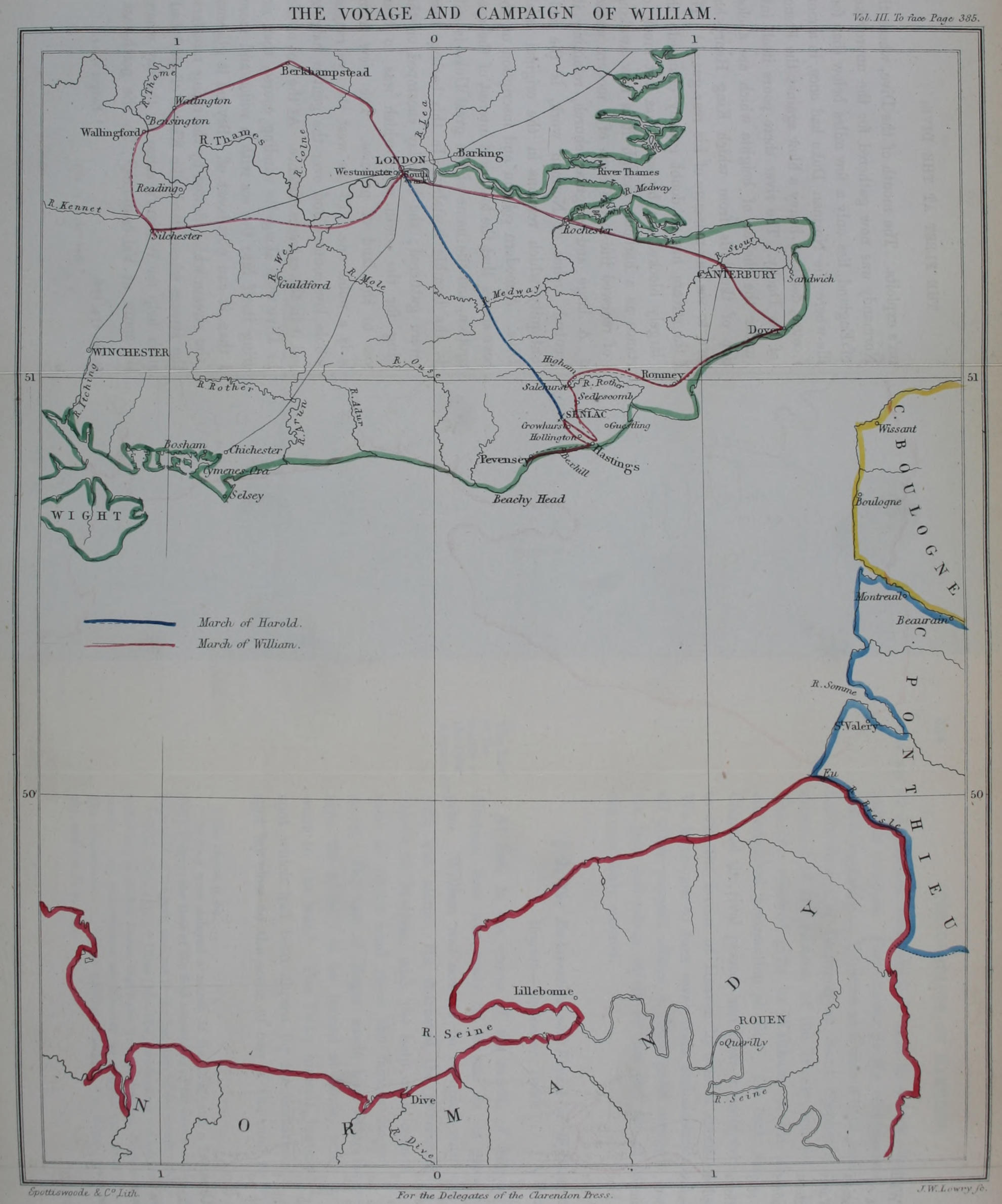
At last, in the course of the month of August,[1076] the Norman fleet was ready to set sail on its great enterprise. William was now to be occupied with war, and with war alone. He entrusted the government of the Duchy to Matilda, with the help of a council of wise men, at whose head stood the famous Roger of Beaumont. The age of Roger made him fitter for counsel than for action; so he tarried at home, while his son went to the war.[1077] The Duke himself hastened to the spot which had been chosen for the embarcation. This spot lay close to the scene of one of the most memorable 385of William’s exploits. The mouth of the Dive, where the fleet of Normandy was now gathered for the unprovoked invasion of England, lies only a few miles below that ford of Varaville where the Norman Duke had once, in a more righteous cause, dealt so heavy a blow against the French |Description of the place.| invaders of his Duchy. The river there pours itself into the sea, under the shelter of heights which are a close continuation of the hills from which King Henry had looked down to see the massacre of his rear-guard.[1078] The course of the stream has no doubt greatly changed; the harbour, largely blocked up by sand, has lost much of its importance as a harbour, though it is now awaking to a kind of renewed life in the form of a modern watering-place. A large and singular church, retaining its massive central arches of Norman work, is the only piece of antiquity which remains in the original small town of Dive. A modern column and inscription on the height above shows that the historical interest of the spot is not forgotten, and the name of the great Duke is still attached to the humble hostelry. In this harbour then the ships were gathered; the host lay encamped on the hills, waiting for the south wind which was to bear them across to the land of promise. The view from those hills is a noble one. To the west the eye ranges over the whole low country and over the gentler heights which bound it in the extreme distance. At the foot of the heights the Dive rolls along its winding course, then no doubt pouring itself into the sea with a wider and more open flood than it can now boast of. Beyond it glistens the Orne, the stream which flowed by the rising minsters of Caen, the stream whose flood, like Kishon of old,[1079] had wrought such help for William’s cause on the day when he won his spurs at Val-ès-dunes.[1080] To the north-east 386stand forth the rocks which guard the entrance to a yet greater stream, the rocks by which William’s Wiking forefathers had so often sailed to threaten the great cities on the Seine, and which now, under Norman guardianship, served as it were to keep the Lord of Paris imprisoned within the narrow limits of his inland realm.
The south wind for which William so eagerly waited was as slow in coming as the east wind which was so eagerly looked for, when a later William was waiting to set forth for the shores of England on a widely different |Delay at the Dive.| errand.[1081] The fleet was detained for a whole month at the mouth of the Dive,[1082] and the panegyrist of William |Good order maintained in William’s army.| grows eloquent on the wonderful good order and peaceable demeanour of the host which was, no doubt most unwillingly, subjected to this untoward delay. The excellence of the Duke’s commissariat is set forth in such glowing colours that we cannot help longing to know the details of his arrangements. The whole army, we are told, received regular pay and regular provisions during the month which was thus condemned to inactivity.[1083] All plunder was forbidden, and we are told that William’s orders to this effect were carried out with a degree of success which seems incredible. The inhabitants of the surrounding country learned to pass without fear among the motley host, a host made up not only of their own countrymen but of adventurers from every province of Gaul.[1084] The 387flocks and herds fed undisturbed in their pastures; the ripening corn remained alike uncut and untrampled by the dangerous visitors.[1085] In all this there is doubtless much of the exaggeration of a professed panegyrist. But we can well believe that the strong will of the Great William was really able to preserve a degree of good order among the mixed multitude which he commanded which a lesser man might have found it hopeless to preserve even among an army of his own subjects.
The numbers of the host which William had now assembled are as variously stated as the number of the ships which were to carry them. The sum total is commonly given at sixty thousand, or even more; but there are authorities which bring it as low as fourteen thousand.[1086] Here, as in the case of the ships, while we must allow for error and exaggeration, we must also allow for different systems of reckoning. The higher amount may be meant to take in all the armed men of every class, while the lower may give only the number of knights—what in the military language of a later age would have been called the number of lances. In the history of all ages nothing is so little trustworthy as the figures which profess to set before us the numbers of armies. And I fear that the exact number, or even any near approximation to the exact 388number, either of the Norman invaders or of the English defenders, is one of the things which the historian must, however unwillingly, leave uncertain.
It was while the Norman fleet was still at the mouth of the Dive, while the whole southern coast of England was so strongly guarded by the watchful care of Harold,[1087] that an incident is said to have happened, which, though it has been mixed up with events not belonging to it in date, is most likely not without some foundation in fact. The King of the English, among his precautions for the defence of the country,[1088] did not forget to get what knowledge he could as to the condition and numbers of the enemy. He sent spies across to the mouth of the Dive. |One is brought before William, who sends him back with a threatening message to Harold.| One of them was seized and led before the Duke. We are not told whether William followed the magnanimous or ostentatious example of Xerxes[1089] in showing the Englishman the whole strength and numbers of the Norman host; but he at least sent him home unhurt, though charged with a threatening message to his sovereign. When the spy strove to hide his errand under some of the usual subterfuges,[1090] William showed him at once that no disguises could avail with him. Harold might forbear to waste his gold and silver in paying spies to search out William’s resources; sooner than Harold looked for, he 389would himself come as his own messenger, and would teach him on his own soil what the power of Normandy was.[1091] |William’s comparison between himself and Harold.| And it was now, we are told, that the Duke made that most singular comparison between himself and his rival of which I have already spoken. He had promised away all the goods of Harold beforehand, while Harold had not the strength of mind to promise anything of his.[1092] He goes on to say that Harold would fight only to retain what he had wrongfully seized, while he would fight to obtain possession of the gift of his departed friend which he had earned by his services towards him.[1093] Success was certain; the fleet was of such a number as to be fully enough for any purpose that was needed, while he was not cumbered with any useless multitude of ships. And, as for the army, the fate of campaigns was decided, not by the number of armies, but by their valour.[1094]
A month was thus lost at the Dive,[1095] and yet the south wind came not. The Duke at last resolved to change his position and his place of embarcation. He had many good reasons for doing so. Had he stayed much longer in his first quarters, his supplies would probably have failed him, 390and he would no longer have been able to keep back his troops, especially the foreign mercenaries, from plunder. Meanwhile the same failure of provisions which William merely dreaded had actually defeated all the schemes of the |Influence of the disbanding of Harold’s fleet and army. September 8.| English King. While William lay at the mouth of the Dive, Harold’s great fleet and army, which had so long guarded the English coast, was finally disbanded, and the mass of the ships went back to London.[1096] It had in fact been a sort of involuntary struggle between the two rivals, which could keep an army for a longer time on foot in a state of inaction. In this struggle William had succeeded. The host with which Harold had lined the whole West-Saxon coast was doubtless far larger than the host which William had gathered at a single haven of Normandy. But William’s host, gathered from all parts of Gaul, consisted far more largely of professional soldiers than Harold’s, and in a far smaller degree of the general levies of the country, eager to return to their homes and harvests. It is no wonder that the endurance of William’s army outlasted the endurance of the army of Harold. But William had doubtless by this time exhausted the supplies afforded by the lands near the Dive, and he found it expedient to remove to quarters whose resources were still untouched. And the disbanding of Harold’s fleet and army supplied another motive equally strong. Now that the shores of England were left comparatively defenceless, now that the English fleet no longer rode triumphantly in the Channel, it became a matter of importance with William to be nearer to the English shores, ready to sweep down on any unguarded spot at any favourable moment. William therefore took advantage of a west wind[1097] to hasten from the Dive to a point which far more 391|William sails to Saint Valery. September 12.| closely threatened the southern shores of England. He passed by the mouth of the Seine and by the whole coast of Upper Normandy, and took up his position at a spot beyond the limits of his own immediate dominion, within the territories of his now faithful vassal Guy of Ponthieu.[1098] |History of the Abbey of Saint Walaric or Valery.| Near the mouth of the broad estuary of the Somme, on a low height overhanging the water,[1099] stood a minster, commemorating the good deeds of Walaric, a saint of Merovingian times, who had done much to evangelize the still heathen lands of Northern Gaul.[1100] Like so many other foundations originally secular, it had seen its canons give way to monks, and the monastery now ranked high among foundations of its own class. Near its gate a small town had arisen, bearing, like the abbey itself, the name of its ancient patron, but in a form which French pronunciation had moulded into a likeness to the great Valerian house of Rome. The Abbey of Saint Valery, like many other monasteries, had suffered through its own renown; the relics of its founder had been carried off by the pious cupidity of a Count of Flanders, and had been restored by the pious intercession of a Duke of the French.[1101] Like many other monasteries, the duty of its defence had given 392|The Advocates of Saint Valery.| a title to a line of temporal nobles. The Advocates of Saint Valery were powerful lords; one of them, as we have seen, had married a daughter of Normandy, and a younger branch of his race filled a high and honourable place among |Description of the place.| the great houses of the Norman land.[1102] Of this famous abbey the vast encircling wall still remains, but the remains of the church are small, and of a date somewhat later than the days with which we are concerned. But the ancient town, rising, with its parish church, above the modern port which has arisen rather higher up the river, still retains its walls and gateways and general mediæval look in singular perfection. Below, immediately on the coast, stands a ruined tower of rude work, to which an inaccurate or misunderstood legend has attached the name of Harold of England.[1103] The spot, even apart from its historical associations, is in every way striking. The broad estuary, the wooded heights above it, the ancient and the modern town, unite to form a singularly varied |Gathering of the fleet; its losses.| landscape. It was here, on the wide expanse of water into which the mouth of the great Picard river spreads itself, that the fleet of William rode, still waiting for the long-expected south wind which should at once transport him and his host to the shores of Sussex. Its numbers seem to have been somewhat lessened from the numbers, whatever those numbers were, of the fleet which had been gathered at the mouth of the Dive. We hear of losses from shipwreck, and of losses from desertion;[1104] and, as we 393have seen, it is not impossible that we ought to add losses from at least partial actions with English ships.[1105] At any rate, from what cause soever, a good many men were missing from William’s muster; and we are told that he imitated the well-known stratagem of Xerxes,[1106] by causing the recovered bodies of the drowned men to be buried as secretly as might be, lest the knowledge of their losses |Further delay at Saint Valery. September 12–27.| might serve to dishearten his followers.[1107] Still the wind was not favourable; the west wind had brought the fleet to Saint Valery, but the south wind was not yet willing to bring it to any English haven. All the time then that Harold was engaged in his great Northern march and in his victory at Stamfordbridge, William was still lying inactive in his second naval quarters at the mouth of the Somme.
But with William time was never idle; he had ever at his command the resources of both worlds to occupy any season of constrained inaction. It was even more incumbent upon him to respect the property of his allies and vassals than to respect that of his own subjects. He occupied himself as diligently in care for his commissariat at Saint Valery as he had done at the Dive.[1108] By constant exhortations he kept up the spirits of those of his men who were already beginning to shrink from the enterprise.[1109] And the champion of the Church, the pious leader of the great expedition for the second conversion of the erring English, was not likely to be sparing at such a moment in those means of spiritual excitement of which he so well knew the efficacy. Prayers and sacred rites of every 394kind were resorted to, in order to move Heaven to send the looked-for wind which should waft its servants to do its bidding beyond the sea. The Duke himself was unwearied in his devotions within the minster of Saint Valery, nor did he pay less regard to the outside of the temple than to the inside. His eyes were ever watching the weathercock on the minster tower; when he saw it pointing to the south, his heart was downcast and his eyes were filled with tears, but the least turn in the opposite direction again kindled his hopes. Still the wind came not; the sky was cloudy; the weather was cold and rainy; for fifteen days all the powers of the air seemed steadily bent against the enterprise.[1110] |Procession of the body of Saint Valery.| At last recourse was had to a ceremony of special solemnity, one which, it was thought, could not fail to wring the long-wished-for boon from the saints and from their Creator. At the request of the Duke and his army, the Abbot and monks of Saint Valery came forth from their church in solemn procession, bearing the shrine which contained the wonder-working body of their glorified patron. A carpet was spread on the ground, and the shrine was exposed to the gaze of the army, awaiting their devotions and their offerings. The Duke and all his host 395knelt in prayer for the withdrawal of the adverse breeze and the sending of one more favourable. Nor was their bounty less than their faith; the shrine of Saint Valery was hidden by the pieces of money showered down as offerings by his worshippers.[1111]
The devotion and the pious liberality of the Norman host did not pass unrewarded. The prayers and the gifts of William and his followers did their work. The costly offerings at Caen, the crowning act of devotion at Saint Valery, at last availed to release the new Agamemnôn from his unwilling sojourn at another Aulis.[1112] In the milder belief of William’s age the virginity of Cecily was an offering more acceptable to Heaven than the bloody sacrifice of Iphigeneia. And at last so many prayers were heard. On Wednesday the twenty-seventh of September, two days after Harold’s victory at Stamfordbridge, the south wind blew.[1113]
396The camp was in a tumult of joy and thankfulness. The wished-for hour was at last come. England and its spoils seemed to lie before them, ready to be grasped by the hands of the champions of the Church and of the Norman saints. Men were seen everywhere lifting up their hands to heaven, exhorting and rejoicing with one another that the hours of weariness were over, that the moment of action at last had come.[1114] In the midst of the general joy came the Duke’s orders for immediate embarcation. William, as eager by temper as he was cautions by reflexion, was foremost in urging his followers to hasten on board their vessels, and to lose no time in making for the promised land.[1115] But his troops needed little urging; the dread of the unknown sea and of the unknown land, the dread of the wealth of England and of the might of her defenders,[1116] had all passed away. The Norman warriors were so clearly the favourites of Heaven, the sign which they had just received so clearly showed that their cause was the cause of righteousness, that doubt and fear no longer lingered in the mind of any man. Men rushed to the shore;[1117] one man exhorted his followers, another his comrades; each was eager to be first on board, to be foremost in the holy work. The captain outstripped his soldiers; the soldier outstripped his companions; men left behind them their goods and their necessary stores, having 397one fear only before their eyes, lest by any mishap they should themselves be left behind.[1118] Some bore on their shoulders the swords, the spears, the coats of mail, which would be needed on the other side of the water. Some yoked themselves to waggons loaded with spears, and loaded also with casks of wine. This last was the only kind of provision of which any great quantity seems to have been thought needful; conquered England was to find the rest.[1119] Some were busy in setting up the masts, some in unfurling the sails;[1120] the especial work of the horsemen was the difficult task of bringing their horses on board the vessels.[1121] The ships resounded with music; the pipe, the zittern, the drum, the cymbals, all were heard, and the voice of the trumpet sounded proudly over all.[1122] Meanwhile the Duke once more made his way to the minster of Saint Valery, and offered his last prayers and gifts on Gaulish ground before he went forth to the conquest of the island realm.[1123] Before he reached his ship, evening had set in. The moon was hidden and the heavens were clouded over. The Duke therefore ordered every ship to 398bear a light,[1124] while on the top of the mast of his own Mora a huge lantern blazed to be the guiding star of the |William sets sail.| whole navy. William now went on board; the trumpet sounded, and the voice of the herald announced the Duke’s last orders before setting sail. The ships were to keep as near together as might be, and to follow closely after the beacon-light of his own ship. When they were well out to sea, they were to rest a while in the dead hour of the night, till the signals speaking alike to the eye and the ear had again issued the ducal commands from the ducal vessel.[1125] The fleet set sail; the vessels halted and rested as the Duke had ordered. But before day-break the trumpet again sounded from the Mora, and the lantern |Details of his voyage.| again blazed at her mast. The ships again set sail; but the ship which carried William and his fortunes far outstripped all her followers.[1126] We are told that the speed of 399the vessel, like that of the divine barks of Scheria,[1127] adapted itself to the eagerness of her master;[1128] but it is plain that one reason for the special fleetness attained by William’s ship was that she was one of the few vessels in the fleet which were unencumbered by horses.[1129] The day was now dawning, and the ducal ship was alone. At the Duke’s bidding a sailor climbed the mast to see whether any of the other vessels were in sight. But the morning light as yet showed him nothing on all sides but the sea and the sky.[1130] The Duke ordered a halt; the anchor was cast, and William, as if in his own house, ordered a plentiful breakfast to be served up. The rich contents of one of the casks of wine were not forgotten; and William in cheerful mood bade his men be of good heart and assured them that their comrades would soon overtake them; God, in whose cause they were setting forth, would watch over the safety of all the host.[1131] The sailor was again sent to the mast-head, and he now announced that four ships were in sight. Presently he saw such a multitude that their masts looked like a forest upon the waves.[1132] The heart of William 400was lifted up in thankfulness.[1133] The south wind still blew; in the morning light the lantern was no longer needed; the chequered colours of the sails of the Mora were now the beacon on which every eye in the whole |William lands at Pevensey. Thursday, September 28.| fleet was fixed.[1134] England was soon in sight, and by nine in the morning of Thursday the twenty-eighth of September, the Norman claimant of her Crown had already set foot upon her shores.[1135]
He landed at a spot so memorable in the earliest English history that, to one who muses there, the landing even of William himself seems but of secondary interest.[1136] William came, as it might seem, to pour a new Latin and Celtic infusion into Teutonic England. He brought his Romanized Northmen and the Welsh of the Lesser Britain to bear rule over Saxons, Angles, and Danes who |Description and historical associations of the place.| had never fallen away from their Teutonic heritage. He came to begin his work on a spot where the Saxon of old had dealt one of the heaviest of all his blows against the Roman and the Briton. He came to subdue England on one of the spots which had seen most done to turn 401Britain into England. A north-west course from Saint Valery had brought the invading fleet to a point in that eastern part of the South-Saxon coast which, trending to the north-east, is cut off in a marked way by the promontory of Beechy Head from that long and nearly straight line of coast which reaches westward to Selsey Bill. At Beechy Head to the west, and again near Hastings to the east, the high ground comes down to the sea. Between these points lies a long flat shore, where the waves now break on a vast mass of shingle, which, at some points, stretches a long way inland, forming a wilderness of pebbles, slightly relieved by small patches of gorse and thin herbage. Between the coast and the hills—the hills which form a part of the great Andredes-weald—there lies a wide level, but here and there slight and low projections, feeble offshoots from the high ground, |Pevensey the ancient Anderida.| straggle down towards the coast. One such post, commanding alike the sea and the inland country, had been chosen as the site of a Roman city, and Anderida, the Andredes-ceaster of our forefathers, became, in the later days of Roman occupation, one of the chief of the fortresses which guarded the Saxon Shore.[1137] In those days, and in the days of William also, Anderida was a haven of the sea. The vast expanse of shingle is owing to the later siltings which have choked up so many harbours along this coast; in the fifth and in the eleventh century the sea still washed the foot of the slight eminence occupied by the city, and ships could ride at anchor beneath the Roman |Remains of the Roman city.| walls.[1138] Of those walls and of their massive towers large portions still remain; but not a single human dwelling-place 402survives within their circuit. In the south-eastern corner of the Roman city, the mediæval castle of Pevensey, a foundation of William’s brother Robert,[1139] has arisen and has fallen into decay. And just without the ancient walls, the villages of Pevensey and West Ham, each with its Old-English name and its mediæval church, seem to show by their position that the first Teutonic settlers in Britain avoided, from whatever reason, the occupation of the old Roman sites. Few groups are more striking in themselves than this assemblage of antiquities of various dates and kinds, Roman and mediæval, ecclesiastical and military. But the true attraction of the spot comes from the memory that there was dealt one of the most awful of those awful blows which made our race dominant in this our island. |Landing of Ælle in Chichester harbour. 477.| Second among the Teutonic settlements, first among the strictly Saxon settlements, the followers of Ælle and Cissa had for fourteen years been fighting their way onwards from their first landing-place on British soil. The foundations of the South-Saxon Kingdom had been laid at Cymenes-óra, in the haven which in after days was to be called after the city to which the younger conqueror gave his name.[1140] Since that day, the Saxons had been gradually spreading eastward towards the frontiers of their |Taking of Anderida. 491.| Jutish kinsfolk in Kent. At last, as we read in our Chronicles, “Ælle and Cissa beset Andredes-ceaster, and slew all that were therein, nor was there a Briton left there any more.”[1141] So it was that our fathers did their work; 403but so it was that England became England. The fall of Anderida put the finishing stroke to the Teutonic conquest of south-eastern Britain. The long extent of coast, once part of the Saxon Shore in the elder sense, now became far more truly a Saxon shore under the rule of our first Bretwalda.[1142] The walls which were stormed by Ælle and Cissa have, from that day to this, remained as the mighty monument of a fallen power, the sepulchre of the races which our fathers swept away. In the days of William, as now, those walls had already long ceased to surround the dwelling-places of men.[1143] The forsaken city could at most have served as an occasional place of shelter for the people of the two English settlements which had arisen at either end of it. Beneath those awful ruins, among the memorials of ancient English victory, the Norman Duke now landed. He came, as it might seem to a superficial eye, to undo the work of Ælle and Cissa, to subject the sons of the destroyers of the Briton and the Roman to men speaking the tongue of Rome, and in the veins of many of whom still flowed the blood of the British exiles of Armorica. In truth the errand on which he came was the exact opposite. He came, a chief of Danes and Saxons who had fallen from their first love, who had cast away the laws and the speech of their forefathers, but who now came to the Teutonic island to be won back into the Teutonic fold, to be washed clean from the traces of their sojourn in Roman lands, and to win for themselves, among the 404brethren whom they were to meet as momentary enemies, a right to an equal share in the name, the laws, and the glories of Teutonic England.
Pevensey then, the English name which had supplanted the ancient Anderida, was the place of William’s landing. The town is mentioned among those ports on the southern coast which Harold had taken special care to supply with garrisons.[1144] But at the moment of William’s landing the post was either wholly undefended, or defended by a force which found it hopeless to offer resistance. It will be remembered that the Housecarls had gone northward with the King, and that the irregular levies which had guarded the coast only three weeks before were now scattered every man to his own home.[1145] Any force then which occupied Pevensey, or any other point of the South-Saxon coast, is likely to have been intended as a mere outpost to watch and to give the alarm, rather than to have been placed there with any hope of seriously withstanding the invaders. Harold had doubtless hoped that the winds which had delayed William so long would still work in the cause of England. He trusted that the enemy’s passage would be delayed till he could himself return to the southern coast at the head of the victors of Stamfordbridge. |Lucky moment of William’s voyage.| But the fortune of William bore him to the English shore at the very moment which suited his purpose. A little earlier or a little later, he would have met with a vigorous and, in all probability, a successful resistance. On that St. Michael’s Eve he met with no resistance whatever. There were neither ships to hinder him from drawing near 405to the shore,[1146] nor soldiers to withstand him in the act of |He lands without resistance.| landing. The whole Norman fleet disembarked without a blow being struck against them.[1147] But the array in which they disembarked seems plainly to show that they had at |Details of the landing; close order of the ships.| least reckoned on meeting with armed resistance. The fleet was not allowed to be scattered; the ships all steered for the same point, and cast anchor as near together as might be in the one haven of Pevensey.[1148] The wide expanse of shore at this point would render such a course especially easy. As soon as the anchors were cast, the ships were run ashore, the masts were lowered, the shields and saddles were unladen, the horses were released from their unfamiliar prisons.[1149] The fighting men then landed as nearly as might be in battle array. The first armed man who set |William slips; his ready use of the omen.| foot on English ground was Duke William himself. As he descended from his ship, his foot slipped and he fell with both his hands upon the ground. A loud cry of grief was raised at the evil omen. But the ready wit of William failed him not. “By the splendour of God,” he cried, “I have taken seizin of my Kingdom, the earth of England 406is in my two hands.”[1150] It is added that a soldier, of kindred spirit with his leader, ran forward, and plucking a handful of thatch from a cottage, placed it in the Duke’s hand as seizin, not only of England, but of all that England held within it.[1151] “I accept it,” answered the Duke; “and may God be with us.”
The whole army now landed in order. First came the archers, ready for action, with bended bows and quivers slung at their sides. They scoured the whole of the neighbouring shore, but they nowhere found an armed enemy to resist them.[1152] Next came the knights, all in their helmets and harness. They at once mounted their horses, and formed in the plain as if to call forth the hidden defenders of England to battle.[1153] But not a blow was struck; Pevensey was occupied as the first-fruits of the invasion; a garrison was left to secure William’s first 407possession on English ground, and the words of one of our informants might almost imply that some portion of the Roman ruins was once more turned, in the rough and hurried way which was all that the time allowed, to purposes of defence. One object of this fortification and garrison was to guard the ships, which had been drawn on shore and which were now to be left behind.[1154] For the stay of the Norman host at Pevensey was not a long one. No great amount of provisions had been brought with them, nor could the town of Pevensey and its neighbourhood supply food for so great a multitude.[1155] It was needful to move to some wealthier and more convenient post, which would afford better head-quarters for the army, and which might serve as a central point for a systematic |The army marches to Hastings. Friday, Sept. 29.| harrying of the country. Only one day therefore was spent at Pevensey; on the next day, the feast of the Archangel so deeply reverenced by Norman devotion, the army marched on eastward, probably along the line of a Roman road, and came to the town which William chose as his base of operations for this memorable campaign. That campaign can be 408called by no name so fitting as the Campaign of Hastings; for Hastings was the head-quarters of William, the centre of the whole operations of the campaign. But in speaking of the great battle itself, the name of Hastings simply leads to geographical confusions. I speak therefore of the Campaign of Hastings, while to the battle itself I restore its true ancient name of Senlac.[1156]
The town and port of Hastings[1157] is one which has been more than once mentioned in the earlier stages of our history.[1158] Its name has been made memorable by the zeal and energy displayed by its seamen in their pursuit |1049.| of the pirate-ships of Swegen after the murder of Beorn.[1159] Like Pevensey, it had been garrisoned by Harold.[1160] And yet the town seems to have surrendered to William without striking a blow. Hastings, like most other English towns, had most likely no fortifications which could resist Norman arts of attack, and the prowess of the seamen, whose force would at any time have been weak against the vast fleet of William, was utterly useless now that the invaders had actually landed. The town is placed on a part of the coast where the hills come close down upon the sea, forming a striking contrast to the wide open flats which the Normans had just left behind them at Pevensey. Two gorges between hills open immediately upon the water; the eastern opening is occupied by the elder, the western by the more modern, town of Hastings. The hill which divides the two is crowned by the ruins of the castle which probably marks the site of William’s |Importance of the position.| head-quarters. The position was an important one; it commanded the great roads east and west, and also the 409north road leading directly between London and the coast. |William makes an entrenched camp on the hill.| William therefore chose Hastings as a permanent camp.[1161] After consultation with his brothers, Bishop Odo and Count Robert, he gave orders for the construction of one of those wooden fortresses which were so constantly run up for sudden emergencies in Norman warfare, and which often proved the forerunners of more lasting buildings of stone. The time at William’s command allowed only of the digging of a trench, the casting up of a mound, and the fortification of its summit with a castle of wood.[1162] But it was doubtless this temporary structure which formed the germ of the stately castle which in after days crowned the height of Hastings, and within whose walls arose a church and college, whose chief stall, less than a hundred years after this time, formed one of the countless preferments of the worldly Archdeacon who was so soon to be transformed into the champion and martyr of the Church.[1163]
It is not clear whether it was at Pevensey or at 410|Slight loss of the fleet on the voyage.| Hastings that the Duke reviewed his troops, and found, so we are told in one account, that two only of his ships had been lost on the passage.[1164] But one rather remarkable |Fate of the soothsayer.| life had been lost with them. A clerk, who pretended to the power of soothsaying, had assured the Duke, not only that his voyage would be prosperous, but that he should win England without a blow. Harold would of his own accord again bow to him and become his man. Half the prophecy was already fulfilled; it remained to see what would be the fate of the other half. But the prophet himself came not to the muster. He had embarked in one of the missing ships and was returned as drowned.[1165] “A poor diviner must he have been,” said William, “who could not divine the way and time of his own death. Foolish would he be who should put faith in the words of such a |Was this the time of the affair of Romney?| soothsayer as this.”[1166] One hardly knows whether these dark allusions to lost ships and lost men are to be taken in connexion with the fact that, at some stage of the campaign before the great battle, certain stragglers from the Norman fleet or army had made their way eastward as far as Romney, and had there fallen in a skirmish with the townsmen.[1167] The words of our accounts leave it uncertain whether a portion of the fleet lost its way on the passage, 411or whether a detachment of the army wandered thither from Hastings. In any case, this and some other indications which we have already seen[1168] all tend to show that the fight on Senlac was not absolutely the first time that Normans and Englishmen met with arms in their hands during this memorable year.
William, it will be remembered, while encamped in his own territory and in that of his vassal of Ponthieu, had carefully maintained his troops at his own cost, and had at least done his best to hinder all plunder of the surrounding country. But England, though a realm which William claimed as his own by inheritance, was not to be dealt with so tenderly.[1169] A poet in the Norman interest tells us that whatever damage the English suffered was only the fitting punishment for their stubbornness in not at once admitting the manifest rights of their lawful |Object of these ravages; to tempt Harold to fight.| King.[1170] However this may be, there can be little doubt that William’s ravages were not only done systematically, but were done with a fixed and politic purpose. It was William’s object to fight a battle as soon as might be. But it was not his object to advance for this purpose far into the country, to seek for Harold wherever he might be found. So to do would have been to cut himself off from his own powerful base of operations and from his only hope of retreat in case of defeat. It was William’s object to bring Harold down to the sea-coast, to tempt him to an attack on the Norman camp, or to a battle on the level 412ground. In either of these cases the Norman tactics would have a distinct advantage over the English. It is impossible to doubt that the systematic harrying of the whole country round Hastings was done with the deliberate purpose of provoking the English King, and of |Lasting effects of William’s harrying.| bringing him in all haste to defend his subjects. The work was done with a completeness which shows that it was something more than the mere passing damage wrought by an army in need of food. The traces of the ravages done at this time are recorded in the great Survey twenty years later. The Tapestry not only vividly sets before us the way in which provisions of all sorts were brought in for the use of the camp;[1171] it also represents an incident which at once goes to the heart. A house is being set on fire; the inmates, a woman and a child, are coming forth from their burning dwelling.[1172] This is doubtless one instance among thousands of the cruel destruction which was fast spread over the country, as far as William’s plunderers could reach. Men fled everywhere with such of their goods and cattle as they could save, and sought for shelter in the churches and churchyards.[1173] It would doubtless be the policy of the pious Duke to keep his followers back, as far as might be, from all damage towards those who thus put themselves under the direct protection of religion. Elsewhere all was havock. It was to save his people from the horrors of war in their most barbarous form that King Harold jeoparded his life and Kingdom.[1174]
413At the moment of William’s landing, and even at the moment of his occupation of Hastings, he must have been quite uncertain as to the fortunes of his rival in the North. It was perfectly possible that he might never have to contend with Harold of England at all. The result of the Northumbrian campaign could hardly have been known in Sussex two days after the fight of Stamfordbridge, and it was one of the possible chances of war that William might have to fight for the Crown of England against the victorious host of Tostig and Harold Hardrada. But the two great rivals were not long kept in ignorance of |Robert the son of Wymarc brings news. His position and estimate of his conduct.| each other’s movements and purposes. The news was brought to William by a message from an English landowner of Norman birth, in whom it is easy to recognize the Staller Robert the son of Wymarc, him who had stood at the bed’s head of the dying Eadward.[1175] We know not whether he had retained his Stallership, or any other office, under Harold. But it is plain that he had become the man of the new King, for he was living in England under the King’s peace and in full possession of his lands.[1176] There is nothing in his present conduct which sets him before us as a traitor to his new allegiance. It is scarcely ground enough for such a charge to say that he could hardly have been with Harold 414at Stamfordbridge.[1177] His conduct in fact seems to have been that which was really right and honourable under the circumstances in which he stood. He had to reconcile his good will and his duty towards his adopted country with his earlier good will and earlier duty towards his natural sovereign. He sent a messenger to Hastings,[1178] with a message designed to persuade the Duke, in the interest of all parties, to give up his enterprise, and to |He counsels William to go home.| go quietly back to his own dominions. He, Robert, counselled him as a friend and kinsman;[1179] he would be deeply sorry if any harm befel him or his army, and, if he remained in England, he and his army would meet with certain destruction. It was hopeless for William to think of contending with the forces of England. King Harold had just defeated the Norwegian invader with a slaughter of twenty thousand men;[1180] Tostig and Harold Hardrada were slain; the King of the English was coming southwards with a countless host, a host, men said, of an hundred thousand.[1181] Against the English King and the English army, flushed with their victory over the greatest warrior in the whole world,[1182] it would be madness to risk 415a battle. Neither in number nor in strength were the Normans fit to do battle against King Harold and the English. Against them, in short, William’s army would count for no more than so many barking curs.[1183] The Duke was a prudent man, and had hitherto always acted prudently.[1184] Let him act prudently now; let him go home; let him at all events keep within his entrenchments and not risk a battle.[1185] If he did go forth to fight, his rashness would certainly bring about his utter overthrow.
Such counsel as this, addressed to William the Conqueror, speaks muck more highly for the good intentions of Robert than for his knowledge of mankind, above all for his knowledge of the man with whom he was dealing.[1186] William had not crossed the sea for nothing; he was not like the King in the Gospel, who had to stop on his march to consider whether he were able with his ten thousand to meet him who came against him with twenty thousand.[1187] |William’s answer; He will fight in any case.| It was perhaps not without a reference to that parable that William answered that, had he only ten thousand men, such as those of whom he had sixty thousand, he would not draw back; he would not cross the sea again without avenging himself of his enemy. He would not even keep himself within his entrenchments; whatever were the numbers on either side, he would go forth and 416meet Harold face to face.[1188] He condescended to thank Robert for the kindly interest which he took in his welfare, though he hinted that the words in which he had contrasted Norman and English prowess would better have been spared.[1189] The Duke had no need of such counsels as those which were pressed upon him by his cousin’s favourite. He had come into England to win his Crown, and his Crown he would win at all hazards.
I have already told how the news of William’s landing was brought to King Harold at the feast of victory at York.[1190] That feast must have been saddened by the thought of the many brave men who had fallen at a moment when England needed the help of all her sons, by the thought that England had been saved only by the death of a brother of her King, by the thought that, while King and people were rejoicing at the victory which had just been gained over one enemy, another enemy, certainly not less terrible, was daily threatening the defenceless southern coast. And in the very moment of triumph the news came that the blow had actually fallen. Men now heard that, while Harold was letting the remnants of the Norwegian army depart in peace, the Duke of the Normans had actually landed, that he was ravaging English ground far and wide, that a portion of English ground was already entrenched and palisaded, and changed into a Norman 417|The news brought by a South-Saxon Thegn who saw the landing.| fortress.[1191] The Norman poet gives us a graphic description of the way in which the news was brought to the English King. A Thegn of the country heard the cries of grief and dismay with which the South-Saxon churls beheld the approach of the Norman fleet.[1192] He went forth; he hid himself in a convenient lurking-place, and beheld in safety the whole process of the landing of the Norman army.[1193] He saw first the archers and then the knights disembark. He saw the shields and armour brought out of the ships; he saw the carpenters come out with their axes; he saw the fosse dug, and the palisade thrown up.[1194] The 418|He hastens to York.| sight was enough; the heart of the English Thegn was troubled; he took his weapons, his sword and his javelin;[1195] he mounted his horse, and rode straight to bear the news to his Lord King Harold. He hastened on with all speed night and day; he rested late and rose early,[1196] till he found the victor of Stamfordbridge in the banquetting-hall at York. Here he at once told his errand. The countless host from all Gaul, the host of horsemen and archers and slingers who had gathered under the banner of Duke William,[1197] had landed at Pevensey. They had already built a fort and had fenced it with a palisade.[1198] Presently another messenger, a churl, came from Hastings itself.[1199] He had more news to tell, more details of the cruel harrying of the South-Saxon land. The host of Normans, Frenchmen, and Bretons, a host that no man could number, a host like the stars of heaven or the fishes of the sea, was 419ravaging far and wide.[1200] Men were being slain, their widows, their sons, their daughters, their flocks and their herds, were becoming the prey of the stranger.[1201] Each message enforced the same truth; the King must march at once to the defence of his southern coasts, or the whole land |Answer of Harold.| would be wrested from him. Harold is reported by the Norman poet to have said that it would have been better to have given Tostig all that he asked,[1202] so that he might have been himself in the south to hinder the landing of the French invaders. Such a speech cannot have been uttered by Harold, as it misconceives all the relations between him and his brother. The situation is better conceived when the King is made to say that, had he been on the South-Saxon shore, the strangers would never have made good their landing. Either they would have been driven back into the sea, or they would have escaped its dangers only to perish on English ground. “But,” he added, “the mischance was the will of the King of Heaven, and I could not be everywhere at the same moment.”[1203]
420And so of a truth it was. The event of this great campaign, the overthrow of Harold and of England, turned wholly, setting aside the mere accidents of battle, on the inability of Harold himself to contend against two invasions, or to be at the two ends of his Kingdom at the same time. Of the two invasions, the Norwegian and the Norman, each rendered the other possible. Or even had the south wind blown sooner at the mouth of the Dive, the southern coast of England would have been found guarded against any attack, and Harold would probably have gone to meet his namesake of Norway flushed with victory over William and his host. As it was, the fate of England, as ever in that age, rested on one man, and that one man could not be at once in Sussex and in Northumberland. Harold, too late to hinder the landing of the Normans, had now before him the far harder task of dislodging them when they were already in the land. It was a hard lot to have to hasten at once on such an errand, after hardly a moment’s rest from the toils and the glories of Stamfordbridge. One terrible campaign was hardly over, when another yet more terrible had to be begun. But the heart of Harold failed him not, and the heart of England beat in unison with the |Harold begins his march to London.| heart of her King. As soon as the news came, King Harold held a Council of the leaders of Stamfordbridge,[1204] perhaps rather an armed Gemót, such as we have already heard of more than once.[1205] He told them of the landing of the enemy; he set before them the horrors which would come upon the land if the invader succeeded in his enterprise.[1206] A loud shout of unanimous assent rose from the 421Assembly. Every man pledged his faith rather to die in arms than to acknowledge any King but Harold.[1207] The King thanked his loyal followers, and at once ordered an immediate march to the south, an immediate muster of the forces of his Kingdom. London again was the trysting-place.[1208] With speed and energy equal to that which had carried him to his northern capital, he now set out on the return march. He himself pressed on at once, at the head of such of his Housecarls and other immediate following as had survived the fight of Stamfordbridge. Eadwine and Morkere were bidden to follow with the whole force of |Merlswegen in command of the North.| their Earldoms. Meanwhile the command of the North was committed to the Sheriff Merlswegen.[1209] We shall hear of him again among the patriots of a time a few years later, and we cannot doubt that this great command was put into his hands because he was known to be one more worthy of the trust than the King’s own brothers-in-law. And so it |Eadwine and Morkere keep back from the war.| proved. Even the great salvation of Stamfordbridge, the deliverance of Northumberland from the very jaws of her enemy, could not bind the sons of Ælfgar to gratitude or fidelity to the West-Saxon King. In their eyes, no doubt, the landing of William only offered another chance of bringing about their darling scheme of a divided Kingdom. 422William had a quarrel with Harold; he had none with Eadwine or Morkere. They had not forsworn themselves to their lord or done despite to any holy relics. The invader might well be content with the immediate territories of his enemy and his house. William might rule over Wessex and East-Anglia, and might leave Mercia and Northumberland to the House of Leofric. It was probably with some such designs as these that the Northern Earls held themselves and their forces back from the struggle. But, whatever were their motives, the fact that they did hold themselves back is certain.[1210] The main forces of Northumberland and north-western Mercia came not to King Harold’s muster.[1211]
But elsewhere another spirit reigned.[1212] Men well knew what was at stake. They went forth, as loyal subjects, as true men to their lord, to fight for the King whom they had chosen. But they went forth also on a higher errand still, to save the land of their birth from the grasp of the invader, an invader of wholly alien speech and feeling, an invader who could never be as Cnut or even as Harold of Norway. The presence of the Frenchmen in the land awoke a spirit in every English heart which has never |Charge of parsimony against Harold.| died out to this day. We hear indeed vague stories how Harold lost favour with the victors of Stamfordbridge by refusing to divide among them the rich plunder of the Norwegian host.[1213] We hear how he left the plunder untouched 423under the care of Archbishop Ealdred,[1214] instead of scattering it with a bounteous hand among the men whose toils and whose blood had won it. These stories rest on but poor authority; still they may have some groundwork of truth.[1215] The time was not a time for waste of treasure; the armaments of the year must have been costly in the extreme; Harold needed wealth to oppose to the wealth of William, and, considering the doubtful fidelity of the Northern Earls, he could not afford to throw away the sinews of civil war. A prudent economy on the part of Harold may have called forth a certain measure of discontent; but it is certain that such discontent had no serious effect on the campaign. The discontented in such a case must have been mainly the King’s own Housecarls, and those who bring this charge against Harold tell us also that it was the King’s own Housecarls who formed the strength of the host that fought at Senlac.[1216] It is far more certain that, as King Harold set forth on his southern march, fresh from the triumph of Stamfordbridge and with the fate of England resting once more upon him, the men of the greater part of England flocked eagerly to the Standard of their glorious |The shires which sent men. Wessex, East Anglia, Eastern Mercia.| King. They gathered round him from all the shires through which the Dragon and the Fighting Man passed once more on their southern journey. They gathered round him from all the shires under his own immediate rule, and under the rule of his faithful brothers.[1217] North-western 424|The North and Northwest kept away by their Earls.| Mercia stood aloof under Eadwine. Northumberland, under the rule of Morkere, sent none but such as joined the King’s own Standard on his march. Not so the lands which were still under the House of Siward. Whether the young |Loyalty of the Earldom of Waltheof.| Waltheof came himself we know not; but there is no doubt that the men of Northampton and Huntingdon came loyally to King Harold’s muster. And from all the east and south, from the lands which had passed from the rule of Godwine to the rule of Harold, from the lands where Gyrth still kept up the memory of Harold’s earlier government, from all the lands between the Tamar and the German Ocean, men came to fight for Harold and for |The men of Kent and London.| England. And, foremost and honoured among all, ranking, it would seem, every man among the King’s personal following, came the men of Kent, whose right it was to deal the first blow in the battle, and the men of the great city itself, whose high privilege it was to guard the King himself and his Standard.[1218] At the head of the men of London stood the Sheriff of the Middle-Saxons, the Staller Esegar,[1219] the son of Æthelstan, the son of Tofig, none the 425|Esegar commands the Londoners.| less loyal to his King because the minster of the Holy Rood had risen on soil which had once been the dwelling-place of his fathers.[1220] Of his fellow-Staller Eadnoth we hear nothing; Bondig would almost seem to have tarried in the North, or, from whatever cause or accident, not to |Few names of Englishmen preserved.| have appeared at the muster.[1221] We see then that England, as a whole, failed not of her duty; but few indeed, compared with the long roll-call of the invaders, are the men whom we know by name as having joined in the great march and fought in the great battle. Still there are a few names which have come down to us, names to be cherished wherever the tongue of England is spoken, names which should sound like the call of the trumpet in the |Entries in Domesday.| ears of every man of English birth. In the dry entries of the Norman Survey a few records still live of the men who fought and died for England. Two nameless freemen of Hampshire, owners of a small allodial holding, come first |Ælfric of Huntingdonshire.| on the patriotic bead-roll. One degree clearer in personality stands forth Ælfric of Gelling, a Thegn of Huntingdonshire, and tenant of the Church of Ramsey, who came from Waltheof’s Earldom, whether in the following of his Earl or at the bidding of his own loyalty to his King. |Breme of East-Anglia.| From East-Anglia we find recorded a nameless tenant of the House of Saint Eadmund, and Breme a freeman of King Eadward’s, who came no doubt in the following of Earl Gyrth. With a clearer consciousness of their personal being, we can honour the names of two noble tenants of the Church of Abingdon, men high in rank in the old West-Saxon Earldom, who fought and fell by the side of Harold. Their names set them before us as representatives 426of the two great Teutonic races of the land, each alike armed to defend their common blood and speech |Godric and Thurkill of Berkshire.| against the Southern invader. Thither came Godric the Sheriff, Lord of Fifhide, whose name witnesses to his English descent, and thither too came the Danish Thurkill, Lord of the neighbouring lordship of Kingston. He had, at Earl Harold’s counsel, commended himself and his lands to Saint Mary of Abingdon, and he came no doubt with as fervent a trust in the Black Cross of that ancient house as the King himself reposed in the more famous relic of his own newly hallowed minster. And it was not only the tenants of religious houses who went forth to battle for the excommunicated King against the invader who boasted himself as the special champion of the Church and of religion. Two English Prelates at least, and several churchmen of lower rank, personally braved the curse of Rome in the |Ælfwig Abbot of New Minster.| cause of England. The New Minster of Winchester, King Ælfred’s great bequest to his royal city, was still ruled by Ælfwig, the brother of the great Earl Godwine, the uncle of King Harold himself.[1222] Like Ealhstan and like Eadnoth in earlier times, he and twelve of his monks marched to the field, not merely to pray for England, but to wield their weapons among the foremost of her champions. With their coats of mail over their monastic garb, they took their place in the ranks, and fought and died alongside of Thurkill and Godric and the other valiant men whose names no chronicler has recorded.[1223] Ælfwig came to the fight at the bidding of kindred no less than at the bidding |Leofric Abbot of Peterborough. His death, Nov. 1.| of loyalty. Another Prelate, of equal ecclesiastical rank, and of greater personal fame, Leofric, the renowned Abbot of Peterborough,[1224] preferred the cause of his country to the cause of his own house. Eadwine and Morkere kept aloof from the great struggle; their worthier cousin, the Abbot 427of five monasteries, followed Harold to the fight, and, unlike his brother of Winchester, returned to his home sick and wounded.[1225] And one lowlier churchman must not |Eadric the Deacon.| be passed by. The Norman record itself seems to assume a kind of pathos, as we read how Eadric the Deacon, a freeman of Harold’s, followed his lord from the East-Anglian land of his earlier government, and died with him in the battle.[1226] Volunteers like these doubtless took their places among the King’s personal following. But we cannot doubt that the main strength of the army consisted of Harold’s own picked troops, his veteran Housecarls, the conquerors of Gruffydd, the victors of Stamfordbridge. Still it is clear that the levies of all southern and eastern England answered readily to Harold’s summons. They flocked to his muster in London in as great numbers, and with as great speed, as the swift march of events at this fearful crisis allowed them.
The march of Harold from York to London was as memorable an instance of the indomitable energy of his character as his march, so short a time before, from London to York. He seems to have reached London about ten days after the fight at Stamfordbridge, about a week after William’s landing at Pevensey.[1227] He came at the head of his own following, and of such of the general levies of the central shires as had joined him on the road. In the great city, which had been appointed as the general trysting-place, he waited, impatiently as it would seem, while men flocked in from his own Wessex and from the lands of the three faithful Earls. He waited also for the 428further succours which were never to arrive, for the forces which the Earls of the North were keeping back from |He goes to pray at Waltham.| the muster. At such a moment of suspense the heart of Harold, no less than the heart of William, looked for help and guidance from on high. His home was now in the royal hall of Westminster, beneath the shadow of the minster of the Apostle, the minster where prayers and masses were daily going up for the soul of his revered predecessor.[1228] It was the minster too where he himself had gone through the most solemn act of his life, where he had received his royal unction and his Imperial Crown. But it was not before the tomb of Eadward, or before the altar of Saint Peter, that Harold sought for heavenly strength and counsel in the great crisis of his life. His heart went back to the home of his earlier days, to the lowlier church of his own rearing, to the relic which had ever been the especial object of his devotion, the Holy Cross which gave England her war-cry. One at least of the few days of the King’s short stay in London was devoted to a last pilgrimage to his own Waltham.[1229] |His last gifts to the minster.| Early in the morning of one of those October days King Harold made his way to the minster of the Holy Cross, bearing with him the last gifts that he was to offer there. Those gifts were a further supply of relics, the treasures of his own chapel,[1230] gathered together no doubt by the lavish piety of Eadward, but which now formed Harold’s last oblation upon the high altar of his own minster. Before 429|Harold’s vow.| that altar the King and Founder knelt in prayer. He vowed that, if God gave him victory in the strife to which he was then marching forth, he would yet further endow the church of the Holy Rood with gifts and lands, and would yet further increase the number of those who served God within its walls. Nay more, he would look upon himself as God’s ransomed servant, and would devote himself to his special service for ever.[1231] We need not take these striking words to mean that Harold dreamed, like Ceadwalla or Ine, of laying aside his Crown and of becoming God’s special servant as monk or priest. We hear in them simply the voice of deep penitence for the few sins and errors which stained that noble life, the voice of earnest prayer for deliverance from the meshes in which the craft of his adversary had entangled him. We hear in them the voice of high and humble resolution to live from henceforth, as man and as King, a life such as became a faithful servant of God, such as became a King sitting on the throne of the righteous Ælfred, and whose first days of government had been passed in the old realm of the martyred Eadmund. When his offerings had been made and his prayers had been uttered, the King turned him to depart. The Canons and all the members of the Church of Waltham formed in procession before their sovereign and Founder. They swept westward along that stately nave, between the two rows of its massive columns, till they reached the great western portal, over which was placed the wonder-working relic, the Holy Rood of Montacute and Waltham.[1232] 430Before the great object of his life’s reverence, King Harold bowed himself low, and lay for a while flat on his face |Miracle of the Holy Rood.| on the consecrated pavement. Then, as men said at Waltham in after days, the holy image, whose head had hitherto stood erect, bowed itself towards the King who lay prostrate beneath it. One eye alone, that of the sacrist Thurkill, was privileged to behold the actual working of the divine wonder. But many there were who had seen the image in former days, and who bare witness how its head had been from that day bowed towards the ground, as if to say “It is finished,” as if to say that all was over with the hopes and the career of him who had so devoutly honoured it.[1233]
It was perhaps on his return from Waltham, it was certainly during his short sojourn in London, that Harold received another message from his rival. Here again we come to one of those stages of our narrative where all is confusion and contradiction. The English writers, in their short accounts of events which they loved not to dwell upon, are silent as to any attempts at peaceful negotiations taking place, at the last moment, between the two armed princes. The witness of the Norman writers is full indeed, but their witness does not agree together.[1234] The different versions agree in no circumstance of time, place, or order of events. Yet we cannot doubt that some messages passed between Harold and William, and we can almost as little doubt that it was William who sent the first messenger to Harold, and not Harold who sent the first 431messenger to William. It was perfectly in character that an invader who assumed the character of a legal claimant, nay more, an invader who professed to come as an armed missionary of the Roman See, should play out his part by offering the perjurer and usurper one more chance of repentance. Harold, on the other hand, a national King, simply defending his own Crown and the freedom of his people, had no need thus ostentatiously to put himself in |Mission of Hugh Margot to Harold;| the right. We may then believe that the first message which passed between the Norman Duke and the English King, after William landed on English ground, was when Hugh Margot, a monk of Fécamp, came to King Harold in London. He found him seated, as we may imagine him, on his throne in his Palace of Westminster, |he calls on him to give up the Crown.| and called on him, in the name of the Duke of the Normans, to come down from his throne, and to lay aside his crown and sceptre. The messenger once more set forth the rights of William, his claim on the Crown by the bequest of Eadward, his personal claim on Harold as his sworn man. The Duke was ready to have his claims fairly discussed, according to the law either of England or of Normandy. If either Norman or English judges held that Harold’s right was good, William would let him enjoy that right in peace. Otherwise let him quietly yield up what he had usurped, and spare the bloodshed and misery on either side of which he would be guilty if he attempted to retain it.
A message like this might have provoked the meekest of men. It is not wonderful that we read in one account[1235] that Harold’s wrath was highly kindled, nay that he was with some difficulty kept back from a breach of the rights of ambassadors in the person of the insolent monk. The influence which thus restrained the King from violence is said to have been that of Earl Gyrth, who, in the Norman 432|Harold’s counter-message to William; his clear statement of his rights.| accounts, appears throughout as the good genius of his royal brother. However this may be, we elsewhere find[1236] a message addressed by Harold to William, which is evidently an answer to the monk of Fécamp, and which contains a calm and clear statement of Harold’s right. He does not deny the fact of his oath to William, but he maintains that it was an extorted oath and therefore of no force. He does not deny the fact of Eadward’s earlier promise to William, but he maintains that that promise has been cancelled by a later bequest. Ever since the blessed Augustine first preached the Gospel to Englishmen, it had always been the law of England that a testament was of no strength at all while the testator lived. Up to the moment of his death, a man might revoke any earlier disposition of his goods, which could not take effect till the breath was out of his body. Eadward had indeed once made a promise of the succession in favour of William, but that promise had become void and of none effect by his later and dying nomination of the reigning King. How far the words of any message of Harold’s have been truly reported to us by our Norman informants it is impossible to say, but it is clear that the answer thus put into Harold’s mouth, though far from exhaustive, is thoroughly to the purpose as far as it goes. Harold’s best claim to his Crown, his election by the English people, is not insisted on. But the answer to the two points insisted |Harold challenges William to fight on Saturday.| on by William seems hardly to admit of a rejoinder. We are told in other accounts that Harold offered William his friendship and rich gifts if he would depart quietly out of the land, but added that if he were bent on warfare, he would meet him in battle on the coming Saturday.[1237] The Duke, we are told, accepted the challenge; he dismissed the messenger with the honourable gifts of a horse and 433arms; and Harold, it is added, when he saw him thus return, repented him that he had done despite to the messenger whom Duke William had sent to him.
The challenge had now passed. There can be no doubt that the irritating message of William, and the reports which must have reached London of the cruel harrying of the South-Saxon lands, had wrought the effect which they were doubtless meant to work on the mind of Harold. It was, as we have seen, the policy of William to draw Harold down to a battle, in which William should have the vantage-ground of his intrenched camp at Hastings. And Harold was now as eager for battle as William himself could be. He was eager to avenge his own wrongs and the wrongs of his people. He was eager to strike the decisive blow before the French host could be strengthened by reinforcements from beyond sea.[1238] His personal wrath was kindled against the man who had insulted and mocked him by a challenge the most galling that had ever been addressed to a crowned King upon his throne. And a higher feeling of duty would bid him to go forth and put a stop as soon as might be to the pitiless ravages which were laying waste his land and bringing his people to beggary.[1239] The purpose of the King was to go forth at once and to meet the invader face to face, according to the challenge which he had himself given for the coming |Proposal of Gyrth.| Saturday. But the tale goes on to tell how Gyrth, the special hero of the Norman writers, again strove to turn his brother from his purpose.[1240] His counsel was that the 434King should remain, seemingly as the defender of London, while he himself should go forth to battle with the Norman. The King was wearied with his labours in the Northumbrian campaign; the troops which had as yet come together in London were not numerous enough to justify the King in attempting to strike a decisive blow |Gyrth’s scruples about the oath.| at their head. Moreover, whether the oath was binding or not, Harold could not deny that he had sworn an oath to William as his lord, and it was not well that a man should go forth to fight face to face against the lord to whom he had done homage.[1241] But he, Gyrth, was under no such restraint; he need feel no such scruples. He had never sworn ought to Duke William; he could go forth with a clear conscience and fight against him face |Gyrth proposes that he should march against William, while Harold remains and harries the country.| to face for his native land.[1242] Let the King too think on the risk to himself and to his Kingdom if he jeoparded his own life and all that depended on his own life, the noble heritage of English freedom,[1243] on the chances of a single battle. Let Gyrth fight against William. If Gyrth overcame the invader, the gain to England would 435be as great as if Harold himself overcame him. But if William overcame Gyrth, the loss to England would be far less than if William overcame Harold. If Gyrth were slain or in bonds, Harold could still gather another army, and could strike another blow to rescue or to avenge his brother.[1244] Let then the Earl of the East-Angles go forth with the troops which were already assembled in London, and let the King himself wait till a greater force had answered to his summons. Let him meanwhile harry the whole land between London and the coast, even as the Normans themselves were harrying it. Let him burn houses, cut down trees, lay waste corn-fields. Let him in short put a wilderness between himself and his enemy. William then, whether successful or unsuccessful in the battle with Gyrth, would presently be starved into favourable terms. He would soon find it impossible to maintain his host in the wasted land, and he would be driven to withdraw peacefully to his own dominions.[1245]
A hero was speaking to a hero; we may add, a general was speaking to a general. Our hearts are moved at the generous self-devotion of the brave Earl, who recked so little of himself as compared with the safety of his brother and his country. And in the wise, though cruel, policy which he enforced upon his brother, we can discern a 436subtlety of intellect fitted to grapple with that of William himself. Gyrth, as painted by hostile historians, stands forth as one who, had he outlived that one fatal day, would never have allowed England to fall without striking another blow. But how were the counsels of that lofty spirit received by the no less lofty spirit to whom they were addressed? |Norman calumnies.| We may cast aside the mere inventions of Norman calumny. They represent Harold as thrusting away his brother with insult, as even spurning his aged mother from his feet, when, still sad at the fate of Tostig,[1246] she implored him not to jeopard the lives of all the sons who were left to her.[1247] Such tales as these come from the same mint of falsehood as the tales which describe William as striking his wife with his spur or as beating her to |Answer of Harold; he refuses to ravage his land or do harm to his people.| death with his bridle.[1248] Another Norman writer, who at least better understood the characters of the two noble brothers, puts into the mouth of Harold words which, after eight hundred years, still send a thrill to the hearts of Englishmen. All who heard the counsel of Gyrth cried out that it was good, and prayed the King to follow it.[1249] But Harold answered that he would never play the coward’s part, that he would never let his friends go forth to face danger on his behalf, while he himself, 437from whatever cause, drew back from facing it.[1250] And he added words which show how the wise and experienced ruler, the chosen and anointed King, had cast aside whatever needed to be cast aside in the fiery exile who had once harried the coast at Porlock.[1251] “Never,” said Harold, “will I burn an English village or an English house; never will I harm the lands or the goods of any Englishman. How can I do hurt to the folk who are put under me to govern? How can I plunder and harass those whom I would fain see thrive under my rule?”[1252] Truly, when we read words like these, we feel that it is something to be of the blood and of the speech of the men who chose Harold for their King and who died around his Standard.
Six days had now been passed in the trysting-place of London.[1253] Daring the whole of that time men had been flocking in, but the forces of the North under the sons of Ælfgar had not yet appeared. Harold now determined to delay no longer. He set out from London, seemingly on Thursday, exactly one week after his arrival in the great city, in order to redeem his challenge of giving battle to the invaders on Saturday. He marched forth 438at the head of his own following and of such troops as had come in to the London muster. These would no doubt be largely reinforced by the levies of Kent and Sussex pressing to his Standard on the march. At |Numbers of his army; exaggeration on both sides.| the numbers of the army which he thus collected it is impossible to do more than guess. The Norman and the English writers both indulge in manifest exaggerations in opposite directions. The Normans employ every rhetorical art to set before us the prodigious numbers of the English. They were a host that no man could number, a host like the host of Xerxes, which drank up the rivers as it passed. Nothing but the special favour of God could have given his servants a victory over their |Harold unjustly censured.| enemies which was truly miraculous. On the other hand, the English writers yielded from the very beginning to the obvious temptation of laying the blame of the national overthrow on the rashness of the King. Harold refused to wait till a sufficient force had come together; he ventured a battle with numbers altogether inadequate, and he paid the penalty of his own over-daring. Such are the comments even of the writers who are warmest in their admiration of Harold, and who pour forth the most bitter regrets over his fall.[1254] Yet we must remember that nothing is easier than to blame a defeated commander, nothing easier than to throw on his shoulders either the faults of others or the mere caprices of fortune. And we should remember too that, deeply as we reverence our national writers, implicitly as we accept their statements of facts, warmly as we sympathize with their patriotic feelings, their criticisms on such a point as this are simply the criticisms of monks on the conduct of a consummate general. We may fairly assume that whatever captains like William and Harold did was the right thing to do in the circumstances under which they found themselves. The consummate generalship 439|His generalship; he fights on ground of his own choice.| of Harold is nowhere more conspicuously shown than in this memorable campaign. He formed his plan, and he carried it out. He determined to give battle, but he determined to give battle on his own ground and after his |No attack on the Norman camp intended.| own fashion. All probability goes against the belief that Harold designed anything so foolhardy as an attack, by night or by day, on the Norman camp. No doubt the expectation of such an attack was prevalent in the Norman camp.[1255] But our evidence proves only the existence of such an expectation among the Normans; it in no way proves the existence of any such design on the part of the English King. The nature of the post which he chose distinctly shows the contrary; it distinctly shows what Harold’s real plan was. It was to occupy a post where the Normans would have to attack him at a great disadvantage, and where he could defend himself at a great advantage. This he effectually did, and it was no small effort of true generalship to 440|Harold probably judged rightly as to numbers.| do so. And for the post which he chose, and for the mode warfare which he contemplated, overwhelming numbers were in no way desirable. A moderate force, if thoroughly compact and thoroughly trustworthy, would really do the work better. If then Harold marched against the invader at the head of a force which, to critics of his own day, seemed inadequate for his purpose, the chances are that Harold knew well what he was doing and that his critics did not understand his plans. Harold was defeated; he has therefore paid the usual penalty of defeat in ignorant censure of his actions. But it is quite certain that his defeat was not owing to mere lack of numbers, and we may fairly conclude that the force with which he set out was one which he judged to be sufficient for carrying out the plan which he had formed.
The great campaign of Hastings was thus in truth a trial of skill between the two greatest of living captains. Each of them, it may fairly be said, to some extent compassed his purpose against the other. William constrained Harold to fight; but Harold, in his turn, constrained William to fight on ground of Harold’s own choosing. He constrained him to fight on ground than which none could be better suited for the purposes of the English defence, none worse suited for the purposes of the Norman attack. This march of Harold from London into Sussex was a march as speedy and as well executed as his march from London to York so short a time before. But it was a march conceived with somewhat different objects. Both marches were made to meet an invader, to deliver the land from the desolation caused by the presence of an invader. But the march into Northumberland was strictly a march to surprize an invader, while the march into Sussex was a march to meet an invader against whom altogether different |Harold’s tactics defensive.| tactics had to be employed. It was Harold’s policy to make the enemy the assailant in the actual battle as well as 441in the general campaign. One cannot doubt that the whole march was designed with reference to this special object. From the moment when Harold fixed a day for the battle, he no doubt also fixed a place. He must have known Sussex well, and he had clearly, from the very beginning, chosen in his own mind the spot on which he would give battle. His march was strictly a march to the |He marches through Kent and Sussex,| actual spot on which the battle was to be fought. His course lay along the line of the great road from London to the south coast. He halted on a spot which commanded that road, and which also commanded the great road eastward from William’s present position. He hastened on through those Kentish and South-Saxon lands which had been the cradle of his house, and which contained so large |and encamps on SENLAC. Friday, October 13.| a portion of his own vast estates. He halted at a point distant about seven miles from the head-quarters of the invaders, and pitched his camp upon the ever-memorable heights of Senlac.[1256]
The spot on which the destinies of England were fixed was indeed one chosen with the eye of a great general. Harold has, in this respect, had somewhat scanty justice done to him by those of his own countrymen who seem inclined to throw on him the blame of the national defeat. But it is in the Norman accounts, which alone supply details, that the history of the great battle must be studied; and it cannot be denied that, in every military respect, they do full justice both to the English King and to the English army. Their conventional rhetoric of abuse never fails them; but what Harold and his followers really were we see from the facts as stated by the Normans themselves, and from the expressions of unwilling, of half-unconscious, admiration which those facts wring from them.[1257] Harold might be a perjurer and an usurper, but the language of his enemies at least shows that they found him 442|The post perfectly suited to Harold’s object.| an equal and terrible adversary in the day of battle. And nowhere is Harold’s military greatness so distinctly felt as when, with the Norman narratives in our hand, we tread the battle-field of his own choice, and see how thoroughly the post was suited for the purposes of him who chose it. It was the policy of Harold not to attack. The mode of fighting of an English army in that age made it absolutely invincible as long as it could hold its ground. |His arrangements purely defensive.| But neither the close array of the battle-axe men, nor the swarms of darters and other half-armed irregular levies, were suited to take the offensive against the horsemen who formed the strength of the Norman army. It needed only a developement of the usual tactics of the shield-wall to turn the battle as far as possible into the likeness of a siege. This was what Harold now did. He occupied, and fortified as thoroughly as the time and the means at his command would allow, a post of great natural strength, which he made into what is distinctly spoken of as a castle.[1258] It was a post which it was quite impossible that William could pass by without attacking. But it was also a post which it in no way suited William’s purposes to occupy with his own forces. By so doing he might have forced Harold to decline fighting; he could not have compelled him to fight on other ground. Harold was therefore enabled to occupy the post of his own choice, the natural bulwark of London and of the |Description of the hill of Senlac or Battle.| inland parts of England generally. The hill of Senlac,[1259] now occupied by the Abbey and town of Battle, commemorates in its later name the great event of which it was the scene. It is the last spur of the downs covered by the great Andredes-weald, and it completely commands the broken ground, alternating with hill and marsh, which lies between itself and the sea. It stands in fact right in the teeth of 443an enemy marching northwards from Hastings. The hill itself is of a peninsular shape, stretching from the east to the south-west, and it is united by a narrow isthmus to the great mass of the high ground to the north.[1260] The height is low, compared with the mountains and lofty hills of the western parts of our island, but its slopes, greatly varying in their degrees of steepness, would, even where the ascent is most gentle, afford a formidable obstacle to an enemy who relied mainly on his cavalry. The spot was then quite unoccupied and untilled; nothing in any of the narratives implies the existence of any village or settlement; our own Chronicles only describe the site as by “the hoar apple-tree,”[1261] some relic, we may well believe, of the days when streams and trees were still under the guardianship of their protecting, perhaps indwelling deities. At present the eastern part of the hill is covered by the buildings of the Abbey, and by part of the town which has gathered round it, including the parish church. The town also stretches to the north-west, away from the main battle-ground, along what I have spoken of as the isthmus. But the hill reaches to a considerable distance south-west of the isthmus, westward from the buildings of the Abbey, and this part of the ground, we shall see, really played the most decisive part in the great event of the place. A sort of ravine, watered by two small streams which join together at the base of the hill, cuts off the south-western end of the battle-ground from the isthmus and the ground connected with it. The steepness of the ground here is considerable. At the extreme south-east end, the present approach to the town from Hastings, the ascent is gentler. Turning the 444eastern end of the hill, which here takes a slightly forked shape, the ground on the north side, near the present parish church, is exceedingly steep, almost precipitous. Along the south front of the hill, that most directly in the teeth of the invaders, the degree of height and steepness varies a good deal. The highest and steepest is the central point occupied by the buildings of the Abbey. Some way westward from the Abbey is the point where the slope is gentlest of all, where the access to the natural citadel is |The detached hill.| least difficult. But here a low, detached, broken hill, a sort of small island in advance of the larger peninsula, stands out as an outpost in front of the main mass of high ground, and, as we shall see, it played a most important part in the battle.

Such a post as this, strong by nature and standing directly in the face of the enemy, exactly suited Harold’s objects. And the approach to it was equally unsuited to the objects of William. Seven miles of hill and dale form the present road from Hastings to Battle. But the Norman army, in its advance from Hastings, would have to spread itself over the whole country, a country where marsh and wood doubtless alternated, except so far as their own ravages had done something to clear their path. The ground immediately around Senlac is specially broken and rolling, and the lower land close at the foot of the hill, which must in many parts have been utterly trackless, was doubtless, in an October of those days, a mere quagmire. It is only where the present road enters the town of Battle that a sort of low isthmus of somewhat higher and firmer ground forms a slight connexion between Senlac and the opposite hills to the south. Through all this difficult country the Normans had to make their way to the foot of the English position. And there they would find, not only a post of great natural strength, but something which was not without reason called a fortress. Harold entrenched himself 445|Harold fortifies the hill. Defences of the English camp.| behind defences, not indeed equal to those of Arques[1262] or Old Sarum, but perhaps nearly equal to those of William’s own camp at Hastings. He occupied the hill; he surrounded it on all its accessible sides by a threefold palisade, with a triple gate of entrance, and defended it to the south by an artificial ditch.[1263] The name of the Watch-Oak is still borne by a tree on the isthmus. In that quarter no attack was to be feared, and the defences were there probably less diligently cared for. The royal Standard was planted just where the ground begins to slope to the south-east, the point most directly in the teeth of the advancing enemy. Within the fortress thus formed, the King of the English and his army awaited the approach of the invaders.
Of the numbers of the host gathered within this narrow compass we have, as we have seen, no certain account. While the English writers naturally diminish, the Norman |Stories of desertions; their probable origin.| writers as naturally magnify their numbers.[1264] The English writers further tell us that, on account of the straitness of the post, many of the English deserted.[1265] It may be so; but it should be again remembered that, with the tactics which Harold had chosen, overwhelming numbers were not desirable. Enough of good troops to hold the hill against the enemy were better than a vast host of tumultuary levies. We can well believe that the population of the neighbouring country flocked to the Standard in far greater numbers than at all suited the King’s purpose. The 446services of some volunteers may have been rejected; some may have turned away when they saw the peculiar nature of the service required of them, a kind of service which we can well conceive to have been neither attractive nor intelligible to raw levies. But it is certain that, whatever was the number of the troops who remained or who were retained, little could be said against their quality. We shall see that the Housecarls, the main core of the army, retained their old reputation to the last, and the fault even of the irregular levies was certainly not that of a lack of mere courage.[1266]
It does not appear that any long time passed between Harold’s occupation of his hill fortress and the battle itself. The spot was not one in which a large body of men could remain for any length of time; on the other hand the invaders could not remain altogether inactive, neither could they pass by the English position without attacking it. And that position, after all, was not a regular castle to be reduced by a regular siege. Immediate battle was absolutely inevitable on both sides. Everything in our narratives leads us to believe that the battle followed almost immediately on the arrival of Harold at Senlac. The hill seems to have been occupied on the Friday, and |Report of the English spy, who takes the shaven Normans for priests.| the fight we know began the next morning. Spies were sent out on both sides,[1267] and there is nothing impossible in the well-known tale that the English spy, struck by the unusual aspect of the closely-shaven Normans, reported to his sovereign that the French host contained more priests than soldiers. Harold, we are told, answered with a laugh 447that the French priests would be found to be valiant warriors |Tale of a dispute between Harold and Gyrth.| indeed.[1268] But much less faith is due to the legend that Harold and Gyrth themselves rode forth to spy out the invading army, that Harold proposed to fall back on London, that Gyrth dissuaded him from such a course, that the two brothers quarrelled and nearly fought, but that they came back to the camp without letting any sign of their dispute appear to any one else.[1269] Nothing can be less trustworthy than these Norman reports of things which are said to have taken place within the English camp. No power short of divination could have revealed to any Norman witness a private conversation and a private |William’s last message.| quarrel between the English King and his brother. A somewhat greater degree of attention is due to the story that William, even at the last moment, after the English camp was actually pitched on Senlac, still made one last attempt at negotiation.[1270] If such an attempt was made, it was of course made with no hope and no thought on William’s part of its leading to any peaceful arrangement between himself and his rival. William’s object must have been to keep up to the last the character of one making a legal and righteous claim, a claim which nothing but a necessity beyond his control drove him into asserting by force. And, by the peculiar form of message which is said to have been sent, he might well have hoped to spread fear and disunion through the English army. He is said to have first invited 448Harold to a personal interview at some point between Hastings and Senlac, with a few followers only on either side. Gyrth is said to have answered for his brother, refusing any personal conference, and bidding William send to the camp whatever message he thought good. |Three choices offered to Harold.| The message came. It offered a choice of three things. Let Harold resign the Kingdom according to his oath. Let Harold and his house hold the Kingdom under William, Harold as Under-king of the Northumbrians, Gyrth as |Challenge to single combat.| Earl of the West-Saxons.[1271] Failing either of these offers, let Harold come forth and meet William in single combat. The Crown of England should be the prize of the victor, and the followers of both combatants should depart unhurt. |William’s object in the message.| |The policy of all these proposals is manifest. Their object| was to make the strife appear a mere personal quarrel between Harold and William, instead of an attack made by the Duke of the Normans on the land and people of England. And the proposal that the two princes should spare the blood of their armies, and decide their difference in their own persons, had a specious look of humanity. |Harold refuses the challenge; his grounds of refusal.| But Harold and Gyrth had seen far too much of the world to be taken in in this way. Harold could not separate himself from his people. His cause was theirs and their cause was his. When the Duke of the Normans attacked the King whom the English nation had chosen, he attacked the nation itself. The Crown was Harold’s by their gift; but it was not Harold’s in any such sense that he could stake it on the result of a single combat, any more than he could stake it on a throw of the dice. A single combat between Harold and William would of course involve the death of one or other of the combatants. Neither King nor Duke was a man likely to cry craven. What then if William slew Harold? His right to the 449English Crown would be no better than it was before. Englishmen, with arms in their hands, were not likely to submit to the judgement of such an ordeal. William would still have had to fight;—he would no doubt have been able to fight at a great advantage, but he would still have had to fight—against Gyrth, Eadgar, Eadwine, Waltheof, any one whom the English people chose to place at their head. If, on the other hand, Harold slew William, it was, if possible, even less likely that the mingled host which came from all the lands beyond the sea for spiritual and temporal gains would at once quietly go back to the various homes from which they had come. The challenge was simply a blind, and Harold did only his duty in refusing to be bound by such a false issue, and in saying that God alone must judge between him and his foe.
Our accounts of these messages are so confused and contradictory that it is impossible to feel thorough confidence whether any messages were really sent at this stage of the story or not. We are told that, either now or at some earlier time, William offered Harold the option of a legal judgement on the points at issue between them. Let their quarrel be decided either by the laws of Normandy or by the laws of England, or by the Pope and his clergy at Rome.[1272] Here again we see the same sort of fallacy at work as in the challenge to single combat. The Crown of England could not be adjudged according to any rules of Norman Law or by the award of any Norman tribunal. As for English Law, the Assembly which alone had power to deal with the question, had dealt with it nine months before. Those who had then given their votes for Harold were now there present to enforce those votes axe in hand. The appeal to the Roman 450See was a still more transparent fallacy. William and his host knew well, and Harold and his host no doubt also knew well, that the sentence of Rome had already gone forth against England, and that the consecrated banner of the Apostle was at that moment in the Norman camp. In another version we hear, not of a proposed appeal to the Apostolic throne, but of a solemn warning that Harold and all his followers were already excommunicated by the Apostolic sentence. Dismay, we are told, was spread through the English host, and men began to shrink from the coming battle. Gyrth once more steps forth as the good genius of his brother and of his country. His voice and his arguments again bring back the courage and the hopes of the English army.[1273] We may give to these tales such amount of belief as we may think good. But we may be sure that the day before the battle was spent on both sides in diligent preparation for the work that was to come on the morrow.
And now the night came on, the night of Friday the thirteenth of October, the night which was to usher in the ever-memorable morn of Saint Calixtus. Very different, according to our Norman informants, was the way in which that night was spent by the two armies. The English spent the night in drinking and singing,[1274] the Normans in 451|Devotion of the Normans.| prayer and confession of their sins.[1275] Among the crowds of clergy in William’s host were two Prelates of all but the highest rank in the Norman Church.[1276] One was Geoffrey, Bishop of Coutances, who in his temporal character was soon to have so large a share of the spoils of England.[1277] The other was the Duke’s own half-brother, the famous Odo, who, to his Bishop’s seat at Bayeux, was soon to add the temporal cares of the Kentish Earldom.[1278] Under the pious care of the two Bishops and of the other clergy, the Norman host seems to have been wrought up to a sort of paroxysm of devotion. Odo extracted from every man a special vow, that those who survived the struggle of the coming Saturday would never again eat flesh on any Saturday that was to come.[1279] Tales like these are the standing accusations which the victors always |The night said to be spent by the English in drinking and singing.| bring against the vanquished. The reproach which is cast on the English host on the night before the fight of Senlac is also cast on the French host on the night before the fight of Azincourt.[1280] And yet there may well be some 452groundwork of truth in these stories. The English were not, like the Normans, fighting under the influence of that strange spiritual excitement which had persuaded men that an unprovoked aggression on an unoffending nation was in truth a war of religion, a Crusade for the good of the souls of Normans and English alike. It may therefore well be that there was more of ceremonial devotion in the camp of William than in the camp of Harold. And yet even a Norman legend gives us a picture of the English King bending before the Body of his Lord,[1281] and Englishmen may deem that the prayers and blessings of Ælfwig and Leofric were at least as holy and as acceptable as the prayers and blessings of Geoffrey and Odo. And we must not forget that the devotions of William and his followers are recorded by William’s own chaplain and flatterer, while no narrative of that night’s doings survives from the pen of any canon of Waltham or any monk of the New Minster. And we shall hardly deem the worse of our countrymen, if that evening’s supper by the camp-fires was enlivened by the spirit-stirring strains of old Teutonic minstrelsy. Never again were those ancient songs to be uttered by the mouth of English warriors in the air of a free and pure Teutonic England. They sang, we well may deem, the song of Brunanburh and the song of Maldon; they sang how Æthelstan conquered and how Brihtnoth fell; and they sang, it well may be, in still louder notes, the new song 453which the last English gleeman had put into their mouths,
And thoughts and words like these may have been as good a preparation for the day of battle as all the pious oratory with which the warlike Prelate of Bayeux could hound on the spoilers on their prey.
The morning of the decisive day at last had come. The Duke of the Normans heard mass, and received the communion in both kinds,[1283] and drew forth his troops for their |William’s speech to his army.| march against the English post. As usual, an exhortation from the general went before any military action. The topics for a speech made by William to his army were obvious.[1284] He came to maintain his just right to the English Crown; he came to punish the perjury of Harold and the 454older crime of Godwine against his kinsman Ælfred. The safety of his soldiers and the honour of their country were in their own hands; defeated, they had no hope and no retreat; conquerors, the glory of victory and the spoils of England lay before them. But of victory there could be no doubt; God would fight for those who fought for the righteous cause, and what people could ever withstand the Normans in war? They were the descendants of the men who had won Neustria from the Frank, and who had reduced Frankish Kings to submit to the most humiliating of treaties.[1285] He, their Duke, and they his subjects, had themselves conquered at Mortemer and at Varaville.[1286] Were they to yield to the felon[1287] English, never renowned in war, whose country had been over and over again harried and subdued by the invading Dane? Let them lift up their banners and march on; let them spare no man in the hostile ranks; they were marching on to certain victory, and the fame of their exploits would resound from one end of heaven to the other.[1288]
455The faithful William Fitz-Osbern now rode up to the mound on which his sovereign stood,[1289] and warned him that |The army marches to Telham.| there was no time to tarry.[1290] Kindled by the exhortations of their leader, the host marched on. They made their way, perhaps in no very certain order, till, from the hill of Telham or Heathland, they first came in sight of the |The knights arm.| English encamped on the opposite height of Senlac.[1291] The knights, who had ridden from Hastings in a lighter garb, and probably on lighter horses, now put on their full armour, and mounted their war-steeds. The Duke now |Incident of the reversed hauberk.| called for his harness. His coat of mail was brought forth; but in putting it on, by some accident, the fore part was turned hindmost. Many a man would have been embarrassed 456at the evil omen, and in truth the hearts of many of William’s followers sank.[1292] But his own ready wit never failed him; he was as able to turn the accident to his advantage as when he first took seizin of the soil of Sussex.[1293] The omen, he said, was in truth a good one; as the hauberk had been turned about, so he who bore |William in full harness.| it would be turned from a Duke into a King.[1294] Now fully armed, he called for his war-horse. His noble Spanish steed, the gift of his ally King Alfonso,[1295] was brought forth. The horse was led by the aged Walter Giffard, the Lord of Longueville, the hero of Arques and of Mortemer. He had made the pilgrimage to the shrine of Saint James of Compostella, and he had brought the gallant beast as a worthy offering for a prince who was the mirror of knighthood.[1296] William now sprang on his horse’s back, and, now ready for battle, he paused for a moment at the head of his host. His gallant equipment and bearing called forth the admiration of all around him, and a spokesman for their thoughts was found in Hamon, the Viscount 457of the distant Thouars.[1297] He spoke no doubt the words of all, when he said that never had such a knight been seen under heaven, and that the noble Count would become a nobler King.[1298]
And now the Duke, fully armed, looked forth upon the |Vital brings the news of the English army.| English encampment. At that moment Vital, a follower of his brother the Bishop, one whose name is written in Domesday, rode up to his sovereign. He had been one of those who were sent forth to spy out the English host; and William now asked him what he had seen and where the English usurper was to be found. Vital told him that Harold stood among the thick ranks which crowned the summit of the hill, for there, so he deemed, he had seen the |William vows to build a monastery on Senlac, if victorious.| royal Standard.[1299] Then the Duke vowed his vow, that if God would give him victory over his perjured foe, he would, on the spot where that Standard stood, raise a mighty minster to his honour.[1300] Among those who heard him 458|William Faber prays that it may be in honour of Saint Martin.| was a monk, William by name, who had come from the house of Marmoutiers, nestled far away beneath its cliffs by the banks of the rushing Loire. Men called him Faber, the wright or smith, because in other days, before he had put the cowl upon him, he had shown his skill in forging arrows for the service of the craft of the woods.[1301] He now stepped forward, and craved that the holy house which the Duke would ere long raise on yonder height should be raised in honour of the renowned Saint Martin, the great Apostle of the Gauls.[1302] The Prince of the Cenomannians owed spiritual allegiance to the metropolitan throne of Tours; he said that it should be as his monastic namesake craved, and in after days the height of Senlac was crowned with the Abbey of Saint Martin of the Place of Battle.
The vow was spoken, and William and his host now marched on in full battle array. The army was ranged in three divisions, corresponding, whether by accident or by design, with the geographical position of each contingent in its own land.[1303] To the left were the Bretons, the Poitevins, the men of Maine, under the command of Alan of 459|The left, Bretons, &c., under Alan.| Britanny.[1304] He and his might deem that, in following the banner of their own Norman conquerors, they were avenging a far earlier wrong, that they were coming to wreak on the Teutonic occupants of the greater Britain a tardy vengeance for the conquest which had driven their own forefathers to the shores of the lesser. Yet Alan might have paused to remember how his own ancestor and namesake had found in an English King his truest champion against the Norman enemy,[1305] and he might have hesitated before striking a blow to bring both Britains into one common bondage. And with Alan rode a man of mingled birth, whose name will again meet us in our history, but as one branded with the twofold infamy of a man false alike |Ralph of Norfolk.| to his native country and to its foreign King. There, the only English traitor in that motley host, rode Ralph of Norfolk, Ralph of Wader, son of an English father and a Breton mother, who now came among the forces of his maternal country to win back the lands which some unrecorded |The right wing; the French and other mercenaries under Roger of Montgomery.| treason had lost him.[1306] Far to the right rode a more honourable foe. There was the post of Roger of Montgomery, whose name has already so often met us in our Norman story, who now came to be the founder of a mighty house in the conquered island, to be honoured with English Earldoms, and to leave the name of his 460Lexovian hill and manor as the name of a borough and a shire among the twice conquered Cymry.[1307] Under him marched the mercenary French, the men of Boulogne and Poix, and all who, from that region, followed Duke William for hire or for hope of plunder.[1308] With Roger was joined in command one who bore a name soon to be as renowned in England and in Flanders as it already was in Normandy, but a name which, after all its bearer’s exploits, has utterly passed away, while that of his colleague |William Fitz-Osbern.| has been so marvellously abiding. For with Roger rode William Fitz-Osbern, the Duke’s earliest and dearest friend, the son of the man who had saved his life in childhood,[1309] the man who had himself been the first to cheer on his master to his great enterprise, and to exhort the nobles of Normandy to follow their lord beyond the |Eustace of Boulogne.| sea.[1310] And there too, among the mingled bands on the right wing, rode one whom England might well curse more bitterly than any other man in the invading host. There rode one who had been honoured with the hand of a daughter of England, who had been enriched with the wealth of England in the days of his royal kinsman, and who now came to seek for a richer and more lasting share of her plunder in the wake of her open enemy. Eustace of Boulogne, the man whose crime had led to the banishment of England’s noblest sons, the man who had murdered unarmed Englishmen on their own hearthstones,[1311] now 461came to feel what was the might of Englishmen harnessed for the battle, and to show himself the one man in either |The Normans in the centre.| host whose heart was accessible to craven fear. And in the centre, between Breton and Picard, just as Normandy lies between Britanny and Picardy, marched the flower of |The men of Coutances| the host, the native Normans.[1312] Furthest to the left, next in order to their Breton neighbours, marched the only band who had an ancestral grudge against England, the only men in William’s host who came to revenge the devastation of their own land by English hands. The valiant men of the Constantine peninsula, the descendants of the Danes of Harold Blaatand, were there under the command of Neal of Saint Saviour.[1313] The rebel of Val-ès-Dunes now followed his lord in his great enterprise; the namesake and descendant of him who had beaten off the host of Æthelred now came to wreak a tardy vengeance on Englishmen in |and Bayeux.| their own land. Next to the forces of the Côtentin came a band whom the men of Wessex and East-Anglia might well nigh claim as countrymen, the Saxons and Danes of the land of Bayeux, among whom, even then, some relics of Teutonic speech and even of heathen worship may perchance have lingered. They came ready and eager to deal hand-strokes |The archers of Evreux.| with the bravest of the English, while the men of Louviers and Evreux came with their unerring bows, and their arrows destined to pierce many an English eye.[1314] The 462|Armour and weapons of the Normans.| archers were all but universally on foot; the Parthian horse-bowman was not absolutely unknown to Norman tactics, but such an union of characters did not extend to any considerable portion of the army.[1315] For the most part the archers were without defensive harness; they were clad in mere jerkins, with caps on their heads, but a few wore the defences common to the horse and foot of both armies. These were the close-fitting coat of mail reaching to the knees and elbows, and the conical helmet without crest or other ornament, and with no protection for the face except the nose-piece. The horses had, unlike the practice of after times, no artificial defence of any kind.[1316] Their riders, in helmets and coats of mail, bore the kite-shaped shield, and were armed with long lances, not laid in the rest as in the equipment of the later chivalry, but lifted high in air over the bearer’s shoulder. For close combat they had the heavy straight sword; the battle-axe is not shown on the Norman side, and two men only in the host are represented as wielding the terrible mace. Those two men formed the |The Papal banner and the group round it.| innermost centre of the advancing host. There, in the midst of all, the guiding star of the whole army, floated the consecrated banner, the gift of Rome and of Hildebrand, the ensign by whose presence wrong was to be hallowed into right. And close beneath its folds rode the two master-spirits of the whole enterprise, kindred alike in |The Duke himself.| blood, in valour, and in crime. There rode the chief of all, the immediate leader of that choicest and central division, the mighty Duke himself. And we may be sure that it was not only by the voice of flattery, but in the words of truth and soberness, that there, amid the choicest chivalry of Europe, the Bastard of Falaise was hailed as bearing the 463stoutest heart and the strongest arm among them all. Mounted on his stately horse, the gift of the Spanish King, he rode beneath the banner of the Apostle, the leader and the moving spirit of the whole host. No man could bend his bow,[1317] but on that day he bore |His mace.| a weapon fitted only for the closest and most deadly conflict;
The most authentic record of that day’s fight arms him neither with sword nor spear, but sets before us the iron mace of the Bastard as the one weapon fit to meet, man to man, and prince to prince, with the two-handed axe of Harold.[1319] Round his neck, we are told, were hung, as a hallowed talisman, the choicest of the relics on which the King of the English was said to have sworn his fatal oath.[1320] |Bishop Odo.| Close at his side, and armed with the same fearful weapon, rode one whose name was soon to be joined with his own in the mouths of Englishmen, and who was to win a far deeper share of English hatred than the mighty Conqueror himself. Odo, the warrior-Prelate of Bayeux, rode in full 464armour by the side of his brother and sovereign, as eager and ready as William himself to plunge wherever in the fight danger should press most nearly. To shed blood by sword or spear was a sin against the Church’s canons, but to crush head-piece and head with the war-club was, in Odo’s eyes, no breach of the duties of a minister of peace. The two mighty brethren, Duke and Bishop, formed the |Robert of Mortain.| central figures of the group. And hard by them[1321] rode a third brother of less renown, a third son of the Tanner’s daughter, Robert of Mortain, the lord of the castle by the waterfalls,[1322] he who was soon to have a larger share than any other man of the spoils of England,[1323] and to add to his Earldom by the Breton march the more famous |The Standard borne by Toustain of Bec.| Earldom of the kindred land of Cornwall. Fast by the three brethren the consecrated banner was borne by Toustain the White, the son of Rou, a knight of the less |Refusal of Ralph of Toesny and Walter Giffard to carry it.| famous Bec in the land of Caux.[1324] Two men of higher rank and of greater age had already declined that honourable office. Ralph of Conches or of Toesny, the heir of the proud line of Malahulc,[1325] the man who had perhaps borne to King Henry the news of the night of Mortemer,[1326] held, among his other dignities, the hereditary right to bear the 465banner of his lord in the day of battle.[1327] But on that day that honour was something from which men shrank as keeping them back from the more active duties of the fight. Ralph of Toesny would not encumber his hands with anything, not even with the banner of the Apostle, if it were to stay his sword from smiting the foe without mercy.[1328] So too spake the famous Walter Giffard of Longueville.[1329] Even in the days of Arques and Mortemer he was an aged man, and now he was old indeed; his hair was white, his arm was failing.[1330] He would deal blows on that day with such strength as his years had left him, but the long labour of carrying the standard could be borne |The Norman chivalry.| only by a younger man. Thick around Toustain and the chiefs beside whom he rode, were gathered the chivalry of Normandy, the future nobility of England, the men who made their way into our land by wrong and robbery, but whose children our land won to her own heart, and changed the descendants of the foemen of Pevensey and Senlac into the men who won the Great Charter and dictated the Provisions of Oxford. Time would fail to tell of all; but a few |William Patry.| names must not be passed by.[1331] There was William Patry 466of La Lande, who in old time had received Earl Harold as a guest, and who now rode by William’s side, swearing that he would meet his lord’s rival face to face, and would deal to him the reward of his perjury.[1332] And there too rode |Roger the Bigod.| men of nobler and of more lasting name. There rode Roger the Bigod, son of the poor serving-knight of William of Mortain, whose presence in the hostile ranks we can well forgive, as we hail in him the forefather of that great house whose noblest son defied the greatest of England’s later Kings in the cause of the liberties of England.[1333] |William Malet.| And one there was in that host, well nigh the only Norman on whom Englishmen can look with personal sympathy and honour, William Malet,[1334] a man perchance born of an English mother, one connected at all events by some tie of spiritual or temporal kindred with England and with Harold, and one who on that day knew how to reconcile his duty as a Norman subject with respect and honour towards the prince and towards the land to which that duty made him a foe.[1335] The names and the rewards of 467these men and of countless others are written in the great record of Domesday. The heroes who fought against them for hearth and home are nameless.
The invading army was thus arranged in a threefold division according to the place of origin of each contingent. Each division again was ranged in a threefold order according to the nature of the troops which each contingent contained. |archers; heavy-armed foot; horsemen.| First in each division marched the archers, slingers, and cross-bow men, then the more heavily armed infantry, lastly the horsemen.[1336] The reason of this arrangement is obvious. |The order of the attack.| The light-armed were to do what they could with their missiles to annoy the English, and, if possible, to disorder their close array. On them followed the heavy infantry; they were to strive to break down the palisades of the English camp, and so to prepare the way for the charge of the horse. For William’s knights to charge up the slope of Senlac was in any case a hard task, but to charge up the slope, right in the teeth of Harold’s axes, with the shield-wall and the triple palisade still unbroken, would have been absolute madness. Because therefore William exposed his infantry to the first and most terrible danger, we are not justified in charging him with that brutal carelessness as to soldiers beneath the degree of knighthood or gentry, which was so often displayed by French commanders of later times. The two great captains who were that day matched together both knew their trade. The foresight of Harold had rendered William’s choicest troops absolutely useless, until after a struggle 468which could not fail to be attended with a frightful slaughter of his warriors of lower degree.
The English host now looked down from the height of Senlac upon the advancing enemy. Like the Normans, they had risen early; they were now fully armed, and they stood ready and eager for battle.[1337] The King rode round his lines, and addressed to his men the speech expected from a |Harold’s speech.| general before action.[1338] The topics of Harold’s exhortation were as obvious as those of William’s. The English had simply to stand firm, and they were invincible; if they broke their ranks, they were lost. They fought for their country, their warfare was purely defensive, while Duke William had come from a foreign land to seek to conquer them. It was therefore for William to attack, for Harold simply to defend; he had therefore chosen a post where the whole work to be done was to defend it. The Normans were good and valiant horsemen; let them once pierce the English barrier, and it would be hard to drive them out again. But if the English kept their ranks, the Normans never could pierce the barrier. Their long lances would be of little avail in a combat on such ground as he had chosen for the fight. The English javelins would disorder their ranks as they advanced, and the axes would cleave them to the earth if they ventured on a hand to hand fight at the barricades.[1339] And now, as Vital had brought his news to |The English spy brings news.| William, so also an English spy brought to Harold the 469latest tidings of the array and the approach of the enemy. The King was still on his horse, his javelin in his hand, when the news was brought to him beneath the shadow of a tree—perhaps the hoar apple-tree which marked the place |He dismounts at the royal post.| of battle.[1340] When he had heard the tidings of his messenger, when he had surveyed and exhorted his whole army, the King rode to the royal post; he there dismounted, he took his place on foot, and prayed to God for help.[1341]
Thus far we have a natural and credible picture of the preparations of Harold and his host for the work of that awful day. But such a day was not likely to pass without |Tales of Harold and Gyrth.| its full accompaniment of legend and romance.[1342] Norman writers, strangely in the confidence of the English King, now tell us of dialogues between Harold and Gyrth; how, when the first division appeared on the crest of the hill, the King’s heart was lifted up as he looked at his own vast numbers, and how he despised the seemingly small band that 470came against him.[1343] But Gyrth, ever wise, bids him think of the valour and good array, the horses and the harness of the enemy, and to remember how large a part of his own army are but unarmed churls. Presently, as division after division appears on Telham and passes down into the lower ground, the King’s heart begins to quake. The Earl, an easy prophet after the fact, reproaches him with not having followed his counsel, with having refused to remain in London, and with having rashly staked everything on a single battle. Harold answers that it is Saturday, his lucky day, the day on which he was born, and the day which he had therefore chosen for his challenge.[1344] The calm intellect of Gyrth, like that of William, mocks at luck, and he reminds his brother that, if Saturday was the day of his birth, Saturday may also prove to be the day of his death. At last the whole ground between the heights is filled with the invading host; the banner of Saint Peter is seen floating over the central division. Then the King’s heart utterly fails him; he can hardly speak for fear and surprise; he can only mutter charges against Baldwin of Flanders for deceiving him by false statements, of which no mention is found elsewhere, as to the force which William would be likely to muster.[1345]
471The credibility of a story of this kind is of the very lowest. Harold and Gyrth both died in the battle; they would at any rate keep their fears to themselves, and it is hard to see how their private talk could have come to the knowledge of the Norman poet. Besides this, Harold must, by this time at least, have known perfectly well the nature and number of the force that was coming against him. The very account in which we find all these stories tells us how well both sides had been served by spies and messengers.[1346] Each prince must have been thoroughly aware with what sort of an enemy he had to deal. There was enough indeed to make the stoutest heart in either army anxious; but of any feeling unworthy of a King or a soldier Harold and William were alike incapable. The proud horsemen and archers of Normandy might indeed, like the Medes of old, wonder at the tactics which opposed them without the help |The English on Senlac.| of bow or steed;[1347] but they could hardly, like their forerunners, impute madness to the immoveable wedge of men which, as if fixed to the ground by nature, covered every |Their defences and close array.| inch of the opposite hill. The whole height was alive with warriors; the slopes, strong in themselves, were still further strengthened by the firm barricades of ash and other timber, wattled in so close together that not a crevice could be seen. Up the slopes, through the barricades, the enemy had to make their way in the teeth of ranks of men, ranged so closely together in the thick array of the shield-wall, that while they simply kept their ground, the success of an assailant was hopeless.[1348] Every man, from the King 472|The whole army on foot.| downwards, was on foot. Those who rode to the field put their horses aside when the moment for actual fighting came.[1349] An English King was bound to expose his subjects to no danger from which he himself shrank, and, where the King fought, no man might dream of flight.[1350] This ancient national custom, adopted in earlier fights from choice and habit, was, in the post which Harold had chosen, a matter of absolute necessity. The work of that day was to defend a fortress, to stand firm, and to strike down at once any man who strove to make his way within |The light-armed to the left.| its wooden walls. To the south-west of the hill, beyond the isthmus, seem to have been placed the less trustworthy portions of the army, the sudden levies of the southern shires. These, like the Norman archers, had, for the most part, no |English armour and weapons.| defensive armour. Their weapons were of various kinds; the bow was the rarest of all;[1351] a few only were armed with 473swords or axes. Most of them had javelins or clubs, some had only such rustic weapons as forks and sharp stakes. Others seem to have retained some of the rudest arms of primitive days, and to have gone to battle with the stone hatchets or stone hammers which we commonly look on as belonging only to earlier and lower races than our own.[1352] But even such rude weapons as these would be of use in thrusting back the less efficient portion of the invaders, as they strove to climb the height or to break down the barricade. But it was not in troops or arms like these that Harold placed his main trust. The flower of the English army consisted of the King’s personal following, his picked men, who had been his comrades in all his wars, together with the chosen warriors of Kent, Essex, and London. These wore helmets and coats of mail hardly differing from those of the enemy. Their shields too were mostly of the same kite-shaped form, but a few of them vary from this type; some especially are round, with a boldly projecting boss, more like the shields of classical warfare. They carried, like the Romans, javelins to hurl at the beginning of the action, and heavier weapons for close combat. Some still retained the ancient broadsword, the weapon of Brunanburh, of Maldon, and of Assandun, but most of 474|The English axes.| them bore a weapon more terrible still, the long-handled axe wielded with both hands. The introduction of this arm was an innovation of the last fifty years. Its introduction was doubtless due to Cnut, but the axe was probably brought into more general use, and made more distinctly the national weapon, by Harold himself. The Norman writers seem almost to shudder at the remembrance of this fearful weapon, which, wielded by the arm of Harold, struck down horse and man at a single blow.[1353] It was in truth the perfection of a weapon of mere strength; no blow could be so crushing if the blow reached its aim; but swung in the air, as it was, with both hands, it left its wielder singularly exposed to missile weapons while in the act of striking the |The two ensigns;| blow.[1354] On the very crown of the hill, on the point where the ground begins to slope to the south-east, the point 475directly in the teeth of the advancing army, on the spot marked to after ages by the high altar of the abbey church of Battle, were planted the two-fold ensigns of England.[1355] |the Dragon;| There, high above the host, flashed the Dragon of Wessex, the sign which had led Englishmen to victory at Ethandun and at Brunanburh, at Penselwood and at Brentford, and which had sunk without dishonour in the last fight beneath the heights of Assandun.[1356] And now it came all glorious from the overthrow of the mightiest warrior of the North, to try the fortune of England against the subtler |the Standard of the Fighting Man.| arts of Gaul and Rome. There too was pitched the Standard, the personal ensign of the King, a glorious gonfanon, blazing with gems, and displaying, wrought in the purest gold, the old device of Eteoklos,[1357] the |The group round the Standard.| armed warrior advancing to the battle.[1358] Around this special post of honour and of danger were ranged the choicest warriors of England, the personal following of Harold and his house, their Thegns and their Housecarls, the men who had stormed the mountain-holds of Gruffydd and whose axes had cloven the shield-wall of Hardrada.[1359] 476And there, between the Dragon and the Standard, stood |The King and his kinsfolk.| the rising hopes of England’s newly-chosen dynasty. There, as the inner circle of the host, were ranged the fated warriors of the house of Godwine. Three generations of that great line were gathered beneath the Standard of its chief. There stood the aged Ælfwig, with his monk’s cowl beneath his helmet. There stood young Hakon the son of Swegen, atoning for his father’s crimes. And, closer still than all, the innermost centre of that glorious ring, stood the kingly three, brothers in life and death. There, in their stainless truth, stood Gyrth the counsellor and Leofwine the fellow-exile.[1360] And there, with his foot firm on his native earth, sharing the toils and dangers of his meanest soldier, with the kingly helm upon his brow and the two-handed axe upon his shoulder,[1361] stood Harold, King of the English.
The French army was now crossing the lower, but not level, ground which lies between Telham and Senlac. It is not strictly a plain, but rather a rolling country, with the ground rising and falling. Swampy as it still is in many places, to cross it, and that in the full harness of battle, 477must have added somewhat to the toils and difficulties of a march which had already led them from Hastings to Telham. Still all three divisions pressed vigorously on to |Points of attack of the three divisions.| the foot of the heights. Alan and his Bretons on the left, the division of William’s army which was most likely the least esteemed, had to make their attack on the least trustworthy portion of the English army. They had to make their way up the ground lying to the west of the present buildings of the abbey. There the ascent is easiest in itself, but it is defended by the small detached hill already spoken of,[1362] which was doubtless occupied as an English outpost. On the other hand, at the extreme right, Roger of Montgomery with his Frenchmen had to attack at the eastern and north-eastern points of the hill, perhaps over the ground ranging from the present road from Hastings nearly to the parish church of Battle. William himself and his native Normans took on them the heaviest task of |William himself against the Standard.| all. They were the centre, and their duty was to cut their way up the hill right to the Standard, in the teeth of King Harold himself and the picked men of the English host.
And now the fight began. It was one of the sacred hours of the Church, it was at the hour of prime, three |9 A.M.| hours before noon-day,[1363] that the first blows were exchanged between the invaders and the defenders of England. The Normans had crossed the English fosse,[1364] and were now at the foot of the hill, with the palisades and the axes right 478before them. The trumpet sounded, and a flight of arrows from the archers in all the three divisions[1365] of William’s army was the prelude to the onslaught of the heavy-armed foot. |Exploits of Taillefer.| But, before the two armies met hand to hand, a juggler or minstrel, known as Taillefer, the Cleaver of Iron,[1366] rode forth from the Norman ranks as if to defy the whole force of England in his single person. He craved and obtained the Duke’s leave to strike the first blow; he rode forth, singing songs of Roland and of Charlemagne[1367]—so soon had the name and exploits of the great German become the spoil of the enemy. He threw his sword into the air and caught it again;[1368] but he presently showed that he could use warlike weapons for other purposes than for jugglers’ tricks of this kind; he pierced one Englishman with his lance, he struck down another with his sword, and then himself fell beneath the blows of their comrades. A bravado of this kind might serve as an omen, it might stir up the spirits of men on either side; but it could in no other way affect the fate of the battle. 479William was too wary a general to trust much to such |First attack.| knight-errantry as this. After the first discharge of arrows, the heavier foot followed to the attack, and the real struggle now began. The French infantry had to toil up the hill, and to break down the palisade, while a shower of stones and javelins disordered their approach,[1369] and while club, sword, and axe greeted all who came within the reach of hand-strokes. The native Normans had to do this in the face of the fiercest resistance, in the teeth of the heaviest axes, wielded by the hands of men with whom to fight had ever been to vanquish, the kinsmen and Thegns and Housecarls of King Harold. Their own missiles, hurled from below, could do comparatively little damage. Both sides fought with unyielding valour; |The war-cries.| the war-cries rose loud on either side;[1370] the Normans shouted “God help us;” the English, from behind their barricades, mocked with cries of “Out, out” every foe who entered or strove to enter.[1371] But our fathers also mingled piety with valour; they too called on holy names to help them in that day’s struggle.[1372] They raised their 480national war-cry of “God Almighty,”[1373] and in remembrance of the relic which their King so well loved to |The “Holy Cross” of Waltham.| honour, they called on the “Holy Cross,” the Holy Cross of Waltham, little knowing perhaps of the awful warning which that venerated rood had given to their King and to his people.[1374] The Norman infantry had now done its |Attack of the Norman horsemen.| best, but that best had been in vain. The choicest chivalry of Europe now pressed on to the attack.[1375] The knights of Normandy, and of all the lands from which men had flocked to William’s standard, now pressed on, striving to make what impression they could with the whole strength of themselves and their horses on the impenetrable fortress of timber, shields, and living warriors. But the advantage of ground enjoyed by the English, their greater physical strength and stature,[1376] the terrible weapons which they wielded, all joined to baffle every effort of Breton, Picard, Norman, and of the mighty Duke himself. 481Javelin and arrow had been tried in vain; every Norman missile had found an English missile to answer it.[1377] The lifted lances had been found wanting; the broad sword had clashed in vain against the two-handed axe;[1378] the maces of the Duke and of the Bishop had done their best. But few who came within the unerring sweep of |Success of Harold’s tactics; the attack beaten back.| an English axe ever lived to strike another blow. Rank after rank of the best chivalry of France and Normandy pressed on to the unavailing task. All was in vain; the old Teutonic tactics, carried on that day to perfection by the master-skill of Harold, proved too strong for the arts and the valour of Gaul and Roman. Not a man had swerved; not an inch of ground was lost; the shield-wall was still unbroken, and the Dragon of Wessex still soared unconquered over the hill of Senlac.
The English had thus far stood their ground well and wisely. The tactics of Harold had thus far completely answered. Not only had every attack failed, but the great |Flight of the Bretons on the left; the light-armed English pursue.| mass of the French army altogether lost heart. The Bretons and the other auxiliaries on the left were the first to give way. Horse and foot alike, they turned and fled. A body of English troops was now rash enough, in direct defiance of the King’s orders, to leave its post and pursue. These were of course some of the defenders of the English right. They may have been, as is perhaps suggested 482by a later turn of the battle, the detachment which guarded the small outlying hill. Or they may have been the men posted at the point just behind the outlying hill, where the slope is easiest, and where the main Breton attack would most likely be made. They had succeeded in beating back their assailants, and the temptation to chase the flying enemy must have been almost irresistible. And it may even be that old differences of race added keenness to the encounter, and that Englishmen felt a special delight in cutting down Bret-wealas even from |Panic of all William’s army.| beyond sea. At any rate, the whole of William’s left wing was thrown into utter confusion. The central division could hardly have seen the cause of that confusion; the press of the fugitives disordered their ranks, and soon the whole of the assailing host was falling back; even the Normans themselves, as their historian is driven unwillingly to confess, were at last carried away by the contagion.[1379] For the moment the day seemed lost; men might well deem that the Bastard had no hope of being changed into the Conqueror, the Duke of the Normans |William and Odo recall the fugitives.| into the King of the English. But the strong heart of William failed him not, and by his single prowess and presence of mind he recalled his flying troops. Like Brihtnoth at Maldon,[1380] like Eadmund at Sherstone,[1381] he was himself deemed to have fallen or to have fled.[1382] 483He tore his helmet from his head,[1383] and with his look and his voice[1384] he called back his men to the attack. “Madmen,” he cried, “behold me. Why flee ye? Death is behind you, victory is before you. I live, and by God’s grace I will conquer.”[1385] With a spear, snatched, it may be, from some comrade, he met or pursued the fugitives, driving them back by main force to the work.[1386] Yet one version tells us that at this very moment a counsellor of flight was at his side. One Norman poet has sung how Eustace of Boulogne bade William turn his rein, and not rush on upon certain death.[1387] If such counsels were ever given, they were cast aside with scorn; the bold words and gestures of the Duke restored the spirits of his men, and his knights once more pressed on, sword in hand,[1388] round him. His brother the Bishop meanwhile rode, mace in hand, to another quarter, and called back to their duty another party of fugitives.[1389] 484|The Bretons turn on their pursuers.| Encouraged by this turn in the fight, the Breton infantry themselves, chased as they were across the field by the over-daring English, now turned and cut their pursuers in pieces.[1390] Order was soon again established throughout the whole line of the assailants, and William and Odo, with all their host, pressed on to a second and more terrible attack.
A new act in the awful drama of that day has now begun. The Duke himself, at the head of his own Normans, again pressed towards the Standard. Now came what was perhaps the fiercest exchange of handstrokes in the whole battle. As in the old Roman legend,[1391] the main stress of the fight fell on three valiant brethren on either side. William, Odo, and Robert pressed on to the attack, while Harold, Gyrth, and Leofwine stood ready to |William seeks out Harold;| defend. The Duke himself, his relics round his neck, spurred on right in the teeth of the English King. A few moments more, and the mighty rivals might have met face to face, and the war-club of the Bastard might have clashed against the lifted axe of the Emperor of Britain. That Harold shrank from such an encounter we |but is unhorsed by the spear of Gyrth.| may not deem for a moment. But a heart, if it might be, even loftier than his own beat high to save him from such a risk. In the same heroic spirit in which he had already offered to lead the host on what seemed a desperate 485enterprise,[1392] the Earl of the East-Angles pressed forward to give, if need be, his own life for his King and brother. Before William could come to handstrokes with Harold, perhaps before he could even reach the barricade, a spear, hurled by the hand of Gyrth, checked his progress. The weapon so far missed its aim that the Duke was himself unhurt. But his noble Spanish horse, the first of three that died under him that day, fell to the ground.[1393] But Duke William could fight on foot as well as on horseback.[1394] Indeed on foot he had a certain advantage. He could press closer to the barricade, and could deal a nearer and surer |Hand to hand fight at the barricades; William kills Gyrth with his own hand.| blow. And a near and sure blow he did deal. William rose to his feet; he pressed straight to seek the man who had so nearly slain him. Duke and Earl met face to face, and the English hero fell crushed beneath the stroke of the Duke’s mace.[1395] The day might seem to be turning against England, when a son of Godwine had fallen; nor did the blow come singly. Gyrth had fallen by a fate worthy of such a spirit, a fate than which none could be more glorious; he had died in the noblest of causes and by the hand of the mightiest of enemies. Nor did he fall alone; close at his side, and almost at the same moment, 486|Death of Leofwine.| Leofwine, fighting sword in hand, was smitten to the earth by an unnamed assailant, perhaps by the mace of the Prelate of Bayeux or by the lance of the Count of Mortain.[1396] A dark cloud indeed seemed to have gathered over the destinies of the great West-Saxon house. Of the valiant band of sons who had surrounded Godwine on the great day of his return, Harold now stood alone. By a fate of special bitterness, he had seen with his own eyes the fall of those nearest and dearest to him. The deed of Metaurus had been, as it were, wrought beneath the eyes of Hannibal;[1397] Achilleus had looked on and seen the doom of his Patroklos and his Antilochos. The fate of England now rested on the single heart and the single arm of her King.
But the fortune of the day was still far from being determined. The two Earls had fallen, but the fight at the barricades went on as fiercely as before. The men of the Earldoms of the two fallen chiefs relaxed not because of the loss of their captains. The warriors of Kent and Essex |William takes a horse from a knight of Maine.| fought manfully to avenge their leader.[1398] As for the Duke, we left him on foot, an enemy as dangerous on foot as when mounted on his destrier. But Norman and horse could not long be severed. William called to a knight of Maine to give up his charger to his sovereign. Was it cowardice, was it disloyalty to the usurper of the rights of the old Cenomannian house, which made the knight of 487Maine refuse to dismount at William’s bidding?[1399] But a blow from the Duke’s hand brought the disobedient rider to the ground,[1400] and William, again mounted, was soon again dealing wounds and death among the defenders of England.[1401] But the deed and the fate of Gyrth were soon repeated. The spear of another Englishman brought William’s second horse to the ground, and he too, like the East-Anglian Earl, paid the penalty of his exploit by death at the Duke’s own hand.[1402] Count Eustace had by this time better learned how to win the favour of his great ally. His horse was freely offered to the Duke; a knight of his own following did him the same good service, and Duke and Count pressed vigorously on against the English lines.[1403] The struggle was hard; but the advantage |Partial success of the Frenchmen on the right;| still remained with the English. The second attack had indeed to some extent prevailed. Not only had the English suffered a personal loss than which one loss only could have been greater, but the barricade was now in some 488places broken down.[1404] The French on the right had been specially active and successful in this work. And specially distinguished among them was a party under the command of a youthful Norman warrior, Robert the son of the old Roger of Beaumont.[1405] They had perhaps met with a less vigorous resistance, while the main hopes and fears of every Englishman must have gathered round the great personal struggle which was going on beneath the Standard. Still those who were most successful had as yet triumphed only over timber, and not over men. The shield-wall still stood behind the palisade, and every Frenchman who had pressed within the English enclosure had paid |but the general attack repulsed.| for his daring with his life.[1406] The English lines were as unyielding as ever; and though the second attack had been less completely unsuccessful than the first, it was still plain that to scale the hill by any direct attack of the Norman horsemen was a hopeless undertaking.
But the generalship of William, his ready eye, his quick thought, his dauntless courage, never failed him. In the Norman character the fox and the lion were mingled in nearly equal proportions;[1407] strength and daring had failed, but the object might perhaps still be gained by stratagem.[1408] 489William had marked with pleasure that the late flight of his troops had beguiled a portion of the English to forsake their firm array and their strong position.[1409] He had marked with equal pleasure that some impression had at last been made on the English defences. If by any means any large portion of the English army could be drawn down from the heights, an entrance might be made at the points where the barricade was already weakened. He therefore ventured on a daring stratagem. If his army, or a portion of it, pretended flight, the English would be tempted to pursue; the pretended fugitives would turn upon their pursuers, and meanwhile another division might reach the summit through the gap thus left open. He gave his orders accordingly, and they were faithfully and skilfully obeyed. A portion of the army, seemingly the left wing[1410] which had so lately fled in earnest, now again |The English on the right come down and pursue.| turned in apparent flight.[1411] Undismayed by the fate of their comrades who had before broken their lines, the English on the right wing, mainly, as we have seen, the irregular levies, rushed down and pursued them with shouts of delight.[1412] But the men of Britanny, Poitou, and Maine 490|The Bretons turn.| had now better learned their lesson. They turned on the pursuing English; the parts of the combatants were at once reversed, and the pursuers now themselves fled in earnest.[1413] Yet, undisciplined and foolhardy as their conduct had been, they must have had some wary leaders among them, for they found the means to take a special revenge for the fraud which had been played off upon them. |Stand of the English at the detached hill.| The importance of the small outlying hill now came into full play. Either its defenders had never left it, or a party of the fugitives contrived to rally and occupy it. At all events it was occupied and gallantly defended by a body of light-armed English.[1414] With a shower of darts and stones they overwhelmed a body of French who attacked |Great slaughter of the French in the western ravine.| them; not a man of the party was left. Another party of English, evidently consisting of the levies of the neighbourhood, had the skill to use their knowledge of the country to the best advantage. They made their way to the difficult ground to the west of the hill, to the steep and thickly-wooded banks of the small ravine. Here the light-armed English turned and made a stand; the French horsemen, recklessly pursuing, came tumbling head over heels into the chasm, where they were slaughtered in such 491numbers that the ground is said to have been made level by their corpses.[1415]
The men who had committed the great error of pursuing the apparent fugitives had thus, as far as they themselves were concerned, retrieved their error skilfully and manfully. But the error was none the less fatal to England. The Duke’s great object was now gained; the main end of Harold’s skilful tactics had been frustrated by the inconsiderate ardour of the least valuable portion of his troops. Through the rash descent of the light-armed on the right, the whole English army lost its vantage-ground. The pursuing English had left the most easily accessible portion of the hill open to the approach of the enemy.[1416] While French and English were scattered over the lower ground, fighting in no certain order and with varied |The Normans ride up the hill to the west. 3 P.M.?| success, the main body of the Normans made their way on to the hill, no doubt by the gentle slope at the point west of the present buildings.[1417] The great advantage of the ground was now lost; the Normans were at last on the hill. Instead of having to cut their way up the slope and through the palisades, they could now charge to the east, with a slight inclination of the ground in their favour, directly against the defenders of the Standard. Still the 492|The battle now on the hill.| battle was far from being over. The site had still some advantages for the English. The hill, narrow and in some places with steep sides, was by no means suited for the evolutions of cavalry, and, though the English palisade was gone, the English shield-wall was still a formidable hindrance in the way of the assailants. In short the position which the keen eye of Harold had chosen stood him in good stead to the last. Our Norman informants still speak with admiration of the firm stand made by the |Close combat of the Normans against the English shield-wall.| English. It was still the hardest of tasks to surround their bristling lines. It was a strange warfare, where the one side dealt in assaults and movements, while the other, as if fixed in the ground, withstood them. The array of the English was so close that they moved only when they were dead, they stirred not at all while they were alive. The slightly wounded could not escape, but were crushed to death by the thick ranks of their comrades.[1418] That is to say, the array of the shield-wall was still kept, though now without the help of the barricades or the full advantage of the ground. The day had now turned decidedly in favour of the invaders; but the fight was still far from being over. It was by no means clear that some new chance of warfare might not again turn the balance in favour of England.[1419]
It is hard to tell the exact point of time at which the Normans gained this great advantage. But it was probably 493about three in the afternoon, the hour of vespers.[1420] If so, the fight had already been raging for six hours, and as yet its result was far from certain. But the last stage of the battle was now drawing near. The English, though no longer entrenched, had still the fortress of shields to trust to, but gradually the line became less firmly kept, and the battle seems almost to have changed |Personal exploits.| into a series of single combats. It is probably at this stage that we should place most of the many personal exploits recorded of various warriors on both sides.[1421] The names of the Normans are preserved, while the English, though full justice is done to their valour, remain nameless. |Valour and conduct of Harold.| Of Harold himself, strange to say, we hear nothing personally, beyond the highest general eulogies of his courage and conduct. His axe was the weightiest; his blows were the most terrible of all. The horse and his rider gave way before him, cloven to the ground by a single stroke.[1422] He played the part alike of a general and of a private soldier. This is a praise which must have been common to every commander of those times; still it is given in a marked way both to William and to Harold.[1423] |Personal exploits of William;| But the two rivals never actually met. William, we are told, sought earnestly to meet his enemy face to face, but he never succeeded.[1424] He found however adversaries hardly 494less terrible. Like Gyrth earlier in the fight, another Englishman, whose axe had been dealing death around him, now met the Duke in single combat. William spurred on his horse, and aimed a blow at him with his mace; the Englishman swerved, he avoided the stroke, and lifted his own axe against William. The Duke bent himself; the axe fell, it beat in his helmet and nearly struck him from his horse. But William kept his seat; he aimed another blow at the Englishman, who now took shelter among his comrades. A party of the Normans pressed on, singled him out, and pierced him through and through with their lances.[1425] Another Englishman smote at the Duke with his spear, but William was beforehand with him; before the blow could be dealt, a stroke of the war-club had smitten him to the ground.[1426] Personal encounters of this sort were going on all over the hill. One gigantic Englishman, captain, we are told, of a hundred men,[1427] did special execution among the enemy. Beneath his blows, as beneath those of the King, horse and rider fell to the ground; the Normans stood aghast before him, till a |of Roger of Montgomery.| thrust from the lance of Roger of Montgomery left him stretched on the earth. Two other Englishmen, sworn brothers in arms, fought side by side, and many horses and men had fallen beneath their axes. A French knight met them face to face; for a moment his heart failed him and he thought of flight; but his courage returned; he raised his shield to save his head from the axes; he pierced one Englishman through with his lance; as the Englishman fell, the lance broke in his body; the Frenchman then 495seized a mace which hung at his saddle-bow, and smote down the comrade of the slain man, crushing head-piece |Death of Robert Fitz-Erneis.| and head with a single blow.[1428] One gallant Norman, Robert Fitz-Erneis, a near kinsman of Ralph of Tesson, died in a more daring exploit than all. He galloped, sword in hand, right towards the Standard itself. He sought for the honour of beating down the proud ensign beneath which the King of the English still kept his post. More than one Englishman died beneath his sword, but he was soon surrounded, and he fell beneath the axes of their comrades. On the morrow his body was found stretched in death at the foot of the Standard.[1429]
Other tales of the same sort, characteristic at least, whether verbally true or not, abound in the pages of the Norman poet. All bear witness to the enduring valour displayed on both sides, and to the fearful execution which was |The English resistance slackens.| wrought by the national English weapon. But at last the effects of this sort of warfare began to tell on the English ranks. There could have been no greater trial than thus to bear up, hour after hour, in a struggle which was purely defensive. The strain, and the consequent weariness, must have been incomparably greater on their side than on that 496of their assailants. It may well have been in sheer relief from physical exhaustion that we read, now that there was no artificial defence between them and their enemies, of Englishmen rushing forward from their ranks, bounding like a stag, and thus finding opportunity for the personal encounters which I have been describing.[1430] Gradually, after so many brave warriors had fallen, resistance grew fainter;[1431] but still even now the fate of the battle seemed doubtful. Many of the best and bravest of England had died, but not a man had fled; the Standard still waved as proudly |The battle undecided while Harold lived.| as ever; the King still fought beneath it.[1432] While Harold lived, while the horse and his rider still fell beneath his axe, the heart of England failed not, the hope of England had not wholly passed away. Around the two-fold ensigns the war was still fiercely raging, and to that point every eye and every arm in the Norman host was directed. The battle had raged ever since nine in the morning, and 497evening-was now drawing in.[1433] New efforts, new devices, were needed to overcome the resistance of the English, diminished as were their numbers, and wearied as they were |The archers shoot in the air.| with the livelong toil of that awful day. The Duke ordered his archers to shoot up in the air, that their arrows might, as it were, fall straight from heaven.[1434] The effect was immediate and fearful. No other device of the wily Duke that day did such frightful execution. Helmets were pierced; eyes were put out; men strove to guard their heads with their shields,[1435] and, in so doing, they were of course less able to wield their axes. And now the supreme moment drew near. There was one point of the hill at which the Norman bowmen were bidden specially to aim with their truest skill. As twilight was coming on, a mighty shower of arrows[1436] was launched on its deadly errand against the defenders of the Standard. There Harold still fought;[1437] his shield bristled with Norman shafts; 498but he was still unwounded and unwearied. At last another arrow, more charged with destiny than its fellows, went still |Harold wounded in the eye and disabled. 6 P.M.| more truly to its mark. Falling like a bolt from heaven, it pierced the King’s right eye; he clutched convulsively at the weapon, he broke off the shaft, his axe dropped from his hand, and he sank in agony at the foot of the Standard.[1438] The King was thus disabled, and the fate |Fight round the Standard.| of the day was no longer doubtful. Twenty knights now bound themselves to lower or to bear off the ensigns which still rose as proudly as ever while Harold lay dying beneath them. But his comrades still fought; most of the twenty paid for their venture with their lives, but |The Dragon borne off and the Standard beaten down.| the survivors succeeded in their attempt. Harold’s own Standard of the Fighting Man was beaten to the earth; the golden Dragon, the ensign of Cuthred and Ælfred, was carried off in triumph.[1439] But Harold, though disabled, 499still breathed; four knights rushed upon him and |Harold despatched by Eustace and three others.| despatched him with various wounds.[1440] The Latin poet of the battle describes this inglorious exploit with great glee. One of the four was Eustace; in such a cowardly deed of butchery he might deem that he was repeating his old exploit at Dover. Nor are we amazed to find the son of Guy of Ponthieu foremost in doing despite to the man who had once been his father’s prisoner. But one blushes to see men bearing the lofty names of Giffard and Montfort, names soon to be as familiar to English as to Norman ears, taking a share in such low-minded vengeance on a fallen foe.[1441] The deeds of the four are enumerated, but we know not how to apportion them among the actors. One thrust pierced through the shield of the dying King and stabbed him in the breast; another assailant finished the work by striking off his head with his sword. But even |Insults offered to his dead body.| this vengeance was not enough. A third pierced the dead body and scattered about the entrails;[1442] the fourth, coming, it would seem, too late for any more efficient share in the 500deed, cut off the King’s leg as he lay dead.[1443] Such was the measure which the boasted chivalry of Normandy meted out to a prince who had never dealt harshly or cruelly by either a domestic or a foreign foe. But we must add, in justice to the Conqueror, that he pronounced the last and most brutal insult to be a base and cowardly act, and he expelled the perpetrator from his army.[1444]
The blow had gone truly to its mark; but still all was not over. Harold had fallen, as his valiant brothers had fallen before him. The event too truly showed that England had fallen with the sons of Godwine; that, as ever in this age, everything turned on the life of one man, and that the one man who could have guarded and saved England was taken from her. The men who fought upon the hill of Senlac may have been too deeply occupied with the duty of the moment to look forward to the future chances of their country. But they knew at least that with their King’s death that day’s battle was lost. Yet even when Harold had fallen, resistance did not at once cease. As long as there was a ray of light in the heaven, as long as an English arm had strength to lift axe or javelin, the personal following of King Harold continued the unequal 501|Utter slaughter of the King’s personal following.| strife.[1445] Worn out by the strain of a long resistance, while the Normans, as assailants, seemed to draw fresh vigour from the conflict,[1446] they, the highest nobility, the most valiant soldiery of England, were slaughtered to a man.[1447] Quarter was neither given nor asked;[1448] not a man of the comitatus fled; not a man was taken captive. There, around the fallen Standard, we may call up before our eyes the valiant deaths of those few warriors of Senlac whose names we know. There fell Thurkill and Godric beside their friend and former Earl. There Ælfwig died by his royal nephew, leaving an inheritance of sorrow to the house over which he ruled. And there the East-Anglian deacon lay in death by the side of the lord whom, from his early days, he |Leofric and Esegar escape wounded.| had served so faithfully.[1449] Those alone escaped, who, smitten down by wounds, were on the morrow thrown aside as dead,[1450] but who still breathed, and who in time recovered strength to seek their homes and still to serve their |Leofric dies. November 1.| country. Abbot Leofric, sick and weary, made his way home to die in his own Golden Borough;[1451] and Esegar, the valiant Staller, was borne back to London, his body 502disabled by honourable wounds, but his heart still stout and his wit still keen to keep up resistance to the last.[1452]
Few however could those have been who escaped by accidents like these. As a rule, no man of Harold’s following who marched to Senlac found his way back from that fatal hill. The nobility, the warlike flower, of southern and eastern England were utterly cut off. But we cannot blame men of meaner birth and fame for not showing the same desperate valour. Night was now |Flight of the light-armed.| coming on, and, under cover of the darkness,[1453] the light-armed took to flight.[1454] Some fled on foot, some, like the two traitors at Maldon,[1455] on the horses which had carried |Pursuit of the Normans; great slaughter of the pursuers in Malfosse.| the fallen leaders to the battle.[1456] The Normans pursued, and, as in an earlier stage of the day, the fleeing English found means to take their revenge upon their conquerors. On the north side of the hill the descent is steep, almost precipitous, the ground is irregular and marshy. No place could be less suited for horsemen, unaccustomed to the country, to pursue, even by daylight, light-armed foot, to many of whom every step of ground was familiar. In the darkness or imperfect light of the evening, their case was still more hopeless than in the similar case 503earlier in the day. In the ardour of pursuit horse and man fell headforemost over the steep, where they were crushed by the fall, smothered in the morass, or slain outright by the swords and clubs of the English. |Eustace bids William retreat.| For the fugitives, seeing the plight of their pursuers, once more turned and slaughtered them without mercy. Count Eustace, deeming that a new English force had come to the rescue, turned with fifty knights, and counselled William to sound a retreat. He whispered in the ear of the Duke that, if he pressed on, it would be to certain death. The words were hardly out of his mouth, when a blow, dealt in the darkness, struck the Count between the shoulder-blades, and he was borne off with blood flowing from his mouth and nostrils.[1457] But William pressed on; his good fortune preserved him from the bad luck of his less fortunate soldiers, and he did not return to |End of the battle.| the hill till all danger was over. This was the last scene of the battle, and no scene impressed itself more deeply on the minds of the descendants of the victors. The name of Malfosse, borne for some ages by the spot where the flying English turned and took their last revenge, showed how severe was the reverse which the victors there met with even in the very hour of their triumph.[1458]
504I have thus described, as well as I could reconcile various and conflicting narratives, the chief vicissitudes and incidents of this memorable and hard-fought battle. On its historic importance I need not dwell; it is the very subject of my history. England was not yet conquered. The invader, as it was, had hard struggles to go through before he gained full possession of the length and breadth of the land. Had Harold lived, had another like Harold been ready to take his place, we may well doubt whether, even after the overthrow of Senlac, England would have been conquered at all. As it was, though England was not yet conquered, yet, from this moment, her complete conquest was only a matter of time. The Norman had to face much local resistance against the establishment of his power; he had to quell many local revolts after the establishment of his power; but he never again met Englishmen in a pitched battle; he never again had to fight for his Crown against a rival King at the head of a national army. Such being the case, it is from the memorable day of Saint Calixtus that we may fairly date the overthrow, what we know to have been only the imperfect and temporary overthrow, of our ancient and free Teutonic England. In the eyes of men of the next generation that day was the fatal day of England, the day of the sad overthrow of our dear country, the day of her 505handing over to foreign lords.[1459] From that day forward the Normans began to work the will of God upon the folk of England, till there were left in England no chiefs of the land of English blood, till all were brought down to bondage and to sorrow, till it was a shame to be called an Englishman,[1460] and the men of England were no more a people.[1461]
Looking also at the fight of Senlac simply as a battle, it is one of the most memorable in all military history. Two utterly opposite systems of warfare came into conflict under two commanders, each worthily matched against the |Skill and valour shown on both sides.| other both in conduct and in personal prowess. We read with equal admiration of the consummate skill with which Harold chose his position and his general scheme of action, and of the wonderful readiness with which William formed and varied his plans as occasion served, how he seized on every opportunity, and made even discomfiture serve his final purpose. And each chief was thoroughly and worthily served by at least a portion of his army. As a mere question of soldierly qualities, one hardly knows which side to admire most. Each nation displayed, in this the first important battle in which they met as enemies, qualities which to this day remain eminently characteristic of the two nations respectively. The French—for the praise must not be confined to the native Normans only—displayed a gallantry at once impetuous and steady, and 506a quickness and intelligence in obeying difficult orders which is above all praise. They came again and again to the charge, undismayed by repeated reverses, and they knew how to carry out successfully the elaborate stratagem of the feigned flight. This last task must have been all the harder, because it seems not to have been a deliberate scheme planned from the beginning, but to have been suggested to William’s ready wit by the exigencies of the moment. Yet almost more admirable, and far more touching, is the long, stubborn endurance of the English, keeping their post through nine hours of constant defence, never yielding till death or utter weariness relieved them from their toil. Had the whole English host been like Harold’s own following, the defeat of Senlac would undoubtedly have been changed into a victory. Even writers in the Norman interest allow that so great was the slaughter, so general at one time was the flight of the Norman host, that nothing but the visible interposition of God on behalf of his righteous cause could have given William the victory.[1462] |The battle lost through the rashness of the light-armed.| The battle was lost through the error of those light-armed troops, who, in disobedience to the King’s orders, broke their line to pursue. Their error was a grievous and a fatal one, but it was the natural error of high-spirited and untried men, eager for combat and for distinction, and chafing no doubt at the somewhat irksome restraints involved in Harold’s plan of defence. And some credit is due to them and to their immediate leaders for the skill and presence of mind with which they did their best to retrieve their error. Indeed, as far as they themselves were concerned, they did retrieve it amply. Never was a battle more stoutly contested between abler generals supported by more valiant soldiers. Like the whole English history of this age, it shows how little the 507English people had really degenerated in any essential patriotic or military qualities. But again it shows how wholly everything depended on the presence of some one competent man to seize the post of command at the right moment. As long as an Eadmund or a Harold is forthcoming, defeat may alternate with victory, but even defeat never is disgrace. How the same people fared under an incompetent King we have seen throughout the long wretchedness of the reign of Æthelred. How they fared under selfish and vacillating chiefs we shall see in the interregnum which followed the death of Harold. But we must first cast one more look upon Senlac hill, upon the victors and upon the vanquished. We have to behold William the Conqueror in his hour of triumph, and we have the hero of England to follow to his grave.
The fight was now over; night had closed in, and those among the English host who had not fallen around their King had left the field under cover of the darkness. William now returned to the hill, where all resistance had long ceased. He looked around, we are told, on the dead and dying thousands, not without a feeling of pity that so many men had fallen, even as a sacrifice to his own fancied right.[1463] But the victory was truly his own; in the old phrase of our Chroniclers, the Frenchmen had possession of the place of slaughter.[1464] A place of slaughter indeed it was, 508where, from morn till twilight, the axe and javelin of England, the lance and bow of Normandy, had done their deadly work at the bidding of the two mightiest captains upon earth. Dead and dying men were heaped around, and nowhere were they heaped so thickly as around the fallen Standard of England. There, where the flower of England’s nobility and soldiery lay stretched in death,[1465] there, where the banner of the Fighting Man now lay beaten to the ground, the Conqueror knelt, he gave his thanks to God, and bade his own banner be planted as the sign of the victory which he had won. He bade the dead be swept aside; the ducal tent was pitched in this, as it were, the innermost sanctuary of the Conquest, and meat and drink were brought for his repast in the midst of the ghastly trophies of his prowess. In vain did Walter Giffard warn him of the rashness of such an act. Many of the English who lay around were not dead; many were only slightly wounded; they would rise and escape in the night, or they would seek to have their revenge, well pleased to sell their lives at the price of the life of a Norman.[1466] But the strong heart of William feared not; God had guarded him thus far, and he trusted in God to guard him still. Then he took off his armour; his shield and helmet were seen to be dinted with many heavy blows, but the person of the Conqueror was unhurt.[1467] He was hailed 509by the loud applause of his troops, likening him to Roland and Oliver and all the heroes of old. Again he returned thanks to God, again he thanked his faithful followers, and sat down to eat and drink among the dead.[1468]
The Normans watched upon the hill all night.[1469] On the morrow of that fearful Sabbath, the morning light of the day of Christian worship first showed the full horrors of the scene. The first duty was the burial of the dead. The Duke went over the ground in person, superintending the funeral rites of the slain of his own army.[1470] Nor was he, either by temper or by policy, disposed to treat the vanquished or their kinsfolk with needless cruelty or insult. The women of the surrounding country came to the camp, praying for the bodies of their husbands, sons, and brothers, and, by William’s express order, they were allowed to remove them for burial to the neighbouring towns and minsters.[1471] The bodies of Ælfwig and his monks were among 510|Ælfwig and his monks.| the first to be recognized by the monastic garb beneath their harness. We hear nothing of the disposal of their bodies, but we know that their presence in the fight was not forgotten by the Conqueror.[1472] We hear nothing of the place of burial of Godric or Thurkill or even of that of Gyrth and Leofwine. We may suppose that the bodies of the two Earls were borne away to some church on one of the many estates held by their house within the South-Saxon land.[1473] |Harold’s body not forthcoming.| But there was still one corpse which was not forthcoming, one corpse for which, when found, the stern policy of the victor decreed a harsher fate. Wives and sisters had borne away the bodies of Thegns and churls,[1474] but there was neither wife nor sister to claim the mangled corpse of the Emperor of Britain. One widowed Lady sat in her palace at Winchester, weeping for the fate of Tostig, perhaps waiting for the coming of William.[1475] And where was the other, the daughter of Ælfgar, the wife of Harold, the bride who, as William deemed, had usurped the place which was designed for his own child? Are we to deem that she had chosen to cast in her lot rather with her recreant brothers than with her dauntless husband?[1476] Or was it rather that she bore within her a future hope of England, one to whom men might fondly look as an Ætheling born 511of a crowned King and his Lady, a son of Harold and Ealdgyth, a grandson alike of Ælfgar and of Godwine?[1477] All that we know is that, at that moment, the wife of Harold was far away, perhaps already on her journey, under the care of Eadwine and Morkere, to seek safety within the distant walls of Chester.[1478] But there were still those who loved the fallen hero; there were those who clave to him in life, and who in death would not forsake him. There was the widowed mother, bereaved of so many valiant sons; there were the bedesmen who had tasted of his bounty, and the woman who had loved him with a true, if an unlawful love. It was from the holy house of Waltham that men |Osgod and Æthelric come from Waltham.| came to do the last duty to the dead of Senlac. Two of the Canons of Harold’s minster, Osgod and Æthelric the Childmaster, had followed the march of the English host. They came, either through the mere instinct of affection or, as was told in the legends of their house, made fearful of coming evil through the mysterious warning which the Holy Hood had given to the King.[1479] They followed their Founder to the hill of slaughter; but they themselves joined not in the fight; they stood afar off that they might see the end.[1480] With them, it may be, had come the now aged Danish princess, Gytha, the widow of 512Godwine, the mother of the three heroes who had died |Gytha asks for Harold’s body.| beneath the fallen Standard. She came to the Duke and craved the body of her royal son. Three sons of hers had fallen by his hand or the hand of his followers; let the Conqueror grant one at least of the three to be honoured with solemn and royal rites. Harold’s weight in gold should be the price of his burial within the walls of his own minster.[1481] But in the case of his great rival the Conqueror was inexorable. His soul was indeed too lofty to be moved by petty spite towards an enemy who could |William commands that he shall be buried on the seashore.| no longer harm him. But his policy bade him to brand the perjurer, the usurper, the excommunicate of the Church, the despiser of the holy relics, with the solemn judgement of a minister of righteous vengeance. The proffered bribe had as little weight with him as it had with the Homeric Achilleus.[1482] He whose insatiable ambition had caused the slaughter of so many men should not himself receive the honours of solemn burial. He was not indeed to be left to 513dogs and vultures; but he who had guarded the shore while living should guard it still in death.[1483] A cairn on the South-Saxon shore, raised high upon the rocks of Hastings, should be the only memorial of the usurper.[1484] |The body found by Eadgyth Swanneshals.| But the royal corpse was still unrecognized; it had been thrown aside among the other bodies which lay around the Standard, when the ground was cleared for William’s midnight meal. Who could undertake to find one single body in such an Aceldama? Who could undertake to recognize a form mangled and mutilated by the base malignity of unworthy foes? Ealdgyth was far away; Gytha could not be asked to take upon her such an office. The two faithful priests did their best, and failed in the attempt.[1485] There was one alone who could be trusted for the mournful duty; one who knew him, alas, too well; one who had loved the man and not the King, and whose love, it may be, had been sacrificed to the duty or the policy of the ruler. The proud daughter of Ealdormen, the widow of two Kings, had left him to his fate; it was one of humbler rank, whose love had brought him not crowns or earldoms, but who had been the well-beloved of his less exalted days, who was called on to do the last 514bidding of affection upon earth. His former mistress, Eadgyth of the Swan’s Neck, was brought to the spot by Osgod and Æthelric, and was bidden to search for Harold amid the slain.[1486] Her eye at last recognized the disfigured corpse, not by its mangled features, but by marks which his faithful priests, perhaps even his mother, knew not.[1487] The body thus found awaited the bidding of the Conqueror. |Honours shown to the body.| William had no mind for simple insult beyond what the stern bidding of his policy dictated. Christian burial was refused; yet William could show to the corpse of Harold honours not less marked than Kleomenês had |It is buried on the shore by William Malet.| shown to the corpse of Lydiadas.[1488] The mangled limbs were wrapped in a purple robe, and the body was borne to William’s camp by the sea-shore.[1489] The charge of this unhallowed yet honourable burial was entrusted by the Duke to the willing hands of one of his own chiefs, who was at least not the personal foe of Harold or of England. By the care of William Malet, a name again to appear in our history, the body of Harold the son of Godwine was buried beneath a heap of stones upon the rocks of Sussex.[1490]
Thus far we have the certain guidance of contemporary 515writers. Harold died on Senlac and was buried on the heights of Hastings. But there are two other tales, the evidence for which I shall discuss elsewhere,[1491] but whose substance I cannot here pass by. One indeed, with some doubt as to the details, I do not hesitate to accept, as resting on amply sufficient, though not on strictly contemporary, evidence. The other is a mere romance, food for the comparative mythologist rather than for the historian, and valuable only as illustrating a certain ever-recurring |Legend of Harold’s escape.| tendency of the human mind. This is the well-known tale, according to which Harold did not die in the great battle. He escaped, we are told, and lived for a longer or a shorter time, according to different accounts, devoting his latter days, according to the most celebrated version, to a life of penance.[1492] The King, so the story runs, was found half dead by some of the women who came to tend the wounded. He was then carried to Winchester by two men of middling rank, Thegns of the lowest class or churls of the highest.[1493] There he was nursed for two years, not by his royal sister, but by a Saracen woman skilled in |His later adventures.| surgery. He then went into the kindred lands of Saxony and Denmark,[1494] to ask help for England from her continental brethren. No such help however was forthcoming, and after a long series of adventures, Harold 516|His seclusion and death at Chester.| forsook the world and became a recluse in a cell attached to Saint John’s minster at Chester, the minster which had once witnessed the homage done to Eadgar the Peaceful by all the Under-kings of Britain.[1495] There he died at a great age, having only in his last moments revealed to those around him that the lowly anchorite was no other than the native King of conquered England.
That this tale is a mere legend I have not the slightest doubt. But that such a tale should arise is by no means wonderful. It was indeed almost a matter of course. Whatever might be the feeling among Earls and Prelates who had other objects, popular English feeling would be for a while unwilling to believe in the death of the true national hero. Harold was expected to return, just as Baldwin of Constantinople, as Sebastian of Portugal, as many other princes in the like case, were expected to return. The really strange thing is that we do not hear of any false Harolds, as we hear of false Baldwins and false Sebastians.[1496] The cause may be that the later hopes of England gradually drifted away into other directions, towards a restoration of Eadgar or a deliverance by the arms of Swend. Still, as long as resistance to the Norman lasted, rumours that Harold lived, that he would again appear to lead his countrymen, would be rife within the walls of Exeter and within the Camp of Refuge. But Harold came not. Where then, if living, did he hide himself? Why did he not join the patriot bands of Hereward and Waltheof? Why did not the Standard of the Fighting Man once more float over an English host, and the Holy Rood of Waltham again resound as the war-cry of a happier field than Senlac? That Harold lived and 517yet was not in arms against the invader, could be explained in one way only. He had betaken himself to a life of penitence; by prayer and scourge and fasting he was wiping out the great sin of his life, his fatal oath |The tale appeals to the feelings of the age| to the Norman. In our eyes such a self-consecration on Harold’s part would seem a weak forsaking of an obvious duty. It would not seem so in the eyes of an age which recognized its highest type of holiness in Eadward. The character of a patriot King was indeed honourable, but the character of an ascetic penitent was more honourable |and even to one vein of feeling at Waltham.| still. The tale would appeal to a certain vein of feeling in Englishmen generally. It would even appeal to a certain vein of local piety among Harold’s own bedesmen at Waltham. On the one hand it upset every local tradition, and deprived Waltham of its most cherished treasure. But on the other hand, it magnified in a certain way both the Founder and the foundation, and it went far to raise the church of Harold to a level with the church of Eadward. It was something to be founded by the last native King; it was something to be the last resting-place of his body; but it was something higher still to be founded by one who was no mere King or lawgiver or conqueror, but whose deeds of penance had won him a place in the roll of eremites and saints.
But of all this history knows nothing. In her pages Harold died, without a shadow of doubt, on the hill of Senlac, on the day of Saint Calixtus. Florence tells the true tale, in words speaking straight from the depths of England’s grief—“Heu, ipsemet cecidit crepusculi tempore.” In that Twilight of the Gods, when right and wrong went forth to battle, and when wrong for a moment had the victory, the brightest light of Teutonic England sank, and sank for ever. The son of Godwine died, as such King and hero should die, helm on head and battle-axe in hand, striking the last blow for his Crown and people, 518with the Holy Rood of Waltham the last cry rising from his lips and ringing in his ears. Disabled by the Norman arrow, cut down by the Norman sword, he died beneath the Standard of England, side by side with his brothers in blood and valour. His lifeless and mangled relics were all that was left either for the scoffs of enemies or for the reverence of friends. What the first resting-place of those relics was we have already seen, but need we hold that the first resting-place of those relics was also the last?
This brings us to the other story to which I have already alluded, and which, in its main outline, I am prepared to accept. This is that the body of Harold, first buried under the cairn by Hastings, was afterwards translated to his own minster at Waltham. That Waltham always professed to be the burying-place of Harold—that a tomb bearing his name was shown there down to the Dissolution of the Abbey—that fragments of it remained in the middle of the seventeenth century[1497]—are facts beyond dispute. But these local traditions would not, under the circumstances, be of themselves enough to lead us to accept a local claim which at first sight seems to be opposed to the witness of contemporary writers. But a little examination will show that the two stories, the story of the cairn-burial and the story of the burial at Waltham, are not really contradictory. And there is a mass of evidence of all but the highest kind in support of the claim of Waltham to have at last sheltered |His body translated from the shore to Waltham. December, 1066?| the bones of its Founder. I then accept the view that the body of Harold, like the body of Waltheof ten years later, was removed from a lowlier resting-place to a more honourable one, in short from unhallowed to hallowed ground. Waltheof was first buried on the scene of his martyrdom by Winchester, and was afterwards removed for more solemn 519burial in the Abbey of Crowland.[1498] Such I believe to have been the case with Harold also. This view reconciles the main facts as stated by all our authorities, and it falls in with all the circumstances of the case. With our feelings we might wish that the body of Harold had tarried for ever under its South-Saxon cairn. In William’s own words, no worthier place of burial could be his than the shore which he had guarded. But even modern feelings would be revolted at such a burial of any hero of our own time. And in those days the religious feeling of Harold’s friends and bedesmen would never be satisfied till their King and Founder slept in a spot where all the rites of the Church could be offered around him by the hands of those who were nourished by his bounty. Nor was it at all unlikely that William should relent, and should allow such honours to be paid to the memory of his fallen rival. The first harsh order exactly fell in with the policy of the first moment of victory. But, even before the end of the great year, a time came when William might well be disposed to listen to milder counsels. When the Conqueror had become the chosen and anointed King of the English, he honestly strove for a moment to make his rule as acceptable as might be to his English subjects. In those milder days of his earlier rule, it would quite fall in with William’s policy to yield to any petition, either from Gytha or from the brotherhood at Waltham, praying for the removal of Harold’s body from its unhallowed resting-place. He had then no motive for harshness. The Crown was safe upon his own head; he was the acknowledged successor of Eadward, and he could now afford to be generous to the memory of the intruder of a moment.
Then it was, as I believe, that the body of Harold was translated from the cairn on the hill of Hastings 520|and later translation.| to a worthier tomb in his own minster at Waltham. There the King and Founder was buried in the place of honour by the high altar. A later change in the fabric, probably an enlargement of the choir, caused a further translation of his body. On that occasion our local informant, a subject of the Norman Henry, saw and handled |Destruction of his tomb. c. 1540.| the bones of Harold.[1499] For his tomb we now seek in vain, as we seek in vain for the tombs of most of the noblest heroes of our land. The devastation of the sixteenth century, the brutal indifference of the eighteenth, have swept over Hyde and Glastonbury and Waltham and Crowland and Evesham, and in their destroyed or ruined choirs no memory is left of Ælfred and Eadgar and Harold and Waltheof and Simon of Montfort. But what the men of his own time could do they did; the simple and pathetic tale of the local historian shows us how the fallen King was lamented by those who had known and loved him, and how his memory lived among those who shared his bounty without having seen his face. Their affection clave to him in life, their reverence followed him in death; they braved the wrath of the Conqueror on his behalf; they bore him first to his humble and unhallowed tomb, and then translated him to a more fitting resting-place within the walls of the noble fabric which his own bounty had reared.
Thus was the last native King of the English borne to his last home in his own minster. Once only since 521|The body of Edward the First at Waltham. 1307.| that day has Waltham seen a royal corpse, but then it was one which was worthy to rest even by the side of Harold. Two hundred and forty years after the fight of Senlac, the body of the great Edward was borne with all royal honours to a temporary resting-place in the church of Waltham.[1501] Harold was translated to Waltham from a nameless tomb by the sea-shore; Edward was translated from Waltham to a still more glorious resting-place beneath the soaring vault of the apse of Westminster. |Comparison of Harold and Edward.| But for a while the two heroes lay side by side—the last and the first of English Kings, between whom none deserved the English name or could claim honour or gratitude from the English nation. The one was the last King who reigned purely by the will of the people, without any claim either of conquest or of hereditary right. The other was the first King who reigned purely as the son of his father, the first who succeeded without competitor or interregnum. But each alike, as none between them did, deserved the love and trust of the people over whom they reigned. With Harold our native kingship ends; the Dragon of Wessex gives place to the Leopards of Normandy; the Crown, the laws, the liberties, the very tongue of Englishmen, seem all fallen never to rise again. In Edward the line of English Kings begins once more. After two hundred years of foreign rule, we have again a King bearing an English name and an English heart—the first to give us back our ancient laws under new shapes, the first, and for so long the last, to see that the Empire of his mighty namesake[1502] 522was a worthier prize than shadowy dreams of dominion beyond the sea. All between them were Normans or Angevins, careless of England and her people. Another and a brighter æra opens, as the lawgiver of England, the conqueror of Wales and Scotland, seems like an old Bretwalda or West-Saxon Basileus seated once more upon the throne of Cerdic and of Æthelstan. The conqueror of Gruffydd might welcome a kindred soul in the conqueror of Llywelyn; the victor of Stamfordbridge might hail his peer in the victor of Falkirk; the King with whom England fell might greet his first true successor in the King with whom she rose again. Such were the men who met in death within the now vanished choir of Waltham. And in the whole course of English history we hardly come across a scene which speaks more deeply to the heart, than when the first founder of our later greatness was laid by the side of the last kingly champion of our earliest freedom—when the body of the great Edward was laid, if only for a short space, by the side of Harold the son of Godwine.
England was thus again without a King. For the second time within this memorable year the throne had become vacant. But the vacancy of October differed widely in every way from the vacancy of January. Then a King had gone to his grave in peace, and the election of his successor could be made by the free voices of the English people. That successor had now given his life for England, and, as in the days of Swend and Cnut, a foreign invader was again in the land, claiming the votes of the Witan with a victorious army to back his |William not yet King.| claims. For we must remember that still, after the day of Senlac, William was only a candidate for the Crown. He claimed an exclusive right to become King, but he did not claim to be King as yet. One flatterer only[1504] ventures to give him the kingly title before his formal election and consecration. Till those ceremonies had been performed, William was not King de jure, and he was as yet very far from being King de facto. All that he had as yet was military possession of part of one shire. But 524|His success practically certain.| his work was practically over; he had now simply to bide his time and slowly to gather in his harvest. He had already in effect conquered England, for the one man was gone who could still have saved her from conquest. With Harold the true hope and strength of England had fallen.[1505]
No one knew this better than the Conqueror himself. His expectation was that all England would at once submit to him.[1506] And though he was mistaken in that expectation, the mistake was not one which carried him very far away from the truth. He simply expected that to happen at once, which was sure to happen before long, |No idea of submission among the English as yet.| and which did happen within two months. But for the moment no Englishman dreamed of submission.[1507] Men as little thought of acknowledging the Norman after a single victory as their fathers had thought of acknowledging the Dane in the like case. Ælfred and Eadmund had fought battle after battle with the invaders, and it was only after a long alternation of victory and defeat that Guthrum and Cnut had obtained a settlement, and after all only a partial settlement, in the land. No man therefore who was not actually within the reach of William’s hand thought, in the first days after the fight of Senlac, of submitting to the Conqueror. William had returned to his camp at Hastings, and he there tarried, ready to receive the allegiance of those whom he looked on as his lawful subjects. But not a single Englishman came to his camp to bow to him and become his man.[1508] The voice of Englishmen, the voice at least of all who were neither too far off to hear the news nor too near to 525be practically within William’s power, called for another King to lead them forth to another battle.
The news of the defeat of the English army and of the death of the King was brought to London by some of the fugitives from Senlac.[1509] Before long, the wounded Sheriff Esegar contrived to make his way thither from the hill of |Eadwine and Morkere hear the news, and hasten to London.| slaughter.[1510] Meanwhile the two Northern Earls were on their tardy march, waiting to see what course events might take. The news of Harold’s fall reached them on their way. They hastened to London,[1511] and, as their first |They send Ealdgyth to Chester.| measure of precaution, they sent their sister, the Lady Ealdgyth, to the distant city of Chester in the Earldom |Gemót in London for the election of a King.| of Eadwine.[1512] Men were now flocking together from the lands immediately threatened by William to seek for safety in the great city.[1513] It was therefore possible to hold an Assembly which might fairly represent the national will. The Witan, among whom the citizens of London and the sailors are specially mentioned, met to choose a King.[1514] The choice was far from being so easy in October as it 526|No qualified candidate forthcoming. Harold’s sons unqualified.| had been in January. There was now no one man who could, either by his birth or by his personal merits, command the unanimous vote of the nation. The late King had left sons, but they were not born Æthelings, sons of a crowned King; indeed they were most likely not even born in lawful wedlock.[1515] They had therefore no claim even to a constitutional preference, and young and undistinguished as they were, they could have no claim on the score of personal merit. We have no evidence that the names of Eadmund, Magnus, and Godwine, the three sons of Harold, were so much as mentioned[1516] in the debates of the Witan. The Crown thus passed away for ever from the newly |Loss of Gyrth and Leofwine.| chosen dynasty. Had Harold’s two brothers lived, things might have gone otherwise. One cannot doubt that Gyrth was in every way worthy to reign, and we can believe that the voice of Wessex and East-Anglia at least would have been raised in favour either of him or of Leofwine. But the two heroes had fallen with their King and brother; young Wulfnoth was personally undistinguished and was far away in the hands of the enemy; no candidate from |Waltheof not yet distinguished.| the House of Godwine was forthcoming. Looking to the other great Houses, there was one whose name was soon to become famous and honoured among Englishmen; but as yet Waltheof the son of Siward had not shown himself as a leader of men,[1517] and the Earldom which he ruled was the 527|Candidature of Eadwine and Morkere.| smallest in the Kingdom. In the House of Leofric indeed there was no lack of candidates. Eadwine and Morkere were open to receive any crowns that they could get. In their eyes no doubt the happy moment had come, when Mercian hands might grasp the sceptre, if possible of the whole realm, at any rate of its northern half. We do not hear what arrangements were to be made between the two brothers; but the two together were urgent with the men of London to raise one or other of them to the Imperial Crown.[1518] But their hopes were disappointed. There was in truth no general feeling to which they could appeal. The candidature of Eadwine or Morkere could have presented no sort of attraction to the men of London, |Election of the Ætheling Eadgar.| of Wessex, or of East-Anglia. In the absence then of any better qualified candidate, of any one leader on whom all could agree, the sentiment of hereditary descent prevailed. There was one in the land who, whatever else he was, was the grandson of Ironside, the heir of Ælfred and Ecgberht, the last male of the stock of Cerdic and Woden. To fill the vacancy caused by the death of Harold, the Witan of England called on the young Ætheling Eadgar to ascend the throne of his fathers.[1519]
528It is vain to discuss the merits of the choice. It could be justified only by the sad truths that any King was better than no King at all, and that at that moment no better King was forthcoming. There may even have been a faint hope that William might be satisfied with the overthrow of his personal enemy, and that he would not press his claims against a boy who had never wronged him, a boy who might pass as the heir, who was certainly the next of kin, of the deceased King for whom he professed so deep a reverence. How far the choice was strictly |Eadwine and Morkere agree to the election.| unanimous we know not. There is no doubt that Eadwine and Morkere, seeing no hopes of their own elevation, gave a formal consent to the election of Eadgar.[1520] On the |Opposition of some of the Bishops.| other hand we find it hinted that the Bishops opposed the choice of the Ætheling.[1521] We know not how many of the English Bishops were at this time in London. It |The two Archbishops for Eadgar.| is certain that the two Primates, Stigand and Ealdred, were both present, and that both concurred in the election of Eadgar.[1522] It would appear also that Wulfstan of 529Worcester and Walter of Hereford were also in the city.[1523] |The opposition probably made by the foreign Bishops.| Now we may be sure that any influence which belonged to the Bishop of the Diocese, the Norman William, would be exerted to hinder the election of Eadgar. A Norman Prelate might now, without dishonour, recommend submission to the armed candidate of his own race. Even Wulfstan, the friend of Harold, might not feel himself equally bound to Eadgar, and his later conduct may perhaps show that, in face of the invasion of William, he was not unlikely to play the part of Jeremiah in face of the invasion of Nabuchodonosor. We may suspect too that the Lotharingian Prelate of Hereford, and his brethren of Wells and Sherborne, would not be specially zealous in the national cause. We need not suspect them of actual treason, but to exhort to submission to the Conqueror after the death of Harold would bear an aspect quite different from an attempt to weaken the national power of resistance while the King still lived. Even a national and patriotic writer, speaking with the experience of a few weeks later, argues that an early submission would have been the wisest course.[1524] The minds of foreign churchmen would be specially open to those spiritual influences which William had contrived to array on his side. Nothing could be easier than to argue that, in the great assize of Senlac, the judgement of God 530had been visibly given on behalf of the invader, and that those who continued to fight against him would incur the guilt of fighting against God.
But such arguments, if used, were as yet of none effect. Young Eadgar was regularly elected King. Whether he was crowned we are not distinctly told. Every motive of policy would plead for a coronation as speedy as the coronation of Harold. But the election of Harold had taken place during one of the Church’s solemn seasons, and it was possible to perform the ceremony before the festival was over. But if the coronation of Eadgar was to take place on one of the days usually chosen for such solemnities, it would have to be delayed till the Feast |The coronation probably delayed till Christmas.| of Christmas. In all probability the rite was fixed for that festival, and, when the festival came, the rite had to be performed on another. Eadgar then never was full King, King crowned and anointed. But his authority was acknowledged, and he performed at least one kingly act. The Golden Borough of Saint Peter lacked an |Death of Abbot Leofric, November 1.| Abbot. The patriot Leofric, wounded in the great battle, had found his way home, and had died on the Festival of All Saints.[1525] The monks of his house forthwith chose |Brand elected Abbot, and confirmed by Eadgar.| their Provost Brand as his successor, and sent him to Eadgar for the royal confirmation.[1526] His reception was favourable; he received his staff from the hands of the Ætheling.[1527] But we shall see that this acknowledgement of the national candidate on the part of the monks of 531Peterborough was a crime in the eyes of the invader which called for a heavy atonement.
The nation had thus chosen a successor to the King who had died on Senlac. The cry of every patriotic heart was for a vigorous carrying on the war with the invader. The citizens of London, above all, were eager to hazard |Chances of resistance.| another battle.[1528] The chances of such an enterprise were still far from being hopeless. The slaughter of Fulford, of Stamfordbridge, and of Senlac had indeed been frightful, and, as ever, it had fallen most heavily on the best portions of the army, on the King’s Thegns and the Housecarls. Still the strength of England was far from being broken, and we may be sure that Ælfred or Eadmund would have been perfectly ready to risk a fourth battle. But there was no Ælfred or Eadmund now to lead the forces of England. The King-elect was young and inexperienced,[1529] and those whom England looked to as her leaders again |Eadwine and Morkere withdraw their forces.| proved faithless. Eadwine and Morkere had consented to the election of Eadgar, as nine months before they had consented to the election of Harold. But of giving loyal support to either prince they never dreamed. The forces of Northumberland were again refused to the defence of Wessex. For Wessex, for East-Anglia, Eadgar and William might strive as they would. William would perhaps be content with that portion of the realm which formed the immediate possession of the personal foe whom he had overthrown. With the House of Leofric, with the men of Northumberland, William had no quarrel. Perhaps he might be content not to attack them. At all events, the forces of Northumberland and North-western Mercia 532would be better reserved for the defence of their own homes. Eadwine and Morkere then, with the levies of their Earldoms, withdrew to Northumberland, and left Eadgar and England to their fate.[1530]
This was the consummation of the manifold treasons of the sons of Ælfgar. An united England might yet have resisted; for a divided England there was no hope. A people who could not agree under any leader of their own race, became of necessity the prey of the stranger.[1531] But the fault rested wholly with the men who preferred their own selfish interests to the public welfare. The patriotic zeal of the men of London was thwarted by the base secession |No further general combination against William.| of the Northern traitors. By their act all was lost. After the day of Senlac William never again met Englishmen in a pitched battle. He experienced much gallant local resistance before his power was fully established over the whole land. But never again did he see the forces of all England, or even the forces of all Wessex, drawn out against him. Indeed it does not seem that any English weapon, save those of the great city itself, was again lifted against him till his formal investiture with the kingship of England enabled him to treat all further opposition as rebellion.
While England was thus betrayed and ruined within the walls of London, the Conqueror was, step by step, taking possession of the devoted land. He had returned, as we 533have seen, to Hastings, in the hope of receiving an immediate submission.[1532] In that hope he remained in his camp for five days.[1533] During that time he also received some reinforcements from Normandy to supply the serious losses which the battle had inflicted on his army.[1534] As no English homagers came in to him, he now thought it time to set |He does not march at once on London.| forth to follow up his great success by force of arms. But he had no intention of marching at once upon London. It again was William’s policy to bide his time. He no doubt fully understood the state of the case; he felt certain that the divided land, deprived of its one born leader, would never organize any general or effective resistance. He knew that in a short time he would either be able to overcome local resistance piecemeal, or else the English, unable to unite under a single native chief, would submit to him in sheer despair. It was therefore his policy not to hasten. But it was equally his policy not to remain idle. His policy in fact was much the same in England as it had been in Maine. Political and military reasons alike bade him to secure the south-eastern portions of England before he hazarded any attack on the great city. Six days therefore after the battle, William began his eastward march along the south coast.
The first point which he reached was Romney, where he was within the borders of the ancient Kingdom of Kent. Romney was, in those days, no less than Pevensey, a famous haven, but the physical agencies which have wrought so 534much change along that whole line of coast, have destroyed the importance of the town by removing the sea from its immediate neighbourhood. Like most of the havens of this coast, it was endowed with special privileges, and in return for them it was expected to take its share in the naval defence of the land.[1535] The men of Romney had not been |Norman stragglers killed at Romney.| slack in the discharge of that duty. They had, as we have seen, at some time before the great battle,[1536] cut in pieces a body of Norman stragglers, for whose blood William now came to take vengeance. It was his policy now, as ever, to be harsh wherever he met with resistance and gentle to |William’s politic ravages.| all who submitted easily. The line of his march was marked by ceaseless ravage,[1537] ravage inflicted, no doubt, like the ravages before the battle, with a deliberate purpose. Before the battle, he had wished to provoke Harold to come to the rescue of his suffering subjects.[1538] He now wished to strike terror, and thereby to bring about submission. Harrying then as he went, William reached |His vengeance at Romney.| Romney. The words which describe his doings there are short, pithy, and terrible. “He took what vengeance he would for the slaughter of his men.”[1539]
535The next point of his march was one where he might |He marches to Dover. October 21.| expect to be checked by an obstacle such as he would seldom meet with in any part of the land which he had entered.[1540] The famous cliff of Dover was already defended |Dover Castle.| by a castle before which William might have looked for a siege as long and as weary as those which he had gone through before Brionne, Domfront, and Arques. The town of Dover lies, like that of Hastings, between two heights. The easternmost of the two had been made a post of defence in the days of the ancient conquerors, and it had not been neglected either by the Kentish Kings or by the West-Saxon rulers who succeeded them. The tower of Roman work, the famous Pharos, is still there; there too is an ancient church, lately recovered from desecration, which dates from the earliest days of English Christianity.[1541] Few buildings in England show us so well how the first believers of our race strove, under the guidance of Roman missionaries, to reproduce the works of |Works of Harold at Dover.| Roman skill in their lowlier temples. The eye of Earl Harold had marked the importance of the site, and the spot which lay so temptingly open to an invading enemy had 536been made secure against all attack.[1542] It may well be that the evil deed of Eustace had called special attention to the necessity of strengthening the town. And Harold, the observant pilgrim and traveller, who had so carefully studied all that Gaul had to offer him, as he introduced the latest improvements of Norman ecclesiastical art into his church at Waltham, introduced also the latest improvements of Norman military art into his castle at Dover.[1543] |Strength of the fortress.| A fortress arose, of whose strength, both from its position and from its defences, Norman writers speak with all respect; a fortress whose fame had crossed the sea, and whose surrender William was said to have specially demanded as being the surrender of one of the keys of England.[1544] The castle on the cliff was commonly deemed to be safe against all assailants, and a vast crowd of people from the surrounding country had sought for shelter within its precincts, when the invading host drew nigh.[1545]
That a fortress like this should have been surrendered without a blow not only moves our indignation, but moves our amazement also, when we think of the valour which 537Englishmen had just before shown at Senlac and which they were again to show at York and at Ely.[1546] Englishmen were undoubtedly far better used to fighting pitched battles than they were to either the defence or the attack of fortified places. And it has been conjectured with some probability that the garrison placed to defend the castle against attack from the sea might, when the invader had actually landed at another point, have joined the King’s muster and have fought and died along with the rest of his personal following.[1547] Whatever was the cause, the fact is certain. Before William had thrown up a bank or shot an arrow against the castle of Dover, town |William’s clemency.| and castle were freely surrendered into his hands.[1548] It was now as plainly his policy to show himself mild and debonair as it had been his policy at Romney to show himself beyond measure stark.[1549] The men of Dover were, according to William’s code, rebels who had laid down their arms, and who were therefore entitled to pardon. To do them any wanton harm was wholly against his scheme of conduct. |The town accidentally burned.| But some of the unruly soldiers of his army felt themselves defrauded of their expected plunder, and they had recourse to the usual Norman means of destruction. Fire was as 538freely used at Dover as it had been at Mayenne or at Dinan, but this time it was used without any order from Duke William for its use. A large part of the town was |William makes good the loss to the owners.| burned.[1550] But the politic liberality of the Duke made good their losses to the owners of the destroyed houses,[1551] and the offenders were only sheltered from punishment by their numbers and by the baseness of their condition.[1552] William |He strengthens the castle.| remained at Dover eight days. He further strengthened the fortifications of the castle,[1553] which now received that Norman garrison with which Harold had failed to people it. The sick, who were a numerous body, were left behind, and William marched on, ready to receive other surrenders or to subdue other opponents.[1554]
The politic severity of William at Romney and his no less politic lenity at Dover did their work effectually. There was no King, no national army, in the field; each town 539or district had to shift for itself and to defend itself how it could. The examples of Romney and Dover showed that, for each isolated place, submission was a safer course than |He marches towards Canterbury (October 29), and receives the submission of the city on the road.| resistance. The fear of William’s name fell upon all the towns and villages of Kent, and they were not slow in making their submission.[1555] First among them was the head of the ancient Kingdom, the famous metropolis of England.[1556] As William was on his march from Dover to Canterbury, messengers met him bearing the submission of the city. They brought hostages and the tribute due by custom from the citizens to the King.[1557] The example of the local capital was soon followed by the other towns of the shire. From all parts of Kent men came to do their homage to the Conqueror, to offer him gifts, and, as his own poet adds, to kiss his feet.[1558] At an unknown point in 540|He encamps at the Broken Tower. October 31.| the neighbourhood of Canterbury, known as the Broken Tower, William pitched his camp, and, like his rival earlier in the year,[1559] he was here somewhat checked in his progress by a severe sickness.[1560] Like Harold, he is said to have |His sickness.| struggled with all his power against the weakness of the flesh; but it is plain that his sickness acted as a real check to his advance, for he remained in the neighbourhood of the Kentish capital for a whole month.[1561] But even this time of constrained inaction was not wasted. Where William could not be present in the flesh, he could be present by the terror of his name and in the persons of his messengers. Kent and Sussex might now be looked on as conquered. |He sends an embassy to Winchester.| William now stretched forth his hands to the West, and sought for the submission of the ancient capital of the West-Saxon |Position of Eadgyth.| Kings. Winchester, the city of Ælfred and Cnut, once the morning-gift of Emma, was now again the morning-gift and the dwelling-place of the widowed Eadgyth.[1562] It was on every ground, political and military, a great object to obtain early possession of so important a city. It was also a manifest part of William’s policy to put himself into friendly relations with the widow of the King whose lawful successor he gave himself out to be. Out of deference, we are told, to the widowed Lady, he would not appear before the city in any military array; he simply sent messengers to the magistrates of Winchester asking for submission 541and tribute.[1563] Eadgyth, as we have seen, was perhaps actually William’s partizan; at all events she had no motive to run any risk either on behalf of the young Eadgar |Winchester submits.| or on behalf of the Mercian brothers. She took counsel with the chief men of her city, and the result of their debates was at once to offer their submission to the Duke, accompanied with gifts both from the Lady and from the citizens.[1564] William had not yet been two months in England; since his great victory he had had no occasion to strike a blow; and the strongest fortress in England, the ancient ecclesiastical metropolis, and the ancient temporal capital, were already in his hands.
But there was one spot where another spirit reigned; there was one city which even now had no mind to bow to the invader. The men of London, whose forefathers had beaten back Swend and Cnut, whose brothers had died around the Standard of Harold, were not men to surrender their mighty city, defended by its broad river and its |William sets out for London, c. December 1.| Roman walls,[1565] without at least meeting the invader in the field. William, master of Dover, Canterbury, and Winchester, now directed his march along the old Roman road, 542directly on the great city.[1566] He marched on, ravaging, burning, and slaughtering as he went,[1567] and drew near to the southern bank of the river. One account seems to describe him as occupying Westminster—therefore as crossing the river—as planting his military engines by Saint Peter’s minster, and as beginning, or at least threatening, a formal siege of the city.[1568] But nothing in the whole story is plainer than that William did not cross the river till long after. A more credible version represents him as sending before him a body of five hundred knights, whether simply to reconnoitre or in the hope of gaining anything by a |Skirmish, and burning of Southwark.| sudden attack. The citizens sallied; a skirmish followed; the English were beaten back within the walls; the southern suburb of the city, Southwark, where Godwine had waited in his own house for the gathering of two memorable assemblies, was given to the flames.[1569] The pride of the citizens was supposed to be somewhat lowered 543by this twofold blow;[1570] but it is plain that William did not yet venture any direct attack on the city. His ships were far away, and the bridge of London would have been a spot even less suited for an onslaught of Norman cavalry than the hill-side of Senlac. He trusted to the gradual working of fear and of isolation even on the hearts of those valiant |He keeps on the right bank of the Thames, and marches to Wallingford.| citizens. He kept on the right bank of the Thames, harrying as he went, through Surrey, Hampshire, and Berkshire, till at Wallingford a ford and a bridge supplied safe and convenient means of crossing for his army.[1571] He was now in the shire of the brave Sheriff Godric, in a King’s town, part of which seems to have been set aside as a sort of special barrack or garrison for the King’s Housecarls.[1572] But the stout heart of the lord of Fifhide had ceased to beat; Sheriff and Housecarls alike had dealt their last blow for England on the far South-Saxon hill. No force was ready on the bridge of Wallingford to bar the approach of |He crosses the Thames into Mercia.| the invader. He passed the great border stream, and for the first time set foot on Mercian soil. He was now on the old battle-ground of Bensington, where Angle and Saxon, now being fast united in one common bondage, had in other days fought out their border quarrels.[1573] He passed beneath the hills, so marked in the distance by their well-known clumps, where the Briton had, in yet earlier days, bid defiance to the conquerors of the world. He was now within the Diocese whence the voice of England had driven his unworthy countryman, the Norman Ulf, the Bishop who 544did nought bishoplike.[1574] He was now within the Earldom which his own hand had made vacant, when he avenged the fall of his Spanish horse by the fall of a son of Godwine.[1575] |He still does not march on London; reason of his course.| But he still did not march straight upon London. His plan evidently was to surround the city with a wide circle of conquered and desolated country, till sheer isolation should compel its defenders to submit. South and west of London, he was master from Dover to Wallingford; his course was now to march on, keeping at some distance from the city, till the lands north and east of London should be as thoroughly wasted and subdued as the lands south of the |He reaches Berkhampstead.| Thames. He followed out this plan till he reached Berkhampstead in Hertfordshire.[1576] But by this time the spirit of London itself had failed. The blow which had been dealt at Senlac had at last reached the heart of England. At Berkhampstead the second act of William’s great work was played out. The Conquest there received the formal ratification of the conquered.[1577]
The chief military command in London was in the hands of the wounded Staller Esegar, the Sheriff of the Middle-Saxons. His wound was so severe that he could neither walk nor ride, but was carried about the city in a litter.[1578] But he is spoken of as being the soul of all the counsels taken by the defenders of London.[1579] The defection of the Northern Earls had left him the layman of highest rank in the city, the natural protector and military adviser of |Tale of his communications| the young King-elect. A tale is told of messages which are said to have gone to and fro between Esegar and 545|with William.| William. But it is hard to know how far we ought to believe a story which implies that London was besieged by William, which it certainly was not.[1580] William, we |William’s secret message.| are told, sent a secret message to Esegar. He asked only for a formal acknowledgement of his right. Let William have the name of King, and all things in the Kingdom should be ruled according to the bidding of the Sheriff of the Middle-Saxons.[1581] Esegar listens; he has no intention of yielding even thus far, but he thinks it prudent to dissemble. |Esegar summons an assembly, and proposes a feigned submission to William| He summons an Assembly, among the members of which we may possibly discern the forerunners of the famous Aldermen of London.[1582] He sets forth the general sad estate of the country and the special dangers of the besieged city. It would be prudent to send a cunning messenger who should entrap the invader with wily words. Let him offer a feigned submission, which might at least cause delay and stave off the immediate danger.[1583] The 546|Esegar’s messenger deceived by William.| messenger went; but to deceive William was found to be no such easy matter. The fox—it is his own poetical panegyrist who makes the comparison—is not to be caught in a trap laid in open day.[1584] William pretends to accept the proposals of Esegar, the exact details of which are not told us.[1585] But he wins over the messenger by crafty speeches, backed by gifts and by promises greater than the gifts.[1586] The messenger goes back to London to enlarge on the might, the wisdom, the just rights, and the various excellences of William.[1587] The invader is one whom it is on every ground hopeless to resist. His intentions are friendly; he offers peace to the city; wisdom |Submission to William agreed on.| dictates one course only, that of immediate submission to such a candidate for the Kingdom.[1588] The people applaud; the Senate approves; both orders—their distinct action is clearly marked—vote at once to forsake the cause of the 547young Ætheling,[1589] and to make their submission to the conquering Duke.
Whatever truth there may be in this story, it is certain that a resolution to the same effect as that described by the poet was actually come to within the walls of London. While William was at Berkhampstead, an embassy came to submit and to do homage to him, an embassy which might be fairly looked upon as having a right to speak in the name of at least Southern England. Thither came Eadgar, a King deposed before he was full King. Thither came the Metropolitan of York, perhaps also the Metropolitan of Canterbury. Thither came at least two other Bishops, Wulfstan of Worcester and Walter of Hereford, and with them came the best men of London, and many other of the chief men of England.[1590] And on a sad and shameful errand they came. They came to make their submission to the invader and to pray him to accept the Crown of England. The defection of the Northern Earls, the terror struck into men’s hearts by William’s ravages, had done their work. They bowed to him for need.[1591] Hard 548indeed the need was, but the need stared them in the face; men of cold wisdom even said that they ought to have bowed to William long before.[1592] They sware oaths to him |William’s promises and gracious reception of Eadgar.| and gave him hostages.[1593] William received his new subjects graciously; to the young rival who had so easily fallen before him he was specially gracious. The kiss of peace was given by the Conqueror to Eadgar and to his companions,[1594] and he pledged his word that he would be good Lord to them.[1595] Such a submission on the part of so many men of such lofty rank might of itself be deemed |William invited to accept crown.| equivalent to an election to the Crown. But a more direct requisition seems not to have been wanting. It was probably at Berkhampstead[1596] that William was, as we are told, prayed by the chief men of England, spiritual and temporal, to accept the vacant Crown. They needed a King; they had always been used to submit to a crowned King and to none other.[1597] Here we may clearly see the almost superstitious 549|Feelings of Englishmen at the moment.| importance which was then attached to the ceremony of coronation. The uncrowned Eadgar had been no full King, and he had been unable to defend his people. The armed candidate who was encamped at Berkhampstead |Policy of submission.| was no longer to be withstood by force of arms. The best course was to acknowledge and receive him at once, and by the mystic rite of consecration to change him from a |Example of Cnut.| foreign invader into an English King. We must bear in mind that men were living who could remember how an earlier foreign invader had been changed into an English King, into a King who had won his place among the noblest of England’s native worthies. England had accepted Cnut the Dane, and she had flourished under him as she had never flourished before or since. Men might hope that the like good luck would follow on their |Comparison between William and Cnut.| acceptance of William the Norman. William in truth promised better than Cnut in every way. Instead of a half-heathen Sea-king, he was the model prince of Europe, the valiant soldier, the wise ruler, the pious son of the Church, the prince who, among unparalleled difficulties, had raised his paternal Duchy to a state of prosperity and good government which made it the wonder and the envy of continental lands. The hopes of those who dreamed that William would prove a second Cnut were doomed to be woefully disappointed. But such hopes were at the time, if not reasonable, at all events plausible. It is easy to understand how men may have been led away by them. |Seeming judgement of God in William’s favour.| Men too, especially churchmen, might easily argue that the event had proved that it was God’s will that William should be received. Harold had appealed to God’s judgement upon the field of battle,[1598] and the verdict of God’s judgement had been given against him. Those who had 550fought under the banner of the Fighting Man against the banner of the Apostle were proved to have been in truth men fighting against God. All these arguments, backed by the presence in the land of William’s victorious army, would have their effect upon men’s minds. We can even understand that they might produce something more than a mere sullen submission to physical force. We can understand that men may have brought themselves to a belief, unwilling indeed, but not either absolutely compulsory or absolutely hypocritical, that the King who had been so visibly sent to them by the hand of God ought to be |Artificial frame of mind of Englishmen at the time.| frankly and loyally acknowledged. We can believe that the request made by so many Englishmen that the Conqueror would at once assume the English Crown was made in an artificial but not a dishonest frame of mind. It was made in that state of artificial hope, even of artificial eagerness, which is not uncommon in men who are striving to make the best of a bad bargain. For the moment they really wished for William as their King. But it was only for the moment that the wish lasted.
The Crown was thus offered to William, but we are told that it was by no means eagerly accepted by him. He summoned a Council of his chief officers and advisers[1599]—we are hardly to suppose a Norman military Gemót—and laid the matter before them. Possibly he merely wished to prove the minds of his friends and followers; possibly the arguments which they brought forward had real weight with him. |His professed unwillingness to accept the Crown at once.| Was it, he asked, expedient for him to take the Crown, while he was still so far from being in complete possession of the Kingdom?[1600] We must remember that though the 551Prelates of York, Worcester, and Hereford were in William’s camp, yet York, Worcester, and Hereford were not in |Extent of William’s actual authority in England.| William’s hands. William had actual possession only of the south-eastern shires. His authority reached westward as far as Winchester, northward as far as his plunderers could go from the spot where he was now encamped. Was it prudent then, he argued, so hastily to assume a kingship which, in the greater part of the land, would |He wishes his wife to be crowned with him.| still be kingship only in name? He wished moreover—and here we may believe that William spoke from the heart—that whenever he should be raised into a crowned King, his beloved and faithful Duchess might be there to share his honours.[1601] He asked then the opinion of the Assembly as to the immediate acceptance of the Crown which was pressed upon him.
The military Council was strongly in favour of William’s acceptance of the Crown, but the decisive answer was given, not by any of William’s native subjects, but by |Speech of Hamon of Thouars.| one of the most eminent of the foreign volunteers. Hamon, Viscount of Thouars, a man, we are told, as ready of speech as he was valiant in fight,[1602] had, on the height of Telham, been the first to hail the Duke as a future King.[1603] He was not unwilling that the words which had then fallen from him as an omen should now assume full shape and substance. The Aquitanian chief began in a courtly strain, by praising the condescension of the general who 552deigned to take the opinion of his soldiers on such a point. It was not, he said, a matter for much deliberation, when all were united in one wish. It was the desire of every man in William’s army to see his lord become a King as soon as might be.[1604] To make William a King was the very object for which all of them had crossed the sea, the object for which they had exposed themselves to the dangers of the deep and of the battle.[1605] As for England itself, the wisest men in England, the highest in rank and character, were there, offering the kingship of their land to William. They doubtless knew best what was for the good of their own country. They clearly saw in William a fit man to reign over them, one under whose rule themselves and their country would flourish.[1606] An offer thus pressed on him |William determines to accept the Crown at once.| from all sides it was clearly his duty to accept. William, we are told, weighed what was said, and determined at once to accept the Crown. He felt that, if he were once crowned King, the magic of the royal name would have its effect. It would do something to damp the spirit of resistance in the still unsubdued portions of the country. Men who were eager to fight against a mere foreign invader, would be less inclined to withstand a King formally chosen and consecrated according to the Laws of the Kingdom.[1607] The Duke of the Normans therefore signified to the English embassy his readiness at once to assume 553|The coronation fixed for Christmas.| the kingship of England. The day for the consecration of the King-elect was of course fixed for the great Festival of the Church which was drawing near. The Midwinter Feast was to be again held at Westminster by a crowned King. On the Feast of the Nativity, within less than a full year from the consecration of the minster itself, the church of Eadward was to behold another King crowned and anointed within its walls. Events had indeed followed fast on one another since the Christmas Gemót of the last year had been held by the last King of the House of Cerdic.
The Conqueror was thus King-elect. His plans had |Triumph of his policy.| answered. His arts and his arms had been alike successful. And the triumph of his subtlety had been specially his own. It was the chance shot of an arrow which had overcome the English King, but it was William’s own policy which had overcome the English people. King in truth only by the edge of the sword, he had so managed matters that he had now the formal right to call himself King, not only by the bequest of Eadward but by the election of the English people. But, having won this great success of his craft, he was not inclined to jeopard what he had won by the neglect of any needful military |He sends to fortify a post in London.| precaution. He did not trust himself in London till his position there was secured, till some steps had been taken towards holding the lofty spirit of the citizens in check. He sent on a detachment before him to prepare a fortress in or close to the city.[1608] This was doubtless one of those hasty structures of wood of which we have heard at Brionne[1609] and at Arques;[1610] but it was the germ which grew into the noblest work of Norman military art, the mighty Tower of 554Gundulf. Orders were also sent to make everything ready for the reception of the new King and for the great |Opposite accounts of William’s conduct.| ceremony of his inauguration. Of William’s conduct meanwhile two exactly opposite pictures are given us by the Norman and by the English writers. His panegyrist tells us that all was quiet and peaceful; as there were no longer any human foes to be slaughtered, William could carry on his favourite warfare with the denizens of the air and of the forest.[1611] The English writers, on the other hand, tell us how, notwithstanding the submission of his new subjects, notwithstanding his own promises to them, the King-elect still allowed his soldiers to harry the country and burn the towns.[1612] There is probably truth |Ravage probably not ordered, but much irregular damage done.| in both accounts. William had no longer any motive for systematic ravages, such as he had been guilty of before and after the battle. No records of any devastations in Hertfordshire remain, such as the records which we have seen of his devastations in Sussex.[1613] But we have seen also, from what happened at Dover,[1614] how hard it was to control men, many of whom doubtless thought that whatever was left to an Englishman was something taken from themselves. We have seen also that, from whatever cause, William, though he indemnified the sufferers, failed to punish the criminals. We may believe that something of the same sort took place now. Systematic ravages, carried on by the Duke’s order, doubtless stopped, but the excesses of his army, the amount of burning and plundering done without his order, but which he failed to check or to punish, was doubtless considerable.
555From Berkhampstead to London, whatever was the amount of damage done by the way, William marched on without opposition.[1615] When the preparations which were to keep the city in subjection were completed, William drew near in readiness for the great rite which was to change the Conqueror into a King. As to the place of the ceremony there could be no doubt. William was to be crowned in the church which had been reared by his kinsman and predecessor, and where his mortal remains, lifeless, yet undecayed, and already displaying their wonder-working powers, lay as it were to welcome him.[1616] William was thus to be consecrated within the same temple where Harold had been consecrated less than a year before. He was to be consecrated with the same |Alleged refusal of Stigand to consecrate William.| rites and by the same hand. I wish we could believe, on the report of some later English writers, that William sought for consecration at the hands of Stigand, and that the high-souled Primate refused to pour the holy unction on the head of an usurper and a man of blood.[1617] But 556had William offered to be crowned by Stigand, he would indeed have fallen away from his character as the reformer of English ecclesiastical discipline.[1618] The act too would have been equivalent to giving up one of his three counts against England;[1619] it would have been an acknowledgement that Archbishop Robert had been lawfully deposed. The scruple which had affected even the mind of Harold, would probably be really felt by William with ten times as great force; it would certainly be professed by him |Stigand not allowed to consecrate William.| with ten times as great ostentation. The special favourite and champion of Rome could not, in common consistency, ask for consecration at the hands of a Primate whom Rome had declared to be no Primate at all, and who had no pallium save that which he had received from an usurper of |Position of Stigand; his share in the ceremony.| the Holy See.[1620] Still Stigand, though not a lawful Primate, was at least an ordained Priest and a consecrated Bishop; he might perhaps even be recognized as the lawful occupant of the see of Winchester. He was also personally the first man in England, to whom it was William’s policy for the present to avoid giving any needless offence. He was therefore allowed to take a part in the ceremony second only to that of the actual celebrant. But the sacramental rite itself was to be performed by the hands 557|The actual consecration performed by Ealdred.| of Ealdred. The Northern Primate was the only canonical Metropolitan in the realm, and he was the man who, as having been the leader of the embassy at Berkhampstead, might be looked on as having been the first Englishman to take a formal part in making William King.[1621] The Primate of Northumberland had thus in one year to anoint two Kings, the champion of England and her Conqueror. He had to anoint both far away from his own province, and to anoint both at a time when he could in no way pledge himself that the willing consent of his province should confirm his own formal act.
The Christmas morn at last came; and once more, as on the day of the Epiphany, a King-elect entered the portals of the West Minster to receive his Crown. But |The approach to the church guarded by Norman horseman.| now, unlike the day of the Epiphany, the approach to the church was kept by a guard of Norman horsemen.[1622] Otherwise all was peaceful. Within the church all was in readiness; a new crown, rich with gems,[1623] was ready 558for the ceremony; a crowd of spectators of both nations |The Coronation procession.| filled the minster. The great procession then swept on.[1624] A crowd of clergy bearing crosses marched first; then followed the Bishops; lastly, surrounded by the chief men of his own land and of his new Kingdom, came the renowned Duke himself, with Ealdred and Stigand on either side of him.[1625] Amid the shouts of the people, William the Conqueror passed on to the royal seat before the high altar, there to go through the same solemn rites which had so lately been gone through on the same spot by his fallen rival. The Te Deum which had been sung |William elected before the altar.| over Harold was now again sung over William. And now again, in ancient form, the crowd that thronged the minster was asked whether they would that the candidate who stood before them should be crowned King over the land. But now a new thing, unknown to the coronation of Eadward or of Harold, had to mark the coronation of William. A King was to be crowned who spake not our ancient tongue, and, with him, many who knew not the speech of England stood there to behold the rite. It was therefore not enough for Ealdred to demand in his native tongue whether the assembled crowd consented to the 559consecration of the Duke of the Normans. The question had to be put a second time in French by Geoffrey, Bishop of Coutances, one of the Prelates who had borne his part in those rites in the camp at Hastings which had ushered in the day of Saint Calixtus.[1626] The assent of the assembled multitude of both nations was given in ancient form. The voices which on the Epiphany had shouted “Yea, yea, King Harold,” shouted at Christmas with equal apparent zeal, “Yea, yea, King William.” Men’s hearts had not changed, but they had learned, through the events of that awful year, to submit as cheerfully as might be to the doom which could not be escaped.[1627] The shout rang loud through the minster; it reached the ears of the Norman horsemen who kept watch around the 560building. They had doubtless never before heard the mighty voice of an assembled people. They deemed, or professed to deem, that some evil was being done to the |The Norman horsemen fire the houses near the church.| newly chosen sovereign. Instead however of rushing in to his help, they hastened, with the strange instinct of their nation, to set fire to the buildings around the minster.[1628] |Scene of utter confusion; William and the clergy left alone in the church.| At once all was confusion; the glare was seen, the noise was heard, within the walls of the church. Men and women of all ranks rushed forth to quench the flames or to save their goods, some, it is said, to seek for their chance of plunder in such a scene of terror.[1629] The King-elect, with the officiating Prelates and clergy and the monks of the Abbey, alone remained before the altar. They trembled, and, perhaps for the first and the last time in his life, William trembled also.[1630] His heart had never failed him either in council or in battle, but here was a scene the like of which William |William’s coronation oath.| himself was not prepared to brave. But the rite went on; the trembling Duke took the oaths of an English King, the oaths to do justice and mercy to all within his realm, and a special oath, devised seemingly to meet the case of a foreign King, an oath that, if his people proved loyal to him, he would rule them as well as the best of the Kings who had gone before him.[1631] The prayers and litanies and 561hymns went on; the rite, hurried and maimed of its splendour, lacked nothing of sacramental virtue or of ecclesiastical |William crowned and anointed King.| significance. All was done in order; while the flames were raging around, amid the uproar and the shouts which surrounded the holy place, Ealdred could still nerve himself to pour the holy oil upon the royal head, to place the rod and the sceptre in the royal hands. In the presence of that small band of monks and Bishops the great rite was brought to its close, and the royal diadem with all its gleaming gems rested firmly on the brow of William, King of the English.
The work of the Conquest was now formally completed; the Conqueror sat in the royal seat of England. He had claimed the Crown of his kinsman; he had set forth his claim in the ears of Europe; he had maintained it on the field of battle, and now it had been formally acknowledged by the nation over which he sought to rule. As far as words and outward rites went, nothing was now wanting; William was King, chosen, crowned, and anointed. But how far he still was from being in truth ruler over the whole land, the tale which is yet in store will set before us. We have yet to see how gradually 562William won, how sternly yet how wisely, he ruled, the land which he had conquered. We have to see how, one by one, the native chiefs of England were subdued, won over, or cut off, and how the highest offices and the richest lands of England were parted out among strangers. We have to see the Conqueror in all his might; we have to see him too in those later and gloomier years, when home-bred sorrows gathered thickly around him, and when victory at last ceased to wait upon his banners. At last, by a cycle as strange as any in the whole range of history, we shall follow him to his burial as we have followed him to his crowning, and we shall see the body of the Conqueror lowered to his grave, in the land of his birth and in the minster of his own rearing, amid a scene as wild and awful as that of the day which witnessed his investiture with the royalty of England.
It will be seen that, throughout this volume, I accept the witness of the Bayeux Tapestry as one of my highest authorities. I do not hesitate to say that I look on it as holding the first place among the authorities on the Norman side. That it is a contemporary work I entertain no doubt whatever, and I entertain just as little doubt as to its being a work fully entitled to our general confidence. I believe the Tapestry to have been made for Bishop Odo, and to have been most probably designed by him as an ornament for his newly rebuilt cathedral church of Bayeux. In coming to these conclusions I have been mainly guided by what seems to me the unanswerable internal evidence of the Tapestry itself. Of that internal evidence I shall presently state the more important points, but, as the age and antiquity of the Tapestry have been made the subjects of a good deal of controversy, I think it right to begin by giving a summary of the literature of that controversy.
The earliest notice of the Tapestry is to be found in a communication made by M. Lancelot in 1724 to the French Academy, which was printed in the sixth volume of their Memoirs, p. 739 (Paris, 1729), and which, in some sort, entitles him to the honour of being looked on as its discoverer. Among the papers of M. Foucault, who had been Intendant in Normandy, was found what Lancelot calls “un Monument de Guillaume le Conquerant.” This was no other than a copy of the earlier scenes of the Tapestry, as far down as the coming of William’s messengers to Guy. The real nature of 564the monument was quite unknown; that it might be tapestry was simply one conjecture out of many which Lancelot made before the truth was found out. And he not unnaturally connected his discovery with Caen rather than with Bayeux. But the description which he gave of that part of the Tapestry which he had then seen, and the historical disquisition which he added, showed a very creditable knowledge of the original writers both English and Norman. His conclusion was as follows;
“Plus j’ay examiné le monument qui a servi de sujet à ces remarques, et plus je me suis persuadé qu’il estoit du temps à peu près où s’est passé l’évenement qu’il represente; habits, armes, caractères de lettres, ornements, goût dans les figures representées, tout sent le siècle de Guillaume le Conquérant, ou celuy de ses enfants.” (p. 755.)
Lancelot then was the first to call attention to the Tapestry, but without knowing that it was tapestry or where it was to be seen. This discovery was owing to the diligence of Montfaucon, who first conjectured, and afterwards found his conjecture to be right, that the fragment published by Lancelot was a copy of part of a roll of tapestry which used to be exhibited on certain feast-days in Bayeux Cathedral. Montfaucon gave two accounts of it in his Monumens de la Monarchie Françoise, at vol. i. p. 371, and at the beginning of vol. ii. He decides (ii. 2), on the evidence of the style of the work, the form of the armour, &c., that the work is a contemporary one, and he accepts as probable, what he says was the common opinion at Bayeux, that it was wrought by Queen Matilda. He thought that the Tapestry was designed to go on to the coronation of William, and that its imperfect state was owing to the Queen’s death in 1083.
The first volume of Montfaucon was published in 1729, the second in 1730. In the latter year Lancelot communicated to the Academy a second paper, which appeared in the eighth volume of the Memoirs (Paris, 1733), p. 602. He had by that time found out another fact with regard to the monument. The Tapestry, known locally as “la Toilette du Duc Guillaume,” was thus mentioned in an inventory of the goods of the Church of Bayeux of the date of 1476;
“Item. Une tente tres longue et etroite de telle à broderie de ymages et eserpteaulx [escripteaulx] faisans representation du Conquest 565d’Angleterre, laquelle est tendue environ la nef de l’Eglise le jour et par les octaves des Reliques.”
A short notice of the Tapestry in Beziers’ History of Bayeux (Caen, 1773) is wholly founded on Lancelot and Montfaucon.
The first English mention of the Tapestry, as far as I can make out, is to be found in Stukeley’s Palæographia Britannica, ii. 2. An abridgement of Montfaucon’s account, by Smart Lethicullier, F.R.S. and F.S.A., is added as an Appendix to Ducarel’s Anglo-Norman Antiquities, No. I. But the earliest actual writers of English history who dealt with the age and authority of the Tapestry were two authors who hold such different places in the estimation of the scholar as Lord Lyttelton and David Hume. Lyttelton (Hist. Henry II. i. 353, ed. 1769) came to a conclusion unfavourable to the authority of the Tapestry; but he did not come to it without really reading and thinking about the matter. His main point of objection was the supposed discrepancy between the Tapestry and the narrative of William of Poitiers with regard to the details of the Breton war, an objection perfectly reasonable as far as it goes, and the grounds of which I shall examine elsewhere (see Note T). Assuming, I suppose, that the tradition which ascribed the work to a Matilda must have some groundwork, Lyttelton “judged” that it was made by the orders, not of William’s Queen Matilda, but of her granddaughter the Empress.
This “judgement,” it should be noticed, was simply Lyttelton’s own conjecture, thrown out on his own responsibility. It is curious to mark the fate of this conjecture in the hands of Hume. It is due to Hume to say that he seems to have had a clearer notion of the real value of the Tapestry than Lyttelton. Yet in 1762, when he published the first edition of his early history, he knew the Tapestry only as “a very curious and authentic monument lately discovered. It is a tapestry, preserved in the ducal palace at Roüen, and supposed to have been wrought by orders of Matilda, wife to the Emperor. At least it is of very great antiquity.” (i. 128.)
When this was written, the first discovery of the Tapestry, at least of the part of which Hume was speaking, was thirty-eight years old. Still it was in Hume’s eyes “lately discovered,” because he had most likely never before heard of it. The cathedral at Bayeux and the ducal palace at Rouen were all one to him, just as Milan and 566Pavia, Guelf and Ghibelin, were all one to him, when (p. 183) he turned Lanfranc into “a Milanese monk.” The tradition of Bayeux and the conjecture of Lyttelton are seemingly rolled together in the word “supposed,” and one might almost guess that Hume, while writing the reign of Eadward, had not yet learned to distinguish one Matilda from another; it clearly was quite indifferent to him which Emperor it was that either of them married.
But the beginning of any really serious and critical enquiry into the age and authority of the Tapestry was reserved for the present century. Attention began to be called to it during the time of the French Republic. Some curious letters on the subject are printed in Pluquet’s “Essai Historique sur la ville de Bayeux,” pp. 76–81. It appears that the Tapestry at one time narrowly escaped being cut into shreds to adorn a civic car. It afterwards actually underwent a fate almost as degrading. The elder Buonaparte, then “First Consul,” carried it off to Paris, and showed it at the Louvre, to stir up his subjects—“citizens” they are still called in the official letters—to another conquest of England! But this kind of folly had at least the advantage of fixing the thoughts of learned men on the Tapestry itself. The firstfruits of their studies appeared in 1812, in the form of a paper by the Abbé de la Rue, Professor at Caen and Canon of Bayeux, of which an English translation by Mr. Douce is printed in the Archæologia, vol. xvii. p. 85. M. de la Rue followed Lyttelton in attributing the Tapestry to the time and the orders of the Empress Matilda. Against the tradition which attributed it to the wife of the Conqueror he brings several arguments. It is nowhere mentioned in the will of Queen Matilda or in any other wills or charters of her age or that of her sons. If it had been placed in Bayeux Cathedral in Queen Matilda’s time, it must have perished in the fire by which that church was destroyed in 1106. Some relics were saved, but no one would have taken the trouble to save the Tapestry. Some points of non-agreement between the accounts in the Tapestry and the Roman de Rou show that Wace had never seen the Tapestry. But, as a Canon of Bayeux, he could not fail to have seen it, if it had been there in his time. The work again must be later than Queen Matilda’s time, because the border contains references to fables of Æsop, which were not known in the West till the time of the 567Crusades. It is shown moreover to be of English work, from the occurrence of the mysterious Ælfgyva. This name he takes to be an English way of describing the Duchess, afterwards Queen, Matilda. Wadard again, whose name he takes to be English, and the word “Ceastra” are brought as proofs of English workmanship. Another point on which he strongly insists is that the Normans are called Franci in the Tapestry, which he argues would not have been done by Norman artists. He concludes therefore that the Tapestry was made in England by order of the Empress, at some time between 1162, about which time Wace wrote, and 1167, the year of her own death.
This communication led to several other papers on the subject in the Archæologia, and to what was more valuable than all, to the publication of the beautiful and accurate representation of the Tapestry itself, made for the Society of Antiquaries by Stothard. At vol. xviii. p. 359 of the Archæologia is a letter written in 1816 by Mr. Hudson Gurney, who had seen the Tapestry for himself. He argues in favour of the antiquity attributed to the work by the local tradition. He insists on various points of costume, and on the evident attempt at preserving a likeness in the figures, especially in that of William. He concludes that it was made for Queen Matilda by English workwomen. The nineteenth volume of the Archæologia contains three papers on the Tapestry or on subjects connected with it. The first by Mr. Amyot, at p. 88, does not deal with the question of the age of the Tapestry itself, but only with the evidence which it gives as to the cause of Harold’s voyage to Normandy. The second, at p. 184, is a powerful argument by Stothard in favour of the antiquity of the Tapestry, but in which he does not commit himself to any connexion with Queen Matilda. Stothard was the first to see that the one proposition did not involve the other. He enlarges on the costume as belonging to the eleventh century and not to the twelfth, and on the utter improbability that any mediæval artist of a later age should attend to antiquarian accuracy in these matters. He remarks also on the obscure persons represented on the Norman side, Turold, Vital, and Wadard, as distinct proof that the Tapestry was a contemporary Norman work.
In the hands of Stothard the subject had for the first time fallen into hands really capable of dealing with it as it deserved. 568But Stothard is well followed up in a second paper by Mr. Amyot in p. 192 of the same volume, in which he disposes of most of the arguments of M. de la Rue against the antiquity of the Tapestry. He still however seems to think that, if it were a contemporary monument, it must have been the work of Queen Matilda, or wrought by her order. Mr. Amyot also points out that Wadard is not only, as Stothard had seen, a proper name, but that it is the name of a real man who appears in Domesday, and also that Wadard, Turold, and Vital were all tenants of Odo. Mr. Amyot very appositely observes that “Franci” was the only name which could properly express the whole of William’s mingled army, and that “Franci” and “Francigenæ” are the words constantly opposed to “Angli” in documents of the age of the Conqueror and much later.
In 1824 M. de la Rue republished at Caen his essay in the Archæologia, with an Appendix containing an attempt at a refutation of Stothard and Amyot. He was again briefly answered by another Norman antiquary, M. Pluquet, in his Essai Historique sur la ville de Bayeux (Caen, 1829). Pluquet was the first distinctly to assert that the work had nothing to do with either Matilda, but that it was made by order of Bishop Odo (p. 81). In 1840 Mr. Bolton Corney put forth a tract, in which he attempted to show that the Tapestry was made by the Chapter of Bayeux after the French Conquest of Normandy. He argues that, during the union of England and Normandy, the conquest of England, which William took such pains to disguise under the semblance of legal right, would not be thus ostentatiously set forth in Normandy. Some learned person, he holds, was employed to keep the costume right, a degree of antiquarian care for which it would be hard to find a parallel in the middle ages.
Thierry reprinted Lancelot’s account as a note at the end of his first volume (p. 353, ed. 1840), adding two notes of his own. In the first he accepts the Tapestry as a contemporary work, designed for the ornament of the church of Bayeux, and quotes M. de la Rue as attributing the work to the Empress Matilda. In the second he quotes him as attributing it neither to William’s Queen Matilda nor to Matilda the Empress, but to Eadgyth-Matilda, the wife of Henry the First. I do not know whether this was a confusion of Thierry’s, or whether De 569la Rue ever came to change his opinion. At any rate Thierry successively accepts these two distinct theories as highly probable, and sees in one or other of them the explanation of the alleged English words and forms which are found in several places of the Tapestry.
Dr. Lingard (Hist. of England, i. 547, ed. 1849) gives a note to the subject, for the substance of which he professes to be indebted to Mr. Bolton Corney. But he does not commit himself to the more grotesque parts of Mr. Corney’s theory. He altogether rejects the supposed connexion between the Tapestry and any of the Matildas. He holds that it was originally made as a decoration for the church of Bayeux, and that it was designed to commemorate the share which the men of Bayeux bore in the Conquest of England. This he infers from the prominence given to Odo, and from the appearance of his retainers, Turold, Vital, and Wadard. Rather than attribute the work to Matilda, he inclines to believe that the Tapestry originated in the personal vanity of some of these men, or of their descendants.
I suppose I am not expected to take any serious notice of some amusing remarks on the Tapestry made by Miss Agnes Strickland (Queens of England, i. 65, 66), who recommends “the lords of the creation” “to leave the question of the Bayeux Tapestry to the decision of the ladies, to whose province it belongs.” According to Miss Strickland, the Tapestry was “in part at least designed for Matilda by Turold, a dwarf artist.” Miss Strickland speaks of a Norman tradition to that effect, but perhaps even a “lord of the creation” may venture to ask where that Norman tradition is to be found.
I return into the every-day world in company with Dr. Collingwood Bruce, who read a paper on the Tapestry before the Archæological Institute at Chichester in 1853, which afterwards grew into a volume called “The Bayeux Tapestry Elucidated” (London, 1856). Dr. Bruce follows Stothard in the argument for the early date of the Tapestry, drawn from the correctness of the costume. He argues further on the same side from the manifest object of the Tapestry, namely to set forth the right of William to the English Crown. He cleaves in a somewhat unreasoning way to the tradition which attributes the work to the first Matilda, but he fully grasps the manifest connexion of the Tapestry with Bayeux and its church. 570He even goes so far as to attribute the two or three apparently English forms which appear in the legends of the Tapestry to the common use of the Teutonic language in the Bessin, which he supposes, without any authority that I know of, to have lasted as late as the reign of William. Dr. Bruce however thinks that the designer of the Tapestry, as distinguished from those who wrought it in the stitch-work, was an Italian.
Sir Francis Palgrave, in the posthumous part of his work (iii. 254), has an incidental reference to the Tapestry, in which he takes for granted that it is the work of Queen Matilda, without any hint that any question has ever been raised about the matter.
Lastly, Mr. Planché published a paper “On the Bayeux Tapestry” in the Journal of the British Archæological Association for June, 1867 (p. 134). Mr. Planché follows M. Pluquet, and gives a good summary of his arguments; he then goes minutely through the Tapestry, giving his views at each stage, to some of which I shall have to refer again. “The report,” he says, “mentioned by Montfaucon that it was the work of Queen Matilda and her handmaids, originated probably in the suggestion of some antiquary of the sixteenth or seventeenth century repeated till it assumed the consistency of a fact.”
I now go on to give my own reasons for accepting the early date of the Tapestry. The arguments of Stothard drawn from the accurate representation of the costume of the eleventh century seem to me unanswerable. Dr. Bruce adds a good instance of his own in a comparison of the Tapestry with a passage in the Roman de Rou. Wace (v. 12628) speaks of the horse of William Fitz-Osbern as “all covered with iron,” (see above, p. 455, and Taylor’s note, p. 162), whereas in the Tapestry “not a single horse is equipped in steel armour; and if we refer to the authors who lived at that period we shall find that not one of them mentions any defensive covering for the horse.”
Mr. Amyot’s arguments with regard to Wadard, Vital, and Turold seem to me distinctly to prove that the work was a contemporary one, and one made for Bishop Odo and the church of Bayeux. As Dr. Lingard says, it is quite inconceivable that these persons, who are of no importance in the general history, whose reputation must have been purely local, should have received such 571prominence in any but a purely local work. The only persons on the Norman side who appear by name in the representation of the landing and of the battle are the Duke and his two brothers, Count Eustace of Boulogne, and these three obscure retainers of Bishop Odo. We see them here in the Tapestry, and the industry of Mr. Amyot and Dr. Lingard has traced them out in Domesday, but no other mention survives of them. Ralph, the son of Turold, Vital, Wadard “homo episcopi,” all occur in Domesday, 1, 6, 7, 8, 8 a, 9, 10, 32, 77, 155 b, 238 b, 342 b, and in every case their land is held of Bishop Odo. It is plain that, in the mind of the designer of the Tapestry, the Bishop of Bayeux and his favourite followers came next after Duke William himself. This fact seems to me to be equally decisive in favour of its being a contemporary work and against its being a work of Matilda.
Here, I think, is abundant evidence both to establish the contemporary date, and to show the object of the work. It was plainly a gift from Odo to his own newly-built cathedral. But it is quite possible that the work was done in England. The evidence is certainly very slight. I believe it is wholly contained in the words “at Hastingaceastra” (pl. 11). I cannot think that “at” for “ad” proves anything, but the form “ceastra” goes a good way to prove that the work was English. The notion of Dr. Bruce and Mr. Planché that these forms are not English but Saxon of Bayeux, seems very fanciful. Besides, the form “ceaster” is one which is not Nether-Dutch in a wide sense, but distinctly and locally English. I know of no instance of its occurrence in the Bessin, or indeed anywhere out of England.
Most of the objections made to the early date of the Tapestry are well disposed of by M. Pluquet and Mr. Planché; but to one of their arguments I must demur. M. de la Rue (see above, p. 566) objected that the borders contain scenes from Æsop’s Fables, which he says were not known in the West till afterwards. Mr. Planché, oddly enough, quotes (p. 136) Freculf, Bishop of Lisieux, who, he tells us, “lived in the eleventh century,” as saying that Eadward caused the Fables of Æsop to be translated into English. He goes on with a reference to the false Ingulf, which I need not discuss. As for Freculf, who died somewhere about the year 853, if he said anything at all about our Eadward, he must have enjoyed a prophetic power rivalling that of the saint himself. But it is well known that 572Mary of France, the poetess of the thirteenth century, professes to have made her French version of the Fables from an English version made by an English King. Mary’s knowledge of English will be a point of some importance in the last stage of this work; at present I am concerned only with the words (ii. 401, ed. Roquefort. See Palgrave, iv. 225),
Other manuscripts however read Auvert, Auvres, &c., names which of course mean Ælfred. The whole matter is discussed by M. de la Rue in Roquefort’s Preface (ii. 34). If Ælfred be the right reading, there is no doubt of the early knowledge of the Fables in England. If Henry be the right reading, I certainly think that the King meant is Henry the First, whose probable English education I shall have to discuss hereafter. I think we may guess that, if Henry translated anything into English, it was early in life that he did it, and Henry was born about the time when the Tapestry must have been making.
For my own part I should reverse the argument. I have that confidence in the Tapestry that I accept the figures wrought in its border as proof that the Fables were known in Normandy and England in the eleventh century.
The external evidence then seems to be complete. The work must be a contemporary one; there is no evidence to connect it with Matilda; there is every evidence to connect it with Odo. It was probably, but I cannot say certainly, made in England. I now turn to that branch of the question which to me is yet more interesting, the internal evidence for looking on the Tapestry as I look on it, as a primary authority for the subject of the present volume, as in fact the highest authority on the Norman side.
I ground this belief on the way in which the story is told. It is told from the Norman point of view, but it is told with hardly any of the inventions, exaggerations, and insinuations of the other Norman authorities. In fact the material has a certain advantage. Stitch-work must tell its tale simply and straightforwardly; it cannot lose itself in the rhetoric of Eadward’s Biographer or in the invective of William of Poitiers. And the tale which the Tapestry tells us comes 573infinitely nearer to the genuine English story than it does even to the narrative of the Conqueror’s laureate. To the later romances, the tales for instance of Eadward’s French Biographer, it gives no countenance whatever. With regard to the great controversial points, those which I shall go through in detail in future notes, the Tapestry nearly always agrees with the authentic account. There is not a word or a stitch which at all countenances any of the calumnious tales which were afterwards current. In the Tapestry the bequest of Eadward to Harold, his orderly acceptance of the Crown, his ecclesiastical coronation, all appear as plainly as they do in the narrative of Florence. The only point of diversity is that the Tapestry seems to represent Stigand, and not Ealdred, as the consecrator. Now there was no absolute necessity for a partizan of William to deny the facts of the case. William’s claim rested rather on the invalidity of the bequest, the election, and the coronation, than on any denial that the ceremonies themselves had taken place. And accordingly, in the earlier Norman writers, most of the facts are admitted in a kind of way. It is not till long afterwards that we find the full developement of those strange fables which, in so many modern histories, have supplanted the truth. Had the Tapestry been a work of later date, it is hardly possible that it could have given the simple and accurate account of these matters which it does give. A work of the twelfth or thirteenth century would have brought in, as even honest Wace does in some degree, the notions of the twelfth or the thirteenth century. One cannot conceive an artist of the time of Henry the Second, still less an artist later than the French Conquest of Normandy, agreeing so remarkably with the authentic writings of the eleventh century. The truth was in those days almost wholly forgotten, and no one would have been likely to represent the story with any accuracy.
But though the Tapestry perverts the story less than any other Norman account, it is still essentially a Norman account. One main object of the work is plainly to set forth the right of William to the English Crown. This was of course the great object of William himself and of his contemporary partizans. But it was not an object which greatly occupied men’s minds in the days of Henry the Second or later. The writers of that time, as I shall presently show, are as bitter, perhaps more bitter, against Harold than the Norman writers of his own time; but their bitterness comes from a different 574source. Under the Angevin dynasty, descended, as it was, in a roundabout way from Old-English royalty, men were beginning to look on Harold and William as alike usurpers. We begin to hear of strict hereditary right and of the exclusion of the lawful heir. Henry the Second encouraged his panegyrists to set forth his lawful descent from ancient English Kings, without any reference whatever to his descent from the Norman invader. It was only in the female line that Henry was either Norman or English; in his real ancestry, in his real feelings and character, he was as little one as the other. It is most unlikely that any one should have wrought, in the days of Henry or for Henry’s mother, a work which throughout breathes the spirit of the earliest days of the Conquest.
In like manner, the representation of William’s landing and of the great battle could have come only from the hand of a contemporary. The mere fulness of detail, the evident delight with which the artist dwells on all the little incidents of the campaign, point it out as the work of one in whose memory they were all vividly retained. The notices of insignificant people, like Turold, Wadard, and Vital, while they point to the place for which the Tapestry was designed, point also to a time when these retainers of Bishop Odo were still living. In the days of the Empress Matilda their fame is not likely to have been great, even at Bayeux. So again every antiquarian detail is accurate; the nose-pieces, the lack of armour on the horses, the care taken to represent every man bearded, moustached, or close-shaven, according to his age and nation (see vol. ii. p. 27), all bespeak the work of a contemporary artist. The idea of Mr. Corney that the Chapter of Bayeux in the thirteenth century would specially order its artists to attend to such points is ludicrous beyond measure, and it had been disposed of beforehand in the masterly argument of Stothard. But the Tapestry is equally accurate in greater matters. The English army is an English army of the eleventh century and nothing else. The two classes of warriors, the here and the fyrd, the Housecarls in their coats of mail with their great axes, the peasantry armed almost anyhow, are nowhere more clearly marked. The utter absence of horses, except as a means, as in the days of Brihtnoth (see vol. i. pp. 299, 301), for reaching or leaving the field—the King himself fighting on foot—the ensign of the West-Saxon Dragon—all these are touches from a contemporary hand, which it is utterly inconceivable 575that any artist working a hundred or a hundred and fifty years later could have preserved. It is worth while to mark the remarkable contrast between the Battle of Senlac as represented in the Tapestry, and the Battle of Stamfordbridge as described by Snorro. The contemporary artist represented things as he saw them; the writer of the thirteenth century described things as he saw them also; but then they did not see the same things. The Bayeux Tapestry represents Harold’s army at Senlac as Harold’s army really was. The narrative in the Heimskringla describes Harold’s army at Stamfordbridge after the pattern of an army of the thirteenth century.
This precious monument is now well preserved and cared for. After its ridiculous journey to Paris, it came back safe to its Norman home, but it was kept for a while in a way which did not tend much to its preservation. It was wound round a sort of windlass, and was unwound and handled whenever anybody looked at it. It is now in a much better position. It is kept under glass in the public Library at Bayeux, where it is stretched out round the room at a convenient height, where it may be studied with the greatest ease. I have there examined it three times, once in 1861, and twice in 1867, and I may say that, fully to realize its value and importance, it should be seen. Stothard’s reduction is admirable in every way, and serves for every ordinary purpose of study, but I doubt whether any one thoroughly takes in what the Tapestry is till he has seen it with his own eyes. I had myself learned to value the Tapestry long before I saw it, but my examination of it certainly made my confidence in it far stronger and clearer. It is no small matter to spell over the details of the story in the picture itself, and the process reaches its height at the last stage. I think no one can see the end of the battle, the Housecarls every one lying dead in his harness, while the light-armed are taking to flight, some of them on the horses of the fallen, and not feel that he is in the presence of a work traced out by one who had himself seen the scenes which he thus handed down to later ages.
At this stage of my history, I need hardly say that every point has been matter of dispute from the time of the events themselves down to our own day. I give in the text the narrative which I believe to be the accurate one, adding references to the particular authorities on which I found it. In this and the following notes I purpose to examine minutely into the different statements made at the time and soon after. I purpose also to go a little more fully than usual into the statements of later writers. Mere copyists or compilers, writing some ages after the events, are in no sense authorities; they can add nothing to our knowledge of the events themselves. But, on a point of our history of such paramount importance, and one which has been so fiercely disputed, it does in a certain way add to our knowledge of history to see how the facts of those times looked in the eyes of men of various later ages.
I need not tell any reader of mine that I hold that King Harold was a King as lawful as any King—I might almost say more lawful than any other King—that ever reigned over England. No other King in our history ever reigned so distinctly by the national will. But there is no King, there is hardly any man, in our history who has been made the object of such ceaseless calumny from his own time to ours. The hostile faction triumphed, not only on the field of battle, but in the pages of pretended history, and, for eight hundred years, the name of Harold has been constantly branded with the appellations of “perjurer” and “usurper.” My object is to do what I can to undo this great wrong, to bring back the true history of a great man and of a great time, and to set forth Harold and his acts as they appeared to his countrymen in his own days. This I have endeavoured to do in my text. In this and the following notes I intend to go systematically through all the points in which the witness of contemporary English writers on these matters has been obscured and forgotten through notions drawn from less trustworthy sources.
Of the two great charges brought against Harold, those of usurpation and perjury, both can be traced up to his own time. Both come from the tongues and pens of contemporary Norman accusers. But, of the two, the charge of perjury was the one 577which was the more insisted on in the times nearest to his own. In Harold’s own day, and for some generations after, the charge which told most against him was the charge of breach of faith, aggravated by irreverence to the relics of the saints. In the eyes of Harold’s contemporary enemies, and in the eyes of the later writers who look on him from the same point of view, Harold is a faithless vassal, breaking his plighted faith to his liege lord. He is something even worse; he is one who did not shrink from breaking an oath of unusual solemnity, and who thereby drew on himself the wrath of a number of holy persons whose wonder-working relics he thus set at nought. But modern writers who take a view unfavourable to Harold have commonly dwelt less on the perjury and more on the usurpation. In their eyes Harold is a violator of constitutional order, who ascended the throne to the prejudice of the lawful heir. In the one view the injured party is the Norman Duke; in the other it is the English Ætheling. The two charges, though often mixed together, are in themselves quite distinct. The charge of usurpation affects the right to the Crown; the charge of perjury does not touch it. Let Harold’s perjury have been of the blackest kind, it could not give either William or Eadgar any right to the Crown which they would not have had if Harold had not sworn at all. If the Crown was hereditary, no engagement, no breach of any engagement, between William and Harold could bar the indefeasible rights of the natural heir. If the Crown could pass by bequest, no such engagement could bar the right of Eadward to bequeath it to whom he would. If the Crown was elective, no such engagement could bar the right of the electors to choose whom they would. Nowhere is the wonderful skill of William more clearly shown than in the way in which he made men forget these very obvious distinctions. I therefore put aside the question of perjury from the present question. I have elsewhere discussed Harold’s oath at length, both as it bears on the facts of the history and as it bears on the character of Harold (see p. 240 et seqq. and Appendix R). But the oath has nothing to do with the present subject. It bears only indirectly on the rightfulness of Harold’s accession; on the facts of his accession it does not bear at all.
As to the facts of Harold’s accession, the strictly English writers make three distinct assertions;
578First, That Harold was named as his successor by Eadward;
Secondly, That he was regularly elected King by the Witan;
Thirdly, That he was regularly consecrated King by Archbishop Ealdred.
These three assertions are made by the best English writers in a perfectly plain and unmistakeable way. They stand before us as assertions about which there can be no question, except the question whether they are true or false. All three are more or less directly traversed by Norman writers and by later writers who followed Norman traditions. But the contradiction is by no means so plain and unmistakeable as the assertion. The Norman writers seem afraid of looking the facts in the face. They shroud themselves in a cloud of vague and declamatory phrases. They use language which serves to put their own colour on the story, without venturing directly to deny the assertions made by the English writers. They admit some nomination, some election, some consecration; only they attach some vague epithet, they add some ambiguous qualification, insinuating rather than asserting that there was something invalid about each of the processes. I will now go through the statements on each side in detail.
I take as my text the narrative of Florence (1066), who puts forth our three propositions in the clearest and tersest shape. His account runs thus;
“Quo [Eadwardo] tumulato, Subregulus Haroldus, Godwini Ducis filius, quem Rex ante suam decessionem regni successorem elegerat, a totius Angliæ primatibus ad regale culmen electus, die eodem ab Aldredo Eboracensi Archiepiscopo in Regem est honorificè consecratus.”
This passage may be looked on as a formal manifesto on the English side. It is the most remarkable and the most important of several passages of Florence (see vol. ii. p. 607) in which he does more than merely record an event, in which he evidently has other statements before his eye, and chooses his words so as distinctly, though silently, to contradict them. Though no other version of the facts is spoken of, yet every word is evidently weighed with careful reference to other versions; every word, in short, disposes of some Norman calumny or other. Harold reigns according to the last will of Eadward; that last will therefore was 579not in favour of William or of any other candidate. To express Eadward’s action in the matter, a word is used (“elegerat”) which is evidently meant to express free and deliberate choice, and to exclude any tales about an unwilling nomination wrung from him in his last moments. Again, Harold reigns by the election of the chief men of all England; this excludes the stories about his seizing the Crown without election, or with the approbation of a few of his own partizans only. Lastly, Harold is crowned, on the day indeed of the burial of Eadward, but after the funeral rites are finished, and evidently in the same building, the new minster of Saint Peter. This excludes the tale of his seizing the moment when the people were intent on the burial of the late King in order to be crowned in some hasty and irregular way at Saint Paul’s or elsewhere. He is solemnly consecrated King; this excludes the stories about his not being crowned at all, about his being crowned without any religious ceremony, about his putting the Crown on his own head. He is consecrated by Ealdred, by an Archbishop to whose position there was no canonical objection; therefore not by Stigand, whom strict churchmen looked on as an usurper. Nothing can be more evident than that Florence knew all the hostile inventions and perversions, and that he framed his own narrative so as to contradict the greatest possible number of them. In the same spirit, he goes on, at this point, to give that splendid panegyric on Harold’s government which is clearly meant as an answer to Norman calumnies of another kind. No passage in any writer of any age was ever written with more scrupulous care; in none does every word deserve to be more attentively weighed.
Now for the time which we have now reached the authority of Florence is all but the highest possible. He was a contemporary, in so far as he must have been born before 1066, though he could hardly have been old enough to record the events of that year from personal knowledge. But he had every opportunity of hearing of them from eye-witnesses and actors. As a member of the church of Worcester, he had the special advantage of being able to hear the story from his own Bishop Saint Wulfstan, the chosen friend of King Harold. His testimony therefore, even if it stood alone, is of that kind which even very sceptical critics allow to be thoroughly trustworthy. His statement is clear, terse, and forcible, and evidently designed to set aside other statements which he thought 580untrustworthy. But this is not all. The testimony of Florence does not stand alone. It is confirmed by the absolutely contemporary Chroniclers. It is confirmed, as far as the form of his work allows, by the Biographer of Eadward. Now the Biographer was not only a contemporary, but if not himself an eye-witness, he had his information from eye-witnesses, and that, not years after, but at the very time. The testimony of Florence again is confirmed by a witness more unexceptionable than all, by the earliest and most trustworthy witness on the Norman side, by the contemporary Tapestry. By one or more of these authorities Florence is borne out in every statement but one. He affirms that Harold was consecrated by Ealdred. The Chroniclers are silent as to the consecrator; the Tapestry implies—it can hardly be said directly to affirm—that the consecrator was Stigand. On all other points every jot and tittle of his story is confirmed by authorities still higher than his own, and on this one point he is not contradicted by the highest of all. Here is evidence of an amount and of a kind which the historian is lucky when he can get.
Florence wrote with two at least of the Chronicles before him, those namely of Abingdon and Worcester. Their narratives he translated and harmonized, and, when he thought it needful, he expanded them. In this case he thought a large expansion needful, in order to contradict the misstatements of enemies. But these Chronicles themselves assert, though in a less pointed and controversial form, two at least of the facts which Florence himself asserts. The Peterborough Chronicle, which Florence most probably had not before him, is only less distinct and emphatic than Florence himself as to all three. The bequest, the election, the consecration, are all distinctly asserted by one or more of the three Chroniclers. The only assertion which rests wholly on the authority of Florence himself is the assertion that Ealdred was the consecrator.
The two Chronicles which Florence followed distinctly assert that Eadward named Harold as his successor. I have already quoted the poetical passage in full at vol. ii. p. 537 (see also above, p. 19). The words which now immediately concern us are those in which the bequest is distinctly asserted; Eadward “made fast the Kingdom to Harold the noble Earl.” Then in the prose entry which follows, both Chronicles assert Harold’s royal consecration; “Her wearð Harold Eorl eac to Cynge gehalgod.” These words would certainly not be used of any but the regular 581ecclesiastical ceremony. These two Chroniclers however do not distinctly speak of the election. We may perhaps say that it was quite in character with their general political views to insist more on the royal bequest than on the popular election. (See vol. ii. pp. 12, 13, 600.) But this was a point on which the democrat of Peterborough was not likely to hold his peace. His account of the reign of Harold is much shorter than those of either of the other two annalists, but his account of his accession is fuller and more emphatic. He is also, as usual, more careful than his brethren as to his dates. And his words have a sort of triumphant ring as if they were written down at the moment. The poem preserved by the Abingdon and Worcester Chroniclers shows the same feeling. It was doubtless composed soon after the death of Eadward, by a gleeman eager on behalf of the new King. But their prose entries, with their remark on the “little stillness” of Harold’s reign (see above, p. 47), could not have been made till all was over. The entry in the Peterborough Chronicle runs thus;
“On þissum geare man halgode þet mynster æt Westmynstre on Cyldamæsse dæg. And se Cyng Eadward forðferde on Twelfta mæsse æfen, and hine mann bebyrgede on Twelftan mæssedæg, innan þære niwa halgodre circean on Westmynstre. And Harold Eorl feng to Englalandes cynerice, swa swa se Cyng him geuðe, and eac men hine þærto gecuron, and wæs gebletsod to Cyng on Twelftan mæssedæg.”
Here we have bequest, election, and consecration as clearly expressed as by Florence himself. Earl Harold is blessed to King over the Kingdom of England, as the King had granted to him and—words written with delight by that patriotic pen—as men eke chose him thereto.
The further examination of the election and coronation I leave to future notes. I now go on with my more immediate subject, namely the bequest. On this point the words of the Biographer should be very carefully marked, and they should be no less carefully compared with the picture in the Tapestry. It is from these two sources that I have drawn the narrative in the text (p. 14). We cannot too often remember the Biographer’s peculiar position. He was a courtier, probably a foreigner, writing to Eadgyth under the reign of William. He could not be expected to trumpet forth the nomination and election of Harold with all the glee of the Peterborough 582Chronicler. On the election indeed he was not in any case likely to be eloquent; it is, as we have often seen, his invariable tendency to put the monarchical element forward on all occasions, just as the Peterborough writer always delights to dwell on the popular side of every public act. But to put even the bequest forward in any prominent way did not suit either his position or the scheme of his work. We have seen that he nowhere directly mentions the fact that either Harold or William ever reigned. William is never mentioned, never alluded to in any intelligible way. The only allusion to Harold’s reign is to be found in his mention of “Reges æquivoci” (p. 426) fighting near the Humber. One who writes in this sort of way could not be expected to insist at all strongly on Eadward’s nomination of Harold as his successor. A distinct and formal announcement that Harold was the choice of Eadward was to the Peterborough Chronicler a present fact which he delighted to record. To Florence it was a fact of national history which it was important to preserve in the face of contradictory fictions. To the Biographer it was a fact which it did not suit his scheme prominently to dwell on, while any prominent dwelling on it might not have been specially agreeable to his patroness. He therefore records the fact in a way, but he keeps it in the background; he mixes up the commendation of England to Harold with the commendation of Eadgyth, and he tries as it were to hide the Kingdom under the skirts of the Lady. Harold is, first of all, to be faithful and respectful to his sister; the Kingdom is given him as something quite secondary, perhaps as an incidental means of doing the more honour to Eadgyth. Yet the words after all really amount to a bequest. Eadward, in this narrative, enlarges on the merits of Eadgyth; he then stretches forth his hand to Harold, and says, “Hanc cum omni regno tutandam commendo.” The words alone might perhaps not strike a casual reader, but, when we read them by the light of the known facts and of the words of the contemporary Chroniclers, we at once see their meaning. The Biographer so chose his expressions as distinctly to imply a fact which it was not convenient for him directly to assert. He chose also a somewhat remarkable and a somewhat ambiguous word, “commendare.” As applied to Eadgyth and to Eadward’s Norman friends it would simply mean, “I entrust them to your protection;” but, as applied to a Kingdom, the word is a technical word, and carries a technical meaning. As a man, like the “commendati homines” of Domesday, 583commended himself to his lord, so the lord was often said to commend to his man the estate which he granted to him (see vol. i. p. 136). One can hardly doubt that the word was chosen on purpose. Eadward doubtless used, as I have ventured to make him in the text, some form of words, which the Biographer, even in slurring over the matter, expressed by the technical term “commendare,” and which the Chroniclers expressed by the words “geuðe”—most likely the actual word used, if Eadward spoke English—and “befæste þæt rice.” The case, under the circumstances, seems very plain, and what follows makes it plainer still. Eadward, having commended to Harold his wife and his Kingdom, goes on to make to him a series of requests (see p. 15) which imply that his own royal authority will, on his death, pass to Harold. They are requests which could be made only to a future King, or to one who was about to be clothed with the authority of a King. They would indeed be equally in place if addressed to a Regent. According to modern ideas, we should probably have expected the last wishes of Eadward to be that the young Eadgar should reign, but that Harold should govern. But such an arrangement was not in accordance with the customs of the time. A Regency seems never to have been thought of; not a word in any of our authorities leads us to believe that such a scheme entered the head of any man. The words then, if not addressed to a future Regent, must be addressed to a future King. In short, I have no doubt that the Biographer, the highest authority for Eadward’s personal acts, who had his information directly from persons who were present by Eadward’s death-bed (see p. 10, note 1), meant to imply that Eadward made a death-bed recommendation in favour of Harold. But I believe also that, partly through his own rhetorical turn, partly through the circumstances under which he wrote, he chose to wrap up his tale in a certain degree of obscurity of language.
With the Biographer before us, we better understand the Tapestry. Each explains the other; the two agree in the smallest points of detail. The Biographer describes four persons as being in immediate attendance on the King, and he gives us their names. They are the Lady Eadgyth, Archbishop Stigand, Earl Harold, and Robert the Staller. These four exactly answer to the four in the Tapestry. Of the two laymen no one can doubt that the one who is personally attending on the King is the court-officer, the Staller Robert. The other, who stands by the bed-side opposite to the 584Archbishop, is of course the Earl of the West-Saxons. To him, and to no one else, the King is stretching forth his hand. The action thus wrought in the stitch-work is actually recorded in the Life (see p. 14). And from the Life we know with what object Eadward then stretched forth his hand to Harold. It was not “simply to hid him farewell;” still less was it “to bid him to respect his oath to William” (see Planché, Journal of British Archæological Association, June 1867, p. 146). It was to commend to him his wife and his Kingdom; it was to make his last requests to the future King on behalf of his personal friends.
Such is the plain result of a comparison between the Tapestry and the Life. I do not think that any one who minutely makes the comparison will attach much importance to the sceptical remarks of Mr. Planché in the article to which I have just referred. But those who, with Mr. Planché, do not take in the difference between contemporary and secondary authorities, may, instead of the Life, use the account in Æthelred of Rievaux (X Scriptt. 400), who (or rather his guide Osbert) clearly copied from the Life.
Another smaller point may be noticed, namely the arrangement of the scenes in the Tapestry. It has been remarked by Mr. Planché and others that, at this point, the order of time is forsaken; the burial of Eadward is placed before his deathbed and death. On this Dr. Bruce (p. 75) says, very truly; “The seeming inconsistency is very easily explained. A new subject is now entered upon, and that subject is the right of succession. One important element in it is the grant of the King.” The designer of the Tapestry puts in close and pointed neighbourhood the last speech of Eadward, the death of Eadward, the offering of the Crown to Harold, the actual coronation. In this sort of picture-writing it would have disturbed the thread of the story if the burial of Eadward had been put in its right place, between the offering of the Crown and the coronation. The meaning of the order which is followed is plainly this; “Eadward left the Crown to Harold; he died; the Crown, in pursuance of his wishes, was offered to Harold; Harold was formally crowned.” It is hard to find any other explanation for the otherwise strange displacement of the funeral.
Explaining then, as we most fairly may, one contemporary witness by another, explaining the Tapestry by the Life and the Life by the Chronicles, we get a most distinct agreement of our 585best authorities in favour of the position that Eadward’s dying recommendation was made in favour of Harold. Some may perhaps be surprised to find the fact so distinctly set forth in the Norman Tapestry. But we shall soon see that all the earliest and best Norman writers fully admit the fact of the recommendation. What they do is to try to explain away its force as they best may. Stitch-work had so far the advantage over pen and ink that it was well nigh obliged to confine itself to facts, or at least to choose between facts and positive lies. The needle was a bad instrument for surmises and insinuations, and it is only once or twice in the story that it attempts them.
I now go on to the chain of later writers who repeat the contemporary English statement. They of course add nothing to its direct authority; still it is important and interesting to trace the existence of the two opposite traditions, side by side. Simeon of Durham (X Scriptt. 193), Ralph of Diss (479), Roger of Howden (i. 108, ed. W. Stubbs), Thomas Stubbs (X Scriptt. 1702), and the Ely historian (ii. 43, 44), all copy the words of Florence with regard to Harold’s accession, and most of them go on to copy his panegyric on Harold’s government. The account given by Peter of Langtoft is worth notice. He makes (i. 374 of the new ed., i. 53 of Robert of Brunne’s English version published by Hearne) Eadward settle the Crown on William in the days of the first Harold, immediately after the murder of Ælfred (see vol. ii. p. 302). Afterwards (i. 390, i. 61) he changed his mind, he forgot his promise to William, and settled the Crown on the Ætheling Eadward. So now on his death-bed, he again forgets both William and, I suppose, also forgets Eadward’s son Eadgar. He now makes a settlement in favour of Harold, nobody reminding him of the Duke’s claim (i. 398);
His English translator was a little puzzled at this, and thus sets forth his difficulty (i. 65);
586He then goes on to moralize out of Eadward’s speech (see above, p. 11), which is not given in Peter of Langtoft. Ralph Higden (284), after his manner, copies Florence, but copies other accounts as well.
To go back a good many generations, Eadmer (5) states the fact of the bequest in his own words; “In brevi post hæc obiit Edwardus. Juxta quod ille ante mortem statuerat, in regnum ei successit Haraldus.” He is followed by Walter of Hemingburgh (i. 8) in nearly the same words. Bromton (957) gives a most strange and confused account, made up from all manner of quarters, but in which the words of Eadmer are still imbedded. He says that some of the English wished to elect Eadgar; “Sed quia puer erat, et tanto oneri minùs idoneus, Haraldus Comes, filius supradicti Godwini, viribus et genere fretus, contra sacramentum quod Willielmo Duci Normanniæ præstiterat, regni diadema sinistro omine illico invasit, et sic perjurus Sancto Edwardo successit, juxta quod idem Edwardus, ut quidam aiunt, ante mortem suam statuerat.” He goes on to say that this bequest of Eadward was made “non obstante” two earlier bequests to William; he then mentions the alternative statements that Harold crowned himself and that he was crowned by Ealdred, and ends with Florence’s panegyric in a shortened form.
The writer whom we call Bromton was thus, it is plain, fairly puzzled among contradictory accounts. The compiler of the Waverley Annals found himself in yet greater straits. The early part of his history is formed by the process of translating the Peterborough Chronicle, and sticking in bits, partly from other writers, especially from Henry of Huntingdon, partly out of his own head. This process is indeed the same as that by which the early parts of most Annals are put together. But the odd thing is that this annalist should have chosen as his chief authorities two writers who, at this point, are so specially hard to reconcile as the Peterborough Chronicler and Henry of Huntingdon. This indeed puts him in difficulties. He translates the important sentence in the Chronicle fairly enough, but in the midst of it he sticks in an epithet of abuse from Henry of Huntingdon. This process gives us the following statement (188 ed. Luard). Eadward is buried; “Eodem die Consul Haraldus, Consul perjurus, sicut Rex ei concesserat, et etiam populi electione, [swa swa se Cyng hit him geuðe, and eac men hine þærto gecuron] sacratus est in Regem.” Somehow 587or other this did not seem satisfactory; so he states William’s three causes of offence out of Henry of Huntingdon (see p. 282), and then returns to give another account of Harold’s accession; “Mortuo itaque Edwardo, ut supra diximus, Rege Anglorum pacifico, Haraldus, perjurus filius Godwini potentissimi Consulis, invasit regnum Anglorum et diadema in perjurio; qui regnavit uno anno, et non pleno, quia propriâ injustitiâ regnum, quod injustè surripuit, Deo nolente, perdidit.” Here is a characteristic contrast between the clear statement of facts translated from the contemporary writer and the vague reviling and moralizing which seems to have been a necessary offering to the orthodoxy of the compiler’s own time.
We will now turn to the writers on the other side. William of Poitiers, in his actual narrative of Harold’s accession (p. 121 Giles), evades the subject of Eadward’s bequest; we get only the vague talk about “occupavit” and the like. But in two later passages he distinctly shows that he knew that a bequest of Eadward was asserted by Harold and his advocates. In his account of the messages sent between William and Harold before the battle (129), he makes Harold admit an earlier bequest in favour of William, but he describes him as going on to argue that this earlier bequest was cancelled by a later bequest in favour of himself. The passage is a remarkable one;
“Meminit quidem [Heraldus] quod Rex Edwardus te [Willelmum] Anglici regni hæredem fore pridem decreverit, et quod ipse in Normanniâ de hâc successione securitatem tibi firmaverit. Novit autem jure suum esse regnum idem, ejusdem Regis, domini sui, dono in extremis illius sibi concessum. Etenim ab eo tempore, quo beatus Augustinus in hanc venit regionem, communem gentis hujus fuisse consuetudinem, donationem quam in ultimo fine suo quis fecerit, eam ratam haberi.”
The historical value of these accounts of messages and answers I shall discuss in another note (see Appendix GG). The value of the passage for my present purpose is twofold. It shows that the Normans were thoroughly aware of the fact of Eadward’s recommendation of Harold. It shows also that the fact was one which they found it hard to get over. For, in the answer which William is made to give to Harold’s words just quoted, though he has much to say in the way of setting forth his own claim, he has 588nothing to say in answer to Harold’s fact or to the legal argument founded on it.
The other passage is to be found in the wild invective which William of Poitiers (139) pours forth over the grave of Harold; “Arguunt extrema tua quam rectè sublimatus fueris Edwardi dono in ipsius fine.” This is a perfectly incidental witness. It seems to imply some such story as those which I shall presently quote from Orderic and Wace.
William of Jumièges (vii. 31) slurs over the facts both of the bequest and of the election. They are lost in the usual vague talk about “regnum invasit.” William of Malmesbury, in one of those remarkable passages in which he compares two statements together (ii. 228), allows that the English version of the story asserted a bequest in favour of Harold. Harold, he tells us in the usual style, “extortâ a principibus fide, arripuit diadema.” He then adds, “quamvis Angli dicant a Rege concessum.” He then argues à priori against the English statement from the imaginary ill-will of Eadward towards Harold; “Quod tamen magis benevolentiâ quam judicio allegari existimo, ut illi hæreditatem transfunderet suam cujus semper suspectam habuerat potentiam.” The expression “benevolentiâ” is of importance, as showing that, in William of Malmesbury’s time, English affection still clave to Harold’s memory, in opposition to all Norman calumnies. Indeed William himself, in that spirit of fairness which often pierces through all his prejudices, goes on to say; “quamvis, ut non celetur veritas, pro personâ quam gerebat, regnum prudentiâ et fortitudine gubernaret si legitimè suscepisset.”
As usual, the further we get from the time the more our informants know about the matter, the more new particulars they have to tell us. There is nothing in any of our three Williams to imply any death-bed nomination of the Norman Duke or to shut out a death-bed nomination of the English Earl. The latter is allowed to be at least the English version of the facts. There is nothing in any of the three to imply that the succession of William was so much as discussed by the bed-side of Eadward. The case is the reverse of the case with regard to the oath of Harold and the earlier promise to William. There the Norman writers assert a fact which the English writers do not venture to deny. Here the English writers assert a fact which the contemporary Norman writers do not venture to deny. But, as we get further away 589from the time, we come, first to ingenious explanations of the fact, and lastly to express denials of it.
Thus Orderic (492 B) admits the fact of the bequest to Harold, but he has a highly elaborate way of accounting for it. He connects it with the story of Harold’s oath and of his engagement to marry William’s daughter. Harold comes back to Eadward and tells him that William has made over to him his right to the Kingdom of England as the dowry of his daughter. Eadward wonders at such an arrangement, but he believes the story, and decrees the succession accordingly. The words are as follows;
“Regem Eduardum, qui morbo ingravescente jam morti proximus erat, circumvenit [Heraldus], eique transfretationis suæ et profectionis in Normanniam ac legationis seriem rettulit. Deinde fraudulentis assertionibus adjecit quod Willelmus Normanniæ sibi filiam suam in conjugium dederit, et totius Anglici regni jus, utpote genero suo, concessit. Quod audiens ægrotus princeps miratus est, tamen credidit, et concessit quod vafer tyrannus commentatus est.”
It must be this story of Orderic which formed the groundwork of the strange tale which we find in the French Life of Eadward. The subject is mentioned twice. Eadward, in the early days of the Christmas Gemót, before his final illness begins (3615–3634), calls Harold, and asks him what he means to do about the Kingdom (“Du regne queus tis purpos?”). It must be remembered that this immediately follows the legend (see vol. ii. p. 513) according to which Eadward’s days were already numbered. Harold says that the Crown belongs to William, that he has sworn to William’s succession, that he has no intention of interfering with it or of setting up any claim of his own, unless William should give him the Crown along with his daughter.
Harold then swears, and the other chief men swear with him. It will be seen that, in this account, the usual story of the oath is taken for granted, though it is nowhere directly told in the French Life. And Eadward’s promise to William seems also to be taken for granted; at any rate William is said to have a right, and it is not 590said in what that right consists. But there is no mention of any death-bed bequest to William, Harold, or anybody else.
The subject is introduced again later in the story (3895–3922), when Eadward is on his death-bed. It is Harold who volunteers a second mention of the matter. He says of his own free will that he has sworn not to disturb the succession to the Crown. The words put into his mouth are in some respects clearer and in some respects darker than the former passage. The succession belongs to William, both by Eadward’s earlier grant (“Granté l’avez au duc Willame”), and also by right of blood. But the right of blood is strangely enough (see Mr. Luard’s Preface, p. xix.) made to belong to William’s daughter rather than to William himself. This cannot refer to the descent of William’s children from Ælfred (see p. 81, and vol. ii. p. 304), because the right is distinctly said to come through Emma. The title of Queen, given to William’s daughter, whether given to her as William’s daughter or as Harold’s possible wife, is also very strange. The words are,
Still, if William does not make over the Crown to his daughter, the right belongs to William himself, and that right Harold will in no way disturb. Still he seems to imply that he has a fair hope that William will give him his daughter, and that he may reign in her right.
To this King Eadward answers not a word, but Archbishop Stigand takes up his parable in a somewhat unexpected way. He warns Harold that, if he does not keep to this covenant, neither he, to whose office it belongs to perform the rite—it is expressly called a sacrament—nor any other Prelate of the Kingdom will ever give him the royal unction, nor will any “man of our commons”—the expression is a very singular one—put the Crown on his head.
591According to this view, Harold had a fair chance of a Crown matrimonial, and his chief fault lay in not marrying William’s daughter. This leads us into questions which I shall consider in later notes.
Wace (Roman de Rou, 10872–10970) fully admits the fact of a bequest, though perhaps an unwilling one, or rather he makes Eadward leave it to the nation to decide between William and Harold. In his account Eadward is at the point of death, and is very anxious that William should succeed him.
Harold gets together his kinsfolk and friends and whomsoever he thought good, and they go into the chamber of the sick man. An Englishman, whose name is not given, but who speaks by Harold’s instructions (“Si com Herout out comandé”), makes a long speech, setting forth the merits of Eadward’s government, and also how he has no son or daughter or other natural heir.
But a King they must have; there can be no peace in the land without one, and they have no way of getting a King but through him.
He prays Eadward then, while he still lives, to give them a King, who will be able to work peace and justice in the land. The speaker gradually comes nearer to the point. Eadward’s best friends are there; they have come together to ask a prayer of him, a prayer which, if he fails to grant, holy as his life has been, he will never see the face of God. There is something comforting in these words, something which one fancies that Wace must have learned from English tradition. They are words worthy of Savonarola by the death-bed of Lorenzo. It is pleasant to hear, by the bed-side of Eadward, the doctrine that to obey is better than sacrifice, that a man’s first business is to do his duty in that state of life to which it has pleased God to call him, and that no amount of ceremonial 592piety will avail a King who does not make the welfare of his Kingdom his first thought.
The prayer thus solemnly urged is that Eadward will agree to the unanimous wish of the nation and give them Harold for their King. As the speaker uttered the name of Harold, every Englishman in the room cried aloud that he had well spoken, and that, without Harold to her King, the land could have no peace.
The King hesitates; he sits up in his bed, and reminds the English lords that he had promised his Crown to the Duke of the Normans, and that some of themselves had sworn to that settlement. Harold then himself steps forward; he seems to use the same argument which is put into his mouth by William of Poitiers (see p. 587), namely the force of the last will and testament to revoke all former wills.
The King then says that Harold shall have the Crown (“Heraut, dist li Reis, tu l’auras”); but he knows that he will die for it. He knows the Duke and his Barons and all the folk that will come at his bidding; God alone can guard Harold against them. Harold is ready to run the risk; he fears neither Norman nor anybody else. Eadward then turns himself, and says—whether of his free will or no the poet will not warrant—that the English may choose either Harold or William as they will.
593Such a licence was the same as a nomination of Harold. The poet calls it making Harold his heir, and he seems to excuse the act on the ground that the land must have some King, and that William was not at hand. Eadward therefore let his Barons have their own will.
This account does, as most of his accounts do, high honour to the honest and enquiring spirit of Master Wace. When he wrote, calumny was a hundred years old yet he is throughout far less influenced by it than party writers at the time, who had better means than he of learning the exact truth. Here is no reviling of Harold, no gross misrepresentation of facts. In opposition to the talk of William of Poitiers, and even to that of Orderic, Wace clearly understands and honestly sets forth how thoroughly Harold had the heart of England on his side. The story is well conceived and well told, and it is quite possible that it may rest to some extent on trustworthy tradition. Yet a certain amount of misconception runs through Wace’s story. He implies throughout that Eadward’s own wishes were still in favour of William, and he adds the common Norman misstatement, that the settlement in favour of William was confirmed by the Witan or, at any rate, by some of the chief Earls.
One or two smaller points may be noticed. The speaker in Wace mentions Eadward’s lack of children as a misfortune to himself and his country, not at all as the unavoidable result of a religious vow. Again, both he and the writer of the French Life evidently look on female succession as a possibility. Eadward, says the speaker, has neither son nor daughter, as if a daughter could possibly have succeeded. The French Biographer treats it as not unlikely that William will deal with England as Philip the Second did with the Low Countries, that he will make the whole Kingdom over to his daughter and her husband. He indeed almost seems, though his language is very strange and dark, to recognize some right by blood in William’s daughter which did not exist in William himself. This notion of passing crowns by the spindle-side was strange to Englishmen, and even to Normans, in the eleventh century. The nearest approach to it is William’s own 594half-claim, not exactly as heir, but as next of kin through Emma. But, at the courts of the Henries, no doctrine could be more orthodox and acceptable. Henry the First actually did something very like what is here spoken of as likely to be done by his father. He endeavoured to settle, though not indeed in his lifetime, his whole dominion on his daughter. When both Wace and the French Biographer wrote, the descendants of that daughter, by male descent mere Counts of Anjou—more truly (see p. 181) mere Counts of the Gatinois—but scions through her both of Rolf and of Ælfred, reigned over England, reigned over or claimed Normandy, as their inheritance by female succession. The Angevin Kings had no dislike to be complimented on their descent from the old royal stock of England. Æthelred of Rievaux (Gen. Regg. X Scriptt. 350), tracing by the spindle-side only, addresses Henry the Second as the son of Matilda, the daughter of Matilda, the daughter of Margaret, the daughter of Eadmund, and so on—Normans and Angevins being kept out of sight—to Ælfred, Cerdic, Woden, and Adam. The vision of Eadward, as explained by Æthelred and others (see above, p. 12), implies the unlawfulness of the rule of Harold and both Williams, and gives Henry the First only a Crown matrimonial, which he hands on to the grandson of Eadgyth-Matilda. On all this Æthelred, an English flatterer of Henry the Second, would naturally dwell. The French Biographer, writing to Henry the Third, would find the same general doctrine acceptable. Still the conception of William, as the founder of the existing dynasty, held too firm a possession of men’s minds for his pretensions to be openly denied. The direct assertion of the rights of Eadgar belongs to a later stage still, to which we shall come presently. As for Wace, he was a Norman born, and was not likely to dwell by choice on any of these points. As a subject of Henry the Second, he was bound to admit female succession both for England and for Normandy, but he had no special temptation to enlarge on it.
A still more wonderful view of the Crown matrimonial is to be found in Gervase of Tilbury (Otia Imperialia, ii. 20, ap. Leibnitz, Scriptt. Rer. Brunsw. i. 945); but I reserve the passage for later quotation, as it is altogether the most amazing account on record of the whole matter between William and Harold.
From honest Wace it is unpleasant to turn to the author of the 595Brevis Relatio (Giles, 4). In his version Harold, during Eadward’s illness, asks him for a grant of the Crown. The King, mindful of his promise to William, refuses it. This however he mentions only as a report.
“Dicunt autem quidam tunc quod Heraldus, quasi oblitus sacramentorum quæ Willelmo Comiti in Normanniâ fecerat, antequam Rex Edwardus obiret, ad eum pervenit, eumque rogavit ut ei coronam regni Angliæ concederet. Quo audito, Rex Edwardus, non immemor quod Willelmo Comiti Normannorum, cognato suo, regnum Angliæ jamdudum concessisse, respondit Heraldo nullo modo hoc se posse facere, quia Willelmum Comitem Normannorum idem hæredem fecerat.”
Lastly, the Hyde writer (p. 290) goes one step further, and makes Eadward bequeath the Crown to William by his last will; “Regnum moriens Willelmo Comiti consobrino suo reliquit.”
Among the Northern writers the only one who has anything to say about the bequest is Snorro. It could hardly be looked for in Saxo (203), who makes Harold murder Eadward. Adam of Bremen (iii. 51) has only Norman-sounding talk about “sceptrum invasit.” Harold’s one Norwegian admirer, whom I shall have to quote again, the Biographer of Olaf Tryggwesson, speaks of his election by the people, but has nothing to say about any bequest by the King. But Snorro knew more about the matter than almost anybody else. His account (Laing, iii. 77; Johnstone, 192) is short, but remarkable. It must be remembered that it is connected with Snorro’s notion about Harold being the youngest son of Godwine and the personal favourite of Eadward, and with his notion that Tostig was still in England and seeking the Kingdom by fair means. Just before Eadward’s last moments, Harold and a few other men are by him. Harold leans over the King; then he turns to his companions, and calls them to witness that the King has given him the Kingdom of England (“Þá laut Haralldr ysir Konung oc mællti; ‘því skírskota ec undir alla ydor, at Konungrinn gaf mer nu Konungdóminn, oc allt ríki í Englandi’”). The same day a meeting is held to choose a King; Harold appears with his witnesses and claims the Crown by virtue of Eadward’s dying bequest. The issue is that he is chosen King (“Þann sama dag var þar höfdingia-stefna, var þá rætt um Konungs-tekio, let þá 596Haralldr bera fram vitni sín þau, er Játvardr Konungr gaf hönom ríkit á deyianda degi; lauk sva þeirri stefno, at Haralldr var til Konungs tekinn”). It will be seen that, though there is some colouring here, there is no gross misrepresentation of fact. Snorro writes in the interest of Tostig, not in the interest of William. Of a bequest to William, of an oath of homage from Harold to William, he knows nothing. With him (Laing, iii. 94; Johnstone, 216) William’s claim is derived wholly from his kindred to Eadward, his wrath being embittered by Harold’s breach of his promise to marry his daughter.
I think then that there is no fact in history better attested than the fact of Eadward’s dying recommendation in favour of Harold. The best informed contemporary writers assert it. The most careful and judicious compilers of later days, from Florence and Simeon onwards, accept their statement. The hostile contemporary writers never distinctly deny the fact. They either slur the matter over, or wrap it up in vague and declamatory words, or else admit the fact, while they explain and colour it after their own fashion. The fact then I hold to be undoubted. Whatever constitutional influence a King of the English had in the appointment of his successor, that influence was exercised on behalf of Harold. But we must beware of attaching any undue importance to Eadward’s nomination. It was of real constitutional value, but it was not everything. It was, after all, a mere recommendation to the Witan, and Harold’s real title to the Crown was that the Witan accepted that recommendation. Writers who, either at the time or afterwards, did not fully understand the English Constitution, were apt to lay too much stress on the bequest to either candidate. Men who wrote either in times or in countries where the idea of elective kingship was not familiar, did not take in how completely the kingship of England was simply the highest office in the land, an office which the people gave and which the people could take away. To them a kingdom seemed like a private estate, which, in ordinary cases, would pass according to the laws of succession, and which, in case of the failure of heirs, the owner could bequeath or even sell. These notions of succeeding to kingdoms and of bequeathing and selling kingdoms like private estates gradually took root, and many of the dynastic wars of the 597later middle age arose out of bequests or purchases of this kind. How foreign they were to the ideas of Englishmen in the eleventh century I need not again set forth. The main value of the proofs which I have collected is as an argumentum ad hominem against William and the supporters of his claims. Against them the argument is perfect. Whatever right William might have by virtue of an earlier bequest was taken away by the later bequest in favour of Harold. Eadward then made Harold his successor as far as he could constitutionally make any one his successor; but this nomination was only a very small part of Harold’s right. The far more important examination of the evidence on the great question of Harold’s election by the Witan of all England will form the subject of my next note.
The passage of Florence which I took as my text in my last note will serve as my text in the present note also. Harold was, according to that passage, “a totius Angliæ primatibus ad regale culmen electus.” According to the Peterborough Chronicle he took the Kingdom, not only as the King granted it to him, but as men chose him thereto (“swa swa se Cyng hit him geuðe, and eac men hine þærto gecuron”). That this means a regular election by the Witan there can be no reasonable doubt. The Peterborough Chronicler, writing at the moment, without any thought of possible controversies, used the vague word “men.” Expressions of the like sort are not uncommon to express the action of a Gemót. Florence, writing when calumny was rife, and wishing to answer all misstatements of every kind, uses the most emphatic words that he could find. Harold was chosen “a totius Angliæ primatibus.” He was chosen then, and did not simply seize the Crown by force or fraud. He was chosen, not by some small or packed assembly, but by the chief men of the land. And he was chosen, not by this or that shire or Earldom, but by the chief men of the whole land. However small might be the number of Northumbrians actually present in the Assembly, Northumberland was constitutionally bound by their vote, no less than Wessex and East-Anglia. All this is implied in the weighty and carefully chosen words of 598Florence. Harold was elected by the only power which had a right to dispose of the Crown, by that Great Council of the Nation, which made and repealed laws, which laid on and took off taxes, which declared war and made peace, which elected and deposed Earls, Bishops, and Kings. Such is the undoubted meaning of the words of the two highest of all the authorities which mention the matter. That the Abingdon and Worcester Chroniclers, while they assert the bequest and the coronation, are silent about the election, is in no way wonderful. They do not at any time take that pleasure in putting forth the popular side of our Constitution which was clearly felt by Florence, and by the Peterborough writer still more keenly. The Peterborough Chronicler wrote at the moment in the fulness of his heart; Florence wrote as a grave and judicial harmonizer many years later. Both tell the same story.
These two authorities are to my mind quite enough to establish the fact of Harold’s legal and regular election; still I will go on, as before, to trace out such subsidiary evidence as we have in its favour, before we see what is said on the other side.
The Biographer, who formed so important a part of our evidence for establishing the bequest of Eadward, now fails us altogether. As I have before said, he does not directly record any event after Eadward’s death.
The Tapestry (pl. 7) contains a scene, of which I have made much use in the text (p. 22), in which the Crown is offered to Harold by two persons. This scene is highly important. It is of itself an answer to all the vague Norman talk about Harold seizing the Crown by fraud or force—all the declamation about “invasit,” “arripuit,” and the like. The Crown is offered to him very quietly, and he is evidently represented as still doubting whether to take it or no. The scene too is put (see p. 584) in a position which is evidently meant to connect it with Eadward’s death-bed bequest. But in this scene in the Tapestry, though there is nothing to exclude, there is nothing to assert any formal election. The Crown is evidently brought from the chamber of the dead King, and the story would run just as well if it were brought simply in obedience to his dying orders, without reference to the choice of any one else. One can easily understand that, without the least intention to falsify the story, the designers of the Tapestry, just like the Abingdon and Worcester Chroniclers, might not feel 599specially called upon to dwell on the actual election, a scene, one may add, which it would be by no means easy to represent in worsted work. But, interpreting one authority by another, we are fully justified in taking the scene in the Tapestry to be the result of the election spoken of by the Peterborough Chronicler and by Florence. The Crown was offered to Harold; that fact is represented in the Tapestry. Our other authorities enable us to add that it was offered to Harold in pursuance of a vote of the Witan.
The election of Harold being thus admitted, the question follows, Was that election absolutely unanimous? Were any votes given, any speeches made, any feelers thrown out, on behalf of William, Eadgar, or any other possible candidate? It is quite possible that such was the case, but the contemporary writers who mention the election do not go minutely enough into details to prove anything either way. Something like a candidature on the part both of William and of Eadgar is implied by several later writers, but not in terms which make us feel very positive about it. In any case Harold must have had a triumphant majority.
It is not so easy to put together a catena of later writers in favour of Harold’s election as it is to do so in favour of Eadward’s recommendation on his behalf. Two or three hundred years after the time, the idea of bequest was more familiar than the idea of election. We have indeed the string of writers, beginning with Simeon, who copy the whole passage from Florence in full. But we have no independent witnesses to the tradition of the election answering to Eadmer and Walter of Hemingburgh, who assert the bequest in words of their own, not borrowed from Florence (p. 586). The entry in the Waverley Annals I have already quoted (ib.). There the first entry, translated from the Peterborough Chronicle, asserts the election in the strongest terms, but it is immediately qualified by the strange Normannizing passage which follows. We should remember also that such an expression as that of Eadmer, who simply says that Harold “succeeded according to Eadward’s will,” though it does not assert the election, yet in no way excludes it. And the use of a word like “successit” is of itself important, in the teeth of words like “invasit” and “arripuit,” which we shall presently come to.
It was, as we might have expected, in Harold’s own College at Waltham that the tradition of the popular election of its great 600Founder lasted longest. There, down into the thirteenth century, it was still a thing to be remembered and gloried in. And, what we might have been less prepared for, it comes out very strongly in at least one Scandinavian writer.
Of the two Waltham books, the De Inventione (c. 20) asserts the election in the strongest terms;
“Post obitum itaque sanctissimi Regis, Comes Haroldus unanimi omnium consensu in Regem eligitur, quia non erat eo prudentior in terrâ, armis strenuus magis, legum terræ sagacior, in omni genere probitatis cultior, ita ut huic electioni non possent contradicere, qui eum summo odio persequuti fuissent usque ad tempora illa, quoniam tanto operi adeò insignem in omnibus non genuerit Anglia.”
I do not quite understand the last part of the passage, which is perhaps purposely obscure. It may mean that Eadwine and Morkere consented to the election; when we remember what the writer had said about “Normanni et Gallici” in c. 14 (see vol. ii. p. 39), we may perhaps rather think that the allusion is to the Norman favourites. At any rate an unanimous election is asserted as strongly as words can put it.
The romantic biographer of Harold may be fairly quoted on such a matter as this, because he carries on the local tradition which we find in the writer De Inventione. He twice mentions the accession of his hero. The first time it is spoken of merely in general terms (Chron. Ang. Norm. ii. 167); “Ubique fere terrarum celebri sermone vulgatum est quemadmodùm, Edwardo sanctissimo ad cœleste translato, in regno terreno successerit Haroldus.” The second passage (ii. 187, 188) is very remarkable, whether anybody chooses to believe the story or not. The writer asserts an unanimous election of Harold, and that under very singular circumstances. He records Harold’s oath, and argues at great length that it was an oath which ought not to be kept. He then says that, as soon as Harold came back from Normandy, he laid the case before the Witan, who declared the oath not binding, and with one consent elected him King. This would almost seem to be during Eadward’s lifetime; at least the heading of the Chapter (manifestly corrupt) contains these words, “Domino favente et faveto [sic] convivente Edwardo ipsum regnâsse affirmant.” This I do not profess to explain, unless the writer supposed some settlement in 601Harold’s favour to have been made during Eadward’s life-time (cf. vol. ii. p. 421 et seqq.). The actual passage in the text runs as follows;
“Haroldus ... suis demum redditus, quid pertulerit, quid egerit, cunctis palam exponit. Exponentem ut audit, universitas in irâ excandescit, initam mediante sacramento pactionem improbat, ne observeretur vehementer reclamat. ‘Absit,’ inquiunt, ‘absit ut serviamus Normannis. Absit ut fastûs Normannici jugo barbarico nobilitatis Anglicæ urbana libertas nullatenùs substernatur.’ Quid multa?
Posthabitoque juramenti, quod nullum esse credebatur, periculo, Haroldus demum unanimi omnium consensu sublimatur in Regem.”
I do not rely on this as history, though possibly the statement is not to be cast aside without thought. The main value of the passage is to show how strong and enduring the local tradition was. This account, asserting Harold’s popular election in the strongest terms, is not very many years older than the French Life of Eadward.
Later still, we have Peter of Langtoft (i. 398) distinctly asserting both the fact and the lawfulness of Harold’s election;
Again Robert of Brunne (i. 66) is puzzled, and adds a comment of his own;
Of the two Scandinavian writers of whom I have here to speak, I have already quoted the passage from Snorro (see above, p. 595). He distinctly asserts an election, though he makes the election be obtained through an alleged will of Eadward, on which he seems inclined to throw some doubt. The other Northern writer is the Biographer of Olaf Tryggwesson, whom I have already quoted (vol. ii. p. 542) as the only writer who seems anxious to canonize Harold. He says distinctly (263) that “after Eadward, Harold 602the son of Godwine, whom some call a saint, took the Kingdom by the will of all the folk in the land” (“Eptir Jatvard Kong toc riki, af vild alz landfolksins, Haraldur Gudina son, er sumir kallan helgan vera”). I shall have to quote this writer again at another stage.
I now turn to the writers who are more or less decidedly hostile to Harold. These sometimes deny the fact of the election, sometimes they wrap up the fact, just as they do the fact of Eadward’s recommendation, in vague and declamatory phrases. I will quote first the purely Norman writers, and then those who represent a certain mixture of Norman and English traditions.
First comes William of Poitiers (Giles, p. 121), who denies that there was any election at all;
“Verus namque rumor insperatò venit, Anglicam terram Rege Edwardo orbatam esse, et ejus coronâ Heraldum ornatum. Nec sustinuit vesanus Anglus, quid electio publica statueret consulere; sed in die lugubri, quo optimus ille humatus est, quum gens universa plangeret, perjurus regium solium cum plausu occupavit, quibusdam iniquis faventibus. Ordinatus est non sanctâ consecratione Stigando, justo zelo Apostolici et anathemate ministerio sacerdotum privati.”
William of Jumièges (vii. 31) is shorter and still vaguer, but, by complaining that Harold beguiled away the whole English nation from their allegiance to Duke William, he admits that Harold had the hearts of the nation with him, and does in effect imply the election. His words are,
“Cujus [Edwardi] regnum Heraldus continuò invasit, ex fidelitate pejeratus, quam juraverat Duci. Ad quem Dux protinùs legatos direxit, hortans ut ab hâc insaniâ resipisceret, et fidem quam juramento spoponderat condignâ subjectione servaret. At ille non solùm hoc audire contempsit, verùm omnem Anglorum gentem ab illo infideliter avertit.”
Orderic (492 C), who, higher up in the same page (see vol. ii. p. 541), showed some signs of generous feeling towards Harold, becomes at this point more savage against him than anybody else. He affirms, in apparent contradiction to William of Jumièges, that Harold’s accession was against the will of a large part of the English nation. This I believe to be a confused account of the 603temporary refusal of Northumberland to acknowledge Harold. Orderic mentions Eadward’s death and burial, and then goes on;
“Tunc Heraldus, ipso tumulationis die, dum plebs in exsequiis dilecti Regis adhuc maderet fletibus, à solo Stigando Archiepiscopo (quem Romanus Papa suspenderat a divinis officiis pro quibusdam criminibus) sine communi consensu aliorum Præsulum et Comitum procerumque consecratus, furtim præripuit diadematis et purpuræ decus. Audientes autem [Angli, I presume] temerariam invasionem quam Heraldus fecerat, irati sunt; et potentiorum nonnulli fortiter obsistere parati a subjectione ejus omnino abstinuerunt. Alii verò, nescientes qualiter tyrannidem ejus, quæ jam super eos nimis excreverat, evaderent, et è contra considerantes quòd nec illum dejicere, nec alium Regem, ipso regnante, ad utilitatem regni substituere valerent, colla ejus jugo submiserunt, viresque facinori quod inchoaverat auxerunt. Mox ipse regnum, quod nequiter invaserat, horrendis sceleribus maculavit.”
To these we may add, as speaking in the same spirit, the Verdun Chronicle of Abbot Hugh (Labbé, i. 194);
“Etuuardus Anglorum Rex obiit, qui, quia sine filiis fuit, consanguineum suum Wilelmum Normannorum Comitem post se regnare instituit. Sed Heroldus, contra sacramentum quod Willelmo fecerat, regnum invasit.”
Of the poetical writers, Wace (10977) speaks of a coronation and of homage received by Harold. He says nothing of election; but, as usual, there is nothing in him of the brutal violence so common in the other Norman writers.
Benoît (36656) is characteristically much fiercer; he distinctly denies both all election and all ecclesiastical consecration, and mixes up the supposed wrongs of Tostig with those of William.
604We now come to the other class of writers, those who wrote in England under more or less of Norman influence, and who contrast remarkably with those who, like Simeon and Roger of Howden, are content to follow Florence. First comes William of Malmesbury, who gives two accounts in different parts of his work. The former passage (ii. 228) I have already quoted (see above, p. 588). At a later stage (iii. 238) he comes back to the subject again and gives quite a different account. The English were divided between Harold, William, and Eadgar; but it is now neither Harold nor William, but Eadgar, in whose favour Eadward had made his final bequest. Notwithstanding this bequest, notwithstanding a real diversity of sentiment among themselves, all give Harold an outward support, and he obtains the Crown. This is very vague and obscure. It may possibly mean that Harold was elected by a large majority, though some votes were given for other candidates. The words are,
“Rex Edwardus fato functus fuerat. Anglia dubio favore nutabat, cui se rectori committeret incerta, an Haroldo an Willelmo an Edgaro; nam et illum, pro genere proximum regno, proceribus Rex commendaverat, tacito scilicet mentis judicio, sed prono in clementiam animo. Quarè, ut prædixi, Angli diversis votis ferebantur, quamvis palàm cuncti bona Haroldo imprecarentur: et ille quidem, diademate fastigiatus, nihil de pactis inter se et Willelmum cogitabat.”
This passage of William of Malmesbury is our first distinct mention of the rights of Eadgar. It is the first hint of a doctrine whose partizans were, as time went on, largely to increase. According to this account, Eadward’s wishes are in favour of Eadgar, and his wishes are supported by a party among the Witan. This is the first setting forth of Eadgar as an actual candidate; but there is a passage of Orderic (598 A), in which he seems to think it necessary to explain why William came to the Crown rather than any one of the English royal family; “Guillelmus Dux Normannorum, deficiente stirpe Regis Edgari quæ idonea esset ad tenendum sceptrum regale, cum multis millibus armatorum ad Anglos transfretavit, et in campo Senlac invasorem regni Albionis Heraldum bello peremit.” Here we clearly see the first glimmering of the new view, which gets a little plainer in William of Malmesbury, and much plainer in those who came after 605him. William’s two accounts became stock passages, which were copied by the inferior writers who followed him, just as Florence’s description was copied by Simeon and other more judicious compilers. For instance, William’s description is taken as the groundwork of that given by Roger of Wendover (i. 513), which however is well worthy of notice. The hereditary right of Eadgar is now put much more prominently forward than it was a hundred years earlier.
“Defuncto, ut prædictum est, Eadwardo, Anglorum Rege sanctissimo, fluctuabant proceres regni, quem sibi Regem præficerent et rectorem. Quidam enim Willelmo Normannorum Duci, quidam Comiti Haroldo filio Godwini, alii autem favebant Eadgaro filio Eadwardi. Eadmundus verò Latus-Ferreum, Rex naturalis de stirpe Regum, genuit Eadwardum, Eadwardus Eadgarum, cui de jure regnum debebatur Anglorum. Sed Haroldus, vir callidus et astutus, intelligens quia ‘nocuit semper differre paratis,’ in die Epiphaniæ, quâ Rex Eadwardus sepultus est, extortâ fide a majoribus, capiti proprio imposuit diadema.”
This account of Roger of Wendover is followed in nearly the same words by Matthew Paris (2 ed. Wats), and in the Winchester History by Thomas Rudborne (Ang. Sacr. i. 241), who makes some most singular comments which I shall consider in another note. It implies more distinctly than William of Malmesbury does that the Duke was supported by a party—whether of native Englishmen or not—who had influence in England. But the rights of William are now much less dwelt on than the rights of Eadgar. Indeed there is another version, which leaves out William altogether, and dwells wholly on the rights of Eadgar. The nation, or a part of it, is in favour of the Ætheling, but Harold, by his wealth, his popularity, his vigour and energy, by some means of some sort, good or bad, contrives to supplant him. We first find this view where we should hardly have looked for it, namely in Henry of Huntingdon (M. H. B. 761 D), whom we elsewhere see (vol. i. p. 332) firmly believing in the hereditary rights of William. His account is very short, but it has become, like those of Florence and William of Malmesbury, one of the stock passages for later writers to copy. The West Minster is hallowed, Eadward dies and is buried; then
“Quidam Anglorum Eadgar Atheling promovere volebant in 606Regem. Haraldus verò, viribus et genere fretus, regni diadema invasit.”
This is followed in one of the alternative accounts in Bromton and R. Higden (see above, p. 586), but they add a very sound reason why Eadgar was passed by, namely “quia puer erat, et tanto oneri minùs idoneus.” The means of Harold’s influence is described in different words by different copyists, but the fullest is that into which it swells in Knighton (2339). He had Higden before him, and Higden gave, as an alternative statement, Florence’s account of the recommendation of Eadward and the election of Harold. “Tradit tamen Marianus,” says Higden (284), after giving the other account, “quod Rex Edwardus ante obitum suum designaverit Haraldum Regem futurum, quem proceres mox in Regem erexerunt.” The unlucky use of the doubtful word “designaverit” instead of Florence’s “elegerat” led Knighton astray, and he turned the recommendation into a prophecy. He kept however the distinct statement of the election by the “proceres,” but mixed it up with the usual talk about “occupavit” and with the mention of Eadgar, out of Henry of Huntingdon. The result is worth giving in full;
“Tradunt quidam quod Rex Edwardus, ante obitum suum, Haroldum prædixit futurum Regem post se, quem proceres mox in Regem erexerunt. Mox Haroldus regnum occupavit, quod per novem menses circiter tenuit. Quidam enim Edgarum Adelyng, filium Edwardi filii Edmundi Ferrei Lateris, Regem constituere moliebantur, sed quia puer erat tanto regimini inidoneus et in bursâ minus refertus, Haraldus Comes, cui erat mens astutior, crumena fecundior, et miles copiosior et pompis gloriosior, sinistro omine regnum occupavit.”
This is a good specimen of the way in which later compilers put together those accounts which we often see quoted in modern books as if they were of equal authority with the Chronicles. It is amusing to see how Eadward’s recommendation of Harold, the best political act of his life, is changed, through the stages of “elegerat,” “designaverit,” “prædixit,” into an exercise of the prophetic powers of the saint. Still it is some comfort to see, standing forth in the midst of all this, the bit of true history which is set forth in the words, “quem proceres in Regem erexerunt.”
607I have gone on uninterruptedly through the Latin writers, but I must now go back some generations to quote the very curious account given by Robert of Gloucester (i. 354 Hearne). He is all loyalty towards the Ætheling, and admiration towards those who supported his cause.
Loyalty to Eadgar and the orthodox interpretation of Eadward’s vision of course go together.
Lastly, one step only remains to be taken, namely to make the oath and perjury of Harold a sin, not against William but against Eadgar. We get the first glimmering of this in a Flemish writer of the thirteenth century, Hariulf, the author of the Chronicon Centulense or Chronicle of Saint Riquier in the second volume of D’Achery’s Spicilegium. He died in 1143. His account (p. 345) is as follows;
“Postquam autem mortuus est Rex Ethguardus, Herioldus quidam Comes regnum sibi accepit contra fas, et contra fidem sacramenti quod prædicto Regi juraverat, spondens quod pronepoti ipsius Regis, nomine Elfgaro, regnum cederet absque ullo impedimento. At quum regni potestate et fascibus injustè uteretur, expulso Ethguardi pronepote Elfgaro, summus et super omnia potens Deus, in cujus jussu constant regna terrarum, et qui donat ei cui 608vult, signo mirabili è cœlo ostenso, destinavit Guillelmum Ducem Normannorum Anglorum Regem fieri; et quia veraciter Dei nutu idipsum Guillelmus appetebat rei prosperitate probatum est.”
We may mark here, First, That Harold is supposed, as indeed he is in the story of his oath to William, to have some kind of power of disposing of the Crown or influencing its disposal. Secondly, That no earthly right is recognized in William; he is expressly called to the Kingdom by a sign from heaven in the shape of the comet.
But it was reserved for an English writer of the fifteenth century finally to put the notions of Hariulf—wherever Hariulf found them—into shape, and that into a shape exactly suiting the English politics of the fifteenth century. Famous John Hardyng, living so long after the time, naturally knew things which had not been revealed to those who lived earlier. He devotes two stanzas of his Chronicle to the matter (p. 232 ed. Ellis). Eadward’s miracles have just been spoken of; then
Protectors were much more familiar in the days of John Hardyng than they were in the days of Florence and the Chroniclers. Here too is a special revelation, that the oath broken by Harold was an oath to Eadgar, and not an oath to William. We here get the history of the eleventh century as it was convenient to read it in the days of Richard of York and of Edward the Fourth. The “very heir” is wrongfully kept out by usurpers, the strictest doctrine of legitimacy only is to be acknowledged, and the rights of 609William, so sacred in the eyes of William of Poitiers and Henry of Huntingdon, are now (234) expressly denied. William came
Lastly, I suppose that I ought at least to mention the words in which Harold’s accession is recorded in the Brut y Tywysogion, 1066. In the English translation the entry stands thus; “That Harold who, at first earl, through cruelty after the death of King Edward unduly acquired the sovereignty of the kingdom of England, was despoiled of his kingdom and life by William the Bastard, duke of Normandy, though previously vauntingly victorious. And that William defended the kingdom of England in a great battle, with an invincible hand, and his most noble army.” I am sorry that my ignorance of Welsh hinders me from judging of the accuracy of the translation of the words in Italics, which certainly have a strange sound. The whole passage is an amplification of the corresponding passage in the Annales Cambriæ, in which there is nothing answering to them.
I have thus traced out the various statements with regard to the question of Harold’s election. That it was a perfectly regular act is asserted by two of our highest original authorities, and their narrative is in no way inconsistent with the narratives of those original authorities who do not directly mention the fact. The statement of the Peterborough Chronicler and of Florence was accepted, as preferable to the counter-statements, by some of the best and most careful compilers of the next age. Even the Scandinavian writers and Harold’s own local panegyrists at Waltham are at least witnesses to a tradition. Simeon, Roger of Howden, and Ralph of Diss are something more. They deliberately preferred Florence’s statement to any other, at a time when other statements were much more acceptable to the reigning powers. As the idea of elective kingship gradually died out, the tradition of Harold’s regular election would seem stranger and stranger, so that for a later writer to accept it really implied a certain amount of critical and independent judgement. On the other hand we have, first the fact that the highest Norman authority of all, the Tapestry, 610though it does not directly assert the election, is quite consistent with that version, while it is quite inconsistent with the legend of Harold seizing the Crown by force or fraud. Moreover the witnesses against Harold, from the very beginning, do not agree among themselves. Some say that there was no public election; Harold, they tell us, seized the Crown by a conspiracy with a few men, and reigned against the will of the nation. Others complain that Harold beguiled away the whole English people from their allegiance to the lawful heir. All wrap up their story in vague and declamatory phrases, which may mean anything or nothing, and which contrast forcibly with the distinct and clear statement of Florence. Then, as we get a little further away from the time, all kinds of new ideas come in. Each writer, from Henry of Huntingdon to John Hardyng, tells the story according to the political theories of his own age and his own party. When the notion of hereditary right was gaining strength, when a family sat on the throne who had other claims than those of the first Norman conquerors, the supposed rights of William began to drop out of sight. From the twelfth century onwards, we hear more and more of Eadgar, less and less of William, till at last, in the fifteenth century, we are pointedly told that it was not William but Eadgar to whom the false oath of Harold was taken. Thus the true tradition of Harold’s election had to struggle with greater difficulties in each generation, as to each generation the ancient notion of popular election of Kings became less and less familiar. The Peterborough Chronicler alone, in the joy of his heart, recorded the election of the hero whom he loved at the moment when it happened. Every other writer, from Florence onwards, who asserted Harold’s lawful election, asserted it in the teeth of prevalent prejudices and prevalent misstatements. From the contemporary entry in the Chronicle to the one true jewel half hidden in the dung-heap of Knighton, the evidence in favour of Harold’s election forms a chain of evidence of the very highest kind, all the higher because every statement after the first is made in the teeth of statements on the other side.
Is then the conventional talk about Harold’s accession, the talk about “occupavit,” “invasit,” “arripuit,” and the like, mere invention, mere wanton slander? Or is it founded, as both legend and calumny generally are founded, on some truth misrepresented or 611misconceived? I think that in this case also the legend has a certain groundwork of truth. The origin of this kind of talk is probably to be found in the extreme haste with which the burial of Eadward, the election and the coronation of Harold, were got through. There was indeed nothing illegal or unprecedented in the matter. The first election of Eadward himself had been made, just like the election of Harold, before the burial of the King whose death had caused the vacancy. And, had Eadward been on the spot, he might perhaps have been crowned, as well as elected, with as great haste as Harold was. And the hurried election of Harold was far more regular than the hurried election of Eadward. It does not appear that, when Harthacnut died, any regular Meeting of the Witan was actually in session. The first election of Eadward must have been made only by the citizens of London and such of the other Witan as could be got together at the moment. But the death of Eadward took place during the Christmas Feast, so that Harold’s election was made by the ordinary Midwinter Gemót. The thing then was done lawfully and regularly; still it was done with a haste which might well seem strange, and it is not wonderful that men in other lands, prejudiced against Harold, prejudiced against England, ignorant of the Laws of England, should look on the matter in the worst possible light. On William and his friends the news came like a thunder-clap. They heard in the same breath that Eadward was dead and that Harold was consecrated King. Eadward was King on the morning of Thursday; before the evening of Friday, Eadward was in his grave, and Harold was King, full King, King crowned and anointed. All William’s schemes were defeated, as far as it rested with the peaceful action of the people of England to defeat them. Not a moment had been allowed him to press his claims. The thing was done, and the sword only could undo it. It was no wonder then if, in Norman eyes, the haste of Harold’s accession seemed strange, indecent, altogether wicked. That it was thoroughly good according to English Law was a point about which William of Poitiers and his fellows neither knew nor cared anything. They naturally vented their wrath in talk about “invasit” and “arripuit.” As usual, declamatory expressions got substance. Harold was rhetorically said to have “seized” the Crown; thence came a story that he physically seized it with his own hands. The burial and the coronation were performed on the same day; thence came a 612story that Harold seized the time of Eadward’s burial for a sham election and coronation. Lastly, the temporary refusal of Northumberland to acknowledge Harold, of which I shall have to speak a few pages on, no doubt grew into the account in Orderic, copied by some later writers, about a large part of the nation standing aloof from Harold, or being actually hostile to him.
I have now dealt with two of the three points touching Harold’s accession, namely, the recommendation of Eadward in his favour, and his actual election by the Witan. The third point which remains is the coronation. It is impossible wholly to disentangle the evidence bearing on the coronation from the evidence bearing on the election, so that some of the references belonging to the subject of the coronation have been unavoidably forestalled. There remains however more than one point to be formally discussed in another note.
There are three points for discussion with regard to the Coronation of Harold;
First, Was Harold duly consecrated with the usual ecclesiastical rites?
Second, Who was the officiating Prelate at the ceremony?
Third, What was the place of the ceremony?
The evidence on the first point is as decisive as evidence can be. The ecclesiastical consecration of Harold is asserted by all the three Chroniclers. Abingdon and Worcester, with small verbal differences, both say, “Her wearð Harold Eorl eac to Cynge gehalgod.” Peterborough uses another word and gives us the date; “Harold Eorl ... wæs gebletsod to Cynge on Twelftan mæsse dæg.” Florence, in the passage which I have throughout taken as my text, states the same fact, and adds the name of the consecrator. Harold was “ab Aldredo Archiepiscopo Eboracensi honorificè consecratus.” I therefore have not hesitated to describe Harold in the text as consecrated by Ealdred, according to the form of consecration then in use in the English Church.
The writers whom I have already quoted as following the account of Florence with regard to the recommendation and the 613election, naturally follow him also with regard to the coronation. The coronation is also mentioned as an alternative statement by those writers who mention the recommendation and election as alternative statements. It is somewhat curious that Knighton, whose account is the most confused of all, seems (X Scriptt. 2339) to have no doubt about the coronation; “Nunc Haraldus ab Aldredo Eboracensi Archiepiscopo consecratus est.” This is the one position which he leaves without alternative or self-contradiction. The coronation is of course also asserted by the writer De Inventione (c. 20); “Rex igitur consecratus a Stigando Dorobernensi Archipræsule.” According to his Norwegian admirer (263), Harold was consecrated King and anointed (smeared) with holy chrism; “Hann var vigdr Kongr oc smurdr helgum chrisma.” Snorro also (Johnstone, 192; Laing, iii. 77) asserts that he was duly consecrated, and that on his consecration all the chiefs and people of the land submitted to him (“Haralldr var til konungs tekinn, oc vígdr konungs-vigslo inn xiii í Páls-kirkio. Gengo þá allir höfdingiar til handa hönom, oc allt fólk”).
The Norman writers nearest to the time do not deny an ecclesiastical consecration. Only they affirm that the officiating Prelate was Stigand. “Ordinatus est non sanctâ consecratione Stigandi,” says William of Poitiers (121 Giles); so Orderic in the passage already quoted (see above, p. 603), who even goes further, and says that the ceremony was performed by Stigand without the consent of the other prelates and nobles. William of Jumièges (see above, p. 602) slurs over the whole matter with the words “regnum invasit.” The Tapestry distinctly represents an ecclesiastical consecration, but the Prelate standing by the King on his throne is significantly marked “Stigant Archiep̄s.”
It is only when we get further from the time that we find any distinct denial of an ecclesiastical consecration of some sort. Wace, as we have seen (see above, p. 603), is colourless. Benoît, in the passage already quoted (ib.), distinctly denies any ecclesiastical consecration. So does the author of the French Life; he first asserts (4079–4081) that Harold caused himself to be elected and crowned, because no one dared oppose him;
614He presently goes on to say, more at length, that the coronation was done hastily by laymen without any ecclesiastical rite;
The story that Harold put the Crown on his own head probably comes from an expression of William of Malmesbury, in the former of his two accounts (ii. 228; see above, p. 604), “extortâ à principibus fide, diadema arripuit.” For this Roger of Wendover (see above, p. 605) substitutes the words “extortâ fide a majoribus, capiti proprio imposuit diadema.” In this he is followed, as we have seen, by Matthew Paris and Thomas Rudborne, but the latter adds an explanation which I must presently examine more at length. The Hyde writer too tells us (290), “regnum Anglorum ... usurpavit, regiumque diadema sibi imposuit.” So the author of the Annales Regum Angliæ (in the Rishanger volume, p. 427); “Haroldus filius Godwyni die sexto Januarii seipsum apud Westmonasterium coronavit.” The same words occur in Brompton (958) as an alternative. The Ramsey historian also (c. 120, p. 461) speaks to the same effect; “Haraldus ... diademate regni sese temerè insignivit.”
In all these writers the feeling against Harold is manifest, with the seeming exception of Thomas Rudborne. He first of all, as I have said, tells the story in words borrowed from Roger of Wendover, including the self-coronation of Harold, and his description as “vir callidus et astutus.” But, as he gets on, he gradually softens. He is sorry that Harold was guilty of perjury (Ang. Sac. i. 242), because, if he had not been so, he would most likely have defeated William (“utinam Haroldus non perjurus fuisset, et disciplinam Aristotelis quam dedit Alexandro Magno sequutus fuisset; fortè Dei auxilio et non dubium, ut aliquibus videtur, vicisset Willelmum”). He then goes on to explain how it came to pass that Harold was never anointed, and why he put the Crown on his own head (“Iste Haroldus, quamvis semetipsum propriis manibus coronâsset, numquam tamen Rex inunctus erat”). Harold had scruples about being crowned by Stigand, on account of his pluralities (“noluit enim inungi a 615Stigando Cantuariensi Archiepiscopo, quia injustè duos pontificatus, viz. Cantuariensem et Wyntoniensem, detinuit”). He wished to be anointed by Ealdred, but that Primate was very sick at the time. Harold therefore put off his unction till Ealdred’s recovery (“distulit enim recipere regiam inunctionem quousque Aldredus Eboracensis Archiepiscopus sanitati restitueretur, gravi enim infirmitate pro tunc detinebatur”). Unluckily Ealdred never recovered during Harold’s reign, and Harold therefore went without unction altogether (“Archipræsul verò Eboracensis Aldredus ab infirmitate minimè convaluit usque ad mortem seu occisionem Haroldi”). The statement of Florence and his followers or, as Rudborne says, of Ralph of Diss and some others (“quod autem Radulphus de Dyseto Londoniensis Decanus et quidam alii scribunt”), that Harold was consecrated by Ealdred, he explains as meaning that Ealdred simply consented to his consecration, not that he consecrated him in person (“hoc intelligendum est quia Aldredus Archiepiscopus sic consensit consecrationi, non quod egit seu dedit munus consecrationis in actu”). How Ealdred could be said to consent to a consecration which never took place is not very clear. For all this Rudborne refers to “Auctor de Concordantiis Historiarum Angliæ sub literâ H.” In this story I can see only an ingenious, but somewhat unlucky, attempt to reconcile contradictory statements. Still there is something remarkable in the canonical scrupulousness which it attributes to Harold, though the form which it takes is somewhat singular. If canonical disabilities affected one Primate and bodily ailments the other, one does not see why, as in some later cases, Saint Wulfstan or any other Bishop in the land might not have officiated by lawful commission.
Putting aside then the misstatements and misconceptions of other writers as well as the ingenious explanations of Thomas Rudborne, I do not hesitate to say that the ecclesiastical consecration, as asserted by the contemporary writers on both sides, must be admitted as an undoubted fact. The only question open to reasonable doubt is whether Ealdred or Stigand was the consecrator. The Chroniclers, writing at the time, before any controversy had arisen, did not mention the celebrant. Florence, after misstatements had arisen, thought it right to put on record that the celebrant was Ealdred. He is followed by the best later compilers, among whom 616Thomas Stubbs (X Scriptt. 1702) should specially be mentioned, for he writes as the historian of the Primates of York, and, though he adopts the words of Florence, he doubtless represents the independent tradition of the church of York. The only strictly English writer who represents Harold as crowned by Stigand is the Waltham writer De Inventione. The compilers, from Roger of Wendover onwards, seem to have been more taken with the notion of Harold’s putting the Crown on his own head. Perhaps they did not fully understand the point of the question between Ealdred and Stigand.
On the other hand, William of Poitiers and Orderic distinctly assert that Harold was crowned by Stigand (see above, pp. 602, 603); but they do it in rhetorical passages, in which they go on to enlarge on Stigand’s schismatical position. Their evident object is to represent Harold’s coronation as uncanonical and invalid. The representation in the Tapestry is singular. It does not show Stigand in the act of crowning or anointing Harold. Harold is already crowned and seated on his throne, and Stigand stands by, seemingly addressing the people. The Tapestry always seems to me the most honest and trustworthy of all Norman accounts; otherwise I could almost believe that there is here an attempt to insinuate that Stigand was the celebrant without directly asserting it.
The question is simply this, Is this Norman statement to be accepted in opposition to the statement of Florence, evidently meant in answer to it? The statement, very brief and casual, of the one Waltham writer, cannot be thought to add much to the strength of the case. His notions about Stigand are a little confused throughout his story, and he might easily take for granted that, if a King was crowned, he must have been crowned by the Archbishop of Canterbury. Leaving then the De Inventione, are we to believe William of Poitiers, supported to some extent by the Tapestry, or are we to believe Florence? I at least have no doubt as to preferring Florence to William. Each is undoubtedly the champion of one side; still the position of the two writers is widely different. The Archdeacon of Lisieux wrote as the laureate of a living sovereign, from whose favour he had everything to hope. The monk of Worcester wrote to clear the memory of a fallen hero from the calumnies which were already beginning to gather round it. William of Poitiers writes in a spirit of frantic reviling against Harold; Florence never displays any unbecoming bitterness against the Conqueror. Besides this, the 617assertion of William is simply an assertion; the assertion of Florence has the weight of a denial. Add to this that William writes of a transaction which happened in a foreign land of whose laws and internal affairs he clearly knew nothing. Florence, though hardly of an age at the time to say much from his own knowledge, was an Englishman and a Worcester monk, a member of a body which doubtless still watched the career of their former Bishop with interest. As far then as the comparative value of witnesses goes, it seems to me that Florence is a witness in every way more trustworthy than William of Poitiers.
The probability of the case lies the same way. We have seen that the episcopal ministrations of Stigand were at this time commonly avoided in England. Harold himself had (see vol. ii. p. 446) chosen Cynesige and not Stigand to hallow his minster at Waltham. It is therefore most unlikely that, on the occasion of this still greater ceremony, Harold should run the smallest risk of awakening scandal or objection. The custom of the time, and Harold’s own earlier conduct, show that Ealdred would be asked to perform the ceremony, almost as a matter of course.
Lastly, if the ceremony was really performed by Stigand, the assertion that it was performed by Ealdred must have been a deliberate falsehood on the part of Florence or his informants. Mere mistake or carelessness could never have led to it. But if the celebrant really was Ealdred, we can understand that the statement that it was Stigand might get abroad without any absolute lying on the part of any one. Let us suppose a rumour of Harold’s coronation reaching the Norman court. Such a rumour might well come without the name of the officiating Prelate. It would be taken for granted that the ceremony was performed by the Prelate whose proper function it was, the Metropolitan of Canterbury. The natural surmise that Harold must have been crowned by Stigand would soon grow into a rumour that he actually had been crowned by Stigand. The consecration of the perjured King by the schismatic Primate would lead to fresh invectives against both. Such a consecration would be declared to be no consecration; strict churchmen, in the vigour of their rhetoric, would say that Harold had never been consecrated at all. In the next stage those words would be taken literally, and we thus reach the point at which Benoît denies the performance of any religious ceremony. This 618process is exactly the same as that by which ecclesiastical writers so constantly apply the name of concubine, or sometimes harder names still, to the wives of priests or to other women to whose marriage there was any canonical objection. Lastly, the belief that Harold had no ecclesiastical consecration, mixed up with the talk about “arripuit” and “invasit,” led not unnaturally to the idea, which seems first to appear in Roger of Wendover, that Harold put the Crown on his own head.
There is then, I think, no doubt whatever that Harold was consecrated King with all the usual ecclesiastical rites. That the ceremony was performed by Ealdred may be thought one degree less certain, but that too seems to me to be a point on which scepticism is unreasonable. One point only remains, namely the place of the ceremony, whether Harold was crowned in the old minster of Saint Paul or in the new minster of Saint Peter.
Our direct evidence either way comes from quite inferior writers; those nearest the time, both Norman and English, do not mention the place. Some of the passages have been already quoted. We have seen that Snorro places the ceremony at Saint Paul’s. The list of coronations in what we may conveniently call Rishanger, followed by an alternative statement in Bromton, places it at Westminster. So does John of Peterborough, under 1066; “Successit in regnum Harold us Dux West-Saxonum, filius Godwini, in crastino obitûs Regis, id est in die Epiphaniæ, apud Westmonasterium coronatus.” On the other hand, in the Brevis Relatio (Giles 4) we read,
“Adhuc autem erat corpus ejus [Edwardi] super terram, sicut illi postea retulerunt qui hæc se videre dixerunt, quum Heraldus, quasi insanus atque postponens quidquid Willelmo Comiti de regno Angliæ juraverat, videlicet quod ei illud fideliter post mortem Regis Edwardi servaret, consentientibus sibi civibus Londoniæ, multisque aliis insaniæ ejus faventibus, apud sanctum Paulum in civitate Londoniæ, contra omnem rectitudinem, coronam regni Angliæ arripuit.”
Comparing this evidence, such as it is, the balance is distinctly in favour of Westminster. The witness of Snorro, apparently in favour of Saint Paul’s, really tells the other way. For he had just before said (Johnstone, 191; Laing, iii. 77) that Eadward was 619buried at Saint Paul’s, whereas there is no need at all to prove that he was buried at Westminster. Snorro most likely confounded the minsters of the brother Apostles. But his statement distinctly is that Harold was crowned in the same church in which Eadward was buried, that is, in Saint Peter’s.
The spirit of the Brevis Relatio, a bitter Norman pamphlet of the time of Henry the First, is abundantly shown in my extract. The writer professes to speak from what he has heard from those who were present. But does his statement really assert a coronation at Saint Paul’s? What he records is something which took place at Saint Paul’s before Eadward’s burial. This then could not be Harold’s coronation, for that took place after Eadward’s burial. Also he does not speak of a formal coronation; he uses one of the set phrases of Norman declamation, “coronam regni Angliæ arripuit.” Afterwards (p. 5) he makes William say how “Heraldus coronam regni Angliæ sibi imposuisset.” These are the rhetorical phrases which led to the later story of Harold crowning himself, but they do not in themselves imply any actual coronation at all. If the writer of the Brevis Relatio means an actual coronation, he is at once convicted of error by his placing the coronation before the burial. But it is just as likely that he is not talking of the coronation but of the election. Harold seizes the Crown with the consent of the citizens of London and many others. That is most likely the author’s way of putting the fact that he was elected by the citizens of London and the rest of the Witan, and it is highly probable that an Assembly in which the citizens of London were likely to take a prominent part might be held in Saint Paul’s.
It is therefore by no means clear that there is any evidence at all for Saint Paul’s. The direct evidence for Westminster, though not good, is a little better. The statement of John of Peterborough is very clear and straightforward, but the date of his Chronicle is uncertain, and it is in any case long after the time. His entry may be merely copied from Rishanger, whose statement, being found in a special list of coronations and royal burials, has a certain value, as not being a mere obiter dictum, but the assertion of a man who was specially enquiring into a certain subject.
But I rest the coronation of Harold at Westminster far less on 620these late statements than on the probability of the case and on what seems to me to be the implied evidence of earlier writers. Florence on the one hand, William of Poitiers and Orderic on the other, seem pointedly to connect the burial of Eadward and the coronation of Harold. In Florence’s narrative, Eadward dies and is buried; “Obiit Lundoniæ et in crastino sepultus regio more.... Quo tumulato,” he continues, in the passage which I have so often referred to, “Subregulus Haroldus ... die eodem ... in Regem est honorificè consecratus.” Two great ecclesiastical ceremonies, one immediately following the other, take place on the same day; in the absence of any evidence to the contrary, the presumption surely is that they took place in the same church. William of Poitiers again (see above, p. 602) and, I may add, William of Malmesbury (see above, p. 588), seems to complain of the indecency of having the coronation on the same day as the burial, but they connect the two things, and they in no way imply any difference of place. It is only Orderic (see above, p. 603), who, by the use of the word “furtim,” might possibly suggest that Harold took advantage of the funeral in Saint Peter’s to be crowned elsewhere by Stigand. But he does not distinctly say so, nor do his words necessarily imply it. It strikes me then that Florence implies Harold’s coronation in Saint Peter’s and that nobody else denies it.
In fact, there was every motive for Harold to be crowned in Saint Peter’s, there was none for him to be crowned anywhere else. Eadmund and Cnut had been crowned at Saint Paul’s, but Saint Paul’s was no traditional crowning-place of West-Saxon royalty. Kingston had been forsaken, and no other one spot had definitively taken its place. No prescription was broken through by a Westminster coronation, and the circumstances of the recent consecration of the church, the death and burial of the Founder, would draw all men’s minds to the newly hallowed temple, and cause it to be chosen before all others for the greatest of national rites. To believe that the Prelates and the other Witan buried Eadward at Saint Peter’s, and then, without any conceivable motive, marched off to Saint Paul’s to crown Harold, seems utterly preposterous. There is good reason to believe that the West Minster was, from the very beginning, designed as a national crowning-place. The assertion of the doubtful charter to that effect (see vol. ii. p. 505) is confirmed 621by the practice of later ages. William was crowned at Saint Peter’s. The fact that he was crowned there is in truth no slight argument that Harold was crowned there before him. William had no motive to innovate on such a point. His only reason for being crowned at Saint Peter’s must have been because Saint Peter’s had been specially designed by Eadward for Kings to be crowned in. And that motive would tell just as strongly with Harold as with William. William had every motive to connect himself in every way with the memory of Eadward, and to put himself forward in every way as the true successor of Eadward and the faithful executor of his wishes. But Harold had exactly the same motives to do exactly the same. A passage of William of Malmesbury (quoted above, p. 555) which has been pressed into the service of the other side (Stanley, Memorials of Westminster, 48) has no reference to the matter at all. All that is there said is that William favoured the Abbey of Westminster because he was crowned there, and that William’s successors, out of reverence for Saint Eadward’s tomb, were crowned there also. There is not a word, expressed or implied, to show that William’s was the first coronation in the West Minster.
I have then, in these three notes, gone, to the best of my power, through the whole of the points suggested by my text from Florence. I trust that I have shown that we have the strongest ground that history can give us for believing that Harold the son of Godwine was in every way a lawful King of the English, a King chosen, crowned, and anointed, according to the ancient use of this Church and Realm. We may quote without hesitation the words even of his own romantic biographer, when he introduces his hero (ii. 151) as “Illustrissimus Rex legitimus Haroldus, jam ritè ac legitimè coronatus.” The evidence of true history, as distinguished from the voice of calumny and misconception, sets Harold before us as recommended by the dying will of his predecessor, as chosen to the Kingdom by the consent of a full and regular Assembly of the whole nation, as consecrated to his kingly office with all the rites of the Church, at the hands of a Primate whose canonical position no man ventured to gainsay. And we may add that there is no ground for depriving the royal Abbey of Saint Peter of the choicest flower in the rich garland of its historic memories. There 622is no ground for doubting that the spot which beheld the royal unction of Edward and Elizabeth had already received a higher honour still, in being the spot where, for the first and last time in English history, an English King received the English Crown purely because he was the worthiest of the English people.
For the details of the coronation-rite I have gone mainly to Selden’s Titles of Honour (p. 115), to Taylor’s Glory of Regality, a very careful and accurate work devoted wholly to the subject of coronations, and to the third volume of Maskell’s Monumenta Ritualia Ecclesiæ Anglicanæ. As we know that Harold was “honorificè consecratus,” the very words in which Florence presently describes the coronation of William, I have held myself fully justified in describing him as crowned according to the office then in use in the English Church, that commonly known as the Coronation Office of Æthelred. This office is printed in full by Mr. Taylor in an Appendix. It is also printed by Mr. Maskell, but piecemeal in the notes to a later office, which makes it exceedingly difficult to follow.
It would seem from the rubric of this office that the coronation of the King was intended to follow immediately upon his election by the Witan. He was to be led by two Bishops from the meeting of the Elders to the church (“consecrandum Regem de conventu Seniorum duo Episcopi per manus producant ad ecclesiam.” Taylor, 395; Maskell, 3). This office, as I have said in the text, has long been a privilege of the Bishops of the two sees of Durham and Bath and Wells. This custom, which has lasted down to our own day (see the Coronation Office of her present Majesty, Maskell, p. 88), dates from the time of Richard the First, who was led (see Roger of Howden, Scriptt. p. Bed. 374 b) by Hugh, Bishop of Durham, and Reginald, Bishop of Bath. But it appears from Guy of Amiens (see pp. 556, 558) that William was led by the two Archbishops. It is therefore probable that this privilege of the sees of Durham and Wells is not older than Richard’s time (Maskell, xxix.; 623Taylor, 321, 325, et seqq.), and that his choice of Bishops for the purpose was determined by the high descent of the Bishops of those sees at that particular time, and that from them the right passed on to their successors.
The election in the church by the clergy and people (“ab Episcopis et a plebe”) is something distinct from the earlier civil election. In my text I have simply transferred to the coronation of Harold the account which we find given of the coronation of William. The process is much the same in the later offices, down to the form for the coronation of Henry the Eighth, according to a device drawn up by that prince himself (see Maskell, 73). The hereditary doctrine is set forth in the strongest language, but the principle of election is put forth in language equally strong. Prince Henry is spoken of as “rightfull and undoubted enheritour by the lawes of God and man;” but he is also “electe, chosen, and required by all the three estates of this lande to take uppon hym the seid coronne and royall dignitie.” The assent of the people is asked in this form, “Woll ye serve at this tyme, and geve your wills and assents to the same consecration, enunction, and coronacion? Whereunto the people shall say with a grete voyce, Ye, ye, ye; So be it; Kyng Henry, King Henry.” This is perhaps the last very distinct case of election. Since that time the form has gradually shrunk up into the mere recognition which is now all that takes place. Indeed the election itself can never have been much more than a form. Such a form allows no room for the proposing and supporting of opposing candidates, such as we know to have sometimes taken place at royal elections (see vol. i. pp. 291, 534, ii. p. 9). It happens at a stage when the King is already fixed upon, and when all that is needed is his actual admission to the kingly office. The reason for going through such an empty form probably was that, as the coronation was an ecclesiastical rite, it was thought fit that there should be at least the shadow of an ecclesiastical election, an election by the clergy, and by the people in their character, not of English freemen but of baptized men. The King-elect had been already chosen to the civil office; it still needed the voice of the Church, the voice of the clergy and of all Christian people, to declare him worthy of the ecclesiastical sacrament. This ecclesiastical election outlived the civil one, and it is singular to trace the steps by which it dwindled down to the present unmeaning form.
624It is a most singular thing that a prayer in the office of Æthelred, or rather in an English office older than that of Æthelred, should have been copied for a King of the French in the fourteenth century, without changing those local expressions which were suited to England only. This curious fact was first mentioned by Selden (Titles of Honour, 177, 189; see also Maskell, 14). The form in Æthelred’s office prays that the King “totius Regni Anglo-Saxonum Ecclesiam deinceps cum plebibus sibi annexis ita enutriat et doceat, muniat et instruat, contraque omnes visibiles et invisibiles hostes idem potenter regaliterque tuæ virtutis regimen administret, ut regale solium videlicet Anglorum vel Saxonum sceptro [sceptrum] non deserat.” In the later English forms the old national names are left out. But in the order for the coronation of Charles the Fifth of France in 1375 (Selden, p. 189) the latter part runs thus, “ut regale solium videlicet Saxonum, Merciorum, Nordanchimbrorum sceptra non deserat.” Maskell also (14) quotes another French office, which instead of the words “totius Regni Anglo-Saxonum Ecclesiam” reads “totius Albionis Ecclesiam.” On this he quotes Ménard as arguing that the King of the French anciently had royal rights over the Kingdom of England, and that he was crowned King of the English. He suggests that these rights arose in the person of Lewis From-beyond-Sea, who might inherit a claim to the English Crown through his mother Ogiva (Eadgifu. See vol. i. p. 208). Nothing can be plainer than that the French scribes in both cases copied English offices, and seemingly two distinct English offices, of which that used for Charles the Fifth would seem to be older than the office of Æthelred. The formula “Saxonum, Merciorum, Nordanchimbrorum” must be older than the simple form “Anglorum vel Saxonum.” The passage also suggests another question. What are the “plebes annexæ,” annexed, as it would seem, to the Kingdom of the Angles and Saxons? Surely the reference is to the dependent members of the English Empire, a reference which had much less meaning in later English offices and which had no meaning at all in the French.
With regard to the unction, it strikes me that, according to the ancient English rite, the King was simply anointed on the head. The rubric in Æthelred’s office (Maskell, 19) copied in the French office (Selden, 116) is simply “hic unguatur oleo.” In the later offices the King is anointed on the hands, breast, shoulders, and 625elbows, and on the head last of all. In the very ancient office printed by Maskell (p. 76) from the Pontifical of Archbishop Ecgberht, the rubric is “hic verget oleum cum cornu super caput ipsius,” but another rubric follows, “unus ex pontificibus dicat orationem et alii unguant.” This may possibly mean such a manifold unction as we find in the later offices, but at any rate the order is different.
With regard to the regalia, the Tapestry represents Harold as holding the orb, which at a modern coronation is the subject of a special ceremony and is directly connected with the investiture with the “Imperial mantle” (Maskell, 114). But I do not find any form for the delivery of the orb in Æthelred’s office. The crown represented in the Tapestry seems to be a crown of fleurs-de-lys, which is the form of the crown worn by Eadward both on his deathbed and in the earlier scenes. It differs from that which has just before been represented as offered to Harold, it differs also from that which Harold bears on his coins, and none of them seems to have the cross on the top to which Godwine alludes in his speech in the great Gemót of 1052 (see vol. ii. p. 334).
It did not occur to me, when writing either the text or the Appendix of my second volume, that the marriage of Harold and Ealdgyth could be placed at any date except at some time between the death of her first husband Gruffydd and Harold’s election to the Crown. See vol. ii. p. 477. The different accounts which we have, not one of them of first rate authority, all connect the death of Gruffydd and the second marriage of his widow (see vol. ii. p. 630), as if no great time had elapsed between the two events. There is however no direct statement as to the date to be found anywhere, and one or two hints, none of them perhaps of any great strength singly, but having together a sort of cumulative force, have suggested to me that it is quite as likely that the marriage may have taken place after Harold’s coronation.
6261. One of the fullest of the Accounts of Ealdgyth, which I quoted in vol. ii. p. 630, is that of Benoît de Ste. More, no great authority certainly. He, it will be remembered, places the death of Gruffydd, and consequently the marriage of his widow, after Harold’s accession. As to the death of Gruffydd he is of course wrong, but it is quite possible that he may have given the right date to the marriage, and may have wrongly inferred that the death of Gruffydd must have happened a short time before it.
2. What more immediately concerns us at this point is that none of the accounts of Harold’s coronation contains any mention of Ealdgyth, unless the expression of Orderic (quoted in vol. ii. p. 630), which follows almost immediately after his account of the coronation, and which might be understood to imply that Harold was already married, be taken as an exception. The words of Orderic however do not seem decisive. Neither of course is the absence of any mention of Ealdgyth’s coronation decisive the other way, but it is worth mentioning among other hints.
3. In none of the accounts of the messages which passed between William and Harold after Harold’s coronation is there a single word implying that Harold was already married, though some mention of his marriage would have been much to the purpose. And several of the versions imply that Harold could have married William’s daughter even after his coronation. Wace (Roman de Rou, 11088) thus sums up Harold’s offences;
So again in the Cartulary of Saint Bertin, p. 197 (a passage to which I shall have again to refer), the cause of William’s expedition is said to be “eo quod filiam ipsius Wilhelmi in uxorem accipere recusaverit [Haroldus].” This is hardly the language which would be used of a man who had already taken another wife. Perhaps too the words of William of Malmesbury (iii. 238) may look the same way. He tells us that Harold on his accession “nihil de pactis inter se et Willelmum cogitabat, liberatum se sacramento asserens quod filia ejus quam desponderat citra nubiles annos obierat.” This is in answer to a message of William, which must have included a summons to marry some one of his daughters. Harold answers 627that the particular daughter to whom he had engaged himself was dead. This is not at all like the language of a man who was already married.
In the account given by Eadmer (5), followed by Simeon of Durham (1066), it is still more distinctly implied that Harold could have married William’s daughter, even after his coronation. When Harold refuses to comply with William’s first demands, the Duke sends a second embassy, calling upon him at any rate to marry his daughter, which Harold refuses to do (“Iterùm ei amicâ familiaritate mandavit quatenùs, aliis omissis, servatâ fidei sponsione, saltem filiam suam uxorem duceret.... At ipse nec illud quidem se facere velle ... respondit”).
The statements quoted in the last two paragraphs are of course very confused and contradictory. Their evidence as bearing on the real nature of the engagements entered into between Harold and William I shall discuss elsewhere. But it is remarkable that, among several passages where we should have naturally looked for some mention of the marriage, if it had taken place, not one mentions it, while some distinctly imply that it had not taken place.
The political motive of the marriage would be much the same, whatever was its date. Whether it happened before or after Harold’s accession, it was most likely an attempt to secure the fidelity of Eadwine and Morkere. If it happened after the coronation, an obvious time for it would be the time of Harold’s recognition by the Northumbrians (see Note I).
I do not pretend positively to decide the question, as there is no direct testimony either way, but I think it right to mention that I have found what are at least hints favouring a view of the matter which had not occurred to me when I spoke of it in my former volume.
I mentioned in a former note (vol. ii. p. 538) that Florence of Worcester, while showing a deep admiration for Harold throughout his career, keeps back his formal panegyric till he records his election to the Crown. Immediately after the passage on which I have 628commented in three successive notes, he draws a picture describing Harold as in every respect the model of a just, pious, and patriotic King.
“Haroldus ... ut regni gubernacula susceperat, leges iniquas destruere, æquas cœpit condere, ecclesiarum et monasteriorum patronus fieri, episcopos, abbates, monachos, clericos colere simul ac venerari, pium, humilem, affabilemque se bonis omnibus exhibere, malefactore exosos habere, nam ducibus, satrapis, vicecomitibus et suis in commune præcepit ministris, fures, raptores, regni disturbatores comprehendere et pro patriæ defensione ipsemet terrâ marique desudare.”
This of course is in some sense an ideal picture. That is to say, it does not refer only to Harold’s short reign as King. What Florence really means is that the just and vigorous government of Harold’s earlier days was continued by him after his royal election. Florence’s panegyric of Harold the King is in short identical in all its main features with the Biographer’s earlier panegyric of Harold the Earl. The words of Florence are copied by most of the writers who copy his account of the election and coronation, such as Simeon of Durham (1066), Roger of Howden (256 B), Ralph Higden (284), and the Ely History (ii. 44). It seems in short to have become a sort of formula with all writers who took the national side. The strangest thing is when Knighton (2337) gives it in an abridged shape, as an alternative character of Harold, after some of the most savage abuse on record, which I shall presently have to quote.
On the other hand, the abuse which the Norman writers hurl at the newly chosen King is something perfectly frantic. William of Poitiers, more careful for England than England was for herself, tells us (146, Giles) how William delivered the Kingdom which he conquered from the proud and cruel yoke of Harold (“Profectò sustulit a cervice tuâ superbum crudelemque dominatum Heraldi; abominandum tyrannum, qui te servitute calamitosâ simul et ignominiosâ premeret, interemit. Quod meritum in omni gente gratum habetur atque præclarum”). So Orderic tells us (492 A, D) how the reign which had begun in perjury and usurpation was carried on in tyranny and wickedness; “Heraldus Goduini Comitis filius regnum Anglorum usurpaverat, jamque tribus mensibus ad multorum detrimentum perjurio et crudelitate, aliisque nequitiis pollutus 629tenuerat.” So, directly after; “Mox ipse regnum quod nequiter invaserat, horrendis sceleribus maculavit.” He goes on to add how the righteous soul of Tostig, whom he fancies to have been in England, was vexed by the unlawful deeds of his brother (“Tosticus, Goduini Comitis filius, advertens Heraldi fratris sui prævalere facinus, et regnum Angliæ variis gravari oppressionibus, ægrè tulit”).
In the French Life of Eadward (4445 et seqq.) we begin to get details. After a little moralizing, we get a long account of Harold’s enormities, charging him with pretty nearly every vice, and telling us how he went on sinning, and how Eadward often appeared and rebuked him in vain. Then follows a further list of crimes, some of which are very curious;
The complaint against Harold for neglect of historical study might surely be retorted on Eadward’s panegyrists and his own calumniators. But there is something very odd, something doubtless characteristic of the Sheriffs of the thirteenth century, in the picture of the King sitting “like a Sheriff” at the exchequer, counting over his money. This charge of avarice we shall come across again, and it perhaps contains a certain ground-work of truth. That is to say, the threatening aspect of the times, especially after Eadward’s lavish expenditure on ecclesiastical objects, called for a prudent economy, which was sure to be misunderstood. I do not understand what is meant by Harold’s contempt for arms and chivalry, which is repeated in an earlier and shorter revilement of him (vv. 4283–4310). It cannot mean contempt of the specially Norman chivalry, as the word is in this very passage applied to Harold’s own prowess. For the poet goes on to set forth Harold’s strength and courage in strong terms, though he adds that his frightful wickedness made his “chivalry” of no use to him.
I have already alluded to Knighton’s portrait of Harold’s kingly government; here it is in full (2339). Harold has just been crowned by Ealdred;
630“Iste devenit nimis elatus et cupidus in collectione auri et argenti et thesaurorum, nec aliquam uxorem ducere voluit, sed vi oppressit filias baronum et procerum et militum de regno, quod ipsi ægrè ferebant. Et de forestis suis tantam ferocitatem et severitatem ergo adjacentes nobiliores exercuit, quod quamplures adnihilavit et multos depauperavit. Nec mirum, quamvis ex his et ex aliis nimis odiosus devenit populis suis.”
This charge of cruel enforcement of forest laws might almost seem to have been transferred from William to Harold. It reminds one of some of the doings of Charles the First in Essex. It is a charge which Sir Francis Palgrave (Hist. Ang. Sax. 346) has not scrupled to repeat, but, as Mr. C. H. Pearson (i. 362) truly says, there is not a shadow of evidence for it except the assertion of this writer of the fifteenth century. On the words in Italics I shall have to speak again. In those which follow Knighton might seem to have drawn his portrait from King John, and, to carry out the analogy, as Lewis was then, so William is now implored to come over to England as a deliverer.
“Et ideo pars Comitum et Baronum adinvicem conferebant, dicentes non ipsum esse fortunæ deditum, nec verum esse Regem sed per intrusionem erectum, et ideo infaustè regere populum suum. Et mandaverunt Willielmo Duci Normanniæ, qui Bastardus vocatus est, eo quod ante celebrationem matrimonii natus sit, ut in Angliam veniret eorum consilio et auxilio jus regni prosequuturus, feceruntque ei fidelem securitatem veniendi; et consensit.” Immediately after all this comes Florence’s panegyric, cut a little short, as an alternative picture.
After these general charges against Harold, it is only right to extract three entries from Domesday, all in the same shire and page (Hampshire, p. 38), in which Harold is described as seizing the lands of two persons after his accession to the Crown.
“Leman tenuit in paragio de Rege E. Heraldus abstulit ei quando regnum invasit, et misit in firmâ suâ, et adhuc ibi est.”
“Leman tenuit de Godwino Comite. Heraldus quando regnabat abstulit ei, et in suâ firmâ misit, et adhuc est ibi. Ipse Leman non potuit recedere quo voluit.”
“Godwin tenuit de Rege E. in paragio, nec alicubi poterat 631recedere. Heraldus abstulit ei et in firmâ suâ misit. Adhuc est ibi.”
I do not remember to have ever seen these passages quoted in illustration of the charge of private spoliation which is brought among other charges against Harold in the French Life. It is clear that they might be so used by any one who felt inclined. It is equally clear that we do not know enough about the matter to justify us in condemning Harold for dealings with his own tenants which may have been perfectly legal and honest. The entry does not even venture to call the occupation “unjust,” as it does with regard to Harold’s occupations in Herefordshire, and also with regard to many cases where Normans had taken lands from Englishmen and from one another. At any rate, if any wrong was done by Harold, it was not redressed by his successor. At the time of the Survey the lands were held, not by Leman and Godwine or by their descendants, but by King William.
I can hardly think that these entries are enough to make us set aside the portrait of Harold’s government given us by Florence in favour of that given by the French Biographer and by Knighton. And I believe it is the only corroborative evidence for that portrait that can be found. On the use of the word “regnabat” as applied to Harold, an use unique in Domesday, I shall have to speak in another volume.
Too much must not be made of the appearance of the word PAX on the coins of Harold. The word in various spellings, PAX, PACX, PAXS, appears on the coins of various Kings from Cnut to Henry the First. Still it is remarkable that the coins of Harold are singularly common, considering the shortness of his reign, and that, if I rightly understand my numismatic authorities, all his coins bear this legend, while with the other Kings it is only occasional, and with some of them, as with Cnut, very rare. I may add that Harold seems to have been the only King who 632could always spell the word right. Ingenious men have puzzled themselves to find out some special allusion in the word, as, in the case of the coins of Cnut, to the agreement between Cnut and Eadmund for the division of the Kingdom, and, in the case of the coins of Eadward and Harold, to the agreements made at the restoration of Godwine. I do not think that the word in any case implies anything more than the obvious religious or moral sentiment which it expresses. But it is certainly striking to find that sentiment so constantly expressed on the coins of the King who, above all others, needed peace, and who, through the aggressions of others, so utterly failed to find it.
On the whole matter see Ruding’s Annals of the Coinage, i. 137–166 (3rd ed.), and vol. iii. pl. 26. I have also to thank Mr. Leicester Warren for some private information contained in a letter to him from Mr. John Evans.
I am afraid of getting out of my depth when talking of either coins or crowns, but I cannot help noticing the marked difference between the arched crown set with pearls which appears on the coins of Harold and the singular kind of cap which is the commonest among the many head-pieces affected by Eadward. (See Ruding, iii. pl. 25, and Selden, Titles of Honour, 133, 134.) Is it possible that the monastic saint preferred the helm of the warrior, while the hero, in the same spirit which dictated the legend on the coin, chose to appear in the garb of a peaceful ruler?
This story is one of the best illustrations of the way in which one authority fills up gaps in another, and also of the way in which important facts sometimes lurk in authorities which are not of the first rank. The Abingdon and Worcester Chronicles both begin their account of the year 1066 with Harold’s coming from York to Westminster for the Easter Festival (“On þissum geare com 633Harold cyng of Eoforwic to Westmynstre to þam Eastran”). There is not a word about his going to York or about the cause that took him there. This we learn only from the account in William of Malmesbury’s Life of Wulfstan (Angl. Sacr. ii. 253), which we thus see that we can fully trust for the main outline of the story. The jealousy of the North against the South is admirably described; only the narrative is confused by a notion that Tostig had something to do with the matter. William of Malmesbury seems never to have fully made up his mind where Tostig was at the time of Harold’s accession. His account of the whole business runs thus;
“Quinto anno collati Wlstano Episcopatûs Rex Edwardus fato functus ingens seminarium discordiæ reliquit Angliæ; hinc Haroldo, inde Willelmo Comite Normanniæ, legitimo eam jure clamantibus. Et tunc quidem Haraldus, vel favore impetratâ vel vi extortâ coronâ, regnum paullò minus totum obtinuit. Soli Northamhumbri magnum et gentile tumentes interim parere distulere, Aquilonalem cervicositatem Australi, ut dictitabant, mollitiei subjugare non dignati. Animabat eos ad tyrannidem, et insolentiâ suâ ingentes eorum alebat spiritus, Tostinus ejusdem Regis frater, nec fortitudine degener, si ardens ingenium tranquillis studiis applicare maluisset. Qui postmodum in eâdem provinciâ cum Haraldo Rege Noreganorum, quem in suffragium adsciverat, cæsus pœnas inconsultæ animositatis pependit. Sed hæc posteriùs. Tunc verò Haraldus eo profecturus, ut contumaciam eorum lenioribus curaret remediis, quandoquidem ferro frangere consilium non erat, sanctum virum secum adduxit. Sic enim fama sanctitatis ejus etiam ad abditissimas penetraverat gentes, ut nullam non arrogantiam molliturus crederetur. Nec verò citra opinionem rei fuit eventus. Namque illi populi ferro indomabiles, semper quiddam magnum a proavis spirantes, pro reverentiâ in jura Haraldi facile concesserunt. Et profectò perseverâssent, nisi eos Tostinus, ut dixi, averteret.”
This piece of history is not only valuable in itself, but it also helps us to the origin of a misrepresentation. We have seen Orderic (see above, p. 603) asserting that part of the English nation never submitted to Harold at all, while the rest submitted only unwillingly. This misstatement is clearly an exaggeration of the fact that Northumberland did for a short time refuse to 634acknowledge him. This same fact may quite possibly be at the bottom of those other stories about Harold’s oppression and tyranny of which we have heard so many. Orderic goes on to tell us (492 C) that, though some powerful men (“potentiorum nonnulli”) refused obedience, yet Eadwine and Morkere were zealous partizans of their brother-in-law (“Eduuinus verò et Morcarus Comites, filii Algari præcipui Consulis, Heraldo familiaritate adhæserunt, eumque juvare toto conamine nisi sunt, eò quod ipse Edgivam sororem eorum uxorem habebat”). There is no evidence that they were openly concerned in the resistance of Northumberland, though one certainly is inclined to put their names for the name of Tostig in William of Malmesbury’s account; but we know how they acted before the year was out.
It is doubtless on the strength of this passage of Orderic that Sir Francis Palgrave ventured to write (Hist. Ang. Sax. 362); “Some portions of the Anglo-Saxon dominions never seem to have submitted to Harold. In others a sullen obedience was extorted from the people, merely because they had not power enough to raise any other king to the throne.” In the page before he had said, “If our authorities are correct, Stigand, Archbishop of Canterbury, but who had been suspended by the Pope, was the only prelate who acknowledged his authority.” Now, unless Sir Francis merely meant that Harold never received the homage of Malcolm, the only ground for saying that any part of “the Anglo-Saxon dominions” refused to acknowledge Harold is the story of the resistance of Northumberland given by William of Malmesbury. But it is an essential part of that story that the resistance of Northumberland was peaceably overcome by Harold with the help of Saint Wulfstan. That is to say, instead of all the Prelates except Stigand refusing to acknowledge Harold’s authority, the holiest Prelate of the time appears as Harold’s most zealous partizan. The two parts of the story hang inseparably together. If we believe that part of England for a while refused allegiance to Harold, we must also believe that the sainted Bishop of Worcester was his most loyal subject.
I should not have enlarged on any faults in a work of Sir Francis Palgrave, written thirty years before his death, and which certainly does not represent the latest lights of that great scholar, 635if the worst portions of his early work had not been so injudiciously reprinted as stop-gaps between the fragments of that later work of his which every student of these times ought to have beside him.
I am not aware of any mention of Eadgyth in any English writer between the death of Eadward and her own death (Chronn. Wig. Petrib. 1076; Fl. Wig. 1074). The accounts of the latter event however show that Winchester was her dwelling-place, and that she was in high honour with William.
I am now more inclined than I was in vol. i. p. 334 to look on Winchester as the actual morning-gift, first of Emma and then (by reversion or by the despoiling of Emma) of Eadgyth. It is plain that the city was the usual dwelling-place of each of the widowed Ladies in her widowhood. That Winchester was the morning-gift of Eadgyth is distinctly asserted by Guy of Amiens (see above, p. 541).
There are several indications that Eadgyth was not thoroughly loyal towards England. The only direct statements to that effect are certainly to be found only in very suspicious sources, but, weighing one thing with another, they seem not to be wholly without probability. William of Poitiers, in the midst of his savage abuse of Harold (126), adds, “Germana quoque, illi moribus absimillima, quum armis non valeret, votis inpugnabat et consilio.... Voluit autem virilis prudentiæ femina, intelligens honesta quælibet et vitâ colens, Willelmum Anglis dominari.” So the Hyde writer (290) says distinctly, “Haroldus, defuncto Edwardo, mox regnum Anglorum, contradicente Edithâ Reginâ sorore suâ, usurpavit.” I do not quite understand what the writer of the French Life means when he says (4075) that Harold
When we remember Eadgyth’s preference for Tostig and her alleged complicity in one of his worst crimes, we may perhaps 636think it quite possible that she was no loyal subject of Harold. We may even be led to see a special meaning in the earnest request made by Eadward on his death-bed, that she should lose nothing of her rights and honours (see above, p. 15). And, when Tostig had fallen, it is even possible that she may have looked to William as being in some sort his avenger. She may also, at an earlier time, have fallen under the baneful fascination of her husband’s foreign favourites. And the Norman account, strange as it sounds, derives a certain corroboration from its very strangeness. It is the sort of thing which no one would have been likely to think of, if there had not been some real ground-work for it. And the honour shown to her by William, and the respect with which she is always treated by Norman writers, are in themselves suspicious. It was of course the obvious policy of William, representing himself as he did as the lawful successor of Eadward, to show every respect to the widow of his predecessor. But when we remember that that widow was also the sister of Harold, it is hardly honourable to her that William was able to carry out a policy of this kind. The other female members of her family found that England under William was no place for them. But while her mother, her sister, her nieces, were all in banishment, Eadgyth sat quietly at Winchester in all the honours of the Old Lady. In fact her character is a riddle from beginning to end, and her relations to her brothers are almost as mysterious as her relations to her husband.
There are several points worth notice in the condition of the Abbey of Ely at the time of Harold’s election which it may be as well to speak of in the same place.
Abbot Wulfric, according to the Ely history (ii. 36), was appointed by Eadward in the year 1045, and he is described as being the King’s kinsman. “Rex Edwardus Wlfricum cognatum suum Abbatem ad jam dictum cœnobium apud Wintoniam assumpsit, 637ibique a Stigando Dorobernensi Archiepiscopo benedici fecit, tertio Regni sui anno, ab Incarnatione verò Domini millesimo quadragesimo quinto.” The writ then follows, which is also printed in Cod. Dipl. iv. 226, addressed, according to a common form, to the Bishops, Earls, Sheriffs, and Thegns generally of every shire where the Abbey had lands. The Abbotship is given by the King’s grant just like a Bishoprick (“Ic kýþe eów þæt ic habe geunnen Wlfríce þæt Abbotríce in Hely on eallen þingen” &c.).
This appointment made at Winchester would probably be made in the Easter Gemót of 1044, perhaps about the time when Abbot Siward was appointed Coadjutor-Archbishop to Eadsige (see vol. ii. p. 68). But there are one or two points of difficulty. That Stigand should be called Archbishop before his time by a writer living long after is not wonderful. But one does not see how he came to be performing an episcopal act over an Abbot whose church was not in either of his successive dioceses, and at a time (see vol. ii. p. 72) when it is not clear whether he was in possession of a diocese at all. There is also something puzzling in the description of Wulfric, as of several other persons, as King Eadward’s kinsman. We have seen Earl Odda so described (see vol. ii. p. 160), and Bishop Rudolf (see vol. ii. p. 120), and we also find the same name given to no less a person than Saint Eadmund of East Anglia himself. See Cod. Dipl. ii. 225, 226. Was Wulfric one of the house of Æthelwine, and was that house looked on as connected with Eadward through the first marriage of his grandmother Ælfthryth?
I infer that Wulfric died shortly before the death of Eadward from the words “mortuo nuper Wlfrico patre” in Hist. Elien. ii. 43. The historian gives two accounts of the appointment of Thurstan. In the second, in c. 43, he merely says that Harold “mox accepto regno Turstanum in Ely, mortuo nuper Wlfrico patre, ejusdem monasterii constituit Abbatem, virum probatæ virtutis et abstinentiæ, Anglicè et Latinè sufficienter a puero ipso in loco edoctum.” The earlier account in c. 41 runs thus; “Post decessum vero Abbatis Wlfrici, Stigandus Doroberniæ Archiepiscopus, Abbatiam de Ely, sed et episcopatus atque abbatias sibi assumpsit plurimas, et gratiâ utriusque Domini sui, Edwardi scilicet et Haroldi Regum, eas propriis pastoribus viduatas quamdiu voluit in suâ manu tenuit, et quibus voluit personis conferebat. Nam 638Wintoniensem, Glastoniensem, Sancti Albani, et Sancti Augustini, et Elyensem ante Turstanum Abbatem, abbatias in manu suâ receperat, et velut proprias possidebat. Ipso quoque suggerente, Haroldus, qui regni sceptra tenebat, ipsum Turstanum ab eodem Stigando benedici fecit.”
With this benediction of Thurstan by Stigand we may compare the benediction of Æthelsige by Stigand in 1061 (see vol. ii. p. 454). Compare also Æthelsige’s pluralities at Canterbury and Ramsey (see vol. ii. p. 455), and the strange story about Stigand himself holding the Abbey of Gloucester (see vol. ii. p. 638). Compare also the case of Ealdred at Winchcombe (see vol. ii. p. 362), and the vast pluralities of Abbot Leofric (see vol. ii. p. 349). Nevertheless I conceive that there is here a good deal of exaggeration as to Stigand’s pluralities. The Abbey of Winchester, meaning seemingly the New Minster, seems to be confounded with the bishoprick. We know the succession of Abbots of New Minster (see vol. ii. p. 644), among whom Stigand does not occur, and of Saint Swithun’s he was necessarily Abbot as Bishop of Winchester. And if Stigand ever held any of the other abbeys spoken of, it must have been for the shortest possible time. We have seen the regular succession of abbots at Glastonbury (see vol. ii. p. 361), and also at Saint Augustine’s in the person of Æthelsige, mentioned just above as blessed by Stigand himself. Neither do I find any mention of an incumbency of Stigand in the local history of Saint Alban’s.
The detention by Stigand of lands belonging to the Abbey is asserted in the local history, ii. 41; “Stigandus, quamvis substituto illic Abbate, caussas ecclesiæ agebat, sed quasdam illius optimas possessiones, sicut Liber Terrarum insinuat, ad maximum loci dispendium retinuit.” The reference to the “Liber Terrarum,” the local Domesday, should be noticed. I do not quite know what is meant by “caussas ecclesiæ agebat,” unless it be that Stigand, while robbing the house himself, defended it against other people.
The charge here brought against Stigand is the same as that which was also brought against Archbishop Ealdred and Bishop Ælfweard. See vol. ii. pp. 69, 467, 551. But there is an entry in Domesday which may perhaps suggest another view of his conduct. In fol. 40 b we read of certain lands in Hampshire 639which “Abbatia de Ely tenuit de Stigando Archiepiscopo T. R. E.,” but which, at the time of the Survey, belonged to the see of Winchester. Is it not possible that these were the lands in question, and that Stigand’s appropriation of them was simply the resumption of a lease?
The Abbey of Ely had at this time a somewhat remarkable inmate. This was one Osmund, who had been a Bishop in Sweden, reminding one of Eadward’s kinsman Rudolf, who had been a Bishop in Norway, and whom Eadward quartered on the monks of Abingdon (see vol. ii. p. 160). The Ely historian (ii. 42) speaks of Osmund with great reverence, but Adam of Bremen (iii. 14) calls him “acephalus” and “girovagus,” and charges him with teaching false doctrine. He seems to have tried to set himself up as an independent Metropolitan of Sweden in opposition to the see of Hamburg. Refused consecration at Rome, he obtained it “a quodam Polaniæ Archiepiscopo,” that is, it would seem, from Stephen, Archbishop of Gnesen from 1038 to 1059. He came back to Sweden, professing to have been consecrated by the Pope as Archbishop of Sweden. When Papal Legates, members of the church of Bremen, came to complain, he wrought so upon King Emund and the Swedish people, that the Legates were sent away as not having proper credentials (“Solitis populum Regemque impulit dolis, ut legati repellerentur, quasi non habentes sigillum Apostolici”). At last (Adam, iii. 70) the famous Adalbert, Archbishop of Hamburg (1043–1072), the early guardian of Henry the Fourth, held a visitation of Scandinavia by authority of Pope Alexander the Second, and quietly removed (“dimisit hilaris”) several irregularly ordained Bishops, including Osmund. This must have been between 1061 and 1065. Osmund came to England and won great favour with Eadward and with all the great men of the land, but, charmed with the piety of the monks of Ely and their Abbot, he retired to their house, joined their brotherhood, and discharged episcopal functions among them—an early case, like that of Rudolf, of a Bishop in partibus. He died in Thurstan’s time, and was buried at Ely and afterwards translated.
This comet evidently made the deepest impression in every part of Europe. It is recorded in nearly every chronicle everywhere, and it is very generally, even by men who have no special connexion either with England or with Normandy, accepted as a presage of the Conquest of England. Our usual English and Norman authorities record it also; but I have preferred to collect a few of the more remarkable entries in the annals of more distant countries. I will give some specimens from the writers of Germany, of Southern Gaul, and of Italy.
The Chronicle of Saint Andrew at Cambray (Pertz, vii. 537) has a most remarkable entry;
“De bello in Angliâ facto. Anno autem Dei Christi 1066 ad occidentalem plagam unus ex cometis admodùm visu terribilis, crinitos radios velut flammigeras hastas emittens, vespere solem sequens per octodecim dies apparuit. Quod genus sideris quòd erunt bella aut famem aut pestilentiam portendere solet. Hoc regni etiam mutationem ipsâ suâ apparitione præsignavit. Nam Wilelmus Normannorum Comes, paratâ non parvâ classe, assumptâ magnâ militiâ, mare pertransiit.”
A short narrative of the Conquest of England follows. So the Chronicle of Ekkehard (vi. 199) also directly connects the comet with William’s expedition, of the results of which it gives a very exaggerated account;
“A.D. 1066. Cometes per totum orbem diu apparuit. Eodem anno Angliâ per Willihelmum Nortmannicum miserabiliter afflictâ tandemque subactâ, ipse Rex ejus effectus est. Qui mox omnes penè regni ejusdem præsules exsilio, nobiles verò morti, destinavit, mediocres autem suis militibus in servitutem, uxores indigenarum universorum advenis in matrimonium subjugavit.”
Abbot Hugh’s Chronicle of Verdun (Labbé, i. 194) says, “Millesimo quoque LXV. anno, Ind. iii. stella quæ cometes dicitur apparuit, et eodem anno Etuuardus Angi. Rex obiit.” (See the rest of the passage in p. 603.)
Still more distinct is the Chronicle of Saint James at Lüttich 641(Pertz, xvi. 639; Bouquet, xi. 294); “Cometes apparuit, quæ bellum Angliæ portendit, quam Guillelmus Normannorum Comes, ipsâ cum Rege suo Hero [sic] gravissimâ cæde mulctatâ, vi militari corripuit, regnumque victor obtinuit.”
Adam of Bremen we have almost learned to look on as a writer Scandinavian rather than German. He (iii. 50, 51) connects the comet with English affairs, but he does not give them the precedence. He first mentions the death of Godescalc (see vol. i. p. 650) and other events nearer home, and then adds,
“Et, nisi fallor, hæc mala nobis ventura significavit ille horribilis cometa qui isto apparuit anno circa dies paschæ. Eodem quoque tempore clades illa memorabilis in Angliâ facta est, cujus magnitudo, et quod Anglia Danis ex antiquo subjecta est, summam nos eventuum præterire non sinit.”
He then goes on with that short sketch of English affairs, from which I have several times had occasion to quote piecemeal.
Other German accounts which connect the comet with England will be found in the Annales Blandinienses (Pertz, v. 26), in the Annales Formoselenses (v. 36), in the Chronicle of Conrad of Ursperg (p. ccxxxiii.), and in Marianus (Pertz, v. 559), whose curious account of this year I have often had occasion to quote. See also Sigebert (vi. 361) and the Saxon Annalist (vi. 694), who oddly describes William as “filius illius Roberti quem Ricardus Comes Nortmannorum ex sorore Knut Regis Danorum genuerat.”
To these German writers I may add the Pole Dlugoss, the latest in time and also the most distant from England. He tells us (i. 260, ed. Leipzig, 1711); “Cometes stella in occidentem facem dirigens apparuit, plura mala quibus et Almaniæ et Britanniæ regiones afflictæ fuerunt designans. In Britanniâ, quæ nunc Anglia dicitur, Rex Eraldus occiditur, et in Almaniâ principes variis cædibus in se debacchantur.”
Of German writers who do not connect the comet with England I may mention Berthold (Pertz, v. 273) and Bernold (v. 428). But the most remarkable entry is that of Lambert (1066), who connects the comet with English affairs, but looks on it as presaging, not Senlac, but Stamfordbridge;
“In festis paschalibus per quatuordecim ferè noctes continuas cometa apparebat. Quo in tempore atrox et lacrimabile nimis prœlium factum est in partibus Aquilonis, in quo Rex Anglisaxonum 642tres Reges cum infinito eorum exercitu usque ad internecionem delevit.” (On these three Kings see Note CC.)
Turning to Southern Gaul, the Chronicle of Saint Maxentius (Labbé, ii. 211) not only connects the comet with England, but ventures to give a rash judgement in a matter of English constitutional Law. “1066. Stella cometes apparuit. Willermus Comes, filius Roberti supradicti Comitis Normanniæ, transiens mare conflixit cum Airaudo, pseudo-Rege Anglorum, quem devicit cum ipsâ gente, et terram eamdem in suam ditionem recepit.” Another Aquitanian Chronicler, William Godell, is less certain about the matter (Bouquet, xi. 284). “Hoc anno cometes apparuit in vigiliâ Sancti Marci, significans fortasse abundantiam effusi Christiani sanguinis quam terra in regno Anglorum absorbuit.” See also the Chronicle of Saint Benignus at Dijon (Pertz, v. 42), and that of the Campanian Chalons (Labbé, i. 296). The Rheims Chronicle (Labbé, i. 360) throws its notice of the year into two hexameters, which appear in a great number of forms;
Abbot Baldric, in his verses on William (Duchèsne, Rer. Franc, iv. 257), has quite a different couplet. William is one
Getting nearer our usual beat, the Breton Chronicle of Quimperlé on the one hand (Bouquet, xi. 372), and the Chronicle of Lambert of Saint Omer (Pertz, v. 65) on the other, both bring in the mention of English affairs, though the Breton writer mixes them up with things which to him were nearer home. Lastly, one of the Angevin Chronicles (Labbé, i. 288) looks on the comet as the sign of many woes to many nations. The Conquest of England comes first, but events which more immediately touched Anjou had also something to do with it. “In hoc anno apparuit cometa terribilis, multarum calamitatum in sequentibus annis subsequutarum, ut post patuit, portentrix. Nam in ipso anno Comes Normannorum Guillelmus Anglorum regnum magno periculo aggressus impugnare, bello publico magnâ et miserabili cæde cruento expugnavit, atque in Regem levatus coronari se fecit.” 643He then goes on to speak of Conan’s invasion of Anjou and his death, and of the wars between the brother Counts Geoffrey and Fulk.
Of the Italian chronicles I have already quoted one, the Annals of Beneventum (see p. 71). The Annales Cavenses (Pertz, iii. 180) connect the comet only with local affairs. But at Bari the Norman name was more familiar, and Lupus Protospatarius (Pertz, v. 59) recorded William’s victory, though he did not know his name. “1067. Et hoc anno apparuit stella cometes, et Comes Normannus Robertus fecit bellum cum Araldo Rege Anglorum, et vicit Robertus, qui et factus est Rex super gentem Anglorum.”
All our usual authorities record the appearance, and all, I think, in its proper chronological order, except William of Poitiers, who brings it in afterwards (139) at the end of his apostrophe against Harold.
The different statements as to the number of days during which the comet was visible are remarkable, and I must leave it to astronomers to reconcile them. But I cannot help thinking that the time of thirty days, spoken of in two chronicles only, one of which seems evidently to copy from the other, must be an exaggeration. The fourteen days of Wace (11462) and the fifteen of William of Jumièges (vii. 31) and Benoît (36778) doubtless mean the same thing, according to the usual French idiom. And, as the seven days of the English Chronicles and Sigebert (vi. 301) would, according to the same idiom, be eight, I cannot but think that the eighteen days of the Cambray annalist are owing to a confusion between the two accounts. If so, we have only two statements, one of a week, the other of a fortnight. The latter rests on the authority of Lambert and of William of Jumièges; the French metrical writers simply follow William.
Some notice of this comet will be found in Chambers’ Descriptive Astronomy, pp. 281–3, for sending me to which, and for some other hints, I have to thank Professor H. J. S. Smith. It seems to be that which is called Halley’s Comet, which has since appeared in 1145, 1223, 1301, 1378, 1456, 1531, 1682, 1759, and 1835. The appearance in 1145 is mentioned in the Angevin Chronicle in Labbé, i. 277, and in the Tewkesbury Annals for 1144 (Luard, Ann. Mon. i. 46), where it may possibly be connected with 644Stephen’s wars. The appearance of 1223 is mentioned in the Rouen Chronicle (Labbé, i. 374) under 1222; “Hoc anno visa est stella circum occasum solis Decembrilis, primæ magnitudinis, ardens velut facula, radios sursum erigens, et in acutum velut in conum colligens terræ vicina videbatur, quod aliquod prodigium portendere ferebatur. Hanc dicebant esse cometam.” It must also have appeared in 912 and 989, but I do not find those appearances mentioned in our Chronicles, though comets are mentioned in 905 or 906, 975, and 995.
Dr. Bruce (p. 86) quotes Mr. Hinde for the fact, which was also mentioned to me by Professor Smith, that the comet of 1066 is mentioned in the Chinese annals. Mr. Chambers tells us that they also mention its appearance in 1378—a year, by the way, quite memorable enough for any comet. “It was equal to the full moon in size, and its train, at first small, increased to a wonderful length.”
I have no doubt at all that the group in the Tapestry which immediately follows the representation of the comet itself represents Harold as hearing of its appearance and its interpretation. I cannot think with Mr. Planché (p. 147) and Dr. Bruce (p. 87) that Harold is receiving the news of the landing of Tostig or of anything else. There is no mention of Tostig or his invasion throughout the Tapestry, with whose subject they had indeed only an indirect connexion. It is most unlikely that an incidental and most obscure reference to Tostig’s invasion should lurk in a part of the Tapestry so completely inappropriate both as to time and subject. Nor can the figure speaking to the King represent William’s ambassador or any one directly connected with William. The story of William’s expedition begins from the very beginning in the next compartment, where the ship takes the news of Harold’s accession to Normandy. The present group ends the story of Eadward’s death and Harold’s accession. It follows immediately on the Comet, and it seems connected with it. The speaker is surely the interpreter of the sign, and that interpreter a μάντις κακῶν, a Kalchas or a Micaiah. It is quite possible that what Dr. Bruce calls “the dreamy-like flotilla” in the border may be meant darkly to set forth the nature of his interpretation, and so to act as a connecting link between this compartment and that which comes next after it.
That William’s marriage with Matilda was forbidden by Papal authority, and that the Papal dispensation for the marriage did not issue till some years after the marriage had been celebrated, are facts which have long been known. But the remarkable paper communicated by Mr. Stapleton in 1846 to the Archæological Journal (iii. 1) threw a new light on the whole matter. The essay, like all Mr. Stapleton’s writings, is brimful of curious learning, but, as usual, his power of arranging and making use of his facts is by no means equal to his diligence and acuteness in bringing them together.
Mr. Stapleton’s propositions, as far as I can disentangle them, are three;
First, That Matilda, before her marriage with William, was mother of two children, Gerbod and Gundrada, whose father was Gerbod, known as the Advocate of Saint Bertin.
Secondly, That the ecclesiastical opposition to the marriage of William and Matilda was not owing—at least not wholly owing—to any consanguinity or affinity between them, but to the fact that Matilda, at the time of William’s courtship, had a husband still living.
Thirdly, That the delay in the celebration of the marriage was caused by the necessity of obtaining a divorce.
Of these three propositions Mr. Stapleton has, I think, convincingly made out the first; the second and third I cannot accept.
That Gundrada, the wife of Earl William of Warren, was the daughter of Matilda, but not the daughter of King William, is manifest from the language employed by Earl William in his grant to the Priory of Lewes (Stapleton, Arch. Journ. iii. 21; Monasticon, v. 12). He makes his gifts
“Pro salute animæ meæ et animæ Gundradæ uxoris meæ et pro animâ domini mei Willelmi Regis, qui me in Angliam terram adduxit, et per cujus licentiam monachos venire feci, et qui meam priorem donationem confirmavit, et pro salute dominæ meæ Matildis Reginæ, matris uxoris meæ, et pro salute domini mei Willelmi Regis, filii sui, post cujus adventum in Anglicam hanc cartam feci, et qui me Comitem Surreiæ fecit.”
646It is utterly inconceivable that Earl William would have used this language, if King William had been the father of his wife. In such a case he would have described his wife as the daughter of King William. He would never have drawn the pointed distinction which he does draw between Matilda his lady, the mother of his wife, and William his lord, who has done for him such and such favours. On the other hand there is the earlier charter of King William himself to the same Priory, which is granted, according to the text in the Monasticon (v. 13),
“Pro animâ domini et antecessoris mei Regis Eduuardi, et pro animâ patris mei Comitis Rotberti, et pro meâ ipsius animâ et uxoris meæ Matildis Reginæ, et filiorum atque successorum nostrorum, et pro animâ Guillelmi de Warrennâ et uxoris suæ Gondradæ filiæ meæ et heredum suorum.”
Here William, according to the received text, certainly calls Gundrada his daughter. But the manuscript is said to be nearly illegible, and the reading to be very doubtful. Mr. Stapleton (p. 2) for the words after “Gondradæ” silently reads “pro me et heredibus meis.” Mrs. Green (i. 72) mentions that the words “filiæ meæ” are clearly in a different and later hand. This is admitted by Mr. Blaauw, in an article in the Archæologia (xxxii. p. 108), written expressly in answer to Mr. Stapleton, but he argues that the insertion represents the true reading, and objects to Mr. Stapleton’s reading on other grounds. But it strikes me that Mr. Blaauw’s text, if genuine, does not upset Mr. Stapleton’s position. The words “filiæ meæ,” taken by themselves, would of course prove the person spoken of to be William’s own daughter. But they must be taken in connexion with the other charter of William of Warren. It is far more likely that a man should use the words “filia mea” of his wife’s daughter—his own daughter for many purposes of law—than that a man should speak of his wife’s parents in the extraordinary way which we must attribute to William of Warren, if Gundrada really was William’s daughter.
Another Lewes charter (Monasticon, v. 14), in which Matilda is spoken of as the mother of Gundrada—“Mathildis Regina, mater Henrici Regis et Gundradæ Comitissæ”—is of course evidence for Matilda being the mother of Gundrada as well as of Henry, but it does not prove them to have been children of the same father. It is plain why those two only among Matilda’s children are 647spoken of. Henry was the reigning King, Gundrada was the local benefactress.
The documentary evidence then seems distinctly to show that Gundrada was the daughter of Matilda, but not the daughter of William. One charter plainly implies that she was so; the others do not imply the contrary. But this is not all. There are two passages of Orderic, both quoted by Mr. Stapleton, which imply that Gundrada had a brother Gerbod, and that neither of them was son or daughter of William. Mr. Blaauw answers that Orderic’s authority is weak on this point, as he stumbles, if he does not contradict himself, in his whole account of William’s daughters. Now certainly, if Orderic simply left out Gundrada in a list of William’s daughters, the omission would prove nothing whatever against the least direct proof that she was his daughter. But it proves much more, when Orderic speaks of her incidentally in a way in which it is quite impossible that he should have spoken of a daughter of William, and when he gives her a brother whom no man ever for a moment fancied to be William’s son. In one of these two places (522 C) Orderic tells us that William the Conqueror gave the Earldom of Surrey “Guillelmo de Guarennâ, qui Gundredam sororem Gherbodi conjugem habuit.” In the other place (522 A; cf. 598 A) Orderic recounts the adventures of “Gherbodus Flandrensis,” his investiture with the Earldom of Chester, his return to his own country, and his misfortunes there. It is clear that Orderic did not look on Gundrada as a daughter of William; she was in his eyes simply the sister of Gerbod. Gundrada and Gerbod were therefore, beyond all doubt, children of Matilda, but they were not children of William. But I do not understand Mr. Stapleton when (pp. 20, 25) he gives them another brother, and Matilda another son, named Frederick. He must have been thinking of the Frederick whose existence he had himself established in p. 3. But this Frederick, as appears from Domesday, 196 b, was brother, not of Gundrada, but of her husband William of Warren.
Matilda then was the mother of Gerbod and Gundrada, but who was their father? There does not seem to be any distinct proof, but the Flemish charters collected by Mr. Stapleton (pp. 17–19) show that there was a whole succession of Gerbods, holding the office of Advocate (Advocatus, Avoué) of the Abbey of Saint Bertin at Saint 648Omer, and who are often simply described as Gerbod the Advocate. These Gerbods range over nearly the whole of the eleventh century, from 1026 to the reign of Robert the Frisian, that is between 1071 and 1093. There is, for instance (p. 17), a charter of Baldwin the Fourth in 1026, and among the signatures is “Signum Gerbodonis Advocati.” The same signature is added to charters of Baldwin the father of Matilda in 1056 (Cartulary of Saint Bertin, p. 181) and 1067. In the later charters up to 1087 we find mention of Gerbod and his wife Ada (p. 201), and of Gerbod and his brother Arnulf. Mr. Stapleton supposes—he seems to have no evidence but that of the charters themselves—that Gerbod the husband of Ada is the Earl of Chester and son of Matilda, and that Gerbod and Arnulf were their sons. This is in every way probable, but I cannot follow him when he assumes that the signatures of 1026, 1056, and 1067 all belong to one Gerbod, the father of the Earl of Chester and, according to him, the first husband of Matilda. This assumption seems to be the only ground for the inference that Matilda’s first husband was living at the time of her marriage with William, and that therefore the delay and difficulty about the marriage was caused by the necessity of obtaining a divorce. But it is surely simpler and more obvious to take the signature of 1026 to be that of her husband, and those of 1056 and 1067 to be those of her son. With the Gerbod of 1056 or, considering how young he must have been, with those who acted in his name, the Abbey of Saint Bertin had rather fierce disputes. See the narrative in the Cartulary, p. 183, and Count Baldwin’s charter, pp. 184, 185.
I therefore accept the marriage, but the theory of the divorce seems to me quite untenable on every ground. It is remarkable enough that no hint should be found in any contemporary writer that Matilda had been married before her marriage with William, and that we are driven to infer the fact from the language of charters and from the most casual indications elsewhere. But we have more than one parallel case in Norman history. The Norman writers are absolutely silent about the marriage between Duke Robert and Estrith the sister of Cnut (see vol. i. p. 521). So again, we should never have known from the Encomiast of Emma that she ever was the wife of Æthelred. In his courtly pages the sister of Duke Richard is a virgin (see vol. i. p. 454) when she marries Cnut. So in the Norman writers Matilda is ever the daughter of Baldwin, never the widow of Gerbod. And, as Emma 649is called virgo, so Matilda is called puella, pucelle, demoiselle. But, if she is never called the widow of Gerbod, still less is she called his wife. In the case of Cnut and Emma, we know the real facts from the testimony of both English and Norman writers. In the case of William and Matilda, the Norman writers, in the silence of the English, have it all their own way, and we are left to the evidence of the documents. The English writers are silent through indifference; the Norman writers are silent through design. The best informed of all, William of Poitiers, leaves out the fact that there was any opposition to the marriage at all. But, if William’s marriage had been, not simply irregular or uncanonical, but a glaring act of adultery, committed in open defiance of a Papal command, it is hardly conceivable that so astounding a fact should have failed to find any chronicler.
Again, it may perhaps seem strange if William, when in search of a wife, preferred a widow with children to all the princely maidens who, we are told, were to be had for the asking. But it would be far stranger if, with so wide a field before him, his choice lighted on the married wife of another man. Would the wise men of Normandy have recommended such a step? Would Count Baldwin have consented to expose his daughter to such manifest shame? Would the Papal prohibition of the marriage have taken the form which it did take (see above, p. 89)? Would Pope Leo and the Council of Rheims have simply forbidden Count Baldwin to give his daughter in marriage to William the Norman? Would they not rather have warned William and Matilda, as later assertors of discipline warned Philip and Bertrada, against an act of shameless adultery? Can we conceive that Lanfranc would have stooped to interest himself in obtaining a dispensation for the guilty pair, or that a dispensation would ever have been granted by the most complying Pontiff? Such a dispensation could have been granted only on proof of some canonical impediment which rendered the former marriage of Gerbod and Matilda null and void. No proof of such an impediment is produced. It was a daring act on the part of William, Matilda, and Baldwin to contract an uncanonical marriage in the teeth of a direct Papal prohibition. But they would never have ventured on a step breathing such defiance to all law and morals as a marriage between a man and another man’s wife, contracted on the chance that her first marriage might be proved to be illegal.
650I hold then that Gerbod was dead before 1049, and that the objection to William’s marriage with his widow was simply one of the usual canonical objections on the ground of kindred or affinity. This is asserted by all the writers who mention the subject (see above, pp. 94, 102, 106). But there is no small difficulty in making out what the nearness of kin between William and Matilda was. Mr. Stapleton (p. 22) assumes that their kindred consisted in the fact that Matilda’s “grandmother was a daughter of Duke Richard the Second of Normandy, and aunt of William the Conqueror.” If this could be made out, William and Matilda would clearly be within the prohibited degrees. But the pedigree does not seem to be at all certain. Baldwin the Bearded, Matilda’s grandfather, undoubtedly married a daughter of Richard the Good (Will. Gem. v. 13). But she could not have been the mother of Baldwin of Lisle. A daughter of Richard and Judith could not have been born before 1010 (see vol. ii. p. 586), at which time the younger Baldwin was a grown man, capable of marrying and rebelling against his father. Baldwin the Bearded must have been quite an old man when he married the daughter of Duke Richard. Moreri (art. Flandre) and the Art de Vérifier les Dates (iii. 4) both say, but without references, that she had no children, and the first wife of Baldwin the Bearded, the mother of Baldwin of Lisle and grandmother of Matilda, is called by them Ogiva of Luxemburg. This is doubtless the “Otgiva” or “Odgiva [Eadgifu?] Comitissa” who died in 1030 or 1031 (Ann. Baldinienses and Formoselenses, Pertz, v. 26, 35), only five or six years before Baldwin’s death. Oudegherst (Annales de Flandre, 63, 67, 75), who calls her Ognie and Odgona, has much to say about her, and about her son’s wonderful birth when she was fifty years old. However all this may be, it seems perfectly clear that Matilda was not the granddaughter of any daughter of Richard the Good. Failing Richard the Good, I cannot suggest any other common ancestor for William and Matilda, but it is quite possible that the marriage of William’s aunt with Matilda’s grandfather may have been held to produce some kind of affinity between William and Matilda.
Prevost, in his note on Wace (ii. 60), has a suggestion of the same kind, namely, that the canonical impediment was the affinity arising from the fact that Matilda’s mother, Adela of France, had been married, or rather betrothed, to William’s uncle, 651Richard the Third (cf. Palgrave, iii. 264). Again I am not canonist enough to say whether this would really have been any impediment to a marriage between Richard’s nephew and Adela’s daughter; but there seems to be no doubt that Richard the Third was married or contracted to Adela, daughter of King Robert. His marriage contract with an Adela, dated 1026, in which he endows her with large possessions, mainly in the Côtentin, is printed in D’Achery, Spicilegium, iii. 390, and Licquet, Hist. de Normandie, ii. 269 (see also Palgrave, iii. 137). M. Licquet (ii. 5) maintains that this Adela is not King Robert’s daughter, but some unknown wife of the name, whom he holds to have been the lawful mother of the monk Nicolas (see above, p. 380, and vol. i. p. 518). His chief grounds for this belief are that Adela is not described as the King’s daughter, and that the words of the deed (“annulo mihi in carnis unitate jungendam”) imply that the bride was already a grown woman, whereas Adela the daughter of King Robert was, in 1026, a babe in her cradle. Now the deed is drawn up in a rhetorical style; “Domina Adela” is once addressed in the vocative case, and that is the only mention of her name, though she is told that she is “juxta nobilitatis tuæ lineam dotata.” All this looks to me as if she was the King’s daughter, for whom the city and county of Coutances, and a good deal more, which the deed bestows upon her, would surely not be an unworthy dowry. As to her age, the statement that she was then an infant rests on the authority of William of Jumièges, which is generally very good, but which is in this case contradicted by dates. He says (vi. 6) that the elder Baldwin, at some time after the accession of Duke Robert in 1028, took away Adela as a babe from King Robert’s court, and brought her up as his son’s bride till she was marriageable (“A palatinis tricliniis adeptam tulit, et ad domum propriam in cunis asportavit, eamque usque ad annos nubiles diligenti curâ nutrivit”). But we read directly after that the younger Baldwin, puffed up by his royal connexion (“mox ut nobilis puellæ amplexibus cœpit frui”), rebelled against his father, who was restored by Duke Robert (see vol. i. p. 519). All this is said to have happened about the time of the death of King Robert (“quâ tempestate Robertus Rex Francorum moritur”), which took place in 1031. These two statements, in the same chapter, cannot be made to agree. The truth is that Adela could not possibly have been a mere baby in 1026. Her 652parents, Robert and Constance, were married in 998; her daughter Matilda was the mother of two children before 1049. Compare the imaginary genealogy of Herleva, vol. ii. p. 583.
Adela then, who was betrothed to Duke Richard, is the same person as Adela, daughter of King Robert, wife of Count Baldwin, and mother of Matilda. Richard’s early death seems to have hindered her actual marriage with him, but it may have been held that she had contracted an affinity with the ducal house of Rouen which made it unlawful for her daughter to marry Duke Richard’s nephew. Either then of these possible grounds of affinity, the marriage of the elder Baldwin with the daughter of Richard the Good or the marriage of the younger Baldwin with the betrothed wife of Richard the Third, seems to me far more probable than Mr. Stapleton’s theory of the divorce. It is also supported by the witness of all those writers who speak of the kindred between the parties. The expressions “cognata,” “consanguineum cubile,” &c., are indeed not strictly accurate, as the connexion was only by affinity; but it is far more likely that the writers who use them should laxly apply to affinity words which strictly refer only to kindred, than that they should speak in this way when the impediment really was that Matilda had a husband living. Mr. Stapleton’s arguments against this view seem singularly inconclusive. “The peculiarity of the birth of William the Conqueror,” he tells us (p. 22), “as being illegitimate, certainly forbids such a conclusion, coupled with the silence of the Pope at the Council of Rheims.” The Pope’s silence surely cuts one way as much as another. As for William’s bastardy, Mr. Stapleton would hardly argue that Duke Robert could have lawfully married Herleva’s mother or sister, or that William, as nullius filius, could have lawfully married his own mother or sister. William’s kindred with Eadward is constantly insisted on, notwithstanding his bastardy, and one cannot doubt that a marriage between him and one of the daughters of Emma would have been thought unlawful. Mr. Stapleton presently (p. 24) mentions the foundation of the Abbeys, and adds with some triumph that “no papal bull attests that this penance was enjoined merely for marrying within the degrees of kindred.” Still less does Mr. Stapleton produce any Papal bull attesting that it was enjoined for a shameless and obstinate course of adultery.
There is indeed one other view, that maintained by M. Licquet 653(ii. 131) and followed by Mrs. Green (English Princesses, i. 4), namely that there was no real impediment to the marriage from either kindred or affinity, but that Pope Leo simply forbade the marriage on political grounds. Leo, the firm friend of the Emperor, did not wish to strengthen so doubtful a vassal of the Empire as Baldwin (see vol. ii. p. 97) by so close a connexion with the Duke of the Normans. This is unlikely in itself and unsupported by evidence. Even Papal authority could hardly go so far as to forbid a marriage to which there was no canonical objection; and if Leo did so, a prohibition arising from a temporary political cause would not have been so rigidly maintained by so many successive Pontiffs. And the place which the prohibition holds among the Acts of the Council distinctly shows that it was aimed against a contemplated breach of the ecclesiastical law of marriage. It comes in the middle of a series of citations and excommunications all aimed at offenders of that class, and among which a merely political prohibition would be strangely out of place. M. Licquet, like Mr. Stapleton, appeals to the silence of the Pope as to the motive of the prohibition. This silence is a difficulty according to any view, but it is a greater difficulty according to M. Licquet’s view than on any other. The actual reason is not minutely specified, but the position of the prohibition in the Acts of the Council is enough to show its general nature.
William then, I hold, married the widow of Gerbod. In choosing a widow for his bride, he only acted like several other great men of his century. Eadmund, Cnut, Harold, all married widows. Cnut and Harold married the widows of Kings whom they had helped to deprive of their Kingdoms. But the case which most exactly forestalled William happened just before the beginning of the century, in the person of Matilda’s maternal grandfather, King Robert. That most devout of Kings uncanonically married his widowed cousin (see vol. i. p. 507), and allowed himself to be worried by ecclesiastical censures out of his wife, and well nigh out of his life also. William characteristically stood his ground, and gained his point in the end in the teeth of Prior, Archbishop, Pope, and Council.
The date of the marriage is not given by any of the Norman writers. They all do their best to slur over the delays and difficulties about the marriage, and they would fain have us believe 654that Matilda was won as soon as wooed. The date 1053 comes from the Tours Chronicle (Bouquet, xi. 348), and in default of any better authority, I do not see that we can do otherwise than accept it. It also falls in singularly well, as Mr Stapleton suggests, with the date of the captivity of Pope Leo (see above, p. 98). Another date, 1047, is given in the late Chronicle of Saint Bavon (Corp. Chron. Fland. i. 552, “Wilhelmus Dux Normanniæ, uxorem duxit Mathildem filiam Balduini comitis Flandriæ, quæ postea peperit ei Wilhelmum, postmodum Regem Angliæ”). But this date cannot be accepted, as it is clearly inconsistent with the prohibition of the marriage in 1049. It has been sometimes said (see Bouet, p. 8) that Orderic (484 C) fixes the marriage in 1063, and it has thence been inferred that the marriage was repeated after Lanfranc had come back with the dispensation. But the words of Orderic do not really fix the marriage to 1063. He has been speaking of the death of Geoffrey Martel and other matters, and places the death of Geoffrey in 1060 or 1061. He then, in his usual fashion, takes the opportunity to enlarge on the greatness and prosperity of Normandy and its Duke about this time, and goes on to tell us of his wife and children. But there is nothing bearing on the date of the marriage.
I ought to mention that the Chronicle of Tours, the only one which gives the date of the marriage, adds a most strange tale about William’s courtship;
“Tunc Guillelmus Dux Normanniæ Mathildem, filiam Balduini, Comitis Flandriæ, duxit in uxorem, in hunc modum. Quum ipsa a patre suo de sponso recipiendo sæpiùs rogaretur, eique Guillelmus Normanniæ a patre suo, qui eum longo tempore nutrierat, præ aliis laudaretur, respondit, numquam nothum recipere se maritum. Quo audito, Guillelmus Dux clam apud Brugis, ubi puella morabatur, cum paucis accelerat, eamque regredientem ab ecclesiâ pugnis, calcibus, et calcaribus verberat et castigat, sicque ascenso equo eum suis in patriam remeat. Quo facto, puella dolens ad lectum decubat, ad quam pater veniens, illam de sponso recipiendo interrogat et requirit, quæ respondens dicit, se nunquam habere maritum nisi Guillelmum Ducem Normanniæ quod et factum est.”—Chron. Turon. Bouquet, xi. 348.
This tale is found also in the French rhyming Chronicle of 655Philip de Mouskes, a writer of the thirteenth century (ii. 174, ed. Brussels, 1838). Matilda is thus described;
To the first offer of marriage her answer is thus given;
William then goes to Lille;
Matilda is throughout called “puciele” and “demoiselle.” William then kicks and beats her, much as in the story in the Tours Chronicle, and her consent is given in much the same way.
The remarkable thing about this tale is that it is evidently a myth which has fastened itself upon William in several forms, and, I suspect, on Harold also. The story of William beating or kicking his wife is, in two accounts, transferred from the beginning of their married life to the end. William of Malmesbury (iii. 273) tells, without believing it, a tale that William in his later days forsook his old chaste manner of life (“non desint qui ganniant eum cœlibatui antiquo renunciâsse quum regia potestas accrevisset”—the same singular use of the word cœlebs spoken of in vol. ii. pp. 383, 531), and took a concubine, the daughter of a priest. Matilda, in her jealousy, had the girl ham-strung (“per satellitem succiso poplite Matildis sustulerit”), a tale apparently taken from the story of King Eadwig’s wife or mistress—(Osbern or Eadmer, Vit. Od. Ang. Sacr. ii. 84). On this Matilda is beaten to death with a bridle (“illam ad mortem fræno equi cæsam”), whether by her husband’s own hand or not is not distinctly said. Now this story is clearly the same as Snorro’s story (Johnstone, 217; Laing, iii. 94) how, when William was setting out for England, his wife came to speak to him, perhaps to detain him, on which, being mounted, he struck her with his heel, so that the spur ran into her breast, and she died (“Enn er hann sá þat, þá laust hann til hennar med hælinom, oc setti sporan fyri brióst henni, svo at á kaf stód, fell hon vid oc feck bana”). And this again, I cannot help thinking, is the same as William of Jumièges’ 656story (vii. 35) of Harold kicking his mother when she implored him not to go forth to battle (see p. 436). The tale of a King kicking or beating his wife or mother was afloat, and it was easy to fill the blank with the name of either William or Harold.
One more point is suggested to me by the charge against William’s chastity brought in the last paragraph. Genealogists, local antiquaries, and romance-writers are fond of calling the well-known William Peverel of Domesday a natural son of the Conqueror. For this assertion I know of no authority, except a statement in Dugdale’s Baronage (i. 436) which is said to come “ex Coll. R. Gl. S.”—that is Robert Glover, Somerset Herald. We are there told that Ranulf Peverel “married the daughter of Ingelric, founder of the Collegiate Church of Saint Martin le Grand in the city of London, who had been a concubine to William Duke of Normandy,” and that William Peverel was “begotten on her by the same Duke before the Conquest of this realm.” The uncorroborated assertions of a herald are not materials for history.
The mention of Matilda suggests the name of her supposed sister, Judith, the wife of Tostig. I have all along (see vol. ii. p. 134) doubted whether she really was a daughter of Baldwin the Fifth. She is called his daughter by Florence (1051) and twice by Orderic. In one place (638 C) he reckons the daughters of Baldwin and Adela as “Mathildis Regina Anglorum et Juditha, Tostici Ducis uxor.” Elsewhere (492 D, see p. 303) he says of William and Tostig, “duas sorores, per quas amicitia sæpe recalescebat, in conjugio habebant.” Orderic is followed by Alberic in the thirteenth century, who gives (p. 98) Baldwin and Adela three sons, Baldwin, Robert, and Philip, and two daughters, “Judith, quam nupsit Tosticus Comes Nordanubriorum in Angliâ, et Mathildem prædictam Normannorum Ducissam.” She is also called Baldwin’s daughter by two writers of the fifteenth century, who record her second marriage with Duke Welf of Bavaria. Botho in his Picture Chronicle of Brunswick (Leibnitz, iii. 325) says of Baldwin (whom by the way he confounds with his son, marrying him to Richilda instead of Adela) that he had “eyne dochter de het Jutta, de nam Konigh Heroden in Engelant, dar wart se geheten Wichanda, do nam se dar na Hertoghen Wolpy den olden in Beyeren.” The honest Nether-Dutch is pleasant to read, but it is strange to make Judith 657the wife of Harold—degraded into Herod—instead of Tostig. But Botho repeats the statement in p. 327, nor does he stand alone in it. In Arenpeck’s Bavarian Chronicle (Leibnitz, iii. 661) we read of Welf, how “accepit Reginam Angliæ, tunc viduam, filiam scilicet Balduini nobilissimi Comitis Flandriæ, Juditham, in uxorem.” These accounts are of course simply amusing, but we shall presently see that, as for their chief blunders, they sin in decent company.
Florence then and Orderic are the only early authorities who call Judith a daughter of Baldwin the Fifth. And the authority of Orderic is lessened by a manifest error which he has fallen into with regard to Baldwin’s family. He makes him (526 C) the father of Udo, Archbishop of Trier, who was really the son of Count Eberhard of Nellenberg (Gest. Trev. ap. Pertz, viii. 183). On the other hand, the local Chronicle of the Counts of Flanders (Corp. Chron. Fland. i. 86) distinctly calls Matilda Baldwin’s only daughter. Baldwin married Adela “genuitque ex eâ duos filios, Balduinum Montensem et Robertum Frisonem, et unam filiam nomine Mathildem.” We now fall back on our own writers and remember that the Worcester Chronicle (1051) called Judith only the “mage” of Baldwin, while Eadward’s Biographer (pp. 404, 424) distinctly called her his “soror.” We now turn to the Saxon Annalist, and, among some wild stories, we find the same relationship distinctly asserted. Judith, as before, is Harold’s widow. Welf of Bavaria (Pertz, vi. 764) “duxit viduam Haroldi Ducis Anglorum [see above, p. 226] Judihtam nomine.” But in an earlier passage we read (vi. 694), “Hujus Haroldi conjux, amita Rodberti Comitis de Flandriâ, ex cognatione beati Ethmundi Regis fuit.”
Here, comparing this passage with the Biographer, we may find the key to the whole matter. The Biographer says that Judith was Baldwin’s sister and Eadward’s niece, which last statement greatly puzzled me. The Saxon Annalist, evidently writing quite independently, calls her the aunt of Baldwin’s son Robert, and also calls her a kinswoman of Eadward (we should of course read Ethwardi for Ethmundi). That is, she was a daughter of Count Baldwin the Bearded by his Norman wife, the daughter of Richard the Good. She thus exactly answers all the descriptions. She is sister of Baldwin of Lisle, aunt of Robert the Frisian, and she is, in a 658vague sense, niece of Eadward, that is, daughter of his first cousin. The pedigree stands thus;
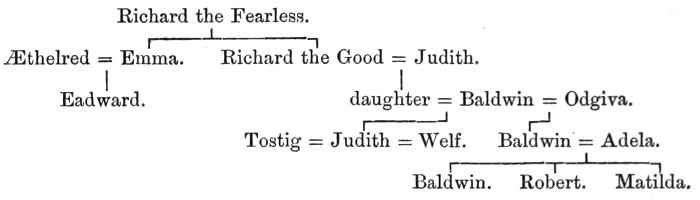
Judith would thus be, not Matilda’s sister but her aunt, an aunt however possibly younger than herself. Odgiva, the first wife of Baldwin the Bearded, died in 1031. His daughter by the Norman Princess, the child of his old age, could not be born before 1032 or 1033. Matilda, the daughter of parents married in 1027, may well have been older.
We have here, I think, another proof of the accuracy of the Biographer in matters coming within his own province, and that in a case where his statement seemed, at first sight, puzzling and suspicious. I do not however know why he calls her Fausta, or why the Brunswick picture-chronicler calls her Wichanda. Judith was an obvious name for her, being that of her maternal grandmother the wife of Duke Richard. Possibly, as Miss Yonge suggests (Christian Names, ii. 345), this Hebrew name, in its form of Jutta, may have got confounded with the Northern Gytha.
About the number and order of the sons of William and Matilda there is no doubt. They were Robert, Richard, William, and Henry. There is no doubt that Richard was second in order. He is always put so in the lists, and Orderic (573 C) expressly calls him “Ricardus, filius ejus, qui post Rodbertum natus fuerat.” Sir Francis Palgrave must have been speaking hastily when (iii. 254) he called him “the fourth son.”
But about the daughters, their number, names, and order, the statements are most contradictory. I will first of all set forth the different accounts of the early writers.
659All that William of Poitiers tells us (120) is that two brother Kings of Spain sought for a daughter of William in marriage, whose name is not given, and that they greatly disputed about her. Of the promise or offer of a daughter to Harold he says nothing directly, though he alludes to it in a later passage (145).
William of Jumièges (vii. 21) only says that William had four daughters, without giving their names. His continuator (viii. 34) also enumerates four. First (“primogenita”), Cecily, Abbess of Caen. Second, Constance, wife of Alan Fergant of Britanny. Third, Adelaide [Adelidis], who was betrothed to Harold, but died unmarried (“Heraldo proditori ante bellum Anglicum sponsata, sed, illo dignâ morte mulctato, nulli nupta, virgo jam nubilis obiit”). Fourth, Adela, wife of Stephen of Blois.
Orderic gives no less than four lists. The first time (484 D) he simply gives the names of four daughters, Adeliza, Constance, Cecily, and Hadala. The second time (512 D) the number is raised to five, and the names are Agatha, Constance, Adeliza, Adela, and Cecily. The third time (573 C) he gives little biographies of four daughters. 1st, Agatha, betrothed first to Harold, then to Amfurcius [Alfonso] of Gallicia, but who died a virgin. 2nd, Adelaide [Adelidis], who lived, seemingly as a nun, under the care of Roger of Beaumont (“Adelidis pulcherrima virgo jam nubilis devotè Deo se commendavit, et sub tutelâ Rogeri de Bellomonte sancto fine quievit”). 3rd, Constance, wife of Alan Fergant [Fergannus]. 4th, Adela, wife of Stephen. The fourth time (638 D) he gives a mere list, with the same names as in the second but in a different order, Agatha, Adeliza, Constance, Adela, and Cecily. He also (511 A) says that a daughter of William, whose name he does not mention, was promised in marriage to Earl Eadwine.
William of Malmesbury (iii. 276) says expressly that William had five daughters. 1st, Cecily the Abbess, who was living when he wrote—he wrote therefore before 1126. 2nd, Constance. 3rd, Adela. Of two others he did not know the names (“duarum nomina exciderunt”), one betrothed to Harold, the second to Alfonso, but both of whom died unmarried.
Wace (9650) knows only two daughters, “Ele” and Abbess Cecily. Ele is (10821) betrothed to Harold, but afterwards married to Count Stephen.
Lastly, in Domesday (49) we find incidental mention of a daughter 660Matilda. Her chamberlain Geoffrey (“Goisfridus Camerarius filiæ Regis”) had lands in Hampshire, which he held “de Rege W. pro servitio quod fecit Mathildi ejus filiæ.” She is also mentioned in an Encyclic Letter of the Nuns of the Holy Trinity at Caen (Mabillon, Ann. Ord. Ben. v. 690) along with her mother Matilda and her sisters Adelaide and Constance, as one for whom the prayers of the faithful are asked.
Now of all these, Cecily, Constance, and Adela need give us no trouble here. The history of all three is well ascertained, and will come in its proper place. But about the others, the contradictions are great. The names Adelidis and Adeliza are doubtless the same. We have then these statements.
1. Adeliza was betrothed to Harold, but died unmarried. (Cont. Will. Gem.)
2. Adeliza died unmarried under the care of Roger of Beaumont. (Ord. Vit.)
3. Agatha was betrothed, first to Harold and then to Alfonso, but died unmarried. (Ib.)
4. A nameless daughter betrothed to Harold died unmarried. (Will. Malms.)
5. A nameless daughter betrothed to Alfonso died unmarried. (Ib.)
6. A nameless daughter was betrothed to Eadwine. (Ord. Vit.)
7. Matilda appears without a history. (Domesday.)
The first question is whether the daughter betrothed to Harold and the daughter betrothed to Alfonso are the same. Orderic stands alone in identifying them. On the whole, the balance of evidence seems to me to lie the other way. I am inclined to think that it was Adeliza who was betrothed to Harold, and that it was another daughter who was betrothed to the Spanish King. Indeed they cannot be the same, if we accept the statement which William of Malmesbury (iii. 238) puts into Harold’s mouth in the course of the messages which passed between him and William, namely that the maiden to whom he had been betrothed had died before his election to the Crown (“liberatum se sacramento asserens, quod filia ejus quam desponderat citra nubiles annos obierat”). I am sorry nevertheless to give up Orderic’s (573 C, D) very pretty story, which recalls (or reverses) the well-known ballad of the Spanish Lady’s 661Love. She had seen and loved Harold, and preferred death rather than to give herself to another and an unknown bridegroom. But there is also the difficulty of the extreme youth of any daughter of William at any time to which we can assign Harold’s visit. I cannot think, with Baron Maseres (103), that the betrothed of Harold was Cecily.
According to Wace, the Adeliza or Adelaide betrothed to Harold was the same as Adela, afterwards Countess of Chartres. The two names, both coming from the adel or æðel root, might easily be confounded, and it would not be difficult to suppose that Harold’s betrothed had been on the one hand mistaken for the betrothed of Alfonso, and on the other hand divided into two, Adela and Adeliza. But all the other accounts seem pointedly to distinguish between Adela and the betrothed of Harold, whether she were called Adeliza or not.
I need not discuss the theory according to which Mr. Blaauw and Mr. Thorpe (Lappenberg, Norman Kings, 215) identify the Matilda of Domesday with Gundrada; but a view put forth by Mrs. Green (Princesses, i. 16, 407), who has gone minutely into the matter, is better worth examining. She holds that Matilda and Agatha are the same, that the name of Agatha is a mistake of Orderic, that this is the daughter who was betrothed to Eadwine, and that the story of her attachment to Harold arose from confounding one English lover with another. Again, by gaining the three or four years between the visit of Harold and the betrothal to Eadwine, the difficulty as to age is got over. Mrs. Green’s suggestion is at least ingenious. I have little doubt, as I shall show in my next volume, that the daughter who was betrothed to Eadwine is the same as the daughter who was betrothed to Alfonso. But I do not see the evidence for calling her Matilda.
Abbot Baldric, in his verses addressed to Abbess Cecily (Duchèsne, Rer. Franc, iv. 274), speaks of a sister of the Abbess, who was, in some unexplained way, connected both with Bayeux and with Angers. Mrs. Green identifies her also with Matilda. The lines are,
662As both Abbot Baldric and William of Malmesbury found it impossible to remember the names of William’s daughters, I may perhaps be forgiven if I leave the name of the betrothed of Harold undetermined.
There is a good deal of obscurity about William Busac and his revolt. The story is told by no one except William of Jumièges (vii. 20); and, as he seems to put it instead of the far better known story of the revolt of William of Arques, which he tells out of its place (vii. 7), one is tempted to suppose that he has fallen into some confusion between the two revolts and the two Williams. But he tells his tale so clearly and straightforwardly that it is hardly possible to doubt it, unless it can be shown distinctly to contradict some better ascertained piece of history.
The father and brothers of William Busac, as described by William of Jumièges, are all well ascertained persons. But William expresses himself inaccurately when he says (vii. 20) that Count William of Eu was an “uterinus frater” of Richard the Good. He must here use the word “uterinus” vaguely in the sense of illegitimate; for an “uterinus frater,” strictly speaking, of Richard the Good would mean, not a natural son of Richard the Fearless, but a son of Gunnor by some father other than Richard. The only question is as to the time when Count William obtained the grant of Eu, and whether it was granted by his half-brother Richard the Good or by his great-nephew Duke William. The following passages may be referred to on this point, which does not greatly concern my history. Will. Gem. iv. 18, vii. 2, viii. 37; Stapleton, i. lvi.; Roman de Rou, 6123–6215, where a romantic story is told, which is followed by Le Bœuf, Ville d’Eu, p. 28; and Palgrave, iii. 45.
The strange thing is that in none of these accounts is there any mention of William Busac as a son of Count William, though there is of his brothers Robert and Hugh. Still it seems hardly possible wholly to reject William’s existence and his investiture with the County of Soissons, which is so clearly asserted by William of Jumièges, and which, from the further details given in the 663Art de Vérifier les Dates, must, I conceive, rest on other authorities which I have not at hand. The chief difficulty in the story itself is that it seems to be implied throughout that the castle of Eu was in the possession of William Busac at the time of his revolt. If William of Jumièges did not so distinctly make William Busac the second brother—“horum medius” between Robert and Hugh—I should have been inclined to think that William Busac was the eldest brother, that he inherited the County, and that Robert succeeded to it on William’s exile. But this view seems forbidden by the words “horum medius;” and we also find Robert’s name with the title of “Comes de Ou” attached to a charter drawn up “tempore quo discordia cœpit inter ipsum [Comitem Willelmum] et Henricum Regem Francorum.” (Cart. de Saint Bertin, Paris, 1840, p. 426. The signature of “Willelmus de Ou,” attached to an earlier charter on the same page, belongs of course to the elder William.) We must suppose then that William Busac contrived to occupy his brother’s castle by some underhand means and to defend it against the Duke.
In accepting the account of this revolt given by William of Jumièges I do not profess to fix its exact date, or to add any details beyond such as are found in his narrative. From the point at which he introduces the story, it would seem to have happened between the affair of William the Warling and the marriage of Duke William, that is, between 1048 and 1053. But, as William of Jumièges puts the courtship and marriage of William together as if there had been no delay between them (see above, p. 85), it is quite possible that he means to fix the revolt to 1049 or thereabouts. At any rate, the place which I have given to it in my narrative seemed to me the natural one for it, as it is the beginning of a series of events which is carried on in the more famous revolt of William of Arques, namely insurrections in Normandy abetted by the King of the French.
The way in which the story of William Busac is treated by modern writers is curious. See Licquet, ii. 126; La Butte, Histoire des Ducs de Normandie, i. 246, 249; and the local historian of Eu, M. Le Bœuf, p. 30. A still more amazing account will be found in Mr. Roscoe’s Life of William the Conqueror, p. 89, for which it would be well to give some more definite authority than 664“Walsingham; Wace; Chron. Sax.; Chron. de Nor.; W. Malms.; Mazeres.”
But the aberrations of smaller writers will not seem wonderful, when we read the strange and contradictory statements made by Sir Francis Palgrave, which I feel sure would not have been found in any but a posthumous work of that great scholar. He first (p. 50) tells us of Count Robert and his services at Mortemer, and of “Robert’s son William (in France called William Busac) enriched, like his father, by the spoils of the Anglo-Saxon, and, who came to a fearful end.” William Busac is here confounded with his nephew William “de Owe,” son of Count Robert, who was blinded and mutilated by William Rufus in 1096 (see Flor. Wig. in anno, and Palgrave, iv. 420). In a later passage (iii. 224) we read, “William, surnamed Busac, second son of William, Count of Arques, now revolted against the Duke.” If Sir Francis had written or dictated in Latin, I should have thought that “Arcensis” had been substituted for “Aucensis,” by the same editorial process which took “Lagam Regis Eadwardi” to be a misprint for “legem.”
William was succeeded in the County of Soissons by his sons John and Reginald, after whom the County passed to the descendants of his daughter Ramentrude, wife of Ivo of Nesle. Another son, Manasses, was in 1092 chosen Bishop of Cambray by the citizens in opposition to the clergy, and was translated to Soissons in 1103 (see Gest. Epp. Cam. Pertz, vii. 504).
There is a singular difference among our authorities as to the date of the revolt of Count William of Arques. William of Poitiers, Orderic, and William of Malmesbury put it at the point where I have put it in the text. But in William of Jumièges and Wace it comes much earlier, immediately after Duke William’s recovery of Falaise from Thurstan Goz (see vol. ii. p. 206), some 665years earlier than the battle of Val-ès-dunes. There is no doubt that the later date is the right one. In the narrative of William of Poitiers, the story comes in in what is evidently its natural order, immediately before the French invasion of 1054. The personal action of the Duke himself, now evidently in full maturity, seems inconsistent with the earlier date, as does also the prominent position of Guy-Geoffrey of Poitiers, who in 1044 (see vol. ii. p. 595) was “parvulus.” The story is also fixed to 1053 by the death of Ingelram of Ponthieu and the succession of his brother Guy. See Art de Vérifier les Dates, ii. 752. At the earlier date the elder Ingelram was reigning.
Besides this difference in date, the narratives of William of Poitiers and of Wace differ a good deal in the order of events, though I do not see any further contradiction between the two versions. I have therefore, while forming my narrative mainly on that of William of Poitiers, not scrupled to bring in some touches of detail from Wace which seemed to bear marks of authenticity.
In the order which I have followed, Duke William requires his uncle to surrender his castle, and he himself puts a garrison in it. The garrison then restore the castle to William of Arques, who openly revolts. Duke William hears the news at Valognes, he hastens to Arques, meets a party of loyalists from Rouen, fights a party of the rebels before the gates of the castle, and then blockades it. He then leaves the blockading force under Walter Giffard. King Henry comes to help William of Arques, and he falls into an ambush, where Count Ingelram is slain and Hugh Bardulf taken prisoner. The King retires; the Duke returns; William of Arques surrenders the castle, and the other posts in Normandy held by the French are surrendered also.
The accounts in William of Jumièges and in Wace leave out the occupation of the castle by the Duke and its betrayal to the Count of Arques. They say that the Duke, suspecting his uncle, summoned him to his presence, which summons he declined to obey, and openly rebelled (“Quem Dux à suâ vesaniâ nitens avellere, ad exhibendum sibi obsequium per legatos jussit eum venire. Sed ille hujusmodi legationem habens contemptui, magnâ cum fiduciâ ad resistendum se munivit et armavit.” Will. Gem. vii. 7). Wace transfers the hasty ride from the Côtentin from the first to the second appearance of Duke William before Arques. William of Poitiers 666again makes William reach Arques with six followers, all the others who had started from Valognes having failed to keep up with his pace. He there meets the reinforcement of three hundred from Rouen. Wace makes him reach Arques absolutely alone (v. 8699);
This is an evident exaggeration, adapted to the new order of events. Had William reached Arques absolutely alone, in the state of things conceived by William of Poitiers, he must have fallen into the hands of his enemies. But, while Wace transposes the two marches of William, Orderic (657 B) rolls the two into one. In his story William’s first appearance comes after King Henry and Count Ingelram have entered the country. He hears of them at Valognes; he sends on a picked force, and then follows himself with his main army. The former (“præcursores mei”) meet Ingelram, and defeat and kill him before William reaches Arques at all. But though I think that Wace has transposed the order of events, I have not scrupled to draw several details of the ride from him, and to accept Valognes as the starting-point. The other writers only mention the Côtentin generally. It is of course possible that Wace may have been thinking of William’s former ride from Valognes (see vol. ii. p. 247), where also the mention of Valognes is peculiar to himself. But, if William was likely to be there at one time, he was likely to be there at another.
The mention of Saint Aubin as the place of the ambush also comes from William of Jumièges, followed by Wace. (I am sorry that, when I was at Arques, I omitted to explore the spot.) I have ventured to connect this mention of Saint Aubin with that which Orderic gives (606 B, C) of Richard of Hugleville’s resistance at Saint Aubin. This comes in a genealogical passage where the campaign of Arques is spoken of only incidentally, and seems to me to be a case of quite independent testimony coinciding.
The oath which, as William alleged, Harold had sworn to him, and the bequest which, as he also alleged, Eadward had made in his favour, are two subjects every detail of which is enveloped in controversy and contradiction, and two subjects moreover which cannot be kept apart from one another. I have, both in the text and elsewhere, set forth more than once what I believe to be the true history. I will now go more minutely through all the evidence which we have bearing on the matter.
I. As I have already said (see above, p. 219), there are three statements as to the object of Harold’s visit to Normandy. And two out of these statements imply different versions of the alleged bequest of Eadward to William. I have stated their substance in the text; I will now go through the evidence for and against them.
1. The first version is that of William of Poitiers. He mentions the matter twice, first in his narrative of Harold’s visit (107 et seqq.), secondly, in the account of the messages sent by William to Harold (129–30). According to this statement (129), Eadward chose William as his heir, on account of his many excellences (“quoniam omnium qui genus suum attingerent me credebat excellentissimum, qui optimè valerem vel ei, quamdiu viveret, subvenire, vel posteaquam decederet, regnum gubernare”) and as a return for the kindness which he had received from William and his predecessors during his sojourn in Normandy (“ob maximos honores et plurima beneficia quæ illi atque fratri suo, necnon hominibus eorum, ego et majores mei impendimus”). This devise of the Crown was apparently made by a decree of the Witan; at any rate it was made by the advice, and confirmed by the oaths, of Archbishop Stigand and of the three great Earls, Godwine, Leofric, and Siward (“sanè neque id absque suorum optimatum consensu, verùm consilio Stigandi Archiepiscopi, Godwini Comitis, Leurici Comitis, Sigardi Comitis”). These great leaders all agreed to accept William as Eadward’s successor on his death, and meanwhile, as the passage seems to mean, to set up no other candidate against him (“qui etiam jurejurando suis manibus confirmaverunt, quod post Edwardi decessum me reciperent dominum, nec ullatenus peterent in vitâ illius patriam hanc ullo impedimento contra me 668occupari”). A son and a grandson of Godwine were given by Eadward as hostages for this engagement (“obsides mihi dedit Godwini filium ac nepotem,” 130; so again, 107, “Heraldus ... cujus antea frater et fratuelis obsides fuerant accepti de successione eâdem”—Willelmi sc.). As Eadward found himself near death—it might have been added, now that the three Earls who had confirmed the devise were all dead—the King thought it good to bind Harold by the same oath which had been formerly taken by his father, with the further security that it should be taken in William’s presence, while Godwine and the rest had, on the former occasion, only bound themselves to him in his absence (“ut quod pater ejus atque cæteri supranominati hic [in England] mihi juravere absenti, is ibi [in Normandy] præsens juaret præsenti”). Eadward also, it would seem, wished to give William, before his death, a further confirmation in his own name (“graviore quam fuerat cautum pignore cavit.” 107). The importance of binding Harold to the proposed succession is strongly set forth. He alone could influence or constrain the English people, who, it is implied, were very likely to disturb the arrangement (“et eum [Haraldum] quidem prudentissimè [destinavit], ut ipsius opes et auctoritas totius Anglicæ gentis dissensum coercerent, si rem novare mallent perfidâ mobilitate, quantâ sese agunt”). Harold is therefore sent on this errand; he falls into the hands of Guy and is rescued by William, as I have described in the text. He makes his oath to William—its terms I shall discuss at a later stage of this note—and William looks on him as one who will most effectually win over the English to his cause (“quem inter se et Anglos, quibus à Rege secundus erat, mediatorem sperabat fidissimum.” 108).
This is the full account given by the contemporary panegyrist of William. Two things are to be noticed in it, as important admissions made by an enemy. First, the loyalty of Harold to Eadward, and the full friendship and confidence which existed between the King and the Earl, are implied throughout, in distinct contradiction of one form of Norman calumny. Secondly, there is throughout a recognition of the English people as a party likely to claim a voice in the matter, and one whose voice, it is expected, will not be given on behalf of William. The epithets of abuse which the Norman panegyrist hurls at the heads of the English nation are in truth a speaking witness to the popular character of the ancient English government.
669William of Jumièges (vii. 31) tells essentially the same story. He says nothing about the counsel and the oaths of Stigand and the three Earls, but he tells us that Eadward, finding himself childless (“disponente Deo successione prolis carens”), sent Archbishop Robert to announce to William his intention of making him his heir (“olim miserat Willelmo Duci Rodbertum Cantuariorum Archipræsulem, ex regno a Deo sibi attributo illum statuens hæredem”). Afterwards he sends Harold, the most powerful Earl in his Kingdom, to confirm the bequest by oath, and to plight his own faith to the Duke (“deinde Heraldum cunctorum suæ dominationis Comitem divitiis et honore ac potentiâ maximum Duci destinavit, ut ei de coronâ suâ fidelitatem faceret, ac Christiano more sacramentis firmaret”). The story then goes on as before.
Orderic (492 A) tells the same story as William of Jumièges, with the addition that the devise in favour of Duke William was made with the consent of the English nation. “Eduardus nimirùm propinquo suo Willelmo Duci Normannorum, primò per Rodbertum Cantuariorum summum Pontificem, postea per eumdem Heraldum, integram Anglici regni mandaverat concessionem, ipsumque, concedentibus Anglis, fecerat totius juris sui hæredem.”
Benoît (36498 et seqq.) follows William of Jumièges, except that he does not give the name of the Archbishop, and that he seems to imply that the mission of the Archbishop and the mission of Harold happened in two consecutive years.
It is really needless to refute this story. Some remarks on the tale will be found in Lord Lyttelton (Henry the Second, i. 351 et seqq.) and Baron Maseres (pp. 74 et seqq., 113 et seqq.) which are far above the average criticism of their age. Both writers are hampered throughout by the supposed necessity of accepting, or at least of attaching some weight to, the accounts of the false Ingulf; otherwise their line of argument is of a high order. There are also some good remarks of Lord Lytton’s in a note to his “Harold” (iii. 385), though I cannot conceive what he means by saying (iii. 386) that “the Saxon chroniclers ... unite in relating Edward’s 670warnings to Harold against his visit to the Norman court.” The “Saxon” Chronicles, I need hardly repeat, are altogether silent on the matter.
No one, I think, who goes carefully through the whole circumstances of the tale as told by William of Poitiers, will hesitate to say, with Baron Maseres, “there is reason to think it is absolutely false,” or, with Lord Lytton, “this appears a fable wholly without foundation.” Here is a purely English matter, an act of the English Witan, a deed confirmed by the greatest men of the Church and State of England, which rests solely on the assertion of an interested Norman writer, and of which no English Chronicle or cartulary has preserved the slightest trace. To make us believe that Leofric, that Siward, that Stigand, that Godwine, that the whole English people, agreed to the succession of William, we should need no evidence short of the document bearing their signatures, strengthened by an entry in the Chronicles to show that the document might possibly be genuine. No statement was ever weighed down by a heavier burthen of internal improbability. An act done when Stigand was Archbishop and when Godwine and the other Earls were still living, must belong to the few months between the appointment of Stigand to the Archbishopric at the Mickle Gemót of September, 1052 and the death of Godwine at Easter, 1053. It will not do to say that the title “Archiepiscopi” is simply descriptive of the person, and that the act might have been done at a time when Stigand had not yet reached the archiepiscopal rank (cf. vol. ii. p. 420). For Stigand and the three Earls are clearly mentioned as being the four greatest men in the Kingdom, which of course would not be the case at a time when Stigand was only a presbyter, or even the Bishop of an inferior see. The devise then, if it was ever made at all, could have been made only within those few months. And, except in those later years when Harold’s succession seems to have been looked upon as a settled thing (see vol. ii. p. 634), no time can be found so unlikely as those few months for any act in favour of William. No wilder assertion was ever made than that which represents the Witan of England, with Godwine at their head, as agreeing to, and even advising, the succession of the Norman Duke to the English Crown at the very moment of their great triumph over Norman favourites and Norman influence in England.
So much for William of Poitiers. William of Jumièges and 671Orderic, who evidently follows him, do not greatly mend matters by leaving out Stigand and the Earls, and seemingly putting Stigand’s predecessor Robert in his stead. Archbishop Robert is made to cross from England into Normandy. They doubtless had in their minds the time when Robert really did cross from England into Normandy. But that perilous passage was not made on the King’s errand or on any errand at all; it was the hurried flight of a public enemy, hastening to save himself from the vengeance of the English people (see vol. ii. p. 331). The story as regards Stigand, Godwine, Leofric, and Siward is manifestly impossible; it is no less impossible as regards Harold. We have already seen that during the whole time that Harold answered the description given of him by the Norman writers as the richest and most powerful Earl in England, the succession was, practically if not formally, determined in favour, first of the Ætheling Eadward and then of Harold himself. The tale that Eadward sent Harold, or that Harold consented to go, on an errand which shut out himself and every other Englishman from all hope of succession to the Crown, is simply absurd and impossible.
2. The second version, that in which Harold goes, not to guarantee the succession to William, but to bring back the supposed hostages, his brother and nephew, involves quite another view of the alleged bequest to William. In this account, there is no mention of any formal act of the Witan, none of any oaths of Bishops and Earls, none even of any act of the King himself, after he became King. It comes out incidentally that Eadward is said to have, years before, privately promised the Crown to William. And the only evidence for this private conversation between Eadward and William is another alleged private conversation between William and Harold. Yet this story is, as I have before said (see vol. ii. p. 302), less grotesquely absurd than the former one, and it rests on better authority. It is the version followed by two most valuable English writers of the next generation, namely Eadmer and Simeon of Durham. The narrative of Simeon, we cannot doubt, was borrowed from the narrative of Eadmer, whose exact words he follows through a great part of the story. And the appearance of the story at all in Simeon’s History is remarkable. Simeon had copied from Florence, with the change or addition of two or three words only, the narrative of the election of Harold, of the two invasions, of the two battles, of the death of Harold and the coronation of William. 672It then perhaps occurred to him that Florence’s narrative contained no statement whatever of any motive for William’s invasion. Simeon therefore (1066) starts as it were afresh, with the introduction, “Ut autem sciatur origo caussae quâ Willelmus Angliam bello appetiit, breviter quæ paullò ante gesta sunt repetantur.” He then goes on to the same effect as Eadmer. The hostages, Wulfnoth and Hakon (“Wlnothus filius Godwini et Hacun filius Suani filii sui”), are given by Godwine to Eadward at their reconciliation, and they are given by Eadward to Duke William for safe-keeping. Some time after Godwine’s death, Harold, now in possession of his father’s Earldom (“Godwinus ... malâ morte”—Eadmer, 4. Simeon says only “quum esset mortuus”—“post breve tempus interiit, et Haraldus filius ejus comitatum Cantiæ patri succedens obtinuit. Is, elapso modico tempore,” &c.), asks leave of the King to go over to Normandy and bring back the hostages. Eadward says that he may go, but warns him against going. He is sure that, if he goes, some harm and shame will happen to him and to England. He knows Duke William well enough to be sure that he will never let the hostages go, unless he can get some gain by so doing (“Hoc non fiet per me; verumtamen ne videar te velle impedire, permitto ut eas quo vis ac experiare quid possis. Præsentio tamen te in nihil aliud tendere nisi in detrimentum totius Anglici regni et opprobrium tui. Nec enim ita novi Comitem mentis expertem ut eos aliquatenus velit concedere tibi si non præscierit in hoc magnum proficuum sui”). Harold however thinks himself wiser than the King (“suo quam Regis consilio credens”), and sets out. He is shipwrecked, imprisoned by Guy (“pro ritu loci, captivitati addicitur”), and delivered and honourably received by William. He presently sets forth to the Duke the cause of his journey. William tells him that it will be his own fault if the matter does not turn out well (“bene quidem rem processuram si in ipso non remaneret”). After a few days, the Duke sets forth his own mind to the Englishman. When he and Eadward were living together as youths in Normandy, Eadward promised him that, if he should ever obtain the Crown of England, he would make it over to him as his heir (“Regem Edwardum, quando secum juvene olim juvenis in Normanniâ demoraretur, sibi, interpositâ fide suâ pollicitum fuisse, quia, si Rex Angliæ foret, jus regni in illum jure hæreditario post se transferret”). If Harold would swear to support this disposal of the Crown, and would bind himself by other engagements 673which I shall presently discuss, Hakon should be released at once and Wulfnoth as soon as William had mounted the English throne (“tunc et modò nepotem tuum, et quum in Angliam regnaturus venero, fratrem tuum incolumem recipies”). Harold, feeling himself in a strait from which he knows not how to escape, swears to all that was required of him (“sensit Haraldus in his periculum undique, nec intellexit quà evaderet, nisi in omnibus istis voluntati Willelmi adquiesceret. Adquievit itaque” &c.). He returns to England with Hakon, and tells the whole story to Eadward, who reminds him of his own warning (“nonne dixi tibi, ait, me Willelmum nôsse, et in illo itinere tuo plurima mala huic regno contingere posse”). Eadward soon afterwards dies, and Harold, according to Eadward’s own wishes, succeeds him. See above, p. 586.
I have already (see above, p. 219, and vol. ii. p. 302) made some remarks on this story, a story which is plainly of English invention. Eadward’s intentions in favour of William are cut down to a rash promise in his youth, of which no one seems to know anything except Eadward and William themselves. Eadward’s present intentions are plainly in favour of Harold, and perfect confidence and cordiality are implied as reigning between the King and the Earl. But, as I have already said, this view of Eadward’s promise will not stand the test of chronology. There was no time when Eadward and William lived together as youths of equal age. When Eadward left Normandy in 1041, William was thirteen or fourteen years old, Eadward perhaps thirty-eight. A private promise of this kind seems most unlikely to have happened between them, though, as I have already said (see vol. ii. p. 523), William’s counsellors may have been already reckoning the chances of William’s succession. The story of Wulfnoth and Hakon being given as hostages for Godwine’s good behaviour on Godwine’s triumphant return is quite inconsistent (see above, p. 221) with the true narrative of that return. Still less can we accept the story of William of Poitiers (see above, p. 668) that Wulfnoth and Hakon were given as hostages, not for Godwine’s good behaviour towards Eadward, but for the carrying out of the imaginary act of the English Witan in favour of William. My own belief is that there were no English hostages at all in the hands of William at the time when Harold came into Normandy. But I think it is 674not hard to see how the story of the hostages arose. It is certain that Wulfnoth was kept as a prisoner by William, and that his imprisonment began early in life. William, on his death-bed (see Florence, 1087), set free various prisoners, both English and Norman, and among them “Wlnothum Regis Haroldi germanum, quern a pueritiâ tenuerat in custodiâ.” This of course might only mean that Wulfnoth was imprisoned after William’s coming to England, as must have been the case with Harold’s son Wulf, whom Florence speaks of directly after. But it is also quite consistent with the statement that he was left behind as a hostage by Harold. That he was so left is affirmed by Eadmer and Simeon in the passage just quoted. It is also implied by William of Poitiers, when he says (111) that, of his two supposed hostages, one, namely Hakon, was allowed to return with his uncle (“quinetiam fratruelis ejus, alter obses, cum ipso redux propter ipsum redditus est”). But moreover William of Jumièges, who says nothing about Hakon or about any earlier giving of hostages, says (vii. 31) that Wulfnoth was left as a hostage; “Postremò ipsum [Heraldum] cum multis muneribus Regi remisit [Willelmus], et pulcrum adolescentem Wlnotum fratrem ejus obsidem retinuit.” In this he is followed by Benoît (36640);
One would certainly understand this as meaning that Wulfnoth had accompanied Harold on his voyage and that he was left by him as a hostage for his own good faith. Why should not this have been the case? If, as I have suggested, Harold was accompanied on his voyage by both Wulfnoth and Hakon, if he brought Hakon back and left Wulfnoth behind as a hostage, one can easily see how the story arose about Hakon and Wulfnoth having both originally been hostages. The Norman version would represent them, as William of Poitiers does, as hostages given for William’s succession to the Crown. English writers, knowing that this at least never happened, would find some more possible occasion for the handing over of a son and a grandson of Godwine to the keeping of the Norman Duke. Such an occasion would be found in the reconciliation between Godwine and Eadward. The interchange of hostages is mentioned more than once in the course of 675the story, so that the notion that hostages were given by Godwine at the final conclusion of peace, though an unfounded idea, was not an unnatural one.
These then are the two views, according to both of which Harold is made to set out for Normandy with some settled purpose, either to confirm the bequest of the Crown to William or to obtain the release of his brother and nephew. The two accounts are utterly contradictory to one another, and I do not think that either will stand the test of criticism. But before I go on to the third version, I must mention the accounts given in the Roman de Rou and in the Tapestry. Honest Wace, after his manner, knowing that there were two or three stories, allows his readers to choose between them. He first tells the story of Godwine’s return, according to his notion of it. Godwine is in banishment, and the King will not let him come back unless he gives hostages for his good behaviour. He sends his son and grandson, whom Eadward sends over to William, and Godwine then returns.
He then adds the significant remark, which seems to show that he had the version of William of Poitiers and William of Jumièges in his eye, that this looked very much as if Eadward intended the hostages who were nominally given for the good behaviour of Godwine to act practically as hostages for the succession of William.
He then goes on to describe Godwine’s death (see vol. ii. p. 612), Eadward’s vow of pilgrimage, the foundation of Westminster, and Eadward’s intention to bequeath his Crown to William, which last he describes in language which is evidently taken from the statement put into William’s own mouth by William of Poitiers (129; see above, p. 667). He then gives a description of Harold, on 676whose virtues, power, and favour with the King he becomes somewhat eloquent, and fully realizes his position as the practical ruler of the whole kingdom.
So directly after;
The story then goes on in much the same shape as in Eadmer. Harold’s wish to release the hostages and the warnings of Eadward are given in much the same way, with the further piece of advice from the King, that, if Harold wishes for the hostages, he should send some other messenger and not go himself. Wace then adds that he has also read another story, that namely of William of Poitiers and William of Jumièges, and that he does not profess to know which is the true one.
So much for Wace. The Tapestry plainly shows (pl. 1) an interview between Eadward and Harold before Harold sets sail from Bosham, and another interview (pl. 7) after Harold’s return. Of these two scenes the earlier must be interpreted by the later. In that scene Harold is represented as recounting his adventures to the King with a very strange look and strange gestures, quite different from anything shown in the first interview. But Dr. Bruce’s imagination surely carries him a little too far when he says (p. 27) that “Harold comes into the presence of the Confessor like a guilty person, deploring his misdeeds and craving pardon. An axe, carried by an attendant on the left of the King, is turned towards him, apparently betokening that he has committed an offence worthy of death. The King is evidently reproving him sharply, but the attendant on the right of the King having the edge of his axe turned away from 677Harold, shows that the result of the interview was a pardon.” Unluckily for this ingenious theory, one of the persons who in this very plate offer the Crown to Harold carries an axe with its edge no less threateningly turned towards the person of the King-elect. Still there is no doubt that Harold enters the King’s presence with the air of one who is by no means proud of the success of his errand. His neck is stretched out in a most amazing fashion, and the whole expression is that of one whose position is exceedingly awkward. This seems to me to fit in exactly with the version of Eadmer, and I do not see how it can be made to fit in with the version of William of Poitiers. According to that version, Harold had done nothing to be afraid or ashamed of. He had simply pledged himself in a solemn way to carry out the King’s intentions. But, on Eadmer’s view of the matter, he had utterly failed, except so far as he had brought back Hakon; he had involved himself and his country in great danger, and he must have gone to the King with the unpleasant feeling that one so much his intellectual inferior had for once proved wiser than himself. This seems to me to be plainly enough expressed in the representation of the second interview in the Tapestry; I therefore accept the Tapestry as, so far, a witness in favour of Eadmer’s version, or at least in favour of some version according to which Harold went into Normandy on an errand which failed. A certain amount of confirmation is thus given to Eadmer’s statement, but I can hardly think that it is enough to counterbalance its inherent improbability in other respects.
3. I now come to the third version, that which makes Harold’s presence in Normandy wholly the result of accident. William of Malmesbury was fully aware of the version of William of Poitiers. He (ii. 228) distinctly refers to it (“ferunt quidam ipsum Haroldum a Rege in hoc”—namely to announce to William the bequest of Eadward—“Normanniam missum”), but he deliberately rejects it. The story which he prefers as nearer to the truth (“quia propius vero videtur”), and as told by those who were better informed (“alii secretioris consilii conscii”), represented Harold’s presence in Normandy or in any part of Gaul as simply caused by his being carried thither by stress of weather (“invitum, venti violentiâ illuc actum”). He set out from Bosham purely on a voyage 678of pleasure and for the purpose of fishing (“ut animum oblectaret suum, piscatorium conscendit navigium”). Some cause or other led him to venture to an unusual distance from land (“interim quidem longiusculo ludo in altum proceditur”), and a storm drove him to the coast of Ponthieu. According to Henry of Huntingdon, Harold was not thus merely yachting, but was going, for some cause which is not mentioned, to Flanders (“Haraldus verò transiens in Flandriam tempestate compulsus est in Ponticam provinciam,” M. H. B. 760 E). Matthew Paris (p. 1), whom I shall again have to quote, tells the tale in what, for my purpose, is the same way. Harold, still a young man, but looking forward to the Crown (“dum adhuc juvenis esset, adspirans ad regnum Angliæ”), is sailing about, and is driven by the winds to a land which he takes to be Flanders, but which proves to be Ponthieu (“sponte spatiatus, navigando raptus est vi ventorum, et dum Flandriam credidit se attigisse, compulsus venit in Pontinam provinciam”). Snorro (Johnstone, 190; Laing, iii. 75) makes Harold to have been sailing, not to Flanders, but to Wales. He seemingly looks on the voyage as part of Harold’s warfare against Gruffydd. A storm drives his ships, not to Ponthieu, but to the coast of Normandy (“þat var á eino sumri, at Haralldr Gudinason átti ferd til Brettlandz, oc fór á skipi, enn er þeir komo í hafit, þá tók þá andvidri, oc rák út í haf. Þeir tóko land vestr í Nordmandi, oc höfdo fengit storm mann-hættan”). These accounts seem independent, and of course they cannot be reconciled in detail. The important point which they have in common is that they all represent Harold’s presence in Normandy as unintentional. He is not going thither on any errand either of his own or of the King’s; he is carried either directly to Normandy, or first to Ponthieu, by a storm. If this were the true tradition, we can easily understand that various versions would soon arise as to the direction and object of his journey. Snorro’s notion, for instance, of a voyage into Wales is hardly consistent with the remarkable agreement of several versions that it was from Bosham that Harold set sail. But it is of little moment whether he was sailing to Wales or Flanders or nowhere in particular, provided he was not purposely sailing to Normandy. And that this story is the right one will, I think, appear, if we consider the way in which tales grow. They improve, they add details, they give new and fuller reasons for everything; 679but they seldom lop off. The fact of Harold’s presence in Normandy would call forth a thousand conjectures and speculations as to the cause of his being there. The purely negative version, which said that all these speculations were at fault, which asserted that Harold’s presence in Normandy was a mere accident, is, of all the versions, that which least bears the impress of legendary invention or adornment.
This general position is not affected by William of Malmesbury’s evident attempt to reconcile this version with that of William of Poitiers. Harold, in Guy’s dungeon, begins to devise some means of escape (“astuto pectore volvens casûs remedium”). It seems to be taken for granted that such means could come only through the help of the Duke of the Normans. He accordingly sends a man won over by great promises (“hominem promissis ingentibus sollicitatum”) with a message to Duke William. It is hard to see how a prisoner who was kept not only in ward but in fetters could have had the chance of winning over any one in this way, unless indeed the man so won over were one of his own keepers. The message is to the effect that Harold has been sent by Eadward to confirm in a more solemn way the King’s intentions in favour of William. It is assumed that Eadward had made such a disposition (see vol. ii. p. 371), and that it had been made known to William by messengers of inferior dignity; it is only the character of an ambassador which Harold is made falsely to assume for the nonce (“missum se Normanniam a Rege, ut quod minores nuntii balbutierant ipse potissimùm suâ confirmaret præsentiâ”). So Matthew Paris makes Harold falsely pretend that he was coming on an errand to the Duke’s Court, though he gives that errand a different turn from that which it takes in William of Malmesbury, one which I shall have to discuss hereafter. This is a most awkwardly devised story, even as a story, and it is of course inconsistent with the evidence by which I have shown that no disposition in William’s favour at this time can be admitted. It can only be an attempt to piece together the two versions, that of Harold’s embassy and that of his accidental presence in Normandy. He was not really an ambassador, but he pretended to be one. The attempt at joining the two stories was an awkward one, but perhaps no other attempt could have succeeded better.
The two other writers who follow a version essentially the same 680as that of William of Malmesbury, namely Snorro and Henry of Huntingdon, give no details of Harold’s deliverance from his prison in Ponthieu. Snorro leaves out the sojourn in Ponthieu altogether, and Henry only says, “quem [Haraldum] captum Consul Ponticus Willielmo Duci Normanniæ reddidit.” So Matthew Paris, making the act still more voluntary on Guy’s part, says, “quem captum Consul Ponticus Willielmo Normannorum Duci præsentavit.” Snorro, as I have said in the text, gives some curious details of Harold’s sojourn at Rouen; he also makes him get there in the summer, stay through the winter, and go back to England in the spring.
II. It will be seen that two distinct views as to the devise of the Crown in favour of William are involved in the first two of these three versions. According to one of them, the bequest was simply a private promise made by Eadward, when he was not yet King, that, if he ever should become King, William should succeed him. This is in itself not impossible, though it is not possible in the particular shape in which it is told us, namely as the promise of one young man to another young man. It is hardly necessary to show that such a promise as this could have no kind of force, according to the laws of England or of any other kingdom. According to the other story, the devise of the Crown took the form of an Act of Settlement, of a regular vote of the King and his Witan, confirmed by the signatures and the oaths of the four greatest men in the land. Such an act would doubtless have been valid, and it would have given William as good a claim as George the First. At the same time it must not be forgotten that all such attempts at an election before the vacancy seem to have been unpopular, and that they were very seldom carried out in practice (see vol. i. pp. 118, 533). But beyond the assertion of William’s own laureate, there is not a scrap of evidence or of probability in favour of this story, and the particular form in which it is told is chronologically impossible (see above, p. 673). William of Malmesbury, or those whom he followed, probably saw this, and therefore changed the date from some time before the death of Godwine to some time after the death of the Ætheling (see vol. ii. p. 371). He also leaves out all mention of the consent of the Witan or of the Earls, and seems to make it 681a purely personal act of the King. Here we get something which is barely possible, but which has no evidence and no probability in its favour. In fact neither of these statements as to the bequest to William rest on the slightest tenable ground. The third statement, that of a strictly testamentary disposal, a bequest of Eadward on his death-bed, does not appear in any writer at all near the time. The fact of the death-bed nomination of Harold was too notorious to be denied, and the adverse party generally contented themselves with asserting that the nomination was wrung from the dying King against his will. The first appearance of the notion of a death-bed bequest to William is to be found in the passage of the Hyde writer which I have already quoted (see above, p. 595), where it is said that Eadward “Regnum moriens Willelmo Comiti consobrino suo reliquit.” So the Annals of Margam (p. 3 Luard), “quia virgo decessit ... quum potiorem hæredem non haberet, Willelmo Duci Normannorum, consobrino suo, Regnum Angliæ testamento tradidit.” So Thomas Wykes, the partizan of Henry the Third, consistently enough asserts the rights of William in their fulness. He tells us (p. 22 Gale) how Eadward, “prævidens dum adhuc viveret Regnum Angliæ post mortem suam periculis et turbationibus exponendum, nobilissimum Ducem Normanniæ Willielmum le Bastard hæredem suum constituit, et Regni sui successorem, tamquam ex testamento dum adhuc viveret, assignavit ipsum.” M. Francisque Michel, in his note to Benoît (iii. 162), has collected several passages from unpublished writers taking the Norman side, which he very fairly contrasts with the genuine statements of the English writers. One only, the Chronicle of Peter of Ickham, a writer of the fourteenth century, seems worth quoting because he attempts rather ingeniously to combine two versions.
“Iste autem Edwardus, aliquando exsulatus in Normanniam, Willielmo, cognomento Bastard, Duci Normannorum, præstitit sacramentum quod si Rex, annuente Deo, foret, nullum alium præter ipsum haberet hæredem.
“Iste Edwardus, sanctus Dei confessor, absque liberis decessit quia virgo permanserat: et quum hæredem de se non haberet, Willielmo Duci Normanniæ consanguineo suo, sicut ei priùs juramento promiserat, regnum testamento dedit.”
These passages seem quite enough to show that the notion of a 682last will and testament in favour of William is one which was quite unknown till a later generation. I must quote one more passage in which this view is set forth, because it brings in another expression which deserves some notice. In the Chronicle of Battle Abbey (p. 2) we read, “Interea Anglicæ Regnum monarchiæ eidem Duci Willelmo, a suo consanguineo Rege Edwardo e mundo migrante, hæreditario jure delegatum relinquitur.” The expression to be noticed is that of “hæreditario jure,” which is here applied to William’s succession to the Crown. We find it also in charters of William himself and of his son William Rufus. There is one in Rymer (p. 3), where William describes himself as “Ego Willelmus Dei gratia Rex Anglorum hæreditario jure factus;” and one of William Rufus (p. 5), where he describes himself as “Ego Willelmus Dei gratia Rex Anglorum filius magni Regis Willelmi qui Regi Edwardo hæreditario jure successit.” The words “jus hæreditarium” have more than one meaning. It is possible that the Battle writer really meant to assert an hereditary right in the modern sense. He had just before said that William, “principatum proprium”—that is of course the Duchy of Normandy—“hæreditario sibi jure a patre relictum feliciter obtinuit.” And there is no doubt that William’s kindred with Eadward really was looked on by zealots in his cause as giving him some kind of hereditary claim upon England. This was certainly the belief of Henry of Huntingdon. See vol. i. p. 332. Otherwise the words “hæreditario jure” may be taken simply to mean that William was the heir of Eadward in the sense of being adopted by him. So two of the manuscript chronicles quoted by M. Francisque Michel (Benoît, iii. 163) say that Eadward “adoptavit in regnum”—“adoptavit hæredem—Willielmum Ducem Normannorum.” The words “hæreditario jure” are also used to express something which a man holds by a right which is not derived from his forefathers, but which is to be passed on to his descendants. It is even applied, as in the Cartulary of the Holy Trinity at Rouen (pp. 449 et seqq.), to property held by a corporation in absolute freehold, which will therefore pass to the official heirs, so to speak, of the existing members.
There is one more Norman version of the bequest of Eadward, which, though it rests on no early authority, is worth referring to, on account of the detail at which it is given, and because it brings 683in a name which we have already had occasion to mention with honour. It will be found in the History of Colchester Abbey in the Monasticon, iv. 607 (cf. Ellis, i. 415). The “internuntius” between William and Eadward was Hubert of Rye (see vol. ii. p. 249), the father of Odo, the founder of the Abbey. Eadward, finding himself sick and without heirs (“quum eò maximè cruciaretur, quod in se regium genus deficere videret”)—Eadgar is seemingly forgotten—sends Goscelin, a merchant of Winchester, who was in the habit of going on long voyages in the way of trade, on a message to Duke William. Goscelin, by his name, must have been a Norman or Frenchman, and the mention of a French merchant as settled at Winchester in Eadward’s time is worth notice. The Duke is asked to send some confidential agent (“ut aliquem dirigeret à suo latere”) to receive the King’s message for the Duke. In an assembly of Norman Barons (“facto magno procerum conventu”), the Duke seeks for some one who will go on an embassy to England. But all refuse to trust themselves among the barbarians who had wrought the death of Ælfred (“omnes recusant barbaram expetere gentem, propter illa quæ audierant facta apud Geldefordiam”). Hubert at last volunteers to go, and is thereon much praised and rewarded. He goes over in wonderful state (“cum grandi apparatu, cum pompâ magnâ, equis phaleratis et fremitu terribilibus, hominibus serico indutis et colore vestium spectabilibus”). Eadward receives him honourably, and of course gives him a grant of land (“ei primæ in Angliâ suæ mansionis villa quæ Esce dicitur, perpetuò possidenda conceditur.” The place is Ashe in Hampshire, which appears in Domesday, 47, as held by Hubert’s son Odo, but which was held T. R. E. by a tenant of Earl Harold). The business is done satisfactorily, and Hubert goes back to Normandy with the promise of the Kingdom and tokens confirming the promise (“insignia quibus Willielmus declarabatur hæres Edwardi Regis Anglorum, spatam scilicet cum capulo in quo erant inclusæ sanctorum relliquiæ, cornu de auro venatorium, et caput ingens cervinum”).
The story goes on to say that Hubert did not come with William into England because disturbances were looked for in Maine, which he was sent to quell or to hinder (“veniente Willielmo in Angliam accipere sibi regnum, quoniam a Cenomanicâ regione suspicabatur tumultus, Hubertus, quia erat promptus manu et consilio bonus, missus est illic prætendere et servare pacem”). I did not venture, without 684better authority, to mention this in my text at p. 384, but it is worth comparing with the seeming disloyalty of the Cenomannian knight at Senlac mentioned in p. 486.
Now, after going through all these accounts, what is the real state of the evidence with regard to the alleged promise of Eadward to William? A death-bed bequest, as we have seen, was not alleged by William or by his contemporaries. Such a bequest would be inconsistent with any of the versions of the story of Harold’s oath, all of which conceive William as asserting some right to the succession before Eadward’s last sickness. A promise made in earlier times, before Eadward’s accession, is possible, but it is by no means likely, and such a promise could not be of any legal force. An act of the King and his Witan in William’s favour is impossible in itself and is confirmed by no kind of evidence. But that there was some promise I think cannot be doubted. When I believe that promise to have been made I have already said (see vol. ii. p. 303). Here is another fact which looks the same way. In one of the manuscripts quoted by M. Francisque Michel (Benoît, iii. 164), William tells us how he reigned, “devicto Haroldo Rege cum suis complicibus, qui mihi regnum prudentiâ Domini destinatum et beneficio concessionis domini et cognati mei gloriosi Regis Edwardi concessum conati sunt auferre.” This is vague enough, but it suggests one hint. The feudal language employed, the words “beneficium” and “dominus”—the latter of which is applied by William to Eadward in other documents (see above, pp. 249, 555, and cf. ii. 18)—might suggest that, when the promise was made, William did homage to King Eadward as his lord and adopted father. There is but one time when this could have happened. We have here another confirmation of the view, supported by no direct evidence, but the only view which is not upset by opposing evidence, that the promise was made by Eadward, and that the homage, if there was any, was performed by William, at the time of William’s visit to England in 1051.
III. The next point is as to the time, the place, and the matter of Harold’s oath. As to the time, William of Poitiers (108) distinctly places the oath, as well as the knighthood, before the expedition into Britanny. Such seems also to be the account of Orderic (492 A-B), though his way of telling the story in the pluperfect 685tense takes off somewhat from the clearness of his narrative; “Heraldus ... sacramentum fecerat, ... tunc etiam Dux eumdem Heraldum in expeditione secum contra Conanum Comitem Britonum duxerat, armisque fulgentibus et equis aliisque insigniis cum commilitonibus suis spectabiliter ornaverat.” The other accounts seem to place both the knighthood and the oath after that expedition. In the Tapestry (pl. 6) we read immediately after the taking of Dinan, “Hic Willelm dedit Haroldo arma,” on this follow the words, “Hic Willelm venit Bagias, ubi Harold sacramentum fecit Willelmo Duci.” So William of Jumièges (vii. 31) and Wace (Roman de Rou, 10816) place the oath immediately after the return from Britanny, though Wace (10812; see above, pp. 228, 240) seems to place the knighthood before the expedition. As to the place, there is yet more difference than as to the time. The Tapestry clearly means to place the event in its own city, for “Bagias,” curious as the form is, can mean no place but Bayeux. So does Wace, a Canon of Bayeux (Roman de Rou, 10826). But William of Poitiers (108) places it at Bonneville (“coadunato ad Bonamvillam concilio”), in which he is followed by Benoît (36594);
But Orderic (492 A) places the scene of the oath at Rouen (“ipse Heraldus apud Rotomagum Willelmo Duci coram optimatibus Normanniæ sacramentum fecerat”). It is also placed at Rouen by the romantic Biographer of Harold (Chron. Angl. Norm. ii. 184 et seqq.), who adds that the oath was sworn under a very large and aged oak, which, as soon as the oath was broken, immediately lost its bark, which, as he truly adds, was “dictu mirum” and “res digna spectaculo.” He adds that he himself saw it an hundred and forty years after the event, which fixes his own date to about the year 1205.
As to the form of the oath, William of Poitiers (108) simply says, “Heraldus ei fidelitatem sancto ritu Christianorum juravit.” But, according to his manner, he implies in a later passage (131; see p. 463, note 4) that the oath was made upon relics. So Orderic (492 A); “Homo ejus factus, omnia quæ ab illo requisita fuerant super sanctissimas reliquias juraverat.” The “phylactery called ‘the bull’s-eye’” is found in the Brevis Relatio (4); “Ei, sicut multi dicunt, super filacterium quod vocabant oculum bovis quod 686ei fidem et promissionem quam ei faciebat bene custodiret.” The Hyde writer (290) tells us why it was called the bull’s-eye; “Infinitam sanctarum multitudinem reliquiarum deferri jussit, superque eas filacterium gloriosi martyris Pancratii, quod oculum bovis vocant, eo quod gemmam tam speciosam quam spatiosam in medio sui contineat, collocavit, certissimè sciens tantum martyrem nullâ temeritate posse deludi.” In the Tapestry (pl. 6) Harold is shown swearing between two chests or phylacteries (see Ducange in voce) of different shapes, one of which has something on the top which might fairly pass for the “gemma speciosa et spatiosa” of the Hyde writer. But in none of these accounts do we find anything about the trick played upon Harold by William. Whatever Harold swears upon, it is not at all implied that he was otherwise than fully aware of what he was doing. The tale according to which Harold is made unwittingly to take an oath of a more solemn kind than he supposed comes from Wace;
So again, after the oath has been taken;
I leave the reader to judge which of these two versions is the older. It is quite possible that the striking circumstance of the hidden relics, which is peculiar to Wace, may be merely an instance of the usual growth of legend. But it is no less possible that Wace, a very honest writer, may have preserved a fact which, as tending to the discredit of William and in some measure lessening the crime of Harold, was left out by two violent partizans. I leave the point in the same uncertainty in which I must leave all the other details of the story.
We now come to the matter of the oath said to have been taken 687by Harold. The fullest accounts of its terms are those which are given by William of Poitiers (108) and by Eadmer (5). I have in the text (p. 241) given its terms according to the accounts of these two writers. The oath, as given by William of Poitiers, runs as follows;
“Se in curiâ domini sui Edwardi Regis, quamdiu superesset, Ducis Willelmi vicarium fore; enisurum, quanto consilio valeret aut opibus, ut Anglica monarchia post Edwardi decessum in ejus manu confirmaretur; traditurum interim ipsius militum custodiæ castrum Doveram, studio atque sumptu suo communitum; item per diversa loca illius terræ alia castra, ubi voluntas Ducis ea firmari juberet; abunde quoque alimonias daturum custodibus.”
The terms in Eadmer take the form of a speech addressed by William to Harold. William mentions Eadward’s promise of the Crown to him, and goes on thus;
“Tu quoque, si mihi te in hoc ipso [the succession to the Crown] adminiculaturum spoponderis, et insuper castellum Dofris cum puteo aquæ ad opus meum te facturum, sororemque tuam quam uni de principibus meis dein in uxorem te ad me, tempore quo nobis conveniet, destinaturum, necne [necnon?] filiam meam te in conjugem accepturum fore promiseris, tunc et modò nepotem tuum, et quum in Angliam regnaturus venero, fratrem tuum incolumem recipies.”
In both these versions Harold binds himself in different terms to do all that he can to bring about William’s succession to the Crown; but William of Poitiers makes no mention of the engagements as to the two marriages, the marriage of Harold to a daughter of William and the marriage of Harold’s sister to one of William’s nobles. In a later passage however (p. 145), which I shall quote in another note (see Appendix U), he takes for granted both the marriage of Harold with William’s daughter, and also another stipulation of which we hear more distinctly in William of Jumièges (vii. 31). This is the important addition that Harold should have half the Kingdom as the portion of Adeliza (“deinde Dux postquam Heraldus fidelitatem sibi de regno pluribus sacramentis firmavit, Adelizam filiam suam cum medietate Anglici regni se daturum eidem spopondit”). William of Malmesbury (ii. 228) gives much the same account as Eadmer, but with the strange addition that Harold offered the oath of his own accord. His 688words are; “Ibi Haroldus, et ingenio et manu probatus, Normannum in sui amorem convertit; atque, ut se magis commendaret, ultro illi tunc quidem castellum Doroberniæ quod ad jus suum pertineret, et post mortem Edwardi Regnum Anglicum, sacramento firmavit: quare et filiæ, adhuc impubis, desponsione, et totius patrimonii amplitudine donatus, familiarium partium habebatur.” The words in Italics would seem to refer to some sort of commendation of Harold’s lands to William, and something of the same kind seems implied in the words with which William of Poitiers goes on with his story (109); “Dux ei [Heraldo] jam satelliti”—a common equivalent for “miles” or vassal—“suo accepto per manus ante jusjurandum terras ejus cunctumque potentatum dedit petenti.”
Wace says nothing about the castle of Dover, still less does he stoop to Eadmer’s detail about the well, but he mentions the two engagements to marry William’s daughter and to make over the Kingdom to him at Eadward’s death. He gives these terms twice;
And again in describing the actual taking of the oath;
I have discussed in the text the chief points connected with the terms of the oath, and I have put forth the view which, on the whole, seems to me the least improbable. I will now get together several passages in which the promise to marry William’s daughter becomes the chief, or even the only, engagement taken by Harold. They come from writers who had not such good means of information as William of Poitiers, but who were much less likely to misrepresent or colour the story. They show what aspect of the tale most struck those who were not immediately interested in 689the matter. Let us begin with Snorro. The only engagement he knows of on Harold’s part is his engagement to marry William’s daughter. The proposal, as far as William is concerned, comes from Harold himself, but seemingly from Harold talked over by Matilda. The Duke does not altogether approve of the long evening talks between Harold and his wife. Matilda tells Harold that her husband is anxious to know the subject of their discourse, so it is agreed that Harold shall tell the Duke the next day. Harold accordingly asks William for his daughter in marriage, saying that he has fully talked the matter over with the Duchess, who favours his suit (“þat er at segia ydr, Jarl, atfleira býrr í hingat-komo minni, enn þat er ec hefir enn upp borit fyrir ydr. Ec vill bidia dóttr þinnar til eigin-kono mer, hefir oc þetta máll rætt fyri módor hennar optliga, oc hefir hon mer því heitit, at lidfinna þetta mál vid ydr.” Johnstone, 191; Laing, iii. 76). The suit is accepted; Harold is betrothed to the princess, but, on account of her youth, the marriage is to be put off for a time. Harold then goes to England, and comes back no more to Welshland to marry the girl (“oc kom eige sídan til Vallandz, at vitia þessa ráds”). When Harold is elected King, William indeed bethinks himself that his kindred with Eadward gives him a better right to the Crown than Harold (“enn Vilhiálmr þóttiz betr tilkominn ríkis í Englandi, en Haralldr, fyrír frændsemis sakir þeírra Játvardar Konungs.” Johnstone, 216; Laing, iii. 94), but it is not made to appear that there was any breach of faith on this score on Harold’s part. William invades England, partly to assert his hereditary right to the Crown, partly to punish Harold for not marrying his daughter (“þat var oc med, at hann þóttiz eiga at giallda Haralldi svívirding, er hann hafdi slitit festamálom vid dóttur hans”).
So in the Cartulary of Saint Bertin, in a passage already quoted, we read (p. 197) how “Willelmus, Comes Nortmanniæ.... Angliam petiit, ac Haroldo ipsius terræ [Rege?] occiso, eo quod filiam ipsius Wilhelmi in uxorem recipere recusaverit, Anglos gravi prœlio, multorum sanguine fuso, sibi subjugavit, et utrique populo Anglico et Nortmannico regnavit.” Here the only reason given for William’s attacking England is Harold’s neglect to marry his daughter. No other was known to the author of the Chronicle of Saint Andrew’s at Cambray, who wrote in 1133. Here (Pertz, vii. 537) William is described as invading England without any 690apparent reason, till we reach the words “Rex Anglorum Heroldus, olim contra prædictum Comitem Willelmum perjurus, nam filiam ejus se accepturum juraverat.” The Waltham writer “De Inventione” (cap. 20) is in the like case; “Insidiantibus ei perfidis Normannorum versutiis, quia filiam Willelmi Ducis Normannorum nuptui traditam contempsit.” These “versutiæ” exactly describe the sort of constraint under which I conceive Harold to have made the whole engagement.
These accounts mention no ground at all for the invasion except Harold’s refusal to marry William’s daughter. Other accounts, without going so far as this, put the question of marriage forward in a very remarkable way, as if everything else was incidental. This is the case in the version of the messages between William and Harold which is given by Eadmer and Simeon. William’s main object is to demand Harold’s sister and to require Harold to marry his daughter. Other matters are quite secondary. “Venit nuntius in Angliam a præfato Willelmo directus, expetens sororem Haroldi, juxta quod convenerat Willelmo et illi. Alia etiam quæ, violato sacramento, servata non erant, calumniatus est” (Eadmer, 5). And afterwards, “iterum ei amicâ familiaritate mandavit quatenus, aliis omissis, servatâ fidei sponsione, saltem filiam suam uxorem duceret.” (Simeon reads, “ut quamvis violatâ fide cætera non servâsset, si tamen filiam suam duceret uxorem, leviter ferret.”) Harold, in his answer, does undoubtedly speak of the Kingdom and of the castle of Dover, but these subjects are thrust in between his answers about the two marriages, how his sister is dead—does the Duke wish for her corpse?—and how he cannot marry a foreign wife without the consent of the Witan. Throughout this story William is made much more anxious to find a husband for his daughter than to find a Kingdom for himself. This must surely come from some account like that of Snorro and the other writers quoted above, which spoke of the marriage only, and which has been mixed up with the account given by William of Poitiers.
It will be remembered that, in the wild account of Eadward’s death-bed given in the French Life (see above, p. 589), everything is made to turn on an expected marriage between Harold and William’s daughter. It is on that marriage that he is made to ground his hopes of the Crown. In the account in Matthew Paris (p. 1) again, the marriage comes first. Harold, carried to Ponthieu 691by accident, and handed over by Guy to William, pretends that he is come secretly into Normandy to make a league with the Duke and to marry his daughter (“Haraldus asserebat se hæc omnia sponte fecisse, ut clam veniens in Normanniam confœderaretur Duci, filiam ejus in sponsam accepturus”). This he swears to do on the relics of the saints (“quod et juravit super sanctorum multorum reliquias se fideliter ad quemdam terminum completurum”). Harold and William, hitherto enemies, now become great friends, all the more so because Harold has come secretly (“tantò igitur majori honore susceptus est quantò secretiùs adventâsset; fuerant enim ante inimici ad invicem”). Then, as something quite secondary, comes the oath about the Kingdom; “Juravit insuper se post mortem Regis Edwardi, qui jam senuit sine liberis, regnum Angliæ Duci, qui in regnum jus habuit, fideliter conservaturum.” There is no explanation of the alleged right of William, no mention of any bequest by Eadward. Matthew had surely read some account which mentioned the promise of marriage only, and he added the bit about the Kingdom in deference to the more usual statement.
Lastly, we have that most singular account in the Hyde writer (288–90), to which I have already (see above, p. 686, and vol. ii. p. 519) had to refer. According to this version, hostages, one of them a son of Godwine, were given to William for the safety of Eadward, when the English embassy came to offer him the Crown on the death of Harthacnut. If any one chooses to accept this statement, here is a ready way of accounting for the other stories about the hostages. And though I do not think it likely that a son of Godwine was given as a hostage to William at that time, it is distinctly less unlikely than that he should have been so given at the time of Godwine’s return. But in this account the hostages are not spoken of again. Harold, sailing to some place not mentioned (“quibusdam caussis navem ingressus”), is driven by adverse winds to Ponthieu; he is imprisoned by Guy, and set free at the prayer (“precibus”) of Duke William. The Earl and the Duke, according to this account, appear, not as the old enemies which Matthew Paris calls them, but as old friends (“ab eodem [Willelmo] optimè cognitus [Haroldus] in multis familiariter est habitus”). They agree at last that, as William’s cousin King Eadward has no heir, Harold shall receive the Kingdom of England on condition of 692marrying William’s daughter and, it would seem, of holding the Kingdom as a fief of his father-in-law. Such seems to be the meaning of the words, “Ad hoc inter eos sermo progressus est, ut quia Edwardus Rex Anglorum, consobrinus Comitis Willelmi, hæredem non habebat, regnum Anglorum Willelmus Haroldo concederet eo tenore, ut filiam ipsius matrimonio acciperet, eique per omnia fideliter [fidelis?] exsisteret.” Harold agrees so readily that William, who did not easily trust Englishmen, becomes suspicious, and binds him by an oath (“quod quum promptissimè annueret, ab eodem Anglorum fidem suspectam habente ad districta sacramenta est coactus”). The phylactery of Saint Pancras, already spoken of, is accordingly brought, and Harold swears on it “se omnia, scilicet sicut fuerat postulatus, constantissimè se servaturum et Normannis fidelem affuturum.”
Now it is singular when, after this, we read in the same account (see above, p. 595) that Eadward on his death-bed left the Crown to William, and that Harold usurped it. This hardly fits in with an agreement between Harold and William that Harold should have the Crown on certain conditions. But the account which this writer (291) gives of the messages between the two princes exactly fits in with his account of the oath. William calls on Harold to do what he has promised to do (“ut sacramentorum in Normanniâ gestorum reminiscens, fœdus quod juraverat persolveret”), that is, doubtless, to marry his daughter and do homage for the Kingdom. Harold’s answer is that he has no need of any kind of connexion or intercourse with the Normans, and will therefore not perform his oath (“remandat Haroldus Normannorum societatem non esse Anglis necessariam, et ideò nullum ei juramentum persolvere, nullum cum eo consortium habere”). Of resigning the Kingdom there is not a word.
The reader will by this time know the peculiar position of the Hyde writer. His accounts are often strange and incredible, and contradicted by better authorities. But they are always independent. The writer is no servile copyist. He followed independent traditions and exercised an independent judgement of his own. His statements therefore have a certain value. And in this case they have more value than usual, as, though his prejudices are strongly Norman, his story points to a tradition quite different from the received Norman version.
693Putting then together the hints of these various writers, combined with the probability of the case, I am led to the view which I have suggested in the text. Harold’s oath was primarily an oath to marry William’s daughter, and this oath, or perhaps his knighthood, was accompanied by an act of homage to William. He became his “satelles” in the language of William of Poitiers, his “homo” in the language of Orderic. I have shown in the text how vague and lax were the obligations thereby incurred. But such an act obviously lay open to many interpretations. Harold would doubtless hold that whatever obligations were imposed either by gratitude or by formal vassalage would be amply fulfilled by his services in the Breton war and by continued friendly relations with Normandy. But nothing would be easier than for William to magnify the simple obligation of homage into a promise to hold the English Crown in fief or to make it over to William himself. Out of such a groundwork as this the elaborate Norman story could easily grow up. But if Harold expressly promised all that William of Poitiers makes him promise, it is not easy to see how the engagement to marry William’s daughter could ever, in so many versions of the tale, including some distinctly favourable to the Norman side, have usurped the place which would have properly belonged to the more important engagements about the Kingdom.
I will now, by way of relaxation, wind up this part of my subject with the most wonderful tale of all, that with which Gervase of Tilbury amused the Imperial leisure of Otto the Fourth. I will give only a summary, referring the reader to the original of the “Otia Imperialia,” Decisio Secunda, cap. xx., which will be found in Leibnitz’ collection of Brunswick historians, vol. i. p. 945.
The holy King Eadward left as his heir his nephew Harold, a prince whose virtues are set forth in the most glowing terms. In his boyhood he had been sent by his uncle for education to Normandy, according to the use of the English nobles, who commonly sent their sons into France, to learn the use of arms, and to lay aside the barbarism of their native tongue. The reigning Duke had a bastard son named William, who was brought up as his heir. The two lads formed a boyish friendship, and promised to marry each other’s sisters. King Eadward and the unnamed Norman Duke 694die about the same time; Harold succeeds his uncle in England, and William, after some opposition, succeeds his father in Normandy. The new Duke sends a message to the new King, calling on him to fulfil his promise by an exchange of sisters. Harold has now no mind for either marriage, but his own marriage with William’s sister is brought about by an accident. The King of the English sets out with a few companions on a yachting expedition. Stress of weather drives him to Flanders—we should surely read that, intending to go to Flanders, he was driven to Normandy—there he pretends that he is come to carry out his promise as to both marriages. He does marry the Duke’s sister, and takes her with him to England, and again promises to send his own sister to the Duke. Once at home again, he neglects his promise, and, puffed up with pride, he invades Scotland and defeats the Scots in a stoutly contested battle. Directly after this, he hears that William has landed in the south of England, and hastens to attack him. The Normans, few in number and fearing Harold’s prowess, defend themselves with a dyke. But God, who can conquer by few as well as by many, overthrows the proud English, whose King is either killed or escapes by flight. William then marches on London, marries Harold’s sister, and reigns over England by virtue of the marriage.
This is altogether the wildest of all the tales that I have come across. I need not stop to point out all its blunders, anachronisms, and confusions. The most amusing perhaps is the story of Harold’s youthful sojourn in Normandy. This is evidently a confusion between Harold and Eadward, and the reason which is given must be one which belonged to Gervase’s own day rather than to Eadward’s. But even this amazing fable is worth a moment’s thought, as it shows how strong the tradition was that some question about a marriage of some kind or other was the primary ground of quarrel between Harold and William.
IV. I have given in the text as the probable date of Harold’s visit to Normandy the only date which seems possible, namely 1064. Mr. St. John (ii. 226 et seqq.), who rejects the story altogether, enlarges on the varying statements as to the date. The earliest accounts give no date; some seem to place it very soon after the death of Godwine, others, sometimes indeed the same, place it very 695soon before the death of Eadward. The writers seem not to have stopped to think that these two events were thirteen years apart. Mr. St. John says, very truly, though with a curious confusion of the respective dates and values of his authors,
“Bromton, p. 947, places it in the fourteenth year of Edward, that is, A.D. 1056; Matthew of Westminster and Roger of Wendover in A.D. 1059; Henry of Huntingdon A.D. 1063; Ranulph Higden, iii. 283, in 1064; Hoveden, Malmesbury, Hemingford, Wace, Simeon of Durham, run through the whole gamut of chronology from the period immediately succeeding the death of Godwin to the period immediately preceding the death of Edward, so little possible did they find it to give any stability or coherence to their fable.”
He then goes on;
“Modern historians, discovering insuperable objections to all the earlier dates, imagine there are fewer obstacles in the way of adjudging the voyage to the last year of Edward’s reign. The selection seems unfortunate. At the time of the expedition against Conan the corn is said to have been almost ripe in the fields, which in Bretagne is never the case till towards the end of August or the beginning of September. Now from the most unimpeachable of all testimonies, we know that Harold was in Wales during the summer of A.D. 1065, overlooking the erection of the hunting-palace which he undertook to build for the pleasure of his brother-in-law. We may infer, though it is not stated, that Harold left Wales sometime before the end of August, because on the 24th of that month Caradoc, son of the murdered king Griffith, whose widow Harold had married, exterminated the earl’s workmen, and put a period to the construction of the palace. Immediately after this, that is, early in September, the insurrection took place in Northumbria, when Harold was at hand, ready at the King’s request to negotiate with the rebels at Northampton.
“From this view of the occurrences of A.D. 1065, it seems difficult, if not impossible, to imagine an unoccupied interval lying between midsummer and autumn long enough to admit of our crowding into it all the events which are said to have occurred during Harold’s imprisonment at Ponthieu and forced detention in Normandy.”
These arguments are, I think, decisive against 1065. Mr. St. John places the Northumbrian revolt in September instead of in October; 696still the English events of the autumn of 1065 hardly leave time for Harold’s captivity at Beaurain, his sojourn at Rouen, and his warfare in Britanny. But Higden’s date of 1064 seems open to no objection. Florence (see vol. ii. p. 474) certainly carries the Welsh war into that year; but the Chronicles leave it an absolute blank. At the same time, as I have already said, I do not commit myself to the date or to anything else. Mr. St. John’s arguments, though often expressed with needless violence, have throughout great weight as against the details of the story. But I still think that the story must have had some groundwork of truth, and I have tried to show what that groundwork may have been.
V. It would be an interesting question, how far Harold’s obligations to William, whatever they were, were known in England either before or after Eadward’s death. But this is a point on which we have absolutely nothing to guide us. I know of no writer who has anything to say on the subject, except the romantic Biographer of Harold, whom I have quoted in p. 601.
I have thus done what I could to throw light on the most perplexing question in my history, one of the most perplexing questions in all history. I shall not be surprised if I am thought to have only made what was before dark darker still. But no one can conceive how thick the darkness really is except by groping in it, as I have done, in his own person.
There is no representation in the whole of the Tapestry which is more thoroughly puzzling than the one referred to in the text (pl. 4), with its legend “Ubi unus clericus et Ælfgyva.” Who is the lady, bearing a purely English name, who is thus suddenly introduced, seemingly at the gate of William’s palace, with no apparent reference to anything before or after? One would naturally look for the figure of William’s wife or daughter in such a position, rather than for that of any other woman. Harold’s promise to marry William’s daughter, which is so prominently dwelt upon in every other version of the story, is not once alluded to in the Tapestry, 697unless this place has reference to it. But how could William’s wife or William’s daughter be described by the familiar English proper name Ælfgifu? On the other hand, what chance is there that any Englishwoman, really bearing the name of Ælfgifu, could be present in Duke William’s palace at such a moment? And if any such Ælfgifu really was there, what bearing had her presence on the general course of the story, so as to account for the prominent position thus given to her?
Some of these difficulties naturally struck the very earliest commentators on the Tapestry, and from their days to ours a series of the wildest conjectures have been poured forth with regard to the “Ælfgyva” in question. The matter is treated of by Lancelot (Mémoires de l’Académie, viii. 612), by De la Rue and his translator Mr. Douce (Archæologia, xvii. 100), by Mr. Amyot (Archæologia, xix. 199), by De la Rue again in his Appendix of 1824 (Recherches sur la Tapisserie, p. 53), by Mr. Bolton Corney (p. 19), by Dr. Bruce (p. 53), and lastly by Mr. Planché (Journal of Archæological Association, 1867, p. 142). The strange thing is that several of these writers seem not to have understood that Ælfgifu is simply a very common English name, but to have fancied that it was a sort of title, meaning Queen or Princess. Their stumbling-block was the double name of Eadward’s mother, “Ælfgifu-Emma,” in which formula Lancelot argued that Ælfgifu was equivalent to Hlæfdige. Any one who turns to the passages which I have referred to will find a great number of guesses, some of which refute themselves, while others are refuted by other writers in the dispute. “Ælfgyva” has been identified with the Duchess Matilda, with her daughter Adeliza, with Harold’s sister Eadgyth and his wife Ealdgyth, while some have taken the trouble to show that she cannot be either Ælfgifu-Emma or “the other Ælfgifu” (see vol. i. p. 453). What it is that Ælfgyva and the clerk are doing no one seems to know for certain, neither can I throw any light on the matter. Out of all this mass I will only, by way of relaxation, quote Mr. Bolton Corney’s remarks, as at once the most curious and the least generally accessible.
“William promised to bestow one of his daughters on Harold. She is represented beneath the inscription ÆLFGYVA—but Elfgiva was not her name. Emma, daughter of Richard I. of Normandy, and mother of Edward the Confessor, is sometimes 698called by the Saxon annalists Elfgiva Emma. Elfgiva therefore, whatever we read in Florence of Worcester, seems to have been an appellation of honour, and may have been understood as such by the Saxons Bayeusains. If so, why was the name of the betrothed omitted? Could it not be ascertained, or was it deemed superfluous? I apprehend the latter to have been the case; she was the DAME par excellence—she was buried and was annually commemorated at Bayeux.”
We may infer then, First, that the Saxon language was spoken at Bayeux in the thirteenth century, the date to which Mr. Corney assigns the Tapestry; Secondly, that in the Saxon language of Bayeux Ælfgyva meant “Lady;” Thirdly, that one particular daughter of William was known, distinctively and familiarly, as “the Ælfgyva;” Fourthly, that Mr. Bolton Corney understood Old-English better than Florence of Worcester.
Now leaving all wild conjectures, let us try and see what really suggests itself about this obscure matter. The Tapestry represents a woman named Ælfgifu as being in Duke William’s palace at the moment of Harold’s coming thither. Who was she? We may put aside Matilda and all other women who never were, or could have been, called Ælfgifu. We may put aside all those women who were named Ælfgifu but who were dead and buried at the time. But of all the women named Ælfgifu who were living at the time, which could have been in William’s palace at that particular moment? Several guesses have occurred to me at different times. They are mere guesses, of no more value than the guesses of other writers. They are all, I allow, improbable guesses, but I think that they have the advantage over some other guesses of not being absolutely impossible.
1. In my second volume (p. 629) I threw out, half in jest, the suggestion that Ælfgifu, the name assumed by Emma on her marriage with Æthelred, was the name usually assumed by foreign women who married English husbands. Is it possible that there is really something in this? Is it possible that William’s daughter, if she had married Harold, would have had to change her name to Ælfgifu? Is it possible that she is here called Ælfgifu proleptically, perhaps sarcastically? This is, I grant, very far-fetched and unlikely, but it is perhaps not absolutely impossible. We should 699certainly expect the Tapestry to contain some reference to the intended marriage between Harold and William’s daughter. We should certainly expect to find William’s daughter, rather than any other girl or woman, represented where we find Ælfgifu represented. And here is a way, however far-fetched, in which it is just possible she might be called Ælfgifu.
2. Ælfgifu was (see vol. ii. p. 629) the name of the widow of Ælfgar, the mother of Harold’s wife Ealdgyth. According to some accounts, she was of Norman birth. Could she have been living or visiting in Normandy at this time? And can her introduction have any reference to Harold’s marriage with her daughter?
3. I have mentioned in my second volume (p. 554) the probability that Harold had a sister of the name of Ælfgifu, and that she must have been the sister whom Harold (Eadmer, p. 5; Sim. Dun. 1066) promised, as part of his oath, to give in marriage to one of William’s nobles. Is it possible that she was in Normandy at this time? If Harold’s voyage really was, as I believe it to have been, a mere yachting expedition, he may very well have been accompanied by his sister, as well as by his brother and his nephew. If it should be asked how Ælfgifu came to be in William’s palace while her brother was still a captive at Beaurain, it may be answered that even Guy may not have pressed his right of wreck so far as to imprison a woman, and that it is certain that one or more of Harold’s party escaped Guy’s clutches, if only to carry the news of his imprisonment to William (see above, p. 224). If therefore Harold was accompanied by his sister, it is quite possible she might find her way to Rouen before he did. I throw this out as a mere conjecture, and it certainly has its difficulties about it, but every explanation of this puzzling group must be mere conjecture, and it certainly strikes me that this conjecture has less of difficulty about it than some of the others.
Whomever we fix upon as the Ælfgifu of the Tapestry, it is still by no means clear what is happening between her and the clerk, or why the incident should receive so prominent a place in the pictured story. Like the introduction of Turold, Vital, and Wadard, there is evidently an allusion to some fact which was perfectly well known at the time, but of which no other record has been preserved. As such, it is another witness to the contemporary date, and thereby to the authority, of the Tapestry.
Our only detailed accounts of this campaign come from William of Poitiers and the Tapestry. Between these two both Lord Lyttelton (i. 354) and Mr. Planché (145) see a distinct contradiction; only Lord Lyttelton assumes that the Tapestry must be wrong because it contradicts William of Poitiers, while Mr. Planché assumes that William of Poitiers must be wrong because he contradicts the Tapestry. But there is really no distinct contradiction between the two authorities; their accounts may easily be reconciled, if we only suppose a somewhat remarkable omission on the part of William of Poitiers.
William tells us that the object of the expedition was to deliver Dol, which was held on Duke William’s behalf by Rhiwallon, and that Conan fled on the approach of the Norman army. He gives no details of any further progress of William and Harold in Britanny, though he has a good deal to tell us as to what passed between William and Rhiwallon. He makes no mention of Rennes or of Dinan, the two other places represented in the Tapestry.
There is nothing in the Tapestry (pl. 5) which at all contradicts this account of what happened at Dol. William’s approach to the city is clearly not a hostile approach. The Duke himself and those immediately about him are not even in armour. There are no defenders on the walls, such as we presently see at Dinan. The legend is simply “Venerunt ad Dol,” while in the other case it is “Pugnant contra Dinantes.” But on the other side Conan and his host are running away—“Conan fugâ vertit.” I do not profess to explain the intentions of the man who is letting himself down by a rope from the wall.
Thus far the Tapestry and the Archdeacon exactly agree. The Tapestry also does not, as Mr. Planché understands it, make William pursue Conan to Rennes. Rennes—“Rednes”—is indeed introduced in the Tapestry, but it forms no part of the story; the city is represented on a smaller scale than the other subjects, and certainly no one is made to pursue the flying Bretons. Rennes is simply brought in as a kind of indication of the point to which Conan fled.
701The story of the siege of Dinan belongs wholly to the Tapestry. It is certainly strange that William of Poitiers should leave out all mention of so considerable an exploit, but the difficulty is a good deal lessened if we accept Wace’s statement (see p. 230) that Harold accompanied William on more than one raid into Britanny. That a siege of Dinan really is intended, and not a siege of Rennes, I have no doubt at all.
The different statements as to Harold’s oath naturally lead to statements equally different as to the messages which, after Harold’s election, were exchanged between him and William. Whatever Harold had promised, that William demanded, and whatever William demanded, that Harold refused. We thus get a set of statements differing exactly as the other set of statements differ. I have already had occasion to refer incidentally to several of them. I will now try to put them together in order.
Of the purely Norman authorities, the Tapestry is silent. William of Poitiers does not directly speak of any messages between the rivals till after William’s landing in England (128–131; see above, p. 430). But there is a passage further on which seems to imply an earlier message. This is when the Archdeacon breaks forth into that wonderful panegyric on his master (145) which follows his account of William’s coronation;
“Hic [Willelmus] ne Heraldum vellet occubuisse. Immò voluit patris Godwini potentiam illi ampliare, et natam suam, Imperatoris thalamo dignissimam, in matrimonium, ut fuerat pollicitus, tradere.”
This clearly implies that an offer of the Earldom of the West-Saxons, perhaps of something greater, together with the hand of William’s daughter, had been twice made by William to Harold. The first time is of course at the taking of the oath; the second time must be in some message sent before the expedition. For the messages exchanged after William’s landing are given at length, and they contain no such terms. And an offer of William’s 702daughter could then at least have been nothing but sheer mockery. By that time, at all events, Harold was married to Ealdgyth.
William of Jumièges (vii. 31) has an account which exactly agrees with the implied narrative of William of Poitiers. The Duke, as soon as he hears the news of Harold’s election, sends messengers to remind him to keep his oath. The terms of the oath, according to him, were that William should be King, Harold having half the Kingdom and William’s daughter. His words are,
“Ad quem [Heraldum] Dux protinùs legatos direxit, hortans ut ab hâc insaniâ resipisceret, et fidem quam juramento spoponderat condignâ subjectione servaret. At ille non solùm hoc audire contempsit, verùm omnem Anglorum gentem ab illo infideliter avertit.”
He then goes on with the account of Gruffydd and Ealdgyth which I quoted in vol. ii. p. 630.
Orderic does not mention the message. The Roman de Rou (vv. 11066–11075) speaks of several messages;
Here the terms of William’s messages are not given, but they may be inferred from the terms of Harold’s answer. These terms, and also the mention of more messages than one, seem on the whole to fall in with the account given by Eadmer and Simeon, which I have already mentioned (see above, p. 671). Harold there makes this answer, of which I do not fully understand the clause about the castle and well of Dover;
“Soror mea, quam juxta condictum expetis, mortua est. Quod si corpus ejus, quale nunc est, vult Comes habere, mittam, ne judicer sacramentum violâsse quod feci. Castellum Dofris et in eo puteum aquæ, licet nesciam cui, ut vobis convenit, explevi.”
He then goes on with the passages which I have already quoted (pp. 262, 264), in which Harold declares his inability either to decline the Kingdom which was offered to him or to marry a foreign woman without the consent of the Witan. William then sends a second message (see above, p. 260), of which the tone is greatly 703lowered. He now only asks that, if Harold will do nothing else that he has promised to do, he will at least marry his daughter. “Alioquin,” he continues, “se promissam regni successionem armis sibi vindicaturum proculdubiò sciret. At ipse [Haroldus] nec illud quidem se facere velle, nec hoc formidare respondit.”
It will be easily seen how completely this agrees with the account in the Roman de Rou, except in the prominence given to the engagement about Harold’s sister, which Wace does not mention at all. The statement about her death seems to me to bear the stamp of genuineness, as it is not a thing which anybody would take the trouble to invent. And it has sometimes struck me that this explains the statement of William of Malmesbury, where he makes Harold say that the daughter of William whom he had promised to marry was dead (see above, p. 660). In this statement he stands quite alone, and it seems not unlikely that he confounded the two marriage engagements, and that the death of William’s daughter is really a reproduction of the death of Harold’s sister. The rest of William of Malmesbury’s story, and the constitutional doctrine put into the mouth of Harold, I have mentioned already in the text and notes. See above, pp. 262–265.
The version of the Hyde writer I have already given at p. 692.
In Benoît’s account (36732–36757) the Kingdom alone is dwelt upon. He had mentioned the marriage (36622 et seqq.), but he seems to look on the marriage of Adeliza as something volunteered by William after the oath, not as part of the oath itself.
I do not know that there is any need to quote the accounts of any later writer.
Two points of some difficulty meet us here. We have no trustworthy guide to the chronology of the different embassies and assemblies which William used to put forward his claim; doubts may also be raised as to the nature of the Norman Assemblies which he consulted. To fix the exact chronology seems hopeless; 704as I said in the text, several negotiations were most likely going on at the same time. And the writer who ought to be our best authority, William of Poitiers, is now, as usual, very careless about the order of events, arranging them not so much according to the almanac as according to any arrangement which may best suit his rhetoric. Two distinct questions however arise. First, Did the Assembly which William of Malmesbury places at Lillebonne meet before or after the gift of the consecrated banner by the Pope? Secondly, Was the English expedition discussed in one or in two Norman Assemblies?
On the first point, William of Malmesbury (iii. 238) distinctly puts the Lillebonne Assembly after the receipt of the banner; “Perpensis apud se utrimque partibus, Papa vexillum in omen regni Willelmo contradidit; quo ille accepto, conventum magnatum apud Lillebona fecit, super negotio singulorum sententias sciscitatus.” Wace, on the other hand (11436), places the embassy to the Pope last of all, after all the other negotiations.
On the second point, Wace (11120 et seqq.) is the only writer who distinctly marks the two assemblies, first, a small body of select counsellors who recommend the gathering of a larger assembly, and secondly, the larger assembly of the whole baronage of Normandy which is gathered according to their recommendation. The words of William of Malmesbury would seem to imply one assembly only.
Let us see whether anything can be got out of William of Poitiers to strengthen either view. Having recorded (p. 121) Harold’s accession after his own fashion, he tells us of a council held by William, in which many of his chief men dissuaded him from the undertaking as being one too great for the power of Normandy (“Dux Willelmus, habitâ cum suis consultatione, armis injuriam ulcisci, armis hæreditatem reposcere decrevit; tametsi complures majorum id ingeniosè dissuaderent, ut rem nimis arduam, Normanniæ viribus longè majorem”). He then enlarges on the number of wise and illustrious men whom Normandy then contained, and gives a list of them, which differs in one or two names only from the list which Wace gives of the former and smaller council. Then comes an account of the preparation of the ships, the pouring in of foreign soldiers, the delay at the mouth of the Dive. Then, and not before, we read of the embassies to the 705German King, the Pope, and the King of the Danes. Then comes the tale about Harold’s spies, which is followed by a great number of arguments against the expedition, which read very much like Wace’s account of the assembly of Lillebonne, and which I have not scrupled (see p. 294) to transfer to that gathering. One of them is that the ships, though seemingly already collected at the mouth of the Dive, could not be got together or supplied with crews within the appointed space of a year. The Duke then makes a speech in answer, and the fleet, which had been waiting in vain for the south wind at the Dive, sails for Saint Valery.
In a tale told in this way there is clearly no regard paid to chronology. The facts are much the same as the facts in Wace, but as to their order nothing can be made out. It will be remembered that several other incidents in the history, as the comet and some points in the engagements between William and Harold, are (see pp. 643, 687, 701) recorded or alluded to by William of Poitiers in places still more distant from their chronological order. The short account in William of Jumièges (vii. 31–34) proves hardly anything. The events which he records come in this order; the message to Harold; the coming of Tostig; the death of Conan; the preparation and voyage of William. Orderic (492–494) is fuller. He begins with the coming of Tostig, to whose suggestion he seems to attribute the gathering of the Assembly (see p. 303). His list of persons consulted is the list in William of Poitiers, with a few names added. Then comes the embassy to Rome and the gift of the banner. Then comes the unsuccessful enterprise of Tostig against England, followed by William’s own preparations. Orderic then, after his custom, leaves the subject to talk about quite other matters. He comes back to it after some while (499, 500), to tell of the Norwegian invasion of England, of the delay of the Norman ships at the Dive, of William’s final voyage and all that followed it.
The short and inadequate account in Henry of Huntingdon (M. H. B. 761, 762) is of some importance, because part of it is clearly drawn from the same sources as the account in Wace. He tells us that William held an Assembly, and that his fleet afterwards met at Saint Valery. He says nothing about any embassies at all. But he is the only writer besides Wace who makes any special mention of William Fitz-Osbern, though the way in which 706he tells the story is not exactly the same as that in which it is told in the Roman de Rou. See p. 297.
The evidence being in this state, I thought that I might safely follow Wace. His account of the two assemblies is full and clear, and it derives a sort of incidental support from William of Poitiers and Henry of Huntingdon. The former seems in a manner to imply that there were two assemblies, though he puts the second out of its place. Following Wace thus far, I have also followed him in placing the Assembly at Lillebonne before the receipt of the banner from Rome, though William of Malmesbury asserts the exact contrary. The reader must judge for himself which order he thinks the more probable. The approval of the Pope would of course be likely to tell with great effect on the mind of the Assembly. On the other hand, it would be a great point for William to be sure of the support of his own Duchy before he applied to the Pope. It would be hardly like the wisdom of William to ask, or like the wisdom of Hildebrand to grant, a blessing on an undertaking which might easily fall through altogether. And the religious excitement would probably tell less on William’s own subjects than on the mixed multitude of Crusaders who flocked to him from all parts. But the question—not one of any great importance—must be left an open one.
As to the embassies to foreign powers, the application to the Pope is mentioned in every account which tells the story in any detail. It is in fact the centre and soul of the whole business. All accounts again agree as to the influx of foreign soldiers of all kinds. But as to the particular potentates applied to, our two fullest accounts differ. William of Poitiers speaks of the applications to Germany and Denmark, Wace of those to France and Flanders. There is here no contradiction. The object of William of Poitiers was to exalt his hero, and his own mind was deeply impressed with Imperial ideas. The distant embassies, above all the embassy to the future Emperor, were those which tended most to set forth the greatness of the Norman Duke; they were those therefore on which the loyal Archdeacon was most inclined to dwell. It was equally natural that Wace, writing at a later time, should think most of those nearer embassies which ordinary Norman tradition would be most likely to understand and to remember. His account of the 707dealings of William with the King of the French is straightforward and probable enough, except in the omission of all mention of Baldwin of Flanders in his character of Regent. I have therefore followed it in the text. But of the intercourse between William and Baldwin in his character of sovereign of Flanders, Wace has (11390–11432) a tale which strikes me as so purely legendary that I did not venture to introduce it into the text. The Duke sends to Baldwin, who is spoken of as his brother-in-law, not as his father-in-law (“cum od serorge”—sororius—“et od ami” in v. 11392; and again, “vostre seror et vos nevoz” in vv. 11424, 11425), and asks his help. Baldwin answers that he must first know what share of England he is to have for his pains. William, who seems to be conceived as talking with Baldwin face to face, says that he must go home and consult his Barons, and that he will then send word by letter what the result is.
No consultation with the Barons seems to follow, but the Duke does a thing which nobody had ever done before (“poiz fist ço, ke ainz ne fist nus”). He takes a small piece of parchment on which nothing is written, then seals it up with wax, and causes to be written on the outside that the Count shall have such part of England as is stated in the inside of the letter.
The packet is sent to Baldwin by a cunning varlet (“vaslet enloçonez”); the Count breaks the seal, looks inside—seemingly he could read—finds nothing, and shows it to the varlet. The varlet then says that there is nothing there and that Baldwin shall have nothing. The honours which the Duke was seeking would belong to Baldwin’s sister and nephews. If Baldwin had joined in the enterprise no one would have gained more by it than himself. As it was, William would with God’s help conquer England for himself without help from Baldwin. Wace adds, as he so often does, that he does not know what answer the Count made.
708The sort of practical joke described in this story would be quite in keeping with one side of William’s character (see p. 162) if one could only see the point of the joke. But that point is, to say the least, not very obvious, and the whole story seems quite inconsistent with the real relations between William and Baldwin. See the note of Prevost, ii. 137, and Taylor, 110.
The presence of Tostig in Normandy is asserted by Orderic in the passages which I have quoted in the text, and it is implied in the short narrative of William of Jumièges (vii. 32), who simply says, after describing Harold’s accession, “Porro Dux Tosticum Comitem in Angliam misit, sed militia Heraldi mare servans eum armis abegit” (see p. 304). William of Poitiers and Wace make no mention of any visit of Tostig to Normandy; they do not speak of him at all till they come to their almost incidental mention of Harold Hardrada’s invasion of England. The English writers also make no mention of any visit to Normandy on Tostig’s part. He goes to Flanders and comes on his vain expedition to England in May “from beyond sea” (see p. 324), which of course leaves the matter open between Normandy and Flanders. Snorro again knows nothing of a visit to Normandy, but takes Tostig (see p. 329) from Flanders to Denmark by way of Friesland. I do not however wholly reject the account of Orderic. The omission of Tostig’s visit both by William of Poitiers and the English writers is not at all hard to understand, while it is not easy to see why William of Jumièges or Orderic should have invented it. Its omission by Snorro is still less surprising; it is hard indeed to reconcile his version with that in the English Chronicles even on those points which are the very life of his story.
Orderic’s story however cannot be accepted in its details. First of all, it involves (see vol. ii. p. 626) the central mistake of making Tostig’s banishment follow the accession of Harold. Secondly, as a necessary consequence of this mistake, it greatly hurries Tostig’s movements, making him go to Flanders, leave his wife there, and 709hasten to Normandy, whereas we know that he left England on November 1st, 1065, and stayed with Baldwin the whole winter (see vol. ii. p. 501). Thirdly, it represents Tostig’s first expedition as not reaching England at all, whereas we know that he landed and harried the coast at several places (see p. 326). But, except the first mistake, which we know how to account for and to correct, these are not very fatal difficulties. Tostig did reach England, but he did nothing there of any moment, and a foreign writer might easily speak of an expedition which so utterly missed its mark, as if it had never touched English ground at all. And, small as the point is, it is worth noticing as an undesigned coincidence that Orderic makes Tostig set sail from the Côtentin, while the English Chronicler makes him land in the Isle of Wight. I have therefore not hesitated to accept the main outline of Orderic’s story, and to represent Tostig’s first expedition, in May, 1066, as undertaken with at least the connivance of William. Tostig must have had some force, Norman or Flemish, adhering to him during the whole time. The presence of Flemings at Stamfordbridge is beyond doubt. See p. 371.
What follows next in Orderic and William of Jumièges is far harder to reconcile with our own Chronicles. They both make Tostig, after struggling in vain against many winds (“Zephyro Notoque aliisque ventis alternatim impellentibus angores multos pertulit,” Orel. Vit. 593 C), make his way at last to Harold Hardrada in Norway. “Post plurimos labores ad Heraldum Regem Nortwigenarum, qui Harafagh cognominabatur, accessit,” says Orderic. So William of Jumièges (vii. 32); “At ille non valens salubriter Angliam introïre, neque Normanniam, quia ventus obstabat, redire, Heraldum Herfagam, Northwegæ Regem, adiit.” There is nothing about his going to Scotland or to Denmark. Wace indeed takes him to Denmark, but seemingly only through confounding Denmark and Norway.
So Benoît, who carries Tostig to Norway in v. 36842 (“vers Northwege l’estut sigler Par merveilles orrible mer”), calls the force which he brought into England “ceus de Norwege” in v. 37065, and “Daneis” in 37103. None of these writers know anything of 710the double negotiation, first with Swend, then with Harold, which is so prominent in Snorro. Again, the Norman accounts take Tostig and Harold Hardrada straight from Norway to Yorkshire. The “erroneus exsul” pleads his cause before the tyrant, as Orderic (493 D) himself calls Harold, though Tostig is made to address him by many respectful titles (“Sublimitatem vestram, magnifice Rex”—see vol. i. pp. 63, 286—“supplex adeo, et me servitiumque meum Majestati vestræ fideliter offero”). He tells how his younger brother has risen against him and deprived him of the honours—whether the Earldom of the West-Saxons or the Empire of Britain—which were due to him by hereditary right (“ut possim restitui per vestrum suffragium honori ex paternâ successione debito. Nam Heraldus frater meus, qui jure mihi, utpote primogenito, debuisset parere, fraudulenter insurrexit contra me”). He goes on to enlarge on his brother’s perjury (“regnum Angliæ perjuriis præsumpsit usurpare”), an argument which, however telling with William, sounds strangely out of place when addressed to Harold Hardrada. He proposes to Harold of Norway to overthrow Harold of England, and to occupy his Kingdom, granting half of it to Tostig in fief (“proterviam perfidi fratris bello proterite, medietatem Angliæ vobis retinete, aliamque mihi, qui vobis inde fideliter serviam dum advixero, retinete”). Harold consents, he occupies six months in preparations, and sets sail in August. Orderic therefore conceived that Tostig’s banishment, his journeys to Flanders and Normandy, his attempt on England, and his escape to Norway, all took place in the course of January and February. In August then Harold and Tostig set sail together and sail straight for Yorkshire (“mense Augusto Heraldus Noricorum Rex cum Tostico et ingenti classe immensum pelagus intravit, et, Aparciate seu Boreâ flante, ad Angliam applicuit et Eboracensem provinciam primitùs invasit,” 499 D, 500 A).
It is clear that this account differs in some respects from that of Snorro, which I have given in the text. Snorro makes Tostig leave Harold in the spring (see p. 333) and go and collect English and Flemish troops in Flanders, with whom he meets Harold at some point of his voyage. The stoppage in Orkney again (see p. 344) is left out by Orderic, which is not very wonderful.
When we turn to our own Chronicles, we see that whatever amount of truth the stories of Orderic and Snorro may contain, 711their chronology at least is wholly wrong. Tostig’s first expedition to England, which Snorro leaves out, and which Orderic places at some time in January or February, did not happen till May (see above, p. 708). After its failure, Tostig went, not to Denmark or Norway, but to Scotland, and stayed there all the summer (see p. 327). The question now comes, which I left doubtful in the text, whether he ever went to Norway at all. Let us look at the different accounts.
The Abingdon Chronicle, which is followed by Florence, having mentioned the summer sojourn of Tostig in Scotland, the preparations of Harold of England in the south, and the return of his fleet to London (see p. 338), goes on; “þa ða scipu ham coman, þa com Harold cyning of Norwegan norð into Tínan on unwaran ... and Tostig eorl him com to mid eallum þam þe he begiten hæfde, eallswa hy ær gesprecen hæfdon” (“ut priùs condixerant,” Fl. Wig.).
The Worcester and Peterborough Chronicles record the flight of Tostig to Scotland, and at once connect it with the Norwegian invasion. “And he [Tostig] for to Scotlande mid xii. snaccum, and hine gemette [hine gemette þær. Wig.] Harold se Norrena cyng [cyng of Norwegon. Wig.] mid ccc. scipum; and Tostig him to beah [him to beah and his man wearð. Wig.], and hi bægen foran into Humbran oð þæt hi coman to Eoferwíc.”
This version is followed by William of Malmesbury (ii. 228); “Tostinus ... versus Scotiam vela convertit: ibi Regi Noricorum, Haroldo Harvagre, obvio manus dedit, qui cum ccc. navibus Angliam aggredi meditabatur. Ambo ergo consertis umbonibus terram Transhumbranam populabantur.”
These two accounts are clearly independent. Abingdon puts the meeting of Harold and Tostig in the Tyne. Worcester and Peterborough seem to put it in Scotland. But their words might be taken as leaving the place uncertain. Nor is there any contradiction in the more important question whether the expedition had been already planned between Harold and Tostig. This is directly asserted by the Abingdon Chronicle. The two others would certainly, taken by themselves, be understood to imply that Harold Hardrada had already set out on his own account, and that his meeting with Tostig was not the result of any agreement. This appearance becomes still stronger in William of Malmesbury, from his use of 712the verb “meditabatur.” But there is no word exactly answering to this in the Chronicles, and the difference in the two accounts may be simply one of omission. The words “eallswa hy ær gesprecen hæfdon” may in themselves mean anything, from a mere agreement to join forces in the Tyne made after an unexpected meeting in Scotland up to the voyage to Norway spoken of by Snorro and Orderic. The question is whether the chronology will admit of that voyage. Snorro and Orderic, as we have seen, place it early in the year. If we give up the story of Tostig’s journey to Normandy and his concert with William, it would be easy to take Tostig into Norway before his first attack on England, at any time between January and May. But it is plain that he did not go to Norway immediately on the failure of that expedition, for he went to Scotland and stayed there all the summer. And it is hard to find room between the end of summer and September 25th for a voyage of Tostig to Norway, for the preparations of Harold Hardrada, and for his voyage. A communication by messengers is more possible, as that may be spread over all the time from May to September. But, if we make Tostig visit Norway so late in the year, it could not have been his visit which first suggested to Harold to invade England. Indeed the invasion could hardly have been first suggested by letters or messages sent so late as May.
We must then either reject the partnership between William and Tostig in the May expedition and carry Tostig into Norway early in the year, or else we must suppose that Harold Hardrada was already planning an attack on England, and that all that any visit or message of Tostig did was to strengthen and hasten a purpose already formed. On the whole I incline to this last view, because I cannot see why any Norman writer should have invented a connexion between Tostig and William, if it never happened. But if we reject the Norman story, we can accept nearly the whole tale in Snorro. Tostig goes to Denmark and Norway early in the year; he then returns to Flanders and collects a force. Snorro does not say what he did with it till he met Harold in the autumn. The gap will thus be filled by the May voyage to England and the summer in Scotland. I am quite content to leave the point open, but I would remark that it is at least as hard to reconcile the Norman and Norwegian accounts with one another as to reconcile either with the English account.
713The Hyde writer, as usual, gives (292) an independent account which is worth a passing notice.
“Frater ejus [Haroldi], nomine Tostius, genere et animo temerarius, mox ut fratrem regium honorem usurpâsse vidit, nutu Domini, qui perjurium undique persequebatur, quâdam simultate inter eos ortâ, Angliâ discessit, atque cum multâ manu et thesaurorum suorum copiâ multitudinem Flandriam ad Sanctum Odmarum, ut aiunt, devenit, ubi commendatâ thesaurorum suorum copiâ navem ascendens insulam Norweiam, quondam Scanciam dictam, et ut Gothorum historia testatur, multarum gentium officinam, petivit; quam ingressus, Regem ejus Haroldum, cognomento Hervard [Harfragi], id est, crine formosum, erat enim et staturâ corporis et formâ decorus, tum precibus tum promissionibus ita illexit, ut congregato exercitu et classe paratâ, cum eodem Angliam ad debellandum Regem Haroldum festinus adveniret. Denique Angliam ingressi, Eboracam opulentissimam civitatem et archiepiscopatûs sedem obsidione cingunt.”
We have already (see vol. ii. p. 231) seen this writer talking about the “Isle of Norway,” when, by the way, he really meant Denmark. We here see where he found it, namely in the opening chapters of Jornandes, especially the well-known passage in c. iv. (Muratori, i. 193); “Ex hâc igitur Scanziâ insulâ, quasi officinâ gentium, aut certè velut vaginâ nationum, cum Rege suo nomine Berig, Gothi quondam memorantur egressi.”
I get the account of these adventurers from the “Historia Comitum Ardensium” in Bouquet, xi. 305. The office held is described as the “villicatura sive præpositura Sancti Bertini in terrâ Ghisnensi,” which had been held “hæreditario jure” for some generations. Arnold came “opitulante Boloniensi Comite Eustachio,” and Geoffrey seems to follow him at William’s own summons—“vocatus ab eodem Rege Willelmo.” Their rewards are thus described; “Servientes igitur ambo fratres, Arnoldus videlicet et Gaufridus, jam dicto Regi, tantam ejus adepti sunt gratiam quod, præter quotidiana stippendia et munuscula, quæ ipsis contulit 714innumerabilia, contulit etiam eis et in perpetuitatis concessit feodum, Stebintoniam et pertinentias ejus, Dokeswordiam, Tropintoniam, Ledefordiam, Toleshondiam, et Hoilandiam.” All these, as far as I can identify them in Domesday, are possessions of Eustace, but in two cases only do I find Arnold as under tenant. These are at “Dokeswordia,” in Domesday “Dochesuuorde” (196), and Trumpington (ib.), both in Cambridgeshire. In the former we read, “hanc terram tenet Hernulfus de comite Eustachio,” and under Trumpington we have still more distinctly, “tenet Ernulfus de Ardâ sub Comite.” Stebingtonia, in Domesday (205) Stebintune, is held of Count Eustace by Lunen, and the lands in Essex, Selefordia, Hoilandia, and Toleshondia, in Domesday Toleshunta, now Tolleshunt, are held of Eustace (Domesday, ii. 32, 33) by Adelolfus. This may be an English Æthelwulf; but, as the name also occurs in Flanders (see Cart. S. Bertin, 142, 153 et al.), he may equally well be a foreign follower of Eustace. Arnold however appears again as Ernulfus de Arde, as a tenant under Count Eustace of various places in Bedfordshire (211), and one might almost guess that he is the same as Arnulfus de Hesding (no doubt Hesdin in Ponthieu) who holds (205 b) Upford in Huntingdonshire of the King. Arnold and Arnulf are, I need not say, names whose various forms are often and easily confounded. This is a fair specimen of the way in which men came to William from all parts of the world for whatever they could get.
The only place that I know of where William is directly charged with poisoning Conan is in the speech (Ord. Vit. 534 B) at the bride-ale of 1076, where the charge is coupled with the kindred charge of poisoning Walter and Biota (see p. 207). The revellers are made to say, “Conanum quoque, strenuissimum Consulem, veneno infecit, quem mortuum Britannia tota pro ingenti probitate ineffabili luctu deflevit.”
The text of William of Jumièges (vii. 33) is as follows;
“Tempore quo Willelmus Dux disponebat Angliam adire, et armis eam sibi vendicare, audax Chunanus Comes Britanniæ nisus est eum, 715missâ legatione hujusmodi, terrere: Audio te, inquit, nunc velle trans mare proficisci, et Angliæ tibi regnum nancisci. Inde multum gaudeo, sed ut mihi Normanniam reddas obsecro. Robertas autem Dux Normannorum, quem tu fingis esse patrem tuum, iturus in Hierusalem, Alanno patri meo, consobrino scilicet suo, commendavit omnem suam hæreditatem. Tu autem cum complicibus tuis Alannum patrem meum apud Winmusterium in Normanniâ veneno peremisti, et terram ejus, quam ego quia puer eram possidere nequibam, invasisti; et contra fas, cum sis nothus, hucusque tenuisti. Nunc igitur aut mihi debitam redde Normanniam, aut ego tibi totis viribus bellum inferam. His auditis, Willelmus Dux aliquantulum territus est. Sed mox eum Deus, frustratis inimici minis, eripere dignatus est. Unus enim ex proceribus Britonum, qui utrique Comiti juraverat fidelitatem, et hujusmodi legationem inter eos ferebat, lituum Chuningi, et habenas, atque chirothecas intrinsecus livit veneno. Erat quippe cubicularius Chuningi. Tunc idem Comes Britonum in Andegavensi Comitatu Castellum-Guntherii obsederat, et oppidanis militibus sese illi dedentibus suos intromittebat. Interea Chuningus chirothecas suas incautè induit, tactisque habenis, manum ad os levavit. Cujus tactu veneno infectus est, et paullò post omnibus suis lugentibus defunctus est. Hic multum sagax fuit et probus, ac amator justitiæ. Qui si diu vixisset, multa bona ut fertur fecisset, ac ad regendum honorem utilis fuisset. Proditor autem conscius sui reatûs, mox de expeditione aufugit, et mortem Chuningi Willelmo Duci mandavit.”
This story, in the way in which it is brought in, looks very like an interpolation, and the message of Conan sounds very like a romance. And it is certainly most remarkable that it seems to be a purely Norman story. At least I have not been able to find it in such Breton and Angevin chronicles as I know anything of. The Breton and Angevin writers record Conan’s war with Anjou and also his death, and they place both in 1066. But they say nothing which at all lays his death to the charge of William. Of three Breton chronicles in the collection of Morice (Mémoires pour servir de Preuves à l’Histoire de Bretagne), the first in the collection says merely, “1066. Cometa apparuit. Obiit Conanus Dux Britanniæ filius Alani. Normanni Angliam ceperunt.” Another, the Chronicle of Saint Brieuc (p. 36), mentions the war with Anjou. Conan “quum territorium Andegavense devastâsset, in eodem territorio, paullò ante destructionem 716Heraldi Anglorum Regis, sine liberis morte præventus est anno Domini 1066.” A third Chronicle (p. 102) tells us how, in “1066, Comes Britannorum Conanus juvenis et malitiosus, Andegavorum terram adorsus, superbæ pervasioni suæ in ipsâ Andegavorum terrâ morte subitâ præreptus est.” The Angevin Chronicle which I have quoted at p. 642, after its account of the Comet and of the invasion of England, mentions the death of Conan in nearly the same words as the third Breton Chronicle just quoted. These accounts connect the death of Conan in some way, if only by way of coincidence, with the Conquest of England, yet not one of them breathes the least suspicion against William. Conan’s death was sudden; but a sudden death need not be a death by poison, and a death by poison need not have been brought about by the devices of William. I cannot think that we have evidence enough to charge the great Duke with so infamous a crime.
Did the English fleet, or any part of it, ever encounter the Norman fleet or any part of it? The general run of our narrative would lead us to say, No; but there are some passages which look the other way. Thus the Peterborough Chronicler, immediately after describing Harold’s election, says, “And þy ylcan geare þe he cyng wæs, he for út mid sciphere togeanes Willelme, and þá hwile com Tostig eorl into Humbran míd lx. scipum.” And this seems to be followed by Henry of Huntingdon (M. H. B. 762 A); “Quod audiens Rex Haraldus, vir bellis acerrimus, cum navali exercitu contra Willielmum Ducem in mare profectus est.” These expressions do not necessarily imply a battle, but they seem to point to some operations beyond merely watching the coast.
Of the entries in Domesday referred to in the text, one, that about Æthelric of Kelvedon, distinctly asserts a battle, but without mentioning its date. It occurs under Essex, ii. 14 b. Æthelric held Kelvedon T. R. E. The Survey adds, “Hic supradictus Ailricus abiit in navale prœlium contra Willelmum Regem.” This 717seems to imply an actual engagement, though of course it need not have been a general engagement between the whole of the two fleets, which seems quite impossible. The entry goes on to say that Æthelric on his return—when the fleet returned to London in September?—fell sick, perhaps from a wound, and left his lands at Kelvedon to Saint Peter at Westminster. “Quum rediit, cecidit in infirmitate, tunc dedit Sancto Petro istud manerium.” The words which follow in Domesday have an importance of another kind, which I shall discuss in a future volume.
The other Domesday entry referred to is less distinct than that of Æthelric, but it looks the same way. In Norfolk, ii. 200, we find mention of one Eadric, described as “Rector navis Regis Edwardi.” On William’s accession he was outlawed and fled to Denmark (“postquam Rex W. venit in Angliam fuit iste Edricus exlex in Daciam”). One may guess that Eadric commanded in the engagement or skirmish in which Æthelric was concerned. And in connexion with this East-Anglian entry, we may take the statement of John of Oxenedes (293), about Ælfwold, Abbot of Saint Benet’s; “Huic a Rege Haraldo marina committebatur custodia.”
There are some other passages which might seem to imply naval operations at a later time. Of the losses of William’s fleet during the voyage, and of the affair of Romney, whenever it happened, I have spoken in the text, pp. 410, 534. A deed in the Cartulary of the Holy Trinity at Rouen (pp. 453, 454) looks the same way. One Roger, the son of Turold, who was going to join William’s expedition (“ultra mare cum Willelmo Comite navigaturus”), gave lands to the monastery, but died on the voyage before the gift was complete (“in eâdem navigatione morte præventus, hoc confirmare non valuit”). We must also remember the account given by William of Poitiers (131), where he describes Harold’s march into Sussex, and says that an English fleet of seven hundred ships was sent somewhere or other to cut off the Norman retreat (“ne perfugio abirent, classe armatâ ad septingentas naves in mari opposuerat insidias”). Guy of Amiens (319) puts nearly the same statement into the mouth of one of the messengers between William and Harold;
718But there is no sign of this great fleet doing anything, and William and Guy are so careless of chronology that they are quite capable of meaning the fleet which went back to London in September. As for the affair of Romney, it is not likely that Thegns from Norfolk and Essex would be concerned in an action so purely local. And the story of Æthelric would seem to imply that he died before the end of Harold’s reign.
The words of some of the Chroniclers, taken literally, might imply that the first news of the landing of the Northmen was brought to Harold of England after the Battle of Fulford. The Peterborough Chronicle describes that battle, and adds “and se Norrena cyng ahte siges geweald.” It then goes on, “And man cydde Harolde cyng hu hit wæs þær gedón and geworden, and he com mid mycclum here Engliscra manna, and gemette hine æt Stængfordes brycge.” So too the Worcester Chronicle describes the battle, and adds “ac þa Normen ahte sige.” It then goes on in the same way; “Man cyðde þa Harolde Engla cynge þæt þis wæs þus gefaren; and þis gefeoht wæs on Vigilia Sc̃i. Mathei. Ða com Harold ure cyng on unwær on þa Normenn, and hytte hi begeondan Eoforwic æt Steinford brygge, mid micclan here Englisces folces.”
The literal meaning of these accounts would certainly be that the news of the defeat of Fulford was the first news of the Norwegian invasion which reached Harold, and that he started for his Northern march on hearing it. But this is simply impossible. The Battle of Fulford was fought on Wednesday, and the Battle of Stamfordbridge was fought on the Monday following. As the Worcester Chronicler emphatically says, “þas twa folcgefeoht wæron gefremmede binnan fif nihtan.” Now for news of a battle fought close to York to reach London, for an army, including men from distant shires, to be collected and to march to Stamfordbridge, and all in the space of five days, would need an age of railways and telegraphs. The news must have been brought, and the 719march must have begun, before the Battle of Fulford was fought. In fact our remaining Chronicle gives us a hint that that battle was fought while Harold was already on his march. The Abingdon narrative runs thus;
“And foran þa begen [Tostig and Harold Hardrada] mid eallum þam liðe andlang Use up to Eoferwic ward. Ða cydde man Harolde cynge be suðan, þa he of scipe cumen wæs, þæt Harold cyng on Norwegan and Tostig eorl wæron up cumene neh Eoferwic, þa for he norðweard dæges and nilites, swa hraðe swa he his fyrde gegaderian mihte. Þa ær þam þe se cyning Harold þyder cuman mihte, þa gegaderode Eadwine eorl and Morkere eorl of heora eorldome swa mycel werod swa hi begitan mihton.”
Then follows the Battle of Fulford. The same account is followed by Florence;
“In loco qui Richale dicitur applicuerunt. Quod ubi Regi Haroldo innotuit, versus Northhymbriam expeditionem properè movit. Sed priusquam Rex illuc veniret, duo germani Comites,” &c.
Here it is not the news of the Battle of Fulford, but the news of the landing at Riccall, on hearing of which Harold sets forth. This is at least possible, as we have no distinct statement how long a time passed between the landing and the battle. But the story certainly reads as if the battle followed very fast upon the landing, and as if Harold must have been on his march, not only before the battle but before the landing. And indeed some news must have reached him of the approach of the Norwegian fleet, of the muster in the Tyne, and of the ravage of the Yorkshire coast. One cannot help thinking that the Chroniclers, even the Abingdon Chronicler, have fallen into a certain inaccuracy of expression, and that Harold must have known of the approach of the Northern enemy at a much earlier time than their words would imply. And yet, after all, the inaccuracy is hardly a literal one. News both of the landing and of the battle would reach the King on his march and would stir up him and his army to still greater exertions. The great march of Harold is in itself one of the most wonderful things in our wonderful history. But, if we take the words of the Worcester and Peterborough Chronicles in their literal and grammatical sense, the march becomes not only wonderful but miraculous.
Years ago, when I first began these studies, one of my greatest difficulties was that Harold of England is described, in all the ordinary histories, as furnished with a strong force of cavalry and archers at Stamfordbridge, while he was utterly destitute of both arms at Senlac. The haste of his march southwards would not of itself account for the difference; for if he could have collected cavalry and archers for the one campaign, he could doubtless have collected them again for the other. I soon saw that the only authority for the usual description of the fight at Stamfordbridge was the Saga of Harold Hardrada, and I gradually came to the conclusion that that part of the Saga was mythical. The whole conception of the English army was clearly taken from an English army of Snorro’s own age, of which horsemen and archers undoubtedly formed the most important part. That is to say, the English had by that time adopted the Norman tactics. Indeed some of the incidents in Snorro’s account of Stamfordbridge seem very much as if they had been transferred thither from Senlac. The defeat of the Norwegian army, just like that of the English army at Senlac, is owing to their breaking the line of the shield-wall, and Harold the son of Sigurd is killed by the chance shot of an arrow, just like Harold the son of Godwine. But though the account of the Battle of Stamfordbridge is clearly mythical, the like is not the case with the whole of the story. The writer shows a knowledge of the Yorkshire coast, and his narrative seems quite trustworthy up to the Battle of Fulford. His account of that battle quite agrees with the appearance of the site (see p. 350). He seemingly confounds Waltheof with Eadwine (see p. 351), but then he utterly confounds all English genealogies and personalities (see vol. ii. p. 553). It is only when he gets to Stamfordbridge that he begins wholly to break down. For instance (see p. 354) he fancies that place to be close under the walls of York, whereas it really is eight miles off. May not the difference in value between these two parts of his narrative be explained by the circumstances of the case? A division of 721the army remained at Riccall (see p. 348), and never went to Stamfordbridge at all. All the men of this division (see p. 375) went back safe to Norway, while hardly any fugitives escaped from Stamfordbridge. It was therefore only natural that the story of the former part of the campaign, taking in the Battle of Fulford, should be much better known in Norway than the details of the greater battle itself. The Saga-maker therefore had trustworthy tradition to go by for one part of his story, while for the other he had to draw largely on his imagination.
I have drawn my own ideas of this, as of other battles, from an examination of the ground compared with the accounts of the original writers. I have twice visited the field of Stamfordbridge, in July and in December 1867, the former time in company with Archdeacon Jones and Mr. J. R. Green, when I also examined the site of Fulford with the Archdeacon. In December I also visited Aldby and the ground between Aldby and Stamfordbridge. I have compared the impressions thus formed with the short accounts in the Chronicles, and with those in Henry of Huntingdon and William of Malmesbury. The narrative of Henry has a special value. As soon as he reaches the actual fight, his narrative, hitherto meagre and inaccurate, suddenly lights up, and becomes minute, poetical, and evidently founded on an accurate knowledge of the spot. That is to say, his description here, as in so many other cases, is founded on contemporary and local ballads, of whose words distinct traces may be recognized in his narrative. An English ballad of Stamfordbridge must have been absolutely contemporary with the event—made perhaps to be sung at King Harold’s feast of victory. Such a relic, did we possess it in full, would be almost more precious than the songs of Brunanburh and Maldon.
The accounts in Lappenberg, Thierry, and St. John seem to have been written without any knowledge of the ground. Lappenberg puts the single-handed defence of the bridge quite at the end of the battle. This is perhaps merely an attempt to patch on this incident to the account in the Saga, or it is perhaps because the story comes at the end of the Abingdon Chronicle. But it comes at the end of the Chronicle, simply because it is an addition by another hand, and the words in which the anecdote is told show that it did not take place at the end of the battle. Any one who compares the ground with the account in Henry of 722Huntingdon will easily see that the defence of the bridge was more than a mere incident after the battle was decided. It is, I feel sure, the central point of the whole fight. Henry’s account begins (M. H. B. 762 B);
“Pugna igitur incepta est, quâ gravior non fuerat. Coeuntes namque a summo mane usque ad meridiem, quum horribiliter ruentes utrimque perseverarent, maximus numerus Anglorum Norwagenses cedere sed non fugere compulit. Ultra flumen igitur repulsi, vivis super mortuos transeuntibus, magnanimiter restiterunt.”
Then follows the defence of the bridge, as I have quoted the account in p. 370, and the narrative goes on thus;
“Transeuntes igitur Angli Haroldum Regem et Tosti occiderunt, et totam Norwagensium aciem vel armis straverunt vel igne deprehensos combusserunt.”
Here are two distinct acts of the battle, fought on opposite sides of the Derwent. As the English were coming from York, the first act must have been on the right bank of the river, and the second on the left. The crossing of the Derwent is the main point, and the crossing of the Derwent was for a while hindered by the valour of this single Northman. And the most hard-fought and decisive part of the battle is clearly placed on the left bank, after the defender of the bridge was slain. Up to that time the Northmen, in Henry’s words, “gave way, but did not fly.” It was after the crossing of the river that the great slaughter took place; but this was not a mere slaughter of flying men, but the most stoutly contested part of the battle. For it was then that Tostig and Harold Hardrada were slain, and they assuredly were not slain flying. There was fighting then on both sides of the river, but the great and decisive struggle took place on the left side, the further side from York. We must here take into account the statements of so many writers, from the Chroniclers onwards, that the English came on the Northmen “unawares,” that the Northmen were without their breast-plates, and the like (see p. 369). This has to be reconciled with the fact of the hard fight which was kept on for so many hours. When we once understand the topography, the explanation is easy. The events naturally arrange themselves as I have given them in the text. The Norwegian army is spread abroad on both sides of the river, Harold Hardrada and Tostig with their main strength being on the further side. The English 723come “unawares” on the unprepared division on the right side, and drive them back. The single hero defends the bridge, and gives time for the main army beyond it to form. Then comes the great fight in which the two leaders are slain and the whole Norwegian army is at last cut to pieces.
The only point on which I have any doubt is as to the hours of the day. Henry of Huntingdon makes the battle begin in the early morning, “summo mane;” the first fight lasts till noon; the defender of the bridge withstands the passage of the English till three in the afternoon. Then comes the second fight, and, after all this day’s work, Harold of England is back at York the same evening, and the same evening hears at dinner—or rather supper—of the landing of William (see p. 376). The reckoning of time is in itself suspicious, and it is clearly not without a reference to the sacred hours of the Church. The first and last reckonings can be shown to be wrong. It is possible that Harold may have returned to York on the night of the battle. But he certainly did not hear that evening of William’s landing, because William had not yet landed (see p. 400). Neither could the battle have begun very early in the morning. The English army got no further than Tadcaster on the Sunday evening (“com Harold ... on ðone Sunnandæg to Táða” Chron. Ab.). On Monday morning they marched from Tadcaster, through York, to Stamfordbridge (“fór þa on Monandæg þurh ut Eoferwic”). A march of about seventeen miles, with doubtless some, though not a very long, halt in the city, could not be accomplished so as to make the battle begin very early on a September morning. Then it is quite inconceivable that the resistance on the right side lasted from early morning till noon, and the defence of the bridge from noon till three o’clock. A three hours’ defence of the bridge by one man is impossible. The affair was probably an affair of minutes, though at such a moment minutes would seem like hours. Most likely the hours have got into the wrong places. From noon till three would be a very likely amount of time for the whole of the actual fighting. The march and the pursuit have to be added at each end to make up the whole day’s work.
But this mistake as to the mere reckoning of hours need not throw any doubt as to the main facts of the one intelligible and consistent account of the battle. Henry’s account also exactly 724agrees with the two accounts in the Abingdon Chronicle. These two accounts must not be read as a consecutive narrative. They come from two different hands (see p. 369), and they contain an apparent, though not a real, contradiction. The first tells the story in general terms;
“Ða com Harold Engla cyning heom ongean on unwaran begeondan þære brycge, and hi þær togædere fengon, and swyðe heardlice lange on ðæg feohtende wæron. And þær wæs Harold cyning of Norwegan and Tostig eorl ofslagen, and ungerim folces mid heom, ægðer ge Normana ge Englisca, and þa Normen flugon þa Englisca.”
This is a complete story by itself; then comes the supplement;
“Ða wæs þer an of Norwegan þe widstod þet Englisce folc, þet hí ne micte þa brigge oferstigan ne sige gerechen. Þa seite an Englisce mid anre flan, ac hít nactes ne widstod. And þa com an oþer under þere brigge, end hine þurðstang en únder þere brunie; þa com Harold Engla chinge ofer þere brigge, and hys furde forð mid hine, and þere michel wel geslogon, ge Norweis ge Flæming, and þes cyninges sunu Hetmundus let Harold faran ham to Norwéie mid alle þá scípe.”
This story is clearly the same as that of Henry of Huntingdon, and it even more distinctly sets forth that the victory was still uncertain when the single Northman defended the bridge. Up to that time the English had the better, but the victory was not complete, and the defence of the bridge hindered them for a while from making it complete (“ne sige gerechen”). That the fighting began on the York side, and ended on the further side, is manifest. But it might be thought from the words of the first account, “com Harold ... heom ongean on unwaran begeondan þære brycge,” that the surprise was made on the further side of the bridge; but this, in the case of an army coming from York, is impossible. We must therefore look on the expression as elliptical and in some measure inaccurate. The English came upon them unawares on the York side of the bridge, but the main fight took place “begeondan þære brycge.” In the brief language of the Chronicler these two ideas are run together.
The other accounts throw little light on the matter. The Worcester and Peterborough Chroniclers give no account of the details of the battle, though the Worcester writer becomes rather minute as to the fate of the Northmen after the battle (see p. 375). 725Florence follows Worcester. William of Malmesbury (ii. 228) gives no details except in his account of the defence of the bridge, which he introduces with the words, “Angli superiorem manum nacti, Noricos in fugam egerunt; sed tantorum et tot virorum victoriam (quod forsitan posteritas difficile credat) unus Noricus multâ horâ interpolavit.” This almost sounds as if William had read the two accounts in the Abingdon Chronicle as a consecutive narrative; his “in fugam egerunt” seems to come from the “Normen flugon þa Englisca,” followed by the account of the defence of the bridge. It is clear that it is from this account of William of Malmesbury that the idea arose that the defence of the bridge took place in the very last stage of the battle.
The three Kings whom Lambert (see above, p. 641) conceived to have been killed at Stamfordbridge must be Harold Hardrada, the Irish King (see p. 372), and, I suppose, Tostig, mistaken for a King.
I have in the text (see p. 354) suggested that the neighbourhood of Aldby may have been one of the attractions which led Harold Hardrada to Stamfordbridge. It may however be thought an objection that Aldby is on the York side of the river, while I conceive the main strength of the Norwegian army to have been on the other side. If however the bridge which now crosses the river at Aldby had a predecessor in those days, this difficulty is got rid of. But in any case I do not insist on the connexion with Aldby as any essential part of the story. It seems to me to have been a probable motive, but if it is thought inconsistent with the one intelligible view of the battle, it must be given up.
Let us now see how the great victory of Stamfordbridge looked in the eyes of Norman and Normannizing writers. It is universally looked on as a wicked fratricide. William of Poitiers (126) refers to the Northumbrian campaign only in an incidental way. William landed easily, because Harold “in Eboracensem pagum recesserat, cum fratre suo Tostillo et Heraldo, Noricorum Rege, dimicaturus.” This was a first-rate opportunity for reviling Harold, and he accordingly goes on with a fierce declamation, to some of the particular expressions of which I have already had to call attention (see above, p. 635, and vol. ii. p. 540);
726“Nec mirere quod germanus permotus injuriis, invasi honoris æmulus, arma externa adduxit in Heraldum, quem germana quoque, illi moribus absimillima, quum armis non valeret, votis impugnabat et consilio, luxuriâ fœdum, truculentum homicidam, divite rapinâ superbum, adversarium æqui et boni.”
William of Jumièges (vii. 34) thus speaks of the battle, to which by the way he gives quite a wrong date;
“In quo conflictu prædictum fratrem suum peremit ac Heraldum regem Northwegæ qui Tosticum juvare venerat. Hæc pugna nonis Octobris in die Sabbati facta est in quâ penè totus Northwigenarum exercitus ab Anglis cæsus est. Inde victor Heraldus Lundoniam rediit, sed de fratricidio diu gaudere vel securus esse non potuit, quia legatus ei Normannos adesse mox nuntiavit.”
Two chapters on (vii. 36), when he describes the battle of Senlac, he says;
“In die Sabbati mulctavit [Omnipotens Deus] multa millia Anglorum, qui longè ante innocentem Aluredum injustè necaverunt, ac præcedenti Sabbato Heraldum Regem et Tosticum Comitem aliosque multos absque pietate trucidaverunt.”
Orderic too tells us (500 C) how “Anglicus Tyrannus, effuso fratris et hostis sanguine, lætus intumuit, et peractâ multiplici strage victor Lundoniam rediit.” Presently he uses the exact words of William of Jumièges about the “fratricidium.”
Guy of Amiens also (Giles, 129) makes his elegiacs as fierce as he can. I have already (p. 373) quoted two lines of him; the whole passage runs thus;
The Hyde writer has also his stone to fling at the fratricide. First we read (p. 291), “Haroldus, Rex Anglorum, in borealibus 727Angliæ partibus constitutus, atque apud Eboracum civitatem contra fratrem dimicans, fratricida infeliciter evasit.” Again (p. 293), “Haroldo itaque apud Eboracum constituto, et post multum laborem detestandumque fratricidium modicum respirante, fama Normannorum advolat.” Lastly, William of Malmesbury, who in his account of Stamfordbridge had spoken as an Englishman, turns about and muses in this fashion (iii. 239); “Interea Haroldus de pugnâ Noricorum revertebatur, suâ æstimatione felix quod vicerat; meo judicio contra, quod parricidio victoriam comparârat.”
The force of party prejudice can really not go further than this kind of talk. We can better forgive the Welsh writer who (Brut y Tywysogion, 1066) tells us how “Harold, King of Denmark, meditated the subjection of the Saxons; whom another Harold, the son of Earl Godwin, who was then King in England, surprised, unwarned and unarmed, and by sudden attack, aided by national treachery, struck to the ground and caused his death.” Still the Welshman’s notions of national treachery must have been strange, and this lament or invective is oddly thrust into the colourless narrative of the Annales Cambriæ. On the other hand Snorro is never carried away in this sort. His mythical details represent Harold as offering quarter to his brother and to his enemies over and over again. Thus even fable bears witness to the general character of our great King, and William of Malmesbury had himself once (ii. 228) praised Harold’s clemency in his dealings with his conquered enemies; “Rex Harvagre et Tostinus interempti; Regis filius cum omnibus navibus domum clementer remissus.”
And now, for the last time, we come back for a moment to our old companion, the Biographer of Eadward. His direct narrative has long since failed us, but in one of his poetical flights (p. 426) he has a very distinct allusion to the fight of Stamfordbridge. He thinks the whole thing very wicked, but the subject of William and laureate of Eadgyth takes care not to commit himself between Harold and Tostig personally. He spares the Lady’s feelings the details of the warfare between her brothers, but one or two of his expressions are remarkable;
Presently (p. 427) the Muse warns him;
The idea that the busses or keels could not pass for the dead bodies is the same poetical common-place which we have met with several times. See pp. 351, 369. We find it also, of all places, in Arrian, ii. II. 11; Λέγει Πτολεμαῖος ὁ Λάγου, ξυνεπισπόμενος τότε Ἀλεξάνδρῳ, τοὺς μετὰ σφῶν διώκοντας Δαρεῖον, ὡς ἐπὶ φάραγγί τινι ἐν τῇ διώξει ἐγένοντο, ἐπὶ τῶν νεκρῶν διαβῆναι τὴν φάραγγα. Cf. Polybios, xii. 20, where there is something like a discussion of the subject. Grote, Hist. Greece, xii. 167.
The ravages of William’s army in Sussex stand confessed in the Norman writers, and there can be little doubt that they were systematic ravages done with the settled object of bringing Harold to a battle. The lasting nature of the destruction wrought at this time is shown by the large number of places round about Hastings which are returned in Domesday as “wasta.” As many of these as can be identified I have marked in the map.
On the other hand Mr. Hayley, a South-Saxon antiquary, who is quoted by Sir Henry Ellis (i. 314) and Mr. Taylor (Wace, 262), strangely attributes the harrying of those places which lie at all near the line of Harold’s march to the English, and not to the Norman army. This notion would hardly have needed any answer except from the sort of sanction given to it by the two writers who quote Mr. Hayley. I do not suppose that any army of any age ever passed through a district without doing some damage, but to suppose that Harold systematically harried his own Kingdom, and not only his own Kingdom, but a shire specially 729attached to his house and which contained a large portion of his private estates, does seem to me the height of absurdity. A King who was, as William of Poitiers tells us (see p. 412), hastening to save the country from ravage, who, as Wace tells us (see p. 437), indignantly refused to inflict the slightest unavoidable damage on any of his people, was certainly not likely to mark his course by systematic devastation. And, what is more, on such a hasty march as Harold’s evidently was, Swend himself could not have done the sort of permanent damage which is implied in the lands being returned as “wasta” twenty years after. The ravaging must have been something complete and systematic, like the ravaging of Northumberland a few years later. Such ravaging could only have been done by an army permanently encamped in the country, as William’s was at Hastings. Also if Harold had ravaged, he would have ravaged along his whole line of march, and not have waited till he was within a few miles of Senlac. But Mr. Hayley does not produce a single instance of a return of “wasta” along the early part of Harold’s march; all the points are near either to Hastings or to Senlac. I have no doubt that all these entries record ravages inflicted by the army of William.
I have risked the conjecture that the Ansgardus of Guy of Amiens (690 et seq.) is no other than Esegar the Staller, the well-known grandson of Tofig the Proud. In this conjecture I find that I have been forestalled by M. de Bonnechose (ii. 287). At least I presume that he means Esegar by “le riche personnage dont le nom est accompagné du titre de Stellarius [sic] (Comes stabuli) ou connétable dans le Domesday book.” Thierry, in the second note to his fourth book, takes Ansgardus for the name of an office, the Hansward, which he fancies to be the title of some magistrate, seemingly the chief magistrate of the City of London. But I know of no municipal magistrate bearing the name of Hansward, and the chief magistrate of London in these times is always called the Port-Reeve. Ansgardus is clearly a proper name, and 730Esegar, who was evidently a man of great importance at the time, bears a name which comes nearer to the form used by Guy than that of any other eminent Englishman. Indeed in Domesday, 129 b, he appears as “Ansgarus.” Esegar moreover was Sheriff of Middlesex, which makes it still more likely that he should have been in command of the forces of London. He is addressed (Cod. Dipl. iv. 211) in a writ of Eadward for Middlesex along with Bishop William, Earl Harold, and all the Thegns of the shire. In another writ (iv. 221) his connexion with London is still more distinctly marked. “Eadward King gret Ælfwold Bisceop and Esgár Stallere and alle mine burhðegnes on Lundne freóndlíce.” He was therefore Staller, and seemingly Sheriff, as early as 1045. See vol. ii. p. 63.
The other names which I have introduced come from entries in Domesday. These entries are of course quite incidental, but, like the mention of Æthelric (see above, p. 717), they have another kind of importance which I shall discuss in another volume. Most of the men spoken of were tenants of religious houses, but this does not seem to have been the case with the two nameless Hampshire freemen, whose land at the time of the Survey was in the hands of a King’s Thegn, an Englishman named Ælfwig. The entry, as far as we are now concerned with it, runs thus (Domesday, 50); “Alwi filius Turber tenet de Rege Tederlec. Tres liberi homines tenerunt in alodium de Rege E.... Duo ex his qui tenuerunt occisi fuerunt in bello de Hastinges.”
The case of Ælfric of Huntingdonshire (Domesday, 208) is very clear; the entry is as follows; “Terram Alurici de Gellinge et Emingeforde testantur fuisse Sancti Benedicti.... Ipse autem Aluricus occisus fuit in bello apud Hastinges.” The nameless Norfolk man (Domesday, ii. 275 b) seems to have been a case of the same kind. But Breme of Suffolk was a freeman of King Eadward, and there is no mention of any connexion of his with any religious house. The entry (Domesday, ii. 409 b) is as follows; “In Dagaworda tenuit Breme liber homo regis E. qui fuit occisus in bello Hastingensi.”
Godric the Sheriff and Thurkill of Berkshire are better ascertained persons. Their deaths are recorded in the history of Abingdon (vol. i. p. 484, and again p. 490). Of Thurkill we read, “Quidam dives Thurkillus nomine, sub Haroldi Comitis testimonio et consultu, de se cum suâ terrâ quæ Kingestun dicitur, ecclesiæ 731Abbendonensi et Abbati Ordrico homagium fecit” (see vol. ii. p. 42, and on commendation vol. i. p. 129). The place is Kingston Bagpuze in Berkshire, of which we read in Domesday (60 b), “Stanchill tenuit T. R. E.,” whom Sir Henry Ellis (ii. 227) is no doubt right in identifying with Thurkill. It is singular that Thurkill should also have held of the King another lordship of the name of Kingston in the same shire (see Domesday, 61). Godric the Sheriff held various possessions in Berkshire, partly of the King, partly of the Abbey (see Domesday, 60 b, where he appears as “Godricus Vice-Comes”). He is also addressed in a writ of Eadward for Berkshire (Cod. Dipl. iv. 200) along with Bishop Hermann and Earl Harold and all the Thegns of the shire. The possession specially spoken of in the Abingdon History is Fifhide or Fifield, near Abingdon, where an ancient manor-house of the fourteenth century no doubt marks the site of Godric’s dwelling. Fifield was granted to the Abbey by King Eadgar (see the charter in Hist. Ab. i. 323), and was held by Godric on the common tenure for three lives. Domesday says (60 b), “Godricus Vice-Comes tenuit de Abbate et non potuit ire quolibet cum istâ terrâ.” As Thurkill had another Kingston, so Godric had another Fifhide, held of the King. Of another Berkshire Godric (60 b), “Godricus unus liber homo,” probably the Sheriff’s son, I shall have to speak elsewhere.
The mention of Eadric the Deacon comes from Domesday, ii. 449; “In Kanavadisc [Cavendish in Suffolk] tenet Radulfus de Limesi, unus liber homo Heroldi, quam tenuit Edricus Diaconus, qui fuit mortuus cum eo in bello.” Surely the words “unus liber homo Heroldi” ought to be transposed so as to apply to Eadric.
The presence of the Abbots Leofric and Ælfwig is well known. The following is the local account (Mon. ii. 437) of the coming of Ælfwig and his twelve monks. The first words I have quoted already in vol. ii. p. 644.
“Rex Haraldus habuit avunculum, nomine Godwynum, qui adduxit secum contra Willielmum Bastard in suo adventu in Angliam in subsidio nepotis sui Haraldi, de domo suâ duodecim monachos et viginti milites, pro servitio; quibus occisis et spoliatis, inventi sunt memorati Abbas et monachi sub armis militaribus in habitu monachili, et de Novo Wintoniæ Monasterio, videlicet de Hidâ, cœnobitas esse.”
The day of William’s landing seems distinctly fixed by the testimony of the Worcester and Peterborough Chronicles. The former says, “Ða com Wyllelm eorl of Normandige into Pefnesea on Sc̃e Michaeles mæsse æfen, and sona þæs hi fere wæron, worhton castel æt Hæstinga port.” That is, they landed on the morning of Thursday, September 28th, and, as we may suppose, reached Hastings the next day. This becomes still clearer from the words of the Peterborough Chronicler, who says, “And þa hwile com Willelm eorl upp æt Hestingan, on sc̃e Michaeles mæssedæg.” That is, he leaves out the landing at Pevensey, but brings William to Hastings on the day when he must have come there according to the other account. Orderic is therefore wrong when he says (500 B), “Normannicus itaque exercitus iii. Kal. Octobr. mare transfretavit, nocte quâ memoriam Sancti Michaelis Archangeli Catholica Ecclesia festivè peragit.” The mistake arose from some confusion between Saint Michael’s mass-day and Saint Michael’s eve.
On the other hand, there is no doubt as to the day of the Battle of Senlac. The Worcester Chronicle says expressly, “þis gefeoht wæs gedon on þone dæg Calesti pape.” So Orderic (501 A), “Bellum secundo Idus Octobr. horâ tertiâ commissum est.” It is strange that so accurate a writer as Florence should have given a wrong date, placing the battle on the 21st or 22nd, “xi. Kal. Novembris Sabbato.” William of Jumièges (vii. 36) gives the right date, “Pridie Idus Octobris.” But he makes (vii. 34) the strange mistake of placing the Battle of Stamfordbridge only one week before the Battle of Senlac (“Hæc pugna Nonis Octobris in die Sabbati facta est”). I have no doubt that Harold reached Senlac the day before the battle, that is on Friday, October 13th (see p. 446). William was thus a fortnight at Hastings, which agrees with the “quindecim dies” of William of Malmesbury (iii. 238).
Of the dates of Harold’s movements during this time our accounts are much less certain. We are told on authority which is 733not first rate that Harold spent five or six days in London whilst his troops were coming in. “Deinde per sex dies innumeram multitudinem Anglorum contraxit,” says William of Jumièges (vii. 35). So Gaimar (5257), “Cinc jurs i mist al asembler.” The statement however is probable enough, and, in default of any better authority, we may accept it. We have then to arrange the other events accordingly. We may give two days to the march from London to Senlac, making Harold leave London on Thursday the 12th. He would thus have reached London on the 5th. This puts Harold’s arrival in London exactly a week after William’s landing at Pevensey, allowing three days for the messenger’s hasty ride from Pevensey to York, and four days for the King’s somewhat slower march from York to London. Sunday, October 1, would seem to have been the day on which Harold heard the news of William’s landing. The speed with which events followed one another is almost miraculous, but that is the main characteristic of these two wonderful campaigns.
The following may serve as an approximate calendar of these events;
| Wednesday, | Sept. | 20. | Battle of Fulford. |
| Sunday, | ” | 24. | Surrender of York. |
| Monday, | ” | 25. | Battle of Stamfordbridge. |
| Wednesday, | ” | 27. | William sets sail. |
| Thursday, | ” | 28. | William at Pevensey. |
| Friday, | ” | 29. | William at Hastings. |
| Sunday, | October | 1. | News brought to York. |
| Thursday, | ” | 5. | Harold in London. |
| Wednesday, | ” | 11. | Harold leaves London. |
| Friday, | ” | 13. | Harold at Senlac. |
| Saturday, | ” | 14. | Battle of Senlac. |
I have spoken in the text of the extraordinary confusions and contradictions which are found in the accounts of the messages which are said to have passed between Harold and William before the arrival of the English army at Senlac.
734According to William of Poitiers (128), a monk, sent as an ambassador from Harold, reached William’s camp at Hastings while the Duke was inspecting his ships (“Dum custodiam navium viseret Dux, indicatum est fortè spatianti prope navalia monachum Heraldi legatum adesse”), which therefore, it is plain, were not burned. William talks with him, and pretends to be the Duke’s seneschal, saying that the messenger cannot obtain an interview with the Duke except through him. He bids the monk tell his story to him, promising to bring it to his master’s ears. The monk obeys, and is hospitably received and lodged that night. The next day the monk is brought before a gathering of the Norman chiefs, among whom he finds the supposed seneschal of yesterday to be no other than the Duke himself. William bids him (“In crastino discumbens in medio primatum suorum, cucullato advocato dixit”) tell his story to the whole company. He then delivers Harold’s message, which is much the same as I have given in p. 432. Now, this message of Harold is obviously out of place as the first of a series. Harold would never put arguments into William’s mouth in the way in which he is made to do in this account. But it is equally obvious that the latter part of the speech is thoroughly in place as an answer to a great part of the Norman case. It is clear that the order of the messages has been transposed, and that the first message was sent by William to Harold, and not by Harold to William. And indeed, to say nothing of the particular arguments in either message, it was far more natural for the claimant to send a first message to the actual possessor than for the actual possessor to send a first message to the claimant. And this is actually the order in which the story is told in Wace, whom I have therefore not scrupled to follow. In his account (11891 et seqq.), as soon as William hears that Harold has reached London, he sends the monk of Fécamp, Hugh Margot, of whose speech I have given the substance in p. 431. Harold is represented as being kindled almost to madness at the message, and as being kept back from personal violence to the messenger only by the interference of Gyrth. This is doubtless a mere piece of Norman scandal akin to the other stories which I have mentioned in p. 436. The alleged violence is quite out of character with all that we know of Harold, and the introduction of Gyrth, to whose exaltation Wace is so strangely devoted, casts a further doubt on the story. But these 735mythical details in no way affect the probability of the order which Wace gives to the messages. When Hugh Margot is gone, Harold sends his own messenger, an Englishman who could speak French (11949);
The speech put into his mouth is an answer to the Norman claims, but it takes a rather different line from the speech in William of Poitiers. While the latter chiefly deals with the respective claims of William and Harold to the Crown, the speech in Wace chiefly deals with the question of the oath, which Harold maintains to be of no force, as having been obtained by compulsion (11956);
The message winds up with the challenge for the battle on Saturday. It is added that William treated the messenger well, and gave him a horse and garments (“cheval è dras li fist doner,” 12026), on which Harold regretted his own ill-treatment of Hugh Margot.
I ought however to mention that Guy of Amiens (197 et seqq.) gives a version of these messages in which their substance differs altogether from the version either of William of Poitiers or of Wace, but which agrees in its order with William of Poitiers. Harold’s messenger is sent from York. At the meeting of the English captains, which I have described in p. 420, the King determines, as the first step, to send a messenger to William. An eloquent monk is chosen by the common voice of the assembly (203);
The message which he carries is simply a rhetorical demand that William shall leave the country. Peace is offered if he will go quietly, and restore his captives and plunder; otherwise Harold threatens war. The last words enlarge on the vast numbers at 736Harold’s disposal, which he could not, if he would, keep back from battle. England contained six hundred thousand fighting men (221), all eager for fight.
William’s answer is also little more than a rhetorical statement of his own right, and of Harold’s perjury, but it contains one expression which is worth notice. William thus (231) sets forth his rights;
This strong expression of William’s hereditary right may perhaps be taken in connexion with the strange boast which the poet afterwards puts into the mouth of another messenger of William (331);
William’s answer winds up by offering mercy to Harold if he will repent and submit, and promising him his father’s Earldom on his again becoming William’s man (243);
Now Wace clearly distinguishes between these messages, which he describes as being exchanged while Harold was still in London, and other messages, which he describes as being exchanged after Harold had already encamped on Senlac. It is probable that messages would be interchanged at both stages; when William of Poitiers rolls the two stages into one, he only displays his usual disregard of chronology, while Guy seems equally careless of geography. Harold is first at York and then at Senlac, without a word about the march or the sojourn in London. The Archdeacon makes his monk, who is evidently the same as Wace’s Hugh Margot, go to Harold, with the statement of William’s rights which I have given in vol. ii. p. 302, and with the offer which I have given in p. 431. 737But he also offers, in the interests of humanity, a decision of the quarrel by single combat (“at si conditionem hanc repudiaverit, non duco justum ut homines mei vel sui concidant prœliando, quorum in lite nostrâ culpa nulla est. Ecce paratus ego sum capite meo contra caput illius asserere, quod mihi potiùs quam illi jure cedat regnum Anglicum”). The Archdeacon now bursts forth into a panegyric on his master’s skill in argument and on his hatred of bloodshed; he then gives us Harold’s answer. His description is certainly graphic. For a while Harold cannot speak (“stupore expalluit, atque diu ut elinguis obticuit”); when he does speak, the monk, to repeated questions, gets no answer beyond threats of immediate battle (“pergimus continenter,” “pergimus ad prœlium”). At the final offer of the single combat, Harold lifts up his face to heaven, and says that God shall judge between him and William (“tum levato Heraldus in cœlum vultu, ait: Dominus inter me et Willelmum hodie quod justum est decernat”). All this happens while Harold is not far off from Hastings (“mandata Heraldo appropinquanti per monachum sunt relata”), and the battle seems to begin almost directly after.
The same kind of confusion prevails in Guy’s account. The message which I have already quoted is sent by Harold from York; but immediately on the departure of its bearer we find a state of things implying that the English army has already reached Senlac. When the monk is gone, William makes a speech to his followers, whom he addresses (250) as
And among them, besides Apulians and Calabrians (see p. 305), he does not forget (258) the men of his great continental conquest;
He expects a sudden attack of the English upon his camp, it being, according to this account, the custom of the victor of Stamfordbridge to conquer, not by force, but by fraud (264);
738He therefore sends a monk, seemingly half as spy, half as ambassador, who reaches the English camp just as Harold was setting out for a night attack on the camp of William (281);
The monk now once more sets forth to Harold how William had been appointed heir to the Crown by Eadward with the assent of the Witan, and how Harold had himself been the bearer to William of a sword and a ring as witnesses of William’s election by King and people (291);
Harold not unnaturally returns (301) an answer as indignant as that which Wace puts into his mouth on the earlier occasion. God shall judge between him and William on the morrow. All this is therefore conceived as happening on the night of Friday, October 13th;
The monk goes back to his master and gives him a report of what he had seen in the English camp, some expressions of which I have already quoted here and there. It is remarkable also (323) for speaking of the English in a contemptuous way of which there is no trace when Guy comes to the actual battle, and which oddly enough forestalls the description which we have of Norman fashions in the next generation (see Ord. Vit. 701 A; Eadmer, 23);
739These two descriptions of the final message and the final answer of Harold are evidently the same as those which Wace (12254 et seqq.) describes as taking place after the English were encamped on the hill. The accounts are essentially the same; both contain the same offer of single combat, which seems more appropriate now than before. I have therefore followed Wace in making two sets of messages, one exchanged in London, the other (see p. 447) on the day before the battle. William of Malmesbury also (iii. 239–240) brings in a message and an answer at this stage. But he also brings in here the proposal of Gyrth that Harold should fall back on London (see p. 434). He adds also, like Guy, some expressions borrowed from the earlier message in William of Poitiers, the talk namely about the grant of the Crown by Eadward with the consent of the Earls, and also the story of the hostages. Both Wace and William make the Duke offer Harold a choice of three things, the single combat being the last alternative. The only difference is that in Wace the offer that Harold should hold the Kingdom under William (“ut [regnum] sub eo regnaturus teneret”) is made at a second and final message, after Harold had refused any of the three alternatives. The division of the Kingdom between Harold and Gyrth, as I have described it in p. 448, is clearly marked in Wace, 12340;
In both accounts there is a mention of the Pope and his clergy, but with the very important difference which I have noted in pp. 449–450.
With all these contradictions before me, I do not pretend to have reached any certainty as to details; but I think that we may safely accept two sets of messages, and I hope that I have fairly given their general tenor.
The two passages which I have quoted at p. 445 from the Worcester Chronicle and from Florence distinctly charge Harold with fighting a battle with insufficient numbers. The passage from the Worcester Chronicle follows immediately on the words “Wyllelm him com ongean on unwær, ær his folc gefylced wære.” So the Peterborough writer, “Harold com norðan, and him wið gefeaht éar þan þe his here com eall.” Florence is still fuller;
“Licet ... bene sciret ... mediam partem sui exercitûs nondum convenisse, quam citiùs tamen potuit, in Suth-Saxoniâ suis hostibus occurrere non formidavit, et novem milliariis ab Hæstinga ubi sibi castellum firmaverant, priusquam tertia pars sui exercitûs ordinaretur ... cum eis prœlium commisit.”
So William of Malmesbury, as quoted at p. 423 (ii. 228), says that Harold had with him very few troops except the Housecarls. Presently he adds, “pauci et manu promptissimi fuere, qui, caritati corporum renuntiantes, pro patriâ animas posuere.” And again in iii. 2393 “Haroldus ... paucissimo stipatus milite, Hastingas protendit.” So the writer De Inventione, c. 20;
“Modico stipatus agmine Rex properat ad expugnandas gentes exteras, heu nimis animosus, minùs quidem quam expediret circumspectus, propriis quidem magis quam suorum confidens viribus.... Non potuit de pari contendere, qui modico stipatus agmine, quadruplo congressus exercitui, sorti se dedit ancipiti.”
The Norman writers, on the other hand, can hardly find words strong enough to set forth the countless numbers of the English host. William of Poitiers (132) rises, as might have been expected, to one of his grandest flights; “Scribens Heraldi agmen illud veterum aliquis in ejus transitu flumina epotata, silvas in planum redactas fuisse memoraret. Maximæ enim ex omnibus undique regionibus copiæ Anglorum convenerant.” A little way on (133) he talks of their “ingens numerositas.” Guy enlarges throughout on the numbers of the English. He makes William’s monk say (321),741
And afterwards (441) we read,
But I presume that the twelve hundred thousand men of whom the English monk is made to speak (223) means the whole military population of England and not the host actually encamped on Senlac;
So Orderic (500 D) and William of Jumièges (vii. 35) speak of an “innumera multitude.”
Wace makes Harold boast (12999) that he has four hundred thousand men;
But when he speaks in his own person (12913) he speaks with his usual good sense;
Wace here rebukes the English exaggerations; so William of Malmesbury (ii. 228) rebukes the Norman exaggerations; “Sed mihi videntur errare qui Anglorum numerum accumulant et fortitudinem extenuant; ita Normannos, dum laudare intendunt, infamiâ respergunt.”
My own ideas I have set forth pretty plainly in the text. It is very likely that Harold, by waiting longer, might have gathered a larger army, but, as far as a civilian may venture to judge of such a matter, it seems to me that a larger army would not have been of any use. Harold clearly had men enough to defend the hill. If indeed he could have exchanged his irregular levies for the Thegns and Housecarls of Eadwine and Morkere, that might have made a difference, but that is not a question of numbers. We must allow for obvious exaggeration on both sides, 742and perhaps Wace strikes as good a balance between the two as any. It is impossible to go over the battle-field with the Norman accounts in one’s hand and not to feel the consummate generalship which led Harold to the choice and defence of the post which he chose. And this time I venture to appeal from Harold’s admirers and censurers to Harold himself.
I have given in the text the legend of the miraculous warning given to Harold by the Holy Rood at Waltham, because there is probably thus much of truth in the story, that Harold really visited Waltham in the interval between the two battles. But when the notion of a miraculous interposition had once got afloat, the story, as usual, took various forms. According to the legend preserved by the Hyde writer (p. 293), Harold, on his march from London to Senlac, entered a church to pray. As soon as he left the building, the tower fell; this of course portended the fall of Harold’s Kingdom (“fertur etiam quod in ipso itinere, ecclesiam illo introeunte orandi gratiâ, turris ejusdem post exeuntem solo tenus corruit, regnumque Anglorum quam citiùs corruere designaverit”). There is nothing to remark in this story, unless it be that the notion of Harold entering a church on his journey may be taken from the picture of his entering Bosham church on his earlier journey (Tapestry, plate 1), where the church is, strangely enough, represented without a tower.
The other version is found in the anonymous continuation of Wace’s Brut (Chroniques Anglo-Normandes, i. 70, quoted also in Taylor’s Wace, 289). The two armies are encamped near Hastings;
Harold rises in the morning, and goes to hear mass in a church near the battle-field (“assez près à un moster”). The priests have consecrated the host and sung the Pater Noster, when a cry 743comes, “The Duke is upon us!” The King at once leaves the church, and rushes to the battle. If, the poet adds, he had waited for the Agnus Dei and the Pax, he would have vanquished the Duke in battle or would have held his Kingdom in peace.
This story seems to come from the account of the battle of Ashdown in Asser (M. H. B. 476 C, copied also by Florence, 871), where the Danes attack the English while Æthelred and his brother Ælfred are hearing mass. Ælfred rushes out at once to the battle, while Æthelred waits for the end of the service. But the myth-maker now goes on to add the Waltham legend itself, strangely translated from its natural place. After the King has left the church—seemingly the church near Senlac—the stone cross gives the same marvellous sign which it gives in the Waltham story; and to confirm our faith in the tale, we are bidden to go to Waltham and see the cross behind the high altar, and Harold lying in the choir;
The two stories are here very awkwardly joined together, and there cannot be the least doubt that the version in the De Inventione gives the legend in its earliest and genuine form.
I had hoped to deal with the great battle as I have dealt with the other great points of my history, that is to give a narrative of the events as I conceive them, uninterrupted by foot-notes, and to discuss all details in a separate essay. But I found this course impossible. My view of the battle is founded on so many minute hints in so many different writers that I found that, if I separated my particular statements from the evidence on which they rest, I should be practically calling on the reader to accept the statements without full means of testing them. To every statement therefore which seemed open to any possibility 744of question, I have added the authority on which I ground it. Each reader can therefore judge for himself how far my narrative is borne out by my authorities. At the same time I think that no one will be justified either in confidently accepting or in confidently rejecting my version, unless he has himself gone over the ground with the original accounts fresh in his memory. I have myself visited Battle four times. The first time was as long ago as 1853, when I was already deeply interested in the subject, but when I had not yet planned the present work. I went more carefully over the ground, with a special reference to this history, in July 1866, and again in December 1868. This third time I had the advantage of the company of Mr. J. R. Green, who has a much keener eye than I have for topography, especially for military topography. But I am happy to say that his observations had mainly the effect of explaining and confirming the conclusions to which I had come two years before. Lastly, in the same month I walked specially from Hastings to Battle, a part of the process almost as needful as the survey of the actual battle-ground.
Most of the accounts of the battle, ancient and modern, show very little understanding of the site. Of the primary authorities, William of Poitiers and Guy of Amiens both show by several touches that they understood it. But Guy alone bears the position in mind throughout his story. William begins with an excellent description, but his topography is soon lost in his rhetoric. The local historian, the author of the Chronicon de Bello, is still more distinct; so is the author of the Brevis Relatio. The Tapestry gives but little idea of the general site, though some particular incidents are displayed with wonderful vividness. Wace, I think, could not have seen the ground. The English contemporary writers give no details of any kind; the later writers, as William of Malmesbury and Henry of Huntingdon, give incidental help, which is sometimes very valuable, but they seem to have had very little notion of the general position. Henry of Huntingdon is the most remarkable case. The latter part of his account contains a great deal that is very much to the purpose, and we owe to him the admirable comparison of Harold’s camp to a castle (see p. 442). Yet this follows on a statement so grotesquely inaccurate as that Harold “aciem suam construxit in planis Hastinges” (M. H. B. 762 C). It will be easily seen that my narrative is mainly drawn from the Tapestry, William of 745Poitiers, and Guy, using the other writers, Wace at their head, as subsidiary. In no part of the enquiry does the paramount value of the Tapestry come out more strongly. There is little contradiction among the primary authorities as to the main facts, though they often differ as to their order. In these cases I have had to choose according to the best of my discretion; the reader must judge with what success.
The modern accounts, including those of Thierry, Lappenberg, M. de Bonnechose, and Mr. St. John, seem to have been written with little or no attention to the ground. If we learn from them that Harold’s position was on a hill, it is as much as we do. Sir Francis Palgrave, in his early work (Hist. Ang. Sax. 385), so completely misunderstood the battle as to say that Harold, when struck by the arrow, “dropped from his steed in agony,” and this is actually reprinted in his posthumous third volume, p. 317. Lord Lytton, in his romance, shows a better understanding of the site than anybody else; he had at least seen it; but he has unfortunately encumbered his picture of the battle with many incidents which are imaginary and impossible. An intelligent local antiquary of the district, Mr. M. A. Lower, has done more to explain matters than any professed historian. His account (see Sussex Archæological Collections, vol. vi. p. 15, and Lower’s Contributions to Literature, p. 36) is very carefully done, and it brings out several points which had never been brought out before. Mr. Lower evidently knows the ground well, and he has made good use of Guy of Amiens, to whose full value no earlier writer seems to have been alive. Mr. Lower’s paper is on the whole very satisfactory as far as it goes, and I shall not have to speak of many points of difference between his views and mine. I may however mention that Mr. Lower has been misled as to the site of the Standard. The point commonly shown as such is plainly the site of the altar of the Lady Chapel; the site of the Standard was marked by the high altar, which of course stood further to the west.
Having thus, much against my will, encumbered my text with a cloud of references, I have now only to discuss a few points which seem to call for explanation or to be open to controversy.
1. The name of Senlac for the hill on which Harold encamped rests, as far as I know, solely on the authority of Orderic, who seems to take a kind of pleasure in repeating it. The spot was 746anciently called Senlac (501 A); the battle was fought “in campo Senlac” (598 A); “in epitumo Senlac” (659 B)—whatever “epitumo” may mean; the Abbey was founded on Senlac (505 B); the battle is the battle of Senlac (“Senlacium bellum” 502 D, 504 A, “certamen Senlacium” 523 A). I do not profess to know the etymology of the name, and Orderic’s form may possibly be corrupt. But he cannot have invented the word, which evidently survives in “Santlaches,” “Saintlake,” &c. (in various spellings), “the Lake,” “Battle Lake,” and so forth, the local names for the south-eastern part of the town. (See Lower, p. 70.) “Sanglac” or “Sanguelac” I take to be simply a French pun on the name. On the authority of Orderic then, I have not scrupled systematically to use the word, especially as a name for the spot is wanted. In Domesday and elsewhere the battle is “bellum Hastingense,” “bellum apud Hastinges,” but that is simply as Stamfordbridge is “bellum apud Eboracum.”
2. The story of Harold and Gyrth going by night to spy out the Norman camp (see p. 447) comes from Wace, 12120–12217. Like a good deal that is said about Gyrth, it rests on no sufficient evidence. The tendency to exalt Gyrth is common to several of the Norman writers, but it comes out more strongly in Wace than anywhere else. In fact this part of his poem is little short of a Gyrthiad. The English Earl is perhaps less prominent than the Norman Duke, but he is more prominent than any one else. Wace evidently takes a special pleasure in talking of him; the conception of his character is well drawn, and his story is wrought up with a good deal of epic skill, till he is cut down at the very end of the battle by the hand of William himself. We may accept the valour and wisdom of Gyrth on the witness of his enemies; but there must be some reason for the special favour which he enjoys. Perhaps it was felt to be necessary to the greatness of William that he should be matched with a worthy adversary. Harold’s skill and valour are not disputed, but the perjurer and usurper could not be painted as a hero in the higher sense. The place was open for Gyrth, and it doubtless suited his traditional character. But all this makes me somewhat suspicious of the details of any story in which he is prominent.
3. William of Poitiers (132) has a strange statement that there were Danish auxiliaries at Senlac; “Copiosa quoque auxilia miserat eis [Anglis] cognata terra Danorum.” There is not a word more about them in his narrative, nor, as far as I know, anywhere else. 747By Danes is possibly meant Northumbrians. The few Yorkshire volunteers who followed Harold (see p. 424) may have got magnified into an army fresh from Denmark. I do not understand what Lappenberg (549) means, when he says, “die Dänen wurden unbrauchbar, da sie nicht gegen Herzog Wilhelm selbst fechten zu wollen erklärten.” Does this come from the words which immediately follow in William of Poitiers? “Non tamen audentes cum Willelmo ex æquo confligere, plus eum quam Regem Noricorum extimentes, locum editiorem præoccupavere, montem silvæ per quam advenere vicinum.” But this simply means the occupation of Senlac by the English army in general.
4. The order of events (see p. 482) as to the real and the feigned flight of the Normans differs a good deal in our authorities. William of Poitiers gives the order which I have followed. The feigned flight is suggested to William by the fortunate result of the real flight. See p. 489, note 1. But in Guy’s version (423 et seqq.) the feigned flight at first succeeds; the fugitives turn and slay ten thousand of the accursed Englishmen;
But the superior numbers of the English give them the advantage, and the Normans are driven to fly in earnest;
Then William recalls the fugitives; another attack is made on the English, and Gyrth is killed. The account of William of Poitiers seems much more natural and probable; but that of Guy may be thought to be confirmed by the Tapestry, which places (pl. 15) the scene of William and Odo recalling the troops both after the death of Gyrth and Leofwine (pl. 14) and after the incidents of the ravine and the little hill (p. 490). On the whole I look on the Tapestry as the highest authority of the three, but in the nature of things exact chronological order is not its strongest point. See for instance 748the awkward shifts to which the designer is driven in pl. 14 to express the attack of the Normans on several points of the English position at once.
5. As to the part of Eustace in the battle (see p. 483) our accounts are somewhat contradictory. William of Poitiers mentions only his advice to Duke William in the pursuit after the battle (see p. 503), but he tells us elsewhere (157) that Eustace had given his son to William as a hostage (“filium de fide ante bellum in Normanniâ obsidem dederat”). This may possibly imply some suspicion either of his courage or of his good faith. Guy tells us of his giving his horse to William (see p. 487) and of his share in the butchery of Harold (see p. 499). In the Tapestry (pl. 15) Eustace is shown giving some piece of advice to William at the very moment of the Duke recalling the fugitives, and William certainly does not seem to be giving him much attention. The nature of his advice, as I have given it in the text, comes from Benoît (37414–37421). William has just spoken to the fugitives;
On the other hand, the local chronicler of Battle (p. 4) seems to claim for Eustace, the only man besides the Duke and William Faber whom he mentions by name, the main credit of the device of the feigned flight; “Strenuissimus Boloniæ Comes Eustachius clam callidâ præmeditatâ arte, fugam cum exercitu Duce simulante, super Anglos sparsim agiliter insequentes cum manu validâ a tergo irruit.” This picking out of Eustace as a special hero is significant. It is plainly meant as a contradiction; but what is the value of the contradiction? The passage from Benoît seems to fit in admirably with the scene in the Tapestry; still it is possible that Eustace is giving some other advice, and that Benoît transferred to this point the advice given in the later pursuit.
6. The death of Gyrth is told as I have told it (see p. 485) by Guy (471–480). William kills him with his own hand;
749In the Tapestry (pl. 14) Gyrth and Leofwine are killed at this stage of the battle or earlier, but seemingly not by the hand of William. Wace (13947 et seqq.) makes the fall of Gyrth the last act of the battle, after Harold is dead; the deed is wrought by William’s own hand;
Wace, it will be seen, does not commit himself to Gyrth’s death, no doubt with an eye to a legend which I shall speak of in a later note.
Of these three accounts I follow that of Guy, as the clearest in itself, and as drawing a certain amount of support from each of the other versions. It agrees with the Tapestry in placing the death of Gyrth early in the battle; it agrees with Wace in making him die by the hand of William.
The group in the Tapestry (pl. 14) representing the deaths of Gyrth and Leofwine is well worth study. Five Englishmen are shown, two of whom are falling dead. Of the other three, one is manfully wielding his axe, another his spear; a third rushes up, sword in hand. Can these be the five Wulfnothingas, Ælfwig, Harold, Gyrth, Leofwine, and Hakon? Might not the Abbot, a man of a past generation, use the sword rather than the axe? It should be noticed that it is only here, and again in the group immediately round Harold in pl. 16, that we see the round shield with the boss, spoken of in p. 473, either in the main picture or in the border.
7. The part in the battle played by the small detached hill (see p. 490) has, as far as I know, never been mentioned by any modern writer. I must leave it to the reader to judge whether the words of William of Malmesbury and the representation in the Tapestry, when taken together, bear out the meaning which I have put upon them. The hill is very distinctly marked in the Tapestry, and it seems impossible that the words “occupato tumulo” in William’s account can mean the general occupation of the hill of Senlac itself by the English army.
8. It will be seen that I make (pp. 490, 503) two occasions when the Normans suffered from an attack of English fugitives in 750marshy ground. The scene described by William of Malmesbury, and represented in the Tapestry as happening comparatively early in the battle, cannot be the same as that which William of Poitiers, Orderic, and the Battle Chronicler place at the very end of the battle. The order in the Tapestry may not always be quite exact, but it could not go so far wrong as this. The ground also supplies places which exactly suit both occasions. Mr. Lower (Contributions to Literature, 54) identifies the account in William of Malmesbury with the account in the Battle Chronicler. But this last seems very well to describe, with some exaggeration, the steep ground north of the hill (Chron. de Bello, 5);
“Siquidem et inter hostiles gladios miserabile quoddam, in proximo spatiosè protentum, ex naturali telluris hiatu vel forsan ex procellarum concavatione, præcipitium vastè patens, licet uti in vastitate dumis vel tribulis obsitum, oculis minùs prævideretur, innumeros et maximè Normannorum Anglos persequentium, suffocavit. Nam dum inscii cum impetu dissilirent ibidem in præceps acti, flebiliter contriti necabantur. Quod quidem baratrum, sortito ex accidenti vocabulo, Malfosse hodieque nuncupatur.”
This is evidently the scene of the slaughter of Normans which took place in the dark, after Harold’s death, when the light-armed English were flying. It lies in the natural direction for their flight; but it does not at all suit the circumstances of the first slaughter, which must have happened somewhere to the south or south-west of the hill. The small ravine to the south-west seems exactly what is wanted.
9. The time at which Harold died (see p. 498) seems clear from Florence, and with his statement most of the other accounts agree. It is clear from the Tapestry that Harold was cut down by the four knights almost immediately after he received the wound in the eye. Wace (13299 compared with 13932) seems—perhaps only seems—to make a long time pass between Harold’s first wound and his death. I need hardly stop to refute the strange mistake of William of Jumièges (vii. 36) followed by Orderic (501 D); “Heraldus ipse in primo militum progressu (“congressu,” Ord.) vulneribus letaliter confossus occubuit.” Orderic puts the death of Leofwine soon after (“deinde”), but this time he does not name Gyrth.
The battle of Senlac seems in several points to have borne much 751likeness to the battle of Aghrim, described by Macaulay, iv. 90. It is the last battle of Saint Ruth.
“The spot on which he had determined to bring the fate of Ireland to issue seems to have been chosen with great judgment. His army was drawn up on the slope of a hill, which was almost surrounded by red bog. In front, near the edge of the morass, were some fences out of which a breastwork was without difficulty constructed.”
We read of the great difficulties which the English found in crossing the muddy ground and attacking the hill. “Again and again the assailants were driven back. Again and again they returned to the struggle. Once they were broken, and chased across the morass: but Talmash rallied them, and forced the pursuers to retire.” The battle is decided, as evening is closing in, by Saint Ruth’s death by a cannon-ball. The Irish breastwork is carried, and most of its defenders slain, either on the hill or in the pursuit. “The number of the slain was, in proportion to the number engaged, greater than in any other battle of that age.”
I am sorry that I have not seen the ground, but when I was in Ireland some years back, the likeness between the two battles had not struck me.
I believe that I have gradually felt my way to the true history and position of a somewhat mysterious person of whom we get glimpses in the reign of Eadward, and who becomes prominent under William. This is Ralph, called of Gael or of Wader, afterwards Earl of Norfolk or of the East Angles (Fl. Wig. 1074), whom I believe to have been of English birth, and whom I therefore have not scrupled to speak of in the text as an English traitor. This I do on the express authority of the Abingdon and Peterborough Chronicles (1075–1076). In recording the famous bride-ale which led to the death of Waltheof, both Chroniclers, with slight verbal difference, expressly say that Ralph Earl of Norfolk was Breton indeed on his mother’s side, but that his father was an 752Englishman of the same name, born in Norfolk (“se ylca Raulf wæs Brittisc on his modor healfe, and Rawulf his fæder wæs Englisc, and wæs geboren on Norðfolce”). William of Malmesbury indeed (iii. 255), seemingly with the Chronicle before him, calls Ralph “Brito ex patre.” This may be either a mistake or an intended correction, but it can hardly outweigh the testimony of the two Chroniclers. We have another indication of Ralph’s English origin, in an entry in the Norfolk Domesday (131), where we find mention of “Goduinus avunculus Radulphi Comitis.” In classical Latin the word “avunculus” would rather show that Ralph’s connexion with England was only on the mother’s side, but, as I have before shown (vol. ii. p. 644), “avunculus” had now got the general sense of “uncle.” A man named Godwine must have been an Englishman; and we thus find two brothers, Ralph and Godwine, both of them Norfolk landowners, one the father and the other the uncle of Ralph the Earl. Ralph as the name of an Englishman is certainly puzzling, but as we find in England a solitary Lothar (see vol. i. p. 334), a solitary Frederick (see p. 555), and a nearly solitary Carl, a solitary Ralph does not seem impossible. Or if any one pleases, Ralph may have been English in the sense of being an English-born son of one of the French followers of Emma, which would account for one of his two sons bearing a French name and the other an English one.
The English birth of Ralph thus seems plain from the Chronicles, and it is not set aside by the passages which, like William of Malmesbury quoted above, speak of him as a “Breton.” He is “genere Brito” in William of Jumièges (vii. 25; viii. 15). So Wace, 11512 and 13627, in which latter place the words are, “Bret esteit è Bretonz menout.” He was the son of a Breton mother; he held the castles of Wader and Montfort (Ord. Vit. 535 C) in his mother’s country, and he appeared at Senlac in command of a body of his mother’s countrymen. That he should therefore be spoken of as a Breton is really not wonderful.
The evidence of Domesday also no less distinctly gives us two Ralphs in Norfolk, father and son. The elder Ralph is clearly the same as Ralph the Staller of Eadward’s time (see vol. ii. p. 347, and Taylor’s Wace, 226). The number of entries T. R. E. in his name is very great, especially in Norfolk and Suffolk. He also signs many charters. In Cod. Dipl. iv. 121, of 1055, he signs as 753“Minister,” and is distinguished from “Radulfus Dux.” In 1060 (iv. 143) he signs as “Regis Dapifer,” in 1061 (iv. 151) as “Minister,” in 1062 (iv. 159) as “Regis Aulicus,” and in the charter of Abbot Ælfwig, quoted in vol. ii. p. 347, he appears as “Steallere” along with Esegar and Bondig. But we can go a little further. The signatures and the entries in Domesday belonging to Ralph the Staller must not be confounded with those of Earl Ralph of Hereford, King Eadward’s nephew, from whom we find him pointedly distinguished, both in the charter just quoted, and in Domesday, 337, where both Earl and Staller appear in the same entry. Yet the elder Ralph of Norfolk seems to have borne the title of Earl. The many entries of “Radulfus Comes” in the East-Anglian Domesday generally belong to the younger Ralph, for in several of them the forfeiture of his lands to William is mentioned. But Ralph the father is clearly distinguished in two entries (128 b and 129) as “Comes R. vetus;” and in 194 we find “Radulfus Comes” holding land T. R. E., after which the entry goes on to say, “postea tenuit Radulfus Comes, filius ejus, postea Ailmarus Episcopus de utroque, postea Arfastus Episcopus.” Lastly, in 409 b we read of land in Suffolk; “Hanc habuit Radulfus Stalra in vadimonio de vicecomite Toli [the Sheriff who appears in Cod. Dipl. iv. 208, and in many other writs of Eadward] ... et tenebat die quâ Rex E. fuit mortuus, et postea Radulfus filius ejus.”
This evidence seems quite distinct. There were two Ralphs in Norfolk, father and son, the younger being the son of a Breton mother. The elder was Staller, and is also called Earl; he must have held some subordinate government under Gyrth. He was in possession of his lands at the time of Eadward’s death, and he was succeeded in them by his son. The elder Ralph must therefore have died early in the reign of Harold. But as we find his son fighting among his mother’s countrymen on William’s side at Senlac, it is plain that the younger Ralph must have been outlawed by Harold for some unrecorded treason or other crime. He then evidently migrated to his mother’s country and joined himself to the Breton followers of William. One of the entries in Domesday would almost seem to show that part of his lands were granted by Harold or Gyrth to the East Anglian Bishoprick. Of his career in William’s reign we shall hear in my next volume.
754I can only regret that I had not fully worked out these facts sooner, as some of them throw light on Harold’s character and position. Whether Ralph was a partizan of William or of Tostig, or what other crime may have led to his outlawry, I do not venture to guess.
I have quoted in the text those passages of the contemporary writers which distinctly assert a burial of Harold on the rocks at Hastings. I will now quote the authorities which assert a burial at Waltham. The full story is given in the De Inventione (c. 21). The two Canons, Osgod and Æthelric, go to the Duke and ask for the body. William answers that Harold, notwithstanding his crimes, shall not be deprived of burial (“Rex vester fidei suæ religionis immemor, etsi dignas transgressionis ad præsens exsolverit pœnas, non meruit sepulturæ beneficio privari”). He adds that it is his design to found a church, to be served by a body of an hundred monks, who are to pray for the soul of Harold and of all others who died in the battle. In that church Harold shall be buried with all honour (“paratus sum ... ipsum Regem vestrum in ecclesiâ eâdem debito cum honore præ cæteris sublimare”). The Canons offer William ten marks of gold that their founder may be buried in his own church where he wished to be buried (“corpus ad locum quem instituit ipse remittere”). William grants their prayer, but refuses the money. They strive in vain to find the body. Osgod then goes home and brings Eadgyth, by whom it is found. The body is then taken to Waltham amidst a vast concourse both of Englishmen and Normans (“multis heroum Normanniæ comitatûs honorem corpori exhibentibus”).
The story however does not rest only on the authority of the Waltham writer. William of Malmesbury (iii. 247), after saying that the body was given to Gytha (see p. 512), adds, “acceptum itaque apud Waltham sepelivit, quam ipse ecclesiam ex proprio constructam in honore Sanctæ Crucis canonicis impleverat.” Wace 755(14093) had evidently heard two or three stories, and with his usual discretion he avoided committing himself, but he distinctly asserts a burial at Waltham;
The continuator of Wace’s Brut, in the passage which I have already quoted (see above, p. 743), buries Harold in the choir at Waltham. The French Biographer of Eadward (4631) tells the same story;
Now, in harmonizing these accounts, it is impossible to escape the strong contemporary evidence which asserts that Harold’s body really was buried on the coast of Sussex. The statements of William of Poitiers and Guy, though they may differ in one or two trifling details, must be admitted as to the main fact. But the evidence for a burial at Waltham is almost equally strong. If it were not so, how did the tale arise? A tomb of Harold was one which there was very little temptation to forge. Harold was not an acknowledged saint, whose burial-place would be a profitable object of pilgrimage. A burial-place of the penitent at Chester might indeed become such an object, but hardly that of the fallen hero at Waltham. The only writer who shows any disposition to canonize Harold distinctly removes his sepulchre from Waltham (see below, p. 759). If the Waltham tomb was a forgery, it was a forgery older than the days of William of Malmesbury; it was a forgery which must have been owing to motives strongly tinged with political feelings, political feelings any such expression of which would, we may be pretty sure, have been put down at once by the strong hand of the Norman King. The statement of William of Malmesbury distinctly proves that it was currently believed, not only at Waltham but generally, that Waltham was Harold’s burying-place. And I need not say that William of Malmesbury does not write in the interest of Waltham or of England. He is a thoroughly independent witness; so is Wace, who, after his manner, honestly confesses his ignorance of some details, while he distinctly asserts 756the burial at Waltham. So early and so extensive a fabrication as their narratives would imply seems quite out of the question.
The unavoidable inference therefore is that Harold was first buried on the rocks of Hastings under a heap of stones, and afterwards was translated for more solemn interment in the minster at Waltham. This view I worked out for myself in 1857 (see vol. ii. p. 428), but I afterwards found that I had been forestalled in it by M. de Bonnechose (ii. 283), who takes this theory for granted, without reference or argument. On this supposition, we can easily account for all the reports. William of Poitiers and Guy of Amiens, in recording the fight of Senlac, recorded that burial of Harold which formed part of their story; a later translation had no interest for them. The Waltham writers, on the other hand, naturally dwelt only on that burial which formed a part of their own local history. The cairn-burial was something which they would naturally seek to slur over, and to throw out of remembrance. In a short time it would be forgotten; the date of the funeral at Waltham would be shifted back two or three months, and would be held to have immediately followed the battle. Even writers who had no connexion with Waltham, writers like William of Malmesbury and Wace, would naturally think most of that burial which had left a visible witness before the eyes of men, and would have no temptation to dwell upon the hurried ceremony performed by William Malet upon the rocks of Sussex.
And lastly, as to the details of the Waltham story, as to the share in the transaction taken by the two Canons and by Eadgyth Swanneshals. The story, as it stands, cannot be made to agree with the contemporary statement as to Harold’s first burial at Hastings. But the contradiction is little more than a contradiction as to time. The Waltham story implies that the body was found and was buried at Waltham within a few days after the battle. The finding and the burial are placed, if not while William was still on the hill of Senlac, yet at any rate before he left Hastings for Romney. This is of course distinctly contradicted by William of Poitiers and Guy of Amiens. But if we believe that Harold’s body was translated to Waltham at the time of William’s coronation or later, the only error of the Waltham writer would be that he has transposed events and given them wrong dates. The body was found, as he states, on the morrow of the battle, or within a few days after it, 757but the burial at Waltham did not take place till two or three months later. Two petitions to William seem to be rolled into one. The first, made on Senlac or at Hastings, was followed by the search for the body. The second, made at a later time, was followed by Harold’s translation to Waltham. It was then doubtless that William offered a burial in his own Battle Abbey instead. It is on this view that I have ventured to ground the narrative in the text. And I am strengthened in doing so by the fact that there are several small touches in which all accounts agree. William of Poitiers, William of Malmesbury, and the Waltham writer all agree in making the Duke refuse the offered gold of Gytha and of the Canons. So again the statement of William of Poitiers that Harold’s body was recognized by certain marks exactly falls in with the Waltham story. The Archdeacon of Lisieux tells us that certain persons—to him it was quite indifferent who they were—found Harold’s body in a particular way. The Canon of Waltham tells us who those persons were, and how they came to be there. Just so William of Malmesbury, recording the second burial only, and placing it at the date of the first, speaks of Gytha only, just as William of Poitiers speaks of William Malet only. If Gytha and the Chapter of Waltham joined in a petition for the removal of the body, it is not wonderful that a writer at Malmesbury thought chiefly of the interposition of Gytha. Osgod, Æthelric, Eadgyth, were persons of no interest or importance to either of our Williams; in the local history of Waltham they doubtless filled a great place. I believe therefore that the only mistake in the Waltham story is a mistake of date, the mistake, natural under the circumstances, of thinking that the charitable work of Eadgyth and the two Canons was at once followed by the burial at Waltham. I cannot believe that their story is mere invention; it has all that local and personal character about it which seems to imply a ground-work of truth. The introduction of Eadgyth is an especial mark of truth. The Waltham writers, both the writer De Inventione and the Biographer, are clearly a little puzzled how to describe her position. It is most unlikely that Harold’s clerical panegyrists would either have invented an imaginary mistress for their hero or have exalted a real one into an imaginary prominence. To Eadgyth herself, and to the few hints that we have as to her personal existence, I give another note.
758I must quote one writer more. Benoît (37627) follows the story of the first burial up to the point where Harold’s body is given to William Malet, but he declines to say where William buried him.
I now turn to the legend according to which Harold did not die at Senlac. Of this doctrine Harold’s own romantic biographer is the great prophet. But however much he may have embellished the story, he is not to be charged with inventing it. It is found in several other writers, some of whom are earlier than himself. Thus in Giraldus, Itin. Kamb. ii. 11 (p. 140 Dimock), after a story that the Emperor Henry the Fifth had died as a hermit at Chester, we read as follows;
“Similiter et Haroldum Regem se habere testantur: qui, ultimus de gente Saxonicâ [Cambrensis is speaking] Rex in Angliâ, publico apud Hastinges bello cum Normannis congrediens, pœnas succumbendo perjurii luit; multisque, ut aiunt, confossus vulneribus, oculoque sinistro sagittâ perdito ac perforato, ad partes istas victus evasit: ubi sanctâ conversatione cujusdam urbis ecclesiæ jugis et assiduus contemplator adhærens, vitamque tamquam anachoriticam ducens, viæ ac vitæ cursum, ut creditur, feliciter consummavit. Ex utriusque, ut fertur, ultimi articuli confessione, veritas antea non comperta demum prodiit publicata.”
So Æthelred of Rievaux (X Scriptt. 394), evidently alluding to the same story, says of Harold, “aut miserè occubuit aut, ut quidam putant, pœnitentiæ tantum reservatus evasit.” So Gervase of Tilbury, in the strange story which I have already analysed (see above, p. 693), leaves Harold’s death and escape as alternative stories. “Heraldus utrum fugâ sibi consuluerit, an in prœlio ceciderit, adhuc dubium reliquit.”
Ralph of Coggeshall (Martene and Durand, Ampliss. Coll. v. 801) records Harold’s defeat and death, and adds, “quamvis quidam contendant ipsum Haroldum inter occisos delituisse, nocturnâque fugâ lapsum post multas peregrinationes apud Cestriam eremiticam vitam duxisse, et usque ad ultima tempora Regis Henrici Secundi in sancto 759proposito durâsse.” The age of Harold in 1189 would be about 168 years.
Ralph Higden (lib. vi. p. 286, Gale) quotes William of Malmesbury’s account of the burial at Waltham, as also the alternative statements of Giraldus and Æthelred. To that of Giraldus he very properly, as a Chester man, adds a bit of local detail. The scene of Harold’s penance was “cella Sancti Jacobi, juxta ecclesiam Sancti Johannis.”
Bromton (961) quotes the accounts of William of Malmesbury and Giraldus, without naming either. He prefers William’s account, but he adds some details to the other story; “Cujus tumba in ecclesiâ Sancti Johannis Cestriæ, ad dorsum crucis in medio areæ crebrò ostenditur. Cum quo etiam, dum adhuc vixit, ut quidam volunt, Henricus Primus Rex Angliæ de Walliâ rediens, apud Cestriam colloquium habuit. Sed quia inde a multis dubitari solet, eâ facilitate contemnitur quâ dicitur.” The discourse with Henry the First would be either in 1112 or in 1121, in which latter year Harold would be about a hundred years old.
Knighton (2342) quotes William of Malmesbury, without naming him, and Giraldus by name, with Higden’s addition about the cell of Saint James. He adds; “De istâ opinione fiat qualiter poterit, hoc unum scio, quod tumulatio ejus cum imagine superpositâ in ecclesiâ Abbathiæ de Waltham videre adhuc volentibus ostenditur, ubi dicitur Haraldum humatum fuisse.”
But this Chester story is not the only one. According to another account, Harold escaped alive from the battle, but died soon after. We find this story in the Liber de Castro Ambasiæ (D’Achery, iii. 276); “Hæroldus vincitur, et vulneratur graviter, non multùm post mortuus est.” So too Harold’s great Scandinavian admirer, the biographer of Olaf Tryggwesson, whom I have already had twice to quote (see above, pp. 601, 613, and vol. ii. p. 542), gives the story of Harold’s escape in great detail (p. 263). On the night after the battle, a churl (“þorpkarl”) comes to rob the dead bodies; a man lying among the dead bodies rebukes him sharply for so shameful a deed. He goes home and tells his wife, who at once insists on going to the battle-field with a horse and cart. When she has got there, she asks whether there is any living man among the bodies who can speak to her. A voice answers that there is one who can, and one only. With much trouble she finds the speaker among the bodies; she and her husband put him on the 760cart and take him home. They wish to know who he is, but he never tells them; they infer however from his face and from his rich garb that he must be a man of the highest rank. The writer explains that this man was King Harold, that he had fallen through weariness and loss of blood, having received many wounds, though none of them were mortal. But the weight of the dead bodies that were heaped upon him hindered him from getting away. He is taken to the churl’s house, and there recovers. The next day the enemy come to seek for his body, and are greatly surprised not to find it. Harold, having recovered, determines, by the example, we are told, of Olaf Tryggwesson, to forsake the world, and to give himself to heavenly contemplation. He makes himself a dwelling-place under a rock, and abides there some while. On his death King William has his body taken to London and buried among the former Kings (“Vilhialmur Kongur let færa lik hans i Lunduner, oc grafa veglega hia odrum Kongum”).
In this last rather unlucky statement, the Scandinavian writer, like Guy of Amiens (see above, p. 542), overrates the antiquity of Westminster, which is doubtless meant by London, as a royal residence and burying-place.
Both these versions, or one which took in both, were known to the writer De Inventione, who indignantly rejects both (c. 21). “Quidquid fabulentur homines quod in rupe manserit Doroberniæ, et nuper defunctus sepultus sit Cestriæ, pro certo quiescit Walthamiæ.” There are parts of the De Inventione which must have been written after 1177. Can this have been written so late? May not the first sketch of the work have been made earlier?
The other Waltham writer, the biographer of Harold, had the difficult task of forcing the legend of Harold’s escape into agreement with the fact that Harold’s tomb existed in Waltham minster, and with the local tradition of the finding of the body by Eadgyth. He is driven to the very awkward shift of saying that Eadgyth found, and that the Canons of Waltham solemnly buried, a wrong body (Chron. Angl. Norm. ii. 209–212). Eadgyth reaches the field; the Normans boast of Harold’s death; those who had saved him also spread abroad the same rumour for their own ends. “Inter hæc mulieris errorem non mirandum, quæ desecti, cruentati, jam denigrati, jam fœtentis corporis speciem minùs discernere valens, pro æstimatione publicâ truncatum cadaver, quum aliud non inveniret 761quod certiùs agnosceret Regis proprium, rapuit et secum attulit alienum.” The Canons of Waltham are equally undiscerning. “Quod [cadaver] a canonicis reverenter exceptum, indiscussâ rei veritate, honestè in ecclesiâ Sanctæ Crucis sepulturæ est traditum.”
This, I need not say, is neither history nor legend nor romance, but a patched up story of the poorest kind. Of the writer’s own story I have given a sketch in the text. The journey into Denmark is by no means ill conceived, when we remember how important the intervention of Swend Estrithson in English affairs soon became. The German journey also falls in with the fact that William’s name was dreaded on the Rhine as well as on the Thames, and that men feared that he would come as the invader of the continental, as well as of the insular Saxony (see Lambert, 1074). When his hopes of foreign aid are blighted, Harold first takes up his abode on the cliff at Dover (“in quâdam rupe secus Dovram,” p. 198), where he abides ten years. Then he goes into Shropshire on the borders of Wales (pp. 199, 215), where, as in a land where he was very well known, he covers his face with a cloth (200), and calls himself by no name but Christian. He suffers much from the “homines bestiales,” the “infidi ferinique homunculi” (202) of those parts, and at last, under the guidance of an angel (“ductu comitatûs angelico,” 204), he takes up his abode at Chester, in Saint James’s chapel by Saint John’s church (220). He is often asked whether he had been in the battle in which Harold fell, and he always answers that he was. Sometimes he is asked whether he is not Harold himself, and he then makes an evasive answer; “Quando apud Hastingas dimicatum est, nullus Haroldo me carior habebatur” (206). After living several years at Chester (220), he reveals himself, when at the point of death, to Andrew, a priest of Saint John’s (221), from whom and from one Moses (220), who had been Harold’s servant both in Shropshire and at Chester, the writer heard the story. As the book was written (185) after 1206, we here again find Harold living to a patriarchal age.
I have already spoken of the utter worthlessness of these stories as professed matters of history. As for their details, the notion of Harold taking up his abode on a rock at Dover or elsewhere seems to have been suggested by his burial on the rock at Hastings by William Malet. The way in which Harold is said to have escaped falls in exactly with the remarkable passage of Wace 762which I quoted in p. 508, and it was most likely suggested by the real escape of Esegar and Leofric, and no doubt of others also.
According to Harold’s Biographer (211), Gyrth too escaped as well as his brother. This tale was clearly known to Wace, who, it will be remembered (see above, p. 749), carefully avoids committing himself to Gyrth’s death. According to the legend, Gyrth was seen very publicly in the days of Henry the Second (“visus est tam ab ipso Rege quam a magnatibus terræ et populo”). He was then, as is not wonderful, very old (“erat jam tunc grandævus valdè”), but, as those who had seen him told the writer, very tall and handsome (“sicut eâ tempestate a multis accepimus qui eum viderant, venustus adspectu, facie decorus, proceritate corporis admodum longus”). Walter, the first Abbot of the new foundation at Waltham, with certain of his brethren, met him at the King’s court at Woodstock, and inquired most particularly whether they were right in believing that the bones of Harold lay at Waltham (“diligenter sciscitari studuit utrum reverà cineres germani sui in suo, ut credebatur, monasterio servarentur”). Gyrth answered in English that they might have the body of some churl, but not that of Harold (“Anglicè respondit, ‘Rusticum,’ ait, ‘quemlibet habere potestis; Haroldum non habetis’”). He even went on a pilgrimage to the Holy Cross of Waltham, and, being shown his brother’s tomb, he again distinctly affirmed that Harold was not there (“obliquè illud intuitus, ‘non,’ ait, ‘homo scit’—sic enim jurabat—‘non hic jacet Haroldus’”). This is told on the authority of Michael, Chamberlain of the Church of Waltham, who heard Gyrth say it. Here we find Gyrth, as well as Harold, living to an age which might justify the chronology of Ivanhoe.
Lastly, the savage way in which this writer attacks William of Malmesbury (207) is worth noticing. He remarks how the “facundissimus Meldunensis Willelmus” professes impartiality in his judgements (“promittit se medium inter obtrectantium necnon et commendantium partes incessurum”). But mark how this impartial writer treats Harold (208);
“Cæterum in aliis quæ de meritis Haroldi vel moribus, prout ani mus tulit aut fama suggessit, aureo nunc, nunc verò piceo commentatus est stilo, venaliùs fortè exorbitaverit a tramite veri, in ipsum verò christum Deum [Dei?] truculentiùs deliquit. Tres enim lanceas in ipsum violentus intorsit, quibus non tam illius personam quam 763ipsam contigit impeti veritatem. Dixit enim ictu sagittæ capite vulnerato oppetisse, dixit militem qui Regi mortuo femur inciderat Ducis censurâ victoris ab exercitu pulsum, rettulit a matre funus regium oblatâ pecuniâ a Triumphatore Willelmo postulatum, sed receptum absque pecuniâ, apud Waltham tumulatum. Sic in femur, sic in caput, sic in omne hominis corpus, lingua licentiùs debacchatur oratoris clanculò scriptitantis quam militis armata manus in propatulo dimicantis.”
Literary controversy was at least as bitter in the thirteenth century as it is in the nineteenth. But in contrast to the wicked monk of Malmesbury, the Biographer gives us the praises of another writer who left the question of Harold’s death undecided; “Temperantiùs scripsit hujus ipsius scriptoris contemporaneus, venerabilis admodum Abbas Edelredus.”
Our direct notices of Harold’s mistress Eadgyth come from the two Waltham writers, who plainly describe her as a concubine, or at most as a Danish wife, though they evidently try to veil her position under a mist of words. In the De Inventione, c. 21, we read, “Placuit ... mulierem quam ante sumptum Anglorum regimen dilexerat, Editham cognomento Swanneshals, quod Gallicè sonat collum cygni, secum adducere, quæ Domini Regis quandoque cubicularia secretiora in eo signa noverat cæteris ampliùs, ad ulteriora intima secretorum admissa.” With the cubicularia of this writer we may compare Sir John Maundevile, c. ix.; “And Abraham had another son Ysmael, that he gat upon Agar his Chambrere.” The Biographer of Harold (p. 210) brings in “quamdam sagacis animi feminam nomine Editham ... hæc enim præ cæteris femina commodiùs videbatur ad hoc destinanda, quæ inter millia mortuorum illius quem inquirebat eo quoque faciliùs decerneret, eo quod benevolentiùs tractaret exuvias, quo eum arctiùs amaverat et pleniùs noverat, utpote quam thalami ipsius secretis liberiùs interfuisse constaret.”
A mistress of Harold (“quædam concubina Heraldi”) is mentioned in Domesday, 2, as holding three houses at Canterbury T. R. E. See Ellis, i. 316; ii. 81.
764An Eadgyth or Eadgifu—the two names are hopelessly confounded—of the Swan’s Neck, “Edgyve Swanneshals,” occurs in the Chronicle of John of Oxenedes, p. 292 (cf. Ellis, ii. 81). She is mentioned in the driest way, without reference to Harold or to anything else, in a list of benefactors to the Abbey of Saint Benet of Holm, to which she gave Thurgarton in Norfolk (cf. Domesday, ii. 216 a). Along with her are found the names of Earl Ralph and Ralph the Staller, who are carefully distinguished (see above, p. 753). The gifts of all these, and of many other persons, were confirmed by King Eadward in 1046.
John of Oxenedes wrote after 1292. His authority therefore for an historical fact would be nowhere; but when he is plainly copying an earlier list of benefactors without any special object, his witness is nearly equal to that of a contemporary.
I am certainly inclined to identify the swan-necked lady of the Waltham story with the swan-necked lady of the Saint Benet’s catalogue. And in default of evidence to the contrary, we may also identify her with Harold’s Canterbury mistress. Eadgyth was clearly a Norfolk woman by birth, but there is nothing wonderful in her having property within her lover’s later Earldom. But if she was a benefactress of Saint Benet’s in or before 1046, she was no longer young in 1066. That is to say, Harold’s connexion with her began during his East-Anglian government, between 1045 and 1053. This also makes it likely that she was the mother of all Harold’s children, except Wulf, who was doubtless the son of Ealdgyth (see p. 511). We hear nothing of any earlier wife of Harold, and the incidental way in which Harold’s sons are first mentioned some time after their father’s death, falls in with the notion of their illegitimacy.
Another question is whether Eadgyth Swanneshals is the same as “Eddeva pulcra,” “faira,” or “dives,” who appears in Domesday as holding lands in various parts of England, East-Anglia among them. Sharon Turner (Hist. Eng. i. 53) makes them the same, but the identity is disputed by Sir Henry Ellis (ii. 79) and Lappenberg (556). Sir H. Ellis further identifies Eddeva Pulcra with the Lady Ealdgyth. This last does not seem to me at all likely; as to the identification of Eddeva Pulcra with Eadgyth Swanneshals, there is absolutely no evidence either way. There is also another East-Anglian Eadgyth, “Edied quædam libera femina” (Domesday, ii. 286), who is clearly distinct from Eddeva Pulcra, but who 765may or may not be Eadgyth Swanneshals. And I cannot help noticing the will of an East-Anglian lady named Wulfgyth (Cod. Dipl. iv. 106), in which a female name, which is evidently corrupt, but which must be meant for Eadgyth or Ealdgyth, comes into dangerous neighbourhood with the name of Harold. Wulfgyth leaves land to two daughters and to various churches; then follows, “And ic ge-an Ælgyðe mínre déhter ðæs landes æt Certæcere and æt Essetesforde and ðæs wuda ðe ic legde ðǽrto; and ic ge-an Godwine Eorle and Haralde Eorle Friðtúnes.” I cannot identify these places. The date is 1046. Is it possible that Eadgyth Swanneshals was Wulfgyth’s daughter, and that her mother’s bequest formed her benefaction to Saint Benet’s?
As to the relation between Harold and Eadgyth, it looks very much as if it was a case of the Danish marriage. Eadgyth and Ealdgyth very likely answered to the two Ælfgifus in the life of Cnut, and to Sprota and Liutgardis in the life of William Longsword. Anyhow the connexion was “ante sumptum Anglorum regimen.”
There are one or two other passages which look as if Harold’s relations with women were known to be a weak point in his character, in opposition to the good example set in this respect by both William and Tostig. Thus William of Poitiers (see vol. ii. p. 540) calls him “luxuriâ fœdus;” Guy (261) calls him “perjurus Rex et adulter,” where however the union of the two charges makes it possible that “adulter” is meant to stigmatize the marriage contracted with Ealdgyth by one who was betrothed to the daughter of William. The French Biographer of Eadward, in one of his great revilings of Harold (4460), says that he
The former line may refer to Eadgyth, as the latter clearly implies a political marriage with Ealdgyth; but the passage seems to have been oddly misunderstood by Knighton (2339); “Nec aliquam uxorem ducere voluit, sed vi oppressit filias baronum et procerum et militum de regno, quod ipsi ægrè ferebant.” All this has most likely arisen out of our one Eadgyth, but it seems to point to her as a woman of position, possibly as “Eddeva pulcra et dives.”
766
I do not know that there is any distinct evidence to fix the age of Eadgar. I have not come across any distinct statement either as to the date of his birth or as to the date of his parents’ marriage. His father died in 1057; so he must have been nine years old at least in 1066, and of course he may have been much older. We have seen several passages (see pp. 526, 527) where he is spoken of as a boy (“puer”) and as being too young to reign. On the other hand he was able (see Chron. Wig. in anno) to exercise a certain will of his own with regard to the marriage of his sister Margaret in 1067. He was alive, but old, at some time between 1106 and 1125, when William of Malmesbury wrote his third book. See Mr. Hardy’s note, iii. 251, and Ellis, i. 409. The former date is forty-nine, the latter sixty-eight, years after Eadgar’s coming to England. We have therefore no certain data at all; but, on the whole, it seems most likely that, though young, he was not a mere child, at the time of his election in October. It was probably not so much mere lack of years, as his incapacity, his foreign birth, his lack of the technical position of a King’s son, which shut him out in January, especially when put into competition with the overwhelming merits of Harold. In October he had no competitor better than Eadwine. Perhaps those who spoke of him as a mere child were deceived by the ambiguous description, “Eadgar cild,” which is given to him in the Chronicles, and by which he was probably known.
Hardyng (see above, p. 608) makes Harold invest Eadgar with an Earldom. Lappenberg (532; Thorpe, ii. 274) gives him the Earldom of Oxford. No authority is quoted, and the statement can hardly be reconciled with the known position of Gyrth (see vol. ii. p. 561). Indeed the evidence is against Eadgar’s holding any Earldom. All the undoubted Earls are scrupulously called Earls in the Chronicles; Eadgar is always either “cild” or “Æðeling.”
Our reckoning as to Eadgar’s age is further perplexed by the appearance of a person described as “Edgar Adeling” so late as 1158 and 1167. See Mag. Rot. Pip. Northumberland, in Hodgson’s History of Northumberland, part iii. vol. iii. pp. 3, 11. This 767entry gives us a choice of three difficulties, any one of which is somewhat alarming. Either the person so called is Eadgar himself, in which case, like Harold and Gyrth in the legend, he must have lived to the age of 110 at the very least. Or it is a son of Eadgar; but we hear nothing of any wife, mistress, or children of his; and a lawful son of Eadgar would, like Eadgar himself, have stood awkwardly in the way of Henry the Second’s claim to represent the Old-English royal house. Failing these two unlikely alternatives, we have one equally unlikely, that some person not of royal descent was spoken of as “Adeling.”
For once I venture to set aside the authority of the Chronicles. I do not think that Eadwine and Morkere could have been at Berkhampstead. Their presence there is asserted by the Worcester Chronicle and also by Florence, but it is hard to see how it can be reconciled with Florence’s own account of their movements just before (see p. 531). They are not mentioned by William of Poitiers, who makes them submit to William at Barking after his coronation (147, 148). The Archdeacon is capable of any disregard of chronology, but he is not likely to have cut the Berkhampstead submission into two or to have imagined a submission at Barking which did not take place. A submission of Eadwine and Morkere after the coronation falls in much better with the rest of the story than a submission before. And it is less violent to suppose that their names have got into the Chronicle in a wrong place—a process which the likeness of the names Barking and Berkhampstead would make specially easy—than to suppose that the story in William of Poitiers is an invention without a motive.
Had Stigand a share in the submission of Berkhampstead? William of Poitiers specially introduces him; indeed he is the only person whom he mentions by name (141); but he brings him to Wallingford; “Adveniens eodem [Wallingford] Stigandus, Pontifex Metropolitanus, manibus ei sese dedit, fidem sacramento confirmavit, abrogans Athelinum, quem leviter elegerat.” But the whole story is a model of geographical confusion; Berkhampstead is not 768mentioned; the request of the English that William will accept the Crown, the debate on the question, and the speech of Hamon of Thouars, are all placed “statim ut Lundonia conspectui patebat.” I have ventured to transfer all these events to Berkhampstead, where it is plain from Florence and the Worcester Chronicle that the chief act of submission took place. But the presence or absence of Stigand is a knotty point. He is not mentioned in the Chronicle, nor in the fuller list in Florence, which seems to be specially meant as a complete list of the Bishops present. On the other hand, he is the only person named by William of Poitiers, and it is certain that he must have submitted before the coronation. Is it possible that, when submission was unavoidable, he was the first to submit, and that he met William at Wallingford before the others met him at Berkhampstead? The two English writers leave Wallingford out altogether, but William must have crossed the Thames somewhere, and there seems no reason to reject William of Poitiers’ statement that he crossed it at Wallingford.
Sir Henry Ellis (ii. 267) quotes a story which is said to be in William of Poitiers, but which I cannot find there, how one Wigod of Wallingford received and entertained William at Wallingford, till Stigand and others came there to make their submission. Of this I can say nothing, but Wigod of Wallingford is a real man, occurring in Domesday (62, 150) and elsewhere. “Wigod Minster” signs a doubtful charter in Cod. Dipl. iv. 189, and “Wigodus Regis pincerna” signs the Waltham charter (iv. 159). In the writ (Cod. Dipl. iv. 215) addressed to Bishop Wulfsige and Earl Gyrth and the Thegns of Oxfordshire, dating therefore between 1058 and 1066, the King also greets “mínne léfne may Mygod on Walingeforde,” and gives him instructions which show that he was high in the royal confidence. We should surely read “Wygod.” The kinsfolk of Eadward are endless. Do “mage” and “consanguineous” really mean no more than “well-beloved Cousin” when addressed by a modern Sovereign to a modern Earl?
END OF VOLUME THE THIRD.
1. The authorities for this Chapter and for the whole of this volume may be dealt with in a single summary. For the most part they are the same as those which we have been using all along; but they must now be looked at in a somewhat different way. Hitherto, except in the Chapters specially devoted to Norman affairs, our use of the Norman writers has been for the most part incidental. But, through the whole of the controversies of the year 1066, we must place English and Norman writers in a certain sense on a level. The writers of each nation—I speak of course mainly of contemporary writers—tell the tale from their own national points of view and in the way which is most favourable to their own national heroes. At no time must their statements be more carefully compared with one another, as no full or accurate narrative could be drawn from either side by itself. The English writers maintain a sort of sullen silence on those points on which the Normans are naturally the most full. The Normans, on the other hand, through ignorance, through prejudice, sometimes through direct disregard to truth, grossly misrepresent all English affairs.
At this stage we lose the Biographer of Eadward, who ends his story in a most significant way at Eadward’s death, and who has nothing beyond one or two dark allusions to anything later. On the Norman side we gain one most valuable source of help in the Tapestry of Bayeux, whose origin and importance I shall discuss in a separate note. (See Appendix A.) The Saga of Harold Hardrada in Snorro must also be carefully studied. Wild as it is in many parts, it is our most detailed account, and our only Scandinavian account, of the campaign of Stamfordbridge, and it also shows us the way in which English and Norman affairs were looked on in Northern Europe.
Later writers, down to as late a time as any one pleases, are, at this time, worthy of more than usual attention. Though for the most part of very little value in themselves, they tell us, what it is most important to learn, the way in which different ages looked at the greatest events in English history.
3. Æthel. Riev. X Scriptt. 399. “Peractis itaque omnibus pro tantâ sollennitate, quasi diceret Rex ‘Consummatum est,’ inclinat in lectulo caput, et exhinc cœpit gravi dolore fatigari.”
4. Ib. “Tunc mœror et luctus omnium, una vox plangentium.” This we can well believe; but the hagiographer is plainly writing with the help of his own fuller knowledge, when he goes on to say; “Præsentiebant plures ejus in morte desolationem patriæ, plebis exterminium, totius Anglicæ nobilitatis excidium, finem libertatis, honoris ruinam.” The moment was an anxious one, but no one who had not Eadward’s own gift of prophecy could foresee all this.
5. Vita Eadw. 430. “Biduo vel ampliùs adeò eum languor fatigaverat, ut vix quum loqueretur quid diceret intelligi posset.” These details should be compared throughout with the account in Æthelred, who developes and improves upon every touch.
6. The Biographer (p. 431) describes those present as “Regina terræ assidens ejusque pedes super gremium suum fovens, ejusque germanus Dux Haroldus, et Rodbertus regalis palatii stabilitor et ejusdem Regis propinquus (?), Stigandus quoque Archiepiscopus.” Æthelred (400) gives the same list, but stops to abuse Stigand. The four will be seen in the Tapestry (pl. vii. Bruce, p. 74) as I have described them.
7. In this account of Eadward’s death-bed I follow the contemporary Life, which is closely followed by William of Malmesbury, ii. 226. Æthelred, or Osbert whom he copied, evidently had the Life before him, but he thought it his duty to expand every speech and incident. The reader must form what judgement he pleases as to the prediction put into Eadward’s mouth. Perhaps most modern readers will be inclined to be of the same opinion as Stigand. But I did not think myself justified in wholly leaving out what I find in a contemporary writer, who affirms that he had his information from eye-witnesses (“sicut testantur hi qui aderant præsentes,” Vita Eadw. p. 430), that is, very probably from Eadgyth herself. In fact the contemptuous incredulity attributed to Stigand is of itself a strong argument that something professing to be a prophecy was actually uttered by Eadward on his death-bed. Of course I do not pledge myself to the historical accuracy of the exact words. Eadward would speak English, or more probably French, and his words would gain a good deal in the course of their translation into rhetorical Latin.
8. Vita Eadw. 431. “Cum paucis aliis quos idem beatus Rex a somno excitatus advocari jusserat.”
9. Ib. 430. “Tantâ usus est loquendi copiâ ut cuivis sanissimo nihil opus esset suprà.”
10. The Biographer records this last famous prediction or similitude without any attempt at an explanation. When he wrote, in the early years of William, a Prometheus after the fact might well put into Eadward’s mouth a prophecy of the Conquest of England and of the general misfortunes of the country. But he could not put into his mouth a prophecy in honour of Henry the Second. Either then the passage is a later interpolation, of which the Editor gives no hint, or else Eadward really uttered some allegory, quoted some proverb, or, as Stigand thought, simply talked nonsense, on which people began to put a meaning forty years later. The orthodox explanation is that the tree removed from the root for the space of three furlongs (the words are “trium jugerum spatio,” but one can hardly make acres a measure of length) means the Crown transferred to usurpers during three reigns, those of Harold and the two Williams (the descent of William Rufus from Ælfred is forgotten, see vol. ii. p. 304). The tree returns to the root when Henry the First marries Eadgyth or Matilda the daughter of Margaret; it bears leaves at the birth of her children. William of Malmesbury (v. 419) witnesses that the birth of the Ætheling William (c. 1101) was looked on as the fulfilment of the prophecy, which shows that it had already attracted attention, most likely at the marriage of William’s parents. The death of the Ætheling in 1119 cut off all such hopes, but at the same time it opened the way for a more elaborate fulfilment in the persons of his sister and her son. The tree now brings forth leaves at the birth of the Empress Matilda and fruit at the birth of Henry the Second. See Æthelred 401, and the French Life, 3805 et seqq. The writer seems in v. 3846 to confound Henry the Second and Henry the Third.
11. Vita Eadw. 431. “Cunctisque stupentibus et terrore agente tacentibus, ipse Archiepiscopus, qui debuerat vel primus pavere vel verbum consilii dare, infatuato corde submurmurat in aurem Ducis senio confectum et morbo quid diceret nescire.” He had just before said that Harold, Robert, and Eadgyth were all frightened—“terrentur nimium.” Æthelred (400) leaves out Harold’s fears, and also leaves out the characteristic and trustworthy little touch of the Archbishop whispering in the Earl’s ear, which, as they stood (see the Tapestry) on different sides of the bed, involved leaning over the dying man. In his account the details of the contemporary writer evaporate in this fashion; “Is [Stigandus] ad vocem narrantis obduruit, nec terretur oraculo, nec fidem habuit prophetanti, sed potius Regem confectum senio delirare submurmurans, ridere maluit quam lugere.”
12. The meaning of the Biographer (431–432) is perfectly plain; “Cognoscebant enim per sacri ordinis personas Christiani cultûs religionem maximè violatam, hocque frequentiùs declamâsse [declarâsse?] tum per legatos et epistolas suas Romanum Papam, tum in frequentibus monitis ipsum Regem et Reginam; sed divitiis et mundanâ gloriâ irrecuperabiliter quidam diabolo allecti, vitæ adeò neglexerant disciplinam ut non horrerent jam tunc imminentem incidere in Dei iram.” That is, the Pope, the King, and the Lady had before this time rebuked the English, but they were stiff-necked and would not hearken; hence the divine threatenings. Æthelred (400) clearly means the same; “Recordantur hæc ipsa summo sæpiùs narrata Pontifici, ipsumque persæpe, tum per legatos, tum per epistolas, eorum vesaniam increpâsse, Regemque ac Reginam his malis curandis diligentiam adhibuisse, sed profecisse nihil.” But his first clause was liable to be misunderstood, and the writer of the French Life did misunderstand it. He mistakes the letters written by the Pope for letters written to the Pope to announce Eadward’s vision;
13. Vita Eadw. 430. “Funeribus exsequiis attitulat se commendatione et precibus summorum Dei fidelium.” As might be expected, he recurs more than once to the subject. See pp. 433, 434.
15. I think, comparing the evidently cautious expression of the Biographer with the outspoken words of the Chronicles and Florence, that I am justified in putting this meaning on the words (433), “Porrectâ manu [the very gesture is shown in the Tapestry] ad prædictum nutricium suum fratrem Haroldum, ‘Hanc,’ inquit, ‘cum omni regno tutandam commendo.’” See Appendix B.
16. See Appendix I.
17. Vita Eadw. 433. “Hanc ... tutandam commendo, ut pro Dominâ et sorore, ut est, fideli serves et honores obsequio, ut, quo advixerit, a me adepto non privetur honore debito.” Fideli must agree with obsequio, not with sorore.
18. Ib. “Commendo pariter etiam eos qui nativam terram suam reliquerunt caussâ amoris mei, mihique hactenus fideliter sunt obsequuti.”
19. Ib. “Ut, susceptâ ab eis, si ita volunt, fidelitate, eos tuearis et retineas, aut tuâ defensione conductos, cum omnibus quæ sub me adquisierunt, cum salute ad propria transfretari facias.”
20. Vita Eadw. 434. “Fossa sepulcri mei in monasterio paretur, in eo loco quo vobis assignabitur.”
21. Ib. “Mortem meam quæso ne celetis [the plural is used in these general directions, while the political requests are addressed in the singular to Harold], sed celeriùs circumquaque annuncietis, ut quique fideles pro me peccatore deprecentur clementiam Dei Omnipotentis.” Compare the excitement caused by the suspicion that the death of Edward the Sixth was concealed. Froude, Hist. Eng. v. 514.
22. Ib. “Ne timeas; non moriar modo, sed bene convalescam propitiante Deo.”
23. Ib. “Sumpto a cœlesti mensâ vitæ viatico.” There is no mention whether the Communion was in one kind only. Communion in both kinds was certainly usual at this time (see Will. Pict. 113, 131), but it is not likely in the case of a dying man.
24. Vita Eadw. 434. “Erat tunc videre in defuncto corpore gloriam migrantis ad Deum animæ, quum scilicet caro faciei ut rosa ruberet, subjecta barba ut lilium canderet, manus suo ordine directæ albescerent, totumque corpus non morti sed fausto sopori traditum signarent.”
27. Chronn. Ab. Wig. 1065.
28. Ib.
30. Chronn. Ab. Wig. 1066.
The Welsh, who are thus coupled with Scots, and distinguished from the Britons, can mean only the Welsh of Strathclyde.
31. See Appendix B. and vol. ii. p. 537.
32. “Le Roi est mort; vive le Roi”—the exact opposite to old Teutonic feelings.
33. Hen. Hunt. M. H. B. 761 D. “Quidam Anglorum Eadgar Atheling promovere volebant in Regem.” Will. Malms. iii. 238. “Anglia dubio favore nutabat, cui se rectori committeret incerta, an Haroldo an Willelmo an Edgaro ... Angli diversis votis ferebantur, quamvis palam cuncti bona Haroldo imprecarentur.” This is an important admission.
34. Would the course of the election have been in any way different, if the Gemót had been held in Oxford?
35. Fl. Wig. 1066. “A totius Angliæ primatibus ad regale culmen electus.” See Appendix C.
38. Tapestry, pl. 7. Bruce, p. 80. “Hic dederunt Haroldo Coronam Regis.” It is worth remark that the crown which is here represented as offered to Harold is of a different and simpler form from that with which Harold is represented as being crowned the next day. This last is the same as that which Eadward is always drawn as wearing, even when supported in the arms of Robert on his death-bed. This last representation is of course merely symbolical; it is simply as much as to say, “This is the King.” This latter crown is doubtless the crown used at the actual coronation, and also on the great days when the King “wore his Crown” publicly. On its form cf. vol. ii. p. 334. But this simpler crown, borne, it would seem, immediately from the chamber of the dead King, suggests that such a crown was commonly kept at hand near the King’s person. Compare the well-known story of Henry the Fifth trying on the crown which was kept by his father’s bed-side (Monstrelet, i. 163 b), a story which may pass as authority for the custom, whether true or not as to the fact. This crown, as easier of access, would be the one symbolically offered to the King-elect, while the crown of greater ceremony would of course be used in the great rite of the morrow.
39. The Danish Kings, though not of royal English blood, were of royal blood in their own land. With the exception of them, the Crown of Wessex, and of England as the developement and continuation of Wessex, had never gone out of the West-Saxon royal house. I cannot answer for all the momentary Kings in Northumberland or in the last days of Mercia.
40. See below, Chapter xii. § 4, and Appendix R.
42. “Die quâ Edwardus Rex vivus fuit et mortuus” is a common form in Domesday. So in Cod. Dipl. iv. 233; “To þám timan ðe Eádward cing was cucu and deád.”
43. This is well put by Dr. Bruce, p. 79.
44. The Tapestry (pl. 7) significantly puts together, in one compartment, one over the other, the nomination of Harold by Eadward (“Hic Eadwardus Rex in lecto alloquit fideles”) and the preparation of Eadward’s body for burial (“Hic defunctus est”). Now the churchman in attendance on the death-bed must surely be the same as the churchman who is helping at the preparation for burial. Now the former can only be Stigand, and the latter is still more distinctly marked with the archiepiscopal pallium, the unlucky gift of Benedict.
45. Bayeux Tapestry, pl. 7. Bruce, p. 74.
46. In the coronation-offices of different ages, mention is often made of the weariness of the sovereign, caused, according to Mr. Maskell, by his obligation to receive the Communion fasting. In this case therefore, when the burial had to take place before the coronation, it would be specially necessary to begin the ceremony early in the day.
47. Vita Eadw. 434. “Coram altare beati Petri Apostoli conditur corpus.” The Chronicles simply mention the burial in the minster; “He forðferde on Twelftan æfen, and hyne man bebyrigde on Twelftan dæig on þam ylcan mynstre” (Ab. Wig. 1065)—“innan þære niwa halgodre circean on Westmynstre” (Petrib. 1066).
48. The general sorrow has quite witness enough in the Life, 434, 435. Æthelred (402) uses stronger expressions, but which still perhaps do not go beyond the facts of the case; “Dici non potest quantus mox omnes timor invaserit, occupaverit mœror, quomodo totam quoque insulam tenebrosus quidam horror impleverit.”
50. Vita Eadw. 434. “Totum quoque a primo die tricesimum celebratione missarum, decantatione prosequuntur psalmorum, expensis pro redemptione ipsius animæ multis auri libris in sublevatione diversi ordinis pauperum.”
51. Ib. 435. “Ibi illuminantur cæci, in gressum solidantur claudi, infirmi curantur, mœrentes consolatione Dei reparantur.”
52. At this point we lose the contemporary Life of Eadward. He speaks of no event later than the funeral, except in an allusion to the Battle of Stamfordbridge (426);
He declines entering on the subject for fear of wounding the feelings of Eadgyth. Except from this one place, and from the dying recommendation of Eadward, which last he makes as dark as possible (see Appendix B), we should never learn from him that Harold ever reigned at all. William is never mentioned or alluded to. It is clear that, writing as he did for Eadgyth, under William, he could not write as he would, and, courtier as he was, he was not willing to write in the way that might have been most acceptable.
53. “Gillebertus cognomento Crispyn,” says Æthelred (408), who calls this examination “prima translatio.” His appointment by Lanfranc is mentioned in the Tract on the Crispin Family, Lanfranc, ed. Giles, i. 343.
54. Æthel. u.s. “Non tamen conatum hunc meum præsumptioni deputes sed devotioni, quum relliquiarum ejus vel modicam portionem, si mihi copia præstaretur, Crœsi opibus prætulissem.”
55. See Hardy’s Catalogue of English History, vol. i. part 2. p. 642. Several letters on the subject will be found among the letters of Osbert published (along with those of Herbert Lozinga) by Colonel Anstruther (Brussels 1846), numbered 2, 3, 4, 5, 6, 7 in the series. Osbert writes on behalf of the canonization to the Pope’s Legate, Alberic Bishop of Ostia, and to Henry, Bishop of Winchester, whose somewhat remote kindred to the saint is enlarged on. Bishop Henry, the Chapter (Conventus) of Saint Paul’s, and lastly King Stephen, write letters which Osbert carries to the Pope. Lastly comes Innocent’s answer to the Convent of Westminster, asking for further proof of Eadward’s miracles, &c. There is nothing of special interest in the whole series.
56. See the opening of Æthelred’s Life of Eadward (370. Cf. Geneal. Regg. 350); he calls Henry “lapidem angularem Anglici generis et Normannici.”
57. See Dart, Westmonasterium, p. 53. He quotes from a seemingly unpublished manuscript.
58. Edward the First was baptized on the day of the Translation of his earlier namesake the “Martyr.” See Matt. Paris, 488. But it is distinctly said that his name was given him in honour of the Confessor. Flores Hist. 1239; “Est Eadwardus vocitatus. Qui denominationem accepit a glorioso Rege et Confessore Eadwardo, cujus corpus gloriosum in basilicâ S. Petri Westmonasterii requiescit.” So N. Trivet, in anno (p. 225 ed. Hog); “In honorem gloriosissimi Confessoris et Regis Edwardi Edwardum vocavit.” But Matthew Paris (u.s.) seems, oddly enough, to make him be called Edward after the contemporary Archbishop Saint Edmund; “Archiepiscopus Ædmundus Cantuariensis ipsum confirmavit, et, Rege sic volente, aptatum est ei nomen, scilicet Ædwardus.” The important point is the re-appearance, from any cause, of the royal English name.
59. Matt. Paris, 661. “Eodem anno [1245] Dominus Rex, devotione quam habuit adversus sanctum Ædwardum submonente, ecclesiam Sancti Petri Westmonasteriensem jussit ampliari. Et, dirutis antiquis cum turri muris partis orientalis, præcepit novos, videlicet decentiores ... construi.”
60. T. Wikes, 1269 (Gale, ii. 89). “Ecclesiam ... Rex opere sumptuosissimo fabricatam, amotâ prorsus veteri [this is not true, see M. Paris, u.s.] quæ nullius omnino valoris exstiterat, de propriis fisci regalis exitibus [Simon and the Parliament had something to say on that head], a fundamentis construxit, quæ quidem sumptibus pariter et decore sic cæteris per orbem ecclesiis præponi decernitur, ut videatur comparem non habere.”
61. Marmion, ii. 10.
62. Matt. Paris, 2. “Ecclesia, quam ... post multi ecclesias construentes, exemplum adepti, opus illud expensis æmulabantur sumptuosis.” See vol. ii. p. 508 for the passage of William of Malmesbury on which this is founded.
63. I know of no other English church of the thirteenth century which exhibits the French arrangement of the apse and surrounding chapels. It may be seen at an earlier date at Norwich and in the ground-plan of the destroyed monastic church at Leominster, and at a later date at Tewkesbury, the example most like Westminster, though on a much smaller scale.
64. John’s submission to Rome was more ignominious in point of form than anything done by Eadward or Henry, but it was not in the same way the act of his own free will.
65. T. Wikes, p. 88. Henry moved the body “non patiens ulteriùs venerabiles relliquias beatissimi Regis Edwardi Confessoris, quem præ cæteris sanctis speciali quâdam veneratione dilexit, locello quodam humili recubare.” The ceremony was done “convocatis universis Angliæ prælatis et magnatibus, necnon cunctarum regni sui civitatum pariter et burgorum potentioribus.” The Witan, in short, buried him and the Witan translated him. Then follows the list of the Kings, Princes, and nobles who bore the body.
66. T. Wikes, p. 89. “Quotquot manus apponere poterant ad onus tam nobile supportandum in adjutorium evocatis.”
70. Fl. Wig. 1074.
71. Ord. Vit. 843 B. “Mathildis Regina, quæ in baptismate Edit dicta fuit, Kal. Maii [1118] obiit, et in basilicâ sancti Petri Westmonasterio tumulata quiescit.”
72. Charter of Henry, printed in Stanley’s Memorials, p. 504. “Ob reverentiam gloriosissimi Regis Eadwardi, cujus corpus in monasterio Westmonasterii requiescit, nostri corporis sepulturam ... eligimus in eodem.”
73. One would have inferred from the account in Dart, Westmonasterium (i. 56), that the body of Eadward was never disturbed. But the testimony of Henry Machyn seems explicit; “The xx day of Marche [1556–7] was taken up at Westmynster agayn with a hondered lyghtes King Edward the confessor ... it was a godly shyte to have seen yt how reverently he was cared [carried] from the plasse that he was taken up wher he was led [laid] when that the abbay was spowlyd and robbed” (p. 130, Camd. Soc. ed.). The shrine was set up on the 5th of January 1555. Chronicle of Grey Friars, p. 94, Camd. Soc. ed., where the day is called Saint Edward’s day. Stanley, Memorials of Westminster, p. 412.
74. I discuss the circumstances of Harold’s coronation at length in Appendix D. But all that is needed is expressed in the decisive words of Florence, “Ab Aldredo Archiepiscopo Eboracensi honorificè consecratus,” and in the picture in the Tapestry, pl. 7, erring only in making Stigand the consecrator.
75. See Maskell, p. xv. Some canonists seem even to have held, with a special reference to the Emperor John Tzimiskês, that the unction, like baptism, washed out all earlier sin.
77. See Appendix E.
78. Maskell, 3, 5. “Chorus decantet antiphonam ‘Firmetur manus tua et exaltetur dextera tua; justitia et judicium præparatio sedis tuæ, misericordia et veritas præcedent faciem tuam.’”
79. Ib. 5. “Perveniens Rex ad ecclesiam, prosternat se coram altare, et hymnizetur, ‘Te Deum laudamus, Te Dominum confitemur.’ Quo fini tenùs hymnizato, Rex erigatur de solo.”
80. See Appendix E.
81. See the Prayer, Maskell, p. 6, note.
82. See Appendix E.
83. “Totius regni Anglo-Saxonum ecclesiam cum plebibus sibi annexis.” (Selden, 116.) This is one of the rare cases in which this word is used; but it will be easily seen how completely its use agrees with the rule given in vol. i. p. 608. “Anglo-Saxonum” is simply an abbreviation of the form “Anglorum vel [= et] Saxonum” used before and after.
84. Marmion, ii. 28.
85. On the unction, whether on the head only, see Appendix E.
86. Selden, 116. “Hic unguatur oleo, et hæc cantetur antiphona, ‘Unxerunt Salomonem Sadoch sacerdos et Nathan propheta Regem in Gion, et accedentes dixerunt, Vivat Rex in æternum.’”
87. Selden, 117. “Sacratissima unctio super caput ejus defluat, atque ad interiora descendat, et cordis illius intima penetret.”
88. On the royal vestments, see Taylor, 79 et seqq.
89. Maskell, p. 27. “In quo per virtutem Sancti Spiritûs resistere et ejicere omnes inimicos tuos valeas, et cunctos sanctæ Dei Ecclesiæ adversarios, regnumque tibi commissum tutari, atque protegere castra Dei.”
90. On the Crown and the other regalia used, including the orb, see Appendix E.
91. Maskell, pp. 33, 34.
92. Ib. 35. “Sanctæ Mariæ ac beati Petri Apostolorum Principis, Sanctique Gregorii Anglorum Apostoli atque omnium sanctorum intercedentibus meritis.”
93. See Taylor, p. 70, and Appendix E.
94. See the Tapestry, pl. 7.
95. Chronn. Ab. Wig. 1065. “And her wærð Harold eorl eac to cynge gehalgod, and he lytle stilnesse þæron gehad, þa hwile þe he rices weold.”
96. See the form, Selden, 117. Maskell, 51. Taylor, 307 et seqq. and 403.
97. See Appendix F.
98. Maskell, p. 39. Taylor, 404.
100. On these charges, see Appendix G.
101. Roman de Rou, 11076;
But he does not speak of their expulsion till after William had challenged the Crown and defied Harold.
104. We shall find him in Sussex at the moment of the landing at Pevensey. See below, Chapter xv. Robert the son of Wymarc must be distinguished from another Robert who was also high in Eadward’s favour, namely Robert of Rhuddlan, sister’s son to Hugh of Grantmesnil (Ord. Vit. 669 C); “Hic Eduardi Regis armiger fuit [a sinecure office, one would think], et ab illo cingulum militiæ accepit.”
107. There were several Stallers at a time. Besides Robert and Ralph, we find under Eadward, Esegar (see vol. ii. p. 63, and Hist. Elien. ii. 39, where he seems to be confounded with Earl Ælfgar), Lyfing (Cod. Dipl. iv. 291; vi. 198), Eadgar (iv. 148), Ælfstan (Thorpe, Dipl. Ang. 356), Harold (Domesday, 337), and Bondig (Cod. Dipl. iv. 172, 281; Domesday, 148 b, 218 b). The deposition or banishment of Ralph is more likely than that of any other favourite of Eadward. On the other hand his foreign birth is less certain.
109. Fl. Wig. 1066. See Appendix G.
110. Florence mentions his orders as given “Ducibus, Satrapis, Vicecomitibus, et suis in commune Ministris.” What were the exact functions of the “Satraps,” put thus in a marked way between Earls and Sheriffs?
113. On the coinage of Harold, see Appendix H.
114. Plat. Phæd. c. xxxviii. ἀλλὰ πρὸς δύο λέγεται οὐδ’ ὁ Ἡρακλῆς οἷός τε εἶναι.
115. De Inv. c. 20. “Rex ... quod prius dilexerat non potuit odisse. Verumtamen ecclesiam Walthamensem, amplori quam priùs amplexatus dilectione, multâ donariorum venustate cœpit eam ampliare, ita ut postea nullatenus sine multorum munerum oblatione vellet etiam illam sedem visitare.”
116. Cod. Dipl. iv. 305, perhaps the only surviving writ of Harold’s reign. It is addressed to Æthelnoth, Abbot of Glastonbury (see vol. ii. p. 361) and the Sheriff Tovid or Tofig. See vol. i. p. 590.
122. Hist. Eves. 88. “Defuncto nempe Rege isto [Æduuardo] et Haraldo regnum accipiente, quidquid volebat ab eo impetravit [Ageluuius].”
123. Harold was “a totius Angliæ Primatibus ad regale culmen electus.” Fl. Wig. 166.
124. See Hist. Fed. Gov. pp. 211, 270.
126. See Appendix H.
127. Will. Malms. Vit. S. Wlst., ap. Ang. Sacr. ii. 253.
129. Domesday, 321.
131. See vol. ii. p. 484. Eadward, born at Islip, is said (Hist. Eli. ii. 33) to have been presented by his parents on the altar at Ely; I know not whether he ever repeated the visit.
132. Vit. Wlst. 254. “Illi populi ferro indomabiles, semper quiddam magnum à proavis spirantes.”
133. The matter could only have been decided in a Gemót, and Harold’s presence at York is implied in the Chronicles.
135. On the possibility that Harold’s marriage with Ealdgyth took place at this point, see Appendix F.
136. Vit. Wlst. 254. “Multa et illo itinere et aliàs crebrò præscita et prænuntiata sunt. Denique Haraldo palàm testificatus est, quanto detrimento et sibi et Angliæ foret, nisi nequitias morum correctum ire cogitaret. Vivebatur enim tunc penè ubique in Angliâ perditis moribus, et pro pacis affluentiâ deliciarum fervebat luxus.”
137. Chronn. Ab. Wig. 1066. “On þisum geare com Harold kyng of Eoforwic to Westmynstre, to þam Eastran, þe wæron æfter þam middanwintran þe se kyng forðferde.”
139. See Appendix K.
141. Hist. Ab. i. 482. Cf. the writs in Cod. Dipl. iv. 200, 228. On the affairs of Ely, see Appendix L.
142. See Hist. Ab. 482 et seqq. There is something singular in the way in which the local writer couples the advancement of the new Abbot with that of Harold—his own local Earl. “Tunc duo subrogati sunt, Haroldus comes scilicet in Regem Anglorum; et Ealdredus, hactenus exteriorum præposituram Abbendoniæ agens, inibi in abbatem monachorum.” He had (p. 486) two names (binomius erat) Ealdred and “Brichwinus.”
144. Hist. Elien. ii. 41. See Appendix L.
145. Ib. 40. “Citiùs [before the death of Guthmund] Normannis regnum obtinentibus, miles illorum quidam Hugo de Mumford easdem terras invasit, et hactenus ecclesiæ detenuit.” I cannot however identify the lands in Domesday.
146. I know of no authority for the date of William’s first message, except the assertion in Bromton (958) that it was on the tenth day after the death of Eadward. I cannot look on this as enough. I shall therefore treat of the message in connexion with those events to which it belongs in order of subject, if not of time.
147. Annales Benevent. ap. Pertz, iii. 180. “Sexto decimo Kalendas Maii apparuit stella cometis [the Greek κομητής]. Tertio die stante mense Februarii factæ sunt tenebræ horâ nonâ et permanserunt horæ tres; postea subsequuta est pluvia rapida nimium.... Et Nortmanni bella crudelissima fecerunt cum Britannis in terrâ Anglorum et Saxonum.”
148. Chronn. Ab. Wig. 1066. “Þa wearð geond eall Englaland swylc tacen on heofenum gesewen swylce nan man ǽr ne geseh.”
149. Flor. Wig. “Stella cometes non solùm in Angliâ, sed etiam, ut fertur, per totum mundum visa, per vii. dies splendore nimio fulgebat.”
150. Chronn. u. s. “Sume menn cwædon þæt hyt cométa steorra wære, þone sume menn hatað þone fexedon steorran. And he æteowde ærest on þone æfen Letania Major, þæt ys viii. Kal. Mai.” [Monday, April 24.]
151. See Appendix M.
152. Ann. S. Germani, Pertz, iv. 4. “A vespere usque ad gallicinium.”
153. Tapestry, pl. 7. “Isti mirant stellam.” See Appendix M.
154. Will. Malms. ii. 225. Alberic of Trois-Fontaines, 1066. Æthelmær, it seems, was a man of mechanical skill, who in his youth had attempted to make himself wings like Daidalos, but who had been hardly more successful than Ikaros, though from another cause. “Ipse ferebat caussam ruinæ suæ quod caudam in posteriori parte oblitus fuerat adaptare.” He remained lame for life.
155. Will. Malms. ii. 225. “Venisti, inquit, venisti, multis matribus lugende; dudum est quod te vidi; sed nunc multò terribiliorem intueor patriæ hujus excidiùm minitantem.”
156. Chronn. Wig. Petrib. Cant. 975.
158. Alb. Trium Font. 51. “Anno 1017. Cometes solito mirabilior in modum trabis maximæ per quatuor menses apparuit.” He then goes on to speak of the reign of Cnut.
159. There is nothing special to remark on the authorities for this Chapter, which consist mainly of the Norman writers whose names and whose relative importance must be by this time familiar to the reader. I will only remark that it is somewhat vexatious that we have to trust almost wholly to authorities on one side. While we have full narratives from the Norman writers, we have only the most fragmentary statements from any French, Angevin, or Breton source to set against them. And, to an English writer, this is specially vexatious when we draw near to the end of the period, when we have to deal with those personal relations between William and Harold on which the Norman writers are so full, while the contemporary English writers are so completely, no doubt significantly, silent.
161. See St. John, ii. 225 et seqq. But I would not, as I shall presently show, be thought to share Mr. St. John’s extreme scepticism on the whole matter.
162. It is indeed quite possible that the mass of people in England knew nothing about the matter. The only statement implying that they did is that of Harold’s romantic biographer (Chron. Ang. Norm. ii. 187, 188) which I have quoted and discussed in Appendix C.
165. Will. Pict. 90. “Reges de longinquo suas unicè caras filias huic marito voluntariè locarent.”
166. Ib. 89. “Adeo ut et ejus sobolem, quam solâ tum spe fovebant, dominum sibi concordi votorum electione creare certarent.” He goes on to speak of the debates on the subject, “res ponderosa” as he calls it, and how it was discussed “in frequenti curiâ.” So Will. Gem. vii. 21 “Jam Duce juvenili robore vigente, transcensis annis adolescentiæ, cœperunt optimates ejus de successione prolis cum eo attentiùs tractare.”
167. Will. Malms. iii. 273. “Præter cæteras virtutes, præcipuè in primâ adolescentiâ castitatem suspexit, in tantum ut publicè sereretur nihil illum in feminâ posse. Verumtamen ex procerum sententiâ matrimonio addictus, ita se egit ut pluribus annis nullius probri suspicione notaretur.” He then goes on to mention, without believing, an absurd story which I shall have to speak of elsewhere. I do not know on what authority genealogists and antiquaries call the famous William Peverel of Domesday a natural son of William: I know of nothing to that effect in any ancient writer. See Appendix N.
168. Will. Pict. 90. “Consiliis itaque de matrimonio discrepatur ... ac affines habere quos confines potissimùm placuit.”
170. Among the many foreign brothers-in-law of Æthelstan, it is certain that the two most prominent, Otto the Great and Duke Hugh of Paris, left no posterity by their English wives. But a search among the princes of the time might have revealed some descendants of Eadgifu and the other sisters. The line of the Karlings of Laôn was not extinct.
171. Will. Pict. 90. “Uti à Satrapis Morinorum, quos moderni Flandros appellant,” &c. This is somewhat in the style of Richer, our classical companion in my first volume.
173. The first Count Baldwin married Judith, daughter of Charles the Bald, widow of our Æthelwulf; Baldwin the Second married Ælfthryth, daughter of Ælfred; Arnulf the Old married Adela of the Carolingian house of Vermandois; his son Baldwin married Matilda, daughter of King Conrad of Burgundy; Arnulf the Young married Susanna, daughter of King Berengar of Italy; but the mother of the reigning Count, though of princely, was not of royal birth. William of Poitiers (90) is therefore justified when he says that Baldwin “à Regibus Galliæ atque Germaniæ natales deducebat;” but I cannot follow him when he goes on to add, “nobilitatis etiam Constantinopolitanæ lineam attingentes.”
174. Will. Pict. 90. “Stupuerunt mirantes eum Comites, Marchiones, Duces, tum Archipræsulum alta dignitas, si quando præsentiam ejus, rari hospitis, Imperatoria cura promeruit ... nomine siquidem Romani Imperii miles fuit, re decus et gloria summa consiliorum in summâ necessitudine. Reges quoque magnitudinem ejus et venerati sunt et veriti.”
175. In the Annales Blandinienses and Formoselenses (Pertz, v. 26, 36), the Count of Flanders appears as “Balduinus potentissimus,” “potentissimus Marchisus.”
176. Will. Pict. 90. “Vigebat eo tempore Teutonibus collimitans ac Francis, eminensque potentiâ, præcipuus eorum, Flandrensis Marchio Baldwinus.”
177. The Free Cities of Germany obtained a higher degree of independence than those of Flanders, and those of them which became members of the Swiss League of course became more independent still. Yet, except the Hanseatic towns, none of them rested their greatness so purely on commerce as the Flemish cities, and the Flemish cities were distinctly more democratic in their spirit than any others. Ghent is something quite different either from the Teutonic Rome at Bern or from the Teutonic Carthage at Lübeck.
179. In the Chronicle of Lambert of Saint Omer, 1067 (Pertz, v. 66) he is distinguished as “Baldwinus Comes Insulanus” from his son “Baldwinus Montensis.” So in the Continuation of Sigebert, vi. 433.
183. He rebelled again in 1054 (Herm. Cont. in anno, Pertz, v. 133. Bernold, ib. 427). On the War, see Annales Elnonenses Majores (Pertz, v. 13). The reconciliation by the agency of Pope Victor is asserted in the Chronicles of Sigebert (Pertz, vi. 360) and Ekkehard (vi. 198); on the terms see Art de Vérifier les Dates, iii. 4.
186. On their history see Lambert, 1071 (Pertz, v. 181). Will. Malms. iii. 256; iv. 373.
187. See vol. ii. p. 134, and Appendix N.
188. “Corpore valdè elegantem animoque liberalem,” says William of Jumièges (vii. 21). So Wace, who wrongly calls her mother Constance (9640–9642); “Mahelt out non, mult bele è gente.” William of Poitiers attributes her excellences to the good training which she had received from her mother Adela; “Enutrierat autem prudens et sancta mater in filiâ quod muneribus paternis multuplo præponderaret.” He then goes on to extol the royal family of France, to which he is not always so loyal, and he commits the blunder of calling Robert “filius et nepos Regum.”
190. On this discovery of Mr. Stapleton and on other points connected with the marriage, see Appendix N.
191. William of Poitiers indeed would almost make one think that Baldwin set off with his daughter to meet William as soon as he heard that William wanted a wife, and that they were married without more ado. William of Jumièges (vii. 21) seems to make the marriage follow immediately on the embassy, though he afterwards mentions the objections made on the ground of kindred, on which William of Poitiers holds his peace.
192. See the tale in the Continuator of Wace, ap. Ellis, ii. 55. The only groundwork for the story seems to be the fact that Matilda held certain lands which had belonged to a Brihtric—there were several of the name.
193. Ord. Vit. 522 A, 598 A. His description is “Gherbodus Flandrensis.”
194. See Ellis, i. 507. The inscription beginning “Stirps Gundrada Ducum,” has often been copied, and has no doubt misled many. The “Duces” are of course the Counts of Flanders, not those of Normandy.
195. She is assumed to be such even by Sir Francis Palgrave (iii. 254), after the appearance of Mr. Stapleton’s paper.
196. See Appendix N.
197. Her parents, Baldwin and Adela, were married about 1027. See Appendix N.
201. Ann. Divionenses, ap. Pertz, v. 41. Labbé, Concilia, xi. 1407 et seqq. Chron. of Auxerre, ap. Labbé, Biblioth. i. 293.
202. Labbé, Concilia, xi. 1412. The two canons run; “xi. Ne quis incestuosæ conjunctioni se copularet. xii. Ne quis, legitimâ uxore derelictâ, aliam duceret.” Presently comes the passage quoted by Mr. Stapleton; “Excommunicavit etiam Comites Engelrannum et Eustachium propter incestum, et Hugonem de Brainâ, qui legitimam uxorem dimiserat et aliam sibi in matrimonio sociaverat. Interdixit et Balduino Comiti Flandrensi ne filiam suam Willelmo Nortmanno nuptui daret, et illi ne eam acciperet. Vocavit etiam Comitem Tetbaldum, quoniam suam dimiserat uxorem.” I do not know what were the offences of Ingelram (who was not yet Count) or of Eustace. Theobald had put away Gersendis, daughter of Herbert Wake-the-Dog of Maine, of whom we shall hear more anon. In the Art de Vérifier les Dates, ii. 615, Theobald’s wife Gersendis seems to be confounded with his sister the wife of Hugh son of Herbert.
203. See Appendix N.
204. The whole story is given in the hexameters of William of Apulia, Muratori, v. 259 et seqq. Cf. Milman, iii. 35 et seqq.
205. William’s lines on the stature of the Germans are well known as being quoted by Gibbon (x. 257 ed. Milman). His description of their swords and manner of fighting is less familiar, and is worth quoting, as showing how much the Teutonic warfare was the same everywhere (p. 260, C, D);
This exactly describes an English army before Cnut introduced the axe instead of the sword (see vol. i. pp. 300, 430, 577), and the implied panegyric of William is the parallel of the implied panegyric of Guy of Amiens. See vol. ii. p. 128.
206. See vol. i. p. 171. So Will. App. 261 D;
Compare the wild account of Robert Wiscard in Benedict of Peterborough (ii. 200 Stubbs), where he is transferred to the reign of Henry the First.
209. Thirty-six years if we count from the death of William’s grandmother Judith in 1017; twenty-seven if we count from the death of Richard the Good in 1026. The question turns on the position of Richard’s second wife Papia. See vol. ii. p. 181.
211. Will. Malms. iii. 267. “Ferunt quidam esse arcanam depositionis caussam; Matildem, quam Willelmus acceperat, proximam sibi sanguine fuisse. Id, Christianæ fidei zelo, Malgerium non tulisse, ut consanguineo cubili fruerentur, sed in nepotem et comparem excommunicationis jaculum intentâsse.”
212. William, or Orderic, in the death-bed narrative (657 B), puts the two together; “Non multò post alia mihi gravissima adversitas oborta est. Patrui namque mei, Malgerius Rothomagensis Archiepiscopus et Guillelmus frater ejus ... me velut nothum contempserunt,” etc.
213. See the passage of William of Malmesbury just cited.
214. Will. Malms. iii. 267. “Is erat litteris quidem non mediocriter cultus.” This is admitted even by William of Poitiers, 116; “Scripturarum arcana intelligentiæ literalis oculo colligere non indoctus fuit.”
215. Ib. “Pro natalium conscientiâ professionis oblitus, venationibus et avium certaminibus sæpiùs justo intendebat.”
216. Ib. “Gazas ecclesiasticas conviviis profusioribus insumebat.” So Will. Pict. 116; “Mensas equidem nimiùm sufficientes, nimiùm nitidas, præbere.”
217. Will. Pict. 116. “Quam pietas plurimorum ornando ditavit, ille spoliando attenuavit ecclesiam; non sponsus ejus vel pater dicendus, sed gravissimus dominus vel rapacissimus prædo.... Largiendo laudem emere amabat, specie liberalitatis prodigus.... Nec enim modum posuit largitioni donec sedes metropolitana omni fere ornamento caruit et thesauro.”
218. Ord. Vit. 566 D. Michael was, when Orderic wrote, an old man in great honour with Henry the First. He was “probus miles et legitimus.” Wace (9707) gives him several children, and seems to make them born after his deposition. Michael is “hom mult énorez, Michiel de Baines [al. Bayeux] apelez.”
219. Will. Pict. 116. “Sæpenumero monitus atque castigatus privatim atque publicè domini sui, juvenis et laici, sapiente diligentia.” So Will. Malms. iii. 267; “Crebrò conventus, expostulante nepote patruelis [patrui?] offensas.”
220. Ib. “Sequuntur multoties largitionem rapinæ. Præterea molestus infamiæ ejus odor diffundebatur ob alia crimina. Sed a ratione alienum ducimus in vitiis publicandis immorari,” etc.
221. Ib. “Pallio numquam est insignitus quod ... manus Romani Pontificis, mittere [?] solita, ei denegavit ut minus idoneo.” So Will. Malms. u. s.
222. Ib. 117. “Apostolici mandato sæpiùs ad Romanum concilium accitus, renuit ire.” William is just now very zealous for the Holy See, quite unlike the Gallicanism of Rudolf Glaber. See vol. ii. p. 275.
223. Ib. “Sane pigebat Rotomagum, pigebat cunctam Normanniam, archipræsulis.”
224. Will. Malms. iii. 267. “Quum iræ adolescentis uxoriæ querelæ accederent, excogitatas occasiones quibus persequutor peccati sede pelleretur.” It is clear that Malger had partizans.
225. William of Poitiers (117) does not name the Legate. He says only “Princeps ... deposuit patruum in publico sanctæ synodi, Apostolici vicario cunctisque Normanniæ episcopis, juxta canonum auctoritatem, sententiam dantibus unanimi consensus.” The List in Mabillon (Analecta, ii. 439) names Ermenfred (see vol. ii. p. 461), and mentions the place, Lisieux. William of Jumièges (vii. 24) makes Malger resign his see; “Eo tempore Malgerius Archipræsul Rotomagensis desipere cœpit, et insipientiâ ductus Archipræsulatum Duci reddidit.” The strong regale, or rather ducale, of all our accounts should be noticed. See vol. ii. p. 209.
226. William of Poitiers does not mention the banishment of Malger, but it is spoken of by most of our other authorities. Will. Gem. vii. 24. “Dux autem Malgerium in insulâ quæ dicitur Ghernervia retrusit.” The list in Mabillon (ii. 439) says, “Dedit postea illi quamdam insulam in Constantiniensi pago in mari sitam.” Roman de Rou, 9703;
On the “Isles of the Côtentin” see vol. i. p. 211 et seqq.
227. Mabillon, u. s. “In quâ [insulâ] pluribus annis, non quidem ut decuit, vixit.” Wace, as a Jersey man, is much fuller on this part of the story.
228. Roman de Rou, 9714 et seqq. He has “un deable privé” called Toret or Toreit, who was always at his beck and call. What is Toret? Pluquet makes it a diminutive from Thor. Sir F. Palgrave (iii. 276, 277) speaks of French antiquaries “who discover in the name Thoreit the exclamation Thor-aie, an invocation of Thor the Hammerer.” Pluquet at least does not. (On Thor-aie see vol. ii. p. 257.) Sir Francis goes on, “But the vocable is pure hoch deutsch, and however gained or bestowed, simply signifies Folly.” Of two improbable explanations Pluquet’s seems to me the less improbable. See Mr. Thorpe’s amazing note to Lappenberg, Norman Kings, p. 86, where he mixes up Malger’s familiar spirit with Ralph of Tesson’s war-cry. See vol. ii. p. 257, and Taylor’s Wace, p. 20.
229. Histoire des Archevesques de Rouen (Rouen, 1667), p. 253. The author, a Benedictine father, is disposed to let Malger off more easily than most people.
230. Mabillon, ii. 439. “Postea verò, quo autem divino judicio ignoratur, in mari submersus est.” Wace tells the story at length, 9727 et seqq. But there must, as Prevost says, be some mistake in the name Winçant, which suggests the Picard Witsand rather than any haven of the Côtentin.
231. See vol. i. p. 170. Will. Malms. iii. 246. “Omnium gentium benignissimi advenas æquali secum honore colunt.”
232. Mabillon, ii. 439. “Nobili prosapiâ ex Remensi pago exortus, et in ejusdem civitatis ecclesiâ educatus, inde in Leodicensi ecclesiâ omni liberalium artium peritiâ imbutus.” Orderic (567 C) calls him “genere Maguntinus.” He must have confounded the birthplace of Maurilius with the place of his preferment, Halberstadt being, at all events, in the province of Mainz.
233. Mabillon, ii. 440. “Halverstatensis [mark the Low-Dutch form] ecclesiæ Scholasticus effectus est, qui locus in Saxoniâ ditissimus habetur.” On the office of the Scholasticus, compare Adelard at Waltham, vol. ii. p. 443.
234. This first profession at Fécamp rests on the authority of the list in Mabillon. Orderic (u. s.) mentions only his second sojourn there. But does not a profession at Fécamp under the Italian Abbot William form a kind of transition between Halberstadt and the Italian hermitage?
235. I reserve some notice of the history of Fécamp (see vol. i. p. 218), and of the connexion of the monastery with England, for a more appropriate place in the fourth volume.
236. The profession of Maurilius at Fécamp would naturally come within the time of Abbot William, 1001–1031. After so varied a career, we can hardly fancy him less than fifty at the time of his appointment to the Archbishoprick, and we want several years for each of his metamorphoses between Halberstadt and Rouen. His first sojourn at Fécamp, his hermit life, his Abbacy at Florence, his second sojourn at Fécamp, might well take up twenty-four years among them.
238. Mabillon, ii. 440. “Eremi cultor solitariam vitam ducens opere manuum vixit.”
239. Mabillon, u. s. So Ord. Vit. 567 C, who adds a characteristic Italian trait; “In urbe Florentiâ monachili cœnobio Abbatis jure præfuit, et exosus transgressoribus pro rigore disciplinæ venenum in potu sibi propinato deprehendit.”
240. Ord. Vit. u. s. “Tempore Johannis Abbatis compatriotæ sui Fiscannum venit.” But the local accounts make John a Lombard. Orderic might have assumed that an Abbot at Florence must be an Italian, but how could this be reconciled with his description of Maurilius as “Maguntinus”? Cf. Neustria Pia, 223.
241. Bessin, 47–49. Pommeraye, 71. Mabillon, ii. 441. “Adstante Willelmo Normannorum Duce, postea Anglorum Rege, cum omnibus suffraganeis suis, concilium in Rothomagensi ecclesiâ de castitate conservandâ et cæteris sanctorum patrum institutionibus, pastorum incuriâ negligenter postpositis, viriliter restituendis religiose celebravit.” Everything bears witness alike to the ecclesiastical supremacy of the Norman Dukes and of the personal zeal of William in all ecclesiastical matters.
244. Vit. Lanfr. ap. Giles, i. 287. “Ad administranda quoque totius patriæ negotia summus ab ipso Normannorum Duce Willelmo consiliarius assumitur.” Allowing for the natural exaggeration of a panegyrist, there seems enough to imply a very close relation between William and Lanfranc. See vol. ii. p. 227.
245. Vit. Lanfr. i. 288. “Hujus tam improvidæ jussionis caussam agunt, quod idem Lanfrancus contradicebat nuptiis filiæ Comitis Flandriæ, quam ipse sibi Dux copulaverat in matrimonio, quia proximâ carnis consanguinitate jungebatur.” So Chron. Becc. 198.
246. Ib. “Unde auctoritate Romani Papæ tota Neustria fuerat ab officio Christianitatis suspensa et interdicta.” So Chron. Becc. u. s. Wace (9659) makes Malger pronounce the interdict;
249. Vit. Lanfr. 287. “Quorumdam etiam accusationibus delatorum Dux in eo vehementer amaricatus.”
251. Vit. Lanfr. 287. “Mandat ut monasterio exturbetur, patriâ discedat, Lanfrancus. Nec motus animi sui hâc vindictâ sedare valens, mandavit juris monasterii villam, quæ Parcus dicitur, flammis excidi.” On the word Park, see Earle, Parallel Chronicles, p. 323.
252. In the story in Lanfranc’s Life (287 Giles), the banished Prior sets out on a horse which went on three legs, because the house had none that was better (“quia melior non habebatur, tripes equus quarto pede inutili illi tribuitur”), and accompanied by one servant. He meets the Duke; “Protinus quà ille discedebat Duci obvius venienti appropinquans.” The meeting may have been accidental, or Lanfranc may have gone by a way where he was likely to meet William, but I cannot think, with Dr. Hook (ii. 93), that “Lanfranc directed his steps to Rouen, where he probably had been summoned to appear before the duke.” The lame horse—the narrator quite enters into the joke—bows its head, and his rider salutes the Prince; “Equo per singulos passus caput ad terram submittente, dominum salutat.” William at first turns away, but presently listens. Lanfranc begins with a joke; he is obeying William by going out of his dominions as fast as he could; he would go faster, if the Duke would give him a better horse. William laughs, and asks whether any criminal before had ever ventured to ask a present of his judge. The Duke is fairly won over, Lanfranc makes his speech, and all is soon settled.
253. Vit. Lanfr. 287. “Gratissimi mox succedunt amplexus et oscula.”
254. Vit. Lanfr. 287. “Multo etiam cum augmento restituenda promittuntur quæ Dux nuperrimè devastari jusserat.”
255. See this point discussed by Dr. Hook, ii. 94. A quite different account of the reconciliation of Lanfranc to the Duke, or rather of his first introduction to him, is given in two passages of William of Malmesbury, De Gest. Pont. 116 b and 136, one in the Life of Lanfranc himself, the other in that of Herfast, afterwards Bishop of Thetford. William’s Chaplains excite him against Lanfranc, because he had mocked the ignorance of one of their number. The Duke orders him to leave Normandy, but he goes to Court, obtains an interview with the Duke, and speedily wins his favour. In the second account it appears that the Chaplain mocked at was Herfast himself, who came to Lanfranc’s school with great pomp. Lanfranc then makes a mock of his ignorance; “Ex primâ colloquutione intelligens quàm prope nihil sciret, abecedarium ipsi expediendum apposuit, ferociam hominis Italicâ facetiâ illudens.” The order for banishment then follows. Lanfranc, somewhat oddly, goes to court to ask for provisions for his journey (“Quum ad curiam commeatum petiturus venisset”). Then comes the story of the lame horse, and the Duke is won over to Lanfranc, mainly through the intercession of William Fitz-Osbern. There is no mention of Lanfranc’s opposition to the marriage.
This story about the Chaplain may be true; but it can hardly be doubted, first that Lanfranc was already known to the Duke, secondly that the main ground of offence was the opposition to the marriage.
256. Vit. Lanfr. 289. “Lanfrancus ... Romam venerat ... ut ageret pro Duce Normannorum et uxore ejus apud Apostolicum.”
260. He however retracted back again. Vit. Lanfr. 289. See Milman, iii. 51.
262. Vit. Lanfr. 289. “Nam Dux puellam [Gerbod is, as usual, forgotten] quam acceperat nullo pacto dimittere vellet.”
263. Ib. “Loquutus cum Papâ Nicolao ostendit quia ejus sententia illos tantùm gravabat, qui eos nec conjunxerant nec separare poterant.”
264. Will. Gem. vii. 26. “Willelmus Dux, dum à quibusdam religiosis [no mention of Lanfranc personally] sæpiùs redargueretur, eò quod cognatam suam sibi in matrimonium copulâsset, missis legatis, Romanum Papam super hâc re consuluit. At ille sagaciter considerans quòd, si divortium fieri juberet, fortè inter Flandrenses et Normannos grave bellum exsurgeret, maritum et conjugem à reatu absolvit.” Vit. Lanfr. 289. “Hoc audiens et verum esse advertens summus Pontifex, dispensatione habitâ, conjugium concessit.”
265. Will. Gem. u.s. “Eis pœnitentiam injunxit. Mandavit enim, ut ab eis duo cœnobia conderentur, in quibus pro ipsis ab utroque sexu Deo sedulò preces offerentur.” Vit. Lanfr. 289. “Eo tamen modo quatenùs Dux et uxor ejus duo monasteria construerent, in quibus singulas congregationes virorum ac mulierum coadunarent, qui ibi sub normâ sanctæ relligionis, die noctuque Deo deservirent et pro salute eorum supplicarent.” William of Malmesbury (iii. 267) would almost seem to have looked on the foundations as a voluntary expiation, like the pilgrimage of Swegen; “Postmodùm, provectioribus annis, pro expiatione sceleris, illum sancto Stephano Cadomis monasterium ædificâsse, illam beatæ Trinitati in eodem vico idem fecisse, utroque pro sexu suo personas habitantium eligente.”
On the history of Saint Stephen’s, I must refer to two excellent local works, “L’Abbaye de Saint-Etienne de Caen, par C. Hippeau,” Caen, 1855 (M. Hippeau is also known as the editor of the first complete edition of Garnier’s Life of Saint Thomas), and “Analyse Architecturale de l’Abbaye de Saint-Etienne de Caen, par G. Bouet,” Caen, 1867, a book distinguished by the writer’s characteristic caution and minute accuracy.
266. Roman de Rou, 9665;
On the blind hospital at Caen, see Hippeau, p. 4. Were persons admissible whose eyes had been put out by the Duke’s own authority?
267. In William’s charter of 1066 (Gallia Christiana, xi. 59–61. I have to thank M. Châtel, the Archivist of the Department of Calvados, for the reference), he distinctly says that “honestissima conjux mea Mathildis, nobilissimi Ducis Flandrensis Balduini filiam ... construxit basilicam,” and goes on to record its consecration on June 18th. The charter in Neustria Pia, 658–661, is of 1082. He there says “ecclesiam ... coædificavimus.” Either it was still unfinished, or the nave has been rebuilt. It is only the eastern part which can be Matilda’s work.
268. This was the great year of consecrations in Normandy. See vol. ii. pp. 212, 222. The consecration of Saint Stephen’s is distinctly placed in this year by Orderic, 548 D. At Bec Lanfranc himself officiated (Will. Gem. vi. 9), but at Caen the ceremony was performed by the Metropolitan John. I gather from what goes before in Orderic that William was present at Caen, though he was not at Bec. But the Chronicle of Saint Stephen itself (Duchèsne, 1018) places the ceremony in 1073. Other dates given are 1081 and 1086 (see Neustria Pia, 625, Bouet, 15, 16). One cannot doubt that 1077 is right date for the main consecration, and that the other dates, if correct, refer to some smaller ceremony. The western towers (of course not the upper portions) must have been added soon after the church was finished. Their style is that of the church, and the masonry shows that they were designed from the first, though not built at the same time as the nave. This would quite agree with the date of 1086. For the consecration of a steeple see vol. ii. p. 437.
269. See vol. ii. p. 222, and the verse of Abbot Baldwin in Duchèsne, Rer. Franc. ii. 257; “Qui Dux Normannis, qui Cæsar præfuit Anglis.”
270. Allowing, of course, for the reconstruction of the clerestory and the addition of the vault.
272. Will. Gem. vi 9. “Tam domini quam Normanniæ primatum supplicatione coactus.” I accept Orderic’s date, but the Chronicle of Bec (Giles, 197) places the appointment in 1062.
273. Chron. Bec, 197 Giles.
274. Will. Malms. iii. 273. “Tulit ex Matilde liberos multos, quæ, et marito morigera et prole fecunda, nobilis viri animum in sui amoris incitabat aculeum.” He then goes on with the story of the bridle (see Appendix N) and the account of the difference about Robert and of William’s grief at her death.
275. On William’s children see Appendix O.
276. Chron. Petrib. 1135.
277. See Appendix O.
278. Monstrelet, i. 324 b (ed. Paris 1595). “Vous charge,” says Henry the Fifth, “sur tant que vous povez mesprendre, que tant que vous vivrez, ne souffrez à faire traicté avecques nostre adversaire Charles de Vallois, ne autres pour chose qu’il advienne, que la Duché de Normandie ne luy [to his son] demeure franchement.”
279. Phil. Comines, i. 15 (vol. i. p. 71, ed. Godefroy 1723). “La chose du monde qu’il desiroit le plus, c’estoit de voir un Duc en Normandie; car par ce moyen il luy sembloit le Roy estre affoibly de la tierce partié.” See the whole history of the grant and reconquest of Normandy, cap. xii-xv, and Kirk, Charles the Bold, ii. 338 et seqq.
280. Ib. i. 13 (vol. i. p. 64). “Et a tousjours bien semblé aux Normands, et fait encores, que si grand’ Duché, comme la leur, requiert bien un Duc; et, à dire la verité, elle est de grand’ estime, et s’y leve de grands deniers.” So, in the same chapter, Lewis says, “que de son conseulement n’eust jamais baillé tel partage à son frère, mais puis que d’eux mesmes les Normands en avoient fait cette nouvelleté, il en estoit content.”
281. Phil. Comines, ii. 9, 15 (vol. i. pp. 116, 137). Kirk, i. 272, 334, 525.
282. Arist. Rhet. iii. 10. Καὶ Περικλῆς τῆν Αἴγιναν ἀφελεῖν ἐκέλευσε, τὴν λήμην τοῦ Πειραιέως.
283. See Hist. Fed. Gov. i. 621.
284. See Appendix P.
287. See the charter in Neustria Pia, 694.
289. Will. Gem. vii. 22. Neustria Pia, 496.
290. Will. Gem. vii. 22. “Monasterium Sancti Michaelis Ulterioris Portûs ædificavit.” See the charter in Neustria Pia, 587.
291. Will. Pict. 118. The Archdeacon of Lisieux is longer and louder in the praise of his own diocesan than in the praise of any one except the Duke himself.
292. Ib. 119. “Ipse profectò, quum deponeretur Archipræsul Malgerius, vox justitiæ sonora fuit, constanter permanens in parte Dei, propter Deum damnans filium patrui.”
293. Will. Gem. vii. 20. “Ducatum sibi volens vendicare, cœpit contra Ducem minis et infestationibus cervicem erigere.”
294. Ib. “Fortis Princeps, nolens ei cedere, exercitum congregarit, et castrum Oucis, donec illud caperet, obsedit.”
295. Ib. “At ille Henricum Regem Francorum expetiit, cui quid sibi contigisset flebiliter retexit. Rex verò ipsum, utpote nobilem genere et formâ militem, benignè suscepit, et infortunio ejus condolens Comitatum Suessionis ei cum quâdam nobili conjuge tribuit.” The Vermandois family was descended from King Bernard of Italy, son of Pippin, son of Charles. See Art de Vérifier les Dates, ii. 700, 727. The supposed treason of Bernard seems to have shut out his descendants from the Imperial and royal succession.
296. See Appendix P.
300. Ord. Vit. 657 B (in the death-bed speech). “Patrui mei Malgerius Rothomagensis Archepiscopus, et Guillelmus frater ejus, cui Archas et comitatum Calogii gratis dederam, me velut nothum contempserunt.” So Roman de Rou, 8565;
And 8583;
301. Orderic (657 B) adds, after the words last quoted about Malger and William of Arques; “Henricus Regem et Engelrannum Comitem Pontivi contra me accerserunt.”
302. Will. Pict. 91. “Is ab ineunte pueri principatu infidus ei et adversus, quamquam fidelitatem juratus et obsequium, hostilia agitabat, modò temeritate non latente resistens, clandestinis interdum dolis.”
303. Ib. 92. “In supradicti Danfronti oppugnatione quasi desertoris furtivo more discessit, nequaquam petitâ missione; satellitii debitum, cujus antea nomine hostilitatem utcumque velabat, jam omne detrectans.” This can hardly mean that he openly renounced his allegiance so early as the siege of Domfront.
304. Ib. “Ob hæc et alia tot ejus et tanta ausa, Dux uti res monuit, suspiciens plura et majora ausurum, receptaculi, quo plurimum confidebat, editius firmamentum occupavit, custodiam immittens, in nullo ampliùs tamen jus ejus imminuens.”
305. On the history of Arques and Talou, see M. Deville’s Histoire du Chateau d’Arques, Rouen 1829; Stapleton, i. cxxiii.
308. Will. Gem. viii. 36. “Haud procul ab oppido Arcarum, villâ quæ dicitur Schechevilla (Equiqueville).” See vol. i. p. 279.
309. On the Viscounts of Arques, see Deville, pp. 9, 13, 19, 87; Stapleton, i. cxxiii.; Will. Gem. viii. 36. See the lands of Willelmus de Arcis in Suffolk, Domesday, 431 b. An Osbern de Arcis also occurs in Lincolnshire and Yorkshire.
310. Ord. Vit. 657 B (see last page). So Roman de Rou, 8568;
311. Will. Pict. 92. “Nempe eas latebras, id munimentum initæ elationis atque dementiæ ipse primus fundavit, et quam operossissimè extruxit in præalti montis Arcarum cacumine.” Will. Gem. vii. 7. “Nobilitate verò generis elatus, castrum Archarum in cacumine ipsius montis condidit.” So the Chronicle of Saint Wandrille in D’Achery, ii. 288. “Willelmus videlicet qui postea Arcas castrum in pago Tellau primus statuit.” The building was clearly something novel, and it struck people in Normandy almost as the building of Richard’s Castle (see vol. ii. pp. 138–143) struck people in England. I see no reason to doubt that the ruined keep is part of the original work. As to the gate, and the other parts assigned to the same date by M. Deville, I am not quite so certain.
314. His admirers however need not have carved him in bas-relief over a gate which may belong to the days of William, and which is at any rate much older than the days of Henry.
315. All these points are gone into minutely by M. Deville. I went over the castle minutely in May, 1868, with M. Deville’s book in hand, and I can bear witness to the accuracy of his description, though I cannot always accept his inferences.
316. Both William of Poitiers (92) and Orderic (657 B) place William “in Constantino pago.” The special mention of Valognes (see vol. ii. p. 247) comes from the Roman de Rou, 8698 et seqq.
317. Will. Pict. u.s. “Malefidi custodes non multo post castri potestatem conditori reddunt, munerum pollicitatione, et impensiùs imminente variâ sollicitatione fatigati subactique.”
318. On the order of events in this revolt, see Appendix Q.
319. Will. Pict. 92. “Nam festinantem ut contrairet injuriæ suæ ampliùs incitaverunt audita mala provinciæ suæ. Ecclesiarum bona, agrestium labores, negotiatorum lucra militum prædam injustè fieri dolebat. Miserando planctu imbellis vulgi, qui multus tempore belli aut seditionum oriri solet, advocari se cogitabat.” The mention of merchants as a numerous and important class marks the growing civilization of Normandy under its great ruler.
321. Odo could not have been now above seventeen years old (see vol. ii. p. 210), nor William himself above twenty-six.
323. Caudebec = Cold Beck. The arms of the town are appropriately three fish.
324. See Appendix Q.
325. I here follow the narrative of William of Poitiers (93), trying to make it intelligible by borrowing some hints from William of Malmesbury.
326. Will. Pict. 93. “Nihil quidem rebelles in se, quum præsentem conspexerint, ausuros.”
327. See the spirited illustration in Deville, p. 282.
328. Will. Pict. 93. “Dein potiri volens munitione, jussu propere contracto exercitu circumsedit. Fuit difficillimum quos ea natura loci maximè defensabat expugnare. Sanè more suo illo optimo, rem optans absque cruore confectum iri, efferatos et contumaces obice castelli ad montis pedem exstructi ciausit.”
330. Roman de Rou, 8610;
331. The presence of Walter Giffard comes only from a late Chronicle (Bouquet, xi. 330), where he is prematurely called Count. But, as his lordship of Longueville lay hard by, nothing is more likely than that he should be there. He was the son of Osbern of Bolbec—a little town at the foot of a hill on the way to the more famous Lillebonne—by Avelina, one of the sisters of Gunnor (Will. Gem. viii. 37). A brother of Osbern was Godfrey, “pater Willelmi de Archis,” that is, of the Viscount. See Deville, p. 19. On Walter Giffard, afterwards Earl of Buckingham, see Ellis, i. 424, and Taylor, Wace, 169.
332. This tower, doubtless of wood, is described as a “munitio” in the extract from William of Poitiers given above. So Will. Gem. vii. 7; “Erectis aggeribus ad radicem montis castrum stabilivit, quod fortium virorum robore inexpugnabile reddidit, et sic inde abiens vallatum alimoniis reliquit.” So Will. Malms. iii. 232; “Obfirmato contra Archas castello.” Wace (Roman de Rou, 8600) says that the Duke
333. Will. Pict. 94. “Præsidio imposito, aliis postea negotiis invitantibus, ipse recessit; ut, dum ferro parceret, fame vinceret.” So Wace, 8612;
This is by no means clear. William of Malmesbury (u. s.) is rather more definite; “Obfirmato contra Archas castello, ad alia quæ magis urgebant bella conversus est.” It was therefore a military operation in another direction which called William off. We shall see directly why he avoided personally conducting the blockade.
334. This feudal scruple, which really seems the only intelligible explanation of William’s conduct in leaving the most important operations to others, comes from William of Malmesbury (u. s.); “Simul quia sciebat Regem Francorum, jampridem, nescio quâ simultate, sibi infensum, ad opem obsesso ferendam adventare; namque prædicandi moderaminis consilio, quamvis justiorem caussam habere videretur, cum eo decernere ferro cavebat, cui et pro sacramento et pro suffragio obnoxius erat.” Henry the Second felt the like scruple at the siege of Toulouse in 1159, but Thomas of London, then the worldly Chancellor, thought otherwise; “Vanâ superstitione et reverentiâ Rex tentus consilio aliorum, super urbem, in quâ esset dominus suus Rex Franciæ, irruere noluit; dicente in contrarium Cancellario, quod personam domini Rex Francorum ibi deposuisset, cò quod supra pacta conventa hostem se ei opposuisset.” (Will. Fil. Steph. p. 200, ed. Giles.)
335. We learn the spot of the combat from Wace, Roman de Rou, 8622 et seqq.;
And this agrees with the description of Richard of Hugleville given by Orderic (606 B), where he sets forth the pedigree of the family; “Tempore Guillelmi juvenis filii Rodberti Ducis, Guillelmus de Archis contra Ducem rebellavit, et penè omnium Calogiensium parilis defectus nothum principem deseruit; solus Ricardus contra rebelles in castello suo secus ecclesiam Sancti Albini perstitit, et pro fidelitate Ducis contra discursus Archacensium provinciam circumjacentem defensare curavit.”
336. See Ord. Vit. 606 D. It is with a thrill of sympathy alike for the hero and for his chronicler that an Englishman reads the passage, which I shall have to refer to again.
337. Ord. Vit. 606 C. “Hugonem cum omnibus suis Archacenses apud Moriummontem repente circumdederunt, seseque viriliter defendentem interemerunt.”
339. Ord. Vit. u. s.
340. Roman de Rou, 8620;
So Will. Gem. vii. 7. “Exercitum castra metari apud Sanctum Albinum jussit.”
341. See Appendix Q.
342. Roman de Rou, 8628;
The “tur” is the castle of Arques; the “chastel” is the wooden castle of the besiegers.
343. Will. Gem. vii. 7. “Cujus [Regis] adventum milites Ducis comperientes, de suis miserunt, si quos fortè hostium à regio cœtu abstraherent, quos illi in latibulis degentes incautos exciperent. Quò dum venissent, non minimam exercitûs partem inde protraxerunt, et fugientes in insidias induxerunt. Statim verò qui videbantur fugere, versâ facie cœperunt eos acriter cædere.” So Roman de Rou, 8632 et seqq. Less fully Will. Pict. 94; “Adducti in spem memorandi facinoris quidam ex eo numero qui in præsidio Ducis relicti custodiunt, Francorum adventantium itinera explorata insidunt. Et ecce numerosa pars minus cauti excipiuntur.”
344. Will. Malms, iii. 232. “Quorum astutiâ insidiis exceptus, Isembardum Pontivi comitem coram se obtruncari, Hugonem Bardulfum capi, meritò ingemuit.”
345. All our accounts speak of the capture of Hugh Bardulf as of an event of at least equal importance with the death of the Count of Ponthieu. William of Poitiers (u. s.) says, “Hugo Bardulfus ipse item, vir magnus, capitur.”
346. “In the roll of Norman fees in the red book of the Exchequer, we find Doon Bardulf returned as one of those ‘qui non venerunt, nec miserunt, nec aliquid dixerunt.’” I copy this from Taylor’s Wace, p. 44. The name of Bardulf, including several Doun Bardulfs, occurs constantly in the Exchequer Records both of Normandy and of England (see the Indexes to Madox and Stapleton), but I have not lighted on the particular story referred to by Mr. Taylor.
348. Chron. Centul. iv. 21 (ap. D’Achery, ii. 343). “Attamen huic numquam Comitis nomen accessit, sed erat illi insigne quod Sancti Richarii vocabatur Advocatus.” On Saint Riquier see vol. ii. p. 535.
349. Ib. “Ablatis monasterio Centulo tribus oppidis, Abbatis-villâ, Sancto Medardo, et Incrâ, et his castellis effectis, in eorumque stippendia multis aliis Sancti Richarii villis et reditibus ab Hugone Rege prærogatis.” Cf. iv. 12.
350. See Chron. Centul. ii. 7. Sir Francis Palgrave (iii. 226), by one of the slips so natural in a chapter not revised by the author, confounds father and son.
351. I find that in my second volume I have written this name Ingelram in the text (p. 217) and Enguerrand in the Appendix (p. 587). Such accidents will happen, especially with foreign names. Ingelram (whence Ingram) is certainly the English form, though the name was never common in England; I therefore prefer it, as does Sir F. Palgrave.
352. Hariulf (Chron. Cent. iv. 21) calls the elder Hugh “Hugo Abbatensis,” and the Ingelram slain at Saint Aubin is by William of Jumièges (vii. 7) called “Abbatis-villæ Comes.” Ingelram, according to Hariulf, took the title of Count (“Dei gratia Comes”) on slaying Baldwin Count of Boulogne and marrying his widow Adelaide. Chron. Cent. iv. 12.
354. William of Jumièges (vii. 7) calls the wife of William of Arques “soror Widonis Comitis Pontivi.” That is a daughter of Hugh. Why is Ingelram called “Comes Abbatisvillæ,” and his brother “Comes Pontivi,” in the same chapter?
356. The death of Ingelram is mentioned in all our accounts, like the capture of Hugh Bardulf.
357. This is Guy who imprisoned Harold. His uncle, another Guy, son of Ingelram the First, was Bishop of Amiens (see Chron. Cent. iv. 36. p. 355), and wrote the famous poem “De Bello Hastingensi.” See Will. Gem. vii. 44.
359. William of Poitiers (94) calls him “nobilitate notus ac fortudine,” and William (or Orderic) in the death-bed speech (657 B) says “præcursores mei præoccupaverunt Engelrannum Comitem in castrum intrare festinantem, ipsumque fortiter pugnantem, quia miles erat asperrimus, occiderunt, et agmina ejus fugaverunt.” Hariulf, in the Chronicle of Saint Riquier (iv. 21), calls him “homo formæ mirabilis.”
360. Will. Pict. (u. s.) “Perveniens tamen quo ire intenderat, Rex exacerbatissimis animis summâ vi præsidium attentavit: Willelmum ab ærumnis uti eriperet, pariter decrementum sui, stragem suorum vindicaret. Sed ubi negotium difficile animadvertit, quippe inimicos impetus facilè toleraverunt castelli munimenta et militum virtus æque validæ ... abire maturavit.”
361. So I understand the not very clear statement of William of Poitiers that the King went away.
362. Will. Pict. 96. “In ipsâ morâ obsidionali Normannorum aliquanti potentiores ab Duce ad Regem defecerunt, quos jam antea conspirationis rebellantium occultique fuisse adjutores opinabile erat. Malevolentiam, quâ olim contra infantem fuerant inflati nondum evomuere totam. Eorum eo consortio Guimundus præsidens munitioni quam Molendinas appellant in manus Regis eam dedit.” William of Malmesbury seems to make the movement a popular one; “Hujusce obsidionis intervallo populus castri quod Molendinis dicitur, exolescens, ad partes Regis incentore quodam Galterio transiit.” Is this Walter the same as the Wimund of the other William?
363. See Stapleton, i. cxxxiii. et al.
364. Will. Pict. 96. “Guido frater Comitis Pictavensis Willelmi atque Romanæ Imperatricis.” So Will. Malms. This Guy (see Art de Vérifier les Dates, ii. 356) is the same as the Geoffrey whom Geoffrey Martel established in Gascony. See vol. ii. p. 595.
365. Chron. Maxent. 1058 (Labbé, ii. 210). “Willermus, qui et Petrus cognomento Acer.”
367. In the Chronicle of Saint Maxentius he is called Geoffrey in 1044, 1058, 1060, 1061, 1062, Guy and Geoffrey in 1068, William in 1071, lastly in 1086, “Guido qui et Goffredus.” This is certainly the way to confuse genealogists.
368. Will. Pict. 95. “Rex denuò accitus multo et miserè supplici nuncio venire abnuit.” The Archdeacon now gets very eloquent, and gives us all the inner workings of the mind of one whom he calls “Papiæ partus.” It takes a minute or two to see that by this odd description he means the Count of Arques.
369. This ceremony was gone through by the Count-Bishop Hugh (see vol. i. p. 514) to Richard the Good; “Equestrem sellam ferens humeris, provolutus genibus Richardi,” &c. Will. Gem. v. 16. Palgrave, iii. 133. Cf. Will. Malms. iii. 235. So we now read in William of Poitiers; “Pars ocreis et calcaribus ornati [why?], insolito comitatu incedentes, et eorum plerique sellam equestrem incurvo languidoque dorso, nonnulli solum se nutabundi vix eportantes.”
370. Will. Pict. 95. “Erat item cernere calamitatem levis armatura egredientis fœdam ac variam.”
371. Ib. 96. “Verum et ii, et quiqui aliàs relicti sunt a Francis, quum deditas esse comperissent Archarum latebras, sese nostris fugâ furati sunt.”
372. Ib. 95. “Noluit extorrem et inopem casu magis pudendo cruciari; sed cum gratiâ et possessionibus quibusdam amplis atque multorum redituum, patriam ei concessit.”
373. Will. Gem. vii. 7. See Deville, p. 78 et seqq. I see no difficulty in reconciling the two accounts.
374. See Deville, p. 89.
379. Will. Pict. 96. “Normanniam, quæ sub Regibus Francorum egit ex antiquo, prope in regnum evectam.” What would our old friend Dudo (see vol. i. pp. 193, 209, 247) have said to the “prope”?
380. Ib. “Quum Imperatorem Romanum, quo majus potentiæ sive dignitatis nomen in orbe terrarum aliud non est, amicum et socium haberet.”
381. Ib. “Quum provinciis multis præsideret potentibus, quarum domini aut rectores militiæ suæ essent administri, Comitem Willelmum suum nec amicum nec militem, sed hostem esse.”
383. Art de Vérifier les Dates, ii. 614.
384. Ib. But it must be borne in mind that the kinswoman of William’s whom Odo married was not Adelaide, the Duke’s sister, but the younger Adelaide, her daughter by Ingelram of Ponthieu. See vol. ii. p. 588.
385. Will. Pict. 97. “Condolentes in eâdem Theobaldus, Pictavorum Comes, Gaufredus, item reliqui summates, quâdam insuper indignatione privatâ intolerandum ducebant sese Regis, quocumque prævia vocarent, signis parere; Willelmum Normannorum nequaquam pro Rege, sed confidenter atque indesinenter ad ejus magnitudinem, quam aliquantùm attrivit, ulteriùs atterendam, vel si quâ viâ valeant, conterendam, in armis agitare.”
386. Will. Pict. 97. “Præterea concupiebant Normanniam, aut ejus partem, quidam Regis proximi.”
387. Ib. “Julium Cæsarem, vel bellandi peritiorem aliquem, si fuerit peritior, exercitûs Romani ducem (ex mille nationibus coacti olim, dum Roma florentissima mille provinciis imperitâsset) hujus agminis immanitate terreri potuisse affirmares.”
388. Ib. “Burgundiam, Arverniam, atque Wasconiam properare videres horribiles ferro: imo vires tanti regni, quantùm in climata mundi quatuor patent, cunctas, Franciam tamen et Britanniam, quantò nobis viciniores, tantò ardentius infestas.” As he speaks of the “regnum,” he clearly means by Burgundy only the Duchy which held of the French Crown. His use of “Francia” along with the rest, as the name of one part of Gaul, should be noticed. Compare the use of the word by Flodoard; see vol. i. p. 199.
389. Will. Pict. 98. “Guido, Pontivi Comes, ad vindicandum fratrem Ingelrannum nimis avidus.” Will. Malms. iii. 233. “Guido Pontivi Comes studiosiùs ultionis fratris intendit.”
390. I find no mention of Geoffrey as present, except in William of Jumièges (vii. 24), who makes him accompany the King. This account is followed by Benoît of Saint More, 35245;
But it is strange that William of Poitiers and the other writers should have left out so important a person, had he really been there, and his absence, hard as it is to account for it, agrees better with what follows.
391. Ord. Vit. 657 D (cf. 638 D). “Aliam [phalangem] Odoni fratri suo ac Rainaldo de Claro Monte, et duobus Consulibus, Radulfo de Monte-Desiderii atque Widoni de Pontivo, commendavit.” William of Poitiers, like Richer of old (see vol. i. p. 223, note 3, cf. 237, note 2), is strong in his antiquated geography. He tells us (98) about “Quantus miles inter Sequanam et Garonnam fluvios colligeretur (quas gentes multas uno nomine Celtigallos appellant);” then about those who were “inter flumen Rhenum [Henry the Frank’s notions about the Rhine frontier were doubtless different] et Sequanam collecti, quæ Gallia Belgica nuncupatur.” Lastly, “Regem insuper comitabatur Aquitania pars Galliæ tertia.” Reginald of Clermont is “Rainaldus familiarissimus.” Was he commissioned to supply the incapacity of Odo? See vol. i. p. 520.
392. Roman de Rou, 9919;
393. Ord. Vit. 657 D. “Ut per vada Eptæ Neustriam citò introirent, Braium et Calcegium totumque Rothomagensem pagum invaderent ferro et flammâ, nec ne rapinis usque ad mare penitus devastarent.”
396. Roman de Rou, 9923. “Cels de Melant è de Vermendeiz.” See above, p. 120. The reigning Count was Herbert the Fourth.
397. Guy, Bishop of Amiens, the author of the poem “De Bello Hastingensi” (see Will. Gem. vii. 44), was a son of Ingelram the First and uncle of Guy and of Ingelram the Second. He succeeded to the see about 1058.
399. Wace, 9925, says “Cels de Flandres è de Belmont,” and Benoît (35255) “La furent Flamenc e Poher.” But the presence of subjects of Baldwin is exceedingly unlikely, and Benoît in some sort confutes himself by adding “E Braibençon e Hainuer,” thus getting beyond the borders of the Western realm within which the others strictly confine themselves. He was most likely misled, as others have been since, by the grand talk about the Rhine.
400. That is, if Provins roses, brought from the East by pilgrims or Crusaders, had reached Europe so soon.
401. Isaiah xlvii. 7.
402. Roman de Rou, 9943. “De Bourges è de Berri.” As usual, the names of the city and of the district are both slightly varying forms of the old Gaulish name; but it is curious to see them distinguished in such a marked way, which seems not to be done in any other part of the catalogue.
403. Livy, v. 34. “Celtarum quæ pars Galliæ tertia est penes Bituriges summa imperii fuit; ii Regem Celtico dabant, Ambigatus is fuit,” etc. Then follows the account of his sending forth the Colonies under his sister’s sons Bellovesus and Sigovesus. Did the special sanctity of a sister’s son (see vol. ii. p. 368) extend to the Celts?
404. Cæsar, B. G. vii. 18, 19. Merivale, Roman Empire, ii. 14.
405. Livy, v. 35. “Senones recentissimi advenarum.” They alone seem to have been concerned in the taking of Rome.
406. Roman de Rou, 9941;
409. See Ord. Vit. 655 C. He gives Fulk Bishop of Amiens, the predecessor of Guy, as a third son of Drogo and Godgifu besides Walter and Ralph.
410. Roman de Rou, 9948;
411. Ord. Vit. 657 D. “Ego è contra non segnis processi, contra Regis mapalia per litus Sequanæ cum meis me semper opposui.” So Roman de Rou, 9965;
He then goes on with the catalogue.
415. Roman de Rou, 9967;
418. Roman de Rou, 9968;
419. Ib. 9975;
420. Will. Malms. iii. 233. “Juxta Regis castra sensim obambulans, ... ut nec cominùs pugnandi copiam faceret, nec provinciam coram se vastari sineret.”
421. Roman de Rou, 9960. “Et de Gornai li viel Huon.” Old indeed, as Mr. Taylor (Wace, 217) truly says, if he had found his bride at the court of King Pippin. Yet he lived to fight at Senlac. The name survives at Barrow Gurney in Somersetshire and elsewhere.
422. See Taylor’s Wace, 171. De Crisp. Gen. Giles 342.
424. Roman de Rou, 9983–9989. Cf. Benoît, 35325. William of Poitiers rather slurs this part over, in order to bring in the carnage of Mortemer at once.
425. Benoît, 35339;
426. Roman de Rou, 10007. “Vilains pernent, fames porgiesent.” Benoît goes more into detail.
427. Benoît, 35341;
428. Roman de Rou, 9990;
And again, 10010;
So Benoît, 35353;
429. Will. Gem. vii. 24. “In incendiis et mulierum ludibriis occupati.”
430. Roman de Rou, 10031 (cf. Benoît, 35394 et seqq.);
431. Roman de Rou, 10035;
So Benoît, 35404. He tells us (35399);
Compare Giovanni Villani’s (xii. 66. Murat. xiii. 948) description of the bombards at Crecy; “Che facieno si grande tremuoto e romore, che parea che Iddio tonasse.”
432. Will. Gem. vii. 24. “Mane commissum bellum in continuâ cæde occumbentium ad usque nonam ab utrisque est protractis.” So Roman de Rou, 10039;
The war “in hieme ante Quadragesimam” (Ord. Vit. 658 A).
433. Roman de Rou, 10051;
434. “Equorum velocitate saluti consulunt,” says William of Poitiers (98), whose account is confused, and who seems anxious to pass off the surprise as a regular battle. Orderic (658 A) says “velocitate pedum viguerunt.” He also calls it “terribile prœlium,” &c., but I do not see that this contradicts Wace’s account, grounded on William of Jumièges.
435. Roman de Rou, 10049, after recording the captivity of Guy;
436. Ord. Vit. 658 A. “Post duos annos hominium ab eo tali tenore recepi, ut exinde mihi semper fidelis exsisteret, et militare servitium, ubi jussissem, cum centum militibus mihi singulis annis exhiberet.”
437. Ib. “Hominium enim jamdudum illi fecerat.”
438. Ib. “In tali ergo necessitate pulcrum illi et competens servitium impendit, dum in castro suo illum triduo protexit et postea salvum ad sua perduxit.”
439. Ord. Vit. 658 A. “Castrum tamen Mortui-maris, in quo inimicum meum salvavit, illi jure, ut reor [it is curious to see the Conqueror on his defence], abstuli, sed Guillelmo de Guarennâ, consanguineo ejus, tironi legitimo, dedi.” All about William of Warren and his family will be found in Mr. Stapleton’s paper in the Archæological Journal, iii. 8, 14.
440. Stapleton, Arch. Journal, p. 6.
441. William of Warren and Roger of Mortemer were both descended from Herfast, a brother of the Duchess Gunnor. Will. Gem. viii. 37.
443. For the famous answer of John Earl of Warren (a descendant of William in the female line) to the Commissioners “Quo Warranto” in Edward the First’s time, see Walter of Hemingburgh, ii. 6.
444. Roman de Rou, 10063;
445. Benoît gets eloquent on this head, and gives us (35469 et seqq.) a picture of William at his devotions; “ses mains jointes,” “od lermes de pieté.”
446. Benoît, 35493;
447. See vol. i. p. 514; ii. p. 199. That the messenger was Ralph of Toesny is affirmed by William of Jumièges (vii. 24), Orderic (658 B, where of course it is put into William’s own mouth), and Benoît (35479). William of Poitiers (99) says only “cautè instructum quemdam,” and Wace (10074) says expressly,
448. See Roman de Rou, 12718.
449. See Orderic, 576 B, 687 D. On this Elizabeth or Isabel, see Palgrave, iv. 249, 259.
450. Will. Gem. vii. 25.
451. Ord. Vit. 813 D.
452. William of Poitiers (99) and Wace (10077), who do not call the messenger Ralph of Toesny, make him mount a tree. Orderic does not mention his position, and William of Jumièges (vii. 24) and Benoît (35406) make him climb the high rock—“in quodam proximo monte,” according to William—already spoken of. To climb a tree was seemingly below the dignity of a descendant of Malahulc.
453. William of Jumièges, followed by Benoît, makes Ralph say who he is, and describe the event of the battle at some length—at greater length of course in Benoît than in William. This, I think, quite takes away from the startling and spectral effect of the scene in Wace, 10077;
William of Poitiers says only, “Dux Willelmus nocte intempestâ cautè instructum quemdam direxit, qui tristem Regi victoriam propiùs castra ipsius ab alto arboris per singula inclamavit.” Orderic (658 B) is still shorter; “Per Radulfum de Toëniâ quæ trans Sequanam contigerant Regi Francorum mandavi.”
454. So I understand Wace (10089);
He had just before said (10067);
So Will. Pict. 100. “Famâ referente, quæ tam falsi quam veri nuntia volat.” Compare Mr. Grote’s remarks and quotations on the φήμη. Hist. of Greece, v. 260.
455. Will. Pict. 99. “Rex attonitus inopinato nuntio, procul omni cunctatione signo antelucano suos in fugam excitavit; summè necessarium ratus quàm maximâ celeritate Normanniæ finibus discedere.”
456. Plutarch, Moralia, ii. 51 (ed. Tauchnitz) “Πρὸς δὲ τοὺς φέγοντας αὐτὸν ἐπὶ τῷ δι’ ἀπάτης πολλὰ πράσσειν, ὡς ἀνάξιον τοῦ Ἡρακλέους, ἔλεγεν [ὁ Λύσανδρος], Ὅπου μὴ ἐφικνεῖται ἡ λεοντῆ, προςραπτέον ἐκεῖ τὴν ἀλωπεκῆν.”
460. Will. Pict. 99. “Multa dehinc hostilia utrimque acta sunt, qualia præter belli conflictum inter tantos hostes fieri solent.”
462. Will. Gem. vii. 25. “Postea Dux contra Tegulense castrum, quod Rex illi dudum abstulerat, aliud oppidum non deterius, quod Bretolium usque hodie vocatur, instaurat.”
463. Will. Gem. vii. 25. So Benoît, 35553, who takes the opportunity to give the life of William Fitz-Osbern at length.
464. Roman de Rou, 10133;
465. Will. Pict. 99. “Ejus [Regis] vero assensu et quasi dono quodam Dux jure perpetuo retineret quod Gaufrido Andegavorum Comiti abstulerat, quodque valeret auferre.” Will. Malms. iii. 233. “Conventum ut ... Comes erepta vel eripienda Martello jure vendicaret legitimo.”
467. I see no reason to doubt that the present ruined tower is that taken by William in 1049.
468. See vol. ii. p. 289. The fortification of Ambrières in 1049 is distinctly asserted in the passage of William of Jumièges there referred to; but William of Poitiers certainly speaks now as if the castle had to be built rather than merely to be strengthened.
469. Will. Pict. 99. “In ipso conventu principes militiæ suæ jussu commonuit Dux intra terminos Martelli Andegavensis ad Ambreras construendas maturè adesse paratos.”
470. Ib. “Et quem hujus incœpti diem eis ipse, eumdem Martello per legatos præfinivit.” The Archdeacon here bursts into a torrent of admiration. Compare William’s earlier challenge to Geoffrey. See vol. ii. p. 285.
472. Will. Pict. 99. “Cui tyrannus Martellus, ut erat elatus animo, grandia præsumere et loqui solitus, ‘Meum,’ inquit, ‘sicut vilis et pudendi domini, omninò abnuas dominium, si, patiente me, patrari videas quod metuis.’”
473. Ib. 100. “Die præfinito, Cenomannicum solum ingressus, Normannorum rector, dum castrum, quod minatus est, erigit.”
475. Will. Pict. 100. “Quem [Gaufredum] ubi ampliùs opinione morari videt, et jam de cibariorum penuriâ plebeii pariter ac proceres conqueruntur, ne milite minùs prompto in futurum utatur, modò dimittere statuit, castro viris et alimoniis munito, jubens tamen ut, quum nuntium ejus acceperint, quantociùs eodem redeant cuncti.” Compare Harold’s orders in the Welsh war at about the same time, vol. ii. p. 394.
476. Will. Pict. 100. “Exercitûs nostri mox divulgato discessu.”
480. Will. Pict. 100. “Eudone, Britannorum Comite.” He was however rather Regent for his nephew. See Art de Vérifier les Dates, ii. 896.
481. Will. Pict. u. s. “Missilia, saxa, libriles sudes, item lanceæ desuper feriunt. Iis plerique interemti cadunt, alii repelluntur. Sic, audaci molimine cassato, aliud incipiunt. Tentant murum ariete, qui percussus in virgâ castellanorum frangitur.”
482. Ib. “Willelmus, omnis moræ impatiens, evocat exercitum, subventum ire quam maximè properat.”
483. Will. Pict. 100. “Quem postquam inimici, tres adeò nominati Comites, adequitare percipiunt mirâ celeritate, ne dicam trepidâ fugâ, cum immanibus exercitibus dilabuntur.”
484. Ib. “Victor Gaufredum Meduanensem ... intra exiguum tempus eousque compulit, ut in remotissimis Normanniæ partibus sibi manus perdomitas daret, fidelitatem quam satelles domino debet jurans.” William of Jumièges (vii. 27), followed by Wace (10189) and Benoît (35627), places here the conquest of Le Mans and the taking of Mayenne. The source of the confusion is obvious.
487. On Roca Mabiliæ or Roche Mabille, see Stapleton, i. lxxiii.
490. Will. Pict. 101. “Martellus Andegavensis, nondum tot sinistris casibus fractus, minimè defuit, quantum ullatenùs virium colligere potuit adducens. Vix enim hujus inimici odium et rabiem Normanniæ tellus penitus contusa vel excisa satiaret.” So Roman de Rou, 10271; “Par li cunseil Giffrei Martel.” So Benoît, 35855.
491. Roman de Rou, 10272;
492. Will. Pict. 101. “Per Oximensem comitatum ad fluvium Divam pervenere.” So Will. Gem. vii. 28; Roman de Rou, 10278; Benoît, 35866.
493. Roman de Rou, 10303;
494. Ib. 10289;
496. Roman de Rou, 10313;
498. Wace alone (Roman de Rou, 10319 et al.) speaks, throughout his narrative, of a bridge. All the other writers (Will. Pict. 101; Will. Gem. vii. 28; Will. Malms. iii. 234; Benoît, 35899) speak only of a ford—“vadum Divæ”—or, as Benoît calls it,
This is plainly one of Benoît’s exaggerations. The spot is perfectly well marked by the causeway mentioned by Wace (10351), which is still in use, and leads to the present bridge over the tidal stream. The two accounts may be easily reconciled, if we suppose that a bridge was first thrown across between the time of the battle and the time of Wace, and that Wace naturally described the place as it was in his own time. Benoît is therefore, for once, more accurate in his narrative than Wace; but his accuracy is quite accidental; Benoît simply dressed up the tale as he found it in the Latin writers; Wace, as ever, used his own powers of local observation.
499. Roman de Rou, 10405;
Wace alone mentions the names Varaville and Bastebourg. I visited the battle-field in May 1868 in company with my friend M. Le Gost of Caen, and I can, as at Val-ès-Dunes and everywhere else, bear witness to the accuracy of Wace’s local description.
500. Will. Pict. 101. “Nam, dum ad vadum Divæ morarentur, supervenit ipse alacer cum exiguâ manu virorum felici horâ.”
501. Will. Gem. vii. 28. “Quod [vadum] Rege transeunte, media exercitûs pars substitit, mare eructuante, ob redundationem fluminis non valens transmeare.” So Benoit, 35904. This explains the “morarentur” of William of Poitiers, who himself says afterwards (102), “Ne vero jure sæviens [Willelmi] gladius in adversam ripam insequeretur, rheuma maris obstabat alveum Divæ insuperabili mole occupantis.”
502. Roman de Rou, 10345;
503. Ib. 10357;
504. Roman de Rou, 10377;
Cf. Virg. Æn. i. 100;
Wace, it must be remembered, conceiving the bridge to have been there, attributes to its breaking what was really owing to the coming in of the tide.
505. Roman de Rou, 10410;
506. Roman de Rou, 10415;
507. Will. Gem. vii. 28. “Amicitiam quoque Ducis, consideratâ ejus probitate, requisivit, et Tegulense castrum, quod dudum abstulerat, illi tradidit.”
508. Ib. “Caussâ corporeæ salutis a Johanne medicorum peritissimo potionem accepit. Sed, veneno nimiam sitim inferente, jussum archiatri sprevit et a cubiculario potum accipiens dum medicus abesset, ante purgationem bibit. Unde nimis infirmatus, eodem die post perceptionem sacræ eucharistiæ obiit.”
510. Will. Gem. vii. 28. “Mathildem, Juliusclodii Regis Rugorum filiam, in matrimonio habuit.” So the fragment in Duchèsne, iv. 150. But her name was Anne, and William of Jumièges has confounded her with a former wife Matilda. See Duchèsne, iv. 153. Chron. S. Maxent. 1050 (Labbé, ii. 209). “Ainricus Rex Francorum duxit uxorem Scythicam et Rusam.” On this marriage see more at length Karamsin, Histoire de Russie, ii. 38. 404.
511. Anne, daughter of Rômanos and Theophanô and sister of Basil the Second, married Vladimir of Russia. See Ducange, Hist. Byz. 144.
512. Const. Porph. de Cerem. i. 96, and the commentary of Reiske, vol. ii. p. 450, ed. Bonn. Finlay, Byz. Emp. i. 238, 272.
513. He was crowned at Pentecost 1059. Chron. Rem. ap. Labbé, i. 360, and the fragment in Duchèsne, iv. 150.
515. Will. Pict. 90. “Monarchia post Franciæ, cum puero monarchâ, ipsius, consiliosissimi viri, tutelæ, dictaturæ, atque administrationi cessit.” Ord. Vit. 480 D. “Balduino Flandrensium Duci puerum cum regno ad tutandum commendavit.” Will. Gem. vii. 28. “Philippum filium suum in regimine Francorum hæredem constituit, et tutelæ Balduini Flandrensis Satrapæ commendavit.” Will. Malms. ii. 188. “Defuncto Rege Henrico, qui Philippum parvum reliquerat filium, regnum Francorum nobiliter aliquantis annis rexit, fideliterque adulto (nam ejus amitam uxorem habebat) restituit.” Ann. Elnonenses Minores (Pertz, v. 20), 1061. “Henricus Rex obiit, et Balduinus Comes Flandriæ, quasi Interrex in regno judicat, salvâ fidelitate Philippi pueri Regis. Huic verò magnum decus intervenit gloriæ. Nam Comes Tietbaldus, Andegavensis Comes, et omnes Galliæ optimates, salvâ fide Philippi Regis, juraverunt fidelitatem et honorem regni. Quod autem regni erat, sapienter et honestè disponebat.” The Chronicle of the Counts of Flanders (Corp. Chron. Flandr. i. 86) adds, to nearly the same account, that it was done “salvâ tamen fidelitate Philippi pueri, si viveret. Si autem non, ipse Balduinus Comes Rex existeret, ut pote justus hæres per Athelam uxorem Regis Henrici sororem.” Ann. Blandinienses (Pertz, v. 26), 1061. “Baldwinus Marchisus regni Francorum magistratus efficitur.” The variety of words used to express Baldwin’s functions is remarkable. A regency was something new.
516. Chron. S. Maxent. 1057. “Eodem anno civitas Namnetica Gaufredo Comiti ab Hoel Comite reddita est, qui non bonâ usus fide auferre eam illi tentavit.”
517. Chron. S. Maxent. 1058. “Willermus, qui et Petrus, cognomento Acer, adunato exercitu vallavit castrum Salmurum simul et Gaufredum Martellum inclusit in eo.”
518. Ib. “Ubi inhiando dum aptaret ad bellum exercitum, dolore dysenteriæ morbis percussus reversus est infirmus. Ex quâ infirmitate mortuus est relinquens terrenum regnum.” Directly after we read, “Successit in regno Gosfredus.” So that “regnum” in the former entry is not a mere figure of speech, strange as is the application of the word to the dominions of a Duke of Aquitaine.
519. Ib. 1060. “Monachali habitu priùs suscepto ab Airaudo abbate Sancti Nicolai.” So Chron. And. ap. Labbé, i. 287. Fulk. ap. D’Achery, ii. 233.
520. Ord. Vit. 532 B. Chron. S. Maxent. 1060. Gest. Cons. 258.
524. Chron. S. Maxent. 1061–1062 (Labbé, ii. 210). The war with Anjou rose out of the old question about Saintogne. The Spanish expedition is thus described; “Inde [from Saintes after its surrender by the Angevins] abiens in Hispaniam cum multis Normannis, Barbastam civitatem nomini Christiano, cunctis qui in eâ erant priùs perditis, adquisivit.”
525. Gest. Cons. c. 10 (ap. D’Achery, iii. 258). The abbey had hitherto remained in the patronage of the King, a position quite different from that of the Norman and Aquitanian Prelates. See vol. ii. p. 209. This illustrates the inferior position of the Counts of Anjou, as originally holders under the Duchy of France.
526. Gest. Cons. c. 11. p. 259, and Fulk’s own story in p. 238.
527. William of Poitiers (102) says of him, as compared with his uncle; “Nomine proprio idem, probitate absimilis ei, cœlestem regem timere, et pro comparando externo honore bona actitare cœpit.” Ord. Vit. 532 C. “Goisfredus, qui simplex et tractabilis moribus erat.”
530. Will. Gem. vii. 29. “Tunc quibusdam maledicis vicinos comparesque suos accusantibus ex invidiâ, Dux Willelmus exasperatus ingenti furiâ Barones suos, scilicet Rodulfum de Toeniâ, Hugonem de Grentemaisnilio, et Ernaldum Willelmi Geroiani filium ejecit de Normanniâ.” Ord. Vit. 481 A. He tells us how the chief men “cupiditate furente unus alium supplantare conabatur.” He specially mentions the agency of Roger and Mabel, who “exortâ simultate gaudebant et blandis adulationibus sibi Ducem alliciebant.” He goes on to say that “animosus Dux plus æquo iræ frena relaxans præcipuos milites ... sine probabilibus culpis diu exsulare coegit.”
533. Orderic tells this story twice with slight differences. The first time (464 D) he makes Robert’s death happen while he is besieged by the Duke; “Pomo venenato, quod conjugi suæ vi rapuerat, comesto post quinque dies mortuus est.” The second time (478 C) he tells the story as I have given it in the text, but without any mention of the siege, and with the important addition “uxore contradicente comedit.” The important point of course is how far Adelaide, and how far through her her kinsman the Duke, contemplated the death of Robert or of any one else.
534. Ord. Vit. 481 D.
535. Ib. 485 A.
536. Orderic tells the tale at length, 488, 489.
537. See vol. ii. p. 234. See Will. Gem. vii. 29. Orderic has much to say about the matter. Some readers may perhaps think that the story, as told by him in p. 479, hardly bears out his own statement in p. 481 B, that he was “falsò accusatus.” The Duke is said to have designed his mutilation in some way (“damna membrorum inferre”), on which, at the advice of Hugh Bishop of Lisieux, he took to flight. I confess to putting more confidence in the Duke than in the Abbot.
538. Will. Gem. vii. 29. “Sine reatu et judicio synodi de Normanniâ expulit.”
539. Ib. “Quia de audaci Geroicorum prosapiâ prodierat.”
540. Bessin. Conc. Rot. Prov. 48. Pommeraye, 72. “Ut quotidie serò signi pulsu ad preces Deo fundendas quisque invitaretur, atque occlusis foribus domorum ultra vagari ampliùs vetitum admoneretur.” Cf. Palgrave, iii. 274. The reason given by the commentator is “ut furtis nocturnis caveretur.” The Fathers of this Synod are overflowing in their loyalty to their Duke, “qui quantâlibet locorum intercapedine a se invicem dissiti essent, quasi urbis unius concives sub Principe suo, non secus ac sub amantissimo patre-familias victuros invicem spoponderunt.”
541. As usual, the Gaulish name of the tribe appears in slightly different forms in the present names of the city and of the county. The original name of the city, which does not appear in Cæsar, was Subdinnum. See Dict. Geog. art. Cenomani.
542. Livy, v. 35. Polyb. ii. 17, 32. The Greek form is Γονομάνοι.
543. Polyb. ii. 23–24.
544. Cæs. Bell. Gall. vii. 75. They appear as “Aulerci Cenomani.” The name Aulerci is common to them with several other tribes.
545. The legend of Saint Julian is given at length in the Acts of the Bishops of Le Mans, in Mabillon’s Vetera Analecta, iii. 50–59. On this, and on Cenomannian legend generally, I would refer to “Les Cenomans Anciens et Modernes” by the Abbé Voisin (Paris and Le Mans 1852). But the good Abbé’s faith is strong and his criticism is weak.
546. On the Defensores Civitatum see the legislation in the Code, lib. i. tit. 55. (From Valentinian and Valens in 365 to Theodosius and Valentinian in 441.) But a more remarkable mention of the Defensor occurs in the Veteres Formulæ Andegavenses in Mabillon, Vet. An. iv. 234. I leave the passage in the Latin of King Childebert; “Cum juxta consuetudinem Andicavis civetate, curia puplica resederet in foro, ibique vir magnificus illi prosecutor dixit: Rogo te, vir laudabilis illi Defensor, illi Curator, illi Magister militum, vel reliquum curia puplica, utique obticis puplicis patere jobeatis, quia habeo quid apud acta prosevere debiam. Defensor principalis simul et omnis Curia puplica dixerunt: Patent tibi cotecis puplici, prosequere quæ optas.” What was law at Angers was not unlikely to be law at Le Mans.
547. We shall come in my next volume to the “Conspiratio quam communionem vocabant” in the days of Bishop Arnold. Vet. Ann. iii. *315.
548. See the “Dissertation sur les Incursions Normandes dans Le Maine,” by M. Lestang (Le Mans 1855).
549. Local tradition places no less a person than the famous Roland among the local heroes. See Voisin, i. 271. This falls in with his description in Eginhard, Vita Car. c. ix., as “Hruodlandus Brittannici limitis præfectus.”
551. Flod. 924. “Nortmanni cum Francis pacem ineunt sacramentis per Hugonem et Heribertum Comites, Seulfum quoque Archiepiscopum; absente Rege Rodulfo, ejus tamen consensu, terra illis aucta, Cinomannis et Baiocæ pacto pacis eis concessæ.” This grant is doubtless alluded to by William of Poitiers when he says (p. 104), “Nam et olim egit sub Normannorum Ducum ditione regio Cenomanica.”
552. Flod. 924. “Rex [Rodulfus] ... Heriberto denique Peronam, et Hugoni filio Rotberti Cinomannis dedit.”
553. See the note of Pertz, iii. 623, on Richer, iii. 77. The invasion of Otto (see vol. i. p. 265) and the exploits of Geoffrey (see vol. ii. pp. 274, 591) are transferred to the reign of Robert, “Robertus filius Ducis”—a confusion, one would almost think, between Robert the son of Hugh Capet and the elder Robert the son of Robert the Strong.
554. M. Voisin (i. 332 et seq.) makes his Hugh-David reign from 922 to 970, when he is succeeded by Hugh the Second, father of Herbert Wake-the-Dog. The Art de Vérifier les Dates (ii. 830) seems to know only one Hugh, who begins to reign 955 “ou environ.” Hugh the father of Herbert is perfectly well ascertained, the only question is whether he is the same as the Hugh and the Hugh-David whose charters are printed by M. Voisin (i. 341). A Count David appears in Robert de Monte (Pertz, vi. 518) as a rebel against King Robert, in punishment for which rebellion, “dedit Rex Gaufrido Grisagonella homagium illus, et ipsam civitatem, et quidquid habebat in episcopatu Cenomannensi.” This is of course the same story that we have just had before. As the Counts of the tenth century do not immediately concern my subject, I do not feel called on to decide between the disagreeing doctors, ancient or modern.
555. He was probably married; at least there was a personage in his house whom the Biographer of the Bishops (Vet. An. iii. *298), sarcastically perhaps rather than reverentially, speaks of as “Episcopissa.” He is also charged with fraudulently suppressing a college of Canons, in order to enrich his children with their possessions.
556. Vet. An. iii. *297. “Venit ad Burgardum Vindocinensem Comitem,” then follows the list of the property alienated to the Count, but I do not find any account of this matter in the life of Burchard in Duchèsne, iv. 116.
557. Ord. Vit. 532 B. Herbert is introduced “post mortem Hugonis patris sui quem Fulko senior sibi violenter subjugârat.”
558. See the story in Will. Gem. v. 10.
559. Vet. An. iii. *299. “Sepulto Segenfrido ... domnus Avesgaudus nepos ipsius sedem episcopalem suscepit.” The elder William of Belesme was his brother. Like Archbishop Malger (see above, p. 94), he was fond of hunting, and, as a punishment for his breach of canonical rule, he had a fall from his horse, which damaged his nose for life. We have however heard something (see vol. ii. p. 139) of his good works in the way of building.
561. Vet. An. iii. *300. “Constituit castellum, nomine Firmitatem, super fluvium Idoneæ ut esset ibi in refugium.”
562. Ib. “Habuit [comes] Alanum fortissimum Comitem Britannorum sibi in adjutorium, et venit ad castellum, et obsedit illud. Ex unâ enim parte vallaverunt illud Britanni, ex alterâ Cenomannici.”
563. Fulbert, we are told (Vet. An. u. s.; see vol. i. p. 488), “tunc temporis sapientiâ et sanctitate inter Galliarum Episcopos, velut Lucifer inter cetera astra cœli, resplendebat.” Fulbert is to excommunicate him “auctoritate divinâ, nisi resipisceret.” Fulbert’s divine authority seems to have reached beyond his own diocese. He wrote a letter “sale satis conditam,” and afterwards sat in judgement in person between the Count and the Bishop in the city of Le Mans. Mabillon seems to identify the letter with the one which is printed in Duchèsne, iv. 173, denouncing the crimes of “Præcursor Antichristi Herbertus Comes Cenomanis” and denouncing excommunication against him. But this letter is addressed to Ebalus, who, in p. 181, appears as Archbishop, not, as one would have expected, of Tours, but of Rheims.
564. See vol. ii. p. 280. Orderic (532 A) thinks it necessary to apologize for the name; “Vulgò, sed parum Latine, cognominari Evigilans-Canem pro ingenti probitate promeruit.” Geoffrey’s title of Martel seems to be the only name of the kind in this generation which is used familiarly and without scruple.
565. Ord. Vit. 532 A. “In eumdem [Fulconem] arma levans nocturnas expeditiones crebrò agebat, et Andegavenses homines et canes in ipsâ urbe, vel in munitioribus oppidis terrebat, et horrendis assultibus pavidos vigilare cogebat.” Yet elsewhere (487 C) he tells us, “Vulgò Evigilans-canem cognominabatur, propter gravissimas infestationes, quas à perfidis affinibus suis Andegavensibus incessanter patiebatur.”
567. See Count Fulk in D’Achery, iii. 233, and Gest. Cons. ib. 353. Herbert is “miles acerrimus,” and his Cenomannian soldiers deal “ferocissimos ictus.”
569. Will. Pict. 103. “Ut enim alia plurima omittam, novissimè nostrâ memoriâ Fulco Andegavensis Herbertum Cenomannicum majorem Santonas illexit, sponsione urbis ipsius. Ibi, vinctum in medio colloquio, ad pactiones, quas avarè concupierat, carcere ac tormentis coëgit.” So William of Malmesbury (iii. 235), who seems to think this act the only stain on the otherwise perfect character of Fulk; “Unum omnino est quo eum notari audierim, Sanctonas sponsione urbis illectum, in medio colloquio ab apparitoribus arctari, et quibus placuit conditionibus irretiri fecit. Cætera sanctus et integer,” &c. The length of the imprisonment comes from the fragment in Duchèsne, iv. 81; “Tunc Comes Fulco supradictus dolo accersitum secum adduxit Sanctonas Arbertum nobilissimum Comitem Cenomannis, et primâ quadragesimæ dominicâ post cœnam nocte intempestâ eum traditione cepit, et in vinculis secum duxit, tenuitque in carcere biennio. Unde eripere eum Dominus dignatus est. Sequenti anno propter ipsum scelus combusta est ipsa civitas [Saintes?] cum sede episcopali, et dein mansit deserta basilica.”
571. Vet. An. iii. *304. “Herbertus Comes, cognomine Bacco, avunculus Herberti, qui fuit temporibus Avesgaudi episcopi.”
572. Ib. “Sedem Avesgaudi avunculi sui gaudenter suscepit.” The succession to the see of Le Mans had come to follow much the same law as the succession to the see of Czetinje.
573. Herbert Bacco kept him out of the Bishoprick for two years. Vet. An. u. s.
576. Vet. An. iii. 305*. “Videns vero Præsul suum episcopatum nec per Regem nec per seipsum à Baccone posse defendi, petivit quiddam à, Rege Henrico, quod utinam non petiisset, scilicet ut daret episcopatum Gaufrido Andegavorum Comiti, solummodò dum viveret, ut liberiùs à, Comite Cenomannico illum defenderet, illo etenim mortuo in regiam manum rediret.” The somewhat startling phrase of the grant of the Bishoprick to the Count of Anjou (even though the Count of Anjou was an hereditary Canon of Saint Martin’s at Tours) can only mean the grant of the lay rights and duties of Advocatio.
577. Ib. 306*. “Consilium iniit cum parochianis et heroibus terræ.” “Heros” was a favourite word with Orderic, but this biographer seems to use it as if it were a sort of standing title of the citizens of Le Mans. Several Spanish cities, I believe,are officially styled “heroic,” like “fidelis civitas” and the like among ourselves.
578. Ord. Vit. 532 B.
579. See vol. ii. p. 195. The writer in Vet. An. iii. 306 calls her “nobilissima femina” and “uxor fortissima.”
580. Vet. An. iii. 306*. “Sperans se pro hoc castrum Lit habiturum. Sed nihil ei profecit, quia illud bene custodierunt milites castellani.” Yet we had just before read how “Gaufridus castellum Lit igne cremavit.”
581. Labbé and Cossart, Conc. ix. 1042.
582. Vet. An. iii. 307*. “Cives verò Cenomannici uxorem Hugonis cum infantibus plorantem per unam portam projecerunt, et Gaufridum Comitem gaudentem intrare fecerunt.”
583. Ib. “Quum autem audiisset præsul Gervasius in vinculis quæ fecissent heroes Cenomannici [see last page; it can hardly be satire] vitæ diffidens, non habuit aliquam spem ultra vivendi; venit Annolit, castellum Lit reddidit. Dum hæc agerentur, Comes Gaufridus Gervasium de carcere exire permisit, tali videlicet sacramento, ut quamdiu ipse Gaufridus adviveret, intra civitatem Cenomannicam Gervasius non intraret.”
584. Ib. “Quum verò videret præsul quod neque in urbem neque in castellum suum posset intrare, abiit ad Willelmum Normanniæ Comitem, ac quidquid ei Gaufridus fecit vel quomodò eum tradidit, illi mœrens rettulit.”
586. I am here following the Norman accounts; the Angevin version in the Gesta Consulum is very different. We there read (D’Achery, iii. 258), “In diebus illis Willelmus Dux Normannorum Herbertum Cenomannicum Consulem nimis impugnabat, cui Martellus auxiliator et tutor fuit, et idcirco Willelmus Dux, qui postea Angliâ acquisitâ Rex Anglorum exstitit, multa à Martello mala perpessus est.”
587. This German sojourn is mentioned incidentally by William of Poitiers (105), where Herbert’s sister, afterwards to be spoken of, is brought “ex partibus Teutonum.”
588. Vet. An. iii. *315. “Erat autem uxor ejusdem Marchisii Gersendis nomine, filia Herberti Cenomannorum illustrissimi Comitis, qui vocatus est Evigila-canem: quæ primò quidem Theobaldo Duci Campaniæ in matrimonium tradita, sed ab eo, repudio interveniente, discedens, præfati Athonis postmodum fuerat copulata conjugio.” See also Ord. Vit. 532 B.
590. See the life of Albert Azo in Gibbon’s Miscellaneous Works, iii. 409. We shall hear of him again at Le Mans.
591. Ord. Vit. 532 B. “Tertia vero Johanni Domino castri quod Flecchia dicitur nupsit, quæ marito suo tres liberos, Goisbertum, Heliam et Enoch peperit.” Helias will hardly come within the limits of my central history, but he was a memorable man in the days of William Rufus.
592. William of Poitiers calls Margaret the daughter of Herbert (103), but he afterwards (105) corrects the mistake and calls her “germana.” It is plain from Orderic (u. s.) that she was the daughter of Hugh and sister of Herbert. Benoît (35790) erroneously makes her only his half-sister;
The “Tieise” comes from some misunderstanding of the “Teutonum partes” in William of Poitiers. William has much to say about her virtues and early death; “Hæc generosa virgo, nomine Margarita, insigni specie, decentior fuit omni margaritâ.” This seems to be an earlier use of the name than I had thought in vol. i. p. 522, as this Margaret could hardly have been called after the daughter of the Ætheling Eadward.
595. Will. Pict. 103. “Hugo ... Gaufredi tyrannide metuens omnino deleri, Normanniæ Ducem Willelmum, sub quo tutus foret, supplex adiit, manibus ei sese dedit, cuncta sua ab eo, ut miles a domino, recepit.” Ord. Vit. 487 C. “Præfatus nimirum juvenis, post obitum Herberti senioris patris [it should of course be Hugh] ... consilio matris suæ se suumque patrimonium fortissimo Duci Normannorum commendaverat.” This is an excellent example of the process of commendation described in vol. i. p. 129.
597. Will. Pict. 103. “Cunctorum singulariter eum statuens heredem si non gigneret alium.”
598. Ib. “Præterea ut conjunctiùs attingeret tantum virum ipse et posteritas ipsius Ducis, ei filia [see above, p. 197] petita atque pacta est.” Ord. Vit. 532 B. “Alia, nomine Margarita, Rodberto filio Guillelmi Ducis Neustriæ desponsata est.” And again (487 C); “Margaritam sororem suam Rodberto ejusdem Ducis filio in conjugium dederat, cum quâ hereditatem suam, comitatum scilicet Cenomanensem, si sine liberis obiret, concesserat.”
599. Will. Pict. 105. “Germanam Hereberti ... nato suo conjugare decrevit [Willelmus], ut per eam ipse et progeniti ex ipso, jure quod nullâ controversiâ convelli posset vel infirmari, Hereberti hæreditatem possiderent sororius et nepotes.”
600. Ib. 103. “Ne quærerent alium, præter quem ipse dominum eis, hæredem sibi, relinqueret. Cui si volentes pareant, leve servitium toleraturos fore, si vi subacti, forsitan grave.” See vol. ii. p. 169.
601. Ord. Vit. 487 D. “Quia Normannicum jugum his quibus imminet gravissimum est, subire nimis formidabant.”
602. Ord. Vit. 487 D. “Walterius ... totum comitatum Cenomanensem calumniabatur, et ex parte possidebat. Nam ipsam urbem, quæ caput est provinciæ, Goisfridus de Meduanâ et Hubertus de Sanctâ Susannâ, aliique potentes in fidelitate Walterii acriter tenebant.” William of Poitiers says only (104), “At homines malefidi Galterium Medantinum Comitem, cui soror Hugonis nupserat, receperunt invasorem desertores.” But he presently mentions Geoffrey of Mayenne. On Geoffrey, see above, p. 167.
603. He was a native of Vendôme, who had been a knight (“miles quidam primùm”), then a monk of Marmoutiers. He became Prior, and was “Prior bonus, ædificator nimis.” Geoffrey Martel then removed him to Angers, and made him Abbot of Saint Sergius and Bacchus, a decaying monastery, which he restored (“destructum valdéque redactum ad nihilum, magnum ex novo constituit”). None of his work remains there. He was then chosen Bishop of Le Mans by the clergy and people under a congé d’elire and letter missive from Count Geoffrey (“Gaufridus ... congregavit populum terræ suæ et omnem clerum, ut Cenomannensi ecclesiæ eligerent Episcopum.” Vet. An. iii. *311). It will be remembered that the Count of Anjou had stepped into the position of the King with regard to the Bishoprick. See above, p. 193.
604. Vet. Ann. iii. 312*. “Quamvis pauperior et humilior antecessoribus Episcopis fuerit, tamen majora opera exercere tentavit. Quinto namque ordinationis suæ anno fundamenta matris ecclesiæ ampliora quam fuerant inchoavit, sed morte inopinâ superveniente perficere non potuit.” It illustrates the character of Vulgrin that this is the only event of the year 1063 that the episcopal chronicler finds to record. The conquest of Maine by William is mentioned only incidentally in the life of the next Bishop, p. 314*.
607. Will. Pict. 104. “Incendium confestim injicere, aut urbem totam exscindere, ausos iniqua trucidare, quantùm ingenio abundavit et viribus, potuisset. Sed hominum sanguini, quamquam nocentissimo, parcere maluit solita illa temperantia.”
608. Ib. “Maluit ... validissimam urbem relinquere incolumem, caput atque munimentum terræ quam in manu habebat.”
609. This seems to be taken for granted throughout the story, and it is implied in such expressions as that just quoted and others elsewhere. William of Jumièges, in his shorter account (vii. 27), which, it will be remembered (see at p. 169), is put out of place, speaks in the same way; “Ad urbem Cenomannicam per aliquot annos arma convertit ... Ad postremum victi Cenomanni, jam castellis per cunctum comitatum subactis, dextras Duci dederant.”
610. Will. Pict. 104. “Cenomannici ... anxii trepidique ... accito sæpiùs Gaufredo, quem præses eorum Galterius dominum sibi ac tutorem præfecit, prœlio decernere minati sunt nonnumquam, sed ausi numquam.”
611. Will. Pict. 104. “Præsidia, ubi res postulavit, imponens.”
612. Ib. “Perdomitis tandem castellis jam per totum comitatum subactis, reddunt civitatem prævalenti.”
613. We have seen (see above, p. 201) that Vulgrin began to rebuild the church in the fifth year of his episcopate, that is this very year 1063. The only question is whether any part of his work still exists. I will not enlarge on this purely architectural question, but will simply refer to the account in the Vetera Analecta. The expression in p. *313 might imply that the next Bishop Arnold destroyed every trace of what Vulgrin began; but, as (p. 314*) it appears that Arnold’s own work was confined to the choir and transepts, it is possible that Vulgrin’s nave (or possibly a still earlier nave) may have survived. The western portal of the church has a very ancient look.
614. William of Poitiers (104) becomes eloquent on the “joyeuse entrée.” Of the ecclesiastical part of the ceremony he tells us, “Templa summoperè, quemadmodùm processiones, adornata effulgent, redolent thymiamata, resonant sacra cantica.” So Orderic (488 A), with a curious confusion between Bishop Vulgrin and his successor; “Cœnomannicam urbem, civibus ultro sese dedentibus, cum ingenti tripudio recepit, eique Domnus Ernaldus, ejusdem urbis Præsul cum clericis et monachis revestitis textus crucesque ferentibus honorabiliter obviam processit.” Of the laity William tells us, “Studium est summis, mediis, infimis, placare infensum. Occurrunt, clamant dominum suum, procidunt et inclinantur ejus dignitati; fingunt hilares vultus, lætas voces, plausus congratulantes.”
615. See the story of Bishop Hildebert, Vet. An. iii. 308.
616. The building of the castle seems implied in Will. Pict. 104–105; “Victori sufficiens pœna fuit perdomitos in potestatem suam venisse, et urbis firmamentum suâ in reliquum custodiâ occupari.” So Roman de Rou, 10211;
This castle, “regia turris,” must be distinguished from the buildings spoken of by William of Jumièges (vii. 27) and Benoît (35735); “In quorum medio ad domandum eorum insolentiam, duo municipia (“deus chasteaus” in Benoît) in Ponte Barbato, seu Barbello, stabilivit suisque militibus custodienda commisit.” Orderic (773 A) expressly distinguishes them; “Regia turris [elsewhere “turris principalis, turris Cenomannica”], et Mons-Barbatus atque Barbatulus, Regi [Guillelmo Rufo] subjiciuntur, et meritò, quia à patre ejus condita noscuntur.”
617. The conquest of Maine is recorded in a Latin entry in our own Peterborough Chronicle, 1062; “Hoc anno subjugata est Cynomannia Comiti Normanniæ Willielmo.”
618. Will. Pict. 105. “Voluntariè Gualterus deditioni consensit, ne, invasa protegens, hæreditaria amitteret. Clades a Normannis illata vicinitati Medanti et Calvimontis metum ei faciebat de majori.”
619. The direct charge against William is found only, as far as I know, in the harangue which Orderic puts into the mouths of the conspirators at the bride-ale of 1076 (534 B); “Gualterium Pontesii Comitem, Eduardi Regis nepotem, cum Biotâ uxore suâ, Falesiæ hospitavit, et nefariâ potione simul ambos unâ nocte peremit.” This one would suppose to be after the surrender of Le Mans. But in the account which Orderic elsewhere gives in his own person, William is not distinctly accused, and the death of Walter and Biota is made to happen while the war is going on (487 D); “Dum magnanimus Dux frequenti expeditione rebelles impeteret ... prædictus Comes Walterius et Biota conjux ejus per inimicorum machinamenta simul, ut ferunt, letali veneno fraudulenter infecti obierunt. Quibus defunctis, securior Dux ... rebelles expetiit.” But it is plain from the narrative of William of Poitiers that Walter survived the surrender of Le Mans, and it is not likely that he would be at Falaise while the war was going on. This contradiction throws a good deal of doubt on the whole story. See vol. ii. pp. 413–414. No one, as far as I know, ever charged William with the death of Herbert, who died even more opportunely for him than Walter.
620. Will. Pict. 106. “Per legatos iterum iterumque monitus ad obsequendum, mentem obstinatam non omisit.” William waxes very eloquent in abuse of the “versutus homo, Gaufredus Meduanensis.” At this distance of time he looks very like a loyal vassal, perhaps even like a true patriot.
621. Orderic (488 A) makes William take Ambrières, for whose capture we have already had two dates, on the road; “Ambreras oppidum ejus [Gaufredi] cepit,” &c.
622. The river side, according to William of Poitiers (106), “nullâ vi, nullo ingenio vel arte humanâ, attentari potest.” The land side was not quite so impossible; “Alteri vero [lateri] munimenta lapidea, pariterque difficillimus aditus propugnant.”
625. Will. Pict. 106. “Hujus castri latus alterum ... alluitur scopuloso rapidoque flumine, nam supra Meduanæ ripam in præruptâ montis rupe situm est.”
626. At Angers the cathedral crowns the hill, the castle commands the river; the great monastery of the Holy Trinity lies on the other side, in what was originally a mere suburb. But neither Angers nor Le Mans has the steep double slope of Mayenne.
628. Will. Pict. 106. “Gladiis, lanceis, missilibus, nihil geritur, nihil gerendum speratur. Item neque ariete, neque tormento cæterisve instrumentis bellicis. Siquidem locus omnino machinamentis importunus erat.”
629. Ib. “Equitum ac peditum copias tantas incassum fatigari cuncti ferè opinantur, multi conqueruntur, nullâ spe animos eorum erigente, nisi fortè morâ annuâ vel ampliore fames expugnet.”
630. Ib. “En sollerti consilio ipsius [Willelmi] injecti ignes castrum corripiunt.”
631. Ib. 107. “Citissimè diffunduntur [ignes] more suo, sævius omni ferro quæque obvia vastantes.”
632. Ib. “Quae, sicut alibi capta plerumque grandia, militum potiùs quam sua esse voluit continentissimus ac liberalissimus princeps.”
633. William of Jumièges, as I have already said (see above, p. 169), puts the taking of Mayenne, as a sequel to that of Le Mans, out of place. He also makes the fire accidental (vii. 27); “Meduanum verò, castellum cujusdam opulenti militis nomine Goiffredi, adhuc restiterat, quod Dux exercitibus applicitis aliquamdiù oppugnans cepit, igneque injecto per duos pueros, qui clam ad ludendum cum oppidanis infantibus intraverant, combussit.” Wace (10250) says, “Li bores esprit et aluma.” Ord. Vit. 488 A. “Meduanam post diutinam obsidionem combussit.”
634. I infer this, not only from the absence of any mention of his name during the siege, and from the unlikelihood that such a man would have yielded to what seems to have been a mere panic, but from the expressions of William of Poitiers a little before (106); “Fuga, astutia, validæque munitiones non modicum fiduciæ ministraverunt. Statuit ergo prudentia repudiati domini latibulum carissimum abalienare ei castrum Meduanum, æstimans multò satius ac dignius hâc pœnâ ferire, quam fugitantem persequi, et victoriam levem ex eo capto insignibus titulis addere.”
635. See Vet. An. iii. *315; Ord. Vit. 706 C, 707 A, 771 D.
636. Will. Pict. 107. “Restauratis quæ flamma corruperat, præsidioque providenter disposito.” So Will. Gem. vii. 27. “Quod iterum restauravit et custodibus suis mancipavit.” So Benoît, 35770. But Wace (10253) says,
637. Will. Pict, u. s. “Insolitum triumphum, quasi de naturâ superatâ, domum revexit cum immenso gaudio exercitûs.”
638. Ord. Vit. 488 A. “Quo superato, penè omnes illius complices et ad rebellandum fautores terrore curvati sunt, et Willelmum Principem, quem divina manus protegebat, timere eique obsecundare coacti sunt.”
639. Vet. An. iii. 314*. “Willelmus Princeps Normanorum ... Cenomannensem comitatum, exstinctis atque omninò deletis ejusdem comitatûs hæredibus, adquisierat.” Is this meant as a charge against William? If so, it extends beyond Walter and Biota, and seems to prove too much.
640. Will. Pict. 105. “Quoniam pueri ætas nondum fuit matura conjugio [Robert must have been four years younger than Margaret, whose father died in 1051, two years before William’s marriage], in locis tutis illam, prope nubilem, magno cum honore custodiri fecit, nobilium atque sapientium virorum ac matronarum curæ commissam.” Orderic (488 A) says she was entrusted “Stigaudo potenti viro de mansione Odonis.” Compare the entrusting of William’s own daughter to Roger of Beaumont; Orderic, 573 D.
641. Ord. Vit. u. s. “Priusquam nubiles annos attingeret seculi ludibriis erepta feliciter obiit.”
642. Will. Pict. u. s. He enlarges on this at length.
643. Will. Pict. u. s.
644. Will. Pict. and Ord. Vit. u. s.
650. See Appendix R.
651. See Appendix R.
655. See Appendix R.
656. See Appendices R. and S.
657. Bayeux Tapestry, pl. 1.
658. So Eadmer (4) makes him go “cum ditioribus et honestioribus hominibus suis [his own Thegns or personal Comitatus], auro et argento vesteque pretiosâ nobiliter instructis.”
660. Tapestry, pl. 1. It is singular however that, though a large part of Bosham Church is as old as Harold’s time, or older, the picture in the Tapestry is in no way like it—or indeed like any other human erection.
661. Tapestry, pl. 1.
663. Will. Pict. 108. “Docuit enim avaritiæ calliditas Galliarum quasdam nationes exsecrandam consuetudinem, barbaram, et longissimè ab omni æquitate Christianâ alienam. Illaqueant potentes aut locupletes: trusos in ergastula afficiunt contumeliis, tormentis. Sic variâ miseriâ prope ad necem usque contritos ejiciunt sæpissimè venditos magno.” So Will. Malms. ii. 228. “Barbarum et effrænatum morem regionis esse ut qui evaserant in mari naufragium in terrâ invenirent periculum.”
664. I infer as much from the use of the word “illaqueant” in the last quotation from William of Poitiers.
665. Roman de Rou, 10765 et seqq. The sums of money are thus given (10776);
666. Bayeux Tapestry, plate 2. “Hic apprehendit Wido Haroldum.” Benoît de Ste. Maure (36540) adds the odd comment, that those who were seized in this fashion might have wished themselves in Sicily; “Mieuz vousissent estre en Sezile.” Yet, when Benoît wrote, Sicily was a settled Norman monarchy.
667. So at least says William of Malmesbury (ii. 228); “Manus manicis, pedes compedibus, præbuere.”
668. This is quite plain from the Tapestry, plate 2. “Duxit eum ad Belrem et ibi eum tenuit.” Wace (10784) says, “A Abevile l’ont mené,” and makes Guy take him to Beaurain only after the news has reached William (v. 10798);
This I conceive to arise from a misconception of the words of William of Jumièges, vii. 31; “In manus Widonis Abbatisvillæ Comitis incidit. Quem idem Comes captum cum suis confestim in custodiâ trusit.” But this does not imply that Abbeville was the place of imprisonment. William of Poitiers, William of Malmesbury, and Benoît do not mention any particular place. Anyhow it was not Saint Valery. See below, Chapter xv. § 2.
669. Roman de Rou, 10785;
Eadmer (5) says, “Constrictus igitur Haraldus quemlibet ex vulgo, promissâ mercede illectum, clam ad Comitem Normanniæ dirigit;” but that the messenger was an Englishman appears from his moustache in the Tapestry, plate 3. “Hic venit nuntius ad Wilgelmum Ducem.” William of Malmesbury, ii. 228, gives another turn to the message, of which I shall have to speak elsewhere. One expression is very odd; “Si pecuniis exuenda captivitas esset, libens daret Willelmo Comiti, non semiviro Guidoni.” I do not know the meaning of this strange epithet and spondaic cadence.
670. Wace understood this. Roman de Rou, 10800;
671. Will. Pict. 108. “Properè missis legatis.” The speed at which they ride in the Tapestry (pl. 3) is beyond anything of the kind represented in the whole story, except in the very thick of the battle.
672. Ib. “Precatu simul ac minis extortum.” William of Jumièges (vii. 31) puts this still more strongly; “Dux autem ut hoc comperit, missis legatis violenter illum extorsit.” But the other narratives do not bear this out.
Eadmer (5) makes two messages, the latter stronger than the former; “Ille [Willelmus] festinatò per nuncios mandat Domino Pontivi, Haraldum cum suis ab omni calumniâ liberum sibi quantociùs mitti, si pristinâ amicitiâ suo amodò vellet ex more potiri. Sed quum ille hominem dimittere nollet, iterum in mandato accepit se necessariò Haraldum missurum, alioquin certissimè sciret Willelmum Normanniæ Ducem armatum pro eo Pontivum iturum.”
673. Eadmer however makes him still plunder his captives; “Mittit igitur virum cum sociis, primò tamen eis quæ meliora detulerant simul ablatis.”
674. See above, p. 116. That Eu was the place appears from Will. Pict. 108. “Ipse [Guido] adducens apud Aucense castrum sibi præsentavit.” So Benoît, 36572. “Li amena à Ou tot quite.”
675. Will. Pict. 108. “Guidoni bene merito, qui, nec pretio nec violentiâ compulsus, virum quem torquere, necare, vendere potuisset pro libitu ipse ... sibi præsentavit, grates rettulit condignas, terras tradidit amplas ac multum opimas, addidit insuper in pecuniis maxima dona.” The position of the lands comes from the Roman de Rou, 10806;
676. “Harold Dux Anglorum” in the Tapestry, pl. 1. He bears the same title in the Saxon Annalist (Pertz, vi. 764). See vol. i. pp. 289, 470; cf. 179, and ii. 635.
677. In the Tapestry, plate 4, we merely read, “Hic Dux Wilgelm cum Haroldo venit ad palatium suum.” It is here that the mysterious “unus clericus et Ælfgyva” (see Appendix S.) are seen standing at the door of the Palace. William of Poitiers (108) says more distinctly, “In urbem sui principatûs caput Rothomagum introduxit.” So Benoît, 36577;
678. Roman de Rou, 10810;
679. Snorro (Johnston, 190; Laing, iii. 76). “Sat Haralldr í hássæti à adra hönd Jarli, enn til annarar handar kona Jarls, hon var hverri kono frídari, er menn höfdo sed ... Jarl geck optazt snemma at sofa, enn Haralldr sat lengi à kvölldom, oc taladi vid kono Jarls.” This is an exact picture of old Norwegian, if not of Norman life. See Keyser’s Private Life of the Old Northmen, pp. 72, 143; “The guests ... were shown to the beds appointed for them. But even after they had retired for the night, they often had to quaff off a horn or two, which the hostess, or one of the women of the house, would bring them, while she seated herself the while by their bed-side and entertained them by her conversation.”
680. See Appendix R.
681. See Appendix F.
682. Namely that of William of Poitiers. See Appendix R.
683. Harold (see vol. ii. p. 555) could hardly have been born before 1021, but, as he became Earl in 1045 (see vol. ii. pp. 36, 37, 43), he is not likely to have been born many years later. William (see vol. ii. pp. 585–587) was born in 1027 or 1028.
684. See Appendix O.
685. See Appendix R.
686. William of Poitiers (109), who puts the knighthood before the Breton expedition, seems to extend it to Harold’s followers; “Qui venerant cum ipso”—possibly Wulfnoth and Hakon—“armis militaribus et equis delectissimis instructos secum in bellum Britannicum duxit.” “Militaribus” is doubtless to be taken in the technical sense. The Tapestry (pl. 6) places the knighthood after the Breton war; “Hic Willelm dedit Haroldo arma.” Wace follows William of Poitiers (10812). Mr. Planché (Arch. Ass. June 1867, p. 145) says that Wace lays the scene at Avranches. He probably refers to the Roman de Rou, 13723, but the knighthood is not there spoken of.
687. William of Malmesbury (iii. 236) attributes the opposite motive to William. He takes Harold, “volens ejus manum explorare; simul et strictiori consilio, apparatum ostentans suum, conspicaturo quantùm præstaret Anglicis bipennibus ensis Normannicus.” If Harold was set to fight on horseback with his Danish axe in his hand, it might very likely be so.
688. The fullest accounts are in William of Poitiers (109) and the Tapestry (pll. 4–6), but it is not easy to reconcile the two. The other accounts are very short. Wace (10814) makes Harold accompany William in three or four expeditions;
This, as we shall see, is quite possible. See Appendix T.
691. See vol. ii. p. 181; cf. i. pp. 518, 526. William of Poitiers (109) is inclined to dwell on these earlier wars, rather than on the later guardianship of Alan. His son Conan is “paternæ rebellionis renovator.”
693. Will. Pict. 109. “Is [Conanus] in virum ferocissimum adultus, a tutelâ diu toleratâ liber, capto Eudone patruo suo, atque vinculis ergastularibus mancipato, provinciæ, quam dono paterno accepit, magnâ cum truculentiâ dominari cœpit.” William of Malmesbury (iii. 236) looks on him with more favour; “Viridis juventâ et præcellens robore, Eudonem patruum vinxerat, multa egregia fecerat.”
694. See Art de Vérifier les Dates, ii. 896.
695. William of Poitiers goes back to the grant of Charles the Simple, who gave Britanny to Rolf “in servitium perpetuum.” (See vol. i. p. 191.) But he allows the constant revolts of the Breton Counts; “Comites Britannici e jugo Normannicæ dominationis cervicem omnino solvere numquam valuerunt, etsi multoties id conati totâ vi obluctando.” So William of Malmesbury (iii. 236) speaks of William as “Britanniam ut hæreditarium solum calumnians.”
698. Will. Pict. 110. Britanny is “regio longè latèque diffusa, milite, magis quam credibile sit, referta.” He goes on to say; “Partibus e quidem in illis miles unus quinquaginta genuerat, sortitus more barbaro denas aut ampliùs uxores; quod de Mauris veteribus refertur, legis divinæ atque pudici ritûs ignaris. Ad hoc populositas ipsa armis et equis maximè, arvorum culturæ aut morum minimè student.” The word “denas” seems to show that this patriarchal state of things was not confined to one particular knight. One hardly sees why the ancient Moors should have been picked out as the horrid example, rather than the modern Saracens or any other polygamous people.
The Chronicle of St. Michael’s Mount (Labbé, i. 350), under the year 1056, says of Conan’s uncle, “Hic Eudo multos habuit filios.” Was he the “miles” whom William of Poitiers had specially in his eye?
699. Will. Pict. 110. “Uberrimo lacte, parcissimo pane, sese transigunt. Pinguia pabula gignunt pecoribus loca vasta et fermè nescia segetum.”
700. Ib. “Prœlia cum ardenti alacritate ineunt: dum prœliantur, furibundi sæviunt. Pellere soliti, difficilè cedunt.”
701. Ib. “Quum vacant a bello, rapinis, latrociniis, cædibus domesticis, aluntur sive exercentur.”
703. Will. Pict. 109. “Conani in tantum jam temeritas crevit, ut quo die terminos Normanniæ aggrederetur denuntiare non formidaret.” This sort of bravado was chivalrous heroism in William; it is mere rashness and insolence in Conan.
704. Ib. “Dominus ejus [Conani] antiquo jure, sicuti Normannorum, Willelmus, castellum quod Sancti Jacobi appellatum est interim opposuit in confinio, ne famelici prædones ecclesiis inermibus, aut ultimo terræ suæ vulgo, excursionibus latrocinantibus nocerent.” The castle and town are still always known as Saint-James, never as Saint-Jaques.
705. Will. Pict. 110. “Nihili pendens terribilitatem hanc Dux Willelmus, in quem diem adventum Conani meminit denuntiatum, eo ipse intra fines ejus occurrit.”
706. I presume that the “Ruallus” of William of Poitiers represents the name Rhiwallon.
710. Will. Pict. 110. Conan is engaged in “castri terræ suæ Doli oppugnatione.”
711. Unless possibly a larger proportion of beggars and of way-side crosses than is usual in Normandy.
712. The time of the invasion was autumn. “Stabant in aristis fruges immaturæ.” They missed therefore the snowy bloom of a Breton, Norman, or West-Saxon land in the time of spring. Snorro also (see above, p. 227) makes Harold’s visit in the autumn, but he makes him stay all the winter.
714. Bayeux Tapestry, pll. 4, 5. “Hic Willelm Dux et exercitus ejus venerunt ad Montem Michaelis.”
717. Will. Pict. 110. “Sistere tentat Conanum castri præses Ruallus, revocat illudens, morari biduum precatur, sufficiens huic moræ stippendium ab ipso sumpturum.”
718. Ib. “Homo miserè exterritus, pavorem potiùs audiens, cursu instituto longiùs profugit.” So the Tapestry, pl. 5; “Venerunt ad Dol et Conan fugâ vertit.” On the mention of Rennes, see Appendix T.
719. Will. Pict. 111. “Nec penes agricolas interesse, Normannico an Britannico exercitu consumpti anni laborem amiserint.”
720. Ib. “Sibi modo ad famam valuisse, non ad conservationem rerum, Conani depulsionem.”
721. Will. Pict. 110, 111. “Menstruâ penuriâ fatigatum exercitum reducebat.” The Archdeacon’s minute setting forth of the workings of the Duke’s mind is too long to copy.
722. Ib. 111. “Excedenti jam Britanniæ limitem repente indicatur Gaufredum Andegavensem cum ingentibus copiis Conano fuisse conjunctum, et ambos postero die prœliatum affuturos.”
723. See Appendix T.
725. Bayeux Tapestry, pl. 5.
726. Bayeux Tapestry, pl. 5.
727. Ib. pl. 6. Cf. the legend of the death of Malcolm at Alnwick. See Robertson, i. 147.
728. See the Angevin Chronicle in Labbé, i. 276.
729. Bayeux Tapestry, pl. 6.
731. Bayeux Tapestry, pl. 6.
733. Ord. Vit. 492 A. “Omnia quæ ab illo requisita fuerant super sanctissimas reliquias juraverat.”
734. Wace, 10828. See Appendix R.
735. Ib. 10838;
736. Ib. 10858;
737. See Appendix R.
739. See Appendix F.
741. So say most of the accounts. See Appendix R.
742. Will. Malms, iii. 238. “Liberatum se sacramento asserens, quod filia ejus quam desponderat citrà nubiles annos obierat.”
744. The apology put into Harold’s mouth by William of Malmesbury (iii. 238) is that he was “necessitate temporis coactus.” Wace (11965) puts it more clearly still. Harold’s Biographer (Chron. Ang. Norm. ii. 187) argues the point at length. See Appendix U.
745. See Appendix R.
746. Compare the homage done by Richard the Fearless to Hugh the Great on promising to marry his daughter. See vol. i. p. 248.
747. See Appendix R.
750. See the speech of Philip, Lord Wharton, on the Abjuration Bill of 1690. Macaulay, iii. 574.
751. See the stories of the fidelity of Geroy and his son William to their several feudal lords, vol. ii. pp. 230–232. On the other hand it is constantly made an aggravation of the imprisonment of William of Aquitaine by Geoffrey Martel, that it was a wrong done against his lord. See vol. ii. p. 594. So the Peterborough Chronicle (1087) says of the last expedition of William himself, that he “hergode uppan his agenne hlaford Philippe þam cynge.”
752. The authorities for this Chapter are essentially the same as those for the last.
753. Will. Pict. 109. “Non enim in longum sperabatur Edwardi ægrotantis vita.”
754. William of Poitiers (145–146) gets very eloquent on this head; I have quoted the passage in Appendix G.
755. The suddenness of the news is marked by William of Poitiers (121); “Verus rumor insperatò venit Anglicam terram Rege Edwardo orbatam esse et ejus coronâ Heraldum ornatum.”
757. In the Tapestry (pl. 8) we see the ship; “Hic navis Anglica venit in terram Willelmi Ducis.” See Bruce, p. 87. The language of Wace (10991) seems to imply a special messenger;
758. Roman de Rou, 10983.
759. See Prevost’s note, ii. 120.
760. Ib. 10989;
On “dameisels,” “domicelli,” a diminutive of “dominus,” which now survives both in French and English in the feminine only, see Ducange in voc. Benoît (36640) applies the name, in the form “danzel,” to Wulfnoth. In the pretended Laws of Eadward, it translates “Æðeling,” with the comment, “Nos de pluribus, quia filios baronum vocamus domicellos, Angli autem nullum præter filios Regum vocant” (Schmid, 516).
761. Will. Malms. iii. 279. “Fuit ... roboris ingentis in lacertis, ut magno sæpe spectaculo fuerit quod nemo ejus arcum tenderet, quem ipse admisso equo pedibus nervo extento sinuaret.”
762. Roman de Rou, 10995;
763. Ib. 10997;
All these graphic details are peculiar to Wace. Benoît (36672) is much shorter.
764. Roman de Rou, 11012; “Sor un pécol sun chief a mis.” I suppose this means, as Mr. Taylor translates it, against a pillar. Wace’s description is so perfect, that it is impossible to do anything but simply repeat it. Otherwise this would be a good opportunity to call up the image of the ancient pillared hall, as at Oakham and Winchester, and once at Westminster, the one great apartment of the palace, as of any other house, and seemingly open to all comers.
765. Wace (11017) here says simply, “Li seneschal,” but from v. 11051 we see who this seneschal was.
766. Roman de Rou, 11020; “Par la sale ala chantusant.” “Fredonnant, chantant légèrement,” says Pluquet; “humming a tune” in Mr. Taylor’s version.
767. Roman de Rou, 11051. “Li filz Osber el cuer hardi.”
768. See Appendix U.
771. I leave it to canon lawyers to determine whether Harold’s precontract to the daughter of William would in any way invalidate his marriage with the widow of Gruffydd. However this may be, William could not seriously expect that Harold would, on any such grounds, put away his wife, especially when his wife was the sister of the two Northern Earls. The question of course remains whether Harold really was married at the time.
772. So Eadmer and those who copy from him. See Appendix U.
773. Will. Malms, iii. 238. See Appendix U.
774. Eadmer, 5. “Si de filiâ suâ, quam debui in uxorem, ut asserit, ducere, agit, super regnum Angliæ mulierem extraneam, inconsultis principibus, me nec debere nec sine grandi injuriâ posse adducere noverit.”
775. Will. Malms. iii. 238. “Præsumptuosum fuisse quod, absque generali senatûs et populi conventu et edicto, alienam illi hæreditatem juraverit; proinde stultum sacramentum frangendum.” This is less forcibly put by Eadmer (5); “Regnum quod necdum fuerat meum quo jure potui dare vel permittere.”
776. Numbers xxx. 3–5.
777. Will. Malms. iii. 238. “Quantò magis quod ille, sub Regis virgâ constitutus, nesciente omni Angliâ, de toto regno, necessitate temporis coactus, impegerit, videatur non esse ratum.”
778. Ib. “Præterea iniquum postulat ut imperio decedat, quod tanto favore civium regendum susceperit; hoc nec provincialibus gratum, nec militibus tutum.” I do not fully understand this last clause. Would Harold’s Thegns and Housecarls have been specially exposed to danger in case of William’s peaceful accession? Or does the historian write by the light of his own time and of Domesday, remembering how much more heavily William’s confiscations fell on the “milites” than on the “provinciales.”
779. Ib. “Ita revertebantur inanes nuntii, vel veris vel verisimilibus argumentis præstricti.”
780. Will. Malms. iii. 238. “Alter [Willelmus] interea illum [Haroldum] per nuntios leniter convenire, de rupto fœdere expostulare, precibus minas insuere: sciret se ante annum emensum ferro debitum vindicaturum, illuc iturum quo Haroldus tutiores se pedes habere putaret.” Is this last not very intelligible clause a scoff at the English tactics of fighting on foot?
782. Æsch. Ag. 1653. οἶδ’ ἐγὼ φεύγοντας ἅνδρας ἐλπίδας σιτουμένους.
785. Will. Pict. 113. “Caussam viduæ, inopis, pupilli, ipse humiliter audiebat, misericorditer agebat, rectissimè definiebat. Ejus æquitate reprimente iniquam cupiditatem, vicini minùs valentis aut limitem agri movere, aut rem ullam usurpare, nec potens audebat quisquam nec familiaris.” Cf. vol. ii. p. 172.
786. Ib. “Accipere solitus est avido auditu suavique gustu sacræ paginæ sermones, iis, ut animæ epulum sumeret, delectari desiderans, castigari, atque edoceri. Sumebat et honorabat condecenti reverentiâ hostiam salutarem, Dominicum sanguinem.” I do not know that the word “auditu” absolutely proves that William could not read, but it looks like it. He was however fully aware of the advantages of learning, even in laymen. See vol. ii. p. 274. This passage is also to be noticed as one among several which show that communion in both kinds was still allowed. The Archdeacon goes on to extol his sovereign’s orthodoxy in the matter of Transubstantiation, and to tell how he drove from his dominions the heresy which thought otherwise—“aliter sentientem pravitatem”—that is doubtless the teaching of Berengar. See vol. ii. pp. 116, 227.
787. Ib. 114. “Ejus liberi pietatem Christianam infantes didicere diligenti provisione ipsius.” This pious care answered better with his daughters than with his sons.
788. Ib. “Quoties ejus edicto et hortatu convenere Præsules, Metropolitanus cum suffraganeis, de statu relligionis, clericorum, monachorum, atque laicorum acturi. Synodis his arbitrum se deesse nolebat.” The advantages of the prince’s presence are then dwelt upon.
789. Ib. “Delato forte suas ad aures immani alicujus crimine, quod Episcopus aut Archidiaconus justo dementiùs vindicaverit, reum majestatis æternæ teneri jussit incarceratum, quousque caussa domini æquitate districta decerneretur, Episcopum aut Archidiaconum, veluti adversarios divinæ partis, criminans in judicium devocandos, feriendos gravi sententiâ.” The obscure words “justo dementiùs” mean, I conceive, not that the ecclesiastical judges were too strict, but that they let off offenders for money. On the doings of Archdeacons see vol. ii. p. 230, and the passage of John of Salisbury there referred to.
790. Will. Pict. 115. “Lanfrancum ... intimâ familiaritate colebat; ut patrem venerans, verens ut præceptorem, diligens ut germanum aut prolem. Illi consulta animæ suæ, illi speculam quamdam, unde ordinibus ecclesiasticis per omnem Normanniam prospiceretur, commisit.”
792. See the great anathema in Paul of Bernried’s Life of Gregory, cap. lxxvi. (ap. Murat. iii. 336); “Henrico Regi, filio Henrici Imperatoris, ... totius Regni Teutonicorum et Italiæ gubernacula contradico.” Mark how, as constantly in Lambert, while Italy has a name, Germany has none. See vol. i. pp. 172, 176.
793. Compare Lord Macaulay’s remarks (ii. 624) on the different clauses of the resolution by which the Crown was declared vacant after the flight of James the Second.
795. See vol. i. p. 175. In the passage of Bruno there referred to, Philip gets no higher title than “Latinæ Franciæ Rector.” Yet he is better off that Charles the Bald, who, in the Annales Fuldenses under 875 (Pertz, i. 389), is only “Galliæ Tyrannus.”
797. I hold, it may be remembered (see vol. i. p. 646), that the balance of evidence is against Godwine’s churlish birth; but, if such a rumour, true or false, were afloat, it would be enough. I do not however find the point brought forward by any contemporary Norman writer.
800. Henry of Huntingdon, as we have seen (see vol. i. p. 332), seriously believed in William’s hereditary right. So elsewhere (761 E) he speaks of his “jus cognationis.” The Ramsey Historian also (cap. cxx.) says that William sought “regnum aviti propinquitate sanguinis debitum.” But perhaps still more remarkable is the way in which William of Poitiers (143), after describing William’s election and coronation at Christmas, adds, “Et, si ratio sanguinis poscitur, pernotum est quam proximâ consanguinitate Regem Edwardum attigerit filius Ducis Rodberti, cujus amita, Richardi Secundi soror, filia Primi, Emina, genitrix fuit Edwardi.”
801. Compare the passage from Orderic (598 A) quoted in Appendix C.
802. Liber de Hydâ, 291. “Dei etenim nutu multorum fit concursus populorum, ultro se navibus ingerentium, qui audierant Angliam argenti et auri omnibus opulentam, cibi et potûs omniumque frugum uberrimam, omnibus præterea bonis esse refertam.” So Orderic (494 A) speaks of William’s foreign followers as “Anglicæ prædæ inhiantes.”
803. Will. Pict. 124. “Non eo animi viget [Heraldus] robore, quo vel minimum quid meorum polliceri audeat. At arbitrio meo pariter quæ mea sunt, quæque dicuntur illius, promittentur atque dabuntur.” To any man but William one might have quoted the fable about the bear and his skin.
806. This comes among the three causes for William’s invasion given by Henry of Huntingdon (761 D); “Primò, quia Alfredum cognatum suum Godwinus et filii sui dehonestaverant et peremerant: Secundò, quia Robertum Episcopum et Odonem Consulem [see vol. ii. p. 564] et omnes Francos Godwinus et filii sui arte suâ ab Angliâ exsulaverant: Tertiò, quod Haraldus, in perjurium prolapsus, regnum, quod jure cognationis [see above, p. 278] suum esse debuerat, sine aliquo jure invaserat.”
808. William of Poitiers (124) is emphatic on this head; William “non tantùm ditionem suam et gloriam augere, quantùm ritus Christianos partibus in illis corrigere intendit.”
810. See Appendix W.
826. I get the details of this meeting and of the larger meeting at Lillebonne from the Roman de Rou (11118 et seqq.), the only account which carefully distinguishes the two. See Appendix W.
827. Roman de Rou, 11156;
828. Ib. 11165. “Maiz sez homes è sez clers creie.” It is curious to find the wealth of the Church pointed to so early as among possible ways and means.
829. Ib. 11171;
This good constitutional doctrine almost forestalls the teaching of our great constitutional poet of the thirteenth century;
Political Songs (Camden Soc.), p. 110. But, instead of “communitas regni,” Normandy had only “grant barnage.”
832. See Ord. Vit. 493 A, B.
833. Orderic twice stops to discuss the Roman origin of Lillebonne (554 C and 864 B, C). It was founded by Caius Julius Cæsar on the site of a Gaulish town called Caletum, which he had destroyed. It was called Julia after his daughter. In Orderic’s own time it was barbarously called “Illebona.” William of Malmesbury (iii. 238), from whom we learn that Lillebonne was the place of meeting, calls it “Lillebona.”
834. These points in the history of Lillebonne are said to have been made out by the researches of M. Deville. But I am sorry to say that I know those researches only through M. Joanne’s excellent Guide to Normandy, p. 243. Lillebonne however is a place which speaks for itself.
835. See the view in Cotman’s Architectural Antiquities of Normandy, p. 75.
836. William kept his court (“curia”) at Lillebonne in 1063. See Orderic, 482 A. A synod was also held there in 1080. See vol. ii. p. 241.
837. Compare the Diets of Poland, at once the most aristocratic and the most democratic of all assemblies. Compare also the whole history of the States of Britanny, so well traced out by the Count of Carné, in his États de Bretagne. The second order, the Noblesse, was always more independent than either the Clergy or the Burghers, and its internal constitution was that of a Landesgemeinde.
838. This is implied in the words of William of Poitiers (124), “Quis enim juxta præstitutum naves perfici, aut perfectis remiges inveniri, annuo spatio posse speraret?”
839. Roman de Rou, 11182;
840. Roman de Rou, 11186;
841. Ib. 11196;
842. Ib. 11202;
843. Will. Pict. 124. “Quis novâ hac expeditione pulcherrimum statum patriæ in omnem redigi miseriam non timeret?”
844. Ib. “Quis Romani Imperatoris opes eâ vinci difficultate non affirmaret?” The ideas of Caius Julius Cæsar and of King Henry the Fourth were perhaps a little intermingled in the mind of the Archdeacon of Lisieux.
845. Ib. 123. “Thesauris illum abundare, quibus partis suæ Duces et Reges præpotentes conducantur.”
846. Ord. Vit. 493. “Normannorum paucitatem non posse vincere Anglorum multitudinem asserebant.”
847. Will. Pict. 124. “Classem [Heraldum] habere plurimam, homines in ministeriis nauticis peritissimos, qui sæpiùs pericula et prœlia maritima sint experti; terrâ illius, uti divitiis, ita militis copiâ, hanc multipliciter superari.”
849. Roman de Rou, 11214;
850. Ib. 11220;
851. Roman de Rou, 11228;
852. Ib. 11226;
853. Ib. 11244;
Cf. Psalm lxvi. 12.
854. Roman de Rou, 11251;
855. Roman de Rou, 11260;
856. Ib. 11264;
857. Ib. 11272;
See Taylor’s note, p. 108.
858. Roman de Rou, 11278;
Henry of Huntingdon (M. H. B. 761 E), in his abridged narrative, cuts the matter far too short. I do not remember any other writer who mentions the trick of William Fitz-Osbern.
859. So William of Malmesbury, iii. 238. “Super negotio singulorum sententias sciscitatus.” But he perhaps goes too far when he speaks of “omnes ejus voluntatem plausibus excipientes.”
860. Roman de Rou, 11290;
861. Roman de Rou, 11298;
862. I have read, in some peerage or book of genealogy, the pedigree of some one who professes to be descended from one of the English knights who went over to ask William to come and deliver them from the tyranny of Harold. Truly pedigree-makers will say anything.
863. See the account of Robert the son of Wymarc in William of Poitiers, 128.
864. By the second I mean Ralph of Norfolk, of whose origin I shall speak elsewhere. See Appendix LL.
865. On the movements of Tostig see Appendix X.
869. See vol. ii. p. 501, and Appendix X.
870. Ord. Vit. 492 D. “Tosticus ... festinus Normanniam adiit, et Willelmum Ducem cur perjurum suum regnare sineret fortiter redarguit.” The phrase “perjurus suus” is like the common phrase of “the King’s rebels” and such like.
871. Ib. “Seque fideliter, si ipse cum Normannicis viribus in Angliam transfretaret, regni decus obtenturum illi spopondit.”
872. Ord. Vit. 493 A. “Ejus exhortationibus animatus Normanniæ proceres convocavit.”
873. Ib. 492 D. See Appendix N.
874. Ord. Vit. 493 C. “Interea Tosticus in Angliam remeandi licentiam a Duce accepit; eique auxilium suum, tam per se quàm per omnes amicos suos, firmiter spopondit. Sed, sicut scriptum est, ‘Homo cogitat, Deus ordinat,’ evenit multò aliter quam sperabat. Nam de Constantino pelagus intravit, sed Angliam attingere nullatenus potuit. Heraldus enim mare navium militumque copiâ munierat, ne quis hostium sine gravi conflictu introiret in regnum quod fraudulenter invaserat. Tosticus itaque magnis undique premebatur angustiis, utpote qui nec Angliam per bellum cum paucis contra in numeros invadere, nec Normanniam propter contrarietatem ventorum poterat repetere.” It is wonderful how many undertakings in this age were thwarted by stress of weather.
875. See the next Chapter.
876. Ord. Vit. 494 A. “Galli namque et Britones, Pictavini et Burgundiones, aliique populi Cisalpini ad bellum transmarinum convolârunt, et Anglicæ prædæ inhiantes variis eventibus et periculis terræ marique sese obtulerunt.” Lappenberg (543), and Mr. Thorpe (ii. 286) more distinctly, hints that it was from mistaking the meaning of the word “Cisalpini” that Thierry got his Piedmontese. We have already seen something of the use of the word as well as of “transmarinus.” See vol. i. pp. 181, 210 (note 1), 230, 627.
877. Guy of Amiens (v. 259. M. H. B. 861 C, Giles 34) makes William count up French, Bretons, Cenomannians, and adds,
878. Will. Pict. 122. “Convenit etiam externus miles in auxilium copiosus, quos ex parte notissima Ducis liberalitas, verum omnes justæ caussæ fiducia contraxit.”
879. See Appendix W.
880. See the story in Lambert and Berthold (ap. Pertz, v. 272) under the year 1062. Milman, Latin Christianity, iii. 74.
881. Lambert, 1063. “Adalbertus Premensis Archiepiscopus ... sæpiùs colloquendo, obsequendo etiam atque adsentando, ita sibi Regem brevi devinxerat, ut, cæteris episcopis posthabitis, totus in eum inclinaretur, et ipse in regno communi penè monarchiam usurpare videretur.” Milman, iii. 77.
882. Lambert, 1065. “Per concessionem ejusdem Archiepiscopi [Adalberti sc.] primùm se Rex arma bellica succinxit.”
883. Ib. 1066. Milman, iii. 81.
884. It was Stamfordbridge, not Senlac, which attracted the attention of Lambert. See Appendix M.
885. Henry, in his own troubles, sent an embassy to William (Bruno de Bello Saxonico, c. 36, ap. Pertz, v. 342). See also the amazing account of “Willehelmus Bostar” in Lambert, 1074. See vol. ii. p. 582.
886. William of Poitiers says first, at an earlier time (120), “Admirabatur, laudabat, ac venerabatur eum supra nomina Regum Imperii Romani majestas, cujus olim gloriosissimus moderator Henricus, Conradi Imperatoris Augusti filius, cum ipso etiam tum puero, veluti cum nominatissimo Rege, amicitiam junxit ac societatem.” He now (123) says, “Et Romanorum Imperatori [he was not yet Emperor] Henrico, Henrici Imperatoris filio, nepoti Imperatoris Chounradi, noviter junctus fuit in amicitiâ.” After the former passage the Archdeacon adds, what is yet more amazing, that the Eastern Emperor wished for William as a neighbour to help him to withstand the advance of the Mahometans; “Optabat hunc vicinum et amicum nobilis et ampla, multisque Regibus dominans Constantinopolis, quo propugnatore sperneret gravem potentiam Babylonis.” The wise proverb τὸν Φραγκὸν φίλον ἔχῃς γείτουα οὐκ ἔχῃς (Eginh. Vita K. 16) must have been forgotten.
888. Will. Pict. 123. “Cujus [Henrici] edicto in quemlibet hostem Germania ei, postularet, veniret adjutrix.”
889. Ib. “Rex quoque Danorum Suenus fidem legationibus ei spopondit, sed inimicis ejus amicum exhibebat se fidelem, sicut in sequentibus legendo ipsius detrimenta, spectabis.” This of course takes in the help which Swend gave to the English insurgents after William’s coronation, but it must be connected also with William’s assertion (p. 132) that there were Danish troops at Senlac.
891. Roman de Rou, 11326;
I fancy that the splendid church of this monastery is less known than it should be to travellers and architectural students. It contains nothing so old as the days of William and Philip, but, among other magnificent portions, it has a Lady Chapel which reminds one at once of the Chapel of Henry the Seventh at Westminster and of that of Saint Lewis at Paris.
892. Roman de Rou, 11330;
893. Ib. 11362;
895. Roman de Rou, 11368;
896. See Roman de Rou, 11390–11433, and Appendix W.
897. See above, p. 86, and Appendix N.
898. See Dugdale, Baronage, i. 400; Mon. Angl. v. 491; Ellis, i. 422. The charter there quoted (later than 1274), by an amazing piece of genealogy, makes Gilbert a son of Count Baldwin and a nephew of William. “Giselbertus de Gaunt, filius Baldwini Comitis de Flandriâ venit cum Willelmo Conquæstore avunculo suo in Angliam.”
899. Dugdale, i. 425; Mon. Angl. vi. 959; Ellis, i. 420, 504. “Walterus Bec ... venit cum Conquæstore et habuit hæreditatem suam in Flandriâ.” He appears in Domesday as “Walterus Flandrensis.”
901. See Appendix Y.
903. On Odo, see above, pp. 168, 231. This Alan Fergant must be carefully distinguished from his cousin Alan Fergant, who was afterwards Count of Britanny, and who married William’s daughter Constance. See the pedigree drawn out by Mrs. Green, Princesses, i. 25. So Roman de Rou, 11508;
904. Roman de Rou, 11511; “E li Sire i vint de Dinan.”
905. Ib. 11505;
Cf. Will. Pict. 142, where his name is written “Haimerius.”
906. Roman de Rou, 11312;
907. Liber de Castro Ambasiæ, c. iv., ap. D’Achery, iii. 276. He joined William when he was “omnem militiæ valetudinem quam invenire potuit in arma commovens,” and when “ex diversis regionibus optimi milites et bellicosi gregatim convenirent.” After a fitting panegyric we read, “Statim ut a Guillermo Duce fuit agnitus, super omnes ei familiarior est habitus.”
908. See the account of this war in the Gesta Consulum, D’Achery, iii. 259, where Fulk’s conduct to his brother is called a “persequutio,” while Fulk himself (p. 233) speaks of his own “tribulatio” and the “invasio” of his brother.
909. Gest. Cons. 259, where we hear of “proditio” and “proditores,” while Fulk (u. s.) speaks only of a “campestre prœlium in quo eum [Geoffrey] Dei gratiâ superavi,” and adds delicately, “proinde accepi civitatem Andegavæ.” See also the two Angevin Chronicles in Labbé, i. 276, and, more fully, 288. These troubles were among the effects of the comet.
910. Gest. Con. 260. “Fulco Richin Barbatum fratrem suum captum tenuit et in vinculis Chainoni castro posuit.”
911. See Appendix Z.
912. Will. Gem. vii. 33. He is followed by Benoît, 36866–36963.
915. The famous application of Pippin as to the lawfulness of deposing Childebert was rather a case of conscience.
916. See the very remarkable account of these struggles in Lambert, 1064. Milman, iii. 83. With the high-minded comments of the impartial Lambert it is well to compare the panegyric of the partizan William of Poitiers (122). He at least had good reason to say that Alexander “responsa edebat justa salutariaque.” So Benoît, 36787;
He goes on, prematurely enough, to say,
917. Will. Malms. iii. 238. “Ne justam caussam temeritas decoloraret, ad Apostolicum ... misit, justitiam suscepti belli quantis potuit facundiæ nervis allegans.” The name of this eloquent ambassador comes from Orderic, 493 B.
918. Roman de Rou, 11446;
919. William of Malmesbury (iii. 238) discusses the point; “Haroldus id facere supersedit, vel quod turgidus naturâ esset, vel quod caussæ diffideret, vel quod nuntios suos a Willelmo et ejus complicibus, qui omnes portus obsidebant, impediri timeret.” There was clearly no record or received tradition about the matter.
920. I find no suggestion of the possibility of any hearing of the English side anywhere but in the passage of William of Malmesbury just quoted.
921. William of Malmesbury (u. s.) says that the Pope gave judgement, “perpensis apud se utrimque partibus.” But it is from a letter written long after to William by Hildebrand, then Gregory the Seventh, that we learn how strong an opposition was made to William’s claims. The letter is dated April 24th, 1080, and has chiefly to do with the affairs of the see of Le Mans. Gregory says to William; “Notum esse tibi credo, excellentissime fili, priusquam ad pontificale culmen ascenderem, quanto semper te sinceræ dilectionis affectu amavi, qualem etiam me tuis negotiis et quam efficacem exhibui, insuper ut ad regale fastigium cresceres quanto studio laboravi. Quâ pro re a quibusdam fratribus magnam penè infamiam pertuli, submurmurantibus quod ad tanta homicidia perpetranda, tanto favore meam operam impendissem. Deus verò in meâ conscientiâ testis erat, quàm recto id animo feceram, sperans per gratiam Dei et non inaniter confidens de virtutibus bonis quæ in te erant, quia quantò ad sublimiora proficeres, tantò te apud Deum et sanctam ecclesiam (sicut et nunc, Deo gratias, res est) ex bono meliorem exhiberes.” Ep. Greg. VII. cxxxvi., ap. Bouquet, xiv. 648.
923. Orderic (482 B) tells a story how, at one stage of the endless negotiations about Abbot Robert of Saint Evroul (see above, p. 184), Robert came with certain Papal Legates to claim his Abbey; “Audiens verò Dux ... vehementer iratus dixit se quidem Legatos Papæ de fide et relligione Christianâ, ut communis patris, libenter suscepturum; sed si quis monachorum de terrâ suâ calumniam sibi contrariam inferret, ad altiorem quercum vicinæ silvæ per capitium irreverenter suspensurum.” This was in 1063. William plainly recognized no Benefit of Clergy, and when the witnesses are liable to be hanged, the proceedings of the Court can hardly be called free.
924. So at least Wace (12353) makes William say after he is landed in England;
925. We may infer this last object from the care with which William (see Will. Pict. 144) took, after his coronation, to send to Rome “Sancti Petri pecuniam,” and also from his famous correspondence with Gregory. See Lanfranc, ep. 10 (Giles, i. 32).
926. Roman de Rou, 11452;
For a hair another reading has a tooth.
927. The banner is mentioned by most writers. Will. Pict. 123. “Vexillum accepit [Willelmus] ejus [Alexandri] benignitate, velut suffragium Sancti Petri; quo primo confidentiùs ac tutiùs invaderet adversarium.” Ord. Vit. 493 C. “Vexillum Sancti Petri Apostoli, cujus meritis ab omni periculo defenderetur, transmisit.” Will. Malms. iii. 238. “Papa vexillum in omen regni Willelmo contradidit.” So Wace, u. s., and Benoît, 36807. Wace calls it “gonfanon,” Benoît “enseigne.”
928. In this Chapter we of course return to English authorities, to the Chronicles and Florence, the latter now distinctly assuming the character of an independent authority. These we have to compare throughout with the great Norwegian account, the Saga of Harold Hardrada in Snorro, many of the details of which are manifestly mythical. A few scattered hints may also be picked up from German, Norman, and other sources.
929. Chronn. Ab. Wig. 1066. “And sona þaræfter [after the appearance of the comet] com Tostig eorl fram begeondan sǽ into Wiht mid swa myclum liðe swa he begytan mihte. And him man geald þar æigðer ge feoh ge metsunge.” So Florence; “Non multò post, Comes Tostius de Flandriâ [on this point see Appendix Z] rediens, ad Vectam insulam applicuit, et postquam insulanos sibi tributum et stippendium solvere coegerat, discessit.” The Peterborough Chronicler, followed, as he so often is, by William of Malmesbury (ii. 228), as also by Henry of Huntingdon (M. H. B. 762 A), takes no notice of Tostig’s movements till he appears in the Humber. The Norman account, it will be remembered (see above, p. 304), makes him not land in England at all till he comes with Harold Hardrada.
930. Chron. Ab. 1066. “And fór þa þanon, and hearmas dyde ægwar be þam sæ riman þa he tó mihte, oð he becom to Sandwic.” Flor. Wig. “Circa ripas maris, donec ad Sandicum portum veniret, prædas exercuit.”
931. Will. Malms. iii. 238. “Præterea, qui [Haroldus] putaret minas Willelmi numquam ad factum erupturas, quod ille conterminorum Ducum bellis implicaretur, totum animum otio cum subjectis indulserat; nam profectò, nisi quod Noricorum Regem adventare didicit, nec militem convocare nec aciem dirigere dignatus fuisset.”
932. Flor. Wig. 1066. “Mox, ut regni gubernacula susceperat, ... cœpit ... pro patriæ defensione ipsemet terrâ marique desudare.”
933. Chronn. Wig. Ab. “And Harold cyng his [Tostiges] broðor gegædrade swa micelne sciphere and eac landhere, swa nan cyng her on lande ær ne dyde forþam þe him wæs gecyðd þæt Wyllelm Bastard [“Willelm eorll fram Normandige, Eadwardes cingces mæg,” Chron. Ab. and Fl. Wig.] wolde hiðer [“cuman,” Ab.] and ðis land gewinnen, eallswa hit syððan aeóde.”
934. Chron. Ab. and Fl. Wig. “Ða cydde man Harolde kynge þe on Lundene wæs.”
935. Chron. Ab. 1066. “Þa Tostig þaet geaxode þaet Harold cing wæs toward Sandwic, þa for he of Sandwic, and nam of þam butsekarlon sume mid him, sume þances, sume unþances.” So Florence; “De butsecarlis quosdam volentes, quosdam nolentes, secum assumens.”
937. Chron. Ab. “And gewende þa norð into [Humbran] and þær hergode on Lindesege.” So Florence; “Recessit, et cursum ad Lindesegiam direxit.” Chronn. Wig. Petrib. “And þá hwile com Tostig eorl into Humbran mid sixtigum scipum.” So William of Malmesbury, ii. 228; “Eodem anno Tostinus, a Flandriâ in Humbram navigio sexaginta navium delatus, ea quæ circa oram fluminis erant piraticis excursionibus infestabat.”
938. Chronn. Wig. Petrib. 1066. “And Eadwine eorl com mid landferde, and adraf hine út.” The Abingdon Chronicler and Florence add Morkere; so William of Malmesbury (ii. 228); “Ab Edwino et Morchardo, concordis potentiæ fratribus, impigrè de provinciâ pulsus.”
939. Chronn. Wig. Petrib. “And þa butsecarlas hine forsocan.”
940. Ib. “And he for to Scotlande mid xii. snaccum.”
942. Snorro, ap. Laing, iii. 70. The peace was made on the terms of the status in quo.
944. See Appendix X.
947. Snorro, ap. Johnstone, 193; Laing, iii. 78. See Appendix BB.
948. “Enn Gamli Knútr konungr eignadiz at erfd Dana-ríki, en med hernadi oc orrosto England” (Johnstone, 194). But England was Cnut’s first Kingdom; he did not succeed to Denmark till the death or deposition of his brother Harold. (See vol. i. pp. 403, 465.) This is another proof how utterly the short reign of Harold was forgotten.
949. Johnstone, p. 195. “Mæla menn þat, segir hann, at þer hinir Ensko se eigi alltrúir.”
950. Orderic (493 D) makes Tostig make this proposal to Harold; “Medietatem Angliæ vobis retinete, aliamque mihi, qui vobis inde fideliter serviam, retinete.” The proposal is quite in the spirit of any one who represented, or claimed to represent, Northumberland. Compare William’s alleged offer to Harold of England in the next Chapter.
951. Snorro, ap. Johnstone, 195. “Því eignadiz Magnús Konungr Danmórk, at þar landz höfdingiar veitto hönom; enn því feckt þú eigi at allt landz-folk stód i múti þer. Því bardiz Magnús Konungr eigi til Englandz, at allr landz-lydr villdi hafa Játvard at Konungi.” It would almost seem as if, both in England and in Denmark, a distinction was drawn between the chiefs and the mass of the people. The people seem to be conceived as being, always and everywhere, patriotic; but it was possible that some of the chief men in both countries might be won over to the cause of the invader. This is eminently true of England in the reign of Æthelred. The people, the land-folk, of Denmark, says Tostig, resisted Harold; the people of England were unanimous for Eadward. None but the Danish chiefs are spoken of as supporting Magnus, and it is only from the chiefs in England that Tostig looks for the means of fulfilling his promise to Harold.
954. Snorro, ap. Laing, iii. 101;
Compare the discriminating comparison between him and his brother Saint Olaf; Johnstone, 225; Laing, iii. 102.
955. Snorro, ap. Johnstone, 197; Laing, iii. 80. “Enn sumir sögdo, at England mundi verda torsott, mann-folk ofa-mikit á, oc þat lid er kallat er þínga-manna-lid, þeir voro menn sva fræknir, at betra var lid eins þeirra enn II Harallds manna hinna besto.” Harold’s Staller Ulf is scandalized at the comparison.
956. Chron. Ab. 1066. “þa com Harold cyning of Norwegan norð into Tínan on unwaran.”
959. See above, p. 325, note 4. The Abingdon Chronicle speaks of “scipfyrde and eac landfyrde,” that of Worcester of “sciphere and eac landhere.” No doubt both kinds of force were called out. The preparations of Harold are also strongly set forth by Orderic, 500 A; “Hastingas et Penevesellum aliosque portus maris Neustriæ oppositos.... toto anno illo cum multis navibus et militibus callide servaverat.” Compare also his account of Tostig’s expedition, see above, p. 304. And, after all, no one does more justice to Harold in this respect than the most hostile of all writers, William of Poitiers (123); “Heraldus interea promptus ad decernendum prœlio, sive terrestri sive navali, plerumque cum immani exercitu ad littus marinum opperiens.”
960. Chron. Ab. “Þa hit wæs to Nativitas Sanctæ Mariæ, þa wæs manna metsung agán, and hig nan man þar na leng gehealdan ne mihte.” This last expressive clause is left out by Florence, who says merely “victu deficiente.” Cf. above, p. 167. Compare also the preparations made for the defence of the southern coast in 1337, and the writ of Edward the Third commanding the dispersion of the levies which are described as “Hujusmodi onera importabilia sustinere non valentes.” Rymer, vol. ii. part ii. p. 996; Longman, Edward III. i. 121.
961. Chron. Ab. “And man draf þa scypu to Lundene, and manega forwurdon ær hi þyder cómon.”
962. See Appendix AA.
964. Snorro, Johnstone, 196; Laing, iii. 80. “Sendi Haralldr konungr ord um allan Noreg, oc baud út leidángri, hálfom almenningi.”
965. Snorro gives him about two hundred ships of war, besides transports and other smaller craft (“Haralldr konungr hefdi nær cc. skipa, oc umfram vista-byrdingar oc smá-skútor.” Johnstone, 198; Laing, iii. 81); the three Chronicles, William of Malmesbury, and the Scholiast of Adam of Bremen (iii. 51) give him three hundred, Florence five hundred, while in Marianus Scotus (ap. Pertz, v. 559) the number rises to “minùs mille.”
966. Marianus, u. s. “Araldus, qui et Arbach vocabatur, Rex Nordmandorum, minùs mille navibus venit mense Septembri, Anglicam terram regnaturus.” “Arbach” is an odd corruption of Hardrada. I ought to have mentioned before that the English writers all transfer to him the surname “Harfagra,” which belongs to the famous Harold of the ninth century. A Flemish chronicler (Chron. S. Bavo. Corp. Chron. Fland. i. 459), who copies Marianus, turns him into “Haricnuth, Rex Nordanhymbrorum.”
968. Snorro, ap. Laing, iii. 30, 37.
969. Snorro, ap. Johnstone, 200; Laing, iii. 82. “Haralldr konungr, ádr hann fór af Þrándheimi, hafdi þar látit taka til Konungs Magnus son sinn, oc setti hann til ríkis í Noregi, er konungi fór í braut.” Thora is simply called “Þora Þórbergs dóttir,” while Elizabeth is “Ellisif drottning.”
971. Schol. ad Ad. Brem. iii. 51. “Insuper massa auri, quam Haroldus a Græciâ duxit, ad Bastardum tali fortunâ pervenit. Erat autem pondus auri quod vix bisseni juvenes cervice levarent.”
972. This however Orderic seems to wish us to believe. William makes his preparations (494 A), while still “nescius infortunii quod præoccupârat suum præcursorem [Tosticum sc.] et extra statutum cursum longè propulerat ad septemtrionem.”
973. See Flor. Wig. 1098. Will. Malms. iv. 379. Ord. Vit. 768. The expedition of Harold, Cnut, and Osbiorn in 1069 (see Florence in anno) was undertaken directly for the deliverance of England. Magnus in 1098 said expressly that he came not against England, but against Ireland and the Isles.
974. Snorro, ap. Johnstone, 198; Laing, iii. 81. The name should be noticed. Had every Harold his Gyrth?
975. The “witch-wife” of Laing’s translation is a “tröll-kona” in the original.
976. On the career of Thorfinn, see Orkneyinga Saga, ap. Johnstone, Ant. Celt. Scand. 176 et seqq.; Torfæi Orcades, i. 16 (p. 63 et seqq.); also Robertson, Scotland under Early Kings, i. 111–129.
977. The Orkneyinga Saga (Johnstone, p. 181) attributes to him an expedition into England in the reign of Harthacnut, of which I find no trace in English history.
978. Mark the prevalence among the Northern nations of scriptural names, when they were all but unknown in England. We have already had James, King of the Swedes (see vol. i. p. 455); now we have Mary and Paul, besides the Russian Elizabeth.
979. Snorro, ap. Johnstone, 200; Laing, iii. 83. So the Scholiast on Adam of Bremen, iv. 31; “Haraldus, frater Olaph nequissimus, Orchadas suo adduxit Imperio, regnumque suum dilatavit usque ad Riphæos montes et Island.” Is the Kingdom of Norway, with Iceland for a part of it, distinguished from the Empire of Britain? Adam is here discussing the geography of the Riphæan mountains, but they are a familiar flourish. See the extracts in vol. i. p. 208, where they are placed somewhere in Britain.
980. Chron. Wig. 1066. “Tostig him to beah and his man wearð.” Will. Malms, ii. 228. “Ibi Regi Noricorum ... obvio manus dedit.” See Appendix X.
981. Adam Brem. iii. 51. “Tosti ... Regem Nordmannorum auxilio ducit Haroldum, Regemque Scotorum, et occisus est ipse Tosti et Rex Hiberniæ et Haroldus cum toto exercitu eorum a Rege Anglorum.” The “Rex Scotorum” and the “Rex Hiberniæ” can hardly be the same person, and Tostig was just now on the best terms with Malcolm.
982. See the last quotation.
983. Chron. Manniæ, 1047 (1066), p. 3 Munch. “De quâ fugâ [apud Stamfordbrige] quidam Godredus cognomento Crouan, filius Haraldi nigri, de Ysland fugiens venit ad Godredum filium Sytric qui tunc regnavit in Manniâ, et honorificè susceptus est ab eo.” See Munch’s note, pp. 50, 51. He however takes “Ysland” to mean not Iceland, but Isla.
984. Flor. Wig. 1066. “Citato cursu ostium Humbræ fluminis intraverunt.”
985. For these accounts of the harrying of “Kliflönd,” “Skardaborg,” and “Hellornes,” see Snorro, Johnstone, 201; Laing, iii. 83.
986. Scarborough, unluckily, is not mentioned in Domesday, otherwise the name of its lord might perhaps help us to recover the personality of a man who must have been worth remembering.
987. We read some way further on in the Abingdon Chronicle how Harold of England found the fleet at Tadcaster.
988. Flor. Wig. 1066. “In loco qui Richale dicitur applicuerunt.”
989. The carelessness of Eadwine and Morkere is strongly set forth by William of Malmesbury, ii. 228; “Ambo ergo [Harald Hardrada and Tostig] consertis umbonibus terram Transhumbranam populabantur; germanos recenti victoria feriatos, qui nihil minus quam talia latrocinia metuerent, aggressi, victos inter Eboracum includunt.”
991. Marianus (Pertz, v. 559), describing the Battle of Fulford, mentions the slaughter of a hundred priests; “Eburaci in auctumno plus quam mille laicorum centosque [sic] presbyterorum bello occidit de Anglis.” The Chronicle of Saint Bavon (see above, p. 340) cuts down the number of priests killed to ten. The Hyde writer (292) mistakes the battle for a storm and massacre at York, with a grievous slaughter of priests; “Eboracam ... tandem ... capientes tantâ in eâ cæde debacchati sunt, ut ex numero presbyterorum qui in eâ interfecti sunt, quantus fuit cæterorum morientium numerus, utrumque conjici potest undecies enim xx. [220?] presbyteri feruntur ibi occidisse.”
992. The earlier writers do not give the name of the place; they are satisfied with saying that it was near York. The Worcester and Peterborough Chronicles say that the Northmen “comon to Eoforwic and heom þær wið fuhton Eadwine Eorl,” etc. So Florence says “juxta Eboracum,” and Marianus “Eburaci.” Henry of Huntingdon (M. H. B. 762 A), after saying that the fight was “juxta urbem,” adds, “cujus locus pugnæ in australi parte urbis adhuc ostenditur.” But to the local knowledge of Simeon a still more exact account seemed needful. He copies Florence as usual, but after the words “juxta Eboracum” he inserts the words “apud Fulford.” The matter is elaborately discussed by a writer in the Gentleman’s Magazine, August, 1863, p. 216 (cf. p. 347), who is very busy with Snorro, Rapin, Thierry, and Drake’s Eboracum, but who unluckily did not “possess a copy of Simeon.”
993. See Snorro, ap. Johnstone, 202; Laing, iii. 84.
994. Ib. “Þat var fen diúpt oc breitt oc fultt af vatni.”
995. Snorro, ap. Johnstone, 202; Laing, iii. 84. “For þar fram merki Mauro-kara Jarls.” Snorro does not speak of any exploits of Eadwine, nor indeed does he mention his name. I am not sure that he does not confound him with Waltheof, whom he describes as present in the battle, calling him, as elsewhere, a brother of Morkere. (See vol. ii. p. 553.) He gives him however his proper title as Earl of Huntingdon. (See vol. ii. p. 560.) The presence of Waltheof is not mentioned by any other writer. It was perhaps suggested by his later exploits at York.
996. Ib. 203; Laing, iii. 84. “Lá þar sva þyckt valrinn, at Nordmenn mátto gánga þurfaetis yfir fenit.” He goes on to kill Morkere both in prose and verse, but he lived at least till 1087. Cf. Chron. Ab. “And þær wæs þæs Engliscan folces mycel ofslagen and adrenct and on fleam bedrifen.” So Florence; “Multo plures ex illis in fluvio demersi fuere quam in acie cecidere.”
997. Snorro, Johnstone, 203; Laing, iii. 85. “Valþiófr Jarl [meaning most likely Eadwine] oc þat lid er undan komz, flýdi upp til borgarinnar í Jorvik, vard þar it mesta mannfall.”
998. The details come from Snorro (Johnstone, 205; Laing, iii. 85), but the capitulation is clear from the English writers. Chron. Ab. “And þa æfter þam gefeohte, for Harold cyningc of Norwegan and Tostig eorl into Eoferwic.” So Simeon, who, after the landing at Riccall, inserts the words “et Eboracum gravi pugnâ obtinuerunt.” Snorro, who understood the geography of the coast, gets all wrong in the interior. He fancies that both Riccall and Stamfordbridge were close to York.
999. Chron. Ab. “And to fullan friðe gespræcon, þæt hig ealle mid him suð faran woldon and þis land gegan.” Cf. vol. i. p. 394.
1000. Chron. Ab. and Florence. Snorro does not mention the hostages given by Harold.
1001. Chron. Ab. “And Harold cyningc of Norwegan and Tostig eorl and heora gefylce wæron afaren of scipe begeondan Eoferwic to Stanfordbrycge; forþam þe him wæron behaten to gewissan þæt him man þær of ealre þære scire ongean by gislas bringan wolde.”
1002. Bæda, ii. 9.
1003. The confusion made by Snorro must be constantly borne in mind. The army was at Stamfordbridge; the ships were left at Riccall; these points are several miles distant from York and from one another. Snorro fancies that they were all three close together; he makes Harold Hardrada go to Stamfordbridge as a convenient post for attacking the city, and he makes him also go back to his ships on the Sunday evening. He no doubt thought that Stamfordbridge was on the Ouse. So the Hyde writer (292) turns the fight of Stamfordbridge into a siege of York; “Haroldus .... eis occurrit apud Eboracum et totis viribus civitatem oppugnat.” Cf. the passage from Domesday, below, p. 361. Stamfordbridge was the Battle of York, as Senlac was the Battle of Hastings.
1004. Æthelred (405) says, “In loco qui tunc Steinfordebrigge, nunc autem ex rei eventu etiam Pons Belli dicitur.” So the De Inventione, cap. 20; “Rediens a Ponte Belli, quod a bello cognomen.” The older name is now the only one known, but the battle is by no means forgotten on the spot.
1005. On the details, see Appendix CC.
1006. See Appendix BB.
1007. The story is told in the Ramsey History, c. 120, by Æthelred of Rievaux, 404, in the Vita Haroldi, p. 188. The Ramsey writer does not mention Harold’s sickness; the vision comes “quum Haraldus, propter imparitatem forsitan copiæ militaris, obviare [Tostino] dissimularet.” The vision itself too is cut much shorter. Æthelred tells us of Harold’s sickness, but does not describe its nature. From his own biographer’s account it would seem to have been gout; “Tybies ubito unius [“tibia subitò cruris” or “tibia cruris unius”?] vehementissimo cœpit dolore constringi.”
1008. Æthelred, u. s. “Nocte quidem præteritâ, quum dolore torqueretur, licet eum non parùm urgeret molestia imminens, siluit tamen, reputans apud se, si publicaret languorem, quod et suis futurus esset contemptui et hostibus irrisioni.”
1009. Vita Haroldi, u. s. “Qui ex suo tali compede plus subditorum discrimini quam suo congemiscens dolori, noctem penè totam suspiriis et precibus agentes [agens?] insomnem, familiarem Sanctæ Crucis expetierat subventionem.” The scene can hardly be meant to be laid at Waltham. The Holy Cross, it will be remembered, had wrought one cure on Harold already. See vol. ii. p. 443.
1010. “Ailsius,” “Elsinus,” “Alxi,” the pluralist Abbot of Ramsey and Saint Augustine’s, who had not refused the ministrations of Stigand. See vol. ii. p. 454. We shall hear of him yet again.
1011. Vita Haroldi, p. 188. “Rex itaque ... divinis curatur beneficiis, exhilaratur oraculis.”
1012. The presence of Gyrth and Leofwine might be taken for granted. That of Bondig appears from a very confused, and probably corrupt, passage of the De Inventione, c. 20. The army disperses after the victory at Stamfordbridge, and “Tostinus, Gerth, et Bundinus” are mentioned among those who had been there. For “Tostinum” we should doubtless read “Leofwinum,” and the whole history is greatly misconceived, but the passage seems evidence enough to prove the presence of Bondig, to whom I owe some amends for my note at vol. ii. p. 359. See above, p. 53.
1013. Chron. Ab. “Þa for he norðweard dæges and nihtes, swa hraðe swa he his fyrde gegaderian mihte.”
1014. Domesday, ii. 15. Pachesham was a possession of the church of Westminster. The Survey adds, “hanc terram dedit unus teignus ecclesiæ quum ivit ad bellum in Eurewic cum Haroldo.”
1015. In Domesday (177 b) we read of certain lands which one Wulfgeat had given to the church of Evesham in the fifth year of King Eadward, on the occasion of his son Ælfgeat becoming a monk of the house. The account then goes on; “Postea præstitit abbas Æluuinus hanc terram suo avunculo quamdiu ipse homo viveret. Qui postea mortuus fuit in bello Heraldi contra Norrenses.” It is worth notice that the Church of Evesham found means to take possession of the land in the short space of time between the two great battles; for the Survey continues, “ecclesia recepit terram suam antequam Rex W. in Anglia venisset.”
1016. Marianus Scotus, ap. Pertz, v. 559. “Araldus vero Rex Anglorum cum septem aciebus belli statim pervenit.”
1018. See the Abingdon Chronicle quoted in the last page.
1020. I need hardly quote the well-known passage of Gildas (§ 23) telling how our forefathers, “grex catulorum de cubili leænæ barbariæ” as he calls us, came “tribus, ut lingua ejus exprimitur, cyulis, nostrâ linguâ longis navibus.” Cf. Bæda, i. 15. The Englishman however does not use the English word preserved to us by the Briton.
1021. Chron. Ab. 1066. “Þa ámang þissan com Harald Engla cyninge mid ealre his fyrde on ðone Sunnandæg to Táða and þær his lið fylcade.” See above, p. 347.
1022. Snorro, ap. Johnstone, 205; Laing, iii. 86. “Þat sama kvelld, éptir sólarfall kom sunnan at borginni Haralldr konungr Gudenason med óvigan her reid hann í borgina at villd oe þocka allra borgar-manna.” He is wrong however in making Harold reach York on the Sunday evening and pass the night in the city.
1023. Chron. Ab. 1066. “Harold Engla Cyningc ... for þa on Monandæg þurh ut Eoferwic.”
1024. See Appendix CC.
1025. Snorro, Johnstone, 206; Laing, iii. 87. “Þeir gördo sva, oc var lidit því meira, er náligarr fór, oc allt at siá, sem á eina ís-möl sæi, er vapnin glóado.”
1026. This famous saying is proverbial. We find it applied to William in the Peterborough Chronicle, 1087; “Se þe wæs ærur rice cyng and maniges landes hlaford, he næfde þa ealles landes buton seofon fot mæl.” It was also long after applied to Charles the Bold by the Bernese historian Valerius Anshelm (i. 143); “Der Herzog ... ward von verachter Macht mit sieben Schuh Erdrychs zu Ruw gesetzt und vernügt.” It is the same general idea as the Æschylean lines,
1027. The moment of Tostig’s death is, oddly enough, not mentioned in the Saga. But the construction of the story clearly requires it to be placed here. Tostig takes Harold’s place by the standard. Afterwards Eystein takes it. Tostig is clearly killed between these two points.
1028. Chron. Ab. “Ða com Harold Engla cyning heom ongean on unwaran begeondan þære brycge.” Chron. Wig. “Ða com Harold ure cyng on unwær on þa Normenn.”
1029. Chron. Ab. “Swyðe heardlice lange on dæg feohtende wæron.” Chron. Wig. “And þær wærð on dæg swiðe stranglic gefeoht on bá halfe.” Flor. Wig. “Rex Anglorum Haroldus ... plenam victoriam, licet acerrimè pugnatum fuisset, habuit.”
1030. This appears not only in the Saga, but also in Marianus (Pertz, v. 559); “Araldus Rex Anglorum, ... quum Araldum imparatum absque loricis et ceteris ejusdem rei invenisset, bello occidit.” So Saxo (207), where however there is a good deal of exaggeration; “[Haraldi] cunctationem Norwagienses timori consentaneam rati, neglectis corporum munimentis, perinde ac securi periculum validiùs prædæ incubuerunt. Sed dum incautiùs ruunt sparsi palantesque ab Anglis nullo negotio (!) trucidati sunt.”
1031. Hen. Hunt. M. H. B. 762 B. “Maximus numerus Anglorum Norwagenses cedere sed non fugere compulit.”
1032. Ib. “Ultra flumen igitur repulsi, vivis super mortuos transeuntibus, magnanimiter restiterunt.” See the use of the same proverbial expression above, p. 351.
1033. See vol. i. p. 299. This story is found in the Abingdon Chronicle, being the last entry, added in another hand, and, according to Mr. Earle, in the Northumbrian dialect. Mr. Earle (Parallel Chronicles, p. xxxviii.) ingeniously conceives that the account of the battle in this Chronicle, so much fuller than in any of the others, is due to some Northumbrian visitor, who at last took up the pen and wrote a little himself. The story is not told by Florence, but it is found in William of Malmesbury and Henry of Huntingdon, with some variations.
1034. Will. Malms, ii. 228. “Uno et altero et pluribus nostræ partis [William for once writes as an Englishman] interemtis.” Henry of Huntingdon (M. H. B. 762 B) is more precise or more romantic; “Plus xl. viris Anglorum securi cædens electâ.”
1035. Chron. Ab. “þa seite an Englisce mid anre flan, ac hít nactes ne widstod.” The shooting of one arrow seems looked on as an exploit on the English side. William of Malmesbury has confounded this shot with the death-blow; “Unus ex collateralibus Regis jaculum ferreum in eum eminùs vibrat, quo ille, dum gloriabundus proludit ipsâ securitate incautior, terebratus, victoriam Anglis concessit.”
1036. Chron. Ab. “And þa com an oþer under þere brigge, and hine þurðstang en únder þere brunie.” Hen. Hunt. u. s. “Quidam navim ingressus per foramina pontis in celandis eum percussit jaculo.” Compare the death of Eadmund Ironside, vol. i. p. 438. On the “foramina pontis” compare a bridge described by Richer (iv. 50) which “tantis enim et tot hiatibus patebat,” &c. At Boroughbridge in 1321 Humfrey Earl of Hereford was pierced in exactly the same way. See Chron. Galfredi le Baker, p. 65. The memory of the English exploit is kept up on the spot by a yearly baking of pies of pears, made in the shape of a boat—“pear-boat pies”—at the feast held on (I think) the Monday after the day of the battle.
1037. The presence of Flemings, followers no doubt of Tostig, is attested in the addition to the Abingdon Chronicle; “And þere michel wel geslogon, ge Norweis ge Flæming.”
1038. Chron. Wig. “And Engle ahton wælstowe geweald;” the old formula.
1039. Chron. Wig. “Oðþ hig sume to scype coman.”
1041. The Worcester Chronicle says emphatically, “þaer waes lyt to lafe.” So the Abingdon writer; “þaer waes Harold cyning of Norwegan and Tostig eorl ofslagen and ungerim folces mid heom, ægðer ge Normana ge Englisca.” Cf. Orderic (500 A); “Nimius sanguis ex utrâque parte effusus est et innumerabilis [ungerím] hominum bestiali rabie furentium multitudo trucidata est.”
1042. Chron. Wig. “Sume adruncen and sume eae forbærnde, and swa mislice fórfarene.” So Henry of Huntingdon (M. H. B. 762 B); “Angli ... totam Norwagensium aciem vel armis straverunt vel igne deprehensos combusserunt.” Compare the story in the Saga (Laing, iii. 95) of Waltheof burning the Normans after Senlac.
1043. Liber de Hydâ, p. 292. “Haroldus ... et Tostius ... victi occubuerunt, sectaque eorum capita Regi Haroldo sunt deportata.” So Guy of Amiens, 37;
1044. Will. Malms. iii. 252. “Cadaver ejus, indicio verrucæ inter duas scapulas agnitum.” Can this account be reconciled with the other?
1045. The Hyde writer (u. s.) sends him to be buried in Norway; “Corpus defuncti Regis his qui remanserant deportandum in proprium regnum Rex Haroldus concessit.”
1046. Will. Malms. u. s. “Cadaver ... sepulturam Eboraci meruit.”
1047. Ord. Vit. 500 A. “Locus etiam belli pertranseuntibus evidenter patet, ubi magna congeries ossium mortuorum usque hodie jacet, et indicium ruinæ multiplicis utriusque gentis exhibet.”
1048. Flor. Wig. “Licet de totâ Angliâ fortiores quosque in prœliis duobus benè sciret jam cecidisse.”
1049. The death of Harold Hardrada was followed by a time of unusual quiet in the North. He was succeeded by his sons Olaf and Magnus, of whom Magnus died in 1069, after which Olaf reigned alone till 1093. He was succeeded by his son Magnus Barefoot, who figures in English history as the invader of Anglesey in 1098 (see above, p. 342). Snorro (Johnstone, 221; Laing, iii. 98) says that Harold Hardrada’s daughter Mary (see above, pp. 340, 344, 367) died suddenly in Orkney on the same day that her father and her lover Eystein died at Stamfordbridge.
Tostig left two sons by Judith, Skule and Ketil. They returned to Norway with Olaf (Snorro, ap. Johnstone, 222; Laing, iii. 97–99), from whom they both received grants of land in Norway, where they became founders of families—representatives of the male line of Earl Godwine. Skule especially was in high honour with Olaf. Their mother Judith remarried with Welf, Duke of Bavaria, son of the Marquess Azo (see above, p. 197), and was thus an ancestress of the House of Brunswick. Some of the German historians mistake her for the widow of Harold instead of the widow of Tostig. See Appendix N, where I have also spoken of her degree of kindred to Baldwin the Fifth (see vol. ii. p. 134). She was undoubtedly his sister, and not his daughter, and she might be called, in a wide sense, the niece of Eadward.
1050. Chron. Wig. “Se kyng þa geaf gryð Olafe þæs Norna cynges suna, and heora Biscope and þan eorle of Orcanége, and eallon þan þe on þam scypum to lafe wæron.” Florence gives the Orkney Earl his name Paul, and the addition to the Abingdon Chronicle strangely calls Olaf “Hetmundus.”
1051. Chron. Wig. “Hi foron þa upp to uran kyninge.”
1052. Compare the auxiliaries sent by Swend, of whom more in the next volume, and the Danes and Swedes who came with William the Third. Macaulay, ii. 489; iii. 625.
1053. I accept this incident, as one likely to be remembered, from Henry of Huntingdon (M. H. B. 762 C) and the Ramsey History (cap. cxx.), though they absurdly represent the feast as held, and the message as brought, on the day of the battle, when William had not yet landed. So Wace says of his Thegn who brought the news from Sussex;
The writer of the De Inventione (c. xx.) most strangely makes Harold go, after the battle, to Waltham, and hear the news there; “Waltham rediit, ubi de applicatione Normannorum nimis veridicâ narration e nuntium suscepit.”
1054. See the next Chapter, § 2.
1055. Throughout this Chapter, the Norman and English accounts have carefully to be compared, but it is from the Norman authorities that we have to draw most of our details. The English writers seem to have shrunk from dwelling at length on the great “memory of sorrow,” so that all their accounts are comparatively meagre. At this point also we lose the Abingdon Chronicle altogether, which ends with the Battle of Stamfordbridge. Among the Norman accounts, the first places belong to the Tapestry and to William of Poitiers. The Tapestry, which gave us no help during the period of negotiation, begins to be most minute as soon as we get to the beginning of actual military preparations, and it continues to be of primary importance down to the end of the Battle of Senlac. The high authority of William of Poitiers, as a contemporary and seemingly an eyewitness, is somewhat balanced by his constant strain of panegyric on William and by his no less constant sacrifice of chronological order to the demands of his rhetoric. Wace, the honest and painstaking inquirer of the next century, has been valuable before, and he becomes still more valuable now. We are now also reinforced by another important narrative on the Norman side, the “Carmen de Bello Hastingensi” by Guy, Bishop of Amiens (see above, p. 136), printed in Giles’ Scriptores Rerum Gestarum Willelmi Conquestoris, in the Chroniques Anglo-Normandes, and in the Monumenta Historica Britannica. This poem is referred to, and coupled with William of Poitiers, by William of Jumièges, or rather by his continuator (vii. 44); “Si quis verò pleniùs illa nôsse desiderat, librum Willelmi Pictavensis, Luxoviorum Archidiaconi, eadem gesta, sicut copiosè, ita eloquenti sermone affatim continentem, legat. Edidit præterea de eâdem materiâ opus non contemnendum Guido Episcopus Ambianensis, heroico metro exaratum.” Guy’s work is useful for the details of the voyage and the battle, and for some of the events after the battle. With these Norman accounts we have of course to compare the short narratives in our own Chronicles and in Florence; some particular facts of importance may also be gleaned from William of Malmesbury, from the Waltham writer De Inventione, and from others of the subsidiary authors.
1057. The cutting down of the trees is graphically shown in the Tapestry, pl. 8. This beginning at the beginning reminds one of Odysseus when about to leave Kalypsô’s island; αὐτὰρ ὁ τάμνετο δοῦρα κ.τ.λ. (Od. v. 243), and seemingly we may add, θοῶς δέ οἱ ἤνυτο ἔργον.
1058. They may be seen at work in the Tapestry. Wace too (11473) gives a vivid account;
Cf. the great speech of Dikaiopolis in the Acharnians, 471 et seqq., especially 526 et seqq.; τὸ νεώριον δ’ αὖ κωπέωυ πλατουμέυωυ, κ.τ.λ.
1059. Ord. Vit. 494 A. “In Neustriâ multæ naves cum utensilibus diligenter paratæ sunt, quibus fabricandis clerici et laici studiis et sumptibus adhibitis pariter intenderunt.” Wace (11304) names some of the contributors, and a fuller list is printed in Lord Lyttelton’s Appendix, i. 463, and in Giles, Scriptt. Will. Conq. 21.
1060. I cannot identify Fulk the Lame, who seems not to occur in Domesday. A Fulk of Parmes signs a charter in the Cartulary of the Holy Trinity at Rouen (p. 465), and a Fulk of Caldri was a benefactor of the same house in 1084 (p. 466). As his charter is confirmed by King Philip and not by William, he was doubtless a Frenchman. Gerald the Seneschal (“Dapifer,” “Senescallus”) signs a charter of Robert of Montgomery (p. 442) in this very year (“anno dominicæ incarnationis MLXV, tunc scilicet quando Normannorum Dux Guillelmus cum classico apparatu ultra mare erat profecturus”). He is perhaps the same as Gerald the Marshal (Marescalcus) who appears in the Suffolk Domesday (438 b) as holding a former possession of Earl Ælfgar.
1061. Roman de Rou, 11309. “Mult voleit li Dus avancier.”
1062. So the list in Lyttelton; Wace (11305) cuts down Odo’s gift to forty.
1063. “Extra has naves ... habuit Dux a quibusdam suis hominibus, secundùm possibilitatem unius navis cujusque, multas alias naves.”
1064. “A Romo vel Rumi eleemosynario Fescanni, postea Episcopo Lincolniensi, unam navem cum xx. militibus.”
1065. Plut. Cæs. 38. Ἴθι, ἔφη, γενναῖε, τόλμα καὶ δέδιθι μηδέν· Καίσαρα φέρεις καὶ τὴν Καίσαρος τύχην συμπλέουσαν.
1066. Lyttelton, i. 464. “Matildis, postea Regina, ejusdem Ducis uxor, ad honorem Ducis fecit effici navem quæ vocabatur Mora, in quâ ipse Dux vectus est. In prorâ ejusdem navis fecit fieri eadem Matildis infantulum de auro, dextro indice monstrantem Angliam, et sinistrâ manu imprimentem cornu eburneum ori.” Wace’s account (11594) is somewhat different;
In the Tapestry, pl. 9, the child with his horn is plain enough, and he looks towards England; but he is at the stern of the ship, and not at the prow, and in his left hand he bears a pennon.
1067. The most exact account is that of Wace (11564), who heard the number from his father;
This exactness reminds one of Æschylus’ reckoning in the Persians, 333–335. William of Poitiers (125) naturally has his head full of Agamemnon; “Memorat antiqua Græcia Atridem Agamemnona fraternos thalamos ultum ivisse mille navibus: protestamur nos Willelmum diadema regium requisisse pluribus.” William of Jumièges (vii. 34) makes the number “ad tria millia.” Benoit (37004) slightly improves on this;
“Si out treis mile nefs au meins; De ce nos fait l’autor certains.” Gaimar (5248) goes beyond all of them. The French, as he calls them, have “bien unze mil nefs.” Another reading makes it only nine thousand.
1069. Ord. Vit. 494 B. “Denique hortatu Hugonis Episcopi aliorumque sapientum Mainerium Priorem elegit, eique per pastoralem baculum exteriorem curam tradidit, et prædicto antistiti ut ea quæ sibi de spirituali curâ competebant suppleret præcepit.” Here again we get a good illustration of the relations between Church and State in Normandy, and no bad comment on our own thirty-seventh Article.
1070. Ib. “Eodem die Dux Domnum Lanfrancum Beccensium Priorem coram se adesse imperavit, eique Abbatiam quam ipse Dux in honore Sancti Stephani protomartyris apud Cadomum honorabiliter fundaverat commendavit.”
1073. The charter in Gallia Christiana, xi. 61, gives the account of her dedication; “Præfatus comes gloriossissimus et uxor ejus cum filiis suis Domino eodem die [14 Kal. Jul. 1066] obtulerunt filiam suam Cæciliam nomine, favente Archiepiscopo Rothomagensi cum cæteris præsulibus, quatenus in eodem loco, Deificæ videlicet Trinitatis, Ipsi in habitu religionis perenniter serviret.” See Mrs. Green’s Princesses, i. 5.
1074. Ord. Vit. 548 B.
1076. As they were delayed a month at the Dive, and a further time at Saint Valery, the time of the first assembling of the fleet is carried back to the month of August, and not to the last days of the month. See p. 394.
1077. Will. Pict. 155. “Illius [Matildis] prudentiam viri adjuvere consilio utilissimi; in quibus locum dignitatis primum tenebat Rogerus de Bellomonte ... ob maturitatem ævi liberior ad negotia quæ domi geruntur; filio adolescente ... officio militari tradito.” On Roger, see above, p. 287, and vol. ii. p. 199.
1079. Judges v. 21.
1081. See Macaulay, ii. 465.
1082. Will. Pict. 122. “Ventorum incommoditas ad Portum Divæ detinebat morâ menstruâ.” Ord. Vit. 500 A. “Classis Normannorum spatio ... unius mensis in ostio Divæ vicinisque portubus Nothum [Notum, sc.] præstolata est.”
1083. Will. Pict. u. s. “Rapinâ omni interdictâ, stippendio ipsius millia militum quinquaginta alebantur ... ea illius temperantia fuit ac prudentia.”
1084. Ib. “Homo imbecillis aut inermis equo cantans quà libuit vectabatur, turmas militum cernens, non exhorrescens.”
1085. Will. Pict. 122. “Militibus et hospitibus abunde sumptus ministrabatur, nemini rapere quippiam concedebatur. Provincialium tutò armenta vel greges pascebantur seu per campestria, seu per tesqua. Segetes falcem cultoris intactæ expectabant, quas nec attrivit superba equitum effusio, nec demessuit pabulator.”
1086. The Chronicle of Saint Maxentius (Labbé, ii. 211) says, “Fertur habuisse in exercitu suo quatuordecim millia hominum.” But William of Poitiers, in the passage just quoted, speaks of “millia militum quinquaginta;” and afterwards he makes William (128) say that he will fight Harold, “tametsi decem sola millia virorum haberem, quales ad sexaginta millia adduxi.” Lastly, Orderic (500 B) gives him “quinquaginta millia militum cum copiâ peditum.” A good deal turns on the ambiguous word “miles.”
1088. It is now that William of Poitiers (123) gives that notice of Harold’s preparations which I referred to above, p. 337; “Heraldus ... callidè subornatos transmisit exploratores.” This sort of expression, and some of the words presently put into William’s mouth (“Non indiget Heraldus auri sui vel argenti jacturâ tuam aliorumque fidem atque sollertiam emere”), might lead one to fancy that these spies were Norman subjects won over by English gold. But the word “transmisit” seems to forbid this notion. The truth is that William’s panegyrist cannot understand the position of an Englishman faithfully serving the English King.
1089. Herod. vii. 146.
1090. Will. Pict. u. s. “Quorum deprehenso uni, caussamque sui adventûs quâ præceptum est specie obtegere conato, Dux animi sui magnitudinem prodidit.”
1091. Will. Pict. 123. “Quid consulatur, quid apparetur apud nos, certior eum quam velit, et opinione ejus citior, index, quippe mea præsentia, docebit.” This “index” is exactly the αὐτὸς ἄγγελος of Herodotus.
It is here that William of Poitiers brings in those fears and hesitations among the Normans, which, as I have said elsewhere (see above, pp. 293, 294, and Appendix W), clearly belong to another part of the story. William is made to tell the spy that he will be in England within a year, and the Normans say that it is impossible that a fleet should be got ready within the year. This language could not have been used at a moment when the fleet was ready to sail, and was simply waiting for a fair wind.
1093. Will. Pict. 124. “Præterea, ne rapinam amittat ille pugnabit; nos quæ dono accepimus, beneficiis comparavimus, requirimus.”
1094. Ib. “Virtute meliùs quam numero militum bella geruntur.”
1095. Ord. Vit. 500. “Spatio unius mensis.”
1097. Will. Pict. 124. “Jam tota classis providentissimè exornata ab ostio Divæ vicinisque portubus, ubi Notum quo transmitterent diutiùs exspectavere, Zephyri flatu in stationem Sancti Walerici delata est.” So Ord. Vit. 500 A.
1098. On the homage of Guy to William for Ponthieu see above, p. 157. He now also held lands in Normandy itself. See p. 226.
1099. The position is well marked by Guy of Amiens, 52;
1100. Something about the early history of Saint Valery may be gleaned from the work of M. Lefils, Histoire Civile, Politique et Religieuse de Saint-Valery et du Comté du Vimeu (Abbeville, 1858), but the book is vastly inferior to the excellent local works which have helped me so much in Norman matters. On Saint Walaric or Valery himself, see p. 21.
1101. As the story appears in the Life of Burchard of Vendôme (Duchèsne, Rer. Franc. iv. 121), the Count of Flanders concerned is the younger Arnulf, and the restoration is brought about by the influence of King Robert and the personal agency of Count Burchard. But this account is very confused. The body was really carried off by the elder Arnulf, and the restoration was effected in 981 by Hugh Capet, who also changed the secular canons of Saint Valery into monks. See the Relatio in Mabillon, Act. Ord. Ben. vii. 546.
1103. See Lefils, p. 64. I will not enter into any controversy as to the date of the so-called Tower of Harold, or as to the origin of its name. It may be called after some other Harold, or the name may be, as M. Lefils suggests, a corruption of something quite different. But in any case it was not, what the legend makes it, the place of the imprisonment of Harold the son of Godwine, which was undoubtedly at Beaurain. See above, p. 223.
1104. Will. Pict. 125. “Princeps, quem neque mora sive contrarietas venti, neque terribilia naufragia, neque pavida fuga multorum qui fidem spoponderant, frangere prævalent.”
1105. See above, p. 338. I am by no means clear that some trace of these engagements, probably of no great importance, may not lurk in the “pavida fuga” of William of Poitiers. See Appendix AA.
1106. Herod. viii. 24.
1107. Will. Pict. 125. “Quin et consilio adversitatibus obvius, submersorum interitus quantùm poterat occultavit, latentiùs tumulando.”
1108. Ib. “Commeatum indies augendo inopiam lenivit.”
1109. Ib. “Ad hoc hortamine diverso retraxit exterritos, animavit paventes.”
1110. Guid. Amb. 54;
The edition in the Monumenta Historica Britannica has “ter quinque dies,” while those of Giles and Michel have “tum quinque.” The former reading is obviously right, as explaining the expression in v. 53 of “longa difficilisque mora.” With William’s looking at the weathercock, compare the passage of Macaulay referred to in p. 386.
1111. These last details come from Wace, 11579;
The bringing out of the body of the saint, which evidently made a deep impression, is also recorded by William of Poitiers (125), Orderic (500 B), and William of Malmesbury (iii. 238). Guy of Amiens, whom we should have expected to be eloquent on the subject, holds his peace.
1112. William of Poitiers has his head full of Agamemnôn and of Xerxês, but this obvious analogy does not seem to have occurred to him. Yet who can help thinking of the northern blasts, the πνοαὶ ἀπὸ Στρύμονος μολοῦσαι (Æsch. Ag. 185 et seqq.), which delayed the fleet of the Achaians, and of the sacrifice by which alone help could be gained?
1113. All our accounts directly connect the favourable wind with the religious ceremony which had just been performed. William of Poitiers (125) describes the rite, and immediately adds, “Spirante dein aurâ exspectatâ.” So Orderic (500 B); “Denique dum prosper ventus multorum votis optatus, Deo volente, subitò spiravit.” William of Malmesbury (iii. 238) is, if possible, still more emphatic; “Nec mora intercessit, quin prosper flatus carbasa impleret.” Guy of Amiens (70), not mentioning the special ceremony, attributes the change of weather to William’s prayers generally;
1114. Will. Pict. 125. “Voces cum manibus in cœlum gratificantes, ac simul tumultus invicem incitans tollitur.” Both this writer and Guy of Amiens give very full and vivid accounts of the voyage.
1115. Ib. “Increpat atque urget in puppes ardens vehementia Ducis, si quos ullatenus moram nectere notat.”
1117. Will. Pict. u. s. “Terra quam properantissimè deseritur, dubium iter quam cupientissimè initur.” So Guy of Amiens, 78;
1118. Will. Pict. 125. “Eo celeritatis motu impelluntur, ut quum armigerum hic, socium inclamet ille, plerique immemores clientum, aut sociorum, aut rerum necessariarum, id solum, ne relinquantur, cogitant et festinant.”
1119. Tapestry, pl. 9. “Isti portant armas ad naves, et hic trahunt carrum cum vino et armis.” We shall hear presently of the nature of the drink, at least on board the ducal ship. William either despised or knew not of the wine of Gloucestershire. See vol. ii. p. 145.
1120. Wid. Amb. 82;
1121. Ib. 84; “Plurima cogit equos equitum pars scandere naves.”
1122. Ib. 90;
1123. Ib. 98;
1124. Wid. Amb. 106;
1125. Will. Pict. 125. “Dat præconis voce edictum, ut, quum in altum sint deductæ, paullulum noctis conquiescant non longè à suâ rates cunctæ in ancoris fluitantes, donec, in ejus mali summo lampade conspectâ, extemplò buccinæ clangorem cursûs accipiant signum.” So Roman de Rou, 11588;
The lantern on the Duke’s mast is shown plainly enough in the Tapestry, pl. 9; but there is no mention of it in Guy, unless it lurks in the more general words (111),
He then goes on to mention the order for the mid-sea halt, much as in William of Poitiers.
Compare the description of the voyage of Scipio in Livy, xxix. 25; “Lumina in navibus singula rostratæ, bina onerariæ haberent; in prætoriâ nave insigne nocturnum trium luminum fore.” See also the description of the voyage of the other William, Macaulay, ii. 477.
1126. Will. Pict. 126. “Solutis noctu post quietem navibus, vehens Ducem retrò ceteras agillimè reliquit.”
1127. Od. viii. 557;
1128. Will. Pict. 126. “[Navis] ardentiùs ad victoriam properantis imperio suæ velocitatis parilitate quasi obtemperans.”
1129. In the Tapestry, pll. 9, 10, horses are seen in all the ships except in the Duke’s own and in one other near to it.
1130. Will. Pict. u. s. “Jussus manè remex mali ab alto num quæ veniant consequæ speculari, præter pelagus et aëra prospectui suo aliud nihil comparere indicat.”
1131. Ib. “Confestim ancorâ jacta, ne metus atque mœror comitem turbam confunderet, abundans prandium, nec Baccho pigmentato carens, animosissimus Dux, acsi in cœnaculo domestico, memorabili cum hilaritate accepit, cunctos actutum affore promittens, Deo cujus eos tutelæ credidit adducente.”
1132. Ib. “Inquisitus denuò speculator, naves quattuor advenire, tertiò tantas exclamat ut arborum veliferarum uberrima densitas nemoris præstet similitudinem.”
1133. Will. Pict. 126. “Quam ex intimo corde divinam glorificaverit pietatem conjiciendum cuivis relinquimus.” The beholders of William’s devotions were admitted into the Palace of Truth.
1134. Will. Malms. iii. 238. “Omnibus itaque ad prætoriæ puppis vermiculatum velum convolantibus.” The epithet would apply to the sails of all the ships as shown in the Tapestry; but the sails of the Duke’s ship, and of those of two others near him—perhaps those of his two brothers—have the colours arranged in a different way from any of the others.
1135. Wid. Amb. 123;
On the date, see Appendix FF.
1136. “Venit ad Pevenesæ,” says the Tapestry, pl. 9. So William of Poitiers (126) and William of Jumièges (vii. 34). William of Malmesbury (iii. 238) says carelessly, “Placido cursu Hastingas appulerunt.” So Wace (11618), who altogether reverses the geography, making the army land at Hastings and go to Pevensey afterwards.
1138. The question as to the site of Anderida may be looked on as decided by a paper by Mr. Arthur Hussey in the Sussex Archæological Collections, vi. 90. See also Mr. T. Wright, Wanderings of an Antiquary, p. 137. Their views are confirmed by Dr. Guest, Salisbury Proceedings, p. 55.
1139. Domesday, 20 b, where the usual account of the town dues is given.
1140. Cissanceaster or Chichester, the English name of the Roman Regnum. On the whole settlement, see Guest, Salisbury Proceedings, p. 54. I must beg pardon for having in the map in my first volume followed Dr. Spruner in giving a wrong position to the site of Cymenes-óra.
1141. Chronn. 491. “Her Ælle and Cissa ymbsæton Andredes ceaster, and ofslogon ealle þa þær inne eardedon; ne wearð þær forþon an Bret to lafe.” This is the passage which Gibbon (cap. xxxviii. note 142, vol. vi. p. 372 Milman), quoting it in the Latin version, calls “an expression more dreadful in its simplicity, than all the vague and tedious lamentations of the British Jeremiah [Gildas].”
1143. Henry of Huntingdon, who gives (M. H. B. 710 C, D) a fuller account of the siege, evidently taken from ballads, winds up his account thus; “Quia tot ibi damna toleraverant extranei, ita urbem destruxerunt quod numquam postea reædificata est; locus tantum, quasi nobilissimæ urbis, transeuntibus ostenditur desolatus.”
1144. Ord. Vit. 500 A. “Heraldus ... Hastingas et Penevesellum, aliosque portus maris Neustriæ oppositos, ... toto anno illo cum multis navibus et militibus callidè servaverat.”
1146. I look with great suspicion on the statement of William of Poitiers and Guy of Amiens about Harold sending a vast naval force to hinder William’s landing. See Appendix AA. At all events no English ships were near at the time.
1147. Will. Pict. 126. “Liberè naves egreditur, pugnâ nullâ obstante.” Ord. Vit. 500 B. “Nemine resistente littus maris gaudens arripuit.” So Guy of Amiens, 127;
1148. It is plain that the ships were brought to shore as near together as might be. Wace (11619) distinctly asserts this; “L’une nef à l’altre acosterent.” There is no ground for the notion of Mr. Hayley, quoted by Sir Henry Ellis (i. 316), “That William did not land his army at any one particular spot, at Bulverhithe or Hastings, as is supposed; but at all the several proper places for landing along the coast from Bexelei to Winchelsea.”
1149. This process is graphically shown in the Tapestry, pl. 10; “Hic exeunt caballi de navibus.”
1150. Roman de Rou, 11711;
William of Malmesbury (iii. 238) seems to mix up this saying of the Duke’s with the saying of the soldier quoted directly afterwards; “In egressu navis pede lapsus, eventum in melius commutavit, acclamante sibi proximo milite, ‘Tenes,’ inquit, ‘Angliam, Comes, Rex futurus.’” Mr. Hardy in his note suspects, perhaps with reason, the whole story, on account of its likeness to the story of Cæsar (Suet. Julius, 59); “Prolapsus in egressu navis, verso ad melius omine, ‘Teneo te,’ inquit, ‘Africa.’”
1151. Roman de Rou, 11725;
1152. Ib. 11636.
1153. Ib. 11642.
The last word expresses the way of bearing the lance, not in the rest, but used overhand.
1154. William of Poitiers (127) says of the forts both at Pevensey and at Hastings, that they were “quæ sibi receptaculo, navibus propagnaculo forent.” So Guy (141);
This shows the falsehood of the story of William burning his ships, of which the first traces appear in Wace, 11731;
William of Jumièges (vii. 34) certainly makes the most of the fort at Pevensey; “Statim firmissimo vallo castrum condidit, probisque militibus commisit.” The notion that some part of the Roman walls was made use of is suggested by the words of Guy (143);
1155. See the Tapestry, pl. 10. “Festinaverunt Hastinga ut cibum raperentur.” They are going as fast as the messengers sent to Guy of Ponthieu (see above, p. 225), but they are not bare-headed.
1156. See Appendix KK.
1157. The French Biographer of Eadward (4333) gives an amusing origin for the name. William
1161. Chron. Wig. “Hi ... worhton castel æt Hæstingaport.”
1162. William of Poitiers mentions the fortifications at Pevensey and at Hastings in the same breath. See above, p. 407. William of Jumièges, having mentioned that of Pevensey, goes on (vii. 34) to say, “Festinus Hastingas venit, ibique cito opere aliud firmavit.” (It must be this passage, or some other to the same effect, which suggested the grotesque bit of etymology which I have just quoted from the French Life of Eadward.) In the Tapestry (pl. 11) we see the Duke in consultation with his brothers; then follows, “Iste jussit ut foderetur castellum at Hastingaceastra.” The pickaxe and spade are being largely used, the “agger” is rising, and the buildings seem to be of wood. So Wace (11656);
Wace’s confusion of geographical order must not be forgotten, but no doubt the description of one fort would do equally well for the other.
1163. Will. Fil. Steph. 193.
1164. Roman de Rou, 11602;
1165. Ib. 11697;
1166. Wace, 11697. William does not—as an invader, he could not—rise to the full greatness of the saying of Hektôr.
1167. Will. Pict. 139. “Illuc errore appulsos fera gens adorta prœlio, cum utriusque partis maximo detrimento, fuderat.” Benoît, 37682;
All we can see is that the encounter, however caused, happened before the great battle.
1168. See Appendix AA.
1169. On these systematic ravages, see Appendix DD.
1170. Wid. Amb. 147;
We find the same sentiment in William of Poitiers’ account of the battle (134); “Stravit adversam gentem, quæ sibi, Regi suo, rebellans commeruit mortem.”
1171. See the graphic picture in pl. 10, where we find our friend Wadard. See Appendix A.
1172. Tapestry, pl. 11. “Hic domus incenditur.” So Guy of Amiens, 152; “Vulcano flammis depopulante domos.”
1173. Roman de Rou, 11751;
1174. Will. Pict. 131. “Accelerabat enim eò magis Rex furibundus, quod propinqua castris Normannorum vastari audierat.”
1176. William of Poitiers (128) introduces him as, “Dives quidam finium illorum inquilinus, natione Normannus, Rotbertus filius Wimaræ nobilis mulieris.” (Without this one would not have taken Wymarc for a female name.) Wace (11849) does not know his name;
So Benoît, 37050;
There is nothing in the earlier narrative to imply that Robert had held any disloyal correspondence with William.
I cannot find that Robert held any lands in Sussex. See Ellis, ii. 206.
1177. Yet, if we place the message somewhat late in William’s stay at Hastings, the presence of Robert at Stamfordbridge is just possible.
1178. I suppose he is represented in the Tapestry, pl. 11; “Hic nuntiatum est Willelmo de Harold.”
1179. Will. Pict. 128. “Hastingas Duci, domino suo et consanguineo, nuntium destinavit.” The kinsfolk both of William and of Eadward are endless.
1180. Benoît, 37064;
William of Poitiers (u. s.) only says “ingentes eorum exercitus delevit.”
1181. Benoît, 37070;
William again says only, “Animatus eo successu festinus redit in te, numerosissimum populum ducens ac robustissimum.”
1182. Will. Pict. u. s. “Prœliatus cum fratre proprio Rex Heraldus et cum Rege Noricorum, quo fortiorem sub cœlo nullum vivere opinio fuit.”
1183. Will. Pict. 128. “Adversus quem non ampliùs tuos quam totidem despectabiles canes æstimo valere.” See above, p. 334, for the reputation of the English Housecarls in Norway.
1184. Ib. “Prudens vir computaris, domi militiæque cuncta hactenus prudenter egisti.” The tone seems patronizing, but it perhaps expresses the general opinion of William up to this time. He had certainly been mainly remarkable for amazing prudence and amazing good luck, rather than for the winning of great battles.
1185. Ib. “Suadeo, inter munitiones mane, manu ad præsens confligere noli.”
1186. There are few cases in which we can better apply the familiar words of Thucydides (v. 105), μακαρίσαντες ὑμῶν τὸ άπειρόκακον οὐ ζηλοῦμεν τὸ ἄφρον.
1187. St. Luke xiv. 31.
1188. Will. Pict. 128. “Non me tutarer valli aut mœnium latebris, sed confligerem quamprimùm cum Heraldo.” He then goes on to make the statement about his numbers which I have quoted in p. 387.
1189. Ib. “‘Pro mandato,’ inquit, ‘quo mihi dominus tuus vult esse cautum, quamquam sine contumeliâ suadere decuerit, gratias ipsi et hæc refer.’”
1191. Roman de Rou, 11831;
1192. Ib. 11755;
1193. Ib. 11761;
Wace’s account is of course confused by his primary blunder of reversing the geographical order, by making William land at Hastings, and thence go to Pevensey (see above, p. 400). His Thegn is therefore made to set out from Hastings, and the scene is apparently laid at Hastings. For Wace makes the Thegn hide himself behind a hill (“tertre”), which it would be easy to do at Hastings, but hard at Pevensey, as the mound of the later castle, then close to the landing-place, would hardly serve the purpose. The expression is clearly borrowed from Guy of Amiens’ description of his messenger from Hastings (149);
But a man who saw the actual landing, and at once started for York, must have started from Pevensey, and the fort which he saw thrown up must have been the fort at Pevensey, not the fort at Hastings. No doubt a messenger from Hastings, the messenger described by Guy of Amiens, would soon follow the messenger from Pevensey, and Wace, in his geographical confusion, rolled the two into one.
The words of Florence also would imply that news was brought straight from Pevensey; “Nuntiatum est ei Willelmum Comitem gentis Normannicæ ... advenisse ... et in loco qui Pefnesea dicitur suam classem adpulisse.”
1194. Roman de Rou, 11770;
1195. Roman de Rou, 11774;
Wace perhaps arms his English Thegn a little too much in continental fashion. For Wace’s “lance,” I have therefore substituted the English javelin. But for such a ride the sword would be a more convenient weapon than the axe. Sword and javelin are the equipment of Harold when riding round his camp, in the Tapestry, pl. 13.
1196. Ib. 11777;
1197. Flor. Wig. 1066. “Cum innumerâ multitudine equitum, fundibaliorum, sagittariorum, peditumque ... utpote qui de totâ Galliâ sibi fortes auxiliarios conduxerat.”
1199. I get my second messenger from Guy of Amiens (149–167). He is “rusticus;” the other, “chevalier.” As the Thegn saw and describes the actual landing, the Churl saw and describes the later ravaging. Wid. Amb. 150;
1200. Wid. Amb. 159;
“French,” “Franci” in the Tapestry, is the only name which takes in the whole of William’s army as thus described.
1201. Ib. 165;
1202. Roman de Rou, 11836;
1203. Ib. 11838;
1204. Wid. Amb. 169. “Advocat ipse Duces, Comites, terraeque potentes.”
1206. Wid. Amb. 185;
1207. Wid. Amb. 191;
1208. Roman de Rou, 11879;
1209. Gaimar, 5255 (M. H. B. 827);
See Ellis, ii. 185. Merlswegen held lands in various parts from Cornwall to Yorkshire: it was of Lincolnshire that he was Sheriff. See Domesday, 376.
1210. Fl. Wig. 1066. “Comites Edwinus et Morkarus, qui se cum suis certamini subtraxere.” These are words which no ingenuity can get over.
1211. We shall presently come to the list of shires whence men did come.
1212. The general zeal of Englishmen is allowed even by their enemies. Will. Pict. 132; “Studium pars Heraldo, cuncti patriæ præstabant, quam contra extraneos, tametsi non justè, defensare volebant.”
1213. Will. Malms, ii. 228. “Haroldus, triumphali eventu superbus, nullis partibus prædæ commilitones dignatus est: quapropter multi, quo quisque poterat dilapsi, Regem ad bellum Hastingense proficiscentem destituere.” So again, iii. 239.
1214. Gaimar, 5251 (M. H. B. 827);
1215. See Appendix G.
1216. Will. Malms. ii. 228. “Præter stippendiarios et mercenarios milites, paucos admodum ex provincialibus habuit.” See Appendix HH.
1217. The list of shires in Wace (12848) might seem at first sight to be simply names set down at random; but, on a careful examination, it has a deep significance. The list runs thus; London, Kent, Hertford, Essex, Surrey, Sussex, Saint Eadmund’s and Suffolk, Norwich and Norfolk, Canterbury and Stamford, Bedford (mentioned twice), Huntingdon, Northampton, York, Buckingham, Nottingham, Lindesey and Lincoln, Salisbury, Dorset, Bath and Somerset, Gloucester, Worcester, Winchester and Hampshire, Berkshire. This list exactly answers to the geographical division which I have given in the text, with the single exception that we find Worcester where we should rather have looked for Hereford. The shires mentioned are those which make up the Earldoms of Harold, Gyrth, Leofwine, and Waltheof, together with the shires through which Harold marched. This accounts for what at first seems a contradiction, namely that we find York on the list and yet read afterwards (12877) “D’ultre li Humbre n’i vint gaires.” No doubt some volunteers followed the King from York, but the main force of Northumberland was kept back by Morkere. Why are Canterbury and Stamford joined? One or other name must surely be wrong.
1218. Roman de Rou, 12957;
1219. The Ansgardus of Guy. For all these names see Appendix EE.
1221. Bondig (see above, p. 53) is mentioned in a very confused passage in the De Inventione, c. 20; “Ab omnibus consultum est ei Tostinum [Leofwinum?], Gerth, et Bundinum, et reliquos qui secesserant, exspectare.” I do not understand the “secession” of Gyrth; so Bondig may have been at Senlac also.
1223. See Appendix EE.
1225. Chron. Petrib. 1066. “And þa wæs Leofric Abbot of Burh æt þæt ilca feord, and sæclode þær, and com ham, and wæs dæd sone þæræfter, on ælre halgan mæsse niht; God are his saule.”
1226. See Appendix EE.
1227. On the chronology of these events, see Appendix FF.
1229. The Waltham writer (De Inv. 20), as I have already said (see above, p. 375), conceives the King as hearing the news of William’s landing at Waltham. This we know to be wrong: but we may surely accept a journey from London to Waltham.
As for the miraculous narrative, see Professor Stubbs, De Inv. xxviii. For other mere legendary versions, see Appendix II.
1230. De Inv. 20. “Mane facto ecclesiam Sanctæ Crucis ingrediens, et relliquias quas apud se habebat in capellâ suâ repositas altari superponens.”
1231. De Inv. 20. “Votum vovit, quod si successus prosperos sub eventu belli præstaret ei Dominus, copiam prædiorum et multitudinem clericorum Deo ibidem serviturorum ecclesiæ conferret, et se Deo serviturum amodo quasi servum emptitium sponderet.”
1232. Over the west door seems a strange place for the great relic of a church; yet I cannot otherwise understand the words of the Waltham writer (De Inv. 20). Harold makes his offerings on the altar; then, “Clero eum comitante et processione præcedente, veniunt ad valvas templi, ubi conversus ad Crucifixum Rex ille Sanctæ Cruci devotus, ad terram in modum crucis prosternens se, pronus oravit.”
1233. De Inv. 20. “Imago Crucifixi, quæ priùs erecta ad superiora respiciebat, quum se Rex humiliaret in terram, demisit vultum quasi tristis, lignum quidem præscium futurorum.” The writer then goes on to mention Thurkill, from whom he himself heard the story.
1234. See Appendix GG.
1235. Roman de Rou, 11935. See Appendix GG.
1236. Will. Pict. 129.
1237. Roman de Rou, 11975.
1238. De Inventione, 20. “Nimis præceps, et de virtute suâ præsumens, credebat se invalidos et impræniunitos Normannos expugnare, antequam a Normannis gens subsequutiva in præsidium eorum succresceret.” This last reason is borne out by the testimony of the Worcester Chronicles, which I shall quote hereafter, that reinforcements did come to William either before the battle or very soon after.
1240. The interposition of Gyrth is mentioned, not only by his special admirer Wace (12041 et seqq.), but by William of Jumièges (vii. 35), Orderic (500 C, who nearly copies William of Jumièges), William of Malmesbury (iii. 239), and Benoît (37129). The speech is much to the same effect in all. Here it is that William of Malmesbury makes the odd mistake about Gyrth’s age which I mentioned in vol. ii. p. 555.
1241. Will. Gem. vii. 35. “Quiesce, quæso, prudenter tractare tecum velis, quid cum sacramentis Consuli Normanniæ promiseris. Cave ne perjurium incurras, et pro tanto scelere tu cum viribus nostræ gentis corruas nostræ-que progeniei permansurum dedecus exinde fias.” The expression “cave ne perjurium incurras,” so late in the day, is remarkable. William of Malmesbury (iii. 239) softens matters a little; “Nec enim ibis in inficias quin illi sacramentum vel invitus vel voluntarius feceris; proinde consultiùs ages si, instanti necessitati te subtrahens, nostro periculo colludium pugnæ tentaveris.”
1242. Will. Gem. u. s. “Ego, liber ab omni sacramento, Willelmo Comiti nihil debeo. Audacter igitur contra illum pro natali solo certare paratus sum.” So William of Malmesbury (u. s.); “Nos, omni juramento expediti, justè ferrum pro patriâ stringemus.”
1243. Will. Gem. u. s. “Ne clara libertas Anglorum pereat in tuâ pernicie.”
1244. Will. Malms, iii. 239. “Nobis solis prœliantibus, caussa tua utrobique in portu navigabit: quia et fugientes restituere et mortuos ulcisci poteris.” Wace (12057) adds the alternatives of his own captivity and of an agreement between Harold and William;
1245. This advice comes from Wace (12065);
1246. Ord. Vit. 500 C. “Quæ interitu Tostici filii sui valde erat lugubris.”
1247. Will. Gem. vii. 35. “Consilium istud, quod amicis ejus salubre videbatur sprevit, et germanum suum, qui fideliter ei consiliabatur, conviciis irritavit, matremque suam, quæ nimis ipsum retinere secum satagebat, pede procaciter percussit.” So Ord. Vit. 500 D. Wace, whose good taste and dramatic feeling places him high above all the other Norman writers, passes by this absurd tale, but it reappears in Benoît (37197);
1248. See Appendix N.
1249. Roman de Rou, 12086;
1250. Roman de Rou, 12090;
1252. Roman de Rou, 12080;
Compare the advice given by Memnôn to Arsitês in Arrian (i. 12. 17) and Arsitês’ answer; Παρῄνει ... προϊόντας ... τόν τε χιλὸν ἀφανίζειν καταπατοῦντας τῇ ἵππῳ, καὶ τὸν ἐν τῇ γῇ καρπὸν ἐμπιμπράναι, μηδὲ τῶν πόλεων αὐτῶν φειδομένους· οὐ γὰρ μενεῖν ἐν τῇ χώρᾳ Ἀλέξανδρον ἀπορίᾳ τῶν ἐπιτηδείων. Ἀρσίτην δὲ λέγεται εἰπεῖν ἐν τῷ συλλόγῳ τῶν Περσῶν, ὅτι οὐκ ἂν περιΐδοι μήτ’ οἰκίαν μίαν ἐμπρησθεῖσαν τῶν ὑπό οἱ τεταγμένων ἀνθρώπων. Contrast the conduct of William in ravaging the English coast when an invasion from Denmark was looked for; Chron. Petrib. 1085.
1253. See Appendix FF.
1254. See Appendix HH.
1255. Will. Pict. 131. “Accelerabat ... Rex furibundus ... nocturno etiam incursu aut repentino minùs cautos opprimere cogitabat.” He then goes on to tell of the seven hundred ships. See Appendix AA. So Will. Gem. vii. 35, 36; “Ducem incautum accelerans præoccupare, totâ nocte equitans [Heraldus] in campo belli apparuit manè. Dux verò nocturnos præcavens excursus hostis, inchoantibus tenebris ad gratissimam usque lucem exercitum jussit esse in armis.” William of Poitiers makes the fight begin directly on the approach of the English army, and William of Jumièges puts it the same day. The last messages between William and Harold are thus cut out, and William of Poitiers leaves no room for the two different ways of spending the night. But William of Poitiers is always careless of chronology, and William of Jumièges is here ignorant of it (see Appendix GG). Wace makes the English reach Senlac on Thursday night, and a day is spent in the messages. He says (12110) of Thursday night,
All this proves the existence of a very natural expectation on both sides, but it proves nothing as to Harold’s real intentions. An examination of the ground is enough to show what Harold’s plan really was.
1256. See Appendix KK.
1257. See Appendix KK.
1258. Hen. Hunt. M. H. B. 763 B. “Quum ergo Haraldus totam gentem suam in unâ acie strictissimè locâsset, et quasi castellum inde construxisset, impenetrabiles erant Normannis.”
1259. On the name Senlac, see Appendix KK.
1260. The position is well described by Guy of Amiens (365);
1261. Chron. Wig. 1066. “He [Harold] com him tógenes æt þære háran apuldran.” The name is not uncommon in the description of boundaries in the Charters.
1263. Roman de Rou, 12106;
1265. Flor. Wig. 1066. “Quia arto in loco constituti fuerant Angli, de acie se multi subtraxere, et cum eo [Haroldo] perpauci constantes corde remansere.” Something of the same kind may be thought to be implied in the words of the Worcester Chronicler; “Ac se kyng þeah him swiðe heardlice wið feaht, mid þam mannum þe him gelæstan woldon.” See Appendix HH.
1266. This, to say nothing of the best evidence of all, the circumstances of the battle itself, is implied in the language of those who speak of the insufficient numbers of the army. See the extract from the Worcester Chronicle, p. 445.
1267. Tapestry, plates 12, 13. We shall hear of them again.
1268. Will. Malms. iii. 239. Harold’s spies, as in the former case (see above, p. 388), are well received and shown everything. They then make their report, and “serio addiderunt, penè omnes in exercitu illo presbyteros videri, quod totam faciem cum utroque labio rasam haberent.... Subrisit Rex fatuitatem referentium, lepido insequutus cachinno, quia non essent presbyteri, sed milites armis validi, animis invicti.” So Roman de Rou, 12238–12253. William of Malmesbury here comments on the English custom of wearing the moustache (see vol. ii. p. 27), which he oddly connects with Cæsar’s account of the Welsh of his day.
1269. See Appendix KK.
1270. Roman de Rou, 12254 et seqq. See Appendix GG.
1271. Cf. Roman de Rou, 12290, with William of Malmesbury, iii. 240; and see Appendix GG.
1272. Roman de Rou, 12262;
And see Appendix GG.
1273. See Roman de Rou, 12437.
1274. Will. Malms. iii. 241. “Angli, ut accepimus, totam noctem insomnem cantibus potibusque ducentes.” So Wace, 12465, who gives us some curious bits of English;
1275. Will. Malms. iii. 242. “Contra Normanni, nocte totâ confessioni peccatorum vacantes, mane Dominico Corpore communicârunt.”
1276. Will. Pict. 131. “Aderant comitati e Normanniâ duo Pontifices, Odo Baiocensis et Goisfredus Constantinus; unà multus clerus et monachi nonnulli. Id collegium precibus pugnare disponitur.” So Ord. Vit. 501 A. Of Odo at least the Tapestry tells another story. Compare the English Prelates at Assandun, vol. i. p. 432.
1277. On Geoffrey of Mowbray (Bishop 1048–1093) and his vast possessions in England, see Ellis, i. 400.
1278. Chron. Petrib. 1087. “He wæs swiðe ríce bisceop on Normandige; on Baius wæs his bisceopstol ... and he hæfde eorldom on Englelande.” Cf. 1088.
1279. Wace (12478–12522) is very full on the ministrations of the two Bishops, and on the devotions of the army, both during the night and on the morning before the battle. The vow is thus described (12485–12490);
1280. The piety of the English on the night before Azincourt is insisted on in some of our accounts. Take Elmham for instance (479);
So Walsingham, ii. 310, ed. Riley; Monstrelet, vol. i. c. 146, p. 227 b. What the French are chiefly charged with is playing at dice for English ransoms. See Redman, p. 45, ed. Cole. This is the point chiefly brought out by Shakespeare, Henry V, Act iv. Chorus. Compare also the accounts of the night before Lewes, the piety of the patriots and the foul excesses of the royalists. Rishanger, Chron. p. 25; Chron. Lanercost, 75; Political Songs (Camden Soc.), p. 80.
1281. See the legend in Appendix II.
1283. Will. Pict. 131. “Ipse mysterio missæ quam maximâ cum devotione assistens, Corporis ac Sanguinis Dominici communicatione suum et corpus et animam munivit.”
1284. We have the speech in William of Poitiers (132), Henry of Huntingdon (M. H. B. 762, 763), and Wace (12531 et seqq.). William candidly says, “Exhortationem, quâ pro tempore breviter militum virtuti plurimum alacritatis addidit, egregiam fuisse non dubitamus, etsi nobis non ex totâ dignitate suâ relatam.” The two chief points in his summary are the glories of the Normans in earlier warfare (“Commonuit Normannos quod in multis atque magnis periculis victores tamen se duce semper exstiterint. Commonuit omnes patriæ suæ, nobilium gestorum magnique nominis”) and the small renown of the English (“Sæpenumerò Anglos hostili ferro dejectos cecidisse, plerumque superatos in hostis venisse deditionem, numquam gloriâ militiæ laudatos”). Henry of Huntingdon, allowably enough, has worked up these two points into an elaborate harangue, which amounts to a sort of panegyrical history of Normandy. Wace enlarges chiefly on the sins of the English, the massacre of Saint Brice, the fate of Ælfred, and such like. I have briefly worked in the chief points of all three versions.
1285. Hen. Hunt. 762 D. “Nonne patres vestri Regem Francorum in Rotomago cœperunt, et tenuerunt donec Ricardo puero, Duci vestro, Normanniam reddidit eo pacto, quòd in omni colloquutione Regis Franciæ et Ducis Normanniæ gladio Dux accingeretur, Regem verò nec gladium nec etiam cultellum ferre liceret.” See vol. i. pp. 244, 247, and especially Palgrave, ii. 495. I do not pledge myself to the terms of the peace.
1286. Henry enlarges only on Mortemer, and says nothing about Varaville. But William would hardly leave out his own special exploit. About Val-ès-dunes, a victory won over his own people, he might well hold his peace.
I leave out one or two purely legendary stories in Henry’s version.
1287. Wace is rather lavish of this word; William comes (12545)
And again, 12575;
1288. In the rhetoric of the Archdeacon of Huntingdon (M. H. B. 763 A, B), “Erigite vexilla, viri, nec sit iræ promeritæ modus vel modestia. Ab Oriente ad Occidentem videatur fulmen gloriæ vestræ, audiatur tonitruum impetus vestri, vindicesque generosissimi sanguinis.”
1289. Roman de Rou, 12527; “En un tertre s’estut li Dus.” In the Tapestry (pl. 13), William is shown on horseback addressing his soldiers; “Hic Wilelm Dux alloquitur suis militibus ut prepararent se viriliter et sapienter ad prelium contra Anglorum exercitum.” But as the word “sapienter” alone might almost show, this scene comes later in the day.
1290. Ib. 12627;
Wace is here guilty of an anachronism, as the horses in the Tapestry are not covered with armour. See Taylor’s note, 163.
1291. I think there can be no doubt that the famous scene of the hauberk must be placed on the height of Telham. Wace probably did not know the ground, and did not realize the distance between Hastings and Battle. William and his knights would hardly ride so far in their full armour, and the real site is clearly marked in two other writers. The Chronicler of Battle Abbey (p. 3) is very distinct; “Perveniens ad locum collis qui Hechelande dicitur, a parte Hastingarum situm, dum sese invicem armis munire contendunt, ac eidem Duci lorica ad induendum porrigitur, ex improviso inversa ipsi oblata est.” The Brevis Relatio (7) is even more precise; “Pervenientes itaque usque ad unum collem qui erat a parte Hastingarum contra illum collem in quo erat Heraldus et exercitus ejus, ibi ut, erant armati, paullisper substiterunt, intuentes Anglorum exercitum.” It is just possible that Wace, by his “tertre,” meant the hill of Telham, only without any idea of its distance from Hastings. Cf. Guy of Amiens (343);
On the identity of Telham and Heathland see Lower, Contributions to Literature, 40; Sussex Archæological Collections, vi. 20.
1292. Will. Pict. 131. “Terreret alium loricæ, dum vestiretur, sinistra conversio. Hanc conversionem risit ille ut casum, non ut mali prodigium expavit.” Roman de Rou, 12647;
1294. Will. Malms. iii. 242. “Ministrorum tumultu loricam inversam indutus, casum risu correxit, ‘Vertetur,’ inquiens, ‘fortitudo comitatûs mei in regnum.’” So Roman de Rou, 12665;
The Battle Chronicler attributes the witty saying to William Fitz-Osbern.
1295. Roman de Rou, 12673;
On Alfonso see above, p. 112, and Appendix O.
1296. Roman de Rou, 12679;
1298. Roman de Rou, 12685;
1299. Brevis Relatio (7). “Armatus itaque, et se et totum exercitum suum Domino commendans, cœpit inquirere a quodam milite qui juxta eum erat, ubi Heraldum putaret esse. Respondit autem ille quod putabat eum esse in illo spisso agmine quod erat ante eos in montis summitate, nam, sicut putabat, Heraldi standarium ibi videbat.” This is a good instance of the way in which one authority fits into another. This scene is evidently the same as that which is represented in the Tapestry (plate 12); “Willelm Dux interrogat Vital si vidisset exercitum Haroldi.” This Vital, it will be remembered (see Appendix A), was a dependant of Odo, and the mention of a person otherwise unknown, but who held much land in Kent under his patron, is one of the proofs of the connexion of the Tapestry with the Bishop of Bayeux.
1300. The vow comes from the Battle Chronicle (3), where it immediately follows the story of the hauberk; “Unde et nunc, de ejus [Creatoris] auxilio securus, ad vestras qui mei gratiâ hoc initis certamen corroborandas manus ac mentes votum facio, me in hoc certaminis loco pro salute cunctorum, et hic nominatim occumbentium ad honorem Dei et sanctorum ejus, quo servi Dei adjuventur congruum, cum dignâ libertate fundaturum monasterium.” The words in Italics come, I suspect, from the chronicler, not from the Duke. The vow at such a moment is in every way probable, but William was hardly already thinking of the exemption of the Abbey of Battle from the jurisdiction of the Bishop of Chichester.
1301. He was (Chron. Bell. 4) surnamed Faber, “quod cum sodalibus venatum aliquando profectus, sagittis fortè deficientibus, quum quemdam fabrum hujuscemodi operis ignarum adissent, ipse malleis arreptis mox sagittam artificioso ingenio compegit.” His reason for being where he was is characteristic; “Divulgato ipsius Ducis in Angliam adventu, gratiâ commodi ecclesiæ suæ, cum reliquis exercitui sese immiscuerat.”
1302. Chron. Bell. u. s. “Idem monasterium in venerationem beati pontificis Martini nominatim fundaretur suggessit.”
1303. Wid. Amb. 413;
That is, the French were on the right, the Bretons on the left, of the Normans.
1304. Will. Pict. 133. “Britanni et quotquot auxiliares erant in sinistro cornu.” Roman de Rou, 12795;
Cf. Wid. Amb. 255;
1306. Roman de Rou, 13625;
See Appendix LL.
1308. Roman de Rou, 12784;
“Soldéiers,” “soldarii,” are of course mercenaries.
1312. Will. Pict. 132. “Ipse fuit in medio cum firmissimo robore, unde in omnem partem consuleret manu et voce.”
1313. See vol. ii. pp. 245, 267. So Roman de Rou, 13486;
But Neal’s presence is called in question by Prevost (Wace, ii. 231), Taylor (207), and Delisle (Saint-Sauveur, 21). I do not see that they at all upset Wace.
1314. Roman de Rou, 13636;
1315. A single ἱπποτοξότης appears in the Tapestry at the very end of the battle, pl. 16. I get my details of costume from the Tapestry, pl. 13 and onwards.
1318. Il. vii. 140.
1319. In the Tapestry William appears armed only with the mace. That it is the mace I have no doubt. In pl. 13, where William is addressing his army, it might be a mere baton of command (see vol. ii. p. 255), but in pl. 15 he is shown wielding the same weapon in the very thickest of the battle. William’s weapon is also exactly the same as the “baculus” (Tapestry, pl. 15) or “baston” (Roman de Rou 13259) of Odo. William of Poitiers arms William with the sword (“fulminans ense”—like Eadmund at Assandun, see vol. i. p. 430—“stravit adversam gentem” 134), so does Guy (469 “abstracto gladio,” 483 “devorat ense”). The point is that all agree in arming him with a weapon of close conflict, not with the lance, which, as we shall see, he uses only for quite another purpose. He may very well have carried both mace and sword, but the sword does not appear in the Tapestry.
1320. Will. Pict. 131. “Appendit etiam humili collo suo relliquias, quarum favorem Heraldus abalienaverat sibi, violatâ fide quam super eas jurando sanxerat.”
1321. Roman de Rou, 13765;
1323. See Ellis, i. 455. He held the very first-fruits of the Conquest as possessor of the town of Pevensey. Domesday, 20 b.
1324. Ord. Vit. 501 B. “Turstinus filius Rollonis vexillum Normannorum portavit.” Roman de Rou, 12773;
William of Poitiers (132) says only, “Vexillo prævio quod Apostolicus transmiserat,” without mentioning the bearer. I cannot see the banner in the Tapestry.
1327. Roman de Rou, 12719;
1328. Ib. 12731;
1330. Roman de Rou, 12743;
The dialogue which follows between the Duke and the old warrior is very curious.
1331. Of the long list given by Wace (13462 et seqq.) I only choose a few of the more remarkable. Wace’s account, with Mr. Taylor’s notes, is a perfect nobiliaire of the Conquest.
1332. Roman de Rou, 13715;
On Harold’s visit to William Patry, see Prevost’s note, ii. 261; Taylor, 238.
1333. See vol. ii. p. 291. Roger is described by Wace (13677) only as “l’ancestre Hue li Bigot.” See Prevost’s note, ii. 256; Taylor, 234.
1334. Roman de Rou, 13472;
1335. The connexion between William Malet and Harold is not easy to make out. He is clearly the person described by Guy of Amiens (588) as
(On the reading see M. H. B. 867 D.) The obvious meaning of this would be that William’s mother was an Englishwoman, and that he and Harold had contracted spiritual brotherhood by standing godfathers to the same child. There was a William Malet, whose mother’s name was Hesilia of the family of Crispin (De Genere Crispinorum, Giles, Lanfranc, i. 341), but he died a monk at Bec, and was doubtless a different person. I can make nothing of the pedigrees given by Sir Alexander Malet in his Translation of Wace, pp. 268, 9. Sir Alexander makes out William Malet to be uncle to the Lady Ealdgyth, calling her mother Ælfgifu a sister of William Malet; but I know no authority for this, and, if true, it would not make William “partim Normannus et Anglus.”
1336. Will. Pict. 132. “Pedites in fronte locavit, sagittis armatos et balistis, item pedites in ordine secundo firmiores et loricatos; ultimò turmas equitum.”
1337. Roman de Rou, 12885;
1338. Harold’s speech comes from Wace, 12889 et seqq.
1339. Roman de Rou, 12905;
The respective weapons of the two nations could hardly be better described.
1340. Tapestry, plate 13. “Iste nuntiat Haroldum Regem de exercitu Willelmi Ducis.” The very striking figure of Harold on his horse is clearly shown under the tree, and the messenger and the host which he has been spying out seem to be shown crossing the broken ground between Telham and Senlac.
1341. Roman de Rou, 12967;
This is almost a translation of the lines in the song of Maldon, quoted in vol. i. p. 298, note 3. So again, 13103;
1342. The Hyde writer (293) preserves a strange legend indeed. He puts at this point the advice which Gyrth gave before the army left London. Both armies are marshalled; Harold has made his speech (“Haroldus quoque exercitum suum nunc vultu, nunc voce, nunc patriâ oratione, hortatur”). Then Gyrth counsels his brother to withdraw, while he himself leads on the army. Then comes this marvellous tale; “Denique quum omnimodo Haroldus obsisteret, et numquam se Normannorum timore fugam inire responderet, principes Anglorum equum cui solus infidebat [insidebat?] enervaverunt, dicentes debere eum participem esse pœnarum qui tantum malum Angliæ solus intulerit.” This is one way indeed to account for the national tactics.
1343. Roman de Rou, 12985–12999. Harold is here (see Appendix HH) made to say that he has four hundred thousand men of all kinds.
1344. Ib. 13054;
Compare the memorable Tuesdays in the life of Saint Thomas. Herbert, vii. 164 (Giles); Robertson’s “Becket,” 339.
1345. Roman de Rou, 13093;
I can throw no more light on these dealings of Baldwin with Harold than I can upon his other no less mysterious dealings with William. See above, p. 312, and Appendix W.
1347. Herod. vi. 112. Μανίην τε τοῖσι Ἀθηναίοισι ἐπέφερον καὶ πάγχυ ὀλεθρίην, ὁρέωντες αὐτοὺς ὀλίγους, καὶ τούτους δρόμῳ ἐπειγομένους, οὔτε ἵππου ὑπαρχούσης σφι οὔτε τοξευμάτων. Here however it was no case of δρόμῳ ἐπείγεσθαι.
1348. Roman de Rou, 12929;
Will. Malms. iii. 241. “Pedites omnes cum bipennibus, consertâ ante se scutorum testudine, impenetrabilem cuneum faciunt; quod profectò illis eâ die saluti fuisset, nisi Normanni simulatâ fugâ more suo confertos manipulos laxâssent.” On the shield-wall, see vol. i. p. 300. Cf. the γέῤῥα of the Persians at Plataia, Herod. ix. 61 (see Blakesley’s note), and the palisade at Mykalê, ix. 97.
1349. See vol. i. p. 298. Will. Pict. 133. “Protinùs, equorum ope relictâ, cuncti pedites constitere densiùs conglobati.” So Guy, 369;
(The Peterborough Chronicler himself could not have asked for a nobler panegyric on his countrymen than these two lines.) He presently adds (377);
1351. Only one English archer is represented in the Tapestry, pl. 14. He is a small man without armour, crouching under the shield of a tall Housecarl, like Teukros under that of Aias; Il. viii. 267. Compare the remarks on the use of the bow at Stamfordbridge, p. 370.
1352. The heavy-armed English in the Tapestry are largely armed with the axe, which one only of the light-armed in plate 15 seems to carry. Wace therefore is hardly accurate when he says (12927),
“Geldons” being said to mean peasants. He had before said (12839),
The “lignis imposita saxa” of William of Poitiers (133) can hardly mean engines for hurling stones, but rather such rude weapons as are described in the text. Perhaps we may recognize them in the odd-looking clubs which are borne by the flying English in the Tapestry, pl. 16, and one of which is shown as hurled in pl. 14. Otherwise the light-armed are mainly armed with javelins, as in pl. 15. I follow the Tapestry throughout as to the equipment of the two classes of English.
1353. Will. Malms. iii. 243. “Haroldus ... sæpe hostem cominùs venientem ferire, ut nullus impune accederet quin statim uno ictu equus et eques prociderent.” So the description in Wace (13400) of the exploits of an English warrior;
Many groups in the Tapestry fully bear out this description. Does the special mention of “acier” imply that the Danish axe was, so late as this time, ever made of bronze? I believe that, vividly as the great axes of the eleventh century live in description and in stitch-work, no antiquary has ever lighted on a specimen. The clashing of axe and lance at Senlac can hardly fail to remind one of the saying of Sperthias and Boulis (Herod. vii. 135); εἰ γὰρ αὐτῆς [ἐλευθερίης] πειρήσαιο, οὐκ ἂν δόρασι συμβουλύοις ἡμῖν περὶ αὐτῆς μάχεσθαι, ἀλλὰ καὶ πελέκεσι.
1354. Roman de Rou, 13733;
This remark of Wace is well illustrated by many of the figures in the Tapestry.
1355. Wid. Amb. 375;
This seems a dark allusion to the double ensign.
1356. See vol. i. p. 429. The passage of Henry of Huntingdon there quoted gives us just the explanation which is needed. The Tapestry (pl. 16) very distinctly shows the Dragon, and the other writers describe the Standard. Whether the Standard itself is shown in the Tapestry, pl. 14, I do not feel certain. If so, the Fighting Man is not discernible.
1357. Æsch. Sept. c. Theb. 447;
1358. Will. Pict. 144. “Memorabile vexillum Heraldi, hominis armati imaginem intextam habens ex auro purissimo.” Will. Malms. iii. 241. “Vexillum ... erat in hominis pugnantis figurâ, auro et lapidibus arte sumptuosâ intextum.” So Roman de Rou, 12975;
1359. Wid. Amb. 374. “Nobilibusque viris munit utrumque latus.” So Roman de Rou, 12973;
1360. Will. Malms, iii. 241. “Rex ipse pedes juxta vexillum stabat cum fratribus.” So William of Poitiers by implication (138); “Propius Regem fratres ejus duo reperti sunt.” Wace says (12971);
And afterwards (13105), “Envirun els lor parenz furent.” On the strength of this I have ventured to introduce Hakon, as well as Ælfwig. The Abbot undoubtedly was there (see vol. ii. p. 644); and, if Harold had brought Hakon back from Normandy (see above, p. 242), he would hardly be away. I may perhaps have been somewhat influenced by the part which Hakon plays in Lord Lytton’s romance, where however he somewhat usurps the traditional functions of Gyrth.
1361. “Granz haches tindrent en lor cols,” says Wace (13111), but none appears in the Tapestry with the axe hanging from the neck. Can “en lor cols” mean “on their shoulders”? In the Tapestry, pl. 14, an Englishman is distinctly shown resting his axe on his shoulder while he uses his spear.
1363. Flor. Wig. 1066. “Ab horâ diei tertiâ.” So Roman de Rou, 13265;
But I cannot help noticing the tendency to make the hours of battles and of other great events coincide with the hours of the Church.
1364. Roman de Rou, 13215;
1365. Od. ix. 156;
1366. Wace (13149 et seqq.) introduces him as “Taillefer ki mult bien cantout.” Guy of Amiens first calls him (391)
and afterwards (399)
1367. Roman de Rou, 13151;
Will. Malms, iii. 242. “Tunc cantilenâ Rollandi inchoatâ, ut martium viri exemplum pugnaturos accenderet.” So in the Ludwigslied;
After the profanation of the name of the great Emperor, it is refreshing to turn to a word or two of his own speech.
1368. I should hardly have ventured to accept this juggling trick on the sole authority of Henry of Huntington (M. H. B. 763 B), but we find it also in Guy, 393;
1369. Will. Pict. 133. “Iis [the English missiles, see above, p. 473], veluti mole letiferâ, statim nostros obrui putares.”
1370. Ib. “Altissimus clamor, hinc Normannicus, illinc barbaricus, armorum sonitu et gemitu morientium superatur.”
1371. Roman de Rou, 13193;
Compare the dying words of Lewis the Pious in the Astronomer’s Life (64, Pertz, ii. 648); “Bis dixit, Hutz, hutz, quod significat foras. Unde patet quia malignum spiritum vidit,” &c. The English had to drive out less ghostly foes.
1372. As we have two ensigns, a national and a personal one, so we evidently have a national and a personal war-cry. As, besides the Standard, Harold’s own Standard, we have the national Dragon, so we have the cry of “Holy Cross,” which cannot fail to be an invocation of Harold’s own Holy Cross of Waltham, and we have also another cry of “God Almighty,” which we must infer to be more strictly a national cry. We may fancy that the irregular levies shouted “God Almighty,” while the King’s Thegns and Housecarls shouted “Holy Cross.”
1373. Compare the description of a widely different warfare;
1374. We here get some more of Wace’s English. Roman de Rou, 13119;
1375. Will. Pict. 133. “Subveniunt equites, et qui posteriores fuere fiunt primi. Pudet eminùs pugnare; gladiis rem gerere audent.”
1376. Ib. “Angli nimium adjuvantur superioris loci opportunitate, quem sine procursu tenent, et maximè conferti; atque ingenti quoque numerositate suâ atque validissimâ corpulentiâ; præterea pugnæ instrumentis, quæ facile per scuta vel alia tegmina viam inveniunt.” “Corpulentia” doubtless means height and general bigness. The English in the Tapestry are decidedly taller than the Normans. Compare the same remark on our continental kinsfolk, p. 90.
1377. Will. Pict. 133. “Vulnerant et eos qui eminùs in se jacula conjiciunt.” So Wid. Amb. 415;
1378. Will. Pict. u. s. “Fortissimè itaque sustinent vel propellunt ausos in se districtum ensibus impetum facere.” Cf. Il. xv. 708;
1379. Will. Pict. 133. “Ecce igitur hâc sævitiâ perterriti avertuntur pedites pariter atque equites Britanni et quotquot auxiliares erant in sinistro cornu; cedit ferè cuncta Ducis acies; quod cum pace dictum sit Normannorum invictissimæ nationis.” So Guy, 444;
(On the difference in the order of events between William and Guy see Appendix KK.) Cf. Eadmer (5, 6, copied by Roger of Howden, Bromton, and others); “De quo prœlio testantur adhuc Franci qui interfuerant, quoniam, licèt varius casus hic inde exstiterit, tamen tanta strages ac fuga Normannorum fuit, ut victoria quâ potiti sunt verè et absque dubio solo miraculo Dei adseribenda sit.”
1382. Will. Pict. u. s. “Credidere Normanni Ducem ac dominum suum cecidisse.”
1383. Will. Pict. 134. “Nudato insuper capite detractâque galeâ.” So Guy, 448; “Iratus galeâ nudat et ipse caput.” In the Tapestry, pl. 15, he simply raises his nose-piece. This was perhaps the real action, which it was hard to describe in an heroic fashion.
1384. Wid. Amb. 449. “Vultum Normannis dat, verba precantia Gallis.”
1385. Will. Pict. u. s. “Me, inquit, circumspicite. Vivo, et vincam, opitulante Deo. Quæ vobis dementia fugam suadet?” &c. The exact words are of course given differently in different accounts.
1386. Ib. “Fugientibus occurrit et obstitit, verberans aut minans hastâ.” So Guy, 445;
Yet it is at this moment that the Tapestry (pl. 15, “Hic est Willelm Dux”) shows him in the most marked way with his mace.
1387. On the part taken by Eustace in the battle, see Appendix KK.
1388. In the Tapestry, pl. 15, all William’s immediate comrades at this point, except Eustace, are shown with drawn swords.
1389. Roman de Rou, 13243;
He is very plainly shown in the Tapestry, pl. 15; “Hic Odo Episcopus, baculum tenens, confortat pueros.” Odo is most prominent in the two authorities connected with his own church.
1390. Will. Pict. 134. “Exardentes Normanni, et circumvenientes millia aliquot insequuta se, momento deleverunt ea, ut ne quidem unus superesset.” But Guy (463) seems to include other parts of the army also;
1391. I need hardly refer to the story of the Horatii and Curiatii in Livy (i. 24); “Forte in duobus tum exercitibus erant trigemini fratres, nec ætate nec viribus dispares.”
1393. Wid. Amb. 471;
So Will. Pict. 136. “Equi tres ceciderunt sub eo confossi. Ter ille desiluit intrepidus, nec diu mors vectoris inulta remansit.” So Will. Malms. iii. 244. “Dum ubique sævit, ubique infrendet, tres equos lectissimos sub se confossos eâ die amisit.” I find no account of the third unhorsing.
1394. Od. ix. 49:
1395. On the different accounts of the death of Gyrth, see Appendix KK.
1396. The death of Leofwine as well as of Gyrth is placed at this point in the Tapestry, pl. 14.
1397. Liv. xxvii. 49. “Ibi, ut patre Hamilcare et Hannibale fratre dignum erat, pugnans cecidit.” Compare the reception of the news by Hannibal in c. 51.
1398. Roman de Rou, 13874;
1399. Wid. Amb. 489;
But the other motive is just as likely in one “ex Cenomannorum progenitus genere.”
1400. Ib. 491;
Mark the mention of the nose-piece, so conspicuous in the Tapestry.
1401. Ib. 501;
1402. Ib. 503–518. The Englishman is described as
I wish I knew how to identify him.
1403. Ib. 525;
1404. Will. Pict. 134. “Patuerunt tamen in eos viæ incisæ per diversas partes fortissimorum militum ferro.”
1405. Ib. “Tiro quidam Normannus Robertus, Rogerii de Bello-Monte filius ... prœlium illo die primum experiens, egit quod æternandum esset laude, cum legione quam in dextro cornu duxit irruens ac sternens magnâ cum audaciâ.” Wace (13462) seemingly confounds Robert with his father Roger, who was not there. See Prevost’s note, ii. 229, and above, p. 384. Mark how the allies and mercenaries are put under Norman officers.
1406. Roman de Rou, 12941;
1408. Wid. Amb. 421;
(The metaphor of the “nemus” or “silva” runs throughout Guy’s description.) So William of Malmesbury (ii. 228) speaks of Harold as being “astutiâ Willelmi circumventus.”
1409. Will. Pict. 135. “Meminerunt quam optatæ rei paullò ante fuga dederit occasionem.”
1410. The Brevis Relatio however (7) calls them “cuneus Normannorum fere usque ad mille equites.” But he adds that they were “ex alterâ parte” from the Duke’s own post.
1411. Will. Pict. u. s. “Animadvertentes Normanni, sociaque turba, non absque nimio sui incommodo hostem tantum simul resistentem superari posse, terga dederunt, fugam ex industriâ simulantes.”
1412. Guy of Amiens (425) marks clearly what troops they were who broke their order;
William of Poitiers (135) is here very graphic; “Barbaris cum spe victoriæ ingens lætitia exorta est. Sese cohortantes exsultantè clamore nostros maledictis increpabant, et minabantur cunctos illicò ruituros esse.”
1413. Will. Pict. 135. “Normanni repente regirati equis interceptos et inclusos undique mactaverunt, nullum relinquentes.” Brevis Relatio, 8. “Normanni, qui erant cautiores bello quam Angli, mox redierunt, atque inter illos et agmen a quo se disjunxerant, se immiserunt.” Wid. Amb. 433;
1414. Will. Malms. iii. 242. “Ita ingenio circumventi, pulcram mortem pro patriæ ultione meruere: nec tamen ultioni suæ defuere, quin crebrò consistentes, de insequentibus insignes cladis acervos facerent; nam, occupato tumulo, Normannos, calore succensos acriter ad superiora nitentes, in vallem dejiciunt, levique negotio in subjectos tela torquentes, lapides rotantes, omnes ad unum fundunt.” The scene is vividly shown in the Tapestry, pl. 15, and the defenders of the little hill are all light-armed.
1415. Will. Malms. iii. 242. “Item fossatum quoddam præruptum, compendiario et noto sibi transitu evadentes, tot ibi inimicorum conculcavere, ut cumulo cadaverum planitiem campi æquarent.” On this last proverbial saying, see above, pp. 351, 369, and Appendix CC. This scene is most vividly shown in the Tapestry, pl. 15; “Hic ceciderunt simul Angli et Franci in prœlio.” It must not be confounded with the similar event later in the day on the other side of the hill. See Appendix KK.
1416. Wid. Amb; 427;
1417. This was evidently the case, and this is, I suppose, what Guy of Amiens means in his somewhat difficult lines (429);
“Dextrum” would thus mean the English right.
1418. Will. Pict. 135. “Fit deinde insoliti generis pugna, quam altera pars incursibus et diversis motibus agit, altera, velut humo adfixa, tolerat.... Mortui plus dum cadunt, quam vivi moveri videntur. Leviter sauciatos non permittit evadere, sed comprimendo necat, sociorum densitas.” He had before said (134), “Ob nimiam densitatem eorum labi vix potuerunt interempti.” So Guy, 417;
1419. Will. Pict. u. s. “Reliquos majori cum alacritate aggressi sunt, aciem adhuc horrendam et quam difficillimum erat circumvenire.”
1420. See above, p. 477. Wace makes three o’clock the time when William gave the order to shoot up into the air. I cannot help thinking that it must have been much nearer sunset when that order was given, and that the hour of vespers rather marks the time when the Normans first got on the hill.
1421. Of the long list of stories of this kind given by Wace (13387 et seqq.) I pick out a few of the more remarkable.
1423. Will. Malms, iii. 242–244. “Emicuit ibi virtus amborum ducum. Haroldus, non contentus munere imperatorio ut hortaretur alios, militis officium sedulò exequebatur.... Item Willelmus suos clamore et præsentiâ hortari, ipse primus procurrere, confertos hostes invadere.” Cf. vol. i. p. 424.
1424. Will. Pict. 136. “Cum Heraldo, tali qualem poëmata dicunt Hectorem vel Turnum, non minùs auderet Willelmus congredi singulari certamine quam Achilles cum Hectore vel Æneas cum Turno.”
1425. Roman de Rou, 13845–13872.
1426. Ib. 13910–13915.
1427. Ib. 13388;
It has been suggested that this centurion may have been a hundred-man or centenarius.
1428. Roman de Rou, 13428–13461. The sworn brotherhood is thus described;
Of their axes we read, as of that of Harold;
It is hard to identify any of these stories with the particular groups in the Tapestry, but in plates 15 and 16 several single combats of this kind may be seen, which well illustrate the deadly effect of the English axes.
1429. Roman de Rou, 13751–13764. This story is told with great spirit. The four last lines run;
On his kindred to Ralph of Tesson (see vol. ii. p. 256) see Prevost’s note, ii. 265.
1430. Roman de Rou, 13395;
This encounter (described by Wace, 13387–13423) is worth notice on several grounds. I have quoted some lines above, p. 494. The Englishman is at last killed by Roger of Montgomery, who exclaims, “Ferez, Franceiz.” M. Pluquet (ii. 227) here comments on the Norman Roger calling his men “French.” The name of “Franci” (see above, p. 419) would take in all William’s followers, but Roger of Montgomery was (see above, p. 459) in the immediate command of the distinctly French contingent.
1431. Will. Pict. 135. “Languent Angli, et quasi reatum ipso defectu confitentes vindictam patiuntur.” So Guy, 527;
1432. Wid. Amb. 533;
Will. Malms. iii. 242. “Valuit hæc vicissitudo, modò illis modò istis vincentibus, quantùm Haroldi vita moram fecit.”
1433. Flor. Wig. 1066. “Ab horâ diei tertiâ usque noctis crepusculum suis adversariis restitit fortissimè, et seipsum pugnando tam fortiter defendit et tam strenuè ut vix ab hostili interimi posset agmine.” Od. ix. 56;
1434. See the full account in the Roman de Rou, 13275–13296. So Henry of Huntingdon (M. H. B. 763); “Docuit igitur Dux Willielmus viros sagittarios ut non in hostem directè, sed in aëra sursum sagittas emitterent, cuneum hostilem sagittis cæcarent, quod Anglis magno fuit detrimento.” Henry is copied by Ralph of Diss, X Scriptt. 480, and Bromton, 960.
1435. Roman de Rou, 13287;
1436. Ib. 13293;
So Henry of Huntingdon (u. s.), who is again followed by Ralph and Bromton; “Interea totus imber sagittariorum cecidit circa Regem Haraldum, et ipse in oculo percussus corruit.”
1437. Wid. Amb. 543;
1438. Roman de Rou, 13297;
This scene, the turning-point of all English history, is vividly shown in the Tapestry, pl. 16. Wace places it too early in the battle. William of Poitiers and the English writers do not mention the manner of the King’s death. All that Florence can utter is “heu, ipsemet cecidit crepusculi tempore.” William of Malmesbury (iii. 242) says, “Jactu sagittæ violato cerebro procubuit,” and in the next chapter, after describing Harold’s exploits (see above, p. 474), how every Norman who came near him was cut down, adds the remarkable expression, “quapropter, ut dixi, eminùs letali arundine ictus mortem implevit.” Compare—if any comparison be not sacrilege—the death of Richard, son of Richard King of the Romans, at the siege of Berwick in 1296 (Walt. Hem. ii. 98); “Ibi corruit frater Comitis Cornubiæ, miles strenuissimus [Harold’s own epithet], qui quum ad hostes caput in altum erigeret, in ipsum oculari aperturâ galeæ percussus telo, confestim cecidit et expiravit.” Between 1066 and 1296 the nose-piece had been exchanged for the vizor.
1439. Hen. Hunt. M. H. B. 763 C. “Viginti autem equites strenuissimi fidem suam dederunt invicem quod Anglorum catervam perrumpentes signum regium quod vocatur Standard arriperent. Quod dum facerent, plures eorum occisi sunt; pars autem eorum, viâ gladiis factâ, Standard asportavit.” But it would seem from Wace that it was rather the Dragon which was carried off (13956);
So directly after (13965); “E l’estendart out abatu.” And so again, 14013.
1440. Hen. Hunt. M. H. B. 763 C. “Irrumpens autem multitudo equitum Regem vulneratum interfecit.”
1441. Guy of Amiens (537) gives their names. Eustace has been already mentioned;
1442. Compare the four murderers of Saint Thomas, who however needed a fifth, and that a clerical hand, to imitate this particular act of brutality. Will. Fil. Steph. 303. “Quidam Hugo de Horsea, cognomento Malus Clericus, sancti martyris procumbentis collum pede comprimens, a concavitate coronæ amputatæ, cum mucrone cruorem et cerebrum extrahebat.” Cf. Edw. Grim, 77; Reg. Pont. 168.
Guy leaves out all mention of the wound from the arrow.
1443. Wid. Amb. 549;
This action is very clearly shown in the Tapestry, pl. 16. So Wace, 13942.
1444. Will. Malms. iii. 243. “Jacentis femur unus militum gladio proscidit; unde a Willelmo ignominiæ notatus, quod rem ignavam et pudendam fecisset, militiâ pulsus est.” But I certainly cannot identify the one among the four mentioned by Guy who was punished in this way by William.
The death of Harold reminds one of the death of Patroklos (Il. xvi. 818);
1445. The resistance of the heavy-armed English after the death of Harold is shown most distinctly in the Tapestry, pl. 16; but it is confined to the heavy-armed.
1446. Will. Pict. 137. “Viderunt Normannos non multum decrevisse peremptorum casu, et quasi virium incrementa pugnando sumerent, acriùs quam in principio imminere.”
1447. Flor. Wig. 1066. “Comites etiam Gyrth et Leofwinus fratres illius cecidere, et fere nobilitas totius Angliæ.” This is an enlargement of the Worcester Chronicle; “Ðær wearð ofslægen Harold Kyng and Leofwine Eorl his broðor and Gyrð Eorl his broðor and fela godra manna.”
1448. Guy indeed says (553), “Bella negant Angli; veniam poscunt superati,” but nothing of the sort is implied either in William of Poitiers or in the Tapestry. William (137) speaks of “Ducis eam sævitiam quæ nulli contra stanti parceret,” and the Tapestry (pl. 16) shows all the heavy-armed English lying dead.
1451. Chron. Petrib. 1066. “And þa wæs Leofric Abbot of Burh æt þæt ilca feord, and sæclode þær, and com ham, and wæs dæd sone þæræfter on ælre halgan mæsse-niht.”
1452. Wid. Amb. 681;
This is said of “Ansgardus,” whom I hold to be the same as Esegar. See above, p. 424, and Appendix EE.
1453. Wid. Amb. 557;
1454. Tapestry, pl. 16. “Fugâ vertunt Angli.” The fliers are all light-armed.
1456. Will. Pict. 137. “In fugam itaque conversi quantociùs abierunt, alii raptis equis, nonnulli pedites.”
1457. This adventure of Eustace is described at length by William of Poitiers (137). William seems now to be armed with a broken lance; “Terribilior cum parte hastæ quam grandia spicula vibrantes.” He calls back Eustace from his flight; “Eustachium Comitem cum militibus quinquaginta aversum et receptui signa canere volentem ne abiret virili voce compellavit.” The blow given to Eustace is thus described (138); “Hæc inter verba percussus Eustachius inter scapulas ictu sonoro, cujus gravitatem statim sanguis demonstrabat naribus et ore.”
1458. This last scene of the battle is left out by Wace and Guy of Amiens, but it comes out very strongly in William of Poitiers, 137; “Rediit tamen fugientibus confidentia, nactis ad renovandum certamen maximam opportunitatem, prærupti vallis [valli?] et frequentium fossarum.” Orderic (501 D), who partly follows William of Jumièges (vii. 36), is fuller; “Nam crescentes herbæ antiquum aggerem tegebant, ubi summopere currentes Normanni cum equis et armis ruebant; ac sese, dum unus super alterum repente cadebat, vicissim exstinguebant. Ibi nimirum fugientibus Anglis rediit confidentia. Cernentes enim opportunitatem prærupti valli et frequentium fossarum, inopinatò restiterunt, in unum collecti sunt, et Normannis magnam stragem fortiter intulerunt.” He says that fifteen thousand of the Normans were killed at this point, which must surely be the number of the slain in the whole battle. He mentions one only by name, “Eginulfus Aquilensis oppidanus.” The name of Malfosse comes from the Chronicon de Bello, 5. See Appendix KK.
I do not feel at all clear about the reading of the words in Italics. There is a “prærupta vallis,” but the palisade could hardly be called a “vallum,” and I greatly doubt about Orderic’s “antiquus agger.” The gender of “vallis” however in William of Poitiers is odd.
1459. Will. Malms. iii. 245. “Illa fuit dies fatalis Angliæ, funestum excidium dulcis patriæ, pro novorum dominorum commutatione.”
1460. Hen. Hunt. lib. vi.; Scriptt. p. Bed. 212. “Quum jam Domini justam voluntatem super Anglorum gentem Normanni complêssent, nec jam vix aliquis princeps de progenie Anglorum esset in Angliâ, sed omnes ad servitutem et ad mœrorem redacti essent; ita etiam ut Anglicum vocari esset opprobrio.”
1461. Ib. lib. vii.; Scriptt. p. Bed. 213. “Declaratum constat quomodò Dominus salutem et honorem genti Anglorum pro meritis abstulerit et jam populum non esse jusserit.”
1463. Will. Pict. 138. “Sic victoriâ consummatâ, ad aream belli regressus, repperit stragem, quam non absque miseratione conspexit, tametsi factam in impios, tametsi tyrannum occidere sit pulcrum, famâ gloriosum, beneficio gratum.” Cf. vol. ii. p. 285, note 3.
1464. Chron. Wig. 1066. “And þa Frencyscan ahton wælstowe geweald, eallswa heom God uðe for folces synnon.”
1465. Will. Pict. 138. “Latè solum operuit sordidatus in cruore flos Anglicæ nobilitatis atque juventutis.”
1466. Roman de Rou, 14026;
This remarkable passage throws light on the escape of Esegar and Leofric.
1467. Ib. 14055;
Will. Malms, iii. 244. “Et proculdubio divina ilium manus protexit, ut nihil sanguinis ex ejus corpore hostis hauriret, quamquam ilium tot jaculis impeteret.” If we can believe Guy of Amiens (555), William had killed two thousand Englishmen with his own hand;
1468. Roman de Rou, 14073;
1469. Wid. Amb. 561;
1470. Ib. 567;
1471. Will. Pict. 139. “Par fuisset Anglorum, qui sese per injuriam tantam pessumdederunt in mortem, carnes gulâ vulturis lupique devorari, ossibus insepultis campos fore sepultos. Cæterum illi crudele visu est tale supplicium. Volentibus ad humandum eos colligere liberam concessit potestatem.” So more at length, Roman de Rou, 14083–14092. Guy however (571) says,
The easiest way to reconcile the statements is that William did not order the burial of the English; he allowed the bodies which were claimed to be carried away, but those which were unclaimed remained unburied.
1472. Of William’s dealings with the New Minster I shall have to speak in my next volume.
1473. William of Poitiers (138) simply says, “Propiùs Regem fratres ejus duo reperti sunt.”
1474. Roman de Rou, 14083;
1475. See Appendix K.
1477. Ulf the son of Harold (see Flor. Wig. 1087) can hardly fail to have been a child of Ealdgyth. See Lappenberg, p. 557 (vol. ii. p. 304, Thorpe). If Harold’s marriage with Ealdgyth took place after his election (see Appendix F), Ulf must have been a posthumous child.
1478. Flor. Wig. 1066. “Cujus [Haroldi] morte auditâ, Comites Edwinus et Morkarus ... Lundoniam venere, et sororem suam Aldgitham Reginam sumptam ad Civitatem Legionum misere.”
1479. De Inv. c. 20. “Viso hoc infausto auspicio, multo dolore correpti, duos fratres de ecclesiâ præcipuos et majores natu, Osegodum Cnoppe et Ailricum Childemaister, in comitatu Regis miserunt ad prœlium, ut, cognitis rei eventibus, de corpore Regis et suorum ecclesiæ devotorum curam agerent, et, si fortuna sic daret, cadavera reportarent.” Was Æthelric “Magister Scholarum” between Adelard and his son? See vol. ii. p. 444.
1480. Ib. c. 21. “Fatales hos Regis eventus sequuti fuerant a longè ut viderent finem.”
1481. Wid. Amb. 577;
Will. Malms. iii. 247. “Corpus Haroldi matri repetenti sine pretio misit, licet illa multum per legatos obtulisset.” (On the difference between these two accounts, see Appendix MM.) Both these versions make Gytha simply send; but the words of William of Poitiers (138) seem to me rather to imply that she came personally; “Tumulandum eum Willelmo agnomine Maletto concessit, non matri pro corpore dilectæ prolis auri par pondus offerenti.” So Orderic (502 C); “Mœsta igitur mater Guillelmo Duci pro corpore Heraldi par auri pondus obtulit.”
1482. Il. xxii. 351:
He afterwards (Il. xxiv. 578) receives the gifts of Priam; that is, he does not refuse them; but they seem to have no share in bringing about his change of purpose.
1483. Will. Pict. 138. “Scivit non decere tali commercio aurum accipi. Æstimavit indignum fore ad matris libitum sepeliri, cujus ob nimiam cupiditatem insepulti remanerent innumerabiles. Dictum est illudendo, oportere situm esse custodem littoris et pelagi, quæ cum armis ante vesanus insedit.” So directly after “in littoreo tumulo jaces.”
1484. Wid. Amb. 582;
Cf. Il. vii. 86;
1485. De Inv. 21. “Fratres ... currunt ad cadavera, et vertentes ea huc et illuc, Domini Regis corpus agnoscere non valentes.” It will be easily seen that I am blending two stories. See Appendix MM.
1486. See Appendix NN.
1487. De Inv. c. 21. “Secretiora in eo signa noverat ceteris ampliùs, ad ulteriora intima secretorum admissa, quatinus ipsius notitiâ certificarentur secretis indiciis qui exterioribus non poterant.” So Will. Pict. 138. “Ipse, carens omni decore, quibusdam signis, nequaquam facie, recognitus est.” Compare the finding of Tostig, p. 373. A story of the same sort is told by Rudolf Glaber (lib. iii. c. 9; Duchèsne, iv. 38) of Odo of Champagne.
1489. Wid. Amb. 573;
1490. Ib. 587;
See the quotation from William of Poitiers, p. 512. So Ord. Vit. 502 B.
1491. See Appendix MM.
1492. This tale is the main subject of the Vita Haroldi in the Chroniques Anglo-Normandes, vol. ii. See especially pp. 173–184, 194–222.
1493. Vit. Har. 173. “A duobus, ut fertur, mediocribus viris, quos francalanos sive agricolas vocant, agnitus et callidè occultatus.”
1494. Ib. 174. “Transfretavit igitur in Germaniam, generis sui genitricem aditurus Saxoniam ... cognatos ad ferenda propriæ stirpi suffragia instanter sollicitat.” He goes to Denmark in p. 175.
1496. A false—Matthew Paris thinks a true—Baldwin, was hanged in Flanders in 1224. See Mat. Par. 322 Wats. On the false Sebastians, see the work of M. d’Antas, “Les Faux Don Sébastien,” Paris, 1866.
1497. Fuller, History of Waltham Abbey, p. 259. Cf. Knighton, 2343.
1498. There was a twofold translation of Waltheof (see Ord. Vit. 537 A, 543 A), and seemingly of Harold also.
1499. De Inv. c. 21. “Cujus corporis translationi, quum sic se habebat status ecclesiæ fabricandi, vel devotio fratrum reverentiam corpori exhibentium, nunc extremè memini me tertiò adfuisse, et sicut vulgò celebre est, et attestationes antiquorum audivimus, plagas ipsis ossibus impressas oculis corporeis et vidisse et manibus contrectâsse.” He could probably just remember the translation in the dim way that a child remembers things, but his recollection was strengthened by hearing the story from older members of the house.
1500. Il. xxiv. 804.
1501. Walt. Hem. ii. 266–267. “Ordinaverunt de corpore Regis quod ... maneret in ecclesiâ religiosorum de Waltham, donec ... vacaret eis intendere sepulturæ; factumque est ita.”
1502. The wonderful analogy between the two great Edwards, the son of Ælfred and the son of Henry the Third, strikes us at every stage of the history of the two. See above, p. 38.
1503. The authorities for this Chapter are the same as for the last, except that the Bayeux Tapestry now fails us.
1504. Guy of Amiens (595) says, after mentioning Harold’s burial,
1505. Will. Malms. ii. 228. “Quasi cum Haroldo omne robur deciderit Angliæ.”
1506. Chron. Wig. 1066. “And Wyllelm eorl for eft ongean to Hæstingan, and geanbidode þær hwæðer man him to bugan wolde.”
1507. Ib. “Ac þa he ongeat þæt man him to cuman nolde.”
1508. Will. Pict. 141. “Erat videlicet eorum voti summa non habere dominum quem non habuere compatriotam.”
Transcriber’s Note: This footnote was cut short in the original printing, at “Will. Pict. 141. “Erat videlicet eorum voti summa non habere domi-”; the rest of the sentence has been completed by comparison with another edition of the book.
1509. Roman de Rou, 13986;
He goes on to say that many were drowned through their eagerness to cross the bridge into the city.
1511. Flor. Wig. 1066. “Cujus [Haroldi] morte auditâ, Comites Edwinus et Morkarus ... Londoniam venere.” William of Malmesbury, less probably (iii. 247), makes them hear the news in London, “apud Londoniam audito interitûs Haroldi nuntio.”
1513. Will. Pict. 141. “Tum verò confluxerat ad ipsam hospes turba propugnatorum, quam, licet ambitu nimis ampla, non facilè capiebat.” So Guy of Amiens, 641;
1514. Flor. Wig. “Aldredus autem Eboracensis Archiepiscopus, et iidem Comites [Edwinus et Morkarus], cum civibus Lundoniensibus et butsecarlis, Clitonem Eadgarum, Eadmundi Ferrei Lateris nepotem, in Regem levare voluere.”
1515. See Appendix NN.
1516. Guy of Amiens (645) has here a very singular statement;
“Tradux Regis” must mean either Godwine or Harold. In an earlier passage (472) it means Godwine. The passage then implies that either a brother or a son of Harold was chosen. I do not however take this as showing that there really was any movement in favour of one of Harold’s sons, but rather that Guy fancied that Eadgar was a son or brother of Harold.
1517. As I before said, there is no trustworthy evidence as to Waltheof’s presence or absence at Senlac. A priori, it is about equally strange if he stayed away and if, being there, he came back alive. Snorro, who still calls Waltheof Harold’s brother, unhesitatingly takes him to the battle; “Þar voró þá med Haralldi brædor hans Sveinn (!) oc Gyrdir oc Valþiófr Jarl.” (Johnstone, p. 218; Laing, iii. 95.) But he goes on to give an account of an exploit of Waltheof after the battle, the burning of a hundred Normans who had taken shelter in a wood, which seems to be transferred from Waltheof’s doings at York in 1068. See above, p. 372.
1518. Will. Malms, iii. 247. “Edwinus et Morcardus, amplæ spei fratres, ... urbanos sollicitaverant ut alterutrum in regnum sublevarent.”
1519. See the quotation from Florence in p. 526. So Will. Pict. 140. “Regem statuerant Edgarum Athelinum, ex Edwardi Regis nobilitate, annis puerum.” Ord. Vit. 502 D. “Interemto Heraldo, Stigandus Cantuariensis Archiepiscopus, et præclari Comites Eduinus et Morcarus, aliique primates Anglorum qui Senlacio bello non interfuerunt, Edgarum Clitonem filium Eduardi Regis Hunorum [see vol. ii. p. 622], filii Edmundi Irnesidæ, id est Ferrei-Lateris, Regem statuerunt.” Benoît (37742), translating William of Poitiers (see above, p. 525), says;
Yet young Eadgar was hardly more than an Englishman by courtesy.
1521. Will. Malms. iii. 247. “Cæteri proceres Edgarum eligerent, si Episcopos assertores haberent.” The “cæteri proceres” are opposed to Eadwine and Morkere. “Sed proximo urgente periculo et domesticæ litis dissidio, nec illud quidem effectum.” The apparent discrepancies in the several accounts may, I think, be reconciled by assuming the course of events to have been as I have given it in the text. Men hardly knew how to describe an election which was followed by an abdication of the King-elect before the day of coronation came.
1522. Ealdred, as we have seen, is mentioned by Florence, who, as a Worcester man, traces his career with special interest; the Norman writers mention Stigand, naturally the more prominent of the two Primates in their eyes. So Will. Pict. 140 (followed by Benoît, 37731); “Interea Stigandus Cantuariensis Archipræsul, qui, sicut excellebat opibus atque dignitate, ita consultis plurimùm apud Anglos poterat, cum filiis Algardi aliisque præpotentibus, prœlium minantur.”
1523. They are mentioned a little later by Florence among the Bishops and others who submitted to William at Berkhampstead.
1524. The Worcester Chronicler, after describing the submission of Berkhampstead, adds; “And þæt wæs micel unræd þæt man æror swa ne dyde, þa hit God betan nolde for urum synnum.”
1526. Chron. Petrib. 1066. “Da cusan þa, munecas to abbot Brand prouost, forðan þæt he wæs swiðe god man, and swiðe wis; and senden him þa to Ædgar Aðeling, forðan þet þe landfolc wendon þœt he sceolde cyng wurðen.” These words certainly seem to me to imply that Eadgar was not “full King,” that he was not crowned. Thierry places the story of Brand later, after William’s coronation, perhaps because the Chronicler goes on to speak of “cyng Willelm.” But that entry was evidently made later than 1066, perhaps after the sad events of 1070.
1527. Ib. “And se Æðeling hit him geatte þa bliþolice.”
1528. Flor. Wig. 1066. “Ad pugnam descendere multi se paravere.” He had just before spoken of the citizens and the “butsecarls.” Cf. Guy of Amiens, 653;
1529. On the age of Eadgar see Appendix OO.
1530. Flor. Wig. 1066. “Iidem Comites ... cum eo se pugnam inituros promisere, sed ... suum auxilium ab eis retraxere et cum suo exercitu domum redierunt.” So William of Malmesbury, iii. 247; “Quod [their own election] frustra conati, Northanhimbriam discesserant, ex suo conjectantes ingenio numquam illuc Willelmum esse venturum.” The two accounts fill up gaps in each other, but there is no essential contradiction.
1531. Will. Malms. u. s. “Ita Angli, qui, in unum coëuntes sententiam, potuissent patriæ reformare ruinam, dum nullum ex suis volunt, alienum induxerunt.” This distinct assertion of the possibility of successful resistance after Senlac should be noted.
1533. Wid. Amb. 597;
The affair of Romney is passed by.
1534. Chron. Wig. 1066. “He fór upp mid eallon his here þe him to lafe wæs, and him syððan fram ofer sǽ cóm.” See above, p. 433. The words in Italics mark William’s loss as more serious than might have been gathered from the run of the story.
1535. Domesday, 4 b. “Rex habet omne servitium ab eis, et ipsi habent omnes consuetudines et alias forisfactas pro servitio maris, et sunt in manu regis.”
1537. Chron. Wig. 1066. “He fór upp mid eallon his here ... and hergode ealne þone ende þe he oferferde.” So Florence; “Interea Comes Willelmus Suth-Saxoniam, Cantiam, Suthamtunensem provinciam, Suthregiam, Middel-Saxoniam, Heortfordensem provinciam devastabat, et villas cremare hominesque interficere non cessabat.” This quite upsets the contrary description in William of Malmesbury (iii. 247); “Sensim ergo Willelmus, ut triumphatorem decebat, cum exercitu, non hostili sed regali modo progrediens, urbem regni maximam Londoniam petit.” The notion of a peaceful progress was probably suggested by the quiet surrender of so many towns; but then it was simply through the terror of William’s ravages that they surrendered. Compare the surrender of London to Swend in 1013. See vol. i. p. 397.
1539. Will. Pict. 139. “Humatis autem suis, dispositâque custodiâ Hastingas eum strenuo præfecto, Romanærium accedens, quam placuit pœnam exegit pro clade suorum,” The affair of Romney seems to be mentioned by no other writer, except Benoît, who follows William of Poitiers, and thus (37686) translates the last words;
1540. See vol. ii. p. 140. The same remark on the absence of castles in England is made by Wace (6454) when describing the conquest of England by Swend;
1541. The history of the church in Dover Castle is discussed at length by Mr. Puckle in his work on the Church and Castle of Dover (Oxford, 1864), but his argument is somewhat obscured by dreams about the ancient British Church. I have little doubt that the existing building dates from the time of Eadbald, an opinion in which I am confirmed by Mr. G. G. Scott.
1542. Wid. Amb. 603;
William of Poitiers also (140) enlarges on the strength of the position; “Situm est id castellum in rupe mari contiguâ, quæ naturaliter acuta undique ad hoc ferramentis elaborata incisa, in speciem muri directissimâ altitudine, quantum sagittæ jactus permetiri potest, consurgit, quo in latere undâ marinâ alluitur.”
1543. That the castle which William found was the work of Harold seems implied in the demand of William as described by William of Poitiers (108) that Harold should give up to him “Castrum Doveram, studio atque sumptu suo communitum.” The castle already fortified by Harold seems to be opposed to the other castles which were to be built “ubi voluntas Ducis ea firmari juberet.”
1545. Will. Pict. 139. “Hinc Doveram contendit, ubi populum innumerabilem congregatum acceperat, quod locus ille inexpugnabilis videbatur.”
1546. Will. Pict. 139. “Ejus propinquitate Angli perculsi, neque naturæ vel operis munimento neque multitudini virorum confidunt.”
1547. See Lappenberg, Anglo-Norman Kings, 103, ed. Thorpe.
1548. Guy of Amiens (599) makes the men of Dover meet William while still on his march from Romney;
But William of Poitiers (140) merely says that the fire took place “quum castellani supplices deditionem pararent.” It is possible that a distinction may be drawn between the town and the castle, and that the castle did not surrender till William entered the town. “Simulans,” in Guy, must simply mean that the submission was forced, and contrary to the real wishes of those who made it; he clearly does not mean to imply any treachery.
1550. Will. Pict. 140. “Armigeri exercitûs nostri prædæ cupidine ignem injecerunt. Flamma levitate suâ volitans pleraque corripuit.” Guy does not mention the fire, but William’s account is confirmed by Domesday, 1; “In ipso primo adventu ejus [Regis Willelmi] in Angliam fuit ipsa villa combusta.”
1551. Will. Pict. u. s. “Dux, nolens incommoda eorum qui secum deditionaliter agere cœperant, pretium dedit restituendarum ædium, aliaque amissa recompensavit.” Guy, on the other hand (607), uses words which might be understood as meaning that William expelled the English inhabitants and planted a Norman colony;
Certainly Domesday shows singularly few English owners at Dover, but this is more likely to be owing to the severe administration of Odo than to any acts of William at this time. And Guy perhaps only meant that William quartered his sick soldiers on the inhabitants.
1552. Will. Pict. u. s. “Severiùs animadverti præcepisset in auctores incendii, ni vilitas et numerositas ipsorum occultavisset eos.”
1553. Ib. “Recepto castro, quæ minùs erant per dies octo addidit firmamenta.”
1554. Ib. “Custodiam inibi relinquens et dysenteriâ languentes.” He had just before said, “Milites illic recentibus carnibus et aquâ utentes, multi proluvio ventris exstincti sunt, plurimi in extremum vitæ debilitati discrimen.” Then William “ad perdomandum quos devicit proficiscitur.”
1555. Wid. Amb. 611;
Every one knows the legend, followed by Thierry and, hesitatingly, also by Lappenberg (105), about the Kentish men coming with boughs in their hands and extorting from William a confirmation of their rights. It comes from William Thorn, X Scriptt. 1786, and it has, as far as I know, no better authority. The tale describes the Kentishmen as led by Stigand, who was then undoubtedly in London. There is nothing to show that Kent was better treated than the rest of England; as it was put under Odo, it was perhaps treated a little worse. William no doubt promised to the Kentishmen the preservation of their ancient laws, but this he did to Englishmen everywhere.
1556. Will. Pict. 140. “Contremuit etiam potens metropolis metu, et ne funditus caderet ullatenus resistendo, maturavit impetrare statum obediendo.”
1557. Ib. “Occurrunt ultro Cantuarii hand procul à Doverâ, jurant fidelitatem, dant obsides.” So Guy, 613;
1558. Wid. Amb. 615;
He likens them to flies settling on a wound.
1560. Will. Pict. 140. “Veniens postero die ad Fractam Turrim castra metatus est, quo in loco gravissimâ sui corporis valetudine animos familiarium pari contulerit ægritudine.”
1561. William of Poitiers goes on, “Volens autem publicum bonum, ne exercitus egestate rerum necessariarum laboraret, noluit indulgere sibi moras ibi agendo.” But that he did not go far from Canterbury is plain from Guy, 623;
Guy does not mention William’s illness, but his mention of the month’s delay quite agrees with it.
1562. See Appendix K.
1563. Wid. Amb. 625;
The embassy to Winchester is not mentioned by William of Poitiers.
1564. Wid. Amb. 631;
1565. Ib. 639;
1566. Wid. Amb. 635;
1568. The expressions of Guy (663 et seqq.) seem distinctly to assert a siege. We read, for instance,
And again,
Yet it is impossible to reconcile this with the account in William of Poitiers. Guy’s description of Westminster (665) is worth notice;
Guy has a little exaggerated the antiquity of Westminster as a royal dwelling-place.
1569. Will. Pict. 141. “Præmissi illo equites Normanni quingenti egressam contra se aciem refugere intra mœnia impigrè compellunt, terga cædentes. Multæ stragi addunt incendium, cremantes quidquid ædificiorum citra flumen invenere.” On Southwark as a dwelling-place of Godwine, see vol. ii. pp. 147, 329, 579.
1570. Will. Pict. 141. “Ut malo duplici superba ferocia contundatur.”
1571. Ib. “Dux, progrediens dein quoquoversùm placuit, transmeato flumine Tamesi, vado simul atque ponte ad oppidum Warengefort pervenit.” Yet Wallingford is on the West-Saxon side of the river.
1572. Domesday, 56. “In Burgo de Walingeford ... Rex Edwardus habuit xv. acras in quibus manebant huscarles.” The customs of Wallingford are given at great length. On Wigod of Wallingford, see Appendix PP.
1576. Chron. Wig. 1066. “He hergode ... [see above, p. 534, note 3] oð þæt he com to Beorhhamstede.” So Florence; “Devastabat ... donec ad villam quæ Beorcham nominatur veniret.”
1577. On the submission of Berkhampstead, see Appendix PP.
1579. Ib. 685.
1580. The story is told at length by Guy of Amiens, 687 et seqq. I confess that these stories of secret messages always strike me as somewhat suspicious, to say nothing of the misconception of the state of things involved in the description of London as a besieged town. But it is not likely that Guy should have invented the name and the whole story of his “Ansgardus,” and, as I before said (see above, p. 424), I do not see who he can be except the Staller and Sheriff Esegar. About the siege, Guy, as before (see above, p. 542), is explicit. Esegar is made to say (699),
1581. Wid. Amb. 689;
1582. Ib. 693;
The “natu majores” may of course be simply the “yldestan þegnas” (see vol. i. p. 78), but here in London we cannot help thinking of Aldermen in the later sense.
1583. Wid. Amb. 715;
1584. Wid. Amb. 723;
Cf. above, pp. 161, 488, but one is a little surprised at the comparison being made by William’s own laureate.
1585. Ib. 725;
1586. Ib. 727;
1587. Ib. 735;
I doubted for some time whether the Bishop of Amiens had not severed “Carolus Magnus” into two distinct heroes; but by “Magnus” we are most likely to understand Cnæus Pompeius Magnus. He then goes on to state William’s claim to the Crown (737);
This is of course the Norman tale of the consent of the Witan being given to Eadward’s devise of the Crown. See Appendix R. and vol. ii. p. 302.
1588. Ib. 731;
1589. Wid. Amb. 741;
This passage is worthy of notice by any one who is studying the municipal antiquities of London. At the same time we must remember that it is not merely London which is concerned. So far as the passage proves anything, I should rather take it as a witness to the popular character of the Witenagemót. See vol. i. p. 112.
1590. Chron. Wig. 1066. “And þær [at Berkhampstead] him com ongean Ealdred arcebisceop and Eadgar cild and Eadwine eorl and Morkere eorl and ealle þa betstan men of Lundene.” Florence’s list is, “Aldredus Archiepiscopus, Wulstanus Wigornensis Episcopus, Walterus Herefordensis Episcopus, Clito Eadgarus, Comites Edwinus et Morkarus, et de Lundoniâ quique nobiliores, cum multis aliis.” It is clear from this passage that Florence understood the doubtful word cild as, sometimes at least, equivalent to Æðeling.
As to the list itself, and the presence of Stigand, Eadwine, and Morkere, see Appendix PP.
1591. Chron. Wig. 1066. “And bugon þa for neode, þa mæst wæs to harme gedón.”
1593. Chron. Wig. 1066. “And gysledan and sworon him aðas.” So Florence; “Datis obsidibus, illi deditionem fecerunt, fidelitatemque juraverunt.”
1594. Wid. Amb. 747;
So Ord. Vit. 503 A. “Ipsi ab eo benigniter suscepti, pristinas dignitates et honores receperunt.... Edgarus Adelinus, qui Rex fuerat constitutus ab Anglis, resistere diffidens humiliter Guillelmo se regnumque contulit. Ille verò, quia idem puer mitis et sincerus erat, et consobrinus Eduardi Magni[!] Regis, filius scilicet nepotis ejus, erat, amicabiliter eum amplexatus est, et omni vitâ suâ inter filios suos honorabiliter veneratus est.”
1595. Chron. Wig. 1066. “And he heom behet þæt he wolde heom hold hlaford beon.” Flor. Wig. “Cum quibus et ipse fœdus pepigit.”
1596. See Appendix PP.
1597. Will. Pict. 141. “Orant post hæc ut coronam sumat unà, Pontifices atque cæteri summates; ‘Se quidem solitos esse Regi servire, Regem dominum habere velle.’” Ord. Vit. 503 B. “Cuncti Præsules regnique proceres cum Guillelmo concordiam fecerunt, ac ut diadema regium sumeret, sicut mos Anglici principatûs exigit, oraverunt.... Hoc divino nutu subacti optabant indigenæ regni, qui [non] nisi coronato Regi servire hactenus erant soliti.”
1599. Will. Pict. 141. “Consulens ille comitatos e Normanniâ, quorum non minùs prudentiam quam fidem spectatam habebat.”
1600. Ib. “Patefecit eis quid maximè sibi dissuaderet quod Angli orabant; res adhuc turbidas esse, rebellare nonnullos, se potiùs regni quietem quam coronam cupere.... Denique non oportere nimium properare, dum in altum culmen ascenditur.” The Archdeacon adds, “Profectò non illi dominabatur regnandi libido.” Cæsar, we know, was not ambitious; neither, it seems, was William.
1601. Will. Pict. 141. “Præterea, si Deus ipsi hunc concedit honorem, secum velle conjugem suam coronari.” The panegyrist again comments—this time with truth—“Sanctum esse intellexerat, sanctèque diligebat conjugii pignus.”
1602. Ib. 142. “Haimerius Aquitanus, Præses Toarcensis, linguâ non ignobilior quam dextrâ.” Mark the wide sense of “Aquitanus.” The name still stretches to the Loire.
1604. Will. Pict. 142. “Non est diu trahendum nostrâ deliberatione quod desideramus fieri quam ocissimè.” The Archdeacon had just before said, “Familiares suasere ut totius exercitûs unanimi desiderio optari sciebant.”
1605. Ord. Vit. 503 B. “Hoc summopere flagitabant Normanni, qui pro fasce regali nanciscendo suo Principi subierunt ingens discrimen maris ac prœlii.”
1606. Will. Pict. u. s. “At prudentissimi et optimi viri nequaquam ita cuperent in alto hujus monarchiæ illum locari, nisi præcipuè idoneum perviderent, licet ipsorum commoda et honores per exaltationem ejus augeri volentes.”
1607. Ib. “Præsertim sperans, ubi regnare cœperit, rebellem quemque minus ausurum in se, faciliùs conterendum esse.”
1608. Will. Pict. 142. “Præmisit ergo Lundoniam, qui munitionem in ipsâ construerent urbe, et pleraque competentia regiæ magnificentiæ præpararent.”
1611. Will. Pict. 142. “Adversitas omnis procul fuit adeò ut venatui et avium ludo, si fortè libuit, securè vacaret.” Cf. vol. ii. p. 284.
1612. Chron. Wig. 1066. “And þeah onmang þisan hi hergedan eall þæt hi oferforon.” So Florence; “Nihilominus exercitui suo villas cremare et rapinas agere permisit.”
1615. Thierry has a story how Frithric, Abbot of Saint Alban’s, cut down trees and put them in the way to block William’s march. For this tale he refers to no ancient authority whatever, but only to Speed! It is not even found in the sufficiently legendary life of Frithric in the Lives of the Abbots of Saint Alban’s.
1616. Will. Malms. Gest. Pont. Scriptt. p. Bed. 134. “Nec minùs sed multò etiam magis Rex Willelmus extulit locum magnis reditibus prædiorum, quod ibi regni susceperit insignia. Consuetudo igitur apud posteros evaluit ut, propter Edwardi inibi sepulti memoriam, regiam regnaturi accipiant coronam.” How closely these ideas were connected in William’s mind appears from a letter of his to John Abbot of Fécamp (see above, p. 100), in which he says, “Abbatiam Sancti Petri de Westmonasterio ... in maximâ veneratione et habeo, et ex debito habere debeo. Ibi enim jacet vir beatæ memoriæ dominus meus [see above, p. 249] Rex Ethwardus, ibi etiam tumulata est Regina Etgith uxor ejus inclita; ego etiam ibidem, Dei clementiâ providente, sceptrum et coronam totius regni Anglici suscepi.” Mabillon, Vet. An. i. 219.
1617. Will. Neubrig. i. 1. “Quum, peractâ victoriâ, tyranni nomen exhorrescens et legitimi principis personam induere gestiens, a Stigando, tunc temporis Cantuariensi archiepiscopo, in regem solemniter consecrari deposceret; ille, viro, ut aiebat, cruento et alieni juris invasori, manus imponere nullatenus acquievit.” He is followed by Walter of Hemingburgh (vol. i. p. 9).
1620. Will. Pict. 143. “Repudiavit consecrari a Stigando Cantuariensi, quem per Apostolici justum zelum anathemate reprobatum didicerat.” Ord. Vit. 503 B. “Stigandus Cantuariensis sæcularibus curis et actibus nimis intentus erat, et pro quibusdam reatibus ab Alexandro Papâ interdictus fuerat.” Eadmer, 6. “Quam consecrationem licet ipse Rex et omnes alii optimè nôssent deberi specialiter fieri et propriè a Pontifice Cantuariensi, tamen quia multa mala et horrenda crimina prædicabantur de Stigando qui eo tempore ibi Pontifex erat, voluit [noluit?] eam ab ipso suscipere, ne maledictionem videretur induere pro benedictione.” On the ecclesiastical position of Stigand see above, pp. 16, 29, 42, and vol. ii. pp. 342, 605.
1621. William of Newburgh, i. 2, remarks, “Aldredus verò Eboracensis Archiepiscopus, vir bonus et prudens, hoc munus implevit, acutiùs intelligens, cedendum esse tempori, et divinæ nequaquam resistendum ordinationi.” He is again followed by Walter of Hemingburgh. William of Poitiers (142) takes this opportunity to praise Ealdred as “æquitatem valdè amans, ævo maturus, sapiens, bonus, eloquens.” In Guy of Amiens too (791), though his name is not mentioned, he appears as
“Probitas” generally refers to warlike prowess; but Ealdred’s Welsh campaign (see vol. ii. p. 110) was not specially glorious.
1622. William of Poitiers (142) speaks casually of those “qui circa monasterium in armis et equis præsidio dispositi fuerunt.” Orderic (503 C) is more explicit; “Normannorum turmæ circa monasterium in armis et equis, ne quid doli et seditionis oriretur, præsidio dispositæ fuerunt.” Presently after he speaks of “armati milites qui extrinsecus erant pro suorum tuitione.”
1623. That it was a new crown appears from Guy of Amiens (757);
He then goes on to devote twenty-four lines to a description of the jewels which adorned it.
1624. The procession is described at length by Guy, 787 et seqq.;
1625. This is clear from Guy (801);
There can therefore be no doubt as to the share taken by Stigand in William’s coronation. He acted as a Bishop, but not as an Archbishop. It is however somewhat strange that Guy should put him so completely on a level with Ealdred, without any hint as to his uncanonical position. On the two Bishops who led the King, see Appendix E.
1627. Will. Pict. 142. “Eloquutus ad Anglos ... Eboracensis Archiepiscopus ... an consentirent eum sibi Dominum coronari inquisivit. Protestati sunt hilarem consensum universi minimè hæsitantes, ac si cœlitùs unâ mente datâ unâque voce. Anglorum voluntati quam facillimè Normanni consonuerunt, sermocinato ad eos ac sententiam percunctato Constantini Præsule.” Ord. Vit. 503 C. “Dum Adelredus Præsul alloqueretur Anglos, et Goisfredus Constantiniensis Normannos, an concederent Guillermum regnare super se, et universi consensum hilarem protestarentur, unâ voce, non unius linguæ loquutione.” Guy of Amiens (811) is very emphatic;
William of Poitiers distinctly counts this as an election; “Sic electum consecravit idem Archiepiscopus,” &c. And he presently (143) makes William’s right threefold, by bequest or hereditary succession, by conquest, and by election; “Quam [Anglicam terram] et hæreditariâ delegatione sacramentis Anglorum firmatâ, et jure belli ipse possedit, coronatus tali eorumdem consensu vel potiùs appetitu ejusdem gentis primatum.”
1628. William of Poitiers (142, 143) tells us how the horsemen who surrounded the church (see above, p. 557) “ignotæ [linguæ?] nimio strepitu accepto, rem sinistram arbitrati, prope civitati imprudentiâ flammam injecerunt.” Orderic (503 C) is clearer, “flammam ædibus imprudenter injecerunt.” Guy does not mention the fire.
1629. Ord. Vit. u. s. “Currente festinanter per domos incendio, plebs quæ in ecclesiâ lætabatur perturbata, et multitudo virorum ac mulierum diversæ dignitatis et qualitatis, infortunio perurgente, celeriter basilicam egressa est.... Penè omnes ad ignem nimis furentem cucurrerunt, quidam ut vim foci viriliter occarent, et plures ut in tantâ perturbatione sibi prædas diriperent.” Mark the use of “focus” retained in the Romance languages.
1630. Ord. Vit. 503 D. “Soli Præsules, et pauci clerici cum monachis, nimium trepidantes ante aram perstiterunt, et officium consecrationis super Regem vehementer trementem vix peregerunt.”
1631. The Worcester Chronicler is emphatic on the oath; “Ða on midwintres dæg hine halgode to Kynge Ealdred arcebisceop on Westmynstre, and he sealde him on hand mid Christes béc, and eac swór, ærþan þe he wolde þa corona him on heafode settan, þæt he wolde þisne þeodscype swa wel haldan swa ænig kynge ætforan him betst dyde, gif hi him holde beon woldon.” So Florence; “Quia Stigandus, primas totius Angliæ, ab Apostolico Papâ calumniatus est pallium non suscepisse canonicè, ipsâ Nativitatis die, quæ illo anno feriâ secundâ evenit, ab Aldredo Eboracensium Archiepiscopo in Westmonasterio consecratus est honorificè [the words which he uses of Harold’s coronation], priùs ut idem Archipræsul ab eo exigebat, ante altare Sancti Petri Apostoli, coram clero et populo jurejurando promittens, se velle sanctas Dei ecclesias et rectores illarum defendere, necnon et cunctum populum sibi subjectum justè et regali providentiâ regere, rectam legem statuere et tenere, rapinas injustaque judicia penitùs interdicere.” William of Poitiers and Guy are silent about the oath.