Title: Barry Locke, half-back
Author: Ralph Henry Barbour
Illustrator: C. M. Relyea
Release date: March 5, 2026 [eBook #78118]
Language: English
Original publication: New York: The Century Co., 1925
Other information and formats: www.gutenberg.org/ebooks/78118
Credits: Produced by Donald Cummings and the Online Distributed Proofreading Team at https://www.pgdp.net
BARRY LOCKE
HALF-BACK
BY
Author of “The Crimson Sweater,” “Harry’s Island,”
“Team-Mates,” “The Turner Twins,” Etc.
ILLUSTRATED BY
C. M. RELYEA

New York & London
Copyright, 1925, by
The Century Co.
PRINTED IN U. S. A.
[v]
| CHAPTER | PAGE | |
|---|---|---|
| I | Barry Locke Arrives | 3 |
| II | Jones Lends a Hand | 22 |
| III | Barry Makes a Purchase | 37 |
| IV | “Pup Night” | 46 |
| V | Fessenden Fiddles | 59 |
| VI | “Peaches” | 71 |
| VII | Drafted | 84 |
| VIII | With the Squad | 97 |
| IX | Barry Shows His Stuff | 109 |
| X | Station W.L.L.O. Broadcasts | 122 |
| XI | Murray School Threatens | 137 |
| XII | Clyde Asks a Favor | 146 |
| XIII | Betty Confides | 156 |
| XIV | Barry Seeks Advice | 172 |
| XV | Clyde Loses His Temper | 181 |
| XVI | Mr. Benjy Loses Interest | 193 |
| XVII | Clyde Apologizes | 204 |
| XVIII | Under Cover | 213 |
| XIX | The New Typewriter | 229 |
| XX | The Old Desk Repays Kindness | 248 |
| XXI | A Mystery Solved | 261 |
| XXII[vi] | Up the Mountain | 275 |
| XXIII | Even-Steven | 284 |
| XXIV | “Locke Back!” | 299 |
| XXV | Zo Plays | 310 |
| XXVI | The Right Sort | 321 |
[vii]
Barry didn’t wait for the conductor’s announcement. He was at the car door before the little Connecticut village came into sight. There was a glimpse of South Street, shaded, asleep in the afternoon sunshine, and then the freight-shed interposed a blank yellow countenance. Barry shifted the light overcoat on his arm—he had wanted to put it in the trunk, but his mother, suspicious of September in the hills, had overruled him—and picked up his suit-case just as the conductor bawled past him, into the hot, dusty interior:
“Wessex! Wessex! Change for Sanborn Mills, Mount Sippick, and Alden! We-e-essex!”
The station threw a welcome shadow and the train stopped. Barry descended, his brown eyes [4]alight, a smile, slightly shy, already curving his lips. Others, crowding about him, sent him deeper into the shade of the platform, his gaze still questing. At least a score of boys had alighted, and these, mingling with almost as many previous occupants of the platform, made for sound and confusion. Friends parted since June sighted one another with loud hails and plowed determinedly toward a reunion, heedless of all between.
No one, however, took notice of the fifteen-year-old boy who, puzzled and disappointed, still viewed the fast thinning throng. He was worth notice, too. Very straight he was, and rather slender; although the slenderness suggested the process of development rather than the lack of it. He had brown hair, and eyes that may have been intended to match it but didn’t because they were very much warmer in tone. Rather arresting eyes they were, and perhaps the best feature of a countenance which, while in no way suggesting the classic beauty of Apollo, was undeniably attractive. The nose was a perfectly good nose, but you had to stop there; and the mouth was all right, too, and had a nice smile; and there was the usual chin and forehead, and a coating of tan, and—well, that’s about all there is to tell—and I [5]haven’t made you see John Barry Locke as he really looked, after all.
I fancy it was Barry’s expression rather than his features that made folks warm to him and want to know him and do nice things for him, and expressions are difficult to portray in print. Perhaps the simplest way to describe him is to say that Barry looked, in his boyishly eager yet shy fashion, as though he were ready to like everybody else! Yes, I think that was the secret of his attraction—just friendliness. And yet there was something beyond that, too; something promised in those deep-brown eyes that looked at one so straightly. Maybe it was loyalty.
The last flivver had honked off into silence and the afternoon’s event, the arrival and departure of the four-eighteen train, had passed into history. Barry gave up his quest and followed the route taken by the others, along the platform to the corner of the station and thence across an area of sun-smitten gravel to the main thoroughfare of Wessex. His suit-case wasn’t heavy, and he wasn’t going to mind the walk; only, he didn’t understand why Clyde hadn’t met him as he had promised. And then, quite abruptly, Clyde was there.
Clyde was rather warm of face and a trifle [6]breathless, a condition that caused him to voice his greeting in tones of resentment rather than apology:
“Well! Got here, eh? Gosh, but it’s warm! How are you?”
“Great,” answered Barry, with an enthusiasm the other considered quite uncalled for. “What time did you get here, Clyde?”
“About a quarter-past two. We had a flat, and lost ten minutes, I guess. That new chauffeur of Dad’s is a dumb-bell. All thumbs.”
“Dumb-bells are like that,” chuckled Barry. Clyde Allen glanced questioningly at him and then frowned. Barry had an irritating way of making jokes that Clyde didn’t fathom. The boys were proceeding unhurriedly along Main Street, Barry still in possession of bag and overcoat. Clyde had made a none too emphatic reach for the suit-case, but Barry had shaken his head and tightened his grasp on it. Now the latter asked:
“How far is this room of mine, Clyde?”
“Oh, just a little way. Not quite out to the school. You understand how it was about the other place, don’t you?”
“Why, yes, I guess so,” replied Barry. “Anyhow, it’s all right. I mean—oh, of course I’m [7]disappointed, Clyde, because I did want to get into a dormitory, but if I can’t, I can’t.”
“Sure!” agreed the other, with evident relief. “Anyhow, you aren’t missing anything. Lots of the fellows would be glad to be where you are. Being outside gives you a heap more—more freedom. And Mrs. Lyle’s is the best of all the private houses. Gosh! I was disappointed, too, old top, when Hal sprung it on me! I thought of course he was going in with Pete Johnston, but Pete fixed up a deal with another chap so he could get into Meddill, and so—well, Hal had no place to go and the least I could do was to tell him to stay. I thought of course you’d be able to get on the campus. But everything’s chockablock this fall. A whole bunch of chaps have had to go outside, I hear.”
“Are there any other fellows at Mrs. Lyle’s?”
“Yes, I believe she said she had two others. You’ll like it there. She’s a good scout—Mrs. Lyle. I knew a fellow who was there last year and he was crazy about it.”
“Is he there now?” asked Barry.
“No, he’s in Dawson this year. He’s in the First, and of course First-Class fellows want to be on the campus. Last year, you know, and—and all that.”
[8]
“I suppose so,” Barry responded. “Well, I dare say I’ll get along fine at Mrs. Lyle’s, Clyde, and you mustn’t bother about me.”
“Sure! And you must use our room like it was your own, Barry. Hal said I was to tell you that. Lots of times you won’t want to go back to Lyles’ between recitations, and you can come up to Forty-two and make yourself at home.... That’s the Town Hall over there. Looks like a relic, doesn’t it? And that’s the Methodist church.”
“Sort of a pretty town,” said Barry.
“Well, yes, but it’s a dead old hole. Only one movie, and that’s upstairs over the post-office! But the school’s all right. Corking lot of fellows. I’ll take you around to-morrow and show you the ropes. It’s a bit late to-day. Say, why didn’t your folks bring you over in the car? I was sure surprised when you ’phoned me yesterday that you were going by train.”
“Dad had to go to Hudson on some business and needed the car. He wanted me to take it, but I didn’t see any sense in that. Besides, the train was pretty good fun. I hadn’t been on one for a couple of years.”
“I haven’t, either. I’ve got no use for them. Give me an auto every time. Say, I shouldn’t [9]be surprised if there weren’t any railroad trains pretty soon! Almost every one has some sort of a car. Oh, well, for long trips, like out to Chicago, or to San Francisco, maybe. But I guess we’ll be doing that by airships before long.... You can see Croft Hall now, if you look past the end of that barn. Dawson’s this side of it, but it’s behind the trees. The Lyles’ house is beyond this one. This is Stimson’s. He’s our math instructor.”
Barry wasn’t following Clyde’s chatter very closely. For one thing, the lightest suit-case will become a burden toward the end of three quarters of a mile, and an overcoat on a warm day is no comfort, even if hung over the arm. Besides, Barry found more interest in the scene than in his friend’s remarks. There were times when he thought Clyde’s talk a trifle vapid, and this was one of them. He always tried to banish that thought, however, for he liked Clyde, and, too, owed him a debt of gratitude. They had left the town well behind and were going southward on a well-paved road beside which, at intervals, modest houses, usually flanked by barn and stable, stood back of neat shaded lawns.
On the right stretched a wide meadow. Now and then Barry caught the glint of sunlight on the [10]surface of a little river that wound through it, and, far ahead, a cluster of farm buildings well away from the road dozed in the shade of four giant elms. What interested him more, though, was the white dwelling that presently emerged to view beyond the end of an old red barn.
As they neared it Barry experienced a sense of disappointment. It was two stories in height, and the peaked roof presented so many warped and broken shingles that it was difficult to credit it with efficiency. But the white paint was fresh, there were flowers about the low veranda across the front, and the windows, between their green blinds, were hung with clean muslin curtains. Rather a box of a house, thought Barry, and one promising few luxuries. Not that he demanded luxuries, exactly; but, until a few days since, he had looked forward to being in Dawson Hall, and this was very unlike what he had pictured Dawson to be.
There was a somewhat decrepit picket fence in front, and a gate which obligingly swung inward or outward, but creaked complainingly either way. A short brick walk between narrow beds of salvia and geraniums and flaming nasturtiums led to the open doorway. It also led to a boy who sat on the edge of the low porch and, clasping [11]a knee in a pair of very brown hands, unwinkingly observed their approach. However, when they had traversed half the walk he spoke.
“Hello, Allen,” he said.
“Hello,” answered Clyde; and then, as Barry dropped his suit-case and reached for his handkerchief, he added perfunctorily: “This is Mr. Locke, Mr. Jones. You fellows might as well get acquainted. Didn’t know you hung out here, though, Jones.”
The boy on the porch arose and shook hands with Barry. He had hair that was neither brown nor red but some shade between, a lean, deeply tanned face, two very blue eyes, and a smile that Barry liked immensely. But the smile vanished when the youth dropped again to his seat and replied to Clyde:
“That’s strange, I’ve been here some time.”
“Oh,” said Clyde, in the tone of one dismissing an unimportant topic. “Well, we’d better find Mrs. Lyle, Barry.”
“She’s gone to town,” said Jones. “Locke’s room is in front, on this side.” He pointed a thumb over his left shoulder. “You can’t miss it.”
“I’ll go up with you,” said Clyde. “Oh, by the way, what about your trunk? Did you give your check to the man at the station?”
[12]
Barry shook his head ruefully:
“I didn’t think a thing about it!”
“You’re a wonder!” jeered Clyde. “Guess it’s a good thing you’ve got me here to look after you, kid.”
“I beg your pardon?” said Jones, somewhat surprisingly.
“I was speaking to Locke,” answered Clyde, shortly. Barry saw the scowl that accompanied the words, and wondered. Jones nodded imperturbably.
“My error,” he murmured. His gaze returned to the road.
Clyde led the way inside, along a narrow hall, and up a stairway. He was muttering to himself, but Barry caught fragments. “Fresh bounder” was one of them. Evidently Clyde and the brown-skinned youth downstairs were not very friendly. Clyde seemed to have regained his equanimity, however, by the time they reached the second floor. There were four doors in sight, one at the head of the stairs, one, that of the bath-room, half-way along the hall, and two more after the stair-well had been passed. That to the right was barely ajar, the other stood wide. Clyde, in advance, paused impressively on the threshold and waved a hand.
[13]
“Here you are,” he proclaimed congratulatingly. “How’s this, old top?”
Barry looked past him over a shoulder. There was a protracted moment of silence. Then, rather haltingly, rather faintly, Barry replied:
“Why, it—it’s very nice, isn’t it?”
“You’d better get the expressman on the ’phone pretty soon,” advised Clyde, from across the front gate a few minutes later, “and have him call for your check. He will probably ask you seventy-five cents, but don’t pay more than fifty. That’s the regular price. Well, glad you like the room, Barry. Come over a little before six and I’ll take you around to Bates. Wish I could stay longer, but I promised to see a fellow at five.”
“That’s all right,” said Barry. “Thanks for getting me fixed up.”
Clyde nodded and went briskly off in the direction of school, a rather large, fairly tall lad, well set up, very carefully and a trifle expensively dressed. He was bareheaded, and his dark hair glistened in the sunlight, every lock carefully plastered into place. Clyde Allen was a good-looking fellow, and he wasn’t entirely unconscious of the fact. Barry thought him extremely handsome [14]and didn’t blame him in the least for being—well, just a bit vain. He watched until Clyde passed from view, and then went back to the porch.
Jones had disappeared during their visit to the room. Barry wasn’t sorry, for he had already concluded that he wasn’t going to like Jones very well. Barry found it difficult actually to dislike any one, but there were degrees of liking. He took Jones’s place on the edge of the porch and, stretching his knickered legs before him, thrust his hands into his pockets and surveyed the world and the future.
The world was quite all right, a warm, scented, sunlit world. Wessex lay in a hollow formed by two ranges of hills, disputing the little valley with the East Fork River. Directly in front of Barry, across the road, stood a white house very like the one behind him. From an upstairs window of it came faint, tentative sounds as of a bow being drawn lightly across the strings of a violin. They were not unpleasant. Beyond the opposite dwelling the land ran levelly to a marsh streaked in the lengthening rays of the sun with russet and pinkish brown. Half a mile away the hills began, climbing steeply to a dome-shaped mountain on the north and waving southward in a series of lesser elevations. Cows were [15]grazing below the knoll that held the shaded farm buildings, and a bell tinkled at intervals. Yes, the world was a perfectly good world, and Barry approvingly dismissed it from his thoughts and reverted to that second subject, the future.
Somehow Broadmoor School had disappointed him. Or, since save for a hasty glance from a window of his room he had not yet seen the school, the circumstances attending his arrival had disappointed him. First there had been Clyde’s failure to meet him punctually. Then there had been his introduction to that upstairs room. It had been five days since he learned that he was not to share Number 42 Dawson with his friend, and so that disappointment was no longer fresh, but—well, the substitute for the dormitory room was rather awful. Barry had assured Clyde that it was quite satisfactory, but that was just because he hadn’t wanted to hurt Clyde’s feelings.
To be sure, the room was clean and neat, but it was also threadbare; and the five pieces of furniture, a nondescript assemblage, looked horribly inadequate. There were the remains—Barry couldn’t think of a kinder word—of an ingrain art-square in the middle of the floor, a thing of faded greens and yellows, its borders frayed and its startling pattern relieved by many [16]lapses of the fabric. It looked very lonely, for it was not a large carpet and the room, whatever else might be said of it, was spacious. Between the edges of the carpet and the walls lay broad expanses of painted floor, expanses of awful greenish gray that jarred Barry’s sensibilities. As though in atonement for the floor, the plastered walls had been unevenly calcimined in pale pink. Barry shuddered at the recollection.
He couldn’t help contrasting that upstairs chamber of horrors with his rooms at home, and he wondered if it were possible to live contentedly with that floor and those bare walls for eight long months. Of course he could send home for things or buy them in the village, but what could any one put up there that would look as though it belonged? He wondered whether, after all, he was going to like Broadmoor. He had taken Clyde’s word for everything. They had been chums—well, not exactly chums, perhaps, but friends—for years, had gone to high school together, lived within three houses of each other in Hazen, New York, and shared acquaintances and interests.
Clyde had come to Broadmoor the year before; he was sixteen years old to Barry’s fifteen, and a class ahead of him, and Barry had quite naturally chosen Broadmoor too. His parents had [17]approved enthusiastically, for they shared Barry’s admiration for Clyde. The two boys were to room together, of course; that had been understood right along, until last week. Then this Stearns fellow, a Second Classman like Clyde, had spoiled that. Barry wondered whether or not Clyde was really disappointed. He had said he was, but somehow his tone hadn’t carried conviction. And, after all, it was natural enough for Clyde to prefer a fellow of his own age as room-mate. Barry could understand that, of course, only—well, gee! look what it had done to him!
He hadn’t forgotten about his trunk, but in his present mood that article didn’t seem very important. Nevertheless, if the matter were to be attended to it was high time he bestirred himself, for it was almost a quarter after five. He got up with a sigh for wasted dreams and sought the telephone inside. He was putting the receiver back when the doorway was darkened and a pleasant voice said:
“Is that you, Crawford? Would you mind taking this basket of grapes before—”
“Not at all,” said Barry. “I’m not Crawford, though. I suppose you’re Mrs. Lyle.” He rescued the grapes and drew aside, smiling.
“Why, gracious!” exclaimed the lady; “so you [18]aren’t! You must be the new boy. Is it Key? No, not—”
“Locke!” laughed Barry. “It’s the next thing to Key, though. Shall I take these—”
“Oh, you mustn’t trouble!” Mrs. Lyle was plainly flustered. “If you’ll just put them on top, I’m sure—”
“Better not, I guess,” Barry demurred. The landlady’s arms were already laden to capacity with packages, and one, plainly labeled “Fresh Eggs,” looked none too secure.
“Then if you’ll just bring them into the dining-room,” said Mrs. Lyle. “I hate to take any one into it, too.” She opened a door at the end of the hall. “Betty’s been away all day and I’ve been so busy—”
Evidently unfinished sentences were the fashion with her, Barry decided as he followed her into a room which, while it had apparently not been “picked up” since morning, was pleasantly homy in spite of its shabbiness. Evidently, too, it was Mrs. Lyle’s custom to give the maid the whole day off. He set the small basket of grapes on the bright-red cloth of the table and rescued the eggs, now on the very verge of demolition. Mrs. Lyle murmured relief, disencumbered herself of the remaining packages, and smiled at Barry. And [19]right then Barry became her devoted subject.
She was small and slight, faded and rather tired-looking; but one knew that not so many years before she had been a very pretty girl. When she smiled she was still pretty. There was a quality in that smile that imbued Barry with an instant desire to perform some service for her. He wondered if she needed any wood chopped or—or anything. He couldn’t remember ever having chopped any wood, but he was eager to do it!
“I hope you found everything all right in your room,” Mrs. Lyle was saying. “I meant to be here when you arrived, but I forgot my purse and had to come back for it, and so—”
“Oh, yes, thanks!” he declared emphatically. “Everything is fine! That is—well, I wonder, Mrs. Lyle, if I might have a table. Of course if you don’t happen to have one on hand I can get along perfectly.”
“A table? Why—but—goodness gracious! there is a table! I mean there was a table! Are you sure—”
“It really doesn’t matter,” Barry said earnestly. Mrs. Lyle’s agitation made him regret extremely the introduction of the subject.
“But of course it matters! I’ll go up and see what—”
[20]
Barry followed her. Mrs. Lyle looked perplexedly at Barry.
“Why, I don’t see what—where—” Then, however, perplexity vanished. “I know where it is.” She nodded, with conviction. “You wait a minute.”
She went out and along the hall. Curious, Barry followed as far as the door. Mrs. Lyle had stopped before the closed portal at the head of the stairs and was knocking on it.
“Toby! Toby Nott!” she called. There were faint sounds from beyond the door, then a slightly querulous voice answered:
“Yes’m Mrs. Lyle?”
“Open the door, Toby.”
“I can’t! I—oh, well, all right; only, I’m terribly busy, Mrs. Lyle.” The end of the sentence was delivered through a six-inch aperture.
“I’m sorry,” said Mrs. Lyle, “but you can’t have that table, Toby.”
“Huh? What table?”
“The one that was in Mr. Key’s room. You’ll have to put it back, Toby.” Mrs. Lyle strove to speak firmly, but succeeded only in sounding apologetic.
“Oh, thunder!” replied an aggrieved voice. “I need that table, awfully.” The door opened [21]wider, disclosing a strange apparition—a boy in a bath-robe of barbaric coloring; a tall, extremely thin youth with unkempt black hair above a pale, annoyed countenance, and a pair of round spectacles which lent him the likeness of a perturbed owl. One hand held a glass jar in which some livid object floated nauseatingly in a cloudy fluid, the other a squirming, palpitant green frog of heroic proportions. There was a shriek from Mrs. Lyle, a startled grunt from the boy, and the frog leaped into space.
“Now!” cried Toby Nott, anguish on his face. “Now see what you’ve done!”
[22]
The frog’s name was Antonio, explained the boy in the bath-robe as he and Barry began the search. He had been having his supper—that is, Antonio had—when Mrs. Lyle knocked. He had refused to eat and Toby had been obliged to resort to forcible feeding. He had brought Antonio from home, and of course the frog hadn’t had time to get used to the place yet. Maybe he had gone downstairs.
He had. Barry found him under the telephone table. He seemed very nervous, Barry thought, which was not unnatural under the circumstances. Toby recaptured him expertly and bore him back upstairs. Mrs. Lyle, recovered from her shock, was inclined to be tragic.
“Really, Toby, I don’t see how I can allow you to keep such dreadful things in your room! I don’t mind the—the bugs, because they’re dead, and last year I said nothing when you had those snakes in the cracker-box, but things that jump, like frogs, and scare folks to death—”
[23]
Toby viewed her in genuine surprise from behind the thick lenses of his spectacles.
“Why, Mrs. Lyle, frogs won’t hurt you! Anyway, I’m going to have an aquarium for him just as soon as I can find one. And that’s what I need that table for. I just don’t see how I can do without it.”
Barry didn’t, either. Just now the table, which was a small affair, was loaded with jars and tin boxes and various other articles, and if Toby moved them they must, it seemed, go on the floor, since every other surface appeared fully occupied. It was a strange apartment that Barry viewed from the doorway. How its occupant managed to get around in it was a mystery. Barry counted four tables, including the one recently acquired, three packing-boxes substituting as tables, and a bench, the latter evidently home-made. Then there were shelves on every side, it seemed, and all were full. Barry caught glimpses of impaled butterflies and moths and beetles, of gruesome objects in bottles and jars, of receptacles of whose unseen contents he was more than suspicious, and felt thankful for the impenetrable if unlovely wall that stood between Toby Nott’s room and his!
“But, Toby,” Mrs. Lyle was protesting weakly, [24]“it belongs in Mr. Key’s room, and it’s the only one I have left. You’ll really have to—”
“It doesn’t matter a bit,” declared Barry. “Fact is, I’ve got a table coming and Nott is quite welcome to this one.”
Toby Nott looked his gratitude and pulled his bath-robe more decorously about him. Most of the buttons were gone and eternal vigilance was the price of modesty. Mrs. Lyle said, “Well—” relievedly and yielded. Outside again, with Toby Nott’s door firmly closed on their retreat, she shook her head, sighed, and then smiled as one who realizes her weakness.
“I suppose I ought to have made him put it back,” she said. “If Betty were here— She’s the only one who can do anything with him. If it weren’t for Betty he’d have—have—goodness gracious! I don’t know what he wouldn’t have in there! He’s a dear boy, though. Well, now, if everything isn’t satisfactory— Of course you won’t find things here as you’re used to them at home, but we do want you to be comfortable, and if there’s anything I’ve forgotten—”
Mrs. Lyle was interrupted by the expressman. Barry yielded his check, left a half-dollar with the landlady, washed up, and hurried off toward school, already late for his appointment with [25]Clyde. The school grounds began a stone’s throw from the Lyle house, their limit marked by a stone wall which, reaching the road, became more ornamental as it turned and went on to the nearer of the two gates. Stone pillars guarded the entrance, and on the left-hand one was a modest panel bearing the announcement: “Broadmoor School—Est. 1886.” The curving driveway was lined with maples and as they still held their leaves, it was not until Barry had progressed some distance that he obtained a real view of the buildings.
Rather plain, they were, conservatively Colonial all. Croft, toward which the drive led, was a large structure of red brick with gray-stone trim, its slate roof broken in the center by a squat belfry. Farther back and to the left was Dawson Hall, newer but so wrapped about in ivy as to seem a contemporary of the original building. Occupying a similar location to the right was Meddill, the other dormitory. Bates, most recent of all, stood behind Croft, completing the quadrangle. Viewed under the ruddy rays of the sinking sun, shaded here and there by elms and maples, the buildings looked friendly and hospitable, and Barry’s heart warmed to them. Maybe he was going to like Broadmoor, after all!
[26]
He found the school office without difficulty and the operation of registering was soon over. He didn’t expect to find Clyde in the dormitory, for it was already past six, but he made his way up the stone stairway to the second floor and looked for Number 42. The building was evidently utterly deserted and the long corridor stretched before him dim and silent. The door of Clyde’s room was ajar and after knocking Barry thrust it wider and peered in. It was lighter than the corridor and showed itself much as Clyde had described it, a generously large, square room with rough-plastered walls and a beamed ceiling. A big study table, book-shelves, several comfortable chairs, and a window-seat piled high with cushions met Barry’s somewhat wistful gaze. A curtained alcove, now a pocket of gloom, opened at the left. It looked awfully good to the boy in the doorway. All this might have been his if—
His wandering eyes lighted on an object atop one of the low bookcases and the thought went unfinished. What he saw was his picture, the one on horseback taken at Orchard Bluff two summers before. It wasn’t occupying a very prominent position amidst the assemblage of photographs there, but its presence cheered Barry considerably [27]and he made his way back down the stairs and out into the twilight without further thought of what might have been.
The dining-hall occupied the north wing of Bates Memorial Hall and a hum of voices and a cheerful clatter of dishes guided him unerringly to the entrance.
The sight of some two hundred and sixty hungry boys at supper may not be inspiring, but it is at least interesting, and Barry paused at the wide doorway to look. The room seemed vast, and the three ranks of tables appeared to stretch away interminably. A round clock in the center of the opposite wall proclaimed six-twelve. The captain of the waiters caught sight of the tardy arrival and piloted him half-way along the first aisle, to a vacant chair at Table 7. Food was placed before him, a hospitable neighbor set a huge pitcher of milk beside him, and Barry supped, relieved to discover that none of the other nine occupants of the table paid him more than brief attention. The food was good and there was plenty of it,—more than plenty, so far as Barry was concerned, since travel and the heat had tired him,—and his hunger was soon satisfied.
Most of those who sat with him were fellows [28]of about his own age, although three appeared a year or so younger; Fourth-Class boys, doubtless. Conversation was scant and low-toned. One by one the chairs emptied and the big hall grew quieter. Threatened with finding himself the last at his table, Barry hurried through a saucer of canned peaches and a square of cake and followed the exodus.
He had looked about for Clyde, but had not seen him, but now, following the curving path toward Dawson, he descried him standing near the dormitory steps, one of a group of three. Barry dawdled in the hope that Clyde would detach himself from the others, but he didn’t, and so the new-comer was presently shaking hands with Ellingham and Stearns. Ellingham, addressed by the others as “Goof,” was a tall chap of perhaps seventeen. He didn’t seem vastly impressed by the introduction, but neither, for that matter, was Barry. Hal Stearns was a rather ponderous youth, ponderous both as to build and manner, with plain features, dark hair, and a good deal of color in his full cheeks. As though fearing that he might be blamed for keeping Barry out of Number 42, he was extremely affable. Barry had made up his mind to like Stearns, but [29]now the resolution weakened. Ellingham went off presently and the others climbed the stairs to the room.
If Barry had been inclined to think Clyde a bit casual over his advent, somewhat unconcerned about his welfare, Clyde’s remarks during the following ten minutes should have corrected any such assumption. Clyde said that he and Hal had been discussing Barry; about his getting the right sort of start and all that.
“There’s a lot in getting off on the right foot,” Clyde continued. “I learned that myself last year. When a fellow doesn’t come in with his class he’s sort of handicapped, you see. But I can help you a lot, Hal and I both, and you’ll probably get on all right. The most important thing of all is getting in with the right sort at the beginning. If you pick up with the wrong bunch the other crowd will fight shy of you and you’ll find it mighty hard to shake loose. Of course I don’t know many Third-Class fellows, but I’ll snoop around a bit and get the dope for you. And we’ll see that you meet some of our bunch. Meanwhile, youngster, you’d better play safe and not get too chummy with any one.”
“Well,” said Barry, doubtfully, “I don’t know, [30]Clyde. I’m sort of used to picking my own friends, and so far it hasn’t seemed to do much harm.”
“Maybe, but you’ll find things different at a prep school. There are all sorts here, and a lot of them won’t do you any good if you want to get on. Take that guy Peaches Jones, who rooms at your place, for example. Now, he’s a fair example of the sort to keep clear of, Barry. He’s a regular pill.”
“That’s right,” agreed Hal. “He’s one of the baseball crowd; Tweet Finch, and the Groves fellows, and that bunch.”
“Well, but I expect to play baseball,” said Barry, perplexed.
“I wouldn’t think of it!” replied Clyde, emphatically. “You won’t meet the right sort at all. Of course there are two or three, like Jody Hodson and—and—”
“Pete Johnston,” Hal suggested.
“Y-yes,” agreed Clyde, reluctantly, “although if Pete weren’t Second-Class president I’d say he was a good deal of a bounder. Anyway, Barry, it will be a lot better if you cut out baseball. How about football? Of course you couldn’t make the First this year, but even if you didn’t, you’d make the right sort of acquaintances.”
[31]
“I’m not much good, Clyde,” said Barry. “I tried last fall, but I didn’t get anywhere. I wouldn’t mind trying for hockey. And I’d like basket-ball, too. But I guess baseball’s my best bet.”
“Well, anyhow, lay off it until spring,” Clyde urged. “Fall practice doesn’t amount to much. Maybe by spring you’ll be fixed so it won’t do you any harm to mix with those rough-necks. Now, about clubs. You’d better try for Attic. It isn’t exactly exclusive, but most of the right sort belong. And you like literary stuff and debating, I guess. Then there’s the Oracle. We’ll work that for you, but you won’t be elected until February.” Barry tried to look properly grateful and wondered why he didn’t feel so.
There was more discussion, more planning. Goof Ellingham appeared presently, accompanied by a fellow who was introduced to Barry as Greenwalk. Followed much football talk, for Clyde, Hal, and Goof were all players. After a while Barry took his departure, followed to the door by Clyde.
“Jake and Goof,” the latter confided in whispers, “are corkers. Glad you met them. Follow it up, Barry.” Barry nodded, not so much in assent as because Clyde’s earnestness demanded [32]a reply. “Well, see you in the morning,” said Clyde, and smote the other on the shoulder with friendly approval.
It was dark when Barry got outside, and once he was through the gate the darkness increased, for the village road was lighted by infrequent arc-lamps and between them stretched long pockets of gloom wherein crickets cheeped incessantly. There were lights in both the Lyle house and the Anderson house, opposite. As he drew near, the strains of a muted violin came from an upstairs window of the latter. It was a wistful little air that he heard, one that faltered and died away at a certain intricate run of tiny notes. Barry paused at the gate and smiled in sympathy as the strains began again and again faded into silence.
“He’s been at it ten minutes,” said a voice from the gloom of the porch. “Persevering beggar!”
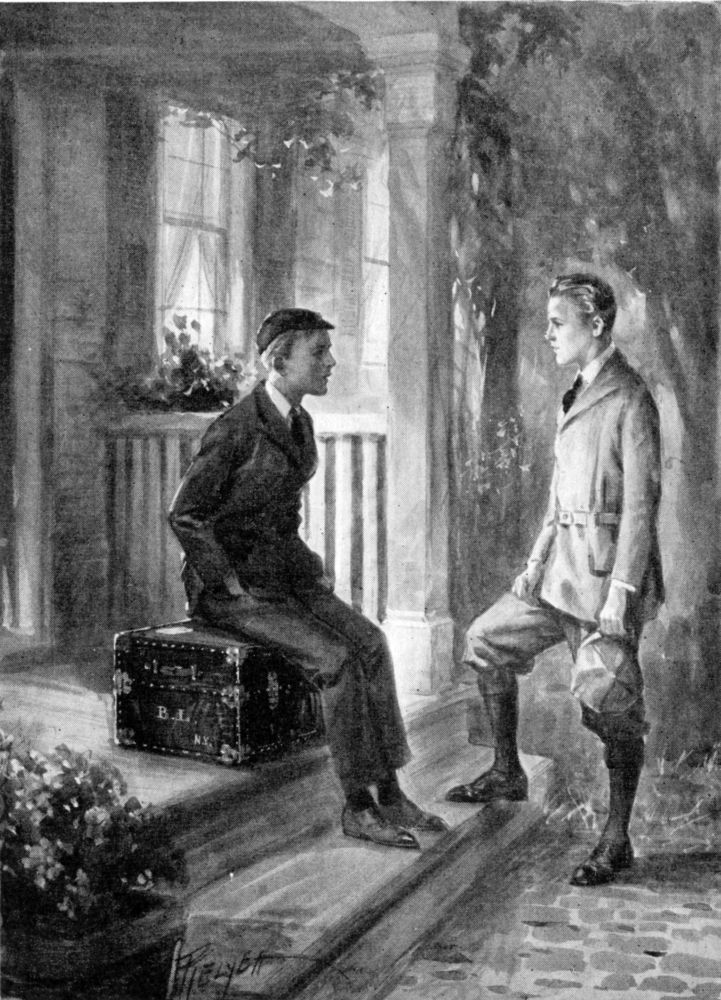
Barry stared curiously as he neared the speaker. Jones was seated on something large, black, and formless that gradually resolved itself into a trunk.
“What—” began Barry.
“Expressman dumped it here. Said he wouldn’t carry it upstairs for fifty cents. If I’d [33]been here I’d have shown him how mistaken he was, but it was before I got back, and Mrs. Lyle is easy. So I thought I’d better wait around and give you a hand.”
“Why, thanks,” said Barry. “But do you think we can do it? It’s awfully heavy. There’s a lot of books in there.”
“I can carry one end and the middle if you can manage the rest of it,” answered Jones. “Mr. Benjy wanted to try it, but I wouldn’t let him.”
“Who’s Mr. Benjy?” inquired Barry, dubiously lifting an end of the steamer trunk as Jones yawningly rose.
“Mr. Lyle. Guess you’d better go first, Locke. Wait until I get the screen door open. All ready? Let’s go!”
The sound of the struggle brought Mrs. Lyle from the sitting-room.
“Crawford, you’re not trying to get that trunk up by yourself?” she demanded agitatedly. “I told you you mustn’t! You’ll strain your back or—or hurt yourself dreadfully, and—”
“It’s all right, Mrs. Lyle. Locke’s here.”
“Oh! Well—” Mrs. Lyle retired again, and a murmur of voices came through the open door below.
The boys got the trunk up the stairs finally, and [34]then along the hall and into Barry’s room, setting it down, with vast relief, in the darkness.
“I’m awfully much obliged,” panted Barry, searching unsuccessfully for a light-switch beside the door.
“Don’t mention it. If you’re looking for a button, there isn’t any. Here, let me do it. I know where the thing is. At least, I think I do. Ah, at last!”
A none too brilliant radiance appeared, accentuating the bareness of the room. Jones surveyed the scene and shook his head.
“Really, Locke,” he protested, “don’t you know that it’s wretchedly bad taste to overfurnish like this? I say—where’s your table?”
Barry explained, and Jones chuckled.
“Wonder he didn’t take your bureau, too! By the way, don’t be surprised if you find garter-snakes and such harmless things wandering around in here. Toby tries to keep them in bounds, but they will get away from him at times. Where do you want this thing to live?” He kicked Barry’s trunk gently.
“What do you think?” asked Barry. “If there were only some place against the wall! But you see how it is. Every inch taken up.”
“Isn’t that the truth! Well, we might move [35]the upholstered divan under the front window or edge the buhl cabinet farther to the nor’east. Say, what is a buhl cabinet?”
“I don’t know,” said Barry. “I never had one before.”
“I see. Well, what do you say?”
“Over there in the corner, I guess.”
“All right. Careful not to scrape the parquetry, now. Gosh! you careless duffer! you’ve gone and knocked a chip out of the Wedgwood escritoire!”
“You’re pretty fairly ignorant,” sighed Barry, as they set the trunk on end. “Wedgwood is pottery stuff. That escritoire is Heppelwhite.”
Jones observed the imaginary object intently.
“So it is!” he agreed. “A remarkably fine specimen, too. Well, I guess you want to get unpacked, so I’ll leg it.”
Barry’s impulse was toward hospitality, but he recalled Clyde’s warning and merely thanked Jones once more for his help. Jones nodded cheerfully and departed and Barry attacked the trunk. Life at Broadmoor, he reflected as he began unpacking, was going to be complicated!
His bed was rather hard, but Barry slept like a top until a pleasant voice called from beyond the door: “Hot water, Mr. Locke!” As it [36]wasn’t Mrs. Lyle’s voice, he decided, as he yawned himself awake, it must be the maid Betty’s. Evidently her day off had left her in a very cheerful state of mind. He crawled out, retrieved the pitcher, and prepared for his first day of school.
[37]
That forenoon, Clyde conscientiously performed his duties as guide, counselor, and friend, smoothing Barry’s path and sharing with him the wisdom of one who had already traveled it. Shortly before noon Barry took his physical examination and went out of the director’s room in the gymnasium in possession of a gray card filled with lines and figures and the information that three times a week he was to report with Class K for physical training. Gymnasium work, it appeared, was required of every student unless he was engaged in one of the major sports. Barry regretted his nominal agreement to abstain from the degrading game of baseball until spring!
He was introduced to at least a dozen fellows that morning, all of whom, Clyde earnestly assured him, were the right sort. Generally they were members of Clyde’s class, the Second; once or twice it was a First-Class fellow who dutifully shook his hand. Toward dinner-time Barry [38]found himself wishing that Clyde’s friends weren’t so choice. Being the “right sort” seemed to make a fellow rather self-satisfied and unlikable!
When dinner was over he hurried off before Clyde could intercept him and walked to the village to buy a table. He had a vision of something severely plain and businesslike in oak, something with a good big drawer and a broad, generous top. He might have found it if Fate hadn’t drawn his gaze to the window of a shabby little shop on Main Street in which was a crowded array of second-hand articles. A sign promised “Antiques,” but what Barry saw scarcely deserved the name. There were chairs without seats, mirrors without glass, broken teapots, chipped vases, and a score of other dilapidated objects, but what drew Barry’s eyes was a desk which, standing in the center of the window, served as a repository for some ancient crockery, a rusty musket, and an ivory-handled walking-stick.
It wasn’t a beautiful thing, but it captured Barry. It was of black walnut, of a style of forty years back, with a bank of drawers down the right side and a door on the other which, being opened, revealed three shelves. It was worn and stained, [39]but it looked honest and—well, “friendly” was the word Barry thought of. Negotiations obtained it for the reasonable price of six dollars, delivery at 104 Bridge Street and conveyance up one flight included, and, declining a bargain in a broken-down swivel chair, Barry turned homeward well pleased.
Stopping for a few moments at Mrs. Lyle’s, he went on to school again. There was a conference with Mr. Stimson, professor of mathematics, at two-thirty, and after that Barry was free for the day. He watched tennis for a while and finally wandered farther afield, to where, on track and gridiron and diamond, candidates were assembling. The school was generously provided with space for athletic activities. There were two gridirons,—one inclosed by the quarter-mile running track,—two diamonds, and, in winter, three hockey rinks on the surface of the pond lying in the southwest corner of the field.
The pond was formed by the East Fork River, that small but bustling stream which skirted the farm that Barry had noticed, crossed the road under a picturesque stone bridge, and wound through the corner of the Broadmoor estate. Pond and stream afforded natural hazards on [40]the nine-hole golf-course which started and ended in home territory but wandered back and forth along the gentle slope of a near-by hill.
Hills were all about: Pine Knob rising behind the field on the east, Town Hill nearer the village, Crow Hill to the west, with the road hugging its base as it turned toward The Falls and Fairmount, and finally, two miles to the northwest, Mount Sippick, its double peak frequently veiled by clouds. To-day the slopes showed scarcely a hint of autumn and the acres of turf were as green as in summer.
A surprising number of football candidates had appeared by the hour set for the first day’s practice, boys of many sizes, ages, shapes, and degrees of promise. Barry lingered in one of the two stands for a while and watched proceedings. He picked out Clyde and Hal Stearns and the boy they had called Goof; and, because Clyde had indicated him that morning, the coach, Major Loring. The Major had dropped his title with the ending of the war, but Broadmoor clung to it proudly. Even in old flannel trousers and a gray jersey bearing the single broad purple band of the football squad he was a fine figure of a man.
Barry tired of the entertainment soon and [41]crossed to the nearer diamond and took a seat in a shaded corner of the covered stand. Some two dozen fellows were having batting practice and a tall, loose-jointed youth was pitching to the plate. Of those grouped near by, each in turn selected his favorite bat and faced the pitcher until he had delivered two hits and a bunt. Having had his turn, he relieved one of the players in the field. One of those coming in from the fielding looked familiar to Barry, but it wasn’t until the broad-visored cap was momentarily relieved that Barry recognized him. He was Crawford Jones. Barry was pleased when Jones connected with the first offering and lined it far into left.
They didn’t appear, any of them, to be very desperate characters, Barry reflected. On the contrary, they struck him as a particularly nice-looking lot. He wondered if Clyde and Hal hadn’t been unnecessarily pessimistic regarding the “baseball bunch.” Certainly they were getting a lot more fun out of practice than the football candidates were. There was a deal of talk and laughter, and much good-natured ragging. Barry found himself wishing he had not virtually promised Clyde to keep out of the game until spring. He would have liked nothing better than to be down there throwing the ball [42]around and swinging at the lanky youth’s offerings.
He was not alone in the stand, for a score or so of other idlers sat about in groups of two or three, hugged their knees, and uttered derisive applause, caustic criticism, and absurd advice to their friends on the field. Barry felt rather lonesome, and it occurred to him that despite Clyde’s good intentions he wasn’t making friends very fast. Save for Clyde himself and Hal and Jones and that funny Toby Nott, he didn’t know a soul. Near the tennis-courts, an hour before, he had spoken to a fellow to whom Clyde had introduced him earlier in the day and had received in response only a surprised and chilly glance followed by a grudging nod. He had determined not to try that again. He wasn’t used to being snubbed, and he didn’t like it a bit.
About half-past four he went back to the campus, got the pile of books he had left in Clyde’s room, and returned to Mrs. Lyle’s, unwillingly acknowledging to himself that it wouldn’t take a whole lot to make him homesick!
The house looked pleasant enough in the afternoon sunlight, but it seemed very silent and empty as he made his way upstairs. Even Toby Nott [43]evidently was out. The sight of the walnut desk, which had arrived in his absence, cheered Barry up, however. It looked even better here than it had in the store, although it was undeniably a shabby old relic at best. He tugged and pushed it across to a position midway between the side window and the single electric light and got his hands gray with dust in the operation. It had not, it seemed, occurred to the dealer to clean it. Barry pulled out the four drawers on one side and opened the cubbyhole on the other. From the stains and discolorations he judged that the old desk had seen much service. From the amount of fine gray dust he also judged that it had lain idle for some time. He looked about for something to dust it with, but saw nothing more appropriate than the three towels hanging by the wash-stand, and so went into the hall and leaned over the stair railing. It was, he thought, fortunate that he remembered the maid’s name.
“Betty!” he called. “Oh, Betty!”
After a moment there were faint sounds below, toward the back of the house, that resolved themselves into light footsteps approaching the dining-room door. Then a pleasant voice answered:
“Yes, Mr. Locke?”
[44]
“Oh! Say, Betty, can you find me a cloth or something to go over this desk with? It’s covered with dust.”
“I’ll bring one right away,” replied the unseen owner of the voice. The footsteps retreated and Barry returned to a satisfied contemplation of his new purchase. He liked the old-fashioned wooden knobs on drawers and door. They looked sort of interesting, sort of quaint, he decided. He was still absorbed when he was aroused by Betty’s voice at the doorway.
“You’d better let me dust it,” she suggested.
Barry turned. Close by stood a girl of about his own age, a slim, rather pretty girl with dark hair and gray eyes and a smooth tanned skin, a self-possessed young lady who smiled at him in a friendly way as he stared back, surprised.
“But—” stammered Barry—“but, look here, you’re not Betty!”
“Why, yes, I am!”
“Well, but—I mean to say—you’re not the maid!”
“The maid?” She seemed to find that most amusing and laughed outright, and Barry in spite of his confusion noted without distaste that a dimple appeared in each cheek.
[45]
“Yes, I thought—Mrs. Lyle said—” Barry stopped, conscious of reddening cheeks.
“We haven’t any maid,” was the answer. “I’m Betty Lyle. My! it is dusty, isn’t it?”
[46]
Barry, protesting, would have taken the dust-cloth from Betty, but the latter shook her head and went vigorously and proficiently at the task.
“We’ve got some furniture polish somewhere,” she said, “and to-morrow I’ll put some on. It’s a real nice desk. Did you have it sent from your home?”
“Oh, no; I bought it in the village, from an old chap with a yellow beard. He has what he calls an antique shop.”
“Mr. Hannabury,” said Betty, nodding. “Mother has bought some things from him.” Barry unconsciously glanced at the bureau and Betty, observing, smiled and shook her head. “No, that didn’t come from the antique store. That was left here three or four years ago by a boy who had the back room. It isn’t very good, I know,” she added apologetically. And then, frankly: “Lots of our things aren’t, Mr. Locke.”
[47]
“It’s plenty good enough,” he declared stoutly. “And my name’s Barry.”
She nodded.
“And you know mine already. If there’s anything you want, you must let me know. Of course,” she laughed, “we may not have it, but, then again, we may. I’m sorry you had to buy a table. You shouldn’t have let Toby do that.”
“Well, he certainly needed it,” said Barry, with a grin. “What does he do with all those things in there, anyway?”
“Just has them. Toby’s a collector. Collectors are like that, you know. They just—just collect!”
“But he collects such messy things,” Barry protested. “Insects and—and frogs—”
“Oh, yes, and turtles and even snakes. But he seems to have a lovely time doing it, and so we try not to mind. And he’s a nice boy, too.” Betty smiled again, nodded and vanished from the doorway.
Barry spent the next half-hour arranging his desk and examining his new books, stiff-backed and pleasantly odorous of printer’s ink. Finally, consulting his schedule of recitations, he selected one of the volumes and seated himself in his one easy-chair, by the side window. But he didn’t [48]get much studying done just then, for the window afforded a view of the slowly curving road and a corner of the tree-shaded campus, and of Brazer’s farm with its sentinel elms casting long shadows about the simple, comfortable buildings. He could see the river, too, here and there, a sunlit blue ribbon skirting the farmer’s meadow-land, twisting about the foot of Crow Hill and at last disappearing under the stone bridge. All this held more attraction than the book.
Occasionally voices from the gridiron reached him, and once, beyond the tree-tops, a football floated for a moment against the sky. Every one, he reflected with a sigh, seemed to be having a pretty good time—every one save John Barry Locke.
It was close to six when his gaze fell on two figures just turning from the school gate. One was Crawford Jones. They were talking earnestly, companionably, and Barry sighed again. Just short of the Lyle lot the two parted, the stranger crossing toward the opposite house. Barry hoped that Jones would accept the invitation of the half-opened door and look in. But Jones went past without pausing. Barry closed his book and prepared for supper.
When he went downstairs, a smallish man was [49]reading a paper, at one end of the porch. He lowered his head and peered at Barry over the tops of his glasses. Then he said, “Hm!” rather nervously and added, “Good evening.” He seemed friendly and in his present desire for companionship Barry welcomed the opportunity for speech. He returned the greeting and walked along the porch.
“I suppose you’re Mr. Lyle, sir,” he continued, smiling and holding out his hand.
“Yes, yes,” was the almost eager response. “Very glad to know you, my boy! Hm! Delighted to—er—welcome you to our humble abode. Won’t you sit down?”
He was standing, his paper clutched in one hand, his eyes peering near-sightedly through his glasses, and, having returned Barry’s clasp, he continued to smile. Just why he should have awakened Barry’s sympathy the latter couldn’t have told, but he did. Perhaps it was because, in spite of his attempt to appear at ease, to attain the dignity of the host, he seemed to offer the constant apology of the man who realizes his inconsequence. He looked to be about forty-two or forty-three years of age, was short of stature, thin, and perceptibly stoop-shouldered, although in moments of brief assurance he straightened [50]himself to military erectness. Barry understood why he was known as Mr. Benjy. The name suited him perfectly.
“Thanks,” Barry answered, “but I’m on my way to supper. I just wanted to get acquainted, sir.” He smiled winningly and Mr. Benjy looked touchingly gratified. “My name is Barry Locke, sir.”
“Yes, yes, I know. That is, Elizabeth—I should say my wife—has spoken of you. You are occupying—er—the southwest chamber. Very glad indeed to have you with us, Mister—er—”
“Just ‘Barry,’ sir. Thank you.” Barry nodded and went his way. Mr. Benjy watched him over the edge of his paper until he had disappeared.
“Fine boy,” he murmured. “Davy was rather like him when he— Hm!” Mr. Benjy frowned, sighed, and rustled the paper back into position a few inches from his glasses.
Barry found himself surprisingly hungry for his supper and did excellently by it. The boy on his right, overcoming his shyness, ventured a remark, half-way through the repast, and for the rest of the time they conversed quite busily. Barry had been slightly curious about this boy, whose name, it now appeared, was Fessenden. [51]He was fourteen, Barry guessed, and in the Fourth Class. He had dark hair that refused to yield to the brush, heavy brows and long lashes over somewhat dreamy brown eyes, and pale cheeks that reddened easily. A shy, sensitive boy, and attractive in a way, Barry concluded. He evidently was finding life at Broadmoor School none too joyous, although he didn’t say so outright. Barry surmised that he, too, was feeling lonely and perhaps homesick, and he would have been glad to lend companionship to the younger lad had he not agreed to look up Clyde. As it was, they parted outside Bates, Fessenden, ere he turned toward the library entrance, nodding shy gratitude for the other’s friendliness.
There was an atmosphere of unrest about the campus that evening, and a tendency to loiter about the oval and before the steps of the buildings. Barry wondered for a moment what was in the air, but forgot his curiosity in the discovery that Number 42 was empty. His first impulse was to take advantage of the fact and so avoid an evening which offered scant attraction for him, but second thoughts held him to his promise and he switched on the lights, picked up a magazine, and set himself to await Clyde’s return.
[52]
He found a story absorbing enough to hold his close attention for nearly an hour. Then, as Clyde was still absent, he decided that he was at liberty to leave, and turned out the lights and sought the stairway. Had he been better acquainted with Dawson Hall under normal conditions he would have noticed an unusual quiet. Here and there, from some open door, the sound of voices reached the corridor, but for the most part the rooms were dark. On the steps a few fellows lingered as though waiting for something to happen, but these things made no impression on Barry, and he took the path past the end of Croft and went on briskly down the drive, toward home. He had just emerged into the road when, in the increasing gloom, a flood of white light beat into his face, forcing a startled gasp from him as he recoiled.
“What’s your class?” demanded a voice. Barry, shielding his eyes from the rays of the pocket torch, saw four figures, possibly more, in the group about him. Puzzled, slightly resentful of the start they had given him, Barry spoke sharply:
“What do you want to know for?”
“He’s a ‘pup’!” declared one of the dim forms, and, “Sure he is!” exclaimed a second. [53]A hand laid itself ungently on Barry’s shoulder. He stepped back, wrenching loose.
“What’s the idea?” he demanded.
The light suddenly went out and the faces of the others took shape. Barry saw one of the fellows move toward the edge of the sidewalk, and coincidently memory came to his aid. The preceding winter Clyde had laughingly told him of “Pup Night” at school. Barry had forgotten, but it came back to him now that in Broadmoor parlance a Fourth-Class fellow was a “pup” and that the second evening of the term was “Pup Night,” when the Third Classmen conducted certain ceremonies at the pond, aided—somewhat unenthusiastically—by as many of the Fourth Class as could be rounded up. His muscles relaxed and he smiled as he said:
“I’m Third Class, fellows. Awfully sorry!”
“What’s your name?” asked a large boy, evidently in command of the detail, with suspicion.
“Locke.”
“That’s right, Rusty,” said another. “He’s in a couple of my classes. I remember him.”
“Well, he’s an awfully fresh guy,” growled Rusty. Then, to Barry: “Seen any pups around?”
“No, I haven’t.”
[54]
“Well, we’re looking for one who lives down the road here. They said at the house he hadn’t come back, but maybe they were kidding us. Where do you stay?”
“Mrs. Lyle’s,” answered Barry. “There aren’t any Fourth-Class fellows there.”
“No, but there’s a guy across the street,” said Rusty, “and we want him. Well—” He paused indecisively.
“I’ll tell him if I see him,” said Barry, obligingly, and went on. Some one chuckled, but Rusty took the jest poorly.
“You do,” he called hoarsely but in low tones, “and I’ll hand you a wallop, Fresh!”
Barry strove to recall Rusty. Something about him, perhaps his voice, perhaps his dimly seen face, was familiar. Probably he had encountered him at one of the conferences that morning. In any case, he decided, he didn’t like him. The decision brought him to his gate, and he was groping for the latch when a shout from behind him along the road made him pause. There were voices then, a second shout, and the sound of running feet. Barry peered back into the darkness. Toward him, across the street, sped the quarry, the pursuers strung out behind but gaining, as yet only deeper shadows in the gloom but taking form [55]as they approached the radius of light from the arc-lamp just beyond the houses. The chase ended suddenly. The pursued stumbled, a dozen yards from the Anderson gate, and fell, and the hunters were on him! Barry’s smile faded, for a voice of pure terror came to him.
“Oh, please! Please!” wailed the captive. “Let me go! Let me go!” Barry didn’t like the sound of that. The boy, whoever he was, was badly frightened, almost hysterical. Barry crossed the road quickly. There were five forms in the group moving slowly back into the darkness. They had the captive securely enough, but he was struggling desperately, panting convulsively, too panicky now to control his voice.
“Oh, shut up,” growled Rusty. “We aren’t going to hurt you, you baby!”
Their own scuffling footsteps kept the captors from hearing Barry’s approach, and the sudden sound of his voice brought an instant halt.
“Hold on a minute,” said Barry. “This chap’s too scared. I wouldn’t go any further with this business, fellows.”
“You wouldn’t?” demanded Rusty, sarcastically. “Well, who’s asking you to? You go roll your hoop, young feller.”
The boy had quieted, although Barry could [56]still hear his stifled sobs. Barry kept his temper as he answered:
“Well, I’m Third, too, you know, and I’m not trying to spoil your fun, but you ought to be able to see for yourselves—”
“Hire a hall!” Rusty reached forward and gave Barry a shove that sent him staggering into another of the group. “Come on, fellows! ‘Drown the pup’!”
Barry recovered himself and slipped past the youth whose toes he had, doubtless, damaged. The move brought his back to the fence and with a sudden yank he pulled the captive to his side and quickly stepped in front of him. He had recognized the boy now: he was Fessenden, his neighbor at table. The coup left Rusty momentarily too astonished and outraged for speech, and in that instant Barry, half turning his head, whispered, “Run when you see the chance!” Whether Fessenden heard or, hearing, understood, Barry couldn’t know. Rusty had pushed a companion roughly aside and from a few inches away was glaring at the meddler. Barry resolutely kept his hands at his sides. He was still smiling, although perhaps the darkness concealed the fact.
“You get out of here!” roared Rusty. “Go [57]on! Get!” He seized Barry’s coat at a shoulder and tried to heave him aside. The cloth strained, but Barry didn’t heave. Instead, one of his own hands went swiftly up and caught Rusty’s wrist, a foot shot forward, and then he did heave, while Rusty, pulled forward and tripping over Barry’s extended leg, swung to one side and crashed into the fence. And at the instant Barry shouted, “Run!”
But Fessenden was incapable of running, and only cowered beside him, gasping and futile.
“Grab him!” raged Rusty as he found his balance and, crouching, faced Barry again. But he was wary, now. He liked a quarrel, but he hated punishment, and something in the attitude of the straight figure confronting him counseled caution. Barry, who had no love for fighting but could nevertheless fight when it was necessary, moved a step along the fence to free himself of Fessenden, now once more securely guarded. He had no uneasiness as to the others. They’d keep out of it. It would be just he and the big chap they called Rusty.
The latter was silent now, and menacing. Barry watched and waited. Then his opponent rushed, closed. Barry fell back half a pace, threw his head to the right, and took a crashing blow on his [58]elbow. Then he swung his right fist upward and felt the swift pain of the impact dart along his arm. There was a startled “Ugh!” from Rusty as he staggered away, and then:
“Pretty work, old son,” applauded a voice, and a new actor in the drama stepped to Barry’s side, draped a hastily discarded coat over the fence, and faced the group.
“Let’s make it a foursome,” said Crawford Jones, pleasantly. “Who else wants to play?”
[59]
But it appeared that Jones had spoiled the party. Silence fell. Even Fessenden grew quiet. Then some one laughed awkwardly and the spell was broken.
“Well,” said Jones, in mild astonishment, “what’s the difficulty? Let’s go. Any one will do; or any two.”
“Where’s your license to butt in?” growled Rusty, nursing his jaw tenderly.
“Why, hello! Is that you, Waterman? That was a nice one you stopped just now. They ought to have you on the nine, Rusty! Well, if the game’s over, Locke, let’s wander. Who’s this chap?”
“He’s a pup,” answered Rusty, aggrievedly. “We were lugging him down to the pond when this fresh guy here came up and shot off his mouth. Said we mustn’t. I told him to beat it and then he wanted to fight. You’d think we were doing [60]something we oughtn’t! Isn’t this Pup Night, Peaches?”
“As ever was!” agreed Jones, heartily. “And if you fellows expect to see any of the fun, you’d better get a move on. It’s long after eight.”
“Well, we’re going to take this brat with us,” said Rusty. But his tone lacked conviction. Jones shook his head.
“Not to-night,” he said gently. “Fade away, Rusty.”
“You’ve got a lot of gall,” began Rusty, blusteringly.
“I’ll say he has,” agreed one of the others. “This isn’t any of your business, Jones.”
“Is that,” Jones inquired amiably, “your considered opinion?”
“Yes, it is, if you want to know.” Assurance, however, decreased perceptibly toward the end of the statement.
“Well,” said Jones, “you look—or you would look if I could see you—like a fellow ready to back his opinions. How about it?”
“Oh, dry up!” The retort was delivered in retreat, so to say, for the speaker was already moving cautiously in a direction which could never bring him any nearer Jones than he had been, even if persisted in indefinitely. Jones [61]allowed the argument to close. So did all the others. Rusty laughed with a creditable simulation of unconcern and moved too.
“If you’re going to make a—a serious affair of it—” he began sarcastically.
“That’s it,” said Jones. “International complications, World Court and all that, Rusty. Good night.” Jones re-donned his coat. The party was at an end, disrupted, broken in halves. One half went schoolward, discussing the affair, in dissatisfied mutters; the other set off toward the Andersons’ house. Nearing the light, Jones turned a puzzled regard on Fessenden.
“Well, son, what was your trouble? Think they were going to murder you?”
Fessenden shook his head, gulped, but made no answer.
“What do they do to them at the pond?” asked Barry.
“Make them swim across, if they can swim. A few get chucked in. There are always three or four sporting enough to say ‘yes’ to that. Faculty won’t stand for it unless the pups are willing. Those who can’t swim get off; or maybe the others give them a bath with a pail. It’s only fun—rather silly fun, I guess. I suppose you can’t swim, son.”
[62]
They were at the gate and Fessenden was fumbling for the latch. At Jones’s question his head went down and a sob shook him. Jones stared perplexedly at Barry and the latter put a hand on Fessenden’s shoulder and asked, “What’s the matter?”
“I—I’m ashamed,” gulped the boy.
“Oh, that’s it! Well, really, you know, it becomes you,” said Jones, gently, “but I wouldn’t trouble about it any more.”
“I was in the library after supper,” began Fessenden, haltingly, “and—and two boys were talking across the table; whispering. They—they said a boy was drowned last year by—by the Third-Class fellows, and—”
“Just trying to scare you, I guess,” said Jones. “Nothing in it, son.”
“Then I was coming home and I saw a light and hid and those fellows were talking to you—” he indicated Barry—“and I heard what they said and was frightened. I—I can’t swim! After you went along I tried to get by on the other side of the road. I thought if I could catch up with you— But they saw me and I ran and they chased me. They were shouting, ‘Drown the pup’! Then I fell and they got me.” Fessenden [63]ended with a final gulp and an appealing and shamefaced smile.
Jones chuckled.
“And you thought you were a goner, eh? Never mind, young— What’s your name, anyway?”
“Fessenden.”
“And you room here? I’ll bet you’re the fellow who plays the fiddle!”
The other nodded.
“I’m sorry if I’ve annoyed you,” he said in eager apology.
“Not a bit, son, but I do wish you’d learn to wangle that tiddly-widdly bit you’ve been struggling with for two days!”
Fessenden laughed tremulously.
“I have,” he said. “I can play it straight through now.”
“Praises be!” ejaculated Jones. “Well, better run along and get your beauty sleep. Just remember this, though, young Fessenden. Never cry till you’re hurt, and not then if you can help it. And never, never let yourself get frightened. Whatever it is that gets your goat, son, go straight up to it and poke it in the jaw. Just like Locke did! And that was a neat swing, I’ll say.”
[64]
“I—I’ll try,” said Fessenden, gratefully. “And thanks for making them—for everything—”
“That’s all right. If you feel under obligations to this gentleman and me, just go up and play the tiddly-widdly thing through for us. I’d like to know what happens after the peety-weety-weety part!”
“Queer bird,” commented Jones, as he and Barry crossed the road.
“High-strung,” said Barry. “He’s at my table and we were talking at supper. I think he’s been sort of homesick.”
“I’d think he might be, staying in that room and playing his fiddle all day. I can get homesick just listening to one of the things—some kind of sick, anyway! Let’s sit here a minute and see if he fiddles for us.” He seated himself on the porch and Barry dropped down beside him. Across the road a front window in the opposite house became an oblong of light.
“Where’d you learn to fight like that?” asked Jones.
“At home. There’s a chap who has a gymnasium and gives lessons in boxing and wrestling. Clyde Allen and I got it into our heads a couple of years ago that we’d like to learn and we went to him most of one year. Some of the other [65]fellows in high school went, too, and we used to have boxing bouts at Clyde’s house, up in the billiard-room on the third floor, until the plaster began to give way in Mrs. Allen’s bedroom.”
“You and Allen are pretty chummy, then,” said Jones.
“Yes. Well, I don’t know, either. We’ve known each other a long while and we live only three houses apart. Clyde was a year ahead of me at school, though, and for the last two years we haven’t been quite so thick. And then, last fall, he came here, and last summer, at Orchard Bluff, he took up with an older crowd. But of course we’re pretty good friends.”
“I see. Listen!”
Through the darkness, from the lighted window across the way, came the strains of the “tiddly-widdly” air, played very softly. As the player neared the dangerous stage Jones turned to Barry with a little smile and held up a finger. But now the bow didn’t falter. It went swiftly through a maze of tiny notes, unerringly, triumphantly, paused over a thin, silvery tone, and descended to the lower notes for a repetition of the opening movement and was still.
“That’s fiddling, young Fessenden!” murmured Jones. He clapped his hands softly and [66]Barry joined him. A form darkened the lighted window, stood there a moment as though peering across, and then vanished. “That was his amende,” said Jones, gravely. “And his thanks. A decent kid, I guess, but brought up wrong. I’ll bet he couldn’t toss a ball from first base to second! Or boot a football, or—or clean a fish, always supposing he could catch one. That’s no way to bring a fellow up, Locke. And if he is that sort, the last place to send him to is a boarding-school. There are too many rough-necks here who don’t know a—an andante from a—you say it, Locke.”
“Anduncle,” said Barry, gravely.
“Huh? Well, anyway, you get the idea. That kid’s in for a lot of hard knocks in the next few months, and he won’t know how to take them because about all he knows of life is keeping his feet dry and his fiddle tuned! Let’s go up.”
“Come in and see my antique,” said Barry, when they had climbed the stairs. “That is, if you have the time.”
“I’ll take time,” Jones replied, and, when the light was on: “Well! a gen-oo-ine Chippendale! Or is it Sèvres?”
“Real Ming,” said Barry.
“Ming, eh? One of our best little designers.” [67]Jones took the arm-chair and surveyed the desk approvingly. “I knew him well. Also his uncle, Grand Rapids. Say, Locke, where’d you find that relic? Is there a public dump around somewhere?”
“I like your nerve!” exclaimed Barry, indignantly. “What’s the matter with it?—except that it’s a bit more modern than the rest of the stuff.”
“Maybe that’s it,” said the other, grinning. “I hope you’ve got it clamped to the floor so Toby won’t pinch it! Joking aside, though, it’s not half bad. Has lots of room, too. I suppose you didn’t pay anything for having it delivered.”
“I didn’t, as a matter of fact, but what of it? Go on and spring it.”
“Nothing of it. Only, if any one gave me a nice desk like that I’d expect him to deliver it.”
“You’re insulting. I paid six dollars for that desk, Jones, and I’ll bet you wish you owned it.”
“I’ll bet I wish I were the fellow who got the six dollars! Well, getting to love your little home, are you? You look quite fixed up. Photographs and everything! Mind if I look?”
“Help yourself. Just the family, mostly.”
“This must be your father. Looks rather like you. And this is Allen, isn’t it? Makes him [68]look quite noble.” Jones completed the inspection of the photographs and lounged back to his chair. Then, looking over at Barry with a smile, he said, “I suppose he warned you against me, Locke.”
“Warned me?” Barry repeated, confused. “What makes you think that?”
Jones chuckled.
“Oh, I just knew he would! He doesn’t approve of me, doesn’t like me. And I don’t like him. You mustn’t mind that, because I dislike lots of persons and things—like Napoleon and Pansy Chester and vanilla ice-cream—that other folks admire hugely. So my taste isn’t any criterion.”
“I guessed that you didn’t,” answered Barry. “Like Clyde, I mean. Would you mind telling me why?”
“Not a bit, if I knew. But I don’t. Perhaps it’s more the gang he travels with than he. Oh, I could state objections to your friend, just as he could to me, but they wouldn’t be enough to explain it. We’ve never spoken to each other more than a couple of dozen times, probably; and then we just growled.”
“Well,” said Barry, after a moment, “of course Clyde isn’t perfect. No one is—”
[69]
“Thanks be!” said Jones, fervently.
“But I’ve known him a good while, and so—” Barry broke off and his smile deepened. “You know it would be a lot nicer if you two fellows didn’t growl at each other, because I like Clyde and I—” He stopped abruptly this time, looking uncomfortably embarrassed.
Jones grinned.
“And you don’t think I’m so bad. Go ahead and say it. Never mind my blushes.”
“I don’t believe you could blush!” laughed Barry. “Anyway, I give you fair warning that I’m going to get you and Clyde better acquainted, so—”
“I know,” sighed the other. “You’re going to have a lingering illness and die with an angelic smile on your face, while Allen and I clasp hands across your bed.”
“I am not!” denied Barry, vigorously. “I don’t intend to have even a toothache on your account. Neither of you is worth it. But I don’t intend, either, to have a couple of decent chaps whom I—like—act so silly. There’s no sense in it.”
“Noble sentiments, me Lud! They does you credik. Just the same and notwithstanding—” and Jones yawned, stretched, and pulled himself [70]out of the chair—“before you have Allen and me shaking hands, one of two things has got to happen: either he must change a lot or I must. I bid you good night.”
[71]
Barry settled down to school routine and in the course of a few days made several discoveries. One was that he would have to study a good deal harder than he had studied the previous year, for all the instructors whose classes he graced were believers in labor—for the students. Still, he didn’t have Doctor Clode this year, and that was something to be thankful for if he was to credit reports. The doctor, whose first name was Julius and was popularly known as “Julie,” besides attending to the duties of being principal, taught first- and second-year Latin. There were many who believed that he would have been even a greater success as a slave-driver. In spite of that, however, he was popular.
Another discovery was that gymnasium work under Mr. Peterson was a bore. Jones pointed out to him that to escape it he had only to sign up for one of the major sports. That called for a confession, since, naturally, Jones suggested [72]baseball. Barry explained rather awkwardly that he had decided, at Clyde’s suggestion, not to try for baseball until spring. Jones looked as though he wanted to ask a question, but he didn’t.
“Well, that’s all right,” he said. “Fact is, we aren’t crazy about new candidates in the fall, for the Major has his hands full of football and we have to get along without a coach. Of course in your case, since you’ve played some already, Jody wouldn’t mind taking you on. Well, what about football? Ever tried it?”
Barry nodded.
“Yes, but I didn’t seem to get the hang of it, or something. At high school we had three teams, and I was on them all, last fall or the fall before that, and never managed to stick. I’m rather light-weight, I guess. Besides, I never got awfully interested in playing. Baseball’s my stuff, although I don’t pretend to be much at that, either.”
“Your modesty becomes you,” said Jones, gravely. “Well, how about track work? Ever run or hurdled or anything?”
“No, I haven’t. I thought some about trying the sprints last fall, but our trainer didn’t give me any encouragement. He told me to come around in the spring, but then I was playing [73]baseball on the junior team. I guess I’ll just have to wait for hockey or basket-ball to start.”
The friendship with Jones progressed apace, to Clyde’s frequently expressed disgust. But Clyde had to confess that it would be extremely difficult to reside in the same house with a chap and have nothing to do with him.
“Just the same, though,” he insisted, “if you let Jones get you in with his gang, you’ll be ditched. You show up this evening, Barry, and we’ll call on a couple of corking guys over in Meddill. One of ’em’s in your class, too.”
So Barry went, but nothing came of that call. Barry was content that nothing should. By the end of the week Clyde’s efforts in Barry’s behalf dwindled. He said he couldn’t see why the other didn’t follow up some of the many introductions. Hal Stearns nodded vigorous assent. He appeared even more disgruntled than Clyde. Barry offered every reason save the right one, which was that none of the fellows to whom he had been introduced by Clyde appealed to him in the slightest degree. Hal as good as signified his intention of washing his hands of the business of getting Barry “started right,” and Barry was secretly very much pleased.
Barry’s day began at seven o’clock, at which [74]hour Betty Lyle set a chipped pitcher of hot water outside his door and roused him from slumber. At approximately seven-twenty-five he set forth, usually with Jones, sometimes with Jones and Toby Nott, by a short cut to Croft Hall and chapel. Sometimes, too, the roomers in the house opposite joined them. These were Fessenden and Millington. Millington, known as ‘Mill,’ was a Second-Class boy and a member of the baseball squad. Barry liked him from the first. Fessenden, whose first name was Alonzo, was dubbed “Zo” by Jones. Which was quite all right with Fessenden, since anything that Crawford Jones did was perfect in his eyes. After a few days Jones himself wasn’t “Jones” to Barry; nor was he “Crawford.” He became “Peaches,” a nickname that had been his since some mad wag had, years before, thought of the association of that word with Crawford.
Chapel lasted fifteen minutes and breakfast began at eight o’clock. The first recitation was at nine, the last at three. Dinner was at twelve-thirty, supper at six. Such was the routine of every week-day, although, as Barry’s recitation-hours varied, all days were not just alike for him. His afternoons were spent at tennis or golf when he could find an opponent, or in looking on at baseball [75]or football. Save on Saturday and Sunday afternoons Peaches was busy on the diamond and Barry couldn’t count on him for companionship. On Saturdays there was no practice for the baseball candidates, and on those afternoons Peaches was at liberty to follow the fortunes of the Broadmoor eleven. On the second Saturday after the beginning of the term Barry accompanied him.
The game, the first of the schedule, was not an important one, but it offered an opportunity to compare the home team with the previous year’s defeated eleven and there was a generous attendance of students and townsfolk. Peaches had tried to induce Toby Nott to go along with them, but Toby, appearing at his door with an agitated beetle between his fingers, had shown no enthusiasm. He stared quite blankly through his spectacles while Peaches repeated the invitation. Then, “You mean see a football game?” he asked, with a puzzled air.
“You’re certainly quick,” acknowledged Peaches. “I tell you only twice and you grasp it immediately.”
Toby blinked and grinned uncertainly.
“Well, but—what for?” he asked.
Peaches looked at Barry hopelessly.
“It’s no use,” he muttered. “Come on.”
[76]
With evident relief Toby started to withdraw, but then, fearing he had failed to show proper interest in the event, he put his head out again and called after them:
“Say, Jones, who’s playing?”
“Broadmoor School,” answered Peaches, from the foot of the stairs.
“Oh,” said Toby. He seemed quite satisfied as he closed his door again.
Barry felt slightly guilty as he approached the stand. Clyde was certain to see him, and he wouldn’t be pleased to find him with Peaches Jones. And Clyde did see him and waved to him from the bench. It was a restrained greeting, however. Barry was surprised at the number of fellows who spoke to his companion. Peaches had the same greeting for all, a slight smile and a backward tilt of his head. Barry felt a trifle apologetic on his companion’s behalf. It seemed to him that Peaches was—well, not exactly impolite but certainly unresponsive.
Exactly four fellows nodded to Barry during his climb and it was with difficulty that he restrained himself from stopping to shake hands in gratitude! There was one acquaintance who didn’t speak. He was a large youth with rather staring dark eyes. Barry recognized him as his [77]opponent of a week or so earlier and might have nodded had he received any encouragement. But Waterman’s regard was broodingly unfriendly.
Broadmoor’s rival that day was Shefford High School, and no one expected either a very close or a very exciting game. Consequently no one was disappointed when the home team took command at the start and held the enemy in subjection throughout the four ten-minute periods. Peaches, who, in spite of being a devotee of baseball was also an enthusiastic football fan, supplied Barry with the names of the various purple-and-gray clad players, adding brief but illuminating descriptions:
“The tall chap with the Napoleonic countenance is Gordon Buckley. Buck is captain. He’s a bright lad and the fellows think a lot of him. The guy playing next to him, this way, is Ellingham—a sturdy brute who goes by the name of Goof; don’t ask me why. Pete Zosker is the center. Pete says his folks are French, but personally I believe him to be a Dalmatian.”
“What’s a Dalmatian?” asked Barry.
“I haven’t the least idea. Next to Zosker is Sinclair at right guard. He wasn’t much last year. Johnny Zinn is the quarter-back, and a corker. Right here let me call your attention to [78]the fact that this is probably the only football team having two Z’s in its line-up; Zosker and Zinn. If the Major could find nine more Z’s he’d have a real team!”
“Who’s the slight fellow playing half?” asked Barry.
“Demille. The other’s Tip Cartright, and the full-back is Ira Haviland. Ira is no relation to the china of that name, for he is absolutely non-breakable. Hoskins made that discovery last year. There’s another touchdown. That makes us eighteen—no, nineteen. Now, if Tip gets this goal—”
Tip did, and the half ended soon after. During the intermission a nice-looking fellow of perhaps eighteen lowered himself over the back of the seat beyond Jones and joined them. Jones introduced him as Bassett, but during subsequent conversation addressed him as “B. B.” He shook hands with Barry as though he liked it, which was something Barry had not been used to of late and which left him almost speechless. When Bassett had departed, with the reappearance of the teams, Jones explained him.
“Billy Bassett,” he said; “a white man. He’s President of First. Came in on a scholarship three years ago and has been an honor man [79]every year since. They say his father is a butcher. If he is, I’ll bet he sells good meat!”
“There aren’t many fellows like him here, are there?” Barry inquired. “I mean—well, poor fellows.” Then he regretted the question, since he had gathered in one way or another that Jones himself came under that category; he recalled that back home many folks who lacked money seemed ashamed of the fact and pretended to be better off than they were. But Peaches didn’t seem to mind the remark.
“Not so many,” he answered. “Some, though. Broadmoor’s rather more expensive than a lot of other schools, you see; still, we do have a number of chaps whose folks aren’t wealthy. And some of them hate to have it known!”
“I don’t see why,” said Barry. “Just because your folks happen to have money—I mean there’s no reason why you should take credit for it, is there?”
“No, but some fellows do. We had a fellow here last year, Shafter, whose father’s a United States Senator. Sometimes, to hear Mat, you’d think he had simply made his dad! Same way with fellows whose fathers have wads. They give you the idea that it’s all their doing.”
Barry laughed.
[80]
“It’s funny, but it’s so, I guess. Clyde’s sort of like that. He seems to take a lot of credit for his father’s success.”
“His father has money, then?” asked Peaches.
“Gee, yes! Well, anyway, he’s pretty wealthy for our part of the world. He’s President of the Empire State Brass Company, you know.”
“Think of that!” said Peaches, evidently much impressed.
Fearing he had shown a lack of tact, Barry added hastily:
“Of course money isn’t everything. I mean, it isn’t really important. Some of the chaps at home, fellows I liked awfully, are what you might call poor. They don’t seem to mind it, either.”
“Quite properly,” approved Peaches. “As you say, money’s of small consequence. Personally, I prefer to have things charged.”
Barry looked at the other doubtfully. It sounded like a joke, but Peaches was absolutely grave as he watched the home team pile through the opponent’s right for a long gain. Barry reflected that perhaps he had been talking too much. He was apt to forget that Peaches was a full year older and a class ahead of him and might not always find his conversation absorbing. [81]When he did remember those facts he wondered at the intimacy between them. Peaches was so queer about friends! He seemed to know almost every one and to be very popular, yet he didn’t go with any one. Walter Millington appeared to be the nearest approach to a pal, barring Barry himself, and even Mill wasn’t really chummy.
The reflection that, after all, perhaps Clyde was right about Peaches, occurred to him. Maybe there was some fault that kept other fellows away. Yet, the others didn’t act as if they were avoiding Peaches. No, it seemed the other way about! Barry gave it up and followed his companion’s example in watching the game. Toward the last of the third period the Major began using substitutes liberally, and both Clyde and Hal Stearns went in, Clyde at right half and Hal at left guard. Barry thought Clyde played very well and he expressed the opinion to Peaches.
“Allen? Not bad. Want any more of this? If not, let’s stretch our legs and mosey along to the Palace for a couple of chocolate-milks.”
There was still another period, but Barry decided for Peaches’ society and a milk-shake at the Palace Drug Store. The half-hearted cheering diminished in volume as they made their way [82]to the road. As they reached it a small youth carrying a violin-case came out of a gate ahead and turned northward.
“Isn’t that the child virtuoso?” asked Peaches.
Barry assented.
“He’s taking lessons from Mr. Banks, he told me yesterday. Mr. Banks teaches music at the high school.”
Peaches hailed and Zo Fessenden waited for them. As usual, he was embarrassed for the first few minutes, and Peaches’ good-natured fun brought only shy smiles. Finally Peaches said:
“Zo, I’m going to ask you something, and I want a plain answer from man to man.” He nodded toward the violin. “Do you like doing that or was it wished on you?”
“Both, I guess,” Zo replied. “I didn’t like it at first, but my mother wanted me to learn, and after a while I liked it better. Now I like it a whole lot.”
“Spoken like a hero,” said Peaches. “My mind is at rest. Shall you make a business—no, profession—of it? Play before the crowned heads of Europe and all that?”
“Maybe by the time I can really play there won’t be any crowned heads left,” answered Zo. [83]“But I think I shall try to make it my—my lifework.”
Peaches exchanged a swift glance of amusement with Barry.
“Well, I guess you’re lucky to find your lifework so early, Zo,” he said gravely. “Some fellows don’t find it until they’re considerably older. And some, it seems, never do find it. If you will leave your fiddle and come back, we’ll take you to the Palace and quaff a beaker to your future success.”
So Zo bounded into the Andersons’ and reappeared breathlessly in something less than forty-five seconds, and the three proceeded along the sunlit road in pursuit of milk-shakes.
[84]
Barry saw Clyde daily. Clyde seemed to expect it and Barry was anxious that their friendship shouldn’t wane. That it was in danger of waning was evident, not through the desire of either but because they belonged to different classes and so their paths lay apart. Clyde’s intimates had been chosen from those of secured position. Some had won standing in athletics, usually football: others merely on the score of family wealth or prominence. They didn’t constitute a large proportion of the student body, but they were always much in evidence and managed to exert a good deal of influence in school affairs.
Clyde’s efforts to include Barry in his circle were doomed to failure from the first. Barry had arrived unheralded, with none to vouch for him save Clyde; and Clyde’s own position among the “right sort” was none too secure as yet. Perhaps had Barry made earnest efforts to please he might, after a proper novitiate, have been accepted. [85]But Barry didn’t, and he realized that Clyde’s friends resented his presence. Clyde sought to make Barry feel at ease, but he soon adopted a patronizing tone that the other didn’t relish, and as a result Barry’s evening calls at Number 42 Dawson became fewer and fewer and he relied on seeing Clyde during the forenoons, between recitations. Now and then a day passed with no more than a dozen words between them, and Barry blamed himself and, recalling his obligation to the other, made greater efforts the next day.
Once—it was the Sunday following the Shefford game—Clyde walked out to the Lyle house shortly after dinner and found Barry and Peaches on the porch, surrounded with Sunday papers. Although Barry took the visitor up to his room, Clyde remained but a few minutes. A week after that, when Barry’s father and mother motored over to see him, Clyde, informed of the coming visit, was on hand and helped Barry do the honors during the four hours of their stay. When Mrs. Locke said gratefully that it was splendid of Clyde to look after Barry so well, Clyde, while verbally disclaiming credit, was plainly of like opinion. Mr. Locke, whose eyebrows had raised slightly at first glimpse of [86]Barry’s room, cast a shrewd look at Clyde and said, “Hm!” in a tone that meant anything you liked.
The next day the home team met and defeated the local high-school eleven by the one-sided score of 22 to 0, and again Barry watched the game with Peaches. Mill made a third, however, and growled constantly at the idea of any sane fellow going in for such a piffling, uninteresting recreation as football. Clyde played the last two periods at right half and rather disappointed Barry. He was twice stopped behind his line and acted generally as though not fully awake. But then the whole team was logy that day, possibly because of the heat. The three stuck it out to the end, hoping for and rather expecting a turn of the tables toward the last. But it didn’t come. Wessex, playing her first game, had less to offer than Broadmoor.
Parting from Mill at the gate, Barry and Peaches entered the house and Peaches proceeded to the little table that held the telephone and the mail.
“Nothing for you and nothing for me,” he announced. “Toby gets it all. But—I say!” Peaches lifted a small package and viewed it with [87]deep suspicion. “Something ought to be done about this.” He carefully returned the package to the table, his countenance expressing extreme distaste.
“What is it?” asked Barry, from the foot of the stairway.
“I don’t know,” said Peaches, mournfully, “but I fear the worst. Toby! Oh, Toby!” A door opened above and Toby answered the hail. “Come down and take it away,” called Peaches.
“Take what away where?” asked Toby.
“Take this away anywhere! It’s a package for you, dear one, and it smells to heaven!”
“Mail?” inquired Toby, eagerly. He came hurrying down. “Let’s have it, Peaches.”
“I’ll not touch it again. Come and get it.” Toby finished the descent indignantly and clutched his prize.
“It’s the snails!” he chortled gleefully.
“Snails!” exclaimed Barry and Peaches in chorus.
Toby nodded, studying with a positively thrilled look the inscription on the wrapper. “A fellow I correspond with in South Carolina sent them. They’re salt-water snails.” He turned toward the stairs again, beaming through his spectacles, [88]but Peaches laid a detaining hand on his shoulder.
“Toby,” he said gravely, “I’ve bad news for you.”
“Huh?” said Toby.
“Try to take it like a man, Toby. Bear up, you know, and all that.”
“What’s eating you?” demanded Toby, very inelegantly.
“Prepare yourself, my friend.” Peaches’ voice trembled. “This will be a great shock to you. They—” he pointed tragically to the package—“they’re dead, Toby, quite dead!”
Toby stared blankly an instant. Then his gaze went to the package.
“Who’s dead?” he asked. “The snails, you mean? Of course they’re dead, you chump! They can’t live out of water, can they? Huh!”
Toby gave the other a scathing glance and mounted the stairs. Peaches fell in behind and Barry followed in turn, and as the two tramped solemnly upward they chanted a dirge for the dead snails.
It was the middle of October now, but Indian summer dwelt in the Connecticut hills. The days were warm and languorous, sweet-scented with drying grasses and late blossoms; and while coolness came with twilight, the evenings were [89]frequently so mild that the Lyles’ porch, which caught the last rays of the sun, was comfortable until, perhaps about nine o’clock, a little chill breeze wandered across the clover meadows. Then Mrs. Lyle would say:
“Betty, don’t you think it’s getting— Father, I think perhaps we’d better go in now.” And then, raising her voice a trifle: “Father! It’s time to go in. It’s getting quite—” Whereupon Mr. Lyle, sound asleep in the hammock in the darkest corner, would respond brightly with:
“Eh? Yes, yes, Mother! I was—er—just about to suggest it.”
Now that Barry had virtually ceased his evening visits to Clyde, he was at liberty to join the gathering after supper. Always there were Mr. and Mrs. Lyle, Betty, and Peaches; frequently Toby as well. Mr. Benjy, having finished reading the afternoon paper, acquainted them with the happenings in the outside world, adding personal comments. Mrs. Lyle supplied the simple gossip of the neighborhood and narrated the domestic episodes of the day. Something thrilling was always occurring to Mrs. Lyle; such as the overturning of a quart of milk by Miss Muffet, the white cat, or the failure of a batch of jelly to jell. Betty brought the news of the high school, and the [90]boys drew on their day’s experiences for items of interest. Mr. Benjy, having unburdened himself of information and opinions, stretched out in the hammock and quietly fell asleep. Barry enjoyed those evenings at home.
The Saturday night of the Wessex game was especially warm, and Barry and Peaches went to the village and returned with ice-cream. Mrs. Lyle supplied cake, and Peaches summoned Mill and Zo to the feast. Toby tore himself from his defunct snails at the first hail of “Toby! Oh, Toby! Ice-cream!” Zo had brought his violin along and later he played for them. And when, after several classic selections, he rendered “Sunny Days,” Toby joined the others in singing the words of the school song. Toby sang very earnestly, with a voice like that of one of his pet frogs!
When the violin was laid back in its case, conversation took the place of music. Peaches inquired about the snails, and Betty, not having heard the sad tidings, asked if Toby was going to train them. Peaches replied reprovingly:
“Only ignorance can excuse such a—a callous question, Betty. The snails are—the snails— You tell her, Barry. I haven’t the heart to, myself.”
[91]
“Dead,” said Barry, solemnly.
“Dead!” echoed Betty. “You mean they were dead when— Why, then, that was what—” Betty sought for a delicate phrase.
“It was,” affirmed Peaches. “Barry and I noticed it, too—shortly after leaving the campus.”
“Aw, get out!” Toby protested. “Why, they don’t hardly smell at all. Gee, there’s only eight of ’em, Mrs. Lyle!”
“Well, I’m sure I don’t know—” began Mrs. Lyle, doubtfully.
“I suspect you will know,” murmured Peaches, pessimistically. “Sooner or later.”
There were footsteps on the farther sidewalk and a figure passed, a dark form in the uncertain radiance of the nearest light. Barry saw Mrs. Lyle lean suddenly forward and stare intently through the gloom, saw Betty’s hand go out and rest on her mother’s, saw Mrs. Lyle settle back in her chair. The sound of a faint sigh came to him in a pause of the talk. It was a small enough incident, yet it left Barry vaguely disturbed and curious. A moment later Mrs. Lyle said:
“Betty, don’t you think it’s getting just a little—”
Then Mr. Benjy was awakened and the party was over.
[92]
At the gate Walter Millington turned to call back:
“I’ll have my radio set up by Monday, Betty. I want you to come over and hear it. And Mrs. Lyle, too, and Mr. Benjy, if they care about it.”
Betty consented eagerly, but what her mother said was drowned by Mr. Benjy’s voice.
“Wonderful invention,” he was declaring as he got out of the hammock. “Makes one wonder what—er—what next, eh? I was reading the other day—”
But Mill and Zo didn’t wait to hear what he had read, and in the withdrawal of the rest, which was accompanied by the scraping of chairs, the balance of his remark was a total loss. But Mr. Benjy didn’t mind. It happened so often.
Baseball practice was over for the fall and on Monday Peaches proposed tennis in the afternoon. But they found all the courts in use, and so, leaving their rackets behind, they sauntered over to the running-track and watched the football squads performing on the gridiron beyond. Peaches was rather bearish regarding Broadmoor’s chance of a victory the coming Saturday, when she was to play Peebles School at Clear Lake.
“We haven’t got the material we had last [93]year,” he said, sitting on the turf and chewing a grass. “Lost a lot of good fellows in June. Almost the whole back field and half the line. I don’t say the Major won’t have a team by the time we face Hoskins, but he hasn’t got it yet, nor the sign of it.”
Just then a stray football came bobbing across the running-track and settled a few yards behind them, and Barry got up and went after it. Some forty yards away down the field a player raised a hand in signal.
“Let’s see you kick it, Barry,” called Peaches. Barry smiled dubiously but accepted the challenge. He poised the scuffed ball, stepped forward, swung his right leg, and dropped the pigskin. Fortune stood by him, for instep and leather met fairly and the ball arched away, across the bluish ribbon of track, safely past the end of the goal, and straight to the waiting player. Barry stared in mingled surprise and pleasure and Peaches clapped his hands.
“If that wasn’t an accident,” he laughed as Barry returned to his seat on the grass, “they ought to have you on the team. That was a mighty pretty punt, son, and all of forty yards.”
“Well, but it was an accident!” said Barry. “I haven’t touched a football since last fall.”
[94]
Peaches shook his head.
“I don’t know. I’m afraid you’re trying to put something over on us, Barry, my lad. I’m beginning to suspect—” He stopped suddenly and then added in lower tones: “Here comes the Major! Say, I’ll bet you he saw that and—”
The coach waited for a white-clad runner to pass and then crossed the path.
“Hello, Jones,” he called. “I’ve hardly seen you this fall. How are you?” The two boys arose and Peaches shook hands.
“First rate, Major, thank you. And you, sir? Have a nice summer?”
“So-so. Spent August in training-camp; that was fun. Got rid of five or six pounds up there.” His cool gray eyes turned speculatively to Barry, and Peaches announced:
“This is Barry Locke, Major. Major Loring, Barry.”
Barry shook hands, conscious of something questioning both in the firm clasp of the coach’s hard, brown hand and in the level gaze. Major Loring had a lean, deeply tanned face that was distinctly good-looking, but Barry had the sudden conviction that if the firm mouth and the steady gray eyes ceased to smile the Major wouldn’t look nearly so pleasant! And Barry was also [95]as suddenly convinced that should the Major say, “Locke, stand on your head!” he would immediately and unquestioningly stand on his head!
What the Major did say, however, was little like that.
“You’ve played football, I take it, Locke,” he remarked.
“Very little, sir,” answered Barry.
“What do you call very little?”
“Two years, sir, at high school. But I never made anything.”
“How old are you? Sixteen?”
“Not quite. I’ll be sixteen in December.”
“I see. You seem to be able to kick a ball.”
“That was—mostly accident, Major.”
“Possibly. Why haven’t you reported for football, Locke? Anything wrong with you?”
“No, sir, only I—I just didn’t think I cared to try for it. I play baseball.”
“I see.” Major Loring looked inquiringly at Peaches. “How has practice been going?” he asked. “You’re through, aren’t you?”
“Yes, sir; finished Saturday. I guess we got on pretty well. We’re weak in some places, but we’ll probably find some new material in March.”
“We’ll hope so. I tried to get over and have a look at you, but this business here kept me [96]busy.” He turned again to Barry and said crisply: “Well, Locke, now that baseball’s over you can give us a chance at you, I guess. I’d like to see you at work with the back-field fellows. Start to-morrow, eh?”
Barry looked to Peaches for aid, but Peaches was grinning heartlessly. Barry gulped and nodded.
“If you think—” he began.
“Good!” said the Major. “Report to the manager at three-thirty. I can’t promise you anything but hard work this fall, Locke, but in this game we have to keep next year always in mind.” He nodded to Barry and to Peaches. “Come to see me, Jones,” he called over his shoulder as he strode away.
Barry turned a perplexed and unhappy countenance to his companion.
“But—but I don’t want to play football!” he protested.
Peaches chuckled.
“Go and tell the Major, Barry,” he advised.
Barry stared at the coach’s retreating form and shook his head despondently.
“You know blamed well I wouldn’t dare to,” he sighed. “He—he’d probably order me shot at sunrise!”
[97]
There was one person even more surprised at the addition of Barry to the football squad than Barry himself. That person was Clyde Allen. Barry felt that Clyde wasn’t going to be pleased. He couldn’t think of any satisfactory reason for displeasure on his friend’s part, and yet the conviction haunted him from the moment he was drafted by the Major to the moment he found Clyde in Number 42 the next morning and broke the news. At first Clyde laughed, for of course Barry was only joking. But the laugh was short-lived. It ended abruptly in a frown.
“Do you mean it?” demanded Clyde, incredulously. Barry replied that he did. “Well, but—but, for the love of Lucius, what’s the idea?” Clyde wanted to know. “You’re no football player, Barry! I mean—well—hang it all!—you know, yourself, you’re pretty fairly rotten!”
Barry agreed without resentment.
“It was just that I happened to boot that ball [98]pretty decently and he saw me,” he explained, “and—and then he said I was to report to-morrow,—I mean to-day,—and that was all there was to it. He did say, though, or as much as say, that I had no chance this fall; that he had to think of next year.”
“Well, even so—” Clyde stopped and shook his head. Then he laughed again, shortly, almost grimly. “I don’t envy you when the Major finds out that that kick was just a fluke, Barry.”
“I told him it was,” replied Barry. “The most he can do is let me go again.” He seemed to find reassurance in the thought.
“Yes, and the sooner he finds it out, the better for you. What I mean is, he’s likely to get pretty sore if he wastes a lot of time on you and then discovers that you’re punk! Coach didn’t happen to say where he thought you’d fit, did he?”
“He said something about the back field.”
Clyde said, “Oh!” and stared hard a moment. Then he shrugged and turned away.
“Well,” he said, “he knows what he’s doing, I suppose, but it looks crazy to me.”
“But why are you so down on the idea, Clyde?” demanded Barry. “I can’t see that there’s anything very much—very much out of the way in my playing football if Mr. Loring wants me to.”
[99]
“‘Out of the way’!” echoed the other, impatiently. “Of course there’s nothing ‘out of the way’! I didn’t say there was, did I? Great Scott, Barry! All I’m thinking of is how you’ll look when the Major finds he’s picked a lemon and gives you the gate. Fellows will laugh at you like anything, I suppose, and I’ll have to hand out the yarn about the Major insisting on having you, and it’s going to sound mighty fishy!”
“I don’t see that, Clyde. I mean I don’t see where you come in on it. You say you’re responsible for me, but of course you aren’t; not really.”
“It amounts to that,” Clyde persisted. “You know mighty well that if I hadn’t—well, if I hadn’t done a certain thing a couple of years ago, you wouldn’t be here at all. I can’t help feeling responsible. Besides, your folks as good as put you in my charge.”
“Well, all right. That means you’d rather I didn’t report this afternoon?”
Clyde considered. Finally he shook his head.
“You’ll have to,” he said. “The Major will raise Cain if you don’t. You shouldn’t have agreed to play, Barry; but you did agree and now you’ll have to go through with it. Only, if you’ll [100]take my advice, you’ll quit the first chance you get. It oughtn’t to be very hard to show the Major that you aren’t football material!”
“I guess that’s so,” Barry agreed. “I didn’t realize you’d be so set against it, Clyde, or I wouldn’t have done it. Although,” he added reflectively, “I don’t see just how I could have helped it.”
Clyde was magnanimous.
“Well, don’t let it trouble you, Barry. I dare say you couldn’t have done any different. The Major’s a hard guy to say ‘no’ to! Mind you, I’d say, ‘Hang on,’ if I thought there was any chance for you, but you know there isn’t. You aren’t the type for football, old chap.”
Barry didn’t say ‘yes’ to that; but he was relieved by his friend’s return to good humor and didn’t want to offer any opinion likely to disturb it again, so he left the last word with Clyde and hurried off to a Latin class.
He had brought the remains of the previous season’s football togs to Broadmoor, and at three o’clock he got into them. Peaches, watching, declared that he looked exactly like Pete Zosker, only more noble. As Pete weighed sixty pounds more than Barry, the statement indicated an active imagination.
[101]
Barry found Sampson, the manager, gave his name, class, age, weight, and a few other details, and became automatically a member of the Broadmoor School football squad. Ira Haviland was in charge of the back-field candidates, of which there appeared to be at least twenty. Haviland was a tall, rather heavy First-Class fellow with a shock of almost black hair and a voice like a good-natured fog-horn. He greeted Barry with a glance of swift appraisal and a careless: “Yeah, Coach told me about you. Push in with that bunch yonder, Locke.”
The day’s work consisted of the usual kindergarten duties. There were passing and starting, tackling-drill, and, finally, signal-drill in which Barry didn’t take part.
He didn’t find Peaches again until, in company with Zo, he went back to the house after supper. The weather had turned cold over Sunday and the front porch was deserted. The family were in the sitting-room, the first room on the left, and he could hear Mr. Benjy reading something from the evening paper, but a light upstairs had told him that Peaches was in his room and he went up. Peaches, occupying two chairs, was reading a magazine, but he dropped it when Barry pushed open the door.
[102]
“Hail, hero!” he declaimed. “Bloody but unbowed—what? Come in and rest your wounds. How did it go? I watched you for a while, but there was a certain monotony about your performance and I finally went over and cut in on a tennis game. Do any punting, Barry?”
“No, I just stuck around with the dubs. I didn’t even see Major Loring except in the distance. My boss was Haviland.”
“Ira, eh?” Peaches arose and closed one of the windows. “It’s getting frosty, isn’t it? No more porch parties this year, I guess. Did you hear Mill’s radio as you came in? He had it going a little while back. Pretty screechy, though.”
“I didn’t notice it,” said Barry. Then, after a slight pause: “Say, I wish you’d tell me something,” he began.
“I’ll tell you anything,” agreed Peaches, amiably. “You’ve come to the right place, too. I’m chock-full of information to-night. Is there any special subject that interests you or shall I just start off casual like?”
“I want to know what’s wrong here,” replied Barry. “I mean in the house.”
“Wrong in the house? Oh, I get you. It’s [103]those snails of Toby’s. I thought first it was the plumbing, but—”
“Shut up! Maybe I only imagine it, but ever since I came I—I’ve sort of fancied something was queer. About the Lyles, Peaches. Mrs. Lyle looks—oh, I don’t know, but I was wondering if there was anything wrong with Mr. Benjy—or Betty.”
“I see what you mean,” responded Peaches. “I’d forgotten you weren’t here last winter, and didn’t know about Davy.”
“Who’s Davy?”
“David Lyle, Betty’s brother. I might as well tell you the story, I suppose. You’re sort of one of the family now. Kick the door shut, like a good chap.”
Peaches hooked one foot about a chair and dragged it into position to hold his legs. Then he continued:
“Davy is about twenty. He’s a decent chap, but more like Mr. Benjy than his mother. He finished high school here a year ago and went to work for Watkins and Boyle. Mr. Benjy was chief bookkeeper for them.”
“That’s the factory down by the station?”
“Yes. Well, I guess Davy did well enough, [104]although I don’t know just what his duties were: I remember he got a small raise at Christmas. Then, along in February, a thousand-dollar bond disappeared. Of course I didn’t hear the exact details, but there wasn’t any doubt that Davy had seen it last. He claimed that he had put it in the safe, as he’d been told to do, but it couldn’t be found and Watkins and Boyle were pretty nasty. Of course Mr. Benjy wouldn’t believe that Davy had swiped it—I don’t think he did, either—and he was all broken up. He offered to repay the amount, and he’s still doing it, but the factory folks thought something ought to be done to Davy. So about two days after the bond disappeared the cops came along one morning, looking for him. They didn’t find him, though, because he had beat it the night before.”
“Then he did steal the money?” exclaimed Barry.
“Well, I wouldn’t advise you to suggest that downstairs,” answered the other, dryly. “Of course in a case like that the natural supposition is that the fellow is guilty. If he wasn’t he’d stick around and face the music. That’s what ’most everybody said; or if they didn’t say it they thought it. But I don’t know, Barry. You [105]see, the bond was gone. If Davy didn’t have it he couldn’t prove he hadn’t. Maybe he figured he’d get treated sort of rough if he stayed here. Maybe he thought the bond would turn up and he could come back. Maybe he didn’t do much thinking at all—just ran away because he was scared. If he was innocent he did the wrong thing, of course; but, then, being arrested isn’t very pleasant, I suppose, even if they let you off later. Anyway, Davy disappeared and that ended the matter.”
“Was the bond—what-you-call-it?”
“Negotiable? Yes, a brand-new one that had just reached the office, with all its nice little coupons attached. None of the coupons have ever been presented for collection, and Mr. Benjy considers that proof positive that Davy hasn’t the bond. He’s convinced that the thing will turn up around the office some day, and from the way he described that office to me last spring I wouldn’t be surprised if he was right. It’s one of those places where the bookkeepers still sit on high stools and they file things away in shoe-boxes!”
“And Mr. Benjy is still paying back the thousand dollars?”
[106]
“I suppose so. He was, anyway. As he’s getting only about eighteen dollars where he is now, I fancy it’ll take some time!”
“Eighteen dollars a week? Then they fired him from the other place?”
“No, sir, they didn’t!” Peaches recrossed his ankles and chuckled. “No, the old gentleman up and resigned on ’em! Said he wouldn’t work for folks who believed his son to be a thief. You’ve got to hand it to Mr. Benjy for that, Barry. He was getting pretty good wages at the factory, had been with them something like fifteen years, I believe, and he chucked the whole thing and went to work in the freight-station. I heard Watkins and Boyle were after him again last month, but he wouldn’t weaken. I like Mr. Benjy for that!” added Peaches, warmly.
“So do I,” said Barry. “Only, eighteen dollars a week seems mighty little.”
“It is. And most of it goes to pay for that silly old bond. That’s the reason I decided to stick here another year. They’re having hard sledding. Of course if I’d given up this room some one else might have taken it, but I couldn’t be sure. That room you’re in was empty, too. About all they have now is what they get from [107]these three rooms, and that’s little enough.”
“What became of the son?” asked Barry.
“Davy? Well, he writes about every week. I suppose that after a while Watkins and Boyle will forget their grouch, but I guess it wouldn’t be wise for Davy to come home just yet.”
“You mean he’d be arrested?”
“Surest thing you know! The old warrant is still good. Well, that’s pretty much that, Barry.” And Peaches stretched and yawned.
“I’m glad you told me,” said Barry. “It explains things. Like the other night.” He told how Mrs. Lyle had become intent on the passing figure, and Peaches nodded.
“Yes, she probably saw a resemblance to Davy. She misses him, I guess. So does Mr. Benjy. Mr. Benjy seems a lot older this fall. Pretty cheerful old bird, at that, but I’ve seen him looking awfully kind of miserable when he didn’t know any one was watching.”
“Betty seems a good sort,” said Barry.
“Betty’s a corker,” asserted Peaches, enthusiastically. “She’s got the brains of the family; and the pep, too. She really runs this shebang. Mrs. Lyle’s a dear, but she couldn’t say ‘boo’ to a mouse.”
[108]
“Why should she?” inquired Barry. “‘Boo’ seems to me a perfectly idiotic remark to make to—”
“That’ll do for you, son. Got any idea of studying to-night?”
“Some.”
“Bring your books over, then, and let’s get busy.”
[109]
It wasn’t until Friday that Barry had further speech with Major Loring. For three afternoons he had been drilled in the rudiments and had not got into signal work save for a brief ten minutes on Thursday. He was getting a little impatient. If they were ever going to discover his worthlessness they would have to give him a chance to show it. Clyde was viewing him with increasing suspicion. Once in a scrimmage, Barry told himself, he was certain to make a mess of things and get his walking papers, but they wouldn’t let him into a scrimmage! Each day he sat on the bench and just looked on.
On Friday there was only a short practice for the first- and second-string players, since the next day’s game with Peebles was expected to be difficult, and they were sent from the field early. Those who remained were set against one another in a scrimmage, and Barry, while he was still on the bench when the fracas started, was pretty [110]certain of getting into action before it was finished. He was worried, however, by the fact that there was so much ragged playing going on that any misdeeds of his were likely to pass unnoted!
“Locke! Oh, Locke!”
Barry started to attention. Major Loring was calling to him from the farther end of the long bench. He got to his feet, dropping his blanket.
“Get a ball and come along,” called the coach.
Barry rooted in the canvas bag and found a ball which still showed some of its original surface, then joined the Major.
“We’ll go down to the other end,” said the latter, leading the way. “I want to see what you know about punting, Locke. Ever done much of it?”
“No, sir. I haven’t played a whole lot, anyway.”
“What position did you play when you did play?”
“I was tried at several places,” answered the boy, ruefully. “End, first. And last year at quarter and half. I—I don’t think I’m any good, sir. Not worth bothering with—much.”
[111]
Major Loring turned and surveyed Barry with a puzzled smile.
“You’re not stuck up about your playing, are you?” he asked. “What are you trying to do, Locke? Get me to let you go?”
Barry flushed.
“Well, I’m not very particular about playing, Major. Not this year.”
“I believe you,” said the other, dryly. “Still, I think you’d better stick it out for a few days longer. Here we are. Now punt one back of goal. Don’t try for distance. Swing easy. Take your time.”
Barry realized that here was an excellent opportunity to prove his case. All he had to do, doubtless, was to mess up a few punts. He had told the coach that the kick of Monday was largely an accident, and if he failed a few times now the Major was bound to believe it. But, as he turned the pigskin in his hands, he knew that he wasn’t going to be able to pretend. Probably he would perform poorly enough, in any case, but at least he would just have to do his best.
His best wasn’t so bad, as was proved an instant later. He had failed to strike the ball squarely and it went off to the left, but it covered [112]most of forty yards before it landed. The Major started away after the pigskin and Barry followed him. After a moment the Major said:
“Not bad, Locke. In fact, I don’t see why we can’t make a punter of you in time. Let’s try it again. Kick down the field this time, so that one of those fellows can send it back.”
This time, by being more careful about dropping the ball, Barry did better as to direction, slightly better as to distance. He made five other tries in the course of the next ten minutes. None of the punts were remarkable, none were, under the circumstances, really bad. Major Loring stopped him several times and corrected the boy’s methods. Barry did not, he said, swing his kicking leg wide enough; nor did he carry his foot up sufficiently after meeting the ball. Trying to remedy these defects, Barry did not quite so well as at first. Major Loring called a halt finally, tucked the ball under his arm, and went back to the bench.
“It looks to me,” he said shrewdly, “as if you’d done more punting than you tell about, Locke. You’re very far from perfect, but you show evidences of a good deal of practice. What’s the answer?”
“I guess that’s because I kicked the ball around [113]a good bit summer before last. I had sort of an idea I might get a place on the high-school team; just as a substitute, of course. I used to practise on the beach, up in Maine. There was a slope, a kind of cliff, back of the beach, and when it was low tide I could kick toward the cliff and the ball would roll pretty well back to me. Sometimes Clyde Allen and one or two other fellows up there would take a hand.”
“I see. Well, I think you’d better make up your mind to stick with us this fall. For a month anyway. If you come along well, I may give you a chance in a game before the season’s over. Anyhow, Locke, you ought to be in line for a back-field position next year. That would give you two seasons on the team here and send you up to college pretty well prepared to grab off a place there.
“Now, you’ll work along with the backs, Locke,” the Major went on, “and learn all the football you can. Punting is a good thing to know, but it won’t get you anywhere unless you’re an all-around player. For a while I want you to put in fifteen or twenty minutes—fifteen is enough for now—practising punts. You can do it during scrimmage. Get one of the fellows to catch for you. All right?”
[114]
“Yes, sir, only—”
“Only what?” asked the Major, a trifle sharply.
Barry blinked. He couldn’t tell the Major about Clyde’s not approving of his playing football! He fell back on his former plea.
“I don’t believe I’ll ever make a player, sir,” he said desperately.
“You won’t if you insist on keeping that idea in your head,” observed the Major. “Get rid of it, Locke. You do your best: that’s all I’m expecting. If your best isn’t good enough, I’ll let you know, all right.”
He nodded, arose, and walked out on the field, leaving Barry with the rueful suspicion that, as a start for his football career, he had displeased the coach!
Only twenty-six players made the trip to Clear Lake the next day, and Barry was not one of them. Nor did he make one of the hundred or so fellows who followed the team by train. He put in a quarter of an hour punting to Peaches and then played four sets of tennis with that youth, meeting defeat in three of them. At five o’clock they learned the result of the football game, by calling up the telegraph office in the village. Peebles had won by the score of 21 to 31.
“That,” said Peaches, as they left the booth in [115]Croft Hall, “is worse than I expected. What’ll we do between now and supper-time? Let’s go to the village.”
“What for?”
“I don’t know,” acknowledged Peaches, in a discouraged voice. “I’ll tell you: we’ll go and make Zo play the fiddle to us!”
So they did, and Mill came across from his room presently and invited them to hear his radio and they sat in front of a horn for a quarter of an hour while Mill turned dials and frowned deeply, and heard a faint, far-off voice say, “You have just listened to the Hotel Pyramid Dance Orchestra play....”
The faint voice died into silence and Peaches shook his fist at the horn and hissed, “Liar!” Mill wagged his head despondently. “It was going fine a little while ago,” he said. “I don’t understand it!”
“Where,” murmured Peaches, “have I heard that before?”
Mill viewed him almost insultingly and Zo created a diversion by drawing the bow across the strings of his violin and starting a football song. In the middle of it Peaches, who had been staring fixedly at the radio set, interrupted with a shout.
[116]
“I’ve got an idea!” he proclaimed.
The football team arrived in time for supper, bearing indications of having spent a strenuous afternoon. Pete Zosker appeared to have taken a leading part in a train wreck, and both Goof Ellingham and Ira Haviland looked as if they might have been dropped from an airplane. Some of the others showed minor abrasions. A fat boy at Barry’s table, after viewing the returned heroes as they passed, remarked in an awed tone:
“Gee! it must have been some party!”
No one felt capable of improving on that and it was tacitly accepted as an expression of general opinion.
It was plainly evident that Major Loring wasn’t pleased with the team’s performance, for on Tuesday there were several shifts in the first line-up. Sinclair yielded right guard’s post to Rusty Waterman and went to the subs. Kirkland replaced Leary at right tackle, and several other changes were effected in line and back field. By the end of the week some of the ejected ones were back, however, Sinclair among them, and the line-up that faced the Greenville Academy wasn’t very different from that of the previous week. But the Greenville game was not yet.
[117]
Barry was making progress, both with his punting and in his general playing. He was aware of the fact, himself, after a few days, and the knowledge was disquieting. Clyde’s disapproval was increasingly evident and Barry’s excuses failed to satisfy. Clyde refused to perceive any improvement in the other, or any signs of promise.
“You’re letting Loring make a fool of you,” he declared darkly. “Lots of fellows have asked me about it. They’re laughing at you. Don’t say I didn’t warn you, when Loring lets you out some fine day and you’re trying to explain how it happened!”
“I don’t see,” said Barry, mildly, “why it’ll be necessary for me to explain. If I don’t make good, that’s all there is to it. I can’t see any—any disgrace in it, Clyde.”
“It’s always a disgrace to try something impossible and come a cropper,” Clyde stated. “Fellows hate failures, as you’ll find!”
After a moment’s consideration Barry nodded.
“Well,” he said, “maybe something will happen—or something. I’ll do my best, Clyde.”
Nevertheless, he departed from that interview far from convinced. He knew that Clyde had always been extremely sensitive to ridicule; he could recall several instances in proof; but now [118]he seemed—Barry searched for a word and presently found it—supersensitive. Broadmoor had changed Clyde, Barry reflected, and not altogether for the better, in the latter’s judgment. There were moments, these days, when Barry almost regretted the obligation which bound him to the other boy.
It was on Wednesday evening that Walter Millington gave his radio party, an affair that remained a topic of conversation for many days. Although Mill acted as host, much of the credit for the party must be given to Peaches, since the original idea was his. Then, too, it was Peaches who after great effort persuaded Toby Nott to attend; and there’s no denying that minus Toby the party wouldn’t have been a success at all.
Toby didn’t know much about radio and cared a great deal less. He stated the fact plainly and repeatedly, and even the news that, by rare good fortune, Professor Brown of Onondaga University had been secured to speak on “The Care and Feeding of Batrachians,” that evening, left him at first unmoved. It wasn’t until Peaches had anxiously reminded him that Batrachians were frogs and toads and such that Toby became interested, staring thoughtfully at the other.
“Maybe I ought to hear him,” he admitted. [119]“I’ve never had much luck keeping frogs. Antonio doesn’t seem to like what I give him; and it’s getting awfully hard to find flies and ants, now the weather is colder. Can you understand what he says, Peaches?”
“Just as clearly as if he was in the same room with you,” Peaches assured him.
“What did you say his name was?” Peaches repeated the information and Toby shook his head. “I’ve never heard of him.”
“Well, I guess he’s all right,” said the other. “They wouldn’t be sending out his stuff if he weren’t a top-notcher.”
“Where’s this Oniondig—where’s this college, Peaches?”
“Onondaga? Why, at Onondaga, New York, isn’t it?”
“Yeah, I guess so. All right, I’ll be over. What time did you say? Half-past seven? Yell to me when you go, will you? I might forget. Say, you know those snails I got last week? Let me show you ’em now.”
“Never! Listen, Toby; I’ve seen—I mean I’ve smelled all I want to of those snails. Too much is plenty!”
“They don’t smell now; honest!” declared Toby, earnestly, as he proffered a flat box for [120]inspection. Well, they didn’t—much. Peaches looked and poked them about gingerly.
“What’s become of their little insides?” he inquired.
“Why, I cleaned them. You boil them and then you take a little hook and—”
“Toby! Don’t tell me any more!” Peaches shivered violently. “I didn’t know you were French, Toby!”
“French? How do you mean, French? What’s eating you?”
“I thought only the French—er—ate snails.”
“Who said anything about eating them?” demanded Toby, indignantly. “Of course I didn’t eat them! I just cleaned them out and polished the shells. Look at the markings on some of them, Peaches. Aren’t they pretty?”
Peaches acknowledged that they weren’t unattractive and asked, “What are you going to do with them now?”
Toby stared.
“Do with them?” he echoed.
“Do with them,” assented Peaches.
“Why, keep them, of course.”
“Keep them.” It occurred to Peaches that the conversation was becoming rather idiotic. “Oh,” he murmured comprehendingly.
[121]
Toby nodded, evidently relieved that the idea had at last been grasped.
“Just keep them,” he said gently in the tone of one speaking to a mental deficient. Peaches nodded now.
“I see,” he remarked approvingly. “Just—er—keep them.”
“Yes,” said Toby, patiently.
“Splendid! Well—” Peaches reached the other side of the door before he was obliged to apply a handkerchief to his eyes. He hoped that Toby wouldn’t think he was choking and come to his aid.
[122]
Mill’s room was quite full at the appointed hour. Mr. and Mrs. Lyle and Betty had come with Peaches and Toby. Mrs. Anderson, a plump, good-natured lady, overflowed from her chair and, of course, Zo was there, and Mill himself. The only absentee was Barry, but Peaches explained that he would be along later.
Mill had changed the location of the radio set. It now stood close to the high chiffonier and several feet from the wall. The table on which it reposed was draped with a heavy cloth—loaned for this occasion only by Mrs. Anderson—which fell to within a few inches of the floor. As the cloth was gorgeously crimson, it added greatly to the scene and set off beautifully the shining black panel of the receiver and the wide-mouthed horn beside it. Of course the guests had to view the apparatus at close range and have its mysteries explained to them, and after that they retired expectantly to the half-circle of chairs and Mill became busy at the dials.
[123]
“I hope we’ll get something to-night,” he announced. “I’ve been having pretty good luck, but you never can tell.” Toby, who had inspected the instrument with the others but had failed to show himself much impressed, was here heard to utter a suspicious “Huh!” Mill ignored it. “We’ll try for some music first,” he went on, both hands busy at the little black knobs. Then, with startling suddenness, some one was singing an Irish ballad! Mrs. Lyle gasped, “Gracious goodness!” and Mr. Lyle beamed and rubbed his hands quite as though he were entirely responsible for the miracle.
“W.D.J.K,” announced Mill, above the voice of the singer. “New York. That’s a fellow named Burns singing. He’s pretty good.”
“Oh,” sighed Mrs. Lyle, “I thought it was John McGregor!”
“McCormack, Mamma,” Betty corrected gently.
“Yes, of course, dear. I meant—”
There was an orchestral selection after that, mysteriously picked out of the air by the simple readjustment of the knobs, and then an almost deafening shriek of static that made Mrs. Lyle jump and produced a painful facial contortion from Toby, no longer a doubter. Mill put the instrument [124]through its paces very thoroughly for the benefit of its eager audience and was patiently trying to pick up Cleveland when Peaches interrupted:
“Say, Mill, it’s almost eight, and I told Toby you’d get that Onondaga University lecture. You know, the one by Professor Brown about frogs.”
Mill looked blank for a moment. Then he said:
“Oh, yes, I remember. Was that at eight? All right. Let’s see.” He consulted a sheet of paper. “W.L.L.O. That’s it. I’ll see if there’s anything doing yet.” He manipulated the knobs of the dials again, at first with no result. “That’s funny,” he muttered.
Mr. Lyle consulted his watch.
“Seven fifty-six,” he said. “Likely it isn’t time yet.”
“Oh, they don’t always start just on the minute,” said Peaches. “Do they, Mill?”
“Not always.” Mill turned the knobs some more and then stood up and leaned over the table. “Maybe the wiring’s loose,” he muttered. He said something else, probably to himself, since it was not intelligible to the audience, while leaning over the dark space behind the table. Then, although it still lacked three minutes of being eight [125]o’clock,—Mr. Benjy set his watch every day by the station clock,—a rather high-pitched voice suddenly broke into the expectant silence:
“Station W.L.L.O., Onondaga University Experimental Station, Onondaga, New York, broadcasting. The first number on our program this evening will be a paper read by Professor N. B. Brown, D.S., S.D., R.O.T., of the Department of Zoölogy, Onondaga University. Station W.L.L.O., broadcasting.”
There was a pause.
“Much more distinct,” said Mr. Benjy, looking around for confirmation. Mrs. Lyle nodded. “Different,” she whispered. “Sounds almost as if—”
Toby was leaning forward and gazing absorbedly at the horn, seeking enlightenment on the care of Antonio. Betty, her eyes dancing, was looking questioningly at Peaches’ impassive countenance. After a brief moment a deeper voice came to them, somewhat muffled but very distinct. Toby’s intent frown indicated almost painful effort.
“Ladies and gentlemen,” began the unseen lecturer, “I shall speak to you this evening, very briefly, on the subject of ‘The Care and Feeding [126]of Batrachians.’ Batrachians, as most of you know, are frogs, toads, snakes, and similar insects of a zoöphagous nature.”
“What’s he mean—‘insects’?” demanded Toby, in a hoarse and protesting whisper.
Peaches said, “S-sh!” and frowned him into silence. The voice of the professor possessed quite a different tone than those who had preceded him. It was no clearer, but it gave the impression of coming from a point much nearer than Onondaga, New York. The professor did not seem used to public addresses, either, for he hesitated frequently and frequently repeated himself.
“The domestication of the frog is a simple matter and is becoming more and more popular. Indeed, it would seem that the day is not far distant when every family will have its pet frog or toad. The frog is capable of being trained into a useful household member. It is affectionate and faithful, responding readily to kind treatment. Efforts now being made by the American Frog Fanciers’ Association to produce a breed of very large frogs to take the place of watch-dogs promise to be successful. The deep-bass challenge of a watch-frog will, I think, strike terror to the heart of any midnight marauder.”
Toby’s face was a study now. He turned puzzled, [127]searching glances on the other members of the audience, but nowhere could he discern anything save ready acceptance of the professor’s surprising statements. Perhaps Mr. Benjy looked a trifle startled, but certainly not incredulous. Mrs. Anderson beamed contentedly, Mrs. Lyle listened with flattering attention, and Betty, with lowered head, seemed completely absorbed in the subject. Peaches and Zo wore expressions of polite interest and Mill—well, Toby couldn’t see Mill’s face, as the latter was increasingly busy with the instrument.
“The feeding of the frog while in captivity,” continued the professor, “is a matter of great moment and one little understood by the amateur frog-owner. Experiments conducted by the Onondaga University Experimental Station, under my direction, have recently thrown much light on this subject. While the frog in his natural environment is a carnivorous mammal, once placed in captivity he soon becomes herbivorous, thriving on a vegetable diet. With a little training the domesticated frog will, in fact, eat almost anything. Here at the station we have found that a breakfast of corn-flakes, with a small amount of milk and sugar, a luncheon of pickled beets or raw onions—”
[128]
Toby was in a pathetic state of protest. He made all sorts of strange noises in his throat and would doubtless have exploded had it not been for the stern gaze of Peaches.
“—and a dinner of sauer-kraut, with perhaps a small portion of hard-boiled egg, have proved very satisfactory. A firm in New York is now putting on the market a ‘frog biscuit’ which I can heartily recommend.”
“He’s crazy;” protested Toby, hoarsely. “He—he—”
“Shut up!” warned Peaches, and Mrs. Lyle shook her head in gentle deprecation. Betty fumbled for her handkerchief. Toby glared and muttered beneath his breath, and shuffled his feet rebelliously.
“The frog,” the professor was continuing, now seeming more en rapport with his subject, “should be provided with a warm bed, free from drafts. Nothing is better than the frog-kennel which may now be procured from any enterprising dealer in frog-supplies. This should be lined with cotton batting, while a few thicknesses of some soft woolen material should be provided for the frog to draw over him on cold nights.”
“Huh! Just a lot of lies!” shrieked Toby. [129]“He doesn’t know what he’s talking about! Listen a minute—”
But no one seemed able to listen. Peaches was holding his head in his hands, Zo was frankly weeping,—or something,—and Betty was snuffling into her handkerchief. Even Mr. Benjy seemed strangely affected. Queer sounds mingled with the speech proceeding from the direction of the radio, sounds of suppressed sobs, sighs, chokes! Mill was leaning his head against a dial, his shoulders shaking. Toby stared, open-mouthed, from one to another, and while he was still striving to understand what it all meant the professor gave utterance to what was to prove the last verbal straw.
“For this,” declared the professor, “we have the word of no less an authority on the domestication of the frog than Mr. Tobias Theocritus Nott, the eminent—”
There was a roar from Toby, the crash of an overturned chair, and then bedlam!
“Look out for the radio!” shrieked Mill, stretching protective arms about the instrument.
Toby was almost lost to view under the folds of the red cloth, but not for long. Breathing stertorously, he emerged, dragging behind him in [130]his remorseless grasp the disheveled form of Barry—Barry helpless with laughter and holding in one hand a crushed megaphone and in the other a crumpled sheet of paper!
“Huh!” said Toby when the audience had calmed down once more, “I knew there was something mighty funny about it! Feeding a frog with sauer-kraut and—and all that piffle! Huh! Any fellow would know that was perfectly crazy!” He gazed scornfully about him, encountered the streaming eyes of Peaches, and gave a grudging chuckle. “Well, I ain’t saying you didn’t fool me just at first,” he acknowledged, “but—shucks!—it didn’t take me long to find out! Say, who made up all that stuff? I’ll bet it was you, Peaches. Gee! you were ignorant! Why, say, you called a frog an insect right at the first of it!”
Peaches gave way to a fresh spasm of emotion, clinging to Zo’s chair. Mrs. Lyle was saying to Mrs. Anderson:
“Well, I did think it was sort of— But so many things go on nowadays— And coming right out of the radio machine like that—”
“Don’t—don’t say any more, Toby!” begged Peaches, wiping his eyes. “I—I can’t stand it!”
“Well, well!” Mr. Benjy chuckled admiringly; “quite a—er—quite a hoax, Mother!”
[131]
“Wonderful!” Mrs. Lyle agreed. “And I don’t see yet how Barry made that music. It sounded so natural that—”
“But, my dear, the music was—er—that was real,” explained Mr. Benjy. “The deception began with the—er—the speech by the professor.”
“Goodness gracious!” exclaimed Mrs. Lyle. “So that’s how it was! Well, I’m sure—”
“Please, Barry, may I have the—the speech?” asked Betty. “I’d love it.”
“I guess so,” said Barry. “If Peaches doesn’t want it. It was so dark back there I couldn’t see the writing half the time. That’s why I sort of muddled it.”
“But where were you when we came in?” asked Betty. “I’m sure I didn’t see you behind the table, for I looked there. Walter showed us where the wires went.”
“Under it,” chuckled Barry. “And there wasn’t much room there, either!”
Cloudy sky and chill winds greeted Barry when he awoke the next morning. Mount Sippick had hid its head under a leaden-hued canopy of mist. Leaves were scurrying along the road and overnight, or so it seemed, Brazer’s marsh had turned to russet and crimson. But it was fine football [132]weather, and that afternoon practice went with more vim than ever before that season. The squad was noticeably smaller and Barry learned that the Major had made a cut the day before.
“Where have you been?” asked Ike Boardman, who supplied the information. “The notice was on the board yesterday after practice.”
“I didn’t see it,” said Barry. “Did you—you didn’t happen to—I mean was my name down?”
“Yours? No, of course not. Don’t you worry, Locke. I’ll bet a hat the Major will have you in the line-up before long. He’s got a crush on you, I guess. No offense, Locke. I’ll say you’ve got as much right there as Gissing or Allen.”
“Allen!” exclaimed Barry. “You mean Clyde Allen?”
“Sure. That’s the only Allen we’ve got, isn’t it? What’s so surprising?”
“Gee! I wouldn’t like to—” Barry lapsed into troubled silence.
“Oh, I see!” chuckled the substitute quarter. “Allen’s a side-kick of yours, isn’t he? Well, listen, kid: friendship ceases on the football field. If you can beat him for a half-back job you go ahead and do it as hard as you can. It’s up to him, Locke. I believe you can do it, too. He can’t punt, can he? I’ve never known him to, [133]anyway.” Boardman chuckled. “Oh, boy! and wouldn’t it get his goat! Your friend Allen, Locke, thinks he’s a regular terror in the back-field. Some one ought to tell him to stop fancying himself and get to work.”
Barry had hitherto considered Ike Boardman rather a sensible chap, but now it was apparent that he possessed very poor judgment. To say that Clyde was in danger of losing out to him, Barry, proved it. That was a ridiculous notion, evidently born of Ike’s lack of appreciation of Clyde. Barry almost, but not quite, wished that Major Loring had included his name in the list of those released from the squad. It would have made it much easier to face Clyde presently. Clyde was getting awfully sort of distant nowadays, and Barry didn’t like that.
However, such reflections didn’t last long, for Major Loring drove the players hard that day, and when one is plunging at a canvas dummy that is being drawn creakily past on its rusted cable, or is concentrating on a series of numbers in the effort to determine what they mean to a substitute right half-back, there is little opportunity for thought on other matters.
For the first time in a drill Barry was called on to punt that afternoon, and although he was inwardly [134]nervous as he retired to kicking position and was over long in getting the ball away, he did well enough. On two subsequent occasions he bettered his effort considerably. When scrimmaging began he sat once more on the bench, with Clyde a dozen spaces beyond and seemingly unaware of his existence. He was glad when Clyde was summoned by the coach.
Just before the practice game was over Barry was called in, together with four or five other bench-warmers, and had a few minutes of real battle. He was given the ball but once and then managed to get some three yards off the first-squad right tackle. A minute later he missed a play and so was instrumental in securing a four-yard gain by Demille, for which he received a merited dressing-down from the Major. After that unfortunate incident he was not sorry when the horn squawked an end to the session.
He went along with the team on Saturday, one, and perhaps the least important member, of a squad of thirty-two players. Major Loring used twenty-eight of the thirty-two during four twelve-minute periods, but was not able to avoid defeat. Greenville Academy showed more advanced football than did the visitors, using several complicated plays that Broadmoor had learned no [135]defense for. The final score was 14 to 6, Greenville inflicting seven points on an already vanquished opponent in the final moments of the last period.
Barry, viewing the contest all through from the side-line, alternately hoped and despaired, rejoiced and groaned, and in the end took the defeat much to heart and didn’t recover his spirits until he had experienced the cheering effects of supper. The fact, gleaned from the Sunday paper the next morning, that Hoskins had fairly romped away with her game that afternoon brought no encouragement to the supporters of the Purple-and-Gray. Pessimism and criticism were rife throughout the school.
Monday brought back the daily grind of lessons and practice. The weather relented and provided some warm days. Barry found that he had become a regular member of Squad 3 and that Major Loring was giving him a flattering if embarrassing amount of attention. The punting practice continued and the school took cognizance of the fact that the Major was engaged in developing a fellow named Locke, a Third-Class chap, into an understudy for Tip Cartright and Ira Haviland; Barry discovered that he had become a person of some small consequence. Fellows who had a [136]month before appeared unaware of his existence now took pains to nod to him, and his circle of speaking acquaintances grew rapidly. All of which pleased him. And then, on Friday, the impossible came to pass!
[137]
Friday was a day of leisure for many of the squad. The afternoon’s proceedings began with a blackboard lecture in the gymnasium which all attended, but after that the first-string players were through for the day. For the others the scrimmage started late and twilight was already threatening when the substitutes kicked off to the third. Clyde was at right half on the subs and Barry found himself filling a like position in the opposing line-up.
For some time the battle waged with neither side able to gain much ground. Barry was called on for several punts, and although he had one blocked, most of them were creditable. Not until darkness threatened was the dead-lock broken. Then, after the subs had kicked out on their own forty-six yards, and two attempts at the enemy had failed, Brush called for kick formation and sent Barry back.
But the following signals didn’t call for a punt, [138]and Barry thought for an instant that he had misunderstood them. Then he quickly decided that he hadn’t and, with his heart beating fast, held forth his arms. This time the line held and the ball came true. Barry went through the motions of punting and then swung to his left and with the ball tightly clasped sped off toward the opposing right end, already coming through. But Brush charged the end and Barry turned in. For an instant he thought himself done for, but magically the subs parted, under the persuasion of some really clever interference, and he was through. A sub back charged him, arms wide for the tackle, but Barry feinted, whirled, and passed him safely; and as he did so he saw that the player was Clyde.
There was still danger from the subs’ safety man, but that danger was soon over. Gissing had somehow disposed of his man and was now spurting at Barry’s right, and it was Gissing and not Barry who met the fierce tackle of Ike Boardman. The two merged in one confused blur in the twilight as Barry went on. Footsteps pursued and voices shouted encouragement or dismay, but Barry had only to keep the pace he had set over five gray lines, and that he did. Well, perhaps not quite that, for past the last yards his feet went [139]slower, but he was over the goal line well ahead of the nearest desperate pursuer.
Third got quite a thrill from that touchdown, and Pitkin, a six-foot Second Classman with a voice that always shot up into a soprano under stress of emotion, hauled Barry to his feet and piped shrilly: “Ata kid! Ata kid! Pretty runnin’, Locke!” And Brush, panting hard, grinned approval and would have hustled his men back to the five-yard line for the try-for-point had not the Major intervened.
“That’s all for to-day, fellows,” he announced. “Never mind the goal, Brush. It’s too dark for any more.”
In the locker-room Barry stole a troubled glance at Clyde. The latter, pulling off his togs, was talking to Hal Stearns in undertones. His lowered countenance looked to Barry most forbidding, and not until Clyde was through the door that led to the showers did Barry take his towel from a hook and follow. He didn’t want to meet Clyde just then. Short of the doorway he was halted by Major Loring.
“Oh, Locke,” said the coach, “you didn’t get in any punting practice to-day, did you? Better take a half-hour in the morning. Think you can make it?”
[140]
“Yes, sir, I’ll have plenty of time to-morrow.”
“Good. Noble will help you. Tell him what time you’ll be out. And try to keep that leg stiff, Locke, that’s your trouble now. You’re improving, but I want to see you do a lot better yet. That was a nice sneak you made, by the way. I saw that you hung to your interference very cleverly.”
“Well, if I did,” laughed Barry, “I didn’t know I was doing it, Major.”
The Major smiled.
“All the better,” he said. “If you do a thing instinctively you’re not likely to forget to do it. Boardman thinks he ought to have you on his squad to do the punting, so to-morrow you join the subs. Good night.”
“Join the subs”! The words repeated themselves long after the icy water was hissing over his bare shoulders. That could mean only one thing; that he was to become Clyde’s rival for right-half position. What would Clyde say? Gee! what would he!
To his relief, Clyde had left the locker-room when he regained it. Of course he would have to see Clyde, but he was willing enough to have the meeting postponed. He went back to his room in a troubled state of mind that remained with him [141]until he had reached the supper table. As usual, food proved cheering, and he discovered almost to his surprise that he had brought a very vigorous appetite with him. Before long he had put his problem aside and was chatting light-heartedly with Zo and the others.
After the meal, when he saw that Clyde’s place at table was vacant and knew that the right moment for finding that youth at home had arrived, he recalled the necessity for looking up something in the library, and, accompanied by Zo, sought the reference room and spent a good twenty minutes delving into tomes. When he at last climbed the stairway in Dawson and reached Number 42, that study was empty and dark. Vastly relieved, he hurried after Zo and caught up with him just beyond the gate. The younger boy noticed that Barry’s spirits were much lighter than before the parting in front of Dawson.
The next morning he spent a half-hour punting to Noble, between two recitations, and then came dinner, and suddenly the morning had passed and he had not so much as set eyes on Clyde. However, he would find an opportunity during the afternoon’s game to square himself—if he could! But circumstances worked against him. In the gymnasium Clyde was constantly in company with [142]Hal Stearns or Goof Ellingham, and when they reached the field warming-up practice began at once and while Clyde remained on the bench Barry went down to an end of the gridiron with three others and punted to the backs. When the first team took the field Barry would have seated himself beside Clyde on the bench, but there was Hal Stearns at Clyde’s elbow. Besides, Clyde’s chilly nod of recognition earlier in the afternoon had done little to lend Barry encouragement. He decided to wait until the next day. He could be almost certain of finding Clyde on Sunday.
Broadmoor’s adversary was the Murray School team, a likely looking lot of green-hosed lads who, in practice at least, handled the pigskin very knowingly. The afternoon was sunny but crisp, and a fairly brisk breeze quartered the gridiron from the northwest. Broadmoor presented her best line-up at the kick-off, and no changes were made in it until near the end of the second period. Then Rusty Waterman went in for Sinclair at right guard, the latter limping off on an injured ankle. Neither team scored in the first half. The Purple-and-Gray showed much improvement over its performance of the previous week, but Murray presented a strong defense and the home [143]team’s two opportunities to score were spoiled by the adversary.
When the third period began it was evident even to the lay eye that Broadmoor had changed her tactics. With the wind favoring her to some extent, she started a kicking game as soon as Murray had booted the ball from mid-field to the waiting hands of Demille. Tip Cartright kicked on second down from Broadmoor’s fifteen yards, the wind carrying the ball out of bounds on the enemy’s forty-two. Tip’s punts were not all perfect, but, aided by the quartering breeze, he managed to make many of them difficult to catch. Finally, Broadmoor having reached Murray’s eighteen yards, Haviland and Demille were called on, and after the former had lost a six-yard gain because an end had been caught off-side, Cartright faked a forward-pass and Demille, on a Statue-of-Liberty play, scuttled around the left wing and went across just inside the boundary. But Broadmoor had to be satisfied with six points, for Murray broke through savagely and blocked Tip’s try-for-point. The quarter ended after two more plays and the teams changed sides.
Cartright showed wear now, and his return punts, made only when all other methods had [144]failed, were becoming short or erratic. With Murray in possession well inside Broadmoor territory, and some six minutes of the fifteen left, disaster came. Punting from his thirty-three, he sent the pigskin almost straight into the air and the wind caught it, played with it a moment and then dropped it close to where it had started from, and Murray lined up on Broadmoor’s thirty-eight yards on first down!
A gangling green-stockinged youth romped on from the side-line and took over the left half’s head-guard and office, and then things began to happen. The gangling youth turned out to be a specialist in pulling forward-passes out of the air. He could do it in more ways and from more positions than Barry, watching anxiously from the bench, had thought possible. Murray gained seven yards and then five with his help. An end run added three and then the specialist took a short heave over center and laid the ball on Broadmoor’s nine yards. From there a quarter-back run took it to the five-yard line. Murray faked a place-kick and shot the ball far across the field to the demon left half and with no one near to challenge him, he seemed to have a touchdown for the taking. But Fate took a hand. Somehow, as [145]he ran backward, arms stretched out for the catch, he stumbled, and, although he instantly recovered, the ball only tipped his fingers and grounded.
[146]
Over at the Broadmoor bench Major Loring sprang to his feet, sent his gaze along the line of huddled forms, and called, “Locke!” Startled, Barry pushed his head from his blanket, like an inquiring turtle, saw, and answered. The Major led him toward the end of the bench, a hand on his arm.
“Go in for Noble,” he said crisply, “and kick out of there. Mind you, don’t speak to any one but the officials until after the first play. You’ll have to work fast, Locke, for those fellows are going to block if they can. Keep your head, boy, lock your leg, and wham it! Go ahead!”
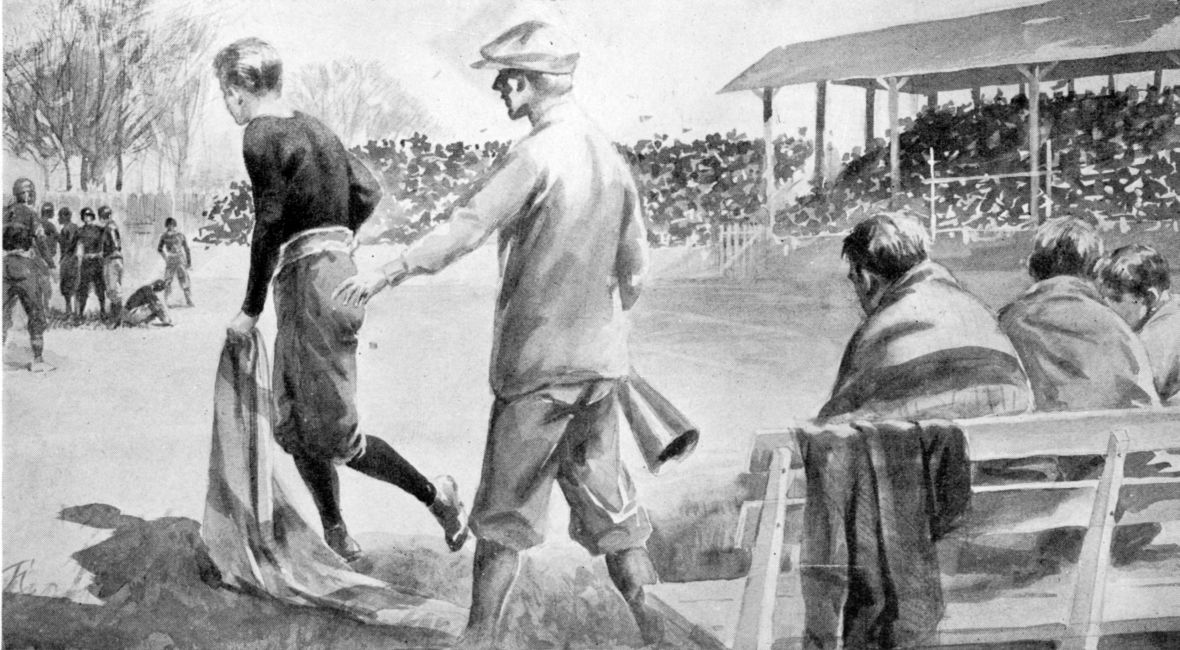
And Barry went ahead, trailing his blanket well onto the field before he remembered that it still hung from one arm, rather scared but still more determined to give a good account of himself, as he ran repeating the coach’s brief instructions.
He reported breathlessly, took Noble’s head-guard, and slipped into position. Zinn gave the signal and he smashed in behind Haviland. There [147]was a moment of frantic swaying and grunting and then the whistle and the referee’s voice:
“Second down! About seven to go!”
Johnny Zinn, trotting back from a deceptive sortie toward the left of the line, called signals as he came: “Locke back! Twenty-seven, sixty-one, fourteen! Twenty-seven, sixty-one, fourteen!”
Barry shuffled his feet two yards behind the goal-line, came to rest, stretched his hands toward the stooping Sisson. Beyond the line of his own forwards, he saw the swaying, eager forms of the enemy, feinting, pawing the air, desperation on every face. Then something brown left the trampled sod ahead of him, grew larger as it turned lazily over in its flight, and came to rest in his outthrust hands. Ten yards away turmoil and confusion sprang to life. Forms leaped against the sky as Barry took his step, dropped the ball, and swung a stiff right leg through its arc. There came to him the reassuring concussion of leather against leather, but he sensed it rather than heard it, for the air was filled with cries and the pounding of feet and the rasping of canvas-clad bodies. Then a charging enemy hurtled against him and he went spinning aside and rolled over and over on the turf.
[148]
When he found his feet again the scene of battle was far off, for the ball had covered more than forty-five yards and, its flight deflected by the wind, had escaped a Murray back and bounced across the side-line squarely in front of the Broadmoor bench and the Broadmoor coach. Barry went limping up the field, trailing the green-hosed youth who had thrown a hundred and sixty pounds against his ribs. The ball was being stepped in midway between the forty-five and the fifty yards. Broadmoor, on the stand, was still voicing its satisfaction. Johnny Zinn, coming back to safety position, grinned at Barry.
“Corking work, Locke!” he commented as he passed.
Murray had asked for time and was mending her offense with new material. But there were seconds left now instead of minutes,—not more than ninety of them,—and the score on the board up there was not destined to change. Murray tried desperately to get a man loose, throwing thrice to the tall forward-pass specialist, but twice the ball grounded and once only did he get his hands on it, securing then six yards with Barry clinging to his legs. And then, with the Murray punter stepping back, the end came, and Broadmoor had won, 6 to 0.
[149]
Barry, secretly still thrilled by the memory of that punt, though trying hard not to show it, followed the well-worn path that led across the field to the gymnasium, a silent member of a vocally triumphant stream of players. He still limped a little, but he wasn’t aware of it. He was supremely glad that he had come through so well. He wondered if Major Loring was pleased. Some one ranged alongside and Barry recognized behind a mask of grime the broad countenance of Pete Zosker.
“Lucky thing you got that guy, Locke,” said Pete, affably.
Barry stared up, perplexed. It seemed to him a strange way in which to refer to a punt. But he nodded and Pete added:
“He’s a mighty good hand with those things. Wish we had him!”
“You mean...?” murmured Barry.
“Yeah, that long-legged half-back of theirs. If you hadn’t stopped him that last time I’ll bet he’d have scored. He can run, that long-legged kangaroo!”
It dawned on Barry then that the center was talking about his tackle in the last minute of play and not about the punt, and he hurriedly readjusted his thoughts.
[150]
“Oh!” he said. “Well, I guess Zinn would have got him.”
“Not a chance,” declared Pete, convincingly. “I don’t believe any one could stop that cuss after he once got started!” Pete drew away, leaving Barry sorely perplexed. Not a word about that forty-five-yard kick, made with the enemy charging wildly down on him, made by one who had never before that season taken part in a game with an outside team! Not even mention of it! As for that tackle of the chap who had received the forward-pass, why, it hadn’t seemed to him worth a thought. He had been the nearest to the enemy and had instinctively made for him. By good fortune he had got him. Any fellow could have done that, could scarcely have avoided doing it, but that punt—well, he guessed that even Pete Zosker wouldn’t have done any better under the conditions!
In the locker-room two others rendered brief commendation for the tackle, one, Harris, right end, declaring that Barry had “sure saved the old game that time!” Barry was unresponsive. He wanted very much to say: “Well, but what about my punt from behind the goal-line? Where were you when that happened?” But of course he didn’t. His feelings were somewhat salved [151]later, though, when Major Loring paused on his way out to say: “That was well done, Locke. I was pretty sure you could do it.” Barry was almost certain that the coach was referring to the punt and not the tackle.
Once, while he was achingly divesting himself of his togs, he looked across the room to find Clyde staring at him. Clyde’s expression was queer, Barry thought. It seemed composed about equally of resentment, puzzlement, and respect. Barry smiled. Clyde’s grimace as he turned hastily away was doubtless meant for a smile, too, but it was a painful effort.
Barry’s name was in the city paper the next morning. There was a very brief account of the Murray game, and under the word “Substitutions” occurred the following: “Locke for Noble.” That was all, but since it was the first time his name had ever appeared in a metropolitan paper he was decidedly thrilled. He cut out the story and treasured it.
After dinner that Sunday he turned his steps resolutely toward Number 42 Dawson. Clyde was at home and alone, and Barry somehow received the impression that the other had been expecting him. Clyde was friendly, almost anxiously so, and the lately patronizing manner was [152]strangely absent. Barry was too much pleased to wonder. They talked of several things connected with Hazen, New York, and their folks, before the subject of the previous day’s game was introduced by Clyde. Clyde was flattering in his praise of the other’s performance, so insistent that Barry became uncomfortable and broke in with:
“I was sorry you didn’t get in, Clyde. I thought of course you would.” Perhaps the remark wasn’t very tactful, as he realized after he had made it, but Clyde apparently took no exception to it; rather he seemed to welcome it.
“I didn’t expect to,” he said. “I haven’t been having much luck lately.” Then, after a moment’s silence, he continued, “I guess you know why, Barry.”
Barry shook his head doubtfully.
“I don’t think so.”
“Oh, yes you do! Loring’s playing you up for all you’re worth. He’ll dump me to the third to-morrow.”
“I don’t believe so,” said the other, uncomfortably. “I guess he wants me just because I punt a little. I’m not much good at anything else, Clyde. You know mighty well I wouldn’t want to—to hurt your chances!”
[153]
“Yes, I know that,” replied Clyde, gratefully. “That’s why I’m going to—well, tell you just how things stand with me. I dare say you thought it was sort of funny when I tried to discourage you about football, but the truth is, Barry, I knew pretty well that you’d make good if Loring took you in hand.”
“You didn’t say that!” Barry looked puzzled.
“No, because I didn’t want you to play. I know how it sounds; sort of low-down, Barry; but, you see, it means a whole lot to me to make the first this fall; lots more than it does to you. I’ve only got one more year here and then I’ll be going to college. You and I are just small-town folks. Of course Dad has some money, but he’s downright poor compared with some fellows’ fathers, and no one has ever heard of him fifty miles from Hazen. I mean I didn’t have much to start on when I got here, Barry. I haven’t done so badly, considering; I’ve got in with the right sort, I mean. But—well, it hasn’t been easy, it isn’t easy to keep where I am.
“When I go up to college,” he went on, “a lot of fellows here now will be big noises in the freshman class, and I’ve got to stick with them, Barry. Well, about all I’ve got to bank on is my football. I haven’t social position like some of them: we [154]aren’t wealthy. Why, Jake Greenwalk’s father could buy my dad out with a week’s income! So—well, you see what I mean, don’t you, Barry?”
“I suppose so,” the younger boy answered slowly. “You want to trail along with these fellows after you get to college and you think that if you don’t make good in football they’ll drop you. Isn’t that it?”
“Yes,” said Clyde, eagerly. “A fellow has got to know the right sort when he enters college, because if he doesn’t he won’t get anywhere at all. Besides, it isn’t only college, Barry; it’s afterward, you know. A fellow has to think of what’s going to happen after he’s out, and the right sort of friends help a whole lot. This fall I thought I was pretty sure of making the team. I thought I had a cinch. Then Loring took a fancy to Demille and I saw about the best I could get was a first substitute’s job, but I knew Demille wouldn’t be here next year and I wasn’t worried so much. But now you’ve butted in.
“Oh, I know you didn’t want to,” he hastened to add, “but that doesn’t help much. You can punt and I can’t,—not any better than a lot of other chaps,—and Loring means to push you hard and use you in the big games. That’s plain. [155]It’s fine for you, but it dishes me for fair. I’ll not get any sort of a show from now on. If I get into the Hoskins game it’ll be for about a minute at the end of it. So you see, Barry, I thought I’d tell you just how things stand and—and see what could be done.”
“Sure,” said the other, vaguely. “What—well, have you thought of anything?”
“Yes, but I don’t know how you’ll feel about it. Of course, in a way I have a right to ask you, but—I’d rather you did it as a favor. We’re pretty old friends, you know. I believe if you told the Major you’d just made up your mind you weren’t going to play any longer he’d let you off, Barry.”
[156]
Twenty minutes later Barry left Dawson Hall and made his way thoughtfully toward the gate. The quiet usually following a midday Sunday dinner lay heavily over the campus. In the two dormitories many windows were open wide to the sun-warmed breeze, and in most of them youths lolled indolently. A voice now and then and the subdued tumpity-tump of a banjo alone broke the stillness, until, having almost reached the gate, Barry heard tones of shrill protest, a laugh, and the sound of scuffling in the fallen leaves. A few steps farther along the curving drive he came within view of three boys. Two he recognized; the third was a stranger. Rusty Waterman, Zo Fessenden’s violin in one hand, was trying to possess himself of the bow. Zo, the case hanging open from one hand and the bow in the other, was tugging back from Rusty’s grip. The third boy stood by, laughing.
“No, please, Waterman!” Zo was pleading. [157]“I don’t like to have folks use it! You might break it!”
“Come on, come on!” said Rusty, impatiently. “Here, hold the fiddle, Jack, till I get the rest of it. He thinks I can’t play!” Rusty held out the violin. His back to Barry, he had not noticed the latter’s approach. Barry stepped in front of “Jack” and took the violin.
“I’ll look after this,” he said. Rusty wheeled, dropping his grasp of Zo’s arm.
“Oh!” he said, rather blankly. Then: “It’s Mister Buttinski again, eh?” he added truculently. “What do you want?”
“Not a thing,” answered Barry. He stepped around Rusty and gave the violin to Zo. “Better put it away,” he advised. The youth called Jack had edged aside and with an absolutely neutral expression was watching developments. Zo smiled gratefully and returned bow and instrument to their places, snapping the case shut while Rusty still stared peevishly.
“Let’s go,” said Barry.
Rusty found his voice again.
“Say, you think you can get away with anything, Locke, don’t you?” he sneered. “Let me tell you something. If it wasn’t Sunday I’d teach you good manners, you fresh dumb-bell!”
[158]
“Too bad it’s Sunday, then,” replied Barry, politely. “It ought to be interesting to see you trying to teach manners, Waterman. To any one,” he added.
“Is that so? All right, Locke, you’ll be first.” Rusty laughed hoarsely at what he evidently considered a clever ripost and by a glance invited his companion to share his amusement. Jack, however, ventured no more than the faintest of smiles. Rusty’s own grin vanished and a very ugly scowl took its place.
“I’ll settle with you yet, Locke,” he growled. “I haven’t forgotten, and I’m not going to. You’ll get yours, I promise you!”
Barry made no reply and he and Zo went through the gate and turned toward home.
“How did he get your violin?” asked Barry.
“He asked me to let him see it, and when I opened the case he took it out. I asked him not to. Then he wanted the bow. He said he wanted to play a jig. I was afraid he might break it, and wouldn’t give it to him.”
“Does he bother you often, Zo?”
“No-o, not very. Two or three times he has stopped me and—and sort of teased me.”
“How does he tease you?”
“Oh, makes fun of me and makes me shake [159]hands with him and hurts me a little. He presses his thumb in here.” Zo indicated the space between thumb and first finger. “I don’t mind much. Once, just after they caught me that time,—Pup Night, you remember,—he said he and some of the others were going to lay for me some night and give me that ducking. I was sort of scared for a while and used to wait for Mill or some one to go home with me, but I guess he was only talking. He doesn’t bother me much.”
“He’s a silly ass,” said Barry, impatiently. “Some one ought to teach him manners. I don’t suppose I could, but I’d be willing to try. You ought to have told Peaches or me about him before, Zo.”
“I didn’t want to make—I didn’t want to have you think me such a baby. I guess I am a baby, though. I don’t know much about fighting, Barry.”
“Well, you ought to know how to protect yourself, Zo, and when I can find the time—after football’s over—I’ll show you a little about boxing, if you like.”
“Thanks,” murmured the other, in no very enthusiastic tones. “I don’t think I could ever be much of a fighter, though.”
Barry laughed.
[160]
“I don’t believe you could! But you’ll find that if you know how to use your fists you’ll not have to use them. Not very often, anyway. Fellows like Rusty don’t get funny with fellows who look as if they knew a thing or two. What were you doing with your violin to-day, Zo?”
“I was playing for Mr. Sartier before dinner. He wants to start an orchestra here. He’s an awfully good pianist, Barry. We tried three or four things together and got along pretty well, I think.”
“A school orchestra, eh? Sounds like a good scheme, Zo. I hope Frenchy makes it go. I’d a heap rather hear him play the piano than preside in French class. By the way, if it does come off I hope you’ll speak a good word for me, Zo. I’d like to join it.”
Zo smiled doubtfully.
“You don’t play any instrument, do you?” he asked.
“Don’t I! You ought to hear me play the baton!”
Barry’s amusement over his own joke didn’t survive the journey from the front gate to the house, however, and Betty, in sole occupancy of the sunlit porch, remarked:
“You must have said something awfully funny [161]to make Zo Fessenden laugh like that, but you don’t look now as if you’d ever joked in your life!”
Barry sat down on the edge of the porch and smiled weakly.
“I’m always saddest when I smile, Betty,” he answered. “Where’s every one?”
Betty waved a slim hand vaguely.
“Gone,” she said. “Let’s see. Father’s taking his walk, Mother’s gone to see Mrs. Travers, Peaches hasn’t shown up since dinner, and I’m here. Oh, yes—and Toby’s upstairs where he always is.”
“Pinning inoffensive beetles to cigar-boxes, I suppose. He’s been having a rough time at school lately. Some one let out about the care and feeding of frogs and Toby’s getting frightfully ragged. Toby says Mill did it, but Mill declares he didn’t.”
“Of course you don’t know who it was,” observed Betty, demurely.
“Well, if you think it was me, you’re wrong,” said Barry, grinning. “When I tried to tell a fellow he said he’d already heard it!”
Betty laughed and Barry’s grin turned to a frown.
“I wish Peaches would come,” he said plaintively. [162]“I want to talk to him about something.”
“You and he are pretty good friends, aren’t you?” said Betty. “I’m awfully glad. It’s funny, too, for he’s been here with us two years and he was never chummy with any of the boys before.”
“He says I amuse him.” Barry turned from watching the road in the direction of school and asked: “Why is it Peaches doesn’t have more friends, Betty? I mean fellows he goes about with. He knows every one, it seems, but he doesn’t seem to want to have much to do with any one.”
“I don’t really know, Barry. The first year he was here he started to go around with two or three fellows in his class. You know them, I guess: Ellingham and Prentiss.”
“I know Ellingham,” said Barry. “They call him ‘Goof.’ That the one?”
“Yes. And Prentiss is a tall boy with a lot of color in his cheeks, who dresses a lot. Then there was another—he wasn’t in Peaches’ class, when I think of it—named Shafter. They all belonged to the rich crowd in school, you know. Well, Peaches went with them for maybe a month or two and then all of a sudden he stopped. I never knew what happened, only Davy said something [163]to Peaches about it one day and Peaches said, ‘Oh, they got my goat!’ Since then he’s sort of kept to himself, although all the boys seem to like him a lot, and he always gets more applause when he goes to bat in the ball games than any one else on the team!”
“Funny for him to get in with the wealthy crowd,” mused Barry. “Maybe they found he wasn’t—well, one of them, you know, and dropped him.”
“I guess he wasn’t one of them,” assented Betty, “because he’s so much of a—a gentleman. Of course the others had lots of money, too, but they—oh, I don’t know—they weren’t a bit like Peaches.”
“What I meant was that the others probably dropped Peaches because he wasn’t rich enough for them. That is, his folks weren’t. I guess there are quite a few snobs here.”
“But, gracious!” said Betty; “they weren’t any of them as wealthy as Peaches! Why, they couldn’t be! At least, it doesn’t seem as if they could.”
Barry stared.
“I don’t get you. Are you trying to tell me that—that Peaches’ folks are well off? wealthy?”
“Well, gracious! aren’t they? I don’t know [164]very much about it myself, Barry, but Father said once that he guessed Harrington Jones was one of the four or five richest men in the country. Anyhow, he must be richer than—”
“Harrington Jones!” exclaimed Barry. “Do you mean that Peaches is—is—Land of Liberty! I thought he was poor! Are you sure?”
“Of course I am!” laughed Betty. “Why, Mr. Jones was up here last spring! He came for the Hoskins game. He sat right here on this porch and talked to Mother and me and was perfectly darling. Peaches looks a lot like him, too, and says things just the funny way his father does. Why, the idea of thinking him poor! How ever did you get such a funny notion, Barry?”
“Why—why, I don’t know,” murmured Barry. “He never said anything. And his room—I mean it doesn’t look like a rich fellow’s; now, does it? Gee! and I was telling him one day how wealthy Clyde’s father is! He must think I’m a—a dumb-bell!”
“He never does talk about money, or about his father, either,” said Betty; “and his room isn’t fixed up much. But haven’t you ever noticed what nice things he has, Barry? His brushes and toilet things are lovely. And he has nice clothes, too. Even,” she added with a laugh, “if he does [165]go around wearing his oldest ones most of the time!”
“That’s so,” acknowledged Barry; “he has got some nice things upstairs. I noticed his bureau one day, but I didn’t think about his having silver brushes and photograph frames. Yes, and he has about two dozen pairs of shoes, too, and I saw them and thought they were old ones and joked him about it! Gee, Betty, he must be indecently rich!”
“I guess so, but I don’t care if he is; he’s awfully nice. We thought of course he would go into one of the dormitories last year, but he didn’t, and he didn’t this year, either; and it was just because he knew Mother might have trouble renting his room again. I call that awfully—thoughtful.”
Barry nodded.
“He said something about that. Said the faculty made it sort of hard for folks who rented to students and he was afraid Mrs. Lyle wouldn’t fill the room if he got out. Just the same, Betty, I think he likes it here better than a dormitory.”
“Yes, I think so, too, and that’s just another nice thing about him,” replied Betty, warmly. “Lots of boys in his circumstances, with all the money they want, wouldn’t be satisfied unless [166]they had the best room in Meddill.” There was a pause, and then she asked: “Did he tell you any more, Barry? I mean about—about my brother Davy?”
“Yes, he did,” Barry confessed a bit awkwardly. “I hope you don’t mind.”
“No, not a bit, Barry. You see, you’re a good deal like Peaches. I mean you’re—” Betty hesitated, smiled, and shrugged her slim shoulders apologetically. “I just mean that I don’t mind your knowing,” she laughed.
“It was awfully—awfully hard luck,” said Barry. “I guess Mr. Benjy feels pretty badly about it.”
“He misses Davy,” said Betty. “We all do. But you mustn’t think Father feels badly, Barry, because, you see, Davy didn’t really do what they said he did.” She looked down at Barry very straightly, a little sternly.
“So Peaches said,” he answered. “And with both you and Peaches telling me the same thing I’m bound to believe it.” He smiled, and Betty’s severity relaxed.
“Peaches was a dear when it happened,” she said. “He tried very hard to persuade Davy to stay here and prove his innocence, but Davy wouldn’t. He was hurt, and a little bit frightened, [167]too, I think, and he wanted to get away from the talk. He couldn’t have, though, if Peaches hadn’t helped him. We didn’t have any money in the house that night, and Peaches went over to the school and got some from Mr. Puffer, the treasurer, and—well, I don’t know the rest of it, because I never asked.”
“He didn’t tell me that part of it,” muttered Barry. “Do you hear from him, Betty? Davy I mean.”
“Oh, yes, he writes pretty regularly. He’s had an awfully hard time, poor boy. He’s had four or five positions, but he can’t seem to hold them. They haven’t been the right kind for him, because he doesn’t really know much except office work, and you can’t get that very easily without references, and Davy hasn’t any. He sends his letters to Peaches. We were afraid the police might watch the mail, you see. Still, they never tried to find him after he left here, so far as we know, and maybe they’ll let it drop after a while.”
“It wouldn’t be safe for him to come home yet, then?”
Betty shook her head, yet hesitantly, and before she could reply Mrs. Lyle returned from her visit along the street. After a few minutes Barry [168]went up to his room and seated himself at the walnut desk, which, under Betty’s care, was regaining some of its youthful luster. He didn’t feel in the mood for letter-writing, but this was the day for it, and after several false starts he managed to finish two pages.
“I’ve about decided to give up football for this year,” he was writing, when Peaches’ footsteps sounded on the stairs and then approached along the hall. Barry had left his door open and Peaches entered.
“‘I am studying very hard,’” he dictated as he sank into a chair, “‘and winning much praise from my dear teachers.’”
Barry laid down his pen and viewed him rather moodily.
“I guess it would be a good thing if I could say that,” he muttered. “I’m studying hard, all right, but I haven’t heard much praise from my dear teachers!” Then recollection of Betty’s astounding revelation came to him and he looked Peaches over from head to toe, with new interest. Peaches frowned and put a hand to his tie.
“What is it?” he asked anxiously. “Let’s know the worst. If it’s the tie I’ll change it.”
“You’re Harrington Jones’s son, aren’t you?” said Barry.
[169]
Peaches nodded cautiously.
“What are you trying to do? Serve a summons on me?”
“Betty just told me,” answered Barry, darkly.
“Told you what?”
“That you were—are.”
“That I were what? I’m sorry, Barry, but I’m like this on Sundays, after a hearty dinner: I’m not quick, you know. I have to have the simplest things explained to me. You’d be surprised!”
“I was,” said Barry. “I thought you were—well, sort of poor. Now I find you’ve got slathers of coin.”
“Not me,” said Peaches. “Dad has quite a roll, I believe, but I worry along on a mere pittance. Still, anything up to three or four dollars—”
“I’m not trying to borrow money, you chump!” retorted Barry.
Peaches chuckled.
“Then why all the prologue? You’re wasting a mighty good introduction.”
“Why didn’t you tell me about your folks?” demanded Barry, sternly. “I thought you were poor. I was talking about rich fellows a while back, and saying perfectly insulting things, for all [170]I remember, and you just let me go on and never said a word about being one of them!”
Peaches shrugged.
“Why should I? If you had asked me I’d have confessed the dreadful truth, but you didn’t. We both agreed that a fellow had no right to take credit for his parents, didn’t we?”
“Well, but—oh, all right! Just the same, I felt a perfect ass when Betty spoke about your folks being wealthy. I thought she was crazy.”
“How come I was the subject of discourse?”
“I forget. Oh! I asked where you were and—and we just got talking about you. Betty was trying to tell me what a wonder you were and, of course, I couldn’t see it.”
“Humph!” grunted Peaches. “I’d be ashamed to own up to such lack of discernment. I don’t know where Betty got her idea, but I’m sure it’s right.”
“Fishing!” laughed Barry. “Well, I’m not going to tell you. She did say, though, you had been nice about that brother of hers. She told me all about how you helped him get away too. Gee! if I wanted to go to the police and tell what I know about you—”
“She hasn’t seen him?” asked Peaches, eagerly.
[171]
“Seen him?”
“Well, I thought maybe— The fact is, he hasn’t written for nearly two weeks, and I didn’t know but that he had shown up here. You know he addresses his letters to me and I hand them over to his folks. He’s crazy to come back here yet, though, I guess.”
“I don’t believe he has,” said Barry. “She didn’t say anything about that, anyway. Say, where have you been since dinner? I wanted to see you about something.”
“Oh, I stopped in to see Billy Bassett. What’s on your mind?”
“Well,” began Barry, slowly. Then he stopped and, after a moment, began again: “I sort of wanted your advice, Peaches.”
Peaches nodded.
“I’m flattered, Barry. About which?”
“Football.”
Peaches looked dubious.
“Well, of course, Barry, football isn’t exactly a subject—”
“About resigning from the team, I mean. Do you think the Major would—would be willing?”
[172]
After a moment’s silence Peaches asked soberly: “What’s happened?”
Barry looked out of the window.
“I just decided I’d better quit,” he replied, elaborately casual. “It’s pretty strenuous, for one thing; and then I’m not doing awfully well with Latin and—well, I just thought it would be the wisest thing, Peaches.”
“I see. And you want to know if Loring will let you do it, eh? Well, I can tell you that he won’t. Not for any reason you’ve told me, Barry.” Their eyes met. Barry’s fell and he shuffled his feet.
“I don’t see how he can make me play if I don’t want to,” he muttered.
“If you don’t want to play,” replied the other, dryly, “I don’t think he will try to make you.”
“Well, then—”
“But the fact that Allen doesn’t want you to wouldn’t matter so much to him.”
[173]
“Allen?” Barry tried to sound puzzled. “I didn’t say anything about Clyde,” he protested.
“You don’t have to, young Ananias. I happen to have been in Billy Bassett’s window when you came out of Dawson about an hour ago. So you’d better come clean and tell me just what it’s all about.”
Barry considered a moment. Then he grinned sheepishly.
“Think you’re a regular Sherlock Holmes, don’t you?” he asked.
“Never mind about that,” returned the other, soberly. “Just tell me one thing, Barry. Does Clyde know where you hid the body?”
“What do you mean?”
“You know well enough what I mean,” answered Peaches, viewing the other severely. “He’s got something on you. I don’t have to be a detec-a-tive to know that. You’re afraid to turn around without being sure beforehand that Allen approves of it. I’m no more curious than the next guy, but—gosh!—this has got my goat! I’ve been wanting for weeks to ask you, only I didn’t have the nerve. Now you’ve got to come across with the whole dastardly tale. What claim has Allen got on you?”
“I don’t suppose,” answered Barry, slowly, [174]“you’d call it a claim exactly. It’s only that—well, you see, Peaches, I’m under a big obligation to him, and that’s why I kinda feel that it’s up to me to—to oblige him when I can.”
“What sort of an obligation?” demanded Peaches.
“Well, he—he saved my life.”
“Saved your life!” Peaches whistled his surprise. “Allen did? What do you know about that? How did he do it, for Pete’s sake?”
“It was summer before last, in Maine. His folks and mine have cottages at Orchard Bluff. We were in swimming one day and I got sort of far out. The tide’s kind of tricky there sometimes. There’s a current that sets along the beach and swings out around Frenchman’s Head. I didn’t realize I was so far from the beach at first, and when I did and started back I couldn’t make much headway. I guess I got sort of scared and nervous, and probably I didn’t get much of a stroke. Anyway, I wasn’t making shore at all; just going down toward the Head. Clyde and two other chaps were there, near the beach, and Clyde happened to miss me and saw what was happening. So he swam out and—and helped me in.”
“I see,” said Peaches. “Allen must be a good swimmer. Better than you, is he?”
[175]
“Why, I don’t know. I—I guess we’re about alike. Only, you see, I was more tired that time.”
“Couldn’t have kept afloat much longer? Ready to give up when he arrived?”
“Oh, no, but—I know what you’re getting at, Peaches. Of course I mightn’t have drowned. I might have floated and worked my way in around the Head. But I was sort of nervous, and when you’re nervous—”
“You get over it if you’re any kind of a swimmer. Come on, tell the truth. If Allen hadn’t ‘rescued’ you you’d have got ashore farther along the beach. Only, he thought he was saving your life and you didn’t like to tell him he wasn’t. Isn’t that about it?”
Barry looked pathetically uncomfortable.
“Maybe he didn’t actually save me from drowning,” he acknowledged, “but he did come to my rescue, and he thought I was drowning, and it would have been just the same if I had been!”
“Oh, I’m not trying to detract from Allen’s stunt. What he did was plucky, all right. But the main point, if you’ll only see it, is that he didn’t save your life, no matter what he thinks; and if he didn’t you certainly don’t owe him a blamed thing!”
[176]
“Well, but—don’t you see—”
“Of course I do! He thinks he rescued you from death and takes good care you don’t forget it. And you were too soft-hearted to tell him then and—you never have. But if I were you I’d get rid of the notion that I owed my life to him. I’d use my own judgment about things instead of his. And if I wanted to play football, I’d play football!”
Barry sat silent but unconvinced. Finally: “You said yourself I couldn’t tell Clyde the—the truth,” he protested. “And he thinks I owe him something, naturally, so I’ve just got to show some gratitude!”
“All right,” answered Peaches, grimly. “But you’re not going to get out of football to please him, my bucko, and you may take my word for it. If you go to Major Loring with any cock-and-bull story like you tried on me I’ll see him myself and tell him the facts.”
“That’s not fair,” Barry protested.
“Fair enough for me. If it comes to that, no one’s being fair. Allen isn’t, and that’s a cinch! And you’re not, if you let the team down now when it needs you. No, sir! you tell Allen that there’s nothing doing. I suppose he’s afraid some of his swell friends will give him the [177]raspberry if he doesn’t get on the team. I hope they do. He’s trying to train with a lot of sap-heads, anyway. I know the bunch. I started in with them the first year I was here. They made me so sick I had to quit. It would be the best thing in the world for Allen if they gave him the shake. And you might tell him that, too.”
“He didn’t used to be so—so—” Barry sought unsuccessfully for a word.
“He’s been ‘so—so’ ever since I first knew him,” said Peaches, harshly. “He’s been trying to make ‘society’ here right along. He and that side-kick of his, Stearns. Either of ’em would lick my boot if I’d asked ’em home for a week-end!” Barry looked decidedly shocked and shook his head in remonstrance. “Let me tell you something,” pursued Peaches. “The day you landed here and I saw you were under Allen’s thumb I made up my mind to—well, get you out. You seemed a decent chap and worth saving. That’s why I sort of haunted you for a day or two. I could see that you didn’t quite approve of me and wondered why I didn’t mind my own business.”
“I didn’t, really!” said Barry, earnestly. “I mean I didn’t wonder.”
“Anyway, you were perfectly polite,” chuckled [178]Peaches. “Not that it would have mattered to me if you hadn’t been. I’d have persisted in my—may I say crusade? There were times when I was discouraged. I acknowledge it. There were times when it seemed that Allen’s—let’s see—domination was too much for me. And then the Major kidnapped you for football and I could see a rift in the clouds. Several times after that you showed a disposition—oh, faint, I own!—to act on your own initiative and think for yourself. I began to have hopes for you, Barry; I really did. But now—well, now you’re trying to have a relapse.”
“It was very nice of you to interest yourself in me,” said Barry, rather stiffly. Apparently he had not heard much of the latter part of the discourse. “I’m afraid you’ve been badly bored at times.”
Peaches regarded him questioningly. Then, however, he smiled.
“Oh, well, I see what you mean, Barry. But you’re quite mistaken, and I guess you know it. If you must have it, Mister Hoity-Toity, I have long since fallen victim to your manly charms and—er—sterling character.”
“Shut up!” growled Barry. But he grinned, too. Then, hurriedly: “That’s all right,” he [179]went on, “but what am I going to do? I told Clyde I’d see the Major and try—try to resign!”
“See him, then,” said Peaches. “Only, my young friend, don’t lie to him.”
Barry sighed. “I don’t want to lie, Peaches, only—well—gee!—what can I say?”
Peaches shrugged.
“Tell him you’ve decided to quit. If he asks you why, say it’s none of his business.”
“Thanks,” muttered Barry, with deep sarcasm. Then, after a moment’s silence: “Look here; how’d you know Clyde wanted me to quit? I didn’t tell you that.”
Peaches viewed him pityingly.
“By the simple process of putting a couple of twos together. For a fortnight I’ve seen it coming. You’ve been traveling fast and Allen’s been standing still. The whole school knows that Major Loring’s training you for the big event. Allen having the strangle-hold on you that he has, I knew it wouldn’t be long before he’d begin to use it. I’ve been looking for your tongue to protrude for several days. A while ago I saw you coming out of Dawson looking like a pinch-hitter who has just struck out. Then you tell me that owing to the failure of the Canadian wheat crop or something, you’ve decided to quit playing. I [180]may have a slanting forehead and a weak chin, Barry, but somewhere a faint spark of intelligence still glows.”
“Well—well, will you come with me to see the Major?”
Peaches reflected. Then he nodded.
“Yes,” he assented, “I’ll do that much for you. You shall have my moral support in your hour of tribulation. Shall we go now? I think we’ll find him in. This is the hour of the day he sharpens his knives and heats his jolly vat of oil for the entertainment of innocent youths desiring to resign from the football team.”
“I thought maybe I’d see him this evening,” said Barry, a trifle faintly.
“Never put off until evening what you can do in the afternoon,” replied Peaches. “That has been my guiding rule through life and to its strict observance I attribute much of my success.” He arose with what seemed to his companion indecent eagerness. “Take one last look at the dear, familiar scene, Barry, and let us be gone. ‘And so, whate’er befalls me, I go where duty calls me! Farewell, farewe-e-e—’”
Peaches’ vocalization ended abruptly as he dodged the waste-basket.
[181]
To Barry’s palpable disappointment, the Major was at home. He occupied two rooms in Mr. Banks’s residence, directly across the road from the school grounds, and Mrs. Banks, who answered the bell, smilingly admitted the two boys and indicated the door on the left. Barry’s knock was timorously soft, yet the ogre heard it, and called, “Come in!” with a heartiness that brought to the mind of one of the visitors a vision of boiling oil.
Major Loring had the front room and the one behind it, the latter displaying through a broad arch a Spartan simplicity. In it there were a cot bed covered with brown army blankets, a chiffonier, a wash-stand, two chairs, and a trunk. But the front room was almost luxurious, with a big couch and several deep leather-covered chairs, a round mahogany table littered with books and papers and magazines and smoking articles, some bookcases across one wall, and a cheerful rug [182]of golden-brown hues. Although the afternoon was far from cold, some hickory chunks burned in the fireplace, and it was from an arm-chair in front of the hearth that the host arose, book in one hand and pipe in the other, to welcome the callers.
“Hello, you chaps!” he exclaimed. “Glad to see you. The more so as I was bored stiff with this.” He tossed the book on the table and pulled a chair toward the hearth. “Bring that other one along, Jones. Sit down, Locke. That fire isn’t really needed to-day, but I’m sort of an old granny about fires. I love to sit and toast my shins. Well, Jones, how’s life treating you?”
“Almost as well as I deserve, sir.”
Major Loring chuckled.
“You leave me to draw my own conclusions, eh? Oh, well! I dare say you aren’t getting many hard knocks. You look chipper enough. Of the two of you I’d say Locke is the one who’s discovered a crumpled rose-leaf. No ill effects from yesterday’s argument, I hope?”
“No, sir,” answered Barry, trying to smile as naturally as his companion.
“That’s good. Did you see the game, Jones? Our chaps showed a little more class, don’t you [183]think? Oh, we’ve got some way to travel yet, but it looks as if we’d got started! Locke, here, did a pretty good job, by the way. There’s a fellow who told me only three weeks ago that he didn’t care for football!”
The coach laughed and Barry managed to grin.
“I thought our team played pretty good football, sir,” said Peaches. “Looks to me as if we’d round out all right by the end of the season. Some of the new fellows are showing up pretty well, aren’t they?”
“Yes, they are. We’ve got a lot of clever substitutes, Jones; and, take my word for it, nothing makes a coach feel more snug than plenty of good second-string material. He has next year in mind as well as this, you know. And the year after that, too. I’d like to keep twice as many fellows going as I do, but there’d be no use in that, as I couldn’t look after them. I’ll have some help after this week. Graham and Jonah Mears are coming up to help out. Graham will take over the third squad and give us some real practice games. You remember him, Jones. He was here last fall.”
“Very well, sir. Little wiry chap. Mr. Mears, too, although he was up only a few days, I think.”
[184]
“Yes, but he’s going to give us two full weeks this time. He’s a corking good hand with the backs.”
The football talk continued. Barry, perched on the edge of a big chair, listened, smiled perfunctorily when the Major glanced his way, and wished himself back at home. How would he ever manage to do what he had come to do? Football finally became exhausted as a topic and the conversation turned to baseball and the Major and Peaches discussed plans for the spring. The fire crackled and hissed softly and the sunlight became ruddy outside the open windows. Finally Peaches looked at his watch and, “Hello!” he said, glancing at Barry. “’Most six! We’ll have to be traveling.”
Barry took a long breath.
“Major, I—” Perhaps he hadn’t really spoken out loud, for the Major evidently hadn’t heard.
“Well,” the latter was saying, “I’m glad you dropped in, Jones. You, too, Locke. Do it again, will you?”
“Major!” Barry jumped at the sound of his own voice, and the coach, too, seemed startled. But Barry hurried on: “Major, I’ve been wondering if I—if I wouldn’t be more use next year.”
“More use? Oh—to the team, you mean. [185]Why, yes, I hope so, Locke. Yes, you’re coming along very well. By next year you ought to be able to give a pretty good account of yourself. But I rather think we’re going to find use for you this year, my boy. If you keep coming at your present speed you can count on at least one game at right half. I told you when you joined up that I couldn’t promise you anything, you’ll remember, so you mustn’t be disappointed if you don’t get into all the games. You’re doing first rate, Locke, and I’m not forgetting you. Don’t get discouraged just because things don’t come your way all at once. You’re doing your share, even if you don’t get into the front trenches very often. And you never know when the reserves will be called up.”
The coach laid an encouraging hand on Barry’s shoulder. It didn’t seem to Barry that the host exerted sufficient pressure to persuade him to the door, yet that was where he found himself; with Peaches already on the threshold, grinning widely. Barry gulped, sought for words in which to frame his question, failed, and echoed Peaches’ “Good-by, sir.” Then they were outside, the gate had closed behind them, and they were striding down the road!
For several moments Barry looked straight [186]ahead and the silence was abysmal. Finally he stole a glance at Peaches. Peaches was as solemn as a stone image, so solemn that Barry had the pleasing conviction that it hurt. A dozen steps farther and a slight choking sound was heard. Barry’s own lips twitched, but he didn’t turn. Not until, a moment later, he found himself alone. A few paces behind, Peaches clung saggingly to the trunk of a maple, helpless, his shoulders shaking under the emotion that had overcome him. Barry stared indignantly for as long as he could. He even managed an outraged “Huh!” But after that he gave up.
Yet his amusement was less hearty than his companion’s and he recovered first.
“You think it’s fu-funny,” he gasped. “I hope you ch-choke! What shall I tell Clyde? Go-gosh! I can’t say I didn’t ask him!”
Peaches beat the air weakly a few times with his hands, opened his mouth and closed it convulsively, and reminded Barry so much of a dying fish that the latter mentioned the fact scathingly. Perhaps the insult was just what Peaches needed, for after a final gurgle he regained the power of speech.
“That—that was great!” he said, wiping his [187]eyes. “The expression, on your face, Barry, when he patted you on the back and told you not to be—be discouraged! Oh, gosh!”
He was plainly threatened with a relapse, and Barry spoke sternly:
“Come on, you blithering idiot! Let’s get home. It’s all well enough for you to laugh about it, but what am I going to tell Clyde?”
Peaches made a superhuman effort and controlled himself.
“Tell him,” he answered, “that you tried to hand in your resignation, but the Major wouldn’t listen. That’s so near the truth that the difference needn’t worry you. Goodness knows you did try, Barry!”
“I’ll just have to tell him how it was,” said the other, resignedly. “And he’ll say I didn’t try at all.”
“Tell him,” advised Peaches, impatiently, “to sit on a tack! You don’t owe him a blamed thing, Barry; only you can’t seem to get it into your bean. Why, in the name of common sense, should you resign?”
“Well, we’ve been friends a long time, Peaches, and—and I’ve always liked him. I know you don’t think much of him, but he’s really not half [188]as—as bad as you make out. It’s only since he came here that he’s been acting so silly. It’s going to be a frightful disappointment to him if he doesn’t make good on the team, and I hate like anything to be the—the cause of it. I dare say that sounds foolish, but that’s the way it is.”
“No, it doesn’t sound foolish,” replied Peaches, a grave, warm note in his voice. “It sounds pretty fine, Barry. Only I rather wish Allen would show himself half as white as you are. I’ll take your word for it about him. I haven’t had a chance to know him very well. Anyway, I’ll lay off him.”
“That part’s all right,” Barry responded. “I guess you haven’t said anything about him that isn’t true. Anyway, when I like people, what other people say about them doesn’t—doesn’t seem to make much difference.”
“Are you feeling perfectly well?” asked Peaches, anxiously.
“Why?”
“Nothing, except that the good and noble usually die quite young, Barry.”
Barry found that interview with Clyde extremely unpleasant. Clyde showed incredulity and Hal Stearns expressed it.
[189]
“Tell it to Sweeney!” jeered Hal. “I’ll bet you haven’t been near the Major!”
“If you don’t believe me,” answered Barry, warmly, “ask Crawford Jones. He was with me!”
“Oh, he was, eh?” exclaimed Clyde. “He’d be a big help—I don’t think! How’d you happen to lug him along?”
“Well, I just didn’t have the pluck to go there alone, Clyde. You know Major Loring. He’s a corker, of course, but—but he can look awfully fierce sometimes. And I knew I oughtn’t to ask what I was going to—”
“Yes, I guess you didn’t have much idea of asking, at any time,” interrupted Clyde. “After all I’ve done for you, Barry, you might have gone through with this, I’ll say!”
“I tried my best to,” said Barry. “Honest, I did, Clyde! He wouldn’t have let me off, anyway. I’m sure of it.”
“Of course not,” agreed Hal, ironically. “Why, you’re the mainstay of the team, Locke! Without you where’d we be, eh?”
“All right,” said Clyde, angrily. “But I’ll tell you one thing, Barry. You aren’t going to double-cross me and get away with it. I’ll see that you don’t last very long, kid. I’ll fix it [190]somehow so you’ll wish you’d kept out of this. You’ve got about as much chance to get into the Hoskins game as—as—”
“As I have,” supplied Hal, bitterly.
Barry stared unbelievingly.
“Why, Clyde!” he faltered.
“Well, you heard me,” muttered Clyde. “I mean it, too. I wish to goodness I’d let you drown that time, you little shrimp!”
“Clyde,” asked Barry, rather white now, “did it ever occur to you that you might be taking too much credit for that—that rescue?”
“Just what do you mean?” asked the other, staring.
“I mean that if you had let me alone I’d have been perfectly safe. I’m as good a swimmer as you, and you know perfectly well that you wouldn’t have drowned that day if you’d been in my place. I’ve never said this before—”
Clyde’s laughter broke in.
“No, and you’ve got a lot of cheek to be saying it now! You never have shown much gratitude, but this is the limit! Did you hear that, Hal? Why, he was ready to give up when I got to him! I didn’t save you from drowning, eh? Like fun I didn’t! Queer it’s never occurred to you before! [191]I’ll bet your folks don’t think your way. Oh, you make me ill!”
“Sorry,” said Barry, dryly. “I tried to do what you wanted me to, Clyde, and I couldn’t. I’m sorry about that, too. And I wish we hadn’t quarreled.”
“Oh, go sell your papers!” sneered Clyde. “And don’t look to me for any more help. I’m through. You don’t know the meaning of gratitude! Lying about me saving your life! You’re—you’re sickening!”
So Barry closed the door behind him and went hurriedly downstairs and out of the building, not very far from tears. But the frosty night air worked an instant miracle. He shouldn’t have said what he had about the life-saving incident. He hadn’t meant to. Of course Clyde hadn’t believed him. He never would. Clyde had been unjust and had said perfectly uncalled-for things, but he had been horribly disappointed, and Hal had egged him on; and then he, Barry, had gone and made things worse by saying that Clyde hadn’t saved his life!
By the time he reached the road Barry had thought up enough mitigating circumstances to make Clyde’s conduct almost reasonable. He still [192]felt hurt, but of course Clyde hadn’t really meant all he had said and would be sorry to-morrow. As for his threat of hurting Barry’s chances on the team, why, that had been just talk. Clyde would never do anything dirty; not even now, when he had changed so much from the Clyde that Barry used to know.
Barry didn’t go into details in his report to Peaches. He just said that Clyde had been disappointed and rather peeved. But Peaches, discerning in the other’s countenance traces of a recent mental disturbance, drew his own conclusions. All he said was:
“Well, that’s off your mind, Barry. Now you can buckle down and give yourself unreservedly to the task of saving our dear old Alma Mater—Heaven help her!”
[193]
Barry awoke the next morning in a rather depressed mood, for which the weather was not wholly to blame. Outside the window the rain was pouring in torrents. The brick path to the gate was plastered with drowned leaves, and in the narrow beds at each side the bare stalks of the salvias arose from a tangle of withered nasturtium vines like soldiers tottering in a last stand against the enemy. The little pits from which Mrs. Lyle had lifted her geraniums had become muddy pools against the surface of which the big drops splashed ceaselessly. The gutters ran like mountain brooks, and, across the road, a spout at one corner of the Anderson house poured a veritable Niagara upon the sodden lawn below. In the dim gray light the falling water looked like liquid silver.
Not a cheerful beginning for a new week, Barry reflected as he donned a crackling slicker. A minute or two later, as from the shelter of the porch [194]he and Peaches viewed the drenched world, preparatory to the dash to chapel, Peaches murmured: “Now I know exactly how the dove felt when he left the ark!”
There was no outdoor practice for the football players that afternoon; only an hour of what they called “bean-drill” in the half gloom of the gymnasium. The chalk lines and emblems that Major Loring scrawled on the blackboard were no more than gray under the rain-pelted skylights. Barry was relieved, though not surprised, when Clyde nodded to him. There wasn’t much warmth in that greeting, but, rightly or wrongly, Barry detected a hint of apology in the brief glance that accompanied it. He felt a little more cheerful after that, and would have spoken to Clyde had the chance offered. But it didn’t.
He overtook Zo on the way back to the house, Zo swinging his violin-case and whistling a football song gayly as he splashed through the rain and the puddles. Recalling the recent attentions of Rusty Waterman to the younger boy, Barry asked:
“How are you and Waterman getting on, Zo? Has he been bothering you lately?”
“No, I don’t think he’s even noticed me since that time he tried to get my violin.”
[195]
“Hardly polite, I’d say, but perhaps you don’t mind.”
Zo smiled his shy smile and shook his head.
“I’m perfectly satisfied,” he answered.
It was still raining Tuesday morning, but by noon it had stopped and at half-past three the football squad was assembled on a soggy field. There was no scrimmage that day. In fact, the session was cut almost in half. Barry gained a lot of experience in the handling of a wet pigskin and marveled at how heavy and erratic it could be when well saturated. Passing Hal Stearns in pursuit of an escaped ball, Barry chose not to see him, but Hal refused to be invisible.
“Well, how’s the great half-back to-day?” he called in tones of extreme deference. Barry pretended deafness as well as blindness. He was ready to forgive and forget where Clyde was concerned, but Hal had no claims of friendship, and Barry, who had never succeeded in liking him, now detested him heartily.
Later, returning to the bench, Barry saw Hal and Rusty Waterman with heads close, and although they gave him but the shortest glance as he approached, he was uncomfortably certain that he had been under discussion. Clyde looked extremely morose that afternoon, and Barry’s [196]friendly “Hello!” received only a nod and a grunt. If, thought Barry, Clyde had felt self-reproach the day before, he had quite recovered.
Clear skies and cold weather made practice snappy enough to satisfy even the Major. Barry played right half-back on the second or substitute squad, and, while he performed no remarkable deeds, got along very well. Sometimes he yielded his head-guard to Noble and sometimes to Clyde. His punting-drills had ceased now. He had made excellent progress, and, save that he lacked the others’ experience, and showed it, was kicking as well as Tip Cartright. Tip could still beat him by an average of five yards, but Barry displayed an ability to place his punts that made up for yardage.
The cold days and the rapid approach of the Big Game awoke the school to its annual football enthusiasm. Success or failure in the battle with Hoskins, now scarcely more than a fortnight distant, was the universal subject of conversation. An epidemic of football songs burst forth, and on Thursday night the first big mass meeting was held. As the members of the squad were not encouraged by Major Loring to attend these demonstrations Barry spent the evenings in Mill’s room, listening to the radio. Disturbed by the faint [197]strains of the football pæans which floated in through a lowered window, Mill observed severely that it was too bad decent folks couldn’t listen to a radio program without having their fun spoiled by rowdies!
The Purple-and-Gray played Tollington High School on Saturday and gave an excellent account of itself, winning by 27 to 6. Barry started the final period and although only one punt was asked of him, played a good game. He accounted for several gains outside tackles, one of seven yards, and was quick and sure on defense. However, his performance was undoubtedly due in part to the fact that the foe was pretty weary in that last quarter!
Mr. Benjy didn’t take his usual afternoon ramble on Sunday afternoon. The Monday before he had got thoroughly wet, walking to the station, and had returned in the evening with a cold. It had remained with him until Friday, getting neither better nor worse. But on Friday he had left his work shortly after noon and crawled home to bed, a sick man. The doctor called it congestion of the lungs and to Mr. Benjy’s dismay, intimated that a prolonged vacation was in order. Saturday saw no improvement, nor did Sunday. On Monday it was known to the boys that Mr. [198]Benjy was very ill indeed. The doctor came twice during the day and again late that evening.
The house became very still, the boys tiptoeing up- and down-stairs and about their rooms for fear of disturbing Mr. Benjy’s fitful slumbers. Both Barry and Peaches offered their services, but Mrs. Lyle and Betty were equal to the requirements, and beyond an occasional errand to the village drug store there seemed nothing any one else could do. The doctor remained encouraging. The patient did not have pneumonia, and, while he was not responding to treatment as well as might have been expected, there was no cause for immediate alarm. The trouble, as Betty explained to Barry and Peaches, was that Mr. Benjy’s heart was weak; “tired” the doctor called it; and most of the danger lay there.
“He’s sort of lost his grip, I think,” she added. “He doesn’t seem to care now whether he gets well or not. And he troubles a good deal about—things.”
“Davy?” asked Peaches.
Betty nodded.
“Yes, and the money he owes the factory people, and—and things like that. When his fever is worst he wants to get up and go to work, and we have a hard time quieting him. Last night it [199]was the mortgage money.” Betty smiled wanly. “You might as well know. Father has never yet been able to pay wholly for this place, and now that he thinks—thinks he isn’t going to get well, it worries him.”
“Is the interest due now?” asked Peaches.
“Not for days, but he’s sort of lost track and thinks it’s due, and he doesn’t pay any attention when we tell him it isn’t.”
“He oughtn’t to be allowed to worry about that,” said Peaches. “You ask your mother, Betty, to let me know when the payment is due and how much it is. I’m kind of fond of Mr. Benjy, you know, and I’d like to do some little thing besides bringing fruit he can’t eat and flowers he probably doesn’t notice.”
“Oh, but he does!” exclaimed Betty. “He always notices everything, and loves the flowers.”
“Well, you and your mother had better let me look after the mortgage and things like that until he’s on his feet again,” continued Peaches, persuasively. “She will have enough to think about, and so will you.”
“I’ll ask her,” replied Betty. “It’s dear of you to want to do it, Peaches, but I’m afraid she won’t listen to it.”
“I don’t see why,” said Peaches, placidly. [200]“I’m not trying to give the money. I’m just loaning it until Mr. Benjy can pay it back.”
That was on Tuesday, and Wednesday afternoon Peaches came back from school and found Betty and Toby on the porch. Betty looked rather woebegone and her eyes were suspiciously red.
“She’s been crying,” Toby announced indignantly, viewing Peaches as though he thought the latter to blame in the matter.
“I haven’t,” said Betty. “I mean I didn’t mean to.” She managed to smile. “I guess I’m tired.”
“Been to school to-day?” asked Peaches, seating himself.
“No, I haven’t been since Monday. There’s so much to do here that I thought I’d better not.”
“How is he to-day?”
Betty sighed.
“The doctor said this morning that he was ‘getting on,’ but goodness knows what that means! He doesn’t seem any worse, and he slept a good deal last night and this morning. But this afternoon he’s in such low spirits that—that—” Tears threatened again and Betty left the sentence unfinished. Toby shuffled his feet uncomfortably, glancing from Betty to Peaches, seemed [201]to decide that the situation no longer demanded his presence, and betook himself upstairs, rather noisily because of his desperate efforts to be quiet. Betty smiled again as he disappeared.
“He was so funny,” she said, with a little sniff. “He came down to the dining-room for a drink of water and found me there. Of course he wanted to know what the trouble was—I was crying a little—and I said, ‘Nothing, Toby,’ and he began walking around the table, looking so fierce and muttering to himself! Then he stopped in front of me and said:
“‘Nothing my blind aunt! You come along with me!’ Then he almost dragged me out here and plumped me down and shook his finger at me. ‘You stop that!’ he said. ‘Stop this minute!’ Well, I was so surprised that I did!”
“Sort of a cave-man comforter,” commented Peaches, with a grin. “I suppose if you hadn’t stopped he’d have dropped a cunning little newt or a couple of grasshoppers down your back.”
“He might have,” agreed Betty. Then, after a moment, she said: “I spoke to Mamma about the mortgage, Peaches, and she didn’t make any objection at all, but just said she was terribly much obliged. I’ll give you the memoranda. It—it’s a good deal of money, though, Peaches; [202]seventy dollars. I don’t think you ought to do it.”
“I do, Betty. When’s it due?”
“Next Monday. If you haven’t got so much, I think Mr. Tanner would take less if we explained how it was.”
“As a matter of fact, I haven’t got so much, but I’ve got some coming to me and I’ll have it here in plenty of time. The next time Mr. Benjy gets to worrying about that, you tell him it’s paid.”
“He hasn’t said so much about it the last day or two. It’s Davy he talks of now. He—he wants to see him so badly, Peaches! I really believe that if he could see him for a few minutes he’d try—he’d want to get well. And the doctor says that one reason he doesn’t is just that he doesn’t care!”
“Well,” said Peaches, after a short silence, “if seeing Davy’s going to get him well again, he’d better do it, hadn’t he?”
Betty’s eyes grew round.
“Peaches!” she whispered. “Do you think—”
Peaches shrugged.
“Might be some risk in it, of course, but if it was done right we ought to get away with it. The main difficulty is that we don’t know where to look for him, Betty.”
[203]
Betty sighed despondently.
“That’s so. His last letter said he was leaving town and didn’t say where he was going. And letters take so long, too!”
“Yes, it couldn’t be done that way,” reflected Peaches. “Some one would have to go and fetch him. What’s to-day? Wednesday, eh? To-morrow I have English Lit. at ten-thirty and math, at two.” Peaches looked at his watch. “Three-forty-six. There’s a train north at four-twenty. That gives me thirty-five minutes to get permission from the office and reach the station.”
“Peaches, you’re not going to—to—”
“Watch me!” said Peaches.
[204]
Practice was long and hard, that Wednesday afternoon, and Barry got back to the house somewhat tuckered and discouraged. Things hadn’t gone any too well with him during scrimmage. He had had an off day and no mistake, he reflected. Reviewing events, he shook his head and groaned. Having that kick blocked wasn’t so bad; that had been far less his fault than it might have appeared, for center’s pass had been poor and he had had to step to the left to reach it, delaying his kick by an appreciable fraction of time; but when he had mixed his signals and gone sky-hooting off around left end—Barry shook his head again as he visualized Ike Boardman’s reproachful look. He wanted comfort, and hoped Peaches was in his room.
But Peaches wasn’t, and not until he had entered his own room and found a hastily scrawled note on the desk was the mystery explained. [205]Peaches had written in his perfectly abominable fist:
Off until to-morrow noon, Betty will explain. Keep mum.
Wondering, Barry set forth to look for Betty, but she was not in sight below and he returned upstairs and knocked softly at Toby’s portal. From beyond it came the tap-tap of a small typewriter, a recent acquisition purchased, as Toby had gravely explained, to write labels for his collection. From the sounds Barry gathered that Toby used the two-finger method, and that to muffle the clatter he had taken the instrument on his knees. A second knock was necessary to gain permission to enter, and, as usual, when Barry opened the door he was met with an impatient frown from the occupant.
“What’s it now?” demanded Toby, a finger poised above the keyboard.
“Gosh! can’t a fellow make a social call on you,” asked Barry, “without becoming a—an object of suspicion? What’s the awful smell in here?”
Toby sniffed right, left, and ahead.
“I don’t smell anything,” he replied offendedly. “Maybe, though, it’s chloroform; I was using [206]some a while ago. But chloroform isn’t awful.”
“Been committing murder again? Say, do you know—I mean have you seen Peaches?”
“Yes, I have,” answered Toby, aggrievedly, pounding the poised finger home on an inoffensive key. “He came in here an hour ago and took all the money I had!”
“Well, he probably needed it,” said Barry, soothingly. “Did he say anything?”
“Well, you don’t suppose he sandbagged me, do you? Of course he said anything! He asked me how much I had and I told him six dollars and he said, ‘Good! I’ll take it!’ And—and I let him have it.”
“I mean,” said Barry, “he didn’t say what he wanted it for, did he?”
Toby shook his head.
“I didn’t think to ask him. That’s funny, isn’t it? Six dollars is a good deal of money, too. Now, I wonder what he did want it for! Gee! I wish I’d asked him!”
“You certainly should have,” Barry agreed soberly. “I’m not sure Peaches is capable of handling such a vast sum.”
“You aren’t?” Toby looked startled. “Gee! what do you suppose—” Then he saw the visitor’s lurking smile and grunted. “Aw, get out! [207]I guess he’s seen more money than that! Anyway—” and Toby chuckled—“I fooled him. I had another dollar I didn’t tell him about!”
Barry didn’t get the explanation from Betty until after supper. Sitting on the porch in spite of the chill of the frosty night, they talked Peaches’ venture over. Betty wasn’t very hopeful. After a silence of nearly two weeks, she said, Davy had written a few days before, from a town in Massachusetts, that he had failed to find work and was leaving the next day. She didn’t believe that Peaches would be able to trace him.
“He will have to be back by to-morrow noon, Barry, or get into trouble, because Mr. Puffer would let him off only until then. That won’t give him much time for making inquiries and trying to find Davy, will it?”
“No, it doesn’t seem so. When will he get there? To the place your brother wrote from, I mean.”
“I don’t know. There wasn’t time to talk much. He went right off to see Mr. Puffer and stopped only a few minutes on the way back. It can’t be far, though. I think he’s there by now, surely. If it just might happen that Davy had changed his mind and hadn’t left there after all!”
“I don’t suppose we can count on that,” said [208]Barry. “Just the same, it’s a cinch that Peaches will find him if it’s possible to. He doesn’t make much splash, but he gets there, Betty!”
“I don’t suppose we should have let him go,” said Betty. “Only it all happened so suddenly that—that he was off before I could think! There’s so little chance of his finding him, you see; and then it will cost a good deal, too. And if he should find him and bring him back I’d be scared to death. The police would be certain to see him or learn he was here, and then things would be worse than ever.”
“I wouldn’t worry about that, Betty. Peaches will find a way to get him here without his being seen, I guess. He could wait until night, couldn’t he? Anyway, if it’s going to help Mr. Benjy it’s worth the risk, I’d say.”
Mrs. Lyle called Betty, and, left alone, Barry pondered how to spend the next hour or so. He missed Peaches—no mistake! Toby’s companionship offered little enticement. Nor did Mill’s, for these days Mill put the entire burden of entertainment on the radio. In the end he made up his mind to go to see Clyde!
His courage almost but not quite left him before he reached the partly open door of Number 42 Dawson. From within came a medley of voices [209]and his knock produced several loud invitations to enter. When he did so, Clyde looked surprised and flustered. Jake Greenwalk and Goof Ellingham stared in a bored manner and Hal Stearns’s expression was of mingled incredulity and hostility. Clyde, though, didn’t let the silence grow awkward.
“Hello!” he exclaimed in friendly tones. “Come on in, youngster. You know these ducks, don’t you?”
Jake and Goof greeted him affably enough, possibly taking their cue from the host. If Hal uttered any greeting Barry didn’t hear it. Barry found a seat and replied to Clyde’s inquiries as to his recent activities, the news from home, and so on, and then the interrupted conversation went on again.
The new-comer listened in silence for a while. Major Loring, it appeared, was conducting the Broadmoor football team straight down the path to destruction. The principal exponents of this theme were Clyde and Hal, but Goof tacitly agreed with them. The assistant coaches were a couple of “false alarms” and were balling things up in such a fashion that a guy didn’t know what to do any more. They were still going strong when Jake Greenwalk cut in with:
[210]
“What do you think about it, Locke? Haven’t heard your hammer yet.”
“Oh, Locke’s subsidized,” laughed Goof, not offensively, however. “You mustn’t expect a frank opinion from him.”
“Gosh, no!” sneered Hal. “He’s teacher’s little pet.”
“Don’t get nasty,” said Jake.
“Why,” answered Barry, quietly, “I’m new here yet and probably haven’t any right to an opinion. But if you really want it, it’s this, Greenwalk: I think the Major and Graham and Mears are doing a pretty good job.”
“You surprise me!” said Hal. “Think of that!”
“Well, you haven’t much to complain of,” remarked Clyde, dryly. “You’d be a chump to kick, I’ll say.”
Goof and Jake went off after a minute or two and Barry said:
“You chaps will want to do some studying, so I’ll wander.”
“Don’t say ‘want to,’” Clyde objected, accompanying him to the door. Hal had already picked up a book and was ostentatiously unregardful of the guest’s departure. “Well, drop in again,” said Clyde, nervously perfunctory at the threshold. [211]Barry turned and looked at him straightly.
“Does that mean that you want me to, Clyde?” he asked.
“Why, sure!” Clyde accompanied the reply with a short laugh and his eyes fell before Barry’s gaze. Nevertheless he stepped after the other into the hall, and once past the door he added in a lowered voice: “Say, don’t think too much about the other day, Barry. You know how it is when a fellow gets peeved.” He tried to speak carelessly, but Barry was certain that he detected a ring of sincerity underneath.
“That’s all right, Clyde,” he answered eagerly. “Let’s forget!”
The other nodded and turned hurriedly back.
“So long,” he called.
It wasn’t much of an apology, Barry reflected on his way home, but it was a good deal from Clyde. He wondered if it was too late to try again to get out of football. To-night he felt courageous enough to face two or three Major Lorings! But sober thought told him that the die was cast and that nothing he could do now would aid Clyde’s ambitions.
When he awoke in the morning it was not to Betty’s cheerful announcement of “Hot water, Barry!” but to the ungentle proddings of Peaches. [212]Barry viewed the intruder sleepily and vaguely inquired, “What time’s it?”
“Ten minutes to seven, sluggard,” replied Peaches, securing a less precarious seat on the edge of the bed. “Get up and hear the birdies sing!” Barry’s mind cleared itself of the mists of slumber and he opened his eyes wide.
“Where—when—” he exclaimed.
“Five minutes ago,” answered Peaches, grinning.
Barry sat up suddenly and sank his voice.
“Did you find him?” he asked anxiously.
For reply Peaches slowly lowered his left eyelid.
[213]
Peaches told his story while Barry dressed.
“I’d like to lay stress on my superior intelligence,” he said, “but truth compels me to acknowledge, Barry, that luck had a lot to do with it. I got to Randall Falls about seven-fifteen and went to the hotel Davy had written from. His name was on the register and the clerk said he had left three days ago—no, this is Thursday; four days ago now—but didn’t know where he’d gone. But he got his memory working and remembered that Davy had left about half-past seven in the morning, and with that to go on I beat it back to the station and looked up trains.
“Well, there was one going east at seven-forty-six, and I concluded that was the one Davy had aimed at, especially as there weren’t any others for nearly an hour on either side of seven-thirty. The first real town on the line was Springfield and I guessed Davy had made for there. Of course he might not be there then, but I had to take a chance [214]on that. And, of course, he might have gone straight on to Worcester or some other place beyond that.
“Anyhow, I tried Springfield. I had to wait nearly two hours for a train and it was nearly ten o’clock when I got there. I got a taxi at the station and told the driver what I was up to. Davy wasn’t stopping at the big hotels, I knew, and so we began on the cheaper ones. Well—and here’s where luck took a hand—we found him at the first one we tried, a place only a couple of blocks from the station. He was asleep, but I got him up and told him what was wanted and he was all for starting for home then and there. But that was no good, for I’d looked up the trains. We talked for more than an hour and then he went to sleep again and I took a nap on a chair, with my feet on the bed. I got going at a little after four, got a night train as far as Randall Falls, and finished by car.”
“Davy came with you?”
“No, we thought we’d better not chance getting here in broad daylight, even as early as six-thirty. Besides, he’d got a job a couple of days before and didn’t want to leave without explaining things. He’s coming down this evening as far as Hale’s Bridge. He will get there at eight-thirty. [215]I’ll be waiting in a car and bring him over. He figures he can stay around to-morrow by keeping quiet and go back in the evening. Of course it’s taking a chance, but no one knows about him except just us here, and I guess we can get away with it.”
“Of course. Have you seen Betty?”
“Yes, for a minute. She thinks they’d better not say anything to Mr. Benjy yet. At least not until the doctor comes. He might get sort of excited and restless. She says he slept better last night than he has for a week. Gee! I hope the poor old chap comes around all right! He’s mighty decent. Since he’s been sick I’ve wished a lot of times I’d been nicer about listening to his stuff.”
“I’m mighty glad you found Davy,” said the other. “Betty thinks he will be better for Mr. Benjy than the medicine.”
“Hope so. Davy’s changed a lot. I guess he’s been up against some hard times, judging from his looks. But he’s got a lot more gumption than he used to have. Fact is, he was just a bit dumb when he was here. Oh, not stupid, of course, but—well, sort of slow. Having to fend for himself has sure put an edge on him!” Peaches ended with a cavernous yawn.
[216]
There was another strenuous afternoon on the gridiron that day, the last before Saturday’s contest with the Springfield junior team, and Barry didn’t get back to the Lyles’ until dark. Peaches was awaiting him there.
“I’ve been thinking,” he announced, following Barry into the latter’s room.
“Any ill effects?” asked Barry, sinking into a chair.
“What’s the matter with your cheek? I refer to the side of your face, not to your—er—impertinence.”
“Some one placed his shoes there. I think it was that Rusty Waterman. Anyhow, he was grinning.”
“Better put something on it,” advised Peaches. “Say, I’ve been—I mean I’ve got an idea. (Now cut out the low humor.) I’ve been and arranged for a sea-going Ford for this evening and it’s to pick us up at the corner of State and Jewell Streets at quarter past eight.”
“Us?” asked Barry.
“Yes—that’s the idea I referred to. It might look funny if I set out alone, in case any one did see me, but if we both went no one would think much about it. Get it?”
“I suppose so. I’m too blamed tired to follow [217]the—the intricacies of your—your reasoning, Peaches.”
“That’s all right. You leave the reasoning to me, old scout, and just obey orders. First thing, put something on that messy-looking cheek if you don’t want it to be sore.”
“It’s sore already, you coot! Waterman, or whoever it was, shakes a mean shoe!” Nevertheless Barry applied witch-hazel to the abrasion.
“They told Mr. Benjy that Davy was coming,” said Peaches. “The doctor said it wouldn’t do any harm. He’s as excited as the dickens, Betty says, but he’s all chirped up, too, so I guess that’s all right. Gee! I hope nothing happens to keep Davy from getting here!”
Barry felt like a conspirator when he and Peaches started for the village about eight o’clock. Peaches insisted that they take it slowly and appear to be out for a stroll, and he made Barry pause at almost every window they passed and stare for long moments at the uninteresting displays therein. The Wessex police force was popularly supposed to consist of one member, but as a matter of fact it contained three, and one of the three was on duty at State and Elm Streets, directing traffic.
To be sure, the traffic was not excessive and the [218]officer stood not in the middle of the junction of the two thoroughfares but on the curb, where he was usually companioned by several of the town’s citizens who appeared to have no home ties. Barry thought the policeman viewed him and Peaches with marked interest as they loitered past on the opposite sidewalk, but Peaches said it was only the imagination of a guilty conscience that gave him the impression. Two blocks farther on, where the town’s residences gave place to empty lots, a small car stood directly under an electric light.
“The gold-plated, ivory-mounted dumb-bell!” muttered the leader of the expedition, disgustedly. “It’s a wonder he doesn’t set off rockets, for fear some one mightn’t see him!”
Peaches gave directions to the dozing driver and the car lurched out of a ditch and set off northward. After a few minutes the road picked up the railway tracks and for the rest of the nine-mile journey kept them company. They rattled sedately into Hale’s Bridge ahead of time and came to a stop in the shadow of the freight-house a few rods short of the station. The town was a small place, with scarcely more than a dozen buildings in sight. A few street lights punctured the darkness at long intervals and these were presently [219]dimmed by the white radiance of an engine’s headlight as the south-bound express rolled noisily out of the night. The driver of the Ford started his motor, and presently from the direction of the station a figure approached.
“All right, Davy,” called Peaches, softly. The traveler deposited his bag in the back of the car and took the place vacated by Barry, who had moved to a seat beside the driver. The lights switched on and the Ford made a perilous turn and headed homeward. A tap on the shoulder caused Barry to turn his head.
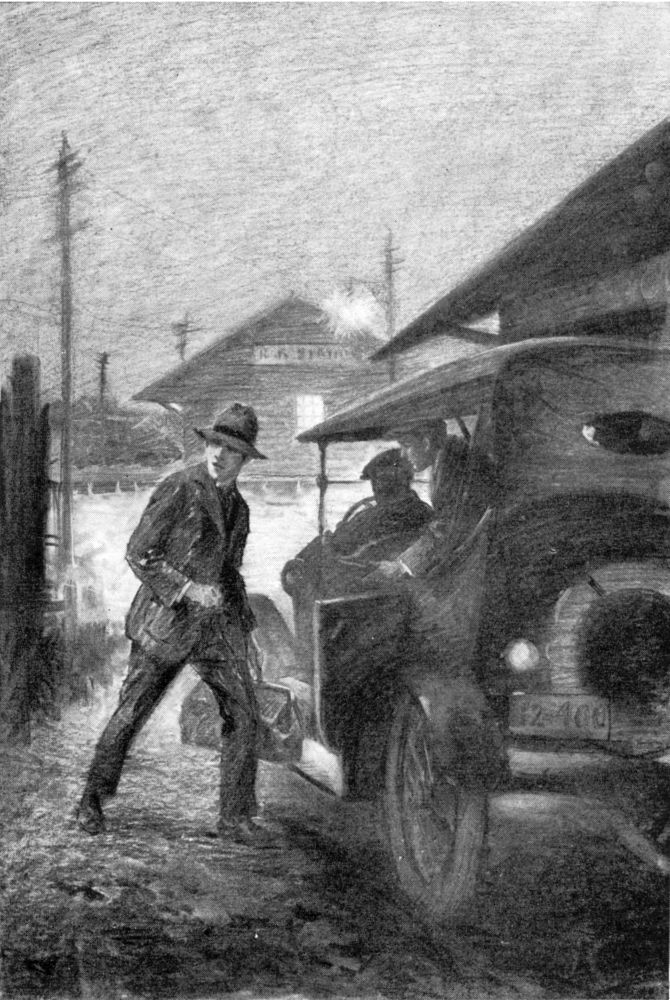
“I want you to meet Davy Lyle,” Peaches was saying. Barry managed to reach the hand extended to him and felt a hard, firm grasp on it. He couldn’t see much of Davy,—just a blurred countenance in the dimness,—but the slightly high-pitched voice that acknowledged the introduction was pleasant.
The couple in the back talked all the way, but what they said wasn’t audible to Barry, above the noise of the car. Just short of Wessex a stop was made and Barry crowded into the back seat, Davy disappearing from sight to sit on the floor and hug his knees for the journey through the center of the village. A few minutes later the car stopped once more, this time opposite the lane that led to [220]Brazer’s Farm, Peaches transferred some money to the driver, and, while the conveyance went on along the road, the passengers made their way back to the Lyle house. Peaches and Barry entered by the front gate, but Davy jumped over the fence and disappeared through the shadows toward the back of the house.
“So far, so good,” murmured Peaches, sitting down on the top step. “How do you like the criminal life, Barry?”
“How do you mean criminal? We haven’t done anything criminal!”
“No, we haven’t, I guess, but blowed if I don’t feel as if we had! I’d sort of like to see into Mr. Benjy’s room right now. I’ll bet the old gentleman’s happy; what?”
The Ford rattled wildly past on its way back to town. Peaches followed it with his gaze until its twinkling tail-light had disappeared. Then:
“I swore that guy to secrecy, and I guess he’s all right,” he said thoughtfully, “but if he forgets and goes to talking— Hang it, I don’t believe I’d be much of a success as a criminal, after all! I’ve certainly gone and left a swell clue behind me!”
“Think that fellow recognized Davy?” asked Barry.
[221]
“No, and I don’t suppose he ever saw him before, anyway. Davy probably didn’t ride in taxicabs much when he was here. Still, it was a fool thing to do, and I recognize that fact now that it’s too late. But—hang it!—I had to get a car somewhere. He couldn’t have found one in Hale’s Bridge; that’s a cinch!”
“Oh, well, he will be gone by to-morrow night,” replied the other, reassuringly. “No use worrying, I guess.”
Footsteps sounded behind them and Betty came out and seated herself beside Barry. Both boys looked at her inquiringly. After a moment Betty said in a queerly hushed voice:
“He’s awfully different, Peaches, isn’t he?”
“Davy? Yes, he sure is, but I like it, Betty. He’s older and has a lot more pep. As I said to Barry, I guess having to make your own way does that to a chap. How did Mr. Benjy—er—”
“He’s as happy as anything,” said Betty. “He’s holding Davy’s hand and smiling at him. He hasn’t said much. I suppose he’s too glad. Oh, I do wish there wasn’t this—this thing to spoil it!” Betty dabbed at her eyes with a tiny wad of handkerchief and Peaches patted her shoulder.
“Don’t you worry,” he said. “Everything will [222]come out all right after a while. Davy’s got a corking good job at last, he tells me, and will be making real money. These folks here are bound to forget their grouch pretty soon, and then Davy can come home for week-ends and—and everything will be pie!”
“That would be nice,” murmured Betty. Then, more briskly: “Speaking of money, Peaches, I want you to keep account of every cent you’ve spent and—”
“Got it all down, to a penny,” replied Peaches, cheerfully. “Don’t worry about that, Betty. What you’d better do is go over my expense account pretty carefully when I present it. Jumpin’ Jupiter! That reminds me that I’ve got a letter to write. Guess I’d better tear myself away and attend to it. You know where to find me if anything’s needed, Betty.”
They all went in, Barry rubbing chilled hands together as he bade Betty good night and followed Peaches upstairs. Peaches had paused outside Toby Nott’s door and was counting a small roll of bills.
“Eight, nine— Got enough to pay my debts, I guess.” He knocked and a voice responded, “Yeah! Who is it?”
“In bed, Toby? It’s Jones.”
[223]
“What you want?”
“Just want to pay you back that six dollars,” answered Peaches, winking at Barry.
“Come in!” called Toby, animatedly.
Toby was in bed, sure enough, but he appeared to have no present interest in sleep. He had both his pillows behind him and an electric drop over his tousled head. There was a large, serious-looking volume on his knees and on a chair beside him sat Antonio, tethered by one hind leg and staring raptly at the electric bulb. Antonio looked indecently large and gross, as though the sybaritic life he had been leading had somehow coarsened his nature. He paid no attention to the visitors, but continued his basilisk contemplation of the light.
“A touching picture of domestic felicity,” observed Peaches. “Might be entitled ‘Pals’ or—or—”
“‘Toby and Tony,’” offered Barry.
“Or ‘Two souls with but a Single Croak’ or something. What’s he doing, Toby? Trying to hypnotize you?”
“He isn’t looking at me,” answered Toby, with dignity. “He’s looking at the light. One night there was a mosquito up there.”
“And he hasn’t forgotten? Marvelous example [224]of brute intelligence! He’s a patient animal, isn’t he? Does he—er—stay there all night and guard your couch? Now, what was it Professor N. B. Brown said about—”
“Give me my six dollars and get out of here!” growled Toby, threateningly raising the ponderous book on his knees. “Say, what did you want that for, anyway? And, say, where were you last night? Why—”
“Here’s your money, old son, and many thanks. Better put it where it’ll be safe, for I may want to borrow it again some day. You’ll observe that it’s all in greenbacks, Toby. Thoughtful of me; what?”
“How do you mean greenbacks?” asked Toby, suspiciously.
“Why, greenbacks—frogs— Oh, what’s the use? Come on, Barry!”
“His back’s not green!” Toby’s triumphant voice pursued them past the closed portal. “It’s brown!”
There was fine news of Mr. Benjy, the next morning. Whether or not because of Davy’s coming, he had slept almost all night and was asking for breakfast, Betty informed the boys. And he seemed quite like himself and declared that he would be going back to the office the following day.
[225]
Barry’s hope of getting into the Springfield game was diminished that Friday afternoon. It was the custom to excuse those who were to be called on in the Saturday game from anything save the lightest practice, and Barry was not one of the favored. While he did not take part in the brief scrimmage between two patched-up teams that ended the session, he worked out with Ike Boardman’s squad during signal-practice and did a lot of punting. All of which signified that the Major was not considering him as a serious contender against Springfield.
Clyde was almost like the old Clyde that afternoon, and seemed anxious to have Barry forget what had occurred in Number 42 a few nights before. He didn’t refer to that occasion, but he left Hal Stearns and Goof Ellingham once, to squeeze in beside Barry on the bench, and evidently tried hard to be agreeable. Barry went back to the Lyles’ through the dusk of a cold November evening, feeling very happy over Clyde’s affability and just a little disappointed because he was not to have any generous part in the morrow’s game. Of course the Major might use him before the fracas was done, but Barry, who had by now become an enthusiastic player, wanted action and lots of it!
[226]
On their way to supper Peaches confided to Barry that Davy had become obstreperous and was going to stay until Monday.
“I tried to tell him that it was mighty risky,” said Peaches, “but he wouldn’t see it. He said that if any one had learned of his presence in the old home town they’d have been after him before this. Well, maybe that’s so, too. But, just the same, he’s taking a chance.”
“I’ll bet the police have forgotten all about him,” said Barry. “It’s almost a year, isn’t it?”
“Don’t you believe it! The big squeeze, Martin—he’s the chief, or whatever they call it here—was sort of peeved when Davy gave him the slip, and I guess he’d be awfully glad to get him.”
“Well, if he doesn’t show himself,” said Barry, “no one’s going to suspect he’s around. How is Mr. Benjy to-day?”
“Great! The doctor says he’s going to get well fast. I guess Davy was good medicine for him.”
“I guess so. That was a bright idea of yours, Peaches—fetching him back, I mean. You do have an occasional clever thought, don’t you?”
“Glad you realize it. I had another one, too, which was to get the interest on the mortgage [227]paid. Come to think of it, I don’t see what the community would do without me!”
“Have you paid it, though?”
“Not yet, because I haven’t heard from home. But I’ll get the wherewithal to-morrow. Would you mind getting a move on? I’m pretty near starved!”
There was a large and enthusiastic mass meeting that evening. After it was over the fellows formed outside and a wildly cheering procession made the round of the buildings, and finally, after Doctor Clode had responded to demands for a speech, ended up in front of the Banks residence and cheered the Major until he appeared and acknowledged the applause. Neither Barry nor Peaches attended the meeting, but sounds of the ensuing demonstration took them over to the campus and they shouted and sang as loudly as any. Returning home, shortly before ten, Peaches clutched Barry’s arm just short of the house.
“Look ahead,” he said softly. “Beyond the light there. See anything?”
Barry looked and finally assented.
“Some one standing in the shadow,” he whispered. “Who is it? What’s he want?”
“Don’t know,” answered Peaches. “Let’s see what he does.”
[228]
They went on toward the gate, and as they did so the figure retreated, finally disappearing utterly in the pocket of darkness beyond the nearest lamp.
“Thought so,” muttered Peaches. “I’ll bet that taxicab guy spilled the beans. Gosh! I wish Davy had beat it when he had the chance!”
[229]
Peaches went toward the back of the house, while Barry ascended the stairs. It was fully five minutes later when the murmur of voices in the dining-room ceased and Peaches came up. The two boys went into his darkened room and peered cautiously from the window that overlooked the road in the direction of town. Once they were certain they discerned the watching form about thirty yards away, where the gloom was deepest, but when they looked again it had either disappeared or merged with the shadows.
After a few moments of further staring into the night they withdrew and Peaches lighted up, drawing the curtains. Barry approved the latter act, for he had begun to feel sort of shivery. They talked the situation over, in voices unconsciously lowered. Peaches said that Davy wasn’t going to try to get away to-night, that probably it was best not to.
“If that fellow down there is really watching [230]the house,—and I guess there’s no doubt about that,—he’s likely to keep on watching most of the night. He would know that if Davy is here he wouldn’t try to get off until midnight or later. What I can’t make out is why the cop doesn’t come in and have a look.”
“Maybe,” suggested Barry, “they aren’t certain. Maybe they’ve just heard enough to make them suspicious. You have to have a warrant to search a house, don’t you?”
“I guess you do. Well, I’m going to bed, and you’d better do likewise, old-timer.”
In the morning Barry’s first act was to hurry across to Peaches’ room and look anxiously from the side window. The street was utterly deserted, and, in the bright sunlight, it was easy enough to believe in the innocence of the lurking form of the night before.
The Springfield game was dull and one-sided. Again Barry saw service in the final episode and was called on for six punts. The Major used nearly every second- and third-string player before, at last, the contest ended with the score 33 to 0. Followed much rejoicing until news came that Hoskins had defeated Peebles, 22 to 3. Recalling that Peebles had humbled Broadmoor by a score of 21 to 3, the rejoicers ceased rejoicing [231]and amazedly considered the fact that, if figures didn’t lie, Hoskins was at that moment exactly thirty-seven points better than Broadmoor!
Monday saw the beginning of secret practice on the field and the institution of evening sessions in the gymnasium, and Wednesday witnessed the hardest practice of the season. Not until the lights had begun to appear in the windows on the campus were the players released. Barry was far too tired to hurry through his shower and his dressing, and the locker-room was almost empty when he left it. To his surprise, Clyde was waiting outside on the steps, and joined him.
“Some drive,” he said.
Barry agreed and, accommodating his step to Clyde’s, headed toward Dawson.
“You got quite a send-off in the paper this morning,” said Clyde, after a pause. “See it?”
Barry hadn’t seen it.
“Well, I saved it for you. It’s in the room. Short Higgins is corresponding here, and he has half a column of dope. Calls you ‘Broadmoor’s punting ace,’ and if Hoskins believes what he says they’ll probably lay for you and try to put you out, Barry. It seems to me Higgins hasn’t done us any favor by boosting you as a kicker. I’d like to know what the Major thinks of it. What’s [232]the sense of advertising the fact that we’ve got a punter? Much better keep quiet about it, I think, and surprise the enemy if we can.”
“I heard,” said Barry, “that the Major always read what the newspaper correspondents sent out.”
“Well, that’s what I thought. If he read that stuff of Short’s, he must have been in a hurry. Unless—” Clyde hesitated an instant— “unless he wants Hoskins to know! By Jove, Barry! he might! The Major’s awfully foxy.”
Barry considered that theory while he followed Clyde upstairs in Dawson, but he failed to see any advantage to be gained by the publicity. Clyde turned on the lights and produced the city paper of that date, opened to the sport page. Barry read the article through. Higgins had gone exhaustively into the capabilities of the Broadmoor players, discussing them individually at some length. The reference to himself Barry found almost embarrassingly flattering. He was credited with having punted fifty-five yards,—which was true to the extent of one lucky performance in practice,—with being an exceptionally fast and clever runner, and with being the outstanding discovery of the football season at Broadmoor.
Also, although the fact was not distinctly stated, [233]the writer managed to give the impression that the young “punting ace” was being kept under cover. Barry went through the article a second time. It was just as he had thought. Higgins had discussed perhaps twenty players, but only in the case of Barry Locke had he let himself go. Nothing had been told of the others that would reach the rival camp as fresh news! He laid the paper down, with a puzzled look at Clyde.
“That reads sort of—sort of funny,” he said.
Clyde nodded.
“It certainly does. I don’t get it, Barry. Either Higgins got that past without the Major seeing it or the Major tipped Higgins off to write it that way. And if it was the last, what’s the big idea? Every one says we’re certain to play a punting game through at least one half, and if we do he will have to use you. Tip Cartright can’t do it all; and, anyway, you’re better than he is, now.”
They discussed the puzzle for several minutes without arriving at a solution. Then, partly because it was growing late and partly because he wanted to get away before Hal Stearns came in, Barry pocketed the paper at Clyde’s invitation and arose. As he did so his eyes lighted on a small black case on the big table.
[234]
“Hello!” he said. “You’ve got one of those, too, haven’t you?”
Clyde nodded, lifting the cover of the small typewriter and idly jabbing at a key.
“Yes, a fellow named Whitwell is selling them around school and I thought I’d help him along. Besides, some of the faculty give you better marks, they say, if you turn in your stuff typewritten. Pretty good little contraptions, too. Want to try it?”
Barry picked out his name on the keys and Clyde rolled the result into view. The effort hadn’t been very successful, for Barry had forgotten in one place to use the shift, and had evidently struck the wrong key on two occasions. Also, the capital B was not aligned with the other letters. The result was this:
John Bsrry lockw
“Gee! I’d almost forgotten about the John,” commented Clyde. “Guess I’ll call you Jack for a change.”
“If you do,” answered Barry, “I’ll call you Fletcher—no, Fletch. That sounds like a side of bacon. Say, what’s the matter with that B? Looks as if it felt it was more important than the other letters!”
[235]
“Gee! I don’t know! It always does that. Maybe that thingumbob is bent. I’ll have to get Whitwell to look at it. Well, don’t get a swelled head over that newspaper stuff, youngster. See you to-morrow.”
Barry didn’t allow the article to increase the size of his cranium, but he did clip it very carefully and put it away with other and similar treasures. Also he showed it first to Peaches, and Peaches began calling him “Ace” and pretending a new and impressive deference. But even Peaches couldn’t explain why Higgins had been allowed to get that paragraph past the censor! They were still discussing the matter that evening in Barry’s room when footsteps came along the hall and Toby, as ever disdaining to knock, burst enthusiastically in on them, one hand extended before him and his eyes glowing behind his enormous spectacles.
“Say, fellows, look here, will you? Say, look at this for a beauty! He was outside the window and didn’t say ‘Boo!’ when I picked him off. Lookut!”
Toby thrust the prize under Barry’s eyes and Peaches got up to look, too. It was a medium-sized moth, its upper wings of pale yellow with black tracery and its lower ones of pinky red—they, [236]too, marked with black. It certainly was a beautiful thing, and both Barry and Peaches admired it in a fashion to satisfy its captor. Peaches wanted to know the name of it, but Toby shook his head.
“Golly! I don’t know,” he answered regretfully. “I’ve never seen one like it before. I’m going to look it up at the library to-morrow. Ain’t it a corker?”
“Wonderful, Toby,” assented Peaches. “Is he dead?”
“No, I guess he’s just kind of chilled.” Toby touched the moth gently and it stirred in lazy protest, stretching its upper wings a little wider. Then, as if to make the protest more emphatic, it fluttered out of Toby’s palm and settled on the blue blotting-pad on the desk. “Don’t touch him!” warned Toby in agonized tones. “You might tear his wings.” He reached a stealthy finger down and tried to persuade the moth to crawl upon it, but the invitation was refused. There was a sudden fluttering of pale yellow-and-red wings and the moth careened agitatedly about their heads, dipped swiftly, and mysteriously disappeared.
“Well, where the dickens—!” exclaimed Peaches.
[237]
“He went into that drawer!” declared Toby. “There he is! I see him!”
Barry drew the top drawer of the desk farther out and Toby, peering excitedly in, made a grab among the papers and various articles there, but missed the moth.
“Better take the drawer out,” suggested Peaches. “Although, for my part, I hope he gets away from you!”
Barry placed the drawer upon the desk and carefully lifted the contents out, while Toby stood by waiting to pounce. But the moth wasn’t there.
“He’s in the next one,” said Toby. “He flew out over the back, I guess. Let me look, Barry, will you? Gee! I don’t want to lose him!”
Barry, who had been seated, arose and Toby took over the search. One by one, very cautiously, he took out the four drawers and went through them while the others looked on and offered encouraging advice. Foiled, Toby squatted, and stared into the dim depths of the cubby that had held the drawers. “Got a match?” he demanded feverishly.
Instead of a match, Barry offered a pocket torch and Toby got to his knees and continued the hunt. At that moment the doorbell tinkled and the boys heard Betty responding to the summons. Toby’s [238]antics had rather palled by now and both Barry and Peaches lent their attention to the voices at the front door. For a week a ring at the doorbell had sent their thoughts to the subject of police. Consequently Toby’s grunts and remarks, somewhat smothered because he had introduced his head into the recess, went unheeded.
“Gee! he ain’t here!” said Toby, mournfully. “Not unless he—Ugh! Gosh!—Maybe there’s a crack— Say, here’s something stuck up here in a splinter, Barry.” Receiving no response, Toby dropped the something behind him into the nearer drawer and went on with his muttering: “Gee! I’ll bet I’ve lost him!” There was a loud sneeze, followed by a sharp bang as Toby’s head came in contact with a crossbar. “Ow!” cried the explorer in an agonized voice. “Say, there’s more dust in here—”
“Shut up, Toby!” warned Peaches, peremptorily. There were firm footsteps in the hall and then Betty knocked and said, “Barry, Major Loring is here!”
After a minute Peaches dragged Toby with him out of the room, Toby going most unwillingly and with many backward glances.
“Say, Barry, if you find him don’t try to get [239]him, will you? Let me know, will you? I want—”
“Shut up, and say good night!” hissed Peaches.
“Yeah,” responded Toby confusedly. “Good night.”
Then the door closed and the Major, slightly amused, turned his gaze to Barry. The latter, still too surprised by the visit to be at ease, gave a halting explanation of the disordered appearance of the room. Major Loring listened smilingly but absently, his gaze traversing the barely furnished quarters. When Barry had ended, the Major said:
“I see you don’t use a typewriter, Locke.”
“Sir? A typewriter? No, sir, I don’t.”
“A good many of the fellows do,” said the coach. “It seems to be coming to be the style to have them. I suppose you can write on them.”
Barry shook his head apologetically.
“No, sir, I can’t. I’ve never owned one.”
“Still,” persisted the visitor, “I suppose Jones has one you could use if you wanted to. Or this Nott boy.”
“Toby has one. He bought it a little while ago from some fellow who’s selling them here in school.”
[240]
“Ever tried it?” asked the Major.
Puzzled, Barry again shook his head.
“No, sir.” Then, with a weak smile: “I don’t believe he’d let me,” he added.
“Still, it wouldn’t be difficult to do a little writing on it if he happened to be out, I suppose?” the Major persisted.
“I—I suppose not,” answered Barry, slowly; “only, he almost never is out.”
“I see. Well, to come down to cases, Locke, here’s what brought me around to see you.” The Major took an envelop from a pocket and drew forth two folded sheets of paper. “I’m very glad to hear you say that you don’t use a typewriter, for this letter is typewritten. Know what it is?”
“No, sir.” Barry stared, his eyes rather round by now.
“I didn’t think you did. You mustn’t mind my asking, though; nor about the typewriter, either. I was merely trying to—well, strengthen my own conviction. Here, just read this.”
Barry took the missive and perused it with frowning brow. It was neatly written on a single sheet of school paper with a typewriter such as Toby owned and with a black ribbon. It ran as follows:
[241]
Mr. George Prince,
Hoskins Academy,
Fairmount, Conn.
Dear Sir:
If you want some inside dope on Broadmoor football I am in position to supply it. I can tell you signals to be used against your team and explain several new plays that our coach is teaching. This is strictly confidential, so if you are not interested kindly destroy this letter and say nothing about it. I am not looking for money or other reward, but just to get square with persons who have treated me mean. Address X. Y. Z., 104 Bridge St., Wessex, Conn.
Confidential.
Barry’s mind was in strange confusion as he ended.
“Why—why,” he stammered in amazement, “that’s this house!”
The Major nodded.
“Yes. That’s why I’m here. You see, Locke, you’re the only one here that could possibly supply that sort of information. Hold on! Let me finish, please. You haven’t been under serious suspicion, my boy. Of course for a moment I was forced to consider you, but only for a moment. I showed the letter to Captain Buckley and he simply echoed my own opinion. ‘It’s a silly hoax,’ he [242]said. ‘Locke wouldn’t have any purpose in doing a thing like that, and he isn’t the sort to do it, anyway.’ So I just dropped in to talk it over with you. Whether it is a hoax or not—and surely it must be—it’s unpleasant, and I’d like to find who wrote that letter. Do you happen to know?”
Barry was staring again at the sheet in his hand, noting now something that had at first escaped him. At four places in the course of the writing a letter stood slightly above the level of the line, and that letter was always a B. He shook his head, glad that the coach had formed his question as he had.
“No, sir, I don’t,” he answered gravely.
“You had no hand in it? I mean, you knew nothing of it? Some one might have written it as a joke, of course, and I wondered if you mightn’t have had an inkling, Locke.”
“No, sir, I know nothing about it. You spoke of Toby Nott’s typewriter. I was in his room a few days ago and he was using it and I noticed that his ribbon was purple. He may have a black ribbon, of course, but we could find out, sir.”
“Let’s not bother,” was the reply. “I’ve already accepted your word, Locke. Now, one more thing. Suppose this was not intended as a hoax, [243]to get a laugh on the Hoskins people. In that case it would look like an attempt to get you in wrong, wouldn’t it?”
“Why—yes, sir; I suppose it would,” answered Barry, unwillingly, “but I don’t see—I don’t know—”
“That’s what I’m getting at. There’s no one you know of who might have taken this means of evening up a score, Locke?”
“I—I just can’t imagine any fellow doing anything like that, sir, no matter what—no matter how sore he might be!”
“Hm! that hardly answers my question, Locke. I’ll put it this way: Since you’ve seen that letter, has it occurred to you that it might be written by any one you know?”
Barry’s gaze dropped.
“I’d hate to suspect any fellow—” he began.
“Locke!” Major Loring’s voice had a ring that almost made Barry jump. “Answer my question!”
Barry met the Major’s stern gaze steadily for a moment. Then he shook his head.
“That isn’t fair, sir,” he said.
“It is fair!” answered the coach, firmly. “If this letter was not written as a joke, it was written to compromise you. You are a member of the [244]team. Consequently the fellow who did that, deliberately set out to cause trouble to the team, to interfere—maliciously interfere—with my efforts. Why, just think a moment, Locke! Suppose I took that letter to Doctor Clode. What would be the result? Some one would get fired out of here mighty quick, and you know it. And he deserves to be. Whether that was a joke or a piece of spite work, it’s despicable. Fortunately, Prince thought it a hoax, but even so he must think we have a strange sense of humor here at Broadmoor. Perhaps you’d better read his letter, too.”
Barry accepted it in silence and read:
Hoskins Academy Athletic Board
Fairmount, Conn.
Tuesday.
Mr. Harris Loring,
Broadmoor School,
Wessex, Conn.
Dear Mr. Loring:
The inclosure reached me this morning and I’m forwarding it for your interest. If you can discover the humorous youth who wrote it you might tell him that we aren’t in the market for his funny quips. Also, if you do get him, give him a couple for me!
Cordially,
Geo. A. Prince.
[245]
Barry handed the two letters back and the Major frowningly returned them to the envelop and the envelop to his pocket. Then, more gently, he said:
“You see, Locke, this doesn’t concern you alone. I’m convinced now that the fellow who perpetrated this silly business meant to cause trouble. Well, he deserves a lesson and I mean to see that he has it. I don’t want to take this to the faculty, and I don’t propose to, but I do propose to find this idiot and read the riot act to him if no more. So, come clean, Locke, and let’s get it cleared up. Now then, do you or don’t you suspect any one?”
After a long moment of silence Barry nodded his head:
“I do suspect some one, Major, but it’s only suspicion and I have no right to say any more than that.”
“If your suspicion is wrongly placed, that fact will be proved, my boy. But I think you know that it isn’t. Whom have you in mind?”
“I’d rather not say, sir.”
“You must!” The Major’s tone was sharp, but Barry only shook his head.
“No, sir,” he answered firmly. Their eyes clashed for a moment. Then:
[246]
“You are making a mistake,” said the coach, grimly. “As long as you are on the team, Locke, I’m your superior officer, and I won’t stand insubordination. Now think that over a minute.”
“This matter isn’t—isn’t—it doesn’t concern me as a football player, sir.”
“It concerns the team. That’s sufficient. I want an answer, Locke.”
“I’m sorry, sir.”
There was a long silence. Barry, feeling very hopeless, stared at his tightly clasped hands. Then he heard the Major arising and glanced up. The Major’s countenance was very cold, very grim.
“You had better sleep on this, Locke,” he said as he moved toward the door. “Until you can see clearly and decide to speak out, as you should, your services won’t be required with the team. I’m sorry, my boy.”
“I’m sorry, too, sir,” answered Barry, faintly.
Major Loring opened the door and went out. Barry listened to the sound of his footsteps in the hall, on the stairs, and finally on the porch. Then came the complaining creak of the gate.
“Some one,” thought Barry, “ought to grease it.”
For some minutes he stood where the Major had [247]left him. Then something light against a window-pane drew him across the room. It was Toby’s moth, motionless, its lovely wings half spread. Barry placed a finger before it and stirred it gently and the moth slowly climbed aboard. With the other hand he opened the window at the bottom. Outside, however, the moth showed no desire to accept his freedom and Barry had to toss it into the dark.
“Sort of a mean trick on Toby,” he reflected as he closed the window again. Then there was a knock at the door and Peaches sauntered in.
[248]
“Did you find him?” asked Peaches, carelessly.
“Find who?” asked Barry, perplexed.
“Mister Moth.”
“Oh! Yes, I let him out.”
Peaches seated himself on an arm of the easy-chair and viewed Barry shrewdly. After a silence he asked:
“Well, going to let anything else out?”
“Huh?” Barry was not, it seemed, very quick-witted this evening. “What do you mean?”
Peaches shrugged.
“Oh, nothing, nothing at all. Only, if the head coach paid me a visit I’d be telling all about it. But I dare say I lack what-you-call-it—er—reticence.”
Barry began to lift the desk drawers and slide them back into place. He performed the task very slowly, very thoughtfully. When the last one was in he perched himself on the edge of [249]the desk, studied his hands a moment—rather scratched and scarred they were these days—and finally said:
“Well, I guess I’d like to tell you, only—”
“Since I’m being consumed by curiosity,” said Peaches, when the other paused, “I might perhaps be prevailed on to listen. You were about to say—?”
“It’s no joke,” answered Barry, rather plaintively. “He—I—he said I needn’t report again.”
“’Cause why?” asked the audience, after a surprised instant.
So the story came out and Peaches listened, without comment, to the end. Then he said:
“It’s hard to say which of you is right, Barry. I see your position, and his, too. I can’t blame him for wanting to get his hands on the moron who sent that letter, and I can see that you’d naturally hate to get Allen into trouble.”
“Allen!” exclaimed Barry. “Why, I didn’t say— What makes you think—”
“Of course you didn’t say, but he’s the only chap in school you’d lose your job on the team for, isn’t he? Don’t be worried. I’m as deaf as the grave. No, I mean dumb. Well, what are you going to do about it?”
[250]
“Nothing,” muttered Barry.
“All you can do, I guess,” said Peaches, after some thought. “I don’t quite get the Major’s view, though. Near as I can make out, he’s been grooming you for more than a month to play against Hoskins. Now he drops you three days before the game, for something that isn’t really connected with the team. I guess he was sort of mad, wasn’t he? They say he has a fair to middling temper. Still, it doesn’t seem quite like him to make the school pay for a personal grudge. Well, it isn’t exactly that, either, but—”
The telephone bell had rung during Peaches’ discourse and now Betty’s voice called from below:
“Barry, you’re wanted on the ’phone, please!”
Downstairs, with the receiver at his ear, Barry answered, and to his surprise heard Major Loring’s voice:
“Is that you, Locke? This is Coach Loring. I’ve been thinking over our talk a while ago. I made a mistake, Locke. I find that you have reason on your side. If you can give me the information I want I hope you’ll do it, but I was wrong when I threatened you. Report as usual, Locke. Good night.”
Barry hung up the receiver rather dazedly and [251]stood for a long moment, staring at the telephone, before he turned and went quickly upstairs. Peaches had only to look at his face to know that something pleasing had happened.
“Coach?” he asked.
Barry nodded, grinned broadly, and dropped into a chair. When Peaches had heard the message he said approvingly:
“Good old Major! Blamed if he isn’t a white man, just as I thought! Say, Barry, I’m awfully glad!”
Well, Barry was, too, so glad that it was some little time after Peaches had gone back to his own room that the thought of Clyde’s treachery returned to leaven his pleasure. He didn’t want to believe Clyde guilty, but he had to. The evidence was too strong to admit of doubt. There was Clyde’s threat to keep him out of the Hoskins game, a threat never really recanted; there was the typewriter in Clyde’s room that printed the B’s out of alignment; and finally, there were Clyde’s almost anxious efforts to be agreeable, efforts which viewed in the light of to-night’s developments were so plainly designed to avert suspicion should suspicion later fall on him.
Peaches had brought up one apparently weak spot in the plot before they had ceased discussion [252]of it, and his subsequent explanation had not been wholly satisfactory. Suppose, he had propounded, that Prince, the Hoskins coach, had simply dropped that letter contemptuously into the waste-basket. In that case nothing could have come of it. It was, Peaches thought, taking a pretty long chance, the odds being about even that the design to implicate Barry would fail. They had puzzled over that for some time before Peaches offered his solution.
“What may have happened was this,” Peaches had said. “The fellow who did it may have taken a carbon copy. If nothing happened after a few days he would ‘find’ the copy somewhere and see that it got to the Major or, perhaps, Captain Buck. Then if they called up the coach at Hoskins and asked if such a letter had been received—well, there you are! Sort of an awkward, roundabout scheme, but I don’t see any other way it could have been done, do you?”
Barry didn’t, but a thought had come to him at about the same moment it reached Peaches.
“If the fellow who wrote it sees that I’m still playing—”
“He’s likely to produce the copy!”
They had looked at each other in silence for a long moment. Then Peaches had added in a detached [253]way, “Unless, of course, some one tipped him off.”
“Yes,” Barry had agreed thoughtfully. They had talked of other things after that; largely of football and Barry’s reinstatement and of Friday night at the big log cabin near the summit of Mount Sippick where the team was taken every year on the eve of the Big Game. Now, ready for bed, Barry still lingered. Twice he wandered to the desk and fingered a pad of paper and twice he went away without penning the line that had composed itself.
L. has received a letter from P.
He had only to write that and see that it got to Clyde and probably nothing more would ever come of the affair. Clyde would understand, and, if Peaches’ theory was correct, would not present the copy of the letter. Still, they didn’t know that there was a copy, Barry reflected. Peaches’ theory was ingenious, but it might be utterly wrong. If it was wrong, there was no reason to warn Clyde. Besides, Barry wasn’t in a forgiving mood to-night. Just short of eleven, he put out the light and crawled wearily into bed, the note unwritten.
But in the morning the old liking for Clyde reasserted [254]itself and he dressed hurriedly and knocked on Toby’s door while that youth was still in the throes of waking. Toby held the record in that house for sleeping late, dressing quickly, and reaching chapel at the last possible split second. And Toby was not one who sprang blithely from bed with a glad cry to greet the dawn. Far from it! Toby awoke gradually, protestingly; and instead of glad cries he uttered sounds that possibly resembled the first grunts and grumbles of a bear aroused from his winter’s hibernation.
To get Toby awake was no mean task. To get him to leave his warm couch and stumble over to his typewriter was a man-sized job. Yet Barry eventually succeeded in both, and Toby, still drugged with sleep, his eyes half open and his head nodding on his shoulders, grumbling continually, at last tapped out the words: “L. has receeved a Lettre from P.”
“Thanks,” said Barry. “I’ll do as much for you sometime, Toby.”
“Yes you will!” mumbled Toby, bitterly. “I’ll bet if I got you out of bed in the middle of the night—”
But Barry was already beyond hearing, the sheet of paper borne in triumph. Back in his own room, he folded it into an envelop on which he [255]wrote, “Allen,” in a painfully disguised hand. Then when, as he knew, both the Second-Class fellows were at a ten-o’clock class, he went to Number 42 Dawson and dropped the missive conspicuously on Clyde’s chiffonier.
He didn’t see Allen until he reached the field that afternoon. Then, if the older boy was experiencing surprise at the other’s presence at practice, he failed to show it. He looked a bit gloomy, to be sure, but of late he had frequently looked so, and Barry couldn’t have said positively that the look denoted guilt. Barry was relieved that he had to answer Clyde’s “Hello, youngster!” merely with a nod. The squads were already forming and he hurried past.
There was an enthusiastic mass meeting that evening, and while on the gymnasium floor little was to be heard save the sharp barks of the quarter-backs, the shuffling of rubber soles, and the patient, measured voices of the coaches, outside, cheers and songs filled the air. Barry did his best to avoid Clyde and succeeded, just as he had done all day. He was finding it hard to define his sentiments toward Clyde. There were moments when he was very angry, moments when he felt only sorry, moments when the old half-worshipful admiration returned powerfully. [256]Even when most bitter he hoped that Clyde had understood the meaning of that note. Once he wondered if by any possibility Waterman had an inkling of what had transpired, for twice he caught Rusty viewing him with a broodingly malevolent gaze.
Peaches had attended the mass meeting, and so Barry, when he reached home, was thrown on his own society. He tried study, but could make no headway; tried a magazine, and soon cast it aside. He was thoroughly tired, and at the same time oddly restless. Even after Peaches had returned, informative of the celebration, the restlessness continued. Barry listened without hearing, his thoughts racing hither and thither. He hadn’t punted well that afternoon, he told himself. Suppose that on Saturday he got into the game with Hoskins and fell down on his job! A chill, pricking sensation played along his spine.
“—and that,” concluded Peaches, “is how the pole-cat came to have white stripes.”
“Wh-what?” asked Barry, startled.
Peaches laughed.
“Well, you weren’t hearing a word I said, so I thought I’d try a jolt. What’s the worst symptom? Do you see black specks floating before your eyes? Does the mind suddenly go blank? So far [257]as you know, were any of your ancestors insane? Do you experience a strange sinking sensation when falling from a roof?”
“Shut up,” said Barry, grinning faintly. “I— Gee! I do feel sort of—of queer! Kind of like I felt just before I had the grippe. I ache in lots of places, and I think my head’s hot, and—”
“Your appetite’s on the blink.”
“Yes, how did you know? I hardly ate any supper. And I’m sort of nervous-like, if you know what I mean.”
“I know exactly,” replied Peaches, solemnly. “And I know your malady. You’ve got ‘Just-before-the-battle, Mother.’ It’s very common at this time of year among football artists.”
“You mean I’m—I’m scared?” began Barry, indignantly.
“I do not. I mean you’re jumpy. And I prescribe sleep, and lots of it, Barry. Toddle off and hit the old hay. And forget all about the game, Ace. All the thinking you can do won’t make you play one bit better to-morrow.”
“Well, but do you think it’s just that? Did you ever feel that way? Sort of—sort of—”
“More than once—hardened and blasé as I am! To bed with you. Sleep, sleep deep and refreshing is the answer. Go to it!”
[258]
Peaches’ remedy worked wonders, as morning revealed. Barry was fortunate in having but two recitations that day, and, as he had not prepared for them the evening before, he was glad that both came late. Breakfast over, he went back to the house in company with Zo. Zo was in a fairly hectic mood and discussed football all the way.
“Mr. Banks won’t let me off to-morrow,” he announced dismally, “and I’ll miss the first quarter of the game, sure. I don’t see why he can’t cut one lesson!” Back in his room, Barry set his books out and drew up to the old desk. He was still indulging in certain fidgeting preliminaries to concentration when the squeak of the gate brought him to his feet so that he could command a view of the sidewalk. It was not Peaches entering, however, but Mr. Benjy sallying forth for his first visit to the freight-office since his illness. He had on a shabby but warm overcoat and walked with an almost buoyant stride. Barry thrust the window up and hailed him.
“Hello, Mr. Benjy! Gee! it’s good to see you up and around, sir! How are you feeling?”
Mr. Benjy turned, waved a hand, and smiled with pleasure.
“Good morning, Barry! I am feeling quite—er—quite [259]myself again. Yes, I may say that the rest has done me good, I think. I feel extraordinarily—er—fit.”
“Well, take care of yourself, sir. Don’t throw too much freight around!”
It was Peaches’ fiction that Mr. Benjy handled all the freight, personally and exclusively. Mr. Benjy chuckled at the ancient jest, nodded, waved with something of an air, and set out along the sidewalk, his shoulders thrust back and his head high. Mr. Benjy had assumed his militant attitude. Barry smiled after him and then, closing the window, settled back in his chair.
“Sort of a dear,” he reflected. “Hard lines to have to work as hard as he does and then give most of his pay to those factory men! I suppose Davy will be getting out to-night.”
Half an hour passed. Then the need of a fresh scratch-pad caused him to pull open the second drawer at his side. It wasn’t the right one, however, for in returning the drawers to their places, two nights before, he had, it appeared, got them mixed. He was about to close it again and open the one below, when his eyes were attracted to an unfamiliar object lying on top of the other contents. He lifted it perplexedly and turned it over and back again. It was an oblong fold of heavy [260]paper. In large engraved letters appeared the words: “Northern Counties Light and Power Company.” Beneath he read, “$1,000.” He might have read more, but he didn’t. Instead he hurriedly, unbelievingly unfolded the crackling document. Of course it wasn’t really a bond. It couldn’t be, because if it was, how had it got into his desk? But it was. It said so in much detail, and there, below, in serried ranks, were dozens of little yellow coupons!
Barry stared dazedly.
[261]
Returning five minutes later, Peaches thrust his head in at Barry’s door, with strange results. An agitated youth rushed upon him, waving a large sheet of paper. Peaches retreated. Barry pursued. Barry was somewhat inarticulate, but Peaches finally gathered that he was being entreated to look at the paper. He did so obligingly. Then he looked at Barry.
“Well, what is it?” he demanded. “Where’d you get it? Who gave—”
“I didn’t!” gasped Barry. “Nobody did! I found it! In the desk!”
“You found it!” Peaches laughed mirthlessly. “Go on,” he said. “Have your little joke.”
“But I tell you—”
“Yes, I know,” said Peaches, soothingly. “Let’s find a couple in the bureau, eh? Quit your kidding, Barry. What’s the big idea?”
“Gee! I’m telling you!” shouted Barry, exasperated. “Look at it! Is it any good?”
[262]
“Any good?” Peaches acted somewhat dazed himself now. “Of course it’s any good. At least—why, sure it is! What do you think? ‘Northern Counties Light and Power,’ eh? One thousand dollars. Six per cent. Maturing nineteen-forty-three. Why wouldn’t it be good?”
“I didn’t say it wasn’t! I only wanted to be sure!”
“Well, you’d better take it to the bank, then. It looks all right to me, but there may be a catch to it. Where’d you get it?”
“Great Scott! I’ve told you twenty times!” Barry dragged him to the desk and pointed to the open drawer. “In there! It was lying there, right on top. Folded. I went to look for a patch-scrad—”
“A what?” Peaches viewed his friend in dawning suspicion. Last night Barry had complained of not feeling well. Could it be possible that— “Say, you got much fever?” he asked, trying to put a hand on Barry’s forehead.
“Shut up, can’t you? I said I was looking for a scratch-pad, and it was the wrong door—drawer, I mean—and there was this thing staring at me! How’d it get there, Peaches?”
“Gosh! you don’t suspect me, do you? Listen, [263]Barry, I’m not feeling strong to-day. Put that blamed thing down a minute and tell it to me in words of one sillabub.”
Barry did so. Peaches whistled. They stared at each other. Then, with lowered voice:
“Do you suppose that’s the bond that Davy—that was lost that time?” asked Peaches.
“Of course it is! Don’t you see? He wanted to get rid of it and came up here some time when I was out and put it in that drawer!”
“Gosh!” muttered Peaches. Then, after an instant: “But hold on! What would be the idea? Why put it in there? If he had it that long, why should he want to get rid of it?”
“How do I know? But here it is, isn’t it?”
“Yes, if it is! I mean if that’s the same bond. After all, Barry, that’s just a theory.”
“Well—hang it!—who else would do it? And—and why pick on me? Gee! every one’s trying to put something over on me lately! First there was that letter, and now there’s this! Why, I might be arrested for stealing it!”
“Not likely, since you weren’t around at the time. Hold yourself and let’s look at this thing calmly. When did you look in that drawer last?” he asked.
[264]
“Last?” Barry considered. “I don’t know. I’m not certain. I don’t think I’ve had it open for a couple of days; not since we had the drawers out, the night Toby was in here.”
“You put them back after the Major left,” said Peaches. “Remember? Well, it wasn’t there then, I suppose, or you’d have seen it.”
Barry nodded, but doubtfully.
“I guess so,” he said. “Still, I mightn’t. I—I was sort of flabbergasted just then. I must have been, because I got the second drawer where the third drawer goes and the third drawer—”
“Hold on!” exclaimed Peaches, excitedly. “Remember when Toby was rummaging through the desk? Remember his saying something about something being stuck in a splinter inside the desk?”
Barry shook his head.
“No, I don’t remember that.”
“Well,” said Peaches, triumphantly, “I do! Where’s Toby?”
“In his room, I guess. Want me to—”
“Toby! Toby Nott!” shouted Peaches, loudly. There was a protesting answer from beyond the pink wall. “Come here! On the run!”
Peaches seized the document and refolded it, returning it to the top of the desk just as Toby, a [265]book in one hand, arrived at the door and viewed them aggrievedly through his big spectacles.
“What you want?” he asked.
“Come in,” Peaches directed. “Say, Toby: you remember the night you brought that moth in here?”
“Yes, I do,” replied Toby, moving his gaze accusingly to Barry. “He went and threw it out the window!”
“Never mind that. When you were hunting inside the desk, after the drawers were out, did you find anything?”
“No, he wasn’t there. Barry found him afterward—”
“Leave that plaguey moth out of it a minute, can’t you? Did you find a—a paper or anything, I mean?”
Toby blinked, thought hard an instant, and then nodded.
“Yeah, there was a letter—no, not a letter—well, something up in the corner. It was stuck up against the top with a splinter. I told you about it and I put it in one of those drawers, and you needn’t try to make out that I swiped it!”
“Is this it?”
Toby moved forward, glanced at the indicated article, and nodded.
[266]
“Sure it is! What’s all the row about, then? If you’ve got it—”
“You’re certain this is what you found?”
“’Course I’m certain! It had printing on it just like that. Say, what’s it all about, anyway?” Toby viewed the document again. “Bond? Lookut, Barry: if it don’t belong to you, I claim it! Yes, sir, I found it! Lookut—”
“Much obliged,” said Peaches. “That’s all, Toby.”
“No, it ain’t, either! If that’s worth anything, I’ve got a right to share in it. Now, see here, you fellows—”
“Toby!” said Peaches, quietly emphatic.
Toby became silent and moved toward the door, his gaze, however, still lingering on the bond. Finally the mutinous spirit prevailed.
“That’s all right,” he ejaculated bitterly as he held the door between him and Peaches, “but all I’ve got to say is you guys have got a gall to throw my moth away and then try to do me out of my bond!”
As, however, neither of the others was longer aware of his existence, he went off, muttering, and presently the slam of his door sounded a final indignant protest.
Some three minutes later Barry and Peaches [267]left the house hurriedly and made toward the village. Somewhere at the rear of Mr. Hannabury’s shop a bell tinkled, and the dealer in antiques answered the summons.
“About that desk I bought from you a while ago, Mr. Hannabury—” began Barry.
“Yes, a very good desk,” said the dealer, smiling. “A real bargain, too, young man.”
“Yes. Well, sir, I was wondering where it came from. I mean, would you mind telling me where you got it?”
Mr. Hannabury was silently suspicious a moment. Then he answered:
“Well, now, it ain’t customary to tell where things come from, but I guess there ain’t any harm in telling you that. That desk belonged to Mr. Watkins, Mr. Benton Watkins, of Watkins and Boyle. He used it in his office for more than twenty years, he told me. You don’t find desks nowadays made like that one’s made. They used to—”
“Funny he sold it,” interrupted Peaches, carelessly. “It’s such a nice desk you’d think he’d have wanted to keep it.”
“Well,” said Mr. Hannabury, “they got a notion to put in a lot of this here oak furniture last year. Mr. Watkins said they were gettin’ fitted [268]out all new and up to date. Guess there wasn’t room for the old desk. I bought that and a chair and one or two little things. Didn’t make much on ’em, either. Mr. Watkins drives a hard bargain. I’d like you to look at that swivel chair before you go. It rightly belongs with the desk and you’d ought to have it.”
But Barry thought otherwise, and a moment later they were again in the street and striding briskly homeward. For a moment neither said a word. Then Peaches chuckled, and:
“I guess that settles it, Barry,” he said. “Somehow or other that bond got into Watkins’s desk; probably he put it there himself. Being wedged in the way it was, it stayed right there when the desk was cleaned out.” He chuckled again. “Gosh! old Huckabuckle, or whatever his name is, missed a rare find, didn’t he?”
“What are we going to do now?” asked Barry, excitedly.
Peaches considered.
“Well, there’s no one at home except Mrs. Lyle—and Davy. By Jove! that’s the idea! We’ll spill it to Davy! After all, he’s the most interested, I suppose. Maybe he will remember how the thing got into the desk.”
Reaching the house, Barry went upstairs and [269]Peaches sought Davy. Barry rescued the bond from where he had concealed it before departing for the village, and laid it, blank side up on the blotter. A moment later Peaches and David Lyle came in.
Davy was much like his father, with Mr. Benjy’s small features and friendly, gentle eyes. But Davy was taller and spoke with a firmness and initiative that Mr. Benjy lacked. A good-looking boy, Barry thought, and one likely to make more of a success in life than his father had. Having smilingly shaken hands, Davy took the chair that Peaches offered and looked inquiringly from one to another.
“Davy,” began Peaches, “I want to ask a couple of questions, and I don’t want you to think I’m cheeky. I’ve got a reason for them.”
“All right,” said Davy, quietly.
“What sort of bond was it that was lost last winter at Watkins and Boyle’s?”
“N. C. Light and Power,” answered Davy. “One thousand dollars, six per cent, nineteen-forty-three, coupons attached.”
Peaches grinned and Barry took a long breath. Davy watched Peaches unwaveringly.
“Ever see that desk before?” asked Peaches, nodding.
[270]
Davy looked at the article, frowned slightly, and hesitated.
“I think so, but it wasn’t in this room last year, was it?”
“No,” said Peaches.
“Seems to me I remember it,” puzzled Davy, “but I think it was somewhere else. Why?”
“Did they have anything like it where you worked? At the factory, I mean.”
“By gum! Why, that’s— Of course it isn’t, but it’s a ringer for the desk Mr. Watkins had in the outer office!”
“Right! One more question, Davy. Ever see that before?” He pointed to the oblong fold of paper lying conspicuously on the blue blotter. Davy arose, reached for it, and drew back. His face looked almost as white as the parchment.
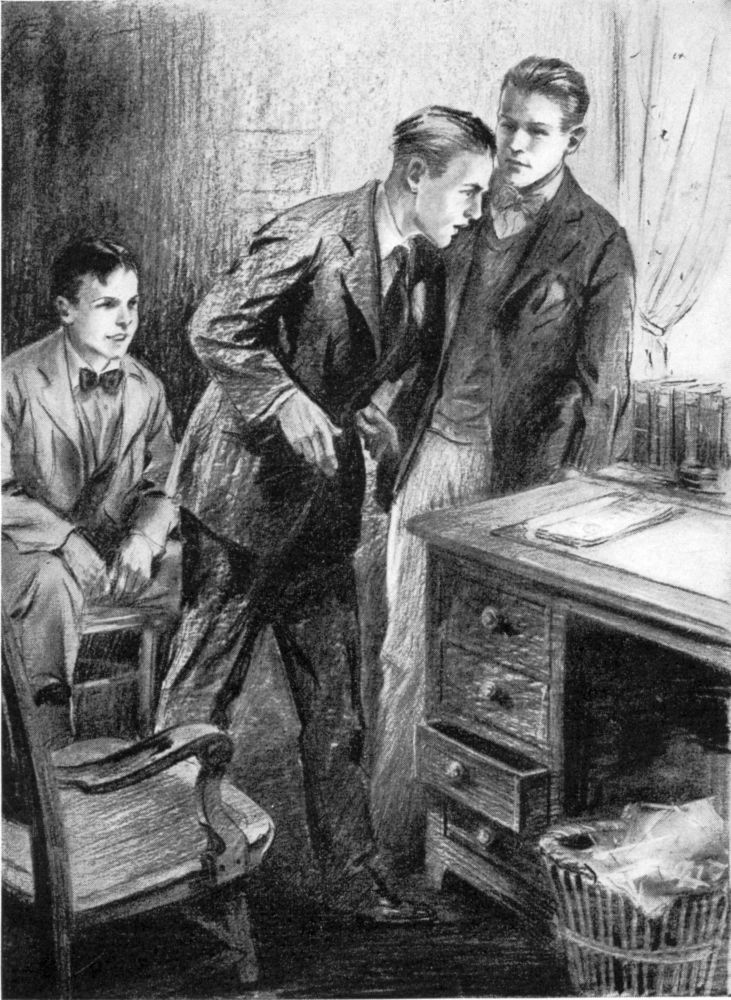
“Jones, if this is a joke it’s—it’s a rotten one,” he said hoarsely.
“Have a look,” answered Peaches, cheerfully. “It won’t bite you.”
Davy raised the bond, turned it over, and stood staring at it a long moment. Then he laughed uncertainly, laid the document down again, and walked to the window. After a little moment he asked, still looking out, “Where did you get it, Peaches?”
[271]
“Barry found it in that desk. He bought the desk from a second-hand man in the village. Is it the one?”
“Yes.” Davy turned and came back. He laid a finger on the upper left corner of the bond. “There’s Mr. Boyle’s mark. He examined the bond and wrote his initials in pencil in the corner, as he always did.” Barry and Peaches leaned over and looked. The letters “T. J. B.” were dimly discernible. They had been written with a hard pencil, evidently, and neither Barry nor Peaches had noticed them before.
“I don’t understand, though,” Davy continued, frowning, “how it got there. I put it in the safe!”
“Are you certain?” asked Peaches. “This was found by Toby one night when he had the drawers out, looking for a moth that got away from him. He says it was lodged under a splinter against the top there. You wouldn’t have put it there, would you?”
“Wait a minute.” Davy was staring hard at the old carpet. “Let me think, fellows.” There was a moment of silence. Then Davy’s head came up sharply and he said with a rush:
“I remember now! I didn’t put it in the safe! Mr. Boyle handed it to me and said, ‘Put that [272]in Box B., David,’ and I went into the outer office, and Mr. Watkins looked up and asked if that was the Light and Power bond and I said it was and he said, ‘Let me see it a minute’! I gave it to him, and just then Haggard called me and I went back to the outer office. Haggard—he was office manager—kept me busy until noon hour and I forgot about the bond, I suppose. When they asked me later, I was certain I’d put it in the safe. I thought I remembered pulling out the box and laying the bond inside!”
“What happened,” said Peaches, “is that Watkins probably stuffed the thing into that top drawer and it somehow got lodged under the splinter when the drawer was closed.”
“That’s exactly it!” agreed Davy. “That drawer was always stuffed full. He was like that. He was forever losing things and having to search all through that desk. Funny my forgetting, though! Why, I remember all about it now!” He dropped into his chair and grinned joyfully at Peaches and Barry. “Say, this is bully luck for me, fellows!” he added.
“I’ll say so!” said Peaches. He jumped up and thumped Davy on the back. “Gosh, I’m glad! And I’d like to be around when you hand [273]that over to Watkins and Boyle. I’d like to see their faces!”
“You will,” said Davy. “I won’t touch it, fellows. You must take it to them and tell them all about it. If I did it they’d say I had it all the time and was making the story up!”
“Well,” said Peaches, doubtfully. Then: “Or how about letting Mr. Benjy do it? Gosh! it would tickle him to death, Davy! What do you think?”
Davy laughed.
“All right, but you chaps must be on hand as witnesses. Why, say, I can go right out now and sit on the front porch! Or walk downtown! By gum, it’s great to have this thing cleared up! Look here: if we telephone to Dad now we could meet him downtown and go to the factory, I guess.”
“I couldn’t go,” said Barry. “I’ve got a recitation in just twelve minutes.”
“Nor I,” said Peaches. “And we’d need Toby, too. Let’s leave it until after dinner. You telephone Mr. Benjy, Davy, and I’ll round up the bunch for one o’clock. You’d better look after this thing until then, I guess.”
“No, thanks,” answered Davy, grimly. “I’m [274]not even going to touch it again. You fellows keep it. I’m going down to tell Mother. Say, honest, fellows, I can’t ever tell you how grateful I am. Gosh, it’s like—like finding a million dollars; only better!”
“Don’t thank me,” laughed Peaches. “Thank Barry.”
“Don’t thank me, either,” said Barry. “Toby’s your man, for if he hadn’t come in with his old moth—”
“Thank the moth!” exclaimed Peaches. “If you can find him!”
[275]
Altogether, that was a hectic day. Barry didn’t accompany the others to Watkins and Boyle’s after dinner, for Major Loring made a change in his plans and called the candidates together in the gymnasium at one-thirty. But he got a graphic account of the affair from Peaches. Mr. Benjy, declared Peaches, was superb. Reminded by Davy of the circumstances, Mr. Watkins recalled asking for the bond and being summoned to the telephone a moment later. He did not remember placing the bond in the drawer, but was convinced that he had done so.
Complete exoneration for Davy had ensued, and both Mr. Watkins and Mr. Boyle had been profuse in their apologies. They had offered reinstatement to Davy at a larger salary than he had received before, and had almost begged Mr. Benjy to return. Both invitations had, however, been refused. Mr. Benjy had been [276]dignity personified, displaying a quite unbelievable hauteur all through the interview and, at the last, leaving the office with his arm through Davy’s and his head in the air, like a conqueror; which, when you came to think of it, he was!
Davy, said Peaches, had decided to return to Springfield, while Mr. Benjy, relieved of the necessity for making further reimbursements to Watkins and Boyle, and with a comfortable check in his pocket, representing what he had previously paid to them, was content to remain at the freight-office. The whole occasion, Peaches remarked, had been eminently satisfactory until the return. Then he had been obliged to enlighten a perplexed and much dissatisfied Toby, a Toby still of the opinion that, in some underhand fashion, he had been “crooked”—the word was his—out of at least a third interest in that bond!
“Well,” said Barry, thoughtfully, “it’s mighty funny how things happen. If Clyde hadn’t decided to room with Hal Stearns, I wouldn’t have gone to Mrs. Lyle’s; and if I hadn’t gone there, I wouldn’t have had to buy a desk; and if I hadn’t bought that desk—”
“The bond wouldn’t have been found until the lot of us were wearing chin whiskers,” interrupted Peaches, “if then! Because no one but [277]you, Barry, would ever have bought that funny old thing!”
“Funny old thing!” exclaimed Barry. “Huh! I guess you wish you could find some funny old things just like it! Let me tell you, Mr. Jones, it isn’t every one can go into an antique store and pick up thousand-dollar bonds!”
At half-past one o’clock there was a session of blackboard drill in the gymnasium. At a little after two the players went out to the field to find the home stand crowded with a cheering mass of schoolmates and friends from the village. For half an hour there was light practice, during which Barry got off some very satisfactory punts and Pete Zosker kicked goals from every conceivable angle and possible distance. All the time the audience sang and cheered and excitement was in the chill November air. At three the first squad trotted back to the gymnasium, pursued by thunderous “Broadmoors!” leaving a handful of substitutes to amuse the spectators a while longer. At twenty minutes to four came the send-off at the station.
Those who were to make the trip to “Overlook” had been conveyed in the bus to the station, their bags between their knees, while the rest of the school had marched thither, still singing, still [278]cheering. At the last the little branch-line train of a baggage-car and two ancient coaches was surrounded by a horde of shouting partizans, and not until the wheels were actually revolving did confusion give way to order. Then cheers began again, Billy Bassett, standing atop a baggage-truck, leading. Long after the train had pulled out of sight of the station Barry could still hear the hoarse refrain of “Team! Team! TEAM!”
“Overlook,” or, as it was more usually called, “The Cabin,” belonged to a council of Boy Scouts in a near-by city and was each year loaned to Broadmoor for the use of the team on the night preceding the Hoskins contest. Major Loring had inaugurated the plan of taking the players away on the eve of the big game, his theory being that the change of scene benefited his charges both physically and mentally. The cabin stood just short of the summit of Mount Sippick, at the end of a trail which started at the little village of Alden, about eight miles from Wessex, not as the crow flies but as the ever ascending, ever winding single-track railroad went. From Alden there was an uphill hike of well over a mile.
The party consisted of twenty players and eight noncombatants. The latter included the Major and two assistant coaches, two managers, [279]the trainer, and two helpers. Travel was never heavy on the line and the Broadmoor party had the two coaches almost to themselves. Barry, rather excited by the adventure, shared a seat with Larry Smythe, regular left end. Larry was a quiet chap and, while there was plenty of noise from other parts of the coach, conversation in the end seat was scanty. Barry was well enough pleased to be silent. There was much to think about. Clyde had seemed to expect Barry to sit with him a few seats back, and Barry still puzzled over the look of surprise on the other’s face when he had gone past. Barry was especially thankful that Larry Smythe didn’t insist on talking football. Larry’s only approach to that subject was in the form of an indifferent reference to the absence of Waterman.
“He was on the list yesterday. Must have missed the train.”
Barry agreed and the matter was dropped. His feet propped on his suit-case, he watched the hillclad slope as the train panted around the curves. He found himself wishing that Peaches were there. Behind him there was a good deal of noise and horseplay, encouraged rather than frowned on by the coaches. At Sanborn Mills, the first halt, half the party flocked outside and indulged [280]in all the pranks they could think of. There wasn’t much to be seen there: a few houses climbing a straggling road, a store, the station, and the old brown buildings of the mills leaning over the bank of the splashing stream across from the railroad.
The train went on, following the East Fork, hardly more than a trout-brook now, and jerking and grinding around a shoulder of the mountain. When the shrill whistle announced their approach to the next station, Barry arose.
“Guess I’ll get a breath of air,” he said. Larry Smythe yawned and nodded, but didn’t accompany the other. As the train slowed, another rush down the aisle began, and Barry was jostled through the door. Clyde, one of the laughing crowd, hailed him.
“Come on, Barry!” he cried. “Take a look around the city!”
But Barry shook his head soberly and kept his place on the car platform. Mount Sippick was even less of a metropolis than Sanborn Mills. A narrow dirt road climbed upward, hugging the mountain, and along it were four buildings, the nearer combining the purposes of dwelling, store, and post-office. There was no baggage-truck here for the amusement of the invaders, but [281]they managed to create plenty of noise and a good deal of interest on the part of the half-dozen inhabitants gathered for the daily event. Some of the fellows wandered as far as the little bridge which hung well above the boisterous stream, and when without warning the train started on, they had to sprint hard to reach it. Most of them climbed aboard the rear platform, but Clyde, finding so many ahead of him there and fearing that by the time he got a chance to clamber up it would be too late, raced on to the platform ahead. As the track was nearly level for a short distance beyond the station, the train acquired speed quickly and there was a moment or two when Clyde doubted the issue. The station loiterers jeeringly cheered him on, and after running the length of the platform, he reached the intersection of two coaches and made a desperate leap.
Only his right hand reached its goal. This attained a firm grasp on the railing nearest the rear car. His left hand clutched emptily, missing the forward rail. As he had left the station platform before he sprang for the steps, he had not been able to reach the latter with his feet. The most he could attempt was to lodge his knees on the bottom step, and at that he was only half [282]successful. His right knee did get there, but only by a bare inch, while his left leg hung in space. Then the forward impetus of the train swung him around, his right knee slipped off the step and, supported only by his right hand, he hung there, scared, breathless while the train sped on, preparing for its start up the next grade.
Try as he might, he could not reach the railing with his left hand, nor could he find the step with his right foot. All he could do was hold agonizingly with that one hand. Beside him the rocky bank of the cut rushed past, at times dangerously close. To let go would mean certain injury, if not death; indeed, it seemed hardly possible that, dropping, he would not be hurled beneath the wheels. He cried out frantically, but the noise of the train, doubled as it was thrown back by the rocky wall, almost drowned his voice. It seemed to Clyde that he had dangled there many minutes, although in reality his plight had lasted but a few seconds, when absolute terror came to him with the knowledge that his grasp on the rail was slipping. One trailing foot struck the end of a tie and he drew his legs up and put his remaining breath in a shrill, agonized shout.
Barry had remained on the car platform until the train was well under way, ignorant of the [283]narrow escape from being left behind that had threatened the handful of adventurous youths who had gone back to the bridge, an escape that had moved the remaining occupants of the car to laughter. Slamming the door behind him, he stepped back to his seat beside Smythe and settled his feet again on his suit-case.
As he did so a sound came to him above the rattle and jar of the train, a sound that startled him until he laid it to the screeching of the wheel flanges against the curving rails. It came again as, discovering that his backward thrust at the door had failed to close it, he once more arose and approached the platform. As he stood there, the door-knob in his hand, the strange sound fell once more on his ears and seemed to turn his heart over. Instinctively he sprang outside, drawing the door shut behind him, and stared about. The platforms and steps of the swaying cars were empty. Still shaken, he turned to reënter the coach and saw a straining hand clasped about a railing.
[284]
“You’d better stay out here a minute,” said Barry, “and get your breath.”
Clyde, seated on the platform, his back against the car, nodded silently. His lungs still fought convulsively for air, but the blood was coming slowly back to his white cheeks. Barry, who had displayed no hesitation, felt no fear when he had pulled the other back to safety, now found himself rather faint and wabbly and was glad enough to accept the advice he had offered to Clyde. He crouched by the other for several minutes while the train, meeting stiffer opposition now, labored slowly up the mountain. Finally Clyde gave a long sigh and spoke shakily:
“Thanks, Barry. I—I couldn’t have held on another moment.” He shuddered. “Gosh, that was fierce!”
“Must have been,” agreed Barry, none too firmly. “All right now?”
“In a minute,” Clyde muttered. “My arm—” [285]With a trembling hand he explored his right shoulder. “I guess it won’t be much good for a while. I had my whole weight on it, you see. I couldn’t get hold of anything with the other hand. Just dangled there. Couldn’t have held much longer. Afraid to drop. Kept thinking of the wheels. Ugh!”
“Better forget it now and come inside,” said Barry. “Fellows will be wondering where you are.”
“Rather they didn’t know, Barry. You won’t say anything? Don’t believe any one saw, eh? I’ll stay here. We’ll be there in a few minutes. I’m all right now, but—I’d rather not go inside.” He took a deep breath and attempted a smile.
Barry wished there weren’t the matter of that letter between them. He wanted to speak warmly, but he couldn’t. All he could do was to ask carelessly:
“Want me to bring you some water?”
Clyde seemed not to notice anything lacking in the other’s voice or manner. He shook his head.
“I’m all right,” he repeated. “Just want to sit still a minute longer.”
Barry started to scramble up, but Clyde went on with:
[286]
“I guess it’s even-Steven now, Barry. Fifty-fifty, eh? I saved your life that time and now you’ve saved mine. Funny!”
“Well, you might have rolled clear of the wheels,” replied Barry, unemotionally.
“Not a chance! I’d have hit the bank and rolled right under. I’m sure of it. Well—” Clyde drew another long breath—“well, I didn’t, old man, and you’re to thank for it.” A hand groped for Barry’s and Barry took it. Clyde’s clasp was almost painful.
“Thanks,” he said simply.
“That’s—all right.” Barry climbed hurriedly to his feet. “I’d better go back,” he muttered. “There’s the whistle now.”
Larry Smythe turned from the contemplation of the scenery and gave Barry a long questioning stare.
“You’re a real fresh-air fiend,” he observed. “What have you been doing out there? Counting cinders? You’ve collected a good many, by the way.”
Barry laughed and tugged at his suit-case.
“Guess we’re about there, Larry,” he said. “Get a move on you!”
In the confusion of arrival Clyde escaped notice. A few minutes later the march up the [287]trail had begun, and bags, while lightly packed, became increasingly burdensome. But every one remained cheerful to the end of the journey, although after a while conversation and song petered out. Clyde had elected to walk with Barry, but, to the latter’s relief, was almost silent.
The cabin proved to be a huge log structure fronted by a low, unrailed porch. Already the big stone chimney was sending smoke into the deepening dusk as the expedition came within sight of it, and an approving cheer arose. Joey, one of the school cooks, appeared at the doorway and waved a mighty carving-knife in response. Joey and an assistant had been up there since early forenoon, and everything was in readiness. One end of the cabin held the bunks. At the other was the big fireplace and a long pine table facing it, a table sufficient to accommodate many more than were to gather about it now, and which, even so, escaped the walls on each side by several yards. A near-by door gave a glimpse of a lean-to kitchen and emitted the fragrant smoke of broiling steaks.
The great building, beamed with gleaming birch logs, glowed with the mellow light of the crackling fire and was alive with dancing shadows. [288]While the arrivals trooped in, shouting joyously, and chose their bunks by the simple expedient of tossing their bags upon them, the hanging lamps were lighted. Through the open, unpaned windows along the front the tops of the trees showed below, dropping away until at a distance, seen in the first darkness, they gave the appearance of a dark-hued carpet. It was chill but sparkling, that mountain air, and Barry found his depression gone before a sudden feeling of buoyancy and well-being and—yes, most certainly—ravenous hunger!
It was all very merry, very noisy, very jolly during the half-hour before supper. If any one thought of the morrow’s test, at least none spoke of it, nor would he have been suspected of dwelling on it. There were singing and a deal of laughter and a few practical jokes, and presently Joey appeared with the first platter and a jovial shout of, “Come get it!” After that, for a long while, comparative silence reigned, a silence that was itself a tribute to Joey’s talent.
After supper many of the party went out to the long, deep veranda and watched the stars sparkling in a frosty sky and the home lights, tiny yellow pin-points, gleaming in the valley. Hal Stearns, who had observed with evident disapproval [289]Clyde’s renewed intimacy with Barry, bore the former away to an end of the porch. Barry, feeling very peaceful and very lazy, stretched himself flat on his back, his legs over the edge of the porch floor, and gave himself up to thought. A few yards away Captain Buckley and three or four others were talking busily, and Barry’s ruminations were at first punctuated with the frequent rounds of laughter. But presently his thoughts took so interesting a turn that he was no longer conscious of neighbors.
When most of a half-hour had passed he sat up abruptly and climbed to his feet. Clyde and Hal and Goof Ellingham were seated at the end of the porch, and as Barry approached he heard the conclusion of a remark of Goof’s:
“And Al said he understood Rusty had been given a cut until to-morrow, the lucky beggar!”
“Oh, I don’t know,” said Hal, yawning. “This isn’t so rotten, Goof!”
“Clyde,” asked Barry, “may I see you a minute?”
“Sure!” Clyde’s response was prompt, even cordial, but it held surprise. He joined Barry and the latter led the way across the small plateau on which the cabin was built, to a ledge that jutted out from the end of the trail. Clyde said:
[290]
“We were talking about Rusty Waterman. He didn’t come along, and Al Sampson says the Major gave him a cut.”
“I noticed he wasn’t with us,” replied Barry. Then: “You said a while back, Clyde, that I’d saved your life,” he said.
“I say it again,” asserted Clyde. “You sure did, Barry!”
“And that we were even on that score.”
“One-all,” agreed Clyde.
“Then,” went on the other, “I don’t owe you anything, as I see it. I mean there isn’t any reason now why I ought to let gratitude stand in the way of—of straight talk.”
“Why, no,” said Clyde, in a puzzled tone. “But I don’t see what you’re getting at, youngster.”
“I’ll tell you. We’ve been friends—sort of—for a good while, Clyde, and—”
“‘Sort of’! Where do you get that? We’ve been mighty good friends! Of course I know that lately I haven’t—well—hang it, Barry—I’ve been rather a blighter. I’ve wanted to tell you this for a week or so, but you’ve been pretty upstage with me and I didn’t get a chance. Fact is—” Clyde paused, evidently searching for words, and Barry cut in.
[291]
“That part’s all right,” he said. “I can forgive that, but that letter is different, Clyde. That—that’s—”
“What letter?”
“You know, I guess,” Barry answered patiently. “The letter to Coach Prince.” He dropped his voice cautiously, although the darkness held no others nearer than the porch. “I want to talk about that, Clyde, and get it off my chest. Maybe you didn’t mean—”
“But—suffering cats!” interrupted Clyde. “I don’t know what you’re talking about!”
There was a moment’s silence. Then Barry asked:
“Honest, Clyde? You mean that you didn’t write it? Or have a hand in it?”
“I don’t know what it is!” exclaimed the other, in an exasperated voice. “I haven’t written any letter to any coach—hang it!”
“Gosh!” said Barry, softly. “Gosh, that’s great! I thought of course—”
“What letter is it?” demanded Clyde, impatiently.
Barry told him all the circumstances, while Clyde expressed bewilderment and resentment, by various sounds that were not quite words. And when Barry had explained, Clyde had [292]many questions to ask, and got so excited and angry that the other had to caution him against being overheard.
“Whoever pulled that stunt ought to get kicked out of school!” declared Clyde, hotly. “And—and you thought it was me!”
“I didn’t want to,” said Barry, “but I couldn’t help it. You said that night in your room that you’d see that I didn’t play against Hoskins—”
“But—great Scott!—I was only talking, you idiot! I was mad, all right, that time, I’ll own, but—but—say, you make me tired! You ought to know me well enough to know that I wouldn’t pull a dirty trick like that, Barry!”
“I’m sorry,” said the other. “But you did say it, and just as if you meant it; and then there was that typewriter of yours that printed the B’s above the line.”
“Yes, that’s so,” Clyde admitted, somewhat mollified. “And that’s funny, too. Look here, you don’t suppose Hal—”
“I thought of him,” replied Barry “but he wouldn’t have any reason, would he?”
“He might have,” murmured Clyde, thoughtfully. “But—hang it, Barry!—there may be other machines that print the B’s crazy.”
“Of course, there must be. You didn’t write [293]the letter, and I don’t believe Hal Stearns did, so—”
“Wait a bit! When was that thing written?”
“Mr. Prince received it Tuesday morning. There wasn’t any date on it.”
“Tuesday morning? Then it must have been written on Monday at the latest, eh? Well,” and Clyde’s voice arose triumphantly, “I didn’t get that machine until Tuesday noon! You can ask Whitwell!”
“Well,” said Barry, after a moment’s consideration of the announcement, “that certainly lets Hal out, doesn’t it? But—shucks! I don’t care now who did it! Just as long as you didn’t, what’s it matter?”
“It matters a lot,” grumbled Clyde. “What sort of bozos do you suppose Mr. Prince thinks we are, over here? I hope the Major finds out who did that, and gives him thunder! I’d like to take a wallop at him myself.” Presently, having pursued this thought sufficiently, he went on:
“Say, Barry, I’ve got to apologize for acting like a nut lately. I’m sorry, and that’s no apple-sauce. I—I’ve been sort of off my trolley, I guess. You see, I’d set my heart on making the team this year, like I told you before. And when you fell for Major Loring’s bid I knew I was [294]dished. I’ve always known that you’d make a cracker-jack player if you once got started. You’ve got something I haven’t got: a sort of—of spirit, I guess. I don’t know just what it is, but you’ve got it. And I haven’t—never’ll have it, probably. Get you started and you’ll go through fire. Best I’ll do is wait around for the engines to come! Well, I know now that I’ll never make a reputation playing football; and now that I do know it I don’t care a whole lot.
“After all,” he went on, “I’ve just about decided that some of the crowd I’ve been trailing aren’t much good. I got started sort of wrong last year. Thought I had to train with the silk-stocking bunch, when I wasn’t really in their class. Some of them are all right,—a few,—but I guess most of them have been laughing at me behind my back, right along. It isn’t only a question of money; Dad’s got enough of that; you’ve got to know how to spend it in all sorts of crazy ways, and act like it wasn’t anything at all and make believe you’ve always had plenty and it’s a frightful bore. And you’ve got to wear your clothes a certain way—and the right kind of clothes, too—and talk about folks who get their names in the papers on Sunday, and know all about queer things like opera and polo and—and [295]a lot of other bunk. And play a good hand at bridge. I can’t; I hate the fool game. And I’m tired of trying to keep up with the gang. If they want to chuck me they may. I hope they do! Hang it, I’m just as good as they are, even if my folks don’t go to Miami every winter!”
Clyde ended rather breathlessly.
“I’m glad to hear you say that,” responded Barry, warmly. “Of course I know that some of the fellows you mean are mighty nice, but a lot of them don’t really amount to much, as far as I can see. They don’t study if they can help it; they don’t play anything, usually; they pretend that the school isn’t good enough for them and that they’re doing it a favor by coming to it. They—they make me sort of ill!”
“Me, too,” growled Clyde. “And I’m off ’em. They won’t know me when I go up to college, but I can live through it, I guess.”
“Some of them,” said Barry, shrewdly, “aren’t likely to get there—or stay there if they do!”
“Hal’s as bad as any, too,” Clyde went on glumly. “He’s got the social bug. Talks about folks I’ve never heard of, and reads the society bunk in the papers every Sunday until I want to bean him.” He was silent a moment and then [296]added almost shyly: “Say, I don’t believe he will stick with me after the holidays, Barry; not if I give up the gang, anyway; and I was wondering whether you’d care to come over. It’s a pretty good diggings, and it’s a lot more fun being on the campus, you know. What do you say?”
“Why, thanks, Clyde, but I don’t believe I’d want to change. Not this year, anyhow. Perhaps in the fall, if you don’t find some one else.”
“Well, you better think it over,” Clyde added, a trifle gruffly. “No hurry about deciding.”
“I’ve already decided. For one thing, I’d hate to leave the Lyles with an empty room on their hands, Clyde. They need the money, and if I got out I don’t believe they’d be able to let again.”
“Yes,” said the other, dryly, “and for another thing there’s Crawford Jones.”
“Yes,” assented Barry, evenly, “there’s Jones, too. He’s a fine chap, Clyde. I wish you and he would quit being so down on each other.”
“Oh, I’ve got nothing against him—especial,” said Clyde, with something of an effort. “I just don’t— He’s so plaguey fond of himself, hang him! Thinks he’s too good for any one—except you. Besides, he hates me like poison.”
“Oh, no, he doesn’t!” laughed Barry. “You [297]just think he does. I’ll bet that if you and Peaches—”
There was a call from the cabin door, and the two arose and went back toward the lights. Half-way across the grass Clyde said:
“Well, things are sort of cleared up between you and me, Barry, aren’t they? I wish we could manage to get together a bit oftener. Of course, I know you don’t like Hal much, but he’s out a good deal.”
“I’ll be glad to drop around oftener, Clyde, but you’ll have to do the same. Lyles’ isn’t quite out of the world, you know!”
“No, of course not,” muttered the other. “Sure, I’ll come and see you.”
There was an hour before the big fireplace, the fellows seated on the benches or on the floor in front of them. No one spoke of the morrow, nor was football an approved subject of discourse. After a while Sinclair and Pete Zosker produced banjos and singing began. To-night the fellows’ taste ran to the old, well-known songs and they sang a number of them before the Major suggested, glancing at his watch:
“Let’s have ‘Sunny Fields,’ fellows, and hit the hay.”
So they got to their feet, many sleepily, and [298]the school song was sung through, very feelingly; and Barry, for one, felt just a little weepy and rather noble!
Breaking up, the throng strove to get back to its former mood of noisy jollity, but it wasn’t wholly successful and many of the fellows sought their bunks in silence. Skirting an overturned bench, Barry passed close to where the Major and Mr. Graham were smoking ruminatively in the firelight, and the former, glancing up, spoke.
“Oh, Locke, just a mo!” he said. “That letter business is cleared up. Thought you’d like to know. Meant to tell you before, but forgot it.”
“Yes, sir,” said Barry, questioningly.
“No need of mentioning names, I guess. I—er—I’ve attended to the chap. I gather, though, from what Jones says, that your suspect wasn’t concerned.”
“Jones? You mean—Peaches, sir?”
“Yes. He took the matter up. Very glad to have him. Well, good night.”
[299]
“Hoskins’s ball!” The referee, having waded knee-deep in the pile-up of writhing players, placed the pigskin on the visitors’ twenty-seven yards and skipped aside. “Third down! About six to go!”
Barry watched from the bench, a gray blanket draped about him. He had been watching for upward of twenty-five anxious minutes during which the ancient rivals had charged up and down the field with scant advantage to either one. Near by sat Hall, substitute tackle, chewing his knuckles and muttering to himself. On the other side, knee touching Barry’s, sat Clyde. Beyond the latter, at the far end of the bench, Major Loring and the two assistant coaches looked on with expressionless faces and conversed in low tones at intervals.
Behind Barry the stand was close, and he could almost feel the cheers beating against him. Before the start he had searched the rows and found the Lyles half-way up the farther section, Mr. [300]Benjy enormously swaddled against the chill air, Mrs. Lyle looking quite young and pretty, Betty with her eyes sparkling, roses in her cheeks, and a valiant streamer of purple and gray ribbons pinned to her coat. He had exchanged greetings, too, with Peaches and Mill. He hadn’t seen Peaches to speak to since the day before, for, returning to school at a little before twelve, they had been taken straight to the dining-hall for an early luncheon and from there to the gymnasium, the Major guarding as carefully against “foreign entanglements” as a New England statesman!
Barry had slept remarkably the night before. Only once had he awakened, and then had stayed awake only long enough to stare sleepily back at a twinkling star shining down at him through the open casement and to pull the covers up over his head. In the morning the big, roaring fire had been grateful indeed, and so, too, had Joey’s hot breakfast. At nine o’clock they had assembled outside on the limited level of sparse turf and gone through formations for an hour. If the previous evening had tabooed football, this bright, frosty morning had tabooed all else. When the work was over the Major had tossed a battered old ball to Barry with:
“Let’s see how far you can kick it, Locke.”
[301]
“But we’ll lose it, sir!” The Major had shrugged.
“See that bunch of dark-red leaves down there? The trail’s just to the right of it. See how close you can come to it.”
So Barry had stepped forward, nearly to the edge of the plateau, and punted, and the old ball had shot away, first up across the tops of the nearer trees and then down and down, to crash at last through the branches far below. Barry had never expected to see that ball again, but when, shortly after ten, they were going “down off,” as the mountain folks said, the Major ranged aside from the trail for a few moments and came back with the veteran pigskin under his arm!
Time had sped fast from the moment the train rattled into the Wessex station. Excitement and confusion had reigned. Speeding through the village, they had raised an approving shout wherever a patriotic—and canny—tradesman had hung the purple-and-gray. Already alien hues were to be seen, too, for forerunners of the invading army from Fairmount were straggling about the streets, displaying dark-blue arm-bands adorned with a golden H. Barry had not cared much for luncheon. He told himself that was because he had eaten so heartily barely more than [302]four hours before. Perhaps it was. Perhaps, too, the fact that he was just a mite frightened and more than a mite nervous had something to do with it.
In the gymnasium they had dressed in a leisurely manner, they and the players who had not made the trip to the cabin, and then had gathered in a corner of the locker-room and listened to Mr. Graham and Mr. Mears and Captain Buckley, and, last of all, and more intently, to the Major. The Major hadn’t said much; his remarks had occupied less than five minutes, perhaps; but what he had said was still fresh in Barry’s memory.
They were not to reflect on what Hoskins had done that fall, said the Major. They were not to compare records, nor heed the “bunk” the papers printed. What had happened was past. What concerned them was only what was going to happen.
“You’ve got to play hard, you’ve got to fight!” the coach concluded. “If you do what I know you can do, you’ll win. You’re playing on your own field; you’ve got the whole school right behind you; you’ve got the plays you need. And—by glory!—I think you’ve got the spirit! Have you?”
Barry could still hear the sudden, high-pitched [303]shout that had followed, could still feel the thrill of the moment. They had trotted out a minute later, exalted, eager for the test. And now they were meeting it. It was hard to believe that the big moment of the season was here, that within the next hour and a half the decision would be reached; the decision that would say whether all the hard work and hard knocks, all the planning and strategies of the past two months had won or failed. Only now did Barry realize how intensely he had been hoping for success, was still hoping, and would continue to hope until, in the first shadows of twilight, the last whistle should blow. The thought of defeat was accompanied by a sudden nausea, a painful cold sinking of the heart. He had never known before how much a victory could mean!
The whistle brought the first quarter to an end and the teams repaired to the side-lines, for water. Broadmoor began, “Don’t Be Rough,” while across the field the blue-and-orange decked stand broke into the famous Doctor Song. “Doctor! Hurry, Doctor! The patient’s very low!” floated across, and Barry scowled ferociously until the strains behind him gathered volume and the rival’s wailing plea was drowned. The game started again, Broadmoor now with her back to [304]the north goal and favored by the light, chill breeze. The day had begun with clear sunshine and little wind, but by two o’clock clouds had begun to gather, and now, for minutes at a time, the sun was hidden. The breeze seemed to be increasing as the afternoon wore on, and already coat collars were being turned up and at times the tramp-tramp of chilled feet kept time to the cheering.
There had been but little kicking in the first period, both teams clinging to the ball until obliged to punt. Now, holding the slight advantage afforded by the breeze, Broadmoor used Tip Cartright repeatedly, sometimes as early as a second down, hoping, doubtless, for a break in the shape of a fumble to bring her to scoring distance. But Hoskins played safe, making fair catches once or twice, once or twice letting the ball hit the ground. Broadmoor started an advance that swept as far as the enemy’s forty-one yards, where Demille was thrown for a loss and two subsequent attempts outside tackles left the home team well short of her distance. Cartright punted from his forty-eight to Hoskins’s seven and a swift-footed back ran the ball to the sixteen before Larry Smythe dropped him. Hoskins gained nine yards on Ellingham, using a tricky delayed [305]pass, and got more than her distance off Captain Buckley on the next play. Another smash at the line and a wide run put the ball on the twenty-five. There, however, Broadmoor stiffened and three attempts yielded Hoskins but seven yards and she punted out on the opponent’s forty-eight.
“Locke!” called the Major. “Go in for Cartright. And keep your mouth shut.”
Barry shed his blanket and ran across, hand upraised. With a sour grin Tip yielded his head-guard. Broadmoor took up the journey again. There was still all of five minutes left of the half. Zinn stole around right tackle for a bare two yards and Haviland got three through center. On the next play Harris was off-side and the ball went back to the enemy’s forty-seven.
“Locke back!” called Zinn.
The next few minutes proved the value of advertising. Hoskins had read the newspapers and thought she knew all about Locke: that he had done sixty yards frequently in practice; that Broadmoor had been trying to keep him under cover; that he was dangerous. Oh, you couldn’t catch Old Hoskins napping! Had he thought of it, Barry might have felt flattered at seeing how far back the safety men played! But the Blue-and-Orange wasn’t any too certain that Broadmoor [306]meant to punt on third down, and it didn’t open its defense more than it had to. But still, Demille, to whom the ball went, managed to get back that five yards that the penalty had cost and a foot or so more.
Fourth down now, and again Barry was called back. He knew the ball wasn’t to reach him, but he didn’t let any one else know it. He set his feet solidly, cast an appraising eye down the field, and held out his arms. Then Pete Zosker sped the ball back to Haviland, Haviland passed it swiftly to Larry Smythe, and Larry, dodging this way and that, eluded the enemy craftily, crossed the forty-two yards at full-tilt and kept right on to the thirty-one. And Broadmoor arose in the east stand and went quite crazy!
Locke back again! And this time the ball was his. But he didn’t kick it. He put it under his arm and sped to the left, a wall of interference between him and the foe, turned in at last and crashed straight into the arms of the Hoskins right tackle; and as the latter was about forty pounds heavier than Barry, the play stopped right there! But Barry had added another yard and a half and once more took up kicking position. Hoskins perhaps began to wonder whether or [307]not this Locke fellow really could kick! Barry began to wonder, too, for on the next play it was Johnny Zinn who knifed through center, after nursing the pigskin a moment, and was downed on the twenty-six; very much downed, indeed, since a third of the Hoskins tribe managed to assemble on top of him before the whistle blew!
It took all the permitted time to bring Johnny back to normalcy, during which a steady uproar arose from the Broadmoor side of the field. Along the side-line over there Ike Boardman was sprinting up and down. But presently Ike resumed his blanket, for Johnny wasn’t at all dead. Third down now and still almost five to go; and Hoskins, pushed back to her twenty-five-yard line, desperately resolved to take no more fooling! Once again Johnny’s hoarse voice called, “Locke back!” and Barry took up his position close to the thirty-five. Hoskins, puzzled, doubting, watched sharply. The ball went to Barry and he swung his leg. But not until he had made a lateral pass to Larry Smythe. Barry didn’t see much of the ensuing events, for he was on his back for several instants. When he found his feet again, Larry was just rolling across the goal-line in the farther corner of the field. A Hoskins [308]player rolled with him, while several more seemed extremely disturbed because they had arrived just too late to take part in the frolic!
Pandemonium broke loose and Broadmoor cheers filled the air. Eleven gray-jerseyed youths cavorted about the trampled turf, one of them indulging in a series of startling handsprings,—it was Leary, who was talented that way,—and a referee with carefully expressionless countenance deposited the ball in front of the goal on the three-yard line. Perhaps Johnny should have chosen to add the point by a drop-kick or placement; or even by a forward-pass; but Johnny felt pretty cocky just then, pretty confident, and he handed the ball to Ira Haviland and Ira took a plunge at the Hoskins line. When the dust of battle had somewhat settled it became apparent that Ira had fallen just two inches short of his goal!
The big full-back acted then as if he had foully murdered his aged grandmother, or indulged in some equally reprehensible crime, and would not be comforted. All the way back up the field he kept muttering: “Two inches! Two inches!” And sometimes: “Wouldn’t that make you sick?” The fact that the score-board displayed a big 6 opposite the word Broadmoor, while [309]the corresponding space below was still empty, brought him no joy now. “Two inches!”
Hoskins kicked off, Ellingham caught the weak attempt, and a whistle blew. The half was over. Walking across the turf to the gymnasium, Barry was a prey to conflicting emotions. Broadmoor had scored, and for that he was glad indeed. But, although he had played a full five minutes and had five times stood in kicking position, only a measly yard or so was to his credit! He was a punter, and they hadn’t let him touch a foot to the ball! There was something wrong there. Joy was heavily tinctured with regret!
[310]
Mr. Banks kept Zo at his violin lesson later than the latter had feared he would, and it was nearly three o’clock when the boy reached the field and, not without difficulty, found a seat in the very last tier. Grudging occupants, resentful of disturbance, drew together to allow him something less than the sixteen inches to which he was supposed to be entitled. As he was wearing a thick mackinaw and must find space for his violin-case, he felt somewhat crowded. Still, being wedged in had one advantage: it made for warmth; and the top row of the stand was a chilly place that afternoon. He wished that he had had sense enough to leave his violin at Mr. Banks’s. Being accustomed to taking it with him after his lessons, he had given it no thought. Putting it between his legs was a comfortable solution, but if, in the excitement of the game, he should jump up, the case and contents would doubtless slip between the planking and fall to the ground. He [311]finally laid it obliquely across his knees, to the evident annoyance of his right-hand neighbor, and fixed eager eyes on the contest.
He witnessed Barry’s rather dramatic entrance on the scene and took whole-souled part in the two short cheers: “Rah, rah! Cartright! Rah, rah! Locke!” After that, until the half ended, he forgot everything but the game, and thrilled as only an ardent lover of football and a zealous patriot can. He almost lost his violin when the Purple-and-Gray’s left end went over for the touchdown, springing to his feet in unison with those below and beside him and shouting shrilly until his throat ached. Between halves he tried putting his hands in his pockets, but as surely as he did so some restless youth decided to pass him and so they must be taken out again to clutch the violin-case. He was glad when, having listened with impatient politeness while Hoskins sang rousingly about how “Hoskins heroes never yield,” Billy Bassett, cheer captain, lifted his purple megaphone to his mouth again and demanded: “‘Hey Diddle Diddle,’ fellows! Every one into it! Make a noise. Come on!”
Clasping his burden to his chest, Zo stood and sang at the top of his lungs, stamping chilled feet in time to the merry strains. “Hey Diddle [312]Diddle” was a warming song, for you clapped your hands together at the end of every second line of the rollicking chorus. A long “Broadmoor” followed, and then, quite unexpectedly, the teams were back and the real cheering started!
Broadmoor began the second half with the same line-up she had started with. Tip Cartright was back at right half, and Barry was once more on the bench. As though persuaded by recent events that she had only to take what she wanted, the home team wrested the ball from the opponent soon after the kick-off and started a sturdy march up the field. Nearly every play in the repertoire of the Purple-and-Gray was used during that advance; and Broadmoor reached the foe’s thirty-two yards before Demille, skirting the Hoskins end, was brought down by a husky enemy back with such a crash that the ball got away from him and was captured by the defender.
One plunge that netted two yards or so, and Hoskins sent off a long forward-pass that went beautifully and brought the warriors to mid-field. Very promptly Broadmoor became not the attacker but the defender. Hoskins launched an offensive operation that brought alarm to the audience in the east stand and caused Zo to squirm and writhe in impotent dismay. The Blue-and-Orange [313]seemed at last to get her attack working right and, with a much-touted left half-back bearing the brunt of the burden, crashed and plowed her way by short but sufficient gains to the Broadmoor twenty-two yards before the Purple-and-Gray recovered from her surprise sufficiently to stem the invasion. At the last Broadmoor stiffened and two surges at her line were repulsed for virtually no gain.
By this time there had been three changes in the Broadmoor line-up. Zinn, rather groggy, had given place to Ike Boardman, Follen was at right end instead of Harris, and Kirkland occupied the post beside him. Hoskins faked a kick and shot a short pass over the left side of the line which grounded. Followed a conference, and then, postponing a touchdown for the time, the quarter patted the turf some eight yards back of his center and knelt beside the spot. Broadmoor made a heroic effort to crash through and smear that kick, but she failed and the ball sailed from the thirty-yard line straight across the bar, and the figure 3 appeared on the score-board beneath Broadmoor’s 6.
For the rest of that quarter Hoskins, having tasted blood, raged like a devouring lion. But once a forward-pass fell into Demille’s hands and [314]averted a possible disaster, and once, well inside Broadmoor territory again, a penalty for holding set the visitors back and necessitated a punt. The third quarter ended with the ball in Hoskins’s possession on her own forty-one yards.
Just before the end of the period Major Loring arose from his place near the end of the bench and seated himself beside Barry. For several minutes he talked in low tones, while Barry, staring thoughtfully ahead, nodded at intervals. When time was called Barry shed his blanket and walked to where the referee was guarding the newly placed ball.
“Locke, right half-back, sir,” he announced.
“Broadmoor right half out,” called the official as the men gathered. Cartright yielded his head-guard silently and limped off to a welcoming cheer. Ike Boardman the irrepressible winked genially at Barry as he passed on his way back. Barry grinned, rather nervously. Hoskins took up her task once more, shooting her demon half-back at every angle and getting four, five, sometimes six yards at a time until she neared the thirty. There the advance slowed and finally paused, and when a tricky double-pass had failed to gain, the Blue-and-Orange tried a desperate venture. The ball was on Broadmoor’s [315]thirty-three yards, and the wind, now blowing strongly, was against the attacker. Nevertheless, Hoskins elected to try a placement kick. The stands grew silent as the Hoskins kicker went slowly back and the quarter settled himself to take the pass from center, so silent that Ike Boardman’s hoarse challenge was heard plainly.
“Get through ’em, Broadmoor! Smear ’em up! Block this kick! Fight, you guys! fight, I tell you! Block it! Block it!”
The ball touched the ground just short of the forty-yard line and although Broadmoor did plow through desperately and nearly spoiled the attempt, the pigskin sailed safely above the upstretched hands of the leaping enemy and straight for the goal. It went well above the bar and past the posts, and the Broadmoor adherents in the stand endured a miserable moment of anxiety until an official waved negatively. Then relief expressed itself in a mighty shout. The wind that at first seemed to favor the brave enterprise had turned traitor at the last instant and whisked the ball just outside the left-hand upright! Hoskins deserved that field-goal, for the attempt had been a gallant one and well executed. But such jests of Fortune are common enough in football, and [316]the loser learns not to complain. Hoskins felt the blow but scorned discouragement.
Two drives at the Blue-and-Orange center yielded six yards, and then Barry was sent back and punted. With the wind behind him he became in reality the fabled “Punting ace,” for the ball went well over the heads of the Hoskins backs and rolled to their twelve yards before it was recovered. Had Larry Smythe been in fresher condition or Follen a faster end, the game might have been decided then and there, for the Hoskins quarter had difficulty in capturing the bobbing oval. But as it was, the ball was safely downed when Larry settled against the quarter’s head. Hoskins, on the first play, got a back around Follen’s end for nine yards. Blue-and-Orange pennants flapped in the wind and Hoskins cheers boomed forth. The enemy was again on her way!
Straight to mid-field she went, Broadmoor fighting hard but unsuccessfully to stay the rush. Hoskins swept across the half-way line with a twelve-yard forward-pass, sent an end around the enemy’s left for six more, and finally made it first down on the Broadmoor’s thirty-seven. The minutes were ticking away fast, but not fast enough for the watching friends of the home team.
Up on the top row of the wind-swept east stand, [317]Zo Fessenden shook with cold and excitement. Many of his erstwhile companions had deserted him for the more sheltered ground below, and now he was able to lay his instrument beside him and, his hands in his pockets, stamp and shiver and shake unencumbered. His teeth chattered whenever he parted them to cheer or groan. Just now groans were more frequent than cheers, for the east stand had grown ominously silent. There was something so inexorable in the way in which the enemy tore off her gains that even the optimistic grew faint-hearted. Broadmoor was fighting gallantly, savagely, yielding ground grudgingly enough, but Broadmoor appeared to have lost some of her coherence; some of her spirit, too; and while the west stand kept up an unceasing riot of sound, the efforts of the Broadmoor cheerleaders met with but a sorry response.
Once it was necessary to measure with the chain to determine whether or not Hoskins had gained her distance, but Fate was good to her and the referee waved her on. Every one realized that Hoskins would not try for a field-goal short of a fourth down, for a field-goal would only tie the score and Hoskins ached for a victory. And so when she presently went through the motions of staging a try from placement, none of the enemy [318]team was fooled and the wide run around the end that eventuated was stopped for a yard loss. This time Broadmoor had something to cheer for, and she made the most of the opportunity. Yet, before she had ceased, Hoskins had punched through Ellingham for three more.
Goof, weary and battered, was called out and Hal Stearns went in. Sinclair, too, was taken out, but despite the fresher warriors Hoskins crept on to the sixteen. It was as though the defenders sensed defeat then. In spite of Captain Buck’s entreaties, in spite of Ike Boardman’s threats, in spite of themselves, discouragement weakened the efforts of every player. They didn’t mean to weaken, didn’t want to, didn’t know that they did, but the fact that they had lost faith in themselves was evident. It was evident even to Zo, shivering up there in the chill gloom of early twilight. Zo saw and realized and hated the knowledge. He shouted encouragement at the height of his shrill young voice, not caring that he shouted almost alone. He saw the invader draw closer and closer to that distant last white line, and so, finally, driven to it by some inner impulse, with trembling fingers he opened the case beside him, lifted out his violin, and, standing, drew the bow across the strings.
[319]
At first heads turned and faces scowled or grinned at the slim figure standing back up there outlined against the gray sky. Then a low voice started the words and others joined. One by one, then by dozens, the fellows arose to numbed feet, and the volume grew. Zo had chosen the school song. Perhaps it was no great composition, but the slow, tuneful music welled sweetly from his instrument, clear above the sounds of the field, and stilled at last the noisy triumph of the farther stand. The players heard it, too, and thrilled to it. By the time Zo had played it through once and started again every voice on the east side of the gridiron was singing the words. Solemnly, sweetly, the last verse fell over the field:
The song ended, Zo’s bow held long on the last clear note; and as it died to silence, silence held the stands. Then a great burst of sound came: [320]applause, hearty, sincere, and sympathetic, from across the wind-swept field; acclaim, ecstatic and passionate, from the home stand; a burst of sound that went on and on and grew higher and higher and presently became a thunderous repetition of one word:
“Broadmoor! Broadmoor! Broadmoor! Broadmoor! Broadmoor!”
And down in front of the north goal, wearied and battered but believing again, eleven heroes dug their cleats on the four yards and wrested the ball from the enemy!
[321]
Time was called and both teams ministered to casualties. Major Loring seized the opportunity to take out Demille and substitute Logan. Hoskins called in a new left tackle. Not quite two minutes remained when the whistle blew again, and Broadmoor was not yet out of the woods. Captain Buckley and Ike Boardman had conferred during the pause, and now Boardman shouted: “Let’s go, Broadmoor! Locke back! Forty-four, forty-eight, ninety-one!”
Barry, a half-dozen strides from the nearer post and a full seven yards behind the goal-line, held his arms forth. The two lines smashed together as the ball shot back and Barry swung a leg through empty air. Logan, the ball hugged to his stomach, dived behind Haviland and crossbucked between Sinclair and Kirkland. But Hoskins was firm and less than a yard was gained.
“Second down!” sung the referee. “About nine!”
[322]
“Locke back! Make it good, Barry! Signals!”
“Block it!” Hoskins’s captain limped along his line, slapping his men. “Block this kick, fellows! Let’s get that score! Get into it! Fight!”
“Hold, Broadmoor!” shouted the throng that, deserting the stand, had clustered along the side-line to the left. “Hold, Broadmoor! Hold, Broadmoor!”
“Block that kick! Block that kick!” chanted the crowd across the field.
The ball left the hands of Pete Zosker and traveled toward Barry. But Pete had committed his one fault of the game. The pass was straight but short and the pigskin struck the ground a yard away. Barry got it on the bound, but already the enemy was breaking through. There was no time to steady himself and kick. He thought quickly in that instant, weighing the chances. Then he slipped the ball into the crook of his elbow, turned right, and dashed away, past the nearer goal-post, running parallel to the boundary. Tumult filled the air, but he heard nothing save the hoarse shout of Haviland, almost at his elbow: “In! In!” Barry turned, digging his cleats hard, and shot toward the goal-line. To be stopped short of it would mean the [323]end of everything! Haviland mowed down a foe just as Barry reached the almost obliterated mark. A blue-sleeved body charged against him and hands fell about his shoulders, but he swerved and the clutch only swung him to the left, and he staggered across the line, fell, arose again, took another stride, and was hauled to earth.
When the ball was uncovered it lay not quite three yards inside. Breathless, Barry found himself leaning against Pete Zosker’s ample form, and Pete was saying huskily, contritely:
“Gee, kid! I’m sorry! Next time you’ll get it right!”
Indeed, next time it must be right, for now, when Barry had again stepped back, one of the goal-posts loomed threateningly close. It would be no hard matter to crash the ball against it, and if he did, almost anything might happen. It was third down now and ten to go. This time Pete sent the ball perfectly and Barry, fighting the impulse to hurry the punt, poised the pigskin carefully, almost deliberately, stepped forward, and kicked.
But the ball didn’t clear the line. A Hoskins forward had fought his way through and against his upflung arm the ball struck and bounded aside, to the left. Shrieks of triumph, of desperate [324]alarm arose. “Ball! Ball!” A dozen frantic players turned in pursuit. But the chase was between Barry and a Hoskins back, and it was Barry who won. The pigskin, bouncing erratically this way and that, maintained a general course toward the side-line between the first two white streaks, and it was still bobbing along when Barry, a split-second ahead of his adversary, dropped to the turf and gathered it to him. The enemy crashed down upon him, driving the breath from his body, wrenching grimly the prize. But Barry as grimly held on. A second foe, close on the heels of the first, landed, and Barry felt a swift jab of pain strike through an ankle just as the whistle shrilled.
Some one took the ball from him and some one else jerked him erect, gibbering praise. A great hand smote him between the shoulders and a harsh but jubilant voice said:
“Great work, Locke! Oh, great work, boy!”
Barry grimaced into Buck’s grimy countenance. He meant to smile, but the throbbing in his ankle turned the smile into a painful leer.
“Want time?” demanded the captain, anxiously. “What’s wrong?”
“No,” Barry panted. “I guess I turned my ankle. I’m all right.” He detached himself [325]from Boardman’s sustaining grasp and took a tentative step, and another. As he had purposely turned his face away from the two, they didn’t see his brows contract as he put his weight on that left foot. Well, after all, it wasn’t so bad. If he favored it a very little he scarcely had to limp. Captain Buckley looked doubtful, but Ike only said:
“Ata boy! Come on! Let’s get out of this! Hey, how much time, Mr. Referee?”
A hovering official answered:
“Forty seconds, Broadmoor! Forty seconds, Hoskins!”
Barry grinned resolutely as he once more and for the last time went back to kicking position. The grin was necessary. It was grin or grimace, for something was plainly wrong with that left foot of his. It hurt like the dickens if he even put it to the ground. Going back had to be done carefully, for if the Major saw, or the trainer, they’d want to know all about it; and what they didn’t know wasn’t going to hurt them. Some one had to kick out of there, and no else could, now that Tip Cartright was gone and couldn’t come back. Barry chose his station very carefully, tested that throbbing foot, and once more waited for the ball. This was Broadmoor’s last chance.
[326]
Again Pete Zosker shot the pigskin back accurately, and again the lines crashed together. Hoskins, too, faced her last chance. If she could block this punt as she had the last, she might, even if Broadmoor recovered, smash across that one short yard to a touchdown and victory. But this time the Purple-and-Gray held and Barry punted unhurriedly. There was an instant of fierce shooting pain as he put all his weight on the injured foot while the other swung along its long arc, but he gritted his teeth and went through with it. Leather met leather and the ball bounded away, well above the waving hands of the desperate, plunging foe, up into the path of the north wind, and then, lazily turning in its flight, sailed far down the field, while blue legs and gray legs started in pursuit.
Barry watched a moment from the ground, for, having punted, he had dropped in his tracks while a Hoskins forward hurdled over him. It was a great relief to sit there, but he mustn’t do it. Somewhere well beyond the middle of the field the ball had settled into the arms of a player and Broadmoor, converging, was hurrying toward it. Barry got weakly to his feet and set off. He made no effort to hide the limp now. He had done his part. If they wanted to bench him, they might.
[327]
But none seemed to heed him. The Hoskins quarter had been run outside at the fifty-yard line. Broadmoor had called time and Major Loring was sending in substitutes as fast as he could call their names: Patterson, Sisson, Van Brunt, Hall, Brush, Allen, Cruger. The milling throng along the eastern border cheered busily. Thad Brush waved Barry back as the latter slowly approached the group.
“We’ll play it safe!” he called. “Only sixteen seconds left. Watch for a forward!”
Barry hobbled back, the new quarter still excitedly chattering as they found their positions half-way to the goal. Barry wished the whistle would blow. It did at last. Beyond the widespread Broadmoor line the enemy scuttled this way and that, the ball passing from one to another. An end darted around Follen and came tearing down the field. Shrill cries of warning arose. The ball, uncertain in the gathering twilight, hurtled from beyond the confusion of running forms and Barry started into action. Behind him, gaining on his limping team-mate, sped Thad Brush. Barry, Hoskins end, and pigskin met close to the side-line. Barry was not there soon enough to spoil a splendid catch of a wonderful throw, for the long-legged end pulled the ball from [328]the air and turned to run before Barry launched himself.
He missed his tackle, for one doesn’t leap accurately from an injured foot, but he sent the runner staggering out of bounds and, although the latter would have treated that fact as of no consequence, and took up his flight once more, a whistle blew, an official dug a heel into the turf, a horn tooted discordantly, and the game was over!
Broadmoor flooded the field, a pushing, shouting army of joy-crazed youths. Banners swirled, hats soared. Caught in the maelstrom, Barry demurred, begged, entreated, but he was quickly hoisted aloft to go bobbing across the field on the shoulders of four bareheaded, shouting fellows, his left foot dangling painfully, his countenance set in a resolute grin. On the score-board the white 6 and the white 3 showed only dimly in the dusk.
Barry lay in bed. Well, not quite that, either, for although his bath-robe had taken the place of his outer garments and a spread was pulled up to his shoulders, he could not be said to have wholly retired. Down there toward the foot of the bed his left ankle, swathed in bandages, grumbled [329]ceaselessly. But it didn’t shoot with hot pains as it had during that journey home between Peaches and Ira Haviland. Ira had been almost laughably solicitous. One might have thought that a sprained ankle was a fatal injury! At intervals Ira had declared with emphasis:
“You done noble, young feller, I’ll tell the squint-eyed world! You’re the hen’s chin, Locke!”
And now, having eaten not very heartily of Mrs. Lyle’s supper, he stared contentedly at the single globe that partially illumined the room and thought. Gee! there was plenty to think of! The game with its glorious outcome, the cheering afterward, the Major’s painful hand-clasp and his brief, “Nice work, Locke!” The trainer’s scolding as he ministered to the sprained ankle, the walk home, his arms around the shoulders of his companions and that silly-looking foot swaying back and forth. Yes, and of Mr. Benjy timorously appearing to inquire as to his comfort, and Mrs. Lyle at his heels, dropping sympathetic, unfinished sentences. Of Davy and Betty, the former trying to express admiration for Barry’s playing and gratitude for his share in solving the mystery of the lost bond and getting the two oddly mixed while Betty laughed and tried [330]to think of something to add to the invalid’s comfort. The best that Betty could do was to rob Toby of one of his pillows and insist that Barry have it behind him; and Barry, rather than disappoint her, allowed it there even though it was distinctly uncomfortable.
He had had scant time to talk to Peaches, for Haviland had taken things into his own hands, personally depriving Barry of his outer garments and getting him on the bed, holding forth on varied subjects connected with the game meanwhile. Then he had dragged Peaches out of the room with him.
“He needs rest,” declared Ira. “Sleep. Yeah, you go to sleep, kid. That’s what you need—sleep. I’ll come and see how you’re getting along to-morrow. You done noble, I’ll tell the squint-eyed world!”
Remembering, Barry smiled. Well, he hoped he had “done noble.” At least well. He wished Peaches would come back from supper, for he had questions to ask. Then, as though in answer to that wish, the outer door opened below and footsteps sounded on the stairs. Some one, though, was with Peaches. Barry could tell it from the noise. The some one was Clyde.
A minute later Barry was saying:
[331]
“Pshaw! I’ve only got to stay in a couple of days! I’ll be skipping around as good as new next week.” Clyde looked relieved. Peaches told of the bonfire that was building over on the marsh, of incidents happening during supper.
Clyde broke in with:
“Wish you could have been there, Barry. You’ve never heard such a riot in your life! The Doctor had to come in and stop it, finally. No one else could!”
Presently Barry managed to get in one of the questions he wanted to ask:
“Shut up a minute, will you, Peaches? Listen now. How did you find out about Rusty Waterman?”
Peaches grinned, hugged a knee, and cheerfully explained:
“It was easy to one of my acumen. In the first place, I couldn’t quite believe that Allen here had written that thing. It didn’t look plausible, somehow. So I went to the Major and asked to see the letter. He said I could take it along if I’d sleuth about a bit. Well, the first thing I did was to call on Whitwell. He had sold that typewriter to Allen, you see, and I wanted to find out if he had sold another one that printed the B out of alignment. When I got to his room in Meddill I [332]discovered that he roomed with Rusty. That’s when I had a hunch. Well, Whitwell said that one machine was the only one that was crazy and that he had meant to try and fix it before he left it with Allen.
“‘I noticed it one day last week, when Rusty was playing with it,’ he said. ‘I didn’t play with it,’ growled Rusty. ‘Sure you did! You wrote a letter or something on it. Don’t you remember? Sunday; wasn’t it?’ I caught Rusty’s eye just then and I said, ‘Rusty, the coach wants to talk with you.’ Well, he blustered and said he didn’t have time to see Loring, and what was it all about, anyway? But he did come along, finally, and the Major put him through the third degree, to the king’s taste. Rusty caved and came clean. Said he wanted to get square with you for something you’d done. Said he had taken a carbon of the letter and was going to mail it to the Major when it looked like the first part of the plot had flivvered, but he got cold feet. Something must have tipped him off that all was not well.”
“I know what it was,” broke in Clyde. “He was with me the day I found that note about L. having heard from P. I couldn’t make head nor tail of it and showed it to him. He said he couldn’t, either, but I guess he did!”
[333]
“What did the Major say to him?” asked Barry.
“The Major,” replied Peaches, grimly, “said a plenty! Say, there’s one thing the army does for you, fellows: it gives you a perfectly grand command of language! I guess the Major used most of his before he got through. Rusty looked like a wilted turnip. Finally the Major said he wasn’t going to take the matter to faculty as long as Rusty behaved himself, and after that, just when the poor guy was recovering his—his—you say it, Barry.”
“Equanimity.”
“Thanks. Recovering his equanimity, the Major informed him that he was out of football for this year, next year, and all the years to come, or words to that effect! That got Rusty, and he pleaded hard, but Coach wouldn’t listen to him; just opened the door.”
“I wish,” Clyde said, preparing to depart, “you fellows would drop around at my diggings sometimes.”
“Surely will,” answered Peaches, politely. “And there’s nothing to keep you from coming here once in a while, Allen, is there?”
“Why, no; no indeed! I’ll do that, of course. Well, see you later, Barry. Don’t—”
[334]
“Hold on a minute,” interrupted Barry. “Is that a bargain, you two?”
“Bargain?” asked Clyde.
“Yes, that you’ll come here and Peaches will go with me to see you. Is it?”
“As far as I’m concerned,” answered Clyde, a trifle stiffly.
“Same here,” said Peaches, slyly enjoying the situation.
“Well, then,” pursued Barry, looking from one to the other, “suppose you shake hands on it.”
“Piffle,” muttered Clyde, looking much embarrassed.
“Well,” said Peaches, “just to oblige a dying friend, Allen!”
Although his eyes danced, he gravely avoided Barry’s smile as he and Clyde clasped hands across the bed.
At the same moment Major Loring and “Jonah” Mears, sitting before a crackling fire in the coach’s room, talked and smoked in a comfortable, well-earned leisure. They had discussed the game exhaustively, and now conversation had become more desultory, broken by periods of silence.
“That young Locke was a lucky find,” said Mr. Mears, musingly.
[335]
The Major smiled.
“More than a find, Jonah,” he replied; “a discovery.”
“Yes.” The other refilled his pipe slowly. “Yes, and I like the youngster’s style. He’s got real football spirit. Handles himself pretty, too. Of course, he’s young yet, and light; give him another twenty pounds—”
“Give him another year,” said the coach, softly, “and then watch him! Barry Locke has the stuff they used to make knights of, and crusaders; the stuff that nowadays makes football heroes. I wish I had a few more like him, Jonah. He—” the Major gently tapped his pipe against an andiron—“he’s the right sort.”
Transcriber’s Notes:
Punctuation and spelling inaccuracies were silently corrected.
Archaic and variable spelling has been preserved.
Variations in hyphenation and compound words have been preserved.