Title: The bar act
Author: Bud La Mar
Release date: March 4, 2026 [eBook #78116]
Language: English
Original publication: New York: Doubleday, Doran and Co., 1928
Other information and formats: www.gutenberg.org/ebooks/78116
Credits: Prepared by volunteers at BookCove (bookcove.net)
The way Len Carter won rodeo prizes was getting to be a bore—to the other contestants. But when he began to mix auto parts with trick riding, something unusual had to be done—and was.
Novelty is a thing that will crop up in the most unexpected places, making an appearance at no given time. Gifted with a good deal of perseverance, a strong microscope and the eye of an eagle, a persistent person would even discover faint signs of the element among Digger Indians.
The go-getter who can surprise the world with something new, anything from an automatic doughnut cutter to Pullman accommodation to the moon, is all set for a reserved seat on top of the scrap heap—assuming that he sleeps with one eye open and a cocked six-shooter under his pillow. Neglecting such vital precautions, he will find himself playing the part of the snipe hunter, holding an empty sack in a hopeful attitude, while some other fellow is smoking four-bit cigars and writing editorials on How To Be Successful.
“You win,” said the jack rabbit to the mud turtle. “But wasn’t the scenery wonderful!”
“What scenery?” said the turtle, which brings us back to Leonard Carter, the fancy trick rider, and his famous and much discussed Bar Act.
In the days during which the following surprising incidents took place, the Bar Act was an unknown element among rodeo performers; unknown as a sirloin steak to a seagoing Eskimo. It was to become famous overnight in a very spectacular fashion. As the hound dog said when the bear took after him: “And how!”
Leonard always led the field when it came to inventing fancy and impossible-looking trick riding stunts. Once, an imaginative cowboy, after practicing the thing a whole winter, astonished rodeo-going audiences by standing on his head on the back of a running horse. The next day, Carter came out riding on his left eyebrow, spinning a rope in each hand and waving a flag between his feet. Or some other fool stunt. Whatever it was that he did seemed about as simple and devoid of interest to the spectators as a wind-broke horse playing the bagpipes. The judges rated Carter’s stunt as a full house against the busted flush of the fellow who stood on his head. Which is a heap of difference considering the high cost of living.
The first rodeo of any importance to be held each year is presented in Cowtown, Texas. Following a long cold winter, it is the contestant’s first chance to bulldog the elusive iron men. The punchers swoop down upon the town from every direction, taking advantage of any means of transportation known to man. And a more hungry looking bunch of cowhands has never made an appearance at a public place.
I’ve heard it said that a cowboy won’t walk. I know one who carried his saddle on his back all over northern Colorado.
Yes, I know him intimately and well!
Many a flivver loaded with riding gear and individuals wearing big hats has choked to death on its last drop of gas within a radius of ten miles from the thriving community of Cowtown. However, of late years, the boys have figured out a scheme to beat this transportation game. They spend the winter there. Which makes it reasonably certain that they will not miss the first contest of the year.
The strained circumstances of most of the hands is what makes that show the wild ripsnorter it is noted to be. Folks watching a lean, hungry boy riding for day money (with a large steak and trimmings in sight if he can do it better than the other boys) are watching a ride what is a ride! Every cowboy working there goes for it with blood in his eye. Some will be friends again when the stampede is over, but while that blowout is taking place, it’s every man for himself and the Lord help the women and children.
All the trick riders in the racket know Carter for what he is, a real hand. At various times, without warning and on the last day of the show, he has dashed out on the racetrack, wild-eyed and grinning, successfully accomplishing some impossible riding feat, the sight of which caused his competitors to bite large, salty chunks out of their saddles, with never a doubt in their minds as to who would be presented with the gold-edged certified check.
Later, they mastered the same trick. They had to, to live. But never knowing when this enigmatic chap was going to blossom out in some new scandalous stunt, they regarded his every doings with deep suspicion and distrust. They attempted to sneak up on him while he was practicing, and practice is one thing that a trick rider has to do, regular and often. But apart from the fact that Leonard Carter did the bulk of his experimenting between the hours of midnight and sun-up, he was gifted with a sixth sense which never failed to warn him of prying eyes hid in the vicinity of his night activities.
On this occasion, the first days of the show brought forth no new development in the trick riding and the trick riders began to breathe easier. So far they all had had an even break and only one more performance to go. But, having been fooled before, they kept both eyes open. And that night they opened them still wider. In fact, said optics attained unbelievable sizes. Heads were brought together in frantic efforts to comprehend and fight the possibilities of an unexpected bomb tossed into their midst.
One of them, more farsighted than the rest, had gone to a printing office to obtain the next day’s program. And now they sat open-mouthed in a hotel room, called together in a special meeting, to see what could be done about it.
On this program, after Carter’s name, there was printed an enumeration of tricks to be performed by him and after the well-known shoulder stand, vaults, double vaults and others, stood three mystifying words ending the list: The Bar Act!
“And who the hell,” said Bobby Stuart, “ever heard of the Bar Act?”
“If I had never heard it but once,” said Slim Jones, “the sounds of it would give me the earache!”
“Maybe it’s one of them there circus stunts, where some feller rides a barebacked horse and turns handsprings over a go-gadget,” puts in Buck Farrell brightly.
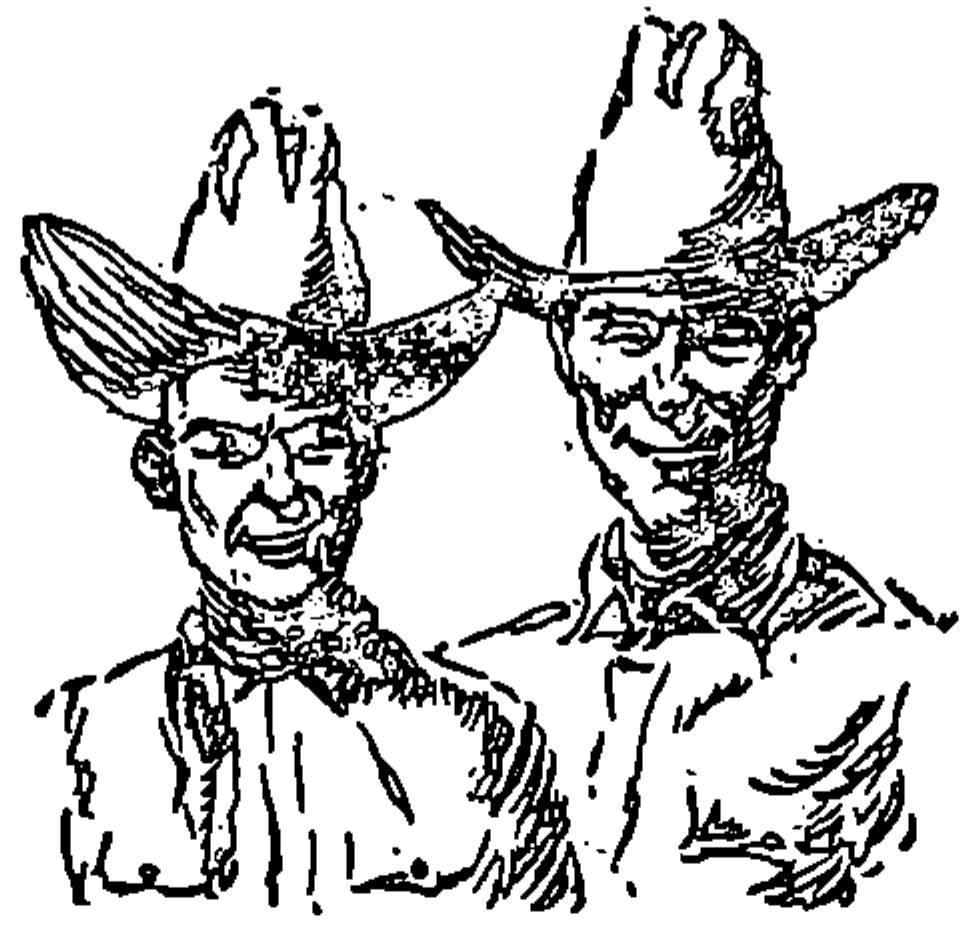
“Yeah, and more likely it’s only the well-known gravity defyin’ feat of puttin’ a live elephant into violent motion by graspin’ him delicately by the tail and propellin’ through space from the back of a runnin’ horse. Who knows?” said Bobby Stuart in a dejected manner.
“We gotta find out!” moaned Lou Warner, holding his head between his hands and gazing ceilingward in a thoughtful expression. “We gotta find out!”
“Most likely it’s some dum fool thing that don’t amount to nawthin’,” said Buck hopefully.
“Shore! Who cares about a thousand dollars anyway?” mused Slim, a sick-looking grin on his face.
“We gotta find out! We gotta find out!” groaned Lou again.
“We’ll never do it a-sittin’ here,” said Bobby in a businesslike tone of voice. “Let’s all go down to the barns where Leonard keeps his horse and watch what takes place. All the practicin’ he done here was mornings, at the show grounds. I know that he never left the hotel at night. His workouts was all performed in plain sight and if he done any Bar Act that I could see, I’m a cockeyed whippoorwill a-whistlin’ for his mate!”
Buck stepped to the window and peered out at the night. “Nice and dark out there,” he said. “Maybe he wouldn’t see us if we was careful. Let’s peel off our big hats and white clothes, them that’s got ’em on.”
His suggestion was taken up at once. Dark shirts were produced from various trunks and cream-colored Stetsons discarded. One by one the vigilance committee filed out of the room into the hall and from there to the street by a back door. The hour was late and the city asleep.
Rubber-tipped boot heels lightly pounded the deserted sidewalks of the slumbering metropolis. Pauses were made to peer around corners and glance behind in efforts to discover any chance trailers. The coast was clear and at the edge of the town the conspirators gathered into the protecting shadows of a barn.
The silence was terrifying and a mere whisper was like the howling of a pack of coyotes. A shadow detached itself from the silent group, slipped easily through a window and disappeared within to return in a few minutes and announce with eloquent gestures and facial expressions that all horses were inside and accounted for.
The ghostly gathering gained sitting postures, ears strained for approaching footfalls. Large chunks of silence floated by. A horse coughed. Nerves tensed, and relaxed. The moon came out from behind a cloud, sneered and slunk back from sight. Trained, hardened muscles became cramped from the immobility and tenseness required by the situation. The grass was slightly damp and, after a time, all felt as disgustingly wet and chilled as if at the bottom of a well.
Buck Farrell repressed a sneeze and whispered, “Fine way to be a-trainin’ to win a trick ridin’ contest! I betcha I’ll be so dum stiff and sore in the mornin——”
“Shet up!” warned a voice. “Lissen!” Ears strained anew and everyone breathed rapidly in short, expectant gasps.
An automobile was approaching from the town, the exhaust firing noisily, no apparent efforts at secrecy being made. “It’s Carter’s buggy,” said someone. “Everybody duck!” Duck they did. Some disappeared behind a manure pile, others lay stretched on the ground, close to the sides of the barn.
The car chugged ahead. A bright light danced on the front of the building. Brakes squeaked. The engine died. A door slammed shut. A tall, slender form wearing a big hat and carrying a long object wrapped in a blanket strode across the lighted path, humming happily. The doors of the barn were shoved open, the rollers grinding on the steel rail.
A voice sounded, talking soothingly in a senseless fashion as a man to a horse to keep from startling the animal. The dull thud of leather slapped on a blanketed form. The dry click of a latigo strap after the knot is made. Carter emerged from the barn into the lights of his car, leading his famous trick-riding horse Spots, and carrying the mysterious wrapped object.
He walked to the automobile, switched off the lights, mounted and rode off at a walk.
Crouching shadows followed into the night.
The average walk of a horse is somewhat faster than that of a man. Some horses naturally fall into a sort of shuffling motion, between a walk and a trot, called a running walk. And that of all the walks is by far the swiftest. Spots was a running walker and easily fell into that gait.
At first, the would-be investigators sneaked slowly and cautiously behind their quarry. But the realization that they would need to attain greater speed or be considerably late at any demonstration of fancy riding urged them on at a faster clip. Keeping a safe distance between themselves and the object of their interest, they struck a dogtrot, stumbling over invisible ruts and stones.
I have offered to prove that a cowboy will walk under certain conditions and now I have a bunch of them running over a rough road in the uncertain hope of seeing another cowboy perform an unknown trick, so they could duplicate it. Strange doings indeed!
Although the night was dark, they were forced to keep at a certain distance in the rear to avoid detection. At times they became alarmed, thinking that Carter was looking back over his shoulder. Especially on straight stretches this fear was more potent. Then they took to the brush, hardly daring to breathe. The faint sounds of hoofs striking hard ground drifted back to them and after a while they continued on their journey, running faster now to catch up.
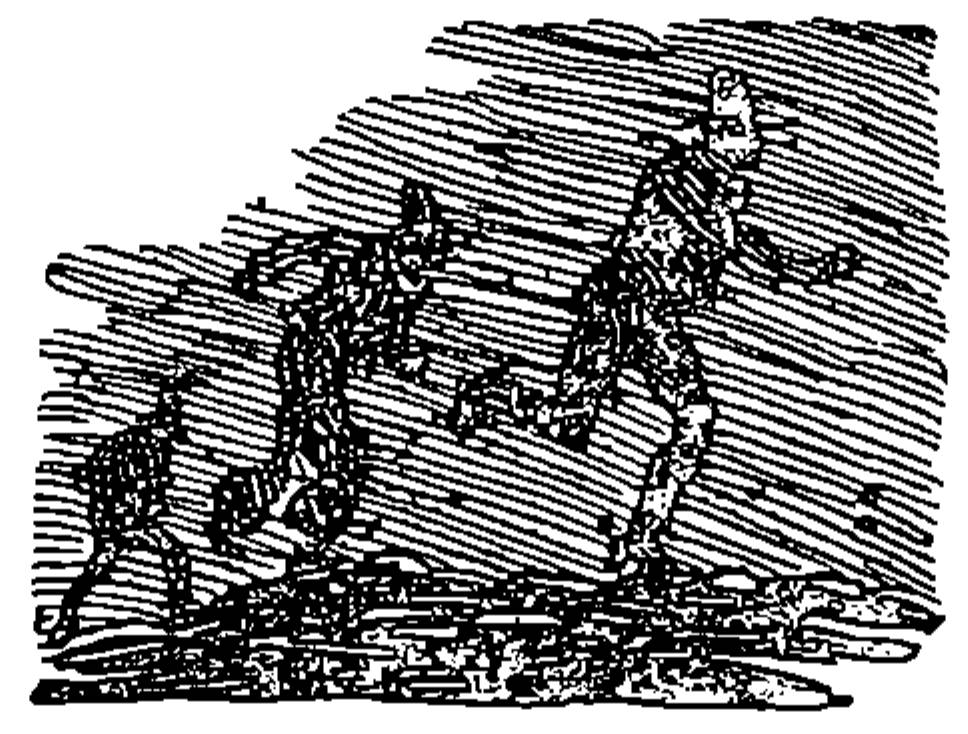
It is indeed surprising how far a horse can go without stopping to rest and sit by the roadside. Possibly that thought has never occurred to anyone except these boys who considered it vital to follow one. In any case many miles were eaten up in this strange marathon.
High-heeled boots, made snug and in some cases actually tight, are not the proper kind of footwear to use on a long-distance cross-country run. But in this instance they were worn by the runners, adding a good deal to their discomfort. Bare-headed, they looked like Indians trailing a victim—crippled Indians, poor, aged, worn-out Indians, wobbling at the knees and groaning from the pain and soreness of their feet. But with admirable spirit they raced on, jaws set and breathing heavily, their hair wet with sweat and shirts open at the neck.
The horse ahead left the road and led the chase through sagebrush and short grass, slippery as glass. Prairie dog mounds and badger holes tripped the tired runners. Corns and bunions began to howl for mercy. Was there to be no end to this bitter endurance contest?
The lights of the town had disappeared behind the last hill. None of the tired pursuers knew in what direction they were traveling. No star twinkled in the sky. No breeze to cool feverish brows. A hot, dark, oppressive night. A high fence loomed ahead. Hopes soared high. Possibly an objective had been reached. Indistinct white, immobile white shapes appeared on the other side of the fence, mounds of fresh earth, a smell of wilted flowers.
“A hell of a place to hold a workout!” panted Slim. “A danged graveyard!”
The mounted figure in the lead came to a stop. His followers dropped to the ground and strained their eyes to catch any movement. A match flared, went out, and a tiny red glow pierced the darkness.
“Carter don’t smoke!” exclaimed Buck.
“Who—what the——”
The horseman was backtracking and all lay down, faces in the grass. A rod away from the group, a voice shattered the stillness and gloom of the place. A voice that sounded so loud and clear in the silence and the total obscurity that every word seemed to cause a bright flash, like that of a pistol being fired in a tunnel.
“Haw! Haw! You hombres wanted to play ghost and this is a dum good place to do it. Good night, little fellers. I have a date with the queen of Poland to play cards, and I must toddle off. Tata! Glad t’ have metcha!”
Then sudden sounds of galloping hoofs that swiftly receded, a faint laugh echoing across the prairie, then silence again. The deep ominous silence of the graveyard.
Sudden realization of a sad mistake was followed by other disclosures. The man on the horse was not Carter. The man upon which almost certainly depended the fate of the cursed Bar Act was missing. The horse was not Spots. Somewhere in transit a shift had been made and at this precise moment Leonard Carter was practicing the thing, learning to execute it more gracefully, sealing the fate of men who wanted most of all to take off their boots and sleep a dreamless sleep.
Resplendent in colorful raiments, the trick riders rode gracefully to an appointed place, previous to presenting to the spectators, and more especially the judges, the most daring feats of fancy riding known to them. Their horses were groomed to an astonishing brilliancy. Flashes of sunlight striking highly polished silver blazed on gaudy masterpieces of the saddlemaker’s art. The band stopped playing and every participant in this contest was introduced to the crowds, riding past at breakneck speed and waving their hats at the appreciative audience. At the other end, a quick drawing was held for turns. Carter drew number one.
Away from close scrutiny of the crowd, smiles left the apparently happy faces of the riders to be replaced by grim, purposeful expressions. Hats were pulled down and safely anchored, for it is the trick rider’s pride of accomplishment to attain the most crazy positions possible, to gyrate in a perfect frenzy of motion hanging on to a running horse, and yet to never lose their hats.
Heads were drawn together in a last-minute council. Supple bodies leaned out of their saddles to whisper a few words. Carter stood alone, testing straps upon which depended the success of his most difficult tricks.
“Seen anything yet?” said Lou.
“He ain’t got the outfit on yet,” answered Buck, who was watching Carter like a hungry hawk. “His helper Sam Briggs has got the thing hid by the chutes. At the last minute, they will fix it on the saddle and bingo goes first money!”
“It was Sam as fooled us into followin’ him last night,” remarked Slim. “The danged, ornery, misfit, pistol-necked, poisonous centipede! Every time he looked at me this afternoon the old t’rantla would snicker. I’d like to run a number-nine boot heel down his lyin’ neck. The dum, thievin’, dirty heeled, horse currier!” Slim literally shook with rage.
“Four miles on the run, and four miles back—on the limp,” mused Bobby thoughtfully. “My feet are so sore that every time they touch something solid I get a permanent wave in my backbone and I see a million stars. I have to bite on a nail to keep from yellin’ out loud. Daggone the luck anyway!”
“The bird that mentioned that prospectin’ expedition last night is no friend of mine!” put in Lou.
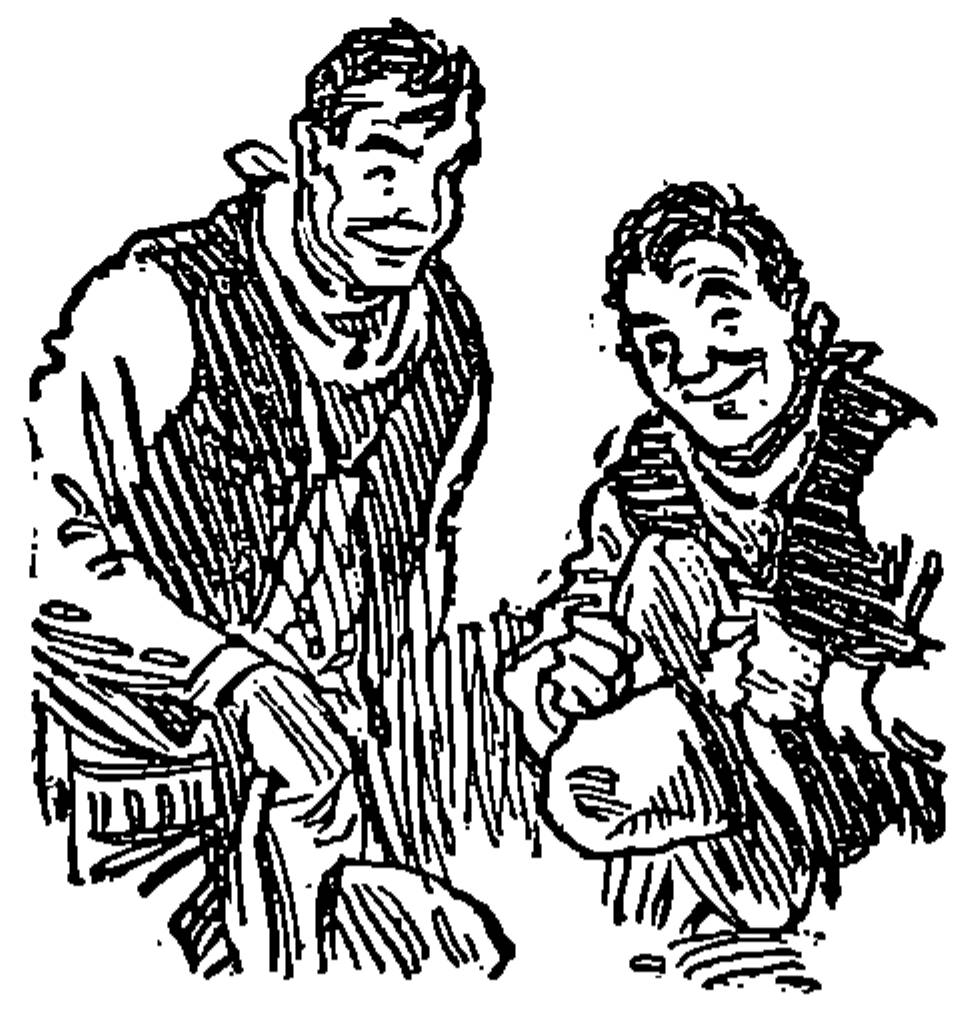
“When I was layin’ on that grave last night, tryin’ to get rested up so as to go to town,” added Buck, “I happened to look up and there was a blamed good epitaph on the tombstone: ‘Here lies Ephraim Alexander Biddle. His weary feet will never tread the soil he loved so well. He lived a useful life, he will not roast in hell.’”
“Not knowin’ much about poetry,” said Lou, “I can’t say as to that. But now, by golly, that must be a great feelin’. Knowin’ just where you’re headed for, like a parcel post package and all! And that there piece about not havin’ to stomp on the ground no more. Downright cheerful, I calls it!”
“There he goes! You follow him, Slim,” said Buck, and all hands turned to the business at hand. Carter was galloping his horse past the stands. Kicking both stirrups loose, he grasped the saddle horn in both hands, slid to the ground easily, bounced on the hard-packed racetrack and without apparent effort he leaped over his running horse, touched ground lightly on the other side and repeated the process. Without pause he did the same thing again and again.
Grinning widely, he worked smoothly, in a misleading, careless manner. There was nothing careless about it. Every move was figured out before hand, timed to a split second and rehearsed uncountable times. He reached the outer end, settled in the saddle and extended both arms in a friendly gesture to the audience. Selling his stuff. The stands roared with approval.
A simple trick but good showmanship; just getting warmed up for the real work ahead. Slim followed, performing as well if not better than Leonard. Then Buck. All did their one trick. Then Carter went out again.
Under the hot Texas sun, these boys drove their hard, supple bodies to the utmost in attempting to outdo one another in daring and skill. But the main purpose was to beat Leonard Carter. Under the threat of the mysterious Bar Act, they had reached an agreement. They were to do their very best and all prizes won would be split evenly.
Toward the close of the contest, Bobby, who was attempting to go underneath his horse, missed his hold and fell to the ground. His body rolled and taxied along in a sickening fashion. Then he lay very still. An ambulance whizzed out from behind the chutes. Two attendants in white ran out carrying a stretcher. In a few seconds the track was clear again and the show went on.
Someone in the grandstand, possibly an Eastern visitor, exclaimed in surprise, “It looked so easy! So smooth! How could anything like that happen?”
There lay the catch. To make anything look easy which is anything but simple.
At last there was a pause and the announcer boomed out, “Now, ladies and gentlemen, your attention is called to the next feature. An entirely new feat of daring performed by Mr. Carter. The Bar Act!”
During this short announcement a man had emerged from behind the chutes carrying the mystifying elongated object. As he ran for Carter, he peeled from around it a blanket which he let drop on the ground.
The remaining riders stopped wiping the sweat from their faces to gaze at the approaching instrument. They leaned ahead and stared intently. Some sort of a rail.
Lou, gifted with a better sight than the rest, identified it for what it was and exclaimed, “I hope to bust a cinch if it ain’t a daggone Ford axle!”
A Ford axle it was, and with great speed it was being adjusted on Carter’s saddle, sticking out and away from it like a handlebar of a bicycle.
“Lissen!” said Buck excitedly. “We can beat him yet. Slim, you run out and get anything you can find that we can hook up on our saddles. Bring a rope with you. Go like hell and come back faster. We’ll watch this and go old Carter one better!”
Slim did not stop to argue. Straight for the chutes he rode his horse at the speed of a comet. Nothing there. Out through a gate he flew and disappeared from sight.
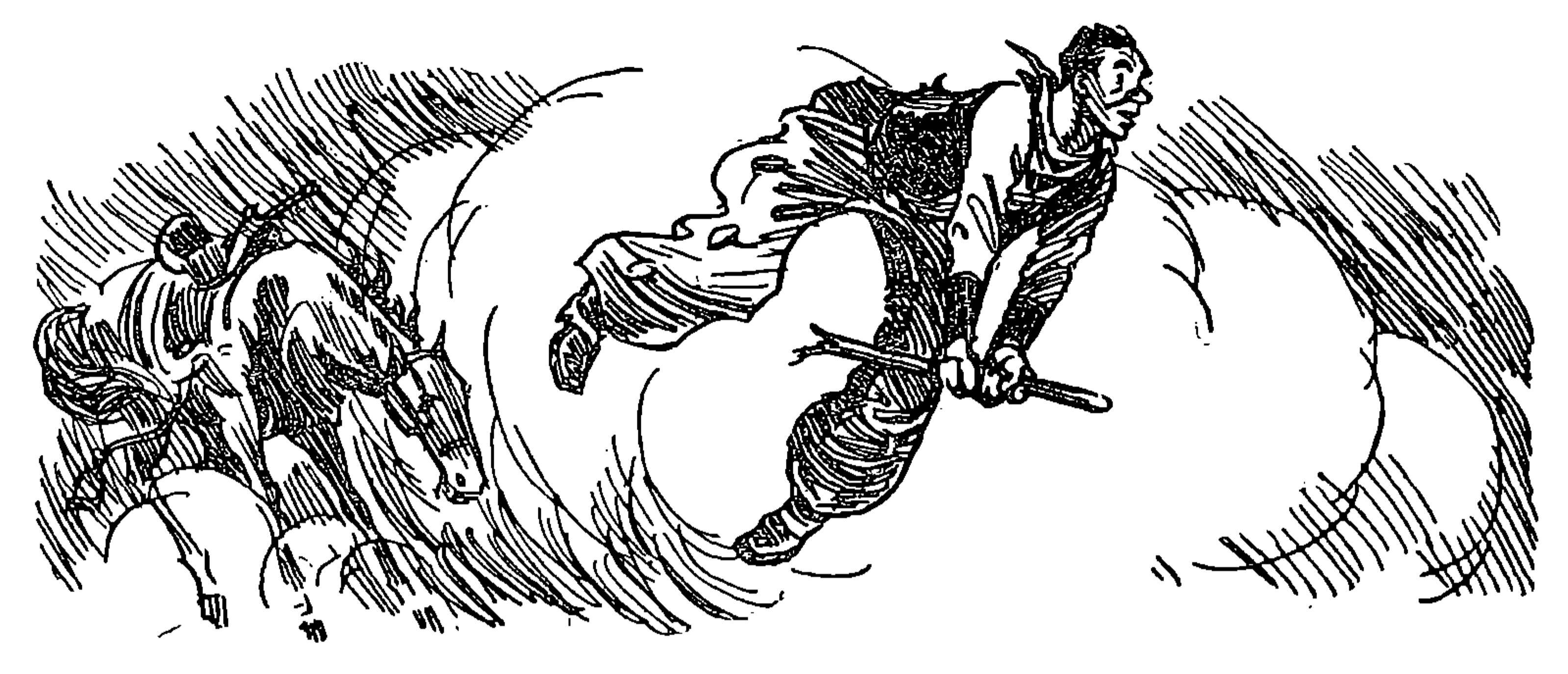
Carter was ready. His helper withdrew from the track. He leaped gracefully onto his horse and loped toward the stands. Suddenly he leaned out, grasped the extreme end of the axle and left the saddle. On the end of the galloping trapeze he began whirling around like a whirligig. The effect of a man spinning so fast as to cause a blurred vision, doing his spinning away from a horse running full speed, was startling to say the least. Everyone present stood up and gasped, open-mouthed, with wonder and admiration.
Soon it was all over and a mighty roar of appreciation filled the air. The Bar Act had been a success and a sure winner, unless—— The tall figure of Slim, belaboring his racing horse with a singular object and carrying another of the same shape, was seen crossing the centerfield at great speed.
Between him and his friends, dressed in the height of cow country elegance, a trick roper was tenderly coiling his expensive ropes prior to laying them away in a silk-lined trunk. He was occupying himself picking short blades of grass from a sixteen-dollar Manila rope made in old Mexico. The strands of that rope had been twisted together so painfully and exactingly that a steel awl could not be driven between them. It had been balanced so exquisitely at the hondo with fine copper wire that its owner could handle it like a thing alive. It was called a double ocean wave rope. It took several years to break in such a rope so that it was worth its salt. This particular roper would sooner lose an eye than his beloved trick rope.
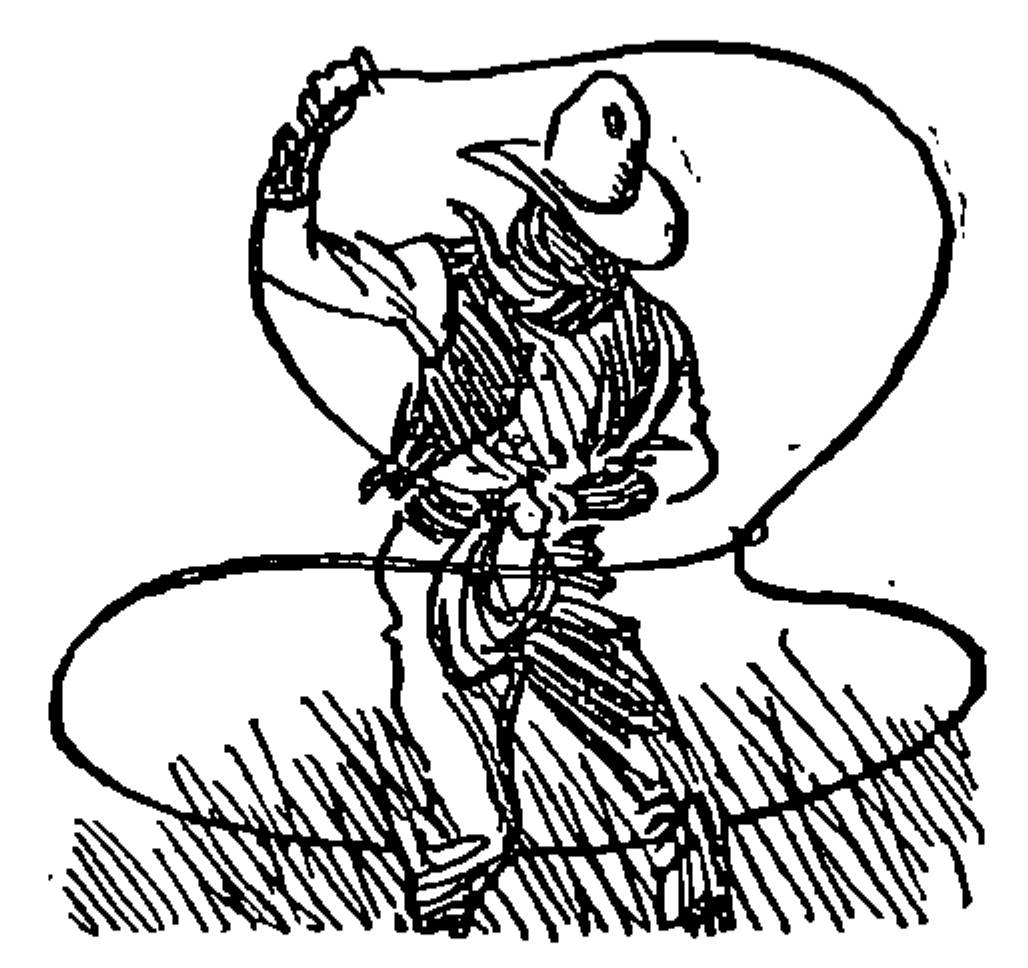
But Slim was in need of a rope. In the excitement, he had forgotten to procure one. The man who stood in his path, engaged in his peaceful occupation, reminded him of his mission. He had no time to go back and so he did the next best thing. Leaning away from his horse, in the fashion of a bulldogger about to jump on a steer, he grabbed the rope out of the astonished trick roper’s hands and made for his waiting friends.
To see the apple of his eye being borne away by a locoed trick rider was not a thing to be taken lightly by the owner. With a bellow meant to denote rage and intention to do murder, he set out after the thief at a fast run, screaming to high heavens his aim of obtaining quick and bloody revenge.
Slim drew up on the track, threw down the objects he had been carrying, including the rope and catching sight of the enraged trick roper hot on his trail, he left once more in a fresh and unobstructed direction.
Like Carter’s axle, the objects Slim carried were, as nearly as could be told at a glance, of the same length. However, they were of different material. One was a windmill handle, the other a broomstick. Nothing better available and time being precious, they would have to do. Buck drew from his pocket a sharp knife and after two well-applied swipes, the sixteen dollar Manila became two. Which made it an established fact that the difficult stunt called the double ocean wave would never again be performed with this particular rope.
At the sight of this sacrilege, the trick roper who had drawn near stopped in his tracks, paled, and fainted dead away!
In less time than it takes to tell, the implements were installed on the saddles. Buck, his windmill handle securely lashed to the pommel, struck out first to try his luck. It soon became apparent that a strong horse was required for such an act. Given proper warning and some practice, Buck’s horse would have been equal to it. As it was, he stumbled, got off his course and ended up by falling into a lumbering awkward trot. Buck effected a couple of wild spins, lost his hold and landed on his ear in the dust. He rose immediately, spit out a mouthful of dirt and limped off the track cursing his luck.
Lou was next and he galloped down the track hoping for the best and ready and willing to perform the Bar Act as it should be executed. His horse took the shock better than Buck’s and had it not been for one single mishap, the Bar Act would have been defeated on its own home grounds. But the broomstick broke. Broke when Lou was spinning his best—and that was going some! It happened that the accident took place when Lou was headed upward. Had it been the other way, he would have flattened himself out like a pancake. He sailed gracefully through the air with a death grip on the remaining piece of the broom handle. The landing was hard and it has been said that when Lou hit the ground, the jar was felt for miles around, going so far as to be recorded on a delicate instrument built for the special purpose of registering earthquakes. Hard as it was, though, it was not hard enough to disable him and with the grin of a man who has tried and failed through no fault of his, Lou withdrew from the vicinity of his downfall.
The announcer bawled above the ensuing tumult that the next event on the program would be the bulldogging of wild, long-horned Texas steers.
That night, in a hotel room, four cowboys sat around a bed, engaged in the pleasing pastime of dividing a large roll of money. There was Bobby Stuart—one arm in a sling but happy, and Slim Jones, displaying a beautiful purplish eye and telling of some trick roper who in some mysterious fashion had collected two identical optics. Buck Farrell was also present, only slightly damaged, with scratches of no importance. The last was Lou Warner, proudly boasting of almost accomplishing the difficult Bar Act. The gathering was a happy one, regardless of the battle scars.
“Who’da thunk it?” asked Lou. “If we’d only knowed it, we wouldn’t had to break our dum fool necks trying to do no Bar Act.”
“Maybe not,” said Buck. “But if it hadn’t been for the fear of it, we wouldn’t have tried so hard on the other stuff and Carter would of won first anyway. He’s salty!”
“Well, anyway, we won it,” added Slim, stuffing bills into his pockets. “And now, hombres, me for a bed!” Which suggestion, being well made under the circumstances, was followed by all present.
The unexpected had happened when all hopes were dead. Lou Warner had been given first by the judges. Not because of his try at the Bar Act, however.
Said judges, after a hasty conference, had decided that the Bar Act was not a feat to be included at a cowboy contest. It was thrilling and spectacular enough, but the lugging of a Ford axle on a saddle was not a cowboy-like thing to do.
Carter, placing all his confidence on his original invention, had eased up on his other tricks and lost out altogether.
The Bar Act has become a sort of legend with the boys who drift over the country making rodeos. But, in the immediate vicinity of Leonard Carter, three words are always omitted in polite conversation.
You’ve guessed them!