Title: Beppo
or, The little rose-colored monkey
Author: Carlo Collodi
Translator: Walter S. Cramp
Release date: March 2, 2026 [eBook #78089]
Language: English
Original publication: Boston: Small, Maynard & Company, 1907
Other information and formats: www.gutenberg.org/ebooks/78089
Credits: Hendrik Kaiber, Carol Brown and the Online Distributed Proofreading Team at https://www.pgdp.net (This file was produced from images generously made available by The Internet Archive)
OR
THE LITTLE ROSE-COLORED MONKEY
BEPPO
OR THE
LITTLE ROSE-COLORED
MONKEY
BY
C. COLLODI
TRANSLATED FROM THE ITALIAN
By W. S. CRAMP
Illustrated

BOSTON
SMALL, MAYNARD & COMPANY
1907
In the famous forest of “Guess It” there lived at one time a family of seven monkeys,—papa, mamma, and five little monkeys as large as pineapple cheeses.
This family lived among the branches of a giant tree, in the middle of the forest, and paid fifteen plums’ rent every year to an old overbearing gorilla, who had taken it into his head to be a proprietor.
Four of these little monkeys had skin and hair the color of chocolate, but the other, the smallest of them all, whether it might be a trick of nature or no, the fact was that he was covered all over, except his little face, with a fine hair that was fleshy red, just like the leaves of a rose. For this reason, even in his home and amongst the neighbors, they all called him Beppo,—a word that means, in the spoken language of monkeys, rose-colored.
Beppo did not resemble either his brothers or the other monkeys in the neighborhood. He had a quick and intelligent face, a pair of cunning eyes that never stood still a minute, a small mouth that always laughed, and a dry and flexible personality, like the stem of a bulrush. He was, in fact, as it is customary to say, a “perfect little monkey.”
At first sight one would have almost thought him a little boy of eight or nine years old, because Beppo made a noise and trifled away his time just like a boy. He ran after the butterflies and went in search of birds’ nests, like a boy. He was most greedy of fruit, like a boy. He ate everything and ate always, like a boy. After having eaten enough, he cleaned his mouth with his hands, as some boys do, especially those boys who are not very neat.
But do you wish to know what the greatest passion of Beppo was?
It was that of imitating everything he saw men do.
One day, while he was going through the forest in search of crickets and grasshoppers, he saw, sitting at the foot of a tree, a young man tranquilly smoking a pipe.
At that sight, Beppo opened his eyes wide and became like one enchanted.
“Oh,” he said to himself, “if I only could have a pipe! Oh, if I could make those beautiful clouds come out of my mouth! Oh, if I could go back home smoking like a chimney! Oh, with what envious eyes my four little brothers would look at me!”
While these beautiful ideas rushed through Beppo’s head, the young man, being either tired or warm, gave two or three great big yawns and, placing his pipe on the ground, went to sleep.
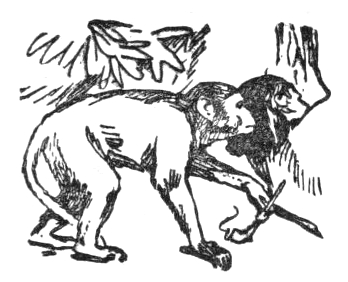
What, then, did that little scoundrel of a Beppo do? He approached very softly on the tips of his toes the spot where the young man was sleeping. Holding his breath, he stretched out his paw very slowly, grabbed the pipe with incredible velocity, and ran away as fast as the wind.
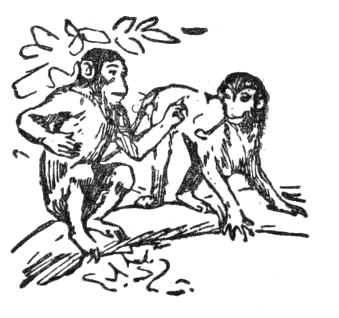
As soon as he arrived home, he quickly called his papa, mamma, and brothers, and in their presence placed the pipe between his lips, and began to smoke with the airs of an old sailor. His mamma and the four brothers, seeing the clouds of smoke come out of Beppo’s mouth, laughed like mad; but his papa, who was a monkey full of common sense and worldly experience, said to Beppo in a tone of warning:—
“Take care, Beppo! If you begin to imitate men, one day you really will become a man—and then! Then you will bitterly repent, but it will be too late!”
Impressed by these words, Beppo threw away the pipe, and smoked no more. However, you must know that stolen pipe carried with it some disgrace. A few days after, Beppo was struck with a great misfortune! The poor, unfortunate little fellow lost forever his beautiful tail,—a tail so beautiful that, once seen, it could never be forgotten.
How did he happen to lose that magnificent tail?
It is a cruel and sad story. Only thinking about it will make tears come to your eyes. I will tell it to you in this next chapter.
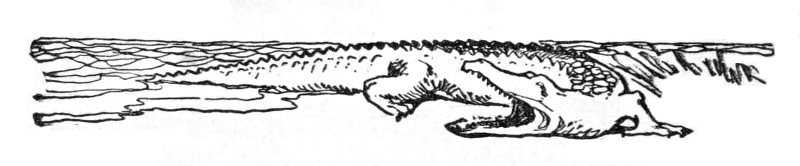
You must know that just outside of the forest where Beppo lived with his family there was a great big lake, in which lived a crocodile that was about two thousand years old. The name of the crocodile was Araba-Babba. He had become blind on account of old age, and, not being able to gain a mouthful of bread by the sweat of his brow, he was condemned to live night and day at the edge of the lake, with his mouth always opened wide, so that any passer-by, be it man or beast, moved by compassion, might throw into that large mouth some food, so that he could live another thousand years. And all the passers-by, be they man or beast, always threw something into that crocodile’s mouth.
Even Beppo frequently threw in something; but that scoundrel, instead of giving fruit or dead fish, amused himself by putting into the mouth at one time a handful of stones, at another time a bundle of tooth-picks, at another time a nail or a rusty horse-shoe that he had found along the road.
But the old crocodile never grew angry. Quite the contrary!
He quietly spat out the stones, the tooth-picks, the nails, and the horse-shoes, and usually shook his head as if to say: “Take care, little rogue! Sooner or later something will happen!”
One day Beppo, taken aback by seeing that his tricks did not affect the crocodile, asked him, “Tell me, Araba, since you have been in the world, have you never found impertinent people that have given you affronts or have played upon you impolite tricks?”
“Oh, yes, I have found them! In the world I have also found some like you, more impertinent than flies.”
“Tell me, Araba, and when these rogues are disrespectful, do you never resent it?”
“My dear boy, in so many years of life I have learned that the greatest virtue of old age is that of knowing how to endure children with patience and resignation.”
“Then, since you have been in the world, you have never gotten angry, never, never?”
The crocodile, before responding, thought a little and then said: “One time only. And do you know what it was that made me angry? It was a little monkey just your age”—
“And what did this little monkey do?” asked Beppo, with lively interest.
“The little scoundrel—I hardly know how to tell you—found out that I was ticklish on the point of my nose. Then what do you think he did to annoy me? He mounted one of the trees around the lake, and let himself down from a branch, so that he touched my nose with the tip of his tail. Just imagine! I was taken with such a convulsion of laughter that I laughed and danced in the water a whole week without stopping. I thought I should die.”
“Truly! Poor Araba!” said Beppo, with false compassion.
“And after that,” continued Araba, “he went away, and to all the monkeys he met on the road he repeated, laughing, these words: ‘Do you wish to amuse yourself? Do you wish to see old Araba dance? Come to the lake to-morrow morning, and I will show you the funniest thing you ever saw in all your life.’ The next morning, my dear Beppo, as you can easily imagine, there were hundreds of monkeys on the lake. All waited to see me do the ring dance.”
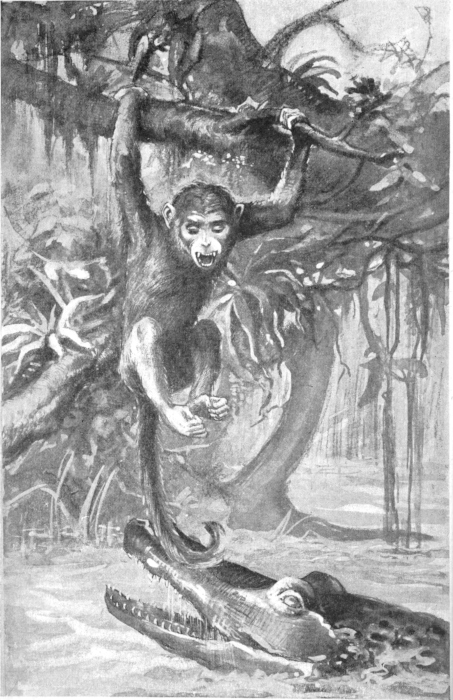
Beppo, hearing this, quickly mounted to a tree that leaned over the water, and let himself down so that he could just touch the crocodile’s nose with his tail. But scarcely had the crocodile felt Beppo’s tail on the end of his nose when he closed his mouth, and, zaff! in a second he pulled off Beppo’s tail clean to the first joint.
The little monkey gave a cry of grief, and, jumping down from the tree, ran quickly into the forest. Arriving near home—but I will leave you to imagine how Beppo felt when he placed his hand behind him and perceived that he had no tail. The tail had remained in the mouth of the crocodile, who had by that time nicely digested it.
Desperate and ashamed to go home to his family in that pitiful state, Beppo ran along a small road until it became night. Finally, being so tired that he could not run any more, he threw himself on a small heap of fodder, in order to sleep a little.
And while he slept he heard a small voice whispering in his ear,—
“Give me back my pipe.”
The little monkey, awakened and nearly scared to death, wished to run away, but he could not, because in less time than one can say it he was grabbed, put into a sack, and loaded on the back of a beast with four legs. He felt himself being carried away.
“What beast can that be that carries me away with so much haste?” he thought, trembling with fear. “If it should be a lion, I am lost. If it should be a tiger, worse than ever! If it should be a hyena or a leopard, there is no help for me. Oh, poor, poor me! What beast is it that carries me away with so much haste?”
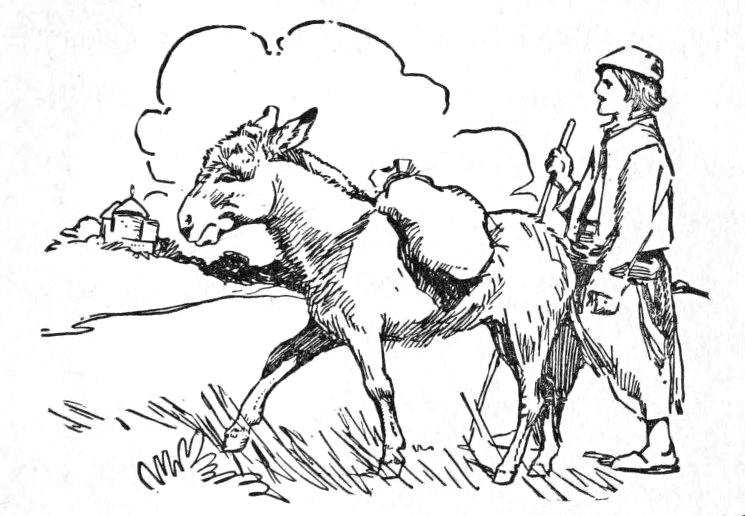
Happily, the beast began to bray, and then Beppo felt his heart swell with satisfaction.
That bray was the only consolation that poor Beppo had during his mysterious trip, enclosed in a sack.
After having gone along for three days and nights without stopping a minute to rest, finally the beast, that carried on his back the sack containing the little monkey, stopped suddenly, and coughed so violently that he unloaded the sack in the middle of a field.
The cough was so severe that the sack, in falling to the ground, began to roll on the grass and kept on rolling for a half-mile. Just imagine how many summersaults the poor little monkey made in that dark sack!
But the worst moment for him was when he tried to break the sack and get out. He used his nails, but they did no good. He used his teeth, but they could not help him. Finally, he gave a yell, and began to cry like a baby.
“Who is that crying?” asked a large Rat, who happened to pass that way.
“It is I, a poor little monkey that is dying with hun”—
But he could not finish the word, because a very large yawn escaped from his mouth instead.
“Come out and eat,” said the Rat.
“It is very easy to say that, but I cannot.”
“Why?”
“Because I cannot break the sack open.”
“Oh, pshaw! I will open it.”
And the Rat began to gnaw with all his power, but the sack was as hard as leather, and he made very little impression.
“How much time will it take to make a hole?” asked Beppo.
“In about four or five months I ought to finish it,” replied the Rat.
“Five months!” cried poor Beppo. “In five months I shall be nothing but nails and bones.”
And he began to cry louder than ever.
“Who is that crying?” asked a Calf that was grazing near by.
“It is an unfortunate little monkey, who cannot get out of a sack,” replied the Rat.
“Why can’t he get out?”
“Because it is so hard that it has to be broken.”
“Let me do it. With a butt of my horns I will break it.”
And the Calf, without waiting a minute, gave the sack a terrible butt with his horns.
“Oh, I am dead!” cried poor Beppo; and he said no more.
Meanwhile the sack, at that shock, began again to roll along the earth, like a bladder filled with air; and the Rat and the Calf tried hard to stop it, but the sack rolled more quickly, and left the Rat and the Calf far behind, with their tongues out of their mouths. After having rolled for a day, it finally fell into a river so large and deep that no one could see from one bank to another.
The next morning some fishermen knocked at the door of a beautiful palace. To the servant who came to open it, they eagerly said, “Is the little master up?”
“The little master is up, and is taking his coffee and milk,” replied the servant.
“Just tell him that this morning, at sunrise, we fished from the river this sack”—
“What is in that sack?” interrupted the servant.
“The little master has waited for it for several days.”
As soon as the servant had done the errand, he returned to the door and said to the fishermen, “Enter quickly.”
The fishermen entered with the sack on their shoulders, and, when they arrived before the little master, they placed it carefully on the floor.
“Open it!” said the young master, Alfred.
“It is impossible, sir. We have tried to crush it with chisels, with hatchets, and with piercers; but the sack is harder than rock.”
“Take this pin, and make holes in it.” Saying this, Alfred took from his neck a gold pin surmounted by a large pearl, on which—a most singular thing—there was a head of a beautiful baby with blue hair.
The fishermen took the pin in their hands, and looking at each other in stupid wonder, as if to say, “How is it possible with this little pin to force open this sack, that has resisted hachets and piercers?”
“Quickly! Quickly!” repeated Alfred, in a commanding tone.
The fishermen, in order to be obedient, leaned over, trying to pierce the sack. Just imagine their surprise when they perceived that the pin entered the sack as easily as if the sack were made of bread or cream puff!
When the hole in the sack was sufficiently large, they saw the poor little monkey with scarcely any signs of life.
Alfred took the little monkey by the neck, and bathed his mouth with a little warm milk. A little while after Beppo came to and opened his mouth. Then Alfred placed in the little monkey’s mouth a small ball of sugar and a buttered crust of bread. Beppo swallowed both without chewing them. Then he opened his eyes and looked kindly at the little master who had been so good and kind to him. Beppo looked as if he wished to say “thank you.” He felt so strong that, standing on his hind legs, he took Alfred’s hand and covered it with kisses.
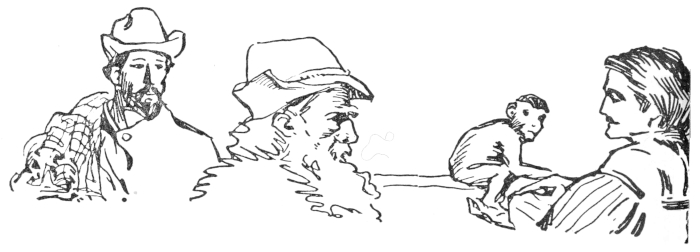
The fishermen, both men with large hearts, moved by this scene, shed large tears and dried their eyes. Alfred said to them: “Go now to work, and close the door. I have a great desire to talk privately with this little monkey.”
When Alfred and Beppo found themselves alone, they began to look at each other without breathing or making any movements. They looked at each other some little time. Finally, Alfred, not able to be serious any longer, burst out laughing: the little monkey burst out laughing, too. And they both laughed excessively, without knowing why, as silly boys laugh when they are taken with convulsions of laughter. Out of breath, Alfred said to the monkey, “What is your name?”
“Beppo.”
“And your other name?”
The little monkey thought a little, and then, scratching his head, quickly replied, “Beppo without anything else.”
“How old are you?”
“I am the smallest of my brothers.”
“How old are your brothers?”
“They are younger than papa and mamma.”
“I understand,” said Alfred, laughing. Then he asked, “Where did you leave your tail?”
“I don’t know.”
“You don’t know?”
“I lost it on the way! I am so careless!”
“What! Is it possible that a little monkey can lose a tail on the road?”
“Oh, then, if you must know, I left it at the house. I left so quickly that I had not had the time to see if I had taken with me all my necessaries.”
“Tell me, Beppo, do you ever tell stories?”
“Sometimes—especially when I am ashamed to tell the truth.”
“You are wrong. Lies never help you.”
“I will never tell another.”
“Now tell me the truth. Where did you lose your tail?”
Instead of replying, Beppo began to wipe his eyes. Then he said, crying, “They—they—a—ate it.”
“Who ate it?”
“Araba-Babba, a nasty old crocodile.”
“How did it happen that he ate it?”
“I wished to play a joke.”
“Oh, poor Beppo!”
“And it was such a beautiful tail! A tail, believe me, Mr.— What is your name?”
“Alfred.”
“And the other name?”
“Alfred without the rest.”
“Believe me, Mr. Alfred Without-the-rest, a tail that would make water come to your mouth only to look at it. That tail was all my patrimony.”
“Why did you run away from home?”
“I did not run away. Somebody put me in a sack and carried me away.”
“And now what are you going to do?”
“I can accommodate myself to anything.”
“For example?”
“I can content myself with little. I am satisfied if I can eat, drink, and go out walking. I ask nothing more.”
“You are discreet, truly! But who will give you something to eat?”
“I confide in you.”
“I am willing to give you food, if you earn it. Are you accustomed to work?”
“If I must tell the truth, instead of working, it pleases me to see others working.”
“Would you like to be my valet?”
“Yes, indeed,” replied Beppo, rubbing his hands together in glee.
“In a few days,” said Alfred, “I am going to take a long trip. During this trip would you like to be my valet, my companion of adventure?”
“Yes, indeed.”
“For breakfast I will give you every morning five pears, five apricots, and a nice slice of fresh bread. Do you like fresh bread?”
“Yes, indeed.”
“For dinner you will eat at my table, and I will give you some fried fish, some plums, and some apricots. Do you like apricots?”
“Yes, indeed.”
“For supper you will eat eight nuts and four figs. Do you like figs?”
“Yes, indeed.”
“Every time you are stupid and bad I will give you with this whip a caress on the legs. Do you like to be stung with a whip?”
“I like figs better,” whines Beppo, scratching his head with both hands.
“Do you accept my contract?”
“I accept all but the stings.”
“If you do not accept that, go away!”
“But you will strike very slowly?” said Beppo.
“I will strike according to what you deserve.”
“All right. I am your valet, your secretary, your travelling companion.”
Then Alfred went towards a table and rang a silver bell. A servant entered.
“Order quickly a tailor and some cloth,” said Alfred.
The servant went out. Two minutes after a tailor appeared with some cloth.
“I wish you to make a suit of clothes for my valet,” said Alfred.
The tailor, without being told twice, took out of a basket two little patent leather shoes, with a beautiful silk bow on the front, and put them on Beppo’s feet. Then he put on a pair of red trousers. From the knees down he put on a pair of gaiters. Then he placed on Beppo’s neck a white handkerchief, making a knot like a cravat. With a yellow vest and a black swallow-tail coat, Beppo’s clothes were complete. The tailor then took a high hat and placed it on Beppo’s head.
When Beppo was dressed from head to foot, Alfred said, “Now look at yourself in a looking-glass.”
The little monkey moved quickly, but, not being accustomed to wear shoes, made a most beautiful slide and fell flat on the floor. Just imagine the laughter of Alfred and the tailor! Poor Beppo tried to get up, but he could not succeed. Finally, he sat up, and, touching his nose that was peeled, he said: “I cannot walk with shoes on. I wish to go barefooted.”
“Take courage,” said Alfred, “with a little patience you will accustom yourself to shoes. In this world one must accustom himself to everything.”
“But I suffer too much.”
“Patience! In this world one must accustom himself to suffer, too,—so said my papa. Up, up! Look at yourself in the glass!”
The little monkey tried another time; but he walked with the steps of a daddy longlegs, slowly, very slowly, as if he walked on eggs. When he arrived before the looking-glass, he gave hardly a glance at himself; and, drawing back frightened, he commenced to scream desperately, saying: “Oh, how ugly I am! Oh, my poor mamma, they have ruined your little monkey! I am not myself! I am no more Beppo! They have made a man of me! I do not wish to stay here! I want to go away, I want to go home. I do not want these nasty clothes,—no, no, no!”
And, crying and turning himself on the ground, he took off his shoes and threw them into the chimney. He threw the high hat in the face of the tailor. He tore away the handkerchief from his neck, and, making a great big jump, he went out of the window and began to run across the fields.
Poor Beppo! He ran and ran; but he had not made a hundred paces before he felt himself seized by the back of his trousers, and found himself raised from the earth in the mouth of a large dog called Newearth.
The dog Newearth was one of those nice, intelligent, lovable dogs that attach themselves to their masters like real friends. When Alfred saw that Beppo had run away, he whistled for Newearth. The dog in four jumps caught up to the little monkey, and took him, as it has already been said, by the seat of his trousers, and carried him to his master.
“Why did you wish to run away?” asked Alfred, in a tone of reproof.
“Because—Because”—
“Come, come! Tell me frankly.”
“Because I wish to go back and be a little monkey with my papa and mamma and my little brothers. I do not want to masquerade as a man.”
“And then, why did you a little while ago wish to be my travelling companion?”
“Because I believed it might be nice, but instead it is not.”
“Do you wish truly to go home?”
“Oh, yes. Please do me the favor of never sending that dog after me again.”
“Do not be afraid. Without my command he will not move from here. How far away is your house?”
“Many, many miles.”
“And, before starting, do you not feel the want of eating something?”
To be frank, the little monkey did not feel the shadow of hunger; but, tempted by his gluttony, he lowered his eyes and, feigning to be ashamed, he replied, “I will eat a little mouthful willingly.”
Alfred rang a silver bell. A servant brought in a small basket of beautiful peaches. The little monkey did not eat them: he devoured them as quick as lightning. After the peaches, he saw presented a basket of cherries, so large, so ripe, and so shiny that they made the mouth water just to look at them. Beppo scrunched them all, three or four at a time. Not wishing to pass as a badly educated little monkey, he left the leaves, stems, and seeds. When he was so full that he could hardly see out of his eyes, he jumped upon the table, and, making a beautiful bow, said to Alfred: “Good-bye, Mr. Alfred. Excuse me for annoying you. Thousand thanks for your goodness.”
“Good-bye, Beppo. Happy journey. Give my respects to the family.”
The little monkey started to go away; but at that moment the servant entered with a basket of fruit that sent an odor so delicious around the room that it would wake the dead.
“And what is that fruit?” Beppo asked.
“Those are Japanese medlars,” Alfred replied. “I bought them for your supper to-night.”
Beppo remained a little thoughtful, and then said, “Oh, pshaw!” But, becoming resolute, he started again to go away. When he arrived at the door, he stopped a few minutes. Then, turning to Alfred, he said, “Excuse me, Mr. Alfred, what time is it?”
“Twelve o’clock, precisely.”
“Twelve o’clock! It seems to me a little late to start on a trip.”
“On the contrary, it is early,” said Alfred. “There are seven hours’ daylight, and in seven hours you can go pretty far.”
“You are right. Good-bye, Mr. Alfred. Excuse me for annoying you. Thousand thanks for your goodness.”
This time he left truly. But after a quarter of an hour Alfred saw him reappear in the room, all out of breath and tired out.
“What has happened?” asked Alfred.
“What has happened?” said Beppo. “The sun troubles me and dazzles my eyes. Would you be so good as to lend me a cotton umbrella to ward off the sun?”
“Willingly.”
Alfred called the waiter. After a few minutes the waiter brought a beautiful parasol, covered with large green and blue flowers.
Beppo took the parasol, opened it, and began to walk around the room, giving longing looks at the Japanese medlars.
“My friend,” said Alfred, “if you stay much longer, it will be dark before you get home.”
“In the daytime I do not know the road,” said Beppo. “Probably it would be better to wait until after supper.”
“Do as you think best,” said Alfred.
Saying that, Alfred began to laugh inside, and made a little noise that seemed to say, “I understand your weakness, my dear little glutton.”
When the hour for supper arrived, without waiting to be invited, Beppo sat down at the table. In a tone of command, Alfred said, “What are you doing there?”
“I am going to eat supper with you.”
“People who come to my table always dress decently. Go quickly, and put on your swallow-tail coat.”
“I do not know how to eat in a swallow-tail coat.”
“Then go to the end of the room, and content yourself to help me at my supper.”
When Beppo saw that Alfred was serious, he began to cry and scream; and, crying and screaming, he ran out of the room. But he soon returned. When he entered, he had on a swallow-tail coat, all buttoned down the front. He looked like a little “my lord.”
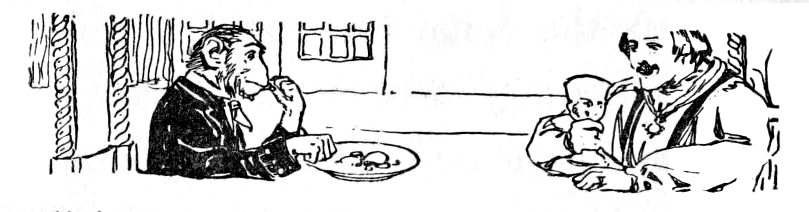
“That is very good,” said Alfred. “Sit down. Good appetite to you.”
The dish of medlars was brought on the table. It is useless to say that after a quarter of an hour the dish was empty and the little monkey was full.
“Now, then, I truly go away,” said Beppo.
But, while he took off his swallow-tail coat, the servant brought into the room a large dish of pomegranates.
“What a nice odor!” cried Beppo, sniffling and keeping his eyes on the plate. “Whom are they for?”
“They were for your breakfast to-morrow morning. But now you are going away, I will eat them.”
“I—would go away willingly, but somehow I only know the road in daytime. Would it not be better if I should wait until after breakfast?”
“All right!” said Alfred. “Your room is ready for the night. Good-night.”
The next morning, at breakfast time, the little monkey promptly presented himself, dressed in the swallow-tail coat. But Alfred, after looking him over from head to foot, said, “Who has taught you to present yourself at table without shoes and cravat?”
Mortified and confused, Beppo began to scratch his head and nose, and, whining, said: “The shoes hurt me. The cravat rubs my throat. I wish rather to go away.”
“Then leave me.”
Beppo went towards the door slowly, but, before going out, he took a long last look at the pomegranates. Then he went away.
“This time he has truly gone,” said Alfred. “I am very sorry. I liked the little monkey. What will the good fairy say when she knows that I chased him away? However, she always taught me to dress well and neatly. Oh, well! What is done is done!”
While Alfred spoke thus to himself, he heard a knock on the door. At the same time he heard a little voice say, “Mr. Alfred, did you call me?”
“Who is it?” cried Alfred.
“It is I.”
The door opened, and there stood the little monkey. He had on the little shoes, and he carried his head straight and stiff because the collar cut his throat. At that unexpected sight it is impossible to imagine Alfred’s happiness. He went towards Beppo, embraced and kissed him just as if he had not seen him for twenty years.
They both swore never to leave each other, and that they would make the voyage around the world.
The boat on which they were to embark was expected every day. Finally, it arrived.
On the night it sailed, Alfred and Beppo dined together, as it was usual to do. And during the dinner they spoke of a thousand things. They laughed, and were as happy as boys are on the eve of a summer vacation. Rising from the table and looking at his watch, Alfred said: “The ship goes at midnight. We have scarcely an hour to pack our trunks and put on our travelling suits.”
“I will be ready in five minutes,” said Beppo; and, dancing and jumping, he went into his room. When he was there, he immediately commenced to take off his swallow-tail coat, in order to put on a little white cotton jacket. Instead of shoes, he put on little double-soled boots. Instead of the usual hat, he put on an elegant blue silk cap.
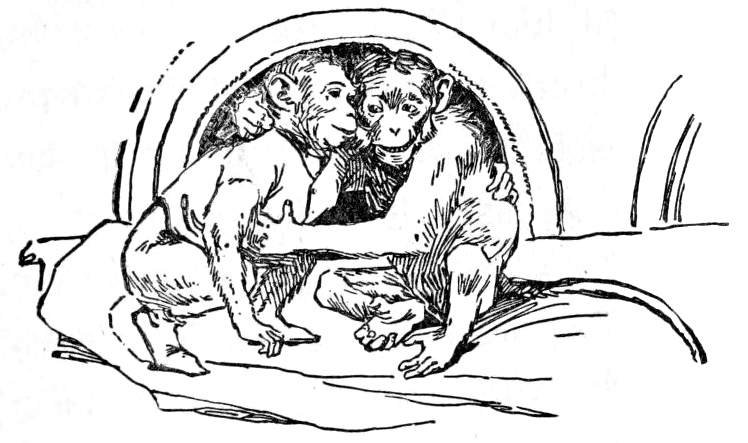
Then he went to look at himself in the looking-glass; but, while he was proudly admiring himself and making with his mouth and eyes a thousand grotesque twitchings, he heard a small noise as if some one outside were trying to get into the window. At first, Beppo was frightened. But, taking courage, he opened the window, and he saw two paws that embraced him tightly around the neck, and he heard a voice suffocated with joy and consolation that said: “O my poor Beppo! At last I have found you!”
Beppo quickly recognized the voice of his father, and, greatly moved, cried, “What are you doing here, papa, at this hour?”
“I have sought you everywhere for a month.”
“Where is mamma?”
“Yonder.”
“Where?”
“At the end of that field.”
“And my brothers?”
“They are also there.”
“And what are they doing in the field?”
“They are awaiting you with open arms.”
“Oh, how I would like to see them!”
“Come, then, with me.”
“If I only could! But at present I cannot, truly I cannot.” And, saying this, the little monkey began to cry and rub his eyes in desperation.
“And why?”
“Because I have promised a friend”—
“And what promise have you made?”
“I promised to go away with him to-night and to accompany him around the world.”
“And have you the courage to leave your poor family? Without you, Beppo, we shall all die of grief.”
“Oh, do not say that! But I hate to break my promise.”
“When must you go?”
“In a few minutes.”
“Come, at least, to say good-bye to your mother and brothers.”
“And if Mr. Alfred should call me in the mean time?”
“Who is Mr. Alfred?”
“He is my friend.”
“If he calls you—why, let him call.”
“And if the boat goes?”
“Let it go.”
Contented at having found a good excuse for not keeping his promise, the little monkey said, shaking his head: “All right. Before going on the trip, I wish to see my mamma and my brothers.” Having said that, he mounted to the window, and, giving a great big jump, he cast himself down. Then one heard a splash, like that of a great big stone fallen in a trench of water and mud.
“Help me, father, or I die!” cried Beppo.
What had happened, my readers? Why, the ground of that field, on account of the rain the preceding day, was covered with water. Beppo was immersed clean up to his throat. Fortunately, his father saved him in good time. But, when he came out of that bog, he carried no more his boots. His beautiful boots were buried two feet under the earth. “Oh,” he said, laughing, “I will have to buy a new pair.”
Without losing time, papa and son ran along the road. But they had not gone twenty feet when Beppo heard flying over his head a nocturnal bird which suddenly plucked away the beautiful blue silk travelling cap.
“Bad bird! Give me my cap immediately,” cried the little monkey.
“Cucu!” said the bird, and flew away.
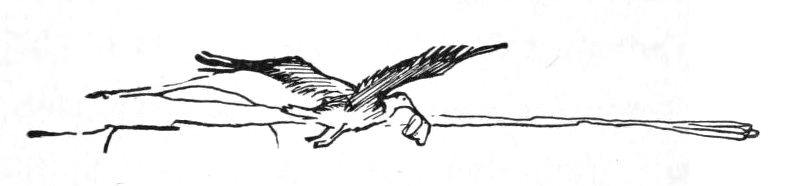
“Oh! I shall have to buy a new cap.”
Papa and son began to run again. But a large thorn caught Beppo’s trousers and coat, and reduced him to the last tatters.
“Now here am I without trousers and a coat,” said Beppo.
“Buy new ones,” said his father.
“Oh, poor me, poor me!” cried Beppo. “Of all my beautiful clothes, I have left only a shirt and a collar.” Saying this, he caught for his shirt, but instead he found a shirt of nettles. He touched his neck, in order to see if the collar was there, but he felt wiggling in his fingers a large serpent, like an eel of the sea.
In touching the serpent that was wrapped around his neck instead of a cravat, Beppo was taken with an indescribable fear. He would like to have screamed, but his tongue stuck to the roof of his mouth. His feet trembled so that he could hardly walk. Not being able to longer stand upright, he fell on the ground like a rag, saying with a thread of voice, “I die.”
“What do you feel?” asked his father, dismayed.
“A great illness.”
“Where do you feel it?”
“All over my body.”
“What illness is it?”
“It is the illness of fear.”
“An ugly illness, truly, my child. A unique sickness for which the doctors have not yet found a cure. Try to be brave.”
“I have tried.”
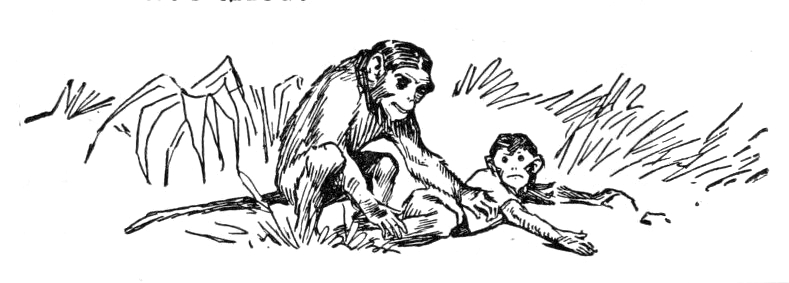
“Now how do you feel?”
“Worse than before.”
“But what is the reason for this fear?”
“A great misfortune is going to happen to me.”
“And how do you know that?”
“In a few moments I have had many signs. Do you remember my nice new boots stuck in the mud? And the coat and trousers caught on the thorn? And the shirt become suddenly a shirt of nettles? And the serpent that has just escaped? The serpent is always there, always there! Look there!”
“Where?”
“There!”
Beppo’s father turned to look at the indicated point and he truly saw in the darkness of the night a large serpent that shone with a reddish light, as if it might be a crystal serpent with a body like a lamp in a tramway. With his head erect, the serpent fixed its eyes on those of the little monkey.
“What do you want with me?” asked Beppo, with the courage of a lion.
“I come to bring you salutations from Mr. Alfred,” replied the serpent.
“Poor Mr. Alfred! Has he gone on his voyage?”
“He went a few minutes ago, and he told me that you promised to go with him.”
“’Tis true, ’tis true, ’tis true! To-morrow I shall go, and I hope to meet him on the high seas.”
“Let us hope so, truly! Remember, however, little monkey, that, when one makes a promise, he ought to keep it! Do you understand?”
Scarcely had the serpent said these words when he disappeared in the dark.
Then Beppo, tormented in his heart by a species of remorse, was nearly on the point of saying good-bye to his father and of taking the shortest road to the sands by the sea; but, while he was on the point of deciding, he saw far away burning torches moving here and there, and he heard light music of fifes, drums, and mandolins.
“What is that music, and what are those lights?” he asked, greatly surprised.
“What! Can’t you guess?”
“No.”
“Your brothers are coming to meet you with a torch-light procession.”
“Oh, what pleasure! Oh, what a beautiful spectacle! Let us run, papa, let us run!”
Both began to run along the road. Beppo, who had regained in a second the force in his thin and quick legs, not only ran, but it seemed as if he flew like a bird.
Who will give me words adapted to describe the scene of meeting? Believe me, it was a scene so affectionate that it is impossible to imagine it without having seen it with your very eyes. It is enough to say that the happiness of the four brothers, in seeing their little brother who, they thought, had been forever lost, was so tempestuous and excessive that they jumped all over him, and it is a wonder they did not smother him with their flood of kisses, embracings, and caresses.
When they had exhausted the affection of their hearts, they commenced to cry in chorus, “Curaca, curaca, curaca!”—in the familiar dialect of monkeys, you must know, little reader, that “curaca” means “to supper, to supper, to supper!” No sooner said than done. They seated themselves on the ground around a large basket of peaches, of apricots, and of Indian figs; and there, laughing and scratching themselves, and making with their mouths a thousand grimaces and a thousand distortions in sign of great happiness, they ate until they could hold no more, just as if they had fasted for two weeks. And not only did they eat, but they drank. And they drank so much grape juice that they all slept and snored like so many dormice.
Suddenly they were awakened by a horrible voice that said, “Woe to him that moves!”
Now I will leave you to imagine how scared they were, when, jumping to their feet and opening wide their eyes, they saw themselves surrounded by a gang of ugly figures, black as ink and all armed with swords and sticks.
“We are lost! We are lost!” cried the little monkeys.
“Lost?” replied Beppo. “Wait! There is always time to die.”
“But who are they?” asked one.
“They are assassins,” said Beppo.
“What do they want?”
“They want to rob us,” said Beppo. “How many pennies have you?”
“Not one.”
“Then I am as rich as you are,” said Beppo, scratching his head. Then he continued: “What queer assassins! Not one of them has the courage to advance!”
And he told the truth. For all those ugly figures that formed a circle stood stock-still, without raising an arm or saying a word. Then Beppo, advancing, said in a pretty manner: “Excuse us, Mr. Assassins. Will you have the goodness to allow us to pass?”
No one replied, no one breathed.
“Thanks for your politeness,” added the little monkey. “You must know that we are a poor family,—papa, mamma, and five children,—and we would like to go home. Do you consent?”
As before, no one replied.
“Understand,” said Beppo. “Thanks for your kindness. Come, papa, be brave! Since these gentlemen are content, make a big jump and pass over their heads. Go and await us on the other side.”
The papa monkey jumped, then the mamma, then the four little monkeys.
“Now it is my turn,” said Beppo, who was alone in the circle of the assassins. But, when he was on the point of jumping, all those assassins became so long, so high, that they looked like tall towers.
“Beppo, Beppo!” cried the other monkeys from the outside. But the poor little monkey did not have any breath to reply.
After a little time the chief of the gang said, “What do you think you are going to do?”
“I think I am going home with my brothers.”
“Do not deceive yourself, Beppo. You will not go home.”
“Then I will remain here.”
“Not even that! You will come with me.”
“With you? Not if you bind me.”
“Oh, yes. You will come with me.”
“Not even if you give me a hundred baskets of cherries.”
“Oh, yes, you will.”
“Not even if I am dead.”
The chief of the gang, without adding other words, leaned over and took the poor little monkey by the neck and placed him in the pocket of his large coat. Then he buttoned the pocket with three buttons that looked like three carriage wheels.
“Now we can go,” said the chief to his companions; and they all together took the road that led through the country.
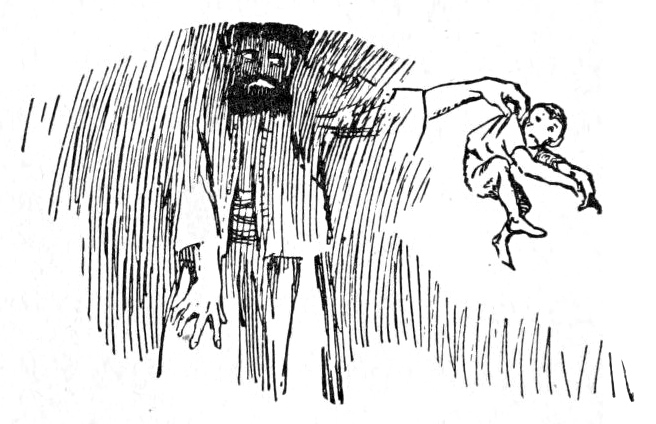
It is impossible to relate the desperation, the cries, and yells of Beppo’s four little brothers. They called him with most acute cries; but they had only the consolation of seeing the paws of the little monkey that came out of the pocket of the chief, and that moved quickly as if they wished to ask for help.
When the assassins had gone twenty miles, the terrible Dry-throat—for that was the name of the chief—stopped in the middle of a field, and, turning to his companions, said to them in a large voice: “Now you can go back to the Black Country. Await me there, and in four or five days we will see each other again.”
“Excuse me, sir,” said one of the ugly faces, “did you think to bring with you something to eat?”
“I have carried nothing.”
“Too bad! And if along the road you should have an appetite?”
“If I do not find anything else, I will resign myself to eat this little monkey that I have here in my pocket.”
Poor Beppo, hearing such words, commenced to scratch his nose and ears with desperation.
“But, if you eat the little monkey, what will the good fairy with the blue hair say?”
“The fairy will not scold me, because I promised to carry her Beppo dead or alive. In any case, if there comes to me the wish to eat him, I will keep his skin intact, because the fairy can see with her own eyes, and ascertain that I have carried out her wishes.”
“You are right, master. A good trip and safe return to you!”
Scarcely had the assassins taken leave of their leader, when they attached under their arms some large wings, and, jumping up, they mounted into the air with a great noise, just like a flock of frightened crows.
Dry-throat, thus left alone, followed his road across the fields, rivers, forests, and lakes, without stopping, never, never, never. After having walked two days and nights, he heard, coming out of the pocket of his large coat, a suffocated voice that appeared to come from under the earth, saying with a tone of sobbing: “I am hungry. I am very hungry.”
Dry-throat, instead of replying, stroked his long beard, and redoubled his pace.
After a few minutes he heard again the little voice, saying: “Mr. Assassin, will you give me a grape or a cherry or a half a pear? I am so starved that I feel as if my stomach would go away. Believe me, Mr. Assassin, I am so hungry that I can see it in the dark.”
“If you are hungry,” replied Dry-throat, laughing, “search around my pocket. You will find some nice little tidbits there that will not give you indigestion.”
“For two days and nights I have searched, and I have found nothing,” said Beppo.
“Then eat the lining of the pocket.”
“I have eaten the first lining, but the second is so hard that my teeth cannot make an impression on it.”
“You have eaten it?” yelled Dry-throat, getting angry. “Ugly little monkey! Just wait until we arrive at the Fly Inn. I will teach you a lesson.”
Meanwhile night came on. Oh, it was an awful night! The heavens were covered with clouds. It lightened and thundered. The forest trees, knocked down by the violent wind, twisted, creaked, and groaned like so many desperate souls. At exactly midnight, Dry-throat arrived before the Fly Inn. It was closed. He struck at the door once, twice, three times. No response. Then, with all the breath he had in his lungs, he began to cry: “Open the door, Candle-bit! ’Tis I!”
Candle-bit was the name of the inn-keeper. Every one called him that, because he was little and resembled a bit of yellow candle grease. The inn was opened only in daytime. Scarcely did night come on, when Candle-bit, annoyed at being troubled after dark, closed the door, put out the fires and lights, and then went to bed. Once in bed, he never opened the door for any one.
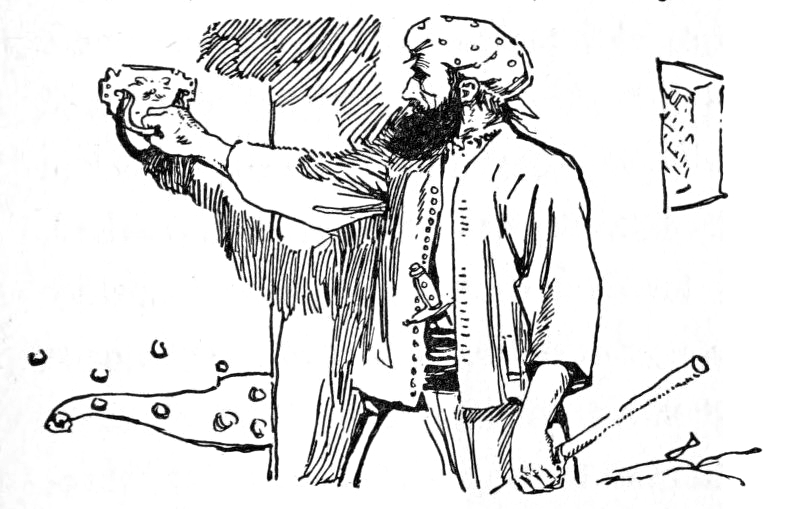
When Dry-throat perceived that the inn-keeper was making fun of him, what do you think he did? He began to extend his arms and legs until he became so large that the roof of the inn came to his waist. Then, working with both his hands, he began to take off the roof. The bricks, rafters, and tiles flew away, like leaves carried away by the wind.
Candle-bit, scared nearly to death at the horrible noise, poked his head outside of the sheet, and, feigning to awake, said in a trembling voice, “Who is it that calls me?”
“’Tis I,” replied Dry-throat, putting his head into the hole he had made in the roof.
You must know, little reader, that this hole opened into the room of the inn-keeper, who felt his blood congeal when in the flame of lightning he saw the menacing face of the head of the gang of assassins.
“What do you wish with me, Mr. Dry-throat?” asked Candle-bit, who from fear had little breath left in his body.
“What do I wish? I wish to take you by the hair, and throw you away a thousand miles.”
“Oh, do not do that! Have pity on me!”
“You do not deserve pity.”
“Have pity then on my little baby! If he remains alone in this house, the wolves will eat him.”
“No, no, I do not wish to be eaten by wolves,” said the little baby.
At the words of the child, Dry-throat changed. In a more human voice he said: “All right! Get up and prepare me some supper.”
Candle-bit obeyed. He was so scared that he did not remember how to dress himself. He thought he had taken his stockings and tried to put his feet in his night-cap. He perceived his error and put on his shoes, then over his shoes he put on his stockings. Then he put on his jacket, then his shirt, then his vest. Finding his trousers in his hand, he forgot what they were for, and he put them into his bureau. Then he descended and opened the door.
Dry-throat, who had taken the size of an ordinary man, went inside; and, shaking the drops of water off his clothes, he sat down at a table. He asked the landlord, “What can I have for supper?”
“All that you might wish, Your Majesty. All you have to do is to order.”
“What kind of meat have you?”
“We have no meat.”
“And cheese?”
“We have no cheese.”
“And bread?”
“We have no bread.”
“What, then, can I eat?” asked the assassin, shaking his head and beginning to lose patience.
“If Your Majesty desires fruit?”
“What kind of fruit have you?”
“Cherries, almonds, and peaches.”
“Give me a plate of peaches.”
“And to me a nice plate of cherries,” said a little voice that came out of the pocket of Dry-throat.
“Who asked for cherries?” stuttered the landlord, surprised and afraid.
“It is I,” replied a little voice.
“Doubt not,” interrupted Dry-throat, “doubt not, Beppo, that I will give you some cherries. Come out of my pocket, and we will settle our accounts.” Saying this, the chief of the gang unbuttoned the pocket of his coat, and the little monkey, without making any compliments, jumped upon the middle of the table and placed himself upon a soup tureen.
Then Dry-throat, turning to Beppo with a frown that would scare any one, asked him, “Who has eaten the lining of my pocket?”
As if these words were not addressed to him, the little monkey began to look here and there. Then, fixing his mobile and nervous eyes on the face of the chief of the assassins, he said in a caressing voice: “Rest contented, Mr. Assassin. I speak to you seriously. I have never seen a beard as pretty as yours! You have the prettiest beard in all the world.”
“Leave my beard alone and answer me. Who has eaten the lining of my pocket?”
“But not only is your beard beautiful,” added the little monkey, “everybody says that you are the kindest man in the world. You have the heart of a Cæsar!”
“Let my heart alone. Who has eaten the lining of my pocket?”
“And that is not all. Everybody says that you are handsome. Would you like me to tell you what I think? I have seen many handsome men; but a man as handsome as you I have never seen.”
“You ought to have seen me thirty years ago,” replied Dry-throat, smoothing his beard. “Then I was handsome! Hey, Candle-bit! Was I not handsome thirty years ago?”
“The first time I saw you,” said Candle-bit, “you were like the sun! Yes, the mid day sun!”
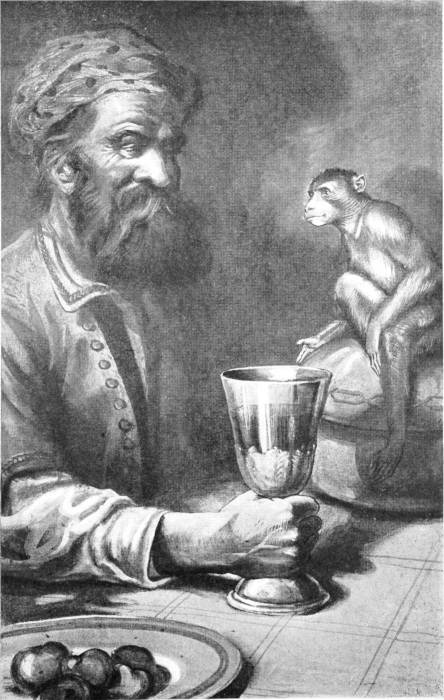
“To-day you are the setting sun!” added Beppo; “but a magnificent sunset! A sunset that is better than an Aurora borealis.”
“I perceive, my dear little monkey, that you are bright and smart: for this I like you,” said Dry-throat. “Come from the soup tureen and sit alongside of me. We will eat together. Candle-bit! Bring immediately a plate of peaches and a plate of cherries for my friend Beppo. My friend is a sincere little monkey and is a lover of truth. If he meets a man truly handsome, he does not fear to tell him before his face, ‘You are the handsomest man in the world!’”
So they ate together with a great appetite. When the supper was over, the little monkey asked, “If I might be not too indiscreet, I would like to know where you wish to carry me.”
“To the house of a beautiful fairy with blue hair.”
“What does she want with me?”
“She is angry.”
“And why?”
“Because she says you made a promise to accompany her son Alfred on a long trip, and that you broke your promise.”
“How far away is the house of the fairy?”
“More than a thousand miles.”
“I do not wish to go there.”
“You do not wish to go,” replied Dry-throat, becoming serious. “But I will carry you by force.”
“You will not be able to carry me.”
“Why?”
“Because I will run away.”
“You will run away?” yelled the assassin, blowing like a wounded bull. “Get right into my pocket, and to-morrow morning at daylight we will leave.”
Saying this, Dry-throat seized the little monkey and placed him in the dark pocket, securing the pocket with the same buttons that looked like carriage wheels. Then taking off his coat, he laid it over a chair, and, resting his head against the wall, said to the host, “I will take a little nap on this bench, and take care to wake me at daylight.”
“Sleep tight,” replied Candle-bit, and, taking a candle, he returned to his room.
Now you must know, little readers, that Dry-throat had a very bad habit of snoring. He made a noise with his mouth, like the painful and prolonged whistle which birds make when chased by a falcon.
Hearing this whistle, Candle-bit’s tabby-cat Nanni entered the room on the tips of her feet, sniffling here and there, perhaps with the hope of finding some little bird escaped from a cage. Instead of a bird he found a coat on a chair, and he smelt a warm and strange odor like flesh. “What animal can that be?” he said to himself. “A mouse? Certainly not. It is too large. Perhaps it is a piece of roast lamb? No, that can’t be it, because that is not the odor of cooked beef. What can it be?”
He began to sniffle again. After moving his little nostrils from side to side, he decided that that odor was to him like a sealed book. He understood nothing. But, while he was licking his mustache and was wrapped in deep thought, it appeared to him that he heard a slight noise. He pricked up his ears, and moved his head to one side to listen better. He heard inside the pocket a weak noise like “Kickiriki!”
“It is a chicken,” said Nanni, meowing with happiness, “yes, it is truly a chicken! The odor does not appear to be truly like a chicken; but these bad chickens are sly and deceitful things. Why, I remember once at the theatre I carried away a chicken that was behind the scenes, and, when I arrived home, I found it full of rags and sawdust.”
“Kickiriki!” sounded a second time.
“You call me, eh?” said Nanni to himself. “I am coming. It has been a great many days since I ate a chicken.” And he commenced to work with teeth and nails to open the pocket. Scarcely, however, had he opened one button, when he saw jump outside a little monkey, all bowing and scraping.
Beppo said: “I have heard, my dear Tabby-cat, that you desire to eat a little chicken meat. It gives me infinite pleasure to tell you that I have left in the bottom of that pocket a nice big piece of breast. If you wish to eat it, go inside, and good appetite to you.”
Without being invited the second time, Nanni entered the pocket; but he had hardly entered when the button was closed above him.
“Are you inside?” said Beppo, rubbing his little front paws with satisfaction.
“While you are looking for the nice piece of breast, I will leave here. Give my respects to the people of the house.”
When the little monkey had mumbled these words between his teeth, he opened quietly the door of the inn, and disappeared among the trees of the forest. It was a very black night, and he could scarcely see where he went.
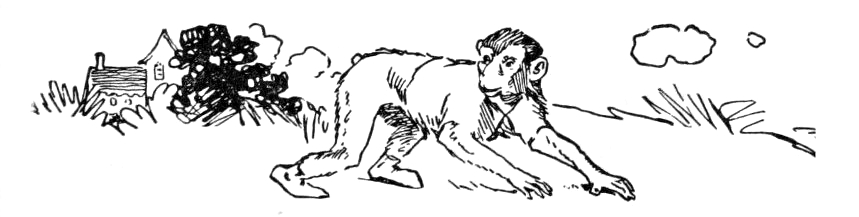
The little monkey had gone only a hundred paces from the Fly Inn when Candle-bit, jumping from his bed, called down the stairs with all the voice he had in his throat: “Ho, Mr. Dry-throat! If you wish to depart, wake up! In a little time it will be day.”
“I will leave immediately,” replied the chief of the assassins. “I will pay you for the supper when I return.”
“Happy journey to you! Good-bye!”
Dry-throat searched in the dark for his coat; and, after having found it and put it on, he placed his hand in the pocket to assure himself that the little monkey was there. But, while doing so, he gave a cry of pain, for he was scratched badly by terrible sharp nails.
“You miserable scoundrel of a little monkey!” he said. “So you want to scratch me! Woe to you if you try to repeat that trick! I swear to you that I will tear every nail from your hand, one by one!”
Saying this, he went out of the inn and closed the door. After walking along for three hours, he felt that his hand was bleeding. Then he became angry, and so enraged did he become that he struck his pocket a hard blow.
“Gvaooo,” cried a voice from the inside, plaintively mewing.
“Ah! You are playing with me! You are amusing yourself by making a noise like a cat! Take that, too!” And again he struck his pocket with more force than the first time.
“Gvaooo! gvaooo! gvaooo!” repeated the same voice, with an angry mewing.
“Then you will not stop?” he said, putting his hand into his pocket. But again he received a deep scratch. Then, crazed with pain and losing patience, he took out of his pocket a large pair of sharpened scissors and mumbled threateningly between his teeth: “Now, now, I will cure you of those sharp nails! From to-day, ugly monkey, you will never scratch again, not even a flea bite.”
Raising his coat, he opened the pocket wide, so as to grab the little monkey, when all of a sudden out jumped a large tabby-cat, that scratched the eyes of the chief assassin. It was Nanni, the cat that belonged to Candle-bit.
Dry-throat yelled with anger, and would have liked to follow it; but the unfortunate man could see no more. The ferocious nails of the cat had blinded him. He wandered around for a hundred days and nights in the forest without meeting any one to show him the way home. Formerly, when the wolves saw him from afar, they ran away with great fear. Now, knowing that he was blind and incapable of defending himself, they played a thousand tricks. Formerly the birds and the rabbits, at the approach of this fearful huntsman, vanished like so many shadows. Now the same sparrows and even the little baby sparrows, passing near him, struck his nose with their wings for amusement, and the rabbits and the little baby rabbits danced around his feet the polka and the tarantella. What beautiful courage! What bravery! is it not, my little readers? And yet it is the same among boys. They are very much like the sparrows and the rabbits. They make the same fun of those poor unfortunates who, either through age or illness, cannot defend themselves nor make themselves respected.
The fact was that one night, while Dry-throat went down a small road, among the highest trees of the forest, searching for something to eat, he found the road barricaded by a small house. Very happy, he knocked at the door.
“Who is there?” asked a voice from the inside.
“I am a poor blind man, lost in the forest. I am seeking a bed for the night.”
“Poor blind man! Come in!” repeated the same voice, as the door opened.
Now I leave you to think how surprised our little friend Beppo was when he saw that he had opened the door for his terrible persecutor.
How in the world did Beppo find himself in that solitary house in the middle of the forest? What had happened to him after his flight from the Fly Inn? In order to answer these questions, it is necessary to return a few steps backward.
You must then know that, when he left the inn, he ran around the forest at random, as it was very, very dark. The most acute desire that stung him was to find the road that led to his house; but instead he ran like a mad man, here and there, wherever his legs and fears carried him. At every breath of wind and at every rustle of a leaf he seemed to hear behind him the terrible Dry-throat, with the cat in his pocket. Finally, when it became day, he met a disputing tribe of monkeys that screamed, yelled, and beat one another. Informing himself of the reason of so much noise, he found out that the tribe was electing an emperor. Then Beppo, entering into the middle of the crowd, called for silence.
Suddenly they all became calm. Beppo began to say: “My most dear colleagues! I understand you wish to elect a leader, and to this leader you wish to give the title of emperor. Among all those who are present I see only one who is truly worthy to be called by that great name.”
“Who may that be? Give us his name!” shouted a thousand voices.
Beppo lowered his eyes and said nothing.
“Who may that one be?” repeated the same voices, screaming louder. “We wish to know the name—the name—the name!”
“Do you truly wish to know?” then said Beppo. “It displeases one to be obliged to confess it to you. But the only one who is worthy to be elected Emperor is I.”
“Long live Beppo! Hurrah for our Emperor! Hurrah for the Emperor of all the Monkeys!” cried that immense gathering, enthusiastically beating their hands.
Beppo was immediately carried into the middle of the crowd, to an old straw chair that, looked at from behind, resembled very much an imperial throne. Beppo sat down with great gravity and dignity. Meanwhile a loud flourish of trumpets and music composed of cymbals and bulls’ horns began to play the Coronation Hymn. Four monkeys, clothed like pages, presented to the new Emperor a beautiful platter, embroidered with gold, on which was a crown and an imperial sceptre. The crown was made of honeycomb tied to a thin iron ring: the sceptre was a cane of sugar candy.
Beppo took the crown from the tray, and, after having with much dignity smelt and licked it, placed it on his head. Then he seized the sceptre, and, not being able to resist the temptation, began to suck and eat it. But, unfortunately, a monkey that was alongside of him and that called himself the chamberlain gave Beppo a little push on the elbow, in order to warn him of the impropriety of the act. Then the new Emperor stopped suddenly; and, in order to remedy the scandal, he began to lick his fingers.
In the mean while sixteen monkeys carried on their shoulders a magnificent litter, adorned with leaves, flowers, and the most beautiful fruit, and placed it before him. The chamberlain, after having made two profound bows, said respectfully to the new emperor, “Majesty, arise! We await you!”
“You await me? And what must I do?”
“For the love of your people, deign to mount on that litter.”
“And, when I do mount the litter, where will they conduct me?”
“To the imperial palace, where you will live and sleep.”
At these words, Beppo made a grimace, which, translated into words, signified, “To tell the truth, I would rather sleep on the branch of a tree, as I have always done, than on an imperial bed.” Turning to the chamberlain, he asked, in a sour-sweet tone, “Excuse me, friend, I am your Emperor, am I not?”
“Most true.”
“And what does the word “Emperor” mean?”
“It means that you are a monkey that commands all the other monkeys, and all your acts and desires must be immediately obeyed.”
“Therefore, I tell you frankly that, instead of going in a litter, I prefer to walk.”
“I am sorry, Your Majesty; but you cannot.”
“Why?”
“Because an emperor who walks on his feet is no longer an emperor. Walking on your feet you become a monkey, like all the rest of us.”
“Very well. You have just said that all my desires must be obeyed.”
“Of course, Your Majesty. Remember, however, that the most beautiful prerogative that rulers have is that of not being able to do as they please.”
“I understand and I thank you,” said Beppo. And, jumping down from his throne, he mounted the litter.
The trumpets began to play a lively air, and the immense retinue moved with pompous grandeur.
Arrived at the palace, the Emperor sat down at a table all beautifully set in the dining-room. Poor Beppo, although he had become an emperor, had an appetite that resembled hunger, very much as a brother resembles a sister. But he was not able to appease the rumblings in his stomach, because all the good things, as soon as they were brought on the table, were devoured by the retinue. When the dinner was over, the little monkey was more hungry than at first.
“Oh, pshaw!” he said to himself. “Now I will go to bed, and while sleeping I shall forget that I have not eaten.”
No sooner said than done. He entered the imperial bedroom, and after a short time he snored like a dormouse. When he was sleeping nicely, he was awakened by a symphony of cymbals and horns and thousands and thousands of voices. He heard cries of, “Long live the Emperor!”
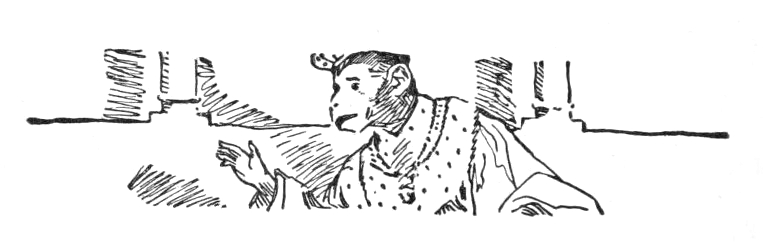
“Your Majesty,” said the chamberlain, entering into the room, “arise and appear on the balcony. Your subjects wish to see you.”
“It’s a shame,” said Beppo, rubbing his eyes. “I slept so well.” And, staggering and yawning, he appeared on the balcony.
“Thanks, friends,” said Beppo, moving his head gracefully. “I am very happy to see you all. Not having anything more to say to you, good-night. We will see each other to-morrow.”
At these words the crowd dispersed and Beppo returned to nestle in his imperial bed. But in the mean time there was another cry and shout.
“What is that?” he called out, raising his head.
“Your Majesty,” replied the chamberlain, “your subjects desire to see you again. Deign to appear upon the balcony.”
“All right,” said Beppo. “Just ask them to give me one minute while I wash my face.”
A minute passed, then two passed, then ten, then twenty, and the Emperor did not appear. They went into his room, and they could not find him. The Emperor had disappeared.
What had become of the Emperor Beppo?
No one saw him, and no one knew what to do. Perhaps he ran out the window? Impossible, because all the windows were closed and locked from the inside. What then?
The fact was that they searched everywhere. They looked in the wardrobe, in the pantry, in the dressing-room, in the back stairs, in all the small rooms, and finally in the cellar; but it was useless. Finally, after poking here and looking there, the idea occurred to some one to glance under the bed. Would you believe it? Yes, my little readers, the Emperor was hiding under the bed, and he was sleeping like a top. What scandal! What horror!
“Sire! what are you doing there?” asked the chamberlain, taking Beppo respectfully by the ear.
“I sleep,” replied Beppo, yawning and stretching himself.
“Awake quickly! Have you no shame?”
“To tell you the truth, when I am asleep, I am not ashamed to sleep.”
“Oh! But to sleep in that place! Where, O Sire, is your imperial dignity?”
“I forgot it,” replied Beppo, who really did not know what all this dignity was they made so much fuss about. Then, calling aside the chamberlain, Beppo whispered in his ear: “Do you wish me to speak to you frankly? I believed until now that to be an emperor was the easiest trade in the world. But to-day I perceive that I was deceived. Oh, fortunate are the little monkeys that are contented to remain little monkeys all their lives! At least they can eat when they are hungry and sleep when they are sleepy, and best of all, when they sleep, no one awakens them in order to make them run to a balcony and say ‘thank you’ to a lot of people who do not want to go to bed.”
While Beppo was confiding this to the chamberlain, the heavens became as black as the top of a chimney, and the water came down in torrents. Then from under the balcony of the imperial palace there came a noise of trumpets and voices that cried: “We want the sun! We want the sun! If we do not get it, down with the Emperor!”
“My friends,” said Beppo, stepping on the balcony and speaking to the monkeys on the large square, “my friends, what do you wish?”
“We wish the sun! We wish it immediately!”
“Confide in me,” said Beppo. “When it stops raining, I will give you the sun and good weather.”
A few hours after, the rain ceased and the sun came out beautifully. But, when the monkeys perceived that the sun burnt too much, they called the trumpeters together and went again before the palace. “We wish water! We wish rain!” they shouted.
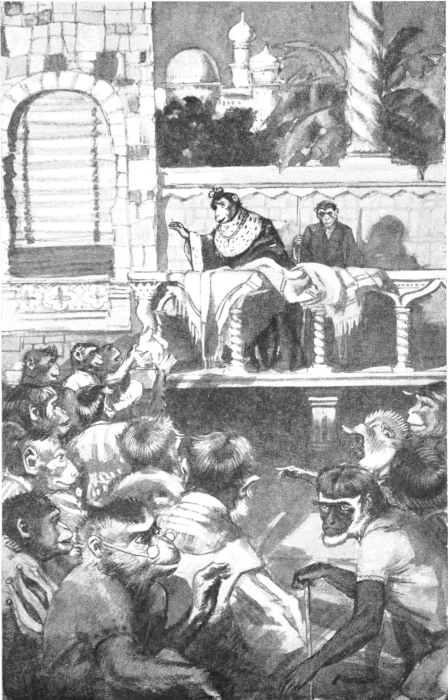
Annoyed at these words, Beppo would not appear on the balcony; but, hearing that the cries increased more and more, he put his head outside the window and said, “Do you really wish rain?”
“Yes, yes! We wish rain! If not, then down with the Emperor!”
“Wait a minute,” said Beppo. At these words the crowd clapped their hands and the band played the imperial march. A few minutes after, Beppo appeared on the balcony, crying, “There is the water; and whoever wishes more, let him go to the river.” And, saying this, he poured on their heads a pailful of water.
It is impossible to imagine the tumult that followed. The palace was invaded and taken by assault. They sought for the Emperor everywhere, but they could not find him. What was there left for them to do? Not finding the Emperor, the crowd contented itself with beating the chamberlain. It is always thus! In the things of this world the just suffer for the unjust.
Meanwhile Beppo escaped by a secret staircase that led to the back of the palace. When he found himself in the woods and alone, he ran as if he had wings on his feet. And, after having run two whole days, he found among the trees a little house without windows. At the door of this house was seated a beautiful rabbit that had blue fur. Seeing Beppo, the rabbit jumped to its feet, and, saluting with its right paw most politely, made a profound bow.
“What makes you do all that?” asked Beppo.
“I was just waiting, Your Highness.”
“Who is this Your Highness?”
“You, Sire.”
“I! I understand, I understand! Would you have by chance a little something to give me to eat and a place where I can sleep?”
“Deign to enter, and you will find both.”
As it is easy to imagine, Beppo accepted the invitation immediately; and scarcely had he placed his foot on the threshold when he saw a table all set and a nice mattress on the ground near-by. Without saying a word, he sat down immediately at the table, and, after having devoured in a moment a plate of figs and apricots, he sighed: “I have suffered so much! My life has been an Iliad.”
“What do you mean by an Iliad?”
“I don’t know and I don’t care to know. I am like some boys. I repeat what I hear men say, because it sounds big.”
“That is a very bad habit.”
“Is that so? I will try to correct it.” Then he added, “If you only knew all of my misfortunes!”
“I know them.”
“How do you know them?” asked Beppo, greatly surprised.
“I have read them in the ‘Babies’ daily Papers.’ Excuse my curiosity, Mr. Beppo; but have you not made a promise to Alfred that you would go with him around the world?”
“I will explain. I made him a promise—and I did not make him a promise.”
“What does that mean?”
“I will explain more clearly. You must know that I was tempted to make that promise—do you know by what? By my throat.”
“That is?”
“Mr. Alfred, in order to entice me, ordered such beautiful fruit to be carried on the table that”—
“I understand, I understand,” said the rabbit, laughing. “You have done what little boys do. In order to obtain from their papas and their mammas some dainty, they promise to be good, to study, and to gain honors at school—and then? And then scarcely have they obtained the dainties when they quickly forget the promise they made. Is that not true?”
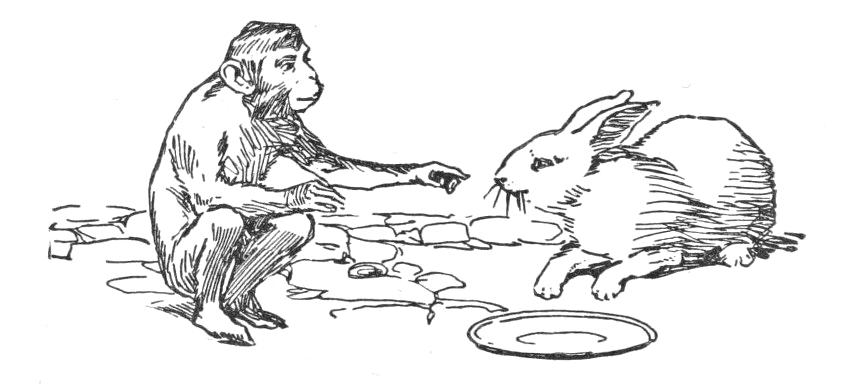
“I believe, my dear friend, you have guessed the truth.”
“Do you wish to know, Mr. Beppo, what my grandmother used to say? My grandmother always said: ‘When one promises a thing, it is necessary to keep it. Those who do not keep their promise do not deserve to be respected by others, neither helped by fortune.’ Do you understand? Good-day, Mr. Beppo.”
And the rabbit, after saying these words, ran away like lightning.
Meanwhile the little monkey persuaded himself every day that that little house was expressly built for him. Truly, he would have remained there all his life but for one occurrence. One night, moved by compassion, he opened the door, as you already know, for his terrible persecutor.
“I would like to know,” said Dry-throat, leaning his shoulders against the closed door, “I would like to know who is my benefactor?”
“It is I,” replied Beppo, changing his voice so as not to be recognized.
“What is your name?”
“My name is?”
“I know that voice!” said the blind man. Then he added, “Tell me, my dear benefactor, have you ever seen a little rose-colored monkey?”
“I have seen many monkeys, but never one of that color. Perhaps this one was green and yellow, like an omelette with parsley?”
“That is his voice! ’Tis he!” said Dry-throat to himself. “Among your friends,” he added, “have you heard of one called Beppo?”
“No. On the contrary, yes, it seems to me I have known one. But that Beppo was a rascal.”
“More than a rascal! Imagine, I did him many favors, I even allowed him to eat with me at my table, and do you know how he recompensed me? He blinded me with his sharp nails.”
“That I do not believe.”
“You do not believe it?”
“No. Beppo was a rascal; but he did not have a heart as bad as that.”
“However, it was he who blinded me.”
“No! No! No!”
“Yes! Yes! Yes!”
“Believe me, Dry-throat, I did not blind you. It was Nanni, the cat that belonged to Candle-bit.”
“Ah! Then you are discovered! You are Beppo!” cried Dry-throat.
Beppo immediately repented his imprudence; but now it was too late. “I am as good as dead!” he said, looking for a window. That house, unfortunately, had no window.
Meanwhile Dry-throat, grabbing here and there with his hands, succeeded in catching the little monkey. Having seized him by the hair, he bound him with a little chain and placed him on his shoulders. Then the chief assassin left the house, and took the first road that came to his feet.
“Where are you leading me?” asked Beppo, with a thin voice that could hardly be heard.
“In a little while you will see. You have good eyes, and you can be my guide along the road.”
“But where do you wish to go?”
“Where my legs carry me.”
Walking day and night, they made a great journey without ever stopping a minute. One morning they found themselves in a large city on the border of the sea. In the harbor there were hundreds and hundreds of steamships. Sitting down on a large basket near the shore, Dry-throat began to search in his pockets. Not finding a penny, he said to Beppo, who was half dead with hunger and fatigue, “Tell me, ugly little monkey, did you ever do anything?”
“What does that mean?”
“Why, do you know how to sing a song? Can you play any instrument? Do you know how to jump and make summersaults? Can you eat burning paper?”
“Burning paper?” replied Beppo. “I leave that to you. However, I know how to dance the polka very well, and with my mouth I can make the sounds of a trombone and of a violin.”
“That will do,” said Dry-throat. Without waiting a minute, with his large loud voice he began to cry to the people who passed by: “Come one, come all! Come see the celebrated rose-colored monkey, that has had the honor of dancing before all the royal heads of both hemispheres. My little monkey dances, sings, plays, and makes a thousand other noises which a man or some other reasoning beast can make. Come one, come all! The cost is little, the enjoyment is great!”
After this outcry a great crowd gathered around. Our friend Beppo not only pleased everybody, but created a furore. All the spectators cried, “Bravo!” until they lost their voices. When the spectacle was over, Dry-throat felt some one touch him on the elbow. It was a nice-looking young man, dressed in a travelling suit. The young man said in a polite manner, “Does that monkey belong to you?”
“It is mine.”
“Will you sell it?”
“With all my heart!”
“How much do you want?”
“Fifty dollars. But, if the price seems high, I will take a little less.”
“Fifty dollars! Then the monkey is mine.”
When Dry-throat had been paid, the young man turned to the little monkey and said, “Don’t you recognize me, Beppo?”
“Indeed, I do, my dear Mr. Alfred,” said Beppo, jumping for joy. Poor Beppo! He was so happy that he began to cry like a baby.
That same night the young man Alfred and the little monkey—all dressed from head to foot like a little waiter—departed for a long trip around the world. And I would not be at all surprised to see one of these days a printed book entitled “Trip around the World, told by a Little Rose-colored Monkey.”
Archaic spelling was retained. One duplicated word was deleted.