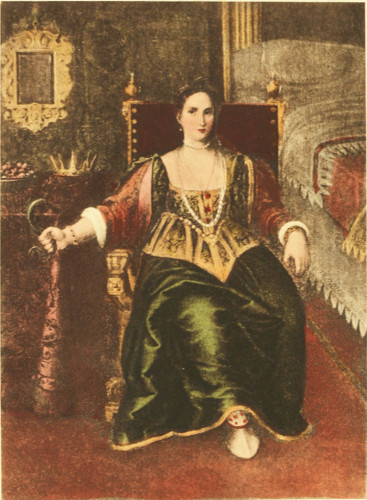
DOGARESSA TEODORA SELVO
(as Cleopatra with Venetian Zilve).
PARIS BORDONE.
Title: The dogaressas of Venice (the wives of the doges)
Author: Edgcumbe Staley
Release date: February 26, 2026 [eBook #78047]
Language: English
Original publication: New York: Charles Scribner's Sons, 1910
Other information and formats: www.gutenberg.org/ebooks/78047
Credits: Hannah Wilson, Karin Spence and the Online Distributed Proofreading Team at https://www.pgdp.net (This file was produced from images generously made available by The Internet Archive/American Libraries.)
DOGARESSA TEODORA SELVO
(as Cleopatra with Venetian Zilve).
PARIS BORDONE.
(THE WIVES OF THE DOGES)
BY EDGCUMBE STALEY
AUTHOR OF “THE TRAGEDIES OF THE MEDICI” ETC.
ILLUSTRATED
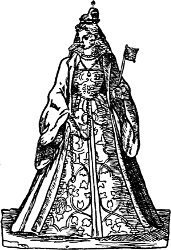
THE DOGARESSA
NEW YORK
CHARLES SCRIBNER’S SONS
TO THE MEMORY OF MY
MOTHER
FINETTA STALEY
[v]
The Story of the Dogaressas of Venice,—the Wives of the Doges,—has not hitherto been told in English; but when my many appreciative readers have finished this volume, I am confident they will agree with me that there is much that is very interesting and unique in my narrative.
The influence of good women upon the well-being of Society is undeniable: that eloquent French mot:—“Cherchez la Femme,” has a subtle and impressive meaning. In the election of a Doge of the Most Serene Republic of Venice the personality of his spouse had often as not considerable weight in the decision of the Lords of the Council. My long list of the Ducal wearers of the lesser Corno contains the name of not one who failed to play her magnificent rôle with infinite credit to herself and with conspicuous benefit to the State.
In the compilation of my “Libro d’Oro delle Dogaresse di Venezia,” I have found “La Storia di Venezia” and “La Dogaressa di Venezia,”—the remarkably able works of Signore Pompeo Giovanni Molmenti,—of the greatest service, and I now beg to offer that erudite writer, if he is still alive, my heartiest acknowledgments. Mr W. C. Hazlett’s “Venetian Republic,”—out and away the best English history of Venice,—has been invaluable.
The “Roll” of the Most Serene Dogaressas is unique,—such a complete list has never been published,—it will therefore be exceedingly useful to students of history and lovers of romance.
[vi]
With respect to illustrations it will be at once remarked how few portraits of Dogaressas I offer. The fact is that Venetian painters, great or small, painted fewer than a dozen of the noble First Ladies of Venice. This is perhaps what might have been expected. Venetian painters excelled all others in the delineation of youthful female beauty,—they were the first to paint “Venus Calva,”—but the middle-aged and the aged did not appeal to them. No, the Dogaressas have nothing for which to thank painters, sculptors, or engravers: such artists were directly under the patronage of the Doges not of their Consorts.
Women of every age and clime care very little about the Fine Arts, so called, they are themselves the finest of the Fine Arts, and their sympathy goes out rather to the artistic Crafts, in search of objects to add, if may be, to their own charms and attractiveness. In Venice the “Fragilie,” or Trade-Guilds, were directly under the patronage of the Dogaressas, and we shall find their personal attributes in the beautiful and fragile glass of Murano, and the delicate and chaste point-lace of Burano, in the lovely and costly ornaments of the goldsmiths, in the superb brocades of silk and velvet and the splendid tissues of gold and silver of the costumiers, and in the endless fascinating adjuncts of the toilet and the table.
Many of my illustrations are characteristic scenes of Venetian life and special features of Venetian fashion, and I think they prove the truth of what Mr G. Howell in his “Familiar Letters” says of Venice:—“A place where is nothing wanting that heart can wish.”
EDGCUMBE STALEY.
| PAGE | |
|---|---|
| PREFACE | v |
| INTRODUCTION— | |
| I. Venice—“The City of Venus” | xiii |
| II. Venice—“The City of Saints” | xvi |
| III. Venice—“The City of ‘Fair’ Women” | xxiv |
| CHAPTER I. | |
| “To the Lagunes!”—The dreaded Huns—Aquileia la Bella—Adriana the Heroine—La Maga Irene—Degna D’Aquileia—Viragoes—Hawsers of Women’s Hair—Venezia Seconda—Longobards—Altino and the Storks—The first Doge of Eraclea—Early Dress and Manners—Charlemagne—The first Dogaressa—Rivo-Alto Parent of Venice—Agnello and Elena Badoero—First Makers of Venice—Houses—Customs—Love of Flowers—First Ducal Palace—Translation of St Mark’s Body—Basilica of San Marco Built—Doges and Dogaresses enter Religion—Position of Women—Lovers—The Pegne—Marriage Ceremonies—Arcelle—Legend of “La Boccola”—Festa delle Marie—A Slave Dogaressa—The Rape of the Brides—A low-born Mistress—Proud Valdrada da Toscana—A Rich Dowry—Slaves—Athletic Sports—Fire at the Palace—Assassination of Doge Pietro Candiano IV.—Valdrada’s Vengeance—The Love-story of Gerardo Guoro and Elena Candiano | 1–41 |
| CHAPTER II. | |
| Legends—St Pietro Orseolo—The Pala D’Oro—A Hard Biscuit—“Good” Dogaressa Felicia—Dress of the Nobles—Light Blue—Ninzioletti—“A Stupid Man”—Seven Sisters—An Amorous Gondolier—A Diplomatic Marriage—The Princess Maria—The Flag of Venice—A Laurel-crowned Dogaressa—“Venice wants for Nothing!”—Dogaressa Teodora—A Splendid Court—Greek Menus—An Exquisite Toilet—The Crusades—The Last of the Giustiniani—A Nun’s Devotion—“A Miracle of Probity!”—Relics of the Saints—The “Bigots”—Tragic death of Doge Vitale Michielo—The Pope and the Emperor in Venice—The “Bucintoro”—“The Marriage of the Sea”—Sports Clubs—The Dogal Regalia—Prices current—“The Grand Old Man of Venice”—The Oriflamme of San Marco—Many Widows in Venice—“Venus Calva” | 42–83 |
| CHAPTER III. | |
| The Legend of the Coral Net—Origin of Venetian Point-Lace—The Fragilie or Guilds—Dogaressa Maria Baseggio’s son torn to pieces—A terrible Earthquake—A Year of Jubilee—The Marca Amorosa—War of the Gallants—Marriage—The Pledge of Peace—Dogal Prerogatives curtailed—Vision of Rose-trees and Doves—The “Flagellants”—Marriage Customs—Madonna Catarussa and the Seller of Brooms—Picnics—A Table of Etiquette—La Donna della Misericordia—The Dogaressas-Patroness of the Crafts—A Sumptuous Coronation—The Ca’ Di Dio—Prosperous Times—The Dogaressa’s Wardrobe—An Autocratic Doge—State Robes—The Bridge of Fisticuffs—The Castellani and Nicolotti—The Gaiety of Life—The Sweet Legend of “La Beata”—Strange Devotions—Revolutionary Movements and Conspiracies—Giustina Rossi and her stone pan of Carnations | 84–125 |
| CHAPTER IV. | |
| “A Galley full of Demons!”—The Legend of “The Fisherman and the Ring”—Doge Zorzi Il Santo—Dogaressa Franchesina “Queen of Venice”—The pathetic Story of Soranza Soranzo-Querino—A Corno for the Dogaressa—The Solemn Entry of Dogaressa Elisabetta—Brides of Stuff and Wood—Sumptuary Laws and Bridal Trousseaux—The Calar Stola—The Genesis of Venetian Painters—A learned Doge—Infatuation for Isabella de’ Fieschi—The Black Death—Francesco Petrarch—Marino Faliero—Michele Steno’s Insult—The Conspiracy—“The Doge never lies!”—Broken-hearted Dogaressa Aloycia—Frate Paolino on “Woman’s Influence”—Platonic Ideas—Courtesans—The Story of Veneranda Porta—The Bravi—A Dowdy Dogaressa—“Slippers, Cabbages and Night-caps!”—Alvise Venier’s Escapade—A Venetian “Brutus”—A Poetic Prophecy | 126–166 |
| CHAPTER V. | |
| The Zenith of the Dogaressa—A grand religious Function—The Ritual—Dogaressa Marina Galina-Steno’s “Gran Mercè”—Venice the Conqueror—Compagnia della Calza—Cacci del Toro—Sumptuous Dresses—Wooden Pattens—Zelve—Pageants—Uno Balordo—A Doge with an Iron Will—A Disputed Election—A Brave Dogaressa—The Tragedy of Giacomo Foscari—The longest Dogado—Quaint Wedding-customs—A Leg of Mutton—A Magnificent Trousseau—Torture and Exile—A Bitter Enemy—“He has Paid the Debt!”—An injured Dogaressa—Dogaressa Giovanna Dandolo-Malipiero, Patroness of Printing and Lace-making—The First Published Book—Buranelle—Patriarchal Doges and Dogaressas—Cheapness—Young Cavaliers’ Long Hair—Good Dogaressa Cristina Sanudo-Moro—An Opulent Doge—Dogaressa Dea—“The Venus of the Century!”—Who was Donna Laura Nogarola? | 167–209 |
| CHAPTER VI. | |
| The Gardens of Venice—Murano Palace-Villas—Symposia—Pietro Bembo and the Litterati—Ariosto and Aretino—“Venus the Fruitful”—Venetian Dialect—Cristina Pisano and Cassandra Fedele—Two Dogaressas—Gold Regalia—Dresses worth £2000 apiece!—A Connoisseur Doge—Dowries with Conditions—Venice Disgraced—Costly Gifts—Wild Beasts—A Disastrous Fire—A Plague-stricken Dogaressa—A Splendid Funeral—A Terrible Pestilence—Dogal-Fraternal Disputes—Beauteous Slaves—Their Prices and Uses—Discovery and Decline—Duchess Beatrice D’Este—“Great Dolls!”—Nepotism—The Man of the Hour—A Widower Doge—The League of Cambrai—Cream-coloured horses for Henry VIII.—Disasters—No “Marriage of the Sea”—La Pace delle Donne—Spectacular Plays—Gorgeous Madonna Giovanna Emo—The Grimani Breviary—Wild-fowl—The “Osella”—The Dogaressa’s Coronation banned—Doge Andrea Gritti’s pompous Progress—Fat Pork and Onions!—Old Marta—Peep at the Dogaressa in Bed!—Frate Pietro Casola’s Account of Venetian Fashions—“What sort of a wife has he got?” | 210–251 |
| CHAPTER VII. | |
| A Doge and Dogaressa of the Fisher-Folk—Dogaressa Zilia Dandolo-Priuli’s Coronation—“I am delighted with everything!”—Gorgeous Obsequies—The Republic at Peace—Talented Dogaressa Loredana Marcello-Mocenigo—Visit of Henry III. of France—Extravagant dissipation—Bold Courtesans—Veronica Franco—A Venetian Sappho—Battle of Lepanto—A Hero Doge—“The Golden Rose”—An Amiable Dogaressa—Bianca Cappello—“Daughters of Venice”—Caterina Cornaro—Dogaressa Morosina Morosini-Grimani—Lavish Largesse—Laudatory Orations—Stamped gilded Leather—A Magnificent State Robe—A Water-Pageant—Two hundred thousand visitors—A Grand Naval Review—International Sports—Dogaressa’s love of lace | 252–291 |
| CHAPTER VIII. | |
| The Sun of Venice set!—Many short-lived Doges and Dogaressas—Games at Cards—A stout unwieldy Dogaressa!—Another Hero-Doge—The Morea conquered—“Woman maketh Man!”—A wrinkled face—Loss of Candia—Universal idleness and indulgence—Venice dying as a whirling ballet-dancer!—A virtuous Dogaressa—Her cell a treasure-house—A Princess-costumier—A dress of solid gold!—A costly wedding—The Tragedy of Madonna Francesca Grimani-Mocenigo—A Lady-bountiful—A Cultured Dogaressa—Polissena—A Rope-dancer Dogal spouse, Margherita Delmaz—“Stop that bell!”—Agnello Emo the last Captain of Venice—The Last Scene—Feeble Doge Lodovico Manin—A despairing Dogaressa—The roar of cannon!—Abdication of the Doge—The Regalia burnt—Buonaparte hands Venice over to Austria—“La Republica xe Morta” | 292–314 |
| An Ideal Portrait—Dogaressa Teodora Selvo, | Frontispiece | |
| La Maga Irene holding a Reception, | To face page | 4 |
| Il Sposalizio—The Betrothal Ring, | „ | 24 |
| La Cazza del Toro—Bull-running, | „ | 36 |
| A Typical Family Group, | „ | 46 |
| The Dogaressa and her Maids of Honour, | „ | 62 |
| Going to a Masked Ball, | „ | 76 |
| A Mystic Dance, | „ | 92 |
| Doge Reniero and Dogaressa Aloicia Zeno, | „ | 102 |
| A Court Ball Parade, | „ | 118 |
| Doge Francesco and Dogaressa Elisabetta Dandolo, | „ | 138 |
| Two Courtesans and Pets, | „ | 152 |
| Festa Campestre—Picnic on the Brenta, | „ | 162 |
| La Ninfa—A Love Affair, | „ | 176 |
| Marriage Reception in a Palace, | „ | 192 |
| Fashionable Hair-dressing, | „ | 208 |
| Dance in a Villa Garden, | „ | 216 |
| Le Novizze—Brides in Gondolas, | „ | 226 |
| A Bride’s Debut, | „ | 238 |
| Dogaressas Zilia Dandolo-Priuli; Loredana Marcello-Mocenigo; and Cecilia Contarini-Venier, | „ | 254 |
| Dogaressa Loredana Marcello-Mocenigo, | „ | 268 |
| Dogaressa Morosina Morosini-Grimani, | „ | 282 |
| A Game at Cards—“La Trappola,” | „ | 294 |
| The Fortune-Teller, | „ | 304 |
[xiii]
The “Queen of the Adriatic” came into being quite as mysteriously and almost as miraculously as did the “Queen of Beauty.”
Where the iridescent bubbles of the light zephyr-borne foam of the ever-flowing sea-wash disperse, with intangible impact, upon the golden strand of shallow shoals, all strewn with opal-hued sea-shells—making plaintive cadences in the keen sea-breeze—there, there, was Venus born—so too was Venice!
The fair form of the fascinating goddess lay prone—partly in and partly out, of the generating water until the breath of life, skimming over the crested ripples, exhilarated her blushing limbs. Most delicate sprays of aromatic seaweed intermingled with the abundant tresses of her rich auburn hair, flawless pearls of the ocean threaded themselves around her shapely arms and bosom, her cincture was a cunning veil of coloured sea-mist, and her feet were covered with glittering scales of gold and silver fish.
Upon the aqueous shore the Four Seasons wait with their twelve attendant lunar nymphs to cast about their “Venus calva” the emerald and topaz girdle of virginity, and the ruby and sapphire mantle of royalty. A merrily dancing chorus of seven times fifty-and-two dainty fairies of the day, hand-in-hand, are ready to escort their Queen through the amber grotto to her royal throne beneath the myrtle-grove.
[xiv]
All this is metaphorical of the “City of Venus”—Venice—for, to quote Shelley’s tender ode:—
Sea and silt united were the parents of the “daintie Citie.” Ebbing, ever ebbing, the brackish head-waters of the gulf heaped up grain on grain of terra-firma—the detritus of many a fruitful river and the shifting rolling sea-sand. Thus was Venice formed, “born,” as Goethe says, “out of the water.” “Venice calva” laid along the lagunes, her graceful form reposed upon the velme or barene of Rivo-Alto, Olivolo, and Poveglia—sand and seaweed submerged; her shapely feet rested upon the firmer ground of Malamocco and Chioggia; and her comely hands grasped the tumbe or sedge-growth,—seldom covered by the tide,—of Torcello, Burano, and Mazzorbo.
Rivo-Alto, or Rialto, was the first of sixty sisters of the languishing lagunes. Over them silence and solitude reigned supreme, but the sun shone with generous warmth and the breeze blew with healthful vigour, and, almost imperceptibly variegated moss clothed the naked rive and lidi. Green math and rush covered the golden dunes, flowers of the sea,—pinks and anemones,—and blossoms of the land,—lavender and poppies, imparted colour and fragrance to the wastes of mud.
For hundreds of years, and hundreds more, those oozy quicksand swamps were nesting-grounds for wild birds of the sea—the feeding-place of feathered visitants migrating to other climes. The depths were choked with fish, and the shallows reeked with[xv] creeping things, but no hold was there for foot of man or spoor of beast.
Then, in historic times, into those sandy shifting channels came strange forms, scaring both fish and fowl away—the coracles of daring aborigines, from the contiguous shores in quest of food and what-not. Uncouth men cast their nets and spread their snares amidst struggles for proprietorship—the lagunes had changed their character.
Another era dawned, that of fire and storm, and fugitives from the devastating wrath of Alaric and the Goths fled, crouching, scared, and breathless, for sanctuary to the lagune fastnesses. With them appeared corsairs of the coast, preying upon the hunted men and women and seeking hiding-places for their pelf. Thus a ribald population grew up amid the trackless ways of no-man’s land.
For bare existence had they to fight—no weakling child, no thriftless woman, no loafing man could long endure that fierce survival of the fittest. Stripped to their loin-cloths men worked to give stability to their foothold in the swamp. Balks of timber from submerged forests were clamped together and great piles of wood driven deep, deep down into the ooze and silt. Women girding up their skirts waded knee-deep in the sea-wash, weaving osier basket-work to retain what grains of gravel rested beneath their feet. Children fetched and carried.
Flotsam and jetsam all came ready to hands which clawed and thewed for mutual advantage. Shelters of dry mud or baked sunslime with boarded roofs, windowless and without doors, were the homes of these strenuous people. Then, by degrees, every[xvi] safest stretch of sand had its dotting of cottages and its hamlets. Besides the daily struggle to keep the greedy water out and the slender soil retain, there was much to do for one and all. Fishing, bird-snaring, carrying and piloting of goods and craft were obvious occupations; and then came the rendering of salt and bitumen, and the gradual cultivation of the bleak wind-swept islets.
Some sort of constitution was in force from the earliest date: the best man of each collection of dwellings was looked upon as head and guide, and he gathered the wisdom that he lacked from men next him in years and influence. The people of the lagunes were not savages—they were the descendants of men and women highly civilised. Invention and creation were instinct in them all, and they were Christians too. Their legislation and religion were based upon the examples of their forebears in the mainland. All looked to Rivo-Alto,—the port of Padua, it was called,—as the centre of their geographical economy, and there, too, in 421, Padua sent consuls to regulate the lives and property of the water-settlers and to safeguard the common weal from inroads of barbarians.
is quite as appropriate a title as any other bestowed upon the “Queen of the Adriatic.” The translation of the body of Saint Mark the Evangelist from Alexandria, in 829, excited in every class of the population a fervid emotion and an insatiable ambition for the possession of relics of the Saints,[xvii] not alone as objects of devotion but as mascots for protection.
Bodies—more or less entire—were exhumed, purchased, or stolen, from scenes of fierce martyrdom, or from quiet resting places, and reverently conveyed in Venetian galleys to the Lido for distribution among the churches of the Lagunes. Each translation was an exhibition of manly abasement and womanly devotion: Doge and Dogaressa, no less than the poorest of the poor, took part in the ecstatic ceremonies.
Each saintly personage had ascriptions of peculiar benevolence, and became the centre of special devotions; indeed many of the holy shrines were regarded as objects of perpetual pilgrimages. Venetian manners, Venetian poetry and literature, and Venetian vernacular, were all marked by the hagiography of the saintly city.
In a very curious volume published in Venice by Giacomo Zoppi, in 1519, entitled “Viaggia da Vinegia al Santo Sepolcro et al Monte Sinai,” and illustrated by quaint wood-cuts of cities, peoples, and animals, encountered by the way, is a list of the bodies of Saints enshrined in Venetian Churches, in the following order:—
San Marco “Messer San Marco”—St. Mark the Evangelist, from Alexandria, under the high altar; (2) The glorious Martyr Sant’ Isidoro, from the Island of Chios, in the Chapel of the Crucifixion—(1125).
San Pietro di Castello:—SS. Sergio and Bacco, in a marble tomb in the crypt of the Confession.
[xviii]
San Danicle:—San Giovanni, martyr from Alexandria.
San Giovanbattista in Bragora:—San Giovanni the Almsgiver, Patron of Alexandria.
Sant’ Antonino:—“Messer San Sabba,” Abbot of Acre—(992).
SS. Trinita:—Venerable monk and martyr, Sant’ Anastatio.
San Zaccaria:—(1) “Messer San Zaccaria,” father of St. John Baptist; (2) San Gregorio Nazanzino, Patriarch of Constantinople; (3) San Teodoro, confessor, from the Island of Samos; (4) San Pancrazio, martyr, in a marble sarcophagus; (5) Santa Sabina, martyr of Acre, in a marble sarcophagus; (6) San Tharaso, martyr, of Roumania, in the crypt; (7) San Ligerio, martyr.
San Lorenzo:—SS. Giorgio, Barbaro, and Paul—Bishop, martyrs all from Constantinople.
San Sebastiano:—Venerable Sebastiano, rector of San Giovanni (head wanting!)
Santa Marina:—Venerable nun and patient martyr Marina, in the choir, from Greece.
San Salvadore:—San Teodoro, martyr, from Constantinople,—martyr et cavalier di Dio.
San Paterniano:—SS. Gondino and Epimaeo.
San Giuliano Martiro:—(1) San Floriano, martyr, from Greece; (2) San Paolo, hermit (head wanting!)
San Canciano:—San Maximo, bishop and martyr.
San Maria delli Crocichieri (Formosa):—
[xix]
Venerable virgin and martyr Santa Barbara,—in a “bella cappella.”
San Geremia:—Venerable Magno—Bishop of Altino, builder of the first church in Venice.
Santa Lucia:—Venerable Santa Lucia, virgin and martyr, in a chapel. Translated from Saragossa to Constantinople, and thence to Venice.
SS. Gervasio e Prothasio—called “Sa Trovasi”—Santo Grisogono, martyr from Zara.
San Niccolo dai Mendigoli:—San Niceto, martyr.
San Raffaelo:—Santa Niceta, virgin and martyr from Nicomedia.
San Basileo:—San Costantio, confessor, from Ancona, in a coffer before the high altar.
Sant’ Apollinare—called “San Aponal”:—San Gioria, prophet.
San Simeone Propheto:—(1) San Simeone, from Constantinople—in a marble sarcophagus before the high altar; (2) San Hermoleo, priest and martyr, from Nicomedia—in a marble sarcophagus in the middle of the nave.
Sant’ Elena:—“The glorious Queen Sant’ Elena”—(1205).
San Niccolo di Lio (Lido):—(1) San Niccolo Magno, Archbishop of Mirraea (1100); (2) San Niccolo, Bishop and Abbot of Mount Sinai; (3) San Theodoro, Archbishop of Morea.
San Giorgio Maggiore:—(1) San Stefano, first[xx] martyr, in a special chapel (1105); (2) San Paolo, Duke and martyr of Constantinople; (3–4) SS. Cosimo and Damiano, martyrs; (5) San Cosima, confessor and virgin, from Constantinople.
San Clemente Papa:—Sant’ Aniano, Patriarch of Alexandria, disciple of Saint Mark.
San Servilio:—San Leo, Bishop of Modon—(819).
San Secondo:—San Secondo, martyr, from Aste.
Santa Maria di Murano:—(1) San Donato, bishop and martyr, in the crypt—(1125); (2) San Gerardo, Bishop of Moravia and martyr—a Venetian by birth.
Sant’ Albano di Burano:—(1) Sant’ Albano, Bishop; (2) Sant’ Orso, martyr; and (3) San Domenigo, hermit and confessor, both from Armenia.
Santa Maria di Torcello:—Sant’ Eliodoro, Bishop of Altino and martyr.
Basilica di Torcello:—San Fosca, virgin and martyr from Aquileia.
Sant’ Antonio di Torcello:—Santa Cristina, virgin and martyr, from Armenia.
Basilica di Grado:—(1) San Hermacoro, Patriarch of Aquileia; (2) San Fortunato, archdeacon—both in the crypt.
Santa Croce della Zecca:—“The body of the most holy Doctor Saint Athanasius, Patriarch of Alexandria.”
Basilica di Chiosa (Chioggia):—SS. Felice and Fortunato (?) from Aquileia.
San Rocco di Chiosa:—San Rocco.
[xxi]
In addition to these Bodies were very many other relics of Saints, for example; arms of St. Andrew the Apostle, St. Barnabas the Apostle, St. George of Cappadoccia, heads of St. Sixtus the martyr, S. Simeon the Apostle, etc., etc. Every Church has its reliquary for veneration, and in it a fragment of the True Cross.
Venice, moreover was a nursery of Saints: she numbered among her honoured dead scions of nearly every noble family who, for one good reason or another, had attained to the pre-eminence of Sanctity. Such were San Pietro Orseolo, San Lorenzo Guistiniani and San Vincentio Ferrar—to name but three. A religious atmosphere pervaded the islands of the Lagunes and kept alight many a kindled shrine on mud-bank pile and at casa corner. Inside the homes of the Venetians also, according to orthodox custom, were Ikons and Anconas with candles burning in honour of favourite saints.
Nevertheless, and in spite of such a wealth of saintly environment, the Venetians were undoubtedly backward in sending their sons to fight the battles of the Cross in Palestine. On the other hand they were ready with no niggard contributions in aid of Crusaders from other lands. Venetian gold, Venetian ships, and Venetian seamen, carried the armies of the Cross to foreign ports; and Venetian alms endowed hospitals and funds for the benefit of the wounded and the sad, upon the islands of the Lagunes.
In the “Viaggia da Vinegia” is a very simple but doubtless efficacious recipe for the treatment of weary Crusaders:—“For pilgrims suffering from[xxii] the heat and tender feet, anoint with wine-lees mixed with olive oil overnight; then, in the morning wash in a bath of sweet herbs and sweet water.”
Perhaps the reason for the apparent luke*-warmness in the defence of the Holy Sepulchre may be seen in the isolation of the lagune dwellers. They were not in such close touch with other communities as are nations with artificial boundaries. Their charity began at home, and their customs were unlike those of their neighbours. All islanders are so differentiated from inhabitants of continents: citizens of the British Isles are remarkable to-day for insular idiosyncrasies.
Venice is still one of the most religious cities in all Italy. Prayer never ceases, the Blessed Sacrament is perpetually exposed, the churches are open night and day, and the devotions have little that is merely perfunctory.
Saint Giustina was one of the saintly patrons of Venice. She was a Paduan maiden of Royal birth—a daughter of King Vitalicinio. Haled before the Roman Emperor she professed herself a Christian: in vain did he strive to shake her resolution. Sentenced to be beheaded the sword of her executioner turned upon himself, and this occurred three times in succession. Eventually, in 303, she was cast into the sea and drowned.
Mariners sailing along the Venetian Coast still, it is said, hear at the hour of Vespers, the sighs of the holy martyr, and the devouter sort cross themselves reverently and crave her guidance and patronage. In Venetian art Saint Giustina accompanies Saint Mark, Saint George, and Saint Catherine of Alexandria as assistants at the throne[xxiii] of the Virgin Queen of Heaven. The unicorn generally accompanies her—the mystic emblem of chastity.
The first church dedicated to her honour was built at Padua in 453 by Orpillo, a pious citizen, in times of unrest and disaster. In Venice Saint Giustina’s church was erected by Dogaressa Elena, spouse of Doge Agnello Badoero: it was situated in the Calle del Te Deum but suppressed and dismantled in the seventh century.
A very pretty legend is linked to the memory of Saint Giustina. It is recorded that when the people of Altino and the other towns threatened by the Longobards flew disconsolately to the islands of the lagunes, a white cloud appeared to two holy priests Germaniano and Mauro and out of it proceeded the sweetest of all voices—that of Saint Mary the Consoler. With her conversed Saint Peter the Apostle, Saint John the Baptist, Saint Antonio of Padua, and other holy martyrs. Saint Giustina joined the sacred conclave and was deputed to indicate to the faithful clerics the spots whereupon it was the will of Heaven that churches should be built. Torcello, Burano and Mazzorbo owe their sacred edifices to the girl Saint’s instruction. She also told Bishop Magnus of Altino that wherever he found a vine there to erect a church. At Padua one may see the prison of the Saint—a dungeon seven feet by three. The martyrdom of Saint Giustina has tenderly inspired the pen of the poet and the brush of the painter, and they have together handed down a delightful tradition for Saint Giustina was regarded as the “Patroness of the Dogaressa.”
[xxiv]
The two things most famous and most remarkable in Venice, throughout the whole of her fascinating story, are first of all the beauty of her women, and secondly the splendour of her palaces. No city in the wide wide world, ever did, or ever can, compare with Venice in the number and magnificence of her palaces. They are as unique and as majestic, individually and collectively, as is the Queenly City herself. Concerning them, that trenchant epigram of Francesco Sansovino, the historian, “Veni Etiam” is a truism—Come again and again, and you shall always find some fresh beauty, some unimagined delight.
Venice had a greater distinction far, than the elegance of her private and public buildings,—she was always full of beautiful women. “I never beheld,” exclaimed the Cardinal of Lorraine to Doge Pasquale Malipiero, “such a number of lovely women as I see everywhere in your bewitching city!”
Nicolo Ciccio d’Arezzo, a poetaster of the fifteenth century, invited all true poets to sing with him the praise and glory of “Tanta Donna,” as he suggestively calls the woman-effigy of Venice. He unites with Jacopo d’Albiggotto, and Guido da Firenze, in the enthusiastic refrain:—
Gianni Alfani, a poet of the thirteenth century, in his “Gentildonne di Vinegia,” writes thus:—“I[xxv] wish to sing with you about my Mistress, because she is adorned with every virtue and every charm.”
The women of Venice were always distinguished for their natural quickness and intelligence, their sprightliness and vivacity of manner, their talkativeness and coaxing ways, and their fondness of music, song and dance. Perhaps their most characteristic talent however was their devotion to the toilet—their love of beauty and of clothes!
In person they were usually somewhat short of stature, but endowed with grace of carriage. Their figures, especially their bosoms, were full even to the degree of stoutness. This was in a great measure due to the softness of the Venetian climate, which induced a natural and becoming indolence. Nevertheless they were vigorous in action and quite able to give a good account of themselves in marital and other squabbles!
Their features were clearly cut and yet not too severe, their heads well shaped and borne, their eyes blue like their skies or grey like their seas, and their hands and feet were small. Their most attractive attributes were the fair satin peach-like delicacy of their skin, and the brilliant lustre and golden sheen of their abundant light auburn hair. Speaking of the consummate art and artifice of Venetian women Pietro Aretino exclaimed:—
That most fallacious saying,—“Beauty is but skin deep,”—never applied to Venetian women. Their fair beauty, like all real beauty, not only covered the whole person externally but it was[xxvi] instinct in their blood, their muscle, and their nerve,—moreover it was hereditary. The early parents of the race, or rather intermingled races, were Trojans and Greeks: then Teutonic-Lombard fathers mated with mothers of Veneto and the Lagunes, and the stock became stable in its properties of strength, grace, and beauty. Pliny, of old time, truly cast their horoscopes when he wrote of the first mothers of Venice thus:—“They are chaste, simple, and modest, they never give themselves away even when their men folk are idle and lascivious, their character and demeanour are marked by Grecian calmness.” Surely he had in view the line of the Dogaressas!
The treatment of the skin was a speciality of the Venetian women. The use of the bath was one of their inheritances, they bathed the whole body frequently, sometimes in the sea at the Lido, but every house had its bath—in humble homes of wood or common metal, in patrician palaces of porcelain, glass, or silver. With the water they mixed simple or exotic perfumes. One of their secrets was to remain, with the whole body immersed and motionless, for at least half an hour; and another was, they never rubbed the skin but just dabbed it and let it dry naturally. Then the nostrums of the masseusses’ art were exploited. A not uncommon custom was to lay a slice of raw veal, dipped in new milk, upon the face at night! For richer women other artifices followed suit—puffs and powders to gently temper the epidermis or hide unsightly blotches, and pigments,—rouge and others,—with which art might most effectively colour crude or enervated nature.
[xxvii]
Every woman and girl in Venice, at all times, painted,—even the poorest of them. The cult is still practised at Chioggia, where you never see a woman without artificial colour. There, by the way, may be seen still the true Venetian type of female beauty, and the old Venetian trait of sitting leisurely, under shade or shelter, while some sympathetic voice reads Ariosto or some other favourite poet.
One very delightful attribute of Venetian women was their fragrance,—their skins and their hair were always perfumed. Wherever a gentildonna passed she left behind her a delicious aroma, if she paused the air around her became saturated with sweetest odours. This seductive charm is still characteristic of the real Venetian: her love of scent is hereditary and delightful. In a very real sort of way the Venetian gentildonna was a living embodiment of Venus—“the fairest and the sweetest of all the Goddesses:” hence Venice has been quite aptly called the “City of Venus,—the City of Fair Women.” A couplet from San Gemignano is quite applicable to this delightful fancy:—
There was one especial favourite among all the delicious perfumes which dispersed their sweet aroma all over Venice, and Count Lorenzo Magalotti, in his “Fiore d’Arancio” tells us how it was made. “Take,” he says, “the empty skin of an orange, with a little powdered benzoin, with two pounded cloves, and a small stick of cinnamon, cover them with the finest rose water and set to[xxviii] boil upon a brazier.” In the sixteenth century the far-famed Portuguese buccheri got to Venice,—little charms of sweet-smelling clay—and they very soon became every woman’s treasures. The odour dispersed when a bucchero was dipped in hot water was very refreshing, and resembled the aroma which arises from parched ground on a hot summer’s day after a copious shower of rain. When dipped in essences they gave forth for ever so long the sweetest of perfumes: women wore them in their bosoms, and were accustomed to place them often upon their lips, so that their kisses might be scented too!
Not only were the girls and women of “Venice—the City of Saints” much drawn to the general claims and duties of religion but, in particular, they were exponents of some of its minor behests. The Apostle speaks of the hair of women and says it was given them to be a protection and a glory. The Venetians exactly carried out the apostolic injunction.
From the very first foundation of Rivo-Alto, away in the fifth century, the women of the lagunes were accustomed to resort daily to the altane, or flat-roofs of their dwellings, and there spend much time in combing and dressing their hair in the sunshine. This habit they undoubtedly inherited from their Greek ancestresses. Homer sings about “the beautiful fair hair of the Greeks,” and he has painted the captivating Helen of Troy with abundant locks of gold. The general colour of Grecian women’s hair was brown,—light and dark,—and such naturally was the hue of Venetian women’s tresses. The poets however made a dead[xxix] set against that tint, and stated their case so broadly, that brown hair was regarded with aversion as appertaining to traitors, murderers, and other evil doers! The painters took up the cue, and we rarely see in the pictures of Bellini, Giorgione, Titian, Tintoretto or Veronese women with brown hair.
Auburn, or, as they called it,—golden, hair,—was the most popular, most beautiful and most expressive. The more it glittered the better was it liked, and what Nature marred Art embellished. A primitive but withal most effective device in the Venetian artifices of the toilet was the superimposition upon the top of the head,—the hair being well combed-out and rippling over the shoulders,—of a crownless, wide-brimmed straw hat called solana,—“sun-frame.” The brim shielded the neck and bosom, while the sunlight, not the heat, got at the roots of the hair and blanched its growth. Every altana had its group of animated “mushrooms”—each woman and girl sitting thus, and ever and anon damping the exposed hair and cuticle with a small sponge, stuck at the end of a spinning-spindle or some such sceptre, and dipped in cunning tinctures. Beneath the brim of the solana big long-toothed combs of yellow tortoiseshell were used to keep the hair supple, or frizzing-irons, or bones to make it curl or wave. This method was admirably effective, and it is still adopted privately by many a beautiful Venetian girl and buxom dame. With respect to the recipes employed in the concoction of the tinctures little can be authoritatively said, for each fair one kept her elixir and its secret to herself. Anyhow, generally speaking, one may say that the finest of fine Lido golden sand, crushed[xxx] vitreous plaques of Murano, ivory sawdust, pounded sea-shells and,—in exuberant and extravagant humour,—even powdered pearls, and precious gold dust were employed. Vegetable compounds—the juice of grapes, berberis, ivy-berries, lemon-squash and orange-flavour, with aromatic powders of all sorts and kinds were also used. Dyes, strictly so called, were not in favour: their effect was ephemeral.
Venetian women and girls owed a good deal to Dogaressa Teodora Selvo, in the eleventh century, for she introduced toilet batteries, fully furnished with all the requisites for skin, hair, and teeth,—together with delicious Eastern perfumes. Giovanni Marinello of Modena, in the sixteenth century, gathered up all that was known of the artifices of the coiffure in his classical work “Gli Ornamenti delle Donne.”
Venetians were past-mistresses in the mysteries of hair-dressing. The Greek style was always the most in favour, where the hair, not being too dry nor too tightly plaited, was drawn off the face and neck, tied in a ribbon at the back, and then coiled round and round the head, and stuck fast with combs and pins. The hard line of the forehead was tempered by a small row of curls under a semi-diadem, fillet, or crescent—called gabbia—literally “a cage”—and usually made of precious metal and jewelled. This style Titian painted in the well-known portrait of his daughter Lavinia presenting a golden dish of ripe fruit.
Another fashion affected by gay and opulent courtesans was called al Corno, with reference to the conventional head-dress of the Dogaressas.[xxxi] Sometimes only one horn was projected, at others two or even three or more. An invisible bandeau was hidden under the hair, bearing spikes of tortoiseshell or whalebone, up which single strands of hair were twisted and curled until they assumed the appearance of vine spirals and tendrils. This vogue lasted quite a long time—certainly from 1540 to 1630. It was a very difficult feat to arrange these horns becomingly, so as to avoid any idea of the ridiculous, the animal, or the demoniacal: crescenti they were euphemistically called, as suggestive of the crescent moon of Diana,—the Huntress of the Gods! The painters never admired this style of hair-dressing, and very few of them, if any, have depicted the al Corno. Giacomo Franco and other engravers, however, have preserved for us illustrations of this peculiar mode.
A third manner of hair-dressing was popular amongst quite young girls and aged women—the two extremes—the cap of Juliet. The hair was combed out and smoothed down, and then tight-fitting jaunty caps or nets were fitted close over the head behind the ears, leaving the long locks of hair spread out like fans upon the neck behind or in small ringlets. These caps were usually very beautifully made, as often as not of gold or silver thread or net, or wire and gemmed. A favourite style was a delicate net of silk or very small artificial flowers of blue, as contrasting most serenely with the golden glitter of the hair.
Fashionables always carried fans,—not those with which we are familiar,—but little flags set on stems or poles; ventolini—“windguards”—they were called. Strong sea-breezes, not strong sunbeams,[xxxii] were to be warded off, for they disturbed the hair and roughened the skin. Venetian beauties never, as we say, fanned themselves: they had no need to do so, because the sea air always tempered the sun’s heat. These fans were from six to twelve inches square, and were made of cloth of gold, richly embroidered silk, Burano lace, or feathers: they were fringed with beads and shells, through which the wind whistled musically when shaken in the air. The stem,—a foot or more long,—was usually of tortoiseshell, carved cedar-wood or of gold and silver, and jewelled for State occasions. In 1522 the Provvidetori delle Pompe published a decree of the Council regulating extravagant decoration of the ventolini.
Venetians never used parasols or sunshades; they wore their dress sleeves short in order to expose the arm,—with its jewelled bracelets above the elbow,—and their bare or lace-covered breasts, to the soft sea air of the lagunes and the not too ardent rays of the golden sun—nature’s assistants in the labours of the toilet.
[1]
THE DOGARESSAS OF VENICE
“To the Lagunes!”—“To the Lagunes!”—“Attila Australis plaga!”—“Attila Flagello di Dio!”—these were the despairing cries of panic-stricken people in dire distress.
Ominous sounds came hustling over ragged peaks, and through dense forests from the lofty snow-fields of the distant Alps; and, like the storm-borne scum of tempestuous seas,—leaping and hissing,—they tore along the hurrying torrents. Sweeping wildly over rippling lake and rolling plain the warning cry re-echoes across the ruffled waters of the salt marshes, and strikes terror in hearts of oak and pales brows of bronze.
The heavy tread of barbarian hordes, their savage oaths, and the clashing of their rude weapons, rush upon the wings of the tramontana, as underfoot they trample the fertile lands of Gallia Togata on their way to Rome.
The dreaded Huns are upon the prosperous Græco-Roman cities of Veneto, with their noble civilisation, their graceful villas and gardens, their well-equipped baths and theatres, their imperial[2] palaces, their arsenals, and their mints. “Splendid Veneto,” as Cassiodorus, the Emperor Maximus’ famous minister of art and literature, in startled admiration, calls the province,—is doomed to destruction.
The walls of Aquileia,—“Aquileia la Bella”—called so from the beauty of her women, are the first to fall. Men and children are butchered relentlessly—stalwart fathers and helpless babes lie side by side, women are stripped and ravished, and the young girls carried along by the intoxicated savages—the fairest spoils of war. A weeping despairing band of fugitives alone escape the fury, and led by Secundus, their Archbishop, with his clergy carrying relics of Saints and sacred vessels, they hurry on till their blistered feet feel the cool sea-wash at Grado.
Fruitful Concordia rooted up, her people fly to Caprule,—a swamp of corncrakes, where, in place of working in the arts and crafts as of yore, they are fain to tend sheep and goats for their livelihood—Caorle they called it later on. Studious, lordly Padua scatters her scholars and her patricians—Greek influence counts for nought face to face with brute force—and makes common cause with busy thriving Oderzo. Malamocco, with its sand-dunes, offers a shelter in the storm to the Paduans; Eraclea and Jesolo, amid their pine-woods, conceal the Oderzani; and Altino, smiling and fertile in times of peace—in war-time a desert and a tomb, sends stragglers to Torcello.
Padua’s King, alone of leaders, withstands the brunt of battle in 421—brave Giano. Flight is not for him, and by his side stands, and stand she[3] will, or with her master fall, his wife, Queen Adriana the Heroine.
Giano challenges Attila to personal conflict, whilst, wild and remorseless as they are, the Huns look on with admiration and encourage each valiant prince in turn. The Paduan skilfully parries the fierce onslaught of the “Scourge of God” and, at last, although nigh bested, he lays his enemy low, and the victims of Veneto are avenged!
The Queen has stood all through the fell encounter close behind her consort, stripped ready for the fray, for, should Giano fall, then she would try conclusions with Attila! Snatching the fallen chieftain’s weapon, all gory with her husband’s blood—it had entered nearly into his vitals—out of the death-grip of his strong right hand, she holds it aloft calling upon Heaven to avenge the blood of her people.
To Rivo-Alto she bears it, in a lordly galley, a ghastly token of deliverance, and, there, upon hallowed ground she sets it up, where she plants her foot, in pledge of the church and convent which she vows she will erect, in memory of a hardly-won victory, to the honour of holy Raphael—the Archangelic healer of human wounds.
Quite a different story with respect to the death of Attila is set forth eloquently in the erotic poem, “La Venezia Edificata,” composed by Giulio Strozzi—a grandson of the great Filippo. Therein Oriana Augusta, daughter of the Empress Galla Placida, titular Queen of Dalmatia, is represented as consort by rape of the Hunnish King. Making her escape from the camp of her captor she fled to Venetia-al-Lido pursued by Attila. To prevent[4] violation she leaped from the ship into the sea and came near perishing, until rescued by kindly hands from Aquileia.
The barbarian chieftain vowed to be avenged upon the Aquileiese, and, they in their turn, vowed to guard the Queen. Attila had recourse to a famous fortune-teller of Aquileia, “La Maga Irene,” who, in consideration of a heavy bribe, consented to aid his vengeance. By woman’s craft, or witch’s wiles, Irene contrived to set the people of Aquileia all agog with their neighbours of the littoral, and at variance with one another,—so that their quarrels might screen an attack by the Huns. The enchantment entirely failed in its object, for Giovanni Anafesto and Sostinio Rinieri,—leaders at Aquileia of rival parties—joined hands to repel the invader. Irene, by the way, had fooled them both by crossing them in love. Whether mesmerised by the black art of the enchantress, or incited by personal jealousy the captains of Attila’s host rose against him and against each other. Intrigue and counterplot divided the councils of the Hunnish chieftains. Nadasto, Attila’s second in command, made court to Fulvia,—a lady of Altino—wife of his rival Aetis, and won over to his cause her beauteous young daughter, Idilia, whom Attila had tried to seduce.
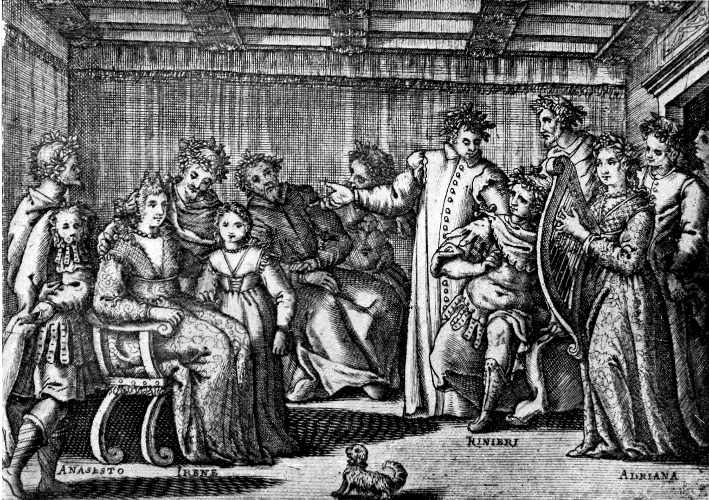
LA MAGA IRENE HOLDS A RECEPTION.
FROM A WOODCUT AFTER A. PINELLI. 1624.
“La Veneta Edificata.”—Giulio Strozzi.
One evening, when the incantatrice Irene had cast her spell upon the Hunnish leader, and Ariana, her mystic-magic singer, had lulled him to slumber in his tent, and when Nadasto had bribed and rendered drunk the soldiers of his guard, Idilia stole silently through the darkness to the couch whereon Attila was heavily sleeping. Like Jael she hesitated not to make use of her opportunity to avenge her [5]wrong and aid her lover. Driving, with all the force of a strong desperate woman, the sword she found by the sleeper’s side, she pierced Attila through the breast, and pinned his body to the bed-board beneath. Thus died the “Scourge of God,”—the ravisher of women—by a woman slain!
Not alone was heroic Adriana of Padua in deeds of woman-prowess,—Martza d’Aquileia, standing astride her husband’s stricken body, his sword in her hand, hurled bold defiance and hardy blows together at her foes, until overborne by numbers she fell fighting to the last!
Degna too, of Aquileia, daughter of the Queen of Dalmatia, dignified and devoted matron that she was, her spouse and sons slaughtered before her eyes, took refuge with her young daughters within the gateway-tower, and thence threw down coping*-stones and coals of fire upon the heads of their enemies. Short was that attack on woman’s valour, for brawny arms and hands were soon stretched out to seize the brave defenders. Degna slew her children by dashing them to the ground, and she, fearless of death, followed them to preserve their honour and hers!
The skill and courage of the women of Veneto in the use of bow and arrow, and in the casting of the javelin, came to be the undoing of many a stalwart barbarian. The Huns were amazed at the heroism, no less than at the beauty, of their fair opponents. Those viragoes had in their veins the blood of Greek heroes, and their muscles were of iron like the Romans. Noble and bold in heart were they, vigorous and graceful in form and feature, and well dowered with mental capacity and resource.
[6]
Not once, but many a time, when the rope-hawsers, which worked the defenders’ catapults, gave out and the defence seemed doomed to failure, the women and the girls of besieged towns cut off their tresses of strong, fine, lustrous hair, with which to weave new stout cords for the disabled machines!
Those were the women, who either stood shoulder-to-shoulder with their lords and masters to repel the hateful foemen, or, blessed with families of young children, fled for safety to the islets of the lagunes, there to guard them from all ill, and ready to lay down their lives in their defence. Among the fugitives men-folk were rare,—grandsires and men past service and lads just entering on their teens,—but the bones of the strongest and best lay bleaching and unburied upon the desolate plains of Veneto.
This earliest settlement was a woman’s commonwealth, and mothers and daughters nursed patiently a new generation. They inculcated lessons of faith and devotion and inspired their boy-offspring with energy and earnestness. Bereaved and comfortless themselves they looked to Holy Church for consolation and direction. They listened, in their dreams, to the soothing voices of the Saints, and loved to tell sweet stories from tradition. Cells for holy men and women, released from the world, were fixed on every sandy beach; and chapels, simple and primitive enough, called by tinkling bells, holy souls to Mass and vespers. Women prayed and children sang, till phœnix-like out of a cataclysm of tribulations, arose a new Venice—“Venezia Seconda.”
Generation followed generation, and family cohesion banded the scattered groups of islet[7] dwellers together for mutual protection and defence. The terror of invasion by barbarians became old men’s tales, and mothers scared their children to make them good with stories of the “Scourge of God.” Many lads, now grown, went back to terra-firma, and rebuilt the homes of their grandparents, and married and settled there.
One hundred years rolled along almost uneventfully for “Venezia Seconda” and the dwellers upon her shores, but, at length, times of peace and comparative prosperity were rudely disturbed by another fateful cry from the mountains!
Longobards,—Bavarians, Bulgarians, Swabians, and other mixed races,—were said to be pouring over the passes into Italy, and late in the autumn of 567, a mighty horde began to move over the plains marching ever southwards. Terror once more struck home to the hearts of the people of Veneto and of the islands of the lagunes. Were the horrors of the almost forgotten invasions of the Goths and Huns to be re-enacted? What was to become of them, and their children?
The only reply was the old, old cry “To the Lagunes!” Altino led the way: her inhabitants were premonished by a startling apparition. The storks, which made their nests upon the roof-trees of the houses, suddenly began to circle round the city uttering shrill cries, then, darting down with one accord they picked up in their long bills their little fledgelings and made off right out to sea!
The people looked on amazed, but when they noted that the birds stayed their flight over Torcello and her sister islets, they said one to another—“This[8] is a warning of Providence—which we must follow—it is the ‘finger of God’!”
The Longobards, however, were not intent so much on conquest as on settlement. Tales of the fertility of the soil of Italy, and stories of the profitable industries of her cities, had found their way to northern lands, and had excited, in the hearers, vehement desires to share such good things. They came not in serried ranks of warriors but in caravans in peaceful guise, with their household goods and chattels upon their waggons, and their old folk and little children securely mounted on the top. To them Veneto was the Land of Promise.
If the peaceful inhabitants of the province were not slain as in the days of Alaric and Attila, they were scattered, for the Longobards meant to have and to hold what they seized. Dressed in skins of beasts, with linen tunics of many colours, loose breeches girded with leathern belts, and shod in wooden and metal sandals, they presented a marked contrast to the natives of Veneto. They shaved the back of their heads, but wore the hair low upon the foreheads with ringlets, and the men were bearded.
Their conduct towards the people they had come to dispossess of lands and homes was marked by consideration, and they made an excellent impression by not meddling with matters ecclesiastical. Indeed so suave and gentle were they in their bearing that not a few of the less fearful maidens looked kindly upon the invaders, and not one but many brides of Veneto were mated to Longobard grooms! Surely this was a rare exhibition of the old and world-wide sentiment—noblesse oblige! A new and healthy[9] strain was thus intermingled with blue Græco-Roman blood, and, whereas, the citizens of the Eastern Empire, at large, dwindled and deteriorated, the men and women of “Venezia Seconda” grew in numbers, strength, and comeliness.
The Greek protection of Veneto and the lagunes was withdrawn in 641, and then at once it was borne in upon the elders of the families and the leaders in their councils that unbounded liberty was a dangerous expedient. Parliaments representative of every class—work-people, middle class, and patricians,—with the clergy at their head, were called together for deliberation and unity of action.
If it is true—maybe it is—that each hundred years of a nation’s development corresponds to a decade of human growth, then the Commonwealth of the islets of the lagunes attained its maturity in 697 or thereabouts. The infant Venice,—nursed in her Malamocco cradle by her father and motherland of Padua some two hundred years before,—was now a vigorous maiden and of age.
Her sponsors, wisely chosen, one from each of twelve most important settlements, who had exercised their tribuneship to good account, forgathered at Eraclea to elect a worthy guardian of the State, a leader—“Dux,” “Doxe” or “Doge” of the Venetians. Some of them were Veneto-Greeks, like the Partecipazi and the Michieli, and some of them were Veneto-Romans, like the Candiani and the Orseoli, with rivalries, domestic and political to unite and disunite them, but all were fired with the new idea of mutual life and independence.
From every lido and riva came barca and gondola, gaily dressed with flowers and greenery:[10] the helm held stoutly by men—brave as they were wise, whilst at the prow, beauty and youth sang tuneful melodies. Well-stored with food and delicacies were those festal galleys, for their crews were bent on pleasure as well as business. Matron and maid in holiday attire accompanied their lords and sweethearts to the solemn happy ceremonial—it was a domestic celebration in simple homely state.
Where manly strength and wisdom make of life a scene of wear and tear ungarnished and uncharmed by women’s ways, true femininity intervening administers juice of grapes to gladden man’s heart, and oil of olives to make him of a cheerful countenance,—so to paraphrase the holy psalmist. At Eraclea grace and force embraced one another.
The women and the girls of the islands brought with them to Eraclea armfuls of sea-pinks and sprays of jessamine, red poppies and yellow flags, fragrant orange flowers and the sweet bays of myrtle, gathered from their gardens. They wove gay garlands with the tenacious dime rushes and coiled them about with the tendrils of the vine. Every street shrine in Eraclea, every Virgin ikon in her modest homes, was adorned with floral offerings, and the altars of her sanctuaries were covered with pure white fragrant Mary lilies.
The twelve electors held their parliament in the modest basilica and cast their votes in secret, but all were satisfied when Paolo Lucio Anafesto of Aquileia was hailed as the first of Venice Doges—judge, general, and pope combined.
Promptly the Patriarch of Grado blessed the new Head of the State, and the twelve electors joined in crowning him with the “Corno”—the[11] horned Phrygian bonnet of renown and liberty. The day’s solemnities performed all held picnic in the woods; Eraclea kept open house. Night fell all too soon and lines of gaily-lighted gondolas made off to homes across the phosphorescent waves and the summer moon smiled upon a scene of perfect peace and content.
Alas for the stability of mundane matters—two short years were scarcely spent when Doge Anafesto met with his death, lamentably enough, in a conflict between the citizens of Eraclea and Jesolo. This was a calamity, perhaps, rare in Venetian history, for, if Martino Sanudo, the quaint and voluminous chronicler, may be believed:—“The inhabitants of Venezia were a lowly peaceful people, esteeming love and mercy highly, and above all religious—they cared not for honours but were ever ready to help one another, regardless of class and station.”
Three Doges only ruled at Eraclea, and then in 742 the seat of the Government was removed to Malamocco as being less open to attack, and more favourably placed for the development of trade with the east. The Doge was elected for life and his family, if of plebeian origin, ennobled: his wife however had no precedence and was regarded pretty much as one of her spouse’s goods and chattels.
The citizens of the Commonwealth enjoyed a lengthy period of peace and prosperity, during which they were building up a national and self-reliant character. Men, women, and children gained urbanity and repose of manners, and were animated alike by vivacity and gravity of bearing. The women especially were remarkable for their[12] good-breeding and refinement—vulgarity and pretence were non-apparent. As mothers they had a softening yet wholesome influence upon their families and households. Many Latin writers have noted these feminine characteristics.
In matters of dress and personal adornment the gentildonne followed more closely than their humbler sisters the Greek modes. The mosaics at San Marco’s show that velvets and brocades were worn with handsome furs and folds of lace. Blue was the favourite colour with all classes—a cerulean tint, like the reflection of the azure skies in the still waters of the lagunes.
When Charlemagne came to Friuli to hunt big game in 776, he made friends with the heads of noble Venetian families, and adopted their more graceful garments in lieu of his semi-savage state. He had set his heart upon seeing Venice and seizing what he could of her outlying islets. Her romantic story appealed strongly to his imagination and he even made proposals that Frankish brides should find their way to the lagunes. His ideas were actually adapted in the dogado of Obelario Antenorio (804–809), for his consort was a Frank princess.
The Franks shared the sporting instincts of the Venetians and they were emulous of the boasts of the men of Venice:—“One can catch more fish in a month in the lagunes than in a whole year in all the Mediterranean!”, and, “One can entrap more birds at Malamocco than anywhere else in Italy!” Grebe-shooting was a favourite pastime, and ladies entered into the sport quite as enthusiastically as their lords. Cross-bows and clay pellets were[13] the weapons, snaring was barred as unsportsmanlike, and heads were nailed on barn doors as trophies.
Whilst Charlemagne and his courtiers were pleased to meet the Venetians, in sport, or when on marriage bent, he and they never quite concealed their designs upon the lagunes; but the monarch’s chagrin was bitter when he was forced to admit the impossibility of success. “As my brand sinks out of sight, nor ever shall appear to me again, so let all thoughts of seizing Venice vanish from my will,”—he once exclaimed, as, standing upon his royal galley off the coast of Padua, he cast his sword far, far away, out into the sea!
The first actual Dogaressa—not merely the wife of the Doge, but the First Lady in Venice and his official consort, was a Frenchwoman—the Countess Carola,—a lady of honour at the Court of Aix-la-Chapelle. Obelario Antenorio and his brother Beato, who was associated with him in the dogado, were the guests of Charlemagne at Aix, and there the Doge saw and wooed his bride. How they got there nobody knows: it was a stupendous journey in those days. Perhaps fortune favoured Obelario and Beato and brought the maiden in the suite of the Empress into Southern France to Aix in Provence! The Emperor approved the match and promised his friendship and protection for the island Republic.
Carola was a woman of great energy of character, remarkable for the exercise of a strong will, and endowed with the faculty of attracting respect and obedience. She had a difficult rôle, for the ladies of Venice resented the introduction of a Frenchwoman as consort of their Doge.
Beato Antenorio, it appears, played a double[14] part, for whilst acting as best man to his brother and paying court to Countess Carola, he was negotiating with the Emperor at Constantinople for a union with a Byzantine princess with a view to supplant the Doge and Dogaressa.
Carola very soon took the measure of Beato’s perfidy, and when he brought his imperial bride to Venice, she adroitly placed Valentino, her husband’s youngest brother, an attractive youth, in the young girl’s way. There was little love lost between Beato and Cassandra, and the brothers very soon became estranged, and thus the Dogaressa held her own triumphantly. The story goes however that, consistent with woman’s ever changing mood, having set Beato against his wife, the Dogaressa became her rival in the affections of Valentino.
Perhaps the Venetian saying was true of her in a very special way:—“El segreto dele femene no lo sa nessun altro che mi e vu, e tuto il commun!”—“A woman’s secret is known to none save me, and you, and all the town!”
Obelario Antenorio, who had been Tribune of Malamocco, was “an indolent man, irresolute and faithless.” When a Greek fleet approached the lagunes with peaceful intentions, but viewed by the Doge as supporting the pretensions of Beato, he had recourse to the French Court for assistance. This was regarded by the Greeks as an hostile act, and they attacked and destroyed Eraclea, Jesolo, Fossone, Chioggia, and other Venetian ports. The chief men of Venice were slain or taken captive, and Obelario and Beato Antenorio were carried away as hostages to Constantinople, where they and their wives, Carola and Cassandra, died.
[15]
The first “Grand” Doge and Founder of Venice was Agnello Badoero, better known perhaps to historians by his Greek title “Ipato” or “Protospataro,”—in the Rialto vernacular Partecipazio. The Badoeri, originally from Padua and one of the twelve premier families of the Commonwealth, were descended from Giovanni d’Eraclea, who was among the twelve Tribunes voting at the election of Paolo Lucio Anafesto as first Doge of the Lagunes in 697.
Agnello was Tribune of Malamocco, although a native of Eraclea, a man of many parts, he exhibited remarkable talents in almost every walk of life. A Greek of the Greeks by descent, he was a pronounced humanist in the school of Plato. A born legislator, he was by inclination an engineer and builder, and excelled his peers in mercantile industry and political acumen.
Long before he was called to the supreme office of Doge he had fixed ideas about, and matured plans for, the conservation and development of the conditions of the islands of the Lagunes. Immediately after his election in 810, he broke with the traditions of the dogado, by removing the seat of Government to Rivo-Alto as being far and away a more convenient centre and at the same being much more secure from the attacks of enemies. Already there was a considerable population in the new capital and churches and houses of some importance had been erected—many of them of stone.
All the same the ordinary Rivo-Alto dwellings were of modest dimensions and few rose beyond one[16] storey in height. A marked feature of them all was the outside staircase, which gave access to the living rooms, and also led directly to the altana or look-out tower upon the flat roof. They were furnished with a solario or liago—an open balcony whereupon the inmates could sit and take the air and hold chit-chats with their friends.
Upon the flat roof the women of the household performed their toilet, combing out their hair and exposing it to the sunshine. Various domestic duties also were transacted upon the “sun-traps,” for example newly-washed linen bleached nowhere as effectively as there. Bedrooms occupied the upper part, and the plan of the ground floor provided kitchens and offices with rooms for meals and the reception of guests. These, in the large structures, were arranged upon three sides of a square forming a courtyard or garden patch.
Such a habitation was occupied by Doge Agnello and Dogaressa Elena with their growing family. It was situated upon what was subsequently known as the Campiello della Cason, adjoining the ancient church SS. Apostoli, and facing towards the neighbouring island of Murano, just where a small canal, the Rio Hadran, entered the Lagune. The principal entrance was in Calle della Cason with a postern at the corner for observation and defence. At the back, giving on a narrow back lane, was another doorway which led to a small garden and an orchard.
Donna Elena occupied herself in cultivating “simples” and sweet-smelling flowers, without which no Venetian considered his home complete. Perhaps no people set greater store by fragrant flowers[17] and succulent herbs than did those Venetian children of the sea-mists and salt-sands. The simplest bloom that the saline breeze allowed to grow was as precious as the most luxuriant rambler-rose, or flowering laurel. Vines grew everywhere and throve amazingly, and everybody had a floral or arboreal hobby.
Having established himself in his primitive palace, Doge Agnello set to work to carry out his ideas of utility and expansion. First of all, in view of the many inroads of ruthless invaders into Veneto, he turned his attention to the strengthening of the defences of the islands. Strong cables were slung across the narrower channels, disused hulks of vessels were sunk in the deeper water-ways, and a system of signals by day and of beacons by night was established.
The chief life’s work of the sapient Head of the State was the protection of the low-lying lidi from floods and denudation. Thousands and thousands of great timber balks from the Pineta of Ravenna were secured and driven far down into the yielding mud and sand. From pile to pile was woven a basket-work of unbreakable osiers, and then the pumping out of needless channels and the draining of wet marsh-lands was followed by the sinking of innumerable loads of solid earth and gravel, until the reclaimed areas assumed something of the appearance and consistency of terra-firma.
With such primitive appliances as were at hand, the success achieved was little short of marvellous. To his new-made plots of land Doge Agnello gave the name of “Fondamenti.” To Rivo-Alto as the centre of his plan, he connected all the neighbouring[18] islands by throwing across the water-ways wooden bridges,—thus Venice assumed her present form.
Well may we, in imagination, behold the noble-hearted Doge, habited in simple guise and grey-bearded, yet, vigorous of frame with eagle eyes and firm set brow and mouth, ferried day by day, over the Grand Canal,—the actual channel of the river which Livy calls Præ-altus. To the fondamento of San Giacomo—that earliest holy shrine of the Venetian fugitives he is bound, there to superintend the works he has initiated. With plans in hand, elaborated with Grecian geometrical precision, he watches and directs the work-people, both men and women—at their toil. No master was more solicitous for the welfare of his working people than Doge Agnello Badoero.
Much of her time the Dogaressa spent with her husband on the fondamento, where her presence cheered him. Thickly veiled, as was the custom of good women, and modestly attired she moved among the women workers, pouring out sympathy and affording relief.
The crowning labour of Doge Agnello Badoero, so far as the building of Venice was concerned, was the erection of the Ducal Palace in 820. This was purely Byzantine in design, very large, and built of rare marbles and mosaics: “Il Palazzo” it was called, for there was nothing like it in new Venice, or at Eraclea. Probably it resembled in some respects the Fondaco de’ Turchi built at the same period and by the same master-builder—Doge Agnello. Unhappily nothing now remains of this earliest official residence of the Doges of Rialto.
Francesco Donato has painted in a few words[19] the character of Doge Agnello Badoero:—“He rose,” he says, “easily above all parties, a man very stable and dependable, a true Catholic, upright and devoted to the true interests of the Commonwealth.” This encomium assuredly was deserved by Dogaressa Elena as well.
The times were strenuous and many an one, weary of the toil of the world and yearning for the consolation of religion was irresistibly drawn to assume the habit of the monastery. Men and women of worth became founders of religious houses and, among them, Doge Agnello and Dogaressa Elena, who with their eldest son Giustiniano, built the monasteries of Sant’ Ilario and San Zaccaria. This they did as the Codice Trevisiano records, “revelatione Domini Omnipotentis.”
Following the example of his predecessors in the dogado Doge Agnello Badoero, towards the end of his life, associated his two eldest sons Giustiniano and Giovanni with himself in the direction in the affairs of State. The two young men had been carefully trained for the duties of government by their father, and by their mother, in the observances of religion and the exercise of moralities.
Doge Agnello died in 827, and his two sons were elected to succeed him. No record is preserved concerning the death of the good Dogaressa. Probably they were both buried in the church of San Zaccaria.
The example of Doge Agnello and Dogaressa Elena, with respect to the daily exercise of religion, was followed by their sons, their wives and families. Mass always found them in attendance. Every[20] day at dawn the Marangona or Mass-bell awoke the slumbering citizens, and again at midday, and at dusk were the faithful summoned to devotion. With singular simplicity the pious sons and daughters of Venice served their God and served their city in the best way they could: none were hypocrites.
The brief and quiet reign of Giustiniano Badoero was remarkable for one eminent event—the translation of the body of Saint Mark the Evangelist, from Alexandria to Venice.
The pious Venetians were well aware of the importance of possession of relics of the Saints. At Aquileia, Eraclea, Padua and the other cities, whence their forebears had fled to the islets of the lagunes, the churches were the depositories of such treasures, and the revenues of the ecclesiastical authorities were greatly augmented by the devotion of the religiously minded inhabitants. Besides, such holy shrines drew pilgrims and visitors from other states and so enhanced their reputation. A quotation from the Zancarol Chronicle in the Library of San Marco, exactly expresses the current idea:—“La qual citade e stada hedificada da veri e boni Cristiani.”
Venetian envoys to Constantinople and travellers generally in the Orient were admonished to secure if possible relics for translation to the lagune city. Accordingly in 828 news reached Venice that two sea captains of Venetian merchant galleys, wintering in the port of Alexandria, had entered into relations with the ruler of the city. On their part they were to smuggle arms and provisions for the use of the Egyptian forces against the Eastern[21] Emperor, and in exchange to take whatever they might like from ruined temples near the sea-shore,—one was the traditional burial-place of the second Evangelist.
Treasures of all sorts were unearthed, and, at length, the tomb of the Saint yielded up a corpse undecayed and arrayed in episcopal vestments. Acknowledged and venerated upon the spot the hallowed remains were reverently conveyed to Venice, and received there with tumultuous acclamations and temporarily enshrined within the ancient church of San Pietro di Castello.
Doge Giustiniano and Dogaressa Felicita presided at the religious ceremonies, which brought together and cemented the people of the outlying islands and the inhabitants of the coast towns of terra-firma. Religious fervour overspread all Venice, men and women surrendered themselves, their children, and their goods, in honour of the Saint, who then and there was hailed one of the patrons of Venice, sharing the distinction with St Mary the Virgin, St Teodoro, and St Giustina of Padua.
That must have been a busy time for the Dogaressa and her ladies, and, indeed, for all the well-disposed women-folk of Venice. There were rich hangings to embroider, fine linen to weave and stitch, delicate lace to fret out, flowers to arrange, and sweet odours to confection. For St Mark nothing was spared, and even the poorest of the poor put on the best attire she could obtain and made festival with her richer sisters.
Not content with the splendours of the day of translation, the last day of January was for ever set apart as an annual festival in honour of St Mark;[22] and with it was associated the ancient and beautiful custom of public marriage upon the Eve of the Feast of the Purification.
Giustiniano Badoero very soon wearied of the responsibilities of office and retired, with Donna Felicita his wife into the cloister of San Servilio, which he had enriched by gifts of lands near the coast city of Abondia Vigilia.
To the third Doge of the Badoero family, Giovanni, second son of the “Grand Agnello,” belongs the glory of founding “the most resplendent Christian shrine in Europe,” San Marco di Venezia. He succeeded his brother as sole Doge in 829. What special part he and his Dogaressa took in the actual building and first dedicatory celebration, history has not recorded.
The reign of Giovanni Badoero lasted seven years—a season of consolidation of Venetian power and also of family influence. The house of Partecipazio gave seven Doges to Venice,—men of approved probity, ruling their households and themselves with simple dignity, and the State with firmness and distinction.
They one and all, with their consorts, when public cares and duties became excessive, sought the solace of the cloister. What a very sensible custom was this, and how conducive to efficiency in the service of the State, and withal how indicative of the influence of the Church in human affairs!
Women and girls in the times of the first three Badoeri Doges were treated less harshly than they had been in earlier days, but still they were under restrictions which were almost Oriental in character. Their men-folk professed themselves jealous of the[23] family honour and were eager to uphold their autocratic rights over their own households against all intruders.
In public women were veiled,—matrons in black, maidens in white,—except upon festivals, which happily, for the sake of dear Prince Cupid, were frequent enough, when they were allowed to appear at church, on the Piazza, and in barca or gondola uncovered,—these were lovers’ opportunities!
When a youth had become familiar with the form and carriage of a girl, and was taken therewith, he was wont to haunt the neighbourhood of her father’s house, in order to get a good look at her features and expression when she came out. If the opinion he had formed was confirmed then he was accustomed of a night to stand beneath the iron-barred window of his innamorata, and there breathe out his love ditty, or twang amorously the strings of his guitar.
If the girl responded to the youth’s ecstasy, she was permitted to flash a light through the open shutter. The repetition of this signal was an intimation that the wooer might address himself to her father, requesting acceptance as a “novice in the form and art of love-making.”
The father’s consent was regarded as the first step of the betrothal, and then the happy young couple were required to await the festal day of good San Marco, for the public acknowledgment of the suit. Liberty was meanwhile allowed for interviews, and negotiations were put on foot with respect to equality of family and amount of dowry, etc.
The girl dressed simply in white was permitted to receive visits from her lover and his young companions.[24] Upon the eve of the festival when many friends were assembled, serious and gay, the bridegroom-elect took his bride’s hand in his and slipped upon her finger a ring,—penge they called it,—as a pledge of his honourable intentions. The girl immediately withdrew with her mother, whilst the guests were feasted.
Nobody went to bed that night, for there was much to be done in preparation for the morrow’s nuptials. The bride had to be bathed and her hair plaited in two great coils, her dress and her ornaments had to be arranged, and finishing touches put to the festal decorations of the house.
Attendance at early Mass was de rigueur, and then the bride, covered with a lace or fine net veil knelt to receive her father’s blessing, and at the same time she had placed in her hands by her two sponsors—the most estimable and influential of her father’s acquaintances—a casket or purse, in which was deposited her dowry. These receptacles were called arcella and were objects of considerable value from an artistic point of view. If caskets they were of embossed silver, or carved wood, or painted by hand, and if they took the form of purses they were of the richest material, very beautifully embroidered, and often enough ornamented with pearls and precious stones.
A procession was formed of gaily-decorated gondolas with the wedding guests—the bride’s contained herself, and her father with her sponsors, and bore silken streamers of blue and white with two captive white doves at the prow; and all made for the island cathedral of San Pietro di Castello.
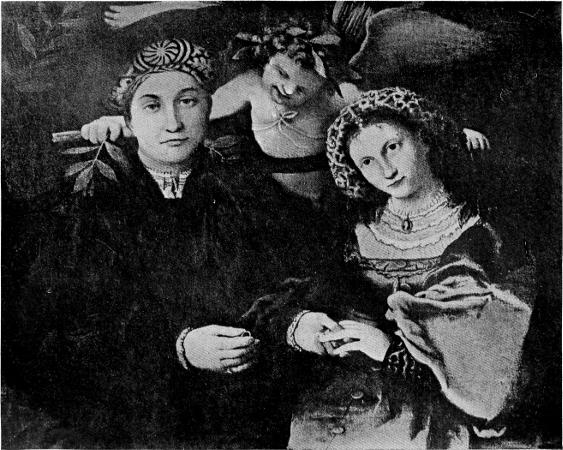
SPOSALIZO.
LORENZO. LOTTO.
PRADO MADRID
The bride bearing her arcella suspended from [25]her neck by a blue silk ribbon knelt by her father’s side before the Bishop, and then the groom, ushered by his witnesses, took his place at her right hand offering the wedding-ring for the episcopal benediction. Removing the penge,—which he slipped upon his own finger,—he replaced it with the golden hoop of matrimony. Lighted candles were placed in the hands of the couple, whilst the Bishop blessed their union. An offering in their behalf is made by the bridegroom’s next friend, and the religious ceremony ended with the singing of a marriage ode.
A merry, happy party betook themselves one and all to the fleet of gala gondolas, scattering on their way sweetmeats and small current coins, among the bystanders. A banquet with dancing and singing filled the afternoon and, at dark, the minstrel band led the newly-married pair to the bridegroom’s brilliantly lighted house.
The best man held a position of importance, he it was who found the beverages for the guests, toasted the nuptial couple, and gave drink and money all round. Early in the morning following the marriage he repaired to the nuptial chamber, and knocking loudly at the door, offered the happy spouse two fresh-laid eggs,—often enough stained and painted exquisitely,—and a casket of aromatic pastilles—tokens of good wishes for marital felicity. The bride’s girl friends too laid beside the door little wicker-work baskets beautifully trimmed with silk and decorated with fresh flowers, and full of delicious sweetmeats and fresh fruit—emblematic again of what married life should ever be. Such were some of the pretty wedding observances in old Venice.
[26]
One of the prettiest of the many charming customs, which illustrate so delightfully the ever-fascinating story of Venice,—“the Venus City of the Adriatic,”—was the annual presentation of the boccola—the rose nosegay of San Marco. For its origin we must hie us back to a very distant century—the ninth.
Doge Orso Badoero, grandson of the “Grand” Doge Agnello Partecipazio, had a lovely only daughter, Maria was her name in baptism, but, by reason of the ardent flashes of her brilliant jet-black eyes she was known as Vulcana—“Vulcana of the black eyes!” Then one day, there came from far Provence a handsome troubadour with his light guitar. He was called Tancred—a child of chance as it appears; and he sang outside the dark-eyed beauty’s iron-barred window the doughty deeds of knightly prowess and the conquering charms of maiden troth.
Prince Cupid set to work, as busy as could be, and began to shoot his love-dipped arrows up and down, till he had transfixed both Vulcana and Tancredo. Alas! the maiden knew full well her father would never listen to the plea of a simple singing youth, and so she wept and sighed, and sighed and wept!
“Go, gentle minstrel,” she cried, “tarry not, seek the Court of the King of France, and clothe thyself with the glory of martial renown, I, thy Maria, will wait for thee!”
With a tender embrace, and the maiden’s thin gauze scarf for guerdon tied round his arm, the troubadour set off to fight the Moors.
Seasons came and seasons went and beauteous[27] Maria Vulcana upon the altana of her father’s palace scanned in vain the wide lagune for signs of the warrior’s return. “Will Tancredo never come back?” she asked herself, and she wept and yearned for him. At last rumours of bold adventure and the names of many goodly knights were banded from tongue to tongue. The dreaded Moors had been vanquished, and the hero of the fights was a youthful soldier of fortune one Tancredo of Provence!
Well-a-day, an embassy presently arrived in Venice from great Charlemagne, its leader was Sir Roland the Invincible. He sought here and there for Maria Badoero the Doge’s weeping daughter, but she never showed herself—her heart was with Tancredo—she cared for none beside. At length they met and Roland bending over her, sighing, said, “Lady fair, I kiss thy hand for brave Tancredo, and bid thee weep no more for him, he died in these arms of mine breathing out thy name,—see he bid me with his last words give thee this red rosebud, which he had plucked for thee, saying, ‘Bid her pray for me always.’”
Maria was silent, she paled, her heart gave no more than one big throb, as she placed the pledge of her Tancredo’s love between her breasts, and then she laid her down and died!
This is the “Legend of the Boccola.”
The day that heart-broken Maria Vulcana breathed her last was the name-day of Saint Mark the Evangelist, 25th April. Thereafter every lovelorn lad in the islets of the lagunes offered to the girl he loved best a freshly gathered red rosebud as a fragrant pledge of his devotions. The innamorate were accustomed to place the sweet tokens in their[28] open bosoms, as did the beauteous but unhappy maiden of old times, and proudly wear it all that livelong day. Sometimes to be sure, the girl rejected her admirer’s tender gift, but she who could show no rosebud in her bosom suffered mighty heart-burns all the same, and her girl companions and the young men of her acquaintance looked askance at her.
At the sounding of the curfew all were safe of course indoors, and then the simple offering, withered as it was, was taken lovingly between both the maiden’s hands, caressed affectionately, and placed in the most secret hiding-place she had. It might be a long, or it might be a little, while before her parents acknowledged the successful suitor; but that frail blossom of early summer never lost its fragrance, and many a dewdrop of a tear fell upon the faded petals, whilst the loved one waited impatiently for the next Festa delle Marie.
Perhaps the proudest of all the proud families of old Venice was that of the Candiani—an offshoot of the ruling clan of Sanudi, in ancient times in Padua. Their name they derived from the village whence they sprang, just outside the proud city,—Candiana. In the eighth and ninth centuries, as Counts of the Western Empire, they ruled over Padua and Vicenza and were endowed with lands and titles by Otto I.
The first member of the family to wear the ducal bonnet was Pietro, the descendant of an earlier[29] Pietro, who, in 697 was one of the twelve electors of the first Doge, Paolo Lucio Anafesto. His election in 886 was due, in a considerable measure, to the extreme youth of Doge Giovanni Badoero’s son Orso, but especially in view of the need of a strong man to deal with the incipient feuds of the rival families of the Polani, Giustiniani, and Barozzi, and the Burbolani, Iscoli, and Selvi. Doge Pietro was a man of war, he led twelve armed galleys against his city’s constant foes, the pirates of the coasts of Istria and Dalmatia, and died at sea after one short year of office.
His son and grandson, both Pietro, were sandwiched between Orso Badoero II. and Pietro Badoero,—so keen was the rivalry and so equal the opportunities of the two families. All four, with their consorts, were conspicuous for their devotion to their public duties and for their piety. Daily they attended Mass and evening devotions, and observed frugality in dress and table.
Pietro Candiano III. married Archielda or Richielda, who brought him neither dowry nor social distinction. Who she was nobody has recorded, probably she was the child of one of the Slav women who were brought captive to Venice in 887, by the expedition, which destroyed the nests of Narentian pirates in the Adriatic, under Pietro Candiano I.
All we seem to know about the Dogaressa Archielda is that, when her consort died, she according to Venetian rule, was cloistered. Doubtless she suffered much when her son Pietro raised a party against his father.
One other son of Archielda is named by Dandolo[30] the chronicler, Domenigo, who became Bishop of Torcello. She survived her husband many years, under whose will she inherited a rich vineyard and a dwelling-house in the marches of Veneto, which she seems to have passed over to the nuns of San Zaccaria.
The name of Pietro Candiano III. has come down to us in gracious valiant guise. It was the Feast of the Purification in the year 944, and the “Brides of Venice” were kneeling before the Bishop in the church of San Pietro di Castello. The Doge and Dogaressa, and their household were assisting at the ceremony, when, suddenly wild figures of daring buccaneers from Trieste dashed into the sacred building. Robbery not rape was their primary intention, for the maidens’ arcelle were well worth the risk the robbers ran. The girls held tightly to their dowries, and so they were borne off bodily by their captors, arcelle and all!
Recovering from their consternation the men-folk of the congregation and the hangers-on outside laid hands on weapons, tools and anything, and were swiftly on the heels of the ravishers. Luckily the barcas of the Guild of Marriage-chest makers were moored in the canal, and so available for use.
Doge Pietro, divesting himself of his State mantle, and girding on his sword, headed the pursuers. Calling on Heaven for vengeance he boarded the foremost boat and bade every armed man to follow: it was the barca of Andrea de’ Cappelli of the fondamento of Santa Maria Formosa,—the quarter of the makers of hats. He was one of the bridegrooms-elect, and, mad with rage, he and[31] his companions swore to be avenged and to bring back their brides to Venice.
That was a stern chase to be sure, the robbers rowed their hardest, and the lovers of the “Brides” bent to their sweeps with all their wind and thew. Not till the pirates had crossed the Caorle lagune did Andrea de’ Cappelli’s boat grapple with the quarry. Then it was a fight hand-to-hand, pole-to-pole,—but at last, Andrea, leaping into the batello of the pirate chief struck the villain down, and gathered to his breast his fainting bedraggled bride. Bearing her light form under his left arm he neatly beheaded his enemy and, holding aloft the gory trophy, regained his boat.
Victory,—as by well-bound convention,—crowned virtue, and back to Venice rowed swiftly the proud flotilla—the happy maidens waving aloft their bridal veils in token of their deliverance. Landing at the campo of Santa Maria Formosa all entered the sacred edifice, hard by, where the clergy sang “Te Deum.” The assembly broke up hilariously to spend the evening in universal merriment.
Coming out of the church the Master of the Guild of Hat-Makers requested a favour of the Doge,—by whose side walked the motherly figure of the Dogaressa, her face radiant with smiles,—namely that an annual commemoration of the gallant rescue of the “Brides of Venice” should be instituted whereat the Doge and Dogaressa should preside.
Dandolo gives an amusing account of the interview:—
“But if it rains?” asked Doge Candiano.
“Why, we will give you hats to cover you!”
“And if we come hungry?”
[32]
“Well then you shall have the finest catch of fish and the sweetest basket of fruit.”
“But if we are thirsty too?”
“We will refresh you with the best vintage we possess!”
And so it came to pass. Every year the Doge and Dogaressa, with all their households and the members of the Grand Council, paid a ceremonial visit to Santa Maria Formosa. Each dignitary received a brand-new straw hat,—richly gilt and decorated with flowers, a flask of finest Malvaggia,—ruddy and rare, and a silver fish with a golden orange apiece. This is the origin of the Festa delle Marie.
The superb painting which adorns the first altar of the right aisle at Santa Maria Formosa—Palma Vecchio’s chef d’œuvre, and entitled “Santa Barbara,” may well have been inspired by the story of the “Brides.” She is the patroness of the brave—and the old adage—“None but the brave deserve the fair” never had a fuller vindication than on that memorable day of the rape of the Venetian brides.
Candiano III. had a son—his second, the stormy petrel of his race, the vulture of his family. In 959 Pietro Candiano IV. declared his father incapable of reigning, and with the utmost effrontery, he assumed the ducal bonnet and estate, apparently no man saying him nay. Alas! How soon noble deeds are forgotten, how easily the knee is bent to the supplanter!
The good old Doge and Dogaressa were ousted from the ducal palace, and the usurper dared to introduce therein the giddy woman with whom he[33] cohabited. This was such a glaring scandal that he was obliged to bow to public opinion and put away Giovanniccia—a divorcée, whom he had picked up clandestinely, defying her quondam husband.
No woman of high degree, no gentildonna, would cross the threshold of the palace so long as the Doge kept his mistress there, none greeted her upon the Piazza—and she became an object of scorn and derision. At length Pietro yielded to the popular feeling, and fascinating if corrupt, Giovanniccia was compelled to take the vow of chastity and to enter the noble convent of San Zaccaria,—the refuge of widowed and discredited Dogaressas.
In the Museo Civico, in Venice, is an ancient pack of playing-cards with illustrations of some of the earlier Dogaressas. The Four of Hearts has a representation of Giovanniccia Candiano with a ventilino,—a fan, in her hand, and accompanied by the following legend:—“Giovanniccia, wife of Pietro Candiano, divorced, being able to avenge herself did not do it, so, her husband being slain by the people, she would not survive—‘If I am not the spouse of Ulysses I am Death’s’!”
The chronicler, Pietro Diacono, adds that the repudiated Giovanniccia disowned her child, Vitale, and left the little fellow to be fostered by a serving*-woman who subsequently placed him in a monastery school. This Vitale Candiano, in 987, was consecrated Bishop of Aquileia, and a few years later was translated to the Patriarchal See of Grado, where he ended his days—the last of his family,—in 1018.
No sooner had Pietro Candiano divorced his adulterous wife than the Emperor Otto III. stepped in and gave him the hand, if not the heart, of[34] Gualdrada—Valdrada in Venetian—the young sister of Ugo il Grande, Marquis of Tuscany, of whom Dante speaks thus in his “Paradiso,” Canto XVI.:—
Ugo’s granddaughter was the famous Countess Matilda, the virile ruler of all Tuscany and the beneficent foundress of the liberties of Florence.
Countess Valdrada brought to her ducal husband as rich a dowry as any of the royal brides of Venice had brought. Estates at Trivigiano, Friuli, Ferrara, and Adria, with castles and well-trained retainers; a host of slaves, and money-bags well filled with gold, enriched and ennobled proud Pietro Candiano.
At her betrothal a custom entirely new to the Venetians was introduced, the so-called “Morgencap” or “Mundio” whereby the Doge conferred a fourth part of his private income upon his consort. Never stepped upon the Piazzetta a prouder Dogaressa. Had she been own daughter of the Emperor she could not have borne herself more haughtily, nor have treated both her husband and his suite more disdainfully. The acclamations of the populace she treated with ill-concealed contempt and turned to ridicule the decorations in her honour.
The Venetians were to a man noted for their self-esteem and high bearing and the keynote of their character was a spirit of proud and contemptuous isolation, but they regarded this display of feminine arrogance with annoyance and disgust. To add to the unfavourable impression Valdrada made, the armed Florentine guard, which accompanied her and stood sentry at her beck and call, called forth violent[35] protests. Altogether the Doge’s marriage was not an unmixed blessing to himself or his people. Nevertheless Pietro and Valdrada seemed happy together: he humoured her petulance and she fanned his self-esteem. Two children were the fruits of this union, Pietro and Marina.
Two important questions were exercising men’s minds in Venice what time Dogaressa Valdrada mounted the ducal throne—the treatment of slaves and the expedition against the Saracens. With the first Valdrada was keenly interested, indeed it was the spectacle of her retinue of slaves, and their abject condition, that drew special attention to a very knotty question.
The Doge tried to persuade his wife to dismiss these unfortunate people, or at all events to reduce their number, but her ill-conditioned temper would brook no interference. She threw in his teeth the fact that she was the special protégée of the Emperor, a descendant of a royal race, and the first Italian Dogaressa to share the honours of the dogado.
Valdrada was a virago in more senses than one—clever she was and talented, as well as strong-willed and hard-hearted. To her directly was due the introduction from Tuscany of the Roman bull-fight, and this took the quiet and undemonstrative Venetians by storm, and, incidentally, led to the division of the community into two camps—the Castellani and the Nicolotti.
Rings were formed at the Lido each Monday in September and October when the whole of Venice thronged the beach in gondolas. In November the rendezvous was moved to the gardens of Olivolo, by the church of San Pietro di Castello; and December[36] saw the bull-baiting transferred to the site of the Piazza. The Dogaressa was accustomed to preside at these combats in person, assuming all the attributes of a sovereign. Popular enough were the sports, for very shrewdly, she added prizes for athletic contests of all kinds and for regattas on the canals; but the patricians looked on with anything but kindly eyes.
Doge Pietro IV. was, perhaps, the proudest of all the proud men who ever occupied the highest position in the Commonwealth, and his wife’s assumptions and pretensions added greatly to his self-importance. His name of derision in Rialto was “Superbossimo,” the “Vain-glorious!” His entourage was largely composed of unscrupulous Tuscans, truculent Greeks and self-seeking Germans: he kept royal state and treated the nobles and the officials with coldness and disdain. At the same time he rallied all the different branches of his family, which were established in and about Padua and Vicenza, and formed a family league which threatened to overthrow the constitution of Venice.
Startled at last, by the imminence of the danger to their liberties, nobles and citizens took arms, in the autumn of 976, and marched to the Ducal palace. They were received by a deadly volley from the foreign mercenaries, and, maddened by this treachery, the people acted with a promptitude which admitted of no quarter. Fire was laid to the great portal of the palace, and logs of wood dipped in pitch were flung through the closed windows.
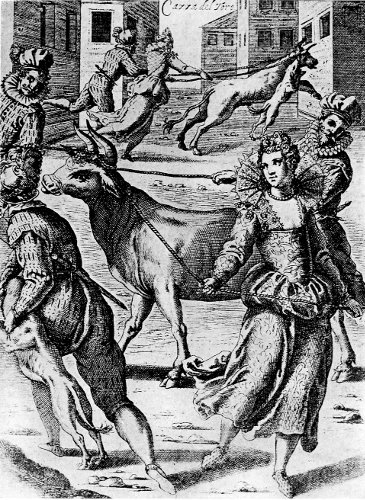
LA CAZZA DEL TORO IN CARNIVAL TIME.
FROM A PRINT. 1560.
“Habiti Delle Donne.”—G. Franco.
The flames spread rapidly, and eventually enveloped more than three hundred houses, and the splendid churches of San Marco, San Teodoro, and [37]Santa Maria Zobenigo. The lust for vengeance and destruction swept over the calm, but, if once roused, impetuous, populace, and nobody and nothing was spared.
The Doge fled distractedly from room to room, holding in his arms his only boy—the infant Pietro. The Dogaressa with Marina rushed panic-stricken after him. Escape from the crumbling blazing ruins was only possible by a little wicket which gave upon the courtyard of San Marco. Here, progress was stayed by a posse of armed nobles and citizens, among whom the unhappy Doge recognised several of his personal friends. Of the latter he begged his life and the safety of his family.
“You, my friends,” he cried in anguish, “have chosen to join in my destruction. If I have transgressed in any way, either in words or actions, I crave my life, whilst I promise to satisfy every demand. Speak and let me pass.”
Words were of no avail, such justice as the popular will required was swift and drastic. Not one, but many swords clove through ducal bonnet and robe of state, and Doge Pietro Candiano IV. lay quivering, a livid mass upon that blood-dyed floor. Not content with this butchery brutal hands seized the unoffending princeling, and neither his innocence nor Valdrada’s pleas sufficed to save him. She was cast aside as a foul thing too hateful for any man to slay, and her child was impaled upon a spear, stuck into the body of his father!
At eventide a poor man, one who abhorred the foul deed, Giovanni Gradenigo, came with a company of pious friends and took away the mutilated[38] bodies and laid them reverently in the crypt of Sant’ Ilario.
The Dogaressa, with her young daughter Marina, succeeded in escaping,—perhaps she was allowed to do so to avoid difficulties with the Imperial Court and the arrogant Marquis of Tuscany. She fled to Verona and threw herself at the feet of the Empress Adelheid the Emperor’s mother, who resided there.
To be avenged of the Venetians was now her one and only purpose. Her imperious temperament yielded to a violence of hatred almost diabolical in its intensity. She appealed to Otto to set fire to Venice, to take the nobles captive, to cast the citizens into prison, and to make slaves of the women and children! She demanded the repayment of the gold she had carried with her to Venice, the restitution by the Candiani of the estates with which she had dowered her husband, and demanded a huge tribute by way of compensation for her wrongs.
Pietro Orseolo, who had been elected Doge, after the assassination of Pietro Candiano, by the tumultuous voice of the people, despatched Domenigo Grimani to Piacenza where the Emperor was in residence to discuss the claims of the widowed Dogaressa. By a rare display of urbanity and tact Valdrada’s vehemence was soothed, her claims modified, and an agreement was come to agreeable to all parties.
She acknowledged her love for her husband and exclaimed before the full Court:—“A wife is not given by nature to be her husband’s judge but as his companion.” She refused however to enter a[39] convent, as became a widowed Dogaressa, but returned to her brother’s Court in Tuscany, and apparently ended her days at the castle of Pisa at the end of 997. By her will, dated 24th November of that year, she bequeathed a castle and an estate situated in the Adige to her brother, who gave them to the abbey of Vangadizza.
The web of human life, strained at times and knotted, is never long spun out before romance and tragedy cross it in the woof. Each man and woman’s work in the tapestry of fate is run with needles sharp and blunt. None need look to fiction for inspiration whilst fact is so devious and so amazing. Cupid and Mars ever were inveterate enemies; but “Love’s Labour” is never “Lost”—for Love is stronger, after all, than death!
The love-story of Gerardo Guoro and Elena Candiano is as touching as any in the gentle annals of romance. She was the daughter of Doge Pietro Candiano III.,—a girl in whose veins coursed the bluest of noble Venetian blood, whilst her lover was base-born, though of a respectable family. He was probably as the Venetian proverb has it “Erser in Candia,”—“Without a farthing in his pocket!” Such unequal affairs of the heart, as the world has always called them, are just where the romance of love runs riot!
It was so when Gerardo and Elena, the originals of Shakespeare’s “Romeo and Juliet,” plighted their troth secretly, and told nobody but Elena’s doting old nurse Marta, who contrived the interviews, bore the messages, and shielded the secret from the Doge and Dogaressa.
Perhaps matters might have gone differently[40] “had not Cupid,” as the Bard of Avon says, in his “Much Ado About Nothing,” “spent all his arrows in Venice!” With the very first bud of their rosetree of happiness, alas, gallant Gerardo was summoned to join his company and to embark for the Orient. Elena’s mother, noting the girl’s tearful pallor, decided that matrimony was the only remedy.
A very eligible partner appeared duly on the scene, one Messir Vettor Belegno, a patrician of ripe age and wealthy, whose widowed home looked for a new mistress. Broken-hearted Elena refused her rich paramour, but a daughter of the Doge has no will of her own, and the marriage contract was duly signed, and she, more dead than alive, ever fretting for her absent Gerardo, was led to her nuptials in San Pietro di Castello.
The fatal knot was tied, but it had nearly compassed a fatality, for, no sooner had the ring of the wedded wife been slipped upon her finger, than poor Elena, clad in her bridal garb of purity, swooned in Belegno’s arms. A speechless awe pervaded the brilliant wedding party, for when the beauteous bride came not back again to consciousness, the Bishop pronounced her dead! The joyous notes of the nuptial ceremony were abruptly changed to the dirge of burial, and, there, wrapped in her bridal dress, she lay crowned with fresh spring flowers until a place was prepared for her cold body in the crypt.
As fate would have it the morrow of her funeral, when the fair alabaster-like form of the lovely girl[41] lay alone in that dark place, saw brave Gerardo’s troop of gallant warriors landed at the Lido. News of the tragedy was swiftly conveyed to the fleet, and the disconsolate young husband hastened fearfully to the old church on Olivolo. Slipping aside the heavy marble cover of Elena’s tomb, he kneeled upon his knees imploring Heaven’s pardon and Heaven’s favour.
Then, in a paroxysm of grief he stretched his body along the silent form of his beloved one, and, looking into her eyes, he pressed his breast to hers, and there they lay. Presently he is conscious of a pulse and a movement in the bridal shrouded corpse, and, joy of joys, her eyes open, and she knows that her Gerardo has come home to claim her!
Beside himself with transports of love and sorrow he carries the unresisting girl to his mother, by whose care and Gerardo’s kisses, she is nursed back to life and happiness. But who shall break the news to the Doge and Dogaressa? Gerardo answers the query manfully. He has gained laurels in the East, and his grateful city has honours to bestow. Kneeling before the Doge to receive his guerdon he bravely recounts the story he has to tell. The Doge is incredulous, but confirmation is ready to hand, when his daughter, running to Gerardo, takes his hand in hers, and craves her father’s benediction.
The bridegroom of the tragedy gracefully stepping aside renounces, quite nobly, the marriage dowry, and joins the Doge and Dogaressa in sanctioning Elena’s secret wedding with Gerardo. As story-books relate—they lived ever after in perfect happiness and great content.
[42]
The Legends of the Middle Ages were the fruitful source of the Poetry of the Renascence. Greek mythology and Roman mysticism yielded place to the humanistic tenets of Platonism and the heroic narratives of Christianity. Every temple and church and every monument and monastery became the treasury of moral and religious stories. Traditions of the past were the foundation of the histories of the present and these superstructures the forecasts of the future.
Venice, by the reason of her unique environment, gathered all that was fairest, noblest and most moving of the life above and around her. The charms of allegory found in the people of the lagunes ready acceptance, and the halo of romance shed a brilliant light in the homes of every family.
“If to-day be another’s, to-morrow is yours,” was a sentiment deep down in the hearts and minds of every man, woman, and child. Venice was the apple of each eye; each individual cared for her before self-interest.
So ran the popular barcarolle.
Each family had its own legends and its peculiar[43] characteristics,—the very names were indicative of an eventful past—each had its symbol and its story.
The family of Ursoilo or the Orseoli, “Little Bears!” was one of the four great ruling families in the early days of the Venetian Republic. They originally came from Aquileia when the Huns devastated Veneto. Their arms were two dancing brown bears, shaggy and obese, upon a blue field. With the Badoeri, Candiani and Michieli they shared the unique distinction of supplying Doges for full two hundred years.
Pietro dal’ Orseolo (976–978) was the first representative of the family to mount the ducal Chair of State. He succeeded upon the assassination of Pietro Candiano IV., in which atrocious act he was reported to have a share, although probably, it was another Pietro, a namesake, who plotted against the Candiani.
The new Doge was an excellent man, “laudato di tutti” as it was said of him,—but hardly the sort of ruler needed in such turbulent times. His first work was to remedy the excesses of the popular outbreak, and next he set himself the task of rebuilding both the basilica and the palace. To him is due the unique Pala d’oro or Altar-front of beaten and embossed silver-gilt, made at Constantinople.
His spouse, of a gentle loving nature like his own, was Donna Felicia Malipiero, by whom he had two sons—Pietro and Domenigo. The Doge and Dogaressa were devoted to the exercises of religion and their modest home during the rebuilding of the Ducal palace was thronged by ecclesiastics, both regular and secular, native and foreign-born.
[44]
Everything which had to be done was laid before these clerical advisers—quite naturally exciting the resentment of the nobles of the Council. The Ducal mênage was very staid and meagre, and the merry maidens and modish matrons of the city had no countenance from devout Donna Felicia.
By degrees the Doge and Dogaressa altogether withdrew from State affairs: partly because they were weary of the importunities of Dowager Dogaressa Valdrada, whose dowry the Doge at length paid out of his privy purse, and partly because they had ceased to be in touch with the worldly occupations of their fellow-citizens. To pious works they addressed themselves, and first, in memory of Doge Pietro Tradonico, who, in 837, was murdered on the patronal festival of Saint Mark, they founded a hospital for poor pilgrims on their way to Palestine. The site chosen was a piece of waste ground (now included in the Piazza) belonging to the nuns of San Zaccaria. Whilst the Doge spent his leisure in devotions before the shrine, the Dogaressa visited the patients in the hospital and performed the most menial of offices.
After two years of dignity Doge Pietro Orseolo abdicated his high office, and, accompanied by the Abbot Guarino of the Monastery of Saint Michele de Cassano in Aquitaine—a priest, of whom he had made a personal confidant—he withdrew secretly to France, and died many years after in his lonely cell at Longuedére near Cassano.
A characteristic story is told of the cloistered Doge, who had placed himself under the guidance of the far-famed and ascetic Abbot Romoaldo, the founder of the strictest rule of the Camaldolites.[45] Being unable to bear the austerity of his life, and suffering from hunger and the hardships of heavy manual labour, Brother Pietro Orseolo asked the holy man for some relaxation.
“Father,” said he, “I have a gross body and I cannot, for my many sins, support my strength upon the daily morsel of hard biscuit, grant me, I pray thee, a more generous fare.”
“My son,” replied Romoaldo, “thy body must be kept under, nevertheless I will allow thee one half biscuit more a day.”
Dogaressa Felicia survived her husband many years—cloistered in the convent of San Zaccaria. She was much comforted by the filial devotion of her two sons, to whom she was never tired of repeating their father’s pious advice:—“Take care to preserve the rights of the Church, and be drawn aside from doing justice neither by love nor hate.”
The fame of Pietro Orseolo’s renunciation and good works reached the ears of the Sovereign Pontiff, who authorised the necessary steps to be taken for his canonisation; and thus Saint Pietro Orseolo took his place among the many venerated saints of Venice. In the year 1732, his right arm was brought back from Cassano, and was deposited in San Marco among the holy relics.
In the Museo Civico, in Venice, is a quaint painting, quite Byzantine in style, by the Venetian painter Giovanni Santacroce of the Madonna and Bambino attended by a choir of cherubs. Upon either side of Saint Mary kneel Pietro and Felicia Orseolo. He is clad in an ermine cape over a monkish habit and upon his head he wears a plain horned bonnet. The Dogaressa is attired in the[46] rochet of a nun and wears the close-fitting wimple of the cloister.
The ordinary dress for nobles and men of commanding talent and wealth consisted of long stuff tunics or cassocks with leather belts, full cloaks of silk lined with fur and fastened on the left shoulder, in the Greek fashion, by a plain gold brooch. Upon their heads they wore caps or bonnets of a Phrygian pattern with a band of interlaced coloured silk ribbons. Full beards and flowing locks were worn by all classes of the community until the middle of the tenth century, when the Roman mode of clean-shaven faces and short cropped hair became universal.
The gentlewomen of Venice had long trailing skirts of coloured stuff or silk,—blue most favoured,—the bodices were cut square and low exposing the breast. In winter they superimposed silken mantles, generally of light blue—much like their lords’ cloaks. A cincture with a jewelled clasp made of metal, beads, or amber kept the folds of the garment in position. The hair was well combed out, not plaited but worn loose beneath natty light blue caps of silk cord or chenille. Girls had tonde,—circular white veils,—in public and matrons black ninziolette—mantillas. Jewels were sparingly worn,—a single row of pearls round the throat, one ruby or red-stone ring, and a tortoiseshell comb. The richer ladies added chains of gold with cameo pendants of Greek origin.
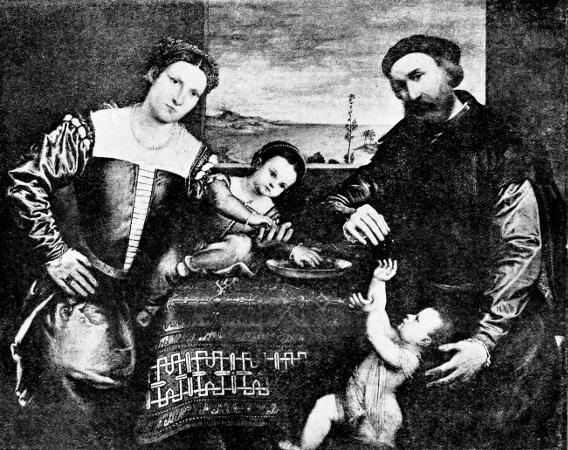
A NOBLE VENETIAN FAMILY.
Lorenzo Lotto.
NATIONAL GALLERY, LONDON.
Pietro Orseolo II. was the second “Grand” Doge of Venice. The son of pious, if misguided, parents who sought the good of others rather than their own, he learnt, at his mother’s knee, lessons of [47]self-restraint and generosity. He was but seventeen years old when the abdication of his father left the Ducal office vacant.
Too young of course to succeed he was placed under able tutors who inculcated the duties appertaining to the rôle of a leader and ruler of men. The hereditary principle was constantly and repeatedly affirmed in Venice notwithstanding the universal fear of a personal rule. Given a wise father and a good mother, the child was bound to be a worthy citizen—so they held.
The dogado of Tribolo Memo (979–991) was disturbed by the feuds of the Morosini and Caloprini. The former supported by the Orseoli were in favour of a democratic alliance with the Empire of the East, whilst the latter, aided by the Candiani desired an aristocratic arrangement with the Emperor of the West.
The Doge was much too weak a man and far too feeble a ruler to deal effectively with the situation, they stigmatised him in Venice as “a stupid man!” Matters came to a head in 983 when, one day Domenigo Morosini was found stripped of his clothes and dead in a ditch near the Piazza of San Pietro di Castello. His followers accused Stefano Caloprini of being privy to the deed. He fled to the Court of the Emperor Otto and sought protection from the Imperial Court sitting at Verona, and he gained the ear of the gracious old Empress Adelheid, she who had befriended the imperious Valdrada.
A truce was effected and the two parties joined in the deposition of the Doge. As by convention bound he sought the repose of religion and Dogaressa Marina, the daughter of Pietro Candiano[48] IV.—who had escaped almost miraculously with her mother Valdrada from the fire at the Ducal Palace,—assumed the nun’s veil in the convent of S. Trinita.
It was in the dogado of Memo that seven unmarried sisters—a prodigious number of spinsters as Venice society went—lived together in their own house opposite the Ponte della Maravigie just below the Palazzo Bembo. Six were plain and one was fair, the youngest—and their spinsterhood was regarded with suspicion. One day there chanced along the Rivo di San Trovaso a gondolier who had just gained laurels at the regatta. Something constrained the stalwart youth to linger by the iron-grilled window of the spinsters’ home, but strange sensations pervaded his whole anatomy so that he became weak and incapable of movement.
His companions chided him and threw the name of the least prepossessing of the sextet, Dulcina, in his teeth, and they said he was bewitched! No face was shown at the lattice, and no sound issued from the darkened room, still poor Giovanni was rooted to the spot. At last with a fierce effort he threw off the enchantment, if such it was, and determined to unfathom the mystery, and if the sisters were witches to out upon them! Good Friday came round and Giovanni sought once more the mysterious dwelling. It was broad daylight and climbing up the grille he peered into a room, and there beheld not Dulcina, but Marina, the pretty sister, upon her knees before a crucifix!
The athlete entered the room, and, as he did so, he beheld in the water of the canal the reflection of seven brilliant stars,—all paled, as he looked up,[49] but one,—and that one flashed its beams upon the kneeling girl. She was astounded at his presence, and, when he straightly charged her with witchcraft, she weepingly replied:—“My art is not that of a witch, goodly youth, but of Cupid. I have prayed for thee, that Heaven would make thee strong and true. See, my star is shining o’er thy head—”
“And my arms,” exclaimed the enraptured Giovanni, “are around thy breast, witch or no witch thou hast gained me for thine own.” With that he held her tightly to his bosom, and, unresisted planted hot kisses upon her lips and with his finger removed her tears.
No doubt there was a wedding, and possibly the six plain bridesmaids were transformed into comely brides as well: but the story has no such ending. No,—alas,—brave Giovanni was stabbed in a night affray and beauteous Marina drowned herself in the canal! Sometimes they say, an eerie sound comes round the corner of the bridge—people call it “Marina’s Wail.”
Young Orseolo, now grown into man’s estate, was hailed as sole Doge of Venice. At once he showed his mettle by crushing party differences. Such feuds never assumed the terrible proportions which made Florence, Siena and other Tuscan towns the scenes of fraternal bloodshed times out of mind. The new ruler proclaimed a strong policy abroad, and set to work to equip a navy of armed vessels, wherewith to make the name of Venice feared in all seas.
The Dogaressa was Maria the only daughter of Vitale Candiano, brother of Pietro Candiano IV. Very diplomatic was this union, linking, as it did,[50] the two most renowned families in Venice, and offering a safeguard to the ambitions of the rival Caloprini and Morosini. Seven children were the offspring of this marriage, and their baptisms and marriages the Doge tactfully made the occasions of adding to the honours of the family and to the renown of Venice.
Giovanni, the first born, was betrothed to the Princess Maria, daughter of the younger brother of the Emperors Basil and Constantine,—Prince Agroupoulos. The wedding was celebrated in Constantinople with great pomp, the bride’s dowry was rich and rare, and upon the groom was bestowed the rank and privilege of a Prince of Byzantium. The two were crowned, at their nuptials, with imperial diadems of gold. A Venetian navy escorted the bridal pair to the lagune city, where royal honours were rendered. It was an auspicious home-coming, and the pigeons, which had already made their home in the Piazza, flew round the young couple’s heads in emulation of the popular ovation.
They were a remarkably handsome couple: Giovanni possessed all the good looks for which his family was famed, and Princess Maria, according to old Giovanni Diacono,—the busy chronicler of Venice and the Venetians,—was “a lovely bride.” Her effigy, if not her portrait, is preserved upon the Ten of Spades in the suit of playing-cards preserved at the Museo Civico with the following legend:—
“Dogaressa Maria Orseolo, niece of two Emperors of the East, Basil and Constantine, wife of Giovanni Orseolo, son of the Doge of Venice, fair and compassionate, a goddess who is so beautiful can never be hard-hearted!”
[51]
Some historians say that the Princess Maria took after her aunt, the Empress Teofanea, wife of Otto II., Emperor of the West, who introduced into Germany the luxury and extravagance of her brother’s court at Constantinople. She was greatly admired for her beauty, her grace, and her erudition. German chroniclers speak of Teofanea’s “modesty and strong compassionate character,” and praise her as “a woman of unsullied virtue.”
Giovanni’s imperial consort probably prepared the way for a still more luxurious and attractive Greek Dogaressa, Teodora, the consort of Doge Domenigo Selvo. Alas, both Giovanni and Maria Orseolo, with their only child, died of the plague in 1006.
Doge Pietro Orseolo’s conduct of state affairs, in spite of the limitations placed upon the Ducal prerogatives by the jealousies of the nobles, was marked by a vigour quite new to the Venetians. His enthusiasm fired their imaginations for they saw that the favourable commercial treaties he contracted, both in the East and in the West, opened out new possibilities of aggrandisement and opulence.
The flag of Venice was unfurled in every foreign port and was accorded a respect shown to no other national emblem. Pirates of the Gulf alone braved the displeasure of the Lion of San Marco, and, to overawe them, a punitive expedition was despatched to the coast of Istria and Dalmatia,—the first actual fleet of battleships sent forth from Venice. The Doge took command in person and Bishop Gradenigo, in the church of San Pietro di Castello, delivered into his hand the great red oriflamme of the Patron Saint, which had been embroidered by the skilful hands of the Dogaressa and her ladies.[52] Upon the finial of the pole she tied, with a great bow of blue silk ribbon, a floral wreath of sea-pinks and carnations.
The expedition was an unqualified success. Everywhere Venice triumphed, and, when Lesina, the pirate capital, capitulated, the climax was reached. The Doge forthwith annexed the whole littoral to the dominions of Venetia, assuming for himself and his successors the title of “Duke of Dalmatia and the Islands of the East.”
The conquered towns were laid under heavy contributions:—Pola in two thousand pounds’ worth of purest olive oil, and one thousand yards of fine spun linen, twenty sables and a bale of thinnest silver gauze, for the Dogaressa’s use. Thus Doge Pietro Orseolo laid the foundation of Venetian greatness abroad just as Doge Agnello Badoero had done at home, at Rivo-Alto a hundred and twenty years before.
The home-coming of the fleet was a magnificent triumph, the first of those splendid aquatic pageants which became so remarkable in the annals of Venice. Among those who hastened to welcome the Venetian Doge was the Emperor Otto III. who spent seven days as the guest of the Doge and Dogaressa.
Peace with honour having now placed laurel leaves around the heads of the Ducal pair they addressed themselves to the pleasant task of decorating the new basilica of San Marco and adorning the new ducal palace; but, alas, whilst superintending these undulatings, Doge Pietro Orseolo “fell ill of a fever” and died on the tenth anniversary of the fall of Lesina, at the early age of forty-nine. By his will he divided his property into[53] three parts:—one third for the one observance of the “Festa delle Marie,” one third to the Church and certain monasteries, and one third for his widow and his children.
“Pietro Orseolo has come down to us as a good prince, beloved by his fellow-citizens and feared by the enemies and the rivals of Venice.” The Dogaressa Maria took, as it behoved her to do, the vow of chastity and became an inmate of the convent of the nuns of San Zaccaria. In the crypt of the monastic church was laid the body of her husband, “buried,” as chroniclers have related, “per la trista Citta e lachrimosa”; and she found a last resting-place by his side—“a good woman and a great Dogaressa.”
The Doge’s second son named Pietro,—but renamed Otto or Ottone, in honour of the visit of the Emperor of the West,—married Grimelda, sister of Geiso, King of Hungary, in 1003, and succeeded to the ducal Estate on the death of his father. Little is recorded of him save that he had been created by his father Count of Ragusa after the Venetian conquest of Dalmatia. He and his consort were not made of their parents’ grit, for, alas, when the rising family of Gradenigo preferred claims to the dogado, they fled to Constantinople, and there they died. Dandolo, the historian, says:—“The Dogaressa Grimelda was a woman of sweet disposition, of considerable attainments and of remarkable nobility of character.”
The third son of Pietro Orseolo II. and Maria was christened Orso and early dedicated to a monastic career. Domenigo, the youngest of the family married Imelda, granddaughter of Pietro[54] Candiano III. and Richielda. The three daughters were, Icella married in 999 to Stefan, son of Surigno, Prince of Croatia; Imelda who died young and unmarried; and Felicia, Abbess of Sant’ Antonio di Torcello.
With the death of Pietro,—grandson of the “Great” Pietro, son of the fugitive Ottone, in 1038 ended the famous family of Orseolo. The “dancing bears” ceased their gambols but the blue sky of Venice still cast its effulgence upon the mirrored waters of the canals.
The long reign of Doge Domenigo Contarini (1043–1076)—the longest on record—was uneventful. It presented no special features—for Venice was at peace both at home and abroad. Family feuds were hushed, though doubtless the Morosini ill-brooked the elevation of a rival house.
Those were days of repose and plenty when it was boastfully said by her citizens:—“Venice wants for nothing!” Such seasons of rest are occasionally granted to States, when leisure is found to apply the lessons of the past and to prepare for the developments of the future.
Contarini was the premier of a triumvirate of Doges—the “Tribunal system”—as it was called,—being again enforced to limit personal autocracy. His co-Doges were Domenigo Selvo and Vitale Faliero—the former being especially the representative of the democratic section of the community.
Selvo belonged to an ancient family of Greek extraction. In the eighth century his ancestors the[55] Dorsoduri, or, in the Venetian vernacular, Spinalunge, were exiled by the Emperor Emmanuel from Byzantium and settled at Aitino in Veneto. By the time, however, of Domenigo, all such antecedents were forgotten, and he was received cordially as the Ambassador of Venice by the Emperor Constantine Ducas. Upon the death of the venerated Doge in 1071, Domenigo Selvo was unanimously chosen by the Council and vociferously acclaimed by the citizens as his successor. The cry was raised upon the Piazzetta:—“Noi volemo Dose Domenigo Selvo, e lo laudiano!” and hoisted upon the shoulders of his friends he was borne in riotous procession to his coronation. Passing the open doors of the grand basilica he leaped out of the arms of his bearers, and, kneeling humbly upon the tesselated pavement, he devoutly implored the help of Heaven and the blessing of the Church.
The dogado of Selvo was perhaps less remarkable for the potentiality of the new Doge—strong man as he was no doubt—than for the personality of the haughty princess he brought to Venice to share the honours of the ducal State.
Dogaressa Teodora Ducas was the daughter of the Emperor Constantine and her betrothal to the Doge of Venice was brought about by her brother Michael, who in 1067 succeeded his father as Emperor of the East. She landed on the Lido first for Mass, and then at the Piazzetta, wearing the imperial diadem with which her brother had crowned her at the nuptials in Constantinople.
At the same time everybody noted that His Serenity the Doge’s bonnet of Estate was encircled by a richly wrought band of pure red Grecian gold,[56] encrusted with precious stones! No Doge had ever worn such a conspicuous mark of royalty, and many a noble lord looked askance at the wearer—doubting in his mind whether it was intended as an emblem of sovereignty! Feelings of alarm filled the minds of the citizens and the welcome accorded to the ducal pair was cold and formal.
The new Dogaressa was accompanied by a very numerous retinue, such as no previous consort of the Chief Magistrate had presumed to gather round her. Secretly the Venetians liked well their Doges and their nobles to contract splendid foreign marriages, and no “Brides of Venice” were more thoroughly admired than the “donne Greche fonte di cortesia at amorevolezza!”
Teodora unfortunately did nothing to propitiate the insular prejudice of the men and women of Venice. Her autocratic bearing and her ill-disguised contempt for the “women of the Rialto” caused head-shakings and tongue-waggings in every circle of society. From the first she was as unpopular as her consort, the Doge, was beloved.
In the Ducal Palace the Dogaressa set up an Imperial Court and required the nobles and state officials to render the honours to which she had been accustomed at Constantinople. She had her ladies of honour, her chamberlains, her pages and her slaves. Superbly robed and glittering with precious ornaments, Teodora Selvo offered an amazing contrast to Elena—the homely consort of the first “Grand” Doge—Agnello Badoero!
Teodora was an Athenian of the Athenians, with all the predilections of a Sultana of the harem. Pomp and pettiness were strongly mingled in her[57] character. The corruption of the Byzantine Court, in which she had been reared, had laid their indelible marks upon her: she shocked the susceptibilities of the simple, homely Venetians by her voluptuousness, her petulance, and her extravagance.
Still, there was something about the Dogaressa which attracted sympathy, for were not the people of Rialto and her linked-up islets, descendants of Greek colonists in Veneto, and did they not preserve many traits and idiosyncrasies of their ancestors! Then, too, many a sea-faring Venetian, conquered by the artifices of Cupid in the Orient, had brought home a Greek bride to be the mother of his children, so the ways of the Dogaressa were not altogether without appeal.
Teodora lived delicately: the plain fare and simple service of her consort’s establishment, which also obtained too in the casas of the nobles, were not to her liking. She introduced exquisite cooking—the Greek cuisine in place of the crude joints and inartistic concoctions of the Roman menu. Costly wines and liqueurs from Syria and the remote East supplanted the heavier beverages of the lagunes. Her table service was of pure gold and costly rock-crystal.
Unlike the primitive ways of the unsophisticated Venetians, who were content to convey their food to their mouths with their fingers or with ladles, and to share cup and plate, the Dogaressa introduced a Grecian fork—an entirely new instrument in Western Empire—which was of solid gold, two-pronged, and beautifully chased, with which she ate dainty morsels, neatly carved and arranged by the eunuchs of the table. Moreover, she made constant use of fingerglass[58] and finger-napkin—things which were unknown in Venice. Great wax candles were lighted after dark, and stuck into costly sconces—in spite of the archaic regulations of the curfew.
Teodora Selvo rarely walked in the Piazza—the gondola was for her an ideal conveyance, it ministered to her love of ease and admirably served her secret flirtations. In public she always wore gloves, scented with aromatic herbs, and in this she set a fashion, which, no Venetian noble or simple of to-day, fails to observe.
Into the mysteries of the Dogaressa’s toilet we may also most fortunately be admitted, through the grace of those who kept her diaries. The air of her apartments was perfumed each day before she rose for her levée. Beautiful scent-scatterers of blown grass, and elegant pastille stands were carried up and down by her attendants. This little bit of extravagance we may all thoroughly endorse, for doubtless, in her day, the odours of the canals were as bad if not worse, than in our own!
The morning bath was administered with perfumed water, or white wine, and sometimes with freshly-gathered dew from the flower petals and green sward of her garden. If the Latins were especially careful as to washing their feet, the Greeks were equally particular about their heads: they found the douche healthful and invigorating. The more exquisite Athenians had a special perfume and wash for each portion of the body. It was said that simple-minded peasant Paris was directly influenced, in the bestowal of his golden apple, by the seductive odours exhaled by the massaged,[59] painted, powdered, well-laved person of the fascinating Queen of Beauty!
No doubt Teodora carried with her into the Ducal Palace a full battery of toilet requisites and delicacies—for example: for her arms, sweetened mint, clearest oil of palms for her lips and breast, sweet marjoram mixed with the pomades for hair and eyebrows, and for knees and neck essence of ground-ivy—such was the custom of her people.
The Dogaressa’s clothing, if not quite “of fine gold” was of the richest damask and the fairest linen procurable; her marriage coffer was full of marvels. Everything she wore was heavily scented, so that wherever she went a delicious perfume was scattered around and about.
Probably Cleopatra was Teodora’s best-loved model, not indeed that she ever went so far as to dissolve pearls in sour wine or place biting vipers in her bosom! There is a very beautiful painting by a pupil of Paris Bordone—perhaps by the master himself—of a “Gentildonna Venetta” in the dress of the Eastern queen—may it not have been inspired by the story of the Dogaressa Teodora!
What a thousand pities it is that art was too crude in the eleventh century to permit of an actual portrait of the Venetian Queen of Fashion Teodora!
We know not whether she was fair or dark, tall or short, embonpoint or thin. The probabilities are that she was blonde, as most Greek beauties were, but any attractions her figure may have offered as a bride possibly were diminished when she became a matron. High living, sensuous conduct and idleness bring their punishment to[60] most men and women, and Teodora Selvo was no exception to the rule.
Plain old Pietro Diacono,—that unmercifully exact chronicler of things Venetian,—speaks of Teodora’s “Tanta delicatezza.” He says:—“Her Serenity’s sinful voluptuousness and inordinate self-indulgence brought with them a judgment. About two years after her marriage with the Lord Selvo the Dogaressa was attacked by a putrid fever. The malady became at last so insufferably distasteful that the proud daughter of Constantine was an object in her latest moments of mingled compassion and abhorrence to all around her. She was left to die alone almost, the victim of outrageous splendour and outrageous uncleanness!”
The Dogaressa Teodora died in 1083.
As to the exact negotiation which ended in Domenigo Selvo leading home an imperial bride, we have no information. That he was astute enough to get the best of a bargain goes without saying, for, in common with the generality of Venetians he was able to weigh the promises of one favourable alliance against the presumed advantages of another.
Possessed of immense wealth and of the faculty of ever adding to it, fortuitously enough for him, the Imperial Government at Constantinople was at the period of Selvo’s embassy in dire need of funds. The Army was mutinous through the non-payment of the troops, the Navy was undermanned and unready for action, and the Exchequer was depleted.
Selvo, and those who saw what he saw, feared oppression from the Germans and the French, and when another power,—the Norsemen,—as mighty or mightier than Venice on the Seas pushed conquests[61] along the Mediterranean shores, all eyes turned to their natural ally at Constantinople. An alliance was arranged, Venetian ships and men were placed at the service of the Imperial Government, and the hand of the Emperor’s sister was thrown into the bargain.
The Doge took command in person of the fleet which gave battle to the bold Norsemen under Roberto Guiscardo at Durazzo and vanquished them, but, alas, he was defeated later on at Corfu. Nevertheless, Selvo showed splendidly the grit that was in him and wore the laurels he gained triumphantly.
One other enterprise—a peaceful one also endeared him to his fellow-citizens—his love for the Ducal Palace and for San Marco. With rare munificence he embellished both edifices with rare marbles and mosaics which he had collected in the Orient, and dowered both edifices with revenues.
The manner of his death is not recorded, some say he abdicated, soon after the arrival of the Dogaressa, in favour of his son, Michele, and ended his days in a monastery. Anyhow he survived his unhappy wife but a short twelve months and left the direction of State affairs to the care of his former coadjutor Vitale Faliero who in 1085 assumed the proud title of Doge of Venice, Croatia, and Dalmatia.
Teodora Selvo was not forgotten by the Venetians. She had, in all her recklessness of life, been a splendid figure-head for the State, no less than a generous patroness of the industries of her adopted city. Much of the extravagance which marked the manners of the nobles, at the end of the eleventh century, was due to her example.
One very excellent fashion survived her—and[62] still survives—the love of perfumes. The botteghe of the apothecaries and perfumers in the Merceria were made, by the Dogaressa’s example, the fashionable daily rendezvous of the best people in Venice and so they have remained. None to-day are so fond of scent and cosmétiques as the Venetians of all classes. Still in Chioggia, and other outlying portions of the lagunes, women of every station, are remarkable for the painting of the face, the dyeing of the hair, and other gentle artifices.
The Tuscan motto:—“L’Uomo fa le legge—la donna i costumi”—was true of Venice what time the fascinating Dogaressa Teodora set the fashions in the Piazza.
The last of the four chief or “Apostolic” ruling families of Venice to gain the dogado was that of the Michieli. The designation “Apostolic” was assigned to each of the twelve foremost families in the roll of nobility—the families of the twelve Tribunes who joined in the election of the first Doge Paolo Lucio Anafesto. Their names were enrolled in 709 at Eraclea:—Badoeri (Orseoli), Candiani, Contarini, Morosini, Gradenighi, Memi, Falieri, Michieli, Dandoli, Poli, Barozzi, and Tiepoli.
The very name “Michielo” indicates their origin—descendants of Greek colonists in Veneto. They were among the fugitives from Altino, who fled to the lagunes on the approach of the Longobards, and settled on the lido of Torcello.
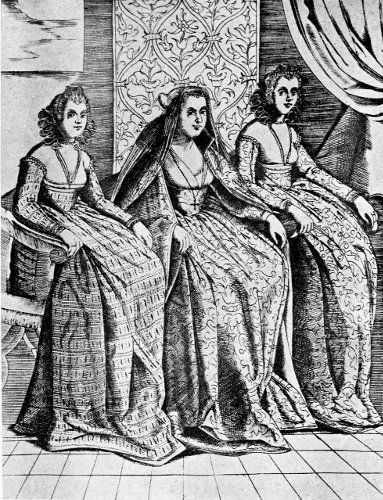
A DOGARESSA AND HER MAIDS OF HONOUR.
FROM A PRINT. 1560.
“Habiti d’Huomini e Donne.”—G. Franco.
The first Michielo to be elected Doge was Vitale, in 1096, in succession to Vitale Faliero, under whom [63]the new Republic shattered the last shreds of vassalage to the Byzantine Empire. Vitale Faliero’s consort was Cornella Bembo, who presented her spouse with a daughter to whom he gave the name of Enrica, after her sponsor, the Emperor Enrico, thus confirming the new alliance with the Germanic powers.
The Bembi came from Eraclea and were reckoned one of the four noble families of the second grade, who, in 800, signed the roll of nobility in the church of San Giorgio Maggiore. They, with the Giustiniani, Cornari and Bragadini, were styled “Evangelistic.”
Vitale Michielo married Donna Felicia Cornaro,—“gracious in speech, modest in bearing, the goodness of her soul shone out in the sweetness of her countenance,”—so is she spoken of by the chronicler. Perhaps too Sansovino’s estimate of the women of the Michielo period may be most strictly applied to the Dogaressa Felicia:—“Having made it their aim to be peaceful and religious, they kept on an equality with one another, that equality might induce stability and concord. They made their dress a matter of conscience, conformable to their seriousness of demeanour—concealing the figure.” This was undoubtedly a reaction from the dazzling personality of Dogaressa Teodora and the fascinating frivolities of her regime.
Tales of the sufferings endured by Christian pilgrims in Palestine reached Venice what time the virtuous Dogaressa Felicia influenced the counsels of her husband for good. At first they attracted little sympathy, for the Venetians were too much absorbed with their own domestic development and with the condition of their home politics, to take much heed to foreign affairs.
[64]
To the Dogaressa directly was due the initiations of efforts on behalf of the poor Syrians and the strangers within their gates. She persuaded the Doge to convene a meeting of the heads of families in support of the Crusade so eloquently preached by Peter the Hermit, and other holy men. By way of raising funds to assist in the sacred enterprise Dogaressa Felicia set an example of self-denial and liberality, by giving up her splendid jewels and dresses for sale; she also greatly restricted her personal pleasures and the hospitalities of the Ducal Palace.
This noble conduct, which was provocative of the best results, was recorded upon her tomb in the portico of San Marco. The lengthy inscription states that “Felicia Vitalis lived and died in the fear and love of God; she hated luxury and was an example for all good women.”
So great was her influence that in 1099 two hundred ships assembled at the Lido, each of which carried at her helm the hallowed ensign she presented to their commanders. Sailors, troops and equipment from every European state were poured into Venice, and her fleet conveyed them safely to Syrian ports.
The Doge and Dogaressa spared not their own family, for their first-born, Giovanni, a mere youth, sailed with the leader of the Venetian contingent, Arrigo Contarini, Bishop of Castello. Mothers of Venetian lads hastened to follow the good Dogaressa’s example, and parted tearfully but prayerfully with their dearest and their best.
After the departure of the Crusaders the Dogaressa busied herself in the foundation of hospitals[65] and homes of rest for pilgrims on their way to the Holy Sepulchre. Preparations too were made for the care of the wounded, the ailing and the sad on their return from service under the Cross. Women’s work is never so noble as when it links the care of suffering humanity to the cause of faith and hope. Dogaressa Felicia was messenger of pity and angel of love to all around her.
The Crusade met with vicissitudes of course, but at length, their aim attained, the saintly Crusaders returned to Venice, bearing with them the body of Saint Nicholas of Myra or Morea. Well may we imagine the rejoicings of the mothers and sweethearts of Venice when they descried the coloured sails of the home-coming vessels making for the Lido! The battle-songs and hymns of the Christian warriors were wafted over the gently rippling blue water, and they found an ecstatic response in the sweet voices of women and children gathered all along the sandy beach.
The holy relics were landed ceremoniously at the Lido, and, with pomp and circumstance escorted to the church of San Niccolo: they were the undeniable tokens of fervent and successful devotion in the service of Christ’s cross and sepulchre. Women almost forgot the sadness of bereavement,—for many homes were desolate,—in their joy and gladness at the accomplishment of the holy enterprise.
One other notable event in the dogado of Vitale Michielo I. was the appeal of the great Countess Matilda of Tuscany to the Dogaressa Felicia to use her influence with the Venetians,—who were devoted to her,—for the recovery of Ferrara which had revolted.[66] She recognised that the noble spouse of the Doge of Venice possessed all the attributes of religion, justice, and benevolence. The plea was not in vain, and ships and seamen of Venice regained for the Countess the rebel city.
Doge Vitale Michielo died in 1102, and Dogaressa Felicia in 1111. They were both buried at San Zaccaria.
The most famous of the Michieli Doges was Domenigo (1117–1130) grandson of Vitale I. His immediate predecessor was Ordelafo Faliero whose dogado was memorable by reason of its terrors—earthquakes, floods, fires and pestilence! Dogaressa Matelda, cousin, or as some say, sister of Baldwin, King of Jerusalem, headed the crowd of panic-stricken women who thronged the churches to supplicate Heaven for pity and forgiveness. She tried to dissuade her husband from personally leading the naval demonstration, which Venice made against the Greeks, saying that:—“The place of the Doge, as the father of his people, is in their midst during tribulation.” Dandolo speaks of her as a “miracle of probity,” and says, “Her fame was widely spread about as a model of what a good wife should be.” Nevertheless Doge Faliero went on board his war-galley and met under the walls of Zara a hero’s death.
Sad was Dogaressa Matelda as she met the returning warships, and broken-hearted as she took possession of her beloved husband’s body. Slightly comforted was she however, when his lieutenant placed in her hands holy reliquaries, wherein reposed a splinter of the True Cross, and relics of St James the Less, and of Saint Plato the Confessor of Constantinople.[67] She assisted in the solemn procession which accompanied these holy treasures to their last resting-place in San Giorgio Maggiore. Then she quietly retired, as a good example, to her contemplative cell at San Zaccaria.
Another story relates that Doge Faliero was only wounded at Zara, and, having accomplished his mission and administered punishment to the Greek pirates of the Gulf, he sailed on to Constantinople, and there secured the venerable relics and with them returned to Venice. With the Dogaressa he shared the honours of the translation of the precious prizes he had obtained, and helped to bear on his shoulder the body of Saint Stephen to its last resting-place in the chapel of San Giorgio Maggiore; then he and she renounced their high station and humbly dedicated the residue of their lives to the peace of the cloister.
Domenigo Michielo was cast in a sterner mould. Pious, no doubt as most Venetians were, and imbued with a spirit of reverence as a devoted son of the Church, he has come down to us with the title “Cattolico Uomo e Audace!”
The desire that the people of Venice expressed for the possession of relics of the Saints became almost an infatuation. It was the popular belief that the terrors of Heaven and the disasters of earth could best be met by the deposition of the bodies of martyrs on Venetian ground. Hence Doge Domenigo acquired the body of Saint Isidoro from the island of Sio, and that of Saint Donato Bishop of Eurœa from Cephalonia, and with the latter the bones of the dragon, which beast he slew!
These were some of the spoils of the Second[68] Crusade wherein Venice took an active and noble part, and from which she obtained great political results and immense booty. Very acrimonious were the debates and consultations on the part of the Crusader chiefs and keen their rivalries for saintly distinctions and profit. Each of them had an eye to personal advancement and shirked the hardships of the campaign. Domenigo reproved them sternly:—“Those,” he said, “who share the glory of our enterprise must be prepared to share its trials.”
The fleet of Venice not only aided greatly the pilgrims and the forces despatched from all lands to Palestine, but, turning homewards, ravaged the Grecian Archipelago. The name of Venice was renowned as that of—“The Greatest Sea Power of Europe,” and Doge Michielo was hailed as—the epitaph upon his tomb in San Giorgio Maggiore—“The Terror of the Greeks and the Glory of Venice.”
In his train he brought to Venice many distinguished captives, among them the Lady Sofia—a beautiful Eastern houri, who was carried off by Domenigo Morosini, by him raised to the Ducal seat, and, at last, buried with him in the church of Santa Croce.
Years of peace and prosperity followed, such as Venice had rarely experienced. She was coming to be looked upon as the nursery of the Fine Arts and the boudoir of the Graces, as well as Patroness of the Crafts and the “Mistress of the Seas.”
The frequent and often protracted absences of the Doge in command of fleets, from time to time despatched to punish pirates and marauders and maintain the prestige of the flag of Venice in foreign[69] waters, by no means diminished the importance and privileges of the Dogaressa.
As the First Lady of the Commonwealth she had many responsibilities which were greatly enlarged when her Consort was not in residence. If she had no position with respect to the Council of State and had nothing whatever to do with politics, there were numerous duties which devolved upon her. The patronage and direction of charities of all kinds—whether eleemosynary or educational, the maintenance of the Ducal hospitalities, the reception of ambassadors, the claims of family, and the encouragement of arts and crafts gave her Serenity much to devise and do.
As Consort of a militant Head of the State she was expected to exhibit all the virtues of a virago, and to introduce virility into all the feminine avocations of the day. If indeed her powers for usefulness were limited by restrictions she easily cast aside many of the conventions of her position. Such was the rôle in particular of the Donna Alicia, the able wife of Doge Domenigo Michielo. She lived up to the reputation of her husband, sharing his anxieties, his ambitions and his success.
When stricken by the labours and responsibilities of his office he sought relief in abdication and seclusion in the monastery, Dogaressa Alicia, however, asserted herself, and, instead of retiring to a convent, as she was expected to do, she determined that neither the prayers and meditations of the cloister, nor the self-effacement and bigotry of a recluse should enslave her energies.
The Societa de’ Pinzocchere—“Bigots!”—to which many of the noble widows of Venice belonged,[70] had no attraction for Donna Alicia. To be merely a hired mourner at State funerals was no life for her. She had her children to put out into the world and, in particular, she had her sons to prepare for high places under Government. Whilst, by necessity she had to yield the pre-eminence to the actual Dogaressa, her successor, she remained a free agent and a very useful and dependable confidante for men and women who had shared the toils and the rewards of her husband’s dogado. In due time Dogaressa Alicia’s prescience had its reward. Her son Vitale Michielo II.—the child of his mother’s solicitude, was elected Doge in 1156.
By his high tone and probity he raised the position of Doge to its highest level and reigned almost as a Sovereign Prince. His two sons he married well—Leonardo, created Count of Osero, to Alecia daughter of the King of Servia, and Niccolo, Count of Arbe, to Maria niece of Stefano, King of Hungary. To him was due the admission annually of forty young nobles to the rank of “Barbarini” among the members of the Grand Council; and the first silver coinage of Venice, together with the foundation of the first public Bank.
Alas Doge Vitale, who espoused the cause of the Papacy against the Emperor Frederic Barbarossa, came to an untimely end. Seeking sanctuary one day from a crowd of ruffians,—many of alien origin,—who demanded largesse he knocked at the gate of the convent of San Zaccaria. Before the porter could open to him the ill-conditioned wretches were upon him and offering personal violence if their claims were not satisfied. The Doge turned to address the men, and as he did so, one, Casiolo,[71] a discharged gondolier lately in the Ducal service, struck him with his stiletto. This was the signal for a brutal assault, and before succour could arrive Vitale Michielo’s body was hacked to pieces in the street!
Dogaressa Felicita Maria, daughter of Boemodo Prince of Antioch, it was said was at the time paying a visit to the nuns: so dumbfounded was she at the tragedy that nothing could shake her resolution never to leave the convent,—and there she remained and died. She and her sons were great benefactors to Venice. They greatly enriched the patrimony of San Zaccaria, and endowed the monastery and built the church of San Giovanni Evangelista.
A very pathetic and romantic episode in the history of the family of Doge Vitale II. and Dogaressa Felicita Maria Michielo was the marriage of their daughter Anna. Inspired by the holy example and goodly precepts of her mother Anna Michielo had taken the vows of an enclosed nun at the convent of Sant’ Adriana d’Amiano, where she meditated deeply upon the trials of the Christians in Syria, and prayed for the weal of sons of Venice gone forth to the Holy War.
In the disastrous expedition in 1170 against the Emperor Emmanuel Commeno all the young men of the Venetian family of Giustiniani were slain—save one. Niccolo Giustiniani was a monk in the Benedictine monastery of San Niccolo di Lido, where he had been professed when Anna Michielo renounced her love for him to become, by fervent self-denial, a Bride of Christ.
The extinction of a noble family in those days was a thing of rare occurrence: the State usually[72] stepped in to prevent such a catastrophe. This was the course adopted with respect to the Giustiniani. Niccolo at San Niccolo and Anna at Sant’ Adriana were summoned from their cells, and, with the express permission of Pope Alexander III., were joined together, vows or no vows, in the holy estate of matrimony.
Never was there a happier conjunction of kindred souls, and never so auspicious a resuscitation of a family-tree. Anna Giustiniani gave to her husband—her true and only love—twelve pledges of marital affection. Nine of them were sons. So worthy Anna was in truth and deed the “Mother of the Giustiniani!”
All twelve olive-branches reached maturity and then, Niccolo and Anna, freed from family cares, agreed to separate once more and, as the highest act of self-denial, to renew the sacred vow of chastity, and again entered upon the seclusion and the silence of the cell. With holy Anna went her three young daughters Martha, Margherita and Bartoletta. The two former returned to the world upon their marriage, but Bartoletta followed her mother’s example and became a nun. Soon after, and during saintly Anna’s life, the nuns were removed from the island convent of Sant’ Adriana to Venice proper, and took possession of their new home at Santa Caterina, of which Bartoletta was named first Abbess.
Anna died in the odour of sanctity, and she is still remembered by devout Venetian women in prayer and example as “Beata Anna Giustiniani.”
It was in the days of Doge Vitale Michielo II. that three brothers came to Venice from Morea,[73] and settled themselves and their goods in a small casa on the Fondaco de’ Mastelli. Rioba, Sando, and Africo were their names, but because of their origin they were popularly called Mori, and their arms displayed a Moor leading a laden camel—the most stupid of beasts. They soon acquired wealth and set about rebuilding their humble residence. At the corner of the new palace, on the Campo de’ Mori, they stuck up three sculptured figures of themselves under the guise of Saints Mark, Theodore, and John Baptist. They were very highly coloured and soon became laughing-stocks to passers-by.
Two of the figures disappeared mysteriously, and the Baptist alone remained, but his name was changed to “Sior Antonio Rioba Pantaleone.” It became a custom for jocular Venetians to send unsophisticated youths and over-trustful strangers with messages to the “Sior,” much as we were wont to treat our friends on “April-Fool Day!” At a later date “Sior Rioba’s” mouth became the receptacle for denunciations of enemies—so fitful are the customs of people!
The splendid dogado of Sebastiano Ziani (1172–1178) was remarkable for one event, at least, of romantic and historic interest—the first “Espousals of Venice and the Sea.”
In March 1177 Pope Alexander III. arrived at the Lido after weary stately wanderings through Europe. He was received with joy and honour by all classes of the community: they were fervent[74] Catholics and cared little about questions and parties for or against Papacy which moved other States. Residing pompously at the Palace of the Patriarch of Grado, his Holiness entered fully into the ecclesiastical and political affairs of the city.
Doge Ziani was absent in command of the Venetian fleet, and in May news reached Venice that he had gained a decisive victory at Salboro over the Emperor Frederic Barbarossa, and that his son and heir, Prince Otto, was a prisoner of war. The whole city turned out to welcome the victors, with their rich booty and many captives. Upon the beach of Lido stood the Pontiff—the centre of a notable group of dignitaries in full robes of state. Alexander was the first to congratulate the victorious Doge, and at the same time he publicly blessed the brave seamen and their leaders. Raising the kneeling Doge to his feet the Pope embraced him, and, taking off one of his own signet rings, he placed it upon Ziani’s thumb.
“Take this, my son,” he said, “as a token of the true and perpetual dominion of the sea, which thou and thy successors shall wed every year upon this auspicious festival of the Ascension, that all men may know that the sea belongs to Venice, and that she is indissolubly joined thereto as a bride to her husband.”
Then the whole company adjourned to the venerable church of San Niccolo where “Te Deum” was sung pontifically. By gondola, and barca, and in flat-keeled galley, a water pageant made its way to the Piazzetta, and the rest of the day was spent in general merry-making.
The annual commemoration was made the occasion[75] of universal rejoicing and pageantry. The Doge and the most distinguished members of the Council and the foreign ambassadors to Venice took their places on board a wonderful vessel “Bucintoro,” it was called, and in stately procession went off to the Lido. We must not suppose that only statesmen and seamen took part in the pageant, for, obviously, it was an occasion for the display of the personal charms and elegant fashions of the gentildonne. For the use of the Dogaressa and her ladies a splendid galley was built, shaped like a Grecian temple, and tethered to a pair of wooden sea-monsters, wherein the forty rowers were seated.
Arrived at the historic spot the Doge and Dogaressa, with their ecclesiastical and official attendants, embarked in a gaily decorated boat and set out to sea. Thence the Doge cast a superb ring into the deep—a ring of gold, enriched with onyx, lapis-lazuli, and malachite, engraved with the sign of St Mark holding a book of the Gospel. “Sponsamus te mare nostrum in signum veri et perpetui dominii,” were the words he uttered solemnly, whilst the clergy from golden vases sprinkled holy water upon the company and upon the smiling rippling sea. The Dogaressa and the ladies of her suite cast into the clear water the lovely nosegays they had brought with them—roses, carnations, and lilies.
Returning to Venice, after devotions in San Niccolo, the Doge gave a magnificent banquet in the palace to the notables of the city, and then all the lovely girls and the comely youths of every class were entertained at a vast ball, which overflowed the Piazza, and found relief only in the most distant calli. By old prescription the workmen of the[76] Arsenal were entertained at supper by the Doge and Dogaressa. Each man had the privilege of keeping his knife and spoon, his glass and his napkin, and he received besides a silver medal—bearing the effigies of the Most Serene couple, a case of useful medicines, a beautiful box of comfits, and a flask of Greek Muscat wine.
In later times the “Marriage of the Sea” was made a second carnival—lasting fifteen days, during which a great fair was held in the Piazza with fireworks such as Venetians only knew how to make, each evening at the Lido.
From Doge Ziani’s day came the annual athletic festival on the Lido. Lads turned fifteen, and young men up to thirty, after careful training in their various sestieri or city wards, went off to the butts and tracks set up upon the beach to contest for prizes in shooting, wrestling, boxing, running, and other sports. The competitors were arranged in twelve groups called, “Duodene” and every one was expected to be a proficient bowman. Merchant ships always carried a certain number of such expert young bowmen. All “catches” were permissible—indeed kicking, wringing the neck, and all the features,—brutal as they were,—of the Olympian grievous boxing were not disallowed. Bamboos as well as fists were used! All classes of the male folk of the islands were eligible to compete in every contest and upon equal terms. Matrons and maids thronged to watch and encourage sons and sweethearts, each fair one scrupulously careful about her dress and veil. Many a Venetian “Venus du Milo” doubtless longed to try herself against her companions, but such maiden contests were inadmissible by the State laws.
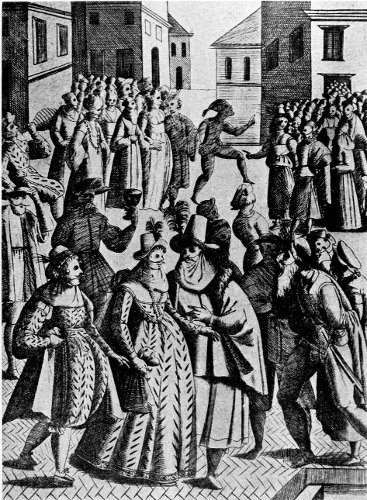
GOING TO A MASKED BALL.
FROM A PRINT. 1560.
“Habiti d’Huomini e Donne.”—G. Franco.
[77]
Incidentally these sports, which revived the athletic contests inaugurated by the Dogaressa Teodora Selvo, gave rise to rivalries between the inhabitants of the eastern and western halves of the City, which were ultimately resolved into two opposing parties—the “Castellani” and the “Nicolotti.” A neutral zone was ultimately marked out, whereupon stood the church of San Trovaso. The sacred building had doors opening west and east so that adherents of both parties might attend the Divine Offices without encountering one another. Difficulties however soon arose through the wantonness of women: maidens of one party were constantly falling in love with men of the other, and then trouble ensued!
The Emperor Frederic Barbarossa himself came to Venice in July 1177—reconciling himself to the power of the world in the person of Doge Sebastiano Ziani, and to the power of the Church in the person of Pope Alexander III. He was sumptuously entertained by the Doge and Dogaressa. Conquerors and conquered joined together in scenes of gaiety and splendour. The Doge appeared in regal guise, accompanied by the new insignia of office, bestowed by the Sovereign Pontiff,—a folding Chair of State, a Royal Cushion, a golden Sword of State, a great painted lighted candle, and four silver trumpets. The Dogaressa wore a jewelled diadem around her Ducal horned cap, the gift of the Pope, and a cape or mantle of gold brocade, bearing the Imperial cognisance placed around her shoulders by the Emperor.
Happily Sebastiano Ziani was a wealthy man and so was able to maintain the Ducal dignity without reproach. He was born in 1102—the son of[78] Marino Ziani of Santa Giustina in Castello, a noble of ambassadorial rank. A curious legend was treasured in the family: an ancestor at Altino, discovered among the ruins of the Temple of Juno, a cow moulded in solid gold! This was the foundation of the vast riches of the family,—the wealthiest by far of all in Venice, and known by the sobriquet “Famiglia della Vacca d’oro.” “L’haver de Ziani!” became a proverb—synonymous of the possession of great wealth.
Sebastiano lavished munificence unstintingly in Venice—new bridges, new facades to buildings, new churches, were witnesses to his benevolence, and dying, in 1175, he left the bulk of his fortune for the decoration of San Marco. He abdicated in 1170 and entered the monastery of San Giorgio Maggiore. No historian has preserved the date of Dogaressa Cecilia’s death,—probably she too found a refuge in the ducal convent of San Zaccaria.
It may be interesting to note the prices current during the dogado of Sebastiano Zani for certain commodities of everyday life. The following is a brief table of the Autumn sales in 1173:—
| Wine (except Greek) | 21 soldi per libbra (pound) |
| Beef—a fair average quality | 21 „ „ „ |
| Oil „ „ „ | 25 lire „ 1000 libbre |
| Corn „ „ „ | 16–17 soldi per staio (bushel) |
| Eggs | 25 soldi per 400 |
| Fish, sturgeon, trout, and ray | 3½ „ „ libbra |
| „ tench and pike | 3 „ „ „ |
| „ gudgeon, red-mullet and gunard | 2½ „ „ „ |
These prices were quoted on the Ponte di Rialto and at the retail markets on the fundamenti: they were controlled by the Corte della Giustizia which Doge Ziani empanelled.
[79]
Games of chance and gambling were always restricted in old Venice, but in 1175 Niccolo Barattieri, as a reward—onesta grazia,—in the words of the Doge,—for having succeeded when many others had failed, in lifting and placing the two great pillars of Samos granite at the end of the Piazzetta, claimed the privilege of opening a gaming saloon or tent, between the columns. The promise could not be gainsaid—“whatever the successful engineer likes to ask”—but to prevent so far as possible the success of the undertaking it was ordained that all public executions should be carried out on the spot. Between the two pillars a raised flat stone was placed, and upon it “are laid, and hath ever been, for the space of three days and three nights, the heads of all such as are enemies or traitors to the State, or some notorious offender.”
In all the gorgeous pageantry of Venetian Story, perhaps, no scene is more striking and more affecting than that which was enacted upon the Feast of the Nativity of Christ in 1202, within the storied walls of the most wonderful of all the basilicas of Christendom—San Marco.
In due order within the noble choir were gathered together representatives of the seventy-and-two churches, and more than seventy-and-two monasteries of the islands. Before the great screen stood Christian knights from every European state—clothed in complete armour and bearing upon their hearts the red cross of pilgrimage. The great white oriflamme of the Crusade, charged with the red cross of the Captain of Salvation, was held unfurled by Lord Boniface, Marquis of Montferrat, commander[80] of the French contingent. It had been wreathed by ladies of the Doge’s household with white lilies of the Annunciation and red carnations of the Crucifixion. Around the great pulpit was assembled all that was fair and virtuous and all that was frail and voluptuous in Venice. The women’s great black veils, and the girls’ veils of purest white linen, modestly gathered in around their full open bosoms, revealed beauteous classical features and abundant golden tresses.
All were fired with ecstatic devotion as, kneeling humbly upon the stone pavement, they uttered with deep emotion their “Aves” and their “Paternosters.” Like the chromatic ripples of a summer sea re-echoed the orisons aloft upon the resonant mosaics of the lofty roof, and the devout dropping of innumerable rosary-beads resembled the rolling of beach pebbles by the beating waves. The women of Venice were gathered together to encourage their men folk to be true and brave for Christ and home!
The age and youth of Venice alike mustered there no less wrapt in devotion than their wives and sweethearts; each man’s berretta is in his hand, his right grasps his sword-hilt, and his knees are bent in self-dedication. The stripling kneels alongside his sire, and he again supports a more venerable man,—the grandsire, for the Crusaders knew no age limit.
A wide avenue down the centre of the great church is left for the progress of the magistrates, and furtively are eyes turned to the great open portal as the solemn procession comes into view. Their Excellencies pass to their places, and, last of[81] all, wearing his full Ducal State, marches, with the stalwart step Arrigo Dandolo—the Doge. Lightly, as upon few, sit his ninety-and-four years, his lameness is hardly noticeable, his back is no longer bent, and his eyes are keen: his Serenity bears the marks of a hero approaching the zenith of his career. All eyes are riveted upon the “Grand Old Man of Venice.”
Dandolo makes his obeisance to the Sacred Host,—exposed above the famous Pala d’oro, but, to the universal wonderment, he ascends not his Ducal seat beside the altar, but mounts the stairway of the pulpit. With hand raised aloft, and voice piercing and full of purpose, he cries out:—“Sirs, we are here assembled to engage in the highest of all human enterprises, Christ calls Venice to fight for His sepulchre profaned by the hated Turk. I that speak in His Name, am old and feeble in appearance, but my heart is that of the Lion of Saint Mark. If you bid me, I am ready to lead you right on to Jerusalem. I will take up my cross now, and set forth to conquer and to die!”
An intense sensation runs through the immense concourse, and every man’s sword is raised on high, as the white-headed leader kneels humbly before the Patriarch, who places the red cross upon his jewelled horned cap. Women’s sobs mingle in the “Te Deum” chanted by the clergy and choristers, and every bell in every campanile clangs, if not in harmony still in full-toned sympathy.
Not a man hesitates longer, if Venice has been lukewarm in the matter of the Crusades, she shall be so no more. The women and the girls emulously pin the Crusaders’ badges upon the breasts of fathers,[82] brothers, husbands, sons, and sweethearts, and lead them ungrudgingly to the water-side, where boats are waiting to carry the warriors on board the galleys—three hundred of them. The fleet sailed that evening. In the van were three giant vessels—“Pelegrina,” “Paradiso” and “Aquila”—upon the latter Doge Dandolo embarked—holding in his hand the gorgeous crimson banner of San Marco.
“Veni Creator” resounded from church to church, fundamento to fundamento, ship to ship, as the fleet sailed out of sight, and then upon every riva and in every calle were girls and women weeping and disconsolate—theirs was the true sacrifice, for had they not dedicated all that was dearest to them to the service of their Lord! The bride of a day lay clasped in the arms of her who had kept her jubilee, and little children left their games crying bitterly for fathers and for brothers they would never see again.
Venice was a city of the dead, no one was there to sing and dance: women had to turn their hands to manly avocations,—none repined, and their devotions were redoubled. From noble church, before humble shrine, and out of simple homes arose passionate appeals. All the nine patron saints of Venice were invoked, along with Christ’s gracious Mother. They knew that their suppliant cries would be as efficacious for the rescue of the Holy Places as the deeds of daring of their men.
The Crusade was a glorious success: wreaths of fame crowned the brow of Christian warriors and the women of Venice wove garlands of sweetest flowers to wind lovingly around their necks. The heroes came not however straight home to Venice[83] but went aside to punish the hateful Turk in his capital. Doge Dandolo led the attack, but alas, with the fall of Constantinople fell many of the bravest Venetians, and among them the venerable Doge. They buried him in the basilica of Saint Sophia and put up his epitaph:—“Mult ere sages et proz”—“One of the wisest and the best of the Sons of Venice!”—and then they set sail for home. It was the time of the budding of the rose tree: the fresh fragrant blossoms of a new life,—a new world,—a new people,—the year 1205.
The prelude of the “Cantata” of the new century was pitched in the minor key, but the feeble treble of fatherless children harmonised pathetically with the full contralto of their mothers:—
Fathers, brothers, husbands, sons and sweethearts returned not to Venice. She was once more “Venus Calva”—Venice, bereft of her stalwart sons, stripped of her trusty councillors, naked and bereaved.
There were many widows in Venice.
[84]
Upon the smiling little islet of San Giorgio in Alga, midway between the Punta di Santa Maria—the westernmost limit of Venice proper, and Fusina—the principal port of the Laguna Morta, there lived, once upon a time, a good-looking young fisherman. Zian Zorzio della Laguna,—so named after his patron Saint, Saint George of Cappadoccia,—as skilful in his calling as he was comely in his person.
Zorzio had wooed and won the prettiest girl in all Rialto, as hard-working as himself and as good to look upon. One day Bella offered her lover an extraordinarily fine fishing-net which she had, unknown to him, knotted with her own fair hands; and, Zorzio delighted with the gift, tossing it over his shoulder, went off to dedicate it to his saintly patron in the island Sanctuary.
Kissed on both cheeks, coloured with the ripest peach-bloom, her golden hair coiled neatly around her shapely head, save for one rebellious love-knot upon her brow, the beauteous innamorata waved loving farewells to her Zorzio as he sculled off in his light barca to make trial of his treasure.
With a daring cast the spider-web-like mesh sank beneath the gentle ripples of the lambent water, and the young fellow, confident of a worthy haul, presently began to pull in his net. “Per Bacco!” cried he, for something eerie had caught[85] itself in the all but invisible strands of Bella’s handiwork. A piece of petrified seaweed,—very delicate in form, very beautiful in colour, very exquisite in texture, verily a scudding flake of opalescent sea-foam transformed by the mermaids of the deep into lovely coral lace,—yielded itself to his ready hand. Zorzio had never beheld such a perfectly beautiful object, and in a transport of delight he hailed his prize as the pledge of his success in life. Speeding homewards in the evening he made Bella the sharer of his good fortune, and she locked up the bit of coral lace safely in the simple home they had prepared against the next festival of the “Brides.”
Alas, the even tenor of their lives was rudely shattered by a call to arms, and brave Zorzio was enrolled among seamen drafted for service in the Orient. Broken-hearted Bella surveyed his empty seat, and her tears fell fast. Should she ever see her Zorzio again she wondered and whispered. Looking up at last, her eyes fell upon her lover’s gift—the lovely spray of coral seaweed. An inspiration seized her mind, and with alacrity she reached down her lace-pillow, and guided by an unseen power, she crossed and crossed her bobbins of fine thread until she had completed, in interlacing arabesques, a similitude of her treasured model. Thus was invented the far-famed and precious merletto a piombini—the point-lace of Venice. It is a charming story and it has a striking moral. That piece of coral seaweed was the mascot of the Venetian Renaissance.
In the morning of the “Vita Nuova”—it was the hour of “Lauds,”—Commerce,—strenuous father, and Industry,—faithful mother, were busy rearing[86] their numerous family—the vigorous progeny of the Crafts. Away back in the ninth century, in the days of the “Grand” Doge Agnello Partecipazio, the Emperor Lothair issued his “Constitutiones Olonenses,” wherein eight cities and towns of Northern Italy are named as suitable centres for the establishment of the revived Roman “Collegia” or “Scholæ”:—Bologna, Cremona, Firenze, Ivrea, Milano, Padua, Torino and Rivoalto (Venice). In each place the designation of the Scholæ varied: in Venice they were called “Fragilia,”—from “Flagelli,”—whips,—the exact meaning of which it is difficult to state, perhaps “training schools” wherein learners were whipped into shape!
Each “Fragilia” had its teachers, its pupils, its officers, its constitution, its duties, and its bylaws. The earliest distinct mention of a “Trade” is in 826, when a maker of lead pipes for organs was working away near San Giacomo di Rialto: doubtless the artificer in question was a Greek, his name has not been preserved. Orso Partecipazio employed clock-makers in 864 and silversmiths and carvers of ivory: these craftsmen were Greeks however. The “Cassellari”—makers of arcelle and cassoni—formed already a vigorous Corporation in the time of the rape of the “Venetian Brides.” The first notice of “Fabbri”—blacksmiths, was in 1184 as forming a “Fragilia,” but the Calle de’ Fabbri was a well-known lane in the tenth century. The Altino Chronicle names Fishermen, Smiths, Saddlers, Carriers by water, Shepherds, Butchers, Masons, Carpenters, Cabinet-makers, Shoemakers and Furriers as the earliest incorporated craftsmen in the islands of the lagunes. “Marzeri”[87] or silk-mercers were established in Rivoalto in 942.
Doge Pietro Polani, in 1143 drafted a “Table of Precedence,” which established as the premier “Fragilia” or Trade-Guild, the Corporation of Fishermen. Thirty years later Doge Sebastiano Ziani set up the first “Corte della Giutizia” in the interest of traders and operatives. Thereafter numerous other Crafts are named in Venetian history; but Venice never attained to the eminence of Florence in the development of her Guilds—she was sui generis a great sea-port rather than a metropolis of industry. The thirteenth century first saw the cradle of the Crafts rocking effectively,—just as the fourteenth furnished the nursery of the Fine Arts,—and Venice felt the impulse of the new industries, along with the rest of Italy.
Doge Arrigo Dandolo had annexed one-fourth of the old Roman Empire to the tutelage of Venice, and ten great Turkish galleons brought home, with the remnant of her forces, vast treasures,—the loot of Constantinople and the islands of the Greek Archipelago. Upon the Piazzetta was outpoured the wealth of the Levant. Never before had Venetian eyes and hands beheld or handled such creations of art and craft. Every church and monastery, every palace and mansion, and every poor man’s home, were enriched by things of joy and beauty. Mothers and maidens laid up in honoured hiding-places tokens of their heroes resting in Paradise, and all the sons of Venice gathered objects of interest which engrossed their intelligences and set their minds and hands at work[88] to imitate—the fall of Constantinople was the rise of craftsmanship in the Lagunes.
The Conquest of Constantinople—a notable turning-point in the history of Venice—was the initial mark of a new era throughout Europe. By common consent every class of the Venetians welcomed the promise of new conditions,—social and political,—and set to work to exchange Oriental ideas and sympathies for the pushful methods and modes of Northern and Western Europe. The first step was the election of a Doge, who should be, not only a desirable figure-head for the State, but who, by his force of character and personal experience, should lead the Commonwealth along progressive ways.
The qualifications for the Dogado were: (1) Ripe age; (2) Urbane temperament; (3) Good birth; and (4) Ample private means. One man, and one man alone, stood out head-and-shoulders above his peers, as possessed of these four qualities, a man whose thirty years of distinguished public service placed him in the unique position of first citizen of Venice. By universal acclamation Pietro Ziani was chosen to wear the laurel-wreathed berretta of the great Dandolo. The son of one of the most distinguished of the Doges—Sebastiano Ziani—he had borne himself nobly as a successful naval commander, a tactful ambassador, and an upright magistrate. Handsome above the ordinary, pious without hypocrisy, talented in linguistic and forensic aptitude, and passionately loyal to the Constitution, he was calmly awaiting his destiny at his country residence at Arbe in Dalmatia.
A deputation of the Lords of the Council[89] boarded the magnificent “Bucintoro,” and accompanied by thirty galleys, all splendidly decorated with rare brocades and tapestries, set off to meet and escort the new Doge. Pietro Ziani’s progress was a triumphal procession, calling to mind the unanimous and felicitous election of Domenigo Selvo one hundred and fifty years before. Almost the first act of the new regime was the affirmation of the cordial relations which his father, Sebastiano, had entered into with Guglielmo II.—“The Good,” King of Sicily. Dante refers to the death of this distinguished Sovereign in Canto XX of the Paradiso:—
In confirmation of the new treaty the new Doge, in 1213, sought and gained the hand of the Princess Costanza, daughter of King Tancredo, Guglielmo’s son and successor. She was the first Norman Dogaressa of Venice, daughter of a brave and ardent race, a woman of conspicuous ability and ambition, and an ideal consort for the Head of a rejuvenated Venice.
Pietro Ziani had but lately buried his first wife, the modest and beautiful Countess Maria Baseggio—whose father held the high office of Procurator of San Marco—nobilis et decora nimis Maria Dukessa—as she is called in the Altino Chronicle. The sole offspring of this union was a son, Giorgio, but, alas, when yet a child, he was torn to pieces by the savage mastiff watch-dogs of the monastery of San Giorgio Maggiore. It was said that the Doge was so infuriated by this misfortune that he ordered the[90] church and monastery with all the animals,—the poor monks as well,—to be consumed with fire: one may hope the innocent Religious escaped the fury. Anyhow the rest were all burnt, and then the remorse of Ziani was pitiable. By way of reparation he set to work at once to rebuild and re-endow what he had so petulantly sacrificed.
Dogaressa Costanza was handsome and gracious, and wore her Royal honours with distinction. Palazzi wrote thus of her—“A Queen by birth, Dogaressa of Venice by marriage, she exhibited all the attributes of her royal station,—she was also Duchess of Calabria,—and her high breeding, no less than her beauty, raised her above all petty jealousies.” In the ancient pack of playing-cards, at the Venetian Museo Civico, we find her represented upon the “Ten of Spades,” with the following legend:—“Costanza, daughter of Tancredo King of Naples, wife of Doge Pietro Ziani, was accustomed to meet all the malcontents against the Doge and herself with the saying:—‘I have nothing to do with you!’”
The State being involved in tremendous financial difficulties on account of the cost of the Crusades, and also in behalf of the purchase of the island of Crete, in view of the Doge’s great private wealth,—“L’haver Ziani” was quite as true of Pietro as of Sebastiano—reduced his official salary to 2800 lire, with 100 thrown in as a free gift. It was further decreed that all tributes to the Doge should henceforth be shared between him and the treasury of San Marco. Moreover he was required to make an offering of three silver trumpets for ceremonial processions, and to undertake the[91] repairs of the Ducal Palace,—rather a one-sided bargain!
Fifteen years of marital happiness fell to the lot of the Doge and Dogaressa. Three children were borne by imperious Costanza—Marco, Marchesina, and Maria. Some authorities say that the Dogaressa died suddenly in 1228 and that the Doge, broken-hearted, followed her within a month. The Altino Chronicle however records the abdication of Pietro Ziani, and adds that he and his Consort, with their family, retired into private life and went to reside in their palace upon the fondamento of Santa Giustina, where he died, and then received sepulture in the church of San Giorgio Maggiore, in the tomb of his father Sebastiano.
There is still a third version of the deaths of Doge Pietro and Dogaressa Costanza. In the terrible earthquake of 1220, when the church and monastery of San Giorgio Maggiore were destroyed, and the islands of Amiano and Costanzina swallowed up, it was said that many people died of fright, and among them the Dogaressa. The Doge, sharing the universal sense of insecurity in Venice, proposed to move the seat of Government to Constantinople, but, upon the cessation of the seismic disturbances, wiser counsels prevailed, and he set to work to rebuild the shattered edifices. In 1229 Pietro Ziani exchanged the silk-brocaded robe of State for the worsted habit of a Benedictine, and ended his days in the new monastery of San Giorgio which he had built.
During his dogado a year of Jubilee was appointed by the Pope—1214—in thankfulness for the general peace; and every Italian State held festivals and[92] fêtes. Treviso led the way, for nothing could exceed the beauty and the human interest of the “Marca Amorosa.” The centre of the most fruitful and delightful region of all Northern Italy, Treviso, with her borders, was renowned for the richness of her vegetation, the salubrity of her climate, the beauty of her women, and chivalry of her cavaliers. The rallying-point too of knights and champions from the vigorous Teutonic north and the vivacious Frankish west Treviso was the fascinating rendezvous of all that was romantic, brave and fair.
The Crusades had been the making of the soldiery of all Europe,—not indeed in the elements of warfare but in the courtesies of the battle-field. Men went forth to fight the Saracen and the Turk to vindicate the nobility of the Cross and the gentleness of the Son of Mary. For the weak and the oppressed they gave and took sword-thrust and arrow-tip, and not as men fighting men alone. Heroes returned to Venetian, Trevisan and Paduan homes famous for their valour and their virtue: the Crusades were schools of Christian chivalry. To fight for women and for children in Palestine meant to honour and exalt those of their own dear land, but this was quite a new idea. Saint Mary and the Saints of God held the hands of their own babes and youths, the hands of their own girls and women, and men worshipped at human shrines as well as in saintly sanctuaries.
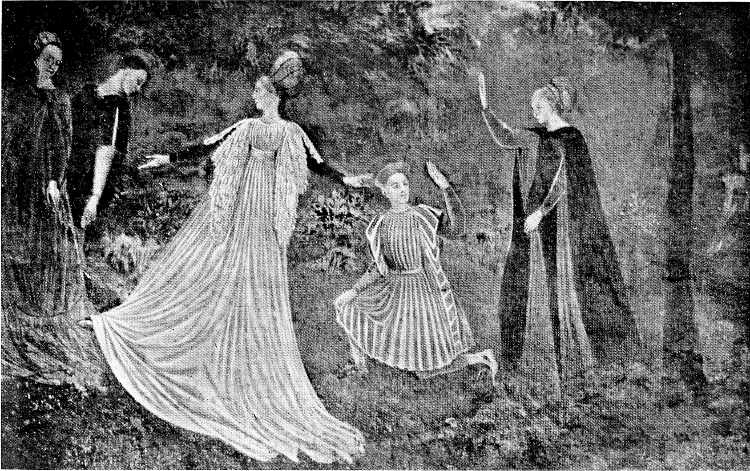
MYSTIC DANCE.
Michelino da Bedozzo.
PALAZZO BONARDO, MILAN.
Treviso put forth her best efforts in the way of pageant, spectacle, and mask—albeit she did not forget to dress her altars, light her candles, and burn her incense, in honour of the Jubilee. In the centre of the Piazza della Spineda, the Guild of Carpenters [93]erected a grandiose palace—“Castle of Love” it was named, overlaid with gilding and painting, and decorated with rich silk velvets, costly furs, and precious tapestries. Trophies from Palestine and spoils from Constantinople were raised aloft, with rose-trees full of roses, myrtles in white flower, and jessamine, the marriage bloom, and many another decorative feature. All this bravery was the mise-en-scène for such a castle garrison as no knight’s eyes had beheld nor indeed his heart imagined.
Two hundred of the fairest damsels of Treviso and Padua, and with them not a few noble matrons of attractive personality, manned or shall we say “womaned” the lofty battlements. Dressed in most becoming garbs and covered with jewels, with faces painted and hair coiffured in exquisite taste, the fascinating amazons have at hand no weapons or grenades of lethal warfare, but baskets of sweet flowers, cornucopias of ripe fruit, and crystal vases filled with delicious scents, ready for the besiegers.
Three Companies in turn assault the “Castle of Beauty”—gallant knights and esquires of Venice, Padua, and Treviso. Strange are their battle-cries. Lately singing Litanies to the Saints, their lips have learned compelling dulcet tones, as they have prayed at or for the Holy Sepulchre, and now they again give forth the refrain “Ora pro Nobis”—addressed not to St Giustina, St Catherine, or St Barbara, but to Donna Beatrice, Donna Fioretta, Donna Felicita, and to all the beauteous two hundred!
Amid the plaudits of thousands of spectators on pavement, in window, on balcony, on roof, drawn from all the plains of Lombardy the Company of Treviso—as gallant goodly lads as ever donned[94] tight hose and well-shaped tunic,—deliver the first attack, making trial of their knighthood. Appealing to the tender unsullied hearts of the fair defenders of the Castle, with gentle words, they shower such things as affect most the eye of woman—lovely flowers, amorous billets-doux, and delicate scent-sachets. Not so can they gain the battlements, and falling back, the second line of attack is opened out by the Company from Padua. Clever pleasant youths are they and full of artistic fancies, well groomed too, they rally to the charge with such things as may please their ladies’ palates,—boxes of expensive sweetmeats, baskets of delicious fruits, and fresh rissoles of fish and chicken. The fair ones catch all they can, but yield not their portcullis. Now comes the turn of the fresh-complexioned, well-figured, fair-haired, silent, haughty young Venetians. They step boldly forward, in silken tights, each lad a lord in self-esteem: they have special ammunition for their service, attractive to all the senses of woman-kind,—scented walnuts, Oriental sweeties, and sugared rose-leaves, but, in their scarlet satchels they have a wealth of good gold ducats, and with them the day is won, for the maidens toss the glittering spoil from hand to hand and laugh and sing right merrily!
But before the conquerors can carry off their bewitching prisoners, the defeated warriors rally to the call of “Down with Venice,” and rush the standard-bearers. In a trice the red banner of San Marco is trailing on the ground and the Venetians have whipped out their swords! Messer Paolo da Sermedole, the Master of the Pageant, and his assistants intervene, and the tears of the captured maidens arrest the flow of blood, but the[95] Venetians leave the “Marca Amorosa” vowing vengeance for the insult. War was declared forthwith against the sister cities and the end of it came not till two years had passed, when at Bebe near Chioggia, the Paduans accepted the Venetian terms. Doge Pietro Ziani stipulated, as a condition of peace, that twenty-five Paduan Knights, who had participated in the “Marca Amorosa” at Treviso, should present themselves at the Ducal Palace, submissive to the orders of his Serenity.
In Venice the gallant Company was welcomed right nobly, as became magnanimous foes, feasted for ten days, and well laden with costly presents, and so were speeded home again. History has not exactly told us whether any, or all of that gallant band, took away things more precious still than the splendid offerings,—the hearts of Venetian maidens! The revenge of the conquered, in true chivalry, is the spoiling of the conqueror. Anyhow at least one Venetian bride was led away to Padua, and with her went a goodly trousseau:—“One bed, two down-quilts, a whole piece of scarlet ‘noble’ cloth, four linen sheets, two feather pillows, two striped silk petticoats, two robes, or gowns, of silk brocade, four bodices of lawn, one fur mantle with silver buttons, one silver bell, a silver rosary, seven ornaments of gold, two of pearls, a coronal of pearls, seven fine amber beads, etc., etc.”
When she reached Padua the bride was to receive from her husband a purse full of money, to pay for musicians at the home-coming, for the cooks, and for her chaperon—one Donna Riccidoni—and for herself she might retain twelve silver soldi as pin-money. The bridegroom was mulcted[96] at the same time in dealings in beef, veal, fresh fish and fruit, cakes, eggs, bread, wine and oil, and for the payment of the boatmen who had rowed them up the Brenta. Alas the chronicler in the “Archivio” has failed to give the names of the interesting couple, but apparently Venice and Padua were at one upon the question of matrimony!
The last years of Doge Pietro Ziani were embittered by the rivalries of the families of Tiepolo and Dandolo—partisans of both sides eagerly grasping the Ducal chair, and impatient of the demise of its occupant. The Doge and Dogaressa were so worried and oppressed by these unseemly contentions that he executed a deed of abdication, and returned to his private residence, leaving the distinguished but thankless office to be filled by another.
Giacomo Tiepolo represented the old ideas and Marino Dandolo the new, and the votes of the Council were equally divided; but at last, a majority was found for the former. Tiepolo was out and away the most enlightened and intellectual man of[97] his time. He came of an ancient family, one of the “Apostolic” order of nobility—“Teupolo” in the old spelling, and originally from Rome. Bartoldo Teupolo, the head of the family in 697, was one of the electors of Doge Paolo Lucio Anafesto. In 1204, when so many Venetian nobles assumed territorial titles of sovereignty over islands in the Greek Archipelago consequent upon the fall of Constantinople, Giacomo Tiepolo was named Duke of Candia. His father was Lorenzo, Procurator of San Marco in 1207, and Podesta of Treviso.
“Duke” Tiepolo took to wife Maria Storiato—a Venetian gentlewoman of no high degree, but a good and faithful spouse and mother. She was received as Dogaressa the day of Giacomo’s election in 1228, but alas, she died in 1240, having given him three sons as pledges of her devotion—Pietro, Lorenzo, and Giovanni. The eldest became Count of Sant’ Agostino and Podesta of Milan and Treviso, but, being taken prisoner by the Emperor Frederic II., he was treacherously beheaded.
A two years’ widowerhood found the Doge once more at the feet of an attractive woman, not indeed a simple Venetian maiden but a Princess of Royal degree,—Valdrada, the daughter of King Tancredo of Sicily. The new Dogaressa, like her brother King Ruggero, was famed for good commonsense, and sound probity of life, and she assumed at once an unquestioned control over the actions of her Consort, strong man though he was. Like her sister, the Dowager Dogaressa Costanza, she was a virago, in the sense of a strong personality; and she followed in her sister’s steps, ruling not alone her[98] husband, but bending to her will all with whom she was thrown in contact.
Perhaps the new Dogaressa’s ostentation of Regal rank in the Venetian Court was a decisive factor in the promulgation of what was called the “Promissione”—perhaps best translated by the French term, Protocol—of 1242, the provisions of which greatly restricted the power and liberty of the Doge and Dogaressa. The Doge was henceforth to be, not the executive Head of the State, but the executor of the orders of the Council. Acts of homage were no longer to be rendered to him, nor was he to be addressed as “Domine Dominus.” In times gone by the deputation of nobles, commissioned to acquaint a new Doge of his election, were accustomed to greet him thus:—“Welcome, Messer Doge, God give you Messer Doge a good morrow, we are come to dine with you, we await your orders, and we wish to kiss your hand.” The Dogaressa also shared the new restrictive conventions, and neither relatives of hers, nor of the Doge, were eligible for any public office. Their household was limited—only twenty-five free retainers were allowed and a like number of unpaid dependent slaves.
“Il Statuto di Giacomo Tiepolo,” or “Il Statuto Veneto,” as it was called, was a compilation, by Doge Tiepolo, of laws in five books, which treated of the domestic relations of married people. The husband was required to render an account to his wife of his use of her dowry, and the capital sum remained in her power to will as she chose. An unfaithful wife forfeited her dowry, but a widow enjoyed her husband’s patrimony till her second[99] marriage or death. If ever a couple decided to renounce secular life and enter Religion, the united property was shared equally, each being free to do what he or she liked with the money. Children, if any and under age, were provided for equally by each parent. Many sections of the “Statuto” dealt with the vexed questions of Slavery and Prostitution—all aiming at the amelioration and moralisation of manners.
Doge Giacomo Tiepolo’s time was much occupied with the settlement of internal jealousies and factions, and by the conduct of naval and military expeditions. While he was so employed Dogaressa Valdrada gave her whole time to the patronage and support of the Trade Corporations—a rôle maintained by all her successors.
At length, in 1209, the Doge, wearied alike by the exertions of his foreign enterprises and by the keenness of political rivalries at home, executed a deed of abdication, and, with Dogaressa Valdrada and her two young children retired to his private residence at Sant’ Agostino, in the sestiere of San Polo or Paolo. He did not long survive his retirement from office, and both he and his Consort, who outlived him three years, were buried in SS. Giovanni e Paolo. In every sense of the word Giacomo Tiepolo—“The Legislator”—was a “Grand” Doge—the sixth upon whom that title may be properly bestowed.
In his “Stones of Venice” Ruskin tells a well-known and characteristic story of Doge Giacomo Tiepolo. The noble church of SS. Giovanni e Paolo—San Zanipolo in the vernacular—was begun by the monks of San Domenigo in the year 1234,[100] under the patronage of the Tiepolo family. Three years before Giacomo was called upon to succeed Pietro Ziani, he dreamed a dream wherein he beheld all the ground around the rising building covered with rose-bushes in full and fragrant bloom. Flitting to-and-fro and imbibing the floral nectar were numbers of white doves with golden crosses upon their breasts. Whilst the dreamer wondered what it all meant forty angelic beings appeared out of a crimson cloud, bearing in their hands smoking censers, and, circling around the lovely garden, they flung hither and thither their sweet incense smoke. Then a rich clarion voice proclaimed from somewhere above the rose-trees:—“This is the place I have chosen for my preachers.” The solemn words awoke the sleeper, and he went straightway to the Council and declared what he had seen and heard. They agreed to grant forty paces of ground for the extension of the monastery and Messer Tiepolo, out of his private munificence, endowed the brotherhood with a noble revenue.
Upon either side of the entrance of the church are the two Roman sarcophagi, in which were interred the bodies of Doge Giacomo and his son Doge Lorenzo Tiepolo. Ever after Doge Giacomo Tiepolo’s solemn obsequies the bodies of all the Venetian Doges and many of the Dogaressas were laid in State and their funeral rites were performed within the choir of the great Dominican church.
Marco, or Marino Morosini’s dogado (1249–1252), was quite uneventful, except for the establishment of the Holy Inquisition in Venice. Its operations however were only allowed upon sufferance, and its decrees required the imprimatur of the Council[101] before being carried into effect. Doge Morosini, nearly seventy years of age at the time of the election, was of venerable appearance, amiable disposition, and irreproachable character. His Consort’s name has not been preserved. He is credited with the initiation of the Scola de’ Battitori,—Guild of Flagellants,—which attracted very many of the more devout of the citizens. Men and women were equally affected by this call to asceticism, and were accustomed to lash themselves both publicly and in private with “Scope” birchrods or “disciplines,” whilst they sang Miserere and other doleful chants! The furore had a brief duration, for the commonsense of all classes checked exhibitions of infatuation. There was however one admirable feature in the movement—the devotion of vast sums of money, rich lands, and fine houses, to the cause of charity: in one year (1251), 80,000 lire were contributed to deserving objects, and the “Battitori” numbered at least 12,000.
Marco Morosini was buried with full honours, clad in State robes with his jewelled sword by his side, whilst women made loud lamentations and men forsook their avocations to touch his bier, and pray for his soul. These solemn burial scenes were swiftly followed by the gorgeous installation ceremony of the new Doge—Reniero Zeno (1252–1268).
Where had been scattered branches of yew and cypress, and where had swayed great lengths of dismal black cloth, now flaunted in the fresh sea-breeze, the emblazoned banners of the “Fragilie” and the splendid silk draperies of the nobles, whilst garlands of freshly woven fragrant blossoms shed[102] their painted petals upon the path where along a comely Dogaressa was borne by gallant escort to the Palace. There was just one “fly in the ointment” of satisfaction—for Loicia da Prata,—as attractive as any of her predecessors, indeed she had charms surpassed by few,—was alas from Friuli, and “nothing good for Venice,” it was said, “ever came thence!”
The new Doge belonged to the most recent order of the nobility, that composed of men whose ancestors had purchased their patents in celebration of the last war with Candia—the Videmani, Labio, Zenobio, Fini, Manini, Gambarri, Zeno, and others. Whether Messir Reniero, the son of Ser Pietro Zeno, possessed all the qualifications sought in the person of the Head of the State we know not, but we know that he was a man of great wealth—perhaps, as times went then and as they go now, the most valuable consideration! This being so, the Council considered it a favourable opportunity for further curtailing the privileges of the Doge and Dogaressa, for, by the way, it was a certainty that they would be the recipients of considerable offerings on behalf of the Trade Corporations, seeing that the Doge was engaged in active commercial pursuits and was a great employer of labour.
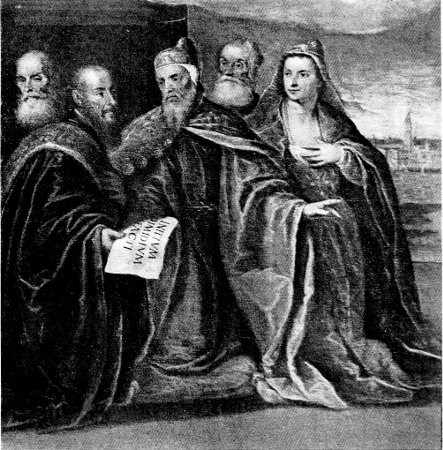
DOGE RENIER ZENO AND DOGARESSA LUICIA DI PRATA.
Palma Il Giovine.
ORATORIA DE’ CROCIFERI. VENICE.
By the new “Promissione” the Doge, the Dogaressa, their sons and daughter, and daughters-in-law, were debarred from receiving food stuffs, cattle and horses, poultry and game, etc., etc., except upon due payment. The Dogaressa was directed not to promise situations or offices to those who sought her aid, nor to write recommendations of such suppliants to the Doge or to the Council, and [103]also not to make gifts to any official dependant. If she bestowed her patronage upon Craftsmen they were forbidden to make capital out of it. On the other hand, no limits were put to the private charities of her Serenity, and, as Dogaressa Loicia was famed for her benevolence, this freedom of action granted to her by the Promissione, had an astute and sly significance. As a matter of fact she did exhibit her piety in a remarkable way by the erection and endowment of a Hospital, upon the site originally occupied by that of Doge Pietro Orseolo II., with an Oratory,—Oratorio del Crocifisso,—still in existence near the great Campanile of San Marco.
During the dogado of Reniero Zeno, in 1255, a writ was put forth by the Government regulating the marriages of nobles and citizens. Banns of marriage had been asked, time out of mind in all the Venetian churches, but gradually they had ceased to be regarded as necessary, and clandestine unions were the fashion. A priest had come to be regarded as at anybody’s beck and call, whether in a public consecrated building or in the privacy of the domestic parlour; and, instead of many sponsors, one witness was deemed sufficient. Often as not a priestly personage was not requisitioned at all—times were easy, so were manners.
Quite a characteristic and amusing story has been preserved illustrating the new mode of wedding contracts. Madonna Catarussa of San Gervaso, lingering one evening at her house door, awaiting her late home-coming spouse, was accosted by one, Ser Pierino da Trento, an itinerant seller of brooms and brushes. Noting the Madonna’s abstraction he[104] passed a courteous greeting:—“Good Lady,” he said, “can you find a poor devil like me a pretty girl I wonder?” Madonna Catarussa was indignant and used pretty freely not too pretty Venetian expletives!
“No! no! not that dear Lady, not that,” interjected Ser Pierino, “I mean marriage now and honourable, a little wife and a modest dowry!”
“Well, well, if that be your true wish I will see what I can do. Come again to-morrow about this time. Fare you well fond lover!”
Madonna Catarussa knew well a very charming girl, just what the amorous pedlar wanted,—Donna Marina Contarini. She broached the subject of Ser Pierino’s commission, and because he was of good reputation and withal a good-looking fellow, the girl agreed to the assignation. Without delay or preparation, upon the morrow, in Madonna Catarussa’s best parlour, the couple met and with them one, Menigo Moïse, a friend of the Madonna, prepared to carry out an impromptu matrimonial rôle.
“Ser Pierino, does Donna Marina suit you?—Donna Marina, does Ser Pierino please you?—Say ye both”—asked he.
A ready double “Yes” sprang from the nuptial couple and promptly and with glee Ser Moïse joined their hands. Thereafter congratulations were showered upon the newly-married pair, and a merry party sat down to a hearty wedding breakfast. Company is never wanting when marriage festivities are on the go, and so it was in Madonna Catarussa’s calle—perhaps Ser Giovanni was at sea—fishing!
Doge Zeno died in 1208, but Dogaressa Luicia[105] survived him many years. He left to her absolutely the bulk of his property and she continued to reside in the great Casa Zeno, whence she administered the munificent gifts he and she had made to religious bodies, to churches and hospitals. At her death,—the date is not recorded,—she devised her personal effects for the benefit of her Ospedale di Santa Maria per gl’Incurabili, namely bedding, mattresses, coverlets, gowns, furs, her nuptial chests, plumes of feathers, six reading easels, chests of medicines, and very many personal and domestic comforts. Thus the attractive, virtuous, and benevolent Dogaressa passed quietly, and we may hope peacefully, from the people and the scenes she loved so well. Many warm hearts beat for her and salt tears fell, for she was well beloved in Venice.
Lorenzo Tiepolo mounted the Ducal throne in 1268, with a splendid, well-nigh unique, reputation, and he sustained its dignity admirably for seven eventful years. He was the Head of a strong and wealthy republic, which, surrounded with high honours, was rejoicing in every kind of delight and ostentation. The son of a “Grand” Doge, blessed by his father’s reputation, renowned for his personal bravery and courtesy, and endowed with the wherewithal to minister to his own luxuries and to the dissipations of a brilliant court without restraint, the second Tiepolo Doge was the man of the moment, the plaything of fortune.
Venice was like a spoilt woman, dowered with[106] beauty and ability, jealous of her freedom, a fierce foe to her enemies, a dangerous vixen to her friends, loving adulation, commanding obedience, proud, selfish, cruel, and revengeful—this was the Venice which Lorenzo, the champion of the Giostre had to control. The spirit of the time was wholly favourable to the new Doge’s government. Harmony and healthful rivalry existed between the craftsmen and the masters. In 1271 the Gastaldi—Heads of Guilds—met under the presidency of the Doge; and agreed to devote a goodly portion of their Guild revenues to the relief of the poor and sick, provide pensions for the widows and families of deceased members, attend funerals, and keep the lamps burning in their Guild Chapels. They gave, as their incentive to these pious works, the sententious aphorism:—“Stare in lo amor di Dio e di Santa Paxe.”
Venetians loved music, dancing, birds, and flowers. Picnics were held in the gardens of Murano, in the orchards of San Giorgio Maggiore, in the vineyards of San Zaccaria, in the olive-yards of Malamocco, and by the aviaries of San Giobbe. Everyone had his own garden,—great or small,—and in it rare exotics mingled with homely plants. At all windows and balconies were boxes of carnations and cages full of singing birds. Venice too was the shop of Europe, whether for tasty culinary delicacies or for the fashionable fripperies of the fair sex. All the good things of the East were displayed upon her fundamenti and in her markets. The banquets she set before her guests were sumptuous and unrivalled: the beef of Aquileia, the veal of Chioggia, and the pork of Friuli were[107] as famous as the sausages of Bologna. Her wines, her fruits, and her sweetmeats were celebrated.
Two meals a day were the rule in Doge Lorenzo Tiepolo’s time—dinner before noon, supper between seven and eight. For dinner, the better classes had soup,—grasso or magro,—fish and meat with vegetables, fruit, cakes, and wine. Elegant little baskets of silver and gold were placed upon the tables filled with freshly-made sweetmeats. The poorer people’s dietary was chiefly fish, bread, oil, and fruit,—meat was beyond their means and vegetables were also dear.
The Venetians had not been noted for refinement of manners, in fact they had rather prided themselves that they were “less effeminate” than their neighbours on the mainland; but, under the patronage and example of the foreign modes of the nobles and richer citizens, there sprang up, in the middle of the thirteenth century, a marked improvement with a corresponding growth of courtesy. Very quaintly a worthy friar of Milan, Bonvesino da Riva, drew out a “Table of Etiquette.” “Thou shalt remember,” he wrote, “the poor when thou sittest at table. Thou shalt be gentle in offering water for the hands. Thou shalt not eat nor drink to excess. Thou shalt sit easily, show courtesy, be cheerful, thy dress well arranged. Thou shalt not fill thy mouth too full. Thou shalt take thy cup of wine and put it to thy lips with both hands, so as not to spill any, and, when thou hast moderately drank, thou shalt not pass it on to another but place it carefully upon the table. If thou shalt happen to sneeze or cough, draw thyself away a little, never complain of the seasoning of the dishes. Thou must not soak thy bread in thy[108] wine. Thou shalt always offer thy guest the best cut. Thou shalt be scrupulous about the cleanliness of thy servants; thou and they must always have clean hands. Thou shalt not thrust thy hands into thy mouth nor pick thy teeth. Thou shalt not fondle thy neck, nor thine ears. At table thou shalt not relate sad news....” And so the writer goes on giving excellent lessons in good deportment.
Lorenzo Tiepolo had made himself a great name before he came to the dogado. He had humbled Genoa and in the East he had commanded a victorious Venetian fleet which had brought back twenty-five prize galleys, great stores of booty, and above all, the venerated body of Santa Saba. In 1264 he was Podesta of Padua, and, when there, he married Donna Agnese Ghisi, whose family held the titular marquisate of Stampiala in the Greek Archipelago. She gave her husband two sons who, when grown, married, Giacomo,—a princess of Dalmatia, and Pietro,—a rich countess of Vincenza. Very little is known about Dogaressa Agnese except that she was a patroness of Hospitals and a friend of those in distress. Out of her dowry she endowed a Maternity and Lying-in Hospital for poor women, and a Hostel for prisoners condemned to death. The good Dogaressa went by the gracious title—“La Donna della Misericordia.”
Soon after the death of his first wife Lorenzo Tiepolo married again. The Venetians, whilst controlling the privileges and the liberty of the Consort of the Doge, were exigent that he should have a spouse, if for no other reason, than as an additional ornament to the State. The new Dogaressa was Marchesina, daughter of Boemondo da Brienne,[109] King of Rascia and Servia, who was brother of the Emperor John. If we have no authentic portrait of her, Palazzi’s pack of cards in the Museo Civico has upon the “Nine of Clubs”:—“Dogaressa Thiepolo aggrandisce ed arrichisce cole noze la prole Nobilita langue ove ricchezzo manca.” Perhaps briefly Englished “A noble and a wealthy heiress!”
The recognition ceremonies of the new Dogaressa were accompanied by a splendid pageant two days later. Whilst the citizens were content to leave all matters of State policy and the details of the Administration to the governing class, represented by the Doge without demur, to the Dogaressa, craftsmen looked for protection and patronage in the prosecution of their industries. Accordingly the Gastaldi, or Masters of the several Guilds,—there were just thirty of them,—met in Council, and resolved to arrange an exhibition of their various Crafts at the Ducal Palace in honour of the new Dogaressa.
To accompany her Serenity to her Coronation and to secure her presence at the inauguration of the Exhibition a huge procession set off to the Tiepolo palace, which Doge Giacomo had enlarged and decorated so lavishly. Headed by banners and trumpets and drums first march the “Smiths” with garlands upon their heads; next the “Furriers,” wearing costly furs; the “Wool-weavers” followed,—an imposing detail of the pageant,—singing ballads to the accompaniment of horns and cymbals, and carrying silver goblets and flasks full of red wine. Fourth in order came the “Tailors” in white garments covered with scarlet stars and over their shoulders cloaks lined with fur; “Woollendrapers”[110] succeeded with branches of olives in their hands and olive crowns upon their heads—the Masters of the Craft wore fustian mantles; “Makers of Doublets and Coverlets” were ranged alongside, wearing white capes sewn with blue lilies. The eighth Guild by reason of the costliness of its manufactures commanded universal admiration—the “Makers of gold and silver cloth,”—whose members wore caps decorated with fine filigree work and sewn with pearls; following came the “Shoemakers,” the “Mercers,”—clothed from head to foot in silk; the “Pork-butchers,” in scarlet cloaks lined with vair; the “Glass-blowers” and the “Carding-comb Makers” made way for a gorgeous detachment—the “Goldsmiths,” adorned with gems and precious stones. It would be tedious to name all the “Trades” in that vast procession, which wound up with the “Barber-surgeons,” who certainly made the most of their opportunity. They marched with their heads dressed in the latest fashion and wearing gold ornaments and pearls. Two mounted men, in the armour of Knight-errants, conducted four lovely young girls in white, their rich golden hair all over their shoulders, and each supposed to represent one of the four great foreign States,—France, Germany, Spain and England.
Having passed under the windows of the Dogaressa, the two Knights dismounted and addressed her Serenity as follows:—“Duchess, we are two wandering Knights, and we have ridden forth in search of adventures and have carried off from persecution and wrong these noble maidens. Now if there should be any warriors who will come forth to prove their valour, we are prepared to defend the[111] damsels and sustain our honour.” The Dogaressa smiled her approval, and waved her hand that she was ready to accompany her honourable escort to the Palace.
Taking her place by the side of the Doge she received the courteous salutation of the assembled nobles, and then passed through the ante-room and reached the Hall of Exhibition, where she was received by the Masters and Officials of the Guilds, and from whom, in spite of all “Promissioni” she accepted characteristic presents. To each Master she addressed a few pleasant words and invited him to sup with her that night in the Ducal Palace, whilst the Doge entertained the Lords of the Council and other Dignitaries of State.
The Dogaressa Marchesina was part-founder in 1272 of the celebrated Ca’ di Dio—House of God—for the reception of ladies of good birth but reduced to poverty. Hitherto such unfortunate gentlewomen had been cared for along with the widows of craftsmen, and they felt keenly the degradation: they were certainly “the poor who feel shame.” Not many years elapsed before the joy of prosperity in Venice was turned into the sorrow of want—the splendid hospitalities of the Ducal Palace gave place to plain spreads for starving people. Famine followed feasting and Doge and Dogaressa were occupied with the leading nobles in dealing with scarcity and unemployment.
Doge Lorenzo Tiepolo died in 1275, and Marino da Canale, the chronicler, wrote of him:—“There was no one in all the Venetian nation who did not lament with reason the loss of such an excellent ruler.” He was buried with his father, and his[112] brother Giovanni, at SS. Giovanni e Paolo. Of the Dogaressa Marchesina’s death and burial we have found no record.
Lorenzo Tiepolo’s successor, Giacomo Contarini,—a member of a prominent family of the “Apostolic” order of nobility,—was in every way an estimable man and not suspected of any ulterior aims with respect to the aggrandisement of his family. Nevertheless the Government demanded sworn promises that “neither he nor Madonna Jacobina, his spouse, should accept any fee or fief, nor undertake commissions of any kind and, in particular, that the Dogaressa should on no account contract debts with the citizens nor enter into speculations, in salt, cheese, or wine!”
The Doge was forbidden to hold land outside Venice, his sons were forbidden to marry foreign wives, except with the approval of the Council (two were already married and the third was a Religious), and whatever was required for the Ducal household was ordered to be paid for within eight days. The Dogaressa and her daughters were expressly prohibited from receiving gifts or samples from tradesmen. In other respects the dogado of Contarini was uneventful, and after a short reign of five years in 1280 he abdicated his office, and retired into private life upon a pension of fifteen hundred lire di piccioli,—a beggarly sum indeed, but he was glad enough of it, for he was a poor man, perhaps the least wealthy of all the Doges, though he came of a wealthy family.
How Dogaressa Jacobina submitted to the severe restrictions upon her liberty of action we know not, nor indeed anything whatever about[113] her, except her name. The Doge died shortly after his vacation of office, and was buried quietly in the church of the Frati Minori,—Santa Maria Gloriosa de’ Frari,—in a marble sarcophagus which was enriched with mosaic figures of the Doge and Dogaressa upon their knees,—comely in their lives: in death they were undivided. The epitaph is very brief:—“Heic requiescit Dominus Jacobus Contarinus, Dux inclytus Venetiarum, et Domina Jacobina, ejus uxor, Ducissa.”
Bearing a great name Giovanni Dandolo a descendant of the “Grand” Doge Arrigo Dandolo was peacefully living at his country villa at Arbe in Dalmatia,—that favourite resort for wealthy Venetians who there could indulge in the chiefest of their hobbies the cultivation of flower gardens, and fruit orchards, and in the pleasures of the chase,—when news of Doge Contarini’s abdication reached him. Apparently neither he nor his good spouse were unprepared for a summons home, for they started towards Venice before the deputation of nobles sent to salute them reached their domicile.
The new Doge had all the high moral tone, firmness, and energy, of his great ancestor, but he was lame and somewhat uncourtly in his manner. Morose in disposition and possessed of peculiar habits, he seemed to be hardly the sort of man for the onerous post to which he was called, moreover he was credited with democratic tendencies.
The times were tranquil and, as a consequence, prosperous, and Venice and the Venetians were approaching the zenith of success. She was the emporium of the world: the business of all Europe and of the East was transacted in and about the[114] Piazza di San Giacomo di Rialto. Each trading nation had its warehouses and its consular staff. In front of the Fondaco de’ Tedeschi, just beyond the bridge, were anchored ships from Northern ports, and upon the wharves were dumped all sorts of foreign merchandise. Higher up the canal were fleets of great barges laden with casks of oil and wine. The Fundamenta Toscana was filled with Florentine merchants and choice wares from Tuscany, the Fondaco de’ Turchi and the Campo de’ Mori, were thronged with traders from the radiant East. Jews and Armenians traversed calli and rive at will, bartering their commodities.
Right away from the Rialto bridge to the Piazza di San Marco, all along the Merceria, were shops overflowing with costly objects, rare perfumes, and the latest modes. There strutted young gallants of Venice with slender, graceful figures, fair-haired, and clad in well-fitting hosen and tunics, richly trimmed, with natty shoes and jaunty red berrette, peering as they sidled up and down into screened doorways for revelations of feminine charms and fashions. If, as it was said, matrons frequented that famous rendezvous to study mannikins draped to show forth the smartest costumes, and ostentatiously to give their alms, we may be sure maidens, perhaps clandestinely, found themselves there too, with their white veils coyly arranged to please their admirers—young and old.
Giovanni Dandolo splashed no red mark upon the escutcheon of the City, the white lily of a virtuous life was not denied him, but he wearied of his dignity, and, in 1289, retired to his restful home in Dalmatia, and there he lived till 1320. When[115] dying he left by will to his lamenting consort, the Dogaressa Caterina, “many chests full of fair linen, vests, shawls, and coverlets, with a couple of ningoli—chemises (?), and many other things.” The wearing of under linen was unusual then, and, be it said sotto voce, little care was taken in the matter of cleanliness—the wearer went on wearing till the garments were worn out! A Sonetto, written about the Venetians, by Antonio Beccario da Ferrara, refers amusingly to this peccadiglio:—
The chemise—and its complement—were luxuries in the year 1307, when Donna Sofia Battango, in her will, bequeathed one of each garment, with special injunctions, to two of her dearest friends—Donne Reni and Donadi.
Dogaressa Caterina Dandolo survived her husband many years and died, if the record may be believed in 1341, when she must have been quite a centenarian. At any rate there is extant the Inventory of her wardrobe, which contained a wealth of rich and costly dresses, viz.: “a robe of white silk serge pleated with silver; a robe of cerulean-blue cloth lined with grey fur; a tunic of red brocade trimmed with braid and buttons of silver; a cape or cloth of gold and watered silk; and train of fine thin scarlet cloth covered with silver trimmings; two silk hoods lined with ermine, several lace caps covered with pearls—etc., etc.” Possibly some of her belongings got into the hands of Venditori di Panni Vecchi,—dealers in old clothes, who in 1283 had[116] been subjected to strict inspection. Women were allowed to buy and sell, but all shops had to be closed on festivals and Sundays, which, in Venice, totalled up to half the year. Perhaps the good Dogaressa bestowed her wardrobe, or some of her garments, upon the members of that most curious Guild of all the Guilds of Venice—the “Zonfi”—the lame and blind; for it was incorporated under her patronage.
Of those days indeed the words of the quattrocento poet of Padua, Giovanni Sanguinacci, were true:—
Upon the abdication of Giovanni Dandolo the popular choice of a successor fell upon Giacomo, Doge Lorenzo Tiepolo’s eldest son,—a prudent and unselfish man—“un huomo de bene” as he was called; but he refused the honour, and promptly went off to his estate at Mestre, and set to work farming. Eventually Pietro or Perazzo—“Proud Peter”—Gradenigo was elected. His character was marked by gentleness of disposition, equability of temper, tenacity of purpose, and strength of will,—all very desirable traits in one chosen to fill such a cumbered-about and difficult position as the Dogeship of Venice.
Moreover he had strong views concerning the status of the Dogaressa. He had himself sought no foreign Princess, as had the men of the house of[117] Tiepolo, but had taken his wife from a Venetian family, as illustrious as his own—both were of the “Apostolic,” or twelve premier, families—Tommasina Morosini. She presented him with five sons and a daughter,—Paolo, Marco, Niccolo, Giacomo, Giovanni, with Anna, who lived to be the consort of Giacomo da Carrara, Lord of Padua.
Convinced, by diligent study and close observation, that an autocracy was the only satisfactory form of government for Venice, as opposed to the intricate jealousies of the aristocracy, and to the varying pretensions of the democracy, the new Doge caused the Great Council to pass a law which fixed the administration of the State in the hands of the Doge and the Council of Ten. With a stroke of the pen the popular Government, established under Doge Sebastiano Ziani, in 1172, was abolished, and the Venetian Republic came perilously near being controlled by the will of one strong man. More or less to allay the apprehensions of his fellow-nobles Gradenigo instituted the “Libro d’Oro de’ Quarantia.” Almost the first action of “the Forty,”—quite characteristic, but at the same time grimly humorous,—was to hedge the ambitious Doge about with greater restrictions than ever. He was never to leave Venice under any pretext, and never to walk about the City unattended. His official income was fixed at 14,000 ducats (say £2000) for the worthy support of his family and for the entertainment at dinner, four times a year, of the Lords of the Council. The State robes to be worn by Doge and Dogaressa were also exactly indicated:—for the Doge, over a close-fitting long tunic or cassock of silver cloth, a[118] full mantle of cloth of gold lined with ermine, and an ermine hood. The Corno was of crimson silk-velvet with a plain band of gold, and he was shod with crimson shoes. The Dogaressa’s Court robe was similar to that of her husband; she wore her bodice cut low, her veil was white gauze,—other ladies wore black,—and she exhibited what jewels she liked.
In 1312 the Dogaressa was required, by a pettifogging edict, which the Council passed ironically, to be careful about her payments. She was not to incur debts, but to pay ready cash, and to be particular to pass no longer the smaller copper coins, but to make use of new silver ducats. Her alms too in the Basilica and other churches were to be in gold—perhaps the Dogaressa Tommasina had been chary of her offerings!
Doge Pietro Gradenigo was a politician pure and simple, he cared neither for military or naval questions, nor did he give heed to the interests of the industrial classes. A fluent speaker, he dissembled where he could not convince; and he gained the people’s ears by his much talking, while he restrained their tongues with lavish hospitalities. Like the Medici of Firenze, in later times, his motto was:—“Do nothing without the people,” and his practice was to amuse them. Call this Macchiavellian if you like—that mischievously misused designation for two-faced and hypothetic policies and politicians.
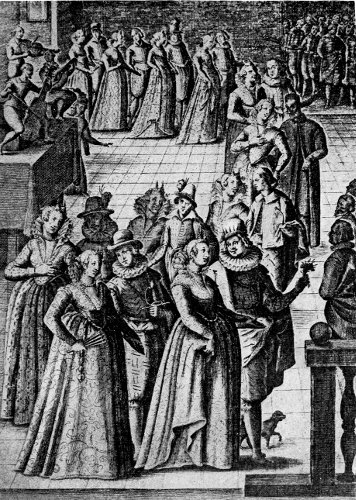
THE PROMENADE AT A COURT BALL.
FROM A PRINT. 1610.
“Habiti d’Huomini e Donne.”—G. Franco.
Venice became a vast pleasure fair,—all kinds of vulgar excesses were tolerated, and incentives to abstention from politics were scattered broadcast, in the form of constant panderings to popular fancy. [119]Shooting-butts were set up in the piazzas, and boxing and general pugilistic encounters were established upon the bridges. These latter sports took fast hold upon the people’s taste, and resulted in pitched battles between champions of the various sestieri. The Ponte di San Barnaba was the favourite “coign of battle,” or as it came to be called “Ponte de’ Pugni”—“Bridge of Fisticuffs!” At Carnival and on Public Holidays the whole city forgathered to applaud those who held the Bridge, and to deride those who toppled over into the water. Combatants usually ranged themselves under two flags—the red of the “Castellani” and the black of the “Nicolotti.” Their rivalries were fierce and entered into their daily lives, where lie met lie and boast foiled boast. “Reds” mocked “Blacks” and vice versa:—
Regattas were ever popular and Doge Gradenigo and Dogaressa Tommasina emulated the far-off example of Doge Domenigo and Dogaressa Teodora Selvo by presiding at the contests and personally distributing the prizes. The first prize was a crimson silk purse full of gold ducats; the second, green full of silver coins; the third, blue filled with coppers; the fourth, yellow and empty, but with the addition of a model of a little black pig! Whilst Padua had its Passion Plays and Fruili its Religious Masks, Venice, under the Gradenigo Doges, had no such pious orgies: Venetians loved the drama and[120] the ballad—the mysteries and the passions of actual life. Dancing in the piazzas, and serenades upon the Grand Canal—such were their manners.
We gather very little of the Dogaressa Tommasina from the history of her husband’s dogado: Some say she died in 1300, and that the Doge married, in the following year, Donna Agnese, the daughter of Pietro Zantani—“a woman of the people”—who survived him, and dying, left her personal property to her only son Pietro. Another woman’s name is associated with that of the Doge, one Sabba Minotti, but who and what she was we do not know. Domestic morality under Pietro Gradenigo did not attain a very distinctively high mark!
At the close of the thirteenth century, and throughout the whole of the fourteenth, Venice was agitated by revolutionary projects. The year 1300 was marked by the conspiracy of Marco Bocconio, a man of great wealth with a great following of suborned adherents. He aimed at the deposition of Doge Pietro Gradenigo and the substitution of himself as Supreme Lord of Venice. Bocconio and ten of his principal supporters were hanged between the two marble columns of evil augury upon the Piazzetta.
The conspiracy of Marco Quirino and Baiamonte Tiepolo was a more serious affair, and the ancient families of the Badoeri, Barozzi and Dori and many others, were implicated. Pietro Gradenigo was again the obstacle in the way of the conspirators, he appeared to have attained to such a measure of personal pre-eminence that nothing less than his head could save the situation. Never before in all[121] her history had Venice witnessed such a spectacle of personal ambition and personal animosity. Marco Quirino,—the father-in-law of Baiamonte Tiepolo, aimed at the absolute Lordship, with its devolution upon his second in command. They were possessed of immense resources, and had large retinues of highly-trained servants and well-drilled slaves. Baiamonte appealed to the populace in his character of “Il gran Cavaliere” by which title he was known and respected. The Doge, with a firmness of the hard man that he was,—he was in truth “Un’Atila”—“a merciless man,”—crushed the rebellion. Marco Quirino was beheaded and his mansion, on the Grand Canal, turned into a shambles, and Baiamonte Tiepolo exiled with the confiscation of all his property.
There is a story in connection with the Quirino-Tiepolo rising which is quite worth while the telling. Baiamonte Tiepolo, at the head of his armed mercenaries, was passing noisily along the Merceria, on his way to the Ducal Palace, when suddenly the lattice of a window was thrown back and a woman looked out,—an action unwarrantable and criminal. Without a moment’s hesitation she seized the heavy stone pan, full of growing red carnations, and dropped it upon the head of the standard-bearer! The confusion which followed the fall of their leader’s banner gave the Doge’s men the chance of a decisive charge, and the rebels were driven back. Giustina Rossi, such was her name, was taken before his Serenity, publicly thanked, and offered a handsome reward. However she declined every proposal but at length she said she would accept two favours:—“that she might hang out of her[122] window a banner of San Marco upon the anniversary of St Vito’s day; and that her rent should never be raised beyond fifteen gold ducats a year.” Both requests were at once granted, and the “Casa Giustina” as it was called, just beyond the Arco del Cappello, was ever after a landmark in Venice. A white stone on the pavement still marks the spot, and a bust of the heroine Giustina was placed near the arch in 1841.
Little more can be recorded of “Proud Peter.” That he raised the position of Doge to the highest point cannot be doubted, and his treaties with European States,—England included,—caused his fame to resound far and wide. His death was somewhat inglorious, he had gained no man’s goodwill and no one mourned for him. The usual burial rites of Doges were not accorded him, but privately his remains were removed to the island of Murano, and secretly buried in the vaults of San Cipriano:—it was in the winter of 1310.
One of the sweetest stories of old Venice is that of “La Beattina” or “Beata.” In the Campo San Vio (Vito), close to the Palazzo Loredan, there was, in the thirteenth century, a notable casa, where resided Count Pier Nicolo Tagliapietra, a soldier of fortune in the service of the Republic, and ennobled by the Emperor. One bright sunny day in June, in the year 1289,—when Pietro Gradenigo was Doge,—the Countess Elena presented her husband with a lovely baby girl—as delicate as a daisy, as lovely as a lily. No name was found for the child more suitable than “Maria Beata”; and, as she grew, the beauty of her little person was matched by the sweetness of her disposition. “A little saint[123] come to earth,” was she called. Like all the mothers of Venice Countess Elena was as devout in her religious duties as she was devoted to her husband and her child. Daily she was one of the foremost at Mass and Vespers, and, as soon as little Beata could toddle across the riva she accompanied her good mother in her visits to the church of her choice, San Maurizio, across the Grand Canal.
There were no gondolas in those days so little Beata made friends with the barca men at the landing-place, any one of whom would ferry the little Countess to the other side as often as she willed. After a time the Count became uneasy at his daughter’s marked predilection for Church and Convent,—he had in his mind a favourable marriage scheme;—for girls were betrothed often as not whilst barely in their teens. Beata would not listen to his proposals, and moreover disobeyed his prohibition of her devotional exercises. The only way to check his daughter’s visits to San Maurizio was to bribe the boatmen not to ferry her across. A day came when, in spite of the girl’s startled entreaties, not a man of them would do her service,—almost with tears they refused her request. So Beata knelt upon the rough pavement of the riva, and, holding up her hands to Heaven, she begged Saint Mary and Saint Maurice both to help her in her trouble. Then, approaching the canal side, she untied her pinafore, and, in sight of her admirers, she spread it out upon the water, and stepped gently upon it. It bore her weight and, wonder of wonders, began to move her from her supporting boat-pile, and, wafted by a gentle[124] breeze, La Beata was soon at the other side of the canal!
Dumbfounded the boatmen and the riva loungers stood gazing at the wondrous scene, and then, with one accord all shouted “Uno miracolo! Uno Miracolo!” The news was carried over the Campo, right down each riva and calle, until all Venice knew that they possessed another Saint,—a holy virgin, a new companion for their beloved Santa Giustina.
Whatever might have been Count Tagliapietra’s plan for Beata’s betrothal mattered little, for every eligible youth in Venice promptly made an offer for her hand; but no suitor received encouragement, for “La Beata” professed herself a “Bride of Christ,”—the bride of none beside,—the convent cell should be her marriage bed, the altar her cassone,—so resolved she prayed most earnestly for death; life had no charms for her.
A merciful Providence, perhaps, granted the child-saint’s request, for, from no apparent cause, save only her earnest wish, she surrendered her young beauteous life on the eve of All Saints’ in 1308—it was in her one-and-twentieth year. All Venice followed “La Beata” to her burial at San Vito with tears of joy and words of sorrow. Never since the strict sumptuary laws were passed did so many wax candles illuminate church and casa. Everybody burned one to the young saint’s honour, and then her sepulchre became a shrine,—a place for special prayer, a rendezvous for pilgrims. Annually the Doge and Dogaressa with their official household made a State visit to San Vito and left their offerings at “La Beata’s” altar. Strangest[125] of all strange devotions,—a custom sprang up in Venice, “the City of Saints,” on All Saints’ Day. “La Beata’s” coffin was uncovered, and mothers came from far and near to lay their new-born babes upon the saintly bones—a certain preventive from drowning! The devotion to Santa Beata became so absorbing that at last, to avoid scandals, it was decided by the Ecclesiastical authorities to seal her tomb and forbid her votaries. Nevertheless from that time to this the church of St Vito is thronged at the yearly festival of All Saints with mothers and their young children who have learned from them the story and the virtues of “the sweetest of the Saints of Venice.”
[126]
“A Galley full of demons” is by no means an inapt title for the fourteenth century in Venice! The legend of “Il Pescatore e l’Anello” is as well-known as any of the stories in the boudoir of the “Queen of the Adriatic,” moreover, in a strangely weird and prophetic way, it epitomises the storm and calm of the new century’s course from start to finish.
“An old boatman, caught in the raging flood of February the twenty-fifth, in the year 1340,—when all Venice was three feet under water,—and hardly making St Mark’s quay, with his frail craft, was told by a haughty stranger to ferry him across the wild waves to San Giorgio Maggiore. There, another passenger joined the pair, and the timorous gondolier was directed to make for San Niccolo di Lido. ‘Row boldly and thou shalt be well rewarded’ was the order. At the Lido another stranger came on board, and the oarsman was commanded to push his boat out into the open sea. The ocean churned in fury, and, out of the fume, the affrighted boatman beheld a huge galley bearing down upon his barca; it was full of mad demons! But lo, at the sign of the Cross the awesome vessel vanished, and the tumultuous elements became still. Back to Venice rowed the old man, and demanded his due. ‘Go to the Procurator, he shall pay thee[127] for me,’ replied the stranger. ‘Who art thou?’ asked the man,—‘I am Saint Mark, and my companions are Saint George and Saint Nicholas,—take this ring and give it to the Doge.’”
Andrea Dandolo was the Procurator and Bartolommeo Gradenigo the Doge, Paris Bordone and Palma Vecchio painted the legend and their pictures hang in the Accademia.
The new century saw the demise of the first political Doge of Venice—Pietro Gradenigo, and his successor was not sought among men of like sympathies,—the electors were afraid. Meeting after meeting was held, apparently in vain, no noble appeared willing to accept, or eligible for, the vacant dignity. At last, one day, standing at an open window of the Ducal Palace, which gave upon the Piazza, some weary nobles of the Council discerned an old man hobbling upon his stick and bearing a basket filled with loaves of bread, he was Messir Marino Zorzi or Giorgio.
“That’s our Doge!” they cried together, and so it came to pass that the vacant dogado went to a man unknown in political and warlike circles but very highly esteemed for his philanthropy. He was in fact, at that very moment on his way to the Hospital of San Domenigo for destitute children, which he had recently founded. His fame for charity was so widely spread, that he had gained the popular title of “Zorzi il Santo.” He and his Consort, Madonna Agnese, were greatly interested in the prosperity of the silk industry in Venice, and when the people of Lucca fled from the troops of the Condottiere Castruccio Castracane, thirty families of spinners and weavers of silken tissue were welcomed[128] by the Doge and Dogaressa, and, by their influence, housed in the Calle della Bissa, near the church of San Giovanni Crisostomo, in the very centre of the silk quarter of the city. By Dogaressa Agnese’s intervention Lucca silk-masters were appointed to train apprentices and generally to superintend the production of silk fabrics in the workshops of the Venetian “Fragilia.”
“Zorzi il Santo” and his Consort reigned but one brief year, and then once again the electors had to find a new Head of the State. Almost unanimously Messir Giovanni Soranzo was chosen, who, although turned seventy years of age, was one of the most active men of the day. Among his exploits were the command of a victorious fleet against Genoa, the capture of Jaffa and the Syrian littoral, the humiliation of Padua, the re-conquest of Dalmatia, and the reconciliation of Venice to the Papal See. Under his patronage, and that of Dogaressa Franchesina, the silk industry flourished exceedingly and Oriental brocades and tissues were driven out of the market. The glass-workers of Murano reached the zenith of their fame, and no more mirrors from Germany and hanging-lamps from Greece were imported. The Arsenal was greatly extended, and was made capable of maintaining fully equipped at least 40,000 men. For the poor man too Doge Soranzo’s rule was fortunate, for a silver ducat could purchase enough food, and wine, and fuel, for himself and his family for a week.
The Doge was a wealthy man, and indeed he had need to be, for in his time ambassadors from every civilised State took up their residence in[129] Venice. Foreign princes also came to make their bows to the Head of the Serene Republic. There was much entertaining and much expense. Dogaressa Franchesina was in all but name, “Queen of Venice”; her toilet, her boudoir, her receptions were modish, tasteful, and splendid. The Soranzi were one of the eight considerable families, who, in the tenth century, were classed with the “Apostolic” twelve and “Evangelistic” four, in the first grade of Venetian nobility. Their palace was one of the grandest in Venice and it was full of costly treasures; it was even said that the table-service of the Doge and Dogaressa was of gold and silver-gilt, whilst the most lustrous glass of Murano glittered in every room.
Although Doge Soranzo’s public life was so successful and so popular,—in private, his heart, and that of the Dogaressa were broken by anxiety and sorrow,—thus evenly are mundane affairs balanced. The story of Donna Soranza, their dearly-loved daughter, is as sad as sad can be. Married to Niccolo, eldest son of Marco Quirino, the leader of the Quirini-Tiepolo conspiracy, he was exiled with his wife, the very day his father’s head fell to the executioner’s axe. They made their home at Zara, but Messir Niccolo survived his expatriation but four years, when he too fell, stabbed by an unknown hand. The widowed Madonna sought to return to Venice and to her father’s home, but her appeals were all in vain; Doge Soranzo, like another Brutus, treated his daughter’s pleas with quite uncalled-for severity. At last she determined to throw herself upon the mercy of the Council of Forty, and taking her way[130] hopefully, she presented herself dutifully to her father and mother.
That was a mournful home-coming, and mother and daughter, clasped in each other’s arms, resisted the austere ruling of the Doge, who had informed the Council of his daughter’s return. In spite of all good Dogaressa Franchesina could say or do her unhappy child was torn from her embrace and condemned to perpetual exclusion in the Convent of Santa Maria delle Vergine. Gentlewomen of Madonna Soranza Quirini’s position were styled “Canonesses,” and each had her own little casa and a domestic servant, who was allowed to go out washing, and was permitted to make purchases for her mistress, and even to convey messages to her friends. The poor ladies were not suffered even to visit each other, and they could only take exercise in the Convent garden at rare and stated intervals.
Every year the Doge paid a ceremonial visit to the Convent, where he was received with great honour by the Abbess and the superior Canonesses, who were all arrayed in magnificent white silk-brocade robes, and each wore two veils,—one black and one white,—signifying that though in the world they were not of it. The Abbess handed the Doge a bouquet of sweet flowers in a golden jewelled holder, and he bestowed in return caskets of sweetmeats upon the devout recluses. Never once did father and daughter meet; she yearned to embrace him and her mother, but he never even made enquiries about her: she was dead to the world, to the family, and to him,—a Spartan father’s discipline! Letters and messages were all in vain;[131] unhappy Madonna Soranza’s only consolation was the companionship of another Quirino widow,—Andreola,—who remained a very short time in the Convent, for a suitor appeared, in the person of Angelo Bembo, and he was permitted to remove his innamorata to the Convent of Santa Maria di Valverde, upon the island of Mazzorbo, where they were married.
Alas! poor Madonna Soranza had no such fortune, but she pined and pined in her solitude, and, after twenty-five years of suffering, she laid her down and died—twenty years after the death of her stern father. Certainly an edict, passed in 1313, sentenced the wives of rebels and outlaws, with their children, to perpetual exile: and they were warned that unsanctioned return to Venice would be visited with perpetual confinement. Undoubtedly this proved the rule, as sententious writers have noted:—The sternness of justice is superior to the tenderness of affection.
Nevertheless to the practical historian Giovanni Soranzo ranks as the sixth “Grand” Doge of Venice. His was a majestic burial—in State he lay at SS. Giovanni e Paolo, watched by the sorrowing Dogaressa and her ladies of honour. His very simple tomb in the Soranzo Chapel at San Marco is eloquent of splendid public work simply done. The State purchased his gorgeous table-service of gold, and much of the furniture of his palace for use at Court functions. Of Dogaressa Franchesina we hear no more: perhaps she joined her unhappy daughter, and when she died, perhaps she was interred in her husband’s tomb. Very striking, in the story of the Dogaressas[132] of Venice, are the silence and the secrecy which shrouded each Ducal lady’s latter days: as a rule they survived their Consorts—some entered convents and some retained their homes,—but their glory departed like that of the tropical sun which leaves no twilight.
Francesco Dandolo succeeded to the Dogeship: he was the great-grandson of Messir Andrea Dandolo, who died in 1153, brother of the “Grand” Doge Arrigo. His election was very popular, for his ancestry and his own achievements were both famous. He was the third Dandolo Doge, an honour never attained by any family in Venice since the ancient times of the Particepazio, the Candiani, the Orseoli and the Michieli. Borne to his investiture upon the shoulders of stalwart craftsmen, he called a halt at San Marco, and there he knelt in silent prayer where his great-great uncle, the “Grand” Doge Arrigo Dandolo, had knelt one hundred years or more before. Then, standing in the choir, he was invested with the regalia of his high office. Grasping the great banner of San Marco, handed to him by the Patriarch he marched at the head of the huge procession to the Ducal Palace. Mounting the grand staircase he bared his head, and, holding up his hands on high, subscribed the oath and received the Corno. It was the first Ducal bonnet to be provided by the State: hitherto the Abbess of San Zaccaria had held that prerogative. With the new Corno was also a smaller horned head-dress for the Dogaressa.
It seemed as though Madonna Elisabetta would enter upon a less trammelled position, and obtain[133] a larger measure of official recognition than had been the lot of her predecessors. Later developments confirmed this idea as we shall see. Immediately after the installation of the Doge the customary lordly deputation went off to the Dandolo Mansion. It was noteworthy that at the head of the noble Lords was, for the first time, the imposing figure of the High Chancellor, a dignitary second only to the Doge, and it was he who addressed her Serenity:—“We have come,” he said, “to congratulate the Dogaressa of Venice upon the election of her noble Consort as our Doge, and to request the honour of your Serenity’s adhesion to certain provisions of the new Promissione.”
Dogaressa Elisabetta notified her pleasure at the compliment, which was paid her, and her acceptance of the conventions of her new dignity. Moreover she presented to each of the noble Lords a magnificently embroidered silk purse containing ten golden ducats, in recognition of their courtesy and as a pledge of her favour. This was a notable victory for the Dogaressa who, whilst under the old Promissioni, was debarred from giving and receiving presents of any kind. What had brought about this change in the policy of the Council no one has recorded. Was it due to the awakening consciences of the nobles who, perhaps, now saw the meanness and unworthiness of the restrictions imposed upon the Head of the State and his Consort by former enactments? Or was it due to the worthy records created by the latest holders of the Dogaressaship in their manifestations of the advance of gracious womanhood? Who shall say?
[134]
A further step in the honour rendered to the new Dogaressa was, that, instead of the somewhat impromptu and tumultuous escort of the members of the “Fragilie” to conduct her Serenity at once to the Ducal Palace, a delay of seven days was ordered before her public recognition. Then the great state barge “Bucintoro” was manned and decorated as for the annual “Marriage of the Adriatic,” and steered right up to the steps of the Dogaressa’s residence, whence she was conducted on board with great circumstance and pomp. Clad in full robes of State but bare-headed,—her hair like that of a young bride, rippling around her shoulders,—Dogaressa Elisabetta was attended by a graceful suite of gentildonne, all dressed in festal white with floral wreaths and bouquets. Escorted, not by companies of craftsmen on foot, but by a fleet of bregantine,—each vessel splendidly decorated, and bearing the banner of its “Fragilia” with the Masters and officials of the Craft in full regalia,—the water-pageant started upon its course to the Piazzetta. Passing under the glorious arch of the Ponte di Rialto, crowded with sympathetic and admiring citizens, with difficulty it steered its course amid hundreds of barcas and gondolas filled with cheering holiday-makers all in the very best of good-humour.
Arrived at the Piazzetta her Serenity and her following were conducted, not as usual to the Ducal Palace, but into the Basilica, where she knelt in prayer, whilst the Patriarch blessed her as he had the Doge: then she laid an offering upon the high altar—a purse of crimson silk-brocade containing ten gold ducats. From San Marco she was attended[135] by a company of nobles, one holding over her head the Ducal umbrella, to the Sala de’ Signori di Notte, within the Ducal Palace, passing through the Sala del Consiglio Maggiore—the greatest and most splendid hall in Venice, where the painter Guariento was already busy with his famous frescoes,—and there she finds the Doge seated and crowned upon his throne. Descending the steps of the dais, her Consort takes her by the hand, and places her in the Dogaressa’s Chair of State under the Ducal canopy. The Chancellor tenders the solemn oath and the Dogaressa swears to maintain certain clauses of the “Promissione;” then, in the name of the assembled noble Lords, he places upon her bared head the miniature Corno, which the State had newly provided; and, lastly, the nobles offer their congratulations and their homage.
Stately ceremony, ever wearying by its formalities, gives way to social hospitality, and, as by custom bound, Dogaressa Elisabetta issues invitations to all the Masters of Crafts and their officials to sup with her in her private apartments. Meanwhile the busy hands of her serving-maids have arranged the flowing locks of the Dogaressa’s hair, and have added a new feature to her State head-dress,—a delicate coif or veil of the finest embroidered cambric. It was a very necessary adjunct, for, when the jewelled Corno was removed, the dignity of a covered head remained,—besides it was a most becoming mode. Thus with unwonted pomp, and amid universal approbation Doge Francesco Dandolo and Dogaressa Elisabetta were hailed almost as King and Queen of Venice. Right royally they maintained their high station, for daily[136] they made progresses to different parts of the city or to the more distant islands, in support of local charities or local interests; and everywhere they were acclaimed by sympathetic crowds of citizens and craftsmen.
The austere rule and the haughty personality of Doge Giovanni Soranzo were things of the past, and the sad lot of unhappy widowed Madonna Soranza Quirino was forgotten. Men and women were only too thankful for the auspicious conditions under which they found themselves,—care gave place to joy,—unrest to revelry. One outcome of the better state of things,—and it was a very unexpected and withal amazing,—was an innovation with respect to the “Feste delle Marie”—the annual marriage of the “Brides of Venice” at San Pietro di Castello. The ancient marriage rites,—which we have already noted,—had been gradually modified, until there were scarcely any rites at all. In the year of Dogaressa Elisabetta Dandolo’s Coronation, upon the natal Feast of San Marco, a quaint marriage pageant was provided, and, instead of twelve or more beauteous damsels in nuptial attire glittering through Venice calle and canale to the marriage altar, twelve lay figures were substituted. Dressed in bridal garb these dolls,—borne through crowds of uproarious citizens,—were greeted up and down and everywhere with derision as “Marie di tola e di legno!”—“Brides of stuff and wood!”
Alas for the permanence of things human! The larger liberty granted by the Promissione to Doge and Dogaressa Francesco Dandolo in matters social and sartorial, was curtailed considerably after five years of general exuberance, and in 1334 fresh[137] sumptuary laws were enacted. Gentlewomen were not to wear trains at Court, or at home, or on Piazza. Jewelled girdles, above the value of twenty gold ducats, were forbidden. Gold and silver rouge jars and scarcelle, or handbags, with jewels and gold filigree work, were no longer to be used. No gentlewoman was to possess more than two capes of ermine and only one big cloak lined with taffetas. Pearls, on the shoes, were disallowed, and the wearing of peacocks’ feathers. The value of a bridal trousseau was not to exceed five hundred ducats, whilst the bridal dress itself was not to cost more than two hundred ducats—a very liberal allowance as things went! The bride however was not permitted any robes of cloth of gold nor ermine linings. Boys, under twelve could not wear gold or silver ornaments, pearls, velvet, or fur: over twelve and up to twenty-five, youths and young men were forbidden to wear belts and scarcelle exceeding twenty-five ducats in value. All were to wear a strip of blue cloth hanging from the shoulder to the feet, which they rolled up, and then threw over the left arm: “Calar Stola” it was called.
The dogado of Francesco Dandolo lasted ten years,—a period of prosperity for Venice,—and much of it was due to the wise and tactful conduct of the Doge. If he may not be reckoned a “Grand Doge,”—although Ruskin calls him so in the “Stones of Venice,”—it is perhaps because, as a Dandolo, he was overshadowed by the stronger personality of his relative and successor Doge Andrea Dandolo, whose times were far more stirring and presented greater opportunities for distinction. On the other hand Elisabetta was a[138] “Grand Dogaressa”—one of the few who rose to high station and maintained it with distinction.
Both Doge and Dogaressa were patrons of the new-born Fine Arts, for, in addition to the fresco painter Guariento, Giacomo del Fiore, Lorenzo Veneziano, and others were painting altar-pieces and anconas in the earliest Venetian studios—a hundred years or more before the brothers Vivarini founded the School of Murano. In the Sacristy of the church of Santa Maria della Salute is a picture by an anonymous Venetian painter, representing the presentation, by their patron Saints, of Doge Francesco Dandolo and Dogaressa Elisabetta upon their knees, to the Madonna and Bambino. The picture is dated 1338, and is one of the very earliest paintings of the great School of Venice. Originally this notable painting was placed over the tomb of Doge Francesco Dandolo and Dogaressa Elisabetta in the Chapter-House of the church of the Frari. The sarcophagus also has been removed, and now it is in the cloisters of the Seminario Patriarchale. The year of the Doge’s death we know, 1339, but there is no record of that of Dogaressa Elisabetta.
Andrea Dandolo (1342–1384) was the fourth and last Doge of his family. It is not a little remarkable, that in the History of Venice, the families which gave several Doges, up to the end of the fourteenth century, did so within severally restricted periods:—for example, the seven Partecipazi Doges held office between the years 827–942, the five [139]Candiani 886–977, the three Orseoli 976–1009, the three Michieli 1096–1172, the four Dandoli 1192–1354 and the three Gradenighi 1283–1356. It would seem as though the “Apostolic” families came to honour and power, and swayed the destinies of the Republic, and then, in some mysterious manner, declined, fell away, and the Ducal Throne knew them no more.
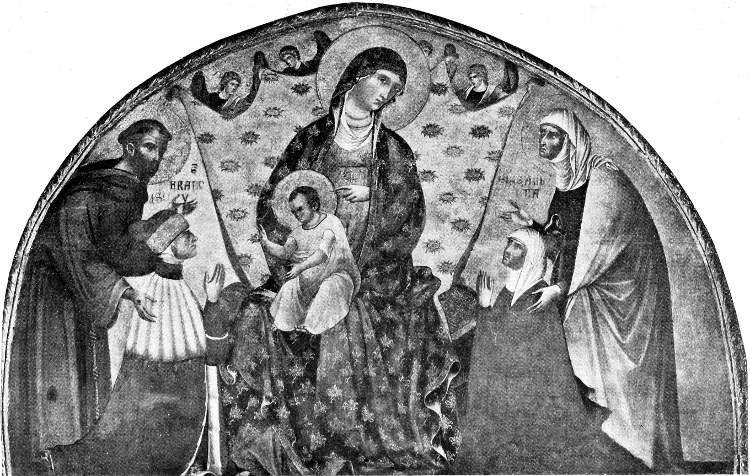
DOGE FRANCESCO DANDOLO AND DOGARESSA ELISABETTA.
STEFANO DA VENEZIA. 1340.
SACRISTY. SANTA MARIA DEL SALUTE, VENICE.
Doge Andrea was the son of Messir Fantino Dandolo who was descended from Marco Dandolo Procurator of San Marco in 1161, and first cousin of the “Grand” Doge Arrigo. The first Venetian noble to study at Padua and obtain the Doctor’s degree there, Andrea Dandolo was, from his boyhood, studious and reserved. He served the State in many public offices, a member of the Council of Ten, in 1340 he was called to the important position of Procurator of San Marco.
Upon his election as Doge in 1342 an edict was issued barring his three sons, Fantino, Lionardo and Pietro, when grown, from holding public office during their father’s dogado. As to who was their mother no chronicler has apparently recorded, and this is astonishing, seeing that Andrea Dandolo’s “Cronaca” is one of the fullest and most reliable of all Venetian annals, and deals exhaustively with his own family affairs. Consequently we must make the most of the romance of Madonna Isabella de’ Fieschi, the Consort of Luchino Visconti, Lord of Milan.
This fascinating Princess visited Venice attracted by the fame of the young Doge,—he was only thirty-five years old when elected to the Ducal Throne,—for his sobriquet all through Lombardy[140] and the Marches was “Count of Courtesy.” He was tall, well-built, and handsome, a poetaster, a man of letters, perhaps a genius, the most accomplished nobleman in Venice. Fair Isabella had, as all women have, her own ideas of love and witchery, and she was not too conscientious in her duty to her husband: he was a man of boorish manners, and there was no love lost between them. Gifted too in many ways, she conceived a violent passion for Doge Dandolo which he returned in a dreamy sort of way. Anyhow, she soon became leader of the Venetian Court, as well as mistress of the Doge. Alas! bewitching Isabella’s intimacy and influence were cut short by a terrible outbreak of the Black Death, which claimed very many noble victims and Isabella de’ Fieschi among them.
Between 1344 and 1346 it was estimated that sixty noble families were absolutely exterminated, whilst the Council of Forty was reduced to less than twenty. The only preventive, and it was only partially successful that the Guild of the Physicians could prescribe, was a concoction of aromatic herbs, amber, and ivy berries—“Teriaca” it was called. The Government guaranteed this panacea, which everyone was ordered to take—it was procurable at the Speziale della Testa d’Oro by the Rialto bridge. It was an ancient Greek remedy revived, and one may purchase it to-day at the still existent “Golden Head.”
Venice was depopulated and families from outlying islands near the mainland were welcomed by the Government, and granted privileges on settlement. This sensible move was due to the Doge’s advocacy: he had in view the advantages of introducing[141] new blood into the veins of the population enervated by prosperity and weakened by epidemic. Earthquakes and famine followed relentlessly upon the heels of the pestilence, and great distress and reckless outrage were added to the evil lot of the Venetians.
The Doge alone kept calm and resourceful—master of the situation, whilst men were losing their heads and women their minds; but the anxieties, sufferings, and fatigues of the years of visitation preyed greatly upon his highly-strung and sympathetic temperament, and he died almost suddenly and, quite alone when no more than fifty years of age.
Andrea Dandolo is renowned as the eighth “Grand” Duke of Venice, by reason of his remarkable personal qualities, and of his noble devotion to the Republic. He was buried in the Baptistery of San Marco, the last Doge to be there interred, and Francesco Petrarch wrote his epitaph:—“He earned such glory and honour as no other Venetian Doge did before him!” One very pleasant episode in his career was his intimacy with Petrarch. After the decisive Chioggian war with Genoa, when the “Queen of the Adriatic” subdued the “Queen of the Mediterranean,”—Francesco Petrarch was sent, as one of an embassy from Milan, to seek mitigation of the Venetian terms of peace. The mission was unsuccessful, but the “Grand” Doge and the “Great” Poet became fast friends and constant correspondents.
Ruskin, in his “Stones of Venice,” writes thus of the Baptistery and of Andrea Dandolo’s tomb:—“We are in a low vaulted room ... in the centre[142] a bronze font ... and a small figure of the Baptist ... a single ray of light falls from a window ... the only thing it strikes brightly is a tomb, and it rests upon the sleeper’s face for ever, a man of middle life, but there are two deep furrows right across the forehead, the features are small and delicate, the lips sharp ... and there is a sweet smile upon them. It is Doge Andrea Dandolo, a man early great among the great of Venice, and early lost ... he died, leaving behind him that History to which we owe half of what we know of the former fortunes of Venice.”
The mosaics in the Baptistery show the Doge kneeling in devout prayer, but, alas, no Dogaressa keeps him company.
The Conspiracy of Marino Falier or Faliero, like its predecessors, under the leadership respectively of Marco Bocconio and of Marco Quirino and Baiamonte Tiepolo, in aim and animus, was very unlike in means and methods. They tried to grasp the supreme magistracy from the aristocratic standpoint. Falier, although an “aristocrat of aristocrats,” sought the suffrages of the democracy to make him Over-Lord of Venice. Head of one of the noblest and most ancient families, Marco or Marino Falier was born in the Casa Falier, upon the Rio de SS. Apostoli in the year 1280. The Falieri were one of the twelve “Apostolic” families at Eraclea in 697. The lad’s parents were Messir Vitale Falier and Madonna Beriola Loredan,—daughter of Messir Giovanni Loredan of San Canciano,—and he was destined for a commercial career but early he turned to politics.
Marino Falier held many important State[143] appointments, and, by his ability and disinterestedness, gained the confidence of his fellow-nobles and the citizens at large. His patriotism was unquestioned, for no one displayed greater enthusiasm in hunting down the adherents of the Quirino-Tiepolo conspiracy. When still under thirty he was admitted to the Council of Ten, and became ambassador, in turn, to the Duke of Austria, the Genoese Republic, and to the Emperor Charles V. Falier also held with distinction both naval and military commands. Upon his appointment as Podesta of Treviso he took the title of Count of Val di Morena. Francesco Petrarch, in his “Epistolæ,” speaks of Marino Falier’s wisdom and public spirit: “Ducatus honor non petat uno quidem ignaro sibi obliget.”
Falier was married twice. When a mere youth he wooed and won Donna Tommasina Contarini, his equal in rank, but as delicate as she was beautiful. Within a year she was torn from his embrace and carried away in the black chariot drawn by black oxen in the “Triumph of Death.” One sweet pledge of love fair Tommasina left her sorrowing young husband, but the relentless “Mower” reaped the baby girl, soon after her sweet mother’s death. Prostrated by this double bereavement Falier plunged into the vortex of politics, hoping thereby to heal his wounds. Time gave him consolation and revenge for when he was fifty-five he found himself once more a prisoner of the “Triumph of Love.”
Aluycia Gradenigo was a very fascinating woman,—a full-blown rose ready to be gathered by a gallant suitor. She was a daughter of Messir[144] Nicolo Gardenigo of San Maurizio and grandniece of Doge Pietro,—“Proud Peter.” In her veins ran the blood of Greek ancestors, who, driven out of Byzantium by the Emperor Emmanuel settled at Altino, in the seventh century. Falier was Podesta of Treviso at the time of his second marriage and Treviso was always the “Court of Beauty and of Love,”—the centre of the “Marca Amorosa.” Naturally, gay young fellows gathered there, many of them drawn from Venice, among them Pietro Bollani, Michele Molino, Rizzardo Marioni, Moretto Zorzi, Maffio Morosini, and the two brothers Giovanni and Michele Steno—“Giovinastri”—“Insolent Young Dogs,” were they nicknamed.
Madonna Aluycia Falier did not want for admirers, and, if Martino Sanudo, and other chroniclers, may be believed, she greatly encouraged their advances. She was a good deal younger than her husband, and cared little for his engrossing affairs of State, whilst, naturally, she sought consolation and companionship among those of her own age. Between Michele Steno and the Countess sprang up a warm attachment, and gossips have not been at pains to shield the young wife’s honour. Anyhow the Podesta got wind of the liaison and warned the hardy lover off. Steno was not the man to take his congé readily, and very soon he learned that directly lovely Aluycia was “off with the old love, she was on with the new!” He made up his mind to be revenged of the stern Podesta and his bewitching wife, so he left Treviso in dudgeon and went back to Venice to watch for his opportunity.
[145]
During the festivities which marked the election of Marino Falier to the Doge’s seat in 1354, was a Court Ball at the Ducal Palace, and Michele Steno was among the guests. He was greeted by the Doge and Dogaressa quite cordially, but all the same he chose to carry out his plan of humiliating them there. Pressing his attention upon one of Dogaressa Aluycia’s maids-of-honour he let fall a remark which concerned his previous relations with her Serenity. Greatly shocked, the Court lady repeated what she had heard to others at the Ball and presently it reached the Doge’s ear. The Doge beckoned him, and turning aside, insisted upon his leaving the assembly at once. Steno resisted, and was beginning to repeat his slander for all to hear when the Doge ordered his removal. Passing through the Throne-room of the Palace he scratched upon the marble Chair of Estate the following couplet:—
The Doge was furious. Steno was arrested and accused before the Council of his misdemeanour. His offence was as gross as gross could be and he fully deserved much more than he got;—a sound thrashing with a fox-tail,—a mark of ignominy,—a year of imprisonment, and a fine of one hundred gold ducats. This mild sentence troubled Doge Falier greatly: he looked for the death sentence at least, seeing that the offence was against the sacred person of the Doge, as well as against his Consort. He was quite conversant with the fact that the majority of the nobles were actuated by anything[146] but kindly feelings towards himself. No doubt they viewed his prominence, not alone as Doge but as the most able and ambitious man among them, with disquietude.
Marino Falier was quite in touch with the opinions of the wealthier citizens and members of the prosperous “Fragilie.” Of course the Crafts were under Dogaressa Aluycia’s special patronage, but he shared her interest in the prosperity of the industrial classes. If the nobles looked askance at his pretensions, could he not turn to the great democracy, and pose as the champion of their liberties! This was the policy which grew more and more upon him. Michele Steno’s affair passed over but it opened the Doge’s eyes to the peril of his position, and, to safeguard that was his first concern. He could not trust the nobles, could he trust the people?
Notwithstanding that the chivalrous discipline of the Crusades had enduring influence upon the sentiments and manners of every class in Venice, and especially upon the nobles, there remained, of course, beneath the outward marks of courtesy and good-breeding very much of the old Adam of insolence and profanity. Year by year young men and old frequented, in ever-increasing numbers, Church, Piazza and Palace with nothing in the world to do but to kill time and incidentally their own and others’ reputations.
Many of these idlers were out-of-elbow noblemen—“Barnabotti” they were dubbed in derision, as hangers-on to anybody with money or influence. Proud, dissolute, discontented, and ever ready for insult or injury, this ill-conditioned mob was a[147] menace to the peace and well-being of the Republic. Sometimes after more than usually prolonged devotions in the Temple of Bacchus, these good-for-nothings sallied forth to commit acts of vandalism in the city: at other times, their visitations to the Court of Venus fomented jealousies, which found vent only in deeds of personal violence against those they feared or hated.
One such outburst occurred only a few days after Michele Steno’s insult in the Palace. The Admiral of the Arsenal was Bertruccio Isarello, a man ambitious, unscrupulous, and intolerant to his subordinates. A very quarrelsome Condottiere del Mare, one Francesco Barbaro, considered himself wronged in some way by the Admiral, and, obtaining no satisfaction, he had the audacity to strike his chief in the Council Chamber! Admiral Isarello reported the circumstance to the Doge, and sought, through him, redress.
“How can I help you, remember,” replied Falier, “how grossly Michele Steno insulted me, and see how leniently the Forty treated him!” Then seeing that the Doge’s rancour was unabated and, knowing something of his Serenity’s sentiments with respect to the democracy, the Admiral exclaimed:—
“My Lord, why should we suffer these ‘Barnabotti’ and these ‘Bravi’ any longer. You, my Lord Doge, have a ready remedy, and I am prepared to aid you in punishing them and in humiliating some of our great lords, if you will confide in me and in my men of the Arsenal, who are your friends and mine.” This was the first step in the conspiracy of Marino Falier,[148] and he did not linger long before he stepped again.
Everything was ordered secretly, and the conspirators were ready for the summons of the Great Bell of San Marco on the morning of 15th April,—the usual official notice that a meeting of the Council demanded the immediate presence of the Forty. The Admiral’s instructions were to strike down every nobleman who obeyed the summons, and, in the confusion, to proclaim Falier Sovereign of Venice. There was however a traitor in the camp, one Beltramo a Bergamesque furrier, a client of Stefanello Trevisan the Doge’s stockbroker at Santa Margherita. This man gathered something of the existence of the plot, and forthwith made his way to one of his barber associates, a valet in the household of Messir Nicolo Lioni of San Stefano, a member of the Council, who informed his master. Without much ado the chief conspirators were arrested—some thirty to forty in number. When charged with being privy to the plot Doge Marino Falier tossed up his proud head, and laying his hand upon his sword-hilt exclaimed:—“Il Doxe nol seppe ingane!”—“The Doge never lies!”
The Doge had short shrift: he was allowed to make his will and his confession, but not to see his miserable wife Dogaressa Aluycia or any member of his family or household. Early upon the morrow of the detection of his conspiracy, the great bell of the Basilica, which had all but clanged forth the death-knell of the Lords of the Council gave forth the funeral peal as for the burial of a Doge. Arrayed in his State robes and wearing his Ducal Corno Marino Falier was led into the great Courtyard of[149] the Ducal Palace, and stepped forth to death bravely and contemptuously. His proud appeal for a hearing was refused, and then, stripped of his panoply of office, the old man knelt unresistingly upon the hard stones and bared his neck before the executioner. One swift blow sufficed and the gory grey-bearded head rolled to the feet of the chief of the Council, who picking it up in his arms, hurried into the loggia which gave upon the Piazza, and there, exposing his ghastly trophy to the excited multitude, cried out:—“Look!—all of you!—look!—Ripe justice hath been done to the arch-traitor!” Then he cast the foul thing from him into the middle of the Courtyard, where the populace thrust and fought to gaze at, revile, and dishonour the corpse of the old Doge whom they had so lately venerated and trusted. At dark the remains were gathered together and taken secretly in a covered barge, with eight big burning torches, and buried in the Faliero vault in the chapel of Madonna della Pace, within the great church of SS. Giovanni e Paolo.
We must now turn aside from this terrible tragedy, and contemplate a tragedy far more pathetic, the sad tragedy of Dogaressa Aluycia. The execution of the Doge involved the confiscation of his property, his palace, near the bridge of SS. Apostoli, with its marble columns, and a casa by the church of San Severo which had been built for Falier by the architect Calendario, and their valuable contents. Marino Falier and his Consort had been keen collectors of beautiful objects and antiques: in an Inventory of their treasures,—made by a priest, Giovanni, of the church of SS. Apostoli, in 1351, mention is made of the Camera rubea,—a[150] museum,—and of another apartment, filled with objects of art,—collected by the famous explorer Marco Polo during his travels.
The unhappy Dogaressa was dispossessed of all her Consort had left her and ordered to vacate her home and go where she would. In one swift moment plunged from the lofty height of the Ducal Throne into the abyss of ignominy, she was reduced to absolute poverty and became the mark of every evil tongue, an object of aversion and suspicion. Prostrated by her bitter woe she besought Heaven to let her die,—madness was the only alternative,—she sought comfort and release but both were denied her. Her mind became a blank, her reason tottered, and when at length two lifelong friends dared, at the risk of their own lives, to penetrate her hiding-place, Messiri Giorgio Giustiniani and Niccolo Contarini, they found her a raving lunatic.
By permission of the Council Dogaressa Aluycia was placed in the Convent of San Lorenzo on the fondamento of San Severo, where she received a small gold brooch and some other trifling mementos of her husband. After a while she was moved to Verona where she had property and friends, but the change wrought no relief and sorrowfully she was sent back to Venice, where she ended her days in 1385, in a mad asylum, forgotten by the world, with no child or friend to mourn her, alone with God.
The conspiracy and execution of Doge Marino Falier shook the constitution of Venice to its deepest foundations. Suspicion and revenge lurked at every corner of church, palace, and piazza. Every man’s hand was upon his poignard, each[151] woman’s knee was bent in intercession, and the children ceased their games.
Venice was once more “Venezia Calva”—but “Venice naked” in shame, dismay, and tragedy.
Doges came and Doges went, and, with them, their Dogaressas: the last half of the fourteenth century saw seven Heads of the State. Their Consorts are named in the MS. Dolfin Gradenigo, in the Museo Civico, but about only three of them have the chroniclers given us much information. Calling to mind a quaint entry in the “Archivio Veneto” of the year 1288, which deprecates matrimony and woman’s influence as far as regards the Rulers of States, we may perhaps gather the subtle meaning of the excursus of Frate Paolino, a Minorite of Venice.
“Whilst a man” he writes, “ought to seek a wife tall and well-formed, that she may give him fine and comely children, he should, all the same, never be ruled by her advice, for a woman has not sound counsel, because she usually has not a strong constitution, and her mind is apt to yield to the infirmities of the body.” Be this as it may, we must look wider afield for circumstances which greatly altered the conditions of the dogado.
The middle of the fourteenth century was remarkable as a period of unusual political unrest and of unprecedented immorality. The great middle-class of Venetian citizens had not only gradually acquired wealth and influence, but they[152] were determined that the Government of the Republic should no longer rest exclusively in the hands of the nobles. The City was agitated with measures against the aristocracy, which were greatly strengthened by the consequences attending the execution of Doge Marino Falier. The dreaded revolution was however averted and the new Doge, Giovanni Gradenigo, though a grandson of the aristocratic “Proud Peter,” was known to be a man of particularly suave and considerate character—“Il Nasone” he was called because of his bottle-nose. His Consort was Madonna Marina Cappello,—a lineal descendant of Andrea Cappello, the hero of the “Rape of the Brides of Venice” in Doge Pietro Candiano IV.’s time.
Amid all the political commotions, women came very much more into public life. Hitherto restrained by almost Oriental enactments they now began to throw off the conventions which so narrowly prescribed their position. The Senate and the domestic hearth were alike imperilled: women lost their modesty, and men their continence. Dress and manners yielded to the infatuation: women’s breasts were bared, and men’s hose became indecent. Delicate living and pleasure unrestrained changed the proverbial decorum of Venice. New ideas Platonic and otherwise were rife concerning the relations of the sexes. Venice was full of light women, not natives only, but frail beauties from beyond the lagunes, drawn thither by the fine figures and fat purses of the men. In the year 1360 the number of courtesans exceeded twelve thousand!
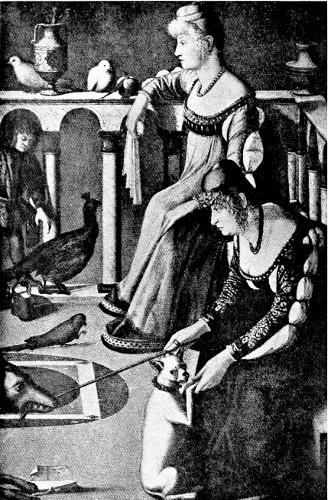
COURTESANS.
Vettore Carpaccio.
ACCADEMIA, VENICE.
The scandal was so glaring that the Government[153] of Doge Giovanni Delfino (1356–1361), issued an edict forbidding such women from occupying common lodging-houses, joining supper parties of men, and going about the city—except on Saturdays: at the same time they were required to reside within the sestiere of Castelletto, near the Ponte di Rialto. Very strict laws were passed by the Council of Forty for the preservation of morals; hanging was the punishment meted out to offenders. The story of Madonna Veneranda Porta, who lived in the second half of the century,—still recounted among the gondoliers,—is indicative of the state of society. She had an unsympathetic husband, and as a consequence, a lover, and he slew Messir Giorgio Porta. The lovers were arrested and condemned to suffer the extreme penalty of the law. Madonna Veneranda protested “that Venice had never yet hung a woman,—it would be too indecent,—and she would not be the first to be so punished.” “You shall hang,” replied the chief of the Council, “in a sack!”
Doge Giovanni Delfino, in 1357, founded an Hostel for Fallen Women—“redire ad penitentiam et contriciam”; and, he and his Consort,—whose name we do not even know,—established as many as seventeen receiving houses for children exposed in the byways and water-ways. His dogado was calamitous for Venice abroad as well as at home. “He was,” the historians tell us, “nevertheless, a true soldier, honourable and patriotic.” He died in 1361, his body was laid in State,—the first Doge so honoured,—in the Sala de’ Signori di Notte, and was buried at SS. Giovanni e Paolo,—where his sarcophagus, enriched with sculptures[154] has bas-reliefs of the Doge and Dogaressa kneeling at the feet of the enthroned Christ.
There were several candidates for the vacant Throne and much delay was experienced in the selection of the new Doge, but, whilst the electors hesitated, news came of a famous naval achievement of the Venetian fleet, under Lorenzo Celsi, “the Captain of the Gulf.” He was a brave man and the idol of the people, with no claims whatever to nobility of rank, possessed of only moderate means, and under fifty years of age. His name was shouted in the Piazza, and a vast concourse of craftsmen and gondoliers rushed pell-mell to the Ducal Palace, and demanded his election as Doge. The people’s caprice was for the nonce the nobles’ choice, and they bowed to the popular outcry.
The Dogaressa, Marchesina, daughter of Messir Girolamo Ghisi, a member of one of the rising families of merchant-craftsmen, with her maids of honour and an immense following set off to meet the sailor Doge on his return to Venice. Without precedent for any such demonstration, the “Bucintoro” was rowed out to sea, and signalled to the Lido the first sail of the approaching squadron. Once more a popular hero was borne shoulder-high into the Basilica, and in the Ducal Palace crowned “Doge of Venice and of her Dominions beyond the Sea,” so ran his title.
Lorenzo Celsi was prepared to be all things to all men and made endless promises of democratic reforms, such as the manner is of men not to the manner born. A man of splendid physique and brimful of ambitious ideas he determined not only[155] to make the most of his good fortune, but to render his dogado as magnificent as possible.
For his own protection he took very wise precautions: sailors were not quite the kind of guard he and his family required, so, very adroitly, as he thought, he enrolled scores and scores of lawless men of the city,—the “Bravi”—as a body-guard to deal with disagreeable persons. These men soon had the measure of the Doge, and assumed a demeanour which imperilled the personal safety of all against whom they had any grudge whether public or private. Meetings to mark persons for assassination were held secretly at the out-of-the-way laundry of a woman named Tommasina Gobba, who was, by the way, laundress to the Dogaressa. The worthy body turned Doge’s evidence, and the villains were disbanded, but the Doge came in for fierce aspersions and serious suspicions. It was easy to say that he instigated measures of violence, so as to safeguard himself and his position.
Very fortunately for Celsi’s vindication of his bona fides came the visit of Francesco Petrarch to Venice: “a place of peace and rest” he imagined it, but he found it “full of depravity and profanity.” A very amusing story is told of the poet’s treatment of an importunate visitor. The man would take no refusal, he sought alms and patronage. Failing to convince Petrarch he set to work to insult him with odious language,—“such as only Venetians used,”—whereupon the poet seized him by the throat and kicked him down the stairs!
Petrarch was treated royally by the Venetians, the Palazzo de Quattro Torri, on the Grand Canal, was assigned to him as his residence, and at Court[156] functions he was seated on the right hand of the Doge. The first of the pageants he beheld, was held in celebration of the Conquest of Candia,—where “the most comely youths in Christendom displayed their forms and prowess before the most beauteous maidens upon earth”: the splendid spectacles inspired his “Trionfi.”
No such brilliant tournament had ever been held in Venice: the Doge himself, superbly mounted, broke a lance with the Prince of Cyprus. The Poet, in an ecstasy of delight describes the Venetians as a “nation of sailors, horsemen, and beauties!” He says “the Dogaressa placed crowns of pure gold upon the victors’ heads, and clasped silver belts around their hips.”
Petrarch lived seven years in Venice (1361–1368). In 1364 he wrote to Giovanni Boccaccio:—“Come then to my call,” and the gay writer of the “Decamerone” spent three months in Venice. Before his departure Petrarch wrote to the Council of the Forty:—“I wish with the good will of my Saviour and of the Evangelist, to make St Mark the heir of my Library.” The bequest was gratefully accepted, but, alas, like many more such benefactions, nothing now remains but a few mouldy worm-eaten volumes.
[157]
Doge Lorenzo Celsi’s day of popularity went too the way of the world. Like all risen men he became autocratic and presumed upon the liberties and antecedents of the nobles, and they took their revenge. Upon the thirtieth of July 1365, the Council of Ten passed a resolution reflecting upon the Doge’s assumption of authority, and putting upon record that the status of the nobles was in jeopardy. The wording of the concluding sentence is quaint yet convincing:—“quia non est de neccessitate”—“because we have no further need of him!”
The Doge was deposed, being suspected of favouring a reform in the Government, which, whilst retaining the Ducal office, proposed to transfer the powers of the Councils of Nobles to a parliament representative of the citizens and craftsmen.
The circumstances attending the election of Doge Marco Corner, or Cornaro (1365–1367) are amusingly pathetic. He was a very old man, well over eighty years of age, and only remarkable for his uprightness, his studiousness, and his poverty. To be sure he came of an “Evangelistic” noble family,—equal in antiquity and distinction to the Giustiniani, the Bembi, and the Bragadini,—but this accident of birth was neither a ground for boasting nor an incentive to ambition. The electors doubtless turned to him as being a simple-minded man, and one who would not follow his predecessor in affectation of lordly superiority. When the choice was made public very many people, in every class cavilled at the selection:—“Surely there were more distinguished candidates for the[158] Supreme Office, at all events some who were less homely in their surroundings,” they said; and they poked fun at old Corner’s lack of means and at his old wife’s dowdy ways.
Dogaressa Caterina was an unaffected simple-hearted, domesticated woman, with no claim to nobility or social distinction of any kind, but a very worthy helpmeet to her spouse. Idle tongues wagged about her and her ways and made fun of her little economies. The Doge bridled up at the disparaging remarks, and, with dignity, rebuked the scoffers. “My old wife,” he said, “is so good and so virtuous, that she has always been respected by all the women of Venice quite as highly as if she had come of one of the most distinguished families!” Some busybody had seen the Madonna Caterina, quite lately, busy turning an old stuff dress that she might wear it a little longer, and the gossip went round the Palaces. Marco Corner met the sneer in a characteristic manner. “Well, what of that?” he asked, “there are many noble lords and worthy citizens in Venice, who would be only too thankful for such a useful wife as mine. She is a good woman, and I will thank you to let her alone.”
Certainly Dogaressa Caterina Corner was not born in the purple nor had she any taste for ceremonial: we do not read of any imposing procession of Guilds setting forth to conduct her to the Ducal Palace for her coronation. The probability is that, with shrewd commonsense and no great display of dress or jewels, she quietly took her place beside her husband, bent on doing her duty in her new position, as she had done all through her life.[159] Whatever responsibilities devolved upon her as Dogaressa, such as were connected with charity, education, and the encouragement of industries were borne right nobly.
To good Marco Corner was due the issue of licenses by the Government for poor people, past work at their usual avocations, to earn pittances as itinerant street merchants. Besides this he was instrumental, with good Dogaressa Caterina, in the establishment of hospitals for the aged poor so that “none might end their days in misery nor die of hunger.” Doge Marco Corner gained the respect of all and died regretted by those who had mocked him. His tomb in SS. Giovanni e Paolo is one of the most beautiful examples of fourteenth-century Gothic. Probably Dogaressa Caterina was laid in the same grave, but there is no record of her death. Hers was the harvest of a quiet eye, the satisfaction of the simple life, and the reward of a good conscience.
Marco Corner’s successor was quite a different sort of man, but still one likely to be amenable to the Lords of the Council, and not one to make pretensions beyond the limits of the Promissione. When the news of Doge Corner’s death reached him, Andrea Contarini was peacefully tying up his vines in his estate at Gambarre on the Brenta. Very many Venetian nobles had villas in that delectable district, and the Contarini country-mansion was one of the most handsome. Directly he was told that he had been elected Doge he declined the honour,—indeed he twice refused,—having in mind the ominous prediction of a Syrian dervish, who had warned him:—“If thou ever[160] become Doge of Venice untold disasters will fall upon her!”
The Electors would take no refusal and warned Contarini that he laid himself open to the confiscation of all his property, and to a sentence of banishment for life, both for himself and for his family. He cared very little for public life: he took as his motto the Venetian proverb:—“Zocoli, brocoli, capelo, e poco cervelo”—“Slippers, gardening, and a night-cap, with nothing to worry about!” He came however of a ruling family, one of the “Apostolic” twelve, just one hundred years after his ancestor, Doge Giacomo Contarini had upborne his name and his City nobly.
Doge Andrea Contarini’s dogado was marked by restrictions at home and troubles abroad. His Promissione was, perhaps, the most tyrannical of any required of a Doge. He and his family were expressly forbidden gifts of every kind. Neither he nor the Dogaressa (whose name has not been recorded), nor any of their children, were allowed to possess land and property of any kind in the neighbourhood of Treviso, Padua and Ferrara: and this was a personal hit, for it was just in those districts that the Contarini family had interests. The Dogaressa was further denied liberty of action in various small ways, and every good work she proposed required the explicit sanction of the Council before she could carry it out. Abroad the interests of the Republic were seriously jeopardised; her bitter rival Genoa was preparing to attack her, and peace-loving Doge Contarini had to lay aside his implements of husbandry and take in hand his sword.
[161]
“Arms and the Man”—was true of Venetian tactics, for two famous captains of her ships and her men came to the front to direct her warlike progress—Carlo Zeno and Vettor Pisani. Success and failure in turn followed Saint Mark’s banner, but the soothsayer’s words came true, for disaster settled down upon Venice, what time Andrea Contarini was Doge. Still his sun went down with shouts of victory from Chioggia, where he and his captains and his men crushed the enemy effectually. He was buried in the Augustinian church of San Stefano and his tomb bears the brief epitaph:—“MCCCLXVII Dux creatus: MCCCLXXXII in Cœlum sublatus.”
Under the Dogaressa the gentildonne of Venice, headed by Donne Anna Falier, Francesca Bragadini, Margherita Michieli, and Marliana Bembo,—“Good angels of love and pity,” they were called,—organised special ministrations for the benefit of the wounded in the war, the widows of the fallen, and the fatherless children. They were inspired by the same patriotic spirit, which had been voiced by the valiant Doge himself, “All for Venice—I will not see her Palaces again until she is victorious!”
What a curiously different saying was that of Doge Contarini’s successor, Michele Morosini:—“What matters,” said he, “the fall of Venice, so long as I am strong!” He was a mean fellow and a miser, a disgrace to the noble name he bore, but, happily for Venice, he held the dogado no more than three months. He was one of the twenty thousand Venetians who perished in the plague, and no one regretted him. His Consort was Donna Cristina Condulmiero. The Condulmieri were[162] merchants of woollen-cloth, refugees from Pavia: they lived in the Campo Santa Lucia.
The last Doge of the century was Antonio Venier. The Venieri ranked with the Cappelli, Loredani, Malipieri, and the remainder of the twenty families in the second class of Nobles: their names having been enrolled by the “Serrar del Consiglio” in the “Libro d’Oro” of 1289. One special proviso was attached to the continuance of their order:—every child had to be registered within three months of birth, or he or she forfeited rank and inheritance. Nevertheless, the Venieri went back to the eleventh century when their forebears settled at Chioggia. Doge Antonio Venier was urbane if austere, moral if gracious, and, in character and personality, as unlike his selfish unpatriotic predecessor as could well be imagined. He was, by his liberal-mindedness, an illustration of the Venetian proverb:—“Tedeschi in la stala, Francesci in cusina, Spagnoli in la camera, Venetiane in casa!” His title of “Magnifico” he well deserved, for no more magnanimous Doge ever wore the Ducal bonnet.
The last eighteen years of the century were as peaceful and as uneventful as any like period in Venetian history: a wide contrast to the pushful times of Doge Pietro Gradenigo. We might write of his dogado as of:—
There was however a thorn, and a very sharp one too, in Antonio Venier’s career; it was one which sprang out of his own branch of the family [163]tree. Alvise, or Luigi, his eldest son, was if not a ne’er-do-weel, a very wild sort of lad. Probably the serenity of the life at the Ducal Palace palled upon the youth, who sought relief in romantic attachments. Among his escapades was one, in company with his friend, Marco Loredan, which compromised the fair fame of Madonna Felicita, the wife of Messir Giovanni dalle Boccole—a rosebud and a thorn!
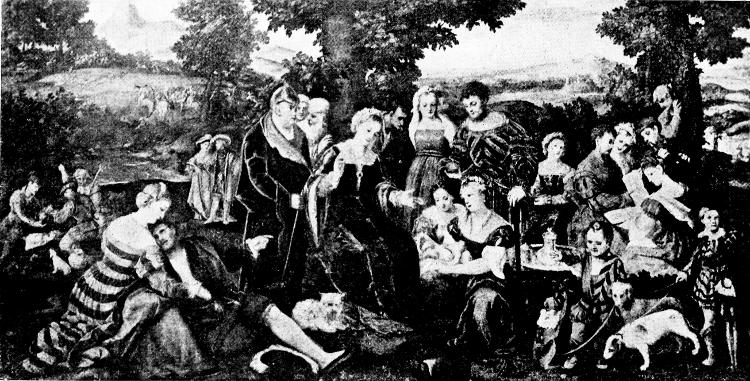
FESTA CAMPESTRE ON THE BANKS OF THE BRENTA.
Bonifazio di Pitati.
BRERA, MILAN.
Messir dalle Boccole discovered the intrigue and watched his opportunity for chastisement, but the gay Lotharios anticipated his purpose and in a moment of peculiar sportiveness,—it was at midnight, 11th June 1388,—they stuck up, over Messir dalle Boccole’s front door a Phallic symbol, and scribbled upon the lintel some opprobrious words. Such an insult was intolerable, and, as the culprits did nothing to conceal their identity, nor make amends, dalle Boccole complained of their conduct to their respective fathers. How Marco’s father acted we know not, but Doge Venier visited his son’s offence with the severity of a Brutus. The lad was put on his trial before the Signori delle Notti,—the Police Court of Venice,—a fine was imposed of one hundred lire, and two months’ imprisonment in the Pozzi,—where only political prisoners were confined. “Horrible, dark, damp cells, that would make the saddest life in the free light and air seem bright and desirable,” so wrote George Eliot in 1860.
In this terrible place of confinement, with a steady depth of two feet of stagnant putrid water, the only dry rest his hard bench, which did duty for table and for bed, poor young Alvise lost heart and[164] health. He pleaded desperately with his father to release him from his terrors and his infirmities, but the Doge gave no reply and made no sign. He was, he plumed himself the impersonation of all that was just, honourable, and unimpeachable in Venice, and, not for his own offspring, could he suffer any relaxation of the sentence. His son had transgressed the law, he must abide the consequences, so he ruled. And the consequences, in spite of his mother, the Dogaressa Agnese’s impassioned intercessions, were that the young man, left to his fate, died miserably in the filthy Gehenna, in the springtide of 1388.
This was the parental justice of the urbane and gracious Antonio Venier, but the “thorn” pierced his own hand and heart, and after two years of useless remorse and self-accusation, the unnatural if judicial Doge passed away in mental anguish in the Palazzo Venier ai Gesiusti near the Ponte dell’ Acqua-vita.
There is quite a touching little story which concerns the burial of poor young Alvise Venier. The sister who loved him best, Antonia, was so greatly distressed by her father’s attitude that she professed herself a Canoness of San Zaccaria, and, when her brother’s dead body was refused decent burial by the Doge, she obtained possession of it and carried it away from the foul Casa degli Spiriti,—where all the dead rest before their final course to San Michele,—the common cemetery,—and placed it reverently in an unoccupied piece of land of the fondamento of Cannaregio, the most distant sestiere from the Ducal Palace. Directly the Doge was[165] dead she put into effect a resolution she had made,—after earnest prayer to St Mary, St Giustina, and the good Bishop Lodovico, her patron,—to build a church and a Canonica, and dedicate them in the name of her brother as Sant’ Alvise. In the crypt she buried him and, by her will, directed that her own dead body should be laid beside his. Alas the Orto Botanico, where,—when not beset by picnic parties of bird-lovers at the neighbouring aviaries of St Giobbe,—devout Antonia Venier meditated and prayed, and whence she watched her church arise, has lost all traces of its original condition, it is now a torpedo factory!
Dogaressa Agnese, although her heart and brain were lacerated by pain and sorrow, survived her Consort a few years, then, in 1411, she was buried near his tomb with their daughter, Orsola, in the left transept of the church of SS. Giovanni e Paolo.
Doge Antonio Venier died in the first year of the new century: it was in January, when snow and ice coated calle and canale—a white shroud to cover the dead body of a century, pitted with blanes and boils of private wrong and public turpitude.
Ring down the curtain and hide the traces of tragedy: maybe the next scene will be a transformation! A plaintive echo of a voice—one of the sweetest that ever sang upon the Lido of Venice, steals into our ears, amid the muffled clang of all the Campanili bells, and bids us take heart of grace. It is fair Laura’s innamorato[166] who in his “Africa” thus prophesies of Venice:—
[167]
“La Serenissima Dogaressa di Venezia”—“the Most Serene Duchess of Venice”—attained her highest dignity and splendour in the attractive personality of Signora Marina Galina da Santa Marina—the Consort of Doge Michele Steno. The reality of the “First Lady of Venice” had become more and more emphatic as each gracious wearer of the smaller Corno had made her solemn Entry into the City.
The ancient family of Galina, in 960, founded the Church and Monastery of San Felice, on the Campo of San Felice, a little way back from the Grand Canal. They belonged to the third division of the first grade of nobles, immediately after the “Apostolic” twelve and the “Evangelistic” four, and were among the ten families of considerable importance anterior to the Serrar del Consiglio of 1289. The termination of the name “da Santa Marina” was indicative of the sestiere in which the family originally dwelt: their church of Santa Marina, built in 1030, was destroyed by fire in 1820.
The date of Donna Marina’s marriage with Messir Micheletto, or Michele, Steno is nowhere recorded. His family was one of those ennobled after the Chioggian War: they were neither wealthy nor influential. Messir Giovanni Steno, his father, was a poor man, as men went in Venice,[168] and lived in a small casa in the sestiere of Santa Maria Zobenigo, upon the neutral zone which separated the dwellings of the Castellani from those of the Nicolotti. His mother was Madonna Lucia Lando, and her family was equal in antiquity and distinction to that of her spouse—an arrangement quite usual and conventional in Venice, where the different grades of the aristocracy rarely intermarried.
Michele Steno’s parents were blessed with another son—the elder of the two—Fantino, and three daughters, Franchescina, Donata, and Cristina,—who became a cloistered nun in the Convent of San Lorenzo. Messir Giovanni, with Messir Paolo Gradenigo, went on an embassy of peace to Genoa, and, on his return in 1351, he executed a will, leaving to his second son, Micheletto, one thousand gold ducats and the half of his house property and other belongings.
Probably young Micheletto acquired some of the dare-devilry and impetuosity, for which he and other young smarts were notorious, from his early association with the rival factions of his sestiere. Incessant insults, quarrels and commotions characterised their mutual dealings, and their jests and oaths were indecent and sacrilegious:—“Corpo di Bacco!” and “Sangue di Dian!” were no less common in daily intercourse than “Sangue di Dio!” “Corpo di Crist!” Youth, aping strident manhood, not unusually delights itself in profanity and abuse. Marino Sanudo, who lived fifty years after Doge Michele Steno’s death, states in his “History of Venice,” that as a young man he was “poor but ambitious, ardent and astute.”
[169]
Sabellico has a note concerning the future Doge, and says, that, as co-ambassador to King Pietro d’Arragona in 1350, when he was no more than twenty-five years old, he displayed both tact and talent, and concluded a treaty very much to the advantage of the Republic. Michele Steno served the State with distinction and made himself an eligible candidate for the highest offices: in 1375 he was chosen one of the three Captains of the Council of Forty.
It certainly comes, however, with something of a shock to find him, the precocious, daring, and romantic lover of women,—from Elizabetta, his uncle Paolo’s attractive maid-servant to Aluycia Gradenigo, the fascinating Consort of Count Marino Falier,—mounting the Ducal Throne, which he had once stretched out his hand to profane! Forty-five years have come and gone and the hot-headed youth has developed into the sage septuagenarian. How true it is that the sowing of wild oats in young days provides for the harvesting of ripe corn in old age! Michele Steno and his Consort Marina could not have imagined that this consummation of their lives was in the lap of Fortune. If time and opportunity had modulated his character in tune with his environment, he was “still remarkable” says Sanudo, “for strength of will and irascibility of temper: a man of noble appearance and noted for the polish and gallantry of his manners.” His election to the dogado was effected in November 1400, but his installation as Doge was postponed to the following January. The usual ceremonies were duly celebrated and a new feature was added—a panegyric of the Doge and Dogaressa delivered[170] in San Marco by Bishop Lionardo Delfino of Castello.
Indirectly his Promissione suggests that his aggressive temperament still caused men to look doubtfully at him. The legal titles of the Doge and Dogaressa were depressed, the idea of personal sovereignty was eliminated, and their Serenities were greeted as plain “Messir le Doxe” and plain “Signora la Dogaressa.” This new designation, however, was not altogether derogatory, for the great Patron Saint of Venice was styled:—“E stato galant’ uomo Messir San Marco!”—“What a brave fellow is ‘Mr’ Saint Mark!” Venetians were great sticklers about titles: everybody liked to be addressed with ceremony and to have assigned a rank higher than that actually held—but perhaps this was no Venetian peculiarity, it is rather the natural, if persistent, egotism, of all times and peoples.
In the “Trionfo della Dogaressa di Venetia nel Secolo XV,”—a document of the period, in the Museo Civico,—is a full account of the ceremonial observed and of the dresses worn at the solemn Entry of the Dogaressa Marina. The Government issued an order to the different Fragilie to prepare for the Festival. Each Guild had a portion of the Piazza and also of the Ducal Palace assigned for decoration with tapestries, carpets, and banners, and was also required to furnish a gala barge adorned with standards and decked with garlands, to form part of the water escort for the Bucintoro, which was prepared for the reception of the Dogaressa, her relatives and her suite.
Upon the day of the Entry the Doge, accompanied[171] by a number of Councillors, made a progress from the Ducal Palace to his private residence to assist the Dogaressa in embarking upon her water progress. She awaited her Consort in the principal reception room, where each of the noble Company saluted her and received from her hands a very beautifully embroidered purse of cloth of gold. Then, preceded by State trumpeters and standard-bearers, and Grooms of the State to the Doge, she passed down the stairway. Following her came sixty beauteous damsels in superb costumes, and the ladies of her family in costly robes with many jewels.
The dress of the Dogaressa was magnificent: she wore a robe of cloth of gold fastened at the neck, with deep hanging sleeves, caught up by gold brooches upon the shoulders, a girdle of gold cord jewelled, and a mantle of stiff gold brocade embroidered with coloured silk like the Doge’s. Her head-dress was a coif of lace under a cap of crimson silk velvet raised in such a way as to support a miniature jewelled Ducal Corno, and a thin gauze veil fell with her wealth of unrestrained hair from under the Corno, over her shoulders. A massive gold chain encircled her bust. Her shoes were of crimson velvet. Her train, also of cloth of gold brocade, was borne by young girls in white dresses, and crowned with fresh flowers.
At the Dogaressa’s side walked the wife of the High Chancellor,—the first citizeness of Venice, a wise concession to popular sentiment,—and the stately procession was brought up by the Procurators of San Marco, Councillors of Honour,[172] Senators and Gentlemen, two and two, every one being in full state costume. Upon the Bucintoro her Serenity was placed in the Doge’s seat at the bows. The Doge and his following meanwhile returned to the Ducal Palace to await the arrival of his Consort. The progress of the Dogaressa along the Grand Canal was a “Triumph.” The whole city had embarked upon every available craft and everybody tossed enthusiastic greetings to the stately, comely Dogaressa Marina as she passed along her glittering way. The great vessel breasted untossed the lapping ripples of the newly perfumed waters of the Canal, and made her way through floating sprays of gaily coloured flowers, submerging, as she passed them, many a daring gondolier and his heedless gala freight.
Arrived at the Piazzetta the august company landed, and, after being led past the Basilica, made a stately progress all round the Piazza, adorned as for a great Church festival and packed full of perspiring people. All the beauty and fashion of the moment looked out of window casements and from altane roofs. Flowers and confetti were showered upon her Serenity who marched with the utmost dignity under the great Ducal umbrella of State, supported by the high officials of the Government. At the grand portal of San Marco the Dogaressa was received by the whole of the Chapter in gorgeous vestments, bearing lighted candles in great silver-gilt candelabra, and the principal gold crucifix, the while acolytes tossed their silver censers high. Sprinkled with holy water her Serenity stood reverently[173] whilst the rector recited with her the following liturgy:—
Let us Pray.
“We beseech Thee, Almighty God, that this Thy servant, our Duchess, may be instructed and comforted by Thy wisdom and ever remain true to Thy Holy Church, Through Christ our Lord, Amen.”
“O God, whose providence never faileth in the ordering of human affairs we pray Thee to extend Thy ineffable loving-kindness to our prayer, that as Queen Esther, the chosen servant of Thy ancient people, caused the sceptre of King Ahasuerus, her consort, to rule wisely, so this Thy Servant, our Duchess, the chosen of Thy Christian people, may do everything according to Thy will, so that she may please Thee in everything and, inspired by Thee, may with her whole heart, exercise her high office to Thy glory and to the welfare of us Thy Servants, through Christ our Lord. Amen.”
Then “Te Deum” was solemnly sung in the[174] open air, the Dogaressa standing with her face to the people. The clergy next led the imposing procession up the central passage of the basilica and placed the Dogaressa ceremoniously upon the Doge’s throne by the High Altar, where seated she bestowed her thanks and many gold ducats upon the ecclesiastical dignitaries.
The State Chancellor now approached, and bowing low, addressed Dogaressa Marina as follows:—
“Most Serene Duchess, I am about to administer to you the Oath of Allegiance to the government of the Serene Republic of Venice. Will you promise to observe and maintain it intact?”
“I will do so most assuredly,” she replied.
The procession being re-formed the Dogaressa was conducted to the Ducal Palace, where, on ascending the grand staircase, she was met by a deputation of Masters of the Fragilie who invited her to take her seat at a table furnished with sweetmeats in golden baskets and red wine in silver cups; and whereat officials of the Guild were in attendance. Acknowledging their salutations graciously she replied: “gran mercè non se sentimo.”
Proceeding on her way the Dogaressa, with her escort of noble lords, chamberlains, and gentlewomen, passed through all the State rooms of the Palace, and entered the Sala dei Pioveghi where she took her seat upon the Doge’s throne and gave attention to the following solemn address by the High Chancellor:—“Your Serenity has deigned to come to this place which will be your home as long as you remain Dogaressa of Venice. Should you[175] die, here your body will lie in State for three days before it is consigned to the tomb.”
To which very lugubrious oration the Dogaressa meekly replied:—“I am quite content to abide by what you say so far as it may please the Majesty of God.” Then, rising, she passed on once more, and entered the Sala del Gran Consiglio, where she was placed with much ceremony upon the great Throne of the Doge,—whence extending her hand everybody in the Presence advanced to kiss it.
These solemnities being accomplished her Serenity was conducted to the Presence Chamber, there she was greeted by the Doge and his two Councillors of State, and then she retired to her private apartments. The public festivities in celebration of the Induction and Proclamation of the Dogaressa continued for three days. She presided at banquets offered to the noblewomen, the wives of foreign ambassadors, and the wives and daughters of the more prominent citizens. Sports of all kinds and tournaments were held in the Piazza in presence of the Doge and Dogaressa, and upon the Grand Canal were fêtes and serenades. Indeed for a whole twelvemonth Venice kept holiday and witnessed a succession of splendid pageants.
The dogado of Michelo Steno and Marina Galina Steno was distinguished in many ways. First of all, and by way of leaving his mark upon Venice, in 1400, he caused the ceiling of the great Council Chamber of the Ducal Palace,—which its architect, Calendario, who was implicated in the conspiracy of Doge Marino Falier, had partly built, and where Guariento painted his “Paradise” walls,—to be covered with golden stars—the reflex[176] of his name “Steno”—“Stellifer.” In the arena of arms, Genoa, Verona, Padua, and Friuli were humbled and the King of Hungary was routed. Carlo Zeno, the great Condottiere, led the victorious Venetians against the two first cities; but the Doge in person gained laurels at Padua and Friuli. Quaint ceremonies followed the defeat of the four cities, for forty nobles from each,—dressed respectively in red, white, purple, and green, came and made obeisance to Venice in the persons of the Doge and Dogaressa seated upon thrones set up in the Piazza. Each deputation laid at their Serenities’ feet the keys and the banner of their city, and, at the same time, craved the consideration and protection of the Republic.
Great rejoicings accompanied these demonstrations of fealty wherein the Fragilie took an active and splendidly organised part. Always under the patronage of the Dogaressas, the various crafts had, through one hundred and fifty years of progressive industry, attained both perfection in the details of their several interests, and also a dominant position in the social economy of the State. At the same time Literature was reaching out towards distinction and the Fine Arts were starting upon their pageant of renown. Truly the first decade of the fifteenth century was pregnant with great issues and great events, it was the hour before the glorious noontide of expectation—“Venetia riccha, saggia, e signorila,”—“Venice, rich, wise and gentle-born.”
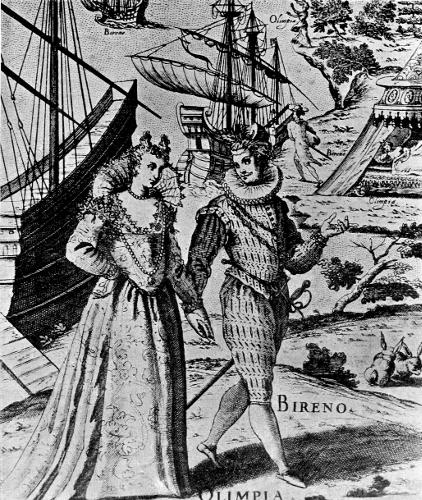
L’INNAMORATO CON “LA NINFA.” ARIOSTO’S CANZONE. “BIRENO E OLIMPIA.”
FROM A PRINT. 1560.
An obvious and visible token of the opulent greatness of the new century was the foundation of the famous “Compagnia della Calza,” directly under [177]the auspices of the stylish Doge and fashionable Dogaressa, old folks as they really were. This remarkable Society took its rise at the period of the pageants held during the first year of Doge Steno’s rule. The designation “Calza” was quite an arbitrary choice for the purview of the Compagnia had regard to all and every detail of dress and manner. It was first entitled “della Berretta,”—“Company of the Cap,” but the woven silken or worsted garment which clung to and exhibited the whole figure, was the emphatic feature of the sumptuary modes—hence came “Calza,”—“Company of the Tights.”
The society or union consisted of a number of clubs of young men—gay, rich and physically fit. The officers of the Compagnia consisted of a Prior or chief,—who went about in a gorgeous costume of cloth of gold,—two Councillors, treasurer, chaplain, painter, sculptor, architect, poet, annalist, and a notary. The Compagnia consisted of clubs, and each club bore a distinguishing name. Immortali, Reali, Perpetui, Semprevivi, Pavoni, Ortolani, etc., etc.,—there were forty of them. Every member wore striped silk tights, embroidered in gold and coloured silks with pearls and gems: each club had its special arrangement of stripes.
Their doublets of silk velvet embroidered with gold, fitted close to the body, and bore the badge of the particular club. They had slashed sleeves through which puffings of fine white linen shirts were pulled. Upon their shoulders they wore short cloaks of cloth of gold or crimson damask velvet, lined with choice fur. Their flowing locks of hair were restrained under jaunty little caps of red or[178] black silk or cloth, with a handsome jewel at the side and a heron’s feather. Their pointed shoes were of fine red leather pierced at the toes and adorned with gold and pearls. Waist-belts of leather, jewelled and embroidered, with beautiful scarcelle, or pouches, at the side, a golden chain bearing a jewelled pendant, and rings on the fingers completed the superb costumes.
Women associates were freely admitted, upon the hems of whose tight fitting silken petticoats, was embroidered in gold, the word “Calza”; foreigners also were admitted to honorary membership. The gentildonne wore long sleeves,—lined with fur, and beautifully worked cinctures of gold and embroidery: their hair was arranged in plaits and rolled under golden nets, and their feet were shod in jewelled golden shoes. Their fine gold chains of interlaced and jewelled rings encircled throats and breasts.
The purpose of the “Compagnia della Calza” was however not merely the wearing of fine clothes, but the direction of State pageants, the reception of foreign princes and ambassadors, the performance of spectacular games and plays, and attendance at solemn Ecclesiastical functions. They also assisted at weddings, birthdays, baptisms, and funerals, and acted as elegant and audacious State masters of ceremonies in general.
With enthusiasm, each Maundy-Thursday, the gay young fellows entered the annual Caccia del Tori, which had originated after the first defeat of Friuli in 1164. Three other dates were added,—Santa Marta’s day, the first Monday in September, and the first in October, and the “rings” were on the[179] Lido and in the Piazza. Later on every campi had its Caccia, and, degenerating as such festivals usually do, the places of the gentildonne were taken by courtesans dressed, masked, and mannered à l’ outrance.
The love of sumptuous dress gave a grand impetus to Venetian trade, but it led of course to many corruptions and exaggerations,—one of these was the wearing of enormously high pattens—zilve, they were called. The condition of the calli unfortunately required some such protection from mud and dirt, but women went about on shoe-stilts of poplar wood and leather which effectively dwarfed the slim tall figures of the men. At last an edict was issued which forbade this absurd fashion, especially in the case of pregnant women:—“filios abortivos in perditione corporis et animæ suæ.” This fashion, by the way, led to many ludicrous situations, for many a gallant admirer of a calle beauty, tall, commanding and superfine,—discovered her in her boudoir reduced to natural if disappointing dimensions, and forthwith declined her charms, and made a not too dignified exit!
The splendid dogado of Michele Steno, continued for twelve years: he died early in the year 1413, at the great age of eighty-four. His obsequies were consonant with his fame, and after the excision of his bowels and the embalming of his body, he was kept many days in State with a cloth of gold pall over him and burning torches of pinewood[180] resin beside him in the old church of Santa Marina. Over his tomb were hung the keys of Padua, now in the Seminario Patriachale, and the marble sarcophagus had carved reliefs and an epitaph “amator justitiæ pacis et ubertatis.” He left behind him the finest stable of horses in Venice and the cleverest stand of falcons, and, beside and beyond these treasures, a disconsolate widow.
Seven years after her Coronation Dogaressa Marina, suffering from plague and expecting death made a will whereby she bequeathed fifty gold ducats to poor criminals, awaiting execution, six gold ducats to a monk of San Stefano, who preached to her in the Palace, for prayers for the repose of her soul. To the Rector of Santa Maria Zobenigo, Nicolo Fusolo, a velvet robe out of which to make a cope, and three hundred gold ducats, a gold chalice, a cross, a surplice, and other ornaments necessary for the sacerdotal office. All of these objects the worthy priest was to use during his lifetime, and then they were to be the property of the monks of San Domenigo.
The devout testator however recovered from her illness and in the Archivio Notarile is preserved a second will, dated 25th August 1420, seven years after the demise of her Consort, to whom she erected the superb marble monument, now, unhappily destroyed. The figure of the Doge was placed above a marble urn embellished with a rich intaglio frieze in which was the bust of the Dogaressa in mosaic. After the funeral she entered the Convent of Sant’ Andrea, upon the lonely Campo of that name, far away from the gorgeous tumultuous scenes of her reign in the Ducal Palace.[181] In her second will Dogaressa Marina directs that she shall be buried, vested in a nun’s habit, in the cemetery of the Convent, and she leaves twenty-five gold ducats to cover all expenses. Upon her gravestone is the following inscription:—
“Hic jacet corpus Serenissimæ D. Marina, Uxoris Q. Sereniss. et Excellentiss. Princeps D. D. Michaelis Stenus, olim inclyti Ducis Venetiarum, quæ obiit die 4 mensis Maii MCCCCXXII. Amina cuius requiescat in Pace.”
This quiet ending to a splendid career is full of pathos. She, who had been crowned Duchess of Venice amid circumstances more splendid than any of her predecessors is laid without worldly honours in the simple grave of a pious nun. No canopy is now over her save the free air, no gorgeous tapestries surround her save the painted clouds and the distant Alps, whilst the wide salty lagune is her carpet of estate.
Upon the death of Doge Michele Steno the choice of his successor fell first upon Messir Paolo Giustiniani, the head of as famous a family as any in Venetian story, but a family which had, strange to say, never placed a representative upon the Ducal throne. The “Forty” however reconsidered their vote, and because Messir Paolo was a poor speaker they passed on the Corno to Messir Tommaso Mocenigo. When his election was in the balance Giustiniani spoke up warmly in the[182] Council:—“My Lords,” he said, “I thank God that you have nothing more serious to lay to my charge. Messir Antonio Venier was no spokesman but he came to the dogado and found his tongue, so shall I!”
The family of Mocenigo came from Treviso. Ser. Giovanni Moceni was among the earliest councillors of the infant Republic at the end of the eleventh century. The Mocenighi were enrolled in the “Libro d’Oro” of 1289, in the fourth division of the first grade of nobles. Messir Tommaso’s spouse was a Cappello, of equal rank to himself, but her Christian name is not recorded and there is no account of her coronation or her death.
Anyhow the pageants, which celebrated Doge Tommaso Mocenigo’s election were perhaps the most splendid of any ever witnessed in proud, wealthy and fashionable Venice. Twenty foreign princes and ambassadors sat in the Ducal tribune, eighty thousand citizens and strangers packed themselves in the colonnades of the Piazza, at the windows of the Piazza were hundreds of noble gentlewomen and the prizes in the Giostre,—wherein the Marquises of Mantua and Ferrara took part,—were burnished silver helmets encrusted with precious stones, and costly jewelled golden collars. Everybody of note wore heavy cloth of gold or rich silver brocade. Never before had such a wealth of pearls and gems been displayed even in superlatively modish Venice. Every craftsman and craftswoman was kept hard at work making things of beauty and of value in honour of their new patroness.
[183]
In addition to the State tournaments and pageants the Guild of Goldsmiths,—the richest trade corporation in Europe, and always specially under the patronage of the Dogaressa—arranged and dressed a Balordo—spectacle or revel,—wherein a cavalcade of knightly figures rode a quadrille arrayed in scarlet velvet,—horses as well,—and wearing chains of gold and ropes of pearls. The fabulous wealth of Venice was never so strikingly displayed and this prodigality added immeasurably to her fame and power. Peace was assured for no State could dare to try conclusions with her, knowing her vast resources.
Her population exceeded two hundred thousand,—one thousand being men of noble rank, each worth from seventy to four thousand gold ducats per annum. The State revenues figured at one million and a half gold ducats. The navy consisted of three hundred sea-going armed vessels manned by eight thousand sailors. Three thousand lighter vessels had trained crews of seventeen thousand men and the arsenal and dockyard hands numbered eleven thousand. Well was it said:—“El Mar Xe ’l fachin de la Terra!”—“The Sea is servant of the Land!”
Doge Tommaso Mocenigo proved himself to be the man of the hour. “Venetian of the Venetians, Venice and Venice only was his one and only love, indeed he carried his devotion so far that he narrowed his views of her, to the proportions of a “little Venice” in territory. With an iron will he bent all others to his behests, and, as a past-master in strategy, he undermined all opposition. He has come down to us as “one of the wisest and noblest[184] rulers of the Venetian Republic,” the ninth “Grand” Doge of Venice.
His death-bed was the scene of a remarkable demonstration of his strength of character and of his solicitude for the welfare of Venice. He sent for the principal members of the Council of Forty, and, when they were assembled, he pronounced a valedictory address wherein he summed up statistically the condition of the State, enlarged upon his own share in its stability, and expressed his wishes with respect to the choice of his successor and the maintenance of his ideals.
There were seven candidates for the succession and the dying Doge succinctly reviewed the qualifications, or the reverse, of each:—“Marmo Caravello is too old, Cavaliere Bermbo limps and is blind of an eye, Lionardo Mocenigo is my brother after the flesh, Antonio Contarini has too many children and his wife still brings him one every year, Pietro Loredano is a proud man and too young, Gianbattista Badoer is Captain-General, let him be satisfied, and Francesco Foscari is an ambitious man who sets fire to things but is careful not to burn his own fingers. I pray you my Lords not to entertain his candidature, for I am convinced, that if you elect him Doge, he will bring untold disasters upon our beloved city.”
The Doge died in 1423 and his tomb is in the church of SS. Giovanni e Paolo with the inscription “Huomo oltre modo desideroso della Pace.” The effigy, sculptured upon the monument represents very exactly what Tommaso Mocenigo must have looked like in life—a noble form, comely features, the curve of the lip indicating masterfulness, the[185] great round eyes daring, the high arched brow and cheek determination.
The week which followed the demise of Doge Tommaso Mocenigo was one of deep anxiety on the part of all the candidates for the Ducal office, probably none of them felt the strain more heavily than Messir Francesco Foscari and his spouse Madonna Marina. The fact of the late Doge’s animadversions roused their ambition and fired their determination to prove by fortune of election the erroneousness of his strictures.
Ten times in as many days the votes of the Council of Forty were cast without result, a clear majority of two-thirds was required for a constitutional decision. Apparently a policy of exhaustion was followed until only two candidates were left in the contest, Pietro Loredano and Francesco Foscari, and the latter and his wife were very hopeful of the result. Advocates of the rivals in the Council spoke long and bitterly: Pietro Orso was for Pietro Loredano,—Bernardo Pisani and Paolo Corner for Francesco Foscari. Bulgaro Vetterino also took part in the debate and denied that Foscari was too poor for the position—as was alleged. He stated that his client stood with his family for no fewer than one hundred and fifty thousand gold ducats.
At length Francesco Foscari received twenty-eight votes out of the forty-one, and Captain-General Badoer, who also supported his candidature, made the usual announcement—“This is your Doge”—to the huge body of citizens in the Piazza. At once a tumultuous response was made “Sia! Sia!”—“Agreed! Agreed!” and[186] the first contested Dogal election Venice had known ended in general satisfaction.
Francesco Foscari was the youngest of the seven candidates for the Ducal Throne, aged just fifty-one. He came of a notable family and his forebears had rendered yeoman service to the Serene Republic. They belonged to Maestre but migrated to Rivoalto in the ninth century: the Foscarini were a branch of the same family. Equal in rank to the Mocenighi, Vernieri, and Malipieri, who had given Doges to Venice, they reckoned many warriors and statesmen in their generations.
The new Doge was born in 1373: his father was Messir Nicolo Foscari and he had two brothers—Donato and Marco. It was said they were in somewhat straitened circumstances and lived away from Venice to economise. Francesco however threw himself into political controversy and obtained several important posts under Government: in 1407 he was named chief of the “Forty.”
When a very young man, in 1395, he married Donna Maria, daughter of Messir Andrea Priuli dal Banco: she bore him several sons and daughters, but she died somewhere about the year 1414. Very little has been recorded of her but Palazzi, who refers to the famous pack of playing-cards at the Museo Civico with effigies of the earliest Dogaressas reads upon the “Knave of Clubs”:—“The first wife of Francesco Foscari, Doge of Venice, who whilst she was assisting at the Coronation of the Dogaressa (Agnese Cappello) narrowly escaped a thunderbolt which[187] fell from heaven, but heaven never hurts the guiltless.”
Messir Francesco Foscari’s young family needed a second mother and he another helpmeet, accordingly, in 1415, wedding-bells again rang in a new bride at the Casa Foscari. Donna Marina was the eldest daughter of Messir Bartolommeo Nani a member of a family in the same category as the Foscari. She became the mother of four sons and five daughters, but most mysteriously they all died of the plague in 1425 and 1427, except the second boy—Giacomo.
When his election was completed the new Doge determined that nothing should be wanting to prove his nobility and the financial resources at his command. At the same time the Lords of the Council, knowing their man perfectly, added three new conditions to the Promissione:—1st. The Doge was required to fund all his private property with a reserve of twenty thousand gold ducats invested in silver plate; 2nd. Each of the State servants was to receive from the Doge two livery-suits per annum; and 3rd. His effigy and that of the Dogaressa were not to appear upon the new coinage.
Her Serenity Dogaressa Marina Nani-Foscari made her Entry into Venice and went to her Coronation attended by the most imposing procession ever marshalled for the purpose. Her supporters were the Marquises of Mantua and Ferrara, and among her train-bearers were scions of the noble houses of Padua, Vicenza, Treviso, and Friuli,—it was a regal pageant. The new Sala del Gran Consiglio within the Ducal Palace,[188] with all its wealth of painting, gilding, carving, tapestry and mosaic in all its fresh and unsullied glory—“the most magnificent room in Europe,”—was opened by the Dogaressa that she might be crowned therein with the minor jewelled Corno.
All Sovereigns and States gazed at Venice with amazement—at the moment the supreme power of the world, the most splendid court on earth, and the shining example of peace, honour and prosperity. Her proud neighbour Florence sought her help, and cap in hand, her ambassadors, Palla negli Strozzi and Giovanni de’ Medici, knelt humbly before Doge Foscari. The King of Poland craved from the Doge and Dogaressa the honour of standing sponsors for his heir, and princes from all round entered the city in State and were regally entertained. The private apartments of their Serenities were crowded with splendid offerings, and the Pope bestowed his Pontifical blessing.
A dark side there was however to this glorious panorama. Intercourse with the East introduced the seeds of pestilence, and in 1424 and 1427 cholera raged in every part of fair Venice, sixteen thousand and twenty thousand deaths respectively made huge gaps in every family circle. The Doge and Dogaressa, indifferent of their own security, mixed freely with the stricken sufferers, and, by their efforts, the first pest-house in Europe was established upon Santa Marina di Nazaret. These dark clouds rolled away at last, and Venice was once more all smiles and blushes; but upon the domestic horizon of the Doge’s family appeared an evil meteor, small at first but soon to burst in overwhelming calamity.
[189]
The tragedy of Giacomo Foscari is as well known as any among all the affecting stories of Venice. The only survivor of a promising young family of fourteen children, Giacomo was the one and only domestic joy of his bereaved parents. Upon him they lavished all their affection, upon him they fastened all their hopes. Gentle and loving in disposition and possessed of talent and ambition, the lad grew to manhood petted and pampered, in the artificial environment of the Ducal Court. Skilled in all the exercises of the Giostra and approved in all the elegancies of the Compagnia della Calza, the Doge’s son was the most eligible of all the prospective bridegrooms in Venice. He had not long to wait, nor far to look, for his bride. By the Promissione of his father he was certainly limited in his choice to Venetian maidens but that was of course no bar sinister to matrimony, for no damsels were more lovely, more lively than the young gentildonne of the Piazza.
Lucrezia Contarini was out and away the most beautiful girl in all the gay city of Venice. Her family was one of the very first—“Apostolic,” her physical charms were of the healthiest, her mental attainments the most exalted: indeed Giacomo and Lucrezia were an ideal couple, and nothing but distinction and prosperity were prophesied of their auspicious union. Her father gave his daughter a goodly dowry of sixteen thousand gold ducats and one thousand more as a loan, and he also provided a sumptuous marriage feast. Five palaces still exist to prove the influence and high condition of the family. Lucrezia’s home was the Palazzo Contarini degli Scrigni,—or Money-chests,—upon the Grand[190] Canal, called so because of the big iron safes full of treasures of all kinds it contained.
The marriage was celebrated on 29th January 1441, and the nuptial ceremonies and festivities were the most gorgeous ever seen in opulent Venice. Upon the morning of the auspicious day Cavaliere Eustachio Balbi, Chief of the Compagnia della Calza and Master of the Ceremonies, with eighteen young nobles sumptuously attired and splendidly mounted,—their horses were caparisoned in silver brocade of Alexandria, the most costly known,—assembled at the Balbi Palace as the nuptial escort of the bride. With all the pride on earth the glittering cavalcade, having crossed the Grand Canal by a bridge of boats, curvetted through the narrow calli and deployed upon the Piazza, round which they galloped furiously, on their way to salute the Doge and Dogaressa awaiting them in the State balcony of the Ducal Palace. Then retracing their caracoling steps amid showers of kisses and laurel wreaths thrown to and from admiring maidens at every window, they recrossed the Canal and drew rein before the Contarini Palace.
Fair Lucrezia, in her flashing bridal-dress of white silk and silver tissue and wearing, among many precious jewels, a high golden comb set with enormous pearls, awaited her escort at the portal of the Palace. She was supported by her sponsors the Procurators of San Marco, and attended by sixty young noblewomen garbed in cloth of gold and costly lace, each with her golden casket full of white carnations, the Contarini emblem, to scatter before the bride.
The lovely procession—a pageant of fair girls[191] and comely youths—moved in stately grace to the Church of San Barnaba hard by, where already the Doge and Dogaressa had been received by the clergy and escorted to their thrones. Giacomo Foscari, the bridegroom, with his supporters,—men of his house and young nobles of the Council,—all in superb costumes, stood before the altar. He and his bride, her hand in his, knelt in the centre of the prostrate congregation whilst the nuptial Mass was sung.
Venetian weddings were the most magnificent in Europe, for the citizens’ nuptials were as splendid as Royal marriages. There was a strange blending of Orient mysticism and romance with the Western spirit of progress and reality. One very quaint custom was the visit of the bridegroom-elect and his best men to the house of the bride, upon the eve of the marriage morn. Every door was barred, every window and jalousie closed, save one far up the wall. A crazy ladder, all too short, was left at hand, scaling which, with a fall or two assured, the venturesome youth attained the open window-sill. Inside the house every door was shut, but, running down the stairs, the young fellow drew back the bolts of the great door and admitted his friends. Then, every room door flew open, and, headed by the father and mother of the girl, the family and the guests entered the reception-room. Bearing in his hand a leg of mutton the happy groom approached the father, and, offering it to him, said:—“See, your Excellency, take this bit of dead meat in exchange for a bit which is alive, namely your daughter.” The happy couple then knelt and received the parental[192] blessing: a banquet and a dance followed in due order.
Whether Giacomo Foscari went through all these old-world and traditional observances we know not, but, after the nuptial Mass, the Doge and Dogaressa returned to the Ducal Palace where a noble banquet was spread before the Lords of the Council, the foreign ambassadors, and the nobles of the Court and City. Meanwhile the “Bucintoro” was steered in front of the Contarini Palace,—with many attendant boats, both great and small, all gaily decked with banners and wedding favours,—to convey the bride and bridegroom to the presence of their Serenities. One hundred and fifty damsels of noble birth, all in festal white and richly jewelled, with as many stylish young companions of La Calza, accompanied the happy couple. At the Piazzetta an equal company of the beautiful and the brave was in attendance to escort the water-pageant into the Ducal Palace, and there, at the head of the Great Staircase, the Doge and Dogaressa, in robes of State and surrounded by the great officers of the Court, gave an affectionate and dignified greeting to their son and daughter. A grand ball was given and a rich collation and the night was far spent before the happy, weary guests found their link-lighted way to their brilliantly illuminated gondolas, and so home and to bed.
Lucrezia Contarini-Foscari’s trousseau was superb:—A robe of cloth of gold and crimson velvet, lined with squirrel, and a train of white satin brocade two yards long; a robe of cloth of gold and peacock blue satin, the deep sleeves lined with ermine; a robe of cloth of gold and green [193]brocade with open sleeves of fine lace; and a fourth robe of cloth of gold and yellow damask lined with ermine:—the four cost Messir Contarini two thousand gold ducats!
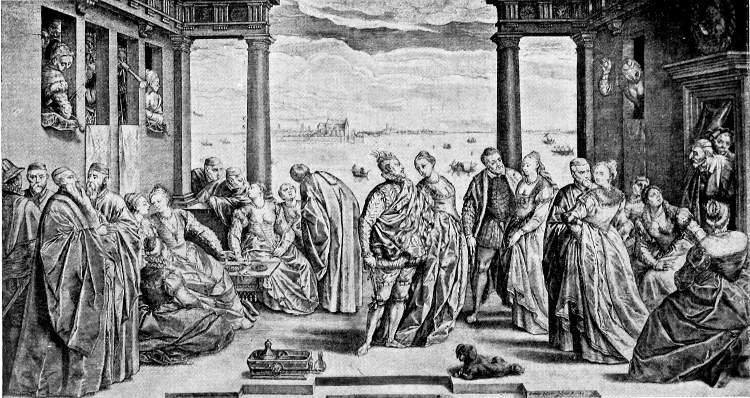
A MARRIAGE RECEPTION.
FROM AN ENGRAVING AFTER TEODORO BERNARDO.
NATIONAL LIBRARY, PARIS.
Accompanying these were four magnificent jewels for the hair with high combs—one of rubies, another of emeralds, a third of diamonds and the fourth, a huge Balax ruby—the four were valued at three thousand eight hundred gold ducats. Fortunate Lucrezia’s coffer of jewels also contained a necklace of diamonds and pearls, which had belonged to the unfortunate Queen of Cyprus, Caterina Conaro; a superb shoulder strap of diamonds and pearls en suite, and a range of gem rings—four of large rubies, worth two thousand gold ducats. The rest of the trousseau would require pages to enumerate, anyhow the bride of Giacomo Foscari entered the palace,—purchased by his father, the Doge in 1428 from the Giustiniani for twenty thousand gold ducats,—with four immense cassoni full of valuables!
Everything about the young couple promised human happiness of the highest and the best, and all went well with Giacomo and Lucrezia Foscari until, in the very midst of their gaiety and fame, a crushing calamity befell them with a suddenness and an awfulness unspeakable. In 1445 Giacomo was accused before the Council of Ten of receiving bribes, not only from men in Venice who sought social and political gains, but also from Duke Filippo Maria Visconti of Milan—the best hated and most feared of all the foreign sovereigns. This situation was created by the extravagance of the young couple, but surely every excuse was admissible:[194] he, the petted child of parents who denied him nothing, and she, whose head was turned by her almost fabulously wealthy marriage. They were in heavy debt and how to meet their liabilities (they dared not consult their parents) was the question.
On the 15th of February, a Zenta or Commission, appointed to examine into the charges, and Giacomo showed at once the weakness of his character and of his case by precipitate flight to Trieste. His chief accuser was the very Pietro Loredano who had lost the dogado to Francesco Foscari and had sworn to be avenged for his defeat. It was a stunning blow to the old Doge and Dogaressa but they maintained their dignity with the highest fortitude in face of the declaration of the Zenta:—“Considering the base, disgraceful, and abominable, excesses committed by Giacomo Foscari, son of our Lord the Doge, against the honour and dignity of our State and Government, it is resolved that he be condemned to exile, and the confiscation of his goods in default.”
In vain the broken-hearted Dogaressa pleaded for her son,—her only living child, but stern duty was the master of those Venetian councillors, of human sympathy they had little, and the Doge forced himself to side with them against his boy,—an heroic figure, externally impassive inwardly a wreck. Other charges were preferred against the absent Giacomo,—murder or accessory thereto included. He was brought back to Venice to be tortured into a confession of crimes of which he was wholly innocent, and then banished for life to Candia. He made a last and painful appeal to his[195] father, but the broken-hearted old man spoke firmly in the bitterness of his soul. “Go,” said he, “my son, my dearly loved son, go, and obey the commands of your country and seek nothing more.”
As a last favour, however, his mother the Dogaressa, and his wife, Lucrezia with her two little children were allowed to bid him farewell in the Torricelli prison within the Ducal Palace. Never was there a more affecting scene; poor Giacomo’s mutilated body and distorted features terrified them, and both mother and wife were borne fainting away. The wretched man sailed away to his place of exile, but he survived his arrival only a few short months. Death was a friend-in-need, and yet he had not needed to die so young, if Pietro Loredano had not again interfered to delay the free pardon granted in 1457.
This Loredano was a devil in disguise; he even protested that the sobs and tears and lamentations of the afflicted Doge and Dogaressa indicated imbecility and unfitness for office, and he urged upon the “Ten” the risk they ran of his Serenity summoning the “Forty” and haling them for their harshness and barbarity before the Greater Council. In a panic they hastened to demand the abdication of the Doge. The Dogaressa sought the detractor of her husband and appealed to him for pity, but he pushed her away and scandalously accused her of unfaithfulness as spouse and of treason as Dogaressa!
When acquainted with the decree of the “Ten” the grand old man bowed his proud white head, and with dignity exclaimed:—“I never for a moment[196] thought that my old age would prove injurious to Venice but I yield to the decision of the Council” and then with full meaning he addressed to Pietro Loredano who had the effrontery to be one of those to convey the sentence of deprivation, he added, “Your malice has driven me from the eminence to which I have been raised and which I have maintained unsullied for thirty years.” Loredano made no reply but upon that day’s page in his priorista or diary, he wrote in a crabbed hand “’L ’la pagati,”—“He has paid his debt.”
On 24th October 1457 the brave and noble old Doge and the faithful and virtuous Dogaressa Marina bade farewell to the Ducal Palace and sought the seclusion of their own palace at San Pantaleone. “Now,” said he, “we shall have peace in our old age if no joy.” A pension of two thousand gold ducats was accorded to the ex-Doge. All this brutality and haste was apparently kept from the knowledge of the people with whom the Doge and Dogaressa were highly popular, but directly the facts became known a revolution was threatened and matters became so serious that the “Forty” decreed that no man should name “the affair of Francesco Foscari under pain of instant death.”
Francesco Foscari was a “Grand” Doge with respect to the length and distinction of his reign, and also with respect to the dignity with which he met and bore his heavy trials. Still in his time Venice lost her foreign possessions and her fame as the greatest of European naval powers. Too much attention was given to trivial matters of domestic policy and too little to the imperial demands of a strong navy and a forceful foreign policy.
[197]
The long dogado of Francesco Foscari,—thirty-four years, the most extended of any in the whole range of the one hundred and twenty Chief of Magistrates of Venice,—in a sort of way paralysed the life of the Court and the action of the Government. Doge Francesco abdicated at the advanced age of eighty-four, and his entourage and that of the Dogaressa had grown old as well:—she was seventy-two. Youth, beauty and gaiety at home were at a discount and the maintenance of the naval and military services abroad were inefficient and decadent. The times were worn out, and what enthusiasm remained in the hearts of nobles and citizens went out to other men and other measures.
The advent of Doge Pasquale Malipiero was hailed with a feeling of relief and a spirit of hopefulness. He was a man of gentle disposition and noted for the consideration and urbanity of his character. He was most scrupulous not in any way to derogate from the high esteem accorded to his predecessor, nor to wound the susceptibilities of the Dogaressa.
Two days after his abdication Francesco Foscari died of a broken heart and Doge Malipiero was the first to offer Dogaressa Marina sympathy and assistance. The State decreed a public funeral but she emphatically refused to surrender the dead body of her husband. “No,” she said, “posthumous honours are a mockery after official injustice; I will bury my dead how and where I like.” Her strong and unforgiving attitude is recorded by the[198] pack of Playing-Cards, so often referred to in this volume, upon the “Eight of Swords”:—“Nani, the second wife of Doge Foscari, determined to vindicate the fair fame of her husband, by burying him at her own expense and not at that of the State. Nothing is more fierce than offended innocence.”
The Council of Ten expostulated with her and declared that, if she refused the order of burial, her husband’s corpse would be taken away by force. It was perfectly well understood however that this peremptory action was influenced by abject fear of the consequences to the Lordly Councillors should full State funeral rites not be accorded to the remains of the beloved old Doge.
At length the Dogaressa yielded reluctantly but positively declined to follow the usual custom and appear as chief mourner. A pompous procession bore from the Foscari Palace to the “Bucintoro” the dead ruler’s earthly casket which was steered through kneeling weeping crowds afloat and on rive to the Piazzetta and thence into the choir of San Marco. The great bell of the basilica,—which had scarcely ceased its clear, crisp emphatic clang announcing the succession of the new Doge,—gave forth slow and muffled tones. In the middle of the Piazza a halt was called and Messir Bernardo Giustiniani, the oldest noble, holding aloft the sword of the deceased Doge pronounced a funeral oration.
Upon the bier rested the jewelled Corno and the Ducal State robes which Pasquale Malipiero had so sympathetically laid aside whilst he walked bare-headed immediately behind, clad in the purple of a[199] simple Lord of the Council. After the Requiem the procession re-formed, and, with the casket under its pall of cloth of gold placed under the Ducal canopy, the “Bucintoro” carried all that remained of Doge Francesco Foscari in stately silence to his last resting-place before the High Altar of the Church of Santa Maria Gloriosa de’ Frari.
The following day the new Doge re-assumed the regalia of his office and helped to prepare his Consort for her State Entry and Coronation. In 1414 he had married the woman he loved,—Donna Giovanna,—daughter of Messir Antonio Dandolo, above himself in station, for the Malipieri were of an inferior grade of nobility to the “Apostolic” Dandoli. 26th January, 1457–1458, was the auspicious day chosen for the Dogaressa’s ceremonial. The funereal cloths which had swathed the “Bucintoro” were rent away and banners,—blazoned in gold and colours,—and great swaying garlands of greenery transformed the noble vessel into a gorgeous Argosy which, with the Dogaressa and her attendant ladies and many maids of honour on board, swept gracefully down the Grand Canal.
The ritual of the inauguration rites was similar to that arranged for the Dogaressa Marina Galina-Steno, but the new First Lady of Venice managed to project quite a personal feature into the proceedings. As the patroness in particular of the printing-press and of the lace-cushion and of the respective craftsmen and craftswomen these two guilds were specially honoured. Palazzi, in “La Virtu in Giuocco” records that Dogaressa Giovanna was “a princess of splendid physical and mental gifts but possessed of no private fortune” ... in 1469 Giovanni[200] Spira dedicated to her the first book ever printed in Venice—“Epistolæ ad Familiares” of Cicero.
In that quaint pack of Playing-cards at the Museo Civico, the “Knight (King) of Swords” bears an eulogy of Dogaressa Giovanna with a wood-cut of a printing-office, and the following inscription:—“The Art of Printing was introduced in Venice by the Dogaressa Dandolo-Malipiero—the Press has made the name Dandolo immortal.”
This is perhaps a piece of special pleading but, inasmuch as Dogaressa Giovanna Dandolo-Malipiero was a woman of culture and the friend of men of letters, her patronage of the earliest printers undoubtedly gave the premier place to Venice in the history of printing. Missals, Service-books and other books, used in the churches, were printed from wooden blocks as early as 1441 by unknown craftsmen. With Giovanni da Spira (of Speyer) came to Venice his brother Wendelin, and they were joined by a French engraver of coins,—Nicolo Jenson of Tours, who turned his attention to cutting wooden letters and making wooden blocks. Their family of pupils and followers, between 1470–1500, numbered no fewer than one hundred and fifty-five printers of note. Of early books printed in Venice, four were produced in 1469,—all with grateful allusions to the Dogaressa,—sixteen in 1479, and ninety-eight in 1489:—they were chiefly Classics, Bibles, and Morals. In 1480 appeared the first illustrated book the world had seen in print “Hypnerotomachia”—“The Dream of Love.” Venice thenceforward became and, remained for two hundred years, the greatest of all centres for books, printers, and publishers.
[201]
As the patroness of Venetian lace-workers Dogaressa Giovanna Dandolo-Malipiero made for herself unquestionable renown. She knew, of course, by heart the fascinating story of Bella di Giovan d’Isola di San Giorgio in Alga, and probably she was herself a skilful artist in the exquisite craft. Burano was the earliest metropolis of the Merletti a Piombini—the offspring of fine thread and beaded bobbins,—and the “Buranelle,” or lace girls of Burano were as famous then as now for their manipulative talent. The gracious Dogaressa gathered around her a number of young gentlewomen and encouraged them to twist and knot the delicate threads. Perhaps they called to mind the tradition of the heroines of Aquileia, for the early Burano lace is as fine and as strong as the interlaced locks of hair, which made such stout hawsers for the catapults in that famous siege.
Just as the bewitching Bella was inspired to imitate a beautiful piece of coral seaweed so the clever lace-workers of Burano went to Nature for their models. Already, in the fourteenth century, they had noted the swirling whirlpools of the gondolier’s pole and the rippling eddies of the tide on the steps of the rivi; and had observed the rolling clouds above their heads and the distant indented Dolomites beyond the Lagune; and had produced their opus araneum or punto-in-aria,—openwork. Then followed quite naturally, imitations of moving objects around them—the sailors, the cordage, and the nets of fishing vessels, with bits of flotsam and jetsam, shells, seaweed and fish scales, evolving punto-a-reticelli,—network.
[202]
Very easily foliage and flowers of Venetian gardens prompted lace ideas; hence we have punto-a-folgiami,—spraywork. Next, fish in ships’ holds or in crystal bowls, birds on wing and insects, appeared in twisted thread as punto-a-groppo,—raised work; and fabled animals, domestic pets, and arabesques formed another range of subjects,—punto-a-maglia,—figure work. Effigies in Church, people on Piazza, faces on the Rialto, and many other human models came out of leaded bobbins as punto-a-quadra and punto-a-burato,—portrait work, and so forth.
Dogaressa Giovanna must have been a woman of marked erudition and consummate taste to combine two such dissimilar avocations as printing and lace-making in her heart’s interest. Her patronage of Burano and its craft directly interested the votaries of fashion everywhere, and the women of all lands should ever hold her in high estimation. Burano became the mother of Honiton, of Valenciennes and Alençon, of Mechlin and Brussels, and the delicate meshes of her lace-work have enriched woman’s realm with the most decorative attribute it possesses.
Doge Pasquale Malipiero died in 1462 and was buried in the great church of SS. Giovanni e Paolo, in the left aisle, where his Florentine sarcophagus may still be seen. With him was laid all that remained of noble Dogaressa Giovanna, but the date of her death is not recorded—“Giovanna, the Queen of Lace, the Empress of Printing.” In the Museo Civico is a medal which has, on the obverse, the bust of Doge Malipiero, and on the reverse that of Dogaressa Giovanna, with the legend:—“Inclite Johanne ...[203] Alme ... Urbis ... Venatiar ... Ducise.” She wears the Corno with an ample coif or veil which hides somewhat the marks of age: the face is thin, the cheeks hollow, the forehead high, and the eyes somewhat sunken. The medal is very delicately chiselled and is said to have been the work of Pietro Guidizzaro,—a noted medallist of the fifteenth century. In the Berlin Museum is another medal with a similarly incised portrait of Dogaressa Giovanna, but in place of that of the Doge, her husband, are represented two beauteous Venetian maidens,—representing “Printing” and “Lace-making,”—with the legend:—“Vincit ... Honia ... Bona ... Volontas.”
Cristoforo Moro and his Consort Cristina Sanudo mounted the Dogal throne in 1462. He was an ill-conditioned sort of man, very parsimonious but in a way very devout, and as we say now, an advocate of “peace at any price.” His personal appearance was hardly in his favour,—for he was short of stature, very stout, and his features were marred by a decided squint. The Mori belonged to the least honourable grade of nobility, having purchased their title after the war in Candia for one hundred thousand gold ducats. They also bought the Palazzo Lin, the property of an extinct Venetian family upon the Grand Canal, and henceforth gave themselves all the airs and graces of hereditary nobles. Their good conceit of themselves was quite effective and quite in the order of Venetian social convention.
The Dogaressa Cristina was the daughter of Messir Lionardo Sanudo and Madonna Barbara Memo his wife; her marriage was celebrated in[204] 1412. Once more the Venetians had the spectacle of a patriarchal couple installed in the Ducal Palace. Notwithstanding her age the new Dogaressa went through all the ceremonies of her Entry and Coronation with dignity and charm. “She was a woman,” Marino Sanudo, her nephew the historian says, “of a remarkably gentle disposition and held in reverence for her works of charity.”
Palazzi wrote of her in his “Fasti Ducales” that “she was an example to other gentlewomen in her care of the poor.” Upon the “Knave of Swords” in the pack of Cards at the Museo Civico is the following inscription:—“Sanuta, wife of Cristoforo Moro, Doge of Venice, raised her voice to Heaven only for the good of the people, the gift of Heaven, and the Seal of justice.”
A few notable events occurred during the reign of Doge Cristoforo Moro. His Promissione, like its forerunners, cut down the Ducal prerogatives and also severed the last strand of the coil which feebly held the rights of the people. The title of the Republic passed from “Comune Venetiarum” to “Dominium, or Signoria Venetiarum.” War with Friuli broke out afresh and the Doge shrank from the responsibilities of leadership until twitted by Condottiere Vettor Cappello:—“Have,” said he, “my lord less care for thy skin and more for thine honour!” The Venetians had gradually lapsed into a state of false security: their fame on land and sea made them confident that Venetian supremacy was assured. No new battleships were laid down and the manning and armament of the fleet were neglected until, in 1469, the “Mistress of the Seas” received a stunning awakening—the Turks[205] wrested from her for ever her superiority afloat.
In the world of craft and fashion Dogaressa Cristina was the recognised patroness and leader, but skill and beauty yielded to cheapness and frivolity. She set her face against the introduction of foreign-made goods and insisted upon the craftsmen improving both the materials and the manner of their industries. The Church, in the person of Frate Mauro Lapi, of the Frari monastery, appealed to her to redress the effeminacy of young courtiers in the wearing of long hair—“capiliaturas nimis longas al faciunt mulieres.”
Both the Doge and Dogaressa were much occupied in arranging and furnishing the newly completed private apartments in the Ducal Palace. Whilst superintending this undertaking, and assigning positions for the almost numberless “Spoils of Venice,” taken by her Doges, after their victories afloat and ashore, Dogaressa Cristina was called upon in 1471, to resign her lifelong partner and to go into retirement. Year after year spent its slow course and at last no one remembered the gracious Signora when, in 1533, Martino Sanudo came to make his will. “I bequeath” he wrote, “to the Church of Messir San Sebastiano a very venerable relic—a bone of the Saint which belonged to my Aunt Sanuta Moro, and which she had religiously preserved by way of a charm against the plague.” This sacred benefaction demonstrated the piety of the old Dogaressa, as, by her will, executed in January 1471, she proved her charity.
To the clergy of the monastery of San Giobbe Dogaressa Cristina assigned a goodly benefaction to[206] provide Masses for the repose of her own soul, her husband’s—the Doge and her father’s, mother’s, and her brothers’. The building of this church was due to the Doge and Dogaressa: in the choir is his tomb bearing the sculptured recognisance of his family—the Moro—mulberry, and over the door of the Sacristy is his portrait. Perhaps the natural modesty of the Dogaressa forbade hers, as a pendant, but her patron Saint San Bernardino da Siena stands as a statuette along with Sant’ Antonio da Padua and San Giobbe—the patrons of the Doge.
Doge Nicolo Tron (1471–1473) was a very different sort of man from his predecessor, both in appearance and in character. Tall and extremely handsome, an athlete in form and practice, he had however two unpleasing idiosyncrasies—a repulsive expression and a stuttering tongue. He was not a man of good family, but what he lacked in heredity he more than made up in wealth. When a young man he settled in Rhodes,—a land of gold in that day—and acquired by his industry and profitable speculations an immense fortune,—said to be at least one hundred thousand gold ducats.
In 1424 he married Aliodea, daughter of Messir Silvestro Morosini of the sestiere of Santa Giustina, a significant union of rank and money and a new phase in Venetian matters matrimonial. Ambitious to prove to his fellow-citizens and the proud nobles his worthiness and opulence the new Doge departed from the ordinary festive arrangements of the Fragilie, and himself spread the banquet for them in honour of his Consort. Every attribute of[207] dignity, every emblem of sovereignty, and every decorative feature of the installation ceremonies, were mounted upon a magnificent scale. The robes of State were the richest ever worn by Doge and Dogaressa, and right nobly, we may be sure, the Serene couple bore themselves. If he was handsome she was beautiful—all the Morosinis were—a trait which never failed in that splendid family.
The Palazzo Tron, on the Grand Canal, was most extravagantly furnished, the decoration of one room alone with marble, sculptures, carved wood, gilding, and rare glass cost more than two thousand gold ducats.
Aliodea Morosini-Tron was the most attractive, and the best dressed gentlewoman in Venice. Palazzi goes into ecstasies over her fascinations, and he makes delightful play with her popular name “Dea.” “Dea” he says, “corresponds with ‘love’ and ‘beauty’ and such were the characteristics of the Princess who was truly and indeed the ‘Venus of the Century.’” Once more the old pack of Playing-cards sets forth the Dogaressas virtues:—The “Knave of Coins” (Diamonds) has:—“Dea Morosini, wife of Nicolo Tron, Doge of Venice, a most religious Princess, her humility caused her to choose a private burial—Dea se a Dio.” She gave her husband two children, both boys, the elder Giacomo became Procurator of San Marco, and the younger,—a soldier,—fell at the terrible battle of Negroponte.
Doge Tron died in 1473 and was buried in the church of Santa Maria Gloriosa de’ Frari under a huge monument by the High Altar. He was the[208] last Doge of Venice whose effigy was stamped upon the coinage of the Republic. His was a very prosperous dogado, and the decline of Venice was for a brief space stayed. Victories in the East led to the acquisition of Smyrna, and the littoral of Asia Minor. Cyprus too came under the banner of San Marco.
Of Dogaressa “Dea’s” good works and influences we seem to have no records, save what her epitaph recites upon her simple last resting-place at San Giobbe:—“Deæ rariss. mulieris illustriss. Dom Nicolai Throni inclyti Ducis Venetiarum, Conjugis, humili hoc in loco Corpus jussu tuo conditum est, animan vero ejus propter vitæ virtutum et morum sanctitatem ad cœlestem patriam advolasse credemdum est. Ann. Salutis MCCCCLXXVIII.” She survived her husband just five years and probably kept her cell in the fervour of devotion at the convent of San Giobbe, far, far away from the madding crowd.
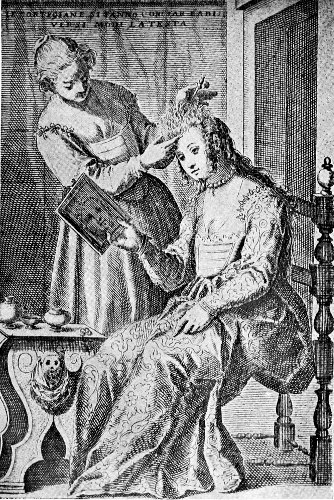
COURTESAN AT HER TOILET.
FROM A PRINT. 1560.
“Habiti d’Huomini e Donne.”—G. Franco.
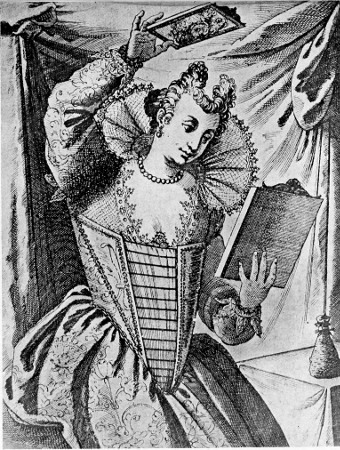
A CHARMING COIFFURE.
(The hair falls full at the back).
FROM A PRINT. 1610.
“Habiti Delle Donne.”—G. Franco.
There is an apocryphal story affecting Doge Nicolo Tron namely that he was twice married, first to Donna Laura Nogarola, daughter of Messir Lionardo Nogarola of Verona, and sister of the celebrated Isotta,—famed as a writer of interesting letters and as a profound classical scholar. Madonna Laura herself was conspicuous for her beauty of person, her devout disposition, her charm of manner, and her erudition. It is a moot point with historians whether Messir Nicolo Tron divorced the illustrious Laura before he married the divine Dea, or whether after all the former fair gentlewoman was not the wife of Messir Cristoforo Pellegrino Ambassador from Verona [209]to Venice during the dogado of Doge Nicolo Tron. A third supposition refers to the handsome and wealthy Doge’s adventures in the regions of Platonic affection, but of this only surmise is possible—facts are wanting, and here comes romance!
[210]
The Gardens of Venice!
—“Veri paradisi terrestri, per la vaghezza dell’aiere e del sito lioghi di ninfe e di semedei!”—in an ecstasy of delight wrote Andrea Calmo, in one of his characteristic “Lettere.” He was not the first by any means who had felt the gentle influence of those earthly bits of Paradise, for an observant monk, Frate Felice Faber, of Ulm, goes into raptures, in his “Evagatorium Terræ Sanctæ,” over the roof-gardens he beheld in 1457, as he passed through Venice on his pilgrimage to the Holy Sepulchre. “Full of aromatic trees and perfumed blossoms,” he wrote, “nothing can be more wonderful, nothing more delicious.”
From the very first foundations of the campi and fondamenti gardens had been the chief home-joy of all the dwellers in the lagunes; a sweet-smelling flowering-plant was as acceptable to them as a piece of bread and cheese. Spread over all the sestieri, chequer-like, they added immeasurably to the amenities of the city. Time had grown the sapling into a shady tree, the sprig into a blossoming bush. Upon the Giudecca, gardens,—“delicati e rari,” belonged to the Bandoli, Conari, Barbari, Gradenighi, Mocenighi, Vendramini, and Gritti. At Villa Catteneo was the loveliest of them, all[211] built up with rockeries, splashed by fountains, and running over with roses, lilies and carnations.
At Murano were the most famous of all Venetian gardens. Sixteen sumptuous Villa-Palaces sprang up like magic upon that sandy sea-shore, and, still more wonderful, the magician’s wand brought forth from alluvial sea-wash, hanging gardens and terraced orchards fairer far than ever were those of Babylon.
Afternoon and evening, fleets of gondolas cut through the murky water, full of visitors bent on pleasure, or to view the splendid frescoes at Villa Mocenigo and the glorious statuary at Villa Trevisan.
Every islet had its garden-patch, every family spent half at least of each day’s playing-hours al fresco: everybody was wise in Nature’s laws, and inspired romance and poetry amid the lights and shadows of the greenery, in the music and the measure of the rustling leaves, and from the delicious air perfumed by fragrant blossoms.
To realise something of what those villa and casa gardens were like, one must traverse sea and land to bonny Baveno, and there tell the affable boatman to steer his course to “Il Palazzo.” There, resting upon the azurine-green bosom of beauteous Lago Maggiore, is a palace like unto a jewelled crown, a garden like fabled Eden, all built and laid out, doubtless, by garden artists from Venice and Murano. Upon that delectable spot are gathered all the loveliest things of Nature’s second kingdom;—so it was at Murano what time Pietro Bembo walked and thought and talked, leading the muses[212] of the grove and the mermaids of the shore in mystic dance and song.
Alas, where men of letters and women of fashion once forgathered in sumptuary and sympathetic symposia are wanton weeds and raw rank grass, with patches of unpoetic potato and uncultured cabbage. Rag-pickers and goat-herds hold unclean orgies where peach and cherry trees were wont to scatter scented painted petals upon the heads and breasts of those that discoursed philosophy and whispered love. “True love,” as the Poet-Laureate declared, “that seeks not only perfect beauty but god-like also:” expressing thus, in Venetian terms, the Greek of Plato,—“The desire to possess in one perfect union the beloved being and the lovely soul.” To kiss the hand and not the lips was the theory of those romancists—the reddest features of the human frame, the danger-signal of the soul, and so they grimaced and so they postured under overhanging boughs of acacia and catalpa. In his “Asolani” Bembo sang:—
The children of Murano now offer visitors humble nosegays of sea-pinks and flowering flags, but in the springtide of Venetian poetry and literature, the orchards were carpeted with hyacinths and anemones, violets and scented stocks. The terraces and borders yielded light begonias, banksia roses,—red[213] and yellow,—and carnations of many hues, all as brilliant as the painted faces and the tinted bosoms of the beauties, who clasped them from the hands of their innamorati, to place upon their bare and ample breasts.
Bushes of daphne ordorifica and many another aromatic exotic attracted swarms of luminous butterflies, linnets sang in the laurels, and in the myrtle, nightingales; but the strings of guitars and the keys of flutes, vibrated by the gallants of La Calza, yielded sweeter music far. Pergolas were laden with golden grapes and purple, quinces struggled with pomegranates to delight sight, smell, and taste. Figs vied with oranges, melons with pines in fullness and in flavour. Solomon’s gardens poured out no more richly seductive treasures. Shadows were cast only by solemn cypress and rocking hollyhocks, but through them flashed saffron bees laden with pelf from honeysuckle, musk, and lavender.
Men and women, with gay peacocks on the lawn, preened themselves in gorgeous costumes, conversed in arboreal arbours of all things high and low, tossed salutations where the spray of fountains cast rainbows in the scented air, and sang, and danced, and flirted to their hearts’ content. Not that the gardens of Venice were given up wholly to love and romance, for many a venerable Doge and Dogaressa presided at feasts of reason, and received the reverences of men of letters and of women of culture, who have left their finger-prints upon the pages of literature.
If Pietro Bembo was the Poet-Laureate and the leader of the literary revels, as great as he, were[214] Aldo Manuzio and Andrea Navagero,—court-printer and courtier-poet. Then Francesco Colonna,—lover of “La Polia” and Roman king of pageants,—shared with Ermolao Barbaro,—the humorist and the satirist,—passionate love of Venice. Lodovico Ariosto and Pietro Aretino,—empirics and critics both,—made love also to the Venus of the Lagunes, in the new Bohemia of the island gardens. All the poets sang of “Venus Physizone,”—“Venus the Fruitful,”—Venice sweetheart and wife. Benozzo Gozzoli, the Florentine, painted, in the Campo Santo at Pisa, the song and dance of Venice—the Rispetti and Ballate,—love ditties of youth, and the Frottole and Madrigali—murmurings of adult romance,—movements in life-tragedies.
Music, step, and cadence, traditional and patriotic, were the actualities of lagune life in the open: for stage, the garden-plot, the well-head, the gondola-herse, and the open campi. Refrains, piped and warbled, in calli and rive, and, graceful and heavy measures stepped there, were carried off to sea in the galleys of commerce and of war. Sympathetic language is everything, in expressive popularity, and, if cultured Venetians used Latin and Tuscan in lecture and conversation, no tongue of any time was so rich in scenes of caressing endearment as the common-talk of Venice, no dialect was anything like so soft, sensuous, and melodious.
Historians, great and small,—Martino Sanudo and Marcantonio Coccio and many another—forgathered in the gardens, and wrote delightful records of fascinating and learned women, as well as of bewitching butterflies of fashion. Cristina[215] Pisano, in the fourteenth century, “Mother of women writers,” and Cassandra Fedele, in the fifteenth,—“Decus Italia,” Angello Poliziano, the Medicean, called her,—were leaders in the great Venetian pageant of the Graces and the Liberal Arts. Moderata Fonte sang sympathetically the glory on Venetian womanhood:—
There were lovely gardens also at Friuli, Asolo, and all along the Brenta, where Venetians,—fair and brave, wise and dignified—held revels and communings, masked balls and stately receptions.
If you would see and know the Messiri and the belle Donne of Venice, in the fifteenth and sixteenth centuries, you will find them resting or disporting themselves in their villas and their gardens. There, arrayed in his official crimson velvet robe of semi-State,—you will make your reverence to his Serenity the Doge, and, at his side you will bend your knee to kiss a gracious Dogaressa’s hand. She has not to bear the weight of her stiff State robe of cloth of gold; she is in crimson silk, and her fair hair, hardly showing streaks of white, is covered with a becoming veil of lace, fixed with great gold and jewelled pins. They are the most affable and most approachable noble couple in all history, and the younger people are all the gayer for their presence, strangers are completely at their ease, noble Lords of the Council, dignified matrons, the cultured, the artistic, and the[216] seriously-minded, find pleasure and distinction in their company.
By electing Nicolo Marcello, in succession to Doge Nicolo Tron, in 1473, the Lords of the Council returned to their traditional usage. He was a member of one of the eight considerable families before 1289, ranking third in the premier grade of the nobility immediately after the “Apostolic” and “Evangelistic” families. He had, however, in the eyes of the very select, lowered himself by his marriage in 1427, with Donna Bianca Elena, daughter of Messir Francesco Barbarigo, Procurator of San Marco, a distinguished member of a family rising rapidly in wealth and influence, but only ennobled, with nineteen other families, after the Genoese war of Chioggia. Madonna Bianca died, probably of plague, two years later, and then Messir Marcello again entered the estate of matrimony with Madonna Contarina, widow of Messir Francesco Morosini. She was a Contarini, a daughter of one of the most exalted and wealthiest families on the Roll of Nobles.
Very little is recorded of either the Doge or Dogaressa, for their reign was the shortest of any in the line of Doges of Venice,—less than a twelvemonth. There is a very ambiguous notice in “La Storia di Venezia,” a manuscript history in the Museo Civico, which states that:—“Messir Nicolo Marcello, aged seventy-six, would not allow the Dogaressa, his Consort, to enter the Palace.” This of course refers to the usual solemn Entry and Coronation, but the why and wherefore are not stated, and no amount of surmise will explain the matter.
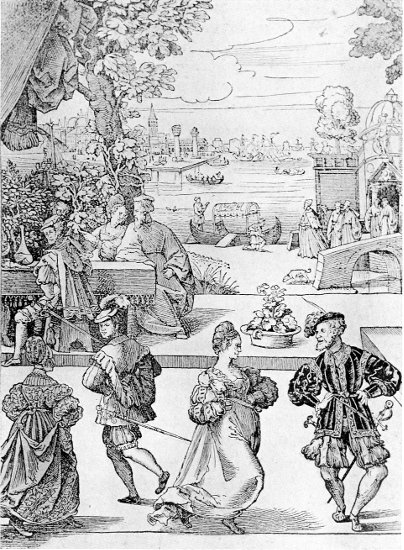
A VILLA-GARDEN DANCE ON THE GIUDECCA.
FROM AN ENGRAVING. 1562.
MUSEO CIVICO, VENICE.
[217]
“This Doge,” the manuscript goes on to say, “was a very pompous sort of man, and he caused the regalia of his office,—including the State umbrella and cushion, which had hitherto been both of crimson velvet,—to be made entirely of gold and cloth of gold. He had a Corno entirely of gold and jewels, like the crown of an independent Sovereign, and he added, to the State robe of cloth of gold, a costly tippet of ermine, fastened down the front with solid gold clasps and buttons.” His ordinary dress was scarlet, but at State functions and in Council he wore white or cloth of silver under the State robes.
In his will, executed on 24th July 1473, the Doge made some recompense to his spouse for the denial of dignity. “To my dearly-loved Consort,” he deposed, “I leave eighteen hundred gold ducats (her dowry) together with two thousand gold ducats. I also bequeath to her the contents of my wardrobe, and assign to her, for use during her lifetime, my Casa, on the Campo di Santa Marina, together with all my equipages, horses, furniture, tapestries, and everything necessary for her honourable maintenance as my widow.” Doge Marcello died in January 1473–1474, and was buried in the ancient, but no longer existent, church of Santa Marina. His monument is now in SS. Giovanni e Paolo, whither it was removed along with that of Doge Michele Steno. The death and burial of Dogaressa Contarina Morosini-Marcello are unrecorded.
The dogado of Pietro Mocenigo (1474–1476), was almost as brief as that of his predecessor. He was a veteran leader of the armies of the Republic,[218] fighting for years against the forces of the Turks. His monument in SS. Giovanni e Paolo bears the epitaph:—“Ex Hostium Manubis,” in recognition of his invaluable services. In life he was something of an old-man-in-a-hurry, for his energy was unbounded and his love of Venice enthusiastic. The Dogaressa was Donna Laura, daughter of Messir Giovanni Zorzi. We look in vain for records of his reign and notices of her virtues: all we have is a clause in his Promissione, which granted to her and her family, in the event of his predemise, the use of the private apartments in the Ducal Palace for three months after his death—“so as to avoid unseemly haste.”
Fresh sumptuary laws were passed affecting dress and fashions under Dogaressa Laura: she herself, as were all the Dogaressas, was expressly excluded along with her Dozete or daughters, from their operation. In 1474 long trains were forbidden, but quite easily this was disregarded for some inventive mind or other,—a stylish craftswoman doubtless,—created a new thing of beauty, which became a joy to train wearers, a jewelled gold bangle, through which the corner of the offending garment was caught up when occasion demanded!
Lionardo Bota, the Milanese ambassador to Venice in 1476, put on record that the gentildonne of Venice had reached such a lavish style of dressing that he “could not conceive how their costumes could ever be more gorgeous: many ladies boasted that several of them cost more than five thousand ducats apiece!” A decree of the Tribunale delle Pompe was issued to check and moderate the excessive expenditure. Costly gold[219] and pearl embroideries were forbidden together with point-lace with gold and silver thread, and gold tassels with drops of precious stones. Belts and charms were ordered to be less jewelled and less massive.
Andrea Vendramin and Regina Gradenigo were acclaimed as Doge and Dogaressa of Venice in 1476. He belonged to a family ennobled after the Chioggian War and accounted among the wealthiest. Messir Vendramin appears to have made his fortune in the commercial pursuits of his family, and, settling for some years in the Greek island of Rhodes, as a purveyor and provision merchant amassed a fortune of no less than one hundred and sixty thousand gold ducats. Tradesman, or no, he was a man of rare artistic tastes and a keen antiquarian. Upon the dispersal of the collections of Doge Marino Falier his grandfather purchased everything of special value and interest, and through his father, Messir Andrea inherited the treasure, to which he added very considerably. The Catalogue of the Vendramin Museum and Gallery filled sixteen portly volumes.
The Dogaressa was a daughter of Messir Andrea Gradenigo of an “Apostolic” family, and much the superior of her husband in rank: she married the future Doge in 1426. Six daughters were born to the noble couple, for each of whom their father apportioned the very goodly dowry of seven thousand gold ducats, but upon one condition that he should choose their husbands! As a young man Andrea Vendramin was said to have been one of the handsomest and most courtly gentlemen of the city.
[220]
Dogaressa Regina made her solemn Entry with all the pomp and circumstance customary for that event,—but she was not crowned. This was the first step in the declension of the splendour and quasi-sovereignty of the First Lady of Venice. Gradually the Dogaressa had been accorded, and had assumed dignity upon dignity: henceforward she was as gradually to lose her distinctions.
The dogado of Andrea Vendramin synchronised with the most disastrous period in Venetian history. “He died,” wrote Ruskin in his “Stones of Venice,” “leaving Venice disgraced by sea and land, with the smoke of hostile devastation rising in the blue mists beyond Friuli.” His death in 1478, was due to pestilence, which followed the ravages of the Turks, carried to the shores of the lagunes, “from the Orient by the ships of the new Mistress of the Seas, the supplanter of the Supremacy of the Queen of the Adriatic.” He was buried in the now ruined Church of Gli Servi, but during the nineteenth century his monument was removed, with many others, to the Venetian Pantheon of SS. Giovanni e Paolo.
Dogaressa Regina survived her Consort many years, but of her end we have no account. There is, in the Museo Civico, a curious picture, apparently commemorative of her Solemn Entry, with the following inscription:—“Regina Gradenigo Andreæ Vendram, Veni, Princeps, Uxor, Senioribus ac Propinquis comitata ingenti populi plausa Regiam Aulam ingreditur MCCCCLXXVI.”
Giovanni and Taddea Mocenigo assumed the Corno in 1478. He was a younger brother of Doge Pietro Mocenigo, the third member of his family[221] within the century to mount the Ducal throne—a circumstance only paralleled by the Dandoli since the far-off days of the Particepazi, Candiani, Orseoli, and Michieli. The Dogaressa was a daughter of Messir Giovanni Michielo and vindicated in her person the assertion often made, that “succession through the female line is always more certain than through the male,”—the last Michielo Doge,—Vitale II.—died in 1172.
In the February of the year of their accession the Sultan of Constantinople sent an embassy to Venice seeking terms of amity and reciprocity and bearing costly gifts to their Serenities, and also many presents for the principal nobles. Among the offerings was a magnificent Oriental carpet,—the like of which the Venetians had never beheld,—a number of handsome jewels for the Dogaressa, and a weird collection of new animals. Both the Doge and his Consort had a hobby for wild animals and greatly added to the number of such creatures in the Venetian Zoological Gardens—now the Giardino Reale—established in 1310 under the dogado of Pietro Gradenigo.
The arrival of these beasts, among them a giraffe,—hitherto an unknown animal save in fiction,—caused wild excitement in Venice, and, like its brother in Florence, it was the recipient of caresses by the nuns in the convents to whom it was exhibited. Unfortunately, the whole collection perished in a calamitous fire which burnt out, not only the beasts’ dens, but also ravaged the private apartments of the Doge and Dogaressa, and destroyed the whole sequence of portraits of former Doges, besides many priceless art treasures.
[222]
Unhappily Dogaressa Taddea, herself, perished in October of the year of her Coronation,—a victim, with many of the gentlewomen of her Court,—of the terrible scourge of the Black Death. Her funeral obsequies were conducted upon the most lavish scale,—quite the most sumptuous of any public funeral in Venetian history. The ceremonial was identical with that observed at the burial of a Doge, but far more impressive by reason of universal mourning—a “Mother of Israel” was borne through a sea of human tears to her last resting-place. After the operation of embalming, her body was first exposed in State within the Sala de’ Pioveghi, within the Ducal Palace, thence it was escorted to the no longer existent parish church of San Geminiano, in order that the poorer people might the more easily view the remains of their benefactress. Arrayed in her Coronation robes, with the smaller Ducal Corno on her head, and the face covered with a delicate lace veil of Burano, she was watched by a succession of nuns from San Zaccaria and of Pinzocchere, or noble recluses, in the exercise of their functions as State mourners.
The place of ultimate sepulture was the grand church of SS. Giovanni e Paolo. The cortège was accompanied by the clergy of the City churches, members of the various monastic Orders, the chapters and officials of San Marco and San Pietro di Castello, the five Scuole de’ Battudi, the three Ordini delle Pinzocchere, the Lords of the Council, the foreign ambassadors and a large following of Masters and officers of the Craft Guilds with their banners furled. Twenty noble relatives of the Doge and Dogaressa held the pall, and the bier[223] was carried by relays of workmen from the Arsenal. The Ducal regalia was borne by the Officers of State, but the one absentee was the widowed Doge,—broken-hearted he remained inconsolable in his private apartments.
A splendid catafalque erected in the nave of the church was guarded by the Doge’s body-guard of one hundred Captains of Marine. This “Triumph of Death” ended with the interment of the beloved Dogaressa in the grand sarcophagus which Doge Mocenigo had prepared for himself and his spouse. He poor man was not only utterly prostrated by the sudden and unlooked-for death of his dearly-loved wife, but he was also deeply distressed by the ravages of the pestilence. Venice was for the nonce a pest-house, full of dead and dying people, with few able and willing to bury them. Scenes of savagery were to be witnessed in every casa and calle and the Beccamorte went about collecting corpses for submersion in remote deep waters of the lagunes,—funeral pyres were lighted in the distant campi. In 1485 Doge Giovanni Mocenigo followed his lamented Consort in a similar “Triumph,” and his body was laid beside hers under the huge monument which occupies the whole wall-space near the grand portal of SS. Giovanni e Paolo.
For a graphic account of Venice and the Venetians, at the close of the fifteenth century, the pen-pictures drawn by a Milanese monk, passing through Venice in his “Viaggio a Gerusalemme,”[224] and published in 1494, are most interesting. He affirms first of all that “it is not possible to describe fully the charm, the magnificence, and the wealth of the City.” He assisted at the High Mass and Procession on Corpus Christi Day at San Marco and on Piazza. “The robes of velvet, crimson, purple, and yellow, and the togas of cloth of gold sweeping the ground, each finer than the last, were wonderful.” There was “great silence, such as I never before observed even at the very large gathering of nobles. Everything was well ordered as though ruled by one master. I have considered the quality of these Venetian courtiers, who for the most part are fair complexioned, slim, and tall, and I can quite readily believe their reputation for astuteness in their dealings. You must if you would treat successfully with them, keep your eyes and ears wide open. They are very proud, and I think it is because of the eminence of Venice afloat and ashore. When a son is born to Venetian parents they say ‘another young Lord has come into the World.’ At home they are fairly simple in their living but abroad, in public, they are lavish with their gifts and enjoyments. The richness of their dress is indescribable, but out of doors every man wears a full toga of black and none but a born fool would venture without it.”
The worthy Frate goes on to talk about the women and girls and their dress. “The married ladies and those no longer of the company of the belle giovane are all covered, in the streets and in church, in sombre cloaks, they look like widows or nuns of the Benedictine Order; it needs but the bell or the trumpet announcing the festa for them to[225] assume the most splendid garments that women possess, and their jewels are wonderful. The young girls are beautiful and full of fun.”
Monk as he was Casola was taken, as was the Venetian custom, when a marked distinction was paid to an honoured foreign guest, to witness “the unique spectacle” as he calls it of a lying-in-mother. She was the wife of Messir Agnello Delfino, of that noble family. With him went an envoy of the King of France, and he judged that Messir Delfino’s motive in this particular case was to astonish his visitors by Venetian magnificence even in the privacy of the home. “The room,” he says, “had a charming piece of Carrara marble picked out with gold, and chiselled so as Praxiteles and Pheidias could not have bettered; the ceiling was so finely decorated with gold and deep blue, and the walls so finely hung that I cannot describe the effect. There was so much gold everywhere that I am not sure whether Solomon in his golden glory would not have looked small. Among the ornaments was a dish of gold valued at about five hundred gold ducats. The bed was of cedar or some such sweet scented wood and gilded, but of the ornaments and dress of the noble lady I think it best to keep silence rather than speak for fear no one would believe me. My attention was called off perhaps by the five-and-twenty lovely young noble ladies, each one fairer than her neighbour, seated around the bed, their blonde hair elaborately puffed and their features touched up with colour. Their dresses were discreet alla Venegiana: they showed no more than six finger-breadths of bare breast below their shoulders, back and front. These damsels[226] had so many jewels on their heads and around their throats, and wore so many costly rings,—precious stones, pearls, and gold,—that we, who talked the matter over afterwards, came to the conclusion that the total value far exceeded one hundred thousand gold ducats. Their faces were superbly painted and so was the rest of them that was bare.”
This “unique spectacle,” later, became a scandal, and the authorities stepped in to amend the customs attending child-birth. Lying-in-women of all classes were forbidden to receive the visits of strangers in their bedrooms, near relatives alone were admitted, under a fine of thirty gold ducats. The Chief of the Cabinet of Ceremonials was the officer charged to see that the decree was duly observed. He had the right of entry at child-birth into the very presence of the mother, and was directed to remove in custody any unauthorised person. The penalty was absurdly severe—three months’ imprisonment in the dungeons and three months in the penal galleys! This edict however was easily evaded, servants, midwives and even police were open to receive bribes for silence and acquiescence.
The noble mother was usually dressed entirely in white silk, her cap was of fine Burano lace, upon her fingers she wore her rings. Her pillows were of embroidered white silk, and trimmed with white lace, the coverlet was rich damask-silk padded and stitched, and often as not fringed and tasselled with gold. Midwives were required to notify a birth within three days and to give the name and residence of the putative father. The parish priest had to register the sex and name of each child offered for baptism.
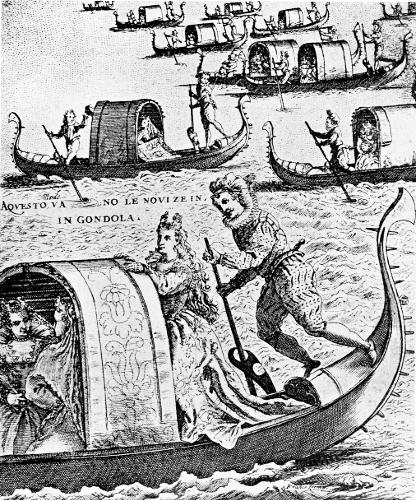
“LE NOVIZE.”—BRIDES VISITING THEIR RELATIVES.
FROM A PRINT. 1560.
“Habiti Delle Donne.”—G. Franco.
[227]
With respect to the entertainment of visitors very many more friends and neighbours looked in after the birth of a boy than that of a girl. They were served in vessels of gold and silver with spiced cakes, iced confectionery, figs, grapes, and coffee, and each was expected to leave a present behind for the child and ample largesse for the servants. This duty fell constantly to the lot of the Doge and Dogaressa who frequently went from house to house to honour this or that noble couple, with their presentations. The Doge’s gift was a gold cup, the Dogaressa’s a gold chain.
The last two Doges of the century were the brothers Marco and Agostino Barbarigo, sons of Messir Francesco Barbarigo and Madonna Caterina Morosini. The Barbarigo came originally from Trieste and claimed to be collaterals of the ancient and extinct family of Zobenico, which, in the tenth century was already settled in Rivo-Alto. Marco Barbarigo was elected Doge in 1485,—“a man,” if his epitaph may be believed, “upright in his dealings with his neighbours, he never sought praise or profit, but laboured for the public good.” The Dogaressa was Madonna Lucia Ruzzini,—beautiful and talented, although Marino Sanudo refers to her incidentally as nothing more than “a very tolerable kind of woman.” She was always ailing, and yet by way of proof that “a creaking gate hangs long,” she outlived her Consort ten full years, but her reign was as uneventful as it was short, one brief year, no more.
The Doge and his younger brother Agostino were never on good terms, and the disputes[228] between them became so acrimonious that, one day, after an unusually harsh quarrel, Doge Marco fell ill of excitement and worry, and was seized with severe cardiac pains. Feeling the stringency of his attack and fearing the imminence of death, he summoned to his couch his four sons. He set before them their duty to the State and commended their suffering mother to their filial care, then he embraced them and her tenderly and blessed them, and, forgiving his headstrong brother, he quietly passed away. His body was laid in State with full honours in the Sala de’ Pioveghi and then ceremonially buried in the church of Santa Maria della Carita, the conventual buildings of which, and the Scuola Grande di Santa Maria della Carita,—the oldest of the religious corporations of the thirteenth century,—are nowadays the Palace of the Accademia.
Dogaressa-dowager Lucia Ruzzini-Barbarigo’s will was executed in 30th July 1496,—fourteen days before her death,—wherein she directs that her burial shall be “conducted simply in the Church of Santa Maria della Carita, where reposes the body of my husband.” ... “To Sister Margherita, Prioress of the Ospedale d’Ognissanti di Murano I leave five gold ducats and my new silken robe.” To her daughters, both cloistered nuns of Ognissanti, she left her State robes and her Corno, with five gold ducats apiece. She was interred by her husband’s side.
The Dogaressa had, among other dependants a Circassian slave, who bore the name of Maddalena, and to whom she was much attached. She had served Madonna Lucia and her family with fidelity[229] for many years, now the testatrix declared her “free from every chain” and bequeathed to her a comfortable competence. This mention of a “slave” opens out a vexed subject. Far away in the eighth century the early Venetian merchant-adventurers, vigorous and amorous by nature and disposition, saw and loved beauteous maidens in Eastern ports. The harem life appealed to them and many an one became the happy possessor, by right of purchase, of helpless friendless damsels.
Oriental slaves were gladly welcomed as workers by the Trade Guilds, especially by the Carpet-weavers, the Makers of cloth of gold and silver tissue, and the Armourers. Public slave auctions were established at San Giorgio in Rialto. The average price for boys and girls seems to have been twenty-five gold ducats; but as many as eighty or one hundred changed hands for a particularly fine specimen of humanity or for one skilled in craftsmanship. These human chattels were well protected by State enactments and often as not they exercised considerable influence in the families of their owners. The wills of Venetians of property generally contained clauses indicative of wishes concerning their slaves.
In Florence, as Madonna Alessandra negli Strozzi has related in her “Lettere,” people preferred dark-haired, swarthy Tartars, who she says, “are the best for work, and most simple in their ways,” but in Venice,—where the sun turned all maidens’ hair into strands of gold,—fair-skinned auburn-haired Circassians, like Dogaressa Lucia Ruzzini-Barbarigo’s devoted Maddalena, were in most request. They were usually skilful in the[230] artifices of the toilet and well adapted for the Venetian sol fa nienti sort of life. The presence of slaves in Venice and their absorption into the private life of the nobles and the citizens were paramount factors in the evolution of the courtesan. Whilst marriage with a slave was absolutely forbidden, the mutual relations of the races and of the sexes were such that perhaps the motto of our British Royal House is the best vindication:—“Honi soit qui mal y pense!”
The painful circumstances which led to Doge Agostino Barbarigo’s succession were soon forgotten in the revived life and prosperity of the Republic. It appeared as though, after flickering fitfully for many a weary year, the golden wax candles of Venetian shrines were again to burn with their wonted brilliancy. Venice recovered Rimini, Faenza, Brindisi, Otranto, and many other possessions on the Adriatic, and her flag once more flaunted proudly on the high seas. The following couplet succinctly set forth the glories of the departing century:—
Still the discovery by the Portuguese in 1486, of the water-way to the Orient round the Cape of Good Hope augured ill for Venetian commerce. So, directly, too, that other great maritime achievement,—the landing of Amerigo Vespucci of Florence, and Cristoforo Colombo of Genoa, upon the shores of the New World affected adversely the supremacy of the “Mistress of the Seas.”
Doge Agostino Barbarigo, born in 1419, had a[231] brilliant career before he mounted the Ducal throne. Podesta of Verona and of Padua, Procurator of San Marco, he was a personal friend of the Pope Alessandro VI., who sent him the rare distinction of the “Golden Rose.” He married in 1449 Donna Elisabetta, daughter of Messir Andrea Soranzo dal Banco, “One of the proudest ruling families in Venice.” One son, Francesco, and four daughters blessed their union,—two of the latter entered Religion as nuns of Santa Maria degli Angeli di Murano.
Seven years after their succession Doge Agostino and Dogaressa Elisabetta were called upon to entertain a very distinguished visitor, Duchess Beatrice d’Este the consort of Duke Lodovico il Moro of Milan. As imperious and intriguing a beauty as ever boarded the “Bucintoro” the Princess was conducted in a pageant from Fusina to the Ducal Palace. Her suite counted princes and ambassadors and a host of attendants, so large indeed that three Palaces,—the Foscari and Guistiniani were requisitioned for her use. Very splendid fêtes were given in her honour. She remained in Venice for some time delighted with the pleasant society of the Dogaressa, and the ladies of the Court, and astonished at the beauty of the younger noblewomen and the comeliness of the young nobles, and perhaps, woman-like more than all at the splendour of their costumes and the magnificence of their jewels.
Her mission was diplomatic, to gain over Venice to the Milanese League against Charles VIII. of France. In this she was completely successful; few of the proud and unemotional Lords not yielding to her blandishments. Her correspondence[232] with her Consort is quaint as quaint can be. She likens the older nobles and their ladies to “great dolls” or “Stately Deities,” and makes sly remarks about the scanty dress and easy manners of the girls. “They are,” she wrote, “clothed in pearls and gold chains from head to toe, but little else ... cloth of gold is as common here as fustian is with us....”
Whether caused by weariness of a prolonged dogado the old Doge began to feel the years heavy, and worn by the declension of the fame of Venice, Agostino Barbarigo expressed a desire to be relieved of his official responsibilities. The abdication of a Chief Magistrate had become a very rare event, and none of the Lords of the Council having any special wish for office, the idea was dismissed. However, on 13th September 1501, the Doge called a special assemblage of the Council,—an expedient rare enough and always ominous of trouble,—and presented a formal act of abdication of the Dogal throne. The proposition was received in silence, but drawing slowly off the Ducal ring, he handed it to the Senior Lord of the “Forty” and said:—“I leave this Palace to go to my own home at San Trovaso, there to end my days, and I pray you to be so good as to accept my profound regrets.” The Council however declined to permit the vacation of office and the Chancellor, speaking for the noble Lords, replied:—“Your Serenity must retain your high station and trust in God to heal you of your infirmity.”
Ten days later the Doge breathed his last at the advanced age of eighty-two. His end was[233] sudden and painless. At first his career had been viewed with satisfaction and his many excellent qualities highly extolled, but disappointed suppliants for his patronage and that of the Dogaressa hinted at nepotism and favouritism and complained of corruption in his bestowal of favours.
What special part Dogaressa Elisabetta took in maintaining the dignity and prerogative of her station we know not, nor do we know anything about her Entry and Coronation, or her death and burial. Her Consort left an inordinately lengthy will with many codicils: he appeared to be determined to spread his bequests over as wide a field as possible. Almost every public institution received a legacy and personal gifts were numbered by the dozen. To his widow, “Ixabela,”—he calls her,—the Doge left the use of their private residence, with the furniture and decorations, the ornaments of the private chapel, the revenues from certain wool and silk weaving factories, ten thousand gold ducats, and, quite quaintly, the proprietary rights over her State robes and the jewellery he had given her.
The funeral of Doge Agostino Barbarigo was conducted with the usual impressive ceremonial at SS. Giovanni e Paolo, where orations were delivered by Bishop Domenigo Venier of Castello and Condottiere Vettor Cappello—who appears to have taken the Doges of his time under his special tutelage. The actual burial was conducted at Santa Maria della Carita, alongside the grave of Doge Marco Barbarigo. His monument bears the somewhat pedantic epitaph:—“He was the most popular man in Venice: a grand orator and a splendid soldier.”
[234]
Lionardo Loredano was the eleventh “Grand” Doge of Venice. Mentally and physically he was a perfect type of the Venetian noble,—not that his family was especially ancient,—they belonged only to the first division of the second grade of nobility,—nor that his wealth and influence were remarkable, but there was about him something or other which manifested the highest expression of Venetian dignity.
Called to the supreme magistracy in 1501, Loredano roused himself, although past sixty-six years of age, and beginning to show signs of failing health, to stand foremost among the men of the new Century. Tall and spare of figure, massive and reticent of feature, passionate yet kind-hearted in disposition, pushful yet tactful in bearing, he was recognised by the Lords of the Council as the man of the hour. All this is forcibly expressed in the lifelike and superb portrait by Giovanni Bellini in the National Gallery in London.
Nevertheless his election was challenged by the populace, gathered tumultuously on the Piazza. The cry was for Filippo Tron, son of old Doge Nicolo, older by ten years than Messir Loredano, very fat, very indolent, and very self-indulgent, but ever ready for a joke and to make fair promises. Moreover his estate totalled eighty thousand gold ducats against Lionardo Loredano’s modest thirty thousand. Happily with the sane constitution of Venice, the unintelligent and ill-directed will of the people was kept under restraint.[235] Tron died suddenly of apoplexy after a heavy gorge within three months of Loredano’s election. Messir Filippo was no opponent of the old Venetian proverb:—“Dieta magga le medico!” “Diet dishes the Doctor!”
The new Doge had four sons, Lorenzo, Girolamo, Alvise, and Bernardo, but he was a widower,—a rare, perhaps unique, circumstance so far as the dogado was concerned. The mother of his sons, Giustina Giustiniani, died the year before the death of his predecessor—Doge Agostino Barbarigo. It appeared as though he was expected to contract a second marriage for his Promissione required that “the Dogaressa, his sons, nephews and nieces and other near relatives, should receive no gifts under a penalty of twenty-five gold ducats for each ducat value.” An oath was enjoined for “the Dogaressa-to-be to observe strictly all the conventions of her exalted position.”
The reign of Lionardo Loredano was one of the most important in all the long succession of Doges, for Venice passed through the most exigent crisis of her history. “The famous League of Cambrai” was aimed at nothing short of the annihilation of the Republic. The Pope Julius II., the Emperor Maximilian IV., the King of France, Charles XII., with the Dukes of Florence and Milan were allied, and they tried to win over the Kings of Spain and Naples, of Hungary, and of Scotland, with the Duke of Saxony. England was neutral, but friendly; indeed Henry VIII. championed the cause of the Republic, and ultimately offered to attack France, Spain and Scotland, and, by way of a pledge of amity, he sent an embassy to Venice.[236] The Venetian Government gratefully acknowledged the English support, and despatched among other costly gifts to the King, a team of eight cream-coloured horses, with crimson and gold caparisons, the forebears of our present State equipage.
The year 1509 was a black one for Venice and her people. Her armies were severely defeated, and the strain upon the manhood of the Republic was excessive. Widows and orphans besought the compassion of the charitable, and hospitals and private houses were full of wounded heroes craving creature comforts. Every noble house was smitten and the gallant companies of La Calza lost their comrades and their joy. That Ascension Day—“La Sensa”—was a day long remembered; there were no festivities, no “Bucintoro” set forth to the “Marriage of the Sea,” there was nobody on the Piazza, and no visitors had entered the city for many a day, the Lords of the Council were broken down with grief and apprehension, and the Doge neither spoke nor smiled, he was like a man in a nightmare. At length a faint rift was seen in the darkling clouds, and Loredano, born discerner of times and judge of men, opened the precarious game of statecraft, after the manner of the chess-gambit he loved best, and adroitly played off his country’s foes one against another, until he succeeded in creating a position of mutual jealousy and mistrust. Spain declared for Venice and offered ships and men, James IV. of Scotland followed suit with promises of one hundred and fifty vessels, and ten thousand trained footmen. France made the first warlike advance, and the Doge met the danger[237] by setting up floating corn-mills in the tidal ways of the lagunes, by acquiring vast stores of grain and ammunition, and by throwing chains across the chief canals. All suspects were expelled the City and every citizen was invited by proclamation to rally to the standard of San Marco and to contribute as much money as possible to the State exchequer. Loredano set a noble example for he sent all his gold and silver plate and the jewels of his late wife to the Mint to be melted down for money wherewith to meet the enormous expenses of resistance. His speech before the Grand Council was a model of patriotism and eloquence and was rapturously greeted.
War was waged in the mainland for eight weary years, during which the Pope placed Venice under an Interdict. At last a truce was proclaimed and “La Pace delle Donne,” as it was called, left Venice strong by sea and land. The ultimate arbiters of a settlement were two Royal Princesses—Louise,—Queen-Dowager of France, and Margaret of Austria,—the Emperor’s aunt. The public rejoicings in Venice were exuberant and the pageants were the most splendid ever organised in the sumptuous city. New Companies of La Calza were enrolled for the special purpose of emphasising the resources, the grandeur, and the independence of the “Queen of the Adriatic.” A very favourite spectacular play was “Miles Gloriosus” of which a particularly gorgeous representation was given by the “Fausti” in 19th February 1514 in the Corte dell’ Orefici’ in the rear of the Ducal Palace, which Marino Sanudo describes as “bellissimo” in its mounting and because of the distinguished part[238] taken in it by the four sons of the Doge and his nieces. The Director of the romance was the Commander of the garrison, and the interlude consisted of an oration by a French master of rhetoric. The chorus was composed of a number of gentlemen and ladies of the Court very richly dressed,—in particular Madonna Giovanna Emo, who appeared in a robe of cloth of gold embroidered in coloured silk with silk velvet appliqué work and literally blazing with jewels. The play began at seven o’clock in the evening, followed by a sumptuous banquet, and winding up, long past midnight, with a ball. Every one regretted the fact that the popular Doge, who presided at the banquet, was a widower,—a stately Dogaressa would have added greatly to the distinction of the spectacle.
The recovery of Padua was the crowning victory of the Venetians. The news reached Venice on the festival of the Translation of Santa Marina, and the transports of the people made the popular ecclesiastical ceremonial a doubly impressive celebration. The “Eterni” and “Immortali” companies of La Calza,—especially concerned in the rendition of High Mass and Vespers with the utmost grandeur,—assisted the Doge in offering the keys of Padua upon the altar of the Saint. Venice was delirious: Mass and “Te Deum” were sung between dramatic representations and serenades,—for the triumph of the Republic was the triumph of Religion. But when the festivities were at their height in 1524, the Provveditori alle Pompe stepped in and forbade many splendid ornaments of the person and personal vanities. Amber beads, agate and rock crystal intagli, diamond [239]buttons, chased gold and silver buckles and clasps, enamelled and gold jewellery for the hair, feathered and jewelled fans, lace sleeves, many-hued damasked cloth of gold gowns, velvet with gold and silver piqué threads, painted and gilded leather belts and shoes, gemmed embroideries, etc., etc., were placed upon the Index expurgatorium. The extravagant decoration of gondolas and sedans, table adjuncts of gold, resplendent liveries, and many more things of joy and beauty were severely cut down.
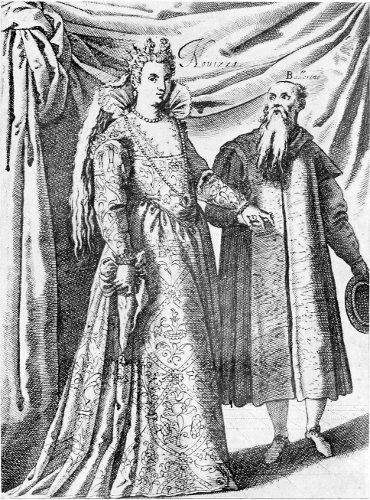
THE BRIDE-ELECT’S DEBUT.
FROM A PRINT. 1610.
“Habiti Delle Donne.”—G. Franco.
Through all these scenes of martial ardour and sumptuary magnificence Doge Loredano maintained supremely the dignity of the dogado and his twenty years of office were the ne plus ultra of the gorgeous panorama of Venetian history. He died full of years and honours in 1521, and he was buried by the High Altar of SS. Giovanni e Paolo.
The Loredanian tradition for patriotism and nobility was handed on in the gracious personage of Dogaressa Caterina Loredano, sister of Doge Lionardo Loredano,—the Consort of his successor Doge Antonio Grimani. He was an old man of eighty-seven,—one more example of Venetian fruitful longevity and senile ability, but his election was a narrow thing for after several attempts at a decision, the Lords of the “Forty” approved it by a bare majority of twenty-eight votes. Once more a popular candidate appeared on the scene in the person of another Messir Antonio Tron, son of the sybarite Messir Filippo.
The Grimani belonged to the second grade of nobility, their name being among the twenty families enrolled by the Serrar del Consiglio in 1289. Nevertheless they were as ambitious, able,[240] and patriotic as any of the Lords of Venice. Messir Antonio had filled every office of State, previous to his dogado with rare distinction, and his spouse had acceptably participated in his honours and shared his fortunes. The date of their marriage is not recorded, but two of their sons rose to high positions. Domenigo, the eldest, entered Holy Order, and was ultimately preconised a Cardinal. His fame in the roll of literature is great for as a sapient collector of books and prints he was the patron of that most exquisite production, perhaps the most sumptuous illuminated manuscript in existence, the celebrated Grimani Breviary. The second son, Giovanni entered the service of the State, and brought his talents to bear upon the details of the Tariff reform of those days, much to the advantage of the City and her purveyors. At the Election and Entry of his parents, as Doge and Dogaressa, he headed a deputation of the Fruiterers’ Guild which made an offer of one hundred and thirty gilded lemons—surely a parallel to painting the lily!
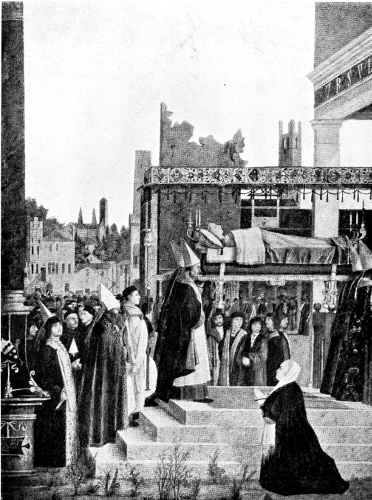
OBSEQUIES OF SAINT URSULA.
VETTORE CARPACCIO.
ACCADEMIA VENICE.
[The kneeling figure is Madonna Maria Eugenia Caotorta-Loredano, who died 1493.]
The new Promissione contained some arbitrary, yet almost ludicrous clauses:—for example, the Doge was forbidden to speak alone with ambassadors and foreign agents, his two State Councillors were required to be present at all such interviews. Like most of the nobles and wealthy citizens Doge Antonio Grimani had a passionate love of sport. Among them all, fowling was a favourite pastime, the reeds and rushes of the smaller islets of the lagunes were splendid cover for aquatic game. Sportsmen wore high boots which they called fisolari, after the birds held most in esteem— [241]fisoli,—divers. The coveys were approached in shallow boats, each manned by eight oarsmen, in blue and green liveries,—the colours most in affinity with the law of natural concealment. The Signore sat in the bows ready with his pecce or miniature cross-bow. Doge Antonio Grimani was forbidden to shoot, as had been his wont, whenever pleasure invited him, for he was restricted to four annual sporting excursions. Just before Christmas he was expected to assume his fowling dress and make a water excursion for the purpose of shooting not divers but wild ducks—oselle. His bag had to be enormously capacious for each Lord of the Council, of the “Forty” and of the “Ten,” required five birds dead in the feather! The sportive Doge usually failed to bring down sufficient game by his own cunning, and in returning to Venice, he directed his provvidetore to purchase the balance in the Poultry market! Even so the requirements of the Lordly blackmailers were not met quite to their satisfaction, for some received fat birds whilst others had those in poor condition. The only way out of the dilemma was conceived by the Doge himself, for, to square accounts, he dealt out so many birds apiece and sent the complement in cash value! This he effected in a novel and characteristic manner, he engaged the services of a stamper of medals and issued a neat little silver coin, a quarter ducat, worth four shillings English money. Upon the obverse it bore the similitude of a gold duck, and on the reverse, the quaint legend:—“Par osculata sunt,” and this was ever after a yearly Christmas-box to all and sundry of their Excellencies,—it went by the name “Osella!”
[242]
The Dogaressa’s Promissione was also restricted. An outcry from the baser sort of Venetian loafers and out-of-elbows nobles, was raised against her solemn Coronation. She was denied the customary salutations of the Masters of the Trade Guilds at the Ducal Palace, and the ceremonial reception of ambassadors. Poor Dogaressa Caterina had to be content to be the domestic helpmeet of her Consort not his State wife as well! It does not seem that for her the wealthy makers of cloth of gold had any commission for State robes! She wore simply the dogalina of crimson velvet with full deep sleeves of lined satin; her Corno,—very much reduced, in size,—bore pearls, rubies and diamonds; the velo sottile of thin net, not lace, fell from her head to her waist, and her golden girdle was shortened and unjewelled. Who was the Emperor of Fashion and the arbiter of sumptuary conventions nobody knows, possibly his office was in commission to the officials generally of the Tribunal of Ceremonies, and held by pettifogging busybodies and ill-natured nobodies.
There were and are several Palazzi Grimani in Venice. Doge Antonio Grimani’s residence is that called Grimani della Vida, on the Grand Canal, near the far-famed Ca d’Oro. He died in 1523 but the date of Dogaressa Caterina’s demise has not been preserved, nor do we know where their Serenities were buried.
Doge Andrea Gritti assumed the State robes and Corno in 1523. At once he made a strong bid for popular favour and distributed so vast an amount of largesse upon his election, that people looked askance at him, and cried out in return “Um! Um!—Trum! Trum!” This was an[243] entirely new departure, but Doge Gritti set a fashion in making a pompous progress around the Piazza wearing his full regalia, when coins were scattered broadcast among the spectators, and a movable pozzetto, pulpit, or throne, was borne in the procession, and, when the Doge reached the centre of the Piazza, the youngest Lord of the “Forty” placed upon his head the Corno, and an address was offered him in the name of the citizens.
There is no record of the Dogaressa’s Entry and Coronation,—possibly the Doge’s progress was, in a way an alternative pageant. She was Donna Benedetta Vendramin,—a niece of Doge Andrea Vendramin. The Doge’s family was of no great distinction,—one of the sixteen families, ennobled when the new Libro d’Oro of 1450 was compiled.
His Promissione of 13th May 1513, was, like his predecessor’s, the work of the purist-faddist section of the Council. He was forbidden to go beyond the narrow limits of the City proper, the gardens of Murano, and the sea-baths of the Lido,—the pleasant places on the mainland and up the Brenta, were all beyond bounds! A fine of one hundred gold ducats was actually fixed for each breach of this ridiculous restriction. Letters, to and from his Consort, and his children were subject to official inspection, and statements therein considered by the “Ten” open to objection, placed the whole family at the risk of a fine of two hundred gold ducats—remarks affecting the status and privileges, the opinion and actions of the Council were marked down for banishment for a term of five years!
[244]
A further instance of the insolent intolerance of the Councils “The Forty” and “The Ten” and of their exercise of tyranny against the idol they had set up, to wit the Doge, was in connection with the Oselle issued by this Serenity. Doge Gritti presumed to have his token-medals stamped with the effigy of himself kneeling before Saint Mark, this was disallowed. At the same time the nobles sold their oselle to collectors, and then disputed the value of the Ducal gift! The “Ten” decreed the withdrawal of this largesse, together with the yearly dole of wild duck and instead demanded from the Doge the circulation among their Excellencies, at his expense, of a new coin of the value of one and a quarter gold ducats,—to which they gave the name “ducato d’osello.” Whether the unfortunate Doge was able to meet this very heavy annual tax or no, we know not. To be mulcted, without the right of remonstrance, in a yearly useless expenditure of £1000 was a heavy drain even on a rich man’s purse.
Doge Gritti, according to the chroniclers “was a very pliant sort of man,” indeed he had need to be! He was also a great eater, and his gustatory tastes ran to somewhat vulgar and common-place delicacies: his table was served every day with “fat pork, onions and garlic.” He had a shrewd old slave-housekeeper, one Marta, who alone was able to curb his appetite. He gave her permission to remove any dish of which she considered he had partaken sufficiently, or which she thought was bad for him! In person Andrea Gritti was of handsome graceful figure, his temperament was sympathetically voluptuous, and he was much admired by the fair[245] sex—a lover through all his life of wine and women. It was reputed that he maintained a great establishment, after the fashion of an Oriental seraglio; he had many Greek and Circassian slaves and some of them were of gentle birth.
Fond as he was of pomp and circumstance he was able to gratify his tastes with respect to his domestic appointments. His table service was unique, mostly of gold and precious crystal; his gondola, alone among the ten thousand gliding over the water-ways, was decorated with crimson and gold. The sumptuary laws became more and more exacting, and, on one occasion, when a niece of the Dogaressa appeared at a reception at the Ducal Palace in a very magnificent costume of velvet embossed cloth of gold with scarlet and jewelled embroideries, Doge Gritti felt obliged to order her to leave the Court, and return in a less costly confection.
With all his extravagant and ambitious fancies Doge Andrea Gritti was a patriot. Called upon to make a retort to the insulting language of an ambassador of the Sultan, who declared openly that, “Till now Venice has wedded the Sea; henceforth it belongs to us who have supreme power thereupon.” The Doge quietly replied:—“We shall see, Constantinople will fall again perhaps to Venice.” This menace was followed up by an attack in force by the Turkish fleet in 1535. The Doge at once expressed his determination to lead the Venetian forces against the invader. His ardour however met with a snub from the Council, and he was advised to reconsider the terms of his Promissione.
[246]
Indeed the jealousy and meanness of the majority of the members of the “Forty” and of the “Ten” knew no bounds. The Doge was subjected to many insults, and to a secret code of espionage. Quite lately proof of this was found, when alterations were undertaken in the saloon occupied by the Archæological Museum in the Ducal Palace. Two narrow staircases were discovered, at the back of what had been the Doge’s bedroom, where Doge Agostino Barbarigo had erected Pietro Lombardo’s noble chimney-piece. These steps led to a space immediately behind the bed itself, where two movable panels in the wall permitted any one to have a peep at the Doge and Dogaressa (?) in bed and see what they were doing!
Among the pious works of Doge Andrea and Dogaressa Benedetta was the rebuilding of the ancient church of San Giovanni Elemosinario. The splendid picture over the high altar of the Saint bestowing alms was painted by Titian upon the Doge’s commission. In the chapel of San Clemente, within St Mark’s is a bas-relief with Doge Gritti kneeling before Saints Nicholas, James and Andrew. The famous painting by Paris Bordone, now in the Accademia, of “The Fisherman and the Ring,” although ostensibly offering a portrait of Doge Pietro Gradenigo really shows the handsome figure and features of amorous and ambitious Doge Andrea Gritti. Probably he and his Consort were buried in their fine new church, but records are wanting.
“What sort of a wife has he got?” was the constantly recurring question, which, upon the death of a Doge, was tossed from side to side in the[247] deliberations of the Council of “Forty,” with respect to the nomination of a successor. “Cherchez la femme!” has no satisfactory equivalent in English phraseology, but the French axiom exactly suits the condition created in deciding the Ducal vote. The Promissione of each succeeding Head of the State, one after the other, tended more and more to eliminate individuality and initiative.
As often as not the physical attributes of a candidate weighed considerably in the election. The question of the spouse also resolved itself pretty much upon the same lines. The candidate whose wife was of commanding appearance, and had a fascinating manner, and who could display to advantage the richest robes ever woman was called upon to assume; and also was likely to add decorative distinction and artistic taste to the State functions had an excellent chance of election. All this was exemplified in the case of Doge Cristoforo and Dogaressa Dea Moro:—he was a cripple and proud, but she was a beautiful and accomplished woman. Certainly this reasoning is natural and not altogether fatuous, for the same economy of selection has ever determined the bestowal of honours in every nation—and does so to-day—incidentally and very aptly illustrating the quaint French mot.
In the long Roll of the Doges and Dogaressas of Venice there were periods where short reigns followed one another in succession. During the second half of the fifteenth century, 1471–1485, six pairs of Serenities bowed themselves on and off the Ducal throne; whilst the middle years of the sixteenth century, 1545–1571, saw an equal number of Ducal couples assume the Corno. Many of these[248] reigns were uneventful and inconspicuous, and very little is on record for the story-teller to relate. Happy is it, perhaps, for the peace of a State and its prosperity, when the pen of the historian dips seldom in the red ink of episodes.
Messir Pietro Lando and Madonna Maria Pasqualigo-Lando followed Doge Andrea Gritti and Dogaressa Benedetta Vendramin-Gritti in 1538. Both of them belonged to comparatively recently ennobled families; the Landi as late as 1450, and the Pasqualighi, one of the thirty advanced to honour after the Chioggian War in 1391. The new Doge took up manfully the cudgels of the State, ready to lead against and fight its foes; but the military element of the lagunes was weary of debauches and defeats. Accommodations with the enemy accorded better with the degenerate spirit of the times, than open hostilities. The acutest phase of Venetian retrogression had set in.
In an inverse ratio the political ascendancy of Venice diminished, the while her artistic temperament became emphatic. She waited, for example, until every other painting school had grown to maturity before she began to nurse her native painters; but, under Doges Lando and Donato, she crowned Titian and his comrades with golden chaplets. They were the first in the Renaissance to portray the natural and unadorned charms of women.
The study of the classics and researches in philosophy never appealed to Venetians generally and gave no tone to society. Venice had neither permanent teachers nor libraries; and her sons and daughters had profound contempt for humanists.[249] Cosimo de’ Medici, “Il Vecchio,” when an exile within the boundaries of the Republic, deplored the want of scholarship. The ensigns of Venice were “Make money and spend it,” and “Grasp power and keep it!” However Doge and Dogaressa Lando had literary tastes, and several Venetian writers dedicated their works to them. Pietro Contarini, of the school of Francesco Colonna, in 1541, inscribed their Serenities’ names upon the fly-sheet of his “Argo Vulga,” and addressed them as “O Sacio Phœbo—O Radienta Luna!”
The dogado of Francesco Donato, 1545–1553; of Marcantonio Trevisan, 1553–1554; and of Francesco Venier, 1554–1556, were uneventful. The position of Venice was wholly changed: what advance she made before the menace of the “League of Cambrai” was checked, and she began to sink into the position of a second-rate power, despoiled of her territorial acquisition and robbed of her naval glory. Her rulers and her citizens yielded themselves to the trivialities of fashion and the intrigues of party, and all the industries felt the influence of disaffection and indolence.
Doge Francesco Donato, whose Consort was Madonna Alicia Giustiniani-Donato, certainly strove manfully to stem the tide of disaster and the ebb of decay, and both he and the Dogaressa did all that was in their power to encourage art and craft. For example he took Tiziano Vecellio under his special patronage. He was appointed Head of the “La Senseria” or Broker of the Fondaco de’ Tedeschi at an annual salary of three hundred gold ducats, with the condition that he should paint portraits of all the Doges of his time at eight ducats a head to be[250] paid by each. He painted Doges Grimani, Lando, Donato, Trevisan, and Venier.
Furthermore Doge Donato added greatly to the decoration of the Ducal Palace and the Dogaressa Alicia refurnished the private apartments. To them also was due the building by Iacopo Sansovino of the Libreria Vecchia, called by Symonds in his “Renaissance in Italy” “the crowning triumph of Venetian Art,” and praised by Aretino as “Superiore all’ invidia.” The Zecca or Mint was completed at Doge Francesco Donato’s instigation, as was also the church of San Sebastiano.
During the years 1547–1549 discontent was rife among the glass-workers of Murano. Members of this most highly privileged Trade-Guild complained that, what with the observance of Church and State festivals and the time restrictions of labour under legal enactment, the working year was reduced to less than thirty-five weeks. From another point of view they saw increasing disabilities in the introduction of foreign manufactures, as Luigi Conaro, in his “Discorso Intorno alla Vita Sobria,” published in 1543, has recorded:—“cloth of gold from India, porcelain and glass from Sevres, earthenware from Birmingham, and other manufactures entered Venice freely to the disadvantage of Venetian workers.”
Strangers of rank and wealth were always charmed with the rare specimens of glass shown, and often bestowed upon them, and invitations poured in upon the craftsmen to accompany the visitors back to their homes. Such advances were promptly declined, for a Murano glass-worker who left Venice to ply his calling in a foreign land was declared an outlaw! Besides this the export of[251] materials, the elucidation of methods, and the sale of finished articles outside the Republic, were crimes visited by heavy fines and imprisonment.
The Gastaldi or Masters of the Guild laid their complaints before their patroness, Dogaressa Alicia, and she was instrumental in obtaining the removal of certain restrictions, and, through her influence, in 1550, a party of Murano glass-blowers were permitted to travel to England, Flanders, Spain and France. King Henry VIII. cordially welcomed them in London, and assigned them suitable quarters where they might instruct native workmen. The King moreover formed a remarkable collection of masterpieces of Murano glass-ware.
There was a quaint saying in Murano:—“The first woman was made of Murano glass—beautiful and brittle!”
[252]
The Doge and Dogaressa of the Fisher folk!
If imitation be the sincerest form of flattery, then must the Most Serene Doges and Dogaressas of Venice, during the fifteenth and sixteenth centuries, have experienced gratification combined with amusement at the spectacle of the mock Court of the Zattere.
The fisher-folk of the parishes, wherein they principally resided, San Raffaele, Santa Marta, and San Nicolo degli Orfani, and others, were accorded the privilege of electing annually a Doge and Dogaressa to preside over the affairs of the fishing industry. They were chosen by vote and by acclamation, they were accountable to a Council of “Forty,” and they had their installation and coronation ceremonies. They were attended by duly appointed officers: the Dogaressa had her attendant maids of honour, the Doge his body-guard. At functions,—joyous or sad,—they wore official costumes, modelled upon those of the Doge and Dogaressa at the Ducal Palace—robes of State, the Corno and the regalia.
Upon the Election of a Doge of the Republic, the Fisher Doge and Dogaressa proceeded in mock State to the Palace to offer the congratulations of the fisher community, and then they went on to the Palace of the Dogaressa to salute her Serenity.[253] Each Ascension Day—“La Sensa”—the Head of the State and his Consort entertained the fisher folk generally at collation, and the subsequent proceedings partook of the character of a saturnalia,—full license being granted by the Signori della Notte, or police, but no one was at all the worse for their conviviality.
There was no little stir in official circles, when, in 1557, the Council of “Forty” determined that, after being in abeyance nearly eighty years, the ceremonials of Entry and Coronation should be revived in honour of Signora Zilia Dandolo-Priuli. Two generations of Venetians had come and gone and had not beheld the most striking of all Venetian pageants. To be sure they had not been without gorgeous processions and bountiful festivals; the twelve annual Andate of the Doge and the Lords of the Council had been scrupulously carried out under each succeeding Head of the State; but demonstrations of magisterial dignity and military pomp are very poor equivalents for feasts of grace and beauty, love and chastity.
The Election of Messir Lorenzo Priuli to the Ducal throne, in 1556, was in a very great measure due to the attractive personality and ancestral dignity of his Consort. She was acknowledged to be the most distinguished noblewoman in Venice. Daughter of Messir Marco Dandolo, in direct descent from Doge Andrea Dandolo, and with the blood of the hero Doge Arrigo Dandolo coursing through her veins, she was in the best and truest sense a virago. Her marriage took place in 1526, but was as a matter of rank, a mésalliance, for the[254] Priuli were one of the latest ennobled families,—dating their title only from 1450.
The Palazzo Priuli, upon the Fondamento dell’ Osmarin, was in its day one of the most magnificent in Venice, being entirely faced with superb frescoes by Palma Vecchio—alas they have all perished. Another Priuli palace belonged to Messir Girolamo Priuli, Procurator of San Marco, and brother of the new Doge: it was situated on the opposite riva of the Grand Canal, near the church of San Barnaba. A third Palazzo Priuli, or perhaps Casa Priuli, existed in the Cannaregio, a sestiere with its distinctive customs, peculiar physiognomy of its people and its special dialect. Built in 1520 by Messir Agnello Priuli youngest brother of the Doge, who married in 1517 Donna Andreiana Venier, daughter of Messir Francesco Venier, a two years’ Doge in 1554–1556, it was famous for its orchards and its great shady trees—the rendezvous of many a gay company under Dogaressa Zilia’s patronage.
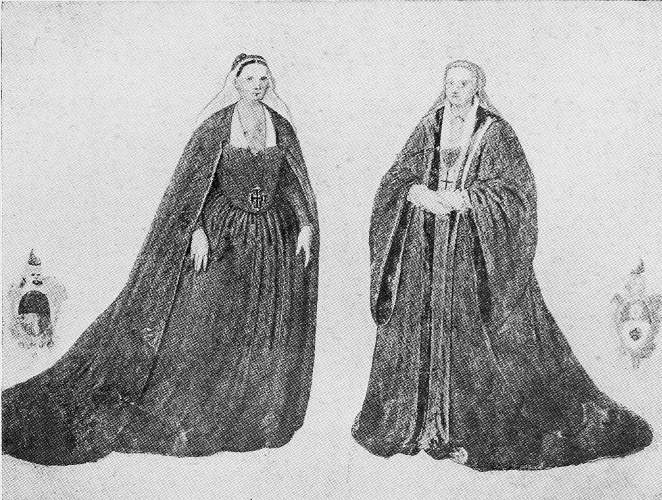
I. II.
(I) DOGARESSA ZILIA DANDOLO-PRIULI, 1557.
(II) „ LOREDANA MARCELLO-MOCENIGO, 1570.
FROM “LIBRO DE’ CERIMONIALI.”
(Archivio del Stato di Venezia).
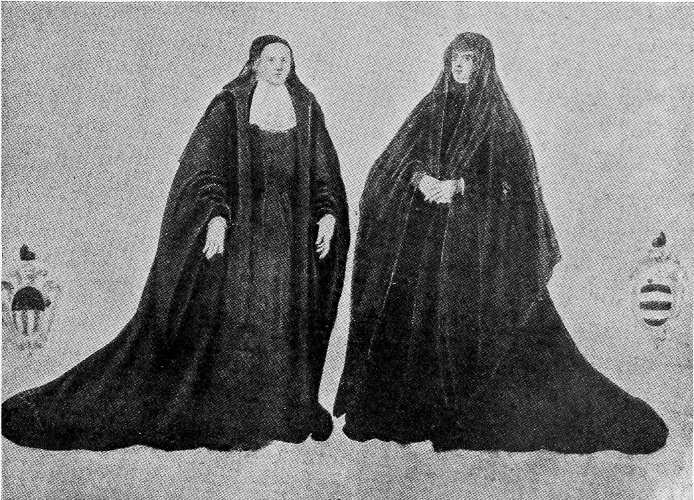
I. II.
(I) DOGARESSA ZILIA DANDOLO-PRIULI, 1559.
(II) „ CECILIA CONTARINI-VENIER, 1578.
(In Mourning Attire).
FROM LIBRO DE’ CERIMONIALI.
(Archivio del Stato di Venezia).
The preparation for the Dogaressa’s solemn Entry and Coronation were on a very elaborate scale. The “Bucintoro,” which had borne no bevy of Venetian beauties for well-nigh one hundred years, was overhauled and covered with gold and blazonry. The Trade-Guilds—the Fragilie—were hard at work with new costumes, new banners, and new gifts for her Serenity. The clergy carefully recensioned their office-books and looked out their richest vestments. Music-masters and chorus-leaders furbished up their instruments, wrote festal marches, and rehearsed odes of welcome. The companies of La Calza gave busy work to all the Trades for new festal garbs. The dignified Lords themselves [255]needed new robes, their consorts new dresses. Venice was alive with craftsmen and craftswomen, for the time was short, and very much to do.
Although the Election of Doge Francesco Priuli was effected late in the year 1556, the solemn Entry of the Dogaressa did not take place until the autumn of the year following. The reason for this unusual delay we need not canvass but assign it to the want of preparedness for the revival of a long disused observance.
On the 18th of September 1557, the “Forty,” the “Ten,” and fifty other nobles, assembled in the Sala d’Udienza del Doge, to inaugurate the solemnity. They despatched Cavaliere Giovanni Cappello,—the father of his Serenity’s son-in-law Andrea Cappello,—habited in a magnificent costume of richest red damask cloth of gold, stiff as herald’s tabard, with a distinguished and splendidly appointed suite to welcome in their name, in the Piazza, the ambassadors of the Emperor and of the Dukes of Savoy and Urbino. Passing under a triumphal arch erected near the public slaughter-houses, by the Guild of Butchers, the procession advanced to the quay of the Piazzetta and there embarked upon the gala-decked “Bucintoro.” A short cruise took the party, at the landing-steps of the palace of Messir Girolamo Priuli, which was hung from top to bottom with draperies of silk and cloth of gold, to pay their respects to her Serenity.
Dogaressa Zilia awaited her distinguished visitors at the entrance of the palace, accompanied by one hundred young noblewomen and attended by the Officers of State. She wore the full robes of her rank, her veil was of the finest white net of[256] Candia, her chemisette and the edging of her great ermine sleeves were of the richest Burano lace, her Corno was of crimson velvet with a jewelled bandeau, and shoes of velvet, to match her head-dress, completed her costume. The jewels she wore were the most gorgeous owned by any gentlewoman in Venice, heirlooms in the Dandolo family, and taken from the Sultan’s treasury by Doge Arrigo Dandolo at the capture of Constantinople,—they were barbaric in magnificence.
Very graciously the Dogaressa bowed her acknowledgments of the reverential greeting of visitors, and, when the Cavaliere offered her the Promissione of her Consort, she assented to the clauses affecting herself, and thereafter bestowed upon each member of the deputation a richly embroidered purse of cloth of gold containing ten golden ducats. Then, seated in tribunes erected along the riva, the noble company witnessed a regatta of fisolere—long and narrow unprowed gondolas. This popular feature in the day’s proceedings was followed by a gorgeous water-pageant, undertaken by the Fragilie, the Compagnie della Calza, and other notable organisations.
Fourteen galleys, almost as big as the “Bucintoro,” belonging to the great Guild of Goldsmiths, covered with crimson damask and gold lace, led the way. The Canal was a mass of moving craft of every sort and size, full of merrymakers, and bands of music, space being riskily found for the bulky “Bucintoro” to steer her course with the Dogaressa seated on the Ducal throne at the prow, her gallant and beautiful Court around her. Salvoes of artillery, clangings of bells, soundings of horns and[257] trumpets, and the clamour of the spectators accompanied the Progress to the Piazzetta. At the Butchers’ triumphal arch two hundred and fifty young girls of the city welcomed her Serenity. They were arrayed in crimson satin, green silk damask and white taffetas, and were adorned with magnificent jewels which had not been displayed in public for well-nigh one hundred years. Many wore great pearls, the biggest ever seen in Venice,—and gold chains of cunning workmanship with numerous rubies, emeralds, and sapphires: upon their heads were diamond coronets and lace veils spangled with brilliants. In this constellation of grace, beauty, and affluence, was a striking group of twelve brides,—recalling to everyone the romantic Venetian story of the past. Their golden hair, falling at will over their bare and painted shoulders, was restrained only by coronets of gold and silver leaves of myrtle: their costumes were of white satin and lace with golden girdles worn à la Grecque. Behind the brides were ranged two-and-twenty older matrons, clothed in black velvet, and covered with precious stones. This feature in the reception must have been arranged by a scenic painter or a master of costumes, for nothing so well tones masses of strong and vivid colours as here and there a sable touch.
The procession thus doubled in numbers, passed superlatively between the hundred German guards in the service of the Republic, making for the Basilica. Immediately before the Dogaressa came the wives of the Procurators of Saint Mark, with Madonna Marina, the wife of Messir Vettor Grimani at their head, all robed in black satin with long hanging scarves like those of the Dogaressa’s[258] State robe. Attended by the Secretaries of the High Chancellor marched the Doge’s two sons-in-law,—Cavalieri Antonio Morosini and Pietro Cappello,—supporting Cavaliere Giovanni Priuli, their Serenities’ only Son, all vested in Ducal dress,—tabards of emblazoned cloth of gold, with trains or long togas of crimson silk velvet, worn over silver-gilt suits of armour.
Most becomingly costumed in richest silver damasked white silk velvet walked the Doge’s two daughters Madonne Antonio Morosini and Pietro Cappello followed by Cavaliere Matteo Dandolo, brother of the Dogaressa, in full Ducal robes, who immediately preceded her Serenity. He was attended by two Councillors of the Doge,—Messiri Antonio Giustiniani and Marco Centanni. Under the State Umbrella of cloth of gold, with erect figure and stately carriage, passed along the new First Lady of Venice,—conscious that, in her person, was revived the most gorgeous of all the noble “Triumphs” of Venice. The historic splendours of all the crowned Dogaressas of the past were centred in her, and men and women thanked God that the glories of Venice were once more dazzling their eyes, and making promise for their children.
The three pages of honour, who bore the Ducal train and held the heavy sleeves of fur and gold, paused before the Grand Portal of San Marco, and the Lords of the Council and State officials gathered around the Dogaressa and her children and relatives to keep back the pressure of the enthusiastic crowd. The Chapter of the cathedral were awaiting Her Serenity and the Prior at once sprinkled her with Holy Water, the acolytes holding aloft great lighted[259] candles, and tossing big silver censers in the air. The Dogaressa humbly knelt to kiss a holy relic of Saint Mark whilst the choristers and musicians gave forth joyous anthems. Conducted by the ecclesiastics into the choir the Prior seated her upon the Doge’s throne and then “Te Deum,” was chanted. To each canon Dogaressa Zilia gave a purse of cloth of gold with one hundred gold ducats. The ritual of the Entry was celebrated as in the days of Dogaressa Regina Gradenigo-Vendramin. Upon the sacred Missal, held by the Bishop of Castello, the new Dogaressa swore to observe her Promissione. Several addresses were read to her, but nobody could hear a word because of the tremendous vociferations of the applauding multitude inside and outside the sacred edifice.
Bowing reverently to the High Altar Dogaressa Zilia passed through the Sanctuary and ascended the Foscara staircase, on her way to the Ducal Palace. As in days gone by, the Guilds made lavish displays in each room of delectable dainties for the palate and of supreme examples of their respective craftsmanship. The hairdressers were the first to offer their duty, being specially under the new Dogaressa’s patronage. They had spread a table with a very beautiful Oriental carpet and placed upon it a resplendent crystal mirror of Murano with the golden appurtenances of the toilet—splendid gifts for her Serenity. Possibly they warily foresaw the need of a new dressing of the Most Serene locks of auburn hair after the trying formalities already graciously performed! The Gastaldo, or Master of the Guild, advancing[260] with many reverences addressed the Dogaressa: “Right welcome is Your Serenity, we hairdressers are your devoted servants, we rejoice with you, and beg you still to extend to us your Serene patronage.” Then, with a motion of the hand he invited her to partake of the delicacies and to quaff the rare vintage on silver dishes and out of crystal flagons, which His Serenity the Doge had provided for the use of all the Guilds.
The Dogaressa graciously replied:—“I am delighted that everything is so well arranged and I thank you heartily. I am not able to stay with you because I have to visit seventeen other rooms. I hope to see you all another time, I must now say farewell.”
Entering the room allotted to the Guild of Goldsmiths, her Serenity was saluted in a similar manner, and offered two splendid panels of tapestry, mounted in exquisitely carved frames overlaid with gold and silver. Passing through a corridor, which gave upon the Piazza, she beheld the immense awning of light blue canvas covered with golden stars, which stretched away to the four columns in front of the offices of the Signori della Notte al Criminali, which were draped in crimson damask and carried six-and-twenty emblazoned shields, and every window festooned and decorated with the Dandolo arms. As she went on her way the massed bands of the Guilds, in the Piazzetta, played a triumphal march. Each of the sixteen rooms was adorned by a separate Guild, and each Guild made a distinctive offering, saluting her Serenity with loyal devotion. In the last room the Officers of the Murano glass-workers were in charge of a rare[261] exhibition of the lustrous objects of their craft. The offering of this ancient and noble Guild was a suite of glass new in style, shape and colour and jewelled,—chefs d’œuvre of the most fragile art of Venice. In honour of the new Dogaressa quite naturally the service was called “La Zilia.”
At length this very agreeable but very tiring Progress ended at the Sala del Gran Consiglio, where Dogaressa Zilia was placed upon the Ducal throne, having on her right the older ladies of her escort, the State Councillors, the Heads of the “Forty,” her brother, Cavaliere Matteo Dandolo and the Cavalieri Antonio Morosini and Pietro Cappello. The nobles and gentlemen all were in crimson satin having removed their heavy tabards of cloth of gold; they wore stoles of cloth of gold over their left shoulders. Upon benches opposite were seated ambassadors, judges, knights, members of the Council, and the more distinguished guests of the Government. The younger gentlewomen of the Dogaressa’s suite were upon her left hand, and with them an equal number of young nobles,—Companions of La Calza and young officers of the fleet and army. The ducal Corno was held over her head by the High Chancellor, who addressed her in the same terms as those used at the Coronation of Dogaressa Regina Gradenigo-Vendramin.
Shades of evening were falling on the golden glory of a glorious festal day, as, by magic, torches burning coloured fires were kindled in every window of the Palace,—every Sala was lighted al giorno. Then defiled before the Serene Dogaressa in the Grand Courtyard a pageant of the Arts and Crafts,[262] every member thereof bearing a lighted torch. In the van marched two by two, one hundred of the handsomest young gallants of Venice,—all tightly costumed in silks and satins,—and twenty-five gentlemen of the Doge’s private cabinet,—wearing long togas of black velvet and heavy gold chains of office.
Collations were spread in the cortili of the Palace, and banquets were given in the Council chambers, and then, in the Piazzetta, were athletic exhibitions of posed human pyramids and other figures, and a grand display of fireworks. The festivities wound up with dance and music, games and flirtations, till the new day began to peep through window and doorway as the pale moon withdrew her light before the fiery car of the advancing Sun God.
The festival of the Coronation was carried over three days, days of unalloyed pleasure and success. Bull-baiting, bear-baiting, cock-fighting, boxing, wrestling, skiff-races, swimming matches, well filled twenty-four hours, and then followed dramatic performances by members of La Calza. Venice was in a delirium of music, dancing, and general rejoicing. Rich and poor alike were feasted by the munificent Doge and Dogaressa, and, when on the last day of the festival, they made a round of visits to thank the Masters of the Guilds and others who had been conspicuous by their services in general, every one felt that rest was welcome, and that life might again return to its normal conditions.
The “Triumph” of Dogaressa Zilia Dandolo-Priuli marked a red letter in the annals of the Republic. It was taken as a proof that the spirit[263] of the Venetians was by no means dead, but, at the same time, it served as a warning of the enervating effect of wanton enjoyment and leisured opulence. A poet-laureate arose, unknown now by name, who thus apostrophised the happy Signora Zilia:—
The reign of Lorenzo and Zilia Priuli was, for the most part, peaceful, so far as the intermittence of sporadic hostilities was concerned. To be sure the Turks never let the Venetians quite alone, and Venice kept on quietly pushing diplomatic aggression everywhere. Still the hindrances to home development were not unduly harmful and industry and commerce throve exceedingly. The Dogaressa, good as her word, spoken after her Coronation—“I hope to see you all another time”—extended her heartiest patronage to the Trades which most appealed to her in matters of taste, and she fostered new fashions in upholstery, napery, and table appointments, as well as personal adornments.
Alas, her wearing of the Corno was limited to three short years, for, in 1559, Doge Priuli was laid upon his death-bed,—another victim to pestilence. He was buried at San Salvatore, under the statue of his patron Saint Lorenzo. The Council paid unusual honours to the widowed Dogaressa, a decree, dated 24th June, immediately after the burial of her Consort, appointed her a household of eight maids of honour, and servitors for her sedan, and her gondola. She was to be[264] attended in her visits to churches, hospitals and other institutions, by four elderly gentlewomen of distinction, and she was required to wear in public black satin brocade cut after the pattern of the cloth of gold State robes but without jewels. These instructions were to serve as the decree stated “per maggior decoro et honor de la Republica,” and the dowager Dogaressa was accorded the title of “Princess.” Furthermore a monthly allowance was granted her of fifty gold ducats, and the supervision of her affairs was delegated to the State Chamberlains.
The “Libro dei Cerimoniali,” still preserved among the Archives of the Republic, has a representation of Dogaressa Zilia Dandolo-Priuli in the costume of a widow. The dress is apparently of black cashmere, with full deep sleeves of black silk. Her widowhood lasted seven years, and she died regretted by all on 13th October 1566. Her funeral obsequies were conducted upon a scale commensurate with the unusual honours bestowed upon her in her lifetime. After the excision of the bowels and brain,—which were placed in a marble vase,—her body was “washed,” says the writer of the “Cerimoniali” “in pure spring water, and wrapped in tow, with sponges under the armpits.” Embalmed with aromatic wax and spices, the dead Princess was shrouded in the habit of a nun of the Convent of Sant’ Alvise, of the foundation of Donna Antonia Venier in 1388: over it was cast a chemise of cloth of gold, and a delicate lace veil shaded the face arranged under a Ducal Corno.
The lying-in-state was upon a bier in the Sala dei Pioveghi. During three days the Papal Legate,[265] the Ambassadors, the Lords of the Councils, the Captains of the “Forty” and of the “Ten,” the Procurators, Judges, and all the Officers of State with the clergy and religious orders, the Religious congregations, the inmates of the State Orphanages and Homes for Women, and a vast concourse of citizens passed before the coffin. On the last day the Doge Girolamo Priuli,—his brother’s successor,—in full State ascended the Scala d’Oro accompanied by the Papal Legate and Cavaliere Giovanni Priuli,—the son of the late Doge and Dogaressa,—and entered the funeral chapel to assist at the final ceremonial.
A procession of the Prior and Chapter of San Marco with cross, banners, and lighted yellow wax torches, accompanied by the clergy of the church of San Fantino,—usually attended by the late Dogaressa,—and her private chaplains, filed into the Sala, and, after prayers and absolution, the coffin was raised upon the shoulders of master-marines of the Arsenal, borne down the Scala de’ Giganti, and carried solemnly across the Piazzetta to the portal of the Basilica, where the remains were blessed by the Bishop of Castello. The funeral cortège then advanced between military guards through the Piazza and Merceria to the Ponte d’Olio, and so on to the great church of SS. Giovanni e Paolo. All the calli were covered with black hangings, and every man, woman, and child was in deepest mourning. Within the church the coffin was placed upon an imposing catafalque, and surrounded with torches and candles. Conducted to his Chair of State the Doge laid aside his Corno, whilst the priest of the Collegiate Church of San Fantino delivered an[266] impressive oration, ending with the apostrophization “Jam vero Ziliæ virtuti quæ potest per oratio inveniri?”
Such an imposing ceremonial at the burial of a widowed Dogaressa was unprecedented. Zilia Dandolo-Priuli came to her throne in the grand Ducal Palace and to her grave in the simple church of San Salvatore in a couple of “Triumphs” unique of their kind.
The dogado of Lorenzo Priuli was conspicuous only so far as it was adorned by the personality of a wealthy, talented, and fascinating wife. Had the reign of his brother Girolamo Priuli, his immediate successor, been graced by the presence of as illustrious a consort, certainly history would have recorded her charms, her influence, and her example. Alas, we know nothing about Signora Elena Diedo-Priuli beyond her name: the date of her birth, marriage, and death are unnoted, nor do we find any reference to her family, her forebears, or her offspring.
One of the most ornamental and useful bridges in Venice is the Ponte Diedo, where on 3rd October 1607, Fra Paolo Sarpi, theologian, lawyer and patriot was done to death. The nomenclature of another bridge, in the same sestiere Cannaregio—the Ponte Priuli, may suggest that the Priuli and Diedi were neighbours and probably engaged in the same industry.
The Priuli were among the noble families of 1450, and possibly the Diedi were patrician citizens[267] not yet ennobled. Doge Girolamo Priuli occupied the Ducal throne eight years, during which episodes and events were few. Strenuous periods of national history have their reflex action in times of rest and recuperation. Venice was quiescent, her enemies left her pretty much alone, and internal troubles appeared to be exhausted. The burial of the Doge in 1567 was conducted at the church of San Salvatore: he was laid alongside his brother Doge Lorenzo, in the family vault, beneath the statue of his patron saint, San Girolamo.
Pietro Loredano wore the Corno for three years, 1567–1570: his Consort was Madonna Maria Cappello. Probably he was a son of “Grand” Doge Lionardo Loredano, and she was the daughter of a noble family which had given very many famous sons to Venice, although not one of them reached the throne. Two events marked this dogado,—both calamitous,—the terrible famine of 1569, when the harvest of all northern Italy and the contiguous countries entirely failed, and the destruction by fire of the famous Arsenal, the fountain-head of the whole naval and military system of the Republic.
The annals of Venice are blank what time Dogaressas Elena Diedo-Priuli and Maria Cappello-Loredano held their State within the Ducal Palace. The Republic was at peace, dormant and self-indulgent,—an unwonted experience for her once vigorous, aggressive, and victorious citizens. The end of the war with the Turks left her free to enjoy to the full her love of leisure and her fondness of festivity. The still evening of an eventful life was the twilight of her fame: her sun was near the setting, yet, ere she laid herself down no[268] more to rise, expiring flashes of brilliant deeds and dying fires of fearsome catastrophes illuminated her political horizon.
The succession of Doge Alvise Mocenigo and Dogaressa Loredana Marcello-Mocenigo, in 1570, found Venice plunged in a sea of anxieties and perils. Incessant warfare, with defeats counteracting victories, produced solicitude and stupefaction which were subversive of all thoughts and sentiments of festivity. “Venus Calva,” once more was the figure the “Queen of the Adriatic,” bereft of all consolation, presented to an unfriendly world. The Doge’s election, of course, was conducted with the traditional solemnities, but the Dogaressa was denied the honour of a solemn Entry and Coronation: Pageants were out of the question in such anxious circumstances.
The Doge was the fourth member of his family,—ennobled in 1289,—to wear the golden Corno: he belonged to the San Samuele branch of the Mocenighi,—the “Casa Vecchia” as it was called, resident in that campo. A man of great strength of character, extremely charitable, and renowned for urbanity and conscientiousness, and truly he needed all these qualities in the upkeep of his dignity, and in the encouragement of his people. The Dogaressa was Loredana, daughter of Messir Giovanni Alvise Marcello,—a man of wealth and of a Ducal family, his ancestor, Doge Nicolo Marcello had occupied the supreme office just one hundred years before. She was married in 1533.
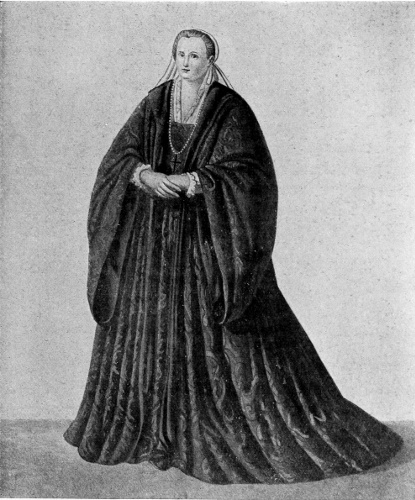
DOGARESSA LOREDANA MARCELLO-MOCENIGO.
FROM A COLOURED PRINT.
“Famiglie Celebri.”—P. G. Litta.
Dogaressa Loredana was a woman as handsome and virtuous as she was talented and accomplished. As a writer of letters and as a classical scholar, she [269]had few equals in Venice. With her sisters, Donne Bianca, Daria, and Marina, she led not only the wits of the women of Venice, but also their tastes and their modes—“fiore de’l secolo,” they and their likes were called. Women had only very gradually and intermittingly achieved prominence in literary and artistic circles, but the end of the sixteenth century witnessed the rich blossoming of the New Women, for almost every “gentildonna di Venezia” was distinguished for her mental attainments as well as for her charms of person.
Dogaressa Loredana had at least one hobby,—botanical research. The Villa gardens of Venice and on the Brenta contained rare examples of plant life, the flower gardens of the convents, and the physic gardens of the monasteries had their unique treasures, but the fair botanist had other nurseries whence she obtained the objects of her devotion. Venetian agents in every port ministered to her passion, and the gardens of the Marcello Palace were filled with exotics. Alas, that her analyses and studies of plants and their properties have been lost, along with her letters, her translations, and her poems. The Dogaressa’s botanical researches however were not merely for personal gratification, they were of immense value to the faculty of medicine; her formulas and recipes were invaluable during the grievous visitations of plague which decimated the population soon after her death.
Short, sad to say, was the reign of the cultured and charming Dogaressa, she died of plague on 12th December 1572, but testimony of her virtues has been preserved in Messir Ottaviano Maggi’s “Oratio in funeralibus Lauraæ Moccenicæ,” a[270] Latin panegyric pronounced at her funeral, which concludes with the ascription:—“Tu vero Lauredana matrona integerrima converte aliquando oculos in hanc rempublicam.” Palazzi also, in his “La Virtu,” extols the dead Signora: that famous pack of Playing-Cards at the Museo Civico has upon the “Knave of Cups”:—“Loredana Marcello-Mocenigo, was a Princess of great attainments, wherefore the painter finds it difficult to illustrate her virtues, Nobility rather than wealth is the distinction of Queens.” He calls her:—“Giantessa di merito!”
Amaden in the “Archivio privato de’ Marcelli” also recounts the praises of Dogaressa Loredana:—“She was remarkable for her constancy, both in the experiences of adversity and in the distractions of prosperity, judicious and discreet in the supervision of her household, reverent and charitable in her church duties, benevolent to her relatives and to her dependants, in a word, she was a most virtuous and noble Princess.”
Her obsequies were duly celebrated, though shorn of much of the usual State pageantry, in the Church of SS. Giovanni e Paolo. Her lying-in-state was arranged in the Sala de’ Pioveghi; where, simply shrouded in the habit of a nun of the Convento della Croce on the Giudecca, with the cowl: the embalmed body was wrapped in a great mantle of cloth of gold lined with lynx fur. Over the nun’s black fall was cast a rich veil of white silk edged with gold which covered the shoulders. Her head rested upon a cushion of cloth of gold, but it bore no Corno for the Dogaressa had not been crowned. A long stole of white silk ornamented with gold[271] lace descended from her neck to her feet which were encased in the finest white silken hose and white kid shoes embroidered with gold.
The pall was of white silk brocade covered with gold embroideries, all the mourners wore purple, except the Vice-Doge and the foreign ambassadors. The Papal Nuncio and Cavaliere Giovanni Mocenigo, the Doge’s brother, were the principal pall-bearers. In all respects the funeral rites followed the ritual of that of Dogaressa Zilia Dandolo-Priuli. So highly had she been esteemed by all classes of the community, that, during six days, a constant stream of people—chiefly poor—passed before the dead Dogaressa’s grandiose bier. Doge Alvise bestowed munificent alms upon these needy admirers of his lamented Consort. The last “Requiem” was celebrated in the presence of the Doge, merely habited as a noble and without special ceremony, who then assisted in the entombment within the massive monument next the great portal of the Venetian Pantheon.
It was perhaps a misfortune for Venice that the virtuous Dogaressa died when she did, for, had she lived but two short years or more, she might have exerted a moderating influence upon the profligacy of the nobles and citizens, who hailed with so much enthusiasm the visit of King Henry III. of Poland and France. No Royal visitor, in the whole history of the Republic, had ever been entertained with such a lavish display of magnificence and such unbounded prodigality. Everybody put on the most splendid gala costume, and all Venice was decked with the most gorgeous of festival tokens.
Henry found himself the object of universal[272] homage, and, amorous prince that he was, he dallied delightedly in the sunshine of unrestrained enjoyment. Venice was full of courtesans of the boldest and most fascinating seductiveness. Sprightly, vivacious, and accomplished, they were endowed with the most captivating and coaxing ways. They hovered around their Royal guest, most superbly dressed,—or if you will the reverse,—bedizened with flashing jewels, their golden hair more resplendent than their robes of cloth of gold and chains of gold and pearls, was coiffured with subtle artifice. Their breasts were bare, supported by broad bands or belts of gold with screws arranged to tighten them at will.
The nuns in the convents were as gay and as approachable as were the glittering women of the Piazza; their “parlours” were the rendezvous of gallants,—young and old. All Venice went as mad as in the time of Carnival, and no voice was raised in Church or Council to restrain the infatuation. Every sort of entertainment was offered Henry and his suite of three hundred greedy courtiers. His body-guard was formed by thirty of the best-looking, best-dressed, and gayest young nobles. There were jousts, regattas, ridotti, masked balls, banquets, and theatricals galore. Bevies of beautiful maidens, in silken tissue, like nymphs in a moonlit glade, scattered flowers in the King’s way, and displayed their charms, unmoved by the curiosity of the bold French knights-errant.
Amid all the feverish frenzy of these demonstrations one pair of eyes fastened their mesmeric glare upon these of the happy monarch with peculiar significance, and he yielded unresistingly to the[273] fascination. Veronica Franco,—“the Aspasia of Venice,”—was the centre of a brilliant but debonnaire literary and artistic circle. Born in 1546, in the parish of Sant’ Agnese, she was in the full bud of her virginity. She, like her frail sisters, was as they have been aptly described, “made up of three things—wood, clothes and breasts,”—their high pattens, their tightly clinging silk tissues, and their paints and puffs.
The amours of Henry and Veronica were sung by poets and philosophers, painters painted her on canvas and in miniature, and she herself made poems as full of love as were the whispers of her lover. Her awakening was sudden and effectual. After Henry had taken her love and kisses away with him to Paris, she renounced the reckless life of a courtesan and became the inspiring Venetian Sappho. Then she turned to religion and tried to undo the evils of the past by good works and the founding a penitentiary for fallen women. Michael Montaigne, who saw her at Santa Maria Formosa, tells us all this and more about her in his “Journal.”
“She gave me,” he says, “a book—‘Lettere Famigliarie Diverse,’—erotic and ascetic,—which she had dedicated to another of her admirers, the Cardinal Luigi d’Este.” “I saw also in Venice,” he adds, “one hundred and fifty noblewomen courtesans who were kept in the greatest luxury, spending money like Princesses in jewels, dresses, portraits, cosmetiques, and personal adornments.” The resplendent and repentant Veronica died in 1591, not more than forty-five years of age, worn out with enervating pleasures and austere penances:[274] her heart the while being yielded a captive to the King of France. The love of a Venetian woman was fierce and all-absorbing in its intensity, and Sanguinacci’s poem—“Le Donne di Venegia” exactly gives the measure of their pulse:—
What the worthy Doge thought about all this wantonness he never divulged: his life was overshadowed by an irreparable sorrow—some say he never smiled after gentle Dogaressa Loredana closed her eyes in death.
The dogado of Alvise Mocenigo was marked by public grief as well as private sorrow. The loss of Cyprus and the battle of Lepanto made many a casa fatherless, where mothers and children wept for those they would see no more. Three years after the death of good Dogaressa Loredana, Venice was visited by a terrible calamity: forty thousand of the inhabitants were struck down by pestilence. Death came upon them with gaunt giant strides: men left home for the day’s work and duty well and hearty, before the curfew sounded they were repulsive corpses. Lords of the Council fell in the Council Chamber, words of wisdom dying on their dying lips. One quarter of the population was wiped out.
Doge Mocenigo displayed, as might have been expected, heroic courage. His self-denial and absolute disregard of personal risk found him comforting the dying and consoling the sorrowing: he was nurse, priest, and guardian to the poorest of the[275] poor. What would not Signora Loredana have given to share her consort’s ministry! His piety took the shape of the foundation of the splendid church of Il Redentore, built by the great architect Palladio,—his master-piece,—to propitiate the Deity and to serve as a thank-offering for the cessation of the plague.
Five years of widowerhood ended for the Doge in 1577, and then his embalmed body was laid beside that of his Consort in SS. Giovanni e Paolo. A clause of his will proves his life’s devotion to her. Property at Villabona, which he had intended should be hers if he predeceased her, he left to his eldest niece, on condition that she and her daughter after her, took the names Loredana Marcello before their surname Mocenigo.
A Hero Doge!
Still green were the laurels which enwreathed the noble brow of Sebastiano Venier,—gracious emblems of the triumph of Lepanto, where his strategy, more than anything else, had won a famous victory. Acclaimed Doge by the tumultuous voice of the people in the Piazza, as well as by the unanimous suffrages of the “Forty” in the Council Chamber, Venier aroused the latent warlike spirit of all Venetians. Venice was herself again,—no longer “Venus Calva.” The lion of San Marco once more bristled his hoary mane, and all the gallants of La Calza strutted up and down,—their effeminate costumes exchanged for the bravery of[276] martial uniform,—the cynosure of admiring matrons and blushing maidens.
“The Hero of Lepanto” was no youthful soldier breathing lustily the battle-smoke but an aged warrior of fourscore years and more—one more exponent of the vigour of old age so characteristic of Venetian manhood. He wiped out the disgrace of Cyprus, for Turkish standards flew proudly from the tall flagstaffs before St Mark’s. Great was the loss of precious lives to Venice—great their glory too!
A grand Andata, or Progress, swept the Doge and Dogaressa within the portals of the Basilica, upon the feast of Santa Giustina—the heroine patron of the Republic. Four days of religious processions and four nights of craft-pageantry kept all Venice in a whirl of enthusiasm such as she had not experienced for many a day. Whether solemn “Te Deum” or hilarious odes to Victory held the citizens most strongly, it was hard to say.
Whilst the Spaniards under their princely admiral, Don Juan, evinced a spirit of apathy, quite unworthy of this military renown, the Pontiff,—the other ally of Venice,—crowned the eulogy of Marco Antonio Colonna, his Chief in Command, by the bestowal of the “Golden Rose” upon the noble Doge and Dogaressa. Amid all the jubilation and marks of high esteem Doge Sebastiano Venier and Dogaressa Cecilia Contarini-Venier maintained a dignified bearing and modestly sought the seclusion of their palace. There, deputations followed in quick succession from friendly States and Cities. The Brescian embassy, in particular, came full of “gratitude for precious services and in token of[277] the devotion and infinite love felt for his Serenity by all the citizens of our city.” Calling at the Casa Venier the envoys were received first of all by the Dogaressa without ceremony, who told them that the Doge was upstairs in his study and said:—“I much fear he will be unwilling to accept your offering but I will go and hear what he says.” The reply was couched in grateful terms but, whilst he was pleased to possess a trifling recognition of his small services, he politely declined the costly shield of beaten copper, and the case of rare old Brescian wine.
Sebastiano Venier was the third Doge of his family, brother of Doge Francesco Venier, 1554–1556,—a family ennobled among the thirty by the Serrar del Consiglio, in 1289. Dogaressa Cecilia belonged to the renowned “Apostolic” family of Contarini, and was married in 3rd June 1544, in the Church of Santa Maria degl’Angeli at Murano. Doge Venier and she were busily engaged in working out the order of the ceremonial to be observed at the Coronation when he was struck down suddenly by paralysis on 3rd March 1578. He died within the year of his election, and he was buried in the choir of the Church of his Nuptials. Sebastiano Venier must be accounted the Twelfth “Grand” Doge of Venice.
The Lords of the Council grieved greatly at his demise and unanimously agreed to accord to the widowed Dogaressa a pension of four hundred gold ducats per annum, and made provisions for her similar to those bestowed upon Dogaressa Zilia Dandolo-Priuli in 1559—“in happy memory of noble Prince Sebastiano Venier.” Her residence,[278] her household, her visits in the City, her gondola, and even her dress, were all prescribed by rigid but benevolent conventions. In the “Cerimoniali” (1464–1592) are two figures of Dogaressa Cecilia Contarini-Venier, along with those of Dogaressas Zilia Dandolo-Priuli and Loredana Marcello-Mocenigo, all in full State robes and also in widow’s weeds. Her death and burial have not been recorded.
Nicolo da Ponte, who succeeded the heroic Doge, was cast in quite another kind of mould. He was an ecclesiastic in proclivity if not in ordination, a theologian of high order and renown, but by no means an adherent politically of the Papal See. He represented the Republic, along with the Patriarch, at the Ecumenical Council of Trent. He actually refused to allow the Pope’s Nuncio to inspect the Venetian monasteries and affirmed the prerogative of the Patriarch of Venice on that behalf. The Doge’s Consort was Madonna Arcangela Canali, but there is nothing to record of her or of her family.
Possibly Doge da Ponte is best remembered by the kindly part he played in the romance of bewitching Bianca Cappello. Deceived and deserted by a good-for-nothing young Florentine banker’s clerk the young mother became a “Cosa di Francesco”—the Grand Duke of Tuscany. For years a price was put upon her head, but time is fruitful of revenge, and the daughter of proud Cavaliere Bartolommeo Cappello,—disowned by him, and outlawed by the State,—was, ten years later, created “a True and Special Daughter of Venice.” The Doge wrote as follows to the Grand[279] Duke on 16th June 1579:—“We are thrilled with the greatest pleasure ... when we learn that your Highness has chosen such a wife on account of her distinguished virtues.”
The Grand Duchess’ marriage and Coronation were splendidly celebrated in Florence. Doge da Ponte was specially represented and the noble ambassadors Cavaliere Giovanni Michielo and Antonio Tiepolo bestowed upon the Queenly bride, in the name of the Council, a costly crown of gold and jewels, a rich cincture of solid gold, and a superb ruby ring. Venice also gave her “Daughter” a glorious necklace of diamonds, worth ten thousand gold ducats. Bianca loved Francesco and no other man, and her devotion was returned quite as faithfully. The power she exercised was wholly for his good and for the welfare of his sovereignty; and she lives, in unbiassed history, as the inspirer of most of the noble works which marked the reign of the last “Grand Medici!” Infatuated, he wrote of her:—
Torquato Tasso, her Poet-laureate, celebrated her beauty and benignity:—
The Grand Duchess Bianca Cappello-Medici[280] was the third and last “Daughter of Venice.” That tender title had first been bestowed by the Republic upon Donna Ginevra, daughter of Messir Matteo Tiepolo, Podesta of Belluno, who was married in 1503 to Signore Giovanni Sforza, Lord of Pesaro. He died a few months after their nuptials and she entered the Convent of San Pietro de’ Fiorentini. Girl-like she soon wearied of the life of the cloister, and, renouncing her vows, she once more entered the world of fashion and romance. Many a suitor offered her his hand, and heart and purse, but she would not be again a wife, and she ended her days the inmate of a convent—that of San Nicolo di Murano.
The second “Daughter of Venice” was of course Donna Caterina Conaro, Queen of Cyprus, Jerusalem and Armenia. Pathos of the deepest was blended with the splendour of the rôle she was called upon to play, and with the romance of her later days. The daughter of Messir Conaro or Corner of the “Evangelistic” noble family, which gave four Doges to Venice, Donna Caterina, in 1468, was betrothed, when only fourteen years of age, to Giacomo di Lusignano, King of Cyprus. It was said that he had the pick of fifty eligible brides, but chose Donna Caterina Conaro by way of paying off the mortgage on his island kingdom held by Messir Marco Conaro and his partners: a sum of a hundred thousand gold ducats was written off as her hypothetic dowry. King James died in 1473, the year after their marriage, and Queen Caterina bore his posthumous son six months later. Rivals for the throne fought for the child and against one[281] another,—even in the Queen’s bed-chamber,—and then she was rescued by an expedition from Venice, but her babe died in her arms upon the homeward voyage.
Venice seized the kingdom, rendered royal honours to her “Daughter,” and assigned her a palace and a regal maintenance at the Castle of Asolo in the Marca Trivigiana. There she reigned over a miniature Court of cultured and distinguished men and women, where literature and romance played many parts. The leader of her revels and symposia was Pietro Bembo, who in his “Gli Asolani” discourses after the manner of Giovanni Boccaccio of love, pleasure, and philosophy. The while he was writing sonnets to his Queen and bending his knee in homage he was carrying on a liaison with the Princess Lucrezia Borgia, and then by her influence he was created a Cardinal,—an example of ecclesiastical incontinence. Gentile Bellini, in his master-piece at the Venice Accademia, “The Miracle of the Cross,” painted Queen Caterina and many of the ladies and gentlemen of her Court. The faces are life studies, the costumes regal in magnificence.
Queen Caterina was treated with the utmost distinction by all Venetians, and when she died, in 1510, her remains were accorded honours similar to those rendered to a departed Dogaressa. She was first buried in the church of SS. Apostoli and then translated, in 1665, to San Salvatore. Over her coffin Andrea Navagero pronounced a remarkable oration in which he extolled the Queen’s beauty, grace, and gentleness, her goodness, erudition, and constancy. With Pietro Bembo,[282] in one of his delightful Canzone may we sing of her:—
A “Daughter of Venice” was of course a Dogaressa in rank, hence brief stories of the three Venetian Queen-Graces, Ginevra, Caterina and Bianca, are by no means superfluous in the “Libro d’Oro delle Dogaresse di Venezia.”
Three years of unbroken peace followed the death of Doge Nicolo da Ponte in 1588, under the administration of Doge Pasquale Cicogna. The Dogaressa was Madonna Laura Morosini. He was the son of an apothecary, ennobled after the Genoese War of Chioggia: she was of an “Apostolic” family, but nothing is recorded of her. The Doge was reckoned as a parsimonious and unsympathetic sort of man, and was very unpopular with the citizens by reason of his niggardliness in the matter of largesse at his election Progress through the Piazza. Their tomb is at Santa Maria de’ Gesuiti, where he and his Consort lie side by side peacefully sleeping.
At the very end of the sixteenth century one more resplendent Dogaressa passed through Venice in solemn State to her Coronation—Signora Morosina [283]Morosini-Grimani. She was a daughter of Messir Andrea Morosini, the head of the senior branch of the second family in the highest grade of nobility,—the “Apostolic,”—members of which grade had come to be looked upon not only as merchant-princes, but as Princes of the State. She was married to Messir Marino Grimani, from her father’s house, Palazzo Morosini (now Sangredo), upon the Grand Canal, in the no longer existent church of San Cristoforo on 27th November 1560.
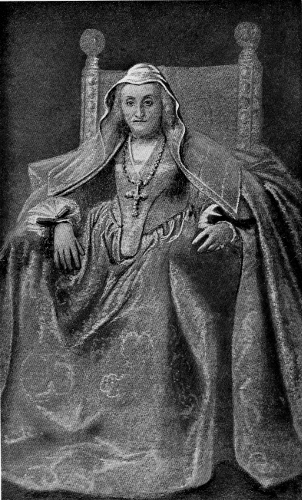
DOGARESSA MOROSINA MOROSINI-GRIMANI.
Giovanni Contarini. 1599.
VILLA PISANO, VESCOVANA, PADUA.
The newly-married pair set up housekeeping in splendid fashion in the Palazza Grimani (now the Court of Appeal). Messir Marino Grimani was one of the very foremost Venetians who plumed themselves as being “the first gentlemen in Europe not considering it a disgrace to be merchants as well.” The fruits of his commercial success were displayed, not only in the appointments of the palace, but in the delights of his lovely villa-gardens at Santa Caterina, with their lovely views over the lagunes to Murano and her sister isles. Madonna Morosina shared her husband’s al fresco tastes, for her father’s gardens at San Canciano were as charming as any of those Venetian beauty-spots.
Messir Marino was the popular candidate for the throne, left vacant by the death of Doge Pasquale Cicogna. He was famed for his generosity and was especially delighted to provide entertainment for poor people and their families. His election by the “Forty” was unanimous: probably the gracious Madonna Morosina, her personality, her refinement, and her wit, had a good deal to do with the decision! Maintaining his reputation for magnificent hospitality the new Doge furnished banquets[284] for three whole days to every working man and woman in Venice. His Election Progress around the Piazza was accompanied by lavish largesse, and, not satisfied with what his suite scattered broadcast, the amiable Dogaressa, accompanied by her three daughters, from the State balcony of the Ducal Palace, threw handfuls of silver and copper coins among the crowds in the Piazza. Not only was the Doge generous and the Dogaressa affable, but he was pompous and she ambitious. They determined that her Entry in State and her Coronation should surpass anything yet “seen in Venice.”
The spirit of going-one-better-than-one’s-neighbours, was a very strongly marked characteristic of Venetians all through their history. Certainly there was something of vulgarity in the idea, but there was also distinction in the realisation. If the Doge and Dogaressa were high and mighty sort of people their elevation also raised the tone of society, and materially improved the condition of employment. Hence the public were quite responsive to the call of their Serenities.
The pageant, or “Triumph” of Dogaressa Morosina Morosini-Grimani was postponed until May 1597, in order that the new appointments, decorations, and personal adornments, might be made as splendid as possible. Every craftsman and craftswoman went to work with a will, and nobody cared in the least about any sumptuary laws of the past nor any other arbitrary indictment. The “Forty” and the “Ten” made no move and consequently everything went on with the greatest equanimity.
One new feature was noted with respect to[285] the Dogaressa and her Coronation—the delivery, printing, and circulation broadcast, of elegant and eloquent panegyrics. Commissions were eagerly accepted by poets, orators, and publishers—one of these effusions, as an example, ran as follows:—
The Dogaressa was addressed by her admirers as “Most Singular and Most Serene Lady, words fail to assure your Highness of the devotion of your enthusiastically admiring servants.” Much the same high-flown sentiment distinguishes Palazzi’s pack of Playing-cards, for, on the Knight of Coins (Diamonds), we read:—“The Coronation of Morosina Morosini, wife of Doge Marino Grimani Anno 1597. She commands not alone herself but she is Mistress of a mighty Empire.”
Upon the morning of her “Triumph” the Dogaressa, attended by four hundred young noblewomen, all beautifully dressed in white silk lace,—in honour of her Serenity’s patronage of Burano,—and covered with newly-mounted jewels,—each girl an animated miniature Golconda—took her place upon a dais in the great hall of the Grimani palace,—lately completed (1581) by the famous architect Sammichieli. The walls of the noble apartment were hung with a novel and effective decoration,—stamped leather, gilded and emblazoned. This was a new artistic adjunct in princely mansions lately introduced from Cordoba in Spain. The vogue spread at once in Venice, and, before the end of the century, it was computed that three thousand skilled[286] workers were employed by the Guild of Leather-merchants, and a sum of one hundred thousand gold ducats was added to their annual revenues.
Meanwhile a lordly deputation had been despatched by the “Forty” to salute “The First Lady of Venice” and bespeak her acceptance of the Promissione, and thereafter to escort her on her solemn Entry. The noble Lords found her Serenity sumptuously attired in tissue of fine gold with an immense State mantle of cloth of gold embroidered all over with silver floral designs in high relief,—quite a novel and truly rich production of Venetian brains and Venetian hands. It was reported that this magnificent robe was manufactured under the Dogaressa’s personal directions and after her own design.
The cap of the new Corno was of the same costly material, the coronal was a mass of immense precious stones, and from underneath it fell a delicate veil of white silk lace shot with gold and silver threads and heavily spangled with jewels. Upon her open bosom, lightly covered with a fichu of priceless Burano lace sewn with pearls, reposed a flashing cross of brilliants, suspended by a very exquisitely interlaced chain of burnished gold. Her fingers were covered with gemmed rings, which her Serenity was very careful not to hide within a pair of beautifully embroidered gloves held by one of her ladies.
The ceremony of the presentation of the Promissione was soon over, and, in return, the Dogaressa personally handed to each noble Lord of the deputation the customary gift of a purse of cloth of gold containing, not the usual number[287] of gold ducats, but a special token—an osella of gold, after the example of Doge Antonio Grimani, her Consort’s great-uncle, in 1521. The osella had, on the obverse, a profile in relief of the Dogaressa wearing the Ducal Corno, with her name “Mavrocena Mavioceni:” upon the reverse was a raised wreath of laurel encircling the legend:—“Manus Mavrocenæ Grimanæ Ducessæ: Venet: 1597.”
The “Bucintoro” received on board just such another illustrious company as that which graced the water-pageant of Dogaressa Zilia Dandolo-Priuli forty years before. The costumes of the suite were richer and in better taste than those of Dogaressa Zilia’s Court;—cloth of silver sewn with pearls and raised flowers in gold looked more delicate than the customary heavy cloth of gold. The palaces, the dwelling-houses, and the churches by the Canal, were all lavishly decorated upon a uniform and beautiful plan. Coronation favours, bestowed upon all applicants at the Doge’s command, imparted a note of festivity quite striking but harmonious. Venice for the nonce became the city of the Morosini-Grimani; but, perhaps, some of the noble Lords regarded these tokens of popularity with uneasy minds; they had, in all their generations, a wholesome dread of a personal Ducal rule.
The pageant on the Canal was the most remarkable ever undertaken by the Trade-Guilds. Almost every gondola and barca was formed into a fabled beast of the earth or some fearsome sea monster. The whole Court of Parnassus was enlisted in honour of the Dogaressa, and the Gods[288] and Goddesses floated proudly and quaintly by. An immense fleet of bregantini,—great vessels with sweeps,—filled with spectators of all classes, followed in the wake of the “Bucintoro.” Once more the ripples of the quiet tideway were charged with sweetest perfumes, and covered with flowers—mostly damask roses—the floral emblem of Morosini.
The ceremonies of the Landing, in the Basilica, and in the Ducal Palace, were all performed with splendour, and the Dogaressa retired to her private apartments to remove her heavy State robes and assume her ball-costume—for, of course, dancing was the finale of all Court functions. Dogaressa Morosina’s ball was unique and historical: all Venice danced where there was any room, for every place was crowded—more than two hundred thousand visitors had to be accommodated somewhere or other. Dancing platforms were erected upon ranges of barges on the canals, and Venice sang and danced—danced and sang, the livelong night in ecstasy. Within the Ducal Palace the Sala dello Scrutino was set apart for refreshments of the choicest kind. The old Greek menus, which had delighted the sybaritic Romans of Mecænas’ time were revived. At the great banquet, given by the Doge and Dogaressa to the dignitaries of the Church and State, and the foreign Princes and Ambassadors, there were forty-seven courses, beginning with spiced sturgeon and ending with “apples of Paradise.”
The day after the Coronation was occupied in giving and viewing presents. To every noble and gentle person assisting at the ceremonies, the Doge and Dogaressa gave an osella, to the officials and[289] domestics gifts of golden ducats, to the worthy poor hospitable spreads of good cheer. Pope Clement VIII. sent a Legate with a “Golden Rose” to the Dogaressa and a jewelled Corno to the Doge. The Duke of Savoy offered a massive belt of thirty golden rosettes covered with fine pearls, but it was incontinently seized by the Provvidetori delle Pompe, possibly as a mean protest just to show their power! Many other costly gifts found their way into the hands and the collection of the Most Serene couple.
On the third day was held a grand naval review before the island of San Giorgio Maggiore, in which ships of England, Holland, and Flanders took part. A regatta and aquatic sports were contested between the native gondoliers and marines, and the foreign sailors, dressed severally in white and red costumes. The contention was the keenest of the keen. The Nicolotti and Castellani mainly held their own, but when some of their men were defeated, their wives drove them home with sticks and banter:—“Va! Va! Via di quid, parca, infame vituperoso!”
In the evening all Venice was illuminated, and we can very well imagine the glory and the eerieness of the spectacle,—Venice,—standing in and out of the water, the serenity of a May night over her, and her flashing moving gondola lights was like the city of a dream, the home of Gods and fairies.
All through the eleven-years dogado of Doge[290] Marino Grimani, peaceful and prosperous conditions were the lot of a busy people. The arts and crafts had reached the apogee of their fame. The Dogaressa was the patroness especially of the lace-workers of Burano,—following the example of Dogaressa Dandolo-Malipiero of a hundred and forty years ago. Moreover she headed a committee of noble ladies to encourage the delightful craft among the gentlewomen of Venice.
Doge Marino Grimani died in 1608, and the widowed Dogaressa gave herself to works of piety,—for example she restored the church of San Sebastiano. She survived her Consort eight years and died on the 21st of January 1613–1614—directing in her will that her body should not be embalmed. The funeral was a State function, recalling that of Dogaressa Zilia Dandolo-Priuli, at SS. Giovanni e Paolo, where an impassioned oration was pronounced:—“Illinc clamor, hinc silentium: illinc lætitia, hinc mæmor: illinc ludi, hinc lacrymæ.” The Doge and Dogaressa took their long last sleep under the splendid monument by Girolamo Compagna, in the simple church of San Giuseppe di Castello, just beneath the splendid picture by Tintoretto of “St Michael slaying the Dragon,” which the Doge had commissioned, and wherein he is represented kneeling in the red robes and ermine of a Captain of the “Forty.”
In “The Merchant of Venice,” Shakespeare, in two concise paragraphs, illustrates quite characteristically the prosperity and peace enjoyed by[291] the Venetians at the end of the sixteenth century:—
[292]
The Sun of Venice had set! Her bright gold was turned to tarnished brass, her jewels had lost their lustre, and her pearls were moribund! Yet she lingered on for many and many a year—well-nigh two hundred. The beacons of the lagunes and the shrines on the canals burnt dimly, and the incense in the churches seemed to have lost its aroma. Sighs and yawns from dispirited and indolent citizens indicated the dissolution of her industries. Brawls and disputes were exchanged for courtly greetings: gambling dens and brothels prostituted men and women once renowned for temperance and probity.
A lingering death is always the most distressing, both for the individual and the watchers standing by: this was to be the melancholy ending of the “Queen of the Adriatic.” Nevertheless, as with the man, so with the City, lucid intervals recurred and hopeful rallies, wherein episodes, pathetic and stirring, moved the torpid brain and feeble pulse. Venice was “Venus Calva” at her birth—so would she die. Each year saw her robbed of some possession, each year saw her enemies closing more nearly in, each year saw foreigners compressing more and more her markets; and yet, men came and went, and women too, who moved the body politic mightily, and made the lookers-on wonder whether, after[293] all, the Lion of Saint Mark was dying or only sleeping.
Heavy-footed were those decadent years, they took their step from the dismal tramp of mourners at the frequent obsequies of the Doges and Dogaressas. The great bell of the Basilica, announcing year after year, or nearly so, with muffled knell the demise of a Chief Magistrate came to be listened to without emotion. In some hearts, perhaps beating more loyally than the rest, were pangs of remorse for a glorious past never to return, and misgivings for a fateful future fraught with fears, but patriotism, honour, and devotion, were the precious possession of a dwindling minority.
Between 1605 and the end of the Republic in 1797, thirty-one Doges mounted the Ducal throne in turn: their names and dates we know, but very little about their deeds or the times in which they lived,—history was silent. Of their Consorts ten only are known by name and nothing much beside: only four or five of them, in one hundred and ninety years, have left any record in the “Libro d’Oro delle Dogaresse di Venezia.”
The men and women of Venice had become a little less animated and articulate than the face cards in a pack. Indeed the end of Venice was much like the popular game of “La Trappola,” in which thirty-six cards out of the fifty-two were used—the mother of the present-day whist. The suits were four:—“Spade,”—Swords, or Spades,—threatened the faint-hearted; Coppe,—Cups or Hearts,—suggested delights to the perceiving; Denari,—Coins or Diamonds,—hinted at profitable investments; and Bastoni,—Sticks or Clubs,—promised[294] punishment to the dishonest. Venice was a card-table, and Venetians were content to prolong their enervating leisure, beguiled by the chance of the “Naibi,”—tricks,—so named by their children in imitative games.
Certainly the craftsmen and craftswomen still wove rich lengths of cloth of gold, the goldsmiths still made precious jewels, the glass-blowers still produced their fragile virgin-ware, the lacemakers their delicate network, and the hairdressers still turned, tossed, and frizzed, rare strands of golden hair; but princely patronesses at the Ducal Palace were few and unresplendent. The painters went on painting—Canaletto, Guardi, and Longhi, were, in their time, quite as characteristic and far more topical than were Tintoretto, Veronese, and Palma Vecchio, but palette-masters as well as sculptors and architects, were clients of the Doges not of the Dogaressas.
The 10th of January 1645, was a black-letter day for women’s art and artifice in Venice. The Council issued an edict forbidding the Coronation of the Dogaressa as a “cosa non neccessaria!” Apparently her Serenity was not to be denied the solemn Entry, but even that stately function was to be curtailed of much of its pomp and circumstance. The “Bucintoro” was not to be used, the solemn Benediction in the Basilica was discouraged, and the Ducal Palace was closed against the wonted exhibitions of the Trade-Guilds.
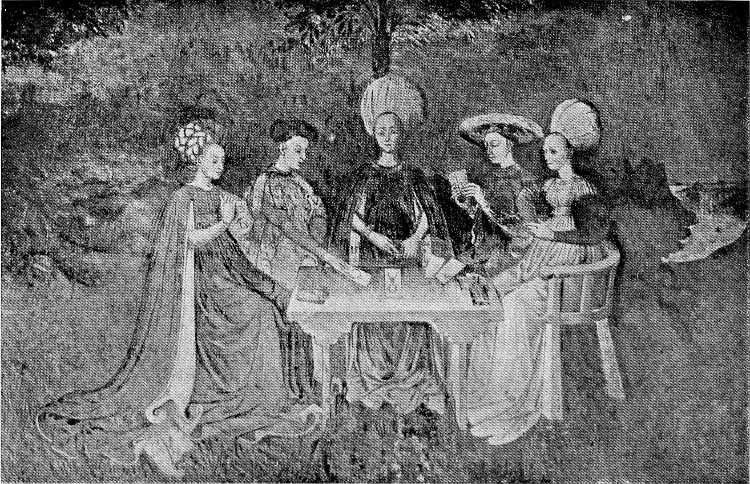
THE GAME OF LA TRAPPOLA.
Michelino da Bedozzo.
PALAZZO BONARDO, MILAN.
After Doge Marino Grimani there followed a dogal line of ten very old men,—all octogenarians,—one after the other, halting to their waiting graves,—striking but lamentable figures of the decay and [295]death of Venice. Whether eight of them were widowers we know not, but only two Dogaressas’ names are recorded,—Signore Elena Barbarigo-Priuli (1618–1623), and Chiara Delfino-Conaro (1625–1629). Those ten old Doges were mostly parsimonious, very weary of life, and generally uninteresting, and probably their wives and families were as prosaic and uninteresting as themselves.
There was however something naively burlesque in the decision of Dogaressa Paolina Loredano-Contarini, the Consort of Doge Carlo Contarini (1655–1656), not to appear in any public ceremonial. She was an immensely stout woman and unusually plain-looking, and she feared that the salutations of the populace would not partake of their usually complimentary character. Venetians had an innate sense of humour, and personal peculiarities appealed irresistibly to their risible faculties. Dogaressa or not, she would undoubtedly have been the butt of ridicule!
Palazzi in his “Fasti Ducales” says of her, “non volvendo mostrarsi in publico.” He adds that on the façade of the church of San Vitale, Guiseppe Guoccola sculptured the busts of Doge Carlo and Dogaressa Paolina Contarini, placed there in gratitude for their noble bequests to the clergy. He also records that Madonna Paolina Loredano, the daughter of Messir Lorenzo Loredano, of the Ducal line, was married to Messir Carlo Contarini on 22nd February 1600, in the Church of San Polo—so they were blessed to see their golden jubilee.
Seven undistinguished Doges followed Doge Carlo Contarini, during thirty-two years—1656–1688. The names of only three Dogaressas are[296] noted:—Signore Andriana Priuli-Conaro (1656), Elisabetta Pisani-Valier (1656–1658), and Lucia Barbarigo-Pesaro (1658–1659); but we know nothing more about them.
In 1688 Venice roused herself once more to welcome home, with enthusiastic honours, one of the greatest generals she had ever produced—Cavaliere Francesco Morosini. Thrice he bore the grand rank of Captain-General of the Venetian fleet, and thrice he carried her colours nobly on to victory. The twenty-five years’ war with Turkey for the possession of Candia gave the Admiral and his devoted forces rare opportunities for the display of patriotism and prowess, and right worthily they acquitted themselves. The worsted Turks were compelled to yield the Morea and its classical sites to the victorious Venetians. That was the rare gift Francesco Morosini laid at the feet of the aged “Queen of the Adriatic.”
No foreign conquest for many a long year had been scored to Venetian arms, and she had lost all that she had fought for; but now new life, new hope, new enterprise swept over canali, campi, and case. Every man was a soldier or sailor, every boy an embryo hero. Turkish flags again waved before the Basilica, Turkish prisoners again filled the Arsenal, Turkish treasures again were poured out upon the Lido. The Captain-General’s return was a triumph. Greeted by nobles and citizens in unison, he was dubbed “Peloponesiaco,” and lifted tumultuously upon the Ducal throne,—lately vacated by the death of Doge Marcantonio Giustiniani.
Alas, we know not whether a jubilant Dogaressa[297] shared his honours. Possibly the valiant hero had had little or no time during his lifelong service to the State for serious love-making, and though, by a sailor’s licence, he may have had a wife in every port, no cicisbeo or patita was possible as Dogaressa. Relics of Doge Francisco Morosini may be seen at the Museo Civico, his tomb is in San Stefano, and a triumphal arch, erected in his honour by the Government, is within the Sala del Scrutino of the Ducal Palace.
If the hero Doge had no Consort, his successor was more fortunate: indeed Doge Silvestro Valier (1694–1700), lives in history upon the fair fame of his wife—many rulers of States and lesser magnates have had the same fortunate experience. We may read, in relation to Dogaressa Elisabetta Quirini-Valier, the true old saying “manners maketh man” as woman maketh man!
In spite of the prohibition of 1645 the new First Lady of Venice made her solemn Entry and was crowned with all the usual ceremonies. On the 4th of March 1694, the Dogaressa, robed in a great State mantle of cloth of gold trimmed with sable, and wearing upon her head a white lace veil and a jewelled Corno, with a collar and pendant cross of diamonds, and attended by a numerous suite of gentlewomen, awaited the deputation of salutation from the Council of “Forty.” Her osella had her profile in relief and the legend:—“Elisabetta Quirina-Valeria Ducissa Venetiarum 1694.” Her progress from the Palazzo Valier to the Ducal Palace has not been described, but it appears that her assumption of the Corno gave umbrage to the Provvidetori delle Pompe, and other captious critics,[298] for a curious enactment of the Council, on 13th July 1700, forbade the Dogaressa wearing at any time a Corno on her head.
Doge Silvestro Valier and Dogaressa Elisabetta Quirini-Valier had been married in the church of Santa Maria Formosa, on the 18th of July 1649: consequently they lived to celebrate their golden wedding in 1699. In the case too of Dogaressa Elisabetta another restriction of the Promissione was cancelled—her right to receive foreign ambassadors. Surrounded by her Court of maids of honour and gentlewomen-in-waiting, she entertained all the envoys in turn accredited to Venice, and moreover, accepted at their hands costly gifts against all the prohibitory clauses of State decrees.
At the Museo Civico is a putative portrait of the Dogaressa. She has fair hair entwined with silver thread, perhaps to foil the natural silver strands, her features retain traces of distinction and of beauty. Her skin is pale, her eyes bright, and she wears an air of repose and refinement with no little natural dignity of carriage. Several of her letters have been preserved, wherein she shows herself to have been a woman of sympathetic and charitable disposition, but of retiring and unassuming manners.
Doge Sebastiano Valier died in 1700, and was buried near the second altar in the right aisle of SS. Giovanni e Paolo, under the enormous monument erected by his father, Doge Betruccio Valier, who died in 1658. There too, eight years after, the widowed Dogaressa was laid to rest. Her memorial statue by Giovanni Bonazza represents her as a large and wrinkled woman, with elaborate[299] curls round her face, and covered to her feet with brocade, furs, laces, embroidery, and jewels—something perchance like a Venetian replica of our own Elisabeth! The epitaph is as follows:—“Elisabetta Quirini Silvestri Conjux, Romana virtute, Veneta Pietate, et Ducale Corona Insignis. Obiit MDCCVIII.”
The seventeenth century in Venice, was essentially one of lean years, strangely contrasting with the exuberant life of its predecessor; whilst the eighteenth century saw eight decades of disaster, famine, and death! Candia, the only remaining jewel in the crown of Venice, was rudely snatched from its tarnished setting and no effort was forthcoming to regain the lost treasure. Everything went from bad to worse. The nobles unblushingly proclaimed their contempt for commerce and conquest. The armed bands of the Republic were not maintained as a fighting force, and the ships of war were allowed to rot and rust at their anchorage. The citizens, imitating the madness of their betters, allowed industry and trade to slip through their fingers; and ceased to care when foreign capitalists and foreign workmen settled down among them, and exploited their looms and tools.
Pleasure, extravagance, gaming, and immorality, ate like foul cancers into the vitals of society.
The one and only aim of Venetians of every class was to dissipate the splendid heritage and[300] spend the resources of their ancestors. A noble would light-heartedly wager his bank-balance, his estate, his palace and his all, on some ephemeral passion; and yet the gaiety of life was never so effulgent in the city of Venus. Venice was the plaything of Europe, the pantomime of Italy, and the shadow-dance of herself—bewitching in her heedless spendthrift self-indulgence, a whirling ballerina, scattering her favours, her kisses, and her pleas for plaudits everywhere.
The first eight Doges of the eighteenth century passed sadly across the Dogal pageant ground,—“lean, slippered pantaloons” as Shakespeare has it, or little better. With them went solitarily and unemotionally but two Dogaressas—Signora Laura Conaro-Conaro, 1709–1722, and Signora Elena Badoero-Pisano, 1735–1741. The last we know only by her name, and yet that name is a golden one, for was not the family of Badoero or Partecipazio, the very first of all the nobility, and was not her great ancestor, Agnello Partecipazio, the first Maker and the first “Grand Doge of Venice!” Donna Laura Conaro, daughter of Messir or Cavaliere, Nicolo Conaro,—all the men of Venice claimed knightly rank in her decadent days,—married Messir, or Cavaliere Giovanni Conaro, her cousin, on 11th October 1667, in the church of Gli Gesuati. She appears to have been a very proper sort of woman: at all events the fast life of the nobles and their ladies had no charms for her, and she set her face resolutely against the extravagances and indecencies around her. Consequently, when Doge Giovanni Conaro died in 1722, the Dogaressa entered Religion and[301] became a postulant of the Order of the Augustinians of SS. Gervaso e Protasio. There she passed the residue of her days in fasting, praying, and alms-giving, being consoled greatly by the visits of her three devoted sons, Francesco, Nicolo, and Alvise, whom she received within her narrow cell with its little iron-barred window.
The devout Signora had retained,—rather contrary to any vow of poverty she may have taken,—a quantity of personal belongings—money, articles in gold and silver, and other valuables: these she bequeathed to the Prioress of the Convent, the Reverend Mother Maria Lucia. In a purse were found one thousand six hundred and ninety-four zecchini,—small silver coins,—another purse contained one hundred and forty gold ducats. Among the treasures were crosses, reliquaries, candlesticks, salvers, sconces, pomi or hand-warmers, bowls, knives, forks, spoons, flagons, vases, medals, thimbles, toilet-boxes and brushes, trays, inkstands, etc. etc., all of pure and beautifully wrought silver.
In a chest of drawers, were articles of jewellery, silver filigree work, gold medals, and very many other objects,—lover’s offerings, curios, and rock-crystal beads. Among the personal ornaments were bracelets, rings, and necklaces of diamonds and turquoises. Perhaps the most unexpected property was the Signora’s gilded walnut bedstead, with its coverlet of silk and gold, edged with rare Burano point-lace and gold and silver fringe, and lined with blue and yellow Chinese satin. In a cedar coffer were found a rich robe of crimson velvet worked with gold, a skirt of pink satin[302] trimmed with silver lace, and other costly garments, but, alas, they were all in rags and tatters,—eloquent tokens of the rottenness and emptiness of earthly glory.
Dogaressa Laura, quietly and unregretfully laid aside the robes of State, to die and to be buried in the sackcloth of humility, may she rest in peace. Ten years after reverent hands had laid “Sister” Laura in her humble grave, within the burial-plot of the Convent, two other hands were clasped in the joyous pledge of matrimony,—Cavaliere Giovanni Alvise Mocenigo, Procurator of San Marco, and Donna Pisana Conaro, daughter of Messir Federico Conaro, who, on 5th October 1739, were made man and wife together, in the new and sumptuous church of Santa Maria del Salute. This was an alliance of the two most powerful families of the time, and great things were expected from the union.
The “Archivio Privato di Mocenigo” contains an inventory of Donna Pisana’s trousseau, which gives an excellent idea of the expensive splendour of the wedding outfit of a noble bride.
Cavaliere Mocenigo’s sister, Paolina, had married Prince Trivulzio of Milan, and she, despite her rank, undertook to purchase at first-hand things of beauty and joy for the bride-elect. From Milan went gold brocades and silver silken stuffs of crimson, blue, and pearl colour, embroidered with gold and silver. Paris supplied bodices, fichus and tippets of rich corded silk worked with floral designs in gold and silver, silk handkerchiefs, collarettes, and sleeves of lace and gold and silver thread, and toilet appointments in gold and silver. Antwerp contributed[303] caps, collars and cuffs, of the finest linen thread and linen articles for the toilet—perhaps also underclothing, although not named—ladies were perhaps not so particular then as now in this respect! From England came a gold repeater-watch with a jewelled chain, and many more articles in metal. Home industries were not overlooked for the bill for Burano punto in aria, reached six hundred and sixty gold ducats. The total value, not including magnificent jewels and other splendid items of the goldsmith’s craft, exceeded twenty thousand gold ducats!
In 1763, Cavaliere Giovanni Alvise Mocenigo was unanimously elected Doge by the Council of Forty, and the people acquiesced in his election without demur. The new Doge determined to revive the ceremonies of the sixteenth Century, and the “Forty” appear to have offered no opposition,—indeed they were quite favourable to the project. The Promissione contained several notable clauses with respect to the privileges and honours pertaining to the new Dogaressa. Three days before the election of the Doge the Council decreed that the solemn Entry should be conducted with traditional full State. Her Serenity’s robes of State were to be fashioned on the old-time models, although she was forbidden to assume the Corno. Her right to accept the offerings of the Trade-Guilds, of Ambassadors, and others, was acknowledged.
Upon the morning of her “Triumph,” 22nd April, the Council despatched the Secretaries of State to greet the new First Lady. One of them, Messir Cesare Vignola, offered a flattering address,[304] in the name of the Council, praising her virtues and extolling her charms:—“Your Serenity has the noble and particular admiration of all the Courts of Italy, and their Excellencies look for a great revival of industry and prosperity within the Republic under your discriminating patronage....” The water-pageant, which conducted the Dogaressa to the Ducal Palace, saw no “Bucintoro” certainly, but innumerable flotillas of decorated barcas and gondolas. Within the Sala di Udienza del Doge she was welcomed by the nobles and State officials.
The fêtes were prolonged, as in former times, for three days, upon each of which the Dogaressa appeared in the richest of rich costumes, and her jewels varied with her dress. Upon the first day, after she had removed her heavy State mantle of silver embossed cloth of gold, she wore a sottana, or gown, of silver tissue overlaid with sprays of flowers in gold relief, the bodice was covered with palettes of solid gold with a white cincture of gold and immense brilliants, her long veil of fine white silk lace fell from under a coronet of gold and precious stones. She wore too the customary large pectoral cross of diamonds and many fine gemmed rings.
Each day wound up with a Court ball, at which the Dogaressa danced minuets in turn with each of the Procurators of San Marco. The company included Princess Faustina Rezzonico, niece of the Pope, the wives and daughters of the foreign ambassadors, and all the more distinguished gentlewomen of the Court and City. Great were the public rejoicings at this splendid revival of prestige and prosperity. Surely Venice was once more herself,—the radiant Golden Queen,—at least a [305]second youth was hers. Her silver locks amongst the gold appeared to be recoloured, wrinkles of and witherings of brow and breast vanished, her step was once more lilting. Yes, it was even so, the last flash in the pan,—the expiring effort of a long life. No more Dogaressas followed in Signora Pisana Cornaro-Mocenigo’s golden pageant footsteps,—Venice had no more honours to bestow.
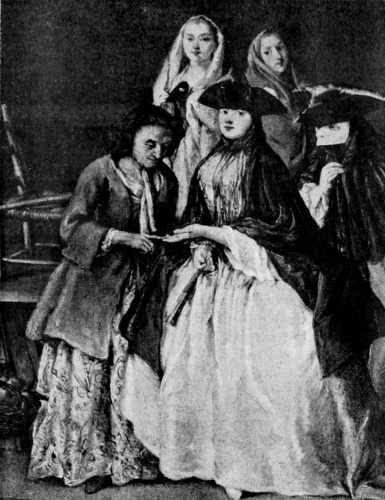
THE FORTUNE-TELLER.
Piero Longhi. (xviii Century).
NATIONAL GALLERY. LONDON.
It was only what might have been expected that poets, musicians, orators, and chroniclers, should illustrate these unwonted festivities, but alas their efforts partook of the fulsome and insincere. The Muse of Poetry, the Spirit of Music, and the Sibyl of History were dying in the common death: their inspirations were as the vapourings of delirium.
Such was their tenor.
Dogaressa Pisana however herself took up her pen, and dipped it in the ink of commonsense. The marriage of her eldest son Alvise, in 1766, with the very youthful Donna Francesca Grimani,—granddaughter of Doge Pietro Grimani, 1741–1752,—was a splendid affair, wherein all the arrangements were personally superintended by the Dogaressa, and she adds in her account “would you believe it, the expenses were more than 456,487 lire.” The marriage was in every way satisfactory, the young couple were talented, highly educated, and very comfortably provided for. As in most things human when fair skies are overhead, a contrary[306] Providence provides unlooked-for tempests, and so the joy-bells of maternity were cruelly changed for the sad knells of mortality. The accomplished and virtuous young wife,—she was only seventeen years of age,—had been nursing her first-born but three short months, when, by some accident or other, as it was reported, she fell swooning into the fire blazing upon the mosaic hearth of her bed-chamber, and, before help could reach her, the bride of a year perished in fearful agony.
This was a stunning grief to good Dogaressa Pisana. She eschewed all ceremonies and mourned in secret for her dear daughter-in-law. At her Consort’s villa at Cordignano, near Ceneda, she found consolation, and there she braced herself for the duties of her station. Among her papers are letters addressed to the steward of the estate, which reveal many natural home-like touches of the simple life she loved so well. The country folk almost worshipped the ground the noble lady trod; she was sponsor to their children, visitor of their sick, their confidante in sorrows and in joys. But her days too were numbered, for, on 10th March 1769, the big bell of the Basilica announced to a sympathising city the death of the magnanimous Dogaressa.
“Near twenty-two o’clock” wrote her Chaplain, “a severe fit of coughing ruptured a blood-vessel in my beloved mistress’s breast and she ceased to live.” Three days after her death the body of the Dogaressa was carried to her burial with every mark of respect and honour. “In death,” the same writer goes on to say, “her Serenity’s face[307] was beautiful and full of colour. She seemed to be wrapt in sweet repose, and her expression betokened what she had been in her life, virtuous, charitable and estimable....”
The funeral obsequies followed the usual custom, only her lying-in-state was in the Basilica, not in the Sala de’ Pioveghi. Four hundred yellow burning wax torches were placed around the bier and the candles of all the altars were alight. The remains were exposed in an open casket, wrapped in a State robe of cloth of gold, with white kid gloves, lace sleeves, and a veil across her bosom to her feet. The “Requiem” and Absolutions were sung by full choir, and the Master of the Ceremonies, Messir Francesco Venier, pronounced the funeral oration. An imposing procession bore the dead Dogaressa across the Piazza and by a circuitous way to SS. Giovanni e Paolo.
Doge Alvise Mocenigo survived his beloved Consort nine years, but in 1771 he contracted a second marriage with a very young girl, Donna Polissena, daughter of Messir Giulio Contarini-Da Mula. It does not appear that she was accorded the position of a Dogaressa and she resided chiefly at the Doge’s country villa, where he was wont to gather all the young, bright and talented people he could around him. His dogado of eleven years was adorned by many cultured women, who displayed phenomenal enthusiasm for classical study, philosophy, poetry, and literature. Probably this was a sublime attempt on the part of the fair sex to correct in some way the indolence and unintelligence of their leisured men-folk. Madonna Polissena Contarini-Da Mula-Mocenigo, was the centre of a[308] little Court of high-souled admirers who greeted her:—
There appears to have been two principal candidates for the Ducal throne upon the death of Doge Alvise Mocenigo in 1779,—Cavaliere Andrea Tron and Messir Paolo Renier. The former, however, was overshadowed by a scandal affecting his wife Madonna Caterina and the Secretary of State Antonio Gratarolo, and Renier was elected. He was an accomplished statesman, highly talented, and very ambitious. But his reputation very soon became assoiled by reason of the traffic he made of posts of influence and emolument under Government. His avarice became so grasping that it was said in Venice:—“The Doge makes the beggars at the door of San Marco pay him for their stations!”
Doge Renier’s family had not hitherto been conspicuous for services to the State, although it belonged to the Second grade of the nobility, dating its enrolment from the Genoese War of 1391. His first wife, Madonna Giustina Dona-Renier, to whom he was married on 28th April 1733, was a daughter of Messir Lionardo Dona, or Donato, a Ducal house,—but she never became Dogaressa for her death took place in 1751, and she is buried in the church of San Antonio at Padua.
Renier however was not a widower when he stepped upon the Ducal dais of Estate, but his spouse was not recognised in Court circles, for she had been a rope-dancer! He had picked her up accidentally at Constantinople, the same year that he buried Madonna Caterina: her name was[309] Margherita Delmaz. Friends and descendants of this marriage had quite another story: they said Madonna Margherita had never been a dancer or anything else of the kind. He found her, they affirmed, at Constantinople, where he was an Agent or Consul of his Government,—in a Catholic school for poor girls. He took her away, had her educated at Padua, and then married her. Doge Renier signalised his elevation to the throne by profuse distribution of largesse, hoping thereby to pave the way for Madonna Margherita’s solemn Entry. This was never accomplished, but “La Falsa Dogaressa,” as she was slightingly called, was allowed to reside with her husband in the Ducal Palace. The couple became more and more unpopular by reason of their meanness, insincerity, and ostentation. One story perhaps illustrates as well as another the selfishness and petulance of the Doge and his wife. It was said that she very much disliked the clanging of the church bells,—San Basso, on the North side of the Ducal Palace, was the worst offender. Madonna Margherita sent a peremptory order to the Pievano, or Rector, that if he would not stop his bell she would cut the bell rope! The bells of the Basilica next came into the controversy, but the Prior refused the behest of silence. The Doge interfered and told the Prior that his “bells set all the Dogaressa’s teeth on edge.” A bargain however was struck, the Doge, on his part, promised a monthly subsidy, but whenever this was overdue the Prior was at liberty to ring his bells as before!
During the reign of Doge Renier the last valorous deeds for Venice were done by Admiral[310] Agnello Emo. He attacked the Barbary pirates in 1784–1788 and freed the Adriatic and the coasts of North Africa from their depredations. The valiant Emo took up the baton of Francesco Morosini, and, had his lot been cast in less degenerate days, he would have received from the Venetians a similar “Triumph.” He died alone and in a way dishonoured in the Palazzo Diedo in 1792. It was Doge Marco Foscarini, 1762–1763,—the last of the literary Doges,—who wrote thus of Venice and the Venetians:—“This century will be a terrible one for our children and our grandchildren!” He probably, seer-like, perceived the imminence of the death of the liberties of Venice, but he could not have known that this forecast would come true within fifteen years of his death.
Doge Paolo Renier died on 18th February 1789, and his burial was conducted in secret within the church of San Nicolo da Tolentino,—the reason for this cannot be stated, perhaps he directed this unusual arrangement in his will, fearing the ebullition of popular feeling against himself and his spouse. Madonna Margherita lived on till the 11th of January 1817: her death took place in her apartments in the Mocenigo Palace at San Stae but the place of her burial has not been recorded.
We now reach the last scene in the vivid and venerable pageant of Venice. The body-politic was infinitely more insecure than the fondamento of the least stability; she had no policy, no consistency, and no reserve of energy. Her men and her women were absolutely indifferent to her fate,[311] and ribaldry and buffoonery appeared to be her only rôle. Two circumstances sufficiently illustrate the conditions of society at the end of the eighteenth century: Marital infidelity became so rampant that between 1782–1796, the “Ten” registered two hundred and seventy-four applications for nullity. When the celebrated Princess Gonzaga visited Venice no one would have anything to do with her, although everybody lived in a house of glass. At last Madonna Caterina Tron, wife of a Procurator of Saint Mark, offered to chaperon her and present her at Court. “Ladies,” she said, speaking to her fellow-noble courtesans, “this is Princess Gonzaga, she belongs to an illustrious family: as for the rest I will not answer either for you nor for myself!” The tempest was gathering up its strength to make a last and overwhelming attack upon Venice, defenceless as she was. Quite significant of coming catastrophe the feeblest, the weariest, and the least resourceful of all the long line of Doges,—Lodovico Manin,—in 1789 sat down despondently upon the Ducal throne—the last of the Doges of Venice. A man of strong character or of supreme patriotism might have saved the Republic at least for a time, but no popular leader appeared, and everybody accepted the inevitable without a struggle. The Dogaressa was a simple, good and modest woman, had she been a Valrada Candiano or a Zilia Dandolo she might have made a man of her husband, but she shrank with him from every responsibility and every effort.
Dogaressa Elisabetta Grimani-Manin, daughter of Messir Antonio Grimani, became the wife of Lodovico Manin on 14th September 1748, in the[312] Church of Santa Maria Salute. She died at Treviso on 31st August 1792 of a nervous malady which affected her head. Her body was carried to Venice and was buried with the same honours as those rendered to the departed Dogaressa Pisana Grimani-Mocenigo in 1769, in the Church of Santa Maria degli Scalzi, where the Doge erected the monument which covers his remains as well as hers. She was laid to rest in the last State robe of cloth of gold ever made in Venice, and with her were buried the last insignia of her rank:—her grave was the grave of Venice.
For five years more dragged on the dying Queen of the Adriatic in constant alarm and in peril of death, every day seemed likely to be her last. The funeral peals which had signalised the passing of the last Dogaressa of Venice had scarcely exhausted their echoes over the islets of the lagunes, when upon men’s ears smote another and a less melodious sound—the stunning roar of cannon! The “second Attila” was at hand, his legions were massing in view of San Marco and the Campanile, and it needed but a word to set loose raiders and looters upon palace, church, and homestead, quite as desperate and as cruel as those barbarians, who fourteen hundred years before, had driven the panic-stricken forebears of the men of Venice from terra-firma to the lagune quicksands. Manin feebly backed by the emasculate “Forty,” tried to temporise with the invader of Italy, but Buonaparte knew no such policy. War was declared upon Venice on 1st May 1797, and the Venetians collapsed without striking a blow in self-defence.
Lodovico Manin on 3rd June 1797, divested[313] himself of his mantle of State and his jewelled Corno, and delivered them unresistingly into the hands of Buonaparte’s lieutenant. The “Libro d’Oro” of the nobility was also voluntarily surrendered and publicly burned with the Ducal Regalia in the Piazza. The last state of Venice was infinitely worse than the first. The annihilation of her independence was celebrated by her depraved nobles add citizens with enthusiastic demonstrations of joy, banal doctrines of up-to-date republicanism were madly accepted, and everything that partook of the glorious past was swept away without remorse. The atrophy of the Venetians developed into lunacy—Venice died insane!
The fall of a great man, the end of a great cause, the ruin of an Empire all call forth lamentation, but no tears were shed for the dead Queen, no sighs were breathed for lost liberty, no regrets were uttered for “Venus Calva.” The echoes of a mighty past were stilled, and the gallantries of a thousand years were silenced—save only for the harmonious cries of gondoliers.
I lay down my pen with regret—and as I close my “Libro d’Oro delle Dogaresse di Venezia” I fall into an enchanting reverie, wherein I descry many benevolent faces smiling at me, amid iridescent scintillations of Venetian rainbows. Their hair is golden, but here and there are strands of silver, which only add to the lustre of the gold. Their[314] faces, if wrinkled,—for they are not maidens,—and their open bosoms, if withered, bear no signs of age, for they are beautified by the cunning artifices of the toilet. Their heads are crowned by horned diadems encrusted with flashing jewels, veils of white point-lace lend grace to their coiffures. From their shoulders downwards the figures of my benevolent visitors are vested—some in crimson silk, but most in regal wealth of cloth of gold. Diamonds flash upon their breasts and around their waists.
They are smiling at me, for I have written about them nothing but what is pleasant, and I fancy I hear their sweet melodious voices, whispering in unison, and saying:—“We played our rôle in the best way we could, we made no enemies, but we left many friends—friends such as those who shall read our Story in your ‘Book of Fame.’”
I awoke from my dream, and I knew that I had seen a vision of the noble and devoted Dogaressas of Venice.
[315]
| Dogaressa. | Doge. | Date. | ||
| 1. Martza d’Este(1) |  |
= | Obelario Antenorio | 804–810 |
| 2. Carola (2) | ||||
| 3. Elena | = | Agnello Badoero or Partecipazio (“Grand” Doge) |
810–827 | |
| 4. Felicita | = | Giustiniano Badoero or Partecipazio |
827–830 | |
| 5. Angela Sanudo | = | Pietro Tribuno | 888–912 | |
| 6. Arcielda | = | Pietro Candiano III. | 942–959 | |
| 7. Giovanniccia (1) | |
= | Pietro Candiano IV. | 959–976 |
| 8. Valdrada (2) | ||||
| 9. Felicita Malipiero | = | Pietro Orseolo I. (Saint) |
976–978 | |
| 10. Marina | = | Tribuno Memo | 979–991 | |
| 11. Maria | = | Pietro Orseolo II. (“Grand” Doge) |
991–1009 | |
| 12. Grimelda d’Ungheria | = | Ottone Orseolo | 1009–1026 | |
| 13. Teodora Commeno | = | Domenigo Selvo | 1071–1084 | |
| 14. Cornella Bembo | = | Vitale Faliero | 1084–1096 | |
| 15. Felicia | = | Vitale Michiel I. | 1096–1102 | |
| 16. Matelda | = | Ordelafo Faliero | 1102–1116 | |
| 17. Alicia | = | Domenigo Michiel (“Grand” Doge) |
1116–1130 | |
| 18. Sofia | = | Domenigo Morosini | 1148–1156 | |
| 19. Felicia Maria di Boemodo |
= | Vitale Michiel II. | 1156–1172 | |
| 20. Cecilia | = | Sebastiano Ziani (“Grand” Doge) |
1172–1178 | |
| 21. Felicita Bembo | = | Arrigo Dandolo (“Grand” Doge) |
1192–1205 | |
| 22. Marina Baseggio (1) | |
= | Pietro Ziani | 1205–1229 |
| 23. Costanza di Sicilia (2) |
||||
| 24. Sabba Minotto (3) | ||||
| 25. Maria Storlato (1) | |
= | Giacomo Tiepolo (“Grand” Doge) |
1229–1249[316] |
| 26. Valdrada di Sicilia (2) |
||||
| 27. Aloicia da Prata | = | Reniero Zeno | 1253–1268 | |
| 28. Agnese Ghisi (1) | |
= | Lorenzo Tiepolo | 1268–1275 |
| 29. Marchesina di Bienne (2) |
||||
| 30. Jacobina | = | Giacomo Contarini | 1275–1280 | |
| 31. Caterina | = | Giovanni Dandolo | 1280–1289 | |
| 32. Tommasina Morosini (1) |
|
= | Pietro Gradenigo (“Grand” Doge) |
1289–1310 |
| 33. Agnese Zantani (2) | ||||
| 34. Agnese | = | Marino Zorzi | 1310–1312 | |
| 35. Franchesina | = | Giovanni Soranzo (“Grand” Doge) |
1312–1329 | |
| 36. Elisabetta | = | Francesco Dandolo | 1329–1339 | |
| 37. Giustina Cappello | = | Bartolommeo Gradenigo |
1339–1342 | |
| 38. ? (1) | |
= | Andrea Dandolo (“Grand” Doge) |
1342–1354 |
| 39. Isabella de’Fieschi (2) |
||||
| 40. Tommasina Contarini (1) |
|
= | Marino Faliero | 1354–1355 |
| 41. Aluycia Gradenigo (2) |
||||
| 42. Adriana Borromeo (1) |
|
= | Giovanni Gradenigo | 1355–1356 |
| 43. Marina Cappello (2) | ||||
| 44. Marchesina Ghisi | = | Lorenzo Celsi | 1361–1365 | |
| 45. Giovanna (1) | |
= | Marco Cornaro | 1365–1367 |
| 46. Caterina (2) | ||||
| 47. Cristina Condulmiero | = | Michele Morosini | 1382 | |
| 48. Agnese | = | Antonio Venier | 1382–1400 | |
| 49. Marina Gallina | = | Michele Steno | 1400–1412 | |
| 50. ? Cappello | = | Tommaso Mocenigo (“Grand” Doge) |
1412–1423 | |
| 51. Maria Priuli (1) | |
= | Francesco Foscari (“Grand” Doge) |
1423–1457 |
| 52. Marina Nani (2) | ||||
| 53. Giovanna Dandolo | = | Pasquale Malipiero | 1457–1462 | |
| 54. Letizia (1) | |
= | Cristoforo Moro | 1462–1471 |
| 55. Cristina Sanudo (2) | ||||
| 56. Aloidea Morosini | = | Nicolo Tron | 1471–1473 | |
| 57. Elena Barbarigo (1) | |
= | Nicolo Marcello | 1473–1474 |
| 58. Contarina Contarini Morosini (2) |
||||
| 59. Laura Zorzi | = | Pietro Mocenigo | 1474–1476 | |
| 60. Regina Gradenigo | = | Andrea Vendramin | 1476–1478[317] | |
| 61. Taddea Michiel | = | Giovanni Mocenigo | 1478–1485 | |
| 62. Lucia Ruzzini | = | Marco Barbarigo | 1485–1486 | |
| 63. Elisabetta Soranzo | = | Agostino Barbarigo | 1486–1501 | |
| 64. Giustina Giustiniani | = | Lionardo Loredano (“Grand” Doge) |
1501–1521 | |
| 65. Caterina Loredan | = | Antonio Grimani | 1521–1523 | |
| 66. Benedetta Vendramin | = | Andrea Gritti | 1523–1538 | |
| 67. Maria Pasqualigo | = | Pietro Lando | 1538–1545 | |
| 68. Giovanna da Mula (1) | |
= | Francesco Donato | 1545–1553 |
| 69. Alicia Giustiniani (2) | ||||
| 70. Zilia Dandolo | = | Lorenzo Priuli | 1556–1559 | |
| 71. Elena Diedo | = | Girolamo Priuli | 1559–1567 | |
| 72. Maria Pasqualigo (1) | |
= | Pietro Loredano | 1567–1570 |
| 73. Maria Cappello (2) | ||||
| 74. Loredana Marcello | = | Alvise Mocenigo | 1570–1577 | |
| 75. Cecilia Contarini | = | Sebastiano Venier (“Grand” Doge) |
1577–1578 | |
| 76. Arcangela Canali | = | Nicolo da Ponte | 1578–1585 | |
| 77. Laura Morosini | = | Pasquale Cicogna | 1585–1595 | |
| 78. Morosina Morosini | = | Marino Grimani | 1595–1606 | |
| 79. Elena Barbarigo | = | Antonio Priuli | 1618–1623 | |
| 80. Chiara Delfino | = | Giovanni Cornaro | 1625–1629 | |
| 81. Paolina Loredano | = | Carlo Contarini | 1655–1656 | |
| 82. Andreana Priuli | = | Francesco Cornaro | 1656 | |
| 83. Elisabetta Pisani | = | Bertuccio Valier | 1656–1658 | |
| 84. Lucia Barbarigo | = | Giovanni Pesaro | 1658–1659 | |
| 85. Elisabetta Querini | = | Silvestro Valier | 1694–1700 | |
| 86. Laura Cornaro | = | Giovanni Cornaro | 1709–1722 | |
| 87. Elena Badoero | = | Alvise Pisani | 1735–1741 | |
| 88. Pisana Cornaro (1) | |
= | Alvise Mocenigo | |
| 89. Polissena Mocenigo (2) | ||||
| 90. Giustina Donato (1) | |
= | Paolo Renier | 1779–1788 |
| Margherita Delmaz (2) | ||||
| 91. Elisabetta Grimani | = | Lodovico Manin | 1788–1797 | |
[319]
| Archivio Veneto, Vols. iii., iv., v., xiii., xiv., xx., xxxi., xxxviii. |
||
| Archivio Veneto Nuovo, Vols. xii., xiii., xiv., xvii., xviii., xix. |
||
| Barbaro, A. | Prud. et gravi doc. circa la Elet. della Moglie |
Venice, 1548 |
| Bembo, P. | Gli Asolani | Venice, 1588 |
| Browne, H. F. | Studies in Venetian History, 2 vols. | London, 1903 |
| Do. do. | In and About Venice | London, 1908 |
| Burckhardt, J. | The Culture of the Renaissance | London, 1892 |
| Carducci, G. | Studi Letterari | Livorno, 1874 |
| Do. do. | Galanterie Cavalleresche del secoli xii e xiii |
Livorno, 1879 |
| Casola, Frate P. | Viaggio a Gerusalemme | Milan, 1865 |
| Cecchetti, B. | Il Doge di Venezia | Venice, 1864 |
| Do. do. | La moglie di Marino Falier | Venice, 1871 |
| Do. do. | La Donna di Medio Evo a Venezia | Venice, 1886 |
| Cecchini, D. | Trionfo della Dogaressa | Venice, 1874 |
| —— | “Cerimoniali” (Archivio del Stato) | Venice, 1464–1592 |
| Cicogna, E. A. | Inscrizioni Veneziane | Venice, 1874 |
| Do. do. | Tavole Cronologiche Venete | Venice, 1840 |
| Crawford, P. M. | Gleanings from Venetian History, 2 vols. |
London, 1905 |
| Damianus, P. | Opera Omnia | Paris, 1743 |
| Dardano, P. C. | La Bella e Dotta dif. Belle Donne | Venice, 1553 |
| Domenichino, G. | Nobili Belle Donne | Venice, 1561 |
| —— | Emporium (various writers), Vols. xxi. xxiv. |
|
| Einstein, L. | The Italian Renaissance in England | New York, 1902 |
| Faber, Frate F. | Evagatorium Terræ Sanctæ | Stuttgart, 1849 |
| Franco, Veronica | Terze Rime | Venice, 1575 |
| Franco, G. | Habiti Delle Donne Veneziane | Venice, 1610 |
| Do. do. | Habiti D’Huomini e Donne Veneziane | Venice, 1610 |
| Garnett, R. | History of Literature | London, 1898 |
| Gubernatis, A. de | La Fille de la République | Paris, 1879 |
| Hazlitt, W. C. | History of the Venetian Republic, 2 vols. |
London, 1900 |
| Hodgson, F. C. | Early History of Venice, 2 vols. | London, 1901 |
| Litta, P. G. | Famiglie Celebri D’Italia, 11 vols. | Milan, 1819 |
| Luigini, D. | Il Libro delle Belle Donne | Venice, 1553 |
| Lungo, I. del | La Donna Italiana del Buono Tempo Antico |
Florence, 1906 |
| Marinello, G. | Gli Ornamenti delle Donne | Venice, 1562 |
| Molmenti, P. G. | La Dogaressa di Venezia | Turin, 1887 |
| Do. do. | Le Isole della Laguna | Turin, 1898 |
| Do. do. | Storia di Venezia, 3 vols. | Turin, 1907 |
| Do. do. | Venice (English Version) 6 vols. | London, 1908 |
| Palazzi, G. | La Virtu in Giuoco overo Dame Patritie di Venetia |
Venice, 1682 |
| Rodocarnachi, E. | La Femme Italienne | Paris, 1907 |
| Rogissart, F. | Les Délices D’Italie | Paris, 1709 |
| Ruskin, J. | The Stones of Venice | London, 1892 |
| Sabellico, P. G. | Historiæ Rerum Venetarum | Venice, 1718 |
| Sansovino, F. | Venetia Citta Nobilissima | Venice, 1581 |
| Sanudo, M. | Vite dei Duchi di Venetia, 58 vols. | Venice, 1530 |
| Selincourt, B. and H. de | Vénise | London, 1907 |
| Sismondi, J. C. D. | Histoire des Républiques Italiennes | Paris, 1836 |
| Staley, E. | Guilds of Florence | London, 1906 |
| Do. | Tragedies of the Medici | London, 1909 |
| Do. | Famous Women of Florence | London, 1909 |
| Symonds, J. A. | The Renaissance in Italy, 5 vols. | London, 1890 |
| Tassini, A. | Curiosita Veneziana | Venice, 1897 |
| Uzanne, O. | L’Art et Les Artifices de la Beauté | Paris, 1902 |
| Vecellio, C. | Habiti Antichi e Moderni di Tutto il Mondo |
Venice, 1590 |
| Yriarte, C. | Vénise | Paris, 1882 |
The ancient Chronicles of Venice may be arranged in the following order:—
| I. | Cronaca | di Giovanni Diacono. |
| II. | Do. | Gradense. |
| III. | Do. | Altinate. |
| IV. | Do. | di Da Canale (begins 1267) |
| V. | Do. | di Marco (begins 1292). |
| VI. | Do. | di Frate Paolino (1306). |
| VII. | Do. | d’Andrea Dandolo—Doge. |
| VIII. | Do. | di Frate Pietro Carlo (1340). |
At the Museo Civico in Venice are a number of “Family Archives,” “Diaries,” etc., and others, in the possession of various existing ancient families, are easily accessible.
[321]
A
B
C
D
E
F
G
H
I
J
K
L
M
N
O
P
Q
R
S
T
U
V
W
Y
Z
EDINBURGH
COLSTONS LIMITED
PRINTERS
Transcriber’s Notes:
1. Obvious printers’, punctuation and spelling errors have been
corrected silently.
2. Some hyphenated and non-hyphenated versions of the same words have
been retained as in the original.