
Title: The captive singer
Author: Marie Bjelke Petersen
Release date: February 22, 2026 [eBook #78003]
Language: English
Original publication: London: Hodder and Stoughton, 1917
Other information and formats: www.gutenberg.org/ebooks/78003
Credits: David E. Brown and the Online Distributed Proofreading Team at https://www.pgdp.net (This file was produced from images generously made available by The Internet Archive/American Libraries.)
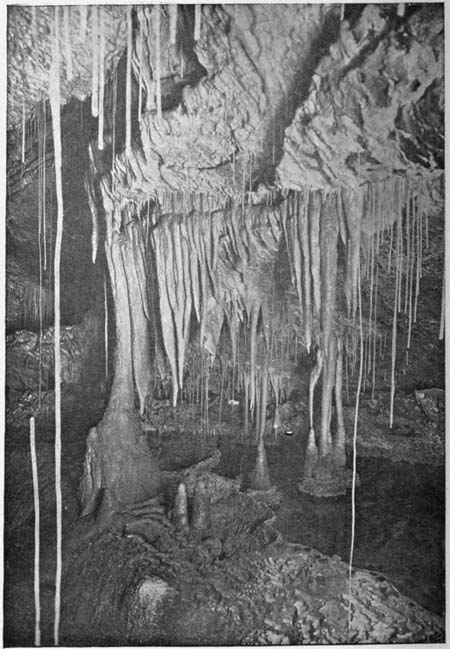
Photo. Spurling & Son, Launceston.
THE LIMESTONE CAVES.
THE CAPTIVE SINGER
BY
MARIE BJELKE PETERSEN
HODDER AND STOUGHTON
LONDONNEW YORK TORONTO
Printed in Great Britain by
Richard Clay & Sons, Limited,
BRUNSWICK ST., STAMFORD ST., S.E.,
AND BUNGAY, SUFFOLK.
TO
THE PURE WHITE ANGEL
WHOSE LOVE HAS LIFTED ME,
WHOSE WINGS HAVE SHELTERED ME,
WHOSE COMPANIONSHIP HAS INSPIRED ME,
I MOST LOVINGLY AND REVERENTLY
PRESENT THIS BOOK
I’LL SING THEE SONGS OF ARABY
| CHAP. | PART I | PAGE |
|---|---|---|
| I. | THE HOT-HOUSE | 1 |
| II. | IN THE WILDS | 14 |
| III. | THE VOICE IN THE CAVE | 25 |
| IV. | THE EXPLANATION | 43 |
| V. | THE BLACK HORSE AND HIS RIDER | 52 |
| VI. | IN THE DUSK | 68 |
| VII. | BY THE MARBLE CLIFFS | 76 |
| VIII. | FATE | 89 |
| IX. | APPROACHING THE RAPIDS | 102 |
| X. | THE GIRL IN THE YELLOW GOWN | 113 |
| XI. | AT THE SHRINE | 120 |
| XII. | THE CONFESSION | 133 |
| PART II | ||
| I. | THE INTRUDER | 144 |
| II. | IRIS AND RALPH | 157 |
| III. | JUSTIN GOES AWAY | 168 |
| IV. | THE BAR OF DESTINY | 177 |
| V. | REMORSE | 185 |
| VI. | HER RESOLVE | 190 |
| VII. | CONSOLED | 195 |
| VIII. | CAPTAIN BARTON’S PLAN | 201[viii] |
| IX. | TO THE RESCUE | 206 |
| X. | THE SUMMIT | 218 |
| XI. | WHAT THE FIELD-GLASSES REVEALED | 237 |
| XII. | HER OFFER | 251 |
| XIII. | THE GOLDEN ROAD | 262 |
| XIV. | “HOPE” | 270 |
| PART III | ||
| I. | THE EARL’S VISIT | 275 |
| II. | THE CABLES | 285 |
| III. | THEIR GOAL | 298 |
“Imagine any one brought up like Iris Dearn actually preferring Australia to London—it is as bad as liking briar-roses better than orchids!” And the speaker allowed her large dark eyes, now cold with scorn, to wander round the crowded reception rooms, decorated with the rare flowers she had just named.
“Yes, it is rather peculiar, Lady Maud,” replied the thin, elderly man she had addressed, moving one of his wrinkled, well-manicured hands. “Still, Australia is a very fascinating country. It is the baby-nation, of course; but the baby is able to toddle now and it has most charming—though perhaps a little wilful and wayward—baby ways. I believe it also shows signs of great intelligence; it is going to make a deep imprint in history—I should not be in the least surprised if Australia turned out to be the genius in the World’s family!”
Lady Maud Townsville made a slight movement with her scantily covered shoulders. “Infant prodigies rarely grow up anything but bores,” she said disdainfully.
“I did not mean to imply that Australia was an [2]infant prodigy—it is far from that! In fact at present it is merely a delightful, healthy child, a little spoilt by rather excessive petting from Providence, but vigorous and lively, with most engaging ways and full of promise for future development!”
Just then all conversation was suddenly hushed into silence, for a famous soprano had made her way to the piano and the accompanist was striking the opening chords of her song.
Her voice was clear, rich and full. She trilled like a bird, and words dropped from her lips like smooth round pearls of sound.
She sang about love, blue skies and purling streams. Her music brought summer with it: soft breezes from the sea, and the lap of drowsy sun-kissed waves. It suggested drifting white clouds, swaying corn, scarlet poppies, new-mown grass and buttercups. It made the swelling tones of exuberant larks tremble into the warm orchid-scented air of the luxurious drawing-rooms. The guests filling them were suddenly carried back to long sunlit days spent in magnificent country places, roaming in green mysterious woods, wandering by silvery lakes, and driving under long avenues of beech, oak, or stately fir trees.
“Her singing has atmosphere,” remarked Sir Edwin Graves when the song was over. “She brought back summer to us in this chilly, foggy November night. Her music has power to do that. But it could not set the air stirring with passion.”
Lady Maud permitted her costly fan to drop to her pale blue silk knees. “Who wants passion [3]in these modern times?—it is out of date. We have outgrown it—with all other savagery.”
“Do you really place love, with its servant, passion, under the category of savagery?” inquired Sir Edwin, turning to his companion with a look in his watery blue eyes as if he were regarding a specimen in a museum which rather interested him.
“Love of what?” asked the woman beside him, with a touch of mockery in her cool voice; “of rank—position—fabulous wealth?” And her fine eyes swept the moving, stirring rooms with their artistic splendour and soft languorous elegance.
He met her derision composedly. “No, I meant love of one human being for another—the kind of love which would lay down life itself for the object of its devotion.”
“Hopelessly ancient sentiments, my dear Sir Edwin! That kind of affection died with Romeo. In these days we flirt with the good-looking men, but we marry the rich ones.” Lady Maud lifted her well-poised head with a touch of defiance. She was marrying one of England’s richest men, whose reputation was as notorious as his wealth.
A little lower down the room sat a beautiful woman with coppery hair, dreamy eyes and a complexion like white and pink rose petals. A tall, dark man, with a well-formed, mask-like face stood beside her. He had just asked her a question and she raised her great limpid eyes to his as if she were merely replying to some casual remark, but her tones were low as she said, “I wish you would not ask me these questions here.”
[4]“May I ask them somewhere else—may I come and see you alone to-morrow afternoon?” He bent over her a little and a curious expression struggled into his mask-like features.
“My husband insists on my motoring down with him to-morrow to look at a new shooting-box he is rather keen on getting; we shall not be back till late,” she replied evenly.
“But will you let me come some other time?”
“I shall be at home on Sunday afternoon at five o’clock.”
“May I come then and—ask?”
“Yes, but remember I have not promised to answer you.” And her smooth tones held a soft challenge in their careless banter.
A plain woman, with large, protruding teeth, watched them from the other side of the room. “Lady Langton is going too far in this flirtation,” she commented to herself with a snarling smile; “she will end in the divorce court one of these days, and then—” a gleam of malicious anticipation shot for a moment into her long narrow eyes—“then we shall have some spicy revelations!”
On a rose-coloured settee sat the hostess, Lady Dearn, talking to an elderly Duchess.
Lady Dearn was rather short, but she had a well-proportioned figure and held herself with youthful straightness. Her face was not beautiful, but it pleased. Her rather small china-blue eyes had just the right amount of animation; they looked expressive without betraying the least feeling; they held refined vivacity which never bordered on vulgar excitement.
“How is Iris?” asked the stately Duchess.
[5]Lady Dearn lifted her eyebrows slightly. “She is always happy in Australia. I cannot understand how it is the child has taken such a fancy to that wild place. I am sure it is most extraordinary she should care for that sort of life!”
“There is no talk of her coming home, then?” Iris was a great favourite with the magnificent old lady.
“Not the slightest. She and her cousin are going to spend the summer in Tasmania, at some terrible out-of-the-way place amongst great lonely mountains, where there are lots of horrid caves and all that kind of thing.” Lady Dearn shuddered a little. “Think of my daughter preferring that to this!” And she glanced round her superb home with a puzzled expression on her serene, unlined face.
“But you will surely not allow Iris to stay out there too long? It is perfectly appalling for such a beautiful and charming girl as that to waste her loveliness on gum-trees and kangaroos.”
“It is certainly shocking—but how can I prevent it? When children grow up they please themselves.” She made a pretty little deprecating gesture of helplessness.
“Of course the young must live their own lives, and they have a right to please themselves, if their tastes run along—well——” she hesitated slightly.
“Civilised lines,” suggested the aggrieved parent, “but when they do not, you think mothers should interfere; quite so, I agree with you. But I am powerless; Iris is deaf to reason and persuasion; she is of age, and, as you know, has her own money—what can I do? It is late to restrain her now; [6]I should never have allowed her to go for that first trip with her father—that did the damage; she was never happy in London afterwards.”
As she talked to the Duchess, she caught sight of her second daughter, Helen, standing by a large console mirror, speaking to a dignitary of the Church. She sighed a little. Helen was so plain, and she pined for admiration and attention, while her beautiful sister was so indifferent to these things that, after two seasons of continual social triumph, she had chosen to hide her loveliness in the untamed solitudes of the Australian bush! It was exasperating! And how would it all end? She was losing all her chances of a brilliant marriage, and no girl had better chances than Iris. Her remarkable beauty and delightful personality had taken London by storm.
When she made her début the society papers had been full of her praises. Her photo had appeared in all the magazines. Every one with two eyes agreed about her perfect features, her dazzling colouring, superb figure and elegant bearing. Every one had enthused about the wonderful blue of her eyes, their bewildering expression, the phenomenal length of her black lashes and her enchanting smile! Iris could have married nobility of highest rank, and now—a wave of annoyance flushed Lady Dearn’s smooth face. Why was Iris so different from Helen? Why had she no ambition, no appreciation of the enormous advantages circumstances had placed at her disposal? How could the vast plains of Australia, the rugged mountains of Tasmania, prove a stronger attraction than all London was prepared to shower on this [7]imperious young beauty, who stood aloof and unmoved by all its homage and adulation? Lady Dearn’s vexation increased as she thought of her daughter’s inexplicable choice.
But the Hon. Iris Dearn was being discussed by more people than her mother and her ducal friend that night. In another room, close to a large marble Venus, a small lavender-tinted lady talked in low eager tones about her to a young officer who had just returned from India on furlough. He had evidently expected to see the girl at her mother’s reception, and the woman beside him was pouring very annoying information into his attentive ear. “You know Iris was only eighteen when her father was ordered a long sea voyage,” she was saying, “and dear Lady Dearn was so busy, the winter season just commencing, so of course she could not take him herself, and the dear child begged so hard to be allowed to go—she just adored her father; so eventually her mother yielded, though she did not approve of her going at all, as she was to come out that season.
“They went to South Australia and stayed for some months with a niece of Lord Dearn’s, who had married a squatter there. When Lord Dearn returned to England,” continued the colourless voice, “his health gave way completely, and he died soon afterwards. Poor Lady Dearn was so upset—it was dreadful to lose such a devoted husband, and having to postpone Iris’s coming out, again; for of course she could not be presented while they were in mourning. So dear Iris was nearly twenty when she made her début. She only had two seasons in London, and then, as ill-fate [8]would have it, the cousin they stayed with in Australia lost her husband, came to England for a short trip, and persuaded Iris to go back with her—not that she needed much persuasion; I think she would have gone sooner or later in any case, for she was perfectly in love with the place—such a pity, people simply raved about her here! But—” a sentimental look crept into her small, sharp-featured face, “she doesn’t seem to have any heart for men at all, only an odd infatuation for that far-away, strange land.”
The handsome bronzed face of the young officer relaxed a little.
“I can’t understand it at all,” went on the talkative little woman in lavender; “of course there can’t be any of her own class out there for her to mix with, except her cousin, and she has probably deteriorated by this time, having lived there for years. It is most curious! And Iris was so fastidious, too—no one in London was good enough for her. I believe she had rather a rupture with her mother over some Earl she wanted her to marry, and the girl absolutely refused, because he had once—well, you know what men are—though this was rather an ugly piece of gossip. But Iris would have nothing to do with him on that account, and yet she has gone out to stay for an indefinite time in a country where England sends her—well—the dregs of her families! They used to be sent to America—these unfortunates—but now they send them to Australia instead; so much safer—America was much too close, and the banished ones had a way of returning unexpectedly.”
The speaker sighed becomingly. “You remember [9]young Strathfell—the second son? Terrible about him, wasn’t it? His father has never got over it. Ah, perhaps you were in India when it happened. He must have had a wild strain in him, poor boy, for he actually quarrelled with his father because he wanted to become a professional singer, and of course the old man would not give his consent to such a thing. But he really had a marvellous voice, quite the most touching I have ever heard; and he was so handsome and delightful! Still, it was really too foolish to quarrel with his father, be disinherited, and never be allowed to visit his home again—all for the sake of singing! His father made him promise never to use his own name either. He had the decency not to appear in public in England, but he created a perfect furore on the Continent and in America! However it all came to a sad end; he nearly drank himself to death, and finally went to Australia, and has not been heard of since. Then there was General Foulsham’s son——”
But her listener was not interested any longer, and, making some excuse of wishing to speak to their hostess, he left her.
After his departure, a lady sitting on her right in a smart black gown, with a huge scarlet poppy fastened at the point where gauzy shoulder-straps met in front of her low-cut bodice, said to Miss Marshall, “I heard you telling Captain Barton all about Iris. I don’t wonder you are mystified; it is really tragic! And she had such brilliant offers! But goodness knows what will happen to her now. I suppose she will end by marrying some bushranger!” prophesied the Hon. Mrs. [10]St. Hill Cresden, turning her rather well-shaped head to watch an American multi-millionaire who had just passed.
“A bushranger?” repeated her companion questioningly, “There are no bushrangers in Australia nowadays.”
“Oh, dear Miss Marshall, don’t take me so literally; I didn’t mean a bushranger, of course, but a bushman, or whatever you call them; they are really all the same, you know—Iris will end by marrying one of them. I shall write and warn her.”
“How dreadful! But after she has been mixed up with the people there I shall not be surprised at anything she does. It must be most demoralising never meeting any one of her own class, except the failures we send out. I wonder if Iris will come across young Foulsham. He was so clever and had his share of good looks too; but they say his debts were terrible! No wonder, for his fancy for actresses was on a large scale too, I believe; debts and actresses generally go together, don’t you think? He had to be sent out; it is just as well Australia was discovered! I wonder what they are all doing now? Minding sheep, I suppose—such a nice, healthy occupation for prodigals; all the men seem to do that out there;—what an alarming number of sheep there must be when it takes everybody in the country to look after them!”
The famous soprano began to sing again.
Her guitar-like tones pulsated through the sumptuous rooms. They floated into the hot brilliant spaces as soft moonbeams float into night. They brought dream-like radiance; the liquid [11]splendour of silent lakes caressed by silver rays from a rising moon; the faint echo of boatmen lilting softly as shiny oars glided over the limpid deep.
“She has been to Italy,” said a young diplomatist to Lady Maud, when the singer had withdrawn.
They were standing in a small alcove sheltered by a profusion of palms and ferns.
“Very likely,” replied Lady Maud, beginning to move her fan languidly to and fro.
“Why don’t you come to Italy for Christmas? The climate is most delightful in the winter,” said the man in the foreign service, turning to his companion questioningly.
Lady Maud stopped the swaying movement of her fan and regarded the toes of her pale blue silk slippered feet with a speculative air. “I had thought of going to Rome for the winter; but after all I think I had better reserve Italy for my honeymoon.” She glanced up at him now.
She was not disappointed, for she saw him wince.
“Maud,” he began, a dark look coming into his bright eyes, “you can’t possibly—you don’t mean to say that you really will——”
“My dear Cecil, of course I will—nothing is surer.”
“It’s preposterous!” he replied with some heat.
“What is preposterous—his fortune?” she asked with gracious derision.
He looked between her lashes. “I was thinking of his—reputation.”
Lady Maud’s eyelids flickered a little; then she answered with defiant composure: “You don’t suppose notorious wealth can exist without [12]correspondingly notorious other things, do you? I am afraid your experience of the world is too limited to permit you to rise high in the diplomatic service.”
The man bent over her suddenly. “Maud, for heaven’s sake throw him over—and—marry for—”
“How stiflingly hot it is here.” She stepped out from the sheltering palms and stood in full view of the crowded rooms. “Please take me to my aunt, I believe she wants to go home early. Ah, there she is coming towards us. It has been so nice to see you again, Cecil—I hope to meet you in Rome—some day—good-night.” She made a little gracious movement towards him with her fan and joined an old lady in black velvet, wearing a magnificent diamond tiara.
“What a confounded nuisance that Iris is away just now,” muttered Captain Barton to himself, as he sat frowningly in a corner of a taxi on his way to his club. “I shall call on Lady Dearn to-morrow and get her permission to go out and persuade the girl to come back—it is outrageous for her to be out there! I believe I shall just be able to do it in the time.”
Then he glanced out on the crowded streets. It was a dreary looking night. The pavements glittered dully with moisture and mud. The noise of the traffic was muffled by a chilly fog. Yet he loved the place. To one coming from the glare of India the thick cold atmosphere was exhilarating. It was really hard luck having to leave London so soon. But some months ago he had seen his old playmate’s photograph in her court dress in a [13]magazine, and the lovely picture had sent the blood tingling through his veins and made him determined to marry her. Of course others had been determined about the same thing, and failed; but then—Ralph Barton straightened his tall, well-knit figure—girls could never resist him: he was a great favourite in India; so, if he really meant business, and made Iris aware of it, of course it would be all right—of course—of course.
“He looks like a gentleman,” said Iris Dearn, drawing patterns in the fine white dust with the point of her elegant parasol.
“He not only looks like a gentleman, I am sure he is one,” replied her cousin, with slight emphasis, as she threw back the long streamers of her silver-grey veil which a light breeze had blown teasingly before her face.
“Then I wonder how he comes to be in this position,” mused the girl, ceasing to make patterns in the dust and looking dreamily up the straight bush road by which they were sitting.
Mrs. Henderson shrugged her massive shoulders. “Now, my dear, you have touched on a mystery that we shall never solve. All that we shall ever know is, that Mr. Rees is a gentleman and that he is a driver and guide at this very out-of-the-way place. How he came to occupy this position we shall never be told.”
Iris Dearn made no comment at the moment. Her deep blue eyes, shadowed by very black luxuriant lashes, were still gazing in gentle abstraction up the sunlit track. “It would be interesting to know a little about his past, don’t you think? He talks so well and I am sure he has had a splendid [15]education; he really ought to be doing very different work from this.”
“Yes, he does talk well; and there is no doubt about his education. As you say, it would be rather interesting to know how he came to take up his present work. But we shall not be told anything about that. Though we have been out with him so much, and had so many talks, he has never once referred to his past; in fact, have you noticed that he never talks about himself at all, and if by any chance any one makes the slightest personal reference, he shrinks into unapproachable aloofness at once? Miss Smith was telling me yesterday, that he has been with them for nearly three years, but that he had never told them anything of his former life, and he is not the kind of man they care to ask questions about his private affairs: for though he is so awfully good to every one and has that air of deferential courtesy, he has an impenetrable reserve as well, which keeps even the most curious people at bay.”
“Yes,” acquiesced Miss Dearn, following the movements of a terra-cotta tinted butterfly flickering among some flowering bushes. “He is not the sort of man to satisfy idle curiosity. He will not stand being patronised either. That vulgar little woman with all the diamonds, in the tourist party last week, tried to patronise him when they first went out, but she soon gave it up! I never saw anything better done than the neat, courteous way he put her in her place, and without in the least appearing to do so; it was masterly!”
“Yes, that was really clever—I felt inclined to clap and say ‘Bravo!’”
[16]“So did I. That really was an odious little woman—the way she first spoke to him made me want to shake her.”
Mrs. Henderson’s small plump hands were again occupied putting the streamers of her veil away from her face; when this was accomplished she said, turning her round, kind face to her cousin, “By the way, Iris, that soft new shade of blue you wore last night suited you to perfection—it just matched your eyes.”
But her cousin was not interested in clothes just then. “He is very brave,” she said irrelevantly, turning the soft oval of her face once more towards the long stretch of glistening road. “Wasn’t it splendid the way he caught that runaway horse the other day and saved that poor old drunkard’s life!”
“Yes, it was most heroic; and he was nearly killed himself over it. My heart just stood still when the horse dragged him all that distance—still he managed to pull it up in the end. But it was a reckless thing to do, and the old fellow in the cart wasn’t worth the risk! Miss Smith says Mr. Rees is always doing things like that; he doesn’t mind what dangers he runs into as long as he helps somebody. The whole district comes to him for help. If their cows or horses are ill they always send for him, and he often sits up all night with people, too. Miss Green’s father, at the shop, has awful heart attacks, and whenever they come on they always send for Mr. Rees, and he frequently has to stay with the invalid till early morning.”
Miss Dearn’s delicately gloved hand began to stroke the moss-covered log on which they were sitting. “I have never met any one so kind and [17]thoughtful. He seems to think of everything for every one’s comfort, and does it all in such a quiet unobtrusive manner that one hardly realises he is doing anything at all. I wonder if he is happy,” she pondered with cool, detached interest.
“Happy!” repeated her cousin, “how could any man be happy with eyes like that? Haven’t you noticed the deep melancholy in them when he is not talking? It is really there all the time, even when he smiles; but, when he is silent and thinks himself unobserved, the sadness in his face makes my heart positively ache!”
Her companion brushed away a little green beetle which had lighted on her dainty gown. “Grey eyes always look sad, don’t you think? They are so much sadder than blue or brown ones—like grey skies, always looking a little wistful.”
Mrs. Henderson suddenly glanced at her small, gold wrist-watch. “We really must go back,” she said rising slowly. “We ought to be in good time for dinner to-night; generally we are so late with all these long outings. By the way, Mr. Rees asked me, just before we came out, if we would care to have another look at the big caves; a large party is arriving to-night and wants to see them to-morrow. I believe he wants us to go, and said he would save us the front seats in the brake if we decided to visit the caves again. It is so nice of him always to keep the best seats for us. I was so amused the other day when I was standing on the verandah waiting for you: one of the ladies tried her best to secure the seat next to him, and coaxed in the most arch and fascinating way to get it; but he was relentless and the front seats [18]were rigidly reserved for us. I think he likes to have us there.”
“That is only because we have been here so long and been out with him so often,” said Miss Dearn, opening her long ivory-handled parasol.
“Perhaps so; yet, even in his aloof way, he may like some visitors better than others I suppose—he certainly talks more to us than to any of the other people.”
Iris made no reply as she walked beside her cousin, tall, erect, slender—all in white, from her slim shoes to her slanting parasol; her exquisite profile with its bewildering contours of chin and throat softly outlined against the bronze-green bush, her deep blue eyes, shadowed almost to blackness by their long drooping lashes, looking straight before her.
Mrs. Henderson glanced at her and exclaimed involuntarily: “Iris, you ought to be closely veiled. It is really not fair to men, having a girl looking like you walking about—it is not! I don’t wonder so many of them have gone absolutely mad over you—I should myself if I were a man! I wonder no one has ever come at night and run away with you—I shouldn’t blame them if they did!”
Iris smiled a soft, indulgent smile. She had been accustomed to such admiration all her life. “No one ever feels as badly as that—they all get over it in time. Anyhow up here there is not the slightest danger, as we never see any men except those awful tourists who stare, and stare, and then—go away.”
Neither the girl nor her cousin thought of the driver just then.
[19]By this time they had left the bush track and were now walking on the open main road leading to the small township where they were staying. The great chain of mountains surrounding the district had come into view. A soft haze and the pale blue smoke of bush fires made the towering ridges look strangely remote and out of reach. It seemed as if they had shrunk back into some impenetrable reserve, which would never lift again and reveal their austere savage beauty.
“Here comes Mr. Rees,” said Mrs. Henderson suddenly, interrupting herself in the middle of a remark about the English letters she had received that morning.
Miss Dearn followed the direction of her cousin’s gaze. “Are you sure that is he?” she asked a little absently. She was thinking just then of her mother’s urgent appeal to come home immediately.
“Why, of course! Who else in this place walks like that? If nothing else gives him away, his walk does. No one but a gentleman could walk that way; there is a suggestion of Eton or Harrow about it.”
They watched the man in the paddock making his way to the road. He was rather tall, straight, well-made, and he moved with an ease and careless grace which made it a pleasure to look at him. As he came nearer they could distinguish his finely chiselled features, which bore their usual expression of preoccupation and quiet gravity.
He had reached the fence now and vaulted over it with the lightness of a deer, then he greeted the ladies waiting for him in the shade of a large wattle.
“Good afternoon,” he said in an exceedingly [20]pleasant voice, lifting his cap and baring a very shapely head, covered with thick black short-cut hair.
He wore a loose brown Norfolk jacket, a little the worse for wear, but of good material and cut, and his pink-striped shirt was spotless. There was an air of neatness about him—not the punctilious, fussy kind, but the unstudied correctness which comes naturally to those who have good taste in clothes, and know how to put them on without wasting much time over their toilet.
“Are you coming home too, Mr. Rees?” said Mrs. Henderson, with the friendly graciousness she would bestow on an equal.
“Yes—may I walk along with you?”
“Of course, we shall be glad to have a chat with you—we haven’t had a talk for two or three days.”
Miss Dearn awoke from the contemplation of her mother’s letter. “Have you been on another errand of mercy?” she inquired turning a dazzling impersonal smile on the driver.
“Do you call going to a farm to return a borrowed horse by such an exalted name?” queried Rees, a momentary light coming into his sad grey eyes.
“I wonder what makes you do all these kind things,” the girl mused, ignoring his reply. “We have been talking about you this afternoon and saying how wonderful it is of you to help the whole neighbourhood the way you do. We watched you stop that runaway horse the other day—that was really heroic!” she concluded with a fine sweep of her head and a glowing splendour in her eyes.
Iris Dearn had a magnificent way of bestowing praise. She did it in such a regal, generous way, [21]like a beneficent goddess distributing large bounty, yet without the faintest tinge of patronage in her manner.
A slight flush crept under the tan of the guide’s face. “You exaggerate my usefulness, Miss Dearn. As for the bolting horse, any one would have tried to stop it, and I just happened to be on the spot,” he answered a little hastily, but without awkward embarrassment.
Her blue eyes looked steadily into his. “Mr. Rees, we have never met any one so ready to help others as you; it has been quite a revelation to see the way you bear the burdens of the whole district; I didn’t know there were people like you in the world!”
It was the first opportunity she had had of letting him know how much they admired his bravery in rescuing the poor old drunkard two days before.
A buggy was just passing and the rumbling of the wheels made conversation impossible.
When the noise of the vehicle had died away Mrs. Henderson said: “Miss Smith told me this morning about some Australian writer who visits here.”
“What is his name?” asked her cousin with keen interest.
“Brian Shadwell.”
“I have never read any of his books—I suppose they are Australian?” questioned Miss Dearn turning to the driver.
“No, they are not Australian. His scenes are generally laid in England.”
“How disappointing! I should think it would [22]be far more interesting to describe the life out here. If I were a writer I should revel in putting the atmosphere of this place on paper and sending it broadcast over the world;—it would be like bottling up sunshine and mountain breezes, and distributing them everywhere! But are his books good?”
“I have only seen two of them. They did not appeal to me,” said Rees a little diffidently. “He writes about a very undesirable type of woman,” he added, expanding a little.
“What are they like?” interrogated Mrs. Henderson.
“Shallow, pale-faced, exotic; the kind of women who become engaged to a man for the sake of excitement and sensation only.”
“I wonder what type of woman you really admire,” said Mrs. Henderson, making a bold attempt to draw him out.
Rees stooped, picked up some broken glass lying on the road, and threw it away. When he was erect again, he replied: “That is a subject I have not thought much about—a driver can’t afford to, you know.” And then he led the conversation into quite different channels.
A little while afterwards they turned a corner of the road and the insignificant, self-conscious little township came into view. It consisted of a few scattered cottages, one small shop, two churches, a home-made-looking post office and a large, imposing boarding-house facing the great western mountains.
“Isn’t this the quaintest place you ever saw!” exclaimed Miss Dearn, her blue eyes luminous [23]with animation. “Except for the boarding-house it looks like a garment which has been put away in a drawer and forgotten for many years, but eventually found and put out to air.”
“It is so strange there is no hotel here; I am sure one would pay well,” observed Mrs. Henderson, looking towards the big stone boarding-house.
The driver glanced suddenly at a small garden they were passing and did not reply for a moment. Then he said in slow, measured tones: “We have local option here you know, and the people won’t have a licensed house.”
While Iris was changing her gown for dinner that evening Mrs. Henderson came into her room. “I am sure Mr. Rees is not married,” she remarked, with the air of one whose harmless curiosity on some small matter has been satisfied. “I don’t think he will ever marry either; he evidently doesn’t think he can afford the luxury of a wife. He spoke as if he had settled the question finally.”
“I don’t think he cares for women; though he is so delightfully chivalrous to them they do not seem to interest him in the least. He is so much occupied with other things that he has no time for sentiment. If he has ever been in love, he has got over it long ago.”
“I wish you were a little more interested in love, Iris,” commented her cousin.
Iris glanced composedly at her own beautiful reflection in the mirror. “I am interested in an abstract way, of course—every one is. But I don’t want to have any personal experience of [24]it. I am awfully interested in the South Pole Exploration, but haven’t the least desire to go tumbling about among the icebergs myself.”
“Your mother would not be at all surprised if you joined the next Shackleton expedition, I am sure; after the awful shock you have already given her by coming out here she would be prepared for anything.”
Iris turned, put her lovely arms round her cousin’s neck and kissed her fondly. “If it were not for you I am afraid I should not be here now. But poor dear mother does get so perplexed over what she calls my uncivilised tendencies. She cannot understand how this wild flower happened to come into her highly cultivated garden. I have often wondered how I came to be there myself.”
“My dear, you get the strain from your father’s side, of course—from your Italian grandmother.”
“Doesn’t Miss Dearn look a perfect vision in evening dress!” remarked Miss Smith to Rees as she brought him some mountain trout at dinner that night, glancing over to the small table at the other side of the room, where Mrs. Henderson and her cousin were sitting. “I have never seen any one look quite so dazzling—have you? Her skin is so soft and white, and that wonderful colour in her cheeks makes me think of the shade on the breast of a robin; and her hair—is it brown or golden? Just look at her eyes, they seem like great blue shimmering stars!—she is lovely!”
“That’s right!” replied Rees, laconically, addressing his attention to the mountain trout before him.
“My lamp has gone out—where is the guide?” cried a girlish voice excitedly, as she clutched at the wire rope acting as a protecting fence to prevent visitors slipping into the chasm below.
“Take my lamp,” said an elderly man, who had come up behind her, “mine is all right,” and he held out the lantern to her as he spoke.
“No! No! I will not take yours,” she expostulated; “it would not be fair; but if you will be so good as to call the guide, I shall be much obliged to you—I will stand here on this firm rock till he comes.”
The elderly man disappeared into the confusion of weird shadows and flickering blotches of light cast by numerous small lamps, revealing walls of stalactitic formation, clammy boulders, and the constant moving of blurred figures, climbing steadily upwards towards an inky darkness.
Presently a form appeared making his way downwards, and a lanky youth came into view, looking distortedly raw-boned and uncouth in the partly lit gloom.
“Take this lamp, miss,” he said, passing her his lantern, “I’ll help you up,” and he extended a hard rough hand with large protruding knuckles.
[26]But the lady did not take the proffered help. “I want the guide,” she said insistently. “Will you be kind enough to ask him to come to me? I have already sent one messenger for him.”
“I’m the guide,” replied the gruff voice good-naturedly. “These caves belong to us, and we always take people through them ourselves.”
“Ah, it is the driver I should have asked for then—isn’t he here? I saw him come in.”
“Yes, he did come in, but I don’t know where he is now.”
Very reluctantly the lady took the lamp, but ignored the outstretched hand.
Presently, however, she found the climbing so steep that she was glad of assistance. She hurried on as fast as the slippery stones would permit, and was finally rewarded by hearing the hollow echo of distant voices; and, as she bravely made faster progress, a crowd of fantastic figures came into view. They were standing under a huge alabaster-like archway, looking at the beautiful roof, lined with long limestone icicles which had dropped into many wonderful shapes. In one corner was a large harp-like formation, where stalactites spanned from ceiling to floor into delicate strings, which produced sweet reluctant sounds, as some of the men tapped them gently with their sticks.
From the archway the caves led into a long tunnel, paved halfway across with large boulders, leaving a terrible chasm on the other side of the stones, from which rose the dull roar of invisible water, leaping in ferocious strength somewhere far below in the blackness.
“I don’t think I shall go any farther to-day,” [27]said Iris Dearn to her cousin, placing her raincoat on a big flat rock and sitting down. “I have seen it all before, you know, and I have a fancy to stay here in all this weirdness by myself—it will give me such strange feelings, feelings I should never have under any other circumstances——”
“But surely you will be too frightened to be here all alone—it would be horrible,” interrupted her cousin, looking after the rest of the party, who were a little ahead.
“No, I shall not be afraid—I am sure I shall enjoy it.”
“Are you certain?” asked Mrs. Henderson, with misgiving in her tones.
“Yes, quite sure.”
“Then I will go with the others, for I should not like to be left here, even if there were two of us—— Ugh!” she shuddered. “This is like Hades, this hollow hill. Isn’t it strange, so many of the hills in this locality seem to be hollow. Well, if you want to stay, I’m going to hurry on to catch the others—I suppose it will be quite two hours before we come back, so there will be plenty of time for the new sensations you are pining for.”
Iris watched her making her way after the vanishing lights and soon they had all turned a corner and disappeared in the darkness.
The girl placed her lamp on one of the low stony ledges, its bright rays illumining the boulder-strewn track, but leaving the stalactitic ceiling in gloomy dimness. Then she sat down again and looked about the cave with curious wonder. Moist rocks bleared at her across the abyss. She heard the drip of water she could not see, filtering through [28]slimy dark places. Beyond the rays of her lantern the blackness brooded all round her as a thick, impenetrable mass, which stood waiting to swallow the timid glow from her lamp; suddenly Iris shuddered. She was not easily frightened, but something cold and clammy seemed to reach out black, stealthy hands towards her. Mrs. Henderson’s words came back to her. Was this hollow hill a Hades? Was she sitting now in the ante-room of some Underworld—a terrible Underworld, piled with gloom and forbidding shapes; an Underworld of gaping chasms, of treacherous streams bounding in unfathomable depths; a world of eerie sounds, menacing objects, slippery footholds, of slimy water creeping insidiously from rock to rock?
Was there really such a Hades? And who were the occupants of such a place? Was it the abode of departed beings, who had now been dragged down by the shadow of their deeds to this abode of gloom?
Iris shivered. Were these spirits round her now? She fancied she could hear soft, wailing notes blending with the drip of the water around her.
And suppose her lamp should go out!
She started violently.
The thick darkness would spring upon her. She felt that. It was crouching to spring. It was only waiting for the feeble lantern to go out and its power would be complete. It could assert itself, exercise its forces. She would be utterly at its mercy then. And those wailing spirits would gather round her—she could hear their faint whine now. And if the light failed they would crowd in [29]upon her, drag her down—down—down into those awful, bottomless chasms!
She shut her eyes and felt her cheeks blanch with horrible coldness.
If only she had gone with the others!
Then suddenly a voice rose from the black vacuum below. It wound its way a little uncertainly towards her. She listened in surprise. Who could be singing down there? Surely no human being could be so far below in that awful ravine? Was it some spirit chained in the bottomless cavern—some spirit cast into the darkness to endure æons of misery in the cruel, merciless gloom? A soul who longed for light, for freedom, whose whole being quivered for sunlit air, blue skies, and the sight of purple hills?—who yearned passionately for gladness, the song of birds, the soft murmurs of the sea, and yet was doomed to an endless existence amid the horrors of this clammy night? What was it? Had her imagination beguiled her senses? Listen!
The sweet notes seemed to hold memories of days lived in the sunlight, in freedom, in gladness! In them burned pain, anguish, hopelessness. The soul was in despair. It would never be free again, never climb out of its horrible prison.
It was a man’s voice, soft, rich, full of sad sweetness, gentle remorse smouldering in every note.
Iris listened intently. She had forgotten her own fears. In her heart surged a deep pity for the being who sang so sorrowfully far below her in the fearful desolation. A strange longing began to stir in her to grope her way down into the gaping [30]fissure, till she reached the captive singer. She half dreamed he might be a spirit who had lived a sordid earth-life, committed evil deeds; but he was repentant now; his tones trembled with sadness; he had endured age-long imprisonment in the icy gloom, till his whole soul was one quivering, sobbing remorse! Surely there should be some consolation for him now? She wanted to go and comfort him. There was no one else to do so. All other feet had hurried on. She alone had halted and heard the song-sobs from the cleft. The quest must be hers. Some great Fate had willed it so. She had heard the cry of anguish and she must respond. She shook off the dream, but it returned.
What would the spirit be like? Would it be some shrivelled up old being who had lived many years in the sunshine-world, before being cast into the under-one? The voice was so mellow, yet throbbing with repressed youth; it pulsated with unfulfilled hopes, a manhood broken, bound with fetters intolerable! No, the spirit who sang could not be old; buoyant youth still surged in his veins, blending with the ripe, full powers of maturity.
The girl had risen. She leant over the big rocks barring the way to the singer’s haunt. All at once the song ceased. The ugly stillness came back, a silence relieved only by the far-away rush of water and the constant dripping from the wet stones.
She leant farther over the boulders and peered into the huge black gulf. But she could see nothing in the murky expanse. And yet somewhere deep down in the clammy loneliness sat an imprisoned soul. She must reach him. She could not leave [31]him entombed in that black solitude. She must make him sing again till she could find her way to him.
“Please sing again,” she called, leaning over the rocks and sending her voice down through the pitchy gloom.
There was a moment’s pause, then a well-known voice replied, “Is that you, Miss Dearn?”
“Yes,” she answered, with slight bewilderment in her tones. To find that the being about whom she had woven these strange fancies was Rees, the driver, had a curious effect on her. It partly brought her back to solid reality, and yet she was unable to dismiss all her conjectures at once; they clung to him and made him appear in a new light. The sympathy which had welled up within her for the unknown singer in the cave still went out to the man who called to her through the dark spaces.
“Miss Dearn, where are you—are you all alone?”
She sat down and uttered a sigh of relief as she heard the hollow echo of footsteps making their way towards her. Sometimes they were loud and distinct, at others they died away in the darkness as if they would never reach her. Then the echoes grew louder and a faint glimmer of light appeared at the other end of the tunnel. Shortly afterwards she could distinguish a form climbing rapidly up the stony pathway towards her, and a few moments later the driver was beside her.
She watched him with strange interest. He was always pleasant to look at. His form was so perfectly proportioned, and, though slight, there was a suggestion of steely strength about it. His large, [32]sombre eyes met hers in the dimness, and it seemed to her there was a new, deep sadness in them.
“Miss Dearn, how did you come to be left here all by yourself?” he almost demanded.
“I wished it. I wanted to be here alone for awhile to see what it was like,” she replied, smiling reassuringly into his anxious face.
“They should not have allowed you to do it—it is not safe. Suppose your lamp had gone out and I had not been here, and you had tried to grope your way back in the darkness—think of it, if you had slipped, or taken one false step——” He stopped abruptly.
She looked up at him quickly. His handsome lean face was very grave and pale. Her fancies about the pain-stricken entombed spirit came back to her.
“Won’t you sit down?” she said, with a little sigh. “No, don’t sit on those wet rocks; have half of my coat.” And she moved a little to make room for him on the stone beside her.
“Where have you been?” she asked very quietly.
“Down in a deep ravine.”
“Don’t you ever take visitors there?”
“No. It is too dangerous, and there is such a lot of water, quite a big stream.”
“A stream deep enough to drown in?”
“Yes.”
The girl shuddered slightly. The caves were really terrible; they over-awed her with their weird black heights, their narrow burrow-like passages, the invisible tumultuous streams and blood-curdling, yawning depths. In the sunlight the imperious young Englishwoman walked with assured [33]confidence, unafraid, but here, surrounded by these mysterious wonders, her courage failed her and she felt baffled and subdued. “And you go down into those caverns without a lantern—I saw you carrying a torch.”
“With a big party there are not enough lamps to spare one for me. But I lit a small dry branch I had brought with me, and it just kept alight till I was within the rays of your lantern. It was odd: it took only one match to light it, but, in lighting that one match, I dropped my box and it fell into the stream.”
There was a short silence, then Miss Dearn said, with soft ardour: “What a wonderful voice you have! Why is it you have never let us hear it before?”
“I very rarely sing,” he replied, with courteous reserve.
All at once there was a bright flash, the flame in the lantern had made a quick flickering leap and then sunk into tired dimness.
“Great Cæsar! I believe that lamp is going out!” exclaimed Rees, as he sprang up hastily.
By the time he was on his feet, there had been another flicker, followed by sudden darkness.
“And we have no matches!” cried Miss Dearn in dismay.
“No; that is the worst of it. The lanterns have not been properly looked after lately; owing to the number of visitors they have been used so constantly, and I have been fearing some experience like this; the boys are pretty careless. I wanted them to let me look after the lamps for them, but they wouldn’t hear of it.”
[34]“Whatever shall we do?” whispered Miss Dearn fearfully.
“We can do nothing except wait till the others come back.”
“But they will be over an hour yet; it is not more than half-an-hour since they left me. Don’t you think you could take me out?” she suggested, with a touch of entreaty in her voice.
“Of course, I could find the way out in the dark, but it would be most dangerous to take you. You see we have to climb down those slippery boulders nearly all the way and you might easily slip, even with my help, and sprain your ankle or worse. The only way I would dare to take you is to—carry you.”
“Oh no!” protested the girl. “I could not possibly let you do such a thing—I am far too heavy.”
“I can carry heavy weights, and you are light.”
“No! I could not let you attempt it,” she said with finality.
“Well, then, we must wait for the others.”
He sat down again.
Neither of them spoke now.
The oppressive gloom was awful. It settled down all around them, brooded over them, crept closer and closer. Iris felt its moist, icy breath on her cheek. It struck chill. She felt cold all over. She shut her eyes, but even then she could feel the stealthy darkness pressing in upon her. It held a gruesome weight. It seemed as if the great hill above them was crushing down on them—if the rocky ceiling should give way!—she caught her [35]breath with fear! They would be entombed then—buried alive! She almost cried out in her anguish. And there was that turbulent water rushing headlong in the black spaces—the mighty torrent she could not see. But if it should rise—young Gill, the guide, had told her it had risen once and flooded the lower part of the caves. If it should rise now!—the distant roar seemed to grow louder; was it swelling already? She knew that streams and rivers in the district often rose with a rush; if this stream should do so now, it would flood the lower passages, so that they could not get out. Her heart beat in wild fear.
“Oh, isn’t it awful?” she gasped.
“What is awful?” asked the man at her side calmly, but with a gentle touch of sympathy.
“The darkness and—everything; aren’t you afraid?”
“No, of course not.”
She breathed a deep sigh: half of relief because of the strength his calmness brought her, and half from new terror as she listened to the hidden water splashing more loudly in the stillness.
She moved instinctively nearer to her companion.
He felt her tremble.
“Miss Dearn, are you really frightened?”
There was deep concern in his voice now.
“I am,” she faltered. “I know it is dreadfully foolish of me—but I can’t help it.”
“What are you afraid of?” he asked gently.
“The blackness—everything. It is so terrible to be right down here in this unearthly place—the top of the tunnel might give way and all that fearful hill fall on us.”
[36]“The ceiling will not give way—it is strong, solid rock,” he soothed her.
“Mr. Gill told me there had been landslips here which completely buried part of the caves.”
“But not where these firm rocks are overhead.”
There was another awful silence.
Then he felt her tremble violently again.
“Miss Dearn, don’t be afraid—there is really nothing to fear.” She felt the strong sympathy in his tones.
But it did not set her terror at rest. “Can’t you hear that water?—oh, how I hate it! You can’t see it and—I believe it is rising.”
“It will not rise.”
“It does sometimes. Mr. Gill told me it has risen and destroyed that lovely fern corner near the entrance. Oh, if only you could take me out—I don’t know how to stay here all that time!”
She was shaking from head to foot now.
The driver grew alarmed. “Miss Dearn, I will take you out if you will allow me to carry you. I can easily do it. I promise to bring you out in safety. Will you?”
“No! No! I could not let you do it.” Her tones were again final.
“But I can’t bear you to suffer like this.” There was a tremor in his words.
“Oh, I know I am absolutely absurd, but this is—Hades——”
He felt her swaying slightly against him. He caught her in his arms quickly.
“Are you faint, Miss Dearn?” he ejaculated under his breath.
There was no answer.
[37]“My God, she has fainted!” he muttered.
He drew her closer towards him so that her head rested comfortably against his shoulder, then he dipped his handkerchief in one of the pools between the rocks and began to bathe her forehead gently.
She was unconscious for only a few minutes before she began to stir restlessly. She lifted her head slightly, then let it sink back wearily.
“Miss Dearn, are you feeling better?” he asked anxiously.
“Where—where am I?” she murmured vaguely.
“You are here in the cave—with me,” involuntarily his arms tightened round her.
“Yes, yes,” she answered drowsily; “I remember the darkness was just going to choke me—it is coming back again,” she added, fear returning to her voice.
“No, no, it is not coming back—nothing shall harm you, I am holding you—just rest quietly till you feel better.”
She drew a deep sigh and lay back more calmly. Presently she moved again. “I am better now,” she whispered and made an effort to sit up.
“Please don’t exert yourself, just stay where you are; you were frozen and you are just getting warm now.”
“How kind you are to me!” she breathed. “It was ridiculous of me to faint. I have never done such a thing before. I suppose it was the want of air and being so terribly—frightened.”
“You are not afraid now, are you?” he asked, bending over her.
“No,” she faltered; “but—I—mustn’t stay here.”
[38]“Of course you must. I am not going to run any risk of your fainting again,” he said, with tender concern.
She did not stir for some time. There was wonderful comfort in the sheltering clasp of his arms, it brought her a strange sense of security, a delicious calm crept over her. All at once she understood why every one trusted this man, why all sought his help, why weak things came to him for protection. She felt the strength emanating from him. Within his arms was a rest which was wonderful. “I am so thankful you are here,” she said under her breath, “if I had been all alone now I should just have gone mad with terror.”
“I am more glad than I can say to be here, but you know you should never have been left by yourself—it is too much for any one who is not accustomed to it, especially as the lamp went out and you have more than your share of imagination.”
Another silence fell between them and in the silence a sense of horror returned. She could hear the water clamouring to reach her. It really seemed to be rising—she was sure it was coming nearer.
“Oh, do talk,” she cried in fear; “don’t let me hear that horrible water—it seems——” She stopped and instinctively nestled closer to him.
“Would you like me to sing to you?”
“Please do.”
He paused a moment as if considering what he should sing, and then he began in soothing exquisite tones—
“I’ll sing thee songs of Araby.”
The water receded. The awful darkness drew [39]back. She forgot everything but the delightful sound of his voice. It was a true tenor, deliciously soft on the high notes and containing an ethereal purity throughout its entire range. He sang with the perception and feelings of a born artist, and with the perfection of a highly trained one. Every note quivered with beauty and tender sympathy, and when he reached the climax—
his voice held a melting, an almost unbearable, sweetness.
Iris stirred in his arms. His singing moved her as she had never been moved before. It seemed to reach some unknown depth in her. It brought enchantment; but it also brought a strange fear. It held her. It enthralled her; but with it she was conscious of a curious uneasiness. It seemed as if the music laid soft chains about her, and involuntarily she shrank a little from this sweet captivity, yet some hidden part of her revelled in the magic thraldom.
Rees sang on—
Did he feel her thrill to his music? She did not stop to consider, she was only aware that her whole being responded to every note of his song. Then the last liquid sound faded into the darkness.
“Oh, sing it again,” she pleaded tremulously. “I can’t bear you to stop!”
Without comment he began the song once more.
The first time he had sung it with the natural [40]sweetness and beauty his voice possessed. He had sung to please and soothe her, to brighten the darkness. She felt that he had sung it to her as to a tired frightened child he wished to calm and rest. But as she heard the words the second time, Iris was conscious of another element, a new indefinable something which was not in his tones when he sang at first.
What had caused this subtle change?
But she could not stop to answer her stirring wonders. She was listening passionately as she had never listened to anything before. His voice floated round her, pressed close to her, caressed her with its irresistible charm. The words came to her as if they had been whispered from his soul, conveying a special message to her own and she felt something within her respond fiercely to his song.
All her fear of the cave and the horrible darkness had gone. She was only aware of this sublime singing. It rested her. It bore her into a world of rapture! Yet, mingling with the exultant gladness, was a mysterious sadness, which filled her with an odd sense of foreboding.
The song ceased.
A great wave of emotion surged up in her. She did not understand the turmoil within. She only knew it was there. She was conscious of a tumultuous peace, a delicious pain, a rapture, an anguish which was sweet! She lay in his arms mute, overcome, crushed into silence by the beauty of his music.
She felt her heart throb, her bosom sink and swell quickly, and at last the turmoil within found vent in a long, sobbing sigh. His arms about her [41]tightened, and there was the same new element in his touch there had been in his tones when he repeated the song. His enfolding still held tenderest sympathy; deep, solicitous shelter; but they held more—a new strength, or was it a new softness—and with it mingled a yearning sadness.
“Have I sung you sad too?” he breathed, his lips brushing her hair.
“I don’t know—I don’t know,” she whispered faintly; “only it was too wonderful—too amazing—I have never heard anything so heavenly!”
She felt a great sigh pass through his frame. But he said nothing, only there was an almost imperceptible pressure of his arms again.
Iris made a desperate attempt to get her feelings under control; but her effort was fruitless. She lay back in his clasp dumb, trembling, her heart throbbing wildly against his.
At last there was the sound of distant voices and a faint glimmer of light at the upper end of the tunnel. Iris started. “They are coming,” she gasped, but there was no gladness in her voice now. “Please take me out before they reach us—we can easily find our way by the sheen of their lamps. I could not bear to meet them just yet.” She had drawn gently away from him and had risen to her feet.
He sighed again. “Yes,” he replied tonelessly. “I think that will be light enough,” and he began to help her down the slimy stones.
It was difficult by the rays from the distant lamps to find foothold, but Rees guided her skilfully along the dangerous track.
They walked in absolute silence till they were [42]near the entrance, and the sunlight began to filter slowly into the gloom; then Iris said, still looking down on the slippery rocks: “You won’t tell the others about the—fainting, will you?”
“Certainly not, if you don’t wish it.”
“I don’t want them to know—I will just tell Amy quietly later on.”
They had now reached the mouth of the cave and stood quite still a moment, blinded by the glare of sunlight pouring through the wide opening.
“I hope this has not been too dreadful an experience for you,” said the driver, as he helped her over a small trickling stream.
She shaded her smarting eyes with her hand. “I don’t know—I don’t know,” she said, as one not wholly awake from a strange, vivid dream.
The rest of the party had caught up to them now. Explanations followed. Mrs. Henderson had been anxious when they did not find her cousin where she had left her.
Rees answered all questions. He seemed bent on drawing attention from Miss Dearn to himself, and Iris felt grateful to him.
She sat beside him on the way home, but tactfully he did not look at her. Mrs. Henderson was on the box-seat, too, and kept up a continuous flow of conversation, so the time passed without embarrassment.
But when they reached the township, the driver helped Miss Dearn out of the brake, and, as their hands touched, a tremor passed through the girl and a deep flush mounted to her face. She felt his clasp tighten, as if to convey his unspoken sympathy. But she did not dare raise her eyes to his.
During the following days Miss Dearn and Rees did not meet. Somehow the girl managed that she and her cousin had their meals either before the driver came into the dining-room or after he had left it, and they did not join any of the parties going for excursions.
Mrs. Henderson was rather surprised that Iris all at once seemed tired of driving and preferred walking about in the bush instead. However, she was easy-going, and quite content either to go sightseeing in the neighbourhood or stroll about in the country surrounding the township.
But Miss Dearn was most unhappy. She was torn asunder by mortification and shame. Almost as soon as she had returned to the house after her experience in the cave, a terrible realisation of what had taken place sprang upon her. She saw her own behaviour in the glaring merciless light of reason, with every particle of weakness bared before her horrified gaze.
So she, the Hon. Iris Dearn, the proud London beauty, who had held men at bay as easily as great towering cliffs hold back the sea, supremely calm, loftily ignoring the loud advances and passionate appeals of the ocean—had fallen so low that after [44]her faint she had actually remained in the driver’s arms—yes, a driver’s arms—long after her indisposition had made it necessary to do so! It was absolutely—— But she could find no word strong enough to express her unutterable scorn and amazement at her conduct! Of course, she had felt very weak after the faint, and at first, when she had attempted to sit up, it had been impossible to do so. But afterwards she had gained strength, and it was unpardonable not to have exerted it. She did not spare herself. She did not try to put the unpalatable facts away, but faced them. Even the horror of the hideous darkness in the caves supplied no extenuating excuses to her.
She had paced her room at night in hot, impetuous rage. She had clenched her hands in agony. Her tall young form had stood heaving by the window while her splendid eyes, gleaming with angry tears, had looked out into the summer darkness. So, after all, she who had thought herself so strong, who had walked through life fearless, with clear courage, undaunted gaze, head held high, had now suddenly sunk to—this!
Her moral strength had ebbed out with her physical force. She had stayed in the driver’s arms from sheer cowardice, because she had been afraid of the night and all it held. His enfolding brought comfort, support, peace, and she had yielded to the subtle consolation of his touch. Some wonderful strength had emanated from him and held her.
And there had been his song!
A tremor still passed through her as she thought of that. His singing was marvellous—the most [45]tender, exquisite thing that had ever come to her. The memory of it brought a hard aching to her throat. She had not told Amy about it, it was too sacred even to discuss with her cousin. His voice was not only delightful because of its musical beauty, but it touched deeply because it laid bare the great loftiness, the passionate warmth throbbing in the man who sang. The real man was revealed to her now. But—what must he think of her? This scorching question brought her the deepest mortification. She could never face him again—oh, the shame of it, the fierce humiliation!
She ought, of course, to pack her trunks and go away, and it rather astonished her that she did not do so. Why did she linger in a place which ought to be abhorrent to her now? She could not explain this; but she could not go away. Something held her. She was no longer quite free. Some invisible chain had been slipped round some invisible part of her and bound her to the place. She felt the soft cord, yet she did not attempt by one determined effort to break it.
Mrs. Henderson did not notice any change in her cousin, except the apparent disinclination to join the excursions she had revelled in before. The girl was a little quieter also, and at times she seemed a little paler, but that was no doubt the lassitude frequently left behind by a faint. Otherwise there was no difference. She took long strolls in the bush, smiled her bewitching, dazzling smile; laughed her rippling, silvery laughter, walked in her tall, graceful, imperious way; and yet, if Mrs. Henderson had been more keenly observant, she would have noticed that the fine colour in her cheeks [46]was often merely a flush, and the lustre in her eyes frequently the brilliance of pain.
However, though Miss Dearn kept out of the driver’s way and had managed to evade him at meals, it was impossible to remain in the township for any length of time without meeting him. So it happened that one evening as she was returning from the post office she suddenly came face to face with him. He came out of a small cottage at the side of the store just as she was passing, so there was no chance of escape.
“Good evening, Mr. Rees,” she said, with an effort at outward composure, but perplexed at the sudden leap of her heart; “are you on your way home, too?”
He answered in the affirmative, and said he had been to see Mr. Green, who had not been well all day, and then went on to speak of other indifferent things. His manner and tone were gentle and courteous, but rather distant. He seemed anxious to show her that he remembered the gulf between them, that the episode in the cave would not make the slightest difference to their relationship, and that he would never assume any tone of intimacy on that account. It seemed to Iris, as they walked along the road, that he went out of his way to make this clear.
Then all at once it occurred to her that he must have misunderstood her motive for avoiding him. He evidently thought she shunned him because she did not wish to give him an opportunity of taking advantage of a situation many men would have regarded as a legitimate stepping-stone to familiarity. How horrible and contemptible he must [47]have thought her conduct after all his kindness and tender concern!
Her cheeks flamed suddenly in the twilight—such a thought was intolerable!
She must undeceive him at once. It was unbearable that he should think her so base and ungrateful! But how was she to do it? It would be difficult, especially to begin.
However, as they came within sight of the house, and would not have many more minutes together, she made a courageous plunge.
“Mr. Rees, there is something I want to say to you. I have wanted to say it ever since—since—that afternoon.” She ceased abruptly as if words failed her.
He waited a moment for her to continue, but, as she did not do so, he broke the silence by saying: “I was under the impression you would rather not speak to me at all.”
So he had misunderstood! The hot colour surged into her face again.
“Oh, I am so sorry,” she said in troubled tones, forgetting her own embarrassment in her eagerness to explain what he must have regarded as a cruel slight. She must be very frank with him, nothing but a full confession would be adequate now; so she continued: “I only avoided you—because—because—— Oh, Mr. Rees,” she faltered with deep agitation, “can’t you understand how I should feel after—behaving so—so—unpardonably—can’t you imagine how ashamed I should feel—how afraid to meet you? Oh, after all your kindness the other day—a kindness I shall never forget—it is dreadful to think that you misunderstand [48]me! I will be perfectly open with you—I owe you that; I have only kept out of your way because I—felt too horribly ashamed—too mortified to face you—and—I have been so miserable, I have hardly been able to sleep for the awful shame of it.”
They had reached the house now.
“Miss Dearn, would you mind coming down this lane for a few minutes—we can’t talk here near the house.” There was a perceptible unsteadiness in his voice.
Silently they turned down the narrow track fenced on both sides by great hawthorn hedges.
When they were a little distance from the main road Rees said: “You don’t know how grateful I feel because you have explained this to me. It was indeed good of you, especially when it was so difficult.” His tones showed he was deeply moved, though he spoke very quietly. “Let me thank you, Miss Dearn. But,” he came a little closer to her, “why are you ashamed? There is absolutely nothing for you to be ashamed about.”
“But I behaved most disgracefully.”
They had stopped walking. She stood before him contrite, ashamed, as superb, as beautiful in her humiliation as she had been in her graciousness and her fine appreciation of his bravery.
“Don’t say that, Miss Dearn,” and there was entreaty in his manner. “You were only frightened; and every other human being who was not used to those caves would have been terrified at being left alone so far underground in the dark.”
“Yes, but I was not alone, I had you—there was no excuse for me,” she reminded him dejectedly.
[49]“Still there were only two of us, and that is not like being with a big party. Anyhow, most people would have been dreadfully nervous, even if there had been many others with them.”
She shook her head sadly. “You make most generous allowances for me; still, of course, you must know that none of them is sufficient to excuse such conduct. I had no right to be so terrified and, even if I were afraid, I should not have showed it and—fainted and—placed you in such—an—awkward position.” She finished heroically but with downcast eyes, her long velvet lashes quivering on her flushed cheeks.
“Please don’t look at it in that way,” he pleaded; “to me it was the highest honour and most sacred privilege to be there to help you. So don’t distress yourself about it—it hurts me more than I can say to see you so troubled because of—of—what I did.”
“No, no, not because of what you did,” she interrupted him hastily. “You were only kind, so exquisitely good to me—” her voice grew low on the last words—“I am only so grieved that I should have made it necessary.”
Just then they heard running footsteps behind them, and, as they turned, they saw a little girl making her way pantingly towards them.
“Mr. Rees,” she called when she was still a few paces away, “Miss Green sent me to fetch you—her father has had another attack. Some boys at the corner said you had gone up here with a lady,” she finished breathlessly as she reached them.
“I am afraid I must go,” said the driver reluctantly: “there is no doctor here. Miss Green is [50]all alone and her father is such a heavy man she can’t manage him by herself.”
As he spoke they began to walk back to the main road. When they reached the corner Miss Dearn held out her hand to Rees, and, as he held it for a moment, he said, “I am so sorry to have to go. Please promise me that you will not distress yourself over that matter again. Believe me there is not the slightest need; will you promise?”
“I will try.”
“And will you let things be just as they were before, and let me take you for drives whenever you want to go, and—talk to me—sometimes—as you used to do?”
“Yes, of course,” she responded eagerly; “I can promise it shall not make any difference in that way.”
“I am asking you not to let it make a difference in any way.”
“Are you sure it will not make a difference to you either?” asked Miss Dearn a little shyly, but meeting his eyes bravely.
“No—not in the least,” he began reassuringly, then his tones changed suddenly, “that is—I—I shall——”
“Miss Green told me to ask you to hurry,” interrupted the child.
“I must go, then. Good-night, Miss Dearn; please do what I asked.”
“I will try; good-night.”
He hastened towards the little shop a short distance along the road, while Iris turned slowly into the house. She looked once more at his well-built, [51]retreating form as it grew blurred in the soft, violet-tinted twilight.
“That afternoon in the cave has evidently made some difference to him too,” she thought to herself; “I wonder in what way—if only he had finished that sentence I might have known.”
“Wake up, dear,” said Mrs. Henderson the following morning, stooping and gently kissing her cousin’s white arm as it nestled against the coverlet, the dainty sleeve of muslin and cobweb-lace having slipped over the delicately curved elbow.
Iris opened her deep blue eyes and looked with troubled wonder at her companion.
Mrs. Henderson explained. “You must get dressed at once, dearie; Miss Smith has just called me. Mr. Rees sent her up to ask if we would care to go with him to a place—I forget the name—but there are to be sports in aid of some charity; I was too sleepy to take in the details—only Miss Smith said it would be such a lovely drive through a part of the country we have never seen, and you said last night you would like some more trips. Mr. Rees has to go, they are to have jumping, and he has been asked at the last minute to ride one of the horses; the owner is not well enough, or, as Miss Smith put it, he has ‘funked’ it, and wants Mr. Rees to take his place. It appears they are all anxious to get him as he is such an excellent rider. But we have to start early; the place is twenty miles away and the sports commence at twelve o’clock; there are some other people from [53]the township going too, so Mr. Rees is taking the wagonette. I suppose we shall have the front seats as usual.”
An hour afterwards they were on their way.
It was a lovely morning. The cloudless sky was the clear blue of baby eyes. The hills lay wrapped in dreamy gossamer haze. The air throbbed with warmth and golden sunlight. Flocks of chattering parrots flew in and out of the silver wattle trees and honey-eaters twittered merrily in bottle-brushes.
The horses danced along the road. They were very fresh and enjoyed being allowed to gallop up the numerous hills. The wagonette was filled with people gaily attired for the holiday. Mrs. Henderson and Miss Dearn were in their usual places, and Iris arranged that her cousin should sit next to the driver, for, in spite of her promise the night before, she still felt distinctly uncomfortable in his presence. She was not only ashamed of her conduct, but there was another curious emotion blending with her mortification which made her still more uneasy when she was near him. It was a strange feeling, making her want to avoid him and at the same time feel restless if she kept out of his way. That morning when he greeted her she felt her pulses beat unaccountably fast, and it was this inexplicable embarrassment which made her choose the seat farthest away from him.
Mrs. Henderson was always bright and talkative, and kept up a constant conversation with the driver. She asked a great many questions and he answered them all more extensively than usual. After they had been driving for an hour [54]it dawned on Mrs. Henderson that her cousin had said very little that morning and she at once remarked on it. “Iris,” she said suddenly, “what is the matter with you? You have hardly said a word all the way, and, now I come to think of it, you have been rather quiet the last few days—whatever is wrong?”
“Have I been quiet?” Miss Dearn replied with light composure, opening her parasol; but, before she could proceed, Rees had begun to tell Mrs. Henderson a thrilling story of bushranging days, which held her attention for the rest of the journey.
When they arrived at the sports ground it was already swarming with people; the adjacent paddocks were dotted with vehicles and horses tied to fences and shady trees. Other buggies and carts were constantly arriving. Whole families stowed away in traps were suddenly released from their tight imprisonment. Babies cried, children laughed. Men shouted country witticisms to each other. Women chattered.
Rees soon secured a programme, which he brought to Mrs. Henderson, pointing out the items of greatest interest; then, telling her where to get lunch, and explaining that he would be occupied for the rest of the day, as the Committee had asked him to help in judging the various races and other items, he left them.
As Mrs. Henderson and her cousin crossed the road to enter the festive grounds, they glanced back and saw the driver helping a woman with a baby out of a big cart. He was holding the infant in one arm and assisting the rather massive farmer’s wife out with the other hand.
[55]“That poor man will have his work cut out to-day, I can see,” remarked Mrs. Henderson as they handed their tickets to a very important looking official standing at the entrance to the enclosure. “Poor fellow, he must be tired after being up half the night with the invalid. It is a good thing Mr. Green is better this morning, and it is to be hoped he will keep all right, so that Mr. Rees can have a good sleep to-night.”
“Yes,” replied Iris, a luminous softness coming into her eyes; “he deserves it.” Then she added in a different tone: “When is he going to ride?”
Her cousin consulted the programme. “Not till four o’clock. Come,” she continued, “he told us not to miss the first item; it is a sack race! Men look so funny in sack races; they always look to me as if they were trying to hop like kangaroos. I notice they call it the Wallaby Race; I am sure the Committee must have a sense of humour!”
A band began to play a gay two-step.
Iris and her cousin followed the crowd towards the opposite side of the ground, where a large area had been roped in for the coming sack race. The men were ready to start, standing in a straight line looking very ungainly in their potato bags. Presently a pistol was fired and the competitors commenced their cumbersome flight, looking more like a flock of penguins flopping along their ice-fields than swift marsupials bounding through the bush.
After this item followed running and walking races for men and boys. It was a very hot day and all the competitors had very red and moist [56]faces, especially those who had just taken part in the first race.
It was half-past one before Mrs. Henderson and Miss Dearn made their way to one of the long, low sheds where lunch was obtainable. Meals were served all the time and the tables were constantly filled.
As the two ladies entered the rough wooden building Rees came up; he had reserved seats for them, and, when he saw they were being well looked after, hastened away again, reminding them of the chopping match at half-past two.
Mrs. Henderson was very hungry after the long drive, and the first course, consisting of cold ham and chicken, was most appetising. The tables were laden with all kinds of home-made cakes, scones, mince-pies and tarts. The floral decorations were rather crude; huge bunches of Canterbury bells, dahlias and snap-dragons had been bound tightly together and pressed into jam-jars with uncompromising firmness.
When Mrs. Henderson had finished a second portion of chicken the girl who waited on them brought two plates piled high with delicious raspberries and a jug of thick cream. “Mr. Rees told me to save these for you,” she explained as no one else was having fruit at the table. “We had a few for the Committee and the riders, and Mr. Rees thought you might like them.”
“Isn’t he the most wonderful man you ever came across!” Mrs. Henderson exclaimed when the waitress had gone. “How juicy and sweet the berries are! I am afraid this means he has gone without any himself.”
[57]“I don’t suppose he will have time for meals at all—he seems to be wanted everywhere,” replied Iris evenly, looking at a youth sitting at the opposite side of the table, who had evidently lavished much care on his toilet that day. He wore a blue serge suit, a new straw hat with a vivid pink band, and a tie of the same hue. But the sleeves of the apparently ready-made clothes were much too short, and the waistcoat was distressingly tight across the chest. However, he was ideally happy talking to a girl with red hair in a saffron-coloured dress and a white silk hat smothered with purple roses. They were both very young, both evidently heart-whole, but seemingly anxious to experience the first sweet clamours of love.
Mrs. Henderson and Iris were at the chopping match in time to see the competitors arrive with their axes slung over their strong, firm shoulders, the axe-heads most carefully wrapped in coloured handkerchiefs or protected by leather covers. These were removed with great care and the shiny blades, sharp as razors, anxiously felt.
At a given signal the men mounted the logs they were to chop and stood ready with the weapons in position to deal the first telling blow. They were all thinly clad; some wore cream or striped cotton jerseys, others only vests or shirts with running pants, displaying finely developed limbs. They were also bare-headed, and one good-looking youth with chestnut hair had a long curl hanging coquettishly over his left eye.
The pistol was fired. Ten shiny axe-heads blinked high in the sunlight and the next second [58]pierced into the barked eucalyptus wood. Other strokes followed with lightning rapidity; strokes well aimed, cutting clean—great chips were separated from the blocks and flew about in all directions.
Each competitor was surrounded by his own circle of admirers, who shouted, cheered, gave advice and urged on the glittering strokes from the flashing blades.
When the logs were nearly through the excitement became intense. The shouts grew louder, the cheering wilder. From the ground rose a babel of voices. Friends gesticulated and moved their bodies and arms in uncontrollable agitation, pressing in upon the choppers till they were almost within reach of the relentless axes.
At last, after moments of acutest suspense and frenzied commotion, the first block was divided and the hero thunderously applauded. Other heats followed and the final winner was the youth with the chestnut curl. He was evidently a great favourite with the girls, and was now thronged by pink-, green- and white-robed figures, holding out bare or cotton-gloved hands to him. One girl, more enterprising than the rest, brought him a huge buttonhole, and others who had not been so thoughtful had to content themselves by plucking the roses they were wearing and pelting him with the soft petals.
Iris all at once felt very tired. The drive had been long, and it was stiflingly hot on the sports ground. She sighed for a little rest in some shady, cool spot. She had a curious desire to be alone—a desire she did not in the least understand.
[59]At any other time this gay, motley Australian country crowd would have interested her immensely. It was so happy, so full of spontaneous life and irrepressible vitality. It was so enchantingly fresh and youthful. It reminded her of a little girl who had dressed in grown-up clothes and then suddenly forgotten the long skirts and given herself up to the wild frolics of childhood. The air throbbed with laughter, merry voices, the bark of hilarious dogs and the gay music of the exuberant band. The Australians knew how to enjoy a holiday. They gave themselves up to the pleasure of the moment with an abandonment that was almost grand in its naïve simplicity. But the moving, jostling, excited throng could not hold Iris Dearn’s interest just then. She had noticed that at the upper end of the ground there was a small pine grove on a gentle slope and making some excuse to her cousin she walked to this secluded spot.
When she had reached the delicious solitude of the grove, she seated herself on the carpet of pine needles and leant against a firm dark brown tree. She was dressed in soft wedgewood-blue with a black waistband and hat, on which a velvet flower, matching the gown, lay gently against the brim in the one place where it added balance and beauty to the general effect. As she rested against the dark tree-trunk she closed her eyes. Her face was unusually pale and her heavy black lashes accentuated the ivory whiteness of her soft curving cheeks. She sat for some minutes absolutely still. The band was playing in the distance and a melodious waltz floated up to her from the plain.
[60]She did not hear approaching footsteps.
The driver had mounted the rise and was standing a few yards away, regarding her pale, lovely face with a strange look in his sad, grey eyes. Then he came nearer and spoke—
“Miss Dearn, are you not well—what is the matter?” he asked, and there was suppressed concern in his voice.
She opened her eyes with a start and they seemed extraordinarily dark and velvety in contrast with the delicate whiteness of her skin.
“I am sorry if I frightened you,” Rees continued; “I saw you coming up here and I was afraid you were not well—you were not yourself this morning.”
As she felt his eyes upon her a wave of colour mounted to her cheeks. “Thank you, I am quite well—quite all right—only a little tired,” she answered hurriedly, looking with sudden interest at the pine needles beside her.
There was a short silence. Then she heard the driver sigh.
“You are not worrying over that—other matter?” he asked anxiously.
“No—not that.”
“Something else then?”
She did not reply. She was picking up small dry needles with her slim white fingers and arranging them in a pile.
“Has it anything to do with—that afternoon?” he inquired after a slight pause.
She looked out into the soft light filtering through the great over-hanging branches, in thoughtful silence.
[61]“Yes, I think so,” she said, still gazing into space.
“And it makes you—sad?”
“Yes——”
“Only sad—nothing else?”
“No, it doesn’t only make me sad,” she replied with a sudden fine frankness.
He took a few steps away from her. Then he came back to the spot where he had stood before, as he said, “Miss Dearn, I should not have asked—please forgive me.”
She looked up at him now. “Why shouldn’t you ask? That afternoon was yours as much as mine,” she said steadily.
As their glances met, they became strangely entangled and she could not draw her eyes away from his for several seconds.
“Ah, here you are!” said Mrs. Henderson, making her way through the pines; and, catching sight of the driver, she added: “Glad to see you having a little respite after the way you have been slaving all the time, Mr. Rees. But why don’t you sit down and rest properly while you are about it?”
“Thank you—but I must not stay. I really came up to see if I could get Miss Dearn some tea. Most people are having it early as the jumping commences at four o’clock. May I bring some for you both?”
“No indeed, thank you! Do you think we should allow you to carry it all this way? We won’t be quite so selfish; we shall go to the refreshment stall and have some presently.”
The driver then asked if they would care to [62]look at the horse he was to ride, and, after arranging where to meet, he left them.
“I suppose he saw you come up here,” said Mrs. Henderson after he had gone. “Nothing escapes that man, and see how he is in demand everywhere—he is really most remarkable.”
At the appointed time Mrs. Henderson and her cousin arrived at the place of meeting. Rees was already there. He was looking very handsome in a brown corduroy velvet riding suit and long brown riding boots, revealing his straight, well-shaped limbs.
He greeted them with friendly gravity and then took them to see his beautiful mount. Prince was tall, with long, slender legs and a jet-black satiny coat. As the ladies came up, he put out a soft velvet muzzle to greet them.
“You beauty!” exclaimed Mrs. Henderson, patting his glossy neck.
“Isn’t he lovely?” said Iris, stroking his inquisitive, friendly nose.
“Yes, he is a beautiful racer,” said Rees; “the finest I have seen for a long time.”
“You must win,” cried Miss Dearn with a flush of enthusiasm.
“I shall do my best,” replied the driver, evidently pleased at her eagerness.
It was time to get into the saddle now. Mrs. Henderson had already turned away. Suddenly Iris pulled a deep red rosebud from the spray she was wearing and gave it to Rees, smiling with lips and eyes. “Take it, and may it bring you victory,” she said with gracious impulsiveness; then she followed her cousin.
[63]The jumping commenced.
A high four-railed fence had to be cleared.
A big grey hunter with powerful shoulders led the way. After followed a stylish bay; then a number of horses in quick succession flew past the spectators towards the high test. Some of them were soon disqualified, the dull thud of iron striking wood denoted the top rail had been touched—sometimes it even rattled to the ground.
There were some magnificent animals competing and most of them were ridden by their owners, who wore picturesque riding suits.
It seemed a long time to Iris before Rees appeared. But at last the black thoroughbred and his handsome rider came in sight. The horse tossed his splendid head impatiently. The eyes were not docile now; they glittered with fiery eagerness, and the velvet nostrils were dilated till their red tinge gleamed in the sunlight. His muscles quivered with excitement, but his rider kept him gently back, saving his pace.
Rees had a fine seat. He was perfectly at home in the saddle. He rode with a refined grace, a distinguished air, which set him at once apart from his rivals in the field.
A loud cheer broke from the crowd as he cantered towards the fence. He came up to it quietly, leant a little forward, allowed the horse to attain the necessary speed, then lifted him over the obstacle as gently as he had approached it. Louder applause followed. It was the neatest jump on the grounds that day.
Iris watched with glowing interest.
Then an interminable succession of horses [64]followed before the jet-black racer appeared again. Once more he went over the fence like a bird, and was vociferously cheered by the enthusiastic onlookers. Prince was clearly the favourite.
Three-quarters of an hour went by. Some of the horses were showing signs of fatigue and many had already fallen out. But the black thoroughbred cantered towards the fence with arched neck and without the least show of weariness.
Mrs. Henderson and her cousin were terribly excited; such a small number of horses were left in now and after a few more rounds only the big grey hunter, the light bay and the black favourite remained. All three seemed inexhaustible; they went round, cleared the barrier, time after time, and it seemed as if it would have to be a draw between them.
At last the bay touched the rail, and only the black and the grey were left.
The excitement was at fever-heat now, the applause was thunderous. But Rees kept very calm, he held his hands low and there was no trace of agitation in his manner, only in his eyes burned a daring, eager determination.
For some rounds there was no change in the position; then the big hunter suddenly stumbled just before it was to take the final leap. His rider turned him far enough back to get up speed again and made another attempt to clear the fence, but the grey was tired and brought down the top rail to the hard ground with a loud rattle.
The remaining horse with his wonderful greyhound stride followed, cleared the obstacle as easily as before and passed the judges amid the [65]frantic acclamations from the vast crowd of spectators.
The black, with Rees up, had won!
The main road was lined with cars, smart buggies and traps, belonging to the squatters and large estate owners of the surrounding districts, who had come out to watch the jumping which was a special feature of these annual sports; many of them had horses competing, and their sons and friends were riding.
The whole road rang with uproarious cheers. Rees was surrounded by congratulating friends, he could hardly move for thronging admirers.
“Let us go and congratulate him too,” said Mrs. Henderson to Iris; “didn’t he ride perfectly? The way he managed that horse was masterly.”
But it was nearly six o’clock before they could get an opportunity of speaking to the driver.
“We are so awfully proud of you; let us congratulate you most heartily,” said Iris, a wonderful light in her blue eyes as she held out her hand to him.
He pressed it gently. “Thank you,” he said with unmistakable pleasure; “you told me I must win, so of course I had to. But,” he added, “won’t you come and give a little of your appreciation to Prince, too?”
Mrs. Henderson said she was rather tired and would return to the refreshment shed for a rest; so Iris followed Rees to the farther side of the enclosure where the horses were tied to the strong fence.
The girl stroked the silky neck of the docile racer. “You darling!” she cried under her [66]breath, pressing her own soft cheek against his smooth, shining coat. “You were just lovely—I should like to buy you and keep you always, you dear, beautiful thing!”
The rider had stepped a little nearer; and, while he fondled the thoroughbred’s sensitive, inquiring head, he drew it gently against his shoulder.
An odd feeling came over Miss Dearn as she saw him caressing the docile animal and she thought how nice it must be for the horse to have the driver’s hands stroking it and drawing it to him. Then her thoughts flew back to the afternoon in the cave. She too had rested against his shoulder; she too had felt his arms round her, and the memory of it thrilled her now with a strange exaltation. There was no longer shame nor mortification at the thought; it was no more a thing for hot, impetuous tears and regret. It had become beautiful—something for which the future would be guarded, hedged about, only approached with shoeless feet and hushed tones; something which for the rest of her life would be enshrined in memory’s sacred temple. She instinctively felt it was the biggest, the loftiest, the sweetest and the purest thing which had ever touched her life. She was suddenly aware of this as she stood beside the lovely horse and his handsome rider.
When she left them she seemed to be walking in some wonderful dream. She held her head high; her starlike eyes burned with dazzling splendour. As she moved towards the shed where she was to meet her cousin, people turned and [67]stared at her—they had stared at her all day—her remarkable beauty, splendid bearing, air of breeding; her exquisite clothes, simple, but stamped with luxurious elegance, had attracted attention wherever she moved. But now there was something about her even more enchanting, which made people exclaim involuntarily as she passed.
But Iris was utterly unconscious of the interest she aroused and the admiration she excited. She walked in exultant abstraction, unaware of what took place around her. She did not know that the man she had just left glanced after her with a long, wistful look in his large grey eyes, and that when she was out of sight he put his arms round the horse’s black, shiny neck and pressed his lips against the glossy coat where her cheek had rested.
During tea Mrs. Henderson watched the girl with pleasure. “Iris,” she said, “how splendid you are looking—I have never seen you look so well! This day in the open has done wonders for you—you look simply radiant!”
Miss Dearn smiled in her bewitching way. “It has been a beautiful day—I am sorry it is nearly over.”
“Iris,” said her cousin, still looking at her, “I don’t know what to do with you—you really look too adorably lovely! I think I shall have to cover you up on the way home, or else that poor man——”
Iris made a quick movement as if to stop the voluble outburst, but it was no use. Mrs. Henderson proceeded: “Remember, he is only flesh and blood like the rest of mankind; and to have you so near him!—for I am going to make you sit next to him going home; he deserves that after the way he rode and all his hard work to-day looking after every one and helping in everything—all the same I am sorry for him; it must be almost maddening to be so close to the beautiful Miss Dearn and have her so delightfully nice to [69]him—you know you really are awfully nice to him, Iris—and yet he is only a poor driver——”
Her cousin made another attempt to speak, but still Mrs. Henderson continued: “He really is splendid—such a wonderful organiser! I have been watching him to-day, and here as well as everywhere else he knows just what ought to be done and how to do it. But a man like that is absolutely wasted here; he should be in a very different position, and, with his ability, he easily could.” She touched Miss Dearn on the shoulder. “Look down there; he has just come in for tea; see how the girls are surrounding him! He is a great favourite with them; but they have to worship him from afar; although he has that delightful manner with them all he is not intimate with one of them. They have to content themselves with bringing him things to eat and casting long, sly glances after him when he has gone. But what a superb rider he is! By the way, I wonder who gave him that rose he is wearing; I have never seen him with flowers in his coat before, and I noticed he looked down to see if it was there several times before he took the fence.”
Iris did not blush, only the strange joy in her heart deepened. It was glorious to be alive, to be young, to be amid all this great beauty, and she gazed suddenly towards the haze-covered hills and the softly indicated mountains in the distance. She would be going towards those mountains presently. She would drive by huge fields of swaying corn, while the sunset still cast its rosy rays on the enchanted earth. Then would come [70]the delicious cool twilight. She would pass through long stretches of dense bush where shadows would fall around her and fold her about with soft wings of mystery. And above all she would be beside the man who had sung to her in the cave, who had held her in his arms and who had suddenly brought a great wonderful something into her life.
They had started home.
Iris sat next to the driver. The front seat of the wagonette was rather small for three, and, as Mrs. Henderson took up a good deal of room, Miss Dearn and Rees were sitting close together. His arm pressed against hers constantly, especially when Mrs. Henderson spoke to him and he had to lean over Iris a little to catch what her cousin said. The contact thrilled her and brought a sweetness to her senses which was almost numbing.
They soon left the noisy main road crowded with holiday-makers going home and made their way towards the western mountains, where only occasional vehicles passed them on the quiet road.
They drove through small townships, passed prosperous farms, went up steep ascents, crossed murmuring creeks, while the setting sun cast a shimmering splendour over all. Then at last they reached the dense virgin bush, where the trees met overhead completely shutting out the sky; where the stillness seemed like the stillness in some dim cathedral, and the stray notes of birds like fading notes from an organ.
The soft, breathless twilight crept over the [71]earth; not a branch moved, not a grass-blade stirred. The twilight was deep purple with the rich hue of hyacinths, gradually emerging into soft, cool darkness, which glided into the scented air, slipping under branches of the huge gum-trees, dropping over luxuriant undergrowth, brooding over the road and resting in delicious languor on the grass. Iris felt its gentle breath upon her cheek. To her it was a tangible, beautiful thing which had come to enrich her joy.
They drove some distance without talking, the majestic stillness around them had for the time hushed all voices. The silence was only broken by the muffled rumble of wheels and the touch of iron hoofs on the soft, yielding road.
But the people inside the wagonette could not be still for long; presently some one began a chorus, and soon afterwards the others joined, even Mrs. Henderson, so it was possible for Iris and Rees to talk a little.
“How I wish you were singing instead of all these people,” said Iris gently, with a touch of yearning in her voice.
“Would you really care to have me sing again? I didn’t think you would want that any more.”
The effort to suppress the eagerness in his tones was not altogether successful.
“How strange you should think such a thing. Why, I have been wanting to hear you sing ever since——”
“Really?”
“I should love to hear you out here in the bush—in this great mellow dimness.”
[72]“I am sorry I can’t sing to you to-night; if we had been alone——”
“You would have sung then?”
“Yes, gladly.”
“The others do not know you sing?”
“No.”
“You do not wish them to know?”
“Certainly not.”
“How strange,” mused his companion; “when you have such a wonderful voice I should have thought you would love to use it.”
“I do.”
“Yet——?”
“That desire has to be restrained, like—others.”
“You think this—necessary?”
“I know it is.” He spoke with emphasis.
“Of course you know best, but—it seems such dreadful waste. You ought to be singing to thousands.”
“It is kind of you to think so.”
“Now you are reminding me that I am trespassing——”
“You know I did not mean that. Miss Dearn, don’t pretend to misunderstand me—please don’t,” he said with profound entreaty.
“No, no, of course I knew,” she said, turning to him in eager explanation. “But I deserved a reminder all the same.” She stopped for a moment, but, without giving him time to reply, she continued: “Only it would have been so beautiful to have you singing to-night, such an exquisite finish to a perfect day.”
“A perfect day?” he repeated questioningly. “Has it really been that to you?”
[73]“Yes, absolutely satisfying—didn’t you find it so? You ought to, you know, after your great success.”
“Success, do you call it!” She felt the smile in his voice. “It has been a day to remember, but satisfying——”
“Not that? You must be hard to please.”
“Perhaps I am. But some beauty is not satisfying, because it makes one wish for more.”
“In that case you may have your wish, as there are many more long, delicious summer days to come.”
He sighed a little, then said in altered tones: “As I can’t sing to you to-night, may I do so some other time?”
“I should love that—when do you think it will be?”
“Perhaps to-morrow at the Marble Cliffs—you are going there, aren’t you?”
“If you can take us.”
Iris saw what was in his mind now. Her cousin would never venture on the dangerous path down the great hill leading to the best view of the cliffs. Mrs. Henderson would stay at the cottage on the top of the hill, and talk to the old lady who lived there and supplied visitors with afternoon tea and raspberries and cream; while she and the driver made the descent alone, as they had done before. They would sit on the wide ledge above the turbulent river and look across to the majestic white rocks rising nearly seven hundred feet in sheer, massive grandeur on the other side of the stream.
The singing had ceased, and Mrs. Henderson spoke again to the driver.
[74]“Is that our little township over there?” she said, pointing to some lights which had come into view as they turned a corner.
“I am afraid so.”
“Afraid—I should have thought you would be glad; you must be so tired after all your hard work.”
“No, I am not at all tired,” he said. “I could go through it again with ease.”
When they had reached the boarding-house and every one had got out of the vehicle Iris walked up to the horses and stroked them caressingly. “They have done excellent work to-day,” she said; “they must have a little attention also.”
Rees was beside her in a moment; one of the bays moved his head eagerly towards him as if asking for his caress too.
“How all animals love you,” said Miss Dearn impulsively.
“Perhaps they are sorry for me because I have—no other love.”
“Come on, Iris, I am starving for supper; let those poor horses get some too,” called Mrs. Henderson from the open door.
As Iris sat before the large oval mirror that night, brushing her golden-brown hair, she suddenly put down the brush, placed her elbows on the dressing-table and covered her face with her hands. “I am no longer free,” she whispered half aloud, “I am no longer quite free; something has bound me—my pride has been conquered—something is holding me——”
[75]She was no longer the independent, rather self-sufficient Iris Dearn, who had walked through life unimpeded, in her grand, aloof, imperious way.
She was no longer free: she was beginning to discover her fetters.
Iris Dearn and Rees were seated on a flat rocky ledge overlooking a tremendous precipice at the bottom of which flowed a gleaming, silvery stream. They were gazing across the gorge at the great Marble Cliffs rising in majestic splendour on the other side of the river. The warm afternoon sunshine poured its glinting radiance on the colossal mass of stone, making its peculiar dull pallor glitter with a ghost-like whiteness. The rocks rose from the edge of the water in perpendicular, undeviating straightness. They seemed to have stepped out from the tangled background of thickly wooded hills with uncompromising boldness. There was an air of lofty decision about them, an almost grim, relentless purpose in their stately, imposing immensity.
Iris and her companion sat a little distance apart, and were for a time silenced by the solemn grandeur before them. The cliffs always awed and overwhelmed.
A flock of black cockatoos flew shrieking across the deep ravine, and, as they fluttered past the rocks, small dark shadows flickered for a moment over their dead white surface.
“Isn’t it wonderful to have such cliffs so far [77]inland!” said Iris, without removing her gaze from the monstrous erection of stone. “I suppose the sea was here once.”
“I suppose so.”
“What do you think the cliff looks like?” asked Miss Dearn after another pause.
“To me it seems like a tremendous tombstone,” he replied, with significant seriousness.
Iris shuddered slightly. “What a mournful comparison. But,” she continued turning to him a little, “what grave would have such a monument?”
He reflected a moment. “The things that might have been; all the beautiful, warm, joyous things which might have been within our reach, and after all can never be ours.”
The girl breathed a little fluttering sigh. “I wonder if we shall ever know what these things were.”
“We shall never know all, of course. But sometimes we have dreams. A beautiful vision comes to us and we long with all the force of our nature to reach out and capture the lovely thing, and yet, because of circumstances, we cannot, we dare not, make it ours.”
“But do you think it could ever be wrong to reach out after the things we want?”
“Perhaps our hands are tied.”
“But surely, if our desire to possess the delightful things was strong enough, we should burst the restraining bonds?”
“Even then we might not be able to break the fetters.”
“Then our desire cannot be strong enough,” [78]commented his companion with youthful certainty.
Rees had been looking at the cliffs all the time he had been speaking, now he suddenly turned to Miss Dearn and there was a curious expression in his grey eyes as he said: “Some chains are never broken.”
“Marriage chains,” suggested Iris lightly, a sudden fear blanching her cheeks.
“No, I was not referring to those,” he said steadily; “there are others equally relentless.”
She drew a quick breath of relief and the colour leapt into her cheeks again. “I don’t think any others could bind irrevocably.”
“No, you may not think so; all the same, they do.”
He had been speaking with a quiet significance, and she knew he wanted her to understand his underlying meaning. Yesterday they had been drifting towards each other. Iris had realised this. She knew that, though the driver had made no advances, though his manner had been very much the same as usual, a wonderful new intimacy had sprung up between them. The nature of this bond was as yet unrealised by her. She only knew it was something intangible, but warm and strong; something which had lifted her out of ordinary life into a sphere of strange, exultant emotions, tremulous joy, exuberant gladness, at the same time slipping soft, delicious chains about her which bound her in an exquisite, sweet captivity.
Had Rees also felt this great magic something drawing them together? Yes, he must have been aware of it; some beautiful vision had come [79]to him of all it might bring into his sad, humble life, and he had let her know that he considered he had no right to such bliss. She liked him for feeling like that, and yet why should he not try to gain what he desired? Surely, there could be no serious obstacle to the intimacy between them, except his position? For one instant a terrible fear of a possible marriage hidden somewhere in the background of his life had paled her cheeks. But he had immediately removed her trepidation on that score. The sudden terror should have opened her eyes at once to the nature of the emotions drawing her to him. But she was so much occupied by their effect upon herself, that she did not stop to investigate their cause.
Yet, what could he mean by the binding chains he had referred to? There was only one probable answer—his circumstances. From the world’s point of view, of course, it would be most incongruous that any friendship should exist between a London society beauty and a poor, insignificant driver. Her mother would be appalled at the thought of such a thing. But Rees was the finest, the most attractive, man she had ever met, and he was unmistakably a gentleman; so did position matter?
In the world she had left behind it would matter greatly—vitally. But in free, delightful, sun-kissed Australia, where man was linked to man, where barriers had been overthrown, and people were unhampered by old-world traditions of rank, blood and social distinction—here in this glad liberty—such a relationship might surely be possible between them. Suddenly Iris Dearn [80]determined that she would not return to London. Her lot should be cast in Australia.
“I wonder what you are thinking about?” said her companion at length, gazing at her from under well-marked, dark brows. “You look as if you were solving big problems.”
Iris felt her cheeks grow warm. “I was—I have just made up my mind not to go back to England—I want to stay out here,” she said, evading his eyes.
“Is that a wise decision?”
“I am sure it is. But,” she went on as if anxious to change the subject, “you were going to sing to me, you know.”
He looked carefully up the steep, ledge-like track by which they had descended to their present rocky seat. It was a very dangerous path, hanging over a drop of many hundred feet. Few people ventured down unless the guide accompanied them; all the same his eyes scanned the zigzag path to where it disappeared over the brow of the tree-covered hill.
There was no one in sight.
“I wonder what you would like me to sing?” he asked after he was satisfied that no one else was within ear-shot.
“What do you feel in the mood to sing?”
“Do you think it is safe to indulge one’s moods?”
“Why not—where music is concerned?”
“Because music has such terrible power to reveal secrets—to those who should know least about them.”
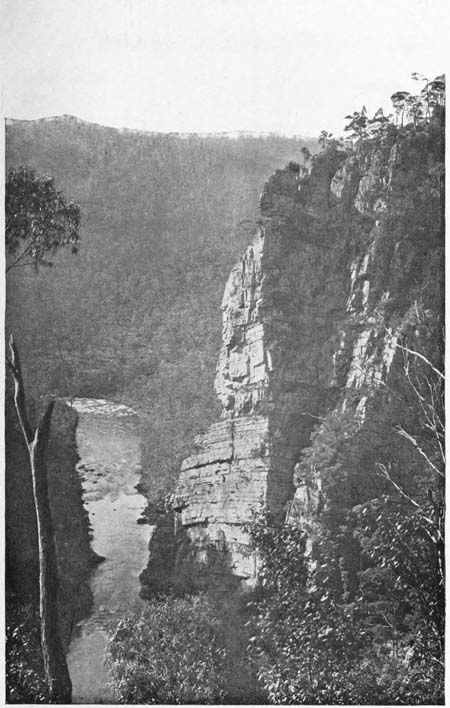
Photo. Spurling & Son, Launceston.
THE ALUM CLIFFS, MERSEY RIVER.
[81]“I am afraid you are too sensitive on that point,” said Miss Dearn lightly. “You are so reserved that I believe it is positively painful to you to show your fellow-beings that you have any feelings at all. You would like us all to think that you are a cold, callous thing who has no interest except in beauty spots, and no heart for any one except dumb animals and people in trouble,” she laughed with a teasing, tender look in her eyes.
“My fellow-beings would be wise if they thought so.”
“How correctly I have guessed,” said the girl triumphantly. “You would like to drive us all to this conclusion.”
“And won’t you be driven?” A bright light sprang for a moment into his grey eyes.
“I should think not! We have taken you too long at your own valuation, now I shall form my own estimate of you.”
“An estimate which will be quite wrong, I am afraid, so you had better keep to mine.”
“Very well, then, if you are so insistent that we shall regard you as an iceberg, I shall begin to treat you like one straight away,” she said with playful dignity.
He smiled, and there was less sadness in his face than she had ever seen there.
She sat leaning lightly against the rock behind her. She had taken off her hat and glinting sunbeams played indulgently with the thick golden-brown waves of her hair. Her large blue eyes smiled at him from behind their enchanting lashes, her red lips were slightly parted and he caught a flash of her snowy, even teeth. The vermilion in her cheeks was dazzling. She looked bewilderingly [82]beautiful, and for a moment an almost dazed look came into the driver’s face. After a pause he said with a show of emotion: “Miss Dearn, you are too kind to me.”
“Do you call it kind to promise to treat you as an iceberg?” she laughed again.
“I was not referring to that. But such kindness is too good for me—it would be as well to remember that I am only a driver and——”
She interrupted him hastily; this was his sore point: she must show him at once that his position did not affect her, so she said lightly: “And couldn’t a driver by any chance be manly enough, honourable enough to be worthy of a woman’s trust—a woman’s friendship?”
“Some might be,” he admitted.
“In spite of being drivers?” The blue velvet of her eyes held smiling banter.
“Yes,” he replied, watching her for some seconds. “If a man is worthy in himself, I don’t think any position could make him less a man.”
“You are right,” said Miss Dearn with sudden seriousness. Then she went on more playfully: “And now that we both agree on this subject, we can let it drop once and for all.”
“I think not.” He spoke as one determined to be honest at all costs.
“Why not?” There was deep surprise in her voice.
“Because some drivers cannot lay claim to manliness.”
Miss Dearn laughed suddenly. “Do you mean to imply that you are not manly—and you are the manliest man I have ever known!”
[83]“God help the rest!” he said, with quick vehemence.
“What a strange mood you are in to-day,” observed the girl, regarding him from under half-closed lids. “A little while ago you were afraid to sing in case your music might give me a glimpse of what is below the surface, and here you are telling me in plain words some of the things your reserve generally hides—truly men are enigmas!”
“I was not afraid of that kind of revelation.”
“I don’t believe you want to sing,” said Miss Dearn, changing her tactics.
He jumped to the bait instantly. “If only you knew how much! I will start at once if I may sing what I like,” he said, with a tense question in his gaze.
“Yes,” she replied softly, surveying the rocky ledge with minute interest.
He moved a little nearer and began to sing—
Iris listened with bated breath.
He sang with a tenderness which was moving, with a sweetness inexpressible.
Then followed the second verse—
The pathos in his voice hurt her and brought stinging tears to her eyes. They had never kissed, [84]but somehow he conveyed to her that for the future he would live in the day he had held her to his heart in the caves.
“How exquisite—but—how sad! Why did you sing such a pathetic song?”
“You said I might sing according to my mood.”
“Why are you so sad?” Her eyes were upon his face almost demanding an answer.
“Because of what might have been—because of what I must bury under those great cliffs and never uncover again.”
His words brought a quick pain to her heart. “What might have been—” she repeated as one stunned by a blow.
“Yes, what might have been, and never can be.” His face had all at once blanched and his eyes had a haunted look in them. “The White Sea Mist has blotted out all sunshine,” he added as something irrevocable and final.
“Yet the Sea and the Land met behind the mist,” Iris murmured scarcely audibly.
“Only for a time. Then came the bitter parting and the bare after-life with its blinding memory.”
“Yet it was worth all to have that memory.”
“Do you think it is better to have a memory which blinds, or to have no pain and no—memory?”
“I would rather have the pain and—the memory.”
“Would you really?”
“Wouldn’t you?”
“Yes, I think so. The memory means that one has something to look back upon.”
“It would be worth all just to have that.”
“Are you positively sure?” He still spoke as [85]one a little uncertain, who wanted a definite understanding.
She met his eyes unflinchingly. “I am,” she said slowly, and after she had said the words, she knew that she had made a compact with the man beside her.
He rose to his feet, stood for some minutes looking into the terrible gully below, then he came and sat down closer to her.
“I am going to sing now—not anything which will remind you of the monument over there, but something which will bring back to you—other things.”
She waited in breathless anticipation, and thrilled visibly when he began to sing—
“I’ll sing thee songs of Araby.”
Suddenly she was back in the cave. She felt his arms holding her, she was pressed against his heart. The song and the way he sang it made her feel this. Every note was a caress, every word a vibrant sigh from his soul. It seemed as if his voice folded her to him with arms which would not let her go; and when he came to the words—
she knew he was striving with all the force of his strong nature to awaken in her an answering emotion.
She sat listening with closed eyes, face pale, lips trembling and her soft bosom heaving.
When he had finished she bent forward and said [86]brokenly: “Oh, don’t sing like that to me again, I cannot bear it—how can I?” And her voice was choked by a great, dry sob.
“I only sang from my heart,” he said quietly: his face white and set, his hands gripping each other. “I thought you gave me permission?”
“Yes, I know I did, but it simply—it makes me—I can’t bear it, unless——”
“Unless what?” he demanded breathlessly.
“Don’t ask, please don’t!”
“Perhaps I can guess—I, too, am thinking of the—cave.”
She started. He was speaking plainly now, but she had given him permission. She did not blame him; her own heart was crying out wildly, as his cried out! It was not his fault that this terrible love had come to him as it had come to her: the keen, piercing love which had been born in their hearts while she lay softly pressed against his breast.
Now she suddenly understood the nature of the emotion which had drawn her to him—it was love—love—love! Oh, the power of it! the beauty of it! the force of it! She could cry out with its fierce excruciating sweetness!
She sat helpless, overwhelmed by the vehemence of her feelings.
“Can’t you make it easier?” she faltered tremulously.
“There are only two ways: either to stay here as our hearts tell us, or—go back to the cottage quickly.”
He waited for her reply. “What is it to be?” he asked, as no answer came.
[87]“Whichever you think is right,” she whispered at last.
Her utter trust and abandonment touched him.
“Then let me take you up to your cousin at once,” he said hurriedly.
He helped her to her feet, and they began to climb the precipitous path.
They reached the top of the hill breathless and hot, then they stopped and looked down once more on the wonderful white cliffs. The path turned at this point and the great rocks would soon be lost to view.
They stood gazing down, as if saying good-bye.
“Thank you for helping me,” said Iris in an undertone; “but I knew I could trust you always to do the right thing.”
“I should not have sung what I did; such things reveal too much.” He spoke remorsefully and all the sadness had returned to his face.
“Don’t say that,” she pleaded softly. “I would not have had it any different—not for the world!”
“Wouldn’t you really?”
“No, for now we shall have this to look back upon in the future when you have buried everything under that huge, unrelenting tombstone.”
“You say when I have buried everything. Do you mean to say that you would not?”
She met his eyes bravely. “No, I should not—I couldn’t,” she said simply.
He drew a hard breath. “I must do it then,” he said, deep shadows gathering in his eyes.
The pain in his face hurt her. She wanted to comfort him. “We won’t think of that just now, this is the time to gather the memories, isn’t it?”
[88]He smiled gravely. “Yes, let us gather the sweetness now.” He glanced once more down towards the great towering stones. “That cliff is not to be our tombstone yet—what shall it be to us for the present?”
Iris lifted her face suddenly and there was a wonderful light in her splendid eyes. “I think it is a monument Nature has erected to commemorate the purest and brightest thing which has ever come into our lives,” she said.
He looked at her with deep reverence. “God grant that you may always regard what is between us in that light,” he said huskily, baring his head.
“Fate is strange—it is weird!” said Iris often to herself during the following days.
“Mother used to say that no girl had better chances of making a brilliant match than I; but I never could care for any of the men who counted, and now—” her tones grew soft and wistful—“and now there will be no marriage at all, for the only man I shall ever love—a poor driver employed by the mistress of a boarding-house—will have none of me! He loves me, yes, he loves me, as I love him.” Her eyes shone as she put the precious facts into words, but their brightness was dimmed by a dewy mist. “All the same he will have none of me. He has told me our love must one day be buried under that great white tombstone—that is the fate of our love; and mine—to be near him for a little while, to watch his beautiful life, see more clearly how useless my own has been, get to know him better—love him more desperately.” She stopped and breathed more quickly. “And then—when we have come to the end of our endurance—when we have gone as far as our love may go, he will take it, and, with strong though trembling hands, thrust it into its cold, silent grave. That is my future—all life will ever hold [90]for me—the fate of the much envied, much-sought-after, spoilt Iris Dearn, who, London prophesied, would marry a prince or a duke—she has come to this! She cannot even marry a poor guide—he will not have her! Fate is weird! It has shown me what could give me unspeakable bliss and then told me it must never be mine. All that may be mine is a home with Amy in the vast desolation of the Australian bush. I shall live with her always and my future will be one long, sweet, terrible looking back on—this!
“I shall spend my days trying to live as he lives; be useful, bear burdens, give help. I shall ride about on Amy’s estate, visit the shepherds’ wives and children, take them things, sit with them when they are ill; drive about the whole district and do for all I can reach what he would do for them if he were there. I shall give most of my income away. I shall live simply, and it will not cost much to keep me; and the rest of my money shall be spent on people in need; myself and my money—all must be given.
“But at present I am still near him—this is the time to gather memories. I see him at meals; he comes and arranges for outings; his dear, sad eyes look often into mine. I sit beside him when we drive; we talk, discuss all kinds of things; his arm sometimes touches mine, we look at all the beauty together, smile and laugh, but—we have never been alone since the afternoon by the cliffs.”
Rees was very busy driving numerous visitors to the various beauty spots, and Iris and her cousin joined most of the excursions; but there had [91]been no opportunity for him to take them out by themselves. However, at last there had been a big clearance of tourists, and one afternoon he was free to take them out alone wherever they cared to go.
Mrs. Henderson had for some time wished to explore a road winding its way among some very wild-looking hills, so they decided to go.
They drove some miles away from the township on a rather rough, chocolate-tinted road surrounded by magnificent bush. There were stretches of flowering ti-tree and sombre-hued blackwoods. Golden wattle, dogwood, bronze-green cherry trees, patches of grass-tree and numerous other shrubs grew in lavish tangle under the immense interlacing blue-gums, scenting the summer air with their delicious fragrance. From the bush came showers of silvery notes from the happy blue wren as it swelled its little blue and black throat in glad, liquid song. The track led through moist, shady corners, where sassafras and myrtle and huge tree ferns were matted together in luxuriant confusion.
When they came to a little stream trickling over moss-covered stones Mrs. Henderson suggested they should have afternoon tea as it was a cool, shady spot. They got out of the buggy, and, after Rees had unharnessed the horses, he began to gather bark and wood to light the fire.
“I shall go down under those tree ferns and have a quiet read while you two boil the billy,” said Mrs. Henderson, beginning to descend a small gully on the left side of the road.
“Be careful about snakes,” the driver cautioned as she left them.
[92]“I am used to the bush, I shall be all right and I promise not to go far away.”
Iris insisted on helping Rees, and when the fire was burning brightly they unpacked the baskets and laid out the tea.
“Come and sit on this bank till the water boils,” suggested her companion.
Iris breathed a sigh of utter content. It was so lovely in this green, cool, fragrant spot in the depth of the great forest, where the exalted stillness was only broken by the flutter of wings, the murmur of streamlets and the soft notes of birds. They were by themselves at last, and her lover’s nearness brought her a great, vital joy.
“Miss Dearn, you have hurt your hand,” said her companion suddenly.
She glanced down at it quickly. “It is only a scratch.”
“I believe there is a splinter in it—may I look?”
She held out her hand to him. He took it tenderly between his own and examined it carefully; there really was a small splinter in the wound and he pulled it out gently. As he did so his sleeve and soft cuff slipped up a little and Iris noticed that above the wrist his arm was as white and his skin as fine in texture as her own. And, though his hands were brown, they were wonderfully soft, well cared for and had a delicacy of touch which had often surprised her.
When he had extracted the splinter he did not release her hand, but still held it caressingly and fondly in his clasp.
Neither of them spoke. Iris averted her face [93]a little and in her eyes shone a deep, tremulous shyness.
“Miss Dearn, am I taking too great a liberty?” he asked in a low voice.
“No,” she breathed. There was another delicious pause; then she continued: “Please don’t call me Miss Dearn—at least not when we are just—together, like this.”
“What may I call you then?” he asked eagerly.
“My name, of course,” she said very quietly.
“May I really call you by your beautiful flower-name?” There was wonder and exultation in his words.
“Yes, if you care to,” she whispered, her shyness increasing with the emotion he showed.
“Iris—Iris,” he murmured lingeringly. “How sweet of you to let me——”
There was a loud, seething splutter from the fire: the billy had boiled over.
He released her hand quietly, and went over to make the tea. He coo-eed to let Mrs. Henderson know it was ready, and presently they were all enjoying a dainty repast.
Iris noticed that the driver did not eat much, but he drank great quantities of tea. He was generally thirsty, but as a rule he was hungry as well; to-day he ate only one tiny scone.
“Mr. Rees, you are not eating anything—what has happened to your appetite? By the way, Iris,” Mrs. Henderson went on without waiting for his reply, “what did your mother say in the letter you got this morning?”
“There was no particular news. Mother told [94]me about the things she and Helen had been doing lately, painted London in glowing colours, and concluded by asking her usual question—when am I coming home?”
Mrs. Henderson turned to Rees. “My cousin, as I dare say you have noticed, is not infatuated with London life; on the contrary she has fallen most violently in love with the life here, to the consternation and grief of her relations and friends on the other side of the world—they are always trying to induce her to go back to England.”
“I suppose they don’t quite understand the fascination of the life here.”
“No, indeed! They think our taste for it extraordinary, as they consider the people here rather rough, and of course some of the Australians cannot claim as fine breeding as they do for their sheep. It is this I am sure which worries our people at home when they think of Iris; as one friend put it in a letter last mail, if Iris stayed here much longer she would be marrying a——”
“Please don’t tell Mr. Rees about that,” interrupted Iris a little imperiously, blushing hotly.
“Why not, my dear? It would only amuse him.”
“No, please don’t tell me if Miss Dearn doesn’t want me to hear it,” the driver interposed.
“You are really too soft with her, all because of those pretty blushes. Now, when I come to think of it, Iris, you never used to blush like that; it is something you have acquired quite recently.”
The colour in the girl’s face deepened still more, but she did not lower her splendid eyes.
Mrs. Henderson continued: “Why shouldn’t [95]Mr. Rees be allowed to share the joke about your marrying a bushranger——”
She stopped as she saw the driver’s face suddenly blanch, and a curious look came into his eyes as they became fixed on the ground behind her.
Rees had just discovered a huge black snake creeping in bulky curves towards Mrs. Henderson. Its small dark tongue was out, moving menacingly as its thick glistening body made a wide trail on the loose fine earth. Mrs. Henderson was evidently seated in front of its hole in the bank and it was determined to attack the obstacle in the way. Its small beady eyes glittered—in another moment it would spring, already it was raising its head to strike.
Rees had a gun in the buggy, but there was no time to get that. There was a stick within reach, but it was a very thin one and it would be dangerous to attack the monster with such a frail weapon. There was not a moment to lose, so he could not stop to think of the risk to himself. Quickly he gripped the wood, made a plunge forward, and with a big swoop brought the stick with all his force on the sleek black body.
There was a small cracking sound.
The slender weapon had broken without vitally injuring the snake, which now, goaded to fury, hissed viciously and turned fiercely on its assailant. Rees was within a yard of the snake and without defence for the moment. He would have retreated in search of a weapon, but he was alive to the fact that, if he were to do so, the monster would probably turn upon Mrs. Henderson, who was standing stock still, too fascinated with horror to move.
[96]Iris took in his predicament instantly. In another second the man she loved would be bitten by the venomous, hissing thing so close to his feet. She was standing by the smouldering fire. Quickly she snatched one of the long, burning sticks, sprang forward and thrust it into the driver’s right hand.
It was only just in time to ward off the malicious head now only a few inches away from his left hand.
The reptile was brought to the ground by the close contact of the flames.
Before it could spring again there had been time to raise the heavy stick high and now it came down on the fat, glistening back with a power which broke it. The snake lay writhing on the dry dusty ground.
It was not dead yet and it hissed viciously, trying to wriggle towards its opponent, but a few more blows and it moved no more.
“What a horribly ugly thing!” shuddered Mrs. Henderson coming up beside it. “You have saved my life, Mr. Rees—it was just behind me,” she said unsteadily.
“It is Miss Dearn who saved us all. If she had not passed me that stick so quickly—it would have had me,” he said, not trusting himself to look at the girl who had helped him so promptly.
“Oh! that was nothing,” expostulated Iris, “it was you who killed it; I should never have had the courage to attack such a monster.”
“You were very nearly attacked by it when you put that stick in my hand.” He was looking at her now, and what she saw in his eyes made her heart suddenly bound at a terrible pace.
[97]“How long is it?” asked Mrs. Henderson, still standing fascinated beside the dead reptile.
“It is over five feet and as thick as my arm,” said Rees quietly. “Dangerous brutes when they mean mischief!”
All at once Mrs. Henderson shook off her horror and walked away from the object which had held her attention. “Now look here,” she said, “we are not going to allow any snake to spoil our outing; let us forget all about the horrid episode and go on as if it hadn’t happened.”
Rees removed the crushed snake and threw it into a thicket of bracken.
“Now I am going for a little stroll along this lovely road while you two pack up the things,” said Mrs. Henderson.
“But——” remonstrated the driver.
“No, I’m not afraid, we can’t have two such adventures in one afternoon; that is really beyond all possibility—such things only happen in penny dreadfuls,” and she went smilingly down the furrowed road and soon disappeared round a sharp corner.
When she was well out of sight she sat down on a big stone. “Poor things,” she thought, “I’ll give them a little time to themselves; they deserve it after the brave way they behaved. There is no doubt about it they are badly in love with each other; but how in the world will it end? They can’t possibly marry, of course; Iris would never be allowed to do such a thing—though I am not sure that they could stop her if she really wanted to. The way he looks at her when he thinks himself unobserved! And she is properly in love with [98]him too, but then—he really is so handsome—and such a perfect dear! I wonder what they are doing now—not discussing snakes I’ll be bound.”
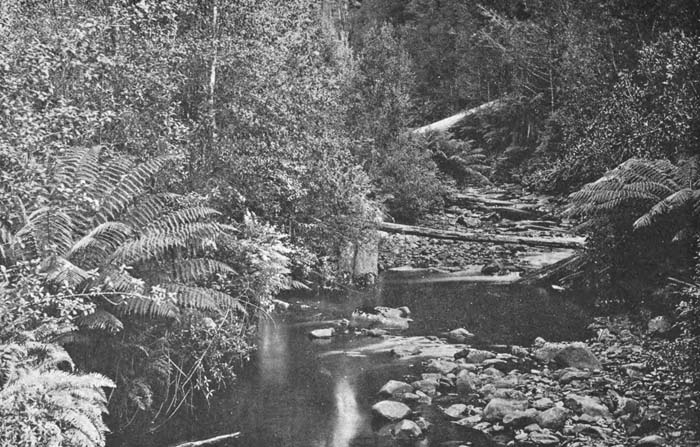
Photo. Beattie, Hobart.
HERMANDIE RIVER.
“Iris,” said the driver when they had stowed the baskets away in the buggy, “I have not thanked you yet for saving my life.”
“I didn’t, I only passed you a piece of wood. You saved it yourself by being so brave and strong—you saved ours too—we have not thanked you either,” she replied with a tremulous smile.
“I don’t want to be thanked.”
“Never mind about the snake; let us follow Amy’s example and forget it—only I must say how splendid you always are,” she exclaimed with undisguised admiration.
His face brightened. “If you go on praising me like this, I shall begin to—blush also,” he said with a sudden twinkle in his eyes.
At the reference to her blushes, her cheeks grew warm again.
“But, Iris, why wouldn’t you allow your cousin to tell me the joke about your—marrying—a bushranger?” he asked, the twinkle still between his dark lashes.
“I didn’t want you to hear about it—it was so horrid.”
“What was horrid, your marrying a bushranger, or—my hearing about it?” he said, still smiling.
The warm blood mounted to her face again. “Both, of course—I mean——”
“Do you think it would be very horrid to marry a bushman?”
[99]“Oh, I didn’t mean that,” she stammered in confusion.
“You don’t think it would be horrid then?”
“I don’t think it would be horrid to marry any man I—loved,” she said with fine courage.
“Could you love a bushman?”
“Why not—if he were—lovable?”
They had been standing by the buggy talking; now Rees said, “You must not be standing here, come and sit on this cleared bank.”
When he had spread a rug they sat down and for a while remained silently looking into the green tangle of undergrowth. Into the stillness came floating a clear flute-like note.
“That is the white magpie calling to its mate,” Rees said with his eyes still on the scented shrubs. “Happy birds!” he sighed. “Happy birds! they live their own free joyous lives, unfettered, unhampered—they mate, sing and—kiss.”
Iris stirred uneasily, but she did not speak.
After a pause another flute-like call fell upon the pregnant stillness, followed almost immediately by a tender response.
“Iris, did you hear that call, and—the answer?”
“Yes,” she murmured, her face averted.
“Iris—speak to me—please speak to me—use my name as I am using yours,” he said with restless intensity.
“I do not know your name.” His vehemence had curiously confused her.
“You don’t know it—how strange!”
“No, you have never told me and no one uses it here, so how could I know?”
“Justin is my name: please use it.”
[100]“Thank you, I should like to.”
“Say it then.”
There came a silence.
“Iris,” he began, “please say it?”
“Some other time,” she faltered.
“Please say it now.”
Again there fell a throbbing pause.
“Are you punishing me because I—I—took that liberty this afternoon?” and he gazed fondly at the slim white hand he had held in his own a little while ago.
His companion suddenly looked down at it too.
“Of course not,” she said softly.
“Then are you trying to show me, that I must never—do it again?”
The well-poised head sank lower. “No.” He hardly caught the word.
“I may do it again then?”
“If—you care to.”
“Oh, Iris, you are too good to me—how little I deserve it! And yet you will not call me by my name.”
“Oh, Justin!” she faltered, catching her breath.
“You darling!” he said in scarcely audible tones, and she saw a tremor pass through him.
Some heavily pulsating moments went by, then he spoke again. “Iris—I wonder if you really understand where you and I are drifting?”
“I think so,” she said, with drooping lashes.
“And you do not mind?”
“What is the use?”
“Oh, Iris!” he broke out remorsefully: “I have no right to ask you all these questions—would to Heaven I had!”
[101]At that moment Mrs. Henderson appeared at the bend of the road.
“Have you finished packing up? Isn’t it time to start home?” she inquired.
“That is of course as you like,” replied the driver a little absently.
“Well, then, I think we had better go. I hope you two haven’t been thinking about the reptile all the time I have been away. It is so bad for one’s nerves to dwell on horrors; it brings nightmare, and it is unlucky to dream of snakes.”
The evening was iridescent with gold, azure and lilac. The sun was low in the west, and the high, irregularly formed mountains looked as if they had been shapes of mauve laid softly against the luminous sky. They did not seem solid, but fairy-like, elusive, like the mystic forms which glide before crystal-gazers, ready to vanish as silently as they appear. The evening itself was unreal—too beautiful, too delicately coloured, too spiritual to belong to this world. It seemed as if it must be a fragment of time, dropped by accident from some wonderful starry sphere and allowed to rest on earth for a little while before it should be gathered to the place where it belonged.
Miss Dearn was sitting on a long, low chair on the balcony, her dainty, cool hands lying idly in her lap, while she gazed into the soft illumined spaces.
By one of the high wooden pillars stood Rees, regarding her with unmistakable admiration in his disconcerting grey eyes.
“Iris, you have no idea what pleasure you gave Mr. Green by going to see him,” he was saying; “they were as excited as two children just now when I was there—and their delight at your gift—dressing-gown, wasn’t it?—you should have heard [103]them! The poor old man has never had such a beautiful article in his life before—it really was a handsome present, and it will give him no end of pleasure to wear it.”
The girl flushed happily; it was sweet to give the Greens pleasure, and sweeter still to have pleased the man she loved.
“And I hear you have promised to go and see them again and read to the poor old fellow—it is just splendid of you, Iris! You don’t know how much it means to them; they live such dull, monotonous lives, and to see you—” the admiration in his eyes deepened—“would be new life to them—a vision from another world!”
“But it was such a little thing to do; I sent to Melbourne for the garment—those things are generally useful to invalids, and when it came I thought I should like to take it to them myself. I am so glad they were pleased. I should like to go and see some more of them, if you think they would care for it.”
“They would adore it!” he said, his face aglow with the pride he felt in her. “Iris, you are wonderful, perfectly wonderful!”
She raised her soft, snowy chin, and a dewy beauty shone in her eyes as she lifted them to his. “Justin, if there is any good in me it is only there because of—you.”
He glanced at her incredulously. “What do you mean?”
“Why, just what I say. I have lived a horribly selfish life, and I did not even know it was selfish till I met you; but your beautiful example showed me what my life might be—ought to be.”
[104]All at once he looked away from her and his head was bent as if she had heaped some shame upon him. “Don’t talk like that—I can’t bear it,” he said in tones tinged with pain.
“Why not? It is the truth: your splendid example showed me what life was meant to be.”
“Iris, don’t!”
“Now I am going to try and make up for lost time. Besides,” she added with a brave little smile, “I must begin to train for the future.”
“What are you going to do in the future?” he asked, turning to her again.
“I am going to live with Amy and——”
“Yes, and what?”
“Try and live as you do,” she replied under her breath.
“As I do—how do you mean?”
“Try and help everybody bear burdens, ride about and visit the poor, sit up with the sick people, and——”
He had come close to her chair now. “Iris,” he said, his voice shaking a little, “you are too touchingly sweet. But I am not living that kind of beautiful life—I have to work for my living, and I only just do little odds and ends for the people about.”
“Well, that is just what I mean to do—little odds and ends for everybody within reach; only, as I don’t have to work, I shall have all day to do it, and all night, too, if need be.”
“Why are you going to do that instead of going back to your old happy life?”
“It was not happy—it did not satisfy; but I [105]did not know how to live any other till you showed me.”
“And will this new plan make you happy in the future, do you think?”
Her eyes dropped before his searching gaze. “I don’t know about happy,” she said with a half-stifled sigh.
“Then why not go back to your home? You could live just as beautiful a life there.”
“No,” she said steadily, “I couldn’t—not there; I should be dragged into the whirlpool of pleasure and excitement again. Perhaps, if you had been there and showed me—” she raised her head delicately—“but I could not do it otherwise. Besides——”
“Yes?”
“How could I bear to live in pleasure and ease when—when—you have to work so hard, and all the while living for others, as you do?”
He drew a quick, sharp breath as if she had hurt him. “I have a good reason for working hard,” he said brokenly. “And most of my life, alas! I have lived without giving a thought to others.”
“But you are not living like that to-day.”
“Perhaps I am trying to atone for the past.”
The haunted look in his eyes touched her deeply. From several remarks he had made she knew his past caused him sorrow; he was grieving over it now. She wanted to comfort him, so she said: “If your past has been a stepping-stone to the present, it has been useful.”
He moved away from her and stood by the pillar again, his face shadowed with sadness.
[106]She rose and went to him quickly, her eyes pools of sapphire splendour looking tenderly into his. “Don’t be sad about it—dear.” The last word was a mere breath, but he heard it and she saw him start a little. Then all at once he leant back against the pillar and closed his eyes. Presently he opened them and looked at her, and there was such an anguish of longing in their sad, grey depths that it made her turn pale and suddenly grip the wooden railing for support.
“I am sorry,” he murmured apologetically. “I should not have let you see that.”
“I thought—I thought—we had agreed——” she whispered, struggling for composure.
“Yes,” he replied, “you have been so good to me, and I am afraid I have taken great advantage of your generosity. All the same I must not presume too much—it would not be fair to you.”
“Don’t use the word ‘presume’—it could never be a case of that between us—I have given you the right.”
“Still, I am not sure that I should be justified in taking it.”
“You mean—you should not show me your—feelings?”
“Yes.”
“You are afraid of hurting—my life?”
“Yes.”
“Hasn’t it ever occurred to you that silence may sometimes hurt more than——” She checked herself abruptly.
The sun had sunk below the rim of the distant hills. The evening was not so ethereal now. It had intensified, become more real, more a thing [107]of earth. It was still beautiful, but its beauty was the solid beauty of reality; even the great spaces brooding over the purple jagged mountains pulsated now with a vivid, vital glow.
Rees suddenly straightened. “Iris,” he said in very strained tones, “tell me truly; be quite frank with me—has my silence hurt you?”
“Yes—at times,” she answered very quietly.
“And—and—would you like me to—speak?”
She drew back in terror. “No, please don’t,” she said quickly. “I can’t imagine what possessed me to say such a dreadful thing.”
There was fear and distress in every word.
“But—I asked you.”
“Yes, but I told you first—that—— Oh, it was awful of me!”
Rees came a little closer. “No, it was not awful,” he said in tones slightly stern. “After I have said so much, showed you as much as I have, it is your right to know all, Iris.” He came closer still and she felt his nearness keenly. “If my silence has hurt you, I will make a clean breast of everything. I will tell you about my feelings, my—past—all. I have been longing to tell you—all! how—I—feel—burning to tell you, but for your sake I have kept silent. Yet if it will make it easier for you I will tell you all, at once.”
“No, no, no,” she cried, with touching appeal in her voice. “Don’t you see I could not let you tell me—now. You were right to keep silent and it was terrible of me to say what I did; but at times it has all seemed so strange and I could not understand why—and I——”
[108]“You wanted me to be more frank with you—to speak freely?”
“Yes,” she faltered, and the soft corners of her mouth looked a little unsteady.
“What a brute I have been not to have thought of that!” he muttered under his breath. “But come down into the garden and I will make full amends; we cannot talk here, we may be interrupted at any moment—come!” He laid his hand over her trembling one still gripping the railing, and his strong fingers untwined her slender ones from the wood. “Come,” he repeated in a tense, low voice.
“No, no,” protested the girl; “it must not be. You were right; what you did was best.”
“Don’t you want to hear what I have to say?”
In the gathering dusk she felt the burning question in his eyes demanding an absolutely honest reply.
“Yes,” she said tremblingly, “of course I want to hear it—how can I help it, Justin? All the same,” she added regretfully, “I cannot.”
“Yes, you can, if I insist on telling you.”
“But you will not insist; it would be too cruel—for I should feel so awful afterwards, because I had made you do it. It would be as bad as—or perhaps even worse than what happened that afternoon—in—the cave. Don’t you remember how terribly ashamed I was afterwards? You don’t know what tortures I went through over it!”
His fingers upon her own tightened. “You poor darling,” he murmured very gently, “shall I ever forget? It was awful to see your distress.”
[109]“Well, I should feel much worse if—if—I made you tell me—this.”
“But you wouldn’t have made me.”
“Yes, I should, for if I had not said what I did, you would never have thought of telling me.”
“Not thought of telling you! Iris, how little you understand—why, I think of little else. I am always having to stifle the yearning to pour it all out to you, and sometimes I feel it will suffocate me to keep it in much longer!” As he spoke he drew her hand against his breast.
“You poor dear boy,” she said, looking up at him with sudden tenderness.
She felt him draw a deep, quivering sigh. “Oh, Iris, it is too wonderful to have you talking to me like that! Do say it again!” he entreated.
“You poor dear boy,” she repeated, colouring slightly.
“Come down into the garden,” he pleaded, every word weighted with yearning.
“No, not to-night—I dare not.”
“Why not?”
“Because—because—I——”
“Iris, how I wish you could put aside that shyness and just talk quite freely to me.”
“Oh, Justin, I do try, only—those—deeper things—make me feel so—strange—they frighten me.”
“Don’t they draw you, too?”
“Yes,” she breathed with sweet candour, “that is the worst of it: they draw me so strongly that I cannot resist them.”
“I thought you had already come to the conclusion that it was useless to try.”
[110]“Yet I must try.”
“Why must you?”
“Because—oh, Justin, surely you know.”
“Please tell me.”
“Because—” her voice dropped so low that he had to bend his head till it almost touched her face in order to hear it—“because—you do.”
“Iris,” he began unsteadily, “I resisted only—for your sake.”
“Yes, I know,” she murmured faintly.
A pause followed which held a terrible suction, drawing each towards the other with an almost physical power.
“But, Iris,” he said with strained accents, “I don’t know how much longer I shall be able to keep this up—I cannot keep on—always. I am afraid some day I may give way—the strain is awful.”
“Justin,” she whispered, laying her hand gently on his arm, “I can’t bear you to suffer——”
He took her hand in his and his grip on it tightened so suddenly, so fiercely, that the pain brought a moan to her lips.
He loosened his hold instantly and raised the fragile, hurt thing in deep contrition to his face. “How cruel it was to hurt that soft little hand which rested so confidingly in mine,” and he pressed it fondly against his cheek.
Its cool, satin smoothness calmed him.
“Iris,” he said in a different voice, after a pause, “do you know, there is a spot where I am always taking you in my dreams—it is an old, deserted garden far up the road towards the hills, away from all habitation. Miss Smith and her [111]parents used to live there before they came here. The garden is a wilderness. It has flowers and fruit-trees all mixed together, and every night when I put my head on the pillow I walk there with you under the old gnarled apple-trees. Some evening will you let me take you to that sacred spot and tell you all, there? Will you come with me and make some of my dreams real? You don’t know how I should revel in having you all to myself for a little while in that enchanted spot—oh, Iris, give me a few hours—let us walk under the old trees, sit under the bower of roses—all alone just for one happy evening!”
She drew a quick, fluttering breath. “Justin,” she said, with a soft lustre in her blue, velvet eyes, “you make it so entrancing I can’t resist—I want to be there—with you. But I must go in now. Amy will wonder where I am,” she added a little reluctantly.
“You will let me take you to that garden—very soon?”
“Yes.”
He had released her hand, now she held it out to him again. “Good-night,” she whispered.
“Good-night,” he murmured, raising her hand to his lips and pressing a long, lingering kiss upon it.
Then he opened the door for her to enter the hall.
She halted a second on the threshold. The light from the corridor fell full upon her exquisitely gowned form with its superb shoulders, slim white throat and the delicately poised head. It turned her light brown hair to gleaming gold and revealed the vivid beauty of the radiant, upturned face.
[112]Her deep blue eyes shadowed by their long, thick lashes lifted for a moment to his, and there was a melting tenderness in their dazzling splendour as she said in a very low voice: “Justin, I am going to dream about that garden to-night.”
Before he could answer she was walking swiftly down the hall.
The same evening, on the wide, spotless deck of an ocean liner, sat Captain Barton, talking to a dashing brunette. She was dressed in a striking, low-cut yellow gown as conspicuous as her rather audacious self. Her tapering fingers held a cigarette and her very red lips blew ringlets of pale, thin smoke into the warm summer night.
Dinner had been over an hour ago, promenading had ceased, and from the other side of the boat sounded laughter, the hum of voices, dancing, and the strain of an impudent two-step.
“Would you care to dance, Betty?” inquired Captain Barton, carefully flicking away the ashes from his fragrant cigar.
“No, thanks, not to-night.”
Her companion crossed one black knee nonchalantly over the other well-formed limb—Captain Barton had very good limbs and he seemed to be aware of it.
“Can you believe that this is our last night on board, and that we shall be in Melbourne to-morrow?” said the girl, turning her pretty, dark, insolent head towards her companion.
“No, indeed,” replied the man at her side, hailing a steward who was passing and ordering [114]two liqueurs; then he continued to the girl, “You have made the time pass so jolly fast—I can’t believe we are nearly there.”
“Will you be staying in Melbourne long?” asked Betty, gazing with leisurely abstraction into the soft darkness beyond the brilliant lights of the ship.
“No,” he said a little evasively. “I must catch the next boat to Tasmania; I believe they run almost daily.”
The steward brought the order and Captain Barton paused to sign his wine card.
“A day or two more or less can’t make much difference,” suggested the girl, with a glance at her yellow satin slippers.
“Unfortunately, in this case it might,” replied her companion, moving a little uneasily.
The brunette took a sip from her glass, then laughed suddenly. “I can’t imagine you in little Tassy—you and that small, antiquated island don’t blend!”
“I suppose it will be beastly quiet over there,” the man observed ruefully.
“Dead slow! It’s the kind of place people resort to when they have been going the pace a bit—splendid for neurotics, invalids and babies—nothing to do but watch the clouds and wait for dinner.”
“Good Lord!” ejaculated Captain Barton, as he emptied his glass.
“So you had better change your mind and have a few nights at the Opera in Melbourne before you shut yourself up in that convalescent home.”
[115]“Oh, I daresay I shall survive—won’t have to stay long, I trust.”
“You expect to fix up your—business—quickly?”
Her companion stroked his smooth chin. “With a little decent luck—yes.”
“Shall I wish you good luck? You haven’t asked me to, you know.”
“Please do.”
The girl made no response. She sat gazing on the limpid, phosphorescent waters with a strange expression in her dark eyes.
“Why so pensive to-night?” said the man, turning to her with a smile. “Is it the thought of leaving the ship?”
“Good gracious, no! I hate boats. I was only philosophising.”
“What about?”
“How curious you are, Captain Barton.”
“Man is always curious where a pretty girl is concerned.”
“Yes, man is curious when he is interested, but he is never profound,” she said, crossing one yellow silk ankle over the other.
“You don’t want him profound, surely—he would be a confounded nuisance to a girl with your sentiments.”
“What do you know about my sentiments?” she asked, suddenly leaning her head back on a pale blue crêpe de Chine cushion.
“You have been generous enough to give me—samples, and I have been testing their practical value.”
“And what is the result?” she inquired, letting [116]her head slide along the cushion a little towards him.
“I think your sentiments are just the thing—they make you a ripping companion!”
“You don’t like prudes, do you?” she said, with an odd flash in her dark eyes.
He laughed lightly. “Are there any left? One never meets them.”
“After all, I believe that you really like them,” she said, with a probing look from under her lashes.
“How can I like what I never see?”
There was a short silence, then Ralph moved his long deck-chair a little closer to Betty’s and said, “But you haven’t told me yet what you were philosophising about.”
“Did I promise to tell you?” and she put a hand up to feel if the yellow velvet band binding her black hair was still in place.
“No; but you might as well.”
She drummed with her tapering fingers on the arm of her chair. “Well, if you will have it, I was thinking what a rotten world this is for women; everything in it favours men—all our social laws and conventions—everything!”
Captain Barton looked down at his black silk socks. “I don’t see that—in fact, I think it is all the other way. Social laws make men wait on women, see to their comforts and put them first in everything.”
The brunette shrugged her arrogant shoulders. “In small things, yes. Society throws women a sop by piling cushions at her back and handing her muffins and tea; but in all things that [117]really matter man has the advantage on his side.”
“Will you give me some instances?”
“To man is given all power of selection. He chooses the girls he will flirt with, his partners at dances; and he chooses his companion for life—woman is allowed no choice at all.”
“But she need not meekly acquiesce in man’s selection; she can say Yes or No when he asks for dances and—other things.”
The brunette pouted impatiently. “And what is that? Man is granted the power to make love, woo, ask. If only women were granted that privilege they would oftener have what they want than they do at present.”
“But women can win the men they want, too. They can be so deucedly charming that they send a fellow fairly crazy over them.”
His companion shrugged again. “That is a very negative privilege—give a woman a clear field to make honest and open love, and we should soon have a change in things. The world often accuses women of not being as straight and honourable as men; but how can they, when they are never given a chance to be direct and frank? They are taught to hide their feelings, and the result is, that they must gain their ends by subtle methods; if they fall in love they must not show a man a straight and honest affection, they must wait till he approaches them, and may only try to draw him to them in little coquettish, artful ways which in the long run make women a little sly and underhand. She loves as strongly as a man, and she is just as eager to possess what she [118]loves as he is; why not give her the right to win in an open, square way what she wants?”
“Why don’t you start a social reform on those lines?” suggested her companion half-absently. To-morrow they would be in port; the day after he would start for Tasmania and—Iris. The girl at his side had amused him and kept him from being dull on the voyage; but now he would need her no longer, and the dazzling Iris Dearn loomed large on his horizon again.
“Yes, it would be interesting—I wonder how you would feel if I began with you?”
“Began with me—how?” he said abstractedly, still thinking of the girl he was following to Tasmania.
“Ralph, how stupid you are! Why, begin to make real, honest love to you, of course.”
“By Jove!” exclaimed Captain Barton, sitting up straight, “that would be a ripping game—jolly ending to our trip—I believe you could do it, too!”
“Yes, I believe I could; you have given me some valuable hints, you know, and I am quick at picking up things—we Australians are.”
Captain Barton winced a little. “You didn’t mind the hints, did you? Ye gods, how could a man endure a voyage if he didn’t make love!”
“Do you always make love on your trips?”
“What else is there to do?”
“And you never become—profound?”
“Jolly girls don’t like profound men.”
“You haven’t really answered my question.”
“I don’t think there is anything else to say. But,” he continued, in a different voice, “come [119]and have a waltz and give up all this philosophising; have a good time while you can, that is my philosophy. Now come.”
“I think I would rather go up on the top deck for a stroll.”
“Brilliant notion! Then you can begin your social reform on me, and you shall have the whole evening to practise in.”
“How amiable you are, Captain Barton; perhaps with a few more hints from you—such an expert on the subject—and a little practice I shall be proficient by the time the man who really matters comes into my life.”
Ralph rose from his chair, helped the brunette to her feet, and together they walked down the deck; soon afterwards the soldier’s tall figure in his immaculate evening dress and his daringly attired companion disappeared up the narrow stairway leading to the upper regions.
Iris and Justin were together in the deserted old garden. They walked on the velvet grass amid a wilderness of flowers and fruit. There were great rosebushes covered with golden, pink and crimson blooms; clusters of purple clematis, honeysuckle, and white, starry jasmine climbed broken arches and dilapidated trellis; long spires of yellow and red hollyhocks reared stately heads amid banks of mignonette, blue-eyed forget-me-not and mauve and snow-white stock. Old moss-green apple-trees laden with half ripe fruit stretched protecting arms over the profusion of flowers, gooseberry and currant bushes. The garden was ablaze with colour. The air was weighted with the heavy perfume of many blooms, and everywhere there was an exuberant wild beauty which made Iris catch her breath and look up at her companion with large, shiny eyes. Nature ruled in this forsaken spot. Man’s restraining hand had not clipped, pruned and trained into monotonous, civilised neatness.
“This is my dream-garden,” said Justin, standing under an ancient, gnarled apple-tree and facing Iris. “Don’t you think it is an ideal place for saying what I am going to say to-night?”
[121]“Yes,” she replied, the tint in her cheeks deepening. Her light, graceful form stood against the coloured background of flowers and deep, rich greens, her lovely face framed by the moss-tinted branches.
He came a little nearer. “Iris, this is just how I picture you in my dreams, standing here under these dear, friendly trees, and in my dreams we——”
His eyes told her the rest and her white, heavily fringed lids dropped before his gaze.
“But that part of my dream may not come true,” he continued, a plaintive sadness creeping into his voice. “Such things only happen in fancy, and perhaps once—just once, as it happened in—the cave.” His tones were low and not quite steady.
Iris looked up quickly. “Oh, Justin, why do you talk like that? I can’t bear it!” she said, her delicate nostrils suddenly dilating.
“I only say it because—it must be so. I am going to open my heart to you to-night—that privilege is granted me; but I may not tell you in the way I should like best.”
She did not speak, but she looked intensely vivid, as if she were struggling with some overwhelming emotion.
After a short silence he went on: “I am going to make two confessions to you to-night. One you know about already, and yet I long with all the strength of my being to put it into words; the other—” his voice dropped—“if I possessed worlds I would gladly give every one if I might be spared making that.”
“In that case don’t make it. I don’t want [122]you to tell me anything which will give you pain,” she said, finding her voice.
“I must,” he answered regretfully. Then, changing his tones, he continued: “But we won’t talk about that yet. For a little while let us revel in all this beauty and—in each other.”
“Why not do that all the time and leave the rest for another night?” suggested the girl very softly.
“No, that will not do—we have gone too far to put off my confession any longer.”
The setting sun had been hidden behind large masses of purple cloud; now it suddenly shone out from a fraying rift, its golden rays wedging their way in between the trees like gleaming swords cutting into the fragrant stillness.
“How lovely!” murmured Iris in hushed tones. “Doesn’t this make you feel as if you were kneeling at some great illumined shrine?”
“Yes,” he replied as softly as she had spoken. “That is just how I feel. For I am kneeling at a sacred shrine to-night—at the great shrine of Love. Iris—” he turned to her now—“are you kneeling there too?”
“Yes,” she breathed, her sea-blue eyes shining tremulously under their shadowy lashes.
Rees regarded her for a moment as he would have regarded some wonderful vision which had come to him while wrapt in devoted worship. Then he said suddenly and with great simplicity: “Iris, how beautiful you are—how beautiful! I do believe you have been created from tall, stately flowers, fresh waves from the sea, and shining stars.”
[123]She glanced up at him, smiling tenderly.
“What about yourself—what were you made from?”
Instantly a change came over his face. “I was made from the dry sand of the desert.”
A low, silvery laugh rippled over her parted red lips. “What a humble-minded dear you are! No, you are not made of sand; there is plenty of grit in you, but sand—no! However, I will tell you what you were made of, if you like?”
The same tenderness which had shone in her eyes softened his. “Yes, tell me, Sweetheart.”
It was the first time he had called her by this endearing term, and the word and its meaning thrilled her with its exquisite sweetness.
“You must have been made of that high peak which catches the sunset on that far-away, rugged mountain I long to explore. You were made at the time when the roseate sunbeams tint the rocks and turn the peak into a crimson jewel. Then you were made, too, from the deep pools of marshes, when the sky is overcast and each little lagoon lies like a great solitary tear.”
He moved nearer to her and his voice was a little uneven as he said: “Iris, what makes you think I was made of such beautiful things?”
“Because there is such a lofty strength about you, a strength which could only come from the great exalted mountains. But it is not a cold strength, it is deliciously warm—just like the crimson shafts of a summer sunset. And then there is your sadness—that is really like the big tears which have dropped from the sky on the marshes.”
[124]“Iris,” Rees began in tones shaking slightly, “when I have told you all I am going to tell you, you will never talk like that again. You will turn from me and say that I was only a strip of desert on which you for a moment saw a mirage created entirely by your own sweet fancy.”
“Justin, I shall never say that, no matter what you tell me,” she said with decision.
“We shall see.”
They walked away from the apple-trees to a huge blossom-laden rosebush under which was a little rustic seat, and there they sat down under the crimson blooms.
The sun was just sinking behind the hills, and it seemed to have become strangely entangled in tree trunks, foliage and branches. It hung shimmering, trembling, then gradually disappeared behind the confusion of trees.
There were no golden shafts piercing the deserted garden now; but a rosy twilight crept caressingly over the earth, folding all things in its soft, warm embrace.
They sat for some time without speaking, Justin gazing with rapt, sad eyes at the lovely girl beside him. She had turned her head away, looking into the roseate shadows. He saw the soft contour of her regal head, the fine oval of her cheek, the soft whiteness of her neck where little golden-brown curls rested in alluring innocence. She looked so splendid, so enchanting, so radiant in her youthful beauty!
As he watched her the sad look in his grey eyes brightened. After all, he still had that delicious revelation to make—the revelation she [125]already knew about, yet wished to have put into words. How open she had been with him from the first, and yet at times how shy! She had not attempted to hide her feelings from him, and he blessed her in his heart for her sweet candour. They had met under such unusual circumstances; love had caught them unawares in the cave. He had felt her thrill to his song—ah, how she had quivered in his arms as his music saturated her soul! She did not understand her own emotions then—he had hardly understood his at first, but he had watched hers deepen as she had laid them bare to him again and again. It was so apparent she had not been in love before, and she believed in him with an abandonment of trust which often brought a blinding mist to his eyes. His heart beat fast as he thought of it now. He knew hers was not a weak nature; there was a certain hauteur about her; an air of fine, proud strength. She had met many men, known admiration and homage all her life, yet no passion had been able to stir her before. She had walked through her London season heart-whole, and he was evidently the first man who had awakened the slumbering woman within her. He had awakened the slumbering woman within her, he knew that. But he was not sure if she had discovered this in its wide, deep reality for herself. To-night his confession would open her eyes.
The rosy twilight grew purple—the colour of the trailing clematis which swayed for ever softly to and fro in the stirring shades of coming night.
“Iris, are you ready to listen to me?” Rees began a little unsteadily, after a lengthy pause.
[126]She turned to him rather shyly. “Yes,” she said in a low voice.
“Dearest, you already know what I want to tell you—that I—love you.”
He heard her draw a quick, fluttering breath.
“It all began that afternoon in the cave,” he continued unevenly. “Of course, I had admired you before—who could help it? Iris, I wonder if you have any idea how dazzling you are! Often when I sat beside you driving, and you turned and looked suddenly up at me with those wonderful eyes of yours, it made me feel quite bewildered for a time; but there was no love—no, not then, not till that afternoon in the cave——”
She started slightly, but she did not speak, so he went on in lower tones: “But that afternoon when I held you in my arms, when you were pressed against my breast and I felt your heart throb against mine; when your soft hair brushed my face, and just once your velvet cheek touched mine—oh, Iris, how could any man resist such sweetness! I thought all love within me dead, all emotions in my being slain; but that afternoon it seemed as if there was a resurrection of all I thought vanished and gone. It was when I sang the second time that I felt the power stirring in me. At first I only wanted to comfort and soothe you, but as you lay in my arms and I felt your quivering form against mine—Iris, I, who admired you, who had been with you daily, exposed to your charms—Iris, can’t you understand that I couldn’t resist—that I was swept off my feet? Of course, I had no right to love you—no one knows that better than I—but it was all no use, [127]no reasoning could make any difference—I simply couldn’t help myself.”
He stopped and waited for her to make some reply. She had sat very still with closed eyes while he was speaking; she was still now; only her white hands moved nervously.
“Iris, I have told you; but I dare not ask if you—care—it is not for a poor driver to ask Lord Dearn’s daughter such a question——” He stopped for she had stirred quickly. In the tumult of her emotions she wondered what this man could know about her father; neither she nor her cousin had ever mentioned him. But her surprise soon passed in the turmoil of other and stronger feelings.
If her companion had said more than he intended, he was not aware of it just then. “Darling,” he went on, “I may not ask you this great question, and yet all my soul is crying out for your answer.”
“Justin,” the girl began, her proud head bent low, “you need not ask, for you already know that—I do.”
He made a sudden movement towards her—then checked himself. “Iris, I never knew before how strange and wonderful this life can be,” he murmured huskily.
There was a throbbing, tumultuous silence, in which the music of their hearts seemed to find an echo in the music palpitating in the wild heart of Nature. Moths and insects had come out from the dusk and brushed cobweb wings against the clusters of crimson roses. The air was atune with the hum of fluttering life awakened by the shadows of night.
[128]A large dark moth lighted on Iris’s shoulder, flapping velvet wings as it crept towards her soft white throat. Justin picked it off quickly and let it fly. It made a big swerve in the shadows, then returned almost to the same spot.
“Let it stay,” said the girl; “it can do me no harm—you will hurt its wings if you touch it again.”
He picked it off and set it free once more. This time it did not dart into the air as it had done before, but dropped into the grass a little distance away.
“You have hurt the soft little, persistent thing,” she said reproachfully, looking in the direction it had fallen to see if it would fly up again. But there was no stirring of the furry wings.
“Yes,” he said regretfully; “I am afraid I have—but it was only for your sake. Iris,” he continued, the regret in his voice deepening, “do you know our love is like that moth, and I must with ruthless hands fling it away so that it cannot hurt you?”
“Justin, you cannot mean that?” There was sudden fear in her tones.
“I do, Iris—I do.”
“Are you really going to—to—make us—part?” she faltered incredulously.
“In God’s Name, what else can I do?”
“Oh, Justin—surely you know.”
“Iris, do you know what you are saying?” He spoke with strange tenseness.
Her splendid head dropped lower. “Oh, Justin, you must think me horribly bold—I suppose I must be bold—but——”
[129]“No, no! You are not that—sweetest, you are not!” He was bending over her now, his head so close to hers he felt her hair brush his cheek. “You are only too generous, too amazingly good! But can’t you see that I am racked already by the desire to be with you always and for ever, and unless you are less kind I may not be able to hold out against it——”
There was no response from his companion, but he felt her quiver from head to foot.
“Iris,” he said, like one in torture, “don’t you want me to—hold out against it?”
“It is cruel—cruel,” she said brokenly.
“What is cruel, Sweetheart?”
There was no answer.
He watched her through the gathering gloom a moment, then said in a curious, quiet voice: “You don’t mean to say that you—that you would really—marry me?”
She made a slight movement towards him. “Of course I would,” she whispered.
He drew a hard breath. “Do you mean to say that you—you would marry a nobody, a poor driver and guide?”
“I would not marry a driver and guide, but I am willing to marry the man I love. I think I have told you this before.”
“Yes, I know you have fine ideals; but it seems too miraculous that you should be willing to marry—me!”
“Why not? Oh, Justin, why do you make it so hard for me?”
“I don’t want to make it hard, but it seems too extraordinary that a girl in your position [130]should be willing to marry a man in mine—it is amazing!”
She looked up at him now. “Why so amazing? I know you are a gentleman by birth and education, and doesn’t love count for more than position, money—all?”
“Yes, Iris, it does.” He spoke with deep conviction now. “But it seems too incredible that any one could care as much as that—for me.”
“Oh, Justin,” she whispered under her breath; then she leant her head back against the remnant of the archway which had once stretched over the seat, and shut her eyes, and Rees saw that she was white to the lips.
“Iris—Iris,” he cried hoarsely, “I would give the rest of my life if I might take what you are willing to give and hold it just for a little while!”
She moved her head towards him, but she did not open her eyes; in her lashes hung heavy tears.
He gripped the bench hard.
“I don’t think you can care very much, after all, if you allow your pride to come between us,” she said, trying to steady her quivering lips.
“Not care much! Good Heavens! Iris, you can’t know what you are saying. Not love you, when I am swept with a furious tide of longing to take you to my heart and have you always! Why, it is only my great love for you which keeps my own yearnings in check, which makes me think of your happiness first—it is only my deep love for you which makes me put this restraint upon myself. Iris, don’t you understand what it means to be so close to you, feel you so near me, yet [131]not be able to—fold you in my arms and overwhelm you with this torrent of desperate love?”
The anguish in his voice made her glance up at him quickly. He was ashen grey and the muscles of his face worked. She forgot herself in her desire to comfort him.
“You poor boy,” she whispered, bending towards him. “Yes, I do believe you care; it was cruel of me to say what I did, only I was so hurt that I did not know what I was saying—please forgive me.”
“You dear little girl; and I have brought all this trouble into your life; and, Iris—I have to make you sadder still; there is something else which I must tell you—it is about the past——”
She interrupted him. “Please don’t tell me if it makes you unhappy—the past doesn’t matter.”
“But I have to tell you; in this case the past does matter, for it affects the future—in fact, it is the past which will blight the future for us. At present you think it is merely pride which is coming between us; but it is not that—there is another and far more vital thing which blocks the way. If you and I really cared for each other, position could not keep us apart; believe me, I should not let that alone separate us, though I should never have expected a girl like you to stoop to make such a sacrifice; and oh, Iris, no matter what the future may bring, it is lovely to know that you were ready to marry me, the poor, insignificant driver! But,” he added in a different voice, “there is something else—much worse——” He stopped, as if to gain strength to proceed.
“Is it another——?”
[132]“No, it is not. I thought I told you that afternoon by the Marble Cliffs—no woman has ever come into my life as you have done. But it is something equally irrevocable.” He breathed hard, then went on bravely, “I am a—a——drunkard——”
Iris looked at him with dazed, bewildered eyes, as if she had not understood what he had said; as if he had spoken in some unknown language. At last, part of the meaning of his words dawned upon her.
“But that is—impossible!” she said tonelessly. “I have never seen you—you have never——”
“No, you have never seen it, but that is because I am out of the reach of temptation here—that is the reason I live in this place—to keep away from danger; when it is in my way—I—fall.”
“Oh, Justin, it can’t be true!” The anguish in her voice was terrible.
He shuddered, but went on courageously: “It is true, and when I have told you a little about my life you will believe me. I am your equal by birth and education, as you say. After leaving Eton I went to Cambridge and my father expected me to have a brilliant career; all his plans were made. But I had a voice and I loved singing with a passion which almost amounted to madness; so I threw up my splendid prospects and took up singing as a profession instead. My father was a proud man of the old school, and it nearly broke his heart that a son of his should choose such a [134]life. To cut a long story short, it led to a complete break between us. I was disinherited, never allowed to visit my old home; and I believe that my name is still never mentioned there. My mother was already dead, or I am sure my conduct would have killed her. Before we finally parted my father made me promise to take another name and never breathe my own to a living soul, so that is why I cannot tell even you. My voice had already been trained and I had splendid offers immediately. But I never appeared in England; I spared my father that, at least. Amazing success followed. I had wonderful receptions in America, France, Russia and everywhere I went. I was making a big fortune. But it was at this time that I learned to—drink. I will not harrow you with horrible details, but I went downhill fast. I could never do anything in a half-hearted way, and in a few years I had nearly drunk myself to death. I could not rely on being sober; concert after concert had to be postponed—I had to pay heavy forfeits for not appearing. At last my voice gave way also and I had to withdraw altogether. Iris, you can guess the rest; there was absolutely nothing to check me now, and I gave way to my vice completely, and became so ill the doctors did not expect me to live. I was in bed for three months, and convalescent with a nurse for another three. Nurse was splendid, she never left my side. It was during this time I discovered I could exist without alcohol—you may hardly believe it, but I had sunk so low that I thought I should die if I did not have it.”
He had been looking away from his companion [135]while he was speaking; the confession was difficult and he had to summon all his courage to make it. Now he continued in the same forced voice: “Then I determined to make another desperate effort to reform—ah! no one knows how many I had already made, how I had striven and struggled to master my vice—yet I could not—every effort had only ended in failure. Now I began to feel there might be hope if only I could keep out of temptation’s way; but alas! that was impossible, living an ordinary life—everywhere the danger confronted me, at the clubs, in houses, walking down the street. Oh, Iris, you don’t know what it means to a man with that burning craving in his system to be continually passing those places!” He shuddered visibly. “I knew I could never live an ordinary life again, so Nurse and I thought out a new future for me. I was to come out here, find a small country place where there were no—temptations, and then I might have a chance. Nurse was fine. She would not let me risk travelling on a big boat, so got a friend of hers, a captain of a sailing vessel, to take me, and this man never allowed alcohol on his ship. I was three months on the water. The many months of abstinence in England had purified my system and partially restored my health; now the long voyage did the rest. My voice and strength came back and I had hope of being able to work again. I landed in Hobart and began to look for the quiet spot I wanted, but it was not easy for a stranger to secure a position in the right place at once. Of course I had to work, as I had run through most of my money and I had refused to take the allowance [136]my father offered me when he knew I had given up singing as a profession and was coming out here to make a fresh start.” A deep melancholy crept into his voice now. “While I was making enquiries for a position—oh, Iris,” he bent suddenly forward and shaded his eyes with his hand, “I fell again. I passed so many hotels in that little town and the scent in the streets as I went along seemed almost to drag me inside. Days of fierce fighting followed. Believe me, I did fight—I walked out on the hills, up mountains, I sometimes tramped about all night to get away from the awful craving consuming me! I could not sleep, so spent the nights roaming about with despair in my heart. But at last I was so exhausted I could not walk any more; and it was then, one evening, that I——” he stopped abruptly. “Iris, I cannot tell you the ghastly details, but eventually I heard of this place. Miss Smith was in need of a driver, as the last one had left her suddenly. I have been here nearly three years and shall never be able to move away—I am chained—chained——”
In the east a slightly waning moon climbed above long strands of slaty clouds. It peered through gaps in the foliage of the large trees hedging the garden, and stray pools of silver began to glimmer on stretches of grass and dense banks of nodding flowers. It illumined swaying branches of roses weighted with scented, pallid blooms. It cast mystic bands of light on stems, tree trunks and whispering branches; it transformed the high spires of hollyhocks into tall dusky lilies.
One silver strand fell full on the girl’s pale immovable face, making it more ghastly white [137]as she sat rigid, tense, trying to frame a reply to the pitiful revelation just made to her.
Justin had stopped speaking, and was evidently waiting for some response.
But Iris made none; her lips could frame no words; she sat speechless, looking fixedly into the confusion of moonlight and shadows about her.
“A drunkard—a drunkard, this splendid man beside her a drunkard——” her brain reeled. Her senses were alternately numb and curiously alive. They conjured up visions of this beloved form reeling, swaying, making its way home in the dark. His wonderful voice thickened, coarsened by liquor. Suddenly she winced, sat up very straight, her slim hands clenched, her white teeth gripping her lower lip.
Then she thought of the afternoon when she heard him sing far down below her in the cave. She remembered how she had fancied he was a chained spirit, singing in a gloomy prison. How true these imaginings had been! He was a bound spirit—chained to a vice, bound to a dark horrible thing. She shivered.
But could nothing set him free? All at once the numbness left her brain; her feelings became acute, vivid, endued with a peculiar piercing intensity. Was there nothing—nothing in the whole vast world which could deliver this dear prisoner from his hopeless cell? If there were deliverance she would go to the end of the earth to find it!
While she remained silent Rees had risen and moved a little away from her.
“Iris,” he said in dull, hopeless tones, “I knew [138]your love could not stand such an awful revelation—I suppose no love could. I knew when I told you everything that it would not only end all between us, but even slay your love itself. A little while ago—forgive me for speaking plainly—you would have let me repeat what—I did—in the cave. You loved me then and I could have taken your love and held it for a little while. But I restrained myself, because it would not have been fair to accept the love you would have given, when I knew that, once I had told you all, you would turn from me in coldness and contempt. I am not blaming you,” he continued as she tried to interrupt him, “I did not expect anything else. Love is not for such as I—I am not worthy of such a gift.”
He stopped. The white-robed girl had risen and stood bathed in a long shaft of moonlight. She looked fearlessly into his face in the shadows, as she said with flashing eyes: “Justin, you are doing my love an injustice. No confession that you have made, could make, has power to change it. I love you as much as—before,” she finished with quiet dignity.
He remained in the shadow of the rosebush, his eyes burning upon her face. “Is it possible?” he murmured almost inaudibly.
“Of course it is,” she took a step towards him; “Justin, try to understand. Your confession stunned me for a while, and it—hurt—as nothing else has ever hurt me in my life before. But—my love is not altered by it—it will always remain the same.”
“Iris—do you mean it?”
[139]“How could I mean anything else?”
He paused a moment. “Iris, you are—wonderful!” The words came as a low sob from his breast. “But—now you see for yourself why—we must—part; why I must bury all between us, all that might have been, under those great white cliffs across the river.”
She stood gazing at him, the moonlight upon her face, then she said in a very low voice: “Are you really going to do that—after all?”
“What else can I do?” The grey eyes scorched her through the gloom.
“Justin—you will break my heart if you do,” she said, an awful pain in her voice.
“Iris,” her name came as a moan from his lips.
She took another step towards him. “Be kind to me—let me stay beside you and—help you; you need me—let me do it!” Her proud strength had suddenly gone; she stood before him humbly pleading.
“Iris,” his voice shook terribly now, “such an offer is too incredible. Do you really mean that you would still—marry me—marry me under—such circumstances?”
“I would.” Her voice was low, but firm.
“Not just out of pity?”
“Oh, Justin; how cruel you are!” she broke out passionately. “Why do you rack my heart with these doubts, these suspicions? Why won’t you believe in my love? Why do you drive me to such desperate measures? Can’t you understand it is cruel of you not to allow me to help you—to be with you? Oh, Justin——” She came close to him, and suddenly she laid her hands [140]on his shoulders and whispered brokenly: “Dearest—please let me!”
“Let you be with me—always?”
“Yes,” she murmured faintly, “please do.”
“Do you realise the awful risk you would be running?”
“Yes—I am prepared for that. But I am sure everything would be all right; we could always live here away from danger, and if temptation should ever come to you—we could fight it out together.”
“Iris,” he said with a catch in his throat; “I don’t know what to say to you.”
Her fingers upon his shoulders tightened. “Justin, be kind!”
“Do you really love me as much—as that?”
“Don’t tantalise me—can’t you see—the strain is—awful——”
She trembled violently.
“Iris—Iris,” he said in strained tones, “what am I to do? I can’t possibly endure this if you—if you——”
She did not move, but her breath came faster.
“Iris—I shall take you in my arms if you stay here an instant longer,” he said thickly.
The girl did not stir.
He waited another moment, then suddenly he crushed her to his breast.
Dazed, bewildered by the excruciating sweetness of contact she lifted her face, only to encounter his, and their lips met in a long kiss.
She trembled violently again.
“Darling, don’t tremble so—please don’t——”
“I can’t help it—Justin.”
[141]“I warned you, Iris—shall I let you go?”
“No, no—I shall drop if you do—it is terrible—it is stunning me—blinding me.”
“Iris, this is what we have been drifting to since—the cave. We are beyond our depths—and God only knows where we shall end! Sweetheart, I love you—I love you—tell me again that you—care.”
She swayed in his arms.
“I do, how can I help it—how could any woman help it? But let me go——”
He released her immediately, but she clung to him suddenly, desperately. “Justin, can this really be love—this—this——”
Could it be love, this violent strong thing crushing them together, stunning her—blinding her?
“Yes—has it frightened you?” he murmured, folding her to him once more.
Her heart beat wildly; every pulse throbbed. Quivering and confused she yielded to his embrace again.
“Does it frighten you?” he repeated, his lips brushing her ear.
“I don’t know—I don’t know—” she whispered faintly. “I don’t know myself—I never thought I could feel like this.”
They stood for some minutes silent, swaying, clinging. Then Iris drew gently apart.
“Justin, take me back—take me home—if I stay here any longer——” she began in dazed tones.
“Yes, what then?”
“I don’t know—I don’t know—only take me back.”
[142]“Iris, just once more,” he pleaded with profound solemnity; “just once more!”
She yielded her lips to his, and again the contact numbed her senses by its tumultuous sweetness.
Then very slowly, very reluctantly, he released her, but, keeping one arm round her slim waist, led her silently through the silver-spangled garden.
At the rickety gate opening into the dusky avenue of huge walnut trees, leading to the tumbled-down barn where the horse and trap awaited them, he stopped and turned to look back.
A strange wistful brilliance pulsated through the wild deserted garden. It lighted on leaves, picked out isolated flowers, poured its lavish radiance on clustering jasmine, climbing vines, trailing roses and swaying creepers. It approached the brooding shadows under trees; shrank away from the black gloomy places, and stole timidly over the soft inviting grass.
In the distance a bat darted over the apple-trees and vanished into the shade cast by some tall gleaming poplars. The ivory-tinted air was heavily perfumed by the breath of many flowers.
Near the gate from some over-hanging bushes came the sleepy chirp of a bird, it had evidently wakened in the night and twittered in drowsy happiness to its mate.
Rees glanced quickly at Iris, then looked back once more on the riotous beauty of the moonlit garden. And as he stood there, his hand on the gate, watching the scene they were leaving behind them, an awful look of anguish and determination came into his large, shadowy eyes.
Iris caught her breath and blanched with fear. [143]She understood that look. He was saying good-bye to their love for ever. An agonised horror made her dumb. She stood beside him, feeling every part of her being turned to stone.
He made a sudden movement. “We must be going,” he said abruptly.
He held the gate open for her to pass out.
From one of the large walnut trees came the muffled shriek of an owl.
Then silently they entered the dark avenue and shortly afterwards disappeared among the shadows.
The following afternoon Rees stood on the verandah looking sombrely towards the long high ridges of uncompromising mountains rising in clear undaunted beauty from behind the bronze-green foothills. He had returned a little while since, after a busy day taking visitors to the caves. It was almost time to get ready for dinner, but he had yet a few minutes to spare before going to his room.
He watched a small pearly cloud which clung to one of the rocky peaks till it slowly diminished and disappeared into space. It vanished into the warm sunlit air with a rapidity which almost startled him. He sighed, moved a little restlessly and looked at the place where the cloud had been.
His love-dream was like that. Last night he had revelled in the glamour of its intoxicating sweetness, and to-day—it had gone out of his life; it had disappeared from the sphere of reality and entered the elusive unsatisfying region of memory; it had left the living, palpable present and passed into the unreachable realms of the past.
The night before, as he stood at the decrepit gate [145]leading out from their tumultuous paradise of bliss, he had said good-bye to their love-dream for ever. The strength of his feelings as the woman he loved lay pressed against his breast had alarmed him, as it had alarmed her. It was an enormous, unyielding thing, violent with an impetuous vehemence, dominant with sweeping torrential power! He dared not give these gigantic forces any more chances to sweep him off his feet. A few more such hours as they had spent in the garden the night before and he would be completely unnerved and in their meshes. He would be carried away by the strong tide of love to do what he knew was cowardly and wrong, in accepting Iris’s generous offer to marry him. It would be contemptible to chain her beautiful young life to this little corner of the world, to his misfortunes and perhaps—degradation. It would be despicable to allow her to run the risk of uniting herself to him when he knew he had not his besetting vice in hand—had no hope of ever getting it under control. If there had been the slightest hope, he might have listened to his heart then; but there was none. He was only safe when he kept rigidly out of the way of temptation. But danger might accost him at any moment even here; and then—— No, Iris must not be allowed to run into such peril. She must be kept from that at all costs. He could at least save her from such an awful fate.
But she loved him, and her love was not the meek smooth tranquil affection which could easily resign itself to being thwarted. In her blood ran fire, as there ran fire in his own. She was high-spirited, impetuous, capable of feelings as strong [146]as his own. The slumbering woman in her had now been fully awakened and had risen with great lustrous eyes responding to his love. She was willing to marry him. She had pleaded softly, shyly, but with irresistible intensity to be allowed to become his. As he thought of it now something blinding passed before his eyes, and something hard in his throat seemed to choke him. Her attitude towards him had been beautiful—wonderful! Proud, imperious Iris—the rich Society beauty, flattered and worshipped in London, with her easy, conquering ways, had stood before him, a poor driver—an outcast, her eager hands upon his shoulders imploring him to allow her to share his fate! He jerked his hand over his eyes.
Good God, what women there were in the world! That such a woman should love him like that! He turned hot and cold alternately—it was utterly incomprehensible—too astoundingly amazing!
But that was all the more reason why he should protect her from the calamity which threatened her; why he should remain firm and keep her from the danger confronting her. He could at least do that. He must not stoop to the contemptible meanness of taking advantage of her marvellous generosity.
But how was he to do this without hurting her too much? Ah, that was the great perplexing question. He could not endure the thought of wounding her. But how was he to save her from the terrible fate of marrying him without at the same time thrusting a dagger into her heart?
He must certainly not do anything suddenly. She must not even suspect that he had already [147]buried their love-dream—he was quite ignorant of the fact that she had read it in his eyes. No, he must slip out of her life gradually, quietly, causing her as little pain as possible. He must remain the same to her outwardly, only he must rigidly avoid being alone with her; then perhaps, in time, she would become accustomed to the idea that they must part, never to meet again. But oh, what racking torment this would mean to him! To be near her daily, look deep into her eyes, see the bewitching scarlet of her lips—he clenched his hands——
All at once he was roused from his reverie by the throb of a motor. A big car had just glided up to the house and a distinguished-looking, broad-shouldered man in perfectly cut clothes sprang out and made his way towards Rees. When he was within speaking distance he said with a very English accent, “Can you tell me if Miss Dearn is staying here?”
Rees met his cold blue stare civilly, and answered in the affirmative.
The new-comer said something to his driver, who was in immaculate uniform matching the dark red car, then turned to Rees again to ask if he could get accommodation at the house, also if he would direct his man to the garage.
Rees had to tell the visitor there was no garage in the township, only a large shed at the back of the house where motorists generally put their cars.
“No garage. Good Heavens!” muttered the Englishman under his breath. Then he favoured Rees with another momentary stare. “Are you the proprietor?” he inquired.
[148]Rees informed him that Miss Smith owned the place, and that he was her driver and guide to the caves and beauty spots.
“Ah!” replied the new-comer, and there was a world of expression in the monosyllable. “Perhaps before you attend to my man you would kindly see if Miss Dearn is in and tell her I am here.”
The driver led the way to the sitting-room on the ground floor, opened the door, and, as he did so, caught sight of Iris’s slim, straight figure and the glitter of her glorious hair as she sat writing at a small table by the window.
She looked over her shoulder at the sound of footsteps and for a second he caught a glimpse of her exquisite profile; then he said quietly: “Miss Dearn, a visitor has come to see you.”
She rose quickly, and Captain Barton passed Rees and walked towards her.
“Ralph!” she exclaimed, her blue eyes widening and a tinge of surprise mounting to her lovely cheeks. “However did you get here? Such a surprise to see you! What years since we met! Fancy your coming out here, too!” And she held out both hands to him.
He clasped them eagerly. “What a young goddess my little playmate has become!” he said, greeting her warmly. “But then, you always were in the grand style! It’s awfully jolly to see you again,” he added affectionately.
Justin was just closing the door, when Iris called him. “Don’t go away, Mr. Rees; come back, I want you to meet an old friend of mine.”
A look of surprise passed over Ralph’s well-cut [149]features, but it vanished instantly. “What in the name of thunder does this mean?” he thought to himself.
Iris and Justin had not met since the previous evening, as he had breakfasted early and not been home for lunch. If they had encountered each other alone after their hours in the moonlit garden she would have been shy with him, but before others she always had a fine command of herself; and, whatever she felt below the surface, it was never permitted to reveal itself to casual observers. As the driver re-entered the room she hastened to introduce the men.
“Mr. Rees, may I introduce Captain Barton?”
She had mentioned the driver’s name first; Ralph noticed it and a sudden glare came into his blue eyes—Iris was too well versed in Society etiquette to do things inadvertently. But he smiled blandly at the driver as he said, “How d’you do—very pleased to meet you I’m sure, Mr.——”
“Mr. Rees,” Iris filled the pause which followed the emphasised “Mr.,” drawing herself up a little. “Mr. Rees is a great friend of ours; we have got to know each other well since we have been here, and he has been so good to us!”
“How delightful, to be sure!” said Captain Barton with an ultra-English intonation.
Iris noticed the patronage in his manner and resented it immediately. She laughed lightly. “How very English you have become, my dear Ralph—I suppose that’s from living in Indi-ah,” she said banteringly, slightly imitating his accent.
He knew she was annoyed and guessed why. [150]From the first he had felt a latent animosity towards the driver; now it became an active dislike.
“Yes, I suppose a place like India does influence one—it is rather toney you know. This country, I understand, doesn’t bother about trifles of that kind,” he retorted smilingly.
“No, Australia does not give over-much attention to the surface, it has rather a refreshing way of bestowing care on what is below.”
“How charmingly wise and prudent of it!” he laughed. “I suppose that is why every one is so friendly here. My chauffeur, a man I engaged in Melbourne, actually offered me a cigarette coming up to-day, and recommended the brand to me—thought it so unique of him at the time—spirit of the place though, isn’t it? I suppose chimney-sweeps and costermongers would be considered social equals here,” he smiled benevolently, with a side-glance at Rees.
Iris’s large eyes had suddenly become very blue and her smile was extraordinarily dazzling as she said: “Yes, out here even our chauffeurs and sweeps are men—such a nice change from the apology for the real thing you and I know so well, Ralph. You will appreciate the new species after a time—when you get more used to it!”
Captain Barton’s healthy complexion grew a little more florid.
Rees saw a new side of the girl’s nature. How splendidly she dealt with the man who had insulted him. Her loyalty was magnificent; the delicate way she had honoured him before this Society bounder—superb! He watched the proud tilt of her head, the brilliant eyes, her vivid smiles, [151]her easy grace, her finished manner, her underlying dignity! Somehow she made him think of the black thoroughbred he had ridden at the sports. Before Prince took the jump he had always come up to the high test in the same light way, aware of contest, inwardly excited, but always taking the decisive leap with well-bred ease—sure of himself—never contemplating defeat. Iris dealt with this difficult situation like that, crossing swords with her friend in that smiling, self-possessed way, dealing each blow with the same pleasant graciousness with which she would have handed him a flower.
Mrs. Henderson entered the room just then, and Rees quietly took his departure.
It was late that evening when Captain Barton followed the ladies into the dining-room. He was in evening dress and looked strikingly handsome and distinguished.
Rees watched them taking their seats at the small table on the opposite side of the room. Peace had evidently been restored between Iris and her old playmate, and both ladies seemed to be enjoying his gay spontaneous talk and pleasant banter. Rees also noticed that the new-comer was in love with Iris; the soft look coming into his forget-me-not eyes whenever they met her deep sea-blue ones was unmistakable.
Miss Dearn was looking particularly lovely that night. She wore a gauzy mauve-tinted ninon gown, thinly veiling her beautiful arms and shoulders and dropping over her form in soft exquisite folds. The driver scanned her face carefully to see if he [152]could discover how the previous evening had affected her. But outwardly there was no apparent change, except some slight shadow round her lustrous eyes making them look larger and more brilliant than usual. Was it a mark of sleeplessness? Had she, too, been awake, spending the long black hours with tumultuous longing for what might have been? He looked towards her again; she was not talking or smiling just then, and, suddenly, as he watched, she looked up at him, and into her eyes came a strange dew-like softness, a mute appeal—or was it a dumb cry of pain? And for a second, even across the room, he could see her lips were not quite steady. It happened in a moment, an instant’s dropping of the surface mask, a signal flash from her soul to his; then she turned and talked lightly to her companions again.
“Did you have an enjoyable trip, Ralph?” she asked pleasantly.
“Yes, not bad at all; some quite decent people on board—a great herd of Australians, of course. How very simple and unreserved they are.”
“They are delightful,” said Iris decidedly. “I love their great, almost primitive, simplicity; it has something of the same grand force about it as their immense tangled bush! Australians have lived so near the heart of Nature that they have retained a wonderful, natural integrity. I should imagine they are more natural than any other civilised type.”
“Yes, I think you are right,” observed Mrs. Henderson. “Natural integrity has almost died out in certain parts of Europe, and an artificial culture has taken its place.”
[153]“Are you, too, advocating barbarism?” asked Captain Barton, slightly raising his rather straight eyebrows.
“No, I do not favour barbarism, neither do I favour bleeding humanity to death in order to educate it; such methods are brutal. But that is just what some sections of our civilisation are doing to-day, draining humanity drop by drop of all its life-blood and power.”
“Yes,” said Iris, “Australians are so fresh and charming because they have not been drained; they still have vitality and warm young blood in their veins.”
“I should have thought you would admire culture,” observed Captain Barton, delicately dividing an apricot with his fruit-knife.
“I do. I love the silk finish of real culture. But silk finish is of little use on a material which has already begun to decay. Decadent Europe has been so busy putting on the silk finish that it has been rather careless about the material it is ornamenting. Now Australia is more concerned about the vital substance beneath, and that is why it appeals to me. I like the durable, undaunted strength it is weaving before attempting the outer polish.”
“That must be the man Miss Dearn is going to marry,” remarked Miss Smith to Rees after dinner. “Isn’t he a swell, and doesn’t he look every inch a soldier? What a handsome pair they will make! I heard him explaining to the ladies, while I was waiting for Miss Dearn’s order, that her mother had sent him out—I believe he called her Lady [154]Dearn. I always knew they were swells, too, though they are so nice and friendly, and keep it all to themselves. He gave Miss Dearn a letter from her mother; she evidently wants her to come back at once. I heard them discussing it all as I was going backwards and forwards. I don’t think Miss Dearn wants to go home. Captain Barton was trying to persuade them to return with him; he lives in India and is here for a holiday. I don’t think you will have to drive the ladies about any more now,” went on Miss Smith; “I heard Captain Barton making arrangements to take them everywhere in his car; they are planning to go out a lot; I do hope they won’t leave us yet awhile.”
Rees went out shortly afterwards.
He strolled up the lane where Iris had walked with him one night, and his heart was heavy as lead. The elasticity of his step had vanished, and he moved slowly as if with difficulty.
Only that afternoon before dinner he had stood perplexedly gazing at the mountains, wondering how he might carry out his determination to slip quietly out of Iris’s life. Fate had come to his rescue now, it had taken the initiative and showed him the way. Captain Barton wanted her; he was of her own world, in a good position, in love with her, decidedly an attractive man, good-looking, well-groomed and polished—the kind of man women like. So all Rees had to do now was simply to stand aside and give the new-comer a chance. Of course Captain Barton was a bounder and had been very odious to him; he had not much character or brains; but, if only he really loved [155]the girl, could make her happy and would be true to her, it was all that really mattered.
Rees sighed heavily. The man was not worthy of her; but who was? Certainly not he himself. Captain Barton did not look as if he had any vices, and even if he were a frivolous, conceited young ass, his faults were certainly far more harmless than his own shameful failing.
Yes, Fate had stepped in at the right moment to take Iris’s attention from himself and direct it into another channel; and, as they had not known each other long, perhaps her feeling for him might be merely a strong infatuation, which in time and with suitable means might be cured.
It was only necessary for him to stand aside and let events shape themselves.
But how was he to endure seeing Iris constantly with another man, taken out by him, made love to, and finally conquered by him? He blanched in the dusk. It seemed unendurable; but for her dear sake he must tolerate it. She deserved that. His cold, pain-stricken heart warmed as he thought of her magnificent love and loyalty to him. She had been willing to renounce all worldly prospects, all that women generally valued, for his sake. Could he not make this sacrifice for her happiness?
He thought of that one glance from her splendid eyes at dinner. His pulses throbbed—was she suffering already because he was keeping out of her way? He could not bear to hurt her, and yet he must continue to wound her—for her ultimate good. Would she understand, or would she misconstrue, his conduct? A sharp pain shot through him at the thought of that. But perhaps, [156]after all, it was best she should not understand; then she might be ready to turn from him more quickly.
Yet how could he stand the agony of being misunderstood—perhaps condemned—and appearing cruel and contemptible to her—how was he to endure that!
A cold perspiration broke out on his forehead, and he breathed heavily.
It was after midnight when he returned to the house. “For your sake, Iris—for your sake,” he murmured to himself as he went wearily to his room.
At the other end of the corridor Captain Barton sat in his room with a book on his knees, smoking and looking ruefully up at the acetylene gas-jet over a small table in front of him.
“These beastly early hours,” he muttered in disgust. “Fancy going to bed at this time—it is outrageous! What a hole this is—how on earth can Iris stand it—actually like it? Ye gods, what a day I’ve had—the cheek of these confounded Australians is the limit! Imagine being offered cigarettes by my own chauffeur, being introduced—actually introduced—to the groom on this place—and by Iris Dearn, and being told he is a friend of Lord Dearn’s daughter! Good Lord! What a country! If Lady Dearn knew she would have seven fits—high time little Iris was brought home and tamed a bit; if she isn’t—by Jingo, the next thing will be that insolent beggar making love to her!”
It was not difficult for Rees to carry out his resolution. Captain Barton wanted to see the sights and the ladies had to accompany him. He was not interested in caves, he preferred to be in the open air. But Mrs. Henderson persuaded him to see the largest and most beautiful of the underground wonders, and when he found that they would not need Rees to act as guide, as the owner always showed people through it himself, he decided to go. He also wanted to ascend one of the highest mountains, but as soon as he heard it would be necessary to take Rees with them for that expedition he decided not to go. He had evidently made up his mind not to visit any place where they would need the guide.
But the day they went to the big caves, to his consternation and annoyance Iris remained outside and no persuasion either from himself or her cousin would induce her to go in.
So the girl stayed near the entrance, sitting against a large satin-barked gum-tree, looking into the wonderful Tasmanian sunlight, which is like no other sunlight in the world! It was warm and impetuous, yet not fierce; dazzling, but not glaring; full of strength, yet tender, glad, vigorous, [158]exuberant, but often suggesting an underlying sadness.
Iris looked into the effulgent splendour with eyes which smiled a little unsteadily. It was so strange to be near the dear cave again, where that alluring voice had called to her from the chasm, where Justin had come to her—and the first soft swellings of love had stirred in her breast as his arms enfolded her and she lay softly pressed against his heart.
Her pulses quickened.
Each day, each meeting since that hour, had brought them more hopelessly under the enthralling powers of love, till at last its mighty force had swept them into that delirious whirlpool of bliss when they had stood in the moonlit garden together, and the delicious strength of his embrace had almost made her faint by its intolerable sweetness. Then, as they stood by the broken, dilapidated gate, the awful look of good-bye had come into his dear eyes, and now——
The golden sunlight suddenly seemed to be a long distance away, so did the tall majestic trees with their glinting shiny leaves.
Within the hill Mrs. Henderson and Ralph made their way through the many chambers and tunnels of the cave.
“I wonder what made Iris so determined to stay outside,” queried Ralph, with badly disguised ill-humour.
“I think it was because she had a great fright here last time we came,” explained Mrs. Henderson, when the guide was a little in front and out of hearing. “She stayed behind in one of the tunnels; [159]unfortunately her lamp went out, and if Mr. Rees had not happened to be there and stayed with her, I don’t know what the poor girl would have done. I should have died with terror if I had been in her place, having to spend a whole afternoon in that eerie darkness!”
“Do you mean to say she was here the whole afternoon in the dark with that man!” There was consternation and horror in his words.
“Yes, it must have been at least a couple of hours before we came back. But it was all right being with Mr. Rees: he is one of the nicest men I have ever met, and any woman might trust herself with him, I might say for ever.”
Captain Barton said no more. He had learnt by this time that both ladies had such an unbounded admiration for the driver that nothing seemed able to shake their faith in him, and the knowledge both vexed and amazed him. Whatever had made them feel about him as they did? He was only a driver and guide, a social nonentity, a being beneath the notice of people of their status. Yet both ladies treated him not only as an equal but as a friend they held in highest esteem. What was the secret of his unlimited popularity?
Of course he had been told of some of Rees’s heroic deeds. But what were they? The man was only posing to gain the notice of his superiors; such actions were only tricks to mount the social ladder. That was all. Captain Barton felt sure of this in his own mind. Rees must be only an impostor with high aspirations. What could suit him better than to win the heart of the beautiful rich Iris Dearn, the daughter of a peer, belonging [160]to one of the oldest families in England? Iris was young and inexperienced: she might easily be taken in by his poses of lofty heroism; and the driver had other attractions as well. Ralph had to admit that he was an unusually good-looking fellow, slim, strong and graceful, and there was an air of dignified refinement about him, in spite of his rough tweed clothes and humble position, which of course made him all the more dangerous. Captain Barton felt sure he had come out in the nick of time to save Iris from ruin and disaster. He must save her. Yet how was he to accomplish this? There was only one way, to try and belittle Rees in her eyes. But this also would be difficult, partly because he knew nothing against the man, and partly because ever since the day he arrived Iris had made no references to the driver, and had pointedly refused to discuss him every time he had opened the subject. But if only he could find out something definite against the man, and produce proofs, then he would make both ladies listen and convince them that they had been completely taken in by an unscrupulous, designing impostor.
Captain Barton was so sure that the evidence he wanted could be found, that he even descended to hint to his chauffeur he could please him greatly by gaining information about Rees. But alas! he had received no satisfaction from that quarter; all the man could find out was only absurdly in his favour. The people in the neighbourhood simply worshipped him and considered him the whitest man in the district. He had evidently deceived them too, commented Captain Barton [161]to himself, as each piece of annoying information regarding the driver’s gallant or chivalrous behaviour was poured into his unwilling ears.
Captain Barton had come out with the determination to win Iris and take her back with him. But though he had been with her now for ten days he was horribly conscious that he had not made any real progress towards his goal. She was charming; but in spite of her friendliness he was aware that her whole underlying nature was closed to him. It seemed impossible to make any advances, and somehow he felt, though he could not exactly explain why, that Rees was the greatest obstacle to his suit. He was not ostentatiously in the way, in fact he kept very much out of it; all the same Captain Barton felt sure that he was the real cause of his defeat and he hated him accordingly.
“Iris,” he began one day after lunch when they were alone in their private sitting-room, “do you know your cousin and I are very anxious about you; you look so pale and you always used to have such a splendid colour.”
“Oh, I am very well, only a little tired, perhaps a little run down—every one gets run down sometimes.”
“Well, then, you ought to have a change; there is nothing like a change when one does not feel fit. You have been here nearly two months, I believe; and I don’t think the place quite agrees with you. Amy and I were talking about it this morning—we really can’t bear to see you looking like this. We both think if we took you for a long tour all over the island it would set you up again. You would like to see the whole of the island, wouldn’t you?” he added, knowing how much she admired Tasmania.
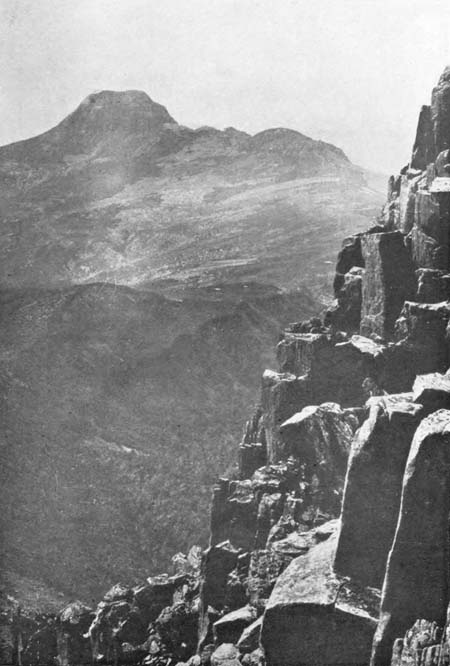
Photo. Spurling & Son, Launceston.
CRADLE MOUNT.
[162]“I am afraid travelling would tie me too much just now; but if you would care to go, please don’t consider me at all—I shall be all right.”
“Iris, you know we could not possibly leave you here alone.”
“I should not be alone; Miss Smith is always here——”
“Oh, you know that it’s impossible. Besides, Amy and I could not go by ourselves, and in any case we should not enjoy anything without you.”
“I am sorry, but I cannot possibly go with you.”
“Why not?”
“Because I want to stay here until the end of the summer, as we arranged.”
Ralph came over and stood facing her. “Iris, why do you want to stay here?” he demanded.
“Perhaps for the same reason you want to get me away,” she answered, meeting his eyes steadily.
“What does that mean?” he asked in an agitated voice.
“Why do you want to get me away?” she inquired evenly.
“Because I think the change would do you good and because——”
“Yes?”
“Because I am afraid if you stay here——”
“Yes?” she said again.
“Hang it all, Iris, I am not blind! Don’t you think I can see that you are under the influence [163]of——? And if it is not stopped, if you don’t break away at once, you will ruin your life. That is the honest truth, Iris—I want to save you from ruin.”
The earnestness in his words touched her.
“Ralph,” she said very quietly, “if it is really as you say, do you think it at all likely that some days’ touring—or even weeks or months—would make the slightest difference?”
Her seriousness alarmed him. “But, Iris, of course I did not mean to insinuate that it was anything serious like that. I wouldn’t insult you by suggesting such a thing.”
“I should not feel at all insulted.”
“Iris, surely—you, a lady!”
“Even a lady I believe may sometimes be true to her—friends.” She spoke a little haughtily now.
“But surely a lady would choose her friends among her own class?”
“She would certainly choose them among congenial spirits.”
“Can there be congenial spirits—here?”
“Ralph, I think you and I had better not discuss that subject; we shall only disagree if we do.”
“You will not come away, then?”
“No.” She looked at him with eyes which did not waver in their determination.
Captain Barton turned from her impatiently. “Iris, you ought never to have come to this place.”
“What is the use of discussing that, either?” she said, a little wearily.
[164]Ralph paced the floor excitedly. Then he came over to the window and stood before her again. “Iris, why will you allow that man to have such a hold over you?” his genuine concern touched her once more.
“Do we have power to give or withdraw what you call people’s hold over us?”
“Yes, most certainly.”
“Ralph, I am afraid you know nothing about it. If some one had a great influence over you could you stop it at will?”
“Yes, in the first stages; if I didn’t consider the person worthy I should certainly stop it then.”
“But if you thought your—friend worthy?”
“Of course that would be a different matter. But that is not a case in point.”
“Yes it is, for I think him worthy.”
“Iris, you can’t honestly think so?”
“I most certainly do. Now, Ralph, I have been frank with you; your genuine friendship demanded it. But it is not a subject I care to discuss with you again. I have also told you, so that you may understand how absolutely useless it is to try and—and—interfere with—this influence. And now I must leave you and go and read to Mr. Green: I am afraid I have rather neglected him since you came.”
“It is best he should know,” thought Iris to herself with a sigh, as she stood before the mirror in her room putting on a picturesque summer hat. She had noticed little disturbing symptoms in Ralph during the last few days, which made her fear that he did not merely regard her as his [165]childhood’s companion and friend; some deeper feeling had begun to show itself below his smooth, gay exterior. It was partly to check these disquieting indications that she had spoken so plainly that afternoon.
She looked more closely at her reflection in the glass. Ralph was right, she had grown distinctly pale, and there were large shadows round her deep blue eyes, which made them strangely dark and turned their sparkle into unearthly radiance.
Love had made this change in her—Love!
She smiled a smile which was not a smile.
Ah! how could Justin be so cruel—how could he—how could he? Of course he thought it was for her good, she quite understood that—she did not understand his motive as a smaller-minded woman might have done. But how blind he was—how blind! How utterly ignorant of the deeps in a woman’s love! And her greatest suffering consisted in seeing the disastrous effect it was having on him—he too, was growing pale and thin. Miss Smith had confided her anxiety about him to her that morning. He had grown listless and hardly spoke a word; she was afraid he was on the point of a serious illness.
The tall, pale girl looked absently into the mirror as she began to put on her gloves. What was she to do? He kept out of her way and gave her no chance to speak to him alone. He made his usual pleasant remarks as he passed their table, or as they met in the hall going to or from the dining-room; but not once had she seen him for a moment alone. Sometimes at meals she caught his eyes fixed upon her when he had not expected her to [166]look in his direction, and the sorrow and utter hopelessness she had surprised in the beautiful grey depths on such occasions had brought an almost intolerable ache to her heart.
But how was she to help him? He seemed so absolutely unreachable at present. His strange lofty strength, his unrelenting determination, had somehow placed him in a sphere where even she seemed unable to touch him. Each day widened the gulf between them, placed him farther away from her; each day made her cheeks whiter, her eyes larger and more ethereally beautiful. But she still held her head high, her lovely young form erect, and as she was whirled about in the car from one place to another, she talked and laughed in her brilliant light graceful way.
She had finished buttoning her gloves and she crossed the floor to get a parasol matching the soft summer tints of her gown. Then she suddenly stood still in the middle of the room. “Oh Justin! Justin!” she cried, throwing out her lovely young arms with a tense eager gesture. “How can you—how can you? Why have you taught me this terribly sweet lesson of love if you only want me to unlearn it? Why have you made me care for you in this awful, desperate way, so that I am ready to go through fire and water, ready to run any risk, make any sacrifice, if I might only be near you and become utterly yours? Don’t you know I only ask one thing from life, now: just to be yours—yours absolutely? Why are you so blind—why don’t you understand—why are you making us both suffer this torment? Don’t you know it is worse than anything the future could ever [167]bring, even if you——? Oh Justin!” she finished brokenly, her lovely face raised imploringly, lips aquiver, large eyes closed and the long lashes shading her cheeks, suddenly shining wet in the warm afternoon sunlight.
The following morning Rees came out of his room at dawn; he wore his riding suit, and, with a long look towards Iris’s door, made his way quietly out of the house. He walked a couple of miles along the road leading to the junction, then he turned into a prosperous looking farm and walked up a long avenue of pines. A stout middle-aged man met him at the gate leading into the garden, and said cheerily, “Good morning to you; Mr. Rees. Prince is all ready for you, I got your message last night—got up and fed him myself this morning; but come inside and have a bit of breakfast before you start.” And he led his early visitor with undisguised pleasure through a long wide hall into the big bright kitchen, where an appetising breakfast had already been cooked. The room was filled with the delicious odours of hot coffee, newly baked bread, eggs and bacon. The family and farm hands were already seated at the table and Rees was given a seat beside the eldest daughter, a pretty pink-and-white girl of eighteen, who looked with unmistakable admiration at the new-comer.
The meal was a pleasant one. The boys made fresh innocent jokes and the girls laughed heartily. [169]The merriment of healthy buoyant youth flowed round the driver, yet it failed to draw him into its invigorating stream. He was glad when breakfast was over and he was free to mount the beautiful black thoroughbred he had ridden at the sports. He patted the sleek shiny neck where Iris had stroked it that day, then, once more thanking his host for the loan of the lovely animal, swung gracefully into the saddle.
“Never mind,” the genial farmer responded, “I don’t want any thanks; if there is any thanking to be done I guess it ought to be on our side; we haven’t forgotten what you did for Rob last year, nor your many other kindnesses. You are welcome to Prince, my boy, for as long as you like; though I may as well tell you I would not lend him to any one else in the world.”
As Rees rode away under the pines the eldest daughter stood by the window in the front parlour and watched his slim strong figure with glowing eyes and round burning cheeks. “He will have to bring Prince back,” she said to herself, “and then perhaps he will stay a little longer. He was evidently in a hurry this morning, but when he comes back——”
When Rees had left the farm he took a road leading to a chain of mountains running at an angle to the great blue western ridges. The black thoroughbred cantered up narrow tracks on wild tangled hills, found his way carefully down precipitous paths, climbed higher ascents. Always the track rose till at last after several hours’ journey they reached one of the low shoulders of the mountains jutting out above a wide, deep, [170]thickly wooded gully, where a cataract roared more than a thousand feet below the narrow unfenced path.
There were no trees at this height and the steep slopes leading to the rocky crags just above were covered with green and bronze sedges, now rustling significantly in the light swift breeze.
The sky was vivid, and the sunlight pouring down over the mountainous world revealed every crack and wrinkle on the great massive stones, rising in sharp, audacious contours against the opal blue heavens.
Prince was hot, so Justin jumped out of the saddle to give him a rest. The horse looked round at the austere scenery about him, sniffed in the cool invigorating breeze, glanced back at his rider, and began to nibble daintily among the rough shaggy sedges.
Rees threw himself at full length on the sloping ground. How lonely, how wild it was up here among the barren dauntless peaks, with the roar of water ascending from the huge gaping valley and the loud rustle of the harsh reeds about him. It seemed as if he had strayed far beyond the safe haunts of men into some strange realm where Nature is no longer shy, lisping in unobtrusive whispers, afraid to be heard by men; but where it was unreserved, forward, speaking in loud passionate tones, laying bare its savage emotions, its wild, indomitable strength, staring at him with wide, bold, fearless eyes.
Something came suddenly between him and the sun. He glanced up wonderingly, knowing it could not be a cloud. Just above him was a great [171]eagle, his pinions outspread, gliding silently towards one of the sharp splintered crags.
He watched the majestic bird for a moment, then he looked far down in the direction of the township he had left that morning; but the safe little clustering haven was completely blotted out by the stern rocky crest he had mounted.
Prince stopped nibbling at the dried-up grass growing scantily between the rustling sedges. He came over to Rees slowly, and put a soft muzzle down to his shoulder, as if he felt lonely in this immense solitude and wanted companionship. Justin rose wearily and began to stroke the glossy coat. Then he put his hand over the satin neck and laid his pale face against the spot where Iris’s cheek had once rested. He closed his eyes and tried to imagine he was living again the dear day when he and Iris had patted Prince side by side.
He had left her. What would she say when she heard he had gone? Miss Smith would be sure to tell her during the day. What a brute she must think him! How he had made her suffer! Her pale sweet face with its shadowy eyes had clearly shown him all she was passing through. Seeing her pain had been his worst torture—but in Heaven’s name, what else could he do? Surely it would be a thousand times more cruel, more dastardly selfish, to allow her to link her life to his. He had been torn asunder with misgivings when her large glistening eyes with their silent yearning appeal had met his. It had maddened him to distraction to be forced to go on wounding her by denying all she asked by her mute sorrowful glances. His own longings for her had become [172]unendurable, and, added to that passionate anguish, was the torture of seeing the girl he loved constantly in the society of another man; always at his side, at table, in the car for long excursions, in the house, talking, walking together, spending long cosy evenings in their private sitting-room. In spite of his noble resolutions, his fine reasonings, the sight of that wakened a fierce jealousy within him. He was willing to give up his own happiness, all his claims upon her life for her ultimate good; and he might have endured it perhaps if she had left him at once and her friendship with another man could have been unfolded somewhere else. But to be daily, almost hourly, called upon to see all her time spent with a rival had become so unbearable that he could neither eat nor sleep, but was driven into a frenzied despair. He felt his physical strength ebbing. He knew he could not endure the strain much longer, and it was the consciousness of this which had made him ask Miss Smith for a short holiday to go to a neighbouring township. He must have respite or lose his reason. Now he was on his way for his holiday. But oh, what a hollow mockery it was! The phantoms of Iris beside the other man pursued him; they came with him, and in addition his own heart ached with a crushing pain to be near again.
As he stood beside the docile thoroughbred he was seized with a fierce longing to return,—a longing so forcible that it almost dragged him back in spite of himself; and it was only by a sudden, swift mounting into the saddle and starting quickly on his way that he conquered it.
[173]He arrived at the other township in the middle of the day and inquired for the boarding-house he had heard was there; but to his dismay he was told it was closed, and that there were only two hotels for accommodating visitors. A little reluctantly he made his way to the better one, and as he did so it seemed as if he saw Iris’s eyes looking at him, large, horrified. But he could not draw back now.
He engaged a room, and went to the dining-hall for lunch. As he walked down the passage he noticed a door on the left on which the significant word “Bar” was painted in thick black letters. He finished his meal and then began to wonder what he should do with himself for the rest of the day. He felt restless and lonely. How he missed the sight of Iris at the far-off table! How foolish he had been to leave her! Where could he go—what could he do? Once more he made his way through the front passage. But this time the door with the fatal word upon it was half open and the scent of liquor had crept into the hall.
One whiff of those ghastly odours and his old thirst leapt upon him. It seemed as if it had decoyed him away from Iris, away from his place of shelter, to spring upon him here far from all that upheld and restrained him. An ashen look came over his face. He passed the door and strode swiftly away. But though the fumes were out of the air, they had not been swept out of his senses. In his mind the odours hung like a heavy fog on a winter day. They clung close, insidiously spreading to every cell of his brain, to every nerve in his body, till his whole being was one mad, [174]burning craving for the drink, beckoning him from behind the half-opened door.
He felt suddenly ill and giddy. One agonised yearning had seemed intolerable; but two such fiery longings—one in his heart, the other scorching every nerve in his body—were past endurance! If only he had been near Iris—if only he could have gone and told her what he was suffering, there might have been hope then. One cooling touch of her hand, one loving, encouraging look from her eyes and he might have been saved. But now—— He hurried down the road as one in a frenzy. A sudden impulse came to him to spring on Prince and gallop back to safety as fast as the horse could carry him. But the thoroughbred had already done a long distance and it was cruel to take him back without a proper rest. Besides—there was Captain Barton. He would still be there with Iris when he returned. No, he could not go back; that was out of the question. He must stay and fight the temptation alone.
He walked about the district all the afternoon and did not return to the hotel till dinner-time. He plunged past the bar door; it was still open. In the dining-room he ordered the first thing he saw on the menu, drank cup after cup of strong tea—but the tea could not allay his mad craving; it only seemed to increase it. He could hardly swallow the food on his plate, but he forced himself to eat some of it. Then at last he rose from his chair, a deadly sinking in his heart at the thought of what awaited him in the hall.
One more desperate struggle and he passed the door. But only to sink down on a bench in the [175]verandah outside the bar window. His craving had him in its relentless grip now, it made ferocious assaults upon his will. His powers of resistance were ebbing away. He could not hold out much longer. After battling all the afternoon with the remorseless desire he was weak with the struggle, the aimless walking, and the terrible strain he had undergone. He was white to the lips, his face worked. Men passed by him. They were joking and laughing as they made their way into the large room behind him. Some awful power seemed to lift him from the seat and drag him after them. He gripped the back of the bench as if imploring it to save him. But the wood had no power to hold him. He fought desperately, for the issues of this struggle were stupendous. Iris respected him now, she loved him. But if he fell again she would turn from him in loathing and disgust. Of course she could never be his, but he could not bear that she should regard him as an abhorrent and revolting thing, and she would naturally do so if he fell so soon after his arms had held her, and the lips which burnt now for the insidious thing had clung to hers.
He ground his teeth in agony.
How long he sat there on the bench he did not know. It seemed to him an eternity. Darkness had long ago stolen over the township. Then all at once some one opened the window behind him.
As the subtle odours sprang out upon him he rose. His resolve was made. He would take the consequences, but he must have the drink he craved. All the fighting within had ceased and [176]he walked with calm dignity towards the fateful door. His old enemy had won, he recognised his defeat; so, with set face and slow step, he turned into the hall, crossed the threshold and—entered the bar.
The atmosphere was heavy with smoke and liquor odours. Behind the glass-filled counter stood the smiling, amiable barmaid, a shapely woman with auburn hair, powdered cheeks and liquid brown eyes. Rees made his way to the left side of the bar, where there was more room, ordered his drink, then took it to a small table by the window and sat down. The coarse voices of the men, the vulgar thick laughter, the smoke from bad cigars and foul pipes, filled him with instant loathing. So this was what he had come to—sunk to now! He was in the gutter again. His face grew paler; his lips set harder. Then he looked round the room once more. The rough crowd about him were miners and men from the township; some had a fair amount of education and some had none. But they all seemed to meet on an equal footing there; some strange bond had drawn them to a common level. They gathered round the littered besplashed counter, elbowing, pushing, joking, laughing, hiccoughing.
As Justin watched them his mind went back to scenes he had witnessed in the long past in London at railway stations, whence trains went to the worst slums of the East End. There had been [178]jostling crowds round the ticket office, sordid, untidy, battling poverty-stricken masses of humanity, with sallow faces, fiery eyes, loud harsh voices, insolent ways—with a look of brutal determination to get tickets and board the trains rushing towards the destination: that abyss of squalor, foulness, iniquity, gloom, despair; that whirlpool of anguish, hatred, pollution; that blemish on civilisation and humaneness—the East End of London, as it was in the “’nineties.”
Justin thought of these scenes now as he watched the men crowding at the bar. It seemed to him as if they, too, were thronging some great station, and with the same look of brutal determination as the East Enders demanded tickets to some repellent horrible destination, which the smiling barmaid dealt out in her pleasing, bantering way.
Suddenly his attention was drawn to a young Irishman, who was evidently the centre of interest in the room just then. He was a big, fine-looking fellow, with pale blue eyes, now looking foolish and expressionless through over-indulgence in the insidious liquid filling his glass.
“I am going to see the Premier,” his ridiculously high-pitched voice was saying, “and I’ll give him my vote at the General Election if he will put me on the Bench and make me a Justice of the Peace—not many Irishmen on the Bench—time they put on a few more—he shall have my vote at the General Election if he will make me a——”
“Pity your mother didn’t make anything better of you, sonny,” interrupted a loud voice from the thronged counter.
The Irishman smiled vacuously. “My mother [179]said to make me a priest. But I—think—she—would—rest—in—her—grave, if her son was made a Justice of the Peace in the little island of Tasmania.”
“You a priest!” roared the others. “Guess you haven’t any propensities that way, me boy! What about celibacy—that suit you—eh?”
The silly smile lingered on the flushed young face. “Gosh no!—no celibacy for me! Give me a girl every time—a pretty girl too,” and he glanced meaningly at the gorgeously dressed barmaid.
But she was not looking at him. Her attention was occupied just then with the handsome stranger in the riding suit sitting apart, frowning over his untasted glass. What was he doing in this room? She was certain he was out of his element.
“Let them make me a Justice of the Peace,” and the young Irishman threw out his chest, put his thumbs in his waistcoat and blinked round on his noisy listeners.
“Get out with you! Who is going to make you Justice of the Peace? Reckon you know more about breaking it!” hiccoughed a burly-looking miner.
“I’ll tell the Premier he shall have my vote at the Election if he puts me on the Bench——” reiterated the monotonous high-pitched voice.
The barmaid saw a look of utter loathing and contempt pass over the stranger’s lean set face. Then as if he made some terrible resolution, he lifted the glass to his lips and dashed the contents down his throat. The expression of disgust gradually disappeared and a burning look came into [180]his large grey eyes. He rose, went over to the counter quickly and asked for his glass to be refilled. She attended to his demands. This time he did not return to the small table, but drank at the counter like the others. His manner changed. He no longer regarded the rough crowd with disdain; all at once they seemed to amuse him and he even smiled at the absurd voice of the young engineer as he babbled—
“Great thing to be on the Bench—you just wait till I get there—great honour that.”
The others roared afresh. Rees glanced up at the barmaid and asked for another whisky. All his aloofness had vanished and there was an eager friendliness in his eyes as they met hers.
She glanced at him archly, but behind the archness which had become second nature to her by this time was something else, something which held pathos, sadness, almost entreaty as she said: “If you have any more you will want to be made a Justice of the Peace too.”
“Would you like to be made a Justice of the Peace?” asked the foolish high voice, as the youth turned to Rees.
“What about making a priest of you, boss?” suggested a man with fierce black whiskers and closely set bleary eyes.
The others laughed boisterously. “Make a priest of him—oh golly, he isn’t the bloke for ce-li-ba-cy either!”
“Like a kiss or two and a pair of arms round your neck—don’t blame you—a man is not a man if he can’t take his glass and a kiss!”
But Rees did not hear the gibes; he was absorbed [181]in the barmaid, who was constantly filling his glass; and somehow, to his benumbed and muddled brain, it seemed as if it were Iris standing there before him, pouring the amber fluid a little reluctantly into his tumbler.
When he had drained it he made a lurch forward towards the woman leaning slightly over the counter, and looking into her eyes he suddenly began to sing—
“Drink to me only with thine eyes!”
There was instant silence. All laughter, the shuffle of feet, the clink of glasses, the thick talk, ceased—even the young Irishman forgot his ambition for the moment—as they all listened spellbound to the marvellous voice ringing out its exquisite tones into the heavy atmosphere. It was just a little louder than usual, a little thicker, but it still held its wonderful melting sweetness. When he had finished there was a tense pause; it seemed as if the music had subdued the sordidness, the coarseness pervading the room. But only for a few seconds, then the absurd voice rang out—
“I’ll give him my vote at the General Election if he——”
“Shut up, you blooming young idiot!” a voice shouted to the engineer, then, turning to Rees, the man said, “Sing us another song, boss?”
The driver had been looking at the barmaid all the time he was singing and his handsome grey eyes had regarded her with a tenderness which made her breathe unevenly and fast. “Sing again,” she urged, with a touch of earnestness.
[182]Rees felt certain now that it was Iris pleading with him. Why shouldn’t he sing to her? They loved each other, and, after all, other things did not matter. Yes, he would sing to her the song from the cave—the song which had made her quiver in his arms. But before he commenced he asked for more whisky. The woman behind the counter shook her head a little sadly. “Men who sing like you should not drink,” she said, but she refilled his glass all the same.
He drank hastily, then began—
“I’ll sing thee songs of Araby.”
His tones were a little husky now, but they were still touchingly beautiful. He had forgotten the men and the place he was in; he was only there with Iris, alone with the woman he loved, and when he sang the words—
he suddenly laid his hand on the firm plump arm of the barmaid and looked longingly and deep into her brown eyes.
She caught her breath and lifted her face nearer to his, and, as she did so, all at once he bent over and kissed her after the last note of the song.
Uproarious laughter pulsated through the room. The spell the music had cast over the rough listeners was immediately broken.
“By gad! He won’t do for a priest!” cried a miner, and hiccoughed painfully. “That kind of life’s no good to him!”
[183]During the song two men had made their way to the hotel, and, hearing the remarkable voice, stopped outside the bar and looked in through the open door.
“Good Heavens, what a voice! Whoever is he, do you know?” the bank-manager asked, turning to his companion.
“No, I haven’t the faintest idea,” replied his friend, a solicitor from the township.
The older man looked hard at Rees for a few seconds, then recognition dawned in his eyes.
“Great Scott! that is Miss Smith’s driver down at the caves; what in the name of fortune is he doing here? Always thought him a decent chap—but what a voice! Look, he has just kissed the barmaid, and he is as drunk as that young Irish fool.”
“If he’ll make me a Justice of the——” droned on the high-pitched voice.
The tall bank-manager strode through the crowded room to the counter where Rees was standing and his eyes shot cold fire at the barmaid as he thundered: “Don’t give that man another drop; can’t you see he has had far too much already? Is he staying here?”
“Yes, sir.”
“What is the number of his room?” he demanded.
“Number eighthen, sir.”
Saying a few words to Rees and laying a firm hand on his shoulder the manager led him quietly out of the room.
The high-pitched voice of the engineer floated up to them as they ascended the stairs: “I think [184]my mother would rest in her grave if they make her son——”
“Good God!” murmured the bank-manager as he steadied the driver’s swaying footsteps along the upper corridor. “Why doesn’t the law close these hellish saloons and save our men from this revolting degradation?”
Downstairs in the middle of the room stood the young Irishman, drinking and hiccoughing between the words, “I—think—my—mother—would—rest—in—her—grave——”
It was five o’clock the following afternoon when Rees woke from his long, heavy sleep. He opened his eyes wearily, they felt so oddly weighted and a strange dull pain racked his head. He looked round the room slowly—how did he come to be there, he wondered vaguely. Then memory came back to him. The previous night and all which had taken place rose in grotesque reality before him. He saw the smoke-laden bar, the crowd of drinking men; he heard again the foolish voice of the young Irishman. Was his absurd clamor to be made a Justice of the Peace only a pitiful clutch at respectability, an attempt to retrieve all he had lost? Or was it only an idiotic fancy conceived in numbed, befooled brain cells? Rees saw again the woman he had mistaken for Iris and—kissed! A dull red mounted to his pale face. Great God! What havoc that liquor had wrought with his senses! He had kissed another woman, a stranger and a barmaid; and he had been so steeped in drink that he had actually imagined she was his beautiful Iris! A half-stifled moan escaped his slightly parted lips.
Ah, how he had sunk during that one irretrievable night! Three years of soberness, of fierce [186]struggle to keep on the straight path, seemed suddenly to have been swept away and he was back again in the old life of misery and degradation, back once more in pollution and despair! What had been the use of all his striving, his hard work, and his constant renunciation of all that belonged to the past? Now he had fallen. He had again slipped down among the sordid, repugnant things. How he hated to be there and how he loathed himself! Yes, that was one of the worst results of his debauchery, this hideous self-loathing! During the last three years he had climbed out of the revolting past and had in a measure recovered his self-respect; but now—it had vanished again. He was back once more in the old miry, slippery place, and he must begin the dreary climb afresh. But could he climb? Was it possible for such as he? All confidence had gone. A terrible despair distorted his white, quivering features.
Oh, if only he might climb back to the foothold he had reached during the last few years! They had been hard, humiliating years, but they had at least been clean, fresh and useful. If only this writhing, torturing self-accusation could be silenced and he could win back his self-respect. But that respite might not be his now—only utter hopelessness stared back at him wherever he looked.
And there was Iris. What would she say when he returned and confessed all? Would she not turn from him in abhorrence and disgust? Her love might forgive the past—had forgiven it; but no love could or would forgive this unpardonable fall. She was lost to him for ever now. She had really been out of his reach all the time; there [187]always had been an impassable gulf between them. But before, the gulf was narrow enough to be bridged by her kindness. Now it had widened so vastly that no bridging was possible. Of course all had really been over between them when he had given her up to Captain Barton. He had made that supreme sacrifice to guard her from the possible degradation that a life united to his might involve, and in doing this there had at least been the consciousness that he had voluntarily renounced all she was willing to give. He might have married her, but he had relinquished this wonderful joy for her sake. But now it was no more a case of renunciation. He had hopelessly disgraced himself, and his conduct would for ever cut him off from all contact with her life.
His thoughts were suddenly interrupted by a gentle knock at the door, and, in response to his toneless “Come in,” the barmaid entered with a tray.
He looked at her wonderingly with heavy, sad eyes. She was still powdered, but her hair looked less red in the daytime, and small lines round her lips and eyes were visible now.
“Mr. Rees,” she began, “we haven’t disturbed you all day because we thought a long sleep would do you good, but you must have something to eat now.”
The driver protested, and said he had no appetite. But the woman insisted and at last he sat up, more to relieve her of the tray than from any intention of taking what was on it.
“Try this fish, and drink this hot coffee, and you will feel much better,” she said brightly.
[188]His hand went up to his head as if the effort of sitting up was causing him excruciating pain. His companion noticed it at once, and piled up pillows behind him, making him lean comfortably back against them. “Now you must have your meal,” she coaxed with an indulgent smile.
But he was not ready for his meal yet. “I am afraid I behaved disgracefully last night,” he said looking at her steadily. “I owe you an apology.”
She looked away from his quiet gaze and said a little confusedly, “Oh, you were not too bad, Mr. Rees.”
“I thought I—kissed you?”
“Yes,” she admitted, turning her auburn head a little away, “but then——”
“It was a detestable thing to do, and my only excuse, if it is one, is that I was not—myself.”
“Oh, don’t worry about that,” she stammered, finding the steady gaze from those sad, grey eyes extraordinarily disconcerting. What a strange man to apologise to her for his conduct! Lots of men had kissed her; but they had not apologised afterwards. She had never met any man like this handsome stranger before. Even last night she had felt sure he was not a bad man; now she was certain he was a good one.
She watched his weary form reclining languidly among the pillows. The air of refined aloofness had come back to him. As she stood beside him, he looked up at her again and there was infinite sadness in his large eyes as he said gently—
“Thank you for being so forgiving and kind.”
She blushed a little. “Oh, that’s nothing at all, but you must have your meal at once or your [189]fish will be quite cold,” and, with another pat to his pillows, she left the room. But there was a curious flutter somewhere within her as she went downstairs. The stranger’s sorrowful eyes haunted her. They were such beautiful eyes, shaded by long dark lashes, and there was a wonderful expression of purity in them. They looked so unsullied, as if they belonged to a white soul who had suddenly fallen into the mire and was in deep distress at being smirched.
The next morning Rees was up at sunrise, and after a hasty breakfast went to the stable to get Prince. It was very early, but the barmaid was awake. Hearing the light footsteps of the horse, she jumped out of bed, and, from behind lace curtains, watched his rider swing into the saddle.
“That is the only gentleman and the only real man I have ever met,” she said, dabbing a highly scented handkerchief to her dark eyes, while the black thoroughbred bore the handsome stranger quickly away.
Iris stood by the window in her room looking out on the sea-blue mountains with strangely glowing eyes and flushed cheeks. Her tense, nervous fingers held a letter which had been slipped under her door while they were at lunch, and she had found it there a little while ago when she came back to rest before starting for a long ride in the car.
She stood for some time absolutely motionless; her form might have been lifeless if it had not been for her curiously vivid face. Then she moved suddenly, crossed the floor, opened the door, and went along to her cousin’s room.
“Amy,” she said when she entered, “please go without me this afternoon; I—can’t possibly come.”
“Why, dearest—what is the matter?” she asked, catching sight of the girl’s face.
Iris smiled bravely. “I just want the afternoon to myself, that is all.”
“Are you grieving about anything, dear?” asked Mrs. Henderson. “Your eyes look so blue—as blue as the hills when it is going to rain.”
The girl smiled again; and, under her thick black lashes, electric-blue fires burned.
[191]“Dearest, you are not ill, are you?” her cousin said with concern. “Your lips are so red and you look so oddly brilliant, as if you were in pain.”
“No, darling,” the tall girl replied, stooping down to kiss the woman who had given her the only mother-love she had ever known. “I am not going to be ill—not at all. Just let me have this afternoon to myself, and I shall be all right when you come back. You can explain to Ralph,” and with another warm embrace she left her cousin.
“That love affair will be the death of Iris, if it doesn’t turn out right,” thought Mrs. Henderson when the girl had left the room. “She has not been herself since he went away; it is not like her to be so listless and quiet. She was pale before, but since he left—— Why on earth did he go? I suppose the poor fellow was driven crazy seeing her so much with Ralph! But if she really cares for him, why on earth has she allowed Ralph to come between them?” She sighed. “I don’t understand—love affairs are incomprehensible things!”
Iris returned to her own room and sank into a chair by the window; then she took Justin’s letter from the envelope and began to read it again. This was his first letter to her, his first and only one, and—such a letter! The small sheet of notepaper held only a few lines, telling her of his fall, its extent, even to the kissing of the barmaid. He made no extenuating excuses for himself, not one; he only stated facts. He did not say he was sorry, did not ask to be forgiven; his despair [192]was too deep for that. Iris read between the lines, read all the unsaid important things, and—understood.
But, though she understood, an awful stillness came into her face as she re-read the words—
“I sang our song from the cave to the barmaid, and then I kissed her.”
She sat for a while in a death-like quiet, her wide eyes looking unseeingly into space. Then she shuddered visibly and the corners of her mouth began to quiver. His failing had made him do that—a man with his code of honour, his ideals—the ghastly, appalling horror of it!
She rose quickly from her chair and paced about the room restlessly, moving one object on the dressing-table after another; then came back and sat down by the window again, looking absently at the rose-garden below. And there was no help for such as he—no safeguard, no shelter? She glanced up at the long chain of lofty mountains with their glowing, sun-kissed faces rising out of a deep blue haze; then she placed her elbow on the window-sill, and, chin in hand, she said half aloud: “You have been kind to him, you dear, blue, beautiful things! You have sheltered him and kept him safe; but—” a strange glitter flashed under her lashes—“humanity has not been kind. It has had no pity. It has placed stumbling-block after stumbling-block in his way. His only chance has been to keep away from the haunts of men and live near the heart of great, merciful Nature. Nature is kind, it has more heart than man; it pities!” A passionate wistfulness glistened in her magnificent eyes. “My poor boy!” [193]she whispered, now shading her face with her hand. “You are in the depth of despair because of—this. Humanity has found the one weak spot in your otherwise perfect armour of strength, and has wounded you mercilessly through it. Oh, Justin—the sorrow of it!” Her superb young head sank down on the window-sill and long, dry sobs shook her splendid form.
“Oh, Justin!” she whispered brokenly. “The worst of all is, that I drove you from your place of shelter. I thought you blind—but I was blinder; I thought you cruel—but I was ten times more cruel myself! I allowed you to see me daily, hourly, with another man, till you must have been driven mad with the strain of it! If I had thought myself called upon to give you up to another woman and had to see you together every day—constantly.” She rose hastily and began to pace the floor. “How could I have done such a thing? How could I have allowed you to bear such cruel, horrible pain? It is I who have sinned against you. I knew how unselfish, how noble your sacrifice was in giving me up to Ralph, and you bore seeing me with him all that time; you suffered this because you thought it was for my good. You might have come any day and claimed me, and you would have had all I was waiting to give! You could have relieved your own pain, but you chose to suffer instead—ah! the great, lofty strength of you! But at last your powers of endurance became exhausted, and rather than do anything you thought might harm my life you chose to go away from your shelter and expose yourself to the most hideous danger—oh, [194]the nobility of you! And now you are in the depths of remorse, all because you tried to save me.” She picked up his letter and pressed it vehemently to her lips.
“But,” she continued, a grand resolve flashing in her eyes, “you shall suffer no more; I will go to you, I will comfort you—nothing shall keep me from you any longer—no shyness, no reserve, no convention! I will give my life to protect you; you shall not be allowed to slip back into the awful degradation which engulfed you in the past. If you will not marry me, I will live somewhere near you, hover over your life, shelter you—I will stand between you and your awful foe!”
Then she heard the buzz of the motor. Amy and Ralph had gone at last.
Very quietly she went down the corridor and knocked at Justin’s door, but there was no answer. So she ran downstairs and asked Miss Smith about him, and was told that he had left immediately after lunch and gone to a farm some miles away, where he would stay till the following morning, when he would return to work.
Iris was disappointed; she had kept the afternoon free to talk to him, but she could go and read to Mr. Green instead.
“I must wait till to-morrow night; I will see him then, whatever happens; he must not be allowed to suffer any more—my poor, noble boy!” she thought as she walked along the road to see the invalid.
Justin had been to see Turner, the old drunkard, and was on his way home the following evening, when he saw some one coming towards him in the soft, starlit darkness. His heart gave a sudden leap when he recognised Iris’s tall, erect figure as she came nearer. She was evidently expecting him, for she came right up and stood before him.
“Justin,” she began in a voice which trembled a little, “I cannot stand this any longer—you must talk to me,” she added with a touch of desperation.
“Didn’t you read my letter?” he said with evident effort.
“Of course. But why didn’t you come and talk to me instead? That would have been ever so much better,” she said, a slight hurt creeping into her words in spite of herself. “I saw you come up here after dinner and I have been waiting for you for some time; now I am going to talk to you. There is a log just here under the hedge; come and let us sit down.”
“But, Iris, you don’t mean to say that you will have anything more to do with me after—that?” he asked in toneless incredulity.
“Justin! Don’t talk such utter nonsense—as [196]if that or anything else could ever make any difference!”
She led the way to the log under the hawthorn and sat down. But Rees did not seat himself near her; he threw himself on the grass a little distance away.
However, Iris had started out with the intention of comforting her despairing lover and she was not going to be thwarted in her purpose. She moved a little further down the log till she was so near him that her gown brushed his shoulder.
“Justin,” she whispered, “why are you trying to get away from me?” And she leant slightly towards him and placed one hand shyly on his head.
She knew exactly what she had come out to say—do; but it was not quite so easy to carry out her intention now she was actually near him. His presence always made her feel extraordinarily shy and had a confusing effect on her senses. However, she had determined to overcome her own emotions in order to comfort him. So now she moved her hand caressingly through his thick, smooth hair and gradually drew his head down to her lap.
“Oh, Iris!” he murmured, drawing a long, shuddering breath as he rested against her.
A soft, fragrant hand played soothingly with the hair round his temple, then very timidly it stole down over his cheek.
She felt him thrill to her touch. His stony despair was breaking up; life was coming back to him.
[197]“Iris—you are too miraculously good to me,” he whispered brokenly.
“No, I am not, dearest,” she breathed, bending over him. “You have been so sad—so sad; now I am going to comfort you.”
He heaved another great sigh.
“My poor, dejected boy!” she murmured faintly.
He laid one arm over her knees and there was anguish in his clinging touch. “Oh, Iris, hanging is too good for me, and you—treat me like—this.” Suddenly he buried his face in her lap, and she felt his strong frame shake.
“Oh, Justin!” she breathed, stooping closer over him and stroking the back of his head with tremulous fingers. “Don’t grieve like that—I can’t bear you to be so sad. Really, you must not grieve so—it was not your fault at all, really it was not—it was all mine—I drove you to it.”
He raised his face at once. “No, no, you are not to say that; it was quite my own fault. I should have been strong enough to stay here and——”
Iris’s head dropped lower, and there was infinite contrition in her voice as she said: “I have been so cruel to my poor boy; I have made you suffer what I could never have borne myself if I had been in your place.”
The arm round her knees clasped her closer. “Iris, you must not blame yourself—I ought to have been strong enough to——” His frame shook again.
She breathed more quickly; then all at once she drew his upturned face to her breast. “My [198]poor, broken-hearted boy,” she whispered with tremulous tenderness, “you must let me comfort you; your dear head shall rest here.” And she pillowed it gently over her fluttering heart.
Gradually his sighs subsided and his head nestled closer to her softly moving bosom.
“Iris—this is—Heaven!” he faltered at last.
“Does it make you feel better?” she asked eagerly.
“I couldn’t possibly tell you how much. But oh, darling—I am too unworthy to be near you.” His voice was beginning to quaver again.
Iris drew him more tenderly towards her. “You are not to talk like that, and you are not to think about—that time—away; it was just an unfortunate accident and something which will never happen again; and we are both going to bury it for ever and forget that it ever took place.”
“Sweetheart, you are an angel!”
“No, I am not. But remember, you are never to think of it again—will you promise?”
“How can I?”
“Easily—think of something better,” and she allowed her face to drop down to his head and rest there.
His arm stole diffidently round her waist. “Iris, you are too marvellous.”
They sat for some time in silence. It was so wonderful to be together again, speaking to each other, resting in one another’s embrace, feeling the exquisite joy of contact. The sadness fell away from them; the torment they had suffered during the last two weeks—all fell away at the [199]bliss of being together, as nightly shadows flee away at dawn.
“Do you feel happy again?” asked Iris, after a long, blissful pause.
“Sweetheart, how can I help it—when I have you so close to me?”
She moved her cheek gently to and fro against his hair. “I am so deeply glad.”
“Oh, Iris, you don’t know what you have done for me to-night; you have lifted me right out of—that awful place I—had sunk into, and I feel now as if I could be what I—was—before.”
“Of course you can; the—other was just an accident, and—we are going to keep clear of all such danger in future.”
“We?” he queried.
“Yes.” She pressed her head closer to his. “Oh, Justin! Can’t you understand that I cannot leave you—now? I am going to live somewhere in the district, and then I shall always be on hand in case you want me.”
“You darling, are you really going to do that?” he said, drawing her nearer. “But—I shall always want you,” he added with a long, yearning sigh.
“Well, then, I shall be in the neighbourhood and you may come to me whenever you want to,” she said, trying to speak lightly. “And if by any chance,” she continued hesitatingly, “you should feel that—that temptation,” she added bravely, “you could come to me and I should give you—this—instead.”
Suddenly they heard voices and footsteps.
“I don’t think she could have come up here in this lane,” Mrs. Henderson was saying not far [200]away from them. “You must have made a mistake, Ralph—what could she be doing here all this time?”
“Mr. Rees came up here shortly after dinner,” replied Captain Barton in annoyed tones.
Justin felt Iris start a little, then she rose slowly and walked to the road with her most dignified air. “Have you come out to look for me?” she asked with cold hauteur. “There was not the slightest need: I am well taken care of—I am with Mr. Rees.”
“Ah, that is all right,” replied Mrs. Henderson pleasantly; “we were just afraid you were wandering about alone and might get lost. Well, Mr. Rees,” she said, turning to the driver, “what an age since we have seen you; you have hardly had a moment to spare for your old friends lately! I suppose we ought to be offended, but no doubt Iris has already dealt with you on that point, so I will pass it over.”
Behind them walked Iris, tall, dignified, silent; and, if it had not been for the darkness, her soldierly companion would have seen angry flashes in her velvet blue eyes.
Captain Barton did not go to bed early that night. He strode up and down the road excitedly, smoking a big cigar. So this was what the Hon. Iris Dearn had come to, the girl he loved, the girl who might have married the highest noble in England—sly meetings in lanes with—a groom! His strides grew longer and more savage. What power the confounded beggar had over her to make her sink so low! And, of course, he would make full use of that influence. He would marry her presently, unless things were stopped immediately. But how was this to be done? If only he could have summoned Lady Dearn and had her as his ally now! But even if he cabled the following day it would take at least five weeks before she could arrive, and much could happen in that time.
He kicked a stone lying on the road, viciously. If only he could go to Rees and deal with him as he deserved. The hand on his cane tightened. But what was the use? It would perhaps only make Iris hate him, and—deep down in Ralph’s shallow, enraged heart there were grave doubts as to whether he really could mete out justice in that form to the driver. He had the advantage [202]in size, certainly; all the same he did not quite relish the task of attacking Rees.
But how in the world was he to save his childhood’s companion? He could not stand by and see her life ruined; besides, it was so beastly humiliating to be beaten, knocked clean out of the running, by a common groom! He bit his cigar fiercely. What could be done? What a fool Amy had been to allow a thing like this to go to such a length. She could so easily have taken Iris away when the first dangerous symptoms appeared. She was not fit to be a chaperone; he would inform Lady Dearn clearly on that point. But how was he to deal with this complex situation? He had felt deeply concerned when Iris had spoken so plainly to him the other afternoon. He had realised how far-reaching the fellow’s influence must be, but even then he had not supposed it could have come to real love-making between them. He thought he might have saved it from ripening into that. But now the thing looked as if it had already done so.
If only he could find some weapon against Rees, something discreditable, some secret fault in this posing hero! But so far he had been unable to do so, and, till evidences were forthcoming, how was he to act? Iris had definitely refused to leave the place and go touring. So there seemed only one course open to him at present—to try and keep the girl out of the driver’s way as much as possible and write to Lady Dearn by the next mail and tell her to come out at once. Of course he could cable, but on second thoughts decided he would not do that. It would be impossible to [203]explain a situation like this in a wire. No, he must write, and in the meantime do all in his power to keep Iris away from the man who held such sway over her.
Another course presented itself to him: he would tell Iris that he loved her and implore her to become his wife. Perhaps, after all, her attachment to Rees was only a love of romance. Iris was so accustomed to be made love to that perhaps she had found it irksome to be without an admirer, and for want of a better man had accepted the driver’s homage. Yes, in all probability this was the only reason for the intimacy. Now he would step in and make open love to her, and tell her frankly he had come out to win her. He would pour his ardent affection upon her and show her how vastly superior his love was to the driver’s. Women were often turned from one man to another; he had noticed that many times, and the most ardent man generally won. But it was difficult to let himself go under Amy’s unromantic eye and she rarely left Iris with him for any length of time. She had really done her duty as a chaperone where he was concerned—a thousand pities she had not been equally conscientious in the other direction! But, of course, Amy could never have given a thought to the possibility of an intimacy springing up between her cousin and a groom. She could not be expected to be prepared for such a preposterous emergency; only, when she did see danger signals, as, of course, she must have done, she ought to have taken Iris away immediately.
But how was he to get Iris away by herself so [204]that he would have plenty of time to tell her of his love?
Suddenly an idea dawned upon his not too quick intelligence. He would arrange a trip to the mountains with Amy and Iris. Of course, it would be a little difficult to persuade them to go without the guide, but he would tell them of all his mountaineering exploits, and they would soon be willing to trust him. If he could arrange the trip for the following day circumstances would play into his hands, for he remembered hearing Miss Smith telling Amy that Rees was taking a big party to a waterfall many miles away, and that they were starting early in the morning. That would be his opportunity to go without the guide—he would be elsewhere and not available. Yes, he must arrange it for the following day, and once they were on the way he could easily manage the rest. The mountains were extremely steep, and Amy, who was too stout to climb, always avoided it; she would wait in the car while they went to the top of the ridge. He would take the chauffeur up with them, so that Amy would not think he and Iris were by themselves—he had a feeling that Amy objected to his being alone with the girl. Of course, as soon as they had climbed a little way he would send the man ahead and then he would have the chance he desired; and he would make full use of it, too! His steps slackened. His rage died down. His chances would come to-morrow, and he would at least make such an impression on Iris that she would be willing to listen to him again.
Girls had always liked him. He was a fine, [205]good-looking chap; he had often been told so and his own mirror corroborated the fact. His hand moved up to his perfectly shaved, dented chin—girls liked dimpled chins, he had noticed. Iris might not be so hard to win after all, once he came into the open and showed her his real intentions. He had hidden too much in the trench of their childhood’s friendship. Now he would come out from that and declare himself her lover. This would at once put a different tone to the relationship between them. He had been foolish not to do so long before. But surely it was not too late yet. What chances could a common driver have against a man like himself!
Captain Barton walked back to the house, calm and content. He had solved the difficulty, after all. Women loved fervour—he could be fervent; experience had proved that. He would begin to-morrow, and even if Iris did not respond straight away—he hardly expected this—he would make an impression, and as the days went by it would deepen, until gradually—she would succumb. Women could never resist real ardour! He made his way to his room, pacified, and in a hopeful frame of mind.
He was blissfully ignorant of the fact that ardent love-making by the wrong man would be most trying and repellent to a girl of Iris’s temperament. But Captain Barton slept the peaceful slumber of a man who thinks he is on the road to victory. It was characteristic of him that never once had his fervid devotion kept him awake for more than ten minutes after he put his head on the pillow.
Rees was galloping along the steep road leading to the mountains. He, who was generally so kind to animals, rushed the bay horse under him at a most unmerciful speed. But his willing beast did not misjudge him and think him harsh; he seemed instinctively to understand that there was some appalling need for this breakneck pace up and down the steep hills guarding and making it difficult to reach the precipitous mountains beyond. The horse stretched out his quivering bay limbs, barely touching the chocolate-tinted track in its excited eagerness to comply with the wishes of its beloved rider.
As Justin flew over the ground his eyes were fixed on the wide, flat marks of motor tyres plainly visible in the reddish-brown dust.
He had breakfasted early that morning, taken a large party of visitors to some waterfalls, returned home shortly before lunch, and found that Captain Barton had carried Mrs. Henderson and Iris off immediately after breakfast to the mountains. He had reproached Miss Smith for allowing them to go without a guide; she had replied that she had done her best to dissuade Captain Barton from going, but he had waved all her objections [207]aside, told her he was used to mountaineering and that the ladies were perfectly safe with him. He had not taken her warnings kindly, and finally she had been forced to pack their luncheon-basket and see them start off in the beautiful dark red car. Strange to say, neither Mrs. Henderson nor Miss Dearn had seemed afraid to trust themselves with their self-confident friend.
Now Rees was racing as fast as the splendid bay would carry him to reach the summit in time to prevent their descending the wrong turning on their way back. To find the way to the top was not difficult, for the path was well defined; but, after they had wandered about on the high, trackless plateau with the numerous peaks rising at erratic intervals from the rocky plain, the danger would begin, as the ravines leading downwards were all so much alike and it would be hard to strike the right one; and, should they descend the wrong one—the rider urged on his horse at the thought—almost certain death awaited them—an aimless wandering about for days amid never-ending slopes, densest bush, barren rocks; or, if they should make a false step on a loose boulder, a hurling into a dizzy chasm.
It was about three o’clock when he arrived at the spot where the track narrowed into a small path and the car had stopped. Mrs. Henderson sat in the motor, reading; she heard the thud of the galloping hoofs a little distance away and recognised Rees instantly; no one else rode like that. She looked at him in surprise as he drew rein and pulled up the panting, trembling horse.
“Mr. Rees, you don’t mean to say you have [208]come after us?” she said with evident astonishment.
“Yes, of course,” he replied unevenly, and went on to explain to her the danger in a few words. “How long is it since they left you?” he finished, with undisguised concern.
“Quite two hours,” she answered, beginning to feel uneasy as she looked at his anxious, strained face.
She watched him as he hastily unsaddled the horse and let him go; then he threw his long blue overcoat over his shoulder, strapped the bag he carried on his back a little tighter, turned to speak to her again; then, after a few words, hurried along the steep little path winding its way up the dense bush and was soon lost among the great overshadowing trees.
Mrs. Henderson’s healthy face paled. She suddenly realised the horrible seriousness of the situation. It was really too bad of Ralph to have been so obstinate about not taking the guide with them, and so run such awful risks with Iris. She had argued the point with him that morning, but as he had been so confident and reassuring she had weakly given in. However, Rees was on the spot now, and that thought brought relief.
In the meanwhile the driver was climbing as he had never climbed before. He was as reckless with himself as he had been with his horse. The perspiration rolled from his forehead, his veins swelled and his breath came in rapid gasps.
He passed through beautiful gorges where huge tree ferns spread out alluring, detaining fronds, [209]and gigantic dark green myrtles almost barred the way. Higher up he crossed barren slopes dotted with stunted wind-swept bushes and long, wiry-looking grass, where the wild cry of crow-shrieks mingled with the hoarse, fitful whispers of the breeze. Once a big, mole-tinted kangaroo leapt by him on its rapid, bounding way. But he hardly noticed it; his eyes were fixed on the ground, his lips set.
At last he entered the long, narrow ravine leading to the top of the ridge, and, after half-an-hour’s strenuous climbing through the steep, dark, tunnel-like passage, he stood panting on the immense plateau, his burning eyes scanning the vast scene before him. The late afternoon sunshine flooded the endless plain, and made the crags and peaks rising from it look like great, curiously shaped pyramids springing from some huge, billowy desert.
Rees shaded his eyes with his hand and gazed intently on the rocky stretches before him. But no one was in sight. Then he walked on, coo-eeing loudly as he went. After a time a faint response came to his call. He hurried on in the direction of the sound, and presently he saw two men standing by a tremendous boulder which, till then, had hidden them from view. But there was no lady visible; however, Iris might be sitting down behind the stone.
“Where is Miss Dearn?” asked the driver without ceremony, as he came up to the men and looked eagerly for the missing figure. As there was no immediate answer to his question he glanced quickly at his companions, and, for the first time, noticed that there were marks of distress on their faces.
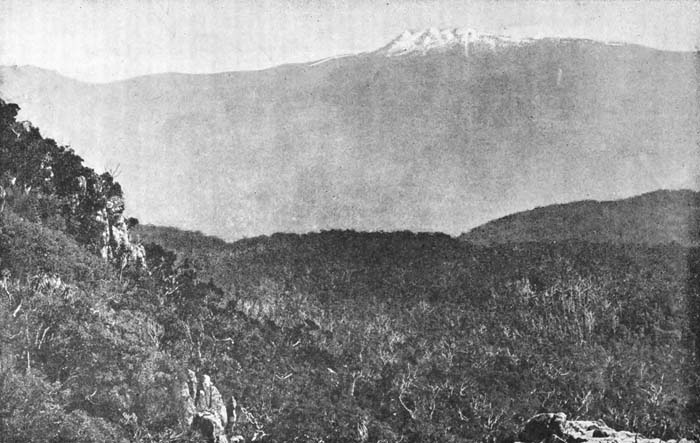
Photo. Beattie, Hobart.
MOUNT PICTON.
[210]He repeated his question more peremptorily.
The chauffeur gave his master an odd look and waited for him to reply.
“Miss Dearn will come along presently; she must have gone to look at some of the curious rocks about here,” said Captain Barton, stroking one of his smooth cheeks and trying not to betray his uneasiness.
“Man, you don’t mean to say you don’t know where she is?” broke out Justin indignantly.
“I think you are forgetting yourself, Mr. ——” replied Ralph, with an attempt at dignity.
“Tell me where you lost her;” demanded Rees, ignoring his thrust.
Captain Barton’s fears were getting the better of him and he felt in sad need of Rees as an ally, so he swallowed his pride and said: “She was sitting here when we went to climb that peak over there. She did not want to go any farther and I am sure she said she would stay here till we returned. I thought perhaps she might have gone back to Mrs. Henderson and we were just going down to see, but as you did not meet her I suppose she is still up here somewhere.”
The driver’s hot face had suddenly blanched. “So you left a lady, entrusted to your care, to amuse yourself climbing peaks!” There was deep scorn and anger in his low, quiet voice. Then his tones changed. “But there is no time to lose; we must begin to look for Miss Dearn at once.”
The driver soon organised the little search party. The chauffeur was to go up the western range, [211]Captain Barton was told to go towards the south, and he himself took the long, interminable ridges stretching to the east. He arranged with the others that they were to search till sundown if Miss Dearn was not found before, but to descend then, as they could do no good after dark and would only become a new anxiety to him. He would stay on the mountains all night. He planned that whoever found Miss Dearn should go down below the ravine where there was plenty of wood and light a huge fire, so that the others might see the smoke and return. The guide also advised that they should take Mrs. Henderson home when they returned at sundown and come back the following morning at dawn to resume the search.
So the three men parted and went in their various directions.
Rees saw the others start and then began to walk quickly along his own allotted region. He heard them calling as they went; at first their voices sounded loud and clear, but gradually they grew fainter and were at last lost to his ears altogether. He, too, began to coo-ee at intervals and listen intently for some distant response. But none came. He walked on more rapidly as the sun sank lower in the west. The warm, slanting sunbeams grew golden. The sun hung over the western crags as a huge ball of fire which was about to drop on them and endow each stately peak with volcanic flames. The brilliant globe sank lower till it touched the crest of far-away summits, and then suddenly a flood of fire leapt over the plateau, lighting up every rock with [212]amber radiance. In another moment the sun had disappeared, the amber glow deepened to rose, and the whole vast plateau was turned into a wilderness of dazzling fire, making every crag glisten with fierce red splendour!
Justin looked at the amazing beauty and breathed hard. To him it only meant just then that before long it would be too dark for further search. There was no moon, and in the nightly gloom he would not even know if he were walking in the right direction. He went on with increased vigour. Iris was alone and frightened somewhere up here in this endless desert of peaks. If only she would stay on the plateau there might be some hope of finding her; but if she, by any chance, should attempt to descend by any of those trackless, terrible gullies—— He shuddered and quickened his pace. But it was not easy to walk fast; there were great boulders to climb, huge, rocky protrusions, deep gorges to be bordered, yawning chasms to be avoided. But he made his way resolutely onwards in spite of all hindrances, coo-eeing repeatedly as he went.
The roseate light faded. A deep, dark gloom crept up from the valleys, enfolding the plateau and stealing slowly towards every summit. The plain became shadowy and blurred. The glow died out of the sky. The distant views grew dim. Night stole over the world. It advanced all round the lonely figure walking with desperate determination in the gathering dusk. Hope was fading from his soul, despair began to clutch at his heart. How was he to find his darling when it grew dark? Would he ever find her? He might [213]walk on the top of the mountains for days, for weeks, for months, and yet never catch a glimpse of her beloved form, even if it were possible for her to exist all that time without food and shelter. He often turned round and looked in the direction of the downward track for the smoke which was to indicate she had been found. But no curling wreaths rose from the valley below. The others would have returned by this time. They would not find her now; if she was to be found he must do it. He hastened on again.
As he looked towards the western peaks he noticed with a sudden fear that small clouds had begun to gather on one of the highest peaks. After walking a short distance he looked back again; the small cloudlets had united into a big, fleecy mass which was sinking low over the towering crests. Justin’s heart almost stood still at the sight. Should the vapoury mass descend and envelop all, then there would not be one ray of hope; each step would be fraught with danger, and, if Iris were trying to walk, then—— Rees shivered visibly. The awful clouds were drawing closer. A terrible anguish seized him. All seemed lost. He would never be able to reach Iris now. If only she had stayed in the same place where she found she had lost her bearings! If only she had not tried to descend any of the gullies! But she could not have remained stationary, or one of the three searchers would have found her long ago.
Justin staggered on. The hopelessness in his heart had robbed his step of its buoyancy, and he was very tired. He had not waited for lunch [214]when he heard the party had gone to the mountains. He had not touched food since his early breakfast; he had been through a dreadful strain and it was telling on him now. He reeled with exhaustion and misery, and suddenly sank down on the cold, rocky ground. What was he to do? There were plenty of sandwiches in the bag strapped on his back, yet he felt he could not eat; food would choke him. There was also a flask in the bag; one draught of that liquid fire and he would revive!
But something in him rose in quick revolt. No, that flask must not be touched by him. Iris might need it all, and besides, he could not greet her with the scent of that on his lips.
The gloom gathered thicker all around him; the fleecy masses crept nearer and nearer. They came towards him softly, insidiously, blotting out all hope and possibility of finding the girl he loved.
A moan of desperation escaped his drawn lips.
He would be lost himself if he attempted to move; he was even now cut off from stumbling onward in the dark and pursuing his search.
He leant back against the boulder behind him with closed eyes.
Ah, where was Iris this dark, terrible night? Was she huddled together somewhere behind grim, relentless stones, afraid of the great, vast solitude, the awful, mute loneliness? If only he could have found her and stayed with her during the long, dark hours! His splendid Iris—Iris, who had treated him with such magnificent generosity, who had looked at him with eyes [215]shimmering with love; who had forgiven his fall with such boundless generosity; who had put aside shyness, conventionality, and come out into the lane the night before to comfort him; his beautiful Iris, who had been willing to risk all and unite her life to his, she was lost now—somewhere terribly alone in this great, ruthless expanse!
He moaned again, and bit his lip. Then into his burning brain came a vision of Turner’s cabin, which he had visited the evening before. He saw the small, tidy gate where years ago the old drunkard had painted the name “Hope” on the slender woodwork. He saw the gaunt, white-haired man and heard him speak in his cracked, rasping voice: “There is always hope, my lad; that is why I painted that name on my gate twenty years ago; some day I shall win. Hope comes by way of—God.”
Apparently the old man had not reached God’s help all these years, but yet the drunkard was confident that He would help him before it was too late.
Would that same God help him? Rees asked himself. His end had come—the end of his own efforts, his own powers. Would not God step into a breach as terrible and as urgent as his? All at once he felt, in his extremity, that God was his only hope.
He sat up suddenly, then he covered his white face with his cold hands, and, his very soul crying out, began to pray. He besought God, with an intensity which warmed him and made his body tingle with its vehemence, to guard the girl he so passionately longed to protect! His spirit [216]lighted him on and he found the only Being who could meet his need, and laid hold on Him with hands which would not relax, entreating Him, with all the force of his distracted, agonised soul, to lead him to the girl he would give his life to rescue!
A strange peace came to him. His despair vanished. Hope returned, and with it came back his strength and accustomed vigour. He rose quickly. Surely his stumbling feet would be guided to the spot where the darkness and the relentless rocks hid the woman he loved.
As he made his way in the murky gloom an odd desire to sing stole over him. His singing had reached Iris in the cave; might it not reach her again? It had drawn them together in the hollow hill; might it not draw them together now?
He began to sing, and his voice, powerful and irresistibly sweet, floated into the wild, brooding loneliness. Song after song trembled into the listening spaces. After each verse he stopped and waited eagerly for some response. But there was no answer.
Then at last he began the song which was always now symbolical of the birth of their love, and his clear, exquisite tones rang out the words—
“I’ll sing thee songs of Araby.”
He sang with a strange, throbbing pathos; all his love, his tenderness, his desperate anxiety, his anguish, pulsated in every quivering note, saturating the darkness with its exquisite sweetness.
He stopped and listened, then started violently—was it the mockery of the rising breeze or some [217]conjury of the echoing rocks? It seemed as if there was a faint, far-away response. He made his way blindly, frantically, in the direction of the sound, and after he had walked awhile he repeated the song and then waited breathlessly.
His heart gave a terrible bound; this time the response was quite distinct, and it was the voice he was craving to hear!
In his impetuous haste he stumbled over some protruding stones; but the fall did not delay him long, and he blundered on again. Once more he sang a phrase of their song, and the answer came, astonishingly close to him.
Then his burning eyes saw a tall, slender form emerge from the soft dimness, and make its way towards him.
He sprang forward; the next moment Iris was locked in his arms.
“Iris—my precious darling—are you all right? Thank God I have found you at last!” he ejaculated in broken, passion-laden tones.
“Oh, Justin—Justin, how did you find me?” sobbed the girl, pressing her arms convulsively round him.
For some time they stood silent, overcome by emotions too deep, too torrential, to find vent in words.
At last the girl broke the long, tumultuous pause. “But how did you find me—how did you know so soon?” she questioned, her cheek against his.
He explained it all to her, and when he had finished he added: “But you must not be standing out here in the cold any longer. I must try to find a sheltered spot where you can rest for the night.”
“I suppose we shall have to stay here—till the morning?”
“Yes, Sweetheart. Are you afraid?”
“Not now, when you are here,” she whispered, letting her head drop to his shoulder. “But I [219]was afraid before. Everything is so dreadfully big up here—the sky, the earth, the peaks, the valleys, and those awful ravines.” She shivered a little. “It all looks so lovely and romantic in the daylight and at a safe distance; but, when you are here all alone in the dark, the loneliness is so huge—like the great sky overhead!”
“Poor little sweetheart! But you won’t feel so lonely now, will you?” he said, laying his lips against her hair.
“No, never when you are with me. Justin,” she continued after a pause, “do you know, I have never really believed in angels or anything like that, but just now, when I heard your dear voice singing our beloved song of the cave, it seemed as if Heaven itself had opened and sent you to me?”
There was deep reverence in his voice as he replied: “Iris, Heaven really did open to-night and Hands not visible guided me to you.”
“I am sure that is true,” she said in hushed tones.
“But, dearest one, you must not be standing any longer,” he said with a great tenderness as he released her.
“Justin, I can’t let you go—I can’t ever let you go,” she said, clinging to him desperately.
He caught her to him afresh. “Iris, you do not need to let me go; I shall hold you to me all night,” he murmured in a tense, low voice. “But we must find a sheltered little nook and you shall rest close to me there.”
With his arm still round her, the girl led him to a little cave-like enclosure where she had been [220]sitting since it grew dark. Together they stooped through the aperture and found themselves in a small cavern beautifully sheltered from the wind.
Rees lit a match and looked round approvingly. “Yes, this is the very place we need; and now we must have some supper.”
He put down his overcoat to soften the rocks, undid the bag, and unpacked its contents. Then they sat down close together and began a very happy meal. There was no wood to make a fire, but Justin had prepared for this emergency by bringing a large thermos with hot tea, and they both enjoyed the warm drink and delicious sandwiches Miss Smith had prepared.
During a short pause they heard a weird, hollow sound rising up to them from one of the nearest valleys. Iris started a little. “Whatever is that?” she asked, nestling closer to her companion.
“Don’t be afraid; it is only the native devil barking. He always comes out at night; isn’t it weird!”
“Yes, what a queer noise! It sounds so mysterious, as if it came from some dog-ghost that couldn’t rest in the nether world and had come back to earth for a little respite.”
“What an imaginative little girl you are!” he said, drawing her nearer. “But you must have some more tea; there are still plenty of sandwiches and scones.”
“What a thoughtful dear you are, bringing all these things such a tremendous distance,” she said, stroking his hand caressingly.
“That was nothing; I did not feel the weight at all. I brought you something else,” he went [221]on in a strained voice, “which I am glad to say you don’t seem to need. It is this,” and he handed her the flask.
She felt it and—understood. He had carried it all that way—untouched, and for her!
“Justin,” she said unsteadily, “fancy bringing that for me! But do you think I should have touched it even if I had been dying? No; what has brought you all that sorrow and distress shall never cross my lips. I would rather lose life itself than pain you with the scent of it from my breath; but,” she added, laying her cheek against his sleeve, “it was just wonderful of you to carry it all that time without——”
“Without touching it—I was horribly tempted once——”
“Never mind, you resisted bravely.”
When the remains of their meal were packed away, and they were comfortably settled against the rocky wall, Rees said: “Tell me, however did Captain Barton come to leave you? I can’t imagine how he could do such a thing.”
The girl stirred a little uneasily. “Well, you see, he was very angry with me, and that made him want to climb that peak just to cool his rage.”
“Angry with you—whatever for?” asked Rees in surprise.
“Because—well, I was horribly angry with him.”
“You angry with him, too—why?” Her companion was decidedly mystified.
Iris did not reply at once; she was evidently considering the best way of telling him.
[222]Rees repeated his question, and she answered him—
“You see, Ralph had sent the man on ahead as we came up, and he made me rest so often, and then—he talked to me.”
“I see—and you didn’t quite like the subject of his conversation?”
“No.”
“I suppose he asked you to marry him?”
“Yes.”
“Ah! and he was a little insistent?”
“Yes, very.”
“Isn’t it nice to be proposed to?” She felt his eyes upon her in the dimness.
“It is awful,” she said with slight confusion.
“Is it as bad as that—always?” His face bent close to hers.
“Perhaps not quite—always,” she stammered, turning slightly away.
“But you did not like it this afternoon?”
“Justin, how can you ask such a question? You know!” She turned to him suddenly and rested her hand on his.
He took it and pressed it to his lips. “Still,” he went on after a pause, “that should not have annoyed you; after all, a man can’t honour a woman more than by asking her to be his wife; it may not be much, but it is the best he has to offer.”
“Oh, it wasn’t that!” said Iris quickly.
“What, then, dearest?”
“Please don’t ask me.”
“Iris, haven’t I a right to know about a thing that makes you angry?”
[223]“Of course,” she said, patting his sleeve; “only it is so horrid to talk about this.”
“Then I think it is all the more reason why I should know. A thing which is horrid to talk about is generally worse when it takes place.”
“But it didn’t take place—he only tried——”
“What did he try to do?” He thought a moment, then added in very quiet tones, “Did he try to—kiss you?”
“Yes,” she admitted, turning a little from him.
His fingers tightened on her hand, but he did not speak for awhile. Then he said: “But why did you go away from the place where Captain Barton left you? That was a very dangerous thing to do.”
“Yes, I know I should not have done it, but I wanted to go down to Amy. The path is unmistakable, and I scribbled a line to Ralph to explain, and placed it on the top of the big, flat rock where I was supposed to stay, and put a stone on it. But I remember it was only a small, round one—all I could find—and it must have been rolled off by the force of the wind. Anyhow, he did not get the note. Then I went along to the place where I thought the downward track started, but I must have gone in the wrong direction, for I could not find it anywhere, and,” she added, with a little break in her voice, “I went about looking for it all the time till it got dark——”
“Poor little girl,” he murmured in tenderest sympathy. “But you must not be sad any more—we are going to be happy together to-night.”
“Yes,” she said, a brightness coming into her voice; “now that you are here nothing else matters.”
[224]There was a new, glad silence—a silence pulsating with deep, wonderful meaning. It made them each strangely conscious that they were alone up there in the huge, wild mountains, far away from other human beings—all vastly, absolutely, gloriously alone!
“Poor Captain Barton! It must have been hard for him to-day—you are such an adorable little girl, you know, that no man can possibly resist you,” said Justin, bending towards her. “I suppose the unfortunate fellow was simply desperate.”
“No, you need not pity Ralph; he is very insistent, but not desperate. I don’t think he knows the meaning of the word.”
“I wonder if you know the meaning of it?” said her lover in an odd voice.
In the dimness he saw her head droop a little.
“Yes,” she replied very softly, “I know.”
“I wonder—will you tell me when you felt—desperate?”
She stirred slightly. “I suppose there are to be no reserves between us to-night?”
“No,” he answered, “there are to be no reserves nor conventionalities between us to-night; we can speak freely to each other, heart to heart. So tell me, Iris.”
“I felt—like—that, when you would not speak to me, and left me so horribly alone.”
“My precious one,” he began in a voice vibrating with remorse and tenderness, “I can’t forgive myself for having hurt you, and—and—it was just torment to do it. But you know why I did it, don’t you?”
[225]“Yes, I understood; I knew you were only doing it for my sake; all the same it was mistaken kindness.”
“But, don’t you see, I thought if I kept out of the way——”
“Yes, I know how you felt; but however could you imagine for a moment that passing me on to Ralph in that wholesale way could make the faintest difference?”
“Darling, you must have thought me a perfect brute!” he exclaimed with a groan.
“No, I didn’t think that.”
“Iris, you are marvellous; and after it and—that——” He shuddered.
She turned to him quickly. “Justin, you are not referring to—that—forbidden subject, are you? Because I will not have it; it is buried, and you are not even to think about it.”
“Oh, Iris, you are wonderful!” he groaned again. “I just can’t tell you how I feel about your coming out and comforting me last night.” There was a break in his voice; he could not continue, but his head dropped on her strong young shoulder, and then he felt a soft arm steal about him and a tender hand creep soothingly through his hair.
“My poor, sad boy!” she said, pressing her cheek against his head. “How could I leave you to grieve alone? I simply had to try and comfort you.”
“Try!” he repeated. “Why, you comforted me in the most heavenly way! You don’t know how much you did for me last night; you simply lifted me out of all the misery and disgrace and made me feel there was hope that I could climb once more.”
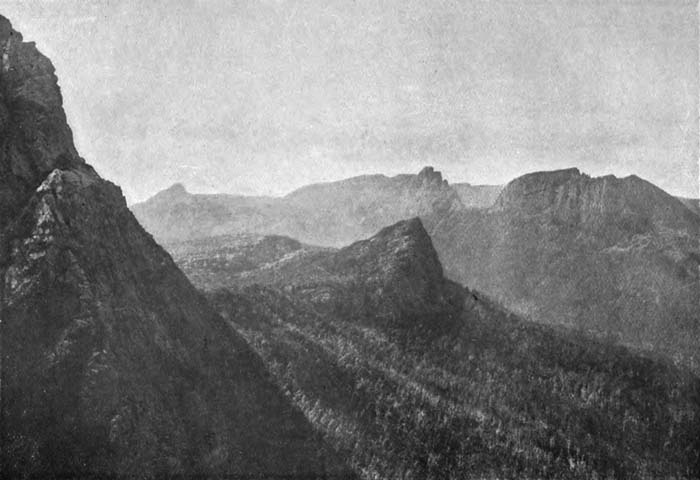
Photo. Spurling & Son, Launceston.
ON THE DU CANE RANGE.
[226]A little timidly she laid her soft palm against his cheek and drew his face close to her own. “My dear, dear Justin,” she murmured caressingly. “I can’t ever bear you to be sad—if you are I must comfort you.”
“Iris, your love is divine! And I shall never forget the bliss of resting in that dear place——” Again there was a break in his voice, and he buried his face on her shoulder.
Gently, without a word, she drew his head down to her soft, warm bosom, and pillowed it there as she had done the night before.
He drew a long, tremulous breath. “Iris—you are too good to me,” he said huskily.
“Not half as good as you are to me! Oh, Justin, think of your coming all this way to look for me—no one else in the world would have found me but you!”
“Sweetheart, I couldn’t possibly have done anything else, for if anything had happened to you——” she felt a shudder pass through him—“I should have gone mad, absolutely mad.”
For a moment her lips touched his hair.
He stirred immediately. “Darling, for Heaven’s sake, don’t waste a kiss like that!” He raised his face. “Let it be mine as well as yours.”
She drew back quickly. “I—I—didn’t think you—felt it,” she stammered confusedly.
“Of course I did—I felt it in every part of me—but let me take it and return it at once.” His upturned face still entreated her.
Very timidly, very shyly, she moved forward [227]and laid her lips against his, and then—the darkness receded, the cavern, the mountains, the past, the future—all were forgotten.
“Oh, Justin,” breathed Iris at last, “why have you made me love you like—this?”
“Iris, might I not ask you the same unanswerable question?” he said, steadying her trembling form with the steely strength of his arm.
They sat for some moments in stillness, Iris beside him, her slim form leaning against his, her head close to his. At last she said, in a voice faint with the sweetness overwhelming her: “I did not know that—love could be like this; is it a madness, or is it an invisible avalanche from some other colossal world sweeping over us? Justin, what is it?”
“I don’t know; only I am afraid if I don’t go out into the cool air for awhile I shall lose my head.”
“I thought it—was lost and—mine too—it felt like it.”
“No, not quite; but for your dear sake I must go away and get calm.”
“But you won’t go far, or leave me long?” she asked with a half-stifled sigh as he rose.
“No, dearest, I will come back very soon.”
As his shadowy form stooped through the aperture Iris covered her face with her hands and sat absolutely motionless. She did not know how long he was away, but when he stood before her again she was all at once aware that she was cold.
“Iris,” he was saying in quiet, tender tones, “you must rest now; you need a good sleep, for [228]there is a long walk before you to-morrow. Come over to this far corner, the wall is a little slanting there, so that you can almost lie down if you rest against it.” He helped her to her feet and felt the coldness of her hand. “Why, you are frozen—I am so sorry; you must put on my bluey.”
But she would not hear of it; he would be chilled if he stayed on the icy stones for the rest of the night without it, and she was absolutely final in her refusal.
“Very well,” he acquiesced after a good deal of argument, “I will put it on if you will share it with me; it is very large, big enough for both. I will lean against the slanting wall, and if you just come into my arms the coat will go round you too.”
“Are you comfy, darling?” he asked a minute later, when they were cosily settled against the rock.
“Yes, absolutely,” she breathed from the shelter of his arms, his coat enfolding her.
“Now you must go to sleep.”
“Are you going to sleep?”
“I am going to try.”
“Do you think you will?”
“I shall try hard; now you must not talk any more; close your dear eyes and go into dreamland till the morning.”
“Justin, you are very hard on me: I must neither talk nor listen.”
“Sweetheart, I don’t mean that,” he said with infinite gentleness; “only you are needing sleep after this hard day.”
[229]For a time she lay quite still, then she stirred restlessly.
“Not asleep yet?” he said quietly.
“No,” she replied. “Justin, couldn’t you relent just a little and—talk a while longer?”
“Iris, I mustn’t—don’t you understand?”
“Yes,” she sighed; “but—but you haven’t said good-night.”
He kissed her hair. “Good-night, my beautiful Iris-flower—good-night!”
“Good-night,” she said, a tinge of disappointment creeping into her tones in spite of her efforts to keep it out.
A great stillness settled around them; neither of them moved. His arms held her to him with a gentle tenderness. She closed her eyes and tried to sleep; but all the time she was confusedly conscious of his nearness, the touch of his tweed coat, his breathing and the not too tranquil beating of his heart.
“If only he would hold me a little differently—as he held me before; if only he had kissed me good-night properly,” thought Iris, as she made strenuous efforts to sleep; but now—oh, why did his closeness, his breathing, affect her in this perturbing way? Why did his heart beat in that strange manner, as if it longed to throb fiercely, madly, but was held in check by some restraining curb?
The dark silence was terrible as she listened to the fierce thumping of his heart. His breathing grew uneven and hard, and she felt herself tremble in response to the turmoil within him. Her throat tightened.
[230]“Justin, I can’t sleep, neither can you—won’t you talk to me?”
“I don’t think talking will make it any easier,” he replied in strange, shaking tones.
“It might.”
“Why can’t you sleep?” he asked suddenly.
“I suppose for the same reason that you can’t.”
There was a long, blinding silence.
“Oh, Justin—Justin—we cannot part—I simply could not endure it!” she sobbed.
His arms relaxed and he suddenly moaned aloud. “Darling, how can I make you my—wife? If I had worlds they should be yours; I would give you my life, myself, my all; there is no risk I would not run for you, no danger I would not face! But to drag you into humiliation and ruin, after all your amazing generosity and goodness—how could I do such a preposterously selfish thing? Besides, I love you; and that is——”
“But, dearest,” she entreated, her tears falling on his cheeks, “there would be no ruin and degradation; you will keep out of the way of danger and—there will never be any cause for unhappiness again.”
“How do you know?” he asked, as if his very soul was being rent.
The agony in his tones roused her from her own grief; she must comfort him immediately.
She thought a moment, then lifted her face and said, with a great, inspired tenderness: “Because my dear captive singer has been set free! He is no longer singing from the abyss of the caves; his voice came to me from the top of the mountains—he is there now.”
[231]He heaved a deep sigh. “Oh, Iris, if that could only be so!”
“It is so. My beloved singer is no longer in the caves, far away from freedom and gladness; he came to me to-night,” she went on in a soft, tremulous voice, “as a messenger from Heaven, and found me in my loneliness and sadness. Justin,” she added a little shyly, “don’t you believe in Heaven and in angels?”
“I have not thought much about those things,” he replied sadly, “till to-night, but now I know there is a—God.”
“What makes you know that now?”
“Because when I had almost given up all hope of finding you; when it was so dark that I could hardly stumble along and the clouds came down over the mountains; when I had come to the end of my own efforts and felt absolutely hopeless: then I remembered my talk with old Turner last evening.” He went on to tell her about their conversation and how it had led him to the place of hope and thence to the place of prayer; how he had prayed that he might find her, and that shortly afterwards he had been guided to her in the darkness.
Iris had listened breathlessly. Now she raised herself a little and said in very low tones: “But, Justin, if He can help you to find me—couldn’t He help you about—the other difficulty?”
Rees started slightly. “I suppose He could, but——”
“Then why not ask Him? He heard you before; that shows that He hears, and does as people ask.”
[232]“I wonder—would He? He did not help me before.”
“No, but perhaps you never asked Him, and it seems He only does things when He is asked—and in the right way.”
“Oh, Iris—if only He would! That would solve all our difficulties.”
“Yes, and when you are helped you could show old Mr. Turner and others how they can be helped too. Do ask Him,” she urged.
“But I feel so unworthy, so——” He raised himself a little, leaning sideways against the rock. “Iris,” he continued, with a new shyness in his voice, “won’t you ask Him for me?”
“Of course I will—I will keep on asking till He does it.”
“But—won’t you ask Him now? It seems as if prayers are heard quicker on mountains. I remember as a child my nurse telling me that Christ went up to the mountains to pray.”
“Yes,” she replied thoughtfully, “I believe He did.”
“Precious one, ask Him for me while we are here together.”
Her head sank down on his breast again. He felt her hands clasped round his neck as if she were lifting him in her arms as she offered the first real prayer of her life. He felt her quick breathing and the tension of her soul as she pleaded passionately for his great, burning need!
Presently her hold loosened. “He is going to do it,” she cried confidently. “I am sure He meant to do it ever since you sat out there in the dark and prayed so strongly for me—that [233]was so absolutely dear of you! It was then you were set free and became the heavenly messenger sent to save me; and, Justin,” she whispered with reverent adoration, “you will always be that heavenly messenger to me now, who came to help me in my need and saved my life——”
“It is the other way about,” he whispered huskily: “it was you who found me in the dark cave and came to lead me out. But, my own precious one, it must be very late, and you ought not to talk any more; you really must have some sleep—do you think you feel more like sleeping now?”
“Yes, I feel much better.”
Once more he folded her to his heart, kissed her long and tenderly; and gradually, as he soothingly stroked her hair, she sank into a soft sleep.
After a time Rees slept too, and did not waken till the first faint glimmer of dawn quivered in the East.
As he stirred, Iris moved too, and looked round in the dimness, wonderingly.
“Darling, don’t you remember where you are?” he said, pressing her to him gently.
“Am I really here with you, or is it only another dream?”
“No, it is not a dream this time,” and as she was going to speak he closed her lips with his own.
Iris was then suddenly conscious that her hair had come down; its thick, wavy masses billowed over her lover’s shoulder. “Oh, Justin,” she cried in dismay, “all my hairpins have fallen out!”
“Never mind, I will soon find them.”
[234]He lit a few matches, and gathered a handful from the ground.
“Is that all?” asked the girl in consternation.
“Yes, all that were on the ground—but I believe there are a few down my neck,” he remarked, with a happy smile on his face. Then, handing her a pocket comb, he added: “This is rather inadequate, but it may be a help to you”; and, with a caressing pressure, he left her; he was going to fill his lungs with the morning air and to take their bearings on the plateau. Presently she heard him singing joyously from the top of a rock outside.
A few moments afterwards they were on their way along the stony ridges towards the place of descent.
The great crags were deep blue as the sea, and, far below, the valleys lay wrapped in slumbrous shadows; while, above the awakening earth, the sky pulsated with saffron, carmine and pansy-purple splendour.
“How wonderful to see the world waking!” exclaimed Iris under her breath.
“Yes,” replied her companion, coming closer to her, “the sky is waking it with a—kiss.”
He gazed long and ardently at the girl beside him. The soft half-light of dawn seemed curiously to accentuate the loveliness of her face with its exquisite curves, its mobile, scarlet lips and the great starry eyes, now flashing like dusky jewels in the illumined dimness.
He caught his breath as he watched her.
The sun was just rising behind them, and as it crept above the far-away eastern hills a long shaft [235]of apricot-tinted light swept over the towering peaks, making them look like huge, ethereal portals leading to some celestial world.
“Those are the gates to the place where the angels live!” said Iris, a great, soft beauty shining in her lustrous eyes.
“Yes,” replied her lover with reverent tenderness, “and we came near those portals last night; this time we have spent together has brought us to—them.”
As they walked on amongst rocky crests skirting sombre ravines opening at their feet, like huge jaws ready to swallow them into their sepulchral throats, they passed a calm mountain lake lying submissively at the foot of a tall, imperious crag, mirroring its rocky, dauntless features in its adoring heart, every crevice, every outline, every touch of shadowy bloom liquefied, mellowed in the translucent silky waters.
“Iris, do you see how that peak is reflected in its every detail in the breast of that pool? How the lakelet seems to exist merely to mirror its every mood, its varying shadows? That is just as your image is stamped on my heart, blotting out all else, making it only exist to receive the imprint of your beauty, the shades of your every mood.”
“Justin, your heart is too beautiful to hold such a faulty picture,” she whispered, with a catch in her voice.
“My darling,” he murmured, tightening his arm about her, “you must not say that, for your dear image is the most lovely, the most inspiring thing this world holds!”
[236]He could not draw his eyes away from her. “Iris,” he continued, “do you know you are looking most radiant this morning—more radiant than I have ever seen you?”
“That is because I have been so long with—you,” she breathed, with downcast lashes. “Justin, it has been simply wonderful,” she added, glancing up at him for a moment.
“You have been really happy?”
“It has been—bliss!” she said tremulously.
He faced her, and drew her into his embrace. Her arms slipped about his neck, and she clung to him.
“Justin,” she whispered from his shoulder, “I shall never be able to exist without you, and the future will be—safe, for last night we found our way to those everlasting gates; we knocked for help, and no one who really finds those great portals knocks in vain.”
Captain Barton sat on the top of a ridge near the descending ravine, scanning the huge stretch of scenery before him with his excellent field-glasses. He had been smoking, but the cigarette had gone out though it was still between his lips. He had arrived at the foot of the mountains at dawn as arranged, and had at once commenced the steep climb, leaving breakfast baskets halfway up the track, for he expected Rees to turn up with Iris shortly, and, as it was not so steep at that part and there was plenty of wood, it would be a more comfortable place to light a fire and have a meal. In spite of his hatred of Rees he felt an unaccountable trust in the man, which made him expect that the driver would prove equal even to this dire emergency. Ralph was not aware of this trust, but it existed all the same and revealed itself in his decision to leave the substantial refreshment baskets on the lower slopes.
He had been on the top of the mountains for some time, looking expectantly around him, when suddenly through his binoculars he discovered two figures approaching the place of descent. They had evidently not the slightest idea that they were being observed, for the man had his arm round the [238]girl, and after walking a short distance they stood still, and came so close together that the exasperated watcher dropped his glasses with an oath.
The chauffeur, sitting a little distance away, looked up in amazement, for of course he had not seen the offending figures.
So this was how matters stood between them, thought the infuriated Ralph; this was how they had spent the long dark hours his stupidity had given them! He swore again and with such vehemence that his companion looked aghast. “My word,” he commented to himself, “thought I was a decent hand at the language myself, but this English toff beats me hollow!”
However, his perturbed master did not give him any more time for reflection, but ordered him to go down, light the fire immediately and get breakfast ready. The man started at once, while Captain Barton went to meet the others.
Breakfast might have been a rather distressing meal, but for the fact that Iris and Justin were so saturated with the deep joy the hours together had brought them, that nothing, not even Ralph’s sullen gloom, could mar their stupendous happiness. He had not seemed overjoyed at seeing Iris again, and he had certainly not expressed any enthusiastic gratitude to her rescuer.
When they arrived at the foot of the mountain Captain Barton ignored Rees entirely and did not even offer him a seat in the car.
“Are you sure the horse is all right, so that you can ride him?” asked Iris. “You had better [239]make certain before we go, and come with us if there is anything wrong.” She glanced at her lover with that new softness in her eyes that their time together had brought there.
He assured her the horse was all right; then, as the car began to move, their glances met in a lingering good-bye.
Ralph sat glum and cold all the way home; he spoke only at rare intervals, and then in the iciest tones. But Iris was glad to be able to lean back in the luxurious car, close her eyes and rest in her newly found bliss.
It was half-past eleven when they reached the township. Both Mrs. Henderson and Miss Smith were watching anxiously for the car, and Iris was more carried than led into the house, and bombarded with questions.
The girl had to give a lengthy account of her experiences, in which of course she carefully left out embarrassing details. But she dwelt with pride and undisguised exultation on the splendid way Rees had rescued her. She pictured to them the darkness, the vastness, the awful solitude amongst the lofty peaks and terrible chasms, and how good it was to be found at last.
“I am so thankful Mr. Rees discovered you fairly early last night,” said Mrs. Henderson, when she had Iris to herself in the girl’s room; “he really is a treasure! I nearly went mad thinking of you all alone up there in the cold and dark, and it was only the thought that somehow he would be sure to find you which kept me sane! He really is marvellous, he never fails one—I felt sure he would [240]find you. But, Iris,” she continued, her kind brown eyes brimming with fond banter, “you really are an awful fraud. I was tossing and turning all night—couldn’t get a wink of sleep, worrying over you and expecting you home to-day tired, exhausted and faint; but, instead of returning a complete wreck, you come back like a radiant young Diana—all my pity and sympathy have really been wasted! By the way, did you get any sleep at all? How did you pass all those dreadful hours?”
“Well, to begin with, we had an excellent supper, and then we talked and talked, and finally we both had a good sleep.”
“But you must have been dreadfully cold?”
“No, I wasn’t cold; we were in a cosy little cave, you know; and Mr. Rees insisted on sharing his bluey with me. But now, dear,” she said, rising and once more kissing her cousin, “I really must go and have a bath and dress; it will soon be lunch-time and I am starving.”
Mrs. Henderson sat for some time looking fixedly at the door through which the girl had disappeared.
“Iris doesn’t look like that for nothing,” she said to herself. “The first part of the experience was dreadful, no doubt, but the other—she looks happier than I have ever seen her. I believe that bluey is responsible for a good deal! Dear me! If I did not know Iris I should be scandalised. It’s obviously a really pure, genuine case—that’s what it is! I’m sure he is an honourable man, of good breeding; and I’d wager a winning horse to a pair of gloves that his blood is as blue as hers.”
[241]When she and Iris came down to the dining-room they found a stranger standing by their table with Ralph.
Captain Barton introduced the new-comer, and asked if he might join them at luncheon.
Mr. Stanwell was a middle-aged, well-preserved man, who had known Ralph three years ago in India, and had now unexpectedly come across him on the verandah while he was waiting for the gong to sound.
“Mr. Stanwell lives in one of the neighbouring townships and is a bank-manager there,” explained Ralph, as they took their seats at the small table.
Captain Barton was a little more talkative now, and the visitor proved a pleasant and interesting companion.
Ralph had already told him of Miss Dearn’s unfortunate experience on the mountains, but he had not thought it necessary to add that it was Rees who found her, and Mr. Stanwell had somehow received the impression that Ralph himself had been the brave rescuer.
When the exciting episode had been thoroughly discussed, and other general topics had been touched on, the bank-manager said after a short pause—
“I have come down to-day on business, and while I am here I am going to have a talk to Miss Smith on a matter I am afraid will rather pain her.” He glanced carefully round the room as if afraid some one might overhear his remarks, but the proprietress had just gone to the kitchen with some orders and there were no other guests present, so he went on: [242]“I want to speak to her about her driver—always thought him such a fine fellow, but the other night he was at our township and I saw him myself, absolutely incapable through liquor—even to kissing the barmaid, and——”
When he first began to mention her lover Iris had been looking out of the window in gentle abstraction and she had not realised that he was speaking of Justin till he had uttered that last awful sentence. Then the radiance suddenly faded from her face and an awful pallor crept over it, robbing even her lips of their scarlet beauty.
The effect on Ralph was equally striking, though it was of an entirely different nature. A vivid animation had come to his face, his eyes glistened and his hands moved in excited eagerness as he waited for the bank-manager to finish his remarks, and perhaps make even more gratifying revelations. Fate had at last been kind to him and with one stroke for ever spoilt his opponent’s chances. So the driver was a posing humbug, pretending to be a hero before the people there and going away to indulge in low debauches and vulgar intrigues. Ralph had kissed girls himself, even since he had fallen in love with Iris’s picture, but then he was not drunk when he did it, and the environment had been entirely different. Of course now both Iris and her cousin would drop the driver immediately, and not have anything more to do with him.
Mrs. Henderson had at first been too utterly astonished to think of anything but the ghastly news she had just heard; now she looked round at her companions and noticed the change in them.
[243]Mr. Stanwell had been looking at his plate while speaking, and was utterly unconscious of the effect his words had produced. He was going to finish his sentence when Miss Dearn suddenly interrupted him.
“Mr. Stanwell,” she began, looking at him with fine dignity, “before you go any farther I think it is only fair to tell you that Mr. Rees is a friend of ours—a great friend. We have been here quite a long time, and got to know him well, and he is the finest man I have ever met. I owe him a huge debt of gratitude, for it was he who saved my life last night. As for that unfortunate—accident at your township, he told me all about it directly he came back. He is deeply ashamed of it, and I am sure such a thing will never happen again! So I don’t think it necessary to mention the incident to Miss Smith or any one else.”
She was still white to the lips, but her clear eyes gazed with grand, dauntless courage at the man opposite to her, now leaning back in his chair very much disconcerted and ill at ease.
“I am awfully sorry, Miss Dearn; most awfully sorry,” he began apologetically; “hadn’t the least idea he was a friend of yours—wouldn’t have mentioned it for the world had I known! As you say, Mr. Rees is a splendid fellow, a man respected and liked by all; in fact, the people in the district simply worship him!”
During this conversation Ralph had turned livid, then red with rage; so, after all, this intervening stroke of fate would prove useless to advance his interests. Iris had known all the time, and yet—his face grew a darker red as he thought of the [244]figures the field-glasses had revealed to him that morning.
“I don’t agree with Miss Dearn that it is unnecessary to warn Miss Smith,” he said, with a wrathful gleam in his blue eyes. “She certainly ought to know the kind of man she is employing.”
“I think she is quite aware what a treasure she has in him—we all know and trust him accordingly,” said Iris, with freezing hauteur.
Miss Smith had just returned to the dining-room, and the little party lapsed into silence. Miss Dearn was the first to break the awkward pause, entirely changing the subject by asking the bank-manager what places he had visited in India, so keeping the conversation on impersonal topics till the end of the meal.
Iris stood at the sitting-room window and watched Mr. Stanwell drive away early in the afternoon. When he had said good-bye he apologised once more, and assured her he would never repeat the incident about the driver to any one again. Now she heard Ralph’s quick step along the corridor; he had turned the handle of the door, and the next moment he was in the room. She nerved herself for the inevitable interview.
“Iris,” he said, standing a little distance away from her and regarding her from under sullen half-closed lids, “what are you going to do about it?”
“What do you expect me to do?” she asked, without turning to him, her cool fingers playing carelessly with the cream tassel of the blind.
“It is your plain duty to give him up, of course; it is a disgrace to be friendly with a man like that; [245]you owe it to your mother and your friends to drop him immediately.”
“And what do I owe him?” she replied, turning inquiring, steady eyes upon him.
“Owe him indeed! What could you owe such a fellow?” exclaimed Ralph indignantly.
“I owe him more than I owe any one else in the world; I owe him—my life.”
“That is all nonsense——”
“Now look here, Ralph; I know what you are going to say and I want to spare you the trouble of saying it, because—it will be useless.”
“You mean you won’t give him up?”
“I most certainly do.” She met his angry gaze unflinchingly.
“Iris, you are on the brink of ruin and disgrace.”
“I will gladly face what you call ruin and disgrace for the man I—love,” she replied, with a sweep of her regal head.
“But, Iris, you surely could not love such a creature, who drinks and spoons with——”
She winced a little, then said with great decision: “I shall never love any one else.”
“But, Iris, you don’t mean to say that you are so infatuated that you will go to the length of—marrying him?” he asked incredulously, taking a step towards her.
“I will go to any length—any extreme that honour and love can carry me.”
“Iris!” There was exasperation in the word. She did not speak, so he continued: “But, Iris, I will not allow you to marry him; I will prevent it. You shall not ruin your beautiful young life over [246]a contemptible drunkard!” He made an excited gesture with his hands.
“Ralph, be careful what you say. I will not allow you or any one else to insult Mr. Rees in my presence.”
Her companion was completely losing his temper. “He is only a shameless blackguard playing the hero before you and going away to booze and make love to the lowest——”
“Ralph, I will not listen to you,” she said, with steely, flashing eyes.
“That is because you know I am speaking the truth,” he sneered.
“It is because the friend you are trying to blacken is the best, the noblest, man I have ever met,” she replied, with fine pride.
Captain Barton laughed an ugly laugh. “The best, the noblest, man you have ever met—good heavens, Iris! Do you call a fooling drunkard, kissing barmaids——”
The blue fire in her eyes silenced his unfinished gibe.
“Let us part friends, Ralph,” she said, making an effort to speak calmly. “I will try to believe you meant well, but we must part now.”
“Do you mean to say that you—want me to—leave?” he asked, turning livid again.
“After insulting my best friend you surely cannot do less. But I am willing to forgive you before you go.”
“Forgive me!” he mocked, turning to her fiercely. “Do you think I want your forgiveness? I’ll clear out at once, but mark my words: you shall [247]never be allowed to marry that infernal drunkard—I will see to that! I will——”
She measured him with a cold, haughty glance. “Ralph,” she began evenly, “you had better not try to injure him, because if it comes to that I believe you would suffer most.”
He laughed scornfully. “You need not be afraid. I shall not do anything like that, gentlemen do not lay hands on—grooms.”
With this parting shot he strode to the door, and as he touched the handle he turned round and looked at her with a spiteful gleam in his infuriated eyes as he said: “I may as well tell you before I go that I saw you this morning through my field-glasses, and you were—in his arms——”
He banged the door and was gone.
Ralph walked downstairs rapidly and told his chauffeur to get his things together and be ready to start for Launceston in an hour’s time. Then he went to the post office and sent a wire to Betty, after which he returned to his room and rammed his clothes into the neat leather suit-cases with savage haste.
When he left her, Iris went to her own rooms. She suddenly felt tired, and sank limply down on the bed. It had been a strenuous day, holding some very unpleasant hours. A shiver passed through her as she thought of what had taken place at lunch. If only she had not given way to that alluring abstraction she would have been able to prevent a full disclosure of poor Justin’s unfortunate experience; she would have given a great deal to have stopped the bank-manager blurting out [248]the bald facts in that merciless way, before her cousin and Ralph. However, she had prevented him from telling Miss Smith and any one else. She was glad Justin was so long in reaching the township and that Ralph was leaving immediately; he would not be pleasant to encounter just then, and, if he should come across her lover in his present mood, he would certainly make use of the information he had obtained and be odious and insulting. If only Ralph would start before Justin came back, so that he would be saved the horrible humiliation of his rival’s taunts! Ralph had been blustering and objectionable to her and had threatened to prevent her marriage with Rees. But how could he do this? She was not easily frightened. The worst he could do was to go home and give her mother an exaggerated account of what had taken place. She could imagine the highly coloured story he would concoct. Her mother would be horrified and send her frantic cables, perhaps come out and by force try to separate her from her lover. But she would be true to Justin at all costs; nothing should prevent that.
Her reflections were interrupted as Amy entered the room.
Iris suddenly decided to take her cousin into her full confidence. Mrs. Henderson had heard about Justin’s failing, and the revelation had been an awful shock to her. Now Iris decided to explain the extenuating circumstances; so, drawing her cousin down beside her, with her head resting on the firm, massive shoulders, she told her what Justin had confessed to her the night in the garden. She brought out how bravely he had resisted temptation [249]for years, and that it was the misery of seeing her daily with Ralph which had driven him away from his place of shelter, and that in his excited and despairing condition he was an easy prey to his old craving.
When the girl had finished, her cousin’s eyes were moist and her voice trembled a little as she said: “Poor, dear fellow, what a cross for him to bear—no wonder he has looked so sad at times! And he has struggled so bravely all these years; it was just cruel for Ralph to come and drive him into danger and temptation!” She wiped her eyes quickly.
“And Ralph actually asked me to give him up——”
“What did you say, dear?”
“I told him the honest truth, of course—that I loved Justin and would be true to him whatever happened.”
“And do you really mean to marry him?”
Mrs. Henderson felt a deep sigh pass through Iris’s slender form as she said in very low tones: “He will not marry me.”
Her cousin turned to her in horror. “Good gracious, Iris, you don’t mean to say that you’ve asked him?”
“Yes,” replied the girl, with grave candour, “I am afraid I have.”
Amy shook her head as she said in a troubled voice: “I always knew you would get it badly when you fell in love.”
“Do you think I have behaved very shockingly?”
“Your mother would think so; what a lovely story Ralph will tell her!”
[250]But Iris was gazing in abstracted seriousness into space, as the buzz of the departing car floated up to them from the road.
It was five o’clock that afternoon when Justin turned the corner which brought the township into view, and he saw the dark red car with luggage strapped on the back whirl away in a cloud of dust toward the junction. He was not altogether surprised. Captain Barton had shown a smouldering anger that morning which he felt sure would soon burst into flames. Rees was sorry there had evidently been an open rupture; all the same, he breathed a sigh of intense relief.
When Justin came in to dinner that evening the ladies were already in the room, and he hurried to their table to inquire how Iris felt after her mountain experience. From the door he noticed that she looked rather pale and tired, but as soon as she saw him a vivid flush mounted to her cheeks, and their eyes met in a quick, embracing glance.
“How late you are, Mr. Rees!” observed Mrs. Henderson, as soon as he had asked after her cousin and received her smiling reply. “Miss Smith expected you back much earlier.”
“Yes,” he answered, “I should have been here sooner, only the horse went lame and I had to walk nearly all the way home.”
“Any horse would go lame after the furious way you rode yesterday,” commented Amy. “It is a wonder you did not kill the poor animal and yourself too! But,” she added, her manner changing, “I simply don’t know how to thank you for finding Iris last night and looking after her so splendidly! I shall never forget your kindness. I don’t know what I should have done if it had not been for the comforting thought that you were up there on the mountains too, and I felt sure that somehow you [252]would be able to find her; if you had not been there I think I should have gone quite mad!”
“I was most deeply thankful to be there,” he replied, with profound solemnity, “and if I had not found Miss Dearn I think I should have lost my reason too.”
“You are a perfect dear,” said Mrs. Henderson, with undisguised enthusiasm. “And,” she went on, “now that Captain Barton has left us, we should both love it if you would come and sit at our table at meals.”
A happy light sprang into Justin’s grey eyes.
“Do you really mean that, Mrs. Henderson? You are far too good to me. I shall be simply delighted.”
A very enjoyable meal followed. Iris and Justin were ideally happy; to be together again, able to talk to one another, and drink deep of each other’s love, was a joy which brought a glow to their faces and a bright sparkle to their eyes.
When dinner was over Mrs. Henderson invited Rees to spend the evening in their private sitting-room.
There had been a cold change in the weather; clouds had gathered over the mountains and covered the sky with chilly, billowy masses.
Their room looked very cosy and inviting. A bright log fire burned on the open hearth and the light from the gas came through a crimson silk shade, tinting the warm flower-scented air with a rosy sheen.
“Ah, how cosy!” exclaimed the driver, with a deep glad note in his voice.
“Yes, it is very comfortable,” replied Mrs. [253]Henderson, taking up the paper and sitting down on a Chesterfield some distance away from the blaze.
Iris took a low chair close to the fire. She liked the warmth and glow from the flames, and, with a sense of happy languor, she sank back among the cushions Justin had piled behind her.
He stood on the hearthrug glancing round the changed apartment. It had never looked as it did now, till Iris and her cousin had taken possession of it. They had given it an atmosphere of well-being and comfort, of culture and luxury. He wondered vaguely what they had done to give it this air of delicious refinement. It was not merely due to the number of books, the profusion of soft-toned silk cushions they had brought to it; not only to the artistic rearrangement of the velvet moss-green furniture and the abundance of vases filled with fragrant roses; it was something above all these, yet showing itself through them, which dominated the rooms and brought to it a delicate perfumed breath from another world.
Justin glanced at Iris again and met her shining, smiling eyes. How radiant she looked, and how lovely as she lay luxuriously back in the low chair, the reflection of the fire playing caressingly over the satin texture of her skin, the crimson light behind her casting a red glow on the waves of her golden-brown hair.
Mrs. Henderson had been hidden behind the daily paper. Now she put it down and rose as she said: “I think I really must write some letters to-night; the English mail is going out to-morrow and I never can settle down to write in the daytime. [254]I am sure you two can entertain each other for a while.”
When Justin had closed the door behind her he came over to Iris, held out his hands, and, as she placed her own in his clasp, he drew her to her feet and for a few seconds stood gazing at her.
“Iris,” he said in a low voice, “is it really true?”
“True about—last night?” she faltered.
“Yes. I was thinking as I stood watching you if—it really could be true—it seems too beautiful!”
“I was wondering about that too,” she admitted, her fingers responding to the pressure of his.
“But it was true; you did sleep in my arms, your lovely head did rest on my breast, for look,” there was a strange smile in his eyes as he freed one of her hands, dived into an inner pocket and brought out a tortoise-shell, gold-mounted back comb. “Look,” he said, his eyes upon her face, “I found this when I left you early this morning, caught in a pocket.”
A pink flush spread over her face. “Was that really clinging to your coat pocket?” she said, slightly confused.
“Not the coat one. This one here.” And he touched his left breast.
“Oh, Justin!” Her confusion increased.
He folded her to him. “Never mind, dearest, don’t be distressed about it. But I am going to ask you if I may keep it, so that whenever I am in doubt about the reality of that sacred night, it will always assure me it was not a dream; and—” he added in lower tones, “I also want to keep it till I may have the right to remain with you always, and [255]as close to you as I was when this little comb fell out.”
He glanced down at her splendid young form pressed to his, the proud head bent to his shoulder, her lovely neck curved as if in unutterable surrender. Ah, the amazing wonder of it! Could this really be Iris Dearn, standing there, submissive, wholly yielding her charms to a poor driver, an insignificant nobody?
He suddenly bent down and kissed her neck, where little golden-brown curls stole over its snowy whiteness. He felt her thrill to his caress.
“Iris,” he murmured, “may I kiss that entrancing spot again?”
In response a pair of bewitching white arms crept over his shoulders and clasped him closer.
He returned the embrace. The room suddenly reeled with him. He could see nothing, be conscious of nothing but the soft silken texture under his lips.
She drew a long, quivering breath.
There were footsteps in the corridor.
“Sit down, Iris,” he said, putting her gently into a chair and taking another beside her.
The footsteps without passed their door.
Iris leant back against the cushions, closing her eyes in delicious languor, and resting one long, slim ankle across the other.
“Are you very tired?” asked Justin, bending over her anxiously. “I should not have kept you standing so long.”
She turned her head to him without opening her eyes, her lashes shadowing her paled cheeks. “Perhaps I am a little tired, but it is not that—only [256]to have you with me again,” she whispered in faint trailing tones, not finishing her sentence.
“I am afraid you are very tired after all you have been through, and this long, unpleasant day.”
She looked up at him quickly and the colour came back to her face again. Had Justin heard about the bank-manager’s visit, and all he had said—that horrible humiliation she wished to spare him? Her pulses quickened with sudden fear; could he have seen Ralph after all?
“How do you know it has been unpleasant?” she asked, trying to speak calmly.
“Well, as I saw Captain Barton leaving so suddenly, I knew there must have been a scene beforehand; he seemed on the verge of an outbreak this morning. I suppose the thought of our spending—all that time together, upset him. Still, it was very unreasonable of him to be angry, when he was really the cause of our being there.”
“No, it was not only that.”
“What was it, then?”
“He saw us through his field-glasses when I—when you——” The vermilion in her cheeks told him the rest.
“When you were in my—arms?”
“Yes,” she replied, evading his eyes; “of course that made him very angry; he tried to make me give you up; and when I wouldn’t, he was most unpleasant, so—I sent him away.”
“My poor little girl, how terrible for you to have to go through all that for me.”
She smiled at him tenderly. “I would go through much more than that for you.”
She closed her eyes again. There was no doubt [257]about it, she was very tired, and for some moments he sat watching her exquisite face with its adorable drooping lashes. He sighed as he thought how he had rested her the night before, and a great yearning shone from his anxious grey eyes.
“Iris, you are utterly exhausted,” he said, bending over her; “if only I could take you and hold you as I did last night, and soothe you off to sleep, you would wake up as rested and as radiant as you were this morning.”
The blue eyes opened for a moment and a look of intense longing came into them as they met his.
He drew a laboured breath. “Oh, Iris, why can’t we always be together?” he broke out vehemently. “Why should you have to do without all the comfort, the rest—all that my love could give you? I hate the hour I am barred from being with you; Iris, I want you all the time—don’t you understand? Don’t you know what it means to me to be without you? Iris, I do not want to be merely your lover; I want the tender, sacred privileges of a husband.” He had risen and stood by the fire, his eyes burning upon her face.
Now he suddenly turned, placed his arms upon the mantelpiece, his face on his sleeve, and Iris saw that his shoulders were moving in deep agitation.
She rose too—all her tiredness had vanished. How well she understood all he was going through!
She touched his shoulder gently; he stretched out one arm and clasped her to him without lifting his head.
“Justin,” she breathed, in quick sympathy, “I cannot bear you to suffer like this; you must not grieve! Don’t put your dear head there, come over [258]to the sofa and I will rest it near my heart.” And she led him to the Chesterfield and gently drew his head down to her gauzy shoulder.
“Now, Justin,” she continued, “I am going to say something to you I meant to say last night. I wanted to say it then, but—somehow I couldn’t. However, I am going to say it now. But I want you not to stir nor look at me while I am speaking; nor interrupt, but listen until I have quite, quite finished. I am going to give you all—no, don’t move; I have only just begun and you must keep quiet.”
She stroked the black hair tenderly till he was still again.
“I am going to fulfil your every wish, you darling boy; you shall have all you want, and I have a lovely plan for making us both ideally happy. You are not to do that hard work any more——No, I haven’t nearly finished yet, and you are not to say a word till I stop. You have been so brave about everything, and now your hardships must end. We shall have the dearest home near the mountains, where no—no danger can touch you. You must have a car, so that you can run into the township whenever you wish to, and help all your friends here; and——Now, Justin, didn’t I say you were not to attempt to look at me,” and she pressed his face back to the folds of her gown. Then she went on, in lower tones: “I am going to be all yours, myself and—all I have too. I am going to make everything over to you; I want you to have it. Then you will certainly have to provide for me! Oh, Justin, it will be simply adorable to be dependent on you! You will be generous to me, I know, and [259]not insist on my frocks lasting too many seasons; and, Justin, think how lovely it will be to have a home of our very own, and be always——”
Her lover had not stirred or tried to protest for some moments; he had been suspiciously quiet—so quiet that Iris lifted his face from her shoulder, and looked at it a little anxiously. It had grown very white; his lashes were moist, and so were his cheeks.
“Oh, darling!” she whispered, with deep concern, “have I hurt you? Do tell me! I did not mean to make you sad, I only wanted to make you happy—oh, so happy! You will allow me to do it, won’t you?”
He looked at her from behind the moist lashes, his grey eyes brimming with an overwhelming emotion. “Iris,” he said very unsteadily, “you are too wonderful, too touchingly sweet; I can’t tell you how I feel about your amazing suggestion, but——”
“No, no, Justin, there are to be no buts.”
He gazed at her in wistful adoration. “Dearest,” he began, “you shall build the house——” He stopped speaking, as if afraid of wounding her.
“And won’t you come and—live there, too?” she breathed a little anxiously.
“Yes, some day, when I have myself in hand——”
“That is now—remember how we knocked at the gate of the Angels’ Home last night! You will come, then, and let me do what I ask? Think how lovely it will be! We can spend our days together—go about and help all the people in the district; you will be able to give them lots of money, and I will take them great baskets of things! [260]Justin, you will let me carry out my plan, won’t you?”
The long black lashes shading the large grey eyes grew moister. “You blessed little girl! It is just like you to want to do things like that! When I am sure of myself, and if you will let me work, I will come to you—it will be bliss to come,” he said, with a break in his voice.
Her face dropped. “Won’t you come—the other way?”
“No, Iris, I cannot take your—money.”
“But, Justin, if I were poor and you rich, wouldn’t you want me to have yours?”
“Yes, of course—that would be a different thing.”
“I can’t see the difference.”
“That is only because you are so generous and good, and don’t want to.”
She sighed deeply. “If only you knew how much I wanted to do what I’ve told you!”
“Yes, I know, Iris, and to my dying day I shall never forget your loving offer!”
“But couldn’t you just take half?”
“No, my heart’s treasure; not that either.”
“Justin, you are horribly proud,” she said, with quivering lips.
He kissed the tremulous mouth. “I am dreadfully proud of you, if that is what you mean,” he said, with a not too steady smile; “and now tell me: when I am sure of myself, may I come to you then as your—husband?”
The lovely white arms stole about his neck again. “Yes,” she breathed, “I shall always be ready for you, waiting for you.”
[261]Footsteps came along the hall, and there was a sharp knock on the door.
Justin walked over and opened it. The little kitchen-maid had come up with a message from Miss Green saying her father had a very bad heart attack, and she would be glad if Mr. Rees could come and help her.
The girl went away and Justin came back to say good-bye to Iris. “Please let me come with you,” she said, “there might be lots of things I could do.”
“No, you are far too tired; I couldn’t allow you to stir.”
“But you are tired too.”
“Oh, I shall be all right; but, Iris,” he went on, “if you are still here when I come back, may I come in and say—good-night?”
“Of course—I will wait till you come.”
“No, you must not do that; I might be late, and you need a good sleep.”
She glanced down on the moss-green hearthrug as she said: “Justin, I want you to come and say good-night, and you know I can’t sleep if I’m—unhappy.”
Her eyes were still on the rug, so she did not see the expression on the face watching her; she only knew there was a perceptible pause; then a clinging arm lay for a moment round her shoulders, and a low voice said: “I will be sure to come to you, darling.” And he was gone.
After Rees had left the room Iris stood absolutely motionless by the fire, as if some magic spell was holding her. She was still there when Amy came up shortly afterwards to tell her she was going to bed. “I am too tired to write any more letters to-night,” she said, coming up to her cousin. “Mr. Rees came and told me he had been sent for by Miss Green. Poor man, they never can leave him one evening in peace, and he looked so happy here! I suppose he will be there for most of the night now. Iris, I am most awfully sleepy after not closing my eyes last night; I really must go to bed at once. Good-night, dear; don’t sit up late—I don’t know how you have kept awake all this time.”
“I shall go to bed as soon as ever I am really sleepy,” the girl said, smiling.
Her cousin kissed her affectionately and went off to her room.
When she had gone Iris sank into the chair she had used before, where the imprint of her slender form still rested on the cushions. How much there was to think about! How much had taken place during the last two days! What experiences she had passed through, and how her love for Justin had grown by leaps and bounds! She had [263]wondered about love before, been deeply perplexed at the blinding joy his arms brought her, the almost agonising rapture of his lips. The thought of her own helplessness had staggered her. But now she ceased to wonder. It was useless. She could only acquiesce in the forces placing her so completely in Justin’s power; after all, it was deliciously sweet to be so absolutely dominated by him. How completely he had conquered! Love had not only laid cords about her, chaining her; it had entered her inmost soul, vanquished every emotion, every thought; crept into every corner of her being, till the smallest nerve, veriest particle of tissue, was fused with its mighty glow! She had offered him herself and all she possessed. He had accepted herself, but he had refused the rest. A cloud passed over her face as she remembered this. However, it soon lightened; had he not said she might build the house? She would build it, and how beautiful it should be! She glanced round the room; this would be nothing to the cosiness with which she would surround him! How comfortable she would make him; how happy! What delicious meals she would always have ready for him!
All at once she remembered she knew nothing about housekeeping; and, in Australia, domestic arrangements were not as they were in London. But she would send for her maid she had left with Amy’s servants; she was a most capable woman, and between them they would soon manage to have everything as she wished. Justin’s home should be the most artistic, the most delightful and luxurious place money and refined taste could [264]make it! In such surroundings she would pour her love upon him and make up to him for all his sad, distressing past. He liked dainty, beautiful things; his hard life had not destroyed his fastidious taste; he was warm-hearted and loved the soft touch of clinging arms, cool, soothing hands playing through his hair; he should have all he cared for now.
Her face glowed with a splendid rapture as she looked into the flames.
He had refused to give up work, but she would have a very large orchard laid out; she loved orchards since she had seen the great stretches of fruit-trees in fertile Tasmanian valleys; it would be quite impossible for her to manage it herself; Justin would have to come to the rescue as he always did; he would have to stay at home and help her. She would see that the orchard was big enough to require that. He would never allow her to struggle with workmen, and, besides, dealing with them would occupy his time. Ah, yes, she would soon make life easier for him! How she looked forward to carrying out her plans and making up to him what he had missed in the sad, lonely years! His beautiful grey eyes should be filled with smiles and happy laughter; all melancholy should be chased from them. There would be no wanting and longing any more; she would give all he had asked for. She remembered what he had said that evening and all at once a fine blush suffused her face. She had never realised that the word “husband” could mean so much till she had heard him utter it that night. She knew now. She understood what it implied; the [265]privileges it would grant to the man she should call by this comprehensive, all-embracing name; privileges small, tender, close, large, great, stupendous! She stopped, and drew a tremulous breath; no, she could not think any farther; it was too overwhelming, too astounding! She could not even allow her thoughts to explore this region of intimacy. This inmost shrine should be closed against all intrusion till the time came when Justin was ready to enter it, taking her with him and locking the door behind them.
Then her mind turned to the unselfish way he had responded to the call from Miss Green. How good he was, how chivalrous, how tender! He had left her, given up their blissful evening, to go to a stuffy cottage and help with a fractious invalid. How bare and cheerless the rooms had been on her first visit there; but since then many things, bringing comfort and brightness, had found their way to the gloomy home. The Greens had learned to love her almost as much as they honoured and loved Justin. Their eyes brightened when they saw her pass or come in to talk and read to the sad-faced sufferer. She meant to do much more for them, would have gladly done it all, at once, but she was afraid of embarrassing them with too many gifts till they knew her better.
Suddenly the glow died out of her cheeks as she remembered something Justin had told her on their way home from the moonlit garden. When Mr. Green had heart attacks he was always given brandy, and her lover had sorrowfully confessed what it meant to him, sitting in a small room tainted with the odour of spirits.
[266]While she sat cosily by the fire, was her dear, splendid Justin fighting with that relentless foe which had threatened to ruin his life?
She could not endure the thought! How was she to help him? Then the cavern where they had spent the previous night came before her: the great, brooding darkness, Justin encircled by her arms, while she prayed desperately that he might be delivered from his cruel enemy. She had promised to pray till the answer came; there had been no quiet during the day, but she could pray now. And she did.
She knelt by the big, velvet armchair where her lover had been sitting. Her lover’s need was imperative; might he not even at this moment be engaged in a death struggle with the foe which had conquered him times without number?
Iris prayed till her whole being quivered with the intensity of her ardent petition. She did not know how long she was on her knees, nor did she hear a soft knock, the gentle opening and shutting of the door, and the quiet footsteps of her lover. He stood by the fire gazing at her superb young form kneeling by the dark chair where he had been sitting, her head lifted, her upturned profile white with intensity and passion, sensitive nostrils dilating, mobile lips quivering, the delicate hands tightly clasped. Her face seemed luminous with a light shining from within, and her entreating figure was bathed in the roseate light pouring through the crimson shade.
Involuntarily Justin started, and drew a sharp breath.
[267]She heard him, turned and looked up at him, the unearthly radiance still shining in her starry eyes. Then a quick smile parted her lips and she rose blushingly. The man on the hearthrug stood spellbound. “Iris—Iris!” he murmured.
She came up and laid her hand gently on his sleeve without speaking.
“Iris, were you—praying for—me?” he said huskily.
“Of course,” she replied with sweet candour.
“So it was your prayers that worked—the miracle.”
“Was there a miracle?” she asked eagerly.
“The—the—temptation has—lost its power! It was in that little room to-night—Mr. Green had a larger dose of spirits than usual and—the odour was terrible—to me. I was dreading going into the house because I was tired, and that always makes it harder to—resist. But, though the fumes and their associations were so strong that they would have saturated and nearly maddened me another time, this evening they had no power. I felt them, but somehow they did not seem to penetrate right into me as they have always done before. They seemed to remain outside, as if some great power had barred the door to my senses and shut them completely out. Oh, Iris!” He stopped abruptly, turning his face away.
She caught his hands and pressed them to her heart. “Justin,” she whispered with deep emotion “isn’t it lovely?”
“Iris, it is wonderful, and your prayers have done it!” There was dewy splendour in the grey eyes as they turned to her now.
[268]“God did it,” she said, with sweet simplicity. “He alone is wonderful, Justin; He helps people when He will; and who are we, to question Him when and why He does not?”
He drew her down on the sofa and for some time they sat talking in reverent, hushed tones about things sacred, things spiritual, which had suddenly become absorbingly interesting to them. They talked about God, His wonderful goodness in listening to their prayers and His great power to answer them. They spoke of their own carelessness in having entirely disregarded Him before; they made many plans about the future, how they could show Him their gratitude, learn to please Him and live the kind of lives He meant them to live. They made up their minds that in the future they would specially seek out those who were struggling and suffering as Justin had struggled and suffered, and make them understand there was hope even for them. God was waiting to help every one; He could aid all.
Though Justin was sure that victory was his at last, all the same he felt that he ought to test himself thoroughly before linking Iris’s life to his own; so he decided to go to town for a month and there, amid temptation, prove he could safely live an ordinary life again. Iris objected strongly at first, but after a time she gave in, as she thought it would make her lover’s mind easier if he had undergone this severe test.
They sat talking, the fair head close to the black one, cheek often pressing cheek, fingers entwined.
“And now, Iris,” said Justin, “I want you to promise me something. If I keep quite all right [269]in town, will you marry me as soon as ever I come back?”
The girl lowered her head to his firm, strong shoulder. “Oh, Justin, I should love to,” she whispered with fluttering breath.
“You would really?” he asked happily, drawing her closer.
“You know I would.”
“I am going to have a good talk to your cousin to-morrow, and, if she thinks it is fair to you, we shall be married as soon as I return.”
She raised her face once more to his. “Justin,” she said, a deep devotion shining in her eyes, “you have made me happy beyond this world. My love for you has enabled me to win to the Golden Gates, and every step onwards can only be taken in the strength of that love.”
He sat gazing at her, his face aglow with adoration. “Dearest one, then your love will draw me there too—I shall be with you on the Golden Road.”
“Yes,” she said, her face illumined by the light of her pure soul. “We shall walk there for the rest of our lives together till we win right to the dwelling-place of God.”
“May it be so!” said Justin in very low tones. “And, Iris, do you realise that this is our betrothal night? It has begun on the shining road.”
“Yes,” she said, pressing closer to him, “from to-night we are each other’s and—His.”
A few minutes later two figures knelt in the soft, roseate light; they were clinging to each other, but their souls were turned towards—God, the Giver of Love.
Iris sat beside Turner in his small, tidy cabin. The old drunkard was ill; he had sent for Rees, but as the driver was away Iris and her cousin had come instead, bringing with them a large basket of good things. The patient had just been given a big basin of hot, delicious chicken broth they had brought in the thermos. The old man was feeling refreshed and lay back in his clean, though rather crumpled-looking, bunk.
Mrs. Henderson had brought some flowers from the garden and placed them in a bowl on the table; now she sat by the little window looking out on the small gate on the outside of which the drunkard had years ago painted the pathetic word “Hope.” It was still plainly visible, though the paint had peeled off in places. The man living behind its shelter seemed doomed; he had never risen above his craving; it had always bested him, even in this secluded spot, when men had been to neighbouring townships and brought the noxious liquor to his door. But, in spite of a lifetime of failure, he still clung almost tenaciously to the small word on his wooden gate.
He watched Miss Dearn with wonder and admiration. Never had a girl of her type been [271]in his little hut before. Her beauty, her air of refinement and breeding, her simple naturalness, appealed to him. How easy it was to talk to her in spite of the unconscious grandeur emanating from her. She had crossed his threshold, introduced her cousin and herself, talked to him, given him soup, smoothed his pillow, as if she had known him for years and been in the habit of visiting such cabins, sitting on such hard wooden chairs, all her life.
While she talked to him now, she was making mental notes of all this little home needed to make it comfortable for the white-haired owner. It must have some carpet, two cosy chairs, new warm blankets, and many other things. She would go to the shop on her way home and order them and have the things procurable in the township sent up at once.
“When will Mr. Rees be back?” inquired Turner during the conversation.
“I think it will be a fortnight before he returns,” replied Iris. “He will be so sorry to know you are ill, but I will tell him we are trying to look after you in his absence.”
“You will write to him, then?”
“Yes,” replied the girl, the pink in her cheeks increasing a little.
“Give the dear lad my love when you do.” A great, soft lustre came into his pale brown eyes as he continued: “That’s a fine fellow, if ever there was one! I don’t know what we should do in this district without him—there is hardly a family he hasn’t helped in some way. He has saved my life twice: the other week when my [272]horse bolted and a year ago when I was bad after a spell——” He looked shamefacedly down on the worn, threadbare quilt as he went on: “I dare say you know I have these—spells—been the curse of my life, broke my old mother’s heart, bless her!” He looked up again. “Ah, I did have a mother any boy could be proud of, but I——” He stopped and wiped his misty eyes with a crumpled red handkerchief. “It was the sorrow of her life that I should have these here spells. Many times she went on her knees begging me to give them up, but”—he shook his white head—“may I be kept from them awhile, but all unexpectedly the old feeling came back, and then I simply couldn’t resist.”
A tender light illumined the girl’s beautiful face as she said softly, “I notice you have ‘Hope’ written on your gate.”
“Yes,” he said in quavering tones, “I painted it on there because—it was hard to keep up heart when I felt it was no use, that help would never come my way; then I went out on the road and stood looking at that little word, and I remembered my mother’s prayers—ah! they were prayers, prayers with tears in them, prayers that seemed to bleed her heart; she prayed for her poor drunken boy like that.”
“Those prayers will be answered yet,” whispered Iris, laying her smooth white hand on the old wrinkled one.
He looked up at her and smiled through tears. “You think so—you don’t think it is too late?”
“No, it is not too late,” said the girl with profound conviction. “Prayers like that must be [273]answered; it could not be otherwise. I have a friend,” she continued in a different voice, “who had a—failing like yours—it mastered him for years, but suddenly he was cured; some one began praying for him, prayers with tears and—heart-blood in them, as you say, and—he was cured. The awful craving left him and he has never had it again.”
“Was it his mother that prayed for him?” asked the old man with deep interest.
“No,” said Miss Dearn very gently, looking down on the rough, carpetless floor; “it was not his mother.”
“Really—I didn’t know any one else could love a man enough to pray for him like that.”
“Sometimes another woman can love strongly enough for that,” Iris replied, still not looking up.
The gaunt form of the drunkard moved a little closer to her. “I beg your pardon if I am too bold—just tell me if I am—but I should so like to know: was it—you who prayed like that?”
A delicate flush crept over the girl’s fair face. “Yes,” she said very quietly, “it was.”
“And you say he is quite, quite cured?”
“Yes,” she answered, meeting his faded, eager eyes, “the craving has left him; he can go near even hotels and—and—not feel the least tempted to—go in.”
“That is marvellous!” He moved to the very edge of the bed and began to fidget with the dilapidated fringe on the quilt. “Miss Dearn,” he said falteringly, “my mother has been dead many years, but no doubt she is praying in Heaven for her poor, degraded boy; only it seems so far [274]away and—it would be so nice to have some one praying for me down here on earth—I have no one to do that for me now—I wonder would it be too much if I asked you to—pray for me as you prayed for—your friend?” His withered, freckled hands still moved nervously on the edge of the counterpane.
Iris suddenly imprisoned one of the hard hands between her dainty, slim ones. “Of course it is not! I should just love to help you and see you quite cured too,” she replied with a radiant smile.
The old man looked up at her with a new light in his eyes; it seemed as if Hope, so long brooding over his gate, had leapt into his soul at last.
“Then you will?”
“Yes, I will!”
“Iris,” said Mrs. Henderson on their way home, “the sweet way you talked to that old man just broke me up; I couldn’t say a word, but simply had to sit and listen to you; and, if I had not known for a certainty that it was you, I should have felt sure it was some Celestial Being from another world coming straight from the Presence of God. Your prayer will be answered—I know it will! Iris,” she continued huskily, “I can understand how Justin was cured, now.”
The Earl of Strathfell’s luxurious limousine had just stopped before Lady Dearn’s big mansion in Park Lane. The owner got out of the car and made his way with graceful dignity up the easy flight of granite steps. He was a tall, erect man with an imposing figure, a proud handsome face, thickly waving white hair and large grey eyes. His clothes were immaculate, from his silk hat to his perfectly shaped boots.
He pressed the bell deliberately. The door opened, and, when he asked to see Lady Dearn, a footman in purple uniform told him that her ladyship was “not at home.”
But Lord Strathfell was not easily turned away. He took out his card, wrote a few words on it and handed it with a sovereign to the expressionless servant as he said, “Kindly take my card to Lady Dearn at once.”
The man ushered him into a small reception room and disappeared. He returned some minutes afterwards and said that her ladyship would see him; then he led the visitor upstairs to one of the large drawing-rooms.
[276]The earl took an armchair, though not a low one—he hated low chairs—then looked about him absently. It was a white and gold room, sumptuously furnished, containing priceless statues and pictures. But his experienced eye did not enjoy the great works of Art surrounding him; he was impatient for the door to open and the interview he desired to begin. At last there was the soft rustle of silk, and Lady Dearn entered.
Lord Strathfell rose and a look of surprise came for a moment into his fine grey eyes as he saw his hostess. She approached him with head slightly bent; her eyes were swollen with weeping and she was still clutching a small lace handkerchief convulsively.
“I would not have seen any one else to-day but you,” she began in trembling tones, “and not even you unless you had urged it. I have had an awful blow this morning—I am in terrible trouble—it is about—Iris.” She sank into an easy chair, rested her elbow on its arm and shaded her eyes with her white, well-formed hand.
“Is she ill?” asked her guest with deep concern.
“Oh no!” Lady Dearn replied, waving the inquiry impatiently aside. “Iris is never ill, I don’t think she could be if she tried.”
The earl looked distinctly relieved, the girl was a great favourite of his. “Ah, I am glad of that!”
“But the other thing is far, far worse—it is absolutely appalling! To think a child of mine could have sunk so—low,” and she dabbed the fragment of linen and lace against her eyes.
“I cannot imagine Miss Iris doing anything—very [277]dreadful,” said Lord Strathfell, filling up an awkward pause.
“Yes, it is so unexpected, and it has all come through her going to that awful country; she ought never to have been allowed to go in the first place.”
“I thought Australia was rather a fine place.”
“Oh, I daresay the place is all right; but it is the atmosphere, people are so lax out there—it is most deteriorating to pride and morals.”
“Morals?” queried her handsome guest. “You don’t mean to insinuate that Miss Iris’s fault lies in that direction?”
The distracted mother began to weep again. “Ah, my poor wayward child,” she almost moaned, “if only I could be there beside you and save you from that awful fate! Isn’t it ghastly?” she continued turning to her companion. “It takes six weeks to get there—of course I shall have to catch the next boat, but even then I may be too late—ah, too late!”
“I don’t quite understand,” said Lord Strathfell, his smooth brows puckering slightly. “Has your lovely daughter done anything really——?”
“Yes, a most shocking thing—I hardly like to tell you about it; but I suppose you will be sure to hear of it later on, so you might as well be told now—I must try to get used to the idea of it,” she wailed piteously.
“If I could be of any help—the least assistance——”
“No, no; thank you all the same, but you cannot do anything; no one can.”
“Is it really as bad as that? Dear me!”
[278]“Yes, Iris has fallen in love with a—a—groom,” she said in the same horror-struck tones she would have used if she had been announcing that her daughter had committed a murder.
“Oh, surely——” began Lord Strathfell.
“I assure you it is true. The man is a common groom, employed by the proprietress of the boarding-house where Iris and her cousin have been staying, and the foolish child has fallen most violently in love with him—and she is actually going to—marry the awful creature! Think of it, my daughter, who has had the most brilliant offers, to sink so low as to marry a common—groom! I shall never have a peaceful moment again, never hold up my head any more; it is too terrible, too dreadful—a disgrace! I am glad her poor father did not live to see this day; it would have killed him if he had, for in spite of his gentle, kind ways he was a very proud man; he could never have endured such a disaster to his favourite daughter! And my poor child—think what a life she will have with such a man! Of course he is only marrying her for her position and money.”
“I should have thought Miss Iris was quite attractive enough to make any man want to marry her for herself,” observed the earl sententiously.
Lady Dearn shrugged her shoulders impatiently. “That sort of man would not have taste enough to appreciate Iris’s beauty. Any pink-and-white dairymaid would have done as well. I tell you he is a designing villain, an unscrupulous impostor, who has taken advantage of my child’s inexperience and waywardness. I had a long letter from Captain Barton this morning telling me all [279]about it; he went out there for part of his furlough, you know.”
“I suppose he went out to marry Iris himself,” commented the earl dryly.
“Yes—he did wish to marry her—if only she had accepted him—instead of this common man.”
“But the—man might not be so bad after all; he might even turn out to be a—gentleman.”
“A gentleman!” sniffed Lady Dearn. “He is a dreadful creature of the most vulgar type! Captain Barton writes of an awful scene in a common bar, where the man was disgustingly intoxicated—kissing the barmaid! I believe Ralph had to drag him out and put him to bed.” Lady Dearn shuddered. “Think of Iris falling in love with such a low creature—I can’t make it out—a child of mine to have such depraved tastes—it is the influence of that country with its careless laxity.” The distraught mother wept afresh.
Lord Strathfell sat looking down on the rich pattern of the luxurious carpet. Kissing a barmaid! What an awful crime! Really! But perhaps in Australia things were different. He rubbed his smooth cheek once or twice. “I am sorry about that—very sorry. Still the young people have not done anything along the lines—you indicated. As far as I can see they have only fallen a—little hotly in love with each other.”
“As far as you can see! Why, you don’t know anything about it—I haven’t told you half! But I suppose I might as well let you know all—such scandal soon leaks out; I tell you Iris has behaved most disgracefully, most shockingly! They have spent afternoons together in dark caves, terribly [280]wet places where you prowl about under hills and what not; think of my daughter in that awful blackness for hours together with such a man! However she comes to like these things is past my comprehension! And they have had secret meetings in lanes at night, and——” Lady Dearn’s voice lowered to a horrified whisper, “and Captain Barton writes of some trip to the mountains where he saw the man, with his arms round Iris, actually—kissing her! He is a double-dyed villain, and Iris must be mad. Whatever is a mother to do with such a daughter?” She closed her eyes and made a despairing little gesture.
“I tell you what you can do, Lady Dearn; let her—marry him!”
His hostess sat up quickly. “Let her marry the impostor, the villain, the groom—never! Lord Strathfell, how can you suggest such a thing? I am going out by the next boat, and, even if they are married, if there is any law or any kind of force which can separate them, they shall be dragged apart!” She said it with a cold glitter in her china-blue eyes.
When Lady Dearn first began to confide the cause of her trouble to her friend, a curious expression had come into Lord Strathfell’s handsome features, but it had only remained a few moments and afterwards his face had become as inscrutable as ever. Now, however, the odd expression returned while he said, in very even distinct tones: “Lady Dearn, I have come to—plead the cause of—of—that young man——”
His companion looked up quickly.
“The groom?” she inquired incredulously.
[281]“Yes—for he is my—son.”
Lady Dearn’s red-rimmed eyes opened wide in amazement. “The groom, the villain, the impostor—your son?”
“The groom if you like, though I believe his real position is that of guide and driver; but villain and impostor—never!” The earl drew himself up as he spoke. “Justin has been wild and done most foolish things, but I know he has never done a mean or dishonourable one——”
“But I don’t understand,” interrupted Lady Dearn, who was not interested in the ethical side of his nature. “Do you mean to say Mr. Rees, as Ralph calls him, is really your son? How——”
“My dear Lady Dearn, don’t you remember my second son, Justin, went to Australia a few years ago, and the painful circumstances which led to the—exile?” Lord Strathfell lowered his eyes to the rich Axminster carpet for a few seconds before continuing. “I had requested him never to use his own name, so he called himself Rees. I wanted to make him an allowance when he went away, but he refused to take it as I wouldn’t allow him to use his own name, so he had to work when he reached Tasmania. Miss Smith, the boarding-house proprietress, needed a driver and guide, and he took the post.”
So the man was no common groom after all, but a son of one of England’s most distinguished peers! And now Lady Dearn remembered that the eldest son had died six months ago, so Justin would be the heir, come in for the titles and all the estates, and, if father and son were reconciled, as they seemed on the point of being just now, [282]he would inherit the earl’s enormous private fortune as well. Suddenly things had taken an entirely different aspect. The groom Ralph had written about so slightingly, so contemptuously, was turning out to be a fairy prince in disguise; one of the best matches in the land! He had been a little wild, and, if Captain Barton could be believed, he was evidently a little wild still; but then, what was that? What young man had not his little deviations from the straight path? It was only natural; poor, dear fellow, shut away in exile—no wonder he might be a little—indiscreet!
But how appalling of Ralph to give her the impression that Justin was a common groom! And she had been speaking about him to the proud earl in the most depreciating terms; he might easily become offended, and all through Ralph’s annoying bungling! She would drop the soldier in future; he should never be invited to her home again. She thought of all this as Lord Strathfell explained the situation to her more fully. He had heard from Justin a fortnight ago, telling him how Iris and he had met, that they had fallen in love with each other, but that of course it was impossible for him to ask her to marry him under the circumstances. However, he wanted to tell her his real identity and asked his father to allow him to do so. Justin told him how he had spent his time during the last three years, and how he had kept his failing in abeyance by living by the lonely mountains, far away from temptation. The earl had received another letter from him that morning telling him of his fall during his visit to a neighbouring township. Ralph had arrived. [283]Justin had thought that Captain Barton, being more fortunately situated, might make Iris happy, so had withdrawn to give him a fair chance of winning her. But he could not endure seeing them constantly together, and, while he was away, the fall had taken place. He had gone back and told Iris about the lapse; she had forgiven him in the most angelic way, and—well, they had discovered they could not live without each other.
“Now if you will give your consent to their marriage,” went on the earl, “I am going to cable to Justin that he can disclose his identity, come back and live at Strathfell Court and I will allow him £10,000 a year and all shall be right between us. As Strathfell Court is in the country, he can live there as quietly as where he is at present—if that should be necessary; but I have no fear at all about his future if Iris becomes his wife. I want to cable to-day, but came to see you first to ask for your consent to their marriage; if you will give it, perhaps you yourself will send a cable to Iris and tell her so?”
Lady Dearn had quite recovered from her weeping. “Yes, certainly—if—he is your son, of course, I most gladly give the young people my blessing,” she beamed in her most gracious way.
“And you will not be angry with Iris any more—quite forgive her, in fact?”
“I suppose I shall have to,” Lady Dearn smiled again; “though the dear child really has behaved very badly. I am afraid she is most unbecomingly, most shockingly in love with your son.”
“If only more women loved their husbands like [284]that, men would be a happier race,” commented the earl. “But,” he continued, rising, “I must not detain you any longer. I am going to send my cable at once—may I take yours for Iris at the same time? It would be nice if they received them simultaneously, don’t you think?”
Lady Dearn heartily agreed.
She went over to a small inlaid writing table, wrote out her message, then handed it to her companion to read. “Will that do?” she asked with her most winning smile.
“Yes, splendidly! Now our young people will be happy.”
Half-an-hour afterwards both telegrams had been despatched to Australia.
On his way home the Earl of Strathfell leant comfortably back in his magnificent car, and there was a glad light in his handsome grey eyes as he looked out unseeingly on the noisy traffic-laden streets.
Autumn had made its colorous advance in Tasmania, scattering vermilion and coppery tints into gardens, orchards, and along mirroring streams shadowed by graceful, weeping willows and glistening poplars. It had dropped fleecy clouds into brooding valleys and trailed long ribbons of mist on the electric-blue hills.
Iris was sitting in the little creeper-covered summer-house at the lower end of the garden, waiting for Justin. He had returned the night before, but she had only seen him then for a little while; now he was coming for a long talk.
She sat gazing at the mountains and saw their bold rocky forms framed by the doorway, where yellow vines hung motionless in the still morning air.
Justin was home again! He was coming to her shortly, and then—a stupendous joy would be hers; it was on the point of pouring itself into her life! She sat quite still, waiting—waiting till the huge tidal wave of bliss should roll in upon her and carry her far, far out to sea, to the unmeasured deeps of a fathomless rapture.
She glanced through the doorway again. The great ecstasy was coming to her in this ideal place—it had given her—Justin! Tasmania had brought [286]them to each other and was now on the point of linking their lives together with the sweetest chain in the world. How appropriate that they should have met in this romantic island, with its great wild beauty of dense tangled bush, cornflower-blue hills, lofty mountains lifting bold undaunted crags into azure skies; with its wondrous caves, its immense solitudes, its untamed loneliness, its deep melancholy; its riotous, exuberant sunshine: Tasmania with its flaming sunsets and pearly dawns, its violet-hued twilights, its tall majestic trees and green-matted undergrowth; its weird animals and lovely birds: this island with its many moods, sometimes silent, brooding, reflecting, profound; at others smiling, dazzling, laughing; some days tender, exquisitely yielding; on others, convulsed with passion, impetuous, ungoverned; but always beautiful, always alluring in its bewildering waywardness!
There were light, quick steps on the path leading to the summer-house.
A rich colour suffused the fair face of the girl waiting there. Justin was coming! She rose, a strange, glad confusion numbing her senses. She knew what he had come to say. He was at the doorway; for a second she saw him under the trailing yellow vines; she noticed the detail of his new navy-blue suit. Then she took a step towards him, would have taken another and been clasped by his arms, but a curious look of suppressed excitement in his face arrested her movement.
He held out an envelope to her. “This wire has just come; you had better open it at once,” he said with forced calmness.
[287]The bright flush on Iris’s cheek subsided a little. A wire—who could it be from—surely only from her mother. Ralph could be in London by this time; he would have gone to her mother and told his own story. He would not spare her; she could expect no mercy from him; and, if he had not gone to England, he would have written, which would be just as bad. Perhaps her mother was so upset that she was coming out immediately and had cabled to say so.
She sank down on a low chair, tore open the envelope and read hastily. Rees watched her with an odd expression in his grey eyes. He saw her smooth brow pucker as she evidently read the message again and again.
At last she allowed the paper to drop to her knees. “Really,” she said at last, “I think my good mother must have taken leave of her intelligence! Look at that!” And she passed him the telegram.
He read:—
“Heartiest congratulations on your engagement to Lord Lennox have wedding in London fondest love.
“Your Mother.”
Her lover kept his eyes on the cable for a long time; if he had lifted them from the paper, Iris would have seen a very bright twinkle under the long lashes.
“Well,” she said a little impatiently at length, “I suppose you can’t make any sense of it either; whatever can it mean?”
[288]“Oh, the meaning is clear enough; there is no mistaking that. Your mother wants to let you know that she quite approves of your engagement to Lord Lennox.”
“But, Justin, how utterly foolish——” she stopped and began to think again. Was this her mother’s method of dealing with her after hearing Ralph’s story? Instead of coming herself was she sending this new man and indicating that she commanded her to marry him? That after the episode with the driver (Ralph was sure to have made a sensational story of it) she was to pay the penalty of marrying this man to avoid open scandal and disgrace—was this her mother’s scheme? How unwise she had been not to have written by the same mail and explained that she really loved Justin and would not marry any one else! She had written since, of course, but her mother would not receive that letter till a week later. It was the only mail she had missed; in her excitement and perplexity that week she had not written. It was a great pity and the result might be that she would have another man landed on her hands. It was really most appalling! A cloud of vexation swept over her face. “I suppose mother has seen Ralph by this time,” she said, thinking aloud, “and this is her way of dealing with me. I expect this man will be arriving presently. But,” she continued in a different tone, “I will have nothing to do with him—I shall not even see him!”
“Would you really object to becoming Lady Lennox instead of simply—Mrs. Rees?”
She looked up into his smiling eyes with a hurt look in her own. “Justin—how can you say such [289]a thing even in fun—I hate jokes of that kind!” she said straightening a little; then she looked away and added, the perplexity coming back to her voice: “But I really can’t understand this, for, now when I come to think of it, I don’t know the man—that is, I believe I met him years ago when I was still in the schoolroom; but I remember he was delicate, and I think he has been in the south of France ever since.”
“That was the elder brother, but he died six months ago, and the second son has taken his place.”
“Is he really dead? I didn’t know, I haven’t read half the papers mother sends out. So it is the second son; that is worse—he was the wild one, wasn’t he? So that is the kind of man mother wants me to marry!”
Justin winced a little; then he said, the odd expression on his face deepening: “Yes, he was rather wild; but he has been trying to mend his ways——”
Iris stopped him with a look. “You plead his cause well,” she said coldly, her face as white as marble.
“Naturally, seeing that you have already done him the honour of promising to become his wife.”
Iris had suddenly risen. She took an uncertain step towards him. “Justin,” she began, amazement, indignation and scorn in her tones, “you don’t mean to say——” But his face told her something. The indignation gave place to incredulity; and then, slowly, the lovely colour mantled to her cheeks and swept away the scorn. “Justin!” she pleaded now, “Do you mean to say—that—you are——”
[290]“Yes, Sweetheart. That is just what I was trying to tell you.”
“You are—Lord Lennox—the Earl of Strathfell’s son?”
“Yes, darling.”
She turned pale again, her eyes shining like stars; then the colour came vividly back to her face. “And you have been Lord Lennox all this time and I did not know—oh! Justin—I can’t realise it—and fancy the way all those people have treated you—it is awful!”
“I could not expect anything else in that position, but your sweet gentleness has made up for it all.”
At his words she sank into the chair where she had been sitting, and covered her face with her hands.
Her lover sat down beside her. “Whatever is the matter, dearest?” he asked, trying to move her hands from her flushed face.
“Oh, Justin, to think of all the things I have said to you!”
“Iris, you have never said anything but the dearest, loveliest things in the world.”
“But, Justin, I actually asked you to——”
He slipped his arms about her and drew her to him. “Sweetheart, it was exquisite, beautiful of you to be so amazingly kind to poor obscure Justin Rees. I can’t tell you how I loved the way you treated him! I shall never forget, and it was worth being an insignificant driver all this time, just to have your unselfish goodness poured upon me!” He spoke in moved tones.
“But it seems so awful—now.”
[291]“Iris, it is just as beautiful now as it was, and I do hope you are not going to change your way of treating me.”
“Why?” she asked, looking up at him again.
“Because if you are I shall stay plain Justin Rees for the rest of my life.”
“Would you really?” she inquired, a happy smile parting her red lips.
“Most certainly, now that I have known your delightful ways of dealing with the poor driver I shall certainly not be satisfied with anything different.”
“There mustn’t be any difference then.”
“But, sweetest, I haven’t told you, though I daresay you guessed that I had a cable from my father this morning; it came just before yours. He told me my brother had died and that he wanted me to come back; that all was right between us and that I could disclose my identity. He sent heartiest congratulations on my having won your love, said we could live at Strathfell Court and that he would allow me £10,000 a year. He also cabled me quite a fortune, so now,” he added with a humorous twinkle, “I shall be able to keep you, and I promise not to insist on your frocks lasting too many seasons!”
“Justin, what a fatal memory you have!” She blushed again.
“Father is evidently very anxious to have us back—he adores you so. I wrote to him after our night in the garden, explained how we had met and that we loved each other, and I felt sure when he heard about my altered life—I wrote before I went away that time, but I have written since and [292]told him all about that too and he would have had that letter also before he cabled—that he would allow me to use my own name in future when he heard you were the girl I loved. He has always had the deepest affection for you. Even years ago, when you were quite a child, whenever he came back from London he was full of your praises, and once I even heard him remark to mother that he wished you would marry one of his boys some day.”
The girl’s face glowed with pleasure. “Your father was always so good to me; I just loved him to come and see us—I was always sent for then and allowed to stay in the drawing-room and talk to him. But, Justin, wasn’t it strange you and I did not meet in London?”
“Yes, it does seem rather odd. Only you see when I was in London you were still in the schoolroom, and when I had broken with my father I did not go back to our own set again.”
There was a short pause. Then Iris said: “Dear, what waste it was your going away! I knew it would be all right; you should have had more faith and you could have been here all this precious month instead of wasting it in town.”
“Yes, I felt it was going to be all right before I went. But I had another reason for going. You see, if I had stayed here and we had been together, we could not have kept our engagement a secret: it would have been impossible!”
“But would it have mattered so—very much if—people had found out?”
“It would.”
“But why—were you ashamed of me?”
[293]Justin laughed heartily. “Try again, darling; that guess of yours was not even warm! But,” he went on more seriously, “though you were willing to be openly engaged to poor Rees, I had no intention that the Hon. Iris Dearn should suffer the indignity of being publicly engaged to such a social nonentity. So I wanted to delay the announcement until I heard from my father, for I was certain, after he had read my letters, even if he did not make everything right between us, that he would at least permit me to use my own name; and, as I was proving I could live among temptations, I could go to Sydney or Melbourne and get something much better to do. But, Iris, aren’t you glad about father’s changed attitude?”
“Yes, of course, for your sake—very.”
“Not for your own?”
“I should have been quite as happy if you had remained Justin Rees, and—all my plans could have been carried out.”
“Yes, I know; you have been so sublimely sweet to me, so divinely generous! But now I shall be able to carry out my nice plans for you. Strathfell Court is such a fine old place in such beautiful surroundings—just the sort of place you and I could be most ideally happy in, darling.”
Iris sighed a little. “I shall be happy anywhere you are, dearest.”
“You sighed?” and he lifted her face and looked long and tenderly into her eyes.
“That was only at the thought of leaving this. We have been so wonderfully happy here!”
“Yes, but we can be just as wonderfully happy there. And Iris,” his tones lowered, “can’t you [294]understand the joy it is to me to be able to offer you a proper home?”
“You dear boy, of course I can; and I shall love to be there with you! But what about all our plans?”
“They can be carried out just as well in that part of the world; there are any amount of poor people in the villages and in London; and think how many there are in our own class who have the same—failing as—I. We can help them.”
“Yes, we will.”
Justin gazed at her with deep fondness. “Iris, what a lot you have been doing in my absence. Miss Smith told me before breakfast this morning how good you have been to poor old Turner—he simply worships you! She said I would not know his little cabin; it is so nice and cosy, and the poor old fellow has everything to make him comfortable now! Those are just the things I have always wanted to do for him, but have not been able; a driver’s salary is small, and all I could spare went to a poor widow living right in the bush with twelve children to bring up, so I have not been able to do much for other people in the district. But you have sent Turner all I wanted him to have and Miss Green’s father is surrounded with comforts too—what a treasure you are!” And he kissed her hand lingeringly.
A rich colour leapt into her cheeks. “I have done so little, and that little only because of—your influence. But about Turner—as I told you in my letter, he is so happy; and wasn’t it touching about the bottle those men brought him, keeping it all the time—a whole night—untouched! and then [295]giving it to me the next day! He said it was the first time he had ever been able to pass on a bottle he had not emptied to the dregs! I don’t think I have ever valued a gift more—except one.”
“What was that?”
She moved her head close to his. “The flask you gave me the night on the mountains—untouched: I am treasuring that!”
“Do you mean to say you are keeping it?”
“Of course I am, it is packed away among my treasures.”
He drew a deep breath and folded her closer. “Darling, if a man did not keep straight with you as his wife—he would deserve the worst torments in the universe.”
She pressed her cheek against his. “But, Justin, what shall we do about old Turner? He is so lonely, we can’t possibly leave him behind—he likes the cold and he was only saying the other day how much he would like to see the Old Country again.”
“You want to take him Home with us?” he smiled down at her tenderly.
“Yes—couldn’t you find a nice little cottage for him near us where we could look after him?”
“I will find a dozen if you like. Anybody else you would like to take—the Greens and the little cripple girl you have been visiting lately?” He spoke seriously.
“Yes,” she replied equally seriously; “I should like to take them all, but Mr. Green would never stand the climate, nor would little Janet; yet we can see they have everything they want before we go, can’t we? And we must send Miss Smith [296]and her mother for a trip; they have been so awfully good to us.”
“Yes, we must see to them all before we go. But what about your cousin? She will be so lonely without you; we must make her come and stay with us as often and for as long as she likes; she has been so delightfully kind to me; our home must always be open for her too. And now, Iris,” he added in a different voice, “I am going to remind you of the promise you made me before I left—you will fulfil it at once, won’t you?”
The girl picked up the cable and looked down on it. “Mother asked me to have the—wedding in London,” she said, the drooping lashes hiding the smile in her eyes.
Justin rose and walked to the doorway, and looked out into the autumn glory in the garden for a moment; then he turned round and looked at her sadly as he said, “Iris, how can you ask me to wait all that time? If we are not married before we go, you will need a chaperon and I shan’t be able to have you to myself; it will be just awful! Besides—you promised!”
She went over to him quickly. “You dear, foolish boy, I didn’t ask you to wait; I was only reminding you of what mother said. Of course I shall marry you—any time you—wish,” she said with heightened colour.
He clasped her to him. “Any time?” he whispered. “To-morrow?”
“Yes, dearest,” she breathed.
He raised her face and pressed his lips long and closely to hers.
Shimmering golden minutes glided by in the [297]glinting autumn silence. Love counted them as seconds.
Then Justin lifted his head a little and began to lilt very softly in his smooth faultless tenor to the girl in his arms—
She trembled in his embrace. “Oh, Justin,” she half sobbed, her arms stealing about his neck in rapturous abandonment, “your voice simply tears my heart out—it is all just too beautiful—too heavenly! Do you really love me like that?” She clung to him while he pressed her yearningly to him.
“Yes, darling, I love you like that and—infinitely more,” he said; “but to-morrow and—ever afterwards, I shall be able to show you the never-ending depths of it.”
She closed her eyes as if blinded, and suddenly leant more heavily against him.
“To-morrow,” he whispered, “to-morrow——”
From one of the trailing vines over the doorway a yellow leaf fluttered silently to the ground, and, from a large, copper-tinted oak near the summer-house, came the soft note of a bird, calling to its mate.
The Duchess of Groseville was holding a large reception at her magnificent house in Queen’s Gate, and all London was there. The stately, flower-laden rooms were crowded with guests.
Languorous strains of music floated through the air, at times drowned by laughter and the hum of voices, and at others rising timidly, tremblingly above them with alluring, haunting sweetness.
By the pillars of an archway stood a middle-aged man with rather corpulent curves, talking to a retired General. He had commented on a statue a little distance away, and his companion grunted a rather unintelligible reply; he was not a lover of Art and knew very little about it. His taste had developed on quite different lines.
“Fine crowd here to-night,” observed the first speaker, dropping the subject of sculpture.
The soldier straightened a little. “Yes, very fine indeed; these London crowds know how to dress—not any real beauties about though.” He looked round with the fastidious eye of a connoisseur. “I am going round to the Club presently—I suppose you will be coming along too?” he added, turning questioningly to his companion.
But the latter was paying little heed to the [299]General; his face had suddenly lightened and his eyes were fixed on some new arrivals talking to the hostess in the doorway.
“There are Lord and Lady Lennox—thought they would put in an appearance to-night,” he said, still watching the group at the door.
The General put on his pince-nez with less deliberation than usual, and looked in the same direction. “Ah!” he said at last, adjusting the glasses more perfectly; then he gave another long-drawn “Ah!”
“Can’t say London has no beauties now, eh?”
“By Jove, no! She is ripping—got the right air about her too.” After a pause he added: “But how in the name of thunder did Lennox come to marry her? Wasn’t she Dearn’s daughter, the girl all the men went mad about a year or two ago, but were all turned down? How in the world did Lennox get her?”
“My dear fellow, surely you read the story—why, the papers were full of it a couple of months ago.”
“Of course I heard something about it—I never bother about Society columns though. Now when I come to think of it, didn’t they meet in a cave in Australia, or was it a coal-mine where there was no light?—some dark place, I believe; and it was love at first sight—wasn’t it?”
The other man laughed. “How could they fall in love with each other in the dark? But they are coming in this direction; I think I shall go and speak to them.”
Iris and Justin were making their way through [300]the thronged rooms. It was slow progress, as they were constantly being arrested by people speaking to them. They stood now by a tall marble pedestal laden with exquisite roses, a circle of friends around them. Wherever they moved, they immediately became the centre of interest and conversation.
Iris was looking irresistibly lovely in an exquisite ivory-tinted gown. The famous Strathfell diamonds flashed from her snowy throat and glittered among the bright waves of her hair. The superb dignity of her regal bearing had increased, and there was a new, subtle charm in her presence—a charm born of a joy which was unearthly in its greatness. Her large blue eyes shone with bewildering radiance, and the smile curving her lips was dazzling.
“Lady Lennox is even more lovely now than she was as Iris Dearn!” exclaimed an Ambassador’s wife in black, with some priceless emeralds round her rather thin neck; “and isn’t he handsome? I don’t wonder she fell so desperately in love with him! It was quite a romance—fancy meeting out there in the wilds, and he was only a driver; but she fell in love with him all the same, and would have married him long before she knew he was Lord Lennox. It was real love, there is no doubt about that! But then he is so delightful; I don’t think any girl could resist him if he made love to her—he always had that charm about him!”
“But wasn’t there some—reason for his going out there and hiding as a driver?” inquired her [301]companion, an American woman who had lately arrived in London Society.
The Ambassador’s wife lifted her thin shoulders with an indulgent movement. “Nothing serious at all—just a little unmanageable, a little headstrong, wanted to have his own way—quarrelled with his father because he wanted to be a singer. But that wonderful wife of his has tamed him. Did you notice the way he looked at her just then? They are most delightfully in love still! But he is charming to every one; he is quite the most popular man in London, though they don’t go into Society much. Look at the way he is smiling at her now—did you ever see such teeth and such eyes?”
The American watched Iris and Justin with an ill-suppressed hunger in her not very large eyes. “Ah,” she thought to herself, “they are the real thing; only England can produce such types! Lucky woman to have a handsome man like that—with his charm and delightful, easy grace, his air of distinction and stamp of breeding—making love to her!” The girl from New York stifled a sigh. “Don’t they really go into Society much?” she inquired after a pause.
“No, they spend most of their time in their beautiful home in Yorkshire. They do a great deal for the poor; people say they know every man, woman and child personally on their estate; the villagers simply worship the ground they walk on! They are specially interested in—well, men with failings; I believe they have had quite a number staying with them, and have had some [302]wonderful cures. Do you see that tall, fair man standing next to Lady Lennox, smiling at her now? That is Lord Westwood; it is only lately he has appeared again; he used to be quite too impossible—disgraced himself at every function, till he was—dropped! Now he is quite cured; never drinks at all since he stayed at Strathfell Court—it is miraculous! Lord Lennox had a weakness that way once, though you would never think so to look at him now, would you? But they never allow intoxicants in their home. That is the Earl of Strathfell standing over there—the tall, distinguished-looking man with the white hair, talking to the Princess. The difference in him since his son returned is wonderful! Before that he shut himself up in Strathfell Castle and wouldn’t go anywhere; but Justin always was his favourite son, and he simply adores Iris—he is lucky to have such a daughter-in-law.”
The girl from Fifth Avenue looked at the earl, then her mind returned to the other information she had just received. “I wonder how they manage to cure these people,” she reflected thoughtfully.
“You had better ask Lady Lennox herself; I will introduce you if you like; I am going to speak to her presently before they go—they never stay late anywhere—and she will tell you herself; I couldn’t do justice to the subject. It is rather wonderful. They are very religious, you know—no, not in the ordinary way, just going to church a lot and all that kind of thing; they have a kind of new religion, or rather they seem to have gone [303]back to the old one—the kind you read about in the Bible. But you must hear Lady Lennox explain it herself; she will do it far better than I.”
It was still early when Lord Lennox helped his wife into their electric brougham. He tucked the fur rug carefully about her, for the nights were chilly; and then, with a sigh of content and relief, switched off the light and leant back in the car. It did not take long to reach their house in Eaton Square, and, after a few moments, the car stopped and the footman in blue livery opened the door.
Iris dropped her cloak in the hall and entered the drawing-room. It was a large, pale blue room strewn with snowy bearskins. She sank into a deep armchair piled with sea-blue silk cushions, and her eyes rested dreamily on the autumn leaves and roses decorating the sumptuous apartment.
But she was not left alone long: the door opened gently and Justin entered. He glanced at her happily, then made his way to the grand piano a little distance away from her. His fingers ran over the keys lightly, haltingly; and, keeping his eyes upon her, he began to sing in an undertone—
“I’ll sing thee songs of Araby.”
Every note caressed her, every tone seemed like a clinging kiss from his lips. As he sang the old familiar words, lingering tenderly on the haunting phrases, Iris paled and suddenly caught her breath.
[304]As the last muted words had trembled towards her he rose and held out his arms.
She came to him, and something soft and misty blinded her eyes as he clasped her to his breast.
For some minutes they stood together in deep, rapturous silence; then he lifted her face and their lips met in a long kiss.
He felt the thrill that always passed through her yielding form when his lips touched hers. “Iris,” he whispered, “you care just—just the same as when we were first married?”
“Oh, Justin, it is worse now—I mean—I am more helplessly——” she faltered.
“In love?” he inquired, as he gathered her closer.
“And you?”
“Deeper than the sea,” he murmured; “higher than the stars. These six months with you have been—Paradise! And, dearest, you are so wonderful, too, in helping all these people.”
“But you help them just as much; and it is lovely to be able to do it, isn’t it? And what a good thing we brought old Turner with us! He says he has never been so happy in his life before!”
“Yes, it was a dear thought of yours. By the way, what are you going to take him when we go back to-morrow?”
“I thought of getting him a warm coat with a big fur collar; the weather is getting so cold, and it would keep him comfortable in the winter.”
He stroked her pink cheek tenderly. “My kind-hearted little sweetheart!”
[305]“You taught me,” she said softly. “Do you know, Justin, I often have a feeling when I leave Turner’s bright little cottage, and he looks so cheerful and happy, that his mother is looking down on us from somewhere, and that her eyes shine like stars because her prayers for her poor boy are answered at last?”
“I don’t think it is only Turner’s mother who is looking down on you from Angel-land; I believe my own mother watches you with the same starry eyes because you saved her poor, sad boy as well,” he said a little huskily.
She glanced up at him with glowing, splendid eyes. “My beloved Captive Singer is set free—quite free!” she murmured rapturously.
“Yes, thank God! Once he was entombed in the dark caves, far away from all sunshine and gladness. But you found him and led him back to life and—freedom.”
There was a long pause while soul gazed into soul; then a strange look of pain sprang into the grey eyes.
“Oh, Iris,” he whispered, a half-sob in his tones, “it is all too amazing—think of it, for me to have you for my very own—it is miraculous!”
“Not more miraculous than for me to have—you.”
“Yes, Iris, a thousand times more so! Remember what I was—my past, and even—what I did out there——” He shuddered.
“Justin, I will not have you referring to that subject! You know I——” She suddenly drew his face down to her own and kissed his cheek in [306]tenderest sympathy. “My darling boy,” she continued, “you must not think or grieve over it now; after all, it was this sorrow which made you realise your need of God and made us both turn to Him for help. Remember the words you so often sing to me—
“Sing it now!” she said gently.
Once more he sat down at the piano, his fingers striking the chords of the tune Iris loved best, written by a young Australian composer; then his rich, mellow voice rang out a little tremulously—
As he sang the words, “Angels to beckon me,” his eyes looked with a sudden, wonderful exultation at his wife; and, when the last beautiful note faded into silence, he lifted one of her hands with deep adoration to her lips.
“Justin,” she said, a slight quiver at the corners of her scarlet lips, “Justin!” and her eyes shone with divine splendour.
[307]
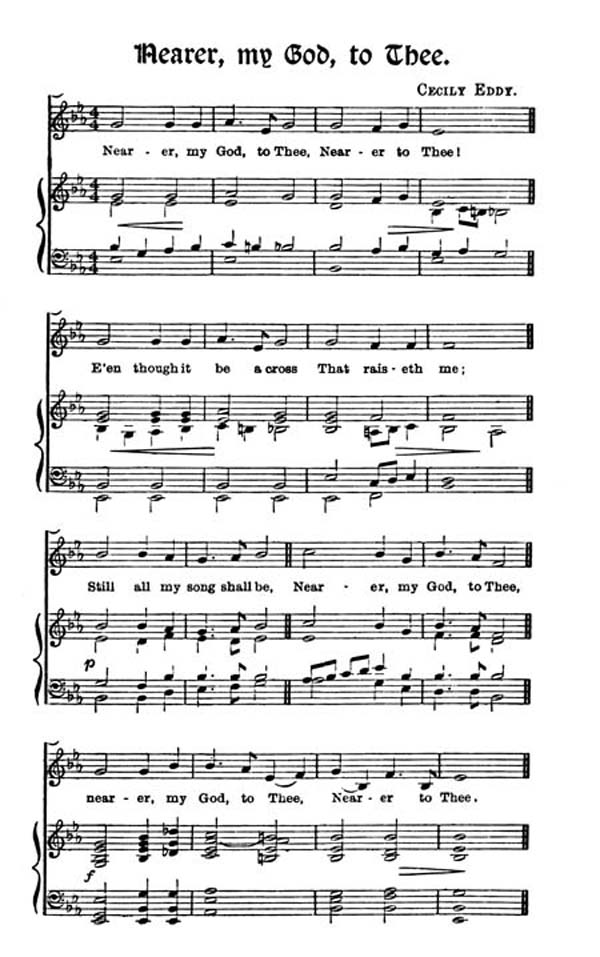
Nearer, my God, to Thee.
[MusicXML]
[308]“Yes, Sweetheart; so, after all, this was our way to—God.”
It was no longer the Captive Singer that spoke: the Truth that dwells in Love had made him free!
THE END
Printed in Great Britain by Richard Clay & Sons, Limited
BRUNSWICK ST., STAMFORD ST., S.E., AND BUNGAY, SUFFOLK.
TRANSCRIBER’S NOTES:
Perceived typographical errors have been corrected.
Inconsistencies in hyphenation have been standardized.
Archaic or variant spelling has been retained.
The music files are the music transcriber’s interpretation of the printed notation and are placed in the public domain.
Music file links may not work in mobile e-book formats like epub or Kindle/mobi. Readers can listen to the music or download music files in the HTML version.