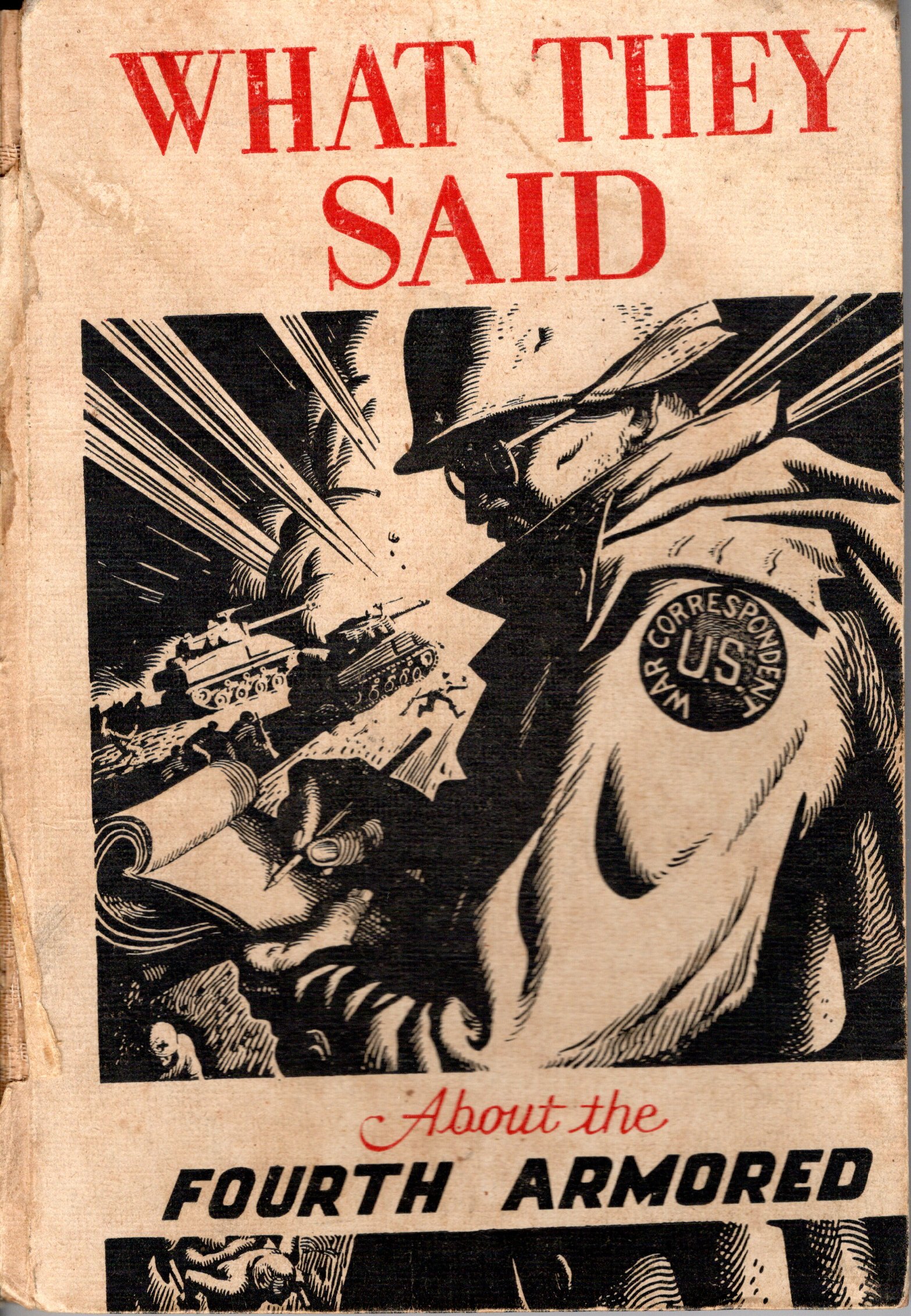
Title: What they said about the Fourth Armored Division
Author: 4th United States. Army. Armored Division
Release date: February 16, 2026 [eBook #77963]
Language: English
Original publication: Landshut: Herder-Landshut, 1945
Other information and formats: www.gutenberg.org/ebooks/77963
Credits: Fabbian G. Dufoe, III
Compiled and published by the Public Relations Section, Headquarters, Fourth Armored Division. Cover design and Bastogne page by S/Sgt. Frank Besedick. Chapter titles by Sgt. Edward R. Thomas. Photographs by 5th Detachment, 166th Signal Photo Company
Printed in Landshut, Germany, September 1945
Printed and bound by Herder-Landshuk
| Shiniest Helmet In ETO | Page | 1 |
| Tiger Jack’s Spearheads | ” | 4 |
| The Furrow | ” | 15 |
| Bastogne | ” | 25 |
| Rat Chase to the Rhine | ” | 36 |
| The Victory of the Rhine | ” | 51 |
| Ohrdruf | ” | 54 |
| Death and Apple Blossoms | ” | 59 |
| “Colonel Abe” | ” | 64 |
| Three Division Heroes | ” | 75 |
| Hello BBC | ” | 84 |
| Men and Medals | ” | 88 |
| They Called Us | ” | 92 |
| The Presidential Citation | ” | 96 |
| Collier’s Excerpts | ” | 101 |
“What They Said,” is a book compiling various magazine articles and newspaper stories that have been written about the Fourth Armored Division since it entered combat.
To print everything that has been written about the division would require several volumes. Therefore, we have tried to make a representative selection that will give you a general idea of what “They”, the war correspondents, the home town newspapers, and the radios all over the country thought and said about the Fourth Armored Division.
Some of these stories you may have already read. Others you may be reading for the first time. Although you might have already read everything that lies between the covers of this little book, it will still be prized in years to come—years when you can lean back with the satisfaction of knowing that you shared in a great victory, and be reminded of “What They Said”
For those who are new to the division, this book will help you
understand what it means to be a member of the Fourth Armored.
Something of what the Fourth Armored is and has done is related in
this book by impartial people outside the division whose job it was to
report the news as they saw it.
(Public Relations Section.)
SHAEF, March 28—The War Department, by direction of the President, has cited the entire 4th Armored Division for “extraordinary tactical accomplishment during the period from December 22 to March 27, inclusive,” it was announced here today.
This made the 4th Armored the second complete U. S. Army division in history to be so cited. The 101st Airborne was presented with a Presidential Citation by General Eisenhower on March 15.
Referred to by the Nazis as “America’s elite 4th Panzer Division,” the infantry and tank teams of the 4th spearheaded the 3d Army’s race across France.
The 4th has been commanded by Major General John S. Wood and Major General Hugh J. Gaffey, and is now operating under Major General William M. Hoge, of Lexington, Mo.
The 4th Armored’s most recent accomplishments include its move from Sarreguemines to Arlon; its great drive to relieve the 101st Airborne at Bastogne; the history-making 60-mile dash to the Rhine River; the move to Mainz, and the current drive on into Germany.
Stars and Stripes, March 29, 1945
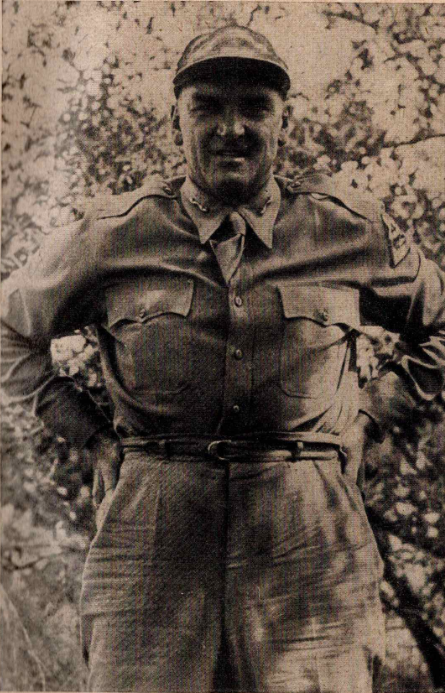
Major General John S. Wood
Division Commander
18 June 1942-3 December 1944
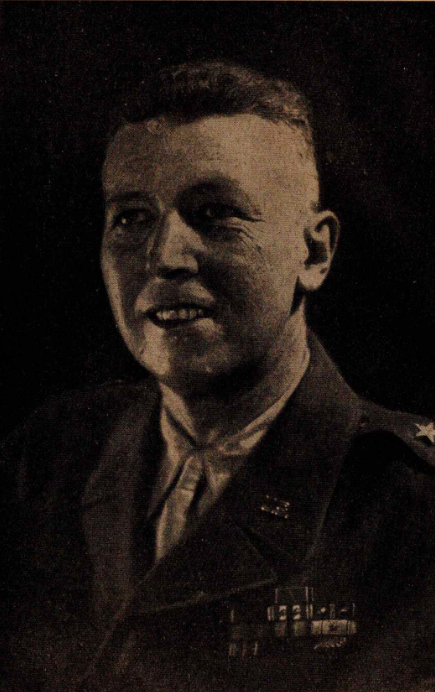
Brigadier General Bruce C. Clarke
Division Commander, 20 June 1945-5 July 1945
CCA Commander, 1 Nov. 1943-1 Nov. 1944
By Roelif Loveland
(Cleveland Plain Dealer)
When Patton came to Third Army briefings his boots were shining
And his helmet was shining, and campaign bars were thick.
Somebody said: “The Germans will see them, general.”
“Hell,” replied Patton, “I want the Germans to see ’em
“And send word back that Patton is on the job.”
That was in Normandy, and a lot has happened since Normandy.
The American Third Army has taken its place in history.
The American Third Army, tanks and tank destroyers and bloody
infantry—
The American Third Army, which swept across France, and kept going.
It has gone a long way since that apple orchard in Normandy.
Where Patton gave his first press conference
And talked about his chances of getting to Paris first,
Before any of the other American generals,
Told of a little bet he had made, but that’s his business.
They let the French enter Paris, for obvious reasons,
And Patton and his army kept on fighting.
Third Army correspondents went to Paris en masse; that
was the story,
But the Old Man with the burnished helmet kept on fighting—
Patton and his boys.
They kept going until gasoline and ammunition ran out.
It had been told.
And they sat by the Moselle for nervous weeks.
And when they got the stuff to go with, they went.
And they brought the war home to the German people,
Who had always fought past wars in other people’s back
yards.
And the Germans didn’t like it, damn them!
They could dish it out, but they couldn’t take it—
At least not the way other people had taken it for weary
years and years.
I can remember the Fourth Armored Division.
The last time I saw them they were sitting in a field of mud,
And the wind was cold and the rain drenching,
“They dropped some in this morning,” a captain said,
“but hit nothing.”
By one of the tanks the lads had constructed a sort of
lean-to.
They were sitting there, on boxes which had contained
rations.
The colonel of the outfit, guests being present, broke
out cigars.
“German cigars,” he said. “Not too bad, either.”
They weren’t too bad, and they weren’t too good.
There was always one nice thing about an armored outfit—
They got there first, and they corralled most of the wet goods.
They were generous lads, these boys who rode in the
stinking tanks.
It was always nice to go and see an armored outfit.
Yesterday the paper said: “The Third Army’s Fourth Armored
Division,
“Plunging 19 miles eastward, raced into the outskirts
of Gotha,
“Reaching a point three-fourths the way across the Reich
from Czechoslovakia
“And 140 miles from Berlin.”
A lot of the tanks which were in the rain-soaked October mud,
And a lot of the men who were sitting on boxes by the tanks,
And a lot of the infantrymen who were slogging in wet shoes
Very probably never got to Germany at all.
Some of them went to hospitals, and some of them died,
For of such is the institution of war.
But I cannot help feeling proud when I read of Third Army.
I cannot help but feel proud when I think of Third Army.
I cannot forget Patton, with the shiniest helmet in the E. T. O.
Who wanted the Germans to know he was there,
And who, by God, made ’em regret it.

By Wes Gallagher
“GENERAL PATTON’S armored spearheads ripped...” Week after week last summer that phrase dotted the news stories of the American Third Army’s unprecedented race across France. The lifting of security wraps now makes it possible to introduce you to Lieutenant General George Patton’s prize “armored spearheads.”
That is, if you can catch up with one. At the height of the summer campaign it was worth your life to do so—particularly with Major General John S. “Tiger Jack” Wood’s crack Fourth Armored Division.
From July 28, when the Fourth jumped off from Cherbourg peninsula, until late September, when it breached the German line on the Moselle River, it operated virtually continuously behind the German lines. And when the Germans launched their big counteroffensive in December, tanks of the 4th rumbled to the relief of the American forces holding the besieged communications center of Bastogne.
During the summer campaign, the Fourth at times was as far as seventy-five miles ahead of the bulk of the Third Army moving in its wake. Supplies had to be brought up in tank-guarded convoys.
Correspondents could catch up with the Fourth’s combat commands with one of these convoys or could take their chances in sixty-mile-an-hour jeep dashes through German-sprinkled territory.
The roads behind Tiger Jack’s clanking hard-boiled armored family were usually considered unsafe for “thin-skinned” vehicles, which means anything less armored than a light tank. And the Lord knows nothing is more thin-skinned than a jeep, unless it’s a correspondent.
Most of Wood’s thousands of soldiers from American farms and fields act as though they themselves were armor-plated—especially Wood. When mine fields halted his tank columns just outside of Coutances in the dash down the Cherbourg peninsula toward Brittany, Wood suddenly appeared at the head of his columns clad immaculately, as always, in polished boots, riding pants, a trim jacket, and sun glasses, which he wears rain or shine.
Wood marched into the town on foot under fire, captured a German soldier and found a patch through the mine fields. He picked his way through the town on foot, sending back a message for his tanks to follow him. The columns never stopped again until they ran out of gasoline six weeks later at the Moselle. The general was later awarded the Distinguished Service Cross for his bravery at Coutances.
Burly and as athletic at fifty-six as he was when he played end for the University of Arkansas and the Military Academy just before the last war, Wood is one general who looks the part. Eternally restless, he paces ceaselessly back and forth, even finding it difficult to sit still long enough to eat his meals. When he does stand still it is with feet wide apart, hands on hips, in an attitude that dares anyone to start something.
Wood is a long-time crony of the rough, tough Third Army’s pistol-packing commander, and is one of the few subordinate generals who are not intimidated by Patton’s roars of disapproval. When Patton roars, Wood roars right back at him. The pacing and roaring prompted one of the division’s Cub observation pilots to pin the nickname “Tiger Jack” on him last summer and it shows signs of sticking. Wood lives in the field with his division and refuses to move out of his tent—and the mud—until his men can do likewise. That means he will be in a tent for the rest of the war. His restlessness and tremendous pride in the division send him on daylight-to-dark visits to every unit, and every man in the division feels Tiger Jack knows him personally.
The best description of Wood comes from an officer in the division who, for the sake of his personal safety, must remain nameless. “The general is a sort of Army edition of Clarence Day’s father in Life with Father,” he says.
In peacetime Wood used to work out his surplus energy on the tennis and squash courts, running his officers ragged, until he got the Palm Springs, California, tennis professional, Lieutenant Lewis Wetherell, as his aide. Wetherell can beat him at tennis, but Wood is tops in squash.
In battle, the Fourth’s commander either flies over the area in a Cub plane as a passenger for a personal look, or grabs his field radio and indulges in a play-by-play direction of the fighting with his field commanders.
No order in the Fourth Armored Division is ever written. Wood gives orders to his field commanders verbally and in person, to make sure they are understood. His commanders do likewise.
The 800-mile drive through the heart of France conducted by the Fourth Armored Division, a masterpiece of strategy, was conducted on such a verbal and personal basis. Wood trained his division to work as a family. He mixed units until every commander was able to recognize another’s voice over the field radio. That did away with confusing code names.
To understand the magnitude of the task of operating such an armored force, visualize a fair-sized small American town suddenly put in steel houses and trucks and zigzagged from New York to Chicago over strange highways so as to cover 1,900 miles—the mileage rolled up by some of the Fourth Armored’s tanks in the fighting from July to September.
Visualize the problem of bringing up some thousands of tons of supplies weekly to feed and maintain this traveling steel village, not to mention the vast amounts of gasoline necessary to keep it rolling. In one day’s advance last summer, the steel monsters consumed 700 gallons of fuel for each mile gained.
Then visualize traveling hospitals, repair shops, kitchens, and a complete telephone and radio system linking all the various units into a co-ordinated whole.
An armored division does not travel as one strung-out column. Usually it is broken into combat commands known as CCA, CCB, etc. The composition of the combat commands changes from task to task. One day CCA might be composed of a battalion of tanks and motorized infantry backed by other attached units, such as combat engineers to build bridges, its own antiaircraft units, tank destroyers, artillery, and its own scouting force of Cub planes and reconnaissance squadrons of armored cars and jeeps. The next day it might be changed to double the number of tanks, half the infantry, and half the attached units, depending on the objective.
The combat commands usually advance in parallel columns, with the tanks in the middle and the infantry on the sides, or vice versa, until opposition is met. Radio and Cub planes link the commands with Wood’s headquarters, which is usually close behind the most advanced command. Each command is self-sustaining for limited periods. At times the commands of the Fourth have been engaged on separate tasks hundreds of miles apart, but usually they are fairly close together so as to be self-supporting.
After you have started this vast mass of material moving on a strange road system, so co-ordinated as to arrive at a given spot at a given time, you have the task of maintaining its complicated mechanism day after day against a hostile force seeking to smash and disrupt it.
That, very roughly, is the problem of fighting the Fourth Armored Division, or any American armored division, for that matter. It is a problem which Tiger Jack’s division solved with a perfection that has been unsurpassed in any battle during this war. No German Panzer division that smashed through Poland in 1939 or France in 1940 or Russia in 1941 accomplished as much in so short a period.
An armored division does not have the room or facilities to take prisoners. Its mission is to cut up the enemy forces and destroy their communications, leaving isolated pockets behind to be mopped up by the infantry division. But the Fourth Armored in two months’ fighting across France, from the last of July to October captured more than 15,000 prisoners, killed 5,000 more Germans, destroyed 317 tanks, 150 large artillery pieces, and 1,500 other German vehicles. During this period the Fourth met and defeated elements of eighteen German divisions and brigades.
An armored division is designed to destroy the fighting power of an enemy and not particularly to capture territory. But consider what the Fourth did in accomplishing its mission. It swept down the Cherbourg peninsula on the right flank of the Third Army, captured Coutances, and raced down the coast to Avranches, where it took vital bridges and dams in an area where the Germans could have held up the American advance for many days if they had had time to blow them. From Avranches, the Fourth drove straight across Brittany, cutting off this great peninsula with its vital harbors by capturing Nantes and Vannes. As a by-product, the division contained the German U-boat base of Lorient.
Then it turned north in a great right hook while still on the right flank of the Third Army. It had the dual job of smashing the enemy before it and at the same time protecting the Army’s exposed flank in central France. This was one of the most difficult assignments of the war.
Orleans, Sens, Troyes, St. Dizier, and Commercy fell in rapid succession to the division’s highly-developed shock attacks. The Fourth pushed on to cross the Moselle River and encircle Nancy, forcing the Germans to withdraw from the city which for centuries has been the key to northern France. During the advance, crossings were forced on the Loire, Seine, Marne, Meuse, and Meurthe Rivers.
Once halted north of Nancy, and only by lack of supplies Tiger Jack’s ironclad family proved it could fight as well on the defensive as on the offensive when it repelled the heaviest German tank counterattacks of the campaign, destroying more than 200 German tanks in fifteen days of fighting from September into October.
So much for the cold statistics on Patton’s number one “spearhead.”
The Fourth’s energetic commander is not the only individualist in the division. It is full of happy extroverts, and all seem obsessed with the idea that the war must be fought twenty-four hours a day, seven days a week, at top speed.
For example, there is the general’s personal reconnaissance Cub pilot, Major Charles Carpenter, a former Praying Colonel football player from Centre College and more recently a history teacher in Moline, Illinois, high school. A history teacher does not seem the type to earn the nickname of “Bazooka Charlie,” but Carpenter is a legend in an outfit where reckless bravery is commonplace.
If there is a fight within a hundred miles, he is in it or over it. His nickname stems from the six bazookas tied to the muslin-and-wood wings of his tiny Cub plane and fired from a trigger in the cockpit. Cubs were made to fly behind the Allied lines, not over the enemy. A good-sized rock in the right place would knock one of them down. But Carpenter tied on his bazookas and started flying over the German lines looking for tanks to shoot at. He has at least five of them to his credit.
More often than not Carpenter has landed in the middle of a busy battlefield to take a personal look, and he has taken an uncounted number of loose Germans as prisoners.
The legend started last summer when Carpenter was commanding the Cub unit attached to the division and was out in a jeep scouting for an advanced landing ground. He came upon a group of infantry pinned down in a ditch by sporadic 88 fire. There was also an American Sherman tank which was not advancing.
Carpenter jumped on top of the tank, grabbed the 50-caliber machine gun and fired a burst over the infantry’s head, with the advice that the next burst would be lower unless they attacked. Then, riding on top of the tank without a helmet and firing the 50-caliber, he led an attack that broke up the stalemate and took the immediate objective.
But he drove on. The German tanks in the vicinity were fighting a rear-guard action, and every time Carpenter came to a corner he would yell down into the turret, “Let ’em have it!” and the tank’s 75-mm. would bang away. This worked fine for five corners, but on the sixth he yelled, the 75 fired—and some distance away the bulldozer on another Sherman flew high in the air. No one was injured, but since both tanks involved belonged to another division, Carpenter was arrested. The irate commander was all for shooting the hard-working history teacher on the spot. Wood, hearing of the incident, rushed over and rescued his Cub commander and made him his personal pilot.
Carpenter weighs over 200, as does Wood, and with both of them flying in a flimsy Cub, the plane waddles around in the air like a bloated duck. However, weight or no weight, the bazookas are always loaded when it takes off.
Carpenter is quite outspoken in his ideas on how to fight a war. Briefly they are, “Attack, attack, and then attack again.” The whole division, from the enlisted men to the commanding general, echoes his sentiments.
There is Sergeant Edward A. Rejrat, a former steelworker from Scranton, Pennsylvania. He’s a tank commander. Rejrat’s thirty-ton Sherman turned a corner in a narrow street in Avranches to come face to face with a fifty-six-ton German Tiger tank sixty yards away. Rejrat ordered the tank driver to put on full speed and ram the Tiger before it could bring its gun to bear. One shot, and the Sherman would have been a tangled mass of wreckage.
The two steel monsters crashed with a metallic roar. The long-barreled 88 was too big to swing around at close quarters and engage the American tank. Rejrat brought his shorter 75 up against the turret of the Tiger and cut loose with four quick thunderous shots which rattled the American tank crew around like peas in a pod. The concussion from the last shell, a high explosive, overturned the Sherman, but Rejrat and his crew scampered out and away from the burning Tiger.
You couldn’t spend any time around the Fourth without hearing a dozen men say, “The guy you want to see is Clarke of the CCA.”
They were referring to General Bruce C. Clarke of Syracuse, New York, then a colonel commanding the CCA of the Fourth. In eight weeks of violent fighting he won the reputation of being one of the most brilliant young armored-force strategists in either the First or Third American armies, and certainly the most unorthodox and daring. Later Clarke was promoted to brigadier general and put in command of a combat team of the Seventh Armored Division. It was Clarke who delayed the Germans’ December breakthrough in Belgium by holding the key road junction of St. Vith against overwhelming odds, not for two days —as he had been ordered to—but for five.
Clarke served as an enlisted man in the Coast Artillery in the last war and later was graduated from West Point. He also holds degrees in engineering from Cornell and a bachelor of laws degree from La Salle University. In one tour of duty he taught military science at the University of Tennessee and served as wrestling coach there.
Clarke developed the CCA’s shattering shock assaults which captured German strongholds before the Nazi commanders knew what happened. At Troyes, where it looked like suicide to make a frontal assault, he spread his command out in old desert style and rushed the city at top speed, overrunning German gun positions before they could fire and hurdling antitank ditches. He forced his way into Troyes and took the garrison town in a matter of hours when it might well have taken days.
The rule book says that tanks should not try to fight in cities, but Clarke sent his medium tanks racing into Orleans so fast that they caught German officers walking in the streets with packages under their arms and shot them down in their tracks. In the ensuing all-night fight Clarke’s tanks fought up one street and down another and cleared Orleans without losing a single tank.
While preparing to attack Commercy, of World War I fame, Clarke heard that the Germans were about to blow the bridge. He quickly gathered up every available vehicle and tank and charged down into the city, firing every gun in a typical high-speed shock assault which makes use of the tremendous fire power of an armored division’s automatic weapons. So frightened were the Germans that they fled without blowing a single bridge, and the Nazi commander escaped in a staff car without his shirt.
Clarke led some of these attacks in his own tank. In others, he flew in a Cub over the attacking columns, directing the battles verbally by radio.
He has done just about everything with tanks that supposedly could not be done. Tanks, for example, are not supposed to be a match for Germany’s famed 88 gun, but Clarke’s Shermans have attacked and overrun dozens of German guns and shut the crews before they could fire a round. He has that rare faculty of being able to pick the enemy’s weak spot almost at a glance, and has so inspired the confidence of his men that they believe any attack he plans is certain of success.
I first met Clarke on the side of a hill north of Nancy. A tank battle was under way near by. He had rolled up in a dust-covered jeep for a quick conference with General Wood and Major General Manton Eddy, commander of the Twelfth Corps in the Third Army.
The enlisted men sitting around in foxholes and armored cars had taken the arrival of the generals with the usual indifference of front-line soldiers, but when the dusty jeep arrived with the husky tanned colonel, necks craned and there were murmurs, “Here comes Clarke.”
A strict disciplinarian and rather coldly reserved, Clarke did not enjoy the friendly place in the hearts of the men of the division that Wood commands, but there was no doubting the respect of officers and men for his ability.
While a stray German gun, which had been overrun but whose crew apparently was unaware it was surrounded by portions of an armored division, banged away so close that the concussion moved your shirt, Clarke spread a map on the ground and the two generals knelt down on each side and discussed the situation as though they were in their own homes.
None of the three looked up as infantry probed the side of the hill for the hidden gun. After getting his instructions, Clarke jumped up and was gone in a matter of seconds back toward his combat command.
A few days later, when rain bogged down the tanks, I was able to corner Clarke in a muddy straw-strewn tent and record some of his ideas on tank warfare.
“Warfare is mental, not physical,” Clarke began. “When you upset the enemy you have him licked, particularly the German. He is big and slow to react, and if you cut his communications and lines of contact he will just take to the woods. But if you give him time to sit down and get out the rule book, he is tough as Hell.”
Clarke himself has little respect for rule books, although he knows and reads them all. “We received the other day a battle-experience note in which some joker wrote that the American Sherman with its 75 is no match for the German forty-five-ton Panther tank with its heavy armor,” he explained. “That would have scared hell out of us if we hadn’t just knocked out more than a hundred Panthers with our Shermans and tank destroyers in a three-day battle.”
The American tanks were more maneuverable than the heavy German models, he explained, and could race in and fire before the Germans could bring their slower turrets to bear.
“Most people and too many officers think a tank was made to fire its big gun,” Clarke continued, striking his fist in his hand. “It wasn’t. It was made to carry a machine gun into close quarters with the enemy. The tank machine gun is the greatest weapon of this war and we should have more of them on our tanks. The big gun is for defense against other tanks.”
Clarke believes that the desert battles in Libya in which large forces of tanks stood off and slugged one another have warped the true conception of armored fighting. Tanks must keep on the move and close in on the enemy to get at the soft spots, such as supply columns, headquarters, and gun crews, he said.
“Tanks are weapons of terror. They have a definite mental effect on the enemy when they come charging in, firing their machine guns. From Normandy to the Moselle River most of my tanks never fired their basic loads for their big guns.
“In fact,” concluded Clarke, “the safest place to be in this war is behind the enemy lines. They don’t know what the hell to do when you get there, and they just run.”
Clarke had the statistics to prove his point. The whole division had suffered fewer casualties in eight weeks of offensive warfare behind the German lines than it did in two weeks of defensive warfare north of the Moselle. Small wonder that the Fourth Armored Division’s battle cry is “Attack, attack, and then attack again!” (Liberty Magazine, Feb. 10, 1945)
By Sgt. Saul Levitt
YANK Staff Correspondent
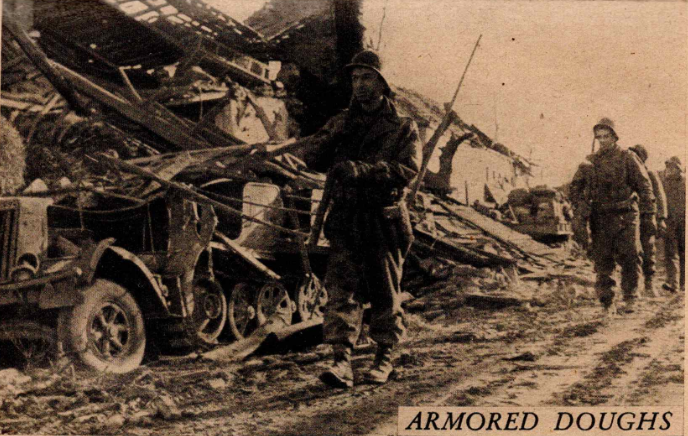
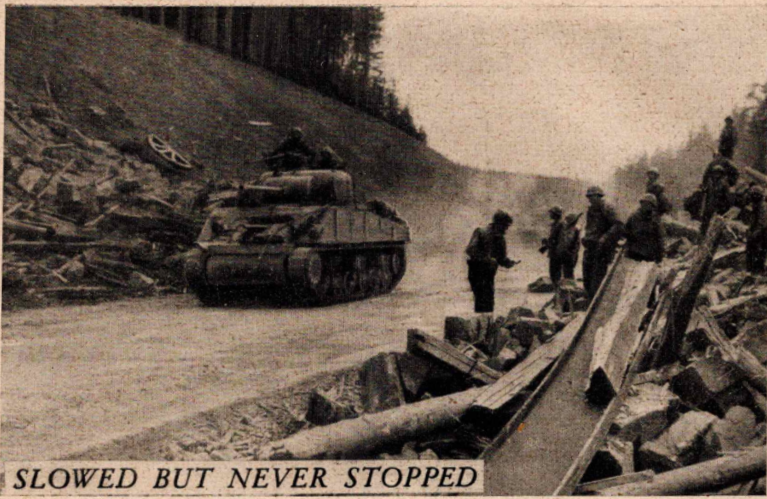
WITH THE 4TH ARMORED DIVISION IN GERMANY—The iron tread of the 4th Armored Division is moving across Germany and nothing can hold it. Everywhere along the way the earth-shaking power of its big tanks is visible. The crowds of people streaming along the roads—French, Russian and Czech—are freed peoples beginning to march home through the furrow plowed by the armor. That armor is still ahead of us, it doesn’t stop. What is more, even the CPs behind it don’t know exactly where it is.
“Get to the next town and keep going,” they say. “You’ll find it.”
We are on its track all right, for we’re moving through towns where the ruins still smolder and smoke. “The 4th Armored was here two days ago,” someone says. Elsewhere, a great furrow in the fields shows where the tanks bedded down and rested for a few hours.
Our jeep follows the armor’s tracks. There are fires on the horizon. Around us lie the hostile fields, the stretches of woods where no one moves. Someone is probably watching from there, though, for it is off the track of the armor. The following Infantry will have to clean this hostile country up.
We came to a town which Combat Command “B” of the 4th Armored plastered a day ago. It is still smoking. The effect of the roaring tanks and of the long, black gun-muzzles that stick out ahead of them shows in the faces of the German civilians of this community.
“They’re around here somewhere,” says somebody. “Get on the autobahn, pick up a 4th Armored supply truck and keep following.”
There is a low sky overhead. We find the armor’s deep furrow in the muddy hills, and climb and reach the autobahn, a great German highway, where traffic is meager and fast. A 4th Armored truck is ahead and we are catching up. Some planes make their turn and we get out of the jeep and, by God, they are Me-109s beating up the road toward us.
There is nothing faster than a plane and nothing slower than a man at a time like this. We scramble down an embankment and into a culvert and all hell is breaking out above us. The 50 calibers on the ground and the 20mm cannonfire of the planes are both going at once and the ground above is being rapped with the sound of giant hailstones. Then silence.
Again they come. The Germans don’t want us on their favorite highway. Three times more we hear the thunder of their engines, the whistling of their wings, and the rapping of the 20 mm. hailstones. Then it’s quiet again. We climb up the embankment and into the jeep and get going.
We wish we could find that armor somewhere and 25 miles farther on we finally overtake its tail-end. Down below the highway rest the tanks, the half-tracks, the jeeps and the big guns spread out in a pasture like resting cattle, right in the middle of Germany as if to say: “What are you going to do about it?”
There are fires on many parts of the horizon. The biggest is to the south, where a whole train is burning as one car after another explodes. “We were trying to get a couple of Panther tanks on the other side of the tracks,” says someone. “So we got the train which was in our way.”
The nose of the 4th. Armored is still farther up, past Creuzberg. We are some 25 miles west of Gotha and more than 75 miles from Frankfurt, which was yesterday’s news. German women who pass in the village of Nesselroden move about with their faces averted. In the house we stop at there is a place marked for everything and everything is in its proper place. A place is marked for the table towel, another for the glass towel, a third for the blessing of God on the house, a fourth for the picture of the son in the Nazi uniform. Signs and slogans are everywhere. All night long a clock in the house rings out the hours and half hours, adding another touch of order to this too-perfectly-ordered home and providing assurance that even in his sleep a good German will know what’s what.
The next day we move up the long train of armor toward Combat Command “B”. It is a winding trail that avoids the autobahn and the big town of Eisenach, which has not yet been taken. On we go, over back-country roads, past civilians with beaten faces. The Werra River isn’t wide here, but there was a tough fight for it yesterday. The 4th Armored’s 24th Armored Engineer Battalion bridged it under enemy fire, saw their bridge knocked out, and put it in again. A small river and small bridge, but a big operation.
We get past Creuzberg, which resisted yesterday and paid for it, for there is no patience in the 4th Armored. The 4th wrecked Creuzberg because Creuzberg wouldn’t surrender, and now people are shoveling through the still-smoking ashes, looking for things.
Farther on we move, through a woods, and get one of those shocks of a kid moving through a toy chamber of horrors at Coney Island. There are dead German tanks in the woods, facing the road and hidden until you come right up on them. Then it’s as if the tanks were alive and had got you right there. But the tanks are dead. This was a German tank-maintenance and repair area. Live American armor has already caught this crippled German armor, lighting charges under it and throwing white phosphorus stuff at it. Now the German tanks smoke and burn, and one is just a pink stove, silently burning in the woods.
This is evidence of how the Germans have been driven to cover. They have had to hide tank-repair areas in the woods because nothing that shows in Germany is safe from our air these days. We have driven them to the woods and to the caves, and now we are pushing them east, out of their own country.
We get out of the woods in a hurry because it is eerie there and maybe Germans are watching us go by. More fires are burning on the horizon. The deep track of the tanks is still ahead of us. We reach a town which is only a few miles from the big city of Gotha. The German air comes up again and the sky is filled with smoke and the sounds of anti-aircraft and cannon. We climb a hill to another woods, where Me-109s are tucked in among the trees. The Germans had smashed these planes themselves as the armor ran them down. These deadly little planes have knocked out may Forts and Libs, and here they are broken and burnt by the Germans in a woods.
The 4th Armored is moving out of Metebach now, and we get in behind a half-track and follow down the road. The tanks wheel in their iron treads, the machineguns point at the sky, and Aspach shows up, five miles from Gotha. From within the houses, the civilians watch, but if you look at one of them steadily he turns away. The power of the armor is shadowed in these German faces. They stick their heads out of their windows and watch blankly, absolutely neutral.
And now the tanks and half-tracks move up to a crossroads outside of Aspach. They cover the roads out of town in long powerful lines as the evening comes down. More fires blaze on the horizon. The German air comes over again, the Me-109s moving across the sky as the .50-caliber fire goes after them. The planes twist, turn and plunge through the sky after a Cub plane, like a hawk after a sparrow. The Cub comes down low over the fields with an Me dropping after it and the guns of the armor drive the Me off just in time. The German air comes in again as the sun goes down—two, three, four times more—and one at last grabs a vehicle in the long line on the road and the vehicle begins to burn. Another Me comes across, no more than 10 feet above the column, turning on one wing, almost striking the ground, but keeping going. No planes are knocked down here tonight, but the report is that more than 34 were brought down yesterday and we have been able to count at least six wrecked ones during this movement toward Gotha.
The 4th should be in Gotha by tomorrow morning, and now it rests outside the city. Rain begins to fall, but the fires sowed by the big guns still burn on the horizon and so does our column’s vehicle which the Me hit on the road. The 4th will move through fires into the city of Gotha tomorrow morning.
In the morning there is a brief moment of indecision. Gotha has been asked to surrender, and if it will not, then the big guns will go to work. The 4th isn’t going to wait very long. Finally, it appears that Gotha will surrender. The surrender has been demanded by the Division and at last the answer comes through the armored infantry battalion, which is up front at the edge of the city. Minutes from now another German city will fall and within 10 days and 200 miles of movement we will have taken Darmstadt, llanau, Aschaffenburg, Hersfeld and Gotha.
The German air comes up over the road and we get into a patch of woods. Under the roar of the guns and the enemy engines overhead, the infantrymen had a word or two to say about this ebbing war. Pfc. Joseph Tegge of Anderson, Ind., a. rifleman, wanted to know what the hell the Germans are fighting for at this stage of the game.
“A stubborn bastard,” he says. “He knows he’s done for, but he keeps on fighting anyway.”
The men are exasperated; it doesn’t make sense anymore. Yesterday, 16 of our infantrymen had been killed while protecting a tank.
We leave the woods and move on, and then the enemy air goes to work again and we get into a barn where T/5 Wilson E. Kendall of Ogdensburg, N. Y., who has been with the 4th Armored since Pine Camp, comes up with that one about going home.
Then the air is clear once more, like after a rain squall, and we get into the jeep and move slowly down a hill into Gotha, past German dead in ditches, past a burnt-out American tank, past a hospital for German soldiers where a guy at a window thumbs his nose at us and then disappears. If he tries that on our tankers, they’ll surely go up after him.
We get down into the square and are at the City Hall, where pieces of broken glass lie all over the streets.
We are again in the midst of one of those starting-from-scratch moments. In the City Hall are the temporary German officials of the city of Gotha together with Lt. Robert Townsend of San Antonio, Tex., aide to the 4th Armored commander, Major General William M. Hoge.
“You will first of all bring in all arms, cameras and ammunition,” says Townsend. He sits down in the old council chamber of the City Hall, surrounded by murals of the ancient city. A Hollander, a young fellow from Rotterdam who speaks both English and German, acts as interpreter. He has been in Germany for several years, another one of the millions of dragooned “auslanders,” or foreign laborers, in the Reich.
The Germans around the table look shrewd and they talk with the tact of losers. Order begins to appear. The men of the 89th Infantry Division show in the town, moving from house to house, and you can see them in the square from the windows of the City Hall.
A Polish woman with a small child stands outside the door and the assistant Division commander, coming into the council chamber, pauses for a moment in the doorway and tells the woman that things will be better for them soon.
We leave Gotha that afternoon, grabbing the tail of the 4th Armored as it goes through, and now the columns curve south, driving 15 miles to Ohrdruf and Mühlberg, and coming to rest more than 200 miles from the Rhine.
On the very edge of Mühlberg the column comes across what must be the last German train going east. The Division’s artillery simply wheels a 155mm. howitzer around and knocks out the train. It is Sgt. Roy Mercurio’s gun crew which does this. Mercurio is from Toledo, Ohio, and his gunners are Cpl. Cleo Smith of Los Gates, Calif., Pfc. Homer Garrison of Shelbyville, Mo., and Pfc. Joe Valenti of St. Louis, Mo.
When we reach Mühlberg, a soldier asks: “How far are we from Texas?” We draw a map on the ground, using a stick for a pencil, drawing the outline of the eastern coast of the United States, as we remember it, and the outline of the western coast of Europe, and then France and Germany as far as Gotha. We figure over that map for a while and finally somebody says: “Nearly 5,000 miles to Texas, maybe.” And the soldier from Texas sighs and walks off.
Heading back, we can follow the long furrow which the 4th Armored has plowed since it broke through at a point above Frankfurt. This country behind the 4th Armored, which was deadly three days ago, has been cleared. Now the liberated, thousands of them, are going home through the furrow. French and English soldiers of 1940, Czechs, Poles and Russians are on the road. We can go back now along one of the world’s finest roads, which Hitler built for war and not for civilians, and which the Americans are now using for war. Our traffic, our supplies and infantry, is pouring through, pouring east, as thick as Fourth of July traffic on the Lincoln Highway.
It is one of the great sights of our time and on the faces of the Germans along the way there is still the look of numb amazement that an enemy from thousands of miles away actually rides through Germany now.
And tomorrow morning the 4th Armored will cut its tread deeper into the German earth again, moving eastward.
* * *
German soldiers facing the 4th Armored were told (according to a captured document): each American had qualified for the Division by proving that (1) he had been born a bastard, (2) he had murdered his mother—TIME, March 19, 1945.
* * *
By Joseph Driscoll
New York Herald-Tribune, January 1945
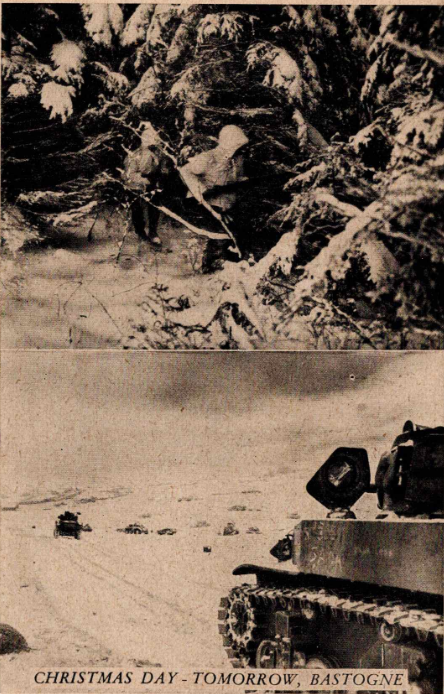
Cobra King is the name of a shell-scarred, stout, armored forty-ton Sherman tank. With a first lieutenant from Texas in the turret the Cobra sliced through the German circle about Bastogne the afternoon of December 26, 1944. Other men and tanks of the Fourth Armored fought as hard to relieve Bastogne, but the Cobra got there first—at 4:45 p. m. the day after Christmas.
The tank commander was Lieutenant Charles P. Boggess, Jr., who played high school football at Greenville, Ill., before moving to Austin, Texas.
At the tank’s 75-millimeter gun was Corporal Milton B. Dickerman, of Newark, who made bomb racks in a Kearny, N. J., factory before he became a tanker three years ago.
The loader, Private James G. Murphy, hails from a small farm near Bryan, Texas, and was attending Sam Houston State Teachers College at Huntsville, Texas, until he got in the Army two years ago.
The bow gunner was Private Harold Hafner, of Arlington, Wash., who was graduated from Arlington High School in 1943 right into the Army.
A Georgia tractor farmer, Private Hubert J. J. Smith, of Cartersville, drove the tank. His initials stand for James Jackson, but he has no idea why he has two middle names.
By noon of December 26 Cobra King squatted on a ridge south of the Belgian hamlet of Clochimont. Its heavy-barreled snout pointed north-east toward Bastogne three miles away.
One of the great tank fighters of this war, Colonel Creighton W. Abrams, of West Newton, Mass., commander of the 37th Tank Battalion of the 4th Armored, swept his arm forward in the signal to advance. Cobra King snorted into the attack at the head of a column of tanks and armored infantry halftracks. The armored vehicles charged up the snow-covered road like a gray file of trumpeting elephants.
Incidentally, we saw a real elephant on this road one day, passing tanks going the other way and making an odd contrast, but it was a circus elephant entertaining children.
Lieutenant Boggess, commanding nine mediums in the tank push that relieved Bastogne, had warned his men that it wasn’t going to be a picnic. The men haven’t been on a picnic since the Fourth Armored left the States a year ago, so that was all right with them.
A veteran of thirty-three years, Lieutenant Boggess described the situation:
“The Germans had these two little towns of Clochimont and Assenois on this secondary road we were using to get to Bastogne. Beyond Assenois the road ran up a ridge through heavy woods. There were lots of Germans there too.”
“We were going through fast, all guns firing, straight up that road to bust through before they had time to get set. I thought of a lot of things as we took off. I thought of whether the road would be mined; whether the bridge in Assenois would be blown, whether they would be ready at their anti-tank guns.”
“Then we charged, and I didn’t have any time to wonder.”
Spraying machine-gun and cannon fire, the tanks charged with throttles open.
“I used the 75 like a machine-gun,” Gunner Dickerman said. “Murphy was plenty busy throwing in the shells. We shot twenty-one rounds in a few minutes and I don’t know how much machine-gun stuff.”
“As we got to Assenois an anti-tank gun in a halftrack fired at us. The shell hit the road in front of the tank and threw dirt all over. I got the halftrack in my sights and hit it with high explosive. It blew up.”
Dirt from the enemy shell burst had smeared the driver’s periscope.
“I made out okay, although I couldn’t see very good,” Driver Smith drawled. “I sorta guessed at the road. Had a little trouble when my left brake locked and the tank turned up a road we didn’t want to go. So I just stopped her, backed her up and went on again.”
Unlucky Assenois was blowing to bits under artillery barrages laid down by American guns. Through the smoke, dust, flying debris and shell splinters the armor drove on. Our artillery kept the enemy down and cut short his defensive fire.
“Bastogne was the next town down the road, but we still had those woods to go through,” Lieutenant Boggess recalled.
Kafner kept his bow machine gun playing around the fir trees and the road ahead. Dark enemy figures ran and fell in the dusk. In the forest darkness a square concrete blockhouse painted green loomed ahead. Dickerman sent three shells smashing into it. Later the infantry found twelve Germans there.
Lieutenant Boggess pulled the galloping Cobra down to a canter. Colored parachutes clotting the countryside; some of them caught in the tall trees, indicated where ammo, food and penicillin had been dropped to the American paratroops and tankers besieged in Bastogne and its defense perimeter. The question now was whether the Cobra King was among friend or foe.
“I spotted some foxholes filled with men in G. I. uniforms,” Boggess continued. “I yelled for them to come out, because we thought the Germans might have men in our uniforms around Bastogne ready to knock us off. Nobody moved, so I called again.
“After they heard me say that it was okay and we were the 4th Armored, a lieutenant from the engineers climbed out of his hole and said he was glad to see us. They had me covered, too, I found out.”
“You know,” commented New Jersey’s Dickerman, “We never really got to see that town of Bastogne after all. Wasn’t the M. P.’s fault, either—no off limits business. Soon as we got to the perimeter defenses we turned right around to guard the road on the edge of town.”
Sgt. Joe McCarthy, YANK Staff Correspondent, reporting the seemingly impossible swing of Third Army units toward Bastogne at the height of Von Rundstedt’s breakthrough, in the January 21, 1945 issue of YANK, included the following:
The most spectacular role in the move was that played by the Fourth Armored Division which dashed to the aid of the besieged 101st Airborne Division at Bastogne. The story of what happened during the same time to the 26th Division, which moved up on the Fourth Armored’s right flank and tackled the tough job of crossing the Sure River to the east of Bastogne without getting much of a play in the newspapers, is less dramatic but more typical. It gives you some idea of what it was like for the average infantry outfit that was in on this deal during the joyous Christmas season of 1944.
Nobody in the 26th Division can get over the way their part of the Third Army made its move north from Metz. Probably no military movement of such a large scale was ever carried out with more speed and less red tape. The book was thrown out of the window and all the OCS rules about road discipline were forgotten. Each outfit simply tried to get its vehicles on the road as soon as possible and, after they were on the road, to keep moving.
“And them roads were jammed,” one of the truck drivers said. “Us and the Fourth Armored and God only knows how many other divisions. We were bumper to bumper all the way. Good thing it was a cloudy day. If the Germans ever had air out, they would have slaughtered us.”
By SAUL LEVITT
Since December 27 it has been possible to come up from the south into Bastogne through the corridor originally established by elements of the Fourth Armored Division. The corridor is still so narrow that you can see and hear the battle on both sides of the main Arlon-Bastogne highway, but since the 26th there is no longer any Bastogne pocket. Now the fight takes place three quarters of the way around Bastogne, but the evidence of the desperate eight days of fighting until the Fourth Armored Division broke through has not entirely disappeared.
* * *
Meanwhile, to the south, elements of the Fourth Armored Division commanded by Colonel Creighton W. Abrams and its attached unit of infantry from the 80th Division, the 318th Regiment, were fighting north in a series of savage encounters, trying to force some kind of passage to Bastogne.
Farther away, at the 12th Evacuation Hospital, volunteer doctors and medics prepared to take off by plane and drop down by glider into the Bastogne pocket. The next day five doctors and four sergeant medics took off.
Some of them had never been in a plane before. The doctors thought it was going to be a parachute jump at first but were ready anyway. They took off on Dec. 26, landed near Bastogne in the snow, and set up their hospital. There could be no question of taking their wounded out, not until the lifeline from the south could reach Bastogne.
The lifeline was being made down below Bastogne. It was being forged by tanks through teller mine fields on the roads.
The Fourth Armored was going north. Stopped cold at noon of the 26th by heavy resistance and with further movement possible only at the heaviest cost, they decided to force through at once. They knew it would have to be a very fast and continuous movement. The armor took off, playing machine-gun fire on the woods and surrounding hills. In that drive through to Bastogne, lasting more than four days, they killed, captured, and took prisoner more than 2,000 Germans. But they did not come through easily. The straight rush through the German ring cost lives.
In the woods north of Assenois, Lt. Charles Boggess Jr., lifted his head out of a turret and spoke to the first American soldiers on the inside of the pocket. They were engineers of the 326th Airborne who had maintained the southernmost salient of the perimeter. As Lt. Boggess lifted his head out of the turret nobody said anything to him. He said, “Come on out, it’s all right. It’s the Fourth Armored.” Nobody moved or answered. It was late afternoon under the dark green firs. Boggess yelled again, and again nobody answered.
Finally a young officer crawled out of a hole, but the two men kept each other covered. The engineer officer said at last, “I’m Lt. Webster.” They shook hands. Later Gen. McAuliffe rode out in a jeep and shook hands with some of the men. And as dusk started to come down Col. Abrams rode through—a short stocky man with sharp features—already a legendary figure in this war.
The Fourth Armored seems to span the history of this war. In France, you met the division as it made its first big play in the hot summer days, going through Coutances in our big breakthrough after St. Lo. Again you ran across the outfit in the fall as its big tanks lumbered through the mud of Vollerdingen, near the German border, with the tanks out of contact across the mine-covered hills where neither man nor jeep could follow them.
And now they showed in Bastogne, lumbering through the snow with the men of the 80th Division, against the blooming green of the pine trees and into the town itself ...
The battle of the Bastogne pocket ended at 1545 on December 26, 1944.
By Jack Bell
Columbus, Ohio, Citizen, January 6, 1945
WITH THE U. S. FOURTH ARMORED DIVISION, Belgium—The road to Bastogne is paved with bad intentions—enemy and friendly tanks which slugged it out during the dramatic drive up from the south to relieve the 101st Airborne Division and its complement of tanks.
Other battles are in progress as generals feint and parry with armies across the frozen wastes. But the soldiers have their pets, and every man of the Fourth Armored Division has the battle of Bastogne heading the “Hit Parade.”
Bastogne caught the public fancy. We shot 20,000 troops in to save it. Every soldier overseas knew of the encirclement which shut them off, the days of fog which shut off air power for four days. The entire Allied Expeditionary Force had one question: “What about Bastogne.”
I was with the powerful and confident “Fourth Armored” the day its tanks and armored infantry rolled off the line of departure toward Bastogne. Snow fell gently. Mud was deep, but day after day they forded and bridged streams, mopping up the steadily stiffening German opposition. Each night they paused, then fought on.
“For if we get only 2,000 yards we’re that much nearer the men in Bastogne,” was the expression of Lt. Col. Delk Oden, Elgin, Tex., tank battalion commander.
At last they met in pitched battle. South of Bastogne in the villages of Chaumont and Assenois, dozens of tanks along the streets and in the field are mute evidence of the mighty struggle that preceded the entry into Bastogne, leaving both armies weaker when it was over.
Then one evening at 4 o’clock, Lt. Charles Boggess, Jr., Greenville, Ill., up in the hatch of a tank, said: “You all know we’ve got to get to those men in the town. All you’ve got to do is keep em rollin’ and follow me. It won’t be any picnic but we’ll make it.”
He buttoned down the hatch, roared away and the others followed. They rumbled through wrecks of tanks in Assenois, through a terrific barrage from American guns, a daring maneuver that paid fat dividends for the artillery kept the Germans in holes and 400 prisoners were taken by the infantry which followed.
Up the road Lt. Boggess and the tanks rolled. The smoke in Assenois caused a slight break in the column after four had rounded a turn. The others stopped to check the route. The pause gave the Jerries time to toss Teller mines onto the road. A halftrack hit one. Captain Bill Dwight, Grand Forks, Michigan, leaped from a tank and threw the mines off the road and the rescue party rolled on.
They went full speed, with every machine gun spraying the roadside and the woods every foot of the way, turning the quiet dusk into mad warfare. Germans were running everywhere, usually away from the blazing guns.
Lt. Boggess met outposts of besieged Americans outside of the city, but the men were not quite convinced that his tanks were friendly. It had been a long time since they had seen friendly troops. Nor was the lieutenant sure that he had met friends, or Germans in American uniforms, which they have been wearing wholesale since taking American prisoners.
But both soon were convinced, and the siege ended.
That is, it ended after a fashion. The infantry followed the tanks, mopping up both sides of the road. Trucks of food and shells and ambulances dashed into town.
The world was joyous, excepting Germany and Japan that the Fourth had fought through and everybody said, “Bastogne is saved; thank God.”
At which time the “Fourth Armored” men dug in for what they knew would be a grim battle to keep the breach open. But, they’re old hands at this business of war and went to work. Hardly had they had time to set up their defenses before giant Tiger tanks rolled down from north of Bastogne. Our pilots came through the clouds to bomb the Tigers. We 30 lost tank destroyers, but wrecked the Tigers. A flock of light tanks shot 30,000 rounds into the woods in five minutes, and the Jerries lay dead by the hundreds. Infantrymen crawled through the snow to hit the tanks, and—
Yes, the Germans swarmed into them so furiously at times that they had to withdraw. But they never ran. Day and night they fought on, unheeded because the world which had been so concerned and had heard that Bastogne had been saved—and forgot it.
They’re having birthday celebrations just now, with fingers on triggers—just one year overseas and six months in combat. They were in the Normandy breakthrough and cut off the Brittany peninsula. One combat team liberated Nantes, and Orleans. They drove to the Seine and took the bridgehead at Troyes. They crossed the Marne three times, forced the withdrawal of the Germans from Nancy on the Moselle, and went on across the Saar. And when the Bastogne situation grew desperate, the Fourth Armored was rushed up to spearhead the corps drive to save it.
It is one of our Army’s good, tough outfits, the type that has made General George S. Patton, Jr., famous. Its skipper (then) Major General Hugh Gaffey, was Patton’s chief of staff until he came here. What a swath they have cut in Jerry’s army: thousands of prisoners, thousands killed and wounded, 450 tanks, 250 artillery pieces and 1,600 other vehicles since their landing in France.
And as this is written they await further attacks by the increasing German power, in the war’s biggest winter battle.
By Collie Small
GERMANY, BY WIRELESS. It had been a fitful night filled with the thunder of big guns and the rumble of German traffic moving along the river road, but now the noise had died away. The tankers sat waiting for the fog to lift, so they could move across the last 1,000 yards to where the Rhine swept around the big bend from Coblenz.
Then the explosions came—dull, muffled booms that rolled up from the river and shouldered their way through the filmy mists hanging over the orchards and gently rolling fields. Hidden in the fog, the slender Crown Prince Wilhelm Bridge disintegrated with a roar as the center span collapsed into the river. German soldiers and vehicles catapulted from the bridge in a tangled shower of horses, carts and men. A machine pistol spoke sharply in short sentences, then stopped. The tanks moved.
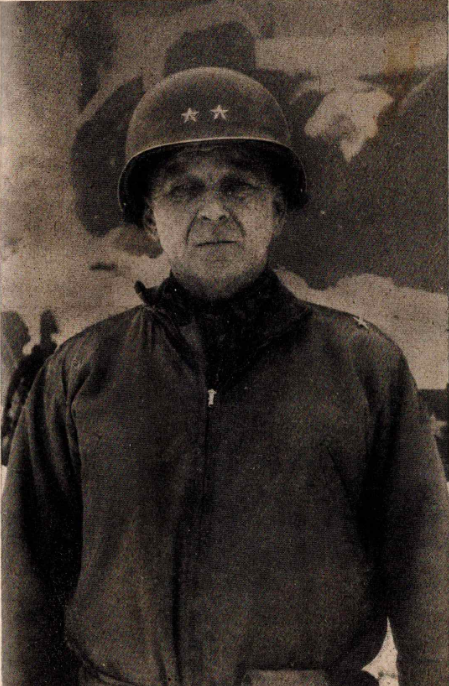
Major General Hugh J. Gaffey
Division Commander
3 December 1944-21 March 1945
At the river front, they swung right and crunched over the broken bodies and smashed vehicles strewn along the tree-lined highway. They lumbered into Urmitz, moved through streets still heavy with the pungent smell of battle smoke, than followed the road out to where the ragged stump of the bridge stood in a maze of twisted railroad tracks and girders hanging down into the river. There the column halted and the fabulous colonel who commanded the tanks turned to the equally fabulous major who commanded the armored infantry, and said, “Hell, this is the Rhine, and we’re just sitting here looking at it. Let’s go spit in it.”
They had come a long way. July, 1944, was hot and the dust swirled across the beach in stifling clouds when the fledgling 4th Armored Division’s shiny new white-starred tanks rolled up through the surf and started down the road to Ste. Mere Eglise on the shattered Normandy coast.
That was the first mile. The first prisoner was a gangling, bedraggled SS deserter who shuffled across a marsh to give himself up to the curious tankers. At Coutances, burly Maj. Gen. John S. Wood, who then commanded the division, strode into the town during a heavy artillery barrage and personally captured a German soldier.
Avranches was next. Pvt. “Red” Whitson, of Indianapolis, sat at a curve in the road, playing his machine gun like a garden hose until two dozen vehicles were burning fiercely and four dozen German bodies sprawled in the road where a plunging mass of maddened horses tried to wrench free from their traces. They left Whitson in Avranches, slumped over his smoking gun.
Then the division broke through the German defenses with a tremendous rush and sealed off the Brittany Peninsula. The mass of armor wheeled east on the right flank of Patton’s 3rd Army and started a sweeping right hook that carried clear across the face of France. In five days, three German infantry divisions and four regiments from other divisions were swept under the avalanche of clattering tanks. The swift spearheads smashed fifty-four miles to Rennes, Breton capital, hacking away at vital enemy communication lines. They sped seventy miles to Vannes. One combat command struck toward Lorient on the Brittany coast. Another drove eighty miles to the cathedral city of Nantes. There has never been anything like it.
The 4th Armored Division became a shifting island of armor in a sea of milling German troops. The tanks moved so fast that fuel and ammunition had to be flown to them from England. They ran off their maps and had to have new ones rushed from England by plane and dropped to the columns on the road. On August fourteenth, they raced 153 miles to St. Calais, refueled and within six hours were rolling again, toward the city of Orleans on the Loire. Combat Command A attacked Orleans early the next morning, took it by two-fifteen in the afternoon and turned it over to the 35th Infantry Division. On the same day, Combat Command B left the Lorient sector and sprinted eastward 264 miles in thirty-four hours, finally halting at Prunay.
In a little more than seven weeks, the 4th Armored spearhead hurtled from Normandy to the Moselle River, rolling up some 1,500 speedometer miles. They threw a pincers around beautiful Nancy and in a roaring fifteen-day battle knocked out 281 German tanks. It was on the Moselle that Sgt. Constant Klinga, of Brooklyn, made his classic observation, “They got us surrounded again, the poor devils.”
It was near Nancy that Captain James H. Fields, of Fort Worth, Texas, an armored infantry platoon leader, took fifty-five men up the bloodiest hill in Lorraine. Enemy tanks crawled up the other side of the hill and rolled down at the doughboys in their foxholes. The German tanks loomed over the desperate infantrymen and fired point-blank into the foxholes with their big 88’s. The doughboys fought wildly, but, one by one, the foxholes went silent. Shrapnel ripped into Field’s face and filled his mouth with jagged steel splinters and bone fragments from his shattered jaw. The young captain jammed a compress into his mouth, held another over his gaping cheek, and continued to fire with his left hand. He directed the shrinking platoon with hand signals and penciled notes passed from one foxhole to another. When he staggered down the hill twenty-four hours later with thirteen dazed survivors, they carried him away to a field hospital and awarded him the Congressional Medal of Honor.
Then the division plunged into the Saar. A cavalry troop stormed Gosselming and captured, intact, the bridge across the Saar River, after which they mopped up the village and took, among other prisoners, the German demolition crew charged with blowing up the bridge. They were sitting quietly in a local beer parlor when the cavalry jeeps burst into the town.
At Domfessel, the enemy road blocks were strong and well defended. So the leading Sherman charged out of an orchard and bulled its way between two houses, tearing down the walls on both sides of the narrow opening. The other tanks churned over the rubble in single file and then fanned out into the town to complete the capture.
They were still slugging away in the Saar against bitter German resistance when Patton called for Gaffey. The 4th Armored swung away from the enemy and raced north over the black-topped roads on the famous “Fire-Call Run” to besieged Bastogne under stern, aloof Maj. Gen. Hugh J. Gaffey, of Austin, Texas, successor in December to General Wood, and since promoted to corps commander. The tanks rammed their way into Bastogne and left the battered 5th German Paratroop Division reeling helplessly in its wake, 65 per cent of its strength smashed. The siege was lifted.
The tanks drove on through Bastogne. Lt. Robert Pearson, of Highland Park, Michigan, peered down from the cockpit of his tiny Cub artillery-observation plane and spotted tank movements on the edge of a woods. Pearson and his flimsy puddle jumper came down through a storm of small-arms fire to seventy-five feet to make sure the tanks were German. Then he swept away, marked the spot on a map and dropped it to the American tankers on the ground.
Under Lt. John Kingsley, of Dunkirk, New York, six Shermans slipped into ambush, only the tops of their round turrets showing above the thick foliage. The Panthers poked their long-nosed 88’s into the open and started moving across an open field. The big guns on the Shermans roared. The first German tank burst into flames, but the rest kept coming until eleven had strayed out to their death. Kingsley leaned on his turret and gazed wonderingly across the field at the eleven smoking tanks. “If the German who commands that tank company isn’t dead,” he said, “I hope they promote him to battalion commander. We could use more like him.”
The tanks were still attacking when orders came to disengage. In one of its most ticklish operations, the entire division eased away from the enemy at night, blacked out all its markings and quietly moved southward into position east of Luxembourg, where German armor was massing for an expected counterattack. The 4th Armored waited patiently, but in vain. The counterattack never came.
Patton, ringmaster for this most potent collection of armor, long had dreamed of fighting on the Rhine. At a press conference when the 3rd Army was still grinding slowly ahead against subborn opposition in Eastern France, the “Old Man” suddenly rose from his chair, strode stiff-leggedly across the room and drew the curtains back from his map while newspapermen crowded around. He waited until the room was quiet. Then he pointed to the thin blue line that marked the storied river and nodded his head slowly, as if in anticipation of some great and deep satisfaction yet to come. “That will be the day, gentlemen,” he said. “That will be the day.”
A wet snow was falling at seven-thirty in the morning when the first light tank of Combat Command B clattered across the bridge over the Kyll River near Metterich, under diminutive, bespectacled Brig. Gen. (now Major General) Holmes E. Dager, of Union, New Jersey. The objective was the Rhine, sixty-six miles away through the rugged Schnee Eifel and across the undulating middle-Rhine plain. The night before, Colonel Creighton Abrams, of Agawam, Mass., deceptively pink-cheeked commander of the 37th Tank Battalion and a living legend among tankers, told his men, “The board of directors has met. We jump off at seven-thirty, and it’s ’Katy, bar the door.”
Fortified with a week’s rations, in case they outran their food-supply trains, Combat Command B moved up through the bridgehead which was established on the east bank of the Kyll by the veteran 5th Infantry Division. Combat Command A was to parallel Combat Command B to the north. The orders were simple; “Get to the Rhine.” Abrams didn’t even bother to ask what lay between his tanks and the objective. “If I plotted German divisions on my map,” he said, I’d be too frightened to move.”
Five hundred yards out of its bridgehead, Combat Command A bogged down hopelessly in the mud. Its route was hastily altered and Combat Command A was ordered to fall in behind Combat Command B. They tried to break Combat Command A away again, but the mud was too heavy on the alternate roads available. So the 4th Armored Division, Combat Command B leading, rolled along one narrow road, strung out along a sector sixty-six miles long and twenty-five feet wide.
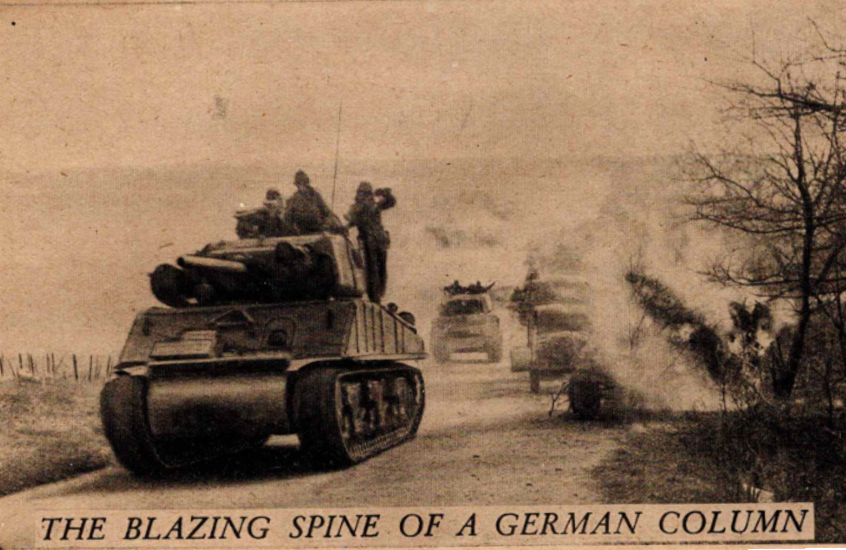
The spearhead slashed into the surprised Germans from the south instead of from the west, the direction from which the enemy expected the attack. For the first nine miles the tanks moved parallel to the German lines, drawing fire from both the West and the east, but rolling up the enemy flank as they went. Then they turned east and the rat chase was on.
Nimble light tanks and heavy assault guns led the way over the narrow, twisting roads through the pine-clad hills of the Schnee Eifel. Halftracks and other vehicles became mired and the tanks had to tow them a part of the way. The snow turned to rain at Badem and the enemy attacked with tanks. Four of them were knocked out in a brisk duel on the road and Combat Command B pushed on past the burning hulks.
Abrams raced up and down the column in his jeep or jumped into the turret of his Sherman, pleading with his men, swearing at them, encouraging them. It was he who kept them going when it looked as though they might bog down. Once the irrepressible young colonel knocked General Dager’s helmet off with a blast from his big gun when the general got too close to the muzzle. The cherub-faced demon was never still. He ran the gamut of vocal expression from stevedore to senator and back. He often used an obscene battle cry that crackled out of radios the length of the column like the snap of a whip. At other times he just said quietly, when things were sticky, “All right, boys. Let’s get a helpin’.”
When the tanks couldn’t do it, the armored infantrymen climbed down off the tanks and did it. Major Harold Cohen, a hearty shirt maker from Spartanburg, South Carolina—whose postwar plans are whimsical enough to include shirts with pockets in their tails—commanded the 10th Armored Infantry Battalion attached to Combat Command B. With complete faith that the particular tank crew with whom they rode was the greatest tank crew in the world, the doughboys rode outside the same tanks every day, clinging to the slippery Shermans by means of special handles the tankers had welded on for them. Nothing short of death could make a doughhoy change tanks. When Cohen told Abrams how proud his men were of the tankers, Abrams said, “Cohen, my boys are fine. But they never forget they’re fighting with a nice thick wall of armor plate wrapped around them. The OD shirts on your boys don’t quite match it.”
It was like that all the way. Even the light tanks did more than they were supposed to do. Once they knocked out two massive German Tigers by slipping around to the rear of the enemy tanks while assault guns laid down a thick white phosphorous smoke screen. The little tanks darted in through the smoke and, like blow darts, shot 37-mm. shells into the unprotected engine boxes in the Tigers’ sterns.
Casualties were astonishingly light, but some never saw the river. A youthful jeep driver died in Abrams’ arms at a crossroad after driving his jeep, at sixty miles an hour, back from an enemy village two miles away. His jeep rolled to a stop and Abrams gently lifted him out, his throat streaming blood from a half-dozen machinegun bullet holes. A young platoon leader in a light tank company had his hand torn off by a bazooka shell that went through the turret in which he was standing. He looked incredulously at his hand lying on the floor of the turret. Then he leaped from the tank and with his one remaining hand he killed the German kneeling by the side of the road. The tankers said, “He didn’t have to do that, you know.”
The long armored snake wound through the steep-sided canyons, through the neat German villages where bed sheets and pillowcases fluttered from the upper stories in token of surrender, while poker-faced men and women watched the procession from behind lace curtains. The white flags drooped from slender white spear-tipped rods. Those were the rods the Nazis had distributed for the party flags that flapped in the streets in better days.
The tanks stopped that night. They counted 1,200 prisoners streaming hack toward the rear in ragged gray columns. While they waited for the supply trains to come up, the tankers brewed coffee on little stoves inside the tanks and passed hot cups out to the doughboys on the wet ground. It was snowing again in the morning when the tanks moved out. They gathered speed and raced through Daun, Darscheit and Ulmen, faster than the Germans could warn the towns. In Ulmen, a tank rolled up to the railroad station to cut the telegraph wires. A fat fraulein was waiting on the platform for her train, and almost fainted with fright when she saw the Americans. Inside the station, the telegraph key chattered: “Such and such train has just left Coblenz.” A tanker listened amusedly, then smashed the key with a rifle butt and cut the wires.
Near Putzborn, the tanks had already gone through when a supply train was ambushed. The column halted and engaged in a brisk skirmish with the Germans in the hills. After the battle, while the tanks were still parked on the road, a German staff car suddenly appeared, speeding straight toward the column. The driver had told the German general that the tanks were American, but the general, out inspecting his “forward positions,” had said, “They can’t be. They must be ours.” He was fifteen yards away when he discovered his mistake and the car ground to a stop.
Hawk-faced Lt. Gen. Ernst George Edwin Graf von Rothkirch und Trach, Prussian commander of the 53rd German Corps, looked around dazedly at the Americans and the muzzles of their guns pointed at his stomach. Lt. Bernard Liese, tank-company commander from Pittsburgh, nonchalantly leaned up against his Sherman and waited while the general walked over to him.
“Where do you think you are going?” Liege asked.
The Teuton looked around again. Then, with a rueful smile, he said, “It looks like I’m going to the American rear.”
“That’s a good guess,” Liese said.
They took the general away in a jeep. Near Weidenbach, a tire went flat. While the driver and escorting Lt. Alfred Maul, of Milwaukee, worked over the tire, artillery fire began falling near by.
Maul and the driver moved into a ditch for protection, and Maul said to Von Rothkirch, “That’s yours, isn‘t it?”
The German smiled sadly, “Don’t worry, son,” he said. “There isn’t much left.”
The column thrust deeper. Startled enemy artillery units, accustomed to being far behind the lines, were overrun before their brand-new guns had time to fire their first shot in combat. Bewildered prisoners came walking in from every conceivable type of unit, including the 226th Snow-shovel Company and the 40th Woodchopping Command. Two sailors from the merchant marine were amazed to discover themselves prisoners of an American armored division. A German officer was taken as he leisurely strolled around a town arranging billets for his men, who had come to defend the place.
At Mulheim, however, the aged Burgemeister stood defiantly on the steps of the town hall and challenged the tanks with a pistol. He fired until the gun was empty, than turned and ran into the building. Infantrymen chased him through the building. The spry old gentleman dodged nimbly from room to room, finally skipping out the back door. The doughboys finally caught the winded Burgemeister two back yards away. Puffing mightily, he surrendered.
At Kehrig, an antiaircraft regiment opened fire on the column with 20-mm. flak guns. Abrams ordered the hatches buttoned up, and the armored mass rolled forward, crushing men and guns alike. On the outskirts of the town, one tank was hit by an antitank gun and another by a bazooka as they nosed over the brow of a hill. Abrams sent out a distress call for “The Mad Russian,” a division character.
Alexis Sommaripa rolled up to the head of the column in his light tank with a special loud-speaker. For weeks, the Millwood, Virginia, evangelist had practiced a speech designed to induce Germans to surrender peacefully. He also had spent considerable time practicing in a tank, driving it through people’s back yards and testing the various guns on assorted haystacks and manure piles.
Abrams had asked him, “Why all the practice with a tank? I thought you used psychology.”
Sommaripa looked a little guilty. “Well, to tell you the truth, colonel, sometimes this baloney doesn’t work.”
Actually Sommaripa’s spiel had proved highly successful. At Kehrig, however, he didn’t quite make it. Sommaripa cleared his throat and edged his little tank up to the outskirts of the town, where a fanatical German lieutenant and fifty infantrymen were making a determined effort to block the tanks. “Come on out!” Sommaripa boomed out of the loudspeaker. “Civilians, stay in your houses! The Fourth Armored Division is prepared to destroy your town if you do not surrender! Do not expect to fire your last shell and then surrender! Surrender now—or else!”
The tanks waited for five minutes. Then, when there was no answer, they backed off and division artillery moved into position. They drenched the town with incendiaries and high-explosive shells until it was blazing. Then the tanks swept over the hill in a wave of armor and plunged into the burning town. The German lieutenant, who had fired his last shell in defiance of the warning, stepped out to surrender. Unfortunately, he met with a serious accident.
The tanks moved on. Now the traffic on the narrow road was slowing their progress. Once division headquarters told the tankers either to get everything except combat vehicles off the roads or else to get staff officers out to direct traffic. More German equipment was being destroyed every day on the dash to the Rhine than any single day during the sweep across France, and at night the tanks and bulldozers had to push the smashed enemy equipment off the road to permit the jeeps and trucks to get through the tangle.
They had nearly reached the river when a Cub plane hovering over the road reported that a German column was moving along a road near Coblenz. “The column is two thousand yards from your rear tank,” the pilot called.
Abrams switched on his radio and called to Lieutenant Liese. “There’s a column of Jerry vehicles two thousand yards up the road,” Abrams said.
“Shall I ambush them?” Liese asked.
“Hell, no!” Abrams shouted. “They’re going the same direction you are! Catch ’em!”
Liese’s Shermans lumbered out ahead of the main column at full speed. The Cub pilot, watching from the air, called down a play-by-play account.
“They’re only fifteen hundred yards from you now,” he radioed. “Go faster. Faster... Now they’re only a thousand yards from you.” He was silent for a moment while the tanks raced ahead after their quarry. Then he called again. “They’re around the next curve. Go get ’em.”
There was another moment of silence while the straining Shermans hammered down the road. Then Liese broke in excitedly, “I see ’em! I see ’em! What’ll I do?”
Abrams jumped up and down in his turret. He screamed into his transmitter, “Slaughter ’em! Slaughter the so-and-so’s!”
Liese’s tanks ran right up the back of the surprised enemy column, big guns and machine guns spraying the road. Startled Germans toppled from their vehicles into the road. Trucks exploded into flame. Writhing horses thrashed about on the pavement. The rampaging Shermans reached the head of the column and turned around. Then they raced back the length of the column a second time, destroying all that was left or living. Then it was all over and the tankers slowed down and stopped.
Young Liese, as famed for his inability to read a map as for his ability to fight, looked out of his turret at the countryside and scratched his head. He called Abrams on his radio, “Where am I, colonel?”
“How do I know where you are?” Abrams snapped. “All I know is that you’re at least five miles past the place you were supposed to turn, and you better get back here before you get more lost than you are already.”
They first saw the Rhine at 3:45 in the afternoon when Combat Command B moved into Kettig, overlooking the wide river. Abrams had spread his tanks out in a skirmish line between the town and the river. The 8th Tank Battalion, under Lt. Col. Albin Irzyk, of Salem, Massachusetts, attached to Combat Command A, fanned out in front of Malheim and Karlich.
All that night fleeing German columns streamed toward the Crown Prince Wilhelm Bridge at Urmitz, last link with the east bank. The Shermans unlimbered their big guns. A steady procession of high explosive and incendiary shells hurtled across the 1,000 yards to the river road, raking the German columns. Wreckage jammed the road, and flames silhouetted the carnage. At 1:30 in the morning, the tanks stopped firing and called for the divisional artillery. Every fifteen minutes until 6:30, a salvo of artillery shells whistled over the tankers’ heads and dropped along the road where the Germans were still struggling to move through the debris.
An eerie silence settled over the fog-shrouded fields. Then the explosions came. While the fleeing German foot soldiers frantically stampeded to get across the river before the bridge was demolished, SS troopers on the far bank poured streams of small-arms fire into them in an effort to drive them back from the double-tracked railroad bridge, on which planks had been laid for the vehicles. Dozens of Germans were killed or wounded by the SS men. The others, stunned by the spectacle, turned wearily away from the river and began walking back up the road toward battered Urmitz.
The tanks moved across the fields to the river road, swung through the town and picked their way slowly through the smoking wreckage.
In the destroyed column they counted, among other items, three tanks, thirty-six 88’s, twenty-two 75’s, ten 105’s, 137 trucks, thirty‑eight staff cars and twenty-five half-tracks.
The tanks stopped where the fields and orchards slope down to the Rhine’s edge, then rise sharply in steep gray bluffs on the other side. Abrams picked up his radio transmitter and held it close to his mouth. “We are on our objective,” he said.
* * *
General George S. Patton’s invincible 4th Armored Division, pride of the 3d Army, tonight is leading a breakthrough east of the Rhine into the heart of Germany.
The 4th Armored Division, which registered a 27-mile gain before noon, sent back an appeal for transportation for thousands of prisoners taken. The American tank men were going too fast to bother with them.
LIFE Magazine, April 16, 1945
From battlefront interviews with leading U. S. generals and from the reports of the team of “Time” and LIFE correspondents he was in charge of on the Western Front, Charles Christian Wertenbaker included the following in what was described as “the pattern of the victory in western Germany,” and published in the April 16, 1945 issue of LIFE Magazine.
During the First Army’s push to the Rhine, General Patton’s Third Army, which had been stretched from the northern tip of Luxembourg 80 miles south to Saarbrücken, had been under orders to keep pressure on the enemy and to get bridgeheads over the Kyll River, but not to do anything rash. By March 4 Patton was through three-fourths of the Siegfried line and had his bridgeheads across the Kyll. Then Bradley struck simultaneously from the north and west.
It was a difficult operation, and particularly difficult to time it to the minute. Bradley not only had to hold back the impetuous Patton until Hodges reached the Rhine, but he had also to hold back Hodges’ III Corps, which had been set to push south for days, until the VII Corps gained its objective. On March 5 the VII Corps fought its way into Cologne while the III Corps, led by the 9th Armored Division, cut south parallel to the Rhine. Patton’s armor sliced into the Eifel in two places and the great 4th Armored Division sparked by Lieutenant Colonel Creighton Abrams, Jr., started eastward on the journey that was to carry it over more miles of German territory than any other division in this battle.
By March 6 the 4th Armored was halfway from the starting point to Koblenz, and Hodges’ 9th Armored was racing for Remagen. At ten minutes to 4 in the afternoon of March 7 a sergeant named Mike Chinchar of the 27th Armored Infantry Battalion led his platoon out on the Ludendorff Bridge at Remagen and ran for the farther shore. By nightfall the lucky bridgehead was secure and, to the south, the 4th Armored Division was in sight of Koblenz.
Next day Patton’s Fourth Armored and 11th Armored met outside of Koblenz with a pocketful of prisoners caught between them. The following day Hodges’ V Corps cut south into Patton’s territory and caught another bag. For the next four days the two armies had a prisoner race while Patton pushed down to the Moselle and Hodges built up strength in his bridgehead. Hodges was impatient to attack but Bradley wouldn’t let him. “I told Courtney,” Bradley said later, “to stay there and swell out his chest.”
“Brad,” says a member of his staff, “plays on his Army commanders like little David playing on the strings of his harp. Take Patton, for instance. Sometimes he plays so soft and sweet that Patton thinks he thought of the idea himself, and sometimes he just says, ‘Georgie, I know you won’t like this but this is the way it’s got to be.’”
By now Phase III was developing and this time it was Hodges on whom Bradley had to play. Neat little Courtney Hodges doesn’t have Patton’s flair for publicity, but his army, on the whole, has fought more and accomplished more than Patton’s. Now, through a stroke of luck and fast thinking, he stood on the farther banks of the Rhine and saw a chance to do something spectacular. Bradley would have none of it; he was already timing his next move. He told Hodges to expand his bridgehead a few thousand yards and to wait until Patton crossed the Rhine.
Southward in the Saar and the Palatinate Patton and Lieutenant General Alexander Patch of the Seventh Army were repeating the maneuver with which Hodges and Patton had bagged so many prisoners in the Eifel. Again the coordination between corps and armies was almost perfect. While Patch kept the enemy tied down in the Siegfried positions of the Saar, Patton struck twice across the Moselle. Between them Patch and Patton caught one bag of prisoners and held another bag for the advancing Seventh Army. With army boundaries erased, Patton continued south as far as Speyer, but if the Germans had known that he had left the 4th Armored Division between Mainz and Worms, they might have guessed what was coming next.
On Friday, March 23, Phase IV opened without air or artillery preparation when Patton’s 5th Infantry Division jumped the Rhine near the town of Oppenheim. Both the time and place were well chosen. The bulk of the remaining German armies was either in the north, where Montgomery had been slowly building up to cross the Rhine and was to do so before the next dawn, or around Hodges’ bridgehead or south of where Patton crossed. Patton immediately sent the 4th Armored across the Rhine and within 24 hours this irrepressible division was 18 miles east of the river. The 6th Armored Division followed, striking north, and Hodges burst out of his bridgehead.
By this time Hodges had three corps across the Rhine and was facing elements of 16 German divisions. His armor struck eastward along the small roads of Germany. Patton’s Fourth Armored, meanwhile, had turned north toward Giessen and an enveloping move was in progress.
The battle of the Rhine had gone faster than General Eisenhower had dared to anticipate, even in February 1945. He had foreseen two battles: one west of the Rhine and the other to the east. Bradley changed all that. The luck of Remagen and Patton’s quick crossing had enabled him to overrun an area of Germany as large as the Saar and the Palatinate. Now he had two armies striking north from Giessen toward Paderborn, while the Ninth Army under Montgomery, north of the Ruhr, was fighting eastward toward Hamm.
Bradley now had power to spare—so much that he could send the 4th Armored Division out on raiding expeditions, one southeast toward Nurnberg. The German armies were broken up and scattered; they fought halfheartedly if at all; on one day the First and Third Armies together had only 35 men killed.
By Sgt. SAUL LEVITT
YANK Magazine, May 11, 1945
OHRDRUF, GERMANY—There is no death smell yet in Concentration Camp North Stalag III, in Ohrdruf. It was cold when the tanks of Combat Command A of the Fourth Armored Division rolled into this town a few days ago and it is still cold and damp. The victims had been killed the day before the tanks arrived, but there had been no time to burn and bury the bodies because we had been advancing too rapidly.
Now three days later, the bodies are still there, and it has stayed cold so you can walk around them at fairly close range. There are 31 bodies lying on the ground in one place and more than that number piled on top of one another in a shack. The bodies are all partly or completely naked. Around some of them blood has made pancakes of red mud on the ground. Some of the bodies are very thin with the incredible thinness of severe malnutrition.
The living survivors of the camp say that one of the dead is an American soldier and they point the body out. He lies on a stretcher, naked with a blanket half over him. He had been a tall, clean-cut man. There is a bullet hole through his throat.
The victims in the shack, piled six deep, were both beaten and shot to death. Quicklime was thrown over them and all the bodies are naked, thin and some with changed coloring, perhaps from the lime or from illness.
The story of the dead is told by the living who hid away when it came time to move the camp farther eastward by rail.
There were more than 2,000 men in the camp. Those who were killed were too sick or too tired to climb into the railroad cars. So they were clubbed until they fell and then were shot at close range.
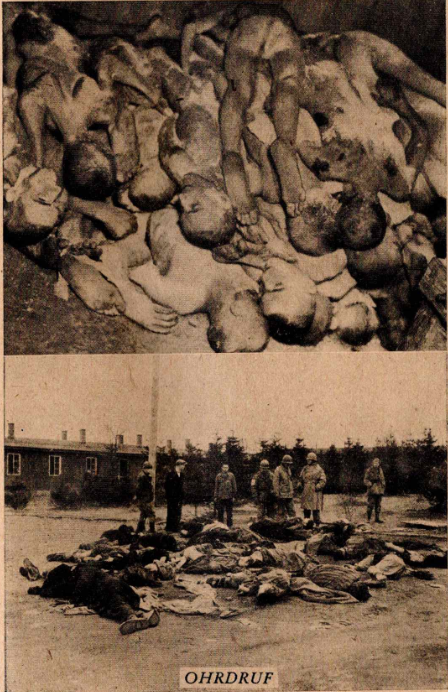
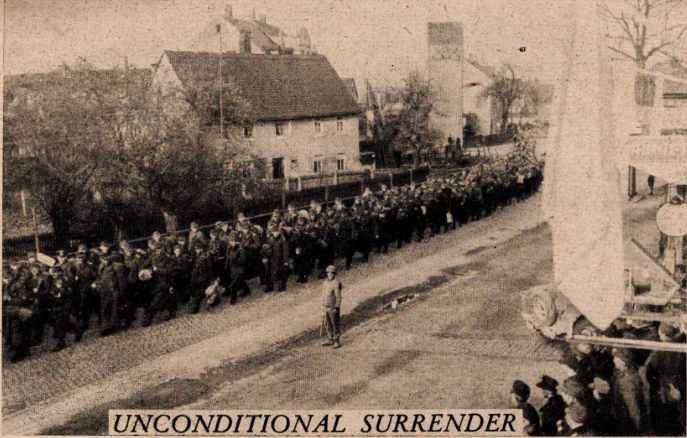
The men in the camp included Belgians, French, Russians, Serbs and Poles. There is one 16-year-old Jewish lad among the survivors. There are also three Russian officers who made it. Two of them are doctors—a major and a captain—and the third is a young lieutenant who flew a Yank fighter plane for the Red Air Force. The doctors worked as laborers until a few days before the evacuation of the camp. Then, just before the end, they were put to work on some of the sick in an effort to get them ready for the movement.
The Americans going through this camp are very quiet. They have already seen much death, but they stare at this death, which is uglier and harder to look at than the death of war, with impassive faces and big eyes.
Major John R. Scotti of Brooklyn, N. Y., Combat Command A’s medical officer-in-charge, burst out in a loud voice, not speaking to any one in particular. He just stood in the middle of the camp and shouted out what he felt and no one acted surprised to hear his voice booming out big like that.
“I tell you,” he said, and his angry voice was shaking, “all that German medical science is nil. This is how they have progressed in the last four years. They have now found the cure-all for typhus and malnutrition. It’s a bullet through the head.”
The commander of Combat Command A, Colonel Hayden Sears of Boston, Mass., acted the next day. He must have been thinking of this all night and what he did was to assemble the leading citizens of Ohrdruf, including the richest man in the community. Ohrdruf is a neat, well-to-do suburban town with hedges around some of its brick houses and concrete walks leading to their main entrances.
The richest man in Ohrdruf is a painting contractor who made a lot of money in the last few years on war work for the German Army and now owns a castle on the way to the concentration camp.
Colonel Sears, a big, tough-looking man, ordered the leading citizens of Ohrdruf out from behind the smug privacy of their hedges and housefronts and had them driven in Army trucks to the concentration camp to let them see this killing that is sprawled on the bare ground and piled in a shack.
The crowd of the best people in Ohrdruf stood around the dead and looked at the bodies sullenly. One of them said at last: “This is the work of only one per cent of the German Army and you should not blame the rest.”
Then the colonel spoke briefly and impersonally through an interpreter. “Tell them,” he said, “that they have been brought here to see with their own eyes what is reprehensible from any human standard and that we hold the entire German nation responsible by their support and toleration of the Nazi government.”
The crowd stared at the dead and not at the colonel. Then the people of Ohrdruf went back to their houses.
The colonel and his soldiers went back to their tanks, and we went out of this place and through Ohrdruf and Gotha, where the names of Beethoven, Mozart and Brahms are set in shining, gold letters across the front of the opera house.
Russell Davenport
With Patton’s Boys:
By Russell Davenport
WITH THE 4TH ARMORED DIVISION, April 14—It has to be seen to be believed—this great drive of the 4th Armored into eastern Germany. It is spring here. We are in a gently rolling country, thickly wooded in spots. The carefully tilled fields stretch away brown and light green to the horizon and the apple trees are in bloom.
It is spring and the 4th Armored has its tracks set on one of the great superhighways that Hitler built to transport his own military supplies. A superhighway is a general’s dream in whichever direction you use it, and it so happens the Americans have the ideal general to make the dream come true. Nothing could be better suited to the temperament and talents of General George S. Patton than four cement lanes straddling the Reich from Frankfort-on-the-Main to the edge of Silesia.
Nor is there any division readier to exploit this facility than “Georgie’s” beloved 4th Armored commanded by Major General William M. Hoge.
In their hands Hitler’s autobahn has become a gigantic sword stabbing deep into the heart of the Reich. Here they are among the apple blossoms, farther east than any unit on the Anglo-American front.
The tactics of the 4th Armored in the present drive are essentially the same as those by which they cut across France. But we are now in enemy country—a country, moreover, of enslaved people, some half dead from torture or starvation and all bearing in their hearts bitter hatred toward the German people.
In the wake of the tankers this human melting pot explodes. There are the prisoner-of-war cages suddenly opened and pouring forth American, British, Russian and French prisoners by the thousand. The gaunt and eager-eyed American boys seeing their own tanks again are unable to speak. Their story is a cycle in itself.
There are the broken survivors of Ohrdruf, where the 4th Armored boys discovered corpses stacked in line, of Buchenwald, which this division reached a few days ago, liberating thousands of human wrecks held there as political prisoners; of innumerable other camps where indescribable atrocities have been perpetrated.
I have encountered Belgians, Dutch, Russians, Ukrainians, Hungarians, Czechs and Yugoslavs and a Latvian woman with tears in her eyes who asked me for a map that would show her the way back to her lost home.
Because we have been fighting barely 30 miles from the border of Czechoslovakia a great portion of the refugees are Czechs. As we pushed up the autobahn thousands of them ran out of farms and factories to watch their liberators rumble by. Bright faces grinned from ear to ear. Women cried. Men shouted in broken English. Leaning out of my jeep I yelled “Czechoslovakia.” A roar went up that drowned even the clanking of the tanks.
The reaction of our soldiers to the pathos and suffering around them is strictly American. They are shocked by the brutality of the Germans, shocked and mad as hell.
I was sitting last night with one of the division officers when a young Czech was brought by a GI from the utter darkness of the street. He was member of a group of 200 political prisoners who had been marched by the Germans for four days without food. He had been sent by a group to plead with us because he could speak English. Wan and shaking with fatigue he told us the story of Buchenwald while tired GIs searched for food in a black-out where almost everyone was in bed.
When he finished his story the American officer ran his fingers through his hair. “Christ,” he said, “I feel as if I were living in the Dark Ages.”
Then he turned to me.
“Do the folks back home have any idea of this?” he said “Do they have any idea at all?”
It is spring here. The apple trees are now in bloom. Daffodils dance in neat German gardens. Hope has been lighted in hearts which for years have known nothing but misery and fear. But there is death in this spring, death in the memory of men and women. And there is death in the frightened German towns.
Yes, there is even death in the hearts of the American tankers leaning against their massive vehicles which crouch before the attack like great beasts under the blossoming trees. The tanker boys are lonesome for their girls and ice cream and decent jobs and they are sore as hell at the Krauts.
(New York Post, April 14, 1945)
Armored News, 26 March 1945
WITH THE 4TH ARMORED DIVISION IN GERMANY—Third Army’s fighting 4th Armored Division, General George S. Patton’s “Sunday Punch,” which made the “fire alarm” run from the Saar Valley to relieve the besieged 101st Airborne Division at Bastogne, has long been a thorn in the side of the German army. Aggressive leadership in this aggressive division is believed to be its secret of success in battle.
Under the title of aggressive leadership can be placed the name of Major General (then Brigadier General) Holmes E. Dager, 52-year-old commander of the crack tank division’s Combat Command “B”.
Now engaged in his second war with the Germans, the scrappy little general—he’s five feet seven inches tall—whose courage in battle has been recognized by five awards, rose from the ranks in World War I to build and command an armored element that is now known as General Patton’s “work horse.”
General Dager resumed his private war with the Wehrmacht when he led Fourth Armored troops against the Boche in Normandy hedgerows.
The speed and power of General Dager’s attack and advance achieved a major breakthrough in the German lines.
At Avranches, the gateway to the Brittany peninsula, General Dager’s troops captured 4,000 German prisoners in two days of fierce armored battle. In that action the general earned the Distinguished Service Cross. When the Nazis attacked his headquarters from three sides simultaneously, General Dager directed the counter fire that beat off the attack while manning the guns on his command tank.
General Dager’s latest award, a second Bronze Oak-Leaf Cluster to the Bronze Star Medal, came for heroic action in the battle which relieved the encircled American troops in Bastogne. General Dager’s tanks, artillery and infantry cut through a thick wall of German armor and troops to help open the corridor to the hard-hit 101st Airborne Division. The Union, N.J., general was awarded the Bronze Star Medal and an Oak-Leaf Cluster in September during the fierce fighting in eastern France where the Fourth Armored pushed the Nazis behind the Reich’s frontier in addition to protecting the south flank of Third Army.
Enemy equipment knocked out or captured by fighting units of General Dager’s command in six months of combat include 144 tanks, 224 vehicles, 15 self-propelled assault guns, 51 88s, 50 half-tracks, 62 anti-aircraft guns, 16 prime movers, as well as a locomotive and 32 freight cars.
In Combat Command “B” headquarters, officers and enlisted men have won a total of six Silver Star Medals and 61 Bronze Star Medals.

By Will Lang
Just before the U. S. armies plunged across the Rhine a captured American soldier, one of thousands subsequently freed, was brought up for questioning before a scowling German officer.
“So, you are from the 4th Armored Division?” the German asked.
The American looked the German straight in the eye and with the aggressiveness of a good tankman said, “You bet I am.”
The German leaned back in his chair, smiled broadly and in the tone of one anxious to hear all about an old friend, asked, “Well, and how is Colonel Abrams?”
Colonel Creighton William Abrams, Jr., the object of this intimate interest on the part of the German officer, is largely unknown among U. S. civilians. It is one of the ironies of this sprawling global war that outstanding young combat officers are better known to the enemy than in their own country. Yet it is they who execute the battle plans of the well-publicized higher officers.
As the rampaging commander of the 37th Tank Battalion of the 4th Armored Division of the Third Army, Abrams is the cutting edge of the U. S. spearhead. An even more pertinent question about him might have been, “Where is Colonel Abrams?” For where Colonel Abrams is, that spot is likely to be the farthest point of the U. S. armored penetration into Germany. Last week, as advance man for the equally aggressive George Patton, commander of the Third Army, he was reported to be cutting clear across prewar Germany into Czechoslovakia. His present whereabouts is cloaked in a security news blackout and at any given time may not even be known to his commander. In his own words, Abrams likes to be “way out on the goddam point of the attack, where there’s nothing but me and the goddam Germans and we can fight by ourselves without stopping to report back to headquarters.”
SHAEF headquarters by now is accustomed to having him and his running mate, Lieutenant Colonel Delk Oden of the 35th Tank Battalion, turn up unexpectedly in places far in advance of the theoretical battlelines. This habit inspired a wisecrack by one of Abram’s officers that has since been borrowed by half the other units on the Western Front. While looking over a field map showing concentrated German positions all around them in the forward areas, the officer shook his head in feigned dismay. “They’ve got us surrounded again,” he said “the poor bastards!”
The surrounding of Abrams’ and other units of the 4th Armored by the Germans has almost invariably resulted in the 4th Armored’s soon surrounding the Germans. This pattern, repeated elsewhere along the front, has made the great campaign in the west a series of encircling movements which have broken the back of the German defenders and captured them in massive blocks of tens of thousands. The 4th’s special skill in this technique recently won it a Presidential Citation which followed a peculiar accolade from the Germans that was almost as flattering in its own way. According to captured documents the Wehrmacht rank and file, among whom the 4th is regarded with both respect and terror, were told that each individual soldier in the division was chosen because he was a professional murderer in civilian life. Moreover, the documents charged, an American was entitled to membership in the division only after he had first proved: 1) he had killed his mother; 2) he had been born out of wedlock.
These documents are cherished at divisional headquarters along with the records of the 4th’s career through a series of bold and critically important field operations. It was the 4th, with Abrams always out on the point of contact, that broke loose from the Normandy peninsula in only 11 days’ fighting, a feat that has been described as “astounding the Allies as well as the Huns.”
After that it was the 4th that led the Third Army in the breakthrough at St. Lo, which drove the Germans back to their Seigfried fortifications. In that epic drive the division destroyed 317 German tanks and captured 20,000 prisoners, even though on several occasions Abrams radioed back that “We are moving ahead without opposition.” Division headquarters, following up, would find the “unopposed” route strewn with German tanks and gun batteries and littered with hundreds of German bodies.
When the Germans mounted their Ardennes counteroffensive, it was the 4th Armored, under command of Patton’s former chief of staff, Major General Hugh Gaffey, that buttressed the southern flank. Later, with Abrams in the lead, it broke through in a spectacular and devastating dash to relieve the besieged 101st Airborne Division in Bastogne. More recently, in the drive from the Kyll River to the Rhine, it plunged ahead more than 50 miles in fifty-eight hours of concentrated mayhem. Abrams and his outfit destroyed more than 300 German motor vehicles, 75 artillery pieces, 75 anti-tank guns, 15 Tiger and Panther tanks, 20 “screaming meemies” and overran a rear-area German hospital with 80 patients, three enemy ammunition dumps, one ordnance depot, one fuel dump and a German army corps headquarters where an annoyed German Lieutenant General and most of his staff were captured while still at their desks.
Such accomplishments, in which Abrams has always been a leading performer, have draped the cape of a legendary hero around Abrams’ shoulders. At 30, he is mature enough to be truly modest, and he does not cultivate the hero worship that surrounds him. But there is a dynamic quality about him and a great flair for leadership that cause his men to idolize him. “We can always spot his tank,” says Lieutenant John Whitehill, a company commander, “because it doesn’t roll ahead like others. It gallops.”
“Abe’s tank,” says Lieutenant Colonel George “Jigger” Jacques of the 53rd Armored Infantry, whom Abrams addresses over the tank radio as “Sad Sack,” “Looks bigger than anyone else’s in the field just because Abe’s in it.”
As he rides along, Abrams gnaws on a long, black, unlighted cigar. “It looks just like another gun,” his men say. His present tank, successor to six he has worn out, is named Thunderbolt VII. One of the latest improved models of the M4 medium tank, it arrived just after Christmas, when the battalion was resting after the breakthrough to Bastogne. It has a 76-mm gun, a 17-inch tread, a cast turret and a welded hull. Abrams spent a happy holiday wheeling it through its vocabulary of paces within artillery range of the Germans. The tank it replaced, Thunderbolt VI, had its name in letters eight inches high on a background of billowing white clouds punctured by jagged red streaks of lightning. In the interest of winter camouflage Thunderbolt VII was painted a drab white, but with spring well along Abrams’ driver, Sgt. Robert Stillwell, is giving thought to another appropriate motif for VII.
One reason why the Germans are particularly fascinated and terrified by Abrams is that they assume because of his name that he is Jewish, and they imagine that race vengeance plays some part in his destructiveness. Actually Abrams is a New England Methodist but he lets people think what they like. However, Major Harold Cohen of the division’s 10th Armored Infantry Battalion is Jewish and is not only a close friend but an operational business partner of Abrams. Cohen’s infantry usually either accompanies or follows Abram’s tanks, so that the two units are often indistinguishable. To the Germans the team of Abrams and Cohen seems like the instruments of a wrathful Jehovah.
Perhaps, if the Germans could ever understand it, it would be instructive to them to know more about Abrams and the background that molded him. He was born in Springfield, Mass., on Sept. 16, 1914 and grew up like any normal American boy whose parents see that he goes to Sunday school, eats his vegetables and has plenty of milk to drink. World War I was finished by the time he went to grade school, and the only military background in the family was the story of his greatgrandfather, who served with distinction as a drummer boy in the Civil War until his left arm was blown off by a nervous comrade behind him.
In Agawam High School, across the Connecticut River from Springfield, young Abrams was known as “Toots.” His friends picked up the nickname from the Abrams family, who started calling him “Tootsie” because he was such a cute baby. He was able to live this down in high school, however, where he was captain of a football team that went through its season undefeated, untied and unscored upon. He was class president in his senior year, editor in chief of the school paper, president of Hi-Y, a member of the senior class play and class orator at graduation. In summers he worked on the Jenks farm near by and in his spare time took part in 4-H club garden activities. He also raised chickens and later raised and exhibited steers for the 4-H Baby Beef club.
After high school Abrams considered a scholarship to Brown University but a friend persuaded him to try the competitive examinations for West Point. He was third in a field of 57 and entered when the two candidates ahead of him failed in their physical examinations. At West Point he was too busy to spend much time on his studies and graduated 216th in a class of more than 480. He had his nose broken playing hockey and was considered one of the most efficient hazers on the academy’s “beast detail.” It took him four years to make his letter in football because he was never able to get his weight up much above 165 pounds, which is light for a guard. The 1936 Howitzer, the academy yearbook, said he held the football “warm up record” as well as the “undisputed title of the loudest, happiest, fightin’est man on the squad.” “Indeed,” said the Howitzer, “a team of Abrams might conceivably prove a champion.”
From West Point, Abrams went to the Cavalry School at Fort Bliss, where his restlessness soon gave him a reputation as a prankster. During one period he had a room directly across a court from the officers’ club of the post. On Saturday nights, after other officers and their friends had parked their automobiles in the court and entered the club for an evening of fun, Abrams would sneak out and attach smoke-producing firecrackers to the spark plugs of the cars. Then he retired to the window of his room to watch and wait. When the officers’ club eventually closed, gay, teetering officers climbed into their cars and pressed the starters. The loud explosion and ensuing clouds of black smoke, curses and frightened cries gave Abrams much saturnine merriment. Intoxicated by a series of successes, one night he wired a firecracker in the automobile of the general commanding the post. Abrams never was identified as the culprit in the inquiry which followed, but having achieved the ultimate he felt justified in giving up his pastime.
In his second year at West Point Abrams had met Miss Julia Harvey of West Newton, Mass., an attractive Vassar student who came down for a hop as the guest of one of Abe’s friends. The friend got sick, Abe got the date, fell in love and he and Miss Harvey were married two months after he was graduated. Now the mother of 6-year-old Noel Abrams and 4-year-old Creighton William Abrams III, she lives in St. Petersburg, Fla. with her mother, waiting and hoping like millions of other Army wives for the war to end quickly.
Abrams, too, wants the war to end quickly and as a cavalryman who turned to tank warfare in 1940 his theories about how it can be done quickly are illuminating. To a cavalryman’s belief in mobility be has added a belief in the efficiency of violence properly and unsparingly applied. “We don’t want the Germans to fall back,” Abrams insists. “We want them to try to defend their positions so we can destroy them and their equipment. There’s entirely too much emphasis on getting prisoners and not enough on destruction. Whenever the Germans get us in the wringer they show no quarter, so why should we? We’ve got to set our minds to destroying them—that’s the only way to get this job done, and done fast.”
“When we go into those pretty little towns in Germany,” Abrams explains, “we don’t aspire to damage anything. But if there are Germans there we use our violence, everything that can be burned is burned and every building is destroyed.”
Abram’s theory is that overpowering violence not only destroys the enemy’s soldiers and does it quickly but it also keeps down American casualties. In one town in Belgium, for instance, German resistance was mean and stubborn. In house-to-house fighting, Abrams’ tankmen, working with Lieut. Colonel Jacques’ armored infantry, systematically chucked grenades into every window and directed flame throwers through every door. Before the village was completely cleared of Germans it was necessary to burn every building in the area. The score was 427 prisoners of war, 50 Germans killed and 42 wounded, American casualties were negligible.
“Our operations are all based on violence,” Abrams says. “An infantry division doesn’t have the type of violence we have. We have more firepower than any infantry division in the world—German, British or Russian. We have mobility, better communications and support artillery which is right behind us. Why, I’d no sooner tackle an American tank battalion having all that violence than I’d try to trap a wildcat in my sleeping bag.”
When Abrams’ tank battalion starts rolling, it goes fast, with every gun in its tremendous arsenal firing throughout the charge. “Even the best German troops, like the 11th Panzer,” says Abrams, who occasionally speaks in Mac Arthur-like formalism, “cannot collect themselves fast enough. Our firepower spreads confusion and chaos in the German command and fear in the German soldier. Perhaps the more stouthearted fellow will hang on. But the vast majority take counsel with but one thing—fear.”
The best illustration of the effectiveness of this blasting program occurred during the 4th Armored Division’s dash to relieve the Bastogne garrison. just before dusk on the day after Christmas, Abrams’ tank battalion and the 53rd Armored Infantry under Jacques had fought their way to the crest of the last hill before Bastogne. Ahead a secondary road rolled over the countryside for more than three miles before it finally reached the outskirts of the town. Two villages, Clochimont and Assenois, straddled the road, both defended by fanatical German paratroopers.
While supporting artillery laid down a heavy concentration on the two villages, Abrams’ armor stood poised on the hillside, ready for the swift downward swoop. Finally Abrams stood up in his turret and over the interphone came his terse signal, “Let ’er roll!” Like one great snake, the chain of armored vehicles jerked into motion and, gathering momentum, raced down the road towards Clochimont with guns blazing. The column whipped through the village and then rolled on to Assenois where our artillery shells were still pounding German hideouts. Four lead tanks sped through the inferno safely, but a half-track next in line caught a direct hit which disabled the vehicle, killing two infantrymen and wounding four others. The next tank was pinned by a falling telephone pole and still another Sherman floundered under half a ton of debris. In the street the remainder of the column ground to a halt behind the immobilized vehicles. Abrams and his crew scrambled out of their tank and wrested the telephone pole from the trapped tank as infantry engaged German paratroopers in a hot sniping duel. Once back in his tank, Abrams waved the column forward and it roared ahead, leaving doughboys behind to clear the burning village.
Thus Bastogne was relieved in a daring plunge which sent the Germans reeling. As against their high casualties and equipment losses, ours were few: 30 men killed, 180 wounded, and several tanks destroyed.
While Abrams has never had a tank shot out from under him nor sustained an injury in combat, his long periods spent in the vanguard of the fighting have brought him close to death many times. One of his narrowest escapes occurred north of Bastogne when a sudden heavy German artillery barrage caught him standing in the open with two of his officers. The trio instantly dove under the stern of a light tank near by. While shells, mortars and rockets sliced the area to ribbons, one officer had his helmet rapped by shrapnel and “Colonel Abe’s” pants were torn by fragments. “I was considerably concerned at the time,” Abrams commented later, “but our division headquarters later reported only ‘sporadic’ enemy fire, so I guess I shouldn’t have been.”
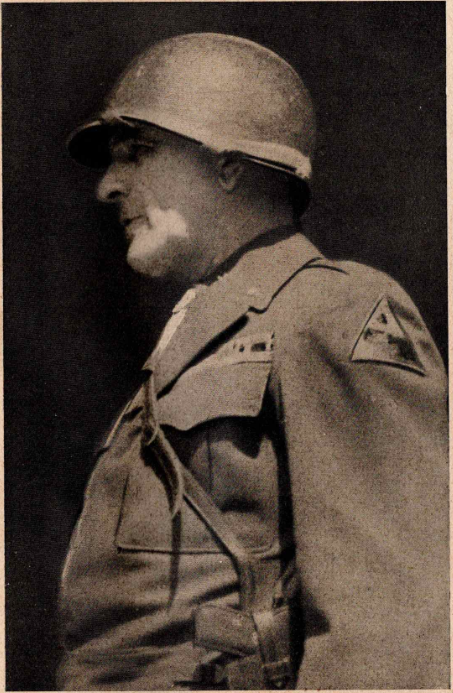
Major General William M. Hoge
21 March 1945-17 June 1945
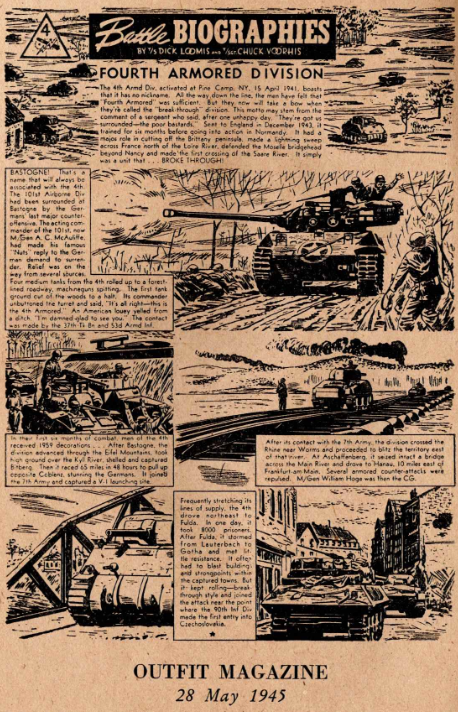
Army Times, March 17, 1945
WITH THE 4TH ARMORED DIVISION, in Germany—The first Medal of Honor to be awarded to a man in the 3d Army has been pinned on the breast of 1st Lt. James H. Fields of Fort Worth, Tex., by General George S. Patton, Jr.
The “dauntless and gallant heroism” of Lieutenant Fields at Rechicourt, France, after being seriously wounded were largely responsible for the repulse of Nazi forces on September 27 and contributed in a large measure to capture of his battalion’s objective.
The 1st platoon of A Company, 10th Armored Infantry Battalion, which Lieutenant Fields commanded, was sent up Hill 265 to fill a gap left by two platoons, including one heavy weapons platoon, that had been knocked out by savage enemy resistance. Fifty-five men went up the hill and 13 returned almost 24 hours later after using two light machine guns to wipe out a platoon of Jerries supported by artillery and three Panther tanks.
Lieutenant Fields moved his men up under cover of darkness and assumed a defensive position. They held out all that night and about 6 o’clock the following morning they received their first concentrated attack. They repelled that, and a few minutes later, Fields heard one of his men call for medical aid from a nearby foxhole.
Knowing that no medical aid man was present, and that none was available, Fields went to the aid of the man himself. He arrived just in time to see one of his squad leaders shot through the head. He turned to take a shot at the Nazi marksman, but before he could fire, he was hit.
The Jerry bullet ripped through Lieutenant Field’s cheek from left to right, knocked most of his teeth out, cut his tongue and filled his mouth with blood and jaw fragments. Rendered speechless, he refused to leave his platoon and continued to direct fire with hand and arm signals and pencilled notes which he dispatched from one foxhole to the next.
“Only when his objective had been taken and the enemy scattered did he consent to be evacuated to the battalion CP,” the War Department citation reads: “At this point he refused to move farther back until he had explained to his battalion commander by drawing on paper the position of his men and the disposition of enemy forces.”
This was not the first time that Lieutenant Fields had been conspicuously gallant. During an attack on the city of Troyes, France, in August he deliberately exposed himself to enemy fire again and again in order that the positions of the enemy might be found. He received the Silver Star for that action. Lieutenant (now Captain) Fields also wears the Purple Heart and the Combat Infantryman Badge.
By Robert W. Richards
United Press War Correspondent
WITH THIRD ARMY in Alsace Lorraine, October 11, 1944 (U. P.)—In this tiny village which must go unnamed for fear of German reprisals, men and women come from their homes smiling proudly whenever American tanks null past.
Sometimes these people wave and sometimes they just stand looking. They tell their children:
“There go your brothers.”
For these Frenchmen in this town, near the quiet Marne Canal and only a stone’s throw from the hated Boche, are blood brothers of all American armored men—especially the crack Fourth Armored Division.
It was the Fourth Armored which shattered remnants of German forces in their village. And it was a sergeant of the Fourth Armored who showed them that these tank-riding Yankees not only know how to fight but how to die.
From hidden places, from haylofts, barns and attics, they had watched the dramatic action. When it ended the entire town was so moved by what it had seen that the people gathered in a body, walked to the square and picked up the sergeant’s crumpled body.
They buried him not far from the spot where he fell and every day since then some of these villagers cover his grave with fresh flowers.
When the people watched the fighting this is what they saw:
Two German 88’s were concealed near the town square.
Down the road, rumbling over rough pavement, came a long line of American Sherman tanks. The people held their breaths. They had no chance to shout warnings.
The first Sherman roared past the square and turned left into the town moving north. The German gunners were surprised or unprepared for they did not fire.
A second tank rolled into the square. By this time the Nazi gunners were ready and the 88’s roared.
The crippled tank wheeled and faced its enemy but it was unable to return the fire. Other tanks pulled back behind the protection of a house.
While the people watched this tank became a roaring furnace. They were happy to see a man leap from the top of the burning turret. They screamed to him:
“Come to us. Come this way.”
But the soldier wearing sergeant’s stripes returned to the blazing tank.
This hard-muscled young tank commander who used to work in a New Jersey copper plant had realized that his bow gunner remained trapped.
He scrambled to the tank’s top and attempted to pry open the red hot hatch. While he struggled German machine gunners got busy. They riddled him through and through and he fell in the mud of the road.
He lay there while fellow tankmen from another direction destroyed the enemy 88s. They were so occupied with the task of killing Germans that they roared past his body without stopping.
Later they returned hut the sergeant wasn’t there.
Admiring townsfolk already had buried him.
* * *
Sgt. Joseph J. Sadowski, of Perth Amboy, N. J., a tank commander in the famous 4th Armored Division, who returned to his flaming tank in the face of withering enemy fire and almost certain death in an effort to rescue a trapped comrade, has been awarded the Medal of Honor posthumously, the War Department has announced.
Maj. Gen. Francis Mallon, commanding general of the Army Ground Forces Replacement Depot No. 1, Fort George G. Meade, Md., presented the medal to Sergeant Sadowski’s father, Mr. John Sadowski, at a ceremony held April 21 at Fort Meade.
Mrs. John Sadowski, mother of the sergeant, and his five brothers and two sisters also attended the ceremony along with high ranking officers of Army Ground Forces.
The action in which Sergeant Sadowski gave his life occurred last September 14 at Valhey, France, when the tank which he commanded was struck by an 88-mm shell at close range while advancing upon the town with the leading elements of Combat Command A, 4th Armored Division.
With his tank disabled and in flames, Sergeant Sadowski ordered his crew to dismount and take cover in the adjoining buildings. Discovering that his bow gunner was still in the tank and for some reason unable to dismount, he rushed back to the burning vehicle, ignoring a hail of enemy machine gun and bazooka fire, and attempted to pry open the bow gunner’s hatch.
While working feverishly to release his comrade from the flaming tank, Sergeant Sadowski was cut down by a stream of machine gun bullets.
Other units of the task force, stunned and momentarily confused by the suddenness and ferocity of the enemy attack, witnessed the action of Sergeant Sadowski and, the citation states:
“The gallant and noble sacrifice of his life in the aid of his comrade, undertaken in the face of almost certain death, so inspired the remainder of the tank crews that they pressed forward with great ferocity and completely destroyed the enemy forces in this town without further loss to themselves.”
Sergeant Sadowski was active in outdoor sports and in boxing, in which he excelled, he was presented with a golden belt buckle as a result of his achievements in the Middlesex County Boxing Tournament of 1935.
In addition to the nation’s highest award, he earned the Purple Heart and was entitled to wear the American Defense and the European Theater Ribbons.
Sergeant Sadowski was a member of Company A, 37th Tank Battalion. (Armored News, 30 April 1945)
By Bob Moors
Stars and Stripes Staff Writer
LANDSHUT, Germany, July 4—S/Sgt James R. Hendrix, a red-haired, freckle-faced 19-year-old farmboy from Arkansas, was summoned from guard duty into the awesome sanctum of Fourth Armored Division Headquarters here yesterday and informed that he had been awarded the nation’s highest decoration—the Congressional Medal of Honor.
Hendrix had won the medal as a private by single-handedly silencing two German 88 mm. guns, capturing their crews, wiping out two machine-gun nests, saving three comrades from death and attempting to save a fourth trapped in a burning halftrack.
The action took place in the Battle of the Bulge last December as his outfit, Company C, of the 53rd Armored Infantry Battalion, was fighting its way into Bastogne to relieve the 101st Airborne Division.
Thirty-nine-pointer Hendrix could request discharge as a CMH winner but says he will not. “I want to come back with the Fourth Armored after a furlough in the States and maybe stay in the Army for good,” he said.
Hendrix is a quiet, modest kid who shuns attention of any kind; typically, he was wounded three times in eight months of fighting, but never bothered to go to the medics.
When the major who broke the news asked him where he wanted to receive the decoration, here or in Washington, he replied promptly: “Washington, sir.”
Red probably would have decided otherwise if he had known President Truman is expected to pin on his award at a ceremony and review. All Red had in mind was that he had been stationed near Washington before coming over and knew the city well. Also he would be able to visit his parents, Pearl and James Hendrix Sr., on their farm in Lepanto, Ark., where Red had helped raise corn and cotton until he joined the Army Nov. 9, 1943.
When the major asked whether he wanted to go home via ship or plane, he said quickly: “Please, sir, I have never been in one before.”
Just what happened that confused night on the approaches to Bastogne is hard to piece together from what Red tells. “It’s all right there in the citation,” he says. “For conspicuous gallantry and intrepidity at the risk of his life and above and beyond the call of duty,” was the way the War Department worded it in its prosaic style.
“On the night of December 26, 1944, a task force was engaged in a final thrust to break through to the besieged garrison at Bastogne. When leading elements were halted by a fierce combination of anti-tank, artillery and small-arms fire in the town of Assenois, Pvt Hendrix dismounted and advanced upon two 88 mm. gun crews, and by the ferocity of his actions compelled the German gun crews first to take cover and then surrender.
Hendrix says merely: “We ran up on ’em yelling ‘come out,’ but they wouldn’t. One poked his head out of a foxhole and I shot him through the neck. I got closer and hit another on the head with the butt of my M1. He had American matches on him. Others came out then with their hands up.”
“Later in the attack this fearless soldier again left his vehicle voluntarily to aid two wounded soldiers threatened by enemy machine-gun fire. Effectively silencing two enemy machine-guns, he held off the enemy by his own fire until the wounded men were evacuated.”
“I just shot at the machine-guns like all the 50s on half-tracks were doing,” is Hendrix’s persistent version. “A half-track had been hit pretty bad and these fellows were wounded and lying in a ditch. Machine-gun fire was mostly toward them, but some bullets were coming my way.”
Continuing the attack, Hendrix again distinguished himself when he hastened to aid still another soldier who was trapped in a burning halftrack. Braving enemy sniper fire and exploding mines and ammunition in the vehicle he extricated the wounded man from the conflagration and extinguished his flaming clothing with own body thereby saving the life of his fellow soldier.
“A grenade exploded between his legs and everybody else got out. But he was hollering for help.” Hendrix said. “I tugged at him and got him out on the road, but he was badly burned. I tried to find water to put out the flames but the water cans were full of bullet holes, so I beat out the flames as best I could. He died later.”
All company commanders who were with Red then either have been killed or wounded, but the present CO, 1st Lt Melvin L. Schuweiler, of Charlottesville, Va., was high in praise of the boyish soldier.
“He hasn’t got much formal education, only went to the fourth grade, but I’ve never seen a guy with more common sense. He’s got guts, but sense enough to go with them.”
Hendrix, who is the third Fourth Armored man to win the CMH, also wears the Combat Infrantryman’s Badge and the Presidential Citation ribbon, which was awarded the division.
The Fourth Armored Division was heard on numerous news broadcasts. Following is the script of a typical broadcast:
ROBERT REID TO BBC LONDON VOICECAST FOURTH ARMORED DIVISION
Hello BBC this is Robert Reid speaking from Third U. S. Army on March 21 with dispatch number 108—Title Fourth Armored Division. This story has been censored.
When the story of the big break up of the German army west of the Rhine is finally told it will be largely the story of the Fourth Armored Division of the Third United States Army—a division which staged a super blitzkrieg in the homeland of the blitzkrieg inventors, tearing the better part of the German army into ribbons and opening the way for the conquest of a huge slab of Nazi territory.
The Fourth had already made a name for itself back in Normandy and Brittany, and more recently when it burst through into beleaguered Bastogne. But its achievements of the past fortnight surpass all those other breathless adventures. It has become an epic of dash and audacity—the sort of thing the division’s first commander was possibly thinking about when he said that the Fourth would never need a motto. It would be known by its deeds alone.
When the Fourth was given the job of first of all breaking through to the Rhine from the Kyll River it set off in typical Fourth style—right out into the blue with ten days rations packed in its trucks for it fully expected to be cut off—a situation to which it is not unaccustomed and which, by the way, has given rise to what has almost come to be the divisional motto. It is credited to one of its sergeants and goes back to Brittany. During one tough spot down there this notability was heard to remark, “Gee, we’re cut off again, the poor so-and-so’s.”
But the Fourth was not cut off this time. True its line was a very thin one—perilously thin—as it burst out of the Kyll River bridgehead and raced Rhinewards cutting a corridor—according to the current crack sixty-five miles long and twenty-five feet wide—that being the width of the road which carried them to the banks of the Rhine, through the depths of the Eifel Forest in fifty-eight hours. Nothing could stop them. They just rode down everything in their path leaving six thousand Germans prisoners to stream back behind them, capturing more than 500 German transports, 80,000 shells, Vee bomb sites, and so on.
But that was not the end of the story. There was still that huge tract of German countryside away to the south of the Moselle to be conquered before the last stretch of Rhineland was ours and once again the Fourth was given the job of bursting it open.
From a bridgehead secured by the Fifth and 90th Infantry Divisions across the Moselle River, two columns of the Fourth Armored Division suddenly burst as though from a catapult—shooting south and south east—two spearheads of steel cutting two long lanes deep into enemy territory then doubling and swerving and changing direction so often and so quickly that the Germans simply could not cope with these steel will of the wisp tactics and became swamped in general confusion which resulted in such little things as siezing three invaluable bridges intact over the river Nahe—one of the prizes of this rat race.
But if all this was an exciting job it was also a lonely job at times. The Fourth was roaring ahead with the infantry following up miles behind and mopping up the towns it had over-ridden. So when units of the Fourth took the little Rhineland spa town of Bad Kreuznach they hadn’t too many men to spare to act as patrols during the night to guard against any surprise counter attack by the Germans, or to patrol the streets in any force on the lookout for snipers.
What they did smacks of Red Indian warfare. It was both effective and spectacular and figuratively cocked a snook at any stray German plane who might also come nosing around during the night. Piles of wood were collected and bonfires lit at every entrance leading into the town—a device calculated to throw up in silhuette anything or anybody approaching the place.
Not that the Fourth was always lonely on this trip. There were some quite lively moments early on in the race when the Luftwaffe sent out its planes to try and stop the tanks. But the Fourth has a jolly good ack-ack battalion of its own and those gunners brought down thirty-two Jerry planes in three days.
Commanded by Major General Hugh J. Gaffey, a soft spoken Texan, who fights his battles in immaculate riding breeches and boots you could use as a mirror, the Fourth Armored Division has done one of the biggest jobs on the Western Front—and from what I have seen of General Gaffey and his men they intend to continue in the same way.
The fighting qualities of American tanks as compared with the German Tiger and Panther tanks, was the cause of a heated, but brief, discussion in Congress early in 1945. General Patton’s report to the Deputy Chief of Staff, which was read into the Congressional Reoord, included the following:
“In the current operation had the Fourth Armored Division been equipped with Tiger and Panther tanks and been required to make the move from Saarguemines to Arlon, then through to Bastogne, from Bastogne to the Rhine, and now to Mainz—it would have been necessary to rearmor it twice; and furthermore, it would have had serious if not insurmountable difficulty in crossing rivers.”
* * *
Paris, March 17, 1945 (International News Service)—General George S. Patton’s 4th Armored Division raced to trap perhaps 200,000 German troops west of the Rhine south of besieged Coblenz today after smashing more than 20 miles southward in a sensational breakthrough below the Moselle.
Driving south along the Rhine Valley under a security blackout, the “Flaming Fourth” smashed through Rheinbollen and through Ellern, which lies more than 20 miles southeast of the Moselle bridgehead and 35 miles south of Coblenz, to within 60 miles of a junction with the U. S. Seventh Army.
In a 3d Army front dispatch, INS Correspondent Larry Newmann said the danger to Wehrmacht units within the 2,500-square-mile Rhine-Moselle-Saar triangle “grows hourly as Patton’s flaming Fourth Armored speeds forward against disorganized and wildly surrendering opposition.”

MEN AND MEDALS; Patton is a great morale-booster. He distributes medals lavishly, builds up rivalries among his units. The 4th Armored Division is his pace setter, the one that is always through for open-field running. It has a dazzling record. It cut off the Brittany peninsula, plunged through the Loire valley with only air protection on its flanks. In the Battle of the Bulge it raced to the rescue of Bastogne, went on to help carve up the German advance. In the Saar-Palatinate cleanup it sliced through in parallel combat columns, scored one of the big victories of the west.
This crack division has had three crack commanders. First was doughty, 57‑year‑old Major General John S. Wood, who took a pounding as his tank bumped over Brittany, then rumbled 400 miles across France. Patton’s grey‑haired, hard-as-nails chief of staff, Major General Hugh Gaffey, took it over in December. Soon after the Rhine crossings, Gaffey was made a corps commander. Now the 4th is run by dark, handsome Major General William M. Hoge, who seized the Remagen bridge intact while he was with the First Army, then captured whole the Main River bridge at Aschaffenburg in his first east-of-the-river task for Patton.
The Third’s other armored divisions challenge the 4th’s dash and sometimes perform feats that would be textbook nightmares. Two Patton armored divisions once crossed each other at a right angle road junction in the midst of combat, but only the Germans were confused. Patton’s forces have run right off their tactical maps, and have had advanced maps, gasoline and ammunition parachuted to them.
(April 9, 1945)
WESTERN FRONT—General George S. Patton’s Third Army was going strong. So were the battle-famed 1st Infantry Division and other outfits of the First Army. They bore the scars of the Battle of the Bulge and were out for meat. Major General Hugh J. Gaffey’s 4th Armored Division (Third Army) had been given a task of exploiting to do after the Kyll River had been bridged near Trier. Its tankmen and motorized infantrymen were given rations for ten days, ordered to pour on the coal and get to the Rhine.
Fifty-eight hours and more than 50 miles later they were there, close to Coblenz. They had slashed out a corridor north of the Moselle with one of the war’s swiftest armor strokes. Behind their tanks the infantry mopped up thousands of prisoners from shredded German divisions. Among them was a befuddled German general. Out of touch with his troops, he had stood on a knoll looking for some sign of them. Finally his binoculars found a large patch of Germans. He hurried over to find that they—and he—were prisoners.
(March 19, 1945)
* * *
LONDON, May 8, 1945 (Associated Press)—The partisan-held radio in Prague announced Monday night that American tanks, racing to the relief of patriots in the Czechoslovakia capital, had smashed into the city’s suburbs within four miles of its limits.
...Patton’s Fourth Armored Division, famous for its spectacular exploits in France, was leading the drive, smashing through little resistance across western Bohemia in two swifty-moving columns.
By James Cannon, Stars and Stripes
WITH 4TH ARMD. DIV., Landshut, June 8, 1945—The 4th Armd. Div., which usually moved ahead of the 3d Army like a pilot train laying its own track, waits for orders in the sun.
The orders may never come and the men may be here in these hills until they’re discharged. That’s all right with most of them. If you came all the way from St. Lo, you know every shell sounds like the first one, and the percentage runs against you every time one comes in.
The division was used as a vast patrol in constant journeys of military exploration through hostile country. They were always in a hurry, and the secret of their achievements was mobility. Now these tankers, who recognized no frontiers in combat, are garrison troops.
They do close-order drill and pull a lot of guard. They stand reveille and all the usual inspections and formations that plague troops in permanent installations. Seeing them out of their dirty combat clothes and tank helmets, you don’t recognize them in their clean ODs and helmet liners.
Although they don’t know how long they will be here, the tankers were getting barracks ready for winter occupation. They were still installing wash bowls, hot-water boilers, lockers and showers. They were carving baseball diamonds out of the flower-brightened meadows.
The I. and E. program is set to go, and a lot of guys want to go to school. But it will have to wait until text books are located.
Thirty per cent of them have enough points to go home, and reinforcements are coming in to take their places. They expect a training program as soon as the recruits arrive to fill in for the old-timers.

| Breakthrough | Armored News |
| Rolling | United Press |
| Patton’s Pet | New York Sun |
| Rip-roaring | Indianapolis Times |
| Rough-necked | London Daily Express |
| Roosevelt’s Highest Paid Butchers | German Radio |
| American Elite 4th Panzer Division | German Radio |
| Invincible | London Telegraph |
| Flaming Fourth | International News Service |
| Ghost | London Times |
| Phantom | London Express |
| Fire Alarm | London Globe |
| Flying | Herald-Tribune (Paris) |
| Great | Life Magazine |
| Irresistible | New York Times |
| Hard-hitting | Washington Times-Herald |
| Colorful | Boston Traveler |
| Patton’s Favorite Spearhead | Chattanooga Free Press |
| Crack | Sunday Empire News |
| Famous | Associated Press |
| Fire-eaters | London Daily Express |
| Veteran | Chicago Sun |
| Immortal | Saturday Evening Post |
| Bold | New York Times |
| Hard-riding | Armored News |
| Patton’s Sunday Punch | Armored News |
| Irrepressible | Life Magazine |
| Famed | Time Magazine |
| Impatient | SHAEF Intelligence Bulletin |
| Ubiquitous | BBC Radio |
| Patton’s Fourth Armored | Associated Press |
| Georgie’s Beloved Fourth Armored | New York Post |
| Patton’s Pace Setter | Time Magazine |
| Patton’s Rampaging Fourth Armored | United Press |
| Fabulous | Chicago Tribune |
| Patton’s Prize Fourth Armored | Associated Press |
| Glorious | Radio Luxembourg |
| Gaffey’s Whirlwind | Detroit Free Press |
| Champions | Stars and Stripes |
| Fantastic | St. Louis Post-Dispatch |
| Patton’s favorite of all divisions | Philadelphia Evening Bulletin |
| Romping | Associated Press |
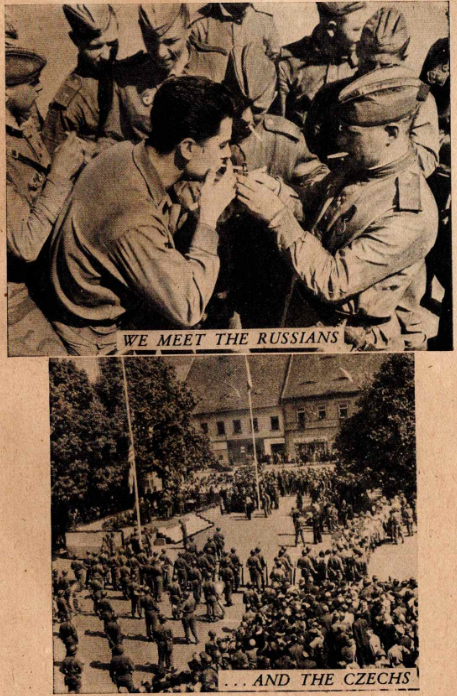
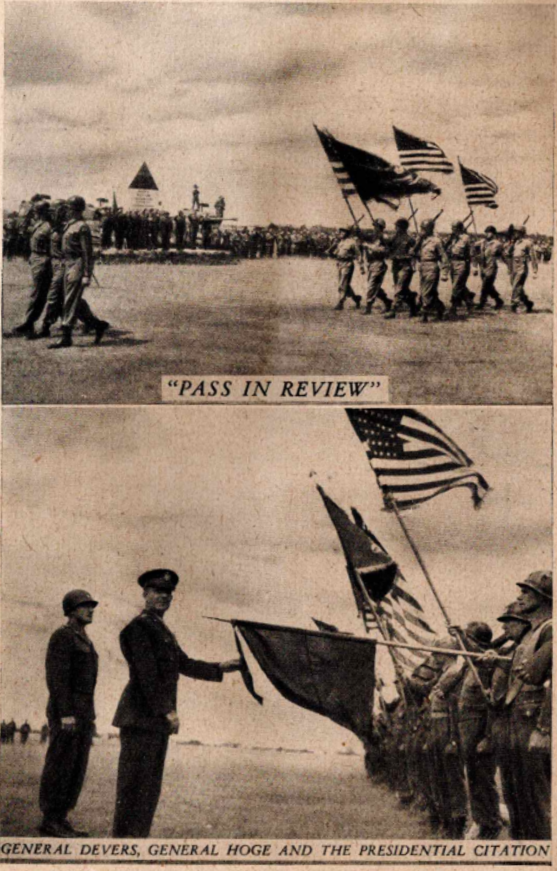
by Gregor Ziemer
Gregor Ziemer, who wrote the following story, might well be known as the “Man who Stayed for Dinner.” He joined the Fourth Armored Division at Polch, Germany on March 7, 1945. At the time he expected to remain for three days to do some broadcasts for Radio Luxembourg. He liked what he saw so much that he has been with the division ever since.
The three months he has spent with the Fourth Armored have presented Mr. Ziemer with sights that he always hoped to experience—but never thought he would—as he had lived in Germany for twelve years before the war, both before, and during the Hitler regime. Consequently, Ziemer probably knows Germany as well as any living American.
During his stay in Germany, Ziemer headed the American School in Berlin, and on his return to the States wrote “1,001 Days of Hitler” and the best seller, “Education for Death,” which later became the movie, “Hitler’s Children.”
Since he has been with the division, Ziemer has written a detailed account of defeated Germany for Collier’s magazine, and at present is hard at work on a full length book about Germany, based on his experiences with the Fourth Armored, that he hopes to publish in the near future.
Although the story that appears here will probably never appear elsewhere in print, we felt that it was a great and sincere tribute from a man who ranks high among the nation’s authors and from a man that we feel we can call a fellow member of our great division. With this in mind we pass it on to you.—Public Relations Officer.
LANDSHUT, GERMANY, June 14, 1945—There are some moments which only the Angel of History should be allowed to record.
There are occasions when pride and memory and gratitude and humbleness are so mixed up that the emotions go dull and words become even less effective than usual.
Such a moment I experienced this afternoon.
I stood out under the blue sky of conquered Bavaria, and saw American boys pass in review—their first review since they had come to Europe a year ago, I saw American flags carried over a field of green, I watched color guards carry banners. I saw a Four-star General pin pieces of blue cloth on the banners. I saw the same general pin a bit of blue ribbon in a small gold frame on the tunic of another general. I heard a band play the “Star Spangled Banner.”
And it was as if a million voices were shouting “Thank You! Thank you for what you have done!” And it was as if the hills of Bavaria were echoing the sound, until the whole world was full of it.
For this afternoon, on that level field outside the old historic city of Landshut, the Fourth Armored Division of the Third Army passed in review and received the Presidential Citation.
“It was a broad field, and there were many boys on it—boys in their best garrison uniforms. And they passed in review with a precision and a compactness and a spirit that amazed even the old veterans of many reviews who were present.
Yes, the Fourth Armored received the Presidential Citation this afternoon.
“Motivated always by the highest esprit de corps and displaying the greatest intrepidity and determination, these units successfully and swiftly executed missions of an exceptionally hazardous nature against the enemy.”
Those were the words they heard, those boys out there on the field. And they knew what the words tried to say—those boys—boys who are now doing occupational work when they would much rather be home, boys who were thinking of their buddies who helped to earn this citation but were not there to see it presented because they are lying in heroes’ graves in France, Belgium and Luxembourg.
Yes, I attended a review in honor of a Presidential Citation. And my heart was so full that a drop could have overflowed it. For more than three months I have been with this Fourth Armored. I have seen them in action. I crossed the Rhine with them at Oppenheim. I rolled across the pontoon bridge with them at Hanau on the Main. I made a detour around that burning half-track at Buchenwald. I crawled across the Bailey bridge that dark bitter morning when the Nazis thought they had us cooped up at Ifta. I rode into Czechoslovakia with them.
I am only a civilian, and know next to nothing about the tactical difficulties the Fourth encountered on this historic odessey across Germany. But I was there when they opened the road blocks, when they cleared out the machine gun nests, when they evacuated their dead.
And today tears rolled down my cheek as I held my hand at salute while the American flags were carried past the reviewing stand where stood General Jacob L. Devers and Major General William M. Hoge. Out on the field I saw them all, the heroes of the Fourth—Colonel Creighton W. Abrams, Colonel Hayden A. Sears, Colonel Wendell Blanchard, Colonel David A. Watt, Lt Colonel Leslie D. Goodall, Colonel Alexander Graham, Lt Colonel Harold Cohen, Lt Colonel Delk M. Oden, Lt Colonel James Bidwell, Lt Colonel Albin Irzyk, Lt Colonel Robert Mailliard, Lt Colonel William Nungesser, Lt Colonel Arthur C. Peterson, Lt Colonel Robert M. Parker, Lt Colonel Neil M. Wallace, Major Henry Crosby, Major William Hunter, Major Charles Kimsey and Major Erbin Wattles. Behind them were their men, of Headquarters, tank destroyers, cavalry, engineers, armored artillery, armored infantry, tank battalions, trains, medics, and ordnance...
And I also saw all the others, who were not there...
I saw them as an American civilian would see them, a civilian who has had the good fortune of having been with them when they earned the Citation, as a civilian who represents the Nation which bestowed it on them.
And because I am a civilian, and because I happen to know what brought the Fourth this recognition, I make myself the spokesman of my Nation at this moment, and I say:
“I wonder if you know what you have done? I wonder if you realize how history will thank you for ridding the world of a fear which a few short months ago was still cowing the entire globe? I wonder if you realize how majestic, how significant your acts, your sacrifices, your spirit are? It was you and men like you who have brought the world a new hope, a new lease on humanity.”
You don’t wish thanks. You didn’t do this because you wanted to be heroes. You refuse to be heroes now. But, please believe me when I say that for generations you will earn the undying thanks of a nation, a world which has come out of oppression to the light as bright as the sun which shone this afternoon over your polished helmets, and the new paint jobs of your tanks on parade.
This thanks the world may not express in words. The world itself is sometimes inarticulate when it comes to expressing gratitude. But History, that timeless element which runs through the strains of life and anchors in eternity, History knows, and History will give you credit.
General Devers expressed it well when he said that on your shoulders—on your young shoulders—rests the hope for the future. You will accept this added responsibility for the future as you have accepted every order for a new rat-race.
But meanwhile accept the humble thanks of your people; accept the deeply rooted “Thank You” of a nation which has come to know its own strength, when it watched your strength.
For as long as our nation can produce a unit like the Fourth Armored, as long as it can create a spirit like yours—just that long there is no fear for the future of America.
At I looked at you this afternoon, at the faces as they passed quickly by, faces which came from every walk of American life, I knew I was seeing a new America. It is an awakened America—an America which has taken its place in the family of nations—and which will be a watchman of the nations if necessary.
American soldiers marched under a German sky, on German soil, under a German sun, and received a citation of an American President—how impossible it would have seemed a short time ago.
And now I can quote the sacred words of our Savior who died to save mankind, “It is finished.”
But, as for Him the task was not finished, even as He spoke those words, so our task is not finished. But we of the Fourth Armored, we Americans all who know so infinitely more of the world, of mankind, of the human mind than we did a year ago, we fear not the future, we fear no enemy, we fear not ourselves, nor our miserable charlatans and fools who would make America a nation of bickering merchants and a rabble of hypocrites.
We are going home with the bit of blue ribbon in the gold frame over our right breast pocket. And it will always bring us just one message:
“We of the Fourth are not vainglorious. We are not conceited. We are humble and grateful. We are conscious of our duties and our responsibilities—now in peacetime as we were in wartime.
“But never again—NEVER AGAIN—will we be afraid of Fear; never again will we be afraid to attack that which we consider wrong, no matter where it is, no matter what kind of wrong it is. Never again will we permit evil to grow under our feet!”
And so I salute the Fourth—today, every day, until the Last Review is over, until the last one of us has joined those of the Fourth who have gone before ...
And even then, from beyond the grave, we shall keep alive this spirit born in battle, confirmed in peace, made symbolic by our Presidential Citation.
So Help us God!
Amen!

The following paragraphs are excerpts from a Collier’s story written by Gregor Ziemer. Although the story deals basically with the German people, it is based on Ziemer’s experiences while traveling with the Fourth Armored.
I am writing this on the running board of a confiscated automobile. For what seems a century I have been rat-racing across Germany with the famous U. S. Fourth Armored of Presidential Citation fame.
I, who have been worrying for many months how I could get back into Germany soon after the war, have entered with a spearhead. With my senses keyed to unaccustomed intensity, I crossed the Sauer, the Rhine, the Mosel, the Nahe, the Main, and the Fulda and the Werra—driving a civilian car, in battle khaki, as part of a column of tanks and half-tracks, of jeeps and trucks.
My mind is urging me to get down on paper my first impressions of the defeated Germany. I lived in Germany. I knew the sadistic, the scheming, the malignant Hitler Germany. Now I am getting firsthand impressions of a different Germany: the Germany of the white flags; which shrugs its shoulders, which stares in amazement—and which takes orders.
Overhead a dogfight is filling the blue April sky with staccato bursts of death. Not more than a quarter of a mile away I see the green shacks of the infamous Ohrdruf concentration camp which I have just visited. I have seen such destruction of German war weapons recently that my mind is a shambles. . .
“We had no idea you Americans were so strong.” That is another chorus. A captured general, Edgar Rohrich, to whom I spoke in the small town of Ifta, made that clear. And then he gave me an insight into German psychology. “I’d ask nothing more of life than a chance to command a division like this Fourth which I see here,” he said, in that narrow corridor of the farmhouse where I interviewed him. And if he had such a division? He would continue to fight, and he would continue to attempt to conquer the world, of course .....
From where I am sitting I can still see in the evening twilight the mound of the mass grave of Ohrdruf. I still smell the odor of death. But I also see an old peasant trying to obliterate the traces left on his field by tanks and foxholes. He is looking forward to the harvest many months ahead. It will take almost bucolic patience, almost superhuman endurance, to put Germany back in order, Is it worth it?
There will be many who say no. There will be others who will say yes.
After weeks of rat-racing with the Fourth Armored across Germany which is, for the time being, humble, I can say only this: Let the world decide, but only after a long heart-searching interview with its own conscience, as to which is cheaper—another war or a long, patient, firm, disciplined occupation of this country which we have conquered with so much effort, so much weariness, and at the cost of so many lives.