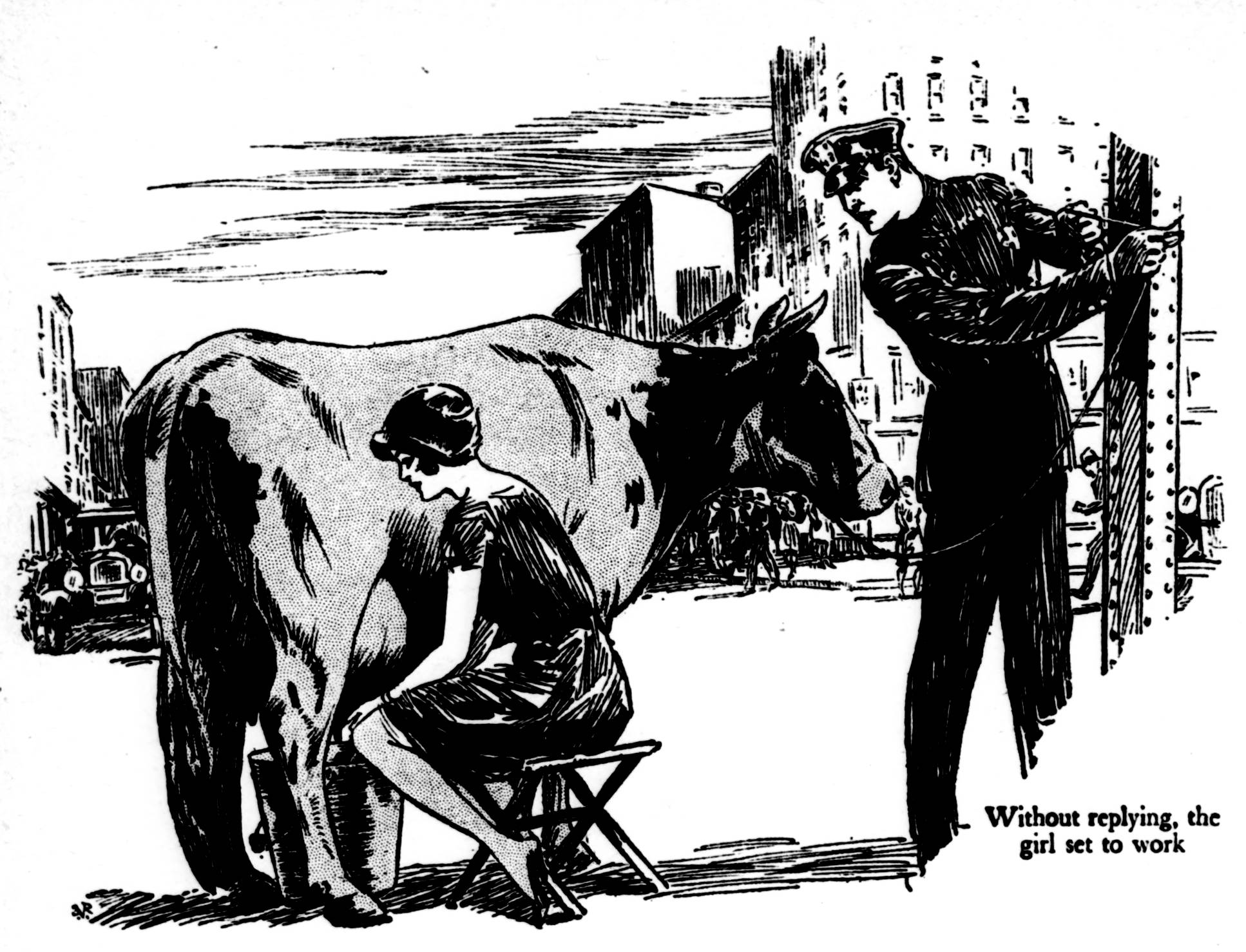
Without replying, the girl set to work.
Title: "Moo-oo-oo-oo!"
Author: Laurence Donovan
Release date: February 10, 2026 [eBook #77902]
Language: English
Original publication: New York: The Frank A. Munsey Company, 1929
Other information and formats: www.gutenberg.org/ebooks/77902
Credits: Prepared by volunteers at BookCove (bookcove.net)
Without replying, the girl set to work.
A city policeman’s official life may seldom be happy, but Officer Corcoran had some thrilling moments in his day’s work
Even a hard-boiled, hard-eyed, hard-swearing traffic regulator may have his moments. Officer James Emmet Corcoran had four each week day.
Shortly before nine o’clock each morning a silken little lady in a silky little roadster went by. This moment was merely the curtain raiser to the other three; for at her initial appearance Officer Corcoran was forced to content himself with a view of her golden red bob.
In the morning she wore a coat that concealed her satin-white arm, but at noon that member curved graciously smooth and bare. When twelve o’clock sounded on distant whistles, Corcoran imperiously put east and west traffic back on its tail. Heedless of lurid objurgation, he kept the north avenue open, and permitted the south-bound stream to trickle along until a glowing aura of red showed through the wind shield of the tricky roadster.
At just the right moment he faced his six feet three of Irish authority toward the north and waved the grinding gears and gnashing teeth of east and west traffic into the clear. That put the golden red bob on the sidewalk dead line. Thereupon the little lady would press the roadster’s flippantly musical siren and smile. With the gesture of a king in his own right, Corcoran would acknowledge the salutation by again putting the curse upon east and west traffic.
The same maneuver, except that Corcoran faced to the south, was repeated at five minutes to one o’clock. These were the two high moments of the daily four; and at these times Officer Corcoran had the fantastic Irish fancy that he would like to be one of the dancing heat waves quivering upward from the stewing asphalt to caress that alluring arm.
He wondered if his ears were as huge and red as they felt when he closed his eyes for a fleeting second or two and figuratively rested his head, with its unruly black thatch, against the cushion of the exposed satiny shoulder. Then he would open his eyes and grin back. When she was gone, flashing away in the saucy machine, he would sigh disconsolately.
“Not for such as ye, laddie buck!” he would mutter.
Thereafter, for a brief space, he would permit profane truck drivers and flustered lady gear clashers to fight for their own disputed rights of way. Then he would snap out of it and again put the razz on his dazed customers.
His fourth moment was at four o’clock sharp. To be sure, the aggravating concealment of her lovely shoulder was repeated; but several times, at the end of the day, Officer Corcoran dared to think that her smile held something of wistfulness, of reaching out to him.
Perhaps she was only wearied with her day’s duties, whatever they were; but the smile warmed the heart of the big policeman. It left him dreaming dreams that a traffic dictator with a curly black thatch has no business to dream.
Each morning, however, he would come down into the cold, gray murk of his traffic corner, knowing that she was a creature of another world—a world of luxury, from which silky roadsters with made-to-order musical sirens are materialized; in which only gentlemen born may expect to hear the sweet assent of purring voices that go with bare arms of velvety smoothness.
Officer James Emmet Corcoran had come over in the steerage. He brought with him the most primitive ideas about social distinctions. Removed from his uniformed crust, he was a great, awkward, shy inferiority complex in person.
Four o’clock drew near—an orderly, decorous evening quitting time. Mechanically Officer Corcoran passed off the first twenty minutes of his final half hour on duty.
At the beginning of the concluding ten minutes, however, his spirit perked up. He gave his badge a furtive rub. He wiped his humid brow and straightened his cap. Soon, very soon now, it would be time to roll up those obstructive lines of east and west traffic.
All afternoon Corcoran had been anathematizing his lamentably inferior birth, breeding, and ancestry. At the high noon moments he had resolved to be bespeaking the little lady this same evening; but as four o’clock approached he was merely a uniformed Irish peasant with humility clogging his initiative.
At ten minutes to four an attenuated rural truck driver with ragged chin whiskers and an untrustworthy foot on the gas got into a traffic jam some four blocks from Officer Corcoran’s post. His foot reached for the brake, found the accelerator, and pushed. He cried “Whoa!” and “Gee-haw!” in a panicky voice, but the nose of his battered truck kept right on ascending the slanting guy wire attached to a telephone pole.
The crated animal in the body of the truck remained penned until the truck attained an angle of sixty degrees. Then she went crashing over and out of the broken crate into the narrow, shut-in spaces of urban office buildings and four-alarm fires.
When the driver’s chin whiskers had been untangled from the remnants of a shattered radiator and the guy wire, their owner did not for some time take an active interest in his smashed crate. He was probably the only individual among the polyglot population of that immediate neighborhood who was familiar with the personal habits of the escaped animal; so the cow caused mild consternation as she wound her way over the hard-paved lea of Eighty-Fourth Street.
At that moment the silky little roadster came to a stop with its front wheels exactly on the sidewalk dead line. A tired little quirk at the corner of the girl’s mouth made her evening smile more wistful than ever before.
Corcoran let east and west traffic flow along far beyond its rightful time. South-bound motorists alongside and behind the red roadster honked profane horns. Corcoran looked them blandly in the eye and told them where to stay.
Now or never, he decided. The girl’s musical siren joined the raucous insult; but its tone was melody in Corcoran’s ears.
“Come on—come on—come on!” it said.
Behind him east and west traffic was tangling. Suddenly a new sound crept through the squawk and grind—something utterly alien to that metropolitan atmosphere.
“Moo-oo!” bawled a deep, insistent voice.
Corcoran glanced over his shoulder.
With her forefeet braced wide apart and bewilderment in her great brown eyes, the wandering cow had arrived at one of the world’s four thousand, four hundred and forty-four busiest corners. (Figures supplied by any chamber of commerce.)
Officer Corcoran swallowed his Don Juan impulse, choked, grew red in the face, and lost his poise. A torrent of Gaelic Americanese flooded to his lips. He waved his arms.
“Shoo-oo, ye domned baste!” he yelled.
The cow only braced her forefeet more firmly and eyed the abusing policeman with mild surprise.
“Moo-oo-oo-oo!” she said with doleful emphasis.
A two-ton truck attempted to get by on the wrong side and ripped the fender off a Lincoln. The swarthy driver got down.
“Ita happen lika dis, you domba-headed—”
A choleric fat man climbed from behind the wheel of the Lincoln and waddled toward the truck driver. The truck and the Lincoln made a perfect block.
“Moo-oo-oo-oo-oo!” pleaded the cow, addressing Officer Corcoran.
“Gwan! Git! Ye’re blockin’ the strate, ye slab-sided moo-ron, ye!” shouted Corcoran, frantically waving ineffectual arms.
He saw a piece of rope dangling from the offside crumpled horn. He seized the rope and tugged. Nothing came of it.
“Moo-oo-oo-oo-oo!” repeated the cow, putting upon Officer Corcoran’s broad shoulders the burden of the world, or at least of six blocks in four directions of jumbled traffic, which perhaps is worse.
“Git ’er some hay!” squealed the high-pitched voice of an anemic-looking taxi driver.
“I’ll be afther gittin’ ye some——”
Corcoran remembered too late. The girl’s roadster had sneaked over the dead line. For a desperate minute all he could see was the liquid depths of a pair of brown eyes framed by wisps of golden red.
Hanging on to the rope, Corcoran got to one side of the cow and shoved. A mighty man was the policeman. The cow’s hoofs slid along the hard pavement. He drew her head close to his traffic signal post and half-hitched the rope around it.
“Moo-oo-oo-oo-oo-oo!”
The cow was getting into full voice. Long drawn and plaintive, her cry of distress fell upon the heedless ears of the unrighteous urbanites.
With one hand Corcoran held the rope around the iron standard. With the other he gesticulated the Lincoln and the two-ton truck out of their jam, and got east and west traffic moving past him.
Somewhere to the northward a fire siren split the air.
“Ye’d have made of a airyplane to be crossin’ here!” groaned Corcoran.
Jeers and jests, advice and what-not, were being hurled at him by passing motorists. All the time the silver-winged figure on the radiator of the silky roadster was poked as close to the flowing stream of cross travel as the girl dared.
Corcoran wondered vaguely how it would seem to go back to pavement pounding on some outlying beat.
“Moo-oo-oo-oo-oo-oo!”
In the distance the fire sirens were circling the jam.
“Moo-oo-oo-oo-oo-oo!”
A woman driver, from whom emanated a musky perfume strong enough to overcome almost any barnyard odor, stopped her car between the traffic signal and the roadster. Then she tried to strip three sets of gears, but the auto maker knew his lady drivers. The gears stood the strain and killed the engine.
“Moo-oo-oo-oo-oo-oo!”
Officer Corcoran hung on. A low-browed hawker, piloting a tin boiler, reached from his hip and extended a long brown twist of tobacco toward the policeman.
“Here, youse!” he offered. “Dey chews a cud, mister!”
Officer Corcoran could not hold the rope and kill him. That alone saved the hawker’s life.
Through the perspiration streaming into his eyes, Corcoran was beginning to see things in a blurred vista. Behind the scented lady’s stalled car he saw the red-haired girl climb from the seat of her roadster. The policeman was not so blind that he did not catch a vision of a diminutive foot shod in alligator skin, followed by a brand of shapeliness that would stop any show. Having long studied the contour of her shoulder, Corcoran was not surprised.
Now she had the carry-all at the rear of the roadster open.
“Mooo-oo-oo-oo-oo-oo-oo-oo-oo!”
It was the longest enduring, the most heart-rending, the most bloodcurdling bawl he had ever heard.
“Shut up, ye slab-sided hunk o’ perambulatin’ beefsteak, ye domned——”
A lilting voice interrupted him.
“Why, officer, I’m surprised! The poor thing must be suffering terribly—don’t you know?”
If the big Irishman with his primitive ideas had not already been delivered in chains, the ripple of her voice would have finished him off. He didn’t know. How could he?
“An’ what are ye afther—” Officer Corcoran gulped.
At the moment he wished he were the cow, so that he might have swallowed his cud and begun over again. He remembered that this was not at all what he had intended to say to the red-haired vision.
“What is it the bucket’s for?” he tried again, not bettering his address appreciably.
The red-haired girl was carrying the emergency water pail and a folding camp stool from the roadster.
“Mooo-oo-oo-oo-oo-oo-oo-oo-oo!”
“O-o-o-h, the poor thing! So-o-o, bossy,” she rippled again.
Forthwith she unfolded the canvas camp stool and seated herself beside the bawling animal.
“They must have just taken her calf away,” she said, looking up and favoring Corcoran with his first close-up of a smile that created a vast empty feeling under his buttoned coat.
“I didn’t—did she have one?” he stammered.
Without replying, the girl reached out and under. Her slender fingers gripped and gave a tentative pull here and there.
“Ziss, whung! Ziss, whung! Ziss, whung!”
Two white streams alternately zissed and whunged into the tin pail.
“Moo-oo-oo-oo-oo!”
This time the sound was low and grateful, as the lowing of a contented cow should be.
Corcoran knotted the rope to the post. The lady gear grinder had got her motor started again, but she still sat motionless in perfumed and scornful amazement. Such a thing couldn’t, simply couldn’t, happen!
“Ziss, ziss, ziss, ziss!”
The “whung” from the once empty pail had given way to the steady “ziss” of creamy milk.
Corcoran peremptorily waved the scented lady on her way. She went with eyes sneering. With hands, voice, and whistle Corcoran attacked the jam immediately around him. Blocks away the fire sirens screamed futilely.
“Ziss, ziss, ziss, ziss!”
A burly, red-faced chauffeur stalled his car purposely and leaned out. He laughed with ribald inflection. Following his eyes, Corcoran noticed that the girl’s skimpy silken skirt was proving inadequate. A gleam, white as the creamy milk zissing into the pail, fogged his vision.
Instantly he was beside the halted car.
“Git movin’!” was all he said.
The omitted curse was in his eyes. They blazed first degree murder at the arrant chauffeur.
“Whaffor? A show’s a show, ain’t it?”
Corcoran’s big hand gripped the chauffeur’s shoulder. His great thumb pressed deep into the man’s armpit. With his other hand he fished a ticket from his pocket.
“Ziss, Ziss, ziss, ziss!”
The chauffeur squirmed painfully.
“Aw, lay off o’ me! What’s the big idea?”
Corcoran released him and scribbled on the ticket.
“Blockin’ traffic,” he intoned, and paused. “Drivin’ to the common danger—resistin’ an officer,” he chanted on, still scribbling. “Street mashin’—insultin’ a lady.” He handed the ticket to the chauffeur. “I’ll think of somethin’ else to charge ye with in court,” he added.
The offender snatched the ticket and stepped on the gas.
“Ziss, Ziss, ziss, ziss!”
The pail was half full. East and west, north and south, Officer Corcoran autocratically restored the traffic. With a final scream the fire sirens had given it up and taken another route.
“Ziss, ziss, ziss, ziss!”
The golden red aureole of the girl’s hair contrasted warmly with the lighter yellow of the cow’s flank. For a fleeting moment Officer Corcoran devoutly wished that his shoulder was the cow’s hip.
At length she straightened her back and rose. The pail was two-thirds full of foamy milk.
“Moo-oo-oo!” mooed the cow in low-voiced appreciation.
The eyes of liquid brown looked into the puzzled eyes of blue. A merry light appeared in the brown ones, a dawn of happy understanding came into the blue ones.
Through the east and west traffic there blundered a set of ragged chin whiskers.
“Wall, I’ll swan to gosh—who’d ever ’a’ thunk it?” drawled a nasal voice through the whiskers. The man untied the cow and was starting to lead her away. He thought of something. “Ye kin keep the milk,” he added generously.
“Oh, thank you!” the girl replied sweetly.
Through the north and south traffic Corcoran’s relief came pushing his way. Corcoran saw him; then he looked back to the girl, who held out the pail.
“You may carry it,” her voice rippled again; “and I guess you may see me home.”
Ten minutes later the silky roadster stopped before a tiny, old-fashioned house set back in an equally old-fashioned garden. Corcoran, his arm numb from balancing the pail, got out and stood stiffly.
“You see, we only moved here from the country last fall,” said the girl. “That’s how I knew—” A real, honest-to-goodness blush warmed the translucent skin of her cheeks. “And—oh, I’m so tired of the city!” She wore the wistful four-o’clock smile. “I want to go back to the country. I wouldn’t have stayed, I guess, but I won the car in a drawing, and—but won’t you come in, and we’ll have some of the cream on strawberries from the garden?”
Swinging the pail, from which not one precious drop had been spilled, Officer James Emmet Corcoran went up the walk behind the golden red bob. His primitive ideas about social distinctions were smashed forever.