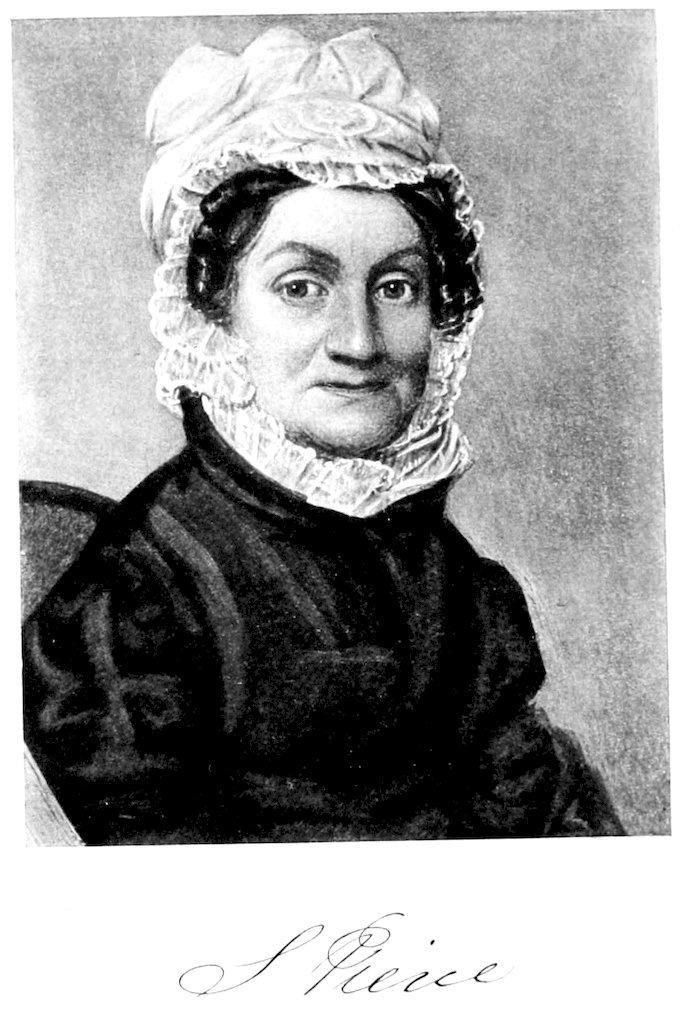
Title: Chronicles of a pioneer school from 1792 to 1833
being the history of Miss Sarah Pierce and her Litchfield school
Compiler: Emily Noyes Vanderpoel
Editor: Elizabeth C. Barney Buel
Release date: February 3, 2026 [eBook #77854]
Language: English
Original publication: Cambridge: University Press, 1903
Other information and formats: www.gutenberg.org/ebooks/77854
Credits: Richard Tonsing, and the Online Distributed Proofreading Team at https://www.pgdp.net (This file was produced from images generously made available by The Internet Archive)
Transcriber’s Note:
New original cover art included with this eBook is granted to the public domain.
| Page | |
|---|---|
| Ancestry of Miss Pierce | 1 |
| 1792–1793. | |
| Contemporary Notices of Miss Pierce and her School—History of Litchfield, Woodruff—History of Connecticut, Hollister—Centennial Address, Church—Centennial Poem, Pierpont—Letter from Mrs. Cutler | 6 |
| 1796. | |
| Charlotte Sheldon—Her Diary | 10 |
| 1797. | |
| Julia Cowles—Her Diary | 17 |
| 1798. | |
| Subscription List for Building First Academy | 19 |
| 1801–1868. | |
| Litchfield at the Beginning of the Nineteenth Century—Lucy Sheldon—Her Diary—Her Letter to her Mother—Reply—Extracts from her Commonplace Book—Letter to her Brother—Article written by her | 20 |
| 1802. | |
| Mary Ann Bacon—Her Diary—Her Compositions—Extracts from her Commonplace Book | 66 |
| 1805. | |
| Susan Masters’ School Bill | 80 |
| 1811–1820. | |
| Miss Pierce’s Histories—Letter from Mrs. Stowe—Names of Prize Books—Report of Judges for Prize of Merit—Plays by Miss Pierce—Mrs. Stowe’s Reminiscences of a Play | 80 |
| 1814. | |
| School Rules copied by Eliza Ann Mulford | 146 |
| 1815–1820. | |
| Catherine Cebra Webb—Her Diary—Caroline Chester—Her Diary—Extracts from her Commonplace Book—Eliza A. Ogden—Her Journal to 1818 | 148 |
| 1818. | |
| Address of Miss Pierce at the Close of School in October—Connection of the Rev. Lyman Beecher and Family with the School—Poem by Miss Catherine Beecher | 176 |
| 1819. | |
| Annie Chester—Her School Bill—Mary Chester—Her Letters | 188 |
| 1820. | |
| George Younglove Cutler—Extracts from his Journal—Writings of Miss Pierce—Address at Close of Summer Term—A Fragment—Dialogue between Miss Trusty and her Pupils—Fragments—Verses—The Misses Lewis:—Diary—Extracts from their Commonplace Books—Alterations from Copy of Rules of Julia Seymour | 192 |
| 1821. | |
| Sarah Kingsbury’s Copy of Rules | 231 |
| 1822. | |
| Mary L. Wilbor (Mrs. Stone)—Extracts from her Diary | 234 |
| 1825. | |
| Mary W. Peck (Mrs. Edward D. Mansfield)—Extracts from her Album—Miss Pierce’s Rules—Custom of exchanging Children—Extract from Paper by Mr. Julius Gay | 241 |
| 1826. | |
| Terms of Tuition | 259 |
| 1827–1856. | |
| Notes from the Records of the Litchfield Female Academy, with Subscription List to Second Academy Building | 260 |
| 1828. | |
| Extract from Letter of Miss B. C. Robertson to Miss Pierce—Letter from Mrs. Fanny Smith Skinner to Miss Mary Pierce—Notice of Semi-Annual Exhibition | 268 |
| 1829. | |
| Newspaper Advertisements of Academy—School Bill—John P. Brace—His Indian Ballad—Miss Pierce:—Her Article on Temperance—Her Poetical Letter written to a Pupil at School | 279 |
| 1830–1897. | |
| Reminiscences—Mrs. Kilbourne—Mrs. Seelye—Mrs. Curtis—Mrs. Hunt—Miss Fanny Lord—Mrs. Richards—Miss Spencer—Mrs. Knight—Dr. Josiah G. Beckwith—Miss Gardiner—Mrs. Farnam—Miss Thompson—Mr. Perkins | 286 |
| 1831–1833. | |
| School Bill—Letter of Anna P. Rogers to Miss Pierce—Letter of Cornelia Tallmadge to Mrs. Henry Tallmadge—John P. Brace—Addresses on leaving Litchfield Female Academy and on Assuming Charge at Hartford—Letter of Rose Terry Cooke—Advertisement of School from Litchfield “Enquirer” of April 25, 1833 | 300 |
| 1802–1842. | |
| Letters of Miss Sarah Pierce | 311 |
| 1852–1901. | |
| Two Obituaries of Miss Pierce—Sketches and Notes of the Misses Pierce and of Mrs. Croswell (their Sister), by Mrs. Asa Gray—Letter of Miss Mary Pierce—Memories of Litchfield—“Litchfield Hill,” from “Harper’s Magazine” | 320 |
| APPENDICES. | |
| Appendix A.—Colonel John Pierce (Miss Pierce’s Brother)—His Letters—His Almanach | 339 |
| Appendix B.—Dr. Timothy Pierce (Miss Pierce’s Half-Brother)—His Letters | 361 |
| Appendix C.—Population of Connecticut Towns, 1820 | 394 |
| Appendix D.—Lists of Pupils and Subscribers to History | 395 |
| Appendix E.—Genealogy | 448 |
| INDEX | 451 |
| Plate | ||
|---|---|---|
| I. | Miss Sarah Pierce | Frontispiece |
| II. | John Pierce Brace | Facing page 6 |
| III. | Embroidery by Charlotte Sheldon | „ 10 |
| IV. | View of Litchfield | „ 14 |
| V. | Miss Pierce’s House | „ 28 |
| VI. | Facsimile of Invitation to a Ball | „ 34 |
| VII. | Fashions of 1807 | „ 36 |
| VIII. | Fashion Plate from England, 1799 | „ 38 |
| IX. | Lucy Sheldon | „ 42 |
| X. | Water-Color by Lucy Sheldon | „ 44 |
| XI. | Water-Color by Lucy Sheldon | „ 46 |
| XII. | Mary Ann Bacon | „ 66 |
| XIII. | Mary Ann Bacon’s Watch and Jewelry | „ 72 |
| XIV. | Susan Masters | „ 78 |
| XV. | Facsimile of Susan Masters’ School Bill | „ 80 |
| XVI. | Lucretia Deming | „ 88 |
| XVII. | Elizabeth Huntington Wolcott | „ 92 |
| XVIII. | Maria Tallmadge | „ 96 |
| XIX. | Embroidery by Zerviah Miner | „ 100 |
| XX. | Chart of the History of the World by Mary Ann Lewis | „ 104 |
| XXI. | First Known Diploma | „ 108 |
| XXII. | Mrs. Punderson | „ 114 |
| XXIII. | Embroidery by Mrs. Punderson | „ 120 |
| XXIV. | “The Rose of Sharon” | „ 128 |
| XXV. | Lace made by “The Rose of Sharon” | „ 134 |
| XXVI. | Julia Chittenden | „ 140 |
| XXVII. | Embroidery by Julia Chittenden | „ 146 |
| XXVIII. | Caroline Chester | „ 150 |
| XXIX. | Chart of English History by Eliza Ogden | „ 160 |
| XXX. | Church where Lyman Beecher preached | „ 178 |
| XXXI. | Pen Drawing by George Y. Cutler | „ 194 |
| XXXII. | Pen Drawing by George Y. Cutler | „ 196 |
| XXXIII. | Hector and Andromache, George Y. Cutler | „ 200 |
| XXXIV. | Jane R. Lewis | „ 220 |
| XXXV. | Bead Bag made by Jane R. Lewis | „ 222 |
| XXXVI. | Mary Ann Lewis | „ 224 |
| XXXVII. | Sampler of Mary Ann Lewis | „ 226 |
| XXXVIII. | Louisa C. Lewis | „ 228 |
| XXXIX. | Embroidery by Louisa C. Lewis | „ 230 |
| XL. | Water-Color by Amelia Lewis | „ 234 |
| XLI. | Painting by Amelia Lewis | „ 236 |
| XLII. | Map of the World by Amelia Lewis | „ 238 |
| XLIII. | Lace Veil worked by Mary Peck | „ 240 |
| XLIV. | Bantam Lake | „ 242 |
| XLV. | Prospect Hill | „ 246 |
| XLVI. | Love Grove | „ 248 |
| XLVII. | Love carrying the World, George Catlin | „ 252 |
| XLVIII. | Love’s Fall, George Catlin | „ 254 |
| XLIX. | Costume of 1825 | „ 258 |
| L. | Costume of 1825 | „ 262 |
| LI. | Facsimile of Stock Certificate | „ 264 |
| LII. | The Litchfield Academy | „ 268 |
| LIII. | Terms for Tuition | „ 284 |
| LIV. | Mary A. Hunt | „ 288 |
| LV. | Facsimile of Letter of Mary A. Hunt | „ 288 |
| LVI. | Litchfield Academy | „ 292 |
| LVII. | Costume of 1827 | „ 296 |
| LVIII. | Maria Adams | „ 300 |
| LIX. | Silhouette of a Litchfield Girl | „ 306 |
| LX. | Last School Diploma | „ 310 |
| LXI. | Pathway in front of the School | „ 316 |
| LXII. | Silhouette of Miss Pierce | „ 320 |
| LXIII. | Mary Pierce | „ 324 |
| LXIV. | Ruth Pierce | „ 326 |
| LXV. | Timothy Pierce | „ 360 |
Whenever we meet with a person who rises above the level of his or her contemporaries and is noted for larger qualities of mind or heart, we become curious to know how far these qualities may be inherited from equally distinguished ancestors. In connection with the rare woman whose life-work is depicted in these pages we are struck with an interesting coincidence.
Col. John Pierce was her brother and a prominent figure in the Revolution, a friend of General Washington, and paymaster of the army at Ticonderoga. John Pierce, of Litchfield, Connecticut, was her father. Again, his father was John Pierce, of Wethersfield, Connecticut. Now, Wethersfield was settled from Watertown, Massachusetts, by men who had become dissatisfied with the conduct of the Massachusetts Bay Company, and here again we find a line of John Pierces starting in Watertown and bringing up in Wethersfield. The first one, John Pierce, or Pers, was made freeman of Watertown in 1638, is spoken of as “a man of good estate who projected the settlements of Sudbury and Lancaster.” Just before this we find in England another John Pierce, to whom a patent was granted by the Crown, February 20, 1620, which is the patent upon which the Plymouth Company settled after finding that they had landed and were forced to settle further north than the tract to which their patent from the South Virginia Company entitled them.
Now, although unable exactly to connect all these different John Pierces, namely,—
John Pierce, England, patentee, 1620.
John Pierce,[1] Watertown, freeman, 1638.
2John Pierce, his son, lived in Boston, Woburn, Mass., and Wethersfield. Last mention in Woburn, 1649.
John Pierce, his son, born 1644, moved to Wethersfield, then to Southbury, d. 1731.
John Pierce, his son, b. 1683, moved to South Britain, Conn.
John Pierce, of Wethersfield, there from 1742 to 1764, will proved 1774.
John Pierce, of Litchfield, his son, born 1733.
Col. John Pierce, brother of Sarah Pierce,—
the names being identical even to the spelling, it does not need a vivid imagination to suppose that their blood may have flowed in the veins of Sarah Pierce, our heroine, or that she drew her inspiration from, and shared the qualities of the family of whom Gen. E. W. Pierce wrote: “Indomitable perseverance is also a trait that marks their character in every department of life and has generally crowned their efforts with ultimate success, though attained after repeated and mortifying failures.” And again, among the armorial bearings of the family is a dove with an olive branch and the motto, “Dixit et fecit,” “He said and he did.”
The history of the family in this country fills numerous volumes, including the variations of the name, such as Pierce, Peirce, Pearce, Pearse, etc.
Returning to John Pierce, of London, we find he must have been a man of position and influence which is shown in the first place by his being able to acquire a patent. Then he is spoken of as a “citizen and clothworker of London,” and “that renowned clothworker.” He must also have been a man of daring and adventure as he set sail for America in the winter, in the month of December, 1821, in the “Paragon,” a vessel which he had equipped for the purpose and in which he had gathered a goodly company of passengers and a quantity of freight for Plymouth.
Owing to inclement weather they returned to London in fourteen days with the vessel badly damaged. Unwisely they ventured out again, in the following month, one of the worst in the year for mariners, with added passengers and freight. This sailing was no better than the first, as they soon met a severe storm which injured both vessel and cargo to such an extent 3they had to go back to London. It would seem this loss was both discouraging and irremediable, as we do not learn that the leader of the expedition ever tried again to cross the Atlantic, but that he sold out to pay for his losses and assigned his patent to the Plymouth Company. At that time so little was known of the Plymouth Pilgrims that they were known as “Mr. Pierce’s Company.”
We read elsewhere, however, that John Pierce’s enthusiasm for adventure and colonization must have been shared by his brothers, for Captain William and Captain Michael came over later. They are the ancestors of many of the name in this country. That they were men of substance and education is shown by facts connected with them. Captain William is stated to be “mariner” and captain of the vessels “Anne,” “Lion,” and “Mayflower.” In 1623 he brought a noteworthy company to Plymouth. In 1624 he brought the “Winslow” and the first cattle in the “Charity.” In 1625 he was at Plymouth again, in the “Jacob,” bringing “Winslow” and more cattle. In 1629 he commanded the famous “Mayflower” and conveyed a company from Holland as far as the Bay on their way to Plymouth. He came many times in other vessels. In 1636 the first vessel built in this country and called “Pierce’s Desire” was launched for him at Marblehead, Massachusetts, and in 1639 he sailed her from Boston to the Thames in twenty-three days, which would even now be a credit to such a craft and captain. To him also belongs the credit of bringing to New England from the West Indies the first cotton, in 1633, and in 1636 the first sweet potatoes from the same place. He was born in England about 1590 and died in the Bahamas, July 13, 1641.
Captain Michael Pierce came over in 1645 and fell fighting with the Indians in 1676. He was one “who never knew fear.”
The first attempt in this country at printing anything in book form was in 1639, when Pierce’s almanac made its appearance.
On the other side, from her mother, Mary Paterson, Sarah Pierce inherited both ability and energy.
The Patersons originated in Dumfriesshire, Scotland, where they were of a substantial character. One of their members, William Paterson, became prominent in London among trading 4and financial circles. He was born in 1658 and died in 1719. He was much interested in the treaty between his own country and England and wrote an able pamphlet entitled “The Union of England and Scotland.” He is called “the chief projector” of the plan for founding the Bank of England and conducted many of the negotiations between the government and the merchants. Later he came to America, passing some time in the Bahamas, and then conceived a plan for aiding the commerce of Scotland, called the “Darien Scheme.” Darien was to be colonized as a trading post, but the plan failed, although Baimester says that the revival of the scheme in these later days proves Paterson’s great foresight.
James Paterson, born in Scotland in 1664, was one of the first settlers of Wethersfield, Connecticut, and there in 1704 he married Mary Talcott. He, or some of his family, are said to have introduced the use of tin into this country. He died in 1750, leaving a son, John, born in 1707. John married Ruth Bird, was active in the army for the King, and rose to the office of major. He died in 1762. He was the father of Mary Paterson, who married John Pierce, and also of Major General Paterson, of whom an able life has been written by Dr. Thomas Egleston, one of his descendants, and to whom a fine monument has been erected at Lenox, Massachusetts, where he lived after his Revolutionary career. This Mary Paterson married John Pierce, and they may have lived with her father, Major Paterson, at Farmington, Connecticut, after their marriage, as their oldest child, Col. John Pierce, was born there in 1750. They probably settled in Litchfield the following year, for it is recorded in the land records of that place that “John Pierce, of Litchfield,” May 15, 1753, “Bought of Zebulon Bissell ‘my home lot’ 10 acres of land, barn, and orchard, for £1300.” His father, “John Pierce, of Wethersfield,” having bought, probably for him, of John Catling, the previous March, nine acres of land for £305.
“John Pierce, of Litchfield,” appears frequently afterwards in the land records, but otherwise we know little of him. Besides farming his land he had the trade of a potter. He is said to have had fifteen children. Of these we know that Mary Paterson had seven: John, the colonel, who married Ann Bard; Mary, who married a Strong; Betsey, Anne, or Nancy; Susan, who married 5James Brace; Ruth, who married Thomas O. H. Croswell; and Sarah. After the death of his first wife John Pierce married Mary Goodman, and three of their children lived to grow up: Timothy, the doctor, who died unmarried; James, who was in a bank in New York; and Mary, who outlived all her brothers and sisters.
John Pierce died a few years after the birth of his last child, which threw the responsibility of the family on the oldest son, and perhaps accounts for our knowing so little about him. That Colonel Pierce assumed the responsibility bravely and cheerfully, is evident from his own letters. He was the head of the family, and advised his brothers and sisters, particularly Sarah, when she was in New York preparing for the task which perhaps he had picked out as particularly suited to her strong character. We are told he sent her and Nancy there, while the tuition of one of them was paid for by a cousin, Mr. Landon.
Writing of Miss Pierce’s work and influence is needless. The work can speak for itself and for her, who in her quiet, dignified way became such a power among her scholars and the community where she lived and taught, that it extended even to the gay young pupils of the contemporary law school.
To this end, diaries and compositions, letters, plays, and rules follow, chronologically arranged, together with the names of as many of the three thousand pupils that came from north, south, east, and west as could be gathered. With them are also the names of some of the men they married. Many of these marriages resulted from the attendance of the young men and women upon these two contemporary and prominent schools. The fame, even the knowledge, of these schools have almost died out in the north, amid the rush and whirl of the active, commercial, and industrial life; but in the south, from which John C. Calhoun and many other afterwards prominent men came to study in Litchfield, their memories and traditions are still alive.
As to her preparation by education and surroundings for the task that grew in extent and magnitude so far beyond her expectation, we know that she and her sister Nancy were sent to school in New York with the express purpose in view of their opening a school in Litchfield; but of the school they attended, or of what the teaching consisted, we can learn nothing.
6The influence of her stepmother, Mary Goodman, must have been an inspiration. She appreciated learning so highly that she was one of a committee of women who appealed to the school board to extend to girls the same privileges in studies as were enjoyed by the boys. We know also that about the time the school was started, the year 1792, and for many years afterwards, the society in Litchfield was such as to be a constant education to a woman with the receptive mind of Miss Pierce, and it must have been largely due to that influence that the school studies and methods developed as they did in the course of years. The adding of many branches not heretofore attempted by women must have been the result of an unconscious but phenomenal growth on the part of the teacher. In later years her efforts were supplemented by those of her nephew, the son of her sister Susan, Mr. John Pierce Brace, also a born educator, whom she educated at Williamstown college that he might become her assistant. From the autographs in the album of Mary Peck, pupil and teacher in the school, who married Edward D. Mansfield, a pupil in the law school, the mental quality of the Litchfield society of that day can be gauged as well as what might be its effect upon the mind of any bright girl who was thrown constantly in contact with it. The Litchfield Female Academy, which was begun with two or three pupils in the dining-room of a young girl teacher, attained, under the guidance of this remarkable woman, a vigorous life of forty-one years, and proved itself to be a pioneer on this continent of the higher education of women.
We know very little about the early stages of the school, and therefore the following extracts from contemporary writers give us all that can be learned about its origin and the reasons for its establishment. Tradition says it was begun with one pupil in Miss Pierce’s dining-room in 1792.
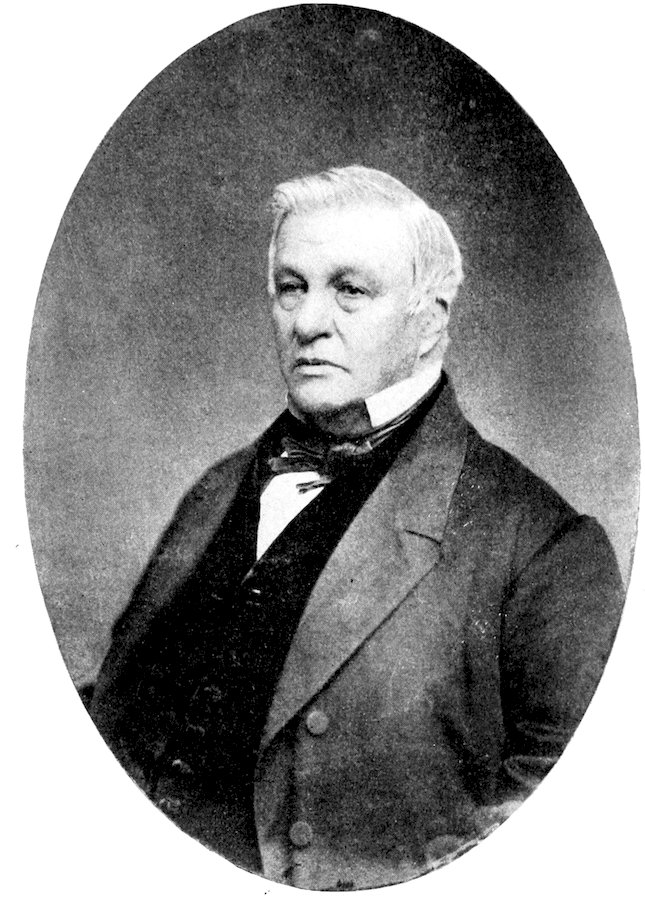
Pl. II.—John Pierce Brace
“Miss Sarah Pierce opened a School in this town for the instruction of Females, in the year 1792, which has very justly merited and acquired a distinguished reputation.”[2] The school continued under her superintendence for nearly forty years, and its reputation has since been well sustained by her successors. It was incorporated in the year 1827, by the name of “The Litchfield Female Academy.”
To this pleasant little village among the hills came the very flower and nobility of American genius. Here might be seen Calhoun, Clayton, Mason, Loring, Woodbury, Hall, Ashley, Phelps, and a host of others, who were preparing themselves for the high places of the cabinet, the senate and the bench.
The influence of these sages upon the laws of the country was almost rivalled by the efforts of Miss Sarah Pierce, in another department of learning. This lady opened a school for the instruction of females in the year 1792, while the law school was in successful operation, and continued it under her own superintendence for nearly forty years. During this time she educated between fifteen hundred and two thousand young ladies.[3] This school was for a long period the most celebrated in the United States, and brought together a large number of the most gifted and beautiful women of the continent. They were certain to be methodically taught and tenderly cared for, and under her mild rule they could hardly fail to learn whatever was most necessary to fit them for the quiet but elevated spheres which so many of them have since adorned. Miss Pierce lived to the advanced age of 83. She was small in person, of a cheerful, lively temperament, a bright eye, and a face expressive of the most active benevolence. She was in the habit of practicing herself all the theories that she taught to her pupils, and, until physical infirmities confined her to her room, would take her accustomed walk in the face of the roughest March wind that ever blew across our hills. The intelligence of her death cast a shade of sadness, over many a domestic circle, and caused many a silent tear to fall.
While these two schools were in full and active life, Litchfield was 8famed for an intellectual and social position, which is believed to have been at that time unrivalled in any other village or town of equal size in the United States.
A new tone to female education was given by the establishment of a Female Seminary, for the instruction of females in this village, by Miss Sarah Pierce, in 1792. This was an untried experiment. Hitherto the education of young ladies, with few exceptions, had been neglected. The district school had limited their course of studies. Miss Pierce saw and regretted this, and devoted herself and all of her active life to the mental and moral culture of her sex. The experiment succeeded entirely. This Academy soon became the resort of young ladies from all portions of the country—from the cities and the towns. Then the country was preferred, as most suitable for female improvement, away from the frivolities and dissipation of fashionable life. Now, a different, not a better practice, prevails. Many of the grandmothers and mothers of the present generation were educated as well for genteel as for useful life, in this school, and its influence upon female character and accomplishments was great and extensive. It continued for more than forty years, and its venerable Principal and her sister assistant now live among us, the honored and honorable of their sex.
John Pierpont in his Centennial Poem (1851), says:
One of the earliest mentions of Miss Sarah Pierce occurs in a letter dated September 3, 1793, from Mrs. Dothee Cutler to her sister, Mrs. Huldah Sheldon, first wife of Dr. Daniel Sheldon, one of the most prominent physicians of the State. Her little daughter Nancy (aged eight) had died at Miss Pierce’s school. After writing of her grief at her loss she says:—
“The amiable Miss Pierce is going home. I fear I Shall be Still more lonely, but I will try to be cheerful. I esteem Sally for her goodness of heart. She is a good Girl and I think I Shall not forget her kindness to me or the attention She paid that much loved child.”
The Law School in this place has not for a number of years been as full and as flourishing as at this time. The names of the Students will be published as heretofore, at the end of the term, and we believe the same remarks as to its healthy and flourishing state may be also applied to the Female Academy.
The reputation of each of these schools stands extremely high.—The number of either we do not know, but it is believed they have not for many years been better filled. It will be recollected that each of these schools have always depended solely on individual effort and talent, for their success. They have, with the aid of these alone continued to flourish while others of similar object have dwindled, remained stationary, or ceased to exist with all the Legislative aid, or College endowments they could obtain.
Charlotte Sheldon was a pupil in Miss Pierce’s school in the early days of its existence. She was the daughter of Dr. Daniel Sheldon, of Litchfield, and his first wife, a Miss Judson, of Washington, Connecticut, who died in 1784 leaving two children, Charlotte and Daniel, who was afterward Secretary of Legation with Albert Gallatin at the court of France. Charlotte was born in 1780, and was a “monster in learning,” as her French teacher quaintly expressed it. When about seventeen years of age she became an invalid and died in Hartford about 1840. From a little diary of hers kept in the summer of 1796 when she was just sixteen, the following extracts are taken which show that the school was still in a formative condition:—
Tuesday May 10th, 1796 the weather was so rainy this morning that I did not expect to set out for Hartford, so I sat down to my knitting and learnt a very good song called “The Mill Clapper,” of Philo Roberts. It cleared off this afternoon so we sat off we had some rain but at night it cleared off beautifully. The air was finely perfumed with the shad and appletree blossoms. I arrived at Farmington just at dark and stopt at Mr. Wadsworth’s tavern Mrs. Beardsley was over there and invited us to Dr. Tods there we directed our march. Tho. I had much rather have staid at Mr. Wadsworths for I was very little acquainted with Mrs. Beardsley and was muddied from top to toe. Very soon after I got there I went to bed.
Wednesday 11th arose rather late staid till about 10 and then sat out for Hartford. found the riding very bad over the clay hills got to Hartford about noon dined at uncle Sheldons unpacked my things, went up to Aunt Hopkins went a shopping. Hardly knew what to do with myself amid so much noise and confusion. returned to uncle Sheldons.
Thursday 12th election day was ushered in with rain. I ironed out my gown and some such little matters. dressed myself dined at uncle Sheldons. then went in his carriage up to Uncle Hopkins. Tho I spent part of the forenoon in seeing people go by, I found Wealthy Morgan at my aunts I think her much improved since I saw her last. spent the evening in singing, etc., with Becca and Nancy.
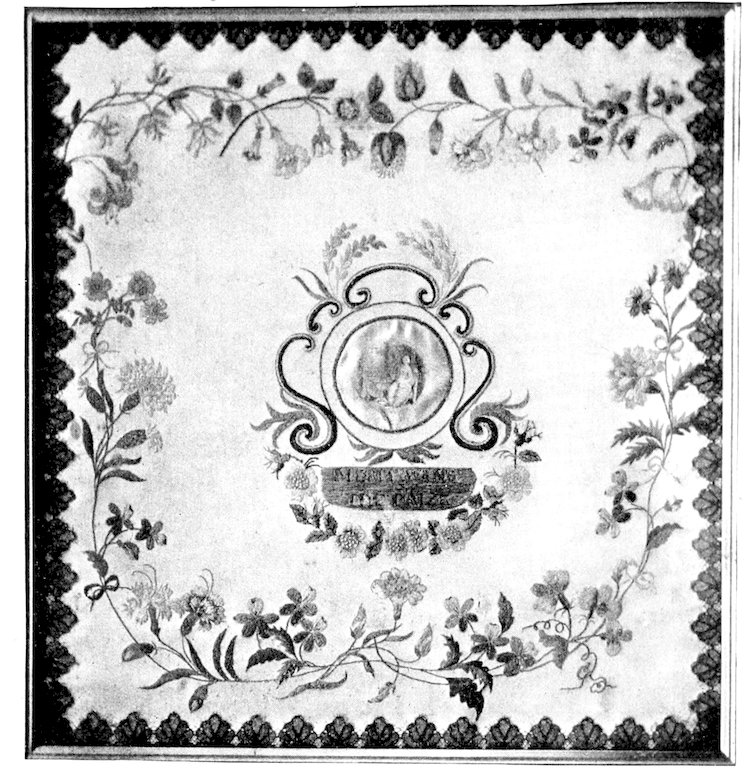
Pl. III.—Embroidered on Satin by Charlotte Sheldon
Friday 13th read in Moral Tales, tho’ I think them rather 11immoral. dressed and went to uncle Sheldons intended to have taken a ride but aunt Hopkins sent word to us that a Miss Mather was there Polly Bull, and Sally Trumbull. spent the forenoon and evening Harriet Butler Betsey Woodbridge and Miss Fanning called. There was a swing up garret and behold we went to swinging Daniel and Mr. Talcott spent the evening. I like Sally Trumbull. I think her a very pretty girl.
Saturday 14th. Today Becca and I took our long wished for ride, we went as far as Wethersfield Folly we went down to Aunt Woodbridge’s in the afternoon and drank tea there, we went to the new Court house, it is the most elegant building I ever saw the portico is very pleasant read partly thro “Nanine” one of Voltaires plays.
Sunday 15th Finished “Nanine.” went to church in the afternoon it is a very handsome building we heard a flute and bass viol which Becca and I mistook for an organ quite a laughable mistake dressed took a walk down to Uncle Sheldons.
Monday 16th. Washed and ironed almost all day went a shopping. read in Buffon’s Natural History. It has a great number of cuts in it and is very entertaining. I should like to read the whole of it sung etc., etc.
Tuesday 17th, Ironed almost all the forenoon mended some stockings, dressed, went with Becca down to uncle Sheldons, Aunt was gone down to Mr. Joe Sheldons thither we directed our march and took a very pleasant walk with her to the point where the great and little rivers meet returned and drank tea at Uncle Sheldons staid all night.
Wednesday 18th It rained so that we couldn’t return to Aunt Hopkins. made cousin Mary a baby, she is a sweet little girl. read there an abridgement of Sir Charles Grandison
Thursday 19th, Becca and I waded up to Aunts thro’ the mud drew a picture for Nancy & painted it in the afternoon Mrs. Fish, Emily Stilman & Julia Root spent at Aunts Emily staid in the evening I am very much pleased with her.
Friday 20th Sat out for home, found the roading very bad. Rode as far as Mr. Lewis’s at Farmington dined there & staid two hours. Mrs. Beardsley sent Stella over for us, Daniel & I went over, & we concluded to stay all night. Heard Mrs. Beardsley & Miss Polly Tod play on the Forte Piano, read in Helen Maria Williams letters, read in Lavater & looked at the Heads, took a walk with Miss Sally Beardsley over to the Lewis’s, returned to Dr. Tods played button & went to bed very early.
Saturday 21st Sat out again for home found the roading better than I expected, got home about four o’clock went to Miss Sally’s 12(Pierce) to carry a letter my face was so burned, I was ashamed to make my appearance any where felt tired & lazy.
Sunday 22nd, Went in the forenoon to meeting. read in the American magazine & in the European magazine Miss Pierce’s girls spent the evening at our house & Sally[4] & Julia Tracy.
Monday 23rd, Helped about the house all the forenoon went a shopping with the girls & read history at school got tea & washed the cups knit the rest of the evening.
Tuesday 24th, Read & wrote to the 30th page of the history knit sewed one of the tags of the fringe onto my cloak
Wednesday 25th, Went to school & did what I commonly do there got above 4 in spelling ironed some vandykes,[5] etc., etc.
Thursday 26th, Studied geography at school felt very indolent, laughed & gaped the greatest part of the time, knit, finished my short gown.
Friday 27th, Began to alter my muslin into a robe which is the most fashionable dress in Hartford read history took a run up to Miss Pierces & Mrs. Tracy’s, etc.
Saturday 28th, Sewed on my gown all day, wrote all the evening.
Sunday 29th, Attended meeting all day, heard two very indifferent sermons, read in the American Magazine found many good things in it & among the rest an extract from Mrs. Yearsley’s poem on the slave trade, took a walk down to the brook it was too cool to be very agreeable walking finished my gown in the evening.[6]
Monday 30th, Washed almost all the forenoon, sewed, began to work the edges of some ruffles
Tuesday 31st, Starched my gown and hung it to dry, sewed, Persuer of these pages, know that I, the author of them, am not very well versed in polite literature, thou must expect to find, a dry, uninteresting, inaccurate, parcel of sentences, jumbled together in a hand hardly intelligible—this is no news perchance thou wilt say—
Wednesday, June 1st, We are once more blessed with a prospect of good weather, ironed almost all the forenoon, sat some ruffles on to my gown, went a shopping, bought me a comb, mended some of my cloaths went to school, & did what I usually do there. All Mrs Tracy’s[7] family spent the afternoon here Mrs. Tracy is a charming woman, she has a family of the loveliest children I ever saw, Mr. Gould 13& Miss Mira Canfield spent the afternoon & evening I liked Mr. Gould very much.
Thursday 2nd, Cleaned my chamber, sewed, read in the American Magazine, wrote a letter to Fanny Smith tho I shall not send it to her, was inattentive & got to the foot in spelling, took a walk with the girls, & got wintergreen & honeysuckle, had a very agreeable walk, came home & dressed my hat with honeysuckle & ground pine.
Friday 3rd, Sewed almost all the morning, studied a geography lesson, & recited it, dressed & went to Holmes where I spent the afternoon very agreeably spent the afternoon & evening at Dr. Smiths there was a very large circle there.
Saturday 4th, Went to school, wrote a curious epistle to Sally Tracy, wrote a letter to Fanny Smith & copied it, read in Goldsmiths animated Nature went to the stores 3 times, sewed on my short gown.
Sunday 5th Attended meeting all day, read in Goldsmiths Animated Nature, I like it very much, many parts of it are quite interesting took a run in the garden sewed all the evening.
Monday 6th Assisted about house all the forenoon went to school, hemmed my shawl all round thought some of going to Mr. Bowles in the evening, but concluded not to go.
Tuesday 7th, Bought a skein of silk & wound it hemmed across two sides of my shawl. button hole stitch, studied spelling, sewed all the evening.
Wednesday 8th, Worked on my shawl, read partly thro’ the Dangers of the world aloud to Sally Tracy read in Coxes travels, I will give a short abridgement from his history of the Poles, [The first era of the History like that of all other European nations is involved in obscurity. The government was formerly almost an absolute monarchy; but the king continued to grant privileges to the nobles, untill they became almost independent, for the king had no other power left, except the triffling one of confering titles, the kingdom was very much divided by religious factions. The Dissidents & Papists maintained warm quarrels], got tea, helped clear away the table, had the pleasure of seeing Aunt Hopkins, Becca, & Nancy, Miss Sally & Polly Pierce spent the evening at our house.
Thursday 9th, Aunt & family departed for Watertown this morning, drew some patterns, worked on my shawl, studied a lesson in Guthrie we got partly through France it is bounded on the North.... Finished reading the Dangers of the world read in Coxes travels. [The Russians & other foreign nations fomented the quarrels that existed in Poland....] Assisted mammy, went up to Miss Pierce’s & borrowed the Robbers, read partly through it. it is an excellent 14tragedy. The character of Amelia is rather inconsistent in my opinion.
Friday 9th, Finished the Robbers, the scene in which Charles de Moore discovers his father in a ruined tower is perfect in my opinion. Worked on my shawl, read in Coxes travels, Read partly thro the Truly wise man. Read in Goldsmiths Animated Nature.
Saturday 10th, Worked on my shawl, Read the English merchant, a very good comedy. Read in the World. Went down to the store. Helped get tea.
Sunday 11th, It is quite cold and unpleasant today; attended meeting all day, Spent the evening at Miss Pierces.
Monday 12th, Washed a little. Worked on my shawl. Went down to the store with the girls. Dressed the flower pots. We had company in the afternoon & evening, several gentlemen were at our house in the evening.
Tuesday 13th, Wrote a letter, Read in Coxes travels; worked on my shawl, sewed all the evening.
Wednesday 14th, Learned a grammer lesson. Read the story of the Highlander & partly thro Sophron & Tigranes. Went down in the lot & got wintergreen, got supper.
Thursday 15th, Worked on my shawl. Studied a grammer lesson, parsed, Read in the World, knit, Read partly thro Macbeth one of Shakespeare’s best tragedies.
Friday 16th, Sewed. Went to school. Read in Cox. parsed. Went down to get wintergreen. Worked on my shawl. Went to strawberrying. Heard some very good music a flute & violin. It is a most beautiful evening, took a walk as far as the corner.
Saturday 17th, Sewed. Parsed. Began to read the Recess, a very good novel. It is founded on the idea that Mary Queen of Scots was privately married to the Duke of Norfolk & had two daughters Ellinor & Matilda who are the heroines of the novel, they were educated in the Recess which was several rooms in an Abbey unknown but to three persons. Matilda was married to the Duke of Leicester who took shelter in the Recess from assassins. Took a walk. Read again in the Recess.
Sunday 6th Read again in the Recess. I have finished the first volume. Attended meeting all day, wasn’t very much edified. Took a walk with Sally Tracy & Mr. Gould went almost to the mill, had a very agreeable one. Heard some very good music after I got home. Mr. Tod, Mr. Holmes & Miss Polly Collins besides several others spent the evening here, it is a very pleasant evening.
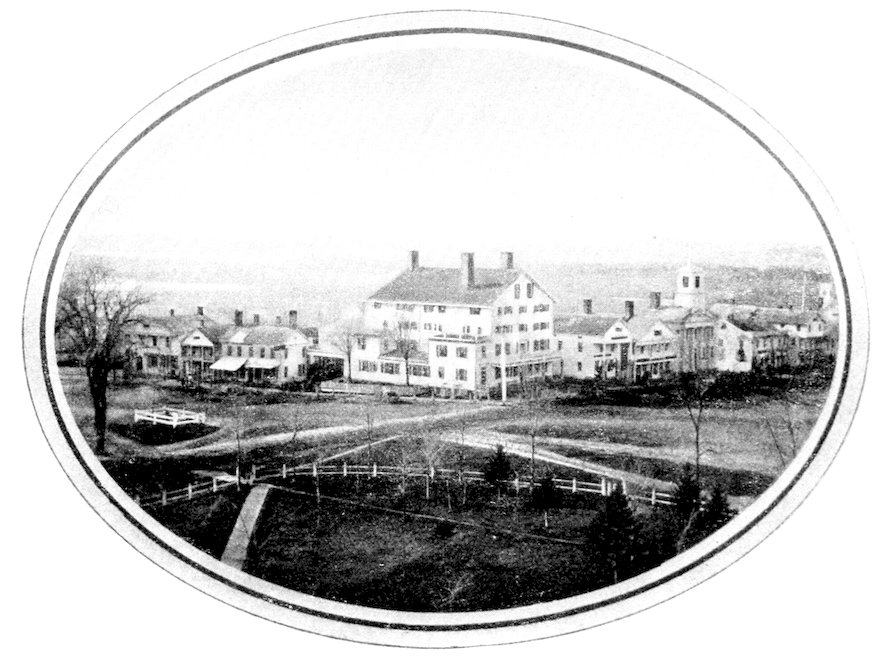
Pl. IV.—View of Litchfield taken about 1860
Monday 19th, Helped about house, knit. Parsed. Read in Coxes 15travels, read in the Recess to Sally Tracy & mammy After school dressed me and went to Mrs. Lords where I spent the afternoon & evening
Tuesday 6th, Washed, Cleaned my chamber, finished my shawl, washed and ironed it. The colors don’t fade. Helped get supper. Stewed some currants. Learn’t one or two verses in a song, spent the evening at Captains Catlins.
Wednesday 21st, Went to the Braces & helped clean the room to dance in, Which took almost all the forenoon Went down in the lot after bushes & fixed up the room Dressed & danced in the evening, had a pretty agreeable ball.
Thursday 22nd, Parsed, Sewed. Went to strawberrying with Fanny Pierpont, found a good many.
Friday 23rd, Put my closet to rights. Had an invitation to the ball, spent the rest of the day in fixing my things. Went to the ball, had a very agreeable one. Came home in the morning.
Saturday 24th Felt pretty dull, Read the second volume in the Recess, the language was pretty good, I like this volume better than the first, Tho I think it is not possible, that any person could suffer as many misfortunes as Ellinor & Matilda, I like the character of Ellinor better than that of Matilda. there is something very interesting in her character, I wanted to have it end happily. Went a strawberrying with Susan Bird.
Sunday 25th, Read all the forenoon, Attended meeting in the afternoon, heard a very poor sermon. Read in the history of Spain, I think it a very good one, I do not know the name of the author. Picked a large basket of roseleaves.
Monday 26th, Washed a little etc., Made a half handkerchief, took a walk up to Captain Stantons. Read in the history of Spain translated to the 15th page in Rousseau’s Emelias. Drew a rose, Read in the history of Spain in the evening.
Tuesday 27th, Parsed. Sewed. Studied spelling. Spent the afternoon at Mrs. Demings. Walked up as far as Captain Catlins.
Wednesday 28th, Fixed up my hat. knit. Drew a landscape. Parsed. Read in the world. Went after straw berries.
Thursday 29th, Knit. Parsed. Studied spelling.
Friday July 1st, Sewed. Studied a parsing lesson. Parsed. Went twice down to Mr. Shetaters, to buy pendals. Had my ears bored, not a very agreeable operation. knit Read in Coxes travels. got tea, stewed some currants. Took a walk as far as Mrs Lords.
Saturday 2nd, Read in the World. Sewed.
16Sunday 3rd, Attended meeting in the forenoon & read in the Recess & in the World in the afternoon Took a run up to Miss Pierces.
Monday 4th, Felt doubtful about going to the ball. Went over to Mrs. Holmes of an errand. Studied a parsing lesson. Parsed. knit, concluded to go to the ball, fixed my things to go. Went down to the Store Dressed & went to the ball, had a very good one.
Tuesday 5th, Felt rather sleepy, Knit, Washed out the bottom of my gown. Parsed. borrowed the Transition of a Moment. I like it pretty well, tho it is not equal to the Recess. read in it till about 10 o’clock.
Wednesday 6th, Finished reading the “Transition of a Moment.” Heard the news of Polly Buel’s death. sewed at school. Parsed. Fixed my things to wear to the funeral. Dressed & went. There was quite a large concourse of people. felt rather tired.
Friday 8th, Riped my gown which I am going to have altered. Picked some green peas. Parsed. Took a ride. a very agreeable one. Drank tea at Mrs. Phelps on Chestnut Hill, got home at sun down.
Saturday 9th, Read in the Citizen of the World. picked currants, sat the table for tea. Read in the Herald. Went up to Miss Pierces of an errand.
Sunday 10th, Attended meeting all day. felt quite sorry to see all Mr. Buel’s people, racked & tortured, by a cruel sermon & prayer, were a great many people at meeting. Miss Naby Lewis came to our house after meeting.
Monday 11th, Sewed. Read partly thro Romeo & Juliet. Read in Othello.
Tuesday 12th, Took a walk in the garden, Wrote a scrumptious letter to Sally Tracy. Parsed. Wrote copy hand. read in Coxes travels.
Wednesday 7th, Washed all the forenoon. Went down to the store, & over to Mr. Smiths, ironed out some calico. swept the school room, Picked currants & gooseberrys for tea.
Thursday 8th, Ironed my gown, cleaned my chamber, Studied a parsing lesson. Partly learned the words to a song. Picked currants. Wrote copy hand. Parsed. Read in Coxes travels, Partly learned a tune.
Friday 9th, Sewed. Parsed. Went over to Dr. Smiths tried on my gown, stayed part of the afternoon, Read in Coxes travels, chose sides, Mrs. Lord drank tea at our house, Went up to Miss Pierces of an errand.
Saturday 16th Went over to Dr. Smiths & tried on my gown 17Heard Miss Nabby read in Julia de Roubigne. Ironed about two hours. Went over to Dr. Smiths
Sunday 17th Attended meeting all day. Heard two excellent sermons preached by Rev. Mr. Hooker Read in the Female Spectator. Took a walk.
Monday 18th, Washed a little. & helped about house Parsed. Read in Coxes travels. Got tea. Picked currants. Went over to Dr. Smiths. Spent the evening at Miss Pierces. Heard some very good music after I got home.
Tuesday 19th Went up to Miss Pierces of an errand Doubled some yarn, Studied grammar, Read in Coxes travels. I think this a better opportunity than commonly occurs, to find out the manners of a people.
Wednesday 20th, Sewed. Read in the Mirror, The Story of La Roche is excellent. He makes an excellent prayer on the loss of his daughter. The description of his situation is beautiful. Read in Coxes travels. Studied grammar. Drew. Heard some very good music.
Thursday 22nd Read in the Mirror. Had a pair of gloves cut out, began to make them. Marked a pair of pillow bears. Read in Coxes travel Spent the afternoon very agreeably at Mrs. Tracys Walked down as far as Mr. Ozias Lewis’s & back again.
Friday 23rd Sewed on my gloves, Studied grammar. We had company at our house this afternoon, Spent the evening at Miss Pierces.
Saturday 24th Read in Knox’s essays, I like them very well. Sewed on my gloves, worked the back of another pair
In the eleventh year of her age. To thee I will relate the events of my youth. I will endeavor to excel in learning & correct my faults so that I may be enabled to look backward with pleasure and forward with hope.
June 26th, 1797. Monday. This day I began my diary in which I shall be sincere in recording my faults, studies & employments. Miss Sally did not keep. I went to St. Johns.
18Tuesday 27th. We read in History. The cabal entered into an alliance with France. The king who had been an enemy with Ormond....
Friday, June 29th. I cannot recollect any of the History read this day. I have sewed, read in History & painted some.
Saturday, June 30th. 1797. Went to school, told History, sewed some. Miss Sally says that I have been a pretty good girl this week. I have not been offended this week. I have helped Aunt Lewis almost every day this week.
Sunday, June 31st. Went to meeting all day. Mr. Griffin preached. I do not recollect any of the afternoon sermon to write.
Monday, 4th Independence. We read in History. Prince Orange ascended the throne but was liked by the people as much as before. Miss Sally did not like this History & exchanged it for Rollin’s History.
Tuesday 5th. The first country (as I recollect) that we read of was Egypt....
Thursday 6th. I do not recollect any History that we read to day only that there was one Punic war....
Saturday 8th. Attended school read in the Economy of Human Life. Sewed some.
Sunday 9th 1797. Afternoon attended meeting. P. M. staid at home because it rained. I do not recollect the text.
Monday 10th. 1797. Attended school told History, sewed some. P. M. spent the afternoon to Miss Pierces.
Tuesday 11th. Miss Sally did not keep school. I helped Aunt Lewis almost every day this week back.
Wednesday 12th. Attended school, wrote my Journal. We now began the second punic war.
Thursday 13th. I do not recollect any of the History read to day only that Hanibal died.
Friday 14th. Attended school. We did’nt read History to day, expected to dance this evening but was disappointed in my expectations.
Saturday 15th. Attended school, read in History, but I dont know anything what we read. I dont know as I ever shall again.
Sunday 16th. Attended meeting all day but do not recollect the text. read in the Children’s Friend.
Monday 17th. In the forenoon told History. P. M. Read History. The Carthagenians now preparing for war. the women cut off their hair to make ropes of....
Tuesday 18th. Attended school, read History....
19Wednesday 19th 1797. Attended school. read History. We have finished 1 volume of Rollin’s History....
Thursday 29. Attended school, going to dance this evening but dont know but I shall be disappointed....
Friday 21st. Attended school, read History. Danced last evening, enjoyed the intended pleasure....
Saturday 22. Attended school. we did’nt tell History to day. I have helped Aunt Lewis almost every day this week. Miss Sally says I have been a pretty good girl this week.
Sunday 23. Attended meeting. Mr. Hooker preached. I dont know where the text was.
Monday 23. Attended school, told History, sewed on my shawl.
Tuesday 24. Did’nt attend school to day. I helped Aunt Lewis all day.
Wednesday 25th. Aunt Lewis has gone to Farmington to day. Attended school, read History. We read the death of Cyrus. His son Cambyses succeeded him.
Thursday 26. Attended school forenoon painted. I dont know a word of the History. P. M. I stayed at home.
Friday 27. Attended school, read History....
Saturday 28th. Aunt Lewis is expected home to day. Attended school worked on my shawl. Miss Sally says I have been a pretty good girl this week.
End of the 1st Volume.
By 1798 the school had become of enough importance to interest the prominent men of the town who got up the following subscription for the purpose of erecting a suitable building for its use. It was then dignified by the name of the Female Academy.
We the subscribers do agree to pay the Several Sums annexed to our names for the purpose of Building an House for a Female Academy to be placed upon the land of Miss Sally Pierce said Sums to be paid by the first Day August Next to such person as shall be appointed agent for the Purpose by the Majority of the Subscribers March 10th 1798.
| Dolls | ||
|---|---|---|
| Tapping Reeve | 40— | |
| Elijah Wadsworth | 20— | |
| Daniel Sheldon | 20— | |
| Uriah Holmes | 20— | |
| Frederick Wolcott | 20— | |
| John R. Landon | 10— | |
| Elijah Adams | 15— | |
| Aron Smith | 20— | |
| Moses Seymour | 15— | |
| Roger Skinner | 15— | |
| Solomon Marsh | 10— | |
| Asa Morgan | 10— | |
| Julius Deming | 20— | |
| Saml. Seymour | 10— | |
| Isaac Baldwin Jr. | 15— | |
| Daniel Starr | 10— | |
| Moses Seymour Jr. | 10— | |
| Timothy Peck | 10— | |
| Thomas Colliar | 10— | |
| Daniel W. Lewis | 15— | |
| Uriah Tracy | 20— | |
| Amos Galpin | 10— | |
| Reuben Smith | 10— | |
| John Allen | 20— | |
| James Morris | 5— | |
| John Welch | 5— | |
| Total | 385 | Dolls |
Many a summer visitor, after toiling laboriously up the circuitous little branch of the Consolidated Railroad and arriving at Litchfield for the first time, wonders why, though perched on such a distant hilltop, it still wears such an air of old established dignity. The results of the changed conditions of travel are not easily recognized. Instead of being at the end of a small branch road as it is now, a hundred years ago Litchfield was on the high road, traversed by more than one of the main lines of Post Coaches, then the only means of public travel.
21The first of these stage lines were “The Litchfield and New Milford Turnpike Company, incorporated in October, 1797; The Litchfield and Harwinton Company in October, 1798; The Litchfield and Canaan Company in May, 1799. Then followed Strait’s Turnpike from Litchfield to New Haven, the Litchfield and Cornwall, the Litchfield and Torrington and the Litchfield and Plymouth Turnpikes.”[10]... “Daily lines of mail stages were established between this village and Hartford, New Haven, Norwalk, Poughkeepsie and Albany.”[10]...
“Litchfield was on the great inland route from Boston to New York as well as from Hartford to West Point so that the amount of travel through the town was very great.”[10]
This continued until about the year 1840, when the building of railroads broke up the stage routes and left the town stranded by itself, the nearest railroad four miles away. Then naturally many of the inhabitants moved away to new and growing centres of commerce and influence.
When the census[11] of 1820 was taken Litchfield ranked fourth in population in the State, New Haven, Hartford, and Middletown only taking precedence. Great red, four-horse coaches with whips cracking and horns blowing came and went at a great pace[12] all day long through the town,—from New York to Albany by way of Danbury and Poughkeepsie, from New York to Boston via Danbury and Hartford, and in many other directions. A driver and later owner, of one of these stages, Hiram Barnes by name, was a resident of North Street and so noted a character in the community that Mrs. Harriet Beecher Stowe immortalized him in her “Poganuc People” under the name of “Hiel Jones.” He is therein portrayed by her graphic pen along with other prominent people of the town, as she drew largely upon her youthful memories of Litchfield in writing that volume. So, too, Henry Ward Beecher recalls Hiram Barnes in the passage from his life quoted later on in this chapter.
Some of the advertisements of these stage routes read as follows:
Stage leaves Litchfield every morning at 5 o’clock (Sundays excepted) and arrives at Poughkeepsie at 5 P. M.
Steam Boats leave Poughkeepsie every evening at 5 o’clock and arrive in New York or Albany next morning at 1 o’clock.
This line passes through Cornwall, Sharon, Amenia, Washington and Pleasant Valley to Poughkeepsie.
In the following one it is interesting to observe the emphasis laid upon “no night travelling” as a special inducement to travellers to take that line. One doubts its advantages on reading further that the stage leaves at 3 A. M.!
This stage leaves Josiah Park’s Hotel, Litchfield, on Tuesdays, Thursdays and Saturdays at 3 in the morning, passing thro’ New Preston, New Milford and Brookfield and arrives at Danbury to lodge: leaves Danbury next morning for Norwalk and arrives in time for passengers to take the steam boat for N. York. No Night Travelling.
Takes the Norwalk passengers at Danbury on Monday, Wednesday and Friday morning, and arrives in Litchfield the same day.
Nov. 10, 1829.
Mrs. H. B. Carr[13] of New Milford writes: “I do not recall any incident of her school life at Litchfield of which my mother told 23me, except that the stage for New Milford left in the morning before daylight, and that, from fear of being left when going home for vacation, she and her cousin dressed for the journey—over night!”
To still farther advertise the stage routes the owner of the weekly paper was called upon to furnish a notice in rhyme with the following result. It is copied from an issue of 1833:
24Not only was Litchfield on the main lines of travel, but it was a commercial and industrial centre. The “Gazetteer of the States of Connecticut and Rhode Island” for 1810 says: “The most important manufactures in the town is that of iron of which there are 4 forges, 1 slitting mill and one nail factory. There are 1 cotton factory, 1 oil mill, 1 paper mill, 2 cording machines, 6 fulling mills, 5 grain mills, 18 saw mills, 5 large tanneries, besides several on a small scale. 2 comb factories, 2 hatters shops, 2 carriage makers, 1 cabinet furniture maker, 3 saddlers and a number of house carpenters, joiners and smiths and other mechanics.” The population then was 4,639. There were 4 companies of militia and “16 mercantile stores.”
The writer mentions a mineral spring of chalybeate and sulphureous water within one half mile of the Court House—which had been found very efficacious in curing disease. An iron foundry was situated on the east side of the upper end of North Street, about where the house of the Misses Van Winkle now stands. It was owned and run by Morse and[14] Carrington. A very superior quality of ore from Salisbury or Kent was here made into anchors, the first and best in the country.
To the north of this were grist and fulling mills which used the water of the little river to turn their wheels. Wool was “fulled,” as the term is, for hats that were made and sold on South Street by Ozias and Major Moses Seymour. This hat factory was afterward moved to the west of the town and owned by Messrs. Braman and Kilbourne. The first leather pocketbooks in this country were made by Erastus Lord in Baltimore. He moved to Litchfield and continued to make them at his house on the south side of Prospect Street, where Mr. MacMartin now lives. A piece of fine workmanship in the way of a jewel casket made by him is still in the possession of his descendants.
There was a cotton mill near the present bridge at the foot of South Street. Its owner built the house now occupied by Mr. Crandall. Not far off was a papier maché factory. Excellent brass goods were made somewhere in the town, as specimens of andirons, latches, etc., are now in evidence. They are advertised with other goods in the current newspapers. There were also 25extensive dye works for yarns and cloths of different kinds. Coaches were made at a factory on Chestnut Hill.
Furniture was made by a number of persons. Among them were Silas E. Cheney, David Bulkley, and George Dewey, who was noted for his fine carving. He often added his name. There was a well known goldsmith who must have been a man of genial nature, as he went by the name of “Uncle Billy” Ward. It is not long since a silver spoon was dug up in the north part of the village which bore his name. There was a jeweller by the name of Merriman. There were a number of publishers, Thomas Collier being a prominent one. He established an early newspaper, the Monitor, in 1784, and continued to publish it for many years.
North Street was the main business street. Here the friends, Mr. Julius Deming and Colonel Tallmadge had their dwelling houses opposite each other, and their shops in smaller wooden buildings south of their houses. They imported goods from Europe, and with them came the large wooden panels used in the interior of Mr. Deming’s house. With the addition of Oliver Wolcott, they bought the ship “Trident” and opened trade with China under the name of the “Litchfield China Trading Co.” They also imported two hundred horses to improve the stock in this country. Mr. Deming started a paper mill in Bantam.
To the north of the Tallmadge house was a small unpretending frame building, the second home of the first law school in the United States. Pupils from north, south, east, and west gathered here to attend the lectures of Judge James Gould. To the honor of his predecessor, Judge Reeve, be it said that he inaugurated this school, which was held in a similar simple building adjoining his house on South Street. Judge Reeve took the initiative in this country with regard to the legal standing of women, and was the first to advocate their having equal rights with men.
A little further north, on the middle of the land now occupied by the Underwood house stood Miss Pierce’s little schoolhouse. It was situated between her own house shown in Plate V, and a small red building on the site of the present parsonage, where lived her brother, Mr. Brace and family, including her 26nephew, Mr. John Pierce Brace, who later became her assistant. Owing to the density of the alder bushes, which were not cleared away from this part of the street, it is reported that Miss Mary Pierce, being sent on an errand to a neighbor’s when a little child, was lost! A little below here there were not only fences to the houses, but on the outside of the path were a row of posts with wooden rails extending from one to another, probably for the purpose of tying horses. The young men in the law school may have had some of the same feeling towards this fence that the students in New Haven have toward the one that formerly surrounded the Yale Campus, as an eye witness tells of seeing a group of them perched on it and amusing themselves by stopping and teasing Miss Mary Brace when a pretty little girl of twelve or thirteen years of age.
Not far off was a government depot for military stores under the charge at first of Commissary William Richards and later of Governor Wolcott. This was erected near the site of Doctor Buel’s house. Another was added to it about where the Court House now stands. A military guard was stationed here night and day. At the time of the Revolution, Litchfield was thought to be so far from the fighting line as to be safe from attack by the British. The leaden statue of King George the Third which was pulled down from the pedestal on which it stood on the Bowling Green of New York City was carried up there in pieces for the same reason. Some of the young people of the village had a frolic in the orchard back of Governor Wolcott’s house melting it and running it into bullets to be fired back again at the supporters of the King. An authentic account of the affair is given in the following letter of Henry Guy Gould, son of Judge Gould:
An Equestrian statue of Geo-3 stood in the Bowling Green, N. York—It stood till 1776 when twas thrown down. No part of the horse or rider was ever seen after its overthrow. An American gentleman in Russia speaks of it thus. I saw a flaming engraving of it in a black wooden frame. The ringleader was a negro, straining with all his might at a rope, one end of which was fastened to the head of the statue, and the other end tied around the negro’s waist—how this picture got to Russia is a mystery—A Mrs. Marvin and the Wolcotts melted this statue into bullets—running the lead into 27moulds—besides this the Wolcott ladies made 42,000 cartridges—the statue was lead gilded.
In Mr. Wolcott’s orchard was a shed, where he chopped up the statue with an axe—& his sisters & daughters had the fun of moulding the lead into bullets—& making them into cartridges—This is all the record that I can find—but it is a most amusing account of the fact—Could king George have heard the conversation during the melting & moulding of the lead he might have said—
“Let not the heavens hear these telltale women rail at the Lord’s anointed.”
The “lead” was a true satire on the dull heavy old king George—Indeed, I wonder that the proud English nation should condescend to make a statue of their honored king of lead. These bullets were used by our army to shoot at the English.
I hope you will not criticise the penmanship, as my hand is rather weak—and I am 71 years old.
Litchf’d—Connt Oct. 20. 1872—
In Kilbourne’s History of Litchfield we also find a detailed account of this frolic and learn that by actual count 42,088 bullets were made.
That the town was a patriotic centre can be learned from the part it took in the Revolution, but it was also public-spirited and particularly advanced in movements for education. Not only did the first law school in America have its beginnings in this little town, and the first school for the higher education of women, but in the Monitor for 1798 we read of a public library as having been in existence for some time. The bookstores not only advertised themselves in the weekly papers, but also the new books as they came to their shelves. There was a “Litchfield Lyceum” with its lectures, debates, and weekly meetings, and still farther, in 1831, we find a notice which proves that even at that early date the movement toward manual training was taking shape in the thought of these broad-minded men. A society was incorporated October 27, 1831, and a notice was published to the subscribers for stock in the “Manual Labor High School of Litchfield County. Committee: Frederick Wolcott, Lot Norton, Orange Merwin, Tertius D. Potter and Solomon Rockwell.”
28Preparations were to be made for the choice of location, necessary buildings, etc. Also about this time we find advertised a select school for business students, mathematics, and the languages, kept by M. R. Deming. In 1789, long before the temperance movement in which the Rev. Lyman Beecher became so prominent, a temperance pledge was drafted and signed by many people. The original pledge was republished, with other articles bearing upon the same subject, in the Litchfield Enquirer of September 26, 1833.
A few of Miss Pierce’s scholars boarded in her own house, built in 1803, but there was no boarding school in the modern acceptation of the term. The rest of the pupils boarded with different families throughout the town, as did also those of the law school. There were some years as many as one hundred or more belonging to each school.
Imagine these now quiet streets with red coaches rattling through them, with signs of importer, publisher, goldsmith, hatter, etc., hanging on the shops, with young men arriving on horseback to attend the law school and divide their attention between their studies of the law and studies of the pretty pupils of the “female academy.” Then there were some gay bloods from the south so much at home in the town that they disported themselves in pink gingham frock coats! So said an eye witness.[15]
To complete the picture, there was the daily procession of school girls taking their exercise to the sound of flute and flageolet, and surely it was a lively scene.
Henry Ward Beecher was born in Litchfield in June, 1813, on the upper part of this very North Street, and was prepared for college by Miss Pierce. He gives such a graphic and interesting picture of it in his “Life” that it is well to let our readers see the locality as he saw it:
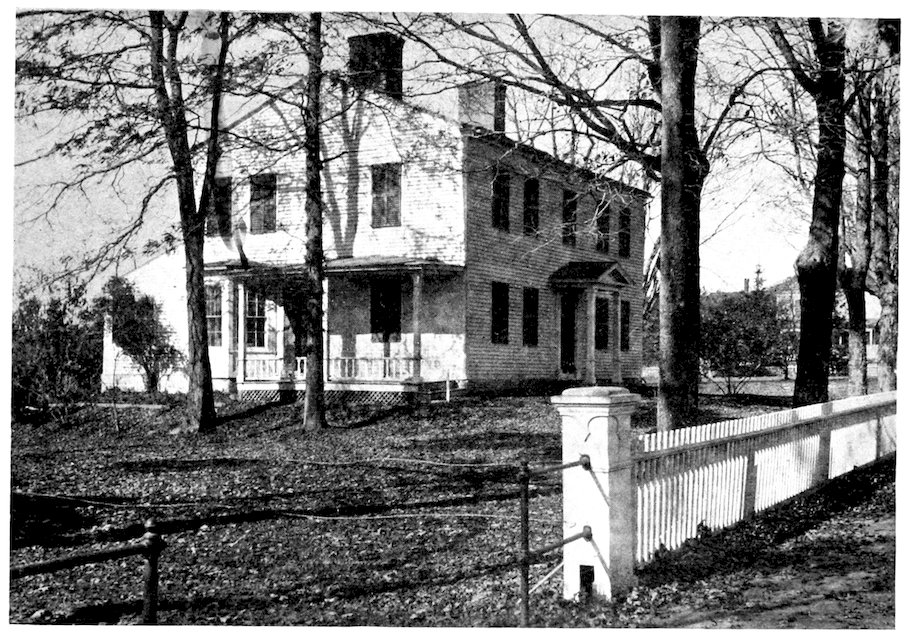
Pl. V.—Miss Pierce’s House, built in 1802
“Equally marked was Litchfield at that day for its social and moral as for its natural advantages. Its early settlers, mostly from the excellent stock from which the colonies of Hartford and Windsor were formed, were men of broad and liberal mould, and began their work upon this hilltop in a characteristic fashion. They laid out their 29streets and staked off the village common, with such generous breadth that they remained the delight of residents, and the admiration of strangers to this day. They made such liberal provision for education and religion that the settlement soon became noted for the excellency of its schools and the commanding influence of its pulpit.
“The law school of Judges Reeve and Gould, and the young ladies’ school of the Misses Pierce, made it an educational center scarcely second in the breadth of its influence to any in the land, and attracted a class of residents of high social position.
“Its courts gathered from time to time some of the leading members of the bar from the whole country, not for a few hours, as now with our railroad facilities, but for days and weeks together. All these things help to create a very high order of public spirit—that force which often wholly unregarded, is yet so powerful in moulding the character and giving direction to the life.”
One other element in this commercial influence must not be omitted—“Its intense patriotism.”
“Litchfield” revisited, written in 1856 by Henry Ward Beecher:
“The morning after our arrival in Litchfield we sallied forth alone. The day was high and wide, full of stillness and serenely radiant. As we carried our present life up the North Street, we met at every step our boyhood life coming down. There were the old trees, but looking not so large as to our young eyes. The stately road had, however, been bereaved of the buttonball trees, which had been crippled by disease. But the old elms retained a habit peculiar to Litchfield. There seemed to be a current of wind which at times passes high up in the air over the town, and which moves the tops of the trees, while on the ground there is no movement of wind. How vividly did that sound from above bring back early days, when for hours we lay upon the windless grass and watched the top leaves flutter, and marked how still were the under leaves of the same tree!
“One by one came the old houses. On the corner stood and stands the jail—awful building to young sinners! We never passed its grated windows without a salutary chill. The old store, and same old name, Buell; the bank, and its long lean legs spindling up to hold the shelf up under the roof! The Colonel Tallmadge house, that used to seem so grand, that it was cold, but whose cherry trees in the front yard seemed warm enough and attractive to our longing lips and watery mouths. How well do we remember the stately gait of the 30venerable colonel of Revolution memory! We don’t recollect that he ever spoke to us or greeted us,—not because he was austere or unkind, but from a kind of military reserve. We thought him good and polite, but should as soon have thought of climbing the church steeple as of speaking to one living so high and venerable above all boys!
“Then came Judge Gould’s! Did we not remember that, and the faces that used to illuminate it? The polished and polite Judge, the sons and daughters in that little office in the yard, the successive classes of law students that received that teaching which has so often honored both bar and bench. Here, too, we stop to retrace the very place where, being set on by a fiery young Southern blood, without any cause that we knew of then or can remember now, we undertook to whip one of Judge Gould’s sons, and did not do it. We were never satisfied with the result, and think if the thing could be reviewed now it might turn out differently.
“There, too, stood Dr. Catlin’s house, looking as if the rubs of time had polished it instead of injuring it. Next there seemed to our puzzled memory a vacancy. Ought there not to be about there a Holmes’ house to which we used to go and get baskets of Virgaloo pears, and were inwardly filled, as a satisfying method, of keeping us honest toward the pears in the basket?
“But Dr. Sheldon’s house is all right. Dear old Dr. Sheldon! We began to get well as soon as he came into the house; or if the evil spirit delayed a little, ‘Cream-o’-tartar’ with hot water poured upon it and sweetened, finished the work. He had learned long before the days of homeopathy, that a doctor’s chief business is to keep parents from giving their children medicine, so that nature may have a fair chance at the disease without having its attention divided or diverted.
“But now we stop before Miss Pierce’s—a name known in thousands of families, where gray headed mothers remember the soft and quiet days of Litchfield schooling. The fine residence is well preserved, and time has been gentle within likewise. But the school house is gone, and the throng that have crossed its threshold brood the whole globe with offices of maternal love. The Litchfield Law School in the days of Judge Tapping Reeve and Judge Gould and Miss Pierce’s Female School, were in their day two very memorable institutions, and, though since supplied by others on a larger scale, there are few that will have performed so much, if we take into account the earliness of the times and the fact that they were pioneers and parents of those that have supplanted them. But they are gone, the buildings moved off, and the grounds smoothed and soft to the foot with green 31grass. No more shall the setting sun see Litchfield streets thronged with young gentlemen and ladies, and filling the golden air with laughter or low converse which unlaughing then, made life musical forever after!
“But where is the Brace house? An old red house—red once, but picked by the winds and washed by rains till the color was neutral, thanks to the elements. The old elm trees guard the spot,—a brotherhood as noble as these eyes have ever seen, lifted high up, and in the part nearest heaven locking their arms together and casting back upon their separate trunks an undivided shade. So are many, separate in root and trunk, united far up by their heaven touching thoughts and affections.
“Mrs. Lord’s house is the only one now before we reach our own native spot. This, too, holds its own and is fertile in memories. Across the way lived Sheriff Landon, famous for dry wit and strong politics.
“But south of him lived the greatest man in town, Mr. Parker who owned the stages; and the wittiest man in town, with us boys, was Hiram Barnes, that drove stage for him! To be sure, neither of them was eminent for learning or civil influence, but, in that temple which boys’ imaginations make, a stage proprietor and a stage driver stands forth as grand as Minerva in the Parthenon.”
Henry Ward Beecher’s sister, Mrs. Harriet Beecher Stowe, also writes of Litchfield:
“Poganuc (Litchfield) in its summer dress was a beautiful place. Its main street had a row of dignified white houses, with deep dooryards and large side gardens, where the great scarlet peony flamed forth, where were generous tufts of white lilies, with tall spires of saintly blossoms, and yellow lilies with their faint sweet perfume, and all the good old orthodox flowers of stately family and valid pretensions. In all the dooryards and along the grassy streets on either side were over-shadowing, long-branching trees, forming a roof of verdure, a green upper world from whose recesses birds dropped down their songs in languages unknown to us mortals. Who shall interpret what is meant by the sweet jargon of robin and oriole and bobolink, with their endless reiterations? Something wiser, perhaps, than we dream in our lower life here.”[16]
32That there were amusements of some kind follows as a matter of course when there were so many young people in a place whose time was not all spent in study and whose high spirits must overflow now and then.
In summer there were gay walks to Prospect Hill, where there was then, as later, an Echo Rock, and to Love’s Altar, a shady nook by the stream below the hill back of Governor Wolcott’s house. Both of these resorts were immortalized in color by Miss Mary Peck in her album.[17]
Mr. Lord had built a bowling alley on the west side of the Prospect Hill road for the benefit of the pupils of both schools, so we can picture these walks combined with lively bowling matches, much like those of later days that were held in the old bowling alley, back of the United States Hotel. Then another set of young men and women met in bright summer days and passed many a merry hour minding no more a rise in the thermometer than ardent golfers do now.
Then there were even gayer sleigh rides on crisp winter evenings, for Miss Pierce specifies in her rules for the school in 1825: “No young lady is allowed to attend any public ball or sleigh party till they are more than 16 years old.”
A fine pine grove of which some of the trees still remain to mark the site, and which received the name of Pine Island, lay a mile or two directly south, and was a favorite picnic ground for the girls. Candy-making and candy-pulling by a big wood fire were great occasions, for does not Mr. Cutler draw with his pen a lively picture of such a party he attended?
The scarcity of sugar in those days probably added great interest to the spring crop of maple sugar, and with snow still on the ground we can think of the frolics there must have been sometimes over big kettles of sap, which was taken out and cooled with snow to make a delicious candy. Possibly there may sometimes have been invitations to apple bees and corn husking just outside of the town.
Then there were excursions to the Lake, for we read in the Litchfield Monitor for August, 1795:
This subscriber informs the public, and particularly those who either for health or pleasure are disposed to enjoy the water, that he has thoroughly repaired that commodious, prime sailing Pleasure Boat, the Pond Lily; and that she will ply from the northern to the southern shore every day in the week, (wind and weather permitting.) She has good accommodations for Passengers; and Ladies and Gentlemen, wishing to indulge in a few hours of healthy and agreeable pastime, will be cheerfully waited upon. Select Companis from the town and country, are solicited to afford themselves this pleasant relaxation from business; and on seasonable notice to the Skipper of the Boat, every required attention is promised them, by their devoted, humble servant.
Litchfield, August 24, 1795.
N. B.—There is a new wharf erected on the east end of the Pond; which makes it much more convenient for the Passengers than formerly.
A much later advertisement reads:
The new and elegant Horse boat, Bantam, having been recently built for the express purpose of accommodating pleasure parties on the Bantam Lake is now completely prepared to accommodate ladies and gentlemen who may wish to take advantage of this safe and neat (!) mode of taking a trip upon our pleasant waters. Parties wishing to engage the boat for a trip, must give two days notice to the subscriber residing at the north end of the Lake.
Litchfield, June 27, 1826.
Being a plan of much resort the subscriber has fitted up a small establishment, located on the shore of the northeast extreme of said Lake, in neat order, for the accommodation of those gentlemen and ladies who may wish to spend a few hours on and about this beautiful sheet of water.
May 28, 1829.
In 1827 the following notice was posted. This must have caused great excitement with its unusual novelty.
The subscriber intends erecting on Litchfield Hill by the first day of September next an Aerial Phaeton. The design of the machine is to afford an agreeable pastime to ladies and gentlemen. It consists of Four Carriages each supported by Two Arms, which are attached to an Axletree in the centre. They are turned by a Propelling Machine, and will carry eight persons at once, two in each carriage, who will in regular succession be raised to the distance of Fifty Feet in the air, at a rate of velocity equal to ten miles a minute, or slower, as suits the wishes of those occupying the carriages, and all with perfect ease and safety. This method of recreation and amusement has been highly recommended by the most eminent Physicians in the United States, and will be found the best mode for taking an airing, by those whose lives are sedentary, that can be practised. The place where it is to be erected, is airy, the prospect extending wide, and being relieved by all the variety of hill and dale. Every attention will be paid to company, and all things done “decently and in order.”
Litchfield, Aug. 17, 1827.
Price 12½ per mile—children, half price.
One of the great events of the year was training day. It is sketchily written of in Mr. Cutler’s diary, page 193, where it is depicted from the standpoint of a young participant.
Miss Pierce’s method of education being both original and comprehensive, she not only wrote history for her scholars to learn, but plays for them to act.[19] These performances are said to have been very engrossing to the scholars, all lessons and other occupations being given up for the time. They must also have greatly entertained the townspeople. Then, either to try to rival the fine acting of the “Female Academy,” or to return the courtesy of their entertainment, or both, the young men of the Law School would write and act other plays. Of the character of these plays we have so far found no record.
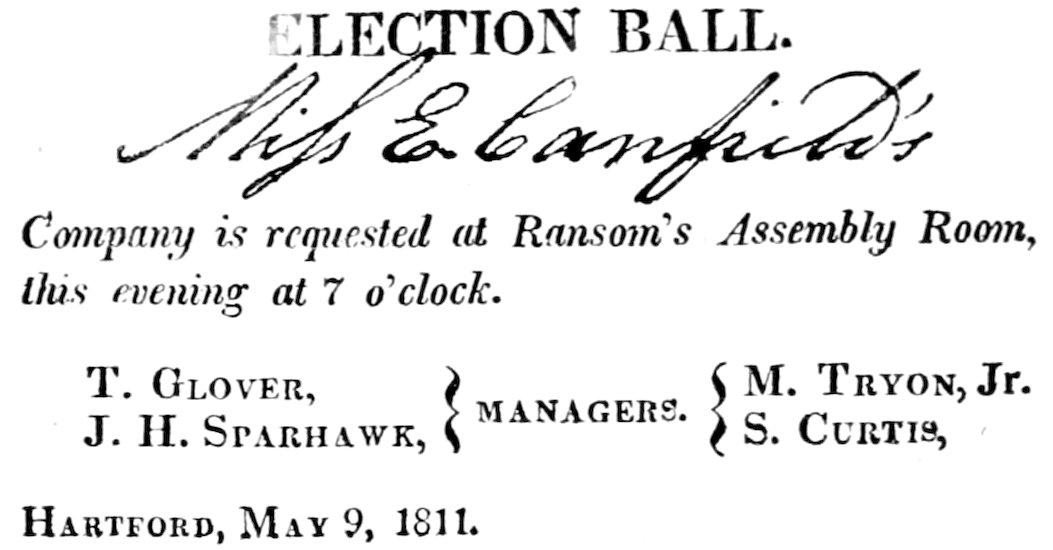
Pl. VI.—Facsimile of Invitation to a Ball in Hartford, Conn. To “The Rose of Sharon”
35Finally, there were balls: balls in the schoolroom under Miss Pierce’s own patronage, the invitations to attend them being highly prized by the law students, and balls given at the tavern or public house kept by Josiah Parks, on the top floor of the United States Hotel. These latter were larger. Those at the school were called balls; but Miss Pierce’s grandniece reports their being simple, early dances rather than real balls. “In 1798 a ball with the customary entertainment and variety of music, cost about $160,[20] and nothing was said about it,” showing that there had been a material change in the conditions and prosperity of the town since the earlier days when a dollar to be paid to a man with a fiddle to play for dancing was all the necessary cost of an evening’s entertainment. On Plate VI is a facsimile of an invitation to an election ball in Hartford.
There was quite an elaborate system of merit marks at the school, and many a mark was won by the tiny stitches sewed on a dainty seam of some muslin gown, for according to the fashion of the day, woman’s attire could hardly be too delicate. There were no tailor-made gowns then. Even in winter muslin dresses and slippers were worn.
“‘In 1794,’[21] to use Carlyle’s words, ‘every man began to ponder whether he should not even dress himself like the Free Peoples of Antiquity.’ Carlyle, of course, was speaking of French men and women; but the fashions adopted by them soon spread to England, though English women never pushed the classical craze so far as the French did.
“It seems to us, however, that French women were not so much endeavoring to dress so as to look like the Ancient Greeks and Romans, as undressing themselves in order to look as much as possible like the statues which these ancient ‘Free Peoples’ produced. Garment after garment was laid aside, until they had brought their apparel down to something that at all events succeeded in recalling the same transparent scantiness so essential to the right setting forth of the beauties of sculpture.... It was well that the readers of fashion books of that time should be cautioned against exposing themselves to the air for if the truth is to be spoken, our grandmothers and great grandmothers 36were only half clad—exposed to the perpetual variations of one of the most trying climates in the world; they for the most part confronted it and its continual changes attired in a short round dress of white cambric, with arms and necks all but bare, and feet clad in silk stockings and thin kid or morocco shoes. In winter, it is true, they had their warm pelisses, and mantels of cloth or velvet, and these were frequently lined with fur; but they cut the period of wearing winter wraps absurdly short, never gave up their white cambric dresses, and early in the spring and late in autumn often went out more lightly apparelled than we should in the dog days. Their own deaths and the large amount of consumption they have handed down to their descendants are the fruits of this folly....
“In December, 1806 we read: ‘The pelisse of twilled sarsnet with simple wrap front continues the reigning favorite.’ Indeed, ‘the gentle and pliant sarsnet’ and ‘the yielding and adhesive imperial satin of gossamer softness’ are constantly prescribed for pelisses and spensers at all periods of the year.
“Diderot says that ‘When writing of women we should dip our pen in the rainbow and throw over each line the powder of butterflies’ wing, instead of sand.’ And it almost seems as if in the beginning of this century it was the fashion to dress them in the same ethereal manner.
“On Christmas eve, 1803, Prince Jerome Bonaparte married Miss Elizabeth Paterson. A gentleman present on the occasion said: ‘All the clothes worn by the bride might have been put in my pocket. Her dress was of muslin richly embroidered, of extremely fine texture. Beneath her dress she wore but a single garment.’
“Dresses which were extolled in summer and autumn were never wholly banished in winter and spring. Our grandmothers were like the daffodils, they appeared in all their bright attire before the swallow dared to come, and ‘took the winds of March with beauty.’ How many of them suffered for what they did, we may guess at, but can never know. How much stronger we ourselves might have been had they thought and acted differently, it is also vain to conjecture, but we can clothe ourselves and our children in obedience to the laws of health and strenuously resist all attempts to induce us to do the contrary.
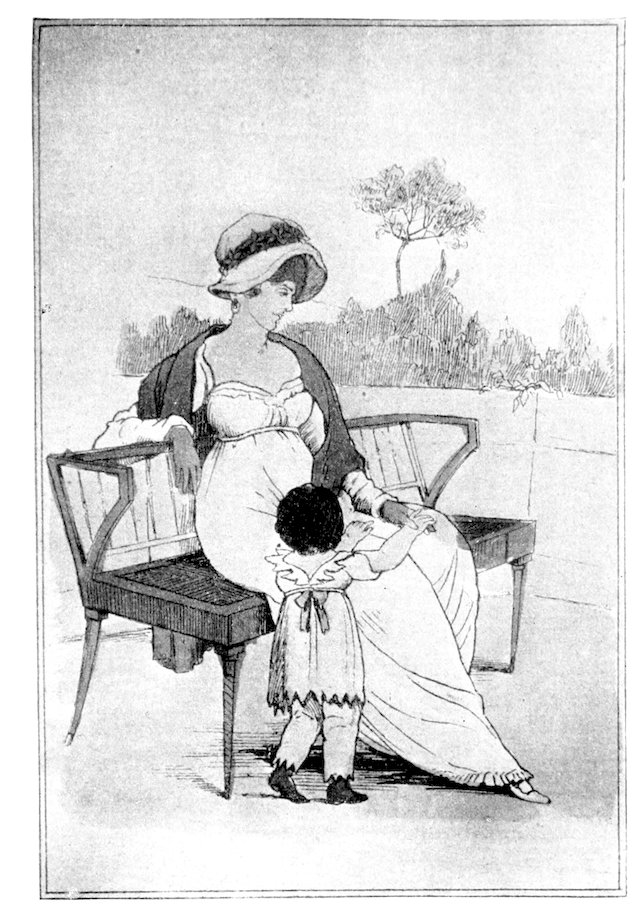
Pl. VII.—Fashions of 1807
From “Our Grandmothers’ Gowns”
“Still we find ‘a round gown jaconet muslin prescribed’ in December, 1812. We read: ‘Notwithstanding the severity of the season, 37morning dresses continue to be made in white muslin, which is more fashionable than anything else.’ It continued to be so for many a year after this. It was supposed to be indelicate to wear anything else. ‘The dress of women,’ we are told, ‘should differ in every point from that of men. This difference ought even to extend to the choice of stuffs; for a woman habited in cloth is less feminine than if she were clothed in transparent gauze, in light muslin or in soft and shining silk.’
“A lady and her child attired in the most elegant fashions of the season, September, 1807:
“Lady’s Dress—A round gown with short train, ornamented at the feet in flutings of muslin or needlework; a long sleeve ruched, with full top; frock back and lapel, bosom cut low, and trimmed with scalloped lace, a chapeau a la bocage of imperial chip or sarsnet, or ornamented with a wreath of ivy or jonquil.... A shawl of Chinese silk thrown negligently over the shoulders....
“Child’s Dress—A frock and trousers of fine cambric, bordered at the bottom in rich fancy Vandyke; French back and bosom cut very low, and ornamented with the same; Circassian sleeve very short....
“This is a lady’s outdoor equipment for October! The child’s arms and neck are bare, and its feet are covered with nothing stouter than yellow kid. Did the doctors of those days make larger fortunes than they do now? They can never have been without work.”
While these passages are from an English standpoint, the following quotations go to prove that the ocean was no barrier to apparel of much the same nature; and while there was so much less communication between the small New England towns and Europe, we know that there were even then direct importations of fashion plates. Plate VIII is from one dated July 1, 1799, which was brought from London soon afterwards by Mr. Julius Deming for his daughters.[22]
Walking Dresses. Round dress of thick white muslin. The Hungarian cloak, made of nacarat, or scarlet silk, trimmed all around 38with broad black lace or fur. A bonnet of the same colour as the cloak, trimmed with black lace or fur, and ornamented with a flower or feather of the same colour.
Dancing or Full Dress. A short robe of fine muslin, with a train or petticoat of the same; the robe made plain over the bosom, with additional fronts, to fly open from the shoulders. The whole bound with scarlet ribbon; the sleeves and the robe, from the shoulders to the bottom, are ornamented with scarlet ribbon. The bosom trimmed round with deep white lace. A hat of white silk, turned up in front, and lined with scarlet; a feather of the same colour fixed in front, to fall over the crown.
General Observations. The prevailing colours are scarlet, pink and purple. Black bear muffs and tippets, long before, and in the form of a handkerchief, are general for morning and walking dresses; and white muffs and tippets for full dress. Feathers and flowers of all descriptions are universal; long scarlet ribbons are worn round the bosom, from which miniatures or lockets are suspended. Caps in full dress are more prevalent than last winter.
[From “A Girl’s Life Eighty Years Ago,” by Eliza Southgate Bowne.]
The Patroon and his wife came to see us. She is really beautiful, dressed very plain; cotton cambric morning gown, white sarsnet cloak, hair plain, and black veil thrown carelessly over her head.
Caroline and I went shopping yesterday, and ’tis a fact that the little white satin Quaker bonnets, cap-crowns, are the most fashionable that are worn—lined with pink or blue or white; but I’ll not have one, for if any of my old acquaintances should meet me in the street they would laugh,—I would if I were them. I mean to send Sister Boyd a Quaker cap, the first tasty one I see; Caroline’s are too plain, but she has promised to get me a more fashionable pattern. ’Tis the fashion. I see nothing new or pretty,—large sheer muslin shawls put on as Sally Weeks wears hers are much worn, they show the form thro’ and look pretty; silk nabobs, plaided, colored and white, are much worn, very short waists, hair very plain.
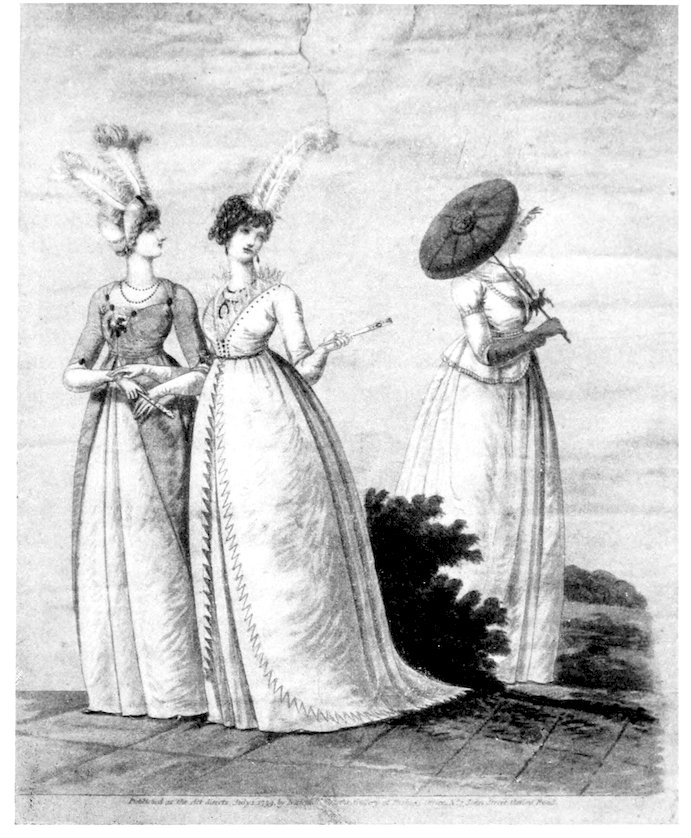
Pl. VIII.—Fashion Plate from England, 1799
The fashions are remarkably plain; sleeves much longer than ours, and half handkerchiefs are universally worn. At Mrs. Henderson’s party there was but one lady except myself with a handkerchief—dressed as plain as possible, the most fashionable women the plainest. I have got you a pretty India spotted muslin—’tis fashionable here.
The silk dresses must also have been light and airy in weight as Miss Pierce’s grandniece tells a story of her aunt’s best black silk well worth relating in these days of Saratoga trunks. At the present time railroad passengers grumble at being limited to one hundred pounds of baggage. A hundred years ago the amount permitted to each passenger of a stage coach was but fourteen pounds, and a trunk then was hardly larger than a handbag now, certainly not as commodious as a dress-suit case.
Having just returned from a visit to her sister Mrs. Croswell, at Catskill, Miss Sarah Pierce reproached Miss Mary Pierce for having omitted to put her best black silk in her trunk when packing it. “I certainly put it in,” replied Miss Mary. “If you did I could not find it,” was the retort. Miss Mary went upstairs and shortly returned with the dress in her hand and showed how careful she had been to lay the dress between the folds of an undergarment to keep it from being creased. This was also the reason why Miss Pierce had not perceived it in the trunk. Could any of the beruffled, trailing gowns of these days be hid away like that?
That the elaborate dress of some of the matrons of Litchfield, extended even to powdered hair raised in towers on the head can be learned from the portraits extant by the painter Earle. The notice of his coming is taken from the Litchfield Monitor.
Arrived in town a few days since, from New York, Mr. Ralph Earle, the celebrated Portrait Painter; who holds rank with the most distinguish’d pupils of the great West. His Paintings will do honor to any country, in any age.
Mr. Ralph Earle, the celebrated Portrait Painter, is now at New Milford; where he will probably reside for some time. As we profess a friendship for Mr. Earle and are desirous that the Public avail themselves 40of the abilities of this able artist, we feel a pleasure in making this communication, many gentlemen in this vicinity, having been disappoint of his services, and several of our friends being driven to accept of the paltry daubs of assuming pretenders.
Mr. Earl’s price for a Portrait of full length is Sixty Dollars, the smaller size Thirty Dollars; the Painter finding his own support and materials,—Applications by letter or otherwise, will be transmitted to Mr. Earle from this office, or the Post-master at New Milford will take charge of all letters addressed to Mr. Earle.
The following letter from the Litchfield Monitor of June 8, 1796, shows how far-reaching was the Republican feeling in Litchfield when it was sought to regulate through the press even the old custom of wearing mourning:
As your employment gives you the means of great influence in our country, it is of great importance that you should be wise and good men; that you should improve your influence in promoting the best interest and real welfare of our rising nation.
At this time I would mention one error in my countrymen, which prevails to our shame and poverty—the growing Fashion of dressing in mourning. This is to our disgrace, and gives mortification to every true lover of this country. During the Revolution, an economical fashion, truly republican, was established and all classes wore it; this was only a piece of crape or black ribbon on the left arm of men, and a black ribbon on the head of women. This American fashion did honor to our country, while at the same time it saved the property of the people. The President of the United States, some of the Governors and first rulers, have continued the fashion to this day. But great numbers of unreflecting persons have thoughtlessly returned again to an imitation of the British people, and greatly to their own loss, and to the injury of the country. The articles worn for mourning, are imported from Europe, for which our money is exported. This is a serious misfortune; for the sum is very great which is every year wasted for this trumpery. Let us act more like Americans, and save our honor and our money. We ought to have our own fashions, and the most frugal ones. To be imitators of Europeans and to our own loss is disgraceful. Our pride as well as our reason, forbids this 41servile practice. Americans! assert yourselves. Act with independent minds! be no longer the dupes of a silly fashion. Elect no man to any office who is guilty of this littleness of conduct—thereby you will preserve your national dignity, and millions of your money!
P.S. It is really strange, and much to be regretted that our legislatures do not attempt to correct this evil. A recommendation from high authority to the people, would produce a good effect. At least, it would keep in countenance those who wish to avoid the fashion—for fashion is a tyrant, and weak people are afraid to disobey. This tyrant therefore, should be borne down by the authority of high examples.
In order to round out this sketch of the social conditions and customs at Litchfield during the period of these chronicles, let us read the impressions of a stranger,—a young man who, like many another, found there not only a good legal education, but—a wife.
In the autobiography of the Rev. Lyman Beecher, his son Charles Beecher writes the following:
“Judge Tapping Reeve, for over half a century a citizen of Litchfield, was the founder of the celebrated law school, which for forty years was resorted to by young men of talent from nearly every state in the Union. Judge Reeve’s first wife was a granddaughter of President Edwards, and sister of Aaron Burr, who for about six years regarded Litchfield as home.”[23]
“No less distinguished in point of literary cultivation was the family of Judge Gould for many years associated with Judge Reeve in the law school, and afterwards its principal. He was of fine personal appearance, polished manners, extensive acquaintance with the English classics, and in all matters of rhetorical or verbal criticism his word was law. His wife was in no way inferior to him in general information and brilliant conversational powers.”[24]
To this institution came Edward D. Mansfield, from whose “Personal Memories,” published in Cincinnati in 1879, we extract the following passages:
“It was about the middle of June, 1823, that my father and I drove up to Grove Catlin’s tavern, on the ‘Green’ of Litchfield, Conn. 42It was one of the most beautiful days of the year, and just before sunset. The scene most striking. Litchfield is on a hill, about one thousand feet above the sea, and having fine scenery on every side. On the west rises ‘Mount Tom’ a dark frowning peak; in the southwest, ‘Bantam Lake,’ on whose shores I have often walked and ridden. In the north and east other ridges rolled away in the distance, and so, from Litchfield Hill, there is a varied and delightful prospect. One of the first objects which struck my eyes was interesting and picturesque. This was a long procession of school girls, coming down North Street, walking under the lofty elms, and moving to the music of a flute and flageolet. The girls were gayly dressed and evidently enjoying their evening parade, in this most balmy season of the year. It was the school of Miss Sally Pierce, whom I have mentioned before, as one of the earliest and best of the pioneers in American female education. That scene has never faded from my memory. The beauty of Nature, the loveliness of the season, the sudden appearance of this school of girls, all united to strike and charm the mind of a young man, who, however varied his experience, had never beheld a scene like that.
“It was commonly my practice to walk in the afternoons of summer, and the opportunities for pleasant walking were like those of riding, very good and tempting. Litchfield, like many New England towns, was built chiefly on two main streets, one going north and south, and the other east and west, and the whole on a hill or ridge, with Bantam river running on the east and another stream on the west. North and South Street was more than a mile in length, shaded nearly its whole length by those lofty and broad spreading elms for which some of the towns of Connecticut was noted. In the warm days of summer, and in these beautiful and cloudless sunsets, like the day in which I had first seen it, most of the young people would be on the streets, and among them those of the students who, like myself, were lovers of beauty and of scenery. Owing to my introduction to society, which is always a great benefit to young men of any sense, I was soon acquainted with the best families and my afternoon walks, as well as my evening visits, often led me among those distinguished in beauty, grace and position. One of my temptations to an afternoon walk was to meet the girls, who, like ourselves, were often seen taking their daily walk. Among these, were the Wolcotts, the Demings, the Tallmadges, the Landons and Miss Peck, who afterwards became my wife....
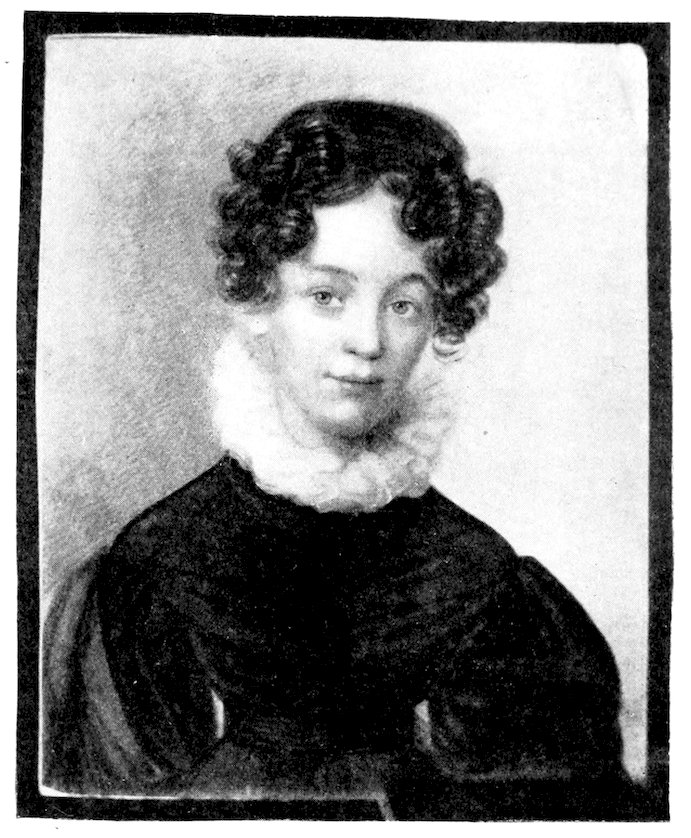
Pl. IX.—Lucy Sheldon (Mrs. Theron Beach)
From a miniature by Dickinson
“There were more than fifty law students boarding in Litchfield, many of them of wealthy families, and many of them from the South. Of course, there must be some amusement, and often the midnight air resounded with the songs of midnight rioters, and sometimes stories were circulated to the students’ disadvantage. After hearing some remarks on the ‘fast’ students, I met Dr. Sheldon walking, and said to him: ‘Doctor, they say we are the worst students ever were in Litchfield.’ ‘Pooh! pooh!’ said the doctor, ‘they are not half as bad as they were in my day.’ So I was comforted with the idea that we were not casting shame on those venerable Puritans who had condescended to become our ancestors. Be this as it may, I greatly enjoyed those evening sleigh rides, and those country suppers, when we would ride off to Goshen, or Harwinton, or other village, and order our turkey and oysters, served up with pickles and cake, and then set Black Cæsar to play jigs on a cracked fiddle. But the grand occasions were something beyond this, when we got sleighs with fine horses, and buffalo robes, and foot-stoves, and invited the belles of Litchfield, who never hesitated to go, and set off to the distant village to have a supper and dance. I seldom danced, and some of the girls did not, but there were always some who did, and we had jolly times. So passed my days in Litchfield, doing a great deal of good work in study, enjoying much of good society, and passing its hours in innocent amusements.”
Lucy Sheldon, half sister of Charlotte, and the daughter of Dr. Daniel Sheldon and his second wife Huldah Stone, of South Farms, was born June 27, 1788, and married Mr. Theron Beach, of Goshen, January 9, 1832. She died April 7, 1889, having nearly reached her one hundred and first birthday. She was born, married, and died in the same house on North Street.[25] She long retained her light step, her active habits, and fresh, youthful feelings. From her journal at the age of fourteen the following extracts are taken:
Monday This day Miss Pierce began her school I attended, resolving to renew my former studies with greater assiduity than ever, and shall endeavour to improve enough to merit the approbation of my Parents, and instructress, Painted on my picture of the hop gatherers, and read grammar, commenced an acquaintance with Miss 44Bosworth & Miss Goodyear, who appear to be very fine girls, in the evening studied a grammar lesson.
Tuesday. Continued my usual occupations.
Wednesday. Painted, read in miscellaneous works and recited a grammar lesson, in the afternoon Mrs. Tracy, and Caroline were at our house. Spent the evening at Mr. Adams’s.
Thursday. Studied and recited a grammar lesson, painted, and read some very good pieces in the Mirror spent a very agreeable evening at Mr. Allens.
Friday. Painted and read, heard Miss Pierce tell our faults, had the pleasure to hear her say she had seen no fault in me for the week past and hope she will ever have reason to approve of my conduct.
Sunday. Attended meeting all day & heard two pretty good sermons, delivered by Parson Champion, in the evening went to singing meeting.
Monday. Drew, and began the history of Rome but Miss Pierce thought proper that I should not write it as I had read it once before, In the evening knit.
Tuesday. Recited a grammar lesson & painted, spent the evening at the school house, with the young Ladies.
Wednesday. Today Miss Pierce did not keep as she expected to move into her new house,[26] therefore Miss Henderson took her place in the forenoon, but in the afternoon there was no school, and I assisted Miss Pierce, in the evening attended singing meeting.
Thursday. Attended school, painted & recited a grammar lesson, In the evening knit.
Friday. Miss Pierce did not keep school, Assisted Mama, and in the afternoon we had company.
Saturday. Painted, read in the explanation of the Catechism, in the afternoon wrote, in the evening heard Papa read.
Sunday. In the afternoon read in Baron Hallers letters to his daughter; on the truth of the Christian religion, in the afternoon attended meeting, & heard a very good sermon delivered by the reverend Mr. Huntington, from these words. Matt. 16. Chap. 26 verse “what profiteth for a man to gain the whole world, and lose his own soul, or what will a man give in exchange for his soul, he expatiated on the frailty of human events & the danger of placing too much happiness on the pomp & riches of this world. In the evening attended singing meeting
Monday. Assisted Mama and went to school, painted, read in Roman history, In the evening wrote.
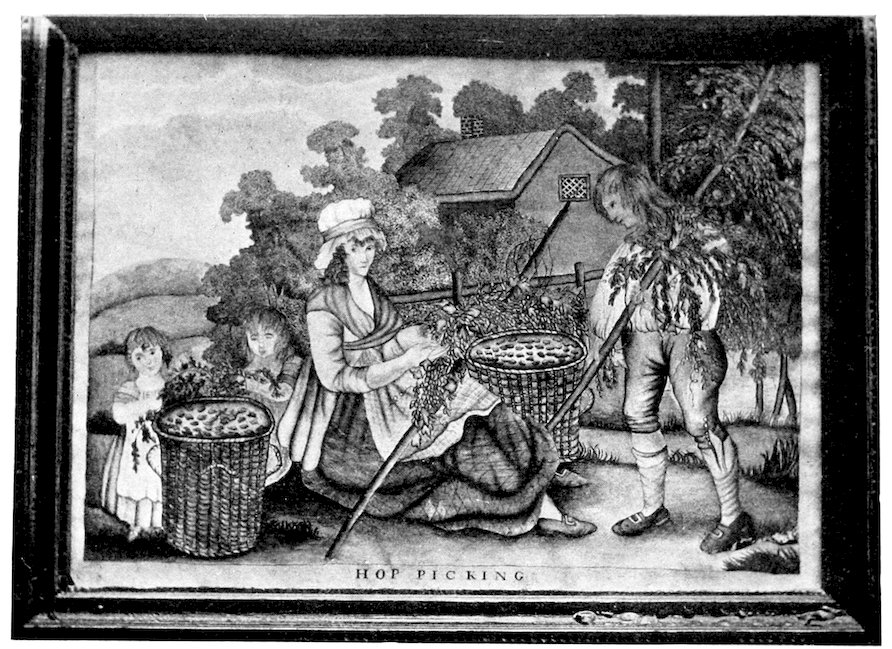
Pl. X.—Hop Picking
From a water-color painted by Lucy Sheldon
45Tuesday. Finished the hop picking,[27] In the afternoon Mrs. Smith was at our house, who I think is a very fine old Lady, Assisted Mama, In the evening knit.
Wednesday. In the forenoon copied my Journal In the afternoon wrote a letter, In the evening knit.
Thursday. Studied a grammar lesson, & drew In the evening sewed.
Friday. Painted, and read in the history of Rome, spent the evening at the school house.
Saturday Assisted Mama, wrote, painted and heard Miss Pierce tell our faults, and was very glad to hear her say she had seen no fault in me for the week past, In the evening read in Baron Hallers letters.
Sunday Attended meeting in the forenoon and heard an excellent sermon....
Monday Assisted Mama, came to school worked on my pin cushion, read and heard the young Ladies read, the life of Coriolanus, in the history of Rome, In the afternoon, sewed & read in little Grandison,[28] which shows that, virtue always meets with its reward and vice is punished, spent the evening at the school house.
Tuesday. Rose at sunrise, attended school, learnt a grammar lesson, & wrote my Journal, In the afternoon, painted and spelt.
Wednesday In the forenoon sewed, (P. M.) painted and assisted Mama.
Thursday. Learnt a grammar lesson, spent the afternoon at home, In the evening attended a school ball, and had a very good one.
Friday (Dec. 25th 1801). As this day was Christmas I attended church and heard a sermon by Parson Marsh very well adapted to the occasion, returned & spent the remainder of the day in sewing.
Saturday. 26th, Wrote my Journal, read in the Mirror, and heard Miss Pierce tell our faults she said she had seen no fault in me for the week past.
Sunday 27th, Arose at four o’clock, did not attend meeting, finished reading Baron Hallers letters which I think is an excellent book.
Monday 28th, In the forenoon, read history and painted (P. M.) studied & recited a grammar lesson spent the evening at home with company.
Tuesday. 29th, Studied a geography lesson, In the afternoon painted, In the evening knit.
46Wednesday 30th; In the forenoon painted, In the evening knit.
Thursday 31st, Learnt a geography lesson & began to draw the sailor boy.[29] In the afternoon, painted and sewed.
Friday. This is the first day of January the beginning of the year 1802, and I intend if it is in my power, to conquer all my faults, but as perfection is not the lot, of mortals I shall not expect to attain so near to it, In the forenoon painted in the afternoon there was not any school and I remained at home, assisted Mama & sewed.
Saturday 2nd, Painted and heard Miss Pierce tell our faults, she said she had seen no fault in me except holding my arms stiff which made me appear awkward, and which I shall certainly endeavour to correct, She also read a sermon from Blair particularly addressed to young people which recommended the necessity of being pious & industrious, In the evening, read in Mary Walstoncrafts travels through Norway, Sweden, & Denmark.
Sunday 3rd, ... Read in Mary Walstoncrafts travels, this is a very entertaining book but even here, I can see through some of our principals.
Tuesday 5th, Learnt a geography lesson, painted, and in the evening, sewed.
Wednesday 6th, Read and heard the young Ladies read history, painted, In the evening attended singing meeting.
Thursday 7th, Read in the Dramatic pieces.
Saturday 9th; Painted and heard my faults told Miss Pierce has found no fault with me for the week past.
Wednesday 13th, Painted and sewed, In the evening heard Papa. read, in a Fathers letter to his daughter and I hope I shall profit by the instruction it contains.
Saturday 16th, Read in Don Quixote & knit.
Monday 18th, Read history and, painted, In the afternoon sewed, In the evening attended a school ball enjoyed myself pretty well, returned at eleven o’clock
Tuesday 19th, In the forenoon painted, In the afternoon sewed, In the evening read.
Wednesday 20th, Read history and painted, In the afternoon returned home from school, and was happy to find Mrs. Adams, Maria,[30] & Mrs. Seymore there, In the evening, went to singing meeting, but had a very dull one.
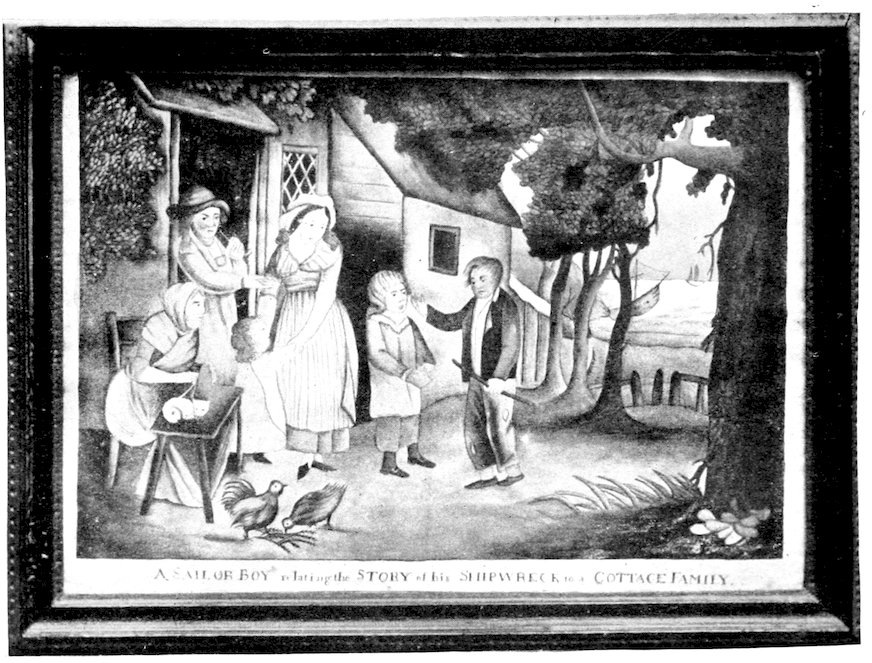
Pl. XI.—A Sailor Boy
From a water-color painted by Lucy Sheldon
47Sunday 24th, ... After meeting, read in the internal history of church.
Tuesday 26th, Assisted Mama, came to school read in the companion, and wrote my Journal, In the afternoon, there was no school, because Miss Pierces’s sister Nancy was more unwell, In the evening we heard the melancholy news of her death, Mama and I immediately went over there and beheld a very affecting scene, but I think the mourners bear their loss with Christian fortitude & resignation, returned home and spent the remainder of the evening in meditating upon the scene which I had witnessed, and which had made a deep impression upon my mind.
Thursday 28th, In the forenoon sewed, In the afternoon attended the funeral, and heard Mr. Huntington make an excellent prayer, returned home and in the evening knit.
Saturday 30th, Painted, but as Miss Sally has not kept school, I have continued my employments at home.
Have done nothing for these two or three weeks past worth notice except, having read through pilgrims progress, which I admire very much, and Lord Chesterfields letters to his son and think it would be well for every young Lady to read it.
Monday. Read history and painted in the forenoon. In the afternoon copied my Journal, In the evening ciphered.
Tuesday. Studied geography lesson, In the evening ciphered.
Saturday. Wrote a letter in my Journal. Miss Pierce did not tell our faults particularly, but gave us the general rules of good behaviour.
Sunday. Did not attend meeting on account of the weather, In the evening read in Don Quixote, and am pleased with his factious humor and Sancho’s credulous disposition
Tuesday. Attended school, read history, In the afternoon painted, & heard the young Ladies read in Juliana or the affectionate sister in the evening ciphered.
Wednesday. Read through the fortunate discovery or the History of Henry Villers, a novel written by a young Lady in New York, I think the language, is not as good as I have seen, but the story is very pretty. Attended school, studied a geography lesson, & wrote my Journal, In the afternoon copied it.
48Saturday. Rose late, assisted Mama, came to school copied my Journal, Miss Pierce did not tell our faults particularly, In the afternoon wrote plays for Miss Pierce, In the evening read.
Sunday. Read ten chapters in the Bible, attended meeting all day, & heard two very good sermons, read twenty chapters in the Bible after meeting, In the evening sewed.
Monday. Began to write the history of Rome....
Thursday. Attended a private school ball.
Saturday. Copied history, recited geography, and heard our faults told, Miss Pierce has found no fault with me for the week past, have had the honor of being chosen candidate for the prize, In the afternoon copied plays for Miss Pierce, in the evening read.
Monday. Returned home & had the pleasure of finding Miss Cornelia Adams[31] at our house, assisted in getting tea, & spent the evening very agreeably.
Tuesday. In the evening copied of my part of Ruth.[32]
Wednesday. Studied a geography lesson & recited it, had the mortification to have Miss Mary Glen get above me, began to draw a map in the afternoon, In the evening attended a school ball
Tuesday. Read history, drew on my map, and read in the childrens friend, In the evening ciphered.
Monday. This morning I was introduced to my new brother, & am much pleased with him, did not attend school, sewed, & attended to domestic affairs
Tuesday. The forenoon I spent in sewing at home, In the afternoon went to school, drew on my map of Connecticut & read in the inquisitor, which is a very humorous thing
Wednesday. Came to school & read geography to Miss Chittenden, In the afternoon recited my part & wrote.
Thursday. Rehearsed my part, drew on my map & wrote.
Friday. In the forenoon, drew on my map, In the afternoon studied my part.
Saturday. Assisted at home, attended school, read in the companion, drew on my map, assisted Mama at home & heard a play rehearsed,
49Sunday, Did not attend meeting, read in the Bible & Downman on infancy, In the evening did not do anything.
Monday. Came to school, worked on my map rehearsed my play, In the afternoon drew on my map read in the Roman history & companion, In the evening came to the school house, & heard the young Ladies say their play.
Tuesday. Attended school, rehearsed my play, drew on my map, In the evening attended a private school ball enjoyed myself very well.
Wednesday, Attended school, drew on my map recited my part, & copied history, In the evening sewed.
Thursday. Rehearsed my part, drew on my map & wrote.
Friday. Was fast, attended meeting all day, thought Mr. Huntington preached better, than I had ever heard him before.
Saturday. In the forenoon drew on my map & rehearsed my part, In the afternoon drew on my map, & heard the young Ladies say their plays.
Monday, January 3rd. This day I again commence my Journal, it being almost a year since I have written one, and perhaps will be the last, that I shall ever write at school, I am now old enough to know the importance of improvement therefore think I shall attend with more diligence than formerly, I have not however, as yet been very industrious because I have not had any fixed employments, but I have now resolved to attend regularly to my studies, This morning I stayed at home and assisted Mama, in the afternoon came to school, but found it very bad walking from the snow that had fallen, the preceding night, took a music lesson, was called home before school was out, spent part of the evening in ciphering and the remainder at Miss Pierce’s with the young Ladies.
Tuesday 4th, In the morning studied and recited a geography lesson, in the afternoon took a music lesson,[33] and wrote, in the evening assisted Mama.
50Wednesday 5th, In the forenoon painted, in the afternoon had the misfortune to break a glass in one of the frames of my pictures, attended school, in the afternoon sewed, had the pleasure to find Mrs. Allen at our house when I returned home, spent the afternoon and evening very agreeably, think Mrs. Allen is a fine woman, and any man might be proud of her.
Thursday 6th, Studied and recited a geography lesson and began a composition, and sewed, spent the evening very agreeably at Miss Pierces.
Friday 7th, Attended school, finished my composition & heard the history summed up, we are reading the history of South America, and have got as far as where Cortes entered Mexico....
In the afternoon sewed, in the evening ciphered.
Saturday 8th, In the morning sewed and wrote, In the afternoon sewed a little and played a great deal, In the evening read in the Bible.
Sunday 9th, Attended meeting all day, and never heard Parson Champion preach so unintelligibly, I can’t tell what was the cause of it, but I did not understand much of it, In the evening went to singing meeting stayed till about eight o’clock, when I returned and spent the rest of the evening at Mr. Tracy’s very agreeably with a large collection of Ladies & gentlemen.
Tuesday 11th, Heard the young Ladies read history and copied my composition, (gives a condensed account of the history lesson) In the evening had company.
Friday 14th, Did nothing but study geography all day.
Saturday 15th, Spent part of the forenoon in writing and the remainder in hearing Miss Pierce read some excellent pieces from Moore’s Fables on different subjects In the afternoon sewed. In the evening read in the Bible.
Sunday 16th, Rose rather late, attended meeting and heard Mr. Huntington preach, he took his text from Luke 18 chapter. 14 verse. the following were the words, “I tell you this man went down to his house justified rather than the other” after relating the story of the Pharisee and Publican, he told us we ought to humble ourselves before God, and that we should avoid hypocracy, although the Pharisee attended strictly to all the forms of religion, yet instead of humbling himself he boasted of having fasted more than the lord required of him, and thanked God. that he was not like other men, an adulterer, or slanderer, while on the other hand, the Publican was sensible of his wickedness, and when before the altar of God, he stood afar off and 51being afraid, so much as to lift his eyes to Heaven, he beat his breast, and cried, “God be merciful to me a sinner,” and that for this reason, he went back to his house justified rather than the other. In the afternoon attended meeting and heard a continuation of the forenoon’s subject, In the evening went to singing meeting
Monday 17th, We danced all the forenoon, and in the afternoon sewed and was examined in geography, spent the beginning of the evening very agreeably at Miss Pierce’s, but the latter part not quite so much so.
Tuesday 18th, Wrote and was examined in geography, there was no school in the afternoon, and I employed myself in reading in Adams history of Rome, In the evening we had a ball, I was not placed as high in the dance, as I intend to be next time, enjoyed myself very well, returned a little after ten o’clock.
Saturday 22nd. Wrote a composition upon Vanity, and heard our faults told, In the afternoon mended my cloaths, In the evening read.
Sunday 23rd, Did not attend meeting in the morning, read all the forenoon, In the afternoon attended meeting but did not attend to the sermon, as much as I ought therefore cannot relate it, In the evening went to singing meeting, and wrote a letter.
Saturday 28th, Wrote all the morning, In the afternoon came to the school house, and wrote, while I was there Mr. Nash came in and instructed his sister I was much pleased with his kindness, in trying to improve her.
Sunday 29th, It stormed very hard, but I thought that was not a good excuse for staying at home, therefore attended all day, text was taken etc....
Saturday Feb: 4th, Assisted Mama, came to school and heard that the two Miss Chapins were going home, went up to Mrs. Lords, where I found Mr. Reeves who had come to bid a last adieu, to Miss Chapin, though he was not so unmanly as to shed tears, yet his look indicated what were the feelings of his heart!!!... I much grieved to have to part with two such good friends as Clarissa & Betsey, particularly the former, who perhaps is not a finer girl, than Betsey, yet I have been more intimate with her, therefore was more sorry, to have her go, returned to school and wrote, Heard Miss Pierce read us a piece on discretion from the Spectator which I admired very much, In the afternoon sewed.
52Sunday 5th, Did not attend meeting, read very steady all day, In the afternoon was taken quite ill, but soon recovered after exercising some, In the evening knit.
Monday 6th: ... Read in the vision of Columbus.
Tuesday 7th, Assisted Miss Mary all the forenoon, In the afternoon attended school, wrote and heard Miss Leavitt play on the piano thinks she plays very handsomely, In the evening attended a school ball, enjoyed myself pretty well, returned after eleven o’clock.
Wednesday 8th, ... I took a music lesson.
Saturday 11th. Wrote and did some plain sewing in the afternoon mended, In the evening read twelve Chapters in the Bible.
Wednesday 16th, Sewed, and heard the history In the afternoon read in Blair’s Lectures, In the evening had company.
Saturday 19th, Copied my Journal and took a music lesson, painted, slept the greater part of the evening, retired to rest a little after eight o’clock.
Saturday 26th, Came to school, took a music lesson, and returned home again, for the past week I have studied three geography lessons and two grammar lessons, have attended ciphering one evening, having been sick, the greater part of the week, spent the remainder of the day in doing nothing we had this week, studied Egypt. etc., I have heard the history read twice this week.
Sunday 27th, Did not attend meeting, was so sick read one or two chapters in the Bible.
Saturday March 5th, The preceding week I have been sick the greater part of the time, notwithstanding have not missed getting a geography lesson, every other day, have been here every night to spell, and have studied and recited several grammar lessons, stayed at home one day ciphered one evening, and attended a lecture on Friday
Saturday 12th, For the past week I have studied three geography lessons, drawn out a large picture, and heard the history read twice, there was no school one day, I sewed, read 35 pages in Homers Iliad, In the evening attended a ball.
Saturday 19th, Have studied for the week past, two geography lessons, painted and made a frock, been to ciphering three evenings, 53I have studied the Latitude of every kingdom, and island in the world....
Sunday 20th, Attended meeting in the afternoon, the sermon was read by Mr. Reeve who read so low, that I could hear but very little of it, in the evening sewed very steady till nine o’clock.
Saturday 26th, The preceding has been spent as usual in studying geography, hearing the history & painting, have written one composition & ciphered one evening, we have studied for our geography lesson, the boundaries of the seas & a description of the New England States etc., Miss Pierce gave me 9 credit marks for my frock, I have this winter missed in spelling 1 whole one and two half one’s.
Saturday April 2nd, For the week past have painted every day studied, & recited, three geography lessons & heard the history twice, We have this week been comparing the towns of America with those of Europe, the rivers also.
Saturday 9th, Have written a composition, visited two afternoons, one at Mrs. Adam’s with Clarinda Austin, spent the afternoon very agreeably, In the evening Mr. Stanly was there, his manners are genteel and agreeable, but I am afraid that beneath a form so beautiful is concealed a vile heart, I think I should not like such a constant succession of company as they have at Mrs. Adam’s. But perhaps I shall think differently when I consider myself grown up, the other afternoon I visited at Mr. Holmes with Cornelia & Maria Adam’s, had a very agreeable visit indeed, the company were very sociable & Miss Chandler in particular, who was more Loquacious than ever, returned home at nine, the remainder of the week I studied geography, and drew, Miss Pierce has seen no fault in me for the week past.
Saturday 16th, Have for the week past been studying geography & Miss Pierce has been examining us every day, the evenings I have spent in studying.
Monday Wrote geography, Tuesday, the same, visited at Miss Pierce’s, had a very agreeable visit, spent the remainder of the week in studying geography....
We did not get away from Litchfield till ten o’clock, the stage was very much loaded with baggage and besides that, there were twelve 54passengers—at Watertown there were two got out. I did not stop at Uncle Cutlers, because the stage drove on, We arrived at New Haven about half after eight called for at supper at Butlers, and after eating as many oysters and other good things as we could went directly on board a packet, there was no wind and we could not sail, we stayed in the packet that night, and the next morning went on shore. I do not like New Haven much better than Hartford, it may be a pleasanter summer residence but I should prefer Hartford in the winter, and like Litchfield better than either, I dined at Mrs. Twining’s, and went to Mrs. Goodrich’s in the evening, because we expected to sail, but the wind proving contrary I stay’d with Susan. Mrs. Twining was very kind to me, and I think Mr. Goodrich’s a very agreeable family, The next day about eleven the Captain sent for us and we went on board again, but we did not sail till evening—I was very sick all the next day and did not get out of my berth till night, the sailors said we should go thro hell gate in a few moments so I went upon deck but as it was high water I could not see any thing of any consequence—we arrived in New York at Nine o’clock—and I assure you I was very glad to get on the shore, As Aunt Leavenworths was some ways from Burling Slip the place where we landed, I went to Mr. Hopkin’s, and staid that night, and the next morning went to aunt L—— she has a most delightful situation on the bank of the river—and I am certain I shall not be homesick, yesterday Aunt, and Myself, went a shopping. I believe I shall never learn to go alone, there are so many thousand streets here, I believe it would not be a very good place for Harry, his head would be turned in less than two hours, he would however be very much diverted, and so was I yesterday to see the old women sitting in the market and so many thousand ugly faces and dresses passing you constantly Harry’s money would not last long here for you cannot go any where without seeing some very pretty playthings or something very good to eat. I have not seen the girls of my acquaintance, yet but as soon as I get my cloaths made I shall call on them, then Mr. McCrackan was here last night, he said that Aunt Hopkins and the child were well, but Nancy was not she had a cough but they supposed it was only occasioned, by a cold, tell Miss Mary Pierce that I am not homesick, but shall expect to see her here soon I have not seen her brother yet, she said I should be frightened with the singing of the chimney sweepers, but I am not, at all, I hear them go past all the time but I have not seen one yet—be kind enough to give my love to all the girls and tell them, that tho I have got to be a City Lady I think of them very often and wish to see them very much—that I should certainly write them, but I am afraid Mr. Hopkin’s will go, but 55they must not fail to write by Miss Mary—give my love to Papa and all the family. I want to see little William. very much, you must not let him forget sister Tuty present my love to all who enquire after me—The weather looks very much like snow this morning—I suppose Frederick is not sorry—as he will probably enjoy much pleasure, in gallanting the girls about in our little sley this winter do make him and Harry write and tell me everything that has happened since I came away I suppose you had the honor of Mr. Nash’s company to dine with you on thanks giving day—Aunt Leavenworth is pretty well and sends her love she would write but thinks it unnecessary as I have written you so particular—adieu Mama, and believe me to be ever your affectionate and dutiful daughter
I fear I shall want some more money.
I neglect no opportunity to let you know we are all well, and think of you pretty often we received your letter by mail, but not before Miss Mary was gone and as I do not like to trouble Mr. Allen. with a bundle shall send the muslin you mentioned next week by the Mail, you will see I cut William a shirt from one of the breadths, and fear I have spoiled it, but since I do not know what use you want to make of it, shall send it as it is. Miss Pierce has begun her winter school which is so small that she keeps in her dining-room and probably will unless more come than she expects, Mrs. Dr. Smith drank tea with us this afternoon and Betsey & Polly Sanders are here at work and have been here till I am quite tired of them, you must write me more particular what you are adoing from the time you get up till you go to bed, and what time in the morning you get up, and what your Aunt is doing and where she is, and everything you can think off I shall read it with pleasure let it be ever so trifling, you will not forget to remember me to your Uncle & Aunt
Both of these letters were sent by private hand.
In Lucy Sheldon’s Commonplace Book, where we find but one date, September 12, 1811, there are selections from “Christian Morals,” Hannah More, Montgomery, Milton, Pope, Young, Miss Porter, Scott, Sir John Suckling, Sheridan, Thomas Moore, Burns, Stewart, Swift, Burke, Doctor Johnson, Goldsmith, Shakespeare, Cowper, Thompson, Chesterfield, Shenstone, Dryden, Ossian, Bolingbroke, Grattan, Anthony Pasquin, Savage, Curran, The Spectator, Dean Kirwan, Blair, Doctor Cotton, John Howard Payne, Mrs. Opie.
57Judge Tapping Reeve writes:
When my Lucy calls to mind the unnumbered blessings which God her Maker & Redeemer bestows upon her midst the comforts of this life, born & educated in a land where the pure precepts of the blessed gospel are constantly inculcated, will she not adopt with gratitude the language of the poet
If the opportunities afforded to her for the acquisition of whatever is valuable & ornamental are improved for the purposes of elevatedness of heart to God, they will indeed be blessings, the language of her heart will be “thy will be done,” the poets language will accord with her feelings
Judge James Gould quotes a passage from Pope’s Iliad; Mrs. Elizabeth (Burr) Reeve quotes verses; Miss C. A. Austin quotes from Fessenden:
Augustus Hillhouse adds a poem on Despair; Miss Amelia Ogden adds several quotations; Miss M. Tallmadge quotes from Mrs. Opie; Miss M. Baldwin quotes from Logan; Mr. Pierce quotes from “World without Souls.”
At the end of one collection are the following conundrums:
58When an American or an Englishmen leaves his country, he says farewell my native land——
An Irishman says Jesus be with you, this day & forever sweet Ireland my country
Letter written by Lucy Sheldon to her brother Henry just after the death of another brother, William, in Paris. Daniel was Secretary of Legation at the Court of France under Albert Gallatin.
On Saturday last the fifth of July we returned from our tour to Niagara Falls, I believe I wrote to you of Frederick that Miss Mary Pierce was going to accompany us. Colonel and Mrs. Tallmadge talked of it with Mr. & Mrs. Cushman, but Mrs. Tallmadge is in such terror when she is travelling by sea or land, that it is a source of unhappiness to her to take a journey and tho the colonel appeared really anxious to go, he gave it up on her account Miss Pierce, Father, and myself sat out on Wednesday the 12th of July it was an extreme hot day, I think the warmest we have had this summer, but tho we suffered some from the heat, yet as the stage was not crowded we did tolerably well, father laid himself down in the stage & took several long naps we had a plain farmer with us who amused us considerably with his wit & good common sense, the nearer we approached Albany the more we found ourselves fatigued and our South Farms farmer said he had rather Cradle grain all day, than to ride in the Stage, we did not get to Albany till ten o’clock, put up at Skinners quite a good house, had supper got to bed about, eleven, were waked very early in the morning by the multitude’s of Stages going out and found ourselves not much refreshed by our nights sleep, and took a stage to Troy and Lansingburgh. Miss Pierce stopped at Mr. Cushmans, I went down to Mrs. Leonards, to get where I could rest a little, for I was much more fatigued than the others; Father was very smart. Found Mrs. Leonard as hospitable as ever, stayed with her all day and night, returned the next morning to Troy, dined at Mr. Cushmans, there was much attention to religion at Troy, and most of the towns west. Mr. C—— is much engaged, we had a delightful visit, at three started in the Stage for Schenectady, arrived just as the boat was going out for Utica, took tea, and went immediately on board the Sound of the Kent bugle, the lively, busy scene around us, and the long stretch of the Canal, all new to us, afforded a pleasant 59scene, and almost made us forget our sorrows; the boat was a small one and considerably crowded but we had an excellent Captain, very good food and pleasant companions, which made the evening and following day pass pleasantly. Mrs. Town, her two daughters, a niece, a son Charles. T. & a Mr. Smith who had lately married one of the daughters, were among the party, they were from New York except Mr. S—— who was from Philadelphia appeared to be genteel people and strove to be pleased with everything—which is a great art in travelling, and renders people much more agreeable, the next day I felt considerable fear for Father, he would be upon deck, or upon the bow, of the boat, and get to sleep, or would undertake to jump from the boat to land, till he got one fall, and came near getting knocked down by a bridge, all our warnings and endeavours to frighten him by stories we had heard were of no avail, but after his fall he was a little more careful and willing to stay in the cabin. the country as you know is very pleasant here, the company was pleasant, among others the gentlemen who had studied law at L——d and we had an agreeable sail up the Canal, got out at Little Falls, walked nearly a mile, and viewed the acqueduct, arrived at Utica about nine in the evening, had a room with the Towns. The next day was Sunday—William Bacon came and invited us to go to Church, eat dinner at his Fathers, after Church Mrs. Skinner called in to see us. She is as young and lively as ever—The next day—we went with Miss Lathrope to see Trenton falls—It rained a little when we sat out, but cleared up shortly, we got there about ten A. M. proceded to the falls were perfectly charmed with the beauty of the scene, Father walked almost as far as we did, he went to the house of refreshment, which is built directly on one side of one of the most beautiful falls, we walked as far as any body ever went Miss L—— said, and then returned, took dinner and went back to Utica fully rewarded for our fatigue and trouble. We went to bed before dark, had a good nights sleep, the next morning, Father and I procured a gig and sat out for Clinton to see Mrs. Noyes. The roads were wet and considerable rutted by the late violent showers, but Father took a rein in each hand, and John Gilpin like, drove thro, thick and thin, calling out, tur—rup, tur—rup, and tho I remonstrated considerable upon his holding the reins so loose, going down hill and in bad places, he heeded it not, but called out tur—rup, and drove on, till at length, we arrived safe at Fannys—after going a mile directly out of the way in spite of my entreaties. Found Fanny well, cried and laughed to see us, has a very pleasant situation, overlooking a rich and very beautiful valley, a pleasant house and a yard adorned with shrubbery, 60we visited the Colleges, were treated very politely by the President and Lady, invited with warmth to stay—took tea with Fanny—set out for Utica in the same careless way we came, continuing to beg my Father, to drive with more care, without any effect—we had proceded about a mile—were going over a plane, perfectly smooth and level when our horse stumbled fell, and broke the thill of the carriage—Father was going to jump out—I begged him to sit still, in a moment the horse got up again, and stood perfectly still. I ran to a house to get some assistance, but there was no man at home—but coming out I saw a student of the College at some distance—I requested him if he was going that way, to step in and inform Dr. Noyes of our accident—but he mentioned there was a black Smith at a little distance, and he would call in, and request him to aid us; but the black Smith was not at home, so he returned; we fortunately found a strong rope, used as a halter in the gig, the young man procured a strong piece of wood—he and Father bound the wood around the broken part firmly—and we got in again—I at last prevailed upon Father to let me drive—and we arrived at Utica in safety—Father taking the reins near the town. The same evening we took the Canal boat for Syracuse—here there was an old Scotch man who kept the gentleman in a roar the greater part of the time—at Syracuse they make salt by evaporation—the next morning Miss P—— and myself took a wagon and a boy and went to Salina, where we saw the salt works which were a great curiosity—returned before breakfast, and took the stage to Auburn—Mrs. Bacon gave us a letter to her son who resides there he called upon us with a Mr. Fanning a classmate of Williams—and told us they would wait on us to the States Prison after dinner—at the dinner table we met Mr. Sam Miles Hopkins—who is an inspector of the Prison, and was there on that business—he with the young gentlemen, accompanied us into every part of the prison—introduced us to Judge Powel, the keeper—who took us into his sitting parlour and gave us a glass of wine, after our walk over the Prison we took a carriage and went to Cayuga to Mr. Mumfords, where they appeared happy to see us—the next day at eleven we got into the stage for Rochester. here Miss P—— and myself almost lost our hearts for one of our travelling companions—a very intelligible—agreeable, social, Irish gentleman, by the name of Hogan—we travelled with him to Rochester part of two days through a most interesting country passing Geneva Canandaigua—and had a delightful ride—at Rochester we stopped to pass the Sabbath—found a great number of acquaintances. Mr. Livingston who married Miss C. Landon, Mr. Perkins who married Miss C.—Deming—Frederick 61Backus—Mr. James who went out to Liverpool and Woolsey Mumford—Went to see the falls—the ruins of Carthage—mills—churches—we drank tea Saturday evening with Dr. Backus, saw Old Mrs. Backus—attended Church all day—next day took the Canal for Buffalo, had on board the Canal boat, the Boardman’s and Costars from New York, the ladies were pretty, were much crowded in the boat, so that many had to sleep on the floor—left our companions at Lockport, viewed the grand locks, a very great curiosity, being double, five together. passed on to Buffalo had a beautiful view as we entered the harbor of the Lake, Fort Erie etc, next day crossed the river at Black Rock and took a carriage for the Falls. the morning was beautiful the air cool and refreshing the country finely cultivated—the river Niagara rolled clear & majestic beside us, and everything seemed to conspire to render the ride a charming one, we stopped and bought some ripe apples and fine cherries about half a mile before we reached the Falls, we visited the burning spring here we viewed the rapids, in their tumultuous motion coursing towards the awful precipice below; at eleven we arrived at Forsyth’s and immediately proceeded to the falls the scene struck us as grand and beautiful beyond description. I had a most peculiar sensation w’h was—a great desire to throw myself with the mighty mass of waters and penetrate the abyss below—and I found afterwards I was not alone in that feeling. We passed that day in wandering about, and beholding the wonderful works of God in this interesting place—and in one of our rambles suddenly met Mr. & Mrs. Darling from New York very particular acquaintances of Miss Pierce’s we also at dinner met a number of our travelling acquaintances—Forsyth now keeps a very good house—there is another one a short distance from this, lately built, which some prefer, but this commands the best view of the falls and upon the whole is I think the most desirable house. The next day we took a carriage and went to —— where is an old British Fort, opposite to Fort Niagara on the American side, there being no garrison in the Fort and the gate open we went in and examined the whole of it. It is called Fort Mississaugay. We also stopped at Queenstown to see a monument erected to the memory of General Brock who was killed near. it is a hundred and odd feet high, and they are going to add twenty more to it. returned to Forsyth’s to dine, after dinner left his house crossed over in a row boat to the American side. Father was quite fatigued going down & up so many steps, but not so much so but that he immediately went and delivered a letter of introduction to Judge Porter who lives at the falls. The American side tho’ not as beautiful as the other accorded more with my ideas previously formed—than 62the Canadian side. Had a very agreeable visit at Judge P’s when we drank tea his garden is situated directly upon the banks of the rapids The next morning we went all over Goat Island found at breakfast Mr. & Mrs. Perrit from New York and a number of our travelling companions. Mr. P. said he sailed with you to Liverpool a year or two since and they mentioned they were well acquainted with Frederick & his wife—found him & his wife very agreeable, sat out in the stage with them for Lockport the road was bad & dusty but our pleasant companions beguiled the tediousness of the way—by their interesting conversation. Stopped at the Tuscarora village. At the house of the Chief—he had been confined to his bed several years with the Rheumatism—My father told him he could cure him—and prescribed a remedy for his complaint—his log hut was larger & more commodious than the rest, situated in a garden, kept perfectly neat—and a number of fruit trees around—the squaws were spreading wheat to dry in the sun and looked quite comfortable—the Chief was seated upon a bed, with white curtains and the hut looked tolerable comfortable—quite neat & clean—he was forty years of age he told us—spoke the English Language very well—and appeared to be a very intelligent man. from what he said, I should Judge, a Christian—I left them some tracts—others gave them presents and after shaking the Chief by the hand we took our leave. At Lockport we took the Canal, as Father much preferred travelling that way—and at Brockfort we parted with Mr. & Mrs. Perrit. We passed the Grand embankment on the Canal which is raised Seventy feet above the surrounding country for a mile or two—and a road passes under it—we stopped but a moment at Rochester and passed on to Montezuma—here we arrived early Sunday morning—took a carriage—and went to Cayuga seven miles where we passed the Sabbath—attended Church all day with Mr. and Mrs. Mumford—the next day at eleven took the stage for Auburn—At Auburn met with some pleasant Irish people from New York. Mr. & Mrs. McCarthy etc. etc—they informed us that the young Irishman we took such a fancy to and who styled himself Doctor, was formerly a Roman Catholic priest—but had apostasized from their religion & was—as they called him a Renegade—however we concluded from what they said—it must be another person—Arrived at Utica before dinner after dinner called on our friends saw Phoebe Hubbard at Utica—Sailed from Utica in the Canal boat at eight in the evening, had a fine boat and cool night—but few passengers, and found ourselves very comfortably situated indeed we have been remarkably favored in this respect—Have had but little warm weather—and seldom been 63crowded on board the boat or stage—arrived at Schenectady after a pleasant sail the next evening—here we took leave of our Irish friends and some other travelling companions—Next morning took the stage to Albany found that the Litchfield stage left here at two o’clock in the morning—was sick that day kept my room most of the day—Mr. John Chester called to see us—also Eben Baldwin formerly at Litchfield—in the evening went to hear Mr. Chester preach—next morning walked to see the long Pier and Albany bason—went on board the safety barge, Lady Clinton, which we esteemed a great curiosity, the accommodations are superb—at nine took stage for Lebanon—with three or four dashing Philadelphians who were promising themselves much pleasure at the Springs—arrived at Lebanon half past two—called for dinner—our travelling companions came down in their best trim and were sadly disappointed to find no company of any consequence there—we drank of the water, admired the beautiful prospect of the extensive Valley which lies before the public houses visited the baths—and took a carriage for West Stockbridge—our ride led us through the Quaker village we stopped at their store visited their place for making cheese—admired the neatness of the place and passed on—our carriage was easy and comfortable the air cool & bracing the scenery very fine—and we enjoyed our ride highly—at West Stockbridge we were surprised to see how small the rooms of a common sized house looked, we had been so long in such large ones—we were however very comfortably provided for—our fare was good—and our host sociable so we had nothing to complain of—the next morning while waiting for the Litchfield stage we went to see them saw Marble and to the Quarry some distance beyond—at nine an extra drove up we were standing upon the Steps at the door a gentleman got out and said how do you do Doctor Sheldon? We looked up and saw an old friend of ours William Ellsworth of Hartford—there were so many passengers that they took another extra from here, and we had the pleasure of Mr. E——’s company to Norfolk—here he left us and we had a stage to ourselves we were still favored with delightful weather. our driver was anxious to get in before another stage which took a different route—and we came about six miles an hour—at the head of the Street seeing the other stage just entering town he set his horses out upon the full run—and we came home in that style somewhat to our alarm—We found all things had gone on quietly and snugly at home & have great reason to be thankful for the many mercies we have enjoyed during our absence—everything seemed to concur to render the journey a pleasant one it rained just when we wanted a shower 64to lay the dust—and cleared off when we wished to have it—we were protected by a kind hand from all danger by water and by land—we were treated with the greatest politeness and kindness by our friends and by strangers and had nothing to mar the pleasure of our journey—the thought of my Dear departed Brother would sometimes cause a sigh—and a tear to flow—but the remembrance was usually softened by some pleasant scene before me, which absorbed my thoughts and attention Father bore the journey remarkably well—and appeared much less fatigued than I did—he and Miss Pierce seemed to grow fat the whole way—He was much gratified with his journey—and I think it will probably be the means of prolonging his life—
Though we have passed through many pleasant towns and villages yet as we entered Litchfield Miss P and I agreed that we had not seen one that would compare with it—in neatness—& none pleasanter. Father jumped out of the stage and said—home is home—if ever so homely—I pray God that I may have a heart to be grateful to you and grateful to him for the many mercies I enjoy—I hope it will not be long before you will come back to this country never to return to France—Remember us affectionately to Daniel and believe me your affectionate sister
Postscript My dear Frederick & Mary I thought you would wish to know how we got along in our journey as it was something of an undertaking for a man 75 years of age—which has caused me to be thus particular—I now promise myself the pleasure of seeing you here speedily, do quit mosquito land and come to the pure air of Litchfield—I hope you will very soon, yours L.S. Please to direct this to Henry.
Article written for the Litchfield Enquirer by Lucy Sheldon (Mrs. Beach), when near eighty years, because her village was spoken of as lonely in winter.
Who that has wandered o’er these green hills, any bright June Morning, and viewed the smiling landscape, hill & dale, dotted with thrifty farm houses, the Silver Lakes, the distant Mountains, the Village, like a City on a hill, tho’ surrounded with Hills, the clear blue sky; has inhaled the pure dry air, giving health & vigor to the system, but will exclaim with raptured heart, “My Father made them all!” Where does the merry Bobolink, the gay Meadowlark, the Blue Bird, the domestic Robin, the Oriole, sing their Maker’s Praise with a louder, sweeter song, than on these hills & and in these Vallies, And as the Sun sinks in the West, the low voice of the Whip poor will is heard in the Vales below, At Evening how soft the Moonbeams sleep on yon glassy Lake, and how bright they twinkle, as you walk these streets thro the long avenue of trees, forming shadows, which seem like some magic picture of beauty.
We would not boast, but we think the Mantles of our Fathers have fallen on many of their children, and that we have refined intelligent Christian Society, persons who love each Sabbath day to come from their far off homes, to mingle their prayers and praises with those who worship Him who is a Spirit in Spirit & in truth, and who appreciate the high privilege, of hearing the word of God, Preached with plainness, with simplicity, with Spirituality & Power.
Here also in Rugged Winter we love to dwell. We love to brave the Storm, to hear the loud wind roar, the bracing air adds color to the Cheek, and elasticity to the frame. We love to hear the merry Sleigh bells jingle and see the brawny ox at the bidding of his master, bending his neck, to draw the heavy load which gives warmth & comfort to our dwellings.
We love the placid quiet of domestic life free from the shackles of folly & Fashion. We love after the labor of the day
Music, Books, pleasant converse with others and ourselves, plans of usefulness fill up the passing hour, and we retire to rest leaning on him beneath whose notice, not a sparrow falls to the ground.
On yonder Hillock in the vale, a gentle stream meandering at its base, sleep the remains of our Honored Fathers & Mothers. Many of them unknown to fame, but their names are recorded on high.
The green sod covers them and the Fir tree & the Willow spread their branches over them, but their excellencies still live in the memory of their descendants. We would emulate their virtues, We would elevate that which is low, we would frown on vice, and contribute our might to reform what is wrong.
And may Education, Morality & the Religion of the atoning Lamb of God, characterize the People of this loved place, to the latest generation.
Mary Ann Bacon was born February 9, 1787, and married, November 13, 1815, Chauncey Whittlesey, of Roxbury, Connecticut.
I left Roxbury at eleven Oclock Thursday June 10 1802, accompanied by my Father after riding about ten miles we stopped at Mr. Mosely about three Oclock where we refreshed our selves and mounted our horses about four and rode in solitude saw many beautiful meadows and the little birds warbling sweet notes seeming to enjoy the sweet pleasures of life it rained a little before we reach’d Litchfield which was about Six oClock in the afternoon. Papa got me into Board at Mr. Andrew Adams’s.[34] After staying a short time we parted and being much fatigued I retired to rest soon after tea.
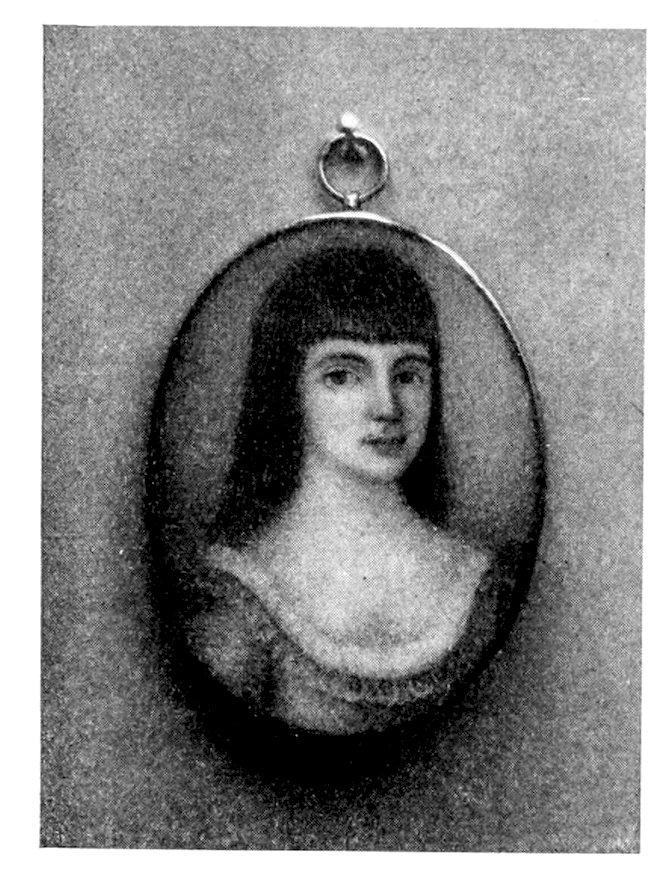
Pl. XII.—Mary Ann Bacon
From a miniature
Arose at five Oclock the family was not up walked in the Garden for the morning was very pleasant meditating upon the beauties of Nature and reflecting with many disagreeable feelings upon have parted from my kind Parents and Acquaintance to live with strangers I returned to the house where breakfast was almost ready at Nine 67oClock went to school with Miss Cornelia Adams drew and heard the Girls read history, at Noon studied my Dictionary and devoted the afternoon to reading drawing and spelling and spent the rest part of the day with Mrs. Adams and her daughter and retired to rest at Nine oClock.
Arose about six oClock in the morning read till School time and spent the fore noon hours in drawing and the Girls was questioned in the bible and reminded of their faults which Miss Pierce had discovered during the week in the after Noon took a walk but saw nothing entertaining returned to my Chamber where with many disagreeable feelings I indulged myself I soon found I must not give way these unhappy feelings went down stairs and when they were all assembled each one read a Chapter in the bible And retired to rest at Nine.
Arose at six Oclock walked in the garden came back and after breakfast went up stairs contemplating on the beauties of Nature and read several Chapters in the bible in the book of judges would have attended meeting but rain prevented in the Afternoon retired to my Chamber meditating upon the different situation in this life a little before evening the boarders were all seated each one read a Chapter in the bible and retired to rest at Nine Oclock
Arose about half past five took a walk with Miss Adams to Mr. Smith’s to speak for an embroidering frame after breakfast went to school heard the young Ladies read history studied a Geography lesson and recited it. In the afternoon I drew read and spelt. After my return home my employment was writing and studying I spent the evening with Mrs. Adams and retired to rest about half past nine oClock
Arose at Six oClock after breakfasting took a walk purchased some Linen attended school drew and read in History. In the afternoon I spent the hours in Drawing Reading and Spelling. After school I was busily employed in Sewing.
Arose about six oClock spent the morning in writing went to school studied a geography lesson and recited it. In the afternoon drest, 68went to school drew till 4 oClock when I walked to Mr. Smith’s with Miss Strong to see Miss Rogers where I spent the After noon in very agreeable conversation and was accompanied by Miss Rogers and Miss Strong to the School Ball where I staid till about Eleven oClock and then returned home with Miss Scovil and retired to rest at half past Eleven....
Arose at Six oClock in the morning read two or three Chapters in the bible drest for meeting heard a sermon delivered by Mr. Huntington which I thought was very good the text was in Proverbs 15 chapter and 9 verse in these words Fools make a mock of sin at Noon read a chapter in the bible in the afternoon attended meeting heard a sermon from the same text After Meeting read in the Letters from the dead to the Living which was very entertaining After a short time the boarders were all seated each one read a chapter in the bible in the evening saw Company and retired to rest at Nine....
... a little before evening took a walk with Mrs. Adams to Mr. Smith’s saw Old Mrs. Adams who was 104 years old....
... Mrs. Adams read in the Afternoon read in Moral Entertainments which were very excellent after meeting read in the book called female education....
... took a lesson in music returned to Mr. Adams pricked off 2 or three tunes....
... had the pleasure of attending independence ball there was a very large collection and I spent the evening very agreeable returned home and went to rest at one....
... in the Afternoon went to Parson Champion’s with the young Ladies to quilting....
Arose at four wrote two Letters in the morning and carried them to Mr. Huntington’s for Miss Charlotte Tomlinson to carry to Woodbury when she returned....
Arose at five o Clock took a walk with Miss Leavitt to the stores to get humhum.[35]...
Arose at half past four o Clock took a lesson in music at five in the morning....
... in the evening heard Mrs. Adams good advice....
Arose at four took a short walk with Miss Leavitt returned and after breakfast waited some time impatiently for my Papa who did not come until Eight o Clock when we mounted our horses and rhode till twelve when arrived my Grand Papa in Woodbury where we dined and spent about 2 hours in company with Miss Laury Bacon and my other relations when we sat out again about three and after riding a short time we was caut in a shower and arrived at Roxbury about five in the afternoon and was once more rejoiced to get home being quit fatigued we lay down after we were a little rested went into the store to get a frock when we came out found some pears which relished very well and presently tea was ready and soon after retired to rest which was about Eight o clock.
Arose at five o Clock in the morning after breakfast was employed in fixing my clothes to return to Litchfield we set out from Roxbury about Eight o Clock and rode till half past ten when we stopped at Captain Farrings where we tarried about 2 hours we then continued our ride till we arrived at Litchfield about two o Clock in the afternoon attended school time enough to study my spelling and spell but was too much fatigued to do more.
... read in the moral entertainments....
... Miss Pierce drew my landscape....
... had unexpected news that there was a going to be a ball at Mr. Adams boarders attended returned home at a propper hour and retired to rest.
... copied my Composition began my dancing school this day was the first after they had all taken there lessons returned home had a very bad headache....
... in the evening Miss Tomlinson came to Mr. Adams’s her conversation was pictures boarding and history....
Arose at six devoted the morning to studying the boundarys on the map in the four noon worked a little time I went out to the barn with the girls to study my lesson came in and recited it took a lesson in music in the afternoon read worked on my picture studied my spellings and spelt after school the Boarders all moved the South Chamber and my time was spent in writing in graret and I was forgot and licked to lost my tea however I did not go up raret again with out partisioning to some one to caul me meal times the evening was spent in reading till Nine and after that went down and went to Mr. Chappins at get some beer
... about seven o Clock Papa and Mama came to Mr. Adams they brought me a little trunk and some cake & some fennel ... school was dismissed at four went to dansing school and Mama went with me waited some time before Mr. Armour came after they had half done taking there lessons I took mine and returned home with Mama for I was not well
... got me a white vail....
... spent the morning in doing a few notions and copying my Journal in the after noon Mama & myself went to Uncle Frenches when we arrived there it was nearly sundown Aunt Betsey was a baking they had Cherry Wine after tea she showed us some chinc for curtens
The morning was spent in Cleaning The Bedrooms Papa went to New Haven ... spent The Rest of The Day in writing my Gurnal Spent The Evening in Picking wool....
... I was Not Very Well & Sent for Dr. Warner and Drawd Some Blisters on my Arms I was Sick To or Three weaks and I Neglected my Gurnal Ever Since I received my Piano Fort the 9 of October....
The many hints suggested to us at school by Miss Pierce upon improvement leads me more frequently to reflect upon its importance and for what my Dear Brother was the rational mind given us was it not to be stored with useful Knowledge which alone can render life pleasing and above all fit us for the blessed society which all hope to enjoy. youth is the season for the propagation of every virtue but alas at this period how frequently do we see vice in its best colors presents it self to us and is there not reason to fear that unless we are constantly engaged in the attainments of virtue and knowledge we shall in the end widely deviate from the path of true glory the mind ever intent upon some thing seems to require of us materials proper for its exercise and for these must we not apply to the most approved authors and our own observations by reading it is justly said, we enjoy the dead, and by conversation The living, and by contemplation our selves. reading furnishes The memory conversation strengthens discernment and contemplation improves The judgment. I feel my Brother the sacrifice my Parents make in parting with a child in whose happiness I flatter my self they feel warmly interested and am sensible that nothing but an ardent wish for my own improvement could have effected our separation the propper employment of my time is the only return in my power to make for their solicitude. I feel that by this I shal augment my own happiness and accomplish the wishes of my Parents learning can only be acquired by application. Herculous was told that this price was set upon every real and noble virtue—Childhood has yet prevented you from leaving home where you are watched by a parental aye but as you advance towards manhood you are doubtless sensible that the cultivation of your mind only can procure the 72lasting esteem of your friends & this will lead you to the more full enjoyment of the great works of nature from books the great source of improvement we learn the situations manners customs virtues and vices of our own and distant Country which we should not discover was it not for the great advantage we derive from literature let us then aided by each other press forward in the road of improvement.
permit me Dear Eliza To Convey To you Some of These Sentiments which Occupy my Breast—The Tenderness of my Parents and The Facility with which—They Comply with Every request of mine fills my heart with—The Greatest Gratitude much I fear That I Shall Never—recompense Them. What Daughter Can Be so unfeeling as not To do every Thing in her power To make her parents happy and what can give them so much happiness as to see us anxious to improve every moment of the time—which is given us to acquire knowledge and those—accomplishments which alone can render us respectable—in the circle in which we expect to move. yet my Dear—how many are they who have every advantage which—nature and indulgent Parents can bestow. and yet they—spend there time in idleness & neglect to improve there minds when young grow in ignorance despised by all who know them—but I will turn from this—disagreeable picture and review one more Pleasing—we will for a moment dwell upon the happiness—of one who has improved her time—cultivated her mind and stored it with useful knowledge—she confers happiness on all her acquaintance and she—has the sweet satisfaction of knowing her conduct—is approved of by her Parents and what ever may be her situation in life she can find—pleasure in her own reflections—
Letter.
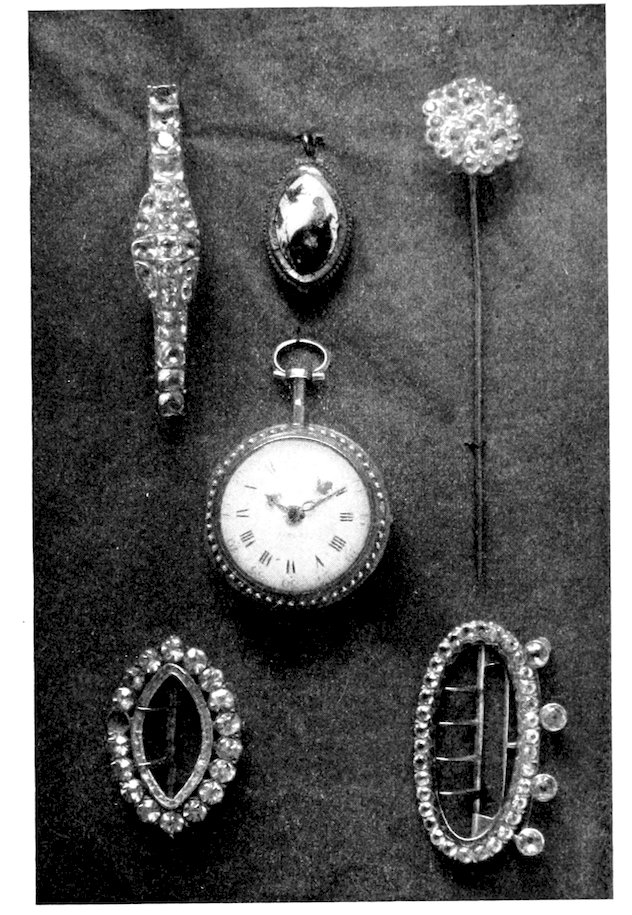
Pl. XIII.—Mary Ann Bacon’s Watch and Jewelry
If you have any natural taste for drawing I should wish you to indulge it. I think it an accomplishment very well adapted both to the taste and delicacy of your sex. It will agreeably exercise your ingenuity and invention it will teach you to discover a superior finish in all the varied landscapes and scenery of nature to survey the works 73of our distinguished Masters with an higher relish and a more poignant curiosity and it will heighten all the innocent pleasures of your retirement. when nature howls with wind, or is covered with snow you will be able to call a fancy spring upon the canvas of which the blossoms will be ever fragrant and the trees ever green. You may thus have birds always on the spray and larks apparently thrilling out praise to their bountiful creator.
Letters. Music by which I mean playing on an instrument or occasionally singing is a very desirable acquisition in any woman who has time and money enough to devote to the purpose for it requires no considerable portion of both. it will enable you to entertain your friends; to confer pleasure upon others, must increase your own happiness, and it will inspire tranquilite and harmonise your mind and spirits in many of those ruffled and lonely hours which in almost every situation will be your lot, the passions of mankind, however, have very much debased and profaned this art, which like others, was originally sacred and intended to chant the praises of the Almighty. many songs are couched in such indelicate language and, convey such a train of luscious ideas, as are only calculated to soil the purity of a youthful mind. i should therefore recommend, (if I may so express myself,) rather the sacred than the profane, of this study, indeed church music is in itself more delightful than any other, what can be superior to some passages of Judas Maccabaeus or the Messiah there is not, perhaps an higher among the melancholy pleasures than a funeral dirge.
Dancing, in a degree is proffesedly an essential part of a good education as correcting any awkwardness of gestures giving an easy and graceful motion to the body, and I practice early perhaps even in directing its grothe. Modern manners may however have carried the fondness for this accomplishment to an immoderate extreme. a passion for making the best figure in a minuet is vastly beneath the dignity of a woman’s understanding. and I am not sure whether excelling in this particular does not inspire too great a fondness for dissipated pleasures and portionably abate the ardour for more retired virtues. a woman who can sparkle and engage the admiration of every beholder at a birth night or a ball is not always content with the grave office of managing a family or the still and sober innocence of domestic scenes, besides dancing is not at certain moments without its temptations an elegant illuminated room brilliant company the enchanting power of music admiring eyes obsequious beaus attitude 74are apt to transport the mind a little beyond the rational medium of gentle agitation I would not however be a cynical moralist that would abridge you of any harmless amusement. I have only my apprehensions for your innocence for indeed it is a plant of a very delicate complection and you will then have attained the perfection of your character when you can mix a passion for these elegant accomplishments with a turn for solid and domestic virtue: when you can one night be distinguished at a ball and the next want no other entertainment than what the shade of your family a well chosen book or an agreeable walk are able to afford. I should wish you to be innocent and if possible accomplished at the same time but at any rate I would have you innocent because otherwise you cannot be happy
Public pleasures are esteemed and called the amusements of women, but I think them far from answering the name, in fact they agitate, rather than relieve and repose. superior rivals eclipse; fancied friends are inattentive, and the gaity of the scene has no connection with quiet of the heart, the time money, and preparation they require, are a serious consideration, and there frequency renders them a business indeed of preserving health, they, undermined and destroy it. Late, hours, hot rooms, and an agitated mind Are unfavorable to rest; and the god of sleep will not long be defrauded of his rights without retaliating the office. what we call pleasure, is but a splendid and a voluntary service. if it had not the name of amusement we should shrink from it, as an intolerable burden. who are so grate slaves as the votaries of fashion; what requires more systematical diligence, than the watching of every varying mode of dress, and; catching these living manners as they rise; of all women they who call themselves fashionable, are the most unhappy; ever idle busy: ever vainly agitated; there peace depends on a whisper, on a look or a thousand little emulations, too ridiculous to be mentioned; they Dread a private moment more than an assassin and with very great reason; they cannot look into eternity with hope; reason suggests that they were born for something higher, and there are moments, when conscience will be heard. how unheeded are the cries and prattle of there infants; how unhappy must be the man, who has received from such women vows which they will not perform of fidelity and of attachment. after all it is only in the practice of virtue it is only in domestic life that lies all the solid, because all the——untumultuous joy—
Will you bear with my impertinence if I attempt to give you my directions on a subject where your sex are allowed to posses, infinitely more tact and judgment than our own, that of dress I offer how ever my plain and undisguised sentiments only for your advantage; and I am sure you will receive them with that candour and indulgence to which my friendship for you has an indisputable claim—Neatness, you cannot cultivate with too much attention, I would pres it on every female as strongly if possible as lord Chester field did the graces on his son. the want of it is unpardonable in a Man but in a woman it is shocking. it disgusts all her friends and intimates; has enstrang the affections of many an husband, and made him seek that satisfaction abroad which he found not at home—Some ladys who where remarkable attentive to there persons before marriage neglect them afterwards in an egregious manner. they cannot pay a worse compliment to there own delicacy or to there husbands. if they conceived some efforts necessary to gain the prize, more I am sure, are required to preserve it.—it is the opinion of I believe. Rochefoucault that nice observer of life and manners. That the affection of woman increases after marriage while that of man is apt to decline. Whatever be the cause a prudent woman will at least use every method to guard against so mortifying a change. Neatness however is easily practised and will always have considerable weight. in the eyes of servants and domestics indeed a woman loses her consequence and authority by a neglect of her person, she will not be obeyed with cheerfulness and she will be come an object of ridicule in all their private parties and conversation. if inferiors must be subjects they will pay an unconstrained homage only to a person who attracts by propriety, the estimation of the World—Neatness is the natural garb of a well ordered mind and has a near alliance with purity of heart. Laws has said of his Miranda that she was always clean without because she was always pure within and Richardson whose taste was as exquisite as his imagination glowing, has painted his Clarissa as always dressed before she came down stairs for any company that might break in upon her during the whole day. finery is seldom graceful. the easy undress of a morning often pleases more than the most elaborate and costly ornaments. I need not say of how much time and money they rob us which are sacred to virtue and to the poor nor how soon this very embellished body will be dust and ashes the perfection of the one is conveyed in two words an elegant simplicity. ladies are certainly injudicious in employing so many male frisseurs about their person. the custom is indelicate it is 76contrary to cleanliness and all their manœuveres cannot equal the beauty of natural easy ringlets untortured and unadorned every paper one opens is a violation of your delicacy and an insult to your understanding powders perfumes artificial eyes teeth hair advertised for your advantage would be a heavy stigma if some kind and well disposed persons amongst our own sex were not willing to share with you a part of the burden Blush my dear girl at such unseemly practice. be content to be what god and nature intended you appear in your true colors abhor any thing like deceit in your appearance as well as in your character. What must all sensible men think of a woman who has a room filled with a thousand preparations and mixtures to deceive him what money what time must be given to this odious insufferable vanity—Under such unnatural managements how different must be the female of the morning and evening. what must we think of marriage dresing rooms and toiletes what an opening for expostulation coldness aversion if an elegant simplicity be the perfection of dress this is surely as far as possible removed from perfection it is not simplicity it is not elegant. It would be cruel to add anything to the punishment of the men who can have recoursed to such effeminate artifices. they have already the scorn and ridicule of the other they are poor amphibious animals that the best naturalists know not under what class to arrange. Painting is indecent offensive criminal it hastens the approach of wrinkles it destroys constitutions and defaces the image of our maker would you think of giving the last touch to the Pieces of a poussin or a salvator Rosa Believe for a moment that the Almighty is at least as great in his way as either of these artists—let the martyrs of fashion luxury and dissipation who turn night into day have recourse to this filthy and abominable practice. let them seek a recourse from the rebukes of their conscience in gaity and noise. But let the fairness of your complexion be only that of nature and let your rouge be the crimson blush of health arising from temperance regularity exercise and air such simplicity will recommend you to god and if you retain any fears of ofending him how dare you deface his image in your countenance by artificial decorations. such innocence will charm when paint is dissolved—It will call up a bloom and cast a fragrancy even on the latest winter of your age—
Green Fields. Friendship. The Revilee. The Traveller. Fair Philis. The beauties of friendship. Adams and Liberty.
Tallio. Winter. The absent lover. Friendship. The beauties of friendship. The praise of archery. The sheep in the Cloisters. Plato’s advice. The Bachelor’s Lamentation. The wandering lamb. General Wolf. The Sailor’s Consolation. The Hermit. The Blue Bells of Scotland. Hail Columbia. Within a mile of Edinburgh. The Sailor boy. Tally Ho. The Happy Soldier. Affettuoso. Tom of Aberdeen.
The faithful soldier.
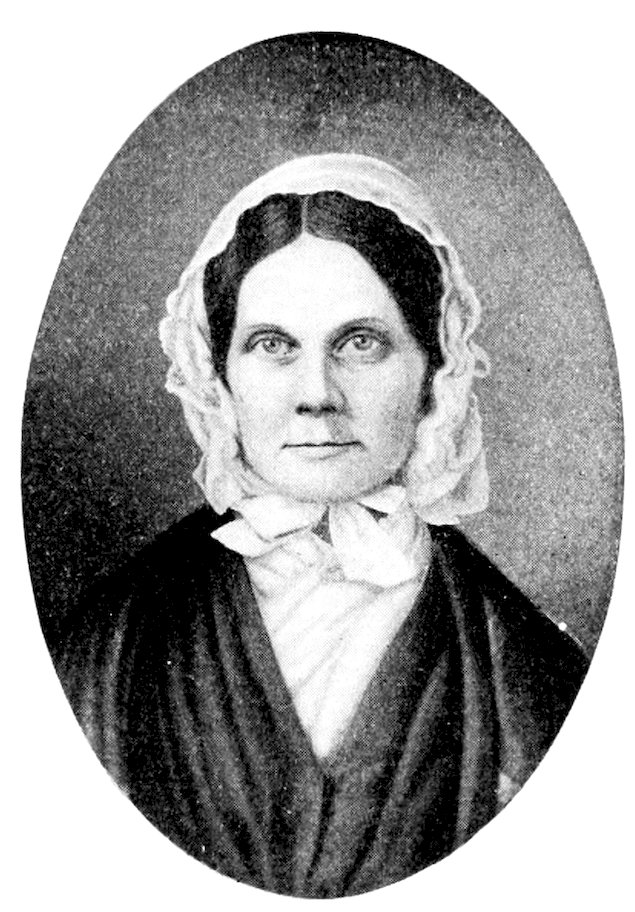
Pl. XIV.—Susan Masters, of New Milford, Conn. Pupil about 1805
About 1805 Susan Masters came to school from New Milford and a copy of her school bill is here given:
| Miss Susan Masters schooling 21 weeks | $7. |
| School expenses | .33 |
| Entrance | 1. |
| 8.33 | |
| Cre. by $5.25 Balance | 3.8. |
| Received Payment | |
| S. Pierce. |
By this date the few and simple studies taught in the school in its early stages had expanded so that we find proofs of higher branches and better methods of study. There is a globe now in the possession of Charles H. Woodruff, Esq., of New York, which was used in the school. It was made and sold in London. It was afterwards used in a boy’s school in Cornwall, Connecticut, which Mr. Woodruff attended.
The map of the world (Plate XLII) was drawn by Miss Lewis when at school, and there is also a map of the United States drawn by Eliza Ann Mulford, in possession of her son, both of which serve to prove careful instruction in geography.
Miss Pierce thought highly of the knowledge to be gained from the study of history, but could find no satisfactory textbook, so she wrote a history herself, which she published and sold to subscribers. The names and dates of publication are as follows.
Mrs. Harriet Beecher Stowe’s letter on the subject of the histories explains itself.
HISTORIES[37]
“The general History which Miss Sarah Pierce wrote for her pupils” Mrs. Asa Gray’s letter.
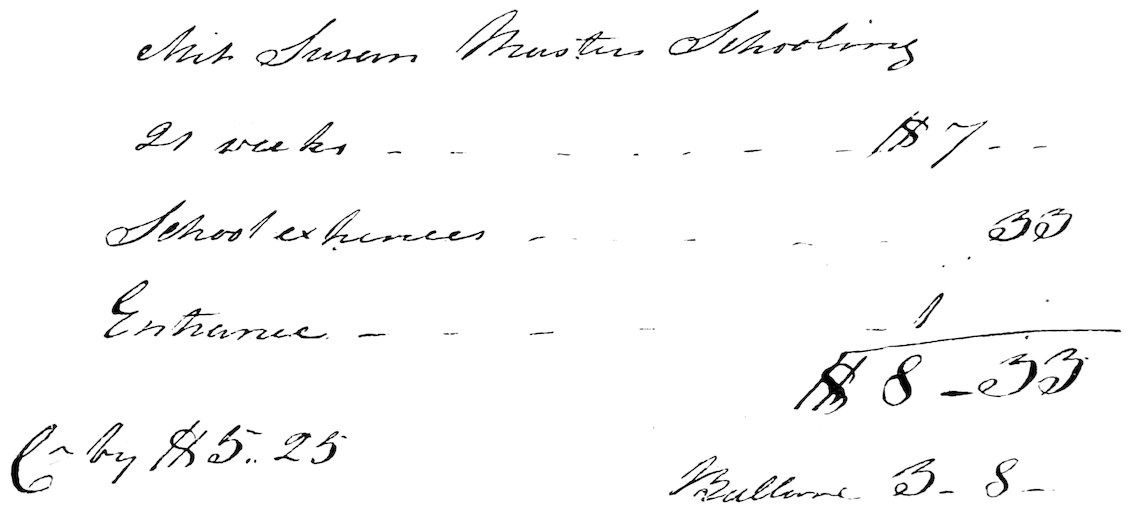
Pl. XV.—Facsimile of Bill, about 1805

Volume Second same title, date 1816, with list of subscribers.
Volume III same title. Printed by T. G. Woodward. 1817 New Haven No list
Volume IV. same title. Printed by T. G. Woodward 1818 New Haven No list
Preface from “Sketches of Universal History compiled from various authors, for the use of Schools, by Miss Sarah Pierce. Second edition printed by Starr & Niles, Middletown, (Conn.) 1823.” bound with Vol II which was “printed by S. S. Smith, Litchfield 1827.”
“Having from long experience found that children and youth imbibe ideas most easily, when placed in the form of question and answer, and not finding any historical work of that kind, of sufficient length to interest the mind, I have compiled these Sketches for the use of Schools, endeavoring to intermix moral with historical instruction, and to obviate those objections which arise in the minds of youth against the justice of God, when they read the wars of the Israelites.—I have attempted also to give them a general notion of the government of God, and of the truth of the Scripture, by a partial account of the fulfilment of prophecy. I am sensible that all this has been done by many able writers; but as their works are too expensive to be put into the hands of children, and of greater magnitude than they have time or patience to study, I have compiled this abridgment for their benefit. This history may also be useful in private families; which are not able to purchase the larger works from which it is selected.”
In undertaking the instruction of my children in History, I am often reminded of the source from whence I drew my early historic knowledge I do not find any where a compend as satisfactory to me as are my recollections of your History all compends are generally so dry & devoid of interest that children are disgusted by them & Rollin & others are too minute and voluminous—yours as I recollect was a happy medium between the two—I write to know whether I could procure two copies from you for the use of my family—They can be sent to Hartford to the care of T. C. Perkins Esq. with a note of the price which I will cheerfully forward
As I live longer & see my children growing up around me I am often reminded of my early obligations to you & take pleasure in having this opportunity to express my sense of what I have gained from your early care—May God bless you my dear friend & grant you in his good time a joyful reunion with those friends of past years whose memory is precious alike to us all
In addition to these histories the pupils were taught to make elaborate historical charts of which one of six feet in length is now in the Litchfield Historical Society. It was made by Miss Lewis, and is neatly and carefully drawn in ink and decorated with water-color. It begins with the creation and ends with George III. See Plate XX. Another historical chart was made by Eliza Ogden and is in the possession of her daughter. The subject is English History and embraces the Wars of the Roses, and here and there tiny pink and white roses are painted to indicate the relative positions of the houses of York and Lancaster (Plate XXIX).
Composition was made of great importance. The many copies of letters, poems, and addresses prove they were considered valuable steps toward good writing, and the high quality of the authors and quotations show that Miss Pierce laid much stress upon style in composition as well as exalted ideas.
The following list of prizes given about this time are interesting, as they bear upon this study, and are examples of the stilted elegance of style and the mournful subjects of that period:
Presented Miss Amelia Lewis for the first prize in her class. Litchfield April 28 1812.
Presented to Miss Jane S. Lewis as the Prize in Arithmetic. April 25th 1820.
Present to Miss Jane H. Lewis as the first prize at school. October 31st 1820.
That Miss Pierce was fairness itself in awarding the prizes to her scholars is shown by the following report. She evidently invited some of the prominent ladies of the community to give the prizes instead of trusting to her own judgment.
We, whose names are underwritten, having attended to the qualifications of the candidates for the prize of merit, in Miss Pierce’s School, are of opinion that Miss Clarissa Deming[38] is entitled thereto.
Litchfield, April 22d 1811.
The following are some of the plays Miss Pierce wrote for the amusement and edification of her pupils. They were usually given at the end of the school term, and the young men of the town were often invited to take part.
Why would you strip yourself of all convenience, to pay demands of those already rich. The remnant of thy fortune would not add one 88hour of luxury to their full board or deck their persons in one sumptuous dress. (Exit.)
Perhaps it will not. But does their wealth excuse, or form plea to evade the laws of justice? The sacred laws which ought to guide our actions, as every virtue rests upon its basis.
Pressed by a famine in my native land, thou knowest my husband sought thy fruitful country, but Heaven who liberally had crowned our stores, withdrew its smiles with’red our fortunes, blighted all our hopes. By sickness pressed; by woe on woe assailed; first my loved husband felt the stroke of death! My children next, sunk in the untimely tomb. the long, the painful hours thou hast watched o’er my sick couch, the many tears thou hast shed, and number o’er the many causes which destroyed our fortune:—and say,—has one unthinking or unjust expense brought on our poverty?
[illegible]
I know there has not. Then why deprive thy self of every comfort to pay demands, which stern necessity and sickness caused?
The very reasons which you name would urge it. Did they not trust my honor? a stranger’s honor? and should I fail in justice, then every wretch suffering like me, might justly blame Naomi, who taught to foreigners that Israel’s faith, was slight regarded among heathen friends.
No. It shall ne’er be said Naomi lives, in ease and plenty on the wealth of others. I’ll rather spend my latest farthing,—beg my passage to Israel’s faithful land—then to my brethren become a servant, and earn an honest pittance with these hands; than any tongue should say “Naomi wrong’d me.”
I pray thee take these ornaments useless to me, they will serve to [illegible] thy comforts.
No. I’ll not take thy bridal gifts away. I part with mine, for that our law demands; but keep thou thine for future times of sadness, or perhaps to deck a happier bridal day.
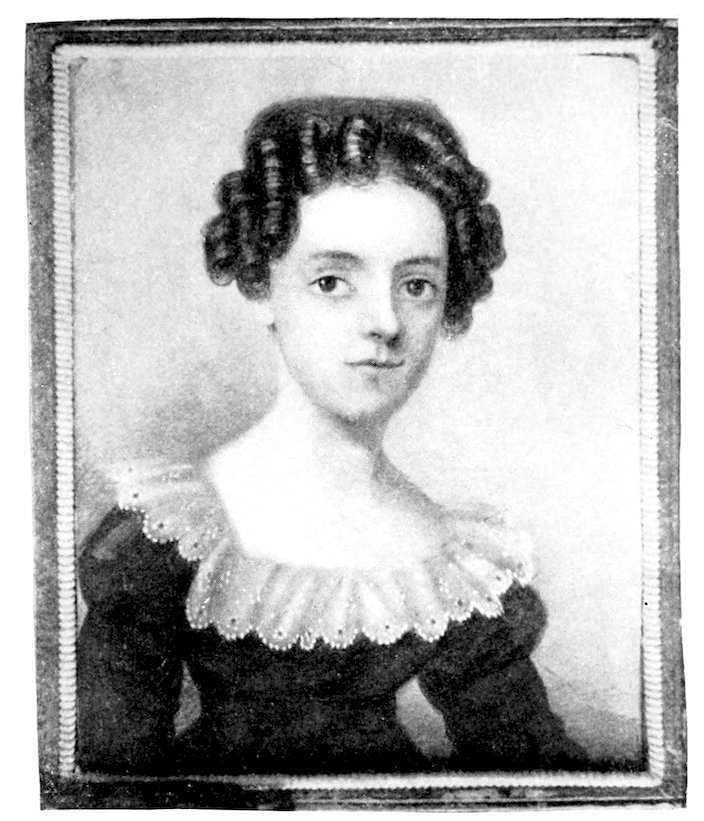
Pl. XVI.—Lucretia Deming, Pupil, 1816
From a miniature painted by Dickinson
No. I entreat thee take them. Did I not help to spend upon thy fortunes? has not my sustenance procured by thee in rich abundance; lowered thy little stock? Or dost thou think so meanly of my love, that these prized jewels, given by my dearest Mahlon, can e’er be worn to deck a rival’s bride?—Take them I entreat thee! dearest mother!
I will not; cannot take them.
Then I will sell them to help thee on thy journey. I know my Mahlon would not blame the deed.
O! here are mine! Pray let them go together. The blush of shame would rise upon my cheek, to see these jewels shine in my attire, when yours are gone; and our loved parent lives by her own labor.
My daughters, ye oppress me with your kindness. If need require I will accept your offers; meantime let us prepare to make the journey.
No. Go my daughters each to thy mother’s house. May God reward thee. May all the kindness ye have shewn my dear lost sons and me, be doubled to ye. May every anxious hour, which ye have spent, the tears ye have shed when we have counted o’er the months by woes, and chid the tardy sun, whose sluggard pace detained us prisoners in a wretched world; be reckoned o’er in new found blessings on your virtuous lives.
No. We will go with thee and share thy sorrows.
And relieve thy cares.
Why will ye go? I’ve no more sons to give ye. In Judah’s land no honors wait Naomi; but cruel taunts from those who erst have looked, with pining envy at my happy state.
No kindly brother, no sister’s friendship will help to soothe thy lonely exiled hours. Here wealth, here honor yet may crown your days. Cherished by parents bless’d by prosperous fortune, whose kindly cares, will shield your youthful years from pinching want. Think you these hands, which now are all thats left me, can guard your tender limbs unused to labor, from hard oppression and the unfeeling scoffs, which full fed wealth pours on the unfortunate? No. Go my daughters, nor add to all my sorrows the severer pang of seeing you suffer with me.
My friend! my more than mother! must we then! ah! must we part?
Be witness Heaven I would not leave thee thus, could I contribute aught to soften thy sad fate. But I’ll not add another pang to those thou hast felt already. Adieu. Adieu. (Exit.)
See, thy sister has left me. Why not follow her?
O force me not to leave thee. My parent’s happiness is full without me. Propitious fortune with a lavish hand, scatters her stores of wealth and greatness on them. The joyous sun to them shines ever bright. The feast, the dance, the charms of sweetest music, beguile each care and open every sense to laughing pleasure, and her dangerous wiles. Meantime their gallant sons, and beautious daughters in the gay festive train compleat their joys. I love my parents with a daughters fondness; and gratitude recalls my helpless years, watched by their tenderness; their fostering care, rear’d my young frame; adorn’d my riper years with useful knowledge; guarded my steps from each contagious folly. But ’twas thou my second parent, who taught my mind the exalted charms of virtue;—freed my young soul from vain delusive worship of idol Gods; feared in my native land, and bade my hopes aspire, to serve that Being who fills creation with his boundless presence. And may his vengeance strike my guilty head, when I forsake thee: Poor—friendless—stricken through with grief and years. No. I will follow thee where’er thou goest; my hands shall learn to 91toil for thee my mother. Industry is the surest balm for grief. Thy God is mine. Thy people I will love. One house shall hold us and one grave contain.
O thou who viewest the smallest atom of thy vast creation; notest the most trivial act of little man! If I have e’er deserved a boon of thee, O! give it me in blessings on this child. Oh! may her virtues meet their full reward, and I can ask no more.
How blithsome seems yon troop of beautious maidens! What healthful pleasure lights each face with smiles! See: they advance.
Pray who are those clad in a garb of sorrow? Could I believe my senses! ’tis Naomi, so justly famed for wisdom, truth and goodness, Elimelek’s wife.
Can—can this be Naomi? Yes it must be her. But say? what sad reverse of fortune brought thee here? alone, and bearing marks of wretchedness? If thou art indeed Naomi, pray inform me.
Yes ’tis she who once was justly called Naomi. The apparent favorite of indulgent Heaven; but now—a hapless widow, doomed to mourn, the untimely fate of all her dearest friends. Then let Naomi perish with her fortunes, and henceforth call this wretched being Masa; for Heaven has dealt the cup of sorrow to me, and I have drank its deep, its bitter dregs.
We sympathize, Naomi, in thy sufferings. But remember, the Almighty gave, and he may take away, and ’tis our duty to submit in silence, to adore his justice, and to praise his name, in deep affliction, as in days of bliss. But, come my friends; thou art weary of thy journey; come, rest thyself beneath our welcome roof, and thou shalt find a friend who yet can love thee.
How sweet is kindness to a bleeding heart, torn by sharp sorrow; and unfeeling insult. Already have I met, even here, in Bethlem, with taunts from those I once esteemed most highly; but thou I find art still the same dear friend, and shrinkst not back at fortune’s withering touch.
Accursed be those who fail in time of need; and they are accursed by their own stubborn hearts; too hard to feel the force of generous friendship; of wiping tears from eyes o’ercharged with grief and lighting smiles upon the grief worn cheek. Come; I will lead thee to my dearest parents, whose joys, like mine will brighten at thy presence.
With gratitude I follow thy request, and see my daughter—the generous wife of my lamented Mahlon—has left her friends, her country and her Gods, to cheer her mother, and to share her fate. Let her, I pray thee, with me partake thy bounty.
Most willingly. I honor virtue, and am proud to meet her in a kindred form. Come, come with me, and once more taste repose.
This is the place! O well known scenes! dear monitors of bliss forever fled! That field, rich with luxuriant harvest;—that beautious dwelling, now like myself in ruins; where curling vines in purple clusters twine, around its fallen columns, was once my own; my father’s once—A stranger now inherits it.
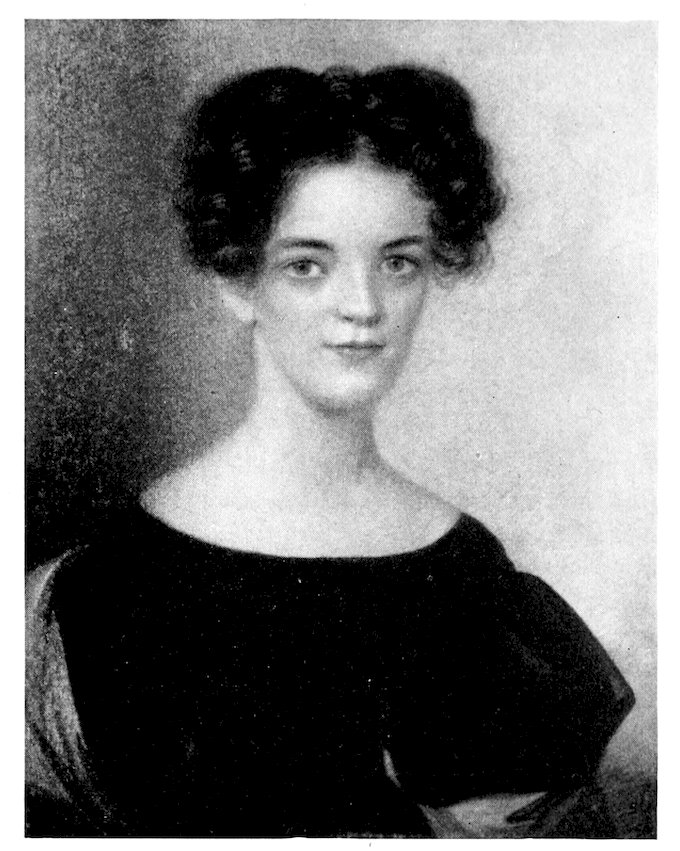
Pl. XVII.—Elizabeth Huntington Wolcott, Pupil, 1820
O, that I could recal past months! the days when God preserved me! when by his light I shunned the paths of evil!—O days! forever—ever flown; when Heaven’s best bounties courted my acceptance! Blest in my husband, blest with dutious children, my path with oil and honey overflowed! Thy daughters, Judah, bowed before my steps, and silent hung upon my flowing words; the aged rose whene’er I passed the gate; and blushing youth retired as I advanced. The poor, the stranger, bless’d my liberal hand; for wretchedness to me ne’er plead in vain. But now—as widow—desolate and poor, the rich forget me, and the poor deride. Even those who erst through 93fear, shrunk blushing from my view, with cruel insults and unfeeling taunts, add to my misery by sharp rebuke; and say “that’s she who once so rich and great; whom princes honored, and whom age revered; who, when distress assailed her native land, wandered to foreign climes, and other Gods; now desolate returned; struck by the Almighty, doubtless for her sins; bereft of all;—her sons and husband perish within a land of strangers. Thus fade the wicked, though their house be strong, when God, in anger brings their crimes to light.”
O could the boundless height of my affection, suffice to soothe the bitter pangs thou feelst!
What is the world? a vain, delusive bubble, and what are friends, who follow prosperous fortunes, but shrink before the stroke of poverty? poor heartless beings; unworthy of a sigh. Rather let those few worthies claim our thoughts, who sympathize with thee in all thy sufferings.
Thy virtue soars above the touch of woe. Thy friendship, sweeter than the dews of Hermon, and dear as incense from our holy altar, shall be my solace. Yes;—I’ll dry my tears, for they distress thee:—esteem our lowly roof more honorable than courtly domes—our coarse and scanty fare, more delicate than fruits of Lebanon—our homely garb—more precious than robes of princes,—and when our little stores are gone, the hand, which feeds the ravens, will send more.
O! praised by Heaven! who inspires thy soul with comfort! The frowns of poverty are light as air, when cheerfulness resides within the bosom. Industry unlocks a mine of wealth, to all who ope their hands to seize her favors.
I marked the fields. The reapers now, with busy hands are gathering their full harvests. I’ll go and glean, and for thy sake am confident of good.
Nay rather let us go. How will thy delicate hands, unused to labor, sustain the sultry heat of harvest. My older frame is now of little value; the soul which it imprisons, longs for flight:—and perhaps remorse may touch my kindred’s hearts, when they behold me, with those poor hands, picking the scanty ears from fields that should be mine.
If ever I deserved a boon from thee! If leaving friends and country for thy sake, have gained a place for me within thy bosom! grant my request I pray thee!
If thou hast gained a place within my bosom. Be witness ministering spirits of mercy, how dear a place you hold in my affections! Name thy request, and thou shalt see it granted, even with the blood that mantles at my heart.
Then stay at home I pray thee. Spare thy grief worn frame from future toil. Art not thou all my stock of happiness? my only comfort in this distant land? Then guard the treasure with a jealous eye, lest I in losing thee should lose my all. What shame! what just derision would Judah’s daughters cast on Ruth, who sent her mother to the field to glean and staid ignobly idle here at home.
Then go my child, and Heaven prosper thee.
But say; what first informed thy reason? oped thy eyes, to own the same laws which guide our nation?
My mind was roused at hearing the miracles wrought for your ancestors. Oft while the wondrous theme flowed from Naomi’s tongue, I thought an angel spoke. When righteous Abraham offered up his son; when Godlike Joseph saved his cruel brethren; when Moses, snatched from the devouring flood, rescued the chosen race from haughty Pharaoh:—my heart approved, and wished to share their virtues; But when my astonished mind reviewed the miracles; the glory, power, and wisdom of Jehovah:—I saw our Gods were impotent to save—the works of men and spirits of darkness—I scorned their worship, and from that moment prized Naomi far above the reverend forms to whom I owe my being.
The sun has hardly past his midday path, retire not therefore damsels. I have come to enjoy with you the innocent mirth, which healthful labor only knows. Let not my presence check your decent joy, but let the song the tale, again go round.
We were listening to a tale of virtuous woe; the history of this worthy Moabite.
I have heard her story, and admire her virtue. (to Ruth) May God a recompense on thee bestow, for all thou hast left, and make this country dearer than thine own.
Accept my thanks. Tho’ words are poor to express my gratitude, for all this kindness shown a stranger.
Thy merits claim it all. But say. Does no heart rending sigh affect thy bosom, for those dear friends thou hast left and left forever?
My heart oft wanders to my friends and parents, and could my wishes bring them to thy country, or bend their faith to thy most holy laws, my happiness would be too great for mortals. But now I cannot wish myself in Moab, lest softening luxury and their persuasion, should wean my heart from all those sacred duties I owe my God, and my best friend, Naomi.
(Aside.) Angelic woman! she far exceeds my son’s description of her. (to the maids) Take lessons from her, O ye maids of Judah! who so oft forget your duty to the Lord! his daily gifts remind you of his goodness.—I thought I heard a soft, melodious voice, warbling sweet music as I passed this way. It would much delight me would you sing again.
It was Ruth who sang to please your noble son, when tired with labor, he reposed awhile, and entertained himself with our discourse.
I thought to have found him here when I came in. Say will you sing again to please a friend, warm in affection, though of sudden growth?
Alas! my voice so long attun’d to woe, but ill accords with harmony. But my poor talents are ever at command, when worth invites, or friendship sues.
A thousand thanks my charming friend. I will no longer keep thee from thy labor.
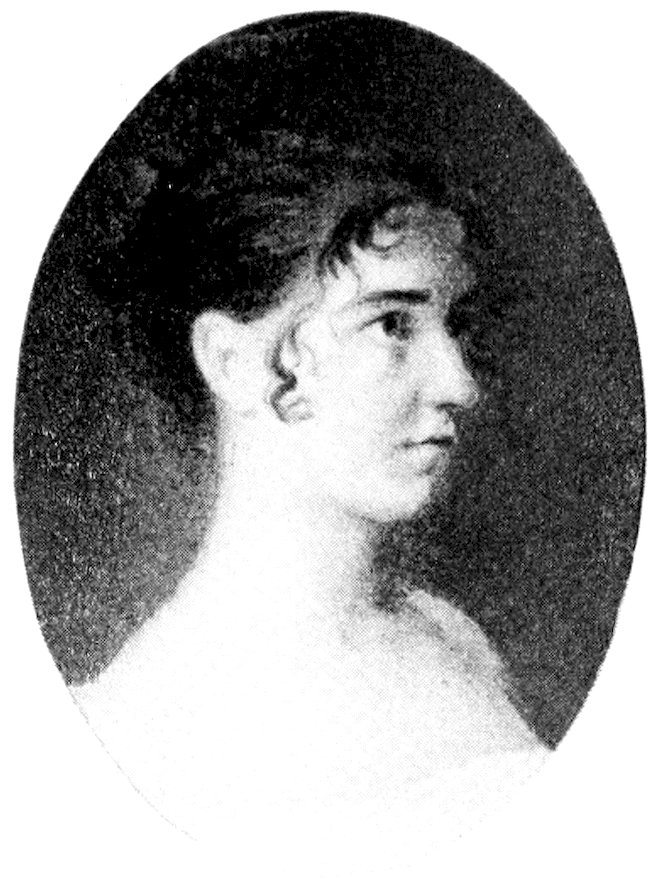
Pl. XVIII.—Maria Tallmadge
Daughter of Colonel Tallmadge, and wife of John P. Cushman, of Troy, Pupil, 1802
The sun has almost reached his western gate. My child will soon return. How slow the hours move by when she is gone. I feel my heart begins again to know, a mother’s fondness, and a mother’s fears. Ah! let me check this growing love, lest it should ope new springs to wound my peace.—But cease my vain repining. What! Shall we from Heaven’s grace receive the cup of bliss, and yet our share of ill refuse? and are afflictions aught but mercies in disguise? the alternate cup; medicinal, tho’ bitter? and by love’s own hand, for salutary ends administered?
But were these ills indeed;—can fond complaint arrest the wings of time? Can grief command that setting sun, to roll his flaming orb back to yon eastern coast, and bring again the hours of yesterday? or from the dark, cold grave, the buried corse restore to light and life?
Blessed spirits farewell! Yet, yet a few short days of erring grief; of human fondness sighing in the breast, and sorrow is no more.—The evening hour comes on. How mild! how grand! On yonder hill I can enjoy its beauties, and meditate more fully Heaven’s beneficence. (exit.)
Naomi is not here! Where shall I find her? (sits down her basket and enter two women)
Boaz commanded that we bring you this.
And begs you would always glean within his fields, and ample harvests shall repay your toils.
Reward him, God of strangers, for his goodness!—Tell him Ruth thanks him for this kindness shown her, and prays Naomi’s God may bless him too.
Why is my heart so pleased with this days labor? His flattery oped an avenue to love. Oh! Mahlon! Am I growing cold to thee? To the dear day that weeps thy sacred dust, I vowed a lasting fond remembrance (sings) I have a silent sorrow here &c. O Boaz! Boaz! 98why so like my Mahlon? If ’tis a crime to love thee! O! thou sole arbiter of fate! Thou God supreme, all just, all wise, who bidst what still is best in cloud or sunshine; whose severest hand woundst but to heal, and chastens to amend! Correct my heart, if any wrong desires, unjust sensations cause this tumult here!
Welcome my daughter! Thou hast soon returned, and amply loaded. Heaven has sped thy efforts, and moved some generous heart to assist thy labors. Say: to whose liberal hand my thanks are due?
Boaz he is called, whose goodness crowned my labors, whose humane heart pitied a stranger’s fortune.
O God of Abraham! shower thy blessings on him, and double all this kindness on his head. I know him well. He is near of kin to us, once with my sons was linked in sacred friendship.
I thought I viewed my Mahlon’s likeness in him. The same his manly port and dignity, tempered with smiles of sweet benevolence. He bid me seek no other field but his, and promised liberal harvests to my toils. I thanked him for this kindness shewn a stranger, he praised me for the love I bear thee, and said ’twas for thy sake he noted me.
Follow his counsels as thou wouldst a brother’s. Remain fast by his maidens, nor let them meet thee in another’s field. So shall his friendship make our lives as happy as any earthly fortune now can make them.
All hail, Naomi! Welcome to thy country, and still more welcome; for bringing this sweet damsel. My son, struck by her charms, and still more by her virtues, solicits your consent and hers, to make him happy. (to Ruth) Say, will thy heart, where sweet compassion reigns, where noble friendship sheds its purest light; consent once more to wed a son of Judah, and add new honors to our chosen race?
Ah say, my daughter! Wilt thou make him happy? this generous man, this most deserving kinsman. I prayed that Heaven would shower its favors on him, and could it bless him more than by giving thee?
I once believed no second vows would win me or charm my heart, from the lost lord [- -illegible- -] my fond affections; but my lord [- -illegible- -] seemed returned once more, when [- -illegible - -] my eyes gazed on the noble Boaz. his liberal hand bespoke a generous heart, and I with pride and pleasure shall accept, a second husband from God’s chosen people.
Thy sweet compliance wins my best affections, and I will haste to make my son most happy.
My dear Constance, young as you are, I hope and believe I may depend on your prudence. I am a happy mother, in being able thus early to place a confidence in my child!
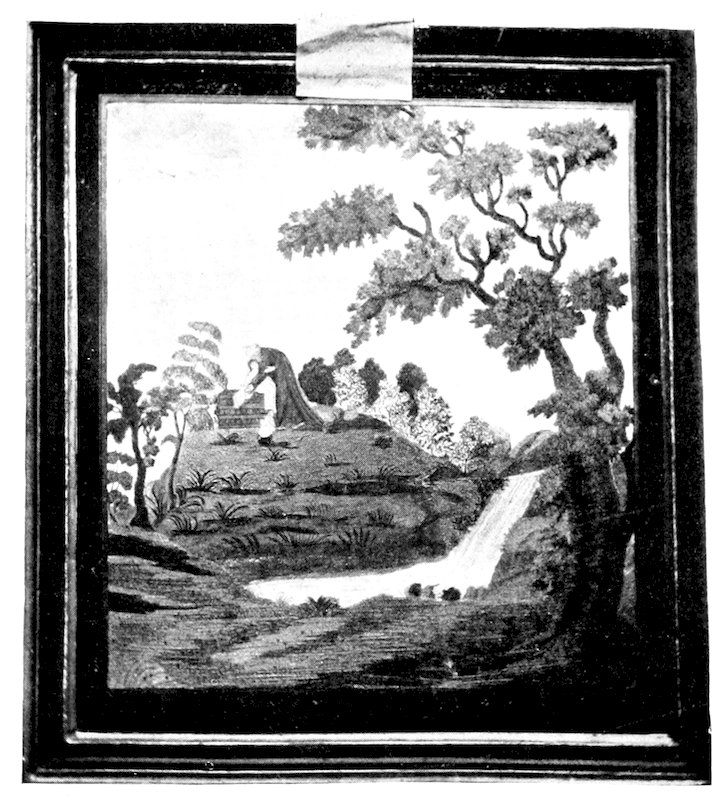
Pl. XIX.—“The Sacrifice of Isaac”
Partly embroidered in chenille, and partly painted in water-colors,
by Zerviah Miner, Pupil, 1823
Oh, Mama, never, never will I abuse it; my heart promises, and you may depend upon that heart, which owes not only the power of keeping a secret but everything it owns of goodness to you!
My dear child!
But Mama, I hope I am not inquisitive, but you seemed to say you would tell me—
What disturbed me; I will, my dear, indeed I will read to you your Aunt’s letter.
My system of education I find at last to be erroneous. Alicia has deceived my expectations; she has been imprudent and disingenuous; I should be very miserable if I thought her faults proceeded from the heart, as it is I am truly unhappy. I gave her a yearly allowance for clothes and pocket money, upon a solemn promise that she would never purchase anything without immediate payment. For the first quarter, she bought many expensive trifles and was in want of many necessary articles. I remarked on this folly, and hoped she had corrected it. I was myself guilty for not inspecting her accounts. For some time past, I have observed her to be greatly dejected, and discovered that she had run greatly in debt; this has been partly owing to her intimacy with some extravagant girls, who ridiculed her scruples. I wished to break this connection, and wish you, my dear sister, to take charge of her for six months. I know your affectionate heart will not refuse me this favour.
My dear mama, I hope you intend to receive my cousin; poor Alicia, how I pity her. Don’t you think Mama, she will be happy here in the summer?
No my dear, although she is but thirteen, she has been introduced, by a mistaken indulgence, into company; she has acquired a relish for dissipation; and lost the desire, which young people naturally have, for the charms and liberty of the country. But your cousin will be here tomorrow; we must endeavor to make the country pleasant to her.
Pray, Miss, I understand you are going into the country to your Aunt Leyster’s; how long may you be going to stay?
Longer than I like, I assure you, Betty. My mama is determined I shall stay six months.
Six months, why you will be moped to death. I wonder my mistress thinks of taking you to such a place.
I shall have a melancholy time indeed, for their is no saying any thing to Mamma. I never saw her so obstinate in my life.
To be sure, madam Leyster is a good sort of a woman. But la, Miss you will be tired to death. Why, they say, she does nothing from morning till night, but read the bible and say her prayers.
And do you think that is true, Betty?
To be sure I do. Why, they say, Miss, that Madam Leyster has never been in London, since the death of the Colonel, but once, and that was at your christening. So you may be sure that she is an oddity.
Then she has no card parties.
Card parties, la, bless you Miss, I dare say their’s not a house within six or seven miles of her.
Well, I shall have a charming time of it, but their’s no persuading Mama. I don’t know what’s come to her; so you may pack up my 103things, let’s see. I shall take my pink lutestring, and my blue satin slip; then there is my spotted book muslin, and my fine jaconet with sprigs; as for the striped muslin, you will not forget that.
La, Miss, what will you do with so many clothes?
I desire you to put up all that I mention, and don’t forget my hat with the white feathers. The only entertainment I shall have will be the pleasure of dressing and undressing myself.
Very true, Miss—
I felt quite bad enough when I was at school, and I am sure I shall feel ten times worse, now I am agoing to my aunt’s. Oh, Betty, don’t forget to run to the library and ask for those twenty volumes of new novels that I have bespoke, and tell the librarian to put in a dozen plays beside.
Yes, Miss.
How should you like to employ yourself, cousin?
It is indifferent to me.
Are you too much tired with your journey, to take a stroll in the garden? We shall have yet a light half hour.
Yes, it is early to have done tea.
In London, I suppose you are later?
Oh dear, yes; we have never done tea there till between eight and nine.
Then what hour do you sup?
That depends on where we are. My mother is early, we sup before twelve. The Seymours never till near one; and if one is at a ball, three or four is the usual hour.
Why, then you must lose half your day in bed.
Oh, we rise as early as other people. It is of no use to be up before one’s friends are stirring.
Miss Alicia, I am about returning to London. Have you any message to send to your mama?
Have you any letter written?
I will write soon.
You may have some particular message to say to Mrs. Woodford. I will leave you.
Oh, Mrs. Woodford, you will soon see London and my dear mother, and I am left in this horrid place.
Don’t weep my dear, your aunt is a charming woman and you will soon be very happy in the country. Good morning; I shall tell your mother that I left you well.
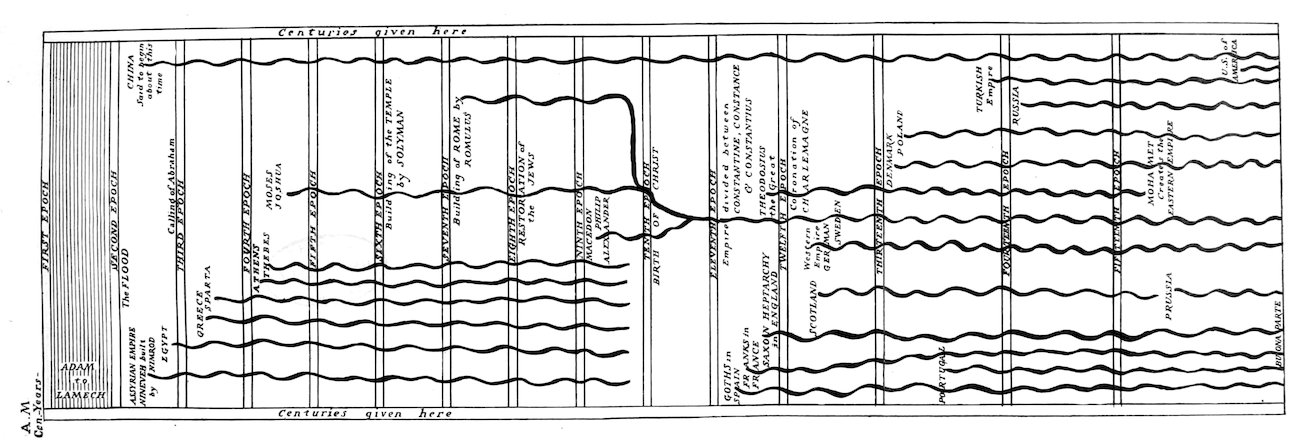
Pl. XX.— A Chart of the History of the World, by Mary Ann Lewis
The original is 6 feet long and 1 foot 9 inches wide. The centuries and years are given down the sides, and the names of the emperors, kings, queens, etc. are inserted in
their proper places along the curved lines
Happy in the country! That is impossible.
Dear cousin—
Have I not even the privilege of being alone? I am not used Miss Leyster, to be thus intruded upon! Ah, I am indeed very little used to anything I can expect to meet with here!
My dearest cousin, I beg you to pardon me, if I am an intruder. I came to see if I could do anything to comfort you; but if you wish me gone, I will leave you, but why should you wish it? Suffer me to be your friend; suffer me if possible, to make you happy!
You are very good; better than I either expected or deserved. You know I have much to lament; leave me, pray, my dear, I will soon come down.
Tell Edward and Harriet, their little friends have come. I am sorry, Mrs. Leyster, you did not bring Helen; she is nearer my daughter’s age, than Constance.
Mama, Ned says he won’t come!
Very pretty indeed! Pray what is he doing?
He is making a cart, and when it is done, we are going to draw it about the court, full of stones.
We! What, have you been helping him?
Yes, I have, and you cannot think how droll it will be.
However that is, you will please to sit down now. Don’t you see Miss Leyster, and here is Miss Wyndham her cousin from London.
Do, Mr. Sydney, speak to her! Do you see she does not mind me?
How now, Miss! What’s here to do? Why don’t you do as your mother bids you? I shall take you in hand presently, if you don’t behave better. Don’t speak to her, Miss Wyndham; she is not worth your notice.
How d’ ye do, Miss?
What’s the matter Ned? What do you cry for?
O! my mouse! My mouse!
Well, what’s the matter with your mouse?
Oh, Papa, Jack Williams has snatched it away!
Jack Williams snatched your mouse away? I’ll Jack Williams him, a young rascal! Where is he?
Run down the lane, Papa!
Come my dear, don’t cry, and I’ll soon fetch it back again. If Mrs. Leyster will excuse me for a few moments.
And I’ll go too, Papa, and give him a good threshing; when you are there, he won’t dare to strike again.
Harkye Ned; bring none of your nasty mice here. I hate the very sight of them. Don’t you want to go, Miss Harriet? I suppose you would help your brother beat Jack Williams.
Harriet, will you take Miss Leyster and Miss Wyndham into your playroom, but I suppose you have done with toys, now, young ladies.
Constantia is always happy to do whatever her young companions like.
Ay, ma’am, you seem very happy in your children; I am sure I can never keep mine in order, though I believe I take as much pains and scold them as often as anybody.
How cross Mama is! She always scolds so when anybody’s here. Don’t you think she is very ill natured?
Pardon me for contradicting you; I do not think so, indeed.
What, not ill natured to hinder me from doing the cart when it would have been so nice and so pretty?
Probably she thought you would overheat yourself; beside, she wished me to have the pleasure of talking with you.
Oh, but she knows I hate to sit stuck up with the company. I don’t so much care, now you and I are together; but you looked so grave when I came in, I thought I should not like you. I am sure if I had been you, I should have laughed!
At what should I have laughed?
Oh, to hear Mama scold so, and to see me look so like a fool.
Indeed, I was very sorry; it is such a sad thing to incur the displeasure of ones mother.
Oh, not at all; I don’t care, she won’t say any more to me; and if I had cried then, I knew she would let me go; but I was ashamed because you and your Mamma were there, besides, I was a little afraid of Papa. Does your papa humour your brother more than he does you?
I hardly know what you mean; Papa humours neither of us.
Why, he looks very good natured.
He is indeed, much too good natured to humour his children; he is uniformly kind and indulgent when we behave well, and constantly strict and resolute when we deserve his displeasure.
Well, that seems very odd! As to Ned, Papa never contradicts him nor Mama neither; but he does me and is as angry as can be sometimes.
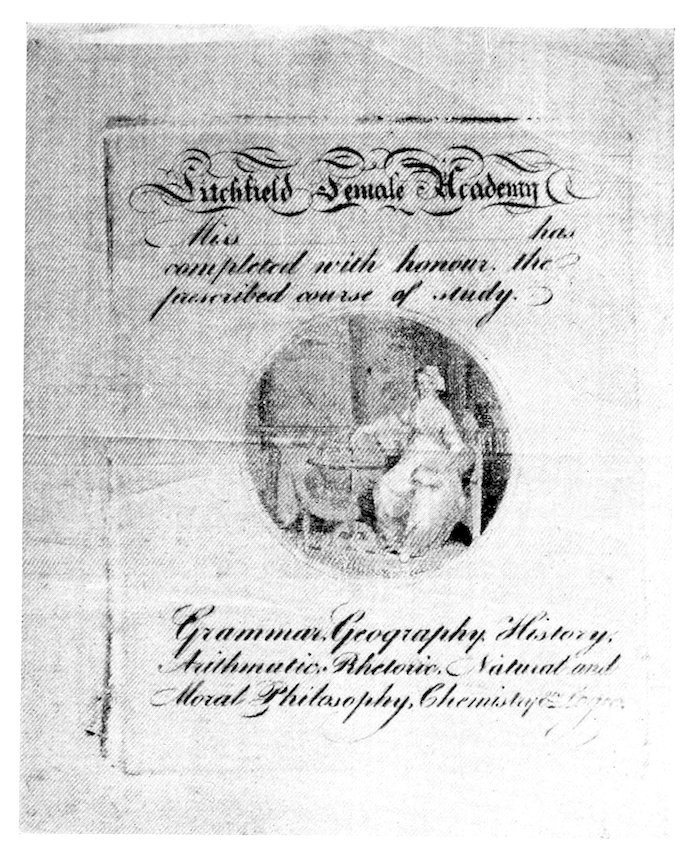
Pl. XXI.—First Known Diploma on Twilled Silk
Probably engraved by Tisdale
What a pretty bird! It is a goldfinch, I see.
Yes, and a fine songster, I assure you.
Did you take him from the nest?
No, he was about a year old when I had him. Ned caught him in a trap in the winter.
Poor thing was he not very uneasy when he was first confined?
Oh, I don’t know; he used to flutter about sometimes, but we did not mind that.
He is very tame now; he does not seem at all disturbed when I stand by the cage.
That is because he does not see you.
Not see me! How is that?
Because he is blind.
Blind! Ah, poor little creature. By what accident did that happen?
No accident at all; Ned did it on purpose.
On purpose; oh, how could he be so cruel?
He did it to make him sing the better, with a red hot knitting needle.
Oh, how shocking. Were you not grieved?
Not I; I liked it, because it is my bird. If I had not liked it, it should not have been done, I promise you.
Is it possible you should have given your consent? Oh, if you knew how melancholy it is to be blind!
La! Why a bird does not mind, you know.
Not mind! Do you think, then, they do not feel? Do you think they have no pleasure in seeing the light? Why then, do they sing when it first dawns?
Oh, that is because it is natural to them.
Yes, to rejoice in the daylight! Ah, poor little wretch! Would I could restore you to sight!
But you cannot think how much better he sings!
I should not wish to hear him; I should think every note a melancholy expression of his sorrow, or a reproach to me for having caused it.
What odd notions you have! Where did you pick them up?
If you mean the notion of hurting no creature whatever, I gained it, as I did all I know, from my father and mother.
Well, I declare I am sorry; but nobody ever told me it was cruel, so how should I know?
Harriet, Harriet, come here. I have something droll to show you. The cat is playing with a mouse.
(Mrs. Leyster, Alicia, Constantia and Helen. Constantia seated at a table, drawing.)
Cousin, do you draw?
A little, but I am very fond of it.
So am I, though I have not practised lately; if you will give me a pencil I will try.
Oh, willingly.
Come, Constance, tell us what you did at Mr. Sydney’s last night.
Nothing agreeable, I can assure you. I went with Miss Sydney into her playroom, but her books were torn to pieces, and then we came back into the drawing-room to see the cat play with a mouse.
The cat play with a mouse; but did she not hurt it? Mama always says “poor thing” when old Tom catches one.
Oh yes, she hurt it enough, I believe, but they did not mind that, as Miss Sydney said, when I asked her if her goldfinch was not unhappy, when they first confined him.
Not mind hurting anything! I fancy this Miss Sydney is not very good!
No, truly, for if you had been there, when she first came into the room!
Why, what did she do?
Her hat was half torn off, her hair was tangled, and her face was dirty; and she came in bawling, just like this, (mimicking) “Mama, Ned says he won’t come.”
Ah! that is just like her, with her arms swinging and her mouth open.
But did she not speak to you.
No, nor to Mamma, neither; and then she almost cried because she wanted to help her brother to make a cart!
To make a cart! Was that a proper employment for a young lady?
No, indeed! and when she was told to speak to me, she came with her head poking down, and her finger in her mouth, muttering so, “How d’ ye do, Miss?”
Oh dear, how strange!
Ah, that is exactly her; but now, Constantia, tell us how she looked when her mamma asked her, if she would not like to help her brother beat Jack Williams.
Oh, she pouted out her lips so; then she crammed her fingers into her mouth; and then leered round to see if I was looking at her! But, Alicia you remained in the parlour, how did Mr. Ned get his mouse again?
Oh, you never saw such a cowardly fellow; when he overtook the boy and found the mouse’s leg was broke, he beat and scratched the boy without mercy and the boy durst not return the blows because Mr. Sydney was by. At last Mr. Sydney said, “Come away, Ned, 113let him alone now; but if he affronts you again, I will horsewhip him handsomely.” “Do it now, Papa,” said Ned, “Do it now!” and Mr. Sydney never told him he was wrong.
In telling us that, Alicia, have you not told us the very reason of Master Sydney’s behavior?
What, that his father did not teach him better? Yes, I believe so!
Tell me, then is he most an object of ridicule or pity?
Of pity, to be sure!
And Constantia, do you not think the same cause may have produced the same effect in Miss Sydney?
Yes, Mamma, for she said nobody had ever told her it was wrong to torment her bird.
Then why have you ridiculed her?
I—I—did not mean any harm, Mama!
Did you not mean to make her appear an absurd, ridiculous character? Did you not mean to make your cousin and sister laugh at her?
Yes, Mama.
Could you have done her a greater unkindness? In making people ridiculous, we injure them extremely. If your cousin and sisters were to hear of Miss Sydney ten years hence, they would connect with her name the awkward, disagreeable idea you have given them of her character. They might unguardedly express the opinion they 114had formed of her to others, and thus punish her for faults she had long since corrected. Do you perceive to what an extent this might injure her?
I have indeed been very wrong. I beg of you to forgive me.
I allow that Miss Sydney’s conduct was very blameable and therefore to me, in whom you have a perfect confidence, I admit you to remark upon it, but not with ill-nature or severity. I expected from the goodness of your heart, pity and generous allowance for the faults of Miss Sydney, who wants the advantages you are more happily possessed of. Do you believe that without better instruction and example, you would have conducted better than Miss Sydney?
Oh, no indeed, I must be both ungrateful and presumptuous if I could believe it.
Personal ridicule, in general arises from envy or ill-nature, a mean desire of lowering those virtues we cannot reach, or a mean vanity of exposing those follies from which we feel ourselves free. Who is there in whom nothing ridiculous can be found?
I see, Mamma, I have committed a great fault. Will you forgive me?
Since you have not been wilfully and obstinately wrong, I forgive you. But you must remember mine is not the only forgiveness you must seek.
Miss Sydney’s, you mean, Mama?
No, that would wound her feelings. But do you remember who has said, “Do unto others as you would wish others to do unto you?”
Yes, I see how very guilty I have been and I pray God to forgive me.
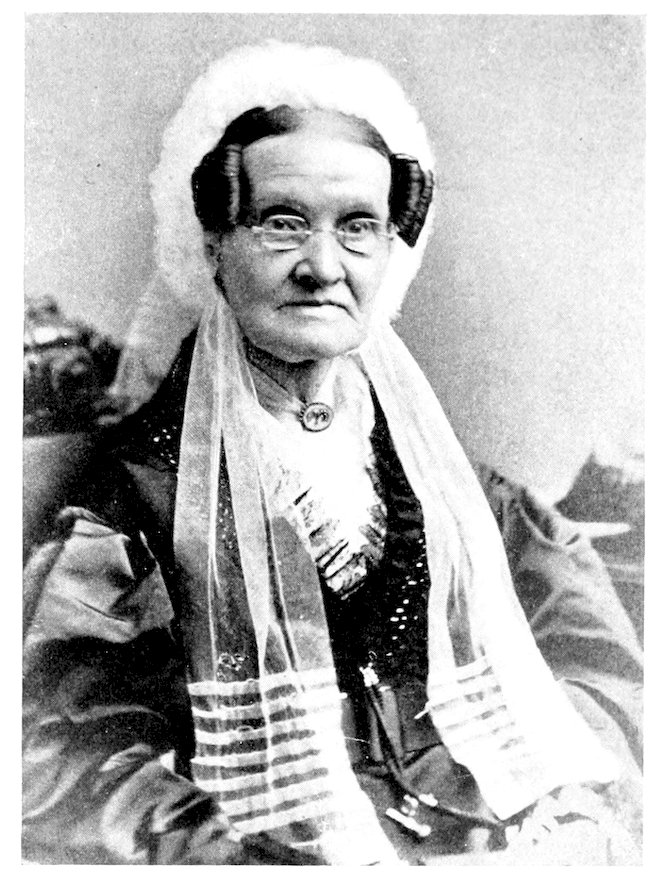
Pl. XXII.—Mrs. Punderson, Pupil
Permit me to observe, since I do not do it from perverseness, on what you said, what is there ridiculous in you?
You pay me a great compliment, Helen, which for once I will accept. But you will perhaps scarcely believe so striking a picture was once drawn of me, by a young mimic of my acquaintance, who was not aware of my seeing her, that I could not help laughing at it myself. My little cough, the trick I have of leaning my head forward, and the slow manner I have in talking, were imitated and made to appear ridiculous.
Oh, Mama, but these are not ridiculous.
Not in themselves perhaps, but by a little exaggeration which a true mimic never spares, they become so.
Oh Mamma, what an odious character. I shall never mimic anybody again.
My dear cousin, what is the matter with you?
Nothing.
Alicia, that cannot be.
My dear child, compose yourself, and don’t strive to conceal an emotion, which does you so much credit. You have been affected by the reproof I have given Constance. Is it not so?
Oh yes ma’am, it is so like I have been, so faulty, so absurd.
Since you feel that my dear girl, you sufficiently prove that your heart was not wrong.
Ah madam, you are very good, you read my heart and I am afraid you despise me; you must, for I have shown such contempt of all that is rational.
Dear Alicia, I am sure Mama loves you.
To own an error is the surest sign of amendment.
How good you are to encourage me. Yes, if you can forgive and love me, I shall be happier than I have ever been.
We cannot be happy with a sense of an error in the heart, however stifled by pride. Shall I tell you, my dear niece, in what respect I think you most blameable?
I shall be willing to hear and I hope to amend.
I have avoided hitherto, my dear, speaking of the cause which brought you here; till I could gain your confidence, till Constantia could gain your love. I hope you now consider her as your sister and me as your maternal friend.
Ah, if you will permit me.
Oh, my dear cousin, what joy you give me.
Henceforth, I hope we shall be happy in each other. Permit me then, my dear girl, to tell you, you have never seemed sufficiently sensible of the fault which brought you here, till this morning. Am I deceived, or may I attribute the tears you have shed, as tokens of sorrow for having betrayed your mother’s confidence?
No my dear aunt, you are not deceived. When you reproved Constance for a slight indiscretion compared to mine, I felt how greatly 117I had offended my affectionate mother, whose forgiveness I never sought, but with sullen pride, left her reluctantly.
There is yet one thing of which I fear you are not yet fully sensible. I mean the fault of contracting debts.
But—you think—perhaps—
Hear me, my dear. In the first place, the allowance your mother made you, was really an ample one. Even if it had not been, as she who knew what you could afford to spend, thought it such, you had no right to exceed it. To be happy, we must learn to live within our income. Not only justice requires this, but our own comfort, for nothing can be so harassing as a consciousness of owing what we have not been able to pay.
Oh, I am well aware of that, but I knew I should be able to pay at some time or other.
Yes my dear, but consider if everybody acted thus; those you employ would have no ready money to pay those who work for them. Many poor persons, who live by their daily earnings, must perish with want. Add to this, you pay more than you ought for every article and are entirely precluded giving anything in charity.
Pardon me, dear aunt; I always gave a little out of what I had.
But what right had you to give money, which of right belonged to another? Every person should pay their honest debts, before they can be truly charitable. You feel this mortifying, but is it not just?
I believe so—
It is indeed humiliating to feel that one has wantonly thrown themselves on the forbearance of others, who if they please, may expose 118us to everybody, as a person who wants justice so much as to contract debts they know they cannot pay.
Oh, Mama.
Nay, I deserve it all; I feel that I do.
Believe me, my dear Alicia, my earnest manner arises only from my sincere wish to convince you of your error. When once a person has contracted a habit of buying whatever strikes their fancy, or of overstepping their income a little every quarter, ruin is the certain consequence. The sum though trifling at first, will accumulate every year and finally consume the principal. Add to this the distress our extravagance or carelessness may bring upon the labouring poor, and you will say the want of economy is no trifling sin.
Ah madam, I am fully convinced. I will immediately write to my mother and tell her so. I will acknowledge my punishment is just. But why do I say, punishment? I am convinced this visit, which I thought such a misfortune, will prove the happiest event of my life.
I am sure it will of mine, since of a cousin I had never seen, I hope I have now a friend whom I shall always love.
Am I worthy to be her friend?
Yes, my dear girl, you have an excellent heart, and that is the great security for all.
Ah, then, embrace me, my dear cousin, my friend, my sister! Now for the first time in my life, I know what friendship is.
It is true, virtue alone is the sure basis of friendship. Without it, we may form intimacies, connections and even unworthy confidences, but friendship can only subsist between those who love virtue.
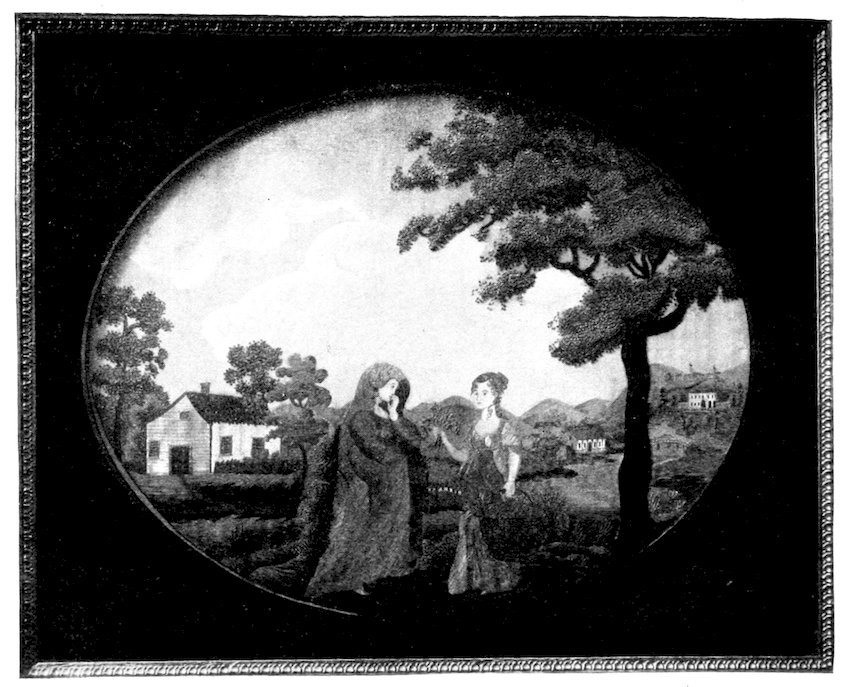
Pl. XXIII.—Embroidered by Mrs. Punderson while at the School
Mostly, as far as I can judge, in Miss Sarah Pierce’s handwriting. (Mrs. Gray.)
In another copy (written, evidently for use, in a schoolgirl’s hand) the characters are entered as,—
| Jephthah | W. Talmadge |
| Bethulah | C. Beecher |
| Elizabeth | A. P. Brace |
| Mahalah | J. Parmelee |
| Tirzah | M. Buel |
| Pedazar | J. C. Landon |
| Elzaphan | H. Gould |
| Agnes | E. Verplank |
| PERSONS OF THE DRAMA. | |
|---|---|
| Jephthah | Judge of Israel, |
| Pedazar | One of the rulers of Israel, |
| Elzaphan | A priest, |
| Bethulah | Wife to Jephthah, |
| Elizabeth | Daughter to Jephthah, |
| Mahalah | The widow of Jephthah’s brother, |
| Tirzah | Mahalah’s daughter, |
| Agnes | A convert from a heathen family, |
| Three small children from heathen families under the care of Agnes. | |
| Attendant. | |
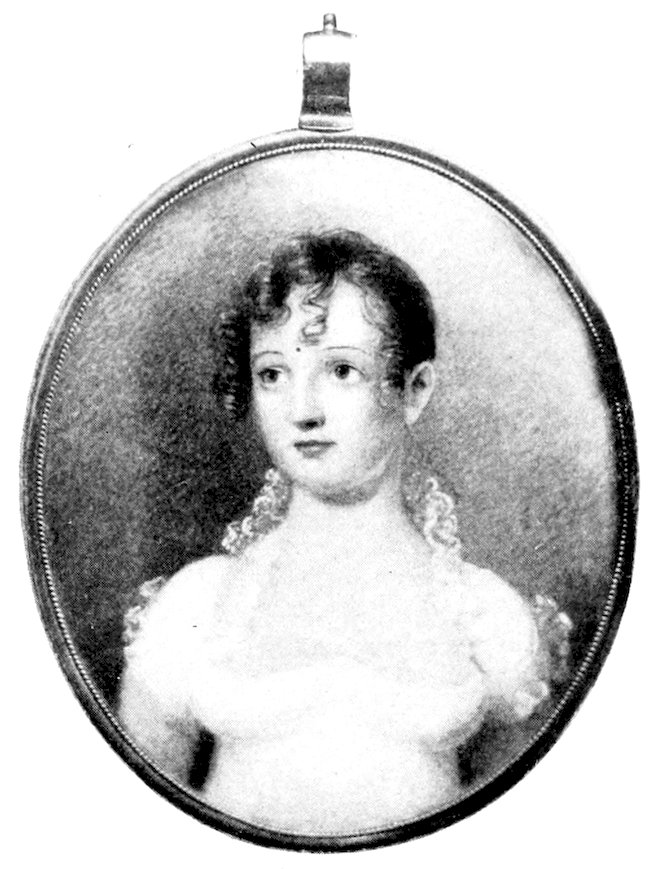
Pl. XXIV.—“The Rose of Sharon,” Pupil about 1814
From a miniature painted by Dickinson
Elizabeth Hannah Canfield, daughter of Judson Canfield and Mabel Ruggles, of Sharon, Conn. She married Frederick Augustus Tallmadge, son of Col. Benjamin Tallmadge. She was called “The Rose of Sharon” by the law students, from her beauty and her birthplace, her sister Julia receiving the title of “The Lily of the Valley,” from her fair skin and want of color.
The two sons of Gov. Edward Telfair, of Georgia, who attended the law school, were in love with her,—Thomas and Alexander. The latter offered himself and was refused. He afterwards walked the twenty miles from Litchfield to Sharon only to gaze at the light in her window and walk back again.
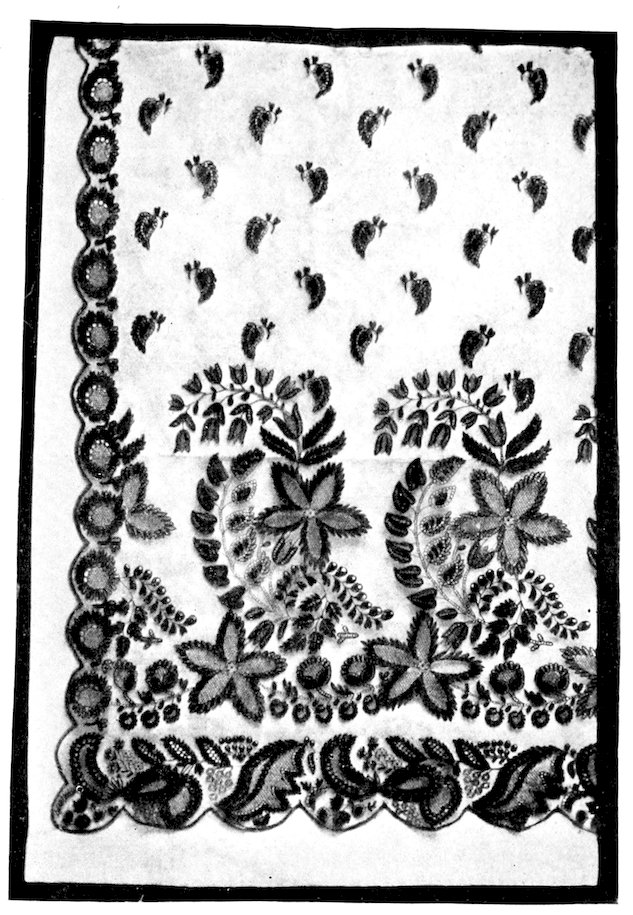
Pl. XXV.—Black Lace Veil made by “The Rose of Sharon”
(As Agnes and the children kneel Jephthah goes out.)
Elizabeth.
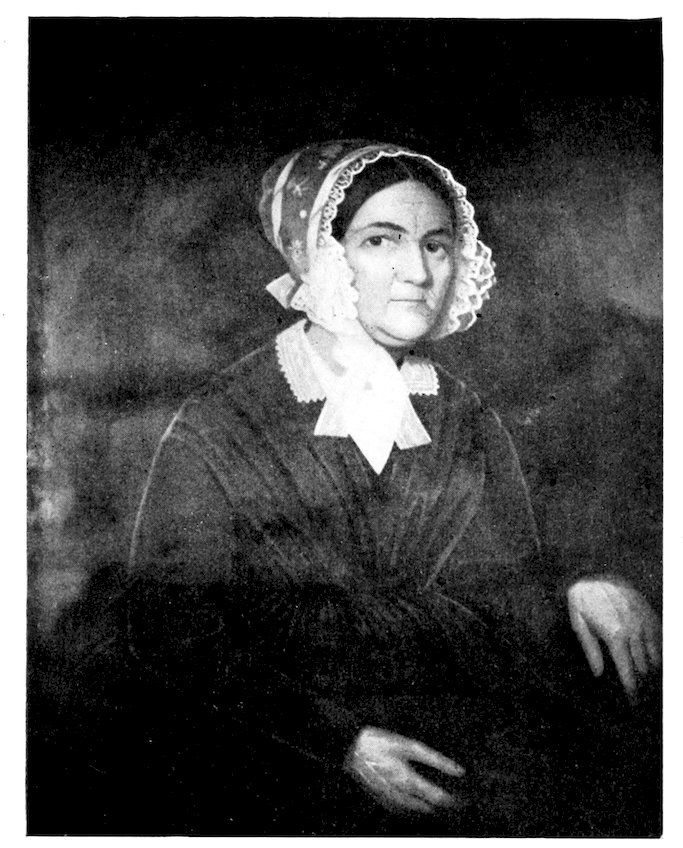
Pl. XXVI.—Julia Chittenden, Pupil, 1800
Note 1. xxx
These sentiments of Elzaphan are not to be considered as agreeing with the laws of Moses truly expounded, but we must suppose that not only Jephthah but those priests who were about him must have mistaken the meaning of the 28th and 29th verses of the 27th chapter of Leviticus, otherwise they would not have permitted Jephthah to have sacrificed his amiable daughter to his unlawful vow. Not only Jephthah but the leaders of Israel appear to have been tinctured by the idol worship so long prevalent in Israel. Saul seems also to have made a similar mistake when he devoted Jonathan. And all Israel fell into a like error when they devoted the tribe of Benjamin to destruction. The punishment in all these cases, fell on the offender, and doubtless taught the nation the true meaning of the law. See Scott’s notes on Jephthah’s sacrifice.
“On one occasion of this kind I had a hand in a merry joke enacted at one of the rehearsals of Miss Pierce’s favorite drama of ‘Jephtha’s Daughter.’
“It was when Jephtha, adorned with a splendid helmet of gilt paper and waving ostrich plumes, was awaiting the arrival of his general, Pedazar—his daughter’s lover—who was to enter and say,
“‘On Jordan’s banks proud Ammon’s banners wave.’
Miss Pierce stood looking on to criticise, when having prearranged the matter, a knock was heard, and I ran forward, saying, ‘Walk in, Mr. Pedazar.’ In he came, helmet and all, saying, ‘How are you, Jep?’ who replied, ‘Hulloo, old fellow! Walk in and take a chair.’ Miss Pierce was in no way discomfited, but seemed to relish the joke as much as we young folks.
“On one occasion of this sort father came in late, and the house being packed, he was admitted by the stage entrance. Either from accident or fun, just as he was passing over the stage, the curtain rose, and the law students spied him and commenced clapping. Father stopped, bowed low, amid renewed clapping and laughter, and then passed on to his seat.”
It is expected that every young Lady who attends this School will be careful to observe the following rules.
1st To be always present at family prayers
2nd It is hop’d that each young Lady will read a portion of scripture in private and regularly address her Maker Morning and evening. They who begin the day in prayer will probably find cause to end it in praise.
3d Let our Saviours maxim be follow’d at all times. Do unto others, as you would they should do unto you.
4th Avoid anger, Wrath and evil speaking. a tale bearer separates chief Friends.
5th It is expected public Worship be attended every sabbath except sickness or some unavoidable circumstance prevents, which you will dare to produce as a sufficient excuse at the day of Judgement.
6th It is expected that your outward deportment be grave and decent, while in the house of God and that you be more ready to hear, than give the sacrifice of fools.
7th The sabbath is to be kept holy throughout not wasted in sloth, frivolous conversation, light reading, or vain employment, but every moment must be employed in endeavoring to improve your own heart in doing good to others Those who honour my sabbath, I will honour is the promise of the great and unchangable God
8th It is expected that every hour during the week be fully accomplish’d, either in useful employment or necessary recreation Keep always in remembrance that time is a most invaluable blessing, and that for all our time but—particularly for the hours of youth and health you must give an account to God.
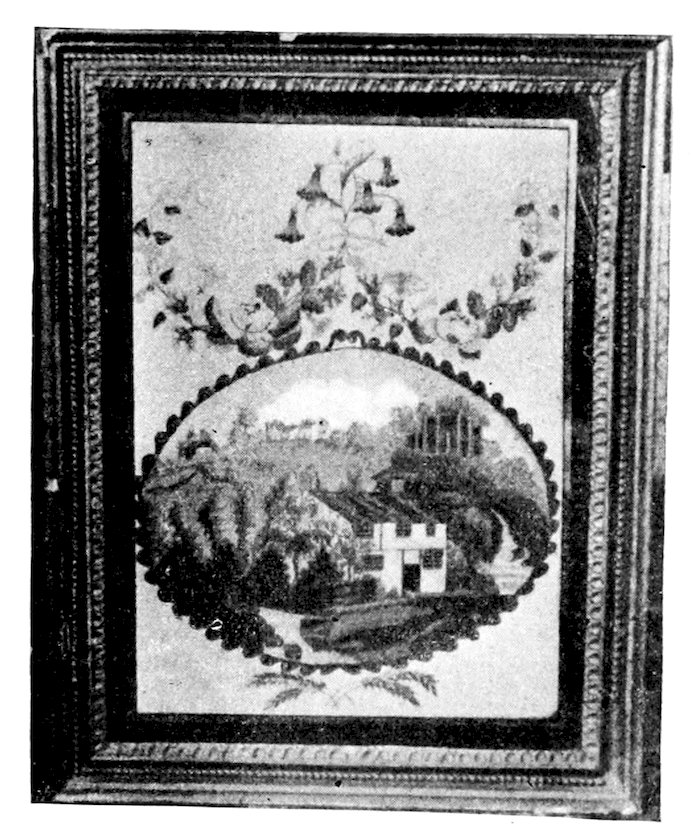
Pl. XXVII.—Embroidery by Julia Chittenden
9th Every real Lady will treat her superior with due reverence, her companions with politeness, good humor she will always show, a sweet 147temper, a modest deportment on all occasions, never forgetting what is due to all persons in every situation.
10th Those hours appropriated for any particular study, must not be employed in other occupation. Nothing can be well done without proper attention to regularity & there is time enough to acquire every useful and elegant accomplishment provided order be observed
11th Profusion in expenses, a want of Neatness and economy, a stupid inattention to instruction, are indications of a bad heart and must be avoided.
12th Each young lady must observe the particular rules of the family in which she resides.
Have you rose early enough for the duties of the morning. Have you read a portion of scripture by yourself. Have you prayed to that God in Whose hands your breath is.
Have you in all cases done unto others as you would be done by. Have been angry—Have spoke evil of any one. Have you attended public worship. Have you behaved in the house of God with that reverence due to his holy Character. Have you wasted any part of holy time by idle conversation, light reading, or sloth.
Have you wasted any time during the week. Have you shown decent and respectful behaviour to those who have the charge over you. Your parents, elders, Brothers and sisters, teachers, domestics, the aged, or people who are older then yourself. Have you been patient in acquiring your lessons. Have you been polite and good humored to your Companions. Have you been modest in your deportment not boistrous or rude. Have you spoken the truth as all tho it were to your hurt. Have you used the name of God irreverently or spoken any thing which is a brief of the third Commandment. Have you spoken any indecent word or by any action discovered a want of true feminine delicacy. Have you been neat in your person, made no unnecessary trouble by carelessness in your chamber or with your clothes. Have you torn your clothes, books, or maps. Have you wasted paper, quills, or any other articles. Have you walked out without liberty. Have you combed your hair with a fine tooth comb, and cleaned your teeth every morning. Have you eaten any green fruit during the week.
Catherine Cebra Webb was born at 84 Beekman Street, New York City, January 25, 1801, Daughter of Orange Webb (a shipping merchant of the firm of Webb and Lamb, corner Pearl Street and Burlington Slip, and ruling elder in the Old Brick Church) and Elizabeth Cebra (daughter of Mr. James Cebra, of the Custom House).
Catherine Cebra Webb entered Miss Pierce’s school in the summer of 1815, and boarded at first in the family of Lyman Beecher, until Mrs. Beecher’s death, and then with the Misses Edwards on North Street, nearly opposite the school. Catherine remained only a few months in Litchfield,—the climate proving too severe for her. July 20, 1818, she married Mr. Rensselaer Havens (a shipping merchant of the firm of Perkins and Havens, 198 Front Street, New York City, and ruling elder in the Old Brick Church for thirty years). Mrs. Havens has had eight children, nineteen grandchildren, and twenty four great-grandchildren. She has lived since 1873 in Stamford, Connecticut, and is now in her ninety-sixth year.
Frances Maria Webb, an older sister of Catherine Cebra Webb, also attended Miss Pierce’s school about 1810 or 1811, and met there Alexander Garden Fraser, of Beaufort, South Carolina, a student in Judge Gould’s Law School. Frances M. Webb was born June 5, 1796, and married Alexander G. Fraser, June 5, 1812. Frances M. Webb (Mrs. Fraser) died in Edinburgh, August 5, 1847. She has four children still living.
I left New York, Wednesday, July 11th, 1816, for Litchfield, to enter Miss Pierce’s school. I took a steamboat to New Haven, and went by stage from there to Litchfield. The Rev. Mr. Stockton, a friend of my Father’s, took me up.
I went to board in the family of Dr Lyman Beecher, but stayed there only three weeks, as his wife was so ill they could not have the care of boarders. Miss Catherine Beecher and a Miss Burr, presided over the family. Dr Beecher had a room in the attic for his Study. I had a room with two Misses Wakeman, who were also pupils at Miss 149Pierce’s school. Catherine Beecher had to send a report every Saturday of the conduct of the young ladies in her family, to Miss Pierce.
When Mrs. Beecher’s illness obliged me to leave there, they got another boarding place for me across the street, with the Misses Edwards—two sisters—Miss Nancy and Miss Betsey.
They were very religious women; and as the Sabbath began then at sunset on Saturday, we had to hurry to get our letters from the postoffice, and be back before the sun went down. After supper, the Sabbath began with religious exercises—reading of the Bible and prayer—Sunday we all went to Dr Beecher’s church. On one occasion, some of Judge Gould’s law students were talking during the sermon, when Dr Beecher paused, and looking at the square pew at the right of the pulpit, (where Judge Gould’s pupils sat) said, “I will suspend my remarks until those young gentlemen have finished their conversation.”
There were no Sunday schools in those days. On returning from church, all we had for our dinner was a piece of pie and a mug of milk, as the Misses Edwards considered it wrong to cook on Sunday. We went to an afternoon service, then had a simple tea, and when the sun went down Sunday was over; but we had prayers and went to bed.
School began at nine o’clock, and closed at noon for an hour’s recess, when we went home for our dinner and came back; but I cannot remember how long it kept in the afternoon—whether it was three or four o’clock—
Miss Waite taught me music, and I went into the back parlor of Miss Pierce’s residence, to take my lesson on the piano. I remember “The Battle of Wagram” was one of my pieces. I had a very handsome paint-box which my father had imported from England for me, and I took drawing lessons at Miss Pierce’s, but I cannot recall the teacher’s name.
I did not stay long at Litchfield, as I was a delicate girl, and it was so very cold my Mother was afraid to have me stay. I came home in the Autumn, I remember when Dr Beecher’s wife died. Her name was Roxana Foote; and I heard Dr Beecher preach her funeral sermon, standing in the little tub pulpit, while her coffin stood below it.
Miss Pierce had a nephew, John Pierce Brace, who lived, I think, next door to Miss Pierce’s, and he taught every day in the school.
Miss Mary Pierce did not teach; only Miss Sarah, She was of medium height, rather fine looking and dignified, and very religious. We had school every day; only, it seems to me that on Wednesday and Saturday we had a half-holiday.
150Among the pupils was a Miss Catherine L. Webb, from Cooperstown, (sister of James Watson Webb)—two Misses Farnham from Massachusetts—Miss Phebe Conklin from Poughkeepsie—two Misses Sanford from Jamestown (N. Y.)—and Miss Emmeline Beebe from Connecticut. (She was the one who told Miss Pierce she could not study because the girls kept up such a “cessation” through the room.) There was also a Miss Caroline Delafield, who lived at her Uncle’s, Gen’l Tallmadge’s,[41] and came to certain recitations only.
Old Grove Catlin kept the Hotel in Litchfield, and had a daughter Flora, who was quite a belle. The law students used to quiz him about his daughter’s popularity, and he said, “Yes, my daughter Flora is assassinated most every night” (meaning serenaded)—He also said he wore his old fashioned watch seal “for the antipathy of the thing,” (meaning antiquity)—Dr Beecher had two colored servants named Zillah and Priscilla—I remember their grinding the coffee for breakfast. There was a large sink in the kitchen, and a couple of basins, and we had to go there to wash—It was the only place—so of course we could not take much of a bath—which was a great trial to me.
While I was at Dr Beecher’s, the Rev. Mr. Nettleton, the revivalist, came to visit him, and I remember their drinking cider and pearlash with their breakfast.
Caroline Chester was born in Hartford, Connecticut, 1801, married John Knickerbocker, 1824, and died at Troy, New York, 1870. She was fifteen years old when she attended the school.
Nov. 30, 1815. I left Hartford at eight in the morning and arrived at Litchfield about four, had very pleasant company, Mr. and Mrs. Wheeler of Hartford, and her niece, Mr. Catlin of Litchfield, and several other gentlemen whom I did not know. It rained constantly almost the whole day. West Hartford was the first place we passed through, it is a very pleasant place though a small one. Farmington is much larger, and as we passed through Main street I saw it to the best advantage. Burlington is a small place consisting of a few houses, one store, a blacksmith’s shop, a post office and one meeting house. Harwinton the last town (until we reach Litchfield) is much pleasanter than Burlington, here we left four of our passengers. After riding over many a long hill we arrived at Litchfield which agreeably surprised me. Went immediately to Mrs. Sheldon’s where for the first time I saw her and Miss Lucy.
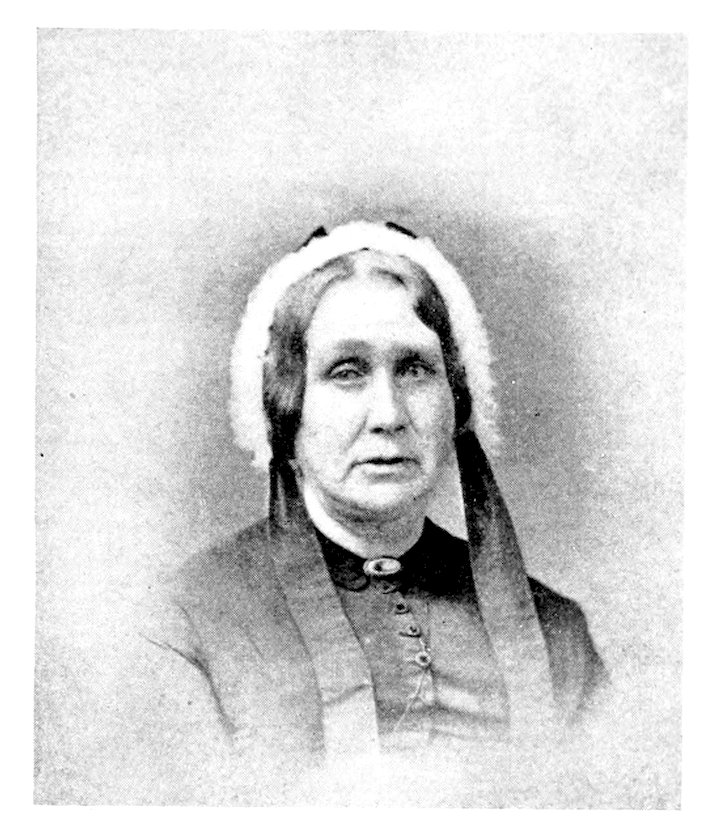
Pl. XXVIII.—Caroline Chester
b. January 26, 1801. m. June 2, 1825. d. April 20, 1869
151Dec. 1st. Spent the evening at Miss Wood’s upon condition that I would not visit again for a week. Saturday was spent as usual in studying, sewing and hearing instruction. Mr. Beecher visited the school. I was very much pleased, his doctrine is plain and easy to understand.
Dec. 19th. It is one of Miss Pierce’s rules to have her scholars rise before sunrise and Dr. Swift observes “That he never knew any man come to greatness and eminence who lay in bed of a morning.” It is known that in the 14th century in England and France, people rose much earlier than they do now, and I read yesterday that Buffon said that he was indebted to one of his domestics for ten or a dozen of his works, because he had promised him a crown whenever he would wake him at six and he succeeded in his attempts. Czar Peter a famous philosopher used to rise to see the morning break, and used to say that “he wondered how man could be so stupid as not to rise to see the most glorious sight in the universe; that they took delight in looking at a beautiful picture, the trifling work of a mortal, but neglected one painted by the hand of the Deity.” Dr. Doddridge says that the difference it would make if a person should rise at five or seven for the space of forty years, supposing him to go to bed at the same hour of night, is nearly equivalent to the addition of ten years.
Dec. 20th. Called for Hannah Wolcott, and at her mamma’s request she took me to her Uncle Wolcott’s house. It is elegantly furnished. He has in his sitting room pictures of six old venerable gentlemen, a picture painted by his daughter, and a print. In his library are two large bookcases filled with books, likenesses of his wife, mother, father, daughter and her husband Mr. Gibbs. In his drawing-room are several large prints from Homer’s Iliad, the battle of Bunker’s Hill and death of General Montgomery, a large print called Marc Antony, three or four landscapes painted by Mrs. Gibbs and many others. Hannah showed me some Chinese curios, two men one holding two small boxes of tea, and the other, a curious looking personage, a Chinese woman, a pair of ladies and men shoes, stone cut in various shapes, Ivory globes made in the most elegant manner, a number of boxes, six or seven figures made of plaster of Paris, some baskets, and a beautiful collection of shells.
152Dec. 27th. Miss Mary Hooker, Miss Burr, Miss Reeves and Miss Beecher at tea. In the evening heard a long letter read from Mr. H. Sheldon. He wrote that he had visited the catacombs and asked his guide if Bonaparte had ever been there, he said “No, Bonaparte had never expressed any desire to be with the dead.”
Jan. 1, 1816. Went to school with a determination to improve all in my power, recited in History without a mistake, in the afternoon I went to Mr. Bradley’s tavern in a sleigh with Hannah Huntington, John and Mr. O. Wolcott, W. T. and Mary. Had a most delightful ride, returned with Hannah to tea, in the evening took a sleigh ride and returned home about nine. Had a great many wishes that I might have a Happy New Year.
Jan. 2. After school returned home with Louisa Seymour, and drank tea with her and enjoyed myself extremely. Mrs. Seymour is a very fine woman and endeavored to have our time pass agreeably. I almost froze returning home, for the cold was excessive.
Thursday. After school took a walk with Margaret Hopkins of Philadelphia. I am very much pleased with her, she is not only beautiful, but amiable, kind, generous and sweet tempered. Dr. Fowler drank tea at Dr. Sheldon’s and staid through the night. After studying an hour I went to Mr. Brace’s where I spent the evening most agreeably and saw a plenty of butterflies and spiders. I returned home about nine, attended family prayers and retired to my room.
Thursday. I rose as usual early and exercised, knit and mended my school frock, when it was finished, the cow bell announced that I must prepare for school. * * * Mr. Brace commenced school as usual by reading a portion of Scripture, and prayer. * * * After school I called at Mrs. Wolcott’s, Mrs. Reeves’, and called and gave Mary Deming some of Eliza Royce’s wedding cake. * * * * In the evening I drank tea at Mrs. Deming’s with Miss F. Catlin who is the most beautiful woman in Litchfield, Mary Wells cousin to Mrs. Hudson, she unites to a lovely face all those pleasing qualities which delight and attach and make us love and admire, the two Misses Buel and Miss Landon with several of the students. * * * * The afternoon was spent very pleasantly at Mrs. Aaron Smith’s with her niece Mary, the Misses Hopkins from Philadelphia, Miss Wadsworth from Montreal, Miss Rockwell from Albany and Miss Lewis who resides in Litchfield. * * * The evening was spent very pleasantly in reading a letter from Mr. Henry Sheldon to his sister Lucy. He wrote that he had seen the ascension of two balloons, and that the French surpassed all other people in sublime trifles, that the first ascended in a very fine evening, covered with lamps, conveying a man named Augustine, who was 153afterward found at some distance from Paris almost frozen to death. The next, he wrote was much the most interesting as it conveyed a young heroine of 20 or 25. She cut the cords to her frail bark and every heart ached, while she ascended so far in the air that she was hardly perceived. She suffered no injury and was afterward presented to the King. * * * Hannah Wolcott, Helen Peck, Margaret and Adela Hopkins came and staid about an hour.
Monday. Rose at an early hour and took a long but pleasant walk with Mary. At school I recited a lesson in Sacred History and had the pleasure to hear Miss Pierce say I had said a most excellent lesson. In the afternoon I learnt in my Blair that poetry is the language of passion, or of enlivened imagination, formed most commonly into regular numbers. I also learnt that a person who composed a letter must write with ease and familiarity, simplicity, sprightliness and wit. Our lesson was very interesting and I recited without a mistake, but it fully convinced me that I was not born with a genius for letter writing. After school took a delightful walk with Mary and Charlotte Storrs. Went with dear Theodosia Devaux who is from Camden, S, Carolina to see Harriot Kirby. * * * Went with Mary to take tea with Clarissa Seymour. C. Marsh, E. Welch, E. Storrs and L. Seymour were there. I spent my time very pleasantly. In the evening we recited anecdotes, one was—A man who kept an ale house by a pound was frequently visited by the students who wrote over the door “Ale by the pound.” The Proctor of the university unwilling to have them visit it, complained to the Vice Chancellor who ordered the ale keeper to appear before him. This request was readily complied with, but as soon as he entered the room began spitting and clearing his throat, the Vice Chancellor asked why he did so, he replied—Sir I came here to clear myself. Well how do you do, asked the Vice Chancellor. Very well I thank you. Go! says the Vice Chancellor for an impudent villain. He left him and meeting the Proctor who had complained of him, he told him the Vice Chancellor wished to see him. He went, and the ale keeper spoke and said, Sir you bid me go for an impudent villain and I have brought you one of the worst I ever knew.
Friday. Mrs. Wolcott called and very politely asked Mrs. Sheldon to permit me to take tea with her and Miss Cook, a niece of hers from Danbury for whom she had made the party (I was at school) Mrs. Sheldon gave her permission and I went. Though Mrs. Wolcott was the only married woman in the room, yet no one would have thought her the oldest for she looked very beautiful. The party was large. Some of the ladies were—both the Misses Catlin, Miss Hooker, Reeves, Kirby, Sanford, Beecher, Devaux, Lord, Landon, Burr and the two 154Misses Buel. When the clock struck nine, the girl was carrying round the wine, and I too well knew if I was not at home, the family would be displeased. I spoke to the lady who sat next to me and said I must go, and she said it would be extremely improper in her opinion for me who was the youngest in the room to go first, because if I went, all would go. At about half past nine Miss Burr rose to go, and all the company followed her example. It was very cold and as I crossed the green, the wind blew and I thought, what can be keener? but I found when I reached home that a keener blast awaited me, a blast which will never no never be erased from my memory. I opened the door with a trembling hand, no one was in the room, but soon Dr. came. My heart throbbed violently, and he said—why are you home at this late hour? I told my excuse, he interrupted me by saying that it was but a poor excuse, that I might as well have come as not, for it would have been perfectly proper if I had only been five years old. He concluded by saying that if I ever staid out again he certainly would lock the door if it was after nine. I looked round for a candle but there was none. I asked for one and he said if I wished one I might go up stairs and get one. I spoke and said, Sir I can go to bed in the dark, he made no objection. As I went up stairs I wept as a child and wished I was at home with those friends whom I so dearly dearly loved. Mary was asleep and I thought I should have frozen before I undressed myself, and thus did I pay for my whistle. The party was pleasant but the scolding was not, and sincerely did I wish I had not gone——
The words of Schenadoah an Indian chief who died lately aged one hundred and thirteen, at Oneida
I am, an aged hemlock; the winds of an hundred years have blown through its branches; it is dead at the top. Those who began life with me have run away from me: Why I am suffered to remain God best knows.
Your own luminous nature surrounds you and seeing through that, you fancy objects bright which only reflect your beams.
155Written on the collar of a dog belonging to the Prince of Wales,
There is no duty, there is no pleasure, there is no sentiment, which does not borrow from enthusiasm—I know not what charm, which is still in perfect unison with the simple beauty of Truth.
With quotations from Thomas Moore, Young, Pope, Cooper, Milton, Ossian, Byron, Homer, Savage, Michael Angelo, Bishop Horne, Shakespeare, Cicero, Hannah More.
To a Stone from the island of “the Lady of the Lake”—given by a friend who had visited Loch Katrine.
Sept. 4. 1816——
By Mr. John P. Brace.
July 15, 1816.—I arrived at Litchfield the 3rd of July. I went to Mrs. Bull’s to board. The next day I went to school in the afternoon, but I did not learn my lesson. Thursday I arose in the morning very early, ate breakfast, studied until the bell rang. I went to school, learned a lesson in Geography in the forenoon, in Grammar in the afternoon.
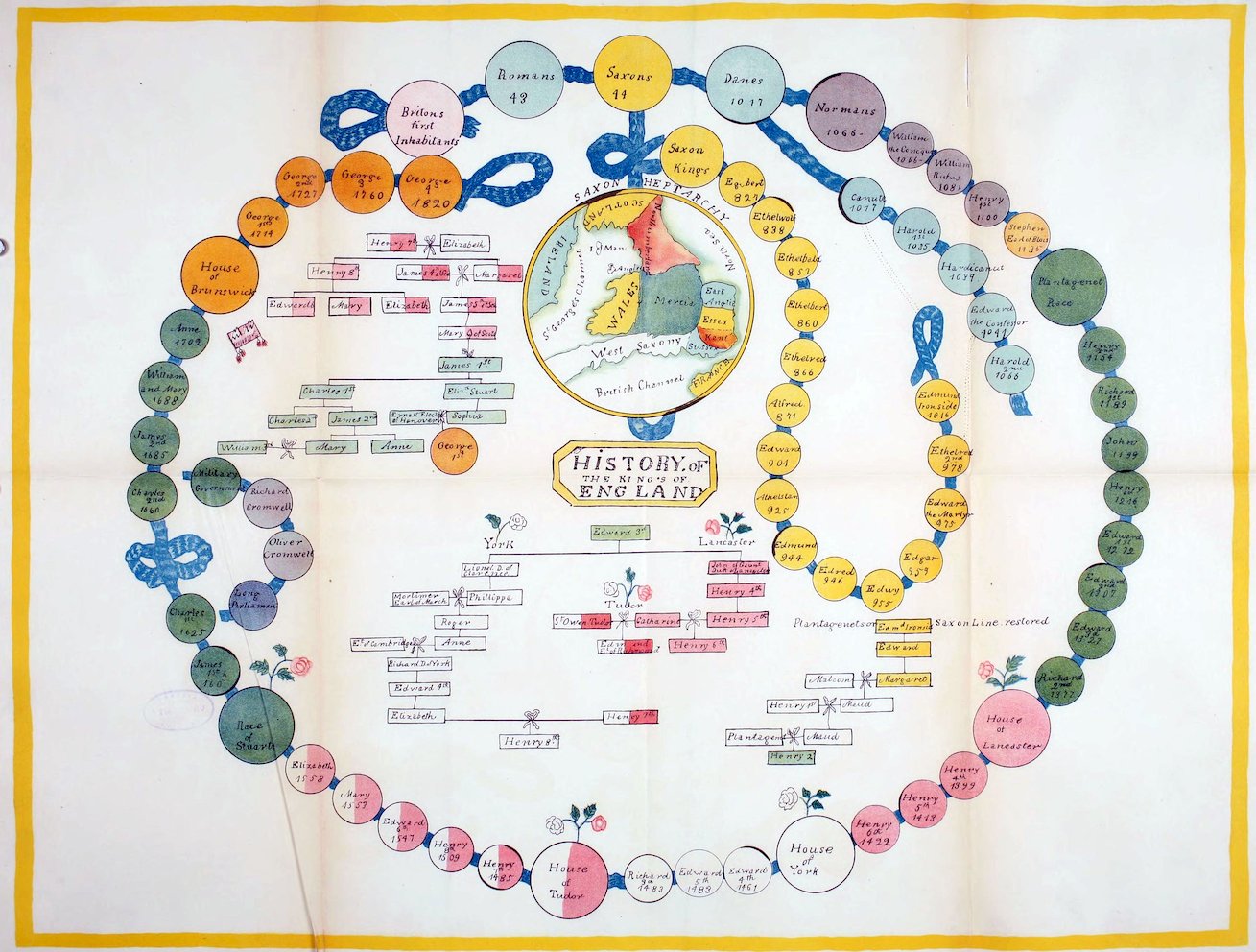
Pl. XXIX.—Chart of English History, by Eliza Ogden
Friday I was examined in the Elements of Geography. Saturday I learned a lesson in Geography, and was examined through the rules 161of the school. Sunday I attended Church, heard Mr. Beecher preach. He took his text in Luke the 3rd Chapter and 7th verse in the forenoon, and in the afternoon in the 2nd Epistle of the Corinthians, 7th Chapter and 3rd verse. He preached very affecting indeed; he wished to have us all be good Christians. After meeting I went home, and in the evening went to Conference. After Conference I went home, went into my room, thinking of what Mr. Beecher had said. I arose this morning as usual. I went to school, recited my lesson in Sacred History and went to writing my Journal and have just finished it.
July 22, 1816.—Monday, after I read my Journal, I spent the rest of the afternoon in writing. After school I went home and studied my lesson for the next day. The next morning I arose, ate breakfast and studied my lesson until I went to school. I said my lesson very well. I went to writing. In the afternoon I recited in Grammar and Geography and did not say them as well as I could wish, but I hope that I shall do better the next time. Saturday after school I went home and thought I would take a walk; I concluded to go to Pine Island; part of the scholars accompanied me. We had a very pleasant walk indeed; we went almost there and we could not see the water or any thing that pleased us very much and the girls would go no farther. Coming back it rained and wet us some. I went to the Post Office expecting to get a letter, but I was very much disappointed not to find any there; I have not had any since I came from home. Sunday I went to meeting; we had an excellent sermon; he preached from Luke. I attended Conference last evening; we had very good advice; he prayed for us, made a very long prayer. This morning said my lesson very well. I did not miss.
July 29, 1816. Monday morning before I went to school I began to write my Journal and finished it in the forenoon and read it in the afternoon. After I went home and attended to the duties of the evening I retired to my chamber. Tuesday I recited a lesson in Geography in the forenoon, in Grammar in the afternoon. After I went home Mrs. Bull mentioned two very sudden deaths, of a young gentleman and a negro, that were drowned. Wednesday I had my holiday. Thursday I recited my lessons as usual. Friday there was not any school in the afternoon. I recited my lesson in Geography in the forenoon. We were examined in Geography Saturday in the forenoon, I missed a good many times. Sunday I went to church; heard Mr. Beecher; after I went home I read till it was dark. This morning I arose as usual, made an apron before I came to school; after I came to school I recited in History, said my lesson very well missed only half a quarter.
162Aug 15. Monday morning I went to school recited my History lesson and wrote my Journal. Tuesday I recited my lessons as usual; after school Miss Logan and Miss Ayres came here and drank tea; Miss Logan informed us that she was going to leave the school this week. Wednesday went to school in the forenoon; while there Miss Whittlesy informed me that there was a letter in the Post Office for me. I went down as soon as school was out and got the letter. They were all well. My Aunt, who was sick when I left home, was better. In the afternoon Miss Eliza Camp and Miss Keeler came to make us a visit; after tea they walked on Prospect Hill. Thursday as usual nothing occurred worth relating. Friday recited a lesson in Geography; in the afternoon was examined I missed very little. Saturday after we had answered to the rules of the school, Mr. Cornelius came. He said many of the scholars were going away and he wished us if we had any disturbance or any thing against each other to forgive one another before we parted and if ever we met again to meet as friends. He said that every year. Four of Miss Pierces scholars had died and if four should die every year for twenty years how many would there be left. How necessary it is to look to the preservation of our souls so that we may all meet in heaven. After school Miss Butler went to the Post Office....
Aug. 12, 1816. Monday morning I learned a lesson in Sacred History; in the afternoon I recited in Grammar. Tuesday in Geography and Grammar. Wednesday I had the pleasure of receiving two letters from home; they were very unexpected. They enjoyed pretty good health. Papa and Mama will visit us this fall. In the afternoon Miss McNeal visited Miss Beecher and just at sundown she invited me to take a walk with her and Miss Beecher on Prospect Hill; we had a very pleasant walk indeed. When we arrived at the top of the hill Miss McNeal said that she always liked to look at that little cottage under the hill; it looked so rustic and retired, to which Miss Beecher replied that she thought it was more pleasant to look at than to live in, a very true observation I think. After a stay of some minutes we concluded to go home. It was quite cool and we had no shawls with us. We went home and Miss McNeal said it was time for her to return home as she was going to Conference. She took leave of us and I spent the evening at Miss Beecher’s. Friday I was examined in Geography. I missed very little. In learning the State of New York, when we came to the rivers, I learned that the Delaware River had its source from Lake Utstagantho. I should have thought that I would have known where it arose as I have lived close by the River. When I was coming here I saw the head of it, but I 163did not know as it arose in any other place. After school I went home and Miss Haine’s brother came there soon after. How happy I should be to find one of my brothers there. Saturday was examined in the rules of the school. Mr. Beecher was not at home and therefore he did not come into the school as usual. Mr. Cornelius came into the school for the last time. He explained to us the situation of other nations, of the Heathen Idolators who never heard of a Bible. I think as we live in a christian land we ought to look to the preservation of our souls. Sunday I attended the Church of England. I think I never heard so good a sermon in my life. He compared a death-bed repentance to a man and his son. He said if you put it off till on your death-bed it would not be received, for perhaps if we ever got well again we would return to the world again and be as sinful as ever. He said it was nothing but fear; it was not for the love of God but for the fear of death, and he said if a man’s son was very disobedient to him he would chastise him and his son would repent and promise to do so no more, but it was only because he feared him; it was not because he loved him any better than he did before
Aug 26. 1816. Monday I arose, studied my History lesson, went to school, recited and began to write my Journal. In the afternoon I learnt a lesson in History. Tuesday in the afternoon I recited in Geography and in the afternoon I learnt a lesson in Grammar. After school I went down to the Post Office, received a letter from my parents. I was very glad to hear from them, including the death of one of my cousins who died very sudden. Wednesday I had my holiday. I did not attend school. In the afternoon I was making my frock. Miss Hurlbert and Miss Stanly came and took tea with us. After tea we swung a little while and I went home with them as far as the school house. Mr. Frasure preached there that evening. He seemed very anxious to have us all be religious and be saved. Thursday as usual I did not attend meeting. Friday I was examined, missed a considerable. Saturday I worked on my frock untill it was time to go to school. I was examined. The definitions were read. Some were very good. Mr. Frasure came into the school. He made an excellent exhortation, pointing out to us the road to happiness. He said if we had a mind to be religious we could leave all and follow Christ. It was nothing but our own stubborn will that we did not. After school he visited at Mrs. Bull’s. He gave us some excellent advice. He went to every one of us was very particular and plain. He advised us what to do and how we must do to be saved. Sunday I attended public worship. Mr. Frazure preached from 2 Corinthians 7th Chapter and 10th verse: “For godly sorrow worketh repentance to salvation 164not to be repented of: but the sorrow of the world worketh death.” After meeting he came to see us again. He said he could not bear to part with us without our having religion. He invited us to go to meeting that evening as he was going to preach. I went. Monday I came to school; was examined in Sacred History. I missed very little. After I had recited I went home and wrote my journal.
Litchfield Sept 2, 1816.—Monday morning I recited a History lesson, wrote my Journal and read it in the afternoon. Tuesday morning I studied my Geography lesson untill school time. After I recited I wrote copy hand untill school was dismissed. In the afternoon I learnt a Grammar lesson. After school I went down to the Post Office; received a letter from home. They all enjoyed pretty good health. Wednesday forenoon, as usual; in the afternoon I had my holiday, but I came to school two hours. After school I spent my time in writing. Just at sunset Mr. Beecher came down to see us. He talked very affecting. He said he could not make a very long visit with us at present, but if we wished he would come in some time and pray with us. We all joined in the request. I should be very glad to have him come for I like to hear religious instructions. Thursday I recited my Geography lesson in the morning and went home to write a letter. In the afternoon I recited in Grammar and parsed. Friday I learnt a Geography lesson in the morning. In the afternoon there was no school. Saturday forenoon I was examined through the lessons of the week, in the afternoon through the rules. Sunday I attended church. Mr. Beecher delivered an excellent sermon pointing out the road to happiness. In the afternoon I attended the Church of England. We had a very good sermon. Monday recited a lesson in Sacred History, went home and wrote a letter to my parents.
Sept 9, 1816. Monday forenoon, as usual. In the afternoon finished my letter. After I came home from writing school I swung a little while along with our new boarders. Tuesday morning I studied my lesson untill school time. Then I went to school and recited a very good lesson. Mr. John’s, Nancy’s uncle, came after her quite early in the morning. He had brought two young ladies with him to stay as long as Nancy did; very pretty girls I think and I find in becoming acquainted with them they are two of the most amiable girls I ever was acquainted with. Sarah and Minerva Hinkle were their names.
Sept 24. Monday morning I studied my History lesson, went to school and recited very well. In the afternoon I studied the same. Tuesday I learnt a Geography lesson in the morning: the afternoon a lesson in Sacred History, as usual. Wednesday morning the same. 165In the afternoon I was allowed but a part of my holiday because I staid out of the house when it rained. After I staid two hours I went to writing school. Thursday, as usual. Friday I attended school, recited a lesson in Geography. In the afternoon was examined in Geography and Elements. Received 2 credit marks for one and 18 for the other. Saturday was examined in the rules, after which Miss Pierce read four verses; said we must remember them or have a miss. The first was “What was sin? Sin is any want of conformity unto or transgression of the law of God. The sin whereby our first parents fell was their eating of the forbidden fruit, the covenant being made with Adam not only for himself, but for all his posterity. All mankind from him by ordinary generation sinned in him and fell with him in his first transgression. By one man’s disobedience many were made sinners. The fall brought mankind into a state of sin and misery by one man sin entered into the world.” Sunday attended meeting in the forenoon, but I did not Saturday afternoon. I went to writing school. We were coming home and met my uncle. It was very unexpected. He went to Mrs. Bulls and drank tea. Monday I did not go to school. About two o’clock my uncle started for home. It was so late that I did not go to school in the afternoon and there were no lessons to get....
Friday it was general training and there was no school in the morning. I went down to the school house and saw them on the parade. In the afternoon I went down to Miss Jones, to see the sham fight. I liked it very well. Saturday morning Miss Pierce said that the rules might be called in the forenoon and be examined. In the afternoon I was examined in Elements and Geography; did not miss in either. Sunday Miss Marsh was quite sick and I did not go to meeting. Saturday Mr. Brace read a little story about the beggar boy, how he met with a rich gentleman, and as he looked very poor he asked him to go and live with him and he would take care of him. He looked considerable out of health too, but he would not. He endeavoured to persuade him by telling him his name and where he lived, but in vain. The boy was insensible of the offers made to him. The gentleman threw him down a shilling. The boy caught it up without thanking him or giving him any of his matches or offering to go with him. He went away and returned. His companions slept with him that night as thoughtless as ever. While Mr. Brace was reading it Miss Pierce made observations upon it. She said it was the same thoughtless creatures that we are that appeared the same in the Lord’s eyes as he did to the rich man; that the money he gave him was like the blessings that we received every day. When the 166gentleman asked him to live with him it was the same as when the Saviour offers us eternal life. The school stood in prayer. Sunday attended meeting....
Oct. 26, 1816. Nothing of importance has occurred this week. We have got through our examinations; finished yesterday morning. Have been to writing every night; began to paint free hand last night. Saturday after the names were called Miss Pierce made an address to all the girls; told them what to do when they got home. This week on Thursday went to the Church to hear the Bishop preach. He did not come in untill some time after the people got there. They sung untill he came. The chorister had a great deal of trouble to get the young ladies put in the singers seat and a great deal of trouble to make them sing well. We had an excellent sermon. I was very much pleased with the meeting. I expect papa will be here today. I shall be very much pleased to see him. The next week after school I shall go to Salem to see Miss Stephens. Mrs. Bull is going to Hartford while we are gone. I expect to go to New Haven. I think I shall be pleased with the city as I never was there. We arrived at Salem safe and met with a very welcome reception at Mr. Steven’s. Were introduced to Mr. and Mrs. Stevens likewise Margaret. I spent the time very pleasantly. Made a great many visits; heard a great many beautiful songs and learned one, The Frozen Widow and the Kiss.
Dec. 1, 1816.—Miss Pierce’s school commenced the 27th of November on Wednesday. I was very glad to have school begin again, for I wish to improve all my time, as I am going home so soon. In the morning Mr. Brace called the girls to read and to have them explain upon what we read to show to him Saturday. In the afternoon I recited in the Elements and Geography. Mr. Brace said we must begin Elements again. Thursday was Thanksgiving day. I attended meeting. Mr. Beecher preached an excellent sermon. Friday I recited my lessons in Elements and Geography. Mr. Brace gave our class 15 pages of Sacred History to recite in the afternoon. There was a singing school in the evening but I did not attend; it was so wet. Saturday all that wrote definitions read them and ciphered the rest of the forenoon. Just before school was out the stage came. Mr. Brace said that Miss Pierce had come. The girls were so glad Mr. Brace had to leave off school before it was time. I employed myself in sewing and studying in the afternoon and evening. Sunday about as usual.
167Friday morning as usual. In the afternoon I was examined in Geography and Elements. Our class in Elements missed a great deal; did not get through until almost dark. Saturday Mr. Brace read the certificates. I had a very good one. After the rules were called Miss Pierce gave us some very good instruction. She told us what would render us agreeable to our companions. The heads Candor, Truth, Politeness, Industry, Patience, Charity and Religion which if we would observe would lead us to holiness.
Dec. 14, 1816.—As usual ... Thursday evening Emily and myself visited the Miss Jones’. We staid there all night. We had an excellent visit; enjoyed ourselves very much indeed. Friday afternoon I was examined. The evening I spent in knitting. Miss Jones was here a part of the evening. Saturday after attending to the rules the time was taken up with instruction. Miss Pierce asked us for what purpose our parents sent us here. To learn and make respectable hereafter. How were we to acquire it? By attention. But if we spent that time in sloth and idleness what commandments were we breaking? We disobey our parents and break God’s commandments. After that we read around in the Bible and Miss Pierce explained it to us and told the girls their faults. I spent the afternoon in sewing; the evening in writing.
Dec. 22, 1816.—... Thursday evening Miss Waldo came to board with Mrs. Bull. I spent part of the evening in writing. Friday was examined as usual; the evening in knitting. Miss Harriet Baker, Miss Marrin and Mary Landon spent the evening at our house; spent the evening very pleasantly. Saturday after the rules were called we all read round in the Bible and Miss Pierce explained to us what we read; that Christ was both God and man; that he came into the world to save sinners and all men through him might believe and be saved. If we should go to Heaven we could not be happy because we did not love God. I spent the afternoon in sewing; the evening in writing and reading. Sunday Mrs. Bull excused me for not going to meeting. Mr. Brown came home with Minerva from singing school; spent the rest part of the evening there.
Dec. 30, 1816.—... Saturday we read in the Bible as usual. Miss Pierce did not explain much as Mr. Beecher came in so soon. It was the first time that he had been in to the school since it commenced this last quarter. He read the 3rd chapter of the Lamentations of Jeremiah where he wept for the daughters of my city.He said it was just so with us. He did not think it would do any good for him to come into the school; he had no idea that it would unless the Lord 168would look down from Heaven and bless us. Sunday attended Church. The text was from 16th Chapter of Acts, 30th verse, “Sirs what, must I do to be saved?” He said that we must repent and believe and explained how we should repent and believe, but my memory is so poor that I cannot remember it. I spent the evening in sewing and studying my History lesson. I had five hundred and forty-two credit marks in a month:
One more week has passed away and I feel as if I had not improved it as I ought to have done. Every day I am reminded of the shortness of this life. I hope I shall improve the week better. Monday was examined in Sacred History; in the afternoon in Grammar, but the class was sent back; they recited so poorly.... Friday morning I was examined in the Elements. We have not had so hard a lesson this winter; we missed a very great deal; ... Sunday very pleasant. I attended meeting. Mr. B. spoke so low I did not hear where the text was. He told how faithful he had been to his people; he had preached to them in public and had been around from house to house &c. &c.
Jan. 14, 1817.—On Monday 6th I attended school; was examined in Universal History; the afternoon in Grammar. I spent the evening in sewing. Tuesday went to school in the morning; the afternoon was not able to attend school. In the evening I went to Pierces. Miss Mary read the life of the two sisters. It was very entertaining. If I had the first evening I should have understood it much better. They were very pious, amiable girls. There mother was a very vain woman. Their father was a good christian; was very rich, but his wife squandered away all of his property. The girls were married to very fine gentlemen; they were quite rich. Returned home and studied my lesson....
Saturday Mr. Brace read the life of Miss Nancy Hyde. She had always been brought up with religious instruction. When she was ten years old she was taken sick. She said she would be willing to die if it were not for her brothers and sisters, father and mother, but she said that the Bible said she that loved father or mother better than Me shall never enter into the joy of the Lord. When she was in school she always employed all of her time; she never would laugh in school, nor even smile. She wrote excellent compositions and Mr. Brace read some of her poetry, likewise some of her Journal, which was very good. In the meantime her father died and her brother went into partnership with somebody and was cheated out of all his property, so that she went to teaching school to support her mother, but she did 169not teach school long before she was taken sick; she was about twenty four years old; she had no wish to live only to support her mother, for her brother had gone to sea to make his fortune.
Jan 15, 1817. Week as usual.... Passed a pretty good examination for me....
Jan 26, Monday afternoon recited in Rhetoric.... In the evening Emily, Nancy and myself visited at Miss Pierces. We spent the evening very pleasantly. Miss Smith and Miss Landon came in while we were there asked Miss Adams to take a sleigh ride. She went and returned just before we went home. Saturday Mr. Brace read a sermon from Chronicles; if our parents were wicked and us also, their punishment would be more if possible, and for that reason we had ought to be religious like wise for the feelings of christians; if we should not become religious until we grew old we should think that perhaps they left the world because they had no pleasure in it and would not know whether they had a good heart or not; they would be unhappy because they spent their youth in such a thoughtless manner, but how the reverse, those that remember their Creator in the days of their youth they will be happy in their old age; they can think how they spent their youth in loving and obeying the Lord? Many children whose parents have not religion, by becoming pious themselves have been the means of converting their parents. Sunday I attended meeting. It was very comfortable, as we rode.
Monday Feb 4, 1817.—I attended school as usual last week; have generally spent the evenings in sewing and knitting and have recited the same lessons during the week. Thursday we parsed and I got quite a new idea—that no was not an adverb or adjective. I think Mr. Brace has a great many queer ideas about parsing, but I expect it will be parsed as a compound of not any. Friday I did not miss but half a Quarter in both examinations. (O, what a smart girl was I). Friday evening Miss Rowe went down to her uncle’s and I had to sleep with Nancy, which I was not very much pleased with. I thought I had ought to sleep with Emily; not give up my bed for Miss Waldo. Saturday the whole school read round in the Bible the first chapter of Proverbs. Miss Pierce asked what was the beginning of knowledge? The fear of the Lord, but fools despise wisdom and instruction. My son, hear the instruction of thy father and forsake not the law of thy mother; that we must obey our parents; improve all of our time; it should be better to us than the richest ornament; if we were enticed to sin by any of our mates consent not. Wisdom crieth without; she uttereth her voice in the streets. God is present every where; he calleth in the streets and we will not hear; when we 170call upon him we shall not be heard; in our distress and anguish then we shall call upon the Lord for mercy, but he would laugh at our calamity and mock when our fears cometh for they hated knowledge and not choose the fear of the Lord, therefore they shall eat of the fruit of their own ways; when thou liest down thou shalt not be afraid for the Lord would be our confidence. I spent the afternoon in drawing on my map. Sunday I attended meeting. Mr. Wyck preached a sermon from the Epistle to the Ephesians 22nd Chapter and 1st verse on total depravity. I was very much pleased with it, though many were not. I thought he explained it very well indeed.
I arrived at Litchfield the 30th of August; was five days coming; had a very pleasant journey and met with a very welcome reception at Litchfield September 21st, 1817.
Monday I recited a lesson in Universal History in the morning. In the afternoon I recited a lesson in Rhetoric. I spent the evening very pleasantly with some of Miss Edward’s boarders.
Tuesday morning arose very early, attended to my usual studies, attended school, recited a lesson in Elements. In Switzerland the greatest curiosity was the Alps, being so high and always covered with snow. The glaciers, vast bodies of ice, from which the lights reflect in ten thousand brilliant forms. I recited a lesson in Rhetoric. Likewise I recited a lesson in History in the afternoon. I spent the evening very pleasantly. Wednesday, as usual, some of Mr. Beecher’s boarders. Thursday and Friday my usual lessons. Friday afternoon was examined in Geography, Elements and Rhetoric. I missed very little.
Saturday Miss Pierce gave us some very good instruction wishing us to improve our time so as to satisfy our parents as she did all she could towards our improvement. I certainly think she does and I am sure it will be my endeavor to improve my time to the greatest advantage, so that when I return home I shall deserve and receive the fullest approbation of my beloved parents for the improvement of this summer. Nothing is so desirable as the approbation of our parents.
Sunday I attended meeting. Mr. Beecher preached a very good sermon, quite as good as he usually does, though I do not think he is one of the best of preachers.
... We have received a considerable company this week. Saturday Miss Pierce called us to read in the Bible, after which she 171gave us some very good instruction, as she always does. Sunday I did not attend meeting. The next week was spent as usual. Saturday after the rules were called Miss Pierce went for Mr. Beecher. She said she wished us to pay particular attention to what he said as he was not going to be here but two or three Saturdays more; he was going a long journey again, at which all the girls joined in a laugh. I suppose it was because he was going to Boston to buy him a wife. The last three weeks have been spent as usual. There has been a ball. The young ladies of Miss Pierce’s school went—all that were over fifteen. I went through my lesson and examination in Elements without missing for which I had a number of additional credit marks. The credit marks were read last week for the summer. I had 721 for what time I had been here. Miss Pierce said I had done very well indeed.
Monday Oct. 13th,.—Mr. Brace began his general examination in chemistry this morning and will examine all his classes in a fortnight from tomorrow, as school will be out at that time. How quick the flight of time! It passed without my hardly knowing it. It appears as if I had a great while to stay yet, but it will soon pass away, I am afraid before I am prepared to go home. I do not know how I shall ever repay my parents for their goodness in sending me to school, but I think if I improve myself as much as they expect and to their satisfaction they will want me to repay them no better. It certainly must afford great pleasure to parents to see their children walking in the ways of wisdom and prudence. I have received four letters from home and feel very anxious to receive another, so as to know when Zenos and Julia are coming: I have been looking for them as much as a fortnight and was quite disappointed in not receiving a letter last Saturday to inform me they were coming. I have been through my examinations much to my satisfaction. This vacation Mrs. Bull was going to take her niece home (Sarah Smith who lived in Weathersfield), and they invited me to go with them and we would go and visit Hartford, the Capitol of Connecticut. I was very much pleased with going and accepted it of course; so we started off about 9 o’clock in the morning with one of the dumbest old horses that ever was. Sarah and I walked most all of the way for fear he would not live until we arrived; however, we went through safe, but it was quite late in the evening and very dark, so that we could not see where to drive, but we at last arrived. Mrs. Smith soon recognized her daughter and after an embrace with her, shook hands with us. We ate our supper (which was a very good one). We soon retired to rest. We slept up stairs in a very pretty room and the best bed that I had slept on since I 172left home; and the room was very prettily furnished and everything looked neat. The next morning we were awakened by Mrs. Bull. When we went down there was a large fire built for Sarah and me, for we sat alone most of the time. We had a very good breakfast and after breakfast Mrs. Bull asked me if I had a mind to go to Hartford that day. I chose to go and Sarah went with us. We spent the forenoon in trading with Mrs. Bull. After Mrs. Bull had purchased all her stores for the winter we went to Mrs. Welles, a friend of Mrs. Bull, and ate dinner, Charles Welles’ mother, the one that Mrs. Bull promised to have meet Emily when I was here before, but he was not at home. He had gone to New York and was going from thence to Philadelphia. After spending a few hours there we left the city for Weathersfield and arrived about dark; spent the evening very pleasantly with Sarah until it was time to retire. After a pleasant night’s sleep, I arose quite early with a heavy heart as I knew that I was to leave Weathersfield with all that it contained. After going down stairs and eating breakfast Mrs. Bull informed me that she should return to Litchfield that day. Mrs. S. urged her to spend another day, but nothing would stop her, she would go. So about one o’clock in the afternoon I bid farewell to Weathersfield and rode as far as Farmington (a beautiful town) and called at Miss Roe’s a mantua maker and drank tea. She boarded at Mrs. Bull’s last winter. When Emily was with me, she informed me a good deal of what happened after we left Litchfield between Miss Waldo, Mrs. Bull and Mr. Smith, and a quarrel she had in school. One morning she went to school and it was very cold and she went to go in and found the door was
Dec. 1, 1817. After spending a pleasant vacation in Litchfield, I entered school on Wednesday. I recited a lesson in Elements in the morning; did not miss.... Thursday there was no school as it was Thanksgiving. I did not attend meeting. Friday morning arose very early, attended school, recited a lesson in Elements. I recited in Rhetoric in the afternoon. I spent the evening as usual. Saturday there was a school in the forenoon. I recited in Elements and was sent to my seat for which I felt very much ashamed. After the lessons were through Mr. Brace called for the definitions which we were all appointed to write. My words were the difference between obtain and attain. I wrote that obtain was most generally applied to natural or visible things—attain to something intellectual or mental. After school I sent to the Post Office after letters; received two, one from my cousin Emily Butler and one from Miss Sherwood, my school friends. I spent the evening in reading. Sunday Mrs. Bull excused me for not attending Church. Monday attended school, recited in Elements, and was again 173sent to my seat, but I hope I shall not be sent back again. In the afternoon recited in Rhetoric and wrote a part of my Journal.
Dec. 4th. I have recited my usual lessons this week; have not missed but once. Friday I was examined in Elements and Rhetoric; went through without missing. Mr. Brace gave all those that did not miss leave to go home. I went home and painted until dark. I spent the evening in sewing. Saturday attended school. After the rules were read Miss Pierce asked us all questions in the Bible from the first six chapters in Acts. Soon after Mr. Beecher came in and gave us a lecture on the first question of the catechism. “What is the chief end of man? To glorify God and enjoy Him forever” He said that in order to glorify God we must love Him and become acquainted with him and likewise endeavour to acquaint our companions with his goodness as we would if we had a friend at home who was very amiable, and tell our companions how amiable she is; It would be glorifying her. I employed the afternoon in sewing. and was very much disappointed at night by not receiving any letters from my friends. The week as usual After I had gone through my examinations, Mr. Brace gave me leave to go home. I spent the remainder of the afternoon in drawing and painting. Saturday Mr. Beecher came and gave us a lecture from the catechism. Sunday morning very unpleasant and Mrs. Bull excused us from going to church. I spent the day in writing and reading and the evening in sewing.
Dec. 21st Thursday. Miss Fowler informed me that I was appointed Lieutenant in her division, for which I was very sorry, as I do not think I am able to perform the office as well as it ought to be performed. The afternoon was spent in parsing; the evening, as usual. Friday recited my usual lesson in the morning. In the afternoon I was examined in Geography, Elements and Rhetoric; but did not miss, but was not examined through the whole examination in Geography. In the evening Miss Denison and Miss Landon called at our house and spent the evening. We had a number of very good songs sung by Miss Landon. Saturday after the rules were called Mr. Beecher come in and gave us a lecture from the third, fourth and fifth question of the Catechism. He said that there were three persons in the Godhead, the Father, Son and Holy Ghost; that each possessed a different mind, but were equal in power and wisdom; that the power of the Father was to create, that of Son, to redeem, and that of the Holy Ghost to convert. That there was no mystery in their being three persons, that the mystery was in their being united in one. Sunday it was so cold that we could not keep warm by a large fire 174and Mrs. Bull excused us from going to meeting. I spent the time in writing to my dear Cousin Emily in answer to the one I received Saturday. Monday morning it was very cold. I went to school and met with a sad accident getting over the fence. So that I was obliged to go home. I did not attend school in the morning. In the afternoon I went to school and wrote my Journal. The evening was spent in studying my lessons
Wednesday morning I went to school; recited a lesson in Elements without missing. I recited in Blair afterwards and missed a quarter. I have not missed before since I recited the first lesson. The afternoon I spent as usual; The evening also. Thursday was Christmas; an unpleasant day; went to school; recited my usual lessons; missed a half of one in Blair. There was no school in the afternoon. I spent the afternoon in drawing and writing, the evening in studying my lessons. Friday Miss Landon came to our house and drank tea. Sunday morning very pleasant. Going to meeting Mrs. Bull informed me that Mr. Mason was going to preach. The text in the afternoon was from 1st Corinthians, 15th Chapter 22nd verse; For as in Adam all die so in Christ all men shall live. After Mrs. Bull returned from meeting while we were drinking tea I was very much surprised by her handing me a letter. After reading it I was still more surprised by another from her pocket which I read with equal pleasure. I spent the evening in studying and writing. Monday morning attended school; was examined in History by Miss Ann without missing I wrote my Journal. Wednesday I had my holiday in the afternoon, but Mr. Brace desired those that recited in Rhetoric to come to school as he was going to read some figures which he desired us to find and bring them to him on Wednesday after he had finished I returned home and spent all the afternoon in looking after figures, but did not find but two or three. Thursday morning I was awakened very early by Mrs. Bull coming into the room to wish us a Happy New Year. I went to school and recited my usual lessons without missing. Mr. Brace said as we began the year it was most probable we should end it, and Miss Pierce said she hoped we would not for she never saw it began worse I attended to parsing in the afternoon. I could not tell what phrase to put in the room of sincerely, in a sincere manner. After we had finished parsing Mr. Brace said if the lieutenants wished to resign their commissions they could and I think I shall, although Miss Fowler wishes to have me continue in office. After school Misses Penny, Gregory, Fuller, Smith, called at our house and spent a short time. Saturday morning after the names were called I went to Mr. Brace to ask him how much the postage of my letters was. and was 175very much surprised at the reception of a letter from papa which informed me that he should come for me this month if there was good sleighing. either the first of the month or the very last, as he wished to be at home in the middle of the month: I went to school in the afternoon, and when I carried in my credit marks for industry Miss Pierce thought I did not have enough and was goinga to take off my holiday, but Mr. Brace excused me because I had not missed in my lessons during the week. We recited in the Bible and there were a great many missed.
Jan 5th, 1818.—Monday morning I attended school and recited a lesson in History to Mr. Brace, and did not miss. He told me that I ought to have been examined to Miss Pierce, as I had been through the first volume, but Miss Pierce had not told me that she wished to have me examined with them and therefore I was not. Tuesday I went to school and Mr. Brace called our names for us to chose our seats. I chose mine in the South East corner near Miss Pierce and Sarah Finkle chose hers next to me, for which I was very much pleased, as I think she is an excellent girl. Wednesday in the evening Miss Esther received some company and invited me and the rest of the boarders, into there room. I enjoyed myself very much. After spending an hour or two with them I returned into my own room, and after spending a short time in studying over my lessons I retired to bed. Thursday I attended school, in the afternoon after the lecture on philosophy was delivered we were called to take our places for parsing. I was not called any more to parse the hard questions, as I had resigned the commission of lieutenant, but I was called to parse in my turn and made a very great blunder in putting a verb in the infinitive mood in the imperfect tense. which I knew to be wrong and corrected myself as soon as possible, but it was too late. I could not have but five credit marks, but it was not for the credit marks that I cared. The evening I employed in studying my examinations, and during the evening I was very happily surprised by Mr. Beechers coming into the room with two letters for me, one from my brother who is at school from home. Saturday I attended school and after I had carried in the credit marks for our family and the rules were called Mr. Brace began at the top of the catalogue and told the faults and good qualities of each one. I am happy to think that my conduct this winter, has been such that Mr. Brace had no fault to find with me, for I am sure it has been my endeavour, and always shall be to obtain the approbation of my instructors and parents, for I think there is nothing that can afford parents more happiness than to know that their children endeavour to improve and our tutors also. Miss Pierce did not ask our lesson in the Bible. because she had not time before Mr. Beecher came in. He gave us a lecture on the doctrine of decrees; that God knew everything as well before it came to pass as afterward. The afternoon I spent in painting, the evening in reading. Saturday in the evening Mr. Beecher and his wife came to see their Mother and Mrs. Bull called us from our room to sit in the parlor and behold when we arrived we found that Mrs. Bull. had invited our pastor in for the purpose of giving us some instruction which we were all very much pleased to hear. Sunday in the evening Miss Sheperd wanted to go to conference and wished me to go with her and I at last consented Saturday did not attend the lecture on Mineralogy in the afternoon because on account of the weather. Sunday I employed myself in reading the life of Mrs. Abigail Waters.
“Modesty is a quality that highly adorns a woman.”
“Virtue alone is happiness below.”
“Labor for learning before you grow old.”
Nothing is so indicative to us of the rapidity of time as the many times we have from this place dismissed class after class of those who have laboured under our instruction to the employments and cares of life. There is a peculiar solemnity now attendant upon that feeling at the idea that we now bestow upon so large a class the last honours of the school. A peculiar feeling is always attached to the “last time” in which any of our employments are performed, the last time we bid adieu to friends; the last words spoken by those who are dear to us, tell strongly to the heart that fickle as a changeful dream are all earthly pursuits. This is one of those seasons. You are now assembled together for the last time until a voice mightier than man’s shall summon you from the tomb. Permit us then at this time in our last address particularly to that class who now receive our final honours to recapitulate your studies and comment upon your improvement. It is not now necessary to enter into a discussion of the question whether the abilities of the sexes are naturally equal; it is sufficient to notice that the circumstances of life require a different exercise of those abilities. The employments of man and woman are so dissimilar that 177no one will pretend to say that an education for these employments must be conducted upon the same plan: but the discipline of the minds, the formation of those intellectual habits which are necessary to one sex are equally so to the other. The difference in their employments requires a difference of personal qualifications but not a difference of intellectual exertion. It is equally important to both sexes that memory should be stored with facts that the imagination should be chastened and confined within its due and regular limits that habits of false judgment the result of prejudice, ignorance or error, should be destroyed or counteracted that the reasoning faculties should be trained to nice discriminations and powerful and regular research. Hence then all those sciences and all those exercises which serve in our sex for those important purposes should be part of a well regulated female education. To many these observations may appear unnecessary for they are fully convinced of the importance of this subject; but there are some who by their assertions and more by their practice who hold the contrary opinion and think woman occupies an inferior rank in creation. To confute this opinion and to practically vindicate the equality of female intellect has been our object in the course of study prescribed for you. A few observations on that course will now occupy our attention. The memory being one of the first faculties of the mind which unfolds itself, necessarily, the first studies in a course of education are directed to the improvement of that faculty. The sciences of geography and grammar, with some others, in addition, to their peculiar uses have a powerful effect on this faculty. The one by the seeming arbitrariness of its rules strengthens the retentive part of memory; the other by its connected parts more particularly assists the principle of association, upon which the quickness of memory depends. The books studied in geography and the course of the examination have a tendency to introduce methods without which the retentiveness and quickness of memory would be of no service. With method the weakest memory may become retentive and without it the greatest readiness is of little service. The hope of the progress you have made in these studies will show the correctness of the principle that the power of action and the readiness of memory which results from association can exist in the same mind and that altho the moral lessons of geography have been passed by unheeded by some yet that its intellectual effects will long show themselves in your understanding.
To the improvement of memory succeeds the culture of the imagination a faculty which at your age requires the constant care of some guardian power. It is still problematical whether the possession of a 178vivid imagination be of service and how far the light which it throws over the darkness and roughness of the path of life should be followed without hesitation. Imagination is a dangerous faculty where no control exists over its exercise and if accompanied in its unshackled efforts as it too often is by warm feelings it often hurries the possessor to the very brink of imprudence. But imagination when controlled gives a gift to every situation in life and throws a moonlight radiance over every feeling. To direct this faculty in its proper course we have put Universal History into your hands. In addition to the effect which this science has upon the memory the advantage it gives to the imagination is immense, it destroys that sickly relish for fictitious writings which are so justly considered the bane of imagination; it places before the imagination the contemplation of the scenes of real life and by giving a relish for such scenes takes away that morbid restlessness for something new and interesting in life which the readers of fictitious works so constantly desire. Still farther to regulate this faculty and especially to create or direct the taste we have been particularly anxious for your improvement in rhetoric and composition. Besides the ordinary requisitions in this branch we have endeavored to initiate you into the very popular and pleasing theory of Addison and tho’ you may sometimes think he carries the principles of association rather too far yet you must acknowledge that his reasonings are founded on experience. To improve those general principles of morality upon which all ought to act you have studied Paley’s Moral Philosophy and I trust that you will find that in the knowledge it has given you of your duty and the motives for its performance it has not been an unnecessary or useless part of your education. Chemistry with its useful effects on human life and its importance at present in a course of study has not been neglected and the practical advantages you will gain from it as women may be small yet you must have acquired many new ideas on that subject which will be of service to you in the business of life. But all these employments and studies are but subservient to that great and important end the cultivation of the reasoning faculty.
This should be the aim of every course of education and the object of all improvement. We cannot but hope that you yourselves see the improvement which these faculties have received in the habits of investigation attention and reasoning which you have acquired by the regimen you have passed thro. But we have but just placed you on the threshold of improvement and it is to your after exertions that you must owe the acuteness of excellent reasoning. The rules of the mathematics and logic can be of little service unless the mind is kept in continual practice by subjects fitted to call out its powers. No man ever became an acute reasoner except by practice. We trust therefore that under whatever circumstances you may be placed it will be your aim to acquire the practical management of the powers of mind which you all possess.
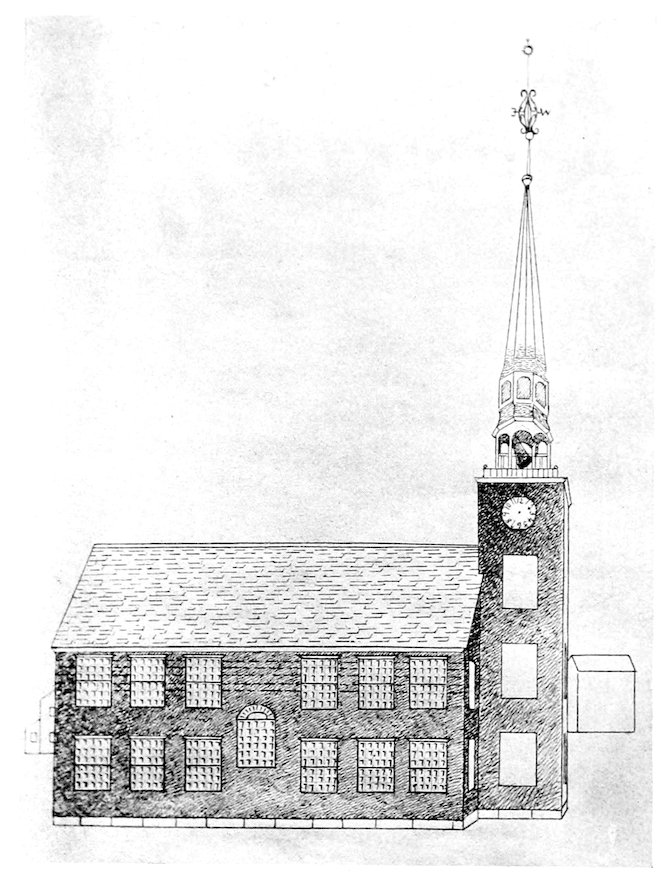
Pl. XXX.—Where Lyman Beecher preached
From pencil drawing by Mary Ann Lewis
The Rev. Lyman Beecher was called to the Congregational Church in Litchfield, and moved there in 1810. From his autobiography, and the writings of members of his family, and the autobiography of Edward Mansfield, the following passages have been culled to show his friendship for Miss Pierce, and his marked influence on the school for some years.
His daughter, Miss Catherine E. Beecher, writes:[43]
“Among those associated most intimately with my father, (Rev Lyman Beecher) and his family during his whole Litchfield life was Miss Sarah Pierce, a woman of more than ordinary talent, sprightly in conversation, social and full of benevolent activity. She was an earnest Christian, and, being at the head of a large school of young ladies, found frequent occasions for seeking counsel and aid from her pastor. In return she gave gratuitous schooling to as many of our children as father chose to send, for occasionally young boys found admission.
“Her school house was a small building of only one room, probably not exceeding 30 ft by 70, with small closets at each end, one large enough to hold a piano, and the others used for bonnets and over garments. The plainest pine desks, long plank benches, a small table and an elevated teacher’s chair, constituted the whole furniture. When I began school there, she was sole teacher, aided occasionally by her sister in certain classes, and by her brother in law in penmanship. At that time the ‘higher branches’ had not entered female schools. Map-drawing, painting, embroidery and the piano, were the accomplishments sought, and history was the only study added to geography, grammar and arithmetic. In process of time her nephew, Mr. John Brace became her associate and introduced a more extended course. At the time father came, the reputation of Miss Pierce’s school exceeded that of any other in the country.
“Thus while Judge Reeves’s law school attracted the young men 180from all quarters, the town was radiant with blooming maidens both indigenous and from abroad.
“Miss Pierce had a great admiration of the English classics and inspired her pupils with the same. She was a good reader, and often quoted or read long passages of poetry, and sometimes required her pupils to commit to memory choice selections. Her daily counsels were interspersed with quotations from English classics. Even the rules of her school, read aloud every Saturday, were rounded off in Johnsonian periods, which the roguish girls sometimes would most irreverently burlesque.
“Her great hobby was exercise for health in which she set her example by a morning and evening walk, exhorting her pupils to the same. In consequence every pleasant evening witnessed troops of young people passing and repassing through the broad and shaded street to and from the favorite Prospect Hill. Of course the fashion extended to the law students, and thus romances in real life abounded on every side. Multitudes of fathers and mothers in this nation have narrated to their children these evening strolls as the time when their mutual attachment began.
“Miss Pierce had a quiet relish for humor and fun that made her very lenient towards one who was never any special credit to her as a pupil. There was one custom in Puritan New England at that day which was a curious contrast to other points of strictness and that was to close a school term with a dramatic exhibition. Miss Pierce not only patronized this, but wrote several very respectable dramas herself for such occasions in her school, and when the time approached, all other school duties were intermitted. A stage was erected, scenery was painted and hung in true theatre style, while all wardrobes of the community were ransacked for stage dresses.”
His daughter, Mrs. Harriet Beecher Stowe, writes:[44]
“Compositions of a graver cast, romantic or poetic, were also much in vogue in the literary coteries of Litchfield. The history and antiquities of the Bantam Indians formed the themes of several ballads and poetical effusions, one of which by Miss Catharine Beecher, and two by the head teacher of the Female Academy, Mr. John P. Brace, were in the mouths and memories of many persons.
“The poetic compositions of this gentleman were constantly circulating among the young ladies of his school and the literati of the place, and there was a peculiar freshness of enjoyment and excitement in this species of native unpublished literature.
181“Mr. Brace was one of the most stimulating and inspired instructors of the Academy. He was widely informed, an enthusiast in botany, mineralogy and the natural sciences generally, besides being well read in English classical literature. The constant conversation which he kept up on these subjects tended more to develop the mind and inspire a love of literature than any mere routine studies. The boys were also incited by his example to set up mineralogical cabinets, and my brother George tramped over the hills in the train of his teacher, with his stone-hammer over his shoulder, for many delightful hours. Many more were spent in recounting to me the stores of wisdom derived from Mr. Brace, who, he told me with pride, corresponded with geologists and botanists in Europe, exchanging specimens with them.
“This school is the only one I ever knew which really carried out a thorough course of ancient & modern history. Miss Pierce, with great cleverness had compiled an abridgment of ancient history, from the best sources, in four volumes, for the use of her pupils; after which, Russell’s ‘Modern Europe,’ with Coot’s continuation, and Ramsay’s ‘American Revolution,’ brought us down nearly to our own times.
“The interest of those historical recitations with a preceptor so widely informed, and so fascinating in conversation as Mr. Brace, extended farther than the class. Much of the training and inspiration of my early days consisted, not in the things which I was supposed to be studying, but in hearing while seated unnoticed at my desk, the conversation of Mr. Brace with the older classes.
“There from hour to hour I listened with eager ears to historical criticisms and discussions, or to recitations in such works as ‘Paley’s Moral Philosophy,’ Blair’s ‘Rhetoric,’ Alison’s ‘On Taste,’ all full of most awakening suggestions.
“Mr. Brace exceeded all teachers I ever knew in the faculty of teaching composition. The constant excitement in which he kept the minds of his pupils—the wide and varied regions of thought into which he led them, formed a preparation for teaching composition, the main requisite for which, whatever people may think, is to have something which one feels interested to say.
“His manner was to divide his school of about a hundred into divisions of three or four, one of which was to write every week. At the same time, he inspired an ambition by calling every week for volunteers, and there were some who volunteered to write every week.
“I remember I could have been but nine years old, and my handwriting hardly formed, when the enthusiasm he inspired led me, greatly to his amusement to volunteer to write every week.
“The first week the subject of composition chosen by the class was 182‘The Difference between the Natural and Moral Sublime.’ One may smile at this for a child of nine years of age, but it is the best account I can give of his manner of teaching to say that the discussion which he held in the class not only made me understand the subject as thoroughly as I do now, but so excited me that I felt sure I had something to say upon it; and that first composition, though I believe half the words were misspelled, amused him greatly.
“As you may see, our subjects were not trashy or sentimental, such as are often supposed to be the style for female schools.”
Having thus begun what was to her the fascinating work of writing compositions, in her tenth year, so rapidly did Mrs. Stowe progress, that her essay was one of the two or three selected to be read at the school exhibition held when she was twelve years old. These exhibitions attracted to them an august assembly of visitors. Of this event Mrs. Stowe writes:[45]
“I remember well the scene at that exhibition, to me so eventful. The hall was crowded with all the literati of Litchfield. Before them all our compositions were read aloud. When mine was read I noticed that father, who was sitting on high by Mr. Brace, brightened and looked interested, and at the close I heard him ask, ‘Who wrote that composition?’ ‘Your daughter, sir,’ was the answer. It was the proudest moment of my life. There was no mistaking father’s face when he was pleased, and to have interested him was past all juvenile triumphs.”
“That composition has been carefully preserved, and on the old yellow sheets the cramped childish handwriting is still distinctly legible. The subject was certainly a grave one to be handled by a child of twelve.”
In the personal reminiscences of Edwin D. Mansfield, we find the following passage:
“Professor Stowe, then a comparatively young man, was also present, and contributed his share to the conversation. He is the best Biblical scholar I ever knew. In recent years he has published his ‘History of the Books of the Bible’ a work of great learning and great utility. His first wife, a New England lady, quite handsome and interesting, also attended the reunions. His present wife, then 183Miss Harriet Beecher, was just beginning to be known for her literary abilities. Two or three years after this time, I published in the Cincinnati Chronicle what, I believe, was her first printed story. I had heard her read at Miss Pierce’s school, In Litchfield, Connecticut, her first public composition. It surprised every one so much that it was attributed to her father, but was in fact only the first exhibition of her remarkable talents. In the reunion I speak of, she was not distinguished for conversation, but when she did speak, showed something of the peculiar strength and humour of her mind. Her first little story published in the Chronicle immediately attracted attention, and her writings have always been popular. Notwithstanding the world wide renown of ‘Uncle Tom’s Cabin,’ her real genius and characteristics were as much exhibited in her short stories as in her larger books.”
“There was no boarding-house connected with Miss Pierce’s school, and as it brought many young ladies into the place, they were obliged to be distributed in the families of the town. It was ever a great object with Miss Pierce to secure places for her pupils in the best families, who should have a good influence in forming their characters. Mrs. Beecher was already celebrated for her success in this respect, her scholars at East Hampton were perfectly under her influence through life. Some of them had even followed her to Litchfield. Miss Pierce was therefore very desirous she should take some of the young ladies into her family and this she did.”[46]
Written after the wedding of Mr. Mason and Miss Betsey Burr, by Miss C. E. Beecher:
On a little gingerbread man that Miss C. Beecher gave Louisa Wait on New Years:
| Miss Chester | ||
| Tuition one quarter | $6 | |
| Entrance $1. School expenses 12½ | 1–12½ | |
| 3 & 4th vols of universal history | 1–34 | |
| $8–46½ | ||
| Received payment | ||
| S. Pierce | ||
| Miss Chester | ||
| To Rev. Dr. Beecher Dr | ||
| To board twelve weeks at 250 per week | $30.00 | |
| Candles | .40 | |
| $30.40 | ||
| Litchfield Aug. 4: 1819 | ||
| Received payment | ||
| for Dr. Beecher | ||
| John P. Brace | ||
If you can imagine to yourself a person travelling in the burning sandy deserts without anything to quench his thirst for a long time finally some one should give him a cup of cold water I say Mother if you can tell what kind of a sensation that produc’d you could have a better idea of the satisfaction it gave me to receive your lovely letter. I am sure Mother you will be willing to devote one hour in a week to give me so much joy in a land of strangers. Respecting my contentment, I am perfectly contented since I have heard such good news from home. My school which appear’d so gloomy when I wrote before has now become a pleasure. I have done with the school for this week. Saturday afternoons I spend in writing to my sweet Groton friends. I have now been here two Sabbaths: the first was rainy; the second I attended meeting and heard the life giving doctrines of the Gospel preach’d by Mr. B.[49] I have taken a class in the Sabbath school which occupies only the time of the intermission. Have you had no news Mother from Elisha. I expected to have heard from him by your letter. There have four ladies arrived in town this week from Georgia for the purpose of attending school here. I want very much to see them; for there is one chance in a hundred that they may know or have heard some thing about Elisha. Litchfield Academy is very popular. There are ladies here from Canada, Albany Vermont New York Massachusetts & Pennsylvania. I see no cause yet to regret that I have come here. I have one advantage over the other boarders here having arriv’d here the first; having a more retire room than any of them; which I consider as a very great thing among such a gay company.
Am I certainly rightly inform’d? Can it be that Mr. Baker is no more. He whose friendship has given me the appellation of sister he who promised usefulness in the vineyard of Christ can it be that he lives no more. With respect to him and Elisha I see the words of scripture in a manner verified the words of scripture two shall be in one bed the one shall be taken and the other left. Your elixur I think it is you gave me has I think been of service to me for the first fortnight 190it rain’d almost successively. I was out to school every day and took some (cold?) but by taking of your drops I am again in perfect health. I hope I shall not forget the God of mercies. Miss Pierce is a lovely woman. Saturdays she devotes to religions instruction. She manifested in a very striking manner her concern for her scholars and her distinguished piety in an observation she made to day which was, “I can truly say that I would be willing to lay down my life this day for your sakes.”
May 30th Sabbath day Rather unpleasant but I have attended meeting to day. On account of meeting I do not think I could be so well suited any where else from home. He does not charm his hearers with his words nor with his person; but takes them up with his subject. This morning he preached upon the excellencies of the christian religion; this afternoon upon the divine Sovereignty. I am much indebted to father for his few lines. I should really like to stay this quarter out if I can be sure of getting through with the expense of it. Respecting painting I find it is considered far from the first and when unaccompanied with the more solid branches of literature it is an inferior branch. Miss Pierce frequently laughs about a couple of young ladies who came here last summer to get an education: they did nothing at all but paint; staid about three weeks finished their education and return’d home. I wish I had some of your sowing here Mother. I have considerable time to work while I am reciting But I am not idle. I have knit considerable. Where is Thomas why don’t he write to me. I intended to have devoted this page to him but my studies prevent me. The other boys must not forget their promise. Give my respects to my friends
I have had the unspeakable joy of hearing my composition read in school this morning. It being among the first that had been read since I have been here you will doubtless think I was all tiptoe about it. Every thing here is founded on system and as fix’d as the laws of the Medes and Persians. We must get to bed at such a time and get up at such a time; and am accountable to my Instructors for almost every moment. I am very sorry that you should reflect upon yourself at all about my journey; for I think it was good for me to have affliction on my journey: and I don’t know but it is one means of making me more contented here. I hadn’t the least idea of being so entirely free from homesickness as I am now. Litchfield is really a pleasant 191place and contains some very pleasant inhabitants and some unpleasant ones: but of the latter class I know but a little. There are students from the southward boarding next door from this studying law. Two of them went into New York state last week to fight a duel. The offence was but a trifle. I shall not complain again that I am too old to go to school; for one of our boarders is said to be twenty eight years old and besides that, which might be discouraging to a person in any Study; she has just commenced the study of English Grammar; I make out much better with study than I expected too when I came from home. Respecting Illinois are you getting ready to go? I’ll endeavour to be ready when you call for me: but I should like to visit poor despised Groton once more. I have not become so cultivated yet but that I could endure the sight of the Thames and its inhabitants. Mr. Beecher went fishing the other day in a pond and caught a noble parcel. They looked so much like home that I felt inclined to scrape acquaintance. I have lobsters or shad once a week. You never need be put to it for matter to write to one for the most minute circumstances would be interesting to me. Every Wednesday afternoon we have lectures in Philosophy. If I had a shirt here to make for you, I would make it while I am hearing these lectures. They are very interesting. My time is wholly taken up. I have to keep a journal and write compositions which with other studies occupy all the time of a moderate genius. Thursdays we have a rare fuss parsing. It takes us more than three hours to parse five lines in common composition. For one word we have to recite from the beginning to the end of Grammar. I have begun to write a letter to Misses ——. intended to have sent it this week but felt rather I must write home. If their friendship has not quite fail’d I shall have a letter next week. I shall write to Norman with them. You said before we parted that possibly Henrietta might come; but I don’t see any thing of her. Give my respects to May. B’s family and to Mrs. Bailey. I have to write a dissertation next week on the advantages of commerce. I wish you would send me your sentiments upon it. I am obliged to be so Sophomoric that I cannot spend much time writing. Do write soon and let me know if you have any news from Elisha. I wish I had my Philosophy here; but it is no matter. Adieu my dear brother may your friend and Protector be the God of Israel; till we shall meet once more. Till then dear brother adieu.
George Younglove Cutler was born in Watertown, Connecticut, graduated at Yale in 1816, was admitted to the bar in 1821. He married Mary Munson, the daughter of Eneas Munson, of New Haven. Judge Daggett was her uncle.
Mr. Cutler practised law in Watertown and New York, then moved to Illinois. Mrs. Cutler named the town Venus, which was changed to Commerce, and finally to Nauvoo, which it now bears. There were a good many Mormons there. Mr. Cutler died, and is buried in the centre of Nauvoo, there being a monument to him with a railing round it. During the period of his studying law with Judge Reeve in Litchfield, he wrote a journal which was to be exchanged with Miss Bellamy for one she was to write. From it the following extracts are given, as they bear upon the life and people of Litchfield, and give us a type of the young men with whom Miss Pierce’s pupils came in contact.
OBITUARY. “Died on the 3rd September at his residence in Hancock Co. Illinois, Geo. Y. Cutler, Esq. formerly of this city (New Haven) a native of Watertown, in this State (Conn).
Mr. Cutler, six years since, bade farewell to home friends and kindred to try his fortune in the West. Leaving cities, towns, and wilderness behind, he planted himself in a frontier settlement on the banks of the Upper Mississippi. Aided, under Providence, only by his own resources, viz. the varied talents of a mind of great native force, his enterprise was just beginning to be rewarded, the desert around him to blossom, and his old home to be forgotten in that of his own creation,—when death came to tell with emphasis the oft repeated lesson, “doat not on earth.”
Mr. Cutler’s physical energies were not adequate to the vigorous activity of a mind ever busy and prompting to arduous effort.—The exposure and fatigue incident to the varied avocations of land-agent and lawyer, merchant and farmer, had for a year or two previous to his decease rendered his health extremely feeble. His sun went down at noon—his life closed in the prime of his usefulness, and sure we are, that the rising village of which he was a member, will not forget him without a tear—his nearer friends, acquainted with his manliness and generosity of his character, will not forget him with one.
“The only thing I noticed, which had undergone no change since I was familiar with it in 1836 and ’37 was Cutler’s grave. It was enclosed with a stone wall, and stood about half a mile from the river—George Y. Cutler was one of the earliest settlers in Hancock County and one of its first County commissioners—dying he was buried at this spot.”
Corrected Revised & Illustrated with Notes by his numerous Friends & Acquaintance. Commenced at New Haven, July 4th 1820. Finished at sweet Watertown Christmas Eve of the same year.
To Miss Betsy Bellamy this Book is dedicated with the most profound respect, esteem & consideration.
You that are not willing to excuse the follies contained in the following pages are uncharitable & ungenerous, illiberal & unwise—more than that you are beneath my notice and farther still, you cannot help yourselves.
July 8th Miss M.[51] I fear you will expect me to go to Miss Tottens with you to day—you must excuse me and endeavor to amuse yourself with Mr. Peck or some other of your numerous satellites—for my part, I intend to run off to what they call a Beach party—if one can be made out—we will go to see Mr. Pinkney and arrange matters.
The youngest Miss Lovejoy looked very pretty. Her sister’s prayerbook full of poetry, among the rest
The same motto came to Caroline Lord at Mrs. Lord’s party last winter—I should like to hear from Caroline.
People of Fairfield County have thin lips, small mouths & small chins. (This remark is merely hazarded)
July 10th. 11 P. M. Messrs. Lovejoy & Nichols, Misses Elliot, Judson & Tomlinson & Booth 8 ladies, Pinkney & myself, a fine time.
194Stratford is justly celebrated for ladies, it is equal to Litchfield & superior in this respect: that awkward ceremony which is there thought to constitute gentility is here despised—I have been very politely treated here. This party was one of the greatest frolics I ever engaged in with girls. Saw the handsomest clouds I ever beheld (They make very fine clouds in Stratford as Miss —— said of the moonshine in Litchfield.)
July 12. The Ball was very pleasant.... Miss Tomlinson does not dance but sat diffidently by and shrewdly said as she saw the heels fly this way & that, “This is solemn business.” I suppose she thought it making a “toil of pleasure as the old man said when he buried his wife.”
... 5 P. M. a pretty little dish of sentiment with Miss E.—am related to her through Parson Beecher of Litchfield.
July 17 10 A. M. Roda is singing—it reminds me of those flute-like tones I used to hear at Gov. Wolcott’s.
July 18 To Derby with Capt. Whitney—tandem to see Mrs. Prince & her boy—poor little fellow—half sick—my old friend K. Beach there. K. likes Mary Peck’s piece—sentiment. Mrs. N copied it.
July 20 10 P. M. have been a good boy today.
July 21 10 A. M. out to Mr. Vanden Heuvel’s place—the prettiest thing of the kind in Connecticut.
5 P. M. Miss M.[52] you are disappointed of a ride with a favorite beau of yours by this shower—I am sorry.
July 22 Miss M.[52] you were becomingly dressed last night because there was less fix about you than common. I like richness of dress but hate ribbons & bows & knots & ruffles & rigmaroles generally speaking I dislike ornaments of any kind. To see ladies loaded with as many foolish kickshaws as are put on now-a-days looks more like burlesque than reality. It appears to be almost a difficult thing for some of them to walk & they are deprived of everything like grace and are more like awkward caricatures than human figures....
July 28 A peep at Miss Hart—the sister of Capt. Hull’s wife—most horribly fashionable in her accoutrements—there she goes [a drawing occurs here in the original with big bonnet and parasol, Plate XXXI.] “It is a very pretty thing, no doubt, to see a young lady dressed with Parisian flowers & Parisian gauzes & an Indian fan & the whole &c. of fashionable array. But I question if this be after all, the style in which a young man of any understanding sees a young lady with most danger to his peace.” (Peter.)
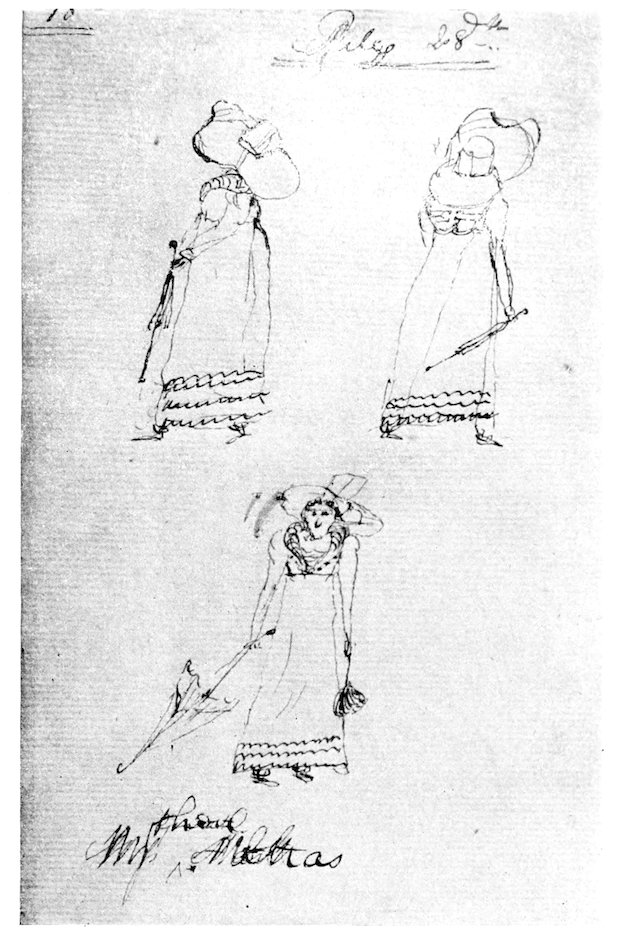
Pl. XXXI.—Pen Drawing from Journal of George Y. Cutler
195July 29 From Sir John Suckling’s poem of the wedding—
July 31 Miss M. has looked well this evening, was not as much beruffled as common—which made her shoulders appear infinitely more to advantage than common.
August 6 A person without a temper is like a knife without an edge, says Miss M.
Aug. 10 [With picture of Miss M., Plate XXXII.] This figure looks very much like a Miss —— not the face merely the form. Miss M. with her cambric hat—over her face—done from memory but the portrait is rather flattering which could not however be well avoided taking into consideration the state of the delineator’s imaginations—the figure is rather too straight—the bonnet does not poke up near enough to the angle of 45°, but it is tolerably well done at least so much so that I kiss it ever and anon.
Aug. 18 Miss Tomlinson (Mary Ann, daughter of Dr. Tomlinson & Sally Hill of Guilford) mar. Rev. —— Mitchell & is now living at Stratford Conn—(where Dr. T. was a practising physician May 16, 1809).
Aug. 18 (Evening) Miss Talmadge here—is certainly elegant—there is no such woman in New Haven—Litchfield is certainly an extraordinary place for beauty—the mountain air gives them the expression of health & that is the principal ingredient—went to see her with M.—She has been at D; was charmed with the romantic cast of the country—true—they have reason to boast of that—it is more like my idea of Scottish-high-land scenery than any other I have seen—but the girls are the pride of the place. A flattering letter from Geo. Jacobs.
Aug. 19th (Morning) Am in trouble.[53]
Capt. Vose says it rained so fast in D. the other night that “it seemed as if the clouds had tipt up.”
196Chief Justice Hosmer is the man who disturbed me with his noise at Dr. Catlin’s—as he roomed under me—he who offered to marry Mary Peck & myself & made us blush—have just met him—he appeared very jolly—“pressed my hand” very hard—& said “be as great a man as Daggett.” A Law Case before my Justice Cupid Black Eyes versus Blue Eyes.
How unfortunate it is to forget faces! I am cruelly troubled in that way—instance the story of Betsey Burr—ask me what that was & I will tell you. Mr. Goodrich from Georgia—an entertaining old gentleman.
Aug. 31st....
I carry my gallantry so far as to say that though a woman ought never to engage herself to a man for any great length of time before consummation of the nuptials, if she can retain her lover without so doing,—yet, if this is necessary, of which she is to be the Judge, & she does so bind herself by her promise to marry, still I go to the length of allowing her to take a better husband, or one more agreeable to her, if she has the opportunity—I give her the liberty of violating her engagement in lieu of her power of choice. Shall women be compelled to take the first creature that offers himself lest they should not find another? Shall they be compelled to love him (on the hand) by denying, when they do not know that they shall ever see another man in their lives, who comes near them, nor have the power of making a selection—this I think is but a fair balance for the great advantage which our sex possess in their opportunities to suit themselves in this important concern—& more, if there is to be an advantage on either side, it certainly ought not to be on ours,—because the contract is so much more important in its consequences to females than to males—for besides leaving everything else to unite themselves to one man they subject themselves to his authority—they depend more upon their husband than he does upon the wife for society & for the happiness & enjoyment of their lives,—he is their all—their only relative—their only hope—but as for him—business leads him out of doors, far from the company of his wife, & it engages his mind & occupies his thoughts so as frequently to engross them almost entirely & then it is upon his employment that he depends almost entirely for the happiness of his life—certainly then, unfortunate, helpless, interesting woman ought to have all the advantage in the matrimonial contract & instead of her present oppression ought to be allowed to make the most of every advantage & opportunity which fortune throws in her way—I will go further & apply the case. I would justify any woman in treating me in that way—provided she did it in a delicate manner—than which nothing is more easy—& which no woman of sense & judgment would fail to do.
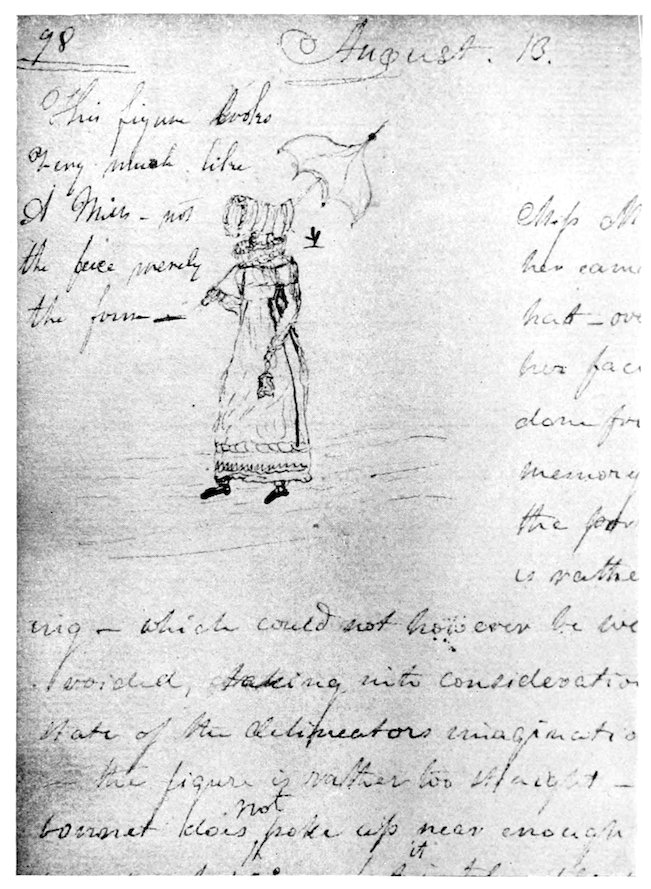
Pl. XXXII.—From Journal of George Y. Cutler
197Sept. 1 This day opens the autumn I love the tranquillity which attends the falling of the leaf—I expect to pass it alone at W—[54] a great part of it in the old lot which lies on both sides of the brook—
Sept. 2. Finished with Mr. Daggett[55]—so life is running away.
So in spite of all your severity towards me—unhappy girl—well I will go & see you when I go to L—— & if your spirits are low, I will say kind things to you—if not, I shall be glad to see it, & will praise your truly almost inimitable beauty—such color has been seldom worn in the dull looking world, & such a complexion has been seldom seen since the days of Cleopatra.
I should suppose this P. girl might also tremble, lest she should meet with a second misfortune of the same kind, as she is engaged to a brother of M. A.’s sweetheart—he is going away to France—the same reasons too will naturally operate in this case as in the other—which can be nothing more than want of fortune & her want of family places her a step farther than M. A. from a connection with a L. Engagements are dangerous affairs—“reason” & love keep little company together now-a-days—Love easily takes possession of a man, but an engagement connected with delay is apt to cool it & when the passion is moderated, it is easily ousted by reason—& often too by something which ought to have less effect than reason—It is probably the interference of friends who have caused the mishap in this case—it can be nothing else but avarice & that is a very dishonorable reason considering his already monstrous estate—if I was an Emperor I would hang such a man. But perhaps there is a better side to his story, I hope so. I remember when he first went to L [Litchfield] I was in his room[56] opposite M. A.’s door—we were looking out & saw them, she & the amiable Hannah—L—— remarked “I suppose these young ladies i.e.: the ladies of this village—depend upon law 198students for their husbands—I will be very careful they do not ensnare me”—within three weeks he was engaged to M. A. & talked to me of Father W. I will write to Fred Whittlesey & inform him of this cruel affair—I know he will feel for the charming girl. It has been reported that L. says “he will go to Europe with a light heart.”
Sept. 3. (Sunday the 17th anniversary of my mother’s death.) She was buried on Sunday.[57] After so long & so cruel a separation how sweet t’will be to meet the spirits of our dear friends in another world! Death is the greatest of blessings!
Sept. 5th A delightful ride to D. with my dear M. She looked sweet, modest, interesting & good—They all appeared pleased with her which gratified me of course. M. enjoyed the visit also. Henry & Lucy Sheldon came there & said that H. L. had disappointed 6 ladies before M. A. W. if so—the wretch ought to be prosecuted says Judge Reeve—Mrs. Pyncheon told me yesterday also that Mr. L. had himself been twice disappointed—M. A.’s feelings may be nice upon the point but her delicacy ought not to prevent his punishment especially since her family is not rich.
Sept. 6 In fine spirits. Evening saw Miss Ogden in church—an enthusiast—....
A Mrs. Dickenson—a Painter’s wife from N. Y.[58] was at Butler’s this morning (note; she was in Litchfield 8 years ago & was visited by the students a great deal....)
Sept. 8. Henry & Lucy [Sheldon] also Hopkins McCracken. 3 P. M. Am full of Duck & feel gloriously, thank heaven. (note: [in another hand] an elevated cause of gratitude!)
Miss Amelia Ogden at Mr. Bristol’s.
“Adonization”—a word used by Peter—manufactured by him, I suppose—from Adonis & used to express the act of “making the toilet” or dandies say, or in other words “bucking out,” “brushing up”—“furbishing”—“making fix” “prigging.”
Old Mr. Williams from the South—a very pleasant man too—have gratified him by telling what an excellent lawyer his son was, who was awhile at L. with me. Mr. Thorn from one of the West Indian Islands says “Wilberforce had an Estate there but disposed of it before he 199procured the abolition of the Slave trade.—Dam him, he ought to have been hung 25 years since.
Sept. 10. The reason why a man puts his left leg in first when he draws on his pantaloons, is, because the operation is such a commonplace one that the man does not stop to call in reason to his aid—now then acting without any principle, he is governed entirely by his most natural feelings—& being a creature naturally averse to exertion he does that which costs him the least trouble—now it is much easier to lift the left leg than the right one—because the left leg being less accustomed (for want of arduous use, which the right leg more frequently undergoes) to being depended on,—it is borne upon with less weight than the right. Also & moreover—the right leg by the above mentioned use & exercise acquires a stouter character, becomes heavier & more difficult to raise—.... [page gone here.—Ed.]
This then is the state of the case—that that faculty or quality or ingredient or component part of the human mind which is called reason—is not brought into operation by the act of adonisationizing the legs with pantaloons, but on the contrary nature & natural feeling are the sole agents in the deed—& the discrepancy which exists between the government of the rules of experience & that of instinct is apparent to every man when he puts on his pantaloons. Gen. Van Rensalaer at table—called the Patroon of Albany, owns an estate which extends 20 miles[59] on Hudson river including the city of Albany—a rich, stern & reputed charitable man—very plain in dress & sober in diet. I should call him a country Justice & perhaps a militia officer.
Sept. 14. [At New Haven] returned from an excellent ball—went with the Lymans of course—liked Miss Woolsey as well as ever & Miss Munson—George Jacobs—excellent fellow was with us. & a Mr. Jackson from Middletown—a man that Miss Talmadge liked—had great fun of course—Mr. Johnston, brother of Betsy’s—But the pleasure of Miss Shipman’s sociability & politeness & dancing & looking at & praising her niece Miss Jones—the sweetest girl in the room, were the substance of my enjoyment.
200Sept. 15 Mr. Benedict of Woodbury & his lady here—she being the sister of Jane Tomlinson, the wit of New Haven. loaded Mr. B. off with nectarines.
Sept. 16. [picture of Hector & Andromache, Plate XXXIII.] Not the parting of Hector & Andromache but of M. & myself on Thursday morning. The sword is not quite as crooked as it should be, & the handkerchief at M’s face is not sufficiently particularized—But it’s a glorious drawing—you have done nobly with your own face particularly the nose. But why does she turn away from you?—to conceal her grief—as maiden diffidence dictated.
Sept. 17 (It being Sunday wore pumps & white stockings to meeting.)
Sept. 18 tore my Angola pantaloons! They will be obliged to be mended with drab—which will not quite suit their complexion. Children of the brain are as dear as living offspring let them be never so homely—& moreover I am acquiring quite a friendship for my law books since they are my only associates except this my favorite crony & patient confident.
Somebody said there was a letter in the Post Office directed to some person in the Estate of Conn.
Sept. 21 to begin this great day was powdered. huzza! here we go, the defenders of our country—but lo my horse has fallen under me & I am with my sword in the dirt & he (careful creature) is bounding in his turn over me without harming a hair of my head—now I am appearing to great advantage—now the girls are falling in love with me—now at dinner Mr. Such a thing whom Lyman & myself saw at the ball & Mr. Law—both from Georgia there—now it is afternoon & I am bounding about—now running our people—now my horse is fatigued—now it is night—now I am dancing at the ball—Mr. Tomlinson there that I look so much like & also Daniel Bacon’s daughters—Julia is handsome—now I am at home & there is a sweet little letter from her that is dearer than the apple of my eye or the core of my heart or the spirit of my breath & I have read it with delight & am in bed.
So George McClellan is growing largely in Philadelphia & married to John Brinton’s sister—it beats the Dutch.
Geo. Jacobs M. calls him my brother “in mischief & wickedness.”
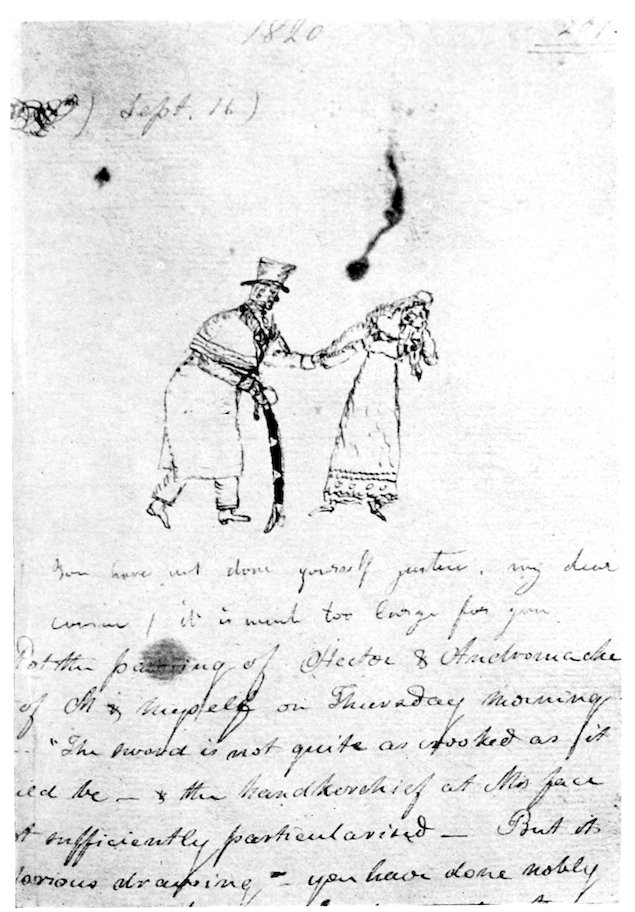
Pl. XXXIII.—From Journal of George Y. Cutler
(Noon) to dine with Lucy—a Miss Davenport from Stamford. At tea at Judge Holmes. Evening a pleasant call on Miss Rogers & afterwards a charming visit at Mary Ann W’s—how interesting! how beautiful! how much improved in her personal appearance. I could 201not help telling her my opinion—In return she reciprocated my compliments—which I always like—she is one of the finest looking females I ever saw—she told me of my interview with Parson Beecher at New Haven—am very sorry to have my conduct in that affair misrepresented or misunderstood—as it is—I never thought of treating his reverence with disrespect.
Thereby hangs a tale [this at Litchfield—E. N. V.]
A pleasant frolic at Dr. Catlin’s [North St.—E. N. V.]
Tea at Miss Collins
Was examined for admittance to the Barr of the Court of Common Pleas & admitted—5 other young men with me—Walter S. Franklin from Lancaster Penna William T. Gould of this place & formerly a class mate of mine at Yale—Thomas Whittlesey of Danbury, Conn—one Humphrey & one Towny—all passed.
Sept. 29 took the oath of an attorney at nine o’clock in the morning.
Oct. 2 in conversation with Amelia Flint.
Oct. 10 John Myers dead—is it he that Sarah Noyes used to talk so much of? What an eternal talker she was! and yet always entertaining—fine girl—I am sorry that she is so unwell as they tell of.
Oct. 19 gathered my winter apples.
Oct. 18 letter from T. Whittlesey characteristically filled with a burlesque translation of one of Horace’s Odes—introducing Bantam’s river which flows gently along making eddies as it goes & says that Taylor has been refused by Miss Swift of Windham, Taylor of Canandaigua (afterward Chancellor Whittlesey living in Rochester N. Y. E. P. Childs)
Oct. 21 A painful day this. Small infirmities vex me severely at times—I don’t sit down with saint like patience—but an ague in my face causes more grumbling & groaning than an age of real misery would—Yet I study quite as much as when well....
Oct. 22 (Draft of a letter to a lady.) Take care of your health—take exercise—attend to the affairs of the house—rise early & cultivate your appetite—I hope to see your waist larger when I next have a view of your otherwise charming-person—My complaint today is an ague in the face, it is a cruel one too. I once all but died with it at Litchfield; to cure it I go without food & take my usual remedy. Laudanum—it is a rheumatic disease. I wish you were here to kiss my cheek & make me well I know you would do it—would you not?
202I am very sorry to hear you say a word about depression of spirits! Be careful not to indulge yourself in repeating such things as will excite no interest in those you may be addressing, but who will perhaps ridicule your troubles; do not talk about the wearisomeness of life & say you wish yourself out of the world. if such things must be expressed put them in your book—there they will incommode no one & you can scar them out at your leisure. I have never met with four persons who were willing to listen to such details. When such sensations oppress you fly from yourself, seek society, go abroad, walk or ride, take up some hard work or read the first book that comes in your way—or do them all—in short put your mind into a different train of ideas.—... run to this letter if you please—when you are in your next fit—read over this part of it, & then fly about the house until you are much fatigued & see if your tone is not altered.
Oct. 24 A mineralogical compliment from Dr. A. S. M. in return for a box of stones sent him—which I collected from the neighboring stone walls, etc. “horizontalizing them” to use his expression, much to the disadvantage of the agricultural interests in this part of the country.
(Evening) was pleased to see in the Journal the marriage of Nancy Hotchkiss [notes the death of] Elias L. Townsend, a school mate of mine at Wolcott & a classmate for a while at College—a fine mind he had. he wrote good poetry.
Oct. 26 Made my debut at pleading before Squire C—opposed by Phelps of Woodbury in 2 cases—lost one of them—liked it on the whole.
Oct. 27 The name Seymour—very common among us—should be spelt Seamer—meaning one who uses a needle.
Sec. 3 Atkins reports page 44....
Nov. 7 Mr. L. & myself to Woodbury. Nate (horse that is) broke loose ran away with the gig—for a mile. Sally Porter (that was) gave us a most excellent dinner—Fortunate man I am that the gig was not ruined.
“Like Sir John Cutler’s stockings our present Constitution is to be darned & mended till not a speck of the original texture is left.” Ev. Post.
It was actually so of the first ship that went round the world.
Nov. 8 went to chace the fox with Jo & Land in a drizzling storm of wind.
Miss Skinner, the Gov. of Vermont’s daughter, at B. De Forest’s says Oliver & Conard are to be married this evening at Miss Pierce’s.
203Nov. 12 a terrible storm of snow, 10 inches deep & not a trifle remarkable for the earliness of the season.
Nov. 13 “The Paddy sat down by a river, saying, I can cross over soon—for it runs so fast that it cannot run long.”
Nov. 16 For the toothache
| 1 | Tablespoonful of | spirits |
| 1 | do | vinegar |
| 1 | tea do | common salt. Ev. Post. |
Nov. 18 Mr. Daggett read me a curious letter of Old Reeve’s. Hunt Stone surmises that L. cheated M. A. W. to revenge an insult of that kind once offered to one of his Uncles by one of her Aunts.
Nov. 19 Charlotte tells me a story of Aunt Hopkins & my mother how they used to “keep house” for Uncle Leman at L——, how they used chairs in those days which were “worked” on the seat by their own hands. & how a great deal of labor was bestowed upon them, & how valuable and fashionable they were—Aunt M. was one day employed in this way & was sitting in the Hall so that she could be seen from the street—Old Parson Bellamy was riding that way & saw the girl thus pleasantly situated & agreeably employed, for she was educated in industry. The good old Priest turned his horse to the door & said, “My child, do you know to whom it is that you are indebted for your present situation? You have the good things of this life about yourselves & it is the prayers of your good mother which has done this for you. I saw you all stand like lambs about her death-bed & I thought the wolves would have you.”
Nov. 20 Mr. John Stirling has been here on his way to see a sweetheart, he looks well & is large & finely formed. Mary Ann Beers is the name of his inamorata—he says J. K. Livingston & Charlotte Landon are to be married this evening.
Nov. 24 Walter S. Franklin Esq.[60] says there was kissing done at Charlotte Landon’s wedding—singular for so stiff & prudish a place as L——
[The following extracts are from his mother’s journal transcribed in his own.—Ed.]
“Jan. 20, 1782. Last Monday we had visitors from Town in Slay. we drinkd tea then Leman sent for a fiddler. we spent the evening pretty enough.”
204She mentions John Talmadge having gone with them to a ball—the same who now lives in Warren (1820) I suppose—he has a daughter Francis.
At another ball “Leman waited on Elizabeth Garnsey.” “Sweet Ireland”
“Just at night Leman came to us Drest & went with us slay & horses across the river & through the snow. at length through a great Deal of tribulation we arrived at Mr. David Deforists, where we had good fires, good Brandy wine & wincom too—our company was not large but we had good Musick which kept those few the busier.”
“Sept. 26. Returned from D. Sheldon’s Sister Rachel came there from Hartford the night after I got there with Noah Webster.”
“It fell to Sam Sheldon to carve. he took up a rib which was taken out of the Pork, & very impolitely tho very innocently said—that was such a thing as woman was made of. Yea, says Polly Hopkins & (in both cases) it was taken out of much such a creature.”
My mother appears to have been extremely fond of scribbling in this way. I may have inherited some of her fondness for the quill. Would to heaven I could have inherited her whole disposition—for I believe it to have been one of the sweetest ever bestowed upon a mortal.
Nov. 28 Went to Waterbury & tomorrow morning before daylight, shall be obliged to be off in the cold—thro’ the snow on horseback to Litchfield—all for this vexatious law—cursed be the day when I first turned my face towards the fields of litigation.
205Nov. 29. It was no killing thing either. Much worse would it be to hang. for the moon was bright, The snow full of reflection, I full of breakfast, & Nate full of fire. While the cocks of the country crowed about us for musick & the stars shot this way & that about the heavens, as if making a display of fireworks for our amusement. All was silent. As we rose the hills & looked back upon the far distance which ran down the valley to the south east, the two extremes of the splendor of the united powers of snow & moonbeams & and the contrasted darkness of the deep ravines into which light would not penetrate, filled the whole view. I often stopped to admire the cold but burnished beauties of the prospect & felt the magnificence of the scene.
I found Geo. up, tho I little expected it when I turned a corner to take a look at his window. I had little thought of seeing a light there at that time of the night—I ran upstairs opened the door an inch and inquired if Mr. Gibbs lived there. Then we laughed ourselves to death & disturbed the neighbors. Mr. Chambers in the backroom inquired who the Devil had come & being told, said, he “thought t’was him.” breakfasted there & told stories till I thought I had told too many.
“William is indeed engaged to Miss Rodgers. Little Taylor,[61] you remember him—he is mentioned in orator Ogilvies book as a rare specimen has killed himself for the love of Miss Swift.”
“Your affair with Parson B. is much misrepresented here & the old women shake their heads whenever your name is mentioned.
I do not blame myself neither does he blame me.
Aaron Burr told a student of his, to rise in the morning with this determination—“As I shall never see this day again I will today do all that can be done in one day.”
“Daggett’s letter pleased Reeve & his family very much.” When I turned my face homeward I felt the inconvenience of 3 pairs of pantaloons, 2 of stockings, 2 shirts and 2 great coats.
Now I think my ride too good a one to grumble about.
Dec. 1 Cousin John good fellow has come thro this piercing wind to bid me goodbye before he goes to New York—that maelstrom, that whirlpool of business into whose vortex so many of our best young men are attracted & drawn away from their own firesides. [New York in 1820!—Ed.] John thinks he has suffered enough from this ride to atone for a great many sins.
Dec. 2 There was a Miss Shephard from Newtown at the Election ball last May—she was the counterpart of some fine looking Indian girl—tall as one of the trees of her native forest, but still not disproportionate 206by any means. She was just as round as she should be—her head as high as it could be & surmounted with a single white ostrich feather[62]—She danced with some grace, stept high as she looked & commanded much notice. I was pleased with the exhibition & so were some others ladies & gents who went with me from one end of the room to the other to have a view of the architecture of her frame & headdress. I thought the girl looked as if she had some notions of her own. Some others who pretended to more than they deserved made flying shot her. Gentlemen always mark down such slights to the score of envy whether dictated by that spirit or not.
Dec. 4 John has laughed all day till he has at last split his jacket. his company has raised my spirits till they have become absolutely volatile. He is teasing me off to bed—that disgraceful spot for a man: Nothing is more demeaning than to be every day obliged to crawl into a nest and vilely snore away one third of that time which is already so short. Nothing but a Sancho Panza would ever consider the practise as otherwise than an unhappy fashion & a shameful employment. It would naturally seem fit for so frail a creature as woman to spend most of her time in this effeminate operation, but for a hearty, hard & healthy piece of stuff like the other rough sex, who is not above it?
Dec. 9 Harry Storrs(?)—grandfather purchased one of the present senators in Congress (Matthew Lyon) for a yoke of oxen from the master of the ship in which he came from England to be sold for his passage.
Dec. 10. (Anent the trial of the Queen) a curse fit for England—“Thy skies over thy head shall be brass & the earth that is under thy feet shall be iron.” Why? Because they deserve all they can pick up. It is impossible to invent enough for them. Sodom contained more good in proportion to its population. The heart sickens at the national corruption of that proud people. Their missionary and Bible Societies are but the beautiful outside of the apple of Sodom which is filled with loathsome ashes.
Dec. 12. It was very cold going to Litchfield—but I reached it—went to Geo. Jacob’s room—Mr. Glover (son of John J.) there—told a story of Mr. Jeffersons how a large turkey was put before a fire within a screen which was high enough to confine him, for he was alive—how a plate of stuffing or dressing was put in each corner—how the Turkey had been kept from food for a few days previous—how 207he went from one dish to another till he was completely roasted & ready dressed.
Ev. Saw a pretty sight at —— Catlin’s went to Mary Peck’s have seldom seen a girl look more kissable. Caroline Lord is not as pleasantly situated as I wish she were. Sarah Denny is not married.
Dec. 15 went home.
Dec. 18 went to L—escaped from the lawsuit by an accident—went to a party at Mrs. Goodwin’s was happy to find the Misses W. there. They were the gems of the circle—Flora was sociable—Miss Lewis animated—Susan Leavitt showed some spirit which became her—Mrs. Gould was civil to me for having taken a poor relative of hers into my gig one day and transporting her a mile or so without knowing who she was. Mr. Austin sang a song of one Miss Pough, &c. it was as good as such things in general—Miss Mary Ann thought she was near being swallowed at the kissing bout which has been held in L——.
Miss Lewis says Susan Leavitt is to marry some priest.
They say Helen was all but kissed to death at the Landons—The wonder would be if she was not. a saw was lost at sea—the carpenter said next day “I can’t forget that excellent saw, it sticks in my gizzard yet.” The Boy ran down to the Captain crying out—“I have found where the Saw is—it sticks in the Carpenter’s gizzard!! A good story & well told by Sam Glover.
Dec. 20 This being at court has some pleasant things about it—it creates at least a little variety in life—this is the second week of it.
21— I sat in Judgment at the examination of Geo. Jacobs—he did finely—it was a matter of course however.
Dec. 22 A little Miss Williams at Dr. Sheldon’s looks pretty.
Mr. Bacon made a funny argument in the lawsuit of the students—Huntington is the best pleader at our bar—particularly in a question of technical law—he does not do as well with facts. He is lazy however & slovenish—Bacon is industrious & rather fond of dress—Benedict is sly.
Came home in the evening—it is now eleven & quite cold—the nails of the house crack.
Here I close this piece of quil driving enjoyment to commence another with Christmas—You that read be not offended—for there is nothing ill meant in all this—but be charitable and be amused if you can—I have been very often and very much so while thus engaged.
In reviewing the occurrences of the past summer & in giving out the rewards promised at its commencement many subjects of reflection present themselves to you. Another season for improvement has elapsed & its influence on your future fate has already been stamped & cannot be erased. Standing as you now do at the threshold of the [school?] & about to bid it adieu forever—pause for a few moments and ask yourselves the question—What have been its uses, its profit, its bearing on your happiness in this world and its effects on your eternal condition—Young persons as they stand in life are too apt to suppose that they have almost an eternity of years before them and that the misimprovement of one term or one year will be of little value—But how idle is such an opinion, how destructive to improvement and deadening to the mind—Even granting that ideas fail’d of being obtained in one year may be accumulated the next—yet the progress in the path of science must be stopped by this unreasonable indolence—Besides the habits of mind given, the power of indolent habits will be sufficient to exhibit the incorrectness of such positions—The mind formed as it is for activity must be constantly exercised in the years of growth—otherwise it will move in a sluggish and indolent course and finally stagnate in its channel—There is no moment when the mind is stationary if not moving onward in its orbit it will retrograde—Hence a continual culture is necessary until the habits of intellectual industry are formed, and the mind can go on in its progress from the momentum of its first impulse—Those of you then who have watched the summer and have calmed your consciences with the notion that after industry will enable you to atone for this neglect—have reasoned from false premises and have perhaps originated those habits of indolence, whose cold and palsying touch will freeze the current of your soul & chain its every future effort—This question then, should be heard with attention and reflection—“Have I this summer by the constant improvement of each hour, accumulated those treasures of science which are so necessary to usefulness & acquired those habits of intellectual perseverance that will render my future progress in science easy”—To those who have not I will repeat that they themselves are the cause of the weakness of mind & want of genius of which they complained & as they have “sown to the wind so they must reap to the whirlwind”—My young friends hear my advice 209whether you continue with us or employ your hours at some other seminary or under the parents guidance—be advised by me to stop the deadly influence of indolence, the disease is now young & can be checked—allow it for a few years & no power on earth can control its lethargy—it will benumb one faculty after another until your understanding “sleep the sleep of death”—We are extremely happy in asserting that a stretch of industry & perseverance rarely equalled in the annals of this school has been exhibited this summer but few are exceptions to this assertion—but to the consciences of those few, I would wish to speak so plainly as to be felt & so powerfully as to govern—What will be the account that God will demand of hours supplied but to be wasted—of talents granted but to be abused—of the light of intellect given but to be shrouded by the mists of indolence. From these few dark shades in the picture we turn to those brighter hues, that have gladdened our eyes and encouraged our hearts—To those who have employed their time to advantage, who have now been sowing that harvest they will reap hereafter, we have many words of praise to give—But the character of our praise & the merits of each can be better learnt by a reference to the prizes & the credit marks—
But there is another light in which the flight of time this summer is to be viewed—When industry shall have accomplished its object & indolence shall have performed its office, when the stream of time shall have emptied all its waters into the ocean of eternity—indeed long after this world with its own peculiar concerns & trials shall appear “as some lone island speck seen far—far off across a wide long stretch of sea”—will this summer be remembered with pain or joy, as its time of probation has been improved—Have you any good reason to suppose its remembrance will be painful—If the occurrences of this summer have not induced your repentance & reformation, will any after considerations effect them—Is there great reason to imagine that hearts that have resisted the providences of this season will still resist them when habits of sin have increased its power and the chains of the world wound themselves more closely round. Will God be more merciful hereafter, when you have sinned longer against him—But will that hereafter arrive? Are none a prey to death as young, as strong as blooming as you? Where now is all that was Clarinda Darling, whose sun at this summer dawn rose as clear as bright as yours? mouldering beneath the clods of the valley—Will you not pause one moment and leaning over her grave resolve that e’er death strike you, you will give yourselves to God—Do you think that strength of frame & vigor of body will secure from the tyrant’s grasp, & then after neglect your repentance?—Who three months since so blithely bound’d on your 210path to school as she? Whose frame so vigorous & whose strength so strong? Can beauty save you—Look at her grave & ask—
Can intellect stay the dart? If native strength of mind & intellect’s opening promise could e’er have stopped the power of death, Clarinda would have heard me this day. Seldom in the course of my experience have I found at such an age the promise
To a memory of quick & ready powers she joined a comprehension and grasp of mind at her age rarely equalled—sure she was young her intellect was dawning, but it was a dawn of vivid light—a dawn that promised a bright & glorious day of mind—Be advised then in your attention to other duties not to neglect those you owe to God—We have seldom dismissed a school with the regret we now do—You have marked this summer with a persevering industry, an attention to our commands & a regard to our feelings that will lead us to hold you long in remembrance—But the time of our control over you has elapsed & we send you from us with most ardent wishes for your future usefulness & happiness in life & hopes that we all shall meet in that world where those who assemble “meet to part no more.”
According to your request I have taken my pen to communicate a few remarks, which long experience has taught me, have a great influence on the character of youth. A German writer justly observes, “that no one can labor for himself, without at the same time laboring for all others, or labor for others without favoring his own interest, the increasing welfare of each being the increasing welfare of all. For each to consider himself a member of the great connexion that embraces the family of man, adds much to his feeling of interest in being.” Each mother may say to herself, I am not a useless being, I have been the instrument of introducing into this world an immortal being—a soul that must be happy or miserable to all eternity—what a solemn thought, what a responsible situation do ye mothers hold in the great chain which extends from the first breath inhaled by our first parents, to the remotest point of eternity. 211All that is great or wise or good among men, (with a few wonderful exceptions), is planted in infancy. Parents are therefore the benefactors, or the curse of society. As you fulfil your duties to your children, the prosperity of your country, the happiness of the world, and the glory of the church, will increase or diminish. Say not then to yourselves I am poor, illiterate, and can therefore do no good; if you have the training of one mind, you have a treasure committed to your trust of more value than the mines of Peru. The servant who had but one talent, and did not improve it, was cast out into utter darkness—he was not punished for wasting his Lord’s money, but for not increasing its value. Thus some parents think it sufficient to clothe and feed their children and protect their bodies from harm, but do not think of training their immortal minds for usefulness in this world, and to promote the glory of God, and the happiness of heaven through the endless ages of eternity. Think then when looking upon your infant offspring, I owe to this child all the obligations laid on me by former generations—the wise and good men who laid the foundation of this mighty empire whose names are signalized in the history of the world, who amidst persecution, toil and danger, planted churches, founded colleges and schools, enacted wise and equitable laws, and were the benefactors of the human race. I am come into their harvest, I tread upon the same earth, which they cultivated, I am enjoying the blessings everywhere spread around by their wisdom and industry. They have finished their work and gone to that rest prepared for the faithful servant. I am now bound in duty to them, my country and my God to take up the sublime task which they imposed on themselves. They have ceased from their work; but I have greater facilities and a wider field for action. I can bring to greater perfection than they had the power of performing that magnificent undertaking of making our common race wiser and happier. And how is this to be done—by training up children in the fear of God—by teaching them to deny themselves to both luxury and pride, by inspiring them with true patriotism to prize the good of their country above their own private interest, to fulfil the scripture rule, of loving their neighbor as themselves. Selfishness is the great destroyer of human happiness. A selfish person is always uneasy, he is even jealous of the attention he receives from others, for he rates his own merit beyond the standard it deserves. This principle often extends to a whole family; the parents love their children, not for the virtues they possess, but because they are their children,—they are never afflicted at the danger impending over their neighborhood or country, unless it threatens them with loss of 212property or some inconvenience. They will not unite in any of the benevolent societies of the age, because if they give they choose to do it according to their own whim and not to be confounded with the vulgar—so that their charities are the offspring of pride, not of benevolence—and can such beings ever enter heaven where all is love? If this selfish spirit prevailed in every family, would there be anything great or good performed in the earth? I call upon parents who love their country, who love the cause of Christ to begin early to eradicate this principle of our sinful nature. As soon as a child begins to desire the playthings of its older brothers or sisters teach it to be content with its own portion of toys, and frequently give up his right to another, praise him for every act of self-denial, and frown upon him for every act of selfishness. The method pursued in some Sabbath schools is highly commendable, to give your children an opportunity of earning a cent each week to place in the charity box at the S. School, and when you give your children money encourage them to bestow it on some good object, either in the purchase of some useful article, or to benevolent purposes. Never permit your children to spend their money in the purchase of dainties to please the palate; it will not only destroy their health but create a desire of self-gratification, which in the end may lead them to glutony and drunkenness. Begin early to teach them the shame of thinking much of the pleasure of the table—relate to them pleasing stories from sacred and profane history of the heroes and Christians who rose above the pleasures of animal nature, and amidst the temptations of a court subsisted on the simplest food. Daniel and his three friends and Cyrus are two excellent examples. Enforce your precepts by examples of the disgusting effects of glutony in some of the Roman emperors and of others in later times, that they may learn early to prefer the intellectual to the animal nature. Do not give your children as a reward an orange or a bit of cake; it will give them a love of good eating, but if they have been good take them to see some curious animal, beautiful garden, or some interesting works of art, or present them with a useful entertaining book. Often oblige them to perform acts of duty when their inclinations are opposed to it—for instance, if your child is engaged in an interesting play, and it is the proper hour for study, or you have some act of labor for him to perform, and he is unwilling to leave his sport, state to him mildly....
(Miss T.) You are much engaged, my young friends, may I ask what subject you are discussing?
(Emily) We have been disputing whether men or women have the greatest influence in the world, and which contributes most to the benefit of the community. Mary contends that men justly claim that honor, as they rule nations, command armies, and perform the principle part of the active labor, which contributes to the sustenance and comfort of society. I have been endeavoring to prove that the tasks assigned to women though not often of so public notoriety are not the less important.
(Miss T.) It would give me pleasure to hear what arguments you have both advanced.
(E) I have thought, madam, that though men are the ostensible rulers of the world, their counsels and actions are often the result of female influence. I know at least their bad actions are frequently instigated by weak or unprincipled women. Was not Adam persuaded by his ambitious consort to eat of the prohibited Tree? Was it not the depravity introduced by the beautiful, but vicious descendants of Cain, which brought on the Deluge? And in every period of the Jewish history do we not find women sustaining a conspicuous part? Deborah was not only a distinguished ruler, but a commander of the armies of Israel. The city of Abel was saved from destruction by the wisdom of a woman, when Joab pursued after the rebellious Sheba. The Israelites were saved by the wisdom and courage of Judith, when they appeared on the verge of destruction. It was the influence of depraved females which destroyed the wisdom and power of Solomon, and the idolatry introduced by the daughter of Jezebel withered the prosperity of the kingdom of Judah. I could mention many other instances both in ancient and modern history were it necessary, to prove that in every age of the world, the influence of women has had great weight in national affairs.
(Mary) Emily has mentioned a few acts of heroism performed by women during the existence of the Jewish nation, but in that long period how many wise and great men displayed their talents for the benefit of mankind. I therefore contend that illustrious women are like comets which appear but seldom, and therefore surprise and astonish by their brilliancy, while men of virtue and talents like planets are always visible in some part of the moral hemisphere, and by their constant light are of more use than the most dazzling star whose 214rays are seldom seen. I think, Miss Trusty, you must decide in my favor.
(Miss T.) It is of little consequence, my dear young friends, whether men or women have the power of rendering most benefit to the world, but it is of the utmost importance that we perform all the good in our power, and use the talents God has bestowed upon us to improve the happiness of society. But few of our sex are called to act a conspicuous part on the grand Theatre of life, but our influence in community is notwithstanding of immense importance. Most men are so entirely engrossed by business as to have but little opportunity of fully understanding the characters of their children; this can be done only by the mother. She has it her power to plant the seeds of vice or virtue and an awful responsibility rests upon her, if she does not exterminate every root of evil as she perceives it springing up in the heart or temper of her children. Many amiable and pious women have permitted the seeds of selfishness, ambition, revenge and deceit to spring up in the hearts of their offspring, by false tenderness and partiality, a fond mother who imagines that her children will love her more ardently if she indulges them in all their early wishes, and thus prepares them to repine at the necessary evils of life, while the mother who habituates her children to self-denial, prepares them to meet every cross accident with cheerfulness. She will teach them honor exists not in resenting, but in forgiving injuries, and thus guard their young minds from imbibing the false and fatal vice of duelling. That true greatness lies not in titles or wealth, but in advancing the cause of religion. She will be careful to search deeply into the characters of her children and guard them against those lighter faults to which they are naturally inclined, as well as those deeper sins which easily beset them and is never turned aside by false tenderness from crossing their desires if they tend to evil. She not only prays daily for them, but with them. She begins with the first dawn of reason to teach them the obligations they are under to God, their parents, their near relatives, and their fellow beings with whom they have intercourse. And when their capacities are sufficiently enlarged, she will endeavor to impress their minds by expounding the doctrines of the Gospel, as connected with its precepts. Nor does she confine her instructions to religion, but imbues their young minds with human science and literature; for this end she studies the best authors, that she may be able to point out to her children their beauties and defects, and thus store their minds with sound ideas and solid principles, and fit them for acting on the scenes of busy life with firmness and dignity.
Would every mother in this intelligent and free nation thus carefully 215train up her children, we should soon feel its beneficial effects, not only in private life, but in society. It would produce Davids, Edwards and Dwights to adorn our pulpits and colleges, Washingtons, Madisons and Jays to fill our military and civil offices and Brainards, Eliots and Mayhews to disseminate knowledge and religion among the heathen. A faithful mother not only points out the road to virtue, but arduously guards her offspring against the dangers of dissipation in all its various forms. The theatre, the gaming table, and the midnight revel, would not open the gates of the bottomless abyss, to so many of our deluded youth, had their mothers with agonizing eloquence warned them to shun those dangerous inlets to the infernal regions, when as yet the world had not cast its iron chains around their hearts, while their minds were in a degree pure and spotless, and their bosoms glowed with love to her who bore them. It is not enough to plant moral principles in the heart and to warn the young against the baleful effects of dissipation—the syren tongue of pleasure will often lure the youth of lively temper from the paths of virtue, unless pleasing entertainments are found at home to relax the mind. Women who have the arrangement of domestic amusements should seek to procure such as are innocent and improving not only to induce their children, but their husbands and brothers, to delight more in the domestic circle than in the most elegant public entertainment. And would mothers, wives and sisters exert their talents as much to please their own family as they do to entertain strangers, we shall see fewer husbands, sons and brothers resorting to public places for amusement. I cannot elucidate this theory better than by giving you the history of one of my earliest friends. Mrs. B—— possessed a superior understanding which had received the highest improvement that a solid and polished education could bestow. These advantages were rendered more pleasing by the charms which pure and ardent piety cast around her sincere.... Her husband was so much engaged in public business he seldom found leisure to assist in the arduous task of training up their three sons to usefulness. Mrs. B. early discovered that her sons possessed uncommon eagerness of spirit, and would be easily led astray by the arts of the designing and flattering multitude, who swarm around young men of high rank and large fortunes. She therefore devoted her time and talents and all the power of her mind to guard them against the dangers which surrounded their path. While infants in the mother’s arms she began to form their tempers and check their too glowing sensibility by teaching them to bear and forbear with each other’s petulance and to submit with patience when any disappointment occurred. I remember finding her one morning with books, pictures and children’s 216toys scattered around her; she made an apology for the litter in her parlor, saying as it was a holy day, she felt it her highest duty to entertain her children, lest they should desire to resort to the common among their school companions, where they might acquire habits that the exertions of maternal influence would never correct. I endeavor, therefore, she added, to select their associates and devote my time to enliven their amusements, that their home may be the happiest place on earth to them, and truly I never beheld a happier group of youthful faces than at that instant entered the room, from a short run they had taken in the garden, each one begging Mrs. B. to come and walk with them, and teach them the names and history of the flowers and birds as she promised them. When the sons of Mrs. B. had reached that period of life when childish amusement becomes insipid, and as young men they wished for higher entertainment, she invited an orphan niece to reside with her, whose amiable manners and polite accomplishments, assisted to enliven the family circle. Musick, painting and the most sprightly and interesting conversation gave a zest to each hour not devoted to study. Mrs. B. gave frequent entertainments to prevent her high spirited sons from resorting to public places for amusement. The charms of intellectual conversation were never more fully displayed than in Mrs. B.’s parties. Men of the most enlightened minds and most shining talents thought themselves honored to be admitted as her guests. And none received that favor but those who possessed unblemished morals. She was particularly careful to select as companions for her sons young gentlemen and ladies who were more distinguished for talents and virtue than for rank or wealth. By these means she formed the taste and matured the judgment of her sons and preserved them from the dangerous allurements of the gay and dissipated circles they would otherwise have entered and which would undoubtedly have proved their ruin.
Her prayers and her exertions have been fully answered for their spiritual as well as their temporal interest. They are now active promoters of religion both at home and in foreign countries, united to intelligent and pious wives and displaying those manly virtues which justly entitles them to rank among our most distinguished citizens. Nor was the bright example of Mrs. B. lost on her husband, who in early life had imbibed infidel principles. She was greatly afflicted when she found the husband whom she so tenderly loved, was not only indifferent to religion but a disbeliever in Divine revelation; his respect for his wife’s weakness (as he thought it) prevented him from expressing his contempt of religion in her presence, but she easily perceived his sentiments were perverted, and strove by her conduct to 217prove what influence it produced on the heart and temper. She never obtruded her principles upon him, or reverted to his want of faith. But in a severe affliction which befell them, he saw and admired the fortitude which sustained his pious wife, while he felt only the repinings of discontent. This led him to wish that there was another and happier state where he should again meet his beloved and only and uncommonly lovely daughter, who had been snatched from them at the interesting age of four, when the infantile prattle is most dear to a parent’s heart. Mrs. B. seized upon these moments of affliction and by her mild and forcible arguments prevailed on her husband to read the Scriptures and attend public worship. When he read or heard any doctrine advanced which he disbelieved or perverted, her lucid and simple explanations accompanied with the tenderest expressions of affection, convinced him of his error and removed his doubts. Her prayers in the meantime ascended hourly to heaven for his conversion and were heard by Him who has promised that the prayer of faith shall never be offered in vain. Mr. B. had sought for happiness from wealth, from the approbation of the world; his political and military talents raised him to the highest summit which ambition desired, but he found the temple of happiness was not there, and he sought it before age had palsied his feelings in the bosom of his family, in communion with his Redeemer and in employing his great abilities for the extension of knowledge and truth. Mrs. B.’s example and instructions were blessed to all who were so fortunate as to reside long in her family. Her domestics were patterns of honesty, industry and piety. But she did not confine her exertions to her own family,—the poor looked to her as their protector, her alms were always accompanied with suitable admonitions and many hardened sinners have been brought through her influence to humble themselves at the foot of the cross. She engaged with ardor in all the benevolent societies of this day of enterprise. Like Mr. Frey she visited the abodes of infamy and guilt, on her tongue dwelt the words of persuasion and kindness, and many outcasts of society were brought by her means to abandon the paths of iniquity and return to the abodes of virtue and blessed the day which led Mrs. B. to visit their wretched cells. Age has now silvered her head and destroyed the bloom of her cheek, but the virtues of her heart and the exalted intelligence of her mind have stamped a loveliness upon her countenance which the withering hand of Time cannot destroy, and though seventy years have shaded the charms of youth, she is a more interesting object to her husband and friends than she was at the fascinating age of seventeen.
(E.) You have in the history of Mrs. B. shown us how a married 218woman possessed of wealth and intelligence may exert influence, but what can be done by the young and inexperienced.
(Miss T.) Young women have the power of extending the knowledge of religion by aiding the charitable institutions established for preaching the Gospel, those who are rich by their contributions and influence. We have not many women who like Lady Huntington devote all their income to that noble end, but I am happy to know a number, who though they do not leave themselves destitute of a change of apparel (as Lady Huntington often did) yet clothe themselves in the most simple attire that they may bestow what others expend in jewels and fashionable dress, in promoting the cause of their Redeemer.
Miss Julia T—— receives a moderate allowance from her father, who is a man of the world and wishes to see his daughter dress in the most fashionable style. Julia conforms to his wishes so far as to appear neat and elegant in her attire, but at the same time practices such strict economy as enables her to bestow a great part of her little income in charity. Her expensive dresses are never worn except to please her father, or when ceremony requires a splendid attire. She can with truth apply the words of Queen Esther to her own feelings: “Thou knowest O Lord that I abhor these signs of my high estate,” and Julia not having any family to employ her time devotes all her activity in promoting the cause of Christ. She not only contributes largely herself, but influences others to support the Gospel, not only in their own city and country, but in evangelizing the heathen. Her hands are daily employed in making garments for the poor, or for the benefit of education and missionary societies. The sick, the afflicted....
A free government like ours can only be supported by the virtue of its citizens. The ancient governments were destroyed by the vices of their subjects. Greece and Rome ceased to rule the world when their citizens became corrupted by luxury and sloth. It is indispensable to the existence of a republic to be moral and religious. Who then can calculate the beneficial effects resulting from the early habits of piety and morality planted by maternal wisdom upon the rising generation. And may we not hope that the daughters of America will imitate the example of the Spartan and Roman matrons in the day of their glory, who taught their children to love their country beyond every earthly object, even their own lives. Then shall we find many a Pederatio (?) 219who will rejoice that there are three hundred citizens more worthy to fill a part of honor than himself. May we not hope that by cultivating the solid rather than the ornamental branches of education, our young women will emulate their sisters in Europe in moral and intellectual acquirements, that on this side of the Atlantic Hannah Mores and Mrs. Sherwoods will arise to instruct and enlighten the world and justly merit the high enconium pronounced by Gov. Metcalf of Kentucky. “It is true that woman....
Among the poor and middling classes of society a dangerous ambition is excited which every lover of their country and religion should endeavor to suppress. Many of the wives and daughters of our mechanics and day laborers expend all their earnings in dress and furniture, and thus deprive themselves of the pleasure of contributing to the extension of Christianity. Those who have professed themselves to be the followers of Christ should remember, that when they took the vows of God upon them, they engaged to devote their time and talents to his cause, and the small sum bestowed by the poor will meet as great a reward as the large donations of the rich, and it will be said to the daily laborer who spends all his earnings upon his own pleasure, as well as to the rich, for as much as ye did it not to one of the least of these my disciples, ye did it not to me. The greater part of the funds raised in England for the extension of the Gospel are from the poorer classes of society, and she who can prevail on these classes in our community to contribute to this noble enterprise will aid much in the extension of the Gospel.
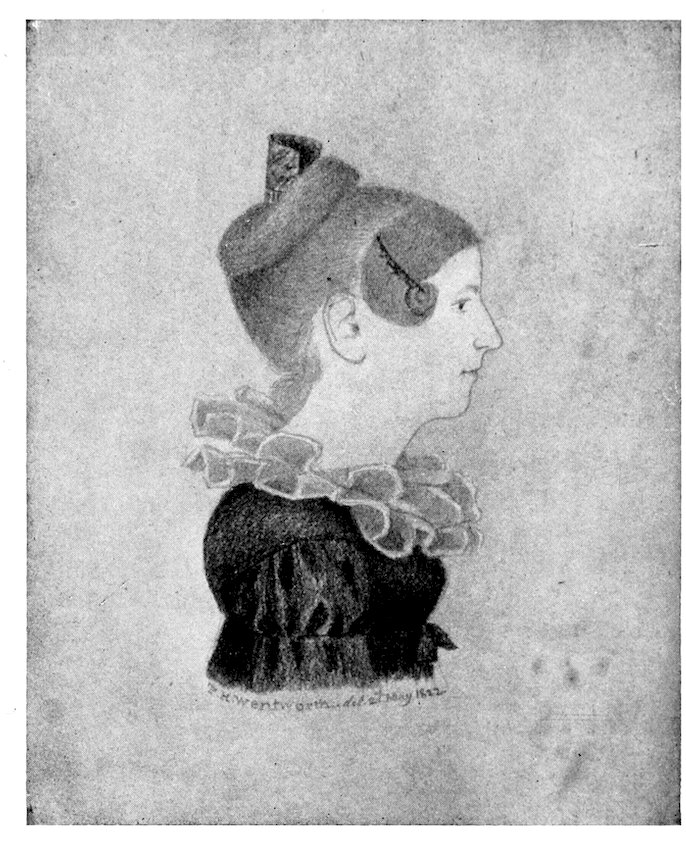
Pl. XXXIV.—Jane R. Lewis
From pencil sketch
The young gentleman played on their flutes under the window of each Lady after they had retired and this was the compliment Sarah paid them
Continuation of Journal for the summer of 1820.
Sunday morning Mr. Beecher preached from Gen. 7th Chap. 1st & 5th, “And the Lord said unto Noah, come thou, and all thy house into the ark; for thee have I seen righteous before me in this generation.” 222“And Noah did according unto all the Lord commanded.” In about 15 years God looked upon the earth, and saw there was great wickedness, and he said “The heart of man is evil continually, every imagination of man’s heart was evil” and he said “I will destroy man whom I have created, from the face of the earth, both man & beast & the creeping things & the fowls of the air for it repenteth me that I have made them” but Noah found grace in the eyes of the Lord and he said unto Noah, make thee an ark of gopher wood; rooms shall thou have made in the ark & shall pitch it within & without with pitch.” As the ark saved Noah, so will Christ save all who trust in him. Noah by faith prepared him an ark to save him from destruction, so also may Christians prepare the souls of their children from the bonds of Satan, It has pleased God to prescribe duties to parents & it has also pleased him to save those who believe on him. At the appointed time when all needful preparations had been made Noah was directed to enter with all his family: into the ark: because the Lord had “seen him righteous before him in that generation” the apostle says that he “became heir of the righteousness which is by faith, The same principle which induced him to believe, on the testimony of God, & contrary to all human probability, that the deluge would come at the appointed season, led him also, on the same testimony, to expect the day of judgement & perdition of ungodly men, this moved him to flee from the wrath to come, as well as to prepare the ark; & as he believed that, in the ark alone he could be safe during the approaching deluge; so he doubtless believed the revelation of a saviour, & sought & expected salvation through him alone. The duty of God requires that he that exercises faith for his children shall be saved, Noah exercises faith for not only his children but for all mankind, he preached 120 years for their salvation but what effect did it have “God has made provision in the covenant of grace for our children. Before the deluge Noah’s family was the only one who could say, I keep thy commandments. What relation should we exercise toward our children. In order to bring our children to Christ we must first come to him ourselves “God has mercy on whom he will have mercy” It is necessary to bring them to a covenant with Christ. The piety of parents is necessary to bring their children to a peace with God. When children are in great danger parents who have no religion themselves may feel interested for the welfare of their children, and when parents die & have no heavenly comfort, they feel for them & repent if their past life has not been spent to the salvation of their children.
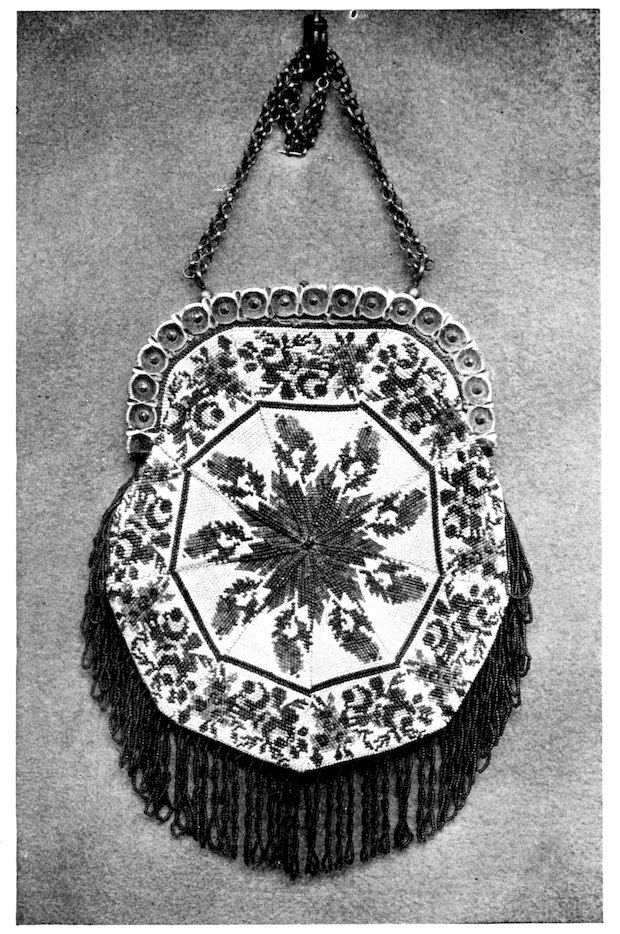
Pl. XXXV.—Bead Bag made by Jane R. Lewis, 1829
“What shall it profit a man if he gain the whole world & lose his 223own soul,” heavenly treasures are eternal, but earthly riches are but few & transient. Happy they who are a part of Christs family, and safe with him in the ark, they may look forward without dismay, & rejoice in the assurance that they shall triumph when a deluge of fire shall encircle the visible creation, but, unless we dare to be singular, & renounce the favor and venture the scorn & hatred of the world unless we be willing to submit to self-denial & diligence, we can find no admission into this ark
Sunday afternoon Mr. Beecher preached from Hosea 10th. 1st, “Isreal is an empty vine, he bringeth forth fruit unto himself” Isreal has often been compared to a vine, but the nation was become an empty vine that bringeth forth no fruit to perfection. They not only spent their abundance on themselves but even their apparent good works sprang from ostentation, or other selfish motives, & not from regard to the glory & the will of God. We shall consider first that there is a difference between love & selfishness. We exercise more love to ourselves than to our neighbours & this is termed selfishness. 2nd. modification of selfishness is to love to God. God loves his children if we keep his commandments.
Sunday evening Mr. Brace read a sermon.
Monday we were examined in the third volume of Sacred History and recited in Modern Europe.
Tuesday sums were given out.—
Wednesday morning recited in Logic and Modern Europe, afternoon I went over to see Roxana Clark along with Maria C.
Thursday was parsing afternoon, no division beat as several had the same.—
Friday was examination day.
Saturday Miss Pierce gave us some very good instruction.
Sunday morning Mr. Baldwin preached ... evening I attended conference, Mr. Baldwin read a letter from Mr. Beecher concerning the revival at New Haven & delivered an exhortation—
Monday to Saturday nothing particular happened. I attended school and recited my usual lessons in Logic & Modern Europe—& attended to the usual occupations of school, mornings & evening’s generally devoted to study.
Saturday afternoon took a short ride.
Sunday morning I attended meeting heard Mr. Hooker preach—Evening attended conference—The remainder of the week was spent the same as usual.
Sunday morning Mr. Beecher preached—Evening Mr. Beecher gave an account of the revival in New Haven.
224Monday was examined in 3rd Vol—of Universal History
Tuesday forenoon recited in Logic & Modern Europe & wrote, afternoon Mr. Brace gave out sums. I did not have the good luck like others of my companions to get a sum done—evening took a short walk.
Wednesday was field-day—I had the great pleasure of seeing a Louisania Parawra or Black Bear—
Thursday was parsing day Miss Rogers division beat—
Friday was examined in Modern Europe, Logic & the Coast.[64]
Saturday my name was called, I cared more for the lecture that I expected than the miss for ciphering, but it was short, much more so than I expected.—
Sunday morning Mr. Beecher preached.—evening attended conference.
Monday forenoon recited in Logic & Modern Europe afternoon was examined in Third Volume of Universal History & spelt.
Thursday took the coast & recited in Logic & Modern Europe.
Wednesday was holiday evening Betsey & Elizabeth both went to walk with me.
Thursday afternoon were called to parse, our division has beaten twice this summer. evening Betsey & Elizabeth went with me up to Mr. Brace’s. We spent the evening very pleasantly with Ann Jones & Margaret Mix.
Friday morning took the coast & were examined in Modern Europe afternoon examined in Logic & The Coast, the latter I did not miss in evening was spent in writing journal & coast.
Saturday the credit marks were taken in & I had about an hundred for writing etc.
Sunday. Mr. Beecher preached morning & afternoon. Sunday evening I attended conference
Monday was examined in Chemistry missed three times afternoon in Modern Europe did not miss.
Tuesday morning finished being examined in Modern Europe & was in afternoon examined in Universal History.
Wednesday was examined in Universal History all day & missed considerable.
Thursday was examined in lectures in Astronomy. Philosophy &c. by having two weeks journal to copy I have missed the wrong weeks journal, This week I have been attending school & preparing myself for the general examination
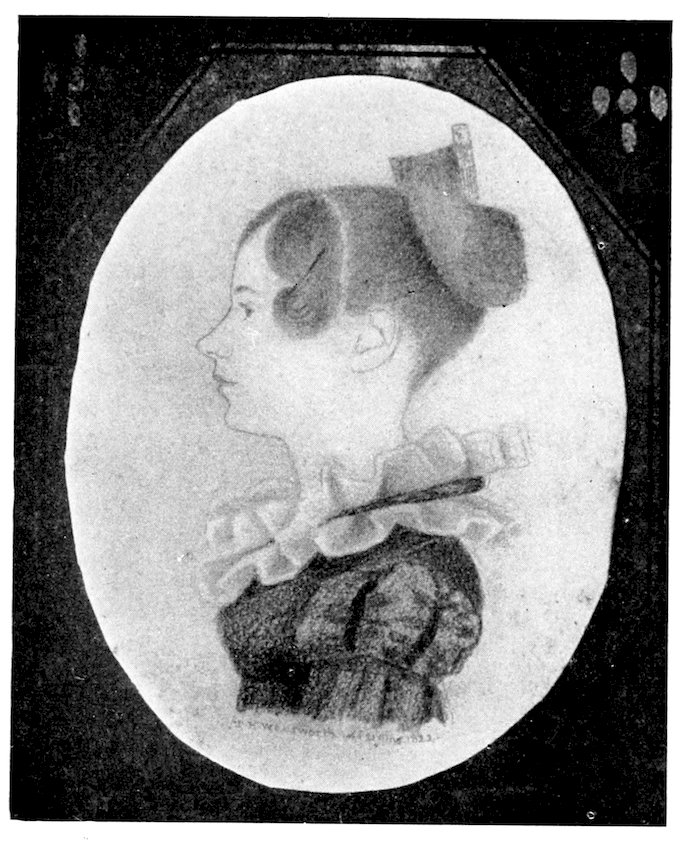
Pl. XXXVI.—Mary Ann Lewis
From pencil sketch
225Sunday morning attended meeting. Mr. Beecher preached morning & afternoon. Evening attended conference.
Monday was examined in Chemistry & Modern Europe.
Tuesday was examined in Modern Europe & Universal History.
Wednesday was examined in History.
Thursday in Paley, Philosophy & Logic
Friday in Philosophy, Arithmetic & Rhetoric.
Saturday in Grammar
Sunday Mr. Mills preached
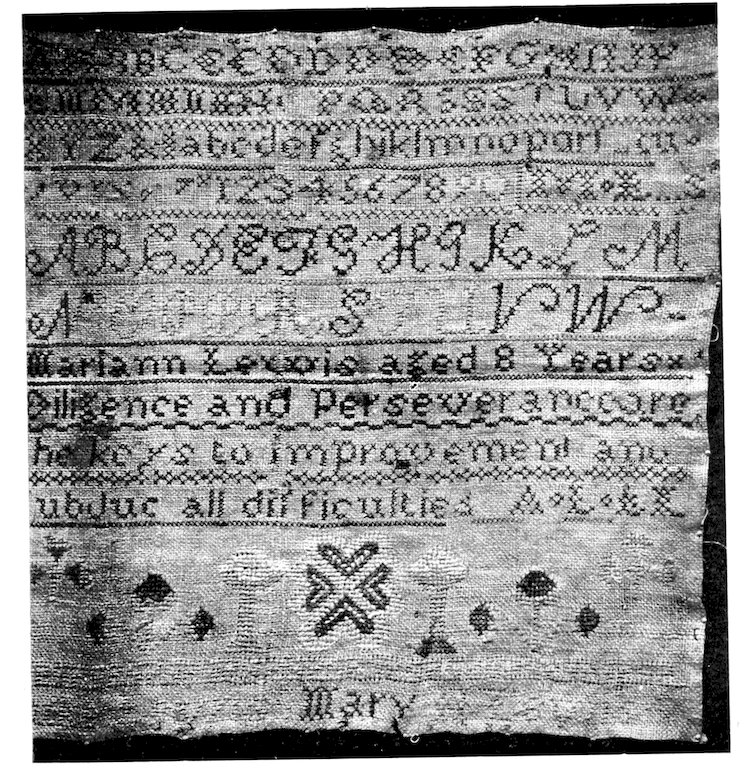
Pl. XXXVII.—Sampler of Mary Ann Lewis
Approaching the falls from Buffalo on the Canadian shore, the first indication of our proximity to them was a hoarse rumbling, which was scarcely audible at the distance of four or five miles, but which opened upon the ear as we advanced, with increasing roar, until at the distance of three miles, it became loud as the voice of many waters, a column of mist in the mean time descending as smoke from a pit marked more definitely than sound could do, the exact position of this scene of wonders, the sublime arising from obscurity was now experienced 227in all its power, it did not appear what we should see, but imagination seized the moment to elevate and fill the mind with expectation and majestic dread. Within a mile of the falls the river rolls smoothly along in rapid silence, as if unconscious of its approaching destiny, till at once across its entire channel it falls the apparent distance of 10 or 12 feet, when instantly its waters are thrown into consternation and foam & boil & whirl & run in every direction, as if filled with instinctive dread, at this place the shore recedes, and allows the terrific waters to spread out in shallows over an extent twice as broad as the natural channel of the river—A portion of the waters as if hoping to escape, rushes between the American shore and the island, (whose brow forms a part of the continued cliff which on either side constitutes the fall), and too late to retreat discovering the mistake hurries down the precipice and is dashed on the rocks below. This is the highest part of the fall, and broadest, nearly approaching to the beautiful; the waters being shallow and the sheet entirely white below.
Another large sheet of contiguous water on the other side of the island undecoyed by appearances and apparently desperate by an infallible premonition, attempts no evasion, but with tumult & roar, rushes on and thunders down the precipice which stretches about half across to the Canadian shore. The rest and the largest portion of the river, as if terrified by the fate of its kindred waters, retires a little but scarcely is the movement made before the deep declivities of the river’s bed summons the dispersion of waters into one deep dark flood which rolls its majestic tide upon the destruction below. The shallow waters, which as yet have escaped, cling terrified to the Canadian shore, reconnoitering every nook and corner in quest of some way to escape, but their search is fruitless, and they come round at length reluctantly, and are dashed upon the death they had so long struggled to escape.
It is at the junction of these two sides of the cataract, nearly in the form of two sides of a triangle, rounded at the point, that the most powerful sheet of water falls. The depth of the water in the channel above & as it bends over the precipice cannot from the nature of the case be ascertained. I should judge from the appearance that it might be from 15 to 20 feet—The color of the part of the stream is black, as it bends over the cliff and descends, at the intersection of the two sides and for several rods on either hand it becomes a deep and beautiful green which continues till the column is lost in the cloud of mist that ascends before it. With respect to the impression made by the view of the falls, it may be observed that whoever approaches 228them anticipating amazement at the descent of the water from a giddy height will be disappointed. It is the multitude of waters and their power as they roll & foam & thunder which arrests the step, suspends the breath, dilates the eye, lifts the hand and fills the soul with wonder. It seems to be the good pleasure of God that men shall learn his omnipotence by evidence addressed to the senses as well as the understanding & that there shall be on earth continued illustrations of his mighty power, of creation, we ascertain by faith & not by sight; the heavenly bodies though vast and distant roll silently in their courses. But the earth by its quakings, the volcano by its fires, the ocean by its mountain waves and the floods of Niagara by the majesty of their power and ceaseless thunderings proclaim to the eye & to the ear & to the heart the omnipotence of God. From their far distant sources & multitudinous dispersions He called them into the reservoirs of the North & bid them hasten their accumulating tide to this scene of wonders, & for ages the obedient waters have rolled and thundered his praise. It is as has been stated, where the two lines of the precipice meet, that the deepest and most powerful sheet of water falls, but it is here also, just where the hand of Omnipotence is performing its greatest wonders that the consummation of the work is hid. What the phenomena are when the stupendous torrent strikes at the foot of the falls, no mortal eye hath seen, a mist rising to nearly half the height of the fall, is the veil beneath which the Almighty performs his wonders alone, and there is the hiding of his power. This is the spot upon which the eye wishfully fixes and tries in vain to penetrate, over which the imagination hovers, but cannot catch even a glympse to sketch with her pencil. This deep recess is the most sublime and awful scene upon which my eye was ever fixed. There amid the thunderings & in solitude & darkness, from age to age Jehovah has proclaimed, I am the Almighty God.
In beholding this deluge of created Omnipotence the thought, how irresistible is the displeasure of God, rushes upon the soul. It requires but a little aid of the imagination to behold in this ceaseless flow of waters, the stream of his indignation which shall beat upon the wicked in the gulf below the eternal pit, & in the cloud of exhalations, the smoke of their torments which ascendeth up forever & ever. And nothing but the warbling of unearthly voices seems necessary to make one feel that hell and destruction is uncovered before him.
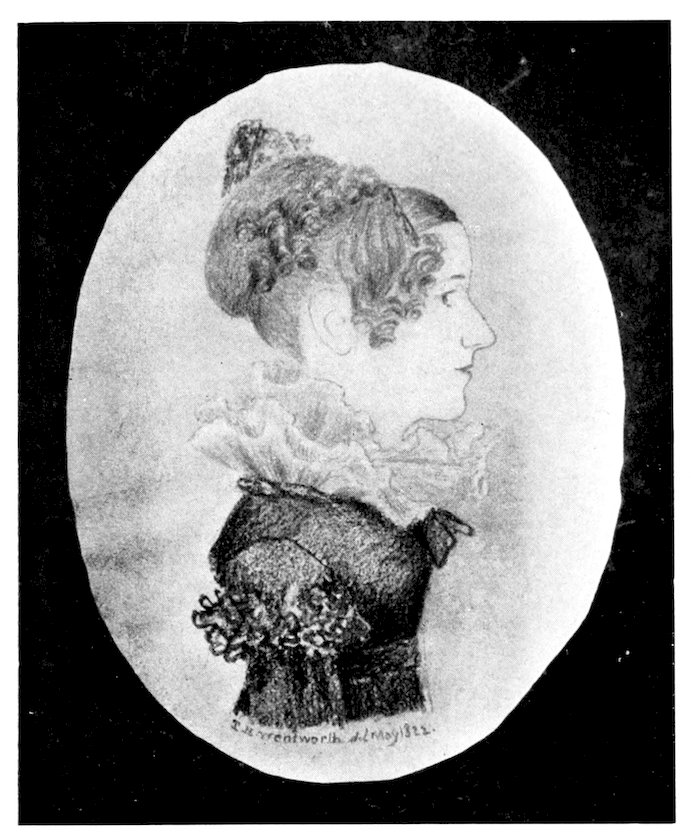
Pl. XXXVIII.—Louisa C. Lewis
From pencil sketch
With these associations, all is dark and terrific & dreadful, till from the midst of this darkness and these mighty thunderings the bow, 229brilliant type of mercy, arises, and spreads its broad arch over the agitated waters, proclaiming that the Omnipotence which rules the stream, is associated with mercy as well as with justice.
17th. Every person is forbidden to tell or be told in lesson.
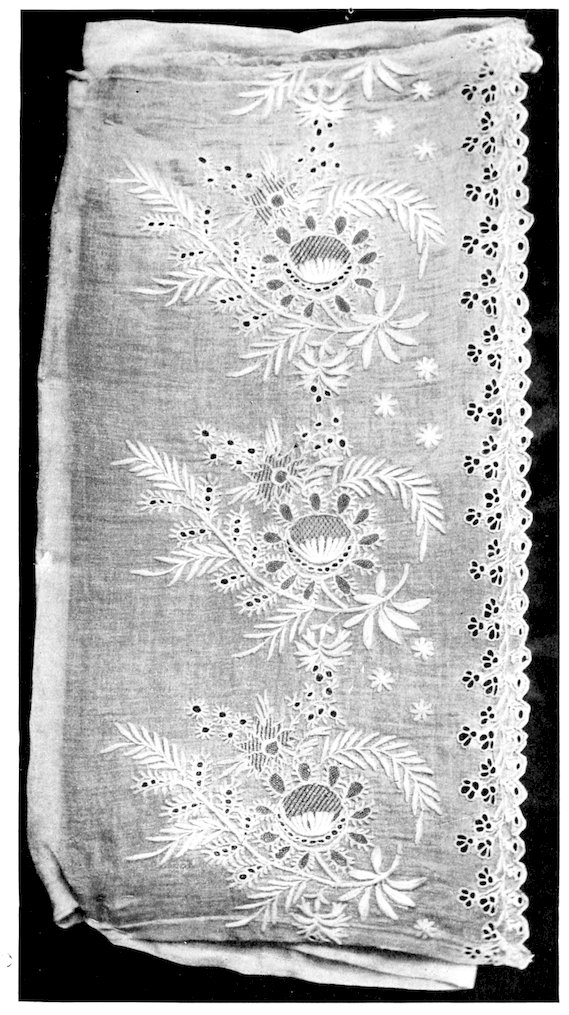
Pl. XXXIX.—Embroidery of Louisa C. Lewis
Speaking or moving once without permission, or with, will take off the extra—and more than once will give ¼ of a miss. Two hours holy day lost for noise. 30 credit marks lost for homesickness.
(A definition of politeness). Persons truly polite will treat their superiors with respect and deference; their equals with affability and complaisance. They will never smile at the mistakes of those who may be more ignorant than themselves; will never make sport of the faults or follies of their companions, much more at their misfortunes, but will on all occasions treat others as they would be themselves. They will never be boistrous or rude in their manners, will never talk or laugh loud, will avoid all vulgar and profane words as mean and sinful. They will never consider loud laughter as a mark of wit; or romping as indicative of sprightliness.
(1) You are expected to rise early and be drest neatly, to exercise before breakfast and to retire to rest when the family in which you reside desire you to and you must consider it a breach of politeness if you are requested a second time to rise in the morning or retire in the evening.
(2) You are requested not only to exercise in the morning but also in the evening sufficiently for the preservation of health.
(3) It is expected that you never detain the family by unnecessary delay either at meals or family prayers; to be absent when grace is asked at table or when the family have assembled to read the word of God and to solicit His favour discovers a want of reverence to His 232holy name a cold and insensible heart which feels no gratitude for the innumerable benefits received daily from his hand.
(4) It is expected as rational and immortal beings that you read a portion of the scripture both morning and evening with meditation and prayer, that you never read the word of God lightly or make use of any scriptural phrase in a light manner.
(5) It is expected that you attend public worship every Sabbath unless some unavoidable circumstance prevent which you will dare to offer as a sufficient apology at the day of Judgment.
(6) Your deportment must be grave and decent while in the house of God and you must remember that all light conduct in a place of worship is offensive to well bred people and highly displeasing to your Maker and Preserver.
(7) The Sabbath must be kept holy no part of it wasted in sloth frivolous conversation or light reading. Remember dear youth that for every hour, but particularly for the hours of the Sabbath you must give an account to God.
(8) Every hour during the week must be fully occupied either in useful employment or rational amusement while out of school: two hours must be employed each day in close study and every hour during the week must be fully occupied.
(9) No person must interrupt their companions either in school or the hours devoted to study by talking, laughing, or any unnecessary noise.
(10) Those hours devoted to any particular occupation must not be devoted to any other employment. Nothing great can be accomplished without attention to order and regularity.
(11) The truth must be spoken at all times, on all occasions though it might appear advantageous to tell a falsehood.
(12) You must suppress all emotion of anger and discontent. Remembering how many blessings God is continually bestowing upon you for which he requires not only contentment, but a cheerful temper.
(13) You are expected to be polite in your manners, neat in your person and room, careful of your books and cloths, attentive to economy in all your expenses.
Persons truly polite will treat their superiors with respect and deference and their equals with affability and complaisance. They will never be boistrous or rude in their manners will never talk or 233laugh loud will avoid all vulgar and profane words as both mean and sinful. They will never consider loud laughing a mark of wit or romping indicative of sprightliness. They will never smile at the mistakes of those who may happen to be more ignorant than themselves, will never make reports of the fault and failures of their misfortunes, but will on all occasions treat others as they would have others behave to them.
(14) Talebearing and scandal are odious vices, and must be avoided: neither must you flatter your companions by remarks on their beauty, dress or any slight accomplishment in order to increase their vanity.
(15) While you are forbidden to report things to the disadvantage of your companions, you are at the same time requested to inform one of your teachers if you know of any conduct deserving of reproof not from malice but a true friend lest the fault should become a habit too strong to eradicate in future.
(16) Every person is bound to conform to the rules of the family where she resides. She must never go out of an evening without the permission of the heads of the family where she resides, read no books, engage in no amusements without their knowledge and approbation.
(17) Speaking or moving once whether with or without liberty will take off the extra and more than once will give ¼ of a miss. Two hours holiday lost for noise in the same week will take off 30 credit marks.
(18) Every person is forbidden to tell or be told in their lessons.
The course of study prescribed for those who wish to take degrees will consist of the following branches—
Morse’s Geography, Webster’s Elements English Grammer, Miss Pierce’s History, Arithmetic through Interest, Blair’s Lectures, Modern Europe, Ramsey’s American Revolution, Natural Philosophy, Chemistry, Paley’s Moral Philosophy, Hedge’s Logic and Addision on Taste.
If any person wishes to obtain the last honors of the school it will be necessary for them to have finished this course, and to have accomplished it in order. Should any person wish to study any of these branches to the exclusion of the rest they are at liberty to do it but they will be considered as having declined being candidates for the degree.
The candidates must answer 8/9 of their questions in all branches in General Examination. They must at no time have lost their whole holiday and in order to ascertain this they must have credit mark. They must never have lost more than one hour of their holiday for the same result in their certificate, must never have lost 3 hours holiday for noise and must have to be shown at the close of the school three months journal or eight dissertations.
Went this morning to visit the remains of the once lovely and interesting Miss Helen Peck who died yesterday after a severe illness of five weeks. Went to her father’s house this P. M. but as I could not get a seat returned home quite disappointed—do not feel in very good spirits. Went down to the Bantam last evening. Misses Austin, Perkins, and myself fell into the water. going to B. met a poor little boy who was an idiot, who was very interesting. I ought to be very thankful my life and reason are spared me! and may I make a good use of these great blessings! ... Mr. Brace read dissertations today, and Miss Austin’s was pronounced the best. I am very glad, for I think she deserves all the praise that is bestowed upon her. She possesses quite a talent for writing; and expresses herself very handsomely. Mr. B. read one of his own compositions, which was elegantly written. Shall be almost ashamed to present mine to him but my turn will not come until week after next, and I will not anticipate evil.... It thunders & lightens very vividly & loudly, but the bell rings and I must go to church, for I expect Dr. Beecher will be very eloquent, for he is very much interested. Half past 8. Was just ready for church when Miss Shelton brought me my letters but was so much overjoyed I could not go.
Miss Pierce is expected this afternoon and I hope she will come, for the whole household will be very glad to see her. ½ past 6. P. M. An old man is now here with pictures at which we look with a perspective glass, which improves them very much and renders them very interesting but they would be much more so if some of the scenes were from our own country, for he had none of American scenery, but as he is an Englishman it is perfectly natural that he should be fond of showing his country in as favorable a light as possible. I had twelve credit marks for doing one sum in Reduction.... Went upon prospect hill with Misses Averill, Brace, Buell, & Clarke and had a very pleasant walk. There is a most delightful prospect from prospect hill. We went upon echoing rock, it is astonishing how long we can hear the echo—I like Miss Buell very much. She is very polite and obliging. She is from Burlington Vermont, a niece of Mrs. Lynde Catline of New York. I hope I shall have the pleasure of seeing her at our house when she comes to New York to visit her aunt.
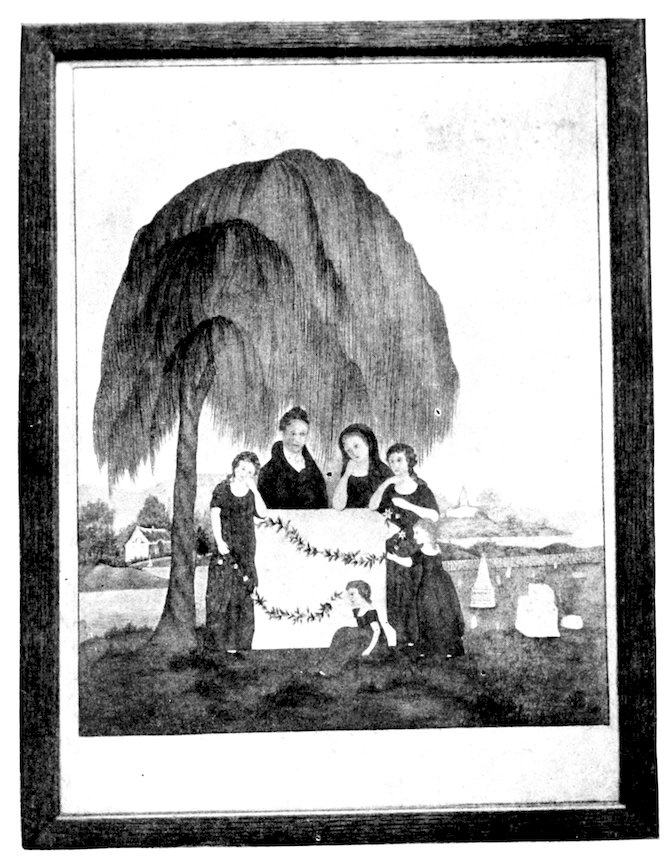
Pl. XL.—From a Water-Color by Amelia Lewis
235On our return home we found Miss Pierce had arrived from Boston. Miss Brace received good news from her friends. I am very glad for she is quite homesick, and I hope the letter will serve to dispel it a little. I went to the Post Office with Miss Averill but we did not go in, for it was very much crowded with gentlemen. I do not think it is quite proper for us to go to the postoffice so often but still continue going! May 30th, arose at a quarter past six and exercised before breakfast which will entitle me to an extra.
Miss Pierce entertained us at breakfast with an account of Cambridge college also a singular gothic chair which was presented by some one in England to the college. I know I shall be happy this summer I like Miss Pierce very much and I am sure she will do everything in her power to render me so. Spent the afternoon in Martha Denison’s room with Miss Perkins. Martha read aloud in “The Son of a Genius” by Mrs. Holland a very interesting book which is written in a pure and concise style.... We do not recite rhetoric for it is the day set apart for parsing. Miss B. has left our house for that of Dr. Sheldon, probably because her friend Miss A boards there and she always appeared dissatisfied but that probably proceeded from her never having been from home much. It certainly could not be that she did not receive sufficient attention for Miss Mary was very kind and did everything in her power to amuse her—
...On my return from the post office, took a long walk with Miss Austin. I think I like her better than any young lady that boards at Miss Pierce’s. She is possessed of a superior mind and I think has paid some considerable attention to the cultivation of it.... We met no other person that we knew except D. B. who is the most unpleasant creature I ever knew....
Do not expect any letters to-night for the mail does not come from dear New York on Fridays. 25th Miss Pierce wishes us to speak dialogues or short pieces but I do not wish to and hope she will not insist upon it.... We have just received the heart rending account of the loss of the packet-ship Albion Capt. Williams, of New York, bound for Liverpool. Among those that perished was Mr. Fisher professor of Mathematics in Yale College. Mr. F. was engaged to Miss Catherine Beecher, and his untimely end is severely felt and greatly deplored. After having undergone all terrors, and supposing themselves 236out of danger, and even in sight of land, it was indeed awful, not only to have all hope dashed to pieces at a blow, but the “boon of life” taken suddenly away.
Attended church all day. The weather was very unpleasant. Dr. Beecher prayed very affectionately for Mr. Fisher and all on board the Albion who found a watery grave.... Missed only ¼. ½. in all my morning lessons. Wrote a dissertation this forenoon On the uses of history, a subject on which I have had but a few ideas. Misses Reeve, Tufts, Mrs. & Miss Lord took tea with us—H. Buell & myself went home with Miss Lord. We had great sport.... Mr. Brace had all his bugs to school this P. M. he has a great variety, two were from China, which were very handsome, almost all the rest were of Litchfield descent, and he can trace their pedigree as far back as when Noah entered the ark. Spoke to Mr. B. of Aunt Julia. He recollected her perfectly, said he thought her very beautiful.... Miss Austin has a great deal of humour but her spirits are easily depressed. I should like to fathom the character of my bedfellow Miss Buell for I think her a singular girl, she has a singular peevishness of temper which is very unpleasant; I do not know but that is her only fault, for she is a very pleasant companion, and that excepted she is a very agreeable girl.
Miss Austin has just come in and being in very high spirits she makes so much noise it is impossible to write.
Wrote to aunt J. the dearest aunt I have, also the dearest friend.
Anna Maria Perkins of Ohio also sleeps in the room with us, she is a very good companion and peculiarly amiable.
6th June—Arose before six o’clock, made my bed, swept my room, which will entitle me to an extra.
Have this day commenced learning “Robin Adair,” hope I shall be able to play it soon. This is examination day and I have many long and hard lessons to recite. We think of going to Canaan tomorrow. If it is pleasant we shall go at six o’clock in the morning. I do not know who will accompany me, but I think Miss Austin and two Misses Tufts, we had expected the pleasure of the company of Miss B. and Miss P. but Miss B. will go when her friends come, and Miss P. will not go for reasons unknown. I do not think it quite polite in her to refuse to go when she knows that the pleasure of the party depends in a great measure on her accompanying us, but mum! I fear I am often, too often guilty of more impolite conduct but
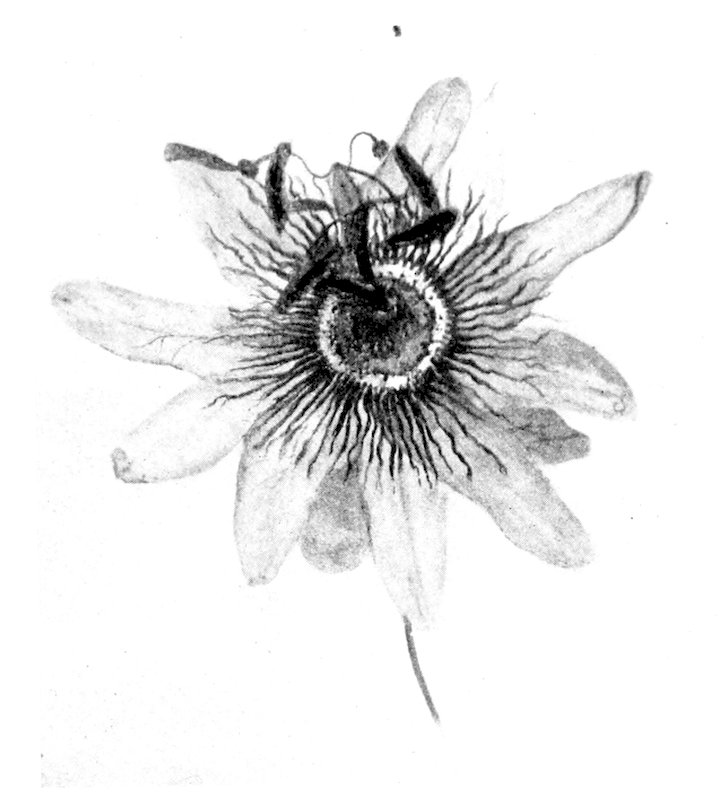
Pl. XLI.—From a Painting by Amelia Lewis
If Miss Emily Addis will furnish us with a small, or rather, a large quantity of eatables to carry with us (for we intend staying all day) we shall go in great style.... Went down to Mr. Brace’s to see Miss Betts on so important a subject as our trip to Jubilee from Mrs. B’s we went to Mr. Lord’s to get Mrs. B’s permission for Miss B to accompany us—and from there M. Denison and myself returned to Mr. B’s, from there we went to the drivers to give divers other directions, and after having thus settled all necessary preliminaries to our each every and either satisfaction we have once more returned to the North Turret of St. Pierce’s Castle. We were in high spirits this P. M. Miss Denison was Caroline Wilhelmina and I was her cousin Edwin, just returned from Europe. I gave Caroline an invitation to accompany me to the Theatre. She in her character of Caroline is very interesting but very ignorant. We dressed accordingly; M. Austin was the actress. She was in a graceful kneeling posture, I said “encore” Caroline had one of her wise looks, when happening to look up I saw Miss Pierce standing in the door, a silent spectator of the farce before her. We felt rather awkward, but Miss Pierce dispelled it very soon by one of her good natured laughs.... June 10th W. has just returned from New York. She is not so very unpleasant as she has been represented to me. As I expected she is rather affected but she may possess many good qualities which I hope we shall discover to her advantage. Went down to the Bantam to day Misses Austin & Beebe in search of mint.... Went on board-[walk] a great place of resort for the fashionables....
The bell rings for nine. I must bid you “good night” my dear Mama, although you cannot hear me.
June 22nd 5 o’clock At six we go to Canaan. I expect the carriage every moment. My “companions at arms” are Misses Denison, Austin, and Misses M and S. Tufts, & Miss Weyman.
½ past 7. We have just returned from Canaan. It is between twenty and thirty miles from L. the road passes through a delightful country. We sang most of the time some of the tunes were Mary’s Fears, Blue-eyed Mary, Love’s young dream, There’s nothing true but Heaven. Happiness seemed to reign over our little party & was never expelled, excepting some of the party were a little sick, and this sickness seemed to flee away when we were singing.
In some places we had the distant view of a little village, at others the hills appeared to rise one above another and behind some of [?] the spire of a church could be indistinctly seen.
238When we arrived at Canaan we proceeded immediately to the falls. The bed of the river (the Housatounoc) appeared composed of one solid stone which was almost flat. The river was so low that in some places there would be perhaps 15 feet of the rock which would not be overflowed. The view of the falls was the most grand that I ever saw. The water does not fall perpendicularly over the rocks but in a sloping direction.
The falls are 60 feet in height. We wandered about some time and then returned to the carriage to dine. we all scrambled into it with sharpened appetites. After dining, we after great difficulty provided ourselves with fishing apparatus, but did not succeed as we expected for not one of the party caught a single fish. We wandered about sometime admiring the romantic scenery, until by the length of our shadows we perceived it was time to return to our abode. On our ride home all the fields were covered with ivy, and Barnes [Hiram?] our driver decked the horses and carriage with them. At length, without accident we arrived at Miss Pierce’s very much fatigued but in high spirits. Where Miss Weyman found a letter from her mother who resides in Jamaica.
Examination day has again returned and of course I am very much engaged, but Mamma’s letter made me almost sick for she thinks me homesick but really am not, when I am in good health which is the case at present. I succeed tolerably well with my music and can play Robin Adair with much grace and dignity.
Mr. Hurlburt wishes me to reserve a corner of my letter and Miss Mary must have another to assure Mamma of my industry, application, and attention to my studies.
15th Today we choose seats according to the number of credit marks that we have. I had 93 credit marks and one “extra.”
I have just heard from my old acquaintance Harriet Seelye of Cherry Valley. She is cousin to Miss Shelton, an amiable, pleasant, intelligent young lady who has lived in New York for a number of years last past. Miss Shelton’s mother is sister to Mrs. Seelye. Lorenzo Dow, The famous Methodist preacher, is to preach in Mr. Jones’ meeting house this evening. I have a violent curiosity to see him, but I fear it would not be proper for me to go.
Went to the Lodge Library with Miss Frances Smith.... Just returned from a visit to Misses Betts & Shelton where Miss Perkins and myself spent a very pleasant evening. Miss Pierce has come for the candle and says she fears we shall lose our extras in the morning for early rising.
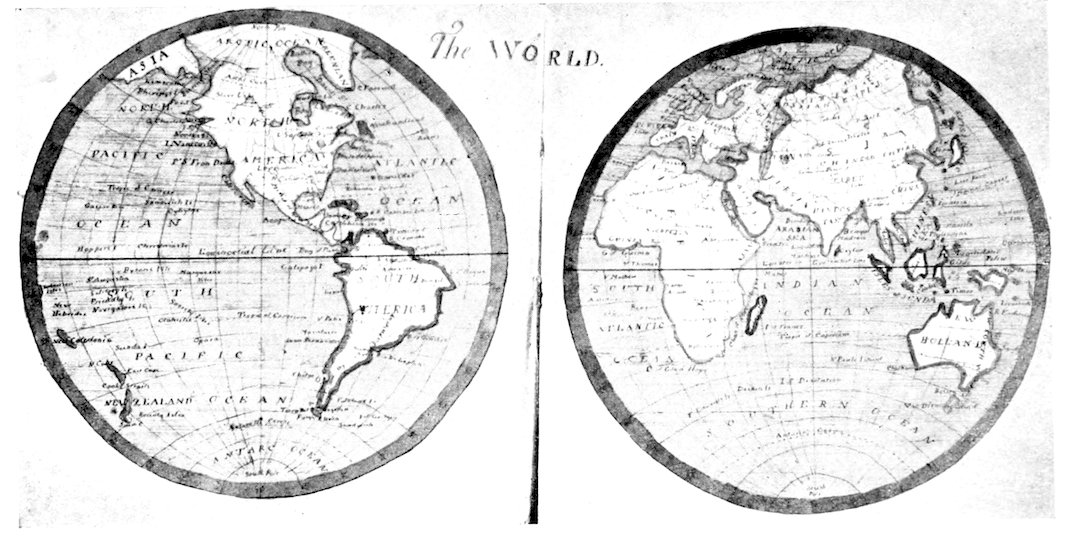
Pl. XLII.—From a Colored Drawing by Amelia Lewis while at the School
... It is again Saturday and a most delightful day. Miss Austin 239and myself have just come to school P. M. Dr. Beecher delivered to us a very affecting address, and I hope we shall profit by his advice.
... The text this P. M. was “Pray without ceasing” Dr. Beecher was unusually eloquent he appears very much engaged in the “good cause.” His church is increasing very much and great attention is paying to Religion and every one appears interested and a great many meetings are held every week. Miss Buell, Miss Perkins and myself went to take a walk after dark and left Miss Austin at home all alone.
After our return Miss P. and myself went to a meeting which is attended every Sabbath evening at our schoolhouse, but the room was so crowded we could not get seats. So we returned to our house, Miss P. to her writing and I to the studying of my lesson in history for tomorrow.
Tuesday. This P. M. Mr. Brace will propose a sum and I fear it will be very difficult. All those that study Blair are under the necessity of writing figures which is very difficult. Mine were left until the last and of course they were pretty well selected, for it is Mr. B’s rule to leave the best until the last.
... Mr. B. read figures yesterday and he selected five from the parcel, as being selected with the most taste and judgment, and I had the pleasure to perceive that mine was among the “priveleged few.”
I have engaged to keep the paper this week which I fear I shall find rather a difficult task. Mr. Brace was passing my desk and saw my journal. he said he had kept one since 1806. I should think it might be very interesting.
Mr. B reads subjects for dissertations, for the week in which I am appointed the subject is “The causes of dreams” which I think a very easy subject.
We have the pleasure to have the company of little Mary Brace, as she is not more than 2 years old, I presume she does not attend school with an idea of improvement.
46 years have elapsed since the banners of Independence were raised over the shores of America. and about 17, years since General Washington departed this life for the land of spirits there to receive a crown of far greater splendour than that would have been if he had accepted, or rather, taken, that of the United States of America—We were sweetly serenaded by B. & S. and L as we suppose but we were so very unfortunate as not to hear it. When Miss Mary told us of it this morning we were quite astonished that we could be so stupid as 240not to hear it. It must have been quite romantic, for I never saw a more delightful evening.
This morning was ushered in by the ringing of the bells of the two churches and that of the court house (which sounds very much like the gaol bell of New York.) and a clashing of fifes & drums, guns &c. Miss A. and myself were invited to a party at Mr. J. P. Brace’s and we hope to accept the polite invitation.
July 5th We attended the party last evening and were rendered quite happy by the kind exertions of Miss Betts and Mr. B. who were very attentive and polite. It consisted of about 60 young ladies all of whom were from our school and about 16 gentlemen. B. D. came home with me I think I formed my judgment quite too hastily of him for I think him very intelligent. My friend Martha A. wished me to change my opinion and as I think I was prejudiced against him I think it was my duty.
Poor Mr. B. being Captain is very hoarse with the great exertions he made yesterday in the commanding of his troops. An oration was delivered yesterday at the meeting house by a Mr. Sandford. As Mr. B. engaged to shoot any fair damsel that was seen on the green, and as we supposed the house would be uncomfortably full, none of the young ladies of our house attended. (The writer of this was called away suddenly by family misfortunes and left by stage for Albany.)
Mr. S. promised to come to-night and bring his flute and Miss Mary says he will come “if he is alive,” I am very busy packing my cloathes. My sudden departure seems to affect almost every one. A gentleman is going in the stage to Albany tomorrow and I fear I must go under his protection but I sincerely hope not.
August 29th I left Litchfield and all its dear inhabitants on the morning of the 21st. The eve. before Mr. S. brought his flute and played while we accompanied him with the piano. Those present were Miss Mary and S. Pierce Miss &c. and Mr. Brace.
In the night we were awoke by music which appeared to be very near us. we instantly arose and found it to be Messrs. Loring, Burgess and Sullivan with flutes which were played with much skill and sweetness. But all the pleasures of Litchfield could not render it possible for me to remain there and in the morning I took my melancholy departure.
In the stage were a Dr. Goodsell Mr. Waters of Charleston Mr. Hall and his mother of Columbia. When we arrived at Norfolk where we changed horses we were joined by a company of boisterous Dandies but our carriage, not being sufficiently large to carry both parties they proceeded in a separate stage. We were not annoyed by them at all—but they made a great noise—When we stopped to dine they appeared to have received a renovation of spirits—but they had not gone far before they broke their carriage which detained us so much that we did not arrive at Albany until about 8 o’clock. We staid there until the next day at 4 o’clock when we left there for Utica. A Mr. Brown of Auburn was one of our company and was very polite to me. We went to Schenectady that evening and left there at 3 in the morning. In one of the stages was Mr. C. Kirkland who paid me much attention. We arrived at Utica about sunset and after calling a moment on Aunt B. I went to New Hartford with Mr. Mrs. and Miss Marie Lyon who came to join Miss Rossiter, and in the morning went with F. Hurlbut to see my dearest Mamma.
(Written by M. L. W. in 1822 at the age of sixteen)
The name of Mary W. Peck occurs in the list of pupils for the year 1811, and is placed among that of the teachers for the year 1825 as instructor of drawing. She was the step-daughter of Dr. Abel Catlin, and lived with him in the Frederick Deming house. She married Edward D. Mansfield, whose account of his coming to Litchfield to study law is given earlier in this book. That he found something there to study besides law is evident.
Mr. Mansfield gave Miss Peck an album on January 8, 1825, which is filled with a large collection of delicate paintings showing great skill in the use of her brush, with many locks of the hair of her friends, arranged ingeniously and tastefully, and with extracts or original articles written by friends, many of them noted residents of Litchfield.
The following are the autographs in the Album of Mary W. Peck:
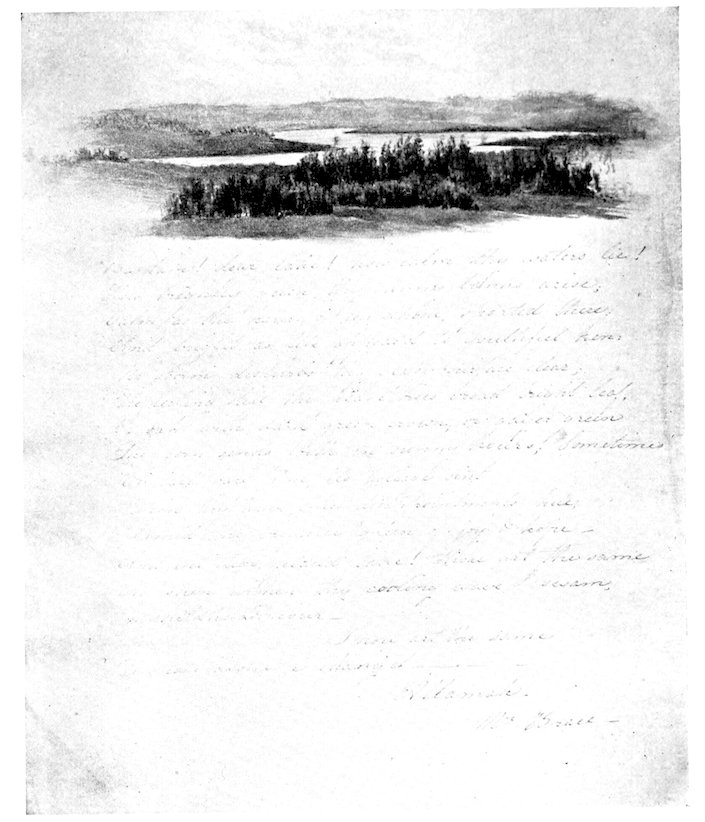
Pl. XLIV.—Bantam Lake, with Poem by Mr. Brace
From Album of Mary Peck
I hardly know in what manner to comply with your kind request that I would insert in this beautiful Album a specimen of my handwriting and signature. I find it nearly filled with fine drawings and Poetical effusions which illustrate the elegant accomplishments of yourself and your numerous friends. It would be vain for me to attempt to rival so much excellence. Though I delight to peruse the works of the great Masters of human intellect yet I am no Poet.
At the present time and before my old eyes the aspect of nature has faded and I live chiefly in the recollection of Scenes that have passed. I however cherish a constant & firm belief of the future Glories which await my beloved Country and especially of their full accomplishment in the fertile regions of the American Hesperia.
I request you to remain assured that the most ardent of your young Friends cannot exceed me in sincere wishes that you may long live happy, amiable, contented and prosperous.
244The following lines were written by Miss C. Beecher upon hearing that measures were taken to remove the remaining Indians in our country across the Mississippi:
“Few people comparatively are capable of Friendship; and still fewer have all the qualifications one would choose in a Friend—The fundamental point is a virtuous disposition but to that should be added a good understanding, a solid judgment, sweetness of temper steadiness of mind, freedom of behaviour, & Sincerity of heart” Seldom as these are found united I have been so fortunate as to find them blended in my friend Mary—
Litchfield March 24, 1826.
March 7th, 1826—
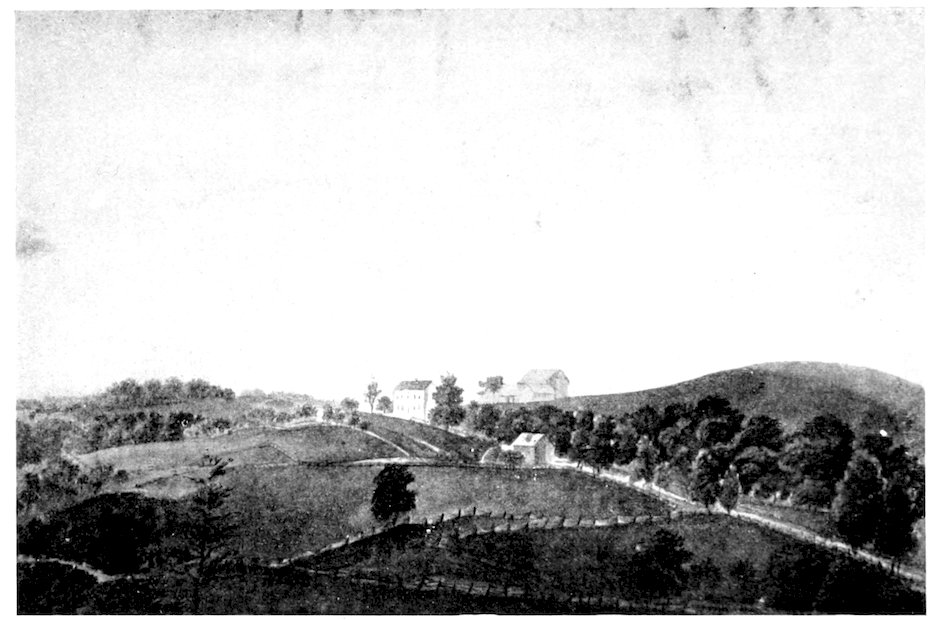
Pl. XLV.—Prospect Hill in Water-Color
From Mary Peek’s Album
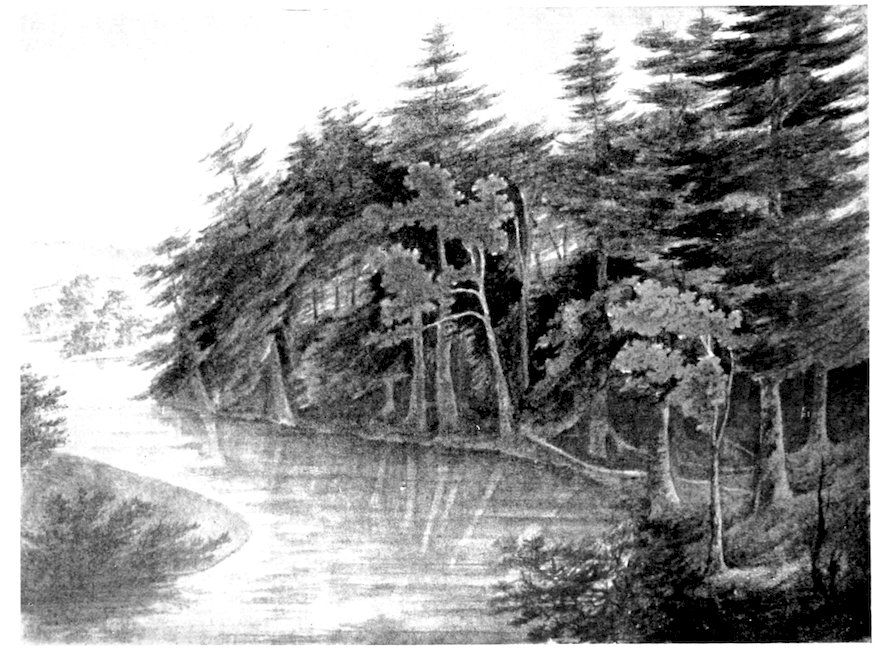
Pl. XLVI.—Love Grove or Love’s Altar on the Bantam, in Water-Color
From Album of Mary Peck
“I have nothing of my own Miss Peck, more worthy of a place in your album than the alternations of winter weather here in Litchfield which I have thus “done into English verse.””
14 Jany. 1827.—
Litchfield 25, Jany, 1826.
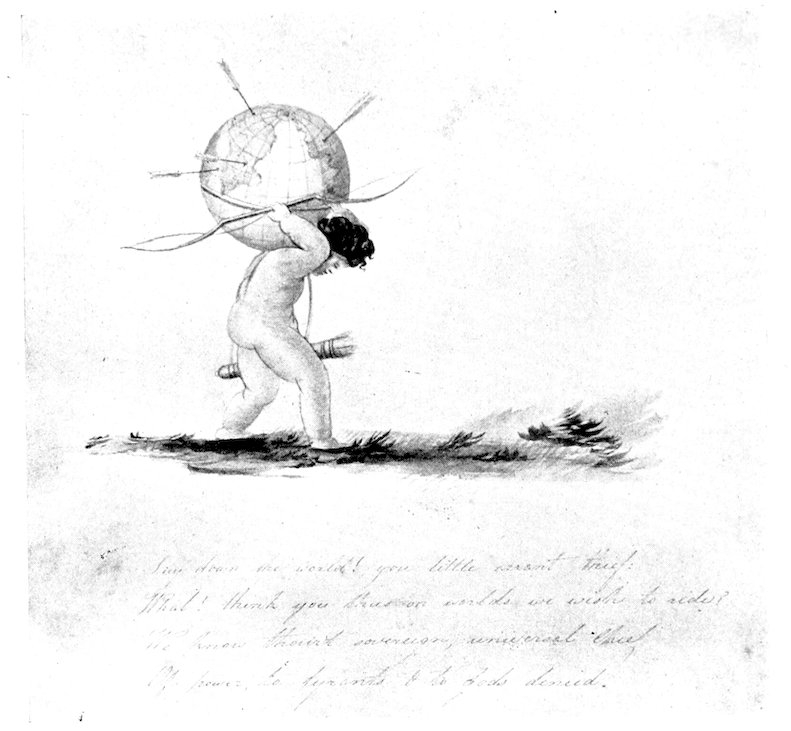
Pl. XLVII.—Love carrying the World
By George Catlin, painter of Indian Pictures in Smithsonian Institute
From Mary Peck’s Album
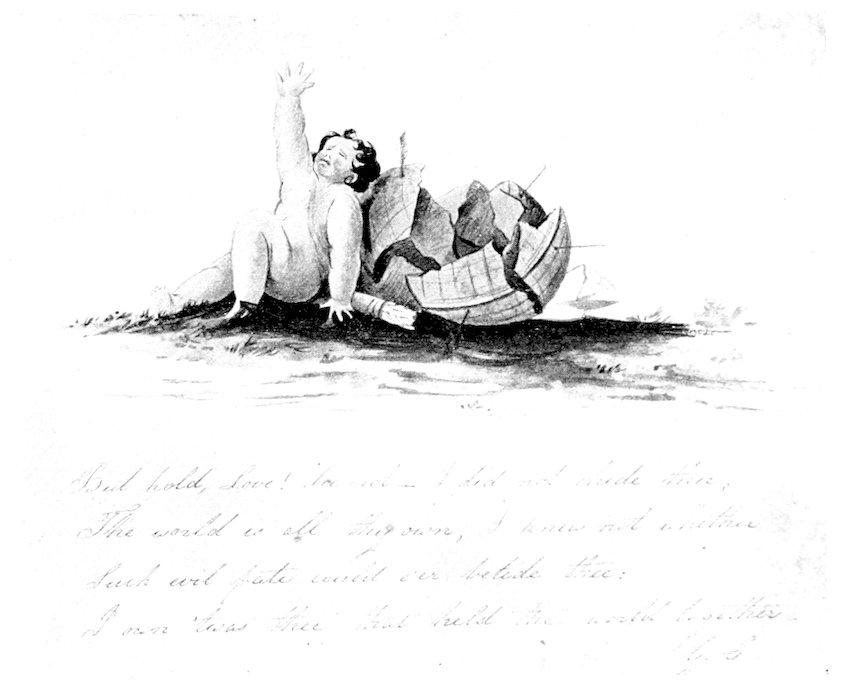
Pl. XLVIII.—Love’s Fall
By George Catlin, in Mary Peck’s Album
From the copy made by a pupil, Charlotte Phelps, who married George D. Cowles, of Farmington.
1st. You are expected to rise early, be dressed neatly and to exercise before breakfast. You are to retire to rest when the family in which you reside request you. You must consider it a breach of politeness to be requested a second time to rise in the morning or retire of an evening.
2nd. You are requested not only to exercise in the morning but also in the evening sufficiently for the preservation of health.
3rd. It is expected that you never detain the family by unnecessary delay; either at meals or family prayer. To be absent when a blessing is asked at table, or when the family have assembled to read the word of God, and to solicit his favor, discovers a want of reverence to his name, and shows that you have a cold heart destitute of gratitude to the author of all good.
4th. It is expected as rational and immortal beings that you read a portion of Scripture, both morning and evening with meditation and prayer. That you never read the word of God carelessly or make use of any Scripture phrase in a light or trifling manner
5th. It is expected that you attend public worship every Sabbath, except some unavoidable circumstance prevent, which you will dare to present as a sufficient apology at the day of judgment.
6th. Your deportment must be grave and decent while in the house of God; all light conduct in a place of worship is not only offensive to God but an indication of ill breeding; and highly displeasing both to the good and the polite.
7th. The Sabbath must be kept holy, no part wasted in sloth, frivolous conversation or light reading. Remember that for all our time, but particularly for the hours of the Sabbath, you must give an account.
8th. Every hour during the week must be fully occupied either in useful employments, or necessary recreation. Two hours must be faithfully devoted to close study each day, while out of school: and every hour in school must be fully occupied. (For every hour wasted in school you must give yourselves a whole miss under the rules.) The ladies where you board must mention if you do not study your two hours each day.
9th. You must never interrupt your companions by talking, or any 256other disturbance during the hours of school, or those set apart for study.
10th. The hours appointed for any particular study or occupation must not be employed in any other way, but the appointed lesson.
11th. You must suppress all emotions of anger, fretfulness and discontent. Bear always in your memory the many blessings God is continually bestowing upon you, for which he requires not only contentment but a cheerful temper.
12th. The truth must be spoken at all times though it might seem more advantageous to tell a falsehood.
13th. You are expected to be polite in your manners, neat in your persons and rooms, careful of your books, clothes and every article of use.
14th. Tale bearing and scandal are odious vices and must be avoided: neither must you flatter your companions by any remarks on their beauty, dress or any accomplishment, in order to increase their vanity, and let every one thus flattered remember that such compliments are an insult offered to the understanding.
15th. While you are forbidden to repeat anything to the disadvantage of your companions, you are also requested to inform one of the teachers if you observe anything amiss in your school fellows which your teachers can correct. This not to be done from malice, but from a sincere desire for their reformation.
16th. Every scholar is bound to conform to the regulations of the family in which she resides. They are never to go out of an evening without permission from the lady who has the charge of them; are not to read any book, or engage in any amusement without her approbation.
17th. No young lady is allowed to attend any public ball, or sleigh party till they are more than 16 years old.
18th. Speaking or moving once in school hours either with or without liberty will take off a part of the extra—unless they move to recite or practice, or write at the tables—Speaking more than once will take off the whole extra and often give you a quarter of a miss.
19th. You must write a letter to be corrected and sent home to your friends once in four weeks—except excused. You must not write a careless note, or any careless writing. You must write a composition once in a fortnight, of 200 words. You must write at least 30 good lines in a week.
20th. You must have a lesson ready to recite when you first come into school.
21st. You must come in or go out of the school in a quiet genteel manner—you must not talk or laugh loud in the street.
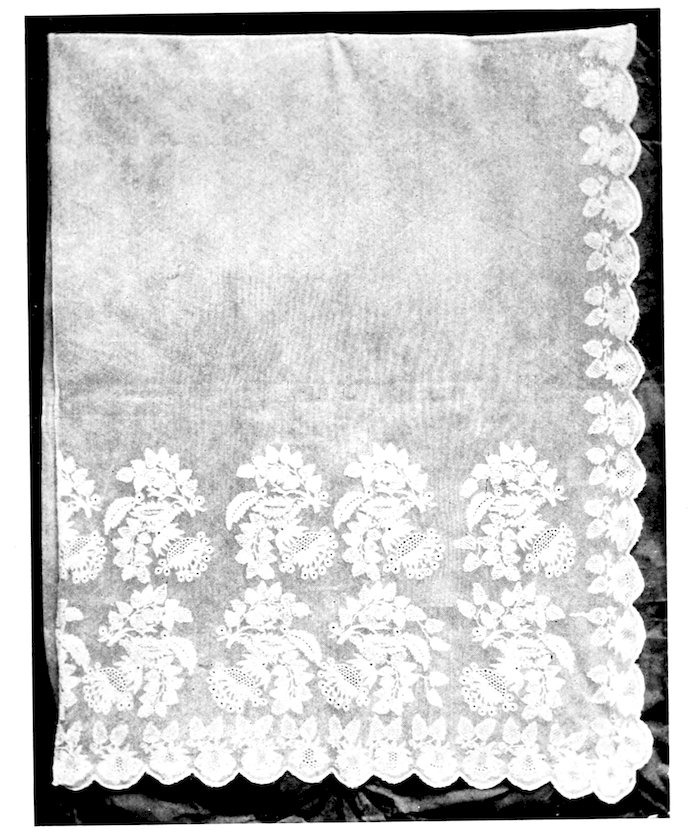
Pl. XLIII.—White Lace Veil worked by Mary Peck and worn by her at her Wedding
25722nd. You must not wear your party dresses, or any handsome lace, neither your best hats or shawls to school.
23rd. You must not walk for pleasure after 9 o’clock in the evening. A reward will be given to those who do not waste any money, books, clothes, paper or quills, during the term. To those who have their duties performed at the proper time. To those who have not been peevish, homesick or impolite. To those who always attend meeting or church. To those who never write carelessly.
A custom quite general in New England in the early part of this century, there being no boarding schools, was that of friends in different parts of the country exchanging children for a certain length of time, shorter or longer. The advantages were sometimes for the sake of change of air, and sometimes for the intellectual training of the children and are known to have worked well. The following extract from a letter from one of the pupils on the list of 1825, now living, makes the custom more clear.
“My connection with the school was only for two or three months and rather accidental. A friend of my mother wishing to send a young son to New Haven for the summer of 1825 Proposed an exchange of children for the time. I was a child of such slender form and far from vigorous and my parents were glad to send me into the country. Hoping the fine climate of Litchfield would benefit me, yet not wishing me to study; but as I wanted something to do I was permitted to attend Miss Pierce’s school with the daughter of Judge Wollcott in whose family I was staying.”
Extract from a paper read May 4, 1896, before the Village Library Company of Farmington, on “Farmington Society One Hundred Years Ago,” by Julius Gay.
One of the first results of increasing wealth was a desire for a better education than the district school afforded. Already in 1792 Miss Sally Pierce had established her famous school in Litchfield under the patronage of Chief Justice Tapping Reeve, Gov. Wolcott, Col. Tallmadge, and other distinguished men, probably the first female seminary in America. Here were sent the young ladies of this village until the Farmington Academy was established. E. D. Mansfield LL.D., once connected with the “Old Red College” of Deacon Hooker, gives 258us in his “Personal Memories” an outside view of the school as it appeared a few years later, on his first visit to Litchfield.
“One of the first objects which struck my eyes was interesting and picturesque. This was a long procession of school girls, coming down North Street, walking under the lofty elms, and moving to the music of a flute and flageolet. The girls were gayly dressed and evidently enjoyed their evening parade, in this most balmy season of the year. It was the school of Miss Sally Pierce, one of the earliest and best of the pioneers in American female education. That scene has never faded from my memory. The beauty of nature, the loveliness of the season, the sudden appearance of this school of girls, all united to strike and charm the mind of a young man, who, however varied his experience, had never beheld a scene like that.”
He was about to enter the Litchfield Law School, a famous institution which gathered numerous brilliant young men, especially from the South. Their proximity might have been a disturbing element in the quiet of the young ladies school had Miss Pierce lacked the wisdom to manage discreetly what would have ruined a weaker administration. The young men were allowed to call on certain evenings, but woe to the man who transgressed ever so slightly the laws of strict decorum. To be denied admission to Miss Sally Pierce’s parlor was the deepest disgrace which could befall a young man. A school girl writes home that a “Mr. Lyde was very attentive to Miss Norton (of Farmington) and gazed at her so much that it mortified Miss Norton, and Miss Sally spoke to him and he has not been in the house since March.” It was only after much correspondence and penitence that Mr. Lyde was reinstated. On leaving the school, each girl was expected to bring home to her admiring parents some evidence of proficiency in her studies. Those who could, exhibited elaborate water-color drawings which have hung ever since on the walls of Farmington parlors. Others less gifted were advised to paint their family coat of arms, and, if they had never heard of any, they soon learned how all this could be remedied without any correspondence with the Herald’s College. One Nathan Ruggles who advertised in the Connecticut Courant “at his Looking Glass and Picture Store, Main Street, opposite the State House, city of Hartford,” had somehow come in possession of the huge volume of Edmonson’s Complete Body of Heraldry, and allowed anyone to select from its vast assortment of heraldic monsters, “Gorgons, and Hydras, and Chimeras dire,” such as suited her taste. His sole charge was the promise of being employed to frame the valuable work when done. I have seen several of these devices which were brought home from Litchfield, some done in water-colors and some in embroidery, with combinations of color which would make a herald stare. They had however just as good right to them as ninety nine out of a hundred of the families who flaunt coat-armor and pictures of English castles and all that in their published genealogies. There is no reason to suppose Miss Pierce had anything to do in obtaining these designs. Most of the embroidered arms are of a later date and were executed at a young ladies school in Hartford. Those in water-colors were most if not all of Litchfield origin. Nathan Ruggles who was responsible for all this spurious heraldry, came to an untimely end. In a private display of fireworks at his house, the whole suddenly exploded and brought his heraldic career to an all too brilliant conclusion.
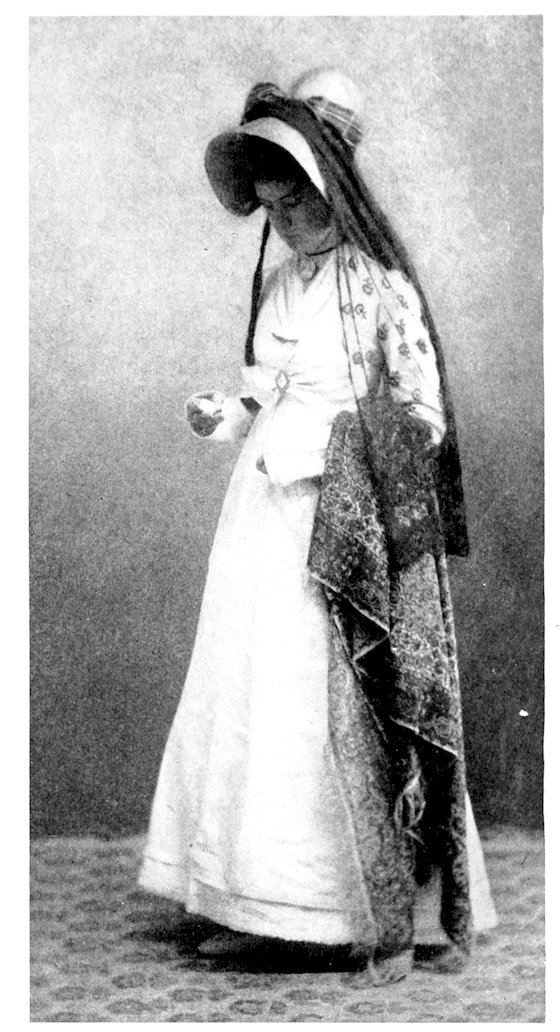
Pl. XLIX.—Old Costume from Roxbury, about 1825
One of Miss Sally Pierce’s pupils from Farmington writes of the school life “We have balls at Miss Pierce’s school better than all the balls at Middletown. We dance once a month. We have a musician and he comes by 6 o’clock and plays till 9.” On Sunday she writes “Our exhibitions are on Tuesday and Wednesday, and Thursday we dance and by Friday night I really think I shall be tired. I have been to meeting all day although it has rained very hard. Mr. Huntington preached. He is a fine preacher, I think, and very handsome.”
| Writing, History, Geography, Grammar, Arithmetic, Rhetoric, and Composition, with plain Needlework, per Quarter | $5 |
| The above, with Natural and Moral Philosophy, Logic, Chemistry, Mathematics, the Principals of Taste and Criticism, with the Latin and Greek Languages, per Quarter | 6 |
| French Language | 5 |
| Drawing | 3 |
| Music | 12 |
| Board in respectable families near the Academy, from $1.75 to $2 per week, exclusive of washing. | |
| The Summer Term, commences May 16. | |
| The Winter, November 29. | April, 1826. |
Copy of the subscription for the Litchfield Female Academy. April, 1827.
The subscribers, being desirous of extending the benefits of the Female Academy, in this place, (which they believe can be done, by the erection of a new building, and procuring an act of incorporation which shall constitute the subscribers owners of the stock and place the same under the management of a board of trustees, consisting of ten persons who shall hold their offices during life, or until they resign or remove from this state, with power to controul and manage all the affairs of the institution, which shall be exclusively devoted to the purpose of Female education, excepting that one of the rooms in the proposed building may be made use of as a Conference room by the Congregational and episcopal societies in this Village and for other objects of that nature under the direction and at the discretion of the trustees) do hereby agree to unite in a petition for the above purpose to the general assembly at their ensuing session & if the same be granted to subscribe and pay for stock in such corporation to the amount affixed to our names, respectively & to relinquish to the Corporation for the benefit of said institution all the dividends or profits on the stock by us held so long as Miss S. Pierce or Mr. J. P. Brace or either of them shall be employed in the instruction of youth in said academy. This subscription to become binding on the subscribers on the following conditions viz
1st That Miss Sarah Pierce shall convey to the Corporation, after an act of corporation shall be obtained, the building she now occupies as a schoolhouse and as much land in quantity where said buildings now stand as is at present attached to said buildings and included within the fences to be improved for a building lot for the new school house or academy and that said land and buildings shall be considered as stock subscribed by Miss Pierce under this subscription and shall be estimated at the sum of $600.
2nd That in addition to the subscription to be made by Miss Pierce on the principles and to the amount stated above, there shall be subscribed within four weeks from this date the further sum of $900 or 60 shares each share to be $15.
261I agree to convey the land and buildings mentioned in the preceding subscription under terms and for the objects therein specified, estimated at $600 or 40 shares. (A true copy)
| Names of Subscribers. | Number of Shares. |
|---|---|
| Frederick Wolcott | Two shares |
| James Gould | Two shares |
| William Buel | Two shares |
| Jabez W. Huntington | Two shares |
| Charles Seymour | Two shares |
| Grove Catlin | One share |
| Phineas Miner | One share |
| Stephen Deming | One share |
| James H. Wadsworth | Two shares |
| Samuel Buel | Two shares |
| S. & H. Childs | Two shares |
| Silvester Galpin | One share |
| Joshua Gavvitt | One share |
| Josiah Parks | One share |
| Oliver S. & John L. Wolcott | Two shares |
| E. A. Lord | One share |
| Danl Sheldon | One do |
| S. S. Smith | Two shares |
| G. Dewey | One share |
| John R. Landon | Two shares |
| Alanson Abbe | Three shares |
| John W. Russell | One share |
| Truman Smith | One share |
| Charles N Webb. | One share |
| Jason Whiting | One share |
| David C. Sanford | One share |
| Elihu Harrison | One share |
| Uriel Holmes | One share |
| B. Kilbourne | One share |
| Samuel P. Bolles | One share |
| Oliver Goodwin | One share |
| Jonathan Carrington | One share |
| Saml Buel 2 | One share |
| Leonard Goodwin | Two shares |
| Origen S. Seymour | One share |
| Silvester Spencer | One share |
| 262Henry Phelps | One share |
| Andrew Benedict | One share |
| John P. Brace | One share |
| Ambrose Norton | One share |
| James Winship | One share |
| Amos Wadsworth | One share |
| Hiram Barnes | One share |
| C. G. Bennett | One share |
| Stone & Bolles | One share |
| Benjamin Tallmadge | Two shares |
| Henry A. Perkins | One share |
| Ozias Seymour | One share |
| S. Trowbridge & G. Treadway | One share |
| William H. Thompson | One share |
| Seth P. Beers | Two shares |
A true copy of the original subscription enrolled among the papers of the Litchfield Female Academy and marked no 1—
Then follows an Act of incorporation given at Hartford, Conn., by the General Assembly in said state, on the first Wednesday of May, 1827. This act provided “that shares be $15 each provided that the number of shares shall not exceed 500 & the capital stock shall not exceed the sum of $7500.”
At a meeting of the “Litchfield Female Academy” holden pursuant to adjournment at the West School House in Litchfield June 15th 1827, the following persons were elected trustees.
Frederick Wolcott was appointed President of the board and Truman Smith Secretary and William Buel Treasurer.
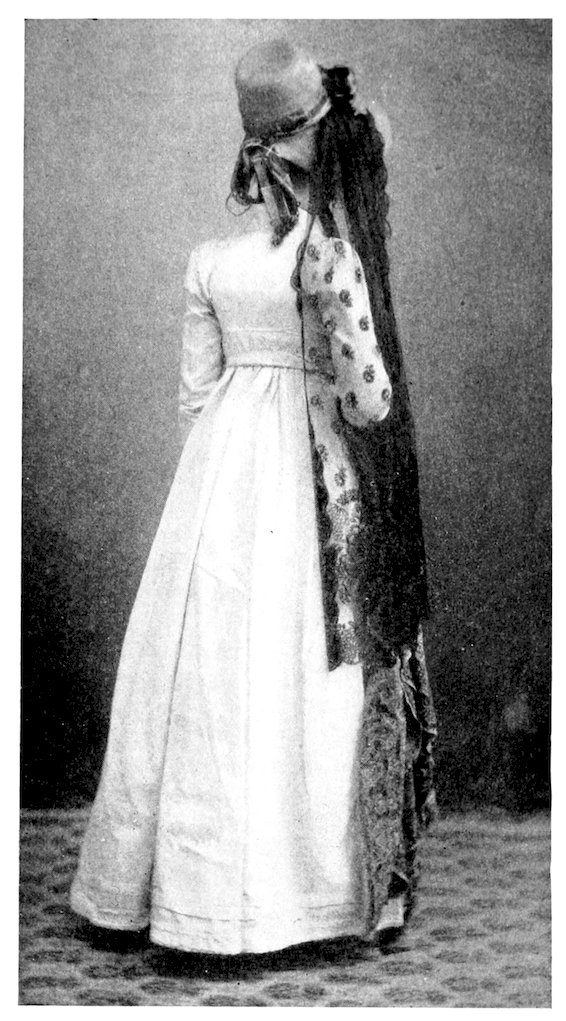
Pl. L.—Old Costume from Roxbury, about 1825
The contract for the building was given to Silvester Spencer, minute directions being given that “it shall be 42 ft. long, 30 ft. wide two stories high with parts 21 ft. long from the top of the sill to the bottom of the Plate the stories of equal length. Sleepers and rafters 263of good oak and chestnut. The whole frame to be of good and substantial materials. The building (except the front) is to be covered with good pine clapboards. The front to be covered like Doct Samuel Buel’s House with 1¼ Tuck pine stuff free from sap and nots and put together with white paint and 4 Pilasters to be a cornice like said Buel’s (excepting eave Troughs) on the side and front with Raking cornice to be a window in the front gable like said Buel’s and covered with a good Green Blind, ... the door to be hung with wrought Iron Hooks & Hinges and furnished with suitable trimmings.... The clapboards to be nailed on with wrought Nails. There is to be 21 windows of 24 Lights part of English brown glass 8 by 10 & One window in the west gable end 20 lights 8 by 10 Glass.... There is to be a Cupola on the front & finished with not less than six posts. With a deck so made as to exclude the water & Sustain a bell with a spire of iron.... The whole building to be painted white with three coats of good paint of white lead and oil except the roof.... The Painting to be done by the first day of May next.” The payments to be “four hundred dolls on or before the 10th day of Sept. next 200 dollars on or before the first day of November next and the balance when the building shall have completed.
Voted that Leonard Goodwin be authorized to sell at discretion the building or buildings now occupied by the Litchfield Academy, reserving the use of the same until the first day of May next, and also to remove the same if necessary.
A detailed agreement with Samuel Childs was made regarding the stone underpinning which was to cost $65. January 21st 1828 it was found that $250 more would be necessary to make the building “comfortable and convenient,” which sum was borrowed of Elisha S. Buel.
At a meeting of the Trustees holden Nov. 14th, 1828 voted that Dr. William Buel be appointed agent to collect the balance now due on the Subscription to the Litchfield Female Academy and be authorized to institute suits for the collection of the same.
At a meeting of the Trustees March 28th, 1828 the following address to the public was drawn up and ordered to be printed:—
The Trustees of the Female Academy at Litchfield deem it proper to acquaint the public with the present situation and prospects of the institution of which they have the general superintendence. This School has been established more than thirty-five years. It was founded by the exertions of an individual lady (Miss Sarah Pierce) 264aided by a few friends. It has been under her immediate direction from its first establishment, and for several years she has been assisted by John P. Brace, Esq., a gentleman of distinguished literary and scientific attainments, whose time and talents are assiduously devoted to the improvement of the pupils under his charge. While many similar institutions have, during this period, arisen, flourished for a time and then ceased to exist, this school has continued to receive, as it is believed it has always richly deserved, a great share of public patronage. It has obtained public notice and favor by the force of its own merits. Constant and unremitting exertions on the part of the instructors, combined with long experience and a thorough acquaintance with all the branches of education which are taught, have given this school a character which has drawn forth the commendations of many of the distinguished men of our country. Young Ladies from every part of the United States have been members of it, and great numbers have received its highest honors. The whole number of pupils, since it was first opened, exceeds two thousand.
During the last year it has been considered an act of duty to that community by whom it has been so long patronized, to provide more extensive accommodations, for those who seek to participate in the advantages it affords. With this view, a large and commodious building has been erected, with suitable apartments for every branch of study appropriate to such an institution, and for the apparatus connected with the different branches of science.
It will be opened for the reception of pupils at the commencement of the ensuing summer term, which will be on the 14th of May next:—This term will continue until the 29th of October, when there will be a vacation of four weeks, at the expiration of which the winter term will commence, and continue until the 21st of April;—Another vacation of three weeks will terminate with the commencement of the summer term.
A regular course of instruction will be given in English Grammar, Geography, Ancient and Modern History, Arithmetic, Algebra, and the higher branches of the Mathematics, Rhetoric, Composition and the principles of Taste, Natural Philosophy and Chemistry, Moral Philosophy and Logic. In addition to these, the pupils, at their option, will be instructed in Latin, Greek, and French Languages, the various branches of Natural History, Music and Drawing, for all which the most competent instructors are provided.
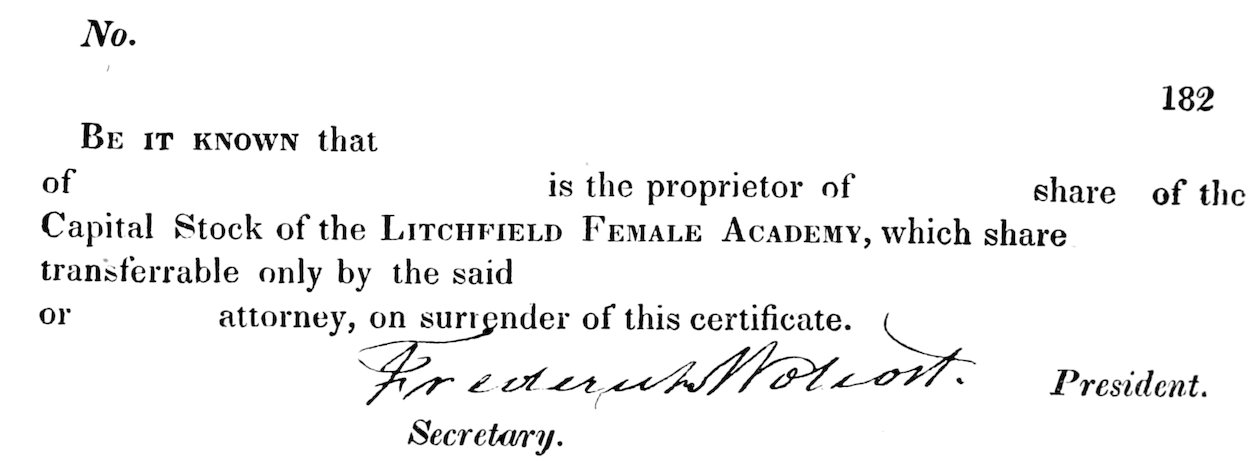
Pl. LI.—Facsimile of Form of Stock Certificate of Academy
The text-books used at this institution are Walker’s Dictionary, Murray’s Grammar, Woodbridge’s Geography and Atlas, Miss Pierce’s Ancient History, Russell’s Modern Europe, Goodrich’s American History, 265Arithmetic, Blair’s Rhetoric abridged, Allison on Taste, Conversations on Natural Philosophy and Chemistry, Paley’s Philosophy, Hedge’s Logic.
The location of this Academy is in the centre of a pleasant village, remarkably healthy, free from vice and the temptations to the commission of it, and possessing every facility of communication with other places, by stage coaches and mails, which arrive and leave it daily.
The Trustees confidently believe, that with the additional advantages which this institution now possesses, it will receive the increased patronage of the public, and that it will continue to be, as it heretofore eminently has been, distinguished as a seminary, where the different branches of female education are faithfully and successfully taught.
Litchfield, Conn. March 28, 1828.
From the following vote, there must have been another school building on East Street:—
“Voted that Leonard Goodwin be a committee to make a public or private sale of the building belonging to the L. F. Academy now standing in East street. Sept. 11, 1829.”
At a meeting on the 19th October, 1832, “the resignation of John P. Brace as Trustee, Secretary of the Board and Assistant Teacher was read and accepted.” Frederick Wolcott and Oliver Goodwin were appointed a committee to wait on Miss Sarah Pierce to learn her views regarding the continuance of the school.
[Notices of Change of Teachers from the Litchfield Enquirer, October 31st 1833.]
“Litchfield Female Academy.—We feel no disposition to say much more upon this subject than to call the attention of our readers to the advertisement of the Trustees in a subsequent column, which is very full and explicit. The acquisition to the school of Miss Gimbred, we consider as a very fortunate and important one. This school has always maintained a very elevated rank among the literary institutions of the country; and under the management of its present excellent instructors, we feel no apprehension but what it will fully maintain its deserved celebrity.”
“The Trustees of the Litchfield Female Academy, in consequence of a recent change in some of the principal instructors, consider it their duty to state to the public the present condition and prospects of this Institution.
“This school was founded about forty years since by Miss Sarah Pierce; and under her care and superintendence it early acquired a distinguished rank among the literary institutions of our country. This rank it has fully sustained to the present time. There have generally been young ladies in this school from one half the States in the Union, and the number has varied from 80 to 130. Miss Pierce has now retired from the performance of any active duties in this institution; but she feels a deep interest in its prosperity, and will visit it daily; and it is to be hoped that, as heretofore, in answer to her prayers, the blessing of heaven may descend upon it. Mr. John P. Brace, who for eighteen years was a very able and distinguished instructor in this school, nearly a year since accepted the appointment of Principal in the Female Seminary at Hartford. Notwithstanding the removal of these eminent instructors, the Trustees state, with high gratification, that in their opinion this institution has never been more worthy of public confidence and patronage, and its prospects have never been more flattering than at the present time.
“Miss Henrietta Jones, the present Principal, appointed by the Trustees, received her education in this academy. She has had five years’ experience as an instructress; and the Trustees, from regard to her feelings, will only add in her commendation, that they consider her, by her talents and acquirements, as eminently qualified for the station they have assigned her. There are others associated with her to instruct in the various branches which have heretofore been taught in this school, in whose qualifications the Trustees have entire confidence.
“The French Language, Music and Drawing will be taught by Miss Evelina Gimbred, who, with her mother, Mrs. Gimbred, has removed to this village. They will receive young ladies as boarders in their family. The father of this young lady was a Professor, and Teacher of Drawing, at the Military Academy of West Point; in which institution it is well known that none but highly respectable and well educated persons are ever employed as Professors. This gentleman gave his daughter an education with a view to qualify her to 267teach the French language, and to become an instructress in Drawing; and in consequence of his death, his family are left to provide for themselves. They are native French people, but they speak our language fluently and correctly. These ladies propose to remain permanently in this village; and the Trustees consider the arrangement they have made with them as an extremely interesting event to the friends of the Female Academy in this place.
“The Trustees will only state, in addition, the price of Tuition and Board, viz:
| Per Quarter. | |
|---|---|
| Highest Department of English studies, | $5.37 |
| Second „ „ „ „ | 4.37 |
| Third „ „ „ „ | 3.37 |
| Instruction in Drawing, | 5.00 |
| „ in the French language | 7.00 |
| „ in Music | 10.00 |
Board can be obtained in respectable families at $2 per week. Those who may board in the family with the Instructress in French, and where only the French language will be spoken, will pay for board $2 per week, and for other privileges 50 cents.
“The next term will commence the 20th day of November next, at which time it is desired that all who may propose to join the school shall punctually attend.”
The above notice was also inserted in the Enquirer for Nov. 7th and 14th:
It was voted at a meeting of Trustees, held April 6th 1844, that Seth P. Beers apply to the Legislature for a change in the charter, so that the buildings could be used for both sexes. In 1849 the use of the Academy was tendered to the Normal School.
Notice—A meeting of the Corporation of the L Female Academy will be held at the Academy of said Corporation in L-field on the 10th day of July 1854 at two o’clock in the afternoon for the purpose of electing Trustees for said Academy.
At a meeting of the Shareholders of the Corporation of the Litchfield Female Academy, convened by Stephen Deming, Esq. (by order of the Legislature) on the 10th day of July 1854, the following persons were appointed Trustees of the year ensuing to wit: Albert Sedgwick, Jason Whiting, Chas Adams, Oliver Goodwin, Gideon H. Hollister, Henry Buel, R. H. Coit, William Deming, J. G. Beckwith & S. P. Bolles.
The following Resolution was also adopted at said meeting to wit: That whereas the by-laws of the Litchfield Female Academy as now on record, make it necessary that the original certificates of stock should be returned in order to procure new certificates in all transfers of stock, and whereas in many, perhaps in most cases of ownership of said stock, no certificates were given, and if given have been lost, and no record of certificates made on the Secretary’s book, the stockholders hereby recommend to the Trustees to pass by-laws requiring all transfers of stock now held by any person, originating from the original shares, to be entered on the Secretaries’ book, and that the owners thereof have liberty to vote on them in all elections, and in all transactions of business.
At a meeting of the Trustees September 6, 1856, it was voted that Miss Mary Pierce be allowed to purchase the Academy property, consisting of the land and building, for the sum of $900.
... Jenny is quite well—she relates four wonders (to our colored folks) which occurred in her travels at the North—1st that water is sold in New York. 2nd the Deaf & Dumb instructed at Hartford—3rd—how she got up and came down such a high place as Pine Orchard—& 4th that she saw a gentleman and lady ascend in a Balloon while she was in New York.
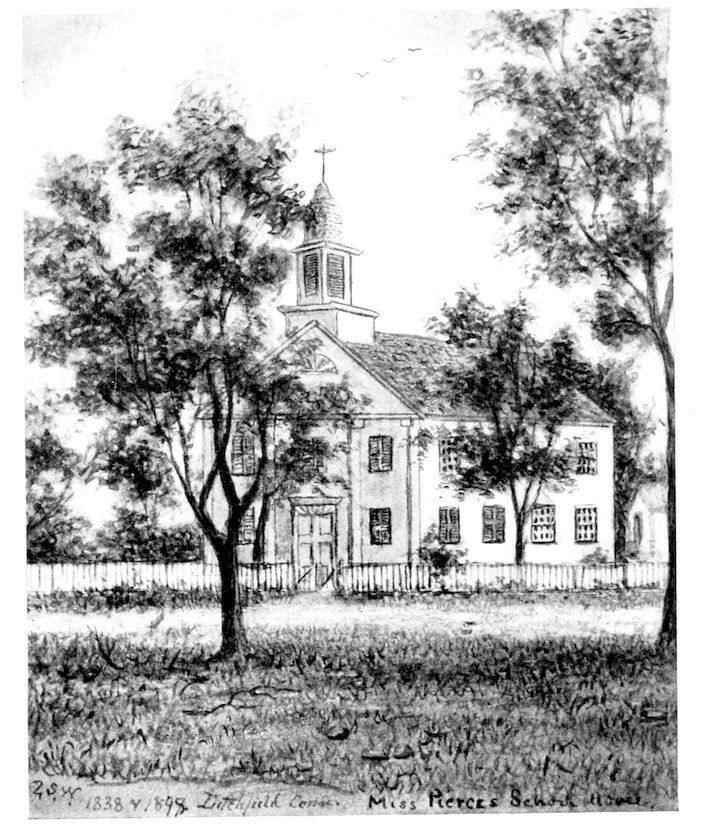
Pl. LII.—The Litchfield Academy
Drawn by Dr. Z. S. Webb
I cannot think my dear Mary of suffering Col: Tallmadge to return without a letter for you, though I have little to add to my late communication by Post, which I trust, will be duly received. In that I gave you a short account of our journey and situation—from the fatigue of the former, I am quite recovered, and have never at any time enjoyed a greater portion of health and animal spirits—In this respect, I have been favor’d beyond all expectation, for I have always made abundant calculation for hours of despondence and gloom, either real or imaginary—But considering circumstances, my mind since I parted from my dear friends, has been unusually serene—It is true, I look back occasionally upon past days, and the hours of luxurious friendship they afforded, with feelings of peculiar tenderness, and not always free from a portion of pain—but I cannot say my dear friend, that it ever amounts to regret or a wish to retrace my steps—no—hitherto my cup of earthly felicity has been as pure as mortals can expect, or indeed ought to wish—I how ever, have but just tasted it, a deeper draught may abate the relish—but Mary, I hope I have done with romance, and can therefore place more reliance upon my present feelings and judgement—these I have as yet no cause to distrust, in respect to the friend, and companion which kind Heaven has alloted me.
... We are not yet in our own house which will surprise you—but promises are not more binding here than in other countries, or Mecanicks more punctual—the house which was engaged to be completed the first of May, is but this week made ready for cleaning, that will be done in a few days, and then I shall begin to put up my goods & chattles—after they are arranged, I should like to introduce you to my house—you shall have my best chamber, and my toilet shall present your eye with a beautiful ornament, that often gives pleasure to my own, from a delightful association of ideas—
Scarce a day passes in which I do not see Susan—this near neighborhood is a great comfort to us both—you would be surprised to see how greatly Susan exerts herself to become a housewife, and that too, an industrious and economical one—and she has the satisfaction to witness her own improvement.... Her home is pleasant, and quite prettily furnished—Her brother and Sister have made her some valuable presents, and selected all her New York purchases—Mr Gold had purchased a wench, which they have the use of, and they 270also keep a little Boy—so you see they have begun in some stile—I am this afternoon going to ride with her to Whitesborough; and must finish my scribbling when I return—I hope to have been settled in my own house before Col. Tallmadge returned that Maria might have been able to give some account of its appearance, but I must relinquish the expectation, for the time they gave to visiting has now nearly, if not quite expired.
Has our dear Sally quite recovered her former health? Do you have pleasant and frequent accounts from James? By the way Mary don’t forget to tell him, that I calculate next summer with the exception of misfortune to see him here with you.... Oh, my dear Mary when I suffer my thoughts long to dwell on you, and a few others of your circle, my bosom swells and my eye fills, but tender, and even painful, as such feelings are, I have no wish to be divested of them.... At present I am all Fanny Smith, not a particle of my interest in my dear Mary abated—Adieu, my dear, rest assured of the love of your
“The Semi-annual exhibition of this School took place on Monday evening last before a crowded and highly delighted audience. The weather was extremely unpleasant, and a melancholy interest seemed to pervade the assembly in sympathy with the leader of the exercises and instructor of the school, who had on that day been called to close the eyes in death of an interesting and beloved son.
The compositions, and the music, previously prepared, were providentially of a character suited to the occasion, exciting nothing like trifling and levity, yet so good as highly to interest and engage the attention of the audience. Some of the pieces read displayed a brilliancy of imagination and a depth of thought rarely exhibited by young school misses.—
Miss M. Wadsworth and Miss J. Seymour, of this town, received diplomas of having completed to the satisfaction of their instructors, the whole course of studies pursued at the Academy.
The first prize was awarded to Miss H. Smith of Hanover, Mass.—prizes were also awarded to Miss J. Reynolds, of N. Y; Miss E. Beman of Troy; Miss G. C. Lindsley of Washington D. C; Miss 271E. Deniston of Blooming Grove, N. Y.; Miss M. Wadsworth, and Wm. Norton.
The evidences of improvement, and of diligent attention to the studies and rules of the school, must have been highly gratifying to the parents and friends of the young ladies. The exhibition of music was good, and gave evidence of much improvement in this polite branch of education. The display of drawings and paintings bore strong marks of improvement and diligence on the part of those who attended to this art. Upon the whole, all the services of the evening gave pleasing evidence that there has been no falling off, either on the part of the instructors or the pupils, connected with this valuable school; and we believe that no previous exhibition ever gave greater satisfaction to the friends of female education.
Copied from Litchfield County Post of April 24, 1828.
The Summer Term of this Institution commences on the 13th of May next. Tuition—ten or twelve dollars for the term, according to the studies pursued.
| For a single quarter, | six dollars. |
| Litchfield April 23 | 45 |
Advertisement from the Litchfield Enquirer Thursday April 30, 1829
“The Winter Term of this Institution will commence on Wednesday Nov. 25th. Tuition in the higher branches, ten dollars for the term; in the lower, eight dollars, seventy-five cents. For a single quarter, six dollars.”
| SCHOOL BILL. | ||
|---|---|---|
| Miss Grant | ||
| Tuition, winter term,—— | $8.75 | |
| School expenses | .42 | |
| $9.17 | ||
| Rec’d payment | ||
| John P. Brace | ||
| Litchfield, April 20th, 1829 | ||
The following article by Miss Sarah Pierce was called forth by the excessive intemperance of those times. This Temperance Society had been organized in Litchfield in 1789, and is said to be first of its kind in the world.
Ecclesiasticus. 19–1 He that contemneth small things shall fall by little and little.
though there has been a number of very excellent pieces in your paper warning your readers against the dreadful sin of intemperance and various means suggested, to check this overwhelming evil, yet I think the subject has not been laid before the public in such a manner as to reach every case. Could every person be persuaded to abstain entirely from the use of ardent spirits, the danger would be at an end, but many are deceived and think they do abstain, because they make use of spirits only as a medicine, originally prescribed by the physician, but this use soon degenerates into intemperance, of which the subject is not aware till it is too late to recede. The habit has become fixed before the person is sensible of his danger. I have therefore taken up my pen to describe what has passed under my own observation, if hereby some one soul may be benefitted by my experience. I have known several women who have been blessed as the instruments of rescuing their husbands from the gulph of perdition. Let me then call upon all married women, particularly the young, to note the following rules. Endeavor to make the house of your husband the most interesting place upon earth. Make use of the same attractions to keep, that you employed to win the affections of your husband. If you have not the talent of pleasing conversation, endeavor to acquire it. The hours of domestic quiet will prove dull, unless enlivened by social and cheerful conversation. If your husband is entertained by wit, read sprightly anecdotes to relate. Of politicks, attend so far to the state of the nation, as to enter into his feelings and be able to converse on that never ending theme. Is he fond of science enter into his views, and gain instruction by his researches. If you have children, keep them clean and under good government, that they may be interesting, instead of disgusting objects. Teach them to hold out their infant hands with joy at the sight of their father, and when their minds begin to expand, 282teach them something amusing to repeat to him, a verse, a story, or any pretty trifle. Above all endeavor to exert your culinary skill at every meal, that your husband may not be induced to resort to an oyster house to please his palate. I have known more than one man lead into the fatal habit of intemperance, by the frugality, or indolence of their wives. If you are poor and obliged to perform all your domestic duties with your own hands, do not think, because it is a busy day, you need not prepare a dinner for your husband. A person who is in the least degree inclined to intemperance must have regular meals, and those made palatable, or he will have recourse to liquor to supply the craving of his appetite. Now don’t let any young unsuspecting female think, my husband does not need this watchful care, they all need it. The young men of this age have been nursed in the bowers of Luxury, and few if any have escaped the contagion of that dreadful atmosphere. The seeds of dissipation have been sown in childhood, and it requires care, skill, patience, and perseverance to eradicate them. Should they have taken such deep root, as already to bring forth the fruits of death, do not be discouraged. I was formerly acquainted with a woman of high rank, whose husband had so far fallen a sacrifice to the pleasures of the flowing bowl, as often to be brought home in a most shocking state of intoxication. His wife was careful not to expose him to her servants, but performed the disgusting office of attendance herself. She never reproached him, but when the effects were over, and reason returned, she spoke to him in the kindliest and most forcible manner, of the disgrace and danger of such conduct, she painted in glowing colours the effect it would produce upon his reputation here, and his happiness in the coming world. Her prayers & her exertions were blessed, he lived respected, and died at a good old age, lamented by a numerous circle of friends and descendants. And we may reasonably hope that both husband and wife are now enjoying the bliss of the righteous.
I have also witnessed the ill effects produced by a contrary conduct. Mr. —— was early accustomed to take a social glass with his friends, but discovered no inclination to excess, till he had been a husband and a father many years. His wife was amiable, industrious, and pious, but she did not know that to be a helpmeet for man, her influence must be daily exerted to keep him steadfast in the path of virtue. Having no suspicion of danger, and being what is called a notable housewife, she seldom provided a regular dinner. Her husband frequently came in fatigued with business, and finding nothing he relished to appease his hunger, he habituated himself to take a glass of brandy to give a tone to his stomach, till in time he became the slave of intemperance, 283and from being an ornament to society, and the favorite of his family, he became an object of grief and shame to his nearest relatives.
Another woman, no less amiable but dilatory in performing her domestic duties, prolonged her morning slumber till a late hour. Her husband whose business called him early abroad, supplied the want of a reasonable breakfast, by a morning whet, till he became a confirmed drunkard, which might undoubtedly have been prevented had his strength been invigorated by plentiful early meals.
The beginnings of vice are to be carefully watched. Bad habits are like the nets which the insidious spider weaves around her victims. If the first tender thread is allowed to entwine itself around you, the next will prove a snare not easily broken. Warn those over whom you have any influence, not against the festive glass, but the morning whet, and the evening dose, taken to recruit exhausted nature. The strength they give is momentary, and they finally debilitate instead of invigorating the constitution. They are the first fine chords Satan weaves round those he is sure to destroy. You may think you have sense and firmness enough to command your appetite, but where one escapes, thousands fall. Tis like the famous Upas of Java, where criminals who have forfeited their lives are sent to procure poison, if they succeed in reaching the tree and filling a box with its deadly juice, they are pardoned. But few have hardihood of nerve to survive the pestilential vapor; they generally die on the road, and the country for miles around is whitened with their bones. As the poet beautifully describes it.
Let me also warn women to beware of the same fatal poison. You are by nature more exposed to its fatal influence than men, your nerves are weaker, your employments are in general more sedentary, your constitutions more delicate, are more exposed to sickness and debility, which seems to call for stimulating medicines, especially when you are encumbered with a large family and sickly children, it seems as if nature required support, but beware of the opiate, and the warm sling, at first they seem to prop the constitution, but in the end they undermine it. If nature fails under the pressure of watchful nights and tedious days, make use of rich soups, or other palatable and strengthening food, with a small quantity of the best wine, it will be less likely to lead to intoxication than opium. Many kinds of bitter tea will give a tone to the stomach, and if you find your constitution 284sinking under the infirmities of sickness, trouble, or hard labour, you had better sink into your graves than become the slaves of Satan. Even on a bed of sickness, where the body is racked with acute pain, it is sinful for the physician to prescribe the powerful opiate.
Our Saviour when he bore the heavy weight of his father’s anger and our sins, refused to take one. The vinegar and gall were given to criminals to deaden their pains, but Christ refused to take it, he would not lessen the agony of his sufferings, by an opiate, he would not enter the world of spirits, with benumbed faculties. A celebrated divine remarked that he never knew any christian who enjoyed a full and comforting hope in his last hours, that had taken opiates in any great quantity. Let me also exhort parents not to furnish their sons with money to spend on public days, unless they are sure it will not be spent in the purchase of liquor. Let them be warned by precept and example, against using the fatal poison even in small quantities. Did all feel as they ought, did they feel that ardent spirits is the deadliest poison, did they feel that it is the fumes of the bottomless pit, sent forth by the imps of the infernal regions to draw mankind to destruction, they would guard their children against it, as they would guard them from the grasp of a tyger. And let me entreat you my aged friends to beware, when nature fails, and the grass-hopper has become a burthen, let me entreat you to beware of soothing your pains, and strengthening your frail bodies with the comforting glass. When you have almost run your race, will you be ensnared at the goal. What reproach have some professors of religion brought on the Christian name by falling in second childhood into this fatal sin. And though through the infirmities of the flesh they may occasionally err, yet even that must be followed by deep and bitter repentance, or we cannot hope they will ever enter heaven. Then let the sprightly youth, with vigorous manhood, and the hoary head all unite in one common bond, to deprive Satan of his most successful weapon, and resolve rather to die in the conflict than be overcome by the enemy of our race.
A letter written by a lady seventy-seven years of age, to her daughter, attending Miss Pierce’s Academy, Litchfield, Conn.
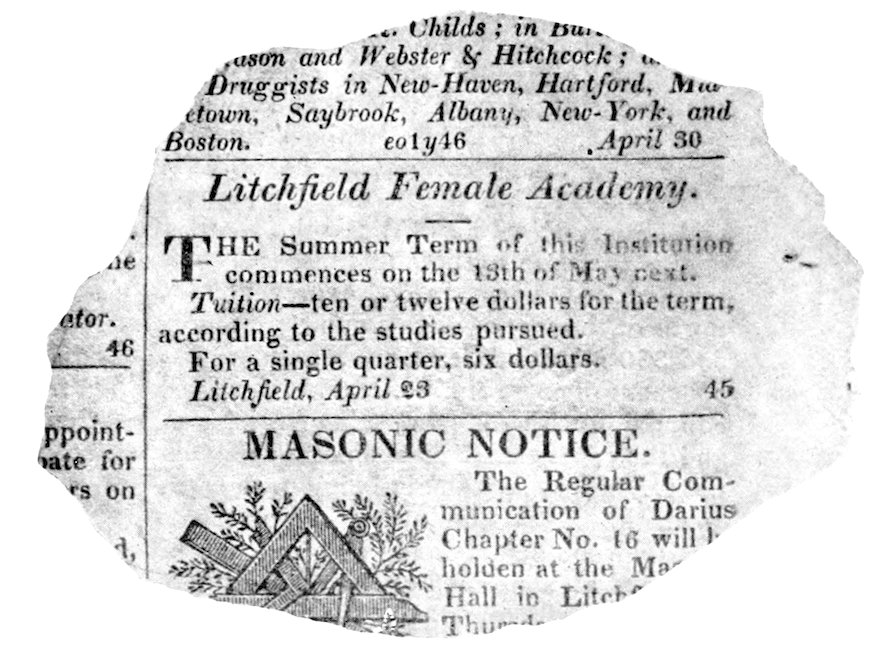
Pl. LIII.—Terms for Tuition from Litchfield Paper
Harriet Wadsworth was in a class of little girls taught by Miss Sally Pierce in 1830 and 1831. This class was a preparatory one to the Academy. The pupils were thoroughly drilled in arithmetic and spelling. The latter was studied from a dictionary. Davol’s speller was also used.
There were as many as one hundred and twenty pupils at one time. Every family in the village took pupils as boarders, four occupying one room.
Miss Catlin was drawing teacher.
The closing exercises of the academy were held at the Court House. Paintings and needlework by the young ladies were hung on the walls. The pupils were dressed in white and were given diplomas. Singing and recitations were part of the exercises.
Mr. John Brace left the academy to take the school of Miss Catherine Beecher at Hartford. When Miss Pierce gave up teaching 287in 1833 Miss Jones afterward associated with Miss Landon, took charge of the school. Following them were the Misses Swift who lived where Mrs. Kilbourn now lives.
Some of the girls in Mrs. Kilbourn’s class were Elizabeth Prince, (Mrs. N. R. Child), Mary Goodwin (Mrs. Taylor) and Mary Brace.
I was but a Child when I attended Litchfield school and of course did not appreciate the privilege as an older person would have done, and I have since. Your letter awoke and quickened memories that have become more or less dormant, so that now I feel the worth of those months of early privilege. The Misses Pierce and Mr. Brace were remarkable persons in every way, Model teachers for those days.
Being such a child I was made much of and was very happy. Boarded at Dr. Sheldons. Aunt Lucy (as I called his daughter) was loving, taking me in her own room and bed. The influences in that beautiful home were useful to us all, for the Foundation was religious. Every Sunday afternoon Miss Sheldon called all the boarders into her room and read, talked, advised and prayed with us, not in a morose way at all but in a happy way.
Mr. Lyman Beecher was pastor of the Congregational Church and used to visit the school every week, generally had one of his students with him, and held a Prayer and Enquiry meeting. I remember him as a sombre, austere looking man not a bit like his son Henry Ward. He soon went to Boston.
As memory goes back I think there was perhaps more true sincerity in Life then generally than now. Time was felt to be more valuable. We were happy without so much to distract us. As scholars we did not feel that we must be entertained and amused. I do not under value amusements they are often Relaxations that are needful, as Lincoln used to say.
I love to revert to Litchfield days as among the happiest days of my life. I think Miss Pierce loved me as generally my seat was on the old desk next hers I was a great Pet of Judge Gould. There was a Julia Leavitt of Brooklyn, Sarah Lewis, Eliza Jackson I suppose one of the New Jersey Jacksons.
In addition to the names of Mrs. Jackson and her half sister I remember one other, that of Almira Dole who was quite a beauty and quite given to flirtations with the Law students, which of course caused Miss Pierce some trouble, she also was fond of playing pranks; once, to the dismay of her teachers she made a mask of a pumpkin, placed a lamp or a lantern inside and mounted it on a tin in front of the house. Each of the older pupils if they were mature, was given charge of a younger one. Though sister Julia was only about fifteen when she entered she had charge of a little girl of nine or ten—attending to her wardrobe and sleeping with her.
I do much regret my inability to add much of interest or importance to what has been already written of the early history of Litchfield; I was but a young school girl, and did not realize or treasure up recollections for the future, as I might have done. My recollection of Miss Pierce’ school room is of a long, a very long room, it then seemed to me, with an elevated platform at each end, whereon were seated our honored teachers, Miss Pierce and Mr. John Brace.
The pupils were expected to make their most graceful and respectful obeisance on entering the room, which was acknowledged with most formal politeness. Miss Pierce was rather small in stature, with a fair sweet face, and dignified manners: Miss Mary Pierce assisted occasionally in school, but devoted herself more especially to housekeeping. I have no knowledge of the later lives of these two estimable ladies: I have looked in vain for the name, (in the Book of Days, and other records, of Litchfield History) of Edwards and I am surprised to find no mention made of that most worthy family, Mrs. Edwards and her two unmarried daughters, under whose kind care it was my privilege and good fortune to be placed during my school days in Litchfield. They deserve an honored place among the worthies of this famous town.
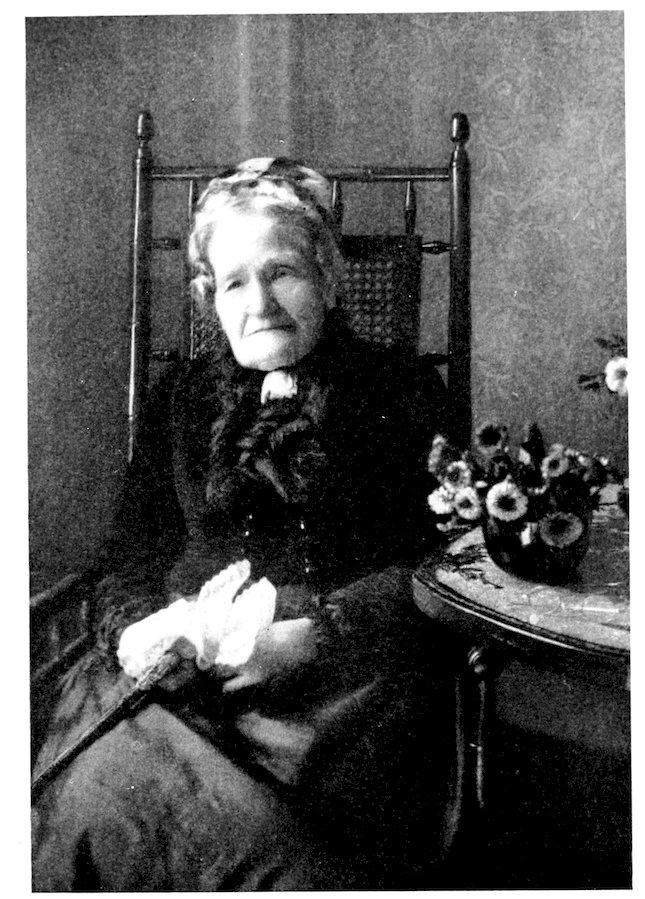
Pl. LIV.—Mary A. Hunt
Centennial Picture. Taken on her 100th birthday, 1902.
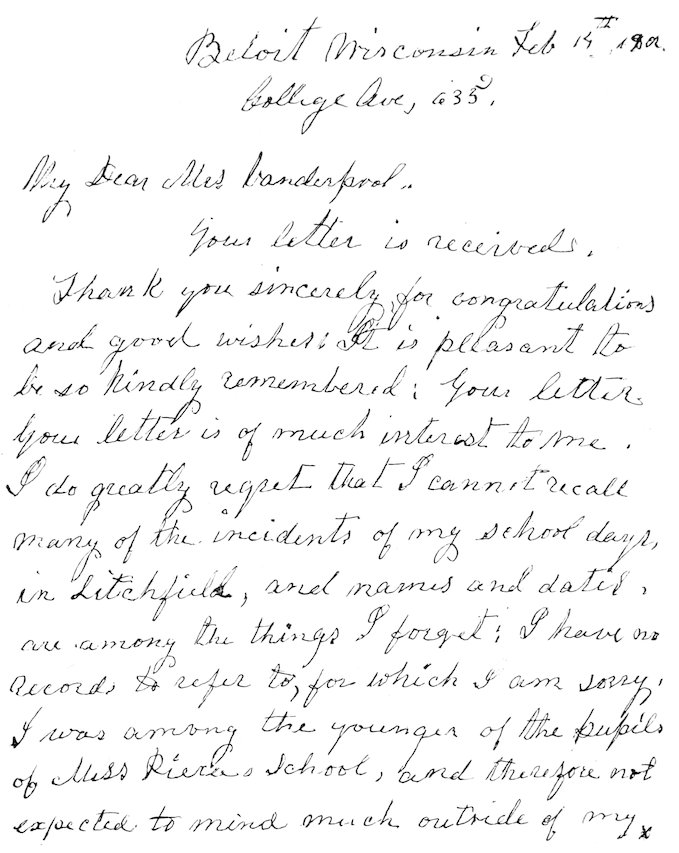
Pl. LV.—Letter of Mary A. Hunt
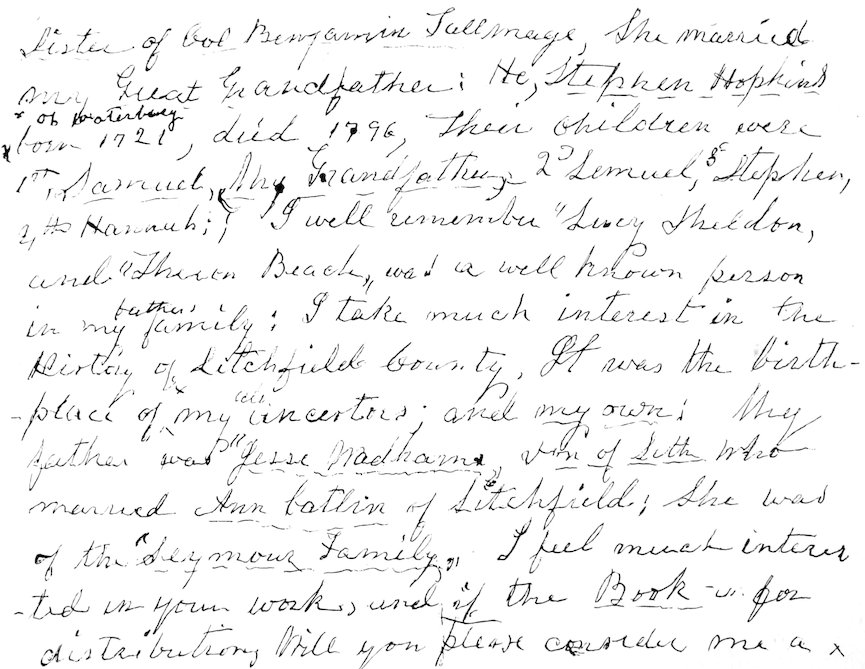
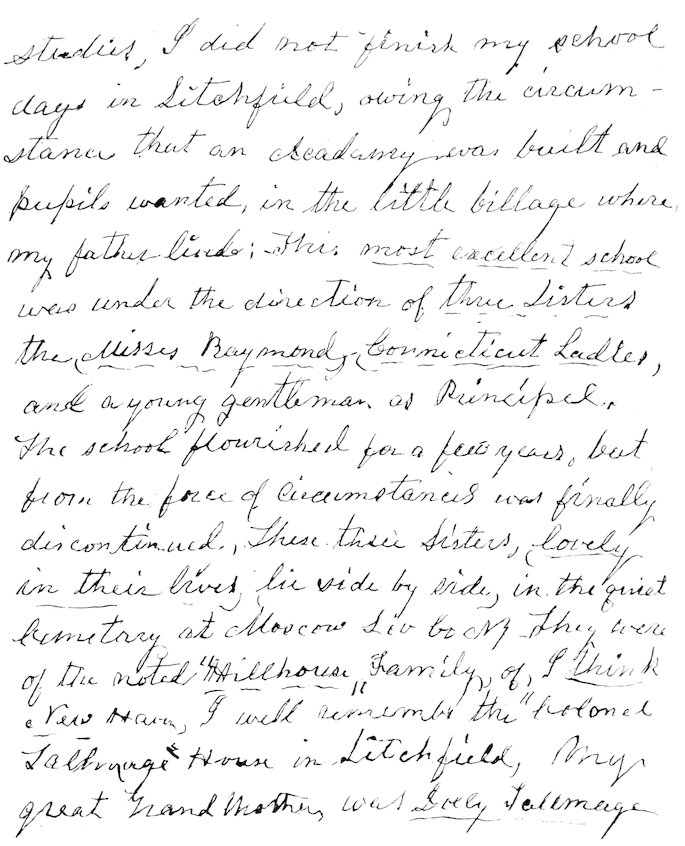
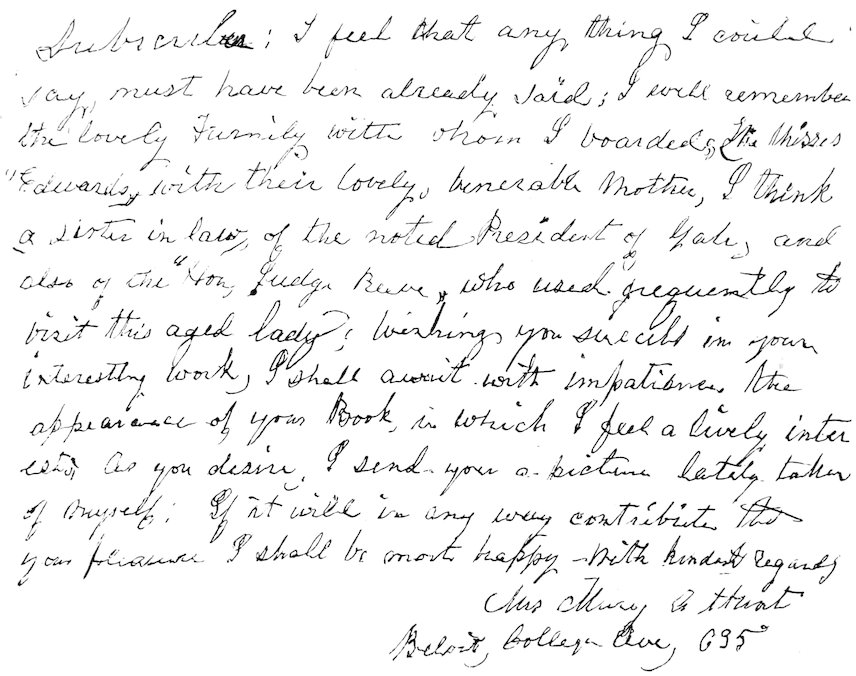
289Mrs. Edwards was a near relative of President Edwards of Yale, also I think, sister in law of the noted Judge Reeve, to whose unremitting kindness and sympathy she owed many of the pleasures of her declining years. Judge Reeve seldom allowed a week to pass without visiting this venerated friend; and his visits were counted among the bright and sunny spots in her life. She was a confirmed invalid for many years. This family were warm friends and admirers of Miss Pierce.
They were fellow workers in the welfare and education of two Hawaian boys, “Hoobokiah” and “Hope” by name who were at the mission school at Cornwall. These youths were occasional visitors and were much petted and noticed: I think Hoobokiah died before returning to his native land. I can at this day recall his face.
There was a house on North St. about where Mrs. M’Laughlin now lives, with a long sloping roof called at that time “a lean-to.” Some of Miss Pierce’s pupils boarded there with the family of Edwards[69] who occupied it. They were so strict that the law students called it “the convent.”
There were two pupils Margaret Hopkins and Elizabeth Sheldon.[70] The former went with some of her friends to spend the evening at “aunt Bull’s” on the south side of Prospect St. where Mr. MacMartin lives. A law student of the party put back the hands of the clock so that when one of the number took Margaret back to Miss Pierce’s where she boarded, the house was quite shut up. After knocking Miss Pierce came to the door in night-cap and gown, candle in hand! Some time after this occurrence, during her wedding journey, Margaret and her bridegroom met the young man, her escort, and they all had much amusement over their reminiscences of the encounter.
After the experience related in Mr. Cutler’s diary of the jilting of one of the Litchfield girls by one of the law students parents were even more careful as to any attentions paid to their daughters. Sometimes they even went so far that if a young man called three times on one of them they would ask his “intentions.” Mr. Lord built a bowling alley on the west side of the Prospect Hill road for the benefit of the pupils of both schools.
Miss Pierce used to say to one of the girls, “Mary Goodwin, I see inbred sin on your back,” and said it so often that on entering the 290school room one morning there was a charcoal sketch fastened up on the wall of Miss Pierce herself with “inbred sin on her back!”
This same Mary Goodwin laughed one day during prayers when Miss Pierce exclaimed “Mary Goodwin, Mary Goodwin you will be cast into outer darkness where there is weeping and gnashing of teeth!” To which Mary replied, “Then I suppose those who have no teeth will have to gum it!” Miss Pierce’s house was built for six hundred dollars.
Mr. John P. Brace’s father was the writing master and was always called “Daddy Brace.”
I received your letter last evening and hasten to comply with your request that I should write down some of my “personal memories” of Miss Mary Pierce. The remembrance of our intercourse with her is so fresh and so delightful that it is hard for me to realize that it continued less than three years, and that nearly forty years have passed since that time. I well remember the charming circles she used to gather round her tea-table—the repast very simple—a plate of shaved, smoked beef, some preserves and a basket of cake—but the conversation, a veritable “feast of reason.” One of her pupils, Mrs. Whiting (the mother of Miss Lizzie Whiting,) once said to me that she thought Miss Pierce was a marked instance of the mellowing power of age, for the girls used to be very much afraid of Miss Mary’s black eyes. She dined with us one Thanksgiving, her last Thanksgiving day on earth. Her conversation was most interesting, dealing largely with the past. I wish I had taken it down at the time. One thing I distinctly recall. At one time she said her sister, the principal of the school, was so discouraged with their prospects, that she felt they must probably go elsewhere—but opening her Bible, the first words that met her eye were, “Trust in the Lord, and do good, so shalt thou dwell in the land, and verily thou shalt be fed.” This she accepted as a word of promise to them, and a direction to them to remain in Litchfield. It was Miss Pierce’s custom to close her house in the Fall for the winter, but at the time of which I speak, she was staying at home, busily engaged she told me looking over old papers. She died in New Haven I think the following June. I remember her speaking once of Dr. Beecher’s preaching, that when he came to Litchfield from Easthampton, the images in his sermons were 291drawn largely from the sea, but that soon the everlasting hills furnished them, and that after he went to Boston, she heard him talk, almost with a shock, about getting up steam. As you doubtless know, the lot on which the Parsonage stands was given to the Society by Miss Pierce. I remember thinking at the time how hard it must be for her to give up the beautiful clump of trees, standing upon it almost a little grove, as I picture them, which it was necessary to cut down. I fear these few reminiscences will be very unsatisfactory to you, as they certainly are to me, but they seem to be all which I can recall with sufficient distinctness to justify repetition. All success to you in your “labor of love,” which, when completed, will be an enduring monument to some of the noble workers whose memories the world should “not willingly let die.”
I often heard my mother refer to having been with Sarah Kingsbury, at the school of Miss Sallie Pierce. I think they boarded with a distant relative of the Clarks, whom my mother called “Aunt Bull.” (on Prospect street.) During their stay there Major Kingsbury then a cadet at West Point, visited them, and created quite a little stir and interest among the young ladies, partly due to his uniform and military bearing.
I was impressed with the simplicity of the janitor service of those days. The young ladies, in turn, swept the school room, performing that duty before breakfast.
... My mother, Betsey Swan, was the eldest child of Cyrus Swan, a lawyer in Sharon, Conn. who practiced at the Litchfield Bar. She was born Feb. 6th 1807, and I have heard her say that at the age of twelve years she was placed by her Father in this school. It was her first experience away from home, and of course she suffered from homesickness. She made the acquaintance of a day pupil, Henrietta Jones,[71] the daughter of the Rector. As my mother had left a little baby sister at home it was a great delight to go to the Rectory and rock the cradle of Henrietta’s baby brother.
292I do not know how long she was a member of the school. She married at the age of fifteen Charles Sedgwick who was twelve years her senior, a lawyer in Sharon who died in 1882 and who had been state’s attorney for Litchfield County about twenty years. My mother died at the age of 87 in the home in which she was born, married and had given birth to ten children.
In the winter of 1885 I made a trip to Montreal and returning by the Vermont Central made the discovery that the winter was a pretty dull season for business in Vermont, and that the railroad was in no haste to carry its passengers out of the state! We stopped for breakfast at St. Albans, and at Burlington were informed that we would have ample time to take a toboggan slide down the hill on which the town is built, and out a mile or so on the ice of lake Champlain, where sleighs were in attendance to return us to the hotel with our lungs well filled with Vermont oxygen: and at Middlebury which was reached when the short day was drawing to its close, we were informed that the stop was for the night. I found accommodations at the Addison House, whose long wind swept piazzas looked uninviting to the approaching stranger: but the section kept open for winter guests was comfortable and homelike. I improved the remaining daylight to make calls on relatives in the branch of the Seymours settled in that place—at the old Horatio Seymour homestead I found Mr. Philip Battell who was a brother of our Mr. Robbins Battell of Norfolk—while a law student at the old Litchfield School he became engaged to Emma Seymour, who was in Litchfield attending Miss Pierce’s School—after their marriage they made a part of Mr. Seymour’s household, who was then a widower and they lived and died at the homestead in Middlebury.
Mr. Battell was very glad to see a Litchfield representative, and said that I had struck them at just the right time—that there was to be held at his house that evening a meeting of the Middlebury Historical Society to observe the Centennial Anniversary of the Addison County Court—whose first session was held one hundred years ago, that day, with the Hon. John Strong as the presiding Justice. Mr. Battell informed me that he had filled the office of Secretary of the Society since its organization, and that to warn the meetings and provide the banquet were among his duties.
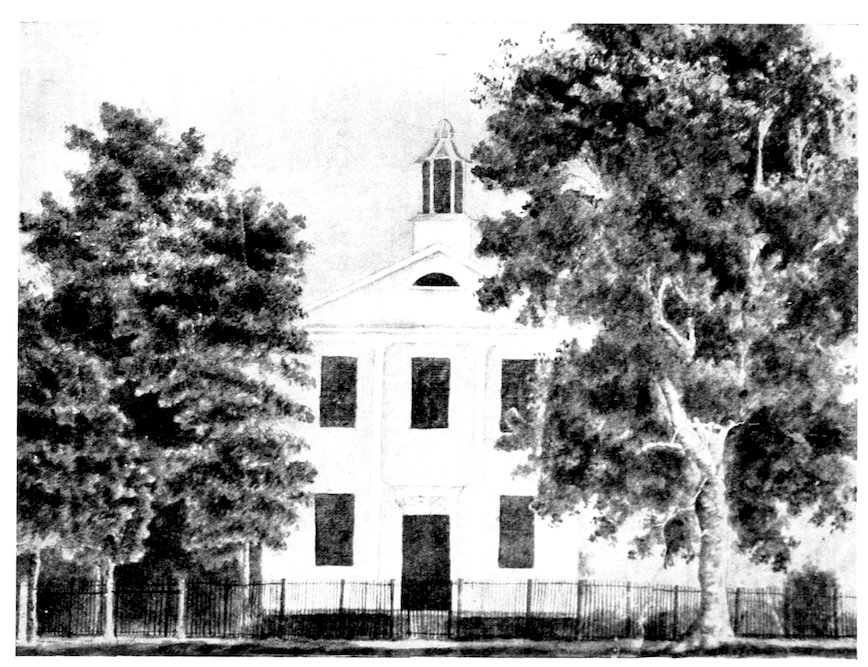
Pl. LVI.—The Litchfield Academy
From original water-color, probably by Mr. Gimbrede, afterwards engraver in New York
293I found the members were largely made up of the faculty of Middlebury College, with a number of professional and business men of the city: Governor Stewart, Mr. Battell’s son in law, was the presiding officer, and he insisted in spite of my modest remonstrances upon my taking the seat of honor at the head of the table, as the living representative of the presiding Justice of one hundred years ago. The conversation, after reading the minutes of the Court by Gov. Stewart, was largely taken up with a discussion of the Strong family. John Strong settled the county in 1765: he drove up with his wife and three children on the ice of Lake Champlain from Salisbury, Ct., and took possession of a log cabin, which he had built the preceding winter, in an abandoned French settlement, while out on a hunting excursion. For a time bears and wolves were their only neighbors, but other settlers soon followed, and he lived to see the wilderness blossom like the rose. When the revolution broke out, Mr. Strong took the part of the colonists, although the British garrison at Crown Point had long been good customers and had filled his chests with British gold: And when Gen. Burgoyne and his Indian Allies approached, he rode down through the State, and warned the settlers to fly from the approaching army, and to take their flocks and herds with them—and it was doubtless due to this timely warning, and sagacious advise, that Gen. Burgoyne brought his army to Saratoga in an absolutely starving condition: the country over which he had been obliged to so slowly pass, had yielded no supplies, and at Saratoga he could do nothing but surrender.
John Strong expected to return in time to remove his family to a place of safety, but he was captured by Indian scouts, who bound him for torture in their usual manner. He told them however that they must release him, and take him before Gen. Burgoyne, for whom he bore a message—the Indians were impressed by his coolness and imposing presence, and complied with his request; when brought to Gen. Burgoyne he asked for his parole—which was granted until the “Army returned.” “But suppose General that the Army does not return”—“In that event;” replied General Burgoyne, “you are released.” Had he known what especially good work Strong had done that the Army should not return, he might have returned him to the care of the Indians. Mr. Strong hastened to his home, which he found had been burned by the Indians—he raked the ashes for the bones of his family, and not finding them, concluded that they had escaped to the South, and looked for them in Salisbury, Ct.; they had found refuge in Dorset, Vt. where they remained until the close of the war. Mabel, my Grandmother, was born there in 1782.
John Strong was born in Coventry this State and was the fourth in 294descent from Elder John Strong of Dorchester, Mass. He married Agnes, the daughter of John McCan a refugee from the Scotch rebellion of 1715: he was a wealthy landowner and received income from property which he had deeded to a friend to avoid confiscation, as long as he lived—but after his decease the remittances stopped—his only other child John, was killed in a naval engagement. In 1797 Mabel Strong, Lucy Case and a Miss Dwight, all of Addison, Vt., made a start for Litchfield, Ct., to attend Miss Pierce’s School—They made the journey to Bennington on horseback, and from thence the Rev. Mr. Dwight drove them to Litchfield—the latter part of the journey was made in a wagon.
Mabel Strong made her home during the years of her stay in Litchfield, with Mrs. Brace, a sister of Miss Pierce, and the mother of John P. Brace—her wardrobe was made up after her arrival. The Brace house stood on the site now occupied by the Congregational parsonage—it was painted red when I remember it, and had a long roof on the rear reaching nearly to the first story. Many of Miss Pierce’s young ladies found their future husbands in Litchfield: Lucy Case, married Horatio Seymour, who had removed from Litchfield, and was a practicing lawyer in Middlebury, Vt., afterwards U. S. Senator from that state.
He was very much interested in having a school for young ladies established in Middlebury similar to that of Miss Pierce’s of Litchfield—My grandfather Moses Seymour Jr. drove from Litchfield, with a sleigh and pair of horses in Feb. 1800, to bring home Mabel Strong as his bride; Miss Pierce and Idea, daughter of Hon. Jedediah Strong, whose house stood where the McNeils[72] now live, and whose name, then as now, was graven on the white mile stone, accompanied him as far Middlebury; where a School was established for Miss Strong, and countenanced and encouraged by the presence of Miss Pierce. This School had an existence for several years; Miss Strong fell a victim to the rigors of the Vermont climate, and was succeeded by Miss Emma Willard, who eventually removed it to Troy, N. Y. Miss Pierce returned with the wedding party.
General Samuel Strong was a brother of Mabel and was a frequent visitor at Litchfield: he commanded a military force at the battle of Plattsburgh, which he raised by his individual exertions—and was thanked for his services by the Legislatures of the states of Vermont and New York.
He also received from the state of New York a sword of honor, which is now in possession of the Vermont Historical Society.
295The General was wounded at the battle, and feared consumption. He visited Litchfield on his way to the South, to spend the winter, and called in Dr. Sheldon for advice. The Doctor told him to spend all the time on horseback, that the weather would permit—The advice was followed, and the General lived to be old. This Doctor was wise beyond his generation.
In 1817 the General had a coach built by Ambrose Norton, whose wagon shop stood on the ground now occupied by the Echo Farm creamery: All the material were produced in Litchfield, and the work was also done here—separate bills were rendered for wood work, ironing, leather, broadcloth, silver plating &c. with hours of labor on each, and the aggregate was $350. I found these bills among my grandfather’s old papers and consider them worth preserving as evidence of the industries which made the old Litchfield a thriving and important town. We can no longer produce iron, silver plating, leather and broadcloth, nor do we build coaches for the magnates of Vermont.
Moses Seymour Jr., and his bride commenced housekeeping in what was then known as the Skinner house, now occupied by the Bissells next the United States Hotel; they afterwards removed to the Marsh house on the corner, where the Library building stands, where they remained until 1817, when the house which I now occupy, was completed for my grandfather and they took possession of it in that year. Moses Seymour Jr. was for many years high Sheriff of the County. The office was at that time in the hands of the Governor of the State—Mr. Seymour was appointed by Governor Oliver Wolcott; he died in 1826. Mrs. Mabel Seymour survived him until 1839—she died at Litchfield—Mrs. Mabel Seymour had three daughters who were graduated from Miss Pierce’s Academy—Louisa married Mr. Stanly Lockwood of Painsville Ohio, where she lived, and where she died in 1878, leaving surviving children, John Seymour Lockwood, and Mrs. Louisa Malin, both living in that city. Delia Storrs Seymour was a teacher, and died in Litchfield in 1887: she was unmarried.
Jane Seymour married Dr. Josiah G. Beckwith who was for forty years in active practice in this town; she lived, until her death, which occurred in 1868, in her father’s homestead; she left surviving issue, Dr. J. G. Beckwith of this town, Dr. George S. Beckwith of Pine Plains, New York, and two daughters, unmarried, Elizabeth Gale and Sarah Hunt. Dr. George S. Beckwith and Elizabeth G. Beckwith are deceased. I have the diplomas of Delia S. Seymour and Jane Seymour—They are printed on small pieces of silk, and give the studies in which the graduate had been instructed: each bears the name of the graduate; but they are neither dated nor signed.
Both my grandmothers were pupils of Miss Pierce.
Sarah D. Gardiner and her sister Mary B. were the daughters of John Lyon Gardiner of Gardiner’s Island. The former became the wife of David Thompson, Esq., of New York, and the latter on leaving Miss Pierce’s went to Miss Willard’s school[73] in Troy, N. Y., and at the early age of twenty-three, died in Columbia, South Carolina, where she had gone in search of health.
Mrs. Thompson often spoke of Miss Pierce and Mr. Brace. She was very young when she entered the school and must have been quite homesick at first. After she had been there sometime she was one day surprised to find her room mate engaged in making the bed, and on learning that the pupils were expected to keep their rooms in order exclaimed: “Why didn’t you tell me?” “Because,” replied her kind-hearted companion, who was an older girl, “I knew that you were not accustomed to it!”
She must have boarded later at Dr. Sheldon’s, for she spoke of learning her lessons with Miss Julia Gould, and in the darkening twilight returning across the street to Dr. Sheldon’s (or Miss Lucy Sheldon’s?) while the good Judge, standing in his doorway watched the little figure safely over. Juliana MacLachlan, my father’s mother, had been a pupil in the school at an earlier date. She was a beautiful girl and a belle with the law students. When but fifteen years old she married David Gardiner of East Hampton, Long Island.
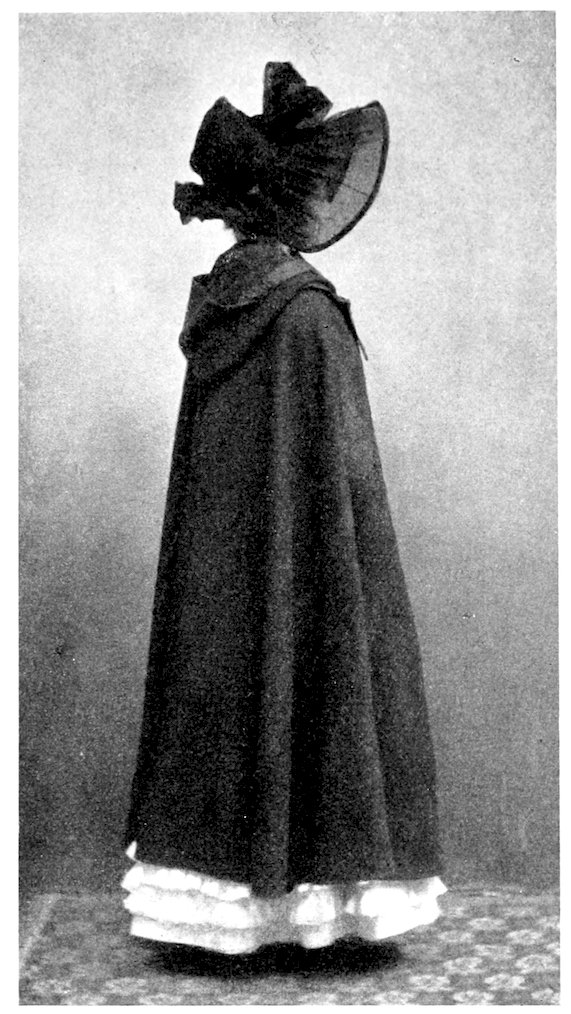
Pl. LVII.—Litchfield Costume of about 1827
Black crape bonnet made for his widow to wear at the funeral of Mr. Cheney
I went to Litchfield in the Spring of 1830. Mr. Brace was at the head of the school, but Miss Pierce came into the school every morning and taught the class in Universal History which was a book of her own compiling, and she used often to give the girls talks.... I think of her as a little old lady active and bright; somehow I have a more distinct recollection of her half-brother and sister who lived with her; I think Miss Mary kept the house; I don’t remember any assistant teachers at all; I do remember three or four boys who attended the school because there was no boys’ school in town; one was Willie Jones, the son of Parson Jones as he was called; another was son of 297Dr. Buel on North Street, the same who had the sanitarium at a later day; another was George Seymour, a nephew of Origen Seymour; I think his father was dead; there was a young lad by the name of Hull that I did not know as well; a sister of young Buel’s mother, Miss Wadhams from Goshen, was in school for quite a time; Hannah Beach also was from Goshen; her father married Miss Lucy Sheldon.... I think most of the families took a few boarders; there were four sisters named Rankin from Newark. It seems strange, but I cannot recall the names of the girls who boarded at Mrs. Lord’s with me excepting a Miss Clark; we all occupied the rooms in the third story, the best rooms of the house were rented to young gentlemen who were law students.... There were two or three girls who boarded at the Parmalees’ on South Street; one was a Miss Larned from Maryland; another was from New London....
Aunt Anna Thompson used to mention with much amusement the feuds between Miss Pierce’s scholars and the farmers’ daughters—more especially that peculiar class of young American girls who were “living out”—the “help”—in village families. It would never have answered to call them servants, nor were they such in the modern sense! These girls, usually the most ambitious of their family, made more independent by self support, gaining influence in proportion to the polish acquired by intercourse with village people, easily dominated all of their set, and together were a strong band. The school girls were supercilious, the help aggressively arrogant—and both classes equally proud and uncompromising. Many a battle was fought on Sunday as well as on week day. All around the gallery walls of the old church on the green was a row of square pews fenced in with the conventional high lattice work, while in front were two rows of benches. Many of the young people of the congregation chose to sit there where they were more free from the restraining presence of their seniors. Sometimes one part of the gallery would be considered the special choice, sometimes another, but “out girls” and school girls would never freely mingle! When one pew was monopolized by school girls for a noticeable length of time the “out girls” would come early some Sunday and “pack” the seats. Then would follow pin pricking, pinching 298and punching through the lattice—and the incensed school girls would bide their time to preempt the “out girls’” places.
The worst possible indignity that the school girls could heap upon the “help” was to give them the stinging epithet of “Potwrastlers”—probably meaning dish-washers!!
Aunt Anna could judge of these stormy scenes from neutral ground as she belonged to neither faction. She said that the class spirit mentioned in “Poganuc People” was specially well depicted.
“Nabby” of “Poganuc People” was for a long time the “help” in Miss Pierce’s family, so I think the old scholars would remember her—the “Aunt” Emily Addis who lived and died in the little house at the foot of Gallows Hill. When her mother died leaving to her care her little sister Mary—afterwards Mrs. Churchill—Miss Pierce kindly let her bring the child with her to her house—I think taking her into the school. “Nabby” is a composite character being in part Emily Addis and in part an older sister who married Hiram Barnes,—the “Hiel Jones” of the story—and left town.
Dinah Atwell, a strange half-crazed character, may be remembered by the old scholars. She spent her time between the Pierce family here and another Pierce sister in Rhinebeck. Memories of her are centered in the old church on the green where she reigned a selfappointed tithing-mistress watching the children from her seat high up on the pulpit stairs.
Mr. Norton told me that the Central Park was the thought of Miss Mary Pierce. She contributed money to have it graded and fenced.
It would seem to me that no tribute to Miss Pierce and her school could be complete without a mention of her “door-yard” with its odd assortment of flowers. The many wild plants scattered here and there, Mr. Norton told me were transplanted by the pupils,—perhaps while studying Botany. There were Solomon’s Seal, White Baneberry with its creamy flowers in early summer followed in autumn by a stiff cluster of oval white berries with black dots on thickened ink stems, the wandlike wreathy stem of Carrion Flower with its greenish blossoms and dark slate-colored berries, Trilliums of more than one species, Violets, Anemones, Bloodroot, Celandine, Adder tongues and two-leafed Solomon’s Seal and others. I have often tried to think how the flower beds were originally laid out. There must have been one following the front fence—all well kept yards had that—possibly one by the north yard fence and another following the circular walks to the front door. But all traces are now obliterated! I can’t quite feel that these woodsy plants that had so long outlived the young girls who planted them belonged to the present generation to uproot and destroy. I miss 299them and always shall whenever I pass the place. There certainly could have been no sweeter “keep sake” left by the scholars to the town than these flowers. The girls may not have had far to carry the roots for the woods were nearer the village then than now. Mr. Norton told me that when Miss Sarah and Miss Mary Pierce were little children they were sent across the street to Parson Champion’s and lost their way in the bushes and men were called out to find them! At that time the road was near the west side walk and the rest of the street was a tangle of bushes.
Miss Pierce must have had a deep love for flowers and a rare faculty for impressing her scholars. The six or eight old pupils of whom I have had any knowledge were peculiarly fond of plants. Years ago when I had a little school in town Miss Harriet Grant brought Fanny to me and in telling me of her attainments said she had worked her sampler at home and was well advanced in Grammar, she having taught her, as she herself had learned, from Murray’s Grammar, which she had used at Miss Pierce’s school. She considered that the best textbook on the subject. She spoke with as nearly enthusiasm as her quaint prim manners would allow of her instruction in Botany while at that school and the pleasure it had been to her through life, and of a number of rare plants she had found.
I have been unable to find much of interest to add to your labor of love, but can say that the house which the Misses Sarah and Mary Pierce occupied and which was torn down by Mrs. Underwood in 1896, was built in the year 1800. The “Litchfield Female Academy,” a later building, which stood north of their house was erected in 1827 by a stock company incorporated in that year. This latter building was removed to the Beecher Lot, corner of North and Prospect Streets, prior to 1860, and was occupied there by the boys’ school of the late Rev. James Richards D.D., under the name of “Elm Park Collegiate Institute” for some years.
Mr. Henry R. Jones of Brooklyn, N. Y. converted it into a dwelling house after he purchased that corner about 1882; the “Beecher Homestead” building having previously been purchased by Dr. Henry W. Buel, and removed to “Spring Hill,” about 1872 where it now forms a part of his group of buildings.
The following bill illustrates both the prices for tuition in 1831, and the custom of taking merchandise instead of money in the days when money was scarce. Also the amount contributed by each scholar toward the cost of the exhibition[74] usually held at the close of the term.
| John Grant | ||
| To | J. P. Brace Dr. | |
| Tuition | $10. | |
| School expenses | „42 | |
| $10„42 | ||
| Exhibition tax | „12½ | |
| 10„54½ | ||
| Received of Mrs. H. Grant wood | 9 3 | |
| Due | 1—51 | |
| Litchfield April 19th 1831 | ||
| Rec’d payment | ||
| L. E. Brace | ||
| Signed by Mrs. Brace. | ||
Your kindness and that of all your family towards me and mine last summer, induces me to think a letter from me would not be unacceptable.
I often think with satisfaction of the quiet, healthful and pleasant time I passed at Litchfield, and feel a strong desire to know something of the friends and acquaintances I made there. After your own family, no one recurs to my mind with so much interest as Miss Sheddon. I felt myself peculiarly fortunate to find in the same house so amiable and intelligent a companion—if she is near you this winter pray present my best regards to her, and tell her I shall take it very unkind of her if she ever came to New York without giving me the pleasure of seeing her at my house.
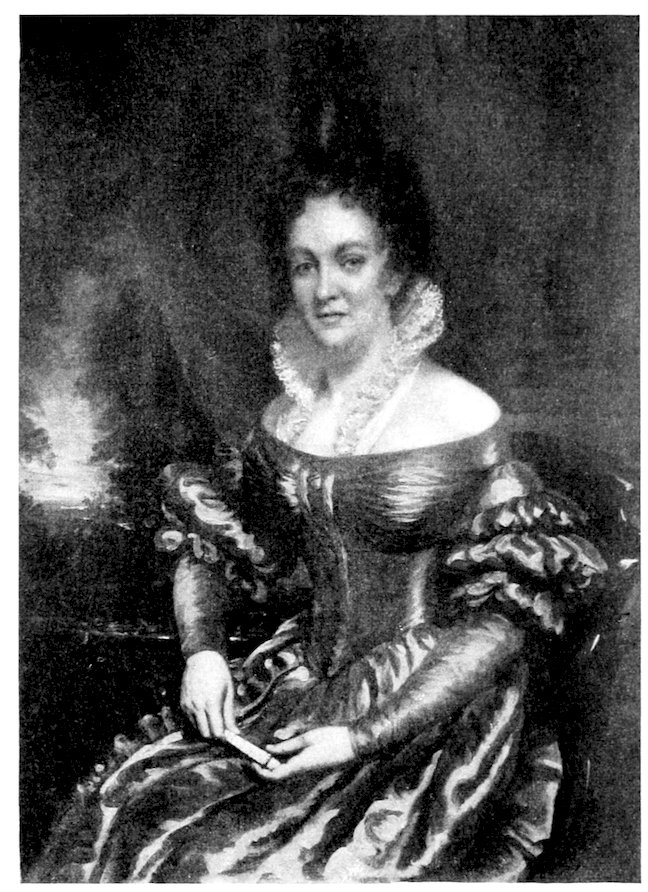
Pl. LVIII.—Maria Adams (Mrs. Henry Tallmadge), Pupil, 1802
From oil portrait
301Aunt Sally is in the full enjoyment of all her faculties and of her health, which is uncommonly good this winter—I hope you are as much delighted as she is with the life of Hannah Moore. I remember you were very impatient for its appearance; she is most enthusiastic in its praise—it ever lays open on her table. I want to know your opinion of it, though I think it cannot but be favorable, but my paper admonishes me to have done, and I have more messages than I have room for from Pendleton to the Miss Braces, and from Edmund to the little Abbeys—I would fain send some myself to my kind Dr. Buel—do, if you see him, tell him his little patient is grown a fat robust fellow, nor would I omit Mrs. Talmadge, Mrs. Wolcott and her family, and Mrs. Harrison—I hope Mrs. Jones too and her son are well. If circumstances permit I hope to find myself under her roof next summer, though I fear I shall have to go another way—Edmund is very desirous to go to Mrs. Jones for he wants to go again for Dr. Abbey’s cows, & Phil thinks he will by that time be old enough to be of the party, and besides he thinks Mrs. Jones has got no little boy now to read to her in the bible—and help her pick cucumbers—
I hope that your health, (never very robust), has at least been as good as usual this winter, my dear Miss Pierce—present my warmest regards to Miss Mary Pierce and your excellent Brother, together with all the good wishes of the New Year for a continuance of your present earthly happiness—I hope you will occupy some leisure half hour in giving me the gratification of a letter from you—
It has been my intention for some time to address a letter to you, but circumstances have hitherto prevented, and as nothing very interesting has occurred it has seemed almost useless for me to attempt to amuse or interest you. The desire to write to one I so highly esteem and dearly love overcomes every obstacle, and the anticipation of its being acceptable to you inspires me with confidence to proceed.
I need not dwell on the beauties of this place, or its agreeable inhabitants to prove how much and truly I have enjoyed myself for the past month. To one who has spent the brightest and loveliest part of life amid its delightful scenes, can readily realise the pleasure of rambling through its woods, or following the wandering course of its streams. Although the groves are robing themselves in their autumn livery and 302reminding us that ere long we too, shall be in “the sear and yellow leaf,” there is a pleasing pensiveness steals over the soul in contemplating their varied hues, so nearly resembling the chequered scenes of life, emphatically calling upon us, so to spend the summer of our days, that when the winter storms of time howl fearfully around us, we may with “an unwavering faith, enwrap the drapery of our couch around us and lie down to pleasant dreams.” ...
Miss S. Pierce desired me to say to Aunt for her, that she should be very happy to have her come to Litchfield and make her house her home. I wish sincerely, dear Aunt, you would come up with Pa and Ma when they come for us, as we hope they certainly will with little Henry....
Miss Lucretia Deming called and favored us with a ride a few days since. Mrs. Beach (Lucy Sheldon that was) invited us to tea and also Miss Pierce. We passed a delightful evening at Mrs. Dr. Buel’s with the young people of the village last evening. I have written too long a letter already and will close by requesting the favour of a [torn] answer [torn] return if you consider it worth the trouble. [torn]ry unites with me in much love to Uncle, Aunt and Cousins, and believe me
M— D[worn]id Wooster aged 75 was buried yesterday. I took tea at Miss Pierce’s on Saturday evening with the rest of the family, and was introduced to Misses Twining, Ferris and Catlin, cousins to a former friend of mine. Miss T——ng resembles him very much and I happened to sit next to her all the evening. I found her quite agreeable—she quite as well satisfied I believe. I write this, dear Aunt, not that it can be very amusing to you, except as you are acquainted with a few peculiar circumstances connected with the family, etc. I send this letter rather than with another, merely to change the date. I hope it will be no less acceptable on this account. Excuse the unshapely appearance of this addition, dear Aunt, and remember,
It is always a solemn & interesting moment for a teacher to close a term of his exertions & instructions. To give the last information to those who are entering the world to perform their parts on the great theatre of action; to feel that all that he can do for their improvement & usefulness, their benefit here, & their welfare hereafter, has been done; to realize that the account of his influence over them, has been sealed up by the recording angel, & entered in heaven’s dread chancery, to be opened no more until the great day of reckoning brings all things to light; to feel that he has bidden adieu to those, whose welcome faces, for years, have surrounded his desk, & constituted his happiness or misery by their conduct; to feel all this clouds his brow with gloom, & fills his heart with sorrow, when the anticipations of home & friends, & the buoyant hope of future usefulness, & the false glare of expected admiration, causes every eye to sparkle, & every heart to throb among the pupils around him—It is then, that looking on the past, the feelings of regret, at neglected opportunities for their welfare, once enjoyed, and now lost forever; at all that he might have done to have made his pupils more useful, better fitted for the stormy trials of this world, & the greater trial hereafter; of all his mistakes & errors in intellect; of his follies in conduct and obliquities in temper; of his example, shining but to betray, & his influence, powerful, but to mislead; of all that he has done to injure, or omitted to do to benefit, rush upon his mind, in a tide of overwhelming sorrow—
At such a time, the most faithful in intellectual discipline, the most devoted to the future usefulness of his pupils, & the one most willing “to spend & be spent” in the service of his greater master, feels his past neglect, & grieves over his deficiences.
If such be the feelings & the regrets at the close of an ordinary term, how much more shall he feel, the principal of this Academy, who, after eighteen years devoted to its interests, on this night, with this act, closes his connection with it, & enters on a new, & almost untried field of usefulness.
The audience generally, & his pupils in particular, will excuse him for occupying their attention, a few moments, in a detail of the plan of his instructions, the motives for the resignation of his present office, & the regrets that crowd upon his mind in standing for the last time at the head of the Litchfield Female Academy—
It has always been our belief, that the female intellect was as susceptible of as high & extensive cultivation as that of man; though, from 304her different destination in Society, & her various employments, a different education must be pursued—
It is not now necessary to enter into a discussion of the question whether the abilities of the sexes are naturally equal; it is sufficient to notice, that the circumstances of life require a varied exercise of these abilities—The employments of man & woman are so dissimilar, that no one will pretend to say that an education for these employments must be conducted upon the same plan: but the discipline of the mind, the formation of these intellectual habits, which are necessary to one sex, are equally so to the other—The difference in their employments requires a diversity of personal qualifications, but not a difference of intellectual exertions—it is equally important to both sexes, that the memory should be stored with facts; that the imagination should be chastened & confined within its due & regular limits; that habits of false judgement, the results of prejudice, ignorance, or error, should be destroyed or counteracted; that the reasoning faculty should be trained to nice discrimination, & powerful & rapid research.
It has, therefore, been our endeavor to fling into that course of study & employments which may be considered peculiar to women; as many of the mental avocations of the other sex, as were necessary to all that development of intellectual energy, which woman, in her situation may require—To this course of discipline & improvement we have endeavoured, uniformly to adhere with no more variations than were necessary to keep pace with the changing state of many of the sciences, with the gradual improvement of our country, & the rapid “march of mind” in the present century—
During the forty years of the existence of this Seminary, other similar schools have arisen & fallen; have had their day of reputation, & have ceased their operations—Fashion has led, during this long period, at one time to place an undue stress on external accomplishments; at another, to the study, exclusively of intellectual philosophy; at another, on the physical sciences; while we have endeavoured to mingle all that was useful in the existent fashion, with the regular course of study so long pursued—
A teacher of a large & promiscuously collected school is obliged to act upon other principles, in the motives & incentives placed before the mind, than if he were conducting the education of a solitary individual or a single family or early discipline; the course pursued by parents; the difference of original constitution; the diversity of prejudice & feelings, occasion such a contrariety of character among his pupils that he can find but few motives that will operate alike upon all.
Were human nature perfect, did all act up to the light they have 305received, did the great principles of the divine law “thou shalt love thy neighbour as thyself,” operate on the heart, the teacher would have an easy task, a delightful labour—In the ruined state of the human heart, when the holiest motives are unknown, he is obliged to seize upon the best that remain to accomplish the great object of public instruction.
He has the stupid to arouse; the sluggish to excite; the idle to leave or drive into a life of industry; the irregular to habituate to a life of method—
To accomplish these important objects, & to induce our pupils to make the greatest possible improvement of the time and advantages allowed them, we have adopted a system of rewards & punishments founded on the principle of an emulation to excel. Our utmost endeavours have always been made to prevent this system of emulation from engendering an unholy ambition, and the approbation of parents, & the plaudits of an approving conscience, have been the motives most frequently exhibited, and most affectionately urged upon the minds of our scholars.
Our object has been, not to make learned ladies, or skilful metaphysical reasoners, or deep read scholars in physical science: there is a more useful, tho’ less exalted, and less brilliant station that woman must occupy; there are duties of incalculable importance that she must perform: that station is home; these duties, are the alleviation of the trials of her parents; the soothing of the labours & fatigues of her partner; & the education for time & eternity of the next generation of immortal beings—Our design has been, to give our pupils enough of science to conduct the early education of their children and to relish the conversation of the scientific around them. Our greater aim has been, however, to cultivate the judgement & improve the taste, to produce a relish for reading, & especially to create a correct & elegant style in conversation & letters, where alone, with few exceptions, women can manifest the extent of their information.
The formation of character; the acquisition of correct habits; the controul of tempers, & the restraint of appetites; the discipline of mind, that will lead to perseverance & industry, to order & system hereafter, are of more importance than the principles of science, than the refinements of manners, or the elegancies of Literature—
To these objects have our exertions been extended—Every moral precept that could be drawn from science or literature; from the rewards & punishments of the school, from the daily occurrences of life, is applied to these great purposes—Feeling as we do, the importance 306of forming the habits & the character, at such early periods, we use all our endeavours to fulfill the responsible duties devolved upon us—
There is yet one other subject, of higher & holier moment, that forms a part of these responsible duties: the direction to be given to our pupils to comply with the great object of their creation, & glorify their Maker. In our religious instruction, bestowed often upon them, we have endeavoured to point them to that Saviour, provided for them, & to impress upon them the duty of repentance & faith required in the gospel. We trust we have not done this, in a sectarian spirit, & that we have equally encouraged every sect “who love our Lord Jesus Christ in sincerity & truth.”
But feeling, as we do, the deep wickedness of the human heart, the necessity of a change of that disposition to an entrance into the kingdom of heaven, & the agency of the Spirit of God in accomplishing that change, we must press these subjects upon our pupils, & to show them their guilt, their danger, their remedy & their duty; praying that the Spirit of God would accompany these exhortations with saving power to their hearts—
Such is very slightly the outlines of the motives, that have guided our public career & we hope that on looking back over the long list of immortal beings entrusted to our charge, at the most important & responsible part of their existence, we can be excused the assertion that we have attempted to do the good required of us, “in our day & generation”—
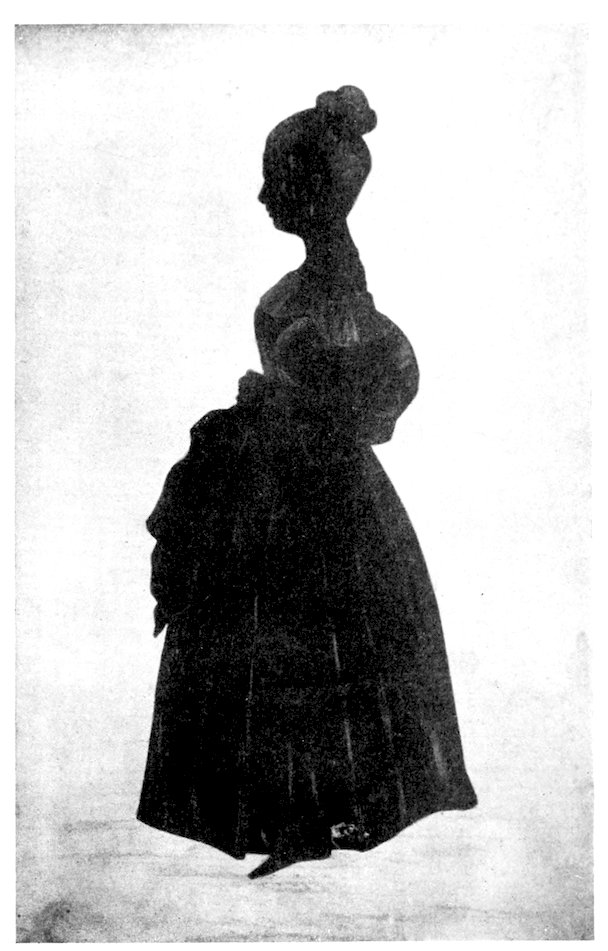
Pl. LIX.—Silhouette of a Litchfield Girl of about 1830
Will the patrons of this school, now, pardon me in giving a detail of the reasons that have led me to relinquish my charge as the associate principal in this Institution—These are, very concisely, (for I do not wish to occupy public attention by an egotistical exhibition of my private movements,) the diminution in the number of my pupils, occasioned by the numerous other establishments of a similar description, springing up all around us; the increased facilities of travelling to other places which nature has denied as an access to this village; & the offer to a station, where with less of physical exertion, a more certain & ample support for my increasing family, can be obtained, & a greater amount of usefulness be in my power, from the increased number of pupils, & the enlarged sphere of action—But in relinquishing this office, let me be believed, when I assert that I never can efface from my memory, the kindness of those by whom, I have been surrounded & supported for so many years—The stream of time may roll many things into oblivion, but whether it stagnate in its course, or rush on with a cataract’s velocity, it can never bury beneath its waves, or hurry 307from my heart, the recollection of all that has been done & felt for me, by the people of my native village—
I am going among strangers, & I shall miss your kindly sympathy. I shall miss the tones of friendship, heard from childhood until now. I shall miss these advisers on whose arms I have leaned until age has almost bowed them to the silent & narrow house, & sprinkled my locks with gray—I shall miss those pupils, who, though years have elapsed since they heard my instructions, still beam upon me as they pass, with their kindly faces, & look as if satisfied, that they too were educated in the Litchfield School—I am going to a land of strangers to acquire new friends, to lean on new advisers, to see the faces of new pupils, at an age when change is the most dreaded, & old associations the most powerfully felt—It would be a gratification in this hour, to feel that I might retain that friendship, & those regards, I have held so long & prized so highly—
Permit me to express a hope that the Institution to which I have given my hopes & my fears, for nearly 20. years, will still be preserved on its former footing, & that yet very many more may be added to the list of the 3000 of its former pupils, & that the declining years of her, who, for forty years, has superintended its operations, & who was the pioneer in the march of female education in this whole land, may be soothed by the success of that which has been her object in life, & will be the “crown of her rejoicing, in the day of her Lord”—
To the pupils of this term, I return my grateful thanks, for their attention & their kindness; for their progress in science, & their improvement in character—I hope that their conduct in this world will be such as to reflect honour on the Institution, that educated them, & that their preparation for another will be founded on those gospel principals that will unite them around the throne of God forever.—
The time will soon arrive, when all of us shall have done with all that is mortal & earthly; when the tongue that utters this farewell, & the ears that hear it, shall be alike motionless in dust; & when a few grassy hillocks by the graves of our fathers shall be all that earth has left to us; shall we not, all of us, then, make that preparation which will fit us for scenes beyond this world, & its perishing employments, when the realities of Eternity, will be around us, & nothing but the faith of the gospel, be of abiding benefit?—
It is useless for me, from this desk & at this period of the history of education in our country & of the march of the human mind, to enter a laborious investigation of the uses of information, of the advantages of study, of the pleasures of intellectual enjoyment. The fountains of pure happiness which education has opened in our land, are no longer locked up from the female sex, but all are equally invited to drink of their waters & in no way is the superiority of our favoured country more notedly manifest than in the blessings of mental discipline being poured upon the heads of the female sex. Have you ever, my dear young friends, as your eyes glanced over the map of the world, & your memories were stored with the facts of Geography. felt your hearts rise in aspirations of gratitude to your heavenly Father, that you were not like the unhappy females of which you read; compelled to the lowest & meanest pitch of outward degradation, & the darkest night of mental ignorance; condemned by “man, imperial man” alternately, to be the slave of his passions, & the victim of his tyranny; condemned to the toil & labour & suffering of a life of barbarity, the galley slave of ignorance & brutality, with no other prospect at its close, but to mount the funeral pile of your lord & master, & with no hope of the brightness of that “life & immortality,” which the gospel has brought to light. The religion of Christ & the influence of education have made this difference in your happiness here, & your prospects hereafter. and it is useless for me to occupy your time one moment in any laboured proof of the value of education to you. It was not always so. Eighteen years ago, well can I remember the prejudices, the fashions, the antipathies with which I had to contend. The taste for frivolous accomplishments was to be crushed, & something besides the embellishment of the exterior was to be forced upon the consideration of the light & trifling. The singular prejudice of some of the good & pious of the community, that all information beyond that of the Bible, was profane & useless, was to be softened down & modified. The false idea that the exclusive station of woman was the kitchen, & her exclusive discipline an acquaintance with culinary concerns was to be counteracted, & a better feeling of her value & her influence to be created. But that time has passed, & the full importance of female improvement, & the culture of female intellect have been justly appreciated, & the numerous seminaries that crowd our land, show that “scattering the seed” of female education is an object of the highest utility.
309There are many, at the present time who suppose that the discipline of the female mind should be the same as that of the other sex, & that the same mode of education will answer for either. With this opinion I cannot entirely coincide: not because I have any doubts on the natural equality of the female intellect, or any jealousy of their superior mental attainments, or any prejudice against intellectual cultivation, but my belief is that mental discipline must be accommodated to the different stations, that man & woman are destined to occupy, & that many studies & employments, proper in the education of man, will be useless in that of woman. Still, the same general habits of intellectual exertion, the same attention to the cultivation of the powers of the mind are necessary to both. In both cases the memory is to be stored with useful facts, but not crowded with the unnecessary furniture, that a more technical knowledge of names would give; the imagination is to be checked in its career, & placed subordinate to the reason; habits of nice discrimination and deep research, of laborious & painful investigation, of accurate classification are necessary to both. Instructors are often asked by their pupils “of what use will the knowledge of such a science be to us?” The answer should be always ready “to discipline the mind,” & if it produce that effect, its aim is gained, tho’ of no radical utility in after life. Even if some royal road could be discovered to the acquisition of science, I still doubt its use to the young mind which needs the patient investigation of a difficult and abstruse study to strengthen its capacities, invigorate its faculties, & prepare it for similar contests in after life.—Every study, therefore, that will, in the education of man, produce this mental discipline, may be employed with equal advantage, in giving the same heathful tone & vigor to the female intellect. After this great object is attained, the most important in education, aside from the moral discipline of the heart, then the different employments & stations of the different sexes must be taken into consideration. The difference in their employments requires a diversity of personal qualifications, but not a difference of intellectual exertions. The object of female education is not to qualify woman to controul the councils of our nation, to command armies for our defence, to move forward the wheels of government, by their eloquence in the legislative hall, to regulate the science & literature of our universities, or to direct from the pulpit the immortal destinies of perishing sinners: no: the station of woman is less exposed, but not less valued. Her hall of legislation is the quiet home of her nursery, & her eloquence the power that moulds & forms the rising hopes of our country, & of the church. The whole duty of early education devolves upon her; & every thing, in her own discipline of 310mind, should tend to that one great point. Her own amusements the desire of shining & dazzling in the world, the desire, even of pleasing, should be all held subordinate to the great destiny of the sex, their controul over the infant intellect, & to a preparation for their fitness to discharge this great, this all important duty. Intellectual habits, the influence of science, & literature, & accomplishments; the formation of the temper, all should be bent in a direction towards this one object. With these views, my aim in life, has not been so much to form scientific & literary ladies, as useful members of society, & to show to my pupils that their greatest happiness should be found in the quiet domestic circle, & their greatest exertion a preparation for all the duties of forbearance, patience, and fortitude, which they are called upon to exhibit in life. Hence I have always felt, that the moral influence of their studies was of more importance than the intellectual, & that the formation of character was superior in its value to the cultivation of intellect—
I was very much pleased to get your letter last week. I look back at my school days with so much pleasure—and regret, and so much gratitude to your father, that I am glad indeed to be remembered by you. I owe to your father[76] the greater share of whatever power to write I possess, and I have often wished I could see the notes he used in his composition class lectures. I think they would make such a useful book.
I should like to attend the reunion but I am not able....
I thank you much for your letter and am
The summer term of this Institution will commence on Wednesday May 15th.
Terms of instruction in the highest department including Natural and Moral Philosophy, Logic, Chemistry, Principles of Taste, Criticism and Rhetoric ... $10.75
Second department, embracing History, Grammar, Arithmetic, and Composition ... $8.75
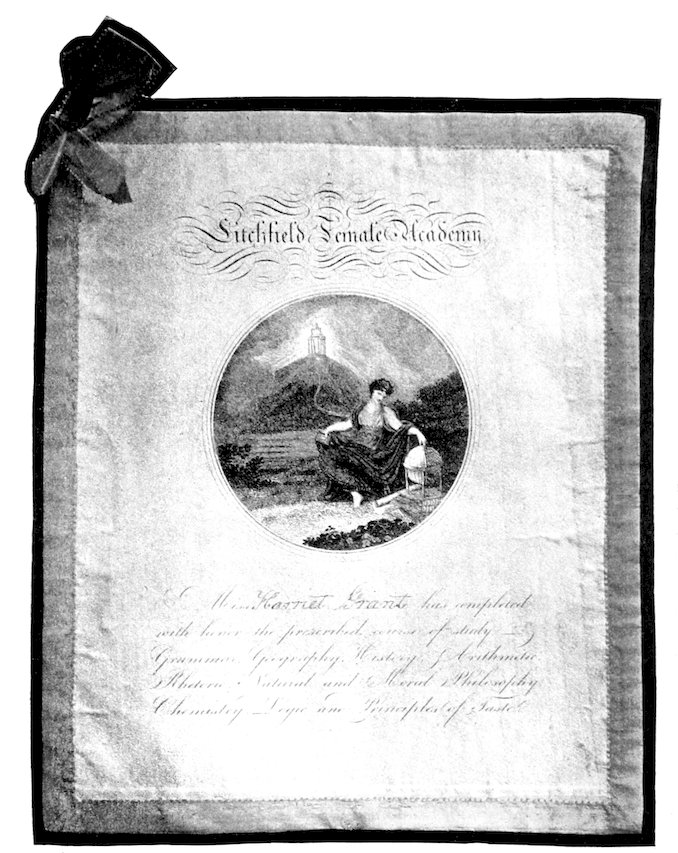
Pl. LX.—Last School Diploma, White Satin bound with Blue Ribbon
Engraved by Pelton
311The lowest department, including Writing, Reading, Spelling and Geography ... $6.75
| French per | quarter | 5.00 |
| Drawing | do | 5.00 |
| Music | do | 10.00 |
No pupil will be received for less than one term and no deduction made except for sickness.
The morals and manners of the young ladies will receive particular attention.
Board in respectable families may be obtained from $1.75 to $2.00 per week exclusive of lights and washing.
Litchfield, April 25th 1833.
Another year has dawned upon us—May it prove more happy, & more to our Eternal interest than the last.
Yesterday Mr. Huntington gave us an excellent sermon upon the New Year. The Discourse tended to wean us from the world by shewing us that we were not born for ourselves, but for God.
He mentioned that there had been but nine persons died out of his Congregation, & those chiefly aged persons. I felt that ten were gone. The idea that our dear brother was one who tho’ he was no more, was uncounted in his Native Village church struck me to the heart.
... I suppose Mary has left you before this. I am sorry Mamma can’t do with out her. I should be glad to supply her place, but my family & school are so large, I can hardly find time to run in & see her once or twice in a week. Tell sister Pierce I hope she has not forgotten the promise she made me of sending the copy of poetry, concluding Parnell’s Hermit. Tell her I shan’t use my brains at spinning poetry for her again if she serve me thus.
... I have found loaf sugar so amazingly dear that I wish you would get a few loaves and send with Wadsworth’s goods. I am sorry that I am not there to spend a little money, I have so many wants.
The first use I make of my pen this new year is to wish my only brother a happy new year. May this year see you as ardently engaged in the cause of your Maker & Redeemer, as you have hitherto been in the walks of science & the cares of the world. Every new era of time reminds me of the approach of Death. My days appear to me to be numbered & nearly finished. May the evening of my life be as serene as the meridian has been. How many mercies has our family to recount. Fifteen years have elapsed since we have been called to weep over the grave of a beloved friend, but how short that period appears. it seems as but yesterday, & what have we done in that time to prepare us to follow our relatives to that region of joy where we have reason to hope they are gone. What a flood of knowledge & glory they must have travelled through, since they were released from this prison of flesh. With what pity they must cast a look on us, & wonder that the cares & the silly trifles of time can so engross our thoughts & hearts as they do. Could we but for one moment feel what blessed spirits feel, who are purified from the infirmities of mortality, how we should long to fly away, & be a partaker with them of the bliss of heaven. We had a letter from Ann on Saturday, she & her husband were tolerably well, though she complains of the high seasoned food, parties, as not benefitting her appetite, or her husbands eyes. Our neighbors & friends are generally well, except hard colds which are very common though the season has been uncommonly fine. I have at last completed a history in question & answer for the use of schools, beginning at the creation & reaching to the Destruction of Jerusalem by Titus. The intention of the work, is to unite Sacred & Profane history with moral instruction & designed for the use of schools. If you are acquainted with any bookseller whom you think would like to take a number of them to sell upon commission I wish you would speak to him about them & let me know of it & I will forward them, by the first conveyance.
313Mr. Diderrer wanted a set for Eliza, if there is any way of sending them to him I would forward them. I thought that it was best to have some deposited in N. York for those who wished to purchase. Should you see any of my friends remember me to them & believe me as ever your affectionate sister.
I hope you will keep your mind from despondency, even if you should have a small school this winter. Should you not have sufficient scholars to pay the salary of your Teachers I think you must call them together, & state the case to them, & I am sure they will be reasonable enough, either to accept a smaller compensation, or resign their places. You will soon see who you can best spare, & by another Term arrange your school to your own liking. I hope you will never forget to love your native Village, but I should be sorry to have you unhappy because you are obliged to quit it. And as for becoming rich, if you are a child of God, as I trust you are, He will give you as much wealth as is best for your eternal interest, and no more. Cast therefore all your care upon God, for he careth for you. Do good, & verily thou shalt be fed. We regret your absence as much as you regret leaving us. “We miss you in our days of woe. We miss you in our mirth,” but chiefly we miss you on Sabbath eve, at the Bible class....
I am glad to hear by your letter of last evening, that your school is increasing, if you can get along with out lessening your Teachers for this winter, it will be better for you, as every Teacher who is dismissed will use her tongue to your disadvantage, if they have not more grace than the generality of our race. I want you should always remember that curious eyes are watching all your actions, & be careful to take as much notice of the greatest dunce in school, as of the finest intellect. Never forget the lessons of the last year, & let prudence, not fancy guide your actions. What an evil world we live in, our time, our talents, and even our affections must be devoted to earning our daily bread, if it was only the sweat of the brow, I would not care, but we must smile, and court those we do not care a pin about, or be called 314partial, impolite, &c.—but it teaches us one scripture lesson, to be patient towards all men. I would warn you against walking up to L’d unless you accustom yourself to walk ten miles every day, then you could do it with out making you sick. I do not know but you might do it, if you accustom yourself to walk 5 or 6 miles a day, but one fit of sickness would be dreadful.
I have the pleasure to inform you that your daughter Mary begins to repay us all, for the care we have bestowed upon her, she reads her history to me in the morning, & is careful to correct every wrong pronunciation when pointed out to her. She recites her lessons perfectly, practises two hours every day with great care and attention, & is never out of temper when any little fault is pointed out to her. Mrs. H—— is much delighted with the manner & intelligence displayed in Sabbath school. She is the joy of her mother’s heart, by the respect & attention she shews her on all occasions—and has more than repayed me for the many hours I have labored to help you to give her a genteel education. I think you will be justly proud of such a daughter, & she will, by her conduct in your present Seminary, be a living recommendation to your skill in forming the female character.
Miss Sheddon told us yesterday, of some trouble you have had among your Teachers. I had hoped that their places & employments were so definitely arranged as to preserve harmony, but I find selfishness will prevent happiness in this world, how glad I am that it cannot enter Heaven. We are not without our trouble here the same spirit of fault finding as prevailed last winter has begun to show itself. Miss J is the sufferer, as she has the care of the older scholars, who are ambitious, & there is one who has risen by her superior mind far above her companions, & several have become jealous of her, & of Miss J, & accuse her of partiality. Miss Landon says there never was a more faithful & conscientious teacher, but she thinks the persecution she suffers will drive her back to Geneva, where they are constantly soliciting her return. I am afraid that the next generation of women, instead of being improved by their superior advantages, will be a poor, weak, inefficient & selfish race, as parents will listen 315to all their whims & indulge them in sloth & petulance. They are not allowed to endure any hardships any privations, to give up their own comforts to accommodate others, or to be willing that others should be wiser, more genteel, or handsomer than themselves. I am afraid that the next generation instead of showing the hardy Roman virtues, will be mere Italians, without energy, patriotism or humility—& all this originated in the indulgence & overweening fondness of parents, & school Teachers cannot overcome it, & therefore it is a most undesirous employment. I am thankful I lived in an age of parental discipline, Or I would never have discharged the duties of my office as many years as I have done. & that in my old age I am not obliged to continue the employment, & have only the trouble of sympathising with all the Teachers in our country. When are you and Mr. Van —— coming to L’d—or had you rather come alone, we want to see you very much, & hope you will be able to come up some Sunday, as the stage runs so conveniently for you. L’d looks very handsome this summer, & is filled with company. Most of the L’d boys have been here with their wives, & some are here now, the two Child’s—James Seymour, John Adams, Mr. Clark, & E. Gould—I have not become acquainted with any of their wives, but Mr. Gould, but am told they are all quite as good as their husbands. Did you know that S. A. Vanderheysen and her husband were both dead—that the brother & remaining sister were apparently on the decline, & that Jane is far from well. How can that family value property when their lives are so precarious.
... We had a queer celebration here on the fourth. E. Ford commanded the troops which consisted chiefly of the young mechanics, but he had the art to draw in all our most respectable men to walk in the procession. Mr. Hickok & Mr. Pallen, Col Tallmadge & Mr. Wolcott, Dr. Buel, &c. Mr. H. was so much engaged in talking with Mr. P. when they passed our house, we agreed he was making the first oration. The procession reached up as far as the corner, & I suppose equally as far in the South St. I think the exercise was rather fatigueing, in the middle of such a hot day. The ladies had been invited to secure themselves seats in the meeting house, where they waited two hours, for the orator of the day, & lost sight of the best part of the entertainment. The musick of the band, & the procession. The orator was a young man from the West. I think Kentucky. He is very young, & his oration discovered his age. 316Mary & Ann Landon were to have had a party in the evening, & Mary Ann Wolcott asked Mr. Landon after the oration was over, if his daughters would accept some flowers from their garden to dress their room, Mr. Landon groaned out, you may send one pink, not more, for I cannot bear any more flowers today. The two Childs, & their brides are making a figure here, they have a grand party tomorrow. The Dr. & Col. look very happy, & their wives appear genteel. My love to all your family.
... I have given up the management of the school to them (the trustees), & they desired me to write to a French Lady who had made application for her daughter to come & teach musick, french & drawing. The mother is a good house keeper, & wishes to take boarders. Should they come, I expect they will take your house, perhaps for a number of years, & will be profitable tenants....
When I go past your home, it looks so natural it seems as if I must step in & see you all, & when I do go in it looks so lonesome I can’t bear to stay. Mr. Hickok improves every day, & we hope the church is beginning to awake.
Give my love to all the young ladies, & to all the children, & to Lucy if she has not gone on to Boston. May the best of heavens blessings rest upon you & yours, & may we all meet together in heaven, when the toilsome day of life is past.
... I should think Mary would prefer being at home, as both her parents are there, and the money she would have spent in going to Newark, will nearly bear her mother’s expenses to Boston, & as Mary is young & healthy, & does not need a jaunt to set her up for the summer, & her mother does, I hope she will rejoice to stay at home for the present, & urge her mother to spend all the spare cash upon herself....
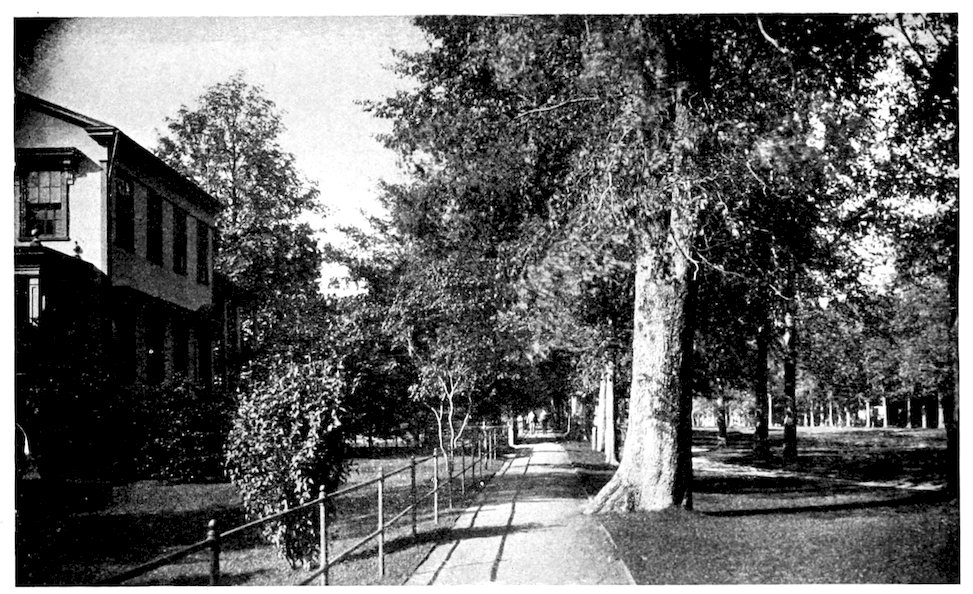
Pl. LXI.—Pathway in front of the School
I am sorry that you have got that whim into your head, that you do not appear well to strangers. When you take the trouble to please strangers, they are always pleased with you, but as you are no beauty, you must like a plain woman seek to please by your conversational talents. I am afraid you have again remitted your exertions to please 317acquaintances, & are sinking down into your old taciturn habits. You don’t know how much the exertion you made last year to please, raised you in the estimation of all who saw you, Miss L. Miner among the rest came home from H— full of your praises. I don’t think it absolutely necessary for you to take a journey every vacation, but I do think it necessary for you to gain a great many acquaintances....
... I think Mr. Strong has charged very high for the binding of my book, I never gave but 17 cts, per vol—for binding the first & second vols together—& he has charged me 3 Dol. for the dozen, which is the price I set them at—as he has had the binding of so many, I think he ought not to ask as much as the book is worth for the binding, I asked to have a cheap binding, because I cannot sell them for much. I wish you would see him, & ask him to reduce his price. I had a letter from H R— last week, she is still employed in doing good, her sister instructs a Sabbath school of black children & those who belong to them are educated in the knowledge of the Bible. Love to Lucy & the children.
Last evening we had the melancholy intelligence of the death of our dear sister Pierce. (Col. John Pierce’s widow) she with her nephew & niece Mr. & Mrs. Pendleton set out the latter part of June to visit Green Pendleton.
They reached Cincinnati the 2nd of July, she bore the journey very well, wrote a long & cheerful letter to Mrs. Muirson, the next day was attacked with cholera murbus, which terminated in a dysentry, & she died on the 10th, had her reason to the last, & died full of faith & hope....
Mr. Kirk spent a day with us, I suppose Mary has written that he made a strong impression upon the whole school, in six or seven instances it appeared as if the feeling would be permanent—but like the wayside hearers they do not appear to have root within, & are again laughing & playing with the thoughtless & gay....
... Are there any little girls who want to learn the French language, in or near Hartford—I want to procure Mrs. Gimbrede a few boarders, it is an excellent place for young ladies from eight to fourteen, she loves young girls, takes great pains with their manners, & it is the only way to learn to speak French well to live in a French family. I fear Mrs. G— will leave us this fall if she does not get boarders, & I do not know as we should be able to let your house if she leaves it....
You must not expect that your old aunt will be able to write to you very often, as her bodily weakness is great, & her eyes very poor. I was glad to see your last letter written so handsomely & without any mistakes in the spelling. I hope you will be careful to acquire a good style, & a handsome mode of writing letters & notes, as they show a womans education on more occasions than almost any thing else she is called to perform.
I suppose Mary had troops of gentlemen on N. Year, the gentlemen made calls here, which was quite a new thing, but there are so few of them, they did not take up much of our time.
We had a very affecting death here on Christmas, Henrietta Beers, cousin to Julia, & who had been adopted by Mr. Beers as a daughter died on that morning, her funeral was attended on Monday morning. All Miss Jones’ scholars walked in procession to the grave, she was very handsome, & very much beloved. Her friends have hope that she was prepared for death, if so she is now singing the praises of her Redeemer. May you be prepared to meet your death, at whatever period the king of terrors may summon you to depart. The Methodist church has had a protracted meeting which has continued about three weeks, a number of young people have become hopefully pious, & a few old.
The temperance cause seems to be gaining. Mr. Kirchon (?) from N. Haven has been laboring here, & a number of drunkards have signed the pledge, & we hope they may continue firm to their oath. Tell Mary I will send Charles’ stocking the first opportunity, I have not finished your Father’s stockings yet, while at C— I knit for your 319aunt Ruthy & since that I have gone on slowly as there are but few evenings when I can keep my eyes open, but they are nearly done.
Love to Mary, Charles & James, to Isabella also—& take a great deal for your self—from your affectionate aunt
I am sorry that your congregation have got into such a bad state, but it seems to be the state of the present time to run into extremes, a few years past, it was with difficulty that we could get a decent house to worship in, & now people are for emulating Romanists, in building, & decorating their churches, there is no religion in it, but as Dinah used to say, “needless pride.” Satan was never more active than at the present day, fomenting contention in churches, where he has not as yet been able to introduce false principles. I think it a great sin in these hard times to lay out money needlessly when so many benevolent institutions are suffering for funds.
... I think you would not do wisely to buy a lot to build on, as it is always expensive to build, & there is always in the course of every year, houses to sell at a low rate. Love to the children, tell James we hope to see him as soon as the mud is dried up, & the weather warm enough to play out door.
James was very homesick for a few days, but after the cold rain passed off, & he became acquainted with a few boys, & could run about & play in the street with them, he was quite happy, till yesterday, when he received your letter, the disease broke out afresh. I set him to study a geography lesson, & it cured him for the time, but if he is not fully employed, either in play or study, he is unhappy. I am sorry that the school I spoke of has broken up, but he recites good lessons to me, & if we could get him interested in the garden, & hay making, he would improve both in mind, & body very fast, but he does not as yet take any pleasure in rural occupations. I want he should acquire a taste for the garden, & other beauties of nature, & learn to depend on himself for amusement, & hope yet he will be contented to remain with us during the summer, as I have so much more time to attend to the cultivation of his heart, & mind than you have. I expect to send on by this conveyance the money we have received for the rent of your house....
... Tomorrow I shall (if I live) be 75 years old. God has given me long life, & many, very many blessings, that you may meet with as many, is the sincere wish of your affectionate aunt,
In Litchfield Jan. 19. 1852, Miss Sarah Pierce aged 84. In 1792 she established the Litchfield Female Academy, which became one of the most celebrated institutions in the country. She remained connected with it until 1832—though for a few years, previous, her nephew, John P. Brace, Esq., was the Principal. More than 2500 young ladies and misses were members of the Academy. It was incorporated in 1827. The successors of Miss Pierce have been Misses Swift, Jones, Heyden and other.
In Litchfield Conn. on the 19th of January. Miss Sarah Pierce, at the advanced age of 84.
Miss Pierce was the founder of the Litchfield Academy in 1792, and for forty years an instructor of her sex. She was emphatically the pioneer in the cause of female education in our country, and lived to see the effects of her efforts in the increased attention paid to that important cause, and to witness the advancement & progress of the useful plans she had formed, and the foundation she had laid. The instruction was eminently practical. She strove to make her pupils useful in the stations in which Providence might place them. Among the two thousand pupils, whose mind & character she has aided in forming, there are many who are ready to rise up and call her blessed.
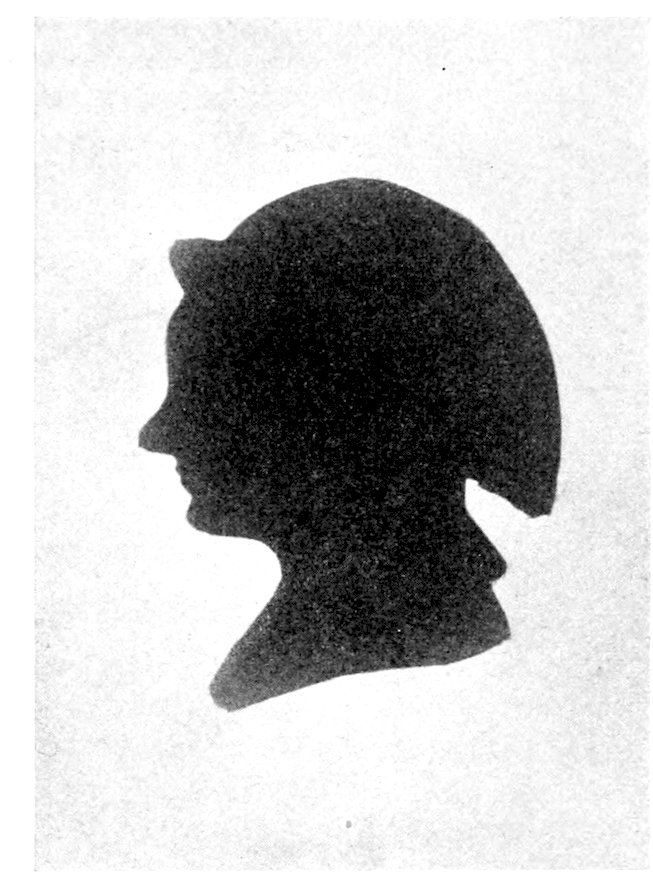
Pl. LXII.—Miss Sarah Pierce
From a silhouette
She taught religion as she did science, practically; and openly placed before the young mind, the fear of God as a better motive than the shrine of applause, the love of Christ a stronger impulse, than the flatteries of the world. Her own was noted more for its practical fruit, than enthusiastic impulse. She was humble, submissive, resigned, 321Her religion was that of the life, not of the imagination. She was more ready to pursue the calls of duty, than to follow the impulse of feeling. Hence her religious character was remarkably uniform. In times of declension, her lamp was always trimmed & burning. In times of revival she was prepared to check the impulses of enthusiasm. Her religious instruction to her pupils, her calls upon them for repentance, faith and a holy life were as numerous, as pungent, and as practical, when all around her was religiously cold, as when under the excitement of a powerful revival.
The same characteristics that marked her life accompanied her through old age and sickness. There was the same humble trust in Christ, the same resignation, the same quiet patience and calm composure under all the trials of daily increasing weakness, and daily decay of the bodily powers.
In her last sickness and near her end when asked what should be the particular petition of the prayer to be offered for her in her suffering, her reply was, “That I may feel the goodness of God.” These were the last connected words she uttered. After lingering under a slight paralysis for several days, she departed to her rest, leaving the bright example of a consistent Christian life to console and animate her friends.
Miss Sarah Pierce was a small woman, slender, & fragile. The sisters seem mostly to have been small. Ann Pierce (Nancy) who was the elder sister in the opening of the school, must have been very petite judging from a sleeve of a dress still in existence.[81] Mrs. Ruth Croswell & Mrs. Susan Brace were small women, and Mary Pierce, though differing from her sisters in being plump, was below middle height—
Sarah had a fair complexion & blue eyes, a face expressive of resolution & character; which showed in her manner which was decided & firm. Rather awe inspiring to the young who had to learn the true kindness of her heart. She had a great dislike of affectation, and held up a high standard in every thing—
She was unable to use her eyes much in later years, but enjoyed reading aloud by her young friends—One has a vivid memory of her 322daily habit of reading to herself, continued to the last, in her big bible, & she was always glad to turn the conversation to religious matters.
Her health was delicate in her old age, and she followed a strict regimen, eating carefully, exercising faithfully indoors, walking about sunset across her room so many times, until she had done certain proportions of a mile, and enjoying at the same time the beautiful western view towards Prospect Mt. of which she never wearied.
She was very fond of her garden, her charge was the flowers, Mary had especially the fruit, & James the brother, whose last years were spent in Litchfield, took the vegetables—Miss Sarah, when she had been away for a visit, always brought home with her some new flower, planted & cherished it—She worked all the summer mornings so much time, in her garden, wearing an old fashioned calash to screen her weak eyes, carrying a bit of old carpet and a little stool for weeding.
She was cheerful and took a lively interest in everything, social, political, literary, and heartily enjoyed a good laugh. A good and fluent talker, and liked to meet good talkers and intelligent people. Very scrupulous in attendance on all religious exercises, but ready to criticise if she thought anything stated wrongly or exaggerated. It was a day of a certain seriousness & sobriety; a reaction perhaps from times of too great freedom and levity. She said once that when she was much younger, dancing & games were considered all right, but as society increased the “balls”[82] generally held in the top story of the hotel lost in a measure, their attraction, although occasionally there were balls there attended by the young ladies of the school and the young men studying law.
It was the same with cards, gambling had increased to a dangerous extent, and in the great revival under Lyman Beecher, these originally harmless amusements, were not considered proper for those who aimed for the better life.
Mrs. N. Child, [Elizabeth C. Prince] writes Mrs. Beach’s [Lucy Sheldon] memories—She was Miss Pierce’s next door neighbor:—
“Last evening Aunt again talked with me about your family, and I herewith send what may not be of much use to Mr. B. but may interest the friends.
323“The father Mr. John Pierce was a potter, making the red earthen jars, pots, milk pans, & so on, used much in the households of those days.
“The family lived in the old red house, and the large elms now standing were set out by Mr. John Pierce[?] the son.
“Mrs. Beach remembers attending Miss Pierce’s school in 1794. And Mary Cutler, my Aunt, died there, of scarlet fever, when one of the pupils, and that was in 1793. [October that year.] This must have been, Aunt thinks about at the Commencement.
“Col. John Pierce, Miss Pierce’s brother, paymaster-General in the army, gave his sister the advantages of schooling by sending her to New York, where she was fitted for a teacher, in the English branches and in dancing.[84]
“The school was at one time kept in the old Landon house, then in the old red one. After that a school house was built very nearly on the site of the later building. The dwelling house which Miss Pierce occupied for many years was built by herself & her sister Nancy, they borrowing the money [600] of Julius Deming Esq.
“Miss Nancy looked after the house.[85] She was a very small woman with a large head & very tiny feet. A fine mind—Miss Pierce was the only teacher at first. Subsequently Mr. John Brace assisted in the teaching of arithmetic.
“History was taught by Miss Pierce’s reading aloud; the scholars then wrote down what they remembered, which was with many of them, kept in their daily journal.
“Every Saturday, the pupils faults noticed by Miss Pierce during the week, were pointed out by her in the presence of the whole school, and credit and debt marks set down accordingly.
“At the close of each month, a ball was given & gentlemen were invited.
“The building was divided by a sort of swinging partition which was shut back on such occasions.
“In the winter only one room was used for recitations warmed by a fire of wood in a large fire place, there being one at each end of the room.
“The balls were kept up until twelve o’clock, commencing early in the evening.
“At the end of six months a stage was erected at one end of the building, with drawing curtains, and plays were written by Miss Pierce 324from Scriptural stories, Ruth, & Naomi, David & Absolom, Jepthah’s Daughter &c., were performed by the scholars, a few boys who also attended the school assisting.
“In speaking of the school room Aunt added, the seats were without backs, with primitive desks in front, & debt marks were given those who sat crooked!
“Miss Mary Pierce after Miss Nancy’s death taught occasionally in the school, but she did not like it, and was mostly occupied in the house.”[86]
Old Mrs. Pierce, [“Aunt Mary’s” mother] lived with her daughter, [adds Mrs. Gray], leaving Mr. James[?] Brace the red house after her husband’s death.
The reputation of the school, [it being the only one almost for young ladies] was in Aunt’s time very high, pupils coming from Canada & Georgia, & elsewhere.
Mrs. Mary D. Hoppin (wife of Professor Hoppin) writes:
The Geography item was simply this—that at the period of your Aunt’s success in teaching it, it had not been allowed in other schools, it was not considered a suitable branch of study for young women. Indeed Geography as now taught was not known. It was considered a history of the planet more than of its surface physically. I wish we could see in some Library a copy of the first Geography used in America. I believe it was a thick heavy Octavo for students, & had an account of savage tribes, nations, wars, geology, great men, architecture, &c. &c.
I think Morse’s Geography was not written till long after your Aunt’s day, I presume she used maps with her own instruction added.
Miss E. W. Davenport writes:
In accordance with my promise I have written to my Aunt for some reminiscences of her school day at Litchfield under Miss Pierce’s tuition and having secured a reply, I hasten to communicate it to you.
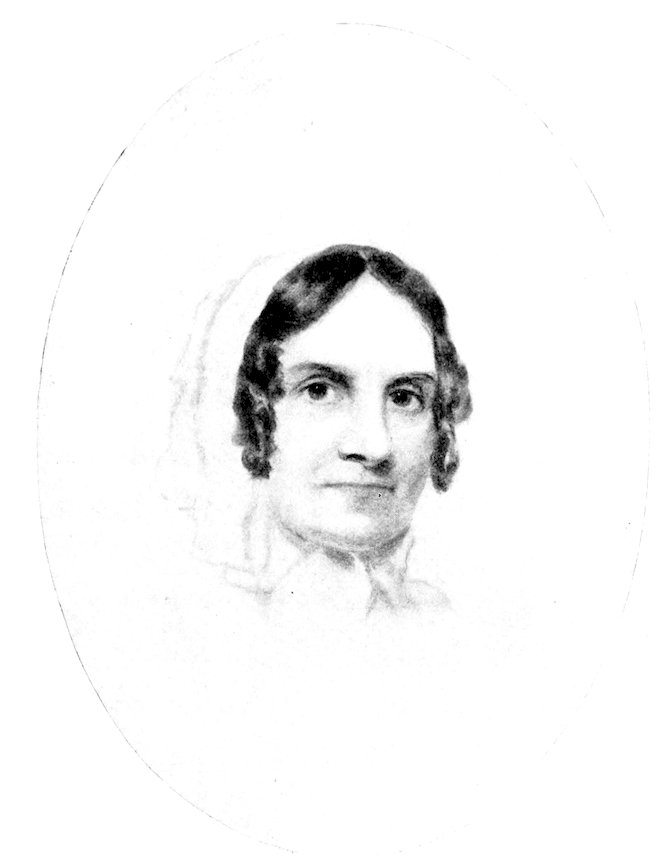
Pl. LXIII.—Mary Pierce
b. August 3, 1780. d. June 22, 1863
From crayon portrait by Rouse
She says “she can not tell what gave the school such a reputation and success, unless it was in part from the rarity of such schools at that 325period in our country. When she was one of Miss P.’s pupils the school numbered from 50 to 60 girls. Miss Pierce attended to all the classes herself except, when occasionally assisted by her nephew, Mr. J. Brace. The studies were the common English branches including History, the text book for which was compiled by Miss Pierce herself, and she does not remember that any other ones were taught than those in use in other schools at that time.”
But she adds, “Miss Pierce was an earnest christian woman, a perfect lady, mingling with her pupils pleasantly and familiarly, but with dignity. She always sat with them and often talked to them collectively of deportment, manners, and habits.” And here I doubt not lay the secret of her success and celebrity, her personal influence and example, forming their principles, and their manners, and making the memory of their school days so pleasant.
In addition to the common branches of education Drawing, Painting as Water-color, and Embroidery were taught.
I am aware that this is but a meager and unsatisfactory account, but as my Aunt was but 13 years old when under Miss Pierce’s care it is not to be wondered at that she cannot give more particulars of the methods of instruction then employed. I trust however that what I have written will not be without interest, although it may not be new to you; but it will certainly be an added proof of Miss Pierce’s high toned character and singular usefulness to her generation that an old lady of Eighty has been able to recall so much.
Mary Pierce was a woman of uncommon force of character, and yet with a boundless sympathy for all, which lasted all her life. Her grand nieces would laugh at her after she was eighty, saying they had quite outgrown her in her sympathy for young people and their romantic sentiment, to which she was always ready to listen, to understand, to help. For she was very wise in her counsel, and had more confidences than falls to the share of most people. Many a faltering step she strengthened, many a lofty aim she gave, many a kind deed of thoughtfulness she suggested, the receiver never suspecting its origin.
She was a most agreeable companion, with all her kindness she had a keen gift of criticism, and a charming originality and force of expression, which showed especially in her letters, with their comments on 326the times, domestic and public, her descriptions of events and scenery; and which she preserved to the end of her life. She never grew old as we generally mean old, but kept also her bodily activity and energy—
She was most essentially practical, active and energetic in all the duties of daily life,—never were cake and jelly that quite equalled hers, nobody could arrange the white dimity draperies as she could, and the house was always a dainty picture of comfort and elegance—
She was always called upon in sickness and trouble, nurse, friend, comforter, and her influence upon the young men in the Law School, was as great as upon the girls who came under her care.
She had dark eyes and hair, and was said to have been a very handsome young woman. Her face as the years lengthened, was very sober in repose, but lighted as she spoke, with animation and interest, so that no daguerrotype gives any idea of her.
Aunt Croswell,[87] came to dine, 94 on Feb. 22, 1859. Walked over and back alone.
Told how when in New York she heard Washington take the oath as President.
Took tea with Mrs. Washington, the President sick so did not see him. Dr. Bard with whom she was staying his Physician.
Mrs. Washington, short and stout. One of your real old fashioned women, who always carried her knitting wherever she went, to the offense of some. And nobody ever staid in her house after nine o’clock, all visitors must go home.
Dr. Bard prescribed powders, and put them up in little papers. When they were finished he was going to prepare more and took some paper to tear, when Mrs. W. said, “oh, here are the other papers saved,” producing them. Very characteristic, Aunt said of the woman.
Extracts from a biographical notice of Mrs. Ruth Croswell an esteemed and prominent member of Christ’s Church ... Catskill, N. Y.
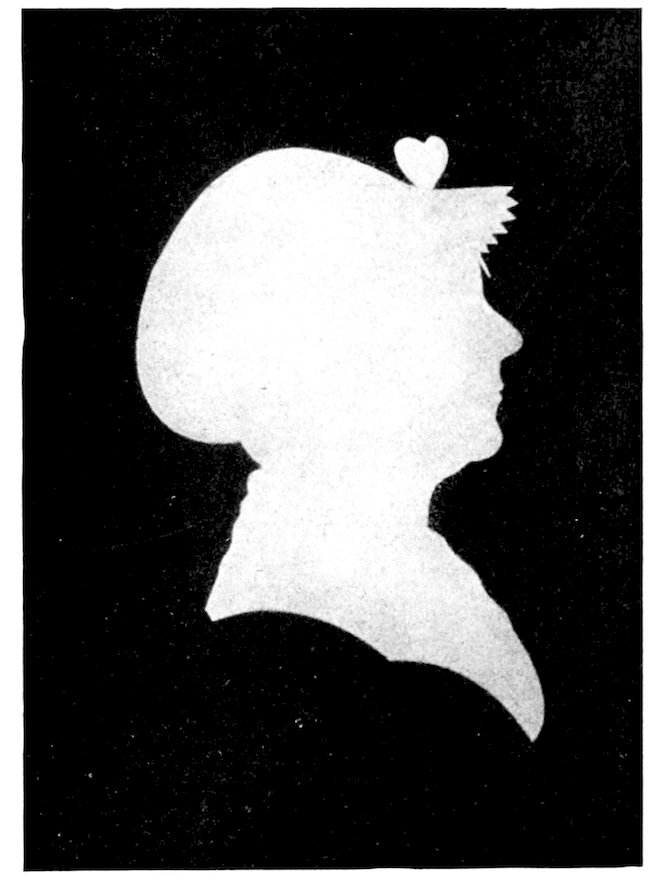
Pl. LXIV.—Ruth Pierce (Mrs. Croswell)
Died—In Catskill, on the 7th inst, 1861 at the residence of Mrs. 327Caroline Wey, Mrs. Ruth Croswell, widow of the late Dr. Thomas O’H. Croswell, aged 96 years, 10 months, and 15 days.
Her long life was passed in a most eventful period of the world’s history, and especially of that portion of the world in which we are most deeply interested. She was born in Litchfield, Connecticut, the 22nd of February, 1765. Her life more than spanned the entire era of our national existence up to the time of her death. Born the year of that celebrated act which first decisively shaped the popular sentiments that eventually led to our independence, when the war of the revolution broke out she was a girl of ten years, and when it ended a young lady of seventeen.
During this eventful struggle her brother, John Pierce, was the paymaster-general of our forces, obtaining the appointment through the personal solicitations of the commander-in-chief himself, who being assured of both his ability and his integrity put forth special, and to him unusual efforts to secure his election to this important post. He held the office throughout the war; discharging its duties so as to meet the approbation of Washington, and to receive from the representatives of the people a vote of thanks with the commendation that he had so fulfilled his trust that “his heart was pure, and his hands were clean.” His name I believe has no place in our formal histories, but it lives in the letters of Washington.
The wife of this brother, was a daughter of Dr. Bard, an eminent physician of New York, and the medical attendant of our commander-in-chief during his residence in that city. In consequence of these connections, Mrs. Croswell, then Miss Ruth Pierce and twenty two years of age, witnessed by invitation the inauguration of Washington as the first President of the United States. She remembered vividly to her last days the majestic form of that man on whom so many and such vast hopes then centered, as he stepped forth upon the balcony of the old Federal Hall in New York, [which stood where the Custom House now stands], and after the enthusiastic shouts of the immense crowd that welcomed him were at last silenced, took the solemn oath to faithfully administer the constitution and the laws of these United States.
Subsequently, while on a visit to New York, she was invited to take tea with the family of the President. He was at the time severely, and it was feared dangerously sick, and she remembered how Dr. Bard came down from his patient’s room with a grave and anxious face, and while they were seated at the table, told them what the President had said to him a few moments before. His disease was the quinsy. Irving, in his Life of Washington, speaks of the attack and the anxiety it 328caused, and this the more because it occurred so near the commencement of the first term of his administration. Washington, knowing the danger of suffocation, turned to his physician and said, “Doctor, if I am to die do not hesitate to tell me. I am quite prepared. If it be the will of God I am ready to fall asleep, and in this world never wake again.”
In 1791, Ruth Pierce was married to Dr. Thomas O’H. Croswell,[88] and the next year became a resident of Catskill. Her life was one of quiet domestic duties and Christian faithfulness. She was among the members who united with the Presbyterian Church of Catskill at its organization. Through all her long life she was an interested, earnest, useful Christian. Unusually conscientious and prayerful she walked with God, seeking with great sincerity and honesty to know His will, and when it was clearly ascertained doing it if need were quite independently of the opinions of others. An instance of this may be seen in her formation of a Temperance League among the ladies of the village. The custom obtained at the time of gathering by invitation first at one 329house and then at another early in the afternoon, nominally to spend a few hours socially and “take tea.” But about midway in the visit sweet and intoxicating cordials were handed round, and by some of the ladies partaken of with not a little freedom. Mrs. Croswell was convinced that this custom was a growing danger. She never had heard of a temperance pledge, or society, but after consulting with a Christian friend, a pledge not to provide either cordials or wines on these occasions was drawn up, and after praying God to help her, she went forth to secure the names of all whom she could induce to sign it. Amidst much ridicule and some reproaches she patiently continued her efforts, until they were crowned with unexpected success. The pernicious custom was completely broken up, and principles of temperance were thus early planted in many influential minds.
In her days of greater vigor she visited the poor and the suffering, and watched and prayed with the sick and dying. Unselfish, sympathizing, and patient, she endeared herself to all. From no lips were rebukes received as kindly as from hers. Her quaint direct way of expressing her disapproval or her doubt never gave offense; and when she commended or praised anything that had been done the simple straight-forward heartiness of her words made them very pleasant to hear.
For many years, I think more than a quarter of a century, she gathered about her the mothers and the pious women of the church, and maintained a female prayer meeting, imparting to it not a little of its interest by her own religious fervor. She had “patient continuance in well doing.” Turning over the leaves of a journal in which she wrote down her religious views and aspirations during sixty or seventy years, we find no change except by growth and Christian development. Her hopes became less tremulous, and her faith more assured; but otherwise the record of 1797 and that of 1861 are substantially the same. They reveal the heart of a humble, devoted, trustful, single-minded child of God, very sensible of her imperfections, very penitent, watchful, and prayerful, resting on Christ alone for acceptance with God, and yearning to be holy.
She had friends who were very kind to her in her old age. And her gratitude for their respectful and ready attentions, and all the unforced proofs of their affection which surrounded her with every comfort, and relieved, as far as could be, the infirmities of her many years, is expressed in this journal with such sensibility and tenderness that one cannot read the sentences without some dimness coming over the eyes, and feeling that happiness is brought into the soul by a grateful spirit. When she attempts to thank God for his benefits and for all his patient 330love, her language often breaks down under the burden of gratitude she would put upon it.
Her death was sudden. A few hours of not severest illness, and enough of pain only to draw to her side in the silent night those whom of all she most loved and trusted and would have desired to be with her in her last hour—and then, so peacefully that one sitting watchfully by her bedside only knew it by the perfected stillness, she ceased to breathe, and passed to the new life.
The funeral services at the Presbyterian Church, on the afternoon of the 9th inst., were attended by a large number of her relatives and connections, some of whom had come from a great distance to testify in this manner their esteem and affection. All the clergymen of the place were present; and the house was crowded by the concourse of her friends. During this time and while the funeral procession was passing through the streets, the places of business were closed, and as the procession slowly wound its way to the beautiful cemetery on the outskirts of the village the bells of all the churches were tolled. Such honor has old age which has been made venerable by a truly Christian character and life.
Letter written by Miss Mary Pierce to Mrs. William Curtis Noyes, after a visit made to her in New York City.
You must have heard before this from Mr. Hollister that his child is well, but that Mrs. Brisbane’s death is an agonizing affliction to her daughter, quite sudden and unexpected....
Of Mr. Beach’s paralysis you must have heard. is prostrated, one side useless, but disease does not seem progressing, and does not affect his head. I carried a box of cake to Mrs. Morse this morning. She seemed much gratified. I enhanced its value by telling her that was the wedding cake of Dr. Vanderbourgs grand daughter. Mrs. Morse is as cheerful as ever....
I do not find stern winter here, the sun shines as brightly as it did in New York—the grass is quite green, and the flower roots in the garden. My Myrtle—is beautiful—I seek to find as many pleasant things as I can to relieve the contrast with the loneliness of my present situation and the happy kind friends who have made such a bright spot in my life—There is satisfaction however in feeling that it is voluntary for I found letters from four different places urging a visit for the winter....
I have given you a dose of a note
331My Dear Mrs. Noyes but I am alone this evening and it is pleasant to think that I am talking to you—
My love to all the dear friends who surround you, Emily in particular
The old East Burying ground of Litchfield lies in a sunny hollow under the eastern front of the town; a solid stone wall, overlaid with an old fashioned coping, surrounds it, and a few spruces and hemlocks overshadow the graves. It is a spot wonderfully rich in historic dust: two famous Governors of Connecticut, a Chief Justice, a genial poet, judges, senators, generals and colonels without number sleep within its confines. To a stranger unfamiliar with the history of Connecticut it reveals the fact, that within the present century the State was ruled by these quiet, dreamy, far inland towns, and not by the present bustling, assuming cities....
The Wolcott plot is near the centre of the yard, marked by five monuments and four massive tables of marble and granite. On the first table one reads: “In memory of Oliver Wolcott, Secretary of the Treasury of the United States and Governor of Connecticut, born 4th January 1760, died 1st June 1833.” Further west, on a marble table, is another inscription: “To the memory of Oliver Wolcott, late Governor of the State of Connecticut, who was born December 1st, 1726 and who died December 1st 1797.” They were father and son. Of the elder Wolcott history has recorded that he was the son of Roger Wolcott, and took up his residence in Litchfield, as Sheriff, on the organization of the county in 1751. He was Governor from 1796 until his death in 1797, and, before this, had been State Senator, Judge, member of the Continental Congress, major general of militia, and one of the signers of the Declaration of Independence. On his return from signing the Declaration at Philadelphia, it is said, he found in the village a leaden statue of George III, which had formerly stood in the Bowling Green, New York, but had been thrown down by the patriots and secretly transported to Litchfield. The continental levies, then assuming 332form, were sadly in need of bullets, and his quick eye at once detected certain encouraging possibilities in the statue. A shed was at once erected in the apple-orchard adjoining the General’s house, and the young ladies of the village invited to a frolic in running bullets. With his wood axe the patriot cut the statue into small pieces, which were then given to the ladies, and by them melted and run in moulds. In the Wolcott Papers we have confirmation of the legend in a statement in General Wolcott’s handwriting of the number of cartridges furnished by the fallen majesty. By this paper it appears that Mrs. Marvin made 6,056 cartridges, Ruth Marvin 6,204 Laura (the General’s daughter) 4,250, Mary Ann (another daughter) 5,762, Frederick (his son) 708, Mrs. Beach 2,002, and “sundry persons,” names not given, enough to swell the total to 42,288.
Another famous Revolutionary worthy and former resident of the village, Col. Benjamin Tallmadge, lies near the Wolcott tomb, in a plot surrounded by an iron railing, and containing, besides his own, the graves of his two wives. The inscription on his stone is very simple: “Hon. Benjamin Tallmadge b. Feb 25, 1754, died March 7th 1835,” followed by the Scriptural sentiment, “As the hart panteth after the water brooks so panteth my soul after Thee, O God!” Colonel Tallmadge’s course through the Revolution was a particularly honorable one. For a time he commanded a squadron of cavalry in Colonel Sheldon’s regiment, and distinguished himself for both dash and courage. Later, the whole secret service of the army was intrusted to him, and on the Westchester lines, and in the whaleboat warfare of the sound, he performed many deeds of valor. It was largely due to him that André was detected and held for punishment. From 1778 to the close of the war Colonel Tallmadge was the confidential friend and correspondent of Washington, and a great part of the correspondence between the two is said to be still in the hands of the family. After the war he became a resident of Litchfield, and, as a Representative from Connecticut, was a marked figure in the debates of Congress for sixteen years.
The modest tomb near by, of Charles Sanford Dart, of Charleston, S. C., who died in 1823, while a law student in Litchfield, recalls one of the most ancient, and honorable institutions of the village—the 333law school. A brief search discovers in the southeast corner of the yard the graves of the Hon. Tapping Reeve, its founder, and of Judge James Gould, his associate and successor. Judge Reeve’s stone bears the modest inscription: “Hon. Tapping Reeve. L.L.D.; late Chief Justice of the State, died Dec. 13th 1823, in the eightieth year of his age.” Judge Reeve began his career as tutor to the orphan children, Sally and Aaron, of President Burr of Princeton, and when his gentle pupil became of proper age married her. He came to Litchfield in 1772, and began what later became his law school by taking a few young gentlemen into his family as law students. One of these was his brother in law, the celebrated Aaron Burr, who was pursuing his studies at Litchfield when the news of Lexington called him with other adventurous spirits, to the field. In 1784 Judge Reeve fairly opened his famous school. The legal questions and complications growing out of the war, had created a great demand for lawyers, and, as all the ardent and capable spirits, of the young nation began crowding into the profession the school was thronged from the outset. For over fifty years it continued without a rival, and became as famous and popular in the South as on the hills of New England. Traditions of the school and of the escapades of the students are rife in the village. Judge Gould conducted the school alone after 1820. In the preface of a catalogue of 1828 it is stated that the number of graduates before 1793 probably exceeded four hundred. John C. Calhoun was of the class of 1805. The curriculum then comprised a daily lecture on the rules and principles of law, which the students were required to take down in full; every Saturday an examination was held on the weeks lectures. A moot court for the arguing of law questions was also held once a week, in which the students had practice in the trial and disposition of cases. There was also a society for forensic exercises entirely controlled by the students. The whole course comprised fourteen months, and two years were required to finish it. The students of the law school probably found life in the village much more supportable from the presence there of a hundred or a hundred and fifty fair damsels, pupils in Miss Pierce’s Female Academy. The grave of this lady should be in our old church yard near those of the eminent educators named, though we fail to find it. She was the pioneer in America of the movement for the higher education of women and her school was the first established in this country with that object in view.
There are several well preserved old ladies in Litchfield who were among Miss Pierce’s pupils, and who have exceedingly interesting reminiscences of their school days to relate. Her school house, a long, low, one story structure, stood on the main street, a short distance above the building where Judge Gould gave his lectures. At one time Miss Pierce had under her care 137 young ladies, representing nearly every State in the Union. In addition to the ornamental branches—music, painting, embroidery—she taught philosophy, logic, rhetoric, astronomy, chemistry, and the common English branches, and is described as having been very thorough in all. Not finding in the bulky histories then in vogue anything suited to her purpose, she compiled for her own use a school history in four volumes. Merit was recorded by a system of credit marks and as Judge Reeve’s law students made a point of dropping in on Friday afternoons to hear them read off each young lady was very careful of her record in this respect. It is remembered that Miss Pierce sometimes showed partiality in bestowing these favors, for instance, if a Connecticut girl missed four words in spelling she received a debit mark whereas a Hudson River girl might miss nineteen and only receive the obnoxious mark with the twentieth. It is admitted, however, that this law may have been founded, on Miss Pierce’s knowledge of the superior philological capacities of Yankee girls. The great events of the school year were the balls, given sometimes by the young ladies in the school room and sometimes by the law students in Deacon Buel’s ballroom, or in the large dancing hall of the tavern. Only young ladies of sixteen and over were allowed to attend the latter, however, and the law students were furnished each term with a list of the eligible ones. Then there were charades and amateur theatricals, and for a real frolic a husking bee on some neighboring farm. It is probable, however, that there was little need of the young people looking without for entertainment, for in those days a very courtly and polished society existed in the village. There were at this time, it is said, seventeen graduates of colleges residing in the town; two of these were at different times Governors of the State, two Chief Justices, three members of the national Congress, and four had been general officers in the Revolutionary army.
Graduation exercises in Miss Pierce’s school consisted of an examination of the pupils by a committee appointed for the purpose and the distribution of diplomas. We were shown one of these, a time-discolored relic of fifty years’ standing; it was of white silk bound with blue ribbon, and bore a globe with a female figure studying it; 335underneath was the recipient’s name and the motto “We look with pleasure on thy opening virtues.” Of course among so many young people—the sifted wheat of their respective communities—there was not a little decorous love-making, and many romantic tales and love episodes are recounted by the village gossips. Col. Aaron Burr, during his frequent visits to his sister, was an object of great interest to the ladies and made many conquests. For several months in 1781 Mrs. Theodosia Prevost, who the next summer became the wife of Colonel Burr, was a resident of the village, and won all hearts by her amiability and wit. John C. Calhoun, the great nullifier, is remembered as a silent, thoughtful young man, rather averse than otherwise to society, although an account against him in the ledger of one of the village merchants shows that he sometimes made use of the good things of life. Perhaps as pleasant a story as we heard was that of Miss Mabel Strong, daughter of Judge John Strong, of Vermont. To attend the school, this young lady, with her escort, rode from her home in Addison, Vt., to Litchfield on horseback, a distance of 150 miles, and without baggage, her wardrobe for the year being made up after her arrival. On completing her school days Miss Strong departed to her northern home, but shortly returned as a bride, and spent the rest of her days in the village as the wife of one of its prominent residents. There are many other graves of note in the churchyard, among them the tombs of the poet Rev. John Pierpont, and two of the children of Lyman Beecher, and some that excite interest from their quaint and curious epitaphs. The tomb of Frederick Asa Bacon, of the navy, attached to the schooner Sea-gull, of the United States exploring expedition, which foundered off Cape Horn May 1st 1839 with the loss of all on board, brings to mind almost the first venture of our navy in the field of scientific discovery.
About one hundred miles from New York city, perched among the hills of Northwestern Connecticut, at an elevation of more than twelve hundred feet above the level of the sea, lies one of the most picturesque of New England’s villages, now chiefly known to the people of the metropolis as a place of summer residence, but whose crown of glory is its connection with the past.
Though most of the modern prosperity of the Hill is due to its improved means of communication with the outer world, its ancient 336importance may be largely credited to its comparative isolation. On this account, probably, was it selected in the war of the Revolution as one of the chief dépôts for military stores, and for the safe-keeping of royalist prisoners. When New York fell into the hands of the British, the road from Hartford through Litchfield became the principal highway between New England and the West, and over it was hauled most of the provisions and munitions of war for the Continental forces beyond the Hudson. The village being far inland and away from any navigable river, it became the army head quarters in Western Connecticut, and a place of considerable activity. Its workshops rang with the busy sounds of preparation, the lowing of beeves and the shouts of teamsters were often heard in its streets, and its taverns bristled with military importance. Nearly all of the general officers of the Revolution visited it at various times, and although it was never the scene of great events, it bore its share of the burdens of the struggle, and its hospitable roofs doubtless witnessed many a consultation which led to important results.
But great as were the glories of the Hill in the Revolutionary times, they were fairly eclipsed in the period succeeding them, when the celebrated law school, and the no less famous female seminary which existed contemporaneously with it, attracted pupils from every State in the Union. These accessions to its population contributed largely to a society already brilliant, and which included in its numbers a large proportion of highly educated men and women. It is no exaggeration to say that this isolated New England town was at that time the centre of a culture unexcelled, and in some respects unequalled, in its day. The Rev. Dan Huntington, who was called in 1798 from a tutorship in Yale College to the pastorate of the Congregational church, describes it as “a delightful village on a fruitful hill, richly endowed with its schools, both professional and scientific, and their accomplished teachers, with its venerable Governors and judges, with its learned lawyers, and Senators and Representatives both in the national and State departments, and with a population enlightened and respectable.”
It is no reflection on the intelligence of summer visitors to the Hill to say that there are probably some among them who never heard of its chief claim to distinction, and who pass by the simple head-stone that marks the grave of Reeve and the more ambitious monument that commemorates in Latin the virtues of Gould, unconscious that through their efforts Litchfield became better known throughout the Union than any other place of its population in the country. Yet in many a distant State their memory is still green, and the writer has often been questioned concerning the law school, particularly in the 337South, by those whose fathers or grandfathers had enjoyed its benefits, yet who had never heard of its discontinuance.
It was in 1772 that Tapping Reeve, a young lawyer fresh from his studies, removed from Princeton, New Jersey, where he had for several years held a tutorship in the college, and began the practice of law upon the Hill, then a quiet country village, but already beginning to feel the leaven of the Revolution. With him came his newly married wife, born Sally Burr, daughter of the Rev. Aaron Burr, president of the College of New Jersey, and granddaughter of Jonathan Edwards. But a few years sufficed to give him a reputation for intellect and varied learning and a commanding position among the lawyers of the State. Mr. Reeve was a remarkable man in many respects.
In 1784 Mr. Reeve began the instruction of legal students, and met with such success that up to 1798 more than two hundred young men from his office had been admitted to the bar. In this year he was chosen a judge of The Superior Court, and he associated with himself in the conduct of the school James Gould, one of his own graduates, and who had previously held a tutorship in Yale College.
It is, perhaps, necessary to explain that the school was never an incorporated institution, nor were any buildings ever erected for its use. The instructors lectured each in his own law office, and the students boarded in the houses of the village. The office of Judge Reeve, which stood in his own door-yard, was removed several years ago to West Street, and transformed into a cottage. Judge Gould’s office, which also stood near his dwelling, is now a cottage without the village.
Of the graduates from 1798 to 1833, whose names alone appear in the printed catalogue,[91] no register having been kept for the first fourteen years, sixteen became United States Senators, fifty members of Congress, forty judges of higher State courts, eight Chief Justices of States, two justices of the United States Supreme Court, ten Governors of States, five cabinet ministers, and several foreign ministers, while very many were distinguished at the bar.
Like the law school, Miss Sarah Pierce’s female seminary was the 338first institution of its kind in the United States, and, like it also, it was for many years pre-eminent in its sphere. It was begun in 1792, and during the nearly forty years of its existence more than fifteen[92] hundred young ladies were educated in its halls, and fitted for the elevated positions which so many of them attained. Its fame still lives in the memory of many who shared its benefits; but the visitor curious in regard to its site is now pointed only to the great elms which once shaded its roof.
Col. John Pierce, born 1750, son of John Pierce of Litchfield and Mary Patterson, married Anna Bard of New York, daughter of Dr. Bard, physician to General Washington. He entered the army May 31, 1775; was made assistant paymaster to the Continental Army February 10, 1776, and the same to the Connecticut Colonial troops; deputy paymaster-general June 7, 1779; paymaster-general January 17, 1781, with rank of colonel. He was made commissioner after the close of the war to settle the accounts of the army. He died in New York August 1, 1788. He was thirteen years in the paymaster’s department of the army; he belonged to the order of the Cincinnati and was an able officer and a friend of Washington. He “served his country with a fidelity and patriotism in those days of peril and great financial stress worthy of great admiration.”[93]
The following are letters and verses by and to Col. John Pierce:
I sincerely thank you for your obliging Letter of the 20th Ult. and am very glad to find you have some of your old warmth of spirit remaining, for my part placed among so many difficulties & such a constant scene of Disappointments & Delays, I am sometimes very melancholy. but your Letter like a chearing Ray of Light, for a moment Illumined my soul and made me for a while forget our Public Troubles.
Tho’ at the same time the object we aim at, Inspires me to undergo the greatest and most insurmountable difficulties—it is not the pursuit of present, but for the lasting happiness, which like the Smiles of Heaven —— imparted to Thousands, who shall receive the blessing at OUR Hands. Such a prospect as this I own is flattering and is very different as you justly observed from the Ideas we in Studious Emulation, passed happily together in the Calm morning of Social Life, can I own to you, that the same principles of Ambition 340which I then had, are not in my Mind. Dull Metaphysicks & Duller Law Books, and even Law itself is not my Pursuit, new Connections, and new Schemes of Ambition are opening, in the very Centre of Intelligence & Politicks. I am perpetually on the eve of Expectation, or desponding [which is too often the Case] on Ill concerted Measures and worse Execution among us, while at the same time my heart is wrung for Human Misery, especially that which is the Consequence of War.
When we were together, we should have formed in our Poetical Imaginations, the anxious Parent or the Fonder Virgin, on the flutter of Apprehension with every Passion of the Soul, for the least whisper of news that might affect the Object of their Passion, and when the Youth falls a sad victim of his Virtues, we should partake with True tears of humanity, the grief, the Pain, the heart breaking Anguish of their Distress, while all their busy expectations of happiness—and their warmest wishes are dropped at once into the dark & senseless grave.
But Dear sir a more cruel scene has fallen to our share, which so far from being Imaginary——bounds of Language cannot paint, and we can only say—that every misery the Alotment of poor wretched Mortals fell to their share. destitute of every thing either to defend them or remove the cause of their Sickness they were neglectedly left without Consolation.
And it seemed that those who before pitied the Misfortunes of others were now wholly taken up, with getting clear from seeing or relieving them, and those enfeebled by disease would not relieve themselves, were left to the Mercy of Death. Such was some of our Distresses which always follow, Sickness & precipitate Retreats, Especially when there is no Place prepared for that Purpose. A rapid Conquest—a successful scene of Events lulled into a state of Security—we imagined every thing would fall before us—and while a Montgomery lived, they did. But his Death ushered in our Misfortunes—and one continued scene of ill success Indeed. If we had, as all good Generals ought—secured, to ourselves a Place of Retreat—our Army would not have suffered so much. But a fatal blindness pursued us, and we are now to Encounter a large Army by dispirited, Sickly men.
Mr. John Pierce Junr. of Litchfield in Connecticut, having the summer past been employed by Comissary Phelps at Albany as his Clerk and to assist him generally in the Comissary business, which Mr. Pierce I am well informed has done with fidelity and dispatch, and 342Mr Phelps having now resigned that Department and Mr Pierce being desirous of some proper employment in the army—I can with great satisfaction, recommend Mr Pierce as young Gentleman of fair and unexceptionable Character—I have known him from his Infancy and he has in my Opinion very justly acquired the reputation of a faithful, industrious prudent and virtuous Man—A good Writer & Accountant a Man of Business and Dispatch, amiable in his Disposition, and entirely well affected to the American Cause—And I believe may very safely be employed in any business, in the Army where those Qualifications are necessary.
The above is a true Copy of an original, which is now in my Possession as a security for the sd Pierce’s faithful performance of the Duty of an Ass. Pay Master.
Albany 29th Feby 1776.
We are Thunderstruck here with the Evacuation of Ty—&c. not so much att the Thing itself—as at the Manner—from the Circumstances we are possessed of it is altogether inconceivable to us the Necessity or Expedience of the Measure—& that at the Appearance only of the Enemy—without a Gun fired—the Minds of People are amazingly agitated—the Characters of the Officers are suffering, perhaps irretrievably—the Men tis said would have fought—nay cried with Vexation at turng their Backs——I have received yours—& am exceedingly rejoiced att our fortune—& much pleased with the Account I have of your Behaviour & good Conduct on the occasion, can it be necessary that you remain with the Chest att Fort Edward?—Tis not probable Money will be wanted there—it may be safer here—200,000 Dollars came yesterday from Philadelphia—let the General know this—& hint to him the Chest’s comg to Albany.—We hear nothing yet of the Movements of the Enemy in this River—we are in Expectation of a Concert being struck up below us——I am
This Day I received yours of 13th June Day Colo Lewis carried One from me to you—I hope he has given it you—
Is Ty abandoned? or is it a Dream?—certainly it is a more unaccountable affair than the most fantastic Dream—The more I think—the more I consider—the more am I astonished—Not one Gun fired!—scarcely the Shew of an Attack waited for!—so precipitate a Retreat—or rather Runaway—leavg Artillery—Stores—Amunition—Provisions—Tents—Baggage—every Trophy of Victory—to an Enemy who had not even dared to fight for them—I can’t endure the Thot—Where is American Honor!—where is American Bravery!—all levelled with the Dust—all trodden to the ground—in one fatal Step—some Reason I suppose will be given—Ostensible att least—would I could hear it—But they have made a safe Retreat—& vanquished the Enemy at Castleton—Is it become a Maxim in Warr—unheard of before—that a Body of Troops, who, when collected to a Point, in a strong Port, are unable to resist or even face their Enemy—shall when Divided be able to defeat them—Excellent!—tell it not in Gath!—publish it not in the Streets of Askelon!—how are the Mighty fallen!—the Mighty! how are they fallen from the Mount of Independence!
We have no certainty yet of the Movements of the Enemy below—I expect they will trim their Course this Way—had we kept Ty—it is matter of Doubt if we heard any thing more of them in this River—
What is doing above—what mode of Defence Offence you don’t much think of now—where is to be the Stand—5000 Troops I am told are comg up the River under Genll Sullivan—some are already embarked & on the River—if Report does not lie—
Are you to remain att Fort Edward with the Chest—were I to give my Opinion—should think it best here—all Demands may as well be made here as there—Dangers may not press as hard here as with you—you cannot think of doing much Business as you are now circumstanced—If political Reasons operate I have Nothing to say—let the General determine——
This comes by Genll Wadsworth—is it not strange that no authorative Acct of the Evacuation has been sent to Connecticut?—to obtain this Genll Wadsworth is specially sent by the Govr & Council of Safety—& to obtain a true Acct of the Situation of Matters & to know what & whether any assistance is needed—Genll Wadsworth brings 344also a Letter from your Friends att Litchfield—Give me all the Intelligence you can obtain—the more particular the better—
Your kind Favor of the March is recd I wish that the Arrangement of the Army which you mention had been made last Winter, but it is not yet done. It is intended to be adopted—but perhaps in the advanced Season it may as well be omitted. The Auditors for settling the accounts in the Northern Department I hope are now upon that Business—I need not tell you that the Northern and Hudson River Departments are put under the Command of Genl Gates who is now at Head Quarters from where he will proceed to take his command. You seemed to apprehend your own Situation might possibly be affected by the Appointment of Mr. Trumbull to Mr. Palfrey’s Place who you understood meant to Resign, but I believe you may banish all Fears on that acct as Mr. Palfrey’s salary is now augmented to 250 Dollars per month and I think that your Services will be fully wanted in the Department in which you are—you must be very busy in your office [illegible] more money, I think 250,000 Dollars and a Draught of 100,000, on the New York Loan Office, is directed to supply Mr. Trumbull’s Chest—You doubtless acted with Propriety in not paying Money till you was well assured of the Authority of the Person who issued the Warrants, which I [illegible] the Gentleman you mention had no Authority to do—Whether Genl Gates will think it best to have a Paymaster under any Denomination at Albany I cannot say. But I imagine he will think it necessary—
You have doubtless heard that some Treatys have been entered into by our Commissioners and the Court of France—I have now to assure you of the Truth of it—and that those Treatys the one of which is commercial the other Defensive are ratifyed by Congress—and that the Tenor of them are to their great Satisfaction, as they are evidently founded on the Principles of mutual advantage and Security—and as liberal as we might expect in a State of the greatest Strength 345and Prosperity—The great object of the defensive Treaty is the Independence and unlimited Sovereignty of the United States—The Wisdom of France whose Councils are guided by the best Policy will never lead her to wish to confine our territorial Jurisdiction on the Continent of N America—I enclose to you, Hall and [illegible] Gazette which contains Publications not directed by Congress, and consequently premature—Yet they are published here and are abroad I may well gratify a Friend with one of them.—But at the same Time I advise you to read it with attention, but not with an entire Credulity, as I well know there is something inserted which conveys a wrong Idea.—Whether G Britain will instantly admit our Independence and cultivate Peace with her Neighbours or involve herself in a War with France, and probably with Spain and Prussia and perhaps other Powers may well deserve her consideration.
Some imagine she will continue the War against America and not molest France in her Trade to this Country. But as base as her Conduct has been I cannot believe she will submit to such an Insult, and if she should do so, I do not conceive it would exempt her from a War with her Neighbours—Our Business indeed is to exert every Nerve and endeavour to bring matters to a speedy close—At most one Campaign more will settle the Contest if it is carried on with vigor on our part. No Reinforcements except such Recruits as are necessary to fill up the German Battalions in America, will come from the continent of Europe—and G. Britain in the present Situation of affairs can spare none from thence—We are now then to consider France as our good Friends and Allys—As for poor old England her Folly will probably prove her Ruin—What seems to have given this important Turn to our affairs was the Capture of Burgoyne’s Army. So that by a mysterious Providence what in the general opinion was considered as a great Evil, the sudden Loss of Ticonderoga has been productive so farr as We have yet, observed of the most extensive Benefit. This Intelligence has been recd with much Satisfaction. This Town has been Illuminated this evening upon the Ocassion. All [illegible] rejoice but the Torys. Poor sorry [illegible] what would become of them was America as merciless as Britain—But Congress have Recommended to the States to forgive those People who shall leave the Service of the Enemy by the tenth of next month under such [illegible] and [illegible] as they shall judge proper—
I hope to leave Congress within four Weeks. Mr. Adams I expect will be here by that Time. If you shall send me a Letter directed to me here I shall give order if it comes after I have gone home to have it transmitted to me.—My kindest Wishes for your Welfare, and be 346assured that your Friendship for me and my Family exacts my sincerest acknowledgments. I am
P. S. Genl Conway’s resignation upon his Desire is accepted—I enclose you a Paper of this Date.
Are you not surprised my dear Sister to see a letter from me dated from this place—the fact is however true, and you may be as certain that I am at this present moment in my Father’s House, as that you will be at the place you will read this letter. I got the Generals liberty to come and spend Sunday here & am to be at Camp again on Monday night, you see therefore how strict they keep me & little I can play the truant. I should otherwise have made my compliments to your Ladyship at Lenox Hall, but inclination is only what I can do at this time, I hope however when you get your House a little in order and Aunt has a spare bed set up for a stranger, that I shall wander to Lenox, but of this I must yet only form hopes.
I have only just arrived here and have seen nobody but our Family, and can only therefore inform you that they are well except Father who is still in his poor way, as to myself if it is a matter of any consideration, I am perfectly well & very much at your service
On the last evening I arrived here, very much fatigued, which is the natural consequence of riding in a stage, where our feelings cannot keep pace with the velocity of the machine. I am now however tolerably well over it and have been to see some of my acquaintance. I do not however feel quite so happy as if a certain favorite of mine were not married, altho’ this event is not seriously interesting me as I never had a wish or a thought of being married to her, yet it destroys the cordiality of our little circle, by placing her out of it, and perhaps slightly wounds my pride [as I have paid some attentions to her] that a foreigner in my absence and without my being informed of it, should come into the country, should make his suit so effectual as to marry her before my return. I however find myself counter balanced by the happiness I experienced in N. Jersey where there are three Ladies 347I admire much more than I ever did this one, the first is at Eliz’t Town, Miss DeNast, who is the most accomplished woman, I ever was acquainted with, she has a great show of beauty, but that is hid by her genius & education, she is a better poet than Mrs. Blucher and has—almost every history extant, but with all these qualities she is scarcely acquainted with one [illegible] makes marriage state tolerable, she is [illegible] and perfectly fond of her wit and accomplishments [illegible] no man ever will be happy with her any more than as an acquaintance, but in Miss Dunham the next Lady I intended to mention, a Man will find all the domestic and social virtues with out any of the splendor either in mind or person of Miss DeNast, her friendship I therefore cultivated for a long time, [illegible] when you see her for she is endowed with [illegible] accomplishment in a female superior to every [illegible] brilliance except that of beauty. My next stage was at Princeton, where I spent the evening with Miss Polly Stockton, who is my greatest favorite of the three. I do not know well how to describe her character, unless I should say she more resembles Miss Crosby than any other person, she has always been in the best company both in this city, and at [illegible] under the direction of a prudent mother and has had an elegant and useful education, the endowments of her heart appear to be goodness and sensibility and I assure you I am half in love with her, which was also the case when I left Princeton before. I have just spent this evening with her sister, and now retire to my room to enjoy a little conversation with you.
The short time you have and the many things you have to learn, occasions me to wish you would employ every moment for the purpose, I hope you will not miss a single dancing school, and that you will take lessons from Capt. Turner at other times, pray get him and Katy your friend, to instruct you in every thing in walking standing and sitting, all the movements of which tho’ they appear in a polite person natural, are the effects of art, while country girls never attend to and which you had best take the utmost pains, or you will never appear natural & easy in. I am somewhat fearful that your old habits at your age can not be so thoroughly removed, as to give place to a natural careless genteel air, and which totally hides all the art of it. The Books I left with you I wish you not to read much in town, I want you to study the fashions, the art of pleasing to advantage and for this purpose to spare no necessary expense, and if you do not appear as genteel as any of the girls it will be your own fault, you must however pay a great regard to economy & always remember that every Dollar takes so much from my future prospects, on which you know that not only yours but mine and all our families happiness depends. I wish you to cultivate the 348acquaintance of the Roosevelt family, it will be of future use to me, I have been careful to place you in a situation where your inexperience cannot lead you astray and with a Lady of all women, from the goodness of her heart the best capable to advise and direct you, consult therefore my dear Girl her wishes and render her in return every happiness & service in your power, do not give more trouble than you can help, and make yourself happy.
... You must make my compliments to all the Ladies of my acquaintance and my love to Mrs. Crosbey. I am my Dear Sister sincerely yours
I came here the day before yesterday so much fatigued, that I am yet almost sick, riding in the heat is too severe for me, who am at other times almost continually in the walls of my office, you meet with so much Friendship & attention at N. York, that I feel myself under very great obligations, you must know that your letter of the 6th is now before me. Col Hull is going to Canada and the army is dismissed, of course he will not be able to get my horse fat as he expected, and your plan of going home by the way of West Point is also by this means interrupted, unless you go soon which you will consult Mrs. Hull on, and do as she and you think best.
Do you not think the Miss Dunhams are fine, friendly Girls, and that Miss Steel is also agreeable? I will assure you I do not know a more engaging little circle, I have been as happy with them as at any other place, you will give my love to them & inform Miss Steel that I am in love with her as much as ever.
Notwithstanding what Mrs. Crosbey says, I am afraid you cannot help giving the family considerable trouble, a woman always must, we have received so considerable favors from the family that we ought to be cautious of going too far, for this reason I thought it prudent for you to return, but you can be a better judge of the propriety of staying longer. In living in N. York you must guard yourself against several things.
In Dancing you must take care not to be so precise as to give an air of formality to your deportment, the most engaging persons are those which appear free and easy, politeness ought to be the effort of habit rather than study.
You must take care also not to get your ideas of Happiness from a 349City, you know you are not to live there, and ought therefore to be cautious of the refinement & pleasures attending your situation. You most endeavor to obtain such a versatility of disposition, as to really reconcile yourself not only to the solitude of the country, but also to the manner of it so that you may not be unhappy in the one case, nor appear proud or vain in the other. You may expect on your return a great many ill natured observations made on you and the only way to prevent the effect intended or indeed to keep your sisters easy will be to be very unassuming in your deportment.
I by accident lately was under the necessity of buying a book or a picture. I made choice of the first, and took a book entitled Letters Moral and Entertaining, because I had never read it. I find this Book contains very good maxims for young Ladies, I have therefore sent it to you for the use of you Girls.
The bearer of this Letter is Mr. George Reid a Gentleman who is going to West Point on business for me, I wish you to be friendly to him.
I wrote you from Newburn in N. Carolina, giving you some account of my progress so far; my continuance there was very agreeable, I was treated with the greatest politeness, hospitality, and friendship, and what endeared the scene was a number of Northern people who took a delight to make me happy. I left this place on the 29th of Jan’ry. We crossed the Trent about 13 miles above Newburn, we rode this day 30 miles without stopping, and it beginning to rain we were much mortified to find ourselves three or four miles out of our way, which took us until the evening to reach a Mr. Starkness where we lodged. On the 30th we crossed New River, which abounds with fish, and small delicious Oysters. We put up that night at Sages about 40 miles. The roads were sandy, lofty forest of pines, interspersed with deep swamps, which when cultivated might afford good crops of rice, the country thinly settled. The next day we arrived at Wilmington about 28 miles, this Town is seated about 7 miles from the sea, on Cape Fear River, is confined in a small hollow piece of ground, which makes it very hot in summer, is the best harbor in N. Carolina, and has a very extensive back, country opened for its commerce, by means of Cape Fear River which is navigable about 10 miles above it, we 350staid here several days, went to an assembly, but saw but few ladies, there being at that time raging in the Town, the putrid sore throat, which carried off several very suddenly, and frightened every body. The Ladies are very polite and well accomplished.
On the 3rd. of February, we crossed Cape Fear River and an Island, on which was a cross way of near two miles very bad & mirey, we only got over this bad place this evening, we rode the next day 26 miles only, found the roades very wet & mirey, at one place we had to hire some negroes to hoist our carriage thro’ the mud and over a rivulet, the land here is poor marshy & juicy, on the 5th we rode 36 miles, the roades being more sandy, we put up near long bay, on the 6th we rode 16 miles on the Beach at low water which left the sand hard & beautifully level, after which we had a very sandy road for 10 miles, and there being no place of public entertainment we stopped for that evening at a Mr. Alotines a private gentlemans house. On this day & the 7th, rode on a neck of land formed by the ocean on the one hand and Ossamack River on the other, which river has some very elegant, rice plantations on it, & being so near the sea air is esteemed healthy, we had 16 miles to ride before we arrived at the Ferry which was three miles over, owing to some Islands, and the increase of waters by the meeting of the Perdue, Black River and Ossamack, ...
We then rode about nine miles, to Mount Vernon the seat of Gen. Washington—nothing could afford me greater satisfaction, than this site of my old General and his Lady and I had the satisfaction to experience their attention so particularly that I felt myself very much flattered by it—the General looks heartier and younger than when he left us—he feels interested in the conduct of the officers, and enquired particularly about those that I could know anything of.
We had also the company of a Mrs. Stewart, who was formerly the wife of Mrs. Washington’s son Custis, a very aimable woman—the country around the Generals is chiefly covered with woods, his seat is on an eminence, near the banks of the Powtowmack—and commands a view of that river for several miles both above and below—the house and out houses, connected by pillars and arches form a very happy appearance, and when a large lawn before it is properly walled in, which is now doing, the view to the house from the country side will be considerably improved. The next morning the 19th, one of the General’s brother’s came to see him, tho’ younger he looks older, and 351has but a faint likeness. We dined at the General’s, and after dinner, as I did not wish to give him more trouble, we left his house & rode eleven miles—to Colchester—it was well we did for the next day the 10th we found the roads almost mountainous, very stormy & misty—rode from there to Dumfries, from thence to Stafford Court House, and arrived at Fredericksburgh about sunset, being about 36 miles—but the most fatigueing day we have had—This last Town lays at the head of the navigation of the Rappahannack River, and is growing very fast into consequence. Gen. Washington gave us a letter of introduction to a Gen. Woudon here, who treated us with the hospitality of a prince—and obliged us to remain with him the next day [the 11th], we here first saw the Virginia way of taking a hoggshead of Tobacco to market—it is by having two large pins stuck into the centre of each head of the Hoggshead, by way of axle tree to a small stick or slat which has a hole bored into the end to which it is put and in which it moves, the slat, the horse is fastened to like a dray, and the horse draws the Hoggshead by its rolling on the ground—this way of conveyance is used for a hundred miles sometimes. General Washington’s Mother lives here, she is between 70 & 80, I did not see her as I did not wish to interrupt her retirement—they tell me she is not tall and possesses her understanding fully. She called the Gen’l her Georgy until our success was certain, and said he had better be on his farm, but when that was secure, the old Lady partook of his triumph and enjoyed his fame, and gives him the name of General. The next day [the 12th] we rode in a delightful country down the Rappahannack, ...
I design to be at Commencement with my sweetheart and hope to see some of you there also, you will see each other and be able to form some opinion whether you will like each other, for sisters, which must be the case shortly. I gave your love to the little Girl, and she asked me if I had returned hers, which I think I did not in my last letter, an omission she did not like very well, if you expected that I should have made choice of wit, beauty or Fortune, you will be mortified in the one I have made, and some years ago my ambition led me to find such qualifications, but now my heart acquires to be happy, which must arise I am convinced from the disposition, a good under standing, the sweetness of temper and sincerity of affection, these I hope to have found, and these I presume will contribute much more also to my Sisters’ felicity.
352You will not let anybody but my Sisters’ read this letter, who are entitled alone to know the feelings of my heart or the principles of my conduct.
I have not yet determined absolutely to go to Georgia, but would however be in some preparation to set off, if I go, by some time in October,
When are you going to be married? teasing Girls I do not know, before however I go to Georgia.
The gentleman who hands you this Letter is the Rev’d Mr. Beach, he is a friend of mine and I wish you to treat him with every mark of consideration and civility that you are capable of, to consider him as more than a common acquaintance, to entertain him in the best manner, and to introduce him to Mr. Champion, Mr. Tracy, Col. Talmage and the other gentlemen of the Town, this gentleman is the parson who last monday gave you a new sister and to your brother a new interesting and important connexion, he is the dear friend of this sister and of course is very dear to me. I am now my affectionate sisters at the goal, to which I have considered as the end of my ambition and as the object of all my pursuits, and I have no doubt but I shall enjoy in this new connexion every happiness which my imagination had so loudly pictured to itself, her tenderness, delicacy, and affection I have no doubt of, and I have every thing to hope from the sweetness of her temper & the elegance of her mind. I have been more cautious in my choice, in regard to these qualities not only on account of my own happiness, but of yours. for though it is not likely you will ever make my home your entire home, yet you will ever be with me in turn as long as you are unmarried and my happiness would certainly be destroyed could not you be with me and receive the greatest satisfaction. I hope my dear Girls that you, Mama, & all my friends will rejoice on this occasion, my attention to you will not be the less nor my affection any way diminished. I shall ever hold you in the same dear relations and consider myself as the head of the family to whom you are to look up for protection, support, and happiness.
The wedding being delayed some days, will occasion some delay in Mollies return, and her new sister and her friends here have taken up a great liking to her & will not suffer her to leave them. I am determined 353however that she shall go about the first of the month, and you must be in readiness at that time to take her place. James Brace had in the meantime best go to his Father’s and get his consent that he live with me this winter
The accounts, memoranda, etc., are entered on blank pages opposite the months to which they belong.
| Get Kee to my Trunk. | ||
| Get a R’cept for Military Chest. | ||
| For 1 Barrel Gun Powder—— | ||
| Mr. Bloodgood’s Tent—— | ||
| French’s Pork returnd—— | ||
| Number the last R’cept. | ||
| Mr. Seymours Wool | ||
| Doct. Smiths shoes | ||
| Good Castor—— | ||
| Capt. Whitneys Certificate. | ||
| Change Doct. Smiths Money—— | ||
| Mr. Strong Rcept for Flour | ||
| Elisha Frisbie Rcept | ||
| Allens business | ||
| John Vanderheyden | ||
| Jany 01. Made a settlement with Jed. Strong—— | ||
| Recevd of him for my Wages & Expenses | 12 · 6 · 0 | |
| & for going to Hebron | 0 · 12 · 0 | |
| Horse hire 34/ } Deductd | £ 12 · 18 · 0 | |
| 44/6 } (?) | 3 · 18 · 6 | |
| 78 6 | £ 8 · 19 · 6 | |
| 354 | being what is allowed for | |
| my wages in Mr Strongs | ||
| business as Comy—— | ||
| Feby 21 recevd for Drawg a Pay Roll 2/8 York.[94] | ||
| List of Articles taken with me to Tyconderoga —— | ||
| 21 lb sugar — — 30/ | ||
| 1 lb Tea 20/ | ||
| 1 Blanket Coat | ||
| 1 Surtoat | ||
| 1 Old Great Coat | ||
| 1 blue Broad Cloth Coat | ||
| 1 do Jackett | ||
| 1 Double Breast’d Do | ||
| 2 p Breeches | ||
| 1 p Indian Shoes | ||
| 1 p Woolen Mitts | ||
| 1 p Leather Do | ||
| 1 Buff Cap —— | ||
| 6 p Worstead Stockings | ||
| 9 Shirts—8 Stocks | ||
| 1 Black Neck Cloth | ||
| 1 Silk Handkerchief | ||
| 2 Linnen Do —— | ||
| 2 Vols Spirit Laws (?) | ||
| 1 p Shoes. Do silver Shoes & Buckles & 1 stock D◸o◹ | ||
| 1 p Stone Buttons | ||
| 1 castor Hat | ||
| 1 p Nittd Stockings a present | ||
| An Account of my Expenses | ||
| from Albany (?) to Tyc—— Nov —— | ||
| 19 Wid (?) | 0 · 3 · 0 y [95] | |
| J. Vernons —— | 0 · 1 · 0 | |
| 20 Capt. Baldwin | 0 · 6 · 0 | |
| M— Nieles — — | 0 · 2 · 4 | |
| On Road J. G. —— | 0 · 2 · 0 | |
| Ty Landing | 0 · 5 · 4 | |
| £0 · 19 · 8 | ||
| 355(January) | ||
| 4th Rcevd of Jed. Strong Esq. for Writg done for Capt Curtiss 6/ Le NY—— | & ? | |
| 5 | Bought some Buttons 1/8 | |
| 8 | Sold Mr Strong 1 Sword 22/ | |
| 13 | Bot. 1 Piece of Tape 1/ York | |
| Bot 2 lb Tea for my Grandmother—— 11/York | ||
| Bot for makg my Shoes 1/—— York | ||
| 15th: 1 Pair Stockings 10/6 York | ||
| Borrowed of Mr Strong two Dollars | ||
| 16 | Paid for Mr Reeves Letter 2/ | |
| Mr Phelps Dr To 2 Dollars Lent | ||
| Mr Strong has settld for a bear skin & | ||
| 30 | Bot. a Pair of Stockg 10/ y. | |
| (February.) | ||
| Pocket Expenses Dr. | ||
| 5. | To 1 Pen Knife 3/ y NY | |
| To Beer—— 2/ Do | ||
| 7. | To 1 Pair of Breeches 36/4. York | |
| To 1 pair of Drawers 10/York | ||
| To given in Charity 1/ y | ||
| 12 | To 1 pair of Shoes— 11/ | |
| 14 | To 2 Handkerchiefs @ 9/—— 18/ y | |
| To shaving = 2/6 y NY | ||
| 24 | To 2 Handkerchiefs @ 3/ | |
| Began to Shave with Barber 8th | ||
| 10 | Washg Cloths O 4 3·y | |
| Do 2·3· | ||
| one Dollar 8/ 6 6 | ||
| United Colonies Dr | ||
| 1776 Feby 12 | To 1 Buntch of Quill 3/y | |
| To 1 Piece of Tape 1/y | ||
| 356 | ||
| (March):—— | ||
| Recevd of Jon. Trumbull Esq. 4th | ||
| March 26⅔ Dollars towards my wages. | ||
| Pocket Expenses Dr | ||
| 3d | To 1 Pair Breeches 39/York | |
| To mending my Coat 4/6 Y. NY | ||
| 12 | To Present to Servant 1/ | |
| Profit & Losst Dr | ||
| 9 | To 1 Dollar given a Fellow for returning a saddle which I lost—— | 8/y |
| (April):—— | ||
| Pocket Expenses Dr all in Y. NY | ||
| 4th | To Postage of a Letter— | 1/6 |
| To 2¼ yd Ribd Everlasting @ | 6/—13/6 | |
| 6 | To mending a pair Shoes | 4/ |
| 9 | To ¾ yd Cambrick—— | 13/6 |
| Have spent 3 Dollars at the Tavern this Month | 24/ | |
| Paid for a Military Chest | 29/ | |
| (May): | ||
| All in York Mony | ||
| 15th | Bought a pr Gloves 3/ | |
| Bought two pr Stockings @9/ | ||
| Expenses on a Journey to Fort George (viz)—— | ||
| 16 | At Minifies, bought Prov’s | & 7/6 |
| At Lansing to Dinner—— | 2/ | |
| 17 | At a Tavern Brakefast & | 2/ |
| 18 | At Fort George Brakefas | 2/ |
| 19 | At Fort Miller—— | 1/6 |
| At Still Water’s—— | 2/ | |
| Hiring Carriages Down | 8/ | |
| 25/0 | ||
| 23d | Gave Gin—— | 2/ |
| 357 | ||
| (June):—— | ||
| Expenses on a Journey to & from Dartmouth College—York Money | ||
| 2. | Ferryage— | 0 · 0 · 9 |
| at Lansyng Oats | 0 · 0 · 4 | |
| At Tom (?) Dind & Oats | 0 · 1 · 6 | |
| Oats &— 0 · 1 · 0 | ||
| 3d | White Creek Lodgg Horse & Supr | 0 · 2 · 8 |
| Shaftsbury. brakefast & Oats | 0 · 1 · 1 | |
| Manchester Dind Baitd & Oated | 0 · 1 · 3 | |
| 4th | At N d leys House Lodgg & Brakefast | 0 · 2 · 8 |
| Dinner & Baitg— | 0 · 1 · 4 | |
| 0 12 7/8 | ||
| £0 ·12 · 7 | ||
| 1 · 12 · 3 | ||
| Paid for | 1 · 12 · 0 | |
| Horse Hire | 3 · 16 · 10 | |
| Ferryage—— | 0 · 0 ·11 | |
| 5. | Oats & Dinr | 0 · 1 · 4 |
| 6. | At College | 0 · 2 · 4 |
| Rode to no 4 | 0 · 2 · 2 | |
| At Walkers | ||
| Going & Riding & Hiring Horse | 0 · 3 ·10 | |
| Paid for Horse Hire—— | 0 · 8 · 0 | |
| Mendg saddle | 0 · 1 · 2 | |
| Ferryage—— | 0 · 0 · 6 | |
| Sup. Lodgg & Oats & | 0 · 2 · 3 | |
| Brakefast & Oats | 0 · 1 · 2 | |
| At(?) | 0 · 2 ·11 | |
| At Powels | 0 · 0 · 4 | |
| Arlington | 0 · 1 · 0 | |
| 9 | St Crix | 0 · 1 · 9 |
| Tom(?) | 0 · 0 · 4 | |
| Barber | 0 · 1 · 6 | |
| Ferryage | 0 · 0 · 9 | |
| John Pierce Jnr | 1 ·12 · 3 | |
| Recevd the Above of Mr. Trumbull | ||
| 1 | Recevd of Mr Trumbull towards my wages 20 Dolls—— | £8 · 0 · 0 |
| 12th | Rcevd of Do for the above Expenses—— | 3 ·16 ·10 |
| 14 | Bot of Robert Henry 1½ yd Linnen for stocks @ 10/ | 1 · 4 0 |
| 12th | Mr Strongs Accd closd with me. Bot me a Straw Hat 13/4 | |
| 12th | Paid Elisha Sheldon Esq. six Pounds Law Money in part pay of a Note ———— or in whole Pay or more | |
| 358 | Paid Oliver Wolcott Esq. eight Pounds Law Money on Accd ———— NB I now owe him 40/9 ny ———— | |
| 15 | Recevd of Mr. Trumbull seventy Dollars towards my Wages ———— | |
| Paid M. Watson—for 1 Pair Breeches | £2 · 4 | |
| for seatg Do 2/6 Makg Coat 17/— | 19 · 6 | |
| 4 yd shalloon 20/ Sendg dº 11/9- | 1 11 · 9 | |
| for White Breeches ———— | 1 ·12 · | |
| £6 · 7 · 3 | ||
| Recevd of Mr Trumbull 15 Dollars for my Expenses in returng wth Mess Trumbull—— | ||
| Spent on sd Journey myself 4/ | ||
| Bot 10 yd Cord du Roy @ /6— | £3 · 0 · 0 | |
| 01 two pr stockings @ 12/—— | 1 · 4 · 0 | |
| 20 1 pr silk stockgs—— | 1 ·12 · 0 | |
| July 0076—— York Cy— | ||
| 20 | Spent for Mud—— 1/4 | |
| 24 | Paid John Mynderse for Makg | |
| 2 Jacketts & 2 pr Breeches & for Ling | ||
| Buttons & —— £1–16 | ||
| Mr Price Dr to 10 yd of Corde Roy @ 6/ | ||
| (August): | ||
| 4th | Spent at the Mead House | £0 · 4 · 6 |
| 8 | Paid Mrs Meredith | 1 · 5 · 0 |
| 18 | Recevd 3 Doll for writing | |
| 20 | Spent 5/2 | |
| 21 | Bought a Bever Hat—— | 64/ |
| 23 | Turning my Coat—— | 28/ |
| 24 | Wid. Vernons | 1/ |
| (September):— | ||
| Recevd for Drawg a Pay Roll | 13/4 | |
| 7th bought a Ribbon | 3/4 | |
| 359 | ||
| (October) | ||
| (In pencil) | ||
| Proportion of Colonies | ||
| in 1695—— | ||
| Penn- | L 80 | |
| Masssech | 350 | |
| Maryld | 160 | |
| Virginia | 240 | |
| Rhode I- | 48 | |
| Connect | 120 | |
| N- York | 200 | |
| Oct. 22d | paid Mrs Meredith for washing 45/ | |
| 23 | bought a Latch | 3/9 |
| 30th | (something scratched out) | |
| sent p. A. Catlin 1 lb to my father | ||
| two Dollars— | ||
| (November) | ||
| 13 | Recevd of E. Avery Esq. eleven Dls for cash I lent Lt. Colo. Whiting last Year—& took his Note wh must be sent him—it is now in A. Adam. | |
| Nov. 01 | Gave Gin ½ Dolr | |
| Paid for Washg— (?) | ||
| 18 | My Barbers Bill 30/ pd | |
| Cleang my Hat— 5/ | ||
| Buttons 1/6 Tape 2/10 | ||
| 21 | lbs sugar 30/ 1 lb 20/ | |
| 2 gallons Rum (?) cash pd | ||
| 4 lbs Chocolate 16/ | ||
| 70 lbs Butter @ 1/9 | ||
| Cash 2/ £ 6. 2. 6. | ||
| 18 | paid Mr Watson for makg my Blanket Coat a p. Breeches & a Jackett 52/4—— | |
| pd James Vernon 12/for what I have had from him. | ||
| 19 | Reced of Mr. Trumbull | |
| pd Mr Price on Acc 60 D | ||
| for Potatoes 12/ | ||
| Gave Negro Boy 4/ | ||
| 36025 | Bought a Tea Pot 6/8 | |
| Spent fm Albany to Ty as p part. in this Book 19/8[96] | ||
| (December): | ||
| Left at Albany of wearg apparile | ||
| 4 p white Breeches | ||
| 1 silk Jackett | ||
| 1 Nankeen Do | ||
| 3 white Jacketts 2 (?) 2 | ||
| 1 p cotton stockings | ||
| 6 p thread Do | ||
| 1 p silk Do | ||
| 1 straw Hat | ||
| 1 p ridg Trowzers | ||
| 1 Watch | ||
| 1 p Leather Breeches | ||
| 1 p Stockg Nit Do | ||
| 1 p Boots | ||
| 1 Hat New Beaver Hat | ||
| May 21 | ||
| 6 shirts | ||
| 6 Stocks | ||
| 5 p Stockings | ||
| 2 Handkerchiefs | ||
| 1 Jackett | ||
| June 1 | ||
| 5 shirts | ||
| 1 Stock | ||
| 2 Stockgs | ||
| 1 Handkerchief | ||
| June 13—the above | ||
| 1 Handkerchief | ||
| 1 Trowzers | ||
| 3 shirts 3 stocks—3 Stockgs | ||
| Borrowed of Mr. Trumbull | ||
| 2 cheeses at Vernon’s Stillwater | ||
| 1 Cheese weighed 35 lb | ||
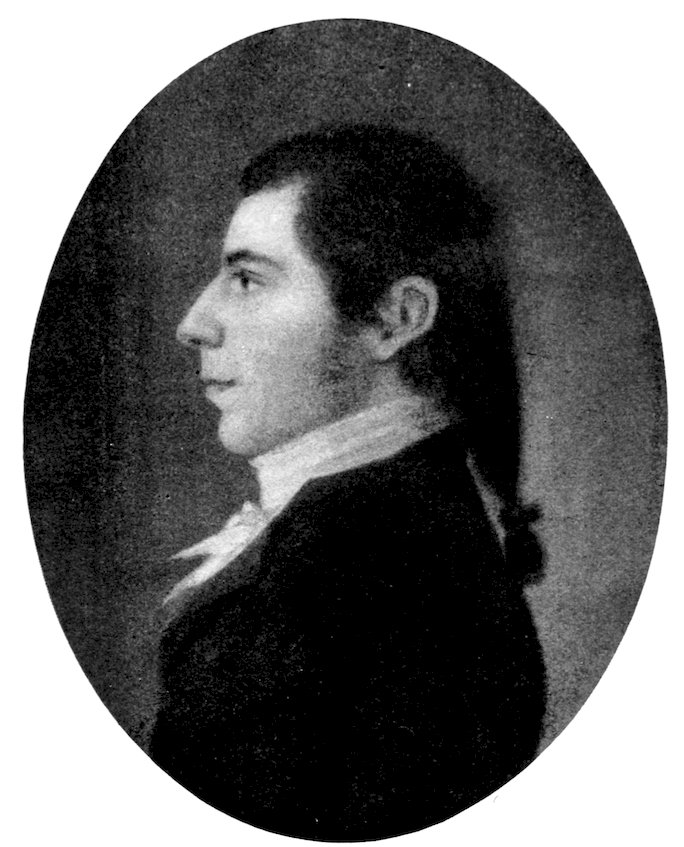
Pl. LXV.—Dr. Timothy Pierce, son of John Pierce and Mary Goodman
b. 1778. d. 1801.
From a pastelle
Timothy Pierce,
| 1- | To Mary Pierce, | Hartford, Ld. no date. |
| 2- | „ „ „ | „ |
| 3- | To Mary & James Pierce, | Litchfield, New York, 1798 |
| 4 | To „ „ „ | Litchfield, New York, Oct. 5th „ |
| 5 | To James, | „ „ „ „ |
| 6- | To my brother & sisters, | „ „ 1799 |
| 7- | „ James Pierce, | „ Camp, 10 Sept. 1799 |
| 8 | „ „ „ | „ „ „ „ |
| 9- | „ my mother, to my brother, to my sisters, | „ Union Camp, Nov. 1799 |
| 10- | To my dear friends, | „ „ Cantonment, Jan. 6, 1800 |
| 11- | „ Mary Pierce, | „ Camp, Jan. 18, 1800 |
| 12- | „ James Pierce, | „ „ Sept. 30 „ |
| 13- | „ James „ | „ Charleston, S. C. Dec. „ „ |
| 14- | „ Dr. Croswell, | Columbia, „ „ |
| 15- | „ „ „ | Statesburg, Feb. 1801 |
| 16- | „ my sister Polly, | „ May, 1, „ |
| addressed to Thos. O. H. Croswell, | Catskill. | |
| 17- | „ Miss Mary Pierce, | „ July, 24, 1801 |
| 18- | To Dr. Reed, to Mrs. Widow Pierce, | Litchfield. „ Aug. 2, „ |
| 19- | Mr. Wm. Rees, to Miss Sarah Pierce, | „ „ „ 6 „ |
I improve this early opportunity that I may be thus entitled to an answer, giving an account of your journey, your situation, of the plans you have formed for the disposal of your time, & of whatever has occurred most interesting since you left us. The opportunity with which fortune has at present blessed you of improving your mind by refined society, of enriching your mind by reading & conversation, & of taking an extensive view of human nature, is probably far more advantageous 362than what you will enjoy at any future period. Of this you are undoubtedly sensible. It is superfluous, therefore, to enlarge upon the necessity of making every exertion in your power to reap all the advantages the nature of your situation will allow.
I shall sometimes take the liberty of advising you. We are none of us perfect. You must advise me in return, & let us each become as faultless as a brother’s & sister’s watchful care can make us.
Let me recommend to you a practice which I began on New Year’s day, from which I already have received evident advantage. So many things were crowding upon my mind at the time of your departure that I entirely forgot to mention it. The practice I refer to is that of noting down in the evening by way of diary, every observation worth remembering that you have heard in conversation, & all the reflections that have occurred to you of any importance in the course of the day. Each evening fill up one page at least & it will induce a habit of exerting your mind by reasoning, and paying strict attention to all judicious conversation, & you will in a little time acquire a facility in the art of composition which alone would fully compensate you for your labors. Without preserving exertion of your rational faculties you can never expect vigor of intellect. Without exercising the talents of conceiving & communicating ideas, & profiting by the remarks of the sensible it is in vain to think of excelling in conversation. Nor can elegance in composition ever be attained without long and careful practice.
Knox in his moral essays disapproves of transcribing the substance of what we read in a common book. Copying verbatim would it is true spend time to little purpose, but writing a concise abridgment may be useful by fixing the mind upon the subject. He who pays that strict attention that transcription requires will find the subject more firmly stamped upon his memory than he will who reads for amusement only. Write me what you think upon this subject.
Post Script to Miss Wylls.
It is nearly time for the post to call for the bundle which is to enclose this, & perhaps I shall have little more time to write you than barely sufficient to inform you that all who are dear to you in Litchfield enjoy health, prosperity, & happiness. The tears of joy from embracing your dear parents & receiving the hearty welcome of your friends, have hardly yet ceased to flow. Then what an apology can I offer for so soon recalling your attention to those you have left behind.
363Without doubt the interest your warm heart feels in the concerns of your Litchfield friends will make intelligence of their welfare pleasing to you altho’ a few days only have elapsed since you were bedewed by their parting tears. I will confess however, that the hope of reading a postscript by your hand in Polly’s first letter is an excellent inducement for thus intruding upon your attention. Just so, however laudable may be ostensible motives for actions, it frequently happens that selfish motives, which we desire to conceal, are full as powerfully influential. But it is not my intention to give you a moral lecture at present.
The long expected young lady from Poughkeepsie has at last made her appearance to supply the place you left vacant in our family. She seems about 14 years of age, & little taller than Hannah, figure fine, complexion & features delicate, & if I may judge by her air & face, (for I have not heard her converse) is more likely to become a fine lady, than a philosopher. But I am much more pleased with her mother Mrs. Williams with whom I spent an hour very agreeably. Suppose Betsey Canfield 6 or 7 years older & you will have a striking likeness of her face and figure, but Betsey never can attain to more than a small portion of the refinement which appears in Mrs. W’s conversation. Can you prevent that awkward, country girl Polly Pierce from staring & gaping after wonders & curiosities about the Commercial City till you are ashamed of her? Can you keep her in order—Can we ever make a woman of her? An answer to these enquiries will delight.
Several weeks have elapsed since I have received a single line from my sister. In the name of wonder why this silence? While you were in Hartford, your friends here (Fanny Smith for instance) ascribed your neglect of them to hurry of amusements. But you have spent much of your time of late in the country. There surely time to write might have been found, if inclination had not been wanting. It is with mortification I remark that those among my correspondents whose communications I value the most are the least punctual in the performance of their promises in regard to writing. Several weeks or rather months have elapsed since my last to Mary Wylls & not a word have I received in return. However, I endeavor to think of her neglect as charitably as circumstances will permit.
364Our mother has been unwell. About 10 or 12 days ago she was attacked by symptoms denoting the access of slow fever. We contrived to strangle the disorder at its birth. Since that time she has been harassed by pains &c. of the nervous kind, but I hope her health will soon be reestablished. What a pity it is that you have not been at home to have learned a little of the skill in housewifery that I have displayed during her sickness?
Mamma makes frequent & anxious inquiries about you, talks about you a great deal & I fancy a letter from you would prove a more efficacious cordial than any that Dr. Smith’s shop affords. Do write to her Polly, & let us hear from you in the future much oftener than heretofore. I engage to answer every letter of yours the day we receive it, and send by the earliest opportunity.
Sally says, “Give my love to Polly, and tell her I have the headache & cannot write.” The crazy democratic priest, Ogden, has just sent her as a present a copy of his travels in Canada for the use of her school.
This letter is not your due, let that account for its shortness. My friendship to St. John W.
Here I am at New York, I have not time to write a regular letter, but shall throw out without form or order, in the most expeditious manner, whatever thoughts the occasion suggests. I rode the only passenger in the Stage almost to Derby, but to compensate for my loneliness the fore part of the day, 2 gentlemen & 4 ladies accompanied from Derby to N. Haven—tell S. Curtis & P. Thompson that the two Miss Graceys were of the number—& that one of the Gentlemen had sense enough to conceal his want of sense by taciturnity—one had been a Schoolmaster, & the third was cutting a dash in a sky blue speckled velvet coat, his hair dressed a la quotatine, the ear locks powdered & frizzled so as almost to meet in front of his nose, truly indicative of the furniture of his brain. I still recollect the black eyes of one of the young ladies—You will receive an account of Commencement from Daniel, therefore I shall be silent on that head. My room mate at New Haven, was a clergyman with whom I conversed a 365great part of the evening, & almost all night, neither of us being disposed for sleep, an elderly gentlemen who had listened to our learned conversation, asked me if I had a son in College.
Commencement evening, I set afloat for New York, & arrived here after a head wind voyage of—I have forgotten exactly how long. I have taken temporary lodgings near the centre of the City, price at the rate of 100 pounds a year. My fellow lodgers are two young attorneys, who have very much of the gentleman in them, one student at law, one French Priest who speaks no English, but converses with us wholly in French & Latin, so that our table conversation is a mixed jargon of French, Latin & English. Nat’n Sanford also is one of my fellow lodgers, transformed into a steady student, bearing a respectable character, & seeming much like a gentleman, he is certainly an excellent scholar. Dr. Mitchell dines with us, you have heard what respect his theory of Septon has met with in Germany. I shall attend his first lecture upon Chemistry tomorrow, next to Dr. Smith he is perhaps the most pleasing man I am acquainted with. The other evening he conducted a number of us to an eminence near the City that we might get a sight at the much talked of Comet, but we found it not, the next evening walking upon the battery I found a number of the pretended literati of the town with their telescopes squinting at Venus, fancying that the Comet, after viewing it sufficiently, they went home tickled most hugely to think they had seen the Comet!! Men of science indeed!!
At Dr. Gates’ house a number of other Gentlemen of the first estimation in the City were viewing Jupiter through one of the best telescopes in America. Altho all the satellites and belts of the Planet, are plainly to be seen Dr. Gates will not give up the idea of its being the Comet—One gentleman whose reputation for Science is considerable could not explain the word Parallax—another enquired the meaning of Apogee—Excellent astronomers! Drs. Smith & Mitchell do not believe there is any Comet to be seen—I have not yet attended the theatre—I have not yet visited the Museum—in fact I have not had time. I tho’t I had gained before parting from home, a sufficiency of chemical knowledge, at least to begin to learn, but I mistook, the system I attended to, is entirely exploded, & a new system introduced, considerable study is requisite to gain so much knowledge of the new principles & nomenclature, as will enable me to understand fully the lectures of the Professor. The 42 dollars I brought with me will not last forever—Night before last, being at Lynde Catlin’s we were alarmed by the cry of fire, we ran to the top of the house to see it, but it was soon extinguished, one building only was burned. The bon-fire that cut 366such a devil of a shine here last winter has struck such a terror into the people, that the alarm bell seems to sound through their souls, as well as the ears. We hear that the man who set fire to Albany, is apprehended & has confessed that he did the pretty trick with a segar. One man has died here with the Yellow Fever, there are several other cases of it in town. Yet Dr. Bard informed me 3 days ago that he never knew a more healthy town at this season of the year.
You have found this letter a confused mass of dry heterogeneous materials huddled together as chance has dropped them—Dullness is with me the order of this evening.
Brother James, write me as long a letter as this—with you Polly, I shall not be satisfied, without receiving from you several letters, of 3 or 4 sheets each, well filled. Say some good natured things for me to every body you meet. Give my respects to those to whom it is due, & my love to my Sweetheart if you can find her.
Upon my word, a sentimental letter this.
... tell Fanny, Maria, & Betsey to write me the first opportunity. An abundance of matter crowds upon my mind which I wish to communicate, but circumstances will not permit.
Monday 9 o’clock.—
Although I have just despatched a letter to Ld. by Col. Talmage, yet, as so favorable an opportunity occurs, I cannot deny myself the satisfaction of returning a piece of an answer to your amusing letter—No James, my nose is not broken by the turning over of the carriage! The vessel has not run away with me! Nor, surprising to relate, have I even tumbled down my own throat. But pray has not Polly tumbled into hers? If she has not why did she not write by Mr. Deming—if she does not write the first opportunity that offers, I shall not stuff her mouth once with those curiosities that you say she is gaping so wide for—but instead of finding her descriptions of land and sea monsters I will—forget her.—You may tell Sally to inform those with whom she said my character in the gallanting line suffers so deeply, that there has been some misrepresentation, although nature has cursed me with the stiff manners of Dr. Orkborn, I hope I am not like him abstracted & inattentive to those about me,—tell them that if the three gallants I mentioned in my last letter with another Derby buck that the stage 367took up near N. Haven, are not enough to assist 4 girls in dismounting from a coach, the next time I happen under the like circumstances I will call together the neighborhood to assist.—I will attend to the matter of the locket.
The other evening I attended the Theatre & was much pleased with the exhibition of Shakespeare’s Othello. The part of Iago was acted by Mr. —— in my opinion perfectly well. The character of Iago is a horrid one, yet, Mr. —— made every action, every look, so exactly correspond with the subject, that ’twas with regret I saw him pass off the stage at the termination of each scene. Mrs. Merry, wife of the poet, appeared in the character of Desdemone, all seemed highly satisfied with her performance, I could point out no place in which she seemed particularly defective, yet I believe a Mrs. Siddons would have contrived somehow or other, to have drawn from me more tears. But Mr. Fennet in the character of Othello, met with unbounded applause, not from me however,—he displayed a strongly expressive countenance, & told the story of his courtship inimitably. When I observed to my fellow boarders that the part was overacted, I found no one whose opinion corresponded with mine—we find that the style of acting most pleasing to those who are much used to Theatrical exhibitions always appears overstrained, overacted to those who have never attended the theatre—& which have the most reason to think themselves in the right? those that have seen nothing but nature, & consequently have no other standard to judge by, or those who have long lost of nature, & judge of acting by comparison with some favorite actor? They tell me my taste is not sufficiently refined,—I tell them theirs is vitiated—one poor half starved tear only did Othello draw from my eyes. In the succeeding farce called the Romp, Mrs. Martial acted the part of Priscilla very pleasingly, ’twas judged there were 1000 people in the house.
Kosciusko has left town, while here he made a practice of kissing the ladies who came to see him—of 2 young ladies intimate with the family to which I board, one who was saluted by him resolved that no other person should kiss her for three weeks, for after being saluted by so great a man, the kisses of all others had become insipid,—the other swore she would not wash her face in a fortnight. Do you think the Litchfield ladies would so far prefer the kisses of the brave to those of the pretty fellows who are every evening fluttering about them? or is their taste in this kind of commodity less refined? 3 sons of the late Duke of Orleans M. Egalite are in town,—curiosities abound—here is a panorama in which if we can believe the keepers of it everything worth seeing is to be seen—aerial representation—wax 368work—The learned pig is also displaying his wisdom here—he draws many spectators—but he will have more wit than I think he has, if he gets 4 shillings from me.
Give my respects to everybody. Nabby Smith I think wrote from Aurora to have Fanny get into the Pulpit next Sunday & give her love to the whole congregation—do the same kind office for me—I have received no letter from Fanny, Betsey, & Maria, they promised to write.
You must look over and correct this letter yourself. I have not time. On the 10th about 1000 French books are to be sold at vendue, if I can buy some for nothing, I shall make a few bids whether I have money or not.
I have spun out this epistle to such a length, that I shall not have time this evening to write every one—therefore each one may appropriate this to him or herself, & give me credit for it upon their letter account books.
Lynde says, “the pay of the youngest servant of the bank, is 500 dols—the next 600—& so on—but there is no prospect of a vacancy—in this line of business you cannot make a living unless you obtain promotion to the higher places”—this is very uncertain.—“I have been in the bank 8 years (I think he said 8) & have gained a place barely lucrative enough to maintain my family in an economical frugal way the business in which you will be employed in the bank has no relation to merchandise & you are mistaken if you think you can go at any time into that business—to trade with a probability of making a fortune, requires a knowledge of traffic which can be gained only by long attention to the business, so that if you should be disgusted 2 or 3 years hence with the dull uniformity & confinement of this business, there is no respectable employment whatever into which you can immediately enter.” Therefore he advises you not to embark in the business—but if you still have an inclination, the first time a vacancy happens he will exert his influence to obtain the place for you—you may be sure. I think of Mr. Burral’s favour.—The business will require a clear, neat, upright handwriting, elegant figures & the utmost accuracy.
Nancy, I forward those rings from Mrs. Pierce to you by Col. Talmage. I hope they may please you as much as they did me—I long to have an evening conversation with you about Dr. Bard & other New York folks, but we are so circumstanced at present that I fancy it will be a difficult matter to effect.
I have received two letters from Mr. Allen since he has been at Philadelphia & have written 2 to him, his last contained the paragraph which I have enclosed in his own handwriting, my last letter to him contained the following paragraph as near as I can recollect in answer to what he has written me concerning you. “I receive frequent letters from my brother James, his abilities are ... &c. &c. ... heart &c. Yet I fear his dislike to the law will prevent his making that application to the study of it which is necessary to form the able counsellor.” In his last letter he expressed a desire to enter as a Clerk into the Bank. Mr. Catlin has promised him his influence in procuring the next vacant clerkship, but at the same time earnestly advised him not to engage in the Bank, the reasons he urged in support of this advice appeared to me sufficiently forcible to prevent his further thinking of the scheme. I wish you would write to him upon the subject, your advice will perhaps fix his attention upon something, &c. &c. You have here the import of what I wrote concerning you, but I hope it was not so badly expressed. So if he does not forget it, he will soon send you some good advice, perhaps you will think I have been too officious in this business.
I have been purchasing a few Medical books, some of which are dog cheap, others devilish dear.
| Chaptal’s Chemistry | 1 Vol. | 3 dollars. |
| Darwin’s Zoonomia | 6 Vols. | 6.25 cts. |
| Cullen’s Materia Med. | 2 Vols. | 2 |
| Bell on Venereal diseases | 1 Vol. | 1 dollar. |
| Bell on Ulcers | 1 Vol. | 1 „ |
| Smellie’s tables | 1 Vol. | 1 „ |
| Hamilton’s Obstetrics | 1 Vol. | 1 „ |
| New System of Anatomy | 3 Vols. | 3.37 cts. |
| Huxhum on fevers | 1 Vol. | .75 cts. |
| 19.37 |
I shall subscribe for an edition of Darwin’s Botanic Garden now printing in an elegant style in New York. This with a few other books that I intend soon to buy will make a clever little library.
I was much entertained by your political sketch. I have but little time to spend to read the Newspapers. Give my respects & love to Mamma, some of you wrote she was sick,—in your last letter she is not even mentioned.
In your last letter Polly, you say of yourself “If I can get sense enough to rub through a short life decently, I shall be satisfied—But I despair of that!!” Why do you despair of that? Or why be content with rubbing through decently when it is in you power to shine. The mind is made of such plastic materials that with a little attention we can mould it in any form we please. How happens it that the memory of one person is better than that of another? It is not owing to a more perfect structure of the brain, but to a habit of exercising the memory acquired in early life. The Judgment & all our other faculties may be greatly improved by exerting them. Thus habits of exertion form the Sage, and habits of relaxation the ninny, I do not know that I have clearly expressed my meaning—but I suppose you would prefer reading something else, to hearing a further explanation.
You desire me to forward you some French books if I have purchased any—but whenever I have attended the Auctions, French books have been sold for more than I chose to give—so that I have as yet, procured for you only one book, a poor solitary, mutilated volume of Rousseau’s Emile. It has been kicked about the Library of some empty headed French man, who seems to have made no other use of it than curling his locks, or wiping his razor with the first 4 pages. If I were to judge from its appearance, I should say—that it has been read but little, yet wormeaten a great deal. The worms by making many a delicious repast upon the inside of the book, have certainly shown good taste, more relish, for this elegant work of Rousseau, than the light headed French man who used it only to look at & abuse its outside. By the way I bought it for almost nothing otherwise I would not send you an incomplete work—but Polly can amuse herself with it whenever she takes it into her head to read French (which I fear will be very seldom) till I have an opportunity to send others.
I have just called upon Mr. Tisdale the engraver, he says the pictures are finished, but will not be perfectly dry till tomorrow morning—so that if Mr. Seymour sets out before 9 o’clock, they will be obliged to wait for another opportunity. You are surprised that the pictures have not been finished before. Tisdale is a good engraver, & an excellent miniature painter, but he has lately taken to writing poetry—which is as great an hinderance to punctuality as taking to liquor. You remember that I wrote word that they were promised for the next week.
371Kiss little Ann Pierce Brace for me and tell her I hope she may make as fine a lady, as little Ann Pierce Pendleton intends to be.
Give my love, compliments, & respects, to all who wish for them.
I met with a cordial reception in Camp last evening & lodged with Capt. Ranny—for the first time under a canvas roof—In regard to warmth my quarters were comfortable enough but I could sleep only a small part of the night. This was owing to my attention being kept awake by the novelty of the scene, the noise of the Camp, certain interesting reflections which the occasion suggested, the nature of which I will leave to you to guess, & by an attack upon the Camp by at least a whole regiment of fleas. These hopping enemies, if my calculations are accurate, will shed more blood, from our regiment, than will be drawn by the French or any other foreign foes. The rascals march into our lines, by the day in spite of bayonets, & steal upon our station by night without the ceremony of countersign. But it is to be hoped that cooler weather will before long screen us from their invasion. A little change of temperature will defend me from the bites of fleas, the bites of bedbugs, the bites of mosquitoes, & from all the bites except the bite of Jack Frost.
It will be necessary for me to supply the furniture of my own Markee. Therefore whatever articles either of sleeping or waking domestic use that can without inconvenience be spared from home will be thankfully received. I shall yet be obliged to set the fashion for surgeon’s dress, therefore Polly may send on some cravats, A black stock would save some washing—Our other Surgeon’s mate has not yet come or accepted, & our Surgeon departs for a day or two, therefore for some days or perhaps weeks I alone shall hold le cleff d’acheron. Be careful that my trunk shall come on the next stage. There are 3 or 4 sick in Camp, one with quite a grievous dysentry, but I hope this fine weather may prove a reviving cordial to him. Idea requested me to bequeath to her at my departure a portion of the Esculapion Spirit. I found leisure to write a few simple directions, which may be of use, but forgot to hand them to her, you will find them scrawled upon the back of a letter from Dr. Mitchel directed to me, perhaps they are unintelligible for I had no time to review them. She will find rules for simple cases very plainly laid down in an old rusty book in the bookcase, called Buchans Family Physician.
372I shall not want a horse at present.
Give my love to the girls at our house. I wish some or all would be good natured enough to write to me. My knee is my table, you might guess it.
Tell Polly to send me a cockade as large as she can lift.
In my last letter I forgot to mention that I wanted Moggy to make me two or three night caps. Desire sister Nancy to be so good as to send me those letters written by Gen. L. Kosciusko which are in her possession, to those engaged in military duty, anything relating to the Hero of Polish Liberty is, you may conceive, highly interesting. Some of our officers are acquainted with him & would be delighted to see the handwriting of their old friend. I promise that the letters shall be safely returned to her possession. Lucy, you have perhaps returned to Litchfield with a doleful story of the Camp, but the appearance of things is totally altered. The whole ground of the encampment is now as cleanly swept every day, as our kitchen floor,—wide bowers of evergreens are carried in front of the tents through the whole length of the encampment, supported by pillars thickly covered by intertwined ivy leaves. It really exhibits a most beautiful view, especially by moonlight, & when the tents are illuminated. Our Surgeon is gone & I have the whole care of the regiment. It is sickly in the Camp at present & therefore I have my hands full. Dr. Munson informs me there is much of the dysentery at present in New Haven,—At Washington it is quite sickly. Give my love to Lucy R. & tell her she may be assured I received her present with a great deal of pleasure, but I fear she will not receive the picture today nor tomorrow. I wish some of the young ladies would write to me. I suppose they would expect a correspondence would be begun by myself, but I know not who wishes to correspond with me & who would not. Some of them if the question were asked would probably desire it. But the strongest proof I can receive would be a letter itself, Whoever will be good enough to write shall be answered with punctuality & gratitude.
I lodge at present with our Colonel in his markee and diet at his table. I never experienced such agreeable accommodations. The Colonel keeps a table separate from the rest of the officers, & the other officers take their food at a place called Social Hall, where 373they are accommodated with excellent provisions. The expense of last week’s provisions amounted only to 8/6 per head. I shall become again a member of Social Hall when the Colonel sets out to visit his friends, which is expected in a few days. The 4 dollars I took with me are spent & as it is uncertain when I shall receive anything from Government a five dollar bill sent by a safe opportunity would not be used for wadding to my fowling piece. Give my love to all our young ladies.
60 miles from Philadelphia, about 35 from New York—9 from New Brunswick—near 140 from home & far removed from the habitations of any human beings, except of those whose sole aim consists in devising every art that knavery can suggest to plunder the contents of our purses, such is the situation of our Camp.
The packet in which I embarked made a favorable run & landed us safe. Not at New Brunswick as was expected, for New Brunswick was not the place of our destination—but at Elizabethtown-point, whence after an encampment of two or three days, to wait for the other transports, we marched 18 miles & arrived at our present encampment, called Union Camp upon Scotch Plains.
The transport carrying Capts. Young, Balford, & their companies were not so fortunate—You have heard the particulars of their scrape at Hellgate. Poor devils—I felt for them on the rock, half dead with fear, cold & wet as drowned rats. Fortunately, however, no lives were lost. The shock had nearly thrown half the soldiers overboard. Their vessel keeled almost upon her beams and very soon filled with water. The crew were brought off with ferryaugers—baggage well pickled with brine, & guns almost spoiled by the salt water. We waited for them at Elizabethtown-point, & they marched on with us to the place of our encampment.
New York is still forbidden fruit for me. In a month or two I shall visit that city & purchase a few articles of military dress, if I do not eat up all my money. New Brunswick is at such a distance that it will seldom be honored by my presence, for I shall keep no horse but have concluded it wisest to eat my horse’s forage myself.
The soil of Elizabethtown is luxuriantly fertile. The place contains about 180 houses, & in many respects resembles Weathersfield. New 374Ark which I walked up to see is a fine flourishing manufacturing town of nearly the same size. These towns are well worth the attention of travellers. The land about our station at Union Camp, looks considerably like Connecticut—but the farmers do not know how to work it right—they are not as expert as the yankee boys in the tillage of their soil, but in the midst of fertility most of them live in apparent poverty. Produce of every kind is much dearer here than in our state, particularly in the vicinity of the Camp. Here the griping marketers seem resolved to squeeze out our heart’s blood. Soldiers, they think, are foolish & imprudent & will give any price for whatever pleases their fancy—this the soldiers absolutely do. They think the officers full of money—& that they have a right to make them pay double for every thing they have—and the officers do absolutely pay double for most articles & for some treble the Conn’t price. You may get some idea of this by the following list of prices. New York currency. Butter 2/ & 2/6 per pound—Apples 5/ per bushel—Potatoes 5/—Small loaves of bread 1/ middling sized 1/6—Cider 6/ per quart—3 dollars the barrel—small pumpkin pies, fit pukes for dogs, 1/—Apple pies, crust rye & without shortening, spice or anything else & hard as cannister shot 1/ &c. So that I feel myself in the situation of the “soldier who lives on his pay,—and spends half a crown out of sixpence a day.”
At present we are encamped in tents, having no floors in our markees as in New Haven, but our feet are accommodated with a carpet, a la mode de hog pen, that is straw spread upon the ground. But as we shall have log houses in two or three weeks made convenient & calculated to last several years as a durable habitation for future armies, or for our Standing Army that the Democrats tell about. Government has purchased 80 acres of land here consisting of good parade ground, & a fine piece of wood for the building of huts & firing. But sending us here to build our own huts, was a sad piece of economization in the U. S. A. For wood at this place will sell for [illegible] a cord. The wood stands thick upon the ground, consisting almost wholly of black oak & walnut, straight, trim, & making excellent timber & it is calculated that the logs we shall employ in building would sell for more than the cost of comfortable frame barracks. If I have time to draw it I shall send a plan of our present encampment & of the log houses erecting for our winter accommodations.
Almost all kinds of religious persuasions prevail in our neighborhood except those dictated by reason. Baptists, Saturday new Quakers &c. abound. Last Sunday I attended a Quaker-meeting—Total silence prevailed, the whole congregation sat motionless the old men & women 375with their fingers upon their mouths, waiting for the access of the spirit, & engaged in pious meditation. My thoughts were more intently fixed upon home, than heaven. At length one rose & observed that nothing human beings could offer before the throne of grace would be more acceptable than meditation & awful silence. That young & inexperienced as he was nothing would have tempted him to interrupt that becoming silence if he had not feared that some of the congregation were walking the downward road to perdition. This was the whole purport of his discourse. The friends then shook hands with each other & retired to their homes. The dresses of more wealthy Quaker ladies are plain, rich & becoming—One young Quaker of about 18 years of age, carried the sweetest look & most graceful manners I have seen this long time. I promised myself some pleasure from her society, but was informed that she lives 10 miles distant. Many of these Quakers attend these silent meetings steadily from a distance of 12 or 15 miles. Tell Mamma that some time since I purchased a testament, & have kept it so nice that I have not yet soiled it in the least. The Quakers & other inhabitants about this place like the Yankees much better than the York troops, or even than the Jersey men. A respectable Quaker merchant told me yesterday that “the New York soldiers & officers gave them a great deal of trouble, but those from Connecticut were very civil in their behaviour & gave them no trouble at all.” Most of the New York officers live so freely as to expend the whole of their pay & many of them more than their wages. Several have become discontented & resigned their commissions—6 or 8 have deserted from the New Jersey Reg’t since stationed here. 4 or 5 deserters from the New York line are in custody,—one,—two, or more of them will probably be shot. For military execution a whole plattoon of soldiers stand a few paces distant from the criminal & pour the balls at once into his bosom. A court martial will be held in a few days upon one of the York artillery officers, for taking money of soldiers who had enlisted, for releasing them, as I am informed. The Yankee lads have the reputation throughout the Camp of being formidable young sprigs. The soldiers of York and Jersey reg’ts are in some measure at variance, but both court the friendship of the Yankees. A day or two ago, a two handed fellow from Cap’t Rod’s company, was gaping about in the York quarters, when a stout Yorker strutted up to him & told him to go home,—he replied that he would when he was ready—upon this Yorker bustled up to him, but the Yankee laid his opponent sprawling by a single blow. Another Yorker came up, but immediately measured the ground with his length—a third shared the same fate & our victorious countryman set his 376arms akimbo & walked to his tent at his leisure. A few similar incidents have given the Yankees the names of brave lads. Our music is much better than that of the other Reg’ts. The tune of Yankee Doodle is very often played, & is known by the name of the Invincible March. Did you ever see a Yankee who was not a good brag?
Our regiment has been remarkably healthy, we return generally only from 15 to 20 each day—3 or 4 have died from the York regiment, since the recruits service began, & not a single man from ours—See what the Dr. can do!!
As for myself I am hearty as a buck, & grow fleshy rapidly & could spend my time very agreeably if I had a few companions that I could select from our Litchfield society. We have some fine fellows among the officers—but as to female society—I have given up all expectation of its delights for this winter.
Sally’s letter from New Haven was highly gratifying to me, especially as it informed me that Mamma’s health improved rapidly, by this time she has probably recovered entirely. But she must be quite careful of herself this winter, fatigue seems the one chief exciting cause of her attacks of the pleurisy, she ought therefore to avoid it, & perhaps it would be of use to her to take of the bark once now & then through the winter. I wish she was where I could take care of her, but I do not think she could have been left in better hands than in Polly’s.
A visit to the hill Sally mentions back of Amboy, would be very desirable to me, but its distance will prevent a frequent enjoyment of that water prospect she speaks so highly of. Yet whenever I visit Amboy, I shall pay grateful acknowledgement to that benevolent family who were so hospitable to our much lamented brother. I have heard nothing from sister Pierce. We hear seldom from New York, almost never from Philadelphia,—there are few papers taken in our Camp,—we so seldom have intelligence from them, that those two places seem as distant as Europe. We used generally to hear as much from them in one week, at Litchfield, as I have heard since our arrival in New Jersey. Yes, Sally it would have delighted me much to have visited the Museum at New Haven with you, & the rock you mention, & were it not for one doleful obstacle I might hope that, one of these days, after school in the afternoon, you would accompany me to a rock in the neighborhood of our present encampment from which New Brunswick, Amboy, & a vast extent of country may be seen at once.
If James wrote by the post as you mentioned, the letter has been lost, for no letter has yet been received though long anxiously expected.
If it was my aim to write fashionably, apologies would be thought necessary for the length of this epistle,—& for its concern—myself 377& my situation almost exclusively of all other subjects, but I feel as though a particular statement of situation &c. would be more acceptable from a friend of mine than a great deal of the fine matter of which fashionable correspondence is usually made up. Instead of apologizing therefore I will inform my friends that they can write nothing materially concerning themselves, which will not be highly interesting to me. Every transaction occurring in good old Litchfield that my friends will be good enough to write me an account of will be read with pleasure.
But stop,—permit me first to make my bow to the young Squire in particular. Has not passing a good examination made him swell two or three inches in circumference with exultation? Since he has received the appellation of Squire does he not strut at least, “one hair’s breadth nearer to the sky?” Has he learned so accurately to distinguish between meum & tuum as to convert them both into suum? Is not our house already thronged by his clients? Has he not obtained in its almost perfection the art of setting poor farmers by the ears & of rifling of their pockets during the affray? Does he not bid fair to rival the great Demosthenes & become the Cicero of America?
Mr. Smith sets out tomorrow morning for Litchfield, and the lateness of this evening allows me time only to throw together 15 or 20 lines, of any thing which comes handiest. Nothing important offers for communication, & I am certain I should write nothing this evening were it not for my wishing to throw the balance of letter accounts in my favour.
I beg leave to congratulate Lucy & Mabel upon their fair prospect of approaching relationship. I know they have long been intimately connected by the sweet bands of affection, & am highly gratified to hear that the Seymours are about to tie them together as sisters.
Horatio I conclude still continues pretty middling busy about Lucy. So long as he has been, & so skillful a workman as he is, much business must have been turned off by this time, & it pleases me to hear that Moses has accomplished so much in the line of his employment.
378Does Polly Pierce attract the attention of any buck in particular yet? Or is she still obliged to rely on other folk’s sweethearts for the amusement of her evenings? Has she still nothing to do but look on from 6 o’clock till 10 to see other folks court? I should be fond of a few particulars that can be relied upon, with regard to this matter. As for James, I suppose that if a fair damsel should melt his heart down at once he would never pay her particular attention, for the fear that it might excite the observations of others. I can now repeat with the emphasis of feeling a line from Nancy’s letter from Kosciusko. Oh, James, “you is one happy man, you is always with the ladies & we have not one.”
School consisting of 15 only—now there are so few I hope that the native ladies of Litchfield may stand some chance for a part at least of the attention of Mr. Reeve’s students.
Lucy, Mabel, Maria Budd, Miss [illegible] & who else at our house? At this time I suppose Idea’s black eyes are sparkling upon the beaus of Vermont. I feel for you on account of the loss of Jane, Nancy, Hannah, and Mary. Let me know how affairs progress between Mary Wyllis & Miller.——Twining and Almira then? ’Tis well——Does Sarina Bull still attract the butterflies to bask awhile in the sunshine of her charms—& then flutter off? Does Maria Budd still act the “heyday of the fantastic?”
James can now no longer be excused from writing to me every opportunity on the score of preparing for examination. I shall therefore expect letters every week. Polly is also now at leisure. Dr. Orton has arrived & I also can afford more time to my L’d friends. I suspect from the tenure of your letters that I have written several that have never reached you. You mention nothing of Mamma in your last. I conclude therefore that she has completely recovered.
N. Woodruff sets out for Litchfield tomorrow morning early—It is now late in the night & I am resolved not to encroach upon my usual hours for sleeping to write to those who so seldom favor me with letters as my sister & brother, 15 minutes only I will bestow upon you both, for you & for James. Your pleasant letter written some time ago gratified me extremely—Every line, every phrase, presented 379my rattling sister very vividly to my fancy. Let all your letters be cast in the same mould. When you have so much time upon your hands, when you write with so little difficulty, when opportunities of sending so frequently offer & when reading my sister’s communications is so highly gratifying, it is impossible for me to account for your not having written oftener upon any other consideration than this—that you have ceased to think of me—But I hope future punctuality will atone for past negligence. Oh Polly, I wish you had been with me the other day when I ascended a rock upon a neighboring mountain from which may be seen the river Raritan—New Brunswick—The bay of Amboy—Newark—Elizabethtown—The bay of Newark—New York city—Long Island—& the Atlantic ocean beyond—a vast extent of country to the southward of our station. This is perhaps the richest & most extensive prospect that is to be found in any part of the United States. When the Continental Army in the Revolutionary War lay in this part of the country, the great Washington used often to ascend the rock to descry the position of the British forces, that consideration at this particular time adds greatly to the emotion which this sublime view excites in the mind. I trod with reverence the rock upon which that great man stood, & my heart wept to think that the father of his country was no more.
Then the Democrats in Congress have been endeavoring to disband us—& send us back again to Connecticut. What can the stupid creatures mean—I thought in the present situation of our affairs as to France & Great Britain that both Fed’s & Dem’s would agree to the necessity of being prepared for effective defence—But that band of wretches who formerly endeavored “to stop the wheels of Government have now failed in their attempt to break the sword of their country.
You may depend upon it that the Connecticut regiment forms quite a respectable part of this sword of our country. It has the reputation of being as well, or better disciplined than any regiment besides in the United States. The officers are thorough in the performance of their whole duty—not a single instance of intemperance, or gambling have I heard of in any one holding a commission.—Among the soldiers, there are only 5 or 6 foreign old country men—the rest are well disposed Americans—& with the exception of a few invalids—very promising young men—Living as they do 15 or more in a room—30 in each small one story hut with no floor but the ground, some diseases must of necessity present themselves—but their being still all 380alive, while [illegible] in the regiment lying next to them have been furloughed to their endless home, reflects honour upon them for their cleanliness, their temperance, & their healthful management of their diet. It seems that you never yet have had an opportunity of sending on those shirts which were partly made at my departure from L’d—Capt. Ranny will be with you soon & then if not before they may be safely sent. Capt. Ranny has been extremely polite & obliging to me & I wish our people to treat him in return with the utmost attention. He has promised to call upon you & seems very solicitous to be acquainted with our family. He is a man well worthy of your friendship.
This morning a duel was fought in the 12th Reg’t by two Lieutenants, one was wounded in the leg.
I wish you to ascertain if possible the date of my letter of acceptance, & send me notice of it by the first opportunity. It has entirely slipped my memory, & our pay-rolls cannot be drawn without it. We shall receive no pay for some time, therefore it is probable more money must be sent me from home. You mistake when you think our board a trifling expense. Each officer maintains a servant, & the servant’s board costs as much as his own. Therefore all things considered I might board with as little expense in Litchfield. My foods cost as much as that of any officer in the regiment.
Your good letter deserves a longer & a better answer than I am at present in condition to afford you. For about four & twenty hours past I have been afflicted with a sad sick headache, & have not felt myself in a proper state for writing or anything else. Instead of cutting the figure which you say you shall be afraid to speak to, my appearance has “improved only for the worse” as paddy would express it. Being the only physician in the regiment during the severe prevalence of the dysentry among us for near a week, I experienced a constant hurry of practice through the day & was often called up at midnight. In consequence of this and the anxiety I underwent 381for two or three of my patients, I have got out of the habit of talking, bend over more than usual, & look ten times more serious & Don Quixotical than while at home. My sister need entertain no apprehensions with regard to the sword & hat which you mention with fear—for those articles will not be purchased before we retire to winter quarters—: before that time I shall make you a visit—and after that visit you will see neither me nor my sword until next spring. You say you wish me to write upon speculative subjects—if anything new had lately occurred to my observation, I would communicate it for your criticism with pleasure—But all my late speculations, relate only to Ipicac, Salts, Dysentery, Rhubarb—fever &c. Subjects that will not be interesting to you.
She will find me more “presumptuous” than Mary would permit her to be—for her cold “compliments” I beg leave to return her my love.
I assure you that the “Dr.” feels himself “highly honored” by the postscript with which you have favored him, is “highly gratified” to find you have sent him “some” of your love—& takes the liberty to send you an abundance of his love in return.
Whether “the disposition of Jenny Witless is malicious” or not, I was fearful she would not have remembered me, even to have “vented her spleen upon the Dr.”—But whatever may be the state of her feelings toward me, I thank her most cordially for the two lines and a half of P. S. at the end of Polly’s letter—& feel very sorry that the headache prevents a longer reply. In the first part of this letter I have desired some money from home, but upon further consideration I suspect it will not be wanted—please tell James not to send it without further notice. Desire Polly to send me a list of the things which have been sent from home since the arrival of my trunk. Give my love to all our young ladies. Tell Lucy Russell to write another letter for me to carry to her parents, I have taken a fancy to the old Democrat her father, & want another excuse for paying him a visit. Starks Edward & Mr. Tod have spent a considerable part of this afternoon with me & I have promised to call at their houses in the 382City. Therefore if our young ladies wish to write to Henrietta, I will convey letters to her with pleasure.—goodnight.
Oct. 1st. After thinking the third time upon the subject of money, I believe James may send me some if he can conveniently—it may not be wanted—but perhaps it may be used advantageously under present circumstances. Should it be sent, the earlier it comes the better—It need not be sent unless it can be spared very conveniently.
I would relate an amusing case of a love sick patient if I had time this morning, but Mr. Collins will call immediately for this letter therefore the history of it must be omitted till another opportunity. When Dr. Trowbridge returns, or when another is appointed to assist me I can devote more time to my friends.
(Addressed to Mr. James Pierce, Litchfield.)
Thank God, here I am safe at Charleston at last, after a tedious passage of 17 stormy days from New York. We sailed on the 15th of last month, & within the first 24 hours were driven so far from land by a heavy wind, that it took 12 hours to regain the coast. We entered Egg-harbour, run upon a shoal of quicksands, & lay there three days until the spring tide lifted us off. Upon extricating ourselves from this difficulty an heavy north wind carried us like lightning to the southward, we flew by the capes of Delaware at about 400 hundred miles from shore, passed the Ches’pk Bay & a few hours more carried us to Cape Hatteras, but the west wind which now set in pushed us to such a distance from the cape to the eastward, that the eddy of the gulf stream carried us back 60 miles in 24 hours, however we kept free from the stream itself for a few hours & attempted to gain the shore, but in vain, a violent northwestern gale set in which drove us notwithstanding our efforts in the Gulf stream itself. As we entered it dismal indeed was our prospect. The rapid current meeting the north wind rolled its waves to a frightful height. Its waters are 12 or 14 degrees warmer than that of the ocean through which they run & smoked in the cold northern squalls, which constantly assailed us like the water of a boiling pot. 5 or 6 sharks attended into the stream, two water spouts one on each side of us passed near and soon after we saw them pour their heavy weight of waters upon the flood. The surges poured over the deck, so as at times to hide it entirely, & 383even beat in at the top of the cabin door. In two or three days we found ourselves about two degrees below the latitude of Charleston, about 300 hundred miles to the eastward of it. Here we were harassed by contrary winds 4 or 5 days, till at last a favorable northeast storm 250 miles in a few hours & landed us safely in Charleston. But I assure you I have been horribly harassed by seasickness.
We had one perfect calm when, altho’ we had hardly a breath of wind the waves rocked, rolled & tossed our poor sloop so violently that we were fearful the mast would be completely rooted away.
None of those people to whom my letters are directed are at present in town. I therefore shall proceed directly to Columbia.
I should write more particularly, and more intelligibly, but my time will not permit since I shall set out for Columbia in an hour or two if the weather will permit. About an hour ago two negroes were condemned to be burned alive! for the murder of a white man. Remember me affectionately to all my friends.
You have probably seen my dispatch to my Litchfield friends, giving an account of my long and tedious passage to Charleston. The road to this place does not run upon the banks of any of the large rivers, where the rich rice & cotton plantations are situated, but through a tract of country covered with barren sands & marshes, affording to its few wretched inhabitants little else but pitch pines, dysentery, poverty & fever agues. You shall not be fatigued by a particular account of my journey from Charleston, dragging you step by step through so many savanas, cypress swamps & pine barrens, where nothing can live but screech owls & turkey buzzards would be cruelty to myself, & would make you swear like a pirate. Let us fancy ourselves at once at Columbia where we will take a look at the Assembly, now in session, & then talk a little of my prospects in this country.
The Legislature of this state undoubtedly affords some men of great abilities. Gen’l Pinkney & a few others remind me of the venerable Sages of Greece & Rome. Yet here are some also who (if I do not judge too precipitately) are better fitted for horse jockeying than for 384legislation. ’Tis amusing to see with what ardor they maintain the cause of Jefferson & Burr, those violent advocates for moderation, & ’tis laughable to view the members of this august assembly, loudly declaiming in favor of Liberty, Equality, & the Rights of man, while they shake the bloody scourge over 128,000 of their fellow creatures, whom they hold in the most abject slavery. Laughable, did I say?—No—I recall the expression. The picture makes my heart bleed.
There are many difficulties in the way of choosing a situation for practice. Colonel Hampton has gone to Virginia to be married, & will not return these several weeks. He has never mentioned my coming to this part of the world to Lyde, notwithstanding their intimacy & connection, nor has he ever hinted of the existence of such a creature as myself to his son in law who has the care of his affairs nor to any one else, that I can find out. There are several objections to fixing near his estate. Columbia has three or four physicians, who practice, & another who has left physic for tavern keeping. One poor devil of a doctor was starved out, & left the place on the day of my arrival. I find very little dependence can be placed on the opinions of others with regard to the eligibility of a place for practice, or even relating to the healthiness of a town. Almost every marsh in the State is thought a healthy spot by its inhabitants. A rich planter on Wateree was mentioning his grounds and neighborhood as remarkably healthy “But,” (said I) “are not the negroes often sick in the summer?” “Oh, yes,” (said he) “the negroes have aplenty of fevers & camp distemper in the summer, but the white people have not, they spend the hot months in Columbia, but in the winter we have no fevers.” No one certainly will fly so directly into the face & eyes of candor as to deny the force of this reasoning. When at Camden, some thought that an excellent stand for a physician, “for (says one man) it is a healthy place, it trades a great deal, has 80 or 90 houses, & is as large as Columbia,” “yes, (said I) but here already three eminent practitioners in the place,” “Well, (he replied) if it can maintain three handsomely, that proves that it is an excellent place for doctors.” Such forcible logic as that silenced me at once. Upon the whole, I think I shall fix myself upon the high hills of Santee & engage, either in partnership, or war with a Dr. Reid who has long practiced in Statesborough, perhaps your friend will experience the fate of two medical gentlemen, who 2 or 3 years ago settled on the hills, but left them in despair of success, yet the late great demand for cotton has made the inhabitants more wealthy, more luxurious, & consequently more sickly & more able to pay their physician. Be so good as to send this on to sister Polly, & that will save me the trouble of writing at this time, a 385separate letter for my Litchfield friends. Lyde’s warm heart, is still strongly attached to Litchfield. Hardly a person can be mentioned that he had ever seen there, concerning whom he did not make particular enquiries. Neither distance of time nor place have erased Marana from his feelings, I think she is still the gourd seed. He turns the conversation repeatedly upon events, & recalled vividly to my mind, scenes so strongly connected with my feelings, that sometimes in spite of all my exertions—stop. I am not home sick yet—yet if I had the wishing cap of Fortunatus (which in an instant will annihilate any distance) it would contribute some to my satisfaction.
I wish brother James would inform Mr. Joseph Adams that particular enquiries were made concerning him & his family by Mrs. Adams of Camden, widow to a brother of his, a clergyman who died some time since. She intends visiting Connecticut in a year or two for the benefit of her sons’ education. Whom, I think, she will place under the care of Parson Backus. She is young, handsome, & wealthy. Our beau must take care. Give my love to all my Litchfield & Catskill friends. Tell them that time & distance have increased my affection for them so much, that there is not one of them whom I would not this moment set out & walk ten miles to see. Walk,—I say, for I have not purchased me an horse yet—By the way the price of an horse, saddle & bridle, the delay for an answer from Col. Hampton, in a country like this 50 pr. cent dearer than Conn’t my stay in New York waiting for a passage, & the extravagant demand of packets from that port, all these will really make such a vacancy in my 200 dollar purse, that I shall have room to put in more money when I get it. However, hope points forward to more prosperous times. Though with regard to the expense of my passage by water, I can’t say I had not sailing enough for my money—by our Captain’s account we made a voyage of about two thousand miles & had the privilege of sailing 17 days, all which cost no more than if we had made a direct passage in three days and a half.
I expected to have heard from you long before this, but a single letter from my brother James is all that I have rec’d from my friends at the northward since I left Conn’t. Several have undoubtedly been written but lost by the way. I do not think my situation at this place promises 386to be very profitable, & I suspect I shall not make a permanent stand here, yet it is an healthy & pleasant neighborhood, it seems a proper stand for making a first trial of the effect of a South Carolina summer upon my constitution. The fortunate instances you have heard of in which physicians have made fortunes in this country took place in the lowlands & I suspect that the practice is very little if any more profitable in the high lands than it is in Connec’t. The physicians in Camden & Columbia are from the schools of London, New York & Philadelphia, they have lived several years in this country, yet it is said not one of them can show a thousand pounds gained by his profession. Col. Hampton wrote me an obliging letter from Virginia in which he renews his offer of patronage & pecuniary assistance if wanted—but if I mistake not his plantation is in as unhealthy a situation as any place I have seen in this part of the state, & offers but little practice in its neighborhood. I can maintain myself anywhere—but I believe my friends may resign any expectations they may have entertained of my growing rich very suddenly.
Please to send this on to my brother James that he may read the result of my inquiries concerning the advantages & disadvantages of his settling in the Southern States. I conclude that Mr. Lide’s note announcing the necessity of studying a year in South Carolina has induced you to abandon all thoughts of settling in this state. A Councillor belonging to Savannah informed me that the rules for admittance at the Bar of Georgia required only a certificate of admission at the Bar of Conn’t., & a fair moral character given under the seal of the State,—and a strict examination before a judge in Georgia—But he assures me that in the south part of the state a young attorney is a long time unnoticed & will meet with much source of discouragement before he can procure an advantageous run of practice. A practitioner from Augusta informed me that altho’ their bar swarmed with attornies he believed Augusta a good situation for a man of shining talents. However, in all the Southern States the practice of law is extremely expensive—family & glittering accomplishments are preferred to real merit—& it frequently happens that several years will elapse before a young man who has nothing but real worth to recommend him can obtain an advantageous run of business. The planters are the richest class of men in this country—with their superficial education they direct the taste of the multitude—& Vive la baggatteiles is the complection of the ton—Come as dancing master & you can live. Monsieur Griffiths who taught at Litchfield receives more money than the amount of the salary of an army officer belonging to the State of North Carolina. He teaches alternately at Camden, Columbus & Statesburg.
387In South Carolina & Georgia a young attorney is obliged to ride the circuit in a sulky with a servant, & solicit the advocatism of criminal cases to be pleaded gratis to bring himself into notice & I understand riding the circuit is considered as indispensably necessary. I have heard several speak of the excellence of the State of Tennesee as an opening for professional characters. I was advised to go there by Dr. Rodgers of New York—who thought I should soon make a fortune there without the risk of health which is inevitable in this State & Georgia—I am assured that the bar of that state affords but two attorneys of any eminence. Next to Tennesee, Kentucky deserves attention. However, unless you have a taste for wandering you will live happier at the northward with a little, than in this part of the world with great wealth—social pleasures are our sweetest pleasures, & it is generally acknowledged that social intercourse in the northern states affords far more heartfelt gratification than in any other part of the Union.
Upon receiving yours of March 27, which informed me of letters directed to Columbia, I wanted to ride immediately there, but a swell of the Wateree rendered that river absolutely impassable, however, I have finally received them by a circuitous route & was not a little gratified by reading of three letters from yourself & one from my sister Polly. My sister Polly, with that affectionate solicitude for my welfare which always secured for her so warm a place in my heart, begs me not to be discouraged. No, my sister, give yourself no uneasiness about that. I am now quite a stranger to “doleful fits” as you call them, in that respect my disposition seems to have changed with the climate—I can now be happy upon easy terms, can hope when others would despair—Beginning the world with nothing I feel as the eldest son of the Vicar of Wakefield did—Being at bottom of Madame Fortune’s wheel a revolution of it may raise me higher, but can sink me no lower—consequently I have everything to hope and nothing to fear from her capricious Ladyship.
Circular—Your letter of Litchfield news, my sister Polly, proved quite a reviving cordial to me—You little know how much I feel the loss of the female society of my native town. In South Carolina the Ladies are generally reserved & distant—I have attended dining parties where the Ladies sat primmed in awful silence, while the Gentlemen 388conversed solely with each other. I have attended Balls where the sociability seemed little better. Instead of being proverbial for loquacity, the ladies of this state might with propriety become proverbial for taciturnity. I have met with many who dare not open their mouths long enough to pronounce their souls their own. The daughters of the rich are sent to Charleston for education, there to accomplish themselves in music, dancing, embroidery, &c. but little attention is paid to the cultivation of the mind. And indeed the gentlemen set less value upon mental improvement than upon showy accomplishments. Here the first inquiry concerning a strange lady is, “What is she worth?” “How many negroes has she?” Next “What family does she belong to?” then “Is she handsome?” But the mind is of so little importance that it is seldom inquired about. Here the God of Love points his arrows not with beauty & wit, but with gold. Here the graces that adorn a lady have flat noses, wooly hair, & are as black as the devil.
It delights me to hear that all my Litchfield friends enjoy prosperity & happiness. If brother James concludes to settle in this country or anywhere within my reach, my purse, whether there be anything in it or not, shall always be as freely open to him as his own. You mention nothing to me of Sister Nancy. Mamma’s health is I suppose by this time restored. Sister Sally’s eyes have got well, you have a large family of boarders—& all is fun & merriment at our old shade encircled mansion. You seem fearful of writing to me on account of the expense—But whether I shall be in the road of prosperity or adversity a quarter of a dollar every week or fortnight will have little influence towards accelerating or retarding my course. Sally Leavenworth owes me a letter—tell her for me the next time you see her! Remember me affectionately to Fanny Smith & thank her for that message of hers which you say you have forgotten. Give my love to all those whom you without particularising them, say sent love to me.
Then my sister Polly on my account dreads the months of July & August—July, has nearly expired & your brother is as healthy as ever—I am less affected by the heat than most of those about me who have passed their lives in the burning sun of South Carolina.—There 389has been some sickness in the low country, but the hills where I live have been as healthy ever since last September as the town of Litchfield, so celebrated for the purity of its air. So that if you do not receive a letter regularly every week, you are not to conclude that the fever has caught me, or that the Alligators have eaten me up—& even if they do eat me relief is at hand, for we have a French doctor lately settled among us who it is said, can not only cure the sick, but bring the dead to life & raise the devil. He says he studied at Paris, belongs to the Royal Society at London, was Kings physician at St. Domingo while under the dominion of the French Republic, can give hearing to the deaf, sight to the blind, & perform greater miracles than the world has witnessed since the time of Jesus Christ. So you see we have none of us anything to fear from death. Yet if the Doctor should venture to come at me with his pills before life was extinct, I would compliment him with a rifle ball.
Could you walk with me into the fields, my dear sister, you would be surprised by the novelty & beauty of the scenes which would present themselves & of the objects that would surround you. It would delight you to view the vast fields of cotton & rice, of Carolina corn, & of sweet potatoes.—Except from the description of travellers you are totally unacquainted with the orange tree, the bay, the holly, the sweet gum, the red bud, the live oak, the Spanish oak, the palmetto, the pride of India, the swamp cypress, & many other trees peculiar to hot climates. The swamp Cypress I mentioned is the Cypressus Distica described by Bartram. His description is overwrought, yet the tree sometime grows to an immense size & when the long moss hangs from its umbrella-like top, exhibits a most majestic appearance.—Notwithstanding the representation of travellers, I think the birds of this country are not in general more tuneful, or more richly colored than those of Conn’t. You would be delighted however with the Mocking bird. One sometimes fixes himself on a tree near my window, & if the moon shines bright, sings all night long his ever varying and most melodious strain. In the early part of the season, when riding through the woods, I discovered a plant, which seemed to resemble the picture I had seen of the Mimosa & upon dismounting was highly delighted to see all its leaves fold together at the touch. This is very properly an emblem of sensibility, & when I observe one limb feeling the injury done to another, the delicacy of the plant, its sharp thorns & its downy blossoms I consider it as an elegant emblem of sympathy, which is the source of many of our severest pangs, & of our sweetest pleasures, & which gives exercise to some of the noblest virtues of the human heart.
390Your account of sister Nancy’s ill health affects me more especially since distance prevents me from joining my efforts to yours for the reestablishment of her health. Yet I hope that long before this time, she is perfectly restored. I sometimes see Daniel Brown, he always desires me to remember him affectionately to my sister Nancy, in my letters. Lide & Reese also profess a strong regard for our family. Reese is married to a very fine woman & Lide longs to follow his example. You mention nothing of Susan and her children. Give me an account of everybody in Litchfield & give my love to every body.
Painful is the task of being the messenger of misfortune to those whom we would wish to oblige, yet, the mutual friendship heretofore existing between your unfortunate son & myself, renders it a duty incumbent on me, to state to you, somewhat particularly his late illness.
On the 19th ultimo, he rode with several of his friends, about 20 miles on a party of pleasure; but during this pastime he got wet with a shower of rain, which gave him a chilly sensation for a day or more, he then got well of it, & returned home in apparent health, on the 23rd. In the evening of the next day he was attacked with an ague, to which a fever succeeded. On the following morning he prescribed an emetic for himself, but this produced no abatement of his disorder. On the next day (Sunday 26) he sent a message to me, requesting my attention. On making my visit I found him laboring under that complaint so incident to foreigners in this climate, a billious fever, with affection of the nerves, I visited him every day at his lodgings (5 miles from this) till the 29th when Mr. William Rees (Father of the Gentlemen who studied law at Litchfield) early in the morning had him removed to his house, in a carriage, on account of better accommodations. From this time I was constantly by him, until his last expiring moments, which was about 9 o’clock on Saturday, the 1st. of August.
In the course of his illness, he frequently suffered some degree of delirium, but during the whole of the night preceding his exit, he was perfectly sensible, & remained so to almost his last moment. He was well convinced of the approaching catastrophe, but death, with him, 391appeared to have lost its sting; he viewed it with a calm countenance; spoke of it with great composure, and appeared perfectly resigned to the will of the Great Disposer of events. He expired without a struggle or a groan, & I believe without pain of body, or mind.
I suppose Madam, it would afford you neither consolation, or instruction, were I to recount to you, the remidies I made use of on this occasion. May it suffice to assure you, that nothing in my power was spared, which, I thought could contribute to his recovery, while Mr. Rees & his Lady treated him with almost more than paternal care—they showed him all that tenderness & affection which was due to his distinguished merit.
The day after his decease, he was interred in the churchyard of this place, where a well adapted discourse, on the melancholy occasion was delivered by the Rev. W. Roberts, to a large & respectable concourse of people, who had assembled to solemnize his funeral obsequies.
He (verbally) appointed Mr. Rees the younger, (he who studied under Mr. Reeves) & myself, to be his executors; we have not yet inquired into his affairs so far as to be able to give you any satisfactory account of them, but shall lose no time in doing it. In the mean time we would be glad to hear from you, any commands of yours shall be strictly attended to. He has a manuscript book which is principally or wholly, his own composition; this he wished me to send to you; please to let me know by what conveyance.
I forward the letter directed to your sister, and written the day previous to my friend’s having taken sick. It is with heart felt anguish that the melancholy relation devolves upon me, by his particular request, to announce to you and his friends, that the hand of Providence has forever deprived them of the possibility of receiving another letter from one so near and dear to them. At my father’s house on the 1st, instant, about 9 o’clock in the morning after an illness 392of nine days Doc’r. Pierce, the friend of religion and Man “sought that borne from which no traveller returns” perfectly calm and resigned. He observed a few moments previously to the melancholy event That he feared not the change, that he knew was about to take place on his own account, but he felt poignantly for the grief and distress it would occasion an affectionate Mother, Sisters & Brothers. I think proper to mention that every assistance within the reach of our power, and that of Dr. Reid who attended him during part of his illness was rendered. The Doctor has forwarded a particular detail of the circumstances attending his illness. It will I trust be some small consolation to his friends to know that all who had the pleasure of his acquaintance here, most sincerely sympathize & condole with them in their distress. I will endeavor to procure a transcript of the Funeral Sermon preached on the occasion & forward it to Litchfield to you. He requested of Dr. Reid and myself to take charge of his worldly affairs, & observed it was unnecessary to make a Will. We have agreeably to his request taken an Inventory of the Effects belonging to him, & will when appraised send on a copy of it for your satisfaction. A manuscript book of his own composition he desired might be forwarded to his relatives in Litchfield. I wish you could devise a mode of conveyance. I hope soon that you will be pleased to communicate whatever you in your own discretion may think proper.
With a good hope & a good wish that you & the dear relatives of him whose memory is so dear to us all, may with Christian fortitude bear the reality that is fraught with such cruel darts. I am dear Madam, With every sentiment of esteem,
“All is vanity.” Solomon.
“All the glory of man is as the flower of grass.” Peter.
“To die is gain—Godliness is profitable unto all things.” Paul.
Friends and Fellow-mortals, twenty four hours ago, I entertained not the most distant expectations of addressing you on the solemn and awful subject of death. Little did I expect to behold this church saddened with the sable coffin. Little did I expect to experience the 393undesirable office and necessity of preaching a funeral sermon on this occasion and this sacred day. When the melancholy tidings of this unexpected event were communicated to me last evening I was chilled with astonishment & surprise! My heart was reluctant to believe the unwelcome report. But alas! it is lamentably and sadly true, the amiable, the agreeable, the accomplished, the admired Dr. Pierce is dead, is gone to the mansions of silence! It is a solemn and distressing fact, that a few weeks ago, he bloomed with health, was nerved with strength and vigor, but is a pale inhabitant of the grave, a breathless body of clay! He, whose countenance a few weeks ago was brightened with youth and animated with life and cheerfulness, is now a motionless, a lifeless subject of death. Very lately a healthy inhabitant of this world, now an inhabitant of eternity! Very lately capable of every social enjoyment and domestic pleasure among his friends, now forever snatched and torn away from their arms! Very lately, every sense, feeling and affection exulted and triumphed in existence; but now the unanimated body is deprived of these powers. Where is that voice, whose accents were lately so agreeable, improving and useful? It is speechless, it is dumb in death. Where are those eyes, which lately so luminously expressed suavity of disposition, the spirit of Virtue, and indications of knowledge and piety? Their life is extinguished in the shades of death.... Where are those bright prospects and pleasing scenes of usefulness which his philanthropic, and science-illuminated mind contemplated and hoped to experience? They are abortive, they are blasted in the bud, they have had only an embryo existence. Those talents, virtues, graces, gifts, manners and disposition, with which Heaven, nature, art & education had so liberally and bountifully enriched and embellished his mind and person have been suddenly, too suddenly destroyed with his last breath.
What flattering expectations and sanguine hopes must his Relations and Friends have entertained, that his days would not have been so few, that his life would have been long and eminently useful and happy—And had they not the best grounds and reasons to indulge such hopes and expectations from his character, conduct, qualifications and disposition?...
Yet he lives, he lives, we reasonably and charitably hope in the land of rest and peace and immortal bliss. The sacred light of hope and faith beamed in his closing eyes. With Christian fortitude and heroism he seemed to meet the King of Terror.
| CENSUS, 1820. | |
|---|---|
| New Haven | 6.967 |
| Hartford | 6.003 |
| Middletown | 5.382 |
| Litchfield | 4.639 |
| Groton | 4.451 |
| Stamford | 4.440 |
| Lyme | 4.321 |
| Fairfield | 4.135 |
| Wethersfield | 3.931 |
| Saybrook | 3.926 |
| Guilford | 3.845 |
| Danbury | 3.606 |
| New Milford | 3.537 |
| Greenwich | 3.533 |
| Norwich | 3.528 |
| New London | 3.238 |
| Stonington | 3.043 |
| East Windsor | 3.081 |
| Norwalk | 2.933 |
| Windsor | 2.868 |
| Newtown | 2.834 |
| Glastonbury | 2.766 |
| Farmington | 2.748 |
| Colchester | 2.697 |
| Granby | 2.696 |
| Milford | 2.674 |
| Mansfield | 2.570 |
| East Haddam | 2.557 |
| Killingly | 2.542 |
| Thompson | 2.467 |
| Windham | 2.416 |
| Salisbury | 2.331 |
| Wallingford | 2.325 |
| Cheshire | 2.283 |
| Stafford | 2.230 |
| Haddam | 2.205 |
| Canaan | 2.203 |
| Derby | 2.051 |
| Hebron | 2.002 |
| Simsbury | 1.966 |
| Plymouth | 1.882 |
| Tolland | 1.610 |
| Torrington | 1.586 |
| Pomfret | 1.505 |
| New Hartford | 1.507 |
| Winchester | 1.466 |
| Meriden | 1.249 |
| Colebrook | 1.243 |
| Brooklyn | 1.200 |
| Vernon | 827 |
| New Fairfield | 772 |
| Betsey Leavitt | |
| Catharine Levingstone } | Dover |
| Anny Levingstone } | |
| Taine Martingbrough - | Derby |
| Sally Maunda | New York |
| Sally Catling } | Litchfield |
| Hannah Catling } | |
| Miss Orton | |
| 396Harriot Pettibone | |
| Polly Cauldwell | Hartford |
| Rachel Skinner | Williamstown |
| Eliza Schovil | |
| Polly Strong | |
| Charlott Sanden (Sheldon) } | Litchfield |
| Polly Sheldon } | |
| Miss Stores | |
| Miss Stoten | |
| Two Miss Smiths | Glosing Berry |
| Fanny Strong | Woodbury |
| Lucy Shelding (Sheldon) | Litchfield |
| Unic Tomlinson | Huntington |
| Betsy Tomlinson | Huntington |
| Maria Tammage[97] | Litchfield |
| Sally Trobridge | |
| Susan Tatlor | Litchfield |
| Sally Williams | |
| Two Wilmading | New York |
| Mary Lord | Litchfield |
| Cornelia Davis Adams | |
| Maria Davis Adams | Litchfield |
| Jarusha Branard | Haddam |
| Miss Burgett | |
| Miss Burk | Gorgia |
| Miss Bissel | Savanna |
| Maria Butler | Litchfield |
| Mary Ann Brown | Roxbury |
| Cliresy | |
| Cleresy Chapin | |
| Betsy Chapin | |
| Miss Case | |
| Sofia Case | |
| Charlott Cockrin —— | West Indies |
| Mary Cockrin —— | |
| Graice Cockrin —— | |
| Julia Day —— | Scatskill |
| Nancy Day —— | |
| Mary Demming —— | Litchfield |
| Clerissy Demming —— | |
| 397Anny Fred Simons | Gorgia |
| Eliza Garden Fart | Gorgia |
| Mary Glenn | Savanna |
| Charity Grasy | Derby |
| Sophira Hayl | Scatskill |
| Melissa Hays | |
| Nancy Hail | |
| Catharine Hunter | Savanna |
| Miss Hall | |
| Julia Elmore | Cannon |
| Mrs. Susan Tracy, | Litchfield. |
| Mrs. Mary Pierpont, | „ |
| Caroline Tracy, | „ |
| Lucy Sheldon, | „ |
| Jane E. R. Shedden, | New York. |
| Caroline W. Gold, | Pittsfield. |
| Eliza A. Johnston, | Savannah. |
| Bellamy C. Robertson, | „ |
| Ann Robertson, | „ |
| Ann M. Ripley, | Sag Harbor. |
| Eliza C. Partridge, | „ |
| Maria C. Prall, | New York. |
| Frances Maria Webb, | „ |
| Mary Cheetham, | „ |
| Charlotte M. Rose, | „ |
| Julia Blackwell, | Blackwell’s-island. |
| Eliza Shaw, | New York. |
| Maria S. Stoutenburgh, | „ |
| M. A. Hewet, | „ |
| Julian S. M’Lachlan,[99] | „ |
| 398Cornelia B. Van Kleeck, | Poughkeepsie. |
| Mary P. Loyd, | Hartford. |
| Eliza Davies, | Poughkeepsie. |
| Jane Ann Maison,[100] | „ |
| Matilda H. Davenport, | Stamford. |
| Harriet W. Tallmadge,[101] | Litchfield. |
| Sarah G. Fanning, | Pittsfield. |
| Caroline Hubbell, | „ |
| Parthenia L. Dickenson, | „ |
| Helen F. Mumford, | Cayuga. |
| Mary H. Griswold, | Herkimer. |
| Elizabeth H. Jones, | Hartford. |
| Laura Porter, | Catskill. |
| Eliza S. Benton, | „ |
| Sarah Van Gaasbeek, | Kingston. |
| Hilah Bevier, | Rochester. |
| Hepsey Partridge, | Hatfield. |
| Mary Hastings, | „ |
| Tamer Flagler, | Beekman. |
| Content S. Flagler, | Half-moon. |
| Laura Keyes, | Batavia. |
| Emily Lindsley, | Lindsleytown. |
| Sarah Van Wyck, | Fishskill. |
| Ann Van Wyck, | „ |
| Phoebe Rapaljee, | „ |
| Ann Anthony, | „ |
| Hester Van Voorhis, | „ |
| Mary Birdsall, | Peekskill. |
| Hannah Dewsenbury, | „ |
| Hannah Bradley, | Lanesbourough. |
| Eliza Ann S. De. Peyster,[102] | New York. |
| Cornelia A. Coit, | „ |
| Nancy Hotchkiss, | New-Durham. |
| Mary Post, | „ |
| Ann Tuthill, | Newport. |
| Ann Seely, | Chester. |
| Harriot Loomis, | Torrington. |
| 399Ann B. Starkweather, | Williamstown. |
| Hannah S. Starkweather | „ |
| Mary Bulkley | „ |
| Susan Leavitt | Bethlem. |
| Wealthy A. Backus,[103] | „ |
| Mary Deming, | Litchfield |
| Charlotte Landon, | „ |
| Ann P. Brace | „ |
| Sarah Post | „ |
| Eliza Cleaver | „ |
| Mary Peck, | „ |
| Fanny Lord, | „ |
| Mary Ann G. Wolcott, | „ |
| Hannah H. Wolcott, | „ |
| Catharine Beecher, | „ |
| Sarah M’Curdy, | Norwich. |
| Ann Comstock, | New Milford. |
| Sophia Todd, | „ |
| Aletta Mersereau, | New York. |
| Almira Geract’d, | „ |
| Sally A. Wardell, | „ |
| Jane Wardell, | „ |
| Sarah M. Lyman, | Berk. |
| Mary L. Lyman, | Goshen. |
| Clarinda Thompson, | „ |
| Amelia P. Haydorn, | Saybrook. |
| Sarah Hitchcock, | Amenia. |
| Athalia Atwater, | Northfield. |
| Abigail Good, | Norwich. |
| Abigail Blakeslee, | Columbus. |
| Harriet Usher, | Chatham. |
| Mary Gleason, | Farmington. |
| Maria Cowles, | „ |
| Betsey Osburn, | Jersey. |
| Mary Galpin, | Litchfield. |
| Mersa Robbins, | Colchester. |
| Esther Marsh, | New Hartford |
| Dorothea W. Borland, | Camden. |
| Theodosia Deveaux, | „ |
| Harriet Bedford, | Montgomery |
| 400Clarissa H. Starr, | Cooperstown. |
| Eliza Wilson, | Clermont. |
| Susan N. Warner, | New York. |
| Maria Gates, | East Haddam. |
| Caroline Buel, | Goshen. |
| Harriot Kirby, | Litchfield. |
| Sarah Center, | Pittsfield. |
| Theodosia Deveaux, | New York. |
| Marcia Averill, | Cooperstown. |
| Julia Crosby, | Amenia. |
| Caroline Atwater. | New Haven Conn |
| Wealthy Bachus. | Clinton N Y. |
| Maria Ball. | Salisbury Conn |
| Catherine Beecher. | Litchfield Conn |
| Ruth Benedict | Albany N Y. |
| Lidia Booth. | Poughkeepsie N Y. |
| Julia Boughton. | Danbury Conn |
| Ann Brace. | Litchfield Conn |
| Abbey Bradley. | Stockbridge Conn |
| Amanda Bradley. | Litchfield Conn |
| Charlotte Bradley. | New Haven Conn |
| Caroline Buel. | Goshen Conn |
| Maria Buel. | Burlington Vt |
| Sarah R. Cantine. | Kingston N Y. |
| Ann Stocking. | Sheffied Conn |
| Sally Taylor. | Paris. N Y. |
| Emily Woodruff. | Clinton N Y. |
| Mary Clark. | Albany N Y. |
| Eliza Catlin. | Bristol Conn |
| Clarrisa Cleaver. | Litchfield Conn |
| Lucy Cleaver. | Glastenbury Conn |
| Amelia Colton. | Longmeadow Mass |
| Delia Colton. | Longmeadow Mass |
| Sally Cook. | Litchfield Conn |
| Mary Dean. | Westmoreland N Y. |
| Mary Denison | New Haven Conn |
| Theodosia Deveaux— | N York |
| 401Sarah Everit— | Fishkill N Y. |
| Hannah Fish— | Lanesbourough Mass |
| Mary A. Galpin. | Litchfield Conn |
| Mary Goodall. | Cooperstown N Y |
| Eliza Van Bleek. | Poughkeepsie N Y |
| Mary A Woolcot. | Litchfield Conn |
| Cornelia Goodrect. | Sheffied Conn |
| Emeline Griswold. | Goshen Conn |
| Harriet Hall. | Lanesbourough Mass |
| Sybill Hale. | Clinton N Y. |
| Sallie E. Harris | Poughkeepsie N Y |
| Helen Hasbrook. | Kingston N Y |
| Eliza Hasbrook. | Kingston N Y |
| Maria Hoffman. | Red Hook N Y. |
| Nancy Holmes. | East Haddam Conn |
| Maria Hunt. | Caanan Conn |
| Emeline Hunt. | ditto |
| Polly Hunt. | ditto |
| Betsey Hurlbut. | Burlington Vt |
| Angelica Hughes. | Kingston N Y |
| Mary E. Jones. | New Haven Conn |
| Helen Kirby. | Litchfield Conn |
| Ann Eliza Landon— | ditto |
| Susan Leavette. | Bethlehem |
| Cornelia Leonare | Lansingbury N Y |
| Amelia Lewis— | Litchfield Conn |
| Louisa Lewis— | ditto |
| Abbey Lord— | ditto |
| Nancy Marvin— | Wilton Conn |
| Harriet McNeil— | Paris N Y. |
| Elisa Meshal— | Poughkeepsie N Y. |
| Eliza Starr— | New Milford Conn |
| Mary Miles— | New Haven Conn |
| Henrietta Miles | New Haven Conn |
| Emmeline Minturn— | Poughkeepsie |
| Clarrisia Minturn— | Poughkeepsie |
| Eliza Ann Mulford[104]— | New Haven Ct |
| Nancy Mulford[105]— | New Haven |
| 402Caroline Newcomb— | Pleasant Valley |
| Abbey Northrop— | New Milford Conn |
| Jane Norwood— | New York |
| Minerva Pardee. | Lanesbourough |
| Mary Peck— | Litchfield Conn |
| Helen Peck— | ditto. |
| Charlotte Pettit— | Wilton Conn |
| Elisa Pledger— | Middletown Conn |
| Elisa Raymond— | Montville Conn |
| Charlotte Rockwell— | Albany N Y. |
| Cloe Roberts— | Bristol Conn |
| Rhoda Robert— | Cornwall Conn |
| Eliza Rowland— | Fairfield Conn |
| Miss Rumsey— | Unknown |
| Sally Sanford— | Jamesville N Y |
| Clarrisa Seymour | Litchfield Conn |
| Fany Sherill— | Richmond Mass |
| Mary Sherill— | Richmond Mass |
| Eunice Smith— | Lanesbourough Mass |
| Abbey Smith— | Albany N. Y. |
| Mary Smith | Litchfield Conn |
| Hannah Woolcot | Litchfield Conn |
| Katharine Woodbridge— | Woodbridge Conn |
| Mrs. Susan Tracy, | Litchfield. Conn. |
| Lucy Sheldon, | „ „ |
| Harriet Kirby, | „ „ |
| Sarah M. Arden, | Rhinebeck, New York. |
| Harriet Baker, | Albany, „ |
| Ruth R. Benedict, | „ „ |
| Maria Blake, | Westborough, Mass. |
| Emeline Beebe, | Cooperstown, N. Y. |
| Sarah Buel, | Litchfield, Conn. |
| Eliza Broadhead, | Clermont, N. Y. |
| 403Caroline M. Boardman, | New Milford, Conn. |
| Harriet Breck, | Goshen, „ |
| Euphemia F. Blanch, | Paramus, New Jersey. |
| Catherine Blauvelt, | Greenbush, N. Y. |
| Emily Butler, | Tompkins, N. Y. |
| Caroline Chester, | Hartford, Conn. |
| Mary E. Cobb, | Sullivan. N. Y. |
| Mahala Christian, | Peekskill „ |
| Phoebe Conklin, | Armenia „ |
| Eliza M. Camp, | Owego „ |
| Mary Clark, | Albany „ |
| Lucetta Cleveland, | Madison „ |
| Eliza Dederer, | Clarkstown „ |
| Mary E. Denison, | New Haven, Conn. |
| Theodosia Deveaux, | New York. |
| Eleanor Ellis, | Saratoga. N. Y. |
| Maria B. Elting, | Paramus. N. J. |
| Eliza Erwin, | Painted Post, N. Y. |
| Laura Farnham, | Cooperstown „ |
| Nancy Farnham, | „ „ |
| Harriet Hyde, | Lee. Mass. |
| Harriet Hale, | Sangerfield. N. Y. |
| Susan Haines, | Montgomery. „ |
| Lucy Hedge, | Montreal, L. Canada. |
| Margaret Hopkins, | Philadelphia. Penn. |
| Adelaide Hopkins, | „ „ |
| Caroline Hunt, | Canaan. Conn. |
| Nancy W. Hurlburt, | Wethersfield „ |
| Nancy Johns, | Kingston U. Canada. |
| Eliza Judson, | Lansingburgh. N. Y. |
| Rhoda Chamberlain, | Dalton. Mass. |
| Abigail Chamberlain, | „ „ |
| Rachel Kellogg, | Clinton N. Y. |
| Amanda Keeler, | Albany N. Y. |
| Abby Lyman, | Norwich. Mass. |
| Sarah Marsh, | Dalton Mass. |
| Lousia Marvin, | Albany, N. Y. |
| Amy S. Marvin, | „ „ |
| Harriet M’Niel, | Paris „ |
| Caroline Merwin, | New Milford. Conn. |
| Mary Newcomb, | Pleasant Valley, N. Y. |
| Eliza Ogden, | Walton „ |
| 404Eliza Pitkin, | East Hartford, Conn. |
| Charlotte Platt, | Tioga, N. Y. |
| Eliza M. M’Burney, | Painted Post, N. Y. |
| Elizabeth M. Rowland, | Fairfield, Conn. |
| Matilda C. Robinson, | New York. |
| Susan Rockwell, | Colebrook. Conn |
| Sarah J. Sanford, | Jamesville. N. Y. |
| Maria Sanford, | „ „ |
| Charlotte M. Smith, | Cambridge, „ |
| Abby M. Smith, | Albany, „ |
| Abigail Smith, | Washington. „ |
| Mary Smith, | Litchfield, Conn. |
| Julian A. Smith, | Albany N. Y. |
| Henrietta Sperry, | Owego, „ |
| Catharine S. Staples, | New Haven, Conn. |
| Charlotte Storrs, | Middlebury Vermont. |
| Maria Storrs, | Mansfield Conn. |
| Cornelia Van Benthuysen, | Red Hook, N. Y. |
| Mary Sherrill, | Richmond. „ |
| Elizabeth Van Slyck, | New York. |
| Sally Ann Maria Vander Heyden, | Troy. N. Y. |
| Mary Verplanck, | Verplank’s Point. „ |
| Juliet Wadsworth, | Montreal L. Canada. |
| Nancy Wakeman, | Ballstown, N. Y. |
| Catharine Webb, | Cooperstown. „ |
| Mary Ann G. Wolcott,[106] | Litchfield, Conn. |
| Hannah H. Wolcott,[107] | „ „ |
| Phoebe Wood, | Montgomery, N. Y. |
| Amanda S. Nye, | Amenia. „ |
| Amelia C. Lewis, | Litchfield. Conn. |
| Mary Peck, | „ „ |
| Clarissa Ayers, | Clinton, N. Y. |
| Elizabeth Griffin, | „ „ |
| Betsey M. Jones, | Litchfield. Conn. |
| Mary H. Riley, | Goshen, „ |
| Olivia Very, | Marlborough. Vt. |
| Clarissa Ely, | Saybrook. Conn. |
| Catharine L. Webb, | New York. |
| CATALOGUE | |
|---|---|
| OF THE | |
| MEMBERS OF THE FEMALE ACADEMY, | |
| LITCHFIELD (CONN.) FOR THE SUMMER OF 1816. | |
| Mary Adams,[106] five weeks[108] | Andover, Mass. |
| Alinda Adams,[106] five weeks[108] | Burlington, Vt. married[108] |
| Sarah S. Ames,[106] | New Hartford, N. Y. married[108] |
| Sarah M. Arden, | Rhinebeck, N. Y. married[108] |
| Clarissa Ayers,[107] | Clinton, N. Y. |
| Harriet Baker, | Albany, N. Y. |
| Ann Bates,[106] | Durham, |
| Emmeline Beebe, | Canaan, |
| Emmeline Beebe, | Cooperstown, N. Y. married[108] |
| Charlotte Beeckman,[107] | Coeymans, N. Y. |
| Mary F. Beecher,[106] six weeks[108] | Litchfield, |
| Ruth R. Benedict, | Albany, N. Y. |
| Maria Blake,[106] | Westborough, Mass. |
| Euphemia Blanch,[107] | Paranus, N. J. married[108] |
| Caroline M. Boardman, | New Milford, married[108] |
| Margaret Bolles,[106] | Litchfield, married[108] |
| Harriet Breck,[107] | Goshen, died[108] |
| Eliza Brodhead, | Clermont, N. Y. |
| Sarah Buel, | Litchfield, married[108] |
| Harriet Buel, | Litchfield |
| Emily H. Butler, | Thompkins, N. Y. married[108] |
| Eliza M. Camp, | Owego, N. Y. |
| Rhoda Chamberlain,[107] | Dalton, Mass. |
| Abigail Chamberlain,[107] | Dalton, Mass. |
| Caroline Chester, | Hartford, married[108] |
| Mahala Christian,[106] | Peekskill, N. Y. |
| Lucetta Cleaveland, | Madison, N. Y. |
| Mary E. Cobb, | Sullivan, N. Y. died[108] |
| 406Maria Collins,[109] | Litchfield, died[111] |
| Phoebe Conklin, | Amenia, N. Y. |
| Betsey Cornelius,[110] | Somerstown, N. Y. |
| Mary Cornelius, | Somerstown, N. Y. |
| Eliza Dederer, | Clarkstown, N. Y. |
| Caroline A. Delafield,[110] | New York died[111] |
| Lucretia Deming, | Litchfield |
| Mary E. Dennison, | New Haven, married[111] |
| Theodocia C. Deveaux,[109] | New York married[111] |
| Sophia Dewey,[109] | Sheffield, Mass. |
| Eleanor Ellis, | Saratoga, N. Y. |
| Pamelia Ellis, | Saratoga, N. Y. |
| Maria B. Elting, | Paranus, N. J. |
| Clarissa Ely,[109] | Saybrook, |
| Eliza Erwine, | Painted Post, N. Y. married[111] |
| Nancy Farnham,[110] | Cooperstown, N. Y. died[111] |
| Laura Farnham, | Cooperstown, N. Y. died[111] |
| Sarah Finkle, | Ernest-Town, Up. Can. five weeks[111] |
| Minerva Finkle, | Ernest-Town, Up. Can. five weeks[111] |
| Maria Fountain, one quarter[109] | New York, |
| Mary Ann Galpin,[109] | Litchfield, married[111] |
| Laura Gold,[109] | Cornwall, |
| Ann C. Goodwin, | Geneva, N. Y. married[111] |
| Susan Gregory,[109] | Saratoga, N. Y. |
| Betsey Griffin, | Clinton, N. Y. |
| Susan Haines, | Montgomery, N. Y. |
| Harriet Hale,[109] | Sangerfield, N. Y. |
| Lucy Hedge, | Montreal, L. Can. |
| Margaret M. Hopkins, | Philadelphia, married[111] |
| Adelaide Hopkins, | Philadelphia, |
| Caroline Hunt, | Canaan, |
| Nancy W. Hurlbert, | Wethersfield, married[111] |
| Harriet Hyde,[109] | Lee, Mass. |
| Nancy Johns, | Kingston, Up. Can. married[111] |
| Eliza Judson,[109] | Lansingburgh, N. Y. |
| Amanda Keeler, | Albany, N. Y. |
| 407Rachel Kellogg,[113] | Clinton, N. Y. |
| Helen Kirby, | Litchfield, |
| Catharine Kirby,[112] | Litchfield |
| Ann E. Landon, | Litchfield, |
| Mary Landon,[112] | Litchfield, |
| Elizabeth O. Lee,[112] | Salisbury, |
| Amelia C. Lewis, | Litchfield, died 1820[114] |
| Louisa Lewis, | Litchfield, |
| Eliza Logan,[112] | Roxbury, |
| Abbe L. Lord, | Litchfield, married[114] |
| Abbe S. Lyman, | Norwich, Mass. married[114] |
| Sarah W. Marsh, | Dalton, Mass. |
| Louisa Marvin, | Albany, N. Y. married[114] |
| Amy S. Marvin, | Albany, N. Y. m. & died[114] |
| Eliza M’Burney, | Painted Post, N. Y. married[114] |
| Harriet McNeil,[113] | Paris, N. Y. |
| Caroline Merwin, | New Milford, m. & died[114] |
| Mary D. Newcomb, | Pleasant Valley, N. Y. |
| Margaret G. Newcomb | Pleasant Valley, N. Y. |
| Abbe S. Northrop,[112] | New Milford dead[114] |
| Amanda Nye,[113] | Amenia, N. Y. |
| Eliza Ogden | Tompkins, N. Y. married[114] |
| Grace Peck,[112] | New Haven, married[114] |
| Mary W. Peck, | Litchfield, married[114] |
| Helen Peck, | Litchfield, dead[114] |
| Eliza Pitkin,[112] | East Hartford, |
| Charlotte Platt, | Owego, N. Y. married[114] |
| Matilda C. Robinson, | New York, |
| Susan Rockwell,[112] | Colebrook, married[114] |
| Elizabeth Rowland, | Fairfield, married[114] |
| Ann Salisbury,[112] | Cattskill, N. Y. |
| Sarah J. Sanford,[113] | Manlius, N. Y. dead[114] |
| Maria A. Sanford,[113] | Manlius, N. Y. dead[114] |
| Esther R. Sanford,[112] | Litchfield, m. & dead[114] |
| Orra Sears,[113] | Bloomfield, N. Y. |
| 408Louisa Seymour,[115] | Litchfield, married[117] |
| Mary Sherrill,[116] | Richmond, Mass. dead[117] |
| Charlotte M. Smith, | Cambridge, N. Y. |
| Abbe M. Smith, | Albany, N. Y. married[117] |
| Mary W. Smith, | Litchfield, |
| Abigail L. Smith, | Washington, N. Y. |
| Julia Ann Smith, | Albany, N. Y. |
| Laura O. Spencer,[115] | Colebrook, |
| Esther H. Sperry, | Owego, N. Y. married[117] |
| Mary E. Stanley,[115] | New Hartford, N. Y. married[117] |
| Catherine S. Staples,[115] | New Haven, |
| Julia Starr,[115] | Litchfield, |
| Adeline Stoddard,[115] | Burlington, Vt. married[117] |
| Maria Storrs, | Windham, married[117] |
| Charlotte Storrs, | Middlebury, Vt. |
| Charlotte Towner,[116] | Goshen, |
| Catharine Townsend,[115] | New Haven, married[117] |
| Fanny Trowbridge,[115] | Roxbury, |
| Lucy Tuttle,[115] | New Haven, married[117] |
| Cornelia Van Benthuysen, | Rhinebeck, N. Y. |
| Sally Ann Maria Vander Heyden, | Troy, N. Y. |
| Catalina Van Deusen, | Livingston, N. Y. married[117] |
| Rachel Van Deusen,[115] | Livingston, N. Y. married[117] |
| Eliza Van Slyck, | New York, dead[117] |
| Mary B. Verplanck, | } Verplanck’s Point dead[117] |
| Eliza A. Verplanck, | } New York. |
| Olivia Verry,[116] | Marlborough, Vt. |
| Juliet Wadsworth, | Montreal, L. Can. married[117] |
| Nancy B. Wakeman, | Ballstown, N. Y. |
| Zilpha C. Wakeman, | Ballstown, N. Y. |
| Catharine L. Webb,[115] | Cooperstown, N. Y. married[117] |
| Catharine C. Webb, | New York, married[117] |
| Jane Welles,[115] | Lowville, N. Y. |
| Frances P. Whittlesey | Washington, dau. David & Matilda Whittlesey |
| Mary Ann Wolcott, | Litchfield, |
| Hannah H. Wolcott, | Litchfield, |
| 409Patty D. Wood, | Onondaga, N. Y. one quarter[118] |
| Phoebe Wood, | Montgomery, N. Y. |
| George Goodwin and Sons—printers—Hartford | |
Names of pupils written in a column in lead pencil on the side of a dormer window in Dr. Daniel Sheldon’s attic.
| Sarah Gardiner | Summer 1821 |
| Frances Ann Brace | (Hartford) |
| Mary Jane Averil | |
| Elizabeth Burr | |
| Frances Ann Brace | Summer 1823 |
| Sarah Gardiner[121] | (Gardiner’s Island) |
| Mary Gardiner[122] | (Gardiner’s Island) |
| —— Cooke | |
| Frances Ann Brace | Winter 1824 |
| Mary B Gardiner | |
| Julia Cooke | |
| Anna Darling | |
| Julia Cooke | Summer 1824 |
| Anna Darling | (New Haven) |
| Mary B Gardiner | |
| Anna C. Darling | Winter 1825 |
| Mary B. Gardiner | |
| Mary S. Osborn | |
| Anna C. Darling | Summer 1825 |
| Mary B. Gardiner | |
| M. S. Osborn | |
| Julia F Woodbridge | (Hartford) |
| 412Mary Merriam | 18— |
| M. S. Osborn | |
| Julia F. Woodbridge | |
| Other names illegible. |
| Martha Austin | Warren Ohio |
| Mary Jane Averill | Hartford Conn. |
| Mary Ayres | |
| Caroline „ | |
| Janet Backus | Bridgeport Conn |
| Epaphro Bacon | Litchfield |
| Frederic „ | „ |
| Amelia Benedict | Watertown N Y. |
| Harriet „ | „ |
| Frances Ann Brace | Hartford Conn |
| Sally Brown | Somers N Y |
| Harriet Buell | Litchfield. |
| Peter Buell | „ |
| Frederic „ | „ |
| Mary M. F. Betts | East Florida |
| Abigail Clark | Warren Ohio |
| Samuel Chittenden | Litchfield |
| Sarah Clarke | „ |
| William „ | „ |
| S. Cleaver | „ |
| James Cooke | „ |
| James P. „ | „ |
| Buel Demming | „ |
| Martha D Denison | New Haven |
| Mary Dibble | |
| Sarah Edwards | |
| Pomeroy Edwards | |
| Jane Fayereweather | Bridgeport |
| Emily Grant | |
| Mrs. E. B Goodrich | Somers |
| Sarah Gardener | |
| Mary Hallam | Richmond Va. |
| 413Janette Humphreys | H’s ville |
| Mary Hubbard | Waterville |
| Elizabeth Homes | Boston |
| Henrietta Jones | Litchfield |
| Mary Lloyd | Charleston |
| Charlotte Orton | Richfield N. Y. |
| Jane „ | „ |
| Anna Maria Perkins | Warren Ohio |
| Margaret Potter | „ |
| Amos Pettingall | Litchfield |
| Olive Russell | Canaan |
| Burr Reeve | Richmond Va. |
| Mary Ann Shelton | Plymouth |
| Eliza Stevens | |
| Adelia Storrs | Mansfield NY. |
| Mary Street | Hartford Conn |
| Chauncey Smith | |
| Francis „ | |
| Lucy Tracy | Norwich Conn. |
| Mary Treat | Hartford |
| Martha Tufts | Savannah. Ga |
| Susan „ | „ |
| Mary Worthington | Lenox |
| Sarah „ | „ |
| Frederic Woolcott | Litchfield |
| Laura „ | „ |
| Samuel Whittlesey | |
| Mary Jane Weyman | New York |
| Mary L Wilbor | „ |
| 60 | |
| 1822 |
| Martha M. Austin | Warren Ohio. |
| Mary Jane Averill | Hartford |
| Elizabeth Avery | Montgomery Ms. |
| 414Mary Ayres | New Canaan |
| Caroline C. Ayres | do. |
| Jeanette Backus | Bridgeport |
| Ann Eliza Bassett | New York |
| Louise Bassett | do. |
| Sophronia Beebe | Cooperstown N. Y. |
| Harriet A. Benedict | Watertown N. Y. |
| Amelia C. Benedict | do. |
| Susan Bennett | Canaan |
| Mary F. S. Betts | Amelia Isl. E. F. |
| Abigal W. Boardman | Middletown |
| Frances Ann Brace | Hartford |
| Sarah E. Brested | Bloomingro. N. Y. |
| Ann Matilda Brooke | Philadelphia Pa. |
| Sarah J. Brown | Jamestown N. Y. |
| Harriett Buel | Burlington, Vt. |
| May Ann Butler | Northampton Ms. |
| Caroline Bunce | Litchfield |
| Elizabeth Burr | Hartford |
| Mary Ann Chapman | Norfolk Va. |
| Sarah G. Clarke | Litchfield |
| Abigal Clarke | Windham Ohio. |
| Harriett B. Coffin | Wiscassett Maine |
| Maria Cleaver | Litchfield |
| Martha D. Denison | New Haven |
| Mary A. Dibble | Pine Plains N. Y. |
| Jane Fayerweather | Bridgeport |
| Roxana Foote | Hartland |
| Julia Gould | Litchfield |
| Sarah D. Gardiner | Gardiners Island N. Y. |
| Eudocia B. Goodrich | Jamestown N. Y. |
| Emily Grant | Dover N. Y. |
| Mary D. Hallam | Richmond Va. |
| Mary Hawley | Bridgeport |
| Emiline Hawley | do. |
| Harriet Hollabird | Canaan |
| Elizabeth Holmes | Boston Mass. |
| Maria Howard | Pittsfield Mass. |
| Mary D. Hubbard | Champion N. Y. |
| Jeanette Humphreys | Derby |
| Julia H. Jones | Litchfield |
| Isabella P. Jones | Portland Me. |
| 415Mary Landon | Litchfield |
| Charlotte Lee | Berlin |
| Ann S. Means | Beaufort S. C. |
| Isabella Means | do. |
| Mary Means | do. |
| Fanny Munson | Canaan |
| Charlotte E. Orton | Winfield N. Y. |
| Jane A. Orton | do. |
| Celeste Parmerlee | Litchfield |
| Ann Maria Perkins | Warren Ohio |
| Sophia Porter | Berlin |
| Maria Porter | East Haven |
| Clarissa Purdy | North Haven |
| Roxana Purdy | do. |
| Olive Russell | Salisbury |
| Fanny C. Saltonstall | Litchfield |
| Henrietta S. Seymour | Litchfield |
| Mary Ann Shelton | Plymouth |
| Frances N. Smith | St. Augustine Fla. |
| Mary Sperry | Plattsburg N. Y. |
| Laura Sterling | Sharon |
| Ann Eliza Stevens | Dover N. Y. |
| Delia S. Storrs | Mansfield |
| Maria Street | Cheshire |
| Lucy H. Tracy | Norwich |
| Clarissa B. Treat | Hartford |
| Martha M. Tufts | Savannah Ga. |
| Susan Tufts | do. |
| Mary P. Twining | New Haven |
| Julia Ward | Litchfield |
| Lucinda Warner | Canaan N. Y. |
| Mary Jane Weyman | New York |
| Caroline E. Whitlock | New Haven |
| Mary L. Wilbor | New York |
| Laura M. Wolcott | Litchfield |
| Mary M. Worthington | Lenox Mass. |
| Sarah Worthington | do. |
| List of Subscribers, in 1st Vol. “Universal History,” 2nd Edition Middletown—Printed by Starr & Niles—1823 | |
|---|---|
| Zerviah R. Miner, | Litchfield, Conn. |
| Susan Mould, | Montgomery, N. Y. |
| Anna Maria Perkins, | Warren, Ohio. |
| Olive D. Perkins, | „ „ |
| Mary Pierce, | Salisbury, Conn. |
| Mary Ann Shelton, | Plymouth, „ |
| Mary Sperry, | Plattsburgh, N. Y. |
| Julia Sherrill, | New Hartford, N. Y. |
| Cornelia Sherrill, | „ „ |
| Catharine Stoddard, | Le Roy, N. Y. |
| Jane Thompson, | Crawford, N. Y. |
| Abby M. Thompson, | New London, Conn. |
| Mary P. Thompson, | „ „ |
| Catharine Webb, | Litchfield, Conn. |
| Caroline E. Whitlocke, | New Haven, Conn. |
| Harriet Woodbridge, | Hartford, Conn. |
| Sarah Woodbridge, | „ „ |
| Maria Van Wagner, | New Paltz, N. Y. |
| Keziah Adams, | Litchfield, Conn. |
| Lois Church, | Salisbury, Conn. |
| Mary L. Church, | Canfield, Ohio. |
| Hetty H. Smith, | Hartford, Conn. |
| Esther W. Hall, | North Stonnington, Conn. |
| Henrietta Sophronia Seymour, | Litchfield, Conn. |
| Amelia Selina Seymour, | Litchfield, Conn. |
| Julia C. Trowbridge, | „ „ |
| Laura Maria Wolcott, | „ „ |
| Joanna W. Williams, | North Stonnington, Conn. |
| Maria M. Austin, | Warren, Ohio. |
| Hannah A. Avery, | Groton, Conn. |
| Ann Eliza Bassett, | New York, |
| Louisa A. Bassett, | „ „ |
| Sophronia L. Beebee, | Hopewell, N. Y. |
| Harriet A. Benedict, | Watertown N. Y. |
| Amelia C. Benedict, | „ „ |
| 417Mary M. F. Betts, | Amelia Island, East Florida. |
| Nancy A. Barclay, | Crawford, N. Y. |
| Sarah Ann Boardman, | Middletown, Conn. |
| Frances Ann Brace, | Hartford, Conn. |
| Mary Bradley, | Kingston, N. Y. |
| Abigail L. Clark, | Windham, Ohio. |
| Hannah C. Corning, | Troy, N. Y. |
| Mary M. Crawford, | Crawford, N. Y. |
| Mary B. Gardner, | Gardiners Island, N. Y. |
| Sarah D. Gardner, | „ „ „ |
| Ann M. Goodyear, | Hamden, Conn. |
| Mary Ann Greenfield, | Middletown, Conn. |
| Eliza Ann Hills, | Hartford, Conn. |
| Harriet S. Hoadly, | „ „ |
| Elizabeth D. Homes, | Boston, Mass. |
| Mary S. Hubbard, | Champion, N. Y. |
| Julia H. Jones, | Litchfield, Conn. |
| Charlotte M. Judson, | East Guilford, Conn. |
| Emily M. Lester, | Groton, Conn. |
| Pervis Eliza Lyon, | New Hartford, N. Y. |
| Tryphemia Merwin, | New Milford, Conn. |
| Keziah Adams | Litchfield |
| Martha M. Austin | Warren Ohio |
| Hannah A. Avery | Groton |
| Nancy Barclay | Montgomery N. Y. |
| Ann Eliza Bassett | New York |
| Louise A. Bassett | do |
| Mary Bassett[123] | Dolton N. Y. |
| Emily Bassett | do |
| Sophronia L. Beebee | Hopeville N. Y |
| Harriett F. Beecher | Litchfield |
| 418Harriett A. Benedict | Watertown N. Y. |
| Amelia C. Benedict | do |
| Mary M. F. Betts | Amelia Isl. Fla. |
| Sarah A. Boardman | Middletown |
| Frances Ann Brace | Hartford |
| Mary Bradley | Kingston N. Y |
| Mary Brooks | Cheshire |
| Maria Burton | Waterbury |
| Ann Butler | Plymouth |
| Mary S. Church | Canfield Ohio |
| Lois Church | Salisbury |
| Abigal Clarke[124] | Windham |
| Julia M. Cooke | Hartford |
| Hannah C. Corning | Troy N. Y. |
| Mary Crawford | Montgomery N. Y. |
| Mary Deming | Litchfield |
| Dothy Denison | Norfolk |
| Harriett Denison | do |
| Catherine Ely | Saybrook |
| Emeline Flagg | Cheshire |
| Sarah D. Gardiner | Gardiners Isl. N. Y. |
| Mary B. Gardiner | do |
| Emeline Goodwin | Salisbury |
| Ann M. Goodyear | New Haven |
| Julia Gould | Litchfield |
| Mary Ann C. Greenfield | Middletown |
| Mary Ann Harper | Norwich N. Y. |
| Sybil V. Hill | Hillsdale N. Y. |
| Harriett Hoadley | do |
| Elizabeth Holmes | Boston |
| Mary D. Hubbard | Champion N. Y. |
| Esther M. Hull | North Stonnington |
| Fanny Hyde | Ellington |
| Jemimah Hyde | do |
| Julia H. Jones | Litchfield |
| Charlotte M. Judson | New Haven |
| Sarah L. Kingsbury[125] | Waterbury |
| Mira Lathrop | Sherburne N. Y. |
| Emily N. Lester | Groton |
| 419Maria Y. Lord | Boston |
| Helen Lord | do |
| Perces E. Lyon | New Hartford |
| Triphenia Merwin | New Milford |
| Zerviah R. Miner | Litchfield |
| Susan Mould | Montgomery N. Y. |
| Ann Maria Perkins | Warren Ohio |
| Olive D. Perkins | do |
| Mary Pierce | Salisbury |
| Hannah Reed | do |
| Fanny Saltonstall | Litchfield |
| Henrietta S. Seymour | do |
| Amelia S. Seymour | do |
| Mary Ann Shelton | Plymouth |
| Julia Sherrill | New Hartford N. Y. |
| Caroline Sherrill | do |
| Frances M. Smith | St. Augustine Fla. |
| Hetty Smith | Hartford |
| Susan Smith | Hyde Park N. Y. |
| Ann Eliza Stevens | Dover N. Y. |
| Mary Sperry | Plattsburg N. Y. |
| Catherine E. Stoddard | Leroy N. Y. |
| Nancy M. Stone | Great Barrington Mass. |
| Maria C. Street | Cheshire |
| Abby M. Thompson | New London |
| Mary P. Thompson | do |
| Jane Thompson | Montgomery N. Y. |
| Harriett Tousey | Newtown |
| Julia F. Tracy | Troy N. Y. |
| Julia Trowbridge | Litchfield |
| Mary Jane Weyman | New York |
| Maria Van Wagener | New Paltz N. Y. |
| Catherine Webb[126] | Litchfield |
| Caroline C. Whitlock | New Haven |
| Joanna M. Williams | North Stonnington |
| Laura M. Wolcott | Litchfield |
| Harriett Woodbridge | Hartford |
| Sarah Woodbridge | do |
From printed catalogue of the Litchfield Female School for the year ending November 1st. Probably 1825.
| Miss Sarah Pierce | Principals. |
| John P. Brace. | „ |
| Mrs. L. E. Brace. | Assistant. |
| Miss Mary W. Peck. | Teacher of Drawing. |
| George R. Herbert. | Teacher of Music. |
| Kezia H. Adams. | Litchfield. |
| Catharine M. Adams. | Fishkill:, N. Y. |
| Mary C. Adams. | „ „ |
| Melissa B. Adams. | Fabius. „ |
| Helen M. Aikin. | Quaker Hill „ |
| Mary Ann Annin. | Fishkill. „ |
| Mary Armstrong. | Kingston U. C. |
| Elenor Armstrong. | „ „ |
| Julia Arnold. | New Marlborough. Mass. |
| Emily Bailey. | Poughkeepsie, N. Y. |
| Rachel B. Baldwin. | Litchfield. |
| Martha R. Bartlett. | Kingston U. C. |
| Ann. Eliza. Bassett. | New York City. |
| Lousia A. Bassett, | „ |
| Sarah B. Beach, | Hartford, |
| Sophronia L. Beebee, | Cooperstown, N. Y. |
| Frances E. Beecher, | Lancaster, Ohio. |
| Lucy Belden, | Amenia, N. Y. |
| Eliza L. Beman, | Troy. |
| Harriet A. Benedict, | Watertown. |
| Amelia C. Benedict, | „ „ |
| Cornelia M. Bennett, | Litchfield. |
| Margaret C. Best, | Kinderhook, N. Y. |
| Elizabeth C. Bloodgood, | Litchfield. |
| Catharine S. Bronk, | Coxsackie, N. Y. |
| Almira H. Brooks, | Norwich, N. Y. |
| Martha A. Buckley, | Pleasant Valley, „ |
| Lois. Ann. Buel, | Litchfield, |
| 421Elizabeth C. Bull, | Hartford. |
| Martha Bull, | „ |
| Caroline M. Bunce, | Litchfield. |
| Avis Catlin, | „ |
| Harriet M. Clarke, | Clinton N. Y. |
| Margaret Clarke, | St. Mary’s, Gens |
| Isabella Conkling, | Rensselaerville N. Y. |
| Abigail Conkling, | „ „ |
| Rebecca H. Cooke, | Providence, R. I. |
| Mary Ann Delafield, | New York City. |
| Frances B. Deming, | Litchfield. |
| Mary G. Deming, | „ |
| Anna. Charlotte Dering, | Sag Harbor, N. Y. |
| Agnes. R. Dougall, | Kingston U. C. |
| Mary B. Gardiner, | Gardiners Island. N. Y. |
| Maria Goodrich, | Hampton, „ |
| Julia Hempstead, | Hartford, |
| Rhoda. Ann. Hills, | Goshen, |
| Mary Hotchkiss, | New. Haven. |
| Mary B. Howell, | Newburgh. N. Y. |
| Delia Hoyt, | New. Haven, Vt. |
| Julia Ann Hubbell, | Champlain N. Y. |
| Eliza Hyde, | Cattskill N. Y. |
| Ann Eliza Jackson,[127] | New York City. |
| Sarah. A. Keeler, | „ |
| Maria A. Kellogg, | Troy. N. Y. |
| Mary Ketcham, | Amenia. |
| Eliza Kilbourne, | Glastenbury. |
| Elizabeth Leavitt, | New. York City. |
| Mary K. Lewis, | Litchfield. |
| Frances. E. Lothrop, | Utica. N. Y. |
| Maria T. Lord, | Boston. Mass. |
| Helen L. Lord, | „ „ |
| Harriet M. Lyman, | Norwich, „ |
| Catharine S Lupton, | Montgomery, N. Y. |
| Mary M. Merwin, | Cleveland, Ohio. |
| Zerviah. R. Miner, | Litchfield. |
| Henrietta S. Mumford,[128] | Cayuga, N. Y. |
| 422Sarah Newcomb, | Pleasant Valley „ |
| Mary S. Osborne, | Sagharbour. |
| Celeste Parmelee. | Litchfield. |
| Almira J. Patridge. | Norwich Vt. |
| Elizabeth E. Penny,[129] | New York City, |
| Minerva Pierpont, | Plymouth. |
| Mary S. Porter, | Hartford. |
| Hannah H. Potter, | Beekmantown. N. Y. |
| Joanna R. Prentiss, | St Albans Vt. |
| Frances C. Saltonstall, | Litchfield. |
| Juliana Schultz, | Newburgh, N. Y. |
| Jane A. Seymore, | Litchfield. |
| Maria S. Seymore. | „ |
| Eleanora. Seymore. | Troy. N. Y. |
| Elizabeth Sherwood, | Fishkill. |
| Frences. P. Skinner, | Manchester Vt. |
| Delia M. Smith, | Detroit. Mich. |
| Amy Ann. Smith, | Kingston U. C. |
| Lucy M. Strong, | Rutland. Vt. |
| Agnes. H. Strong, | „ „ |
| Mary S. Taylor,[130] | New. Milford |
| Sophia Taylor,[131] | „ |
| Lydia Ann Thomas, | Utica N. Y. |
| Margaret C. Toffey, | Quaker Hill „ |
| Julia C. Trowbridge,[132] | Litchfield. |
| Helen. A. Twining, | New. Haven. |
| Elsie Van Dyck. | Coxsackie, N. Y. |
| Mary Van Kleeck, | Poughkeepsie „ |
| Maria Van Wagenen, | New. Pulty. „ |
| Mary. Ann, Wadsworth, | Litchfield. |
| Frances. E. Ward, | Hartford, |
| Catharine M. Webb,[133] | Litchfield. |
| Abbie A. Welles, | Lowville. N. Y. |
| Mary Winchester, | Amenia. „ |
| Laura M. Wolcott, | Litchfield. |
| Frances W. Wood, | Stamford. |
| 423Harriet Woodbridge, | Hartford. |
| Sarah. Woodbridge. | „ |
| Juliada T. Woodbridge. | Detroit Mich. |
| Lucy M Woodruff. | Litchfield. |
Kezia H. Adams. m. Henry Rogers, Buffalo, N. Y.
Julia Arnold m. Heman Childs, Litchfield, Goshen road. lived on the corner of the East Goshen and first cross roads
Rachel B. Baldwin m. Nathaniel Winship, Harwinton, Conn.
Cornelia M. Bennett m. Algernon S. Lewis M. D. Litchfield.
Elizabeth Bloodgood moved to and died in Michigan.
Mary Ann Delafield m. Cornelius Du Bois. New York City.
Mary G. Deming m. Sydney Green. Brooklyn. L. I.
Ann Eliza Jackson m. Mr. Armstrong,
Henrietta S. Mumford, m. Charles Gould, New York City
Elizabeth E. Penny, m. Dr. Peter Buel
Jane A. Seymore, m. Josiah E. Beckwith. M. D.
Maria S. Seymore, m. Rollin Sanford
Julia C. Trowbridge m. —— Mansfield
Helen A. Twining m. —— Magill, Amherst, Mass.
Catharine Webb m. Roswell Ward. Hartford
Laura M. Wolcott m. Robert. Rankin. Newark. N. J.
Lucy M. Woodruff m. Origen S. Seymore, Litchfield
| Names. | Residence. |
|---|---|
| Julia Adams, | Washington, Conn. |
| Mary K. Alderman, married Dr. Lee[134] | Hartford. |
| Mary Armstrong, | Kingston, U. C. |
| Elinor Armstrong, | do. |
| Eliza J. Averill, | Southbury |
| Eliza Bardwell, | South Hadley, Mass. |
| Martha R. Bartlett, | Kingston, U. C. |
| Eliza Beebe, m. Dr. John Russell | Litchfield. |
| Frances E. Beecher, | Lancaster, Ohio. |
| Eliza L. Beman, | Troy, N. Y. |
| 424Cornelia M. Bennett | Litchfield |
| Mary A. Boardman, | Troy, N. Y. |
| Laura A. Bostwick, m. Samuel Wilman. Danbury, Conn. | New Milford, |
| Catharine S. Bronk, | Coxsackie, N. Y. |
| Amanda E. Brown, | Litchfield |
| Lois Ann Buel, | do. |
| Mary Buel, | do. |
| Martha Bull, | Hartford. |
| Emily Bull, m. David C. Sanford New Milford. Conn. Judge Supreme court. Conn. | New Milford. |
| Mary Bushnell, | Washington. |
| Louisa Carrington, | Litchfield, |
| Alice Catlin, | do. |
| Lucy A. Childs, | do. |
| Harriet M. Clarke, | Clinton, N. Y. |
| Sarah Coffin, | Washington, do. |
| Rebecca H. Cooke, | Providence, R. I. |
| Frances B. Deming died 1828[135] | Litchfield, |
| Caroline M. Denniston, | Newburgh, N. Y. |
| Charlotte Denniston, | do. |
| Agnes R. Dougall, | Kingston, U. C. |
| Julia Ann Eames, | New Hartford, N. Y. |
| Eunice Filley, | Windsor. |
| Venelia Fitch, | Coxsackie, N. Y. |
| Sarah A. Florence, | Providence, R. I. |
| Julia C. Gager, | Sharon. |
| Catharine Gillett | South Hadley, Mass. |
| Maria A. Goodrich, | Hamburgh, N. Y. |
| Mary Ann Granger, | Salisbury |
| Margaret Ann Granger, | New York City |
| Charlotte T. Hall, | do. |
| Emeline T. Hall, | do. |
| Elizabeth Haskell, | Burlington, Vt. |
| Clarissa Heaton | Plymouth. |
| Frances Hoadley, | New Haven. |
| Mary Holcomb, | Watertown |
| Caroline E. Hollister, | Sharon. |
| Delia M. Hoyt, | New Haven, Vt. |
| 425Julia Ann Hubbell, | Champlain, N. Y. |
| Margaret L. Hyde, | Bennington, Vt. |
| Eliza Jackson m. Amzi Armstrong | Patterson, N. J. |
| Julia Ann Jackson, m. M. A. T. Hubbell | do. |
| Harriet Jones | New Haven |
| Mary S. Judson | New York City |
| Sarah A. Keeler | do. |
| Julia Kent | Sharon |
| Mary Lewis, married Wm B. Bostwick[136] | Litchfield. |
| Amelia Lewis | do. |
| Mary Ann Lewis | New Haven. |
| Melissa Light | Fishkill, N. Y. |
| Maria T. Lord, | Boston, Mass. |
| Helen L. Lord | do. |
| Lovina Losee, | Washington, N. Y. |
| Frances E. Lothrop | Utica, do. |
| Catharine Lupton | Montgomery, do. |
| Harriet M. Lyman, | Norwich, Mass. |
| Anna Man | Providence, R. I. |
| Mary Merwin died 1828[136] | Cleaveland, Ohio |
| Harriet Merwin | New Milford, |
| Zerviah R. Miner, | Litchfield, |
| Sarah A. Moody, | Woodbury, |
| Henrietta S. Mumford, | Cayuga, N. Y. |
| Sarah A. Newcomb, | Pleasant Valley, N. Y. |
| Jane Northrop, died 1829[136] | New Milford, |
| Mary S. Osborne, | Sag Harbour, N. Y. |
| Celeste Parmelee, | Litchfield, |
| Sarah Pardee, | Sharon. |
| Elizabeth E. Penny, | New York City |
| Charlotte Phelps, | Farmington, |
| Nancy Maria Pierce, | Salisbury |
| Mary Porter | Hartford. |
| Catharine Pruyn | Kinderhook, N. Y. |
| Jane E. Radcliffe, | Buffalo, do. |
| Ann Maria Robinson, | Bennington Vt. |
| Catharine C. Russell, | Litchfield |
| Francis C. Saltonstall, | do. |
| 426Harriet Sears, | South East, N. Y. |
| Jane M. Seymour, | Litchfield, |
| Maria S. Seymour, | do. |
| Julia M. Sherrill, | New Hartford, N. Y. |
| Esther Sherrill | do. |
| Abigail Skiff | Kent. |
| Delia M. Smith, | Detroit, Mich. |
| Charlotte Smith, | do. |
| Amy Ann Smith, | Kingston, U. C. |
| Lucy A. Stone, | Litchfield, |
| Ann Maria Sutton, | New York City |
| Amy B. Swift, | do |
| Samanthe Swift, | Bennington, Vt. |
| Charlotte Taylor married Rev. Mr. (Enoch) Huntington (she died 1895)[137] | New Milford |
| Mary Taylor | do. |
| Lydia Ann Temple | Providence, R. I. |
| Lydia Ann Thomas, | Utica, N. Y. |
| Mary Ann Thorn, married[137] | Milan, do. |
| Cynthia M. Thorn, | Stanford, do. |
| Eliza E. Trenor, | Bennington, Vt. |
| Jane Elizabeth C. Tripler, | New York City |
| Maria Ann Valentine, died 1828[137] | do. |
| Maria Van Vleck, | Kinderhook, N. Y. |
| Mary Ann Wadsworth, | Litchfield. |
| Rosetta Warner, | Plymouth. |
| Catharine M. Webb, | Litchfield |
| Dolly Whittlesey, | Washington |
| Sarah Jane Wilson, | North Amenia, N. Y. |
| Mary Winchester, married Mr. Reed[137] | Amenia, N.Y. |
| Juliana T. Woodbridge, | Detroit, Mich. |
| Eunice J. Woodruff, | Farmington. |
| Total 116. | |
| Mary Abernethy | Torrington |
| Eliza Bardwell | South Hadley Mass. |
| Hannah Beach | Goshen |
| 427Eliza L. Beman | Troy N. Y. |
| Emily Benedict | Litchfield |
| Louisa S. Bomford | Washington City |
| Clarissa H. Bradley | New Haven |
| Susan Bulkely | Litchfield |
| Mehitable Bull | Milford |
| Charlotte M. Cheney | Litchfield |
| Mary Y. Cheney | Do |
| Ellen E. Cist | Wilkesbarre Pa. |
| Frances B. Deming | Litchfield |
| Mary G. Deming | Do. |
| Charlotte Denniston | Newburgh N. Y. |
| Julia Dibble | Pine Plains N. Y. |
| Charles W. Grant | Litchfield |
| Mary D. Hallam | Richmond Va. |
| Amelia C. Hills | Waterloo N. Y. |
| Jane Hills | Litchfield |
| Roxy Hodges | Torrington |
| Sarah Ann Leonard | Salisbury Md. |
| Ogias Lewis | Litchfield |
| Amelia Lewis | Do |
| Glovvina C. Lindsley | Washington City |
| Helen L. Lord | Boston Mass. |
| Eliza Maddin | Belfast Ireland |
| Mary Ann Moore | Barkhampstead |
| Margaret Newcomb | Pleasant Valley N. Y. |
| William Norton | Litchfield |
| Julia Oaks | New Haven |
| Elizabeth Porter | Utica N. Y. |
| Cornelia Porter | Do |
| Julia Reynolds | Pine Plains N. Y. |
| Lucia N. Schermerhorn | New York City |
| Martha M. Scott | Wilkesbarre Pa. |
| Jane M. Seymour | Litchfield |
| Maria S. Seymour | Do |
| Charlotte Smith | Detroit Mich. |
| Harriet M. Smith | Poultney Vt. First Prize |
| Catherine Smith | Roxbury |
| Julia Smith | Milford |
| Mary Ann. Wadsworth | Litchfield First Prize |
| Charles Wadsworth | Do |
| Catherine S. Watkins | Waterloo N. Y. |
| 428Catherine M. Webb | Litchfield |
| Elvira Wheaton | Pompey N. Y. |
| Juliana G. Woodbridge | Detroit Mich. |
| Mary Woodbridge | Hartford |
| Curtis I. Woodruff | Litchfield |
| Total 50 | |
| Julia Adams | Litchfield |
| Elisa Adams | Do |
| Lucy Adams | Canaan |
| Elisa Averill | Southbury |
| Lucy Baldwin | New Haven |
| Hannah Beach | Goshen |
| Eliza L. Beman | Troy N. Y. |
| Emily Benedict | Litchfield |
| Mary Bennett | Do |
| Elizabeth Bloodgood | Do (Albany?) |
| Maria Blynn | Sharon |
| Catherine Boekee | North East N. Y. |
| Caroline Boland | Sharon |
| Louisa S. Bomford | Washington City |
| Amanda Brown | Litchfield |
| Lois Ann Buel | Do |
| Mary Buel | Do |
| Susan Bulkeley | Do |
| Mehitable Bull | Milford |
| Elizabeth Bull | Do |
| Julia Catlin | Harwinton |
| Mary Y. Cheney | Litchfield |
| Sarah Canard | Philadelphia Pa |
| Maria Cooke | Litchfield |
| Julia Cooke | Do |
| Frances B. Deming | Do |
| Mary G. Deming | Do |
| Hannah C. Denison | Georgetown S. C. |
| Sarah Ann Florence | Providence R. I |
| Charley Fuller | Kent |
| Grace E. Gilbert | New Haven |
| Cornelia Griswold | Litchfield |
| Amelia C. Hills | Waterloo N. Y. |
| 429Jane Hills | Litchfield |
| Harriet D. Hunt | New Haven |
| Elizabeth Hurlburt | Winchester |
| Lydia Hyde | Cornwall |
| Julia Ann Jackson[138] | Paterson N. J. |
| Jane Jackson[139] | Do |
| Cecilia Jackson | Newburgh N. Y. |
| Tryphena Kinne | Amenia N. Y. |
| Sarah Ann Leonard | Salisbury Md First Prize |
| Glovvina C. Lindsley | Washington City |
| Maria T. Lord | Boston Mass |
| Helen L. Lord | Do |
| Elisa Maddin | Belfast Ireland |
| Ann Elisa Nestell | Blooming Grove N. Y. |
| Louisa Norton | Bennington Vt. |
| Charlotte Perry | Kent |
| Jane Radcliffe | Buffalo N. Y. |
| Julia Reynolds | Pine Plains N. Y. |
| Susan E. Robbins | Montgomery Co Ken |
| Julia W. Robbins | Do |
| Elisa Rogers | Cornwall |
| Lucia N. Schermerhorn | New York |
| Martha M. Scott | Wilkesbarre Pa. |
| Sybil B. Sears | Sharon |
| Mary G. Sears | Do |
| Maria S. Seymour | Litchfield |
| Ellen Smith | Hanover Mass |
| Julia Smith | Milford |
| Charlotte Smith | Detroit Mich. |
| Agatha Stone | Hudson N. Y. |
| Lucy Stone | Litchfield |
| Lydia Ann Temple | Providence R. I. |
| Sarah Thompson | Crawford N. Y. |
| Helen Van Deusen | Catskill N. Y. |
| Julia Ann Walsh | Newburgh N. Y. |
| Catherine S. Watkins | Waterloo N. Y. |
| Catherine M. Webb | Litchfield |
| Louisa West | Do |
| 430Elvira Wheaton | Pompey N. Y. |
| Elisa F. Winship | Litchfield |
| Charles M. Wolcott | Do |
Total 74
| Sophronia Abbe | East Windsor |
| Julia Adam | Litchfield |
| Elisa Adam | Do |
| Williams Adams | Do |
| Elizabeth E. Bacon[140] | Utica N. Y. |
| Frances Bacon | Litchfield |
| Hannah Beach | Goshen |
| Andrew Benedict | Litchfield |
| Mary Bennett | Do |
| Elizabeth Bloodgood | Do |
| Louisa S. Bomford | Washington City |
| Henry Buel | Litchfield |
| Elizabeth Bull | Milford |
| Edwin Carrington | Litchfield |
| Mary S. Cheney | Do |
| Sarah A. Canard | Philadelphia Pa. |
| Mary G. Deming | Litchfield |
| Sarah Ann Florence | Providence R. I. |
| Grace E. Gilbert | New Haven |
| Harriet Grant | Litchfield |
| Harriet D. Hunt | New Haven |
| Maria T. Lord | Boston, Mass. |
| Helen L. Lord | Do |
| Augustus A. Lord | Litchfield |
| Elisa Maddin | Belfast Ireland |
| Ann R. Nestell | Newburgh N. Y. |
| Miriam Nevins | Litchfield |
| Celeste Parmerlee | Do |
| Elisa Pugsley | Claverack N. Y. |
| Belinda Radcliffe | Buffalo N. Y. |
| Susannah T. Rapine | Washington City |
| Susan E. Robbins | Montgomery Co. Ken |
| Julia W. Robbins | Do |
| 431Lucia N. Schermerhorn | New York |
| Maria S. Seymour | Litchfield |
| Charlotte Smith | Detroit Mich |
| Lydia A. Temple | Providence R. I. |
| Sarah Thompson | Crawford N. Y. |
| Helen Van Deusen | Livingston N. Y. |
| Julia Walsh | Newburgh N. Y. First Prize |
| Harriet M. Ward | Hartford |
| Catherine M. Webb | Litchfield |
| Charles M. Wolcott | Do |
| Curtis T. Woodruff | Do |
Total 44
| Sophronia Abbe | East Windsor |
| Julia Adam | Litchfield |
| Elisa Adam | Do. |
| Abigail Adams | Amenia N. Y. |
| Francis Bacon | Litchfield |
| Hannah Beach | Goshen |
| Emily Benedict | Litchfield First Prize |
| Mary Bennett | Litchfield |
| Sophia Blair | Lebanon N. Y. |
| Caroline Boland | Sharon |
| Louisa Bomford | Washington City |
| Eunice Boyd | Amenia N. Y. |
| Elizabeth Boyd | Monroe N. Y. |
| Matilda Boyd | Do |
| Mary Ann Brewster | Poughkeepsie N. Y. |
| Lois Ann Buel | Litchfield |
| Henry Buel | Do |
| Jane Buel | Do |
| Abby Buel | Do |
| Eunice Bulkley | Do |
| Elizabeth Bull | Milford |
| Harriet Burr | Richmond Va. |
| Caroline Chase | Auburn N. Y. |
| Emily Chase | Do |
| Charlotte Cleveland | Thompson |
| Sarah Ann Canard | Philadelphia |
| Mercy J. Dean | Bethleham N. Y. |
| 432Mary Deming | Litchfield |
| Ann Dewey | New York |
| Susannah Dunn | Washington City |
| Grace Gilbert | New Haven |
| John Gould | Litchfield |
| Harriet Grant | Do |
| Cornelia Griswold | Do |
| Harriet Hunt | New Haven |
| Jane Jackson | Acquackinock N. J. |
| William Jones | Litchfield |
| Elizabeth Leonard | Salisbury Md |
| Maria T. Lord | Taunton Mass |
| Helen L. Lord | Do |
| Martha Lyman | Norwich Mass |
| Eliza Maddin | Belfast Ireland |
| Louisa Mann | Bloomfield N. Y. |
| Louisa McNeil | Litchfield |
| Ann R. Nestell | Newburgh N. Y. |
| Cornelia Peck | Litchfield |
| Maria Peck | Do |
| Eliza Pugsley | Claverack N. Y. |
| Delia Radcliffe | Buffalo N. Y. |
| Susannah Rapine | Washington City |
| Susan Robbins | Mt. Pleasant Ky. |
| Julia Robbins | Do |
| Lucia N. Schermerhorn | New York |
| Martha Simpson | Washington City |
| Maria S. Seymour | Litchfield |
| Josephine Stansbury | Washington City |
| Sarah Thomas | Newark N. J. |
| Mary Thomas | Do |
| Mary Town | Goshen |
| Mary Caroline Tracy | Troy N. Y. |
| Jane Van Deshuyden | Do |
| Helen Van Deusen | Livingston N. Y. |
| Harriet M. Ward | Hartford |
| Ann Warner | Do |
| Catherine M. Webb | Litchfield |
| Julia Winship | Do |
| Charles M Wolcott | Do |
| Fanny Woodruff | Do |
| Total 68 | |
| Miss Sarah Pierce | Principals. |
| Mr. John P. Brace | „ |
| Miss Amelia Ogden. French. | Instructresses. |
| Miss Flora Catlin. Drawing | „ |
| Miss Emily Hart. Music | „ |
| NAMES. | RESIDENCES. |
|---|---|
| Julia Adam | Litchfield |
| Eliza Adam | „ |
| Sarah P. Andrews | Cornwall. |
| Hannah Beach | Goshen. |
| Emily Benedict | Litchfield |
| Eliza Benedict | Watertown. |
| Lois A. Buel. | Litchfield. |
| Mary T. Buel. | „ |
| Rachel Buel. | „ |
| Maria Buel. | „ |
| Julia M. Beers. | „ |
| Eunice R. Bulkley. | „ |
| Harriet M. Beebe. | „ |
| Matilda Boyd. | Monroe: N. Y. |
| Mary A. Brewster | Poughkeepsie, N. Y. |
| Catharine M. Bissell | Litchfield. |
| Caroline E. Bissell | „ |
| Amanda E. Brown | „ |
| Charlotte H. Cleaveland | Thompson. |
| Eliza C. Cleaveland. | New London. |
| Emeline M. Carrington | Litchfield |
| Mary G. Deming | „ |
| Clarissa B. Deming. | „ |
| 434Ann Dewey | New York City |
| Susannah J. Dunn | Washington. D. C. |
| Amelia Dunn | Newark. N. J. |
| Mercy J. Dean | Bethlehem, N. Y. |
| Cornelia Decker | Blooming Grove. N. Y. |
| Cornelia Griswold | Litchfield |
| Harriet Grant | „ |
| Julia Gilbert. | Hinsdale, N. Y. |
| Elizabeth C. Goodwin | Litchfield. |
| Amelia C. Hills. | Waterloo. N. Y. |
| Jane Hills | Litchfield. |
| Augusta M. Hawley. | Monroe. |
| Jane Jackson | Patterson, N. J. |
| Maria T. Lord | Taunton, Mass. |
| Sarah A. Leonard | Salisbury, Md. |
| Elizabeth Leonard. | „ |
| Amelia Lewis | Litchfield. |
| Jane E. Morris | Monroe. |
| Ann E. Nestell | Blooming Grove. N. Y. |
| Eliza Maddin | Belfast, Ireland. |
| Ann E. Porter | Hartford. |
| Laura Pardee. | Sharon. |
| Elizabeth S. Prince[141] | Watertown. |
| Elizabeth Parks. | Litchfield. |
| Susannah Rapine. | Washington. D. C. |
| Delia M. Radcliffe. | Buffalo. N. Y. |
| Phebe A. Rankin | Newark. N. J. |
| Hannah M. Raymond | Kent |
| Lucia N. Schermerhorn | New York City. |
| Maria S. Seymour. | Litchfield |
| Josephine Stansbury. | Washington. D. C. |
| Fanny M. Sayre | Blooming Grove. N. Y. |
| Mary G. Sears. | Sharon |
| Sybil B. Sears. | „ |
| Harriet J. Smith | Torringford. |
| Sarah L. Scoville | Watertown. |
| Sarah G. Thomas. | Newark, N. J. |
| Mary G. Thomas. | „ |
| Mary Caroline Tracy[142] | Troy. N. Y. |
| Ferebe Tracy | New Preston. |
| 435Catharine Treat | South Farms. |
| Adelia S. Treat | „ „ |
| Helen Van Deusen | Livingston, N. Y. |
| Jane E. Van Der Heyden | Troy, N. Y. |
| Catharine M. Webb | Litchfield. |
| Harriet M. Ward | Hartford. |
| Henrietta J. Ward | Rochester, N. Y. |
| Jane Ward | Litchfield. |
| Catharine R. Williams | New York City. |
| Chloe M. Winship | Litchfield |
| Julia C. Winship | „ |
| Caroline Wheaton | Pompey, N. Y. |
| Jane M. Wadhams | Goshen. |
| Harriet Wadsworth | Litchfield. |
| Ann S. Whitman | Farmington. 78 |
| Boys. | |
| Charles R. S. Buoyington | Litchfield. |
| Francis Bacon. | „ |
| Henry W. Buel. | „ |
| John Catlin. | „ |
| Edward P. Cheney | „ |
| John M. Grant | „ |
| John Gould | „ |
| Robert H. Gould | „ |
| Henry A. Hull | „ |
| William E. Jones | „ |
| John Lewis. | „ |
| Henry Rockwell | Canaan. |
| Thomas Seeley | Danbury. |
| George Seymour | Litchfield. |
| Charles C. Tracy. | Troy, N. Y. |
| Charles M. Wolcott | Litchfield. 16 |
| Total. 94 | |
Copied Sept. 17. 1840 by Dr. Henry W. Buel.
Winter term commences on Wednesday, 24th November
Terms, $5 or $6 per quarter, according to the studies pursued.
The following additional names are found in Mr. Brace’s Catalogue of 1830:—
| Edward Cheney | Litchfield Conn. |
| Marietta Williams | Danbury „ |
| Maria A. Clark | Wethersfield „ |
| 436Mercy Marsh | Vergennes, Vt. |
| Mary Osborne | Danbury |
| Maria Peck | Litchfield |
| MARRIAGES. | ||
|---|---|---|
| Julia Adam. | m. | John Cake. Potsdam, Penn. |
| Eliza Adam. | „ | Philo C. Sedgwick. Cornwall, Conn. |
| Rachel Buel. | „ | Mr. Lord. |
| Hannah Beach. | „ | Edgar S. Van Winkle. |
| Emily Benedict. | „ | Mr. North. |
| Catherine M. Bissell. | „ | Mr. Hoyt. Stamford, Conn. |
| Caroline E. Bissell. | „ | John B. Bogart. Brooklyn. N. Y. |
| Amanda Brown. | „ | Mr. Patmore. |
| Maria Buel. | „ | Mr. Jones. |
| Eunice Buckley. | „ | John Ward. |
| Charlotte H. Cleaveland. | „ | Mr. Osgood. |
| Emmeline M. Carrington. | „ | Benjamin Morse. Litchfield. |
| Mary G. Deming. | „ | Sidney Green. New York. |
| Emeline Griswold. | „ | Dr. Charles Vail. |
| Elizabeth Goodwin. | „ | Mr. Adams. Stockbridge, Mass. |
| Amelia Lewis. | „ | Mr. Peck. Flushing L. I. |
| Maria Lord. | „ | Mr. Boardman. S. C. |
| Elizabeth Parks. | „ | Mr. Bostwick. New Milford. Conn. |
| Elizabeth S. Prince. | „ | N. R. Child. Rochester. N. Y. |
| Delia Radcliffe. | „ | Mr. Kipp. Buffalo. |
| Phebe A. Rankin. | „ | John W. Goble. Newark. |
| Josephine Stansbury. | „ | Dr. Nourse. |
| Sybil Sears. | „ | Mr. Roberts. Utica. N. Y. |
| Sarah Scoville. | „ | Mr. Marshall. |
| Sarah G. Thomas. | „ | John W. Granniss. Newark. N. J. |
| Mary G. Thomas. | „ | Mr. Lockwood. Troy. N. Y. |
| Mary Caroline Tracy. | „ | Charles Keith. Troy, N. Y. |
| Ferebe Tracy. | „ | John McNeil. Litchfield. Conn. |
| Jane E. Van Der Heyden. | „ | Isaac Lansing. Albany. N. Y. |
| Henrietta Ward. | „ | Hon. Freeman Clark. Rochester. N. Y. |
| Jane Ward. | „ | Herman Warner. |
| Jane M. Wadhams. | „ | Mr. Stevens. |
| Harriet Wadsworth. | „ | Dr. Kilbourne. |
| Catharine M. Webb. | „ | Roswell Ward. Hartford. Conn. |
| Julia Winship. | „ | Mr. French. |
| Ann G. Whitman. | „ | Mr. Farnum. now of New Haven. |
| (Henry Farnam) | ||
| 437Frank Bacon. | „ | Elizabeth Dutcher. |
| John Catlin. | „ | Elizabeth Humiston. |
| Henry Hull. | „ | Sarah Sandson. |
| William Jones. | „ | Miss Ogden. N. Y. |
| George Seymour. | „ | Miss Hunt. |
| Charles Wolcott. | „ | Miss Goodrich. Miss Rankin. |
| Eliza Adam | Litchfield |
| Julia Beers | Do |
| Catherine Bissell | Do |
| Henry Bissell | Do |
| Mary E. Brace | Do |
| Sydney Bryant | Sheffield |
| Mary Buel | Litchfield |
| Henry Buel | Do |
| Emmeline Carrington | Do |
| John Catlin | Do |
| Maria A. Clark Weth | ersfield |
| Charlotte H. Cleaveland | Thompson First Prize |
| Eliza Cleaveland | New London |
| Asenath Cowles | Sheffield |
| Mary G. Deming | Litchfield |
| Clarissa B. Deming | Do |
| Elizabeth Goodwin | Do |
| Mary E. Goodwin | Do |
| Harriet P. Grant | Do |
| John Grant | Do |
| John Gould | Do |
| Amelia C. Hills | Waterloo N. Y. |
| William Jones | Litchfield |
| Caroline M. Hubbell | Chazy N. Y. |
| James Kilborn | Litchfield |
| Elizabeth Leonard | Salisbury Md |
| John Lewis | Litchfield |
| Levvinia Peck | North East N. Y. |
| Maria Peck | Sheffield Mass |
| Eliza A. Pulver | Pineplains N. Y. |
| Ann Peet | Canaan |
| Elizabeth Prince | New York |
| Susannah Rapine | Washington City |
| 438Ann R. Nestell | Blooming Grove N. Y. |
| Mary O. Rankin | Newark N. J. |
| Phoebe Ann Rankin | Do |
| McCave Seymour | Litchfield |
| George Seymour | Do |
| Sarah G. Thomas | Newark N. J. |
| Edward Thompson | Litchfield |
| Mary C. Tracy | Troy N. Y. |
| Charles C. Tracy | Do |
| Ferrebe Tracy | Washington |
| Jane Wadhams | Goshen |
| Harriet Wadsworth | Litchfield |
| Harriet M. Ward | Hartford |
| Chloe M. Winship | Litchfield |
| Mary Whittlesey | New Preston |
| Henrietta J. Ward | Rochester N. Y. |
| Josephine Stansbury | Washington City |
| Total 50 | |
| Eliza Adam | Litchfield |
| Jane Adam | Canaan |
| Julia M. Beers | Litchfield |
| Catherine Bissell | Do |
| Elizabeth Bissell | Do |
| Susan Brace | Catskill N. Y. |
| Mary E. Brace | Litchfield |
| Mary Buel | Do |
| Lucretia Buel | Do |
| Emmeline Carrington | Do |
| Maria A. Clark | Wethersfield |
| Charlotte M. Cleaveland | Thompson |
| Eliza Cleaveland | New London |
| Rebecca Cochrane | North East |
| Elizabeth Goodwin | Litchfield |
| Mary E. Goodwin | Do |
| Helen C. Griswold | Watertown |
| Roxy Hodges | Torringford |
| Emily Horton | Amenia N. Y. |
| 439Jane Jackson | Acquackinock N. J. |
| Elizabeth Leonard | Salisbury Md. |
| —— Mather | Lyme |
| Betsey Moss | Litchfield |
| Elizabeth Parker | Do |
| Maria Peck | Do |
| Ann Peet | Canaan |
| Elizabeth Prince | New York |
| Delia Radcliffe | Buffalo N. Y. |
| Phoebe Ann Rankin | Newark N. J. |
| Sarah Rankin | Do |
| S. Root | Graceville Mass |
| Amoret Root | Do |
| Sarah G. Thomas | Newark N. J. |
| Ferrebe Tracy | Washington |
| Elizabeth Van Winkle | Panama N. Y. |
| Jane R. Wadhams | Goshen |
| Harriet Wadsworth | Litchfield |
| Harriet M. Ward | Hartford |
| Henrietta J. Ward | Rochester N. Y. |
| Ann S. Whitman | Farmington |
| Mary Whittlesy | Washington |
| Martha Whittlesy | Do. |
| Chloe M. Winship | Litchfield |
| Emmeline Winship | Do. |
| Margaret Yerkes | Damascus Pa. |
| Total 46 | |
| Jane Adam | Canaan |
| Hannah Beach | Litchfield |
| Julia M. Beers | Do |
| Elizabeth Bissell | Do |
| Sarah C. Boyd | Monroe N. Y. |
| Susan Brace | Catskill |
| Sarah P. Brace | Do |
| Mary E. Brace | Litchfield |
| Emmeline Carrington | Do |
| Harriet Dean | Blooming Grove N. Y. |
| 440Mary E. Goodwin | Litchfield |
| Sarah Johnson | Do |
| Eliza King | Do |
| Helen L. Lord | Do |
| Corrinna Lord | Do |
| Elizabeth Parker | Do |
| Mary Parker | Do |
| Ann Peet | Canaan |
| Laura Porter | Waterbury |
| Julia Radcliffe | Buffalo N. Y. |
| Elizabeth Prince | New York |
| Phoebe Ann Rankin, First Prize | Newark N. Y. |
| Julia F. Taylor | Bethlem |
| Ann M. Seymour | New Hartford |
| Jane Wadhams | Goshen |
| Marana Wadhams | Rochester N. Y. |
| Chloe M. Winship | Litchfield |
| Emmeline Winship | Do. |
| Harriet Wadsworth | Do |
| Mary Langdon | Castleton Vt. |
Total 30
| Rebecca Akins | Norfolk |
| Eliza Beecher | Salem |
| Julia M. Beers | Litchfield |
| Elizabeth Bissell | Do |
| Mary Bissell | Do |
| Mary Boardman | New Milford |
| Matilda Boyd | Monroe N. Y. |
| Sarah C. Boyd | Do |
| Mary E. Brace | Litchfield |
| Catherine Brown | Brimfield Mass. |
| Achsa (?) Catlin | Litchfield |
| Rebecca Cochrane | North East N. Y. |
| Elizabeth Cone | Norfolk |
| Julia M. Cushman[143] | Troy N. Y. |
| Harriet Dean | Blooming Grove N. J. |
| 441Clarissa Deming | Litchfield |
| Louisa Deming | Do |
| Elizabeth Goodwin | Do |
| Mary E. Goodwin | Do |
| Jane Grant | Dover |
| Minerva Harrison | Litchfield |
| Drusilla Jackson | Do |
| Mary Langdon | Castleton Vt. |
| Elizabeth Leonard | Salisbury Md |
| Corinna Lord | Litchfield |
| Clarissa Norton | Do |
| Elizabeth Parker | Do |
| Mary Parker | Do |
| Ann Peet | Canaan |
| Mary Perkins | Litchfield |
| Nancy Perry | Brimfield Mass. |
| Laura Porter | Salem |
| Elizabeth Prince | New York |
| Julia Radcliffe | Buffalo |
| Phoebe Ann Rankin | Newark N. J. First Prize |
| Susan Rankin | Do |
| Caroline T. Robbins | Mount Sterling Ken. |
| Mary G. Sears | Sharon |
| Caroline Shipman | Newark N. J. |
| Mary Ann Smith | Northfield |
| Adelyne Stone | Litchfield |
| Harriet Swan | Sharon |
| Sarah G. Thomas | Newark N. J. |
| Jane Wadhams | Goshen |
| Marana Wadhams | Rochester N. Y. |
| Harriet Wadsworth | Litchfield |
| Ellen Ward | Do |
| Ann S. Whitman | Farmington First Prize |
| Julia Webster | Brooklyn N. Y. |
| Elizabeth Winship | Litchfield |
| Francis Woodruff | Do |
| Sophia Osbourn | Salem |
| Total 52 | |
| Velina Oakley | Poughkeepsie |
| Jane Pugsley | Albany |
| Mary Peck | Litchfield |
| Virgil Peck | |
| Helen Peck | |
| —— Pitkin | |
| Sarah Randsome | |
| Charlotte Rockwell | Hadley |
| Mary Ann Southard, | N.Y. |
| Frances Sherill | Richmond |
| Mary Sherill | |
| Sarah Sandford | |
| Maria Sandford | |
| Mary Smith | Litchfield |
| 443Abby Smith | Albany |
| Wm Sheldon | Litchfield |
| Mary Stanley | N. Hartford |
| Louisa Seymour | Litchfield |
| Ester Sperry | |
| Washington Tallmadge | |
| Lucy A. Tomlinson | |
| Maria Stores | |
| Ann Van Wych | Fishkill |
| —— Whiteside | |
| Mary Ann Wolcott | Litchfield |
| Hannah Wolcott | |
| Huntington Wolcott | |
| Mary Welles | Louville (Lowville?) |
| Elisa White | |
| —— Wilcox | |
| Wm Beecher | Litchfield |
| —— Bacon |
NAMES IN THE COMMONPLACE BOOK OF LOUISA C. LEWIS, 1817.
The inventory of the estate of John Pierce of Wethersfield in the probate records of Wethersfield mentions lands in Wethersfield and East Hartford, also in Summers (Somers) and Cambridge, Mass. Long and careful search fails to reveal the place of his birth, but there are facts that show he may be identical with the following John Pierce, who disappears from Charlestown, Mass., about the time he made his appearance in Wethersfield.
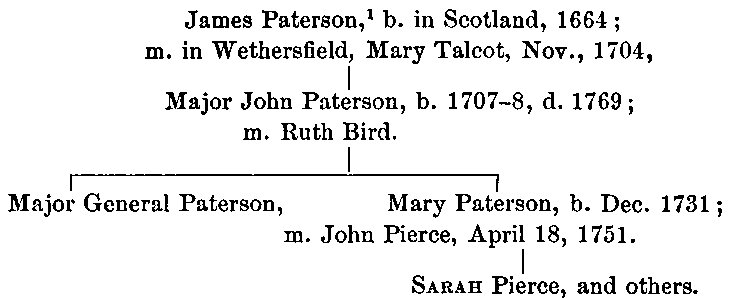
Note.—This appendix gives the result of the latest investigations into the ancestry of Miss Pierce.
1. From The Descendants of John Pers of Watertown, by Frederick Clifton Pierce.
2. Morris’s Statistical Account.
3. Mr. John P. Brace in his address, page 307, states the actual number to have been about three thousand.
4. Sally Tracy married Judge James Gould.
5. Collars.
6. At that date the New England Sabbath began at sundown on Saturday and ended at sundown on Sunday.
7. Wife of Gen. Uriah Tracy.
8. From Mr. Gay, of Farmington, Connecticut.
9. Built just south of the Congregational parsonage.
10. History of Litchfield, Payne K. Kilbourne, Hartford, 1859.
11. Census in Appendix.
12. See Letter of Lucy Sheldon.
13. Daughter of Susan Masters.
14. Jonathan.
15. Mrs. Wm. Curtis Noyes.
16. Mrs. Harriet Beecher Stowe in Poganuc People, xvii. 184.
17. See plates.
18. A primitive Ferris Wheel.
20. History of Litchfield, Kilbourne.
21. Our Grandmothers’ Gowns. Mrs. Alfred W. Hunt. London, Simpkin, Marshall and Co.
22. Now in the possession of J. Deming Perkins, Esq., of Litchfield.
23. Vol. i. p. 209.
24. Vol. i. p. 225.
25. House now occupied by Mrs. Child.
26. On southeast corner of the Underwood property.
27. See Plate X.
28. She probably means a little in Sir Charles Grandison.
29. See Plate XI.
30. Maria Adams, afterwards Mrs. Henry Tallmadge.
31. Afterward wife of Dr. Tomlinson.
33. Her piano was made by George Astor and was probably bought of his brother John Jacob Astor. It is still in its old place in her house on North Street, now occupied by Mrs. Nathaniel Rochester Child. It is made in two parts, the body of the instrument fitting on the top of a light separate frame with four slender legs. Pianos of this make were often carried about from house to house by the law students when needed for a ball.—Ed.
34. House now owned by Miss Bulkeley, east side of North Street.—E. N. V.
35. A heavy white cotton cloth.—E. N. V.
36. The following are probably childish copies of writings by Miss Pierce.
37. The lists of subscribers to these Histories are in Appendix C. Copies of the Histories are owned by the Litchfield Historical Society.
38. Mrs. Charles Perkins of Norwich.
39. Copied from original MSS. given by Mrs. Asa Gray, grandniece of Miss Pierce, to the Litchfield Historical Society.
40. Vol. i. p. 228.
41. Colonel Tallmadge.
42. Dated 1816.
43. From Autobiography of Lyman Beecher. Vol. i. pp. 226–228.
44. Life of Mrs. H. B. Stowe. Vol. i. pp. 534–536.
45. Extract from the Life of Harriet Beecher Stowe, by her son. The composition occupies six or seven pages.
46. Autobiography of Lyman Beecher. Vol. i. pp. 281–282.
47. Both in possession of Miss Annie Chester, of Waterford, Conn.
48. Mary Chester was born Wednesday, March 23, 1796. Departed this life at Groton, Conn., Monday, Oct. 23, 1820, at 10 o’clock P. M. Aged twenty four years and seven months. Daughter of Elisha Chester and Mary Wadsworth, his wife. Elisha Chester was deacon of the First Church of Christ (Congregational), in Groton, Conn.
49. Mr. Beecher.
50. These letters are in possession of Mrs. Mary Henrietta Park, daughter of Edwin Chester, to whom the letter is addressed: Stockton, San Joaquin Co., California. Sent by Mrs. John J. Copp (Ellen Chester), Groton, Conn.
51. Miss Munson, whom he married.
52. Miss Munson.
53. Am very sorry [written in another hand.—Ed.].
54. Probably Watertown.
55. Judge Daggett, Miss Munson’s uncle.
56. In Judge Reeve’s house, now the residence of Mr. Charles H. Woodruff.—Ed.
57. G. Y. Cutler died September 3, 1834.
58. He was a painter of fine miniatures.—E. N. V.
59. 40 says Silliman’s book where there is honorable mention made of him.
60. Walter S. Franklin married Miss Buel of Litchfield. General Franklin of Hartford was their son.
61. This book belongs to his heirs—he left it all L——.
62. See fashionplate brought from England.
63. Probably inspired by the war of 1812.
64. Mr. Brace’s method of teaching geography.
65. Clarinda Darling, Daughter of Thos. Darling Esq: of N. York, died Octº 19. 1821 Aet. 13
66. The act of intrusting or thing intrusted: a rare form.—Ed.
67. A brother she lost.
68. Mrs. L. P. Bissell.
69. See letters of Mrs. Hunt.
70. From Troy, N. Y.
71. Miss Pierce’s successor.
72. Mrs. Edwin McNeill’s residence—“Elm Ridge.”
73. See connection between the Pierce and Willard Schools in the Reminiscences of Dr. Beckwith, page 294.
75. Mrs. Henry Tallmadge (Maria Adams).
76. Mr. John P. Brace.
77. Her brother Mr. James Pierce.
78. Written on back of circular with terms of tuition of school.
79. Emma Brace, second daughter of John P. Brace, died in February, 1850.
80. Probably from the New York Observer.
81. When the brother, Col. Pierce, was in Philadelphia in early Congressional days, he sent for Ann to come to him. She could not have a silk dress, the substitute was stamped linen. A tiny sleeve was given to Mrs. Jane L. Gray by Miss Sarah Pierce.
82. A “ball” meant in those days, what would be called now a small dancing party, where “Society” meant all one’s acquaintances, or rather friends.
83. Great niece of Miss Pierce.
84. Col. Pierce sent Nancy to New York. Lynde Catlin sent Sarah.
85. I think this a mistake. Nancy taught also.
86. They had young ladies—scholars—in the family.
87. Sister of Miss Pierce.
88. Dr. Croswell was to Catskill in the medical profession what the Rev. Dr. Porter was in the clerical. Growing up with the town he became its leading physician; and by virtue of his ability, courtesy, and true kindness of heart, he acquired such popularity that he easily retained the position till his death, which occurred in 1844. We have an evidence of Dr. Croswell’s popularity, and of his integrity as well, in the fact that for more than fifty years he was Post-Master of Catskill. He received the appointment during the first term of the Presidency of Washington; acting first under a letter of instructions until the full organization of the P. O. department, when he received a commission in form, which he held until his death.
About the time of the marriage her sister, Miss Sally Pierce,[89] afterward assisted in some branches by her sister Miss Mary Pierce, opened a school which subsequently became the celebrated Litchfield Seminary. If I am correctly informed this was the first seminary for the education of young ladies from distant places, ever established in our country. Daughters of prominent families were sent to remain under its decisive Christian influences, and to secure its then unusual educational advantages, from all parts of New England and of this State. They came from Boston, New Haven, and Hartford, from the city of New York, many from Albany, and a number from Whitestown and Westmoreland—then the far west both of our own State and our country.[90] Several went from Catskill, and some, who received more than intellectual training at this excellent school, were present at the funeral of Mrs. Croswell. “Miss Sally Pierce,” is a musical name to the ears of many, and they never heard it pronounced without a glow in their hearts of revering and grateful love.
89. Also Miss Nancy Pierce.
90. Also from South Carolina and Georgia.
91. There are 805 names of students in this catalogue, distributed among the States as follows: Connecticut, 206; New York, 125; Massachusetts, 90; Georgia, 67; South Carolina, 45; Maryland, 36; Pennsylvania, 30; Vermont, 26; Rhode Island, 22; New Hampshire, 21; Virginia, 21; North Carolina, 21; Delaware, 15; New Jersey, 11; Kentucky, 9; and the remainder in smaller numbers from other States. Of the whole number more than 150 had previously been graduated at Yale College, and many others at other colleges.
92. Said to be three thousand, by J. P. Brace.
93. Life of Major General Patterson, by Thomas Egleston.
94. York money.
95. “Y” stands in all accounts for York money.—Ed.
96. See above.
97. Maria Tallmadge, married John P. Cushman of Troy, N. Y.; at the age of 12 took prominent part in the school theatricals.
98. Probably including both pupils and parents of pupils.
99. Married David Gardiner.
100. Married Rev. Peter Lockwood, Binghampton, N. Y.
101. Married John Delafield.
102. Daughter of Catherine Livingston and Captain Abraham de Peyster of the Royal Grenadiers.
103. Married Claude Brent, an artist.
104. Daughter of Henry and Nancy Mulford of New Haven, Conn. Married William K. Townsend.
105. Sister of Eliza Ann Mulford. Married Charles Robinson.
106. Scholars for one quarter.
107. Class of residents.
108. Pencil note in catalogue.
109. Scholars for one quarter.
110. Class of residents.
111. Pencil note in catalogue.
112. Scholars for one quarter.
113. Class of residents.
114. Pencil note in catalogue.
115. Scholars for one quarter.
116. Class of residents.
117. Pencil note in catalogue.
118. Pencil note in catalogue.
119. From Collection of Miss Mary Phelps in Litchfield Historical Society.
120. From Collection of Miss Mary Phelps in Litchfield Historical Society.
121. Married David Thompson of New York.
122. Died at the age of 23.
123. Boarded in the family of Rev. Lyman Beecher, intimate friend of Catherine Beecher, successful teacher in a young ladies school in Sing Sing, N. Y. and Auburn, N. Y. m. a clergyman.
124. Married —— King.
125. Dau. Judge John Kingsbury of Waterbury, m. William Brown of Waterbury.
126. Married R. B. Ward, Esq. of Hartford.
127. Eliza F. D. L. Jackson m. —— Armstrong, a prize book presented to her for “amiable deportment.”
128. Married Charles Gould of New York.
129. Married Peter Buel.
130. Married —— Cole.
131. Married —— Taylor, Brooklyn, N. Y.
132. Born Dec. 29th, 1810; married Henry Mansfield, May 8th 1838.
133. Married R. B. Ward Esq. of Hartford, Conn.
134. Pencil note in catalogue.
135. Pencil note in catalogue.
136. Pencil note in catalogue.
137. Pencil note in catalogue.
138. Mrs. Algernon Sidney Hubbell.
139. Married Rev. S. W. Fisher, D.D., of Cincinnati and Hamilton College. Eliza, Jane and Julia were daughters of Peter Jackson.
140. Married Henry Colt of Pittsfield, Mass.
141. Mrs. Rochester Childs.
142. Mrs. Charles Keith.
143. M. Mr. Henry Farnsworth.
144. From collection of Miss Mary Phelps in Litchfield Historical Society.
145. “A woman of more than ordinary ability and acquirements.” Phebe Augustus Ely Avery writes of her:—
“I can tell you little that can be of use to you of my aunt Caroline. I know that she had a school for young ladies and taught painting, embroidery, working lace, etc., but she married before my remembrance Mr. Joel Steele and went to Bloomfield, N. J., to reside, and I saw her but seldom until the latter part of her life.
“She lived to be ninety years of age and retained her love for embroidery and various kinds of fancy work, almost to the last; doing beautiful work, when nearly or quite eighty.
“She was a great reader and well posted always on past and current events.”
146. Pupils on other lists.
147. Pupils on other lists.
148. From Mrs. Asa Gray.
149. Record of the Posterity of Thomas Pierce by Frederick Beech Pierce.
150. From Life of Major General Paterson by Professor Thomas Egleston.
| Page | Changed from | Changed to |
|---|---|---|
| 4 | 1664, leaving a son, John, born in 1707. John married Ruth | 1750, leaving a son, John, born in 1707. John married Ruth |