The Project Gutenberg eBook of There's not a bathing suit in Russia & other bare facts
This eBook is for the use of anyone anywhere in the United States and
most other parts of the world at no cost and with almost no restrictions
whatsoever. You may copy it, give it away or re-use it under the terms
of the Project Gutenberg License included with this eBook or online
at www.gutenberg.org. If you are not located in the United States,
you will have to check the laws of the country where you are located
before using this eBook.
Title: There's not a bathing suit in Russia & other bare facts
Author: Will Rogers
Illustrator: Herb Roth
Release date: February 1, 2026 [eBook #77828]
Language: English
Original publication: New York: Albert & Charles Boni, 1927
Credits: Tim Lindell, Steve Mattern, and the Online Distributed Proofreading Team at https://www.pgdp.net (This book was produced from images made available by the HathiTrust Digital Library.)
*** START OF THE PROJECT GUTENBERG EBOOK THERE'S NOT A BATHING SUIT IN RUSSIA & OTHER BARE FACTS ***
[Pg 1]
THERE’S NOT A BATHING SUIT IN RUSSIA
By Will Rogers
[Pg 2]
If you like the following subjects
you will just love this text book.
§ Mary Garden § Aviation § Vodka § Bathing Bareback §
Whiskers, long ones § Propaganda, all sorts §
Free Love § Bombs § Grand Dukes & Princesses § and
21 other wrong ways to run a country
With Illustrations by Herb Roth
1927
New York
Albert & Charles Boni
[Pg 3]
By Will Rogers
There’s Not a
Bathing Suit
in Russia & Other Bare Facts
With Illustrations by Herb Roth
1927
New York
Albert & Charles Boni
[Pg 4]
Copyright, 1927, by Albert & Charles Boni, Inc.
Copyright, 1927, by the Curtis Publishing Co. Manufactured in the United States of America
Now there has been more said and written
about Russia than there has been about
Honesty in Politics and Farmers’ Relief,
and there has been just as little done about
it as about either of those two.
I should have written earlier about Russia,
but everybody was writing, and I thought
I would wait till they all got through; but
they are not going to get through. They
just keep on writing about Russia. It looks
like anyone is an amateur in Literature if
they havent exhibited Russia’s horoscope to
a picture-reading public.
More people break into Sunday Editions
with an article on Russia than do by murdering
their husbands or swimming the
Channel. If you can’t get into the papers,
never did get in, and are about losing hope
of having anything get in, why—here is the
greatest tip to ambitious amateur literary
careers—write something on Russia and you
[Pg 8]will replace some regular writer that day.
Russia is the biggest Country in the World,
and men and Women write authoritative
opinions on it that couldent give you a bird’s-eye
view of the Principality of Monaco, and
you can take a handful of green apples and
stand on a hill and hit everybody in Monaco.
It has always been a source of wonder to
me that Patricia Ziegfeld, Baby Peggy,
Paulina Longworth or Nick Altrock have
never written a book on Russia. Some Congressmen
come over to Paris to investigate
the Cafés, have four cocktails and a Russian
caviar sandwich—which they dident like, but
the rest was doing it—go back home and tell
of the condition as it exists today in Russia.
Russia has one peculiarity that I don’t
think any other country ever enjoyed—that
is, that every female gender that come out
of there is a Princess, and the lowest form
of a title in the way of an escaped male is
a Duke, and if he escaped very fast he is
a Grand Duke. From the amount of Titles
out of there, one would gather right away
that the sole purpose of the Revolution, proposed
and carried out, was not to assist the
downtrodden, as is generally supposed, but
[Pgs 9-10]
to promote foreign travel among the Princesses
and Dukes.
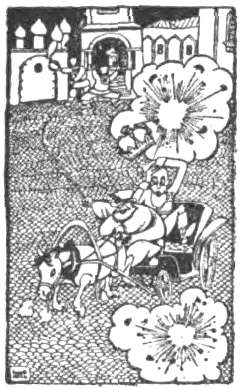
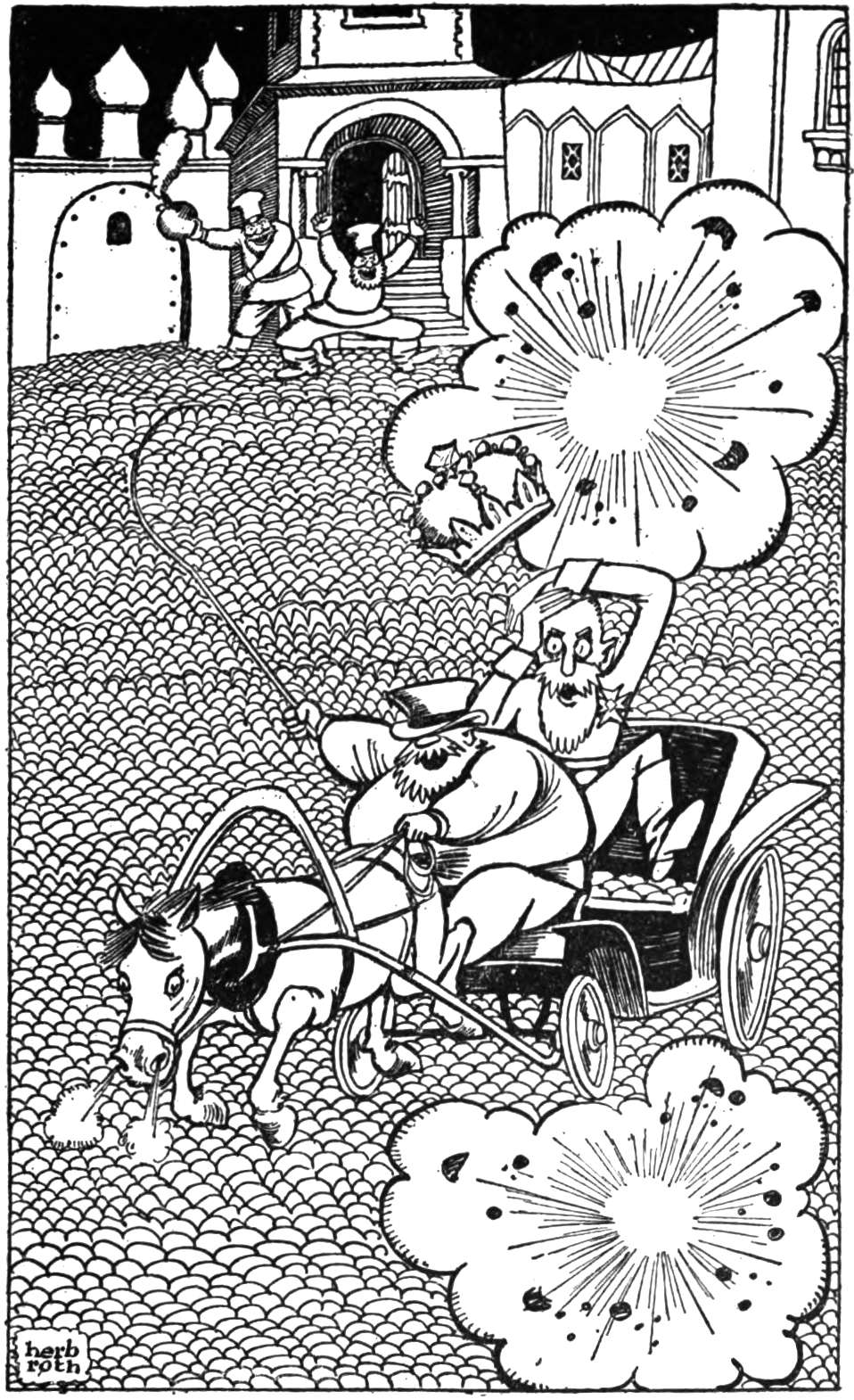
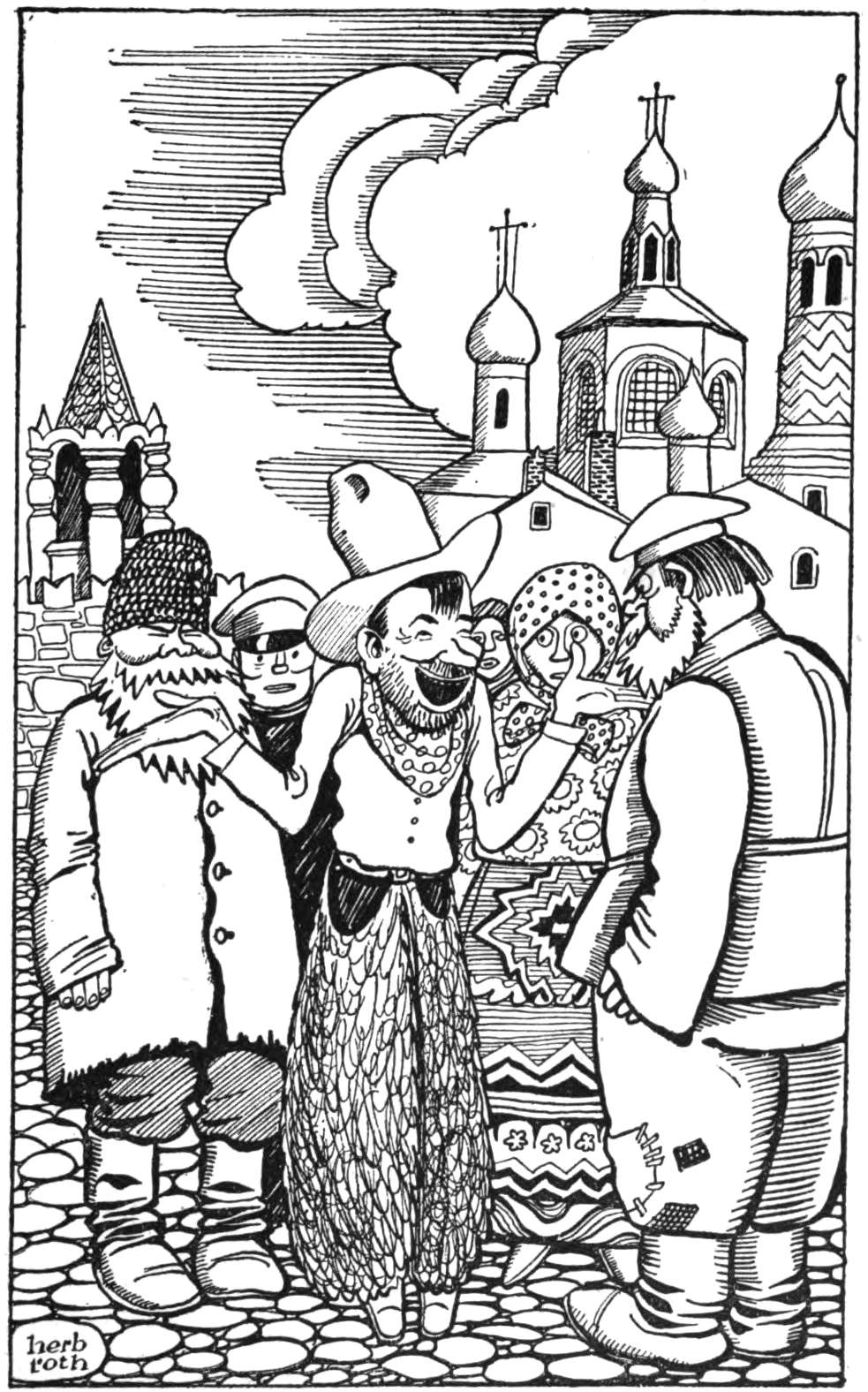
If he escaped very fast he is a Grand Duke.
[Pg 11]
Escaped statistics show that among males,
72 per cent. were Grand Dukes and the other
28 per cent. just Dukes. Women were all
100 per cent. Princesses. You spend half
your time in Paris listening to some exiled
American telling you hard-luck stories about
former Russian nobility. “The fellow who
just opened the Taxi door in front of this
American Rat Trap you are now in was a
Grand Duke and, brother, just two Revolutions
removed from the Czar.” They are
all kin to the Czar. “The Girl you mortgaged
your hat too as you come in was the
Czarina’s principal Lady in waiting”; also
related to the family. The bus boy—he is
the fellow they use so the waiter will have
somebody to lay the blame on—was a Duke,
and he would have been Grand if the thing
had lasted. In fact you are in a nest of royal
relatives. Telephone girls were Princesses,
Taxi drivers used to be Dukes—all, as I say,
related to the Czar.
Any man with that many kinfolks, no
wonder something happened to him. I bet
if the truth was found out, he organized his
[Pg 12]own death personally. If I had some of the
kinfolks he was supposed to have had, I
would have hired assassins to exterminate me
very early in life. They tell of one fellow
that was very, very near the Czar—perhaps
a twin. Well, he is selling Peanuts on the
street. We tried to find him, not because I
was interested in his case, but I wanted some
Peanuts. I have yet to hear of one that was
doing well. Yet they bother you for hours,
telling you how polished and highly educated
and cultured they were. They seem
to know what temperature to drink their
wine at, but most of them don’t know how
to make a dollar to buy the wine.
Now if that is all any of them can do,
how was it they thought they could run a
tremendous country like Russia? A fellow
will seek his level, I don’t care where you
are. If opening Taxi doors in front of
Vodka Joints and helping a waiter break
dishes is as high as their ability will carry
them in eight years, it shows they should
have been doing that all the time. All those
good years they had in Russia was not due
to any of their own efforts.
If the present Republican régime was
[Pg 13]thrown over, and were all banished from the
District of Columbia, none are going to open
any Taxicab doors for anybody but themselves.
They might not get into anything
as big as the White House or Czar’s Palace,
but they will have one big enough that the
help problem will bother. Even the Congressmen
may not be able to plant their own
Gardens with Government seed and mail
letters for nothing. Yet you won’t see any
of them have to resort to peddling goobers
on anybody’s street. They can even pull the
Cabinet Chairs out from under that band of
accomplices who plot against us once a week;
they will hit the floor, but they will come
back up out of it with nothing hurt but their
political pride. They can always dig up
enough for the next Campaign fund.
Of course, at times they may wish, like
the deposed Russian Noblemen, for the old
régime back, and mull over the good old
days when they used to sit around the old
White House hearth and laughingly discuss
the League of Nations and Philippine Independence;
but they will always be able to
seek their level. Revolution, in the way of
Democrats uprising and buying enough
[Pg 14]votes to depose us, might be sorter disconcerting
for the time being; but they never
would have to worry about where those
Flapjacks and Maple sirup was coming
from.
Now, I may be hard-hearted, but I just
couldent seem to work myself up into any
great frenzy of tears over the old Dukes and
Princesses. They carry a lot of long, high-sounding
names, but mighty little sympathy.
They can converse in a lot of languages, but
they’re not strong on making a living in any
of them. They have spent a lifetime trying
to learn how to dance in a Ballroom, but
they have never learned it good enough to
get paid for it. The old American is there
with the uncouthness, but he never comes in
on a pass. His rudeness is unintentional and
not studied.
I bet you if I had met a Russian in Paris
and he had said, “I was a poor Peasant in
Russia before the War; I never had anything
in my life; I always had to work very
hard; I never in all my life even saw the
Czar; I had no culture, either then or now,
no refinement, no education; I was just
struggling along”—say, I could have taken
[Pg 15]that kind of a Russian out in Paris and told
them about him and collected him a million
Francs. People would have gone crazy over
him, he would have been such a novelty. Of
course there is no such one. If there was,
he is perhaps President of a Bank in Paris,
or else he is perhaps Premier a day or so
every once in a while. No, Sir; the poor
ability of many of the Russians that come
out of there has really been more of a boost
for the Revolution than any other one thing.
Well, when I saw they were not going to
quit writing about Russia, why, I am going
to get busy and write the most novel
thing on Russia that was ever written. I
have had a research made, and there has
never been a book on Russia that tells you
what I am going to tell you, and there has
been more ink wasted on Russia and Prohibition
than any other two subjects in the
world, both equally unsettleable.
Now here is the novelty and truth of my
Book on Russia:
I am the only person that ever wrote on
Russia that admits he don’t know a thing
about it.
And on the other hand, I know just as
[Pg 16]much about Russia as anybody that ever
wrote about it.
Nobody knows anything about Russia.
I have read dozens of books and hundreds
of Articles by various people, such as “The
Real Russia, by one who spent five years
in a Moscow jail”; “My ten years banishment
in Siberia, by a real Russian”; “The
Heart of Russia”; “Russia as I know it, by
a House Detective”; and millions of others.
Now how is anybody going to find anything
out about Russia by spending five years in a
Moscow jail? Or ten years in Siberia wouldent
give you any too good a line on the financial
or economic future of the Empire.
Now just stop and think a minute. Suppose
somebody come to you tomorrow and
said, “Tell us about America.” Now how
could you tell ’em about America, in an
Article, a Book, or a dozen volumes, or a
thousand volumes? It’s too big; nobody
could tell about it. Suppose somebody tried
to write on The Heart of America. Why,
Lord, we can’t even keep track of the toe of
Maine or the heel of California, much less
the heart! Now if nobody could write a composite
Article on America, how are they
[Pg 17]going to do it on Russia, a country that is
so much bigger than us that we would rattle
around in it like an idea in Congress?
I have even read all I could find that
Lenin and Trotzky said about Russia, and
it don’t give me any better idea than Mutt
and Jeff.
Just get this size and composition of Russia
and her people and see how anybody
could tell you anything about Russia: It’s
the largest continuous domain in the World;
it covers nearly one-sixth of the total surface
of the earth; there is over one hundred different
Nationalities live inside the Soviet
Union. Get the statistics of these nationalities;
it reads like a New York Telephone
Directory—70,000,000 great Russians;
3,000,000 Jews in the western part of the
Union; 1,000,000 Germans on the Volga;
500,000 Greeks along the northern coast of
the Black Sea; Moldavians, Bessarabians,
Georgians; 500,000 Armenians; 1,000,000
Persians; Ossentines, Ingushes, Circassians,
Abkhasians, Checkenians. Why, there is
5,000,000 Tartars! Boy, what a sauce that
is alone! And eighty other races that even
the census man hasent got to yet.
[Pg 18]
Talk about the Lost Tribe of Israel!
Say, they could have been in Russia all this
time and never be lost at all, and still nobody
would have found them.
Now scramble all that together and let
somebody think they can diagnose it. Russia
is the boarding-house hash of Nations.
Hash, Russia and flivvers are three things
nobody has ever been able to catalogue the
contents.
Trying to tell what Russia is is like trying
to tell the difference between a Conservative
Republican and a Progressive
Democrat. If you are a visiting Communist,
or have Communistic leanings, why, naturally
you will write of it from their accomplishment
point of view, and are liable to—accidentally—leave
out any little defects you
might have seen.
Then on the other hand, if you are not
the least bit in sympathy with any part of
their program, why, you naturally are not
liable to let yourself see anything that has
any merit in it. So, if you are looking for
me to solve the Russian Problem, you are
not going to get it done. Now a Congressman
could do it in twenty minutes and a
[Pgs 19-22]Senator in ten, but it stuck me. But I tell
you what I am going to do—I am just going
to be like a prisoner at the bar when
some wise, old good-natured Judge who
wants to get the facts asks, “Will you please
tell the Court in your own way and your
own language just what happened on the
entire night of June the twelfth?” Now
that’s what I am going to do. I am just
going to tell you everything I saw and what
happened here in Russia in the last few
weeks.
[Pg 23]
THERE’S NOT A BATHING
SUIT IN RUSSIA
I
I was passing through Paris and looking
for a good show and somebody suggested the
House of Deputies. It’s a Satire on our
Congress, so that will set you laughing right
there. It was the best thing I ever saw
in Europe in the way of entertainment. A
man on one Party was trying to make a
speech and the Socialists and the Labor
Members on the other—who were in the
minority, but they sure wasent when it come
to making noise. This old Boy had no more
chance of being heard than a Republican
vote has being counted in a Tammany election.
They would get up and run at each other
and shake their fists. You would think the
whole thing would be murder. But they
[Pg 24]don’t really fight any oftener than Dempsey.
I could take this same troupe to America
and rent the Hippodrome and I can get
them enough money to pay their debts.
New York would go crazy over a show like
that. Over home we couldent understand
how people could be so mad at each other
and even live in the same country.
This last fellow, Poincaré, had the right
idea. The minute they put him in he made
a motion that the Chamber adjourn for the
rest of the summer. So they couldent throw
him out till they met again. That assured
him of a few weeks Steady work. After I
come out of this show, I had a date to eat
Dinner with Morris Gest, the Miracle Man
and organizer of the late Russian invasion to
America. Morris is just soaked full of Art,
and I wanted to see at close range just how
a real artistic temperament acted. I like
Morris with or without Art; everybody likes
Morris.
I have known him since away back in the
old Hammerstein’s Victoria, which had
nothing to do with Art—it was entertainment.
He had just come out of Russia—he
[Pg 25]and Ashton Stevens, of Chicago, the
only Dramatic Critic that ever learned William
Randolph Hearst to play the Banjo.
They had been in looking over this year’s
Art crop and they claimed it looked like a
bumper year. Balieff—you all knowed
Balieff, the best bald-headed Comedian that
ever stepped out from behind plush curtains.
You have laughed and admired his artistic
show for years, the Chauv Surrey, or
Sworee, or something like that. He is a real
Artist, this Balieff.
Well, we went to one of those Russian
layouts that have littered up Paris. Everywhere
there used to be a coal cellar there
is a Russian Restaurant now. They asked
me if I had ever had a taste of Vodka, and
they poured out a little small glass of what
I thought was water. It was the most innocent-looking
thing I ever saw.
Then all said just drink it all down at
one swig; nobody can sip Vodka. Well, I
had no idea what the stuff was, and for a
second I thought somebody had loaded me
up with molten lead, and I hollered for
water.
[Pg 26]
Now over in Europe the water is in quart
bottles, and here was this Vodka in another
quart bottle, and it looks exactly like
water; and this Clown Balieff, thinking
quick, immediately grabbed the Vodka and
loaded up the glass again; and me thinking
it was the water, and my throat a-burning,
why, I gulped it down quick, and here I
was just twice as bad off as I had been.
If I could have seen which one to hit I
would have swung on him, but they already
were blurred. Lord, what quick results that
stuff delivers!
I asked, “Where do they get this white
Iodine?” They informed me then that that
was Russia’s national dissipation. Why,
that old white corn down South would be
branch water compared to this stuff. Jack
Brandy and White Mule would be used as
a chaser where this stuff come from. How
they can concentrate so much insensibility
into one prescription is almost a chemical
wonder. This Balieff, the native of that
land of boots and blood, then related to me
the recipe, which reads as follows:
One half bushel of old Potato peelings;
fourteen ears of Russian corn, or maise, Cob
and stalk included; four top and soles of
worn Russian boots; five grams of Giant
Powder; three Bombs chopped up fine.
Mix all this in a washtub full of Vulgar
River water, add two Revolutions and serve.
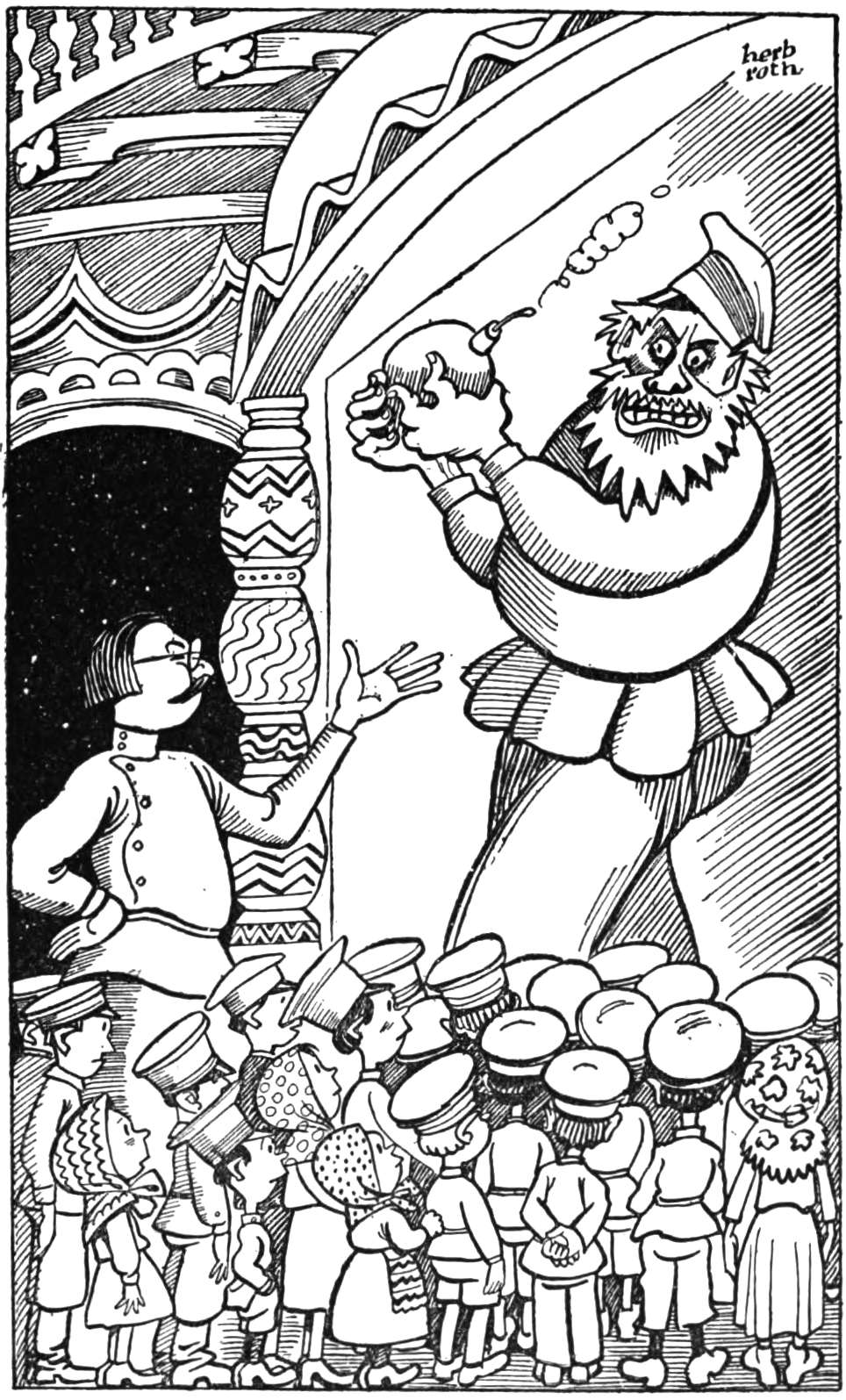
[Pgs 27-28]
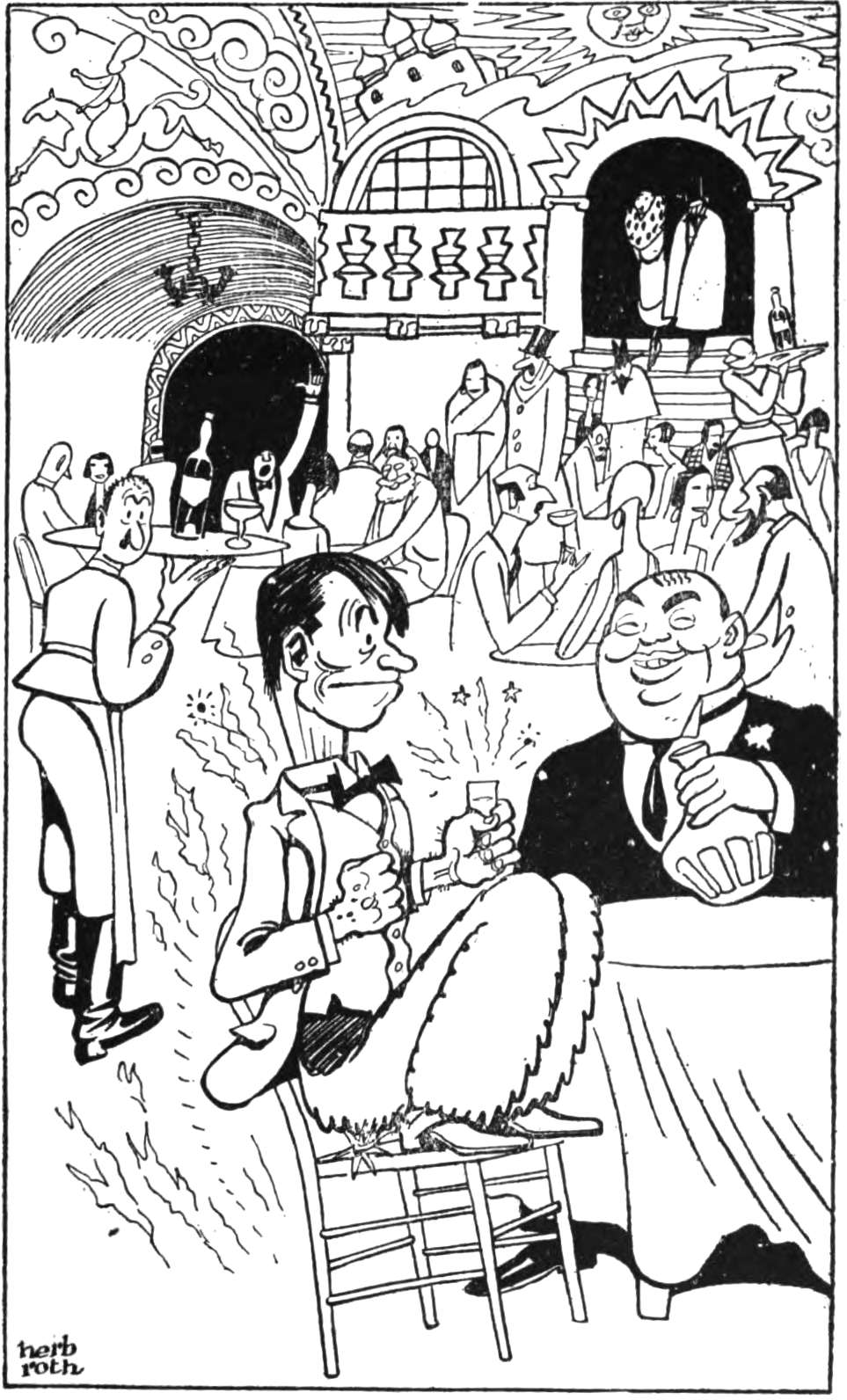
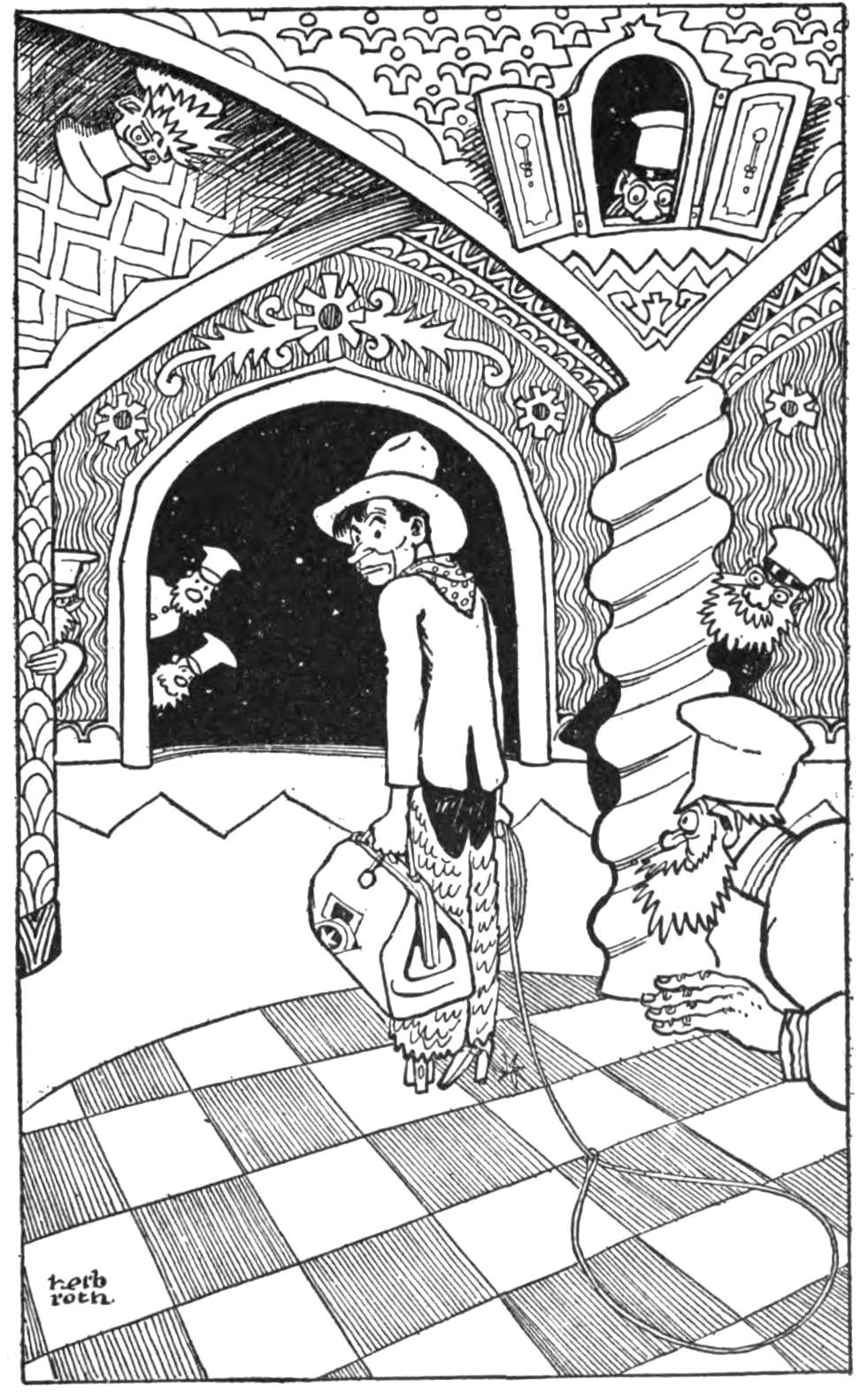
I thought somebody had loaded me up with
molten lead.
[Pg 29]
Well, I will tell you how these two accidental
shots acted on me. We dident
know where to go, and Gest suggested that
we go up to the Opera; that it was Mary
Garden’s last night singing there. Well,
it was too late. They had been turning people
away since the day before. But you
can’t stick Morry, so we waited till the time
the show was over and we went into Mary’s
dressing room. Her and Morry and all
these others were great friends. I had never
had the pleasure of meeting her, but she had
been responsible for me going on the Concert
tour; for she ribbed Charley Wagner
up to it, as they were old Pals. So when I
come in with them, Mary rushed right over
and threw her arms around me and kissed
me, and to show you how this Vodka was
working, I wouldent push her away; in fact
I dident even get mad at her. ’Course,
[Pg 30]there is not much use going on with the
story. About the only moral I can get out
of it is, take two swigs of Vodka and then
start hunting Mary Garden.
Well, that begin to give me a whole lot
of encouragement. I had never been able
to get near Mary Garden before. So I
started in by asking, “Where is this country
that can manafacture such explosives in liquid
form? Mebbe they got something that goes
with it. Any Nation that’s ingenious can’t
be confined to one good idea.”
They said, “It’s Russia, Bud; it’s Russia.”
Now if there is one thing that is a worry
to us, it is too much drinking going on over
home. I thought up to this that we had
the world beat on the collecting of unique
articles and scrambling them together and
selling the combination under the nom de
plume of a livable beverage. But if I can
get this Vodka stuff, I will be able to cut
the drinking down one-half and mebbe
three-fourths. One tiny sip of this Vodka
poison and it will do the same amount of
material damage to mind and body that an
American strives for for hours.
[Pg 31]
I am—and I think every prohibitionist
is—for anything that will cut our drinking
down and get it over with as soon as possible.
If we must sin, let’s sin quick and
don’t let it be a long, lingering sinning. So
I asked them, “Where do you get a Veesay
to this Utopia?”
Now that is the whole story to Vodka.
The recipe I have is only problematical. Nobody
in the world knows what it is made out
of, and the reason I tell you this is that the
story of Vodka is the story of Russia. Nobody
knows what Russia is made out of, or
what it is liable to cause its inhabitants to
do next.
Well, I sure did want to go somewhere
where I wouldent be continually reminded
that “On the right you will see the Fountains
of Versailles”; or “That is the Houses
of Parliament, where all the laws of England
are made”; or “That is the dome of
St. Peter’s.”
I asked Morry Gest, “Do they have rubber
neck wagons up there?” He answered
in the negative. I think it’s negative when
you say no, ain’t it?
[Pg 32]
Ashton Stevens then pulled the best Gag
of the entire tour: “You know, Will, you
are just about the poorest dressed Actor
I know; in fact that assertion takes in people
that are not Actors. Well, as bad as
you look when and if you get to Russia, for
once in your life you will be the best dressed
man in the biggest country in the world.”
Well, I went right over to London and
made application for one of those famous
Veesays. Russia has an Embassy in London;
it’s a kind of an unofficial one. They
recognize Russia just enough to sell ’em
something. It’s a sorter “You can stay as
long as we are doing business, but socially
we have lost your address.” In other words,
they hate ’em at heart but love ’em financially.
It’s pretty hard to get into Russia. Your
application has to be sent to Moscow and
be approved or rejected. I had a nice chat
with the fellow who put in my application
and then hopped out for Geneva to see the
Preliminary Disarmament Conference. It
had been then going a few days and I figured
that everybody’s Navy would be
[Pg 33]scrapped; that the Airships would be beat
into windmills, poison gases would be turned
into fertalizing Nitrates, and that every
Army would be released to join Jazz bands.
They are still over there, and they all have
to be personally armed before they will go in
and confer with each other. Again I ask,
will we please stop anybody going anywhere
to confer with anybody unless it’s his Doctor?
And then he is just losing time. The
only time we ever attract any attention at a
conference is when we don’t go. There has
been more talk about us and the League of
Nations through being out of it than there
ever would have been in the World if we
were in it. You know yourself that you
have gone to a lot of things that afterwards
you had wished you hadent gone too. Nobody
can ever get in wrong by not attending
anything. But every time you go you take a
chance either of getting in wrong or being
misunderstood.
Well, after prowling around Switzerland,
Italy, Spain and France and all of
them, Mary Garden come into my mind
again; and naturally that brought up Vodka,
[Pg 34]for if it hadent been for that Vodka I would
never known what Mary Garden perfume
smelled like on the original. So I wires
over to London to see what has happened
to the application for the Veesay. They
wire back collect that it is laying right there
and that all I have to do is to come and
get it and start getting in Russia.
[Pg 35]
II
Well, I fly back over to London. By
this time I have done so much flying that
if I was in the Army I would be like Colonel
Mitchell. I would be thrown out for
not staying on the ground more. When I
got to the Embassy there was a bunch of
about ten young American Bolsheviki’s
signing up their passports. They had come
from various colleges over home and were
going to Russia by boat; a couple of girls
among them, and two gentlemen who’s ancestors
come from below the Mason and
Dixon Line. So if you hear of your washwoman
or cook advocating: “Is I am a communist?
I ain’t nothing else but. I believes
in everything dividing up. Says which?”
Well, you will then realize that communism
has penetrated the black belt.
These two boys may turn out to be the
Lenin and Trotzky of Birmingham. They
[Pg 36]will have every Crap shooter on Octavus
Roy Cohen’s beat sharing his winnings with
the losers. We may see the time when your
Gin will be everybody’s gin. They were
going up by boat. I don’t want any more
boat than is absolutely necessary at any
time. So I was going in by Airship. I had
been aviating so much around Europe that
to go anywhere on a train seems too much
like walking to me.
I left London one morning about 9:30.
Flew over some of the prettiest country
before striking out across the Channel.
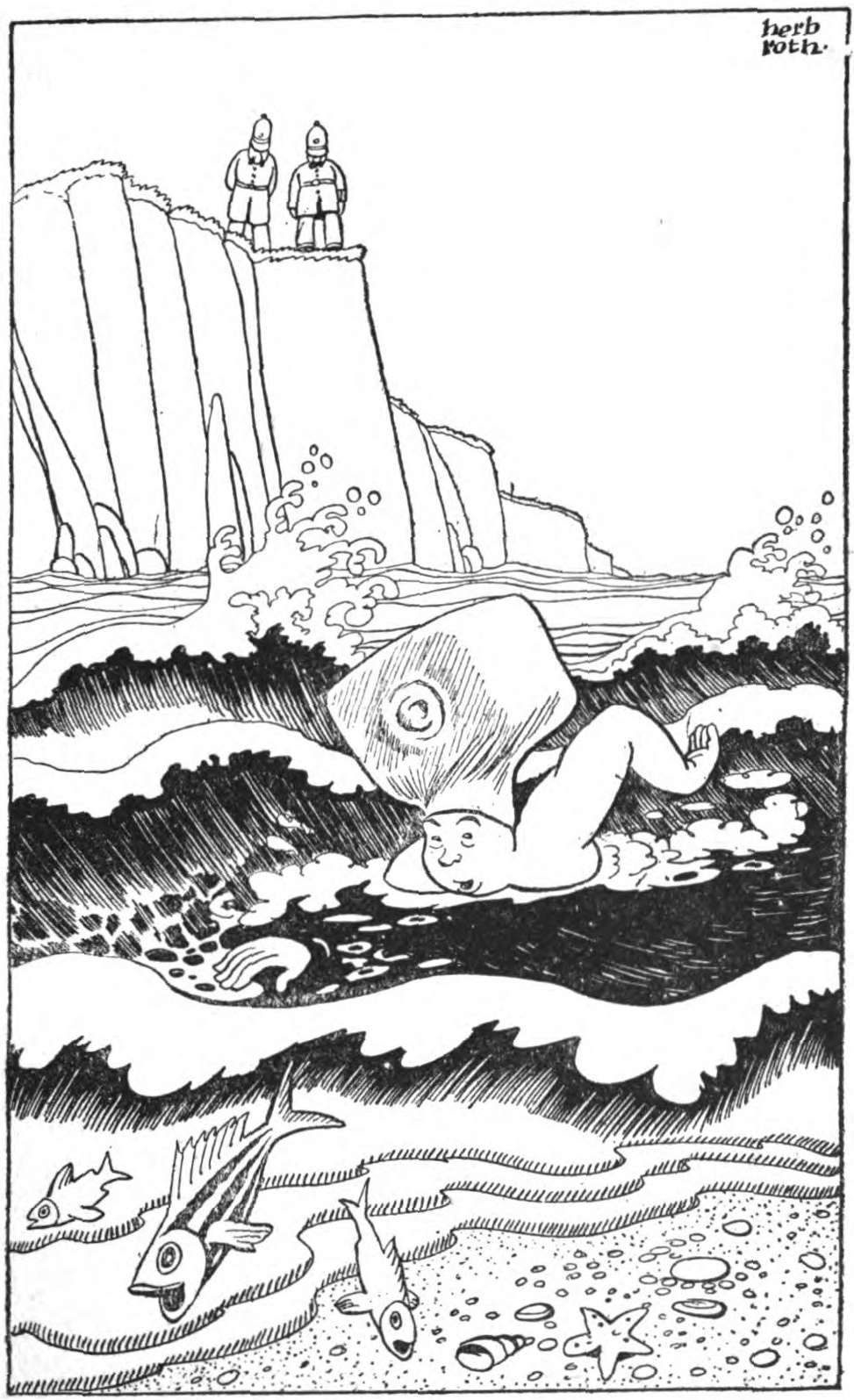
Looked over the edge of the plane all the
way across the Channel, watching crowds
of American Women swimming it. One old
Lady was a great Grandmother and she had
three generations of daughters swimming
it with her. You could see crowds of men
standing on the shore waiting for a smooth
sea to cross it in a boat.
One woman of Irish and Jewish parentage,
but who had become a naturalized
American last year, was swimming over and
back without touching. Another American
woman of Peruvian parentage on both her
[Pg 37]Father and Mother’s side was training on
the shore at Dover at Pole vaulting—she
was going to jump the Channel. There
was two or three Ladies of recent American
Citizenship who were on the plane with us;
but we come down when we reached the
beach and their husbands made them get
out and swim across—told them they would
meet them on the other side. One of the
Ladies said she couldent do that; she had
tried it before and dident make it, and she
knew that she couldent do it. She was right
away accused of being masculine, when in
reality it was discovered that she was an
offspring of generations of pure American
stock.
The funniest sight of all I saw looking
over that day was one old lady swimming
in and towing her husband over on her back.
There was one traffic cop out in the middle—well,
what you would call a copess. She
was just treading water and playing around
out there, directing the other swimmers.
Every few days somebody would row out
and leave her some provisions. She was
of Eskimo parentage, but when we took over
[Pg 38]Alaska she was in that deal and become an
American.
The English customs authorities have to
be very careful. When the first American
contingent came to land—Miss Ederle—they
held her for an hour till they could go
through every pocket of her bathing suit,
looking for Cigars, Cigarettes, Spiritious
liquors and perfumes. A girl the other day
got away pretty lucky. When she got about
a mile from shore she dropped the smuggled
goods and then swam back out there the
next day and dived down and got them.
The English authorities are pretty particular
that way; it’s hard for swimmers to
smuggle in much. One woman did get over
with a safe. She had it hid in her bathing
cap.
[Pgs 39-40]
One woman did get over with a safe, she had it hid
in her bathing cap.
This swimming has not only called for a
new definition in the Dictionary describing
which is the weaker sex but it has brought
on a great deal more than that. It has demonstrated
just how close together England
and France are, and that’s what’s hurting
them. Neither one of them wants to be
close to each other. If we could have given
[Pg 41]some kind of demonstration that would have
proved that they were really further apart
in mileage than they are, why, both Nations
would have hailed it as a God-given discovery.
But this bringing them closer together
has got them more sore at America than
ever. We can do more things that get us
in wrong unintentionally than any Nation
in the world. So it looks like the next war
between France and England will be fought
in bathing suits. The way women are showing
up men swimmers, it’s not monkey
glands men need, but fish glands.
Well, after we had waved good-by to the
swimmers, why, we turned up along the
coast of France and Belgium and landed
at Ostend. That’s a regular junction point
of Airships. They hollered: “Change planes
for Cologne, Vienna, Paris, Constantinople
and all points south! This plane goes to
Rotterdam, Amsterdam. Change there for
Berlin, Warsaw and Copenhagen.” It reminded
me of the old Frisco depot in Monett,
Missouri, when we used to pull in
there after shipping cattle to St. Louis to
[Pgs 42-44]Strahorn, Hutton and Evans. You remember
the train splits three ways. One
goes to Kansas, one to Arkansas; and the
same one goes right on down through Oklahoma,
to Claremore, the principal stop.
Well, there at Ostend they had—and do
at all these airship places—a regular little
Harvey eating house, where you can go in
and wrestle with the food and the language.
Planes was dropping and going out from
everywheres. We had about twenty minutes,
and I crawled back in this old Aerial
Barge of ours and we breezed along on up
the coast. It was mighty inspiring. We
passed The Hague, looked over and saw
the old Peace Palace, where they were going
to meet to stop all wars. It’s turned
into an ammunition factory and Army drill
hall.
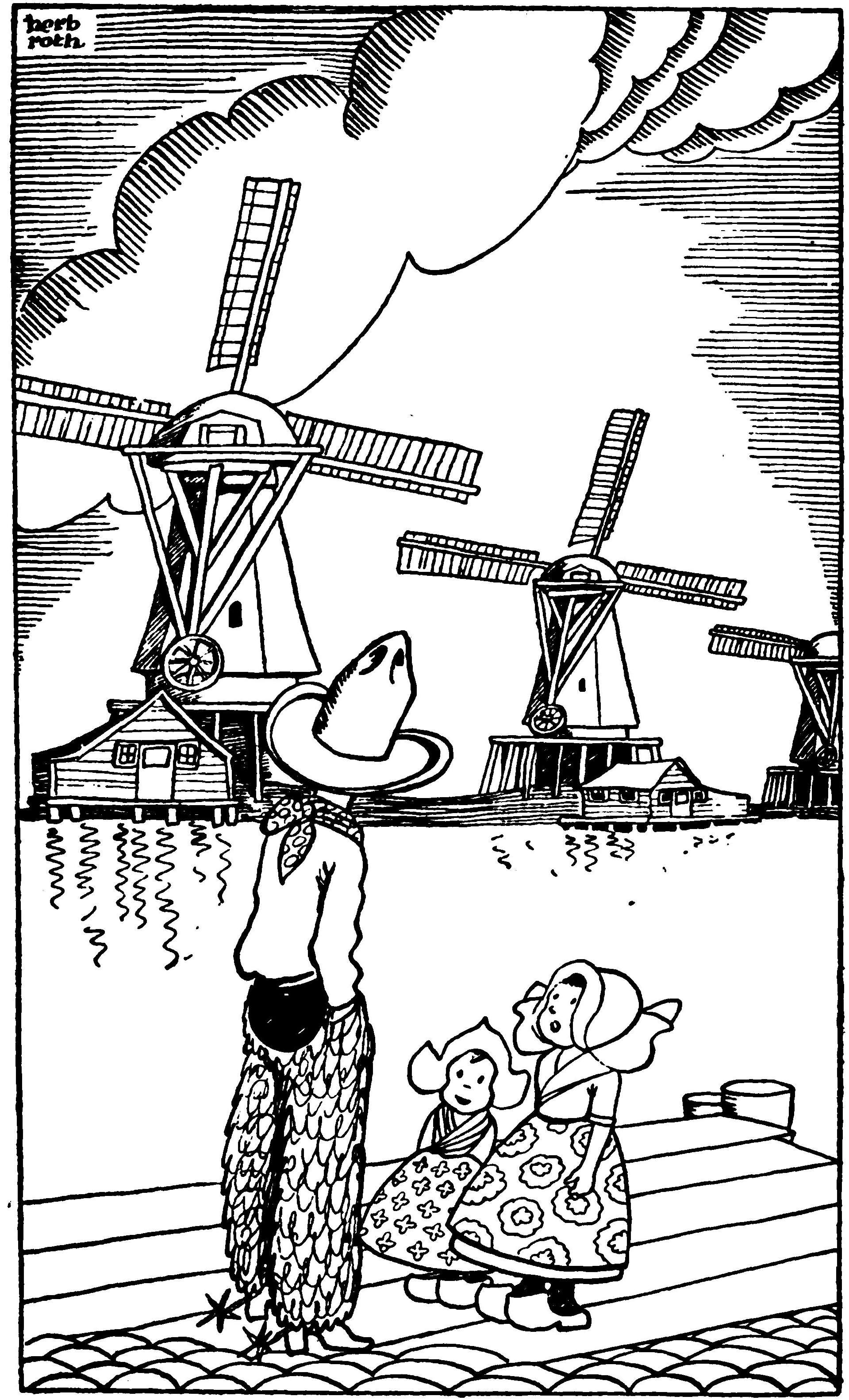
Flying over Holland in an Airship is the
only real way to see it, ’cause if you are
down on the level—and if you are in Holland
you will be standing on the level—Holland’s
highest point is eight feet six and
a third inches above sea level. That is called
[Pg 45]the mountain region of Holland, that’s
where they do their skiing and winter sports.
Mind you, it’s the prettiest little country
you ever saw in your life. Just look down
and see those hundreds of canals and boats
going along all of them. Your farm is not
fenced off from your neighbor’s; there is
just a canal between you and him. You
either visit by boat or holler over. If your
next-farm neighbor starts to walk over to
you some night, he may get there, but he
will arrive wet. There is no road-contracting
graft in Holland, no road commissions.
All roads come under the heading of Harbor
and Dock Commissions. If there is a flivver
in Holland, it has oars on it instead of
wheels.
That is called the mountain region of Holland.
She sure is a pretty dairying Country.
Those old big black cows with a white
bandage around their stomachs don’t seem
to mind at all. You don’t have to brand
your cattle and your herd will never get
mixed up with your neighbor’s unless they
develop web feet or grow a rudder in place
of a tail.
That windmill Gag that every Artist
[Pg 46]always pictures with Holland has been kinder
exaggerated. Higgins, Texas, has got
more Windmills than all Holland, and what
I did see looked like they were sorter tired
out; they wasent doing much; they just
seemed to be like a lot of things all over
Europe—they was just trying to get by on
tradition. They wasent what I could call
turning out 100 per cent production. I had
always thought they were located by a little
white house. Say, there is not a little
white house in Holland. There’s not even
a Big white house there. It’s the only
country in the world where there is absolutely
only one color, and a paint man would
starve to death trying to sell any other.
It’s a kind of red, or a dark bay. So don’t
you believe Pictures any more. What makes
everything look white is because it is so clean
and neat and nice.
Looked for the old Kaiser out in the
yard chopping wood some place, but everybody
was burning coal that I could see.
Guess the old Boy was setting in the house,
brooding over making the wrong jump out
of the King row.
[Pg 47]
Amsterdam was the next stop—changed
planes for Berlin. Everybody got out and
had a few Sandwiches and a couple of steins
of Holland Gin. Into a German plane and
out over Germany. Say, they was farming
too. Little long strips of land laid out instead
of having it all in one big field. They
do that so they can rotate the crops on the
different pieces. Forests, the most beautiful
forests, all out in rows. Every time
they cut down a tree it looks like they
planted two in its place. Every time we
cut one down, the fellow that cuts it down
sets down to have a smoke and celebrate.
He throws his cigarette away and burns up
the rest of the forest.
We hit Berlin at 5:30 that afternoon.
Just think! Left London at 9:30, had these
stops, seen all these wonderful countries and
was clear over in Berlin in time for a drive
around the city and dinner. I was going
to stop in Berlin on my way back out of
Russia, so at two o’clock in the morning, or
night, I left for Russia. You go to By
Königsberg. Well, I had been in planes in
the daytime, but driving away out there
[Pg 48]in a taxi alone and crawling into an airship
in the night-time is no particular relief to
a Comedian. This was a big German
Junker. Not only had two engines and two
propellers but three, one big one in front
and two others as assistants.
Well, when a German outfit say they are
going to leave at two o’clock, don’t you get
there at one minute past two. If you do,
you will just hear the propeller buzzing
around up in the air. She was dark as we
left. We had about twelve on board. She
gets light pretty quick and early up there;
and seeing the lights down the streets as we
flew over the city and out across country,
day soon begin to break and the fog and
clouds in the low places made you think
every minute you were flying right out over
the ocean, and these clouds looked like big
waves. There was a regular light line miles
apart that was a big light revolving with
different colors and no matter how dark,
the pilot could see where he was going.
But she was light within less than a hour.
They had a wireless or radio on there, getting
[Pg 49]weather conditions ahead of them. We
got into Königsberg about eight o’clock,
went in and had breakfast and come out,
and there was a German Fokker. It was the
one we were to make the long hop from
there to Moscow in. It was piloted by the
funniest looking old chuckleheaded, shave-haired
Russian boy that dident look like
he was over twenty. But say, Bub, that
clown could sure rein that thing around
and make it say Uncle and play dead and
roll over. He was an Aviator.
It dident do my nerve any good when
they pointed our plane out to me, for it had
only one engine. You know, there is some
confidence attached when you know there
is a sort of bevy of engines, and if one goes
wrong, why, some of the others will keep
percolating. But I looked at this one and
thought: “Sister, if you stop on us, we are
just smeared over the landscape of Western
Russia.”
A single Engine looks awful scarce after
just emerging from one of those Pullman-looking
layouts. She looked to me like she
was naked.
[Pg 50]
Now a while ago I said that was the plane
that we were going to Russia in. I was
mistaken—that was the plane that I was
going to Russia in, for I constituted Russia’s
sole aerial immigration that day. Well, in
one way, I am generous. If I am going to
drop, I don’t want to have the pleasure all
to myself; I want to share it with somebody.
You never want company till danger comes—then
you like to look around and see that
somebody is sorter with you.
The plane really could seat about five
passengers. There was just room for one,
the Pilot, out in front; and the Mechanic
was in the sort of a compartment with me.
As I got in I commenced to think of all the
jokes I had told about Russia. And then I
remembered that people had remarked to
me they dident know why I had been given
a passport into Russia, when it was so hard
to get one. Well, come to think of it, I
dident either. Then I thought, “Mebbe they
know about some of the jokes and this Aerial
Cossack is about heading right off to Siberia
with me.” I commenced to think what
[Pg 51]kind of an act I could do for my fellow
exiles away off up there. I dident know a
word of Russian, and this lad in the compartment
with me, or the Pilot either, dident
know a word of American—not even English.
This littlier plane seemed mighty small
and jumpy to me. But this old Russian
boy pulled the slack out of his reins, kinder
clucked to her, and I want to tell you she
left there right now.
We headed off for what the ticket said
was to be Russia, but he could have been
going toward South Africa as far as I could
tell anything about it.
Now this is 8:30 in the morning, and—barring
accidents—this same old wash boiler
is scheduled to breeze into Moscow at 6:30
that same afternoon, with only one stop,
and that was to be at Smolensk. I could
tell the way he started out that no matter
where he might be headed for, he was certainly
going to do no loitering up in that
air. He just give her her head, and dident
seem to pull up for rivers, Railroad crossings
or mountains. Sitting in there kinder
[Pg 52]give me time to think things over, or, as
the novelist calls it, soliquizing: Just why
was a bonehead like me breezing off into
Russia, or off into anywhere else? What
was the matter with the Verdigris bottoms
down in old Rogers County, Oklahoma?
Why, there I used to be scared to climb up
as high as the barn loft unless they was a
load of hay being pitched in. I could understand
a man flying out of Russia, but
not in there.
Well, we are just vaulting from cloud to
cloud and the Country is looking mighty
nice down below, but not good enough to
fall on. I dident know where this Smolensk
was, or what time we was supposed to get
there. You know, I think that what worried
me more than anything else was being
somewhere and not being able to talk to
anybody. I wouldent have minded having
a wreck if I could just have asked him on
the way down “How fast are we falling?”
or any little casual remark, just so he would
have got it. It wasent the height as much
as it was keeping my mouth shut a whole
day.
[Pg 53]
Then I dident know whether I would be
any better off for talk after I did land there.
You know, the thing that impressed me
more away up there, away over in Russia,
was this: Here I am, for no apparent reason,
able to fly from London, England, to
Moscow, Russia, in two days, part of it
over a country that we laugh at and look on
as backward and primitive; and here we
have hundreds of business men in Seattle,
San Francisco, Los Angeles, Chicago, New
Orleans, Talala, and hundreds of Cities like
those that want to get somewhere, mebbe
on account of illness, or thousands of other
reasons, and the best they can get there is
just like their forefathers got two generations
before them. We do more talking
progress than we do progressing.
You should jump into an Airship in New
York in the morning, go to a show in Denver
that night and on to Los Angeles, with
enough daylight to spare, the second day
to see Mary Pickford’s home, buy a lot and
cuss the climate before bedtime. Just think
of being in something that would go by
[Pg 54]Chicago without having to stay over all day
and change depots. Look at the lives it
would save there, passing over where nobody
could shoot you.
No, sir, air is the thing—get people used
to getting up into it. The next war is going
to be all in the air. Nobody ain’t going to
hand you a pair of putties and a Helmet in
the next war. They are going to slip a
throttle of an airship into your hands and
say, “Go aloft and see if you are lucky
enough to come down of your own accord
or will somebody have to bring you down.”
It will be as big a disgrace ten years from
now not to know how to run an airship as it
is now not to know how to run a flivver.
The day of the old General on the gray
horse, standing up on a little mound, waving
his sword telling the other boys where
to go—that’s museum stuff. In the next
war the guy that can grab him a single-seater
and go up and lay behind a cloud
and tell the boys where to go is the real
coming general.
There will be a great change of public
[Pg 55]statues in a few years. The fellow standing
there with an old Musket will have to share
honor with the statue swung down from the
clouds on wires, representing a fellow shooting
through his propeller with a machine
gun.
And I am mighty glad that Henry Ford
took it up. Now you know that Ford
wouldent leave the ground and take to the
air unless things looked pretty good to him
up there. What Borah is to Politics and
fantastical things like that, why, Ford is to
practical business needs. So keep one eye
on that old Boy. He knows more than
what a Ford car is made out of. I knew
he had gone about as far as he could go
on the ground unless you breed more
people.
So if either party want an issue that you
won’t have to be ashamed of, or stand
astraddle of, why, shout Airships—commercial,
Private, Government, Army, Navy;
and even the air department can do with
another one. Listen and America won’t
have to sit all day in a day coach to get
[Pg 56]a hundred miles. And say, these trips over
here cost you just about what they would
by first-class fare on the trains when you
consider sleepers and all. It’s not expensive
traveling.
[Pg 57]
III
Well, I must get back up in the air again
and quit monkeying my time away trying
to advise. We are flying along, and all at
once I feel the old Overland stage a-kinder
doing like she was circling. I couldent
imagine what that was for. I dident know
we had to fly around any corners or sharp
turns in going from one place to another,
unless they was fixing the road and he had
to detour. Then I felt her nose heading
down like a bronc when he starts to swallow
his head.
I looked out to see if there was going to
be a traffic accident or what we was dodging,
and below was a little town along a
river. He kept circling and getting lower,
and there I could see right under us then
an aviation field. You could see other
planes down there. Well, the main thing
you got to watch in an Aviator is how he
[Pg 58]gets down. All of them have got up, but
few can get down right. This bird could
have lit on an egg and never broke it. We
skimmed along like a flat rock on the water
and he brought her up short and nice like
a real hand reins a good horse.
We piled out and I noticed these old
Hombres getting out their passports and I
started reaching for mine. That’s the one
thing you want to carry in your hand anywhere
in Europe. It might be a forged one
and no good, but they just seem to get a
pleasure out of having you dig for it. Well,
the officer that took it started in yapping
about something, and I told him he was
fooling away his time and wasting some
kind of mighty good language on me; that I
dident even know what the language was,
much less the words; that I spoke only English,
and that up to only two syllables. He
went off and dug up another one that knew
a little of it. There was a lot of Soldiers
and a lot of activity there.
This new one said to me, “You have no
Veesay.” In other words, I dident have an
O.K. on my passport.
[Pg 59]
Well, that sho threw a scare into me.
Here I have come all the way here and gone
to all that trouble, and now there is something
the matter with it. I grabbed at it
and showed him what damage the Russians
had done to it in London for quite a few
dollars.
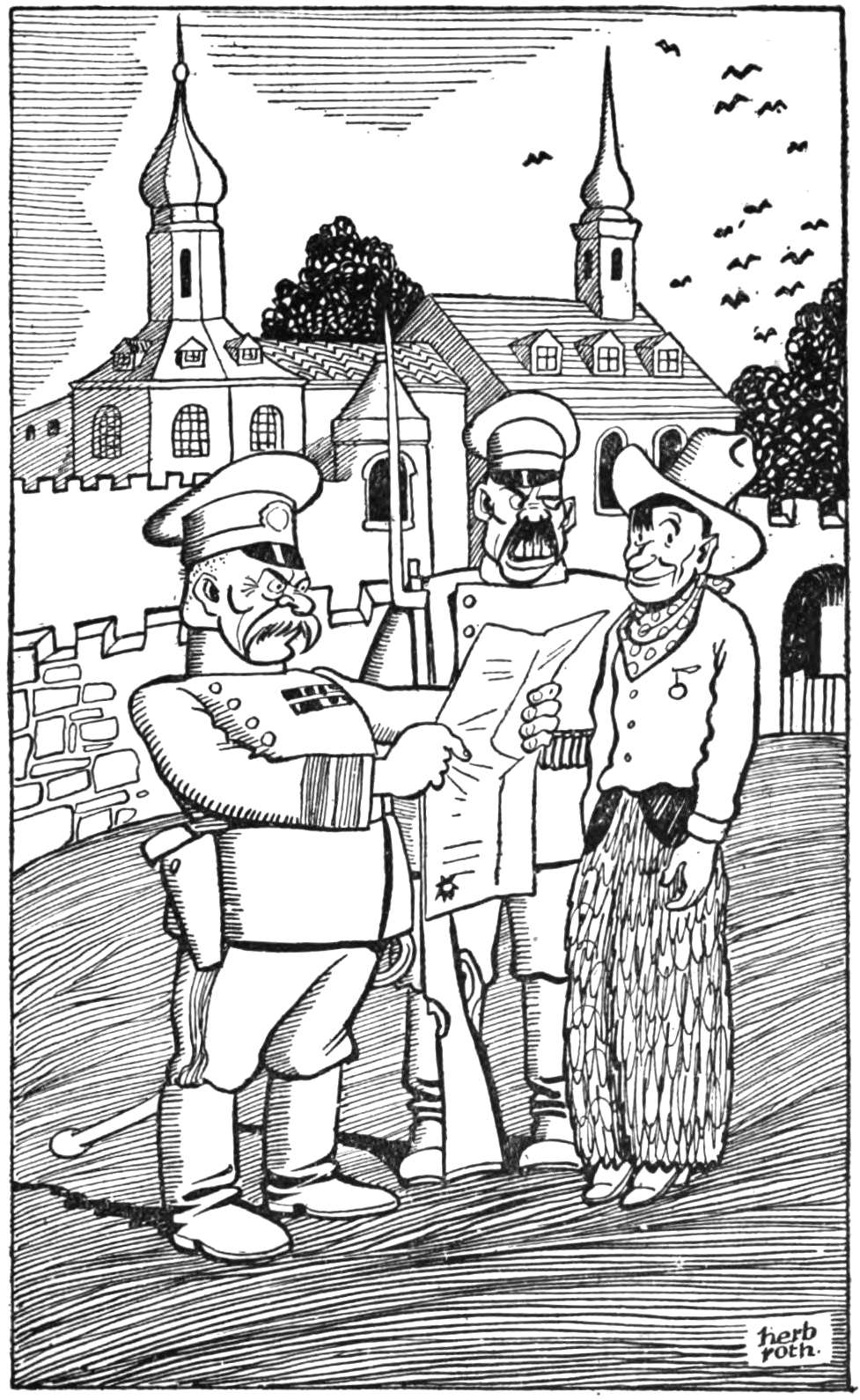
“Yes, Russia; but no Lithuania.”
“Lithuania? Lithuania? Why, I never
even heard of it, much less getting a passport
to it! Where is it? Where are we anyway?
I thought I was going to Russia.”
Lithuania? Why, I never even heard of it.
Well, they soon made it known to me
that I had better have done some studying
on Geography since the Versailles Peace
Conference—that really wasent a Peace
Conference; it was just a map remodeling.
Say, but I want to tell you they had them a
Country, all right, from the looks of all the
officers running around there. I saw one of
them kinder looking out toward his little
army and getting them ready to call into
action. At first when I saw them around
there I thought they were making a Picture;
it looked just like Hollywood. I soon
found it was on the level.
[Pg 60]
“You should have Veesay.” I had to tell
them that I dident even know I was flying
over their country much less landing in it.
It seems that this was not a regular stop;
this Aviator has had to come down for something.
They called a general war conference
to see what to do with this American
who had dropped in on them without
a calling card. They then decided to phone
down to the town, which was Kovno, and is
the Capital.
Well, down in town they called the House
of Parliament or Congress together to devise
ways and means to deal with such an
unusual case. So instead of phoning back,
why, they sent a soldier back on a Bicycle.
It was quite a ways out of town. He had
the news that I was to buy $3.50. I gave
them a Russian ten-ruble piece—that’s
about five dollars in our money. A ruble
is worth fifty cents in Russia and about
two cents outside of there. They wasent
any too anxious to take it, but they
did, and went off for change, when I told
them that that was all right; just keep the
[Pgs 61-63]change and let the Army have a drink on
me.
If I had just thought and told them I
was a friend of President Wilson’s, I would
have got by, because he is the one that laid
all these countries out. It was one of those
Self-Determination of small Nations. No
man ever lived that had more noble ideas
than Mr. Wilson, and any time a committee
would come to him with ten names
signed on an application, and tell him that
they wanted a Country, why, he would give
them one. If they dident know exactly
where they wanted it, and couldent decide,
why, the League would give it to them off
of Russia. Different little Nations gnawed
so much off the edge of Russia that on the
map it looks like a piece of pie that somebody
with every other tooth out has bit into.
Right up above them is another troop called
the Lats, of Latvia, then several others.
They are all pretty fine little Nations. But
it’s a pretty tough struggle to get a new
Country started, though they are all making
a pretty good fight. This one had a mighty
nifty-looking little army. All had on nice
[Pg 64]neat uniforms, and the Officers looked great.
Made the Red Army in Russia look like a
burlesque for appearance. So I am going
to send the League of Nations a bill for
$3.50 for finding one of their Countries for
them.
Say, here is a little inside Diplomatic stuff
too. There was a French plane up there
among them, and this Frenchman was showing
them how to do it.
Well, I gathered up my two Russians
and we hooked up the traces, clucked to the
old Fokker and we was off somewhere else—I
dident know where. But I warned them
in my best pantomime not to be hunting
around for any other new Countries, but to
find Russia. If it wasent big enough to
find, why, we better go down and borrow
a map.
Well, all this delay had kinder set us back
in time, and this old Bolsheviki Boy just
looked like he took a string and tied his gas
throttle right down to the floor. She was
wide open, and we started in hunting Russia.
The clip we was going at I knew we
couldent land in any little Country. We
[Pg 65]was going so fast we would have gone plumb
through it before we could have come down
to earth. So I knew then it must be Russia,
for it was the only country in the world
that could furnish that much ground to whiz
over. All I was scared about was that
we would wind up at Vladivostok or in
Japan.
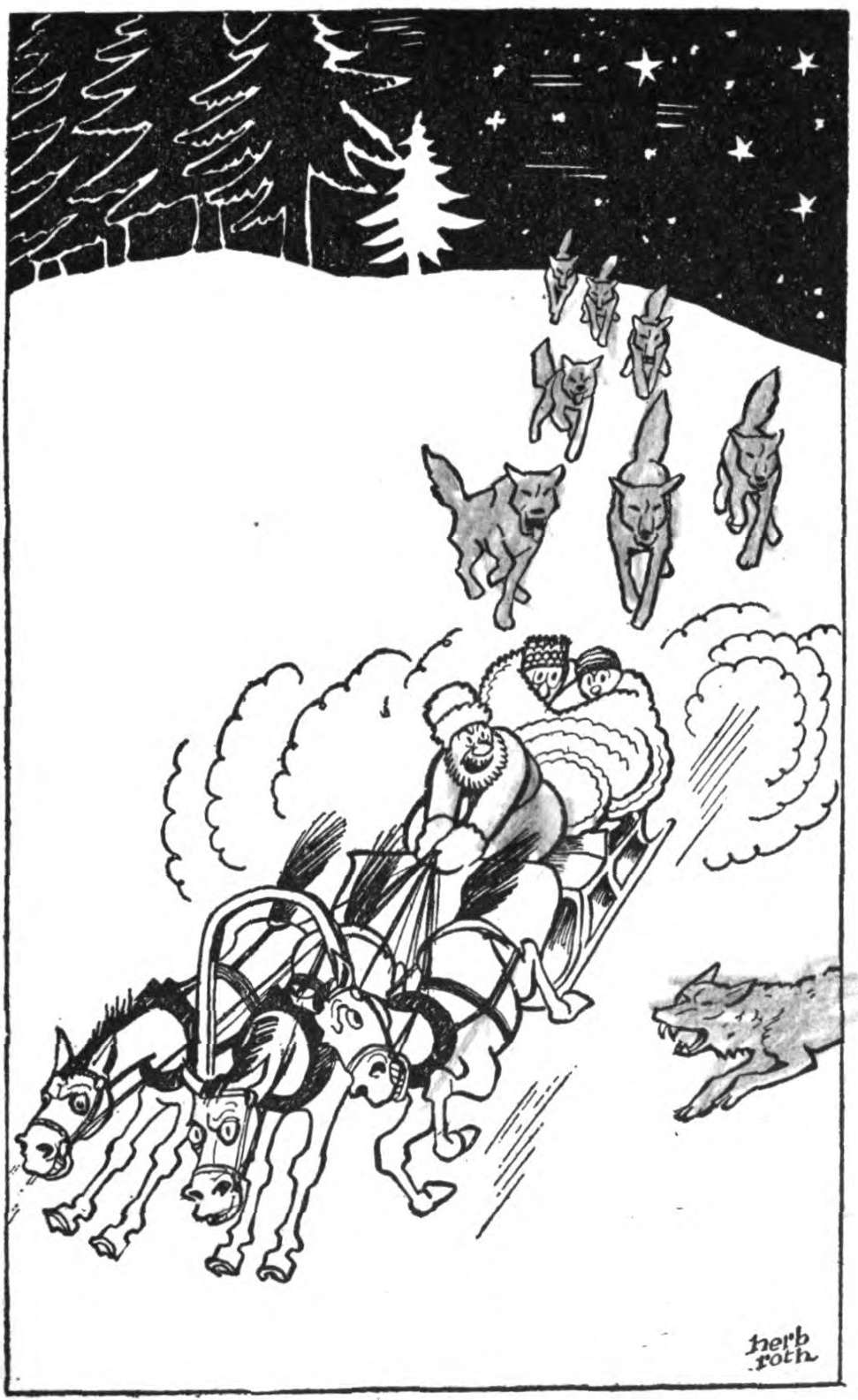
Now in going into Russia I think I am
just like the majority of people—we don’t
know or have any idea what it is like. My
one impression of Russia is a sleigh going
through a forest, with deep snow on the
ground, pulled by a horse with a big high
Yoke up over his neck and the wolves jumping
up biting at the horse’s throat, and some
others trying to devour the inmates of the
sleigh. Now that is the picture that I
have had uppermost in my mind of Russia
all my life, and I bet a lot of you have
the same. We always associate that picture
with Russia, just like we always associate
the Delaware River with the picture of
Washington standing up in the middle of
the boat, with the ice all around, not
[Pg 66]rowing himself but telling the other boys which
way to row. He was a natural Commander.
I have often wondered what he would have
been doing if they had had to swim the
river.
So, after thinking of that picture and the
wolves, I believe that is why I took the airplane
in there. I felt pretty safe up there
from the wolves. The way we was going,
any old wolf would sure have had trouble
jumping up and snapping at us. If he had
ever jumped up at us, he would have hit the
fellow in the plane on the same route next
day.
We was flying nice and low and you could
see all the people out in the fields working—well,
not exactly all the people, but the ones
that were women. Then every time we
would pass over a little town or village you
would see a kind of a market place, and all
the men would be gathered; or you would
see them driving in or out of town in little
wagons with one horse.
I think the men are pretty good that way
in Russia. They make mighty good husbands.
If the wives raise anything, why,
the Husbands are perfectly willing to take
it to town and sell it.
[Pgs 67-69]
My one impression of Russia.
It’s not a bad arrangement, at that. You
know a lot of these countries have got things
that I would like to see put in over in
Cuckooland. If women can go out and
swim all the Channels they can find, why,
they certainly ought to be able to pitch
some hay. So I can’t think of a better arrangement
than these Russians have for all
parties concerned—that is, as long as the
wife raises something. The women in Russia
cultivate the land and the men cultivate
their whiskers. The men are the best
farmers—they have never been known to
have a bad whisker crop. No such thing
as a failure. When in doubt, raise whiskers.
All the western part of Russia is level,
with slight rolling hills. Very few farmhouses
are off to themselves; they are in
sorter a little bunch. The houses are low,
built of logs, and have straw-covered roofs.
The houses and the stables are all built into
one, generally in a square shape. It’s a
beautiful country to look at. And grass?
[Pg 70]Oh, Boy, I just thought if some of my old
Western ranchmen could see all that big
fine grass going to waste—millions of acres
and very little stock on it, with plenty of
water. There was quite a few herds of
goats, a good many horses, and cattle, mostly
milk stock. Everything fat and fine.
And here is one thing I want to tell you
too before I forget it: Even in Moscow,
where the old fellow that is driving his
Droshky—or whatever it is they call those
old kind of one-horse-buggy things—may
look like he hadent had anything to eat in
a week, but I tell you his horse is sure fat.
They got the fattest, best-looking horses
there I ever saw—never saw a poor one.
One of the only mysterious occurrences
of the trip happened just before we got into
this Smolensk. This Mechanic in there with
me pulled the curtains tight over the windows
on both sides and I couldent see out.
Then I felt the plane turning and knew
we were landing. He left me sitting there
looking at myself till we were entirely
stopped. There was nothing to see after I
[Pg 71]got on the ground. There was some kind of
military operations going on around there,
as they are always arguing with Poland and
this is near the line. They think France is
backing Poland. Every nation in Europe
goes to bed with a gun under its head.
Well, whatever they were trying to keep
from me, they kept it. I went into a neat
little eating place there and got my first
crack at some Russian Tea. They serve it
in big high glasses like Lemonade; no
cream, but they use Sugar. It’s mighty
good, and after I tried their coffee I went
right back on this ration of Tea. I had
these old Russian boys come in and eat
with me, and we made a lot of signs and had
a lot of fun, loaded up with gas. It’s along
in the afternoon now, and this old Russian
Casey Jones grabbed his throttle and this
other old Nester kept his blinds pulled till
we were away out of town. We are breezing
along and I feel him kinder tack off to
one side and I peep out and I see a big
black cloud ahead. Well, sir, he went over
to the right to try to take roundance on the
[Pg 72]thing. Then he decided to go under it;
then he changed his mind and went over
it. Of all the dodging and twisting and
ducking that he did, and I want to relate
to you that he sho did keep out of it. I
wouldent be afraid to meet a cyclone with
that old boy if he could just see her coming.
She would have to do some tall twisting to
catch him.
We went into Moscow right on the dot—not
a minute late. That field was full of
Airplanes; there must have been eight or
ten single-seaters up doing their stuff. Now
just the last few days you have read about
the advance in aviation and the amount of
planes that Russia has. Now that is what I
am trying to get you to understand. These
Guys over here in Europe, no matter how
little or how big the country, they have left
the ground and are in the air. Nobody is
walking but us; everybody else is flying. So
in a few years, when somebody starts dropping
something on us, don’t you say I didn’t
tell you.
Now everybody had said to me in going
in, “Don’t take anything in with you; they
[Pg 73]examine everything. They look at every
card. Don’t take a thing or don’t write a
thing while you are in there; everybody is
a Spy and everybody is listening to what
you have to say.”
Well, they throwed such a scare into me
that I stripped myself down till I dident
have a single piece of paper about me but
my passport. I tore up two handfuls of
cards that people had given me of people in
Russia to look up for them. I had the
parents’ address of everybody in New York
City. Now I dident know exactly how they
might stand, and if they caught me with
these names, I might be suspected of being
a Spy or something. Outside of my passport,
if I had been run over in Russia, nobody
in the world could have told where I
was from or who I was.
I had an address I had to tear up that
Morris Gest had given me of a good restaurant
that served Kafilka Fish and Luction
Soup, both of which I have learned—after
strenuous apprenticeship—to like. I
dident want it to get out in Russia that I
[Pg 74]knew Gest, so I tore that up. Dawes’
letters to all the Financiers in Europe I tore
up, for I thought the worst thing in the
world you could be caught with was any
connection with Capital. I thought if they
found them on me they will have me in
the Kremlin, waiting for daylight to come
so the squad will be sure not to miss a
shot. Al Jolson had given me a letter to
a Jewish musician there who writes all the
words and music to all his Southern Mammy
Songs. I took in only one suit and four
extra shirts, as I was told if I took in too
much I would be suspected of capitalistic
tendencies. I debated with myself a long
time in the hotel in Berlin the night I left
whether two extra pair of socks instead of
one would constitute capitalistic affluence.
I wouldent risk it. I even dident get a
shave for a few days, figuring I might pass
as a native.
[Pgs 75-76]
I didn’t get a shave, figuring I might pass as a native.
Now, as a consequence, I dident have a
soul in the world to go to, or a single address.
For when you tear up the name and
address of a Russian, that name is gone
forever. [Pg 77]No English-speaking person living
today can remember a single Russian name.
They were told they could have only so
many letters in their Alphabet. Well, they
took fifteen of these they dident want and
traded them for fifteen extra K’s and Z’s.
So the alphabet consists of twenty-six letters,
seventeen K’s and Z’s and nine other
letters. That is the thing that has made
Lenin and Trotzky famous outside Russia.
They were the only ones that the outside
world could pronounce their names.
Well, due to such expert advice, no one
ever knocked on the portals of Sing Sing
any lighter equipped than I entered the
city of Moscow. I dident even have my
Shriner pin or my Elk Tooth Fob. I tell
you I was practically Neglige.
Now you talk about having sea legs when
you get off a boat. Say, crawl out of an
Airship after about sixteen hours in the air!
Your legs don’t wabble like they do when
just off a boat; it’s your arms. They want
to start flapping and you want to ascend
again. I never felt anything as low in my
[Pg 78]life as that ground was. I went into a little
customs office. They took my passport, but
instead of like lots of countries where they
take it away and hold a Clinic over it, why,
this old boy give it a peek and shoved it
back to me. I opened up the grip. He
got one peek—dident even feel in there.
Talk about not bringing in anything, why,
I could have had a Grand Plane in there
and he would never have seen it!
And as for looking to see what you had
in your pocket or had on your person, why,
I could have had a bass drum in each hip
pocket, a Saxophone down each leg and
two years’ collection of the Congressional
Records in my coat pockets. Now you
know yourself that would have been the
most bunglesome thing I could have had. I
also had a little Typewriter. This Customs
fellow thought it was a Cash Register. So,
you see, there was one set of advice blew up.
I bid this old Russian Aviator Boy good-by,
and when I shook his hand I meant
it, and if I ever decide to take up the usual
tourist trip of flying over the North Pole,
why, this old funny-looking square-headed
[Pg 79]boy would be the one I would take out a
stack with. But I guess the traffic will be
so congested next summer flying over the
pole that you would just have to wait for
your turn to pass it.
[Pg 80]
IV
Now a few years ago the Bourgeois
Party —— Now I better stop right here
early and tell you what that “Bourgeois”
word is, what it means and how it is pronounced.
There are two main words in
Russia—one is “Bourgeois” and the other is
“Proletariat,” and “Soviet,” of course, which
means Council or Congress, only not quite
as bad as our understanding of Congress.
Now “Proletariat” means the poor people,
or what would be known in America as the
Democrats; and the word “Bourgeois”
means the rich people, which in America
would be known as Republicans; or if they
are very rich, the Conservative Republican
Party.
Now the word “Proletariat” you can pronounce;
even some Congressmen can get it
right; but the word “Bourgeois” has bogged
down more politicians grammatically than
the name Susanne Lenglen. “Bourgeois”
[Pg 81]is pronounced by the Russians—and it’s
theirs, they ought to know—it’s pronounced
“Burge-Wah.” So, you see, while Russian
spelling is terrible, the pronunciation is generally
correct. Now I am just explaining
these to you so in using them, as I perhaps
will be in future Russian matters, we will
understand each other. I really was not
sent here to instruct America grammatically—only
Diplomatically. But a little Intelligentzia
now and then is relished by the
best of men, even politicians.
Well, as I started to say, the Bourgeois—remember
pronunciation—party sent over
Elihu Root years ago on practically the
same mission as I was on, but he dident find
out much. In fact, if I remember right,
he didn’t find out anything. So if I can
report on how to pronounce and define three
Russian words, I can well report progress.
Now the first thing I want to do is to
dispel one generally popular illusion that
everybody has to watch one’s conduct while
in Russia. Everybody said: “Be very careful
what you say or do while in there; they
have spies and secret police all over the
[Pg 82]place. Every waiter or servant in the Hotel,
they let on they don’t speak English, but
they do, and report everything. It’s that
G. P. P., or Cheko, the famous secret-service
organization of Russia.”
[Pgs 83-84]
Everybody said, “They have spies and secret police
all over the place.”
Well, they had me so scared that New
York third-degree police methods wouldent
have got a word from me. If anybody
said to me, “It’s a nice day today,” I would
be afraid even to agree with them. I would
just nod my head both ways, kind of a half
yes and 50 per cent no. I was as agreeable
to everybody as an Insurance Agent
before he lands you.
Then a lot of friends had said to me,
“Oh, you will get many a laugh out of there;
I would like to be with you up there.”
Funny? Say, I was just about the saddest
looking thing you ever saw. Claremore,
Oklahoma’s favorite light Comedian
was in no jovial mood to derive merriment
from a Bolsheviki régime that far away
from home. I had seen pictures of long
trains wending their way across the Trans
Siberian Railway, hauling heavy loads of
human freight, when nobody had a return
[Pg 85]ticket but the Conductor, all perhaps for
getting funny with Russia.
So if I thought of an alleged Wise Crack,
it was immediately stifled before reaching
even the thorax. If somebody was going
to pull nifties at the expense of the Soviet
Régime, I certainly was not going to be the
culprit. The whole system of Communism
might have openly appeared to me Cockeyed
and disastrous, but if I thought so,
I would have said it to myself.
No, come to think about it, I wouldent
even have said it to myself. I would have
been afraid some thought reader would pick
it up. I dident want to do anything or
say anything that could be used against me.
I wanted to get out in the peaceful way I
had got in. I wanted to arrive back home
100 per cent whole this fall, to tell my little
wheezes to the dissatisfied agrarian popolation,
or what is mistakenly called the Rube
Belt. I couldent think of a single Prohibition
joke that I thought would get over
around a Prison Camp fire on the shores
of the Behring Straits. You know, I don’t
think there is anything as pitiful or sad as
[Pg 86]a half-scared Comedian. I looked, I absorbed,
but I dident utter.
Then for the next popular illusion I was
told by everyone, “Oh, they will take care
of you; they will just take you around and
show you just what they want you to see.
You won’t be allowed to see anything. You
will be sheperded around to just all the
good-appearing things.”
Well, here is the funny part about it: I
don’t think there was a soul in Russia that
knew I was in there. In fact it kinder hurt
my pride when I found nobody was watching
me or paying me any attention. You
see, it’s so hard to get a Passport in there
that I thought when they did give me one
I felt kinder like every new Congressman
when he first comes to Washington and
look for Mr. and Mrs. Coolidge and the
Cabinet and Alice Longworth and Walter
Johnson all to meet him at the train. Then
he comes and prowls around for a week
before anybody but his Landlord knows he
is there. In fact some stay there for years
and nobody ever knows they are there.
Well, that’s the way I felt. ’Course, I
[Pg 87]dident figure on any public reception. I
dident hardly dare to hope for so much as
the much-heralded Cossacks to charge and
cut the heads off any remaining nobility in
Red Square. But I did begin to think if
they are going to start showing me about
they better be at it. I tell you it was lonesome
and humiliating on me. I wanted to
hire my own Detective and have him watch
me just to keep up the popular tradition.
Well, I went all over the country; drove
out to villages, went to other towns, got on
the train and made a night’s journey from
Moscow to St. Petersburg—or Leningrad
was the name of it that week—and wasent
stopped or asked a question; and dident even
have any passport, as it had been left with
the Hotel to give to the Police, as that is
their custom.
I run onto an old American boy that was
working for a big mining concern and he
and I looked at everything there was to see,
and a lot of things that if they had been
very careful they shouldent have let us see.
I talked to various Government officials
connected with their Foreign Department,
[Pg 88]and everywhere had the greatest courtesy
and consideration. They explained anything
that I would ask them about the government
or the country. One thing, though,
that a Communist can do is explain. You
can ask him any question in the world, and
if you give him long enough he will explain
their angle, and it will sound plausible then.
Communism to me is one-third practice and
two-thirds explanation.
I wanted to go in the Kremlin, the old-time
Czars’ Castle and Fort. It’s now
where all the Government business is carried
on. ’Course, you have to have a permit,
but they gave it to me and in I went.
They give you a Guide who speaks English
to take you through. But that was
the only place where they furnished me one.
Anywhere else I could mess around all over
the place. Lenine’s Tomb—the body is just
there in a glass case. Well, at the present
time you can’t go in there, as they are overhauling
or upholstering the body, or something.
It’s just a little wooden building
outside the Kremlin wall.
I wanted, of course, when I went in there,
[Pg 89]to see Trotzky. I wanted to write about
him and tell how he stacked up with Borah
and Young LaFollette and Jim Reed and
Al Smith and Sol Bloom and the New York
Times man in there, Duranty, who has been
there for years and is the best informed
man in Russia on their affairs, and a fine
congenial little fellow and a godsend to visiting
English or Americans. Well, Duranty
and I went to see a man about seeing
Trotzky. A little fellow named Rothstein,
who spoke English and used to work on a
paper in England, he has to do with censoring
all that goes out to the Press. I told
him the nature of the visit to Trotzky was
to find out just what kind of a Guy he was
personally; that I dident want any of his
state secrets. I just wanted to see did he
drink, eat, sleep, laugh and act human, or
was his whole life taken up for the betterment
of mankind. I told him that anything
that I wrote would not break up the pleasant
relations that existed between our two glorious
Nations.
Mr. Rothstein informed me: “We are a
very serious people; we do not go in for fun
[Pg 90]and laughter. In running a large Country
like this we have no time for appearing
frivolous. We have a great work to perform
for the betterment of mankind. We
are sober.”
Well, I explained to him that I dident
hardly expect Trotzky to make any faces
for me or to turn a few somersaults or tell
the one about two Hebrews named Abe
and Moe. I tole him that the man must
have some very good human qualities, and
on account of being in America at one time,
he has always been of especial interest to
us; more than anyone else in Russia since
Lenin’s death. I wanted to tell them that
what they needed in their Government was
more of a sense of humor and less of a sense
of revenge.
[Pgs 91-92]
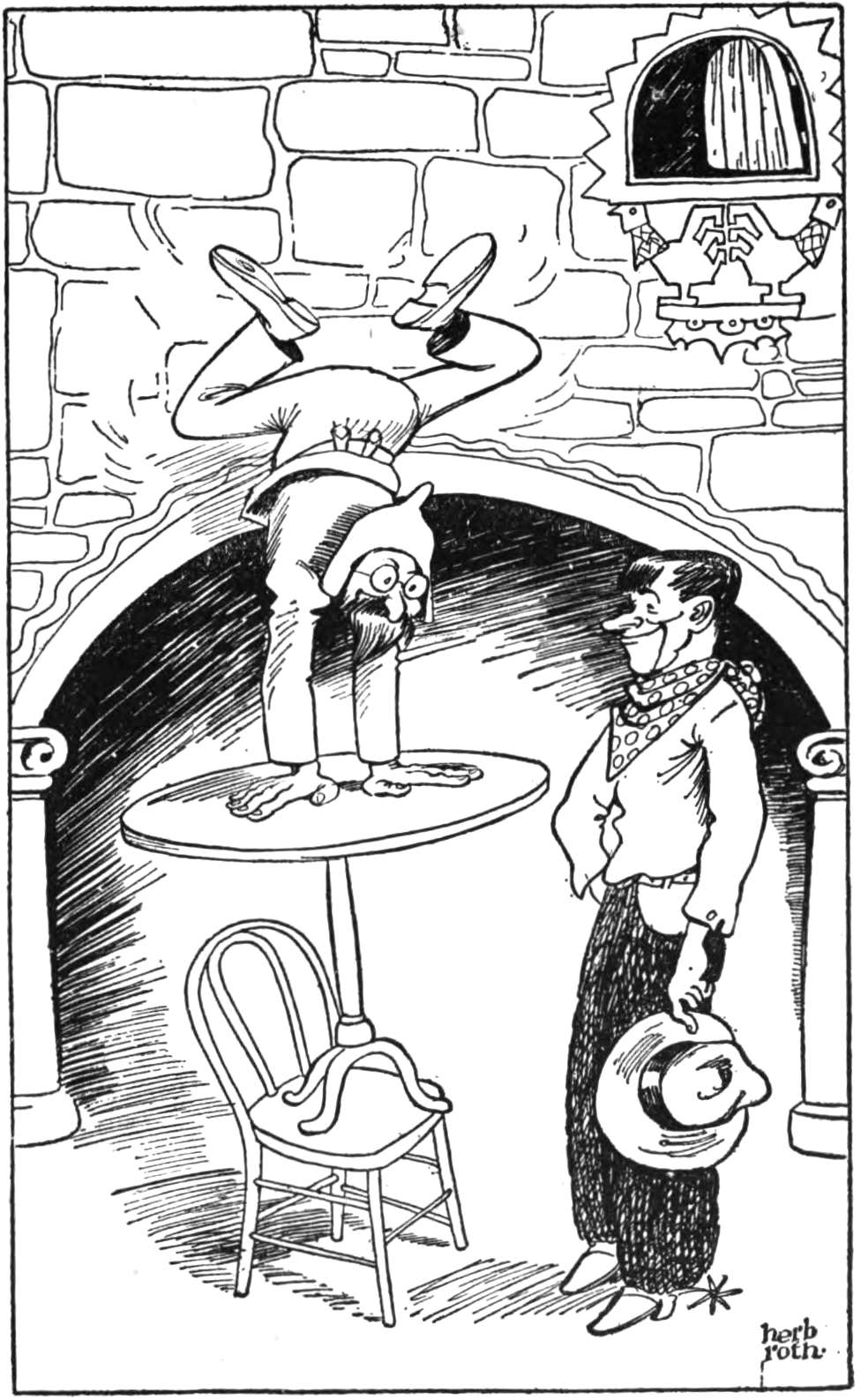
I didn’t hardly expect Trotzky to make any faces for
me or to turn a few somersaults.
I saw that this old boy wasent so strong
for me X-raying Trotzky. But I bet you
if I had met him and had a chat with him,
I would have found him a very interesting
and human fellow, for I have never yet
met a man that I dident like. When you
meet people, no matter what opinion you
might have formed about them beforehand,
[Pg 93]why, after you meet them and see their
angle and their personality, why, you can
see a lot of good in all of them. You know
how it is yourself. I bet you have had
Political enemies and you would think from
your impressions of them that they ought
to be quartered in the zoo in the reptile
house. Yet when you met them you could
see their side and find they wasent so bad,
and that you were both trying to get about
the same thing in the long run.
Rothstein wants me to stay over one day
longer, and he would have me see Tchitcherin.
He was the Prime Minister, and naturally
would be the main one. But it was
Trotzky I want to see if possible. These
Prime Ministers, they are so sudden that
before I can write you about one of them
he may be out and be three Ministers removed
from his old position.
But I found out the real reason I dident
get to see Trotzky. Trotzky is not in so
good with the present government. It may
seem rather funny to some to hear he is too
conservative for them. He has his ideas
how things should run, as he is one of the
[Pg 94]old-timers in the party. He got so bad as
an opposition that the Party shipped him
away off down in the Ural’s to get him out
of the way. But he is really strong with the
people, and there was such a fuss raised
over it that they had to drag him back to
the capital again and create a job for him;
so they made him Minister of Concessions.
Now, on the face of it, that looks like
a pretty soft job, for Russia certainly has
lots of concessions to peddle out. But they
made it so Red-Tapey that he couldent give
out the Vodka-selling privilege at the next
Revolution without having it passed by an
act of the entire Soviet Council; so it really
wasent so much of a job as it appeared on
the letterhead. He had charge of the Army
for a long time, and built up quite a formidable
gang.
The real fellow that is running the whole
thing in there is a Bird named Stalin, a
great big two-fisted fighting egg from away
down in the Caucasian Mountains. He is
the Borah of the Black Sea. He is kinder
the Mellon and Butler combined of the Russian
administration. He is the stage
manager of Bolshevism right now. He don’t
hold any great high position himself, but
he tells the others what ones they will hold.
He has served his term in Siberia under
the Czar. Well, Trotzky is kinder not sitting
at his round table at lunch. But the
Peasants out in the county are still strong
for Trotzky. He sees that there must be
some changes made in the way they are running
things. The Peasants think they have
a kick that they are not getting enough for
their grain, and Trotzky is sorter siding
with them. So he is called a conservative.
[Pgs 95-97]
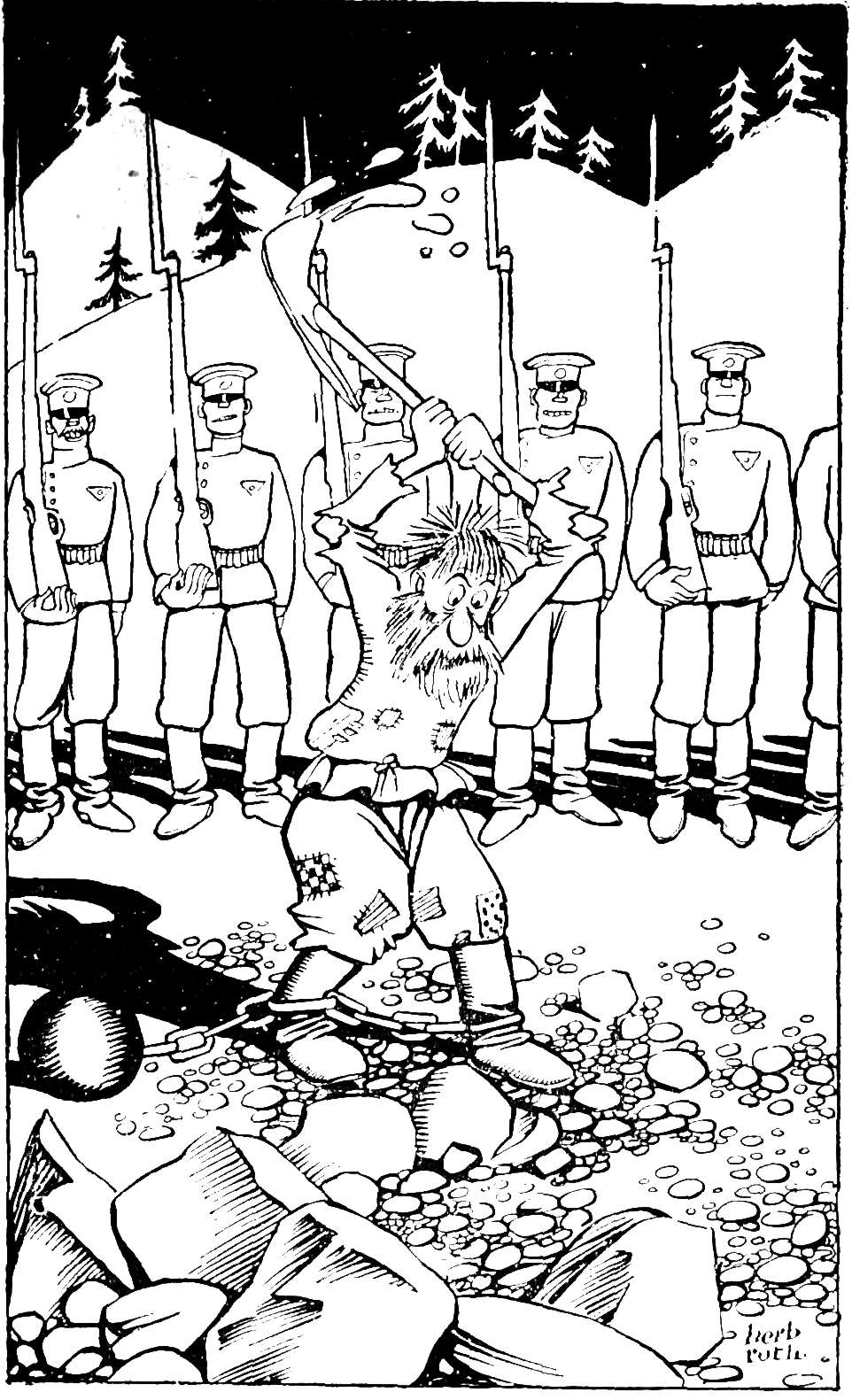
He has served his term in Siberia under the Czar.
A Conservative among Communists is a
man with a Bomb in only one hand; a Radical
is what you would call a Two-Bomb
Man. They have one in each hand, and
will spit a third one at you if possible. But
I saw and talked to lots of them in the Government;
also met all the gang that they
sent out from America that time with Big
Bill Haywood—was going to see old Bill,
but he was sick in the Hospital and I
couldent get to see him. From what I
heard, Bill sho would like to get back among
the gang in Chicago. If I was Bill, and
[Pg 98]had that opportunity of going from Russia
to Chicago I would give it serious thought
before I would make the change.
Met the smartest, brightest old Bolshe
fellow in there named George. I don’t
know his other name, but you couldent pronounce
it if I wrote it. He said he was one
of the twenty-two that Judge Landis sent
to Leavenworth to break their jump to Russia
that time. He is a bright, smart kind
of a Duck, but not what I would call a
Landis rooter. Met a big nice jovial fellow
from Chicago—forgot his name, said he run
for President on the Socialist ticket the year
Jimmy Cox did. I told him I could faintly
remember Jimmy, for he happened to be
a good friend of mine; but I couldent remember
him. He said he runs pretty near
every year on that Ticket—said, “I may
run this year.” I told him there was no
Presidential election this year unless there
was an impeachment.
He said, “Ain’t there? Well, mebbe it’s
next year then; I don’t pay much ’tention
to what years I am running and what years
I am not.”
[Pg 99]
He was feeling pretty good about the
whole way things were running in there, and
was very enthusiastic about it all; he was
strong for ’em. He had a passport back!
I bet if you had stole that passport away
from that old Boy you would have just had
284 pounds’ worth of suicide on your hands.
The funny part about it among these American
ones you meet over there visiting, they
are all so nice and friendly and enthusiastic
about it, and believe in it away above
our form of government; but they all go
back over home. It just looks to me like
Communism is such a happy-family affair,
that not a Communist wants to stay where
it is practiced. It’s the only thing they
want you to have but keep none themselves.
Well, this continuous Presidential Candidate
was a mighty nice fellow, and I would
like to see him get into the finals some day,
even if he don’t win.
[Pg 100]
V
Now I know you want to know what
about it, and how is it working, and what
is it. Well, I am giving it as much study
as a Bird like me could give serious study
to anything. Before coming in here, I read
everything. I read so many of that fellow
Marx’s books that I don’t want even to see
the Marx Brothers, as clever as they are.
I have come to the conclusion that the reason
there is so many books on Socialism is
because it’s the only thing in the world that
you can’t explain easy. It’s absolutely impossible
for any Socialist to say anything
in a few words. You say, “Is it light or
dark?” and it takes him two volumes to
answer Yes or No; and then I know there
is a catch in it somewhere. It’s like a long
Theatrical Contract. If one of them tells
beyond the Salary and the amount of weeks
you are to work, why, you might just as
well light a cigarette with it. More words
[Pg 101]ain’t good for anything in the world only to
bring on more argument.
If Socialists worked as much as they
talked, they would be the most prosperous
style of Government in the World. But the
thing is they don’t know anything about it
themselves. There is not two of them in
the world with the same idea of what it is.
They say, “All we want is somebody to
come in and see with an open mind.” Well,
if ever a Guy went into Russia with an open
mind it was me. It was not only open but
it verged on being empty. Lord, if 130,000,000
people that never had it any too
soft in their lives are trying to work out a
way to better their condition, why, it ain’t
for a yap like me to come along and tell
them that they are all wrong.
You know, I dident have to go to Russia
to find comedy or chaos in Governments.
If I was looking for governments that
wasent just exactly hitting on all six, why,
I left one and went through a dozen more
going to Russia, so anybody better not start
heaving too many rocks at Russia’s government—I
don’t care which country you come
[Pg 102]from—till you have looked your own over.
Liberty don’t work as good in practice
as it does in Speech. You got to figure that
bunch of fellows are playing with the biggest
Toy in the world. They are like a poor
old Farmer or Rancher out home in Oklahoma
that has a bunch of Kids, and they
have never had anything to play with in
their lives but an old hound pup; and then
Dad strikes Oil, is paid a big bonus, and
wanting to do something for his Gang, goes
to Tulsa and gets them all the mechanical
toys of every description in the world and
hands them to them to play with. Well,
that is what somebody has slipped these
soviet fellows. They have had an electric
train thrust into their hands and they had
never pulled the string on even a jumping
jack before, and they are naturally going to
have a lot of short circuits and burned fingers
before they get the thing started.
Cæsar and Nero and that bunch of boys
that got credit for steam-roller measures
through the Roman senate were playing
county politics compared to these Babies.
The whole Roman Empire, in its balmiest
[Pg 103]days—and it had some balmy days—that
little Minor-League Empire would have
got so lost in Russia that Columbus, De
Soto and Lewis Clark couldent have found
it.
Now handing this bunch of fellows Russia
would just be like Judge Gary coming
backstage at the Follies and saying, “Here,
Will, you and the Girls take over the Steel
Corporation and run it.” Now you have
to have some kind of training to handle
something big or else you have to do a lot
of practicing on it after you get it, which is
generally pretty expensive. Most of these
fellows were on little Communist Newspapers.
Now America has withstood some pretty
rough handling at times, but I sure would
hate to see it fall under the management
of a troop of our Dissatisfied Newspaper
men. Put it in the hands of an old hardheaded
Farmer or a small-town Merchant,
but deliver it from Editors. They would
have more Theories how to run us than the
Communists. So you got to give these fellows
a little bit of the benefit of the doubt.
[Pg 104]They are practicing and are trying to do
the best they can, but unfortunately they
are practicing on 130,000,000 people that
have to remain the horrible example till these
Guys find out themselves just what it’s all
about.
’Course, it won’t be such a terrible disgrace—on
them—if they don’t make it, for
there is Nations with men trained from
childhood in government that looks like they
were getting practiced on. It’s just tough
on the people, that’s all. It’s no disgrace
not to be able to run a country nowadays,
but it is a disgrace to keep on trying when
you know you can’t. ’Course, things look
pretty bad there. You see, this is ’26 and
the war started in ’14. That means twelve
years that trains, street cars, Public Buildings,
and in fact everything, has not had a
thing done to it since the day the Czar’s
forces marched off to fight Germany; no
painting, no streets fixed up to amount to
anything. Most of the streets are, however,
kept clean. You see a great deal of poverty
among the people along the streets, a
great many ragged little children begging.
[Pg 105]’Course, you can see these things in lots of
cities besides Russian ones, but it’s worse
in there.
I never saw a pair of silk stockings on a
single lady on the street. Everything is
very expensive. Most all the manufactured
things have to be imported, as their factories,
very few of them are operating. The
Factories are there, but the machinery is
all rusted and spoiled in all these years of
no usage; and they have to get in new machinery;
and it costs a lot of money to re-equip
all those. Food things shouldent be
so high, for they raise everything in the
world up there; but it seems to cost them
a lot to handle it through the stores. They
have these coöperative stores; in fact everything
is supposed to belong to the government,
but they are changing now and allowing
private ownership and cutting prices
over each other.
You see, the Communism that they
started out with, the idea that everybody
would get the same and have the same—Lord,
that dident work at all. That has all
been changed—the idea that the fellow that
[Pg 106]was managing the bank was to get no more
than the man that swept it out. That talked
well to a crowd, but they got no more of
that now than we have. I don’t suppose
there is two men in Russia getting exactly
the same salary. They get what they can
get, and where they can get it. When the
government runs anything, as they do practically
everything over there, there is always
about twice or three times as many
working in the place as would be found in
private enterprises.
During these hard times they have had
so much dishonesty among the people working
where they could get their hands on
any money that it takes about two to watch
one, and then four others to watch those
two. There is also an awful lot of unemployment.
Taxes are very high. They have succeeded
in stabilizing their money—that is,
inside the Soviet Union. The Ruble is
worth 50 cents, which is the par value of it.
The Chervonetz, or sort of a little pocket
Chevrolet, is worth just about five dollars,
and compares with the English pound.
[Pg 107]Right after the Revolution, when they were
operating their money like a lot of these
Countries over here do, on just a Printing-Press
basis, why, they had bootleg money-makers,
just like they do over home with—alleged—booze.
If you needed any
money, you would go to your Currency
Bootlegger and buy it. Each one claimed
to make Nothing but Prewar stuff. Now
they got it stabilized, but it’s up so high
nobody can get any of it.
I asked an official of their Foreign Office
how they maintained it at standard, and he
said: “We balance our budget. We estimate
how much will come in during the year
and don’t spend any more than that. We
make our exports and imports balance, and
that is one reason we cannot bring in as
many things as we would like to.”
But another very prominent man who
had been in there off and on for years, doing
a big business in there, said: “They
originally started out with a bunch of Gold
that they inherited from the original Government,
and what they had confiscated
from various ones during and after the
[Pg 108]Revolution, and they took that to England
and borrowed its equivalent in money
on a loan against the gold. Well, they took
this money and come back home and issued
more currency against what they had
brought from England, saying, ‘It’s all
backed by our gold reserve.’ They would
issue another batch against the last one, just
pyramiding, all backed up by this original
that was in hock to England. But anyhow,
they have kept it steady, and you don’t
have to read the papers every day to see
what you have.”
Of course, anyone going in will ask, “Is
it working? Is everybody happy?” Well,
they are not. Over 90 per cent of the population
in Russia are farmers, and live out
in the country and Villages. The Revolution
was to get the Peasant the land. They
took all the land and everything that the
rich or even fairly prosperous had away
from them, and it’s owned by the Government.
They give it to the Peasant, but it’s
only his as long as he lives on it and tends
it. He can’t trade it off or sell it. The real
deed to the land is held by the Government.
[Pg 109]
’Course, that beat the old way of being
under the thumb of the Landlord. But
now that the Peasant owns it, he has to pay
the taxes on it. Before, it was the Landlord
had to pay them. So the difference in
what he pays the Government and what
he paid the Landlord is so little that he
can’t hardly see where he comes in to be
much better off.
But that is not the real and the serious
trouble there. It is this: The Government
tells the farmer what he shall get for his
products—based, of course, on the market
value at that time. Well, he is not kicking
so much on that as he is on this: When he
sells his grain, he can’t take the money and
go buy what he needs. He can’t buy his
plows and his wagons and his harness and
many other things that has to be made by
a factory. They cost him more than his
grain brought him; and if he did happen to
have enough, then the things are not to be
found to buy. They have to import most
of them and the cost to the farmer is tremendous.
So what does the old Farmer
do? He won’t sell them the stuff.
[Pg 110]
The Russian Peasant may be Illiterate,
but he is not what you would call Dumb.
He knows something about this Guy Marx’s
theories himself. He knows what’s the use
raising anything if you can’t trade it or sell
it for what you want. So he is just raising
for his own use. And living on what he
raises. If he does raise more, when they
say, “You have so much wheat here; you
must sell that,” he illiterately replies, “No,
I eat that. My family very big bread eaters,
eat lots of wheat. I have none for sale.”
Sometimes he hides it; but, anyhow, he is
not selling it, and that has got the whole
Communistic Party about cuckoo right at
this minute. Their problem is to satisfy
him. They have to get him some stuff in
there cheaper than they can afford to, or
make it, or pay more for his grain than they
can get for it in outside world markets.
Somebody is going to lose some money on
the thing, and it ain’t going to be old Mr.
Peasant. He can set and live on just exactly
what he raises. But the old Boys in
town has got to get enough nourishment
from what the farmer raises to make those
[Pg 111]brotherhood-of-man speeches on. The old
farmer just grinds his extra up into Vodka,
lays in a lot of wood and hibernates for the
winter.
If you got that Vodka for a companion
you got a mighty ally on your side when it
comes to forgetting your troubles. The old
Peasant has gone through many of these
same winters. He knows it’s not going to
make much difference with him who is in.
You see, there is only 600,000 Communists
in the whole of Russia, and they are ruling
over the other 130,000,000. So this 600,000
has got to figure out some way to sorter
half satisfy this small minority.
Look over home the Pheasants out in the
West and Middle West are either hollering
for higher prices for their grain or
cheaper prices for flivver parts, phonograph
records, Crystal sets, cheaper movie admission
and Government instruction in Black-bottom
dance steps. So, you see, Russia’s
problem is about our problem, only Russians
can get along without all these necessities.
They can live on what they raise, and drink
the surplus and enjoy it. But you have
[Pg 112]got to supply our Pheasants with these essentials,
for they can vote and the Russians
can’t—they can vote, but they can’t get them
counted.
So, after all, the world is just about the
same whether it be on the banks of the Vulgar
or the Potomac. So we are not in a
position hardly to blame the Communists
for not finding a solution when we pay 600
men $10,000 apiece a year and they can’t
find out.
So, as I said before, I dident have to
go to Russia to find humor in Government.
[Pg 113]
VI
We will start in looking the towns over.
This is the town they used to call St. Petersburg.
Then when the war come along with
Germany and they got afraid Germany
would capture it, they changed its name to
Petrograd so it would fool the Germans and
they wouldent know what town they were
capturing. Well, that worked fine. Germany
couldent find it, and just when the
Czar and all his board of strategy was gloating
over their clever ruse, why, a fellow
named Lenin found out where it was, and
he had never had a town named after him;
in fact, they had always kept him moving
so fast that he couldent tell whether the
town was named after him or before him.
Well, he said, “If I take this town, will
you name it after me?”
They replied in the affirmative. So he
found it and took it, and now it is named
Leningrad. I found it; so if you hear
[Pg 114]of it being called Rogerskofsxzy, why, that
will be partly in my honor.
From what I could gather from the old-time
residents there, it used to be quite a
place; kind of a cross between Hollywood,
California, St. Louis and Chicago. It had
the drab night life of Hollywood, the color,
dash and brilliance of St. Louis and the
pistol and rifle fire of Chicago. It is situated
at the mouth of the Neva River; and
when I say the mouth of the Neva I am
wrong. I mean the mouths of the Neva.
It’s plural, and it’s also singular that it
should have so many mouths, but it has. It
just can’t make up its mind how to get out
of Russia and empty in the Gulf of Finland.
Nurmi is the capital of Finland.
The ground is very low under Leningrad;
in fact, it’s the only town in the world whose
altitude is just exactly 0. There is towns
that are above sea level, and there is towns
that are below sea level; but Leningrad
couldent make up her mind which she wanted
to be, so she just split the difference.
You have to move twice a day in Leningrad—at
low tide you live downstairs and
[Pg 115]at high tide you move back upstairs. It’s
built on poles driven into the mud and clams.
Peter the Great settled it, but that is not
why he was called Peter the Great. He lost
an election bet—the other side spent too
much money—and he either had to build a
town in some odd place or roll a wheelbarrow
around the living room, so he decided
on the former. He got even with all
the other Czars, for he put a Joker in the
19th Amendment of their Constitution, so
they would have to live there. Like our old-time
Presidents used to have to live in
Washington in the Summertime. Winter
starts the first week in July and ends the
last week in June. Spring, Summer and
Fall are not what you would call long, but
they are comfortable—all three days are
very pleasant. But with all its flatness, it’s
much the most beautiful City in Russia.
The streets are all laid out straight and
cross at right angles. It has some wonderful
buildings and marvelous Churches.
It was the Capital of the Country when
the Bolshevikis got it, but was so close to
the Gulf that they got afraid somebody
[Pg 116]would come up there with a big Battleship
and drop a few shots among the assembled
Senators. You know, Communists like to
throw things themselves at various Governments
and prominent people, but they don’t
like the idea of being on the receiving end of
anything in the nature of a bomb.
The city is much more modern and European
than Moscow. Moscow has more of
the Far East in its appearance, with all of
its Mosque-like domes to all the Churches.
It’s really ancient, while Leningrad has been
made to order. The main street is the
Nevskii Prospekt. The Soviets have
changed the name to the 25th of October.
That’s the date of a Revolution. They
changed the old names on everything that
was connected with the Czar’s régime.
Now when these people took everything
over and run everybody out that had anything,
they took most of the Palaces and
big places that belonged to the rich and made
Museums and Schools and Clubs and Public
buildings. Of course, they have not been
able to keep them up in very good shape,
but you can see what they must have been
[Pg 117]when the old Gang were going good.
’Course the main one most everybody is interested
in is the Czar’s Palace, or the
Winter Palace. It fronts out on a great
big square, composed of big old worn Cobblestones.
It was formerly called Palace Square, and
is the one you have seen in most pictures
showing the Czar’s Armies and Revolutionary
scenes; in fact, just about everything
of any importance that wanted to happen
in Russia for hundreds of years back had
to wait for their turn to happen on this
square. And it was in it that the present
Government captured it from the Royal
régime. It’s now called Uritzsky Square.
He was a Socialist that was killed here.
They, as I say, always name things after
the last man killed there on their side. If
you get killed on the side that don’t win,
you don’t get the place named after you;
but if you do win, why, you can die knowing
you had a square named after you, provided
you are the last one killed. You must
always be careful about that—pick your time
to get shot. Get these names: The Garden
[Pg 118]of the Toilers another square is called; then
there is the Square of the Victims of the
Revolution. One of their bridges is called
the Bridge of Equality.
This Palace was practically the constant
home of the Czars. It is now a Museum.
Part of it is given over to what is called the
Revolutionary Museum—more about that
later. The Palace has seven hundred rooms.
If a young Czar ever forgot the number of
his room, he would be an old Czar before he
found it. The Apartments of Nicholas I,
Alexander the II and Nicholas II are shown
as they were as historical memorials, including
all the big rooms of State.
Then you come to the Apartments of the
late Czar and Family. It almost looks as
if they had left it that morning. All their
personal photographs of people we are
familiar with in these times, with personal
writing on them, are there—a great many
photos taken with King Edward, and enlargements
from what must have been snapshots
of various groups of the family. The
whole thing looked like the rooms in any
wealthy man’s home with a family—that is,
[Pg 119]one that has always been wealthy. Everything
was modern and up-to-date. No big
Gold furniture; all things that you could
use in a home today and not attract any
attention.
They had a Telephone connection, with a
little switch thing on it that they could connect
with the Opera and hear everything.
They had even the Children’s colored
Easter eggs, and dozens of pictures of them
on their Ponies and in sleighs. Pictures in
all kinds of little silver and some just ordinary
cheap frames.
In the Czarina’s bedroom the ceiling and
the Tapestries are covered with some sort
of blue floral design. Her devoutly religious
nature shows very plainly by the fact that
the rooms are full of Icons and many images
of Saints. There were lots of little personal
keepsakes that had been given by friends.
In the drawing-room is some Louie the 14th
furniture given them as a wedding present
by King Edward. The Czar’s rooms is just
about what you would see in a Gentleman’s
Apartment today only a great many Japanese
[Pg 120]things—gifts received on a visit of his
to the Far Fast.
It looked like these folks, when they got
away from the pomp and parade of appearing
in public, tried to live like human beings.
It was so simple and modest that I doubt
if any Oil millionaire or a Moving Picture
Star would have lived in it without having
it redone.
There is one thing that this Soviet outfit
has certainly done, and that is go in strong
for Museums. I think there is some 700
museums in the various Cities and towns.
They are trying to develop Art, and they
have some of the most wonderful art treasures
in the world. You see, they not only
have the State but all the private collections
of all the rich nobility that have had it
handed down in families for dozens of generations.
Now I don’t know just how far that Art
thing is going to get them. I am not so
strong on art myself as a commodity. I
think most countries have kinder overestimated
the importance of our Artists and
underestimated the importance of people
[Pg 121]that did something to help provide Corn
Bread and Bacon and cheapen the things we
had to have. Athens, Greece, was mangy
with Art. Now they ain’t eating regular.
Rome had nothing to recommend it but art
and broken columns till Mussolini come
along and made ’em all throw their paintbrushes
in the Tiber and go to work at something
productive.
So, after looking over Russia, I believe
there is a hundred things I could think of
to improve them with besides Art. Russians
need meat right now worse than they
do naked Statues. The thing about all these
Museums is, when you have gone through
one of them you have gone through all of
them. You take the Hermitage in Leningrad—which,
by the way, is one of the most
famous museums in the World; it’s right
next to the Czar’s Palace and had an entrance
from the Palace. You take it and
the Louvre and the Metropolitan in New
York, and the big ones in Rome and London—they
give the ordinary man just about
all the art he can digest in one lifetime.
Russia don’t need to develop so many men
[Pg 122]who can paint or sculpture a beautiful, well-rounded
human body. What they need is
somebody that can provide the wherewith
to fill out that well-rounded body. Los Angeles
got the right idea. Instead of having
seven hundred Museums, they got seven
thousand filling stations. If you got a big
family, art is all right for one son to indulge
in; but you want to have the other 12 to
bring home some revenue and feed him and
humor him. It should only be indulged in
by every 13th member of a family, and then
only after unanimous consent and sacrifice
of the other 12.
Now we go into the Red Museum, which
is part of the Palace. Oh, Baby, talk about
a Chamber of Horrors! Huber’s Museum
and Madam Tussaud’s waxworks would be
children’s nurseries in comparison to this
blood-and-thunder outfit. It was founded
in 1921 and everything in it is connected
with revolutions; not only Russian Revolutions
but anybody else that happened to have
had a good bloody Revolution and had any
old Guns or Bombs or skulls or anything
[Pg 123]that would make particular decorative atmosphere.
On account of its short life, they make
apologies for the small amount of material.
But I couldent see any need too. It looked
to me like they had done pretty well, and
the only way they could get any more horrors
in there would be to get some more
people killed. So I think in the Revolutionary
Museum line they can well report
Progress. They can just load up the old
Bombs they got there now and blow up half
of Europe.
As you enter, there will be a wax-size figure
of an old boy with a Bomb drawn back
just ready to shy it at a Czar out on a
Balcony. Then there are big loud-colored
paintings all over the walls that look like
Movie Lithographs, showing Cossacks
charging Women and Children and cutting
them down. There are dozens of photographs
and oil paintings of any Red that
ever got his man; court-room trials; every
Pistol or saber that ever dropped a Czar or
a Capitalist in his tracks. One sees all the
episodes of the Dekabrists’ trial. They
[Pg 124]were the ones to originate the idea of not
letting the Czars sleep too well. It contains
all the scenery and props in connection
with the murder of Alexander II.
Rows of special show cases contain bombs
to fit any hand.
Rooms were made up to represent cells
where revolutionists have been confined;
room after room of somebody either being
killed or somebody getting ready to kill
somebody else. One room is devoted to
Lenin, called Lenin’s Corner, where all
kinds of material in his private and political
life is exhibited.
Now we went through there on a Sunday
morning, and we couldent hardly wedge our
way through. The man with us was an
Englishman, but spoke good Russian, and
he described to us what was going on. It
was Teachers taking young children through
and stopping and lecturing to them: “Here
is Kzolxsvlozxusz. He had the best record
of any of the late bomb heavers. It’s
through him you are enjoying this wonderful
liberty that you are having today.”
Of all the Museums, this Revolutionary
[Pg 125]one was the one that they were centering
the attention of the smaller ones on. You
did not see nearly as many looking at the
beautiful paintings by the old masters as
you did looking at the old guns that had
their notches in the handles.
It seems the whole idea of Communism, or
whatever they want to call it, is based on
propaganda and blood. Their whole life
and thought is to convince somebody else.
It looks to me like if a thing is so good and
is working so fine for you, you would kind
of want to keep it to yourself. I would be
afraid to let anybody in on it, and that generally
seems to be about the usual brand of
human nature everywhere. But the Communist
has so many good things he just
wants you to join in and help him use some
of them.
They start at the cradle with them in
Russia. They have a great many schools in
Russia, which seem intended not so much to
eliminate illiteracy as they are to teach
propaganda. Political propaganda starts
with their A B C’s. Their statistics prove
that they are now operating many more
[Pg 126]schools than in prewar days. There is no
such thing as a private school allowed in
Russia. They have agricultural schools for
the peasant children in some places. They
have craft schools which give professional
education in different branches to over one
hundred thousand people annually. There
are 24 universities. The number of High
School students is given as 160,000.
[Pgs 127-129]
They start at the cradle with them in Russia.
They are trying to foster art and culture,
but all of it is of the Revolutionary type.
If it is a painting, the main character has
one foot on a capitalist’s neck and is punching
another capitalist in the jaw. But the
main thing that dominates this whole thing
is to spread propaganda. Talk about some
of our states guarding what their school-books
contain—these children never get a
chance to read anything only about how
terrible everything is but Communism.
You can’t go to a bookstore and buy any
book you want. Every book that is sold in
Russia has to be O. K.’d by the Soviet party.
You can’t buy outside newspapers, and
every paper printed in Russia is under the
supervision of the government. So you
have got to learn their angle or you don’t
learn anything—there is nothing else for
you to form an opinion about.
They have quite a few community playgrounds
and there is bunches of them out
there practicing all kinds of games. But
they don’t allow competition between different
teams in Athaletic events. They
don’t have big intersectional games between
different clubs or schools; they claim that is
against true communism; that if you defeat
your fellow man it might make him
think he was not as good as you, and they
don’t want to leave that impression. If that
was the way we looked at it over home,
imagine how poor Harvard would feel.
They would be so low down socially that
they would be practically vacant.
[Pgs 130-132]
VII
Now while I am on this Athaletic stuff I
better kinder call you over to one side and
tip you off to a little bit of the life that is
really very interesting, in fact kinder exciting,
and to an outsider makes life worth
while in Moscow. The river runs right
through the town and, contrary to the general
notion and looks of some of them, why,
they do bathe—that is, some of them do;
and when I say they bathe, I mean they
bathe together. They don’t let race, creed
or sex interfere with them. And what I
mean—they bathe right. They just wade
in what you would call the Nude, or altogether.
No one-piece bathing suits to
hamper their movements.
If there is a bathing suit in Russia, somebody
is using it for an overcoat. Why, there
is only two pair of trunks in Russia, and
they were being mended the weeks I was
[Pg 133]there. Well, when I saw that I just sit
right down and cabled my old friend Mr.
Ziegfeld: “Don’t bring Follies to Russia.
You would starve to death here.” But you
know the way they do it there—don’t seem
to be so much what we used to years ago
call—what was that word? Oh, yes, “Immoral.”
Well, they just walk down there
on the bank of the river and everybody skins
off their clothes. They don’t have much.
Underwear is about as scattering there as
bathing suits.
If there is a bathing suit in Russia, somebody is using
it for an overcoat.
Now if it hadent been for this bathing
existing I would have got out and seen a
lot more places in Russia than I did. But
I want to state positively that while I did
not get to see all of Russia, I got to see all
of some Russians.
We must hide ourselves away and see what
else we can learn from the Muscovite Empire
that America may profit by besides
Negligee Bathing. Oh, yes, Aeroplanes!
It just seems like I can’t write without drawing
attention to the amount of flying that is
being done in Europe. Now take Russia.
Here is Russia, so poor that they don’t even
[Pg 134]know where their next Revolution is coming
from, and get this—what just one
Society did to help their country out in the
way of Aviation; a thing that they know is
absolutely necessary. They enlisted two
million members and got in contributions
seven Million Rubles—that, in sensible
money, is $3,000,000—organized 20 air
clubs, set up over a thousand aeronautical
Libraries and distributed millions of pamphlets
of propaganda all on flying, opened
up landing fields, bought 130 fighting planes
and presented the government with seven
equipped Air squadrons. Now this was all
in addition to establishing Civil and Commercial
routes.
This was not the Government. It was
just one Society; and there is two others
almost as big that have accomplished as
much. And here is New York City, the
second biggest city in the world, that hasent
even got a place to land. You have to
go halfway to Montauk Point and then
drive back two hours in an Auto to get to
New York after you get out of a Plane.
[Pg 135]And here is the humor of it—you can make
a landing field on half the ground it takes
to make a Golf course on.
So just look what those poor Russians
are doing, and they are so poor they havent
got a Golf Course to their back. That, by
the way, is one thing that makes me sometimes
think they will eventually pull
through. Mind you, all these Commercial
Air lines in Russia and all over Europe
are subsidized by their Governments. Of
course, at home the minute we holler for a
subsidy for ships to keep our Flag on the
ocean, why, up jumps some cocklebur Congressman
and objects: “Where do you come
in to give some Airplane Co. help, or some
Steamship line? You don’t do a thing for
the Cafeteria Owners, and they are just as
good Americans as anybody ever broke a
tray of dishes for. What about the Farmer?
Why don’t you give him a subsidy? No,
sir-ree, I am agin helping anybody till you
help my constituents.”
The subsidy to give most of our people is
to take their spedomoter away from them
[Pg 136]and give them an Alarm Clock. If America
don’t look out they will be caught in the
next war with nothing but a Niblick and a
Putter. Putting is all right, but it keeps
you too close to the ground to be of much
use in the real war of the future.
And if you think there ain’t going to be
no Next War you better see some of these
Nations drilling and preparing, and they
are not the people that will go to work and
learn a trade that they are not going to
work at. The next war you don’t want to
Look Out; you want to Look Up. When
you look up and see a cloud during the next
war to end wars, don’t you be starting to
admire its silvery lining till you find out
how many Junkers and Fokkers are hiding
behind it.
’Course, these are only tips, and you
needent play them unless you want too; but
as that is what I am doing over here, why,
I am giving you this for all it is worth. I
am like the old Rooster when he brought out
the Ostrich egg and showed it to all the hens
and said, “I am not criticizing, but I just
[Pg 137]want you to know what others are doing.”
Now that’s an old Gag, but it has to be an
old Gag to get over with you fellows. In
talking and writing to Politicians you have
to be like a Country preacher. You have to
illustrate everything you want to drive home
with a simple story that all of them can
understand. So I just want you-all to know
what even Russia is doing. Everybody is
using their air for something besides
speeches but us.
Now while we are on wars, you might
like to know about Russia’s Army. They
are without a doubt the seediest-looking
layout I ever saw in my life. They look
about like a Chamber of Commerce in Evening
clothes lined up to meet Queen Marie.
Their uniforms are made out of a very
heavy grade of calico. They have what
used to be a red stripe down the leg. Then
their pants are stuck in those big old heavy,
clumsy boots. So the pants, I imagine, are
really just union suits if the Guy had his
boots off. They are not drafted. They have
some kind of an arrangement by which they
[Pg 138]make them think it is an honor to belong
to the Red Army. It is composed of men
and boys at first that cannot read or write.
They get, so they told me, the most low and
ignorant they have; then they teach them
after they get them in. But he is taught
along their lines—they don’t want enybody
that has his own ideas. So they do away
with illiteracy. The Soviet Literature says
they teach them culture.
Well, I wouldent go as far as to claim
that if I was them. But “culture” is their
main word over there. Everything is supposed
to improve their culture. Well, if it
is improving their culture, why, culture must
have started at a mighty low ebb originally.
The Red Army is instructed politically,
as they figure, I guess, that in a war, if the
worst comes to the worst, why, the Red
Army can shoot a few Proletariat truths at
the enemy, lay down a barrage of “Everybody
should divide up equal even if he ain’t
got anything.” The present standing of the
Army is admitted to be 600,000. But there
is millions of the workers that are receiving
[Pg 139]Military training in addition to the army.
’Course, you take those ignorant old Boys
and give them some real training and they
are going to be kinder hard to clean. War
is a relief to them anyway.
[Pg 140]
VIII
Now the main question that I know
strikes you is, Has Russia changed much
and is it better off? Say, that is the one
answer you can go and bet on. Russia
hasent changed one bit. It’s just Russia as
it has been for hundreds of years and will
be for the next hundreds of years. A hundred
million people are out in the Country
and small Villages, and are living just the
same lives they lived under the Czar, and
their existence wouldent be changed even
if the Prohibition, the Populist, the Farmer-Labor
or even the Democrats run Russia.
It wouldent be nothing but Russia. People
don’t change under Governments; the Governments
change, but the people remain the
same.
Look at us! What does it matter who is
in any four years? You got to get out and
hustle for it or you don’t get it, no matter
what Government is in. And there is a
[Pg 141]country with over 90 per cent of their population
Peasants, and they have to make a
living from the soil. They work hard, don’t
have much; some years a little more than
others; have to pay their taxes or their rent
money as in the old days. Now the taxes
are just as much as the rent share was in
the old days with the landlords. So what
difference does it make to them what kind
of Government it is? In fact, they claim
that they are not as well off now, because
in these times they can’t buy the things they
want, like they used to be able to do, as they
are not to be had.
This eighty or ninety million are no more
Communists than you are; they don’t know
what it’s all about. The country is run by
the Communist Party, which has less than
600,000, and they rule this 130,000,000.
They are allowed to elect men to send to
the various councils of the Soviet. But get
this—you see, the Communist strength is
among the Industrial workers in the Cities;
but they give him a Representative in the
Government for what we will say is one
for every 100 voters. But the Farmers or
[Pg 142]Peasants get only one for every 1,000 voters.
That’s not the exact Representation, but it is
the correct proportion.
So where does your equality come in?
They do that to sorter help overbalance the
great majority of the Peasant vote. Russia
under the Czar was very little different from
what it is today; for instead of one Czar,
why, there is at least a thousand now. Any
of the big men in the Party holds practically
Czaristic powers. Siberia is still working.
It’s just as cold on you to be sent there
under the Soviets as it was under the Czar.
The only way you can tell a Member of the
Party from an ordinary Russian is the
Soviet man will be in a car. They are all
supposed to only receive $112 a month, which
is supposed to be the salary of all Communists
that do work for the Government.
Well, some of them must be pretty good
managers to get along as well as they do on
that.
There is as much class distinction in Russia
today as there is in Charleston, South
Carolina. Why, I went to the races there,
and the grand stand had all the men of the
[Pg 143]Party, and over in the center field stood the
mob in the sun. Well, there was Bourgeois
and Proletariat distinction for you.
Here is the queer thing to an outsider:
They had the Revolution to run out the
rich, and now the only one that can get in
there is either some rich man or some of
his Representatives that say they want to
invest there.
They are very strict about who they let
in, and yet any rich fellow they would meet
at the line and escort them in. You see, it
dident take them long to learn that somebody
has got to pay the wages or they won’t
have anything to divide up.
You see, that is where Mussolini has outsmarted
the Bolsheviks. They have spent
all the money they could rake and scrape on
Propaganda in other Countries, and here
they were in Russia with the biggest and
richest Country in the World to work with.
They should have spent every cent of all
this on just working and improving Russia,
and getting it so it looked like something.
That was what Mussolini had done. All his
Propaganda has not cost him a nickel. He
[Pg 144]kept every nickel in Italy and put everybody
to work, and now you go in and see
it, and he don’t have to spread any propaganda
for your sake. He says look at it and
see how things are. That’s his advertisement.
And just think, he is in a poor Country,
where they have few natural resources.
You turn that Wop loose in Russia for a
few years, with all their vast unearthed
wealth, and he would really pull a Napoleon
on the World.
Now his plan is what the Communists
should have done. They have always
wanted Communism. Now they have it,
and they have it in the finest Country there
is; so if they don’t make a go of it, their
plan must be wrong, and they will have nobody
to blame but themselves. They have
certainly had opportunity knocking at their
door. What should they care about what
Communism is doing in Chicago or London?
Fix up Moscow and show the world what
can be done under Communism and then
let people come there and see, and they will
get all the converts they need and never
spend a dime on Propaganda. Instead of
[Pg 145]hiring a man to spread propaganda, hire
him to spread some paint and soap and
water around. Turn some of those museums
into Bathhouses. Never mind showing us
what Ivanof and Serof did. Show us what
Annette Kellermann did. Never mind
bearing down so much on culture; bear down
on Industry.
You see, here is what makes it look
kinder bad—these fellows took over a Country
that was already a going concern; that
dident have a cent of debt—that is, they repudiated
all Russia’s debts, as they claimed
they had nothing to do with the contracting
of them. Now the biggest expense of any
country is its interest on its national debt.
They confiscated everything, paid nobody
for anything, have everything that the entire
Country possessed. They claimed they
dident want any salary for doing it, so that
should have eliminated another big expense.
They were supposed to be working for just
the love of saving their fellow man.
Now if you can’t take one that’s handed
to you like that, what chance have you got
with it when there is nothing more to cop
[Pg 146]from anyone, and paying interest on a big
indebtedness? You see, they confiscated
Trains, Factories, Public Buildings and
everything. Now those are wearing out and
have to be repaired and rebuilt. What are
they going to do? Nobody has anything
else free for ’em. So, just offhand to an unobserving
bonehead, it don’t look like they
have manipulated their affairs any too
good.
These other so-called Capitalistic Nations
after the war have kept up repairs and
debts, and still look better off than Russia.
Russia hasent paid it out in big salaries.
Nobody has ever received in the way of
working wages more than a mere living.
But they changed their scheme around a
dozen times since they been in, and they
are liable to change it a dozen more, because
none of them ain’t what you would exactly
call a-hitting just right. They have been
messing with Russia for nearly nine years.
It’s a good thing that the 90,000,000 are
not organized or there would be a change
there overnight.
Communism will never get anywhere till
[Pg 147]they get that basic idea of Propaganda out
of their head and replace it with some work.
If they plowed as much as they Propagandered
they would be richer than the Principality
of Monaco. The trouble is they
all got their theory’s out of a book instead
of any of them ever going to work and practicing
them. I read the same books these
Birds learned from, and that’s the books of
that guy Marx. Why, he was like one of
these efficiency experts. He could explain
to you how you could save a million dollars
and he couldent save enough himself to
eat on.
I read his life history. He never did a tap
of work only write Propaganda, according
to his own history. He couldent even make
his own writings pay, much less his theories.
He wrote for the dissatisfied, and the dissatisfied
is the fellow who don’t want to do any
manual labor. He always wants to figure
out where he and his friends can get something
for nothing. They even suggest somebody
dividing with them. You could take
those 600,000 Communists over in Russia
and take 600,000 rich Americans and you
[Pg 148]could put them all together and make the
Americans divide up with them equally,
and in six months the 600,000 Communists
wouldent have a thing left but some long
hair and a scheme to try to get back the
half that the Americans was smart enough
to take from them. While the Russians
would be practicing their book theories, the
Americans would be practicing just the ones
that they know would work. If you have
never been smart enough to make it yourself,
you wouldent be smart enough to hang
onto it after you got it.
I hate to keep dragging Mussolini in this,
but it was his being in the Communist Party
for all those years that he found out just
which ones of their Theories were wrong.
Communists have some good ideas, of course;
but they got a lot that sound better than they
work. So Mussolini has just used the good
ones in Italy and thrown out all the others
and replaced them with his own. So he
really has Communism to thank for his success
in learning what not to do. If this
Stalin turns out to be a kind of a Mussolini,
why, they may pull out; but somebody has
[Pg 149]got to handle that troop with a knout. They
say Russia is supposed, by their law, to be
run by everybody. Well, it looks it.
You know a Communist’s whole Life
work is based on complaint of how everything
is being done. Well, when they are
running everything themselves, why, that
takes away their chief industry. They have
nobody to blame it on. Even if he is satisfied
with it, why, he is miserable because he
has nothing to complain about. Same way
with strikes and Revolutions. They would
just rather stir up a strike somewhere than
eat. So, naturally, in Russia with themselves,
they feel rather restrained, for they
are totally unable to indulge in their old
favorite sport of going on strike and jumping
up on a box and inviting all the boys
out with them. You know, that is their
whole life, and that is why I don’t believe
they will ever be satisfied to run their own
country, especially if everything runs
smooth. You make one satisfied and he is
no longer a Communist. So if they ever
get their country running good they will
defeat their own cause.
[Pg 150]
Now, mind you, I may be wrong about
these people, for you can never tell about a
Russian. They all may be just having the
best time in the World over there and enjoying
it all fine. You know, that is one
thing about the Russian—he thrives on adversity.
He is never as happy in his life as
when he is miserable. So he may just be
setting pretty, for he is certainly miserable.
It may be just the land for a Comrade to
want to hibernate in.
Some days in there it would really look to
me like they were trying to do something,
and were going to get somewhere; and the
next day you would see stuff that would
make you think, “What has all these millions
of innocent, peace-loving people done
that through no fault of their own they
should be thrown into a mess like this, with
no immediate prospects of relief?” So I am
going to be honest with you—I don’t know
whether to kiss ’em or kill ’em.
But now we are going to get down to the
real thing as to whether they can really last
or not, and that is religion. The Russians,
I guess from what little I have read, were
[Pg 151]about the most whole-hearted religious people
anywhere. They are at heart just big,
simple, kind-hearted, God-fearing people.
Practically all of them were devout members
of the Russian Orthodox Church. Some
of the most wonderful Churches in the
World are in Russia. Now here is something
that everybody don’t know—that the
basic foundation of the Communist Party
is to be a nonbeliever—in other words, they
are all Atheists.
You can’t belong to the Party and belong
to any Church, no matter what Church.
All the Jewish members of the Party have
to be nonbelievers. Before you can get into
the Party, it takes a couple of years or
more, and this Atheist test is the one that is
hardest. They try to lead these Russians
to believe that all their troubles all these
years have been directly traceable to their
religion; that if they throw over their devout
religion everything will be all right.
They point out that the Czar and all those
that oppressed them were members of that
Church, and that if a God existed, why
hadent He done something to help them?
[Pg 152]
Now nobody is making any Alibi for the
Czar or any of his old Gang, for from what
I could learn in Russia from everybody I
talked with, not only the Bolsheviks but
others on the other side, who had been in
there for years, the Czar was pretty small
Potatoes. He wasent intentionally bad, but
he was just weak. They all seemed to think
the Czarina had quite a bit of backbone,
and if he had had her nerve Russia might
have had a different story today. ’Course,
you have to admit that fanatical religion
driven to a certain point is almost as bad as
none at all, but not quite.
Now they will tell you that the worship
of Leninism is their religion. Lenin
preached Revolution, Blood and Murder in
everything I ever read of his. Now they
may dig ’em up a religion out of that, but
it’s too soon after his death really to tell
just how great he was. History has to ramble
along a good many years after a man
puts some policies into effect till you can
tell just how they turned out.
Why, some fellow may come along in
[Pg 153]Russia at any time with a whole new set of
plans that beat Lenin’s all to pieces, and
he would be the Big Man. So where would
all your Lenin worship be then? You
know, there is a lot of big men die, but most
of them are not so big that they won’t all
be buried. Now Lenin may come through
right on through the ages, but at the present
time they are kinder forcing him on the
people. The Government has erected more
Statues and Busts to Lenin than there is
flivvers in America. Everywhere you go—every
room in every public building has a
bust of Lenin. They make the children
speak of him as Uncle Lenin. Now it’s
always best to let the people pick out their
own Hero. Don’t try to force one on them;
it’s liable to have the opposite effect sometimes.
Mind you, you can’t condemn everybody
just because they started a Revolution. We
grabbed what little batch of liberty we used
to have through a revolution, and lots of
other Nations have revolutions to thank today.
But I don’t think anyone that just
made a business of proposing them for a
[Pg 154]steady diet would be the one to pray to
and try and live like.
We all know a lot of things that would
be good for our Country, but we wouldent
want to go so far as propose that everybody
start shooting each other till we got
them. A fellow shouldent have to kill anybody
just to prove they are right.
I can’t understand by what reckoning
they think everybody connected with running
the Country should be a nonbeliever.
Just what quality does that add to Government?
I don’t care what you believe in,
but you certainly got a right to that belief,
and you shouldent have to give it up to take
part in the Government of your Native
Land. If the Bolsheviks say that religion
was holding the people back from progress,
why, let it hold them back. Progress ain’t
selling that high. If it is, it ain’t worth it.
Do anything in this world but monkey with
somebody else’s religion. What reasoning
of conceit makes anyone think theirs is
right? These present religions are liable to
knock on the door up above and find that
there is not a Soul been admitted that ever
[Pg 155]saw an Automobile or a train. You may be
told:
“Oh, no; you so-called educated people
thought you knew so much, and lived so
much better down there, and tried to make
all others believe in yours instead of their
own religion. They were the ones that were
right. Yet they dident try to impose theirs
on you. I am sorry. Good day.”
It’s better to let people die ignorant and
poor, believing in what they have always
believed in, than to die prosperous and
smart, half believing in something new and
doubtful.
There never was a nation founded and
maintained without some kind of belief in
something. Nobody knows what the outcome
in Russia will be or how long this
Government will last. But if they do get
by for quite a while on everything else, they
picked the only one thing I know of to
suppress that is absolutely necessary to run
a Country on, and that is Religion. Never
mind what kind; but it’s got to be something
or you will fail at the finish.
[Pg 156]
P.S. Now I have told you all about
Russia, but the best way I can describe
Russia to you is, Russian men wear their
shirts hanging outside their pants. WELL
ANY NATION THAT DON’T KNOW
ENOUGH TO STICK THEIR SHIRT
TAIL IN WILL NEVER GET ANYWHERE.
Transcriber’s Notes
Some words appear to be purposely misspelled; these have not
been changed.
Perceived typographical errors have been silently corrected.
Illustrations have been moved to appropriate paragraph breaks.
New original cover art included with this eBook is granted to the
public domain.