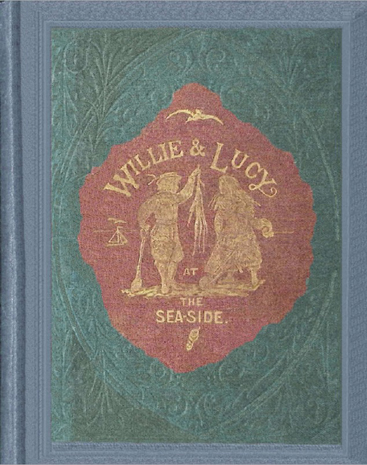
Title: Willie and Lucy at the sea-side
For very little children
Author: Agnes Giberne
Release date: January 28, 2026 [eBook #77801]
Language: English
Original publication: London: The Religious Tract Society, 1868
Other information and formats: www.gutenberg.org/ebooks/77801
Transcriber's note: Unusual and inconsistent spelling is as printed.
FOR VERY LITTLE CHILDREN.
BY A. G.
[Agnes Giberne]
LONDON:
THE RELIGIOUS TRACT SOCIETY
56, PATERNOSTER ROW; 65, ST. PAUL'S CHURCHYARD;
AND 164, PICCADILLY.
LONDON:
PRINTED BY WILLIAM CLOWES AND SONS, STANFORD STREET
AND CHARING CROSS.
CONTENTS.
CHAPTER.
WILLIE AND LUCY AT THE
SEA-SIDE.

WAKING.
"WAKE up! Wake up! Master Willie."
Willie Gray rubbed his eyes, and sat up in the bed. Then he lay down again, and hid his face in the pillow.
"I'm so sleepy, nurse. I don't want to get up yet."
"Not get up yet, Master Willie, with the sun shining, and the birds singing like this? See;" and she drew the curtains aside, letting a bright sunbeam stream on his rosy face and tumbled hair—"it would be a shame to sleep any longer."
Willie's eyes were open by this time, and nurse added, "You forget, I think, where we are all going to-day."
"To the sea-side!" said Willie, clapping his hands, and wide awake at last. "Oh, nurse, are we really going?"
"To be sure we are, Master and a long journey we have before us too, while you are lying there and wanting to go to sleep. There is no time to be lost. Come, jump up, and dress as fast as you can. Why, Miss Lucy is twice as quick as you."
This made Willie jump out of bed, and set to work in good earnest. With nurse's help, he was very soon dressed, and then he knelt down to say his morning prayer, asking God to forgive his sins, to make him one of Jesus Christ's little lambs, and to bless his dear papa and mamma and little sister. Willie had been taught to say his prayers slowly and gravely, and to think all the time of what he was saying. He knew that if he looked about the room, and thought of other things, he could not hope that God would hear him.
This morning his mind was so full of the journey that he found it very hard to attend to what he was saying, but he kept his eyes shut, and tried not to let such thoughts come into his head. Then he stood up, and said his pretty morning hymn, and nurse read to him a few easy verses in the Bible, and then Willie gave her a kiss, and ran out of the room.
Such a bustle the house was in! Boxes were standing, packed and corded, in the hall, and there was papa at a side table, very busy over a great basket, which he was filling with buns, and biscuits, and cold chicken, all to be eaten on the way.
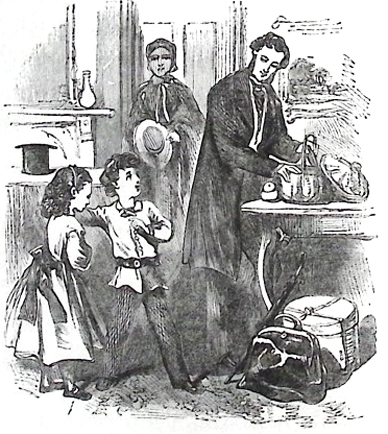
Little Lucy, Willie's sister, who was only five years old, stood looking on very gravely. She was a year younger than Willie, and Willie always felt as if he were a great deal older than she was.
"Lucy, isn't it nice?" he said to her. "Don't you think the journey will be fun? I do."
"No, I don't like it," said Lucy, shaking her head. "Nurse says there will be a great noise."
"Oh, but a noise won't hurt you, Lucy. It will be so nice to go on—on—faster than you can think. I want so much to see the train. You need not be afraid of it, Lucy. I'll take care of you."
"But you are not big enough," said Lucy, with a sigh.
And Mr. Gray stopped for a moment in his work of packing, to look down and ask—
"What is the matter, my little girl?"
"She's afraid of the train, papa," said Willie. "But she needn't be. I'll take care of her."
"You!" said Mr. Gray, with a little smile.
"I'm six years old, papa," said Willie, holding up his head, and wishing very much that he were taller.
Mr. Gray had a bag of biscuits in his hand, which he was just going to stow away in the basket. But he put it down for a minute, and patted Willie's head.
"I have no doubt you will do the best you can, my boy. But if papa and mamma and Lucy had no one to take care of them except their little Willie, I don't think they could feel very happy at going such a long journey."
"'You' can take care of yourself, papa," said Willie, rather surprised, and Lucy said the same.
"No, Lucy, papa can't take care of himself," said Mr. Gray, looking down gravely at the two little faces. "Papa is much bigger and stronger than either Willie or Lucy, but still he is not big enough or strong enough to take care of himself. Willie can tell me who can take care of us all."
"God can, papa," said Willie softly.
"Yes, Willie, and we must ask God to watch over us on our journey, and all the time we are away from home."
"And when we come back too," said Willie gravely.
"Quite right, Willie. We should never be happy to pass a single day, without feeling that we have prayed God to guard us and watch over us, for Jesus Christ's sake. And my little Lucy need have no fears about the journey. Willie might wish to take care of her, and might not be able, but God is able and willing too."
Willie and Lucy stood looking on in silence for a few minutes, while Mr. Gray began again to pack the basket. Presently he shut down the lid, and tied it tight with a piece of string.
"Now, Willie, will you run and see if mamma is in the parlour, and tell her I am ready for breakfast as soon as she can give it to us."
Willie ran off, and found his mamma waiting, so he came back to tell his papa. Then he went again to the parlour, and rang the bell for family prayers, and put out the large Bible. After prayers, they all had breakfast, and a little later started in a fly for the station.
————————————
THE JOURNEY.
MR. and Mrs. Gray, with Willie, Lucy, and nurse, stood on the platform at the station, waiting for the train to come up. Lucy clung tight to nurse's hand, almost wishing herself at home again, and too much afraid of all the noise and bustle to feel very happy. Willie tried to cheer her up, but she only hid her face in nurse's dress, and then Willie grew a little cross, and told her she was "very silly."
"Hush, hush, Willie," said Mrs. Gray gently. "Lucy is not silly, but she is a very little girl, and does not know any better. Another time she will not mind the train, but now it is all new to her, and it frightens her."
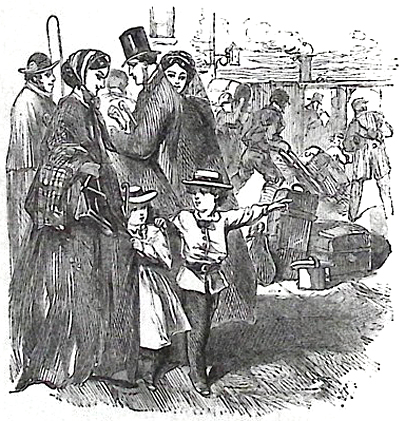
"It doesn't frighten me, mamma."
"No, because you are older than Lucy, and you are a boy too. Boys never ought to be cowards, and I hope some day Lucy will not be one either. See here comes the train."
Brave as Willie thought himself, he could not help stepping close up to his mother's side, when there was a shrill whistle, and the great train rushed up, with its snorting puffing engine, going slower and slower till it quite stopped.
Mr. Gray took Lucy in his arms, and Mrs. Gray gave Willie her hand, and in another minute they were all seated safely in the train. They hardly had to wait at all, before there was another whistle and they moved off, gently at first but more quickly every moment.
Willie looked out of the window for some time, and could hardly help laughing to see all the fields and houses and trees looking just as if they were running away. After a while, he grew rather tired of the window, and began glancing about the inside of the carriage where they were—at the seats, the lamp, the old gentleman in the corner, and the two ladies near him. He was rather puzzled to think what the lamp could be for, and was just going to ask his mamma, when there was a loud sharp whistle, a rushing noise, and they were in perfect darkness, except for the glimmer of light from the roof.
Willie was half afraid, but he felt his mother's hand on his shoulder, and he could see a smile on her face, though the noise was too great to allow of talking. Mr. Gray leaned forward, and said very loud,—
"This is a 'tunnel.'"
And Willie made up his mind to ask by-and-bye what it all meant.
When they came out again into daylight, poor little Lucy was crying in nurse's arms, so Mrs. Gray took her on her lap, and gave her a biscuit. Then Willie had a game of bo-peep with her, but at this, the old gentleman in the corner looked very cross, and said something about "noisy tiresome children!" to the lady by his side. Mrs. Gray told Willie not to laugh quite so loud, and Willie did as he was told, but he thought the old gentleman as tiresome as the old gentleman had thought him.
"I'll ask mamma why he should mind my laughing," he thought. "That's 'two' things I want to know."
By-and-bye they stopped at a station, and Willie thought this a good time to ask the first of his questions.
"Papa," he said, "what is a tunnel?"
"Did you ever see a hill, Willie?" asked Mr. Gray.
"Oh, yes, papa—numbers of hills."
"Not so very many, my boy. Still you know what a hill is. Now suppose I wanted to make a railroad from my house to Mr. Brown's, how should I manage when I came to Heath Hill?"
"Make the train go round, papa," said Willie.
"But that would take it so far out of the way. Think of some other plan."
"Couldn't the train go over the hill?" asked Willie.
"No, uphill will not do. The path must be nearly if not quite level—that is, flat—for the train. Heath Hill is very steep."
"Is a tunnel made under the ground, then?" asked Willie slowly.
"That is right, Willie. You have found it out now. I should make a tunnel under the hill for the train to go through. Do you not call that a good plan?"
"I do not know. It makes such a noise, papa," said Willie, rather gravely.
"Who was it that I heard this morning, saying, 'Oh, a noise won't hurt you, Lucy'? You are not so brave now as then, Willie."
"Yes, papa—I'm not afraid," said Willie, sitting up straight. "I won't mind the tunnel next time at all. I did not this time so much as Lucy."
"Lucy is too young to know any better yet. But you are old enough to learn what a tunnel is, and not to be timid about it."
"Are people never hurt in a tunnel?" asked Willie.
"Sometimes they are. And sometimes people are hurt when they are driving, and sometimes when they are walking, and sometimes when they are sitting quite quiet in the house. No one can be hurt anywhere, unless it is the will of God; and if it is, then we shall be hurt wherever we are."
"Then no one ought to be afraid," said Willie.
"No one, Willie, who can feel that God is his Father and will take care of him."
The train was now moving on again, but the cross gentleman and the two ladies were gone, so Mr. and Mrs. Gray, and Willie, and Lucy, and nurse were alone.
Willie could not help saying, "I am glad he has gone, mamma. He didn't like to see me playing."
"He did not like to hear my little boy's noisy laugh," said Mrs. Gray, with a smile.
"But, mamma, I wasn't near him."
"Near enough to disturb him in his reading, I suppose. Always try, Willie, not to disturb grown-up people by talking and laughing too loud when they are busy. If you do, they will be sorry to see you come, and glad to see you go. You would not like that?"
"No, I should like them to be glad to see me, mamma."
"So they will be, Willie, if you are a gentle polite boy, and think more of what other people like than of what you like yourself. Noisy, rude, tiresome children are always in the way."
"But you don't mind my laughing, mamma?"
"Not unless I am busy, then I like to be quiet. Perhaps the old gentleman in the corner was busy. At any rate, you should always be quiet when you are asked, Willie. Don't forget that, dear."
"I'll try not, mamma," said Willie, rather gravely.
THE SEA.
"HERE we are, Willie! Now for the sea! How fresh and salt the air feels!"
"Lucy is asleep, papa," said Willie, rubbing his own eyes, and trying to look very wide awake.
"Some one else has been asleep, too, I think," said Mr. Gray, smiling. "Never mind; you will feel lively enough after a good night's rest. It has been a long journey, and you will be glad of your tea, and your bed."
They were now stopping at the station. Mr. Gray stepped out, and lifted Willie and Lucy upon the platform. Then he made a porter bring their boxes into the road, and put them on a fly, while they all got inside.
"Now, Willie, look out," said Mr. Gray, as they drove off.
And Willie did look out. He had never yet seen the sea, and he could not at all fancy what it was like. By-and-bye he saw a gleam of blue between some houses, and clapped his hands.
"Oh, papa! Was that the sea?"
"That was the sea, Willie. There it is again. You did not look in time, did you? But we shall drive along the parade in front of it in a minute, and then you will see it plainly. Here we come! Now look out!"
Willie looked again, and at last said with a little sigh:
"It's very pretty and blue, papa, and very big. I think if it wasn't so big, it would look like our pond at home."
"You will not think so, Willie, when you have seen it with great waves dashing about, and the spray flying in the wind. It is very still to-day. But you will soon change your mind about its being only like a pond."
"Shall I find any shells on the shore?" asked Willie.
"I hope so. Shells are almost always seen on sandy shores. You must dig holes in the sand too, and make hills and towers and all kinds of things."
"But I don't know what to dig with, papa."
"We will soon manage about that," said Mr. Gray, with a smile. "Do you think we could find a spade in the shops for those little fingers?"
"A spade! Oh, thank you, papa. Like what Rogers uses?"
"Not 'quite' so large as that, and it must be of wood. Lucy shall have one too."
"A small one," said Willie, looking down at Lucy's tiny hands.
"Yes—smaller than yours. Nurse will take you out on the shore, and sit and work while you dig, and I hope you will be very happy. Now we must get out. This is to be our home while we are at the sea-side."
Willie looked up at the house. It was not facing the sea, but was some little way up a side street. There was a small garden in front, up which Willie ran the moment he was out of the fly. Then he waited for his mamma, and she took his hand, and led him upstairs to the sitting-room, where the tea-things were laid out. Hats and bonnets were taken off, and sleepy little Lucy woke quite up over her milk and bread and butter. Willie thought he had never been so hungry in his life, and it was a long time before he had done his tea.
Then Lucy was taken off to bed, that she might be quite rested and fresh in the morning. Willie begged hard to go on the shore, and Mr. Gray said he would take him for a little while. So Willie fetched his cap, and they went out, down the street, across the parade, and then over the soft crisp sand.
Willie ran and jumped about, and hunted for shells, and almost shouted aloud with glee. The tide was now coming in, and the water was less smooth than before. Bright dancing waves rolled up, and broke on the beach, and Willie stood close at the water's edge, jumping back just in time to escape a wetting. Once or twice he was very nearly caught.
There were not many shells to be seen, but he found a few, and put them into his pocket to give to Lucy. Like a kind little boy, he thought that as he had had the pleasure of the first walk, Lucy should have the pleasure of the first shells.
"Well, Willie, it is time to think of going home now," said Mr. Gray, at last, and Willie came up at once. "What do you think of the sea now? Is it no better than a pond?"
"Oh, papa, a great great deal. It isn't a bit like a pond now. I never saw such waves!"
"These are very small waves, Willie. Perhaps some day before we leave, you may see some really large ones. Now we must go home, for it is time that little boys should be in bed after such a long journey. In the morning, I hope you will have a nice game on the shore."
Willie gave a wistful look up into his father's face, and Mr. Gray saw what he was thinking of.
"You will want the spades, will you not? We must see what we can do. Now take one more look at the sea, and then we must leave the beach."
Willie did so, and turned away with a sigh of delight, as he said:
"Papa, I think the sea is the best thing in all the world!"
"Wait till you have seen all the world, my boy, before you decide. But I quite agree with you in thinking it a most grand and lovely sight. I have never yet seen anything that I could enjoy more."
"And only think, papa—a month or six weeks here," said Willie, as they walked over the parade. "Such a nice long time! I do hope it will be fine."
"Very likely it will much of the time. Sometimes of course we must expect rain, and then I hope you will bear it with good-temper, and amuse yourself indoors as well as you can. Here we are at the house. Now good-night, and run upstairs to nurse."
Willie did so, and was soon ready for bed. Lucy was asleep, so he kept the shells to give her in the morning, and in a little while he too was asleep and dreaming of the sea.
————————————
SPADES AND SAND.
NEXT morning Willie gave Lucy the shells he had found, and she was very much pleased with them indeed. She jumped out of her bed, and gave him a kiss, and thanked him over and over again, saying—
"How kind of you, Willie! But don't you want them?"
"No, I would rather you should have them, Lucy. And we will try to find some more to-day."
Breakfast time soon came, and when the meal was over, nurse told Willie to get his cap, and then to keep quiet while she dressed Lucy, for they were going out on the shore. Willie found it very hard to stand still, while he was so happy; but he knew that if he jumped about, Lucy would want to do the same, so he only walked to the window and stood there, swinging his cap, and begging nurse to "make great haste."
At last they left the house, and Lucy held nurse's hand tight, and looked shy and timid as she always did in new places; but Willie wanted to scamper about, and did not like being called back by nurse.
"I am sure I shan't lose myself, nurse," he said, "and I won't get into mischief. Let me run along the parade, or down on the sands. Are we not going on the shore?"
"In a few minutes," nurse replied. "And don't run so far away again, Master Willie, or I shall be losing sight of you."
"But if you did, I could find my way home," said Willie, feeling a little bit inclined to be cross at not being allowed to run as far as he liked.
"But what do you think your mamma would say if I went home without you?" asked nurse. "No, no, Master Willie, you must be a good boy, and do as you are told, or I shall have to hold your hand and make you walk by my side. Here we are at the shop. Do you think you can help me choose two nice spades?"
Willie looked up with a smile, and clapped his hands.
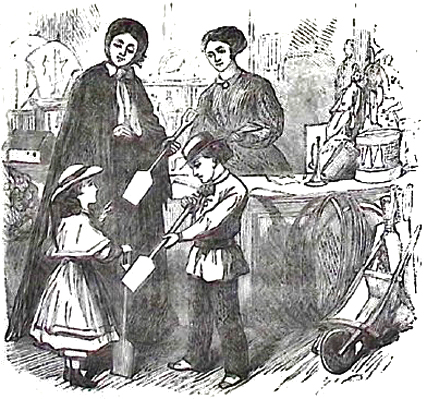
"O nurse! How kind! Are we going to have them now? Did papa say so?"
"Yes, and here is the money," said nurse.
Then she told the shopwoman to show them some wooden spades, and very soon two were chosen and paid for,—a small one for Lucy, and a rather larger one for Willie.
How grand Willie felt as they walked towards the beach, and he swung his spade about! Nurse told him to carry it gently, but he forgot once or twice, and at length nearly knocked a little boy with it. Then nurse almost took it away from him, but Willie begged her to try him once more, and said he would be very careful, so she gave him one more trial. This time he did not forget, and as he did not swing it again, nurse let him carry it all the way.
When they reached the beach, she sat down on the sands, and took out her work. Willie and Lucy began digging holes near her, and trying which could dig the deepest. Of course Willie was the strongest, and made the largest hole, so he came and helped Lucy to make hers bigger.
"May we go down close to the water, nurse?" asked Willie after a time.
"If you will not get into any mischief," said nurse. "And Miss Lucy too? Well, you must take great care of her, and both of you must come back to me in a moment if I call you. I can't sit down there, for the sand is too flat and not dry enough, and I must get on with my work, for your mamma wants it done. But you may go if you like, only be very steady and careful."
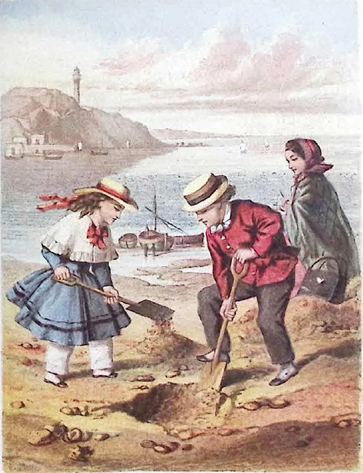
Willie took Lucy's hand, and they ran down the beach, till they were close to the rippling waves, which rolled up and broke upon the wet sparkling sand. Willie began digging again, and was pleased to see his hole fill with water. Lucy tried to help him, but she could not manage her spade very well, and sometimes she knocked the sand into the hole, instead of taking it out. Willie bore it once or twice without a word, and then he asked her to take more care. Lucy tried, but again her spade slipped, and down went a lump of wet sand into Willie's nice large hole. Willie began to grow angry.
"Lucy, you tiresome girl!" he cried. "I won't dig with you at all, if you spoil my holes like that. Look what you have done!" And he stamped his foot on the ground. "How can you be so stupid?"
Poor little Lucy's eyes filled with tears, and her cheeks flushed, as she dropped the spade and stepped back. Willie did not mean to frighten her; but he still felt too vexed to say he was sorry for his unkind words, so he only turned his back to her, and began throwing stones into the sea.
"Willie, I didn't mean to do it," said Lucy at last, in her soft timid voice.
"You should take care," said Willie, turning round to her again. "You spoil my holes when you knock the sand about like that."
"I won't do it again," said Lucy in a trembling voice, and with a little sob. "Please don't be angry, Willie."
How could Willie be angry any longer before that gentle little face. He walked up to her, and gave her a kiss.
"There! You're a dear little thing, and I'm a cross boy, Lucy. I won't scold you any more now. You shall dig as much as you like, only don't throw sand into this one great hole, because I want it to be very big."
"I can't dig," said Lucy sadly. "I don't know how, Willie. I'll look at you."
"Well, I'll tell you what, Lucy; we won't dig any more holes, but we'll make a great high hill of sand, and then I'll stand on it while the water comes up all round me. Won't that be nice?"
Lucy looked bright again, and in a minute they were hard at work, piling up the sand and throwing on fresh spades-full, till it really was a very large heap to have been made by such little people. Nurse came down to see what they were about, and she was glad to find them so happy. But Lucy was growing tired and hot, so she took her back with her to sit quiet. Willie told nurse what he was making his hill for, but she shook her head.
"No, that won't do, Master Willie. I shall have you tumbling into the water."
"But indeed, nurse, I can 'quite' well jump to shore again, when the water is all round it," said Willie.
"No, I can't have you do it, Master Willie. The water is coming in so fast that it would be round you before you knew what you were about; and suppose you should jump into the water instead of on dry land!"
Nurse went away as she spoke, taking Lucy with her. Willie stood in no happy mood, gazing at the hill which had cost him so much trouble, and feeling not a little cross.
"It's too bad," he said to himself. "Nurse treats me as if I were a little baby, and she forgets how old I am. It would be so nice to stand on the top, and see the water come all round me. I wish mamma were out here. I am sure she would let me do it."
What a silly little boy Willie was, to make himself so cross about what he could not do, instead of being happy about what he could do. He stood and looked at the hill, watching the water creeping higher, and the little waves breaking against it; and every moment the longing grew stronger to stand if but for one moment on the top.
"It couldn't do any harm," he said again. Oh, Willie! "No harm" when nurse told you not to do it!
"I could easily jump there and back," he thought, "and I wouldn't stay there. It looks just like a little island when the water runs up all round it like that. Nurse thinks I can't do anything. I have a great mind just to try. Nurse isn't looking, nor Lucy either."
All this passed through Willie's mind a great deal faster than it can be written down. What a pity it was that Willie should allow himself to look on so long, and to wish so much for what he knew he ought not to do. He did not think of asking help from God, who is always willing to give it; and little Willie had no strength in himself to conquer the naughty wishes that were tempting him to do wrong.
He looked again to see if nurse saw him, but she was busy with her work, and Lucy's back was turned. Willie still paused a moment, and then the desire became too strong to be overcome.
He gave a leap and reached the top of the little mound, meaning to jump back in a moment. But it had been thrown up very loosely, and the waves had even now soaked in beneath, and washed away part of the sides, and the soft wet sand gave way in an instant under Willie's feet.
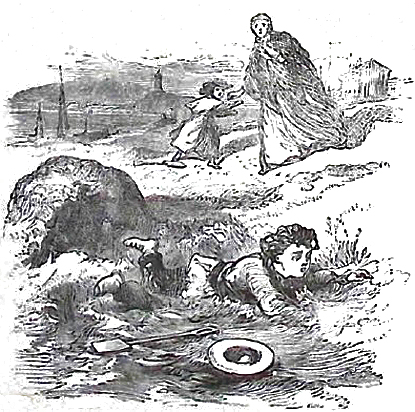
Down he went, and splash!—He fell on his face into the middle of the next wave that came dancing up.
WILLIE IN BED.
WHAT a shriek Willie gave! Poor nurse was startled, indeed, to hear it, and still more to see Willie going down with such a splash into the water. She jumped up, and ran down the beach as fast as she could, while poor Lucy came crying after her. By the time they reached the water's edge, Willie had managed to struggle to his hands and feet, and to scramble back to shore.
Very wretched he looked, dripping with water from head to foot, and with tears of mingled alarm at his fall, and fear of nurse's anger, running down his cheeks.
"Oh, Master Willie!" was all nurse said. "I thought I could trust you to do as you were told. You must come home now as fast as you can, and take off your wet things. I don't know what your mamma will say."
Willie began to sob; but nurse hurried him up the beach and towards the house, while the water ran from his clothes, making little puddles on the parade and the road; and people turned in great surprise to look at the wet tearful little boy, and to wonder what was the matter.
Mrs. Gray was not in the house, rather to Willie's relief, for he dreaded her hearing all that had passed.
Nurse took him upstairs, and after pulling off his soaking clothes made him get into bed. Willie did not like this at all, and begged hard that he might sit up, but nurse would not allow it.
"No, Master Willie," she said. "If it was not your own fault, I would let you put on your best things; but now it is all through your being so naughty as to do what I said you must not, you must lie in bed till your things are dry. Now, Master Willie, if you cry and make a noise, I shall have to punish you by keeping you there longer still," she added. "You should be a wise boy, and show you are sorry for being so naughty, by being now as good and quiet as you can."
"It's so hard to lie in bed," sobbed Willie. "I don't like it at all, nurse. It is so unkind of you."
"I don't wish to seem unkind, Master Willie," said nurse gravely. "But when you don't obey me, I must punish you for it. You know very well that your mamma will say I am quite right. It would be no real kindness to pass it over, and treat you as if you had been a good little boy."
But Willie felt cross and angry with himself, and therefore with every one else besides. He rolled about in the bed, and sobbed aloud, until nurse left the room, hoping he would be more quiet alone.
When there was no one to hear him, Willie did not care to go on crying, and he quite left off, until there was a step outside the door, and Mrs. Gray came in. Then the tears began to fall again.
"Willie! Willie! I am sorry to hear this of you," she said, sitting down on the bed, and speaking sadly. "I did hope my little boy could at least be trusted to do what he was told."
"It is so unkind of nurse to put me to bed," sobbed Willie.
"No, Willie, not unkind. Nurse is never unkind. She was quite right to punish you for such conduct."
"I didn't mean any harm, mamma. I thought the sand was quite strong."
"Willie," said Mrs. Gray, "what had nurse told you only five minutes before?"
Willie twisted his face away, and almost hid it in the pillow.
"Nurse thinks I can't do anything, mamma. I'm not a little baby now!"
"No, but I am afraid you are likely to become something much worse, Willie, if this is the way you mean to behave," said Mrs. Gray, so sadly, that Willie could not help looking at her.
Were those tears in her eyes? Willie could not quite bear that, and he jumped up and put his arm round his mother's neck.
"Mamma, I didn't mean to make you sorry. I'll try not to do it again."
"Indeed, Willie, I hope it is the last time I shall hear of such a thing. You have grieved me very much this morning."
"I am sorry, mamma," said Willie.
"If you are really sorry, Willie dear, you know that I am quite ready to forgive you. But there is One whose pardon you ought to ask even before mine."
Willie hung his head.
"I know, mamma," he said, in a low voice.
"And will you do it, Willie?" asked Mrs. Gray gently. "May I hope that my little boy will indeed ask God to forgive him for Jesus Christ's sake, and to keep him from such naughty conduct in the future."
"I'll try, mamma," said Willie softly.
Mrs. Gray kissed him, and then went on:—
"Now, Willie, I want to ask you one or two questions. Did you really think this morning that you—a little boy of six—could judge better than nurse of what you ought or ought not to do?"
Willie's face grew red, and he hung his head again.
"I don't know, mamma. I thought I was big enough to take care of myself. Nurse always fancies that I can't do things."
"You see now, Willie, that nurse knew better than you did. If you had done as she told you, you might have been playing out on the sands all this time, instead of lying here in bed."
"Yes, mamma," was all Willie could say, for he felt very tearful at the thought of the bright sunny shore and sparkling waves.
"I daresay, Willie, that you thought it a rather grand thing to do what you were told not to do. You felt very big and old,—did you not?—almost too old to obey nurse."
Willie blushed scarlet, for Mrs. Gray had just guessed his thoughts.
"Well, Willie, I do not think you ever made a greater mistake in your life. You will find when you grow older that the best and greatest and wisest men in the world are almost always those who are the most ready to 'obey' when it is right."
"Shall I, mamma?" asked Willie.
"Indeed you will, dear. And, Willie, when the Lord Jesus Christ was a little child, he did not think himself too wise or too old to obey his mother and Joseph. And yet they were only a poor carpenter and his wife, and knew very little, while he was the Son of God, and knew more than any one in the whole world. Can you tell me a verse which I showed you last Sunday, proving that he did obey them?"
Willie thought a minute, and then said:
"Wasn't it after he had been in the temple, mamma, and the Bible says, 'He was subject to them?'"
"Quite right, Willie. I am glad you do not forget. You can tell me what 'subject to them' means?"
"He did what they told him," said Willie.
"Yes, Willie. And yet, though only a child of twelve years old, he could answer and perplex all the grave learned doctors, and amaze them with his wisdom. If ever a child might have thought himself too old and too wise to obey his parents, surely the Lord Jesus might have done so."
"He was 'so' good," said Willie, slowly.
"Yes, Willie, he was so good and holy, too humble and meek for any such thing. Willie, will you try and take the Lord Jesus Christ for your pattern?—Try and act like him?"
"I don't know how," said Willie gravely.
"Not know how?" said Mrs. Gray gently. "Willie, there is only one way in which you can do it, and that is to become one of his little lambs. The only way is to go to him, and ask him to wash away all your sins in his precious blood, and to give you a new heart, and to make you meek, and gentle, and loving, like himself. You are a very little boy, but you are not too young to serve the Lord Jesus Christ."
"I don't know how," said Willie again, in a low voice.
"There are many ways, Willie, in which even a little boy like you may serve him. By always doing what you are told, and by being kind and gentle to all, and by giving up your own will for the sake of others, and by striving to honour him in your conduct. If it is all done out of love to Jesus, then you are serving him, but not if it comes only from the love of praise or the fear of blame."
"I should like to be good, mamma," said Willie.
"So should I like to see you so, Willie. You know that no one in the world is ever truly 'good,' or ever has been so, except the Lord Jesus. But I cannot tell you how happy it would make me to know that my little boy was indeed one of his little lambs. Jesus is so ready to receive little children, Willie. He will never cast out one of them that come to him. And his promise is that those who seek him early shall find him. You can tell me the verse I mean."
"'I love them that love me, and those that seek me early shall find me,'" said Willie.
"Right, dear. Try not to forget that, Willie. I must leave you now, for I am wanted in the drawing-room. But I hope that when nurse comes in, you will tell her you are sorry for having done what she told you not to do."
"I'll tell her, mamma," said Willie rather slowly, and Mrs. Gray kissed him.
"I am sure you 'feel' sorry for it now, Willie. If it is a little hard to tell nurse so, you must not mind, for it is the right thing to do."
"Mamma, I always do what you and papa tell me," said Willie.
"I hope you do, Willie. What do you mean, dear? What is it you want to say?"
"Nurse isn't the same," said Willie, blushing and half afraid.
"Not the same, Willie! Not when papa and I have chosen her to take care of you, and trust you with her? Did you not know it was my wish that you should obey her? Have I never told you to do so?"
Willie hung his head.
"If you do not obey nurse, it is the same as not obeying me, Willie," said Mrs. Gray. "I hope you will not forget this again."
"I'm sorry," said Willie, raising his face. "I'll tell her so, mamma, and I'll try never to do it again."
"With God's help, Willie," said Mrs. Gray gently, and after giving him one more kiss she left the room.
Nurse came in soon after, with the now dry clothes in her arms, and Willie did not forget his promise. He felt much more happy when nurse kissed him, and told him she quite forgave him.
A DONKEY RIDE.
"WHO wants a ride on a donkey to-day?" asked Mr. Gray one morning, about a week after their journey to the sea-side.
"Oh papa!" "Oh papa!" cried Willie and Lucy at once.
"What, both of you? How are we to find so many donkeys, do you think?"
"Oh papa, may we really have a ride?" asked Willie. "How kind of you!"
"Would you like it better than digging in the sand? Because you know you can't dig when you are perched up on the donkey's back," said papa, looking very funny.
And Willie and Lucy laughed.
"Oh, we'll leave our spades behind, papa," said Willie. "Won't it be nice, Lucy? But will Lucy be able to ride?"
"Yes, we must find her a donkey with a nice high saddle—a saddle with sides and a back, so that she cannot well fall off."
Lucy was soon dressed, and she and Willie went down to the beach with Mr. Gray.
A great many donkeys stood there, and a great many boys were taking care of them. Each seemed very eager for 'his' donkeys to be taken, and they called out so loud, and crowded round so close, that Willie was half afraid, and Lucy clung closely to papa's hand.
But Mr. Gray soon fixed on two nice clean-looking donkeys, lifted up Lucy, helped Willie to mount, and in a minute more they were off.
Lucy looked grave, and held her papa's hand, as he walked by her side, but Willie was not a bit afraid. He jogged up and down, trying to make his donkey go faster.
"Papa, mayn't I have a real gallop?" he asked. "The donkey won't go fast."
"Gallop, my boy! I don't think you would keep your seat long, if you tried a gallop. This is the first ride you have ever had, you know."
"Oh, papa, I should keep my seat I am quite sure. I saw a little boy just now, hardly bigger than Lucy, and he was going quite fast."
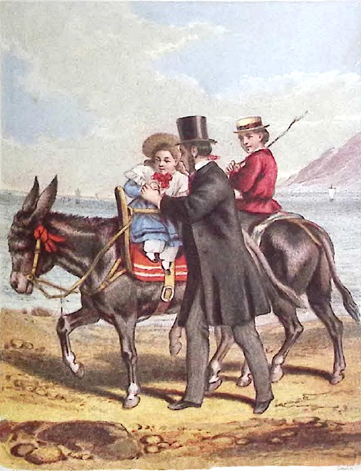
"I daresay he had often been out riding before, Willie."
Willie's face looked rather cloudy, and he said, half to himself—
"I'm sure I shouldn't fall off."
"Willie," said Mr. Gray in a quiet tone, "did you ever hear of a little boy who was quite certain he could jump upon a sand mound that he had made, when his nurse told him not."
Willie grew rather red.
"Well, papa, I won't say, I'm 'sure,'" he said, after a pause. "But won't you let me go a little faster, and I'll try not to fall off."
"That is right, Willie," said Mr. Gray, with a smile. "I like to see a little boy who can allow that he has been in the wrong or made a mistake. Yes, you may go faster if you like, but hold on tight."
A stroke from the donkey-boy's stick made the donkey start off at a trot. Willie soon felt that he was not quite so sure of his seat as he had fancied, and he was glad he had not tried to gallop. Soon the donkey went more slowly again, and then Mr. Gray and Lucy came up. Willie asked his papa where they were going.
"Do you see those rocks, Willie, on the shore-low dark rocks, down to the water's edge?"
"I see, papa. Are they pretty rocks?"
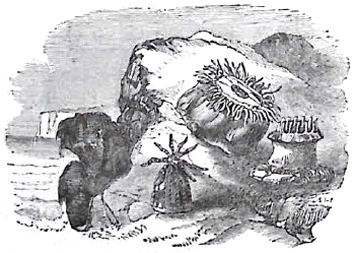
"Not very. That dark colour is from the sea-weeds which grow over them. But I want to find some 'sea-anemones' to show you."
"An-em-o-nes," said Willie slowly. "I don't know what they are, papa. Are they alive, and do they live on the rocks?"
"Both. They are living creatures, and they fasten themselves to rocks, where they stay and catch food with what you would call their 'feelers.'"
"Like the feelers of a butterfly?" asked Willie.
"No, the feelers of a sea-anemone are soft and fleshy, and there are a great many of them. Sometimes they are of lovely colours, and when they are opened out, the anemone looks like a bright flower in the water."
"Oh, how pretty, papa! I hope we shall see one."
"I am afraid we shall not find any here with very bright colours, Willie, and now the tide is low, they will very likely be all shut up. But we will do our best."
Soon the rocks were reached, and Mr. Gray lifted Lucy and Willie to the ground. Mr. Gray held Lucy's hand, and led her on the rocks, while he told Willie to take care that he did not slip on the wet slimy sea-weeds. He soon found a small anemone, and called Willie to see it, but it was shut up, and Willie thought it very ugly.
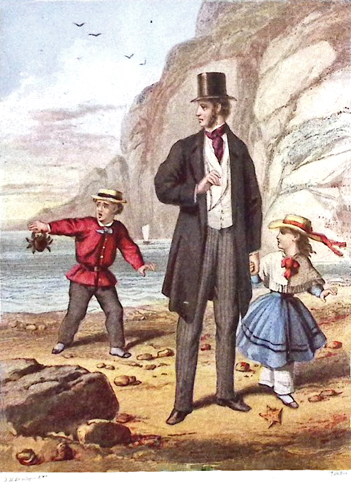
Then Willie found a crab, and he took hold of it, but it pinched his fingers, and he let it fall, with a cry.
"What is the matter, Willie?" asked Mr. Gray.
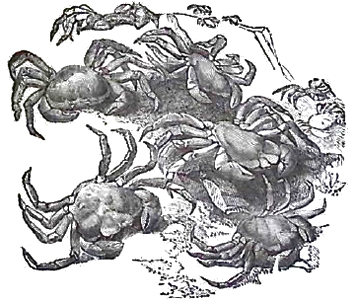
"Only a nasty crab, papa," said Willie, squeezing his finger. "He gave me a pinch when I took him up."
"Ah, you must take care how you handle crabs. See, here is a fine large one. Look how he runs."
"He goes sideways," said Willie. "I've seen the little wee crabs do that on the sand. I'm glad I didn't take up that one. He is so big that he would have pinched me very hard. Oh, papa, what is this? May I take it up, or will it hurt me? Is it alive?"
"Yes, but it will not hurt you. It is called a star-fish."
Willie and Lucy both felt the rough pink skin, which was as hard and stiff as leather, and Willie asked how it could walk, with "five legs sticking out all round."
"Those are not legs," said Mr. Gray. "They are called rays. The legs, or rather the feet, are on the rays, and are very small indeed."
"What a funny thing it is," said Willie.
"There are many strange creatures found in the sea, Willie. God has made as many wonderful things in the sea as on land. Do you know there is one kind of star-fish, which, when you touch it, seems to go into a passion and throws off its rays."
Willie and Lucy both laughed at the idea of the little star-fish throwing off his rays, and Willie said—
"It would be very funny, I think, if Lucy and I were to throw off our arms and legs when we are angry."
"Worse than funny, Willie, for it would be very wrong if such a thing could be," said Mr. Gray. "It is always wrong for little boys and girls to be angry. But the star-fish does not know any better, and cannot learn. Now look into this pool, and tell me what you can see."
"Fish, papa—oh! What dear little fishes!" cried Willie. "And what are those?—Are they fish too?"
"No, they are prawns," said Mr. Gray. "Did you never hear of prawns?"
"Oh yes, I've seen them in the shops," said Willie, "and they are like big shrimps. But I thought they were red."
"When they are cooked," said Mr. Gray, laughing. "And so are crabs and lobsters. But you don't find them ready cooked on the sea-shore."
Willie grew as red as the boiled prawns, at his own mistake.
"Never mind, Willie," said his papa kindly. "A little boy who has never been to the sea before, cannot of course know such things. You will be wiser now. I think it is time to return to the donkeys, and to go home. Perhaps some day we will come here again, and stay longer."
"I am glad we have been," said Willie. "I shan't forget what we have seen. Some crabs, and some prawns, and some fishes, and a star-fish, and a sea-anemone."
A RAINY DAY.
"OH, mamma, a rainy day! I'm so sorry," sighed Willie.
"Well, Willie, I don't think we must complain. One day of rain after nearly a month of fine weather, is not so very bad."
"But we are going home in a few days, and perhaps it will rain all the time," said Willie in a very dismal voice.
"Not at all likely, Willie. I daresay it will be quite fine again in a day or two. It may even clear up this evening. Come, don't waste time in gazing out of the window. That will do you no good."
"I have nothing to do, mamma."
"Nothing to do! Where is that nice book papa gave you?"
"I have read it all through, mamma."
"Suppose you draw me a picture then. Here is a pencil, and a piece of paper."
Willie slowly sat down, and made a few listless strokes, then threw the pencil on the table, with a yawn.
"I don't know what to draw, mamma. I wish it would stop raining."
"Wishing won't do much good. Draw a picture of a little boy riding along on a donkey, or digging in the sand, or bathing in the sea."
"Oh, I can't, mamma. I don't know how to draw."
"Come, Willie, don't be pettish. I shall begin to think you have had too much fun and play, and want to go home again."
"I don't want to go home, mamma," said Willie, looking very downcast. "I should like to stay at the sea-side."
"Indeed, Willie, I should be sorry for you to do so much longer, if you cannot bear a single wet day here with good-temper. At home you can be happy enough when it rains."
"My toys and books are all there, mamma."
"Poor little boy! Well, suppose you come and hold this skein of wool for me while I wind it. That will be useful, at all events."
Willie did as he was asked, but he did not look any brighter. For a minute or two Mrs. Gray wound in silence, and then she asked in a cheerful tone—
"What has Lucy been doing all the morning?"
"Playing, mamma."
"Don't you think she would have been much more happy, Willie, if she had spent her time in gazing out of the window, longing for the rain to stop?"
"She doesn't mind staying in doors so much as I do," said Willie, hanging his head, and looking very much as if he wanted to cry.
"Because, I suppose, she has been too busy to think about it. What a pity you have not been the same. Take care; you are letting my skein slip off your hand. Now you must hold it quite tight while I undo this knot. That is right. What do you think papa said to me this morning?"
"I don't know, mamma."
"He was so glad to see the rain come at last."
Willie looked as if he thought such a remark very strange, to say the least. Glad to see the rain!
"You don't know why, do you? Rain is very much wanted just now in England. There has been so little that the grass is getting parched and dry, and if we were without it much longer, the harvest this year would be a very bad one."
"I don't like the rain," said Willie, in a low tone.
"Not for its own sake, perhaps; but for the sake of the poor, you ought to be glad to see it, Willie. It seems very hard to you to be kept in for one day, when you want to go out. But how do you think you would feel, if you were a poor little ragged boy, and knew that unless the rain fell, the corn would not grow, and bread would be so dear all the winter that you must expect to be often half-starved."
"I shouldn't like it," said Willie. "Are little boys often half-starved?"
"Very often, when their fathers and mothers have not enough money to buy all the food they want. And the more the bread costs, the less they can buy."
"Does it cost more when there isn't much rain?" asked Willie.
"Of course it does, Willie. You know that corn, like grass and plants, cannot grow without water, and if it has not enough, it is poor and stunted, and gives only a small supply of flour to make bread. Then there is less bread than usual, and people have to pay more for it. We have not had rain now for a long time, and only a day or two ago we heard that some farmers were very anxious about their corn. They were afraid that a great deal of it would be quite spoiled."
"Do they want much rain, mamma?" asked Willie, in a very sober tone.
"Not a very great deal, I daresay. But this nice steady down-pour is just what they wish for. There is one more reason why I never like to see little boys or girls pettish and cross about the weather. You know who sends the rain, or makes it fine, Willie?"
"Yes, mamma," said Willie.
"God sends it, Willie, and therefore it must be right, and the best weather we could have. Even when we cannot see that it is so, we ought to believe it."
Willie gave a sigh.
"I won't be cross any more, mamma. I'll draw a picture when the skein is done, and then I'll go and have a game with Lucy. She asked me to play, and I wouldn't."
"That is right, Willie. I am glad to see a bright face again. For your sake I hope the rain will not go on long,—not longer than is needed to make the corn grow."
ROUGH WEATHER.
IT rained all that day, and nearly all the next. Towards evening it stopped, but the wind was blowing hard, and Willie could catch a glimpse of the sea from his window, looking dark and rough, instead of blue and calm. He longed very much to go down on the shore, but so long as the rain lasted Mrs. Gray said he must stay indoors.
When it stopped, his papa said to him—
"Now, Willie, we will go out for half-an-hour. Ask nurse to wrap you up well, and we will have a little ramble."
Willie ran away in great glee, and soon came back quite ready. Lucy wanted to go too, but the wind was too strong and the ground too wet for her, so Willie went alone with his papa.
As they walked down the street and across the parade, Willie could hear the noise of the sea growing louder and louder. And when at last they stood on the shore, he held his father's hand, almost afraid of the sight before him. The wind blew hard and whistled in his ears, and the great waves rolled up and dashed down upon the shore, with such a noise that he could hardly hear his father's voice. He thought at first that it was raining hard, and asked if he should put up his umbrella, but Mr. Gray shook his head, and said—"No, it is only the spray."
Then Willie saw that it was nothing but the spray, blown by the wind from the breaking waves. A great many sea-weeds lay on the beach, and Willie found one very long piece of ribbon-sea-weed, which trailed on the ground, even when he held it up as high as he could in the air.
"May I take it home, and show it to Lucy, papa?" he asked.
"If you like," said Mr. Gray. "I daresay Lucy will like to see it. There comes a great wave, Willie!"
"It is such a nice noise," said Willie, jumping up and down. "Oh, look at that wave! I do wonder the sea doesn't wash away all the sand."
"I am not surprised at your wonder, Willie. But it is God's will that the weak soft sand should keep back the strong fierce sea. When we get home, if you will remind me, I will show you in the thirty-fourth chapter of Job, how God says that He has set bars and doors to the sea, and has said, 'Hitherto shalt thou come, but no further; and here shall thy proud waves be stayed.' But for that we might indeed expect to see the sand very soon washed away. You see it is the door that God has set to keep the sea in its place."
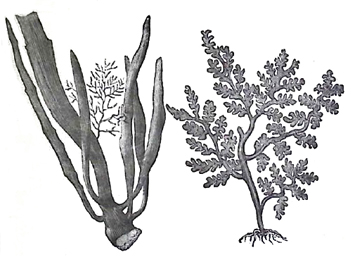
Willie and his papa stayed a little while longer, and then went home. Willie then gave Lucy the long piece of sea-weed, much to her delight.
"What a great long one it is," said Lucy, holding it up. "It is wider than my pink sash."
"Lucy, I wish you had seen the waves," said Willie. "Such big ones! Nurse, have you ever seen such great waves?"
"Ever seen them, Master Willie? Indeed I have seen much larger ones than ever you have, and what's more, I have been on them."
"Oh nurse!" and Willie came up close to her. "Have you really been on the sea? Was it very nice? Do tell me about it."
"It is very nice in fine weather, Master Willie, and I shouldn't mind it in rough weather if I wasn't seasick. Before I came to live with your mamma, I was with a lady who went abroad—out of England, that is—and I went with her."
"Did you go to France?" asked Willie.
"Yes, we went to France. And it was very nice in going, for the sun was shining, and it was as pleasant as could be. But in coming back, we had rough weather. The wind blew very hard, and the ship went up and down, and the waves dashed over the deck."
"Oh, nurse, were you wet through?"
"We were not on deck, Master Willie. It was too rough for any one to stay there except the sailors, and perhaps some of the gentlemen. I was very sick and ill, and I lay down on a couch just under the sky-light."
"I don't know what a sky-light is," said Willie.
"It's a window in the roof, Master Willie, like that which lights the hall at home, only this was in the roof of the cabin. Well, I lay under it, and all at once a great wave dashed over the deck, broke one of the panes, and down poured a stream of water upon me. I had to be pulled out of the way, for I was too ill to stand upright."
"Oh, nurse, how funny!" said Willie, laughing.
"I did not think it at all funny at the time, Master Willie," said nurse.
"But I should like to go on the water very much," said Willie. "I shall ask papa if he won't take me."
"What, on those great waves, Master Willie?"
"No, but when it is quiet again, nurse. It would be such fun. I daresay he will."
Willie ran off as he spoke, and found his papa in the parlour.
Mr. Gray was busy writing a letter, so, like a polite little boy, Willie waited till he had done, and then said—
"Papa, may I speak now?"
"In a moment, my boy. I must just direct this. That is right. Now, what do you want?"
"Papa, I want to know if you will take me on the water—I mean, if you don't mind."
"On the sea. I am afraid mamma would not quite approve of that to-day."
"I don't mean to-day, but when the sea is smooth," said Willie. "Nurse has been on the water, papa. She went to France."
"Yes, but that was in a steamer. I am afraid you must be content with a rowing-boat. We will try if we can manage it before we return home. Only we must wait for fine calm weather."
Willie thanked his papa warmly, and ran back to nurse, to tell her what Mr. Gray had said.
————————————
A ROW ON THE WATER.
THE rain did not go on many days, but the wind did, and the sea was much too rough for any boating. Even Willie, much as he longed for it, could not deny that those great tumbling tossing waves were not quite what he would choose.
"But people do have to go sometimes, papa, even when it is rough," he said one day.
"Often, Willie, and if it were our duty now, I would go at once and take you. But to put ourselves into danger merely for the sake of pleasure would be wrong."
"Would there be danger?" asked Willie.
"Not much, perhaps; but there might be danger to a small boat. And I love my little boy too well to wish to run even a small risk with him when there is no real reason."
"I wish we had gone on the sea when it was so fine," sighed Willie.
"But we did not, Willie, and it cannot be helped now, so it is of no use sighing about it," said Mr. Gray, with a smile.
"Only, papa, we are going home in a week, and I am so afraid it will be rough all the time."
"Not very likely, I hope. I expect to see a change in a day or two."
Mr. Gray was right, except that the change was rather longer in coming than he said. It was not till two days before their return home that Willie, on looking out of his window in the morning, saw a smooth calm blue sea again. He ran downstairs as soon as he was dressed, crying—
"Mamma, mamma, it is quite fine to-day! May we go on the water?"
"I hope so, Willie. We shall see what papa says."
"I do hope he will take us, mamma. I was so afraid we shouldn't have the sea smooth in time. Oh, there he is," and Willie ran to meet Mr. Gray in the passage. "Papa, will it do to-day?"
The answer was just what Willie wanted, and Willie was so happy that he could hardly sit still or eat his breakfast.
When the afternoon came, they all went down to the beach together. Mr. Gray chose a pretty little rowing-boat, and Willie was very much pleased to see that the name painted on its side was "The Lucy." Mr. Gray then helped in Mrs. Gray and nurse, lifted in Willie and Lucy, stepped in himself, and then they were off.
The boat glided smoothly through the water, and Willie thought it very nice indeed. First he sat still, looking about him. Then he leaned over the side, dipping his hands into the fresh cool water. The sea was covered with ripples, and sometimes there came a little wave which made the boat give a lurch. The first time Willie was startled, and thought the boat would turn over. He jumped up and called out, but Mrs. Gray pulled him back, and told him to sit still.
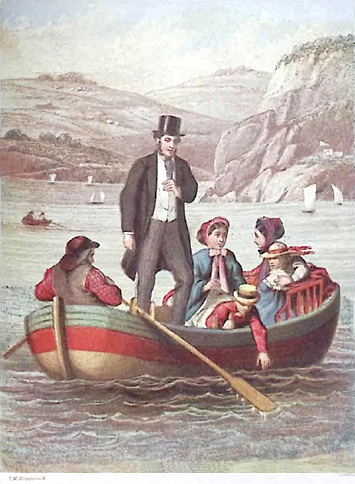
"But I thought the boat was going over, mamma."
"Going over! What, with a little wave like that? O Willie!" said Mrs. Gray, smiling. "It is a good thing papa did not take you out on the large waves two or three days ago, or even yesterday."
"Besides, Willie," added his papa, "you must not forget that whatever you think is going to happen, when you are in a boat, you never ought to start up. Even if there were any real danger, a little boy like you could not do any good by standing up. You would only run the risk of being jerked out into the sea. Always sit quite still upon your seat."
"I should not like to be jerked out," said Willie gravely.
"No, because you might be drowned. So long as you sit still, there is little danger of such a thing. But suppose that every time the boat gave a roll, mamma and nurse and Lucy and I were all to jump up and run to the side of the boat. Why, it would be almost certain to turn over, and we might all be drowned. It would not be the first time that such a thing has happened."
"I'll try and not forget," said Willie, looking sober. "I don't mind the little waves now, mamma. And Lucy isn't afraid of them either. She was a great deal more afraid of the tunnel."
"I hope neither of you will mind the tunnel when we go home the day after to-morrow," said Mrs. Gray, smiling. "I expect to see two such brave children."
They stayed on the water for nearly two hours, when Mr. Gray thought they had had enough, so they went home. Willie was sorry to think the nice row was over, but he was glad he had been on the sea. He told nurse he meant to be a sailor some day, but nurse laughed, and said he would most likely change his mind a dozen times before then.
Willie and Lucy had a very pleasant time at the sea-side, but now that it was all over, they were not at all sorry to return home. Lucy wanted to see her pretty pussy and all her dolls again, and Willie longed for his garden, and his little dog, and his rabbits. So when the morning came to leave, instead of looking grave, they were as merry as they could be.
One thing Willie was quite sure of, and that was that he would never forget this pleasant visit to the sea-side. The bright sandy shore, the blue ripples, the angry waves, the row in the boat, the rides on the donkeys, the visit to the rocks; all, in short, that he had seen, were still fresh in his mind.
Let us hope that he never thought of the wonders of the sea without thinking also of God who made them all. Willie was a very little boy, but he was not too little to be one of Jesus Christ's lambs, and to love to think about God in all His works.
Children much younger than Willie have been led to seek their Saviour, and have known something of the sin of their own hearts, and of the love and mercy of God. The child who reads this story is not too small to follow Jesus, to love him, to believe in him, and to honour him. He has promised that all who seek him early shall find him, and every year it is put off it becomes less easy.
Little child, will not you pray to Jesus to make you one of his children, to take away your sinful stony heart, and to give you a heart of flesh? Will you not strive to follow him, to obey his commands, and to grow more like him every day of your life? You cannot do this in your own strength. But Jesus is always ready to help those who humbly ask him. And when you are one of the Good Shepherd's flock, then both in life and death you will be safe and happy.
LONDON: PRINTED BY WILLIAM CLOWES AND SONS, STAMFORD STREET
AND CHARING CROSS