
Title: The mission-box
or, Doing good and getting good
Author: Lucy Ellen Guernsey
Release date: January 28, 2026 [eBook #77799]
Language: English
Original publication: Philadelphia: American Sunday-School Union, 1879
Other information and formats: www.gutenberg.org/ebooks/77799
Transcriber's note: Unusual and inconsistent spelling is as printed.
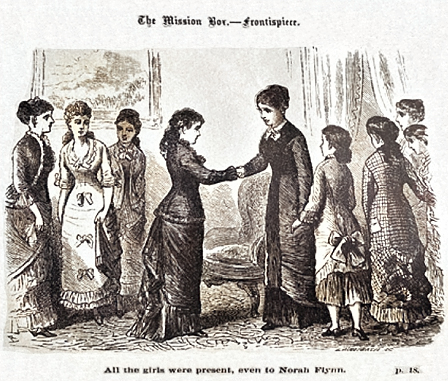
The Mission Box.—Frontispiece.
All the girls were present, even to Norah Flynn.
GOLDEN TEXT SERIES.
——————————
OR,
DOING GOOD AND GETTING GOOD.
BY
LUCY ELLEN GUERNSEY
AUTHOR OF
"WASHINGTON AND '76," "THE STORY OF A HESSIAN,"
"IRISH AMY," "OPPOSITE NEIGHBORS," "TWIN ROSES," ETC.
—————————
"And now abideth faith, hope, charity, these three; but the
greatest of these is charity."—1 COR. xiii. 13.
—————————
PHILADELPHIA:
AMERICAN SUNDAY-SCHOOL UNION
NO. 1122 CHESTNUT STREET.
——————————
NEW YORK: 8 & 10 BIBLE HOUSE, ASTOR PLACE.
CHICAGO: 73 RANDOLPH ST.
————————————————————————————————————————————————————————————————
Entered according to Act of Congress, in the year 1879, by the
AMERICAN SUNDAY-SCHOOL UNION,
In the Office of the Librarian of Congress, at Washington.
————————————————————————————————————————————————————————————————
CONTENTS.
——————
THE CLASS-MEETING
THE TEA-PARTY
THE PLANTS
FLORA ARABELLA
THE SEWING-MEETING
THERE IS SOMETHING WRONG
READING CHARACTER AT A GLANCE
IDA'S THUMB
SARAH SOUTHMAYD
MATILDA DISTINGUISHES HERSELF
"HE WILL DO ANYTHING FOR SUGAR"
THE CLASS-MEETING
CONCLUSION
THE MISSION-BOX.
—————————
THE CLASS-MEETING.
"MOTHER," said Ida Van Zandt, "Miss Ackerman has invited the whole class to spend the afternoon with her next Thursday."
"Indeed!" said Mrs. Van Zandt. "Miss Ackerman will have quite a party. How many are there in your class?"
"I don't know, I'm sure. The class is very full," answered Ida.—"How many are there, Julia?"
"Sixteen," said Julia, "and Miss Ackerman has asked every one."
"Of course she would ask every one if she asked any," remarked Ida.
"Well, I don't know. I think she might have left out some of them. There is Norah Flynn. She said she would come if she could be spared, and Miss Ackerman said,—
"'Oh, you must come; I want you all. I shall ask Mrs. Barnard to spare you.'
"I must say I think it is queer she should invite such girls as Norah Flynn and Eunice Riker to meet us," added Julia, drawing herself up with an air of dignity.
"Why so?" asked Mrs. Van Zandt. "You are all in the same class."
"But, aunt, just think! Norah Flynn is the daughter of Mrs. Eagen's gardener, and works out—just a common servant at Mrs. Barnard's; and Eunice is the daughter of a washerwoman. I don't think such people are very suitable company for us."
"Why not?" asked Ida bluntly. "Eunice is one of the very best scholars in the class.—Only think, mother! She goes to the Public Library on Saturday to study her lesson, and she can answer more questions than any other girl in the class.—Didn't she tell all about Darius this morning? And I am sure she is as much of a lady in her manners as you or I either. And what if Norah does live out? I think it is to her credit to help her father when he works so hard and there are so many of them; don't you, mother?"
"I certainly do, my dear."
"And I don't know what you would have had Miss Ackerman do, I am sure," continued Ida. "Would you have had her ask all the class except Eunice and Norah? How would that have looked?"
"I don't think we want such girls in our class, anyhow," said Julia, with another toss of her head; "I don't believe in mixing things up in that way. I think distinctions in society ought to be preserved. Mamma says Mrs. Barnard is spoiling Norah. She treats her just as if she were a young lady; she lets her sit in her own library to learn her Sunday-school lessons—that is worse than going to the Public Library—and she converses with her about them."
"Well, why shouldn't she?" asked Ida.
"Well, I don't believe in such notions. I believe in ordering servants; don't you, aunt?"
"My dear, I never order my servants; I always ask them," replied Mrs. Van Zandt, who knew that Julia was only repeating what she had heard at home. "But, Julia, don't you expect to go to heaven with all sorts of people? And did not our Lord when on earth mix with all sorts alike?"
"And he says all Christians are brethren; doesn't he, mother? I was reading that only this morning:
"'One is your Master, "even" Christ, and all ye are brethren.' Matt. xxiii. 8.
"If that is so, I don't see why we should look down on people because we pay them to do something that we don't want to do, or don't know how to do, perhaps."
"Very true, my dear; I am glad to see that you have thought about the matter. It is not well, especially for young people, to associate familiarly with those who have bad habits or rude, uncultivated manners, because they are apt to learn undesirable things from them; but we ought to make it a rule to treat all persons as we should like to be treated in their place.—Suppose anything should happen, Julia, which should make it needful for you to work for a living; would you like it if nobody said a pleasant word to you or spoke to you at all except to give you an order?"
Julia found it convenient to change the conversation:
"How does your lace-work get on, Ida? Have you finished your square yet?"
"No," answered Ida, blushing a little.
"How much have you done on it?"
"Only one side, but I am going to finish it this week."
"Only one side! Why, I finished mine two weeks ago, and I have the border almost done. Mamma says she will have Miss Smith paint me a ribbon to mount it on. And, by the way, what did you do with the tidy you made in appliqué? I thought you were going to put it on your father's chair for his birthday?"
"It is up stairs," said Ida, her cheeks growing still redder. "I could not match the silk for ever so long, and then it was too late for papa's birthday; so I thought I would leave it till Christmas."
"You will have your hands full if you finish that and your lace too. However, I suppose you have finished your sofa-pillow long ago?" Julia smiled maliciously as she spoke. She knew very well that the sofa-pillow was not nearly completed.
"See here, Julia: suppose you just attend to your own affairs and let mine alone?" said Ida with some heat.
"Dear me! What have I done?" asked Julia in a tone of great surprise. "I am sorry I have offended you, Ida. I didn't mean any harm. It seems to me, for a person who can quote Scripture so piously, you get angry pretty easily."
Ida turned away to the window to choke down her rising anger and wipe the tears from her eyes. She was really trying very hard to keep her temper, and she succeeded. Turning round, she said, pleasantly enough,—
"If you didn't mean any harm, that is all about it, of course. Won't you take off your hat and stay to lunch?"
"Oh dear me! How good we are!" muttered Julia under her breath, but so that Ida would hear. "No, I can't stay to-day. By the way, if you have done with that crochet-book, I should like to have it back. I promised to lend it to Miss Eagen. I suppose you have done enough of the patterns to go on with it now?"
"Oh yes, you shall have it," answered Ida readily. "I gave up the task of doing the shawl. Mother thought it was not best for me to begin another large piece of work just now."
"I don't wonder," said Julia with a sneer. "I should think the house must be pretty well-filled with your pieces of work already."
"I suppose you will be at Miss Ackerman's on Thursday?" remarked Ida as she accompanied her cousin to the door.
"Oh yes, I suppose so. The Ackermans are first-class people, though Miss Ackerman has some odd notions. I wonder if Percy Denham is here?"
"She is, I know. She went to church in town with Amity Bogardus, because some friend of her father's—some missionary bishop, I believe—was going to preach."
"I should think she would be going back to school."
"I believe she is not going to school this year," said Ida. "She has not been well since her other aunt died, and they think she needs a rest and change. I am glad of it, for I like her ever so much."
"Shall you take your work?"
"Why, yes, I suppose so. Miss Ackerman asked us all to bring our work."
"Well, you will have plenty of pieces to choose from." And with this parting shot, Julia went her way.
"There! I have paid her off," she said to herself as she closed the gate: "she won't attack me again very soon with her Bible-texts. Little Pharisee! Anyhow, I do what I undertake. I don't disappoint everybody by making promises and then not keeping them. When I say I will do a thing, it is as good as done." By which remark Julia showed plainly that she was something of a Pharisee herself.
"What does she want to act so for, I wonder?" said Ida to herself. "But what she says is true enough, for that matter. I am always beginning things and not finishing them. But then I always seem to have an excuse. I could not work at my lace-piece as steadily as Julia did, because my cold made my eyes so weak. And then there was the silk for my tidy; Selig said he should have to send abroad for it. And I have had the pillow so long in hand that I hate the sight of it."
"But your eyes have been quite well this long time," interposed Conscience; "and you have never asked whether your silk has come, though you have been to the city half a dozen times since you ordered it; and if the pillow has been about a long time, that is nobody's fault but your own. You might easily finish it in two or three days. You are only making excuses to yourself."
"Well, I mean to get out all my pieces of work to-morrow, and work at them one by one till they are all finished," said Ida. "I did feel flat when I had to tell papa that I had no present for his birthday. Anyhow, I don't take pleasure in teasing people; and I am glad I didn't give Julia a word back, though I might have told her of plenty of things that she had done."
And, having indulged her own little bit of phariseeism, Ida went up stairs feeling very virtuous indeed.
The next day, as soon as she had finished her practising, Ida went up to her own pretty room and began searching for the unfinished and neglected pieces of work. How many there were! There was the square of guipure with the centre and half of one side done; there was the flannel petticoat for Annie's doll with the pattern marked and about six scallops finished; there was the appliqué tidy with its half-fledged bird; there was the sofa-pillow begun as a present for grandmamma so long ago that grandmamma had gone to her rest without ever seeing it. Ida laid it on one side, and the tears came to her eyes as she remembered how the dear old lady had said on her last Christmas Day on earth, "I thought I should have a bit of Ida's work to-day."
"I don't want to finish that, I am sure," said Ida. "Well, I suppose I may as well take the lace as anything. I will do just so much every day till it is done. I wonder where the thread is?"
It took some time to collect Ida's working-materials together, but she found them at last, and sat down in the window with her frame. She had only darned one square when her mother entered the room:
"Ida, did you remember to ask at Miss Floyd's on Saturday whether she would make your dresses this week?"
"No, mother. At least, I did not exactly forget it," she added hastily, seeing that her mother looked displeased. "I stayed at Julia's till it was so late that I did not like to go round by Miss Floyd's, for fear it should be dark before I got home. You know you said you did not like to have me out after dark."
"But why did you not set out in time?"
"I did not think how late it was getting."
"Ida, do you know that is the third time you have promised to do that errand, and yet have come home without keeping your word?"
"Well, mother, the first time—"
"I do not want any excuses," interrupted Mrs. Van Zandt; "I am tired of hearing them. Put away your work, get your hat, and go down directly to Miss Floyd. Don't stop anywhere, either going or coming."
"There! That is always the way!" resumed Ida. "If I try to finish anything, something always happens to prevent me. There is no use in trying."
Ida came back from her errand in such good time that she might have had two hours of daylight in which to work at her lace. But the postman had meanwhile brought a number of magazines, her favorite English "Ladies' Journal," which always had so many pretty working patterns in it, among the rest.
Ida never thought of the lace-piece again till she went up to her room at night and found her bed covered with the things she had "routed out," as she said. She tossed them all into an empty drawer in her bureau, meditating all the time on the possibility of converting an old woollen dress into such a rug as that she had been reading about in the "Ladies' Journal."
THE TEA-PARTY.
THREE o'clock on Thursday afternoon found all Miss Ackerman's class assembled in her mother's beautiful drawing-room, opening with a wide, long window on the veranda and commanding such a fine view of the river. All the girls were present, even to North Flynn. Mrs. Barnard had not only spared her, but she had given her a pretty dark-blue frock trimmed at the wrists and neck with white ruffles, that North might not feel awkwardly at being more poorly dressed than her classmates. Norah was a pretty girl, in the finest style of Irish prettiness, with black curling hair, long black lashes, very dark gray-blue eyes, and a clear, fine-grained skin. And as she came in bright and sparkling with pleasure, and shook hands with Mrs. and Miss Ackerman, Julia could not but allow that Norah looked and behaved as much like a lady as any girl in the room.
"How pretty she looks!" whispered Ida, thinking with a little regret of her own freckles.
"Pretty enough!" answered Julia with a toss of her head. "I suppose Mrs. Barnard has given her one of Jenny's old dresses."
"'Deed, then, you're mistaken, then, for 'tis a brand-new dress it is, that Mrs. Barnard bought for me in the city with her own hands, and Bessy Melville made it. So there, Miss Julia!" laughed Norah, her eyes dancing with mischief and looking prettier than ever.
Julia bit her lip with anger.
"But if it had been Jenny's old dress made-over, I am sure Norah would not have minded wearing it," said Ida. "I'm sure I wear made-over dresses lots of times."
"Not I," answered Norah. "I'd be proud to wear anything that Miss Jenny had touched, let alone worn; but I can never get the chance. As soon as she has done with her dresses, she rips them up and cleans them, and lays them away smooth and nice to send to some poor lady she knows that has a hantle of little ones. Many's the time I've helped her with them. Oh, 'tis just an angel she is, too good for this world; and I'm thinking she won't be here long." And a tear glittered in Norah's bright eyes.
"I hope dear Miss Jenny may be spared to us many years yet," said Miss Ackerman kindly; "but you know, Norah, that our loss would be a great gain to her. She would change her cross for a crown of glory."
"And that's true, Miss, but I'm that selfish I can't feel to spare her yet." And Norah's ready tears overflowed.
"You are my dear girl," said Miss Ackerman, kissing her, "but don't borrow trouble. Miss Jenny may outlive us all yet."
"What a fuss they do make over her!" thought Julia. "I think Mrs. Barnard might at least have made her wear an apron."
"Well, are we all assembled?" asked Miss Ackerman, looking round: "Where is Eunice Riker? Oh, here she comes."
Eunice was the most plainly, not to say poorly, dressed of all the girls. Her brown linen suit had faded and shrunk, as linen suits will in time, even with the most careful washing, and her frills had evidently been done up a great many times. She was not at all a handsome girl, either; her features were too large and old for her years, and her complexion was not very good. But her eyes were bright and clear, and her somewhat large mouth firm and good-tempered; and people who noticed her said, "That girl will make a fine-looking woman by and by." She excused herself for being late with straightforward directness.
"Mother had just finished doing up some white frocks for Mrs. Edgar's little girls, and she was so tired I went to take them home for her; and then Mrs. Edgar kept me waiting a little while."
"Oh, how stupid I was!" exclaimed Mary Edgar, who was a member of the class. "Sister told me to stop and say that she would call for the things this evening; and I forgot it. What a shame it was, to make you take all that long walk for nothing! Sister will scold me, and serve me right."
"Oh, it wasn't any matter," answered Eunice, smiling brightly. "I liked the walk, and your sister lent me two nice books."
"Well, you are good-natured!" said Mary. "If any one had served me so, I should be just hopping."
"Eunice does not get 'hopping,' as you call it so easily as some of us, I fancy," remarked Miss Ackerman.—"But now we are all here, girls, we will proceed to business.—Percy, are you and Amity ready with your budget?"
"Yes, Cousin Margaret," answered a voice from the inner room; and presently Percy Denham and Amity Bogardus appeared, carrying a large work-basket between them.
Those of my young friends who have read the "Round Spring" books will remember Percy Denham. She was the orphan daughter of an army officer, and since her parent's death, she had made her home partly with her aunt, Miss Devine, who lived at Bridgeport, and partly with her other aunt, Mrs. Ackerman, a very rich widow lady who had a fine house in New York and another at Rockdale. But now Miss Devine was dead, and Percy had come to live altogether with Mrs. Ackerman. Her health was rather delicate, and she was a good deal worn with taking care of her aunt. And Mrs. Ackerman, who loved the country at all seasons much better than the city, had made Percy's health an excuse for letting her town-house and establishing herself permanently at Rockdale. Percy had shot up into a tall, handsome young lady, as slender and graceful as a weeping birch, with dusky velvety hair and a clear olive skin—a great contrast to Amity, with her straw-colored hair and freckles, and no figure at all.
"Well, young ladies, we are ready to hear what you have to say," said Miss Margaret.
"Will you make the speech, Percy, or shall I?" asked Amity.
"Oh, you make it; I haven't any gift at all in that line."
"Well, then, the matter is this," said Amity. "You all know that the ladies of the church are preparing to send a box to the family of the Rev. Mr. Swift, a missionary among both Indians and white people in Dakota Territory. Mr. Swift has a wife, and five children of various ages, from a young lady sixteen years old down to a baby of six months. One of his daughters, about twelve years old, has received the present of a scholarship in a good school for young ladies. But she has no clothes—none, at least, suitable for such a place—and the young ladies' Bible-class propose to furnish her with a wardrobe. Our class will provide the materials, and we thought, as Cousin Margaret's class came next in rank, we would ask them to help us with the sewing. Percy, Emma Andrews, and myself have been appointed a committee to prepare the work and to distribute it, as well as to consult with your class on the subject. We have done the first, and are now ready to do the second. There! I have made my speech; I hope I have explained the matter decently."
"Mr. Webster could not have spoken more to the purpose," answered Miss Margaret; "only you have left one point unexplained. Where is Emma?"
"Mrs. Andrews has a sick headache, and Emma could not leave her. If there are any more questions, I shall be happy to answer them to the best of my ability."
"What is the little girl's name?" asked Ida.
"Her name is Ethelind Swift," replied Amity—"Ethelind Amelia Swift, to give it in full."
"What a fine name!" said Julia, sneering as usual.
"Well, names are a cheap luxury, you know. I dare say she was named after some one."
"What clothes does she need?" asked Eunice, business-like as usual.
"Everything, I should say. Mrs. Swift says in her letter:
"'My husband has been serving two parishes, besides looking after his
Indians, on a salary of less than five hundred dollars a year. We have
had a great deal of sickness, and I am stating a simple truth when I
say that I have not bought one yard of new cotton or flannel in six
years. I had to cut up the flannel sheets my mother gave me when I
was married to make undershirts for my husband and a petticoat for
myself.'" *
* This is no exaggeration: I wish it were.
"What a perfect shame!" said Mary Edgar. "Why doesn't the Board pay them better, so that they can have decent clothes?"
"Because the Board has not the money, my dear. The Board, you must remember, is not a perennial spring. It is a cistern which can only give out what is put into it."
"Well, I say it is a shame, anyhow. Only last week I coaxed papa into buying me one of those twelve-dollar dolls, and a trunk for her that cost four more."
"How silly of you!" remarked Jane Williams, who had not spoken before. "A great girl like you giving such a price for a doll! You might have got a lovely seal-ring for the money."
"And what good would that do when aunt would not let me wear it? I love dolls, and I don't see why they are any sillier than rings and such things; do you, Miss Margaret?"
"We won't discuss that deep question just now, my dear. Let us hear what more our committee have to tell us.—What is your plan, young ladies?"
"Now it is your turn, Percy."
"Our plan is this," said Percy, taking from the basket two neat bundles of cotton cloths and holding up one in each hand. "We have cut out and prepared from four to six articles of each kind, and pinned up each article in a parcel by itself. We propose that you shall each take one or more of these articles, make it as well as possible, and return it to us. When all are received, we will have them done up and marked with the young lady's name. They must be finished by the twenty-fifth of October, as we wish the box to reach Mr. Swift's family before cold weather comes."
"But isn't your class going to do any of the work except to cut it and give it out?" asked Julia. "I should think that was getting off pretty easily, for my part."
"In the first place, our class contributed the money," replied Percy, quite unruffled by Julia's tone, which was sufficiently rude. "Secondly, we have undertaken all the dresses and outside garments generally; and, thirdly, if you think, Julia, that it is 'getting off easily' to cut out and fit thirty garments, contriving to make the very most of the cloth, and then tie up every garment in a bundle by itself, with all the pieces belonging to it, why then you had better try it, that's all," said Percy, finishing up her speech with a sudden emphasis which set the girls laughing.
"I should think as much," said Eunice. "Mother often says cutting out is the hardest work she does."
"Who asked your opinion, I wonder?" muttered Julia.
"And the dresses will be harder to make than anything," said Ida, always ready to give credit to other people.
"How silly you are, Ida! Of course they won't make them themselves."
"I think we shall, at least a good deal of them," said Amity. "Aunt Julia says we may have Bessy Melville for a day or two if we need her. She will cut out the things, and we shall sew with her. That is Aunt Julia's contribution."
"I am sure it is a very nice one," observed Eunice; "and it will help Bessy too."
"Exactly so.—Now, who will take a bundle or two?"
"I will," said Julia; "I can get mine done, I know."
"Very well; here is a night-gown. The pieces are all fitted, and your mother will help you, I dare say, if you are in any trouble.—Who comes next?"
"I do," answered Ida.
But she had hardly spoken when Julia exclaimed, "Well I shouldn't think you would want to, Ida. You will never get it done in time. How many pieces of work have you begun already?"
Ida colored scarlet, and the tears stood in her eyes.
"You should not speak in that way to your cousin, Julia," said Miss Ackerman gravely. "That is very unkind."
"It is nothing but the truth, anyway," persisted Julia. "I heard her mother tell her the same thing this very morning; and she has ever so many pieces in hand. There is her lace and—"
"We will dispense with the catalogue," said Miss Margaret. "What you say may be true, but the truth should be spoken in love. When it is used to hurt and mortify a companion, it is not acceptable either to heaven or earth. Besides, you are in no way responsible for your cousin.—Don't cry, Ida, my dear."
"Well, I won't," said Ida, fighting bravely with her sobs. "I know that I am not very persevering, and that I do begin things and leave them unfinished; but I mean to try and do better."
"'Better' is 'he that ruleth his spirit than he that taketh a city,'" said Percy. "Here is a chemise for you. Now show that you can persevere and finish a thing as well as any one."
"I will try," said Ida; and she meant what she said.
One after another the girls came forward and took their parcels, till all were provided with work except Norah and Eunice.
"I'd like to take a bundle, but I think I had better ask Mrs. Barnard first," said Norah. "She pays for my time, you see, and so I can't give it away without asking her."
"Very right Norah. You can ask Mrs. Barnard, and if she makes no objection, you can come up to our house and I will give you something."
"I am afraid I can't take any sewing to do just now," said Eunice, her pale cheek flushing scarlet as she spoke. "You know mother takes in sewing, and I have to help her. But I will wash and iron some of the things when they are made, if that will be any help."
"Indeed it will," said Amity. "We all know how beautifully you and your mother do up clothes."
"And I have been thinking of another thing," continued Eunice modestly. "I don't sew in the evening, because the doctor says it is bad for my eyes; but I can knit very fast, and if I had some nice yarn, I would knit some stockings for Ethelind."
"Capital, Eunice!" exclaimed Amity. "I don't believe any one has thought of stockings; I'm sure I didn't. If we can raise some more money, you shall have the yarn."
"I will see to that," said Mrs. Ackerman, a sweet little old lady who had been a silent but interested looker-on.—"Percy dear, will you ask Drusilla for my knitting-basket?"
The basket was brought, and Mrs. Ackerman produced three large skeins of beautiful crimson yarn.
"I got this to knit for some of the orphans," said she, "but I can easily buy more when I am ready; and this is just the thing to knit for your little girl. When it is used up, come to me and I will provide some more."
"Oh, thank you, Mrs. Ackerman; how kind you are!" said Eunice, feeling far more grateful than if the yarn had been given to herself. It had cost her a great deal to refuse the sewing, and now here was work provided to her hand. "And if there should be any yarn left, I might make some socks for the baby."
"Very true," said Miss Margaret. "And now that every one is provided with work, let all the bundles be put away, and let us improve this beautiful afternoon by a walk in the garden."
The afternoon passed away pleasantly. The girls rambled about the extensive grounds, looked at the pictures and other beautiful and curious things with which the house was filled, and played various games.
Ida had quite gotten over her annoyance at Julia's unkind remark. She had made a fine resolution to finish her sewing in good time, and she was (unluckily for herself) one of those people whose consciences are quite satisfied for the time being with making resolutions. She was naturally kind-hearted, and was very well-bred besides; and this afternoon she devoted herself specially to those of the girls who had lately joined the class or who, from seldom meeting their classmates except in Sunday-school, were almost strangers to each other. She was particularly attentive to Eunice Riker, whom she had long known and liked, and to Matilda Jenkins, whose mother had but lately come to Rockdale, and who knew hardly anybody.
Eunice responded cordially and pleasantly, as she always did. She had very little self-consciousness, and therefore was neither shy nor awkward. Matilda, on the contrary, was very still and silent, and could not be got to say anything but "yes" and "no."
Julia did not enjoy herself at all. She was vexed at Ida for not being angry—at Miss Ackerman for taking her part, and for taking so much notice of "that little Irish girl," Norah Flynn, and "that washerwoman's daughter," Eunice Riker, while she, Julia Hazleton, was treated "just as if she were nobody." She was all the more unhappy because she really did love Miss Ackerman very much. The trouble was, she did not want Miss Ackerman to love any one else. She could have endured it better, she thought, if Miss Ackerman's favorite had been Mary Edgar or Anita Ferarra, but to be set aside for Eunice Riker! It was too bad! The truth was, that Miss Ackerman made no favorites. She aimed to treat all her class exactly alike. She liked Julia for her perseverance and industry, and tried to love her as well as she did Ida Van Zandt or Norah Flynn; but I fear she was not very lovable.
On the whole, Miss Ackerman's little party was successful. There will always be some people dissatisfied, however, take as much pains as one will.
"Well, what kind of a time did you have?" asked Mrs. Jenkins of Matilda when she came home.
"Oh, just as I expected. Of course all those rich girls felt above me, just as I knew they would. That Ida Van Zandt and two or three others tried to patronize me, but I soon let them know I wasn't going to have that, and that I felt myself as good as any of them, if I did live in a small house."
"That's right," said her mother; "hold up your head, and don't lay yourself down for folks to walk over you."
"Some folks do, though," remarked Matilda. "There is that Eunice Riker. She had on an old faded linen dress and looked like a scarecrow, but all the girls took notice of her, and she took it as sweet as honey."
"She knows what she is about," said Mrs. Jenkins. "I dare say she gets plenty out of those Ackermans."
"Oh, mother, I have had such a lovely time!" was Eunice's comment. "Every one was so kind and polite to me! I do think almost all our girls are just as sweet as they can be. I am going to knit some stockings for my share of the box, and Miss Percy Denham says she will lend me her knitting-book with all sorts of pretty stitches."
"What box?" asked her mother, smiling. "You are beginning your story in the middle, as usual."
"Oh, I forgot you did not know about it." And Eunice gave an account of Mrs. Swift and her needs, and displayed her red yarn. "Wasn't it kind in Mrs. Ackerman, mother?"
"Very kind and thoughtful indeed, and I am glad you have such pretty knitting."
"I am rather sorry you gave those chemises to Ida Van Zandt," said Amity to Percy as they were looking over the list of work given out after the girls had gone. "I am afraid she will never have them done in time."
"Why, is she that sort of girl?"
"Just exactly 'that sort of girl.'"
"Well, I thought her very sweet and lovely."
"So she is," answered Amity warmly; "I never saw a lovelier disposition. How gently she answered when Julia made that attack on her! But she has a way of beginning a great many things and never finishing any of them."
"We must try to keep her up to the mark," said Percy. "I dare say we shall have a good many pieces to finish up. I wish we had set the middle instead of the last of October for the work to be brought in."
"So do I, but it cannot be helped now. I will try to keep an eye on Ida's work myself. She is a kind of cousin of mine, you know."
"What name is this, Amity?"
"Matilda Jenkins. They are new-comers in the place, and I don't know much about them. The poor girl seemed very shy and awkward, but I dare say she will appear better when she becomes better acquainted."
THE PLANTS.
THE next morning Ida was all eagerness to begin her work. Directly after breakfast she hunted out a large business-looking work-basket, and was busily looking for her thimble, scissors, and other sewing-materials when her mother entered the room.
"What are you doing up here, Ida?" she asked. "You ought to be practising."
"Oh, mother, can't I let the practising go this morning, for a little while at least? I feel just like sitting down to sew now."
"And when would you feel like your lesson, my dear? Or what will Miss Amsden feel like when she comes to-morrow and finds that you have not learned it?"
"Well, I hate to do things when I don't feel like them," said Ida rather fretfully; "don't you, mother?"
"Every one does, I suppose, Ida, and all your remark means is that you don't like to do what you don't like."
"But sometimes I like to do one thing, and sometimes another."
"That is the case with all of us. I, for instance, do not want to go out this morning at all. I should very much prefer to stay at home and read the new books of travels your uncle has sent up. But in that case, papa's dinner would be sadly wanting when he came home, and I don't think he would feel like eating his bread without butter or his beef without mustard, or drink his coffee without sugar. The truth is, my daughter, that where duties are concerned, we must learn to put likings out of the question."
"But isn't it a duty to help make this little girl's clothes, mamma?" said Ida coaxingly.
"Certainly it is, since you have promised to do so; and I am very glad to have you interested in such work. But I fear your interest cannot be very deep, since there seems danger of its expiring before afternoon."
"Well, mother, I will come down and practise just the minute I have found my thimble and my large scissors. I can't think where they have gone."
"I don't believe they have gone anywhere of their own accord, Ida; but never mind them now; I want to hear those minor scales going."
"I don't think they are very sweet music," said Ida, giving up with a good grace, as usual.
"Nor I, but they sound much better when they are played correctly. So go to work, like a good girl. You know I like to have you sew at something an hour every day, and you have neglected your needle sadly since Mary has been here. If you work faithfully an hour or two every day, your bundle will soon be finished. I want to look through your drawers a little, and perhaps I shall find your missing scissors in the process."
Ida practised her minor scales, taking more pains than usual with them, and then played her other lessons. Then she went out to refresh herself with a little run in the open air, and after that she set herself resolutely to hunt for the missing scissors. They were found at last, along with the lace-frame, shut up in a magazine in the library—that very "Ladies' Journal" which had tempted Ida away from her work before. She was sorely tempted now to study out the directions for a certain crochet mat which looked very interesting, but she refrained, and sat determinedly down to her overhand seams.
Mrs. Van Zandt had no sewing-machine. "If the girls begin with the machine, they will never learn to use their hands," she had said to her husband. "When Emma and Ida can sew as well as their mother, they shall have all the machines they want."
That afternoon and the next Ida's work went on famously. The third day she did not accomplish so much. The hems were very long, and she did not like hemming. The weather was lovely after the rain, and she did not feel like staying in the house.
Suddenly she remembered that her mother, who had gone to the city, had asked her to carry some papers down to Mrs. Riker's, and she reflected that it would be better for her to do her errand now than later, when it might probably rain again. So the work was hastily thrown into the basket, the thimble tossed after it, and Ida was soon on her way to Mrs. Riker's. She found Eunice with her hat on, ready to go out.
"Oh, don't take off your hat, for I can't stay a minute," said Ida. "Where were you going? Perhaps I can go with you. It is so pleasant, I can't bear to stay in the house."
"I was going up to Mrs. Ackerman's," replied Eunice; "Miss Denham promised to lend me a knitting-book when she got it home again. Do go with me. It will make the walk seem so much shorter."
"The ladies are in the garden," said Sylvanus in answer to Ida's inquiry; "maybe you'd like to go out there? Miss Margaret is busy giving directions to the gardener about sending some flowers to the Flower Mission. Go right down that broad walk and round by the big chestnut tree, and you'll find her."
"How many servants Mrs. Ackerman keeps!" said Ida as they walked down the path Sylvanus had indicated. "I shouldn't think she would need so many. Just see! There are Symantha and Drusilla and Sylvanus and Dorinda—all in the house—besides the coachman and the gardener."
"It is a large house, you know, and they have a great deal of company, I suppose."
"But it must cost no end of money. Just think how much good she might do with it!"
"Well, she is doing good with it," returned Eunice. "Symantha and Sylvanus are old people. You wouldn't have her turn them out of a home where they have lived so long for the sake of giving away their wages, would you? There wouldn't be much charity in that."
"Of course not; I didn't think of it in that way."
"But I do think people waste a great deal of money," continued Eunice. "Just think of giving sixteen dollars for a doll and her trunk!"
"Anne Jennings gave twenty-five for hers, but then it had ever so many dresses," said Ida. "And I suppose the doll helped to make a living for somebody too."
"That's true, but, somehow, it does not seem right to give so much for a plaything. And then the man who made the doll might make something else. Ten dollars would pay for printing a great many Testaments, and that would make more work than one doll."
"You might say the same about Sylvanus and his wages," observed Ida.
"No, I think that is different. Mrs. Ackerman has always known Sylvanus; he is like a friend. Then he only knows how to do just his own work, and he is an old man. If Mrs. Ackerman were to turn him off now, he might not be able to get another such place, and what would become of him?"
"How you do think about things!" said Ida, struck with admiration at her companion's wisdom. "You are so old of your age!"
"I don't feel very old just now," said Eunice, laughing and giving a little skip. "Everything seems so lovely I feel like dancing or running races."
"Well, run then. Let's race to the green house."
"Mrs. Ackerman might not think we were very polite to be racing on her grounds," said Eunice. "Besides, here we are at the greenhouse already. Don't Miss Ackerman look lovely in her broad hat?"
Miss Ackerman was very busy directing and assisting the gardener, who was packing a great number of little flower-pots and baskets. These pots contained small but flourishing plants of ivy, ferns, and other hardy plants.
"What a quantity of little plants!" said Ida. "What are you going to do with them?"
"I am going to send them to the city to the ladies of the Flower Mission," answered Miss Ackerman. "They will distribute them to different poor and sick people who live in rooms in tenement-houses and such places, where they seldom see anything green or pretty from one year's end to another."
"How nice!" said Ida.—"Isn't it, Eunice?"
"Yes indeed," replied Eunice in her grave way, while her eyes sparkled. "Plants are such a comfort! I have just one geranium, and I wouldn't give it up for anything."
"Then you, are fond of flowers?" said Miss Ackerman.
"Yes, ma'am, very. And I almost always have good luck with them, too."
"I love plants dearly, but mine all die, somehow. I am sure I don't know why," observed Ida.
"Well, see here," said Miss Ackerman. "I am going to give you and Eunice each three plants—a silver-leaved geranium, an ivy, and a pot of ferns. You shall take all the care of them yourselves, and at Christmas-time, when we trim the Sunday-school room, the finest plant shall have the post of honor in front of the desk."
"Oh, thank you, Miss Ackerman," said Eunice gratefully. "How pleased mother will be!"
Ida looked a little doubtful. "Must we take all the care of them ourselves?" she asked—"Every bit, watering and all?"
"Every bit—watering and all. Eunice will no doubt take all the care of hers, and it is only fair you should do the same."
"Oh, I am willing," said Ida, always ready for a new undertaking. Then with a sudden change of tone she added, "Oh dear! Here comes Julia. Now she will be sure to say something disagreeable about my never finishing things."
"Shall I tell you what will prevent that evil?" asked Miss Ackerman.
"Yes, ma'am, if you can."
"Always finish things," said Miss Ackerman.
"I am not sure that would do any good," remarked Ida, shaking her head. "She would only say the disagreeable things about something else. But I won't talk about her behind her back; I don't think that is nice a bit."
"I think you are a high-minded little lady," said Percy.—"How do you do, Julia?"
Now, Julia had come out in a very good humor. Unluckily, she overheard Percy's words to Ida, and she was one of those people who think every word of praise given to another is so much taken from themselves. She returned the elder ladies' greeting politely, Ida's rather shortly, and Eunice's not at all.
Till Percy said, rather sharply,—"Don't you see Eunice, Julia?"
When she made such a haughty bend of her head as she had seen her elder sister make when introduced to some one she did not care to know. The imitation was so close that all Miss Ackerman's good-breeding could not suppress a smile.
"Are not Miss Ackerman's plants beautiful?" said Ida. "See what a quantity of nice little pots! She is going to send them to the city for the Flower Mission to give away."
"Mother says the Flower Mission is great nonsense," returned Julia; "and I think so too. What is the use of giving flowers and plants to such kind of people? I think pork and beans would be more sensible, for my part," she concluded, laughing at her own wit.
"I don't agree with you there, Julia," said Miss Ackerman; "and I think a few visits made with the kind young ladies who distribute the flowers would alter your ideas on that subject. Think what it must be to a poor woman whose only window looks out on is narrow court, and who perhaps never gets a chance to go as far as the Park, to have a green and blossoming plant, or even a handful of violets, to light up her dingy rooms!"
"Yes, indeed," said Ida. "I know when I was shut up with my bad ankle, and could not even get to the window for ever so long, what a comfort it was to have a dish of flowers where I could see it. And of course it must be a great deal worse for poor people living in such places as Miss Ackerman speaks of."
"And a great many people would be very thankful for the flowers who would not like to take presents of pork and beans and such things," said Eunice. "I am sure that is the way with mother. She is able to support herself, and me too, but she is always so pleased when any one brings her flowers!"
"Then you think she will like the plants?" said Miss Ackerman. "You see, Ralph has selected very nice ones for you," she added as the gardener returned with his barrowful of plants.
"Yes, they are all in fine condition, and will do well in any good situation," said Ralph; "but I would advise you to keep them out of doors for a time, if you have any place to set them."
"There is the roof of our veranda," said Eunice. "It is flat, and gets the sun all the morning. I can't set any plants out in the yard, on account of Mr. Bell's chickens. He won't keep them shut up, all we can say, so we have given up trying. The plants will do nicely in winter, because we have east and south windows."
"I didn't know you had any parlor," said Julia; "I thought you lived in the kitchen."
"We do," answered Eunice; "as you say, we have only a kitchen, and so we make a parlor of that."
"Well, I shouldn't think geraniums and ferns would do very well among the steam of soapsuds and boiled cabbage."
"I don't think the soapsuds will hurt them, and we never boil cabbage," replied Eunice, determined not to be vexed.
"Plants often do remarkably well in a kitchen, and Mrs. Riker's kitchen is an uncommonly pleasant one, because it is always lighted up with sunshine and smiles," said Miss Ackerman. "I have seen many fine drawing-rooms not half so agreeable.—I will send Harry round with the plants, girls; and remember, the best one will have the post of honor."
"What is that?" asked Julia.
Miss Ackerman explained the matter, and asked if Julia would take some on the same terms.
"No, thank you," answered Julia; "We have a greenhouse, and I don't care shout fussing with plants myself.—I have brought home my work, Percy, and will take some more, if you like."
"How quick you have been!" said Ida. "Did you do it all yourself?"
"Of course I did. It is no great matter to make one night-gown."
"We have no more ready at present, for the reason that we have no more funds," said Percy. "How does yours get on, Ida?"
"Pretty well," answered Ida. "I am doing it all by hand, and I have nearly finished all the long seams.—Oh, Percy, what are you doing? How very pretty!"
Percy was twisting some thread round a hair-pin and poking it in and out with a fine crochet-needle in quite a wonderful manner, producing some very pretty trimming.
"I have been watching her," said Eunice. "Is it very hard work to do?"
"Not hard at all; I can show you the whole in ten minutes if you wish to learn."
The girls sat down, one on each side of Percy, and soon mastered the secret of the trimming.
"I mean to make some as soon as I get home," said Ida.
"To add to your drawer of curiosities, I suppose," remarked Julia.
"Come into the house with me and I will give you each a hair-pin fit for the work," said Percy; "it isn't every one that will do.—Do you want to learn, Julia?"
"No, thank you," answered Julia; "I don't care for such cheap work that every one can do. Mother says she likes this new lace-work, because the materials are so expensive it can never become common. Mother found our chambermaid working a piece of point lace one day, and she said she never wanted to touch hers afterward."
"Give the girls some of the peaches that came this morning," said Miss Ackerman. "Mamma had a present of two baskets of superb peaches from a man who used to drive our horses some years ago, and who has a peach-orchard in New Jersey.—You remember Solomon, Percy?"
"Yes indeed, the good old man!" said Percy. "I should like to see him again."
"Perhaps Julia won't like to eat peaches which come from a servant?" said Ida with a mischievous smile.
"That's different," returned Julia; "but I do think people ought to be made to keep their places. I should like to live in England, where the classes are separated."
"Let each try to keep his own place, and do his duty in it, and there will be no trouble."
"I don't quite understand about that matter of places," said Eunice, thoughtful as usual. "What is my place, for instance?"
"Your place is that of a member of Christ, a child of God, and an inheritor of the kingdom of heaven," answered Miss Ackerman. "That is the true place, that which God has designed for every immortal soul which he has made; and if you keep that in view, you are not likely to go very far wrong."
"But suppose one is puzzled what to do—how to speak to any one, for instance?" asked Ida, very much interested.
"Do just as you would like to be done by. A good way is to think what our Lord would have done in the same circumstances. As to speaking to people, you should be polite to everybody alike, and then you are sure not to make a mistake. There is no greater mark of low breeding than the having two sets of manners."
"Don't you think condescension is bad manners?" asked Percy.
"Yes indeed, the very worst. But let us leave the discussion of manners and betake ourselves to the discussion of peaches."
Ida had fully determined to sit down to her work the very first thing after tea. But there was the trimming: "I declare they will not be fit to be seen without something of that sort. I will work at the trimming this evening, and to-morrow I will sew two hours instead of one."
But when to-morrow came, somebody called for Ida to drive. The next day she went to a lawn-party, and the next to the city; and so it came to pass that at the end of the week, the work was very little farther advanced than it was at the beginning.
FLORA ARABELLA.
LITTLE Mary Edgar went home from her visit at Miss Ackerman's with her head full of serious thoughts. She was much the youngest of Miss Ackerman's large class—so young, indeed, that the orderly and systematic superintendent thought that she ought not to be there at all, and had proposed removing her, to Mary's great dismay.
But Miss Ackerman had her own ideas about such matters. She liked order, but then she thought classes were made for something else besides being classified. Mary was a bright little thing, and had been specially recommended to Miss Ackerman's care by her dead mother. All the older girls helped and petted Mary, and thereby helped themselves. Besides, Mary was very useful. She was class-secretary, and kept her little book with great exactness and method.
Matilda Jenkins, indeed, had asked on the third or fourth Sunday of her attendance, with her usual graciousness, "What that young one was there for?"
"Because she is one of the pupils," answered Anita Ferarra in her pretty, precise Spanish-English. "We have all great affection for Mary. She does learn her lesson 're-markable' well." English was still a foreign language to Anita, and she spoke it with great pains.
"Well, I think she ought to go into the baby-room as well as my little cousin," returned Matilda. "But then Mary Edgar is a rich man's daughter; so of course it is all right."
"If your cousin is able to learn the lessons, you are quite welcome to bring her into the class," said Miss Ackerman, who was nearer than Matilda supposed. "Perhaps she might do so if you gave her a good deal of help through the week."
"My! I haven't got time to help her," returned Matilda, considerably abashed, but determined, as she said, not to be put down. "It is all I can do to learn my own lessons."
"A little more, it seems," whispered Kitty Lee to Anita. "She has not had a decent lesson since she came into the class."
"Mary is rather young for the class, it must be admitted," continued Miss Ackerman; "but her sister helps her learn her lessons, and she has them very nicely. And no one can say that she does not behave perfectly well. I think the girls would be very sorry to lose Mary."
"Yes indeed," said half a dozen voices.
And Ida added, "She is the dearest little thing that ever lived. I do think she is a real little Christian; I know I wish I was half as good."
Matilda tossed her head, but said no more; she felt herself overawed, in spite of herself.
Mary was very much the youngest of quite a large family—so much the youngest that all the rest were grown up when she was born, and she had several nephews and nieces older than herself. Mary had lost her mother before she could remember, but her widowed sister-in-law, who kept her father's house, had so well supplied her place that Mary had never missed a mother's care, unless it might be in the want of a little wholesome restraint and discipline. Not that Mary was at all that odious creature, "a spoiled child." Her father and sister loved her far too well to let her be naughty. But she was the pet and plaything of the whole family—in fact, of the half dozen families which made up the Edgar clan in and around Rockdale. Her father never called her anything but Kitten, and hardly expected more of her than he would have done of her furry namesake. Her married sisters were always wanting her for long visits,—
"Kitten got on so nicely with the children and set them such a good example, and she was such an unaffected, simple little thing."
Her sailor-uncles brought her home trunksful of wonderful presents and curiosities from all parts of the world, and took her to all sorts of entertainments. In short, as Mrs. Helen Edgar said, if Mary was not completely spoiled among them all, it was because she was not spoilable.
When tea was over, Mary got out her work-box, that wonderful little work-box, all mother-of-pearl and gold and lacquer, which brother Courtland had brought her from Japan. She paused a moment to contemplate the picture of cranes on the top, and then, taking her little gold thimble and unrolling her bundle of handkerchiefs, she set to work at them with great earnestness. Thanks to Mrs. Helen, she could sew very nicely for a child of her age.
She made a very pretty little picture as she sat by the table under the lamp, her curly black head bent down over her work, her long dark lashes drooping, and the carnation on her cheeks beautifully deepened with the earnestness with which she worked. Her father watched her as she worked, and sighed as he did so, for Mary was an exact miniature of her beautiful young mother.
"Why, what is my Kitten so busy about to-night?"
"I am hemming Ethelind Swift's handkerchiefs, papa."
"And who is Ethelind Swift?"
"She is a little girl in Dakota, papa, and her father is—oh so poor! He is a minister, and preaches to the white people and to the poor Indians out there. And he has five children and a wife, and oh ever so little money for them to live on—only four hundred dollars a year. That is not much, is it, papa?" asked Mary doubtfully. She had about as much knowledge of the worth of money as her namesake and pet, the kitten.
"Why, no, it certainly is not wealth—not likely to lead him into much dissipation, I should say. Four hundred dollars among seven people! Missionaries ought not to have any wives and children."
"But, papa, if they had no wives or children of their own, how could they feel for those who have, or know how to teach them?" said Mary. *
* This remark was made by a child ten years old.
"There is something in that, I admit," said her father: "I believe my Kitten is learning to think."
"Well, papa, if I didn't think sometimes, I might as well be a real Russian kitten, with curls in my ears, like Olga. And I am not a baby any more; I am ten years old," said Mary with a pretty little air of dignity.
"So you are, I declare! That is the worst of kittens—they will become cats, sooner or later. And so you are working for this little girl in Dakota? Do you like that better than sewing for Flora Arabella?"
Now, Flora Arabella was the name of the twelve-dollar doll.
"Well, no, I don't know that I do—not really," said Mary candidly. "Hemming handkerchiefs is not very interesting. But then Flora won't suffer for the want of her new suit, you know, and Ethelind wants her handkerchief's."
"Flora's cost would have bought a good many handkerchiefs and, other things for Ethelind," said Judge Edgar. "What do you think Ethelind would say to a ten-dollar doll?"
"I dare say she would think it very nice," answered Mary. "Papa, I have been wishing all the afternoon that I had not asked you to buy Flora. It does seem extravagant to spend twelve dollars on a toy, when one hears about a lady cutting up her blankets to make flannel petticoats."
"Then you think I was foolish to buy the doll?"
"No, papa dear; you were only good, as you always are; but I think I was rather silly."
"Then, if I were to offer you ten dollars for Flora Arabella that you might give it to Ethelind, you would take it, would you?"
Mary hesitated a little. "You see, papa, that is rather different," said she seriously; "I have got attached to Flora now."
"But, after all, she is only a doll—only wax and kid and sawdust."
"I know it, papa, but if you had been a little girl and played with dolls, you would know that they are not only wax. But, if you please, I should like to think about it a little."
"Very well, my dear. Now go into the library and bring me the new reviews and my snuff-box. They both are on my writing-table."
"There is another thing I have been thinking of that I should like to tell you about, papa, if you don't want to read your reviews very much," said Mary as she sat down again to her hemming. She had been gone quite a little while, for the snuff-box was not on the writing-table and she had to hunt for it.
"Oh, the reviews will keep till my little girl has gone to bed," replied Judge Edgar. "Tell me what you have in your head while I cut these leaves."
"Then, papa, I have been thinking I should like to have an allowance."
"An allowance! And what is that?"
"Why, an allowance of money, papa—so much a week or a month. Amity Bogardus has one. Her grandfather gives her fifty dollars a quarter, and then she spends it, and keeps an account. Of course I should not want nearly as much as that, because Amity Is a young lady, and has to buy dresses and kid gloves and such things. And I should like to have mine oftener."
"But don't you have money when you want it, my dear?"
"No, papa, not always. Sometimes I want some very much when you are not here or sister Helen has no change. And besides, papa—I am not sure I can say what I mean."
"Try," said her father—"always try to put your thoughts into clear words, or else you cannot be sure that you know what you mean yourself."
Mary thought a moment: "Well, papa, it is like this: When I want money for the collections in church or Sunday-school, I just ask you for it and get it. That is not my giving at all; it is yours. But if I had just so much of my own, and no more, I should have to calculate and save, and perhaps go without things sometimes."
"Caramels, for instance?"
"Yes, papa, and little tin things for my play-house range—I do love nice little tin and iron things—and so it would be my giving, and not yours. Is that explained right, papa?"
"Very nicely indeed, my daughter. I see you have been thinking to good purpose. What put it into your head?"
"Matilda Jenkins, papa?"
"Why, what had she to do with it?" asked Mrs. Helen, surprised, for she knew something of the Jenkins family. "I should not have expected any such idea from her."
"It was last Sunday, sister Helen. Ida forgot her money—I think she is rather apt to forget, somehow—and Matilda had none; and then I put in mine.
"And Anita, who was taking up the collection, said, 'Mary's piece is always ready.'
"And Matilda said, 'No wonder, when she has only to put her hand into her father's pocket and take out as much as she likes. I don't call that giving.'
"So that set me to thinking, and I made up my mind that what she said was true, though it was not a very pleasant way to say it. And then what Miss Ackerman said this afternoon put it into my head again, and I thought there was no harm in my asking you. Was there, papa?"
"No, my love. There is no harm in your asking papa for anything you want, although he may sometimes think it best to refuse."
"I wonder when?" thought Mrs. Helen.
"But as to this matter of an allowance, I should like to think about it a little, as you say," continued Judge Edgar. "Let me see: this is Thursday; I will tell you my decision on Saturday."
"And may I think about the doll till then?"
"Oh yes, I will keep the offer open. And now put away your sewing for the present and read me this pretty story in the magazine. It is about a cat, so you will be sure to like it."
"What do you think of this idea of Kitten's about an allowance?" asked Judge Edgar of his daughter when Mary had gone to bed.
"I think it a very sensible one," replied Mrs. Helen. "I have had some idea of the same thing, but it is much better that the proposition should come from Mary herself. It is the way father used to do with me. You see, as things are, Mary has no chance to learn anything of the value of money."
"Any more than Etty has," said the judge, alluding to another of his daughters-in-law. "I believe that child thinks that money grows on trees, and one has nothing to do but to gather it when wanted."
"Exactly; and that is what I want to guard against with Mary. If she has just so much a week, she will learn how far it will go and what it will buy. I expect the trouble will be that you will be all the time adding to the allowance."
"No; if I make the agreement, I shall abide by it, so far as ready money goes, though I shall not bind myself not to give her a treat now and then. How much would be a reasonable sum to spend on candy and dolls' dishes? Ten cents a week?"
"Well, I think I would make it a little more than that. Mary wants to give her charities out of it, and I think I would require her to provide some necessaries for her own use, such as needles and thread, pens, pencils, and some other little things. That will teach her to be careful in the use of these things, and give room for the exercise of more judgment. I think seventy-five cents a month would do very well for the present, and you might increase the sum as she grew older."
"Oh, say a dollar," returned the judge. "Think what a family she has to provide for—almost as many as poor Mr. Swift himself. And, by the way, Helen, let me know when they send the box; I would like to put in a little something. I wonder what Kitten will do about the doll!"
"I think she will give it up, though it will be a hard pull," observed Mrs. Helen. "As she says, a doll is a great deal more than so much wax and leather to a sensitive, affectionate child. But Mary is conscientious, and she is beginning to be very much influenced by religious principle. It will be a great sacrifice, but I incline to think she will give up Flora Arabella for the sake of Ethelind."
On Saturday morning, after breakfast and prayers, Judge Edgar called Mary into the library.
"Now about this matter of an allowance," said he. "I have been thinking it over and talking to sister Helen about it, and I am inclined to believe your proposition a sensible one. Sister Helen thinks, however, that you should not use the money simply as pocket-money, but that you should provide some necessary things out of it."
"Well, I think that is a good plan too," said Mary.
"So far so good. Now call sister Helen, and I will read you the agreement I have drawn up."
So sister Helen was called, and Judge Edgar took from his desk and read aloud an important-looking legal document by which Richard Edgar agreed to pay to Mary Katherine Edgar the sum of one dollar a month, the said Mary Edgar, on her part, agreeing to provide out of this sum all her pens, pencils, needles, thread, shoe-lacings and button-hooks, and also to keep an account of all her expenditures, and balance the same at least once in every month. And in order that the said account might be properly kept, Richard Edgar bound himself to give to Mary Edgar a suitable book for that purpose, and to renew the same gift every New Year's Day thereafter so long as the agreement should stand.
"Now, tell me, Kitten, do you understand all this?" asked Judge Edgar.
"I don't quite understand that about balancing the account every month," replied Mary.
"It simply means that at the end of the month, you must add up all that you have spent and the cash, if any, that you have remaining from your month's allowance, and if the sum agrees with what you received, then your account is balanced. If it does not, you must try to discover where the mistake lies."
"I see," said Mary. "I think, papa, the best way will be to set down every day what I have spent that day, and then I shall not forget."
"Very true, my dear. You will find it will require a good deal of perseverance on your part, and more calculation and economy than you have any idea of, to make your money last round."
"Yes," said sister Helen; "you will find, Mary, that it will not do to lose four lead-pencils in one week, and more slate-pencils and needles than I dare to say. I think this arrangement a very good one, if it is only to teach you carefulness in such things."
"Well, I will try to be more careful, sister Helen—I will, truly," said Mary.
And Mrs. Helen was satisfied, for when Mary said, "I will, truly," she meant what she said. Kitten as she was, she did not make resolutions only to break them.
Then Judge Edgar and Mary both signed the agreement, and sister Helen witnessed it and took it in charge to keep for them.
"Now for the account-book," said the judge. He opened a drawer as he spoke, and took out a beautiful diary bound in Russia leather and containing a little pearl and gold pencil—such a one as Mary had long coveted. There were two pockets in the diary, and in one of them were four bright, new silver quarters. Mary exclaimed and danced with delight.
"That is the beginning of the economy, I suppose," said Mrs. Helen in a low voice to her father, smiling at the same time.
"Oh, well, diaries are cheap at this time of the year, and the child wants some encouragement. I told you I reserved the right to give her a treat now and then.—But we have another piece of business to settle, Kitten," he added aloud. "What about the doll?"
Mary was sobered in a minute. Her face Bushed and the tears came into her eyes.
"Papa," said she, "you will find a kind mistress for Flora, won't you? You won't give her to a careless little girl that will abuse her—not to any of Aunt Etty's children?"
"Oh no," answered the judge gravely. "I will find her a good home."
"Then, papa, if you please, I will let her go," said Mary bravely, though her lip quivered. "I have been thinking about it, and when I was out yesterday, I went and asked the prices of those warm waterproof ulsters with large lined capes, and I can get a nice one, large enough for Ethelind Swift, for five dollars and a half. And so I think I would rather—no, I don't mean I had rather, but I think I had better—let you have the doll."
"So that was what you were doing at the cloak-counter so long?" remarked Mrs. Helen. "I could not guess."
"It wasn't wrong to go and ask by myself, was it?" asked Mary.
"Not at all, my dear, but I don't think you will need to buy a cloak for the little girl. I heard Mrs. Paget say she was going to send one of poor Adeline's, which was as good as new."
"Then what shall I do with the money, sister Helen?"
"You would not like to buy something for yourself?"
"No, I shouldn't like to do that."
"It is not necessary to spend it at all," said her father. "There will be other people whom Mary will like to help, and she can put her money away and keep it against the time of need. But what about the doll's trunk?"
"I would advise Mary to keep the trunk herself," said Mrs. Helen. "It will be useful for a good many things; she can make a dressing-case of it, for one thing."
The doll was brought, and Judge Edgar wrapped it carefully in paper and locked it up in one of the drawers of his great bureau. Then Mary put her new diary away in her desk, and went to take a review of her work-box.
"I have two papers of needles, besides worsted needles," said she to herself, "and all the thread I shall want for some time. Now about pencils. I do use a dreadful quantity of them, and I don't believe there is any need of it. Slate-pencils don't get used up, they always get lost; and I am sure I never used a whole lead-pencil in all my life. It is just the same with my boot-lacings and buttons. I tangle the lacings and pull off the buttons because I am in a hurry. I must be more careful, that's all."
That night Mary found the day of the month in her new diary, and wrote under it—
"I think I have been an extravagant girl, but I am going to try to be more careful, and I hope God will help me."
Then she began to make some figures on a bit of paper, and at last she took a bright ten-cent piece and laid it in a place by itself.
"That has got to be saved for charity, 'anyhow,'" said she. "I hope I shall have more than that, but that is not mine any more."
THE SEWING-MEETING.
THE next day was Sunday. Mary changed her dime and had a two-cent piece to put into the collection. It was rather less than she was in the habit of giving, but it looked more important to her because she felt that it was really her own offering. Matilda had no money, as usual, and Ida "forgot hers, but would bring it next Sunday."
"Do you know how many Sundays in succession you have said that, Ida?" asked Miss Ackerman.
Ida did not know—she thought only twice.
"This is the fourth time."
"I suppose she wants the money to spend herself," said Matilda. "I'd say so right out, and not pretend to forget every time."
"I don't, either," said Ida, very much hurt.
"No, you always think you are just going to get your money, and then you think of something else and forget all about it, just as you do about everything else," said Julia.
"Ida needs to exercise a little more care about such things—to make them a matter of duty and conscience," said Miss Ackerman gently and gravely.—"As to Matilda and Julia, what they need is more of the Spirit of Christ."
Julia drew herself up, tossed her head, and pressed her lips together, as she always did when reproved.
Matilda colored furiously. "I don't believe all this nonsense about missions and collections, anyway," said she; "ma don't, either. She says it is just a contrivance to get money out of poor people, and that every sixpence that is given costs a dollar to send."
"We will talk about that another time," said Miss Ackerman. "I should like to have you all meet at my house with your mission-work on Thursday afternoon at two o'clock. My mother hopes you will all come prepared to stay to tea and spend the evening. There is the bell, so we must stop talking and give attention."
Ida heard this invitation with anything but pleasurable feelings. She slipped away from the other girls when school was dismissed, and walked home by herself. As soon as she had put away her hat, she opened her closet and took out her work-basket. There lay the two chemises—one not begun, the other with the seams sewed up and partly hemmed round the bottom. There also lay the hair-pin trimming, with about half a yard done on it.
"I can't sew to-morrow, because it is my music-lesson day, and mother wants me to go to town with her on Wednesday to see about my teeth. Oh dear! I wish I had never touched the things, or seen them. Why can't this Ethelind make her own clothes?" And Ida rather unreasonably felt vexed at Ethelind, as if the poor child were in fault for not making the garments she had never seen or heard of.
"I can't go to Miss Ackerman's on Thursday," Ida continued. "The girls will all laugh at me, I know, even if they don't tell me so; and Julia will be sure to say something disagreeable, and so will that Matilda Jenkins. I wish the superintendent would classify her somewhere else. But how shall I contrive to stay away? I believe I will ask mother to let me stay all night with Aunt Barbara. She is sure to invite me—she always does—and I dare say I shall have a headache after going to the dentist's; so that will be a good excuse. Oh dear! It won't be half as much fun to sit and play backgammon all the evening with Aunt Barbara, and be told once in ten minutes to sit up straight and not poke my chin and hear,—
"'When I was a little girl, children were not allowed to do so and so.'
"But then Aunt Barbara is sure to give me some money to spend, and I can buy something pretty to put in the box."
And so Ida dismissed the subject from her mind, and went down to dinner. She did not say even to herself that she would pretend to have a headache, but that was what she really meant. Ida was getting a fixed habit of making excuses to herself and other people, and such a habit and that of exact truthfulness do not long live together.
On Thursday afternoon the girls of Miss Ackerman's class were gathered at her house with their work. Ida was the only one absent. She had carried out her plan, and was at that very time sitting by Stewart's counter wondering when Aunt Barbara would have finished choosing between napkins at ninety cents apiece and napkins at a dollar apiece, and thinking all the time what a nice time the girls were having at Mrs. Ackerman's.
"Where is Ida? Does any one know?" asked Miss Ackerman.
"I called for her," replied Eunice. "Mrs. Van Zandt told me that she went to the dentist's yesterday, and had a headache after it, so that she stayed all night with Mrs. Barbara Van Zandt. Her mother said she expected Ida by the morning train, but she had no doubt Mrs. Barbara had kept her to go shopping."
"Poor Ida!" said Percy, who had had some experience of Mrs. Barbara and her shopping-expeditions.
"But I should not think Ida would have stayed when she knew the class-meeting was this afternoon," remarked one of the girls.
"I dare say she could not help it. I know by experience that it is not easy to get away from Mrs. Barbara," replied Percy.
Julia smiled maliciously. "I dare say Ida knew what she was about," said she.
"Oh yes, I dare say," chimed in Matilda Jenkins. "It wouldn't be a bad spec to go round shopping with a rich old aunt. I heard Ida say herself that the old lady always gave her something."
Julia looked intensely disgusted at this interpretation of her words.
"Oh, Matilda, I am sure Julia did not have any such meaning as that."
"Of course not," replied Julia. "Ida is not the kind of girl to think of a 'spec,' as Matilda elegantly calls it. 'Young ladies' don't do such things," she added, with a decided emphasis on the words "young ladies." "What I meant was that I presume Ida has not finished her work, and is ashamed to show herself, and so she stayed in New York, so as to have an excuse."
"Well, I don't think you have mended the matter, I must say," returned Matilda with some justice. "I don't see how it would be any better to make a false excuse, especially one that needed so much contrivance, than it would be to go shopping with an old lady in hopes of a present."
"Nor I," said Percy; "I think one supposition is quite as uncharitable as the other, and I see no need of either of them, since Ida has done nothing wrong that we know of. Now let us get out our work.—How much have you done, Anita?"
"I have accomplished the two skirts," answered Anita with her usual deliberation. And she held up the dainty garments for inspection.
"But what a trimming you have put on them!" exclaimed Percy and Amity together. "What splendid trimming! I don't know whether to call it lace or embroidery; I never saw anything like it."
"That is nothing," replied Anita. "All the Mexican women do make much of it to trim their garments, and often very fine. This is not fine, you see. I like it for amusement—what you call 'play-work'—and I had it begun, so I thought it would please the little girl."
"But it is lovely," said Eunice. "I don't see how you do it."
"I will show you with much pleasure," replied Anita. "Not many people know to do it in this country."
"Well, I don't see what 'you' want to learn it for," said Julia. "What good will it do you?"
"As much good as any one else, I suppose," replied Eunice, flushing at the rudeness, but determined not to be ruffled. "I am fond of fancy-work, and I always find a use for every kind I learn."
"So do I," remarked Amity. "I have learned how to do a great many little trifling bits of work, such as making paper flowers and knitting fancy stitches, and I always find some corner where they fit exactly.—But let us see your work, Eunice."
Eunice displayed a pair of long crimson stockings, beautifully shaped and as even as if done on the machine, and then took out of her basket a pair of little baby-socks knitted in soft white yarn, with a little crimson vine running round the tops. The girls all exclaimed at their beauty.
"They are the prettiest I ever saw," said Amity.
"I got the pattern out of the book Miss Ackerman lent me," said Eunice. "I tried it on some worsted I ravelled out, and showed it to Mrs. Ray, and she said if I would make a pair for her, she would give me wool enough to make some for the box. I thought it would be pleasant to give something of my own."
"Well, I shouldn't think Miss Ackerman would thank you for giving her patterns to all the shops in town," said Julia.
"Julia, do behave yourself!" said Amity in an energetic whisper. "What possesses you to insult Eunice so? What has she ever done to you? For shame!"
Julia had her own reasons for not offending Amity, and she relapsed into a sulky silence.
"Now, Mary," said Percy.
Mary displayed her half dozen of handkerchiefs neatly hemmed and prettily marked with Ethelind's initials in satin stitch. She then produced two more of finer material and with pretty colored borders.
"I bought those in the city," said she; "I thought Ethelind ought to have two nice ones. Sister Helen picked them out and taught me how to mark them. Don't you think Ethelind will like them?"
"She will be very hard to please if she does not," replied Amity. "We must mark them with your name, as they are your own present."
"I suppose her father gave her the money," said Matilda in a loud whisper to one of the other girls. "It is easy to make presents at that rate."
"No, I bought them with my very own money," said Mary, overhearing the whisper. In fact, the handkerchiefs had come out of the price of Flora Arabella.
"Now, Julia," said Amity.
"I have finished the night-gown," said Julia shortly. And she laid it on the table.
"And very nicely too," remarked Amity as she looked it over. "What neat button-holes! Will you take another to make?"
"Yes, I suppose so, if the rest do," was the ungracious answer.
"There is mine," said Matilda, throwing the garment on the table. "'Tain't fussed up with lace and fancy-work, but I guess it will do for poor folks. It is the first time I ever heard of giving lace and cambric handkerchiefs to beggars."
"What do you mean, Matilda?" asked Miss Ackerman, who had been detained by company, and entered the room in time to hear Matilda's remark. "Who are the beggars?"
"Why, these missionary folks. I say I don't see the sense of sending them such fine things. Why, our church, where we lived before, sent a box, and there wasn't one new thing in it. * Mrs. Benson had an old alpaca frock she was going to cut up for carpet-rags, but she put it in the box instead, because she said it wasn't hardly strong enough to do much good in the carpet. I was going to give one of my old frocks, but I don't think it would do very well to go with all these fine things."
* A fact, I regret to say.
"That is easy to decide, Matilda. If the frock in question is one you would like to have any one give you under the same circumstances, or if you would not hesitate about wearing it yourself, you need not be afraid to send it. But, putting any feeling aside, you must see that it would be a waste of money to pay express charges all the way to Dakota on what would be only fit for carpet-rags when it got there."
"There would be a great deal more merit in giving something that one wanted one's self, wouldn't there, Miss Ackerman?" said Phebe Goodman, a quiet, unassuming girl who had lately joined the class.
"As to that, Phebe, I think we may put merit out of the question."
"I don't quite understand," said Phebe.
"I will try to explain what I mean," returned Miss Ackerman. "Suppose I tell you a story to illustrate it?"
"Oh do, please, Miss Ackerman," said several voices together.
"There was once a young man, whom we will call Philip," began Miss Ackerman. "He belonged to a good family, to begin with, but by his own folly and wickedness he had sunk from one degree of misery to another till he had made himself liable to the law, and he was at last taken up and thrown into prison. He had lost his friends by his misconduct, ruined his health by dissipation, and he had no prospect before him but that of lingering out his life in miserable and hopeless captivity.
"Under these circumstances, however, an unexpected friend appeared for him. Philip, as I said, was of good, family—in fact, he was allied to the blood royal—and had at first, before he fell into evil courses, borne a strong resemblance to the king. The crown prince, hearing of Philip's sad state, took compassion on the poor prisoner and paid in his own person the enormous debt he had contracted, and which Philip could never have hoped to discharge. Nor was he content with this. He took Philip out of prison, cured his diseases, washed off the defilements he had contracted, and clothed him in new and clean garments from head to foot. Neither did he stop here. He set Philip up in a good way of business, employing him about his own affairs, and from time to time gave him what money he needed to carry on his work.
"At first, Philip was overflowing with gratitude, and could not do enough for his benefactor or say enough in his praise. But as time went on, the memory of his past troubles became fainter, and he began to look on and use the means put into his hands as if they were his own.
"One day the prince came to him on a matter of business.
"'Philip,' said he, 'there's a man in the next town who was taken from just such misery as you were, and has been ever since employed in doing my work among the unfortunate, and teaching them to whom they may apply for liberation. Spending all his time in this way, he has neither leisure nor opportunity to accumulate wealth, and both he and his family are suffering for the necessaries of life. I wish you to supply his needs out of the means I have given you that he may go on doing my work among the poor and afflicted.'
"Having delivered this command, the prince withdrew.
"The time had been when Philip would have received this command as a proof of the favor of his beloved friend and prince, and would have hastened to lay at his feet the best treasure in his possession. But times were changed. The memory of his old lost and ruined state had in a good measure faded away. He had learned to look on the treasure he possessed as his own, and he hated to part with it. He was very busy too—so busy that even when the subjects of the prince were called together to meet their lord and lay their wants before him, he could not always find time to go; and as for inquiring out those who were sick and in prison, and directing them to the only source of help, it was a long time since he had thought of doing any more in that line than just asking the prince in the most general way to have mercy on them.
"Philip went into his wardrobe and began looking over his garments. He had plenty of clothes, new and old, and he laid them out and inspected them one by one. Some he thought were quite too good for the purpose, and these he put away again. He stood for some time balancing between two overcoats—one pretty good, the other old and thin and soiled.
"'I might wear this one a good many times,' he said to himself; 'it would do me good service on rainy days; but, after all, I will send it. There will be more merit in sending something which I could use myself.'
"Philip felt very virtuous as he laid aside the overcoat, but his face fell as he looked up and met the stern glance of his prince.
"'Philip,' said the prince, 'who gave you all these things?'
"'You, my lord,' faltered Philip.
"'Yes, that is true,' said the prince. 'It was I who rescued you from prison and death, who set you up in business, and supplied you with means to carry it on. All you have is mine, and I could rightfully resume it all. Is not that true?'
"'Yes, my lord,' answered Philip. 'I have nothing that I did not receive.'
"'Why, then, do you boast as if you had not received it?' asked the prince. 'You confess that yourself and all you have are rightfully mine, and yet when I ask you to give me a small portion, you hesitate and talk of merit in giving one thing more than another. Wherein lies the merit of giving me back my own?'
"Philip saw his error. He fell at his master's feet, confessed his sin, and begged for forgiveness.
"The prince was graciously pleased to pardon him, and as a mark of his favor, he allowed Philip not only to help the man of whom he had told him, but to be himself the means of releasing several prisoners.—That is the end of my little allegory. Do you understand it, Phebe?"
"I think I do," answered Phebe. "The Prince is our Lord Jesus Christ, and Philip is a sinner that he has saved."
"And the other man is a missionary or preacher like Mr. Swift," said Mary Edgar.
"Exactly; and so long as he devotes his whole time and labor to bringing souls to Christ, his fellow-disciples owe it to their common Master to see that he does not want for what he needs. And when we supply his wants we are only giving that Master back a little of his own."
"According to that, there is no merit in anything," remarked Matilda.
"No, if by merit you mean deserving anything of God by what we do."
"'Ye are not your own, for ye are bought with a price' (1 Cor, vi. 19, 20)," said Eunice. "And if we ourselves are not our own, we can't call anything else our own."
"Exactly. St. Paul praises the Corinthians because when they contributed to the needs of the saints, they first gave their own selves to the Lord. 2 Cor. viii. 5."
"Well, I don't like that notion, I must say," remarked Matilda, who possessed an outspoken frankness which made Miss Ackerman more hopeful of her than she would otherwise have been. "I don't like the idea that one can't do anything that has any merit in it. I like to be somebody, for my part. That notion just makes us all beggars together."
"Exactly," said Miss Ackerman, smiling—"one as much as another—all lost sinners together, helpless and hopeless, unless the Prince takes pity on us and lets us out of prison."
"I don't see why we should complain of that, so long as the Prince stands ready to help us whenever we ask him," said Eunice.
"I suppose you think he has helped you?" remarked Matilda—not scornfully this time, but rather curiously.
"I know it," replied Eunice, coloring high.
"Well, I guess you're right," said Matilda good-naturedly. "I think you're a pretty good girl, and I'm sorry I have hurt your feelings; so, there!"
"I don't know that you ever have," replied Eunice.
"Well, I meant to.—But, Miss Ackerman, now just suppose there was a poor person who wanted to give something and she hadn't anything but what was old, oughtn't she to give it?"
"Certainly, my dear. Let the rich give according to their abundance and the poor according to their poverty. As to the quality of what is given, the rule of doing as we would be done by is a good one. Let us remember that those to whom we are sending are children of our Father, and then we shall not go far wrong."
"I expect Anita likes lace on her skirts, so she thought she would put some on Ethelind's," remarked Matilda.
"No, I do not care greatly for such things, though I do like to—to construct them," replied Anita. "But I thought this little lady is poor and cannot have many pretty things; she will be pleased to see this lace, which will also show her that some one has taken thought for her tastes."
"Exactly so," said Percy.
"But don't you really care for fine things—lace and such?" asked one of the girls.
"No, not very much."
"I dare say you would if you couldn't them," remarked Matilda. "It is very easy to be economical when one's folks are as rich as Crœsus," (Matilda pronounced the monarch's name Greases), "and one can have all one wants."
Anita smiled: "It may be that you are right, Matilda; we have a proverb in the Spanish that 'it is easy to walk when you lead your horse by the bridle.'"
"But now about the missionaries, Miss Ackerman," said Matilda. "You said we would talk about that—what I said, you know." And Matilda blushed a little.
"Oh yes," replied Miss Ackerman. "You mean the statement that 'every sixpence given to the heathen takes a dollar to send it.' It is a statement which is altogether improbable on its face, and has been disproved over and over again, and yet people go on repeating it. The fact is, that, as a general thing, not more than five and a half per cent. of the money contributed for missions is used up in necessary expenses. In some cases, the proportion may be more, but I can safely say that the business of the mission-boards in general is as carefully and economically managed as any in the world."
"And do you think they really do so much good? Foreign missions, I mean," asked Matilda.
"We will reserve that question for another meeting," said Miss Ackerman. "Meantime, Matilda, I am very glad to see you interested in the subject of missions."
"Well, I am interested," said Matilda. "I never cared a pin before, but, somehow, working for this little Ethelind makes things more real to me. I seem to realize that the folks are real folks and the places real places, and not just names in the geography-book."
"Exactly so," replied Miss Ackerman. "That is one use of missionary-boxes."
"But don't you think it would be a great deal better, Cousin Margaret, if the missionaries were paid salaries large enough to enable them to buy things for themselves?" asked Percy.
"In some ways undoubtedly it would be better, but I think the boxes have their uses too, besides the comfort they bring to the missionary families. For one thing, as Matilda just said, they wake up a living interest in the subject. Then, again, they afford opportunities for people to give who have no money to contribute."
"Like me," said Eunice.
"Exactly; and people who are much poorer than you."
"There is another thing," remarked Percy. "Missionaries are often stationed where money is of very little real use to them, just as army officers are. I know very well what it is to be not only 'twelve miles from a lemon,' but a hundred miles from a hair-pin. When I was at Round Springs, the school-girls sent a box to an old gentleman up in Maine almost on the borders of Canada. He had a wife, a widowed daughter, and a little grandchild eight years old. The girls in our corner—that is, Blandine, Jenny, and myself—got a good substantial work-box and filled it full of sewing-materials and little things of that sort—tape, needles, pins, buttons, thread and silk, bodkins, and the like. The school had a very nice letter in return, and the old lady spoke particularly about the work-box. She said she often found it difficult to get a spool of thread she could use."
"What did they send the little girl?" asked Mary Edgar, very much interested.
"Oh, all sorts of nice things—clothes, and books, and so on. Then the little girls in the Kindergarten bought a doll and made up quite a wonderful wardrobe for it."
"What did they make?" asked Mary.
"More things than I can tell you—a wrapper, and a travelling dress, and a silk dress, and underclothes without number—or rather unnumbered. Mrs. Hermans, the housekeeper, helped them, and really I never saw anything prettier. I wish I could have seen the little girl when she saw the box opened."
Mary's eyes sparkled and her face dimpled with smiles as she said to herself; "I know what I mean to do."
"And now, as you have all been sewing steadily for more than two hours, I move that the work be laid aside and we take a little exercise in the garden," said Mrs. Ackerman.—"By the way, Eunice, have you used all your yarn?"
"Nearly all, ma'am. I might have enough for a pair of stockings for a child two years old, but I think it doubtful. These long stockings use up a good deal of yarn."
"I know. I asked because I mean to have some more for you. And while I think of it, I will say that when this box is done with, I should like you to knit three or four pairs of baby-socks for a present. I will pay you whatever Mrs. Ray says is right."
As they were going into the garden, Anita took Eunice aside.
"You spoke of learning to do this Mexican work," said she. "There is a lady in New York—oh she is very rich and expends much money—whose daughter is to be married. She told my mother she would give almost any price to a person who could work for her some of this trimming. Now, I could soon teach you the stitch, for it is in truth very simple, and then, if it please you, I could get you some work from this lady, who visits often at our house. I hope that it is not a liberty for me to say this," added Anita with a little anxiety; "I would not hurt you for the world."
"No indeed; I am ever so much obliged to you," replied Eunice. "But it will be giving you a great deal of trouble, Anita."
"Oh no, it is no trouble. I like the work, and I like you, Eunice. I think we should be great friends if we were more acquainted."
"And I am sure I like you," returned Eunice, kissing Anita. "I did the first minute I saw you."
"And will you do me one favor, Eunice? You know about wool and yarn and such things. Would you select for me some wool at Mrs. Ray's suitable to crochet a—I know not the word—like that pretty thing Miss Ackerman wears on her head?"
"'A fascinator,' they call it."
"That is an odd name—'a fascinator.' And will you teach the way to make one?"
"Certainly I will, with all the pleasure in the world. I am glad I can do anything for you."
"Then that is settled. When will you come and spend the afternoon?"
"Next Friday, if that will suit you. And I will buy the wool and bring it up with me. What shall I want for my work?"
"Only a ball of lace-thread and a bit of rather coarse linen—a little worn is best to learn on. But you need not trouble to bring it; I have abundance. Ask Mrs. Ray to add the wool to mamma's account."
THERE IS SOMETHING WRONG.
THE rest of the afternoon passed off very pleasantly to most of the party, and when Matilda went home, she told her mother that she had had a real good time, and the girls were not stuck up or patronizing a bit.
"Just so," said her mother. "You hold your own, and folks will respect you. Just show that you think yourself as good as anybody."
"Well, I don't know as that's always the best way, ma," said Matilda, who had a good mind, but had never been taught to use it, and who was gaining some new ideas. "There's Eunice Riker, now. She never seems to set herself up or put herself forward, and every one knows they are as poor as crows; but all the girls like her."
"They like to patronize her, I suppose," said Mrs. Jenkins.
"They don't patronize her one bit. They just make her one of themselves," persisted Matilda. "And besides, ma, it says in the Bible, 'In lowliness of mind let each esteem other better than themselves.' (Phil. ii. 3). That was read in church only last Sunday."
"Don't you be preaching to me, Matilda Jenkins; that isn't according to the Bible, whatever else is. Just put away your things, and then come and wash up the supper-things, and take out a little of your goodness in that way."
A sharp answer was on Matilda's lips, but for some reason or other she restrained it, and, putting away her hat and mantle, she washed the dishes with extra neatness and despatch. Then, seeing that her mother did not incline to talk, she got out her Bible and learned her Sunday-school lesson.
"I wonder whether I should make any kind of a Christian if I should try?" said she to herself. "Eunice says 'the Prince' helps her. I wonder whether he would help me? I wonder whether he does care about us, anyhow?"
Julia was the only one of the party who did not enjoy the afternoon. She sat steadily at her sewing, hardly speaking a word to anybody. Her mind was in a tempest of anger, jealousy, and envy. Nobody had praised her work specially. To be sure, Miss Ackerman had said it was very neatly done, but it had attracted no such flattering notice as Anita's trimming, or Eunice's socks, or even little Mary Edgar's handkerchiefs.
Percy had taken her up sharply on what she had said about Ida, though she had been no worse than Matilda Jenkins, and Miss Ackerman had quite distinguished Matilda, a common, vulgar girl who did not even speak good English. She forgot that Matilda had accepted her share of the reproof good-naturedly, and had showed that she did so by joining freely in the conversation, while she, Julia, had sulked all the afternoon.
Then Anita Ferarra, the daughter of a distinguished man, the most aristocratic girl in the class except herself—so Julia thought—had struck up a friendship with Eunice Riker, and had asked her to visit her. It would be difficult to say how Julia was injured by this circumstance, but she felt herself so. She almost thought she would never go to a sewing-meeting at Miss Ackerman's again.
In a few days, Julia went up to Mrs. Van Zandt's, stopping at Mrs. Ray's shop for some thread. Eunice was there, apparently buying some Shetland wool. As Julia entered, she took out of her basket some peculiar crimson yarn and handed it to Mrs. Ray, who put it away in a drawer.
"So that is what becomes of Mrs. Ackerman's nice yarn!" thought Julia. "I wondered that all that yarn she gave Eunice should make only one pair of stockings. I dare say she will produce something made of this very wool, and make a great merit of giving it to the box. Won't I expose her if she does! I suppose that was the way she found the wool for those wonderful socks the girls made such a fuss about."
Julia found Ida busily working at her missionary-sewing with a countenance which did not express any special delight in her employment. In fact, she looked decidedly cross, which was not a very common thing with Ida.
"Why, Ida! Haven't you finished your bundle of work yet?" asked Julia, apparently much surprised, as if such a state of things were not just what she expected, and indeed hoped, to find. "Why, all the other girls took theirs in last Thursday, and almost every one had done something extra. Even little Mary Edgar bought and marked two fine handkerchiefs."
"Did she?" asked Ida, much interested. "What did you have?"
"Nothing," answered Julia, her face darkening at the remembrance of her mortifications, "but I will have something the next time. I won't be outdone by a little chit like Mary Edgar."
"I don't suppose we ought to give for any such reason as that," said Ida thoughtfully; "it wouldn't be real charity, you know."
"Fiddlesticks!" returned Julia. "What does the reason signify, as long as they get the things?"
"It signifies to us if not to them," returned Ida.
"And besides, doesn't everybody do it?" continued Julia. "What do people give to homes and orphan asylums for, but only to see their names in the papers?"
"A great many people give to orphan asylums and other things whose names never get into the papers," remarked Ida; "and even if their names are published, it does not prove that they gave for that purpose. I don't think we ought to judge in that way. Besides," added Ida, smiling archly, "such men as Judge Edgar and father get their names in print often enough to satisfy them, I should think, without its costing them anything at all."
"What did you do in the city that day?" asked Julia, not unwilling to change the conversation, as she felt that Ida was getting the best of it.
"Oh, I went round shopping with Aunt Barbara, as usual. What she does with all the things she buys, especially the linen, is a mystery to me. She has a great immense press full of nothing but napkins and tablecloths. She told me her mother gave her two dozen tablecloths, and napkins to match all of them, when she was married, and yet she is always buying more. I believe she gives them away, just for the pleasure of buying them over again."
Ida was partly right in this supposition. It was no doubt true that Mrs. Barbara Van Zandt took great pleasure in endless shopping-expeditions, and especially in buying napkins. It was also true that many of these same napkins went to adorn the table and make glad the heart of many a neat housewife who would have gone without, only for Mrs. Barbara's liberality.
"Didn't you do anything else but buy napkins?" asked Julia.
"Oh yes; we had a nice lunch down town, and then went to a picture-and-china exhibition. Aunt Barbara bought me a lovely set of Nankin china for my room, but it hasn't come yet. And only think!" added Ida, her face clouding over at the thought. "She gave me a beautiful linen lambrequin, all marked to be done in Roman work and Russian points, with the silk to work it and satin to line it with, and oh, such a lovely, 'lovely' basket to hold it all! And now mother says I shall not do a stitch on it till this missionary-work is done!"
"Well, I must say, Ida, I don't wonder at it, considering. Just think how many pieces you have on hand! You might have finished your sewing as well as the rest of us, if you had only kept at it."
"That is just what I hate—keeping at things," returned Ida, giving her work an impatient pull, by which she broke her gathering-thread. "I like to do things when I feel like it."
"If you only do things when you feel like it, you will never accomplish anything," said Julia, very sensibly. "If you stick to your plain sewing for two hours every day, you can have every bit of it done by Saturday, and the Roman work will be just as pretty then as it is now."
"No, it won't, either; I shall have got off the notion of it then."
"Oh, Ida, don't be such a baby!"
"I don't care; it is too bad. Mother might have a machine like other people."
"Why doesn't she?"
"Oh, she says I shall never learn to sew if there is a machine in the house. I shouldn't want to know then."
"Yes, you would just as much. If you don't sew well by hand, you will never sew well on a machine," said Julia, very truly.
"Well, anyhow, I have done all I am going to do to-day," exclaimed Ida, looking at the clock and laying down her work.
"I would baste the band on before I stopped, and then the work will be all ready to begin on to-morrow," said Julia, taking up the garment. "Why, Ida, you could finish this in two hours easily. Why don't you keep at it till it is done, and then you will be ready to do your Roman work?"
"No, I shall not. There is the other one not even begun."
"You don't mean to say that you have not even made one?" exclaimed Julia. "Why, Ida!"
"It isn't any business of yours," said Ida sullenly.
"Of course it isn't, but I should think it was of yours. They want everything brought in to Mrs. Ackerman's at the next class-meeting."
"Oh, well, I can finish them before that time," answered Ida, recovering her good humor, which indeed was never ruffled long at a time. "Oh, by the way, did Eunice have anything besides her stockings?"
"Yes; she had a pair of baby-socks which Miss Ackerman and the rest of the girls made as much fuss over as if they had been made of point lace. Perhaps if they knew what I do, they would not be quite so well pleased."
"Why, what do you mean?" asked Ida.
"Why, she said—But there is no use in telling it, that I know of," said Julia, well knowing to whom she was talking, and that Ida would not rest till she heard the whole story.
"Oh yes, come, tell me!"
"Well, you need not tell every one about it. She said she earned the money to make the socks, and you know what a quantity of yarn Mrs. Ackerman gave her?"
"Yes."
"Well, she brought only one pair of stockings, and when Miss Ackerman looked surprised, she said there was not yarn enough for two pairs. But this very afternoon I was in at Mrs. Ray's, and I saw her exchange a whole skein of that yarn for a parcel of Shetland wool. So much for Miss Ackerman's paragon!" concluded Julia in a tone of triumph.
"Are you sure it was the same yarn?"
"Yes, of course I am. Don't you remember what a peculiar color it was—like the red in a cashmere shawl?"
"Yes, I know Amity spoke about it. But, Julia, I don't like to think such a thing of Eunice. Perhaps Mrs. Ackerman gave her leave to exchange the yarn."
"No, she didn't. I heard Mrs. Ackerman tell her to bring back what was left when she gave her the yarn in the first place. I know Mrs. Churchill thought Mrs. Riker didn't put all the bird's-eye linen she gave her to make up into Harry's aprons."
"I wonder what she wants to do with the Shetland wool?"
"Oh, I dare say she will make something else for the box, and so get some more credit. One thing I am sure of: I shall know the wool again the minute I see it, and if she does bring in anything made of it, I shall expose her. But there! I must go along, Ida. I have to stop at Mrs. Gunderson's for mother."
"Don't tell Fanny Gunderson about this matter, Julia," said Ida, detaining her a moment. "You know every one says. Mrs. Gunderson's is a regular gossip-shop. The story will go all over town, and there may be some mistake, after all. I believe there is; I don't believe Eunice Riker would steal a bunch of yarn."
"She wouldn't call it stealing, I suppose, as long as she gave the value back again," said Julia.
"Well, anyhow, don't tell Fanny Gunderson."
"Don't you be alarmed, child; I know what I am about," said Julia.
And there is no doubt she did. As she walked home from Mrs. Gunderson's, where she had done her mother's business and also her own, she began to think what she should do for the mission-box which should eclipse all her companions, and how she should contrive to do anything. Julia's pocket-money was an uncertain quantity. The Hazletons passed for very rich people. Certainly, they spent a great deal and lived in very great style, as Mr. Hazleton said. He kept two carriages and various servants, and the family went into town for several months of every year. Sometimes he would shower money and presents upon his wife and daughters without stint; at other times his wife found it hard work to obtain enough ready cash for household expenses, and his daughters could not buy a calico wrapper without hearing that they were bringing their father to ruin by their extravagance.
Mr. Hazleton was just now in the midst of one of these attacks of economy, and Julia knew it would be in vain to ask him for money. She had none by her, and yet she felt that she must do as much for the box as Anita Ferarra or Mary Edgar. Why, even Phebe Goodman would have done more than she. She turned over various plans in her mind without coming to any other conclusion than that she must try asking her father once more.
"I mean to get up all those old Scotch songs father likes," she said to herself. "Perhaps I can sing him into a good humor, and then I can get some money out of him."
Julia put her plan into immediate execution, but, though she gained something by it, it was not altogether successful. Mr. Hazleton brought his daughter home a fine cross and necklace the very next evening, but when she asked him for money, he positively refused to give it her for any such purpose.
"These missionary-boxes are all perfect nonsense and humbug," said he. "There was that one sent to Pompyopolis last year. Andrews was out that way collecting, and he found the very missionary to whom all those things were sent living with his family at the best hotel in the place."
This was true, but if Mr. Andrews had inquired into the matter, he would have learned that the minister's house had been damaged by fire only a few days before, and that the hotel-keeper, who attended his church, had invited the family to stay at the hotel till the house could be put to rights again.
"All the other girls have given more than just their work," said Julia, half crying. "I should think you would want me to appear as well as Mary Edgar or Emmeline Lee. Even Eunice Riker gave a pair of socks of her own money."
"More shame for her, then," said Mr. Hazleton, "taking her poor mother's hard earnings to give away to Tom, Dick, and Harry!"
"Don't say any more to papa just now, Julia," said Mrs. Hazleton when her husband had left the room. "I'll see what can be done, but there is no use talking now. It will do more harm than good. I will see that you have something to give this little girl, though I must say that with all the poverty there is in our own midst, a use might be found for money nearer home than Dakota."
"I suppose there is money enough for both purposes if it were rightly used," said Emma Hazleton, who was thought eccentric by her mother and sisters because she thought seriously about a good many things, and sometimes talked about them. "The price of that India shawl papa gave me, if added to this poor minister's salary, would have put him above the need of boxes for several years; and a pretty beaver shawl would have been just as warm."
"Yes, and made you look like an old woman or a district school teacher," said Julia. "Besides, I think you are very inconsistent. I have heard you say a hundred times that there was no manufacture so beautiful as a fine India shawl."
"Well, I do think so. But what is the meaning of self-denial if it is not giving up or going without something that one really likes and admires? As to the charge of inconsistency, I don't deny it. We are all inconsistent alike, as far as I see. We pretend to be Christians, and we live as much for the world as if there was no such thin as Christianity."
"I don't know what you mean by living for the world, Emma," said her mother. "Of course we have our duties to society. We must keep up our position, and dress and act like other people in our circumstances."
"That is just what I do mean," said Emma. "Oh, I am not pretending to be any better than the rest of you, only I see the humbug—that's all."
"Then, if you see 'the humbug,' as you call it, and yet keep it up, you are a good deal worse than the rest of us," retorted Julia, with some show of reason.
"I believe you are right, child. There! We won't say any more about it."
The next morning, Mrs. Hazleton told Julia there was no use in saying anything to her father about money at present. "And really, I don't think it is reasonable myself," said she. "There are so many calls on one already, and by your account this little girl will be very well furnished with clothes as it is."
"I told you before I didn't care about the girl," said Julia fretfully, "but how it looks for me to be the only one not to do something extra. You ought to see the trimming Anita Ferarra put on the skirts she made."
"I think such things very unsuitable," said Mrs. Hazleton. "Clergymen's families ought to set an example of modesty and simplicity in dress."
"What is the use of their setting the example, if nobody is to follow it?" asked Emma. "Or why should they set an example more than other people?"
"Well, I know one thing: I won't go to another class-meeting unless I have something to show."
"Make something," suggested her sister. "I have some pretty dark gray and red yarn, and I will show you how to knit a pair of mittens."
"I haven't one minute's time," answered Julia. "I have got that cushion to finish for Miss Lindon's wedding-present; and besides, I want something that will make more show than just a pair of mittens. I'll have it too, somehow, in spite of pa." And just then an idea darted into Julia's head which she determined to put into execution the very next day.
READING CHARACTER AT A GLANCE.
THE day after Julia and Eunice met in Mrs. Ray's shop, Eunice spent the afternoon with Anita Ferarra.
Mr. Ferarra was a gentleman of Spanish descent, doing business both in the neighboring city and in Mexico. He had married an American lady, daughter of one of his partners, and the family had resided in Mexico till some change in the firm to which he belonged, and also the desire to obtain better advantages for the education of his daughter, had brought Mr. Ferarra to the North.
After travelling for a while, and making trial of several different locations, he had bought a place in Rockdale, where he had established his family, going down to the city every day. Mrs. Ferarra had married young, and, living so long in a foreign land, she had almost forgotten her native tongue and spoke, as she walked and sung, like a Spanish lady. Nevertheless, she was a born New Englander, full of energy, spirit, and industry, and she threw herself at once into all the affairs of Rockdale society, teaching in Sunday-school and sewing-school. And, as she had plenty of money, as well as plenty of wit and resource, she soon became a valuable element in the church.
Mr. and Mrs. Ferarra were Protestants—the one from education, the other from conviction—but Anita had been to a convent-school, simply because there was at that time no other school for her to go to. Here she had learned a great many pretty accomplishments in the way of embroidery and the like, and she always retained an affectionate remembrance of the kindness and the sweetmeats of the good nuns. Anita had learned English mostly from books, and she often amused the girls by the preciseness of her expressions, which contrasted oddly with the childish-sounding Spanish lisp, for by no possibility could Anita learn to pronounce an English "s."
Mrs. Ferarra as well as her daughter, had been very much taken with Eunice Riker. She had been led to notice her at first by her singing in church and Sunday-school. Eunice possessed a fine and peculiar alto voice and a very correct ear, and her singing was indeed something remarkable.
"She has a fine face too," Mrs. Ferarra said to her husband as they were walking home; "I am sure she must have a great deal of character. Mr. Stanley tells me she is the only child of a widow who supports herself and her daughter by fine work and by getting up fine washing."
"It is a pity her musical powers should not be cultivated," remarked her husband.
"That is just what I was thinking," said Mrs. Ferarra eagerly. "If she only had proper instruction, she might be able to support herself and her mother."
"You say they are respectable people?"
"Oh yes. Her mother is a soldier's widow, and has a very small pension, and they live upon that and the proceeds of her work. She has quite the manners of a lady, and when I went to carry her some clear-starching, I was struck with the pleasant, cultivated look of her little room. Eunice is in the same class with Anita—Miss Ackerman's."
"That will give Anita an opportunity of getting acquainted with her. She might find some excuse for inviting her to the house, and when we see more of her, if she seems a promising subject, she might have the benefit of some of Carmen's dowry. But don't be in a hurry. There is time enough, and you know your 'geese' have not always turned out to be 'swans,'" added Mr. Ferarra, smiling.
"Well, I would rather think my 'geese' 'swans' than to think all 'swans' 'geese,'" replied his wife, smiling in her turn. "However, it will be desirable, as you say, to proceed with caution. I fancy both Eunice and her mother are very independent in their feelings."
"So much the better for them," said Mr. Ferarra; and there the discussion ended for the present.
The plan for inviting Eunice to spend the afternoon with Anita on the plea of giving instructions in crocheting had been arranged between Anita and her mother as a means of becoming better acquainted with Eunice, as well as for the sake of giving pleasure to a hard-working girl.
Mr. Ferarra's house was a handsome one and beautifully situated. It was not so expensively furnished as many houses in the neighborhood; at least the expense was bestowed in a different manner.
Mrs. Hazleton, who had a great deal of wonder and a great deal of advice at the service of her neighbors, which she was accustomed to bestow quite gratuitously, wondered that Mrs. Ferarra should be content to have her drawing-rooms matted with only a square of Turkey carpet in the middle for cold weather. She assured Mrs. Ferarra that nobody did so at the North, and advised her to buy Axminster carpets for her drawing-rooms and Brussels for her bedrooms without delay. She repeated this advice till Mrs. Ferarra grew tired of it, and gave her a somewhat cool answer, when she wondered what she could have said that Mrs. Ferarra should be so angry at.
Mrs. Ferarra had a beautiful garden in summer and a superb conservatory in winter; she had a great abundance of books and some beautiful and valuable pictures; and she had a well-filled purse, always ready to open to any reasonable call for help. For all these things she cared a great deal, but for Axminster carpets and brocade furniture not at all.
Anita's own room was furnished with the simplest chintz and cane furniture, but she had shelves upon shelves of valuable books of her own, and indulged in an amount of fresh towels and linen which would have scared Mrs. Hazleton from her propriety. She carried off Eunice to this room to take off her hat and arrange her hair, and when Eunice exclaimed at the before-mentioned book-shelves, Anita made her at once free of them.
The lessons in work proceeded very successfully amid a great deal of fun and laughter, and Eunice found as apt a pupil in Anita as Anita did in her. When she thought they had worked long enough, Mrs. Ferarra sent them out for a walk in the grounds. The flower-garden was beginning to show the lateness of the season, but there was a beautiful display of chrysanthemums, dahlias, and other late-blooming flowers, and Eunice exclaimed with delight over some Japanese anemones.
"Yes, they are very pretty, and they last so long, till cold weather comes," said Anita; and she shivered at the thought. "But oh, Eunice, you should see the flowers in Mexico! Such flowers! Not the pale things that grow here. And there is no winter to kill them so soon as they are come to perfection."
"There are no earthquakes here, either," said Eunice, a little jealous for the honor of her native land, "and no snakes."
"Oh, as to snakes, bah! One meets them scarcely ever. It is not one in five thousand that is ever hurt by them; and as for earthquakes, well, certainly they are not nice. But I do not know; the earthquake does endure but a little, and the winter lasts half the year!"
"But the earthquake kills people."
"Well, and does not the winter kill people too? Whence come all your consumptives but from the winter? I think it is like the cold white witch my nurse used to tell me of, who walks forth at night, and the grass and flowers wither under her tread. But you like your own land; that is but natural. I like it also, but not as my own, and not the winter."
"Shall you ever go back?" asked Eunice.
"Oh yes, some time, I suppose. It will depend upon my father's business. If we do, do you know what plan I have in my head? You know there is freedom of religion in Mexico now, and many have even become Protestants. I think I will have a little school for the Indian girls of our estate. They are very gentle, kind people and good servants, but they are very ignorant. They know not to read or write, and have never seen a Bible."
"I suppose they are Romanists," said Eunice.
"That is not so easy to tell," replied Anita. "In the cities they are so, doubtless, and in the country places they will go to confession once a year. But they know very little Spanish, and often the priests to whom they confess know nothing at all of their language. They have many strange ceremonies of their own, and some say they still worship the gods of their ancestors. They love not the Spaniard in general, but my father has ever been a friend to them; and as for my mother, I give you my word, Eunice, that these poor people would lie down in the river to make a bridge for her to pass over."
"How nice!" said Eunice, much interested. "You might be a regular missionary among them, Anita."
"That is what I am thinking."
"I always envy people who can go upon missions," said Eunice. "When I read about them, I always wonder, not that some should go, but that there are not a great many more."
"I suppose there would be more if there were more money to send them," remarked Anita. "And after all, Eunice, when one had once become accustomed to the strangeness of the ways, I suppose work and school-teaching and all that would be much the same in one place as in another. Only, one has not to need in general quite so many fleas and the like, as one reads of in Miss West's and Mrs. Wheeler's books."
"Or to sleep in the room with buffaloes, and have them get loose and fight in the night. Do you remember Miss Beecher's telling us that story?"
"That would be nearly as bad as the earthquakes of which you have such a dread," said Anita, smiling. "Come, let us go in. Tea must be nearly ready, and I have stained my hands with gathering leaves."
At the tea-table, the party was joined by Mr. Ferarra and a lady to whom Eunice was introduced as Miss Fay. Miss Fay was a little, active-looking body of an uncertain age, with good features and bright eyes, who would have been attractive but for her expression of sharpness and self-consequence. She was a lady with a small independence, which she stretched by living very economically at home and making a great many visits. She was well educated and accomplished, and people were generally glad to see her come. They were also glad to see her go, and usually remarked when she was gone that "Miss Fay was a very agreeable person, though she had her ways."
Miss Fay was a cousin of Mrs. Ferarra's, and it was with great pleasure that she heard of her settling in Rockdale. She at once wrote to her cousin, and received the expected invitation to make a long visit at her house. She had already been in the family some two months, and Mrs. Ferarra and Anita were beginning to be somewhat weary of her "ways" and to wonder when she meant to go. In fact, if they had but known it, she did not mean to go at all, at least for a year.
Miss Fay prided herself on "reading character at a glance," which, as usual, simply meant that she took likes and dislikes with no sort of reason, and attributed to people motives and plans of which they themselves had no idea. She was herself something of an invalid in reality, and a good deal more in fancy, but she had no patience with any other person's complaints, treating them all as "hysterical humbug" or "simply self-indulgence." She had her good qualities too, and when she took a liking, she was a warm and faithful friend.
Anita perceived at once that Miss Fay regarded Eunice with anything but friendly eyes. In fact, Miss Fay had heard, or fancied she had heard, some hints of a plan to take a girl of Anita's own age into the family as a companion to her young cousin, and as soon as she saw Eunice she jumped at once to the conclusion that she had been brought to the house for some such purpose. In the time she had spent at Rockdale, she had used her opportunity so well that she had learned something of the history of almost every person attending the little church. Consequently, she knew at once, on hearing the name, that Eunice was the daughter of a woman who took in fine washing and plain sewing. Her greeting to Eunice was stiffly condescending, and she took opportunity during the meal to ask her "if her mother had plenty of work," and "whether she found sewing as profitable as clear-starching."—Inquiries which Eunice answered with perfect simplicity.
"Come into the conservatory," said Anita after tea. "I want to show you the new climbing fern and a wonderful new geranium some one has sent Mother."
"I must be going pretty soon," replied Eunice. "You know I have quite a walk, and mother does not like to have me out after dark."
"It is nearly dark now," remarked Mr. Ferarra—"too late for you to go down alone.—Anita, tell James to get up the pony phaeton, and I will take you and your friend for a little drive, and so home."
When Mr. Ferarra and Anita returned, they found Mrs. Ferarra and Miss Fay in the midst of an active argument, if that could be called an argument which was all on one side.
"Mark my words, Anna," Miss Fay was saying: "if you take this step, you will repent it."
"What step?" asked Mr. Ferarra.
"That of taking this girl into the family to be a companion to Anita. I can read character at a glance, and I can see plainly that she is both ill-tempered and deceitful. And besides, the idea! A washerwoman's daughter! If you must take such a step—which is simply flying in the face of Providence, in my opinion—there are surely girls of good family—" Miss Fay paused from sheer lack of breath.
"What do you mean?" asked Mr. Ferarra in wonder. "Who has proposed such a thing?"
"Nobody, that I know of," answered Mrs. Ferarra, half vexed and half amused. "Maria has somehow taken up the idea that we mean to adopt Eunice into the family, and she has been fighting this windmill for half an hour."
"I am sure I wish I had a sister like Eunice," said Anita; "I think she is admirable."
"I am sure I don't see why you call it 'fighting a windmill,'" said Miss Fay in a tone of lofty endurance; "you said you thought it was good for Anita to have young society, and in the same breath you say this Eunice is a daughter any one might be proud to own."
"Exactly, but I never said I meant to 'own' her."
"Now, I don't say it might not be good for Anita to have a companion," pursued Miss Fay—"some one who could form her mind and manners and influence her in the right direction. But as for adopting a girl of her own age—and such a girl!—I never heard anything so absurd. The fewer companions of their own age such girls have, the better for them, in my opinion."
"Then you think Providence made a mistake in giving most people brothers and sisters?" observed Mrs. Ferarra.
"Really, Anna, I think such an irreverent remark is better unanswered," said Miss Fay with arid dignity. "But as to this girl—"
"We will drop the discussion of the young lady's character, if you please, Cousin Maria," said Mr. Ferarra: "It is hardly treating a guest courteously or kindly to talk her over in this way the moment she leaves the house.—What are you looking for, Anna?"
"My thimble, as usual," said Mrs. Ferarra. "I wish it would jump up and bite me every time I set if down out of place. Then perhaps I might learn to take some care of it."
"I read to-day of a gentleman who said if he could have but one wish, he would wish for a paper-knife which would come when he whistled for it. It would be well if mamma's thimble possessed that accomplishment," said Anita mischievously.—"Was it your little gold one, mamma?"
"Yes, but never mind; it will come," said Mrs. Ferarra. "Bring me my netting, pet. It is better work for the evening than the lace. By the way, how did Eunice succeed with her lace-work?"
"Oh, so very nicely, mamma. She has 'finger-wit,' as Sister John-of-the-Cross * used to say. And she made me understand the other work without delay. She is 'apt to teach,' and 'apt' also to be taught."
* Such compound names are not uncommon among nuns. I have known of
"Mary of the Seven Sorrows" and others equally singular.
"And what did you talk about?" asked Mr. Ferarra.
"Oh, I told her of Mexico—the city and the country, and the flowers and trees and the volcanoes. And she was much interested to hear of the convent and the ways of the nuns, because she has some relation who makes a great grief to her friends for that she will be a nun. Then we talked about the Protestant missions, and she said she would like to be a missionary herself, only that she is her mother's only child."
"Exactly," said Miss Fay. "There shows the cloven foot."
"Does it take a 'cloven foot' to make a missionary?" asked Mr. Ferarra. "I did not know that."
Miss Fay rose with much dignity. "I am not accustomed to be treated with ridicule," said she as she sailed toward the door. "I must ask permission to withdraw."
"What ails her to-night?" asked Mr. Ferarra.
"Oh, nothing more than usual," replied his wife. "She is always that way, and her mother was so before her. If you happened to say anything about going to the moon before Aunt Cordelia, she would make you a long oration on the impossibility of such an excursion, and your folly, and even wickedness, in wishing to go. Maria is certainly a little trying, but then she is our cousin, and we may as well have her a little while as anybody else."
The next morning, Miss Fay put on her hat and went down to Mrs. Gunderson's. Mrs. Gunderson's house had been well described by Ida as a gossip-shop. Both mother and daughter resembled the Athenians of St. Paul's day, in that they "spent their time in nothing else, but either to tell, or to hear some new thing;" and, like other newsgatherers and venders, they were by no means particular as to the truth of the news they retailed. Mrs. Ferarra disliked them, and kept out of their way as much as possible, much to the annoyance of Mrs. Gunderson, who would have liked to be intimate with the lady.
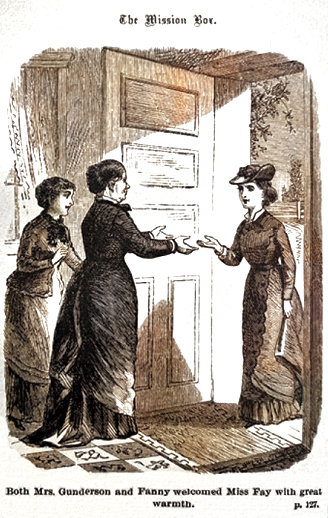
The Mission Box.
Both Mrs. Gunderson and Fanny welcomed
Miss Fay with great warmth.
Both Mrs. Gunderson and Fanny welcomed Miss Fay with great warmth. To be sure, she was not the rose, but then she had been near the rose; and her talk about the "absurd spoiling of that child" and "reckless expense in buying books and plants" had already furnished the gossip-shop with some choice wares.
"I saw Mr. Ferarra driving out with his daughter and some other young lady last night," observed Fanny. "I suppose Anita has some friend from New York staying with her?"
"Young lady, indeed!" said Miss Fay. "It was that Eunice Riker, the washerwoman's daughter. She and Anita were together all the afternoon over some fancy-work, and she stayed to tea."
"How very queer!" said Fanny Gunderson. "But perhaps Mrs. Ferarra employed her to teach Anita?"
"Oh no, not all, I assure you. She was quite an honored guest, and the instruction was reciprocal. Miss Anita was teaching the girl to make Mexican lace."
Now, there was a sting of bitterness in this news that Miss Fay did not know of. Fanny Gunderson had hinted very plainly to Anita that she should like to learn this same Mexican lace, and had received no sort of encouragement.
"Humph!" said she significantly. "I hope Anita takes care of her working-materials, that's all." And she cast a meaning glance at her mother, who returned it with interest.
"What do you mean?" asked Miss Fay.
"Perhaps you had better not say anything, Fanny," said Mrs. Gunderson. "There may be some mistake, and, anyhow, Mrs. Ferarra is her own mistress, though I must say—" And here Mrs. Gunderson paused.
"Do tell me to what you allude," said Miss Fay; "I have a particular reason for wishing to know. If there is anything against this girl's character, it is of great importance that I should hear it."
"Well, they say—but of course it may not be so—that Mrs. Riker and Eunice are in the habit of appropriating a part of the stuff sent them to make up, and exchanging it at the stores for what they want."
"Stealing it, in fact," said Fanny. "People get them to knit children's stockings, you know. Well, it is very easy to take out a few knots or skeins and trade them for thread or other such things. A lady told me that Mrs. Ackerman gave Eunice a quantity of fine red yarn to knit—enough for two or three pairs, she said. She was present when Eunice brought back one pair of stockings, saying that there was not enough yarn for another pair. And afterward, this same lady saw Eunice exchanging that very yarn for Shetland wool. She said she could not be mistaken, for the yarn was of a very peculiar color and very fine."
"I knew there was something wrong about her," exclaimed Miss Fay in triumph. "I can read character at a glance, and I said to myself at once, 'That girl has a false mouth and eye. Such eyebrows as hers are a sure sign of dishonesty and hypocrisy.' That accounts for Anna's thimble, then."
"What about the thimble?" asked Mrs. Gunderson and Fanny together.
"Oh, nothing; only Mrs. Ferarra lost her gold thimble last evening. She missed it directly after this girl went away. She says she presumes she shall find it again, but I have very serious doubts."
"No indeed, it is not very likely," said Mrs. Gunderson, delighted. "Well, I hope she will have had enough of her, that's all."
"But don't say anything about it," said Miss Fay. "The thimble may come, you know."
"Oh yes, it may, but things lost in that way are not apt to come. The last time the sewing-circle met at Mrs. Barnard's, I lost a spool of thread in the most singular way. Mrs. Barnard gave me another, and said the missing spool would come, but it never did, and I have no doubt that that little Irish Norah got it."
"So, Anna—" said Miss Fay, coming into Mrs. Ferarra's morning-room, where that lady was busily engaged in basting work for the sewing-school. And then she added with a curious change of tone, "Where did you find your thimble?"
"Just where I left it—in the Wedgwood dish on the back drawing-room table," replied Mrs. Ferarra. "Flynn called me to see some new plants, and, fearing to lose my thimble entirely if I wore it out of doors, I put it in a safe place, and of course forgot where it was. I remembered the moment I went into the back drawing-room this morning. Where have you been?"
"Down to Mrs. Gunderson's," answered Miss Fay, rather shortly.
She did not tell the story about the yarn, which had been, so to speak, on her tongue's end when she came in, but went away to her own room, feeling very uncomfortable.
"I wish I had not said anything about the thimble," said she to herself as she put away her hat. "Just the way with such careless people as Anna—always getting one into trouble. I must tell Mrs. Gunderson that the thimble is found; I will go this very afternoon."
But that afternoon there came on a violent storm which kept Miss Fay in the house for two days, and then came a summons home on important business. To do Miss Fay justice, she wrote to Mrs. Gunderson as soon as she was able, but meantime the story had been told to twenty different people. "The slander" says an old French proverb, "has twelve legs—the denial has but one." Before the end of the week, twenty people had heard that Eunice Riker had stolen both from Mrs. Ackerman and Mrs. Ferarra, but the ladies had talked it over and agreed not to prosecute, because Eunice and her mother were both church-members.
Meantime, Eunice and Anita, totally unconscious that anything was wrong, exchanged lessons in lace-making and crochet-work. The lace-making was very easy, requiring only neatness and care, and Anita soon pronounced Eunice's work as good as her own.
"I shall show it to mamma's friend who wishes the pillow-covers worked," said she. "I hope she will give you all the work you can do. But come; you have remained still long enough. Let us go and visit the bear. I think you have not yet seen him."
"A bear?" said Eunice. "What do you do with a bear?"
"We do nothing with him, only feed him," replied Anita, seriously. "He was here when we came, and Mr. Brown was to sell him to some person who had a show, but the man never came. Papa says he will give him to the Park menagerie, for the poor beast will be happier there than in a travelling show, and mamma likes not to have him on the place."
"Why? Is he savage?"
"No, he is quite gentle to appearance, but bears are not very trustworthy creatures, you know, and he has got out once or twice. Once he went into the conservatory and climbed to the highest shelf, and there he sat grinning when mamma went in. I give you my word, mamma was alarmed when she saw him."
"I don't wonder," said Eunice. "Fancy finding a full-grown bear among one's geraniums! What did she do?"
"She called James, who tempted him home to his house with a dish of sugar. He will do anything for sugar. We will carry him some, and also some cake. I shall be sorry to have him go away; I have become fond of him. Do you not think one becomes fond of anything by feeding it and doing it good?"
"Almost always," answered Eunice. "I dare say you will become fond of me by teaching me lace-work."
"I am that now," returned Anita. "I do not pretend to read character at a glance like Cousin Maria, but I liked you the first minute I saw you."
IDA'S THUMB.
"MOTHER," said Eunice, "Mrs. Murray has not sent her washing this week. It will make us very late with it, baby-things take so much time."
"She will not send it," replied Mrs. Riker quietly. "I saw Mary take it to Sarah Southmayd's, and when I met Mrs. Murray in the street and asked her about it, she told me quite shortly that she had concluded to make a change."
"But didn't you ask her what was the reason?" asked Eunice. "I should. Mrs. Murray has given as her work ever since she has lived here, and I don't believe she would change without a good reason."
"I suppose I ought to have done so," replied Mrs. Riker in rather an apologetic tone, "but her manner was so disagreeable that I could not make up my mind to say any more. She is a very silly sort of woman, I think."
"She may be silly, but the loss of her two dollars a week will make a large hole in our income," said Eunice. "If she had any fault to find, why didn't she come and find it like a reasonable woman?"
"Because she is not a reasonable woman, I suppose. There is one comfort about it: you will have all the more time for your work. How does it get on?"
"Finely," replied Eunice, holding up the wide strip on which she was engaged. "Mrs. Ferarra says she thinks I need not be afraid to undertake the pillow-covers. I won't say 'pillow-shams,' for I think it is a disagreeable word."
"Doesn't the work try your eyes?"
"Not more than plain hand-sewing—not so much as hemming ruffles, I think. Don't you want me to carry Mrs. Henry Edgar's white dress home, mother? I think it is quite dry."
"I should be glad if you would," replied her mother. "I don't like to keep these expensive dresses in the house longer than is necessary."
Eunice was soon ready, and set out on her walk. On the way she met Phebe Goodman and her cousin.
Phebe was a well-meaning girl, but weak and entirely under the influence of whoever happened to be her dearest and most intimate friend for the time being.
Eunice was well acquainted with both the girls, and was about to stop and speak to them, when to her great surprise they walked straight on, Phebe giving her the coolest possible nod and her cousin looking right before her.
"What is the matter now?" thought Eunice, but she did not attach much importance to the circumstance.
She delivered the parcel she had in charge, and Mrs. Henry Edgar herself came down to speak to her.
"The dress is just lovely, just exquisite," said Mrs. Henry, who was a warm-hearted little body and much given to superlatives. "Here is the money, and I am so much obliged to you for bringing it up so soon! And would you mind carrying home a basket of these apples to your mother?"
"I should be very glad to do so," said Eunice. "What beauties they are!"
"Yes, they are some of the first fruits of Judge Edgar's young orchard. And will you please ask your mother to send up for some lace curtains and other things early next week? You may be sure, Eunice, you and your mother will always have my work, whatever anybody says."
"What do they say?" asked Eunice.
"Oh—Well, nothing of any consequence," replied the little lady, growing as pink as an apple-blossom in her embarrassment. "They say, you know, that Sarah Southmayd does lace curtains beautifully."
"She is a good laundress," replied Eunice, "but I should think she had all the work she could do."
"She won't get mine, I know," said Mrs. Henry. "Well, good-bye, dear. I hope your mother will like the apples, and if there is anything I can do for you, let me know."
"Mrs. Edgar, would you mind giving me a slip of your ivy some time?" asked Eunice. "I heard Mary say it came from Abbotsford."
"Oh yes. I cut it myself—at least I asked the gardener, and he cut it for me. Be sure you take a good large piece,—there is plenty to spare—and gather any flowers you like; they will soon be all gone, you know.—Poor child! What a shame it is!" She added to the nurse as Eunice took her leave. "I came near letting it all out."
"Why didn't you?" asked Catherine the nurse, an elderly Vermont woman who had tended Mrs. Henry herself when she was a baby. "I think some one ought to tell them."
"Oh, I don't know; it might not do any good. And, oh dear! I do so hate to do disagreeable things and hurt people's feelings!"
"That's well enough, as far as it goes," replied Catherine, "but one may carry it too far. However, there's plenty of people to do the other thing."
Eunice was conscious of something a little unusual in Mrs. Henry Edgar's manner, but she felt and appreciated her kindness. She cut a modest branch of the beautiful white-veined ivy and gathered a few flowers.
As she turned into the shady lane where Mrs. Van Zandt lived, she met Amity Bogardus and Percy Denham, who both stopped to speak to her.
"Eunice, don't you want to do something disagreeable for me?" asked Amity.
"What a charming and encouraging way you have of putting things, Amity!" said Percy, laughing.
"Of course I do," said Eunice; "what is it?"
"Just to call on Ida Van Zandt and find out what state of forwardness her work is in. The things must positively be all brought in at your class-meeting next week, and from something Ida said, I am afraid hers are not nearly ready. I would go myself, but grand-papa has dinner company and Aunt Julia is laid up with sick headache; so I must go straight home and see to things a little. Is that too much to ask?"
"Oh no. I was going to call and see Ida at any rate. But suppose the work is not done?"
"Then she must have it done, that's all," replied Amity positively. "Good-bye."
Eunice found Ida in rather an unamiable mood. Several things had happened to ruffle her temper, which had been growing rather irritable of late. Mrs. Barbara Van Zandt was ill, and Ida's mother had gone down to spend several days with her, giving Ida a strict charge to touch no other work till her missionary-sewing was finished.
"You promised to do this sewing, and you must keep your word," said she. "Besides, you are getting altogether too much into the way of beginning things and never finishing them. By the way, Ida, you had better bring in your plants. The nights are growing cold, and we may have a frost at any time."
Ida had fully intended to obey her mother's Injunction, though the sight of her bundle of plain sewing had grown absolutely hateful to her, as work neglected is apt to do. When her practising was finished, she went up stairs and opened her drawer. There lay Aunt Barbara's beautiful basket with all the materials for the Roman work quite untouched. Ida took it out and unfolded the strip of fine gray linen. How lovely it was with its graceful traced pattern and one corner finished and cut out! Ida laid it over the red satin destined for the lining. It was more ravishing than ever.
"I will just work a few stitches to see if I can do it," she said to herself; "I am not sure I remember those Russian points exactly."
The few stitches were done, and then a few more, and then a point or two, just to see if Ida remembered; and then the next point must be reached to see how it was going to look; and, in short, Ida worked all the afternoon till tea-time. Her conscience was by no means easy at the disobedience, but she consoled herself, as so many others have done, by saying, "It is only for once." The next afternoon it was the same. Ida only meant to do a dozen stitches, just to keep her hand in, but the dozen stitches used up the whole working-time, and Ethelind's garments lay untouched.
"I suppose your mother will be home to-night?" said Jane as she set Ida's dinner on the little table one day. "You won't have to eat alone any more."
"To-night!" said Ida, startled. "Why no! This is Wednesday, and she was not coming till Friday."
"This is Friday, as sure as you're born," returned Jane. "I'm glad the time seems short; it shows you've had a good time."
"Friday!"
So it was. And her mother would be home that night, and there was her work! Only two hours left to do it in! Sew as fast as she would, she could not in that time overtake the three days she had spent over that ensnaring Roman work lambrequin.
She hurried through her dinner and ran up stairs to her work-drawer. The lambrequin lay on the top with three of its five points finished and another begun. Ida folded it up and pulled out her plain sewing. There was the whole of one garment and parts of two others to finish.
"Oh dear! How could I be such a fool?" she said to herself. "What will mother say, and Miss Ackerman and the girls? I wish Ethelind Swift was in Guinea! I haven't had a bit of comfort of my life these three weeks, all on account of that dreadful mission-box. There!" As a ring was heard at the door—"There is some one coming to interrupt me again."
Ida shut the drawer with a decided slam, and in doing so caught her thumb between the sharp edge of the drawer and the bureau. Every one knows how painful is such a pinch. Ida was nervous and irritated already, and she burst into tears.
"Here is Eunice Riker to see you with some message from Miss Bogardus," said Jane, appearing at the door. "But what is the matter?"
"I pinched my thumb almost off in that old door," sobbed Ida. "Do get some arnica and do it up for me."
Jane pitied and "poor-deared!" the little thumb, which was fast turning black and blue. She produced the arnica, and did up the injured member with the consoling prediction that the nail would probably come off, and most likely Ida would have no use of her hand for a month at least.
"Shall I send that girl away or tell her to leave her message?"
"Oh, ask her to come up here, please," said Ida, who was recovering her calmness.
"I don't know about that, miss," said Jane. "Folks do say she isn't over and above honest."
"Nonsense!" returned Ida angrily. "Don't you let me hear you say such a word or I'll tell mother directly. How dare you speak so of a good girl like Eunice, and a church-member too?"
"It was your own cousin that said it first, anyhow, Miss Ida," retorted Jane, who stood in no great awe of Ida.
"I don't care if she did; you need not say it after her. I wonder how you would like it if any one were to repeat such a thing about you? I'll tell mother if you say another word. Ask Miss Eunice to come up here directly?"
"'Miss Eunice,' indeed!" muttered Jane as she departed on her errand. "As to 'telling mother,' maybe I can tell her something as well as you."
The pain of her hurt thumb and her dispute with Jane had raised Ida's color considerably, and given an embarrassment to her manner which she strove in vain to overcome.
Eunice saw at once that something unusual was the matter.
"What has happened to you, Ida? What makes your cheeks so red?" asked Eunice.
"I pinched my thumb almost off in the drawer, and Jane said something that vexed me," answered Ida. "Didn't I hear Amity Bogardus's voice just now? Why didn't she come in?"
"She was in a hurry, and she asked me to give you a message," replied Eunice. "It was about your work. You know it is all to be brought in next week, and she asked me to tell you to be sure and have yours done."
"I don't see how I can possibly do it," said Ida, dismayed and much inclined to cry again. "I have pinched my thumb and cracked the nail right in two through the middle, and I am sure I shall not be able to use my hand for ever so long. Jane says the nail will come off. Oh, Eunice, if you could only take the work and finish it for me!"
"I might, I suppose," said Eunice, considering. "My own work is finished, and I shall not have anything special to do this week."
"Oh, I would be so much obliged!" exclaimed Ida. "I am sure. I can't sew with this thumb. Just look at it."
"I should think not, indeed," said Eunice. "You must be very careful of this, Ida, or you will have a bad time. I don't see how you could shut the drawer so hard."
"It stuck and I gave it a shove, and then it gave way all at once. But I hope my thumb won't keep sore a great while," continued Ida, thinking of her lambrequin: "I have ever so much work laid out for Christmas. And then there is my practising, but I don't care so very much about that."
"That is the very part I should care about," said Eunice.
"Yes, because you have a real taste for music, but I don't think I have; and I do so hate those tiresome scales and finger exercises! I don't believe there is any need of them; do you?"
"I suppose there must be or the teachers would not insist upon them," replied Eunice. "You know Anita plays beautifully, but she spends three quarters of an hour every day on her scales."
"You and Anita are great friends?"
"Yes, she and her mother have been very kind to me. Anita has taught me to make the Mexican lace—like that she put on Ethelind's skirts, you know. Oh, I forgot; you were not there."
"No, I went to New York, and Aunt Barbara kept me to go shopping with her," replied Ida, blushing again as she remembered her subterfuge. "Did you have a nice time?"
"Yes, of course, only Julia Hazleton got vexed at something and would hardly speak to any one all the afternoon. Matilda Jenkins said it was because every one else had done more than she, but I don't believe that. I don't think it right to judge people in that way."
"I thought she finished her work?"
"So she did, and very nicely, but almost all the other girls had something extra to bring in—something besides their work. Even little Mary Edgar brought a couple of cambric handkerchiefs with worked initials, which she bought and embroidered herself, and they were really done beautifully."
"Dear little soul!" said Ida. "What did you have?"
"Only a pair of baby's socks that I earned by knitting for Mrs. Ray," replied Eunice. "You know I don't have much money.—By the way, Ida, how are your plants?"
"Oh, very well," said Ida, feeling a sudden cold misgiving as she spoke. "How are yours?"
"They are lovely," replied Eunice with animation. "Mother went out to Cousin Garret Van Dyk's two or three weeks ago, and his daughter Gatty sent me a great basket of maiden-hair fern roots. I put them in pots, and they are doing beautifully. You know the maiden-hair does not grow about here."
"You ought to have a greenhouse, you are so fond of plants," remarked Ida.
"If I ought to have one, I suppose I shall have one. But please let me have the work, Ida; I must be on my way home."
"Here it is, all done up together," said Ida, producing her basket. "Take it in the basket. Just as it is."
"I can carry it better without, as I have one basket already," said Eunice, taking out the bundle, but without undoing it. "You ought to accomplish a great deal of work, Ida, you have so many pretty working things. But people sometimes say, you know, 'The more tools the worse workman.'"
"That is the way with me, I guess. Good-bye."
Eunice was no sooner gone than Ida put on her hat and ran hastily out to see to her plants—those unlucky plants which she had never once thought of since her mother went away. Alas! What a mournful spectacle! There had been two or three cool nights, and one rather sharp frost for the season. The beautiful coleus stood a mournful ruin, its rich dark-red velvet leaves hanging flabbily and blackened on their stems or lying scattered on the ground. The others were not very much better, even the ivy looking forlorn and withered for want of water. Ida burst into fresh tears and sobbed heartily.
"There ain't any use in crying over them, miss," said Lorinda the cook, who had some plants of her own, which in their flourishing condition presented a great contrast to poor Ida's. "Tears won't make 'em grow again. It's another kind of water they wanted."
"You might have watered them when you did your own," sobbed Ida. "It's too bad!"
"And so I should, but Mrs. Van Zandt gave particular orders not to," replied Lorinda. "It hurts my feelings to have plants abused, 'most as much as if they was living critters; and it always does seem as if they would feel. And you know I did put you in mind of 'em two or three times, and you didn't like it a bit."
This was undeniably true, but it did not console Ida at all.
"There! Don't cry any more," said Lorinda kindly. "We'll set them in the sink and give them a good soaking, and then I'll put them up in the south attic for you, and maybe they'll come up. But you must see to 'em every day if you want them to do anything. Plants is like babies—you can't do for 'em once for all, but you've got to be fussing at 'em every day.
"There! Don't cry any more, because your ma will be home very soon, and you'll want to look pleasant for her. Go and wash your face and get ready for tea, and I'll see to the plants this once. I was calculating to take mine up before dark. Only, missy my dear, if you would only learn to have a little perseverance, it would be such a good thing for you and such a comfort to your ma! You're the only one she's got now, you know, and when she gets an old lady, she'll have to depend on you. And the Bible says, you know, 'Be not weary in well-doing.' There! I'd run and get dressed now; it is only a few minutes to train-time."
"And what about your work?" said Mrs. Van Zandt when she had taken off her bonnet and was seated at the tea-table. "Aunt Barbara asked about the lambrequin, but I told her of your missionary-work, and she quite approved of your finishing that first. She has sent you a wonderful case of scissors to stimulate your industry, and some napkins which she says you may hem for the box. But what ails your thumb?" she added, noticing for the first time that Ida had her thumb wrapped up.
"Oh, I gave it a dreadful pinch in the drawer," said Ida. "The nail is broken in two, and it aches so you can't think."
"I can think very easily," said Mrs. Van Zandt. "It must be very painful. I suppose you have not done much sewing, then?"
"No, hardly any," replied Ida. "I knew I could not get the work done, and Eunice Riker said she would do it as well as not; so I let her take it."
"You must remember and make her some return," said her mother; "Eunice's time is valuable."
"I did not like to offer to pay her," said Ida; "I was afraid of hurting her feelings."
"Quite right," replied her mother; "but you can easily make it up to her after a while—say at Christmas."
"And then, after, all, mamma, you know the work is for the missionary-box."
"True, but it is your work, not hers."
"But I could not do it after I pinched my thumb, you know, mamma," said Ida, feeling very small and guilty in her own eyes as she spoke.
"You had not hurt your thumb three weeks ago, my dear. If you had been only reasonably industrious and persevering, you might have done every bit of the sewing in a week, and your lambrequin also. There is no help for it now, but I hope it will be a lesson to you.—Now, get my bag and I will show you what Aunt Barbara has sent you."
Aunt Barbara's present was, as usual, valuable and well chosen, and at another time Ida would have gone into raptures over it, but her burdened conscience would not let her take any pleasure in anything, and she was glad when bedtime came.
"What about your plants, Ida?" asked her mother. "Did you remember to take them in? There was quite a frost last night."
"They are up in the attic, mamma, but they do not look very well. Lorinda says I have let them get too dry."
"They will soon recover if that is all. Good-night, my love."
"I am getting to be a regular liar," said Ida to herself when she was alone in her room. "Oh, how I wish I dared go and tell mamma all about it!"
Just then there was a little knock at the door, and Jane entered. She had been very much vexed by Ida's remarks to her in the afternoon, and she thought she saw her way to a very satisfactory revenge, and also to the establishment of a power over Ida which she might turn to good account.
"So, Miss Ida, that is a fine way to get out of a scrape!" she began.
"What do you mean, Jane?" asked Ida, very much surprised.
"You know what I mean well enough," said Jane. "You let your ma think you hurt your thumb three or four days ago, and that was the reason you could not do your work; whereas you know that it was only this very afternoon, and that you have sewed on your fancy-work every single day. I heard all you said to her, so you needn't deny it." And Jane plumped herself down in a manner decidedly independent, not to say impudent.
"That is no concern of yours," said Ida, her cheeks burning hotly with shame and anger.
"I mean to make it mine," returned Jane. "I mean to go and tell your ma the whole truth, and then see what she will say. That is, if you don't make it worth my while to keep quiet. You haven't treated me very well since I have been here—not to my thinking. You make a companion of that Riker girl, just as if she was a lady, and you treat me as if I was no more your equal than a dog. It is my turn now."
"I don't know what you mean by 'not treating you well,'" said Ida.
"Well, I know. You might have asked me to sit down and eat with you while your ma was gone, and you might have put in a word for me when that old Lorinda wouldn't let me go to the city. It is my turn now," repeated Jane in a tone of triumph. "I have got you under my thumb, and I mean to keep you there."
If Jane had known Ida better, she would have gone more cunningly to work. As it was, her words produced just the contrary effect from what she intended. Ida rose up and began buttoning her dress, which she had unfastened.
"What are you going to do?" asked Jane.
But Ida was spared the necessity of answer, for at that moment Mrs. Van Zandt opened the door.
"Is anything the matter?" said she. "What are you doing here, Jane?"
"I came to see if Miss Ida didn't want some help in undressing, ma'am," answered Jane glibly, at the same time casting a significant and threatening glance at Ida.
"That is not true, mamma," said Ida. "Jane came to threaten me that she would tell you about me unless I would 'make it worth her while,' as she says."
"'Tell me' about what?" said Mrs. Van Zandt, amazed, as well she might be, for Ida was pale as death and Jane looked like a fury. "What does all this mean?"
"I will tell you the whole, mamma, if you will only sit down and send Jane away."
"I am sure, ma'am, I didn't mean any harm. Miss Ida didn't understand; I was only joking," stammered Jane, wholly disconcerted, as persons of her kind always are by straightforward dealing.
"You can go for the present," said Mrs. Van Zandt; "I will see you to-morrow.—Now, Ida, sit down and let me know the meaning of this strange scene."
With many tears, but without any reserve, Ida told her mother the history of the past few days.
When she had finished, her mother sat in silence for a few minutes. Then she said sadly,—
"Does my daughter realize that she has told her mother a lie?"
"Oh, mamma, not so bad as that!" said Ida.
"Just as 'bad as that,'" replied her mother. "You did not say in so many words that you hurt your hand two or three days ago, but you so worded your account as to give me that impression, and when I took up the idea, you did not contradict me. You deceived me, Ida, and you meant to deceive me. What is that but a lie?"
"It is a 'lie,' mamma; I see it now."
"Moreover, you broke your promise when there was nothing to hinder your keeping it," continued Mrs. Van Zandt. "And that is also a 'lie,' and one of the worst of 'lies.'"
"But I did not mean to break it, mamma; I am sure I didn't," said Ida, taking refuge in her usual excuse.
"That is nonsense, Ida. How could you break it without meaning? You promised the working committee to do this work, and you neglected to do it. You promised to finish it, and you broke your word, that you might amuse yourself with your lambrequin. How could you do that without meaning it?"
"I didn't mean to work at the lambrequin more than a few minutes, just to see if I remembered the stitches, but the time flew so fast, it was gone before I thought," said Ida. "But then I know I ought not to have touched it at all. I won't make any more false excuses. And oh, mamma, I did tell one lie out and out. I said my head ached that day I was at the dentist's—the day I stayed at Aunt Barbara's, you know—and it was not true. It was only because I did not want to go to the class-meeting. I was ashamed because my work was not done, and so I made that an excuse to stay in town.
"Oh, mamma, I have been a very wicked girl! There seems to be no end to my wickedness, now I think about it. You asked about my plants, and I told you they were safe in the attic, and I never thought of them till Eunice was here this afternoon. They are all spoiled with the frost, but Lorinda said perhaps they would come up. I have not taken one bit of care of them. Oh, mamma, I don't believe I shall ever be good for anything in this world."
"You never will, Ida, either in this world or any other, unless you turn over a new leaf," said her mother. "I have seen this long time how your character was being injured by this habit of procrastination and self-indulgence, but I had no idea matters had gone so far. Do you realize what this habit has made of you? It has made you a liar, a covenant-breaker, and a disobedient, undutiful child."
"Oh, mother, please don't speak so!" sobbed Ida, almost heartbroken by these words, the most severe she had ever heard from her mother.
"They are very painful words, no doubt," said her mother—"painful both for me to speak and for you to hear—but they are true and must be spoken. Do you not see, yourself, that they are true?"
Ida could not answer for sobbing.
"Do you not see, Ida, that all your trouble grows out of one root—that of self-indulgence?" her mother continued.
"I don't know what you mean, mamma."
"You will see if you consider a little. You have allowed yourself to indulge this foolish habit of mind, falling in love with every new undertaking, and disliking and neglecting the same as soon as the novelty is worn off—doing things, in short, only just as long as they please and amuse you, till the habit has grown to be like a part of yourself. It has led you into extravagance in spending money, for one thing. How much of your allowance has gone for working-materials which lie useless in your drawer at this moment?"
"A great deal, I know, mamma."
"It has led you into a habit of making excuses—a habit almost always destructive of truthfulness, as it has turned out in your case. You had no good excuse for not finishing your work, and so you invented one; it has led you, as I said, to disobey your mother; and I very much fear it will lead you on till you make shipwreck of your life."
"But what can I do, mamma? Indeed, indeed, I do want to be a good girl, but how can I change my disposition?"
"The first thing to do, Ida, is to pray for grace to see yourself as you are—to give up any attempt to justify yourself in your own eyes. Unless you do that, you are not likely to get any further."
"I think I do see that," said Ida. "I don't think any one could feel meaner than I do."
"You must see that your sin is not only against yourself and your neighbor, but against God," continued her mother. "You must go to him with an honest and humble heart, confessing your sin, and asking for pardon and cleansing in the name of the Lord Jesus. Pray that he will give you 'a clean heart . . . and renew a right spirit within' you—that he will give you grace to watch against and overcome your besetting sin; for, Ida, you must watch as well as pray. You must watch in little things as well as in great, denying yourself and taking up the cross daily. If you do this honestly, there is no doubt that your heavenly Father will pardon and help you and give you the victory at last."
"I will try, mamma. Indeed, I do want to be good, but I am afraid I never shall have any perseverance."
"You never will without God's help, my dear. And, Ida, remember this for your comfort—that you have only to persevere for one minute at a time. You have not to do it all at once.—Now you had better go to bed and to sleep, if you can. Does your thumb pain you very much?"
"Yes, mamma—worse and worse all the time. It hurts me all up my arm, and makes me feel sick."
"I will put a soothing poultice on it, and if it is not better in the morning, we will have the doctor to see it. A broken nail is rather a serious matter sometimes."
But there was little sleep for Ida or her mother for that and a good many succeeding nights. The thumb inflamed, and it was several weeks before Ida regained the use of her hand at all. She had one consolation, however: she sold her half-finished Roman work to Mrs. Henry Edgar for a very good price, and with the money, she bought a supply of nice stationery as a contribution to the box.
It was a gift involving some self-denial, for she liked the work, but, as she said, "I could not sew, and I wanted to do something. Oh dear!" added Ida, "I think if I am ever able to sew again, I shall be willing to finish anything. I am so tired of sitting and holding my right hand in my left!"
SARAH SOUTHMAYD.
WHEN Eunice arrived at home and looked at the bundle of work she had taken from Ida, she was rather dismayed. But she was a capital seamstress, and the little sewing-machine was in the best of tempers, and showed itself to be the most amiable of assistants. Mrs. Riker lent a helping hand, and by Saturday night the garments were all finished.
"There they are," said Eunice, holding up the last elegant garment for her mother's inspection. "I will wash and do them up on Monday, and then they will be all ready to send."
"Ida Van Zandt will be glad," said Mrs. Riker.
"Poor Ida!" said Eunice, laughing. "I do believe she was rather glad she hurt her thumb, after all, so that she could get rid of finishing them."
"You have done your share of work for the box, after all," observed her mother. "Will your stockings be finished?"
"Oh yes; I have only the last to foot. See how nicely the yarn matches. I don't think any one could tell the difference. Now for my Sunday-school lesson."
The next day Mrs. Riker had a headache, and did not go to church. Eunice attended as usual. As she took her seat in the Sunday-school class, she saw Phebe Goodman lean over and whisper to a girl in front of her. They both glanced at Eunice, and the girl in front said something to her companion, who also glanced at Eunice with an ill-natured laugh.
"What does it mean?" thought Eunice. "I am sure I never did anything to Phebe Goodman or Minny Haynes."
At that moment Julia Hazleton entered the class. Eunice spoke to her as usual, but Julia turned away her head, and did not make even a show of returning the salutation.
"Where is Ida?" asked Miss Ackerman of Julia when the opening exercises were finished.
"She has hurt her hand very badly," answered Julia. "The doctor is afraid she will lose the end of her thumb."
"Oh, is it so bad as that?" asked Eunice. "I was there when the accident happened, and I thought she would have trouble with it."
Julia turned her back upon Eunice as far as the seat would allow, and continued speaking without taking any notice of the remark:
"The doctor thinks the bone is injured, and he says it will be a long time before she can use her hand again. She makes as much fuss about it as if she had broken her arm."
"She probably suffers a good deal more than she would if she had broken her arm," said Miss Ackermann. "I must go up and see her to-morrow."
Anita took her seat by Eunice, and spoke to her with her usual friendliness, making use of a Spanish phrase which she had taught her friend, and to which Eunice returned the appropriate answer, also in Spanish. Two or three of the girls exchanged glances of surprise, and Phebe immediately asked Eunice how her mother was. Minny Haynes looked at her companion and made a significant grimace.
Matilda was a little late, which was rather unusual, and as Eunice made room for her, Matilda took her hand and squeezed it warmly. Eunice was more and more puzzled.
What could it all mean?
At the close of the lesson, Miss Ackerman said, "I hope to see you all at our house on Tuesday afternoon, and I am requested by the young ladies' committee to say that all work for the missionary-box, whether finished or not, must be brought in at that time. Tuesday afternoon, remember—not Thursday—and all the work must be returned, whether finished or not."
This announcement was received with lively interest, and some of the girls looked a little dismayed. There was a little pause after school to talk over the matter.
"My work is all done," said Phebe.
"And mine," said Julia, "but Ida's isn't, and won't be. Just think! The work she took the first time is not half-finished!"
"You are mistaken, Julia," said Eunice, smiling. "Ida's work is finished to the last stitch, as I happen to know."
Julia drew herself up in what she imagined to be a very dignified manner.
"I was not speaking to you," she said. "When I do, it will be time for you to give your opinion."
The girls looked at each other—some with surprise, others with significant smiles.
Eunice stood amazed, for, though Julia's manner to her was apt to be haughty, she had never been downright insulting before.
"What do you mean, Julia?" she asked.
Julia did not reply, except by a look, but Fanny Gunderson answered for her:
"You know what she means well enough, Miss Riker. I must say, I think you would do better not to force yourself into company where you are not wanted. If Miss Ferarra fancies that she is going to walk over the whole class by patronizing you, I think she will find herself mistaken.—Come, Julia."
And the girls dispersed, leaving Eunice standing alone.
"What does it mean?" she said to herself. "What have I done to make them all so angry with me? No, I won't say all. Anita and Matilda and dear little Mary were just the same as ever, and I am sure Miss Ackerman did not make any difference. But I am sure something has happened. What can it be?"
What it was, Eunice was destined to learn before night. She said nothing to her mother, who was suffering severely with her head, but she committed her cause to Him who has promised those who trust him that he will bring forth their "righteousness as the light" and their "judgment as the noonday." She then tried to direct her mind from the subject by studying her lesson and reading. Just as she was setting the table for tea, there was a knock at the door, and old Sarah Southmayd opened it.
Sarah was an old mulatto woman—nobody knew how old, but there was a tradition among the school-children that she had lived in Rockdale when Columbus discovered America. She was very old, that was certain. Her wavy hair was as white as snow, and she was wrinkled and dried up beyond belief; but her tall person was still erect and stately, her step firm, and she was as capable as ever of doing a hard day's work. She was a superlative laundress, and Mary Maloney, who lived in the same house with her, declared that she must be a white witch at the least, and have the fairies to help her, or she never could get through so much work.
This opinion, which was shared by a good many of the more ignorant of her neighbors, was strengthened by the fact that Sarah never invited any one into her house, never went out except to evening church and to carry home her work, and had an inveterate habit of talking to herself. She regularly received a letter and went to the bank with it on the first of every month, whereby people concluded that she received a pension from some quarter, and now and then she got a parcel by express. It is certain that her contributions to religious and charitable objects were out of all proportion to any income she would have made by washing.
"How do you do, Sarah?" said Eunice, almost as much astonished as if her visitor had come through the air on a broomstick in true orthodox witch-fashion. "Won't you come in?"
Sarah accepted the invitation and the offered chair. "I heard your mother was sick with headache again," said she, "but I see she is able to be up."
"I feel better up than down," said Mrs. Riker, "my head throbs so."
"Yes, I know. You have caught that cold that's going about, I expect," said Sarah. "My folks sent me some extra green tea the other day, and I thought I would bring you a drawing or two of it. Green tea is good for nervous headache when you don't drink it every day."
"I am sure you are very kind," said Mrs. Riker.
"Oh, it's no such great favor," returned Sarah. "Besides, I wanted an excuse for coming in."
"You might have come without an excuse," remarked Eunice.
"Well, I suppose so, honey, but you know I am no great hand for visiting," said Sarah, smiling and showing a flash of brilliant white teeth which made her look more unearthly than ever.—"I want to tell you, Mrs. Riker, that it was none of my doing, getting Mrs. Murray's washing away from you."
"I never supposed it was," replied Mrs. Riker; "I don't believe you ever did such a mean thing in your life, Sarah."
"Well, I don't say I never did a mean thing," said Sarah; "I don't suppose any human being could say that. But I never interfered with any one's honest work—that I know."
"Did Mrs. Murray give you any reason for making the change?" asked Eunice.
Sarah hesitated.
"Do tell us if she did, Sarah," added Eunice. "I am sure there is something going on that we ought to know about."
"Well, she did, but it ain't worth minding," said Sarah. "I gave her my mind on it. She says that people have told her that you—now don't flare up, child, because a fool talks foolishly,—she says that she has heard from good authority that you are not honest."
"Not honest!" exclaimed Eunice and her mother together. "What does she mean?"
"That is just what I asked her.
"'What do you mean, Mrs. Murray, taking away folks' characters like that?' says I.
"'Well,' says she, 'I had it on good authority,' says she. 'That Miss Fay—Mrs. Ferarra's cousin—says that Eunice stole a gold thimble from Mrs. Ferarra, and that other things were missed, and they say she changed off some yarn Mrs. Ackerman gave her to knit for worsted for herself; and I never did think Mrs. Riker put all the linen I sent her into Harry's aprons,' says she.
"'Mrs. Murray,' says I, 'did you ever cut out a set of aprons in your life?'
"'No,' says she.
"'Then how do you know how much it takes?' says I.
"'Well, I have lost a great many little things,' says she; 'and, when I think of it, I dare say they were lost in the wash.'
"Says I, 'Mrs. Murray, if you don't count your things when they go into the wash and when they come out, I don't want to wash for you,' says I."
Sarah paused a minute, perhaps to recover her breath. Neither Mrs. Riker nor Eunice spoke a word.
"I debated a good deal in my own mind whether I should tell you this," continued Sarah; "but finally I decided that it was best; for, I tell you to begin with, I don't believe either Mrs. Ackerman or Mrs. Ferarra or the young ladies ever hinted such a thing. Miss Fay might: she is as great a goose as Mrs. Murray in her way, and I know she was intimate with those Gundersons; and so is Mrs. Murray. It must have been a great cross to the Murrays to have their son marry such a woman, for they are first-rate people and real quality; I used to know them well. But Mrs. Gunderson and Fanny would tell stories about their grandmother."
"I shouldn't wonder if you were right, Sarah," said Eunice. "I know Miss Fay took a great dislike to me. I see now it is this story which has made some of the girls treat me so, and it explains something Mrs. Henry Edgar said."
"What was that?" asked Mrs. Riker. "You said she was very kind the other day."
"So she was, extra kind; and she began to say something about 'not believing,' and then she caught herself up and turned it into something quite different. And Ida too did not seem like herself. Oh, mother, what shall we do?"
"I don't know," said Mrs. Riker; "I feel perfectly stunned."
"Well, I'll give you my advice, if you care about it," said Sarah, "for I have been thinking the matter over all day."
"Do," said Eunice.
"I needn't tell you to commit your way to the Lord," said Sarah, "for you are Christian women, so of course you will do that, anyway. You can't make any move to-night, Mrs. Riker, because it is Sunday, and you are sick besides. But to-morrow morning, do you and Eunice go up to Mrs. Ferarra the first thing, tell her the whole story, and ask her about it. She is a lady, and she will tell you the truth; but my own opinion is that you will find she doesn't know the first word about the matter. Then do the same by Mrs. Ackerman, and have them to right you. Never mind your washing; if you get behindhand, I'll help you."
"Thank you, Sarah; you are a true friend, and I am sure your advice is good," said Mrs. Riker. "We will go as soon as we can to-morrow morning."
"And now, Eunice, do you make the tea and give your mother some, for she is ready to drop," continued Sarah. "You'll find the tea as good as any you ever tasted, for my folks know what's good."
"Do stay and have some tea with us," said Eunice.
"Bless you, child! I haven't taken a meal out of my own house in twenty years. Don't you know the folks say I'm a witch and never eat at all?"
"Well, you needn't eat if you don't want to; only sit down with us," urged Eunice.
Sarah smiled, and suffered herself to be persuaded. She made herself so agreeable that Mrs. Riker and Eunice almost forgot their trouble, and it was not till she had gone that poor Mrs. Riker burst into a flood of hysterical tears.
"Don't, mother," said Eunice almost sharply—"don't cry. I can't stand it."
"I won't if I can help it," said her mother, trying hard to compose herself; "but oh, Eunice! What have we done that this trial should be allowed to fall upon us?"
"Perhaps we haven't done anything," replied Eunice. "It doesn't always follow that people have done wrong because they have to take medicine."
"But what can the story have grown out of? The Ferarras have never hinted such a thing to you?"
"No; and, as Sarah says, I have no idea that they know anything about it. As to the yarn-story, I think I do see a little daylight, but I may be mistaken, so I won't say anything at present. We will go to see Mrs. Ferarra the first thing in the morning. Come, mother, let us have prayers and go to bed, or you won't be fit to stir to-morrow."
"I am glad you take it so quietly and easily," said Mrs. Riker.
"Quietly?" repeated Eunice, who was decidedly the strong member of the firm. "The fact is, mother, I have got to take it quietly. If I should once let myself get excited, I don't know what I might say or do, and for both our sakes I must keep cool. Good-night, mother dear."
Eunice might talk about "keeping cool," but she had a storm raging in her own breast. She did not in the least mistrust either Anita or her mother. She could not believe that they could play such a treacherous part, and there was no reasonable motive for their doing so. But she did believe that the story about the yarn had originated with Julia Hazleton. Julia had been the only person in Mrs. Ray's shop when she left Mrs. Ackerman's yarn to be matched, and she remembered how Julia had watched her.
Eunice knew that she ought to forgive her enemy, for such she might well call her, but she did not feel as if such forgiveness was in her power. To play such a part toward a classmate—toward one who had never injured or tried to injure her—to one whose very bread, and that of her mother, was dependent on her good name! It seemed more than she could bear.
She walked up and down her little room, shedding bitter tears, for a long time. At last, however, she did what she ought to have done at first: she cast her burden on the Lord. She threw herself on her knees and begged to be made forgiving, as God for Christ's sake had forgiven her. She begged that, as she could not do the work, it might be done in and for her. Then she lay down, and was soon asleep.
MATILDA DISTINGUISHES HERSELF.
MATILDA JENKINS had not been one of those who stopped after school to talk over the work. She had appeared unusually thoughtful in the class, and had made some remarks which caused Miss Ackerman to look at her with mingled surprise and approval. Truth to tell, Matilda had been something of a trial, and Miss Ackerman had more than once been tempted to wish that the superintendent in his zeal for classification had classified Matilda somewhere else. But to-day she felt encouraged. Matilda had not giggled once; she had given her whole mind to the lesson, which she had evidently studied beforehand; and when Miss Ackerman spoke of the love of the Father in sending his Son to die for sinners, she felt sure there were tears in Matilda's eyes.
When Matilda arrived at home, she found, somewhat to her annoyance, that her mother had company. Miss Smithson, their nearest neighbor, had dropped in after church to see Mrs. Jenkins and tell her the news she had gathered in the course of her week's dressmaking from house to house. Matilda did not like Miss Smithson, and she particularly wished to be quiet and think this day; but she greeted Miss Smithson civilly.
"Was that Eunice Riker in Sunday-school?" asked Miss Smithson when Matilda had laid aside her hat and seated herself.
"Eunice? Yes, of course," answered Matilda.
"Well, I declare! She has brass enough! So she actually came into the class as if nothing had happened? Was Miss Ferarra there?"
"Yes, she was there."
"And did she speak to Eunice?"
"Of course she did: why shouldn't she?" asked Matilda, surprised and aroused from her own thoughts to take an interest in the conversation. "She sat by Eunice and spoke to her two or three times. They are great friends!"
"Well, I do think they are queer. I believe in forgiving folks, of course, but that is carrying matters a little too far. I suppose they don't like to own that they were imposed upon."
"What do you mean?" asked Matilda.
"Why, don't you know that Eunice Riker has been found out in stealing? She stole Mrs. Ferarra's gold thimble and ever so many other things, and she took the yarn Mrs. Ackerman gave her to knit for the missionaries, and traded it off for some finery for herself; and oh ever so many things!"
"I don't believe it," said Matilda, bluntly as usual. "Who told you?"
"Mrs. Murray's nurse-girl, Lizzy Bates. She says Mrs. Murray has taken her washing away from Mrs. Riker and given it to Sarah Southmayd, because she missed so many things."
"And I suppose you believe every word Lizzy Bates says?"
"Well, I don't suppose she would tell a lie about it," said Miss Smithson.
"Don't you? Then, if she said the reason some of the ladies on the hill have Bessie Melville to work instead of you is because you contrive to get rid of so much cloth and trimming that nobody can account for afterward, that would be all true too?" said Matilda demurely, but with a sparkle of fun in her eyes.
Miss Smithson turned scarlet. "The impudent thing!" she exclaimed. "I'd just like to know how she dared to say that? If I don't give her a piece of my mind when I see her!"
"Wait a minute," said Matilda. "I didn't say Lizzy did say so; I only said 'if' she did. I wanted to see how you would like it when it came to your turn. I don't see why it is any worse to tell stories about you than about Eunice."
Miss Smithson subsided a little. She would have liked to box Matilda's ears, but she knew that would not do, and she wanted to get a little more news out of her for the benefit of her next customer.
"I suppose you think that's very witty," said she; "I must say I don't think such jokes are very fit for Sunday."
"I suppose repeating stories about people, and taking away the character of a good, pious girl who helps her mother all she can, is very fit talk for Sunday?" said Matilda. "I have heard you say half a dozen times that Lizzy Bates was an idle, gossiping thing, not fit to be trusted with a baby; and only the very last time you were in here, you said if Mr. Murray wasn't a fool, he would put a stop to his wife's extravagance and goings-on; you know you did," added Matilda, who, I fear, decidedly enjoyed having Miss Smithson "under the harrow," as the Scotch say. "Suppose I go and tell that to somebody—say to Minny Haynes?"
"You wouldn't be so mean, Matilda Jenkins," said Miss Smithson, greatly alarmed, for Minny Haynes was the daughter of Mrs. Murray's landlady.
"But why is it any meaner in one case than the other? That's what I want to know, Miss Smithson. My story would at least be true, whereas you don't know whether yours is true or not."
"Don't you worry, Miss Smithson; Matilda isn't going to do anything of the kind," said Mrs. Jenkins. "She must have her joke and her say, like her father before her.—So Miss Ackerman and Miss Ferarra treated Eunice just as usual?—Well, I must say that don't look as if there was anything wrong, Miss Smithson."
"That's nothing," returned Miss Smithson with a toss of her head and a very needless elevation of her sharp nose. "It only proves just what I say, that they are determined to uphold Eunice through thick and thin, because she is a church-member. Anyhow, it was Mrs. Ferarra's own cousin, who was visiting her—Miss Fay—who set the story going about the thimble, for I heard Mrs. Gunderson tell Mrs. Murray so when I was there making her blue silk. So, there!"
"That is coming pretty straight, you must allow, Matilda," said her mother.
"I don't believe it, for all that," said Matilda, though she looked disconcerted. "There's some mistake."
"Oh, well, think so if you like."
"I am pretty safe in thinking so, anyhow," said Matilda coolly. "I don't believe the Lord was ever angry with any one for thinking too well of their neighbors, though he says some pretty hard things about tale-bearers and folks that go about with slanders. But, for one thing, I am glad to hear this story coming so straight. I shall know what to say when I tell Miss Ackerman about it."
"But you mustn't say it came from me," said Miss Smithson, much alarmed.
"Why not?"
"Why not? Why, I wouldn't have you for the world; you would get me into no end of trouble. Now, Matilda, don't you go mixing yourself up in the business, I advise you. You'll only get into a scrape if you do."
Matilda made no answer, but her face as she began setting the table was not promising.
"That's so," said Mrs. Jenkins. "Better let things alone."
"Ma, just suppose it was me?" said Matilda, with more emphasis than grammar, and stopping her work. "Suppose I was in Eunice's place, and she in mine, what would you want her to do? And folks are just as likely to make up stories about us as they are about the Rikers."
"But I didn't make it up," said Miss Smithson; "I only said I heard it. Of course I don't know anything about it of my own knowledge."
Matilda made no answer, but set down the bread with a force which betokened determination of some sort.
"You won't make a fuss about it, will you, Matilda?"
"I shall do as I would be done by, Miss Smithson. Ma, are we going to have any dinner to-day? I want to get through in time for afternoon church."
Clearly, there was no more satisfaction to be got out of Matilda, and Miss Smithson departed, wondering what had come over the girl, and wishing heartily that she had held her tongue.
"I do wish that woman would keep away, at least on Sundays," said Matilda.
"She is a gossiping thing, I know," said Mrs. Jenkins; "and I don't mean to encourage her, but there it is—some folks don't need any encouragement. But it is very queer that such a story should come from the family."
"It is queer, but there may be some perfectly easy way to explain it."
"That's true," said Mrs. Jenkins. "I remember when I was quite a little girl, and lived in Paperville, there was a story went the rounds that our minister and his wife quarrelled dreadfully. People said they knew it must be true, because old Miss Rundel, who cleaned house for Mrs. Dr. Brown, who lived next door, heard Mrs. Anscomb say to her husband,—
"'Sandy, you are the very torment of my life, and I wish some one would kill you.'
"You see, Mr. Anscomb's name was Alexander, and sometimes, when his folks wanted to tease him, they called him 'Sandy.'
"Well, the matter was brought before the church, and when Mr. Anscomb heard the story, he tried to keep a straight face, but he couldn't, and finally he burst out laughing.
"'What do you mean by this levity, Brother Anscomb?' said old Dr. Stratton very sternly.
"Then Mr. Anscomb, he tried to stop laughing, and says he, 'Brethren, it was the cat! Celestine was provoked at him because he stole a piece of cold chicken she had saved for my breakfast,' says he, 'and so she said that; and I said,—
"'"Celestine, if any such thing should happen, you'd cry your eyes out."
"'And she said, "No, I shouldn't; I should be glad."
"'That was what Miss Rundel heard,' said he, making her a little bow. 'She got the words right, but she did not know to whom they applied.'
"And then the rest of the ministers and elders laughed as hard as he did; and poor Miss Rundel was so ashamed she went into hysterics. Very likely this may be something just as foolish, if one only knew it. But I wonder Mrs. Riker should let Eunice be so patronized by Mrs. Ferarra; I wouldn't stand it, I know."
"Where is the 'patronage'?" asked Matilda. "They ask Eunice there just as they would any one else. She has taught Anita to crochet, and Anita has taught her to work lace."
"Well, I believe in being independent," said Mrs. Jenkins; "I don't want any one's help. I want to go my way, and let them go theirs."
"Yes, you do," said Matilda. "Why didn't you act on that rule when Miss Smithson's little sister was sick last week, instead of running yourself to death to take care of her, and sitting up nights, and all? I believe in being independent too, so far as hanging on other folks is concerned. I'd work my fingers off before I'd do like some folks we know. But taking kindness in a neighborly way is very different from that. I don't see why I should refuse to let Mrs. Ferarra do me a kind turn because she is richer than I am, any more than I should refuse to do a good turn to Mary Maloney because she is poorer."
"I don't know but that's the right way to look at it," said Mrs. Jenkins, "but I was brought up to have very independent feelings. Pa used to say, 'Malvinas don't you take any patronage from anybody. You're just as good as any one, and nobody has got a right to order you about or look down on you.' That was the principle he went on, but, somehow, he was always in hot water. He was a church-member too, but he was always thinking that the other members felt above him.
"'Brother Sanderson,' Mr. Anscomb said to him one day, 'I do think a little Christian humility would be the best help for your trouble.'
"'I don't know what you mean, Mr. Anscomb,' said pa. 'I've got as much "Christian humility" as anybody, but I don't mean to be looked down upon by anybody,' says he."
Matilda laughed. "Yes, that's just the way with us," said she. "We're miserable sinners, but we're just as good as the rest of the miserable sinners, and better too.—Never mind the dishes, ma. I'll just put them to soak, and wash them all up together to-night. Don't you mean to go to church?"
"No, I think not; my ankle troubles me some. But you can go. I will say for you, Matilda, that you have improved a great deal since you went into Miss Ackerman's class. You're a great deal more thoughtful than you used to be, and a real comfort to me. I don't believe in praising folks to their face, but I will say that."
Matilda kissed her mother—rather an unusual sign of affection between them—and having made everything neat and closed the blinds for her mother's afternoon nap, she put on her hat and went out. She hesitated a moment, and then, instead of going to church, she bent her steps toward Mrs. Ackerman's.
Miss Ackerman did not usually go to church in the afternoon. She was not very strong, and she found that morning service and the care of her large Bible-class were all she was equal to. She was surprised, and a little annoyed, when Sylvanus announced Matilda, but she received her visitor with her usual cordiality, wondering all the time what could have brought her, for Matilda had hitherto rather repelled her advances.
"Miss Ackerman, I want to talk to you about Eunice Riker," said Matilda, coming to the point at once with that frank directness which was one of her characteristics. "There is something going on which I think you ought to know."
"You have touched the very subject I was thinking about, Matilda," said Miss Ackerman. "I could not but see this morning that there was something wrong, and that some of the girls treated Eunice very badly. Can you tell me anything about it?"
"I can tell you all about it, and that is just what I came for," replied Matilda; and she proceeded to relate the whole story just as she had heard it from Miss Smithson. "I didn't know about coming to you on Sunday," she concluded, "but I thought it was something like pulling the ass or the sheep out of a pit on the Sabbath day."
"You were quite right," said Miss Ackerman. "It is lawful to do good on the Sabbath day; and it is certainly doing good to try to vindicate the fair fame of another. As to the yarn, that is very easily explained. You will remember that it was of rather a peculiar color. We could not match it in the city, but Mrs. Ray said she had a friend in Philadelphia to whom she sometimes sent in such cases, and who, she had no doubt, would be able to match the yarn. She did so, and succeeded perfectly. My mother paid Mrs. Ray for the yarn, and Eunice made the stockings. I presume that the worsted was some affair of her own, and that the matter of the gold thimble will be explained quite as easily. I will see Mrs. Ferarra the first thing in the morning, and we will do our best to have the whole matter set right. You have acted with a great deal of sense and prudence in this matter, Matilda."
"Ma didn't want me to have anything to do with it at first," said Matilda, blushing with pleasure; "but I asked her how she would feel if it was me instead of Eunice, and then she gave in directly. I expect Miss Smithson will be ready to kill me, though."
"There will probably be no need of using her name at all," said Miss Ackerman. "I will have her to work a day this week, and take the opportunity to talk with her about the matter. She is a very worthy woman in some respects, but she is such a gossip that people are afraid of her."
"Well, I think it is real mean to talk and carry news from one house to another, as a great many dressmakers do," said Matilda. "Seems to me if I worked in families that way, I should feel as if I was trusted, and as if I ought to be as careful not to steal their secrets as I would be not to steal their silk and stuff."
"Quite right, my dear. I wish every one felt so; it would save a great deal of mischief. Is there anything else to tell me."
"Not about that," said Matilda, looking down and twisting her handkerchief, "but I thought I'd like to tell you something about myself. Miss Ackerman, I know I've made you ever so much trouble in the class, giggling and going on, but I hope I shall be different after this. I have made up my mind to try to be a Christian!"
"My dear girl, how glad and thankful I am to hear you say so!" said Miss Ackerman, equally delighted and surprised; for, as I have said before, she had regarded Matilda as the least promising member of the class. "That is a decision you will never regret. What led you to it?"
"I think it was a good many things," replied Matilda. "I couldn't keep on studying the Gospels week after week without seeing how far I was from what I ought to be, and how much I needed help too; for when I tried to make myself good, I soon found I couldn't do that. Then I thought I would let it all go and not bother myself; but I couldn't do that, either. That story you told us about the man rescued from prison stirred me up dreadfully. I knew I was just as bad off as he was, but I could not bear to give in that I was as helpless. I was ever so much interested in working for the box, and yet I didn't take any real comfort in it, because I thought I was so unworthy. You remember at the second meeting you quoted that text about the people who, when they made their collection, first gave themselves to the Lord. (2 Cor. viii. 5.) So I thought it over and over, and then I said to myself, 'Matilda Jenkins, that is the thing for you to do—just give yourself to the Lord first of all.' And so I did; and oh, I have felt so peaceful and contented ever since!"
"I do not doubt it, my dear. You have begun your Christian life in the right way. Just give yourself up to your Saviour without any reserve—to be what he would have you be, and do what he would have you do."
"And bear what he will have me bear; I suppose that is part of it too," said Matilda.
"Yes, and no small part. You seem to have been thinking a great deal, Matilda."
"Well, I have, Miss Ackerman. I have a good deal of time to think, one way and another, and I'm afraid I haven't always used it very well. But since I began to work for the box, I have had more solemn thoughts than ever I did in all my life before. Do you think I ought to make a profession of religion, Miss Ackerman?"
"I think you should, Matilda, at the first proper opportunity. You will find such a profession of the greatest use to you; and besides, you know it is our duty to confess Christ before men."
"I don't want to do anything in a hurry," said Matilda. "Joining the Church seems a very solemn thing. I should feel as if I ought to be very good, very consistent; and maybe I shouldn't."
"You would be no more bound to be good then than you are now, Matilda. Where do you read that God lays down one rule for church-members and another for other people?"
"I don't know as he does, come to think of it," said Matilda. "I suppose it is every one's duty to serve him the best they can."
"Exactly. You do not add to this duty by confessing him, and you cannot release yourself from the obligation by refusing to confess him. You are only adding another sin to all the rest."
"I see," said Matilda, "but I never thought of it in that way before. As to being sure of my feelings, I don't know how I could be any surer than I am now. If I know anything at all, I know that I mean to try to be a Christian. Of course I don't expect I'm going to be perfect right off. I know one has to fight one's way a great many times; at least, that is the way it looks to me. I was talking to Louise Willard the other day—she is a real good girl too, I think—and her mother said if any one loved God as they ought to, they wouldn't have any of these strivings against sin. Their inward life would be all peace, she said."
"What would be the use of all that armor St. Paul tells us to put on?" said Miss Ackerman. "I cannot but believe that the Christian life must be more or less one of warfare, and that we must be Christ's faithful soldiers as well as servants to our lives' end."
"Then, I'll just leave this matter of Eunice to you and Mrs. Ferarra?" said Matilda, rising to go.
"I think you might as well, but if we need your help we will call upon you. God bless you, my dear! You have made my Sunday a very happy one."
"HE WILL DO ANYTHING FOR SUGAR."
THE next morning, almost before she rose from the breakfast-table, Mrs. Ferarra was surprised by a visit from Miss Ackerman.
"What can have brought her so early?" she thought as she hastened to meet her friend.
She was still more astonished when she heard Miss Ackerman's errand, and her indignation was greater than her surprise.
"I think Maria must have been out of her senses," said she. "I never thought for a moment of the thimble being stolen, and I found it the next morning just where I left it. What could have put such a thing into her head?"
"Cousin Maria took a great dislike to Eunice, if you remember, mamma," said Anita. "I recollect now that she spoke as if she were very much surprised when she came in from Mrs. Gunderson's and saw you using the thimble. I dare say Miss Gunderson told her of the yarn, and she jumped at once to the conclusion that Eunice had taken the thimble likewise. But it was very wrong in her to say so. Poor Eunice! How unkind she must think us!"
"Rather more than unkind if she blames us at all," said Mrs. Ferarra. "Maria Fay has vexed me a good many times, but this is the worst of all. It is as Anita says: she took a dislike to Eunice from the beginning, as she is very apt to do, and was delighted to have her prejudice—her penetration, as she calls it—justified. 'I can read character at a glance' is a favorite phrase of hers. Moreover, she took up the fancy that we intended to adopt Eunice into the family—an idea which seemed to give her great offence for some reason or other."
"I think Cousin Maria had an intention of being adopted into the family herself," said Anita, shrewdly. "She threw out several broad hints to me of how useful she could be to me, and how much care she could take off your shoulders in the housekeeping."
"Yes, this is a specimen!" said Mrs. Ferarra. "If she has any notions of that kind, she may dismiss them at once.—But, Miss Ackerman, what is the best way of meeting this most absurd calumny?"
"That we must consider," replied Miss Ackerman. "So far as the class is concerned, the matter is very easily managed. I have a class-meeting at my house on Tuesday afternoon. I think it would be well for you to be present and tell the true story of the thimble, and I will relate that of the yarn."
"And I will call on Mrs. Gunderson and explain the matter to her," said Mrs. Ferarra. "I will also take pains to show my respect for Mrs. Riker and her daughter in every possible way. I have a plan in my head for the benefit of Eunice, but I must talk it over with my husband before I make it public. I think I shall learn to take care of my thimble, now that my carelessness has been the cause of so much trouble."
"Here comes Eunice herself," said Anita, looking out of the window.
"Run and meet her, my love, and bring her in yourself," said her mother. "We must try in every way to show that we respect her."
Eunice had risen early enough to do quite a washing before seven o'clock. She then prepared breakfast and called her mother, but Mrs. Riker's head was still too bad to think of going out.
"What shall we do?" said Mrs. Riker. "You won't want to go up to Mrs. Ferarra's alone, will you?"
"Oh, I don't mind that, if you are well enough to be left," replied Eunice, secretly not very sorry to have the matter left in her own hands, for Mrs. Riker was rather apt to become hysterical at exciting times. "I think I will go up directly after breakfast, so as to be sure of finding Mrs. Ferarra at home. Not that I believe she had anything to do with the matter."
"I'm sure I hope not," said Mrs. Riker; "I don't like to think ill of people who have been so kind to us. And, Eunice, when you come home, you might go to Patrick McGuire's and get five pounds of brown coffee-sugar. I would as soon have groceries as money for what he owes me, and I suppose it would accommodate him. It won't make your walk much longer if you go through the Red House lane and come out by Mr. Hazleton's."
"And then I can gather some Virginia creeper leaves," said Eunice; "they always turn a beautiful color on that stone wall."
"Very well, only don't pick poison-ivy instead."
"As if I did not know the difference by this time! Good-bye, mother. Don't do anything about the washing. There is time enough to finish all we are likely to have."
Never had the walk up the hill seemed so long and tiresome to Eunice as this morning, for never had she carried so heavy a heart. True, she did not believe Anita had done anything to injure her, but yet the thought would come, "What if she had?" She had learned to love Anita dearly, with that warm, all-trusting affection which a girl of her age bestows on those she admires; and it seemed to her that to find herself deceived and her friend false would be more than she could endure.
All her fears, however, were dispelled at once by Anita's greeting as she met her on the lawn:
"You darling girl! We were just talking about you. Come through the conservatory into mother's own room: she is there with Miss Ackerman."
Certainly, neither Anita's greeting nor her mother's left anything to be desired in the matter of cordiality.
Mrs. Ferarra came directly to the point:
"Eunice, have you heard this absurd story about my thimble?"
"Yes, ma'am," answered Eunice with a greatly-lightened heart. "It was that I came about. Is the thimble found?"
"It never was lost," answered Mrs. Ferarra. "I have had from childhood a very careless habit of putting my thimble down out of place, and I did so in this instance. I found it the next day, as I presumed I should, and the idea of its being stolen never entered my head for a moment, nor that of any one else except Miss Fay's, and she is, I am sorry to say, a very silly woman. I shall write to her to-day on the subject, and I shall take pains to contradict the story everywhere."
"How do you think the story about the yarn could have originated?" asked Miss Ackerman. "I never thought Mrs. Ray was a mischievous woman."
"No indeed!" answered Eunice. "She is an excellent woman, and one of the best friends I have. I think I know who started that story, Miss Ackerman, but I am not quite sure, and so I would rather say nothing about it."
"Perhaps that is the best way," said Miss Ackerman. "I shall give the true version of the tale to-morrow."
"Won't you stay and spend the day with Anita, Eunice?" said Mrs. Ferarra. "I shall be out most of the day, and she will be glad of a companion."
"Thank you, Mrs. Ferarra, but I don't see how I can," replied Eunice. "Mother is not very well, and we have always more work to do on Monday."
"You will at least wait and let me take you home in the carriage; I shall go out between eleven and twelve."
"I cannot even do that, though I should like it," said Eunice. "I have an errand on my way home.—I suppose, Anita, you will be at the class-meeting?"
"Oh yes, and also my 'fascinators,'" answered Anita. "I hope then the girls will be satisfied about the worsted."
It was with a lightened and thankful heart that Eunice took her way homeward. She bought her sugar amid many compliments from Patrick, who cherished a warm admiration for Eunice, and insisted on making her a present of some uncommonly fine oranges. When she left the shop, she turned into a lane which led past the old Red House, as it was called—a deserted and somewhat ruined mansion—on the veranda of which grew the finest Virginia creeper in all the country.
She stopped to gather a leaf here and there, and as she drew near the house, she started as a distressed cry of "Help! Help!" fell on her ear, followed by a curious cry between a whine and a growl.
She quickened her steps, and a turn of the road brought before her eyes a singular scene. There stood Julia Hazleton, pale and trembling, while right before her, and penning her into an angle of the wall, stood Mr. Ferarra's tame bear. He was clearly in no very good humor, for he raised himself on his hind legs and growled as Eunice approached, and seemed debating in his mind which to attack first.
A dozen thoughts passed through Eunice's mind in a second of time. Should she run and call for help? It was some distance to the nearest house, and who could tell what mischief might be done in the mean time?
"Oh, Eunice, what shall I do?" shrieked Julia as the bear gave another growl. "Oh, do help me!"
"He will do anything for sugar." It seemed as if some articulate voice spoke these words in Eunice's ear. She did not hesitate a moment. She pulled open the end of the paper of sugar, and, walking straight up to Bruin, she held the tempting sweet under his nose, saying in a coaxing tone, "Come, old man—come and have something good."
The familiar words and the smell and sight of his beloved brown sugar worked an instant change in Bruin's feelings. He dropped on all fours and began to whine like a baby as Eunice withdrew the parcel a little way.
"Come, then, and you shall have it," said Eunice.
She walked back a few yards till she reached the turn of the lane, when she poured out the sugar on the ground, taking care to scatter it well about. With a complacent grunt Bruin fell to his feast, and Eunice hurried back to Julia, who was standing in the same place, apparently half benumbed with terror.
"Come now; let us run home while he is eating the sugar," said Eunice. "He won't stir while there is any left. Come, Julia—you must run," she added imperatively as Julia looked at her without moving. "If you don't, I shall have to go and leave you."
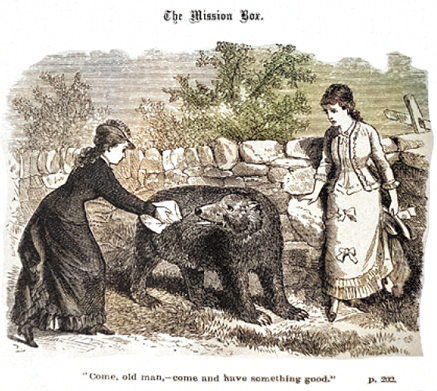
The Mission Box.
"Come, old man,—come and have something good."
The words acted as a stimulant to Julia's senses. Eunice put her arm round her waist, and the two ran without speaking till they came to the gate which opened into Mr. Hazleton's barnyard, and almost into the arms of Mr. Hazleton himself.
"We are safe now," said Eunice as soon as she could gather breath enough to speak.
"Safe from what?" asked Mr. Hazleton, naturally very much surprised. "What has frightened you?"
"It was Mr. Ferarra's bear," said Eunice, trying to speak collectedly. "He has got out again. Please, Mr. Hazleton, send some one to tell them before he does any mischief."
"Did he chase you?"
"No, he got me in a corner of the wall," said Julia, who had recovered her voice and her senses. "I was gathering some leaves, and I heard a noise and looked round, and there he was. He seemed to want to play at first, but when I screamed, he got angry and growled—oh, so savagely! I do believe he would have killed me, only for Eunice. Just think, papa, she had a paper of sugar, and she walked straight up and showed it to him, and then called him away down the lane to get it!"
"I don't understand," said Mr. Hazleton. "Did this—this young person entice the bear away?"
"Yes," answered Eunice. "I had just bought a parcel of sugar at Pat McGuire's, and I knew Bruin would do anything for sugar; so I called him down past the turn of the road, and emptied the whole five pounds out on the grass. I hope it won't disagree with him," added Eunice, laughing rather hysterically.
"Oh, papa, if you had seen her walk right up to the bear when he was growling and showing his teeth, and might have killed her just as well as not, and then help me when I could hardly walk, you—you wouldn't call her a 'young person,'" sobbed Julia.
"My dear, I intended no derogation by the epithet," said Mr. Hazleton in a tone of apology.—"I think Miss—I have not the honor of knowing the young lady's name—"
"My name is Eunice Riker."
"Ah, I apprehend—a daughter of the late Garret Riker? I knew your father well.—I think Miss Riker has behaved with the greatest gallantry and presence of mind, and I shall never forget the obligation she has laid us under. You had both better go into the house and take some rest and refreshment. I have sent John to give notice to Mr. Ferarra of the escape of the bear, and I think I shall take an opportunity of remonstrating with him on the subject of keeping such an animal."
"Mr. Ferarra had given him to the Park, and they were to come after him last week," said Eunice: "I heard Anita say so. But I must be going home, or mother will wonder what has become of me."
"I beg you will wait a little," said Mr. Hazleton. "I am about to drive down to the station, and will gladly set you down at your own door. I shall really feel hurt if you refuse," he added in his politest manner, seeing Eunice hesitate.—"Julia, take Miss Riker into the library. She will perhaps like to see the new pictures which were put up on Saturday."
Eunice consented, reflecting that she might secure the chance she desired of speaking to Julia. As they were looking at the beautiful landscapes, she entered on the subject that was uppermost in her mind:
"Julia, you were in Mrs. Ray's shop one day when I was there buying some Shetland wool for Anita?"
"Yes," replied Julia, turning scarlet.
"And was it you who told Ida Van Zandt and Fanny Gunderson that I changed away Mrs. Ackerman's yarn for wool for myself?"
"Yes, Eunice, I did."
Eunice was silent a minute. As soon as she could command her voice she said,—
"Do you think that was right, Julia? Would you have liked it if I had done so by you? I saw you buying some aprons that day. Suppose I had told people that you were making a bill on the sly, or something like that?"
"You wouldn't have been far wrong," said Julia in a curious voice. "How did you know?"
"Know what?"
"That I was making 'a bill on the sly.'"
"I didn't know it, of course," answered Eunice. "I only spoke of that because I heard you say once that your father would not let you make bills."
"Well, I did make the bill on the sly, and I did tell the story about you," said Julia. "I was vexed because you had done more for the box than I had, and because Miss Ackerman took more notice of you than she did of me; and so I was ready to believe any harm of you. I thought when I took the work, I should do it the best and quickest of anybody, and get the most praise; and when I saw that everybody, even little Mary, had accomplished more than I had, I was angry enough to burn up the whole thing together."
"There was not much charity in that," remarked Eunice—"not if you did the work from such motives, I mean."
"There was not one bit of charity in it," assented Julia. "All I did was just done 'to be seen of men.'"
"But just think what an injury you have done me, Julia!" said Eunice—"An injury that perhaps can never be repaired, for it is not easy to stop such a report when once it gets going. We have lost work by it already."
"A great many people don't believe it, though," said Julia eagerly. "When mother heard it, she said she did 'not believe one word of any such thing. It was a malicious slander, and the person who started such reports ought to be severely punished!' I felt mean enough, I can tell you. I don't know what she will say when she knows that I did it."
"Perhaps she won't know; only, Julia, I do think you ought to contradict the story, because there is not a word of truth in it. I bought the wool for Anita, and left the yarn to be matched for Mrs. Ackerman. I don't see what you ever saw in me to make you think I would do so," added Eunice with a quivering lip.
"I never saw anything but what was good in you, Eunice. It was all my own envy and wicked temper. You don't know how it all looked to me when I stood there in that corner fenced in by the bear. I have heard that when people are drowning they see their whole lives spread out before them—which, of course, is impossible—but I can easily believe that they think of many things in a short time; for it seemed to me this morning as if every wrong thing I ever did was looking at me out of the eyes of that bear."
"Then, how will it seem when you come to stand before the judgment-seat?" asked Eunice in a low tone.
Julia shook her head and was silent for a moment. Then she resumed cheerfully,—
"But I shall put you right, Eunice, whatever happens to me. Here comes mamma. I wondered where she was."
Mrs. Hazleton quite forgot to be dignified. She forgot all about Eunice's "proper station" and all the rest of it, and she could not have clasped "the young person" in her arms and kissed her with more motherly warmth and tenderness if she had been a princess of the blood:
"You dear, dear girl! To think you should have had such presence of mind and courage!—Didn't I tell you, Julia, that Eunice—" And here Mrs. Hazleton stopped in some confusion.
"Oh I know all about it, Mrs. Hazleton," said Eunice, smiling. "I have been to see Mrs. Ferarra, and it will be all straightened out. As to what I did this morning, I don't really think there was so much danger. I have often fed Bruin, and knew his tastes pretty well, though I won't deny that I was a good deal frightened, because one can never tell what these wild creatures may do."
"I think there was great danger, such as I shudder to think of," said Mrs. Hazleton. "A young school-friend of my own was torn all to pieces by a bear which every one thought was perfectly tame. * But the carriage is here, and Mr. Hazleton has to meet the train."
* This is a fact. No tame bear is to be trusted.
"Eunice has given all her mother's sugar to the bear, mamma," said Julia.
"We will remember that," said her mother.—"Good-bye, my dear. I shall see you again before long."
As Mrs. Hazleton opened the door, Eunice whispered to Julia,—
"Tell your mother about the bill, Julia. You will feel better if you do."
"I dare not," said Julia; "it would be worse than the bear."
"It will all come out some time," said Eunice; "and remember, God knows it all."
"Well, I'll try. Good-bye, Eunice."
THE CLASS-MEETING.
MONDAY and Tuesday were very busy and interesting days to Miss Ackerman's class. All the girls hastened to finish their work, and, to their credit be it said, not one was behindhand. Many were the "wonders" whether Eunice would be present, and whether she would "have the face" (this was Minny Haynes's expression) "to bring in any extra work."
"I shouldn't wonder. You know in class last Sunday she acted as if nothing was the matter till Fanny Gunderson spoke to her. Julia will expose her if she brings that worsted," said Phebe.
"Oh no, she won't—not after what happened yesterday. Didn't you hear about it?" And Minny proceeded to relate the story of the bear with many amplifications.
"Well, Minny Haynes, you may say what you please, but you won't make me believe a girl who would do a thing like that, and for a girl who had treated her as Julia has Eunice, would steal!" said Phebe with more good feeling than logic. "I wouldn't believe it—no, not if I saw her myself."
"What has that got to do with it?" asked Minny. "Besides, it was no such great thing to do. The bear was tame, and Eunice knew it."
"So was Mrs. Murray's horse tame, and you knew it, but that didn't hinder you from running away and leaving your little sister the day he got out," said Phebe.
"A horse is different—"
"From a bear. Yes, I should rather think he was."
"Oh, well, you can think what you like; I don't care," said Minny with a tone of superiority. "I don't half believe the story, anyway; such things always get stretched."
"Other things don't get stretched, I suppose?" said Phebe.
"Well, we shall see whether Eunice comes, and whether the girls will speak to her. Here we are, and here is Fanny Gunderson.—How do you do, Fanny?"
"Good-afternoon, Miss Haynes," returned Fanny stiffly; and she walked on without another word.
Fanny had been especially invited to the class-meeting by Miss Ackerman, and she had a long debate with herself and her mother before she decided to go; but curiosity and her mother's advice carried the day. She was very much vexed at the turn things seemed to be taking in favor of Eunice, whom she hated as people of her sort do hate those whom they have injured. She felt a strong desire to take out her vexation on somebody, and Minny was the first person who came in her way.
"See if I don't pay you out for that, Fanny Gunderson!" muttered Minny between her teeth.
A number of the girls were now assembled in the veranda outside the drawing-room windows, waiting for new-comers.
"Here is Mr. Hazleton's carriage," said some one, "but Julia is not in it."
"Isn't Julia coming, Ida?" asked Mary Edgar as Ida came into the veranda, followed by Emma Hazleton.
Ida was pale, and her hand was muffled up in a sling.
"No, she can't come; she is very sick," answered Ida.—"Take care, girls, don't break my arm," as the girls crowded round her.
"Does it pain you very much?" asked Mary.
"Yes, I guess it does; but I wanted to come to the meeting, and I told mother my hand might as well ache here as anywhere else."
"You've got good grit, anyhow," said Matilda, who had a great admiration for that quality.
"You couldn't finish your work, could you?"
"No. Eunice took it and finished it for me."
"I wonder if she is coming?" said Phebe.
"I told you I didn't believe she would," answered Minny Haynes in a tone of some triumph; "I don't believe you'll see her here again."
"Then you are very much mistaken, Miss Minny Haynes," returned Matilda, who had been one of the first arrivals. "She came half an hour ago with Mrs. Ferarra and Anita in the carriage."
Minny and Phebe looked at each other. One glance said, "I told you so;" the other, "I don't believe it."
There was no time for words, however. Miss Ackerman appeared at the door and called the whole party into the drawing-room, where they found not only Eunice and "the committee,"—that is to say, Amity and Percy—but Mrs. Ackerman and Mrs. Ferarra. A large table stood in the centre of the floor.
"We will first bring in our work and contributions," said Miss Ackerman when all were seated.—"Mary, you are the youngest; you may begin."
Mary laid down the flannel petticoat she had made, and then deposited beside it a neat, convenient work-box filled and packed with working-materials and all sorts of little conveniences. There were tapes, linen and cotton of different widths, black and white thread in assorted numbers, all sorts of needles from darners to fine cambric needles, bodkins, pins, black, white and safety, mending cotton in different colors, and, best of all, two or three button-hooks and a bunch of boot-lacings.
"Well done, Mary!" said Percy as she took out the last article. "I don't think we shall have anything better than this."
"I suppose her sister bought it," said Minny Haynes.
"No indeed, she didn't," said Ida eagerly, as Mary did not answer. "Mary picked out all the things her own self; didn't you, dear?"
"Yes, but Aunt Barbara Van Zandt advised me," answered Mary, blushing. She had indeed passed a superlatively happy morning in Selig's shop buying the box and filling it under the superintendence of Mrs. Barbara Van Zandt.
"And of course Mrs. Van Zandt gave you the money to pay for them," said Minny Haynes, who somehow seemed to feel the box a personal injury.
"No," replied Mary; "it was my own money."
"Let me tell about it, Mary," said Ida eagerly. And then, without regarding Mary's blushing shake of the head, she went on: "Mary sold her beautiful twelve-dollar doll, and bought these things with part of the money."
"Good for her!" said Matilda.
"Ida shouldn't have told," said Mary.
"Well, I do like to tell of it when people do nice things," said Ida.
"In which you are very different from a good many other people," said Amity.—"Now, Ida, it is your turn."
"I haven't much," said Ida, blushing. "Eunice finished my work after I hurt my thumb, but I sold a Roman lambrequin I had begun to Cousin Louisa Edgar, and laid out the price in stationery—at least, mother did it for me. There it is on the table."
"That is a very nice present," said Percy; "and of course you couldn't finish your work after you hurt your thumb."
"It wasn't my thumb," said Ida. "I had plenty of time before that, if I had used it, but I kept putting it off till at last I lost the chance of doing it at all."
"Folks do that sometimes about more important things than sewing," observed Matilda.
"Yes, about the most important concern of all," said Miss Ackerman. "They wait and think there is plenty of time, and at last, while they go to 'buy,' the door is 'shut'—Who is next?"
One after the other the girls deposited their gifts great and small. All had done the work promised, and almost all had something else to offer. Phebe had knitted a baby's sacque. Matilda had made a pretty house-jacket of blue cashmere.
"It was my sister's that died," said she. "Ma gave it to me, and I have never felt like wearing it, so I kept it put away. But I am sure if Jenny were here, she would rather the jacket was being of some use to somebody; so I cut it over and trimmed it up a little. And here are three pairs of her stockings; ma sent these."
Anita now brought forward the work she had done, and produced her two pretty crocheted head-dresses.
"These should be considered as much the work of Eunice as my own," said she. "Eunice selected the wool for me at Mrs. Ray's, and taught me how to construct them."
Again the glances were exchanged between Phebe and Minny.
"Here are my stockings," said Eunice, producing them. "Mrs. Ray matched the yarn for me very nicely; and I have made a pair of oversocks besides from some thick cloth that Sarah Southmayd gave me. She says she spun the wool herself when she was a young girl."
"Julia sends her work," said Emma Hazleton, producing it, "and also these books, which she selected from her own library. There are some which she valued very much, but I fear she never will want them again." Miss Emma put her handkerchief to her eyes as she spoke and went quickly out of the room.
"Is Julia so very sick, Ida?" asked some one.
"Oh yes, very," said Ida sadly. "She is out of her head a great deal of the time, and then she is always talking about the bear, and wanting Eunice to come and drive him away."
"Do you suppose the bear would really have hurt her, Anita?" asked Minny Haynes.
"I suppose it probable he might, only for Eunice," replied Anita. "He has been very ferocious several times lately, and James has had much trouble with him.—That was a consequence of putting things off too," added Anita. "Philip told James only the day before that he thought the—the staple which held Bruin's chain had worked loose and was not secure, and James said he would see to it in a day or two—it would do for the present. I think it will ever be a lesson to me about putting off."
"I am sure it will to me," said Ida. "If I don't learn to do things in the time for them after this, I shall be a fool in good earnest. Are all the things in? What a fine parcel!"
"Yes, I think the box will be the best we ever sent," said Miss Ackerman. "The work is all neatly done, and the contributions are well chosen in every case, and show that a good deal of industry and self-denial has been bestowed upon them.—And now, girls, there is another matter about which I wished to see you—one which has given me great pain. I observed last Sunday that several of you—I am glad to say not all—treated Eunice Riker very unkindly."
Miss Ackerman paused a moment.
Percy and Amity, who had been away and had not heard the story, looked surprised, Matilda looked triumphant, and several others very much confused.
"I suppose," continued Miss Ackerman, "that those who did so were influenced by a stupid and malicious slander which has been going the rounds—a slander so foolish and improbable that I should wonder at any one's being affected by it if I did not know that there are people in every community who 'rejoice in iniquity' and take pleasure in repeating any sort of slander. I allude to the report that Eunice stole some yarn which my mother gave her to knit into stockings for Ethelind Swift, and exchanged it for wool to use for her own purposes. The story is false in every particular."
Miss Ackerman paused, and Miss Emma Hazleton spoke.
"It was my sister Julia who started that story," said she. "She asked me to come here this afternoon and make this statement. She says she saw Eunice buy the wool, and 'being angry and envious of Eunice'—I use her own words by her express desire—she was ready to believe any evil. She is very sorry, and begs Eunice's pardon again, as she has done before. She is in great distress of mind when she is able to think at all, and she asks you all to pray for her."
Miss Emma sat down weeping, and most of the girls wept with her. Fanny Gunderson pressed her lips together and looked straight out of the window. She was so angry she could hardly sit still, and yet she did not know what to do about it.
Then Mrs. Ferarra told her story. She did not excuse her cousin, but said, what was quite true, that as soon as she arrived at home, Miss Fay had written to Mrs. Gunderson the true account of the thimble. She expressed the greatest respect and regard for both Mrs. Riker and Eunice; and, smiling, Mrs. Ferarra said she hoped it would be a lesson to her not to mislay her thimble again.
"I knew it! I told ma so!" exclaimed Matilda, unable any longer to repress the expression of her triumph. "I said there was some perfectly simple way of explaining the whole if we only knew it."
"You were quite right, you see," said Miss Ackerman.—"And I must add, girls, that it was Matilda's straightforward good sense which has brought this whole matter to light. As soon as the calumny came to her ears, she brought it directly to me, and has thus enabled us to clear Eunice entirely."
"Exactly so," said Mrs. Ferarra; "and as I feel greatly obliged to Matilda, I am going to ask her to do me the favor to accept the thimble in question—the very small base on which this great Tower of Babel has been erected."
She held up the pretty gold thimble as she spoke, and then put it into Matilda's hand.
"I don't know what to say—I don't hardly think I ought to take it," said Matilda, stammering between delight and embarrassment. "Ma don't like me to take presents; and besides, I think if any one has the thimble, it ought to be Eunice, and not me."
"Your mother's principle is a good one in general, if it be not carried too far, but I don't think it applies in the present instance," said Mrs. Ferarra. "As for Eunice, I do not think the thimble would have as pleasant associations for her as it would for you. I am sure she would rather you had it."
"Yes indeed," said Eunice.—"I am sure I never can repay you, Matilda."
"That wasn't anything," answered Matilda. "I only did as I would be done by."
"'Tis n't every one who does that," said Ida. "Anyhow, I'm glad I never believed it."
"Ida never believes any thing bad about any one," said one of the girls, "or, if she has to believe it, she is sure there is some good excuse, if one only knew it."
"Well, I did believe it, and I'm sorry I did, and that I refused to speak to Eunice," said Phebe, governed, as usual, by the spirit of the hour, and perhaps in this case by something better. "And I beg Eunice's pardon; so, there!"
"I don't know as I have got anything to beg her pardon about," said Minny Haynes sharply. "I heard the story on good authority, and I repeated it. I don't see any great harm in it, either."
"What did you want to repeat it for, supposing it was true? That's what I want to know," said Matilda.
"And it is a very pertinent question," said Miss Ackerman. "Suppose we know, of our own knowledge or on the best authority, an evil thing of our neighbor; what is the use of repeating it? What good end is gained by making others think ill of him as well as ourselves?"
"It isn't from any good," said Matilda. "It is just because folks like to have something to tell that nobody else knows. It makes them of consequence."
"That is one reason, no doubt, and I fear there is another, which is founded in the evil which belongs to human nature. People take pleasure in evil. They like to think ill of their neighbors. They 'rejoice in iniquity.' But quite as often Matilda's reason is the true one, and I presume it has been so in this case."
Fanny Gunderson rose, pale and trembling with anger. "If you think you have insulted me enough, I will go home," said she. "I told the story about Eunice because it came from one of Mrs. Ferarra's own family, and from Julia, who pretended to know."
"Why didn't you tell of the contradiction when that came from Mrs. Ferarra's own family?" asked Matilda. "I didn't hear of your running down to Mrs. Murray's with that the first minute you got it."
"Hush, Matilda!" said Miss Ackerman.—"Fanny, my words did not apply any more to you than to any one else who has repeated this story. I consider that every person who repeats a slander without knowing it to be true makes himself a partaker in the guilt of the slander. To tell a true story to any person's injury, needlessly, is an act of evil-speaking; to make up such a story is lying; to repeat it without knowing it to be true is slandering; and all are offences against that charity which we are told is the greatest of the three heavenly graces (1 Cor. xiii. 13), and without which all our doings, though we 'should give all our goods to feed the poor, and our bodies to be burned,' are nothing worth."
"But it is needful to speak evil sometimes," said one of the girls.
"It may be necessary once in a thousand times perhaps," answered Miss Ackerman, smiling.
"Please, Miss Ackerman, don't say any more about the matter," said Eunice, speaking for the first time. "All the harm that was done was done thoughtlessly, I am sure. I know Fanny is sorry that she helped to injure me, though she does not say so. It is all over now, and no one is the worse. Please don't say any more about it."
"You are a good girl, Eunice Riker," said Minny Haynes, almost as if the words came against her will. "I don't suppose you'll ever forgive me."
"Yes indeed I will," answered Eunice heartily. "I do too many wrong things myself to afford to be unforgiving."
"Dear me! What a pious set we are!" sneered Fanny—"Quite too good for such a sinner as I am; so I will go away and leave you. You can just tell your sister, Miss Hazleton, that I will never speak to her again the longest day I live."
"I fear you will never have a chance, Fanny," said Miss Emma.
"I don't care if I don't," returned Fanny. "I think this has been just a great fuss about nothing."
"That is it exactly: who made the fuss?" said Matilda.
"You did most of it—running and telling your Sunday-school teacher everything, like a good little girl in a book," retorted Fanny. "As for Eunice, she is a sanctimonious little humbug, who just flatters rich folks for what she can get. I dare say she let the bear out herself, just to get a chance to make a scene."
The universal laugh which greeted this reasonable supposition was too much for Fanny, and she burst into a violent flood of tears.
"Come! Come!" said Mrs. Ackerman. "I think, with Eunice, that the subject had better be dropped. Fanny has had her lesson, which I am sure she will not forget, and when she takes time to think about it, she will see that she has nothing to complain of. My advice to you all is, to go out on the lawn and see which of you can make the best shots, with the new bows and arrows, which came down from the city this morning; only take care you don't shoot each other.—Come with me, Fanny, and don't cry any more."
The girls were not unwilling to take Mrs. Ackerman's advice, for archery was then just becoming the rage, and all were anxious to try their skill. Fanny joined them after a while. Her tears had cooled her anger, and she was able to see that she was in a false position, from which there was but one way of escape. She was not naturally malicious or silly, but she had been brought up by a stepmother who was both, and to whom scandal was as the breath of her nostrils.
"Girls," said she in a pause of the games, "I have been very wrong and foolish this afternoon. I am sorry; and, Eunice, I am sorry I told the story about you, and I hope you will forgive me."
"Good!" said Matilda. "I call that talking like a lady."
"I am sure I do forgive you, Fanny," said Eunice, kissing her. "Don't think any more about it."
"Only just enough to keep her from doing so again," said Ida; and there the matter ended.
CONCLUSION.
TWO or three days after the class-meeting, Mrs. Murray called on Mrs. Riker. She was influenced by two reasons: she was really anxious to repair the injustice of which she had been guilty, and she wanted to get her baby-clothes done up for less money than Sarah Southmayd asked her. Mrs. Riker thanked her, but said quietly that she thought Mrs. Murray had better keep on with Sarah, who was an excellent laundress and very careful.
"But she is such a fuss!" said Mrs. Murray, who was used to having her own way, and who expected that Mrs. Riker would be glad enough to get the work back again. "She asks more than you do, and she won't have them at all unless I make out two lists every time; and that is such a bother. Come, Mrs. Riker, you shouldn't bear malice."
"I have nothing to bear malice about," replied Mrs. Riker with a gentle dignity which "quenched" Mrs. Murray's intention of patronage at once. "I am not going to take in any more washing at present. I cannot well do it without Eunice's help, and she will be otherwise engaged; and besides, I have unexpectedly received a legacy which will make it perfectly easy for me to live without hard work."
"Dear me!" said Mrs. Murray, very much disappointed. "How much is this great fortune, if I may ask?"
"Oh, it is no great fortune—only an annuity of two hundred a year for my life," replied Mrs. Riker, smiling; "but that, with my pension and what fine sewing I can do, will make me quite independent."
"And pray what is Eunice going to do?—Teach school, I suppose?" said Mrs. Murray pettishly. "That may be more genteel than washing fine things, but I don't think she will find it easier or more profitable."
"Eunice is not going to teach, but to study," replied Mrs. Riker. "She has a fine voice and a decided talent for music, and Mrs. Ferarra has most kindly undertaken to give her a musical education."
"But, dear me! She won't do anything at it," said Mrs. Murray. "Her hands will never manage the piano, beginning so late in life and after she has spoiled them with hard work. Besides, where will she get a piano?"
"Professor C— thinks she will do very well, and he says it is all the better for her that she has never had any singing-lessons heretofore. He spent some time trying her voice, and says it is an uncommonly fine one. As to the piano, Mrs. Hazleton is kind enough to lend her one for the present."
"Dear me!" said Mrs. Murray. "I thought the Hazletons professed to be very exclusive people, but I suppose they patronize Eunice on account of that fuss about the bear. Well, Mrs. Riker, I am sure I hope this money and patronage will be an advantage to you. I suppose Eunice will end by going on the stage."
Mrs. Riker did not reply, and Mrs. Murray departed very much vexed, to tell the news that the Ferarras and Hazletons had taken up that Riker girl, and were going to make her a public singer.
"Did you hear what Mrs. Murray was saying, Fanny?" asked Mrs. Gunderson. "She tells me the Ferarras are so taken with Eunice Riker's voice that they are going to educate her for the stage. Pretty good promotion that, for one of Miss Ackerman's pet saints!"
"Nonsense!" returned Fanny, not very dutifully. "Mrs. Murray is a goose. It is true that Mrs. Ferarra is going to give Eunice a musical education—Eunice told me that herself—but I don't suppose there has ever been anything said or thought about the stage. I should think we had had about enough of talking about Eunice Riker, ma—and about other people too, for that matter."
Fanny improved very much after the class-meeting at Miss Ackerman's. Her stepmother married again, and Fanny, by her own desire, went to live with her grandmother and aunts. The elder Mrs. Gunderson and her daughters were women of refinement and cultivation, whose minds were occupied with something besides the concerns of their neighbors. From them Fanny learned to take an interest in books and in all sorts of good works. She is now an assistant district visitor under her aunt, and is also very much occupied with the study of ferns and mosses, of which she has made a fine collection, and she bids fair to be a useful and respectable woman.
It was, as Fanny said, quite true that Mrs. Ferarra had taken Eunice's music in hand. We have heard her allude to "Carmen's dowry." When Anita's twin sister died at the age of five years, Mrs. Ferarra began the practice of laying aside every year as much money as Carmen would have cost her had she lived. This sum was of course increased year by year. It was called "Carmen's dowry," and was expended for the benefit of some deserving person—if possible, a young girl. *
* I know a lady—now, alas! a childless mother—who has pursued this
course for years.
Mrs. Ferarra had first been led to notice Eunice by her remarkable voice. Her esteem for the modest, industrious girl increased with acquaintance, and was confirmed by the way Eunice had passed through her late severe trial. She consulted with her husband, and the result was that the money which would have paid for Carmen's music, had she lived, went to provide for Eunice the best instruction the city could afford. Mrs. Hazleton no sooner heard of the plan than she begged permission to assist in it, and did so in the best way by lending Eunice a fine cottage piano.
"Present it to the young person, Mrs. Hazleton my dear," said her husband. "It is the least acknowledgment we can make for the inestimable services rendered under circumstances of such extreme peril to our poor, unfortunate child."
"Perhaps it would be better to make the instrument a loan at first," Mrs. Hazleton said to her husband. "Then, if Eunice shows that she has taste and perseverance, we can make it a gift or perhaps exchange it for a better one. If she has not, we can cast about for some other way of rewarding her. But we must proceed with care not to hurt Mrs. Riker's and Eunice's self-respect, of which they have a great deal."
"And rightly, too—quite rightly. They are most worthy people, and have as much right to self-respect as persons whom fortune has more highly favored. You are quite right, Mrs. Hazleton my dear, and very judicious. Manage it your own way," said Mr. Hazleton, who was a worthy, right-thinking gentleman, though he had a great opinion of his own consequence, and talked like Mr. Micawber and Dr. Johnson rolled into one.
Julia continued very ill for a long time. After the height of her fever was passed, she fell into a state of extreme weakness, both of body and mind. She could neither sit up, nor bear any conversation, nor read, nor even be read to, and it seemed for a time as if her mind was likely to give way entirely. As soon as she was able to travel on a sleeping-car, her mother took her to the Springs and placed her under the care of Dr. Henry. Here she improved slowly, with many ups and downs, but at last she recovered her health in some measure, so as to be no longer a burden to herself and her friends, though she was never well. That loose staple which was to be mended to-morrow spoiled a life.
The box was packed and despatched, and in due time came a letter from Mrs. Swift, which was read to the whole class assembled at Mrs. Ackerman's. I transcribe a part of it for the reader's benefit:
"DEAR MADAM:
"Three days since we received a notice that a box was awaiting us at
Siskowitz Station, six miles off, and yesterday a kind neighbor brought
it over to us. My husband assembled the whole family round the box, and
we had a prayer and sung a hymn of thanksgiving before we opened it. *
I wish you could have peeped in and seen the faces of the children, and
especially that of my poor little lame seven-year-old girl, when the
box marked with her name was put into her hands and she discovered the
beautiful doll, with the note 'introducing Flora Arabella.'"
* A simple fact.
Mary Edgar jumped up and clapped her hands, while her eyes danced with delight:
"So that is what papa did with the doll? He never would tell me. How glad I am!—Please excuse me for interrupting, Miss Ackerman."
"Oh, we can excuse you without any difficulty," said Miss Ackerman, smiling.
"Anna never has had any but a home-made doll before," read on Percy,
"and her joy was almost too great for utterance. She says, 'Tell Mary
Edgar that I will think of her every night and morning when I say my
prayers.'"
"It was not I that sent it; it was papa. I sold it to him," said honest little Mary, very much delighted. "I will tell him what she says."
"Ethelind desires especially to thank the young ladies who have
provided her with such a beautiful wardrobe. The things fit perfectly,
and I only fear they are too fine for a poor missionary's daughter. As
I wrote before, she had a presentation to an excellent school, but we
feared she would be unable to avail herself of it, because we literally
could not procure decent clothes for her. She sends her thanks and
good wishes, and says she will try to do credit to her kind friends
in Rockdale; and I think she will do so, for, though 'I say it that
shouldn't,' she is a good Christian girl and a great comfort to father
and mother. I do not know how to particularize when everything is so
nice. Baby looks very pretty and feels very comfortable in his new
frock, sacque, and red shoes."
"Dear little man!" said Eunice.—"Don't you wish we could see him, Phebe?"
"Mr. Swift wishes particularly to thank the young lady who sent the
stationery; and I would say the same for the box of working things. We
can hardly procure a decent sheet of paper or a good needle here for
any money. The books are a great pleasure to the whole family. I trust
the young lady who sent them is better by this time. She shall not want
our prayers for her health, both of soul and body."
"Poor Julia!" said three or four voices together.
Percy read on:
"In conclusion, let me thank you, every one, for the pleasure and
comfort you have given us—pleasure and comfort such as you can never
understand unless you should be situated as we are. Lest I should
seem to repine, however, I will say that neither Mr. Swift nor myself
have ever regretted for one moment the decision we made when we gave
ourselves to the work of the Lord in the missionary field. I speak for
him as well as myself when I say that after sixteen years' experience,
with all their hardships and privations, if the thing were to do again,
we would decide as we did before. Wishing our dear friends in Rockdale
all the blessings here and hereafter which our common Master has to
bestow, we remain—
"Your sincere and obliged friends,
"RICHARD AND STELLA SWIFT."
"What a nice letter!" said Ida.
"Yes indeed—just the kind I like," added Matilda. "It tells what one wants to know."
"I don't think it is quite as nice as the one the Wood street people got when they sent their box," observed Phebe Goodman. "That had so many nice reflections and was written in such beautiful language!"
"I hate beautiful language; and as to reflections, I like to make my own," said Matilda.—"Don't you, Miss Ackerman?"
"Why, yes, Matilda, I must confess I do," said Miss Ackerman, smiling; "but different people have different tastes, you know.—I think, girls, we ought to be pleased with the result of our work. We have 'both done good and got good,' as an old author says whom I was reading this morning. Is not that true?"
"I'm sure it is true for me," said Matilda.
"And for me," said Ida. "I think if I ever have the use of my hand again, I shall want to sew and practise all day long."
"Can't you use it yet?" asked some one.
"Only a very little. The end of the bone is so tender it won't bear any pressure, but I am thankful to be able to dress myself. I never knew what a thumb was worth before."
"We don't know what a good many of our blessings are worth till we lose them," remarked Anita. "After all, a good deal of trouble grew out of the box, too."
"Yes, but how well it has all turned out!" said Eunice. "Even Fanny Gunderson says that it will be a lesson to her as long as she lives; and I believe it will."
"It may be a lesson to all of us," remarked Miss Ackerman, "if we only use it rightly—if we only remember that charity does not consist in giving nor making great and painful sacrifices.
"'Though I bestow all my goods to feed the poor, and though I give my
body to be burned, and have not charity, it profiteth me nothing.' 1
Cor. xiii. 3.
"It is love which must be the fountain and spring of all our efforts; not a mere sentiment which is at the mercy of every passing gust and every frost of feeling, but love as a principle—such love as the Saviour meant when he said,—
"'He that hath my commandments and keepeth them, he it is that loveth
me'—
"Such love as he showed when he died to atone for our sins and bring us to God—such love as the apostle describes when he says,—
"'Love worketh no ill to his neighbor: therefore love is the fulfilling
of the law.'"