Front Cover
Title: Theodosia Ernest
Complete in two volumes
Author: A. C. Dayton
Release date: January 27, 2026 [eBook #77796]
Language: English
Original publication: Memphis: South-Western Publishing House, 1866
Other information and formats: www.gutenberg.org/ebooks/77796
Credits: Dustin Speckhals
Front Cover
Entered according to Act of Congress, in the year 1866, by
R. B. Davidson,
In the District Court of the United States for the Middle District of Tennessee.
Theodosia Ernest:
Or, The Heroine of Faith.


“Mother, have I ever been baptized?” The questioner was a bright, intelligent, blue-eyed lad, some thirteen summers old. The deep seriousness of his countenance, and the earnest, wistful gaze with which he looked into his mother’s face, showed that, for the moment at least, the question seemed to him a very important one.
“Certainly, my son; both you and your sister were baptized by the Rev. Doctor Fisher, at the time when I united with the church. Your sister remembers it well, for she was six years old; but you were too young to know any thing about it. Your Aunt Jones said it was the most solemn scene she ever witnessed; and such a prayer as the good old doctor made for you, I never heard before.”
“But, mother,” rejoined the lad, “sister and I have been down to the river to see a lady baptized by the Baptist minister, who came here last month and commenced preaching in the school-house. They went down into the river, and then he plunged her under the water, and [4] quickly raised her out again; and sister says if that was baptism, then we were not baptized, because we stood on the dry floor of the church, and the preacher dipped his hand into a bowl of water, and sprinkled a few drops on our foreheads: and she says Cousin John Jones was not baptized either; for the preacher only took a little pitcher of water, and poured a little stream upon his head. Sister says she don’t see how there can be three baptisms, when the Scripture says, ‘One Lord, one faith, one baptism.’”
“Your sister is always studying about things above her reach, my son. It is better for young people like you not to trouble yourselves too much about these knotty questions in theology.”
“But, mother, this don’t seem to me to be a knotty question at all. One minister takes a person down into the water, and dips her under it; another stands on the dry floor of the church before the pulpit, and sprinkles a few drops into her face; another pours a little stream upon her head. Now, anybody can see that they do three different things; and if each of them is baptism, then there must be three baptisms. There is no theology about that, is there?”
“Yes, my child, this is a theological question, and I suppose it must be a very difficult one, since I am told that some very good and wise men disagree about it.”
“But, mother, they all agree that there is only one baptism, do they not? And if there is only one, why don’t they just look into the Testament and see what it is? If the Testament says sprinkle, then it is sprinkling; if it says pour, then it is pouring; if it says dip, then it is dipping. I mean to read the Testament, and see if I cannot decide which it is for myself.”
“Do you think, my son, that you will be able to know as much about it as your Uncle Jones, or Dr. Fisher, [5] who baptized you, or Dr. Barnes, whose notes you use in learning your Sunday-school lesson, and all the pious and learned ministers of our church, and the Methodist Church, and the Episcopal Church? They have studied the Testament through and through, and they all agree that a child who is sprinkled is properly baptized.”
“Yes, mother, but if the baptisms in the New Testament were sprinkling (and of course they were, or such wise and good men would not say so), why can’t I find it there, as well as anybody?”
“Very well, my son, you can read and see; but if you should happen to come to a different conclusion from these great and learned men, I hope you won’t set up your boyish judgment against that of the wisest theologians of the age. But here comes your sister. I wonder if she is going to become a theologian too!”
Mrs. Ernest (the mother of whom we are speaking) was born of very worthy parents, who were consistent members of the Presbyterian Church; and she had grown up as one of the “baptized children of the church.” As she “appeared to be sober and steady, and to have sufficient knowledge to discern the Lord’s body,” she was doubtless informed, according to the directions of the confession of faith, page 504, that it was “her duty and her privilege to come to the Lord’s supper.” But she had felt no inclination to do so until after the death of her husband. Then, in the day of her sorrow, she looked upward, and began to feel a new, though not an intense interest in the things of religion. She made a public profession, and requested baptism for her two children.
The little boy was then an infant and his sister was about six years old, a sprightly, interesting child, whose flowing ringlets, dimpled chin, rosy cheeks, and sparkling eyes, were the admiration of every beholder.
[6]Twelve years had passed. The lovely girl had become a beautiful and remarkably intelligent young lady. The little babe had grown into the noble looking, blue-eyed lad, with a strong, manly frame, and a face and brow which gave promise of capacity and independence of thought far above the average of his companions.
Theodosia and Edwin. How they loved each other! She, with the doting affection of an elder child and only sister, who had watched the earliest developments of his mind, and been his companion and his teacher from his infancy; he, with the confiding, reverential, yet familiar love of a kind-hearted and impulsive boy, to one who was to him the standard at once of female beauty and womanly accomplishments.
Theodosia came in, not with that elastic step and sprightly air which was habitual with her, but with a slow and solemn gait; scarcely raising her eyes to meet her mother’s inquiring gaze, she passed through to her own room, and closed the door.
The mother was struck with the deep and earnest seriousness of her face and manner. What could it mean? What could have happened to distress her child?
“Edwin, my son, what is the matter with your sister?”
“Indeed, mother, I do not know of any thing. We stood together talking at the river bank, and just before we left, Mr. Percy came up to walk home with her. It must be something that has happened by the way.”
The mother’s mind was relieved. Mr. Percy had been for many months a frequent and welcome visitor at their pretty cottage, and had made no secret of his admiration of her accomplished and beautiful daughter; though he had never, until a few weeks since, formally declared his love. Mrs. Ernest did not doubt but that some lovers’ quarrel had grown up in their walk, and this [7] had cast a shadow upon Theodosia’s sunny face. She waited somewhat impatiently for her daughter to come out and confirm her conjectures. She did not come, however, and at length the mother arose, and softly opening the door, looked into the room. Theodosia was on her knees. She did not hear the door, or become conscious of the presence of her mother. In broken, whispered sentences, mingled with sobs, she prayed: “Oh, Lord, enlighten my mind. Oh, teach me thy way. Let me not err in the understanding of thy word; and oh give me strength, I do beseech thee, to do whatever I find to be my duty. I would not go wrong. Help! oh help me to go right!”
Awe-struck and confounded, Mrs. Ernest drew back, and tremblingly awaited the explanation she so much desired to hear.
When at length the young lady came out, there was still upon her face the same serious earnestness of expression, but there seemed less of sadness, and there was also that perfect repose of the countenance, which is the result of a newly formed, but firmly settled determination of purpose.
Mrs. Ernest, as she looked at her, was more perplexed than ever. She was, however, resolved to obtain at once a solution of the mystery.
“Mr. Percy walked home with you, did he not, my daughter?”.
“Yes, mother.”
“Did you find him as interesting as usual? What was the subject of your conversation?”
“We were talking of the baptism at the river.”
“Of nothing else?”
“No, mother; this occupied all the time.”
“Did he say nothing about himself?”
[8]“Not a word, mother, except in regard to the question whether he had ever been baptized.”
“Why, what in the world has possessed you all? Your brother came running home to ask me if he had been baptized; Mr. Percy is talking about whether he has been baptized. I wonder if you are not beginning to fancy that you have never been baptized?”
“I do indeed begin to doubt it, mother; for if that was baptism which we witnessed at the river this evening, I am quite sure that I never was.”
“Well, I do believe that Baptist preacher is driving you all crazy. Pray tell me, what did he do or say, that gave you such a serious face, and put these new crotchets in your head?”
“Nothing at all, mother, He simply read from the New Testament the account of the baptism of Jesus and of the Eunuch. Then he took the candidate, and they went down both of them into the water, and he baptized her, and then they came up out of the water. I could not help seeing that this is just what is recorded of Jesus and the Eunuch. If so, then it is the baptism of the Scriptures; and it is certainly a very different thing from that which was done to me, when Dr. Fisher sprinkled a few drops of water in my face.”
“Of course, my dear, it was different; but I don’t think the quantity of water employed affects the validity of the baptism. There is no virtue in the water, and a few drops are just as good as all the floods of Jordan.”
“But, mother, it is not in the quantity of water that the difference consists; it is in the act performed. One sprinkles a little water in the face; another pours a little water on the head; another buries the whole body under the water and raises it out again. Two apply the water to the person, the other plunges the person into the water. They are surely very different acts: [9] [10] [11] and if what I saw this evening was scriptural baptism, then it is certain that I have never been baptized.”
“Well, my child, we won’t dispute about it now; but I hope you are not thinking about leaving your own church; the church in which your grandfather and your grandmother lived and died: and in which so many of the most talented and influential families in the country are proud to rank themselves, to unite with this little company of ignorant, ill- mannered mechanics and common people, who have all at once started up here from nothing.”
“You know, my mother, that it is about a year since I made a profession of religion. I trust that before I did so, I had given myself up to do the will of my Heavenly Father. Since then I have felt that I am not my own. I am bought with a price. It is my pleasure, as well as my duty, to obey my Saviour I ask, as Paul did, Lord, what wilt thou have me to do? You taught me this lesson of obedience yourself; and I am sure you would not have me on any account neglect or refuse to obey my Saviour. If He commands me to be baptized, and the command has never been obeyed, I shall be obliged to do it. And I trust my mother will encourage me in my obedience to that precious Redeemer she taught me to love.”
One who looked into the mother’s face, at that moment, might have read there “a tablet of unutterable thoughts.” She did not try to speak them. We will not try to write them. She sat silent for a moment, drew her breath deeply and heavily, then rising hastily, went to look for something in her daughter’s room.
Theodosia was not only grieved but surprised at the evident distress which she had given her mother. While on her knees in prayer to God after her return from the river, she had determined to do her duty, and obey the [12] commandment of Jesus Christ, her blessed Saviour, whatever she might find it to be. But she had not determined to be immersed. That river baptism, connected with the reading of those passages of Scripture, had only filled her mind with doubts; these doubts had yet to become convictions. The investigation was yet to be made. The question, Have I ever been baptized? had been prayerfully asked. It was yet to be conscientiously answered. But if the very doubt was so distressing to her mother, and so ridiculous to Mr. Percy (as it had seemed to be from some remarks he made on the way home from the river), how would the final decision affect them, if it should be made in favor of immersion! Yet, aided by power from on high, she felt her resolution grow still stronger to please God rather than those whom she loved better than all else on earth. And she had peace verging almost on joy.
When her mother came back, Theodosia saw that she had been weeping; but no further allusion was made to the subject of Baptism, until Mr. Percy came in after supper.
This young man was a lawyer. He had united with the Presbyterian Society, to which Mrs. Ernest and her daughter belonged, during an extensive revival of religion, while he was yet a mere boy. Since he had come to years of maturity, he had constantly doubted whether he was really a converted man, and often seriously regretted the obligation that bound him to a public recognition of the claims of personal religion. He often made it convenient to be absent when the Sacrament of the Supper was to be celebrated, from an inward consciousness that he was an unfit communicant; yet his external deportment was unexceptionable, and his brethren regarded him as a most excellent member, and one whose intellectual capacity and acquirements [13] would, one day, place him in a condition to reflect great honor on the denomination to which he belonged.
He had already taken a high position in the ranks of his profession; and had come to the sage conclusion, that the possession of the heart and hand of the charming Theodosia was all that was required to complete his arrangements for worldly happiness; and having overheard her remark to her brother, that if what they had just witnessed was baptism, they had never been baptized, he hastened to her side, and on their way home exerted all his powers of raillery to drive this new conception from her mind.
As for himself, he had never had a serious thought upon the question. He had been told that he was baptized in his infancy, and took it for granted that all was right. He had very serious doubts about his ever having been converted, but never the shadow of a doubt whether he had been baptized. When he listened to the religious conversation of some of his friends, and especially of the young lady of whom we are speaking, he heard many expressions, which, to him, were meaningless, and seemed almost fanatical. They talked of sorrows which he had never felt; of joys, the source of which he could not understand; and strangest of all, to him, appeared that habitual subjection to the Master’s will, which led them to ask so constantly, and so earnestly, not what was desirable to themselves or agreeable to those about them, but what was required by the command of Christ.
That one should do this, or that, under the conviction that to refuse or neglect to do so would endanger their soul’s salvation, he could easily understand; but how any one could attach much importance to any act not absolutely essential to obtain eternal life, was to his mind an unfathomable mystery, He had himself determined to secure his own soul’s salvation at any cost, and if he [14] had believed that immersion would insure salvation, he would have been immersed a hundred times, had so much been required. But thinking it as easy to get to heaven without, as with it, the whole business of baptism seemed to him as of the slightest imaginable consequence.
“What difference does it make to you, Miss Ernest,” said he, “whether you have been baptized or not? Baptism is not essential to salvation.”
“True,” she replied; “but if my Saviour commanded me to be baptized, and I have never done it, I have not obeyed him. I must, so far as I can, keep all his commandments.”
“But who of us ever does this? I am sure I have not kept them all. I am not certain that I know what they all are. If our salvation depended on perfect obedience to all his commandments, I doubt if any body would be saved but you. You are the only person I ever knew who had no faults.”
“Oh! Mr. Percy, do not trifle with such a subject. It is not a matter of jesting. I do not perfectly obey. I wish I could. I am grieved at heart day after day to see how far I fall short of his requirements. Oh, no. I do not hope or seek for salvation by my obedience. If I am ever saved, it will be by boundless mercy freely forgiving me. But then, if I love my Saviour, how can I wilfully refuse obedience to his requirements? I do not obey to secure heaven by my obedience, but to please him who died to make it possible for a poor lost sinner like me ever to enter heaven. I think I would endeavor to do his will, even if there were no heaven and no hell.”
Mr. Percy did not understand this. If he had been convinced that there was no heaven and no hell, he felt quite sure that all the rites, and rules, and ceremonies of religion would give him very little trouble. It was only in order to save his soul that he meddled with religion at all; and all that could be dispensed with, without endangering his own final salvation, he regarded as of very little consequence. He read some portion of the Scriptures almost every day (when business was not too pressing). He said over a form of prayer; and sometimes went to the communion table, because he regarded these as religious duties, in the performance of which, and by leading a moral life, he had some indistinct conception that he was working out for himself eternal salvation. Take away this one object, and he had no further use for religion, or religious ordinances.
“I know,” said he, “that you are a more devoted Christian than I ever hope to be, but you surely cannot regard baptism as any part of religion. It is a mere form. A simple ceremony. Only an outward act of the body not affecting the heart or the mind. Why even the Baptists themselves, though they talk so much about it, and attach so much importance to it, admit that true believers can be saved without it.”
“That is not the question in my mind, Mr. Percy. I do not ask whether it is essential to salvation, but whether it is commanded in the Word of God. I do not feel at liberty to sin as much as I can, without abandoning the hope that God will finally forgive me. I cannot think of following my Saviour as far off as I can, without resigning my hopes of heaven. Why should I venture as near the verge of hell as I can go without falling in? My Saviour died upon the cross for my salvation. I trust in Him to save me. But he says, ‘If ye love me, keep my commandments’—not this one or that one, but all his commandments. How can I pretend to love, if I do not obey him? If he commands me to be baptized, and I have not done it, I must do it yet. And if that which we saw at the river was baptism, then I have never been baptized.”
[16]“And so you think that all the learned world are wrong, and this shoemaker, turned preacher, is right; that our parents are no better than heathens, and a young lady of eighteen is bound to teach them their duty, and set them a good example. Really it will be a feast to the poor Baptists to know what a triumph they have gained. It will be considered quite respectable to be immersed after Miss Theodosia Ernest has gone into the water.”
“Oh, Mr. Percy,” said the young lady (and her eyes were filled with tears), “how can you talk thus lightly of an ordinance of Jesus Christ? Was it not respectable to be immersed after the glorious Son of God had gone into the water? If my dear Redeemer was immersed, and requires it of me, I am sure I need not hesitate to associate with those who follow his example and obey his commandments, even though they should be poor, and ignorant, and ungenteel.”
“Forgive me, Miss Ernest, I did not intend to offend you; but really the idea did appear exceedingly ridiculous to me, that a young lady who had never spent a single month in the exclusive study of theology, should set herself up so suddenly as a teacher of Doctors of Divinity. If sprinkling were not baptism, we surely have talent, and piety, and learning enough in our church to have discovered the error and abandoned the practice long ago. But pardon me. I will not say one word to dissuade you from an investigation of the subject. And I am very sure, when you have studied it carefully, you will be more thoroughly convinced than ever before of the truth of our doctrines, and the correctness of our practice. If you will permit, I will assist you in the examination; for I wish to look into the subject a little to fortify my own mind with some arguments against these new comers, as I understand there [17] are several others of our members who are almost as nearly convinced that they have never been baptized as you are, and I expect to be obliged to have an occasional discussion, in a quiet way.”
“Oh, yes. I shall be so happy to have your assistance. You are so much more capable of eliciting the truth than I am. When shall we begin?”
“To-night, if you please. I will call in after supper, and we will read over the testimony.”
They parted at her mother’s door. He went to his office, revolving in his mind the arguments that would be most likely to satisfy her doubts. She retired to her closet and poured out her heart to God in earnest prayer for wisdom to know, and strength to do all her Heavenly Master’s will, whatever it might be; and before she rose from her knees, had been enabled to resolve, with full determination of purpose, to obey the commandment, even though it caused the loss of all things for Christ. The only question in her heart was now, “Lord, what wilt thou have me to do?”
True to his promise, Mr. Percy came in soon after supper, anticipating an easy victory over the doubts and difficulties which had so suddenly suggested themselves to the mind of his intended bride. He could not help admiring her more, and loving her better, for that independence of thought and conscientious regard for right, which made the discussion necessary; and it gratified his vanity to think how fine a field he should have to display those powers of argument which he had sedulously cultivated for the advantage of his professional pursuits.
How he succeeded will be seen in the next chapter.
[18] [19]The book of testimony.
The question stated.
Meaning of the word baptize as settled by Christ himself.
Value of Lexicons.
A mother’s arguments.
The daughter’s answer.
First Night’s Study.

“Now, Miss Theodosia,” said he, “let us begin by examining the witnesses. When we have collected all the testimony, we shall be able to sum up on the case, and you shall bring in the verdict.”
“That is right,” said she, with a smile the first that had illumined her face since she stood by the water. “‘To the law and to the testimony; if they speak not according to this word, it is because there is no light in them.’ Here (may it please the court) is the record,” handing him a well-worn copy of the New Testament.
“Well, how are we to get at the point about which we are at issue? It is agreed, I believe, that Jesus Christ commanded his disciples in all ages, to be baptized.”
“Yes, sir, I so understand it.”
“Then it would seem that our question is a very simple one. It is, whether you and I, and others who, like us, have been sprinkled in their infancy, have ever been baptized? In other words, Is the sprinkling of infants, in the name of the Father, Son, and Holy Ghost, the baptism which is required in this book?”
“That is the question,” she replied. “I merely want to know if I was ever baptized. I was sprinkled in the church. That lady, to-day, was immersed into the river. If she was baptized, I was not. That is the point. There is but one baptism. Which is it? the sprinkling or the dipping?”
[22]“Oh, if that is all, we can soon settle the question. Sprinkling and pouring and dipping are all baptism. Baptism is the application of water as a religious ordinance. It don’t matter as to the mode of application. It may be done one way or another, so that it is done with the right design. I see from what your difficulty has arisen. You have misapprehended the nature of the word baptize. You have considered it a specific, rather than a generic term.”
“I don’t know, Mr. Percy, whether I quite comprehend you. My difficulty arose from a conviction that the baptism, which we witnessed to-day, was just such a one as is described in the Scriptures, where they went down into the water and came up out of the water— whereas my baptism had nothing about it that at all resembled the scriptural pattern. Please don’t try to mystify the subject but let us see which was the real baptism.”
“I did not design to mystify the subject, but to bring it into a clearer light. The meaning expressed by some words, is rather a result than an act. If I say to my servant, go down to the office, he may run there, or walk there, or ride there, and he obeys me, equally, whichever he does—so that he gets there, it is all I require of him. Go, then, is a generic or general word, including a possible variety of acts. If I say to him, run down to the office, he does not obey unless he goes in this specified manner. So we call run a specific term. That is very plain, is it not?”
“Certainly, Mr. Percy; I comprehend that.”
“Well, then, I say that baptize is a generic term. Jesus Christ said, baptize all nations. He does not say whether you shall do it by sprinkling, or pouring, or dipping; so that you attain the end proposed, you may do it as you please. If he had said, sprinkle all nations; [23] that is specific, and his ministers must have sprinkled. If he had said pour upon them with water, that is a specific act, and they must all have poured. If he had said, dip them in water, then they must all have dipped. The word would have required it. But he used the general term baptize, which signifies any application of water as a religious ordinance, and of course it does not matter as to the mode. You may take your choice.”
“But I should, even in that case,” said she, “feel inclined to choose the same mode that He did, and which the early disciples did. There must have been some reason for his preference. But how do you determine that the word baptize is a generic term, as you call it— having three or four different meanings?”
“Simply by reference to the dictionary. Look at Webster. He is good authority; is he not. He defines baptism to be the application of water as a religious ordinance. What more do you want?”
“But, Mr. Percy,” said Edwin, who had been a silent, but very attentive listener, “the Baptist preacher told Mr. Anxious, the other day, that baptize and baptism were not English words at all, but the Greek words baptizo and baptismos, transferred into the English Bible and not translated. He said that King James would not permit the translators to translate all the words, for fear of disturbing the faith and practice of the church of England, and so they just kept the Greek word—but if they had translated it at all, it must have read dip or immerse instead of baptize.”
“Very well, Edwin, but it is not likely that the Baptist preacher is much wiser than Presbyterian preachers, or Methodist preachers, or Episcopal preachers. If dip had been the necessary, or even the common meaning of the word, it is very improbable that it would have remained for this unlearned and obscure sect to have [24] discovered it. Such statements may do very well to delude their simple followers, but they cannot be expected to impose upon the educated world.”
“But, Mr. Percy, I have looked up the words in my Greek Lexicon, and I find it is just as he said—Baptizo does mean to immerse. Baptismos does mean immersion.
“Oh, as to that, I suppose you got hold of a Baptist Lexicon.”
“Well, here it is; Donegon’s Greek Lexicon You can look for yourself.”
Mr. Percy (who, if he was not a thorough Greek scholar, yet knew enough of the language to read it readily,) glanced at the word where Edwin had marked it, and ran his eye along the cognate words.
“Baptizo—To immerse repeatedly into a liquid, to submerge, to soak thoroughly, to saturate.
“Baptisis or Baptismos, immersion; Baptisma, an object immersed; Baptistes, one who immerses; Baptos, immersed, dyed Bapto to dip, to plunge into water, etc.”
He was astonished. The thought had never occurred to him before, that baptize was not an English, but a Greek word; and that he should look in the Greek Lexicon, rather than Webster’s Dictionary, to ascertain its real meaning, as it occurred in the New Testament. He turned to the title page and preface for some evidence that this was a Baptist Lexicon, but learned that it was published under the supervision of some of the Faculty of the Presbyterian Theological Seminary at Princeton, N. J.; the very headquarters of orthodox Presbyterianism.
Here was a new phase of the subject. He could only promise to look into this point more particularly the next day; when, he said, he would procure several different [25] Lexicons, by different authors, and compare them with each other.
“In the meantime,” said Theodosia, “there is an idea that strikes my mind very forcibly; and that is, that the Saviour himself has fixed, by his own act, the meaning of the word as he employed it.”
“How so, Miss Theodosia?”
“Just in this way; suppose we admit that it had a dozen meanings before he used it, and that in other books it has a dozen meanings still, yet it is certain that he was baptized. Now, in his baptism a certain act was performed. It may have been sprinkling, pouring, or dipping; but whatever it was, that act was what He meant by baptism. That act was what He commanded. His disciples must so have understood it. He gave (if I may speak so) a Divine sanction to that meaning. And when the word was afterward used in reference to his ordinance, it could never have any other. If he was immersed, then the question is decided; baptism is immersion. If he was sprinkled, baptism is sprinkling. If he was poured upon, baptism is pouring. So we need not trouble ourselves about the Lexicons, but can get all our information from the Testament itself.”
“There is a great deal of force in that suggestion, Miss Theodosia. It is a pity you could not be a lawyer. (And he thought what a partner for a lawyer she would be, and how happy it was for him that he had been able to persuade her to promise to become Mrs. Percy.) But while it is true that we may find all the testimony that we need within the record, yet it is important that we get at the real meaning of the record. And as that was written in Greek, I see no reason why we should not seek in the Greek for its true sense. If baptizo means to dip, and baptismos means a dipping, an immersion, we shall be obliged to rest our cause upon some other [26] ground. There must, however, be some mistake about this. I will look into it to-morrow.”
“I do not care what the Lexicons say,” rejoined Theodosia, “I want to get my instructions entirely out of the word of God. I don’t wish to go out of the ‘record,’ as you lawyers say.”
“You are right in that; but how are we to learn the meaning of the record? If any document is brought into court, it is a rule of law, founded on common sense, that the words which it contains are to be understood in their most common, every-day sense, according to the usage of the language in which they are written. Now this document, the New Testament, it seems, was written in Greek, and we are in doubt about the meaning of one of the words. We go to the Lexicon, not for any testimony as to the facts of the case, but only to learn the meaning of a very important word used by the witnesses. Matthew and several other witnesses depose that Jesus and others were baptized. If they were present in court, we would ask them what they mean by that word, baptize. We would require them to describe, in other language, the act which was performed —to tell us whether it was a sprinkling, a pouring, or a dipping. But as we cannot bring them personally into court, we must ascertain what they meant in the best way we can; and that is by a careful examination of the words which they used, and the meaning that would have been attached to them at the time they used them, by the people to whom they were addressed. Now as the documents were written in Greek, of course they used words in the common Greek sense. And we must ascertain their meaning just as we would any other Greek word in any other Greek author; and that is by reference to the lexicons or dictionaries of the Greek language.”
[27]“Very well, Mr. Percy; you talk like a judge. But what if you find all the lexicons agree with this? What if they all say that the word means dip, plunge, immerse?”’
“Why then, we must either admit that those who are said to have been baptized, were plunged, dipped, immersed, or deny the correctness of the Lexicons.”
“But if you deny the correctness of the Lexicons in regard to this word, what confidence can we have in them in regard to other words? Brother Edwin is studying Greek, and as often as he comes to a word which he has not met with before, he finds it in the Lexicon, and so learns its meaning; but if the Lexicons are wrong in this word, they may be wrong in all. Is there no appeal from the authority of the Lexicons?”
“Certainly, we may do in Greek as we do every day in English studies; we appeal from Johnson to Webster, and from Webster to Walker, and from Walker to Worcester. If one does not suit us we may go to another.”
“One more question. Are any of these Lexicons Baptist books, made for the purpose of teaching Baptist sentiments? If so, you know they might be doubtful testimony.”
“On the contrary, the Lexicons are made by classical scholars, for the sole purpose of aiding students in the acquisition of the Greek language. I do not suppose any one of them was made with any reference to theological questions, and probably no one of them by a person connected with the Baptist denomination. It is certain most of them were not, and if they all agree in regard to this word, it must be conceded that they did not give it a meaning to suit their personal theological views. There are a number of them in the College library, and I will examine them all to-morrow, and tell you the result.”
[28]Mr. Percy went back to his office studying the new phase of the question presented in the meaning of the word. “If baptizo in the Greek means to dip, in its primary, common, every-day use, then Jesus Christ was dipped. Then every time the record says a person was baptized, it expressly says he was dipped. I wonder if it can possibly be so. If so, why have our wise and talented preachers never discovered it? or, knowing it, can it be possible that they have systematically concealed it?”
Theodosia retired to her chamber, where she spent a few moments in prayer to God for the guidance of the Holy Spirit, and then took her Testament and read how they were baptized of John in the river of Jordan. How Jesus, after he was baptized, came up out of the water. How they went down both into the water, both Philip and the eunuch, and he baptized him, and when they were come up out of the water, the Spirit of the Lord caught away Philip. She compared these statements with what she had seen at the river, and did not need any testimony from the Lexicons to satisfy her that John’s baptism and Philip’s baptism was immersion. Why else did they go into the water? Why else was it done in the river? Ministers don’t go into the river to sprinkle their subjects now-a-days. There was no reason for doing it then. Must I then unite with this obscure sect and be immersed? Must I break away from the communion that I love so dearly—from all my friends and relatives? Must I part from my dear old pastor, who was, under God, the means of my conversion —who has so often counselled me, prayed with me and for me, wept over me, and cherished me as though I had been his own child? The very thought was terrible. She threw herself on her bed and wept aloud. Her crying brought her mother to her side. She [29] kneeled beside the bed, took the poor girl’s hand in both of hers, and bade her try to banish this distressing subject from her thoughts. It was not worth while, she said, for a young girl like her to set up her own opinions, or even to entertain doubts in opposition to her minister and others who had spent their lives in the study of this very thing. As for herself, if her pastor, Mr. Johnson, said any thing was in the Bible, she always took it for granted it was there. He had more time to look into these things than she had. It was his business to do it; and he was better qualified to do it than any of his people. And of course, if sprinkling was not true baptism, he would never have practiced it.
“But, mother,” sobbed the weeping girl, “I must answer to God, and not to pastor Johnson. Much as I love him, I trust I love my Saviour better; and if my pastor says one thing, and Jesus Christ another, Mr. Johnson himself has often told us to obey God rather than man. I have no choice; I must obey my Saviour.”
“Of course you must, my child; but Mr. Johnson knows better what the Saviour commands than you do. He understands all about these questions. And he will assure you that you have been properly baptized. I know that he agrees exactly with Dr. Fisher, who baptized you, as you yourself well remember.”
“I remember that he sprinkled a little water in my face, mother; but if that was baptism which I witnessed to-day, he certainly did not baptize me.”
“Well, my dear, try and compose yourself, and go to sleep; and I will send for our pastor to come and see you to-morrow. It will soon satisfy your mind.”
“I hope he may; and I will try to sleep. Good-night, mother.”
[30] [31]In which Theodosia is assisted
by Mr. Percy, the pastor, and the
schoolmaster.
Presbyterian Authorities:
Mr. Barnes;
or, explaining scripture by
scripture.
Theodosia’s opinion of theological writers.
More authorities:
Dr. McKnight, Dr. Chalmers, John Calvin,
Prof.
Stewart, John Wesley, &c.
Second Night’s Study.

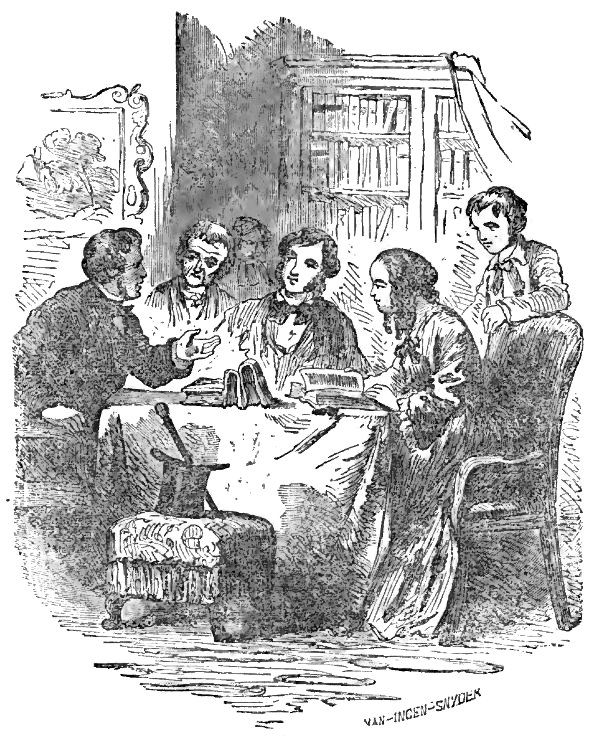
Punctual to his promise, Mr. Percy came in soon after supper on the next evening, and found the Rev. Mr. Johnson, the pastor of the church, already there. He had called early to take a social cup of tea, having learned that Theodosia was “like to go crazy about these new-fangled Baptist notions.”
He did not think she looked much like a maniac, however, though there was a deep saddened seriousness about her face. Nor did she act like a maniac, for never before had she seemed so respectfully affectionate to him and to her mother.
He had not said a word upon the subject of dispute, and seemed reluctant to approach it; but when Mr. Percy came in, it could no longer be postponed.
“I am very glad to meet you here, Mr. Johnson,” said the young man. “Miss Theodosia and I had quite a discussion yesterday evening on the subject of baptism. She has taken a fancy that she has never been baptized; and I believe that I nearly exhausted my logic in trying to convince her that she had. I hope your arguments will be more effectual than mine.”
“Really, my children, I don’t know,” said the old man, “what I may be able to do; I have never studied these controversies much; I think it is better to live in peace and let every one enjoy his own conscientious opinion. These discussions are apt to run into disputes and quarrels, and often occasion a great deal of ill [34] feeling. I have known them to divide churches, and even families. It is better to avoid them.”
“But what are we to do with such lovely heretics as this?” said the young man, with a smile and a sly glance toward her mother. “She must be satisfied that she has been baptized, or you will have her running to the school-house next Sunday to hear that uneducated Baptist preacher, and ten to one, she will ask him to go down into the water and baptize her according to the New Testament model. She says she wants to be baptized as Jesus Christ was, and that was in the river, you know.”
“Oh, as to that,” rejoined the pastor, “there is no evidence that Jesus Christ was immersed in the river at all. It has been satisfactorily proved that he was sprinkled or poured upon; and it is very certain that sprinkling was practiced by the apostles and early Christians.”
“Oh, I am so glad to hear you say that,” replied the young lady. “You don’t know what a load it has taken off my mind. Do tell me how it is ascertained that Christ did not go into the river, and what evidence there is that he was sprinkled, and it was sprinkling which he commanded. You can’t imagine how anxious I am to know.”
“Well, I don’t know that I can call up all the evidence just at this time, and we would not have time to go over it, if I could; but you may be assured that there is such evidence, and that of the most satisfactory character, or else all the learned and talented theological scholars of the various Pedobaptist churches would not have continued for so many ages, to teach and practice it.”
“Certainly, I have no doubt the evidence exists, since you say so; but can’t you tell me what it is, or show me [35] where to find it? I shall never be able to rest in peace till I am convinced that I have been baptized. And if that which I witnessed at the river yesterday was baptism, I am sure I never was.”
“Oh, don’t be so confident, my daughter. There are more modes of baptism than one. That was, perhaps, one mode (though of that I have some doubt). You were baptized by another mode. That may have been baptism. Yours certainly was.”
“Well, do please prove it to me some way, Mr. Johnson. What you say is something like what Mr. Percy said yesterday. He told me that baptize was a generic term, expressing rather a certain result than any specific act. I think that was the idea, was it not, Mr. Percy?”
“Exactly; and if so, I leave it to Mr. Johnson if the manner of reaching the result is not a matter of indifference.”
“Certainly,” said the pastor; “‘baptism is the application of water as a religious ordinance.’ It does not matter about the quantity of water or the mode of applying it.”
“Yes; that is what mother said yesterday. And we looked in Webster, and found that such was, indeed, the present English use of the word baptize. But brother says baptize is a Greek word slightly modified, and transferred from the Greek Testament to the English. It is the New Testament meaning in the time of Christ, and among the people for whom the Gospels were first written, that we want, not the meaning that it has acquired in the English since its transfer to our language.”
“You see, pastor, she is going to be hard to satisfy. She pleads her cause like a lawyer.”
“No, no, Mr. Percy, I will not be hard to satisfy. I desire, I long, I pray to be satisfied. I can never rest [36] till I am satisfied. I only ask for the evidence. You said yesterday that baptizo was a generic term meaning to sprinkle; to pour, or to dip; but we found it in the Lexicon, and it proved to be a specific term meaning only to dip. Not a word was there about sprinkling or pouring. It was simply and only dipping. To-day, Mr. Johnson tells me about several modes—but they are not modes of dipping. And yet if the Greek word baptismos, baptism, means dipping, then they must, in order to be modes of baptism, be modes of dipping. But, Mr. Percy, you have not yet told us the result of your examination of other Lexicons.”
“We can make nothing out of them. I am sorry to say they all agree substantially with the one you have in the house. If we trust to them we must grant that the word means primarily and ordinarily to dip, to plunge, to immerse. Of this there is no doubt.”
“Then I am more perplexed than ever. You said yesterday that in order to know what the act was which the disciples performed and Christ commanded, we must ascertain the precise meaning of baptize, as they employed it in the Greek language. You have examined all the Lexicons (the highest authorities) and find they all agree in saying it was dip, plunge, immerse. You admitted yesterday that if they should agree in this, the question was settled. If they said baptize meant to dip, and baptismos a dipping or immersion, then every time we read that one was baptized, we must understand that he was immersed. I thought that was a plain, straightforward case. I felt that I could understand it. Well, now you say you have examined carefully the other Lexicons, and they all agree with this. No one says sprinkle, no was says pour—all say dip, and consequently the Gospel says that Jesus was dipped of John in the river of Jordan. But then our pastor says that [37] he has evidence that Jesus did not enter the river at all, and that he was sprinkled, and not dipped. Of course he would not say it, unless it was so, but I really don’t understand how it could be so.”
“I have some curiosity on that point myself,” said Mr. Percy, evidently relived to find he could (for the moment at least), take the other side of the question. “I find myself in a very close place. These Lexicons have killed me. I don’t know what to say. I suppose, of course, there is some way to get around the difficulty; but I must leave it to our pastor to point it out. For my part, I submit the case.”
“Really,” said Mr. Johnson, “the question never presented itself to me in just this light before. You must give me a little time to consider about it. And in the meantime let me beg of you both that you will examine some of the standard writers upon the subject. I do not think you have done this yet. What have you in the house?”
“Not a book upon the subject, except it be the Bible, and I don’t much care to read any other till we have examined that. If sprinkling is there, it ought to be so plainly taught that I can see it for myself. If I can’t find it, I will always doubt if it is there,” rejoined the young lady.
“True, my child,” said the pastor; “but we often fail to see things at first glance, which are very evident when they have once been pointed out, and our attention fixed upon them. This is the advantage of using proper helps to understand the Scriptures. Those not familiar with the language in which they were written, and with the customs and manners of the people to whom they were originally addressed, will derive great assistance from judicious criticisms. I like, myself, always to read [38] a commentary on every chapter that I attempt to understand.”
“Oh, as to commentaries, we have Barnes’ Notes on the Gospels, and on some of the Epistles. And we have McKnight’s exposition and new translation of the Epistles. Uncle Jones admires these old volumes of McKnight’s very much, but they always seemed very dry to me. I love Mr. Barnes, and have studied his notes in Sunday-school and Bible class all my life.”
“Mr. Barnes is a very learned and eminent divine,” replied the pastor. “His notes have attained a wide circulation, and won for him an enduring reputation. You cannot follow a safer guide. Have you examined him upon the subject?”
“I suppose,” said she, “that I have read it a dozen times, but I never thought any thing particularly about it, and don’t recollect a word.”
“Suppose, then, you get his Notes, and let us look at them a moment before I leave. I can stay but a few minutes longer.”
Edwin had found the volume while they were talking of it, and now handed it to the pastor.
“I suppose we shall find it here, Matthew iii. 6, as this is the place where the word baptize first occurs. Mr. Percy, will you have the kindness to read it aloud for our common benefit?”
Mr. Percy read: “And were baptized of him in Jordan, confessing their sins.” “The word baptize signifies, originally, to tinge, to dye, to stain, as those who dye clothes. It here means to cleanse or wash any thing by the application of water. (See note, Mark vii. 4.)
“Washing or ablution was much in use among the Jews, as one of the rites of their religion. It was not customary, however, to baptize those who were converted [39] to the Jewish religion until after the Babylonish captivity.
“At the time of John, and for some time previous, they had been accustomed to administer a rite of baptism or washing to those who became proselytes to their religion, that is, who were converted from being Gentiles.” … “John found this custom in use, and as he was calling the Jews to a new dispensation, to a change in the form of their religion, he administered this rite of baptism or washing to signify the cleansing from their sins, and adopting the new dispensation, or the fitness for the pure reign of the Messiah. They applied an old ordinance to a new purpose; as it was used by John it was a significant rite or ceremony, intended to denote the putting away of impurity, and a purpose to be pure in heart and life.”
Mr. Percy stopped reading, and looking up at Mr. Johnson, said, “Pardon me, pastor, but if Mr. Barnes were present here as a witness in this case, I would like to ask him a single question by way of a cross- examination. He says that ‘Washing or ablution was much in use among the Jews as one of the rites of their religion,’ and yet he tells us that baptism was not in use till after the captivity. Must not baptism then have been something new and different from the washing or ablution?”
“And I,” said Theodosia, “would like to ask a question too; perhaps pastor Johnson can answer it as well as Mr. Barnes. He says, when they received a convert from the Gentiles, they baptized him; John found this rite in use, and merely applied an old ordinance to a new purpose. Now, I want to know how this ordinance was administered. What was the act which they performed upon the proselyte? Did they sprinkle him, or pour upon him, or was he immersed? If this can be ascertained, it will of course determine what it was that [40] John did when he baptized. Can you tell us, Mr. Johnson, which it was?”
“Yes, my child; it was universally conceded that the Jewish proselyte baptism was immersion. I do not know that this has ever been denied by any writer on either side of the controversy. It is distinctly stated to have been immersion by Dr. Lightfoot, Dr. Adam Clarke, Prof. Stuart, and others who have espoused our cause.”
“How then do you get rid of the difficulty? If, as Mr. Barnes says, ‘John applied an old ordinance to a new purpose,’ and that old ordinance was immersion, it is absolutely certain that John was immersed. There is not room for even the shadow of a doubt.”
“It would seem to be so indeed,” said the pastor. “I never thought of it just in that light before. But though it is admitted by all that the proselyte baptism was immersion, it is doubted by many whether it existed at all before the time of John. Some think it originated about the time of Christ, and that the Jews practiced it in imitation of John’s baptism.”
“I do not see,” rejoined Mr. Percy, “how it can make the slightest difference in the result of the argument, whether it was in use before the time of John, or was borrowed from him. If they immersed before the time of John, and he borrowed his rite from them, of course it was immersion that he borrowed. If they immersed after the time of John, and borrowed their rite from him, of course John immersed, or they could not have borrowed immersion from him.”
“But if John immersed,” said Theodosia, “then Jesus was immersed by John. This immersion was called his baptism. The disciples saw it, and spake of it as such; and ever afterward, whenever baptism was mentioned, their minds would revert to this act; and so, when Jesus said [41] to them, ‘Go and baptize,’ they must have understood him to mean, that they should go and repeat on others the rite which they had seen performed on him. And not only so,” added the young lady, “but Christ’s disciples had themselves been accustomed to practice the same baptism under his own eye. If John immersed, they had not only witnessed his immersion of Jesus, but they had themselves immersed hundreds, if not thousands, under the personal direction of Jesus himself.”
“That would certainly settle the question. But where did you make that discovery?” asked Mr. Percy, incredulously.
“Oh, it is in the record,” she replied. “Here is the testimony, John iii. 22, 23: ‘After these things, came Jesus and his disciples into the land of Judea, and there he tarried with them, and baptized. And John also was baptizing in Ænon, near to Salim, because there was much water there; and they came, and were baptized.’ And in the next chapter it says that the ‘Pharisees heard that Jesus made and baptized more disciples than John.’ Now John baptized and Jesus baptized. They both did the same thing; that is as plain as words can make it: as plain as though it said Jesus walked, and John also walked; or Jesus talked, and John also talked. Whatever it was that John did, Jesus was doing the same thing. “If John’s baptism was immersion, then Jesus and his disciples were immersing, and they immersed more than John.”
“That is really,” said Mr. Percy, “a complete demonstration. Don’t you think so, Mr. Johnson?”
“Well, I must confess it looks so at the first glance. We must look into this matter another time. Let us, for the present, see what Mr. Barnes says further. [42] Please read on, Mr. Percy; I have not much more time to spare this evening.”
Mr. Percy read on:
“The Hebrew word (tabal) which is rendered by the [Greek] word baptize, occurs in the Old Testament in the following places:—Lev. iv. 6; xiv. 6, 51; Num. xix. 18; Ruth ii. 14; Ex. xii. 22; Deut. xxxiii. 24; Ezk. xxiii. 15; Job ix. 31; Lev. ix. 9; 1 Sam. ix. 27; 2 Kings v. 14; viii. 15; Gen. xxxvii. 31; Joshua iii. 15. It occurs in no other places; and from a careful examination of these passages, its meaning among the Jews is to be derived.”
“Oh,” said the young lady, “that is what I like; I like to find the meaning in the Scriptures, then I know I can rely upon it. Just wait a minute, Mr. Percy, if you please, till I can get my Bible and hunt out those place, and see how it reads. If it reads sprinkle, then it is all right—sprinkling is baptism; if it reads pour, then pouring is baptism; if it reads dip, then dipping is baptism. We will soon see.”
“Let me read a little further, Miss Theodosia, and perhaps you may not think it necessary to examine the texts.”
She had, however, got her Bible, and was getting ready to turn to each text in order, when he resumed as follows:
“From these passages, it will be seen that its radical meaning is not to sprinkle or to immerse. It is to dip. Commonly for the purpose of sprinkling or for some other purpose.”
“What? Do let me see that. Pardon me, pastor, but what does the good man mean? It is not to sprinkle; it is not to immerse; it is to dip! Edwin, please get Webster’s Dictionary, and tell us the difference between the meaning of dip and immerse.”
[43]“Here it is. Immerse is to plunge into a fluid. Dip is to plunge any thing into a fluid, and instantly take it out again.”
“Why, Mr. Percy, that just describes the act of baptism which we saw at the river. It was not an immersion, strictly speaking, but a dipping, a plunging beneath the water, and a raising out again. ‘It is not to sprinkle or to immerse; it is to dip! Commonly for the purpose of sprinkling, or for some other purpose.’”
“What are you laughing at, brother Edwin?”
“I was only thinking how a preacher would look, dipping a man ‘for the purpose of sprinkling’ him. But see! there goes my teacher, and I believe he is a Baptist. At any rate he goes to all their meetings. Let me call him in; he can tell us something more about these things.”
And before any one could interfere, he had run to the door and hailed Mr. Courtney.
Seeing this, the Rev. Mr. Johnson arose, and reminding the company that he had an engagement at that hour, promised to call again and talk over the matter more, at another day, and took his leave, passing out just as the teacher was coming in.
“Mr. Courtney,” said Mr. Percy, “perhaps you can help us a little. We were just looking at Barnes on Baptism.”
“I did not know he had ever written on the subject, except some very singular remarks he made in his Notes on the third chapter of Matthew.”
“It was those we were examining, and I infer that you do not think very favorably of his argument.”
“I think he makes a very strong argument for the Baptists.”
“How so?”
“Simply thus: It is an axiom in logic as well as in [44] mathematics, ‘that things which are equal to the same thing, are equal to one another.’ Now he states a very remarkable and exceedingly significant fact, when he says that the Hebrew word tabal is rendered by the word baptize. It occurs, he says, fifteen times in the Hebrew Bible. Now when the Jews translated their Scriptures into Greek, whenever they came to this word, they rendered it baptize; and when our translators came to this same word, they rendered it by the English word dip. It follows, therefore, since dip in English and baptize in Greek are both equivalent to tabal in Hebrew, they must be equivalent to each other.
“Mr. Barnes says further, that the true way to ascertain the meaning of this word among the Jews, is to examine carefully the fifteen places where it occurs in the Old Testament. I see, Miss Ernest, that you have the Bible in your hand; suppose you turn to those places, and let us see how they read. It will not take more than a few minutes of our time.”
“I had gotten the book for that very purpose, sir. I like this way of study, comparing Scripture with Scripture. I always feel better satisfied with my conclusions when I have drawn them for myself directly from the Bible.”
“Well, here is the first place, Leviticus iv. 6: ‘And the priest shall dip his finger in the blood.’
“The second, Leviticus xiv. 6: ‘And shall dip them into the blood of the bird that was killed over running water.’
“The third, Leviticus xiv. 51: ‘And dip them in the blood of the slain bird and in the running water.’
“The fourth, Numbers xix. 18: ‘And a clean person shall take hyssop, and dip it into the water.’
“The fifth, Ruth ii. 14: ‘And Boaz said unto her at [45] [46] [47] meal time, come thou hither, and eat of the bread, and dip thy morsel in the vinegar.’
“The sixth, Exodus xii. 22: ‘And ye shall take a bunch of hyssop, and dip it in the blood.’
“The seventh, Deuteronomy xxxiii. 24: ‘And let him dip his foot in oil.’
“The eighth, Ezekiel xxiii. 15: ‘Exceeding in dyed attire.’
“The ninth, Job ix. 31: ‘Yet shalt thou plunge me in the ditch.’
“The tenth, Leviticus ix. 9: ‘And he dipped his finger in the blood.’
“The eleventh, 1 Samuel xiv. 27: ‘And he (Jonathan) put forth the end of the rod that was in his hand, and dipped it in the honey comb.’
“The twelfth, 2 Kings viii. 16: ‘And he (Hazael) took a thick cloth, and dipped it in the water, and spread it on his face.’
“The thirteenth, Joshua iii. 15: ‘The feet of the priests that bare the ark were dipped in the brim of Jordan.’
“The fourteenth, 2 Kings v. 14: ‘And he went down and dipped himself seven times in Jordan.’
“The fifteenth, Genesis xxxvii. 31: ‘And they took Joseph’s coat, and killed a kid, and dipped the coat in the blood.’
“The passage in the 2 Kings v. 14, is very remarkable, since it corresponds precisely in the Septuagint to the text in Matthew. The Septuagint says of Naaman, Ebaptizato en to Jordane. Matthew says of the people baptized by John, Ebaptisonto en to Jordane. Nobody has ever questioned the correctness of the translation in Kings. He dipped himself in Jordan; and had Matthew been translated by the same rule, it must have read, they were dipped by John in Jordan.
[48]“But I fear this subject may be disagreeable to you. Mr. Barnes, I know, is a most eminent minister of your own denomination, and I ought probably to have avoided speaking thus in your presence.”
“Oh, no, sir,” said the young lady; “I want to learn the truth, the whole truth, and nothing but the truth, on this subject. I am glad to learn it from any source, and in any way. Perhaps you can assist us further; but let us see what further Mr. Barnes has to say.”
Mr. Percy read again:
“In none of these cases can it be shown that the meaning of the word is to immerse entirely. But in nearly all the cases the notion of applying the water to a part only of the person or object, though it was by dipping, is necessarily supposed.… It cannot be proved, from an examination of the passages in the Old and New Testaments, that the idea of a complete immersion ever was connected with the word, or that it ever in any case occurred.”
“Stop, Mr. Percy,” said the young lady. “Pray stop, and let me think a moment. Can it be possible that a good man, a pious minister of Jesus Christ, could dare to trifle thus with the holy Word of God? Oh, it is wonderful! I cannot understand it! He said just now, that the meaning of the word ‘was to dip for the purpose of sprinkling, or for some other purpose.’ To dip means to plunge any thing into a fluid, and immediately take it out again. To immerse means merely to plunge the object in the fluid. Whatever is dipped, therefore, is of necessity immersed, to the same extent that it is dipped; and yet he says these things which the Word says were dipped, were none of them entirely immersed.”
“Do not think too hardly of him,” said Mr. Percy. “An advocate who has a bad cause to sustain (I know [49] from experience), is sometimes obliged to resort to just such a jumble, to cover the weak points of his argument.”
“Perhaps,” said Theodosia, “it might be excusable in a lawyer, though even of that I am doubtful; but that a minister of the holy Word of Jesus should thus stoop to ‘darken counsel with words without knowledge,’ is something I never conceived of till now.”
“When you have become more familiar with the influence which passion and prejudice, and especially early education and church attachments, exert upon the minds of even the wisest and best of men,” said Mr. Courtney, “these things will not appear so strange to you. Mr. Barnes doubtless believes that sprinkling is baptism. He was taught so in early life, and has for many years taught others so. To convince him of the contrary, would now be almost or quite impossible, and when any text of Scripture comes in opposition to this opinion, he can hardly help perverting or misunderstanding it. You desired to know the true meaning of the word baptize, as it was used in our Saviour’s time among the Jews; and you applied to him for information. He told you very properly that you must go to those places where it occurs in the original of their own Scriptures, and pointed out to you the fifteen places, which he assures you are the only places in which it occurs. He has thus given the matter into your own hands. You turn to the places, one by one, and find that in fourteen out of the fifteen it clearly means to dip. That such is the case, he does not deny. He is obliged to grant that ‘its radical meaning is to dip.’ This, now, he has proved from the Scriptures themselves. But this overthrows his sprinkling, so he must get rid of its force. This he undertakes to do—1. By intimating that there is some important difference between dipping and immersion. ‘It is not sprinkling nor immersion,’ he says; ‘it is [50] dipping.’ And then he tries to confuse the matter by mixing in the object, ‘for the purpose of sprinkling, or for some other purpose,’ as though the purpose modified the act performed. The baptism mentioned in these fourteen places was equally dipping, whether it was performed for the purpose of sprinkling, as when the priest dipped the hyssop; or for the purpose of smearing, as when the priest dipped the tip of his finger in oil; or for the purpose of cleansing, as when Naaman dipped himself in Jordan; or for the purpose of pollution, as when Job was plunged in the ditch; or merely for the purpose of wetting, as when Ruth dipped her morsel, or Hazael his thick cloth. The wetting, the defiling, the cleansing, the smearing, were not the baptism; they were not the dipping, but a consequence of it. The sprinkling was not the baptism, the dipping, but a subsequent and altogether a different act. Then to make ‘confusion worse confounded,’ he intimates some vast distinction between entire immersion and dipping. These things, said to be baptized in these fourteen places, he can’t deny were dipped; but ‘none of them,’ he says, ‘were entirely immersed.’ But the extent of the immersion does not affect the meaning of the word. The word immersed expressed only the act of plunging the object into the fluid. The word dip expressed this act, and the additional one of taking it out again; and this, he said and proved, was the Scriptural meaning of baptize. As far, then, as they were baptized, they were dipped; and as far as they were dipped, they were immersed. We learn the extent of the dipping from other words, not from this one. If Naaman is said to have dipped himself, or Hazael the cloth, there is not the slightest reason to doubt that the whole person and the whole cloth were immersed. If Jonathan dipped the end of his staff, why the end only was immersed. It was [51] immersed, however, just as much as it was dipped or baptized.”
“But,” said Mr. Percy, “what will you do with the hyssop, and the living bird, etc., that were to be baptized into the blood of the slain bird, and where Mr. Barnes says it is clearly impossible that they all should be immersed in the blood of the single bird.”
“I simply say that they could be immersed in it as easily as they could be dipped in it. If you will turn to Leviticus xiv. 6, you will see that the blood of the slain bird was to be caught over running water; and as it rested on, or mixed with the water, these things could all be entirely immersed, if need be. You will remember, however, that in common language the whole of a thing is often mentioned when a part is only meant. I say, for instance, that I dipped my pen in ink, and wrote a line; you do not understand that I dipped more than the point—enough to take up the ink to write. If I tell you that I dipped my hair brush in water, and smoothed my hair, you do not understand that I dipped it in, handle and all, but only the bristles. So only enough of the cedar wood, and hyssop, and scarlet, etc., may have been dipped to take up enough to sprinkle with; but as much as they were baptized, so much were they dipped; and so far as they were dipped, just so far were they immersed. But it does not make any difference to Mr. Barnes or his sprinkling brethren, whether the dipping was partial or complete; for they do not dip their subjects of baptism at all, in whole or in part, for the purpose of sprinkling, or for any other purpose; and, therefore, if the Scriptural meaning of the word baptize is to dip, as Mr. Barnes has so clearly proved by Scripture itself, then they do not baptize at all.”
“Oh, yes, I see now how it was,” said Theodosia, “when Dr. Fisher performed this ceremony upon me. [52] He baptized his own hand; for he dipped that in the bowl, but he only sprinkled me; and therefore, according to the showing of Mr. Barnes himself, I have never been baptized.”
“Do not put down the book yet,” said Mr. Courtney. “Just turn to Matthew xx. 22, and you will find that Mr. Barnes has no more difficulty than the greatest Baptist in the land, in understanding the word baptism to signify not only immersion, but complete immersion, whenever it does not refer to the ordinance.
“The baptism that I am baptized with.” On this Mr. B. remarks as follows: ‘Are ye able to suffer with me the trials and pains which shall come upon you in endeavoring to build up my kingdom? Are ye able to be plunged deep in afflictions? to have sorrows cover you like water, and to be sunk beneath calamities as floods, in the work of religion? Afflictions are often expressed by being sunk in the floods and plunged in the deep waters.’ (Ps. lix. 2; Isa. xliii. 2; Ps. cxxiv. 4, 5; Sam. iii. 54.)
“You see Mr. Barnes has no more difficulty than the translators of the Old Testament, in giving the word its true meaning—to dip, to plunge, to sink beneath the waters, etc., when it does not refer to the ordinance; but when it does, all is confusion and mystery.”
“I begin to think,” said Theodosia, “that theological writers are not to be relied upon at all. And I feel more than ever inclined to trust to the Bible alone, and study it for myself. When such a man as Mr. Barnes can be so far blinded by education and prejudice as to come so near the truth and not see it—to point out the way toward it so plainly, and yet refuse to walk in it, and endeavor to hide it from others by such a strange medley of words, I have no further use for any book on the subject but the word of God. I will study that; and [53] it shall be my only guide. If I find that Jesus was sprinkled in Jordan, I will be content. If I find that he was poured upon, I must be poured upon. If I find that he was dipped, then I must be dipped.”
“Oh, no, Miss Theodosia; you are decidedly too hasty. I have often found in court, that a witness whom I expected to testify in my favor, and who evidently desired and intended to do so, has nevertheless, on a cross- examination, given such testimony as was altogether favorable to the opposite party. But I did not abandon my client, and give up my suit. I sought for other witnesses. Our information on this subject is, as yet, very limited. There are other sources of evidence; let us examine them. Something may yet turn up to change your opinion of theological writers. Did you not say you had McKnight on the Epistles in the house?”
“Yes; and uncle Jones, who you know is one of the Elders in our church, says it is one of the best, if not the very best of commentaries.”
“Well, let us see what he says. How will we find the place?”
“Take a concordance,” suggested Edwin, “and look at every place where the word baptize occurs.”
“That is a first-rate idea. Well, here is the first place. Romans vi. 4. Buried with Christ by baptism. In the note he says: ‘Christ’s baptism was not the baptism of repentance, for he never committed any sin. But he submitted to be baptized—that is, to be buried under the water by John, and to be raised out again— as an emblem of his future death and resurrection. In like manner, the baptism of believers is emblematical of their own death, burial, and resurrection; perhaps, also, it is a commemoration of Christ’s baptism.’”
[54]“Stop, Mr. Percy, are you sure you are not reading falsely?”
“Yes, I am perfectly certain. Here is the book, you can see for yourself.”
“No; but I thought you must be playing some trick on me. At any rate, McKnight must have been a Baptist. No one who believed in, and practiced sprinkling, could have written in that way.”
“Perhaps he was a Baptist. Let us look at the title page and preface, and see who and what he was. It appears from this, that James McKnight, D.D., was born Sept. 17, 1721. Licensed to preach by the Presbytery of Irwine of the Scotch Presbyterian church. Ordained at Maybole in 1753. Chosen Moderator of the General Assembly of the Presbyterian church in 1769, which position he held for more than twenty years. This brief history of his life, prefixed to the first volume of his Notes, informs us further, that he spent near thirty years of his life in preparing these Notes, and ‘that the whole manuscript was written over and over, by his own hand, no less than five times.’ They were therefore the deliberate and carefully expressed opinions of a most eminent and very learned Presbyterian Doctor of Divinity, and presiding officer of the Presbyterian church in the country where he lived. Of course he cannot be suspected of any bias toward the obscure and despised sect called the Baptists.”
“Well, read on then. Theologians are mysterious men.”
“That is all he says on this verse. But here is verse 5th. ‘Planted together,’ etc.
“‘The burying of Christ and of believers, first in the water of baptism, and afterward in the earth, is fitly enough compared to the planting of seeds in the earth, [55] because the effect in both cases is a reviviscence to a state of greater perfection.’”
“Surely, he must consider baptism to be a burial in water. But perhaps he thinks there were several baptisms, and that dipping was one form or mode, while sprinkling was another.”
“No, for here is his note on Ephesians iv. 5. One Lord, one Faith, one Baptism.
“‘Ye all,’ says he, ‘serve one Lord, and all have the same object of faith, and have all professed that faith by the same form of baptism.’”
“Has he any thing else on the subject?”
“Yes, here, on 1 Cor. x. 2, ‘And were all baptized unto Moses in the cloud and in the sea.’
“‘Because the Israelites, by being hidden from the Egyptians under the cloud, and by passing through the Red Sea, were made to declare their belief in the Lord and his servant Moses, the Apostle very properly represents them as baptized unto Moses in the cloud and in the sea.’
“And here again—1 Cor. xv. 29—‘Else what shall they do who are baptized for the dead.’
“‘Otherwise what shall they do to repair their loss who are immersed in sufferings for the resurrection of the dead.’
“And here again—Heb. ix. 10—‘Divers washings (Baptismos).’
“‘With nothing but meats, and drinks, and divers immersions, and ordinances respecting the body.’
“One more place, and we have all that he says upon the subject.
“1 Peter iii. 21, ‘The like figure whereunto baptism doth now save us, etc.’
“The water of baptism is here called the anti-type [56] of the water of the flood, because the flood was a type or emblem of baptism in three particulars:
“1. ‘As by building an ark and entering into it, Noah showed strong faith in the promise of God, concerning his preservation, by the very water which was to destroy the Antediluvians for their sins. So by giving ourselves to be buried in the water of baptism, we show a like faith in God’s promise, that though we die and are buried, he will save us from death and the punishment of sin, by raising us up from the dead at the last day.’
“2. ‘As the preserving of Noah alive during the nine months of the flood, is an emblem of the preservation of the souls of believers while in the state of the dead, so the preserving believers alive while buried in the water of baptism, is a prefiguration of the same event.’
“3. ‘As the water of the deluge destroyed the wicked, but preserved Noah by bearing up the ark, in which he was shut up, till the waters were assuaged, and he went out to live again upon the earth; so baptism may be said to destroy [or represent the destruction of] the wicked, and to save the righteous, as it prefigures both these events. The death of the wicked it prefigures by the burial of the baptized person in the water, and the salvation of the righteous by the raising of the baptized person out of the water.’”
“Well, Mr. Percy,” said Theodosia, “what do you make of this witness? Do you wish to cross-examine him, or ask him any further questions?”
“Yes, I would like to ask the Rev. Dr. McKnight if he practiced sprinkling for baptism; and if he did, upon what grounds he could sustain a practice so different from his own exposition of the teachings of the Scripture.”
“As Dr. McKnight has not answered in his writings, and is not present in person, it may be satisfactory,” [57] suggested Mr. Courtney, “to inquire of some other representative of the same church establishment. If you have Dr. Chalmers’ Lectures on Romans, you will find the question answered.”
“Yes, sister, don’t you know mother bought Chalmers’ Lectures only the other day? I will go and get the book,” said Edwin.
“Ah, here it is—page 152; Romans vi. 4–7. ‘The original meaning of the word baptism, is immersion; and, though we regard it as a point of indifferency whether the ordinance so named be performed in this way or by sprinkling, yet we doubt not that the prevalent style of the administration, in the apostle’s days, was by the actual submerging of the whole body under water. We advert to this for the purpose of throwing light on the analogy which is instituted in these verses. Jesus Christ, by death, underwent this sort of baptism, even immersion under the surface of the ground, whence he soon emerged again by his resurrection. We, by being baptized into his death, are conceived to have made a similar translation—in the act of descending under the water of baptism, to have resigned an old life; and in the act of ascending, to emerge into a second or new life.’ Here we have a distinct avowal of the well- established fact that the meaning of the word baptism is immersion, and that the practice of the Apostolic church was conformable to this truth. But in the very face of it we have the candid declaration ‘that we (Presbyterians) regard it as a matter of indifferency whether the ordinance so named be performed in this way or by sprinkling.’”
“But, Mr. Courtney, how can it be a matter of ‘indifferency?’ If the word means immersion, then immersion was what Christ commanded—then the ‘ordinance so-called’ is ‘immersion.’ How can immersion be [58] performed by sprinkling? Really, these theologians are a strange, mysterious people. I cannot comprehend them. Christ commands me to be baptized—baptism means immersion—then, of course, if he meant any thing, he meant immersion. But these great and good men tell me it is a matter of ‘indifferency’ whether I do what he commanded, or something else altogether different from it.”
“Pardon me, Miss Theodosia; it is only when the theologians are in error, and blinded by their educational prejudices, or attachment to their church forms and dogmas, that they are so unreasonable and so mysterious.”
“Yet I have been accustomed to think they could hardly be in error at all. I have taken it for granted, until yesterday, that what the ministers of our church said about the teachings of the word of God, was all true, as a matter of course. I can hardly believe now that it is not so. I can’t understand how those, who are so wise, so learned, so pious, so anxious to know the truth, and who spend all their time in learning and teaching it, can be wrong; or how a simple girl like me, may differ from them and yet be right. I am afraid to take a single step in opposition to my pastor’s teaching, though I see clearly (as I think) that I shall step upon the rock of God’s unfailing truth! How can it be, that such good men talk one way and act another? How do they try to justify their ‘indifferency’ to the commands of Christ? They give some reason, do they not?”
“I think most of them don’t trouble themselves on the subject: they think little, and care little about it— not deeming it essential to salvation. When they do think or read upon the subject, it is in order to quiet their minds, or reply to an opponent. They have the practice of their church, received by tradition; they [59] take it for granted it is right. They are where you were a day or two since, when you took it for granted that the ministers of your denomination could not be wrong. They don’t think their church can be wrong; and they twist, pervert, and torture the Scriptures, as you have seen Mr. Barnes do, or openly set aside their teachings as a matter of ‘indifferency,’ as we have seen Dr. Chalmers do, in order to continue the usage of the church.”
“But,” asked Theodosia, “does not Dr. Chalmers stand alone upon this point of ‘indifferency?’ It surely is not common for the ministers of our church (who in learning and piety I have always thought had no superiors in the world) to speak of literal obedience to Christ’s commandments as a matter of no consequence. To me it seems to border upon absolute impiety, almost upon sacrilege. I am in a maze of astonishment.”
“If you will continue your investigations for a little time, you will cease to be astonished at almost any sort of assertions made by the advocates of sprinkling,” said Mr. Courtney. “You will, for instance, find them admitting, in one sentence, that immersion was submitted to by Christ, and practiced by the Apostles; and in another, holding it up to the reprobation and abhorrence of every Christian as an indecent and abominable rite. But, in regard to your question. Dr. Chalmers, so far from standing alone, simply echoes the sentiments of Calvin, the founder of your church, and others of its most eminent supporters. ‘It is of no consequence at all,’ says Calvin, as quoted by Prof. Stuart, ‘whether the baptized person is totally immersed, or whether he is merely sprinkled by an affusion of water. This should be a matter of choice to the churches in different regions, although the word baptize signifies to immerse, and the rite of immersion was practiced by the ancient [60] church.’ ‘To this opinion,’ says Prof. Stuart, ‘I do most fully and heartily subscribe.’”
“Well, I declare! these Presbyterian Doctors of Divinity are the most mysterious of people to me. They freely admit that the meaning of the word is to immerse, or to dip, and that immersion was practiced by the first churches—(and of course, if such is the meaning of the word, it must have been practiced by the first churches, as they could not misunderstand the commandment). Yet they tell us that it is of ‘no consequence at all’ whether we obey the commandment or not. Do the other denominations opposed to the Baptist occupy the same position?”
“I cannot answer for all,” said Mr. Courtney; “I can for some. I have here a transcript of some of the writings of Mr. John Wesley, who was the founder of the Methodists, the most numerous of the Pedobaptist sects in this country. He says, in his notes on Romans vi. 4—‘The allusion is to the ancient manner of baptizing, by immersion.’ And he relates in his journal, vol. 3, page 20, ‘that Mary Welch, aged eleven days, was baptized according to the custom of the first church, and the rule of the church of England, by immersion.’
“On page 24 of the same volume, he says—‘I was asked to baptize a child of Mr. Parker’s, second bailiff of Savannah; but Mrs. Parker told me, neither Mr. P. nor I will consent to its being dipped. I answered, if you certify that the child is weakly, it will suffice (the Rubric says) to pour water on it. She replied nay, the child is not weak, but I am resolved it shall not be dipped. This argument I could not confute, so I went home, and the child was baptized by another.’”
“It would seem, then,” said Theodosia, “that Mr. Wesley conformed his practice to his belief. He believed that baptism was immersion, and refused to baptize [61] at all unless he could do it according to the word of God. I honor the man for his consistency.”
“Still,” said Mr. Percy, “it does not seem that he was influenced by the word of God, but by the ‘Rubric.’ The word of God makes no exception in favor of those who may be certified to ‘be weak,’ but yet on the authority of ‘the Rubric,’ or formula of the church of England, Mr. Wesley was perfectly ready to dispense with the dipping, and employ pouring, if the parents would only certify.”
“Moreover,” added Mr. Courtney, “it seems, from his conduct afterward, that he felt as much at liberty himself to change the ordinance of Christ, as the makers of the Rubric had done; for when he organized his societies, and gave them ‘the Discipline’ as their organic law, he directed baptism to be performed by sprinkling or pouring, if the parties preferred it.
“And though Mr. Wesley once refused to baptize a person at all unless he could do it by dipping, ‘according to the custom of the first church,’ or under a certificate of weakness, his followers, by his direction and by authority of his Discipline, employ sprinkling almost exclusively, and call immersion a vulgar and indecent practice; although they will sometimes perform it to satisfy a weak conscience, rather than lose a member.
“Martin Luther, the great reformer and founder of the Lutheran church, evidently entertained the same opinion with the other noted Pedobaptists we have been speaking of. After speaking of baptism as a symbol of death and resurrection, he says, ‘On this account I could wish that such as are to be baptized, should be completely immersed into the water, according to the meaning of the word and the signification of the ordinance, as also, without doubt, it was instituted by Christ.’ Yet Luther is the father of a sprinkling church—the [62] Lutheran; and whether he did so or not, it is evident that his followers, like Drs. Chalmers and Calvin, regard it as a ‘point of indifferency.’”
“That is sufficient, Mr. Courtney,” replied the young lady; “I merely wish to know if the other denominations were guilty of the same inconsistency with our own.”
After a little further conversation, Mr. Percy and Mr. Courtney took their leave.
Mrs. Ernest, the mother, had, during the time of this interview, been sitting quietly in a corner, very busily engaged in hemming some ruffles. She took no part in the discussion, but as soon as the gentlemen were gone, she turned to Theodosia, and said—
“My dear child, I am perfectly astonished at your behavior this evening.”
“Why, mother,” said the young lady, in amazement, “what have I done? I am not conscious of any impropriety.”
“Do you think, then, that it is perfectly proper and becoming in you to talk as you did this evening about the good and eminent clergymen of our church? It made my flesh quake and my heart burn to hear that impertinent little Baptist pedagogue accuse such a man as Dr. Albert Barnes of perverting the scriptures and mystifying the truth. I wonder if he thinks a learned and pious Presbyterian minister, like Mr. Barnes, is more likely to be ‘blinded by prejudice and passion’ than an ignorant Baptist schoolmaster. You thought I was not listening; but, though I did not take any part in your conversation, I assure you I heard every word of it, and if it had not been for the presence of Mr. Percy, I do believe I would have been tempted to order the fellow out of my house. How could you be so destitute of every particle of self-respect, and of all regard for your [63] own church—the church of your mother and your grand parents, in which you was born and raised, as to permit a man to talk in that way in your presence? I declare I was perfectly ashamed of you! If that Mr. Courtney ever shows his face in my house again, I do think I shall insult him.”
“Mother, what was it that Mr. Courtney said that was so unbecoming and offensive? I am sure he seemed to me only as one anxious to get at the truth.”
“Why! did he not say that our preachers perverted the Scripture? Did not he say that they set aside the commandments of Christ as matters of ‘indifferency?’ I wonder if he thinks he knows more about the Scriptures than Dr. Chalmers or Mr. Barnes, or even the weakest preacher in our church? I always heard that the Baptists were an ignorant, bigoted, and intolerant sect, and I believe it now more than ever. Just to think that—”
“But, mother, please let me say one word. Mr. Courtney did, indeed, intimate that Mr. Barnes had mystified and perverted the Scripture, but did he not prove it before he said it? It was Mr. Percy who read in Mr. Barnes’ notes that we must look in the Old Testament at those fifteen places, to learn the meaning of the word baptize. We looked, and found that in fourteen of the fifteen, the action was dipping, and in none of them sprinkling or pouring. It was Mr. Percy who read that ‘the meaning of the word is not to sprinkle or to immerse, but it is to dip for the purpose of sprinkling, or for some other purpose.’ It was Mr. Percy who read in Dr. Chalmers that ‘we (Presbyterians) consider it a point of indifferency’ whether the ordinance of Christ is performed as he commanded, or in some other way. Now, if Mr. Barnes does prove that the word means ‘to dip,’ for the purpose of sprinkling, [64] or for some other purpose, and yet tells us that it can be done by pouring, does he not mystify the subject by a strange medley of words? Was it so very wrong in Mr. Courtney to point out these self-evident prevarications of Mr. Barnes, or the openly avowed disregard to the commandment of Jesus Christ and the practice of the Apostolic churches in Dr. Chalmers?
“If Presbyterians are guilty of such inconsistency I am sorry for it, and ashamed of it, but I can’t help seeing it when my attention is directed to it; and I really do not see how it could have been becoming in me to get angry with those who were so kind as to point it out to me. On this subject I feel that I would be willing to learn the truth even from an infidel or an idiot, if they could aid me.”
“It is the part of a true friend,” said the mother, “to hide a friend’s infirmities, not to divulge and glory in them. And even if our ministers have done and said some thoughtless and silly things, it is not for a Presbyterian like you, to speak of them, or permit others to speak of them so contemptuously, in your presence. If you have no spirit of resentment, I’ll let you know that I have, and Mr. Courtney too, if he comes here with any more of his Baptist abuse of our pious and learned ministers.”
“But, mother, if our ministers are wrong (as being human they surely may be) how can it be wrong to point out their errors, and guard inquirers after truth from falling into them?”
“I don’t say,” replied the mother, “that it is wrong to point out any trifling errors, which they may have inadvertently taught; provided it were done in a mild, gentlemanly, courteous, and Christian manner. But is it kind, is it courteous, is it Christian-like, to accuse a great and good man like Mr. Barnes, of torturing, perverting, [65] and mystifying the Word of God, to sustain some church dogma or church practice? Do you call that gentlemanly?”
“My dear mother, please don’t be so angry with me; I really can’t see why we should not call things by their real names. And I must confess that so far as I can understand the meaning of the words, Mr. Barnes does, on this subject, mystify and pervert the language of Scripture, and Dr. Chalmers does clearly intimate that it is no matter whether we do what Christ commanded in this ordinance, or something else—which he did not command. And I begin to fear that others on our side of this controversy are in the same predicament. Whether those on the other side are not equally inconsistent, I have yet to learn.”
“Well, my child, I don’t know what to do with you. You have no more respect for the opinions of the learned and excellent ministers of our church, than for those of the most ignorant people.”
“I am determined, mother, that I shall never trust any more to the mere assertions of any man, or set of men, except those holy men who spake as they were moved by the Holy Ghost. Whatever I can find for myself clearly put down in The Book, that I will believe. Henceforth, the Bible is my only guide, and I will myself judge of its meaning for myself.”
“But, my child, do you, can you, think that you are as competent to judge of the true interpretation of the Word as the great and good men who have given all their lives to its study?”
“No, mother; but how if these great and good men disagree? Must I turn Catholic, and so secure an infallible priest? If I don’t do this, I must maintain my right to my own private judgment. I am accountable only to God; I will be guided only by his Word. I [66] thought you and pastor Johnson would have encouraged and assisted me in the investigation of this or any other question connected with my religious faith and practice. I know that he has always told us to examine the Scripture for ourselves—and ‘each to be fully persuaded in his own mind.’”
“Certainly, my child; but then we thought that your investigations would tend to confirm rather than shake your faith in our doctrines; but you seem to be losing confidence rather than increasing it. These studies seem only to disturb and unsettle your mind; and I fear, if you continue them, they will end in your separation from us all. How, then, can I help desiring that you should leave off these distressing investigations? Till you do so, I can hardly feel that you are my own dear Theodosia. You begin almost to feel like a stranger to me now. I declare, I believe you will break my heart.” And, overcome by her maternal feelings, she burst into a flood of tears, in which the daughter freely joined.
[67]Which contains
the testimony of the pastor’s witnesses,
to prove
that
John did not immerse at all,
and that
Christ did not go
down into the water,
but
was baptized by sprinkling
on the bank
of the river.
Third Night’s Study.

The Rev. Mr. Johnson had been the pastor of a large and wealthy congregation for more than, twenty years. Most of the young people of his charge had grown up under his pastoral supervision, and old and young had been accustomed to regard his word as Gospel truth; and when Miss Ernest ventured to suggest that she had never been baptized, and asked him for the proof, it was probably the first time that one of the “baptized children of his church” had ever expressed in his presence any serious doubt of the full authority of his bare and unsupported word.
After the brief visit at Mrs. Ernest’s which we have recorded, he went to his study and commenced the preparation of a sermon, which he hoped and intended should prevent any others of his congregation from any attempt to investigate this subject for themselves.
He did not propose in this discourse to mention the Baptists by name, or to make any attempt to refute, or even to denounce their opinions or practices. (To do so might direct attention to them, whereas he desired to divert it from them.) But he determined to describe, and denounce as degenerate and vile apostates, all those who, reckless of the obligations which had been placed upon them in early infancy, and all the thousand nameless ties which had, in childhood and youth, bound them to the church in which they had been born, and solemnly dedicated to God in baptism, in whose doctrines they had been instructed by parental lips, and into whose [70] communion they had been received by a public profession of their faith, and who should, after all, be induced by some new coming proselyter to abandon the faith of their fathers, and the communion of their own church, and break off like wandering stars, to be lost in the darkness of anti-Presbyterian errors.
This course, he was confident, would be more effectual in preserving the peace and unity of his church, and the dignity of its pastor, than any attempt to reason about the doctrines of this obscure sect of Baptists, who had so suddenly begun to attract attention in his village. He would overwhelm the doubters and inquirers with such a storm of public indignation, that hereafter no one would dare to doubt; but in the meantime it was necessary, privately, to satisfy such doubts as had already been expressed.
When, therefore, he had arranged the heads of his discourse, he repaired to his book-case, and took down such authorities as would refresh his memory on the subject of baptism—especially in regard to the points of difficulty suggested by Theodosia and Mr. Percy. The examination of these occupied the time till in the night, and was resumed again the next morning.
Very early the next evening, having his mind fully charged with all the “strong reasons” upon which Pedobaptists are accustomed to rest their cause, he called on Mrs. Ernest and her daughter again.
“Well, madam,” said he, “how has our conversation the other evening affected your daughter? I trust she has ceased to be so much distressed about these new notions as she was.”
“Indeed, Mr. Johnson, she gets worse and worse, and I begin to think Mr. Percy is going the same way. I am so sorry Edwin called in that little Baptist schoolmaster. It made my heart burn to hear them talk as [71] they did about the good and pious ministers of our church. It seemed to me they had no more respect for a minister of the Gospel, or even a Doctor of Divinity, than they had for a house carpenter, or a French dancing-master.”
“How so, Mrs Ernest? I am sure your daughter has been too well raised to speak disrespectfully of any minister of the Gospel, or permit another to do it in her presence.”
“That is just what I told her. I said I was ashamed of her, and—”
“But pray tell me, madam, what has happened? What was said that was so improper?”
“Why, only to think that that little impertinent Baptist pedagogue had the impudence to say, sir, here in my house, that our ministers perverted the Scriptures, deluded their hearers, set aside the ordinances of Christ, and substituted others in their place, and I don’t know what all. I was so angry I could hardly see.”
“Is it possible! and your daughter heard all of this?”
“Yes, sir; and the worst of it is, I do fear, sir, she more than half believes it. You can’t think how changed she is, sir! I never knew her to have a particle of self-will before. She was always so gentle and affectionate, and ready to yield every thing to any body; but on this subject she is very stubborn, and declares she won’t believe a single thing but what she can see in the Bible for herself, even though she had it from your own lips, and all the rest of the preachers in our church.
“Oh, sir,” she continued, sobbing (for her maternal feelings had begun to overcome her), “if you don’t do something for her she will be lost to us all! Do try to show her where that sprinkling is in the Bible. If she can see it there, she will believe it.”
Mr. Johnson was fully resolved to make her see the [72] sprinkling, if he could; but was not quite certain as to the place where he would find it; and before he had time to reflect much upon the subject, the young lady came into the parlor.
She seemed for the moment sightly embarrassed, evidently from the conviction that she had been the object of remark, but greeted her pastor cordially and respectfully. It seemed to him, though she was paler than before, that she had grown more beautiful in the last few days. The unusual mental activity, the excitement of a new object of investigation, and the calm, yet firm and solemn determination to learn and to do her whole duty, had imparted to her eye a new and intenser light, and to her countenance a strange, unwonted brightness, as though the spirit, stirred to its inmost depths by these new impulses, and burning with celestial fire, shone through its covering of flesh, and illuminated her face with almost more than mortal radiance.
Could it be possible, he asked himself, that this lovely young creature could speak irreverently of sacred things?
Alas! how much her mother and himself had misapprehended the nature of her feelings. Never in her life had sacred things appeared to her so sacred. It was because those great and good men, whom she had been accustomed from her infancy to look upon with reverence, now seemed to her, themselves, to trifle with sacred things, that she could no longer regard them as she had done. The Word of God; the commandments of Jesus Christ; the ordinances of the Gospel; these were sacred things. Never so fearfully sacred as now. And what could she think of those, who, ministering at the altar of God, perverted and mystified his Word, to hide the truth from those who sought for knowledge? What could she think of those who counted the commandments [73] of Christ, and the ordinances which he had instituted, a “matter of indifferency?” She had, indeed, in some degree, ceased to reverence the (so-called) ministers of Christ, who could be so false to their sacred obligations as to trifle with God’s holy Word, in order to sustain a creed or a custom of their church; but oh! how deep, how ardent, how unutterable was her reverence for the Word itself! How anxious, how agonizing her desire to know what it required her to believe and to perform.
It may be that the pastor had some suspicion of the true state of her mind in this respect, for when he addressed her, it was with an expression of unusual and most respectful consideration. He felt instinctively that she was not now to be rated like a school-girl, or convinced by unsustained assertions.
Indeed, he felt a strange restraint in the presence of the earnest- hearted, strong-minded girl; and was revolving in his mind how he could best introduce the subject which he came to talk of, when she relieved him by introducing it herself.
“You did not have time the other evening,” said she, “to finish your remarks on the subject of baptism. You told me, you will recollect, that there was good and sufficient evidence to show that our Saviour was not baptized in the river at all, and that he was baptized by sprinkling, and, of course, if this was so, sprinkling is the Christian baptism.”
“You state the case a little too strongly, my daughter; I meant to say only that there is no evidence that he was baptized in the river; and that the baptism which he commanded (the baptism of the Gospel dispensation) was performed by sprinkling.”
“Please, Mr. Johnson, don’t try to mystify me. Do you mean to say that the baptism which Christ submitted [74] to, and the baptism which he commanded, were two different things, and that one was immersion, and the other sprinkling?”
“Not exactly, my daughter; I only meant to say they might be different. John’s baptism was not Christian baptism. It was the baptism of repentance, designed to introduce Christianity. It prepared the way for the Gospel, but was itself no part of the Gospel dispensation.”
“And yet, Mr. Johnson, Mark says it was ‘the beginning of the Gospel of Jesus Christ.’ But it does not make any difference to me whether it was Christian baptism or not. I simply want to know about the act performed. John did something, which is called baptism. Multitudes came to him, and were baptized by him in the river of Jordan. Jesus also came to him, and was baptized in the river of Jordan. Then Jesus went himself into Judea, and there he tarried and baptized; and at the same time John also was baptizing in Ænon, near Salim; and Jesus baptized more than John baptized. These baptisms were confined to the Jews; but after his death, Jesus told the disciples to go and preach his Gospel to all other nations, and baptize them; and we learn from the Acts that they who gladly received the Word were baptized, both Jews and Gentiles.
“Now, what I want to know is this: when John baptized, he performed a certain act. When Jesus and his disciples baptized, did they not perform the same act? and when he commanded to baptize the Gentiles also, did he not command the same act to be performed, and did not the disciples perform the same act, in obedience to that command? The same word is used, does it not mean the same thing?”
“If it does, my child, it must mean something else [75] besides immersion, for in many of these cases of baptism, immersion was out of the question. In fact, it is very certain that John did not immerse those whom he baptized; though if he had, it would not follow that Christ commanded immersion. John may have done one thing, and Christ may have commanded something else.”
“Very true, Mr. Johnson; he may have done it, but where is the proof that he did? My name might have been Susan, but then I would not have been called Theodosia. If he had meant another act, he would have used a different word.”
“Not if the word might mean either one or the other. You know that we contend that the word baptize means to sprinkle, to pour, to wet, to wash,[1] as truly as it means to dip or to immerse.”
“Well, Mr. Johnson, even supposing it does have all these meanings, the disciples must have understood the Saviour to use it (when speaking in reference to his ordinance) in some one of them, and that one would be fixed by his own example. What he received as baptism from John in Jordan, they would ever after consider to be baptism; and would necessarily suppose he meant that act when he used the word, even though it had a hundred meanings. But if you will pardon me for being so troublesome, I would like to know what proof there is that baptize in the Greek language has all these various meanings? We looked into a Greek Lexicon the other day to find the meaning of the word, and we could not find any thing at all about sprinkling or pouring among the definitions there.”
“You looked in a Greek Lexicon. You can’t read Greek, can you?”
[76]“No, sir; but brother Edwin is studying the language, and he found the word, and I could read the definition.”
“And so you think you and Edwin are competent critics of a disputed point in the Greek language?”
“Oh, no! Mr. Johnson, don’t laugh at me. If you knew how anxious I am to learn the truth, I am sure you would sympathize with me and assist me. We did not think we knew any thing about it, and that is the reason that we went to the Lexicon to learn. It is not Edward’s opinion that I referred to, but that of the learned Prof. Donegan. And Mr. Percy has since examined quite a number of other Greek scholars upon the same subject, and he has not found that any one of them gives sprinkling as one of the meanings of baptize, though all agree in dipping.”
“And so you, and Edwin, and Mr. Percy set yourselves up to teach such men as Dr. Miller and other learned theological writers of our church, the meaning of the Greek language! Don’t you intend presently to write a commentary on the Scriptures? or a book of Practical Divinity? Edited jointly by Miss Ernest and Mr. Percy!”
The young lady looked at her pastor in astonishment. She blushed deeply; tears filled her eyes, and her utterance was choked. She had expected sympathy and assistance; she met with ridicule and rebuke. Poor girl, she did not know how hard it is for one who has long been accustomed to rule other minds, and have his bare assertion received as unquestionable truth, to be called on for proof. If he said baptize meant to sprinkle, what right had she, poor, simple girl, to doubt his word or ask for evidence? Why, even he, a minister of the Gospel, had never asked for proof when Dr. Miller said it. He had always taken it for granted that baptism [77] was sprinkling, or such men as Dr. Miller would not have asserted that it was; nor would the church have enjoined or permitted it.
There was an awkward pause in the conversation, for Theodosia was too deeply mortified and embarrassed to know how to begin again.
Mr. Johnson saw that he had made a deep impression, though he did not feel quite certain of its nature. And he said, very mildly, “My dear child, don’t pretend to be wiser than your teachers. I can solemnly assure you, as a Christian man and a Christian minister, that the word we render baptize does legitimately signify the application of water in any way as well as by immersion, no matter what the Lexicons may say; and if so, sprinkling is as much baptism as dipping. The quantity of water used does not affect the validity of the ordinance.”
To this Theodosia did not reply. She felt that it was useless to ask again for proof; and if she did not feel disposed to trust even her pastor’s solemn declaration in regard to the meaning of baptize, it was because she remembered that Dr. Barnes had proved it to mean “not to sprinkle,” but “to dip;” that Stuart admitted this to be its prevalent and common signification; that the great Dr. Chalmers expressly asserted that its meaning was to dip, and that it was immersion which was practiced in the early churches; that McKnight and other most eminent and learned Pedobaptists all agreed perfectly with the Lexicons in giving immersion as its true meaning, and proving that such was the understanding and practice of the apostolic churches. What Baptists might teach she did not know, for as yet she had not read a Baptist book. She had common sense enough to understand that if there had been any sprinkling or pouring in the Word, such men as Stuart, and Chalmers, and McKnight, would have been sure to find [78] it and parade it before the world as a justification of their practice. Though she was silent, therefore, she was far from being satisfied.
Mr. Johnson, acting on the adage that “silence gives consent,” considered this point as settled; “and now,” he continued, “if this be the case, if the word means to sprinkle or to pour, as well as to immerse, it is evident that John might have dipped, and Christ might have commanded sprinkling, and yet have used the same word which is used to describe John’s baptism. I might rest the case here; but I will go farther, and assert that John’s baptism was not immersion at all.”
“Good evening, Mr. Johnson, I am glad to hear you say that,” said Mr. Percy, who chanced to come in at the moment, and heard this strange assertion. “If we can only establish that position we will throw the Baptists out of court.”
“Nothing is easier done, Mr. Percy,” said the pastor. “It could not have been immersion, in the first place, because immersion was impossible.”
“Of course,” said Mr. Percy, “if immersion was impossible, it could not have been immersion. What was impossible could not have been done.”
“Very well, then, that settles the question, for it was clearly impossible for John to have immersed the thousands and thousands (not to say the millions) that resorted to him for baptism.”
“I don’t know about that,” said Mr. Percy. “In the first place, we must determine just how many there were, and then just how many John was able to dip. Do you know how many there were?”
“Not precisely,” said the pastor, “but there were great multitudes. The Evangelist says, Jerusalem and all Judea, and all the region round about Jordan, went to him and were baptized. Now the population of Jerusalem [79] itself was a prodigious multitude, and that of all Judea added to it would surely be more than one man could dip in the time of John’s public ministry.”
“But,” said Mr. Percy, “it does not say that all the inhabitants went. It says the places went; by which we are to understand, that some of each place mentioned went. Just as if I should say, that in the great political Convention of 1840, all Tennessee was gathered at Nashville to hear Henry Clay. I would not mean that every man, woman, and child in the State was there, but only that there were some from every part of it. Just so, Matthew says Jerusalem came—that is, a great many people from Jerusalem and Judea, and the country round about Jordan came; that is to say, the country as well as the city was fully represented in the crowd. Besides, John did not baptize all who came. He positively refused the Pharisees and Sadducees, who composed a great part of the Jewish nation. I do not see, therefore, that we have any means of knowing the exact number of the baptized.”
“But it can’t be denied,” said the pastor, “that it was an immense multitude, too many for one man to have immersed.”
“Will you permit me to ask a question?” said Theodosia, timidly (for she had become almost afraid to speak at all, since that suggestion of the pastor about a joint editorship with Mr. Percy in a body of divinity.) “Will you permit me to ask how much longer it would take to immerse them, one at a time, than it would to sprinkle them one at a time, in a decent and reverent way?”
“We do not know,” said the pastor, “that they were sprinkled one at a time. They might have stood in regular ranks along the bank, and John taking a bunch of [80] hyssop might have dipped it in the river and sprinkled them by dozens as he passed along.”
“Or,” suggested Mr. Percy, “he might have provided himself with a large sized syringe or squirt gun, and filling it from the river have turned its stream along the ranks, as I have seen the boys do at school, sprinkling a whole bench of boys before the master could see who did it.”
This was uttered with such a perfectly serious air that the pastor was obliged to receive it as an amendment to his own supposition, though he could not help seeing in what a ridiculous light it placed both the baptizer and his subjects; and surely, there is, in the narrative of the Evangelists, quite as much evidence of the use of the squirt as of the hyssop.
“There is another thought,” said Theodosia, “which it seems to me, will obviate all the difficulty in the way of either a personal dipping or a separate sprinkling of each individual. The Evangelist says that Jesus made and baptized more disciples than John—and when the disciples were gathered together after his death, there does not seem to have been a very great multitude. So it is probable, I should think, that though great multitudes came to John, and great multitudes followed Christ, yet comparatively few brought forth fruit to justify their baptism. And besides this, as Jesus is said to have baptized, though he did not do it personally, but by his disciples, so John may have done a portion of his baptizing by his disciples.”
“Spoken like yourself, Miss Theodosia,” said Mr. Percy. “That does indeed obviate all difficulty. The baptism, whatever it was, must have been a personal, individual transaction; and as it would take as long to sprinkle a person, and say over the proper formula of words, as it would to dip him, one is just as possible as [81] the other, and either entirely practicable with the aid of the disciples. Don’t you think so, Mr. Johnson?”
“No, I do not; but let it pass. I have another reason for believing that John did not immerse. It says expressly that he baptized in Bethabara, beyond Jordan— and in the wilderness, as well as at the much waters or many waters of Ænon, and at the river Jordan. Now, as there is no mention made of a river at Bethabara, or of a lake in the wilderness, it is fair to infer that no great quantity of water was required—and, consequently, whatever he may have done in Jordan, he did not immerse in Bethabara or in the wilderness.”
“Why not, Mr. Johnson? I can easily understand that he was baptizing in the wilderness, Bethabara, and Jordan at one and the same time. The Jews (as I have learned in my Sunday-school lessons) called any sparsely settled place a wilderness; and Bethabara was a ford or a ferry-house, on the east bank of the Jordan. If the neighborhood was lonely, it would be said to be in the wilderness; and a baptism performed in the Jordan, at that place, might be said with equal propriety to be performed in the wilderness; in Bethabara, or in Jordan. Just as I might say that a person was baptized in Davidson county, or in the city of Nashville, though the act was performed in the Cumberland river, where it passes the city.”
“Well,” said Mr. Johnson, “I do not insist on this point; and I leave it more readily, as I have an argument that is perfectly unanswerable; and that is, that John says himself that he did not immerse—over and over again he repeated this testimony: ‘I indeed baptize you with water, but he that cometh after me shall baptize you with the Holy Ghost and with fire.’ ‘I am come,’ he says, ‘baptizing with water;’ and again: ‘he that sent me to baptize with water.’ Now, when I [82] want to know how John baptized, I go right up to the reverend man with the hairy garment, and ask him to tell me for himself. ‘Did you baptize by immersion?’ ‘No, sir; I baptize with water, not in water. I was sent to baptize with water, not in water—as he that cometh after me baptizes with the Holy Ghost, not in the Holy Ghost, and with fire, not in fire. So I baptize with water, not in the water. I apply the water to the subject, not the subject to the water.’”
“There does seem to be some force in that,” said Mr. Percy.
“To be sure, there not only seems to be, but there is a world of force in it. It is perfectly unanswerable, sir. I am willing to rest our cause on this one point alone. You can easily understand how one can sprinkle with water, or pour upon with water, but no one would ever speak of immersing with water.”
Theodosia began to think of her pastor as she had done before his visit. He was not, after all, disposed to rest every thing on his bare word. He had the proof, and had produced it, and that, too, just as she desired, from the Book itself. Still there was a difficulty. If John did not immerse, why did he baptize in the river? Why did Jesus, after he was baptized, come up out of the water?
These were insuperable difficulties, but she knew not how to present them without seeming wiser than her teacher.
Mr. Johnson, seemingly satisfied with the victory he had won, was about to take his leave, although it was yet early, promising to call again soon, and show that there was no instance of immersion as baptism recorded in the whole New Testament.
“Not only is it true,” said he, “that John did not immerse, but there is no recognition of immersion as [83] baptism in the Book. Neither before the death of Christ, nor afterward, did the disciples ever dip the baptized person in the water.”
“Please stop a minute longer,” said Mr. Percy. “While we are on John’s baptism, I want to ask a single question. If John did not immerse, why did he baptize in the river? If Jesus was not immersed, how does it happen that he had been in the water? If Philip did not immerse the Ethiopian Eunuch, for what reason did they go down both of them into the water, before the baptism, and come up out of it after it was done? Nobody in these days goes down into the water to baptize unless he is a Baptist.”
“They did not go into the water, then,” replied Mr. Johnson, “any more than we Presbyterians do now. There is no proof that John, or Jesus, or Philip, or the Eunuch, ever went into the water at all.”
“How can that be,” asked Theodosia, “when the Scripture says expressly that they were baptized ‘in the river of Jordan,’ and that Jesus ‘came up out of the water,’ and that both Philip and the Eunuch ‘went down into the water,’ and ‘came up out of the water?’”
“I know it reads so in our version,” said the pastor, “but in the original it reads near or at the river, not in it. And down to the water, not into it, and up from the water, not out of it.”
“Were the translators of our version Baptists?” asked Mr. Percy.
“No, sir. It is well known that they were of the Church of England.”
“Had they any motive to favor the cause of the Baptists?”
“Nome at all, that I can conceive of.”
“How, then, did they come to make such blundering work?” [84] “I cannot tell; but if they had known that the Baptists would make such a handle of these little words ‘in, and out of,’ I have no doubt they would have been more cautious. I hope now, Miss Theodosia, that your mind is relieved. I will try to see you again to-morrow, when we will finish the subject. For the present, I must bid you good-night.”
Theodosia accompanied him to the door, to light him out, and glancing up the street in the opposite direction to that which he took, she discovered Edwin and Mr. Courtney returning from an evening recitation, and could not resist the desire to hear what the teacher might have to say about baptizing with the water at the bank of the river. She accordingly waited till he came by, and invited him in.
“Well, Courtney,” said Mr. Percy, as he entered the parlor, “we have got you in a tight place now.”
“Why? what has happened? Any thing wonderful? You look as though you thought so.”
“Yes, sir. The truth is, Mr. Johnson did have some strong reasons, and he has brought them out on us to-night. He has in fact proved what he said, and what you seemed to think impossible; that John’s baptism was not immersion, and that the Saviour never went into the water at all, but was sprinkled on the bank.”
“Well, how did he make all that out?”
“From the testimony of John himself. John says that he baptized not in but with water. It is easy to conceive of sprinkling with water, but no one ever heard of immersing with water.”
“Is that all?”
“Yes, that is the substance of the argument.”
“Is it possible,” said Mr. Courtney, “that a minister of Jesus Christ can take such liberties with the Word of God!”
[85]“What do you mean? Mr. Courtney. Is it not all so?” asked Theodosia, in alarm, for she felt that if her pastor had deceived her, even in this point, she could never trust the word of any one again upon this subject.
“Mr. Percy,” said Mr. Courtney, “can you read Greek? But never mind, Edwin shall set us right.”
“I can read a little, and, when in practice, could do as well as most of our graduates,” said Mr. Percy.
“Well, then, you can judge if I attempt to deceive you. Now, what will you say if you find that John’s assertion, so often repeated, reads in the Greek Testament, in every instance, I baptize you ‘in’ water, never ‘with,’ in a single case? What will you say if you read, not only that Christ was baptized ‘in’ Jordan, but ‘into’ the river of Jordan?”
“Why, I will say that you have gained a victory over all the doubts and difficulties which remained in my mind, and I will be convinced that John immersed, and that Jesus was immersed by him in Jordan.”
“And I,” said Theodosia, “will be convinced that theologians are the strangest people in the world.”
“Say rather, Presbyterian or Pedobaptist theologians, Miss Ernest, for the Baptists do not have to bear up and twist about under such a load of error and inconsistency, and can consequently afford to talk, right out, the truth, the whole truth, and nothing but the truth. They can afford to take the Bible, the whole Bible, and nothing but the Bible, with every word translated into plain English, and abide by its decisions. They shun on investigation, avoid no controversy, and have no need to change or keep concealed one single word of the holy record. But let us to our task, for it is growing late. Edwin, have you your Greek Testament here?”
[86]“Yes, sir; and my Lexicon and Grammar.”
“Please bring them in.”
“Edwin, can you tell us what is the primary and ordinary meaning of the Greek preposition ‘en’?”
“It means in, sir; or within, with the idea of rest in a place.” (See Bullion’s Greek Grammar, p. 170.)
“What is the difference between en and eis?”
“Eis signifies motion from without to within. En corresponds to the English preposition in—eis corresponds to the English into.”
“I asked those questions, Mr. Percy, not on your account, but to satisfy Miss Ernest. You are perfectly aware (as every school-boy who has gotten through his Greek Grammar must be) of the correctness of Edwin’s answers.
“Now be kind enough to take the Greek Testament, and find John i. 26—‘I baptize with water.’ How does it read?”
“It reads, ‘baptizo en udati,’ in water, true enough.”
“And so you will find it in every place. See the 31st verse, ‘en’ again; so in the 33d, and every place where this expression, which your pastor so much relies upon, can be found.
“In any other Greek book, any school-boy would, without hesitation, translate it, ‘I immerse you in water.’ ‘I am come immersing in water,’ etc. But now, if you will turn to Mark i. 9, you will find that the preposition is not ‘en,’ but ‘eis.’ So that Jesus is said to have been baptized or dipped, not merely in but (‘eis’) into the river of Jordan.
“Now these two words, en and eis, are the only words by which the Greek language could express, without circumlocution, the idea of going into, or being in a thing or place; and therefore, if neither of them says [87] that the baptism was done in the river, I do not see how it could be said to have been done there.
“Now I grant that, very rarely, en does mean with, and that it sometimes, though very seldom, does mean at, or near; but neither of these is the primary, common, every-day use of the word. En means in, in Greek, as much as in does in English. Eis means into, in Greek, as much as into does in English.”
“But, Mr. Courtney, there must be some foundation for Mr. Johnson’s supposition, that en means with, or it would not have been so translated.”
“Very true, Miss Ernest. En does sometimes (though very rarely) mean with in the sense of the instrument— by which an action is accomplished. But when a man would found an argument on its having that meaning in every particular case, he must first prove that such is or necessity its meaning in that instance. If ‘En udati?’ necessarily meant with water—if that was even its common, primary meaning, as it would be naturally understood in any other book, or in connection with any other subject, then it might form the basis for an argument; but no school-boy would think of any thing else but in water, whenever he would see it; and, consequently, for a classical scholar, like your pastor, to form an argument upon ‘with,’ as the common meaning of ‘en,’ is indicative either of great carelessness, or wilful perversion of the Word of God.
“Here is a fact which will enable you to form some more definite conception of the nature of the case. Some very industrious gentleman has counted the places, and so ascertained that this little preposition ‘en’ occurs no less than two thousand seven hundred and twenty times in the New Testament. In about twenty-five hundred of these places, it is in our version correctly rendered in. In over twenty other places, in would better express [88] the evident meaning of the original. In only about forty places, out of over twenty-seven hundred, does it of necessity mean with, in the sense of the instrument or material with which any thing is done. The chances, therefore, are as twenty-seven hundred to forty, that an argument based on the word ‘with’ (where it stands for the Greek word ‘en’) will lead to a false conclusion, and the chances are as twenty-seven hundred to forty that an argument based on ‘in,’ as the real meaning of the word, will lead to a true conclusion. I baptize you in water, or, if we translate both words, I immerse, or more properly, I dip you in water, is therefore the true reading.”
“But why, Mr. Courtney, should our translators have employed ‘with’ whenever ‘en’ occurs in connection with baptize?”
“Tor the same reason, Miss Ernest, that they refused to translate baptize. They were forbidden by King James to change the ‘Ecclesiastical words.’ They must not teach immersion. But if they had said baptize ‘in’ water, it would have been just as plain that there was no sprinkling or pouring in the ordinance, as though they had translated ‘baptize’ in the New Testament, in the same way that you have seen they did in the Old, in all the places where (according to Mr. Barnes) the word occurs.
“But they did not use ‘with,’ in every case, because that construction would have been, in some instances, such a monstrous perversion, that every one could see it. They did not venture to say that the people were baptized with the river of Jordan, confessing their sins; or that Christ was baptized with the Jordan; or that John was baptizing with the wilderness. Mark i. 4. It was only where the connection did not make the meaning clearly obvious to the unlearned, that they ventured [89] to mystify the ordinance by the substitution of with, in the place of the common and primary meaning of the ‘en.’”
“If I do not forget,” said Mr. Percy, “with, when signifying the instrument by which any thing is done, is in the Greek language, commonly expressed by ‘dia’ construed with the genitive.”
“Yes; but even if John had said ‘dia,’ instead of ‘en,’ the pastor would have had no sufficient basis for his argument; for even ‘dia’ would have been a very slight, and very narrow, and very sandy foundation. It would only have told that it was water, and not oil, or mud, or sand, or any other instrument or material with which the baptism was performed. It would have said nothing at all about the mode of performing the act. If I say that the cloth of which my coat was made was colored with a solution of indigo, I don’t even intimate that the solution was sprinkled on it or poured on it. The cloth was dipped in it. I only mean that it was dipped in indigo, not in logwood, or madder, or any other dye-stuff. If I say that the leather of which my boots are made, was tanned with an infusion of hemlock bark, I don’t deny that it was dipped in the infusion, I only mean that it was hemlock, not black oak, or red oak, or any other kind of material that was used.”
“Oh, yes!” exclaimed Edwin, who all the time had been a most attentive, though a silent listener. “I asked old aunt Chloe, the cook, only this morning, how she would get the feathers off the chicken she was killing for dinner. ‘I will scald it,’ said she, ‘with hot water.’ And I went into the kitchen, and saw her doing it by putting it into the water. And big Joe, the butcher, when he killed our hogs last Christmas, loosened the bristles and hair with hot water, but he did it by immersion, [90] for he dipped them several times into the barrel and then pulled them out and scraped them.”
“That will do, Edwin,” said Mr. Percy, laughing. “I see we must give it up. If you won’t give us any more illustrations, I will promise never to mention ‘with’ again, by way of argument on this subject, as long as I live; and seriously, Mr. Courtney, I feel that I have reason to be ashamed of myself for having been so easily imposed upon by this mere semblance of argument, presented with so much parade, and such an air of confidence, by our pastor, Mr. Johnson. I shall soon begin, like Miss Ernest, to lose confidence in all teachings but those of the Bible, and in all teachers but my own judgment.”
“These, sir, are your only safeguards,” replied Mr. Courtney; “but it is well to remember, that, though God’s word is infallible, our judgment may be biased by our feelings; and when we study the Word, therefore, we should pray for a heart willing to receive, and a will ready to obey all the commandments of our Heavenly Master. The difficulty with many persons is not so much that they cannot understand as they are unwilling to obey. You will, I fear, find it much easier to satisfy your mind that immersion is the only scriptural baptism, than to abandon your church connections, and submit to be baptized according to the commandment of Jesus Christ. But I must bid you good-night. It is time I was at home.”
[91]Which begins in the day, and includes, among other
strange things,
the pastor’s proof
that immersion was not practiced
by the
apostles
any more than it had been by John.
The baptism of the Holy Ghost.
The baptism of the three thousand.
[92] [93]Fourth Night’s Study.

On the following day, the Rev. Mr. Johnson called at Mrs. Ernest’s cottage soon after dinner. Mrs. E. was delighted with this evident token of his interest in her daughter’s welfare. She had now given up all hope of inducing her to abandon the investigation; and was only anxious to get through with it as soon as possible. Much as she had disliked Mr. Courtney’s remarks at the time of his first call, she made no objection to the second visit; and even went so far as to ask her daughter why she did not invite some of the Baptists to meet Mr. Johnson face to face, when she would see what would become of all their hard sayings about the “Ministers of our church.”
“That little Baptist pedagogue,” said she, “would no more dare to say such things as he did about Dr. Barnes, and Dr. Chalmers, and Dr. McKnight, in the presence of Mr. Johnson, than he would to put his head into the lion’s mouth. He finds that he can twist you and Mr. Percy about his thumb just as he pleases, but let him come where Mr. Johnson is, or any body else who has studied this subject, and I’ll warrant you he will be as mute as a mouse.”
“Well, Miss Theodosia,” said the pastor, as soon as the young lady came in, and had exchanged with him the compliments of the morning, “I proved to you last evening, I trust beyond the shadow of a doubt, that John’s baptism was not immersion. And now, as I have an hour to spare, I will, if you can give me your attention, show you that we have quite as good ground [94] for believing that the Apostles did not immerse any more than John did; and that in fact there was never any such a thing as even a single instance of immersion as baptism mentioned in the sacred Scriptures.”
(Theodosia was about to interrupt him, and ask some further explanation concerning the Greek preposition “en,” and the English preposition “with;” but remembering the “Book of Divinity,” and thinking it safer not to seem “wiser than her teacher,” she continued silent. He went on, therefore, in blissful ignorance of the utter overthrow of all the beautiful edifice which he had so ingeniously erected the night before.)
“Now be kind enough to get your Bible, and turn to Acts i. 5.”
“Yes, yes, Mr. Johnson,” said the mother, “that is the way to study the subject. Show it to her in the Bible itself, for she declares she won’t believe a single word but what she can see in the Bible with her own eyes.”
“Well, then, here it is; just read it, my child.”
Theodosia read, “For John indeed baptized with water, but ye shall be baptized with the Holy Ghost, not many days hence.” And as she read, she could not help giving the passage, in her mind, the true rendering, “John indeed immersed you in water,” etc.
“You see from this,” resumed the pastor, “that not only John himself said that he baptized with water, but that Jesus Christ also declared the same thing. But that is not the point to which I wish now to direct your attention. We settled that point yesterday. (Yes! thought Theodosia, but it did not continue settled.) What I want you to notice now is the prophetic declaration in this text: ‘Ye shall be baptized with the Holy Ghost not many days hence.’ Now turn to the second chapter, and you will see the fulfilment of this prediction. [95] When the day of Pentecost was fully come, they were all with one accord in one place, and then and there they received this baptism of the Holy Spirit. Now tell me how this baptism was performed. Just read the 17th verse and you will see. ‘And it shall come to pass in the last days, saith God, that I will pour out of my spirit,’ etc. And now read the 33d verse: ‘Therefore being by the right hand of God exalted, and having received of the Father the promise of the Holy Ghost, he hath shed forth this, which ye now see and hear.’ Here then you see that the influences of the Spirit are called a baptism, and they are distinctly said to be ‘poured out,’ and to be ‘shed forth.’ And from this it follows, as a matter of course, that baptism is pouring and shedding forth or sprinkling. I do not see how it is possible for any thing to be clearer or more convincing than this.”
“Certainly,” exclaimed Mrs. Ernest, the mother; “that must convince any body in the world. I should like to know what the schoolmaster could say to that. I do wish, Mr. Johnson, you would preach a sermon on this subject, and just set the matter at rest.”
“Pardon me, Mr. Johnson,” said Theodosia, “if this argument does not appear so conclusive to me as it seems to you. I was reading this very chapter this morning, and the same difficulty came into my mind then which you have presented now. It was on my mind when I engaged in prayer, and it was not until nearly dinner time that I was able to see clearly how it could be that baptism is immersion, and yet the Spirit be said to be poured out in this most remarkable baptism. Now it is all perfectly plain.”
“Well, Miss Ernest, will you please favor us with your explanations?”
“Certainly,” she replied. “Mr. Barnes, in his Notes [96] on Matthew xx. 29, explains baptism in suffering and distress, to be an overwhelming of the soul with great and intense afflictions. ‘Are you able,’ he says, ‘to be plunged deep in afflictions, and to have sorrows cover you like water, and to be sunk beneath calamities as a flood?’ Now in this there is no literal immersion, but the sorrow is represented as covering and swallowing up the mind as water does the body in the act of baptism. It is a metaphorical but not a real baptism.
“So in the case before us. As Christ had told James and John that they should be immersed or overwhelmed by sufferings and sorrows, so now he tells all the disciples that they shall in a few days be immersed or overwhelmed by the influences of the Holy Spirit. That these influences should cover, overpower, and swallow up their minds, as the water in baptism did their bodies. It is no more a literal baptism than the baptism of suffering in Matthew. It is a metaphor; and the allusion is not to the act done in baptism, so much as to the result; that is, the swallowing up and overwhelming of their minds by the flood of life, and light, and joy, and heavenly influence which that day came upon their souls.”
If the mother was surprised at the temerity of her daughter in venturing to differ from her pastor (to her a most unheard-of event), yet her maternal pride was so much gratified by the force and beauty of her reasoning, that she could not be angry, and there was even a smile —a very slight smile of exultation, which crept along the curves of her mouth, as her daughter, with animated face, and a new and strange light in her soul illumining her eyes, entered into the discussion; and from this time forth (though she was determined never to be convinced that her pastor was or could be wrong) she could not help feeling secretly gratified whenever her daughter [97] had the best of the argument; and she inwardly enjoyed the evident amazement and perplexity depicted in the Rev. Mr. Johnson’s face.
He was amazed, that one of the “baptized children of his church” should have ventured not only to differ from his opinions, so forcibly expressed, but even to reason with him out of the Scriptures. He was perplexed, because he could not, for the moment, see what reply he could successfully make.
“Surely, Mr. Johnson,” resumed the young lady, after a moment’s pause, “you do not imagine that there was in this Pentecostal baptism any real, actual, literal pouring out of the Spirit, like water is poured out of a pitcher, or any literal sprinkling of the Spirit, as the minister sprinkles the water off from the ends of his fingers?”
“It does not matter at all,” he replied, “whether it was literal or figurative, actual or metaphorical, the conclusion must be the same in any case. There is here clearly a baptism, a scriptural baptism; a baptism, too, of the Gospel dispensation; and this baptism was performed by pouring. Jesus Christ prophetically foretold that they should be baptized with the Holy Ghost; and when the prophecy was fulfilled, Peter says expressly that the Holy Ghost was poured out.”
“But he does not say, Mr. Johnson, that the pouring out was the baptism. The Holy Spirit cannot be literally poured out, or sprinkled out, nor could the disciples be literally immersed in him, any more than they had already been; for he is, and always was, everywhere present, and had always surrounded them on every side. It was clearly impossible, therefore, that there could be any literal baptism, in any sense of the word, by sprinkling, pouring, or immersion. It was not the third-person of the trinity, the Divine Spirit, that was poured out [98] and shed forth, but the miraculous and wonderful influences of the spirit, operating on the hearts and minds of the disciples and others. And if these influences were so powerful, and so universal, as to surround and overpower the minds of the Apostles, they might most beautifully and appropriately be said to be immersed in them. The baptism of the spirit is a soul baptism, not a baptism of the body; and the minds of the disciples are represented by Christ as about to be taken so completely into the control and direction of the Holy Spirit, that they would, as it were, be immersed in it and swallowed up by it. Such a baptism actually did occur. The minds of the disciples were thus overwhelmed and swallowed up by the wonderful influences of the Spirit of God; and this is what, it seems to me, was intended by Jesus, when he said they would be immersed in the Holy Ghost.”
“Well, as to that,” rejoined the mother (whose heart had begun already to follow her daughter), “I can see that their bodies were immersed too, as well as their souls, for there came a sound as of a rushing mighty wind, and it filled all the house where they were sitting; and of course it covered them all up, and entirely surrounded them, and they were in this way immersed in it.”
“If the pouring,” resumed Theodosia, encouraged by this open expression of her mother’s approval, “if the pouring had any thing to do with the baptism at all, it was only by way of preparation; for as water might be poured into a vessel preparatory to immersing any object or person in it, so the preparation of the Holy Spirit for these wonderful influences might be here called his pouring out, as such preparation is sometimes called a coming down, or an entering into, or a springing up.”
“I am ready to admit,” said the pastor, “that these [99] Pentecostal influences were called a baptism by Jesus Christ only in a figure. I hope neither of you think me so silly as to be capable of believing that the personal substance (if I may speak so) of the Holy Spirit could be literally poured out or sprinkled. But while it is true that this baptism was a figure, it is equally true that our baptism is a figure also. It is designed to exhibit in an emblematical manner the cleansing and purifying influences of the Holy Spirit in our hearts; how very beautiful and appropriate is it, therefore, as the Holy Spirit is represented as being figuratively poured out, in this baptism, that the water with represents his influences should be actually poured out on us when we are baptized.”
“It might indeed,” said Theodosia, “have been a very beautiful and appropriate emblem, and had our Saviour thought as highly of it as you do, he probably would have appointed it. But he seems to have preferred immersion in water; and this, while it may signify the cleansing of the Holy Spirit, equally well, or better than the other, signifies also our death and burial to sin, and our living again to righteousness; and it is thus that Paul explains it when he says, ‘we are buried with him by baptism into death, that as Christ was raised from the dead, so we should walk in newness of life.’ It serves also to remind us of the burial and resurrection of Jesus, and prefigures also our own coming death, burial, and resurrection.”
“What Baptist book have you been reading to learn all that?”
“I found it, Mr. Johnson, in a Presbyterian book; in the Notes of Dr. James McKnight on the 6th of Romans. I have never read any Baptist book in my life, unless (as I greatly suspect) the Bible is a Baptist book.”
[100]“I fear—I greatly fear, my child,” rejoined the pastor, “that you are running into very serious and alarming errors. I have exhorted you, and reasoned with you, but I fear my labors have been almost in vain. And now, before I take my leave, I feel it my duty solemnly to warn you before God, to take heed where you are going. I should be greatly pained, if we should find it necessary to expel you from the church.”
“Expel me from the church! Why, Mr. Johnson, what do you mean? Have I been guilty of any improper conduct? What have I done?”
“Nothing as yet, my child. I am happy to say, you have always been a faithful and consistent communicant since you first approached the table of the Lord. But now I find you growing wayward and self-willed, whereas, the Scripture says, ‘be not high-minded, but fear—and be in subjection to those who have the rule over you in the Lord.’ As yet, you have only imbibed some false and injurious notions on the subject of one of the ordinances of the church. So far, this has not led you to any overt act of evil which could subject you to the discipline of the church, but if you persevere in this way, and especially, if by your conduct and conversation you lead others to distrust the purity of our doctrines, the propriety of our practice, and validity of our ordinances, it will become our painful duty to deal with you as a disturber of the peace and unity of the church.”
The pastor uttered this significant warning with all due solemnity of countenance and impressiveness of manner, but it did not have the effect upon the young lady which he had expected. A week before this time she would have heard it with very different emotions. Now she had not only learned to fear God rather than man, but she had, upon her bended knees, solemnly resolved before her Maker and Redeemer that, in regard [101] to this subject, she would both learn and do her whole duty, whatever it might cost her.
This was indeed an unexpected, and, to her sensitive spirit, a most terrible test of the sincerity and firmness of that resolution, but it did not cause her to waver even for one moment.
She did, indeed, turn deathly pale. Her chin quivered, and the light for a moment went out in her eye. It was but for a moment, however, and before he had completed the speech, the blood had come back to her face, and her eyes were suffused with tears, which, however, did not overflow; and perfect collectedness of mind and calmness of manner, though with a scarcely perceptible tremulousness of voice, she mildly replied:
“If it was your purpose, Mr. Johnson, to deter me from making a conscientious and complete investigation of this subject, and then governing my conduct by the written word of God, I beg you will remember that you have yourself instructed me that I ought to obey God rather than man—and this, God helping me, I mean to do, whatever may be the consequences to me or others.”
“No, no, my child, you do not understand me. I desire you should be governed by the word of God; but I would have you remember that God has given you teachers to help you to a true understanding of his word. It is for this purpose that he has appointed us his ministers, to guide the young, instruct the ignorant, and make known to all what are the teachings of that word.”
“But what if our ministers should chance to disagree? Am I to remain all my life in doubt, or take the matter into my own hands and decide for myself? Will the ministers answer for me in the day of judgment? You tell me, Mr. Johnson, that Jesus Christ [102] was sprinkled, but James McKnight, another eminent minister of our own church, a Doctor of Divinity, and for twenty years the Moderator of the General Assembly of the Presbyterian church in the country where he lived, tells me ‘that Jesus submitted to be baptized, that is, to be put under the water and taken out again by John;’ and Dr. Chalmers, another most eminent minister of our church, tells me ‘that the meaning of the word baptism is immersion;’ Martin Luther, the great reformer, says expressly, that it was immersion which was, ‘without doubt, instituted by Christ;’ and John Calvin, the father and founder of our Presbyterian church, distinctly states that ‘the word baptize signifies to immerse, and the rite of immersion was practiced by the ancient church!’”
“Yes, my child, but then do not all these great and good men, at the same time assure you that it is a matter of no importance which way the rite is performed?”
“They do, indeed; but that is only their own private or individual opinion. They don’t even pretend that the word of God teaches that it is of no consequence whether we do what Christ commanded or not. I cannot think, like Dr. Chalmers, that it is a ‘matter of indifferency,’ or like Calvin, that ‘it is of no consequence at all.’ I dare not set aside the commandments of Christ for the doctrines of men; and if you will pardon me for saying it, I do not see how any minister of Jesus Christ can dare to teach such sentiments. If Jesus Christ commanded us to believe and be immersed, I surely did not obey that command by being sprinkled.
“Pardon me, Mr. Johnson, for talking so plainly, but you have driven me to it. You promised, this evening, to show me, out of the Scriptures, that the baptism of the Gospel dispensation was sprinkling, [103] and all you have done was to show me where the Holy Ghost was, by a figure of speech, said to be poured out on the day of Pentecost, and where Christ had prophetically declared that they should, in some sense, that day he metaphorically immersed in the Holy Spirit —for you do not pretend that it was more than a mystical and figurative baptism which the Saviour foretold. You did not, and you cannot prove, that this prophecy referred to the preparatory ‘pouring out’ any more than to any of the wonderful influences that follow the outpouring.
“Now I had learned from ministers of our own church, from Calvin and Chalmers, and as directed by Mr. Barnes, from the word of God itself, that the meaning of the word is a dipping or immersion. I knew that when Jesus was baptized it was done in the river, as immersions are now performed. And that when the Eunuch was baptized they went down into the water, and when the solemn rite was done, they came up out of the water, just as they do in immersions now. I knew that Paul called our baptism a burial. And that our own ministers, as Chalmers and McKnight, explained this as an allusion to the custom of the first Church, of baptizing by immersion, and because, in the face of all this visible and tangible evidence that the real and literal baptism submitted to, and commanded by Christ, and practiced by the apostles in the first church, was immersion, I could not, on the authority of a mere figure of speech, and that of doubtful application, believe it to have been pouring, you tell me I am wayward and self-willed, and intimate that I may expect soon to be dealt with as a disturber of the peace and unity of the church.”
“I think, Mr. Johnson,” said the mother, “that you were a little too hard on Theodosia about that. I never [104] could myself see much force in these figures of speech or metaphors as Theodosia calls them.”
“Why, mother,” resumed the young lady, “if Mr. Johnson will let me reason in the same way that he does, I will prove to him that the poor little boy of whom we were reading this morning, that was drowned in the river, was actually drowned on dry land by a few drops of water sprinkled on his face.”
“I don’t see how, my daughter; but here is the paper containing the account of the accident. I would like to hear you try.”
“‘Melancholy Accident.
“‘It is our painful duty to announce that little Charlie Freeman, a sprightly lad about nine years old, of a most lovely disposition and extraordinary promise, the only son of his mother, and she a widow, was accidentally drowned this morning in the Cumberland river. We were one of those who recovered the body and bore it to the dwelling of the now doubly-bereaved mother. We cannot describe the sorrow with which this sad event has filled our hearts. We have just left the melancholy scene, where the heart-broken mother is sitting in the midst of a large circle of friends who are all drowned in tears.’
“Now, Mr. Johnson tells me that the disciples, on the day of Pentecost, were figuratively or metaphorically baptized by pouring, and if so, then he asks me to believe that Jesus Christ must have been literally and actually baptized in the same way, that is, by pouring, in the river Jordan. This is the whole argument. Now I say here was a large circle of this poor lady’s friends who were metaphorically said to be drowned in a little water running down their faces out of their own eyes; and if so, then the dear little boy must have been actually [105] and literally drowned by a few drops of water running down his face.”
“But you forget,” said the pastor, “that the lad was said to be drowned in the river.”
“Not at all,” she replied, “for so also Jesus Christ is said to have been baptized in the river; but you try to persuade me that he only stood upon the bank, and John took up some of the water of the river, and sprinkled it on his face. And some of our writers tell me that he might have gone a few steps into the water, and there, standing in the river, John took up a little water and poured it on his head out of a muscle shell, or a cup. So I will grant that this poor little lad may have gone to the bank of the river, and that some of the water of the river was thus splashed up into his face; or that he waded in a little way, and some other boy did the same, took up some water with his hand, and threw it in his face—but that he must have been drowned by a little water running over his face, is perfectly self-evident, for this is the only way in which the large circle of his mother’s friends could have been drowned.”
“I see,” rejoined the pastor, “that your mind is already made up, and it is scarcely worth while to argue the subject with you any further. You have determined that you will not be convinced. But before I leave you to-day, I will suggest one more point for your consideration, which, if you are not already hardened in unbelief, can hardly fail to satisfy you.”
“Oh no, Mr. Johnson, I am ready and anxious to be convinced. What have I to gain by believing that immersion is the only baptism? You have already intimated what I may expect from you and from the church which I have loved so dearly. I fear I have already lost in part the affection of my precious mother”—and her eyes filled with tears.
[106]“No, my daughter,” said Mrs. Ernest, “you have not lost my love, and I will love you still, do what you may. I know you are a dear, good, conscientious child, and would not for the world do what you did not believe to be right. If you leave us, my child, I can’t help mourning over you, but I will love you still. But do listen to Mr. Johnson, my darling, and see if he can’t convince you.”
“Certainly, mother if Mr. Johnson will show me one single place in the Word of God where baptism is called sprinkling or pouring (not in the way of a metaphor or a figure, but literally and plainly), I will be content. If he will show one single instance in which baptism is plainly said to have been done by sprinkling or pouring —not dimly and metaphorically, as those good ladies were drowned in tears, but actually and really, as the dear child was drowned in the river—I will ask for nothing more. But till he can show it show me in the Bible, I can’t believe that it is there.”
“As to that,” said the pastor, “I can show you sprinkling and pouring oftener than I can immersion, for there is no such word as immersion used in the whole book.”
“I know,” said she, “that sprinkling and pouring are mentioned often enough, but not as baptism; what I want is the place where they are literally said to be actual baptism. I know that immerse does not occur in our version, because dip is generally used where the word baptize occurs; but if baptism means immersion, as Calvin, McKnight, Chalmers, and others of our ministers say it does, and as the lexicons of the Greek language say it does, then immerse occurs, in fact, every time baptize occurs.”
“Well, well, I see you are not to be easily satisfied on this point; and I have no more time to spare to-day. I was about to direct your attention to another argument [107] in this same chapter, which will, I trust, set your mind at rest forever.
“You see here that there were no less than three thousand souls converted by Peter’s sermon; and all this vast multitude were added to the church that very day. Now it is clearly impossible that they could have been baptized by immersion, and, therefore, it must have been done by sprinkling or pouring; and if so, then sprinkling and pouring must be the Gospel baptism. I consider this argument entirely conclusive. I want you to examine the record of the transaction carefully and candidly, and if you can believe that these three thousand people were all immersed, you can believe almost any thing. I will call again next week, and you can tell me what you think of it.”
The Rev. Mr. Johnson, as he was saying this, arose and took up his hat to depart.
“Please tell me one thing before you go,” said Theodosia. “You said it was impossible that these three thousand persons could have been immersed. Please tell me why.”
“For two good and sufficient reasons,” he replied. “In the first place, there was not water enough; and, in the second place, there was not time enough. And either one of these circumstances was clearly sufficient to render immersion impossible. We will not discuss the subject any farther at present. Examine it at your leisure, and I trust, when I see you again, I will find your mind entirely satisfied. For the present, I must bid you good evening.”
Mr. Johnson walked home, thinking what strange perversity it was in a young girl to venture to form an independent opinion on a theological subject, and to question the infallibility of his reiterated assertions, [108] and even to undertake to argue the matter with her pastor.
The young lady took her Bible, and began to examine again the passages to which the pastor had referred in their conversation; but before she had made much progress, her mother required her assistance in some household duties, which occupied her attention till after supper.
Scarcely was supper over, and the table cleared away, when who should come in but her Uncle Jones.
“Well, Theo.,” said he, in his unceremonious way, “I am told that I am about to lose my niece, and that you are on the point of turning Baptist.”
“Oh, uncle, don’t say that! I shall not be lost to you or any of those I love, even though I should feel it my duty to be baptized. I will still be your own niece, and love you as well as ever.”
“You will! Then your mind is about made up on the subject, I suppose?”
“Very nearly, uncle. I have some other points yet to examine, which were suggested by pastor Johnson this afternoon, and unless I find them more—”
“Some other points to examine! Suggested by the pastor! Do you, then, undertake to differ with your pastor; and talk about deciding for yourself in regard to one of the most difficult and complicated questions in theology?”
“Oh, please, uncle, don’t be angry; and don’t laugh at me. I know I am only a poor simple girl, but I am accountable only to God, and must be decided by my own understanding of his Word. What I can’t find in the Scripture for myself, I can’t be sure is there. If I don’t examine for myself, how can I know any thing about it?”
“Can’t you take your pastor’s word for it?”
[109]“Yes, if he will show me a ‘thus saith the Lord,’ as his authority.”
“But can’t you take it for granted that he has such authority, without his pointing to the chapter and the verse?”
“It is God’s Word, uncle, that I must obey, not man’s. If it is in the Book, he can’t object to showing me where it is. I want to see it for myself. The Apostle praised the Bereans, not because they took Paul’s word for all he said, but because ‘they searched the Scriptures’ for themselves ‘to see whether these things were so.’”
“But what if you come to a different conclusion from the pastor? Do you think it will be wise to trust your own judgment, rather than that of the many great, and good, and learned men of our church, who have examined this subject more thoroughly, and under much more favorable circumstances, than you can hope to do? Do you think it will be indicative of the humility required by the Gospel of Jesus Christ, for a simple girl not yet out of her teens, and without any theological education, to set up her own opinions against those of the wisest and best men of the age?”
“No, uncle, I don’t intend to set up my opinions against those of the great and good men you speak of. But I find that others, equally great and good men, after a careful examination of the subject, have come to a different conclusion; and that some of these same Doctors of Divinity in our church, while they practice one thing, and instruct us to do it, yet expressly declare that it was another and a very different thing which Christ commanded and the first Christians practiced. Now ‘when the doctors disagree,’ not only with each other, but with themselves, what is a poor, simple girl like me to do? I can’t study theology, but I can study the Bible. If sprinkling, as baptism, is there, I can see [110] it. Pastor Johnson says it is there; other learned theologians say it is not. What can I do? I say to each of them, if sprinkling is commanded, show me where; if pouring is commanded, point out the place; if dipping is commanded, let me see it for myself. If I can’t find it, and you can’t show it to me, I won’t believe it’s in the book at all. I hope, uncle, you don’t really think that I am proud or egotistical; I only want to know just what my Saviour requires. I will believe any thing, and do any thing, if you will only show me that he has said it or commanded it.”
“No, my dear child, I don’t think you are egotistical or proud. I admire your independence, and I wish every person, in every place, would in the same way search the Scriptures, and understand perfectly the grounds on which their faith and practice rests. It is not only the privilege, but the duty of every person, to examine and decide for themselves personally, what the Word of God requires. Religion is a personal thing. It requires personal obedience—and that, too, of the heart, which cannot be rendered without some degree of personal understanding of the Word. If you trust your conscience in any man’s keeping, you place yourself in a dangerous condition. I am rejoiced to see you studying this subject for yourself. And indeed I was only trying your courage a little, when I affected to be surprised at your doing so. But seriously, my dear Theo., why did you not come to your uncle with your difficulties?”
“I did intend to consult you, uncle, before my final decision, but the question came up so unexpectedly, and our investigation has gone on so rapidly, that I have not yet had any very convenient opportunity; and besides, uncle, to tell the truth, I was afraid you would either be angry, or laugh at me.”
[111]“You were! Well, then, I will disappoint you, for so far from laughing at you, I consider it a very serious and most important question; and instead of being angry with you, it will give me great pleasure to assist you in the investigation; and if I can’t show you the sprinkling baptism in the Bible, I will be immersed myself. I will not be like those Doctors of Divinity you spoke of, who say one thing and practice another. If Jesus Christ did not command sprinkling, I for one will neither teach nor practice it. I have felt for some time that it was my own duty to investigate this subject, and I will do it now—and with your assistance.”
“Oh, uncle, don’t talk of my assistance. I am but an ignorant, though anxious inquirer after the truth, and am obliged to call for help on others at every step. If I should speak of rendering assistance to you, I should indeed deserve to be called proud and egotistical.”
“Well, well; any way, my child. If you won’t help me, I will help you. Tell me just how far you have got along, what discoveries you have made, and where you are standing now—and then we will consider of the rest.”
“It will be too long a story, uncle, to go over all the road that I have traveled. But I have learned that there is ‘one Lord, one faith, and one baptism.’ I have been inquiring whether that baptism is sprinkling, or pouring, or dipping. I have discovered that baptize, as it is used in the New Testament, is a Greek word, and must be understood as those who read and spoke the Greek language in our Saviour’s time would understand it. Dr. Albert Barnes told me I could learn this by examining the fifteen places where, he says, the word occurs in the Old Testament. I hunted out each place, and found it meant ‘to dip.’ I looked in Webster’s dictionary, and found that to dip in water, was to plunge an object into the fluid and instantly take it out again— [112] the very act which the Baptists perform when they baptize. I got Edwin to look in his Greek Lexicon, and he found that the word had the same meaning there—that baptism was immersion. I read McKnight and Chalmers on the 6th of Romans, and found that these great Doctors of Divinity in the Presbyterian church agreed in declaring the same thing; and further, that it was immersion that was practiced by the first church. I am told that Luther, and Calvin, and Doddridge, and a great many others of the most eminent of our theologians, teach the same things. And I have not yet found in the Word of God a single passage which leads me to any different conclusion. Unless, therefore, I should find, as pastor Johnson assures me I shall, that it was clearly impossible to immerse the three thousand that were added to the church on the day of Pentecost, I must be convinced.”
“On what ground does your pastor think it impossible?”
“He says there was neither water enough, nor time enough.”
“Well, how can you prove that there was?”
“It don’t seem to me, uncle, that it is necessary that I should be able to prove it in any other way than by the mere statement of the Scripture that they were baptized; for if the word baptize means to immerse, then the book says they were immersed; and if they were immersed, there must have been time enough, and water enough, whether I can prove it or not. If I do not believe this, I make God a liar.”
“But what if it can be clearly shown that there was not water enough, or time enough; then would it not be more reasonable to suppose the word has some other meaning, than to believe the record to be false?”
“Perhaps it would, but the pastor only said it. He [113] did not try to prove it. Nor do I see how it would be possible now to determine how much water there was in Jerusalem eighteen hundred years ago, even if we knew the exact number of gallons it would require to immerse three thousand people. I remember that we read in 2 Kings xviii. 17, about the ‘upper pool,’ and in 2 Kings xx. 20, about the ‘pool’ that Hezekiah made, and in Nehemiah about another ‘fountain’ and ‘pool,’ and in Isaiah xxii. 9, about the ‘waters of the lower pool,’ and in John v. 2, about the ‘pool of Bethesda’ that had five porches, and John ix. 7, about the ‘pool of Siloam.’”
“I think the pastor will be obliged to give it up, Theo., so far as the want of water is concerned; for in addition to this testimony from the Scripture, we have that of many distinguished travelers, who were, like ourselves, opposed to the Baptists; and yet all agree that Jerusalem was, and is, one of the best watered cities on the globe. Dr. Robinson, one of these travelers, speaks of ‘immense cisterns now, and anciently, existing within the area of the Temple, supplied partly from rain water, and partly by the aqueduct,’ and tells us also that ‘almost every private house had a cistern in it,’ p. 480. Speaking of the reservoirs, he says, p. 483—‘With such reservoirs, Jerusalem was abundantly supplied, to say nothing of the immense pools of Solomon, beyond Bethlehem, which were no doubt constructed for the benefit of the Holy City.’
“‘There are,’ he says, ‘on the north side of the city, outside the walls, two very large reservoirs, one of which is over three hundred feet long and more than two hundred feet wide, and the other nearly six hundred feet long by over two hundred and fifty feet wide;’ and besides these he mentions the pool of Siloam and two others as being without the walls. Within the walls he mentions ‘the pool of Bathsheba,’ ‘the pool of Hezekiah,’ [114] and ‘the pool of Bethesda.’ The pool of Hezekiah he says was about two hundred and forty feet long by about one hundred and forty-four feet broad; the pool of Bethesda three hundred and sixty feet long by one hundred and thirty feet wide; and besides these he mentions an aqueduct and numerous other fountains. (Rob. Resh. in Pal. pp. 480 to 516.)
“But we might have known, without any of this testimony, that a city to which the whole male population of a vast and fertile country were required to resort several times a year, and whose religious ceremonial required such frequent ablutions as did that of the Jews at the time of Christ, would be abundantly furnished with the means of bathing, and consequently present sufficient facilities for immersion. Moreover, the water would not be destroyed by dipping in it; and therefore the same quantity that would suffice for one would do for a hundred. And it is evident that so far as the water is concerned, any one of these numerous pools, either in or out of the city, would have sufficed. But was there not another and more serious difficulty? These pools and fountains belonged to the Jews. The same men who hated and crucified Christ now had control of the water of the city and the suburbs, and is it probable that they would permit the disciples to use them?”
“Certainly they would,” said Theodosia, “for in consequence of the wonderful events of this day, the Scripture says that ‘fear came upon every soul,’ and that the disciples ‘did eat their meat with gladness and singleness of heart, praising God and having favor with all the people.’ They gave them the Temple to preach in, and it is not likely that they would refuse the pools to baptize in.”
“Surely,” said Uncle Jones, “that must remove all [115] conceivable difficulty as to the water; but we may not find it so easy to arrange matters in regard to time. Time has always been a very unaccommodating old fellow; and a day among the Jews was only twelve hours, from six in the morning till six at night, and if we can’t get the three thousand into the water within that period, we shall be obliged to leave some or all of them out, and dispose of them in some other way.”
“Well, uncle, I don’t see why we can’t dispose of some of them in some other way, for the Scripture does not say they were all baptized that day, but only all added to the company of the disciples; and some of them may have been baptized by John or by the disciples of Jesus Christ before his death, and now only come out publicly and consorted with the Apostles; and some might have gone up to them and joined their ranks that day and have been baptized afterward. As a person is now said to have joined the Baptists when he makes a profession of religion among them, and is received by them for baptism.
“But is it by any means certain that three thousand could not all have been immersed that day? It would not be hard to tell if we knew how much time there was; how many administrators there were; and just how many each one of them could immerse.”
“Well, stop a little, Theo.; let us take up one point at a time. How many hours had they to go upon? though as to that, I don’t see why it would not take about as long to sprinkle or pour upon them, one at a time, and reverently repeat the formula, ‘I baptize thee in the name of the Father, and of the Son, and of the Holy Ghost,’ as it would to immerse them; but we will examine. What says the record? It seems that when Peter commenced his speech, it was not yet nine o’clock in the morning, which, as the Jews counted from six, [116] would be the ‘third hour in the day.’ How long before nine it was we cannot tell. We will suppose it was just nine, and there were, consequently, only nine hours remaining, before six in the evening, which closed the day. Peter’s speech, as it is recorded, would not have occupied a quarter of an hour in its delivery; but it is said that he exhorted them with many other words; so we will suppose he spoke an hour, or we will say two hours. It would then be eleven o’clock. Now we will give them another hour to go to the water, so that it is twelve o’clock when the baptism begins. Now they must finish, you see, in six hours; so that is our limit as to time.”
“Very well, uncle, we will consider it so, though really I can’t see that Peter spoke even one hour, much less two. But now how many administrators were there?”
“This is a question,” said Uncle Jones, “about which there is some difference of opinion. There were certainly the twelve Apostles, and many think also the seventy others whom Jesus sent out two by two—who must have been present, as Luke says ‘they were all with one accord in one place.’ If so, then there were eighty-two authorized administrators. But let us, first, to obviate all difficulties, suppose there were only the twelve, who would each have just two hundred and fifty persons to immerse. So on this supposition, the question is narrowed down to this—can one man immerse two hundred and fifty persons in six hours? I have felt some little curiosity on this subject, and when I have witnessed immersions, have taken out my watch, and observed the time. It has usually required about fifteen minutes to immerse twenty persons; provided the candidates march in two by two, to the place where the administrator is standing. This allowance of time [117] permits the work to be done without any appearance of haste, and with the coolest deliberation.
“I have been told by several Baptist ministers, whose veracity I have no reason to doubt, that they have immersed large numbers at the rate of two in every minute, or sixty in half an hour. At this rate the twelve would have finished the work of this occasion in a little over two hours—two hours and ten minutes. If they only worked half so fast, and baptized but one a minute, they had time to get through, and more than an hour and a half to spare. They could each have stopped every half hour, and rested ten minutes, and then have gotten through in time.”
“So, uncle, it is as I suspected, there is no difficulty as to time, even though only the twelve were engaged in the work; but if the seventy assisted, then how long would it take?”
“In that case, there would have been less than forty persons for each administrator, and of course it could have been done in less than half an hour.”
“But, uncle, is it certain that any one besides the twelve were authorized to baptize?”
“Surely, Theo., others must have been, for it is evident that Aquila, Acts xviii. 2, and Apollos, Acts xviii. 24, and Paul himself, Acts ix. 18, were baptized by others than the twelve. And Peter, when he had preached the Word to the household of Cornelius, did not baptize them himself, but directed it to be done by some one else—Acts x. 14. But whether this baptism was performed by the twelve, or by the twelve assisted by the seventy, does not now concern us, as we find there was no want of time in either case. And so you have found nothing in this case to change your opinion concerning the meaning of the word baptize. Now have you any other difficulties in, your way?”
[118]“Not that I know of now, uncle. The case seems to me to be perfectly plain. But perhaps you can suggest some other source of information which I have not yet explored.”
“Indeed, my dear niece, I am myself in great perplexity upon this very question. I have been some time engaged in its investigation; much longer than you have, and have been compelled to come to about the same conclusions with yourself—though this is the first time I have ever mentioned it.”
“Oh, uncle, is it possible? Oh, if I had only known this four days ago.”
“Oh, yes. If you had known it, I suppose you would have been quoting Uncle Jones as high authority for your heretical opinions. But I beg you will not mention this, even to your mother, until I shall have finally decided the case. But tell me now, Theo., what do you intend to do?”
“There is only one thing, uncle, that I can do. I must obey my Saviour—I must be baptized. There is only one reflection that still casts a shade of doubt across my mind, and that is this: if it was immersion that Christ commanded, and the Apostles and first Christians practiced, how has it so universally been set aside, and sprinkling substituted in its place?”
“A very important point is that, my dear niece, and I hope you will come to no final conclusion till you have investigated thoroughly the whole subject in all its bearings. And be assured, if I can in any way assist you, I will be most happy to do so. But your friend, Mr. Courtney, is much more familiar with these subjects than I am. Suppose I mention your difficulty to him, and request him to call to-morrow evening. Perhaps I may come with him.”
[119]Which contains
a very important discussion
on a
very important
question.
New characters and curious arguments.
The sacred or appropriate use
of
the word baptize,
as
distinguished from the common.
Fifth Night’s Study.

Uncle Jones was Professor of Languages in the College to which we have once or twice before referred. A frank, free-spoken man, with a clear head and warm heart, in which affection for his amiable, talented, and beautiful niece held no small space. Like most of the members of his denomination, having received his so-called baptism without his own knowledge or consent, he had never, until very recently, felt that he had any personal interest whatever in this subject.
He had been informed that he was baptized while yet an infant in his mother’s arms, and whether it was properly or improperly done had been no concern of his. It had been the duty of his parents and their pastor to attend to that, and he had never inquired whether they did it illy or well.
A few days since, however, his attention had been directed to the subject by a somewhat singular occurrence. Mr. Courtney, the teacher, was spending a leisure hour at Prof. Jones’s room, at a time when no recitation claimed the attention of either, and they were earnestly discussing some item of the morning’s news, when two of the college students looked in, and seeing a visitor, were about to withdraw, but the Professor, with his characteristic kindness, called them back, and inquired in what way he could serve them.
After a moment’s hesitation the younger, (whose name was Pearson) replied: “Oh, it is of no consequence, Professor Jones. Chum and I had a little dispute [122] which we agreed to refer to you for decision, but as you are engaged we will call some other time.”
“No, no,” said the Professor, “come in and tell me now. I am quite at liberty. Perhaps Mr. Courtney will assist us, if there is any thing important to determine upon.”
“Oh, no,” said Smith (the other student), “it is of no great importance. We only wish to ask you what is the Greek word for to dip.”
“It is embapto, bapto, or baptizo, young gentlemen. Why did you not refer to your English and Greek Lexicon? That would have enabled you to answer the question for yourselves.”
“We did refer to that,” said Pearson; “but Smith was not satisfied with the Lexicon. He thought there must be some mistake. Now,” he continued, “will you be kind enough to tell us what was the word which, among the Greeks, commonly signified to pour?”
“Certainly. Cheo signifies to pour.”
“Had the Greeks any words which commonly meant to sprinkle?”
“Yes, raino meant to sprinkle.”
“Had they any word which meant to wet?”
“Certainly, brecho signified to wet. But tell me, young gentlemen, what is the object of these questions? You know the meaning of these Greek words as well as I do.”
“Pardon me, Professor, but let me ask one question more. Did not the Greeks have a word which signified to wash?”
“Yes, they had several. Louo was used to signify a general washing, as by bathing, and nipto a partial one, as of the hands alone. The Greek language was perhaps even more copious in words of this sort than the [123] English. It had a word to express almost every manner of using water.”
“Excuse me, Professor Jones, but I want to ask one question more. Will you please to tell us whether bapto and baptizo are not as properly, and as commonly rendered by dip as cheo is by pour, or raino by sprinkle, or louo by wash.
“Certainly they are, except when bapto has its secondary meaning, to dye, to color, to stain. But now, young gentlemen, you must permit me to turn questioner. I desire to know for what purpose you come with such a string of questions to me?”
“We hope you will not be offended, sir; but Smith and I,” said Pearson, “went last Sabbath afternoon to witness the immersion; and have since had a little discussion on the meaning of the word baptize and its cognates, as used in the Scriptures in reference to the ordinance.
“We found the words in the Lexicon just as we would any other words, and by this means, were, as I thought, obliged to translate them by dipping or immersion.
“But Smith contended that there must be some error in this, and that baptismos must signify a sprinkling or a pouring, as well as a dipping; and since we could find no authority for this in the Grammars or Lexicons of the language, he insisted on coming to you about it.”
“Certainly, sir, there must be some mistake about these words in the Lexicons, for my father was a Presbyterian minister, and I know he was a good Greek scholar, and yet he not only baptized by sprinkling, but insisted that there was no such thing as immersion ever spoken of for baptism. The president of this college and all the faculty are Presbyterians, and they all approve of sprinkling as baptism—which they certainly [124] could not do if the very word baptism in the Greek signifies immersion. I cannot understand it, sir, if Jesus Christ meant to say sprinkle, why did he not use the word raino? If he meant to say pour, why did he not use the word cheo or eccheo? If he meant to say wet (that is, to apply water in any form), why did he not use the word brecho? As it seems to be certain, from the practice of the best and most learned clergymen of the world, that he did not and could not have meant dip or immerse, why did he use a word which commonly, if not always, meant to immerse? And which, as a matter of course, every one who read or spoke the Greek would understand to mean immerse? I wish, Professor Jones, you would be kind enough to explain this to us, sir, for Pearson has annoyed me about it till I have almost lost my patience.”
The professor himself was somewhat annoyed by these questions, and the more so because they had been asked in the presence of Mr. Courtney, whom he knew to be a Baptist, and a thorough classical scholar. He was, however, too prudent to permit the students to discover his embarrassment, and only replied, “We often find it much easier to ask questions, young gentlemen, than it is to answer them—but in the present case, you have only to recollect that words often undergo a change of meaning in the lapse of time, or by transfer to other places, and your difficulties with all vanish. We may grant that dipping or immersion is the idea which was originally connected with these words—and so it is still in the classic Greek; hence this is what you find in the Lexicons of the language; but the Greek of the New Testament was not the pure classic Greek, but a sort of Jew Greek, if I may so speak, which had come into use in Palestine, and may have been different from the language as originally spoken and written; and as the [125] writers of the New Testament were treating of a new system of religion, they would be very likely to use words in a new sense. And though it cannot be denied that the idea of submersion is almost always in these words as they occur in the classical writers, yet it does not of necessity follow that it must be in them as constantly when they are used by the evangelists.”
“Thank you, sir,” said Smith. “That is very satisfactory.” And the young men took their leave.
When they were gone, Professor Jones, observing the peculiar expression of Mr. Courtney’s countenance, was led to continue the subject. “You did not seem,” said he, “to be as well satisfied as the boys were with my explanation.”
“If you will pardon me for saying so, Professor, I do not see how you could be satisfied with it yourself.”
“And why not, pray?”
“Because you have too much good sense to take it for granted that a thing is true only because it possibly may be true. You intimated, if you did not plainly assert to the young men, that these words, bapto, baptizo, and their co-relatives, signify to sprinkle, and pour, in the Greek New Testament, though you will admit that they never have those meanings in any other Greek book; and your sole and entire authority for this assertion, is the fact that some other words have changed their meaning, and therefore it was possible that these might have done so also. I grant that they might have changed, but there is not even the shadow of any evidence to show that they have really done so. Some men have applied to the Legislature and had their names changed; and so you and I might have done, but this is certainly no proof that our names have been changed. If you build an argument, or base an explanation on this change, it is not enough to suppose it to be possible that such a [126] change might occur; you must prove it to be certain that such a change did occur.”
“But you will grant,” replied Professor Jones, “that it was at least probable, that as Christ was introducing a new order of things in religion, new words, or rather old words with new meanings, should be employed in describing this new ordinance.”
“So far from granting that it was probable, I will prove that it was morally impossible; though, if it had been even probable, it would not justify your conclusions.
“What would you think of the common sense of that member of Congress who should treat the Constitution of the United States in the same way that you treat the Constitution of the Christian church, and earnestly and soberly declare that such words as war and peace, taxes and treaties, are not to be understood among us in their common and ordinary acceptation, as they are used by other writers, and as we find them defined in the dictionaries —but that war means want, peace means plenty, taxes mean tables, and treaties mean troubles? You would expect his colleagues to call him a fool. Nor would you think more highly of his wisdom, if he should reply, and defend himself by saying—that it is true these were common English words, the meaning of which had been fixed and known for many ages, yet America was a new country, and the Constitution was designed to usher in a new order of things, and nothing was more natural than that its framers should use words in some new and unnatural sense! And yet, this is precisely the manner of reasoning adopted by grave and reverend Doctors of Divinity, when they attempt to expound the constitution which Christ gave his church. There is not a single word in the whole Greek language the meaning of which is more definitely fixed and more perfectly known than that of baptizo, and those derived [127] from it. In any other book but the New Testament, no scholar ever hesitates about its signification. When Homer speaks of a smith baptizing a hatchet or huge pole-axe in cold water, to harden it, we have no difficulty in knowing what he means. We see the smith harden steel in the same manner now, by plunging it in the water.
“When Herodotus says of the Egyptians, that if they touched a swine, they went into the river, and baptized themselves with their clothes on, no scholar doubts they plunged into the water.
“When Diodorus Siculus says of a ship that it was baptized in the sea, no scholar doubts that he means to say the ship was sunk—merged in the sea.
“When Plutarch says of the Roman general that he baptized his hand in blood, no one doubts that he dipped his hand in the blood. And yet you know that in these, and many similar places, the very same word is used which is employed in the New Testament to denote the ordinance. You may take the whole range of Greek literature, up to the very time when the Gospels were written, and you cannot find one solitary instance in which these words are used to signify either sprinkling or pouring, nor any one in which they have not in them the idea of an immersion—literal or figurative.”
“Yes, Mr. Courtney, but that was classic Greek. The Hebraistic Greek, spoken and written among the Jews, might have been different.”
“So it might, Professor Jones, but as regards this word, it was not different, nevertheless. If there was any such thing as Jew Greek, you would find it in the translation of their own Scripture, made by seventy learned men of their own nation, and hence called by them the Septuagint. With this translation the Jews, in our Saviour’s time, were more familiar than with the [128] original Hebrew. It was this that Jesus quoted in his discourses. It was this that Matthew, and the other writers of the New Testament, refer to, and quote as the Law and the Prophets. This was the Greek which the Jews understood better than any other. If there was, therefore, any such thing as Hebraistic or Jew Greek it was in this book. Now, sir, you know very well that the idea of dipping, expressed by the Hebrew word ‘tabal’ is in this Jew Greek uniformly rendered by ‘bapto’ or ‘baptizo’—and these words are never used in any other than their common classical signification.
“And further still, Josephus, who was a Jew, lived among the Jews, and wrote the history of the Jews, lived and wrote just about the same time that the authors of the New Testament did, and if they wrote in the ‘Jew Greek,’ he did so also. He wrote for the same people, at the same time, and in the same language, and uses the same word again and again, but no one ever suspected that he meant sprinkling or pouring, or that he used it in any other than its common, classical sense. He invariably uses the word to signify sinking, submerging, or dipping. And besides all this, you will please to remember that the greater part of the New Testament was written, not for the Jews, but for the Greeks, to read, and, consequently, if the writers did not use Greek words, in their ordinary Greek sense, they would not be understood—but would, in fact, convey an absolute falsehood. Mark was written at Rome, for the Italians and strangers who read the Greek language there. Luke addressed his Gospel and the Acts to an individual in the Greek nation, for Theophilus is a Greek name. John was written in the very territory of Greece itself. It is evident, therefore, that even if there had been a peculiar Jewish use of the word, the writers of the Gospels could not have employed it [129] unless they had explained, at the same time, that they did not use it in its common signification. If I say that I was immersed in the Cumberland river people who understand English will think I was plunged beneath the surface of the water—or else that I state what was not true; because this is the common every-day meaning of the word immerse in the language to which it belongs. So when these writers say Christ was baptized in the river Jordan, everybody that read Greek would understand that he was submerged in the river, for this was the common every-day meaning of the word baptize in the language to which it belonged.”
“I must acknowledge, Mr. Courtney,” said the Professor, “there is a great deal of force in what you say; and I really do not, at this moment, see how I can set aside your reasoning. I had no idea that so strong an argument could possibly be made in behalf of immersion. But is it not true, sir, that there are many places in the New Testament where the word cannot possibly mean immersion—or where it is at least much more probable that it means something else?”
“I have no doubt, Professor, that there are a number of places where it would seem much more probable to you that it has some other meaning, if it were not that the usage of the language has fixed its meaning to be immersion. It might seem probable to us that Jesus rode into Jerusalem on a war-horse, but the meaning of the words employed in describing his entry compels us to believe that he rode on an ass’s colt. So, also, it might seem probable that the Pharisees only sprinkled the couches on which they reclined at their meals, but the word employed shows that they really immersed them, however improbable it might seem to one who was not aware of the extreme care which the superstitious Pharisees employed, lest some part of their furniture [130] should escape the contact of the water, and so remain in its impurity.
“So, also, when he says that ‘The Pharisees and all the Jews eat not when they come from market, except they first wash (immerse) themselves.’ It might seem more probable that they only sprinkled themselves, or crossed their foreheads with holy water, or poured some drops upon the top of their heads: but the words employed declare expressly that they ‘immersed.’ I will not refuse to believe God’s Word, because he tells me of a circumstance that seems to me improbable. The Scriptures are full of improbable things, but I surely will not dare to change the meaning of the words used to relate them, in order to get rid of the improbability.
“This would be worse than infidelity itself. I believe just what God says, whether it were probable or improbable.
“But now if you tell me that these things were impossible, that is quite a different matter. If any persons or things are said to be baptized, that could not possibly have been immersed, then I must grant that the Scripture either asserts what is not true, or that it uses words in a new and unusual sense. Permit me to suggest to you, Professor, that it would not be an unprofitable study to investigate this point. Take a Greek Concordance, and turn to every passage where the word occurs; and if you find any impossibility in admitting the classical and common meaning, I will be prepared to concede something when we meet again.”
“I thank you for the suggestion, Mr. Courtney. You have indeed thrown new light upon this subject. I am just now somewhat bewildered by it. I will examine more carefully, and tell you my conclusions.”
It was on Monday that this conversation occurred, and Mr. Courtney was returning home, when he was [131] called by Edwin into Mrs. Ernest’s, to assist the investigations of Theodosia and Mr. Percy. It was now near night on Thursday, and he had yet heard nothing further from the Professor on the subject; but just as he was leaving his school room, a lad handed him the following note:
“Dear Courtney:—I have been examining, as you suggested, into the Scripture usage of the word ‘Baptizo’ and its cognates. I am surprised and embarrassed by the results. Difficulties in the way of sprinkling increase at every step; yet there are also some difficulties in the way of immersion. Perhaps you can easily obviate them. I had last evening a very interesting conversation with my niece on this subject. She feels that she has been greatly assisted by your advice and suggestions. There is still, however, one point on which her mind remains in doubt. It is this. If Christ commanded immersion, and immersion was practiced by the first churches, how came it to be so universally discarded, and sprinkling substituted in its place? This question, I confess, presents a mystery to me also. Will you do me the kindness to meet me at Mrs. Ernest’s to-night, and come prepared to enlighten our darkness on this point?
Yours truly,
J. M. Jones.”
This was a subject to which the teacher had recently given considerable attention, and had collected a number of authorities among Pedobaptist writers, showing, not only that immersion was at first the universal practice of all the churches, but also the very time and place when and where pouring first, and sprinkling afterward, were introduced instead of it.
He went home, therefore, and, after supper, selected [132] such books as he thought would be most satisfactory to his inquirers, and took them with him to the widow’s cottage.
He found Uncle Jones already there, who was not long in beginning the discussion.
“I see by the pile of books you have brought,” said he, “that you received my note, and have come prepared to remove, if possible, all our historical difficulties. Before we enter upon the history of the ordinance, will you permit me to mention some difficulties in the way of understanding the word baptize to signify immersion, wherever it occurs in the New Testament?”
“Certainly; for though I ventured to tell you (when we talked upon this subject last Monday), that you would not find any impossibilities, I did not even intimate that you would find no difficulties. But what are those which have troubled you?”
“It will perhaps save time if we take up the passages in order. I knew that bapto and baptizo were derived from the same root, and, in classical usage, had precisely the same signification, except that bapto, while it signifies to dip, signifies also to dye or color, which baptizo never does.[2] And I, therefore, found all the places where these words occur.
[133]“I will first mention those in which there is no direct allusion to the ordinance, but where the word occurs, as it often does in the Old Testament, in connection with other subjects.
“Theodosia, get your Testament, child, and read them as I mention them, according to my memorandum. The first is Luke xvi. 24.
“‘Send Lazarus that he may (baptize) dip the tip of his finger in water and cool my tongue.’ This seems plain enough; and so does the second, John xiii. 26, ‘It is he to whom I shall give the sop when I have (baptized) dipped it; and when he had (baptized) dipped it, he gave it to Judas.’ Nor did I find any difficulty with the third, Revelation xix. 13, ‘And he was clothed in a vesture (baptized) dipped in blood.’ But here in the fourth case, or Mark vii. 4, I find a difficulty. ‘The (baptisms) washing of cups, and pots, and brazen vessels, and tables.’ Now, so far as the cups, and pots, and vessels are concerned, the matter is made entirely plain by turning to Leviticus xii. 32, ‘Whether it be any vessel of wood, or raiment, or skin, or sack, whatsoever vessel it be wherein any work is done, it must be put into the water, and it shall be unclean until evening, and so it shall be cleansed.’ From this it is evident that the cups and other vessels were immersed, or ‘put into the water:’ but the word translated table, may mean also a couch or bed, and how the beds and tables could be immersed, I do not so easily understand.”
“And yet, uncle,” said the young lady, “the same Scripture that speaks of the immersion or baptism of [134] the cups, speaks also of that of the tables. Whatever was done to the cups, therefore, was done to the tables too.”
“Yes, Theo., and that is what makes me doubt if there was any immersion about it. The cups could have been dipped easily enough, but to dip beds and tables is quite another business.”
“But, uncle, if ‘putting into the water’ was immersion, must they not have been immersed?”
“It would seem so, Theo., but I can’t understand how it could be done.”
“The difficulty will all vanish,” said Mr. Courtney “if you will remember that the little stool to hold his plate which stood at the head of each guest as he reclined upon the floor, was called a table, and the mat or cloth which he lay upon, was called a couch or bed; and either of these could be immersed as readily as the cups. They had no massive mahogany tables, or beds containing sixty pounds of feathers, as we have. The poor invalid whom Jesus healed, did not probably evince any extraordinary muscular power when he took up his bed and walked away with it.
“But we have other testimony besides that of Mark on the subject. What if I show you from the writings of a learned Hebrew, that the beds and tables not only could be immersed, but that their immersion was habitually practiced by the superstitious Pharisees!”
“That will indeed remove every shadow of doubt,” said the Professor; “but have you indeed such testimony?”
“Certainly we have. There was a very learned Jew who wrote a very elaborate commentary on the Jewish customs and traditions. Dr. Adam Clarke, the great commentator, recognizes his authority, and calls him the ‘great expounder of the Jewish Law;’ and, as he [135] comes thus ‘properly vouched for,’ I trust his evidence will not be disputed. This learned and eminent Rabbi, commonly called Rabbi Maimonides, says, in his commentary: ‘Every vessel of wood, as a table or bed, receives defilement, and these were washed by covering in water, and very nice and particular they were,’ he adds, ‘that they might be covered all over.’
“If the article was very large and could not be dipped all at one time, it could still, according to the teaching of this great expounder, be easily immersed. For, says he, ‘A bed that is wholly defiled, if he dip it part by part, it is pure. If he dip it in the pool of water it is clean, even though its feet are plunged in the thick clay.’
“Perhaps,” continued Mr. Courtney, addressing Theodosia, “your uncle may find it easier to believe Maimonides than Mark, and if so, the tables are disposed of.”
“The Rabbi’s explanation does indeed remove all difficulties,” said Uncle Jones; “but now look at the first part of the verse. ‘The Pharisees and all the Jews except they wash their hands, eat not; and when they come from the market, except they (baptize) wash, they eat not; holding the tradition of the elders.’ Now I can hardly think it possible that the Jews, whenever they came from market, dipped themselves all over in water, as the word (baptisonti) employed here, would intimate, if immersion indeed be the meaning of the word. It seems as though something else would be much more natural and likely to be done.”
“Suppose it was more likely that they should do something else,” replied Mr. Courtney, “can you not believe, on the authority of the Word of God, that the superstitious Jews would do very unlikely, improbable, and inconvenient things? It cannot be denied that it [136] was just as possible for them to immerse themselves (baptisonti) when they came from market, as it was to wash their hands (nipsonti) on ordinary occasions, or before meals; but it is very easy to determine what it was which they actually did, since it was that which was required by the ‘tradition of the elders.’ What, then, was this tradition of the elders? Maimonides shall enlighten us here again. ‘If the Pharisees,’ says he, ‘touched but the garments of the common people, they were defiled all over as if they had touched a profluous person, and needed immersion, and were obliged to do it; and hence when they walked the streets, they walked on the side of the way, that they might not be defiled by touching the common people. In a laver (they say) which holds forty seahs of water, every defiled man dips himself.’
“It was, therefore, we see, a veritable immersion which was required by the ‘tradition of the elders,’ as preserved in their nation and recorded by one of their most learned Rabbis; and though Doctors of Divinity find it very hard to believe the plain assertion of the Spirit of God, speaking by Mark, and fancy there must be some mistake or misunderstanding when he says the Pharisees immersed themselves; yet I have never heard that any of them hesitated to receive the uninspired testimony of the Jewish Rabbi, or proposed to give to his words new and unheard-of meanings to obviate the necessity of admitting that immersion was practiced by the superstitious Jews.”
“I am very much obliged to you,” said the Professor, “for laying the sin of my unbelief at the door of the Doctors of Divinity; and, to tell the truth, they are in some degree responsible for it, for I am doubtful if I should have seen these difficulties so plainly had I not looked at them through the theological microscope of [137] Dr. Miller, of Princeton, New Jersey. You have disposed of them so easily and so satisfactorily, that I am almost ashamed to ask you for your opinion about the divers washings in Hebrews ix. 10. These washings, you know, are in the original called Baptismois or baptisms —were they not some of the many sprinklings enjoined upon the Jews by the Levitical law?”
“Surely, my dear sir, if they had been, Paul would have called them sprinklings. He understood the use of the proper word for sprinkle, for he uses it in this same connection where he speaks of ‘the ashes of an heifer sprinkling the unclean.’ The baptisms were evidently something else, and another and altogether different word is employed to designate them—one word refers to the sprinklings required by the law, the other to the immersions which it commanded.”
“But, Mr. Courtney, I have in some way received the impression that the law nowhere commands any immersions. It commands sprinklings and ablutions, washings and purifications, but never in any case immersions —so the allusion must be to some other cleansings than to immersions.”
“Permit me to say, Professor, that you could not have received that impression from a careful study of the law itself—you are probably indebted for it to a Doctor of Divinity. Take your Bible, and turn to the law, and you will read of immersions or dippings in blood—dippings in blood and running water—dippings in oil—dippings in the water of purification—and in the practice of the Jews, many, if not most of the washings mentioned in the law, were performed by immersion, though this was not specifically required by the command. The ten lavers that Solomon made, were for washing the sacrifices, and these were washed by dipping them in the water. The great sea which he made, [138] was for the priests to bathe in, 2d Chron. iv. 6. And this washing was an immersion. On how many occasions do you read, in the 15th of Leviticus, that one ‘must wash his clothes, and bathe himself in water?’ Are clothes washed without immersion? The vessels of wood, skin, etc., were required to ‘to be put into the water’—was not this an immersion? And if you doubt that the washing or bathing of their persons was immersion, we will learn from Maimonides what it was that they actually did in obedience to this law:
“‘In their law,’ says this learned Rabbi, ‘whenever washing of the body or the clothes is mentioned, it means nothing else than the washing the whole body; for if any wash himself all over except the very tip of his little finger, he is still in his uncleanness.’
“That this was what the Jews understood by washing, is further evident from the case of Naaman. The prophet told him to go and wash seven times in Jordan; and it was regarded as strict and literal obedience when he went and ‘dipped himself seven times.’”
“I see, Mr. Courtney, that it is just as easy to find the ‘divers immersions’ as the ‘sprinklings,’ and I do not see why I should have been so easily imposed upon. I find I must be careful how I receive the assertions even of our Doctors of Divinity.”
“Yes, uncle,” said Theodosia, “I have determined that I will find every thing in the Bible for myself. It is the only way in which I can be certain it is there.”
“We have now,” said Mr. Courtney, “examined every text in the New Testament where the word is translated, and not merely transferred in our version. In several of these places we find it is rendered ‘dip,’ as it is in the fourteen places mentioned by Dr. Barnes, where it occurs in the Old Testament. In all the other places it [139] is rendered wash, and we have ascertained, in every case, that the washing was by ‘dipping.’”
“But, Mr. Courtney, did not you ascertain this from Rabbi Maimonides, and not from the Scriptures themselves? I want my faith to stand alone upon the Word of God.”
“No, Miss Ernest, we learned it from the word of God itself. I quoted the Jewish Rabbi to satisfy your uncle—because (if he will pardon me for saying so) he seemed to feel that some human testimony was needful to sustain the (to him) strange assertion of the Word of God, that the superstitious Pharisees immersed their tables or couches, and themselves, but we had abundant proof without the Rabbi’s testimony.”
“What was it, Mr. Courtney?—please call it to my mind again. The Bible argument is all that I care to remember.”
“You are right, Miss Ernest—it is all you need to remember. You know we have on former occasions determined the meaning of the word baptism, by a variety of methods. We found it to be immersion or dipping. Now, your uncle admitted this, so far as regards all other books but the New Testament. Here he conceived it might have a new signification. I conceded that it might, but denied that it did; for the fact that a thing may possibly, or even probably, be true, is no evidence that it is true. Then to show that it must have a new meaning, he referred to three places where, in our version, it is rendered ‘washing.’ In Mark vii. 4, he said it seemed unreasonable to think that the Pharisees immersed their tables and beds (for the word ‘kleina,’ rendered tables, may mean couches as well); and therefore he thought he ought to give the word some other meaning.
“To this I might have merely replied, the Word of [140] God says the ‘kleina’ were immersed, and therefore it was done. I will not take the liberty to change God’s word because it states improbabilities. But we were very accommodating, and reminded him that whatever was done to the tables, or ‘kleina,’ was the same thing that was done to the ‘cups’ and other vessels, and then turned to Leviticus and showed that they were ‘put into the water,’ and of course the ‘kleina’ were ‘put into the water,’ also. This, I am sure, was proof enough, without going to the Rabbi, to see how it was done, and this was all Scripture proof. We went to the Rabbi only to ‘make assurance doubly sure.’ Then your uncle thought it more reasonable to believe that the Pharisees did something else instead of dipping themselves (as Mark says) when they came from the market.
“I might have answered as before—God says they dipped, and I will not dare to doubt it, though it be improbable.
“But as the text says, they did it ‘holding the tradition of the elders.’ I referred to the Jewish Rabbi merely to learn what the ‘tradition of the elders’ required on this point, and we found it was just what the word expressed.
“In the third place, your uncle had conceived that the baptismois or washings spoken of in Hebrews ix. 10, could not be immersions, because some Doctor of Divinity had told him there were no immersions; and we went back to the Old Testament and found immersions in abundance—even without those rites which are called ‘washings;’ but even these were immersions also, as I have proved by the case of Naaman, and referred to the Rabbi as confirmatory evidence.”
“Very satisfactory, I declare,” said the Professor, laughing. “You see, Theo., Mr. Courtney fully [141] appreciates the difficulties in the way of convincing your uncle.
“But let us see what he has to say about these other places which I have marked, and in which the word is used without translation, and refers directly to the ordinance itself. The first is Matthew iii. 5, 6, which reads of the baptism of the multitudes by John.”
“In regard to that,” said Mr. Courtney, “it will not be worth while to consume our time to-night—I will refer you to Miss Theodosia, who has examined it already. I will only say, that if you prefer ‘washing’ as your translation of the word, there could be no quicker way for John to wash them than by dipping them in the water.”
“The next place I have marked,” said Uncle Jones, “is the 11th verse of the same chapter, ‘I indeed baptize you with water, but he that cometh after me shall baptize you with the Holy Ghost and with fire.’”
“I trust you find no difficulty there,” said Mr. Courtney.
“No,” replied the Professor, “except that it presents a strong argument in favor of immersion. The original certainly reads (if we translate as we would in any other book), I immerse you in water, and he shall immerse you in the Holy Ghost and in fire.
“The next is the 16th verse of the same chapter— ‘And Jesus, when he was baptized, went up straightway out of the water.’ I find a strong argument for immersion in this also; for if they did not immerse, I see no reason for going into the water—or, if we read that he went up from, instead of out of, the water, I still see no reason for even going to it. We do not go to the river to sprinkle now—I can’t think they did then.
“The next place I have marked refers to the ‘much water’ of Ænon, near Salim; and I think no one can [142] deny that John selected that place for the convenience of baptizing; and so far as it has any bearing on the case at all, it favors immersion. No other place presents any difficulty not already obviated, till we come to the baptism of the three thousand. Here seemed to be some doubtful circumstances, till I talked the subject over with my niece last night, but all is now quite plain; but there are some other instances recorded in the Acts, where immersion does not seem to have been so probable as sprinkling or pouring.”
“Please don’t speak any more about probabilities, Professor Jones,” exclaimed Mr. Courtney. “You admit that ‘baptize,’ the word used to describe this ordinance, means to immerse, as its common primary signification in every other book but this, and that the people who read the Greek language, would understand this to be its meaning in this, unless some intimation was given that it must not be so understood, or unless this meaning was morally impossible. And now you say it seems more probable that sprinkling sometimes occurred. Suppose it were more probable, does not Luke, by using this word baptize, declare that it was not sprinkling or pouring, but clearly and plainly a dipping? Will you dare to give the word a meaning that it never had before, and has not now, in any Greek book in the world, merely because you think it more probable that something else was done, instead of what Luke says was done? Show me a case where immersion was impossible, and it will have some weight.”
“No, no, Mr. Courtney, the New Testament meaning of the word is the very point in dispute. I shall not allow you to beg the question on the very position about which we are at issue.”
“I did not intend, nor do I desire to do any such thing. It is no begging of the question to object to [143] your mode of settling it. This word was used hundreds of years before Luke wrote this book. Its meaning was as well fixed and defined as that of any word in the Greek language. Luke was writing to those who read, and spoke, and understood this language (and this word among the rest) in its ordinary sense, according to the familiar every-day usage of the people who employed it.
“We agree, and no critic or scholar of any note has ever denied, that the common, familiar meaning of this word was to immerse, submerge, to dip. This we have proved. But now we want to know in what sense Luke employs it. I answer, that the presumption is, that he employs it just as every other writer does; for if he does not, nobody will understand what he means. He must use words in the sense that other people use them, or other people will not know what he means; but as he wishes to be understood, and writes under the inspiration of infinite wisdom, he will use words thus. If this word, therefore, commonly and familiarly meant to immerse, then it was immersion that he meant when he used the word. To this you reply, that in some cases it seems more probable that something else was done, and not the act which this word describes; and you will therefore make it mean just what you think is most likely to have taken place. I object to this mode of deciding the meaning of a New Testament word. If we decide according to this rule, I can show you that Lazarus was never raised from the dead; for it is to me much more likely that he was only asleep, or in a sort of trance—and when Jesus called him with a loud voice, it only awakened him. You tell me, however, that the Scripture plainly declares, again and again, that he was dead, and that Christ raised him from the dead. But I have only to assure you that, though the word rendered dead does mean dead—destitute of life—in every other [144] book, and in almost every other place in this book, yet in this particular place it is much more probable that it means asleep, or in a trance; and, therefore, dead cannot mean destitute of life. If I am at liberty to trifle in this way with any words of the Sacred Record, it ceases to mean any thing but what I, or you, or any other man may fancy it ought to mean. Every man may make it mean just what he pleases. But pardon me for talking so long—I did not intend it when I began. Go on with your references, and I will show you that there is not even a probability that it was any thing else but immersion that was performed in any single case.”
“I was,” said Uncle Jones, “just about to mention the case of Paul, who was baptized ‘standing up,’ and of course, it could not be by immersion, Acts ix.: ‘And Ananias went his way and entered into the house, and putting his hand upon him, said, Brother Saul, the Lord, even Jesus, who appeared unto thee in the way as thou camest, hath sent me that thou mightest receive thy sight, and be filled with the Holy Ghost. And immediately there fell from his eyes, as it had been scales, and he received sight forthwith, and arose and was baptized.’ Now the Greek word ‘anastas’ here rendered arose, might very properly be rendered standing up; and if so, he must have been baptized standing.”
“That, if so, Professor, is a very convenient phrase. Let us see how it will work in other places. We read in the Old Testament that ‘David arose and fled for fear of Saul.’ The same word occurs here. It may mean ‘standing up;’ and, if so, then David fled standing. So, also, in this passage, ‘Saul rose up out of the cave and went.’ It may mean ‘standing;’ and, if so, then Saul went standing out of the cave. And in this, ‘Saul arose and got him from Gilgal.’ It may mean [145] ‘standing;’ and, if so, then Saul went up from Gilgal ‘standing.’”
“Yes,” said Theodosia, “and when Ananias and Sapphira died that fearful death, the young men were standing still all the while they were winding up the body, carrying him away, and burying him; for it reads, ‘The young men arose, wound him up, carried him out, and buried him.’ (Acts v. 6.) Is it not the same word that is used in the original?”
“The very same, Miss Ernest—and so it is where the prodigal son says I will arise and go to my father —yet he does not mean to say that he will go ‘standing up.’ If you will be kind enough to get Barnes’ Notes, you will find a very true and apposite explanation of this word. ‘He arose and went to his father.’ ‘The word arose,’ says Barnes, ‘does not imply that he had been sitting. It does not refer to any change of position, but expresses the act of setting out, or beginning to do any thing. It was a common expression among the Hebrews to denote entering upon a piece of business.’ Now, if Luke had said, he sat still and was baptized, it might have made some difficulty; but if he rose up, or prepared himself, he would do this equally, whether he was sprinkled or immersed. Immersion is quite as probable, so far as this word is concerned, as sprinkling, or any thing else.”
“I must acknowledge that you are right,” said Uncle Jones, “and you have convinced me so often that I am almost ashamed to mention another difficulty which has been suggested—and that is, that there is nothing said about a change of garment, or of their going out of the house; and then Saul was so feeble that it would seem almost cruel to make him walk half a mile to the river, before he even partook of any food. I judge, therefore, [146] that the rite must have been performed in the house, and if so, it could not be immersion.”
“There is your ‘if so’ again. But suppose it was done in the house, are you sure that there was not a bathing-tub, or a tank, or some other means of immersion in the house? There is surely no evidence that there was not. How do you know that it was half a mile to the river? How do you know that there was not a fountain in the yard? Most rich men’s houses in the East are provided with them. You simply read that he ‘was baptized,’ and every Greek reader would understand this to mean that he was immersed. If you should come down next Sunday to the Baptist church, and apply for membership, and be received and baptized —I would, as clerk of the church, record the facts —I would write that you came, made credible profession of faith in Christ, gave satisfactory evidence of genuine conversion, was received and baptized. I need not record that you put on suitable clothing—that you went to the river, or to the pool, or to the baptizing. Everybody would know that you were immersed, if I simply said you were ‘baptized.’”
“Well, well, I see I have been making ‘mountains out of mole hills,’ but really the Doctors of Divinity, as you so kindly suggested a while ago, have much of the blame to bear. I am almost ashamed to go on with my catalogue of difficulties, lest I provoke both you and Theodosia to laugh at me for my simplicity.”
“Far from it, my dear sir. It is not long since I stood just where you are standing now. I know from sad experience with how much difficulty the light of truth makes its way through the mists and fogs by which one’s early education has surrounded him; and how slowly it dispels the clouds and darkness of long-established prejudices. It is rare indeed to find any [147] one educated as you were, and accustomed as you have been from childhood, to think that whoever might be wrong, the Presbyterians must be right, yet exhibiting the candor to acknowledge error, and the conscience to repudiate it so soon as it shall be clearly seen. I hope you will not refrain from expressing even the shadow of a doubt, if it keeps your mind from seeing clearly the way of Christian duty as required in God’s Word. What was the next ease on your memorandum?”
“It was that of Cornelius and his friends. Peter says, who shall ‘forbid water?’ And it seemed to me more natural for him to use this expression, if the water was to be brought to sprinkle them, than if they were to be taken to the water to be dipped in it.”
“But,” replied Mr. Courtney, “Peter does not say the water was to be brought. He only says, who will forbid water (that is to be used in the baptizing of these people)? It was simply equivalent to saying, who will forbid their baptism? But the water might have been brought to immerse them. What would hinder it? I was present once when a Baptist minister said to the sexton of the church, ‘Let water be brought for the baptism of six persons this evening’—would you deny that those six persons were to be immersed? In recording the event, I might have said, the water was brought, and they were baptized—for they were actually immersed in a tank prepared for the purpose under the floor of the church. Now, if one of the deacons had exclaimed, I forbid the water to be brought for the baptism of these candidates, you must (had you been present and reasoned as you do upon this passage) have concluded that it was sprinkling, and not immersion at all, which was spoken of.”
“I am satisfied, Mr. Courtney, and do not see any thing in my next case (which was that of Lydia and [148] her household) that has not already been disposed of. I was going to object that there was nothing said about change of apparel and going to or coming from the water—but I acknowledge that when I read in a Baptist paper that forty converts were baptized one Sabbath morning, I do not doubt they were immersed, and yet I never see a word said about the clothing they wore, and often nothing about the place where the rite was performed. So I will pass to the jailor’s baptism, Acts xvi. 33. The only difficulty here is, that as he was baptized in the jail, it is very improbable that it was by immersion, since it is not likely there was any convenience for an immersion in an eastern prison.”
“Suppose, Professor Jones, that you should read in a newspaper that ‘The poor wretch who was last week sentenced to death for the murder of old Mr. Gripall, had made a profession of religion, and had been baptized by Elder J. R. Graves, the editor of the Tennessee Baptist,’ would you imagine that Mr. Graves had sprinkled him? Not for one moment; you could easily believe that the water was brought, and the immersion was done, in the murderer’s cell, even though not a word was said about the bringing it. As the jailor was master of the prison, could he not have water brought, had it been needful?
“But the truth is, the baptism was not done in the jail. Read the passage carefully He sprang into the prison, and he brought the Apostles out of it (30th verse). Some say he only brought them out of the inner prison. I say he brought them out of that, and into his own house, for (32d verse) they spoke the word of the Lord to all that were in his house. He took them into his family apartments, and there they preached the Word.
“And then (verse 33d) he took them somewhere else, [149] where he washed their stripes and was himself baptized; and then (34th verse) he brought them back into his house, and set meat before them. You see, therefore, that it was not done in prison, though if it had been, it would have been no proof that it was not immersion.”
“I wonder,” said Mr. Jones, “that I had never seen the case in this light before. Now, since I have observed it carefully, it is all very plain; and I have found no other instance where the word occurs in its literal sense, and which presents any difficulties which have not been already considered.
“There is, indeed, the case of the Eunuch, who was baptized by Philip, but the narrative, in all the details of it, absolutely requires immersion to preserve the consistency and probability of the story. They went down into the water, and not the one, but both of them went into the water. Then Philip immersed him, and then they came up out of the water. I wonder that any Greek scholar should ever have doubted that they went into and came out of the water; for, if this is not what is said, it is because the Greek language could not express it. In any other book, no scholar would hesitate a moment thus to translate the passage. What is here said to be done, I must concede is precisely what Baptists are accustomed to do. And, but for one thing, I am convinced that immersion is the only baptism.”
“And what is that, pray?”
“Simply that I find baptism spoken of figuratively or metaphorically in such a way as to lead me to suspect it must be something else. Indeed, in Acts ii. 17, it is almost expressly said to be a pouring.”
“No, Professor, baptism is not here said to be pouring, nor is pouring said to be baptism, though Doctors of Divinity have ventured such assertions.
“Christ did tell the disciples that they would be immersed [150] in the Holy Ghost—and Peter did speak of the Holy Spirit as being poured out—but neither of them said that this pouring was the immersion. It might as well have been any other of the wonderful things that happened that day, which could in any respect be compared to an immersion.
“But before we go further, let me say one word as to the value of figurative usage in determining the meaning of this or any other word.
“Common sense teaches us that the figurative and fanciful must yield to the real and actual. When, therefore, we have settled the meaning of a word by its real, literal, every-day usage, we cannot unsettle it by a figure of speech—a chance allusion or comparison. The fanciful must be governed by the actual. This is self-evident. Now, we have seen and settled that the literal meaning of this word is to immerse. And henceforth, whenever and wherever we find it figuratively employed, the allusion must be in some way or other to immersion or some circumstance attending immersion. On this alone will its beauty and appropriateness as a figure depend.
“Now, remembering this, let us examine the case in hand. The allusion cannot be to ‘the pouring,’ which itself is but a figure—for no literal and actual pouring of the third person of the Trinity could occur. The allusion was not to the manner of the Spirit’s coming, but to the copiousness, abundance, and overwhelming nature of his influences; filling, overflowing, surrounding, and, as it were, swallowing up their souls. The Greeks often used the word baptized in this way; as baptized in debt, baptized in affliction, baptized in wine (that is, overcome of wine), baptized in iniquity, or as we would express it, sunk in iniquity. We use the word immerse in the same way, when we say of one [151] that he is immersed in dissipation; immersed in business; immersed in politics, and the like; we simply mean by such expressions that the dissipation, business, or polities, controls and occupies all the powers and capacities of the man. We do not mean to say that they were poured on him, or sprinkled on him, but only that they exert an overwhelming influence over him. And just in this sense he told the disciples they should be immersed in the Holy Ghost.”
“I thank you, Mr. Courtney, for that lucid exposition. I can hardly understand how the matter came to be so mystified in my mind as it has been till now. I will trouble you with but one other case, and that is where the Israelites are said (1 Cor. x. 2) to have been ‘all baptized unto Moses in the cloud and in the sea.’ If this was an immersion, you must admit that it was a very dry one, for the Scripture says expressly they went through on dry ground.”
“Certainly, I will admit that it was a dry immersion, for it was a figurative, and not a real one. The baptism of the Holy Spirit, which we were just speaking of, was a dry immersion. The baptism in sufferings, which Jesus spoke of so touchingly to James and John, was a dry immersion. The figure in either case was not in the wetting, but in the overwhelming abundance of the Spirit in one, and of sorrow in the other. The allusion in this case is not so much to the act, as to one of the attendant circumstances. They did indeed go down into the sea, as one goes down into the water to be baptized. The water stood on each side of them and the cloud covered them—so that they might very appropriately and beautifully be said, in a figure, to be immersed in the cloud and the sea. But the chief allusion is to another and altogether different circumstance. As the Christian, by going down into the baptismal [152] water, professes his belief in Christ, and takes upon himself a solemn obligation of obedience to the laws of Christ. So the Jews, Paul says, by going down into the sea, and walking beneath the cloud, professed their faith in Moses, and took upon them obligations of obedience to him. They were thus ‘baptized unto Moses.’ The main allusion is not to the act, but to the obligation of the ordinance. Would the figure be any more beautiful, or any more appropriate, if we should say that they were all sprinkled into Moses, or were all poured into Moses?
“Professor Stuart, on this passage, says: ‘The suggestion has sometimes been made that the Israelites were sprinkled by the cloud and by the sea, and that this was the baptism which Paul meant; but the cloud was not a rain cloud, nor do we find any intimation that the waters of the Red Sea sprinkled the children of Israel at that time.’”
“It seems to me,” said Theodosia, “that the idea of rain is absolutely precluded; for if it had rained upon them to any extent, the ground would have been wet, but it says expressly they went through on dry ground.”
“That would seem to set the matter at rest, Theo., if it were not that the Psalmist, evidently speaking of this very occasion (Psa. lxxvii. 17, 18), says expressly, ‘The clouds poured out water, the skies sent out a sound, thine arrows also went abroad; the voice of thy thunder was in the heaven, the lightnings lightened the world, the earth trembled and shook.’”
“But the Psalmist does not say, uncle, that these terrible manifestations of Almighty power were directed against the Jews—they went over dry shod. To them all was light and peace. But the cloud went and stood behind them, and troubled their enemies, the Egyptians. The thunder, and the lightning, and the great storm of [153] rain were upon them, while the Israelites were passing on dry ground.”
“Well, Theodosia, I give it up. I have no longer any ground to stand upon; and I may as well admit at once, that immersion is the only act which is anywhere in the Bible called a Baptism. I have, I think, now examined every place that could throw any light upon the subject; and really I can’t find even a probability of any other meaning of the word in any case, while in many this meaning is established by most overwhelming proof.”
“No, Professor, there is one place you seem to have overlooked, which is exceedingly significant; that is Romans, 6th chapter, where we are said to be buried with Christ in our baptism. Here the allusion is most evidently not to any attending circumstance, but to the act itself. We are buried in the water like one who is dead, and raised out of it again like one resurrected. So, we are to consider ourselves as having died to sin, and as having been brought to life again by Christ; but not to the same life of sin which we led before, but to ‘newness of life’—or a new life—a life of holiness and obedience. That the allusion here is to the act of immersion is so evident that none but the most determined and unreasonable cavilers pretend to deny it. I do not know of any single commentator, whose opinions are entitled to any respect, who has ventured to differ in regard to this point from Luther, and Calvin, and Doddridge, and McKnight, and Chalmers—who all agree that the allusion is to the ancient form of baptism by immersion, or, as McKnight expresses it, to the ordinance in which Christ submitted to be baptized—that is, to be buried under the water, and taken out again by John,” etc. (See notes on this place.)
“I see,” said Uncle Jones. “The Scriptures do not [154] even leave ‘a loop to hang a doubt upon.’ The common and every-day use of the word requires immersion—the scriptural, and especially the New Testament usage of the word, requires immersion—the places where the baptisms were performed required immersion, for why else would they go into the water?—and even the figures and metaphors drawn from the ordinance demand immersion. What shall we say then? Must we not be immersed?”
“I can only answer for myself, uncle. If it was immersion which Jesus Christ, my Saviour, submitted to in Jordan, and which he commanded all his disciples to teach and to practice, I cannot hesitate about whether I will obey my Saviour—I shall be immersed the first convenient opportunity.”
“I cannot yet speak so confidently,” rejoined her uncle. “It may be, something will yet turn up to show the matter in some other light. I must take more time to consider, and this reminds me that we have not yet examined the history of the ordinance to see whether it is true in fact that sprinkling has been substituted for immersion, or whether, after all, it was not immersion that was substituted for sprinkling. I am under the impression that these Baptists are the same sect that sprung up about the time of Luther and the Reformation —sometimes called Anabaptists, but more frequently the Mad Men of Munster. I grant I have not investigated the subject very carefully, but I am certain I have somewhere seen or heard their origin in Europe traced back to that occasion, and in this country I have been told they owe their beginning to Roger Williams, who was not properly baptized himself, and consequently could not give valid baptism to any one else. Am I not right in these conjectures, Mr. Courtney?”
Mr. Courtney did not reply until after he had taken [155] out his watch and observed the time of night. “It is too late,” said he, “to answer that question and others which will be suggested by it, to- night. Suppose we postpone the further consideration of the subject till another time.”
“Very well,” said Theodosia, who felt that she had sufficient food for one day’s reflection in what had already passed. “Come round, both of you, to-morrow night. Come early and take supper with us; and meantime, Mr. Courtney, you may leave this great armful of old books. May be, I will indulge my womanly curiosity by reading their titles. I don’t believe I have much relish for their contents, unless they should be vastly more attractive than their external appearance indicates. Why, some of them look as though they might be a hundred and one years old.”
“Old documents are sometimes very valuable,” said he, “especially in such a discussion as we are to have to-morrow night. You will be more interested in them than you imagine.”
[156] [157]In which the question,
how Christ’s ordinance was changed,
and
pouring first, and then sprinkling,
substituted in place of
immersion,
is fully examined, and truthfully answered,
by the
sprinklers themselves.
Sixth Night’s Study.

The interest which so learned and excellent a Presbyterian as Uncle Jones had exhibited in the study of Baptism, together with affection for her lovely daughter, had so far removed Mrs. Ernest’s objections to this investigation, that she had resolved herself to be present, and take some quiet part in the conversation, upon the introduction of sprinkling. Uncle Jones she knew was a sincere and pious man. He was also a man of good sense, sound judgment, and of very extensive information. And (more than all to her) he was a Ruling Elder in the Presbyterian Church. If, therefore, Uncle Jones had ventured to doubt about his baptism, she began to think her daughter could not have committed any very deadly sin in doubting about hers. And, as Uncle Jones had spoken very highly of the logical acumen and historical information of Mr. Courtney, she could not see why she should not treat him with such courtesy as was due to an intelligent gentleman, even though he was a poor Baptist schoolmaster. As for his prejudices, which had led him to speak so disrespectfully of the Doctors of Divinity and eminent ministers of “our church”—he had probably received them in his childhood, for she had no doubt he had been reared among the ignorant and bigoted Baptists, who never knew any better, and from whom nothing better could be expected.
When Mr. Courtney came in, therefore, she was the first to welcome him, and express her pleasure that he [160] had come so early. She exerted herself to entertain him till Theodosia came in, and then went to prepare a nice dish which had just come into her mind for supper. It was not long till the Professor came also; but not a word was said about the object of their meeting till after the table was removed—when Mr. Courtney introduced it by saying:
“If I did not misunderstand you, Professor Jones, you expressed some doubt last evening whether immersion was not first introduced as baptism by the Mad Men of Munster during the Reformation of Luther; and whether the Baptists of the United States did not receive baptism from Roger Williams, who was himself not properly baptized, and therefore could not legally baptize others.”
“This is my impression, sir. I do not know exactly how I received it—perhaps I got something of it from reading D’Aubigne’s History of the Reformation— perhaps I received it by hearing something of the kind from the pulpit. I am certain that I have seen or heard it somewhere, and that I thought at the time I had good authority for believing it—otherwise, I should not have given it a place in my memory.”
“I have,” replied Mr. Courtney, “seen and heard such statements many times from various sources. They are often recorded in Presbyterian and Methodist newspapers. They form a part of every controversy on the subject of baptism; and you may hear them almost as often as you hear a sermon or listen to a discussion on this subject. It was consequently very easy for you to receive and retain such impressions.”
“And yet I suppose you will assure me that I am altogether mistaken, and have been grossly deceived.”
“No, Professor Jones, I will not assure you. I do not like that mode of discussion. I will prove to you: [161] (if you will receive the testimony of the most reliable historians, or that of the most eminent of your own writers on this subject); I will prove to you beyond all possibility of doubt that those who make such statements are either most grossly ignorant or most perversely false.”
“I hope, Mr. Courtney, you don’t mean to say that our ministers preach falsehood, or that our religious editors make statements that are not true?” said Mrs. Ernest, who already felt her blood begin to boil.
“No, no, sister,” said Uncle Jones, who knew her mood. “Mr. Courtney only means to say that our ministers and editors are mistaken, and that he can prove that they have made statements without having first carefully examined all the evidence.”
“Pardon me, madam,” said Mr. Courtney, “I did not intend to use any language which would give offence to any one present, and most especially to you. I was myself for many years a Presbyterian. I know the ministers of that order too well to doubt that, as a body, they are in knowledge and piety equal to any in the world. There are among them many who are now my warmest personal friends—men whom I love as Christian brethren—men whom I admire as great and valiant soldiers of the cross—men who love Jesus, and are devoting their lives to his work, and are doing great good in the world. And yet there are among them men who, upon this subject, rashly venture to make assertions which most clearly and directly contradict all historical testimony, and which, if there is any truth in history, must be admitted to be false.”
“How can that be possible?” asked Theodosia. “How can a good man dare to say what is not strictly true?”
“I do not doubt, Miss Ernest, that most of them really believe what they assert. They are themselves [162] deceived. They have been trained and educated in error. They have trusted to the assertions of others, who had an interest in deceiving them. They get impressions, just as your uncle did, from books, or papers, or lectures, or sermons, in which such statements are made. They take it for granted they are true—and so repeat them to others—and extend and perpetuate the falsehood, which would at once be evident, if they would go behind these statements and examine the historical records for themselves.
“It is, in part, for this reason, that I do not ask you to take my word for any fact to which I may request your attention. Nor will I ask you to receive the testimony of any Baptist historian; you shall have the record to read for yourselves, and that record made in every instance by an opposer of our poor and despised denomination. I will prove to you, first, that the Baptists in Europe did not originate at the time of the Reformation, but had existed from the very foundation of Christianity; and then I will show you that the Baptists in the United States do not owe their origin to Roger Williams, any more than they do to Lord Baltimore or Cotton Mather; and that the validity of their ordinance stands on much safer ground, in point of regular succession from the Apostles, than that of any of the Pedobaptist sects.”
“That is right, Mr. Courtney,” said Uncle Jones; “let us have one thing at a time. Bring up your witnesses.”
“Well, I have them ready. But first, let us understand distinctly the point on which we are at issue. You understand that the Baptist denomination sprang up as a new thing about the time of the Lutheran Reformation, and owes its origin to those who were then called ‘Anabaptists, or the Mad Men of Munster?’”
[163]“Yes; that was my impression.”
“Very well. Now I will show you that this is so far from being true, that there has been, from the very earliest ages of Christianity up to the present time, a body of professing Christians who have always held, as we do now, that baptism is not valid unless it be preceded by instruction and faith in Christ; and, consequently, that the baptism of infants is no baptism at all.
“I grant that this body of Christian people has not always been called Baptists; but as they possessed the distinguishing characteristics of the Baptists, it cannot be denied that they were Baptists.”
“No,” said Uncle Jones, “if they were professing Christians, and gave evidence of the new birth, baptized only by immersion, and refused to baptize infants, or recognize such baptism as valid, they were doubtless Baptists, by whatever name they chanced to be called.”
“Then we are ready to proceed with the case. The first witness I will call is the celebrated ecclesiastical historian, John Lawrence Mosheim, Chancellor of the University of Gottingen. He was, of course, no Baptist, or he could not have held such a position. His history was originally written in Latin, but has been translated into English by Dr. McLaine, of England, and Dr. Murdock, in America. This learned and reliable historian says: ‘The sacrament of baptism was administered, in this (the first) century, without the public assemblies, in places appointed and prepared for that purpose, and was performed by an immersion of the whole body in the baptismal font.’
“Of the second century, he says: ‘The persons that were to be baptized, after they had repeated the creed, confessed and renounced their sins, and particularly the devil and his pompous allurements, were immersed under water, and received into Christ’s kingdom.’ No sprinkling, [164] and no infants, you see, thus far. They were such as could profess their faith, and they were ‘immersed under the water.’ McLaine’s Mosheim, vol. p. 46–69.
“As a witness of somewhat similar character, I will now introduce the Pedobaptist Neander, whose ‘Church History’ and his ‘Planting and Training of the Christian Church,’ have given his name a world-wide celebrity.
“This eminent and reliable historian, in a letter to Mr. Judd, says, expressly, ‘The practice of immersion was beyond doubt prevalent in the whole church. The only exception was made with the sick—hence called baptisma clinicorum.’
“And in ‘Planting and Training of the Christian Church,’ he says: ‘The unusual form of submersion at baptism practiced by the Jews, was transferred to the Gentile Christians. Indeed, this form was most suitable to signify that which Christ intended to render an object of contemplation by such a symbol, viz.: the immersion of the whole man in the spirit of a new life.’
“So also says Coleman, another noted Pedobaptist author, the friend and exponent of Neander, who is regarded as high authority by the opponents of the Baptists, and who takes frequent occasion to express his aversion to their faith and practice—yet a regard for the obvious truth compels him to say, page 372, ‘Ancient Christianity Exemplified.’ ‘The term baptism is derived from the Greek word Bapto, from which term is formed Baptizo, with its derivatives Baptismos and Baptisma—baptism. The primary signification of the original is to dip, to plunge, immerse. The obvious import of the noun is immersion.’
“Yet, in another place, he affects to regard immersion as a departure from the apostolic usage:
[165]“‘We cannot resist the conclusion,’ he says, ‘that this mode of baptism was the first departure from the teaching and example of the Apostles on this subject.’ ‘If it was a departure from their teachings, it was the earliest—for baptism by immersion, unquestionably, was very early the common mode of baptism.’
“Again, page 396, he says: ‘In the Primitive Church, immediately subsequent to the age of the Apostles, this [immersion] was undeniably the common mode of baptism. (The utmost that can be said of sprinkling in that early period is, that it was in case of necessity permitted as an exception to a general rule). This fact is so well established that it were needless to adduce authorities in proof of it.… It is a great mistake to suppose that baptism by immersion was discontinued when infant baptism became generally prevalent. The practice of immersion continued even to the thirteenth or fourteenth century. Indeed it has never been formally abandoned, but is still the mode of administering infant baptism in the Greek Church, and in several of the Eastern Churches.’
“Here, also, is another Pedobaptist historian, Dr. Philip Schaff, Professor in a Pedobaptist Theological Seminary at Mercersburg, Pennsylvania. In his ‘History of the Apostolic Church,’ page 568, he says: ‘Immersion, and not sprinkling, was unquestionably the original normal form [of baptism]. This is shown by the very meaning of the Greek words Baptizo, Baptisma, and Baptismos—used to designate the rite. Then again, by the analogy of the baptism of John, which was performed in the Jordan [“en”], Matt. iii. 6, compare with 16; also, eis ton Jordanan [into the Jordan], Mark i. 9; furthermore, by the New Testament comparisons of baptism with the passage through the Red Sea, 1 Cor x. 2; with the flood, 1 Peter ii. 21; [166] with a bath, Eph. v. 36; Titus iii 5; with a burial and resurrection, Rom. vi. 4; Col. ii. 12; and, finally, by the general usage of Ecclesiastical antiquity, which was always immersion, as it is to this day in the Oriental, and also in the Græco Russian Churches, pouring and sprinkling being substituted only in cases of urgent necessity, such as sickness and approaching death.’”
“Are you sure, Mr. Courtney, that these learned historians were not Baptists?”
“Most certainly I am. Their church connections are as well known almost as their histories. But even if they had been Baptists, I do not see how that would invalidate their testimony. I hope you do not think that Baptists cannot tell the truth as well as other people?”
“Oh, no, Mr. Courtney, forgive me—1 did not mean that; but it seems to me so very strange that good men can say such things in their writings, and yet act as though they did not believe a single word of what they say. But perhaps the first historians of the church, from whom these men have borrowed their statements, were Baptists.”
“Yes, Miss Ernest, the first historians and earliest writers on the customs and practices of the Apostolic Churches were Baptists. And it is to them we are really indebted for all our knowledge of the earliest ages. Matthew, and Mark, and Luke, and John, were Baptists—or else they might never have told us about those baptisms in the river. Baptists tell about such things now. Paul was a Baptist, or he would never have compared baptism to a burial and resurrection. Peter was a Baptist, or he would never have compared it to the flood. All those New Testament saints were Baptists, as we have seen in our examination of the meaning of the word baptize. The very word made [167] them Baptists. They could not be any thing else; and, after their day, the Fathers (as they are called), that is, the earliest writers among the Christians, whose works have come down to us, were all Baptists. It was near three hundred years before there were any professed Christians who were not Baptists.”
“On what authority do you venture such an assertion?” asked Uncle Jones.
“I might say,” replied the schoolmaster, “that I make it on the authority of your own most eminent and most reliable historians. I have it over the signatures of Roman Catholic, Episcopalian, Lutheran, Dutch Reformed, and Presbyterian writers, who, while they have been in full connection with those very establishments, all of which have (when they could) been the most virulent and cruel persecutors of the Baptists, and some of which are even now subjecting our brethren in Europe to fines and imprisonment, and confiscation of property, because they will not conform to the corrupt and corrupting superstitions which have been substituted by Popish authority for the ordinances of Christ—have nevertheless openly, plainly, and repeatedly declared, as historians, that the apostolic churches were, in their membership, ordinances, organization, and government, just such as the Baptist churches are now. I say, I might give this authority; but I will refer you to the same source from which they, as historians, derived their information. I say the Christian Fathers, for the first three centuries, were Baptists, because these Fathers say so themselves.
“Justin Martyr, who is counted among the earliest of the Fathers, writing to the Emperor, and giving him an account of the churches in his day, about one hundred and fifty years after Christ, says: ‘I shall now lay before you the manner of dedicating ourselves to God [168] through Christ upon our conversion; for, should I omit this, I might not seem to deal sincerely in this account of our religion. As many as are persuaded and believe that those things which are taught by us are true, and do promise to live according to them, are directed, first, to pray, and ask God, with fasting, the forgiveness of their sins. And we also pray and fast together with them. Then we bring them to a place where there is water, and they are regenerated in the same way that we are regenerated, for they are washed in the name of the Father,’ etc.
“Tertullian, who lived somewhat later, says: ‘When we are ready to enter into the water (and even before), we make our protestations before the minister and in the church, that we renounce the devil and all his pomps and vanities—afterward, we are plunged in the water.’
“And again, ‘Those who are desirous to dip themselves holily in this water, must prepare themselves for it by fasting, by watchings, by prayer, and by sincere repentance for sin.’
“But it is needless to multiply authorities. It is the united testimony of all the Fathers who speak of the subject at all, that baptism was in these early ages performed only by immersion, except of necessity in the near prospect of death. And those who, under such circumstances, received pouring as a substitute, were never said to have been baptized, but to have been poured upon as a substitute for baptism.
“How any man, who has any character to lose, can in the face of all this testimony venture the assertion that sprinkling was practiced in the early churches, and that immersion is a modern invention introduced by the Mad Men of Munster, is more than I can comprehend,” said Mr. Courtney. “Merle D’Aubigne, the Historian of the Reformation, the very man to whom the Munster [169] Men are indebted for most of their present notoriety —D’Aubigne does not venture any such assertion. On one point, he says, ‘It seems necessary to guard against misapprehension. Some persons imagine that the Anabaptists of the time of the Reformation, and the Baptists of our day, are the same. But they are as different as possible.… It is but justice to observe that the Baptists of Holland, England, and the United States (says Fessenden, as quoted by D’Aubigne), are essentially distinct from those seditious and fanatical individuals above-mentioned, as they profess an equal aversion to the principles of the rebellion of the one, and the enthusiasm of the other.’—Pref. to Hist. of Ref, p. 10. But I find I am summing up on the case before I have introduced all the evidence. I have referred to historians; I wish now to call your attention to the testimony of several of the most eminent and learned theological authors—writing, not as historians, but as theological disputants.
“I will first introduce Professor Moses Stuart, Who was a citizen of our own country, and an eminent professor in one of your own theological seminaries.
“Here is his book. It was written in answer to the question addressed to him by missionaries in a foreign land, inquiring in what way they should translate the Greek words which in our version read baptize and baptism. It was evidently written with great care, and not without much previous study of the subject.
“After referring to a number of eminent and reliable historians in regard to the practice of the early church, he thus concludes: ‘But enough—it is a thing made out,’ says Augusti, viz.:—the ancient practice of immersion. So, indeed, all the writers who have thoroughly investigated this subject conclude.
“‘I know of no one usage of ancient times,’ continues [170] Mr. Stuart, ‘which seems to be more clearly and more certainly made out. I cannot see how it is possible for any candid man who examines the subject to deny this.’
“‘In what manner then,’ he asks (p. 362), ‘did the churches of Christ from a very early period (to say the least), understand the word baptizo in the New Testament? Plainly they construed it as meaning immersion.’
“‘We are left in no doubt,’ he says again, ‘about the generally received usage of the Christian church down to a period several centuries after the apostolic age.’
“Can any testimony be more explicit, or more satisfactory than this?
“But even Dr. Miller himself, the great champion of Presbyterianism, on this subject declares, ‘That it is not denied that for the first few centuries after Christ, the most common mode of administering baptism was by immersion.’”
“Oh, that is enough, Mr. Courtney,” said the young lady. “After such declarations by the most eminent historians, and our own theological professors, I am sure neither Uncle Jones nor any one else can entertain a shadow of a doubt. We will admit that the practice of the first church was immersion. I was satisfied of that from the Scripture itself, since this was the meaning of the word, and consequently it was immersion that Christ commanded. What I desire to know is, how the change was brought about, and sprinkling introduced.”
“All in good time, Miss Ernest, we will come to that presently. Have a little patience. These theological discussions are very tricky affairs. I want to set this point so far beyond all doubt or disputation that no one will dare again to intimate that the Baptists originated in the time of Martin Luther.
[171]“Here is what Martin Luther says about it himself. No Protestant will doubt that he is a competent witness. ‘The word baptize is a Greek word. It may be rendered immersion, as when we plunge something in water that it may be entirely covered with water—and though that custom is now abolished among the generality (for even children are not entirely immersed, but only have a little water poured on them), nevertheless they ought to be completely immersed, and immediately drawn out, for the etymology of the word requires it.’
“Here also is what John Calvin, the very father and founder of the Presbyterian denomination, says: ‘From these words (John iii. 23), it may be inferred that baptism was administered by John and Christ by plunging the whole body under the water. Here we perceive how baptism was administered among the ancients, for they immersed the whole body in water.’
“Here is also Dr. Whitby, a very learned and eminent divine of the Church of England: ‘Immersion,’ says he, ‘was religiously observed by all Christians for thirteen centuries, and was approved by the Church of England. And,’ he continues, ‘since the change of it into sprinkling was made without any allowance from the author of the institution, or any license from any Council of the Church [of England], being that which the Romanist still urgeth to justify his refusal of the cup to the laity: it were to be wished that this custom [immersion] might be again of general use.’
“This musty looking old volume is ‘The History of the Bible, by Thomas Stackhouse, Vicar of Beenham, in England,’ a celebrated Episcopal clergyman. He says: ‘We nowhere read in Scripture of any one’s being baptized but by immersion—and several authors have proved; from the acts of councils and ancient [172] rituals, that this manner of immersion continued as much as possible to be used for thirteen hundred years after Christ.’
“The celebrated Prelate, Bishop Taylor, of the English Church, Vice- Chancellor of the University of Dublin, says in his famous work called ‘Ductor Dubitantium:’ ‘The custom of the Ancient Churches was not sprinkling, but immersion, in pursuance of the meaning of the word baptize in the commandment, and the example of our blessed Saviour.’
“Here also is what that earnest-hearted man, Richard Baxter (the author of the ‘Call to the Unconverted’ and the ‘Saints’ Rest’), says: ‘It is commonly confessed by us to the Anabaptists, as our commentators declare, that in the Apostles’ times the baptized were dipped over head in water.’”
“Oh, please, Mr. Courtney, don’t read us any more such testimony. Any one who would not be convinced by what you have given us, would not believe if you should give us ten times more. Do you pray go on, and show how, and where, and by what authority Christ’s ordinance was changed.”
“No, no, Mr. Courtney—I want to hear all the proof you have. Never mind Theodosia—girls always are impatient,” said the mother. “I wish Mr. Johnson was here, so we could know what he thinks about these statements, though as for that, I suppose brother Jones knows nearly as much about it as a preacher.”
“Excuse me, Miss Theodosia—I will not detain you much longer on this point; I have only a few other witnesses whose testimony I will urge at this time, though there is scarcely a historian of the early days of Christianity, who does not furnish us with proof. Not many years since, the King of Holland appointed two very learned and able men, one a Professor of Theology [173] in the University of Groningen, and the other Chaplain to the King, to examine into the origin and history of the Dutch Baptists. They wrote out the result of their investigations and published the work at Breda, in 1819. In this volume, prepared by these two learned members of the Dutch Reformed Church, Dr. Ypeig and Dr. J. J. Durmont, the authors, after tracing up the history of the Baptists, make use of the following remarkable language:
“‘We have now seen that the Baptists, who were formerly called Anabaptists, and, in later times, Mennonites, were the original Waldenses, and who have long, in the history of the Church, received the honor of that origin. on this account, the Baptists may be considered as the only Christian community which has stood since the days of the apostles, and as a Christian society which has preserved pure the doctrine of the gospel through all ages. The perfectly correct external and internal economy of the Baptist denomination tends to confirm the truth, disputed by the Romish Church, that the Reformation brought about in the sixteenth century was in the highest degree necessary, and at the same time goes to refute the erroneous notion of the Catholics that their communion is the most ancient.’
“Such was the impression which this truthful document made upon the Court, that the Government of Holland offered to the Baptist Churches the support of the State, which was politely but firmly declined, as inconsistent with their principles.
“The celebrated Bishop Bossuet says: ‘We are able to make it appear by the acts of councils and by ancient rituals, that for more than thirteen hundred years, baptism was administered by immersion throughout the whole church as far as possible.’” [174] “Now, if you have any further doubt, I will bring up these very acts of councils, and authentic copies of these same ancient rituals. They are still on record, and it is not difficult to avail ourselves of their explicit testimony.”
“Oh, no, Mr. Courtney: these historians and preachers, and bishops, were none of them Baptists. We all know that, and if the facts had not compelled them, they would, of course, never have made assertions so injurious to their own cause, and so directly opposed to their own practice. If they say that baptism was done by immersion for thirteen hundred years, of course it must have been so. If Mosheim and Neander, Bossuet and Taylor, Coleman and Whitby, Stackhouse and Baxter, all sprinklers themselves and all opposed the Baptists, make such statements, and even Drs. Miller and Stuart, our own most eminent writers on the subject, admit their truth, why need we spend any more time?”
“But what then becomes of your uncle’s opinion, that the Baptists originated about the year 1530, with the Mad Men of Munster?”
“Oh, I have given up that opinion (which indeed was not more than an impression) some half an hour ago. The testimony is irresistible. Immersion was most unquestionably the practice of the early churches; but I am now, like Theodosia, exceedingly anxious to know how it came to be universally displaced, and sprinkling universally adopted in its place.”
“You are mistaken, Professor Jones, if you imagine that this change is by any means a universal one. It was made by the authority of the Pope, and is confined to the Roman Catholic Church and its descendants. The Eastern churches—comprising a vast number of professing Christians—have never adopted sprinkling, but [175] continue to practice immersion to the present day; and as Professor Stuart truly states, call the Western churches ‘sprinkled Christians,’ by way of derision. If you have any doubt of this, I will prove it to you by the testimony of your own writers of most unquestionable authority.”
“Oh, no, Mr. Courtney, I do not doubt it. You have convinced me so often, that I am now willing to take your word for any thing you please to assert.”
“I thank you, Professor; but still I do not like to deal in assertions. In regard to this point, however, the proof will come in by the way—together with that on the time and manner of the change.”
“Do, then, Mr. Courtney, go on With that,” said the young lady “You don’t know how provoking it is to be kept so long in suspense.”
“Well, here is the testimony. I will leave the story to be told by some of the most celebrated members of the sprinkling churches. You will, of course, not doubt their truthfulness. Here is the Edinburgh Encyclopædia, edited by the learned and celebrated Sir David Brewster. Let us read what he says on the subject. In the Article on Baptism:
“‘The first law for sprinkling was obtained in the following manner: Pope Stephen II., being driven from Rome by Astolphus, King of Lombards, in 753, fled to Pepin, who a short time before had usurped the crown of France. While he remained there, the Monks of Cressy, in Brittany, consulted him whether, in case of necessity, baptism performed by pouring water on the head of the infant would be lawful. Stephen replied that it would. But though the truth of this fact should be allowed, which, however, some Catholics deny, yet pouring or sprinkling was admitted only in cases of necessity. It was not till the year 1311, that the Legislature, [176] in a council held at Ravenna, declared immersion or sprinkling to be indifferent. In this country (Scotland), however, sprinkling was never practiced in ordinary cases, till after the Reformation; and in England, even in the reign of Edward VI., immersion was commonly observed. But during the persecution of Mary, many persons, most of whom were Scotchmen, fled from England to Geneva, and there greedily imbibed the opinions of that church. In 1556, a book was published at that place containing the form of prayers and ministration of sacraments, approved by the famous and godly learned man, John Calvin, in which the administrator is enjoined to take water in his hand and lay it on the child’s forehead. These Scottish exiles, who had renounced the authority of the Pope, implicitly acknowledged the authority of Calvin; and returning to their own country with John Knox at their head, in 1559, established sprinkling in Scotland. From Scotland, this practice made its way into England in the reign of Elizabeth, but was not authorized by the established church.’”
“Do let me look at that book a moment,” said the Professor. “It is very strange that I should have been told, as I am sure I have been by some of the learned clergy of our church, that sprinkling was what was practiced from the earliest ages, and that immersion was attempted to be introduced in its place by the Anabaptists of Germany about the year 1530—when in fact immersion had been always the practice, and it was sprinkling that was substituted by John Calvin, the founder of our church. Can it be possible that Doctors of Divinity will impose such falsehoods on their people in order to sustain the practice of the church? I cannot understand it.”
“Perhaps you want more testimony before you can [177] believe it,” said Mr. Courtney; “and here is ample confirmatory proof in the plain and explicit declarations of the famous Dr. Wall.”
“Please tell me,” said Theodosia, “who was Dr. Wall? I have often heard of him, and I know that he wrote one or more books on baptism, but whether on our side or yours, I have never been informed.”
“Dr. Wall,” said Mr. Courtney, “was a minister of the Episcopal, or English Church, and after the publication of his work, the satisfaction it gave was so great, that in a general convocation of the Episcopal clergy, held February 9th, 1706, it was ordered ‘that the thanks of this house be given to Mr. Wall, Vicar of Shoreham, in Kent, for the learned and excellent book he has lately written concerning infant baptism.’”
“Then he must have written against the Baptists, if his work was approved by the clergy of the Episcopal Church.”
“Of course he did, and his book is considered to this day the ablest defence of infant baptism with has ever been written.”
“Well, what does he say about the introduction of sprinkling? Does he agree with the Encyclopædia, which you have read? Where is the passage which speaks of it? Please read it for us.”
“‘France seems to have been the first country in the world where baptism by affusion was used, ordinarily, to persons in health, and in the public way of administering it. It being allowed to weak children (in the reign of Queen Elizabeth) to be baptized by aspersion, many fond ladies and gentlemen first, and then, by degrees, the common people, would obtain the favor of the priest to have their children pass for weak children, too tender to endure dipping in the water. As for sprinkling, properly so called, it was at 1645 just then beginning, [178] and used by very few. It must have begun in the disorderly times after forty-one. They (the Assembly of Divines in Westminster) re-formed the font into a basin. This learned Assembly could not remember that fonts to baptize in had been always used by the primitive Christians long before the beginning of Popery, and ever since churches were built; but that sprinkling, for the purpose of baptizing, was really introduced (in France first, and then in other Popish countries) in times of Popery, and that, accordingly, all those countries in which the usurped power of the Pope is, or has formerly been owned, have left off dipping of children in the fonts; but that all other countries in the world which had never regarded his authority, do still use it; and that basins (to sprinkle out of) except in cases of necessity, were never used by Papists, or any other Christians whosoever, till by themselves.’— Hist. of Infant Baptism, part 2d, chap. 9.
“This,” said Mr. Courtney, “is Dr. Wall’s account of the first introduction of sprinkling; and you see that it confirms the truth of what I told you, that it was introduced by Popery, and is confined to the countries where Popery prevails, or has prevailed. The Protestant sects borrowed it from the Catholics. Now look at page 403 of this other volume, by the same author, and read the passage I have marked.
“‘The way that is ordinarily used, we cannot deny to have been a novelty, brought into this Church (the English) by those that had learned it at Germany, or at Geneva. And they, not contented to follow the example of pouring a quantity of water (which had there been introduced instead of immersion), but improved it (if I may so abuse that word) from pouring to sprinkling, that it might have as little resemblance to the ancient [179] way of baptizing as possible.’—Def. of Hist. of Infant Baptism, p. 403.
“If you consult the Edinburgh Encyclopædia the British Encyclopædia, and the Encyclopædia Americana, article Baptism, you will find a complete history of the whole subject, the truthfulness of which you will feel no disposition to question. You will there learn that in England the Westminster Assembly of Divines had a warm discussion whether immersion or sprinkling should be adopted. But by the earnest efforts of Dr. Lightfoot, who had great interest in the Assembly, sprinkling was adopted by a majority of one. The vote stood— twenty-four for immersion, and twenty-five for sprinkling. This was 1643 years after Christ. The next year an Act of Parliament was passed, requiring the parents of all children born in the realm to have them sprinkled; and in 1648, some four years afterward, an Ecclesiastical Council, held at Cambridge, Massachusetts, adopted sprinkling in the place of immersion; and, in May of the same year, the Legislature of that State passed a law making it a penal offence for any one to say that infant sprinkling was not good and valid baptism.”
“That is surely sufficient,” said Uncle Jones, “to satisfy any candid mind, but yet I can hardly believe it, for very astonishment.”
“What is there so surprising,” replied Mr. Courtney, “in the fact that men should change Christ’s ordinances? They did the same thing before our Saviour’s time; and he had more than once occasion to reprove them, because they taught ‘for ordinances the commandments of men,’ and ‘made the Word of God of none effect through their traditions.’”
“It is not,” replied the Professor, “so much the fact which fills me with astonishment, as the care which is evidently taken by ministers of religion in our church [180] to conceal the fact, and make on our minds the impression that sprinkling, instead of being merely allowed by the Pope, was actually commanded by Jesus Christ, and was commonly practiced by the church till the Baptists undertook to introduce immersion. But, if I do not forget, some of our writers have contended that there was sufficient testimony in the writings of the early Fathers to show that sprinkling was really employed at a very early day. Is it not possible that Sir David Brewster, and Dr. Wall, and Professor Stuart, and all those other great names, including Martin Luther and John Calvin themselves, may have been mistaken, and that sprinkling was, after all, the practice of the early church? Did not Cyprian, one of the ancient Fathers, expressly declare that sprinkling was practiced in his day, and was considered valid baptism? I am sure I have received such an impression from some source.”
“You probably received it from some Doctor of Divinity—they are accustomed to make such impressions, but Cyprian says no such thing. The case to which you allude presents the very first instance on record in the whole range of ecclesiastical history in which it was thought possible to substitute any other act for the act of immersion. The facts have been preserved by Eusebius, one of the Fathers, and the historian of the early churches.
“It appears that a certain man, named Novatian, was taken sick, and was apparently nigh unto death. In this condition he became, as many others have done, greatly alarmed about his condition; and, professing faith in Christ, desired to be baptized. But he was too weak to be taken out of bed and put into the water. The water was, therefore, poured around him in his bed. He afterward recovered, and devoting himself to the ministry, applied for priestly orders, and the question [181] arose, whether one thus ‘poured upon’ in his bed could be accounted a Christian? Now, it is evident, if pouring or sprinkling had been a common mode of administering the ordinance, this question would never have been asked.
“Cyprian was written to upon this subject, and he replied, giving it as his opinion that the grace usually conferred in baptism, might be received by such pouring. In other words, that, though this was not baptism, for it is not called baptism, perichism (‘perichutheis’), from peri, around, and cheo, to pour—yet he considered it a valid substitute for baptism. This was some time in the third century after Christ. That such substitution was not common, and had received no general sanction from the church, is evident from the well known fact that the Monks of Cressy, in 754, wrote to the Pope, Stephen II., inquiring, ‘If it be lawful in case of necessity, occasioned by sickness, to baptize an infant by pouring water on its head from a cup, or the hands?’ To which the Pope replied: ‘Such a baptism, performed in such a case of necessity, shall be accounted valid.’ ‘This,’ says Basnage, ‘is accounted the first law against immersion.’ The Pontiff, however, did not dispense with immersion except in case of extreme necessity. This law, therefore, did not change the mode of dipping in the public baptisms; and it was not till five hundred and fifty-seven years, that the legislature, in a council at Ravenna, in 1311, declared immersion and pouring indifferent.”
“Pardon me, Mr. Courtney, if I seem querulous; but did not Origen, another of the Fathers, speak of baptism as a pouring, when relating the history of the flooding of the wood, and the sacrifice by the prophet Elisha in his contest with the prophets of Baal? Does he not call this wetting a baptism?”
[182]“He does indeed, Professor. He calls it a baptism in the same way that the writer of the book of Daniel calls the wetting of Nebuchadnezzar a baptism. He was baptized in the dews of heaven. The word in the Hebrew is tabal, which no one ever doubted signified to dip or to immerse. He was dipped in the dews of heaven—a most beautiful, though hyperbolical, figure of speech, expressing the idea that he was as wet as though he had been dipped. The allusion in both cases is to the wetting, not to the act by which the wetting was occasioned.”
“I am glad,” said Uncle Jones, “that you mentioned that passage in Daniel, for I confess it has been a stumbling-stone to me; yet you set aside all my other Scriptural difficulties so easily, that I was almost ashamed to mention it. I was going to tell you that baptize must signify something besides immersion, because it was impossible that the deposed monarch could be actually immersed in dew.”
“If you had told me so, I would have proved to you,” said Mr. Courtney, “that dip does not mean to dip, or to submerge, because Milton, a standard English writer, represents one as saying that he is dipped all over in the perspiration of his own body:
“‘A cold shuddering dew dips me all over.’
“If Daniel had been translated as he should have been, ‘His body was dipped in the dews of heaven,’ everybody would have recognized the force and beauty of the figure, as we do in Milton. It would have been like that expression which represents the good land of Canaan as ‘flowing’ with milk and honey; or, like that which represents God as pouring out blessings till there should not be room to receive them. Such hyperbolical figures are extremely beautiful, and are common in all languages.
[183]“Nebuchadnezzar is said to be dipped in dew, and Origen says the wood and the sacrifice were immersed in water, to express the completeness of the soaking or drenching which they received.”
“Yes,” said Theodosia, “Edwin made use of the word ducking last evening in the same way. You recollect, Mr. Courtney, the lad who pulled the bucket of water over on his head in school yesterday, so much to the amusement of all the boys. Well, Edwin, in relating the circumstances, said that the little fellow got a good ‘ducking.’ By which he meant of course, that he was as wet as though he had dived in the water like a duck. It would have been equally proper to have said that he got a good ‘dipping,’ and yet neither ducking or dipping means to pour upon—they are diving and plunging still.”
“Well, well, Theodosia,” said the mother, “that is what I should call stepping from the sublime to the ridiculous. Please go on, Mr. Courtney, and don’t mind her nonsense.”
“Indeed, Mrs. Ernest, I feel obliged to your daughter for so appropriate an illustration of the great principle of interpretation which must guide us in deciding upon the meaning of such passages. She has shown us that not only in Scriptural usage, and in the poets, but even in common talk among the very children, one mode of wetting is sometimes figuratively employed to designate another mode; and that a person or thing that is as thoroughly wet as though it had been dipped, may be appropriately and beautifully said to be dipped.
“But now to return to the subject of our conversation. I have proved to you, by the united testimony of Mosheim, Neander, and Moses Stuart—of Luther, and Calvin, and Whitby, and Taylor, and Baxter—by Drs. Ypeig and Durmont, Coleman and Bossuet, to whose [184] testimony I might have added that of many others of the highest authority, both among the ancients and the moderns, that immersion was the practice of the early churches, and continued to be the only practice, except in cases of supposed necessity, for more than three hundred years. I have showed you further, how ‘pouring’ was first practiced irregularly, and without authority from the Bible, or the Pope, in some rare cases of extreme sickness, till the Monks of Cressy obtained the sanction of the Pope (not of Christ) for its use in these extreme cases of sickness, more than seven hundred years after Christ, and how immersion and pouring were at length declared to be indifferent by the Pope and his Council (not by the Scriptures) at Ravenna, in 1311.
“I have showed you also how John Calvin and the Westminster Assembly of Divines were the means of bringing sprinkling into the English and Presbyterian Churches of Scotland and England—whence it came over to America with the Colonists.
“I have showed you also that as this change was made by the Pope and the Papal Church, so it is confined to those countries which are, or have been, under Roman Catholic rule, and that the Eastern Churches, which never acknowledged the dominion of the Pope, have continued to practice immersion even to the present day. I have showed you all this, not by the testimony of Baptist witnesses, but by that of members of sprinkling churches—by Lutherans, Episcopalians, and Presbyterians; and these not men of doubtful character, and unknown to fame, but of world-wide celebrity, both in regard to their religious and their intellectual character. He who, after this, will not believe that immersion was the baptism of the early churches, would [185] not believe though Paul himself should return from the dead to testify.”
“But, Mr. Courtney,” said Mrs. Ernest, “what if it was? Must we be immersed, because the old Fathers were immersed? I thought you Baptists were opposed to old traditions.”
“We are opposed, Mrs. Ernest,” said he, very solemnly. “We are opposed to the substitution of the traditions of men for the teachings of the Word of God. We have ascertained from the Word itself that it was immersion which was commanded by Jesus Christ. It was thus the early Christians understood it. It was this which, for many hundred years, they practiced; but at length the man-made ordinance of sprinkling and pouring was introduced by the authority of the Pope and his councils. You have adopted this—your church almost universally practices it—you have no other authority for it, as I have proved by your own writers, but that of the Pope. Is it not true, therefore, that you are in your church ‘teaching for doctrines the commandments of men?’
“I did not refer to the usage of the early churches as the authority for immersion. If I could not find it in the Bible, I would not receive it, though it had been practiced from the time of Noah. Tradition is no authority in matters of religion. I may use it to confirm the teaching of the actual commandment, but where there is no express precept or example recorded in God’s Word, I owe no obedience in matters of religion.”
“But why, then, did you go into this long investigation of the practice of the church?”
“I did it, madam, for the satisfaction of Professor Jones and your daughter, who seemed to have a sort of silent conviction that the simple fact that sprinkling [186] was so generally practiced, was in some way or other sufficient evidence that it must have been commanded in the Scriptures. I, therefore, traced immersion back to Jesus Christ, and showed where he commanded it. I have now traced pouring back to Pope Stephen II. and showed where he allowed it in cases of necessity, and to the Popish council at Ravenna, and showed where they allowed it in other cases; and I have traced sprinkling, properly so-called, back to John Calvin, and showed where he commanded it in his Book of Prayers and Sacraments, published at Geneva. I have, therefore, founded immersion on the rock of God’s Word, and at the same time convinced you all; I trust, that pouring and sprinkling rest only on the sand of human invention—not having even a credible tradition to rest upon.”
Uncle Jones listened with some uneasiness to this long speech. He felt its force, and recognized its truthfulness, but he was doubtful of the effect it might have upon his sister. In fact, he was afraid of an explosion.
Affection for her daughter had, however, been working wonders in the mother’s mind within the last two days. She found that Theodosia would examine, and she desired that she would do it quickly. She found she was likely to be convinced, and she began to excuse her by considering the weight and invincibility of the arguments. Now, she saw that she was convinced, and every additional reason for such conviction was a comfort to her maternal pride, as it was new proof that her daughter was not such a simpleton as to believe without the most convincing evidence.
She had not the most distant idea of being convinced herself. She did not hear or weigh the testimony for herself—she heard and thought only for Theodosia—and [187] since her daughter would become a Baptist, she was gratified that it was nothing less than the most unanswerable arguments that compelled her to do so.
So far, therefore, from looking angry, she seemed rather pleased with this conclusion of the schoolmaster’s arguments; and she herself suggested that he should enter upon the other branch of it, by reminding him that he had promised to show that the American Baptists did not originate with Roger Williams any more than the European Baptists did with the Mad Men of Munster.
“That is one of the easiest things in the world to do,” replied Mr. Courtney. “Even granting that Roger Williams established the first Baptist Church which was ever known in this country, yet it would not follow that all the Baptists, or any of the Baptist Churches received their baptism from him; for there have been, every year since his day, more or less regularly immersed Baptists, and regularly ordained Baptist ministers coming to this country; and even though he had founded the church at Providence, and that in an irregular manner, before any other Baptist Church was founded—that would not invalidate the regularity of any other of the thousands and thousands of Baptist Churches, unless it could be made to appear that they were all colonies from that. I need not, therefore, spend any time upon this point. Of all the thousands of Baptist Churches in America, there are none whose pastors and members have had any manner of dependence on the church founded by Roger Williams. They have many of them received baptism from the Dutch Baptists, of whom Drs. Ypeig and Durmont testify that they belong to a body of Christians who can trace their origin down to the very times of the Apostles. Many [188] of them received it from the Welsh Baptists, who can trace their descent back to the sixth or seventh century. Many of them received it from the English Baptists, who have been the victims of proscription and persecution from a very early day. But none of them received baptism from Roger Williams, or the church said to have been established by him at Providence. The truth is, the society established by Roger Williams, Holliman, and others, soon died out. It never planted any other church. It cannot be proved that any Baptist who received baptism in that body and by their authority, was ever concerned in baptizing any founder of other churches.”
“I have often heard of Roger Williams,” said Theodosia, “as the founder of the Baptists in this country. Please tell me what was his relation to them.”
“Roger Williams adopted at one time Baptist sentiments, at least, in some particulars,” replied Mr. Courtney. “He desired to be immersed. There was no Baptist minister at hand. He consequently immersed one of his followers, who, in turn, immersed him, and then he considered himself competent to immerse others. The little company, thus irregularly baptized, called itself a Baptist church; but, in about four months, Roger Williams himself changed his opinions and withdrew from the society. The so-called church soon died out, and the present Baptist Church of Providence was founded on an independent basis, separate and distinct from that. It seems probable, however, from recent historical researches, that the oldest Baptist Church in the United States, is that at Newport, in Rhode Island, founded by John Clark, against the regularity of whose baptism there has, so far as I know, been nothing alleged. Though, as to that, even if this, [189] and all the other churches of Rhode Island, had been, and were still, irregular up to the present time, it would not affect the standing of the great body of the churches in the United States, since very few of them derived their baptism directly or indirectly from Rhode Island—and not single one of them from Roger Williams.”
[190] [191]In which it is clearly proved
by the Scriptures themselves
and by
the
testimony of the most learned
and
eminent pedobaptist
ministers,
that
infant baptism
was not
commanded by Christ
or the apostles:
infant baptism was not practiced
or
sanctioned by Christ or his apostles.
Seventh Night’s Study.

The attentive reader may have observed that Mr. Percy has not favored us with his presence for the last three nights. Though he seemed so greatly interested in the subject, yet with the third night’s study he apparently abandoned it. Since that time he had not visited Mrs. Ernest’s cottage, or held any communion with its inmates. He did not know what progress Theodosia had made in her investigations, nor what assistance she had received from Uncle Jones or others. The remark made by Mr. Courtney, as they were about to separate on that occasion, “that he would find it much easier to satisfy his mind that sprinkling and pouring were not baptism, than he would to abandon his church connections and be baptized according to the commandment of Jesus Christ,” had opened his eyes. He had, till that moment, looked upon the subject merely as one of curious speculation. It was till then a mere question of fact, to be decided by testimony. As such, its investigation greatly interested him. It was congenial to his logical and discriminating cast of mind, and he had been studying it as he would a case of law. But he now saw that it was a practical matter. If he decided that he had not been baptized, consistency would require that he should at once apply for baptism. This would break off his connection with a large, and wealthy, and influential body, and tie him down to a little company of obscure and ignorant laborers and mechanics—for of such was the newly-organized Baptist Church of which [194] we have been speaking chiefly composed. This was something he could not think of. His natural pride had never been humbled by the grace of God, and he was not at all prepared to resign a position at once honorable and profitable, for one of comparative insignificance and contempt. He thought of these things as he was going home that night, and at once resolved that he would have no more to do with the subject.
In this resolution he had been confirmed, by a visit next morning from Colonel White, one of the members of the Session, who was a wealthy speculator in lands, and one of his best patrons. After some conversation about matters of business, Colonel White carelessly remarked: “They have it rumored, Squire Percy, that you are on the eve of leaving our church and becoming a Baptist.”
“Let me assure you, colonel, that there is not the slightest foundation for such a report. I have, indeed, spent a few hours in the investigation of the mode of baptism, but it was for the mere purpose of fortifying my mind with the best arguments in favor of our position on that subject. I found, indeed, that the immersionists have much firmer ground to stand upon than I imagined; but I have never for a moment entertained the idea of leaving the Presbyterian Church.”
“I am glad to hear it, Mr. Percy, for I prefer, and so do several of our best firms, to employ you to attend to our business, and we had all about concluded that we could never trust our interests in the hands of one so fickle minded as such a change would prove a man to be; and, besides this, since the death of Deacon Smith, there has been a vacancy in the Church Session, which we have been desirous to fill with some talented and efficient young man, since the rest of us are now beginning to be somewhat advanced in years. We were talking [195] of you, and the only objection seemed to be, that you were yet unmarried. I took the liberty to say that I thought that difficulty would be removed in the course of another month, as I understood the wedding- day was fixed. It is no secret, you know. But then, rumor says also, that Miss Theodosia is going over to the Baptists; and that her mother, with all her authority, has not been able to dissuade her from the investigation of the subject, though she sees very plainly where it will lead her.”
“It is very true,” said the young man, “that she has been engaged in the study of this subject, but I do not know to what conclusion she may come. For my own part, I have concluded to have nothing more to do with it.”
“It is a delicate matter, Mr. Percy, and perhaps I ought not to mention it, and nothing but my regard for your future happiness, and the honor of our church, could induce me to do it; but would it not be wise in you to use your influence (which I know must be very great) to induce her to pause before she takes a step which will cause your house, always after your marriage, to be divided against itself? I know I have no right to advise, but I take the liberty of a friend to you, and a friend to your father before you, to merely suggest such a thought. Perhaps, on reflection, you may think it advisable, either to see her immediately, or write a little line, stating your own determination, and whatever else you may think most likely to operate upon her mind, so as to prevent such a terrible event as it would be to you and all of us, should she so far disgrace her name and dishonor her profession as to leave the communion in which she was born, and by which she has been nourished and taught—in which her grandparents lived and died—and of which she is herself the [196] ornament and pride, and throw herself away, with all her loveliness and intelligence, by uniting her fate to that ignorant and obscure sect, with a mechanic for a preacher, who have started up here like a mushroom in a single night, and will probably pass away again in a day.”
Mr. Percy was about to reply, when the colonel anticipated him by rising and grasping the young man’s hand very warmly in both of his. “Pardon me,” he said, “I ought not to have spoken thus. Forget that I have said it. But don’t forget my case in the Supreme Court. I have entrusted it entirely to you. I want you to have all the honor which will accrue from a decision in your favor. Good morning. You will need all your time to make preparation for next week’s Circuit Court—you start on Saturday, I believe?”
“Yes, sir.”
“Well, good luck to you,” and the colonel was gone.
Mr. Percy walked his office with a restless, undecided air, for some time, and then set himself resolutely to work in the preparation of some cases for the approaching court. But he could not banish the subject from his mind. He sometimes thought he would go at once, and have another conversation with his betrothed upon the subject; but when he remembered her earnest and conscientious truthfulness of soul, he feared to lower himself in her estimation by presenting to her any but the real reasons for his abandonment of the investigation, and these he hardly dared to own even to himself. This was on Wednesday morning. He learned on Thursday that Uncle Jones had been conversing with Theodosia on the subject; and, on Friday, that both he and Mr. Courtney had been at the cottage; and Mrs. Tattle had told young Dr. Woodruff, who was his intimate [197] friend and confidant, that, on the coming Sabbath, Miss Ernest was to be baptized.
Early on Saturday morning, he was obliged to start to a distant county- site to attend a session of the Circuit Court. Before his return (if this story were true) the die would be cast. If he would prevent it at all, he must do it now. He determined to write what he felt he could not speak. The letter read thus:
“Dearest:—I must leave town to-morrow, and shall be gone a week. I have been so pressed by business, that I have not been able to call in again, as I intended when I saw you last. I cannot come to-night, but I cannot leave without expressing to you once more my earnest love. You know, dearest Theodosia, that the happiness of my life is bound up in yours. I have no wish or hope in the future but those of which you form a part; and, if what I am about to say should be unpleasant to you, I beg you will remember that it is dictated by the tenderest and most ardent affection. It is because I value your happiness even more than my own, that I venture to say what I am about to utter. I have learned from rumor that you have already determined to abandon our church, and unite with that contemptible sect of Baptists. I do not know if this be true or not. I hope and pray the rumor may prove false. I will not say these Baptists are not right about the mode of baptism. It may be they are. But whether one mode or another be correct, baptism is not essential to salvation. It is a mere outward form, and I cannot, for the sake of a mere external and non-essential ceremony, abjure the church of my fathers. I fondly hope that she, whom I love more than all else in life, will agree with me in this. I cannot bear the thought that one so beautiful, so lovely, so accomplished, [198] so fitted to shine and lead in the highest circle of our society—one, too, who has the unbounded confidence and affection of her brothers and sisters in the church—should bring such dishonor upon her father’s name, such sorrow to her mother’s heart, and such regret to his, who rejoices in the hope that he will be the companion of her life, and the husband of her love, as to prove recreant to her Christian faith—forsake the church of the mother who offered her to God in infancy—of the teachers who instructed her childhood —of the pastor who prayed with her in the time of her conviction, and rejoiced over her at the time of her conversion; and may I not add of him who, trusting in the solemn promise of our betrothal, expects to spend his life in promoting her happiness? How can you, my dearest love—how can you disregard such considerations as these? I know that you are conscientious in every step you take, and I beg you to reflect whether these things should not have some influence with you. I know that you mean to do right, and I entreat that you will consider if such a course will not be wrong. I know I have no right to dictate, but, oh! I do beseech you, if you have any love for me, that you will not so mortify and distress, not me alone, but all who love you, as to unite your fate with those boorish, uneducated, and bigoted people, called Baptists.
“Your distressed, but still most affectionate,
“G. W. Percy.”
This note he hardly trusted himself to read, so he sealed it up, and despatched a messenger to carry it to Mrs. Ernest’s. Its immediate effect on Theodosia we have already seen. When she had reached her own room, she threw her head upon her mother’s bosom, and, sighing as if a heart-string broke with every [199] deep-fetched sob that came, gave free expression to her uncontrollable distress.
It was long before the mother became sufficiently composed to read the letter, and learn what it was that had occasioned such a terrible heart- sorrow to her loving and sensitive child. Terrible she knew it must be, for never in her life had she seen Theodosia exhibit such unutterable distress. The young lady herself did not know precisely what the letter contained. She had loved Mr. Percy with all the fervor of a first and only love. The day was fixed only a few weeks in the future for their wedding. The preparations for it were even then begun. To be what Mr. Percy would approve, was to her the highest point of earthly ambition. She prized her peerless beauty, not for its own sake, but because Mr. Percy praised it. She valued her accomplishments, chiefly because Mr. Percy thought them desirable. With all her independence of thought and originality of mind, she had learned to think that she was wrong, if Mr. Percy did not think her right.
In this investigation he had gone with her step by step, so long as he had taken any part in it. She had, till now, not the very slightest suspicion that he would not act out his convictions, as well as herself—much less did she imagine that he would so fearfully disapprove of her obedience to what she now was fully satisfied was the plain and unmistakable command of her Redeemer.
The first influence of this communication was like that of a heavy blow upon the head. It staggered, and then stunned the mind. She only felt that some great and terrible calamity had fallen on her heart and crushed it. She could not recall the language of the letter, but only a general impression of its contents. But there was, here and there, a word which was burnt into her very [200] brain. With all its protestations of affection, she felt (for love is jealous in such things) that if she became a Baptist, she forfeited his love.
To her mother she could speak words no other’s ear might hear—and when her sobs had somewhat ceased, and she had been persuaded to lie down, and try to be composed, she drew her mother’s face to hers, and while. their tears mingled together upon her cheek, she whispered, “I did not think he could have cast me off for seeking to know and do my duty.”
“My precious child, he has not cast you off—he says again and again, that he loves you dearly, and hopes to spend his life in rendering you happy.”
“But, mother, does he not say he cannot bear to think of my becoming a Baptist? Does he not call them, whom now I do believe are the true church of Jesus Christ—does he not call them that contemptible sect? Does he not say that because he has no right to dictate, he entreats me not to mortify him, not to distress him, by becoming one of that little company of boorish, uneducated, and bigoted people? No, no, mother, I see it all. If I become a Baptist, I must resign his love—I must give up all the most cherished hopes of my life. After such an expression of his dislike to these poor and humble disciples of Jesus, I would not dare, if I were one of them, to become his wife. I must choose between him and my Saviour—I see it all—but I can’t choose now. Oh! my mother, pray for me—pray for me! You will not cast me off, my mother: you will love me still. Will you not, my mother? You can love, even though I do mortify and distress you, can’t you mother?”
“Yes, yes, darling—don’t look at me so wildly. I will love you always—I will love you dearly. And so will Mr. Percy, even though you do mortify and distress him. He can’t help loving you, my sweet child. [201] No one, who knows you, can do any thing but love you.”
“No, mother, he can’t love as I must be loved, were I the wife of his bosom. But I dare not think of that now. I must pray—I must ask wisdom—I must get strength from heaven. Leave me now, mother, but don’t forget to pray for me.”
The mother went away—and, kneeling down, poured out her heart in a sincere and fervent prayer, that God would indeed give comfort to her poor child’s loving and smitten spirit. While she, the dear, sweet child, lay still upon her bed, and only prayed with those groanings that cannot be uttered, for strength to bear, as well as energy to do—her mind grew calmer and clearer, and when her mother came, an half hour after, to bid her good- night, she was in a deep sleep, with something almost like a smile upon her face. This may seem strange to one who does not know that one effect of sudden, deep, and terrible sorrow is quickly to exhaust the nervous energies and predispose to heavy slumber. There is, therefore, a most affecting beauty in the language of the Evangelist, when he says of the disciples, whom Jesus had left only a little time, while he went to pray, that he returned to them, and found them sleeping for sorrow. No other language could so perfectly express the deep, intense, and soul-exhausting agony of mind which they had felt on learning that their beloved Lord was soon to perish by the hands of his enemies, and that one of their number should be the wretch who would betray him into their hands.
So Theodosia might now be said to be sleeping for sorrow. She did not wake till after her ordinary time of rising in the morning. When she first became conscious, there was a feeling of weight upon her eyelids which prevented her from opening them; and as she [202] lay there, motionless, the events of the past evening began to come back, like the dimly-remembered imagery of some fearful dream. At first, she was only conscious that something terrible had befallen her, and it required some little effort to remember what it was. Then came to view the letter, just as it looked when her mother handed it to her as she sat in the parlor. She could see every mark of every letter of the superscription. Then the open letter was before her; and she read some of the lines as they had marked themselves with terrible distinctness on her brain; others she could not em, but only a dim impression of their sense came up in her remembrance. When, as she ran thus in her mind over the letter, she came to where it read, “I know I have no right to dictate—but oh! I do beseech you, if you have any love for me, that you will not so mortify and distress, not me alone,” etc., the tears flowed freely, and she was able to open her eyes.
Her mother had, at that moment, come in, and was bending over her.
“My poor child,” said she, as she saw the tears start even before she seemed to be awake—“how do you feel this morning?”
“Is it morning, mother? I have been asleep—I have had a terrible dream—or was it all reality? Do, mother, tell me, did you bring me a letter last night from Mr. Percy?”
“Yes, my child, you are not quite awake. It was no dream; but the reality is not so terrible as you imagine. Let me give you this cup of coffee, and you will feel refreshed.”
“Theodosia sat up in bed and sipped the coffee—and shortly afterward got up, and went and sat beside her mother and engaged in some worsted work which she had begun the day before. When her mother went out, [203] she followed her, and stood beside her till she returned; so she continued all through the day, accompanying her as constantly and almost as noiselessly as her shadow. She did not speak—she did not weep—she sometimes tried to smile, but it was pitiful to see the effort made to divert her mother’s mind and make her think she was not so very bad. In this condition we must leave her for the present, and go to the dwelling of Professor Jones, where Mr. Courtney and the Rev. Mr. Johnson are waiting to engage in the discussion of the subject of infant baptism—which discussion, if it should prove to be less entertaining than this little narrative of what transpired at Mrs. Ernest’s, will, we trust, be more instructive.
“If I understood you correctly, Mr. Courtney,” said Professor Jones (when they were all assembled), “you asserted that there was in the Scriptures not the slightest authority for the baptism of infants, and that baptism received in infancy is not valid baptism.”
“You are nearly correct,” said Mr. Courtney, smiling. “I did not assert that there was no such authority, for it is not my habit to deal in mere assertions. I said that I would prove that this was so.”
“But how will you set about proving such a negative?”
“By offering the only testimony which the nature of the case admits. Our authority to baptize any one, infant or adult, is derived only from the commandments or example of Christ or his apostles. All they said and all they did which is of any authority to us, is recorded in the Word of God. Now if I can’t find, and you can’t show me, any single place where an infant was commanded to be baptized, or any single place where one is said to have been baptized, then I think I may venture [204] to say that there is no authority there for infant baptism.”
“I think so too; but I am certain we can show you a number of such places. Can we not, Mr. Johnson?”
“Certainly we can. It has always been my understanding that the baptism of the infant children of believers is explicitly commanded by both Christ and the apostles; and what was required by their precepts, they enforced by their example. They both commanded and they practiced it.”
“Very good. Here then is the point on which we are at issue. If the places are in the Book, you can show them. I will not be unreasonable. I do not ask even for two witnesses—I only require one. Show me one solitary instance of either precept or example, and I will give up the case.”
“I have been accustomed to think,” said the Professor, “that the commission itself, as recorded in Matt. xxviii. 19, and in Mark xvi. 15, 16, contained all the authority which was given to the Christian Church to administer the ordinance of baptism; and I had supposed that the authority to baptize infants was to be found in what Christ said on that occasion—‘Go ye into all the world, and preach the Gospel to every creature. He that believeth and is baptized shall be saved; but he that believeth not shall be damned.’”
“That,” said Mr. Johnson, “is what Mark says. Get a Testament and see how it reads in Matthew. I think it is somewhat different. Here it is—‘Go ye therefore and teach all nations, baptizing them in the name of the Father, and of the Son, and of the Holy Ghost. Teaching them to observe all things whatsoever I have commanded you: and lo! I am with you always, even unto the end of the world.’”
“Very good,” said Mr. Courtney. “You have the [205] law all now before you. Is there in it a single allusion, even the faintest, to infants? Did Christ say, as you Presbyterians do, Go baptize believers and their infant children—or believers only? Matthew says, teach them and then baptize them. So they must be such as can be taught. But can a little babe, ‘mewling and puking in its mother’s arms,’ be taught the doctrines of salvation by Jesus Christ? Mark says—‘He that believeth and is baptized;’ so that he speaks of none baptized but those who had first believed. Can little infants, who do not yet so much as know their right hand from their left, exercise faith in the Saviour of souls? You will not, I am sure, venture to say they can, though there have been some Doctors of Divinity who were silly enough to make such assertions. And Matthew, in fact, says just the same that Mark does; for ‘the word rendered teach here, is not the one that is usually so translated in the New Testament. This word properly means disciple, or make disciples of all nations.’—(Barnes’ Notes, In. loc.) So also says that eminent and good man, Dr. Doddridge, author of the ‘Rise and Progress of Religion’: ‘Here it is to be observed, first, certain things are enjoined, viz.: to disciple—to baptize—to teach. Secondly, these things are enjoined, in a certain order, viz.: the order in which they stand in the divine commission.’—(Dod. Lec.) So says also that other great and good man, the pious Baxter, author of ‘The Saints’ Rest’:
“‘Go disciple me all nations—and as for those,’ he continues, ‘who say they are discipled by baptizing and not before baptizing, they speak not the sense of the text, nor that which is true or rational, if they mean it absolutely as so spoken, else why should one be baptized more than another?’ ‘This text is not like some occasional historical mention of baptism, but it is the very [206] commission of Christ to his apostles for preaching and baptizing, and purposely expresseth their several works in their several orders. Their first task is by teaching to make disciples, who are by Mark called believers. The second work is to baptize them—whereunto is annexed the promise of salvation. The third is to teach them all other things which are afterward to be learned in the school of Christ. To contemn this order is to renounce all rules of order, for where can we expect to find it, if not here?’ ‘I profess,’ he goes on to say, ‘my conscience is fully satisfied from this text that it is one sort of faith, even saving faith, that must go before baptism; and the profession whereof the minister must expect.’—Dis. on the Right to Sacrament, pp. 91–150.
“Dr. Hibbard, a Methodist, in his Commentary on Matt. xxviii. 19–20, says—‘It is well known that our English version does not give a satisfactory view of this passage. The word rendered teach in the 19th verse is altogether a different word in the original from that rendered teach in the 20th. It should read, Go disciple, that is make converts to Christianity of all nations,’ etc.
“Neither of you, gentlemen, nor any other Greek scholar, will dispute that matheteusate, in the first part of this commission, means make disciples, as certainly as didaskontes means teaching in the last part of it. Nor can you, or any man of common sense, pretend that any are commanded to be baptized, but those who have first been made disciples. Now what is the New Testament meaning of a disciple? Jesus Christ himself shall answer: Luke xiv. 26, 27, 33. ‘If any man come to me and hate not his father, and mother, and wife, and children, and brethren, and sisters, yea, and his own life also, he cannot be my disciple. And whosoever doth not bear his cross and come after me cannot be my disciple. [207] So likewise, whosoever he be of you, that forsaketh not all that he hath, he cannot be my disciple.’ Do little infants, who do not even know the name of Christ, and scarcely know their own, so love Christ that the love they have to all others is like hatred compared to that they feel for him? Can little infants forsake all for Christ, and do they daily take their cross and follow him? Then they are his disciples, and are commanded to be baptized. But no sensible man who is not a Doctor of Divinity would ever think of such absurdity. You do not pretend to baptize infants on any such grounds. You do not ask in them for any evidence of penitence, or piety, or faith, or love, or any thing else that goes to make a disciples of Christ.”
“No,” replied Mr. Johnson, “we baptize them on the faith of their parents.”
“But this commission says nothing about baptizing the children of believing parents. By it the ministers of Christ are commanded to baptize disciples (according to Matthew) and believers (according to Mark); but in regard to the children of these disciples and believers, they are both as silent as the grave.”
“It was not necessary,” said Mr. Johnson, “to put the authority for the baptism of infants in the commission, since the matter is fully provided for elsewhere. I grant that it is not in this passage, but it does not follow that it is not in the Bible.”
“Oh! no—certainly not,” said Mr. Courtney. “I am easy to be satisfied; show it to me in any other place, and it will do quite as well.”
“But, I do not feel disposed,” said Professor Jones “to give up this passage so easily. Does not the term ‘all nations’ include infants as well as adults?”
“Certainly, but they were not to baptize all nations, for this would include all unbelievers and their children, [208] as well as believers and their children. They were to Go to all nations (not to the Jews alone, as they had been used to think); and among all nations they were to make disciples, as many as they could—and those disciples who believed they were to baptize.”
“But, Mr. Courtney, let me put in another plea for the infants. I am very anxious to get them into this commission, for I have always thought they were surely there. It is evident they are not included in the expression ‘all nations,’ since it is true, as you say, it will include all infidels, idolators, profligates, and murderers, as well as the infant children of unbelievers— but are they not included in the word disciples? May they not, in view of their innocence, and purity, and evident fitness for heaven, be properly called the disciples of Jesus? Did not Jesus himself compare his disciples to them, and say that none could enter heaven who did not become like one of them? I will therefore, put it on this ground: None but disciples are to be baptized, but infants are already by nature disciples —and therefore infants are to be baptized.”
“But,” said Mr. Courtney, “the disciples who were to be baptized were not disciples by nature. They were to be made disciples. They were to be believing disciples, and capable of learning, for they were to be taught. Now as infants are not made disciples by hearing the Word—as they are incapable of faith or of instruction in the things that Christ commanded, they cannot be included in the term disciples.”
“Yes, but infants have the natural capacity to believe and to be taught, which will in time be fully developed.”
“Very true; and so when these capacities are fully developed, and they actually have believed, they will have become disciples. You know very well that children do not ordinarily grow up the disciples of Jesus, [209] [210] [211] [212] [213] but the servants of sin, and all of them need conversion after they come to the development of their faculties, before they can be disciples. They are in infancy in some respects like to disciples, but they are not disciples, but ‘are by nature the children of wrath even as others’— and as soon as they are old enough, they show it very plainly.”
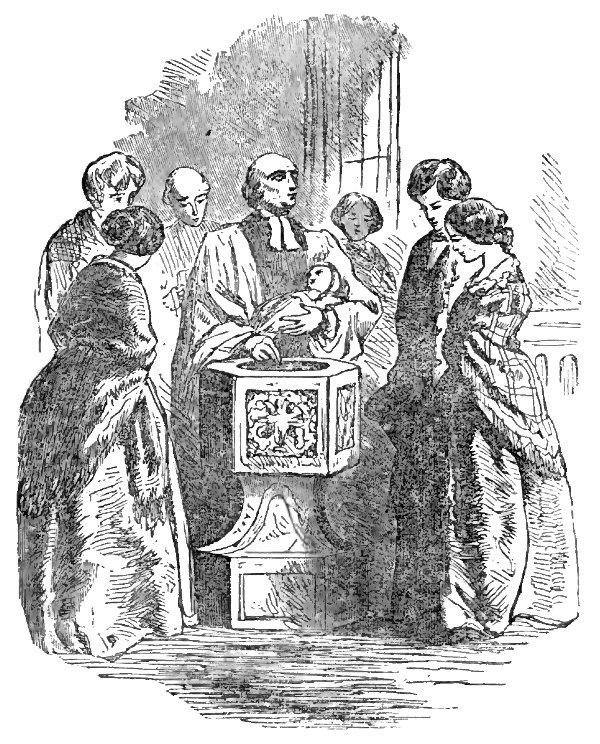
“Well, I fear we must give up the commission. But tell me this, if infants are not fit subjects for baptism, how can they be fit for heaven?”
“Those only are fit subjects for baptism, whom Christ commanded to be baptized. The Gospel has nothing to do with infants. There is in it no command addressed to them, nor is any act, either of mind or body, required of them in order to their salvation. They are no more required to believe than they are to be baptized. They are saved without either. You are required to do both. To you, God says believe and be baptized. You profess to have believed, but you have never made the slightest effort to be baptized. What was done to you in infancy, without your knowledge or assent, was no act of yours. You are still living in open disobedience to this law. Jesus Christ did not command your parents to have you baptized—putting the responsibility on them, but he commanded you to be baptized for yourself; and that not before you believed, but afterward: ‘He that believeth, and [then] is baptized, shall be saved.’”
“It seems to me, Mr. Courtney,” said the pastor, “that you are rather early in your application of the subject. We have granted, indeed, that the authority for infant baptism is not in the commission by which we are directed to baptize adult believers, but it may be found elsewhere. A recent writer on this subject, the Rev. Dr. Summers, has very expressively said: ‘That [214] the New Testament abounds with the proofs of infant baptism.’”
“Then, sir, it will be very easy to find at least one text which teaches it.”
“Certainly it will, not only one, but many.”
“But I only ask for one; and if you have several, give me that first which you most rely upon.”
“Well, sir, you have the Testament in your hand, please turn to Matthew xix. 13, 14: ‘Then were brought unto him little children, that he should put his hands upon them, and pray. And the disciples rebuked them. But Jesus said, suffer little children to come unto me, and forbid them not, for of such is the kingdom of Heaven.’ Do you not see some authority for infant baptism in that?”
“Indeed, sir, I cannot—can you?”
“Yes, truly. It is to my mind perfectly satisfactory. And I do not see how it can fail to convince any candid man who reads it.”
“Your mind, Mr. Johnson, must be easily satisfied then, for I can’t see one word about baptism in it.”
“Oh! I do not say that baptism is expressly named in it; but, sir, the inference is irresistible, that these children were brought to be baptized, and that the people were accustomed to bring their children for that purpose, and that Jesus commanded his disciples never to forbid it, as you, Baptists, have done, but to suffer the little children to come to him, and make a part of his visible church.”
“Is it possible! Pardon me, Mr. Johnson, if I say, that to my mind there can be no inference about the object or purpose for which these children were brought, because it is expressly and very definitely stated in the text. They brought them, that he should lay his hands on them, and pray. This was all they came for, and [215] this was all he did. He did not baptize them. He did not command them to be baptized. He merely (verse 15th) ‘laid his hands on them, and departed.’ But there is an irresistible inference that I draw from this text, and that is, that the disciples had never been accustomed to infant baptism. If they had been in the habit of baptizing children, they could never have objected to their coming to be blessed by Jesus. They would have regarded it as a thing of course. But if they had, like the Baptist Churches, received only adults, and them only on repentance and profession of faith, it was not at all strange that they should reprove those who brought the little children, who could not believe And there was a beautiful propriety in the lesson which Jesus taught them, viz.: that though children were not to be baptized, and were not members of his church, yet they were to be objects of intense interest and deep solicitude to his people. Though they were not to be baptized, they were to be prayed for. Parents, therefore, ought to bring their little children to Christ by faith and prayer, for that he has commanded, but not by baptism, for that he has forbidden, by requiring those who are baptized first to believe.”
“But you cannot deny, Mr. Courtney, that by the kingdom of heaven, in this passage, is meant the visible church, and that Jesus expressly mentions children as members of it?”
“Indeed, Mr. Johnson, he mentions no such thing. It does not matter at all whether the kingdom of heaven means the church visible or invisible. He does not say that children are members of it, but that its members are like children. He does not say his church is composed of children, but of such as are like children. For in the corresponding passage in Luke and Mark, he goes right on, and explains by saying, ‘Whosoever shall not [216] receive the kingdom of God as a little child, shall in no case enter therein.’ Mr. Barnes, in his Notes on this text, says: ‘Of such as these—that is, of persons with such tempers as these—is the church to be composed. He does not say of those infants, but of such as resembled them, or were like them in temper, was the kingdom of heaven made up. It was proper, therefore, that he should pray for them.’—Notes, in loc. Olshausen, of whose Commentary, Kitto, a brother Pedobaptist of his and yours, declares that it is, on the New Testament, the best now in existence—Olshausen says on this text: ‘For entering into the kingdom of God, there is enjoined that child-like feeling which enables us most easily to discern the gifts which have been bestowed upon each, and, consequently, puts us in circumstances to fulfill our calling.’ He goes on to say: ‘Of that reference to infant baptism, which it is so common to seek for in this passage, there is clearly not the slightest trace to be found.’ And Bishop Taylor, another eminent Pedobaptist, says, in substance, that ‘to rely upon this text as proof of infant baptism, proves nothing so much as the want of a better argument.’”
“I think, Mr. Johnson,” said Professor Jones, “that we had better, for the present at least, let this passage stand aside. It certainly gives no direct testimony in our favor, and even the inferential is somewhat doubtful. We can afford to let it go, as you know we have many others, about the meaning of which there can be no question. Let us take this, for instance, Acts xi. 38, 39: ‘Repent and be baptized, every one of you, in the name of Jesus Christ, for the remission of sins. And ye shall receive the gift of the Holy Ghost, for the promise is unto you and to your children, and to all that are afar off, even as many as the Lord our God shall call.’ Here, most undoubtedly, the parents and children [217] are both included, and that so expressly and plainly, as to leave no room for even the shadow of a doubt.”
“That is, indeed,” replied Mr. Johnson, “one of the strongest passages, if it be not the very strongest that we have.”
“And yet,” said Mr. Courtney, “it has not, in fact, the very slightest value in favor of your faith or practice, but, on the contrary, furnishes at least a very strong inference against them; for if infant baptism was either recognized or practiced, it is incredible that Peter should not have said, ‘Be baptized,’ not only ‘every one of you,’ but you and your children. All that is said of baptism, is only to those who are commanded to repent. Those who are commanded to be baptized, are first commanded to repent; and none are to be baptized but those who have repented—not the penitents and their children.”
“True, Mr. Courtney; but you forget the last part of the text: ‘the promise is to you and your children.’”
“The promise of what? Mr. Johnson. What promise is Peter speaking of? Evidently that in the Prophet Joel: ‘It shall come to pass in the last days I will pour out my Spirit,’ etc. On the faith of this promise, Peter says: ‘Repent and be baptized, every one of you, and you shall receive the Holy Ghost. For this promise (that is, of the Holy Ghost,) is unto you and to your children, and to all that are afar off’ etc. It was no promise of baptism, but the promise of something that should follow their repentance and baptism. But even if the promise did refer to baptism, the subjects of it were not infants, for its application is expressly limited to those who can be called into the repentance and faith of the Gospel: ‘Even as many as the Lord our God shall call,’ (and no more). Does God call little unconscious infants? If not, then they are not the persons spoken of.”
[218]“What, then, do you think is the meaning of the word children?”
“Simply their descendants. In the next chapter, Peter says to these same people, who were all grown men and women: ‘Ye are the children of the prophets.’ And nothing is more common in the Scriptures than to speak of the Jewish nation as children of Israel. They were not a nation of babies, nevertheless.
“But even granting, for the sake of argument, that it was little children—infants—that were spoken of, then if they were to be baptized without repentance and faith in Christ, so also are all the aliens and idolators among the Gentiles, for they are included in the term ‘all that are afar off.’ And there is the same authority to baptize these as the children. They are equally included in the ‘promise:’ ‘You and your children, and all that are afar off’ Unless you will admit the promise thus to embrace ‘all the world, and the rest of mankind,’ you must limit it, as Peter did, by confining it to those ‘of you,’ and of ‘your children,’ and of the Gentiles whom the Lord our God shall call. If, therefore, this is the strongest, or one of the strongest passages you have, your case is a desperate one indeed. The text contains a command and a promise. It commands men first to repent, and then to be baptized—just as Jesus commands them first to believe, and then to be baptized. And, of course, unless unconscious infants can repent and believe, they cannot be baptized. Then it promises the ‘gift of the Holy Ghost’ to those who have thus repented and been baptized: for Peter makes this the condition of their receiving it: ‘Repent and be baptized, and ye shall receive the gift.’ And as they might receive the gift of the Spirit on these terms, viz.: baptism and repentance, so might their descendants, and so might even the idolatrous Gentiles, who were now afar [219] off—even as many of them as the Lord our God should call.”
“That is indeed entirely satisfactory,” said Professor Jones, “and I am only surprised that I did not see it in that light before. But the truth is, because I saw baptized in one part of the passage, and children in another part, I took it for granted (since it was one of the proof-texts quoted in our confession of faith) that it was the children who were to be baptized. I see now that it was only those who repented; and I am ready candidly to acknowledge that there is no authority for infant baptism in this text, but there are surely many others.”
“Oh, yes,” said Mr. Courtney, “you know ‘the New Testament abounds with proof of infant baptism.’ And if you will turn to 1st Cor. vii. 14, you will find one which has been relied upon even more confidently than the one we have just disposed of: ‘For the unbelieving husband is sanctified by the wife, and the unbelieving wife is sanctified by the husband; else were your children unclean, but now are they holy.’”
“Well, I should like to see how you will set aside a passage so plain and appropriate as that is,” said Mr. Johnson.
“I simply say,” rejoined Mr. Courtney, “that there is not one word in it about baptism, either of infants or adults. It has not only no mention of baptism, but not even the most distant allusion to it, direct or indirect.”
“Why, sir, does it not say that the children of but one believing parent are holy? and if they are holy, are they not fit subjects for baptism?”
“You know,” replied Mr. Courtney, “that the words holy and sanctified, among the Jews, were used in a physical or ceremonial sense, as well as in a moral sense. If the Apostle used them here in a moral [220] sense, he stated what was not true, for in this sense the infidel husband or the infidel wife was not made holy by the other’s faith. The faith of the husband did not make a saint of his wife, nor did the faith of the wife make a saint of her idolatrous husband. They might have been, and doubtless often were more sinful afterward than before the other party was converted. Nor does the faith of both parents combined render their children holy, in this sense of the word: for you know and every other man knows, that the children of believers grow up in sin, and need to be converted, just as much as the children of unbelievers; and without such conversion, will just as surely be lost as the children of the vilest. Did David’s faith take the incestuous Ammon and murderous Absalom to heaven? You and your wives are both believers: are your children, in this sense, holier than other children? Do you not daily pray for God’s converting grace to make them holy? It is evident, therefore, that the words sanctified and holy (which are equivalent terms) must here be understood in their other sense. The expression is indeed one of those Hebraisms in which Paul abounds. Its real meaning is very clearly stated by one of your best Presbyterian Commentators, Dr. McKnight—for more than twenty years the Moderator of the Presbyterian General Assembly of Scotland:
“‘I think, therefore,’ says he, ‘with Elsner, that the words in this verse have neither a federal nor a moral meaning, but are used in the idiom of the Hebrews, who by sanctified understood what was fitted for a particular use, and by unclean what was unfit for use, and therefore was to be cast away. In that sense the Apostle, speaking of meat, says, 1 Tim. iv. 5, It is sanctified (that is, fitted for your use) by the Word of God and prayer. Ver. iv. Every creature of God (fit for food) [221] is good, and nothing fit for food is to be cast away as unclean. The terms of the verses, thus understood, have a rational meaning, namely, that when infidels are married to Christians, if they have a strong affection for their Christian spouses, they are thereby sanctified to them—they are fitted to continue married to them; because their affection to the Christian party will insure to that party the faithful performance of every duty; and that if the marriages of Christians and infidels were dissolved, they would cast away their children as unclean—that is, by losing their affection for them, they would expose them, after the barbarous custom of the Greeks, or at least neglect their education; but by continuing their marriages, their children are holy; they are preserved as sacred pledges of their mutual love and educated with care.’
“Hence he thus paraphrases the text:—‘For the infidel husband is sanctified—is fitted to remain married to the believing wife by his affection for her; and the infidel wife is sanctified to the believing husband by her affection for him; otherwise certainly your children would be by you neglected as unclean, whereas indeed they are clean; they are the objects of your affection and care.’”
“I do not know,” said Mr. Johnson, “that we are bound to admit Dr. McKnight’s exposition of this passage merely because he was a Presbyterian.”
“Certainly not; but one would naturally suppose that if there were any infant baptism in the passage, a learned and eminent Presbyterian Doctor of Divinity would be the man to find it. Perhaps you can show it to be there, though he could not.”
“I do not say, Mr. Courtney, that infant baptism is commanded in this passage, but only that it is recognized. These children were not morally holy—that is [222] self-evident. Yet they are called (‘agia’) holy, by the same term which is sometimes used to designate the saints; that is, the members of the church. Therefore, they must have been church members; and as none were church members but those who had been baptized, it follows that they must have been baptized. That is what I call a demonstration.”
“And if it be so,” replied Mr. Courtney, “then the infidel wife and the infidel husband had also been baptized, and were members of the church, for they are called (hagiarai) ‘sanctified,’ the same term which in this epistle (1st chapter and 2d verse) is applied to the members of the church: ‘To them that are sanctified in Jesus Christ, called to be saints,’ etc. And again, in the 6th chapter and 11th verse, ‘But ye are washed, ye are sanctified; but ye are justified in Christ,’ etc. These sanctified ones called to be saints, and these sanctified ones who were washed and justified in Christ, were, most undoubtedly, members of the Corinthian Church. It was as such that Paul addressed them; and as the same term (sanctified) is applied to the infidel and idolatrous husband and wife who had a believing companion, it follows, of course, that, infidel and idolatrous as they were, they must have been members of the church; and as none are church members but those who have been baptized, they must certainly have been baptized. That is what I call, not a demonstration, but a palpable absurdity; yet it stands precisely upon the same ground with your demonstration.”
“We must give it up, Mr. Johnson,” said the Professor, “at least so far as this text is concerned, for if it proves any thing, it proves too much. It will be better for us to give up the children than to take the unbelieving and idolatrous adults. If we ground our practice of baptizing infants on this passage, we must baptize the [223] unbelieving wife on the faith of her husband, and the unbelieving husband on the faith of his wife, as well as their children on the faith of either. This we have never done, and would not dare to do, so we must look for some other passage to sustain our views.”
“Not quite yet,” said Mr. Courtney, smiling; “I have wrested this weapon out of your hands, and I will now turn it against you.
“I will prove, by this very passage, that there was no such thing as infant baptism known in the Corinthian Church, or in the mind of Paul, when he was writing to them; but that, on the contrary, the Corinthian, and, of course, all the other churches of that day, were Baptist Churches, in which neither the children, nor the unbelieving companions of believers, were baptized, or in any sense regarded as church members. If the unbelieving husband or wife had been baptized and made a member of the church, the question to which the Apostle is evidently replying could never have been asked. The Jews, as we learn from Ezra x. 3, were not permitted to continue in the marriage relation with their Gentile wives. Now the question had come up in the Corinthian Church whether a Christian should not, under a similar regulation, separate from an unbelieving and idolatrous companion. But if such unbelieving consorts were by the other’s faith entitled to church membership, and had, consequently, been baptized, such a thing as separation on this ground would never have been thought of. It is evident, therefore, that the infidel husband or the infidel wife were not baptized or made church members. There is in the Scriptures not the slightest allusion to any such church members made by the faith of others, and not by their own. These persons were, therefore, in every sense, outsiders. They had no more connection with the church than any other heathens had. But the Apostle [224] says to their Christian companions, You have no more reason to discard them on this account than church members have to discard their children, for they are also unbelievers, and without the pale of the church. The unbelieving husband and the unbelieving wife, and your children, not their children, stand in the same category. They are all without the church—all unbaptized—and thus far, all equally unfit associates. But as your children, though not in the church, are holy to you—that is, fit to associate with, so is the unbelieving husband or the unbelieving wife, although they are also out of the church.
“That this is the sense in which the Apostle uses the terms sanctified, and holy, and unclean, is evident from the fact, that this is the only sense in which what he says of the parties can be true, and this sense corresponds perfectly with the common Scripture usage of the words. Those things and persons among the Jews were called unclean which a holy person might not lawfully touch, use, or associate with. It seems, from Gal. ii. 12, that they considered it very criminal to associate or eat with Gentiles. Peter, it seems, had the opinion that only certain food was fit to eat, and that all other was unclean. And he said: ‘Lord, nothing common or unclean hath at any time entered into my mouth.’ And Paul, 2 Cor. vi. 17, says, quoting from Isaiah: ‘Come out from among them, and be ye separate, and touch not the unclean thing,’ or, more properly, ‘touch no unclean person,’ ‘and I will receive you,’ etc. Things unfit for holy persons to use were, Therefore, to them said to be unclean. Food which such persons might not eat, was called unclean food. And persons which they might not associate with, were called unclean persons. In this sense, therefore, neither the unbelieving children, nor the unbelieving husband, nor the unbelieving wife, were to [225] be regarded as unclean. They were all equally sanctified —fit for the companionship and affection of their believing parents and consorts.”
“That is all plain enough, Mr. Courtney; but I do not see what it has to do with infant baptism.”
“Simply this. The infidel consorts of believers were not church members—they had not been baptized. When Paul was asked by the church, if the believing husbands and wives must separate from such, he says no; it is as lawful for them to live together as it is for you to live with your children. But your children are holy [fit associates] to you, and so their companions are sanctified [fit associates] to them. Now there was no force or propriety in the comparison, unless the children were in circumstances similar to the unbelieving consorts —that is, they must all have been alike out of the church, and all unbaptized; and if the children of believing parents were unbaptized, it was a Baptist Church; and if the church at Corinth was a Baptist Church, then all the churches planted by the apostles were Baptist Churches.”
“I do not feel inclined to grant all that,” said Mr. Johnson, “but we have wasted too much time on this text already; let us proceed. But I see it is of no use to argue with you, for you are disposed to construe every passage so differently from what we have been accustomed to consider their true meaning, that the most conclusive texts have no weight with you whatever.”
“But pardon me, Mr. Johnson; do I not construe them according to the natural and necessary meaning of the language? I appeal to Professor Jones to say if I have shown any disposition to present any other than the straightforward and obvious sense of the passages which we have examined.”
“I begin to think,” rejoined the pastor, “that my [226] brother Jones is himself more than half a Baptist, which accounts for his being so easily convinced.”
“Not at all, Mr. Johnson. I was very desirous to find infant baptism in the Scriptures; I confidently believed it was there; I expected we could have pointed to it without the slightest difficulty; but I acknowledge that I can’t see the slightest trace of it in these proof texts which our church has been so accustomed to rely upon. But though we have no command to practice it, we have authority which is quite equivalent, and that is the practice of the Apostles.”
“Certainly,” said Mr. Johnson, “I did not expect to find any such absolute command as could not be explained away. It is chiefly on the examples that we rely.”
“I hope, Mr. Johnson, you will do me the justice to acknowledge that I have not explained away any command to baptize infants. I am sure I would not willingly even attempt to explain away any command of Jesus Christ, or his Apostles, on this or any other subject. I asked you to show me a command to baptize infants, and you pointed to the commission as a command to baptize those who are the believing disciples of Jesus. You pointed, then, to an incidental command, to let the children come to Christ, that he might lay his hands on them and bless them. But as the children were not in the other command, so the baptism was not in this. It was not for baptism, but for quite another purpose that he bade them to come. You pointed then to a command and promise given through Peter, but the command was Repent, and then be baptized, which, of course, excluded infants. And the promise was not a promise of baptism, but of the gift of the Holy Ghost to those whom God should call to repentance, faith, and baptism, which excluded infants from the promise as [227] well as the command. You then pointed to the place which we have last examined, which certainly contains not even the shadow of a command to baptize infants; and so far as it teaches any thing upon the subject, teaches that they were no more to be baptized on the faith of their parents than unbelieving husbands are upon the faith of their wives. You have not found the commandment, because it is not there; I do not like to discourage you, but I assure you, you cannot find the example for the very same reason. This has been conceded, over and over again, by the most learned and most zealous advocates of infant baptism. They rest it on different grounds.
“Dr. Wall, the most eminent of them all, distinctly declares: ‘Among all the persons that are recorded as baptized by the Apostles, there is no express mention of any infants.’
“Bishop Burnet says: ‘There is no express precept or rule given in the New Testament for the baptism of infants.’
“Richard Baxter says: ‘I conclude that all the examples of baptism in the Scripture do mention only the administration of it to the professors of saving faith; and the precepts give no other direction.’
“Martin Luther, the great reformer, says: ‘It cannot be proved that infant baptism was instituted by Christ, or by the first Christians after the Apostles.’
“Erasmus, another of the Reformers, says in his Notes on Rom. vi. 14: ‘The Apostle does not seem to treat of infants. It was not the custom for infants to be baptized.’
“Olshansen, the famous Pedobaptist commentator, says: ‘There is altogether wanting any conclusive proof passage for the baptism of children in the age of [228] the Apostles, nor can the necessity of it be deduced from the nature of baptism.’
“Limbroch, another distinguished Pedobaptist professor of theology, and the author of a ‘System of Divinity,’ says: ‘There is no express command for it in the Scriptures. Nay, all those passages wherein baptism is commanded, do immediately relate to adult persons, since they are ordered to be instructed, and faith is a prerequisite as a necessary qualification.’ And again: ‘The necessity of infant baptism was never asserted on any council before that of Carthage, held A. D. 418. We own that there is no precept, nor undoubted instance in Scripture of infant baptism.’
“Dr. Hanna, editor of the North British Review, says: ‘The baptismal service [of the English church] is founded upon Scripture, but its application to unconscious infants is destitute of any express Scriptural warrant. Scripture knows nothing of the baptism of infants.’
“Dr. Knapp says: ‘There is no decisive example of infant baptism in the Scriptures.’
“Neander, the great Pedobaptist historian, says: ‘It is certain that Christ did not ordain infant baptism.’
“Even your Presbyterian Doctor Miller, of Princeton Theological Seminary, says: ‘The fact is, that during the whole threescore years after the ascension of Christ, which is embraced in the New Testament history, we have no hint of the baptism of infants born of Christian parents.’
“So says your able defender, Professor Moses Stuart: ‘Commands, or plain and certain examples relative to it in the New Testament, I do not find.’
“So says also your other celebrated writer on this subject, Dr. Leonard Woods: ‘The New Testament is silent respecting the subject of infant baptism.’ ‘It is [229] evident that infant baptism is not introduced as a subject of particular discussion. It is neither explicitly enjoined or prohibited, and neither is the practice of baptizing children, nor the absence of it, expressly mentioned.”’
“I declare, Mr. Courtney,” said the Professor, “this is very discouraging. If such men as these, all of whom are on our side of this controversy, and all members of churches that are in the habit of baptizing infants— most, if not all of whom, received their own baptism in infancy—many of whom were eminent ministers, and in the habit themselves of baptizing infants— and some of the most eminent of whom were authors, who, like Stuart, and Miller, and Wood, wrote expressly upon this subject—if such men cannot find the ‘command,’ or the ‘example,’ it seems hardly worth while for us to look for it.”
“I do not know,” said Mr. Johnson, “what they considered a plain command, or an undoubted example, but I conceive that these statements which Mr. Courtney has quoted so glibly, were (to say the least) very ‘unguarded expressions,’ which were by no means justified from the facts in the case. I grant that there is no express command, but there are many examples, with, if not plain enough to satisfy Baptists, are such as will satisfy any candid inquirer after the truth.”
“I only ask you, gentlemen,” said Mr. Courtney, “to show me one which you will yourselves say is an undoubted case, after we have examined the testimony. I only ask you to show me one which your own theological writers and teachers will agree upon as an undoubted case—or one which they will all agree upon as even a probable case. I do not wish to dissuade you from the attempt, but you could not find one single solitary instance if your very lives depended on the effort.”
[230]“Certainly, Mr. Courtney,” said the pastor, “you are speaking without due reflection, for you must know perfectly well that such examples are as numerous as the household baptisms recorded in the Acts or referred to in the Epistles.”
“Not at all,” said Mr. Courtney. “I understand what I am saying, and I desire to be distinctly understood to mean that as there is not (as we have already seen) any command, so neither is there a solitary example, either among the ‘households’ or any where else, in which baptism was administered either to an infant or to any one else who did not first profess faith or repentance. From the first of Matthew to the end of Revelations, you may examine every passage in which baptism is mentioned or alluded to, and you not only will find no infant plainly spoken of as baptized, but you will not find so much as an allusion to any such a class as the ‘Baptized children of the church.’”
“Surely,” replied Professor Jones, “you must be mistaken in this. I am sure I have always thought that there was no more doubt about the Scriptures teaching infant baptism, than about their teaching the divinity of Jesus Christ. I am certain it must be somewhere in the Scriptures.”
“Many people are certain that things are in the Scriptures that neither they nor any body else can find there,” said Mr. Courtney. “Your Doctors of Divinity have told you it was there, and you took it for granted that they told you the truth. But if it is there, you can find it and show it to me. And ever afterward you will know how to give a reason for the faith that is in you on this subject.”
“But Mr. Courtney, we have not time to read over the whole Bible to- night, to see if there is not some case [231] mentioned; and if we do not, we may overlook some case.”
“That is not necessary. Your Doctors of Divinity have done it for you; and if they have found any case that had even the remotest squinting toward infant baptism, they have paraded it before the world. Your pastor here is doubtless perfectly familiar with every case that has the slightest bearing upon the subject, and which presents even the shadow of a proof in favor of the practice of your churches. But if you doubt his information, or if he is unwilling to trust to his memory in the case, suppose you take a Concordance, and refer to every place where baptism is mentioned. Here is Butterworth’s Concordance. It will doubtless mention every place where the words occur; and we can thus test the matter at once.”
“Certainly,” said the pastor. “I greatly prefer that to a reliance upon my own memory; for though I can without any hesitation refer you to several examples, as in the cases of Lydia, and the jailer, and Stephanus, and Cornelius; yet as I might forget some place, I would leave our defence less perfect than I desire.”
“We will then work by the Concordance, and will come to each of those cases in their proper order,” said the Professor.
“Very good,” said the schoolmaster. “Now what is the first place?”
“It is,” said the pastor, “Matthew iii. 7—‘John saw many of the Pharisees and Sadducees come to his baptism.’ We must admit there were no infants there, but then you know we do not consider John’s baptism to be Christian baptism, which was not practiced till after the death of Christ; and so it does not matter who John baptized, or what class of persons were baptized before the ascension of the Saviour, as it was [232] only then that Christian baptism, properly so-called, began to be administered. I am willing to grant, therefore, that there was no mention made of the baptism of any infant until after that time.”
“That will,” said Mr. Courtney, “save us considerable trouble—but it will deprive me of the advantage of at least one very convincing argument against any inference for infant baptism. I think I could easily prove to you that not only John’s baptism, but Christ’s baptism (I mean that which is called his, though John says Jesus himself baptized not, but his disciples), was just the same baptism which He commanded after his death —and that since John required repentance and works meet for repentance as preliminary to his baptism, and Christ is expressly said to have first made disciples of those whom he baptized (John iv. 1), unconscious infants were of necessity excluded, and would be, as a matter of course, considered as excluded until an express command was given to include them. But we will pass it by, and the first case of baptism that comes up after the commission had, in your view, fully established the Christian ordinance, was that on the day of Pentecost, Acts 2d chapter. Suppose, Mr. Johnson, you just turn to the chapter, and see if you can find any thing about infants there.”
“Oh, no. We do not pretend,” said the pastor, “that those three thousand were any of them infants, or even children. There were evidently none among them who could not understand the preaching of Peter and the rest, for they gladly received his word (41st verse) before they were baptized, and continued steadfastly in the Apostles’ doctrine and fellowship afterward. They were all adults, and we must admit also that they were all professed believers.”
“Very well,” said Mr. Courtney; “then we will go on [233] to the next case; but I cannot help remarking by the way that it is very extraordinary if they ever baptized infants in those days—if they were considered as included in the commission. I say it is very remarkable that all these three thousand should have been old bachelors or old maids, or, to say the least, all unmarried, or if married, all childless. Yet such must have been the case, for not a word is said about the duty of bringing their children for baptism—nor among them all was there a single one who brought his little ones that they might be baptized at the same time with his parent. I have been present several times when a number of persons joined your society, and there were always among them more or less who brought their children with them. I do not suppose that you ever recorded in your church the baptism of twenty adults, but that they brought some children with them, yet you pretend that the Apostles practiced infant baptism as you do, and still admit that here are three thousand adults and not a single child—but go on to your next case.”
“It is,” said the pastor, who glanced at the Concordance, Acts viii. 12: “‘But when they (the people of Samaria) believed Philip preaching the things concerning the kingdom of God, and the name of Jesus Christ, they were baptized.’”
“It seems, then,” said Mr. C., “that these were adults too; for they were able to hear preaching, and exercise faith. They believed the preaching before they were baptized, and none were baptized who did not first believe. But you did not read all the verse: does it not go on to say, that they were baptized, both the men, the women, and their children?”
“No,” said Mr. Johnson, with a very perceptible [234] degree of petulance in his tone, “it only says, ‘both men and women.’”
“So then, here is another case, where a large company of men and women were baptized, not one of whom were heads of families. It is very remarkable, for if the Apostles taught and practiced infant baptism, Philip had doubtless instructed them that ‘it was their duty and their privilege’ to bring their infant children into the kingdom with themselves. This is what you teach, and this is what your converts do. If Philip taught as you do, his converts were a ‘peculiar people’ truly. But let us pass on to the next case, which was that of Simon the magician, in the next verse; but as you won’t imagine any infant baptism there, we may pass to the next.”
“That was,” said the pastor, “the case of the Ethiopian Eunuch (Acts viii. 13); and the next that of Saul (Acts ix. 18); and the next that of Cornelius and his friends, which I have sometimes considered as a case of household baptism, but on examination I do not see that there is any mention of infants (Acts x. 47).”
“Please read it, Mr. Johnson,” said Professor Jones. “I have, I am sure, always looked upon this as one of the proof passages.”
“I had such an impression myself,” said the pastor, “but I see it cannot be relied upon. ‘Can any man forbid water that these should not be baptized who have received the Holy Ghost as well as we? And he commanded them to be baptized.’ Now it is true that Cornelius had a family, and he had called together his kinsmen and near friends; and it seems most likely that there would have been among them some children, but still it does not seem absolutely certain. It is, I should say, a probable case, but I do not present it as a certain one.”
[235]“How can you, Mr. Johnson, I was ready to say how dare you, as a minister of the Gospel of truth, even pretend that there is any doubt about the case at all? Could little infants in their mothers’ arms ‘receive the Holy Ghost,’ and ‘speak with tongues,’ and ‘magnify God,’ as these are said to have done in the 44th and 46th verses! The persons, and the only persons, who were commanded to be baptized, were those who spake with tongues and magnified God. And it was on this evidence, and only on this evidence, that ‘God had granted repentance unto the Gentiles,’ that they were admitted to baptism at all. He who could see a probable infant baptism in this, might see it just as well, it seems to me, in the baptism of the three thousand who received the word with gladness, on the day of Pentecost; or the five thousand who received it a few days after; or in the case of the Samaritans, who believed in the Gospel preached by Philip. If they heard, repented, and believed, these did all that and more, for they received the miraculous influences of the Holy Ghost before their baptism; whereas the others received them after it, when they received them at all. These did all that those did, and moreover spake with tongues, and ‘magnified God,’ and yet you talk about their being unconscious infants.”
“Oh, well,” said the pastor, “you have no need to become so eloquently indignant. I said I was willing to pass by this case. I will admit that it is not even a probable instance, if that will satisfy you. We shall find certain ones enough, so we can afford to be liberal in this. You will not be able, I trust, to dispose so easily of the next, which is the baptism of Lydia, Acts xvi. 15—‘And of her household;’ which, as a matter of course, would have some children in it.”
“I do not see how Lydia’s household should necessarily have children in it. I am acquainted with several [236] households in this town that have no infants in them. You have none in yours. You have children, but none too young to repent and believe, make credible profession of their faith, and lead a Christian life; and if you should all be convinced, in the revival which I believe God is now beginning to send upon our little Baptist church, that you have never been baptized—and should all give us satisfactory evidence of true piety—we would gladly do for you just what Paul did for Lydia. We would baptize you and your household; but you would not insist that we had baptized any unconscious babe.”
“But, Mr. Courtney, you must admit the principle that the ‘household was baptized on the faith of its head.’ Lydia believed, and she and her household were baptized. Now, whether they were large or small, they must have been baptized on their mother’s faith.”
“No, Mr. Johnson; it is that principle which I especially condemn and deny. What I say is this—No one under the Gospel is to be baptized, or to be regarded as in any sense a member of Christ’s church, or to enjoy any of the privileges of that church, who has not first repented and believed for himself, and in his own proper person: and if you will show me any case where any one, either old or young, male or female, bond or free, adult or infant, was by the Apostles baptized, who had not first given evidence of his repentance, faith, and conversion, then I admit you have gained your point. I grant that Simon Magus was baptized while yet unconverted but not before he professed to be, and gave such evidence as was satisfactory at the time. For Luke says Simon also believed and was baptized. Now Lydia was baptized and her household was baptized; but there is no evidence that her household were children. There is no proof even that she was married, or ever had been. She may or may not have had a husband; [237] she may or may not have had children; she may have been a widow, or she may have been an old maid. The record says not a word on these points. It only says that her name was Lydia—that she came from a distant city, called Thyatira—that she was engaged in the business of selling purple, which we know, from other sources, was a very respectable and profitable employment. We learn, also, that she was keeping house, and living in such a comfortable way that she could afford to give the Apostle and his companions a home at her house during their stay. It appears also that she had a family (oikos), but whether they were children or servants, or both, is not declared; but one thing is certain, whether they were her offspring or servants, they were grown men, for in the end of this same chapter (verse 40) we read that as soon as Paul and Silas were liberated they returned to the house of Lydia and saw the brethren and comforted them. They were therefore men, who could be comforted, and not little children. They were also believers, for otherwise they would not be called brethren.
“Hence the celebrated commentator, Dr. Adam Clarke, very properly remarks: ‘She attended unto the things.’ ‘She believed them and received them as the doctrines of God, and in this faith she was joined by her whole family, and in it they were all baptized.’ And again— ‘The first members of the church of Christ, at this place, were Lydia and her family, and the next in all probability were the jailer and his family.’
“So far, therefore, from being certain or even probable that the household of Lydia were infants, it is placed past all doubt by the Scripture itself, that they were men and brethren, who believed and were baptized; for though their faith is not specially mentioned, yet it is necessarily implied by the calling of them brethren.”
[238]“But is it certain, Mr. Courtney, that these brethren were the same who composed Lydia’s family? Might they not have come in there merely to meet the Apostle?”
“No, Mr. Johnson; Lydia and her family were the only converts until the Apostle was arrested and thrown into prison. While there, the jailer and his family were converted, and these two families were all the followers of Christ—all the brethren that were in the place. But those at the jailer’s house Paul and Silas had just left, when they came to Lydia’s house, and saw and comforted the brethren there.”
“I think, Mr. Johnson,” said Professor Jones, “that we may as well let this case go. We can afford to do it, as we have so many others. And it evidently, so far from aiding us, testifies directly against us. The same difficulties cannot exist in that of the jailer and his family, recorded in the same chapter. I have always heard that referred to as a most undoubted example.”
“Yes,” said the pastor. “The jailer was a man in the prime of life, as is evident from the impulsive character of his behavior. He drew his sword, called for a light, and he sprang in, which indicates that he was a man of activity and energy. Now such a man would be almost certain, if he had a family at all, to have among them some little children. I consider, therefore, that this is an unquestionable case. The evidence amounts almost to an absolute demonstration.”
“It is a great pity,” said Mr. Courtney, “to spoil such a beautiful and perfect demonstration; and if we had time, I would spare it for a few minutes, that we might at our leisure admire its beauty and its ingenuity. But as we probably have several other places to examine, we cannot afford to trifle over this. You read, in verse 33, that ‘he was baptized, he and all his, straightway.’ [239] Now you say that ‘all his’ must include one or more infants. I only reply, that if so, they were infants who could hear the preaching of the gospel, and could believe it and rejoice in God. For, verse 32, Paul preached to him and all his. And, in verse 34, he rejoiced, believing in God, with all his house. Now, there is not in the record the slightest intimation that there was a child on the premises. There was a family, but whether of adults or children, servants or relations, is not said; but it is said, that they all heard the Word, all believed, and all rejoiced, just as certainly as they were all baptized. There is the same testimony of the hearing, believing, and rejoicing as of the baptism. The Baptists will baptize all the children in town, if they will come to them believing and rejoicing in God—not, however, on their parents’ faith, but on their own. Your next case is in the 18th chapter, is it not?”
“Yes,” said the pastor (glancing at the Concordance which he still held in his hand), “and the 8th verse. ‘And Crispus, the chief ruler of the synagogue, believed on the Lord, with all his house. And many of the Corinthians hearing, believed, and were baptized.’”
“Does it not say that their children were baptized with them on the faith of their parents?”
“I read the whole text,” replied the pastor, gruffly.
“Then you must consider it a very remarkable text,” said Mr. Courtney, “for it declares that among these many Corinthians, there was not a man or woman who had an unconverted child; for if there had been one, it would, if Paul had taught as you do, have been brought up for baptism. These early Christians were strange people. There were three thousand of them at one time, five thousand a few days after in Jerusalem, a great multitude in Samaria, and many more here in Corinth—all childless; for it is incredible that if they [240] had children, and had been instructed that ‘it was their duty and their privilege’ to have them baptized, that some of them would not have done it. Nay, all of them must have done it, or have stood in open disobedience to the requirements of the Gospel. We read of their believing, of their rejoicing, of their breaking of bread, of their assembling for worship, of their ministering to the saints—but never a word of their bringing their little children to be baptized. They evidently did not obey this command, if any such command was given them. And there is never an intimation of any reproof of such inexcusable disobedience.”
“I must say, Mr. Courtney,” rejoined the pastor, “that you are the most unreasonable man I ever tried to argue with. I have given you, at least, two plain and unquestionable instances in which the families were baptized with the parents, and yet you say that out of these eight or ten thousand converts, there is not one who had his children baptized. To use an expression of your own, I do not see how you can dare thus to trifle with the Word of God!”
“I know, Mr. Johnson, that you gave us cases where families were baptized, and you can give us more; but you have not shown that these families contained a single infant child, and that is the point on which the whole argument turns. I reply to you in the language of you own Pedobaptist historian, the celebrated and acute Neander: ‘We cannot prove that the Apostles ordained infant baptism, from those places where the baptism of a whole family is mentioned, as in Acts xvi. 33; 1 Cor. i. 16. We can draw no such conclusion, because the inquiry is still to be made whether they were in these families any children of such an age that they were not capable of any intelligent reception of Christianity, [241] for this is the only point on which the case turns.’ Ch. Hist. p. 198.
“I might retort by saying that you are exceedingly unreasonable in your mode of argumentation. You say that the Apostles baptized infants. I ask you to prove it. You reply by saying he baptized families. Now if there was never a family without infants, your argument would be complete. But your own family has no infants in it. It consists of two grown sons, a daughter nearly grown, and a servant. My family has no infants in it: it consists of myself, my wife, and my nephew, who assists me in my school. The family of our friend Mrs. Ernest has no infants in it. It consists of her daughter, Miss Theodosia, of her son Edwin, and her old servant, Aunt Chloe. All of whom are old enough to believe and rejoice in God, as the jailor’s family did. Should they all determine to obey the commandment of Jesus Christ and be baptized according to the Gospel order, you can say of her, as Luke does of the jailor and of Lydia—She was baptized, and her household. You see, therefore, that if you would make your argument worth a straw, you must go one step further, and prove that there was an infant in the families. It will not do to say that it is probable there was one. It is just as probable that there is one in yours, or mine, or Mrs. Ernest’s, yet you know there is none. You must, if you build an argument on the infant as being there, first prove that it was there. If you can’t do this, the judgment goes against you of course. I need not prove that it was not there. The burden of proof rests on you. If you go into court and claim property as the heir of a certain woman’s child, you must prove that there was such a child. If you should prove no more than that the woman was married and kept house, and had been heard to speak [242] of her family, the court would laugh at you. That she was married, kept house, and had a family, you would be told, was not the slightest legal proof that she had a child. And this is the point on which your whole claim rests. Peter had a family, though so far as we are informed it consisted only of his wife and his wife’s mother. And so Crispus, the chief ruler of the synagogue, had a family: who they were, we do not know; whether children, grand- children, nephews, or servants. His father and mother, and the father and mother of his wife; his own brothers and sisters, or the brothers and sisters of his wife his clerks or apprentices, if they had lodged in his house and eaten of his table, would have been called—his family, his house; but whosoever they were, they ‘all believed on the Lord,’ and so were not unconscious infants.”
“Have we not some other case, Mr. Johnson?” inquired the Professor.
“There is only one other,” replied the pastor, “and that is that of the family of Stephanus, mentioned by Paul, 1 Cor. i. 16—‘I baptized also the household of Stephanus.’”
“And that need not detain us long,” said Mr. Courtney, “for your own Presbyterian Doctor of Divinity, McKnight, in his excellent Commentary, says, ‘The family of Stephanus seem all to have been adults when they were baptized; for they are said, chap. xvi. 15, to have devoted themselves to the ministry of the saints.’
“We have now examined all your ‘examples,’ and the infants are not yet discovered. Lydia’s family are called ‘brethren.’ The jailer’s family are said ‘to believe and rejoice in God.’ That of Crispus ‘believed in the Lord.’ And that of Stephanus ‘addicted themselves to the ministry of the saints.’ And, Cor. xvi. 16, the church is directed to ‘submit itself unto such.’ You [243] have not only failed to prove that there were any infants, but I have proved (though by the rules of debate I was under no obligation to do so) that they were all adults, or at least old enough to hear, believe, obey, and rejoice in the Gospel. I leave it now for you to say yourselves, whether there is, in any of these instances, a single certain example of the baptism of an unconscious infant?”
Mr. Courtney paused, but neither of the others felt disposed to answer; after waiting a moment, he continued:
“But I am not willing to pass so readily from these passages. You are accustomed, Mr. Johnson, and so are all your ministers, to present these as proof-texts for infant baptism. You will probably go and do it again, though I pray that God may give you a better mind. They stand as proof- texts in your ‘Confession of Faith,’ and yet, in truth, neither they nor you have ever believed them to be such, or else you are more inconsistent in your conduct than sensible men are often found to be.”
“Why, sir, what do you mean? Do you intend to insinuate, sir, that we Presbyterian ministers teach as God’s truth what we do not believe?”
“I mean to say, Mr. Johnson, that you teach for God’s truth what you do not practice—and you know a good man’s practice ought to correspond to his belief. You teach that the families of believers are to be baptized on the faith of the head of the family. Out of the thousands and thousands of people who are recorded as having believed and been baptized, you find three or four instances in which a whole family believed, and were baptized at the same time, and they are mentioned as a certain man and his family. Now you say if these three or four families were baptized, all families of believers [244] are entitled to baptism. This is what your argument amounts to, if it has any force at all. Now, in every one of these instances the whole family, every member of it, is said to have been baptized.”
“Very well,” said Mr. Johnson, “so much the better for our cause—so much the more likely that it included the infants.”
“It may be so much the better for your cause, but it is so much the worse for your consistency. You teach that all the family were included in these baptisms, but you do not baptize all the family. Are not my wife and my nephew members of my family? but you would not on my faith baptize either of them. Is not old Aunt Chloe a member of Mrs. Ernest’s family? yet you never have baptized her, or urged on Mrs. Ernest the duty of bringing her servant as well as her children. Are not children of ten or twelve, or fifteen or twenty years of age, as much members of the family as the baby is? If these passages prove that one member of the family may be baptized on the faith of the head, they prove equally that every other member may be; and your only consistent ground is that occupied by Mr. Barnes in his Notes on 1 Cor. i. 16—‘Household (oikon). the house, the family. The word comprises the whole family, including adults, domestics, slaves, and children.’ … ‘It was the custom doubtless for the Apostles to baptize the entire household, whatever might be the age, including domestics, slaves, and children. The head of a family gave up the entire household to God.’ If you and Dr. Barnes believe this, you ought to practice it. If Paul baptized all the children, and all the domestics, and all the slaves, and all the other members of the family, of whatever age, you ought to do it too. You are unworthy to have charge of a Christian church, if you do not, at least, attempt to do it. You [245] ought to urge upon your members the ‘duty and privilege’ of bringing their slaves, where they have them— their men servants and their maidens—their domestics, male or female, ‘of whatever age,’ and all their children, whether infant or adult, to be baptized upon the faith of the head of the family. Nor do I see how you could well omit the wife, for although Dr. Barnes has not included her, she certainly belongs to the family as much as the ‘domestics.’ If they refuse to perform this duty, which was thus enjoined, as you believe, by the Apostles, you can not do less than call them to account for their neglect. If they will still prove obstinate, you must exclude them as disobedient to one of the ‘undoubted’ ordinances of the church of Christ. They are certainly under as much obligation to bring all as to bring the infants.”
“Yes,” said the pastor; “but where they have come to years of discretion, we think it best to leave them to come themselves, as an act of personal obedience.”
“But you have no right to leave them, even if you do think best. Lydia did not, according to your account of the matter, leave hers to come when they pleased. The jailer did not leave his—he brought them all straightway. If the head of the family is to have his household baptized, on the authority of these examples, he is not at liberty to leave them to come of themselves It is his bounden duty to exert all his authority as husband, father, and master, to bring his whole family at once to the baptismal basin; and it is your bounden duty, as a minister of Christ, if you believe such things, to urge the subject upon their attention. Call upon them for the immediate performance of their obligations; and it is the duty of the church to deal with those who neglect or refuse. But this you never have done. There are none of your ministers who do it; and I venture [246] to say that Mr. Barnes himself has never done it. You never will do—you, none of you, dare to do it. Your own consciences would recoil from the introduction, in this way, of infidels, and blasphemers, and irreligious men and women, into the church of Christ, on the faith of their father or master. As you would be afraid to do it yourselves, you do not believe in your hearts that the Apostles did it. It is altogether inconsistent with every thing we know of their character, and the nature of the churches they established; and it would therefore be fair to infer that these families which were baptized were families of believers, even if they had not been called brethren in the case of Lydia, or said to believe and rejoice in God in the jailer’s—to speak with tongues and glorify God in that of Cornelius —to believe in the Lord Jesus in that of Crispus, and to give themselves to the Christian ministry in that of Stephanus.”
“I did not expect when we commenced,” replied Mr. Johnson, “to be able to convince you of your errors in regard to this subject. I have often observed that the more one reasons with a Baptist, the more firmly he fixes him in his baptistical notions. I have, therefore, had no desire for any such controversy as this. It was only to satisfy my friend and brother, Professor Jones, that I engaged in it at all—and I must now beg leave to decline any further argument upon the subject.”
“Pardon me, Mr. Johnson, if in the heat of debate I have made use of any expression that has seemed improper, or in any degree disrespectful to you. I did not intend to do so, and regret most sincerely if my feelings have led me to overstep the bounds of gentlemanly discussion.”
“Oh, I do not,” resumed the pastor, “decline further [247] disputation on that ground; though I might, I think, fairly complain of some of your expressions. I merely do not wish to continue a discussion which is not likely to result in any good.”
“Permit me to suggest,” said Professor Jones, “that if we leave off here we acknowledge ourselves to be completely routed, for it is certain that we have not yet been able to produce a single undoubted precept or example of infant baptism from the Scriptures. But since such men as Woods, and Wall, and Stewart, and Coleman, and Neander, concede this, and yet are the firm advocates of the baptism of infants, there must be some other ground on which it can be sustained.”
“That is true, sir,” replied the pastor. “And I have purposely reserved our strongest argument for the last. But I am sure it will have no influence on Mr. Courtney, nor any other Baptist.”
“But, Mr. Johnson, it may have some effect on me. And I hope you will do us the favor to present it for my benefit.”
“We will not have time to-night,” replied the other, “and for the present at least I am tired of the subject. Perhaps you will hear something at church to-morrow that will satisfy your mind.” And with this intimation the Rev. gentleman took his leave, and the parties separated.
[248] [249]Theodosia is baptized
according to the commandment,
and the
example of the Lord Jesus Christ.
The Day After the Seventh Night.

We left Theodosia in that most distressful condition, in which duty, struggling with inclination, distracts and rends the mind with agonizing efforts to decide one way or the other.
With her this was not a slight or momentary strife. It was the terrible agony of one who struggles for his very life. Dearer to her than life was Mr. Percy’s love; it was her first love; it was her only love; it was a pure and holy love; it had been sanctioned by her mother’s fond approval; it had been sanctified by their formal espousals; the day had been set for the consummation of their happiness; she had fully given up her whole heart to it; it was the great, controlling, soul-absorbing passion of her being; all the hopes of life were centered here. To tear such love from out the heart, was to rend the heart itself. Yet she felt it must be done; and God gave her strength to do it. All day long, as we said, she had crouched at her mother’s side, or followed her like her shadow. She seemed to feel that something terrible impended over her, and that she was safer in her mother’s presence. Not one word was spoken by either of them on the one subject which occupied the minds of both. Mrs. Ernest observed that, as the day advanced, her daughter’s face became more natural in its expression. The lines of agony began to disappear. The eyes no longer looked so strange and restless; nor did they turn to [252] her, as in the morning, with that beseeching gaze of agony which almost broke her heart. But still, she noticed that her lips often moved, though she uttered no word; and when she spoke to her about the business of the household, it was some time before she answered, and then slowly, and often in such a way as to show that she had not fully comprehended her meaning. Her mind was evidently far away.
About three o’clock she laid down her worsted, and taking up the Testament which lay upon her work table, turned to the fourteenth chapter of Luke, and read: “If any man come to me and hate not his father and mother, and wife and children, and brethren and sisters, yea, and his own life also, he cannot be my disciple; and whosoever doth not bear his cross and come after me, cannot be my disciple. For which of you, intending to build a tower, sitteth not down first and counteth the cost, whether he have sufficient to finish it, lest haply after he hath laid the foundation and is not able to finish it, all that behold it begin to mock him, saying, This man began to build, but was not able to finish. Or what king going to make war against another king, sitteth not down first, and consulteth whether he be able, with ten thousand, to meet him that cometh against him with twenty thousand? or else, while yet the other is a great way off he sendeth an ambassage, and desireth conditions of peace. So likewise whosoever he be of you that forsaketh not all that he hath, he cannot be my disciple.”
“Mother,” said she, looking up, and speaking as though her mother had known what she was reading, “you will not make it necessary for me to forsake you too?”
“Why, what do you mean, my daughter?”
[253]“Jesus says here, that if I do not forsake all for him, I cannot be his disciple.”
“Yes, my child, but that has nothing to do with baptism. It means that you must give up all to be religious.”
“To be religious, mother, is to obey Jesus Christ. ‘If ye love me,’ he says, ‘keep my commandments.’ One of the plainest and most positive of those commandments is, ‘Believe and be baptized.’ Baptism is commanded as much as faith. It makes, indeed, a part of the same command. I trust I have believed; but I have never been baptized. Even if the sprinkling which I received in my childhood had been baptism, it was no act of mine. I have not obeyed: I—must—do—it!” She pronounced these last four words slowly, with a slight pause between each of them, as though each cost her heart a pang to speak it, and yet it must be said.
“Well, my child, if you must, you must.”
“But, mother, you will not forbid me? You will not make it needful to disobey you as well as to—” But she could not finish the sentence, and left her mother to guess her meaning.
“No, my dear child, I will not absolutely forbid you. You know what I think about these things. Baptism is not essential to salvation, and I had much rather you would remain where you are. I cannot bear to see you sacrifice all your prospects in life for a mere whim, for I don’t see but what one baptism is just as good as another. And if you were not in such distress, I would certainly oppose you, but I see it would do no good; and though it will mortify and distress me, I will not forbid you. And if you are determined to do it at all hazards, and it will relieve you of a single pang, I give you my consent.”
“Thank you, mother! You do not know what a load [254] you have taken off my heart.” And she buried her face in her mother’s lap, and wept aloud for several minutes. Then she arose, wiped her eyes, and went into her own room and closed the door.
Shall we invisibly follow her there; see her on her bended knees pour out her soul to God; hear her cry for help with those inarticulate groanings which the Apostle speaks of; see the resolve take form and substance in her heart; see her arise with that same strange calmness which we observed after she had prayed the day she came up from witnessing the baptism in the river; see her open her little writing- desk, and select a sheet of paper; take her pen and write, “My Dear Mr. Percy;” then pause, lay down her pen, cover her face with her hands, pressing upon her eye balls, as if to shut out some terrible vision, while a strong convulsive shudder quivers through her frame? It is past; she uncovers her face; looks up beseechingly to heaven; composes herself; takes up her pen, and writes as follows:
“I received yours on Friday evening. To say that its contents gave me very great pain, would but feebly express the truth. I was not only distressed, but most grievously disappointed; for I had supposed you were as sincere and earnest in your desire to know and do your whole duty in regard to this subject as I was myself. Your letter undeceived me. I do not complain of it. I am thankful for your expressions of interest in my welfare, and of affection for myself. I will not deny that I had no higher ambition, so far as this world is concerned, than to secure your approbation. But I cannot, even to please you, venture to disobey my Saviour, I intend to be baptized to- morrow. I am aware, after what you have said, that by doing so, I shall not only [255] ‘mortify and distress’ you, but I shall renounce all claim to your love. When you return, therefore, I shall be to you but as one dead. I pray you so to consider me; it will be better for us both. And if you will spare me farther pain, I do entreat you never to solicit a renewal of our engagement. It will not give you as much pain to read this as it does me to write it; but I have weighed it well. I say every word deliberately, though sorrowfully. I will not cease to pray for you. And will you not sometimes pray for her who was your
“Theodosia.”
This letter she folded, enclosed, sealed, and directed to Mr. Percy’s lodging place, and called the old servant, Aunt Chloe, and directed her to take and leave it there.
This done, she returned to her mother with something almost like a smile of joy upon her face. The peace of God was in her heart; and if she was not happy, she was no longer wretched. With a low, but calm and almost cheerful voice, she told her mother what she had done, and asked her to make suitable preparation for her baptism. At night she sent a line to Uncle Jones, requesting him, if he could, to be present; and another to Mr. Courtney, announcing her intention to ask for baptism. She spent most of the time in her own room, alone, until the hour of rest, and then slept sweetly till morning. When she awoke, her first thought was expressed in the language of the Psalmist—“I laid me down and slept; and I awoke again, for the Lord preserved me.” She felt now that she was, in a peculiar sense, in the care of God. She had given all, and had obtained all. She had given up self, and obtained Jesus in all his fullness, and God in all his boundless power and love. Jesus was her Saviour; God was her God. Yes, the mighty Maker of the worlds, the omnipotent [256] Ruler of the Universe, was not only her God, but her Father. She felt this morning that she might ask what she would. And yet such was the overwhelming conviction in her heart, that her loving Saviour and her kind Father knew so infinitely better than herself what she most needed, and what would be really best, that she could only pray: “‘Thy will be done;’ I leave it all with thee. Do what thou seest best. Give joy or sorrow; give comfort or affliction; give life or death. Thou knowest best—thou dost all things well. I trust myself— my soul and body; my happiness here and hereafter; all I am, all I have; all I feared, all I hoped for—I give all up to thee. Thou only art my portion now; and I am thine—all thine; I delight to do thy will, oh, my Beloved. I have now no other love but thee, my Saviour, my Father, my Friend. Thou art my all. Jesus is mine, and I am his. What can I want beside? Blessed Saviour, may I never leave thee—may I never grieve thee any more. Lord, thou knowest all things. Thou knowest that I love thee. Yes, I love thee, and I will keep all thy commandments. Show me thy ways. Thou shalt guide me by thy counsels, and afterward receive me into thy glory. Yes, me—even me—poor, lost, rebellious sinner that I am. Thou wilt love me freely. Thou wilt save me through thine own infinite mercy. Mercy, all mercy. Not for works of righteousness which we have done, but of his own mercy, he saves us. Jesus, I thank thee. Oh, make me love thee more.”
With such incoherent ejaculations of trust, and praise, and prayer, she rose, and prepared for church.
It was strange how the news had got abroad, yet it had spread like wild- fire through the town that Miss Theodosia Ernest would that morning apply for baptism. At an early hour the school-house was crowded to its utmost capacity, and before the services commenced, [257] even the windows and the doors, and every place was occupied from which one could hope to catch a glimpse at what was going on within, or hear a word of what was said.
The church bells began to ring. Mrs. Ernest had all the morning been distracted between affection for her lovely child, which prompted her to go to the school-house, and pride, which urged her to go and sit in her own pew as though nothing had happened. Curiosity to see and hear what Theodosia would do and say, and what sort of people these Baptists were, joined with affection in pleading for the school-house; and a sort of indefinite dread of what Mr. Johnson might say, came to the help of pride. And, it may be, there was something like a mistaken sense of religious duty which spake on that side also. However this may be, the first few strokes of the costly and solemn-sounding bell which had been accustomed to call her to church, seemed suddenly to decide her.
“I want you to understand, Theodosia,” said she, “that though I do not forbid, yet I do not altogether approve of what you are about to do, and I cannot sanction any such proceedings by my presence. I don’t know what Mr. Johnson would think of me, if I should forsake our own dear church to wander about after these new comers.”
This was a new disappointment to the sensitive child. She had greatly relied on her mother’s presence to sustain her in the untried scenes through which she was about to pass. She had also hoped that Uncle Jones would call and go with her, but he had not come, and she was alone. Yet she was not alone, for she looked up as her mother was speaking, and in her heart said again, “Not my will, but thine be done!”—And the Spirit replied, “Fear not, for I am with thee; and be not dismayed, [258] for I am thy God!” “When my father and my mother forsake me the Lord will take me up.”
I do not say that she felt no natural misgivings, no modest shrinking from going alone into a house filled with strangers, with the consciousness that every eye was on her, and every heart full of curiosity to see how she would look, what she would do, and what she would say; but she thought much less of this than my reader would naturally suppose. The peace of God was in her heart, and it gave to her mind and her manner a quiet yet determined calmness, and a collectedness of thought and perfect self-possession which was surprising even to herself.
She set out therefore alone; for Edwin had not returned from Sabbath- school. Two or three times the mother turned and looked after her as she went, and wished she could consistently, and without displeasing Mr. Johnson, have gone with the dear child.
Mr. Courtney had taken it for granted that Uncle Jones or some of the family would accompany her, and when he saw her coming by herself, he hastened to meet her, and conducted her to a seat.
The preacher was not the same who had been there before, but a stranger who had providentially been sent to fill his place. He was a man about forty years of age, rather below than above the ordinary size; his complexion dark, his hair slightly silvered with gray, and the top of his head almost bald. His eyes, and indeed the whole expression of his face, were somewhat peculiar. He seemed to have been long in feeble health, and his face was marked with lines of suffering. Its habitual expression was one of sad and sorrowful resignation. The casual observer saw in it no evidence of lofty genius, or of even extraordinary talent—and yet he was an extraordinary man. Though he had but [259] slight acquaintance with the technicalities of logic, he was a clear and powerful reasoner. Though he knew little of the scholastic theories of theology, he was wonderfully familiar with the teachings of Jesus and the Apostles. Though he professed no acquaintance with the metaphysical subtleties of mental philosophy, he knew full well how to convince the understanding and move upon the hearts of his hearers. He was not familiar with the ancient classics, yet his style was pure and strong, and not entirely void of elegance. His tones and gestures were not formed by any rules of oratory, yet he was sometimes very eloquent. When he first rose, there was a slight rusticity in his manner, and something in his dress which for a single moment struck Theodosia unpleasantly; but there was, also, such an air of trusting meekness, that this impression was removed almost as soon as made. His text was John xv. 14—“Ye are my friends if ye do whatsoever I command you.” And the main object of his sermon was to show the vast difference which there is between the so-called obedience which springs from hope, or grows up from fear, and the willing and true obedience of the Gospel which is produced by love. It was a deep, heart-searching discourse, and must have left on every attentive bearer’s mind the sad conviction that genuine Gospel obedience is much more rare than is commonly imagined. We cannot follow him through all his argument; but we may not omit one portion of it. “The obedience of love,” said he, “makes no division of Christ’s commandments into essential and non-essential. ‘Ye are my friends if ye do whatever I command you,’ whether you think it important or not. We know that we love him when we have respect unto all his commandments. The obedience of hope says, how much must I do to be permitted to enter heaven? The [260] obedience of fear asks, what may I omit to do, and yet escape from hell? The obedience of love simply inquires, ‘Lord, what wilt thou have me to do?’ It does not ask, what must I do? but what can I do to show my love for Jesus? It does not ask how far I can venture to disobey, and keep my hope of heaven? How far off can I follow Jesus, and yet not be disowned of him? Oh, never, never! He who will obey Christ no farther than he may fancy is essential to salvation, has never obeyed him at all. Love of self, not love of Christ, is his controlling motive. He is striving not to please his Saviour but to secure his own personal happiness. Love teaches a different way. Love delights to do his will. Love delights to do all his will. Love never asks, what is essential to salvation? but what did Jesus Christ command? Love never asks, how little may I do? but how much can I do? If he commands, that is reason enough. He is no loving child who will obey his father only in those things which he must do, or be disowned and disinherited. He is no loving child who will do all he dare to grieve a doting parent whom he believes will pardon all, and love him though he grieves him. He who truly loves him will obey his slightest desires as well as his most peremptory commands. He who truly loves will study to know all his will, and in his very heart delight to do it—not to avoid disinheritance—not to secure his estate—not to enjoy his father’s bounty, either present or prospective—but simply because the father wishes, asks it, or commands it.
“And yet men call themselves obedient children of God, while they refuse to do what he commands, because he does not add to the command a promise of heaven or a threatening of hell. Oh, it is terrible to think how fearful will be their disappointment! Obeying only to [261] secure salvation is itself sufficient proof that they have not obeyed unto salvation. Omitting all but what they think essential to salvation is of itself sufficient proof that they have omitted all that is essential to salvation. The faith of the Gospel works by love, and love is obedient to all his commandments, so far as it is able to know and to do them. When, therefore, Christ Jesus gives a plain command, as that to ‘believe and be baptized,’ love will not be content merely to believe. It will do both. It will do whatever Christ commands, and he who stops because there is no penalty of hell fire attached to the last, as there is to the first part of the command, is no friend to Jesus. He does not obey from love to Jesus, but from love to self. And further, the obedience of love takes the command as it is given. It obeys in the same order that Christ requires. It not only does the very acts which he commands, but does them in that very way that he requires them to be done. If Christ commands first to believe and then, when thus prepared, to be baptized, the obedience of love will never venture to reverse Christ’s order. It will not seek to be first baptized and then believe. And as the command requires personal obedience, it will never seek to substitute obedience rendered by another. Christ commands you yourselves in your own right, and for yourselves, to believe, and then to be baptized. It may be you have not done either. Oh, what a fearful state! Not to have even begun to obey! It may be you have believed, but are fancying that an act done by your parents, and your pastor, without your knowledge or consent, and which they called baptism, has released you from the obligation to obey yourself. But do not mistake. The religion of Christ is a personal religion. The obedience it requires is an intelligent and personal obedience. You must be baptized for yourself. It must be an act of [262] your own. He that believeth and is baptized, shall be saved. The one is to be your own act as much as the other. But this command you have never even tried to obey. You have never made the slightest effort. Oh, if you love Jesus, will you not at least try to obey all his commandments?
“One thought more. The obedience of love does what he commands. ‘Ye are my friends, if ye do whatever I command’—not what others may put in the place of it—not what you may fancy would do as well. You are not to ‘teach for doctrines the commandments of men.’ Jesus is the sole Lawgiver of his church. His commandments, given in person or by those who spake as they were moved by his Holy Spirit, we must obey. If he was immersed in Jordan, then John’s baptism was immersion. If John’s baptism was immersion, then the baptism administered by Jesus and his disciples was immersion; for John says, Jesus went into a certain place, and there he tarried and baptized. And John also was baptizing in Ænon at the same time. And the Pharisees heard how that Jesus made and baptized more disciples than John. Whatever one did the other did. It was the same thing, because it is called in the same connection by the same name. And if Jesus and John immersed, it was immersion that he commanded. Yet men have done away with what he commanded, and substituted sprinkling in its place. To believe and be sprinkled, therefore, is not to do whatever he commands, but to teach and practice for his commands the doctrines of men; and of those who do such things he says, ‘In vain do they worship me.’ Don’t call me bigoted for reminding you of this. They are not my words, but the words of Jesus Christ. It is he who says it; and I believe that he means just what he says. Popes and cardinals, bishops and priests, have met in solemn conclave [263] and changed the ordinance of Jesus. They have substituted the sprinkling of infants for the immersion of believers. This was ordained by Christ, and that by anti-Christ. Yet there are many professed believers, men who would be grieved if I should intimate that they did not love the Saviour—who in his name and as his ordinance practice these commandments of men. The very time and place when and where these changes were thus made by popes and councils is recorded by themselves. They claim to have authority as the vicegerents of Christ on earth to make such changes. But the obedience of love will never recognize their rule. It obeys Jesus Christ. It does whatever he commands. And whenever professed religious teachers, whether Catholic or Protestant, teach other commandments as a substitute for his—it rejects them with disdain.”
After the sermon, he came down from the little platform which had been erected for his convenience, and announced the church as ready to receive applicants for membership—requesting if there were any present who desired to unite with it, that they would come forward while the brethren sang a hymn, and take a seat allotted for that purpose.
The brethren immediately commenced singing the hymn—
“’Tis religion that can give
Sweetest pleasures while we live;
’Tis religion can supply
Solid comfort when we die.”
Before they had completed the first couplet, Theodosia arose and walked to the appointed seat. And when they had finished, the minister asked her to give to the church some account of her religious experience, that they might be able to judge of the nature of her faith and hope.
[264]My reader, who is familiar with her strength of mind, firmness of purpose, clearness of conception, and habitual command of the most appropriate language, can form little conception of the surprise which was excited, as much by her manner as her words. She did not wait to be questioned, and simply answer yes or no, as is customary on such occasions; but modestly arose and turned her face to the audience, and began to relate in a low, but still in a perfectly audible voice, her experience of grace before she made any profession of religion. The house was still as death. Every eye was fixed, every ear attentive to even the slightest modulation of her voice. After describing, in her modest and simple, yet most impressive style, her conviction and conversion, she paused a moment, as if to think of the propriety of saying what was yet upon her mind.
“And why,” inquired the minister, who was ignorant of her history, “did you not then unite with the people of God?”
“At that time,” she continued, “I had rarely been in any other but a Presbyterian house of worship. I regarded Presbyterians as the true church of Christ. Perhaps I would not be going too far if I should say, that I regarded them as the only true church, or at least as the only church that was not involved in some most important error of doctrine or practice—it was my mother’s church;” and her voice faltered, and eyes filled with tears, as she said it. “It was the church in which God’s truth had been made effectual to my conversion. I had no shadow of a doubt that it was the church, if not the only church, and with them I did unite. Nor, until last Sabbath, did I ever have a doubt that I was right in doing so. Last Sabbath, you will recollect, one of your number was baptized. I had the curiosity to go to the river. As I saw her plunged beneath the [265] water, the thought impressed itself upon my mind, if that’s baptism, I have never been baptized; for whatever baptism may be, it must always be the same—‘One Lord, one faith, one baptism.’ I went home and commenced a careful and thorough investigation of the subject. I found that it was immersion, and not sprinkling, that Jesus commanded. It was this which he himself; as our Example, submitted to in the river of Jordan. It was this which his disciples practiced in his life. I was this which he commanded after his death. It was this, therefore, which he required of me. I have not yet obeyed him, but I desire ‘to do whatever he commands me.’ Mine is, I humbly trust, the ‘obedience of love.’ I have come here to-day, and it is the first time in my life that I have ever been in a Baptist Church. I have come to ask you to baptize me, if you think me worthy, according to the commandment of the Lord Jesus.”
“Why, this is wonderful!” exclaimed the minister, as she resumed her seat.
“It is the Lord’s doing,” rejoined Mr. Courtney, “and it is wonderful in our eyes.”
“Brethren, what will we do in regard to this application?”
“I move,” said one, “that she be baptized, and received into the fellowship of the church.”
This was, of course, unanimously determined on.
“When will you be baptized, my sister?” inquired the minister.
“As soon as it may suit your convenience, sir. I am ready now.”
“Then after prayer we will at once proceed to the water’s side. Let us pray.”
They kneeled, and offered up a short and fervent prayer that God would own the ordinance about to be administered in his name—bless her who was to be its [266] recipient—fill her with the comforts of the Gospel— make her a faithful and useful Christian, and at death receive her into his heavenly kingdom.
When Satan finds that he cannot prevent the performance of a religious duty, he often strives to render its performance as distressing as he can. Theodosia had not yet left the house before she began to be assailed by the most terrible temptations. First came the magnificent church, with its soft light, its cushioned pews, its richly carpeted aisles, its tasteful and costly pulpit, its deep-toned organ, and its well-trained choir, which had all her life been the accompaniments of her public devotions. And she could not but contrast their rich, luxurious elegance and comfort, with the rough platform, the naked, dirty floor, the hard benches, and harsh, unskillful voices which had surrounded her to-day. In that splendid church she saw her mother weeping over her daughter’s apostasy—her brother showing no interest in her fate—her uncle, whom she loved as a father, and upon whose approbation she had confidently relied, yet he had not come near her, though she had earnestly requested his presence—her pastor, who had taught her in childhood, and prayed over her at her conversion —and there was yet another, whom she now scarcely dared to think of. They were all there—all happy, all united. She only was a poor outcast from all—yes, yes, from all she loved. With her own rash hand she had cut the ties which bound her to her kindred and her friends. She had left all the elegance so congenial to her delicacy and refinement of taste. She had left all the affection so necessary to the very life of her fond, clinging, loving heart, and here she stood alone among these strangers, whom she felt instinctively, with one or two exceptions, had scarcely a sentiment or taste in common with her own. Then, as she was walking to [269] the river, they passed the very spot where she and Mr. Percy stood on the previous Sabbath; and in a single moment, what visions of affluence and ease, of elegant social enjoyment, of domestic bliss—all the happiness of the loved and loving wife, extending down through many long and blissful years—came vividly before her mind. She could see nothing else. She forgot for a moment where she was, and why she came there. She walked on unconsciously. Unconsciously she took the offered arm of the minister as he came to conduct her into the river. The touch of the water recalled her to herself. She paused, and suddenly withdrew her arm, clasped her hands together, and looked up to heaven, and so stood for some moments, lost in silent prayer. Those who could see her face, observed the expression of distress and terror (which they attributed to a natural timidity at entering the water) suddenly gave place to one of joy and confidence as she again placed her arm within the minister’s and walked on. Jesus had heard her prayer—“Oh, Lord, save me! Give me strength to make all this sacrifice for thee! Thou art my Saviour. Thou hast commanded this. I do it in obedience to thee. Oh, leave me not. Help, Lord—I have no other helper—thou art now my all.” And as she prayed, the visions of earthly bliss vanished from before her, and she saw Jesus stretched upon the cross in dying agony, and he seemed to say, “I bore all this for thee.” And she thought of the words of the Apostle—“He died for us.” And as she walked along, she remembered what Jesus said—“Blessed are ye when men shall hate you, and when they shall separate you from their company, and shall reproach you, and shall cast out your name as evil, for the Son of man’s sake. Rejoice ye in that day, and leap for joy—for your reward is great in Heaven.” “And every one that hath forsaken houses, [270] or brethren or sisters, or father or mother, or wife or children, or lands, for my name’s sake, shall receive an hundred fold, and shall inherit everlasting life.”
So fully was her mind occupied with this delightful thought, that she felt no further anxiety, and not the slightest fear. And as she was lifted from the liquid grave, she could not help exclaiming in an audible voice, “Jesus, I thank thee!” And then, as they turned toward the shore, such a gleam of heavenly peace and holy joy illumined her beautiful face, that several of the brethren and sisters who stood upon the bank, simultaneously exclaimed, “Blessed be the name of the Lord!”
“Yes,” she exclaimed, “blessed be his holy name!” And suddenly she stopped, and with a voice which was naturally sweet and powerful, and had been carefully cultivated, and now was rendered deeper and more expressive by intensity of feeling, she commenced singing:
“Jesus, I my cross have taken,
All to leave and follow thee;
Friendless, poor, despised, forsaken,
Thou from hence my all shall be.
And whilst thou shalt smile upon me,
God of wisdom, love, and might,
Foes may hate, and friends disown me,
Show thy face, and all is bright.
Man may trouble and distress me,
’Twill but drive me to thy breast;
Life with trials hard may press me,
Heaven will bring me sweeter rest.
Oh, ’tis not in grief to harm me,
While thy love is left to me!
Oh, ’twere not in joy to charm me,
Were that joy unmixed with thee!”
The effect upon the audience was electrical. Tears streamed from every face; many sobbed and wept aloud. Among these was a voice which instantly fixed her [271] [272] [273] attention. She looked up among the assembly, and was surprised to see that it had increased since she started into the water to a great multitude. The congregations from several other churches had hurried to the river as soon as they were dismissed from their several places of meeting. Foremost among the crowd stood Uncle Jones, with her mother on one side, and Edwin on the other. It was she that she heard; for when she saw her daughter standing thus alone, and heard her sing, “Friendless, poor, despised, forsaken,” she lifted up her voice and wept. Nor did she weep alone. Strong men, who were not professors of religion, and who were thought to care for none of these things, stood and gazed at that sweet face, all radiant with the love of Jesus, as though it had been the face of an angel; and as they looked, the big tears chased each other down their unconscious cheeks. The brethren and sisters of the church wept; old men and mothers in Israel wept. Young men and maidens wept. But Theodosia heard none, saw none but her mother. As she came to the water’s edge, that mother rushed down to meet her, and clasped her closely to her heart. The brothers and sisters of the church, who were approaching to give her the hand of fellowship, stood respectfully aside.
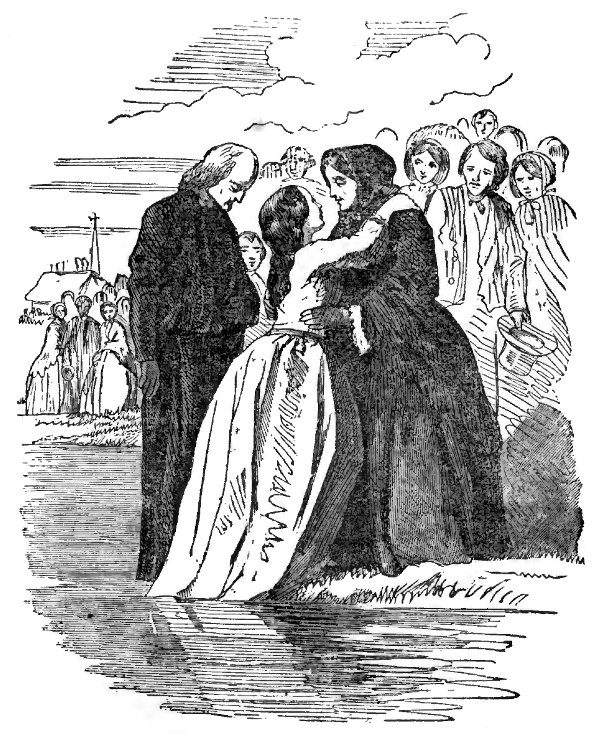
“Oh, mother, do you—can you forgive me?”
“Don’t talk so, my child; I have never blamed you. You have done your duty; you have done right. You have obeyed your Saviour—he will bless you. I wish I had the courage to follow your example.”
“God bless you for those words, my mother! Oh! how full of joy my heart is. He maketh my cup run over. Surely goodness and mercy hath followed me all the days of my life. Uncle, dear uncle, it is blessed to obey. Can’t you give up all for Christ?
“Mr. Courtney, I thank you for your teachings. Now [274] I know I am baptized. I have now done just what Jesus commanded. I have left all and followed him; and, blessed be his name, I have already that peace which passeth understanding.” And as the brethren and sisters came crowding round to welcome her into the communion of the church on earth, she sang again with that sweet, soul-thrilling voice, to which the intensity of her feelings and utter self-abandonment gave tenfold power:
“Children of the living God,
Take the stranger to your heart—
Let me dwell in your abode,
Never more from you to part.
“Can you love me? Will you help me?
Help me on my way to God—
Can you love me? Will you help me?
Help me keep his precious word.”
While singing, she continued to give her hand to one after another as they came up; and as she finished the strain, a sister standing by sang:
“Yes, come, thou blessed of the Lord,
No stranger art thou now—
We welcome thee with warm accord,
Our friend and sister thou.
“The hand of fellowship, the heart
Of love we offer thee;
Leaving the world, thou dost but part
With lies and vanity.
“In weal or woe, in joy or care,
Thy portion shall be ours;
Christians their mutual burdens bear,
They lend their mutual powers.”
The minister pronounced the benediction, and they led her up the bank, and then each went his way rejoicing.
[275]Uncle Jones went home and dined with Mrs. Ernest. When Theodosia had changed her dress, and returned to the parlor, he went up and took her hand as she came in, saying, “My dear Theo., why did you not tell me you were going to be baptized to-day? I would have gladly gone with you to your meeting.”
“Then you did not mean to cast me off?” said she, her eyes filling with tears. “I thought you too had forsaken me. I sent you a line last night, entreating you to be present—but you did not come!”
“I did not get it, nor did I know, till after church, that you intended any such thing to-day. I missed you from your accustomed seat, and inquired of your mother as soon as the meeting was dismissed, and learned that you had gone to be baptized. We hurried to the river, and fortunately were just in time to see you go into the water.”
“Oh, uncle! I am so glad. I thought that you, and mother, and all who loved me, so disapproved of what I was about to do, that you would none of you be present. God is already giving me back my friends.”
There was preaching again at three o’clock,—and as the school-house could not hold half the people, it was thought best to adjourn to the court house. At night the court house was filled to overflowing, and the preacher requested those who were concerned about their souls’ salvation, and desired the prayers of the people of God, to take a seat in front of the congregation. More than a dozen came forward at once, among whom were several who had been a long time professors of religion, and some were members of the Baptist Church. On inquiry, these professors stated that they had been trying to get to heaven, and with this object in view had endeavored to lead in some degree religious [276] lives. They had gone to church, partaken of the Supper, sometimes prayed, or tried to pray—but took no pleasure in religion; and from what they heard in the morning, were convinced that whatever obedience they had shown was the obedience of fear, or hope, and not of love. For if they could have got to heaven without religion, they would have willingly dispensed with it. They had abstained from open sin, because they knew that those who lived in open sin would surely be lost. They had endeavored to perform certain duties, because they considered the attempt (at least) to do such duties to be essential to salvation. What they did not think thus essential, had little weight upon their conscience. Now they saw that they had been fearfully deceived, and desired to seek for the obedience of love—not the obedience which seeks to merit heaven, and continually looks for its reward—but that which receives all mercies as the free gift of God in Christ, and yet longs, and strives, and prays to do all his commandments, because it thus and only thus can exercise, exhibit, and gratify the love of God that fills the heart.
The minister did not try to give them back their hopes, and make them think that they had no occasion for alarm. He knew full well that Christ will say to many, “Depart from me, I never knew you,” who here on earth called him Lord, Lord, and professed to be his disciples. He greatly feared that there were thousands and thousands who had a respectable standing in the church of Christ, who never asked, with the converted Paul, “Lord, what wilt thou have me to do?” But only with the yet unconverted jailer, “What must I do to be saved?” This last he knew was most important, but it was not enough. It was a needful and common preparation for religion, but it was not religion. It might lead to seek for faith, but it is not the result of saving [277] faith, for that works by love—and through Love purifies the heart—and through Love brings forth good works in the life. He was convinced, moreover, that it was infinitely better for many of God’s true children to suffer temporary anxiety and alarm, than for one false professor to be confirmed in his delusive hope.
It was determined at the close of this meeting, to appoint one for Monday night, and probably continue to have preaching every night during the week. Whether they did so, and what was the result, we will learn hereafter. It is time for us now to return to our study, which at the close of the Seventh Night (the attentive reader will perhaps remember) was about the Scriptural authority, or rather about the utter want of all Scriptural authority for infant baptism.
[278] [279]New characters and new arguments.
Infant baptism is virtually forbidden
in the Word of God.
The covenant of circumcision
furnishes no ground of defence
for
infant baptism.
Eighth Night’s Study.

The Reverend Mr. Johnson had, early in the preceding week, commenced the preparation of a discourse, which was intended, at once and forever, to put an end to any further defection among his flock. He was a fine declaimer, and was, in the pulpit, accustomed at times to deal in the bitterest denunciation of those who differed from his party in their religious opinions and practices. He had more power of sarcasm than of reason, and hence, found it easier to denounce the opinions of others than to defend his own. His discourse upon the Sabbath through which we have just passed, was that which we saw him preparing at the commencement of our Third Night’s Study. It was designed to be a scornful, bitter, and withering denunciation of all those weak minded and credulous, or fanatical, persons who, in this day of light, and surrounded by such advantages as were possessed by his congregation, could be by any means induced to wander away from the sacred pale of Presbyterianism. We will not trouble the reader with even a synopsis of this remarkable sermon. It had been prepared with evident labor and care, and it was delivered with great energy and feeling. Under other circumstances, it might have produced the effect that its author intended, which was to deter any other persons from any investigation of the subject of baptism, or indeed any other religious subject, except for the purpose of confirming their faith in the doctrines in which they had been instructed from their childhood. To have [282] fully answered his purpose, he should have preached it at least a week sooner. Now, it was universally understood to be expressly aimed at certain individuals, whom it was well known had been investigating the subject of baptism, and might possibly be considering the propriety, or rather the conscientious necessity, of a change of church relationship. Many a glance was turned, during its delivery, to the seats occupied by Uncle Jones and Mrs. Ernest. The latter felt that it was an uncalled-for abuse of her absent child, whom she knew had been impelled to the course she had taken by the sternest and most distressing conviction of indispensable duty; and though she wept as she listened, her tears were tears of mortification and anger. That sermon did more to destroy her faith in Pastor Johnson, and her affection for her church, than all the anti-Presbyterian arguments she had ever heard. So also it did more to fix the attention of the congregation upon the work which was going on among the Baptists, than any thing which they could have done or said. Many were willing to go and learn at the Baptist meetings what those terrible and seducing doctrines were which could so excite the ire of their venerable shepherd.
After preaching, he gave notice that a meeting of the Session would be held at three o’clock, at the parsonage, to attend to some business of importance, and gave a special invitation to the resident ministers (by whom he meant the President of the college, and those of the professors who were also preachers) to meet with them.
Neither Uncle Jones nor Mrs. Ernest said any thing of this ominous announcement to Theodosia, for both had some indistinct conception that the business to be done related to her case.
Uncle Jones, as one of the ruling elders, and a member [283] of the Session, felt it his duty to be present. He was a little after the time, however; and when he arrived, he found that they had already entered upon the discussion of the business on hand. There was an awkward pause in the conversation when he came in, until the pastor remarked that the matter which they were considering might be an unpleasant one to him; and if so, there would be a quorum present should he think best to retire.
“If your business relates in any way to my niece,” said the Professor, “I prefer to witness all you have to say or do.”
“We were indeed speaking of her,” said the pastor; “and though it gives me pain to say it, I have felt it my duty, also, to make some mention of your own case, as of one aiding and abetting error in another, if not yourself entertaining opinions which are inconsistent with your obligations as a ruling elder in the church.”
There was a slight flush passed over the manly face of Professor Jones, as the pastor, with evident reluctance, thus gave him to understand that one object of the meeting was to inflict the discipline of the church upon his recreant niece, and another to take steps to depose him from the eldership; but he answered very calmly:
“Don’t let my coming in interrupt your order of business. You will take up one case at a time. I will be present when you take action on that of Miss Ernest. When you are ready to consider mine, I will retire.”
“We understand,” said the pastor, “that Miss Ernest, while her name was still standing as a member upon our record, has gone to a Baptist society, solicited immersion, and has actually been immersed by a Baptist preacher. By this act, she has undoubtedly severed all connection with our church, and must of necessity be excluded from our communion. The only question is [284] whether we are bound to make the usual citation to appear and answer to the charge.”
“There can be no doubt,” replied Professor Jones, “that we are bound, according to our rules, to give the ten days’ notice of citation, with a copy of the charges preferred against the accused. But, in this case, I will take it upon myself to answer for my niece, that she would prefer the quickest and the simplest mode of excision. She has no wish for farther connection with us. She regards herself as already separated from our communion, and will probably make no answer or defence to any charges not affecting her moral or Christian character, which you may think fit to bring against her.”
After some consultation, it was decided that it would not be proper to dispense with any of the stipulated formalities of the rules of discipline; and consequently, all that could at this time be done, was to take order that a copy of the charges preferred against her, the names of the witnesses by whom they were to be established, and a citation to appear and answer ten days thereafter, should be issued and served upon Miss Theodosia Ernest. A committee, consisting of the pastor and clerk, was appointed to carry these measures into execution.
“You are now done with Miss Ernest’s case for the present,” said Professor Jones, “and I will retire, that you may feel perfect freedom in speaking about mine.”
“Oh, no,” said the President of the College, the Rev. T. J. McNought, D.D., LL.D., who was present on the invitation of the pastor. “We were merely speaking of what it might be necessary to do in a case such as our brother Johnson conceived yours would eventually become, should you continue to progress in the direction in which he imagines you have started.”
“Brethren,” replied the Professor, “let us not misunderstand [285] each other. You know me well. I am a plain, blunt man. I will have no concealment on this subject. My niece has carefully studied the Word of God, which our standards declare ‘is the only rule of faith and practice.’ I assisted her in the investigation. We both came to the conclusion, as I think every right- minded man must do, that the baptism commanded and spoken of in the New Testament, is neither sprinkling nor pouring, but dipping, or, as it is commonly called, immersion. This I now firmly believe. This I am ready to prove from the Holy Word to you or any one else who feels inclined to inquire into the matter. I will prove it by the very meaning of the word baptize. I will prove it by a reference to the places selected for baptism. By the going down into the water, and the coming up out of the water, said to have preceded and followed baptism. I will prove it by the nature of the allusions to baptism, as a bath, as a planting, and a burial. I will prove by the testimony of the Fathers, that it was for centuries the only baptism, and by the testimony of our own ablest writers—such as Wall and Stuart, Neander and Colman —that it continued to be the common baptism for more than thirteen hundred years, even in the Roman Catholic Church, and the churches derived from her, and still continues the only baptism in the Eastern churches. I will show you the very time and place when and where the change was made by authority of the Pope and his council. I will show you when and how the new practice was introduced into England and into this country. I will show you this, not in Baptist books. These facts do not rest on Baptist testimony, but on that of our own historians and divines. You know, President McNought, that what I say is true; and Mr. Johnson knows it, too, or might know it, if he would look at the evidence in his possession. Now, if to believe these things on such testimony [286] makes one a heretic, I wish you distinctly to understand that I am decidedly heretical. Though I assure you, on my honor as a man and a Christian, that I am ready and willing to see and to acknowledge my error, if any one of you can point it out. On the subject of infant baptism, I am not fully convinced. I am satisfied, as any one can easily be who will make a critical examination of the Scriptures, with this object in view, that there is neither express commandment nor example to justify the baptism of any but believers, to be found in the Word of God. Pastor Johnson and myself have together searched diligently to find either the precept or the example, and he, as well as I, was compelled to grant that it is not there. But Woods and Stuart, and others of our most eminent divines, while they have granted this, still contend for infant baptism. There must, therefore, be some other Scriptural ground on which it rests. I will be thankful to any one among you who can point it out.”
There was a moment’s pause. The Session were not prepared for such a confession of his faith and no one knew what to reply.
“I will now retire,” continued he. “You have the case before you, and can adopt such measures as you may think best.”
After he had gone, “I told you,” said the pastor, “that he had become a Baptist in all but the name. I don’t believe his niece would ever have left us, but for his encouragement and that of her mother.”
“They must have felt,” said Colonel White (the lay member whom we have had occasion to mention once before), “they must have felt to-day, if they had any feeling left. I would not have been in their places for the best farm in the country. It made my very ears tingle to hear how you belabored them. But it don’t [287] seem to have done him the slightest good. I doubt if there is but one argument that can be brought to bear upon him, and that is the same that so easily convinced my young friend, Esquire Percy.”
“What is that?” inquired President McNought.
“It is the argumentum ad pocketum. I have heard from doctors that the pocket nerve was the most sensitive nerve in the whole body. Convince a man that his bread and meat depend upon a correct belief, and he is very apt to believe correctly. This may not be always true of a woman, but I have never known this argument, when prudently and skillfully presented, to fail of convincing a man. You may appoint a committee to confer with brother Jones, and endeavor to convince him of his errors. It is, perhaps, essential that you should; for this will give him a pleasant and honorable opportunity of recalling his heretical expressions, or at least, of explaining them away. But before you do this, let me intimate to him that the Board of Trustees (of whom you know I have the honor to be the President) will greatly dislike to dispense with his valuable services in the college—but that it is a Presbyterian college; and however much they may esteem him as a man, and value him as a teacher, yet we can retain no one whose orthodoxy is openly doubtful. Believe me, brethren, you will then find him much more pliable, and ready to be convinced that he is wrong.”
“You may try it,” said the pastor, “but I don’t believe you will succeed. I know him better than you do. He has always been one of the most conscientious men I ever knew. He will act as he believes.”
“No doubt of it,” rejoined the speculating elder. “He will act as he believes; but he will believe that it is wrong to make any change in his church relations, or to meddle any farther with the subject of baptism, unless [288] it is in the defence of our opinions. Professor Jones is a poor man. It is not generally known, but it is true, that he has for several years greatly assisted in the support of Mrs. Ernest and her children. He has thus lived fully up to his income. He has now a growing family. He expects to provide for them out of his yearly salary. It is all he can do. Take away this; turn him out of the house he now occupies, rent free; let him feel that he stands suddenly not only destitute, but without employment and friendship—and he is something more or less than man, if he can look upon his helpless wife and children and refuse to hear to reason.”.
The Session appointed the pastor and the Rev. T. J. McNought, D.D., LL.D., as a committee to see and labor with their brother Jones, and endeavor to convince him of his errors, especially in regard to infant baptism, as on this point he seemed likely to be most accessible, and then adjourned to meet again at the call of the pastor.
Colonel White considered himself a committee of one to make matters easy for the committee of two. Early in the day, on Monday, he called at the house of Professor Jones, at an hour when he knew he was absent, for he felt the necessity of all the assistance he could obtain, and relied upon Mrs. Jones and the children as his most efficient allies.
“Is the Professor in this morning, Mrs. Jones?”
“Not just now, sir. He has a recitation at this time. He will be in in half an hour. Take a seat, colonel.”
“No, I thank you, madam. I called to see Professor Jones about some important business. I will meet him at the college. There is a matter afloat, which I fear is going greatly to injure him in his future prospects, and I merely called, as a friend, to suggest some plan by [289] which the ruin—for ruin I fear it will be—may be averted.”
“Why, Colonel White, what can you mean?” asked the lady, in just that tone of distress and alarm which he desired to hear.
“Oh,” said he, taking a chair, and sitting down where he could look right into her face, “it may be nothing after all. Indeed, I don’t really believe it will amount to any thing; but still, there is, I fear, some danger that he will lose his situation in the college. There is a rumor abroad, you know, that he is about to become a Baptist—or, at least, that he has a little tendency that way; and there are some of the trustees who are disposed to be very particular about such things—too much so, as I may say. Now, for myself, I am disposed to be liberal; and I shall do what I can—in fact, I may say I have done what I could—to influence their action. You know I have always been in favor of Professor Jones. I know him to be a worthy man, and a very superior instructor; and I know he has the confidence—the implicit confidence, as I may say—of the whole community. And what if he does entertain some heterodox opinions about a matter not essential to salvation? says I. Why, he is a good man, and that is enough for me. But you know, Mrs. Jones, people don’t all think alike; and I am dubious about what the trustees may take a fancy to do. But I can’t stay,” continued he, rising, and going toward the door. “I could not do less, as a neighbor, than just to call and tell you my fears. I will try to meet Professor Jones himself, and consult with him about what is to be done.”
He sallied out, and about the time that Professor Jones was starting for home, placed himself in the way as he came from the college building.
“I am sorry,” said he, “brother Jones, that our [290] pastor used such expressions as he did yesterday. I don’t wonder that you became excited; I could not have borne it half as well as you did. But I am afraid you dropped some expressions that will injure you with the trustees. Some of them have been talking with me this morning. They say that you as good as declared yourself a Baptist, and they don’t see what further use a Presbyterian college has for your services. But I said, wait a while. Jones is a man of impulse. His feelings were touched yesterday, and he said more than he intended. He is as much a Presbyterian as I am. He will be all right in a week. I took the liberty to say thus much for you. I have always been your friend, and I mean to stand by you through thick and thin, so long as I can be of any service to you. I don’t advise you to conceal or falsify your opinions. I know you are incapable of doing that; but I merely suggest, since so much depends upon it—your own living, as I may say—that you will be a little more careful and prudent in your expression. Think what you please; but you are not obliged always to tell all you think. You understand? I felt bound to give you this little hint. There may be more in it than you are aware of.”
Such thoughts as these had already intruded into the Professor’s mind. His wife had several times suggested something of the kind. Till now, however, the danger had seemed distant and undefined. It was indeed a dark cloud, but it hung low on the far-off horizon; now, it lowered above his very head, and covered all the heavens with its blackness. Nothing but utter ruin stared him in the face. He walked along home, almost blinded by the rush of fearful thoughts. He sat down in silence to his dinner. His wife seemed even sadder and more distressed than he was. Scarcely had he begun to eat, when she inquired:
[291]“Have you seen Colonel White this morning? he was here looking for you. I told you how it would be, when you first begun to meddle with this subject of baptism; but you could not be satisfied. And we are now to lose our pleasant home and all our means of support, and be turned out destitute upon the world, just because you would not listen to your wife, and let well enough alone.”
“Oh, not so bad as that I hope, my dear.”
“Well, I don’t know how any thing could be worse. Colonel White says the trustees are going to declare your professorship vacant, or something like it, because you have turned Baptist. And of course we must leave this house, which you know belongs to the college, though we have fitted it up for ourselves just as though it belonged to us. And you know you have never saved a dollar of your salary, though I am sure I never spent the half of it. I never could tell what became of it; and how we are going to live, I should like very much to know. If you depend on those ignorant and stingy Baptists for a support, any body can see we must come to starvation. They could not do much if they would, and they would not do any thing if they could. I’m sure I hate the day they came here, to disturb the peace and quiet of our town. They have brought nothing but trouble to me.”
“But, my dear wife, things may not turn out so badly after all. I did indeed see Colonel White, and he told me, as a friend, that some of the trustees are a little piqued at my entertaining opinions on this subject different from their own; but with his influence exerted in my favor, I hardly think I shall lose my situation, at least till I can make other arrangements.”
“His influence! Why, he is the very soul and body of the whole business. You don’t know that man as I [292] do. He can’t impose on me with his soft words. I could see the evil intention in his eye while he was talking about it to me. As soon as he saw how much it distressed me, I could see it did his very heart good. He is the very man that is working your ruin. And all I wish is that you had not yourself placed in his hand the club to beat your brains out with. If I were you, I would go to the trustees myself, and set the matter right.”
“What can I say to them, my dear?”
“Say? Why tell them, that though it is true that you have given a little time to the investigation of this subject, you are as good a Presbyterian as any of them, and have no more thought of leaving the Presbyterian Church than President McNought himself. I know you love our church. I have often heard you say so. It was good enough for your father and mother to live in and die in. It was good enough for Timothy Dwight and Jonathan Edwards to live and die in. It is good enough for Pastor Johnson, President McNought, your brother professors, and all the most intelligent, and influential, and wealthy portion of the town, and I can’t see why it is not good enough for you.”
“If I were only sure it is the Church of Jesus Christ, that would be all I could ask,” he replied; “but I must consider further of this matter.”
“Yes, I see how it will be; you will consider and consider till the mischief is done and we are turned out of house and home. But I know it’s of no use to talk to you. You will just go on your own way. I only wish you may never be as sorry as I am that you ever saw a Baptist.”
Night came, and with it came the committee appointed by the Session—the reverend pastor and the reverend doctor. They had previously consulted and arranged [293] their plan of argument. Mr. Johnson knew it would not be worth while to go again over the same ground through which they had already traveled. They had in vain searched the Scriptures to find a single precept or example to justify the baptism of infants. They concluded, therefore, they must make it out by inference.
“I understand,” said President McNought, “that you insist on some express precept or example for infant baptism, before you will receive it as a scriptural practice?”
“Oh, no,” said Professor Jones; “I am by no means particular about the character of the proof. I only ask for Scripture evidence that it was either required or practiced. You may find that evidence in any form you can. You can’t find the precept or example, that is certain. We have tried it. If you have any other testimony, let us hear it.”
“The truth is,” said the D.D., “there was no necessity for the precept or example. The case was so plain, that the early disciples could not help understanding their duty, so there was no need of commanding it.
“Children had always made a part of the Jewish Church, and unless there was something said to the contrary, they would of course be regarded as making a part of the Christian church. If, therefore, you cannot prove that they were absolutely excluded from the Christian church, it is most conclusively evident that they were received into it, though there should be no record of the fact.”
“To that,” said the Professor, “I might reply by saying that the baptism of infants, if required at all, is a positive institution of our religion, something essentially binding upon the Christian churches. And it is difficult for me to conceive how you can make out a positive obligation to perform a certain Christian duty [294] in a church capacity, from the mere fact that not one word is said about it. Your argument amounts to this. The Jews circumcised their male infants at eight days old, because God had again and again positively and plainly commanded them to do so; therefore Christians should baptize all their infant children, both male and female, because the Lord has given no commandment on the subject, and further, because we cannot find the slightest allusion to any of the first Christians as having done or refused to do it, nor any intimation that any person was ever expected to do it. Such logic may be very conclusive to you, but I can never be convinced by it.
“But I think I may safely venture to take the very ground proposed by you, and prove that infants (according to your own language) were absolutely excluded, both by the commandments of the Saviour and the example of the early Christians. While looking in vain for any precept or example to justify the baptism of infants, we found enough both of precept and example to satisfy my mind, since I have come to reflect about it, that infant baptism is absolutely and clearly forbidden.
“It is forbidden in the commission itself. The command to baptize believers is a command not to baptize any but believers. The command to make disciples first and then baptize them, is a command not to baptize any who are not first made disciples. If I tell my servant to go and wash all the old sheep in my flock, it is equivalent to a prohibition to wash the little lambs. If I tell him to cut down all the dead trees in a grove, it is equivalent to a prohibition to cut any green and living ones—and if he should disobey me and cut the green ones also, I would not consider it a valid excuse, that I had last year, on another plantation, expressly ordered him to girdle both green and dry. So the command to [295] baptize believers excludes all others; and as infants cannot believe, it excludes them from the very necessity of the case. Nor would I like to offer, for the violation of this command, such an excuse as this: Oh, Lord, I know that thou didst ordain only the baptism of disciples and believers—but as thou didst, under a former dispensation, expressly command children to be circumcised, I thought thou wouldst prefer to have them baptized under this, although thou didst omit to tell us so. Would he not reply, What right had you to make ordinances for me? If I commanded the Jews to circumcise their children, it was their duty to do it; and when I command Christians to baptize believers and disciples, it is their duty to do that. ‘Ye are my friends if ye do whatsoever I command you.’ ‘But in vain do you worship me, teaching for doctrines the commandments of men.’
“And as a prohibition may be fairly inferred from the command, so it may also from the examples. Among all the multitudes who came to John and were baptized of him in Jordan, there was not a single infant. John required repentance and faith in the coming Messiah as an indispensable prerequisite. He taught them that the Father’s faith would not avail in this new dispensation. ‘Think not to say unto yourselves, we have Abraham for our father; but bring forth for yourselves fruits suitable to repentance.’
“Those who were baptized by Jesus and his disciples, were also adult believers, for the Pharisees heard that Jesus made and baptized more disciples than John. He made disciples before he baptized them. Of the three thousand mentioned as added to the church upon the day of Pentecost, there was not one infant, nor did they bring an infant with them. Of the five thousand, a few days after, there was not one who was not an adult believer. They were men and women. Of the great [296] multitude who believed and were baptized in Samaria when Philip preached, there was not a single little child. The Evangelist expressly classes them all under two heads, ‘both men and women.’ And nowhere, in a single case, is there even an intimation that there was a child baptized, nor is any one ever reproved for the neglect to have it done. Now if this does not absolutely exclude them by example, I do not see what force there is in example. I reply to your argument, therefore, first, by proving that even if infants had not been expressly excluded, there would not be the slightest warrant for their baptism; and, second, by showing that they were absolutely excluded, both by Christ’s command and the practice of the early Christians.”
“Then,” said Mr. Johnson, “you are unwilling to believe that ‘baptism has come in the room of circumcision,’ as I have been accustomed to inform my people every time an infant has been baptized in my church for twenty years.”
“Oh, no, Mr. Johnson—not at all. I am very willing to believe it—I may almost say, I am very desirous to believe it. All I ask is that you will give the slightest Scripture proof of it. You are too good a Protestant to ask me to take your word for it, or even the often repeated assertions of all the clergy in the land. Give me one text of Scripture to prove it, and I am as ready and willing to believe as even yourself can wish.”
“You know,” replied Mr. Johnson, “that we teach that baptism is instituted by Christ—that it is a seal of the righteousness of faith, and that the seed of the faithful have no less a right to this ordinance under the Gospel than the seed of Abraham to circumcision under the Old Testament.”
“Oh, yes—I know you teach this. I have heard and read it a hundred times: and I have no doubt most of [297] our people think you have Scripture to show for it. It is not enough, however, for me to know that you teach it; I want that you should show me where the Lord Jesus teaches it, or where he authorizes you to teach it. Where is it said or even intimated ‘that the seed of the faithful have no less a right to this ordinance under the Gospel than the seed of Abraham to circumcision under the Old Testament?’ If it is in the Bible, you can show it. If I read correctly, the seed of Abraham had a right, or rather were in duty bound to circumcise their male children at eight days old, because God expressly commanded it—to give the children of believers the same right to baptism would therefore require an express commandment that they should be baptized. But you know full well there is no such command. I have heard a great deal of, to me, unintelligible jargon about ‘federal holiness,’ and ‘covenant holiness,’ and the ‘covenant of circumcision,’ and the ‘Abrahamic covenant,’ etc., etc. There may be a great deal of sense and Scripture in it, but I can’t understand it. I want a plain Scriptural statement of the facts. You say that baptism came in the room of circumcision. Show me where the Word says so. Show me any thing like it.”
“If you will take the Confession of Faith,” replied the Doctor of Divinity, “and turn to the 147th page, you will see the texts upon which this doctrine rests.”
“Well, here is a copy. Let us find them. This is coming to the point. If any text is mentioned or referred to which gives to the infant children of believers the same claim to baptism that the descendants of Abraham had to circumcision, or even intimates that baptism has come in the room of circumcision, I am satisfied. This is all I want.”
The book was handed to the pastor, who found the page, 147, and read as follows: “Gen. xvii. 7, 9, with [298] Gal. iii. 9—‘And I will establish my covenant between me and thee, and thy seed after thee, in their generations, for an everlasting covenant; to be a God unto thee, and to thy seed after thee. And God said unto Abraham, thou shalt keep my covenant therefore, thou, and thy seed after thee, in their generations.’”
“Stop a minute,” said the Professor. “Let me turn to the place in the Bible. We will understand it better to read it in its connection. Here it is, Gen. xvii. 7–9. Why did they leave out the 8th verse—‘And I will give unto thee, and to thy seed after thee, the land wherein thou art a stranger; all the land of Canaan, for an everlasting possession; and I will be their God’? This makes it all very plain. God agreed with Abraham that he would give his seed the land of Canaan for a possession forever; and as a condition, on the other part, he required (see 10th verse) that every man child should be circumcised. I can understand all that; but what has it to do with baptism or Christianity? No more than the carrying of the bones of Joseph out of Egypt.”
“Oh, yes it has, Professor Jones, for we read in Gal. iii. 9—”
“Stop a minute, till I find the place. Now—but let me read it; I will begin at the 6th verse: ‘Even as Abraham believed God, and it was counted unto him for righteousness. Know ye, therefore, that they which are of faith, the same are the children of Abraham. And the Scripture, foreseeing that God would justify the heathen through faith, preached before the Gospel unto Abraham, saying, In thee shall all nations be blessed.’ And now comes your proof- text—‘So then they which be of faith, are blessed with faithful [believing] Abraham.’ Now, I think I can understand this; but for the life of me I can’t see one word about baptism in it, or of circumcision either. There is no more allusion to [299] either, than there is to the lifting up of the brazen serpent in the wilderness, or the giving of the law on Sinai, or the falling down of the walls of Jericho. Abraham believed God. So Christians believe. Abraham was blessed for his faith. It was counted to him for righteousness. So we, who believe, are also blessed with believing Abraham; and that is all. There is surely no infant baptism here. What is the next?”
“It is Romans iv. 11, 12: ‘And he received the sign of circumcision, a seal of the righteousness of the faith which he had, being uncircumcised; that he might be the father of all them that believe, though they be not circumcised,’ etc.”
“I have it here,” said the Professor, as he found the chapter; “and to understand the sense, I see it will be necessary to begin at the first of the chapter. Paul is proving that justification is by faith, and not by works. So he says even Abraham believed (third verse), and it was counted [or reckoned] unto him for righteousness; and in the tenth verse, he asks, how was it reckoned? before he was circumcised or after? It was before. He had the faith, and he received the sign of circumcision as a seal of the righteousness of faith. And the Apostle goes on to argue, that if faith was counted to him for righteousness, while he was yet uncircumcised, so it will be counted for righteousness to all who believe in Christ, even though they should not be circumcised. But what has all this to do with baptism? The subject is never mentioned or alluded to. The sentiment is the same which is expressed in Galatians—Abraham believed, and believing, he was blessed. So Christians, believing as he did, will like him be blessed; and thus all believers may be counted as his children in faith. The only allusion to circumcision here, is made to show that it had nothing at all to do with the blessedness of faith. [300] To baptism there is no allusion at all. If you will satisfy me that baptism has come in the room of circumcision, so that the law of circumcision was transferred to baptism, you must give me something better than this; and if there were any thing better, the Confession of Faith would have quoted or referred to it. I take it for granted, therefore, that these are the strongest proof-texts you can present. And if they prove any thing at all, that has any bearing whatever upon the point at issue, it is that all the members of a Christian church must of necessity be professed believers. The seed of Abraham enjoyed certain blessings (the possession of Canaan) in virtue of circumcision, but the righteousness of faith pertained to Abraham, as he was uncircumcised, and now belongs to those who are his children, not by circumcision, or by any thing that came in the room of it, but by the same faith which he exercised. Those who believe, and only those, are to be partakers of the blessing. Christianity is a personal, individual, and not a hereditary religion. In the New Dispensation, every man stands on his own foundation, and is responsible for himself to God.”
“I do not see,” replied the President, “why you should think it necessary to have any Scripture to prove a familiar and notorious fact. It is well known that circumcision was the initiatory ordinance of the Jewish Church, and we all agree that baptism is the initiatory ordinance into the Christian church. Of course, then, it takes the place of the other. It bears the same relation to the Christian, that the other did to the Jewish Church. It is the door of entrance. Now, the church of God is, and has been in every age, substantially the same, although existing under different names; and consequently, the character of the persons admitted to membership must have been the same. [301] These persons among the Jews were admitted by circumcision, and among Christians by baptism. They were the infant children of church members among them; and so, of course, they must be among us. We don’t need any express text to prove this, for it is self-evident from the general tenor of the whole Word.”
“Your argument,” replied Professor Jones, “is simply this: Infants were members of the Jewish Church; and, as the church of God is always substantially the same, they must be members of the Christian church. The door of entrance is changed, but there is no change in the character of the persons who are to enter it.”
“Yes, that is precisely what I mean, Whatever other changes were made, there was no change in the membership.”
“Then,” said the Professor, “you mean precisely what is certainly not true. Jesus Christ, when he commanded the new door to be opened, commanded also that different persons should enter it. To the Jews he said, bring in your male children and servants at eight days old. To Christians he says, bring all who believe in the blessed Gospel which I send you to preach. If he made the one change, he just as clearly made the other. Believers—as Mr. Johnson and I have seen in our examination of the word—he plainly commands to be baptized; but he commands no others, and no others ever were baptized in all the history which the New Testament records. Neither is it true that Christianity is substantially the same as Judaism. It was one of the most earnest labors of Paul to explain and enforce the difference. This difference was substantial—it was fundamental —it was constitutional. The other was a religion of works; this is one of faith. That was one of outward forms; this of inward affections. That consisted [302] of the whole Jewish nation, both the evil and good; this is confined to the truly converted. That was a national establishment, and this an assembly of true believers, from which all are to be excluded but the pious in heart and the holy in life. This substantial and fundamental change, we, as Presbyterians, recognize in fact, though we deny it in theory. We say that infants are church members, but we do not, in this: country, treat them as such; we do not address them as such; we do not, in fact, consider them as such. You, in your preaching, are continually urging the baptized children who have come to years of discretion, ‘to come out from the world;’ and when they are converted, you urge them to join the church. It is true that, by the Confession of Faith (p. 504), you are required to inform them ‘that it is their duty and their privilege to come to the Lord’s Supper,’ whether they give evidence of conversion or not, provided only that they are intelligent and moral. But you never do it; and half our members would not believe that we have any such rule. In other countries, however, this is done. Our theory is carried out into practice, and the church is filled with unconverted men and women. This is the legitimate result of infant church-membership.”
“I am very sorry,” rejoined the pastor, “to hear you talk in this way. I fear you are preparing great trouble for us, and are about to bring down terrible sorrow upon your own head and that of your family. I had hoped, for the honor of our beloved church, that you would have thought better of these things. We have, however, done our duty. The Session deputed us to reason the case with you, and endeavor to convince you of your errors; but we find that you will not be convinced. Let us hope, however, that you will consider further, and carefully weigh the unanswerable arguments which [303] we have presented, and let them have their full influence upon your mind. There may be more dependent on it than you are aware of. I suppose it is not worth while to spend more time upon the subject; so we will bid you good-night.”
Professor Jones understood very well the ominous import of this parting address. He knew that his home, his employment, his all, depended on the will of a few men, some of whom would take pleasure in rendering his condition as wretched as possible, so soon as they had no further hope of binding him to themselves. And he knew, on the other hand, that those to whom he would go, had neither influence to aid him, or profitable employment to furnish him the means of support. As soon as the reverend committee had retired, he fell upon his knees, and offered up to God his thanks, that thus far he had not been tempted to deny his truth, or falsify the solemn convictions of his conscience. And then, in view of what he now began to feel would be inevitable, he prayed for strength to obey all the Master’s will, and trust God for the consequences:
“Oh, my God! I see before me nothing but trouble and sorrow. Want and affliction stare me in the face. Lord, give me strength to welcome them, or at least, firmly to endure them. Thou canst bring good out of evil. I commit my destiny into thy hands. I have trusted my immortal soul to thee; why may I not trust my body and my family? Thou hast promised to save the one and to provide for the others. Help my unbelief! I must go out like Abraham, not knowing whither I go. I look to thee, my Father in heaven, to open the way before me.”
As he was rising from his knees, the remark of Theodosia, as she came from the water with her face so full of heavenly joy, came back to his mind with tenfold [304] force and beauty—“Uncle, dear uncle! it is blessed to obey! Can’t you give up all for Christ?”
“Yes, yes,” he unconsciously exclaimed, “I will—I do give up all. I will follow where duty leads, let the consequence be what it may. I will resign my professorship to-morrow. God will provide in some way for my wife and children.”
The conversation which we have recorded took place in his private study. On returning to his family room, he was delighted to find there his sister, Mrs. Ernest, and her daughter, and also, Mr. Courtney, who had called to have a little conversation with Theodosia, and finding they were about to start out, had accompanied them on their visit.
Mrs. Jones had been so anxious about the result of the conference with the committee, that she could not enjoy the society of her visitors, nor even exert herself successfully for their entertainment. She was, therefore, greatly relieved when her husband came in and took that task upon himself.
“I wish I had known that you and Theo. were here,” said he, “I would have turned the reverend committee who have just left me over to you.”
“I do not understand what you mean,” said Mr. Courtney.
“Only this. My brethren in the Church Session have learned that I do not any longer believe that sprinkling is baptism, or that any but believers are to be baptized. And they have deputized Dr. McNought and Pastor Johnson to endeavor to bring me back into a belief of their human traditions. Their main argument at this time was on the baptism of infants as founded on the usage of the Jews. Baptism, they said, has come in the room of circumcision; and as infants were circumcised, [305] so infants must be baptized. What answer would you have made?”
“I would have said: Gentlemen, you do not yourselves believe that baptism came in the room of circumcision in any such sense that the same order of persons who were circumcised are to be baptized; or, if you believe it, you do not act out your faith. The law of circumcision included only males, but you baptize both males and females. The child, when it was possible, was to be circumcised at eight days old, but you baptize at any other time. The servants and the slaves, whether old or young, whether born in their house or bought with their money, were to be circumcised, but you never baptize them—but only the children. They were to be circumcised by the parents and not by the priest; but you require baptism to be done by the minister. If the law of circumcision is transferred to baptism in one particular (without any New Testament authority) it is equally transferred in all the others.
“Then I would have said further: Baptism could not come in the room of circumcision, because circumcision is still in force. No room was ever made for the second by taking away the first. The truth is simply this: God made a covenant or agreement with Abraham, when he was ninety-nine years old, in which he promised to his seed the land of Canaan. The token or memento of this contract was the circumcision of every male. This was the condition of their entering Canaan. This is now the condition of their restoration to it. The promise still stands. The Jews are still a separate people. This is their mark. By this they are yet to claim their inheritance. This is its object, and this the sum of its value. The covenant has not been revoked. It is still in force and its seal or token still remains.
“God made with Abraham another covenant some [306] twenty-four years earlier, in which he promised him, among other things, ‘That in his seed should all the nations of the earth be blessed.’—Gen. xii. 3. This is what Paul refers to when he says, Gal. iii. 8—‘The Gospel was preached unto Abraham, and Abraham believed it.’ He trusted in the Christ to come, and so was, in a certain sense, a member of Christ’s church. So was Noah—so was Enoch—so were all who like Abraham believed God, and it was counted unto them for righteousness. They were not introduced into it by circumcision— nor was Abraham himself—for it was twenty-four years after he heard and believed the Gospel, before he was circumcised. He was a member of Christ’s mystical body, and an heir of the heavenly Canaan, without the seal of circumcision. By it he and his seed became the heirs of the earthly Canaan. This was its object, and no more. The blessings of the Gospel are to us, as to him, the result of personal faith. Thus, they who are of faith, are blessed with [believing] faithful Abraham; and thus far, and no further, this first-made covenant with Abraham extends to us. If we believe as he believed, we shall be blessed as he was blessed. This is all that any one can make out of all that is said of the relationship of the Patriarch and believers.
“I should have said to them further: Gentlemen, you call the Jewish nation the church of God, and tell us that the Christian church is the same under a different dispensation. But Christ calls that nation the world, in opposition to his church. The disciples to whom Christ spake, John xv. 19, were men in good and regular standing in the Jewish nation, which you call the church. Yet Christ says, I have chosen you out of the world—and therefore the world, that is, the Jewish nation, hateth you. Paul was not only a member, but an eminent member of this Jewish body; but he says that [307] he was a persecutor of the Church Of God. Nicodemus was a ‘master in Israel;’ but Christ told him he could not come into his church till he had been born again. The Jews needed conversion as much as any, before they could make any portion of the church of God. This church God set up for the first time when John began to preach. For the first time he organized a visible assembly of penitent, believing, holy persons. There were good men, pious, devoted men and women, among the Jews; but they were not gathered into a church. The Jewish nation had some religious privileges; but it was not in the Gospel sense a church. And when Christ established his church, he made the terms of membership such as were intended to preserve its purity and separation from all national politics. People were not to be born into it, but to enter it by faith and baptism. ‘He that believeth and is baptized.’ But by the introduction of infant baptism, the object of this arrangement is entirely defeated.”
“I have often thought,” said Theodosia, “since my attention has been directed to the subject, what disastrous consequences must follow if the theory of Pedobaptism were fully carried out, and infants actually recognized and treated as members of the visible church.”
“If you would fully realize what the consequences would be, you have only to go to those States of Europe where this is actually done. You will see men who blaspheme their Maker on the way to church, go and partake of the Holy Supper. You will see them leave the church where they have so partaken, and openly resort to the ball room, the horse race, the drinking saloon, the gambling house, the cock pit, and even to the very lowest and vilest haunts of dissipation. They are members of the church. They were made such at eight days old. When they could say the catechism [308] they were confirmed, and informed, according to the directions of the Presbyterian Confession of Faith, that ‘it is their duty and their privilege to come to the Lord’s table.’ To be baptized in infancy and confirmed in childhood, are all that is needful to church membership. That faith required by the Gospel, they laugh at. They call those who profess to know any thing about it in their own experience, deluded enthusiasts. They know no more of religion than its external ceremonies. They have the form of godliness, but deny the power. Such was the Presbyterian Church to which Dr. Carson preached in the North of Ireland. ‘In the general disregard of religion,’ says his biographer, ‘the people of his charge were not behind their neighbors. Horse races, cock fights, and other forms of sinful diversion were frequent, and were numerously attended even by professing Christians. The soul of this pious servant of God was deeply grieved. He knew well the heaven-born excellence of Christianity, and clearly understood what should be the fruits of the Spirit, but he beheld around him only the works of the devil. He rode into the throng that crowded the race-course, and saw there the members of his own church flying in every direction to escape his sight.’ … ‘His church was composed of worldly people, whom neither force nor persuasion could bring into subjection to the Laws of Christ.’ In Germany and some other European States, every body is in the church. Every body is recognized as a church member. Thieves, gamblers, drunkards, and prostitutes are members of the church. There is no such thing as the world. The church has swallowed it up. It has taken all the infidelity, all the atheism, all the blasphemy, all the vice, and all the depravity of the world into its own bosom. This is the natural and necessary result of receiving all the infants as church members. The church [309] has ceased to be the body of Christ, and has become a loathsome mass of hypocrisy and vice. There may be in it some few good and pious believers in Jesus. There are in it many upright, and honorable, and moral citizens: but these, as church members, are not at all to be distinguished from the basest profligates that issue forth from the recking stews of infamy. They have all alike been baptized in infancy and confirmed in childhood, without any profession of conversion to God—most of them denying the necessity of any such change, and all sit down alike to the same table of the Lord.”
“Surely, Mr. Courtney, you do not mean to speak thus of the Protestant churches of Europe! I know it is true in regard to the Catholics; but since the Reformation, it cannot be true of any others.”
“Yes, Mrs. Jones, I mean to say this of the Protestant churches, wherever they have become national churches, and by the process of infant baptism have absorbed the whole population. It is necessarily true of any church which receives its members in this way. It would be true in this country, if you Presbyterians, and the Episcopalians, and Lutherans, and Methodists could by any means accomplish what you all so earnestly are laboring to attain—viz.: to induce all the people to have their children baptized.”
“Oh, no, Mr. Courtney. You must have conceived a terribly mistaken idea of what we are all aiming at. We desire, I trust, as much as the Baptists themselves, to keep our churches pure, and are as strict in our terms of membership and as rigid in our discipline as you are. We want our churches to consist, as they now do, of godly people, and would not for a day permit such as you have mentioned to remain in our communion.”
“I know it, Mrs. Jones; but in order to do this you are obliged continually to repudiate your own acts, and [310] deny in practice what you teach in theory. I was speaking of what the result must be, provided you could induce all the people to have their infants baptized, and should then recognize these baptized ones as church members in fact, as you do in theory.
“Listen one minute, and I will satisfy you that what I say is strictly true. You teach that, as circumcision was the door of entrance into the Jewish Church, so baptism is the door of entrance into the church of Christ. If so, all who are baptized are church members. Now, you Presbyterians say all the children of believing parents must be baptized. In your churches you baptize all the children of those parents who have been baptized. The Episcopalians baptize any child for whom proper sponsors will stand. The Methodists will baptize all the children, with or without believing parents. Now, if you could succeed (as by sermons, books, tracts, and newspapers you are all striving to do) in convincing all the people that you are right, and prevail upon them to bring all their children, and have them thus initiated into the church of Christ—I ask you of whom, in the next generation, would the church consist? It would be composed of these infants, then grown to manhood. If that generation be like the present, or the past, it will consist mostly of unregenerate men and women. A few will be converted—many will be moral—most will be wicked, and many will be most vile. They will all, however, have entered into the church of Jesus Christ by the door of baptism, and will every one be members of Christ’s visible kingdom.”
“Oh, no, Mr. Courtney; we would exclude the wicked and unworthy by process of discipline.”
“Who would exercise discipline, Mrs. Jones? This would be a body of unregenerate men. They would have no love to Christ or his cause. The power of discipline [311] is in their own hands. If they exclude all that do not give evidence of piety, they will exclude themselves. They will do no such thing. They may exclude the openly and scandalously vicious, for the reputation of their denomination, while there are several sects striving for the supremacy; but if (as in those countries I spoke of) any one sect could swallow up the rest, and by connection with the State become the national religion, then a man would hold his right to the Lord’s Supper, and all the privileges of the church, by about the same tenure that he held his right to vote or to exercise any other privilege of citizenship.”
“But if this is so, Mr. Courtney, why don’t we see at least some illustrations of the principle among us now? Why are not our churches now filled with unconverted men and women?”
“Simply because you don’t act out your principles. Your churches are filled with unbelievers, but you refuse to recognize them. You daily repudiate your own acts, and continually falsify your own theory. You baptize infants, and you say you do it to introduce them into the church of Christ. But you don’t believe it. You never treat them as church members. You give them none of the privileges of church members. You don’t count them in the list of your church members. They do not regard themselves as church members. They do not claim or enjoy any of the privileges of membership. They do not exercise the discipline of the church on others, nor are they considered subjects for its discipline. They are practically as separate from the church as the children of an infidel or a Hottentot. It is thus, and only thus, that you retain any degree of purity in your actual membership. Your church consists in fact, of believers, and not, as your book says, of ‘believers and their children.’ You thus [312] obviate one of the evils of infant baptism, by a virtual repudiation of the act and regarding it in practice as a nullity. Mrs. Ernest does not look upon her son Edwin as a member of the church. She did not consider you a member, Miss Theodosia, till about a year ago, when you professed your faith in Christ, and as they all expressed it, ‘joined the church.’ How could you be said to join it, if up to that time you had not been considered as separate from it? The baptized children are urged, like others, to come out from the world, and to unite with the people of God, when they have believed in Christ; and those who have thus believed, and made themselves a public profession of their faith, you count as members; and to them and them alone you give the privileges of members. And this simple fact, that you are obliged to treat the baptized infants, when they grow up, as though they had not been baptized at all, in order to preserve the spirituality and purity of the church, is of itself sufficient proof that your celebrated historian, Neander, tells the truth when he says ‘It is certain that Christ did not ordain infant baptism.’”
“Well, Mr. Courtney,” replied Professor Jones, “is there any other argument you would have urged upon the attention of my reverend visitors, had you been present?”
“Yes, sir. I would have said further: Gentlemen, if you found infant baptism on Jewish circumcision; if you declare, that the Christian and the Jewish Church are the same, but only under different dispensations; and that because infants were circumcised in the old, infants must be baptized in the new, how can you get rid of the necessity for a national church? The Jewish Church was a national church: it united Church and State. The Christian is the same, and it must consequently be a national establishment too. We must unite the Church [313] and State. For this, every Christian should strive. Of this union, where it exists, no Christian should complain; for there is certainly as much Scriptural authority for it as there is for infant baptism. And further, gentlemen, you must receive and recognize not merely three orders of the ministry, like the Episcopalians; not merely deacons, priests, and bishops, but also a grand and supreme ruler of them all, similar to the Pope. The Jewish polity had its common priests, its chief priests—who controlled certain numbers of the others—and its High Priest, who was above them all. So, to correspond, there should be the Presbyters, the Bishops, and the Archbishops, if not the Pope. This has quite as much, and the same sort of Scriptural authority as infant baptism. To this, they would have replied, by saying, that the constitution of the Christian church is to be found in the New Testament, and that we learn what its officers were, by seeing what ones were ordered or recognized by Christ and the Apostles; and they neither commanded nor recognized but one order of ministers. This is good logic, I do not object to it. But I ask if the membership of the Christian church is not designated in the New Testament even more clearly than its officers? If baptism is the door of entrance, show me a single instance where any one is permitted, much less commanded, to enter in upon the faith of any but himself. Show me any instance in which an infant was received, or ordered to be received; any in which one was recognized as a church member, or even where there was the slightest allusion to him as such. They cannot find one; and so, upon their own principles, must take the whole paraphernalia of Episcopacy, and Church and State, or give up infant baptism.”
“But, Mr. Courtney, as you say that among us Presbyterians [314] in this country, infant baptism is a mere nullity, as we don’t count the baptized as church members, or give up the discipline of the church into their hands; as they have, in fact, no more to do with the church than other people, and cannot, therefore, injure its standing or diminish its spirituality, what harm can it do to baptize infants?”
“What harm! Alas! madam, I am incompetent to tell the thousandth part of the harm that it has done, is doing, and will continue to do so long as it is practiced. Pardon me, if I decline attempting to answer your question.”
“Well then, if you can’t tell what harm it does, why do you talk so much against it?”
“I can’t tell! Oh, yes, but I can tell. I can tell so much that you would not have the patience to hear. I can tell such things of it, that you would almost think it impolite to mention. And that is, in truth, the reason why I felt disposed to decline a proper reply to your question. If I should speak of this act, which you perform as a religious duty, as I think it deserves, I should characterize it as a heinous sin, an act of daring rebellion against God; and this you would think scarcely becoming in me as your guest. If I should tell you all the harm I know of infant baptism, instead of convincing, I should probably make you angry. You have been so long accustomed to look upon it as something sacred and holy, that you could hardly avoid feeling indignant at hearing what I, after careful and prayerful study of the subject, have come to think of it.”
“I don’t see how you could say much worse things about it than you have already; but I assure you that I will keep my temper, let you say what you may. So you may consider yourself as having full license to say [315] to me in my own house, any thing that you would feel at liberty to say to me or any one any where else.”
“Yes,” rejoined Mrs. Ernest, “do go on and tell us all you think about it. I have some curiosity to understand just what you Baptists do think of us Presbyterians. I know you have a very mean opinion of us, but I would like to know just how mean it is.”
“Go on, Courtney; you have the ladies’ curiosity excited now, and you will be obliged to gratify it. If you don’t tell what you think, they will imagine it is something very horrible indeed. For myself, I am satisfied now that it is a thing not commanded, and therefore I would not practice it; but I don’t see what great harm there is in it. It is a simple ceremony, and if not required, a very useless one; but I don’t see who is hurt by it. We are, however, all of us prepared now to hear hard things from the Baptists. We don’t look for any thing else.”
“I should be very sorry to believe that Baptists were accustomed to say hard things of their opponents, whatever they may feel it their duty to say to them. Mrs. Ernest thinks I have a very mean opinion of Presbyterians. She is utterly mistaken. Many of the best and most earnest-hearted children of God whom I have ever known are Presbyterians. I not only esteem them highly, I love them dearly. I love them not only as Individuals, but as Christians. I count them my brethren and my sisters in the Lord; but at the same time, I think they have been educated in error, and are in some things most grossly deceived. They are to that extent wrong in their faith, and wrong in their practice. The more I love them, the more I would rejoice to set them right. I hate error and wrong in them as in others. I oppose it; I reason against it; I denounce it in them as well as in others. It is not their persons, but their [316] opinions that I war against. In most cases, I do not even esteem them less for holding these erroneous opinions; for I know they are sincere and conscientious. They have been deceived by those who have instructed them. They have never had the truth laid fairly before their minds. Early education, denominational attachments, and prejudices have enveloped their intellects in such a cloud, that it is hard for the clear light of Scripture truth to find its way into their hearts. I was as honest and sincere when I believed that sprinkling was baptism, and that infants were to be baptized, as I am now. So was Miss Theodosia. Nor were we suddenly convinced that we were wrong. The light shone in little by little. What was at first a doubt, became a certainty by patient investigation. It is not long since I said, as you do—infant baptism is not commanded. It is not authorized by the Word of God, but still it is only a useless ceremony. Let those who will, engage in it. No good is done; but yet it does no harm. Since that time, I have studied the subject more carefully. The more I looked at it, the more fearful it appeared. And I am now fully convinced, that he who baptizes an infant in the name of the Father, Son, and Holy Ghost, is guilty of a most enormous sin in the sight of God! And this is not less true because good men have done it, and are doing it still. Good men have often been ignorantly guilty of most enormous crimes. That excellent and holy man of God, Rev. John Newton, was for years after his conversion engaged in the slave trade. It was then considered a reputable and righteous business. Many good men of the past generation were engaged in the manufacture and sale of intoxicating drinks. It was then considered a legitimate and Christian calling. No good man will engage in it now. Their ignorance was their excuse. God forgave them as he did Paul for [317] persecuting his people—because he did it ignorantly, and verily thought he was doing God service. His conscientious sincerity did not, however, make the act a righteous one. The deed was still one of terrible wickedness and daring impiety. So I say of those who practice infant baptism; so I would say to them if I could. They may be good men. Some of them are good men —earnest, warm-hearted, devoted Christians; but they are ignorantly sinning against God. It may not be becoming in me to reprove men older, and better, and more useful than myself; but surely I may entreat them, as my brethren and fathers, to do ‘no more so wickedly.’”
“But what is there so wicked about it, Mr. Courtney?”
“Much every way. In the first place, if you will excuse me for talking so plainly, infant baptism, as practiced by Presbyterians in this country, is a continually repeated falsehood!
“You say that ‘baptism is a sacrament of the New Testament, ordained by Jesus Christ, not only for the solemn admission of the party baptized into the visible church, but also to be unto him a sign and seal of the covenant of grace, of his ingrafting into Christ, of regeneration, of remission of sins, and of his giving up unto God, through Jesus Christ, to walk in newness of life.’ —Con. of Faith, p. 144.
“Now, this is either true or false. If it is true, then the person baptized is admitted into the visible church of Christ. You say it is true, and that you do thus admit him; but, at the same time, if I point you to one of these members thus received in infancy, staggering from the grog-shop, and ask you if he is a member, you tell me—No. You would be ashamed to think that such a wretch had any connection with your church. Is his father a member? Yes, one of the best men in the [318] church. Did he have his children baptized? Yes, I suppose he did. Has this man ever been excluded? No, you reply, he never joined the church. He grew up a wild and reckless boy, and has always been a vicious, dissipated man. He was never in the church; nobody ever thought of such a thing. There is an amiable young lady, moral, irreproachable in her character; but she makes no pretensions to religion—she is perfectly indifferent to it. Is she a member of your church? Oh, no; our members are all spiritual-minded Christians. She has never even expressed a conviction of sin, or even the slightest desire to join the church. Why do you ask if she is a member? Simply because I remember when she was baptized. Does not baptism admit persons into the visible church? Yes; but we never consider them as members till they make a profession of religion and join the church again. Then your baptism is a solemn falsehood, for it does not admit into the church at all.
“But now, if you take the other horn of the dilemma, and say we do admit them—then I reply, you are guilty of introducing into the church of Christ wicked and unregenerate men and women. If you recognize them as members, and treat them as members, you at once destroy the distinction between the church and the world. The church no longer is Christ’s kingdom. It is no more a body of his people. It consists, in part at least, of the wicked and profligate descendants of his people.
“But you say, further, that baptism is to the baptized ‘a sign and a seal of his ingrafting into Christ’— ‘of his regeneration’—and of ‘remission of his sins,’ etc. Now this is true or it is false. You say it is true. A mother brings her babe to have it sprinkled. It is a beautiful child, and she verily thinks she is doing God [319] service—and is, herself, a lovely object, as she stands there with the infant in her arms. But now I ask you, Is that child ‘regenerated’? Is he a ‘branch ingrafted into Christ’? Are all his ‘sins forgiven’? In other words, is he a believer in Jesus Christ? You say—No, it is absurd to think of such a thing. Then, I reply, your baptism is a falsehood—for it is designed to signify and seal these things, which, in this subject, do not and cannot exist. To a believer in Christ, baptism has all this significancy; but to an unconscious babe it can have none at all. There is not, in fact, in your minds, the slightest suspicion that the child is born again and ingrafted into Christ; and yet you say to the world, that this ordinance is designed to signify and seal the fact that such is actually the case.
“Is it no harm thus, in the house of God, as a religious act, and in the very name of Jesus, to proclaim such practical falsehoods to the world?”
“I declare, I had never thought of it in that light before. Have you any other charge to make against it?”
“Yes; I say, in the next place, that the baptism of an infant is an act of high-handed rebellion against the Son of God.”
Mrs. Jones and Mrs. Ernest both lifted up their hands in utter astonishment. The former looked at him as though she expected to see him drop down dead after making what seemed to her such an impious announcement.
“That is the most astounding statement,” said the Professor. “But I know you would not make it, unless you thought you had the evidence to sustain it.”
“What!” said Mrs. Jones, “The evidence to prove that it is wicked!—positively wicked! to baptize a child; an act of rebellion!—high-handed rebellion! Well, I will try to be quiet, just to see what the [320] man can say. Go on, Mr. Courtney; we are all attention.”
“Yes,” resumed Mr. C., “I have said it; and I will prove that it is not only rebellion, but rebellion attended with such circumstances as mark it with a character of peculiar malignancy. Not only a sin, but a terrible sin; most flagrant in itself, and most terrific in its consequences to the church and to the world.”
“Really,” said Mrs. Jones, “I am curious to know how you will make it out.”
“You know,” said Mr. C., “that you Presbyterians are accustomed to count some requirements of Christ as essential, and some as non-essential—or, at least, less essential than others. Now when Christ came into the world, one great object, if not the great object of his mission, was to establish his visible church. He set it up himself. He instructed his disciples carefully in the nature of its laws, and especially those organic or constitutional laws which lie at the very foundation of the whole superstructure. To these laws especially he must have attached great importance. Willful disobedience to these fundamental rules, which regulated and fixed the very nature of the visible kingdom he established, must have been regarded by him as a rebellion of no common order. Now the most important of these fundamental rules was that which fixed the terms of membership in his kingdom. This lay at the foundation of the whole business. The character, the influence, the prosperity of his new kingdom, must depend upon the character of the persons of whom it was composed. Now the Jewish kingdom, though it had in it much of good, and was a beautiful type of better things to come, yet it had included more of the evil than the good. In it the wicked dwelt in the land, and the righteous were among them. But now Christ was organizing not a [321] temporal, but a spiritual kingdom. His dominion was to be one of interior rule—by the power of love. The subjects of this kingdom were to be converted men and women, who loved God and lived to his glory. No one could belong to it, as he told Nicodemus, who had not been born again. This was his church. It was designed to be a permanent and living illustration of the power and the purity of his religion. The members of this church were to be his living epistles, known and read of all, describing the nature and results of his religion in their hearts and lives. No fact is more clearly evident than this. The church is not only commanded to be holy—exhorted to be holy—but it is said to be holy, and addressed as though it was thus holy. It is always and everywhere regarded as a body of professedly converted men and women. As many as were baptized into Christ had put on Christ. They were those who trusted in Christ. They walked by faith. They lived, but not they—it was Christ that lived in them. They had been sinners, but were called to be saints, and now had an inheritance among them that were sanctified. They were a peculiar people, zealous of good works. Not of the world, not like the world, for Christ had chosen them out of the world. Such was the church as he established it, and such he intended it should continue to the end of time. Now to secure to it this character, he determined that none should be admitted into it but those who repented of sin, and believed on him with saving faith. The door of entrance into this church was by the ordinance of baptism. Consequently, when any one repented and believed, and gave evidence that he was born again, he was to be baptized, and henceforth counted among his people. The very nature of the church, and the object of its establishment, required that no others should ever be admitted. [322] How then, I ask, can he look without abhorrence and indignation upon that act, in which a minister of this church—claiming to act by his authority—subverts the very foundation of his church, changes its nature, and defeats the very object of its establishment, by introducing into it, knowingly and willfully, persons who are confessedly not penitents, not believers, not regenerate, but the children of wrath even as others.
“If baptism converted them—if by the act itself they were regenerated—there would be some excuse for this course; but no one of you will pretend to believe that it has any such influence. You know that a baptized child grows up a sinner, just as his unbaptized brother does. Doctors of Divinity talk about such things; but no man or woman of common sense believes that the sprinkling of a little water on a baby’s face changes its heart, and makes it a new creature in Christ Jesus. If it is introduced by this act into Christ’s visible church, it comes in a sinner, as it is born; it comes in an unconverted, impenitent, and unbelieving sinner—just such a sinner as Christ forbade his ministers ever to introduce. And now what is the consequence? Let us look at the history of the church. It is enough to make one who loves Jesus and his cause weep tears of blood, to see what have been the results of this rebellious departure from the instructions of the Master. For the first two or three hundred years the church remained what Christ intended. It was a body of professed believers. All history accords to its members a character of singular uprightness and purity. It was a light shining in darkness. But when infants, instead of converts, began to be introduced, its whole character was changed. Its spirituality was gone. Its very ministers were worldly men, contending for wealth, and place, and power. In the course of a few generations, it had, like the national [323] churches of Europe of the present day, swallowed up the world. All the villainy and depravity of the land was in the church, or in that establishment that called itself the church of Jesus Christ. No Pagan, not even the tiger-hearted Nero himself, was so cruel in his persecution of the Christians, as this body of baptized infants became when it grew up to manhood, and was invested with the power to kill. Nothing which the most infernal hatred could suggest, and the most diabolical ingenuity could invent, was thought too hard for these baptized ones to inflict upon those who professed faith in Christ, yet would not conform to their newly introduced rites and ceremonies. The most bitter and relentless persecution was directed especially against those who denied infant baptism. This has continued through every age. It has not been confined to the Roman Catholics. It has been practiced by all the so-called churches that received infant members (your own included) whenever and wherever they have been able to obtain the power. The world has been deluged with the blood of the saints, shed by these members of the church, whom men, professing to be his ministers, have, in his name, though against his authority, introduced in their infancy. Now I say, the act which thus subverts the very nature of the church of Christ, and leads to such terrific consequences, is no common sin. Such perversion of the very fundamental law of his church is no common rebellion. It is a great and terrible crime. It has led to great and terrible results even in the present world. Its consequences, even here, have been so terrific, that our very hearts shudder but to think of them; what they may be in the eternal world, we cannot conceive.
“But I will go further. I said ‘the baptism of an infant was a sin—an act of high-handed rebellion against [324] God.’ I have proved it. I will now say even more than this. Infant baptism is impious—it is an act of sacrilege.”
“Be careful, Mr. Courtney, be careful|” exclaimed Mrs. Jones. “This is a solemn subject. You should not thoughtlessly make use of words which convey such horrible impressions.”
“I am careful, Mrs. Jones. I have chosen these words deliberately, because they are the only words that will fully express my meaning. I mean to say that it is impious for a professed minister of Jesus Christ to stand up in the presence of the world, and in his name, and by his authority, perform, as a solemn and sacred ordinance of his religion, an act which he never commanded or authorized! I regard it as a fixed fact, that there is no such commandment or authority. We have been searching for it carefully; we cannot find it. It is not in the book. And now the question comes up —‘Even if it be not commanded, what harm is there in it?’ This is the question we are endeavoring to answer. I say, If God has not commanded it or authorized it, then to perform it as an ordinance of his religion, in his name, and by his professed authority, is an act of impious sacrilege! It can be nothing less. I know your preachers do not so intend it; I know that they would shudder at the very thought. They verily believe they have the authority. They do it ignorantly, as Paul persecuted the church. But though their ignorance may, in a degree, excuse their conduct, it does not change the nature of the act. And for one who has studied the subject, who has looked for the authority and failed to find it, as we have, for such a one thus, in the name of God, to do what God has not required, must require a degree of temerity which I trust few of the professed ministers of Christ possess.”
[325]“I declare, Mr. Courtney, it fills me with a sort of horror to hear you talk. I am almost sorry I insisted on your saying any thing about this subject. I don’t and can’t believe that what you say is true. And yet I shall never be able again to see an infant baptized without a feeling of terror.”
“But why can’t you believe that I tell the truth? Have I not proved every position by the Word of God?”
“Oh, as to that, any body can prove almost any thing they please by the Scriptures. Unitarians, and Universalists, and Methodists, and Episcopalians, and all sorts of people, find plenty of proof in the Bible for all they teach.”
“Then how are God’s people to know what he requires of them?”:
“Well, I don’t see as we can know with any certainty. I have been raised a Presbyterian, and taught that they were right; and I believe I had as soon risk my soul on their faith as any other. I don’t see as I need to give myself much trouble about it.”
“You do not deny, Mrs. Jones, that you ought to obey God rather than man, and that the Scriptures are a perfect and infallible rule of faith and practice?”
“Oh, no, I grant that; but the difficulty is, that I can’t understand just what they teach. If I could know what they require, I must believe and do it. But Mr. Johnson tells me one thing, and you tell me another, and the Methodist tells me another; and between you all, I don’t know really what I must believe or do.”
“I will tell you, then. God will hold you responsible for your own faith and practice. You are not, therefore, to rely on me, or the Methodists, or on Mr. Johnson, but you are to go to the Bible for yourself. If there is any command to baptize infants there, you can find it, [326] and you can read and understand it as well as a Doctor of Divinity. Do not take for granted that what they say or what I say is true, but search the Scriptures for yourself. Make use of all the helps you can, but don’t let any one convince you that any doctrine is taught, or any practice required, by the Word, till you can see it in the Word. You will not find the teachings of the Scriptures to be either doubtful or contradictory when you go to them, and are willing to believe and practice just what they teach. Doctors of Divinity may contradict each other and themselves, but God’s Word is not a book of doubtful oracles. It speaks plainly; it speaks decidedly; and it speaks always the same thing. Try it yourself with reference to this subject. Your pastor tells you that he has authority in the New Testament to baptize infants. Ask him to show it to you. If it is there, he can find it. You can see it as well as he can. He will, perhaps, refer you to the commission, Go baptize, etc.; but you will say, this is only a commission to baptize believers. It does not say a word about believers and their children, but only about believers. He will then remind you that Jesus said, Suffer the little ones to come unto me, etc. You will reply, they did not come to be baptized, but to be prayed for: ‘And he laid his hands on them, and departed.’ This is good authority to pray for children, and to devote them to God by faith, and seek his blessing on them, but none for baptizing them. He will then remind you that Peter says, ‘the promise is to you and to your children.’ You will reply, this is a promise of the ‘gift of the Holy Ghost,’ not of baptism; and, moreover, it is limited to those ‘whom the Lord our God shall call;’ and God does not call unconscious babes. He will then tell you, that ‘the unbelieving wife is sanctified by the believing husband, etc.: else were your children unclean, but now are they [327] holy.’ To this, your good sense would reply, that there is here not a word about baptism; and if the child is to be baptized because it is holy, so ought the infidel husband and the infidel wife, for they are also sanctified or holy. He will then seek to find some example. He will tell you, that there were a number of families baptized, and it is almost certain there must have been infant children in some of them. You turn to each place, and find that they who were baptized are the same who are said to have heard the Word, believed in God, rejoiced in God, spake with tongues, glorified God, ministered to the saints, and, in the case of Lydia’s family, are called brethren. Finding neither precept nor example in the New Testament, he will turn to the Old, and tell you about the covenant with Abraham, the seal of which was circumcision, and was applied to the children. Now, he will say, this covenant includes Christians too; for Paul says, All that believe are the children of believing Abraham. And if his children by nature were circumcised, his children by faith must be baptized. To this you will reply, true, his children by faith are to be baptized, but who are they? Paul says, they are believers, not the infant offspring of believers. You will say, further, the Jewish infants were circumcised because God expressly commanded it to be done. But God never commanded Christians to baptize their infants. On the contrary, he directed only the penitent, the believing, the regenerate, to be baptized, which expressly excludes infants; and not a single infant ever was baptized during the period of which we have the history in the Scriptures. He has nothing more to offer. This is the substance and the sum of what he calls Scriptural authority. Dare you now, with this light in your mind, consider the baptism of an infant an ordinance of God? I say, then, try it for yourself. Search the Scriptures, as the [328] Bereans did, and see if these things are so. I do not ask you to take my word for one solitary fact or circumstance. Go to the Book. Go not to cavil, but to learn. Go not to twist an argument out of it, but to ascertain your duty. Study it; pray over it. Don’t rest till your mind is satisfied. If you can’t find infant baptism in the Word, you may take it for granted it is not there, even though all the Doctors of Divinity in Christendom assert the contrary. If you do find it, bring the Book, and show it to us benighted Baptists, and we will practice it; for we do earnestly desire, if we know our own hearts, to ‘do whatever Christ commands us.’ If you find it, it will be your duty to bring it to our notice; for in that case we are in most woeful error. If you are right, we are most fearfully wrong. If God has commanded us to baptize our infants, we are living in open and avowed rebellion. But we desire to obey; and if you will show us our error, so far from growing angry, we will thank you for the care that you show for our good.”
“There is much in what you have said,” replied Professor Jones, “that strikes me with amazement. I cannot deny, that infant baptism is in opposition to the Word of God; but yet, I have never conceived of it as the terrible thing you have represented it. I see, however, that it must be even so. If it does not introduce people into the church, it is a falsehood on its very face; for this is what it pretends to do. If it does introduce them, then it evidently subverts the very foundation of the church, as a body of believers. And if God has not commanded or authorized it, it must, indeed, be impious to do it in his name, as though he had. I cannot deny this; but you made some statements concerning the results of its introduction, which I do not feel disposed to receive solely on your assertion.”
[329]“My dear sir, I don’t desire you to receive any thing on my assertion. What I do not prove, I beg you will consider as though I did not say. I don’t intend to make any assertion, that I cannot sustain by the very best of testimony.”
“You said that infant baptism was not introduced in the time of the first Christians, nor until several hundred years after Christ. And that all churches, both Protestant and Catholic, who had embraced it, had persecuted the saints whenever and wherever they possessed the power. All this is quite at variance with what I have always regarded as the truth. I do not deny that it is so, but I cannot believe it without the evidence.”
Mr. Courtney glanced at the clock, as he replied:
“It is now near bedtime. We will not have time to-night; but at any time you may suggest, I will convince you that I did not speak without reason. I will prove to you, by the testimony of the ancient Fathers, by the testimony of your own most eminent historians and divines, that what I said is strictly and entirely true. I will show you, that infant baptism was introduced in the same way, and by the same sort of authority, that pouring and sprinkling were—only that it began at a somewhat earlier day. I will show you, too, what were the consequences to the true believers, who refused to sanction the innovation—how they were driven out to dwell in caves and dens of the earth—how they were tortured and tormented—hunted like wild beasts; and that not a few hundreds, or thousands, but millions have gained a martyr’s crown—slain for the testimony of Jesus; not by Pagans; not by infidels; not by the people of the world; but by the members of the (so-called) churches of Jesus Christ, made members in their [330] infancy by this ‘blessed’ ordinance of infant baptism. Where shall we meet?”
“Oh, come back here,” said Mrs. Jones. “I begin to feel a sort of fearful interest in your strange teachings; something—if you will pardon the comparison—like I would expect to feel in the dying speech of some outlawed wretch, denouncing, on the very scaffold, all that good men hold dear and sacred. I do not mean any disrespect, but I cannot think of any thing else which will so well describe my emotions. I shudder while you talk, to think that you should dare to speak of one of the most beautiful and holy rites of our religion as of a deadly sin; and yet I want to hear all that you have to say. Sister Ernest and Theodosia will come over with you again to-morrow night.”
“So be it, then. We will meet here to-morrow night.”
[331]Of the time and manner
in which
the baptism of infants
was
substituted by men
for the
baptism of believers,
which Christ
commanded.
Ninth Night’s Study.

There was no one of the company that assembled at the Professor’s house on Tuesday evening, to continue this discussion, who looked so anxiously for the time of meeting, as did Mrs. Jones. The idea that an act which she had always regarded as one of the most beautiful and holy of all the rites pertaining to our holy religion, was really no part of that religion, but in fact directly opposed to it, and forbidden by it, had haunted her mind continually ever since the last night’s conversation. She had awakened her husband at midnight, to tell him that she should ever after be afraid to see an infant child baptized—and all the day she had been anxiously looking at the arguments of Mr. Courtney, as she called them up one after another in her memory, but could see no fallacy in the reasoning, though it led to what she considered such fearful conclusions. One reflection, however, gave her some comfort. Infant baptism could not be a sin, otherwise good men could not have practiced it. She was sure, therefore, that there must be some defect in his reasoning, though she could not see it.
And when they had come together, she began the conversation by asking Mr. Courtney if he had not said that he regarded Presbyterian and other Pedobaptist ministers as good and pious men?
“Certainly; I said that I knew some such. Men of God, whom I love as my brethren in the Gospel. And I know personally of no one among them whom I would be willing to condemn as being a worse man than myself.”
[334]“But how can you say that, Mr. Courtney, when you know that they all practice infant baptism, and teach others to do so, which you say is not only a sin, but a most grievous sin: not only sin, but impious sacrilege? It seems to me you are the most inconsistent man I ever heard talk.”
“Will you permit me, madam, to answer your question by asking several others? Were Luther and Calvin and the Reformers good and holy men?”
“Of course they were, Mr. Courtney. No one has ever doubted that.”
“Was Archbishop Cranmer, who suffered martyrdom for his religion, under Mary of England, a good and holy man?”
“Certainly; he must have been.”
“Were our Puritan Fathers, who settled New England, good and holy men, deserving our reverential and affectionate remembrance for their Christian principle, which led them to sacrifice all for a conscience void of offense?”
“Most assuredly they were; but what has that to do with my question?”
“You will see, madam, when I have asked one more. Is it not a great and fearful sin to persecute and take the lives of men for their religious faith?”
“Of course it is; and no good man will do it.”
“And yet, madam, our Pilgrim Fathers persecuted the Quakers and the Baptists, and condemned them to banishment and death. Cranmer, before he was burnt, had been very officious and energetic in bringing Baptists to the stake. (See Neal’s History of the Puritans). Calvin procured the condemnation of Servetus for his religion, and Luther urged the princes of his country to persecute those who could not conform to his opinions. You see, therefore, that good and pious men [335] may be led by their very piety (under mistaken notions of duty), to do things which are most fearfully wrong and sinful. Paul verily thought he was doing God service when he killed the followers of Jesus; but his mistake did not make the action right. It was still a most awful sin. He did it ignorantly, and God forgave him. So he will forgive your Pedobaptist brethren who in their ignorance imagine they are obeying him in baptizing little children into his church. But the act is sinful, terribly sinful, nevertheless. You are to take God’s Word, not the example of those whom you consider holy men, as your standard of right.”
“If I did not misunderstand you,” said Uncle Jones, “you told us last night, that infant baptism was utterly unknown in the time of the first Christians. Now this is altogether at variance with what our ministers have always taught us to believe. I am sure that they have labored sedulously to make the impression on our minds, that from the very times of the Apostles till about six hundred years ago, no one had ever questioned that infants should be baptized. I am sure that I have been told again and again, from the pulpit and in private conversation, that it was the united testimony of all the Fathers that infant baptism was received from the Apostles, and that we not only have no account of the time and manner of its introduction, but no history of any period of the church when it was not universally received and practiced.”
“Very likely,” replied Mr. Courtney. “Doctors of Divinity often deal in just such sweeping assertions. The same men who assure you that the New Testament abounds with proof of infant baptism, though no man living or dead has ever been able to show for it a single precept or example, can well afford to make just such statements about history. And I say to them in this, as in the [336] other case, If there be any record of infant baptism in the first ages of the church, you can show it, and I can see it. Your mere assertions are not worth a straw— bring in your proof.”
“But have they no such proof?” asked Mrs. Jones. “Surely the ministers of our church are as good and as truthful as those of any church, and would not make such assertions without good and sufficient authority.”
“I will answer your question, madam, by referring you to the writings of some of the most eminent ecclesiastical historians, who were Pedobaptists, like yourselves, but who would not stoop to falsify history to promote the interests of a creed. Let me ask your attention, and yours especially, Professor Jones, to the testimony of a very remarkable class of these witnesses. Soon after the Reformation, a project was set on foot by the Pedobaptist Protestants of Germany, to collect and embody in a permanent form all the known and reliable facts in the history of the early Christian churches. A great number of the most learned and eminent men of Europe engaged in the work. They had access to all the stores of ancient learning, and were fully competent to explore and appropriate them. Lutheran princes and powerful nobles were patrons of the work, and neither money nor labor was spared to make it a faithful picture of the ancient churches. It proposed to give the history of each century by itself; and as it was published at Magdeburg, its authors are commonly called the ‘Magdeburg Centuriators.’ It was executed with great care, and has ever since its publication been regarded as one of the most faithful and accurate records of early church history. Now, I want you to remember that there was not a single Baptist among these men; and then observe their language, which is as follows: ‘They [the Apostles] baptized only the adult or aged, [337] whether Jews or Gentiles, whereof we have instances in Acts ii., viii., x., xvi., and xix. chapters. As to the baptism of infants we have no example. As to the manner of baptizing, it was by dipping or plunging into the water, in the name of the Father, Son, and Holy Ghost, according to the allusions contained in the 6th of Romans and the 2d of Colossians.’ Thus they speak of the first century; and of the second century they say: ‘It does not appear from any approved authors that there was any change or variation from the former century in regard to baptism.’
“The learned and acute Erasmus, writing about the same time, says, in his Notes on the 6th of Romans: ‘It is nowhere expressed in the apostolic writings that they baptized children.’
“John Calvin, the founder of your Presbyterian Church, says: ‘It is nowhere expressed by the Evangelists that any one infant was baptized.’
“Ludovicus Vives, a name of high historical authority, says: ‘None of old was wont to be baptized but in grown age, and who desired it, and understood what it was.’
“Dr. Taylor, of the Church of England, says: ‘It is against the perpetual analogy of Christ’s doctrine to baptize infants; for besides that, Christ never gave any precept to baptize them, nor ever himself or his Apostles (that did appear) did baptize any of them. All that he or his Apostles said concerning it, requires the previous dispositions of baptism, of which infants are not capable.’—Liber. Proph., p. 289.
“Dr. Mosheim, who is universally known and regarded as high Pedobaptist authority, says, in his Ecclesiastical History of the first century: ‘No persons were admitted to baptism but such as had been previously instructed into the principal points of Christianity, [338] and had also given satisfactory proof of pious dispositions and upright intentions.’ Of the second century he says: ‘The sacrament of baptism was, during this century, administered publicly twice a year at the festivals of Easter and Whitsuntide. The persons to be baptized, after they had repeated the creed, confessed and renounced their sins, particularly the devil and his pompous allurements, were immersed under water, and received into Christ’s kingdom by a solemn invocation.’ Of course they were not unconscious infants.
“Neander, another of your own historians, who has a world-wide reputation, says expressly: ‘Baptism was administered at first only to adults, as men were accustomed to conceive of baptism and faith as strictly connected. We have all reason for not deriving infant baptism from Apostolic institution, and the recognition of it (which followed somewhat later) as an Apostolical tradition, serves to confirm this hypothesis.’
“Coleman, another of your own writers, and a citizen of our own country, says: ‘Though the necessity of infant baptism was asserted in Africa and Egypt in the beginning of the third century, it was even to the end of the fourth by no means generally observed, least of all in the Eastern Church, and it finally became a general ecclesiastical institution in the age of Augustine,’ which you know was at the beginning of the fifth century.
“Now tell me what sort of consciences your ministers must have when they assert, in the face of such testimony as this, from their own most eminent historians, that infants were always considered right subjects for baptism! But this is not all. We have positive proof that Constantine and Gregory, and a great multitude of eminent men whose history is recorded, and who are known to have been born of Christian parents and reared in Christian communities, were yet not baptized [339] till they had made their profession of faith in mature years—while there is not on record a single, solitary instance of the baptism of a child till the year of our Lord three hundred and seventy, and that was the son of the Emperor Vallens, which was thought to be dying, and was baptized by the command of his majesty, who swore he would not be contradicted; and moreover, this was not a little infant, but a boy of six years old.— See Robinson’s Hist.
“Now, if in the face of this testimony they say that infant baptism was practiced, let them show the proof. Let them bring a single case. Let them prove their own most eminent ecclesiastical historians to be false witnesses, and we will attach all due importance to their statements.”
“But, surely, Mr. Courtney,” replied Mrs. Ernest, “our ministers cannot be acquainted with these testimonies.”
“It is their own fault then,” said he. “These books are in their libraries—they quote them on other subjects —and if they do not know what they teach on this, it is because they willfully close their eyes to the light in order that they may remain in ignorance.”
“You say,” rejoined Theodosia, “that these writers, who make such concessions, are Pedobaptists. They were members of churches which baptize infants by sprinkling. They were themselves baptized by sprinkling in their infancy; and yet they state, in most express terms, that it was not so commanded by Christ—it was not so ordained by the Apostles—and nothing of the sort was practiced by the first Christians, nor for several hundred years. How, then, could they conscientiously remain even for a day in their church connection? I cannot understand what sort of consciences such men have.”
[340]“Nor can I, Miss Ernest, but I will let them speak for themselves. The learned Curcellæus is one of them, and he says: ‘Infant baptism was not known in the world the first two centuries after Christ. In the third and fourth it was approved by few; but at length, in the fifth, it began to obtain in divers places; and therefore,’ he continues, ‘we Pedobaptists observe this rite indeed as an ancient custom, but not as an Apostolic institution. The custom of baptizing infants did not begin before the third century after Christ, and there appears not the least footstep of it for the first two centuries.’ Or if you prefer a more recent exposition of their reasons, take Kitto’s Cyclopædia of Biblical Literature, a standard Pedobaptist theological work, and turn to page 287, vol. 2.”
“I have the book on the table here,” said Uncle Jones. “Here, Theo., find the place and read. Here it is.”
“‘Infant baptism was established neither by Christ nor his Apostles. In all places where we find the necessity of baptism notified, either in a dogmatic or historical point of view, it is evident that it was only meant for those who were capable of comprehending the word preached, and of being converted to Christ by an act of their own will.
“‘A pretty sure testimony of its non-existence in the days of the Apostles, may be inferred from 1 Cor. vii. 14, since Paul would certainly have referred to the baptism of infants for their holiness; but even in later days, several teachers of the church, such as Tertullian (De Bapt.) and others, reject this custom. Indeed, his church in general (that of North Africa) adhered longer than others to the primitive regulations. Even when the baptism of infants was already theoretically derived [341] from the Apostles, its practice was, nevertheless, for a long time confined to a mature age.’
“Did you not say that the author of this work was a Pedobaptist, Mr. Courtney?”
“Certainly I did. It was prepared by a number of very learned and eminent Pedobaptist divines, and is regarded by Pedobaptists as a standard theological work.”
“Well, I must say, that Pedobaptist theological writers are strange people,” replied Theodosia, “but I will read on:—‘In support of a contrary opinion the advocates [of infant baptism] in former ages (now hardly any) used to appeal to Matt. xix. 14, Suffer little children, etc.; but their strongest argument in its favor is the regulation of baptizing all the members of a household or family, 1 Cor. xvi. 17; Acts viii. 8; xvi. 33; but in none of these instances has it been proved that there were little children among them. And even supposing that there were, there was no necessity for excluding them from baptism in plain words, since such exclusion was understood as a matter of course.’
“Surely, Mr. Courtney, the man is a Baptist!”
“Oh, no,” said Mr. Courtney; “read on. You will come to his strong reasons presently.” She read on:
“‘Many circumstances conspired early to introduce infant baptism. The confusion between the outward and inward conditions of baptism, and the magical effect that was attributed to it; confusion of thought about the visible and the invisible church; condemning all those who did not belong to the former; the doctrine of the natural corruption of man so closely connected with the preceding; and finally the desire of distinguishing Christian children from the Jewish and heathen, and of commending them more effectually to the care of the Christian community—all these circumstances, and many [342] more, have contributed to the introduction of infant baptism at a very early period.’”
“Now we will come to his reasons. He has told us that it is not in the Scriptures; that it was not ordained by Christ; that it was not known to the Apostles; that it was the offspring of that error which attributed a magical influence to baptism, and to the mistaken idea that no one could be saved without it—together with numerous other circumstances; and now read on, if you please, and learn the reasons why he, notwithstanding all this, is a Pedobaptist.”
“‘But, on the other hand, the baptism of children is not at all at variance with the principles of the Christian religion, after what has been observed on the separation of regeneration and baptism; for since it cannot be determined when the former begins (the real test of its existence being only in the holiness continued to the end of a man’s life), the fittest point of baptism is evidently the beginning of life.’ ‘Nevertheless, the profession of faith is still needed to complete it. Confirmation, or some equivalent observance, is therefore a very important consummation. The fides infantium [faith of infants] is an absurd assumption of which the Scriptures know nothing.’ ‘On the other hand, the baptized child is strongly recommended to the community and to the Spirit of God dwelling therein, becoming the careful object of the education and holy influence of the church: 1 Cor. vii. 14, Nature and experience therefore teach us to retain the baptism of infants now that it is introduced.’”
“Oh, yes,” said Mrs. Jones, “I always feel a much greater interest in children that have been baptized. It is such a blessed privilege to bring our little ones to God, and dedicate them to him in the presence of all his people.”
[343]“For my part,” replied Mr. Courtney, “I greatly prefer Christ and his Apostles, to ‘nature and experience,’ as my teachers in religion. It is, indeed, a blessed privilege to be allowed to dedicate our children to God; and for doing this, we have full authority in the Word of God. We are to dedicate them by faith and prayer, and bring them up for him. But, let me say to you, in the language of Dr. Dwight, one of the most eminent ministers of your own church: ‘Nothing is a privilege, in the religious sense, but what God has made such; and he has made nothing such, except in his own way and on his own terms. Baptism is a privilege when administered and received in the manner appointed by him, but in no other. When this ordinance is received in any other manner, it is plainly no obedience to any command of his, and therefore has no promise—and, let me add, no encouragement to hope for a blessing.’”—Dwight’s Sermons, vol. iv. p. 343.
“I am almost afraid,” said Uncle Jones, “that you will think me captious; but I cannot yet feel quite satisfied about this matter. You have, indeed, shown very clearly, that many very eminent historians and standard writers, who, it is well known to all the world, were. Pedobaptists, have conceded—and, indeed, have in some sense proved—that infant baptism did not originate till the third century, or later. But yet, it seems to me that I have seen quotations from the early fathers themselves, which proved that baptism of infants had been recently practiced from the very first. Has there not been recently discovered some ancient manuscript, which throws light upon this subject? I am sure I have heard some rumor of such a thing.”
“You are not at all mistaken,” replied Mr. Courtney. “A manuscript of Hyppolytus was found, in 1842, in an Armenian convent on Mount Athos, in Turkey, by [344] Minoides Minas, a Greek scholar of celebrity, who was employed at the time by M. Villeman to search for ancient books and manuscripts. This work has been carefully examined by many eminent critics and scholars, and there is now no doubt that it is genuine. Mr. Bunsen, a very noted Pedobaptist scholar, has made it the basis of a book on the early churches, in the preparation of which he consulted also the ancient canons and constitutions.”
“But pray tell us who was Hippolytus?”
“He was the pastor or bishop of the church at Pontus, near the mouth of the Tiber, in Italy, and had been a pupil of Iræneus. He lived in the early part of the third century, and probably wrote the work in question about two hundred and twenty-five or two hundred and thirty years after Christ.”
“Well, what is his testimony about baptism?”
“He says: ‘We in our days never defended the baptism of children, which in my day had only begun to be practiced in some regions, unless it were as an exception and innovation. The baptism of infants we did not know.’ And Mr. Bunsen, his translator and editor, adds (vol. iii. p. 180): ‘Pedobaptism, in the more modern sense—meaning thereby baptism of new-born infants, with the vicarious promises of parents or other sponsors —was utterly unknown to the early church, not only down to the end of the second century, but indeed to the middle of the third.’”
“But,” asked Mrs. Jones, “is there nothing at all in the early fathers in favor of infant baptism?”
“Not one word, madam, for the first two centuries— not even an allusion to it. It had not yet been invented. They had never heard of it; nor, so far as we can judge from their writings, had they so much as thought of it.
[345]“Clemens, who is counted among the first, and is said to have been a companion of Paul, says: ‘They are right subjects of baptism, who have passed through an examination and instruction.’
“Ignatius, of the same age, who is said to have been a disciple of John, and to have seen and talked with Peter and Paul, says: ‘Baptism ought to be accompanied with faith, love, and patience, after preaching.’ The other writers of this century were Clement of Rome, Polycarp, Hermes, and Barnabas (?); but it is admitted by those who have searched for it most diligently, that not one word about infant baptism is to be found in any of their works. So also in the second century, Dr. F. A. Cox, as quoted by Orchard, says: ‘Justin Martyr, Athenagoras, Theophilus of Antioch, Tatian, Minucian, Felix, Iræneus, and Clement of Alexandria, constitute the Christian writers of this second century; who, so far from directly speaking of infant baptism, never once utter a syllable upon the subject.’
“Clement says, indeed: ‘The baptized ought to be children in malice, but not in understanding; even such children who, as the children of God, have put off the old man with the garments of wickedness, and have put on the new man.’ These are the only children he speaks of as having a right to baptism.”
“You mention Iræneus,” said Uncle Jones. “If I do not forget, I have heard him quoted as authority for infant baptism.”
“I have no doubt of it. Those Doctors of Divinity who consider baptism and regeneration as all the same thing, have discovered in his writings the following sentence: ‘Christ passed through all ages of man, that he might save all by himself; all, I say, who are by him regenerated to God—infants, and little ones, and children, and youths, and persons advanced in years.’ [346] Now, this is the only allusion which it is pretended that Iræneus makes to infant baptism; and some have had the temerity, not to say the dishonesty—since they themselves consider baptism and regeneration as the same thing, and because Iræneus, in some other place, uses regenerate in the sense of baptize—to strike out regenerated here and put in baptized, and then refer to Iræneus as having recognized infant baptism.”.
“I am sure,” said Theodosia, “that the cause must be a very weak one which requires such support, and they must be very weak advocates of any cause who could stoop to employ such arguments in its favor.”
“So also it is claimed by some, that Justin Martyr recognized the baptism of infants, when he says to some aged Christians that they had been the followers of Christ from their childhood; or, as these men read, from their infancy. But it is well known that, in those days, all minors—that is, all under twenty-five years of age, for that was considered the limit of manhood—were often called children, and even infants. And we read of some instances of persons becoming bishops while they were infants—that is, before they came of age; and of many persons being led to martyrdom while they were infants, and making earnest profession of the faith which they felt in their hearts, and sealed with their blood. The Baptists will baptize as many such infants as desire to enter into the church of Jesus Christ. But you will not accuse us, on that account, of practicing the baptism of unconscious babes;[3] and these mentioned by Justin Martyr, are not said to have been baptized in infancy, but to have followed Christ from their infancy. It is not till the beginning of the third century [347] that we find the very first certain allusion to the baptism of children; and these were not babes, but little boys and girls old enough to ask for baptism, though yet too young to understand its import.
“By this time, salvation and baptism had begun to be regarded as inseparable, and loving parents began to inquire anxiously, What will become of our children if they die unbaptized? To this, the answer commonly given was, that they must be lost. Why not, then, baptize, and so secure their salvation? It seems that a certain wealthy lady, named Quintilla, who was probably a mother, and felt this very natural anxiety about her little ones, had come to the conclusion that if they asked for baptism, they ought to have it, whether they gave evidence of conversion or not; and she wrote a letter to Tertullian, the bishop of the church at Carthage, to get his sanction to this novel doctrine. The answer of Tertullian to this letter has been preserved, and contains the first undoubted allusion to the baptism of children which is recorded in the annals of church history.”
“If infant baptism had been a universal custom, as is pretended by some,” said Theodosia, “there never could have been any occasion for Quintilla to write to Tertullian on the subject, for children would have been baptized, as a matter of course, whether they asked for it or not.”
“Very true; and Tertullian would have replied to her, that it had always been the practice of the church to baptize the little darlings, and she need not even wait for them to ask for it; but he did no such thing. ‘Those who administer baptism,’ he says, ‘know very well that it is not to be rashly given.’ The good lady evidently thought that it was enough if the children could ask for it, and had quoted the Scripture, ‘Give to him that asketh.’ To this, Tertullian says: ‘What! [348] give to him that asketh! Every one hath a right to it as to a thing of alms! Nay! say, rather, give not that which is holy to the dogs; cast not your pearls before swine; lay hands suddenly on no man; be not partaker of other men’s sins.’ It would seem that she had referred to the cases of the Eunuch and of Paul, as having received the ordinance as soon as they asked for it. And to this, Tertullian replies: ‘If Philip baptized the Eunuch on the spot, let us remember that it was done under the immediate direction of the Lord.’ The Eunuch was a believer of the Scripture; the instruction given by Philip was seasonable; the one preached, the other perceived the Lord Jesus, and believed on him. Water was at hand, and the Apostle, having finished the affair, was caught away. But you say, Paul was baptized instantly. True, because Judas, at whose house he was, instantly knew that he was a vessel of mercy. The condescension of God may confer his favors as he pleases, but our wishes may mislead ourselves and others.
“This lady seems to have referred, as you do, to the words of Jesus, ‘Suffer little children,’ etc. And to this, Tertullian says, as Baptists do now: ‘The Lord does indeed say forbid them not to come unto me; and let them come while they are growing up; let them come and learn, and let them be instructed when they come; and when they understand Christianity, let them profess themselves Christians.’
“In another of his works, Tertullian says: ‘Adults are the only proper subjects of baptism, because fasting, confession of sins, prayer, profession, renouncing the devil and his works, are required of the baptized.’
“It is evident, Therefore, that at this time, the beginning of the third century, the baptism of children had just begun to be spoken of.
“Now, strange as it may seem to you, your Doctors [349] of Divinity are accustomed to base the strongest of all their historical arguments on this letter of Tertullian to Quintilla.”
“How is that possible?”
“They say, infant baptism must have existed, or Tertullian would not have opposed it. If it existed then, it must have existed from the first, because we have no history of its introduction, and no account of any previous opposition to it. And it is incredible that it could have been introduced without opposition.”
“And what answer,” said Mrs. Jones, “can you make to such reasoning as that?”
“We simply say that it did not exist before. That this is the first proposal to introduce it, and that it was opposed.”
“Very satisfactory, I declare! But what evidence have you that this was the first?”
“The best evidence that is possible: It is the first on record. If the advocates of infant baptism say there was any previous one, let them produce it. But we might put our defence on different ground. We might admit that infant baptism was at the beginning of the third century a generally received and recognized custom of the churches, and yet it would not follow, by any means, that it was received from the Apostles or had any Divine authority.
“You do not believe that the Episcopal and Catholic rite of confirmation is of Divine authority, and yet it can be traced back as far as infant baptism. You do not believe that there is any Divine authority for signing the baptized with the sign of the cross, yet Tertullian distinctly recognizes this as an existing custom in his day. So he does the giving of the newly baptized a mixture of milk and honey, and anointing them with holy oil. The doctrine of baptismal regeneration [350] and of purgatory both date back to or before this early day, as do the observance of some of the feast days and fast days, and a vast amount of the most absurd and silly mummery of the Romish Church.
“The first we read of these fooleries, they were already in the churches; they had, so far as we know, never been opposed; they were there long before we find any trace of infant baptism there, and yet who of you will dare to say, on these grounds, that Christ and his Apostles ordained that candidates for baptism should be divested of their clothing—should have salt put in their hands—should be daubed with the priest’s spittle —clothed in white on coming out of the water—signed with the sign of the cross—anointed with chrism—walk from the water with a lighted taper in their hands, etc., etc.
“The truth is, the simplicity of the Gospel was corrupted even in the Apostles’ days; and it was not the least onerous of their labors to prevent and correct unauthorized additions to and modifications of their teachings. The simple fact, therefore, that we find any doctrine or any practice in the churches at an early day, is no evidence at all that it was received either from Christ or his Apostles. The Scriptures are our only guide. This you as Protestants admit, and by this you are precluded from all recourse to ‘the traditions of the first Christians,’ in regard to infant baptism, or any thing else concerning the doctrines and ordinances of our religion. So that it is nothing to you nor to me if infant baptism had existed before Tertullian’s time. We have shown, however, that so far from being a general practice before that time, it then was for the first time proposed, and it required all the third and most of the fourth to secure it any considerable foothold in the churches, and that it did not become established [351] as an ecclesiastical institution till the time of Augustine, in the early part of the fifth century.
“It is true, as you may read in almost every writer on baptism, that Cyprian, who was the successor of Tertullian in the church at Carthage, received a letter from one Fidus, of whom nothing more is known than that he wrote such a letter, asking how soon after birth it might be proper to baptize. This was about forty years after Tertullian wrote to Quintilla on the subject. Cyprian, it seems, did not feel quite able to decide this momentous question, and called a council of sixty-seven of his brother bishops of North Africa, who gave it as their opinion that the ‘Grace of God should not be withheld from any son of man, and that a child might be kissed with the kiss of charity as a brother, so soon as it is born.’ This was in the year A.D. 257. It was this same Cyprian who gave it as his opinion that water poured about a person in bed (if he was sick and could not be immersed) would answer in the place of baptism.”
“What was the effect of this decree of the African Council?”
“It seems to have had none. It is likely that it relieved the doubts of Fidus; and infants were probably baptized in Africa to some limited extent, but we have no record of any such baptisms. One hundred years after this, Dr. Wall, the Pedobaptist historian, says complaints were common that mothers could not be prevailed on to put their children into the water at baptism. More than one hundred and twenty years after this, Gregory, the Bishop of Constantinople, gave his opinion on the baptism of infants or babes. These are his words: ‘But some say, what is your opinion of infants who are not capable of judging either of the grace of baptism or of the damage sustained by the want [352] of it? Shall we baptize them too? By all means, if there be any apparent danger; for it were better they were sanctified without knowing it, than that they should die without being sealed and initiated. As for others, I give my opinion, that when they are three years of age or thereabouts (for then they are able to hear and answer some of the mystical words; and although they do not fully understand, they may receive impressions), they may be sanctified, both soul and body, by the great mystery of initiation.’
“But neither the decree of Cyprian’s sixty-seven bishops, nor the opinion of Gregory himself, seem to have convinced the common people; for in the next generation—at the beginning of the fifth century—the priests and bishops who had espoused the new practice, which they doubtless found profitable to their own purses, if not to the souls of the little water-made Christians, found it needful to meet in solemn council, and pass another decree, declaring that ‘Infants ought to be baptized for the remission of sins, and that all who denied this doctrine should be accursed.’
“Previous to this, great multitudes of believers, grieved and disgusted with the corruptions and innovations which had crept into the so-called Catholic Church, had withdrawn, and formed separate societies of their own. From the arguments and the decrees which were designed to bring these heretics back into the bosom of Mother Church, it appears that they were, in some particulars, very much like our Baptist Churches.
“The Catholic bishop, Augustin, represents them as asking, ‘What good the sacrament of Christ’s baptism could do unconscious infants?’
“And to this question he replies, ‘That in regard to that matter, it is piously and truly believed that the faith of those by whom the child is presented, profits [353] the child’ But as this reasoning did not prove sufficiently convincing, another council was called, which decreed, ‘That it was their will that whosoever denies that little children by baptism are freed from perdition and eternally saved, that they be accursed.’ And this decision being affirmed and sanctioned by the Pope, in 417, we may from that time consider infant baptism and baptismal salvation as established doctrines of that body which historians are accustomed to call the Church. But the decree, with its appended curse, proved insufficient to convince the stubborn-hearted Baptists. They refused to baptize their children, and they disowned the baptism of the Catholics by refusing to receive them into their communities till they had been baptized by themselves. This the Catholics called rebaptism, or Anabaptism; hence the name of Anabaptists, which has been applied to us almost to the present day. For these great crimes, the Catholics turned against them the strong arm of the secular power. They procured a decree of the Emperor, that not only those who rebaptized, but those who received the ordinance at their hands, should be put to death. ‘By this law,’ says Gibbon, ‘three hundred bishops, and several thousand of the inferior clergy, were torn from their churches, stripped of their ecclesiastical possessions, and banished to the Islands.’ From this day down to the present, in every country where Pedobaptists have had the power, our brethren have been the subjects of bitter and unrelenting persecution. We can trace them through the pages of history by the light of the fires that consumed them, and by the rivers of blood which they have shed in testimony of their faith. Millions and millions of these slaughtered saints are standing now with those who were beheaded for the testimony of Jesus; slain not by their pagan foes, but by their so-called Christian [354] brethren!—by people whom your writers call ‘the Church,’ and whose history you record as the history of the Church!!!
“When this work of death commenced, they reproached Augustin (whom historians call a saint) with the death of their pastors, and told him that God would require at his hand the blood of these martyrs at the day of judgment. ‘Martyrs!’ he replied. ‘I know nothing about your martyrs. Martyrs indeed! Martyrs to the devil! There are no martyrs out of the church.’ We have not time to trace their history through the coming ages, under the different names which have been given them, as Donatists, Novatianists, Cathari or Puritans, Paulicians, Henricans, Petrobrusians, Mennonites, Albigenses, Waldenses, etc.; but let me suggest, if you desire to pursue the subject further, that you read Orchard’s History of the Foreign Baptists, which contains in a small space an immense amount of information concerning these persecuted and afflicted disciples of Jesus.”
“I do not think,” said Professor Jones, “that we need to spend further time upon this point now. I confess, for my own part, I am more than convinced. I only wonder that these facts are not more generally known.”
“They are public property,” replied Mr. Courtney, “and have long been known to Baptists; but your Pedobaptist friends will not read them or listen to them. And when we absolutely force them upon their attention, they take it for granted there must be some mistake about it, or else they would have heard them from their own ministers. But I agree with you that we have spent time enough in our present conversation; and as there is preaching at the court house to-night, suppose we adjourn to meet again to-morrow.”
[355]“I hope you will meet here,” said Mrs. Jones, “for I have yet one very serious charge to offer against the Baptists.”
“Permit me, madam, to inquire what it is, that I may be better prepared to meet it.”
“It is your close communion. I am almost willing to admit that immersion is the only baptism, and that infants are not in the Scriptures required to be baptized —though even about these points there must be some mistake on your part, for our ministers are certainly as learned and as pious as yours, and yet they have always represented the facts as very different from the pictures you have drawn.”
“But you forget, Mrs. Jones, that it is by the testimony of your own historians and your own ministers that I have established these facts. I have scarcely quoted a single Baptist authority. The men who say that there is no precept or example of infant baptism in the Scriptures, are among the most learned and eminent of your own writers. The men who say that the very meaning of the word baptize is to immerse, and that it was immersion only which was for ages practiced by the church, are such men as McKnight and Chalmers, among the most eminent of your own Doctors of Divinity. The men who say that it is certain that infant baptism was not ordained by Christ or the Apostles, and was not introduced until after the second century, are such men as Neander, Coleman, and Kitto, among the most learned and eminent of your own ecclesiastical historians and Biblical critics. Such men would not say such things unless the truth compelled them.”
“That is very strange, Mr. Courtney; but I can’t deny that it is true: and I may be convinced that you [356] are right in these things; but I am sure I never can be reconciled to your practice of restricted communion.”
“Don’t be so certain of that, madam. I have no doubt I shall be able to show you to-morrow that you Presbyterians are just as much restricted in your terms of communion as we are. The only difference between us is on the question, What is baptism? But it is now time to go to the meeting.”
They found the house already filled, and the services had commenced when they arrived. They had not been there long, when those who stood near the door saw a horseman ride up and dismount. It was Mr. Percy. My reader will remember that, after writing that letter to Theodosia, he had gone to another county to attend the Circuit Court. He reached the place on Sabbath morning, just before church time, and attended the Presbyterian meeting. At any other time he would probably have made the fatigue of his journey an excuse for remaining at his hotel; but he was very unhappy that morning, and hoped in church to find some remission of the feverish anxiety which preyed upon his mind. He could not feel satisfied that he had done right in leaving off the investigation of the subject of baptism himself, or in endeavoring to prevent Theodosia from acting out her conscientious convictions of duty. He had wished a hundred times, as he rode along, that he had never written that unfortunate letter. Yet he never suspected for a moment the influence it was destined to have upon his own matrimonial prospects. That Miss Ernest loved him most devotedly he was well assured; nor did the thought ever enter his mind, that either this or any other event was likely to break off their engagement, or even postpone their marriage. But when he remembered the earnestness of heart with which she regarded every question pertaining to religion, [357] he felt that he must have occasioned great distress to her; and he bitterly reproached himself that he had permitted his selfishness so far to triumph over his affection.
He had at first congratulated himself that he had made to her such an appeal as she could not disregard, and consequently had secured the object which he had in view; but on reflection, he began to feel that he should esteem her more highly and love her more tenderly, if it should prove true that her religious principles were so strong and her sense of duty so predominant, that she would not listen even to the voice of love itself dissuading her from the path of right.
He began to hope that she would disregard his entreaties and do her duty. He wished he could return in time to tell her that he would not for the world put any restraint upon her conscience. He comforted himself by the thought that, if his letter had any effect, it would only be to postpone her decision until his return, when he determined to take all difficulties out of her way.
When he took his seat in the church, his heart and his mind were in another place. Could he but know what had been her decision—where she was sitting then —what she was doing! He rose when the congregation stood up to pray—he sat down when the preacher said amen, as did the others, but he heard no sentence of the prayer. They sang an old familiar hymn to an air which he had learned in childhood; he joined in the singing, but when it was done he could not have told what was the tune or the words. When the preacher announced his text, he started as from a dream, and as he repeated it: “To him who knoweth to do good and doeth it not, to him it is sin”—the Spirit at once applied it to his heart. He felt that this was precisely the case with himself. He had examined the meaning of Christ’s [358] commandment. He was satisfied that he had not obeyed it. He knew that it was his duty to do what Christ commanded, but he had deliberately and willfully refused to do it; and what was worse, he had exerted all the influence which he possessed to induce Miss Ernest to do the same.
The main thoughts of the sermon were, First, that men are always inclined to find excuses for their wickedness.
Second, there is no excuse more frequently offered, or more implicitly relied upon, than ignorance.
Third, that although ignorance, when involuntary and unavoidable, may be plead in mitigation of one’s guilt, as Jesus taught us when he said that he who knew not his master’s will and did it not, should be beaten with few stripes—yet those who might learn their duty were doubly guilty. Their ignorance itself was sin; and those who knew and acknowledged their duty, and yet neglected or refused to do it, had not even the shadow of an excuse. Whatever doubt there might exist in any other case, their sinfulness was certain, and their guilt was fearful.
As the preacher dwelt upon this last thought, an expression of agony quivered in the muscles of Mr. Percy’s face, and the tears started in his eyes. He rested his head on the pew before him, and covered his face to avoid the observation of those about him; and as soon as the congregation was dismissed, hastened to his room at the hotel, and passed the rest of the day in most distressful reflections on his past conduct and present condition. Not this one sin alone, but hundreds of others, nay, more than he could count, came rushing back upon his memory. A lifetime of sin—sin against light, sin against love, sin against deep and plain convictions of duty; sins of his early boyhood, sins of his [359] heyday youth, sins of mature manhood, all crowded around him and seemed to call down Heaven’s vengeance on his head. He tried to pray, like the poor publican, God be merciful to me a sinner. But his prayer seemed to be reflected back by the ceiling of the room. It had no messenger to bear it up to the throne. He felt that he was lost. His sin had found him out, and he had no Saviour. His hopes were all gone. He knew not what to do. Night came, and he sat there on the side of the bed, without a light, feeling that the darkness of the night was light in comparison with the darkness in his heart.
His agony of mind was so great that he could not think. He could only feel. He would kneel down to pray, but he had no words to utter. He could only groan in his spirit. He would rise up again and sit upon the side of the bed. Thus the night wore away. At last he threw himself upon the bed, and from mere exhaustion fell asleep. When he awoke in the morning, his head was throbbing with pain, and his eyes were red and swollen. He excused himself from breakfast, and had a cup of coffee sent to his room. He felt that he could not attend to the business of the court, and sent for a lawyer of his acquaintance, made over to him a minute of his cases, with instructions to have them postponed if possible, and if not to appear for him. He then tried to consider what he ought to do in regard to his own condition as a sinner before God. It was not so much the fear of punishment that distressed him, as an overwhelming sense of guilt! “Oh!” he exclaimed, again and again, “what a sinner! What a sinner I have been! What a sinner I am! Can there be mercy for a wretch like me! God have mercy on me a sinner.”
After some hours he ordered his horse, and started [360] for home. He passed another night of horror on the way—excusing himself for his speedy return, by saying what was very true, “that he did not feel well.”
The second day, as he rode along, he found his heart going out more frequently in prayer, not so much for pardon as for deliverance from sin. He loathed himself for his vileness, and longed to be delivered from the power of sin. And he began to think of Jesus more and more as a Saviour from sin rather than from hell, until at length he found that he was looking to Jesus to save him from his sins. “Yes,” said he, “he came to save sinners—not the righteous, but sinners. And his name was called Jesus, because he saves his people from their sins. Will he not save me? But I am not one of his people. I am an outcast. I have betrayed him in the house of his friends. Can he, will he save me?” And the Spirit said, “Come unto me all ye that are weary and heavy laden, and I will give you rest. And whosoever cometh I will in nowise cast out.” “Surely,” he replied, “that includes my case. Blessed Jesus, save me. Save or I perish. Save, I cannot save myself. Save, I give myself into thy hands. Yes, I take thee for my Saviour. Thou wilt save me. Thou dost save me. Oh, precious, precious Saviour! Thou art indeed the Lord of my heart. Show me what thou wilt have me to do. I have nothing but sin, but thou hast all needful righteousness to plead for me. Be my intercessor. Be my Redeemer. Yes, thou wilt forgive —thou hast already pardoned. I trust my soul to thee, and I believe that thou art able and willing to keep it to the day of redemption.”
His distress was gone. He had found hope—he had found peace—he had found joy. He rode on home with a glad heart. What now had become of all his lofty aspirations for worldly fame and wealth. What did he [361] care now for position in society, for professional reputation, for all indeed that but three days ago enlisted his desires. He counted them as less than vanity and nothing. One only question now filled all his heart, and that was “Lord, what wilt Thou have me to do?”
He could understand now what Theodosia had meant when she talked so much about obedience to the Master’s will. It was with these feelings he rode into the town, ignorant of all that had transpired since he left—knowing nothing of the effect which his letter had produced on Theodosia; nothing of her baptism; nothing of the meeting which was in progress. He saw the light in the court house, and heard the singing—dismounted and approached the door—and learned that it was a Baptist meeting. Without further question he went in and sat down.
The sermon was on the importance of Christians professing Christ before the world. And at its close, the announcement was made that the church was ready to receive applications for membership—and candidates for admission were requested to take a designated seat while the brethren sang a hymn. They had scarcely commenced the second stanza when Professor Jones and Mr. Percy came from opposite sides of the room. Neither had been conscious that the other was in the house. Both their hearts were full, and who will wonder that when they met they rushed into each others’ arms, and wept upon each others’ necks!
Need I tell how Theodosia drew her heavy veil down over her face, and how her heart beat audibly while she listened for the words that should explain this mystery?
She was not kept long in suspense, Mr. Percy was the first to relate his experience of grace. He dated his conversion only a few hours back. “This very day,” [362] said he, “for the first time I have been enabled to realize the pardon of my sins. I fancied some years ago that I had been converted, but am now convinced that I was self-deceived.” He then began at his early conviction of sin, and related the history of his connection with the Presbyterians—his recent examination of the subject of baptism. Though fully convinced that immersion was the only baptism, he had felt that it would be ruinous to his worldly prospects to change his church connections; and he told how it was that his sin had found him out in a distant town—what agony of mind he had endured for the past two days, and how it pleased God to speak peace to his soul as he was coming home. That he had seen the light in the court house, and learning that it was a Baptist meeting, had come in with the determination to ask for baptism.
I need not detain the reader by any account of the experience of grace which was related by Professor Jones. Nor need I attempt to describe the emotions of Theodosia, her mother, or Mrs. Jones, while this scene was passing. I will simply say that Uncle Jones and Mr. Percy, with some half a dozen others, were received, and Sabbath morning set as the time for their baptism.
[363]Which is mainly devoted
to the
subject of “Close Communion.”
Tenth Night’s Study.

In accordance with the request expressed by Mrs. Jones, as her visitors were about to leave on the previous night, our company of inquirers met at her house to hear her complaint about close communion. This subject had now assumed a new and touching interest to her. It had associated itself with her domestic affections. She felt that henceforth, in a very important sense, she must be separated from her husband; and though from the moment that she saw he had decided upon being baptized, she had, from courtesy and affection, refrained from any further argument to him—yet her heart was full of reasons, which she longed for an opportunity to pour out upon some one else, showing that, in this particular at least, the Baptists were the most bigoted, selfish, conceited, and uncharitable people that ever deserved the name of Christians. Mrs. Ernest, though she had entertained the same opinion until her daughter and her brother had become associated with the people she had formerly so much condemned, yet was now almost ready to admit that they might be right in this, as well as other things. In truth, she was like a great multitude of both sexes in all our religious bodies, who never have any opinion of their own upon any disputed point of faith or practice. She had always had full faith in the learning and the piety of her brother Jones and her pastor Johnson. What they said was true, she never thought of doubting. They were, to her, infallible as the priest to a Catholic. What had she to do with these knotty questions? Had [366] not her pastor spent his life in studying them? and was it not in part for this that he was paid, to do the people’s thinking for them, and tell them what was the true faith and practice of a Gospel church?
But now, when her brother doubted the pastor’s word, and even Theodosia had gotten the better of him in the argument, her confidence was gone; her mind was all unsettled; she knew not where to look for truth; she must have time to choose anew her spiritual guide; and in doing this, she was likely to be influenced more by her feelings than her judgment.
Mr. Courtney found Mrs. Ernest and Theodosia waiting for him when he called to accompany them to the Professor’s residence; and even Edwin had been diligently studying his lessons, that he might gain time to go with them and listen to the discussion. On their arrival, they found that the Rev. Dr. McNought, the President of the college, had called to take a friendly cup of tea; and, at the urgent request of both the Professor and Mrs. Jones, he consented to remain and take part in the conversation. Uncle Jones stepped out for a moment, and Mrs. Jones introduced the subject by saying:
“Don’t you think it hard, Doctor, that my husband has placed himself in a position that will forever prevent us from communing together at the table of the Lord? I declare it almost breaks my heart when I think of it.”
“It does indeed seem hard, madam; but we all know that Professor Jones has only acted in accordance with the requirements of his conscience. I do not think that any one who knows him can find any reason to blame him for any thing but too great haste in making his decision. If he had taken more time, and examined the [367] whole subject with proper care, he must have come to different conclusions.”
“No, doctor, Mr. Jones did not act hastily. This is no new subject to him. He has been laboring over it for months, and I feared how it would end. He has examined it with the most careful attention, and decided with cool and prayerful deliberation. He knows every inch of the ground over which he has passed, and can give you a reason for every change of opinion that he has made. He is not a man lightly to change his faith on any superficial investigation; and that is what so much troubles me. I know when his mind is once decided, and he has openly expressed his conviction, he is immovable as the Rock of Gibraltar. I have no hope of ever winning him back. His path and mine are henceforth separate: I am a Presbyterian, he is a Baptist. He will abandon his professorship; he will engage in the work of the ministry. I shall go and listen to his preaching; I shall be present when he administers the Supper of the Lord, and neither I nor his sister here —who loves him more than any one in the world except myself—neither of us can partake of the elements at the table where our own brother and husband is presiding. He will be bound to reject us from the company of those whom he will call the saints of God, as though we were not Christians, and never expected to commune together in heaven.”
“As for me,” said Mrs. Ernest, “if brother ever becomes the pastor of a church, and thinks that I ought to be baptized, I shall let him baptize me. I suspect he is as competent to judge of the meaning of the Scripture as Mr. Johnson, if he only took the same pains to study into it. But I don’t see why the Baptists can’t act like other Christians. We always invite them to our table— why should they not invite us to theirs? Don’t we all [368] trust in the same Saviour; and are we not all seeking the same heaven? I wonder if they expect there will be two tables up there, and they can sit down by themselves in the very presence of Jesus, and send every one who has not been under the water to another apartment? No, no! we will all commune together there, and we ought all to commune together here. I don’t blame brother or Theodosia for becoming Baptists, for I know they were compelled to do it by a sense of duty; but I do blame the Baptists for being so bigoted and uncharitable, and acting as though they thought nobody was good enough for heaven but themselves; and I don’t see as they are so much better than other people, after all.”
“You place the matter on the right ground,” replied Dr. McNought. “Every man ought to be fully persuaded in his own mind, and then ought to be at liberty to act out his own convictions of duty. We demand this for ourselves, we ought to concede it to others. If any one feels that he cannot obey Christ without being immersed, let him be immersed; but let him not say, that because his conscience requires immersion, that therefore every person’s must. I profess to love the Lord Jesus, and I desire sincerely and honestly, if I know my own heart, to obey all his commandments. But while Professor Jones has become fully convinced that the Lord commanded us to be immersed after we believe, I am as fully convinced that he commanded us to be sprinkled while we were yet unconscious babes. My conscience, therefore, is satisfied; and if I should be immersed, I should commit a grievous sin, for I would be doing that in professed obedience to Christ which Christ has never commanded. Now, Baptists have no right to ask me to violate my conscience, nor (I say it with all due respect to you, Mr. Courtney) have they [369] any right to exclude me from the table of the Lord for not doing what I regard as a sin.”
“You set the subject in a very strong light,” replied Mr. Courtney, “and I am glad you do so. I wish to meet this difficulty fairly and candidly. I seek no evasion, and am willing to submit our faith and our practice, in this and every other particular, to the sternest and strictest Scriptural tests. If we are wrong, no people in the world should sooner hasten to get right than we, who have no law but the Scripture, and no leader but Christ. And now, let us look at your argument. You say that a church has no Scriptural right to exclude from her communion any person who professes to love the Lord Jesus, and desires to obey all his commandments, whether he regards those commandments in the same light which the church does or not. A great many professed Christians seem to see the subject in the same light. They say it is the Lord’s table; and because it is his, and not ours, the church in which the table is set has no right to exclude from it any who profess to love the Lord, and who desire to approach it.”
“Certainly,” said Mrs. Jones; “I do not see how any body of Christians could ever have felt disposed to arrogate to themselves the authority to determine who shall and who shall not approach the table of the Lord, or upon what authority they can possibly rest so presumptuous a claim.”
“Doubtless, then,” mildly replied Mr. Courtney, “you will think it is a great exhibition of personal self-confidence, or of Baptist assumption on my part, when I assure you that I can prove, not only to my own satisfaction, but also to yours and Dr. McNought’s—
“I. That every church of Christ has the exclusive right within itself to decide who shall be participants in its communion.
[370]“II. That all Pedobaptists, including Presbyterians, are accustomed to recognize and exercise this right, on the same general principles that Baptists do; and,
“III. That no church can refuse or neglect to exercise that right without being guilty of open rebellion against the positive requirements of the law of Christ.”
“I don’t know,” replied she, “what you may be able to do about the first and the last of your three propositions; but I am sure you can’t make me believe that Presbyterians and Methodists either believe in or practice close communion like the Baptists. You and my husband have proved so many strange things from the Scriptures since he has been engaged in this investigation, that I won’t deny that you can prove any thing you say you can, which depends upon them. But the faith and practice of our church, I am sure, I know as much about as you do. And I know we have never set any such restrictions around our table, as you habitually set around yours. We have always regarded it as the Lord’s table, and we constantly invite to our communion all who profess to love the name of Jesus.”
“You almost tempt me, madam, to prove my second proposition first, and show you at once that you Presbyterians are as close in your communion as we are, and that the only difference between us is that you are more open in your baptism.”
“I wish you would, and I think then I could better attend to your proof on the other points.”
“Very well—since you desire it, we will take this up first, and then return to the other. If I did not misunderstand you, it is your opinion that all who profess to love the Lord Jesus should be invited to his table, and that the practice of your people is in accordance with this rule.”
“Certainly; it is the Lord’s table and not ours. And [371] we do not undertake to decide on the fitness of those who approach it. Let every one judge for himself. ‘To his own master he standeth or falleth;’ whoever thinks he has the love of Jesus in his heart, let him come.”
“Then of course you invite the Roman Catholic, whom you regard as a follower and subject of anti-Christ, the man of sin—the great enemy and persecutor of the church, of whom it was foretold that ‘he should wear out the saints of the Most High.’ He will assure you that although he loves, and reverences, and worships the Blessed Virgin Mother of God, he also loves her Son and the holy child Jesus. And he will assure you, moreover, that his conscience absolutely demands of him to be the very creature of the Pope, which he is known to be. If he should renounce his faith and practice, he feels that he would be guilty of a mortal sin. Of course, Doctor, you would not exclude him ‘for not doing what he would regard as sin.’
“Then there is the Unitarian. He claims that he loves Christ and delights in his service, although he denies his divinity, and regards him only as a creature. He is sincere and honest in his faith; of course you make him welcome. He says he could not worship Christ without being guilty of idolatry; and no idolater hath any part in the kingdom of heaven. You surely will not reject him for not doing what he honestly believes would place his soul in danger of destruction.
“And near him stands a Universalist. You invite him, of course, for he says he loves Christ better than any of us, and has more reason to love him. We can only love him as the Saviour of those who believe and repent, but he can love him as the Saviour of all the human race; and he will assure you that he would regard it as dishonorable to God to condemn a soul to [372] endless punishment for the few sins he might be able to commit in this life, that he would feel himself fearfully guilty should he venture in his heart to believe that he will do it. And I am sure, Doctor, you could not, according to the rule you laid down awhile ago, exclude him for not believing what, in his opinion, he could not believe without sin.
“There are also many people in the world who come to your meetings, who have never connected themselves with any religious society, who, nevertheless, make great professions at times of their love to Jesus. They thank their God that they are so much better than many members of your church. Not only will they assure you that they love God better than you or I, but can boast they have always loved him, and never have done much, if any thing, for which they think he can complain of them. Upon what ground can you exclude these: since, according to your rule, it is the Lord’s table, and every one is entitled to judge for himself of his fitness to approach it? How dare you say that each and all of these shall not come and fill your table every time the cloth is spread, mixing with yourselves as every way your equals, and showing to the world that they are in all respects equally entitled to this great and distinctive privilege of the church of Jesus Christ?”
“Oh, no, Mr. Courtney, I did not mean that. I don’t want to commune with Roman Catholics, or Unitarians, or Universalists, or non-professors; and we Presbyterians never have been accustomed to invite to our table any such people. All I meant to say was, that we invite all those whom we have reason to regard as converted men or women, and who have made an open profession of their faith in Christ.”
“Ah, madam, that is quite a different thing from inviting [373] all who profess to love the Lord of the table. It seems then, after all, that you, not they, are to be the judge of their fitness. But will Dr. McNought agree to this new rule? He says, if I did not misunderstand him, ‘No church has any right or ought to have any inclination to exclude any one from the table of the Lord who professes to love the Lord Jesus, and to desire to obey all his commandments, and who is sincere and honest in his conviction that his faith and practice is correct, however widely it may differ from that of the church whose communion he seeks.’”
“Perhaps I expressed myself a little too loosely,” replied the Doctor. “I did not intend to say that the church is to have no discretion in the matter; but only that she has no right to exclude any whom she recognizes as genuine and evangelical Christians. Now, you Baptists do not pretend to doubt (at least you often say so) that Presbyterians and Methodists, and members of other evangelical churches, are just as good Christians as you are yourselves, and every way as worthy and well qualified for the table of the Lord as you are, saving only that we have not been under the water; and as we are prevented from going under the water by our conscientious regard to what we understand to be the commandments of Christ, you have no right and ought to have no disposition to exclude us on that account.”
“Never mind the Baptists just now, Doctor. We will come to them presently. We are now investigating the practice of Presbyterians, and the principles on which it rests, and we have progressed thus far. You do not, it seems, leave it for every one to determine for himself in regard to his fitness to commune. You do not invite all who may think themselves worthy and well qualified, but those only whom you have reason to think are converted [374] or regenerated men—and the testimony on which you regard them as such is the fact that they are members in good standing in any of these churches which require evidence of conversion as a prerequisite to membership.”
“Precisely so, sir,” replied the Doctor. “I could not have described our practice more perfectly myself.”
“But there is another thing which you Presbyterians require besides evidence of conversion, and which you will no more dispense with than you will with that.”
“And what is that, pray?” asked Mrs. Jones. “You seem to know more about us than we do ourselves.”
“You shall yourself answer your own question, madam. When one not previously a member of any religious denomination is converted from his sins, repents and believes, and gives good evidence that he has become a new creature in Christ Jesus, do you at once, without any further preliminaries, invite him to your communion table?”
“Certainly we do, as soon as he has made a public profession and united with the church. We could not, of course, invite one who was not a member of any church.”
“Very good; but in what manner does he become a member? Is he not received in the ordinance of baptism?”
“Of course—if he has not been baptized in infancy he must be baptized. Baptism is the door of entrance into the church, and no one can be a member who has not been baptized.”
“Perhaps, Doctor, you may be more familiar with the practice of your denomination than Mrs. Jones. Do you agree with her that no one is recognized as a full member till he has been baptized; or do you invite him at [375] once to your table as soon as you are satisfied that he is a converted man?”
“Our rules in regard to this matter,” replied the Doctor, “are clearly laid down on pages 504 and 505 of the Confession of Faith, ‘on the admission of persons to sealing ordinances’:
“‘Children born within the pale of the visible church, and dedicated to God in baptism, are under the inspection and government of the church, and are to be taught to read and repeat the Catechism, the Apostles’ Creed, and the Lord’s Prayer. They are to be taught to pray, to abhor sin, to fear God, and to obey the Lord Jesus Christ; and when they come to years of discretion, if they be free from scandal, appear sober and steady, and to have sufficient knowledge to discern the Lord’s body, they ought to be informed that it is their duty and their privilege to come to the Lord’s Supper.’ ‘When unbaptized persons apply for admission into the church, they shall, in ordinary cases, after giving satisfaction with respect to their knowledge and piety, make a public profession of their faith in the presence of the congregation; and thereupon be baptized.’”
“And on page 456,” replied Mr. Courtney, “you will find this rule—‘All baptized persons are members of the church, are under its care, and subject to its government and discipline; and when they have arrived at years of discretion, they are bound to perform all the duties of church members.’
“It would seem, therefore, that although you are, according to your ‘Confession of Faith,’ at liberty to dispense with any public profession of faith in the case of those baptized in infancy, you are not to dispense with baptism. All the baptized, whether converted or unconverted, are, when they come to years of discretion, ‘bound to perform all the duties of church members.’ [376] And if the celebration of the Holy Supper is one of the duties of church members, they are bound to commune; but no one whom you regard as unbaptized, however pious he may be, can be permitted to approach your table, any more than any one whom we regard as unbaptized can come to ours. What then is the difference between your practice and ours? In what respect is your communion more open than ours? Simply and only in this: That you, according to page 456 of your Confession of Faith, admit the unreligious and unconverted, who have never even professed to be the subjects of regenerating grace, provided they were baptized in their infancy—while we admit none who have not made for themselves a credible profession of their repentance and faith. I will, however, do you the justice to say, that many of your churches in this country so far repudiate your own rules, as not to invite or require the baptized children to come to the table of the Lord till they have given evidence of conversion; and these bodies and ourselves, therefore, stand on precisely the same ground— that is, we each require evidence of both conversion and baptism, before we admit or invite any to our communion.”
“But yet,” said Mrs. Ernest, “we can’t stand upon the same ground, for we always invite you, and you never invite us.”
“The reason is not, madam, that we do not act upon the same principle, but that we differ in regard to what baptism is, and consequently as to who have been baptized. You consider all baptized who have been sprinkled in infancy. We regard those only as baptized who have been immersed on a profession of their faith. But you no more extend your invitation to commune to those whom you consider unbaptized than we do. Your baptism reaches further than ours, but your invitation to [377] commune never reaches beyond your baptism. Do you not see, therefore, that all our difference of opinion is simply about baptism, and not about communion? Show us that the sprinkling of infants is Scriptural baptism, and we can, and will at once extend our invitation to the communion so as to embrace you all. But until you can show us that, you surely cannot ask us to invite those whom we regard as unbaptized, while you cannot invite those whom you regard as unbaptized?
“Except in case of the children of your own church members, you require both conversion and baptism as prerequisites to communion. And for the most part, in this country, though not in Europe, you repudiate your Confession so far as to require it even of them. You refuse to commune with Universalists, and Unitarians, and Roman Catholics, because, although you think they have been baptized, you do not believe they have experienced the regeneration of the Gospel. You refuse to commune with a newly converted person, though satisfied that he is really born again, till he has publicly professed his faith, and been baptized. It was on this ground that Professor Moses Stuart, one of your ablest writers and most learned men, said that if a pious member of the society of Quakers or Friends should so far forsake his principles, as to desire to commune with him at the table of the Lord, he must refuse unless he would be first baptized.
“Precisely so it is with us. We also require evidence, both of conversion and of baptism. We ask for neither more nor less than you do. Are you not satisfied? or shall we spend further time upon this point?”
“I did not,” replied the Doctor, “need to be told that Presbyterians require baptism as a prerequisite to communion. No one has ever doubted it, so far as I have [378] been informed. I am sure no one ever had any reason to doubt it.”
“On what ground, then, do you complain of us so bitterly, since we require nothing more than you do?”
“We do not complain of you for requiring baptism as a necessary and invariable prerequisite to communion, but for requiring immersion, and thus setting up your judgment against that of the whole Christian world. You will not only have baptism, but you must have your own baptism—whereas, we receive that of all other denominations, including yours. How then can you say that we stand on the same ground?”
“I do not say that we stand on the same ground as regards baptism. Here I know we differ as far as a few drops sprinkled upon the forehead of an unconscious babe, differs from the plunging of a believing Christian man or woman into a liquid grave. But in regard to communion, we agree, at least, so far as this subject under discussion is concerned. That is, we both require baptism as preparatory to a Scriptural approach to the Lord’s Table. This much you freely admit. You admit also, that no Presbyterian Church is accustomed to invite or permit the approach of those to your communion whom you regard as unbaptized. You will admit, moreover, that you have somewhere, in what you call ‘The Presbyterian Church,’ the power to exclude from your communion such as you may deem unworthy. I need not, therefore, dwell any longer on this point. You cannot deny that I have fully established my second proposition, which was, as you will remember— That Pedobaptist churches, even Presbyterians, are accustomed, as well as Baptists, to recognize and exercise the right to determine for themselves whom it is proper and expedient to admit to their communion. And I have [379] proved, also, that you as well as we refuse to admit any one who has not, in your opinion, been baptized.
“So far we are perfectly agreed; but because you consider many persons as baptized whom we regard as unbaptized, you can invite many whom we must refuse. Here, then, is the gist of the whole dispute. Now, let me ask you one question. Does not the Presbyterian Church claim and exercise the right to decide for herself what baptism is, according to her understanding of the Scriptures?”
“Certainly she does,” replied the Doctor, “and you may find her decision, with the proof-texts on which it rests, recorded on page 146 of the Confession of Faith: ‘Dipping of the person into the water is not necessary; but baptism is rightly administered by pouring or sprinkling.’”
“Why then should you or any one complain if a Baptist Church should feel that she had equally the right to decide for herself according to her understanding of the Scriptures, and should give her opinion and the proof-texts on which it rests? And what if she should come to the conclusion, that ‘dipping the person in the water is necessary,’ and that baptism cannot be administered at all ‘by pouring,’ or ‘by sprinkling?’ What then? Must she act as though she did not believe it? Must she submit her judgment to yours, and receive as baptism, on your recommendation, what she solemnly believes and declares is no baptism? Yet this is what you so modestly require her to do, when you deny to her the right to exclude from her communion the sprinkled and the poured-on members of Pedobaptist societies. If sprinkling and pouring are not baptism, then they have not been baptized; and if they have not been baptized, then they are not Scripturally prepared for communion.”
“But how is it made so certain,” asked Mrs. Ernest, [380] “that no one can be permitted to commune who has not been baptized? I know it is the common practice of the churches of all denominations, but I don’t remember any express declaration of Scripture on which it rests.”
“It is not necessary, madam, to have any express precept, when we have a plain and unmistakable example. But in regard to this point, we have what is equivalent to both.
“We have the often repeated command—Repent and be baptized, believe and be baptized—showing that baptism was at once to follow penitence and faith, without any intervening act. Then we have the unvarying example, many thousand times repeated, showing that this command was thus understood and thus literally obeyed. They believed and were baptized. Baptism instantly followed the profession of their faith, leaving no time for the observance of any other rite between; and then we read, Acts ii. 46, that after their baptism they continued ‘in breaking of bread.’
“Moreover, the sacrament of the Supper is a church ordinance. It was ordained to be observed by the church, assembled together in a church capacity. And of course no one could participate in it but church members. And no one has ever been regarded as a church member till he had been baptized. This was the door of entrance, the initiatory rite by which one was received among and united to the people of God, and so became entitled to the privileges of the visible kingdom of Christ. Hence the Apostle, in writing to the ancient churches, frequently alluded to their baptism; always addressing them as baptized persons, who had put on Christ in baptism; who had been buried with him by baptism; who had been planted together with him by baptism; who had been in a certain sense regenerated by baptism; and who were in some sort saved by baptism. This is [381] so evident that no sect or denomination have ever considered the unbaptized as church members and communicants. The open communion Baptists are, so far as I know, the first and the only Christians who have advocated the giving of the communion to those whom they regarded as unbaptized.
“That godly, learned man and excellent commentator Dr. Doddridge, author of ‘The Rise and Progress of Religion in the Soul,’ and many other excellent works, says: ‘It is certain that Christians in general have always been spoken of as baptized persons by the most ancient Fathers, and it is also certain, so far as our knowledge of primitive Christianity extends, that no unbaptized person received the Lord’s Supper.’—(Miscellaneous Works, p. 510.) Dr. Wall, the great champion of Pedobaptism, says expressly: ‘No church ever gave the communion to any persons before they were baptized.’ ‘Among all the absurdities that ever were held, none ever maintained that any persons should partake of the communion before they were baptized.’ Lord Chancellor King, of the Church of England, in his work on the Church, says, page 196: ‘Baptism was always precedent to the Lord’s Supper, and none ever received the Eucharist till he had been baptized.’ And those who might have any doubt about this, he refers to the testimony of Justin Martyr, who describes the practice of the primitive churches in his famous ‘Apology,’ addressed to the Roman Emperor, about the year A. D. 138 or 139. You will find a translation of so much of this memorable document as refers to this subject, in one of your own historians, Rev. Lyman Coleman’s Apostolical and Primitive Church, page 340. ‘After baptizing the believer and making him one with us, we conduct him to the brethren, as they are called, where they are assembled fervently to offer up their common [382] supplication for themselves, for him who has been illuminated, and for all men everywhere, that we may live worthy of the truth which we have learned, and be found to have kept the commandments, so that we may be saved with an everlasting salvation. After prayer, we salute one another with a kiss. After this, bread and a cup of wine and water are brought to the president, which he takes, and offers up praise, etc.’”
“Oh, that is enough, Mr. Courtney. I did not want to know what Justin Martyr, or Lord King, or Dr. Wall, or any body else said about it, but only what was in the Scriptures. If I understand aright, you Baptists claim that your faith and practice rests exclusively on them.”
“That is very true, Mrs. Ernest; but I thought it might be satisfactory to you to know that the same Scriptures which have led us to require baptism as an essential prerequisite to communion, have been equally able to convince all our most learned and zealous opponents, so that in whatever else we may be found to differ, we agree in this. A sect of the Baptists themselves are; I believe, the first and only people who have ever attempted to show from the Scriptures that the communion of the church may be shared with the unbaptized; and they were led to this evidently from their desire to be free from the reproach of close communion. They could not deny that immersion was the only baptism, and therefore they could not but regard their sprinkled brethren as unbaptized, and they could only commune with them by denying that baptism was an essential prerequisite to the Eucharist. But not even Robert Hall, who was the leader, or at least, the ablest champion of his sect, with all his vast learning and surpassing eloquence, could persuade the Pedobaptists that they ought to dispense with baptism in their communicants, [383] though many of them and some Baptists profess to have been convinced that Baptists ought to dispense with it in regard to those who wish to approach their table. But the great body of the Baptist Churches still agree with their Pedobaptist brethren in requiring baptism before communion, and we must continue to do so till some one can find in the Scriptures some precept or example for reversing the order so plainly established by Christ and the Apostles, which places repentance and faith first, then baptism, and then the breaking of bread and the other ordinances of the church of God.
“It is as evident as any thing can be, that if any Jew or Gentile had professed his faith in Christ in the Apostles’ days, and yet had neglected or refused to put on Christ in his holy ordinance of baptism, he would never have been invited to the privileges of a church member.”
“Of course he would not have been,” replied the Doctor, “for there was then no room at all for doubt about the nature or the subjects of baptism. The Apostles had the act visibly set before their eyes by Christ himself. And the people all knew what was intended when they were commanded to be baptized. If any one refused or neglected to obey, it was prima facie evidence that he was no Christian, and consequently an unfit subject for communion. It showed that he either did not believe or was disobedient at heart. The early churches, therefore, were bound to reject all who would not be baptized. But now the case is very different. The mode of baptism has now, in many minds, become a matter of great uncertainty. Some think it is one thing and some another; and some think it any one of three things. Now, since good Christians may thus, while they seek and intend to do right, yet fall into the wrong, how can any church take it upon herself [384] to decide that one of these modes is right and all others are wrong, and so exclude all who do not conform to her standard? for now a failure to conform is not, as in the Apostles’ days, an evidence of an unbelieving or a rebellious spirit, but only of a mistaken apprehension of duty, into which the most sincere and pious Christian is liable to fall.”
“I acknowledge, Doctor, that this argument has a great deal of plausibility about it. It is the best that can be offered in favor of open communion, and has succeeded in imposing upon the minds of some eminent Baptists. But now, if you will give me your candid attention for a few minutes, I will show you that it is utterly destitute of any Scriptural foundation or logical force.”
“You speak very confidently, sir, and I will gladly give you the attention you require; but if you can do what you say, I will concede that you are a master in logic—for I conceive it perfectly unanswerable.”
“I know, Doctor, that it is the best and strongest argument which can be made for open communion; and yet I am sure I can satisfy you that it ought not to have the very slightest weight in the decision of this controversy —because it has not even the shadow of a foundation in the Word of God on which to rest. But before I enter upon it further, I will, with your consent, go back and take up the first general proposition which I purposed to establish when we entered upon this discussion, and that was, as you will recollect, That every church of Christ has the exclusive right within herself to decide who shall be partakers of her communion. We have seen already in what manner your church and others are accustomed to exercise this right. It is simply the right to determine who shall be entitled to the privileges of membership—a right which must of necessity belong [385] to every such organization in order to preserve its purity or perpetuity.”
“I do not,” said the Doctor, “feel disposed to dispute with you about this. If a Baptist church is a church of Christ, I am willing to grant that within certain limits it is to judge of the qualifications of its members and communicants.”
“What are the ‘limits,’ Doctor, to which you refer?”
“The requirements of the Scriptures. She is to require only such qualifications as the Scriptures demand.”
“But who is to judge of what the Scriptures demand, Doctor, the church or the applicants for her communion?”
“She must, of course, judge for herself. The Scripture is given for her guidance. She must examine for herself, and be governed by her understanding of its instructions. Those who are not of her membership can have no right to dictate to her in the matter of their own reception—that is self-evident.”
“But now, Doctor, what if she should, upon a careful examination of the Scriptures come to the conclusion, as your church has done, that no one is permitted to commune that has not been baptized?”
“Then as a matter of course she will do as we do— admit none who have not been baptized.”
“But suppose she should come to the additional conclusion that sprinkling and pouring are not baptism, and that, contrary to the decision of your church, dipping of the person in the water is necessary to constitute a Scriptural baptism—what then?”
“Why, then I suppose she must admit none who have not been thus ‘dipped,’ for she cannot recognize any others as baptized.”
“Of course she must. That is self-evident. And [386] now, Doctor, I trust you see the fallacy of your boasted argument for open communion; for if every church is to decide for herself who shall commune, subject only to the laws of Christ, and if she is to be the interpreter and judge of these laws, and should be led to determine that these laws demand that every communicant shall have been immersed, what could she do for those who had been only sprinkled or poured upon? Must she not reject them, however good and pious they might be? They may be sincere and honest—they may be intelligent and learned; but they are not to decide this question for the church. Those without cannot dictate the terms of communion to those who are within. The church must for herself examine. For herself she must decide, and upon her own decision she must act. What if the nature of baptism be the subject of doubt to many good and holy men—she as a church has nothing to do with their doubts, unless they are her own members. What if good and pious men, seeking to go right, do sometimes go wrong, she as a church is not to forsake what she thinks right, and go wrong too, merely to accommodate them. On the contrary, she is to stand firmly, like a great rock in the wilderness, a fixed and settled way-mark, which men may see afar off in their wanderings, and by it be guided back into the old paths. If others, like the mariner at sea without his chart and compass, wander to and fro, being wafted about with every wind of doctrine—she is to stand like the light-house, against whose base the winds and waves beat alike in vain, standing ever erect, and sending far across the ocean of doubts and uncertainties the calm and changeless light by which they may direct their course into the destined haven.
“Now look at your argument again. In the days of the Apostles, every one knew certainly what baptism [387] was, and every church was bound to exclude all who had not been baptized. But now, many good and pious people have become doubtful what baptism is. Some think it one thing, and some another; and therefore no church of Jesus Christ ought to have any opinion about it; and every one ought to be received who thinks himself baptized. The church has no right to decide even as to what constitutes the very act by which men are admitted to her membership, or as to who shall be permitted to enjoy the peculiar and distinctive privileges of members. This must all be left to the good and pious, without her ranks, to determine for her. If they have doubts, she must give up her right to determine for herself, and humbly receive those who judge themselves to be worthy and well qualified, although she may have no doubts at all. Do you not see, that if the principle on which your argument rests be once admitted, it will destroy not only the independence, but the very organization of the churches? The principle is this—A Baptist Church has decided that certain prerequisites are needful to her membership or communion; but there are certain persons, out of her ranks, who think she ought not to require these preliminaries, and demand the privileges of church members without having complied with them. The church consents to their demand—admits them on their terms—abandons her own judgment, and repudiates her own rules—does she not at once lose her distinctive character, and cease to be a Baptist Church? Is she a church at all, when those without make laws for her—decide questions of faith and practice for her, and determine who shall take the place of members at her table, and by what rules she shall exercise her discipline?—for if they determine that she has no right to exclude a member for want of baptism, they can, of course, with equal reason determine [388] that she has no right to exclude any one for any other cause.
“Look at your argument again. It takes it for granted, that because you and some other good and pious men doubt about the nature of the act of baptism, that therefore no one can arrive at any certainty in regard to it; and therefore no church of Christ has any right to take any decisive action in regard to it. If this be true in respect to baptism, it is, of course, equally so in regard to other things; and the necessary result will be, that no church has a right, in regard to any subject, to hold opinions, and to act upon them, if good and pious people of other denominations chance to differ from them. Your argument, if it is good for any thing at all, destroys all church independence and all church sovereignty, and makes it necessary for every church of Christ to go out and ask those who are not of her membership, and have no special interest in her affairs, what she may believe, and teach, and do; and this in regard to matters which are to her of the most vital importance, involving her very existence, by determining for her who she shall admit to the privileges of membership.”
“Oh, no, Mr. Courtney, I did not intend to intimate that the church had no right to deny membership to those who might sincerely and honestly differ from her on matters about which good men have not been able to agree. But we were speaking of only occasional communion.”
“The principle is the same, Doctor, whether the communion be occasional or continual. If he may commune once, why not twice? If twice, why not a dozen times— and, indeed, every time the table is spread? And if he may, of right, continually enjoy this peculiar and distinctive privilege of church membership, why not [389] every other privilege? If we have no right to exclude you from communing with us occasionally, we have none to exclude you perpetually—and if we have no right to exclude you, who are not a member of our church, we could not, of course, exclude one who is a member for a similar cause. Your right to determine for a church the terms of its communion, includes the right to determine for it any other principle of faith or practice. If you may dictate who shall commune once, you may with equal propriety dictate who shall commune all the time. And yet, you modestly require us, because forsooth you and some other good and pious men are doubtful about the nature of baptism, to yield our convictions to your doubts, and assure us that we have no right to decide for ourselves upon the nature of the very act of initiation into our membership—forgetting, of course, that your own church has positively decided for herself, page 146 of the Confession, where she declares that ‘dipping of the person in water is not necessary;’ and on page 431 (chap. vii. of Directory), where she absolutely requires the minister to ‘baptize the child with water, by pouring or sprinkling it on the face of the child, without adding any other ceremony.’ Presbyterians can decide for themselves what baptism is; so can Methodists; so can Lutherans; so can Episcopalians; so can Roman Catholics; so can every body else who will decide that it is sprinkling or pouring. But if the Baptists claim the same privilege, they are counted guilty of the most unheard-of presumption, and all the Pedobaptist world desires to know by what authority they venture, like other churches, to think for themselves, investigate for themselves, and come to their own conclusions; or, if they must think, and investigate, and decide, yet you demand to know how [390] they can dare to carry out their convictions in their practice.”
“Oh, no, Mr. Courtney, we do not,” said Mrs. Jones, “object to your deciding for yourselves. It is to the nature of your decision that we object. If you had decided, like all the rest of the Christian world, that baptism was sprinkling or pouring, or that it was of little consequence which way it was done, no one could object to your exercise of the abstract right to decide for yourselves. But we do think it is evidence of either bigotry or self- conceit, when you set up your opinions against the whole religious world.”
“Your idea of church independence, then, is simply this: Every Baptist church has a full and perfect right to think and decide for herself on all matters of faith and practice, provided she will always think and decide just as your church does.
“But, Doctor, I have another objection to your argument, which makes me wonder how it could ever for a single moment have imposed upon any thinking Baptist —and that is, that it assumes, and takes for granted as the very basis on which it rests, that no one now can certainly know what the act of baptism was. In the days of the Apostles, you say, there could not be any doubt about this, and therefore all who would not be baptized, must of necessity have been excluded; but now it is so very uncertain, that good men, meaning to go right, may yet go wrong, and must not on that account be excluded. Let us look at it again in this light. The Apostles knew what baptism was, for they had seen the Saviour himself baptized. The early churches knew, for they had seen the Apostles baptize according to the pattern which Jesus showed in Jordan. But we who live in these ends of the earth, are entirely dependent for our information on the written Word of [391] God. The Holy Spirit of Inspiration attempted to convey to us in writing such an account of the organization of a church, and the ordinances of Christ’s visible kingdom, that we might continue them to the end of time; but he made such bungling work of it, that it is now absolutely impossible to find out what he meant. We can neither know who were the persons to be initiated, nor by what act they are to be brought in.
“It is true, that he commanded people first to believe and then to be baptized. It is true, that he never, in a single instance, commanded any one to be baptized who had not believed. And that there is not in the record a single case in which any but a professed believer ever was baptized, nor is there a single allusion, direct or indirect, to the baptism of an unconscious babe. And yet men say, that no one now can certainly determine that he did not command, and does not now require, that little infants who cannot believe or perform any act of intelligent worship, shall be baptized, and thus made members of his churches.
“True, his people are always spoken of as a renewed and regenerated people; as a holy and peculiar people, zealous of good works. The churches of the Scriptures were addressed as active, intelligent, and pious people. And we know, from sad and frequent observation, that the baptism of an infant does not regenerate it or make it any holier than it was before. We know that baptized children do not, on account of their baptism, grow up servers of God and of his laws, yet no one now can tell that Christ did not require these unconverted children of wrath and heirs of hell, to be brought into his church and counted among its members.
“And then as regards the act of initiation, which the Scriptures call baptism, your argument takes for granted that nobody can now tell what it was. True, [392] the very word itself declares that it was immersion, if we should read it as we do in any other book. No scholar ever dreamed of its meaning to sprinkle or to pour, in any book except the Bible, nor in any part of the Bible but the New Testament, nor in any place in the New Testament where it does not refer to the ordinance. Everywhere else its signification is sufficiently plain. When Josephus, writing in the same language, and about the same time with the Evangelists, speaks of a youth being baptized in a lake till he was drowned, no scholar ever doubted that the lad was dipped. When he speaks of a ship being baptized in the sea, no one ever ventured to doubt that he meant to say it was sunk. No one ever doubted what Hippocrates means when he speaks of the surgeon baptizing his probe into a wound. No one doubts what Homer means when he speaks of the blacksmith baptizing a huge pole axe in water to harden the steel. Those who are engaged in teaching our young men a knowledge of the Greek language, never have any difficulty in deciding about the meaning of this word in any of the poets, or philosophers, or historians of Greece. The Lexicons of the language all agree in giving ‘to dip,’ ‘to plunge,’ as at least its primary and most common signification; and no one of them gives to sprinkle or to pour—and yet you say, no one can tell for certain that this word means to dip, and not to sprinkle or to pour.
“It is true, according to the testimony of Dr. Barnes, that this word is used in the New Testament in the place of the Hebrew word ‘tabal.’ And Professor Stuart, one of your own ablest scholars, expressly says, that this word tabal always means ‘to dip.’ It is true that in the fifteen places where Dr. Barnes says it occurs in the Old Testament, it is translated ‘dip’ or ‘plunge,’ in every place but one, and there it is ‘dyed,’ which supposed [393] a previous act of dipping, yet no one can know that it does not mean to sprinkle or to pour.
“It is true, that your most eminent Biblical scholars, as Stuart, Kitto, Chalmers, and McKnight, agree that it meant immerse, and state expressly that immersion was the act which was performed in the first churches; and yet you say, no one can certainly know what it was which Christ commanded, and the church must now require.
“It is true, the Holy Spirit, as if to obviate the very possibility of any misunderstanding, makes frequent and varied allusions to it in the Word, speaking of it as a burial, a bath, and the like. True, he has gone into particulars, so far as to explain that it was done in the ‘rivers,’ and places where there was ‘much water:’ and that they went down into the water to do it, and came up out of the water after it was done; and yet we can’t know any thing about what it was.
“True, the history of the early churches, written by the sprinklers themselves, as the Magdeburg Centuriators, Mosheim and Neander, clearly shows that, in the language of the London Quarterly, devoted to the interests of the Church of England, ‘There can be no question that the original form of baptism—the very meaning of the word—was complete immersion, and that for at least four centuries any other form was either unknown or regarded as an exceptional, almost a monstrous case.’
“True, we can show from ancient rituals and church canons, that for more than thirteen hundred years it was the only act recognized as baptism, except in cases of alarming sickness.
“True, we have the most unexceptionable records, made by the sprinklers themselves, showing the very time and manner of the change from immersion to [394] sprinkling, and the very decree of the Pope, on whose authority it was done; and yet you take for granted that no Baptist Church now can tell for certain which it was that Christ commanded. And on this ground you demand as a right that she shall give to those who have submitted to the Pope’s ordinance of sprinkling, under the false impression that it was baptism, the same church privileges that she offers to those who have entered into Christ’s visible kingdom through the door which he appointed.
“If you have any doubts about the nature of baptism or the subjects of baptism, you may plead them for what they are worth before his bar to whom we all must give account; but you must not expect Baptist Churches to participate in them, or to act as though it were to them a matter about which there was even the slightest uncertainty. If there are any two things which they are satisfied are clearly and definitely set forth in the Word of God, they are, that believers are the only persons commanded to be baptized, and that those commanded to be baptized are commanded to be immersed. They have therefore not even the shadow of a doubt that you are unbaptized, and if baptism is a Scriptural prerequisite, as you yourselves believe and teach, then you are not prepared and cannot claim communion at their hands, unless you undertake to decide for them whom they shall consider as baptized.”
“Oh, we are willing to acknowledge,” replied Mrs. Jones, “that we cannot demand it as a matter of right. But the courtesy, Mr. Courtney. What we may not demand as a right, we surely may claim on the ground of Christian courtesy and kindness—I had almost said upon the ground of common politeness. And now I ask you seriously to say if you do not think that you Baptists are selfish and discourteous, to say the least, [395] in your refusal to invite any but immersed believers to sit down with you? You admit that others are just as good Christians as yourselves, do you not?”
“Certainly; we do not refuse because you are not pious, but because you have not been baptized. And you as well as we believe that the Master does not permit all Christians, but only all Christians who are members of a visible church, and who have been baptized. You never invite a person to your communion merely because you consider him a converted man and a good Christian. You wait till he has joined the church, and been baptized.”
“But we think,” said Mrs. Jones, “that we have been baptized. You will grant that we are as sincere and honest in our opinions as you are in yours. The great majority of the Christian world think our opinion better founded than yours: would it not, therefore, be proper and becoming in you to show so much respect to the decision of more than half of Christendom, and so much Christian liberality to those who conscientiously differ from you, as to extend your invitation to them, not of right, but purely out of courtesy and politeness?”
“That can never be properly called Christian courtesy, madam, which asks for the sacrifice of Christian principle—and I am quite as willing to meet the demands of open communion on this ground as on the other. But before we enter into the argument, I would like to go back and call up the third proposition, which I stated at the beginning of this discussion, and that is—That no church can either neglect or refuse to exercise the right which has been given her by her Head, to preserve the purity of her communion, without being guilty of open rebellion against the positive requirements of the law of Christ.
[396]“We have already seen that every church possesses this right, and it is plain that the duty to exercise it follows from its possession. Somebody must decide who shall be communicants; if not, there is no bar between the church and the world. If every one who chooses may not come, who shall decide who may? We answer, the church herself.”
“By what rule?”
“By the law of Christ, as laid down in his word.”
“May she not neglect or refuse to decide for herself, and leave it to those without to come or not to come, as they may think best?”.
“No; for God has constituted her the guardian of his ordinances, which he has placed within her gates.”
“But may she not reverse his order, and give communion first, and then baptism?”
“No; she must, of course, be governed by his law.”
“May she not dispense with baptism altogether?”
“Certainly not, if his law requires it.”
“May she not treat all those as baptized who think themselves baptized?”
“No; she is to be governed by his Word as she understands it, and not as it may be understood by those without her ranks. She is to examine and decide for herself. She is to recognize and treat as baptized those only whom she believes to have actually been baptized according to the Scripture model. She is not the lawgiver, but simply the executor of the laws of Christ. She is not at liberty to set them aside for any whims of her own. Nor is she at liberty to enforce one part and not another. If, therefore, he requires baptism as a prerequisite to communion, she dare not in any case refuse or neglect to do so also. She must see his rules carried out, or she becomes unfaithful to her trust, and a rebel to her Lord.
[397]“If you have any doubt that each church is constituted thus by Christ the guardian of her own purity, and of the sanctity of his ordinances as administered within her doors, I refer you to Romans xiv. 5, and 2 Thess. iii. 6, in which the power of the church to determine whom they will receive, and the duty of the church to withdraw from every one who walked disorderly, is distinctly recognized. But both the right and the imperious obligation for its constant, faithful, and impartial exercise, follows of necessity from the simple fact, that if the church does not herself exclude the unprepared and the unworthy, there is no one to do it; and it cannot be done at all.
“I am now ready to answer your question about the Christian courtesy of refusing to invite the unbaptized to our communion. Permit me to put it in proper form for you, and let us see how it will sound. We will suppose it to be communion day at the Baptist church, and that your church in a body comes to our door, and asks admission to our table—not as a matter of right, but on the ground of Christian courtesy. You say to us, very affectionately and kindly—Dear brethren in Christ, we are fully persuaded that no unbaptized person, according to the laws of our Redeemer, should ever be permitted to approach his table. We never permit any to come to it in our church whom we do not believe to have been baptized. We could not do it without sinning against God. We know very well, brethren, that you act upon the same rule. You agree with us that it would be very wrong and sinful to permit any to approach your table whom you do not think have been baptized. We know, also, that you believe that we have not been baptized, and consequently that you cannot permit us to approach without doing what you would regard as an act of open and deliberate rebellion against the laws of Christ. [398] But we regard you all as Christian gentlemen and ladies, and quite familiar with the laws of politeness and Christian courtesy, and it must be very evident to you that these laws require you to invite us to your communion. You surely will not be so impolite as to refuse us.”
“Oh, Mr. Courtney, that is too bad! Surely you have no right to look upon us in such a light as that!”
“I am well aware, madam, that your people have not been accustomed to see in this light your claims that we should invite you to our communion. You are so accustomed to think of yourselves as baptized, that you cannot fully realize the fact that others should think differently. But thus the case must always appear to the mind of any well informed Baptist. Nor is this by any means the worst of it.
“It is always and everywhere considered an act of great discourtesy to ask one to do any thing which it is well known he will regard as a moral wrong, though it should be asked of him only as a private individual, and in his personal capacity. But the discourtesy is much greater when you ask him, as a public man, in his official capacity, and in direct and open opposition to his avowed and publicly acknowledged sentiments, to do what not only you know he would consider wrong, but what all the world knows, or might know, he would so regard; what he has again and again publicly declared that he could not do without a grievous disregard of his conscientious convictions of right. To ask, for instance, of a Son of Temperance, whom you know is pledged not to drink intoxicating liquors; whom you know feels that he is under peculiar and solemn obligations not to drink; yet to ask him not merely to disregard the obligation, which you know, and which the world knows, that he recognizes as binding upon his conscience; but to ask him to do it publicly and officially as a Son of [399] Temperance, in the Division room, would be something such an act of discourtesy, though much less flagrant than it is to ask a Baptist, as a Baptist, in his public capacity as a church member, to disregard his obligations to his Saviour, by which the purity of the church and the sanctity of the ordinances are to be preserved.”
“Oh, dear, no! Please, Mr. Courtney, don’t think so hardly of us. I am sure none of our ministers or members ever intended any thing of the sort when they invited you to our communion, or complained that you did not invite us to yours. We never thought about its being a matter of conscience with you.”
“And why should you not have thought of it, when we have preached it in the pulpit, and proclaimed it through the press, and repeated it continually in private conversation? No one need be ignorant of the ground on which Baptists stand in regard to this question. Their sentiments have been long and plainly before the world. There is no one who has any occasion to complain of them, who does not know, or might not know, that they cannot dispense with what they conscientiously regard as Christian baptism; and that on this account, and not from any impoliteness or discourtesy, they are debarred from inter- communion with sprinkled Christians.
“But I have not done with this question of courtesy. I want our Pedobaptist friends to see precisely where they stand. After you have asked us to disregard the most sacred obligations, to repudiate our conscientious convictions of duty, and as a church, in our assembled and official capacity, to refuse obedience to what you well know we all regard as the imperative law of Christ, and to perform an act which you well know we earnestly believe he has forbidden; when we respectfully decline to do it, and kindly give you our reasons, you set up a [400] great and senseless cry of bigotry, of selfishness, of ignorance, and (will you pardon me for saying it?) of christian discourtesy; as though it were more discourteous for us firmly to resist all your solicitations to disregard our Master’s Word, than it is for you, who profess like us to love him, to ask us to do it, or complain of us for not doing it.”
“But we do not ask you to do what we think wrong.”
“No, you only ask us to do what you know we think wrong, and then abuse us because we dare not do it. But let it pass. I should think, Doctor, you would find some serious, if not insuperable difficulties in your plan of inter-communion with other denominations, over whose discipline you have no control.”
“How so?”
“Let me explain. The peculiar and distinctive privilege of a church member in good standing in your church, is the liberty of approach to the Lord’s table. When you exclude the unworthy, they can no longer be permitted to sit down with you at this sacred feast. Now suppose you exclude a member to-day for heresy in doctrine, or irregularity in practice, and he goes to-morrow and unites with some other denomination, can he not, according to your principles, come right back, and claim a seat at your table as the member of another denomination, although you have just driven him away as a member of your own?”
“That might possibly happen; but I do not think we have ever been much troubled with cases of that sort.”
“That is because your open communion is held in theory, but seldom reduced to practice. If there were, in fact, that inter-communion between you and Baptists, which many of you profess so much to desire, I can conceive that it might happen very often, to the utter destruction of any effective discipline in both bodies. [401] Let us see. You require of all your communicants who have children, that they bring them to the church for baptism, do you not?”
“Certainly; it is the solemn duty of every Christian parent to dedicate his offspring to God in this holy ordinance at his earliest convenience.”
“Very good. Now suppose some one of them should take a fancy to ask you for the text on which this requirement is based. You might, as you very well know, search all the New Testament, from Matthew to Revelation, and you could not produce a solitary precept or example. You would try to satisfy him with a wordy jargon about the covenant of circumcision, etc. But he might reply, Jewish children were circumcised at eight days old, because God commanded it to be done. If Christian children are to be baptized, you can show where he commanded that.”
“You will say—No, but a command was not necessary; they were to be baptized as a matter of course.
“Very well, then. Of course it was done, and you can show me at least one case among the thousands of ‘both men and women,’ in which there was one little child. But you can’t find it. And he begins to doubt the propriety of performing as an ordinance of Christ, what Christ did not command. He cannot be persuaded to bring up the little ones into the church. You exhort him and reason with him in vain; and you are obliged at last to exclude him. I have read of such a case. You exclude him, and he comes to us, and we receive him. Now he holds the same opinions, and is guilty of the same practices. But though you could not commune with him as a member of your own church, because he was guilty of the heinous sin of denying infant baptism, you will welcome him back the very next Sabbath as a Baptist. You urge him to sit down to the same table [402] from which you have just now formally expelled him. And I suppose, if he should decline to accept, you would henceforth abuse him as narrow- minded, selfish, bigoted, and intolerant Baptist, who thought himself too good to commune with other Christians.
“The same thing might happen to us, and this furnishes an additional reason why we cannot commune with other denominations. I have said we could not, because you were in our view unbaptized; and that is of itself an unanswerable and all-sufficient reason, if there were no other. But there is another growing out of this matter of church discipline. Let us suppose a case for illustration. A minister in our church has imbibed the idea that the sprinkling ceremony, which you borrowed from the Roman Catholics, is valid baptism, and insists upon introducing it into our churches. We would regard it as a great wrong. We would, for the peace and purity of our communion, at once expel him, and deny him the privileges of the church. He goes to you, and you receive him gladly, and the very next day he comes back and claims, as a member of your church, privileges which we had just now formally denied him as a member of our own. Do you not see that this rule, carried out in actual practice, must necessarily destroy the force of all attempts at church discipline?”
“But how do Baptists now avoid that difficulty among themselves?”
“Very easily and simply. The right to our communion never extends beyond the reach of our discipline.”
“Then how can members of one Baptist Church claim a seat at the table of another; for, if I understand your church polity, every one of your churches is an independent body.”
“They cannot claim it as a right, and our invitation [403] to commune is extended by courtesy only to those whose faith and practice is so like our own, that no person could be a member in good standing with them who would not stand equally well with us.
“The rule adopted by Mr. Wesley (Discipline, see. 5th), and which is founded alike in Scriptural principles and common sense, is the same in substance as that which regulates our practice. That is, ‘no person shall be admitted to the Lord’s Supper among us, who is guilty of any practice for which we would exclude a member of our church.’ This rule you see at once compels us to deny all who teach and practice sprinkling for baptism, and all who engage in what we regard as the sinful though solemn mockery of baptizing unconscious infants, or any others who have not made a personal and credible profession of repentance and faith, according to the plain requirements of the Word of God, which always and everywhere puts repentance and faith before baptism, as it puts baptism before communion. We are bound to this course by that solemn and most impressive injunction of the Apostles, 2 Thess. iii. 6—‘Now we command you, brethren, in the name of our Lord Jesus Christ, that you withdraw yourselves from every brother that walketh disorderly, and not after the tradition which ye received from us.’”
“Y declare, Mr. Courtney,” said Mrs. Jones, “I had no idea that you Baptists had so good and satisfactory reasons for your singular exclusiveness; and I promise you now that I will never complain of you again. In fact, if I ever become a Baptist, I shall be a close communion Baptist.”
“I do not see,” said Mrs. Ernest, “how any one can take the Scripture for his guide, and be any thing else; and I have been thinking all the time that there must be some good Bible reason for it, or else Theodosia and [404] her uncle would not have agreed to it—but now, when I come to think of it, I have not heard either of them say a word on the subject.”
The reader will recollect, that at the beginning of this conversation Professor Jones had gone out of the room, for some cause at that time unexplained. He returned after a few minutes, but took no part in the conversation, in with indeed he seemed to feel but very little interest. Mrs. Jones had quickly noticed his abstracted manner, so different from his ordinary behaviour; and had several times cast an uneasy glance into his face, hoping to read there the cause. But she could only learn that it was in some way connected with Theodosia, whom he loved with the affection of a father. Each time she looked, his eye was resting with an expression of the deepest pity upon his lovely niece, who took no more part in the conversation than himself. In truth she had spoken very little to any one since the appearance of Mr. Percy at the courthouse on the preceding night. His relation of his experience of grace, and his declaration of his desire to be baptized, had placed him in a new relation to her. She did not know that he had then never seen her letter—and once (but only for a moment) the thought intruded into her heart that all this change had been made for her sake, and not for Christ’s. She repelled it, however, in the instant that it came, and all day long had held herself ready to welcome him back to his place in her heart as her betrothed, and felt that she could love him now with an affection even deeper and more intense, higher and purer and holier than that which with such agony of effort she had been trying to strangle in her heart. She thought he would have come and spoken to her before she left the meeting, but he did not seem to notice her presence there. She was sure he would call in the morning—but dinner was on the [405] table, and he had not come. That letter of hers must have prevented; but surely there was not in it any harsh expression, any single word of unkindness. Did not her heart ache with the very intensity of her love, while she was writing it? And now she tried to recall it, sentence by sentence, and word by word, to see if there was any thing there which she should not have said.
The afternoon wore slowly away. She sat at the window where she could see the door of his office, but it was never opened. She listened to every foot fall on the pavement, but she heard not his familiar step. Once the latch of the front door was moved, and she sprang from her seat, and felt the blood crimson all her face and neck; but she sat down in a moment, for she knew it was her brother Edwin. Mr. Courtney called after supper. Mr. Percy had not come yet; but she hoped to meet him at her uncle’s. He was not there—and her spirit retired within itself; and she sat as mute, and almost as unconscious of what was passing around her, as a marble statue.
When Uncle Jones went out, it was to see Dr. Woodruff, a cousin of Mr. Percy, who was also his most devoted friend and confidant. He was to have officiated as the bridegroom’s friend on the expected wedding-day, and had just returned from Mr. Percy’s mother’s, where he had spent the day with one whose earthly career seemed likely soon to close. He had come in to break the melancholy tidings as best he could to Theodosia.
The facts, as he related them to Professor Jones, were briefly these: The servant who waited on Mr. Percy’s office had gone there in the morning, and had found the young man lying upon his face on the floor, with Theodosia’s letter in his hand. When the servant entered he seemed to be asleep. He aroused him, and raised him [406] up; but his looks were so wild, and his face was so pale and his words (rather muttered than spoken) so strange and unnatural, that he placed him on the bed and ran for his cousin, the doctor.
When Doctor Woodruff came, and read the letter, he understood how it had been. Mr. Percy, from the time he wrote and sent that distressing letter to Theodosia, in the previous week, had been in a state of most intense mental excitement. Much of the time he had been suffering extreme agony of mind. His physical powers had become greatly exhausted, and his nervous system debilitated and excitable. He had gone from the meeting in the courthouse (where he had so unexpectedly had an opportunity to ask for Christian baptism) to his office. There he found Theodosia’s letter. He had never till then conceived that his letter would have occasioned such distress to her, or that it would have led her to such a determination. Yet if he had been entirely self-collected, and his mind had not been already exhausted by long continued over-excitement, the shock which the reading of her reply now gave him, would have been speedily followed by calmer thoughts, and an instant determination to see her at once, confess his fault, ask her forgiveness, and set himself right in her heart. But exhausted in body and excited in mind as he was, the revulsion of feeling was too great to be endured. He read on till he came to where she said, “When you return, I pray you to consider me but as one dead. It will be better for us both.” The paper seemed to grow black before his eyes. The room was suddenly darkened. He felt a strange, dreamy calmness creep over his brain. He sunk down out of his chair in a deep swoon, or fainting fit, upon the floor. He became conscious after a time, but had not strength to rise; and subsided again into a strange, unquiet sleep, mixed [407] with half-waking dreams, in which he saw a beauteous form, more like an angel than a being of the earth, who came and raised him up, and looked into his eyes so sadly, so reproachfully, and yet so tenderly, that he struggled to tell her how his heart bled at the remembrance of the act which caused her so much sorrow—but he could not speak. He strove to raise his hand and make some sign to assure her that he loved her better for her firm adherence to the truth, but the muscles would not obey the will. He could not move—he could not speak—and she was gone. Oh, how deep and how long was the darkness of that night! She was gone! He felt that she was lost to him forever. The very light of his life was darkness now—and yet he waited and watched for her return. Could she leave him thus? Would she not love him still? Hark! he hears her footstep. The door opens. Some one touches him. He starts from his slumber to greet her with some word of love, but he sees only his servant, who is trying to remove him from the floor to the bed. He stares at him with the strange gaze of incipient madness, and bids him leave him to rest in peace. The doctor saw at once that a long and fearful brain fever was the best that he could hope for; and while his strength was yet comparatively undiminished, resolved to remove him to his mother’s house, some two miles in the country. This done, he prepared such remedies as his medical skill suggested, sat down, and watched beside his bed till he was satisfied that there was no immediate danger; and then, at his mother’s request, came in to explain to Theodosia the reason why he had not called on her. He had thought best to explain, as we have seen, to Uncle Jones, and leave him to make it known to his niece.
The Professor had been so much occupied with this matter, that he scarcely heard the discussion which was [408] going on in his presence. He was glad when a pause in the conversation showed that the parties engaged had, for the present, at least, exhausted their ammunition, and were prepared for a temporary truce, if not for a permanent peace. He turned their attention to some other subject, and in a few minutes the Reverend Doctor took his leave.
Uncle Jones walked home with Theodosia. They walked slowly; and when Mrs. Ernest and Mr. Courtney had gotten some way before them, he broke the silence by reminding her that she had not spoken a word all through the evening; “and,” said he, “I will tell you why. You were distressed that Mr. Percy had not called to see you since his return, and wondering what could be the cause. Will it relieve your mind to tell you that he is sick?”
“I will not deny to you, uncle, that such was the subject of my thoughts. I hope he is not seriously unwell.”
“The doctor does not think him in any immediate danger, but fears it will be long before he can resume his business.”
“Why, uncle, what can be the matter? I am sure I never saw him look better than he did last night. Did you not notice the brightness of his eye, and the freshness of his cheek, and how rich and mellow was his voice while he was telling what God so wonderfully had done for his soul?”
“I was myself too much engaged to observe him closely, but I can well imagine that the unnatural flushing of his check, and the unusual brilliancy of his eye, were but the tokens of that intense mental excitement which preceded, if it did not produce, the fever from which he is suffering now.”
They had reached the cottage door. Uncle Jones [409] thought best not to go into any further particulars, and returned to his home.
That night, if one had passed by the window of Theodosia’s room, he might have heard many a sob, mingled with half-uttered prayers. Had she known all the truth, her sobs might have been louder; but her prayers could hardly have been more earnest.
The messenger who went next day to inquire, returned to say that Mr. Percy was no better; and so it was the next day—and the next. Doctor Woodruff had called in a brother practitioner, but did not reveal to him, nor even to Mr. Percy’s mother, the whole secret of his attack. The letter which he found in his hand, he had considerately laid aside, to be returned to him should he recover. Its existence was a professional secret. He attributed his illness to the long and tiresome journey on horseback through the sun, and to such excitement of mind as he had himself publicly described before his strange attack.
On Saturday evening Mrs. Ernest received a line from Mrs. Percy, saying that her son was growing daily worse and worse; and, strange to tell, he had in his delirium conceived a singular fancy that Theodosia had ceased to love him, and had even formally discarded him. This idea, she said, was uppermost in all the wanderings of his mind, and evidently was exerting a great influence upon the progress of his disease; and Doctor Woodruff had suggested that if Theodosia could herself assure him of her continued affection, it might have a soothing, and perhaps a healing influence.
Mrs. Ernest handed the note to her daughter, with the remark, that in consideration of their well-known betrothal, there could be no impropriety in granting Mrs. Percy’s request.
“We will go to him at once, dear mother,” said Theodosia, [410] when she had read the note, with eyes full of tears “Even a brief delay may be of fatal consequence.”
When they reached Mrs. Percy’s house, he had fallen into an unquiet slumber, from which they did not seek to awaken him. They sat down in the room, and conversed in a low tone about the nature of his disease, and other matters which the circumstances suggested. Theodosia took but little part in this conversation, except as a most eager listener. She sat down near the head of the low couch on which he lay, but presently arose, and, under pretence of shading the patient’s eyes, adjusted the candle so that it should not shine upon her own. Oh, who can tell the thoughts that then were thronging in her maiden heart! How changed he was! How pale—how corpse-like was his cheek! How wasted was the thin, emaciated hand, which lay outside the cover! How parched and feverish the lips! How sunken the eyes! How would they look when he should open them? Would he know her? Would he speak to her? What if he now should open his eyes and see me here?—and she almost unconsciously moved her chair back out of his range of vision as she thought of it. His lips moved: she reached the spoon in the tumbler of water upon the little table, and moistened them. He opened his eyes wide; he looked her steadily in the face; he glanced at her white dress; he looked in her face again. She fancied that the expression of wonder on his face gave place to a scarcely perceptible smile. But he did not speak; he did not make any sign of recognition. She sat down again and wept.
“You must need rest, Mrs. Percy. You may go and sleep, and leave the care of him to us to-night,” said Mrs. Ernest. “We will watch him as tenderly as you could do yourself.”
Mrs. Percy laid down, and Theodosia withdrew to some [411] [412] [413] distance from the couch, and sat where she could see every change that passed upon his face. The love which she had for a time endeavored to eradicate from out her mind, had only, like the lofty oak when torn and wrenched by the mighty storm, extended its roots more widely and deeply, and clasped them more firmly round her heart; and now, when the cause which led her to cast it off had been removed, she clung more ardently and devotedly than ever to the hope that he would yet be hers. Again and again during that long night, when she hastened to do some little act of kindness, did he open his eyes and look at her with a kind of wondering tenderness in his gaze; but yet he did not speak, nor was she sure that he recognized her at all.
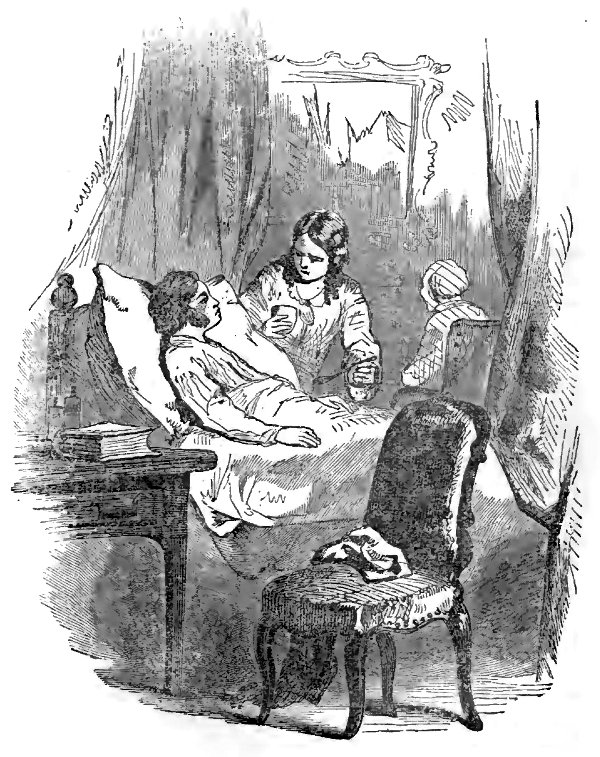
He slept more quietly that night than he had yet done, and when the doctor came next day, he whispered in his ear that a beautiful vision had come to him in his dreams and looked at him so lovingly, that he was ready to speak, and ask it whence it came, but feared his voice might break the charm, and it would vanish from his sight.
“You must stay with us, my child,” said Mrs. Percy, “till my son gets better. He talked of you continually until you came, but now it seems as though your very presence in the house exerts a sort of magic influence over him, for he is quiet, and does not so much as lisp your name. The doctor says if you could but become his nurse, he may yet recover. Will you not, my daughter?”
“If my mother thinks there would be no impropriety in my doing so.”
“Certainly, Theodosia, I think you ought to return and assist Mrs. Percy in every way you can. But your uncle and I are going to be baptized to- day, [414] and you will not be willing to be absent from the meeting.”
This conversation took place in the hall, from which there was an open door leading to the patient’s room. He heard Theodosia’s voice; he thought he heard her name. He made some sound, which recalled his mother to his side, and looking in her face with a more natural expression than he had since his attack, he said:
“Mother, I thought I saw her spirit here last night, and just now I am sure I heard her voice, and thought that some one called her name. Tell me if she is here.”
“Would you like to see her, my son?”
“Oh, yes; I want to ask her to forgive me before I die.”
“You do not think you are going to die, my child!”
“I have strange feelings, mother. I do not know what death is, or how he comes; but I am sure I have been very near the world of spirits.”
“Do you feel any alarm at the prospect of death?”
“My mind is very weak, mother. I scarcely feel or think at all. I have a blessed Saviour: I remember that; and I will trust him, even though I die. But tell me—did I hear her voice, or was it but a dream?”
“Try to compose yourself, my child. The doctor says that you must sleep awhile this morning. If you wish to see Miss Ernest, I will send for her.”
“Do you think she would come?”
“I know she would. So make yourself easy, and you shall see her when you wake.”
On returning to her visitors, Mrs. Percy related this conversation, and insisted that Theodosia must remain to be there when he awoke; and as the young lady did not object, Mrs. Ernest went home without her. She laid down on her arrival, and took a short nap, and then [415] taking Edwin by the hand, joined Uncle and Aunt Jones on their way to the Baptist meeting.
When the usual invitation was given to those who desired membership with the church to come forward and make their profession, Uncle Jones was surprised and delighted to see both his wife and his sister go up and ask admittance into the church of God. Neither of them had said a word to him upon the subject, for though both had yielded to their convictions of the truth, that immersion is the only baptism, some days before, and both had been convinced that believers are the only Scriptural subjects of baptism, they could neither of them overcome their repulsion to the practice of close communion, or consent to sever their connections with these to whom they had such strong attachments, until the explanations of Mr. Courtney in their last conversation put it beyond the shadow of a doubt that the Lord Jesus not only commanded believers, and them only, to be immersed, but that he had also forbidden all who had not believed and been immersed to approach his table, and required of those who had in this way become, according to his order, the members of his church, that they should carefully guard the purity and the perpetuity of his ordinances, by permitting no one to partake with them in the peculiar privileges of church members who had not, like themselves, been made members according to the same Gospel order. This difficulty removed, they were now ready to be baptized.
We need not detain you any longer, gentle reader, by describing to you the baptism of these three, who, with several others, followed the example of their Saviour, by going down into the water, and were buried with him in the liquid grave. Nor can we now continue the history in which you have come, we trust, to feel so great an interest [416] that you would gladly see the end. We have finished our ten nights’ study of Scripture baptism. We have examined it in regard to its mode, its subjects, and its results. We have endeavored to do it plainly and candidly, but if we know our own hearts, we have tried to do it kindly—and in the spirit of that “charity” which “rejoices in the truth.”
We are grieved to leave our darling Theodosia in such distress. But she must remain a little while in the valley of tears, until, by her own sorrows, she has been taught how to sympathize with the sorrowful. He was the wisest man of earth who said, “By the sadness of the countenance the heart is made better.” She needs the discipline of grief to fit her for the life of eminent usefulness which lies before her—and the history of which will soon be given in another volume.
[417]Review Of N. L. Rice’s
Notice of the
Theodosia Ernest
First Series.
By the Author of Theodosia.
The only attempted review or extended unfavorable notice of the first volume of Theodosia Ernest, appeared in the St. Louis Presbyterian, from the pen of its Editor, N. L. Rice, D.D. That notice is here given, and a review of Mr. R’s singular statements reviewed in a dream—and also the natural effect of such a treatment of the best arguments ever produced by Presbyterians or Pedobaptists—the conversion of Pastor Johnson. We regard this review, in connection with Mr. Rice’s notice, as the most powerful argument in favor of Baptist positions.
J. R. Graves.
Nashville, 1857.
[419]By N. L. Rice.
as it appeared in the St. Louis Presbyterian.

If perseverance and ingenuity were evidences of religious truth, there could no longer be a doubt that immersion is the only valid baptism. Long and earnestly have the advocates of this doctrine labored to sustain its claims. The pulpit, the newspaper, the tract, the book, learned argument, and assertion, and ridicule, have all been laid under requisition. Then the whole Bible must be translated anew to make it sustain the Baptist sense. And now we have before us, by the kindness of a friend, a Baptist novel, the title of which is “Theodosia Ernest, or the Heroine of Faith.” The author has modestly concealed his name, but the work is published by Graves, Marks & Ruthland, Nashville, Tennessee. The book is really instructive and amusing. We purpose briefly to notice a few of its peculiarities.
It displays throughout a consciousness of the weakness of the doctrine it is intended to advocate. 1st. The title betrays this consciousness—“The Heroine of Faith.” There is in every Christian’s heart a strong sympathy with the struggles and conflicts of a genuine faith, rising above the allurements and persecutions of a wicked world. The author has thought it necessary to take advantage of this noble sympathy. If he had adopted the more truthful title—“The Heroine of Immersion” —the book would have fallen still-born from [420] the press. There is little that is either noble or romantic in the zeal of a professing Christian, young or old, for a narrow sectarian dogma. The author judged, merely, that the cause of immersion needs the advantage of a title far nobler than itself.
The same conscious weakness shows itself in the choice of a heroine instead of a hero, and of a heroine who is a highly cultivated, sensitive young lady of eighteen. Who can help strongly sympathizing with such a young lady, devotedly pious, evidently conscientious, willing to sacrifice every thing for the truth, conducting an argument against two or three men much older than herself? We forget the cause and sympathize with the girl. We put double weight to her arguments, and feel gratified at the perplexities into which her antagonists are thrown. The author of the novel judged rightly that the cause of immersion and anti-pedobaptism claims all this sympathy and more. If he had been a hero, instead of a youthful heroine, his hearers would have weighed his arguments, instead of being carried away with sympathy.
The cause needed even stronger sympathy; and, therefore, Miss Theodosia Ernest is brought in conflict with the man to whom she was engaged to be married— a cold-hearted, formal Presbyterian lover—whom she loves most devotedly. He opposes her joining “the contemptible sect of Baptists”—(we naturally sympathize with a person opposed). She, poor girl, is thrown into a paroxysm of grief, sighs, weeps, and prays, and resolves to break off the engagement, just for the pure love of immersion! The reader feels his eyes filling with tears of sympathy for the dear distressed creature who had also her mother in opposition, and is almost ready to be immersed himself just to comfort her. Who would have thought that a Baptist knew so well how [421] much it was necessary to excite the sympathies of his readers to prevent them seeing the flimsiness of his arguments?
The necessities of immersion were even greater. Although Miss Theodosia is singularly furnished with Baptist arguments, for one who has just reason to doubt the validity of her baptism, Professor Courtney, an accomplished scholar, is called to aid her. He, having been a Presbyterian, and having examined the whole subject, is perfectly at home in the discussion. He understands Greek, and he can read all the learned authors on the subject. On the other side we have, first, Mr. Percy, the gentleman engaged to Miss Theodosia, who is represented as wholly ignorant of the subject; Rev. Mr. Johnson, the young lady’s pastor, who is made to talk like an ignoramus and a simpleton; and Professor Jones, the heroine’s uncle, who had confessedly never examined the subject, and scarcely had sense enough to keep him out of the fire. With such combatants on each side, immersion may lift its head in bold defiance. We cannot help admiring the author’s clear perception of the necessities of his cause. It was exceedingly proper that he should select, as the advocates of Pedobaptism, such persons as Mr. Percy, who “had never had a serious thought upon the question” (p. 13); Mr. Johnson, who said, “I have never studied these controversies much”; and “Uncle Jones,” who, though Professor of Languages, had considered it the duty of his parents and their pastor to attend to his baptism, and “had never inquired whether they did it illy or well” (p. 121). It is precisely over such persons, as the author rightly judged, that Baptist controvertists gain the victory. And yet we cannot but wonder that he would so publicly disgrace his cause by selecting such ignoramuses as the opponents of the learned Mr. Courtney!
[422]The respective characters being thus selected, the advocates of immersion are, of course, allowed to make bold assertions which are utterly untrue, and to keep out of view the merits of the case, whilst their ignorant and soft-headed opponents gape and wonder. Thus “the heroine of faith” decides, as by intuition, that baptism is an act, and that if immersion is baptism, sprinkling and pouring cannot be. Her intellect is too lofty, and her perception too clear, to hesitate for a moment to decide against forty-nine fiftieths of the wisest and best men that have lived both in ancient and modern times. The author rightly judged that this heroine ought to be very self-conceited. Mr. Percy is made to admit, what every tolerable scholar knows to be untrue, that all the lexicons sustain the immersionists. It suited the purpose of the writer to keep out of view the declaration of the learned Baptist, Carson, that “all the lexicons” were against them. “Professor Jones,” poor simpleton, is made to express the opinion that immersion was first introduced “by the Mad Men of Munster during the Reformation of Luther.” He cannot tell, poor fellow, where he got the idea; but “perhaps he got something of it from reading D’Aubigne’s History of the Reformation—perhaps he received it by hearing something of the kind from the pulpit.” And the accomplished Baptist, Mr. Courtney, has “seen and heard such statements many times from various sources. They are often recorded in Presbyterian and Methodist newspapers” (p. 160). And the learned gentleman gravely goes to work to disprove this statement, which was never made by any tolerably informed Presbyterian, or recorded in any respectable Pedobaptist paper. The book abounds with such vile misrepresentations.
The book is written with ingenuity—it was necessary [423] that it should be. It keeps out of view the facts and arguments on which Pedobaptists rely, or caricatures them to make them appear ridiculous. It puts into their mouths arguments they never use. It manufactures history to suit the occasion. In a novel, all this can be done in such a way that the uninformed reader will not readily detect it. We are gratified at observing how distinctly the writer shows, first and last, that the cause of immersion needs very peculiar advantage in order to sustain its claims.
After all, since he was advocating a fiction, he is probably right in adopting fiction as the means of its defence. The only way to find so ignorant and stupid Presbyterians as Percy, Johnson, and Jones, is to manufacture them for the occasion; and nowhere, but in the imagination of a zealous immersionist, can such Presbyterian young ladies as “Theodosia Ernest, the Heroine of Faith,” he found. The author could not successfully assail real, living Presbyterians; and, therefore, being resolved on battle and a victory, he manufactures a few to suit him, and then chooses their weapons for them, and directs them how to use them, so they will be sure not to hurt them. Brave man! Don Quixote was scarcely his equal.
Verily, the cause of anti-Pedobaptism seems to be “on its last legs.” If it cannot induce the Christian world to receive an immersionist Bible, and if novels will not sustain it, what is it to do?
[424] [425] [426]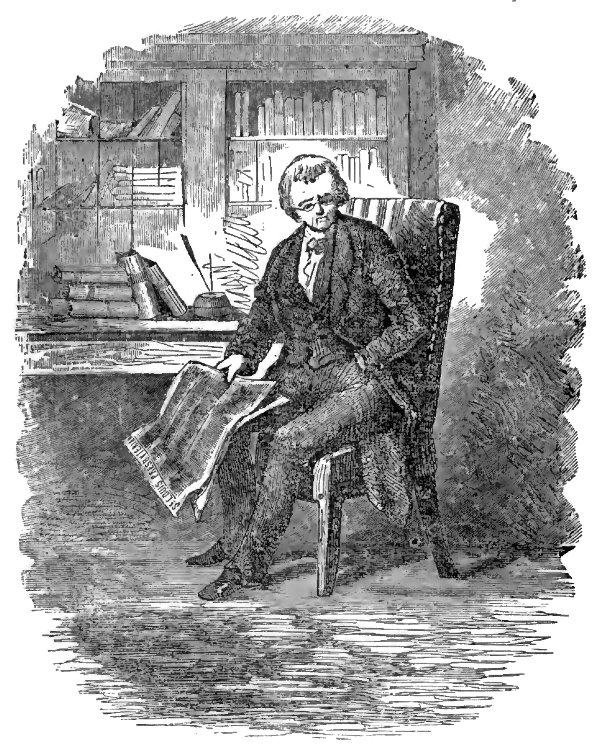

I had a dream, but whether it was all a dream, let him who reads it judge.
Methought in my dream that I was in Pastor: Johnson’s study. He had in his hand the Presbyterian newspaper, called the Presbyterian of St. Louis. He had just found the article of Doctor Rice on Theodosia. His little gray eyes began to twinkle the moment they caught the caption, “a Baptist novel,” for, since his troubles with the young lady and her uncle, he has devoured with great avidity every thing which he could find against the Baptists. As he was reading, however, a heavy frown began to gather on his brow, his lips were pressed together with convulsive energy, and the paper shook with the tremulous excitement which pervaded his whole body. He continued to read, however, until he had finished the piece, and then, as if to assure himself that he had not read amiss, he began at the caption and read it every word again. When he had done, he folded the paper carefully, put it into the inside pocket of his coat, looked into the fire for several seconds, then nodded his head three times very significantly, not straight forward with the chin toward his breast bone, but diagonally, with the chin inclined toward the left shoulder, and the back of his head drawn toward the right.
What this peculiar pantomime might signify, I was, in my dream, greatly at a loss to determine, until he had [428] gone into the room where his wife was engaged in her domestic duties.
“Mrs. Johnson,” said he, “I desire that you will pack my carpet-bag. I must make a journey to St. Louis, and to get home before the Sabbath must start this morning.”
“Why, my dear, what in the world is the matter?”
“I want to go and see Doctor Rice, madam; I don’t like the way he talks about me. He has had the audacity to call me a fool, madam; nay, more, he has even declared that there is not so great a fool in our whole denomination. It is too much, madam, for human nature to endure. I feel it my duty to go and talk to him as a Christian brother; I want to tell him to his face that I think he has done me great injustice, and, in short, has treated me very badly.”
Mrs. Johnson seemed instinctively to understand that delay or remonstrance was out of the question. She made at once the needful arrangements, and her husband was gone.
Then I saw, in my dream, that he entered the room where the Reverend Doctor was engaged in writing.
“I presume this is the Reverend Doctor Rice,” said he. “My name is Johnson, sir; the Reverend Mr. Johnson, of ⸻, I felt it my duty, sir, to come and see you about your paper of the ⸻”
“Ah, I am glad to see you, Mr. Johnson. Take a seat, sir; I hope you have had a pleasant journey.”
“Why, yes, sir, reasonably so; but in fact I have a great dislike to traveling, and nothing would have induced me to take the journey but a conviction of duty. I felt it to be my duty, sir, to come and tell you that I think you have treated me very badly, sir. And let me say, sir, that you have done more to destroy my confidence and that of my congregation, in the truthfulness [429] of our positions on the Baptismal question, than all the Baptist arguments I have ever heard.”:
“Why, my dear sir, what can you mean?”
Mr. Johnson pulled the paper before referred to out of his pocket, and found the article on Theodosia.
“I suppose, sir,” said he, holding it up before the Doctor, “you will not deny that you are the author of that?”
“Certainly not,” replied the Doctor, as he glanced rapidly down the column like one who was familiar with the words. “I take credit to myself, sir, as being the first, and, so far as I know, the only person who has attempted to answer that peculiar book.”
“I have no objection,” replied Mr. Johnson, “to your answering the book. In fact, no one could rejoice more than I to see it rightly answered, but I want you to understand that you have done me and those who stood with me in that discussion very great injustice. It was unkind, sir, it was cruel in you to intimate that there was not in all the Presbyterian denomination so great a fool as I, just because I had never carefully examined the subject of baptism for myself, but trusted to Doctor Dwight and Doctor Miller, and our other Doctors of Divinity for my information and my arguments. I have always had a great regard, sir, for our Doctors of Divinity. I have supposed they must be pious, and learned, and truthful men. I thought I could rely upon any thing I had learned from a Presbyterian Doctor of Divinity; I therefore took the substance of their arguments, not venturing to employ a single one of my own, and yet for doing this you count me as a simpleton and called me a fool.”
“Ah, my dear brother Johnson, you must excuse me; I did not at first understand precisely who you were, I begin to see it now. Let me assure you, sir, that I [430] heartily sympathize with you on the loss of so lovely a member as Miss Theodosia, and so influential an Elder as her Uncle Jones. I can easily understand, my dear sir, that you were deeply wounded by that event, and still feel a little sore on the subject. But you must not fall out with your friends on that account. We must do something to break the force of the arguments presented by the author in his silly narrative of that transaction. We must either meet those arguments with sober logic, or we must destroy their influence by ridicule. I am sure when you have come to look at the matter calmly, you will not only excuse but even approve what I have said.”
“What, sir! excuse and approve your calling me a fool, just because I used no better arguments than had been furnished me by our greatest Doctors of Divinity!”
“Ah, my dear brother, I see that you do not yet quite understand me. I mean to say that, in order to destroy the influence of that silly narrative, we must either fairly meet and logically confute the facts and arguments by which Miss Theodosia and her uncle were convinced that we are wrong and the Baptists are right, or else we must turn attention from them by calling the book a ‘novel,’ and laughing at the arguments as though they were not worth answering. And now let me say to you in confidence, that it was a great deal easier to insinuate that as a ‘novel’ it must be a work unfit for the pious to read, and ridicule and laugh at the book, than to disprove its facts or answer its arguments. I trust, therefore, you will not take it too much to heart if you come in for your share of the laugh, since you can’t help seeing that if I had allowed your arguments and those of your friend, Professor Jones, to be the best we have, our cause is at once and [431] forever irretrievably ruined; but by adroitly representing these as perfect nonsense and foolishness, I make the impression on the minds of my readers that we have some others of most tremendous power, which could not possibly have failed to convince your opponents if you had only known them and brought them forward.”
“But, sir,” replied Mr. Johnson, “I am sure I brought forward the very best that I could find—I took those of our most eminent Doctors of Divinity, living and dead, the present company only excepted. I would like to know, sir, if any doctor in our church ever stood higher than Timothy Dwight, D. D., and Samuel Miller, D. D., one the President of Yale College, the other an honored professor for many years in our leading Theological Seminary, that at Princeton, New Jersey. I thought, sir, I was safe from the charge of folly when I followed Dwight and Miller, and consequently I took the same ground with these eminent men to show Miss Theodosia that John did not baptize by immersion, but that the Lord Jesus must have been sprinkled on the bank of the river. Just turn to volume four, page 349, of Dwight’s Divinity—‘It is,’ says he, ‘incredible that the multitudes which John baptized in the wilderness were immersed. It will not be mistrusted that this promiscuous assembly were immersed naked. To have immersed them with their clothes on would have exposed them to certain disease and death.’ Now, I did not care to state it just in this way to Miss Theodosia, so I said that they could not have been immersed on account of their great numbers, and for this I had the authority of several Doctors of Divinity. Says Doctor Summers, page 82 of his work on Baptism: ‘It was not possible for him to baptize the immense multitudes that came to his baptism by immersing them,’ and gives as a reason that his ministry lasted only a year or less, and in that [432] time ‘he baptized, perhaps, two or three millions.’ He thinks, as I did, that they must have stood in rows along the bank, while the Baptist sprinkled them either with or without hyssop, he don’t know which. So also Doctor Eagleton, of Tennessee, gives the same explanation.
“The great Doctor Rice, I know, does not venture to say, like Summers and Dwight, that it was ‘impossible’ and ‘incredible,’ but even he, in his work on Baptism, page 116, founds an argument on the assumption that ‘it was not very probable.’ And Doctor Miller, whom some will consider a greater than Rice, expressly says, ‘There is no evidence, and I will venture to say, no probability, that John ever baptized by immersion.’ Then, when I wished to prove that the Apostle did not immerse any more than John had dome, what better could I do than follow these great Doctors? Doctor Dwight expressly says, volume four, page 349: ‘It is impossible that those whom Peter and his companions baptized on the day of Pentecost should have been immersed,’ and gives as reasons, first, that they had no suitable clothes; second, there was not time enough, and he plainly intimates that there was not water enough.
“So Doctor Summers says it was impossible, because there were no places suitable for immersion, and besides it was impossible for the twelve to baptize such a multitude in the six or eight hours that remained of the day. So also Doctor Rice himself, page 120 of his work on Baptism, makes in substance the very same argument. ‘Where,’ he exultingly asks, ‘did the Apostles find sufficient water for the immersion of so many?’ And again, ‘The number—could the twelve Apostles baptize three thousand persons in that day?’ And Doctor Miller, whom some will think a greater even than Doctor Rice, declares, after dwelling upon these [433] difficulties of the case, ‘The man, therefore, who can believe that the three thousand on the day of Pentecost were baptized by immersion, must have great faith and a wonderful facility of accommodating his belief to his wishes.’
“On these two points, therefore, you see I had the authority of our most learned Doctors, including even Doctor N. L. Rice himself, and yet Doctor Rice calls me a fool because I could not do better than them all.”
“Oh, no; excuse me, my dear brother Johnson, but these were not the points to which I particularly referred. I grant you had the substance of our arguments on these points, but then that argument of yours based upon with as the signification of the Greek preposition ‘en,’ you must allow that it was rather simple in you to rest so much upon the phrase ‘with water.’”
“Not at all, sir; I can admit no such thing. The truth is, sir, this is our great argument to the minds of the unlearned. It has more plausibility in it than any other that I have ever read. And, sir, you must let me tell you that though you may now call it silly and rate me as a fool for using it, I did it on the authority of more than one of our Doctors of Divinity. The Rev. Alexander Newton, D.D., in the ‘True Baptist,’ makes a long and carefully elaborated argument, based upon this rendering of the word. Dr. Summers, page 100, says expressly that ‘with’ is the proper meaning of the word ‘when found in connection with baptism.’ And even the great Doctor Rice himself, in his debate with Campbell, page 191, quoted Bloomfield to show that it was ‘with water’ and not in water that ‘en hudati’ should be rendered. How then can Doctor Rice call me a fool for using his own argument, and that of other doctors almost equal to himself?”
“I don’t deny that I alluded to it,” replied the doctor; [434] “but I know too well its fallacy to risk our cause upon it as you did. But it was not for this so much as for your calling attention to those unguarded admissions of Barnes, and Chalmers, and McKnight, that I thought, to say the least, you were somewhat indiscreet.”
“Why, my dear sir, were not these all Presbyterians? Were they not all Doctors Of Divinity? Could I not venture to direct an inquiring member of the Presbyterian Church to our own Presbyterian Doctors of Divinity for information? I know those men were counted among the wisest and the best of all our doctors I took it for granted that they had studied the subject before they wrote about it; I had, I am sure, no suspicion that they would mislead those who trusted to their teaching.”
“But when you found which way they were leading your inquirers why did you not contradict and oppose their testimony?”
“I did do my best,” replied Mr. Johnson, “but the truth is I am not, like you, a Doctor of Divinity, and therefore I could not contradict such men with as good a face as you can. If you had been there you might have said, ‘My dear young friends, it is true that these learned men and eminent masters in the Presbyterian Church do teach thus, but they are utterly in error. They have stated what is entirely devoid of truth; you may take my word, but you cannot trust to theirs.’ But you, no more than I, could have denied that Dr. Barnes admits baptize in Greek to be the same as tabal in Hebrew, and that he says and proves that it in the Scriptures signifies ‘to dip.’ You, no more than I, could have denied that Chalmers and McKnight do both unquestionably give immersion as the meaning of the word, and both agree that it was immersion that John and the apostles employed. That is too plain for argument. [435] [436] [437] But them, as you are a Doctor of Divinity, as well as they, and have been Moderator of the General Assembly one year, as McKnight was for twenty, you might have ventured to dispute their word—you might have called in question either their learning or their veracity, for if they told what is not true it must have been either from ignorance or falsehood; but it would not have done for a plain and simple pastor like myself to put my word against that of any one of these great doctors, much less against all three. I assure you, sir, that you Doctors of Divinity have a great advantage over us common pastors in such a discussion as that. When that learned Professor of Theology, Moses Stuart, says that all critics and lexicographers of any note are agreed that immersion is the common and primary meaning of the word baptism, and that the first Christians so understood it, you can simply say it is no such thing; but people would expect me to prove it, and that very plainly, too, before they would believe that Stuart lied about it, or that a man of his eminent learning could be mistaken.
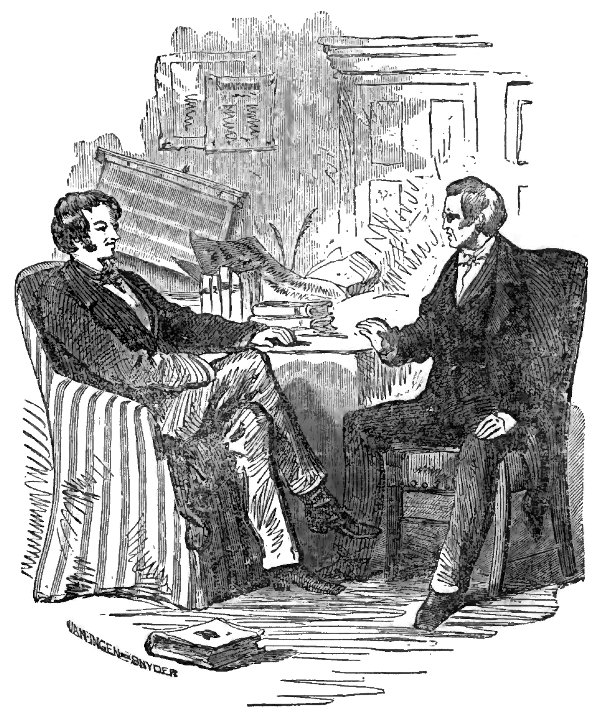
“When the learned Martin Luther says that ‘Baptism is a Greek word, and signifies immersion,’ and that the etymology of the word seems to demand that the person baptized ‘should be wholly immersed, and then immediately drawn out of the water,’ as he does in his works, vol. 1, p. 386, you could reply: ‘Doctor Martin Luther must be egregiously mistaken about this, for I, Doctor N. L. Rice, have examined into the matter, and find it is not true.’ When that ‘godly, learned man, John Calvin,’ in his Institutes, b. iv., s. 15, says that ‘The word baptize signifies to immerse, and it is certain that immersion was the practice of the ancient church,’ you, as a Doctor of Divinity, can say: ‘Doctor John Calvin was mistaken—this is not true.’ When that [438] very learned and eminent scholar, Casaubon, says, ‘The manner of baptizing was to Plunge or Dip them into the water, as even the word baptism plainly enough shows,’ you have only to say: ‘Casaubon was either very ignorant of the matter, or else he lied, for I, Doctor N. L. Rice, have found it was not so.’
“When the learned Bishop Bousset declares that ‘Baptize signifies to plunge, as is admitted by all the world;’ when the famous critic Venema says: ‘The word baptizien, to baptize, is nowhere used in the Scripture for sprinkling;’ when the great scholar says, in commenting on Matt. iii. 6: ‘Baptism consists in the immersion of the whole body in water’—you can simply reply: ‘I know these learned foreigners say such things, but Doctor N. L. Rice knows better.’
“When such a man as Doctor George Campbell, of Scotland, the President of a Presbyterian College, says that ‘the word baptizien, both in the sacred authors and classical, signifies to dip, to plunge, to immerse, and was thus rendered by Tertullian, the oldest of the Latin fathers,’ that ‘it is always construed suitably to this meaning,’ that ‘it is never in any case, sacred or classical, employed in the sense of rain or sprinkle,’ you have only to say, that ‘Doctor George Campbell differs on these points from Doctor N. L. Rice.’
“When a learned professor of Greek, like the well-known Charles Anthon, of Columbian College, the author of some of our most valuable classical school books, expressly asserts that ‘the primary meaning of the word is to dip or to immerse, and its secondary meanings, if it ever had any, all refer in some way or other to the same leading idea,’ that ‘sprinkling and pouring are entirely out of the question,’ you have only to say: ‘Mr. Anthon is only a learned professor of languages, and I, a Doctor of Divinity, take it upon [439] myself to assure you that he is entirely mistaken. It is not true; and whether Professor Anthon is ignorant or false, the world may judge.’
“Now if I, a simple, untitled pastor, should talk so, they would not believe me. I tried it, sir. I asserted roundly, just as Doctor Miller had done. I intended to use his very words: ‘Now we contend that this word does not necessarily, or even commonly, signify to immerse, but also implies to wash, to sprinkle, to pour on water, and to tinge or dye with any liquid, and therefore accords very well with the mode of baptism by sprinkling or affusion.’ ‘I can assure you,’ he says in another place, ‘that the word we render baptize does legitimately signify the application of water in any way as well as by immersion.’ Now I could make assertions as confidently as even Doctor Rice himself, but I found that I was expected to prove them, and that from the Scriptures, and in such a way that the demonstration should be plain to the common sense of an earnest and shrewd, quick-witted girl. I assure you I had rather have tried to satisfy a dozen Doctors of Divinity.”
“But why did you not go to the Lexicons, as I did in my Lexington debate? Why did you permit that young lawyer to wrest this weapon out of your hands at the very beginning? Mr. Campbell began to quote the Lexicons on me, but I showed that this was a game at which two could play.”
“And yet I am sure, sir, Miss Theodosia would have said that you lost the game, however well you played. The truth is, Doctor Albert Barnes, by pointing to the places in the Old Testament where they could find the meaning of the word as it was used among the Jews, had taken away the necessity for any reference to Lexicons, unless it were to prove that Barnes was a false interpreter, and this I did not like to do. But what [440] could the Lexicons have availed for my purpose, even as quoted by yourself? You appealed to eleven of them, and I suppose you gave the most favorable definitions you could extract. Now, you will remember that neither Miss Ernest nor Mr. Percy had taken any such ground as Mr. Carson had done, or as Mr. Campbell did in your debate. No one in our company insisted that immerse was the only and necessary meaning of the word, but only that it was the common and most frequent meaning, in connection with which it was most likely to be employed, and which it must therefore (according to the ordinary rules of interpretation) be understood, unless the context required some other. Now you know, as well as I, that the rule of the Lexicons is to give the common, every-day meaning, as the primary or first definition. And yet, when you attempted to ascertain the meaning of the word baptizo by the Lexicons, what did they testify?
“Scapula, according to your own rendering, gives baptizo, to dip or immerse; also to dye, as we immerse things for the purpose of coloring or washing them; also to plunge, submerge, to cover with water, etc.
“Hedericus gives to dip, immerse, to cover with water.
“Stephanus.—To dip, to immerse, as we immerse things for the purpose of coloring or washing; to merge, submerge, to cover with water.
“Schleusner.—To plunge, to immerse.
“Parkhurst.—To immerse in, or wash with water.
“Robinson.—To immerse, to sink.
“Schrivellius.—To baptize, to immerse.
“Groves.—To dip, immerse, immerge, plunge.
“Bretschneider.—Properly often to dip.
“Suidas.—To sink, to plunge, to immerse.
“Ware.—To wash, perform ablution, cleanse; secondly, to immerse. [441] “Greenfield.—To immerse, immerge, submerge, sink.
“Now, out of all the eleven, you could find but one, and that unknown to fame, which does not give dip or its equivalent as its first and common meaning. Miss Ernest would have said the testimony is ten to one against you. If you had come into court with ten witnesses against you, and only one for you, Mr. Percy, as a lawyer, would have declared your case utterly hopeless.
“But Mr. Campbell, at that time, gave you several other Lexicons, among which was:
“Robertson’s Thesaurus, which defines it to immerse, to wash.
“Pason.—To dip, to immerse, to dye, because it is done by immersing.
“Donegan.—To immerse repeatedly into a liquid, to submerge, to sink.
“Jones.—Plunge, dip, baptize, bury, overwhelm.
“Bass.—To dip, immerse, plunge in water. Baptisma, immersion, dipping.
“Stokius.—To dip, to immerse in water.
“So we have in all sixteen witnesses who depose that this is its primary and common meaning. Sixteen who testify that it must thus be understood when nothing in the context requires another sense. And only one who gives to wash as its primary meaning. Mr. Campbell also mentioned several others, whom he said gave it the same sense, and you did not dispute his word.”
“But what of all that?” replied the Reverend Doctor Rice. “I would have set aside all that array of dictionaries by quoting just one sentence from the great Baptist, Doctor Carson, who ought surely to understand what he says, and who was no friend to sprinkling; and yet he expressly says, ‘That all the lexicons are against him.’ [442] This is testimony enough for me.”
“But it would not have been for Miss Theodosia or Mr. Percy. They would have asked to see the book and the place, and would have read it for themselves, and doing so, would have been sure to discover what you must have known before you quoted it, that he does not say that all the Lexicons are against the Baptists—he does not say that all or any of the Lexicons gives sprinkling or pouring as a meaning of the word—he does not say that they do not all agree in giving dip or its equivalent as the primary and common meaning. ‘On this point,’ he says, ‘I have no quarrel with the Lexicons. There is the most complete harmony among them in representing dip as the primary meaning of bapto and baptizo.’ But Mr. Carson denies that it has any secondary meaning at all, or that it ever means any thing else but dip or immerse. And it is on this point, that he says, page 55, ‘He has all the Lexicographers and Commentators against him.’ I could not have satisfied my inquirers with such a misrepresentation, even though my conscience could have permitted me to use it. We all know that the Lexicons give secondary meanings to these words, and in our company there was no disposition to question the propriety of their doing so. But, sir, it has struck me with surprise, since my attention has been turned to the subject, that not a single one of all the seventeen Lexicons referred to and quoted by you and Mr. Campbell give sprinkle or pour as even a secondary meaning. They give wash and cleanse, but several of them are careful to explain that it is because things may be washed and cleansed by dipping them in water. And I have been thinking, especially since I read your piece, that what we are accustomed to call baptism is not even a washing—for if the [443] Doctor should tell me to wash one of my children, who was sick, with warm water, I am sure I should not feel that I had carried out the prescription by dipping the tip of my fingers in the water and touching them to his forehead. And the truth is, sir—I suppose I may just as well tell it—that since you have made so light of all the arguments which I advanced in our discussion, and yet have given me no better, nor told me to which of all our Doctors I can go to find any more forcible or convincing, I begin to doubt whether we are not both mistaken, and that Miss Ernest and her friends had better reasons for leaving us than I can ever find for remaining where I am.”
“Yes,” exclaimed Professor Jones (who suddenly made his appearance, unaccountably, as people often do in dreams), “I have often thought how angry we should be if those who owe obedience to us should render it as some of us render obedience to God. Doctor Rice, for example, says to a little servant boy on Saturday night, go wash yourself, or go bathe yourself, and put on clean clothing for the Sabbath. The servant, instead of bathing his whole body, takes a few drops of water in the palm of his hand and pours it on the top of his head. ‘You little rascal,’ Doctor Rice would say, ‘why did you not wash yourself as I directed you?’
“‘I did wash myself, sir.’
“‘You did! Do you call that washing yourself? Why, you did not even wet your scalp. Come here, sir; I’ll teach you how to trifle with my commandments.’
“‘Please, sir,’ exclaims the lad. ‘Please sir, don’t punish me; I am sure, sir, I did wash myself; I can prove it to you sir.’
“‘Why, you little impertinent. You just now confessed that you only put a few drops of water on the top of your head.’
[444]“‘I know it, sir; but that was washing myself, sir; I can prove it by the united testimony of all your Doctors of Divinity, including the Reverend Doctor N. L. Rice. You may be so angry, sir, just now, that you don’t remember it, but in your Lexington debate you said again and again that baptize means to wash, and of course wash means to baptize, and when you and our other Doctors of Divinity baptize, you only put a few drops of water on the person’s head. Besides, you said again and again, that wash was a “generic” word (I believe that was it, sir), and might be performed in any way, and as this is the way which all the great Doctors of Divinity use when God tells them “to wash” people, I am sure, sir, you could not expect me to do more in obedience to your command than you do in obedience to His.’
“But let it pass; I have just called in, Doctor, to thank you for dealing so kindly with me in your article on Theodosia. It is customary when one has been driven by his convictions of duty to leave some denominations for others for those he leaves to seek by defamation to destroy his peace and injure his usefulness. It is customary to attack his character and impugn his motives. And the same course has sometimes been adopted to counteract the influence of a controversial book. When its arguments could not be met and refuted, the moral or Christian character of the author has been assailed with a malignity which argues very little for the piety of the assailants, and of itself affords prima facie evidence that there is something rotten in the system which requires such foul means to sustain it, and breeds such rancorous spirits to contend for it. But it has gratified me much to see that you speak of me in ‘sorrow more than anger;’ that you are more inclined to pity than abuse. You think me weak [445] and foolish, and that is the worst of it. I could expect no less than that, for we all are apt to think disparagingly of the intellect which cannot see what seems to ours as clear as light. You thought that my friend, Mr. Johnson, was simple, because he failed to convince my niece and myself; and I might have expected that you would think still worse of me, because I could not be convinced. If Mr. Johnson had used all the arguments which he could have found in the works of Presbyterian Doctors of Divinity, you might with good reason have thought him a simpleton indeed.
“He contended with Doctor Miller and other doctors, that the word baptize means to sprinkle or to pour, as truly as to immerse.
“Like several others, and yourself among them, he denied that John’s baptism was Christian baptism.
“Like you and all the rest he denied that Jesus went into the water, or that John baptized in Jordan, but asserted that he sprinkled the people standing in rows on the bank.
“Like you and the other doctors, he denied that there was water enough to be had in Jerusalem to immerse three thousand, or time enough to do it.
“Like you and the other doctors, he made an argument upon the design of baptism, as being better symbolized by sprinkling than immersion.
“Like you and the other doctors, he made a very plausible argument upon the Pentecostic outpouring of the Holy Ghost as baptism.
“Like you and some of the other doctors, he made the strongest argument that it is possible to make upon ‘with water’ as the translation of ‘en udati.’ And he gave to each and every one of these arguments all the force to which it was logically entitled, and if they could not stand before the simple, common sense of a [446] strong-minded, earnest-hearted girl, it was not his fault, but the fault of the arguments. If he had presented all the arguments which he could have found gravely set forth by Doctors of Divinity, little Edwin himself would have laughed him out of countenance. What if, like Doctor Dwight, he had declared that ‘Christ himself has expressly taught us that immersion is unessential to the administration of this ordinance.’
“When he said to Peter, John xiii.: ‘He that is washed needeth not care to wash his feet, but is clean every whit,’ from which the learned doctor concludes that ‘a symbolical washing is perfect although applied only to the feet; as perfect as if it were applied also to the hands and the head, and if this construction be admitted, it must also be admitted that the declaration is general and extends to every other symbolical washing, and therefore to baptism, unless excluded by some plain exception.’ See Dwight’s Divinity, vol. 4, pp. 150, 157.
“So also another Doctor of Divinity declares, that ‘Christ discountenanced the practice of immersion in religious purifications. He that is washed, said he to Peter, needeth not save to wash his feet, but is clean every whit. John xiii. 9, 10. By reading this text in its connection, we will perceive that so far from introducing the practice of washing the body all over as a religious rite, he discouraged it, by declaring it unnecessary, and by refusing to gratify Peter, who wished to have the water applied to him in a more profuse manner than the Saviour was using it.’ See James Wood, D. D., on Christian Baptism, page 35. If Doctor Wood is consistent with himself, he applies the water to the baby’s. dear little foot, for it was the application of water to the ‘hands’ or the ‘head’ that Jesus ‘discountenanced’ and ‘discouraged.’ I presume, therefore, that Doctor [447] Wood is not only a Pedobaptist, but a pedal-baptist, a foot-baptizer.
“What if Mr. Johnson had said, as more than one of the Doctors of Divinity has done, that there is the same proof that the Eunuch immersed Philip that there is that Philip immersed the Eunuch? Yet the great Doctor Miller says: ‘There is the same evidence that Philip was plunged as that the Eunuch was.’ And Doctor Dwight argues that if ‘eis’ means into, and ‘ek’ means out of, in the narrative of this transaction, they were both plunged twice and the Eunuch three times. Here are his words: ‘The declarations here made, are made concerning the Eunuch and Philip; alike of both it is said that they went down into the water, if we render eis into; of both also it is said that when they came up out of the water, if we render the word ek out of. Now let us see what will be the true import of the passage according to this method of construing the words in question, and they went down both into the water, both Philip and the Eunuch. That is, they were both plunged. And he baptized him, that is, Philip plunged the Eunuch. And when they were come up out of the water; that is, when they had both been plunged a second time and risen up from their immersion, the Spirit of the Lord caught away Philip. In other words, they were both plunged twice and the Eunuch three times.’ See Dwight’s Divinity, vol. 4, p. 350, Sermon on Baptism.
“Suppose that Mr. Johnson, like Doctor Wood, had gravely argued that the Eunuch must have been baptized by sprinkling, because he had been reading in Isaiah, and Isaiah somewhere, though not in the passage quoted as that which he was reading, says that Messiah shall sprinkle many nations, while every scholar knows that in the Septuagint, which it is most likely he was reading, the word sprinkle does not occur, but ‘thaumasontai’ [448] astonish, ‘so shall he astonish many nations.’ And Doctor Adam Clarke says it is the best rendering of the Hebrew. That the Jews so understood the Hebrew is evident from their so translating it; and therefore, whether the Eunuch read Hebrew or Greek, he could have found no such word as sprinkle.
“But though your Doctors of Divinity had talked volumes of such nonsense, my friend, Mr. Johnson, had sense enough to see that arguments like these could not be expected to stand the scrutiny of earnest, inquiring common sense, even in a simple girl, and therefore would not offer them. He used the best you have, and did the best he could with them. I grant that both he and I used some very simple arguments; nay, that all our arguments were silly as long as we argued against the truth, for every false argument must be foolish, but neither of us was as silly as some of you Doctors of Divinity, and since you have yourself condemned and ridiculed the very arguments by which not only he but thousands of your people are deluded and prevented from yielding obedience to Christ, I trust both he and they will see their folly, abandon their errors, obey their Lord, and like my niece and myself, unite with his visible church.”
[449]
Then I saw, in my dream, that Pastor Johnson sat with his good old wife, in their own quiet room; but his countenance was sad, and she saw that his heart was troubled, and knew that something had gone amiss with him during his absence. With true womanly tact she sought to find out what it had been without seeming to ask.
“I hope, my dear, you had a pleasant journey, and met with no disagreeable accidents by the way.”
“It was as pleasant as I had expected.”
“You saw Doctor Rice, of course. I have been told since you started that he is a perfect model of a Christian gentleman, and would certainly explain every thing to your satisfaction. Did you not find it so?”
“Gentleman! Why, yes; I suppose he is what people call a gentleman—a polished, pleasant gentleman—and he made, probably, what he thinks the best apology that the case admits of.”
“But you were not quite satisfied with it? Well, I don’t wonder. It was too bad to call you a greater simpleton than could be found in all the Presbyterian Church. But what explanation did he make?”
“My dear wife,” said the pastor, suddenly raising his eyes, and looking earnestly into her face, “I begin to think that our Doctors of Divinity are no more to be confided in than other people, and that Miss Ernest, Esquire Percy, and Professor Jones, were right in just casting all their assertions aside, and going to the sacred Word and hunting out its teachings for themselves.”
[450]“Why, Mr. Johnson!”
“Yes, my dear; I never mean to trust the bare assertion of any Doctor of Divinity again as long as I live. Just think of it now—Doctor Rice laughs at my arguments in favor of sprinkling, and at Mr. Percy’s, and at those of Professor Jones. He holds them up to the scorn of the world. He speaks of them as though they were almost beneath contempt; and yet you and I know very well that they are arguments which I borrowed, every one of them, from a Doctor of Divinity. They are the very same arguments which have been employed by Doctor Eagleton, by Doctor Newton, by Doctor Wood, by Doctor Summers, by Doctor Miller, by Doctor Dwight, and even by Doctor Rice himself. But to make the world believe that we have some stronger and better arguments he laughs at these, as though they were the mere twaddle of the veriest ignoramus in all Christendom. But does he bring forward any stronger or any better ones? Does he point to the chapter and the page in the works of our Doctors of Divinity, where they presented any thing more convincing? So far from it, he was obliged to own to Professor Jones, whom I met at his house, that he had himself employed these very arguments in his debate with Campbell; and the Professor also pointed out to him the volumes and the pages in the works of our greatest doctors, where they had employed arguments so much sillier than mine, that I would have been ashamed to mention them to a shrewd, sensible girl, like Theodosia. Now, what am I as a Christian man and a Christian minister to do? I have all the time believed that we were right, and, therefore, I so preached and practiced. But you know I would sooner cut off this right hand than use it to sprinkle another babe if Christ does not require it. It was because I trusted to the teaching of our doctors [451] [452] [453] that I thought he must be right; but when these doctors hold up these very arguments, by which I was convinced, to the scorn of the religious world, and yet give me no better in the place of them, I can’t help thinking there is something rotten in the system somewhere.
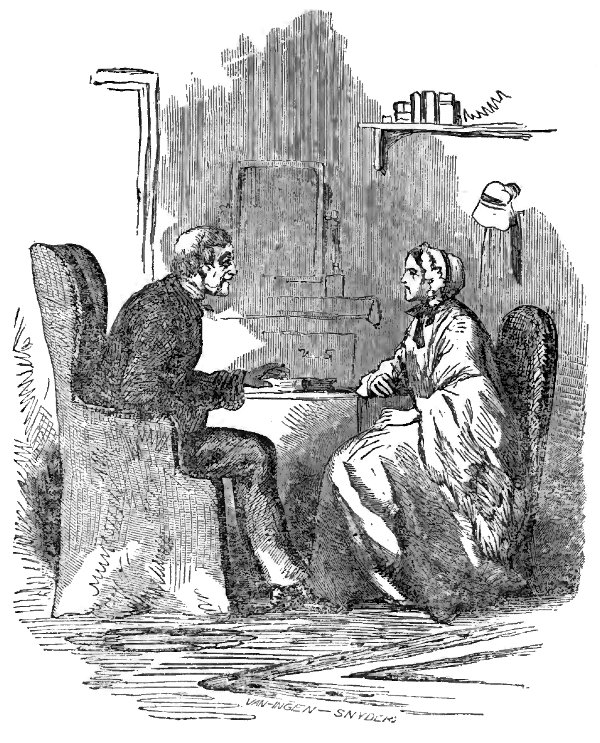
“I intend, God helping me, to search into the Scripture teachings for myself. I remember that we could not find a single command to baptize infants, nor a single example of one baptized. I remember that our own best commentators, such as Barnes in this country, and Olshausen in Europe, say there is nothing about it in the text I most relied upon, ‘Suffer the little children to come unto me.’ I remember that we could not find one single text, which even our own Doctors of Divinity all agree upon as requiring or justifying the practice— that even concerning the covenant of circumcision, which Doctor McNought thinks is our strongest fortress. Professor Stuart expressly declares, in his commentary on Genesis xvii. and Galatians, that they can afford it no countenance whatever; and as to sprinkling, even Doctor Rice himself did not, and dare not say that the Greek word baptize in the Scriptures has ever been truly rendered sprinkle by any reliable Lexicon or eminent critic. He only contends that it may be rendered to wash, and then says that washing may be done by sprinkling a dozen drops or less of water on the person’s head. But can it be thus done? If you or I should tell one of the children to wash, not his face, but to wash himself, would he consider it a full and complete obedience if he should only dip the tip of his fingers in water, and touch them on his head, or face, or feet, or hands; for I don’t see as there is any more propriety in touching one part than another.”
“I don’t think we would, my dear,” replied the good [454] woman. “And if this be so, I am sure it must be some wicked mockery to do that in obedience to God’s commands, which we would consider as the veriest trifling if it were done in the place of actual obedience to a similar command by us.”
“I am afraid, my dear,” resumed the pastor, “I am awfully afraid we have been wrong. God knows I meant to do right—God knows I verily believed that I was right; but this communication of Doctor Rice has made the case look fearfully dark to me.
“I have thought, and prayed, and thought again, until my brain is dizzy. I can’t help seeing Jesus baptized, as Mark says, ‘Eis,’ not merely in, but into the river of Jordan. I can’t help seeing the Eunuch and Philip going down into the water, then the baptism, then the coming up out of the water. I fear our doctors twist and pervert the words in trying to make them mean any thing less. I fear some of them almost prevaricate to hide the simple and natural meaning of the language. But oh, it is a dreadful thought that we have all the time been wrong; that I, a minister of Christ, have all my life been the advocate of error, and have been doing in his name that which he never commanded, and having constantly undone that which he actually did commission all his ministers to do. I must study more about it. I must pray more over it. But if I find it so— much as I love my people, much as I love my church, much as I love my brethren in the ministry, much as I love the doctrines and the ordinances which I have so long taught and administered, I trust I love the truth and love my Saviour better than them all, and I will go down into the water as the Eunuch did, and Mr. Percy shall himself baptize me, as Philip did the Eunuch, and when we come up out of the water I trust to meet the [455] [456] [457] Spirit of the Lord ready to find a place for me to labor, and to bless my work.”
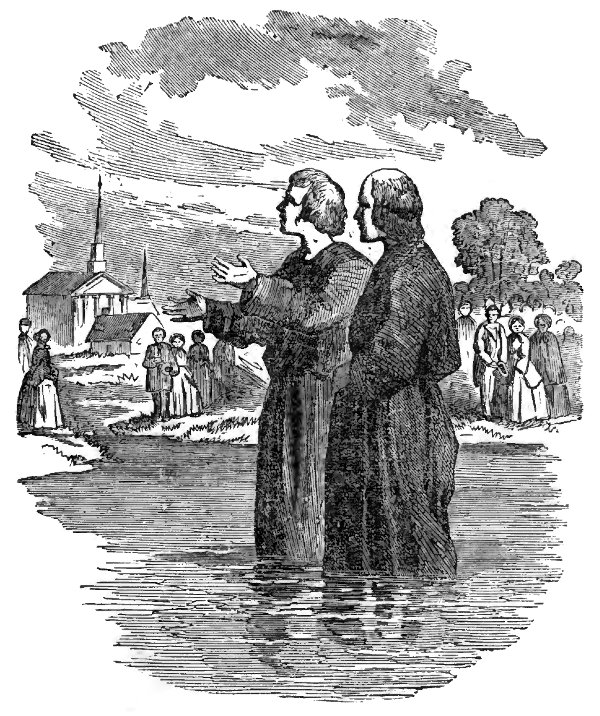
Then I saw, in my dream, some few weeks after this, that Mr. Percy had returned from his visit to Nashville and the hill country of Tennessee (an account of which is given in the second volume of Theodosia Ernest), and he was standing in the same place where Theodosia had gone down into the water. The company that stood upon the bank consisted of a great multitude. Many of them had walked in a procession from the beautiful new Baptist meeting-house, which stood near the old school-house where Theodosia had been admitted to the visible company of Christ’s people. Many others had come from the magnificent old building, in which, until recently, Pastor Johnson had been accustomed to minister for many years. Many had come from other places of worship, and not a few were there who seldom witnessed any act of religion but one like this, which called them out merely to gratify their curiosity. But vast and various as was the crowd, they were silent, and solemn, and tearful, when the old man stopped at the verge of the water, turned to their expectant gaze, and briefly gave the reasons why, following his Saviour’s example, and in obedience to his positive command, which he could no longer misunderstand, he was about to “be buried with Christ by baptism.”
Those reasons we have not space to tell as he told them that day. It is enough for us merely to state that, after earnest prayer for guidance from above, he had resolved to “search the Scriptures” and discard the doctors. That he had been unable to find any sprinkling commanded or practiced as baptism. Nor could he find a single text which either commands or justifies the baptism of babes, Presbyterian Doctors of Divinity [458] themselves being judges, since each text that one may claim as teaching it, a half a dozen others will declare has no relation to the case.
“There are,” said he, in conclusion, “many of my own former people here. I see their once familiar faces. Some look on me with pity; and could I have continued to practice, in my Master’s name, what he has nowhere commanded, I should need their pity.
“Some look on me with heartfelt sorrow; and I see even now the traces which their tears have marked upon their loving faces. My friends, I am happier now than I have been for many months. Doubt has now given way to certainty, hesitation to decision—the struggle, the long, agonizing, heart-rending struggle between old attachments and personal inclination, on the one hand, and duty to my Lord and Master on the other, has ceased at length, and I have peace with God and peace with my own conscience.
“It may be there are some who look on me with anger; some who will follow me with bitter words; some who may malign my motives, and seek to destroy my character; some who may send out rumors that their old pastor was deranged, or something worse, and that the people whom he served so long were glad to be so easily rid of him. Such things have been said of others, and, doubtless, will be said of me. But, though you may revile me, I will love you still. Though you may persecute me, I will still pray for you, and long and strive to bring you to a knowledge of the whole truth of the glorious gospel of my blessed God. And since you cannot make me hate you, you cannot harm me by your hatred. I part with you all in the love of the gospel, and pray for all, that God will help you see, as I have seen, the sin and danger of setting aside the ordinance of Christ, [459] and teaching for doctrines the traditions and commandments of men.”
Then they went down into the water, both Mr. Percy and the former pastor, and he baptized him; and they came up out of the water, and I awoke—and behold it was a dream! And yet, kind reader, was it all a dream?
The End.
[1] See Dr. Miller.
[2] “What,” says Professor Moses Stuart, page 298—“What are the classical meanings of bapto and baptizo? Both these words mean to dip, to immerse, to plunge into any thing liquid. All lexicographers and critics of any note are agreed in this.” And again, on page 288: “The original etymological root of baptizo, bapto, and also of the nouns and adjectives kindred with them, appears plainly to be the Greek monosyllable bap. The leading and original meaning of which seems to have been dipping, immersing, plunging, soaking, drenching in some liquid; and as closely associated with this, the idea of dyeing or coloring, since this was done by dipping.” And again: “The precise difference between bapto and baptizo is, that while they both agree in one common and original meaning, that of immersion or plunging, usage has employed bapto to express the idea of coloring, as well as the idea of dipping or plunging; while baptizo is not employed in the additional sense of coloring.”
[3] For an immense amount of testimony on this point, see Robinson’s History of Baptism.
Entered according to Act of Congress, in the year 1866, by
R. B. Davidson,
In the District Court of the United States, for the Middle District of Tennessee.
Our blessed Saviour, when he was upon the earth knowing how very difficult it is to engage the attention and open the heart to the reception of religious truth, when presented abstractly, and in a didactic manner, was accustomed to connect his enunciation of the most important doctrines with a narrative suited to illustrate and enforce the teachings, while it gained the attention and secured the reception of his doctrine. We have every reason to believe that these narratives were most of them fictitious. The persons introduced did not actually exist, and the incidents related had not really occurred. He was pleased to invent the narrative, to suppose the events to have happened, in order that he might by them illustrate and enforce the great lessons which he came to teach. We do not imagine that there was really “A certain rich man who had two sons,” to whom it happened as he related in that most beautiful parable of the Prodigal Son. We do not suppose that he had in his mind any particular person whom he called the “Unjust judge, who feared not God nor regarded man,” and yet was moved by the poor widow’s “importunity” to do her justice. His hearers [vi] understood perfectly well that these were fictitious narratives, employed to gain attention to a real truth. Such fiction is no falsehood. It is not intended to deceive, and it does not deceive. Its object is accomplished when it has won the attention to the truth of which it is made the vehicle.
What the prophets often did, and what Jesus habitually did, has been done by good men in every age. They have invented narratives, sometimes brief, and designed to enforce and illustrate a single thought, and sometimes continued and connected, in order to convey a system of doctrine or a series of truths. Those are fables, or parables, poems or allegories, or simple stories, as may best suit the objects which the speaker or writer has in view. If Bunyan had merely told in plain, didactic language, the fears, the hindrances, the doubts, the sorrows, the hopes and labors and final triumphs of the Christian, he would have taught just what his Pilgrim’s Progress was designed to teach; but he would not have taught it so effectually, nor indeed so truthfully, as he has done by means of his inimitable work of fiction, in which the truth is not only told to the ear, but shown, as it were, to the eye of the mind, acting itself out in its natural and necessary results.
The numerous writers who have labored so sedulously and so successfully to make religious truth attractive and familiar to the minds of children and young people, and whose works constitute the bulk of our Sunday- school libraries, have not neglected to employ the narrative as the chief means of gaining attention and reaching the heart. And just so fax as such narratives are fitted and designed, not merely to [vii] interest the reader, not merely to excite his sympathy of arouse his feelings, but to convey important information, to teach some practical lesson in morals or religion, to illustrate or enforce some great religious truth, so far they have the sanction of the example of the best of men in other days, and even of the Lord himself.
And what if it be true that wicked men have made fiction the instrument of most terrific evil? What if they have used it to pander to the vilest passions of depraved humanity? What if they have employed it as the vehicle of false philosophy and false religion? What if they have prostituted it to minister to a morbid and mawkish sensibility? What if they have flooded the land with the filthy outpourings of the vilest and most loathsome stews of profligacy and impiety? What if the infidel has seized on it and wielded it as his most powerful weapon against Christianity? Shall we leave it to the exclusive possession of the enemies of God and man? True, they have degraded and polluted it, but it is still a weapon of tremendous power. We will wrest it from their grasp. We will sanctify, by consecrating it to God and souls. We will increase its energies by earnest prayer for Heaven’s blessing. And we will turn it against vice and infidelity. We will use it against error. We will make it the exponent and defender of the truth as it is in Jesus. Why should we not? Do we hesitate to make poetry the medium of truth, because the vicious and the dissolute have sometimes stolen her beautiful garments to cover up the most licentious conceptions of the veriest profligates that have ever been blessed with intellect? Do we cast aside our sacred songs because [viii] the lyre has been degraded, and made to sing what modesty would not dare to speak in simple prose? No such thing. If others deface her beauty, misconceive her purpose, and misapply her power, we will weep over the perversion of so glorious a gift, but we will not refuse to employ the mighty energies of poetry and song in the soul-elevating work for which they were intended. Nor will we, for a similar cause, abandon to the vicious the exclusive use of the fictitious narrative. We cannot conscientiously refuse to employ a weapon at once so effective and so necessary to the present condition of the reading world.
In the first volume of Theodosia Ernest, we have endeavored to make it the medium of instruction to a class of minds which would, we thought, be more easily reached by this than any other means in regard to certain subjects which we consider as of vast importance to the true interests of the religion of Jesus. We intended, when we began that work, to condense to a single volume such arguments and facts as should appear to us essential to the right understanding of the main points of difference between the Baptists and other denominations of Christian people. But we found that we could not do justice to the argument, and bring it all into the compass of a single volume. We were therefore obliged, contrary to our wishes and our first intentions, to continue the discussion into the present volume.
In the first, we confined our investigations to those topics which are embraced in what is commonly called the “baptismal controversy,” to wit, the act of baptism, the subjects of baptism, and communion. We did not say all we desired [ix] to say, nor all that we intend to say, upon these subjects; but we have been assured, by those whose opinions we value more than our own, that on each of these points the argument is satisfactory and unanswerable. If there is in the manner of presenting it any thing unkind or disrespectful to those who have conscientiously come to different conclusions from the author and his brethren, we sincerely regret it. We would not willingly grieve any lover of our Saviour, or cause the weakest of his little ones to stumble. If we are not self-deceived, we seek to know, and do, and teach the simple truth as we find it recorded in the Sacred Word; and to do this kindly and tenderly, but yet as one who feels that he must give account if he should “handle the Word of God deceitfully.”
In this volume we have presented the subject of Church polity. We are sure that Baptists themselves (we mean the masses, and not the educated few) have very much to learn in regard to the true nature and constitution of a scriptural Church of Jesus Christ. This has been less frequently than baptism the topic of pulpit instruction or newspaper discussion. What has been written upon it has, until recently, been mostly inaccessible to the common people; and much of it, we humbly conceive, has not been suited to give them entirely correct impressions even if they had seen it. We hail, however, with great pleasure, the recent appearance of several most valuable works upon this subject; and if we chance in some things to differ from the authors of these works, or others who have attempted to develop the true idea of the Church of Christ, we trust that our teachings will be [x] tried, not by the common opinion of modern Christians, of ancient Christians, not by the theories or the practice of Pedobaptists, or of Baptists, but simply and solely by the Word of God. To this the author has endeavored to bring every position, and examine it carefully by its sacred light. To this he appeals. By this, and this alone, will he be judged.
Nashville, July 22d, 185
[11]Ten Days’ Travel
In Search of the Church.
The converted infidel—The authority of the Scriptures—The object of our investigation—Is the Church one or many?—Has the Church any branches?—Difficulties increasing—A mystery developed.
In the ladies’ cabin of one of those magnificent steamboats which ply upon the Mississippi, was a mixed company, consisting of persons brought together from various portions of our own and other lands. Some lounged lazily on the rich sofas; some walked uneasily up and down the room; some talked apart, in groups of two or three; some read the morning papers, which the obliging clerk had obtained at the last landing; others were intent upon the “latest novel,” or other trashy literature, which may always be procured about the wharf from which a boat is starting. Every thing readable had been seized upon by some one of the passengers, to while away the tedium of the monotonous voyage, with one exception. The large Bible, which some generous-hearted people had presented to the boat, lay unopened upon the centre-table. Seeing this, a gentleman who had been walking up and down in the dining-saloon, came in through the open door, sat down [12] by the table, opened the book with an air of uncommon reverence, and silently read several chapters in succession.
There was something in the appearance and the manners of the man that attracted the special attention of a lady remarkable for the tasteful neatness of her plain apparel, and the extraordinary beauty and expressiveness of her face, who was sitting on the left of the table, engaged in conversation with a matronly personage, who, with quite a patronizing air, was expounding to the newly married pastor’s wife the mystery of making a certain variety of bread.
The Bible reader had, on sitting down, taken his pencil from his pocket, as though it had been his habit to lead with it in his hand; and once he had placed it on the margin of the page, seemingly with the design to make some mark, or note, when, recollecting that it was not his own Bible, he laid it aside. When he had done reading, however, he turned to the fly-leaf opposite the title-page, and wrote slowly and carefully these lines:
The Book of God! let man beware,
And note the words with earnest care;
Heedful to learn what God will say,
And not to cavil, but obey.
After which, he reverently closed the book, and returned to the other cabin. As soon as he was gone, the young lady reached the Bible, and, with true womanly curiosity, hastened to examine the writing. When she had read it, she found her husband, (a noble-looking man in the early prime of life, dressed, like herself, with great simplicity, yet with most perfect taste,) and brought him to look at it; remarking, as he was reading it, “That man is a Christian, my dear, and, it may be, a minister. We must become acquainted with him.”
“That is not unlikely. Show me which he is, and I will get the captain to introduce me to him.”
[13]She pointed him out, and her husband went to seek the wished-for introduction.
“Captain, do you know that tall, dark gentleman yonder?”
“Certainly, sir. That is Dr. Thinkwell, formerly a practitioner of medicine, but now a wealthy planter. His summer residence is not many miles from Nashville. He will make the whole trip with us.”
“Will you have the kindness to make me acquainted with him?”
“Certainly; but you may not find his company so pleasant as you think; though, for that matter, he is a perfect gentleman. But you know you clergymen have your own opinions about some things; and the Doctor is said by some to have very different ones. In fact,” and the captain dropped his voice to a whisper, “he is said to be a Universalist, or an infidel, or something of that sort—I don’t know exactly what.”
“I am all the more anxious to know him, then.”
“Well, I only thought best to put you on your guard. He is coming this way: I will introduce you now.—Dr. Thinkwell, let me make you acquainted with the Rev. Mr. Percy, a young clergyman, who, with his lady, will travel with us as far as Nashville.”
“I am most happy to meet with you, Mr. Percy. There are but few of our present company who will make the whole trip, and I shall enjoy the voyage more for having some acquaintance in the ladies’ cabin.”
“Come with me, then, and let me introduce you to Mrs. Percy.”
They walked to the other apartment, and Mr. Percy introduced him to the lady as Dr. Thinkwell; and, to correct her conjecture that he might be a clergyman, added that he believed he was not a doctor of divinity, but of medicine.
“I had fancied, sir,” said she, “that you must be a minister of the gospel.”
[14]“Why did you think so, Mrs. Percy?”
“From the reverent manner of your reading that book, and the lines you left upon the blank leaf at its beginning.”
“I have good reason, Madam, to love and reverence that book, although I am entirely unfit to become the expounder of its glorious truths. It is true I once despised it. I will not say I hated it: I scarcely thought it worthy of more than quiet contempt. Now I feel that it deserves far more grateful consideration at the hand of all men than it is accustomed to receive even from Christians. I cannot open it but with a sense of amazement at the goodness and the wisdom of the God who gave it.”
“Then you were once an infidel?”
“If by an infidel, Madam, you mean one who does not believe that the book called the Bible was a revelation from the Deity, I was an infidel. But I was also more.”
“Surely you were not an atheist! I have been accustomed to think that no person of ordinary intelligence and a sane mind could be an atheist.”
“If by an atheist you mean one who is fully satisfied that there is no God, I was not one. But if you mean one who very seriously doubts the being of a God; one who believes that there is not in nature, so far as known to us, sufficient and satisfactory proof to show that there is a God; then I was an atheist. He must be a bold man, indeed, who would undertake to say that there is certainly not a God; for although there might be no evidence of God within his sphere of observation; nothing within him, nothing around him, nothing in the earth beneath or in the sky above him to show that God exists, he could not determine that there might not be such evidence somewhere else. Unless he had ranged through all the immensity of the universe, and perfectly mastered all the facts which it presents, that one world where he had not been might be the very world where God might be distinctly known; [15] that one fact which he did not know might be the very fact which, if known, would prove the existence of a God. If any man be mad enough to take such ground, you may well call him a fool. He has said in his heart not merely that there is not evidence enough to prove that God is—so leaving his existence in doubt—but plainly and positively that there is no God. Such a man is not properly an atheist, but an anti-theist—not only without God, but against God I was an atheist, but not an anti-theist.”
“Pray, Doctor, sit down and tell us, (that is, if you have no objection to speak of these things,) how it was that you were brought out of this darkness of unbelief into the light of faith.”
“When I was an unbeliever, I did not hesitate to express my doubts, and the reasons why I doubted. I took pleasure in encountering in argument those who were silly enough, as I then considered them, to believe such incredible things as the doctrines of the Christian religion; and why should I now hesitate to avow my faith in God and in his word, and, more than all; in Jesus Christ, my blessed Saviour? I will take pleasure, therefore, in relating to you the process of reasoning by which I have been led to the reception of the truth. But the story is a long one: the arguments are various, and may, to you, seem complicated, and will require our careful and undivided attention. This we can hardly give during our stay upon the boat; but I trust there will be some favorable opportunity before we part.[1] Meantime, let me have some conversation with you upon another subject, in regard to which you are probably better informed than I am, and [16] about which I am just now in a state of distressing uncertainty.
“It is not very long since I was led, in God’s great mercy to take Jesus Christ for my Saviour. In doing so, I took him for my Lord and King. I feel that to him alone I owe allegiance in all matters of religion; and, if I am not self-deceived. I sincerely desire and intend to know and do his will. I am aware that he requires of those who believe in him, that they shall make a public profession of their faith in him, and unite themselves with his visible people. This I should have done ere now, but for a single difficulty, which is not yet removed, and in the removal of which you possibly may aid me.”
“And what is that great difficulty?”
“Simply this: there are so many different organizations, each claiming to be the Church of Christ, that I do not know which to receive and unite with as his.”
“Permit me to suggest,” replied Mr. Percy, “that you have probably not made a careful examination of the subject in the light of the Scriptures alone; but have permitted the cross-lights of tradition and of prejudice, or at least of early impressions, to confuse your vision, and so divert your attention from the real object of your search; for, had this not been the case, I do not understand how you could find reason for even a moment’s hesitation.”
“Do you think, then, that the peculiar characteristics of The Visible Church of Christ are so plainly and definitely set forth in the Scriptures, that it is not easy to mistake on this point?”
“Surely they are, my dear sir; so that it is not only easy not to mistake, but, I had almost said, so that no man of common sense, who will be guided by Scripture alone, casting aside the influence of all human teachings, can possibly mistake. Why, sir, after the revelation of Christ himself, the [17] great object of the New Testament Scriptures—the very purpose for which they were intended—is, to give the constitution, the laws, and the history of the kingdom which Christ came to establish upon the earth; and it would be strange, indeed, if they have given them in language so ambiguous that no one could understand it, or that any candid inquirer should have any sort of difficulty in knowing what this kingdom in its essential features is.”
“How, then, does it happen, sir, that there exists such a wide diversity of opinion among the good and pious? If the thing is so plainly set forth, why do not all see it, and see it all alike? How is it that we have Episcopalians, and Presbyterians, and Lutherans, and Congregationalists, and Methodists, and I can’t say how many others, all claiming, each for themselves, that they are the true Church of Christ?”
“Excuse me, gentlemen,” said a middle-aged man, who looked up suddenly from the newspaper which he had apparently been reading; “I do not conceive of these various Churches that each claims for itself that it is the Church, but only that it is a branch of the Church of Christ. I am a minister of the Methodist Connection, and I am sure that, while we claim for ourselves to be a part of the Church of Christ, we do not deny that Episcopalians, provided they are good and pious, and Presbyterians, and Lutherans, and Baptists, and, in fact, all evangelical Christians, are just as much branches of Christ’s Church as we are ourselves.”
“You would remove my difficulty, then,” replied the Doctor, “by showing that it is a matter of no consequence at all with which of these various organizations I shall unite, since all are equally Churches of Christ, and I would obey him equally whether I attach myself to one or to another. Do I understand you rightly?”
“O, of course I think my owe denomination more nearly right than any other, or I would not belong to it; and if I [18] should give you any advice, I would say, sir, by all means unite with the Methodists. But still, we hold that every man should be fully persuaded in his own mind, and that every Christian, therefore, should belong to that connection where he can best enjoy himself.”
“Your suggestion, then, does not quite meet my case. I not seeking to secure my own enjoyment, but to obey Christ’s requirements. I am willing to deny myself to do his will I only ask to know which (if any) of these various organizations was that which he established, and into which, therefore, he requires me to be incorporated. They are certainly very different in doctrine, different in practice, and different in the character of their membership. They cannot all be right. They cannot be each the Church of Christ, unless Christ established several distinct Churches. They cannot be branches of his Church, unless he established a Church with several different branches. This is self-evident. But if he did, there is, of course, some record of it in this book;” (laying his hand reverently on the Bible;) “and if you will do me the kindness to point it out, I shall certainly avail myself of your suggestion, and unite with that body in which I think I will best enjoy my religion.”
Saying this, he pushed the Bible across the table, so that it lay directly before the stranger, who mechanically opened it, but without looking into it, as he replied, “You would not, of course, expect to find the Methodist, or Episcopal, or Lutheran, or Presbyterian Churches described by name in the Word of God, for none of them existed, or were known by name, in the days when the Scriptures were written; but we hold that it is all-sufficient, if the essential doctrines and practices of each or any of them can be established by Scripture proof. If the doctrine and practice of any of them, or all of them, are scriptural, then they are scriptural Churches.”
“But do you not see, my dear sir, that while they differ in [19] doctrine and practice, they cannot be all scriptural, unless the Scriptures teach as many different and opposing systems of doctrine and practice as there are Churches. If any one of them is in accordance with Scripture, it follows, of necessity, that just so far as the others differ from it, they differ from the Scripture. There can be only one scriptural Church of Christ, unless Christ founded more than one, and gave them different laws. This, I am sure, needs no proof: it is self evident: And what I ask, and must require, before I can avail myself of your kind suggestion, that I may unite with any one of these organizations, and feel that I am obeying him, is, that you show me some shadow of proof, some faint intimation at least, that his Church was not one and undivided, but that he gave different constitutions, laws, and doctrines to different classes of people, or, at least, that he authorized the one Church to divide itself into what you call branches. So far as my investigations have gone, I find his kingdom spoken of as an undivided kingdom. His people are said to be one. There is one fold and one shepherd: there were to be no divisions among them. They were all to speak the same thing. We read, indeed, of different individual Churches, as the Church of the Corinthians, and of the Church of Ephesus, and the like—separate, and distinct, and independent organizations —but they were one in doctrine, one in practice. They all walked, or were required ‘to walk, by the same rule.’ They had all ‘one Lord, one Faith, and one Baptism.’ It is thus that I read; but if I read amiss, I will be thankful to him who will show me my error. You say, sir, that these modern sects are branches of the Church: if so, where or which is the main and parent stock planted by Christ and cultivated by the apostles, from which these branches grow? If that is still alive, I will be engrafted into it. If it dead, what keeps alive the branches? If the original stock is so cut up into branches that it cannot be found, show me some scriptural [20] authority for the cutting up, and some command requiring me to add my name to any of them as I may think most proper. I read, indeed, of Christ as the vine, and of individual Christians as branches growing out of him, and living by his life; but nowhere of a parent stock of churches, with branches growing out of it. Can you point me to any such a passage?”
“Indeed, sir,” replied the preacher, “I do not deny and suppose that no one can deny, that there ought to be general unity among Christians, and that the divisions and dissensions which have separated the professed followers of Christ are greatly to be deplored; but, at the same time, sir, human nature is imperfect: men will not all see alike, and hence there always have been, and always will be, differences of opinion, and, consequently, of practice.”
“Very true, my dear sir, but this does not affect the point about which we are conversing in the slightest degree. The question which I ask is this: What or which is that organization which was established by Christ, and called his Church or kingdom? I feel that it is my duty to join myself to it. You reply that human nature is imperfect, and men will differ from each other, so that some think this and some think that is it. One says, here, in the Roman Catholic hierarchy; another says, there, in the Episcopal; another, in the Lutheran another, in the Presbyterian; and so on, through the catalogue. You have your private opinion that it is in the Methodist Connection, but assure me that any of them will do. Now, to me it seems evident that, although human nature is imperfect, God’s revelation cannot be. In that revelation (it is admitted by all) is revealed and described a visible organization, which was devised and established by Jesus Christ, and is called his Church. Whatever that may be, it is some one thing, and not a dozen different things; for a kingdom divided against itself, said Jesus, cannot stand. It is, what [21] it is there represented to be, just that, and nothing else. It must be still in existence, because he foretold that it should never fail; that the gates of hell should not prevail against it. Now, my object is to find it; and, having found it, to become a part of it.”
“I do not conceive, sir,” said Mr. Percy, “that you will meet with any serious difficulty in making the discovery, when you once begin at the right place and look in the right direction.”
“I must have started wrong then, for, up to this time, I confess there is an impenetrable obscurity hangs over the whole subject.”
“Will you permit me to ask,” said Mrs. Percy, “of what denomination were your parents?”
“They belonged to the Church of England, madam.”
“Then you were sprinkled in your infancy.”
“So I have been told. And I remember that, when I was about twelve years old, the bishop put his hands upon my head, and said some words, which they informed me confirmed my baptism, and completed the process of making me a Christian.”
“Then,” said she, “you have some predilections for the organization which you were taught in childhood to regard as the only Church of Christ.”
“It may be so, madam; but I do not think you apprehend the exact nature and extent of the difficulties which embarrass and distress me. My mother was a good and pious Christian. In most things she was right; and I grant that I cannot help feeling a smothered conviction that she must have been right in whatever pertained to her religion. But, at the same time, I am quite ready, upon sufficient evidence, to admit that she was wrong. My parents did not make religion the special study of their lives. They received their religious opinions from others, in their childhood, as I did mine, so [22] far as I had any, until recently; they never made them the object of any careful examination, but took it for granted that what ‘the Church’ believed must be the truth. So, if what is called the Church was wrong, they were wrong, of course. But here is the trouble: I have not made religion the study of my life any more than they did; my judgment, therefore, is worth no more than theirs. And when I turn to those who have given the labor of their lives to this very thing, I find that they have come to such various and contradictory conclusions, that I am ready to despair of the possibility of ever knowing certainly what is the truth.
“I fix my attention upon one man. I see that he has an intellect superior to my own; that he has piety which I never expect to equal; that he has stores of learning such as I never can obtain. He is honest; he is earnest; he is studious and prayerful. He has spent a long life in the almost exclusive study of this very subject, and he is a Presbyterian. I turn to another, and he is a Methodist; to another of the same class, and he is a Lutheran, a Congregationalist, a Baptist, or possibly, like Fénélon, a Catholic.
“Now, what am I to do? How can I decide who of them all is right? How venture in my ignorance to determine what all the wisdom of pious sages leaves open to dispute?”
“That is just what I said,” replied the Methodist. “The whole matter is involved in so much uncertainty, and each of the Churches can present so many good and valid reasons in its favor, that every one must consult his own inclinations, and join that which is most congenial to his feelings.”
“I cannot think so, sir,” resumed the Doctor; “for when, on the other hand, I turn my attention to God, instead of man—when I look into the Holy Word, I find a positive duty is imperatively enjoined. This duty—that of uniting with the Church of God by a public profession of faith in Christ— poses a previous decision of the question, who and what [23] that Church is. And the Scriptures must, therefore, (if I only knew how to find it,) contain such a specific description of the nature and peculiar characteristics of that Church as to enable me to decide which it is for myself, and that without any danger of mistake. Still, I confess that I have not yet found any such description in the book, or, if I have, have not yet found the corresponding organization in this country.”
“If you will pardon me for saying so, Doctor,” replied Mr Percy, “I think I can easily convince you that your difficulties are much more fanciful than real; or rather that they are much more theoretical than practical. The simple truth is this: You have nothing to do with other men’s decisions. It is nothing at all to you or to me what this good man or that great man may think. Religion is a personal matter; its faith is personal faith; its duties are personal duties. It rests upon a personal recognition of the teachings of God’s Word. You are personally responsible to God for your own individual faith and practice. You must therefore examine for yourself, and not leave others to decide these questions for you.
“You may investigate the subject just as though no one else had ever thought of it. You should regard no other man’s decision as of authority to you. You do not hesitate to treat a case of fever, because Hippocrates and Galen, Boerhave or Sydenham, Cullen or Bronsais, chanced to disagree either in theory or practice?”
“No, sir. I examine for myself, decide for myself, and act upon my own decision. If I should wait for the doctors to agree, I should never make a prescription.”
“Just so let it be in regard to this matter. I discover that you are in earnest. You desire to know the truth. You recognize God’s Word as the only standard of truth. By that, and that alone, we are to try our faith and practice. [24] You have truly stated that this word teaches that the visible kingdom of Christ is not many, but one; and it must be now just what it was in the apostles’ days: I have my own opinion upon this question, but I will not intrude it upon you as an argument. If you will consent, we will together, during our voyage, make a careful, thorough, and systematic examination of the Scriptures in regard to their teachings on this subject. And when we have finished, if you have any shadow of a doubt remaining, it will be more than I expect. My friend, Mr. Courtney, who will join us at our next landing, has given more attention to these subjects than I have, and will doubtless take pleasure in giving us his assistance, as will also, I trust, our Methodist friend.”
“Please then,” said Mrs. Percy, “postpone this matter till to-morrow, and, for our mutual advantage, make the investigation so thorough and extensive as to leave no room for doubt in any mind.”
“But, madam, you do not reflect that this would require all the leisure which we will have during the next two weeks.”
“Suppose it should: it will be time well spent. But we shall get on faster than you imagine. Mr. Courtney is a sort of walking-library upon these subjects, and Mr. Percy has had some personal experience in such investigations.”
“Very good,” replied the Doctor; “we will at least do what we can towards a complete examination of the whole subject, and should we not finish it during our voyage, you and Mr. Percy will, I trust, do me the favor to continue it at my house, after our arrival in Nashville; for you are then to be my guests. Nay! no excuses. I have claims upon you both, of which you are yet quite ignorant; and, in due time, I am very anxious to learn how and when you chanced to become Mrs. Percy; for when I saw you last, you were Miss Theodosia Ernest; and how and when Mr. Percy became a minister of [25] the gospel; for when I last saw him, he was regarded only as a very promising young lawyer.”
“Then, sir, you are not the utter stranger that we supposed you to be!”
“So far from it, madam, I am, in one sense, indebted to you, under God, for the greatest blessing of my life.”
“Indeed, sir, this is all a mystery to me. I am not aware that I ever saw you before to-day.”
“That may well be; yet I have seen you very frequently. Some other time I will explain: I have now been shut up here so long, that I must take a turn on deck, and get some fresh air.”
[26]In which little more is done than to settle the exact meaning of the words and phrases used in the Scriptures to designate the new institution which was established by Christ, and which people commonly call his Church, but which the Scriptures call his kingdom.
If the reader has never seen the work to which this is the sequel,[2] he will do well to lay this down until he can obtain and read Theodosia Ernest, for there is much in this which no one can fully understand without some acquaintance with the history which that book records. If he has seen and read that work, he will probably feel some faint desire at least to know in what way good Doctor Thinkwell had ever been associated with Theodosia, and by what means he knew any thing of herself or her husband; and will excuse the curiosity, which led to much conversation and many conjectures between herself and Mr. Percy, as to who this stranger could possibly be, and what could have been the nature of that favor for which he acknowledged his indebtedness to her. I do not say that it was owing entirely to this that she passed a sleepless night, for there was the heavy tread of passers to and fro upon the deck; the creaking of the tiller-ropes and rudder; the frequent ringing of the pilot’s bells, as signals to the engineers; the occasional tolling of the great bell, as a signal to other boats; the constant rattling and jarring of the [27] ponderous machinery; and the splash of the mighty wheels by which they were driven along the surface of the stream: all these combined to hold her waking; and, being awake, she could not help awakening her husband every hour, to tell him of some new conceit concerning the mysterious Doctor; and I trust the reader will excuse her, if she left her state room more anxious to solve this riddle than to study the peculiar characteristics of a Christian Church.
Scarcely were the breakfast things removed, before she desired Mr. Percy to secure an opportunity to renew their conversation. He went out to look for the Doctor, and reported that he was smoking his cigar upon the upper deck. As the night had been sultry and the morning was calm, Mrs. Percy soon persuaded two or three ladies, with whom she had established a travelling acquaintance, that it would be delightful to enjoy the fresh air above. It was not long before Mr. Percy was walking the deck with two young ladies, and his wife was walking with Dr. Thinkwell, deeply engaged in earnest conversation.
“I must say, Dr. Thinkwell, it was too provoking in you to excite my curiosity as you did, and leave it all night unsatisfied. Mr. Percy and I could not sleep for anxiety to learn in what way you became acquainted with a portion of our history, and how it was possible that either of us could ever unconsciously have done you so great a kindness as you intimated yesterday Now please explain yourself.”
“With the greatest pleasure, Madam; but only on the condition that you repay my story by your own; for I suppose I am almost as curious to learn your history, from the time I saw you last, as you are to hear mine.”
“Let it be so understood, then. I am ready to promise almost any thing reasonable; only tell me how you came to know us, and what the favor was of which you spoke, and which you were pleased to call the greatest blessing of your life.”
[28]“It was, in part, through your instrumentality, Madam, that I was recovered from the distractions of infidelity to the peace of faith. But not to keep you longer in suspense, I will tell you how it was. I have an estate in the country, a few miles from your native town, on which I was spending a few months during the summer that you were baptized. One Sabbath morning, as I was riding into town, I noticed a crowd gathering about the old school-house on the common, and, moved only by an idle curiosity, I went up and joined it. I soon discovered that it was a religious meeting, but knew that it must be something uncommon, and therefore dismounted and went in.
“It had been many years since I had been present at any religious services; and it was the first time I was ever present at a Baptist meeting. The whole scene interested me greatly, from its mere novelty. When the sermon was finished, and you presented yourself so calmly, and related your Christian experience, I will not distress you by saying how much I pitied your enthusiasm, and wondered at your folly. I was, however, greatly interested. I followed you to the river: I felt an involuntary shudder when you were plunged into the water: I gazed upon your face as you came out; and, strange as it may seem to you, I wept with those who wept that day. I was ashamed of it; I saw no reason for it; I chided myself, and called myself a fool for weeping; but I could not restrain my tears.
“I forgot the business for which I had come to town, and returned home sad and thoughtful. I began to ask myself, What if this be not all an illusion? what if religion be, after all, a stern reality? what if there be a God? what if the Bible should be true? what if there be a heaven and a hell? Was it not at least possible that I might be wrong, and the thousands whom I had pitied or despised as dupes, or as impostors, might be right? True, I had often looked over the [29] argument, and found it all correct; but was it not possible that, at some point, my logic had been at fault? Could it do any harm to go over the ground once more? I determined to do so, carefully, step by step; but, in the meantime, I was uneasy; I was distressed; I could think of nothing else. Day after day, and night after night, I returned to the meetings, which you remember were held, first in the school-house, and afterwards in the courthouse. I witnessed all the professions of faith, and all the seventy baptisms; and, though not yet convinced that the Bible was more than a mass of fable and imposture, I spent many hours in its careful study.
“At length it became necessary for me to leave that part of the country. I had but few personal acquaintances, and to none of these did I mention my distress, which continued and increased until it had sensibly undermined my health. I felt that, one way or another, the question must be decided; and, slowly and painfully, step by step, my reason struggled back from the dark abyss of atheism, to a firm belief in a glorious, spiritual, intelligent, and efficient First Cause, which men call God; and then, more slowly and laboriously still, to the recognition of the Bible as a revelation from that God to me.
“I will not now even allude to the nature of that process of reasoning by which this work was done. Some time or other we will, should Providence permit, go over all that ground.[3] What sleepless nights and days of anguish wore away, through the long and dreary months, while this re-investigation was in progress, I almost shudder to remember. And when this work was done—when had I found that there was a God, and that the Scriptures were his message to our race— there came a time of still greater darkness, and more oppressive [30] agony of soul. Reason could show me that there was a God; but reason could not tell me what that God requires of him who has broken his laws, and rebelled against his government. This I felt that I had done. I was a sinner. The God of the Bible was a God I had not loved or honored. My very heart revolted against his right to rule me. Yet I tried to conform my life, and even my desires, to the requirements of his Word. The trial was a vain one: I offended every day, and every day was more and more oppressed with a sense of guilt. I needed pardon for the past, and I needed aid in the present. I cannot say that I had any considerable fear of punishment. I did not think of this; but I was a sinner, and needed deliverance. I prayed—O! how intense, how earnest, how agonizing was my prayer!—‘Lord, save me; I cannot save myself!’ Like David, I cried, ‘I am distressed: O Lord, undertake for me!’ and, little by little, the light of his love shone into my soul. I began to study more and more the character of Jesus as a Saviour. This removed the cloud from much of what had seemed mysterious in the sacred record. ‘He was exalted to be a Saviour:’ he was ‘Christ the Lord, a Saviour:’ ‘he came to save his people from their sins.’ He could save me: why should he not? ‘Whosoever will, let him come;’ and ‘come’ especially he says to the ‘weary and heavy laden.’ And, ‘he that cometh, I will in no wise cast out.’ I took him at his word: I asked him to save me; I believe he will—he has—he does; and I delight to meet with one who loves him as I do, and tell what great things he has done for my soul.
“Now you have my history, and I shall expect you to tell me yours, beginning from the time of your baptism; and so much of Mr. Percy’s (if he will not tell it himself) as will explain the mystery of his appearing as a clergyman rather than a lawyer.”
“I will keep my promise, Doctor; but you know that when [31] a lady gets to talking, especially about herself, she never knows when to leave off. And my husband told Mr. Courtney that we would all assemble in the cabin about this time, to renew our investigation of the nature and characteristics of a Church of Christ; and, till I have learned why it is that you could not recognize the body of Christians into whose number you saw me baptized as one, I shall feel as though your history is not quite complete. So let us go down. I hope that Methodist minister will be there, for I am anxious for a full examination of the whole question.”
“You cannot be as much so as I am. And with the understanding that you will remember your promise at the first convenient time, we will now go below.”
On entering the cabin, they found Mr. Courtney already there, with the Bible open before him, in which he had placed a number of little slips of paper, with a pencil-mark on each, to designate some particular passage which he desired to refer to.
The party were soon seated in order around the table. Some of the other passengers drew near enough to hear, without seeming to take part in the discussion; while others, aware that it would be upon a subject connected with religion, quietly drew farther off, that they might not be annoyed with any thing so distasteful and unfashionable.
“You understand, I presume,” said the Doctor to Mr. Courtney, “that the object which we have in view is simply to ascertain which (if any) of those organizations which now claim to be Churches of Jesus Christ, is that which was established by him; and which is recognized in the Scriptures as his Church? Or, to be more specific and practical, is it the Roman Catholic, the Greek Church, the Episcopal, the Methodist, the Presbyterian, the Lutheran, the Congregationalist the Baptist, the Cumberland Presbyterian; or is it all of these or none of these?”
“Certainly, sir. Mr. Percy explained your object to me [32] soon after I came on board yesterday evening; and I have been considering a little how we could reach it by the most direct and plainest route. It seems to me that it will be important, if not essential, for us first to determine definitely what we mean by The Church of Christ. Let us be sure we know what we are looking for, and then we shall be able to recognize it when we find it. I suppose we may take it for granted that the Lord Jesus Christ has, somewhere in this world, a visible organization of his people, called his Church. The very fact that we are looking for it, is evidence that we admit its existence. We need not, therefore, refer to the Scriptures to prove that they speak of it as a perpetual institution, which must continue till the end of time; that is, till Christ shall come again. If proof were needed, however, we have it in the act of institution of one of the ordinances of that organization, in which Christ says, ‘As often as ye do it, ye do show forth the Lord’s death until he come.’ And again, in the commission to establish and extend that organization among all nations, ‘Go ye, therefore, and teach all nations, baptizing them in the name of the Father, and of the Son, and of the Holy Ghost: teaching them to observe all things whatsoever I have commanded you; and I am with you always, even unto the end of the world.’”
“Of course, Mr. Courtney, no professed Christians doubt that such an organization as the Church of Christ exists, since they all claim that they are members of it.”
“Then we may take another step. It is essential to our purpose to know what the Scriptures say about this organization; and, for this end, we must know by what names they call it, otherwise we might not be able to tell when they are speaking of it.”
“That is well thought of,” said the Doctor, “and may save us a great deal of trouble. Much of the controversy which distracts the religions world, I am persuaded, has grown out [33] of a loose and careless manner of employing words and phrases. Let us be sure to get started right, and then the whole journey will be easy, and pleasant, and safe; and we will be much more likely to arrive at right conclusions.”
“The Church of Christ is, in common language,” resumed Mr. Courtney, “continually confounded with the kingdom of Christ. Yet it is in fact, and according to Scripture usage a very different thing. It is not the kingdom, but an institution within the kingdom; just as our courts of law are not the State, but a requisite and essential part of the machinery of the State. Let us first get some definite idea of The Kingdom.
“One of the best expositions of this subject which I have seen, is given by Dr. George Campbell, a Scotch Presbyterian, and one of the most candid and erudite writers of the present age. He says, (page 132,) ‘The religious institution of which the Lord Jesus is the author, is distinguished in the New Testament by particular names and phrases, with the true import of which it is of very great consequence that we be acquainted, in order to form a distinct apprehension of it, and the nature of the whole.… The most common appellation given to this institution, or religious dispensation, in the New Testament, is “the kingdom of God,” or “the kingdom of heaven;” and the title given to the manifestation of this new state is most frequently “the gospel of the kingdom,” and, when considered under a somewhat different aspect, “the new covenant.”
“‘The Great Personage himself, to whose administration the whole is intrusted, is, in contradistinction from all others, denominated “The Christ.” … In the phrase, the kingdom of God, or of heaven, there is manifest allusion to the predictions in which this economy was revealed by the prophets in the Old Testament, particularly by the Prophet Daniel, who mentions it in one place as the kingdom which [34] the God of heaven would set up, and which should never be destroyed; in another, as a kingdom to be given with glory and dominion over all people, nations, and languages, to one like unto the Son of Man.’
“This opinion of the Scotch divine is substantially the same as that given by Mr. Robinson in his Lexicon of the Greek Testament, where he says, ‘These phrases’ [the kingdom of God, the kingdom of heaven, and the kingdom of Christ] ‘are synonymous, and signify the Divine spiritual kingdom, the glorious reign of the Messias. The idea of this kingdom has its basis in the prophecies of the Old Testament where the coming of Messias and his triumphs are foretold.’
“It is certain the prophets had foretold Messias as a king: it is certain that Jesus claimed to be that King. ‘Thou sayest it’—I am a king. ‘For this end I came into the world.’ When John, who came to prepare a people, made ready for this new Sovereign, and preached, ‘Repent, for the reign of Heaven has come near,’ (this is a literal translation of Matthew iii. 2, rendered in our version, ‘Repent, for the kingdom of heaven is at hand,’) he doubtless referred to those prophecies, and the people must have so understood him. So when Jesus preached, Matthew iv. 17, saying the same thing; and so when the twelve apostles were sent out to proclaim every where in Israel the same notable words. All who heard then would understand them to mean that the Christ, the Messias of prophecy, had come and had set up, or was about to set up, his long-predicted kingdom.
“After John’s ministry had ceased, and he was confined in prison, Jesus proclaimed, (Mark i. 15,) ‘The time is fulfilled —the kingdom of God is at hand,’ or, literally, ‘the kingdom has come,’ for the Greek word (Engiken) is in the perfect and not the present tense. The time is fulfilled. What time? The answer is plain: that designated by the prophets. The time when the new kingdom should be set [35] up, which should ultimately fill the earth; and which should be given to one like unto the Son of Man.
“The old dispensation, with its rites and ceremonies, and complicated types and deep-meaning symbols, was now superseded. The law and the prophets were until John, said the Saviour, but since that time the kingdom of God is proclaimed, and every man presseth into it. From the days of John the Baptist until now the kingdom of Heaven suffereth violence, and the violent take it by force. And to the proud, self-righteous Pharisees and skeptical Sadducees, he said, The publicans and harlot enter into the kingdom of God before you. This could not be if the kingdom had not already come.
“That the Jews were actually expecting this kingdom, is evident from the song of Zacharias; from the happy exclamation of good old Simeon; and from the confidence with which Anna, the aged prophetess, spake of the child Jesus to all those who looked for redemption in Jerusalem. Luke i. 67, ii. 25, 36. So also we read that Joseph of Arimathea, a good man and just, and one of the Sanhedrim; was of those who waited for the kingdom of God; and the two disciples that walked towards Emmaus, talking so sadly of his death, declared that they had trusted that it was he who should have redeemed Israel.
“May we not then consider thus much as settled: 1st. That the prophets, and especially Daniel, had foretold the setting up of the Christian institution as the kingdom of God. 2d. That the Jews were looking for and expecting it when Jesus came. And 3d. That John first, and Jesus afterwards, declared that the organization which Christ was about to establish, and did establish, was this kingdom?”
“I do not see why you need to have taken so much trouble to prove this,” replied the Doctor, “as I cannot suppose any one ever doubted it. It is no more than this, after all, to wit: that the kingdom of Christ was that organization which [36] Christ established; and this was a self-evident proposition which needed no proof.”
“I trust, then, you will remember this; and if you find yourself or anybody else trying to show that something or other which was in existence before the time of John and Christ, or something that originated a thousand years after that time, is this Christian kingdom, you will rebuke them for their folly. We have here the first criterion of the Christian institution: that is, that it was organized and had its beginning in the time or about the time that Christ was on the earth. It was not in being before, for the prophets foretold that it should be established then. And John and Jesus said that then the time was fulfilled. Then it was preached. Then men pressed into it. Then its laws were made. Then its ordinances were established. Then the character of its members, the mode of Initiation, the method of discipline, and whatever else was needful to its organization and perpetuity, were ordained by the Great Personage to whom its administration was intrusted.
“If you will now turn to the prophecy in Daniel xi. 44, you will see that this kingdom, thus established, was to be a perpetual kingdom, and that it was at length to destroy all other kingdoms, and to fill the whole earth. Yet it was not to be set up, like other kingdoms, by the instrumentality of men. The stone that became a great mountain and filed the whole earth, was cut out without hands—it was God’s work. So Christ said, his kingdom was not of this world; his servants did not fight. It had no human sovereign—it owned no human laws. God set up the kingdom, and Christ, the ever- living, was to be its King for ever. For the prophet mentions, as two characteristics of this kingdom, that ‘it should never be destroyed,’ and ‘the dominion should not be left to other people.’ Christ, in his kingdom, reigns alone and reigns for ever. He will not give his honor to another, [37] and if we find any kingdom called by his name, which he did not establish, and which is ruled by other Lords or other laws than his, we may be sure that it is falsely named; for, in Christ’s kingdom, Christ alone is king. You see, therefore, that we have already at least two signs or marks by which to recognize this Kingdom when we find it; namely: It begun with Christ and was established by him, and in it he is not only the supreme, but only Lord and King. Its subjects on members are such, and only such, as he has designated: its laws are such, and only such, as he has enacted. Its officers are such, and only such, as he appointed. Its ordinances are such, and only such, as he has instituted. And, unless the Scriptures are unintelligible on the very subject which, of all others, we would expect them to make plain, we can have no serious difficulty in finding out what the constitution of his kingdom was. Let us take the New Testament, therefore, and examine for ourselves.
“And first, let us examine such passages as designate the nature of this kingdom. Christ says, (John xviii. 36,) when Pilate was questioning him concerning the accusation which the Jews had made against him, ‘My kingdom is not of this world.’ It was in the world, but not of the world. He had no earthly throne. He wore no jewelled crown. He held no regal sceptre. He claimed no worldly power. No marshalled armies fought at his command; nor was he in any respect a worldly king. And yet he was a king; for this end he was born, and for this very object he came into the world. And not to leave the governor entirely in the dark, he adds, the subjects of his kingdom are those that believe and obey the truth. ‘Every one that is of the truth heareth my voice.’
“Again, he said to the Pharisees, (Luke xvii. 20,) when they demanded to know of him when the kingdom of God would come, ‘The kingdom of God cometh not with observation.’ [38] There is nothing about it to excite the attention and admiration of the uninitiated beholder. No one will exclaim, look there, or see here. But the kingdom of God is within you. It is an interior soul kingdom; and its reign is not one of outward pomp and power, but one of inward love and heart-yielding obedience. There was about it nothing to attract the gaze of the wondering word; but yet it was, a visible kingdom. Jesus said there were some standing there who should not die till they had seen it come with power. And this they did upon the day of Pentecost, and during the few days which followed, when over eight thousand were added to its ranks.
“The subjects of this kingdom were visible subjects, men and women who could repent, believe and be baptized.
“The ordinances of the kingdom were visible ordinances, symbolizing to the eye as well as the heart the believers death to sin, and the Saviour’s death for him.
“The laws of the kingdom were visible laws, recorded, under the direction of the Holy Spirit, for the instruction and control of its subjects.
“The Executive of the kingdom, to which was intrusted the enforcement of those laws, was a visible organization, with a fixed and settled constitution, having the extent of its powers, and the manner and occasions of their exercise, clearly pointed out and carefully defined.”
“O yes, Mr. Courtney!” exclaimed the Doctor, rather impatiently; “I grant all that. I suppose no one has ever denied that this kingdom was set up by Christ, and that it is a visible kingdom. But what I want to know is this: Who were the subjects of it? of what sort of people did it consist? and how did they become incorporated into it?”
“Your question is a double one, and must have a double answer. What sort of people were admitted to membership in this kingdom? Ask John. He came to prepare the people [39] made ready for the organization of the kingdom. He rejected the self- righteous Pharisees and unbelieving Sadducees, and all who claimed admittance for their parentage; and received only the personally penitent, who believed on him who should come after him. Ask Jesus. He says, ‘Blessed are the poor in spirit, for theirs is the kingdom of God.’ So it seems they are the lowly-winded and humble-hearted. ‘Blessed are those who are persecuted for righteousness’ sake, for theirs is the kingdom of God.’ So they are such as are ready to suffer for the cause of Christ. Moreover, they must be obedient to Christ, for he says, ‘Whosoever shall break one of the least of these commandments, and shall teach men so, shall be called least in the kingdom of heaven; but whosoever shall do and teach them, shall be called great in the kingdom of heaven.’ But this obedience must not be one of mere form. It must not be a mere observance of rites, and ordinances, and ceremonies; for he says, ‘Except your righteousness exceed that of the Scribes and Pharisees, ye shall in no case enter into the kingdom of God.’
“And these requisitions of humility and obedience are further insisted on in several other passages besides those parallel with these.
“When the disciples asked him who should be the greatest in the kingdom, he took a little child and set before them, and assured them that except one were converted, and made like such a child, he could not enter the kingdom at all, and that he in it who humbled himself the most, should be the greatest. So also he taught that mere profession was no passport to admittance, but only actual obedience. ‘Not every one that saith unto me, Lord, Lord, shall enter into the kingdom of heaven, but he that doeth the will of my Father which is in heaven.’
“External morality should afford no claim, for he assured the Pharisees and Sadducees that the publicans and harlots, [40] who repented at the preaching of John, were going into the kingdom of God before them, and that they not only would not go in themselves, but hindered others from entering.
“A faint resolution and temporary reformation were not sufficient qualifications; for he says, ‘No man, having put his hand to the plough, and looking Lack, is fit for the kingdom of God.’
“The subjects of this kingdom, we learn from Matt. vi. 33, are willing or voluntary subjects. They come into it, not by compulsion—not by the act of their parents, or guardians, or sponsors, but of their own accord, and they are not only willing, but desirous to enter it. ‘Seek ye first the kingdom of God, and his righteousness.’ This language could only be addressed to voluntary agents. And Matthew (ix. 12) seems to convey the idea that they were not only desirous, but exceedingly anxious to enter. ‘The kingdom of heaven suffereth violence, and the violent (that is, the earnest, energetic) take it by force.’ It is not enough to seek to enter in, but they must strive, must struggle, must agonize to enter in; ‘for many shall seek to enter in, and shall not be able.’
“But the decisive and all-including passage is John iii. 3, 5, in which the King is explaining to Nicodemus the nature of membership in his kingdom. ‘Except a man be born again, he cannot see the kingdom of God. Except a man be born of water, and of the Spirit, he cannot enter into the kingdom of God.’
“These are the principal, if not the only passages, in which the qualifications for membership in the kingdom are expressly described in connection with the phrases, ‘kingdom of God,’ or ‘kingdom of heaven.’ And this much, at least, is certain: none are, or can be, real members of this dominion, except they have been converted, have become humble, penitent, believing, and obedient to Christ, and have sought for citizenship with earnest, heartfelt desire. Christ’s kingdom [41] is not one of mere outward forms. He reigns in the hearts of his people. His subjects obey him because they love him, and no individual who does not sincerely and heartily love him; who does not humbly, and yet confidently trust in him; and who does not truly, and resolutely, and perseveringly endeavor all things to obey him, is a fit subject for his kingdom. He must, in his heart, recognize Christ as his Lord and King, and seek to do his will, before Christ can own him for a subject, and treat him as a son.”
“I think that I now begin to understand you,” said the Doctor. “You regard all those who love Christ as equally the subjects of this visible kingdom.”
“Not at all, sir. You mistake me altogether. I have been trying to answer your first question, which related to the kind of people who compose the kingdom. I have not yet approached the second, which asked how they became incorporated into it. The penitent, the believing, the humble, the loving, and obedient, are fit subjects, and the only fit subjects for the kingdom. They are members of Christ’s invisible kingdom. Christ reigns in their hearts: Christ rules in their lives. They are his by redemption, and will reign with him in glory. But something more is needful, to make them members of his visible kingdom, which is that for which we now are looking. They are such as he has recognized as having a right to membership, but they are not yet members of it. Abel and Abraham, David and Daniel, Job and Joshua, and all the mighty host of the ancient saints, possessed this character. They were the children of God. They trusted him and loved him. They were the obedient upon the earth, and now rejoice with him in heaven. But they were not the subjects of that kingdom which Jesus Christ set up in the days of Pontius Pilate, for it was not yet in being. It had not been established. They foresaw it: they foretold it: they rejoiced that it was coming, but they could not be members [42] of it till it came. If they had lived in the days of its existence, they would have possessed all the qualifications for membership, and would, doubtless, have become members. But something more than their piety of heart would have been needful to make them members.
“Christ, as King, has appointed a visible door of entrance into his visible kingdom. Those who would be subjects of it must first ‘be made such in their hearts;’ and then, when they have been thus ‘duly and truly prepared,’ they may be and must be initiated by the ceremony which he has appointed. They have ceased to love the world in their hearts, and now they must openly come out from the world, and acknowledge subjection to him in that form and manner which he has prescribed. Until they have done this, they may be his subjects in fact, but they are not his in proper from. They may be his in heart, but they do not belong to his organized and visible kingdom.”
“I think,” said Mrs. Percy, “I can illustrate what you mean:
“A king has set up his throne in the midst of a rebellious population, who have refused to obey him, and say, in heart and practice both, ‘We will not have this man to reign over us.’
“He surrounds himself with a few faithful subjects. He gives them a code of laws; and, among others, presents a certain form which shall be used in the case of every rebel who shall change his mind and join their ranks.
“This code of laws is made public both in the kingdom and out of it; so that all of both parties may know what is required of him who comes into the ranks of the faithful.
“Now, when any of the rebels has grown weary of rebellion, and laid down his arms, and has determined in his heart to serve the King, he may be called a subject. He is no longer a rebel. He has in heart become obedient to the King. He [43] recognizes his authority. He intends and tries to do his will; but he is not legally and visibly a subject till he has gone through the form of reception prescribed by the King. And if he were in fact obedient, and knew of the requirement, he would of himself seek at once for such a regular and legal admission; he would not continue to live among the rebels and be counted of their number. This was the first act of obedience: the test appointed by the King to try if he were in fact obedient. And so long as he neglected or refused to obey in this particular, so long he would not be counted among the faithful.”
“But what,” said Mr. Percy, “if some who professed to be the officers of the kingdom and expounders of the law, should assure him that some other test was that which was required; or that no test at all was needful in his case?”
“Then I would say that these wicked men falsely and wrongfully hindered him from entering in, and that if all the circumstances were known to the King, he would love him, and reward his good intentions as though they had been carried into effect. But yet he could not, without repudiating his own law, and abrogating the form of admission which he had himself enacted, consider him as an actual member of his kingdom.”
“I thank you, Mrs. Percy,” exclaimed the Doctor. “Your beautiful comparison has made the whole matter perfectly plain. Christ is the King. He set up his kingdom in the midst of rebels. He sends his messengers to tell them of his goodness, and strive to win their hearts; for his reign is one of love. When any one is convinced of wrong, and converted to the right, he is a fit subject for His kingdom; but he is yet only prospectively and not actually in his kingdom. To enter it in person, as he has in heart, bodily and visibly, as he has in spirit and in purpose, he must take the oath of allegiance, by submitting to baptism, the initiatory rite proscribed [44] by the King. Till this is done, he may be a friend to the King, but he lives among his enemies. He may be subject to the King in feeling, but he has not put on his livery and joined his ranks. And fearful must be the responsibility of those who venture, in the face of Christ’s express command, to assure him that if the heart is right, the King requires no more; or to mislead him into the belief that he requires something else, instead of that which he commanded. But when one expounder of the law says one thing, and another something else, how is the new-born subject to know what to do?”
“He must examine the law for himself, sir,” replied Mr Courtney; “and he will not find it double-tongued. The King made his commandment very plain, and none misunderstood it until the wicked had perverted it. But let us not wander from the point before us. You see that if we will embrace all the fit subjects for the kingdom, all the humble, penitent, believing, and obedient, we must have an invisible kingdom, the limits of which are only known to Him who searches all hearts and knows all thoughts.
“I am very willing to recognize such a kingdom. It includes hundreds and thousands of most excellent and heavenly-minded children of God, who are not in the visible kingdom: some who, though converted, have never yet publicly professed their faith in any form. They may have had no opportunity; they may not have felt sufficient confidence in their love for the King; or, like yourself, Doctor, they may be yet in doubt about what the real visible kingdom is, and where it may be found, and how it must be entered. It includes thousands who have been imposed upon by their spiritual guides, and taught to believe that they are already in Christ’s kingdom, while they are in some other organization, as unlike it as possible, in every thing but name. They are good and pious children of God. They love the Saviour, [45] and Christ reigns in their hearts on the earth, and they will reign with Christ in heaven. They are his, and he knows them to be his: they are in his invisible spiritual kingdom, but they are not in his visible kingdom; nor can they be until they have entered it by that visible and significant ordinance which the King appointed for this purpose. To illustrate what I mean, what writer has ever exhibited a deeper and more spiritual knowledge of the work of grace in the believer’s heart than Thomas à Kempis? What minister of Christ has ever shown more evidence of love to Christ, and love to souls, than Fénélon? What woman has ever done and suffered more for the cause of the Redeemer than did Madame Guyon? Yet none of these were in the visible kingdom of Christ, unless the Church of Rome is the kingdom of Christ, and not of Antichrist. And as there are many in the invisible kingdom who are not in the visible, so there are many in the visible who have no right there, and never will be recognized by the King. The rite of initiation confers no moral qualities; and without penitence and faith preceding, it is of no avail. Simon the sorcerer was baptized and regularly initiated into Christ’s visible kingdom, but he had neither part nor lot in the matter. He was as deeply steeped in the gall of bitterness, and as strongly bound with the chains of iniquity, after his baptism as he was before; while the poor thief who died upon the cross was not baptized and never initiated, and yet he entered the Paradise of God in company with his Redeemer.
“It was, sir,” addressing the Methodist, “precisely this error (confounding the visible with the invisible kingdom) that first led to the introduction of infant baptism. The Saviour said, ‘Except a man be born of water and of the Spirit, he cannot enter into the kingdom of heaven;’ meaning thereby (if he referred to water baptism) his visible kingdom on the earth, that about which we have been talking; but men understood it of the invisible kingdom, or kingdom of glory [46] in heaven, and so determined that as baptism was the only door of entrance into heaven, it should be denied to none, not even to new-born babes.”
“Pardon me, Mr. Courtney,” said the Doctor, “but we are wandering from our subject. We were examining the nature of the visible kingdom of Christ as it was established by him when he was here, and is destined to continue till he shall come again. We have ascertained that it was to consist of humble- minded penitents, who were obedient to the laws of Christ, and trusted in him for their salvation; and that when thus qualified for it, they were to be introduced into it by the rite of baptism. And although some of different character might be initiated, they were but enemies and rebels still, though bearing the name of friends and subjects; and though some having this character had been prevented from initiation, so could not be counted as actual members, yet they were not thereby divested of their title to those spiritual and eternal blessings which are promised to those possessing the character of subjects. I think we may now conclude that we understand the nature of this kingdom in its relation to individuals. Considered as purely spiritual, or as the invisible kingdom, it includes all who in their hearts have taken Christ to be their King, and in their lives are yielding him (so far they know his requirements) a prompt and sincere obedience. Considered as his visible kingdom, as an organized institution, it includes those of this character who have come out from the world and separated themselves to him by an open profession of their allegiance, and have been regularly initiated by the rite of baptism, as the King ordained.
“But now I am as far as ever from the object which I had in view when I entered on this investigation. I want to know where and which this kingdom is, and how I can be incorporated into it. I trust I am a member of what we have called the invisible kingdom. I am a subject of the King at heart. [47] He has in his mercy given me a desire to obey him; and he requires me to profess him before men, and visibly unite with his people. Can you tell me where they are, and how I am to get among them? There are at least a dozen different organizations, each claiming to consist of genuine believers, who have been baptized. I know them, for the most part, to be good and pious people, and am not yet entirely convinced that their sprinkling is not valid baptism. So far as we have yet advanced, therefore, they all have equal claims upon me; yet I know they cannot all be right, or else they would all agree. Christ’s kingdom cannot be divided against itself, for Christ himself declared that if it were so it must fall. ‘A house divided against itself is brought to desolation; and a kingdom divided against itself cannot stand.’ I know, therefore, that all these separate and rival organizations, with their various forms of government, opposite systems of faith, and clashing interests, cannot be his kingdom; but you have yet shown me no sign by which to distinguish which of them all is really his.”
“Have a little patience, Doctor. We have not yet finished our survey of the kingdom. We have ascertained, indeed, that it consists of professed believers who have been baptized; and this clue, if you would follow it out, would lead you to the truth. But we will not abandon our main subject yet in order to follow it. It remains now to consider the kingdom in regard to its organization. You have ascertained its membership: now let us look at its government, or polity. This kingdom not only has members, or citizens, but it has a King, and a code of laws, and an executive body by which, in the King’s name and by his authority, they are administered. To this executive body, and to it alone, the King intrusts the visible administration of his government. Now if we find any organization claiming to be this kingdom, or a part of this kingdom, the members of which have not been baptized, [48] you must set them aside on the ground already settled, viz. Christ’s visible kingdom consists not of believers merely but of baptized believers; and if we find any organization which has rejected Christ from being King (not formally, but actually) by acknowledging subjection to another ruler, or to other laws than his, we may at once reject its claims upon this ground. It cannot be the kingdom of Christ unless it is ruled by his laws, administered by his executive, and enforced by his authority.”
“That is self-evident, sir. But where and what is this executive of which you speak?”
“It is that organization called in the New Testament ‘the Church.’”
“I had thought, sir, that the Church and the kingdom were the same thing—merely different names for the same object.”
“Not at all, sir. The Church is a local organization, charged by the King with the execution of his laws. It is in the kingdom: it makes a part of the kingdom: it is subject to the laws of the kingdom; but it is not the kingdom, any more than the courts of law and the executive of any state are themselves the state.”
“My dear sir, you astonish me. Is not the term Church in the Scriptures continually and almost invariably used as synonymous with the kingdom? Does it not comprise all the visible body of professing Christians? I am sure such is the general impression. How else should we read of the Church universal, of the ancient Church, of the Church militant, and the Church triumphant?”
“You do not read thus in the Scriptures, sir. The Holy Catholic, or universal Church, is a figment of men. The Scriptures commonly employ the word to signify only a local assembly of Christian people, who meet together in one place to observe Christ’s ordinances, and to transact the business relating to his kingdom. In the few places where it has a [49] more extended meaning, it is used metaphorically, by virtue of that very common and natural figure of speech in which the name of a part is applied to the whole. It is never used in Scripture to designate such an ecclesiastical establishment as that which you call the Church of England, the Church of Rome, the Presbyterian Church, the Methodist Church, and the like. But the elaboration of this point will require no little time, and I fear some of our company may even now be weary of this dry discussion. We have seen what Christ’s kingdom is, and let that suffice us for to-day. To-morrow we will try to get some definite conception of the nature of his Church.”
“I am content,” replied the Doctor; “for, to own the truth, these things are so new to me that I feel I need time to review the ground we have gone over, and make myself sure that we have not travelled out of the record. Let me take my Bible, and examine again all these passages which speak of this kingdom; and when we meet here in the morning, I may be ready to take the other step in this investigation. And Mr. Percy, with your consent I shall invite your good lady to take a walk with me on deck, and fulfil a promise which she made yesterday.”
“I surely will not object, sir, provided I can make an arrangement for myself as agreeable as that of yesterday.”
The company disappeared from the ladies’ cabin, and were soon talking of other matters.
The Doctor claimed of Theodosia that she should, according to her promise, relate her own and Mr. Percy’s history from the time of her baptism. She told him much, but she did not tell him all; and we feel that it is due to the reader of these pages that he should be made particularly acquainted with some facts to which she scarcely alluded; and moreover, there were some things which she told which are already known to him who has perused the first volume of this work. [50] We think it best, therefore, to resume the narrative where we left off; and go on to tell it in our own way.
The reader will remember that Mr. Percy had been converted to Christ on his way home—had gone into the meeting at the Court-house, related his experience of grace, and been received as one proper to be baptized. Before he had been baptized, however, he was stricken down suddenly by the hand of disease. Long time the balance wavered between death and life. By his avowal of his faith, and application for baptism, Theodosia felt that the only barrier to their contemplated union had been removed—he was her own betrothed again. She longed to tell him how her heart had poured its very life out in that sad and almost fatal letter which she felt had caused his sickness.
Called to his bedside by his mother and his physician, (as we have seen in the other volume,) she became to him not only the angel of his dreams, but the ministering angel of his waking hours. When he was strong enough to talk, he told her how bitterly his heart had wept at the remembrance of his vain attempt to persuade her to deny her Lord for him— to refuse obedience to Christ’s plain and imperative command, in order that she might not grieve or offend him whom she loved more than all else but Christ. He told her how he had wished to recall that rashly-written letter; how he had hoped it would have no effect upon her conduct; how happy he was to find that she had done her duty, without regarding it; how much more firmly he could trust her now—how much more tenderly he loved her now—since he had realized that nothing could turn her from the path of right.
And did she tell him how that letter of his had rent and crushed her heart? Did she tell him how it had for the time almost dethroned her reason? Did she tell him with what agony she slowly and mournfully came to her decision to give up all—to give up even him—for Christ?
[51]She only told him how she had reproached herself for writing an answer which had caused him so much suffering.
“What!” exclaimed he, “did you send an answer to my letter? I never saw it—I did not know that you had written one!”
This suggested a new thought. She knew from the doctor that he had seen it. She knew that it had driven him to the very door of death. The doctor had taken it from the hand that grasped it, even as he lay senseless upon his office-floor. She had it now in her possession. But Mr. Percy had no remembrance of it: the hand that struck him was so heavy that it stunned the brain; and he had never realized from what source the blow had come. She turned the conversation to another theme.
“You are rapidly getting your strength again. The doctor says that you are now out of danger. I must leave you, and return home.”
“Not to-day, I hope.”
“No; but if you continue to improve, I must to-morrow. There is no longer any necessity for my presence.”
“I see how it is,” he replied. “You came when they told you I was like to die; and now your delicacy suggests that you ought not to stay. Well! be it so; but let me tell you, dearest, that your coming saved my life. My mind, I know, has sometimes wandered; and I am conscious now of a strange fancy—I know not whence it came—that you had utterly disowned and cast me off. This fancy preyed upon my heart, and gnawed away my life. Sometimes, in my dreams—it may have been in my delirium—I saw your image hovering about the room, looking so tenderly and pitifully into my eyes that I began to doubt if it were not my Theodosia; and when I found that you were really here—that it was your kind hand that prepared my food—your hand that gave me drink—your voice that answered my feeblest call, and [52] your presence that calmed my distracted mind, I at once grew strong—I had something to live for; and now I feel that I shall live to make you at least some return of love for all your care.”
“There, hush now, Mr. Percy; you are talking too long, and will bring back your fever. Try to compose yourself to sleep. Your mother will stay with you till I return;” and she stole away to pour out her heart in thanksgiving to that Redeemer who was giving back to her, one after another, all the treasures which she had given up, in her purpose that she might keep his commandment.
She returned to her mother’s; and it was not many days before the conversation was renewed in the little parlor of Mrs. Ernest’s cottage.
Several weeks had passed. Mr. Percy was well and strong again: he had returned to his office, and was earnestly engaged in closing up his business. He had determined to abandon his profession, and engage in the work to which he felt the Lord had called him; but of this he had as yet said nothing, except to his friend and confidant, Dr. Woodruff.
“What,” asked the Doctor, “will Theodosia say to this? You may abandon your business, in which you could soon realize a fortune, and devote yourself to a life of hardship and poverty; but have you a right to entail poverty upon her? Are you willing to see her lead the life of a poor pensioner on the reluctant alms of Baptist churches?”
“O no, my friend, nothing of that sort will be necessary The ministers of Christ are worthy of their hire. They earn their support. It is not alms, but wages they receive.”
“Yes, yes, you may well say they earn it. They earn vastly more than they get; but though they earn it, those who receive the benefit of their labors usually understand that they are under no obligation to pay for them; and that the preacher should be very thankful if they condescend to [53] give him the means of a hare subsistence. Look at the facts, Mr. Percy. Here are some twenty Baptist churches in this county: is there any one of them that gives its pastor even a bare support? I know these people better than you do. They will pay their doctors, and pay their lawyers, and pay their mechanics and their merchants; but they seem to me to have deliberately made a calculation to ascertain just how little a preacher can barely subsist upon, and that little they promise to pay him, but feel that it is only a gift—a mere matter of alms—which he cannot legally collect; and therefore they forget it and neglect it, until he becomes disheartened, and removes to another church, to be deluded again by similar promises. Some of the members are always glad when this occurs; for from that moment they feel released from all obligation ever to pay what they had promised him.”
“Surely,” said Mr. Percy, “this must be an exaggeration. No Christian people could so disregard not merely the demands of common honesty, but also the express injunction of the Saviour, that ‘They who preach the gospel shall live of the gospel.’”
“I think so too,” replied his friend; “and for this very reason am disposed greatly to doubt whether these Baptists are Christian people. As you have not joined them yet, I hope you won’t get angry at my saying so.”
“If I had joined them, I should be very silly to be angry at the truth; but I can’t believe that this is truth.”
“Let me convince you, then. There is old Mr. Doe: I know his history. He entered the ministry after he had a family, and he gave up a profitable employment to do so. He has been the pastor of half the churches in the county. Everybody has confidence in him—everybody esteems him a good minister; but he was never eloquent, and now he is old, and in absolute want. He told me himself that three hundred dollars was the most that he had ever received in one [54] year for preaching; and to get that he had to serve four churches, two of them over thirty miles from his residence. Several years he has realized less than half that sum; and never has he been able to provide for his family as well as a common mechanic, or even a day-laborer. Then there is the minister by whom Miss Ernest was immersed. He has talents which, at the bar or in the forum, would place him among the first men of the State. Few speakers can equal his persuasive eloquence. He is popular as a preacher, and beloved as a man. He is the pastor of a church which has in its membership several who could each pay him five hundred dollars a year, and never feel it; but they give him four hundred to preach to them twice a month, and he gets about a hundred and fifty more from two other churches. Before he entered the ministry, he had some property. He is a man of cultivated taste; and his family have been accustomed to genteel society, and feel that it is necessary to their happiness to have about them not merely the bare necessaries, but some of the comforts, not to say the luxuries of life. The consequence is, that he is every year drawing upon and rapidly exhausting his patrimony; and should he live ten years, is likely to be reduced to the same poverty with Mr. Doe; and these are but instances of what is common, almost universal.”
“It may be, my friend, that you are correct in regard to this. I know that the Baptists are a poor and obscure people, and I suppose they have not the ability to provide very bountifully for their ministers.”
“It is not their poverty, my dear sir, but their parsimony. You will find them rich enough, but too stingy—that is the word, sir—too stingy, too niggardly, too avaricious, too covetous, too selfish, to provide for anybody but themselves. They must have preaching, and they think they can’t do well without at least one sermon a month. So they contrive to get that much for the least possible sum—usually not over one cent a [55] week for each church member; and then they call themselves generous, and think they have conferred a great favor on the preacher when they have doled out to him this pitiful sum.
“Now, Mr. Percy, if you are willing to live such a life yourself, and subject Miss Ernest to all the sufferings and sorrows of disappointed hope, degraded social position, and absolute penury, then marry her, give up your lucrative profession, and become a Baptist preacher.”
“You make the picture dark indeed,” said Mr. Percy; “but I trust there is some brighter view of it. I must talk with Mr. Courtney about this subject—not that I have any hesitation about what I must do, but that I may understand how it has come to pass that these disciples of Jesus are so disregardful of his laws. As for myself, I shall preach Christ’s gospel, whether I am fed or starved. I must preach. I feel that God has called me to this work; and woe is me if I draw back. I am not now prepared to preach; but after my baptism I intend to devote my time to such studies as will prepare me for it. And I do not feel that it can be any half-way devotion that I must give to the ministry of salvation. I will, God helping me, give it all my life, and all the energies of all my life. I can endure poverty, I can endure hardships, I can—”
“Just stop one moment,” interrupted his friend. “Can you give up Miss Ernest, or, what will to you seem worse, can you subject her to poverty, hardships, and contempt, when it is in your power to set her among the highest? Answer this question to yourself before you act.”
Mr. Percy’s countenance fell. He had not seen the matter in this light. He sat down by his table with a heavy heart, and began to calculate how much he was already worth, and how long it would take him to realize a sum which would secure the future Mrs. Percy a respectable income, independent of what he might receive for his preaching.
[56]The conclusion did not seem quite satisfactory, for he sighed deeply as he looked up from the figures, and then slowly and abstractedly walked over to Mrs. Ernest’s cottage.
Theodosia read in his face as he came in that there was something heavy on his heart, and was not slow to find a way to induce him to tell her what it was.
“You know. Theo., that I am to be baptized to-morrow and that the coming Thursday is our anticipated wedding-day.”
“Certainly; and though that might make a sensible man look serious, I don’t see why it should make you sad.”
“When you agreed to be my wife, I was a lawyer. I had a lucrative business, which promised yearly still increasing returns. I did not solicit your hand until I felt that I should have it in my power to place you in that position in society which your accomplishments so fit you to adorn. I loved you too well to desire that you should be a poor man’s wife, though that poor man had been myself.”
“Well, Mr. Percy, I am very much obliged to you; and let me say that I loved you too well to be anybody’s wife but yours, though he had been as rich as Girard, and you as poor as Job, when he had lost every thing but life. Is there any thing in that to make you sad?”
“But, my dear Theodosia, I have been led to feel that I must abandon my profession, and with it all my hopes of wealth, or even of a comfortable subsistence. I can easily submit to this for myself, but I have no right to subject you to want and obscurity.”
“Then I suppose you have, with many others, come to the conclusion that no strictly honest Christian man can be successful as a lawyer?”
“No, no: the law, indeed, presents great temptations, but I know many an honest lawyer. It is not because I have any objection to my present profession, but because I am drawn [57] so forcibly towards another, that I feel compelled to give it up.”
“It is true, then,” said she, while a gleam of hope and joy flashed from her eyes, and she leaned towards him as she spoke: “it is true that my prayer is heard, and God has called you to become a minister of his Word.”
“I have indeed been led to determine, as God shall open up the way for me, to spend my life in preaching Jesus to the lost.”
“And did you fancy this would be sad news to me, that you came with such a sorrowful face to tell me of it? It has been for weeks the great desire of my heart, and the chief burden of my prayers.”
“But, my dear Theo., you do not consider that to be a Baptist minister is to be poor—to spend a life of hardship and toil without reward—almost, as I am told, without the means of comfortable subsistence. I have lived long enough to know that the wants of life are stern realities: they must be provided for. We have both of us been accustomed to the enjoyment of some of even the elegances of social life. It will be scarcely possible for us to live in comfort upon such a sum as Baptist churches are accustomed to pay their ministers, even if I should realize as much as the best of them and that I cannot look for. What I have been thinking of is this: if I could give some five years to the law, I might secure a sum sufficient for our comfort; and then I could give myself entirely to the work of the Master.”
“And if in those five years souls should perish that you might have been the instrument to save—what then?”
“It is that which perplexes me.”
“Will you permit me,” inquired she, “to advise you? I know that I have no acquaintance with business; but one thing I am sure of, and that is, duty must be done, let consequences be what they may.”
[58]“But have not consequences something to do in determining what is duty?”
“Surely they have; and if the loss of never-dying souls is likely to be the consequence of your taking time to make a little fortune, it seems to me you will not hesitate. As for me, I am not desirous to be rich. I find more promises to the poor than to the wealthy, and great promises to those who have abandoned houses and lands for Christ.”
“But Dr. Woodruff assures me that the Baptist churches do so little for their ministers, that it is impossible for a family to live comfortably upon the scanty pittance which they reluctantly give, rather as charity than wages, for his self-denying labor.”
“What if the Doctor does say this? Jesus Christ says, Lay not up for yourself treasure upon earth. He says, Take no thought what you shall eat or what you shall drink, for our Heavenly Father knoweth that we have need of these things; and He who feeds the sparrows, and clothes the lilies, will also care for us.”
“But I don’t feel as though I can trust myself, and especially yourself, to the tender mercies of these Baptist churches; though I am sure the facts can’t be quite so bad as my friend represented them.”
“But don’t you see, Mr. Percy, that we don’t have to trust to the Churches, but to our Father in heaven, who holds the hearts of all men in his hands? The silver is his, and the gold also; and the cattle upon a thousand hills. Let us humbly try to do his will, and he will see to it that we have all we need.”
“So you are willing to risk all, and really think I ought to enter at once upon this work?”
“Why no, Mr. Percy, I am not willing to risk any thing. I have God’s promise that we shall be provided for; and it is not risking any thing to believe that God tells the truth, and [59] to take him at his word. We will do what he requires, and he will do what he has promised. It can’t be otherwise.”
“But see how the churches have left good old Mr. Doe to pine in poverty, after he has given his life to their service.”
“Yes, I have heard of that. It may be that the churches have done wrong; but if old Brother Doe has trusted in God, he is not the loser by his poverty. All things are working together for his good. We may be left to suffer poverty also. It was no more than Jesus did for us; and if it should be so, we may rejoice, even in our poverty, that we are permitted to suffer for his sake; for the apostle says, if we suffer with him, we shall also be glorified with him.”
“May God bless you, my angel of hope and love! Would that I had your faith! But it shall be as you suggest. I will give up all—I will proclaim Christ’s gospel, and trust Christ for the results. It was not for myself, but on your account that I hesitated; but you are the helper of my weakness. I will try to trust in God, as you do. But there is one thing yet which troubles me. The facts related to me by Dr. Woodruff in regard to the parsimony of these Baptist churches in the support of their ministry, have raised in my mind a doubt—in fact, a serious doubt—whether they are, after all, the churches of Jesus Christ.”
“How so?”
“The Lord Jesus, both by his personal teachings and by the teachings of his Spirit, inculcated liberality. His people must be a liberal people. He charged them again and again to give; instructed them to labor, working with their hands; not that they might lay up wealth, but that they might have something to give to him that needeth. He warned them not to lay up their treasures on the earth, and assured them that they could not serve God and money, (for that is the meaning of ‘Mammon.’) He told them that it was more blessed to give than to receive; that the ministers of his gospel were [60] worthy of their hire; that those who preached the gospel should live of the gospel; that those who ministered in spiritual things should be ministered unto in carnal things; and now, in view of all this, when I find a church that is willing to enjoy the labors and instructions of a minister of Jesus without return, or one so avaricious as to give only the very smallest pittance that will secure a sermon once a month, while they are abundantly able to provide comfortably for a pastors support, I can’t help thinking it is not his church; and I would not like to be connected with it, either as a member or a minister.”
“It is probable that you do not yet know all the facts in regard to this matter. You have beard one side; Mr. Courtney, or some other Baptist of experience and observation, could tell you the other. As for our little church, it has but just now been organized; and you know very well it is unable to do much, and so it may be with many others. Let this thought pass till you get more accurate information; and now tell me by what means you have been led to feel that you must give yourself to the ministry.”[4]
[61]“I hardly know when or how this conviction came into my mind: but from the time I found myself trusting in Jesus as a lost and helpless sinner, and felt that I was saved by his abounding goodness and almighty power, I gave myself to him. Since then I have felt that I am not my own, but His who died to save me; I must live, not for myself, but for him; I must not do what is desirable to myself, but what is pleasing to him. When I was beginning to recover from that sickness which prostrated me so suddenly, I became conscious of an impression upon my mind that if I recovered I must give myself to the work of the ministry. At first I cast aside the thought as utterly preposterous. I had spent my youth and early manhood in preparing for another occupation, with which I had no reason to be dissatisfied, and upon which I had already entered: why should I now change all my plans? But the impression continually returned: it came with greater and greater power. I tried to reason it away, but still I felt that I must preach; and at length, since I have been entirely restored, I find my highest reason taking sides with the feeling. Souls are perishing; God has instituted the ministry as one means—perhaps the chief means— of bringing them to salvation; I have the capacity to study and to teach; I can preach, and if I can I must preach, and thus do what I can to make known to the lost the glorious gospel of the Son of God.
[62]“But I had never thought until to-day of all the difficulties in the way of doing so. I did not realize till now that to become a minister of the gospel was to place my ear to the door-post, and have it bored, in token of perpetual servitude. I never felt till to-day that by determining to be a minister among the Baptists I resigned all hope not only of preferment and honor—not only of wealth and ease, but of even what will to us be the comforts, almost the necessaries, of life. I never felt till to-day that to be a minister was not only to be poor, but to be dependent; to be regarded by the churches and my brethren not as a laborer worthy of his hire, but as a needy pensioner, not upon their bounty, but upon their parsimony; to feel that when I had abandoned wealth and fame and ease and comfort for their sake and the gospel’s, that they would but regard me as an object of their charity—a fit subject for their alms. But even this I did not shrink from till I thought of you. I could endure it for myself; but how can I see you subjected to such things?”
“O, don’t be troubled about me: our Heavenly Father will see to it that have no sorrow to endure, no hardship to bear, that is not for my good. Does he not say that all things shall work together for the good of them that love him? And what if we should suffer all these things? Has he not bidden us, having merely food and raiment, therewith to be content; and told us that these light afflictions, which are but for a moment, shall work out for us a far more exceeding and eternal weight of glory? We do not need the comforts of the world when we have the joys of his salvation. We do not need the honors of the world when we have that honor which cometh from God only.”
“Well, my darling comforter, let it be so. We will enter upon this work of saving souls together: together we will labor, together we will study, together we will pray, and you [63] shall teach me how to walk by faith and not by sight, and to endure as seeing him who is invisible.”
The evening of the next Sabbath had been appointed for his baptism. The crowd that gathered on the river-bank would probably have been larger than had ever assembled there on a similar occasion, but that a sudden shower of rain shut many up at home, and scattered most of those who had come out. He walked firmly and calmly into the water, was baptized, and came up out of the water, but gave no expression to his thoughts or feelings. Except the simple baptismal hymn which the brethren and sisters sang as they were going down the bank, all was silence. Some hard hands grasped his most heartily as he came up; but his formal recognition as a church member was postponed until the regular prayer- meeting on Tuesday night.
At that time, after the ordinary exercises of singing and prayer, Mr. Courtney, who had been created one of the deacons of the church when it was organized a few weeks before, requested the brethren to resolve themselves into a church meeting for the transaction of certain business. This was done by calling one of the deacons to preside, (there being no pastor,) singing a verse or two of a familiar hymn, and invoking the presence and sanction of the Master of assemblies.
Mr. Courtney then suggested that Brother Percy should now be formally recognized as a member of that church by extending to him the right hand of fellowship, which they had no good opportunity to give him at the water’s side.
Mr. Percy took his stand in a convenient place, and the deacons first, and then the brethren and the sisters, passed by in regular order, and each gave to him the hand of fellowship Nor was this a mere form. He saw tears in many eyes. He saw deep feeling upon almost every face, and could not help realizing that with their hands they gave their hearts in Christian [64] love. When this was done, Mr. Courtney arose and spoke somewhat as follows:
“Brethren and sisters:—I have learned that our young brother whom we have just received has felt himself called to the work of the ministry. It is proper for the church to give her sanction to that call, if she should think it in fact the call of God. In order that we may have an opportunity to judge in reference to this point, and learn for ourselves concerning his aptness to teach, I move you that our brother Percy be requested to exercise his gifts among us. Though but recently made one of our company, we have long known him as an upright and moral man. Some of us know that, like Timothy, he has been taught the Scriptures from a child and now that he has been taught of the Spirit, we may reasonably expect that he may be able to teach others. He is not like the ‘novice,’ newly converted from heathenism, for he has been thoroughly instructed in the doctrines and precepts of our holy religion; and though it will be proper for him to make further proof of his call before he can be ordained to the ministry, yet I conceive there will be no impropriety in his entering at once upon the work of calling sinners to repentance. Shall we invite him to proclaim the gospel in our hearing on next Sabbath, that we may have an opportunity to understand the nature of his gifts?”
As the vote was about to be taken, Mr. Percy arose and said, “Excuse me, brethren: I have indeed felt that it is my duty to preach Christ’s gospel. Nay, I feel that ‘woe is me if I preach not the gospel;’ and in my purpose I have already given myself up solely to this work. But I am not ready to enter upon those duties now. I need a course of careful study. I must read some system of divinity. I acknowledge to you that, so far as I can now remember, I have never read a strictly theological book. I am, therefore, utterly unprepared at this time to preach the glorious gospel of our blessed Lord. [65] But by God’s mercy I hope soon to obtain the needful qualifications, if intense study and an earnest desire for knowledge can secure them.”
“Our brother,” replied Mr. Courtney, “mistakes our purpose. We do not propose now to ordain him an elder, or, what is the same thing, a bishop. We need some proof of his call of God before we can do that. But we propose merely to ask and authorize him to show, by teaching us, his capacity to teach, and his qualifications for the work to which he thinks that God has called him. Let him study as diligently as he will, it will not hinder his studies to tell us from week to week what he has learned. But we trust that he will remember that our book of divinity is the Bible, and our theology is all to be found in that one comprehensive work. Our gospel is Christ, and him crucified, with those doctrines and precepts which gather of necessity around this one great centre of our faith and hope. Let him take the New Testament, and study (not merely read) the teachings of Christ and the apostles, until his very soul is imbued with their meaning, and baptized in their spirit, and then come and tell to us what they have taught to him, and he will be just such a teacher as many of us are just now needing.”
The church invited him to speak to them on the next Sabbath; and after his previous convictions of duty, he did not dare to refuse.
This was on Tuesday night. On Thursday there was a little company of friends gathered in Mrs. Ernest’s little parlor, and Miss Theodosia Ernest became Mrs. Percy.
On Sabbath morning, with many fears, and a heart crying within him, “Who is sufficient for these things?” Mr. Percy preached his first sermon. His mind was strong, and had been thoroughly trained to close investigation and independent thought. His mother had in his childhood made him familiar [66] with the letter of the Scriptures. And now that the Master himself had in his experience taught him their spirit and their power, it is not to be wondered at that from the very first he proved a most acceptable expounder of Christian truth to the earnest-hearted but mostly uneducated people who composed his congregations. They were without a pastor: and, by a sort of unexpressed but mutual understanding, he became from that time forth their minister, until the time had passed which was required to close up his legal business. Meantime he had been a diligent student of the mysteries of the gospel. He felt that he had not time to read through the ponderous tomes of what are called systems of divinity. By the advice of Mr. Courtney, he took a shorter, if not a surer way to learn the truth. He knew that he was to teach the things which were contained in one Book. He made that Book his daily study. He not merely read, but searched the Scriptures daily. He selected subjects instead of texts as the basis of his discourses; and when he had chosen his subject, he took his concordance and gathered all the passages which were fitted to throw any light upon it. These texts he copied out upon a sheet of paper, so that he might have them all before him at a glance. He analyzed and classified them to get the distinctive meaning of each. Then he referred to several of the best commentators, and made his mind familiar with their exposition and criticisms, not on the single verse which was to be nominally the text of his discourse, but upon all the sometimes numerous passages connected with his subject. And when he felt that he had thus learned the teachings of the Holy Word, he was prepared to bring forth his treasures from an abundant storehouse, not crammed with “learned lumber of the brain,” but full of things useful to the edifying of those who wished to know what the Master teaches in his Word. Thus he studied, and thus he preached; [67] and God was pleased to bless his ministry, from the very first, to the conviction and conversion of sinners, and the comforting and building up of the saints.
About the time he closed his business, and was prepared to give himself entirely to the work of the gospel, he received a call from a church in one of the growing little cities of the South-west, and was ordained as their elder, or bishop, and pastor. In the intensity of his early zeal, he had overtasked his powers and undermined his health; and, at the earnest solicitation of his people, had left them for a few weeks, to recuperate his failing strength by a visit to the hill country of Tennessee.
[68]In which the precise difference which exists between the kingdom of Christ and the Church of Christ is still further developed, and some other remarkable things concerning the Church are brought to light.
When the company had assembled the next morning, the Doctor introduced the conversation thus:
“I think, sir, that you made a distinction yesterday between the Church of Christ and the kingdom of Christ, in such a way that you considered the Church as a local organization, established for a particular purpose within the kingdom—a part of the apparatus or machinery of the kingdom, if I may speak so.”
“You did not far mistake my meaning,” replied Mr. Courtney; “but as this idea is fundamental to the object which we have before us to-day, let me explain a little more particularly.
“We have seen that ‘The kingdom of Christ,’ ‘The kingdom of God,’ and ‘The kingdom of Heaven,’ as employed in the New Testament, are synonymous terms, and are used to designate that institution which was set up by Christ while he was upon the earth. It was not the Jewish kingdom, for the Jewish prophets told of it as something yet to come. It was not in being yet when Christ appeared, for he dated it from the preaching of John. It was then that the time was [69] fulfilled, and the kingdom of God was set up. This kingdom was that economy of separation or assortment into which the penitent and the believing who trusted in Jesus as Messias the Saviour were introduced by baptism according to Christ’s appointment.
“Those coming out from the mass, (whether Jews or Gentiles,) and openly, by their own act, acknowledging him before the world in that significant rite which he had instituted for the purpose, became his visible people. They put on his livery; were called by his name; became obedient to his laws; and he was thus, in sight of all the world, their Lord and King. Now this kingdom was to continue to the end of time, and to extend to all the world. Whenever and wherever any one should be found repenting of sin, and trusting in Christ for salvation, he was prepared to become a subject of this kingdom. It was proper that he should be baptized, and thus become formally united with those of whom the kingdom should consist. He was already a subject in his heart, and was prepared to become one, at his own request, in fact and in form. But without some such a formal recognition of the incoming members, there would be no visible distinction between his people and the people of the world. Some form was needful, and the King appointed this. Baptism is, therefore, the door of entrance into his visible kingdom. Those who have not entered by this door are not members of it. They may be pious: they may be penitent: they may be believers: they may be the friends of the King: they may even be favorites of the King; but until they have openly put on Christ, and acknowledged him before the world, (not in such a way as they may think proper, but in the way of his appointment,) they are not and should not be regarded as belonging to his visible kingdom. To be a member of the Jewish kingdom, one must not only be a man free from certain defects and blemishes, and a worshipper of [70] Israel’s God, but he-must also be circumcised; so, to be a member of this new kingdom, one must not only repent and believe, but he must also be baptized. The condition is imperative and unconditional. There is no exception, and no room for evasion. Don’t misunderstand me. I don’t say that baptism is essential to salvation: that depends on penitence and faith: but baptism is essential to membership in Christ’s visible kingdom upon the earth.
“The visible kingdom of Christ, therefore, (which is that we have been talking of) consists of all those who have openly professed their penitence for sin and faith in Christ, and have then been baptized into his name, in accordance with his appointment. It is composed of these; and it contains no others, simply because, according to the laws of the King, these are the indispensable requisites for membership.
“We now, I trust, understand what is meant by the kingdom, when spoken of as a visible organization; and if so, we are prepared to take another step, and learn what is meant, in the Scriptures, by the ‘Church of Christ.’
“Let me premise, however, that our English word church is a term of such various and doubtful meaning, as it is commonly employed, that we must define it before we use it, or else we shall soon find ourselves embarrassed and confused by it. You know that it sometimes means the house where people worship, and sometimes the people who worship in the house. Sometimes it is applied to a particular congregation of professed Christians, and sometimes to all who hold to a particular set of doctrines. Sometimes it applies to all of some particular persuasion in some designated country, as the Presbyterian Church of Scotland, or of the United States. Some writers use it to signify all those of every name or order who profess to believe in Christ; others limit it to the special organization in connection with which they happen to be living. It is therefore necessary for us, if we would ascertain [71] what the Scriptures mean when they use the word church, to go to them for its definition. Their use of it is definite, and easily understood: they clearly explain themselves. The Greek word is ekklesia. It occurs in the singular or plural number one hundred and fifteen times in the New Testament; and is translated ‘church,’ in our version, in every place but three. To obtain a correct conception of its scriptural meaning, we must examine the passages where it occurs; but in doing this, we must not forget that it had a meaning, as distinct and as well settled as any other Greek word, before it was employed by Christ and his apostles; and, consequently, they must have had regard to its original signification when they employed and appropriated it. This is as true of ekklesia as it is of baptisma; and we must go to Greece for the fundamental idea which both the words contain. They were both purely Greek words; they originated among the Greeks, and their meaning was fixed by the usage of the Greek language.”
“Please then tell us, Mr. Courtney, what was the Grecian usage in reference to this word. What did it mean as a Greek would have employed it, in speaking or writing to the Grecians?”
“You will understand it better,” said he, “if I tell you first its origin. It was derived originally from another Greek word, ‘ekkalein,’ which signified to call out from. Now, you know the government of the ancient cities of Greece was democratic; that is, it was exercised by the qualified citizens assembled in a lawful meeting, for the transaction of business. The meetings were called together by the town-crier, and hence were named ‘ekklesia,’ the ‘called out;’ that is, the assembly of qualified citizens called out from the mass of the population. The same idea, or one very similar to it, is contained in our English word convocation, when applied to an assembly called together for some specific purpose. The [72] Greek ‘ekklesia’ consisted of certain individuals, who, when assembled and organized, constituted an official body for the transaction of such business as might come before them. It was not merely an assembly, but an official assembly, consisting of persons specifically qualified, and who had each his specific rights and duties as a member of the ekklesia. It was not every resident in the city who was, strictly speaking, a citizen; nor was it every citizen who was a member of the ekklesia to which was intrusted the management of public business; but the ekklesia were called out from the mass. The word was perhaps sometimes, though rarely, applied to ordinary and unofficial meetings. It seems to be so used in one case by Luke, (Acts xix. 32,) to designate the irregular and riotous assembly which rushed into the public hall called in the Greek, the ‘theatron;’ and the most part of whom knew not why they had come together. But a careful and critical examination of the whole context in the original shows that here, as elsewhere, its common and restricted meaning is preserved; for the word ekklesia, rendered assembly in the thirty-second verse, is not the same that is rendered ‘people,’ in the twenty-sixth verse, nor that rendered ‘the people,’ in the thirtieth; nor did it apply to the noisy rabble whom the town clerk (the recorder or presiding officer of the ekklesia) at last succeeded in appeasing, after they had been for two long hours screeching the praises of Diana. But when the riot began, and the city was aroused, the ‘ekklesia’ probably rushed in haste, and in an irregular manner, to their place of meeting, the theatron. The populace entered with them; and the tumult was so great, that the ekklesia could not be properly organized: it was therefore confused and illegal. Hence the recorder says, in the thirty-ninth verse, after explaining that the present business belonged rather to the bench of Roman deputies than to them—‘But if ye inquire concerning other matters, it shall be determined in a [73] lawful (ekklesia) assembly;’ that is, in a regularly adjourned or regularly called meeting of the ekklesia; and then, in the fortieth verse, when he had thus spoken, he dismissed the ekklesia.
“These three are the only places in which the word, as used in the New Testament, is not translated church. Here it is rendered assembly; and commonly, at that time, it signified an official and organized assembly.
“It would have been better translated by assembly than by church, in Acts vii. 38, when Stephen is speaking of the rebellious Jews who rejected Moses and thrust him from them, and in their hearts turned back to Egypt. It was ‘an assembly in the wilderness’—perhaps an organized, official assembly —called together to transact the public business, or deliberate on the affairs of the nation; but it was no Church of Christ. Every assembly was not an ekklesia, nor was every ekklesia an ekklesia of Christ.”
“I was just going to ask,” said Mrs. Percy, “whether every religious assembly would not, according to your account of the matter, be called a Christian Church?”
“Have a little patience, madam. We have now seen the origin of the word, and the meaning which it had when Christ adopted it and applied it to his institution. It yet remains to see to what sort of an institution it was that he applied it. It must have been an assembly; and this assembly must have consisted of those chosen or called to a participation in its privileges, otherwise there would be an inappropriateness in the name, which signified the called assembly. The literal meaning, therefore, of the ‘ekklesia of Christ,’ rendered in our Bible the ‘Church of Christ,’ could be no other than the official, or called assembly of Jesus Christ. It was an assembly of his people, meeting in his name, and transacting business by his authority. Not some invisible abstraction, but an actual business-doing assembly, to whom an injured brother [74] might go and tell his grievance; and whose decision in the case should be final and conclusive. (Matt. xviii. 15–18.)
“Now, if you want to know the character and qualifications of the members of this official assembly of Jesus Christ: if you want to know whether they were converted or unconverted, baptized or unbaptized: whether they were men and women grown, or little puling babes, you have only to look at the pattern which was modelled by Christ himself; and of which we have a description in the Acts of the Apostles, which, though brief, is so minute and comprehensive as not to leave any essential feature out of view.”
“Please show us that description, Mr. Courtney. It is just what I have beer looking for,” said Dr. Thinkwell.
“Here is the most of it, sir, in the first few chapters. Luke begins this history by reminding his friend Theophilus that he had previously written to him, giving an account of all that Jesus did while he remained upon the earth. He tells him that Christ, after his resurrection, spent some forty days with the apostles, instructing then: in the things pertaining to the kingdom of God; and then, having charged them to remain together in Jerusalem till they should receive the promised influences of the Holy Spirit, he ascended up to heaven. After this, some ten days, until the feast of Pentecost, were spent in prayer by them, and the women and the brethren of the Lord, in a large upper-room, somewhere in the city. Some time during these ten days Peter stood up in the midst of the assembly and suggested an item of business. It seems that this assembly consisted of certain specified and recognized persons, who were known by name, and, most probably, regularly enrolled; for ‘the number of the names together was about one hundred and twenty.’ (15th verse.) These hundred and twenty, you will observe, were all disciples: ‘Peter stood up in the midst of the disciples.’ They had, therefore, been taught; and they were also praying [75] people. They were men and women. They had all an equal voice in the business, for ‘they’ (not Peter) nominated the candidates; and, after prayer for heavenly guidance, they cast their ‘lots,’ and Matthias was elected.[5]
“Here we have the first account of one of these chosen assemblies regularly organized and doing business in the name of Christ. To these disciples, after the Spirit was poured out upon the day of Pentecost, three thousand more were added. How were they added? ‘They gladly received the word, and were baptized.’ After their baptism, ‘they continued steadfastly in the apostles’ doctrine and fellowship, and in breaking of bread and in prayers;’ ‘and the Lord added daily to the ekklesia such as should be saved.’ In the fifth chapter we read that at the death of Ananias and Sapphira great fear came upon all the ekklesia. It was this ekklesia [76] that from their own number chose the deacons to attend to the distribution of the provisions for the poor. It was this ekklesia in which prayer was made for Peter without ceasing when he was thrown into the prison. This ekklesia, in Acts viii. 1, is more specifically designated as the ‘ekklesia which was at Jerusalem.’ It was, therefore, a local and limited organization. It was one assembly, and no more. It was the first and oldest of the many Churches which were formed during the lifetime of the apostles. It was the Church in which they had their membership; and on these accounts its advice was sought, and its decisions regarded as of peculiar value, but it never claimed any superiority over the other Churches which were organized upon the same model and by the same authority.
“Here, then, is the embodiment of the scriptural idea of a Church of Jesus Christ. It is an assembly of those who have repented of sin, believed on Christ, and then have been baptized: who meet together in regular order to break the bread and drink the wine in his remembrance, and to transact business in his name.
“The Church at Jerusalem was no more a Church than was ‘the Church at Antioch,’ or the ‘Church in Ephesus,’ or ‘the church of God in Corinth,’ or ‘the Church of the Laodiceans.’ Each of these was a separate, distinct, and independent organization. We find no record of such an ‘establishment’ as the Church of Judea; but we read of the ‘Churches throughout all Judea and Galilee and Samaria:’ so we read of ‘the Churches of Macedonia,’ ‘the Churches of Galatia,’ and ‘the Churches of Asia.’ There are no national Churches. There are no provincial Churches. There are no branches of the Church at Jerusalem, or any other Church. No Church is ever called a part of any other Church. Each ekklesia was complete in itself. It was the assembly which Christ had called out from the world, in the place where it [77] was located. It was, therefore, called the ‘ekklesia’—the assembly of Jesus Christ in such or such a place. It is this, and nothing more.”
“I wish it were possible for us,” said Mrs. Percy, “to turn at once to each place where the word is found and read it in its connection. I always feel more certain that I know the truth when I have examined into the matter for myself.”
“It is not only possible, but very easy to gratify your desire madam. I have a Greek concordance in my trunk, and we can in a few minutes find every single passage in which the word ekklesia occurs.”
He went to his state-room, and presently returned with the convenient volume.
“Now,” said he, “take the Bible, and find the places as point them out. But first, I will remark that I have been over this ground more than once before this, and can, therefore, suggest a classification of these passages which will assist us in our endeavor to arrive at the strict and actual signification of the word, as it is used by the New Testament writers. For instance, it is used three times, Acts xix. 32, 39, 41, in reference to the assembly which gathered in the city of Ephesus, about the matter of Demetrius and his fellow-craftsmen. These places we have already seen. It means here simply a secular assembly, and has no sort of reference to a religious institution. Then it occurs twice where it refers to a Jewish assembly—first in Acts vii. 38, where Stephen informs the Jews that Moses was in the ‘ekklesia’ in the wilderness with the angel that spake unto him in the Mount Sinai, and with our fathers, who received the lively oracles to give unto us. That ‘ekklesia,’ however, was not Christ’s ekklesia. It was composed of those ‘who would not obey:’ (verse 39:) who ‘made a calf and worshipped it:’ (verse 41:) whom ‘God turned from and gave them up to worship the hosts of heaven;’ (verse 42;) and who were just such rebels [78] as the persecutors whom Stephen was then addressing; for in verse 51, he says: ‘Ye stiff-necked and uncircumcised in heart and ears, ye do always resist the Holy Ghost: as your fathers did, so do ye.’ The other passage in which it refers to a Jewish assembly is Hebrews ii. 12: ‘In the midst of the church will I sing praise of thee.’ This is merely a quotation from Psalm xxii. 22, where it is rendered congregation ‘In the midst of the congregation will I praise thee.’
“We have now one hundred and ten places remaining in which the word refers in some sense to the Christian institution. In most of these you will find it signifies literally and unequivocally a local assembly of Christ’s disciples, such as we have seen exemplified in the ‘Church which was at Jerusalem.’ The first two of these are in Matthew xviii. 17: ‘If he shall neglect to hear them, tell it unto the Church; but if he neglect to hear the Church, let him be unto thee as an heathen man and a publican.’ This was a local body. If it had not been, the aggrieved disciple could not know where to find it, or how to address it. The offender was a brother, and the two or three whom he should take for witnesses were also brethren in this Church. Here is the first and fundamental law of Church authority and discipline. The brethren were to live together in love and harmony; but if one felt himself aggrieved, he should first go and try the effect of a personal interview: if this should fail to restore a right state of feeling, take two or three of the brethren and talk the matter over in their presence. If this should fail, then he should call the matter up before the ekklesia—the body of disciples assembled in their official capacity, to transact business in the name of Christ—and from their decision there should be no appeal. That such was the understanding of the apostles, and such the practice of the Churches founded by them, we will see before we have gone through with all these texts. It will be manifest that it was the Church, (‘the [79] ekklesia,’) the local society of Christians assembled for business, not a ‘session,’ or ‘consistory,’ or ‘presbytery,’ or ‘synod,’ or ‘conference,’ much less a ‘class-leader,’ or ‘preacher,’ ‘deacon,’ ‘elder,’ ‘priest,’ or ‘bishop,’ to whom this power was intrusted, and by whom it was exercised. But let us go on. You will find in the next place Acts ii. 47, that the first Church was already organized, and ‘the Lord was adding to it daily such as should be saved.’ This was the local body, the number of the names in which was, a few days before, about one hundred and twenty; but to which three thousand had been added on the day of Pentecost, and which continued to hold daily meetings in the temple, and from house to house, praising God, and having favor with all the people.
“In the next place, Acts v. 11, we read that when Peter had so signally punished the wicked covetousness and falsehood of Ananias and his wife, ‘Great fear came upon all the Church, and upon as many as heard these things.’ And the next time it is mentioned, Acts viii. 1, even before any other similar society is organized, as if to show at once and for ever that each ekklesia was to be separate and distinct from every other as being complete within itself, this Church is specifically designated as the ‘Church which was at Jerusalem.’ At that time there was a great persecution against the ‘Church which was at Jerusalem.’ And then in the third verse, ‘As for Saul, he made havoc of the Church:’ that is, the Church at Jerusalem, for he had not yet gone to Damascus, or left the city of Jerusalem.
“Now turn to the next chapter, Acts ix. 31, and you will see this idea further developed. The ‘Church which was at Jerusalem’ no longer stood alone. It was no longer the Church. It was the first Church. It was the model Church. It was that in which the idea of Christ, when he spake of his Church, was first actually embodied and exemplified. It was [80] the pattern after which other churches were to be fashioned and to which in every essential particular they must conform. But it was not the only Church: it was one of a multitude, for here we read, ‘Then had the Churches rest throughout all Judea, and Galilee, and Samaria, and were edified; and walking in the fear of the Lord, and in the comfort of the Holy Ghost, were multiplied.’
“This is remarkable. We do not read that the Church of Jerusalem had extended herself, and had become the Church of Judea, or the Church of Galilee, or the Church of Samaria. Neither here nor anywhere do we read of a territorial or a provincial Church. Nowhere is there a word about any great ‘establishment,’ comprising in its limits a multitude of local societies, and called ‘the Church,’ like the Episcopal Church, the Methodist Church, the Presbyterian Church, the Lutheran Church, etc. Each local organization was a Church complete within itself. Each was as much a Church as any other. Each was independent of all others. But this fact will be still more manifest as we proceed. The next place is Acts xi. 22, where the Church in Jerusalem is again specially designated: When tidings of these things came to the ears of the Church which was in Jerusalem, they sent forth Barnabas, that he should go as far as Antioch.
“Barnabas went first to Tarsus, Paul’s native city; and when he had found the new disciple, he brought him on to Antioch; and for a whole year you read (verse 26) that these two men ‘assembled with the Church in that city, and taught much people.’ This Church appears to have been a missionary Church as well as that at Jerusalem; for after Paul and Barnabas had preached to them a year or so, they sent them away to found new churches in other places, as you may see in the thirteenth chapter. But the next place where the word Church (ekklesia) occurs is the first verse of the twelfth chapter, where the history returns to the ‘Church [81] which was at Jerusalem,’ and informs us that Herod the king stretched forth his hands to vex certain of the Church, and killed James and imprisoned Peter; and in the fifth verse, that ‘Prayer was made without ceasing in the Church unto God for him.’ This does not mean in the building or edifice in which they met for worship, for history informs us that the Christians had no such buildings for some two hundred years after this, but continued to meet from house to house, or in the Jewish synagogues, or wherever they might. And the word (ekklesia) is never used in the New Testament, or any other Greek book written before or during the time of the apostles, to signify a house or building. Prayer was made in the assembly of the disciples. This was Christ’s Church which was at Jerusalem.
“The history then goes back to Antioch, and we read of ‘the Church that was in Antioch,’ as we have several times read of ‘the Church that was in Jerusalem.’ There were prophets in this Church, and the Church recognized their authority, and acted in accordance with their instructions, and sent out Paul and Barnabas on a missionary tour. They went as far as Derbe, and then returned over the ground they had passed, ‘confirming the souls of the disciples’ they had made, ‘exhorting them to continue in the faith;’ ‘and when they had ordained them elders (Acts xiv. 23) in every Church, and had prayed with fasting, they commended them to the Lord on whom they believed.’ Then after a time they came again to Antioch, and reported their work. They gathered the Church together (verse 27) and rehearsed all that God had done with them, and how he had opened the door of faith unto the Gentiles.
“But when certain Jews came to Antioch and taught that the Gentile brethren must be circumcised and keep the law of Moses, Paul and Barnabas had much controversy with them, and it was determined to have the opinion of the [82] apostles and elders, who, having the spirit of inspiration, were able to decide the question authoritatively, and that for this purpose Paul and Barnabas should go up to Jerusalem. They were brought on their way by the Church at Antioch, (verse 3,) and were joyfully received by the Church at Jerusalem, (verse 4,) and by the apostles and elders. When the apostles and elders came together to consider of the business, it seems that it was in a great Church meeting, for (verse 12) all the multitude kept silence and gave audience to Barnabas and Paul, declaring what miracles and wonders God had wrought among the Gentiles by them. And when they had finished their narrative, James made a short speech about the business in hand, and then (verse 22) we read that it pleased the apostles and elders, with the whole (ekklesia) Church, to send chosen men of their own company to Antioch with Paul and Barnabas.
“That was a wise precaution; for as Paul and Barnabas were known to be bitter opponents of the Judaizing teachers, those men might say, in the absence of such witnesses, that they had perverted or misrepresented the decision of the apostles and elders.”
“But, my dear sir,” said Dr. Thinkwell, “do you not see in the very fact that Antioch sent to Jerusalem about this matter, a recognition of the superior authority of the Church at Jerusalem? This fact alone must for ever set aside your theory of Church independence. Antioch brethren disagree: the contention grows so strong that it is like to distract and divide the Church. They do not decide for themselves, but send to a distant city to another Church, and ask it to determine for them. Now what possible necessity for this if the Church at Antioch was entirely the equal of the Church at Jerusalem, and just as competent to decide upon any question of faith or practice?”
“Read the twenty-fourth verse, Doctor, and you will see [83] one reason, if not the only reason, why Antioch asked of why Jerusalem gave the advice: ‘Forasmuch as we have heard that certain who went out from us have troubled you with words, subverting your souls, and saying that ye must be circumcised and keep the law; to whom we gave no such commandment.’ These teachers had come from Jerusalem They had been members of the Jerusalem Church. They claimed to speak by the authority of the apostles, and doubtless to conform to the practice of that Church, which, as we have already seen, was the model by which others were to be fashioned.
“Nothing could be more natural and proper, therefore, than to send to Jerusalem to inquire if these things were so? had the apostles so decreed? was this the custom of that Church? But besides this, you will observe that although the apostles and elders associated the whole Church which was at Jerusalem with them in their consultations and in their letter, yet the Church at Antioch did not send to the Church at Jerusalem, but to the ‘apostles and elders,’ (verse 2.) The apostles were everywhere recognized as speaking by Divine authority, and as fully authorized by Christ to set in order all things relating to his kingdom. The apostles had the power without the elders and without the Church. Any one of them had the power without the advice or authority of the others to decide such questions as these, and it was their decision that was asked for. But to show how little they were like modern bishops—how careful they were to shun even the appearance of lording it over God’s heritage—they called the brethren of their own Church into their council, and issued their decision not only in their own name, but in that of the brethren, taking care, however, to rest its binding force upon the fact that it seemed good to the Holy Ghost and to us (verse 28) to lay on you no greater burden than these necessary things, etc.”
[84]“I see, sir, that you are correct. Go on with the texts.”
“You will find the next one, Mrs. Percy, in the last verse 41st of this same chapter: ‘He went through Syria and Cilicia, confirming the Churches.’ In the 4th verse of the next chapter, (xvi.,) you have some further light upon this decision of the apostles. It is there distinctly recognized, not as the decrees of the Church at Jerusalem, but of the apostles and elders which were at Jerusalem. In the 5th, you learn that the Churches were established in the faith, and increased in number daily.
“From Acts xviii. 22, we learn that there was a Church at Caesarea. Paul landed there, went up and saluted the Church, and then went on to Antioch. From Acts xx. 17, we learn that Paul sent to Ephesus while he was at Miletus, and called together the elders of the Church, whom he addressed in that most pathetic and sublime speech of which the 28th verse is a part: ‘Take heed therefore unto yourselves, and to all the flock, over which the Holy Ghost hath made you overseers, (literally bishops,) to feed the Church of God, which he hath purchased with his own blood.’ This Church must have been the Church at Ephesus, as that was the only flock of which they could be considered as the shepherds or overseers. There is no other place where the word occurs in the Acts of the Apostles; so you may now turn to Romans xvi., where, in the 1st verse, Phœbe is called a sister, and the servant of the Church which is at Cenchrea. In the 4th verse, Paul speaks of ‘all the Churches of the Gentiles.’ In the 5th, of the Church that is in the house of Aquila and Priscilla. To the 10th, he says the Churches of Christ give salutation to the Roman Christians; and in the 22d, he calls Gaius not only his host, but that of the whole Church, by which I suppose he means either that his house was open to every Church member who would visit him; or, more probably, that the ‘ekklesia’ met at his house for worship and business.”
[85]“Dear me,” exclaimed a lady, with a sigh, “I hope you are nearly through with this long catalogue of texts. I am getting heartily tired of hearing the same thing over and over again; and I am sure, if your object was to show that a scriptural Church was a local and independent corporation, you have proved it more than twenty times. Why shall we not take that point as fixed and settled, and go on to something else?”
“O no,” replied Mrs. Percy, “I am greatly interested in this. I have never before made a careful examination of what really is the scriptural idea contained in this word; and as a consequence, my mind has been confused when thinking or speaking or reading about it. It is true, we have now one of the ideas; but it yet remains to be seen if we have them all. The word is used in many places in this sense; but is it not used in some places in some other sense? I cannot be certain about it till we have examined every place; and I am sure it will save time and trouble in our future study to get this lesson perfectly while it is before us. So, Mr. Courtney, please tell us the next place.”
“It is in the 1st verse of the first chapter of First Corinthians; and as your friend seems anxious to get through with this dry business as fast as possible, we may group with this a number of others of the same sort. It is the address or direction, so to speak, of this letter to the Corinthians: ‘To the Church (ekklesia) of God which is at Corinth.’ The address of the second letter is in the same style. That to the Galatians is addressed to the Churches of Galatia; and those to the Thessalonians are addressed to the Church of the Thessalonians. This, you see, disposes of five places at a word. In the fourth chapter of First Corinthians, 17th verse, Paul says he has sent Timothy to bring to their remembrance his ways which are in Christ, as he teaches everywhere in every (‘ekklesia’) Church. In the sixth chapter, 4th verse, he tells [86] them that it would be better to set the least esteemed members of the Church to arbitrate worldly matters, than to go to law before unbelievers: seventh chapter, 17th verse, is the conclusion of his directions about living with unbelieving consorts, at the close of which he says that this is what he ordains in all the Churches: tenth chapter, 32d verse, ‘Give no offence to the Jews or to the Gentiles, or to the Church of God:’ eleventh chapter, 16th verse, ‘We have no such custom, neither the Churches of God;’ 18th verse, ‘When ye come together in the Church (ekklesia) there be divisions among you;’ 22d verse, ‘What? have ye not houses to eat and drink in? or despise ye the ekklesia of God, and shame them that have not?’ twelfth chapter, 28th verse, ‘God hath set in the ekklesia, first, apostles; secondarily, prophets,’ etc.: fourteenth chapter, 4th and 5th verses, ‘He that speaketh in an unknown tongue edifieth himself, but he that prophesieth edifieth the Church (ekklesia). Greater is he that prophesieth than he that speaketh with tongues, except he interpret that the Church may receive edifying;’ 12th verse, ‘Seek ye that ye may excel, to the edifying of the Church:’ 19th verse, ‘In the Church I had rather speak five words with my understanding, that with my voice I might teach others also, than ten thousand words in an unknown tongue;’ 23d verse, ‘If therefore the whole Church come together, and all speak with tongues, and there come in the unlearned or unbelievers, will they not say that ye are mad?’ 28th verse, ‘If there be no interpreter, let him (the speaker in an unknown tongue) keep silence in the ekklesia; but let him speak to himself and to God;’ 33d verse, ‘For God is not the author of confusion, but of peace, as in all Churches of the saints;’ 35th verse, ‘If they (the women) will learn any thing, let them ask their husbands at home; for it is a shame for women to speak in the (ekklesia) Church.’ In the sixteenth chapter, 1st verse, Paul mentions the Churches of Galatia; and in the [87] nineteenth, the Churches of Asia, and the Church in the house of Aquila and Priscilla, before alluded to.
“Now, passing over the address of the Second Epistle, turn to the eighth chapter, where, after mention of the Churches of Macedonia in the first verse, we read, in the 18th and 19th verses, of one whose praise was in all the Churches, and who was chosen by the Churches to travel with Paul; and in the 23d verse, of ‘our brethren the messengers of the Churches,’ before whom and the Churches the Corinthians are exhorted, in the 24th verse, to show evidence of their love. In the 8th verse of the eleventh chapter, the apostle says, ‘I robbed other Churches, taking wages of them to do you service;’ and after enumerating some of his trials, afflictions, persecutions, and troubles, he adds, in the 28th verse, ‘and besides all this, there cometh upon me the care (not of the whole Church, you will observe, but) of all the Churches.’ In the next chapter, 13th verse, he asks the Corinthians wherein they were inferior to other Churches, except in this, that he was not burdensome to them. In Gal. i. 22; mention is made again of the Churches which were in Judea. He tells the Philippians, iv. 15, that no Church, on a certain occasion, communicated with him in giving and receiving but themselves; and in Col. iv. 15, 16, we read of the Church in the house of Nymphas, and the Church of the Laodiceans. In 1 Thess. ii. 14, mention is made again of the Churches of God in Judea. In 2 Thess. iv. 4, Paul declares that he glories or boasts of the Thessalonians in the Churches of God.
“You see, madam,” addressing the unknown lady, “we are getting through with them very rapidly now, and will soon complete the list.”
“O, sir, I am not at all impatient; and indeed, since Mrs Percy’s explanation of the object in view, am as deeply interested as any of you can be; so pray do not omit a single [88] place on my account, nor pass by any carelessly. Let us be sure that we know not only the common meaning, but all the meanings which the word has in the Scriptures, whatever time and trouble may be needful for that purpose.”
“Turn, then, to I Tim. iii. 5, where Paul is describing the character of a bishop or pastor as one who rules well in his own house; ‘for if a man know not how to rule his own house, how shall he take care of the ekklesia of God?’ If he could not govern his own family, it might be taken for granted that he would be unfit to preside in the ekklesia, and take the care of souls.”
“Excuse me,” said the Doctor; “I thought a bishop was one who had the care of a diocese including a number of churches.”
“That is the case with modern bishops; but when we come to examine into the nature of the offices established in the first Churches by Christ and the apostles, we will find no such bishops as you are thinking of. A New Testament bishop was simply and only the pastor of a single church. But let that pass for the present; we will bring it up again.
“The next place is in 1 Tim. iii. 13: ‘That thou mayest know how thou oughtest to behave thyself in the house of God, which is the Church of the living God.’ The word here rendered house does not mean a building, but it is the same which in 1 Cor. i. 16 is translated household or family. ‘I baptized also the household of Stephanas,’ etc. The brethren and sisters in each Church are spoken of as a family, of whom God is the Father and the Head. In the fifth chapter and 16th verse, Paul charges that Church members having widows dependent on them should take care of them, and not throw them upon the Church for support.
“In the next passage, second verse of Philemon, we read of the Church that was in this beloved brother’s house. James, in his Epistle, v. 14, says: ‘If any is sick, let him call for the [89] elders of the Church.’ And John, in the third Epistle, addressed to the well-beloved Gaius, probably the same of whom Paul speaks as his host, and that of the church, says that brethren and strangers have borne witness of his charity before the church; (verse 6;) and informs him that he (John) had written a letter to the church, but that a certain Diotrephes prevented it from being received, and (verse 10) cast certain out of the church, who would receive the brethren by whom he sent it.
“We come now to the last book of the record; and, on some accounts, the most important one in regard to its testimony on this subject, as it shows what the churches were in the last days of which we have any inspired history, and foretells what should befall them in the ages that should follow.
“In Revelation i. 4, 11, 20, you find that they were not yet combined into a diocese, or any ecclesiastical ‘establishment.’ It was not to the Church in general, nor to the Church of Asia, but to ‘the seven Churches which are in Asia,’ that he addressed his words. In the second and third chapters he addresses successively each of these seven Churches by name, and again and again calls upon those who have ears, to hear what the Spirit saith unto the Churches. Rev. ii. 1, 7, 8, 11, 12, 17, 18, 23, 29. In the twenty-third verse he says, ‘And all the Churches shall know that I am he that searches the reins,’ etc. The third chapter, 1, 6, 7, 13, 14, 22, are, like those passages in the second, all mere forms of address—to the angel of the Church in Sardis, and the like, and repetitions of the phrase, ‘He that hath an ear, let him hear what the Spirit saith unto the Churches.’ And then, to crown the whole, in the last chapter (verse 16) you may read, ‘I, Jesus, have sent my angel to testify these things unto you in the Churches.’
“We have now seen and examined near a hundred of the hundred and fifteen places where the word ekklesia occurs. [90] In all these I think it is very generally conceded that it is employed (where it refers to the Christian institution at all) in a limited and specific sense to denote one local and independent organized body or assembly of Christian people. We will now look at some in which it has commonly been thought to have reference to the whole multitude of the Churches viewed collectively, as though they were a single Church, which might with propriety be called the universal Church, or, in the language of the creed, ‘the holy Catholic Church;’ and we will see, by a careful examination of them, passage by passage, that there is no such idea contained in any one of them. The writers had in their minds no such conception, and their words mean nothing of the sort.”
“Surely, my dear sir,” said Mr. Percy, “you must labor under some mistake in regard to this; for, if I am not misinformed, it has been almost universally conceded by Baptists as well as others, that in some few places ‘the Church’ is certainly employed as synonymous with ‘the kingdom,’ and refers to all the Churches of Christ, in every age and nation, considered as one vast united organization: that body of which Christ was the head: that great assembly for which he gave himself, to redeem it unto God. Do not even our own best scholars and critics take this for granted?”
“What if they do, my friend? It does not follow that we must take it for granted too. We are making an independent examination for ourselves, in order to learn what is the scriptural meaning of the word ekklesia, rendered in our version Church. We do not ask what this man or that man has thought it to mean: we go for ourselves to the fountainhead. We travel back to Greece, before our Saviour’s day, and see in what sense the word was used in the language to which it belonged before it was taken up by the Master and appropriated to his institution. We turn to the Septuagint to see in what sense it was used by the Jews. We have [91] found that the Greeks used it to signify a select or called assembly: perhaps we may admit that they sometimes used it to designate any kind of an assembly. So in those places where the Jews employed it in their Septuagint, we find the same sense: Deut. xviii. 16, ‘In the day of the assembly,’ and Ps. xxii. 22, ‘In the midst of the congregation.’ We must consequently bring this sense with us when we come to the New Testament. The ekklesia of Christ is the select and called assembly, or, at least, it is the assembly of Christ—that assembly which was authorized and organized by him for certain purposes, which he has specifically set forth in his instructions to his people of whom it should be composed. Christ found the word with its meaning already fixed. The meaning was suited to his purpose, and he therefore took it and appropriated it to his institution. By the appropriation it did not lose its original signification: its meaning was not changed. It was because it had that very meaning that Christ selected it and applied it to his organization. It meant an assembly before he appropriated it, and it meant an assembly afterwards; but then it was a peculiar assembly—it was his assembly—the assembly of Christ and of God; and now after it was thus applied—after it had been thus appropriated by Christ, it would, when used by him, or in reference to his kingdom, have this new and appropriated meaning. The ekklesia would be the sacred assembly of Jesus Christ: it would be no common convocation, but only that official assembly which was convened by his authority, organized according to his plan, for such objects as he had designated, and transacting business in his name. That he did authorize and organize a religious institution, (either by himself or the apostles,) that he gave to it a constitution and laws, that he charged it with the duty of making known his gospel, that he left to it the administration of his ordinances and the execution of his laws, is universally admitted. This institution [92] he called his ekklesia—his Church. You ask me what this institution was—of what did it consist? How can I answer your question so clearly, so easily, and so satisfactorily as to point you to the institution itself as it actually existed after it had been organized and was in the full tide of successful operation under the very eyes of those whom he had personally instructed and divinely inspired to superintend its workings. I carry you to Jerusalem. I show you the institution as there exemplified and illustrated by the actual organization. I introduce you into ‘the Church’ as it was first established in the city where Christ was crucified, and from the suburbs of which he ascended to glory. The apostles and the elders whom he had instructed with his own mouth are members of it; and upon them there he first sends down his Holy Spirit to bring to their remembrance all that he has taught them. This organization was his ekklesia This was of necessity the visible embodiment of his idea. This must have been just what he meant and all that he meant by his ekklesia. Christ in his lifetime had more than once spoken of his Church; and when this body was fairly organized, Luke, speaking by inspiration, says it was the Church.
“Now, if this Church had, under the direction of Christ or his apostles, spread itself out and embraced within its limits other local organizations or religious societies, and made them subordinate to and dependent upon itself, we must have recognized Christ’s ekklesia as some great central establishment like the Church of Rome, holding the multitude of the local congregations in a state of dependence and subjection. If this Church, under the direction of Christ or the apostles, had included within its jurisdiction all the Christians in Judea, we might have regarded the ekklesia of Christ as a national establishment. If it had subjected itself to the control of any other or to all the other local organizations in [93] such a way as to secure mutual dependence, and a subordination of one to the whole, or to a majority of the whole, we might have fancied that the Church of Christ consisted of all the local societies thus mutually subordinated. But we find nothing of the kind. This Church never subjected any other to itself, and never subjected itself to any other. It never included any other within its limits, nor became included in the limits of any other. It was ‘the Church which was at Jerusalem,’ and nothing more or less. It never became the Church of Judea. But it was surrounded by ‘the Churches which were in Judea,’ each of them as independent, each of them as much a Church, as it was itself. It stood isolated and independent, acknowledging subjection to none but Christ, as he had spoken in his word, or might speak through his Spirit. When other Churches were formed at Antioch, Corinth, Ephesus, and Colosse, each of them was as independent and complete within itself as this one was. This was the model after which they all were fashioned. What, then, do we find the Church of Christ actually to have been? Simply a local assembly of baptized believers, meeting by his authority to administer his ordinances, and transact the business of his kingdom in his name. This we have ascertained, not from any chance allusions, not from any dark and metaphorical expressions. We have not been left to infer it from some figure of speech, but have seen it as an actual and working existence. And now, I say, what has been thus settled by facts cannot be unsettled by fancies. And so even if we should find some faint allusion, or some metaphorical expression which seems to refer to something else than this, and altogether different from this as though it were the ekklesia of Christ, we shall not abandon the open sunlight and the solid ground of inspired and undisputed historical facts, to follow off some ignis fatuus into the quagmires of metaphors, and similes, and figures of speech. [94] I say, there was no such thing intended by Christ as a provincial Church, or a national Church, or a Church universal, simply because I cannot find any history of such a Church in the Bible. I read of ‘the Churches of Judea,’ and of ‘the Churches of Galilee,’ and of ‘the Churches of Samaria,’ and of ‘the Churches of Galatia,’ and of ‘the Churches of Asia,’ but not one word about the establishment which embraced them all, or any number of them all. I say, therefore, that no such establishment existed. If anybody says it did, it devolves on him to prove it, and that not from tradition—(we all know tradition is a gray-headed liar; and for myself, I won’t believe a word he says, unless sustained by other testimony) —let him prove it from this book, which we all agree contains all that is needful for our religious faith and practice. I will be guided by and governed by the Bible. I am willing to take the Bible, and the whole Bible, with every word truly and fairly translated; but I will have nothing but the Bible. Christ is my only lawgiver in religion; and what law he did not make I am under no religious obligation to obey.”
“But, Mr. Courtney,” said the strange lady, “let me ask you if the advocates of provincial, and national, and other associated Churches do not present some texts of Scripture on which they rest their claim. I have heard so often of the Holy Catholic Church, Church militant and the Church triumphant, of the Church on earth and the Church in glory, of the ancient Church, of the apostolic Church, and of the Church universal, that I am sure there must be some Scripture for such phrases.”
“You have heard many things for Scripture, madam, which nobody can find in the Bible. Not one of these phrases is there. They are all mere human fancies—very pretty, and in a certain sense sufficiently true; but in the strict and literal Bible sense to the word ‘Church,’ there is no such thing as a Church, except it be a simple local assembly or congregation [95] of believers, organized according to Christ’s requirements, and for the specific purposes which he intended. The Church of Christ is simply the visible judiciary and executive in his visible kingdom.”
“But you don’t deny that there is such a thing as the Church invisible, as well as the Church visible.”
“You can conceive, madam, of a great ideal invisible republic embracing all those who in every age and country have hated kings and kingcraft, and have longed for freedom. It is not a thing that exists. It never has existed. Yet you can think about it; you can talk about it; orators can make speeches about it; poets can write songs about it; and it might come to occupy a place in our minds and in our language, as though it were an actual reality. So I can conceive of an invisible ‘assembly’ of Jesus Christ, comprising all who in their hearts have loved him, and obeyed him in their lives, so far as they could understand his will. We can talk of such an assembly, and sing what a glorious and happy convocation it would be, but here upon the earth no such assembly has ever existed, or ever will exist. What may take place in heaven is another matter. Our friend, the Doctor, is looking for the Church of Christ on earth. He wants to join it. And this Church is a visible assembly. Our question is, whether it is a local independent assembly, containing within itself all that is requisite to constitute it a complete Church of Jesus Christ, or whether it is a part of some great visible organization to which it is subordinate and accountable. If it be a local independent body, then it must follow, of course, that those extensive combinations which are called Churches, such as the Methodist Church, the Presbyterian Church, the Episcopal Church, the Lutheran Church, and the like, are not and cannot be Churches of Jesus Christ; for they are not such local and independent organizations, but vast combinations of mutually dependent [96] and subordinate societies. I say the Church of Christ is not any such combination, whether that combination includes a part, or whether it includes the whole of the professed disciples of Christ that are in any country, or that are in all the world, because the Church as we find it in this book was not a combination of any Churches, either more or less, but each Church was complete in itself, and independent of all others.”
“I know very well,” said Mr. Percy, “that no partial combinations are recognized as Churches in the Word; that there is, for instance, no such thing as the union of all the religious societies in any country, or province, or empire; nor any union of all holding a particular set of doctrines, as the Methodist or Presbyterian Churches; but is it equally certain that there is no such union spoken of as existing between all the Churches, and binding them into one great Universal Church! I had regarded it as a fact conceded by all the authorities that there was such a Church, commonly called the ‘Church universal.’”
“I recognize no authorities,” said Mr. Courtney, “but the writers of the New Testament, and I know of no place where they have conceded any thing of the kind. It may be that there are some metaphorical allusions to such an imaginary or ideal Church. As the believers in any one place assemble and constitute an actual and visible Church, so we can well conceive of all the believers in the world as though they were assembled in one immense congregation, and might very properly call this ideal assembly the universal Church; but though we can conceive of it, and speak of it thus, no such universal assembly exists, or has existed, or ever will exist upon the earth. So that however numerous and plain such allusions might be, they could have no possible bearing upon the actual organization of the real and visible Church. That is no universal Church. It cannot be. Let us for a moment suppose this universal Church to be an actual existence. [97] It is. Where is it? What is it? If it exist at all, it is the Church of Rome. She is the only body that claims to be in herself the Holy Catholic or universal Church, and to include, within herself alone, all the redeemed. The Church of England makes no such claim outside her queen’s dominions. The Methodist Church North or the Methodist Church South makes no such claim. The Presbyterian Old School or New School makes no such claim. They only plead that they are parts of it, branches of it. But where and what is the whole? As I said before, it is something which can be conceived of, can be talked about, and quarrelled over, but it has only an ideal, that is, an imaginary existence. As a real and actual visible organization, there is not now, and since the disciples were scattered from Jerusalem, and went everywhere preaching the word and founding Churches in every place, there never has been any thing of the sort; and if we suppose any passages of Scripture to refer to any such thing, we must suppose them to refer to a nonentity.”
“But why not let us have the passages at once, that we may judge for ourselves?” asked the Doctor.
“Certainly, sir, I ask pardon, I know I have talked too long. Mr. Percy seems to think that he can find this Church universal: perhaps he will do us the kindness to point us to the texts which he thinks teach its existence.”
“I acknowledge, sir,” said Mr. Percy, “that I have not investigated this point. I had taken it for granted. I was not aware that anybody questioned it. But suppose we turn to Matthew xvi. 18: ‘On this rock will I build my Church, and the gates of hell shall not prevail against it.’”
“This is the first place,” said Mr. Courtney, “in which the word ekklesia occurs in the New Testament. The question before us is, What did Christ mean by it? What was it that he said he would build? How can we ascertain?”
[98]“Very easily, I should think,” said Theodosia; “we have only to look when he had done it, and see what he did build. That we have done already, in almost a hundred of the different places where it is referred to, and have found it invariably to mean a local and independent assembly.”
“It does not seem so easy to me,” returned Mr. Percy, “for there are to my mind at least two very serious difficulties in the way of that interpretation. One is, that Christ uses the term my Church in such a general way that it can hardly be limited to any particular individual body. He does not say, I will build my Churches each one by itself, but my Church in general. The other is, that this Church, whatever it might be, was to be perpetual. The gates of hell should not prevail against it. But this could not be true of any one local organization. They are continually falling. The first Churches have long ago vanished from the earth, and Satan has reigned with undisputed sway in the very cities where the apostles themselves were instruments to build them. Christ must, therefore, have designed to speak of some more extensive and more permanent organization.”
“Very good,” replied Mr. Courtney, “I love to meet objections, and will examine your last one first. You say that this Church must have been a perpetual organization, since the gates of hell should not prevail against it. But no local organization has been perpetual; therefore, it could not have been any local organization, but something more permanent, that Christ intended. Your logic is good, and you have, of course, some knowledge of the more permanent organization to which he must have referred. Can you tell we what it was? It was a visible organization founded by Christ, and which has continued to the present time. It is not the Methodist Church, for that was founded by John Wesley. It is not the Presbyterian, for that was founded by John Calvin. It was not the modern English, for that began [99] with King Henry the Eighth. It was not the Roman Catholic, for that is Antichrist.”
“Of course,” replied Mr. Percy, “no Baptist pretends that it was any of these. It was the ‘Church universal.’ It consisted of all the true Churches of Christ, viewed collectively as one great united organization.”
“If the thing you are speaking of, Mr. Percy, was a mere ideal organization, something conceivable, but not existing as a reality, we have nothing to do with it; but if you mean that there was an actual and visible organization established by Christ, and which included in one Church all the members of all his Churches, you can doubtless produce some record of its sayings or doings. We have very particular accounts of the acts of the Church at Jerusalem, and of that at Antioch, and of some others, and surely we must have some history of this general Church. When did it meet? What were its powers? What business came before it? We have searched carefully, and have found nothing of it. It surely did not exist in the lifetime of the apostles. The Churches which they founded continued separate and independent. They were never amalgamated into one great central organization; or if they were, not only has the organization been destroyed, but even the record of it has perished.”
“I confess, sir, that I had no very clear conception in my mind as to what it was that the Saviour said he would build, and since he did not build any universal visible Church, I suppose it must have been his invisible Church that he referred to.”
“But the language will hardly apply to any thing invisible and ideal. A building is a visible and tangible object, and the reference must have been to some actual and visible organization.”
“How, then, do you get round the difficulty, Mr. Courtney?”
[100]“I don’t go round it at all. I simply set it out of my way, thus: Christ did not refer to any particular individual local organization when he said ‘my Church.’ He did not mean the Church at Jerusalem or the Church at Corinth. Much less did he refer to all the Churches combined in one great Church. But he simply used the word as the name of his institution. And what that institution was we have already seen.”
“I am not sure that I quite understand you.”
“Then, let me illustrate. You are a lawyer. A client comes to you for legal information. You tell him that the law is thus or so; and so ‘the court’ will instruct ‘the jury.’ What do you mean by the court? and what do you mean by the jury? Not any particular individual judge whom you may have in mind, much less all the judges in the world comprised in one gigantic ‘universal’ judge; but you mean any one of all the judges before whom the suit might be tried; and not any particular set of jurymen, much less all the jurymen in the world united in one vast conglomerate ‘universal’ jury; but simply that jury, whichever or wherever it may be, who may chance to be empanelled on the case. ‘The court’ is the name or title given to a certain official personage, when engaged in the performance of certain official duties. ‘The jury’ is the name or title given to a certain official body or assembly, when employed in a certain official capacity. Now, as the courts and juries in the British empire transact business and administer justice by the authority of Queen Victoria, and in her name, they may very properly be called her court, and her jury, meaning thereby simply her institutions, organized by her authority for the transaction of this specific business, In her name. The first courts and juries which were organized may have been dissolved; others may have followed, and, like them, have disappeared; but still the institution continues: the jury is still an essential part of the [101] apparatus for the administration of justice. A thousand juries are every year empanelled and dismissed, but still the jury (using the word as the name of the institution) is perpetual. It has continued since the right of trial by a jury of their equals was first conceded to his subjects by the reluctant king, It will continue so long as the constitution of the English or the American government shall endure. And if I should say that the jury is ‘built’ upon the ‘rock’ of the constitution, and that the councils of tyrants can never ‘prevail against’ or overthrow it, I should speak of it just as Christ did about his Church; but you would not, in that case, insist that the jury must be something much more extensive and permanent than the little company or assembly of twelve chosen men, properly qualified and authorized to transact certain specific business, which everybody knows the jury to be.
“So, you see, Mr. Percy, both your difficulties are removed by the same process.”
“I give it up, sir. But if it will not at all divert us from our object, I would like to hear Mr. Courtney’s exposition of this whole passage. I know that it has given rise to much diversity of opinion; and my own mind is not quite settled in regard to it. I am now perfectly satisfied about what is meant by the Church; but what was the rock on which Christ said that he would build it? Was that rock Peter? or was it Christ? or was it something Peter had said?”
“If wise men had not disagreed about it,” replied Mr. Courtney, “I am sure I should never have felt that there was any mystery in the text. To me it has always seemed as plain and easy to comprehend as any other figurative language.
“Christ had been asking his apostles what was said about him in the world. ‘Whom do men say that I am?’ They answered, ‘Some say John the Baptist, some Elias, some Jeremias, or one of the prophets.’ ‘But what,’ said he, ‘is your opinion? Whom do you say that I am?’ Peter, with [102] his characteristic promptness, answered for them all: ‘Thou art the Christ, the son of the living God.’ This was what they believed. This was the confession of their faith. They held him to be Messiah. They believed he came from God. They took him for their Lord. They trusted in him as He who should redeem Israel.
“Jesus replies, that such faith has come from God alone. Blessed, or happy, art thou, Simon, son of Jonas; for flesh and blood hath not revealed this unto thee; but my Father, who is in heaven. And I say likewise unto thee thou art called ‘petros,’ (the masculine form of the Greek word signifying rock,) and then, (changing the gender to that form in which signified a literal rock,) on this ‘petra’ I will erect or build ‘my ekklesia.’ This faith in me, as the Messiah, the Son of God, shall be the basis of my institution called ‘the Church.’ The comparison seems to have been suggested by Peter’s name. Your name is Rock; and as rocks are used for the foundation of buildings, so on this metaphorical, or figurative rock, he would, metaphorically speaking, erect his building. If he had meant that he would build it on Peter himself, he would not have changed the gender of the word. Peter as an individual man, was petros, and not petra, but it was on this petra that he was about to build.
“But now, let us see more particularly wherein the force of the comparison consists. In what particular way did this confession of Peter’s bear the same relation to Christ’s ekklesia that the foundation does to the building? Simply thus: the foundation of a building is first laid down, and the superstructure is then reared upon it. The foundation is the necessary prerequisite for a permanent edifice. So this confession, this profession of faith in Christ, as the Messiah of God, was to be an essential prerequisite to the organization of his Church. This faith in Christ lies at the base of this metaphorical building. The Church consists of individuals; but [103] before these individuals can be erected into a Church, the foundation must be laid by a profession on their part of faith in Christ. The Church erected on this basis will stand for ever. On any other it will be like the house which a man built on the sand: the winds and storms of adversity and persecution and temptation will soon cause its utter overthrow. Christ says to every one who seeks to be built into this holy temple, as Philip to the Ethiopian officer, ‘If thou believest with all thy heart, thou mayest.’ No other condition will suffice. And just as the jury, which, if not composed of persons properly qualified and duly sworn, is no jury in law or in fact, though it may be in appearance and in name; so that Church which consists of those who have not in form or in fact made a personal confession of faith in Christ, is not a real Church of Christ. It may be one in appearance and in name, but it is not built upon this rock; and according to the constitution and laws of his kingdom, it is not a legal Church, and has no authority to transact his business.”
“If I do not mistake,” said Theodosia, “this comparison of the Church to a building is not uncommon in the Scriptures. I have an indistinct remembrance of having seen it in several other places.”
“Certainly, madam. It is employed several times by Paul,” replied Mr. Courtney, “and that in such a connection as to remove every shadow of a doubt, if we have one remaining, as to its applicability to a local Church. To the Church at Corinth he declares, (1 Cor. iii. 9,) ‘Ye are God’s building.’ To the Ephesians he says, (Eph. iii. 23,) ‘In whom ye also are builded together for an habitation [not the habitation] of God through the Spirit.’ To the Colossians he says, (Col. ii 6, 7,) ‘As ye have received Christ Jesus, the Lord, so walk ye in him, rooted [founded] and built up in him, and established in the faith that ye have been taught.’ So, (Jude 20,) [104] ‘But ye, beloved, building up yourselves on your most holy faith,’ etc.
“What we learn from this text, then, is simply this: Christ was about to set up an institution which should be called ‘his ekklesia,’ or his assembly, now commonly in English called ‘his Church.’ But this Church could not be built before its foundation had been laid in an open profession of faith in him as the Messiah of God. His ekklesia should rest upon this basis. Its members must be believers in Christ. This is the necessary and indispensable prerequisite; and that institution which he erected on this foundation shall never be overthrown. It is an institution of Christ. He calls it ‘my ekklesia.’ It rests on the rock of faith, and not on external forms. It, therefore, consists of believers, and not of believers and their baptized children. It is a perpetual institution, and has continued from the time that he established it till now, and will continue till he comes again. ‘The gates of hell shall not prevail against it.’ It can, therefore, never become apostate, and needs never to be reformed; for it will ever continue in its pristine purity and simplicity. Just such an institution now exists; and I trust before we have travelled many days longer in search of it, we may come upon it.
“But, now, lest you may have some lingering doubt whether this Church, which Christ and Paul so beautifully compare to a building, may not after all be some vast centralization of ecclesiastical authority—some multitude in one— something, the parts of which were ‘Churches,’ and the whole combined ‘the Church’—let us spend a few minutes on the next place, which is, indeed, the only other place in which Christ used the word. That will dissolve the last remaining shadow of uncertainty.”
“I am sure,” said Mr. Percy, “I do not see how the case can well be made any plainer than it appears to me already. The momentary doubts which came up in my mind arose from [105] the fact that I did not look at the term ‘the Church’ as the general title or name of the Christian institution, but was trying to apply it to some individual example of the institution. With your explanation the difficulty vanished. I only wonder that I could not see the truth as easily us my wife, before it was pointed out to me.”
“You know, my dear,” said she, “that we ladies have a way of jumping at our conclusions, while you gentlemen must take time to reason up to the same point. We get there first; but you have this advantage, that you can look back and see the road you came, while we only know that we are there. But now, since Mr. Courtney and you have discovered the principle on which the text is to be interpreted, I have thought of another illustration of it.”
“Pray madam,” said the Doctor, “do let us have it, for I confess these views of the Church are so new to me, and so different from all my preconceptions, that I am somewhat bewildered, and need all the light which can be thrown on the subject.”
“The principle,” said she, “is the same as that on which the name of an individual is every day applied to the species, genus, or family, to which it belongs. As when we say of the oak that it is the most majestic of forest trees, we do not mean any one oak, nor do we mean all the oaks in the world comprised in one ‘universal’ oak. Each oak is still a separate and individual tree; but we apply the name of the individual to all the species—not considered collectively, as one great oak, but separately, as hundreds and thousands of trees, each having the same name. But I don’t know whether I am making myself understood: perhaps the example will do it better than my explanation. When God tells Job to look at his behemoth, or at his leviathan, which he had made, he does not mean any particular individual behemoth or leviathan. What he says of them is characteristic of each [106] individual, and so applies to all the race of these mighty monsters of the land and of the sea.”
“Or, to take a more familiar example, Theo.,” said Mr Percy, “when he directs his attention to the horse rushing to the battle, he does not mean any particular individual war horse, but includes all that class of horses to which his description will apply; and we are accustomed every day to use the word horse in common conversation just as the word church is employed in the text we have been discussing. We speak of a horse, referring to any individual specimen of the race, as Paul talks of every church; of the horse, meaning thereby some particular individual horse, as he speaks of the Church at Jerusalem, and the like. Of the horses, meaning those on some plantation, or in some State, as he talks of the Churches of Judea, of Galatia, and of Asia; and we every day speak of the horse as the most desirable of domestic animals; of the docility of the horse; of the speed of the horse, and the like, just as Jesus here, and Paul elsewhere, speaks of the Church as founded on a rock; as bought with his blood; as the body of Christ, who is its head; and, as we do not mean by the term ‘the horse,’ when used in this generic or representative sense, all the horses in the world combined in one vast horse, visible or invisible, no more do we mean by the term ‘the Church,’ when employed in this representative or generic sense, all the Churches in the world, combined in one great visible or invisible Church. Now, my illustration, if not so beautiful as Mrs. Percy’s tree, or so sublime as her behemoth, has at least this recommendation, that it is perfectly familiar.”
“Indeed, sir,” said the Doctor, “it is very striking and convincing, though it must be admitted that it is not very poetical. And, for my own part, I am ready, Mr Courtney to go on to the other text you spoke of.”
[107]“I had almost forgotten what we were about to do; and thank you for calling it to my mind. I said, or might have said, that Christ, so far as we have any record of the fact, personally employed this word but twice: once as we have seen, and the next time, shortly afterwards, in the next chapter but one. In this, he designates one of the objects for which the Church was constituted. If Mrs. Percy will turn to Matt. xviii., and begin at the 15th verse, she may read us the passage.”
“Moreover, if thy brother shall trespass against thee, go and tell him his fault between thee and him alone. If he shall hear thee, thou hast gained thy brother; but if he will not hear thee, then take with thee one or two more, that in the mouth of two or three witnesses every word may be established. And if he neglect to hear them, tell it unto the Church; but if he shall neglect to hear the Church, let him be unto thee as an heathen man and a publican.”
“We learned from the other passage,” said Mr. Courtney, “that Christ himself would organize the Church, and that it should consist only of believers upon him as the Messias of God; but we had no intimation of the objects which this Church was intended to accomplish, or of the manner in which its business was to be brought before it. In this one, however, a flood of light is poured upon these points. One object, at least, was to secure peace and harmony among the brethren, and the purity of its own membership.
“This text contains the fundamental law of Church discipline. This is the process to be observed in case of disagreement between Church members. The brother who feels himself aggrieved, must first go to the offender and try the effect of a personal interview. If this should fail, he must take one or two brethren, and talk the matter over in their presence, and try what effect may be produced by their suggestions. If this also should fail, he must not let the wound [108] continue to fester and the sore to spread. He must not get out into the world and proclaim his brother’s faults, or make known his own complaints. He must tell it to the Church; and if he will not hear the Church, then he is no longer bound to treat him as a Christian brother. Here the matter ends. When the Church has decided, the question is settled. There is no appeal. There is no higher authority to whom he can go. The Church is supreme. Its decision is final. It cannot be reversed by any authority but its own. Christ is King, and the Church is the executive in his dominion. What the Church does, even though it consist of but two or three gathered in his name, asking wisdom from him, and guided strictly by his laws, he says (verses 18–20) that he will sanction, for he will be invisibly present in their midst.
“Now, let us bring our question, ‘What is the Church?’ to this text for an answer.
“I think, Doctor, you do not now consider yourself a member of Christ’s visible Church at all. But our Methodist friend thinks you would be one if you should unite with any one of those religious societies which are commonly called Churches. Let us suppose that you had united with his society, and that you and he should have a disagreement in which you felt yourself aggrieved. You have gone to him and talked the matter over, but in vain. You have taken with you one or two more, and tried to reconcile the quarrel through their mediation, but could not succeed; and now, you, as a subject of Christ’s kingdom and bound by his law, feel that you have only one more thing that you can do: you are not at liberty to go before the civil courts; you must not tell it to the world; nor are you at liberty to leave the matter undecided, and so perpetuate a quarrel between two members of Christ’s body. The law of the King is plain and imperative: you must tell it to the Church. This you are ready to do; but now, where is your Church? Whom shall you [109] tell? Who is to decide for you? The Church. But what is the Church? Is it the class-leader? No. Is it the class? No. Is it the minister in charge? No. Is it the Quarterly Conference? No. Is it the General Conference? No.”
“Of course not,” interrupted the Methodist. “The Methodist Church consists of all those persons who have passed their six months’ probation, and have been recommended by the class-leader, and received by the minister in charge into full membership. No one, I trust, is so simple as to imagine that we regard the class, or the minister, or the Conference, as the Church of Christ.”
“Very good,” said Mr. Courtney. “Your Methodist Church consists of all who have passed their probation in class, and been admitted to full membership. Could Dr. Thinkwell tell his trouble to them? He could not even tell it to the Methodist Church, South; and if he could, that would not be the Methodist Church, for that must include also the Methodist Church, North; and these would only be the American portion of it. To tell it to the Methodist Episcopal Church, he must raise his voice so as to be heard from Maine to Florida, and from New York to California. Nay, he must lift it above the roar of the ocean, and shriek his complaints across the broad Atlantic, or fail to ‘tell it to the Church,’ as Christ commanded him.
“If he had been an Episcopalian, or a Presbyterian, or had connected himself with any other of the great religious combinations or ecclesiastical establishments which are commonly called Churches, he would have the same difficulty. If these vast establishments are the Church, he cannot tell the Church —he cannot make it hear him. And if we suppose the Church to be that universal something which we were speaking of, the difficulty is so much the greater; for then, when he has told his trouble to the Methodist Church, or the Episcopal Church, or the Presbyterian Church, or the Lutheran [110] Church, he has only told it to a branch, and not to the Church itself.”
“Excuse me, sir,” replied the Methodist, “if I say that this sounds to me like the merest twaddle, since you can hardly be ignorant that we all regard the word church as having two distinct meanings. In one sense, it means all those who profess the true religion—the whole vast body of believers in Christ. In the other sense, it is used to designate a single local society or congregation of believers. In the passage before us it has this limited sense. ‘It was,’ as the learned Bloomfield says in his note on the place, ‘to that congregation to which they both belonged that the offended brother was to tell his grievance.’”
“I am perfectly aware,” replied Mr Courtney, “that the word church in common usage has not only two but half a dozen meanings; but I say, that in the New Testament, as a religious and appropriated term, it has but one. ‘The Church of God and of Christ’ was one thing, and no more. When this institution is spoken of, it is that one thing which is intended. It was this which Jesus said he would build. It was this against which the gates of hell should not prevail. It was this to which the brother should relate his grievance. And this was the local assembly of Christian people organized according to Christ’s instructions. Bloomfield was right. It was to the local organization, ‘that congregation to which they both belonged,’ that the offended brother was to tell his grievance. In this we perfectly agree. And now mark me: If this was the body which Christ meant, I will show you that those establishments which people call the Presbyterian Church, and the Episcopal Church, and the Methodist Church, are open and systematic rebels against the law of Christ. They have nullified and set aside his law of discipline, and substituted their own inventions.”
“Those are very hard words, sir, and should have been [111] well weighed before you uttered them. It is no trifling matter to bring such a charge against the great mass of Christ’s professing people; and, sir, God will hold you responsible for such harsh and unfounded accusations against his dear people.”
The preacher evidently felt all the indignation which he expressed as much by his voice and countenance as in his words; and the scattered company, which had been engaged in reading, or talking, or lounging listlessly upon the sofas, attracted by the peculiar tone of the excited speaker, all turned their faces towards the table around which the discussion was going on; and several left their seats, and came and stood where they could see Mr. Courtney’s face as he very quietly replied:
“I have not been accustomed, in discussions upon the subject of religion, to make assertions which I was not prepared fully to sustain. If I do not show you that in this matter these so-called Churches have rebelled against Christ, set aside and nullified his law, and substituted regulations of their own in its place, then you may give vent to all the indignation which you think you ought to feel towards a slanderer of your brethren.”
“But, sir,” exclaimed the unknown lady, “if we are rebels against Christ, we cannot be Christians. If these Churches are living in open, systematic, and avowed disregard of his laws, they cannot be his people. And yet I am sure that even you, badly as you seem to think of everybody but your own company, will not deny that there is as much piety and devotion to the interests of religion in these Churches as even among the Baptists themselves.”
“I trust, madam, that neither you nor any of this company will so far misunderstand me as to imagine that I mean for individual members what I say of the ecclesiastical establishment to which they belong. Some of the best and most devoted [112] men and women that have ever honored the Christian name were Roman Catholics; yet you as much as I believe that the Roman Catholic hierarchy is so much a rebel that it is the very ‘antichrist,’ ‘the man of sin,’ and the ‘son of perdition,’ foretold in the Scriptures. Some of her members are good subjects of Jesus, who have been deluded and deceived; but the organization is antichristian and destructive to true obedience to Christ. So I do not deny that in these other so-called Churches there is a vast amount of individual piety; I do not question that there is much truth believed and acted out unto the salvation of souls; but what I say is this: these establishments have, by their constitutional laws, by the arrangements of their systems of judicature, as adopted in their convocations and published in their books of discipline, confessions of faith, etc., set aside the law of Christ, and substituted their own. And this act I call an act of open and systematic and deliberate rebellion. If you can find a milder and yet appropriate name for it, you may call it something else. Christ the King says, ‘Tell it to the Church.’ They say, No, you are not to tell it to the Church. You shall tell it to the ‘minister in charge,’ or to a ‘committee appointed by him.’ If he or they do not decide to please both you and the minister, you may tell it to the quarterly conference, etc. Christ the King says, ‘Tell it to the Church.’ They say, No, you shall tell it to the session, and if the session do not decide to please both parties, then tell it to the presbytery, to the synod, and general assembly. Christ the King says, ‘Tell it to the Church.’ They say, No, you shall tell it to the bishop, or those whom the bishop may have appointed. The Church, that is, the assembly or ‘congregation to which both the brethren belong,’ is not known. The whole business is taken out of the hands of the Church, where Christ commanded it to be decided, and placed in other hands, to which Christ gave no authority. If this is not a nullification [113] of the law of the King, and substituting another in its place, I do not see what could constitute that act. If this is not rebellion, how can a Church rebel? The same body to which the brother was to tell his grievance was that which should decide upon it; and its decision was to be final. From it there was no appeal. When he had the decision of the Church, that was the end of the matter. Now, if you really believe that the Church, as Christ here used the words, was the local society, how dare you prevent the brother from going to it? and how dare you deny to it the right to hear and to decide? How dare you take the power from the Church, and give it to the minister and his committee, or to a quarterly or annual or general conference? If the Presbyterian considers the Church here spoken of to be the ‘local assembly of Christ’s people,’ how does he dare to change Christ’s law, and require the brother to tell it to the session, and by what authority can the case be taken up to a presbytery, synod, or general assembly? If, by the constitution of our government, the power to declare war and negotiate peace is given expressly to the general government at Washington, then any other organization that shall take upon itself to perform these specific acts, places itself in the attitude of a rebel. If you and these other religious establishments regard the Church here spoken of as the local assembly, nothing can be more clear than that you do not intend to obey Christ’s law; for you and they, in utter disregard of his commandment to settle the difficulty in the Church, require it to be settled in altogether another place, and by altogether different authority. The authority which Christ expressly gave the Church you have taken away from the Church, and placed in the hands of individuals, or certain ‘judicatory bodies.’”
“The Church,” replied the Methodist, “may very properly be said to do herself what she does by her authorized agents [114] and representatives. These judicatory bodies are the agents of the Church, through whom she carries out her will.”
“Let us look into that a moment,” said Mr. Courtney. “The Church which Christ decreed should finally decide between the disaffected brethren, is ‘the local society of which they both are members.’ Was this not what you just now asserted?”
“Certainly it was.”
“And yet you tell us now that these judicatory bodies, these conferences, councils, synods, and assemblies, are the authorized representatives and agents of ‘the Church.’ Now, they may be the agents of those amalgamated bodies which you call the Methodist Church, the Presbyterian Church, the Episcopal Church, and the like; but they are not the agents of the local society of which both these brethren were members. Their act is not the act of that society. Very often it is just the reverse of what that society had determined. They are not the servants, not the agents, but the masters of that society. They make laws for that society. They require obedience from that society. They hold that society responsible to them, and not themselves responsible to it. If it refuses to sanction their act, it is liable at once to be cut off from what they call the body of Christ, as a corrupt and offensive member. If it rebels against their decree, or refuses to carry it into execution, it is liable itself to be excluded from what they call ‘the Church.’ If, then, Christ left the matter with the Church, and the Church is the local society of which both the brethren are members, then these bodies are usurpers. They have usurped authority which Christ did not give them, and have taken it away from those to whom he did give it. Why, sir, even if the Church had delegated her authority to conferences or councils, synods or assemblies, the act would have been utterly invalid. Christ could not sanction [115] it. He gave the authority to the Church to be exercised there; and it can be delegated only by an open repudiation of his law as contained in this text. If it be the local society, therefore, that Christ referred to, then all the authority of your conferences, all the authority of sessions, presbyteries, synods, and councils, is given, claimed, and exercised, not merely without the sanction of the King, but in open disregard of his commandment. The Church that gives it is a rebel. The body that receives and exercises it, so far from being in any sense a true Church of Jesus Christ, is, to say the least, an unauthorized intruder. Christ has no use for such a body. Christ never appointed such a body. Christ made the local Church supreme. She has no right to subordinate herself to any power on earth, and that day she does so she ceases to be a Church of Christ, for in his Churches he alone is King. She may ask advice of sister Churches, or of wise and holy men, but she dare not and cannot delegate to others the supreme authority which Christ has vested in herself. His Church is not allowed to cull any man, or any set of men, its master. Its members are alike subject to Christ, and all alike responsible to him alone. But how, then, could they be governed? how could discipline be maintained? How could the purity of the body be preserved? There were laws, but how could they be applied, and by what authority enforced? This was the grand problem. In its solution, Paul says, the manifold wisdom of God was made known to the principalities and powers in heavenly places. His plan was very simple, and, wherever it has been fairly tried, has been found perfectly effectual. He made every one a priest and king. He invested every member with the right to execute his laws, but only when assembled with the brethren. As many as could conveniently unite came voluntarily together and by mutual consent were constituted an ‘ekklesia,’ [116] or official assembly, of Christ. It was subject to his laws: it acted by his authority: it used his name to give a sanction to its acts; and as he had authorized it, and conferred on it all its authority, so he promised to be in its midst by his Spirit, and to ratify in heaven what it did upon the earth. In this assembly, all were equal. There were no subjects and no lords. For the sake of order, it was needful to have some presiding officer, but he was chosen by the brethren. He was only for the time the chief among his equals. By this assembly the ordinances were administered. To this assembly belonged the duty to enforce Christ’s laws. It could not make laws. It could not change laws. That were to usurp the prerogative of its Master. It could only apply and execute Christ’s laws. It was to this body and no other that the brother was to go with his complaint; and when it had decided, no power on earth could reverse its decision. Each Church was complete within itself—independent of all earthly control, and subject only to the law of Christ. This was the Church of Christ and of God. This was the institution which Christ said, in the other chapter, he would build, and this was the body to which, in this, he directs the offended brother to carry his complaint. From this place we learn only one of its objects, but by turning to 1 Cor. xi. 20–34, you will see that it was in this official assembly that the ordinance of the Supper was observed. It was not as individuals, but as an ekklesia, an official assembly of the members, that they brake the bread and drank the wine, in solemn and sad, yet joyful remembrance of his death. If you turn to Romans xiv. 1, you will find that it pertained to this body to decide who should be received as members. If you will examine the fifth chapter of 1st Corinthians, you will see that it was authorized and required to exclude from its membership the immoral and vicious, and give them over to Satan. From [117] Gal. vi. 1, and 2 Cor. ii. 8, you may learn that it was empowered to restore the offender upon evidence of his repentance. From 2 Thess. iii. 6, it is evident that it was its solemn and imperative duty to disown and withdraw from those who changed the ordinances, or conducted in an unchristian manner.
“These duties and obligations were binding on each ekklesia for itself; and in their fulfilment it neither needed nor permitted the interference of any other. Even an inspired apostle, when writing to the Corinthians, would not take the case of discipline out of the hands of the Church; but only instructed them as to what the law of Christ required in regard to the offender. And, on his repentance, he did not undertake to thrust him back into the Church; but kindly besought them to confirm their love to the penitent, lest he might be overwhelmed with overmuch sorrow.”
“I think,” said Dr. Thinkwell, “we may now pass on to the examination of those other passages which you said are commonly understood to refer to the Church universal. We seem to be getting on but slowly.”
“The general principle of interpretation which we have just settled,” said Mr. Courtney, “will help us more rapidly through the others. We have seen that both from the origin of the word ekklesia, and from its actual application in the many cases where it refers to a real and visible organization, it signified only a local and independent body of Christians— never all Christians combined in one body. We have seen, moreover, that the word, without losing this meaning at all, may be employed in a general way, as the name of the institution which Christ set up: just as we every day apply the name of an individual to the whole species or family to which that individual belongs: as when we say, the elephant is the most sagacious of brutes; or, the dog is the companion of man. Now, when the term ‘the Church’ is thus employed, [118] it is no more needful to understand it as meaning all the Churches combined in one great Church, visible or invisible, than it is to suppose that the words ‘the elephant,’ or ‘the dog,’ thus used, must signify all the elephants in the world, combined in one unwieldy elephant; or that all the dogs are united into one immense dog, who is the companion of some giant man, comprising in his own person all the men upon the earth. Let us then apply this rule to the three passages in which Paul speaks of himself as having persecuted the Church: 1 Cor. xv. 9, Gal. i. 13, Phil. iii. 6. ‘For I am the least of the apostles, and not worthy to be called an apostle, because I persecuted the Church of God.’ ‘For ye have heard of my conversation in time past in the Jews’ religion, how that beyond measure I persecuted the Church of God, and wasted it.’ ‘Concerning zeal, persecuting the Church.’
“It has been thought by some that Paul could have meant nothing less than the Church universal in these places. The truth is, he could have meant no other than the ‘Church which was at Jerusalem,’ for that was the only Church that he ever persecuted. He had it in his heart to persecute that at Damascus also, if he should find one there; but he did not do it. Christ met him on the way, and changed the tiger to a lamb. And when Paul reached Damascus, it was to preach the faith he once destroyed; and be himself the object of the bitterest persecution from his former associates. But what if Paul had actually persecuted a dozen or a hundred Churches? It would not follow that he meant to say that he had persecuted some vast visible or invisible organization, comprising in one body all the Church members on the earth. If I say that I have spent much time in hunting the fox, or killing the deer, I do not mean that I have hunted and killed some great ‘universal’ fox, or ‘universal’ deer. It is easy to understand that by hunting any one individual fox I [119] hunted ‘the fox;’ and by killing any one individual deer I killed ‘the deer.’ Why cannot we permit Paul to use words in the same way? If he persecuted any one individual Church, he persecuted ‘the Church.’
“This is plain, common sense. A sportsman can understand, though it may puzzle a doctor of divinity. By the way, it has always seemed very strange to me that men will not bring their common sense with them when they come to examine into the meaning of the Scriptures. Suppose, Doctor, that a friend of yours in Louisiana should write to you in language like the following: ‘I am a cotton-planter, and yet am not worthy to be called a cotton-planter, because, some twenty years ago, I was bitterly opposed to Whitney and the cotton-gin.’
“What would you, or any of this company, think of that man’s common sense, who would gravely argue from these words that although the cotton-gin is a well-known machine, and there are a great many separate and distinct cotton-gins scattered about on thousands of plantations, yet, some twenty years ago, there must have been some great and complicated machine, composed of all the cotton-gins in the world, united into one great cotton-gin ‘universal,’ or else this man could not have said, with any propriety, that he had been opposed to ‘the cotton-gin!’ Yet this is precisely what doctors of divinity are guilty of when they take it for granted, or try to prove that there must once have been, and must be still, some vast conglomerate body, visible or invisible, called the ‘universal’ Church, and composed of all the Christians or of all the Churches in the world; otherwise Paul could not, with any propriety, have said that he ‘persecuted the Church of God.’”
“I think, sir,” said the Doctor, smiling, “we may consider these three passages as fairly disposed of.”
“Then let us take another. Turn to Ephesians iii. 10 and 21: [120] ‘To the intent that now unto the principalities and powers in heavenly places might be known by the Church the manifold wisdom of God.’ ‘Unto him be glory in the Church by Christ Jesus throughout all ages, world without end.’
“The idea in the first of these two passages is, that the angels of God, who are elsewhere called principalities and powers, might look at this wonderful contrivance of Jesus Christ for the execution of his laws and the promotion of the comfort and piety of his people, and see in it evidences of the wisdom of God. It was a Divine contrivance, and characterized by infinite wisdom. Nothing else could possibly have done so well. Men have not believed this. Men have all the time been tinkering at God’s plan, and trying to mend it. Men have set it aside, and substituted others in its place; but to the angels it appears the very perfection of wisdom. And it was one object of God in having the Church established, that his wisdom might, through it, be known to those heavenly powers and principalities. But now, what was this plan? What was this Church? It was, as we have seen, a local assembly, in which each member was the equal of every other, and by whom, in the name of Christ and by authority from him, his ordinances were to be administered and his laws enforced. What is there in these texts which requires a grand collection of all the Churches into one, in order to make the language appropriate? Suppose a friend in England should write to me that he is about to publish a new history of the steam-engine, ‘in order that unto kings and princes, in their palaces and on their thrones, might be made known through the engine the manifold skill of the inventor:’ what would you think of that man’s common sense, even though he were a Doctor of Mechanics, who should insist upon it, that though the steam-engine was a definite and well-known machine, and there were a vast multitude of separate and distinct steam-engines, [121] yet there must also be, in some way or other, a vast conglomerate ‘universal’ engine, consisting of all the steam-engines in the world united into one; or else the language of my friend, when he speaks of ‘showing the manifold skill of the inventor,’ through or by ‘the engine,’ is altogether unintelligible? Yet this is the way that doctors of divinity reason upon a similar expression of Paul.
“In the other passage he says, ‘Unto him be glory in the Church by Christ Jesus throughout all ages, world without end.’ I might remark here, that the original says ‘in’ Jesus Christ; and some manuscripts read, in the Church, ‘and’ in Jesus Christ. But mere verbal criticism is not necessary to set us right in regard to the point about which we are at issue. Doctors of divinity say that the Church here spoken of must be the Church universal, or else the language of the apostle is altogether inappropriate, and has no meaning. Well, let us bring in our common sense, and try it.
“I take up a book written by some great admirer of the drama, and read, ‘Let the poetry of Shakespeare be honored in the theatre by managers and actors even to the end of time.’ Now, your doctor of divinity, reasoning on this as he does on Paul, would assure me that although there are a multitude of separate local theatres in almost every country of the civilized world, yet that there must, in some way or other, be somewhere or other some one vast ‘universal’ theatre, consisting of all the theatres in the world combined in one, either visible or invisible, or else the language of this writer is inappropriate or meaningless; for the term ‘the theatre,’ used in this connection, can mean no less than this great world- embracing establishment; and, perhaps, he might refer me for further proof to the immortal bard himself, who says that ‘all the world’s a stage,’ etc. When will men learn to use their reason in religious as they do in other matters?”
[122]“I grant,” said Doctor Thinkwell, “that we have now fairly disposed of six of these passages; but there are some remaining which I do not see what we can do with, unless we admit the existence of a general or universal Church: those for instance, which speak of the Church as the ‘body of Christ, who is its head.’”
“There are a number of such passages,” replied Mr. Courtney. “The figure is bold and beautiful; and the Apostle Paul was very fond of it, for he employs it again and again. I have sometimes fancied that he must have borrowed it from Luke, the beloved physician, for no one so well as a physician could feel its full force and appropriateness. So far, however, from teaching the doctrine of a universal Church, either visible or invisible, it can only apply with any show of propriety to a single local organization. And to remove even the shadow of a doubt in regard to the matter, the apostle himself distinctly and in so many words makes this application of it. He employs this same illustration in his Epistle to the Colossians, in that to the Ephesians, and to the Romans and the Corinthians. And if in any one of these places the language may appear indefinite in its application, all the obscurity is removed by referring to the others. In Colossians, for example, there is the simple assertion, (Col. i. 18,) ‘And he is the head of the body, the Church,’ and, ver. 24, ‘For his body’s sake, which is the Church.’ To the Ephesians, Romans, and Corinthians, he presents it as an argument in favor of meekness and mutual affection and forbearance. The members of each Church were exhorted to love one another, for they were all one body, of which Christ was the head. They had different gifts and capacities: some were teachers, some were prophets, some could speak with tongues, and some had gifts of healing; some, perhaps, were without any of these extraordinary gifts, but none of them could be dispensed with: each was useful in his place. (Eph iv. 11–16.) All [123] these were ‘necessary for the edifying’ (literally, the building up) ‘of the body of Christ, that it might grow up into him which is the head, from whom the whole, fitly joined together and compacted by that which every joint supplieth, maketh increase of the body to the building up of itself in love.’
“This language is very appropriate when used in reference to a single Church, whose members are all bound together with the bands of Christian brotherhood, and each is helper of the other’s joy and growth in grace. Such a body may well be said to be ‘fitly joined together and compacted.’ But now if you apply it to what people call the ‘universal’ Church, it is simply nonsense. Where is your universal Church which is thus fitly joined together and compacted? Are Methodists, and Presbyterians, and Lutherans, and Baptists, and Episcopalians thus ‘joined together and compacted?’
“But it is needless to argue about it. The apostle himself determines what he meant by the body of Christ in these places, and that so plainly and definitely as to preclude the slightest possibility of mistake.
“Turn to Romans xii. 3–8: ‘For I say, through the grace given unto me, to every man who is among you, not to think more highly of himself than he ought to think, but to think soberly, according as God hath dealt to every man the measure of faith. For as we [each one of us] have many members in one body, and all the members have not the same office, so we, [Church members], being many, are one body in Christ, and every one members one of another,’ etc.
“Now, who were these members of Christ’s body? Was it the different Churches which were all united to make one body? or was it the individual members of the one Church at Rome, to which Paul was writing? It was ‘every man among them,’ ver. 3. It was individual Church members who [124] were members of the body, which body was their own Church —not different Churches who were members or branches of some great ecclesiastical establishment.
“But now turn to 1 Cor. xii. 12, where the figure is carried out and elaborated in all its minute details, and its intended application expressed in so many words: ‘For as the body is one, and hath many members, and all the members of that one body, being many, are [yet] one body: so also is Christ.’ Ver. 14, ‘For the body is not one member, but many.’ And then he goes on to explain how, though each member differs from the others in its capacities and uses, yet it is not only a part of the body, but absolutely essential to its completeness and its comfort. The body is not all eye, nor all ear, nor all hands or feet; but God has set every member of it in its proper place, and endowed it with capacity to perform its proper function. The eye cannot do without the feet, and the feet cannot get on well without the eye. And even those members that seem most feeble and least useful are yet in their place quite indispensable. No one can be taken away or injured but that all the rest will suffer. And then, in the 27th verse, to remove all possible doubt about the application of the comparison, and to show to them and to us that he did not mean anybody else, but only the Corinthian Church itself, he says, ‘Now ye are the body of Christ, and members in particular.’”
“That is sufficient, sir,” replied the Doctor. “When Inspiration itself has made the application to a single local organization, it were sheer madness in me to insist that it must mean something else. You can go on to your other texts.”
“If Mrs. Percy will turn to the 5th chapter of Ephesians, she will find the word church occurring some five or six times in twice as many verses, and used in a sense very similar to that which we have just examined. Let us begin at the 22d verse: ‘Wives, submit yourselves unto your own husbands, as [125] unto the Lord; for the husband is the head of the wife, even as Christ is the head of the Church; and he is the Saviour of the body. Therefore, as the Church is subject unto Christ so let the wives be unto their own husbands in every thing. Husbands, love your wives, even as Christ also loved the Church, and gave himself for it; that he might sanctify and cleanse it with the washing of water by the word, that he might present it to himself a glorious Church, not having spot or wrinkle, or any such thing; but that it should be holy and without blemish. So ought men to love their wives as their own bodies. He that loveth his wife loveth himself. For no man ever yet hated his own flesh; but nourisheth and cherisheth it, even as the Lord the Church. For we are members of his body, of his flesh, and of his bones. For this cause shill a man leave his father and mother, and shall be joined unto his wife, and they two shall be one flesh. This is a great mystery; but I speak concerning Christ and the Church.’”
“I do not see,” said Mr. Percy, “how we can limit the application of this language to the Church at Ephesus. It is the Church for which Christ died: that Church which he loved and gave himself to purchase: that Church which he is going to present to himself as a glorious Church, holy and pure, without spot or wrinkle, or any such thing.”
“Yes,” said Mr. Courtney, “it is the same Church which he said he would build, in Matt. xvi. 18: the same Church to which he directed the offended brother to tell his grievance; and through which his wisdom was to be made known to the principalities and powers of heaven, and through which he is to be glorified for ever. And this, we have already seen, is not any particular local Church—much less is it all the Churches united into one great collective ‘universal’ Church. Read the 23d verse again. It furnishes the key to the right understanding of the whole passage. Christ is the head of [126] this Church, which he loved, for which he died, and which he will sanctify and save—just as the husband is the head of the wife. ‘The husband is the head of the wife, as Christ is the head of the Church.’ Now, what is here meant by the wife? Is it all the wives in the whole wide world considered collectively as making one great conglomerate ‘universal’ wife? Not at all. The wife is put as a representative word. It stands as the general name or title of married women. It does not gather all married women into one immense wife, visible or invisible, ‘universal,’ but simply means that every wife of the whole multitude has her own husband for her guide, her protector, and her lawgiver. And just so is Christ the head, the protector, the Saviour and ruler of his Church. As ‘the wife’ does not here mean all wives in one, so ‘the Church’ cannot mean all Churches in one. But the meaning is that each and every true Church of the whole multitude of Churches is connected to Christ by a union so intimate and tender that it resembles that between the husband and the wife; and, indeed, it is as though every Church were a part of his very self, ‘bone of his bone, and flesh of his flesh.’
“The word church stands here, as in the other places of this sort which we have examined, not for a great amalgamated whole, but for each one of all. Just as Paul, when he says, the unbelieving husband is sanctified by the wife, cannot possibly mean that all the unbelieving husbands in the world are to be regarded as constituting one great collective ‘universal’ husband, who is sanctified by one immense collective, visible or invisible, ‘universal’ wife, but only that each and every unbelieving husband stands in this relation to his own believing wife.
“This same rule applies to all these passages, which seem at first glance, and have been generally supposed, to refer to all the multitude of Churches viewed collectively, as one great [127] conglomerate Church. There is no such a Church: there never was such a Church; and, from the very nature of the case, there never can be such a Church upon the earth. We may imagine something of the kind; and as the poet ‘gives to airy nothings a local habitation and a name,’ so, when we have conceived of all Church members as though they were assembled in one vast ekklesia, we may give a name to this conception, and may call it the ‘Church universal,’ but it will have no more reality when we have thus named it than it had before. It will still be a mere creation of the brain. And I do not discover that either Paul, or any other writer in the Word, ever conceived of it or named it. The Church of Christ, as the executive body in his kingdom, must of necessity be a visible and working, business-doing body. It cannot be invisible: it cannot be universal. If it were, it could not be an actual (ekklesia) assembly.
“The Kingdom may be universal. The kingdom includes all the Churches. The visible kingdom includes all who have professed their faith in Christ, and been baptized, even though they may not be members of any Church. The Ethiopian officer was in the visible kingdom, when he and Philip came up out of the water, but he had not yet united with any Church.
“There is also an invisible kingdom of Christ, which reaches farther still. Every one who has trusted in Christ, and in his heart has taken him for his Lord, is a subject of this kingdom. Christ’s people are not all within his Church. There are some even in the realms of Antichrist himself; for he says, when mystical Babylon, drunk with the blood of the saints, is about to be destroyed, ‘Come out of her, my people, lest ye be partaker of her plagues.’ The Church is not the kingdom, nor is the kingdom the Church; but the Church is an institution of the kingdom, just as the courts of law are an institution within the State—making a part of the State [128] authorized by the laws of the State, and doing a certain kind of business under the authority of the State, but not constituting the State. It is true, nevertheless, that every subject of the invisible kingdom is required, by Christ’s law, to become, if practicable, a subject of the visible, by a profession of his faith, and baptism; and it is also true, that it is the duty and the privilege of every such subject of the visible kingdom to become, and continue, if possible, a member of some Church. It is only as a Church member that he can participate in the business of the kingdom, or partake of the emblems of the Saviour’s broken body and poured-out blood, in remembrance of him.
“We have now examined every place but one, and that will hardly give us any new light upon the question. It is Hebrews xii. 23—a passage confessedly highly figurative and very obscure. It seems to me most probable that the apostle employs the word here in its common Greek sense, as denoting merely an assembly, or convocation of select individuals; and not in its appropriated use at all. He is contrasting the Jewish economy with the Christian dispensation in general. Their fathers, under the law, came to Mount Sinai—a literal mountain that could be touched; a mountain that glowed with fire, and was shrouded with the blackness of darkness and tempest. They heard the piercing sound of the awful trumpet, and a voice spake such fearful words that those who heard them entreated that they might never hear them any more. And so terrific was the scene that even Moses quaked with fear. Such was the terrible aspect of the law. But ye, who live under the gospel, have come to Mount Zion—a mountain of peace, security, and beauty—unto the city of the living God, the heavenly Jerusalem, and to an innumerable company of angels, to the general assembly and Church of the first-born, which are written (or registered) in heaven, and to God the Judge of all, and to [129] the spirits of just men made perfect, and to Jesus the Mediator of the new covenant, and to the blood of sprinkling, that speaketh better things than the blood of Abel. These are the things presented by the gospel.
“Now, they are represented as having come up to the heavenly Jerusalem. It is there they meet with the countless company of angels. It is there they find the ‘panegurei’ rendered ‘general assembly,’ but meaning, literally, a great festal gathering, and there they meet an ‘ekklesia’ of the ‘first-born,’ of those who are special favorites; for such was the Hebrew use of the term; or of those who had the birthright, and who were registered in heaven.
“Now, the Greek ‘ekklesia’ was an assembly of called and qualified citizens, invested with certain rights, and registered in the city records. So Paul speaks here of a chosen assembly of privileged persons, whose names were registered in heaven, as having their citizenship there.”
“Let it mean what it may,” said Theodosia; “I do not see that we can learn any thing from it about the constitution and nature of the Church of Christ on earth, unless it be that it should consist only of believers whose names are written in the Lamb’s book of life.”
“Well,” said the strange lady, “I am glad you have gotten through with this tedious task at last. I never knew before how much the Scriptures said about the Church.”
“Nor I,” said Theodosia; “and I am glad to find their teachings are so uniform and simple. I shall hereafter always know what a Church is, and what is not a Church. Do you not think, Doctor, you will now be able to know one when you find it?”
“I must confess, madam, that what we have found differs so much from my preconceptions—from all that I was taught in childhood to regard as the Church, and which I have always thought of as the Church—that I must take a little [130] time to go over the ground again. I want to think about it, and pray over it; and then I may be prepared to answer your question. At present, I am sure all the company must be weary of this long discussion. Let us postpone any further conversation on the subject till to-morrow.”
[131]In which are discovered some of the distinctive marks by which one may know a true Church of Jesus Christ, wherever he may chance to find it.
It was singular what strange reports of there conversations reached that part of the boat where the gentlemen passengers sat to play cards and smoke cigars.
The prevailing impression which was made upon those who heard them was, that two gentlemen and a very agreeable lady (who, by the way, thought she was very smart) were trying their best to persuade that old infidel, Dr. Thinkwell, that if he would only be immersed, he might be sure to go to heaven; but if not, he was as certain to be sent to hell as there was any God, or any truth in the Bible.
Some, however, thought there was a difference of opinion on this subject among the disputants; and that it was only the Baptist preacher, Percy, that consigned all those who had not beer immersed to endless perdition; and that he had assured the Methodist that it would be as hard to find a Methodist in heaven as to find a mackerel in a horse-pond. Another declared that he had heard a part of what was said, and could assure the crowd that they proved every thing by Scripture; “and that,” said he, “is of itself enough to show that the Bible is of no account; for any thing in the world that anybody wishes to prove, he can find the text for it. Why, sirs,” continued he, “I heard that fellow Courtney say [132] that he had over a hundred texts to show that there was only one Church in the world, and that one was somewhere in the old country.”
“One thing is certain,” replied his friend: “they can’t convince me that old Parson Tompkins don’t know what the Bible says; and he is just as strong a Presbyterian as I ever saw.”
“The fact is,” said another, “they are all of them right, and all of them wrong; and they ought to have some charity for one another, and not be sending each other to hell, just because they do not happen to feel disposed to wade to heaven through the floods of Jordan.”
Of such remarks, however, our disputants were happily ignorant; and having themselves no doubt about the truthfulness and the sufficiency of the sacred record, returned to it with perfect confidence that they should be able to find in it the pattern of the Christian Church, so perfectly and so plainly drawn that they would have no difficulty in recognizing it, and by the pattern be enabled to identify the institution as still existing in the world.
“If I did not fail of my purpose yesterday,” said Mr. Courtney, “I showed you in the Scriptures—and that not from detached and isolated texts, but from a careful comparison and elaborate examination of all the places in which the word ekklesia (or Church) occurs—that this institution is not the kingdom, but an organization for certain specific purposes within the kingdom, like the court or the jury within our State.”
“I have been looking over the facts and arguments again in my own mind,” replied the Doctor, “and I must confess I see no perversion of the texts, and no fallacy in the logic, and must admit that you are right; but yet, I do not see that am much nearer the accomplishment of the object which I have in view. You have convinced me that the Church is a [133] local and independent organization, somewhere within the kingdom; but you have not showed me what it is, or told me where I can find it.
“I am, I trust, a member of Christ’s invisible kingdom: I desire to be incorporated into the visible kingdom. To do so, I understand that I must make public profession of my faith and be baptized. To whom shall I make this profession? and by whose direction shall I be baptized? This falls within the province of the Church. If these are the laws of the kingdom, and the Church is the executive and administrator of those laws, then I must apply to the Church, in its official capacity, to receive and to baptize me.”
“Perfectly correct, sir.”
“But I do not know what or which is the Church. You will tell me it is to be found among the Baptists. Another says, among the Presbyterians. My parents taught me that the Episcopal was the Church; and our Methodist friend assures me that I am at perfect liberty to take my choice among a dozen claimants, and where I can best enjoy myself is the true Church for me. Now, what I want to know is this: how can I tell which of all these is right? Can you show me in the Scriptures any such distinctive signs or marks as will enable me to recognize a true Church when I see it?”
“Most certainly I can. The Scriptures are very plain, and abundantly explicit, on this subject.
“We have already seen that the first exemplification of the ekklesia or Church of Christ was given at Jerusalem. This was the model after which the other New Testament Churches were fashioned; and the same pattern must regulate the constitution, membership, and rites of the Christian Churches down to the present time.
“Human constitutions may admit of amendment, but the Divine enactment, not being capable of improvement, can never be amended. To know, therefore, what a Christian [134] Church is now, we have only to learn what was essential is it then.”
“That is self-evident, Mr. Courtney; but we must be very careful that we do not confound what was essential with what was accidental, and, consequently, indifferent.”
“Most assuredly, sir, we cannot be too careful; and it may, therefore, be well for us to determine beforehand what was of necessity essential. All else we may cast aside.”
“The first Churches, for instance,” suggested Theodosia, “met in private residences, or in the Jewish synagogues; but that was a mere incident, and they would have been just as really Churches if they had met in splendid temples, or in the leafy forest.”
“Or,” said Mr. Percy, “in ‘the caves and dens of the earth,’ as they were early compelled to do. But as this was an official institution acting under authority of another, and in his name, there must have been some constitutional limitation as to its organization—as to who should compose it, and as to the extent of its authority. Christ, as king in this new kingdom which he set up, had enacted certain laws and established certain ordinances. For the proper understanding and administration of these laws and ordinances, he appointed the Church as his judiciary and executive. Now, this judiciary and executive must consist of certain persons, organized upon some definite plan, and governed in their official work by some specific and designated rules. Thus much, at least, must be regarded as essential.”
“Will it not be better,” inquired the Doctor, “to take up one point at a time, and satisfy ourselves regarding it, before we go to another? Thus we shall avoid any confusion, and remove even the shadow of a doubt.”
“Very good,” replied Mr. Courtney, “and let us first ascertain of what character of persons a Church must consist to be regarded by us as a true Church of Jesus Christ; and I [135] say, 1st. It must be composed of those who are members of the visible kingdom. This is self-evident, (after what we have already settled, viz.: that the Church is an institution within the kingdom, charged with the administration of the laws and ordinances of the kingdom;) for it is inconceivable that the King has intrusted the execution of these laws and the administration of these ordinances to the hands of those who are not in the kingdom; and we have seen already that no one can be a member of the visible kingdom who has not made a profession of penitence for sin, and faith in Christ, and upon this profession been baptized in obedience to his commandment.
“But, lest this may seem to be too summary a method of disposing of the matter, let us go back to the Record again; and, by the same means that we discovered who are members of the visible kingdom, learn who are members of the visible Church.
“We are agreed about one thing, I suppose; and that is, that whatever was essential to Church membership in the days of the apostles, and in the Churches organized by them, is still essential.”
“Of course,” replied the Doctor, “that needs no proof; for since the time of the apostles no one has been authorized to change the constitution of the Church. They established it as they were instructed by Jesus and the Holy Spirit, whom he sent to teach them, and bring all things to their remembrance. What was settled by their precepts or by their example, can never be unsettled, amended, or modified by any authority upon earth. Whatever, therefore, they made the Church to be, that was the Church, and only that must it be now and always, till Christ comes again.”
“Very good. Now let us go to the Book, and see what the apostolic Churches were in regard to their membership, as this is the point now under consideration.
[136]“You will remember that the first example of the ekklesia, or Church of Christ, was that given at Jerusalem. The people of whom it was composed had been ‘prepared’ and ‘made ready’ by John. He had admitted them into the kingdom by baptizing them upon a profession of their penitence and faith, according to the command of Him by whom he was sent. The precise time when the first Church was constituted out of these materials, does not certainly appear. We first find it transacting the business of the kingdom, as an ‘ekklesia,’ in Acts i. 15, 26. It then consisted of only one hundred and twenty, who met in an upper room, and, after prayer, proceeded to elect one of their number to fill the vacancy occasioned by the death of Judas. These were all ‘disciples:’ they had consequently been instructed. They were all professed believers in Christ; and they were all people of prayer. We are justified, therefore, in the conclusion that they were all professed believers. They were men and women, but no children. Shortly after this, we read that three thousand were added to this ekklesia in a single day; and from henceforth it is designated ‘the ekklesia [or Church] which was at Jerusalem.’ The original hundred and twenty were praying men and praying women—disciples of the Lord. The three thousand were such as had been ‘pricked in their hearts;’ (Acts ii. 37;) were old enough to ‘repent’ and ‘gladly receive’ the gospel; and when they had done so they were baptized, and added to the Church; and, like the original number, ‘they continued steadfastly in the apostles’ doctrine and fellowship, and in breaking of bread, and in prayers.’ (Acts i. 42.) It seems, therefore, that not a single one of these was a little, helpless baby. Those that continued to be added daily (verse 47) were ‘such as should be saved;’ or, as the original reads, literally ‘the saved.’ They were consequently of necessity believers, since no others can be called ‘the saved;’ and especially, since all experience snows that infants added in their [137] infancy, if always saved, are often saved in sin. The five thousand others that were added to them, (Acts iv. 4,) were those who had heard and understood the word preached, and had believed it to the saving of their souls; and so were the ‘multitudes, both of men and women,’ who were added as recorded in Acts v. 14. So, also, the great company of the priests (Acts vi. 7) were not admitted till they had become ‘obedient to the faith.’ This Church, therefore, evidently consisted of ‘disciples’—of those who could hear and understand the word—had believed it and repented of their sins, and then had been baptized. Here are over eight thousand men and women expressly mentioned, besides the ‘multitudes’ of others, who are said to have been added to this ekklesia, but there was not one of them who was not a professed believer. If there were any infants, Luke was a false historian. So we way set it down as one of the characteristic marks of a true Church of Christ that it consists of professed believers, and not of ‘professed believers and their children,’ as some teach, nor of believers and all the children that can be procured to receive the rite of baptism, whether the parents be believers or not, as our Methodist friends maintain, in common with the largest number of the advocates of Pedobaptism.”
“Stop a little, if you please, Mr. Courtney,” exclaimed Theodosia; “we shall probably have occasion to refer to these characteristic marks again and again, and I would like to have them written down.”
So saying, she produced a little tablet from her reticule, and wrote upon it as follows:
[138]Signs or marks
by which to recognize
a true Church of Jesus
Christ.
I.
It consists only of professed believers in Christ.
“If you consider me a party to this investigation,” said the Methodist, “I will take the liberty to enter my protest against the adoption of this test.”
“And so will I, by permission of this company, whom I take to be really desirous to know all the truth as it is in Jesus.”
The last speaker was a man in the full prime of life, though a few white hairs were prematurely mingled with his jet-black locks. He had a large and well-proportioned person, but he was very pale, and his intense and large black eyes looked larger and blacker in contrast with the marble brow above, and the ashy, bloodless complexion of the face below. He had been listening all the morning most attentively, and had occasionally made a little note in his memorandum-book of the points presented, but evidently with the design of using them at some other time rather than the present. As he spoke, he laid his hand emphatically upon the edge of the table, and showed that, however reluctant he might have been to enrage in the conversation before, he was now quite ready to take his part.
“I have listened,” continued he, addressing Mr. Courtney, “with much pleasure to most of your remarks, for I love to witness a fearless and bold investigation of any subject, and [139] especially of one connected with our holy religion. I have been confined to my berth from sickness till this morning, and so have not enjoyed the pleasure of being present at your previous conversations, which, I understand, have occupied a part of every morning for several days; and I had no intention of taking any part in your discussion. I hope, however, you will pardon me if I suggest that there is really no foundation for this test which you have so plausibly set up, and endeavored to establish by such an ingenious array of Scripture proof.”
“Of course,” rejoined the Methodist, “we cannot admit such a test as this, for if we do, it will at once unchurch almost the whole of Christendom.”
“That is true,” said the other, “but it is not upon that ground that I object to it. I understand that the only appeal in this discussion is to the Holy Word. And although for myself I feel bound to interpret that word in accordance with what ‘the Church’ has in every age and every country understood it to express, yet, so fully am I convinced that the Church has understood it according to its natural and legitimate signification, that I am quite willing to appeal to that word as it stands recorded, and take each sentence in its common and proper acceptation as the ordinary sense of the language may require; and the objection which I have to the test proposed is that it is really unscriptural: it is not sustained by the Record.”
“That is, certainly,” replied Mr. Courtney, “a valid ground of objection. We desire to find the Church which was established by Christ and the apostles. We recognize no authority but the Bible. We know that tradition is a liar; but God’s word we know is very truth. As Protestants, we believe it is a sufficient rule, both of our faith and practice. What we cannot find there we do not feel bound to recognize as of any binding force; and we, as individuals, each one accountable [140] for himself to the God of the Bible, feel bound each to examine and learn its teachings for himself. If you can receive the teachings of the Church, it is because you have already settled the question for yourself what the Church really is. But that is the very question about which we are at issue. We, as yet, know not what the Church is, nor where it is, and consequently we can neither ask for nor receive her interpretations. But if you will come to this Book, and let us examine for ourselves into the meaning of the words, we will gladly entertain any and all the objections you may offer.”
“I think, sir,” replied the Bishop, (for it was no other than the Protestant Episcopal Bishop of the Diocese of ⸻,) “I think, sir, I understand your position; and I am willing to meet you on your own ground; and what I say is simply this: It is not true that the apostolical Churches consisted only, and in all cases, of adult believers.”
“Then we must set aside our test,” replied Mr. Courtney; “but you do not expect us to take your word for it. You will, of course, tell us what others were admitted to Church membership by the apostles, and point us to the chapter and the verse, that we may see it in the Record for ourselves.”
“Certainly, my dear sir, I will show it to you in the Book;” and as he said so he drew the Bible towards him, and turned to the sixteenth chapter of Acts. “It must be admitted,” said he, “that the account given of the Church at Jerusalem makes no special mention of any but such as you have designated; but it does not follow of necessity that there were no others. We do not read that the apostles ever were baptized, but yet we have no doubt they were; and, though there is no record made of the baptism and consequent Church membership of the children and families of the Jerusalem Christians, yet, since we know that elsewhere the apostles baptized the whole household upon the faith of the head of the house, and since Peter, in that discourse in which he first proclaimed [141] the tidings and the terms of Christ’s salvation to the Jews, assured them that the promise was not merely to them, but to their children, I think we are justified in concluding that they must have afterwards received the children of the Jerusalem Christians—though there is no record of the fact. And this assumption is greatly strengthened by the circumstance that we read neither in the Scriptures, nor in any other history of those days, of any excitement or commotion upon the subject of excluding the children, as there surely must have been had so great a change in the economy of the Church of God been actually made; for, under the regulations of the Jewish Church, children had always been admitted to membership, and could not now have been excluded without occasioning at least some questioning, if not remonstrance.”
“You may think us very unreasonable,” replied Mr. Percy, “but we can be satisfied with nothing less than some plain precept telling us that children may become Church members, or some example showing that they did become Church members. Our investigation of the Scriptures has taught us already that the Church is a business-doing body: a body to which Christ, the King, intrusted the execution of his laws and the administration of his ordinances. We cannot conceive of such a body being composed of little children either in whole or in part; and, unless you will show us the command that brought them in, or some example of their actually being in, we must doubt if they ever were in. In the Church at Jerusalem, the only one which we have yet examined in reference to this point, we have found the record of the admission of eight thousand members, and great multitudes more, but they are all, without any single exception, spoken of as men and women who could hear the word, believe the word, receive it with gladness, and continue in the apostles’ doctrine and fellowship. There is not the slightest intimation that they brought their children with them, or that there [142] was a single crying baby in the whole vast company. But you say there may have been, though there is no record of it. I might say, so there may have been monkeys! The thing is not impossible in the abstract. But where is the proof? Is it in the fact that Peter said, ‘The promise is to you and to your children?’ But that was not a promise of Church membership, but only that God would ‘pour out his Spirit upon all flesh, and your sons and your daughters shall prophesy,’ etc. What has this to do with babies? Is it in the fact that children were circumcised under the law of Moses? But this Church was neither a continuation nor a modification of the Mosaic dispensation. It was a new institution. It belonged to the new kingdom which the prophets had foretold, and which Christ came to establish. ‘The law and the prophets were until John.’ Then they were superseded by the coming of the Lord. He made the laws for his own kingdom. If infants were members of the Jewish economy, it was because God had so ordained and expressly declared through Abraham and through Moses; and if Jesus declared as plainly or at all that they must be members of his new institution, you can show us the record in the New Testament, which is the law of his kingdom, as the Old was of the other.”
“I am aware, gentlemen, that the inferences I drew do not make it certain that there were infants in the Church as it was constituted at Jerusalem, but they at least make it exceedingly probable; and if we can find that they were admitted at any time or in any place by any of the apostles, it will be all the same in regard to our argument as though we could show them in the Church at Jerusalem.”
“That is quite true, sir,” replied Mr. Courtney. “Find them where you can, and we will yield the point.”
“I was about to call your attention to the 16th of Acts, in which we have two instances of the reception by Paul and Silas of the whole household of a believer; and you know [143] these are but two of several others of a similar kind, as that of Cornelius, of Stephanas, etc.”
“Did any of these households consist of unbelievers, or of little infants?”
“It is most likely that they did: most families have such.”
“But is there any proof that there were actually any in these families? Are any of them said to be unbelievers or infants? On the contrary, is it not said of the household of Stephanas, that they ‘devoted themselves to the ministry of the saints?’ Is it not expressly said of the family of Cornelius, that the ‘Holy Spirit fell upon them, and that they spake with tongues, and magnified God?’ (Acts x. 44–46.) Were not Lydia’s household ‘the brethren’ (spoken of in the 40th verse of the chapter) whom Paul and Silas comforted, after they left the prison and returned to her dwelling? And did not Paul ‘speak the word to all’ the household of the jailer, and did not ‘all his house’ unite with him in believing? Ver. 34. There is, if I read rightly, just as much evidence that they ‘believed,’ as there is that they were ‘baptized.’”
“But there are,” said the Methodist, “at least two places in which children are recognized as Church members, and those are Col. iii. 20, 21, where Paul says, ‘Children, obey your parents in all things,’ and Ephesians vi. 1, ‘Children, obey your parents in the Lord.’ If they were not Church members, how could they be exhorted to obey in the Lord? And, in fact, if they were not in the Church, how could Paul address them at all, as his epistles were written to the Churches?”
“My dear sir,” replied Mr. Courtney, “do you suppose one ceases to be his father’s child when he is old enough to believe the gospel? The child among the Greeks did not legally become a man until he was twenty-five, just as he does not legally become a man with us until he is twenty-one. Till then he was, in the language of that age, called a child— [144] sometimes a little child, though old enough to have been counted a man with us. But, not to quibble about words, one thing is certain: these Ephesian and Colossian children could not have been babes, otherwise it was folly to address them. They must have been old enough to understand the epistle, otherwise it could with no propriety appeal to them. And if old enough for this, they were old enough to understand the gospel and believe in Christ. Hence the apostle, in the beginning of the letter, addresses the Colossians as ‘saints and faithful brethren in Christ,’ (Col. i. 2,) and the letter to the Ephesians is addressed to ‘saints’ who were ‘faithful in Jesus Christ.’ (Eph. i. 1.) Moreover, they were people who ‘trusted in Christ,’ and ‘who loved the saints,’ (i. 13–15.) They had been dead, but brought to life by the gospel, (ii. I.) They ‘had been in darkness, but were now light in the Lord,’ v. 8.”
“But is there nothing,” asked the Doctor, “in the history of any of the other Churches at variance with the remarkable facts at Jerusalem? Were all who at any time united with any one of the Churches as evidently believers as those were in the first Church?”
“You shall judge for yourself, sir. The next Church of which we have any account is that at Samaria, and of that we read, (Acts viii. 12,) ‘They believed Philip, and were baptized, both men and women.’ If there were also children, Luke was a false historian, or he must have mentioned them. The members of the Church at Rome are spoken of as believers, and such believers that their ‘faith was spoken of throughout the world.’ (Rom. i. 7, 8.) To the Corinthians Paul wrote, ‘Unto the Church of God which is at Corinth, to them that are sanctified in Christ Jesus, with all that in every place call upon the name of Jesus Christ our Lord both theirs and ours.’ (1 Cor. i. 2.)
“The Church of the Thessalonians, Paul says, ‘received [145] the word in much affliction, with joy in the Holy Ghost.’ (1 Thess. i. 6.) And nowhere, in any place, is there any intimation given that any Church consisted, or could consist, of any but professed believers. In fact, the admission of any others must be for ever precluded by the very objects for which the Church was constituted. It was to be, as we have seen, the judiciary and executive in Christ’s kingdom. It is the Church that is to receive members. (Rom. xiv. 1.) The Church is to cast out the wicked. (1 Cor. v. 4, 5.) The Church is to restore the penitent. (2 Cor. ii. 7, 8.) The Church is to set apart ministers. (Acts i. 23; vi. 5.) The Church is to send out missionaries. (Acts xiii. 3.) The ordinances of the kingdom are in the keeping of the Church; and in the Church, when it has come together, the Lord’s Supper is to be observed, as a perpetual memento of his love, until Christ comes again. (1 Cor. xi. 20, 33.) Now, such duties as these cannot be performed by little children, and will not be properly performed by the unconverted. To suppose that Christ gave such duties in charge to children and the unconverted, in short, to any but believers, is to suppose him guilty of such folly as we would expect to find in none but an idiot or a madman.”
“But you forget,” replied the Methodist, “that the Church did not consist entirely of such, and in our communion they have none of the privileges of membership until they have professed a desire for conversion, and have joined the class and gone through their six months’ probation.”
“Though the Church has always admitted little children by baptism,” added the Bishop, with dignity, “yet the rite of confirmation his ever been regarded as indispensable to their recognition as complete Church members.”
“I know very well,” said Mr. Courtney, “that you have both of you these unscriptural and anti-scriptural appendages what you call the Church. I do not wish to discuss them [146] now. We will come to them in regular order by and by. We have seen in the Scriptures that Christ set up a kingdom on the earth, as had been foretold by the prophets. In that kingdom he alone is king. He made the laws: he appointed the ordinances. The visible administration of these laws and ordinances he vested in ‘the Church,’ which, we have also seen, consisted of the believers in any place who were gathered into an official assembly to transact this business in his name. You say that this Church consisted of ‘believers and their children,’ or of believers and all children who can be procured to be baptized. The only proof you offer that has even the semblance of testimony is, that several families were baptized by the apostles. Now I say, first, there is no proof in the record that there was a single child, or an unbeliever, in any one of these families. You can find whole families of adults, and of believers, in every neighborhood, and such these might have been, for aught that is in the record. Then, I say, in the next place, that the record actually shows that they were all believers, since they are called brethren, and are said to believe, rejoice, speak with tongues, glorify God, and give themselves to the work of the ministry.
“This is enough, surely, to set aside your proof; but now I go still further, and say that to have received the unconverted, whether children or adults, would have utterly subverted the very objects for which the Church was instituted, and consequently it would have been no less than madness to admit them. I know we differ here, because we differ in regard to what the objects are for the accomplishment of which the Church was constituted. You Episcopalians look upon it as the instrumentality of salvation. You baptize the children and receive them into the Church to save their souls. You pretend thus to regenerate and make them members of Christ. The Scriptures teach, however, that they must be first made members of Christ, (by faith,) and then made members of the Church [147] of Christ. They do not come into the Church for salvation, but they are entitled to its privileges and required to assist in the transaction of its business, because they are already of the saved. They must belong to Christ before they can be qualified to act for Christ. He does not set men and women (or little babies either) to administer the laws and ordinances of his kingdom until they have first become the willing subjects of the King. And if the Church be, as we have seen that it is, the authorized executive of his kingdom, it follows, of course, that none who are not professed believers upon him can be admitted to its membership. To admit them would be to place the management of the affairs of his kingdom in the hands of his enemies.”
“But, my dear sir,” exclaimed the Methodist, “we do not intrust the management of the business of the Church to the hands of the baptized children of the Church.”
“That is very true, sir. You do not intrust it to the children nor to the adults. You do not intrust it to the Church, at all. You preachers have usurped the whole authority, and vested it in yourselves. The Church has nothing to do but to reverently obey you, as you have sworn reverently to obey your bishop, or chief minister. And you, sir,” addressing the Episcopalian bishop, “have also taken upon yourself to lord it over God’s heritage. But we will come to speak of these things hereafter. What I wish to say now is simply this: you both baptize little children to make them members of the Church. When you have done so, I suppose you will not deny that they are members; and if they are members, how dare you exclude them from any right or any privilege that Christ conferred upon Church members? Does the Word anywhere authorize you to exclude Church members (except for open sin) from the table of the Lord, until they become ‘seekers,’ or until they have learned a few questions and answers in the catechism, and have had the bishop’s [148] hands put on their heads? Does the word anywhere authorize you to drive any Church member (except for open sin) out of a business meeting of the Church, or to deprive him of equal privileges there with any other member? If it does, you can show me the text. If it does not, your baby members are entitled to equal privileges with any other members.”
“Not at all, sir,” replied the bishop. “They would be excluded from an equal participation in the privileges and duties of Church members, from their very incapacity properly to enjoy or perform them; and, consequently, no express scriptural injunction was required.”
“But if that be so,” replied Mr. Courtney, “it is surely an act of most consummate folly on your part to make Church members of them. If they can neither enjoy the privileges nor perform the duties of Church members, what business have they in the Church? Why make them members till they are qualified to act the part of members?”
“It is useless, sir,” said the bishop, very solemnly, “for us to dispute upon this point, until we have agreed upon another; and that is, whether Christ did not institute the ordinances of his house as a means of salvation?”
“O, well, if you baptize the baby to save its soul, that is another matter; and if you make it a Church member to give it the benefits of Church forms, it can perhaps receive them. But I have not been able to find in the book any authority for conferring these or any other Church privileges upon any but the penitent and the believing. The Christian dispensation was introduced by John; and John received and baptized none who had not professed their penitence and faith.
“Christ was himself the next preacher in this dispensation; and he, like John, proclaimed that men should first repent—should first believe, and then should be baptized.
[149]“Peter was the first to preach the gospel, after Jesus had gone up; and he said, like his Master, ‘Repent and be baptized.’ And they were not baptized till they had ‘gladly received the word.’
“When Philip preached Christ to the Samaritans, they first believed, and then they were baptized.
“When the eunuch asked for baptism, he was informed that it could be given only on condition of his faith.
“Paul was not baptized until he was a penitent believer.
“The household of Cornelius were not baptized until the Holy Ghost had fallen on them, thus giving evidence that they belonged to Christ.
“Lydia was not baptized until the Lord had first opened her heart, so that she attended to and believed the gospel, as it was preached by Paul.
“The jailer believed in Christ, with all his house, and then they were baptized.
“Crispus, the chief ruler of the synagogue, believed in the Lord, with all his house; and many of the Corinthians, hearing, believed, and then they were baptized.
“All the Churches to whom the epistles were addressed, consisted, as we have seen, of believers in Christ. And, in the language of the famous Pedobaptist, Richard Baxter, author of the Saint’s Rest, I can say: ‘In a word, I know of no one word in Scripture that giveth us the least intimation that ever man was baptized without the profession of a saving faith, or that giveth the least encouragement to baptize any upon any other faith.’”
“I think, gentlemen,” said Doctor Thinkwell, “we shall be obliged to let this test stand on our tablet. It seems to me that, if any thing can be proved from Scripture, this has been, namely, that the first Churches consisted only of professed believers. And now let us hasten on, or we will finish our voyage before we have completed our examination. [150] Is there any other peculiarity which invariably and of necessity characterized these ancient Church members?”
“Yes, sir,” replied Mr. Courtney. “They were, of necessity, every one of them baptized; for it was by the rite of baptism that they were admitted into the visible kingdom; and the visible Church could not go outside the visible kingdom for her members.”
“Then you do not claim that baptism is the door of entrance into the Church?”
“Strictly speaking, it is not, sir. It is the way of entrance into ‘the visible kingdom;’ and through the kingdom to the Church. No one can reach the Church, except through baptism; but every baptized believer is not a Church member. The eunuch was in the visible kingdom as soon as he was baptized; but he was not a member of any Church. The Church consists of such baptized believers as have voluntarily associated themselves together according to the scriptural constitution, to administer Christ’s ordinances, and enforce his laws among themselves. But it is just as true that no one can be a Church member who has not been baptized, as though baptism were itself the door of entrance into the Church.”
“Excuse me, Mr. Courtney,” said Theodosia; “but do not Baptists receive members into the Church by baptism?”
“Certainly not, madam. They sometimes think they do; and, in fact, a formal admission is dispensed with, and their membership is taken for granted. But the facts are these: The candidate comes before the Church and asks for baptism. (If it were not convenient to come to the Church, he might ask it of any one whom the Church had previously authorized to administer it. But it is always desirable and prudent to have the advice and sanction of the Church when it is practicable.) The Church, after hearing his experience of grace, in order that it may be able to judge whether he is [151] really a penitent believer, directs him (if his experience be satisfactory) to be baptized. And then, after his baptism, the members of the Church, or the pastor in their name, gives him the right-hand of fellowship, in token of his reception as a member. He first gives himself to Christ in his heart, by faith; then he goes to Christ’s people, and makes profession of his penitence and faith. Upon this they are authorized and required to admit him into the visible kingdom by baptism; and he then gives himself to some company (ekklesia) of Christ’s people, to walk with them in all Christ’s ordinances: to aid them in their labors, and be subject to them in love. In general, however, the application for baptism is regarded by both parties as an application for reception into the Church as a member, and the determination that he ought to be baptized is accompanied by a resolution to regard him as a member so soon as he shall have been baptized; and he is, therefore, immediately upon his baptism, a member, to all intents and purposes, even without any formal act of recognition.”
“All this is nothing to our present purpose,” said Mr. Percy. “The question before us is not whether one is made a Church member by baptism, but whether he can be a member before baptism and without baptism? Whether baptism makes him a member, or only qualifies him to become a member, it is certain that all the members of the apostolic Churches were baptized people.”
“Let me so write it in the tablet,” said Theodosia. She wrote, and it then read thus:
[152]Signs or marks
by which to recognize
a true Church of Jesus
Christ.
I.
It consists only of professed believers in Christ.
II.
Its members must have been baptized upon a profession of their
faith.
“I think, my dear,” said Mr. Percy, when she read it aloud, “you have slightly exceeded our instructions in adding that last clause. We have seen that the Scriptures teach that they were all believers; and we know they were all baptized; but our friends here may object to your making the baptism necessarily subsequent to a profession of faith, for that will cut off even real Christians who chanced to be baptized before they were old enough to believe or make profession.”
“What if it does?” she answered. “I thought we were to decide these questions by the teachings of the Book; and if the Book teaches that Church members must be professed believers, it teaches just as plainly, and by the same passages, that baptism must follow faith. It was ‘repent and be baptized,’ ‘believe and be baptized,’ that John and Christ commanded; and all Church members that we read of, first repented and believed, and were then baptized upon profession of their penitence and faith. We have not found a single case of baptism first, and faith and penitence coming after it.”
“She is right, sir,” said the Doctor, “so far as our investigations have gone; but is it certain that we have seen all teachings of the Word upon this point?”
“If there were even the shadow of proof that any such instance [153] existed, we should have had it paraded by our Pedobaptist friends long ere this,” said Mr. Courtney. “They have told us that infants were circumcised, and, therefore, ought to be baptized: that Christ took little children in his arms and blessed them, and, therefore, they ought to be baptized: that he told his disciples to let them come to him, in order that he might put his hands or them and bless them, and, therefore, they ought to be baptized: that the word of God nowhere forbids their baptism in direct terms, and, therefore, they ought to be baptized: they tell us that children are born sinners, and, therefore, ought to be baptized: that they are called holy, and, therefore, they ought to be baptized. They tell us that they are born in the Church, and, therefore, ought to be baptized; and that they ought to be baptized to bring them into the Church. They give a vast number and a great variety of strange and contradictory reasons why they ought to be baptized; but they have never presented any single instance in which either an infant, or any other who had not made profession of penitence or faith, ever was baptized by John or Christ, or any of the apostles—except so far as they may take it for granted that the baptized households or families were not believing families—a supposition which we have seen is utterly untenable.”
“If,” said Theodosia, “the baptism of these families proves that little infants were baptized, I will undertake to prove that little infants voted for General Taylor when he was chosen President; for I can find a dozen men who will each of them testify that he and all his family voted for the hero of Monterey and Buena Vista. But, since little infants are not capable of voting, and since the Constitution requires that every voter shall be twenty-one years of age, I take it for granted that these families consisted of grown-up boys, or others legally qualified to vote. What would you think, Doctor, of a writer on the constitutional conditions of [154] citizenship in the United States, who should maintain that little infants were certainly entitled to vote, for the history of the country records several instances in which whole families had voted for Washington, for Jefferson, for Jackson, and Taylor!”
“I would think,” interrupted Mr. Courtney, “that he exhibited quite as much common sense, and quite as much acquaintance with the rules of logic, as those doctors of divinity who maintain that infants must have been baptized, because among the thousands and thousands who believed and were baptized in the apostles’ days there were some half a dozen households.
“But we are discussing again a position which we had already settled. We have seen that none but professed believers could be Church members; and we are now to inquire whether they could be Church members before they had been baptized?”
“I hardly think it necessary to make an argument on this point,” said Mr. Percy, “since all denominations, so far as I know, substantially agree that no one can be admitted to the Church without that ceremony which they call baptism.”
“I would be glad, nevertheless,” replied the Doctor, “to know upon what scriptural authority all denominations rest this item of their faith and practice.”
“That is very easily made out, Doctor. 1st. Christ commanded them to believe and be baptized, and this is, therefore, after profession of faith and penitence, the first formal act of external obedience.
“2d. All of whom we read in the Book were at once baptized upon profession of their faith. The three thousand who believed upon the day of Pentecost, and all the many thousands who were added to them in various places afterwards, were all baptized. No instance is on record of one being received without it.
[155]“3d. The first Christian Churches were habitually addressed as baptized persons. We are told that they had ‘been baptized into Christ,’ ‘buried with him by baptism,’ and the like.
“These proofs are so strong and complete that, although some have dispensed with any personal profession of faith, yet no denomination claiming to be a Christian Church has ever dispensed with what they called baptism, or considered those as complete Church members who had not received something which they regarded as baptism.”
“How, then,” asked the Doctor, “can this be a characteristic or distinguishing mark, since all the claimants possess it in common?”
“The true Church, sir,” said Mr. Courtney, “must not merely have a rite which is called baptism: it must have actual baptism: it must have that very baptism which Jesus Christ commanded, and these first Churches practiced. That cannot be a true Church of Christ which has abolished his baptism and substituted some other ceremony in the place of it, even though that other ceremony should be called by the same name with his.”
“But, my dear sir,” exclaimed the Doctor, “don’t you see that if we attempt to make any practical application of this mark, we shall be first obliged to go over the whole baptismal controversy in order to ascertain what was the act which Christ in fact commanded?”
“Not at all, sir. It will not be necessary to prove what was the original act, since they themselves admit it; nor will it be needful to prove that they have changed it, for they have, some of them at least, confessed it, and openly claim the right to change it again—as often in their discretion as they may think best.
“Very well. Then we may consider ourselves as having taken at least two steps in our investigation. We have ascertained [156] that a Church, as regards its members must consist of professed believers, and that these believers must have beet baptized. What have we next?”
“If you will permit me to suggest another mark,” said Mr. Percy, “I will remind you that in our examination yesterday we found that the Church, when regarded as an actual, visible, working body, was in every instance a local and an independent body. Now, since it is the actual and visible Church for which we are looking, we will find it a local, separate, and independent organization, complete in itself, and not bound up with others in any great ecclesiastical establishment. It cannot be any collection of federated, religious societies, mutually bound together and subordinated to each other, or to some common head. It stands alone, supreme under Christ, as regards its own membership; but having no authority beyond the pale of its own number. There is, in the Scriptures, no appearance of subordination of Church to Church, of one Church to many, or of all to one. There were no territorial Churches and no national Churches. The Church at Jerusalem was one Church: the Church at Antioch was another Church: the Church at Ephesus was another. Each of the multitude of the Churches which were ‘scattered about throughout all Judea, and Galilee, and Samaria,’ was just as much a Church as the Church at Jerusalem. There was no Church of Judea including them all; nor did any one of them, or all combined, pretend to exercise authority over any other.”
“Certainly,” said the Doctor. “If we have discovered any thing about the Church, we have discovered that it is a local and independent organization.”
“And this is equally true of the Church,” said Mr Courtney, “whether we consider it as an actual, visible, and working assembly, met together for the worship of God and the administration of the laws and ordinances of Christ, or whether, [157] in accordance with the usage of modern language, we employ the term generically to signify our mental conception of all the visible Churches in the world, as if they were united in one great universal assembly. The whole cannot be different from the parts of which it is composed.
“If every true Church is, as we have seen, a local and independent organization, then the aggregate of them all cannot include any that are not thus local and independent; and if federated ecclesiastical establishments are not true and scriptural Churches, then such establishments can make no part of a true and scriptural conception of a visible Church universal.”
“It is of no consequence at all to me,” said the Doctor, “what this imaginary body may be composed of. I want to find the real. I can readily conceive of a great visible Church universal, including all true visible Churches. I can conceive, also, of a great visible Church, including all that claim to be Churches. I can conceive of a vast invisible Church, including all believers, past, present, and to come; but these are not the objects of my search. I want to find that visible organization to which Christ has intrusted the administration of his laws and ordinances; and I am satisfied that when I find it, it will be a local and independent organization, composed of baptized believers.”
“Let me write this third mark in my tablet,” said Theodosia.
When she had written, the tablet read thus:
[158]Signs or marks
by which to recognize
a true Church of Jesus
Christ.
I.
It consists only of professed believers in Christ.
II.
Its members must have been baptized upon a profession of their
faith.
III.
It is a local organization, and independent of all others.
“I do not feel quite satisfied with this last mark,” said Mr. Courtney. “It tells the truth, but not the whole truth. Each Church of Jesus Christ is a separate organization, complete in itself, and competent of itself to exercise all the functions of a Church. It can receive members. Rom. xiv. 1. It can exercise discipline (1 Cor. v. 1–13) by expelling or suspending members. It can restore them upon repentance. 2 Cor. ii. 1–11. It can reject false teachers, and cast out those who hold false doctrines. Tit. iii. 10; Rev. ii. 14, 15, 20. It can elect its own officers. Acts vi. 1–7; xiv. 23. It can ordain and send out missionaries, or evangelists, to found other Churches, which, however, when established, shall be as independent as itself. Acts xiii. 1. And it can do all that, in the Scripture, is predicated of any Church of Christ. But, while it is independent of all other Churches or federations in its organization, and in the exercise of its functions, it is so absolutely dependent on Christ its Lord and King, that it can make no laws, but only execute the laws which Christ has made; and it can exercise no authority, but such as was specially delegated to it by Christ. It is simply and only the executive body to which Christ has intrusted the administration of his kingdom, according to the constitution and laws [159] which he made for its instruction and government. I would therefore have preferred that when you wrote it down as an independent organization, you had added some word to slow the limit of this independence.”
“I think, sir,” replied Mr. Percy, “that we will understand well enough what we mean by our mark, especially after your explanation; but let me ask if this absolute recognition of Christ as its only head and lawgiver does not itself constitute one characteristic mark of a true Church? If it is the executive of his kingdom, it must, of course, execute the laws of the King. Christ is its sole and only Lord. He makes the laws. It is as his laws, and only as such, that the Church can execute them; and in doing this it must proceed in strict accordance with the requirements of the King. The executive cannot make laws for itself. It is bound by those already made, and must carry them into effect alike, whether it approves or disapproves. It cannot abrogate them. It cannot nullify them. It cannot change or modify them. It can only ask, What was the intention of the Lawgiver? What did he say, and what did he mean by what he said? When this is known, it has no discretion left. If it changes the law; if it refuses to execute it as it was given, it is a virtual rebellion and secession from the dominion of the King. It is no longer his executive. It is no longer his Church. But if it goes still farther, and permits other lords to make laws for it, and acknowledges allegiance to other powers, then it has not only rebelled against and seceded from the rightful sovereign, but has united with his enemies, or at least with his rivals. It is, then, not only no longer a Christian Church, but it is anti-Christian; not only not Christ’s, but against Christ’s Church. Nor will it make any legal difference whether these new lords and lawgivers make their new regulations in their own name, and openly and avowedly on their own authority, or whether they claim in the name of Christ a [160] right which he has never given them. A Church of Christ has Christ alone for her King and Lawgiver, and can never acknowledge the authority of any man or body of men—not even of herself—to change one jot or tittle of Christ’s law, or to institute new laws or regulations in regard to her ordinances, her terms of membership, her rules of discipline, or any thing else that comes within her province as a Church of Christ.
“That is most certainly an indisputable conclusion, which grows of necessity out of the admission that Christ is her only King. And I do not suppose that any man, or body of men, claiming to be Christians, will deny that Christ is the head over all things to his body, which is the Church, or that any thing is to be received by the Church as a rule either of faith or practice which does not rest upon ‘Thus saith the Lord,’ as its authority.”
Mrs. Percy took up her tablet again, and entered this mark, and it then read—
Signs or Marks By Which to Know a True Church of Christ
1st. It consists only of professed believers in Christ.
2d. Its members must have been baptized upon a profession of their faith.
3d. It is a local organization, and independent of all others.
4th. It has Christ alone for its King and Lawgiver, and recognizes no authority but his above its own.
“We have now seen,” said Mr. Courtney, “the characteristics of a scriptural Church in regard to its membership and its constitution. We need yet to learn what were its peculiar doctrines, and what were the objects or purposes of its organization.”
“I remember,” said Theodosia, “that when we were studying the nature of the kingdom, the other day, we found that [161] all its subjects were voluntary subjects, who had come of their own free will and accord, and had sought for admission. Is it not also a characteristic of a Church within this kingdom that its members must have become such by their own personal and voluntary act?”
“Certainly it is; and I thank you for reminding us of it; for I had well-nigh forgotten it,” said Mr. Courtney. “You may add this mark also to your tablet; for nothing is more certain than that the members of these first Churches (which must ever be the pattern of the true Churches of Christ) became members with their own personal consent, and by their own voluntary act. Each one for himself ‘gladly received the word.’ They voluntarily ‘consorted with’ the company of the believers. They were not driven to it by the government, with fines, imprisonments, and stripes. They were not forced by the authority of parents, or of masters. They were not carried in while they were little helpless babes, and made Church members without their own knowledge or consent. Nothing is plainer than the fact that the members of Christ’s Church were designed to be converted people—those who had been renewed in the temper and disposition of their minds—who had been regenerated by the power of God, and made new creatures in Christ Jesus. They had been aliens, but now were sons. They had been in darkness, but now were light in the Lord. They had lived after the flesh, but now they lived after the Spirit. Old things had passed away, and all things had become new. Those who had thus been changed would love Christ and love his people, and desire to be associated with them. Such would desire the prosperity of Christ’s kingdom, and in their hearts would pray for its advancement. Such, and only such, could be with any propriety intrusted with the management of the business and the administration of the ordinances of the kingdom. Religion is a voluntary thing. Religion is [162] a personal matter. It has to do with personal opinions, personal feelings, and personal actions. No one can be religious by proxy. He must repent for himself, believe for himself, love the Lord Jesus for himself: and for himself he must obey, by submitting to baptism as the ordinance of Christ, and uniting with his Church as the people of Christ.”
“I do not see,” said the Doctor, “that there can be any objection to this test. We certainly did not find in the Scriptures any instance of involuntary Church membership.”
Theodosia wrote in the tablet a fifth mark, namely:
“5th. Its members have become such by their own voluntary act.”
“Now, what shall we say in regard to its doctrine?” asked the Doctor.
“That,” replied Mr. Courtney, “is a much more difficult question than would at first glance appear; for, while all agree that there are certain fundamental doctrines, upon which the whole gospel system is based, it would take too much time, and would too much complicate our present investigation, to examine and determine precisely what they are, and just how far a Church may lose them, or depart from a full belief of them, without ceasing to be a true Church of Jesus Christ.”
“There is, however,” said Mr. Percy, “at least one doctrine which is involved in the very nature of the ancient profession of faith; and that is, the Divine nature and Messiahship of Jesus.”
“So also,” said Theodosia, “was the doctrine that man is a sinner, and Christ the only Saviour; for these ideas are both involved in penitence and faith.”
“It will answer all our purposes,” replied Mr. Courtney, “to say that a true Church of Jesus must believe and teach the fundamental doctrines of the gospel of Christ. We shall not probably disagree about what these doctrines are, so far as to [163] make any difficulty in the way of applying our test; and if we happen to do so, the question can be settled then as well as now.”
Theodosia added therefore this sixth mark:
“6. It holds, as articles of faith, the fundamental doctrines of the gospel of Christ.”
“We need now, it seems to me, but one thing,” said Mr Percy, “to complete our tablet. It is not every association of Church members, or every assembly of Church members, that constitutes a Church of Christ. His Church was instituted for a specific purpose. It has certain objects in view: certain duties to perform; and it can only be regarded as a Church, when it is considered in its relation to these objects and duties.”
“That is very true, sir. There may be associations or meetings consisting exclusively of real members of a true Church, and even including all the members of such a Church, organized for some secular or moral, or even for a religious purpose, and yet it would not be a Church.
“The ekklesia of Christ is not a mere association or assembly of his real and visible people; but it is an official assembly, for specific purposes, clearly designated in the Word.
“The jury is not a mere assembly of twelve men; or of twelve men properly qualified to be jurors; or of twelve actual jurors (when released from their official duties as jurors and) engaged in some other business. It is ‘a jury’ only when properly qualified, duly organized and acting in its official capacity, in accordance with the laws of its existence. So the Church is not a mere assembly of Church members, when met together for any of the common or uncommon purposes of life; but only an official assembly, for the purposes enjoined in the law of the King, by whose authority it exists, and in whose name it acts.”
“Do you mean to say,” asked Theodosia, “that the Church [164] is in being only so long as it is in official session? Would a Church cease to be a Church when it is dismissed, and only become one again when it has again assembled?”
“Only in the same sense, madam, that our legislature ceases to be a legislature when it adjourns for dinner. Its members are still members, duly qualified and reads to act; but they cannot act as a legislature till they come together again as an official body. And if, in the interval, nay of the members, or all of the members, had gone to a political meeting, and passed resolutions, or nominated candidates, or formed a temperance society, those would not have been acts of ‘the legislature,’ and would have no legal sanction. So the Church, when it has been dismissed, still exists in the being and qualifications of its members; but it can perform no Church action, as the judiciary and executive in the kingdom of Christ, until it shall have come together as an official body. But we were about to inquire concerning the specific objects for which Christ’s Church was constituted. These we must learn, as we have all that we know about the Church, from the teachings of the book. We must ascertain what the Church was instructed to do, and what the apostolic Churches actually did, in their official capacity, as Churches of Jesus Christ.
“This will not give us much trouble, after the examination we have already made. From the instructions which the Master gave to the offended brother, Matthew xviii., we have seen that one of its duties was to adjust disagreements which might arise among its members. From Acts i. 22, vi. 5, we learn that it was to choose its own officers. From Acts xi. 22, xiii. 3, we see that it was its province to set apart and send out missionaries. From 1 Cor. v. 13, we find it was to exclude the sinful and disorderly; and from 2 Cor. ii. 8, to restore such upon evidence of their repentance. From 1 Cor. xi. 20–34, we learn that it was to regularly observe the [165] ordinance of the Lord’s Supper, in remembrance of him. From Rev. ii. 14, 15, that it was to take proper measures to preserve the purity of doctrine; and from 2 Thess. iii. 6, and 1 Cor. xi. 2, that it must maintain the ordinances in their purity, as it had received them.”
“I think,” said Mr. Percy, “we might sum up the whole matter in few words. The Church is the visible executive and judiciary of the kingdom. As the executive, it receives members, elects officers, ordains ministers, sends out evangelists, or missionaries, observes ordinances, and provides for the regular and public worship of God. As the judiciary, it settles disputes, excludes the disorderly, restores the penitent, condemns false doctrines, and does whatever is needful to preserve the peace and purity of its members.
“We have found no instance of its exercising legislative powers. It makes no new laws. It ventures not to repeal, or even modify, the laws of Christ: this were to invade the prerogative of the King.
“The only instance which seems, at first glance, like an act of legislation, is that in which the apostles and elders associated the Church with them in their decree about circumcision. Acts xv. 22, 23. But it was to the apostles and elders that the Church at Antioch had sent. And care is taken to show that the binding authority of the decree is not in the Church, but in the Holy Ghost. And from Acts xvi. 4 we learn, that although the brethren had been apparently associated with the inspired apostles and elders, yet it was only in the sending of the messengers; for the decree is here expressly called the decree of the apostles and elders which were at Jerusalem, as distinct and separate from the Church. They were inspired and fully authorized to legislate; but the Church could only execute the laws which the King had enacted, or might enact, through those whom he inspired to speak his words.”
[166]In which the Tablet is completed—The great difficulty—A new character.
When our company had assembled on the morning of the fourth day, they found themselves surrounded by a group of eager listeners. The discussion had begun to excite great interest among the passengers. Even the irreligious were delighted to find something which would in some degree relieve the monotony of the tiresome voyage; and Church polity became a prominent subject of discussion in every part of the boat.
It must be admitted, however, that, except in the ladies’ cabin, where Mr. Percy, Theodosia, and Mr. Courtney could speak for themselves, the party which they represented met with very little favor. The prevailing sentiment was, that all who professed faith in Christ, and obedience to his laws, belonged to his Church. And it was regarded a sufficient answer to any argument in favor of a strict adherence to the scriptural model, that if it were received, it would at once unchurch some of these professors.
Here is, in fact, the great difficulty in the way of the general reception of the truth in regard to this subject. Every professor of religion who has united with any religious society, fully believes that he is a member of Christ’s Church; and his mind will receive nothing as truth which is opposed [167] to that belief. If you reason with him out of the Scriptures, and show him the New Testament model of a Church, and point out to him the utter discrepancy between his society and the institution of Jesus Christ, he may not attempt to reply. He probably will not, even in his own mind, try to reconcile the differences; but he will say to himself, “I am not able to understand all the teachings of the Scriptures, but I know that my good minister, and my dear brethren, and myself, belong to the Church; and any doctrine that turns us out is false.” This is an impervious shield: no shaft of Scripture truth can penetrate it: no power of logic can wrest it from his hand. He will readily receive any theory of the Church which counts himself as a part of the Church, even though it should include the practical infidelity and open profligacy of material Christianity—all the abominations of Antichrist himself. But any theory, however scriptural, which excludes his darling self and those whom he esteems as honest Christian people, is to him a simple absurdity, about which it is not worth while to reason.
It is, nevertheless, a fearful truth, that all cannot be right. If there be any Scripture pattern, men have departed from it at their peril. Christ’s Church must be what Christ established and enjoined upon his people to maintain. This is one definite and specific thing, plainly described and easily recognized in the Holy Word. And if Christ’s people have been blinded by the mists and clouds of traditional error, and led astray by leaders blinded like themselves, he may forgive them: he will forgive them. But he makes it now their solemn and imperative duty to go back to the Book, and “inquire for the old paths,” and return to that organization which he established.
“Will you do me the kindness,” asked the bishop of Theodosia, when they were seated around the table, “to let me see the little tablet you were making yesterday?”
[168]“Certainly, sir.”
He ran his eye down its several heads, and, directing his question to Mr. Courtney, asked what, according to those rules, would be his definition of the Church?
“The Church, sir,” replied the schoolmaster, “is the local and visible judiciary and executive of the kingdom of Christ. It consists of such members of the kingdom as have voluntarily associated together for the maintenance of the public worship of God, the observance of Christ’s ordinances, and the execution of his laws. But, if I do not forget, we had not quite completed our tablet yesterday. When finished, it will read thus:
Signs or marks by which to know a true Church of Christ.
1st. It consists only of professed believers in Christ.
2d. Its members have been baptized upon a profession of their faith.
3d. It is a local organization, and independent of all others.
4th. It has Christ alone for its King and Lawgiver, and recognizes no authority but his above its own.
5th. Its members have become such by their own voluntary act.
6th. It holds as articles of faith the fundamental doctrines of the gospel of Christ.
“Now, these gentlemen, who have been present all the time, will bear me witness that we have found each of these marks distinctly recognized in this Holy Word. The claimant to Church honors, which cannot show these marks, is therefore not a scriptural Church. It is not the Church which Christ established. It is not that Church which he founded on the rock of faith. It is not that Church which he authorized and ordained, to exercise the authority of his kingdom in his name.”
[169]“I do not feel disposed to discuss these positions with you,” replied the bishop. “This is no fitting time or place for such a discussion. I am willing to grant that you verily believe that you have, after careful and diligent search, discovered that these are the distinctive and peculiar marks of a true Christian Church, as laid down in the Scriptures. I am willing to grant that these intelligent ladies and gentlemen, who have so patiently listened to you, and seen you turn from chapter to chapter, and read the very verse on which your opinion rests, may have been compelled to agree with you; and yet I will show you that you have great cause to distrust your own conclusions.
“I suppose that you will not deny that you, as well as other men, are human, and, therefore, liable to err. I do not now say that you are wrong, but only intimate the possibility that you may be wrong. If you are right, the Church of Christ is a very insignificant affair. I do not know where it is. I have read no account of it. I have no certain knowledge of its existence; for I confess to you that I have not seen or heard of any body of people, claiming to be a Church, who unite in themselves all that I think would be demanded by that tablet. But if there be somewhere, in some secluded neighborhood, such an assembly, or, if in some strange country there should be a hundred or a thousand such assemblies, it is certain they have never been recognized as the Church of Christ by any but themselves; and when this little company of ignorant people, unknown to history, and unknown to scientific theology, sets up its claim not merely to be a part of the Church, but to be itself the Church, and the whole Church, and the only Church, against the countless thousands of the most devoted followers of Jesus, not in this age alone, but in all the past, from the days of the apostles down to the present hour, does it not seem, even to yourself, that it is more likely that you and your little company are wrong than [170] that all the congregated and successive hosts of God have been mistaken?”
“If it were true,” said Mr. Courtney, smiling, “that the multitude were always right, I would concede much to your suggestion. It might, in that case, be prudent for no man to go to the Bible for his religious faith, but simply to inquire what opinions are held by the majority. If we adopt this plan, we shall, as Christians, all be driven into Romanism; and then, as men, into idolatry; for I suppose at least two-thirds of all the race are worshippers of idols, and a vast majority of all professing Christians are Roman Catholics. For myself, I prefer to be guided by the teachings of Jesus and the apostles rather than by the vast and countless majority. I say with Paul, that even though ‘an angel from heaven’ teach any other doctrine than that which I find here in this Holy Book, let him be accursed. I dare not follow the multitude to do evil.”
“Oh, no, my dear sir! you do not understand me. I do not deny that the Scriptures are the only rule of faith and practice. I am willing this question shall be tried by the Word; but what I say is this: You and your little company are more likely to be mistaken in your understanding of the Scriptures than all the multitudes of Christendom in every age. We must be governed by the Word; but is it the Word as you and your little company understand it? or as countless thousands of the people of God, as they are known to history, have understood it, and practiced it in every age? Is the faith of the ancient Church to go for nothing? Is the understanding of the Fathers to go for nothing? Is the practice of the holy martyrs to go for nothing? The Church of Christ, my dear sir, is not a verbal abstraction, to be gathered out of the Testament, and written down upon a tablet. It is an historical verity. We can trace it on the map of history from the earliest beginnings down to the present time. At [171] first a little stream, then a mighty river: at length a vast sea, and now a mighty ocean, which is, at last, destined to become a world- enveloping flood, which shall overwhelm all enemies and all opposers.”
“Oh, yes,” replied Mr. Courtney, “I would like to talk to you an hour about this ‘historical Church,’ and, perhaps, it may come in our way presently. But I am afraid just now I shall forget your argument, which, if I understand you rightly, amounts to this: Every man is to go to the Scriptures to see what the Church is, but when he reads them he is not to understand them to mean that the Church is what they say it is; but he must take it for granted that they mean what the ancient historical Church says it is—what the Fathers say it is—and what the martyrs say it is. Now, the Fathers and the martyrs were, no doubt, very good people. They believed for themselves, and have gone to give account for themselves. You have the same word of faith which they had. You must believe for yourself, and God will hold you personally accountable for your faith and your practice. He charges you to found it on his Word, and not on traditionary legends, or uninspired historical records of early Churches, Fathers, or martyrs.
“The fact is, sir, we do not know and cannot know with any considerable degree of certainty, what the fathers and the martyrs did believe and teach. Their writings have been mutilated and interpolated until they would now hardly recognize them; and history is often the mere record of traditions, and traditions are often mere old wives’ fables. I want something better for my religious faith and practice to rest upon than the vague and contradictory accounts of the faith of ancient Churches, Fathers, and martyrs. Then, you say that I, as an individual, may be mistaken, and am, in fact, more likely to be mistaken than all good Christians of every age. I might grant this, and yet I should feel that as I am [172] personally responsible, I must personally examine and personally determine for myself in this as in other things. When I surrender my right to use my private judgment to determine for myself what the Scriptures teach, I will go to Rome and procure an infallible priest. Nothing less would answer my purpose. No other could take the whole responsibility.
“But I will meet you on your own ground. I will accept our historical test; for the truth is—and I will prove to you by your own historians—the constitution of the ancient Church and the faith and practice of the Fathers and the martyrs, in regard to this subject, was, down to the time of Cyprian, just such as is expressed in this tablet. I will go still farther. I will show you that it continued, down to the Reformation, to be the faith and practice of all those Christian communities which recognized the Bible as their authority, or which permitted their people to read the Bible. Now, if you ask me to receive the interpretation which any Church or any people give to the Scriptures, let it, I beseech you, be that Church and those people that had the Scriptures and searched the Scriptures, and were free to understand them according to the meaning of the language, and not those who were forbidden to read them, or to believe any thing different from their priests, on pain of death.”
“Stop a minute, if you please, Mr. Courtney,” interrupted Doctor Thinkwell. “Let us make this matter practical as we go along. I want to see just what bearing it has upon the matter in hand. I asked you to tell me which was the true Church of Jesus Christ. You proposed rather to show me than to tell me, and directed me to look for it in the Book. We have seen it there, as it was organized and established by Christ and the apostles. We have thus ascertained that it was a local company of baptized believers, voluntarily associated in accordance with Christ’s law, to administer his ordinances and execute his laws. For the sake of convenient [173] reference, we have, as we ascertained from time to time some distinctive peculiarity of this Church, put it down in our tablet. We have thus far been guided entirely by the Scriptures. We have not been at all dependent on history or tradition. Now, if our tablet is complete, that is, if it has all the distinctive marks, or enough of the distinctive marks of a true Church to enable us to recognize one when our attention is directed to it, why should we complicate the issue by turning aside to explore a question of history? If it can be avoided, I do not want my faith to hang on any other testimony than the inspired record. That I can trust. Outside of that I am afraid to go. I do not care what other people think; I do not ask what they believe. It is nothing to me: I must decide for myself. I shall use my own judgment, and be determined by the teaching of the Book, as I understand its language. It seems to me, therefore, that we may, for the present at least, dispense with any historical testimony on either side of this question. I do not see why we cannot at once proceed to try the various claimants, and decide who it is that has the characteristic marks.”
“It will, sir,” replied Mr. Courtney, “be very possible to decide the matter without any other information but that which we can gather from the Scriptures on the one hand, and our own personal observation on the other; but, at the same time, it will be more satisfactory, where we have undoubted historical testimony bearing upon the case of any claimant, to bring it before our minds, in order that we may decide in full view of all the circumstances. Such testimony will, however, come in by the way, and may be omitted till the occasion calls for it.”
“Then, please let us begin to make some practical application of the rules we have discovered. I am impatient to make some progress.”
“Whom shall we try first?”
[174]“I should think that the Roman Catholic Church, by virtue of her age, and the extent of her claims, is entitled to our first consideration. I suppose there is no one present who regards her as the true Church of Christ, but I would like to understand precisely the grounds upon which we are compelled to reject her.”
“I do not much like,” said Mr. Courtney, “to take any course which will exclude, or even appear to exclude, from our tablet any scriptural test which may be suggested; and as it is evident from the declaration of our Saviour to Peter, that ‘the gates of hell should not prevail against his Church,’ and from the various prophecies which represent his kingdom as a perpetual and increasing kingdom, that the Church of Christ, as he established it, must have continued ever the same in all that is essential to its being, I would gladly add such a historical test as will enable us to identify among ourselves the Church of the earliest fathers, and of the holy martyrs, whose testimony seems to be so highly prized by our friends that they set it above the literal meaning of the Word itself. It is true, we can recognize the Church without this mark; and it is also true, that to those whose knowledge of ecclesiastical history is limited it may be somewhat difficult of application; but it is not the less valuable to those who have the needful information. The test itself is simple and scriptural. The Church of Christ began with Christ. It did not exist before his day. It has existed ever since. Any organization claiming to be that Church, and yet originating a thousand years after it was established, cannot surely be what it claims. This is self-evident. And to all these who know the origin of the claimant, the argument is quite as valid and convincing as though it were in the power of the most ignorant to apply it as perfectly as themselves; and to those who do not know, it may be made available by reference to unquestioned historical authority. Consequently, though I would [175] be very unwilling to make it the only test, I cannot but regard it as a most certain and infallible one. And you will observe that we need not, in our application of the test, require of any claimant to prove an origin in the time of Christ. We are willing to take it for granted that each and all of those organizations which claim to be Christian Churches did begin with Christ, unless we can show for them a more recent origin. The history of most or all these claimants has been written by themselves, and this history gives their own statement of the time and place and manner of their beginning: now if we show the origin of each by their own account of themselves, I am sure none of them can reasonably complain.”
“But do you not see another difficulty in the way of applying this test?” inquired the Doctor. “We have ascertained that a Church of Christ is a local and independent organization. Now, the Church that was organized somewhere last year began more than 1800 years after Christ, and, consequently, if your rule should be adopted, could not be regarded as a true Church of Christ.”
“Not at all,” said Mr. Courtney. “We are speaking now of the institution which Christ ordained and called his Church, and not of any particular individual example of that institution. If I say the jury was first established in England a thousand years ago, and has existed ever since, I do not deny that the jury which was empanelled yesterday was a real jury. To make it a jury, it is only necessary that it should be composed of similar materials and organized for the same purposes with its ancient English prototype. We use the word church in its generic sense. We are speaking of the executive body in the kingdom of Christ. That kingdom still exists as he set it up. It has the same Lord and the same laws. It has also the same ordinances and the same executive. That executive is the Church. The kingdom [176] cannot exist and be perpetuated without the Church, for it is the Church only that is authorized to receive members into the kingdom, either by her own act or that of officers appointed by her. Now, the kingdom has come down, by a regular succession of subjects, from generation to generation. There must have been, therefore, a regular succession of Churches to receive and cherish them. But these Churches must have been all formed upon the same Scripture model, and have been regular successors to each other. If we find at any time a new organization, with a new constitution, consisting of different materials, and governed by different regulations from the original Church, as established by Christ, then we can readily understand that it is not his Church, but some new thing that has come in its place. We do not say that the model Church which was at Jerusalem, or any other of the Churches which were founded in apostolic times, has continued to the present time, but only that there have always been Churches formed upon the same model. Those first Churches were not extinct till others were in being, descended from themselves, and having the same Lord, the same faith, the same baptism, the same objects, the same offices, the same character of members, and, like themselves, executing the laws and observing the ordinances of the kingdom. So I trust Mrs. Percy may add to her tablet this test, also, viz.:
“It began in the time of Christ, and has continued to the present time.”
“If you will permit me,” said Mrs. Percy, “to suggest one other mark, I would say that the Church of Christ can never be a persecuting Church.”
“That is true, madam,” said Mr. Courtney, “and since we have admitted one historical test, we need not object to receiving another; for, like the other, it will be very valuable to those who know enough of history to apply it.”
[177]“But first,” said the Doctor, “let us see whether it has, like the others, the sanction of the Scriptures. We must not forget that this alone is our authority.”
“Certainly,” replied Mr Courtney. “The Scriptures teach that it should be a persecuted Church, but never itself a persecutor. It should suffer wrong, but not inflict it. If it were persecuted, the persecutors must be outside itself. The Church of Christ could never persecute itself. Its law was the law of love. The world might hate it, but it was to bless them that hated it. The world should kill and destroy it, but it should pray for them that spitefully entreated and persecuted it. The beast and the false prophet should make war upon it: the great dragon should seek to destroy it: the woman sitting on the beast should be drunken with the blood of the saints; and there was a power which should set itself in the place of God, and should ‘wear out the saints of the Most High’ with the bitterest and most fearful persecutions; but the Church of Christ was not to persecute or retaliate upon her enemies. No New Testament Church was a persecutor, and there is no intimation that Christ’s people ever should become persecutors. We may, therefore, very safely say, that whenever we find a claimant to Church honors upon whose skirts is found the blood of the saints, she is not a Church of Jesus Christ.”
Theodosia added to her tablet this eighth mark: “It never persecutes for conscience’ sake.”
“Now,” said Mr. Percy, “let me suggest one other mark, and then I think our tablet will be complete. It is also so far historical that it will require some knowledge of history to apply it, but it is most undoubtedly a scriptural test. It is this: No apostate Church can be a Church of Jesus Christ.
“Individual members, who have hypocritically professed to take Christ for their King, may become apostates, and may go out or be cast out; as the apostle says, ‘They went out [178] from us, because they were not of us.’ Whole societies may by rejecting Christ’s rule, changing his ordinances, or submitting to other rulers than Christ in matters of religion, place themselves without his kingdom; but in doing so they surely cease to be Churches of Christ. They may retain the name, but they are no longer what the name implies. They cannot be in his kingdom and out of it at the same time. They cannot be subjects of Christ while owning allegiance and yielding submission in religious things to other masters. Whenever a Church becomes apostate, and denies the faith or departs from the practice of the first Churches in any essential particulars, it ceases at that very moment to be a Church of Christ, and has no longer any authority as the executive of his kingdom. It is itself a rebel.”
“I do not know so well about that,” said Theodosia. “We find that the first Churches fell into very serious errors, both of doctrine and of practice; yet they were not at once disowned.”
“You are both correct,” said Mr. Courtney. “It is not every error in doctrine, or every departure from the simplicity of the practice of the first Church, that constitutes apostasy; but there are some doctrines and some practices which are incompatible with the very nature of the gospel, and if a Church embraces these it is an apostate, and is no longer a Church of Christ.
“The Church of Christ is everywhere in the Scripture represented as faithful and true. She never gives up her allegiance to her Lord. We read, indeed, that ‘there should be a falling away,’ but it was a falling away of the parasites who had attached themselves to the kingdom, and not of the kingdom itself. It was only the man of sin and the son of perdition, a dead and putrid mass of religious corruption, that fell off. There is no intimation that ‘the Bride,’ ‘the Lamb’s wife,’ should forsake her faithfulness and abandon her Beloved. [179] She was to be tried: she was to be persecuted: she was to be driven into the wilderness, (that is, into obscurity:) she was to be hidden from the eyes of the world for many a century; but she was always and ever to be a faithful, loving, and obedient wife. She was never to become the drunken bawd that sat upon the scarlet-colored beast, nor was she ever, like the offspring of that bawd, to become a harlot or the associate of harlots. If any people, therefore, calling themselves by the name of Christ, have at my time cast aside the peculiar characteristics of his people, they are surely no longer to be counted as his people. A Church which consists of subjects not designated by him, submits to rulers not authorized by him, and observes ordinances not commanded by him, is not his Church, whatever it may once have been. Christ has no revolted, no rebel Churches. When any Church rejects him as its sole King, it is no longer in his kingdom, and all its authority as his executive is gone. Its baptism is not the baptism of the kingdom, for it has no longer any right to admit members. Its ministry is not the ministry of the kingdom, for it is no longer authorized to ordain ministers. It may propagate its sentiments and perpetuate itself, but it cannot continue or originate a Church of Christ.”
“One thought more,” said Mr. Percy, “and then I think we are ready to proceed with the claimants. It is this: Whatever is now an essential characteristic of a true Church, has always been such since the Church was established. If for example, the Church of Christ cannot persecute now, there never was a time when it could persecute; and if an apostate Church cannot be a Church of Christ now, there never was a time when a Church that had become apostate could have been authorized to administer the laws or ordinances of Christ’s kingdom. If it be true that any Church which should now become apostate would, by that act, utterly incapacitate herself for the performance of any official act [180] under the authority of Christ, then it must be equally true that every Church that ever did at any time become apostate did, at the time of doing so, become incapable of conferring genuine baptism, or real ordination. In short, from the moment it ceased to be a true and genuine Church of Jesus Christ, according to the scriptural characteristics which we have ascertained, from that very moment all its official acts were null and void.”
“It strikes me,” said the Bishop, “that your search for the true Church will now be very much like looking for a cambric needle in a stack of hay. You have pruned her away on every side until she will be of necessity so small as to be almost or quite invisible. I confess I begin to feel a great curiosity to be present at the finding.
“I would like to see that Church which has had a visible and actual existence from the time of Christ, which has never persecuted, never temporarily apostatized, and which has always held the fundamental doctrines of the gospel; consisting in its membership only of those who have first believed, and then have been baptized, and by their own personal and voluntary act have become its members. I say, if there be any Church which embraces all these characteristics, I would like to see and become acquainted with it. But if I regarded myself as in any sense a party in this discussion, I should solemnly protest against the trial of my Church by any such rules.”
“And so should I,” said the Methodist, “for I see no necessity of such extreme strictness of construction. The people of God are those who love him and trust him, and wherever they assemble, there is a Church of God.”
“That, in a certain sense, is true,” replied Mr. Courtney; “but every assembly of those who love God is not that Church to which Christ has committed the affairs of his visible kingdom. Every assembly of his people is not such [181] a Church as that which Christ established, and requires you, as an obedient subject of his, to unite with and sustain. That Church is a peculiar assembly; and if it has been described in the Book by such distinctive marks as we have discovered, your protest is simply a declaration that you are not willing to be tried by the Word of God. If there is any one of these marks which we have invented ourselves, and did not find plainly put down in the Book, tell us which it is, and we will at once blot it out of our tablet. You will surely admit that there is some way to know a true Church. If you can tell us of any better way than this, we will adopt it. But until some one can point out a more certain and reliable course, we must follow this. We have ‘searched the Scriptures to see whether these things are so;’ and for myself, I know of no better and no other way to ascertain what the Church is, than to find it in the Scriptures.”
“I want no other,” said Dr. Thinkwell. “When God has spoken in his Word, I ask no other test of truth. I take the Bible, and the Bible alone, for my guide in all matters pertaining to religion. What I cannot find there I do not care for. What I do find there I trust I shall be found willing always humbly to receive and joyfully to obey. I acknowledge that I had no idea that there was so much in the Word concerning this matter. I had fancied, since I found so many and such different opinions among professed Christians, that the Scriptures must have been very indefinite, and have left the whole subject undetermined. But I find it is not so. These which we have found were certainly characteristics of the Churches of the apostolic days. I do not know whether there are any Churches now that have these same characteristics or not; but if there be but one, and that so lowly and despised that the world does not so much as know it by name, with that Church I will, if possible, unite, and help, so far as God may give me strength, to build it up. I can never [182] be contented with any human substitute for what my Lord himself ordained. Nor do I see why any people who love Jesus, and desire to obey his laws, should hesitate to bring their Church organization any more than their faith or their practice to the Bible, and try it by the simple teachings of inspiration. And now, Mr. Courtney, if you are not weary, let us bring some one of the claimants to the Book, and try it. I am anxious to make some visible progress. We have spent several days merely in arranging preliminaries. I hope we can now get on more rapidly.”
“I have been so much interested in the preliminaries,” said Theodosia, “that I had almost forgotten for what purpose we were arranging them.”
“Well, we are now ready for the application, and will first see how the Church of Rome will look, when we examine her in the light of the Holy Word. Does she look like the Church of Jesus? Has she the signs and marks which Christ has put upon the executive of his kingdom?”
“Would it not be better to postpone our examination of this claimant until to-morrow?” asked Mr. Percy. “We cannot tell how long it may require, and it is most likely we shall all grow weary before we get through. There is danger that, in our impatience to reach some tangible result, we shall hurry over some matters which should not be lightly passed, or overtask the patience of these friends, who seem to feel an interest in the subject almost equal to our own.”
“You are right,” said the Doctor. “I am myself weary already with the long sitting of to-day; but when we meet in the morning, let it be understood that we are to waste no further time on preliminaries.”
[183]In which the Church of Rome is tried by the Scripture tests, and found to be no Church of Christ.
When the party had collected the next morning, they entered at once upon the subject, like people anxious to get through with a long-anticipated task.
Mr. Courtney commenced the conversation by saying, “Be kind enough to let us have the tablet, Mrs. Percy, to refresh our memories. This, you will all remember, is its only use. We have found certain things in the Scriptures concerning the Church; and when we were sure they were there, we entered them here, merely for the convenience of reference, and in order to give some system to our application of the Scripture teachings. Mark this: We do not try the Churches by our tablet, but by the Scripture tests, of which our tablet is a mere memorandum. We found—
“1st. That the Church of Christ, according to the Scriptures, consists only of professed believers in Christ, and not of believers and their children. [See pp. 138 to 149.]
“2d. That its members have all been baptized upon profession of their faith. [See pp. 149 to 156.]
“3d. We found the Church to be a local and independent organization, and not a great collective ecclesiastical establishment, consisting of many societies subordinated to each other, or to a common head. [See p. 156 to 157.]
[184]“4th. We found that while it was subject in all things to Christ as its king and lawgiver, it neither made laws for itself, nor submitted to any others but those of Christ. [See pp. 158 to 160.]
“5th. We found that its members became such, not by compulsion or restraint, but freely and voluntarily by their own personal act. [See pp. 160 to 162.]
“6th. We found that the Scripture Churches held certain peculiar doctrines, which of necessity are contained in the very enunciation of the gospel. [See p. 162 to 163.]
“These tests we can apply without any other knowledge of the different claimants than we can gain by our personal observation of the professions and the practices of each. By these the question, which is the Church, can be readily settled without any acquaintance with the past history of the several claimants. But as the Church of Christ was the subject of prophecy, and we can, in Scripture, see not only the peculiarities which it then possessed, but those which it should exhibit in all coming time, we availed ourselves of this circumstance, and looked into the glass of prophecy for some peculiar features, and must look into that of history to see the correspondence. Thus we found—
“7th. That Christ foretold his Church, which began with him, should be perpetual; and the true Church, therefore, is one which has not been destroyed or overcome by Satan and the gates of hell. [See pp. 174 to 176.]
“8th. It appeared evident to us, moreover, that the Church of Jesus, the executive of his laws, could never be a persecuting Church. [See pp. 176 to 177.]
“And lastly, we found, 9th, that no apostate Church could be the true Church of Christ, nor have any authority within his kingdom. [See pp. 177 to 179.]
“These marks belong to every true Church of the Lord Jesus Christ. That claimant which cannot show them we [185] must reject. We need not care what she may be called. We need not ask how numerous or how intelligent or how pious her membership may be, for it is not numbers or intelligence or piety that constitutes a Church. To be a Church of Christ, it must consist of such people as he has designated—that is of baptized believers. It must be organized according to his instructions, and in conformity to the models which he furnished in the Scriptures, and in doctrine and practice as an official body it must be conformed to his laws. Now, if even a very numerous body of very intelligent and very pious people have associated themselves together as Christians, and yet not in accordance with the Master’s instructions concerning his Church, they cannot be regarded as his Church. Theirs is not the institution to which Christ, as King, intrusted the executive authority of his kingdom; and if they attempt to exercise it, they are (though it may be unconsciously, yet no less truly) usurpers and rebels. They may be the friends of the King. They may, in their hearts, wish well to the kingdom. They may earnestly strive to promote the invisible extension of the kingdom in the hearts of men. They may believe on Christ to the salvation of their own souls, and be the means of bringing thousands of others to believe and to be saved; but those organizations into which they are incorporated are no more the Churches of Christ than if they were not called by that name. To be his Churches, they must not only consist of his people, but be organized upon his constitution, and governed in their official acts by his rules.”
“Certainly,” exclaimed the Doctor, “we all understand that. We have collected out of the Scriptures the scriptural marks or characteristic peculiarities of a scriptural Church, and all that now remains for us to do is to apply them fairly and honestly, without fear or favor, to the several claimants which ask to be recognized and treated as the Churches of Jesus. If any one will not be tried by these scriptural tests [186] we may, it seems to me, regard that fact as in itself a sufficient reason to reject its claims, since it is evident that no Church of Christ could be unwilling to bring herself up to the requirements of her Lord, as laid down in his Word. And now please do not let us spend any more time on the preliminaries, but go at once into our work.”
“Let me,” said the Bishop, “suggest—not for the purpose of embarrassing your inquiries, (you have made your path sufficiently narrow already,) but merely to show that you are not yet quite ready—that you have in your tablet taken no notice of the officers or ministers of the Church. You have not inquired whether there are in the true Church one order, or two orders, or three orders of the ministry.”
“Nor,” replied Mr. Courtney, “have we any need to do so now, since this subject will necessarily come up when we come to apply our fourth test; for if Christ did not appoint prelatical bishops, then the Church that submits herself to the rule of such bishops has gone out from the fold of the gospel order, and submitted to the authority of other lords than Christ. By doing so she ceased to be a Church of Christ, and became the Church of the bishops: so, as episcopos signifies a bishop, your Church is rightly named the ‘Episcopal,’ that is, the bishops’ Church.
“I will merely say, however, at this time, that the Church at Jerusalem was a Church competent to receive members and administer the ordinances before she had any deacons; and we read in Acts xiv. 23, of Churches which seem to have existed without any elders or presbyters, from which I infer that a Church may exist without any officers until it can choose its deacons and its pastor, and have them properly ordained. It is not complete, but still it is a Church, and has within itself the authority to perfect its organization by the election from its own members of a pastor to minister in the Word, and deacons to minister in its temporal affairs. But [187] we will have occasion to look at this again as we progress with our investigations. And we are now ready, Doctor, to go on as you requested, and apply our tests to the boldest and most arrogant of all the claimants to Church honors. How is it with the Church of Rome? Does she consist only of believers?
“Certainly not. Her members are almost all made members in their infancy, without personal faith or any pretence that it exists. And, unlike the American Presbyterians and Methodists, Rome does not in practice repudiate her theory, and virtually disown her members till they give evidence of conversion, or at least of a desire to escape from hell. She counts them as having been made Christians in fact, as they were in form, by the ceremonial mummery of their baby baptism. In that, they say, they were regenerated and made members of Christ, and of his Church, before any act of personal faith in Christ was possible. Even, therefore, though we should concede that all her adult members are real believers in Christ, yet she embraces in her membership thousands and thousands who, so for from being qualified to act their part in the transaction of the business of Christ’s kingdom, do not so much as know their right hand from their left. Apply your second test. Have her members all been baptized?”
“Our answer to that question,” replied the Doctor, “must depend upon our decision of another, and that is, What is baptism? If sprinkling a little babe is baptism, then they have been baptized: if only the immersion of a believer is baptism, then they have not been baptized. You will remember that I doubted the propriety of introducing this test, (if it could have been avoided,) on the ground that it would, subject us to the necessity of going over the whole field of the baptismal controversy.”
[188]“We need do nothing of the kind, sir,” replied Mr. Courtney. “The Roman Catholic Church has never pretended that sprinkling was valid baptism, only so far as it was made such by the Pope, or by ‘the Church.’ That it was immersion which Christ commanded, which the first Churches practiced, and which was everywhere and always practiced (except in supposed cases of necessity) for over thirteen hundred years, no Roman Catholic will pretend to deny. It remained for Protestants, for men professing a purer Christianity, and a more sacred regard to the authority of the Scriptures and the truth of history; it remained for Episcopalians, Presbyterians, and Methodists, to distort and falsify history, and pervert and mystify the Scriptures, in order to obtain at least some shadow of support for the sprinkling ceremony which they have substituted for the baptism of the New Testament. The Roman Church felt no necessity for such a course. She asked no Scripture sanction. The decree of a council or the bull of a pope is all the authority which she requires. It is on such authority, and only on such, that she has openly and avowedly substituted sprinkling for immersion. She makes no secret of the business; she openly and boldly declares, in the face of God and man, that she has changed the rite; that though Christ commanded and the first Churches practiced immersion, yet she had the right to change laws and ordinances, and she has changed this to sprinkling or pouring. She will tell you when she changed it, and give you the reasons why she changed it; and she habitually and justly taunts the sprinkling Protestants with having adopted her rite, instead of the baptism of Christ and the Scriptures, while they pretend to disown her authority and submit only to that of the written Word.
“The only question for us to decide is, therefore, whether the popes and councils of the Church of Rome had any [189] right to abolish the ordinance of Christ, and in its place to substitute another, bearing the same name indeed, but altogether different from it in form and in fact?”
“There can surely be no hesitation about the proper decision of that point,” replied the Doctor. “But are you sure that the facts are as you have stated?”
“If I had not been, I should not have stated them. But I do not ask you to receive them on my authority. I will point you to the means of verifying, to the satisfaction of the most incredulous, the fact as I have stated it.[6]
“1. I might refer you to the statements of ecclesiastical history. What says Neander? What says Mosheim? What says Schaff? What say the Magdeburg Centuriators? What says every learned and candid historian, whether he be himself an immersionist or sprinkler, who has carefully investigated the subject?
“No one can carefully read what they have collected on this point, and not be ready to say, with that eminent Pedobaptist, Professor Stuart, ‘It is a thing made out, namely the ancient practice of immersion. So, indeed, all the writers who have thoroughly investigated the subject conclude. I know of no one usage of ancient times which seems to be more clearly made out. I cannot see how it is possible for any candid man who examines the subject to deny this.’
“2. I might refer you to those massive monuments of the ancient practice, the baptisteries, with their immense artificial pools deep enough to swim in; and I ask for what purpose they could have been constructed, at so much cost and labor, if baptism had not been immersion.
“3. I might refer you to the otherwise inexplicable fact that in the Roman Catholic Church, for many ages, adults [190] and children, male or female, were always divested of their clothing when about to be baptized. ‘Revolting as this custom was,’ says Stuart, ‘yet it is as certain as testimony can make it.’
“But I need not try to prove what the party concerned has never pretended to deny, namely, that immersion was the original baptism, and that it was so recognized and practiced by the Church of Rome, and that, by the authority of the popes and councils, it has been changed to pouring and sprinkling.
“That very learned Roman Catholic, Doctor F. Brennan, in his work on the history of baptism, says, expressly, that such has been the case. Dr. Chase gives the following translation, of the first paragraph of what Brennan presents as a
‘Synoptical View of Ancient Times and Modern in Respect To Baptism, [Among Those Who Acknowledge the Papal Authority.]’
| ‘Formerly. | ‘At Present. |
|---|---|
|
‘Thirteen hundred years baptism was generally and ordinarily an immersion of the person under water; and only in extraordinary cases a sprinkling or pouring with water; the latter as a mode of baptism was, moreover, called in question; ay, even forbidden.’ |
‘Now baptism is generally and ordinarily a pouring of the person with water; and only in the Church of Milan immersion still continues, as something peculiar to this Church alone, and extraordinary; elsewhere it would be punishable.’ |
“Bossuet, the famous Roman Catholic Bishop of Meaux, says: ‘We read not in Scripture that baptism was otherwise administered, [than by immersion,] and we are able to make it appear, by the acts of councils and by the ancient rituals, that for thirteen hundred years baptism was thus administered throughout the whole Church as far as possible.’ Again, speaking of the fact that baptism is immersion, and [191] was thus given by Christ and practiced by the apostles: ‘Though these are incontestable truths, yet neither we, [Roman Catholics,] nor those of the pretended reformed religion, hearken to the Anabaptists, who hold immersion to be essential and indispensable; nor have either they or we feared to change this dipping, as I may of the whole body, into a bare aspersion or infusion on one part of it.’ In another work, in which he is defending the Roman Catholic usage of denying the cup to the laity in communion, he makes the following argument: ‘Baptism by immersion, which is as clearly established in the Scriptures as communion under two kinds can possibly be, has, nevertheless, been changed into pouring with as much ease and as little dispute as communion under one kind has been established; for there is the same reason why one should be preserved as the other. It is a fact most firmly believed by the reformed, (though some of them at this time wrangle about it) that baptism was instituted to be administered by plunging the body entirely in; that Jesus Christ received it in this manner, and it was thus performed by his apostles; that the Scriptures are acquainted with no other baptism; that antiquity understood and practiced it in this manner; and that to baptize is to plunge: these facts, I say, are unanimously acknowledged by all the reformed [Protestant] teachers, by the reformers [Protestants] themselves; by those who best understood the Greek language and the ancient customs of both Jews and Christians; by Luther, by Melancthon, by Calvin, by Casaubon, by Grotius, with all the rest, and, since their time, by Jurieu, the most ready to contradict of all their ministers. Luther has even remarked that this sacrament is called Tauf in German, on account of the depth; because they plunged deeply in the water those whom they baptized. If, then, there is in the world a fact absolutely certain, it is this. Yet it is no less certain that with all these authors baptism without immersion is considered [192] lawful, and that the Church properly retains the custom of pouring; and the Church, in supporting these two customs which tradition proves are equally indifferent, has not done any thing unusual, but maintained against troublesome persons that authority upon which the faith of the ignorant rests.’
“In perfect accordance with these are many other Roman Catholic writers and teachers. They all admit and are ready to prove (if necessity require) that Scripture baptism was immersion, and was so received and practiced; but as the external act was not of the essence of the sacrament, the Church had the right, and has employed it, to change the rite, and substitute the aspersion of a part of the body for the immersion of the whole.
“If, in the face of these open concessions of their own most eminent men, a single doubt remains that the Roman Church has changed Christ’s rite and put another in its place, that lingering doubt will be removed by the simple fact that all the industrious research of the learned Dr. Wall could find no instance of any pretended baptism by sprinkling or pouring among the early Christians, except in cases of supposed necessity from dangerous sickness; and no country, which had not been under the dominion of the Pope, in which this substitution had been made. ‘All those countries,’ he says, ‘in which the usurped power of the Pope is or has formerly been owned, have left off dipping of the children in the fonts, but all other countries in the world, which had never regarded his authority, do still use it.’
“If any shadow of a doubt should still remain, it must surely be dispelled by the account which Catholics themselves have given of the time and manner, when and how, the change was made.
“Mr Robinson has gathered from their Latin documents the following facts:
[193]“‘In the year seven hundred and fifty-three, Astulphus, King of the Lombards, oppressed the city of Rome. Pope Stephen the III fled into France to implore the assistance of Pepin, who had been lately elected king. He, whom many considered as a usurper, availed himself of this event, and with the address of a great politician turned it to his own advantage. He examined with profound reverence a letter which Saint Peter had written and sent him from heaven by the hands of Stephen to persuade him to assist the Church. He promised instantly to execute the celestial commission, and he fulfilled his promise by freeing Italy from the Lombards, by replacing Stephen, and richly endowing the Church. Stephen was not ungrateful to his benefactor. He sanctified his title to the crown by giving the royal unction to Pepin in the Church of St. Denis, made him the first anointed sovereign in Europe, and denounced an anathema on the French if they should ever bestow their crown on any other family than that of Pepin. Stephen resided in France all winter, and had a severe fit of sickness, occasioned by the fatigue of journeying and the perplexity of his affairs, from which, however, he soon recovered.
“‘During his residence in the monastery of St. Denis, he introduced the Roman ritual. In the spring of the next year, seven hundred and sixty- four, in answer to some monks of Cressy, who privately consulted him, he gave his opinion on nineteen questions, one of which is allowed to be the first authentic law for administering baptism by pouring, and which in time was interpreted to signify sprinkling. The question proposed was, whether, in case of necessity, occasioned by the illness of an infant, it were lawful to baptize by pouring water out of the hand or a cup on the head of the infant? Stephen answered: If such a baptism were performed in such a case of necessity in the name of the Holy Trinity, it should be held valid.’
[194]“The learned James Basnage (a Roman Catholic antiquary) makes several very proper remarks upon this canon, as, that ‘Although it is accounted the first law for sprinkling, yet it doth not forbid dipping; that it allows sprinkling only in case of imminent danger; that the authenticity of it is denied by same Catholics; that many laws were made after this time in Germany, France, and England, to compel dipping, and without any provision for cases of necessity; therefore, that this law did not alter the mode of dipping in public baptisms, and that it was not till five hundred and fifty-seven years after, that the legislature in a council at Ravenna, in the year thirteen hundred and eleven, declared dipping or sprinkling indifferent.’
“It is not denied that pouring and sprinkling had in case of necessity been employed before this, but it was done without legal authority, and it was ever doubtful whether it were valid baptism. It was, however, legalized in cases of necessity by Pope Stephen the III, and in all cases by the popish council at Ravenna.”
“I do not think,” said the Doctor, “that we need spend any more time on this point. If any thing can be made certain by testimony, it seems to be certain that this Church once baptized by immersion, and now do it by pouring or sprinkling. If the first was the baptism commanded by Christ, they have abolished it, and substituted another act; and so are now no Church. If the first was not the baptism commanded by Christ, then they were forages without baptism, and were, consequently, no Church.”
“But,” said Theodosia, “they were no Church even though their act of baptism had been the scriptural act. They would have been no Church, according to our test, though they had been immersed, unless it had been done upon a personal profession of their faith. We found in our examination of the Scriptures not only that all were baptized before they were [195] counted as members of Christ’s Church, but they were not baptized until after they had made profession of their penitence and faith. So far, therefore, as these or any other people have been baptized before they believed, they are not scriptural Church members. The immersion of an unconscious babe is no more gospel baptism than the sprinkling of such a babe.”
“Perhaps you are right,” said the Doctor; “I will think of that hereafter. Let us now go on to our third test.
“Is the Roman Catholic Church a local and independent society of baptized believers, or is it a great establishment embracing many local societies? To ask the question is to answer it. Everybody who knows any thing of this hierarchy is familiar with the fact that each of all its thousands of local congregations is but a part of the great combination called the Roman Catholic Church, the central power of which is in the city whose name it bears, or rather in the Pope, wherever he may be; and it is very certain that we found no prototype of any such a Church in the New Testament. The Church of which we saw so many examples there was in every instance independent of all other Churches. It was never itself subjected to any other Church, or to all the other Churches; nor did it in any single instance demand or receive subjection from all others, or from any other, to itself. And even though we should admit the existence of a scriptural universal Church, that Church must be made up of scriptural Churches. If the single Churches were independent local bodies, the great collective Church must be made up of just such independent bodies. The whole could not consist of different materials from the parts of which it was composed. No great confederation of so- called Churches can be, therefore, in this general sense, the Church of Christ, unless each member of that confederation be itself a Church complete within itself, and as a Church entirely independent [196] of the confederation of which it may be supposed to make a part. Even though we should conceive of something the parts of which are Churches, and the whole combined the Church, and call this conception the visible Church universal, it could embrace within its limits no ecclesiastical establishment consisting of local societies subordinate to some national central power, or even subordinate to each other. If the visible Church of Christ considered as a local organization is complete and independent within itself, then his visible Church considered collectively must be composed only of such local and independent societies. The whole can embrace no more than all its parts. But let us go on to apply our fourth test. Has the Roman Church any lawgiver but Christ? Does she recognize any authority but his above her own?”
“Surely not,” exclaimed Mr. Percy, “if by the Church you mean the whole establishment, including the popes and cardinals; bishops and priests! The Church of Rome admits to power above herself, and does not hesitate to abrogate and change even the laws of Christ. But if you mean to ask whether any one of those local congregations which are called Roman Catholic Churches recognizes any authority but Christ’s above its own, that is another question.”
“Our friend the Doctor,” replied Mr. Courtney, “is looking for the visible Church of Christ. He desires to join it. He can only unite with it as a local assembly. In fact, we have already settled that the Church of Christ is a local assembly, and nothing more. The question, therefore, which we have to decide is, whether any of the so-called local Churches which may come before our observation are Churches of Jesus Christ; and if we find any such Church, which as a Church recognizes the authority of any power but Christ’s outside itself to make laws for it, or to exercise discipline for it, or over it, that Church is not a Church of Christ. It has rejected Christ as its sole King, and submitted itself to [197] other lords. It is not Christ’s executive, but, so far as it exercises any authority, it carries into effect the laws of some other; or, what is worse, it abandons the exercise of all authority, and tamely submits to the government of fallible men. So far from being herself the administrator of the laws of Christ, exercising under him the supreme authority of his kingdom a regard to its own membership; so far from deciding for herself, according to Christ’s law, whom she will admit and whom she must exclude, whom she will have to minister in holy things, and by what means she can best enforce her Lord’s requirements, she leaves all this to a minister, a priest, a bishop, a pope, a council, a conference, a presbytery, or some other controlling power, which she, as a Church, recognizes as having authority to determine for her, and to which she as a Church is under obligations to submit. Now, the local Roman Catholic society is subject to the priest; it is subject to the bishops; it is subject to the councils; it is subject to the Pope; and if it should have the unheard- of temerity to appeal to the Scriptures, determine their meaning for herself, and, in obedience to what she thought to be the law of Christ, reject the authority of these human rulers and lawgivers, she would be at once disowned and cast out. She would be no longer a Roman Catholic Church.
“She is not as a Roman Catholic Church free to examine and decide for herself what are the requirements of Jesus, as the King in Zion, and carry them into effect: but she must believe and do what is required by the Pope. As a Church she has no power to say who shall be her members, who shall be admitted to or who excluded from her communion. As a Church she cannot choose her ministers, nor refuse the most abject submission to such as it shall please her human masters to place over her. The popes and councils make laws for her, and the bishops exercise discipline for her. She is a [198] slave, whose only duty is to obey unquestioningly every command, not of Christ, but of men who have taken it upon themselves to lord it over God’s heritage.
“But new, if you look at the Roman Catholic Church as a great collective body, and inquire if this hierarchy has Christ alone for its Lawgiver and King, the answer must be no. She makes laws for herself. The decrees of her councils are of equal authority with the commands of Jesus. She is not the simple executor of the laws of Christ, but she has taken upon herself to change his laws and his ordinances, refusing to obey him, and requiring obedience to her own enactments. The Pope is to her the king and lawgiver, and what the Christ has commanded, her members are not even permitted to inquire for themselves.
“If now we apply our fifth test, and ask if her members have become such by their own voluntary act, the answer must be no. With very few exceptions, they were made such without their own knowledge or consent. They were made members by the acts of others before they were capable of understanding any thing about the matter.
“If you should take a pen, put it in the hand of a babe, and take hold of his fingers and guide his tiny hand in such a way that it should write its signature to a deed of gift conveying to the Church his whole inheritance, that act would be as much the act of the child, as is the act by which he is made to give himself to the Church. It is no act of his. He is made a member not only without his desire, but without his consciousness. The members of the Scripture Churches were not made thus. They heard the Word: they were pricked in their hearts: they believed in Christ: they rejoiced in hope; and then they of their own accord consorted with the people of God. This is, therefore, no Church, because its members were not made such by their own desire, or even with their own consent.
[199]“Does it, in accordance with our sixth test, hold the fundamental doctrines of the gospel? Is salvation, in her formulas made to depend on grace, through faith, or is it made to rest on works: on the observance of forms and conformity to the ceremonies prescribed by the Church? No one familiar with her ritual can doubt. The child is made a Christian by its baptism; and as it grows up must complete the work of salvation by confessions and penances, genuflections and fastings, and the like. Here is no recognition of the sacrifice of Christ once offered for the sins of the world, and vow available to every one who believes. Salvation is only to be found in the Church, and only to be received at the hands of the priests, and that by the use of certain forms. We need not take time to show her errors in detail. We need not speak of the adoration of images and supplications to saints. It is enough for us to know that she has so for changed the gospel plan of saving sinners that she cannot give the same directions to the convicted and anxious inquirer after salvation which the apostles did, ‘Believe on the Lord Jesus Christ, and thou shalt be saved.’
“Seventh. Did it begin in the time of Christ, and has it continued to the present time? There is no doubt that in the time of the apostles a Church of Christ was founded at Rome. There is no doubt that it continued for a time to be a true Church. At first it was composed only of baptized believers, who had ‘been buried with Christ by baptism,’ and whose ‘faith was spoken of throughout the world.’ It was at first and for several generations a simple local assembly, which claimed no authority over other Churches, and submitted itself to no authority but that of Christ. It took the law of Jesus for its guide and in all questions of doctrine or of duty appealed to at alone. So long as this continued, it was a Church of Christ. Had it continued thus until the present, we should rejoice to recognize it now as a true [200] Church of Christ, which had existed from the earliest days But she did not continue thus. At an early day she began to recognize the authority of rulers whom Christ had not appointed; she submitted to laws which Christ had not enacted; she introduced members whom Christ had not authorized; and from that time she ceased to be a Church of Christ. She was still called by his name, but she was no longer his; she had become apostate, and, by doing so, had lost all right to act as his executive. She became the seat of sin, the very throne of Satan. She shed the blood of the saints by thousands upon thousands. She changed the ordinances of Christ, and showed herself to be the very ‘Antichrist,’ the ‘man of sin’ and ‘son of perdition,’ foretold in the Word. So long as she retained her first estate, she was a Church of Christ; when she entered the second, she was the Church of Rome, and in the course of time she styled herself the Roman Catholic or universal Church. The exact date of her transformation from a Church of Christ to Antichrist is not now easy to determine; but she was certainly no Church of Christ from that day when she first imbued her impious hands in the blood of those whom she slew for the testimony of Jesus. In her present form as a religious hierarchy, and with her present constitution and character of membership and order of ministry, she dates her beginning long after the time of Christ. In his day, or that of the apostles, no such religious establishments were dreamed of. The Church of Christ, as we have seen, was not a hierarchy, and of course no hierarchy could be his Church. And so even if this immense establishment had existed from before the death of Christ, it could have been no Church of his, for his Church was not such an establishment, but a simple local, independent society. We know, however, from undoubted historical records, that it was at least as late as the second century before the Church of Christ at Rome gave place to the Roman hierarchy; [201] so that she has not even this claim to be a true scriptural Church.
“Then, if we apply our eighth test, and ask if she has ever persecuted for conscience’ sake, all history will testify that she was for ages drunken with the blood of the saints. When was there a day that she did not persecute? In every age, and every country, where she has had the power, she has tortured, and tormented, and destroyed all who ventured to obey Christ rather than Rome. It is somewhat remarkable that, though she has sometimes killed Jews and Pagans for their religion, her chief cruelties have been inflicted on those who claimed to be the followers of Jesus: who studied God’s holy Word for themselves, and who would not recognize her authority above that of their Lord. They said that a corrupt apostate Church had lost all authority as the executive of the kingdom of Christ, and therefore that baptism conferred by her ministers, and on her authority, was no Christian baptism and they could not receive it as such. They consequently baptized those who came to them from the Roman Church even though they had been immersed by the priests. This Rome declared was the horrible sin of rebaptizing, or Anabaptism, and those who practiced it were called by them the Anabaptists. It is remarkable also that these Anabaptists could not find any authority in the Word for the baptism of children. They said Christ did not command it, for no such command can be discovered in the Book. They said Christ did not practice it; no more did the apostles; for no instance of its performance can be discovered in the Book. And since there was no Scripture for it, they could not practice it as a religious ordinance. They consequently, while they dedicated their children to God, and carefully educated them in a knowledge of his Word, yet did not dare to mock God by conferring on them the baptism which Christ had appointed only for those who had repented and believed. For these things [202] they were anathematized. For these things they were fined imprisoned, scourged, tortured, beheaded, drowned, and burned by the ‘Holy Catholic Church’ of Rome. For these things they are to-day fined, and imprisoned, and tormented, in every Catholic country where the Church has the power, and dares to use it. It is mainly by the curses which were denounced against them, by the instructions given for their extirpation, and the reasons given why they must be destroyed from the earth, that we can trace the history of the true Churches, from the time that the Roman hierarchy was established. The history of that hierarchy is minutely recorded, and that is called the history of the Church! But the true Churches of Christ have scarce a name for many ages. We might have been left to doubt of their existence, did not these decrees, which denounced them as the most fearful of heretics, and the record of the bloody executions by which these decrees were so remorsefully enforced, attest their continuous existence. But, as it is, we can recognize them in every age, and many lands. We can trace them by the streams of blood which they shed for the testimony of Jesus; and see them by the light of the fires by which their bodies were consumed, because they would not forsake their King, give up the liberty with which Christ had made them free, and subject their conscience to the rule of Rome. They boldly asked, ‘What has the emperor to do with our religion?’ They knew, in matters of religion, no other king but Jesus. They were governed by his Word; and this was their unpardonable crime. They would not obey the Pope: they would not heed the decrees of councils: they had the Word of God; that they could not disobey; its authority was supreme, and its instructions were complete. What need had they of popes and councils to teach them the law of Christ? And what right had popes and councils to change or abrogate the laws of Christ? They were Christ’s freemen, and would not, nay [203] they could not, bow their necks to the yoke of Roman Catholic bondage, or bow their knee to Roman Catholic authority. And Roman Catholic authority, after ‘the Church’ had secured the alliance and control of the civil power to enforce her decrees, was not lightly to be cast off. Not the blood of individual offenders alone could satiate her vengeance; though countless thousands perished thus alone in the dungeons of the Inquisition, and in the flames of the ‘auto da fé;’ but whole provinces were laid waste by fire and sword, and all the population, men and women, innocent maidens and little, helpless infants, consigned to indiscriminate and murderous death—death made most terrible by all the atrocities which the most diabolical cruelty and most satanic ingenuity could possibly devise, to add to its horrors. The Church of Rome can count her victims, not by thousands nor by hundreds of thousands, but by millions; and these not Jews, rejecting Christ; not Pagans, bowing down to dumb idols; but believers in Jesus—baptized believers, meaning, like the early Christians, in their local churches, and organized upon the Scripture model; whose only crime was that they chose to obey Christ rather than the Pope. They would not acknowledge that Rome had any right to rule where Christ alone was King. They would not acknowledge the baptism of Rome, and would not baptize their children till they gave evidence of penitence and faith.”
“If it will not give you too much trouble,” said Theodosia, “I would like to hear some of the particulars of the Catholic persecutions. I know they are many; and some of them have been very destructive and cruel; but I have in my mind rather a general conception of nameless horrors, than any of the details of cruelty and death which you have referred to in such general terms.”
“I fear,” said Doctor Thinkwell, “that if we enter upon the particular acts of persecuting cruelty on the part of this [204] Church, it will consume too much of our time. I have given some little attention to this matter, and can assure you that the history of her persecutions is, in a great degree, the history of the hierarchy. She has been not an occasional but a continuous persecutor. Still, if Mr. Courtney can select a few of the most striking or most instructive examples, it will, perhaps, not be amiss.”
“An examination of these facts,” said Mr. Courtney, “so far from causing a needless waste of time, or directing our attention from the main object which we have in hand, will be almost essential to our perfect understanding, not only of the position of this claimant, but of several of the others. And though we cannot enter into all the horrible details of the persecutions which God’s people have sustained from this ecclesiastical hierarchy and her descendants, we cannot do less than briefly to trace her history in connection with this point.”
“Please give it to us, then, as briefly as you can,” said the Doctor.
“No, no, Mr. Courtney!” exclaimed Theodosia. “Please tell us all you know about it. Dr. Thinkwell has been over all this ground, and does not remember that to the rest of us it will be entirely new, and will have all the interest of romance.”
“The history of persecution is a strange history, in any light in which we are able to view it; and the strangest chapter in that history is that which relates to the persecution of Christians by those who professed to be themselves the friends and followers of Jesus. It was not wonderful that Pagans should kill Christians, and seek to arrest the progress of a religion which so bitterly denounced their opinions and their practices, and was so utterly and irreconcilably opposed to all that they held sacred. Christianity, wherever it was received, abrogated and destroyed the power of the Pagan [205] priests. The reverence with which they had been greeted was changed to pity or contempt. The costly offerings no longer came to enrich their shrines; no victims bled before their altars. The pomp and grandeur of their imposing ceremonies was gone. Their temples were crumbling to ruin; and all the splendor and pageantry of their once attractive ritual no longer attracted countless thousands to gaze, and wonder, and adore. These priests were the educated, the intelligent, the governing minds of vast and powerful nations. They would not see their power sliding from out their grasp, and make no effort to retain it. Instinctively they clung to it with the tenacity of the death-struggle. The intensest efforts of the mightiest minds of all the Pagan world were exerted in defence of the ancient religion. Nor does it seem too much to believe that they were aided in their counsels by suggestions from that Prince of darkness whose willing servants they had been so long. As Rome was now the mistress of the world, it was in Rome that the great battle must be fought. When Paul began to preach there, in his own hired house, bound by a chain to the soldier who had his liberty in charge, Christianity was too small a thing to excite more than contemptuous disregard on the part of those in power. But when converts had multiplied, and some of them were found even in the household of the emperor, the priests became alarmed. They did not choose to reason, but determined to destroy. The government belonged to them, and all the ingenuity of statutes, all the powers of arms, and all the authority of the empire, were employed at once to crush the new religion to the earth, and grind out every vestige of it from the minds of men. If it had been like other religions, such would have been the speedy and certain result. But the name of Christ was stronger than the terrible name of Rome. Ten fearful persecutions, in which all the vast power and resources of the mightiest empire of the earth were [206] brought to bear with most malignant and terrific energy upon the rising sect, had passed, and yet it was not extinguished. The cruel Nero, the proud and perfidious Domitian, the superstitious Diocletian, in vain assailed it. The bodies of Christians were slaughtered in the streets; thrown alive into the arena of the amphitheatre, to be devoured by wild beasts; burned as torches to illuminate the public gardens; and subjected to tortures too horrible to mention. But Christianity still survived. Celsus, Porphyry, and Hierocles, attacked it by argument, by abuse, by satire, and denunciation; but it was still triumphant. ‘The Apologies’ of the Fathers were more than a match for the learning and wit of their opponents. Even Julian the Apostate, when he brought all the learning and all the skill of his philosophy, combined with all the power of the empire, to bear upon the religion which he had once embraced, and then disowned, was compelled to own in death that the Galilean had conquered—Christianity was triumphant. The temples of the idols became the churches of the worshippers of Jesus. The altars no longer smoked with the blood of sacrifices offered to love. And yet the priests were there, clothed, like their pagan predecessors, in their sacred robes, and much of what was called the worship of Jehovah was wonderfully like what had once been called the worship of Jupiter. The Christian name was there, but the purity and the power of the religion of Christ had been lost; and those who were now called Christians, so soon as they were invested with the power, showed that they were quite as ready to torture and torment, to persecute and destroy, those who ventured to call in question their authority, as the ancient Pagans had ever been.”
“Please tell us, Mr. Courtney, how this change was brought about. How was it that the disciples of Him who was another name for love, and who bade his followers to do good to them who hated them, and pray for those who persecuted [207] them—how was it that they ceased to obey their Lord, and became themselves the murderers of their brethren?”
“When the religion of Christ,” replied Mr. Courtney, “became the popular religion; when those who professed it were courted and flattered rather than imprisoned and killed; when nobles and emperors had espoused the cause of Christ, bad men united with that party for the sake of power and influence. When infant baptism (or, rather, the baptism of minors, for the baptism of babes was not introduced till a later day;) had been adopted, and the only prerequisite for Church-membership was the ability to repeat, like a parrot, the words of a creed, and answer some questions of a catechism; when sincere repentance and a living faith in Christ had been dispensed with as terms of admission to the Churches, they soon came to be composed of unconverted men, who had no spiritual understanding of the gospel, and to whom religion was but an empty form, valuable only so far as it could be used or purposes of worldly aggrandizement. These Churches were no longer the assemblies of the disciples of Jesus. They had already ceased to be true Churches of Christ; they were mere companies of worldly men, who had no love for Jesus or his cause, and cared far less for the prosperity of his kingdom than for their own promotion. The first step towards that fearful change by which Christ’s Church was driven out of sight, and an establishment having the same name, though consisting of a different sort of people, and organized under a very different constitution, and filled with rancorous hatred towards it, was the loss of the independence of the local societies. Christ, as we have seen, made each Church independent. It had none above it but himself alone. He was its Lord and Master; but it called no one master on the earth.
“But it happened very early (some time in the second century) that this wise arrangement began to be changed. In [208] the large cities the first Church that was organized began to take precedence of the others, which were formed, to some extent, under its superintendence. The process was very simple and very natural. There was a large and influential Church: it had in it a number of ministers, who were all called presbyters —that is, elders or bishops. Some one of these it chose to be its pastor. As the membership increased, it would become inconvenient for all to meet in the same place. They would consequently assemble for worship in different localities in the city; and it was but natural that they should request him whom they all recognized as their pastor, and to whose Church they came to partake of the holy supper, and at whose hands they had received their baptism, to send them some elder to conduct their public worship. It was but natural that he should request some minister to go, and that he should even desire him to take the permanent charge, with the consent of all concerned, of this little interest. It was but natural that what was thus done as a matter of convenience and courtesy, should soon come to be regarded (among people so ignorant of Christianity as the first converts from Paganism must have been) as a matter of right, and founded in the original constitution of the Church. The new assembly still considered itself as an appendage to the first, and its minister was still subject to the pastor of the first as his pastor. And in time he was regarded as holding his place, not by the will of the people to whom he ministered, but by that of the pastor who had designated him to the work. A number of such outside assemblies would be formed: in each the same results would follow, from the influence of like causes. The pastor of the first and prominent Church would find himself, though having no immediate concern in their affairs, yet nominally the pastor of thousands of people, to whom he never ministered, but who were under the control of those who soon began to be styled his presbyters, or inferior clergy; [209] while he, by way of eminence, was called the ‘episcopos;’ that is, in plain English, ‘the overseer:’ a term which is employed several times in the New Testament, but always as synonymous with ‘presbuteros,’ or elder; as when Paul is said to have sent for the ‘presbyters,’ elders of the Church at Ephesus, and charged them to take heed to themselves, and to all the flock over which the Holy Spirit had made them ‘bishops’—rendered in our version, very properly, ‘overseers.’ Now, all this may have been very innocently done. The first of the pastors who thus acquired the control of other Churches than his own, may have been, and probably was, desirous, not so much to extend his own power as to extend the conquests of religion. The influence which he exerted was probably much more dependent on his personal character than on his official position. The people loved him, and were unwilling to be entirely dissevered from his ministry. They offered him the spontaneous and unenforced subjection of willing hearts, and sought instruction and direction from him in their ecclesiastical affairs rather as a father in the Lord than as the ruler over their consciences. But a generation passed away. What was at first mere courtesy had now become custom. His successor could demand, as a right, the control which the other had, perhaps, reluctantly retained. The bishop claimed the right to designate the ministers to the secondary Churches; he claimed the right to control their discipline; he claimed as a right the fees and revenues which began to accrue from various sources. He found himself in a place of power and influence. His control over so many thousands of people made his friendship important to political aspirants. He could be useful to the state; the state therefore confirmed his claims, and, if need be, enforced them by the secular power. The bishop and his diocese became a part of the apparatus of the empire, and his relations to the Churches were established by the civil laws. Here was the [210] first error. The original simplicity of the Churches organization established by Christ and the apostles was lost, and the independent local Church was swallowed up in a hierarchy, or ecclesiastical establishment, consisting of all the Churches in a certain city, or province, or country, made subject, more or less completely, to one common head. Congregational independence was displaced, and episcopacy was set up in its stead. This was not done everywhere at once; nor was it ever done by all the Churches. Some there were who still refused subjection to any lord but Christ; and were for this the objects of the bitterest persecution on the part of those who had acknowledged the supremacy of the bishops, and formed alliance with the state.”
“Excuse me, gentlemen,” exclaimed the Bishop, who had come in after this conversation commenced, and had taken a seat apart from the little circle engaged in it, apparently with the determination to have no more to say in the discussion— “Excuse me, gentlemen, but I would like to know upon what authority such statements as those to which I have just listened can possibly be based. The explanation of the pretended rise of Episcopacy is certainly very ingenious, and to me has been very entertaining, as will be, doubtless, the story of the innumerable evils of which it is, I discover, to be made the parent. And it seems almost a pity to spoil such a beautiful fabric by knocking the foundation out from under it; and that I fancy I can do by simply asking upon what it rests? For if any fact recorded in ecclesiastical history is certain, it is that the Church of Christ, from the earliest days, even from the time of the apostles themselves, was organized upon the Episcopal plan, and recognized three orders of the ministry: to the first of which (that is, the bishops) was given this exclusive authority to ordain to the ministry, and exercise the discipline of the Churches.”
“It is very easy,” replied Mr. Courtney, “to make confident [211] assertions, and sometimes very difficult to sustain them by the only admissive testimony. You ask me upon what foundation I base my explanation of the rise of the Episcopacy, and by what authority I have made such statements concerning it. I will answer you frankly and freely.
“In the first place, we have, by a careful study of this book, [laying his hand upon the Bible], ascertained that the Churches established by the apostles were independent, local Churches. There is no such thing as a hierarchy there. There is no Church mentioned there which subjected any other Church to itself, or became itself subject to any other. If, therefore, Churches became thus dependent and confederated in the apostles’ days, it must have been after the canon of the Scripture was closed.
“In the next place, it is, I believe, the unanimous testimony of those who have written impartially the history of the first Churches, that they continued to be thus independent at least until the second century.
“What says the learned Mosheim? ‘A bishop, during the first and second centuries, was a person who had the care of one Christian assembly, which at that time was generally small enough to be contained in a private house. In this assembly he acted, not so much with the authority of a master as with the zeal and diligence of a faithful servant. He instructed the people, performed the several parts of Divine worship, attended the sick, and inspected into the circumstances and supplies of the poor.’ (See vol. i., Ecclesiastical History, pp 100–106.)
“But when he comes to speak of the third century, he says, ‘The face of things now began to change in the Christian Church. The ancient method of ecclesiastical government seemed still to subsist in general, while at the same time, by imperceptible steps, it varied from the primitive rule and degenerated toward the form of a religious monarchy. [212] For the bishops aspired to higher degrees of power than they had formerly possessed; and not only violated the rights of the people, but also made gradual encroachments on the privileges of the presbyters. And that they might cover these usurpations with an air of justice and an appearance of reason, they published new doctrines concerning the nature of the Church, and the Episcopal dignity. One of the principal authors of this change was Cyprian, (Bishop of Carthage,) who pleaded for the power of the bishops with more zeal and vehemence than had ever been hitherto employed in that cause. This change in the form of ecclesiastical government was soon followed by a train of vices which dishonored the character and authority of those to whom the administration of the Church was committed. For although several yet continued to exhibit to the world illustrious examples of primitive piety and Christian virtue, yet many were sunk in luxury and voluptuousness, puffed up with vanity, arrogance, and ambition, possessed with a spirit of contention and discord, and addicted to many other vices that cast an undeserved reproach upon the holy religion of which them were the unworthy professors and ministers.’ (Pages 265–267.)
“Concerning the fourth century, the same learned historian speaks as follows: ‘The bishops, whose opulence and authority were considerably increased since the reign of Constantine, began gradually to introduce innovations into the form of ecclesiastical discipline, and to change the ancient government of the Church. The first step was the entire exclusion of the people from all part in the administration of ecclesiastical affairs; and afterwards, they by degrees divested even the presbyters of their ancient privileges, and their primitive rights, that they might have no importunate protestors to control their ambition or oppose their proceedings, and, principally, that they might either engross to themselves, or distribute as they [213] thought proper, the possessions and revenues of the Church. Hence it came to pass that at the conclusion of the fourth century there remained no more than a mere shadow of the ancient government of the Church. Many of the privileges which had formerly belonged to the presbyters and people were usurped by the bishops; and many of the rights which had been formerly vested in the universal Church were transferred to the emperors and to subordinate officers and magistrates.’ (Page 348.)
“Similar to this is the testimony of Neander. He says—”
“But what does it matter in this dispute,” exclaimed the Bishop, “what such writers as Mosheim, or Neander, or Coleman, may assert? They are opposed to the Episcopacy. They wrote, in part at least, for the express purpose of bringing it into discredit. They, and such as they, are not disinterested, and, consequently, are not reliable witnesses.”
“I should be very sorry to believe,” replied the school master, “that such men could not relate the real facts of the history they profess to record, even though they did believe that the existence and authority of diocesan bishops was an unauthorized innovation upon the original order of the Churches. But I am disposed to be very accommodating in regard to the ecclesiastical character of my witnesses. I have such a variety that I am sure I can satisfy the most fastidious taste. Suppose we pass by Neander and Coleman. You surely will not object to Gibbon—the author of the Decline and Fall of the Roman Empire. Mr. Gibbon says of the first and second centuries: ‘The public functions of religion were solely intrusted to the established ministers of the Church—the bishops and the presbyters; two appellations which, in their first origin, appear to have distinguished the same office, and the same order of persons. The name of presbyter was expressive of their age, or rather of then gravity or wisdom. The title of bishop denoted their inspection [214] over the faith and manners of the Christians who were committed to their pastoral care. In proportion to the respective numbers of the faithful, a larger or smaller number of these Episcopal presbyters guided each infant congregation with equal authority and with united counsels.’
“In this we have a picture of one of the earliest Churches. It was an organized body of baptized believers, who had among them a number of members who, on account of their wisdom and gravity, were called presbyters, or elders; and to whom had been committed the general oversight of the membership; and they were on this account called bishops, or overseers. But Gibbon goes on to say that ‘The most perfect equality of freedom requires the directing hand of a superior magistrate, and the order of public deliberations soon introduces the office of a president, [or chairman,] invested at least with the authority of collecting the sentiments and of executing the resolutions or the assembly. A regard for the public tranquillity, which would so frequently have been interrupted by annual or by occasional elections, induced the primitive Christians to constitute an honorable and perpetual magistracy, and to choose one of the wisest and most holy among their presbyters to execute, during his life, the duties of their ecclesiastical governor; [that is, to make him perpetual president of their congregation; or, in other words, invest him with the pastorate.] It was under these circumstances,’ continues the historian, ‘that the lofty title of bishop began to raise itself above the humble appellation of presbyter. And while the latter remained the most natural distinction for the members of every Christian senate, the former was appropriated to its new president. The pious and humble presbyters, who were first dignified with the Episcopal title, could not possess, and would probably have rejected, the power and pomp which now encircle the tiara of the Roman pontiff, or the mitre of a German prelate. The primitive [215] bishops were considered only as the first of their equals, and the honorable servants of a free people. Whenever the Episcopal chair became vacant by death, a new president was chosen among the presbyters, by the suffrage of the whole congregation. Such was the mild and equal constitution by which the Christians were governed more than a hundred years after the death of the apostles.’ (Decline and Fall, vol. ii., pp. 272, 275.)
“Here is, according to Gibbon, whom you will admit to be an impartial witness, a direct assertion of the fact that the elders and bishops were at first the same, and, for more than a hundred years after the apostles had died, there was no other distinction between them, except that the title of bishop began to be appropriated exclusively to that presbyter whom some Church had chosen, by the vote of the whole congregation, to preside in their meetings and execute their decisions. But now, when he comes to speak of the third century, he presents a different picture:
“‘As the legislative authority of the particular Churches was insensibly superseded by the use of councils, the bishops obtained by their alliance a much larger share of executive and arbitrary power. And, as coon as they were connected by a sense of their common interest, they were enabled to attack, with united vigor, the original rights of the clergy and people. The prelates of the third century imperceptibly changed the language of exhortation to that of command, scattered the seeds of future usurpations, and supplied, by Scripture allegories and declamatory rhetoric, their deficiency of force and reason. They exalted the unity and power of the Church, as it was represented in the Episcopal office, of which every bishop enjoyed an equal and undivided portion. Princes and magistrates, it was often repeated, might boast an earthly claim to a transitory dominion. It was the Episcopal authority alone that was derived from the Deity, and extended itself [216] over this and another world. Bishops were the vicegerents of Christ, the successors of the apostles, and the mystic substitutes of the high- priest of the Mosaic law. Their exclusive privilege of conferring the sacerdotal character invaded the freedom both of the clerical and popular elections. And if, in the administration of the Church, they sometimes consulted the judgment of the presbyters, or the inclination of the people, they most carefully inculcated the merit of such a voluntary condescension.’ (Vol. 1, pp. 276, 277.)
“Surely Mr. Gibbon sustains substantially what I asserted. The Church is at first a local society, governed by several presbyters. One of these is presently selected by the whole congregation to preside over their deliberations, and execute their will. To him, in time, the title of bishop, which had at first been given to all the presbyters, becomes specially appropriated. But yet, though a bishop, he is bishop only of the one local society, and is among them rather a servant than a ruler. This continues till the third century. Then the bishops begin to combine to elevate the Episcopal office. Then they begin to change the language of exhortation to that of command. Then, so far from regarding themselves as the servants of Christ’s people, they claim to be successors of the apostles and vicegerents of Christ himself.”
“But,” replied the Bishop, “you must be well aware that Gibbon was an infidel, and an enemy to the Christian religion; and, consequently, not the most reliable authority in matters of ecclesiastical polity.”
“Certainly, sir; and I would not have thought of referring to him if he had not been; and that in regard to this very point most fully endorsed by Dr. Haweis, one of your own most eminent divines, and the historian of your own Church. Dr. Haweis says, ‘Where no immediate bias to distort the truth leaves him an impartial witness, I will quote Gibbon with pleasure. I am conscious that his authority is more [217] likely to weigh with the world in general than mine; I will therefore simply repeat his account of the primitive Church; I think we shall not on this point greatly differ.’ (Eccl. Hist., vol 1, p. 414.)
“But, if you object to Gibbon, even thus endorsed and vouched for, I am disposed to be accommodating. I will give you testimony from the Episcopal Church of England. Nay, I will go back and call the ancient Fathers from their graves, and they shall testify.
“What say you to the statements of your own Episcopal Bowdler? ‘I am aware,’ he says in his letters, ‘that in St. Jerome’s time there existed generally, though by no means universally, this difference between the bishop and the presbyters, namely, that to the former was then confided the power of ordination. The transition from perfect equality to absolute superiority was not suddenly effected. It was the growth of time—not of years, but of centuries; the distinction of authority, or office, preceding that of order, or decree in the Church, and being introductory to it. With the former (the distinction in office) I have no concern; it being sufficient to show that, as a distinct and superior order in the Church, Episcopacy, in the modern acceptation of the term, did not exist in the time of the apostles; and that, however expedient and desirable such un institution might be, it cannot plead the sanction of apostolic appointment or example. It may be difficult to fix the period exactly when the Episcopate was first recognized as a distinct order in the Church, and when the consecration of bishops, as such, came into general thus. Clearly not, I think, when St. Jerome wrote. This much, at least, is certain, namely, that the government of each Church, including the ordination of ministers, was at first in the hands of the presbytery, [the company of elders embraced in its numbers;] that when one of that body was raised to the office of president, and on whom the title of bishop [218] was conferred, it was simply by the election (co-optatio) of the other presbyters, whose appointment was final, requiring no confirmation or consecration at the hands of any other prelates; and that each Church was essentially independent of every other.’
“But Bowdler, I know, though an Episcopalian, was a layman; and perhaps, as you are disposed to be so very particular about the ecclesiastical relations of your witnesses, you may prefer the testimony of a bishop; nay, of an archbishop, and be one of the most eminent for his learning and logic. What says Archbishop Whateley upon this subject? Does he deny that the first Churches were independent, and the first bishops were bishops or pastors of only a single local society? ‘Though there was,’ he says, ‘one Lord, one faith, one baptism, for all of these, yet they were each a distinct, independent community on earth; united by the common principles on which they were founded, by their mutual agreement, affection, and respect; but not having any one recognized head on earth, or acknowledging any sovereignty one of those societies over others. Each bishop originally presided over one entire Church.’ (Kingdom of Christ.)
“And, if it will not seem wrong to come down from the nigh place of the archbishop to the stand of a simple minister, what will you say to the testimony of that learned and eminent Episcopal divine, John Edwards, D.D., who, after a careful exposition of the teachings of the Fathers upon this subject, thus concludes: ‘From all these we may gather that the Scripture bishop was the chief of the presbyters, but he was not of a distinct order from them; and as for the times after the apostles, none of these writers, [Clement, Ignatius, Cyprian, Chrysostom, Theodoret, Jerome, etc.,] nor any ecclesiastical historian, tells us that an order superior to presbyters was set over the presbyters. It is true, one single person recorded to have presided over the college of presbyters; [219] but this college had the same power with the single person, though not the particular dignity of the presidentship. The short is, the bishops in these times were presbyters; only he that presided over the body of presbyters was called bishop, while the rest were generally known by the title of presbyters; and the bishop was still but a presbyter, as to order and function; though, for distinction’s sake, he was known by the name of bishop. He was superior to the other presbyters so long as he executed his office; just as a chairman in a committee is above the rest of the justices, whilst he holds that place. It was generally the most ancient presbyter that was chosen to preside over the college of presbyters; but he had no superiority of authority. All the priority or primacy he had was that of order. Here is the ancient pattern. Why was it not followed? To single Fathers we may add council, who deliver the same sense. This, then, is the true account of the matter. Bishops were elders, or presbyters; and, therefore, of the same order. But the bishops differed from the presbyters in this only: that they were chosen by the elders to preside over them at their ecclesiastical meetings or assemblies. But, in after ages, the presbyters of some Churches parted with their liberty and right, and agreed among themselves that ecclesiastical matters should be managed by the bishop only.’ (Edwards’s Remains, p. 253.)
“So also the famous Bishop Burnet says expressly, ‘I acknowledge bishop and presbyter to be one; and so plead for no new office-bearer in the Church. The first branch of their power is their authority to publish the gospel, to manage the worship, and dispense the sacraments; and this is all that is of Divine right in the ministry, in which the bishops and presbyters are equal sharers. But, besides this, the Church claimeth a power of jurisdiction, of making rules for discipline, and applying and executing the same; all of which is, indeed [220] suitable to the common laws of society, and the general rules of Scripture, but hath no positive warrant from any Scripture precept. And all these constitutions of Churches into synods; and the canons of discipline taking their rise from the division of the world into several provinces, beginning in the second or beginning of the third century, do clearly show that they can be derived from no Divine original; and so were, as to their form, but mere human institutions.’
“But I will not fatigue you. This is enough from the English Church; though but a specimen of what remains on record. It is possible you may not be quite pleased with even these witnesses, though they be your own brethren. They get their information from the Fathers. We can go to the same source. To them you can surely have no objection.”
“Excuse me for interrupting you,” said Theodosia; “but I am a little bewildered. I do not understand precisely what a discussion on Episcopacy has to do with the Church of Rome. I have been accustomed to associate the word Episcopal with the Church of England and the Methodists; but not with the Roman Catholics.”
“Perhaps,” replied Mr. Courtney, “I should have explained before, that our word Episcopal is formed from the Greek word ‘Episcopos,’ which signifies an overseer. It is sometimes so rendered in the New Testament, and sometimes it is rendered bishop; which is, in fact, only the English form of the same word. It is said by some, who profess to have traced the several steps by which Episcopos became bishop, that it first lost the prefix ‘E,’ and was pronounced ‘Piscopos;’ then the affix ‘us,’ and was called ‘Piscop;’ then, by a common transition, ‘P’ became ‘B,’ and it was ‘Biscop.’ Then the ‘c’ was changed to ‘h,’ and it became our common word, bishop. So you see that Episcopal is the same as Bishopical if there were only such a word. The Episcopal Church is the Bishopical Church; that is, the Church that is [221] governed by bishops. So the Methodist Episcopal Church is that portion of the Methodist denomination which is subject to bishops, as distinguished from the Protestant or Independent Methodists, who refuse to acknowledge their authority. Now it is the peculiar characteristic of the Episcopal and Methodist Churches, that they are controlled by bishops; but they have both inherited this peculiarity in consequence of their regular descent from Rome. It is a part of the system of Popery, which they have retained.
“You inquired, some time since, by what process these which had been the Churches of Jesus became the persecutors of his people? I replied, that the first step seems to have been taken by giving up their independence as separate, local organizations, and becoming united in a hierarchy, in which they were subject to bishops; or, in other words, it was the setting up of the Episcopacy.
“Our friend here took issue with me upon this point, and assured us that it was as certain as any historical fact could be, that no such change from independence to Episcopacy had ever been made, since the Episcopacy existed from the very first, and was the order which was established by Christ and the apostles.
“I have been trying to convince him that did not speak without authority when I said the change was made; and described briefly the manner in which it was brought about. If any reliance is to be placed on the testimony of men who, like the Magdeburg Centuriators, Mosheim, Neander, and other ecclesiastical historians, have made Christian antiquities the object of their most laborious and careful investigation, my statements are fully sustained. But, as some of these way have been suspected of some latent aversion to Episcopacy, I have quoted Episcopalians, stating the same things. And now I propose to bring up the testimony of the Fathers, as they are called; that is, those Christian writer [222] whose works have escaped the tooth of all-devouring time and have come down to us from the very days when this change was made. These, after all, must decide the question; for modern historians and divines can only tell us what, in their opinion, the Fathers did actually say upon the subject.”
“But, Mr. Courtney, why can we not decide this question by the Scriptures? If we cannot find Episcopacy in the Scriptures, it must, as a matter of course, have been introduced after they were written; or, if introduced before, must be without any binding authority on us. I don’t like to be dependent on mere human testimony, when we have the infallible Word for our guide.”
“We have already ascertained, madam, that the Scripture Churches were independent Churches: that each one had in itself all that was needful to make it a complete Church; and that, so far from being subject to the rule of a bishop from without, it was itself the administrator of Christ’s laws; and, such, had the making, and, if need be, the unmaking, of bishops in its hands. The bishops were its servants, not its masters.”
“Then you admit that the Scripture Churches had bishops?”
“Surely they had. So for as practicable, every Church had its bishop, and some of tuna had several bishops. Every minister who hod the charge—the oversight—of a Church, either exclusively to himself, or in conjunction with other ministers, was, according to the Scriptures, designated a bishop. There were plenty of Bishops; there were as many bishops as there were pastors; and, in a certain sense, the Churches were subject to their bishops. But no Church was subject to any bishop but her own, chosen by herself to conduct her worship and preside in her business meetings.”
“I see now how it was,” said Theodosia; “and begin to understand the reason why my mind has all the time been [223] confused. The word bishop, in the New Testament, means one thing, and in modern English another, and a very different thing. Then, a bishop was the simple pastor of a Church. Now, he is the ruler of a diocese, including all the Churches in a certain province, state, or district of country.”
“Precisely so,” said Mr. Courtney. But the change is not merely in the number of Churches subjected to his supervision; but in the nature of the relation which he sustains to them. Then the bishop was chosen from their own members by the Church to be her pastor. Now the bishop is created by some power outside the Church; and he chooses a pastor for the Church, and sends him to her, whether she desire it or not. Then the Church received herself those whom she thought worthy of membership. Now, the members can only be received by the bishop, or his deputy, the priest or minister in charge. Then the Church exercised the needful discipline upon her own members, reproving, suspending, excluding, or restoring, as the executive and judiciary of Christ; but now all this is done without her voice, by the bishop or his representatives. The Church, which was the independent executive of Christ the King, has become the abject dependent of a man-made master. Now, we were inquiring how this change was brought about? I have given you the testimony of Mosheim and of Gibbon. I might have given you that of Neander, Schaff, Coleman, and Bunsen; and, in fact, of almost every author of ecclesiastical history who has gone back to this early day, and given a picture of the first Churches in this particular. They all agree that the Church, at first, was a local, independent society, or organization, and that the bishop was but the pastor of one of these Churches in regard to the distinction between the presbyters and bishops, some regard these as but two different words for the same thing. Some think that when there were more elders than one, which seems generally to have been the case, one [224] of them was chosen to preside in their meetings, and he was called bishop. But he was still only the president, or bishop, of that local Church. All agree that, at an early day, when mission Churches, so to speak, began to grow up around some principal Church, the bishop of that Church began to be considered the bishop of the subordinate Churches, and these Churches subject to the control of that first established; and thus the foundation was laid for that system of despotism which has since so utterly destroyed the original freedom of all those Churches which have become subject to the bishops, whether in the Grecian, the Roman, the English, or the Methodist communions.
“I have said that the general correctness of this view was conceded by many eminent Episcopalians themselves, the testimony of some of whom I have repeated. And now, I will show you from the Fathers themselves that such a change as I have asserted was actually made. It has been customary for the advocates of the Divine origin of Episcopacy to appeal with great confidence to the testimony of the Fathers. One of them writes as follows: ‘Is it not reasonable to suppose that the primitive Fathers of the Church must have been well acquainted with the mode of ecclesiastical government established by Christ and his apostles? Now, their testimony is universally in our favor. What course, then, have the enemies of Episcopacy for the most part pursued? Why, they have endeavored, by every art of misrepresentation, to invalidate this testimony of the Fathers.’ If others have done so, I will not. Let the testimony of the Fathers stand for all it is worth. I welcome them as the best of witnesses as to what existed and as to what transpired in their days. But I will not believe that the Church of Christ is to be any thing different from that which we can find in the Scriptures, even on the testimony of the Fathers, and martyrs besides. The Bible for me, before all the Fathers that ever wrote, and all the martyrs [225] that ever bled. So, after I have found the scriptural Church to be a local and independent body, I will not change it into a hierarchy, though every Father and every martyr in the catalogue should unite in testifying that in their day it was a hierarchy. If Christ set up the hierarchy, and makes it binding on his people, we should have the record of it in his Word. If men set it up, without his authority, I do not care how early they did it, nor how many or clear the testimonies that it was set up. My Church must be the Church of Christ, and not of the Fathers. If the Fathers testify that Christ laid down the plan of the hierarchy in the Scriptures, I would simply say, I can and must examine the Scriptures for myself. If I cannot find it there, I cannot believe it is there. If the Fathers merely assert that it existed in their day, I in ready to admit it, and let the advocates of the bishops make the most they can out of it. What if it did exist? Its existence is nothing, unless it can be shown that it existed by the authority of the Master.”
“Its existence,” replied the Bishop, who had listened with great apparent indifference to this long speech of the schoolmaster —“its existence in the days of the Fathers proves that it began before their days. And since some of them had seen and conversed with the apostles, it follows that it must have begun in the times of the apostles. And if it began in their day, and we find no expression of their disapprobation, it must be conceded that it had their sanction and authority.”
“I am willing to grant all that,” said Mr. Courtney; “and if you will show me that the hierarchy had been established, and that prelatical bishops, diocesan bishops, or any other bishops than those spoken of in the New Testament, who were, as we have seen, the bishops of a single congregation or one local Church, were in existence during the lifetime of any of the Fathers who had spoken with the apostles, I will yield the point, and admit that the apostles taught one thing [226] in their writings, and sanctioned its opposite in their practice. Nay, I will go farther—I will yield it if you will show me such a prelatical bishop any time before the beginning of the third century, or before the change of which I have been talking so much had taken place. I know very well that Clement of Rome, who lived towards the last of the first century, and who, it is supposed, had conversed with Peter and Paul, wrote an epistle to the Church at Corinth, in which he mentions bishops, and deacons, and presbyters. So the New Testament, in a variety of places, speaks of bishops, deacons, and presbyters. The question is, Who were these bishops? Paul sent to Ephesus, and called to him the elders, that is, the presbyters of that Church, and said to them at parting, ‘Take heed to all the flock over which the Holy Ghost hath made you bishops.’ Did not Paul mean the same persons, by bishops, whom Luke calls presbyters or elders? They were but two different titles for the same officers. If they were prelatical bishops, then there were several prelatical bishops in the one city.
“So Paul, writing to Titus, says, that he left him in Crete, among other things, that he might ordain them elders— ‘Presbuteros’—in every city; and then goes on to give him instruction concerning the qualifications for the office, and tells him a bishop—Episcopos—must be blameless as the steward of God.
“When he writes to Timothy on the same subject, he mentions only deacons and bishops; but says not a word about the presbyters. Yet he was instructing him in regard to the officers of a Church. Presbyters, therefore, must be included in the term bishop; for it is evident he did not mean to overlook them, since he mentions them expressly afterwards in the same epistle.
“But if this leave any doubt, it must to removed by what he says to the Philippians: ‘To the saints which are at [227] Philippi, with the bishops and deacons.’ ‘How is this?’ says Chrysostom, one of the Fathers. ‘Were there many bishops in the same city? By no means; but he calls the presbyters by this name, (bishops,) for at that time this was the common appellation of both.’
“So Peter exhorts the presbyters to feed the flock of God, taking the oversight thereof—literally, bishoping it— (Episcopountes.) The presbyters are called bishops; they are to have the same qualifications, and are to perform the same duties. It is as clear as it can be made that the two terms are employed indiscriminately, and are entirely synonymous. Now, as the Scriptures thus employ the word bishop so do the earliest Fathers. The bishops Clement speaks of are therefore simple presbyters.
“Hermas, also of Rome, is the next of the Fathers commonly quoted on this subject. He too speaks of those who preside over the Church: ‘Thou shalt say to those who preside over the Church that they order their ways in righteousness, that they may fully receive the promise in much glory.’
“Now, who are these why preside over the Church? They are the presbyters; for he says, further on, ‘After this I saw a vision at home, in my own house; and the old woman whom I had seen before came to me, and asked me if I had yet delivered her book to the elders, (presbyters;) and I answered that I had not yet. She replied, Thou hast done well, for I have certain more words to tell thee; and when I have finished all the words, they shall be clearly understood by the elect. And thou shalt write two books, and send one to Clement, and one to Grapte. For Clement shall send it to the foreign cities, because it is permitted him to do so. But Grapte shall admonish the widows and orphans. But thou shalt read in this city with the elders who preside over the Church.’ Whether these presiding officers were benefited by the admonitions of the old woman’s book or not, it is certain they [228] were elders. And in another place, he expressly calls them bishops. ‘For what concerns the tenth mountain, on which were the trees covering the cattle, they are such as have believed, and some of them have been bishops; that is, presidents of the Churches.’
“The next in order of the earliest Fathers is Polycarp. He never employs the word bishop; but often speaks of the elders, or presbyters, and deacons. He uses such language concerning the presbyters as to show that they were the presidents of the Church. ‘Let the presbyters be compassionate and merciful towards all, turning them from their errors, seeking out those who are weak, not forgetting the widows, the fatherless, and the poor; abstaining from all wrath, respect of persons, and unrighteous judgment; not easy to believe any thing against any; nor severe in judgment, knowing that we are all debtors in point of law.’
“Paphias, who was a companion of Polycarp, and a disciple of John, in a fragment of his writings preserved by Eusebius, calls the apostles presbyters, as they sometimes called themselves; but makes no mention of bishops. ‘I shall not think it grievous,’ he says, ‘to set down in writing the things which I have learned of the presbyters: what Andrew, what Peter, what Philip, what Thomas, or James had said; what John, or Matthew, or any other disciples of the Lord were wont to say; and what Ariston or John the presbyter said. For I am of the mind that I could not profit so much by reading books, as by attending to those who spake with the living voice.’
“Irenæus, who suffered martyrdom early in the third century, and wrote towards the close of the second, speaks as Clement and Hermas had done, of bishops, presbyters, and deacons. We do net deny this, but we ask, What did he mean by bishops? What sort of bishops were they? Were they scriptural bishops, or prelatical bishops? Were these [229] bishops not pastors of single Churches, but lords over all the Churches in a certain diocese or district? It is enough to say that he, like Paul, employs the words presbyter and bishop indiscriminately, to signify the very same persons and officers. In one place he says, ‘We can enumerate those who were constituted bishops by the apostles in the Churches, and their successors even to us.’
“In another, ‘Obey those presbyters in the Church who have the succession, as we have shown, from the apostles; who with the succession of the episcopate [or bishopric] received the gift of truth.’
“He mentions by name those who had governed the Church of Rome from the first down to his own time; and says, they had the episcopate. And, in another place, he mentions them again by name, and calls them presbyters.
“Justin Martyr, who lived in the second century, in the famous apology which he wrote to the emperor, speaks several times of the president: ‘The president having given thanks:’ ‘the president delivers a discourse,’ etc. Now, as he was giving an account of each Christian congregation, it is evident that each one had its own president; and if the president was the bishop, it follows that every Church had its own bishop; or, in other words, the bishop was simply the pastor. Clement of Alexandria speaks of deacons, presbyters, and bishops; but he also uses the word bishop in the same sense. He says that on a certain occasion the Apostle John gave a certain young man into the charge of a particular bishop, and that the presbyter [meaning the same man] took him home to his own house, nourished, comforted, cherished, and at length baptized him.”
“I have purposely abstained from interrupting your disquisition,” said the Bishop, “because I do not wish or intend to enter into an argument under existing circumstances; but I will take the liberty merely to rewind you that you have [230] omitted all mention of that Father on whom the advocates of the Episcopacy most confidently rely.”
“I know I have,” said Mr. Courtney. “I left him till the last, because he will require some peculiar treatment. The epistles of Ignatius have ever been the stronghold of Episcopacy; and some have concluded that it was on this account that their genuineness has been so often called in question. But this cannot be given as the reason why Dr. Hammond, himself a zealous son of the Church, speaking of some of the evident interpolations of these epistles, should have said that they were ‘senseless,’ ‘extravagant,’ and evidently the work of some ‘impostor.’ This could not be the reason why an earnest advocate of the prelacy should say of them, ‘that these compositions will surely not be alleged by any capable and candid advocate for primitive Episcopacy, without great hesitation—by many they will be entirely rejected.’”
“I have heard much,” said the Doctor, “of these epistles; and yet I have rather an indistinct conception of what they are, and what depends upon them.”
“The epistles of Ignatius,” said the schoolmaster, “when they first appeared, were eleven in number; and soon after, another was added; and, after a time, three more, making the whole number fifteen. Archbishop Wake translated them, and attempted to ascertain which of them were genuine. He says, ‘To pass by the first and most imperfect [edition] of them, the best that for a long time was extant contained not only a great number of epistles falsely ascribed to this author, but even those that were genuine so altered and corrupted that it is hard to find the true Ignatius in them.
“‘The first that began to remedy this confusion, and to restore this great writer to his primitive simplicity, was our most reverend and learned Archbishop Usher, in his edition of them [231] at Oxford, 1644.’ Usher conceived that six of them were genuine. Wake accepted seven, though he does not deny that the seventh is very suspicious. These six or seven are all that Protestants now ever quote in this controversy. On these the cause of Episcopacy is made to rest, so far as the authority of Ignatius can give it any support.
“But it has happened recently that new materials for criticism have been brought to light; and by their aid, the accomplished Chevalier Bunsen has been able to determine, beyond all reasonable doubt, that four of these seven were forgeries, and the other three had been greatly interpolated. And that, when the writings of Ignatius alone remain, they give no sort of support to any other Episcopacy than that which finds a bishop in the pastor of every Church. Indeed, there are some who were willing to grant the genuineness of all the seven, and yet would undertake to show that, however often they might speak of bishops, presbyters, and deacons, they meant no more in any place by bishops than the president of a single Church, which meaning it is certain that the word acquired at a very early day. Thus the eminent Doctor, afterwards Bishop, Stillingfleet, himself a dignitary of the Church, expressly says: ‘Of all the thirty-five testimonies produced out of Ignatius, in his epistle for the Episcopacy, I can meet with but one which is brought to prove the least semblance of an institution of Christ for Episcopacy; and, if I be not much deceived, the sense of that place is clearly mistaken.’ (Irenicum.)
“In fact, all that is said of bishops in these epistles is entirely consistent with the idea that he was the simple pastor of a local Church, in which there were other elders, or presbyters, who were in some sort associated with him in the management of the Church, yet recognized him as their president, or moderator, in all their assemblies.
“These if not all the Fathers of the first and second [232] centuries whose testimony is relied upon, are certainly those most relied upon. If they used the word bishop in the scriptural sense—the sense in which they had received it—then they must mean by a bishop no more than a pastor, a presbyter, having the charge of a congregation. If they use it in the sense which it acquired soon after the apostles, then they mean by it that presbyter who was chosen by the others and his Church to preside in their meetings. In one or the other of these senses they always used it. In no case did they mean by it a prelatical bishop; that is, a bishop having the exclusive power of ordination and of discipline—not in one Church alone, but over all within a certain diocese. They had no idea of such a bishop: such a one had not yet existed. There was as yet no Church which was subject to the rule of any other bishop than the one whom she had chosen. Theodoret, Cyprian, Augustine, and others, who lived in later times, represented the power of the bishop as already established. The Church had lost her independence. Jerome explains how it was done. He lived in the latter part of the fourth century, and after the hierarchy had been set up and established, but before men had forgotten that it had come in the place of something else. He was the most learned of all the Fathers, and one of the most eloquent of men. Nothing can be more plain and explicit than his testimony on this subject. Hear what he says in his commentary on the epistle to Titus ‘Let us attend carefully to the words of the apostle, saying, that thou mayest ordain elders in every city, as I have appointed thee; who, discoursing in what follows what sort of presbyter is to be ordained, saith, “If any one be blameless, the husband of one wife,” etc., afterwards adds, “For a bishop must be blameless, as the steward of God.” A presbyter, therefore, is the same as a bishop. And before there were, by the devil’s instinct, parties in religion, and it was said among the people, I am of Paul, and I of Apollos, and I of [233] Cephas, the Churches were governed by the common council of presbyters. But afterwards, when every one thought that those whom he had baptized were rather his than Christ’s, it was determined by the whole world that one of the presbyters should be set above the rest, to whom all care of the Church should belong, that the seeds of schism might be taken away. If any suppose that this is our opinion, and not that of the Scriptures, that bishops and presbyters are the same, and that one is the name of age, and the other of office, let him read the words of the apostle to the Philippians, saying, “Paul and Timothy, the servants of Jesus Christ, to all the saints in Christ Jesus that are at Philippi, with the bishops and deacons.” Philippi is a city of Macedonia; and certainly in one city there could not be more than one bishop, as they are now styled. But at that time they called the same men bishops whom they called presbyters. Therefore he speaks indifferently of bishops as of presbyters. This may seem, even yet, doubtful to some, till it be proved by another testimony. It is written in the Acts of the Apostles, that when the apostle came to Miletus, he sent to Ephesus, and called the presbyters of that Church, to whom, among other things, he said, “Take heed to all the flock over which the Holy Ghost hath made you bishops, to feed the Church of God, which he hath purchased with his own blood.” Here observe diligently, that calling together the presbyters of one city, Ephesus, he afterwards styles the same persons bishops. If any will receive that epistle which is written in the name of Paul to the Hebrews, there also the care of the Church is equally divided among many; since he writes to the people, “Obey them that have the rule over you, and submit yourselves; for they watch for your souls as those that must give an account, that they may do it with joy and not with grief, for that is unprofitable for you.” And Peter, (so called from the firmness of his faith,) in his epistle, saith, “The presbyters which are among [234] you I exhort, who am also a presbyter and a witness of the sufferings of Christ; and also a partaker of the glory which shall be revealed. Feed the flock of God which is among you; not by constraint, but willingly.” These things have I written to show that among the ancients presbyters and bishops were the very same. But by little and little, that the seeds of dissension might be plucked up, the whole care was devolved on one. As, therefore, the presbyters know that by the custom of the Church [not by the authority of Christ] they are subject to him who is their president, so let the bishops know that they are above presbyters, more by the custom of the Church than by the true dispensation of Christ; and that they ought to rule the Church in common, imitating Moses, who, when he might alone rule the people of Israel, chose seventy, with whom he might judge the people.’
“Such is the testimony of this most learned Father, after the change was made. He says the bishops of his day knew that they were above the presbyters, not by the command of Christ, not by the original constitution of the Church, but that, little by little, the chance had been brought in by the custom of the Church. To the same purpose, and, if possible, still more explicit, in his letter to Evagrius: ‘I hear that a certain person has broken out into such folly, that he prefers deacons before presbyters—that is, before bishops. For when the apostle clearly teaches that presbyters and bishops were the same, who can endure it that a minister of tables and widows should proudly exalt himself above those at whose prayers the body and blood of Christ is made? Do you seek for authority? Hear that testimony: “Paul and Timothy, servants of Jesus Christ, to all the saints in Christ Jesus that are at Philippi, with the bishops and deacons.” Would you have another example? In the Acts of the Apostles Paul speaks thus to the priests of one Church: “Take heed [235] to yourselves, and to all the flock over which the Holy Ghost hath made you bishops: that you govern the Church, which he hath purchased with his own blood.” And, lest any should contend about there being a plurality of bishops in one Church, hear also another testimony, by which it may most manifestly be proved that a bishop and presbyter are the same: “For this cause left I thee in Crete, that thou shouldst set in order the things that are wanting, and ordain presbyters in every city, as I have appointed thee. If any be blameless, the husband of one wife,” etc. “For a bishop must be blameless, as the steward of God.” And to Timothy: “Neglect not the gift that is in thee, which was given thee by prophecy, by the laying on of the hands of the presbytery.” And Peter also, in his first epistle, saith, “The presbyters which are among you I exhort, who am also a presbyter, and a witness of the sufferings of Christ, and also a partaker of the glory that shall be revealed, to rule the flock of Christ, and to inspect it, not of constraint, but willingly, according to God.” Which is more significantly expressed in the Greek Episcopountes—that is, superintending it, whence the name of bishop is drawn.
“‘Do the testimonies of such men seem small to thee? Let the evangelical trumpet sound the son of thunder, whom Jesus loved much, who drank the streams of doctrine from our Saviour’s breast: “The presbyter to the elect lady and her children, whom I love in the truth.” And in another epistle: “The presbyter to the beloved Gaius, whom I love in the truth.” But that one was afterwards chosen who should be set above the rest, was done as a remedy against schism, lest every one, drawing the Church of Christ to himself, should break it in pieces. For at Alexandria, from Mark the evangelist to Heraclas and Dionysius, the bishops thereof, the presbyters always named one chosen from among themselves and placed in a higher degree bishop; as if an army should [236] make an emperor, or the deacons should choose one of themselves whom they knew to be most diligent, and call him archdeacon.’
“This,” continued the schoolmaster, “was what one who has since been called a saint, and who deserved the title better than most of those so named, said about the origin of the bishop government in the Church more than fourteen hundred years ago.”
“Perhaps,” suggested Theodosia, “he was peculiar in his opinions, and differed from all others of his time.”
“So far from it, madam, we find the very same information in the writings of most of his contemporaries, whose works have survived the destruction of the dark ages which followed; not indeed so formally, but quite as unmistakably, announced.
“Augustine, Bishop of Hippo, writing to this same Jerome, who was only a presbyter, uses the following language: ‘I entreat you to correct me faithfully, when you see I need it; for although, according to the names of honor which the custom of the Church has now brought into use, the office of bishop is greater than that of presbyter; nevertheless, Augustine is, in many respects, inferior to Jerome.’
“Bishop Jewel, in his defence of his apology for the Church of England; refers to this passage, to show that bishops and presbyters were originally the same; and thus translates it: ‘The office of bishop is above the office of priest, not by authority of the Scriptures, but after the names of honor which the custom of the Church hath now obtained.’ St. Ambrose, sometimes called St. Hilary, who lived and wrote at the same time, says, ‘After that Churches were planted in all places, and officers ordained, matters were settled otherwise than they were in the beginning. And hence it is that the apostle’s writings do not in all things agree to the present constitution of the Church, [A. D. 376,] because they were written under the first rise of the Church; for he [237] calls Timothy, who was created a presbyter by him, a bishop, for so at first the presbyters were called. Among whom this was the course of governing Churches—that, as one withdrew, another took his place. And in Egypt, even to this day, the presbyters ordain in the bishop’s absence. But, because the succeeding presbyters began to be found unworthy to hold the first place, the method was changed, the council providing that not order, but merit, should create a bishop.’
“Chrysostom was another Father who lived and wrote about the same time, or somewhat later. Here is what he says, in his homily on the Epistle to Timothy: ‘The apostle having discoursed concerning the bishops, and described them, declaring what they ought to be, and from what they ought to abstain, omitting the order of presbyters, descends to the deacons. And why so? Because between bishop and presbyter there is scarcely any difference. And to them [the presbyters] is committed both the instructions and the presidency of the Church; and whatever he said of bishops agrees also to presbyters. In ordination alone have they gone beyond the presbyters, and of this they seem to have defrauded them.’
“Theodoret, who wrote somewhat later still—early in the fifth century—commenting on the same passage, says, ‘The apostles call a presbyter a bishop, as we showed when we expounded the Epistle to the Philippians, and which may also be learned from this place; for, after the precepts proper to bishops, he describes the things that belong to deacons. But, as I have said, they of old called the same men both bishops and presbyters.’
“So also others; but these are enough for our purpose, and perhaps too much for the patience of our friends.”
“But let me ask,” said Doctor Thinkwell, “if these same writers are not all referred to by the advocates of the Episcopacy, as admitting its existence and advocating its claims?”
[238]“What if they are? They did admit its existence; and some of them were themselves a part of it. They did approve it, at least so far as to exercise the Episcopal authority themselves, or to submit to it in others. There is no difficulty in proving this; but what of it? Our question is not whether this rule of the bishops existed then; but whether it had existed from the first? and whether its existence then was not the result of a change in the original constitution of the Churches?
“I grant that there were bishops in the days of Jerome, and of Eusebius, the historian, who lived before Jerome. I grant that, in their day, the bishops were a higher order than the other clergy. I grant that the Churches were then ruled by the bishops. I grant that Eusebius gives us catalogues of the bishops whom he says had succeeded each other from the days of the apostles. But I say that the bishop of that day was not the bishop of the apostles’ days. He is called by the same name, but he is not the same thing; and this I have proved by these Fathers themselves. It is just so with baptism. Christ’s baptism was immersion. The Church of Rome has set aside immersion, and substituted pouring or sprinkling, and called this act baptism. The name is the same, but the thing is changed. It is just so with the Lord’s Supper. The Church of Rome gives a bit of consecrated wafer to her communicants, but withholds the wine. The Supper instituted by our Lord was both bread and wine. She has changed the ordinance, but calls it by the same name. So it is in regard to deacons. The deacon of the New Testament and the first Churches was one appointed to attend to the secular affairs of the Church. As Jerome says, he was ‘the servant of tables and widows.’ But the Church of Rome and the Church of England have made him a minister of the word, and yet call him by the same name. Here is the fallacy by which the simple and incautious are entrapped and deluded. It is the [239] thing, and not the name, that we must look after. There is now, in some ecclesiastical establishments, called Churches, a class of officers called bishops; and there was in the Churches of Christ, as established by the apostles, a class of officers called bishops. Of this there is no doubt. But then, the modern bishop is one thing, and the scriptural bishop was another and a very different thing. The scriptural bishop was a simple pastor of a single Church, or sometimes the joint pastor, with several others, all his equals in rank, all called presbyters, and all called bishops, as in the address of Paul to those of Ephesus. The modern bishop is not the pastor of a single Church, jointly with others, or by himself alone. He is a prelate: counts other ministers his inferiors, and lords it over all the Churches in a diocese. The ancient bishop was the servant of a single Church: the modern is the master of many Churches. The ancient bishop was at first identical with the presbyter or elder. And even after the first distinction was made, when that elder, who was chosen, for the sake of order, to preside in the Church-meetings, was called bishop, he was still only the equal of his brother presbyters, the fellow-servant with them of the single Church to which they all belonged. But the modern bishop is the master of the elders, as well as of the Churches. He says to one, Go, and he goeth; to another, Come, and he cometh; and to all of them, Do thus, and they obey him.
“The ancient bishop was chosen by the presbyters and the Church to preside over them. The modern chooses the presbyters, and sends them to minister where he will. And yet men who are, or ought to be, familiar with all these facts, and these men the professed lovers of truth, the avowed ministers of Jesus, have the effrontery to contend that bishops, in this modern sense, have always existed in the Church, amply because they can trace the word down to the apostles themselves.
[240]“But I ask your pardon: I am talking too long. We have spent too much time already upon this point; especially as we shall probably have occasion to refer to it again, when we come to investigate the claims of the Episcopal Church. You will remember that it now came up incidentally, and not entirely in the order of our discussion. I have, however, redeemed my pledge. I have shown, by the testimony of standard historians, by the concessions of the most zealous advocates of the bishop’s power, and by the Fathers themselves, that the Episcopate, in the modern understanding of it, was an innovation upon the order established by Christ. It was, as have stated, probably the first of those changes by which the Churches were finally involved in utter apostasy. They cast off the rule of Christ as their sole Lord and King, and subjected themselves to the bishops.”
“Was it not strange,” asked Mr. Percy, “that this should have been done without resistance or remonstrance?”
“It was done, as Jerome says, ‘paulatim’—by little and little, so gradually as scarcely to excite alarm. But yet it was not done without remonstrance. How many complained, and yet submitted, we do not know. How many Churches refused to submit, history has not recorded. But we know that there were many, under various names, and in various places, who always protested against this usurpation. But when once the bishops had obtained the power, it was no light matter to venture to dispute their Divine right to govern; as may be seen in the case of Ærius, (not Arius, who denied our Lords eternal Sonship, or, as some say, his Divinity; but Ærius,) who lived about the same time with Jerome, or a little earlier. He held the same opinion that Jerome and Augustine, Ambrose and Chrysostom did: namely, that in the first Churches bishops and presbyters were one; and that the authority which had then been usurped by the bishops, and was, for the most part, tamely acquiesced in by the Churches, was not [241] conferred by the Scriptures, but only existed by the custom of the Church. But, not like Jerome, and these others, whom the Catholics have since dubbed saints, he was determined to carry out his faith into his practice. The others acted as Chalmers, and McKnight, and many other eminent modern divines have done in regard to baptism. They admit that it was immersion which Christ commanded, and the first Churches practiced; and that the change to sprinkling was made without any express sanction of the Master. And yet they quietly coincide with the Church; and, while contending for immersion as the true baptism, practice the sprinkling which has, by custom, come into its place. So these ancient saints, while they contended and proved that the first bishops were not invested with dominion over the Churches, yet either exercised that dominion themselves, or quietly submitted to those who did. Ærius, however, sought to reform the error. He openly and boldly proclaimed that bishops are, by the Scriptures, in no way superior to the presbyters: that these were only different names for the same office. He declaimed against feasts, and fasts, and prayers for the dead, or to the dead; all which he regarded as unscriptural. He sought to bring the Churches back to the simple gospel standard. But by doing so, he roused a host of enemies on every side. He was quickly silenced as a minister: denounced as a heretic. His followers were excluded from the Churches, banished from the cities and towns, and obliged to hold their meetings (as the Waldenses did afterwards, for teaching the same doctrines) in the forests or the caverns of the mountains.
“But let us go back. You will recollect, Mrs. Percy, that we were endeavoring to answer your question, how it was that what had once been Churches of Jesus Christ, became the persecutors of the true believers and obedient disciples of the Lord. I said that the first step towards this unhappy result [242] was that by which the Churches lost their separate independence, and became the subjects of a hierarchy of bishops. They gave up their sole allegiance to Christ, and owned the rule of human masters. We have spent perhaps more time than we should in showing how that was done. But, simultaneous with that, and, like that, brought about by little and little, was another change, still more important. That was a change in the government of the Church: this was a change in the character of its constituent membership. That was a change of external polity: this was a change of the very materials of which it was composed. That set over the Church rulers whom Christ had not appointed: this introduced into the Church members whom Christ had not authorized. The first change, even before itself was fully consummated, did much to prepare the way for the introduction of the second; and the second did much in after years to perpetuate the first. Christ’s Churches were at first, as we have seen, composed exclusively of those who had given evidence of conversion, and had professed a rational and personal belief in him as their Redeemer. They were a spiritual people, who had been renewed in the temper and disposition of their minds; in whom the carnal enmity of the natural heart had been supplanted with the love of God in Christ; in whom the darkness of the natural mind had been made light in the Lord; who had been subjects of an interior change so great that it was aptly designated a new birth, by which they were introduced into a new life, as was symbolized in their baptism; wherein their old life, their former self, was represented as dead and buried with Christ, and their present self as raised up again from the dead; so that they should henceforth walk in newness of life, or simply live a new life. The first Churches, I say, the true Churches of Jesus Christ, were composed, or designed to be composed, of such people as these. But very early after councils of bishops had usurped [243] the prerogative of Christ, and began to make laws for the government of the Churches, they changed the conditions of membership, and substituted the repetition of a form of words for an intelligent profession of a living faith. Grown persons, youth, and children, were taught, like parrots, to repeat the form of words; and when they had been thus prepared, they were initiated into the Church, and entitled to all its privileges. The Church was therefore soon composed of unconverted men; and they were taught that by the ceremony of their initiation, by the magic efficacy of their baptism, they had been made members of Christ and heirs of glory; and were ready enough to obey the behests of those bishops at whose hands they now were taught eternal life could only be obtained. Salvation was in the sacraments: the sacraments were in the Church, and could only be available when received at the hand of the bishop, or some one authorized by him. And what the bishop’s blessing gave, the bishop’s curse could take away. The bishop had the keys of heaven and hell. Whom he would he slew; and whom he would he kept alive. Not for time—that were a trifle— but his power reached beyond the grave, and was as lasting as eternity. Who would not fear the bishop? Then, on the other hand, the bishops loved power; and the bishops loved wealth. Strange as it may seem, they delighted in magnificent cathedrals, and splendid palaces, and princely ostentation. To gain wealth, they must have subjects; to multiply subjects was the shortest way to power and opulence. Now, each bishop claimed as his subject those who were baptized by him or under his direction. Each, therefore, had an interest in making the terms of entrance into the Church as easy as possible.
“At first they gave instruction to adults, and when they could repeat the creed and catechism, admitted them to baptism. But they could not overlook the rising generation. It [244] would soon control the wealth and power of the nation. That wealth and power must be made subservient to the Church. The youth therefore were all, so far as practicable, collected and catechized, and baptized. Then the children, as soon as they could learn the creed and say the needful formula, were brought into the Church. Then smaller children still, as soon as they could say the words as prompted at the time. And, at length, little, puling babes, who could not answer for themselves at all, but were obliged to have sponsors to say for them what older people had been required to say for themselves. When these water-made Christians, these unconverted minors, children and babes, grew up to manhood, they were the Church. They had no more love for Christ and for his cause, no more of his meekness, no more of his charity, no more of his justice, than if they had not been baptized; no more than the heathen. Yet they were the members; they were the deacons; they were the presbyters; they were the bishops; and is it any wonder that, like other unconverted men, they hated, and despised, and rejected, and persecuted the simple gospel and the pure religion of the meek and lowly Nazarene? Is it any wonder that a true believer, who had the courage to obey God rather than man; who protested against this monstrous metamorphosis of Christianity, and ventured yo intimate that this was not the Church which Christ established, was at once denounced as a heretic, excommunicated as a schismatic, banished as a disturber of the peace of the Church, or burnt, as a warning to the faithful not to distrust the teachings of their priests and bishops? This is the process by which the first persecuting Churches were made; and this is the process by which every persecuting Church has been made, down to the present time. They have all brought in their members in childhood, or infancy; and they grow up wicked men, haters of Jesus, and persecutors of his people. No Church that bears the Christian [245] name, and which requires the same terms of membership that the Scriptures do, namely, personal penitence for sin, and personal faith in Christ, has ever persecuted; and it is remarkable that every one of all the Pedobaptist ecclesiastical establishments, all these so-called Churches of Christ, have, when they have had the power, been persecutors of those who could not conscientiously submit to their dictation.”
“That, if true, is certainly a very remarkable fact,” said the Doctor, “and very suggestive. I do not feel disposed to question it just now; nor will I ask you to-day for the authorities upon which you base the account you have just now given of the introduction of infant baptism. The picture you give is natural enough, and I could readily believe it, if properly authenticated. But I have always taken it for granted that infant baptism was, if not sanctioned by the apostles, one of the very earliest innovations on their practice, and that it was introduced with so great unanimity that there is no record of the time or manner of its coming in, or of any opposition to it. But I will not ask you for your testimony now. We have already had a long sitting, and we have yet another test to apply to the Church of Rome.”
“That will not take us long. Our test is the ninth and the last. It says that, No apostate Church can be a Church of Christ. Not that a true Church may not, in process of time, by change of members, change of officers, and change of laws, cease to be a true Church, and thus become apostate; but that after she has thus apostatized, she is no Church of Christ, even though she may still retain the same name and the same external forms that she had at first. Christ’s institution, called the Church, is to be permanent and perpetual. But as many an individual example of that institution has died out and ceased to be, so many a one has gone out from Christ’s jurisdiction, and associated with his enemies. But when it has done so it is not a Church of Christ: when it [246] has done so. It has no authority in his kingdom; when it has done so, its members are no longer members of Christ’s Church; its ordinances are no longer Christian ordinances, its ministry is no longer the Christian ministry. All its official acts are null and void. It cannot therefore be the medium of baptism to members or ordination to ministers. This is self-evident. It is a thing of necessity, unless you admit the absurdity that an organization which is not a Church of Christ, and to which Christ has given no authority, is yet competent to perform, in a legal and valid manner, those acts which he has intrusted exclusively to his Church.
“I trust our friends here will notice this point; I dwell upon it because it is of vast importance.”
“How so, Mr. Courtney? I do not discover any thing so very important in it,” said Theodosia; “but I suppose it in my stupidity that prevents me from seeing it.”
“I will tell you. The Episcopalians, the Lutherans, the Presbyterians, the Methodists, and, I believe, all those denominations who are called Protestants, believe and teach that the Church of Rome, so far from being a true Church of Christ, is that Antichrist which was foretold by the apostles. They have the best of reasons for this faith. There is no doubt that they are in this entirely correct. And yet, while they thus believe and teach, they cannot deny the fact that they all received their baptism and their ordination from the Church of Rome. Now, if Rome were never a Church of Christ, they could not even pretend that it had any right to baptize or ordain, any more than the Mormon society at Nauvoo had. Baptism and ordination conferred by them, and received through them, would have been no more Christian baptism than if it had been received from the followers of Mohammed in Mecca. They therefore say that Rome was once a true Church, but that she has apostatized and become what she is. As she was once a Church, she could receive and transmit [247] true Christian baptism and valid ordination. Now, our position is, that from the day she became apostate she ceased to be a Church of Christ. She was no more a Church of his than if she never had been one. She had no more authority to act as the administrator of the laws of his kingdom than if she had never possessed that authority. Her baptism, after that, was no more Christian baptism than the washing of the heathen in the pagan temples of their idol gods was Christian baptism. The ordination of a minister by her authority and for her service, was no more Christian ordination than the consecration of a priest of Jupiter was Christian ordination; for she was no more a Christian Church, and had no more authority to act in the capacity of a Christian Church than any other company of those who hated holiness and persecuted the true disciples of the Lord.
“This surely will not admit of doubt; it needs no argument. If any one will dispute this, it is hardly worth while to reason with him. Christ gave the authority to administer his ordinances and execute his laws to his Church as the executive of his kingdom. Now, when any assembly ceases to be his Church, it has no longer his commission. All its rights are forfeited. It cannot carry them out of the kingdom; it cannot exercise them as Christ’s executive, when itself no longer belongs to Christ. A provincial government that has revolted against its king, thrown off its allegiance, instituted new officers, made new laws, received other subjects, and directed all its powers, physical and mental, to the destruction of the faithful subjects of their former king, are surely not legal administrators of the ordinances of his kingdom. They may still claim to act by his authority; they may still employ his name to give apparent sanction to their work; they may deny that they are rebels; they may declare that the king has no other faithful subjects but themselves, and gives authority to none but them. Yet all this will not legalize [248] their acts. Their acts will no more possess the actual sanction of the king than if they had been done in their own name, or in the name of some foreign potentate, whose authority they had never pretended to recognize. The faithful subjects of the king can no more recognize their acts as legal than if they had never made any part of the kingdom. Now, suppose a subject of a foreign power should be naturalized, and so entitled to all the rights of citizenship in this revolted province, and should thence pass over to some province which had continued faithful to the king; would that naturalization given by this revolted province entitle him to citizenship in the real kingdom? He has come among the rebels; he has been received by the rebels; he has been naturalized by the rebels; and he is on this account entitled to citizenship among the rebels. But now, when he comes among the faithful, he must be naturalized by the faithful. They cannot recognize the authority of the rebels to admit citizens to their kingdom. If he become a citizen there, he must be naturalized there, and by the legal and undisputed authority of their king.
“So, when a subject of Satan comes to an apostate, a revolted Church, and is received by them, baptized by them, and thus made one of them, and entitled to all the privileges of Church-membership among them, he does not by this act become a member of Christ’s kingdom. This baptism does not make him a member of any true Church of Christ. And if he should desire to leave the rebels and unite with a true and faithful Church, that Church could not recognize as legal, or receive as valid, the baptism of the apostates. And if she should receive him as a member, without baptizing him, she would by that act acknowledge that his previous baptism had been legal and valid; and, consequently, that the revolted and apostate Church was, at the time of conferring it, just as much a true Church of Christ, and just as truly authorized [249] by Christ to receive members and administer his ordinance, es she is herself.
“So also in regard to ordination. Suppose, in the revolted province, some one who had been received and naturalized and made a citizen among the rebels, should be by them chosen to office, by them duly initiated and commissioned as an officer to exercise among them the authority belonging to his station; and he should choose, afterward, to go over among the faithful subjects of the king, and claim that he was entitled to exercise the authority of his office there, in the real kingdom, what would the faithful subjects of the king be bound to do? Must they recognize his authority? must they submit to his rule? If they do so, they admit that the acts of the rebels are as legal and valid as their own acts, done by order of the king. They could do no such thing. If they received him as a citizen, they must first naturalize him again; for his naturalization by the rebels is nothing to them; (it did not make him a member of the kingdom, but only of a community of rebels.) Then, if they desired his services as an officer they would elect him as such, and commission him as such. And until he had been thus chosen and commissioned, he could surely be no more an officer among them, and they could no more recognize any official act of his, than as though the rebels had never dreamed of giving him a commission in their revolted government.
“So, when an apostate, a revolted Church, has first, by their unauthorized baptism, made one a member of their apostate communion, and then appointed him to office, and commissioned him as a minister to exercise his proper functions in their rebel assemblies, this does not make him a minister of any true Church of Christ. This does not empower him to exercise the office of a minister, or make any of his ministerial acts legal and valid, within Christ’s visible kingdom. Christ has intrusted the selecting and commissioning [250] of his ministers to his Churches, and not to Churches which hate his people and his cause, and employ all their powers to injure and destroy them. If this man is to perform any official act within the true kingdom of Christ, he must first be ordained by legal authority within the kingdom; and every official act which he shall take upon him to perform, without such legal ordination, is illegal and invalid; it is null and void, as though it never had been done.
“This is surely all very plain; and I cannot conceive how any man of common sense, who will take five minutes to think about it, can ever venture to doubt or dispute it.”
“Certainly, I see all that,” said Theodosia; “but I do not yet quite apprehend the vast importance which you seem to attach to it. I do not yet perceive the tremendous consequences which are to follow from these self-evident truths.”
“These consequences,” replied Mr. Courtney, “are so tremendous, and they follow so necessarily and indisputably from the premises which we have laid down, that, when they are seen and felt, the mind almost instinctively rejects the premises; though, when seen without the consequences, it cannot help admitting their truth, and, even after the consequences are fully realized, can find no logical means of setting them aside.
“As one who stands and gazes at the desolation in the path of the avalanche, which rushed but yesterday over some beauteous, and luxuriant, and densely-populated valley, can hardly realize what he beholds; but exclaims, even while he sees it all, ‘This cannot be. Surely this is not the place which yesterday was thronging with busy life and studded with peaceful dwellings, in which were beating a thousand human hearts, with all their joys and sorrows, hopes and fears; and now thus desolate; now thus dead. And yet it must be so. This is the place; and there is now the ponderous mass which made this fearful ruin!’ So he who can be brought to [251] look this subject fairly and fully in the face; who will bring his mind and hold it to the point until he sees and realizes the premises we have laid down, and the conclusion that must, of logical necessity, follow, is apt to feel as though the mind were stunned and stupefied with the result. And though he cannot show any flaw in the argument, or offer any reason why he should think it false, he yet exclaims, ‘It surely cannot be true.’
“The consequence which I have spoken of is this: An apostate Church, after it has become apostate, is not a Church of Christ. Her baptism is not valid Christian baptism. Her ministers are not legal Christian ministers. Her acts, as a Church, are, one and all, utterly null and void. Now, it is admitted by Episcopalians and Presbyterians, Lutherans and Methodists, that the Church of Rome is thus apostate, and that she was thus apostate before the Reformation. If so, she had before that time become incapable of conferring baptism or ordination. Her baptism was not Christian baptism, and her ministers had no authority as the ministers of Christ. And yet the only baptism and the only ordination which any of these denominations have, they received from the Church of Rome. It follows, therefore, if an apostate Church cannot confer valid Christian baptism; nay, if the baptism of Antichrist is not valid Christian baptism, the founders and first members of these Churches were not baptized; and if the ordination of Antichrist could not create a Christian minister, their ministers had never been ordained. And now, if baptism is a necessary prerequisite to Church membership, so that an assembly, even of good people, cannot be a true, visible Church of Christ, unless its members have been baptized,—not into Mohammedanism, by the authority of the false prophet; not into Mormonism, by the authority of Joe Smith; not into Roman Catholicism, by the authority of the Pope; but into a genuine Christianity, by [252] the authority of Jesus,—then they could not, until they had been baptized, have become true Churches of Christ. And unless genuine and valid baptism can be conferred by those who have themselves not been baptized, and unless true and valid ordination can be conferred by those who have themselves neither been baptized nor ordained, then they have never received baptism, and have never had a legal ministry; and, consequently, never have been, are not now, and never can be, true Churches and true ministers of Christ, until they shall have been baptized into a real Church of baptized believers.
“They admit that baptism is an essential prerequisite to Church- membership.
“They admit that no one can give true Christian baptism who has not been himself baptized.
“They admit that baptism conferred by Mohammedans or Mormons, by a Temperance Society, or a lodge of Odd-Fellows or Freemasons, would not be Christian baptism; but that, to be such, it must be given by a true Church of Christ.
“They admit that they received their baptism from Rome.
“And they admit—nay, they contend and prove, that Rome, so far from being a true Church of Christ, was Antichrist himself—the man of sin—the son of perdition—the apocalyptic beast—the dragon that made war upon the saints, and that drove the true Church into the wilderness, and that wore out the saints with cruel and incessant persecutions.
“They admit all this, and they therefore must admit that they have never had true baptism, and are not true Churches of Jesus Christ.
“They may stand and stare at the ghastly array of their admissions, and at the overwhelming ruin in which these admissions bury up all their claims to be regarded as true Churches. But they cannot deny that they have made these admissions. They cannot help making them again. They [253] must admit these things, or deny what is as open and plain as the day to every thinking mind. They dare not dispute the premises, and they cannot resist the consequence. They may lift up their hands and stupidly exclaim, ‘This cannot be so;’ but it is so, nevertheless. They may say it is unchristian and uncharitable thus to unchurch almost the whole of Christendom. We do not do it; it is the logic of the case that does the work. Neither we nor they themselves can deny the conclusion, if these admissions are once made. They may go back, if they choose, and retract these admissions. They may take them one by one, and see if they can, see if they dare, as conscientious adherents to the simple truth, retract a single one of then.
“Let them try it. Let them begin with the last. Will they deny that Rome is Antichrist? We will prove it to them by arguments from the principal defenders of each of the denominations. We will prove it from Luther, from Calvin, from Baxter, from Doddridge, from Scott, from Benson, from Adam Clarke, from Wesley, from Chalmers. Or, if they do not like their own authorities, we will prove it by a comparison of the historical facts with the Scripture predictions. Nay, further, if they deny that Rome is Antichrist; if they contend that Rome is, as she claims to be, the true Church of Christ, then it will follow, just as certainly as before, that they are not true Churches, though on different grounds. If Rome be the true Church, then they who went out from Rome were heretics and schismatics, and they legally are exscinded and excluded from the Church. For Rome, by the authority that was in her as Christ’s executive, has cut them off and consigned them to perdition. So, whichever horn of the dilemma they may take, they cannot go behind the last of these admissions. If Rome was the true Church; if Rome was authorized to exercise the authority of the kingdom of Christ; if Rome was that body to which Christ had committed [254] the ordinances and laws of his kingdom for preservation and execution, then the act of Rome, by which they were cut off, was a legal act; and they were cast out of the Church, and, of course, had no more authority to baptize, and preach, and found Churches, than a deposed and excluded minister would have now.
“If you say that they withdrew, and were not cut off, it does not help the case at all; for, on the supposition that Rome was the true Church, they, in that case, went out from the true Church of Christ, and of course no longer made a part of it, and had no authority in it. But the first reformers did not withdraw. They remained in the Church as long as they could. They had no thought of forming a new Church, but only of reforming the old. They, as members of the Church of Rome, protested against her faith and practices. And for this they were excluded, anathematized, and persecuted, by that apostate, corrupt, and tyrannical hierarchy. But Protestants will not, they cannot, they dare not, in the face of their own denunciations of Rome as an apostate Church, and as Antichrist, recall what they have said, and fraternize with her as a true Church of Christ. And if they do, it will not affect our argument; for we have proved her false, though they may count her true. We have tried her by the Word of God, and found that she has not one single mark of a true Church of Christ. And yet, if she had every mark but one, she would not be a true Church of Christ. If, therefore, she ever was a true Church, she has become apostate. If she is apostate now, she has been so ever since she possessed the same peculiarities upon which we have rejected her claims; and this was, to say the least, long before the Reformation. The only ground on which a consistent Protestant can stand and claim that those who received their baptism and their ordination in Rome, and yet, on coming out of her, were true Church-members, with valid [255] baptism and legal ordination, is this: they may contend that when these members were received and baptized, and when these ministers were ordained, the Church of Rome was a true Church of Christ; but, in the interval which elapsed between their baptism and ordination and their final withdrawal or expulsion, she had become the apostate seat of sin and abode of every unclean and hateful bird. But this they did not pretend at the time. No one will venture to pretend it now. Bad as Rome was at the time of Luther, she was not as bad as she had been. Her pope and cardinals, bishops and priests, vile as they were, were decent men, in comparison with the monsters of vice, and cruelty, and profligacy, which filled her sacred (!) offices in the tenth and eleventh centuries. She was just then only selling for money the privilege to sin; but she had long been accustomed to sell for money the right to grant such privileges. She was then only burning now and then a heretic; but she had long before been used to murder them by thousands.
“The apostasy was not only begun, but matured, hundreds of years before Luther was born. It was not then a thing of yesterday. Luther was born under an apostate Church; he was baptized into an apostate Church, and made a priest of an apostate Church; and his companions were all of them baptized into an apostate Church, if they were baptized at all. The only baptism and the only ordination that he or any of them received, was that of a Church that had not one single mark or feature of the Church of Christ; and, consequently, their baptism and ordination was no better than if they had received it in a Mohammedan mosque, or a Mormon temple, or a Freemason’s lodge. And since they could not give what they had not received, the so-called Churches which they set up have never had, and have not now, and never can have, the ordinances of a Church of Christ, until they receive them from a true and legal Church.
[256]“But we need not forestall the results of our coming examination of their several claims. We have now done with that of the Church of Rome. We have first ‘searched the Scriptures,’ and found what were there laid down as the peculiar characteristics of a true Church of Christ. We have tried to find if Rome possessed these characteristics, and discovered that she has not one.”
“I have,” said Mr. Percy, “busied myself, as we have gone along, in making a sort of picture, or diagram, of this Church. As we had nine marks, I divided this blank page into nine equal spaces, and writing the marks in the margin, determined, if she was found to possess any one of them, to leave a white space for it; if not, to make it black. And here you see it all black, in every space, from the top to the bottom.”
“It is a good conception,” said the Doctor; “and I hope you will give us a similar diagram of every Church whose claims may come before us. But we are tired now; let us adjourn; and when we meet to-morrow, take up the Church of England.”
[257]| Signs or Marks of a True Church. | Marks of the Roman Catholic Church. | |
|---|---|---|
|
1st. It consists only of professed believers in Christ. |
[No] |
It includes little children who cannot believe. See p. 157. |
|
2d. Its members have been baptized upon a profession of their faith. |
[No] |
Its members were sprinkled in infancy. See pp. 188–194. |
|
3d. It is a local organization, and independent of all others. |
[No] |
It is not a local, independent organization, but a vast hierarchy. See pp. 195–197. |
|
4th. It has Christ alone for its King and Lawgiver, and recognizes no other authority above its own. |
[No] |
It has the Pope for its head and lawgiver, and receives Christ’s law un subordinate to his. See p. 197. |
|
5th. Its members have become such by their own voluntary act. |
[No] |
They were made members in childhood, without their knowledge or consent. See p. 198. |
|
6th. It holds as articles of faith the fundamental doctrines of the gospel. |
[No] |
It denies the fundamental doctrine of salvation by faith, and makes it depend on works and sacraments. See p. 199. |
|
7th. It began with Christ, and has continued to the present time. |
[No] |
Christ did not establish any hierarchy. The Roman Catholic Church began long after the apostles. See p. 199. |
|
8th. It never persecutes for conscience’ sake. |
[No] |
It has always and everywhere been a persecutor, when it had the power. See pp. 201–206. |
|
9th. No apostate Church can be a Church of Christ. |
[No] |
If it was ever a true Church, it apostatized when it became a hierarchy. or a persecutor. See pp. 245–256. |
“You will recollect,” said the Doctor, at the commence men of the conversation this morning, “that there was one point suggested by your remarks yesterday, concerning which I desired some further information; not so much because I had any doubt of the correctness of your statements, as because I desire to know upon what sort of evidence you made assertions so very different from those I have been accustomed to hear.”
“Certainly,” replied Mr. Courtney; “I remember it perfectly. You have all your life been taught, as all Pedobaptists are, by preachers, and books, and pamphlets, and papers, that the baptism of babes dates from the time of Christ. And I asserted that it was introduced at a much later period. I do not love to make assertions without giving the proof, and am very glad that you are disposed to hear the testimony. I will make it as concise as possible, and it will be as convincing as you can possibly desire. I will set your mind at rest on this point at once and for ever.
“And I say, in the first place, if the baptism of babes was not practiced by Christ and the apostles, it must have been introduced afterwards. This is self-evident. But now, we have carefully examined the record of the sayings and doings of Christ and the apostles, from Matthew to Revelation; and though we have found the baptism of many thousands of men and women expressly mentioned, we have not discovered any account of, or any allusion to, the baptism of one solitary [259] babe. We must therefore, if the record be not incomplete on this most important point of Christian faith and practice, admit that no infant was baptized. At any rate, we must so decide, unless those who say that infant baptism was then practiced will show at least one plain, undoubted fact on which to base their assertion. But such a fact the most intelligent and candid Pedobaptists do not so much as pretend to have. They say, with their learned and zealous advocate, Professor Stuart, ‘Commands, or plain and certain examples, in the New Testament relative to it I do not find.’
“No one ever investigated this subject with more laborious scrutiny then Dr. Wall, the author of the ‘History of Infant Baptism;’ yet he is forced to acknowledge that, ‘Among all the persons that are recorded as having been baptized by the apostles, there is no express mention of any infant.’
“So Luther says, expressly, ‘It cannot be proved by the Sacred Scriptures that infant baptism was instituted by Christ, or begun by the first Christians after the apostles.’
“So the learned Erasmus, in his note on Romans v. 14: ‘Paul does not seem to treat about infants. It was not yet the custom for infants to be baptized.’
“So the Magdeburg Centuriators: ‘Concerning the baptism of infants, there are no examples of which we read in the first century.’
“Bishop Burnet expressly declares, ‘There is no express precept or rule given in the New Testament for the baptism of infants.’
“I might extend this catalogue indefinitely; but I need not do so. I will only add the testimony of the learned Limbroch, given in his System of Divinity: ‘There is no express command for it in Scripture. Nay, all those passages wherein baptism is commanded, do immediately relate to adult persons, since they are ordered to be instructed, and faith is prerequisite as a necessary qualification, which [things] are peculiar [260] to the adult. There is no instance can be produced from whence it may indisputably be inferred that any child was baptized by the apostles. The necessity of Pedobaptism was never asserted by any council before that of Carthage, held in the year 418. We own that there is no precept nor undoubted instance in Scripture of infant baptism.’
“Now, since we have searched for it in the Record, and could not find it; and since these and others of the most learned, most industrious, and most zealous advocates of infant baptism admit that they have searched for it and cannot find it, it seems to me that we are fully justified in concluding that it is not there.”
“But, Mr. Courtney, you say these men were themselves baptizers of infants. They were pious, conscientious men How could they practice and commend that which had no Scripture authority?”
“That is a hard question, sir. If they were still alive, I would like to ask it of themselves. I suppose most of them, did they venture to speak out truly the real ground of their faith and practice, would give it somewhat in the language of Mr. Walker, in his modest plea for infant baptism: ‘Where authority from the Scriptures fail, there the custom of the Church is to be held as law. It doth not follow that our Saviour gave no precept for the baptizing of infants because no such precept is particularly expressed in the Scriptures; for our Saviour spake many things to his disciples concerning the kingdom of God, both before his passion and after his resurrection, which are not written in the Scriptures. And who can say but that among those many unwritten sayings of his, there might be an express precept for infant baptism?’”
“Certainly,” exclaimed Theodosia. “Who can say? And who can say that there was not among those unwritten sayings of his a complete description of purgatory? Who can say that there were not express directions concerning the consecration [261] of monks and nuns? Who can say that all the mummery of Popery was not detailed in those unwritten conversations?”
“It seems very evident to me,” said Dr. Thinkwell, “that if He did give them such an express precept, they were very disobedient to his requirement; for of all the thousands whom they actually baptized, we do not read that they ever baptized a single infant; and never in a single instance so much as intimated to those whom they received and organized into Churches, that it was their duty and their privilege to bring their infants in with them. If he gave them such a precept, I can only say, they must have forgotten all about it, and the Holy Spirit failed to bring it to their remembrance, as Jesus promised he should do concerning the things which he had told them.”
“We have nothing at all to do,” said Mr. Courtney, “with traditions on this or any other point of faith or practice. The custom of the Churches, except so for as that custom is recorded in the Book, is nothing to us; and yet I will show that the custom of the Churches was not to baptize infants for several generations after the apostles. I say, first, infant baptism was not commanded by Christ, or practiced by the apostles. It did not exist up to the time when the canon of Scripture was completed. This I take for granted from the simple fact, that neither we, nor its most diligent and capable and zealous advocates have been able to discover any trace of it in the Book.
“I will now prove to you that it did not exist in the century next after the apostles. What sort of testimony do you require! Will you have the statements of ecclesiastical historians? Wallafridus Strabo, a Catholic ecclesiastical historian of the ninth century, says, ‘It should be observed, that in the primitive times, the grace of baptism was usually given to those only who were arrived at such maturity of body and mind that they could understand what were the benefits of baptism; what was to be confessed and believed; and, finally, [262] what was to be observed by those who are regenerated in Christ.’
“In fact, there is a canon of a Roman Catholic council, held at Paris in the year eight hundred and twenty-nine, which says the same thing: ‘In the beginning of the Holy Church of God, no one was admitted to baptism unless he had before been instructed in the sacrament of faith and of baptism, which is proved by the words of St. Paul, Rom. vi. 3, 4.’
“Salmasius, an eminent French Roman Catholic, says, ‘In the first two centuries no one was baptized except, being instructed in the faith, and acquainted with the doctrine of Christ, he was able to profess himself a believer, because of those words, “He that believeth and is baptized.” Thence the order of catechumens in the Church. Then also it was the constant custom to give the Lord’s Supper to those catechumens immediately after their baptism.’
“Ludovicus Vives declares, ‘No one in former times was admitted to the sacred baptistery except he was of age, understood what the mystical water meant, desired to be washed in it, and expressed that desire more than once, of which practice we have yet a faint resemblance in our baptism of infants; for an infant of only a day or two old is yet asked [in the Lutheran Church] whether he will be baptized; and this question is asked three times: in whose name the sponsors answer, He does desire it.’
“Curcellæus says, ‘The baptism of infants in the first two centuries after Christ was altogether unknown; but in the third and fourth was allowed by some few. In the fifth and the following ages it was generally received. The custom of baptizing infants did not begin before the third age after Christ was born. In the former ages no trace of it appears. It was introduced without the command of Christ: and therefore,’ he says in another place, ‘this rite is observed by us as an ancient custom, but not as an apostolical tradition.’
[263]“To the same effect speak many of the most learned Europeans who have, with every possible facility for such investigations, made the customs of the ancient Church their study.
“Thus the Magdeburg Centuriators concerning the first century say, ‘In this age they baptized only the adult or aged, whether Jews or Gentiles; and as to the manner of baptizing, it was by dipping or plunging in the water, into the name of the Father, Son, and Holy Ghost.’ Of the second century they say, ‘It doth not appear from any approved authors that there was any mutation or change in respect to baptism from the first century.’ Of the third they say, ‘As to the rite of baptism in the Churches of Asia, we have no testimony of any alteration; but concerning the African Churches, there were great corruptions, in opinion at least, if not in practice;’ and instance the introduction of the baptism of infants, which was opposed by Tertullian.
“Dr. Mosheim says of the first century, ‘No persons were admitted to baptism but such as had been previously instructed into the principal points of Christianity, and had also given satisfactory proofs of pious dispositions and upright intentions.’ And of the second century, ‘The persons to be baptized, after they had repeated the creed confessed, and renounced their sins, particularly the Devil and his pompous allurements, were immersed under water, and received into Christ’s kingdom by a solemn invocation.’
“These authorities are none of them Baptists. They every one belong to Churches which consist of those baptized in infancy. They all have every motive to find infant baptism in the first Churches if they can. They none of them have any conceivable interest in advancing Baptist sentiments; and one would think the united testimony of such men, upon a question of ecclesiastical history, would be decisive. I would say, if I were talking on any other subject, that he who would, without a careful personal examination of the evidences, venture [264] to assert, in opposition to all this, that infant baptism existed in the first two centuries, was either a liar or a fool. But I know the force of religious prejudice, and will not use such language. I will, on the contrary, suppose that even you and these good friends around me are not yet convinced I have given you the simple declarations of very learned and eminent men (themselves Pedobaptists) who before making those declarations had gone back into the musty records of antiquity, and made a careful and laborious search for the real facts. After such examination they expressly depose that the first and second centuries knew nothing of infant baptism. I can for my own part see no reason why any man should ask for further witnesses; but we have others, and I will bring them in, and they shall testify.
“There are witnesses which show that even to a much later day than this, infant baptism was the exception, and not, as now in Pedobaptist Churches, the general rule—I mean the baptistries. The Christians continued to baptize in streams, and pools, and baths until the middle of the third century. Justin Martyr says, the candidates ‘Were brought to a place where there was water.’ And Tertullian says, ‘It made no difference whether it were the sea, or a pool, or a lake, a river or a bath.’ But about the middle of the third century, shortly after infant baptism began to be rather proposed than practiced, the Churches began to build special places for baptism, especially in the towns and cities. These baptisteries were outside the churches, and consisted of a large pool enclosed in a building, and covered by a cupola, or dome. Now, the most ancient of these baptisteries were arranged at great cost for the immersion of adults. The pools were large enough and deep enough to swim in, and by the ancients were sometimes called swimming places. It was not until after the fifth century that the font was found in the place of the pool, and not until the fourteenth that the basin took the place of the font. Now [265] these, though silent, are most convincing witnesses. The first baptisteries were contrived and fitted for the immersion of adults. The fonts, reduced in size, first to the standard of youths, and then to that of babes, show the gradual incoming of the immersion of infants; and the substitution of the basin shows the introduction of sprinkling.
“But, not to dwell on this, I wish to call your attention to another and a most conclusive fact. It is this: All the ancient formularies of the baptismal service are arranged for adults; or, at least, for those who could understand and answer the questions for themselves, In the earliest liturgies and rituals there is no provision made for infants. They are no more recognized as the proper subjects of baptism than are the worshippers of Jupiter.”
“I do not see how you can prove that,” said the Doctor, “unless you can give us the rituals to examine for ourselves, or show us the testimony of some competent and credible witness who has examined them.”
“It is in my power to do both at the same time. I have in my trunk a work, recently published in London, which brings to light much that was not known before, and clears away the rubbish which defaced and concealed much that was partly understood concerning the faith and practice of the first Churches. No one, who will follow the learned author through all the various paths by which he has come to his final conclusions, will be disposed to doubt that he has at length discovered and brought to view the real picture of the ancient Church. I will get it, and show you what was the practice of that Church concerning baptism. The author, who is the learned Chevalier Bunsen, is not a Baptist. He has no object in advancing Baptist sentiments. He is a Pedobaptist scholar, who, by vast labor and research, has endeavored to discover beneath the rubbish which false learning had heaped upon it, the beautiful form of the apostolical Church. Not, [266] indeed, as it existed in the apostles’ days; not as it was before it had been at all corrupted by false doctrine or unauthorized practices; but as it was from the second to the fifth century. This book is called ‘Hippolytus And His Age.’ It is based upon the discovery of a long-lost manuscript of that ancient bishop, who lived and wrote in the third century. But besides this manuscript, Bunsen, the translator of it, has brought together, from many and various sources, the most reliable and authentic accounts of the age when Hippolytus lived.”
Mr. Courtney went to his state-room for the book, and presently returned with the third volume, containing what purports to be the “Church and House Book of the Ancient Christians.”
“We will not have time,” said he, “to read this book to-day. I will merely call your attention to the fact recorded on the fifth page, that those who would be baptized must first be brought to the minister to be instructed. On the eighth page, we learn that the course of instruction ordinarily continued three years, though this depended on their course of life. After this they were examined, the correctness of their lives duly certified by those who had brought them for instruction; and after fasting, bathing, exorcism, etc., they were divested of their clothing and immersed in water. (Pp. 18–22.) Then, after baptism, they go up out of the water, are anointed with oil, signed with the sign of the cross, clothed in white garments, and so return to the Church, where the Lord’s Supper is at once administered to them.
“We see, therefore, that all these fooleries of exorcism, unction, and chrism, together with the sign of the cross, which have no scriptural authority, had come into use long before infant baptism; and if the usage of the ancient Church can establish any thing not commanded in Scripture, these things stand on better ground than it does. But, although they had so far departed from the simplicity of the gospel as [267] to introduce this senseless mummery, they had not yet learned to make one a Christian without his own consent. And Mr. Bunsen, on page 179, makes a very plain summing up of the whole matter. I will read it to you: ‘The Church adhered rigidly to the principle as constituting the true import of the baptism ordained by Christ, that no one can be a member of the communion of saints but by his own free act and deed, his own solemn vow, made in the presence of the Church. It was with this understanding that the candidate for baptism was immersed in water and admitted as a brother upon his confession of the Father, the Son, and the Holy Ghost. It understood baptism, therefore, in the exact sense the First Epistle of St. Peter, iii. 21, not as being a mere bodily purification, but as a vow made to God, with a good conscience, through faith in Jesus Christ. This vow was preceded by a confession of faith, made in the face of the Church, in which the catechumen expressed that faith in Christ, and in the sufficiency of the salvation offered by him. It was a vow to live for the time to come to God, and for his neighbor—not to the world and for self; a vow of faith in his becoming a child of God, through the communion with his only-begotten Son in the Holy Ghost; a vow of the most solemn kind, for life and for death. The keeping of this pledge was the condition of continuance in the Church. Its infringement entailed repentance or excommunication. All Church discipline was based upon this voluntary pledge, and the responsibility thereby self-imposed. How could such a vow be received without examination? How could such examination be passed without instruction and observation?
“‘As a general rule, the ancient Church fixed three years as the period for this preparation; supposing the candidate, whether a heathen or a Jew, to be competent to receive it. With Christian children the condition was the same, except that the term of probation was curtailed according to circumstances. [268] Pedobaptism, in the more modern sense, meaning thereby baptism of new-born infants, with the vicarious promises of parents or other sponsors, was utterly unknown to the early Church, not only down to the end of the second, but indeed to the middle of the third century. We shall show, in a subsequent page, how this practice originated in the baptism of children of a more advanced age.’”
Mr. Courtney then turned to page 186, and read,
“‘The Examination.—In the third and last year of the preparation, the catechumens were called competentes, or candidates, as they had been called hearers in the second. Before they were set apart from the rest, in immediate preparation for their baptism, an examination was made as to their life and conduct during the period of probation.… It is unnecessary to say that this examination was a public one. The congregation [the ekklesia] was, and continued to be, the supreme judge.… If the candidates passed this ordeal, they were first bathed and pronounced personally clean. They fasted on Friday, and met together solemnly on Saturday. Thereupon they were commanded to pray. They knelt down and received the bishop’s blessing, who exorcised every unclean spirit.… The bishop breathed upon each of them, as the Lord did upon his disciples, and then sealed them (as the text-book expresses) on the forehead, ears, and lips—doubtless with the sign of the cross. At the dawn of Sunday, the baptismal font was filled, accompanied by a blessing, which corresponds exactly with the prayers [which they] used in consecrating the elements used for the Lord’s Supper. The deacons assisted the men, and the deaconesses the women, to take off their ornaments and put on the baptismal dress. They were then presented to one of the presbyters, who called solemnly on each of them to renounce Satan and all his services and all his works.… After this solemn renunciation he was anointed by the presbyter [269] with the oil of exorcism.… The deacon and deaconess accompanied the neophytes into the water, and made each of them, in turn, repeat after them a confession of faith in the Father, Son, and Holy Ghost, or respond to it with the words, I believe.… The confession was three times repeated, being uttered before each of the three immersions.… After that followed the true baptismal unction with the precious oil, the so-called chrisma.… The ceremony concluded with the Christian kiss.… After this, the baptized persons were clothed in white and conducted into the church.’ When, after repeating the Lord’s prayer in the name of the whole congregation, to show that each one was now a priest, ‘They partook of the Lord’s Supper, in which milk and honey were set before them, as well as bread and wine, doubtless as symbols of their being, as it were, newly born.’
“Now, what I say,” continued Mr. Courtney, “is this: however far all this may be from the practice of Christ and the apostles, it is utterly inconsistent with the idea that those who were the subjects of baptism could be little infants or any way incapable of witnessing a good profession. And if we read in this age or the next of the baptism of children, we may be sure that they are not little babes, but such as could be instructed, could believe and make profession of their faith.”
“But Bunsen promised to tell us, if I heard you rightly,” said Theodosia, “how it was that children at a later day came to be received. Can you find us that place?”
“It follows directly what we have been looking at. Here, on the 191st page, is the beginning of what he says on this point: ‘Baptism is indeed called a new birth—regeneration. But in what sense? Was it a sort of magical conversion of the curse into a blessing, effected now in the case of the infants by the act of sprinkling? Was it a forgiving of sins not intended to be brought back to the recollection of the parents or [270] the sponsors who were present, but to be applied to the infant itself?
“‘The ancient Church knew no more than do the Gospels and the apostles of such superstition, which contains less spirituality than many of the lustrations of the old world, and not much more than the taurobolia and criobolia, mysteries of the last stages of heathenism, purporting to purify the neophyte by the blood of victims. On the contrary, she bears authentic testimony in all her ordinances against this corruption and misunderstanding, as in other cases the origin was innocent; and I think that we are at this moment better able than either the defenders or the opponents of infant baptism have hitherto been, to tell how it originated. A passage in our Alexandrian Church-book gives the true explanation of the assertion of Origen, himself an Alexandrian, that the baptism of children was an apostolic tradition. And it removes the origin of infant baptism from Tertullian and Hippolytus to the end of our present period; Cyprian being the first Father who, impelled by a fanatical enthusiasm, and assisted by a bad interpretation of the Old Testament, established it as a principle.… The difference between the ante-Nicene and the later Church was essentially this: the later Church, with the exception of converts, only baptized new-born infants, and she did so on principle. The ancient Church, as a general rule, baptized adults, and only after they had gone through the course of instruction; and as the exception, only Christian children who had not yet arrived at years of maturity, but never infants.… Cyprian, and some other African bishops, his contemporaries, at the close of the third century were the first who viewed baptism in the light of a washing away of the universal sinfulness of human nature, and connected this idea with that ordinance of the Old Testament, circumcision.’ And he goes on to show, that it was on this ground that it was applied to babes, to wash away their hereditary [271] or original sin. Hence the doctrine of baptismal regeneration.
“Now, not only Bunsen, but all these writers whom I have quoted as authorities, are, if not opponents of the Baptists, all members of Pedobaptist Churches, and have every inducement to make the best showing that they can for the practice of their own communion. They are therefore most unexceptionable witnesses so far as they may be suspected of any secret bias to one side or the other of this controversy. They are certainly competent to testify, having made the customs of the ancient Church their special study; and they testify most unmistakably that what I said was true; namely, that baptism which Christ commanded to be given only to the believing penitent, that is, to him who gave evidence of a renewal of his nature by the obedience of faith, was first given to the youth upon the repetition of a form of words which they had learned as catechumens; and at length to those who could not say the words, but whose parents or others answered for them; and now, as we have often seen, it is given to little crying babes who do not know their right hand from their left. We have seen when infant baptism was introduced, why it was introduced, and how it was introduced;[7] and I trust you are ready now to go on with our investigation of the claims of the English or Episcopal Church.”
“I am quite ready,” said the Doctor. “I shall not be troubled any more with doubts about the time of the introduction of infant baptism. I used to think that Dr. Barlow, an eminent Episcopalian, and Professor in the University at Oxford, England, spoke very strangely for one who belonged to a Pedobaptist Church; but I see now, that as a diligent student of antiquity, and a candid man, he could not have spoken otherwise.”
[272]“What did he say, sir?” asked Theodosia.
“It was in a letter of his, published in England, in which he says, ‘I do believe and know that there is neither precept nor example in Scripture for infant baptism, nor any just evidence for it for above two hundred years after Christ; that Tertullian condemns it as an unwarrantable custom, and Nazianzen, a good while after him, dislikes it too. Sure I am, that in the primitive times they were first catechumeni, then Illuminati, or baptizati; and that not only Pagans, and the children of Pagans converted, but children of Christian parents. The truth is, I do believe Pedobaptism, how or by whom I know not, came into the world in the second century, and in the third and fourth began to be practiced, though not generally defended as lawful, from the text John iii. 5, grossly misunderstood; and upon the like gross mistake of John vi. 63, they did for many centuries, both in the Greek and Latin Churches, communicate infants, and give them the Lord’s Supper; and I do confess they might do both as well as either.’”
“The whole history is told,” said Mr. Courtney, “in a few words by the learned Johannes Bohemius, who wrote in the twelfth century. ‘In times past,’ he says, ‘the custom was, to administer baptism only to those who had been instructed in the faith, and seven times in the week before Easter and Pentecost catechized. But afterwards, when it was thought and adjudged needful to eternal life to be baptized, it was ordained that new-born children should be baptized, and godfathers were appointed, who should make confession and renounce the Devil on their behalf.’ But enough of this—perhaps too much, as it has turned our minds away, for the time being, from the main object of our conversation. Let us now proceed to look for our scriptural marks of a true Church of Christ in the English Episcopal Church. Let us have the tablet, Mrs. Percy. What is the first mark?”
[273]“She must consist only of professed believers in Christ.”
“Is this true of the English Church? Does not her membership embrace the little children who cannot believe, and thousands who were made nominal Christians in their infancy, and who make no pretension to genuine piety? Does it not embrace the gamblers and horse-racers, the profane, the lewd and debauched? Does it not, so far us they can be brought into it, embrace the whole population, good, bad, and indifferent, of the great English nation? It is the custom, sanctioned by law, that every infant must be baptized. By baptism it is made a member of the Church. The confirmation which follows, when it has come to the age of childhood, and is able, though not very intelligently, to answer for itself, is not the act of admission: it only confirms what was already done. The liturgy regards the child as regenerated and made a member of Christ’s body by the act of baptism. This is the door of entrance into the Church; and, consequently, all who are baptized by her authority are members of her communion.”
“But, my dear sir,” asked the Doctor, “is not the confirmation necessary to complete and ratify the act of admission? I do not think any are recognized and treated as Church members, who do not at confirmation make a sort of profession of their faith. They must say the catechism and repeat the creed before they can be entitled to the privileges of full communion.”
“Let it be so; but is this an intelligent and personal profession of that saving faith in Christ which is required by the Scripture? Every one who has any familiarity with this confirmation ceremony, knows that the repetition of the catechism and creed is, in most cases, a mere formal saying over of the words. It means nothing more than that the child has been so far instructed that he has committed it to memory, and can say it over as he would a lesson in geography, or a rule in arithmetic. He is admitted to communion, not because [274] he gives to the Church or to the bishop any evidence at all that he is a penitent believer in the Lord Jesus for the salvation of his soul, but because he gives evidence that he has intellect enough to learn the catechism, and memorize the creed. This is enough, and this is all. If it sometimes happens that the child has really been converted, and in his mind and heart attaches some spiritual meaning to the words repeated, this is the exception and not the rule. It is not required—it is not expected; and the membership exists, and is just as readily confirmed, without as with it. That there are some, nay, many, very good and pious people in the English Church, I will not deny. They have truly repented of their sins, and have heartily trusted in Christ as their Saviour. They have been born again, and made new creatures in Christ Jesus. But at the same time it is notorious that a majority of those she counts as members, make no pretensions to any other Christianity than that which they received by the forms of the Church; and to the efficacy of these forms they are trusting for salvation. If a profession made not by them, but for them, in infancy, and by them acknowledged and ratified in early childhood, not heartily, and with a full understanding of its import, but in words only, and as a regular matter of form—a mere ceremony which they read in a book, and which is required and expected to be observed at a certain age, and that whether there is any evidence of piety or not—if this is a genuine scriptural profession of faith in Christ, then they have made such profession; if not, then Mr. Percy must make the space opposite this mark in his tablet black, as he did for Rome.”
“It certainly cannot be left white,” said Mr. Percy; “and yet, when I see so many pious believers in Jesus among their members, I do not like to make it entirely black. Suppose we shade it, and leave it neither white nor black?
“Do not forget the true point of our inquiry,” replied Mr [275] Courtney. “It is not whether she has believers among her members—Rome has had many thousands—but whether a genuine and scriptural profession of faith is, according to her acknowledged standards, a prerequisite for membership; or whether she admits them without such profession, and, in fact, before they are competent either to have or to profess a sincere and personal faith in the Redeemer.
“Now, if you have any sort of doubt that little infants are by baptism made members of this Church, you can easily dispel it by turning to the baptismal service in her liturgy: ‘The minister,’ you may read there, ‘shall take the child in his arms, and, after naming it, shall dip it discreetly in the water, or shall pour upon it, saying, “I baptize thee in the name of the Father, and of the Son, and of the Holy Ghost, Amen.” Then the minister shall say, “We receive this child into the congregation of Christ’s flock, and do sign him with the sign of the cross,”’ etc. Now, is this congregation of Christ’s flock the Episcopal Church? Certainly; for the minister is to go on and say, ‘Seeing now, dearly beloved, that this child is regenerate and grafted into the body of Christ’s Church, let us give thanks,’ etc. But if this leave any doubt, read on: ‘Then shall the minister say, “We yield thee hearty thanks, most merciful Father, that it hath pleased thee to regenerate this infant with thy Holy Spirit; receive him for thy own child by adoption, and incorporate him into thy holy Church.”’ If the infant, therefore, is not a real Church member, the minister is instructed to say what is not true.
See also the form of a certificate of baptism, under the head of ‘Private Baptism of Children:’ ‘I certify you that in this case all is well done, and according to due order, concerning the baptizing of this child, who is now, by baptism, incorporated into the Christian Church.’
“And now, to assure yourself that it is not faith or penitence [276] that qualifies for confirmation, and, consequently, for all the privileges of full communicants, turn to the note at the end of the little catechism, before the ‘Order of Confirmation,’ and you may read as follows:
“‘So soon as children are come to a competent age, and can say the creed, the Lord’s Prayer, and the ten commandments, and can answer to the other questions of this short catechism, they shall be brought to the bishop for confirmation.’
“The English Church, and that of Rome, stand on the same ground. They both admit infants to Church-member ship by baptism; and both pretend that they are by this baptism regenerated and made members of Christ. It is by baptism in both that men are born again; and this is given, not on any evidence of faith in them, but solely on the promise of the sponsors, or godfathers.
“Give us the second mark, if you please, Mrs. Percy.”
“It is that the members must have been baptized upon profession of their faith.”
“The question for us, then, is whether the English Church has in herself, and confers upon her members, genuine Scripture baptism? We Baptists will say, of course, that she has not; for we do not recognize the baptism of infants as authorized by Scripture; nor do we admit that sprinkling, or pouring, which is now generally practiced in the Episcopal Church, is baptism at all. But as we have not time to go over the facts and arguments on which we have based our opinions, it will be enough for us to show, by the testimony of the Episcopalians themselves, that they have changed Christ’s ordinance, both in the act and the subjects of it; and, consequently, that what they now perform as baptism is, according to their own showing, not the baptism of the Scriptures, but a ceremony which was substituted for it by mere human authority.
[277]“But, first, I would remark, that when we were examining the record upon this point, we ascertained that those who came into the apostolic Churches believed, and were then baptized. They were not first baptized, and left to find their faith in after life. Now, as in this Church the pretended baptism is given before there is or can be any faith, this fact alone vitiates the whole, and renders it no true scriptural baptism. And, therefore, if the Church of England had continued to practice immersion, as the Greek Church has done, it would not have been true baptism when applied to little babes. But they have changed the act as well as the subjects. This I will prove to you by their own plain and express declarations. Hear what the learned Dr. Wall says, in his famous History of Infant Baptism, page 462, speaking of the primitive Christians: ‘Their general and ordinary way was to baptize by immersion, or dipping the person, whether it were an infant or a grown man or woman, into the water. This is so plain and clear, by an infinite number of passages, that one cannot but pity the weak endeavors of such Pedobaptists as would maintain the negative of it.… It is a great want of prudence, as well as of honesty, to refuse to grant to an adversary what is certainly true and may be proved so. It creates a jealousy of all the rest that one says.… It is plain that the ordinary and general practice of St. John, the apostles, and primitive Church, was to baptize by putting the person into the water, or causing him to go into the water. Neither do I know of any Protestant who has denied it.’
“Hear what Bishop Nicholson says:
“‘The sacrament of baptism was anciently administered by plunging into the water, in the western as well as the eastern part of the Church.’
“So Archbishop Secker: ‘Burying, as it were the person [278] baptized in the water, and raising him out again, without question was anciently the more usual method.’
“So Bishop Davenant: ‘In the ancient Church, they did not merely sprinkle, but immersed those whom they baptized.’
“And Bishop Patrick: ‘They [the primitive Christians] put off their old clothes and stripped themselves of their garments; then they were immersed all over and buried in the water.’
“In accordance with this, Mr. Stackhouse declares that ‘Several authors have shown that we nowhere read in Scripture of any one being baptized but by immersion; and from the acts of ancient councils and ancient rituals, have proved that this manner of baptizing continued (as much as possible) to be used for thirteen hundred years after Christ. But it is much to be questioned whether the prevalence of custom and the over- fondness of parents will, in these cold countries, ever suffer it to be restored.’
“So Bishop Taylor says, expressly, ‘The custom of the ancient Church was not sprinkling, but immersion, in pursuance of the meaning of the word in the commandment, and the example of our blessed Saviour.’
“And Archbishop Tillotson says, that ‘Anciently, those that were baptized put off their garments, which signified the putting off the body of sin, and were immersed and buried in the water, to represent their death to sin; and then did rise up again out of the water, to signify their entrance upon a new life.’
“Now, if the original practice was immersion, as these doctors, and bishops, and archbishops declare, and sprinkling has now come in its place, it is self-evident that, by some authority, the ordinance of Christ has been displaced, and another action substituted for that which he enjoined. But, lest any one may doubt the authority of these dignitaries of the Church—for some people will, now-a-days, doubt almost any thing which goes to show that sprinkling was not the baptism enjoined by Christ and practiced by the apostolic Churches— [279] I will show you that the English Church herself practiced immersion, and immersion only, until comparatively a very recent day In a catechism, published in the name of King Edward VI., shortly after the separation of the English from the Church of Rome, are the following question and answer:
“‘Master. Tell me, my sonde, how these two sacraments be ministered: baptisme and that whyche Paule caleth the Supper of the Lord?
“‘Scholar. Hym that beleueth in Christ, professeth the articles of the Christian religion, and mindeth to be baptized (I speake now of thè that be growè to ripe yeres of discretion: sith for the yòg babes, theyr parentes’ or the Church’s professiò sufficeth) the minister dyppeth in, or washeth with pure, clean water only, in the name of the Father, and of the Sonne, and of the Holy Ghost,’ etc.
“In a sermon by Archbishop Cranmer, a little before this time, the following passage occurs: ‘What greater shame can there be, than a man who professeth himself to be a Christian man because he is baptized; and yet he knoweth not what baptism is, nor what strength the same hath, nor what the dypping in the water doth betoken.… Baptism, and the dypping in the water, doth betoken that the old Adam, with all his synne and evel lusts, ought to be drowned and killed by daily contrition and repentance.’
“In like manner William Tyndale speaks of baptism: ‘The plungyǹge into the water sygnifieth that we dye and are buried with Christ, as concernynge the old life of sinne, which is Adam; and the pullynge out agayne signifieth that we ryse agayne with Christ in a new lyfe.’—(Robison, p. 430.)
“But why go to the early days of the English Church, when the very words of her Liturgy, even in modern times, expressly require dipping, except in case the subject be too feeble to endure it. Archbishop Usher says, ‘Some there are that stand strictly for the particular action of diving or dipping the baptized [280] under water, as the only action which the institution of the sacrament will bear; and our Church allows no other except in case of the child’s weakness; and there is expressed in our Saviour’s baptism both the descending into the water and the raising up.’ So the famous George Whitefield says, ‘It is certain, in the words of our text, (Rom. vi. 3, 4,) there is an allusion to the manner of baptism, which was by immersion, which our own Church allows, and insists upon it that children should be immersed in water, unless those that bring the children to be baptized assure the minister that they cannot bear plunging.’ Thus Mr. Wesley says on one occasion that he baptized a certain individual by immersion, according to the custom of the first Church and the Church of England. And on another occasion says, he refused to baptize a child unless it could be done by immersion, according to the Book of Common Prayer, or unless the parents would certify it to be weakly.
“It is evident, therefore, that immersion was not merely the ordinance established by Christ, and practiced by the first Churches, but it was recognized and practiced by the Church of England as her ordinary baptism, even towards the close of the last century. And Dr. Whitby, of that Church, says expressly, that ‘Immersion was observed by all Christians for thirteen centuries, and approved by our Church, (the Episcopal;) and as the change of it into sprinkling was made without any allowance from the Author of the institution, or any license from any council of the Church, it were to be wished that this custom might be again of general use, etc.’—Now if these things be so, is it not as evident as any thing can be, they just to that extent to which they have left off immersion, they have ceased to baptize? and that, according to the confessions and declarations which they themselves have made? They lack, therefore, the second mark of a true Church, which we discovered in the Word.
[281]“Let us now look for the third: Is it a local congregation or is it, like the Roman Church, a centralized hierarchy? We need spend no time to determine this. The structure and constitutions of the two establishments are very similar, if not identical, except that one recognizes the sovereign of England as its visible head, and the other the Pope of Rome. No local congregation of the English Church is of itself an independent church. It only makes a part of the great confederacy called the Church; and as our Scripture Churches were each one independent, and did not make a part of any such confederacy, but was complete within itself, so we may know from this circumstance alone that this is not the scriptural Church.
“Our next mark will demand a little more particular attention. Does the Church of England take Christ alone for her King and Lawgiver? or does she recognize the authority of the King or Queen and Parliament to legislate for her in matters pertaining to religion? I speak now of the Episcopal Church in England, for that in this country stands upon somewhat different ground. The English Church grew out of the Roman Catholic, as we shall see hereafter, in the time of Henry the Eighth; and one of those enactments by which it was established, declares that ‘Archbishops and bishops, archdeacons, and other ecclesiastical persons, have no manner of jurisdiction ecclesiastical, but by and under the King’s majesty, the only undoubted Head of the Church of England, to whom by the Holy Scripture power and authority is given to hear and determine all manner of causes whatsoever, and to correct all sin and vice whatsoever.’
“In the time of King Edward VI., it was further enacted, that ‘Whosoever should affirm by open preaching, express words or sayings, that the King is not, or that any other is the Supreme Head of the Church of England, should for the first offence forfeit goods and chattels, with imprisonment at the king’s will, for the second forfeit profit of lands; and for the [282] third suffer as in cases of high treason.’ It was under such laws as these that the Church of England was organized.
“I cannot give you a better account of the results than has been given by Macaulay, himself a Churchman, in his History of England. ‘Henry the Eighth,’ he says, (p. 38, vol. i.) ‘attempted to constitute an Anglican Church differing from the Roman Catholic Church on the point of supremacy, and on that point alone. His success in this attempt was extraordinary. The force of his character, the singularly favorable situation in which he stood with respect to foreign powers, the immense wealth which the spoliation of the abbeys placed at his disposal, and the support of that class which still halted between two opinions, enabled him to bid defiance to both the extreme parties, to burn as heretics those who avowed the tenets of Luther, and to hang as traitors those who owned the authority of the Pope. But Henry’s system died with him.… The ministers who held the royal prerogative in trust for his infant son, could not venture to persist in so hazardous a policy, nor could Elizabeth venture to return to it. It was necessary to make a choice. The government must either submit to Rome, or obtain the aid of the Protestants. The government and the Protestants had only one thing in common —hatred of the Papal power.… But as the government needed the support of the Protestants, so the Protestants needed the protection of the government. Much was therefore given up on both sides. A union was effected, and the fruit of that union was the Church of England.… To this day the constitution, the doctrines, and the services of the Church retain the visible marks of the compromise from which she sprung.… Nothing, however, so strongly distinguished the Church of England from other Churches, as the relation in which she stood to the monarchy. The King was her Head.… What Henry and his favorite counsellors meant by the supremacy was certainly nothing less than the [283] whole power of the keys. The king was to be the Pope of his kingdom, the vicar of God, the expositor of Catholic verity, the channel of sacramental graces.… The king (such was the opinion of Cranmer given in the plainest words) might, by authority derived from God, make a priest, and the priest so made needed no ordination whatever.… These high pretensions gave scandal to Protestants as well as Catholics; and the scandal was greatly increased when the supremacy which Mary had resigned back to the Pope, was again annexed to the Crown on the accession of Elizabeth. It seemed monstrous that a woman should be the chief bishop of a Church in which an apostle had forbidden her even to let her voice be heard.… When the Anglican Confession of Faith was revised in her reign, the supremacy was explained in a manner somewhat different from that which had been fashionable in the Court of Henry the Eighth.… The queen, however, still had over the Church a visitorial power of vast and undefined extent. She was intrusted by parliament with the office of restraining and punishing heresy, and every sort of ecclesiastical abuse;’ (so all the discipline of its membership was placed in the hands of the Crown;) ‘and was permitted to delegate her authority to commissioners. The bishops were little more than her ministers. Rather than grant to the civil magistrate the absolute power of nominating spiritual pastors, the Church of Rome, in the eleventh century, set all Europe on fire; rather than grant to the civil magistrate the absolute power of nominating spiritual pastors, the ministers of the Church of Scotland, in our own time, resigned their livings by hundreds. The Church of England had no such scruples. By the royal authority alone, her prelates were appointed. By the royal authority alone, her convocations were summoned, regulated, prorogued, and dissolved. Without the royal sanction her canons had no force. One of the articles of her faith was that, without the royal consent, no ecclesiastical council could lawfully [284] assemble. From all her judicatures an appeal lay in the last resort to the sovereign, even when the question was whether an opinion was heretical, or whether the administration of a sacrament had been valid.’
“Such is the account which this learned son of the Church gives of her constitution. And if such a Church has Christ alone for her King and Lawgiver, there is no means of subjecting a Church to any secular or religious power. Loot at it a moment. No one can be a minister within her borders who has not been ordained by a prelate. Yet the prelate is the absolute creature of the crown. The crown, therefore, by making the prelate, makes the whole ministry of the Church. The whole discipline of the Church is in the crown. The queen says, by her commissioners, who are to be admitted as Church-members, and who excluded; who retained and who expelled; who shall be censured and who commended. And, in case even these, her own commissioners, do not decide to please her, there is, in the last resort, an appeal to herself. So that the queen has power to decide who shall and who shall not be members of the Church. The queen decides what is gospel truth, and what is heretical; what must be believed and what must be practiced. For, without the royal consent, the decisions of the Church can have no force.”
“That seems all very true,” replied the Doctor. “But you will recollect that this is the mere theory of the Church, under which she went into operation in the troublous times that gave her birth. It does not follow that the powers of the queen are now what they were then; that Queen Victoria has the same ecclesiastical prerogatives which belonged to Queen Elizabeth.”
“What if she has not?” replied Mr. Courtney. “The Church which once gave up her sovereignty, and consented to be subject in matters of religion to another lord than Christ, [285] did, by that act, cease to be a Church of Christ, and lose the authority to act as his executive. But your surmise has no foundation in truth. This is not merely the ancient theory but the modern practice. The authority of the crown determines, to-day, the forms of prayer, the ritual of baptism, the times of worship, and all else pertaining to the English Church, as truly as it did in the days of Elizabeth. When Mr. Seabury went to England to procure ordination as a bishop, there was no Church or council of Churches, no bishop or house of bishops, that dared to confer ordination on him, or could, according to the law of the Church, have conferred it, until an act of parliament had been passed, and received the royal signature, permitting it to be done. Not only Seabury, but all the bishops of America, hold their commission by virtue of a special act of parliament; and not only they, but all who shall be by them ordained to the ministry, are by that act expressly prohibited from exercising their ministry in England.
“But we have been speaking of the Church of England as a whole; of the hierarchy, which comprises all the local societies in one great body. The Churches of Christ, however, we have before determined, are the local societies; and the true question before us is simply whether each one of the local organizations, commonly called Episcopal Churches, is subject, in matters belonging to religion, to any lord but Christ. If you look at it in this light, you will see that an Episcopal Church is subject to the priest; it is subject to the bishop; it is subject to councils; and in fact, it has no voice in its own government. It is ruled from without, and has nothing to do but inquire the decrees of its lords and humbly to obey them. If it refuse to carry into execution their enactments, it cannot continue an Episcopal Church.”
“But tell me,” asked Theodosia, “does the Episcopal Church in this country stand on the same ground?”
[286]“It claims to be a part of the same Church. So far as practicable, it is constituted on the same plan. It is not, however, dependent on the will of the queen or the acts of parliament, but go the decrees of its general councils. If however, the mother, in England, was not a true Church when she gave it birth, it cannot be a true Church; for it has nothing which it did not receive from her. Moreover, each local society in America is just as much subject to its priest and bishop, and just as much bound by the ecclesiastical laws concocted for it and imposed upon it, as any local English Church.”
“Let us pass on,” said the Doctor. “I am anxious to see the end. What was our next mark?”
“It was,” said Mr. Percy, “that its members must have been made such by their own voluntary act; and we have seen already that the members of this Church were made such in infancy, without their own knowledge or consent.”
“Let us then go on to the next.”
“That,” said Mr. Percy, “has regard to her faith. Does she hold the fundamental doctrines of the gospel? It is well known that both in this country and in England she is divided into two great parties; one trusting as much as Rome herself to the efficacy of sacraments, and forms, and works; and the other recognizing salvation by Jesus only. I am disposed to mark her half black, therefore, to designate the High Church, or sacramental party; and half white, to designate the other, or Evangelical party.”
It may have been observed by the attentive reader that neither the Episcopal bishop nor the Methodist preacher have taken any part in this morning’s discussion. The truth is, they were not present; and the interest of the passengers had in a great degree subsided; so that our little company had the conversation all to themselves. They had been themselves so much engaged that they had scarcely observed the [287] absence of their friendly adversaries, until they came to the seventh of those marks, which they had gathered out of the Book, and by which a true Church might be known.
But when the question was asked whether this Church began with Christ, and had continued ever since, they very naturally looked round for the Bishop, at whose instigation it had been added to the tablet; and, on finding that he was not present, they concluded to postpone their investigations until another day.
[288]When our little company assembled the next morning, they learned that they were within an hour’s sail of Nashville They had therefore no time to talk, but each one began to make preparation to leave the boat. Mr. Courtney made inquiry for the Episcopal bishop and the Methodist minister, that he might bid them a kind adieu; but learned that they had taken another boat, or gone ashore at the mouth of the Cumberland. The Doctor insisted that Theodosia, Mr. Percy, and Mr. Courtney, should make his house their home for a few days, at least, until they should have finished this discussion. And in some three hours after they had landed, they were sitting round a table in Doctor Thinkwell’s dining room.
After dinner, when the Doctor had finished his cigar, he came into the parlor, where his guests were talking, and exclaimed, “Come, Mr. Courtney, we have no time to lose: I am anxious to have this question, what is the Church, or rather, which is the Church, settled as soon as possible. Let us resume our conversations here, and progress to a conclusion; I am impatient to see the end. Perhaps Mrs. Percy will come with us into the library, where we will be less liable to interruption, and have readier access to such books as we may wish to consult.”
The arrangements were made at once, and the investigation resumed where it was left off upon the boat.
“We were, I think,” said the Doctor, “engaged in applying [289] our tests, or marks, to the English Episcopal Church and had progressed as far as the seventh sign. We had just inquired whether the English Church had been established by Christ, and had continued from his day until now?”
“It surely needs no time to answer that,” said Mr. Percy, “after what we have already seen to be the testimony of Macaulay, the historian; for he says expressly, that ‘it was the result of a compromise between the government on the one hand and the Protestants on the other.’ It cannot date farther back than King Henry VIII.”
“But I presume you are aware, Mr. Percy,” replied the Doctor, “that some of our clergy have contended that the true Anglican Church began in the time of the apostles, and has continued ever since, independent of Rome, except so for as it was for a time brought into unwilling subjection, previous to the Reformation. It is said that Christianity was brought into the island by Paul, and thousands of Churches existed both in England and Wales before the Saxon conquest; and when the Saxons re- introduced idolatry, Christianity retired to the fastnesses of the forests and mountains; and it was through these, and not through Rome, that our descent has come.”
“I suppose,” replied Mr. Percy, “that it is much easier to claim and contend for such a pedigree than to establish it. But let us see the proofs. We know what the English Episcopal Church is now. The question is, When did it become what it now is? And who made it such? Macaulay and other secular historians say with ope voice, it was Henry the Eighth and his successors on the throne of England. But theologians who see that this would be fatal to their claims to be a scriptural Church, declare that history is mistaken. Let us then examine for ourselves. It is a hierarchy which has for its head the person who wears the English crown. This is its peculiar feature. Take this away, and it is not the English Episcopal Church. It has been, in this respect, what it is [290] now, ever since Henry the Eighth. What was it before that time? Was it not the same people, the same priests, the same bishops, and the same archbishops which then began to recognize King Henry as the head of the Church, who had previous to that time recognized the Pope as their sovereign lord in all matters of religion? Was it not that part of the Church of Rome which was in England which then, by the decree of the king and his parliament, was made the Church of England? They must be simpletons indeed who believe that the Church of King Henry, and his successors in the headship, was the ancient English Church which Austin, about the year six hundred, sought in vain to persuade to ‘give baptism to their children.’ Did King Henry call those people from their hiding- places in the mountains of Wales, and seek to them for the ordination and ordinances of Christ which Rome, as Antichrist, could not confer? No conscientious historian will dare to intimate any such thing. Those who make such statements make them to deceive. They know that he did nothing of the sort. They know that if the members and ministers of that old Church were yet in being, (and I do not question that they were,) King Henry had no use for them. No more did his successors. Both he and they continued to hang them, and drown them, and burn them, (as the Popes had done before,) even down to the time when Cromwell subverted his throne. That ancient Church, if I have read its history rightly, was a Baptist Church; or at least it was a Church that did not baptize except upon a profession of faith, and would not submit to be controlled in matters of religion by any lord but Christ.”
“It is a matter of no consequence at all to our present argument,” said Mr. Courtney, “whether the modern Church of England came out of Rome, or out of some ancient Church planted upon her native soil by Paul himself; for whatever her origin might have been, she could not at any time have been what she is now, and at the same time a true Church of [291] Christ. Whenever she became a hierarchy, and owned the rule of any lord but Christ, whether that lord were the Pope of Rome, the King of England, or the Archbishop of Canterbury, is of no consequence at all; from that moment she ceased to be the true Church of Jesus Christ; for his Church was, and must continue to be, an independent local organization, not a confederacy; not a hierarchy; not any great ecclesiastical establishment. Christ established no such Church. The apostles established no such Church, either in England or anywhere else. If Paul built up a Church in England, (of which there is no proof but loose tradition,) it was like the other Churches which he founded, an independent local society; and if he established more than one, as he did in Greece, then each one was independent. And if any one usurped the power over others, or if any one yielded subjection to any other, whether that at Rome, or at Bangor, it ceased from that time forth to be a Church of Christ; for Christ was then no longer its only King and Lawgiver. Now, that the English Church has ceased some time or other to be the independent body which Christ enjoined, is certain; and it will not at all affect our argument whether she did so at, before, or since the time of Henry the Eighth.”
“But yet,” said Theodosia, “it would be very interesting to know the history of the Churches which were first established in England, and which must have been true Churches, if they dated near the times of the apostles. It may be they yet exist as independent bodies, and have always refused subjection alike to the Pope of Rome and the hierarchy of which the crown has now become the head.”
“Your conjecture is but the truth of their history, Mrs. Percy. They do yet exist. They have resisted, even unto death, all efforts to subject them to the Pope of Rome, or to the hierarchy of England. Their history was written in the blood of their martyrs, shed by those who, in former days, controlled [292] the records and wielded the power of the country, and who were greatly desirous that it should be blotted out. We must therefore trace them mainly now in those brief allusions to their existence which the narration of other events made needful, and in the decrees which were designed for their destruction. Yet we will find no insuperable difficulty in tracing a true and pure Church of Christ in England, or at least in Wales, from the time that Christianity was first established on the island. This I trust we will be permitted to do before we close this investigation; but let us now not wander from the matter before us. This Church you may be sure was not the modern Church of England. That began with Henry the Eighth, according to the testimony of Macaulay and others of its own historians. But we can still trace the persecuted followers of Jesus by the blood of their martyrs, until the Reformation, and long after it. The first and the last whose blood was shed for their religion in England, were Baptists. They were never amalgamated with and never subjected to the hierarchy of the Pope, or of the King; and to this day maintain their ancient baptism, and their independent organization in the mountains of Wales, whence many have come, both ministers and members, to our own beloved land, and have aided us to build up Churches like their own, after the model at Jerusalem. But we will be obliged to go back to this subject. Let us now hasten on. What is your next mark, Mrs. Percy?”
“It is, that No true Church can be a persecuting Church.”
“Then surely the English Church cannot be true; for though she has not been, like Rome, at all times a perpetual and relentless persecutor, yet her hands are red with the blood of more than one of the followers of Jesus. Henry the Eighth laid the very foundation of the Church in blood. He, as head of the Church, persecuted and destroyed both Papists and Protestants: the Papists because they preferred the Pope to the [293] King, and the Protestants because they could not receive his Church, which contained the whole of Popery except the Pope.
“Edward the Sixth, the youthful and amiable successor of Henry as the head of the Church, would gladly have been delivered from the necessity of killing his best subjects because they could not think about religion as his bishops did; but he was urged and goaded by the clergy into the condemnation and execution even of tender women, whose only crime was nonconformity to the Church of England. Cranmer, the archbishop, had great difficulty in overcoming his natural kindness of heart, and inducing him to sign the warrant for their death by burning; but he did succeed, and it was done.”
“Surely,” exclaimed Theodosia, “you do not mean to say that Archbishop Cranmer, the martyr, had been himself the means of bringing others in the flames! I have always thought he was one of the best and holiest of men. I remember there was in the catechism I used to study, a picture of him as he stood at the stake, holding out his right hand in the fire to punish it for signing his recantation.”
“Yes, Mrs. Percy, I mean to say that Cranmer was a murderer and a persecutor. So also was in heart that other saint of whom you had a picture in your catechism, representing John Rogers at the stake, surrounded by his wife and nine little children, one yet a nursing babe. John Rogers was so far a persecutor, that when he was solicited to ask for pardon, or at least some milder mode of death, for a woman condemned to the flames, he obstinately refused to say one word in her behalf.”
“I must believe you, Mr. Courtney; but still it seems to me almost incredible.”
“I grant, madam, that it is almost incredible; but I will show you such authorities that you shall be convinced that Rome herself, even in her worst estate, was never a bitterer [294] or bloodier persecutor for conscience’ sake, than was this newmade Church of England. Look at Bishop Burnet’s History of the Reformation, vol. ii. p. 112. See also Strype’s Ecclesiastical Memoirs, vol. ii. p. 214; or Neal’s History of the Puritans; or Ivimey’s History of Baptism, pages 83–90. In the year 1549, a commission was given to Archbishop Cranmer and several others, by the King as the Head of this so called Church of the gentle and loving Jesus, to ‘search after all Anabaptists, (the same people now called Baptists,) all heretics and contemners of their Book of Common Prayer, and, if they would not be reclaimed, to excommunicate, imprison, and deliver them over to death.’ There was a Baptist woman, Mrs. Joan Boucher, sometimes called Joan of Kent, of whom Strype says, ‘She was a great reader of the Scriptures,’ and who risked her life to circulate the Scriptures among the ladies at court. She could not conform to all that the bishops taught, and was therefore arrested and condemned. When the young king refused to sign her death- warrant, Cranmer urged him, with great earnestness, to authorize her execution. The king could not answer the arguments of the learned prelate, and knew not how to resist his importunity. He signed the warrant, but did it with tears in his eyes, and protesting that he did it only on the authority of the Archbishop, who had declared that God required it; and said, if it should be wrong, that ‘he (the prelate) should answer for the sin in the great day of judgment.’ The bishop took the warrant, and thus said, ‘Her blood be upon my soul.’ Now in Fox’s Latin edition of the Book of Martyrs are a few sentences which the English has omitted, and which are thus translated by Mr Pierce in his answer to Nichols, p. 83:—‘In King Edward’s reign some were put to death for heresy. One of these was Joan Boucher, or Joan of Kent. Now, says Mr. Fox, when the Protestant bishops had resolved to put her to death, a friend of Mr. John Rogers, the divinity-reader in Saint Paul’s [295] Church, came to him, earnestly desiring him to use his influence with the archbishop that the poor woman’s life might be spared, and other means used to prevent the spreading of her opinion, which might be done in time; saying too, that though while she lived she infected few with her opinion, yet she might bring many to think well of it by suffering death for it. He pleaded, therefore, that it was better she should be kept in some prison, without an opportunity of propagating her notions among weak people; and she would do no harm to others, and might live to repent herself. Rogers, on the other hand, pleaded that she ought to be put to death. “Well then,” saith his friend, “if you are resolved to put an end to her life, together with her opinion, choose some other kind of death, more agreeable to the gentleness and mercy prescribed by the gospel; there being no need that such tormenting deaths should be taken up in imitation of the Papists.”
“‘Rogers answered, that burning alive was no cruel death, but easy enough. His friend hearing these words, which expressed so little regard to poor creatures’ suffering, answered him with great vehemence, and striking Rogers’s hand, which before he had held fast, said to him, “Well, perhaps it may so happen that you yourselves shall have your hands full of this mild burning.” And so it came to pass. Mr. Rogers was the first man who was burned in Queen Mary’s reign. I am apt to think,’ adds Mr. Pierce, ‘that Mr. Rogers’s friend was no other than Fox himself.’—(Crosby, vol. i., p. 61. Ivimey, p. 92.)
“In the few remaining years of Edward’s life, and while the religion of the realm was under the control of Cranmer, many other persons were burnt at the stake for their religious sentiments. After the king’s death, the Catholics had the supremacy for a little season, under the reign of her whom historians have been pleased to call the Bloody Mary, because [296] she killed the Protestants for the same reasons that they had killed the Baptists, and other so-called heretics.
“When Elizabeth came to the throne, the Baptists expected toleration, and began openly to avow their sentiments. But they were fearfully mistaken. They were burnt with just as little pity as the Catholics themselves had ever shown. ‘Indeed,’ says Neal, ‘more sanguinary laws were made in her reign than in those of her predecessors. Her hands were stained with the blood of both Papists and Puritans: the former were executed for denying her supremacy; the latter for sedition and nonconformity.’ Nor did the persecution cease when Elizabeth had gone to her account, and James became the head of the Church. It was continued after James had died, and his unfortunate successor, Charles I., had come to the headship of the Church. Fines and imprisonments, whipping and mutilating, branding, torturing, and tormenting the saints of God, who held the authority of the Sacred Word to be above the dicta of the bishops, were not only inflicted by the laws, but earnestly urged upon the magistrates by the synods of the Church. (See the Constitutions and Canons of 1640.) But we have enough of this.
“He who would deny that the English Episcopal Church was a persecuting Church, would deny that Rome herself ever persecuted for conscience’ sake. Not only is the testimony rife in English history, across the water, but the men are living yet, among ourselves, whose ancestors in this country were, by the English Church laws, condemned to fines and imprisonments, if not to death. The jails are standing yet in which they were confined. The iron bars are yet in place through which the Baptist ministers of Virginia preached to their people, while Virginia was subject to the head of the Episcopal Church. Now, let me say one word, and I have done with this disagreeable subject: When the Church of [297] England became a persecutor for conscience’ sake, she ceased to be a Church of Christ, even on the supposition that she had been one before that time. So, whether you derive her from Rome, her persecuting mother, or whether you try to trace her origin to the Apostle Paul, through the ancient English Churches, is of no consequence at all. She lost her authority to act as Christ’s executive (if she ever had it) when she began to shed the blood of the martyrs of Jesus. Trace your succession of Christian Churches downwards from Christ; or trace it upwards towards Christ; but, either way, it cannot cross that stream of blood which flows out from the hearts of the martyrs of Jesus. Every link of the chain of succession may he perfect, from Paul down to the first of the martyrs whose life was taken by the so-called Church, for his religion; but when the executioner lets fall his bloody axe, by Church authority or instigation, the chain is severed for ever. That is no Church of Christ that burns Christ’s people at the stake. Those gory hands, which are red with the blood of the martyrs of Jesus, cannot confer the sacraments of his Church. Yet the advocates of Episcopacy will have us believe that this is, forsooth, the Church, and out of her there are no ordinances and no Christian ministry!”
Mr. Courtney spoke with an energy of manner that was quite unusual for him; and when he ceased, there was perfect silence for a little time, till Theodosia, looking at her tablet, remarked that we had only one mark more, which is, that no apostate Church can be a Church of Christ.
“If you derive the English Episcopal Church from the ancient British Churches,” said Mr. Courtney, “she is apostate. She became so when she became a hierarchy, introduced infants as members, united with the state, (thus recognizing another lord than Christ,) and began to persecute for conscience’ sake. Any one of these innovations on Christ’s order would have marked her apostate; and when she became [298] apostate, she ceased, of course, to be Christ’s Church. But if, according to the indisputable truth of history, you derive her from Rome in the age of King Henry VIII, she has not become apostate, for she never was a true Church of Christ. She had, at first, no baptism but that of Antichrist. She had no ministry but that ordained by Antichrist; and her organization was that of Antichrist. She began in lust, and worldliness, and blood. She was from her inception the mere creature of the secular power; and, from the very first, so foul that she could not apostatize.”
“My dear sir,” exclaimed the Doctor, “you must surely speak without thinking of the full import of your words. I grant that the Church of England was not at its inception a perfect Church. It still had some leaven of Romanism; but was certainly a very great improvement on the system which it supplanted, and far from being as vile as it could be.”
“By an apostate Church,” replied the schoolmaster, “we mean a Church which has once been a true Church of Jesus Christ; but, by a change of constitution, of membership, of doctrine, or of practice, in points essential to its identity with the New Testament model, has ceased to be a true Church. It follows, therefore, that if this Church of England never had the characteristics of a true Church, she could not lose them, and, consequently, could not apostatize. And this was all I meant to say. But if you imagine that she was at her beginning any better than her mother, of Rome, or in any way different from her as regards the want of the essential features of a Church of Christ, let me tell you that you have entirely misapprehended her character. The only important difference between them was that the pope was the head of the Roman, and the king was the head of the English. The king made laws for the one, as the pope for the other. The king required faith in his dogmas, on pain of death, as much as the pope. The king forbade the people to read the Word [299] of God as peremptorily as the pope. The king, in short, became the pope of England. And this is what people call the Reformation.”
“I am certainly mistaken, if such were really the case; but I suppose you have the proof. I had been under the impression that King Henry authorized and encouraged the reading of the Scriptures; and even required, by his royal authority, that they should be publicly read in the Churches.”
“That is true, sir. The king, at first, did order a translation to be made; approved it when it was received from Tyndale; and it was ‘set forth with the king’s most gracious license;’ and a decree enacted that it be ‘sold and read of every person, without danger of any act, proclamation, or ordinance, heretofore granted to the contrary.’ All the authority and influence of the government was earnestly and efficiently employed to secure to the people the opportunity to read the Scriptures and urge them to improve it.
“The king knew that the pope had forbidden the Scriptures to be read, and trusted that, by reading them, his people would learn to fear and hate the pope. But it did not occur to him that they would see that he had no more right to rule the Church than the pope had. He thought also that he had well secured his people from all danger of heresy, by the law enacted about the same time, ‘to establish Christian quietness and unity.’
“The doctrines enjoined by this statute were, 1. Transubstantiation. 2. Communion in both kinds not necessary to salvation. 3. Priests may not marry by the law of God. 4. Vows of celibacy binding. 5. Private masses to be retained. 6. Auricular confession useful and necessary. Its penalties were, for denial of the first article, death at the stake, without privilege of abjuration; for the five others, death as a felon, or imprisonment during his majesty’s pleasure.
“But so soon as the king found that if people read the [300] Scriptures, they would not, or could not, believe his monstrous doctrines; when he found that hundreds of his most loyal subjects were ready to die at the stake rather than profess to believe them, he suddenly changed his policy. And it was then enacted, ‘That all manner of books, of the Old and New Testament, in English, of Tyndale’s crafty, false, and untrue translation, [the very same that had been before graciously ordered to be read,] should, by authority of this act, be clearly and utterly abolished and extinguished, and forbidden to be kept and used in this realm, or elsewhere, in any of the king’s dominions.’
“And further, ‘That no manner of persons, after the first of October, 1543, should take upon them to read openly to others, in any Church or open assembly, within any of the king’s dominions, the Bible, or any part of the Scriptures, in English, unless he was so appointed thereto by the king, or any ordinary, on pain of suffering one month’s imprisonment.’
“And, to show how little probable it was that the king would appoint any one to read, it was further enacted, ‘That no women, except noblewomen and gentlewomen, might read the Bible to themselves alone; and no artificers, apprentices, journeymen, serving-men of the decrees of yeomen or husbandmen, or laborers, were to read the Bible or New Testament to themselves, or any other, privately or openly, on pain of one month’s imprisonment.’
“And then again, three years after this, ‘That, from henceforth, no man, woman, or person, of what degree he or they shall be, shall, after the last day of August next ensuing, receive, have, take, or keep, in his or their possession, the text of the New Testament, of Tyndale’s or Coverdale’s, nor any other, that is permitted by the act of Parliament, holden at Westminster, in the thirty-fourth and thirty-fifth year of his majesty’s most noble reign.’
“These and any other most interesting and significant [301] facts connected with the introduction of the vernacular Bible in the English nation, you will find in that most admirable work of Mrs. Conant, The History of English Bible Translation, pp. 320–325.
“That these laws were designed to be executed, and that they were executed, even to the veriest extremity of their bloody requisition, the history of many a murdered lover of the Scriptures will testify. Under this law the Anabaptists were burnt, as testified by Bishop Latimer, in many parts of England; and under it the heroic Anne Askew was first tortured on the rack, and then burned at the stake.
“Now, what I say is this: a Church thus false in doctrine; thus like Antichrist in government; thus devilish in spirit; ordained and established by a wicked king, for worldly purposes, and sustained, from the very first, by outraging, not merely the laws of God, but the dictates of humanity, could not have been at any time, by any possibility, a true Church of Jesus Christ. She could not, therefore, cease to be a true Church, since she had never been one. She could not apostatize. Nor can she ever become a true Church while she remains the Church of England. She may become less vile and abominable than at first. She has indeed grown vastly better than at first. But, since she was not a true Church then, she had no authority to administer the laws or ordinances of Christ. Her baptism was, consequently, no more Christian baptism than is a Mormon immersion; her ordination was no more Christian ordination than if it had been performed by the priests of Jupiter. Christ gave no sort of authority to any such establishment; and all her acts are therefore null and void. So far from having the only baptism, she has no Christian baptism at all. So far from having the only ministry, she has no Christian ministry at all. So far from having the exclusive authority to confer the sacraments of Christ’s Church, she has never received them, [302] never has had, has not now, and never can have, the right to confer them at all.”
“Surely,” said the Doctor, “she may repent and reform, if she has not already done so. How then dare you assert that she can never become a true Church, and have all the rights of any other true Church?”
“My dear Doctor, let us simply use our common sense one minute. We have seen what a true Church is according to the Scriptures. It is a local, independent society, and not a part of a confederacy or a hierarchy. If this Church should ever fall back upon the Scripture rule in this respect, she will no longer be the Church of England.
“We have seen that a true Church can, as a Church, recognize no power to make laws for her but Christ. Now, if this Church deny the power of the king and parliament to determine for her the doctrines that her members shall believe, and her ministers shall teach; what parts of Scripture she shall read on certain days; what words of prayer she shall employ; or that the king, by his chancellors and the bishops, shall have control of her discipline; determine what each member must believe; who shall be received as members, and by what form it shall be done; who shall be excluded, who retained; and, in fact, almost every thing in regard to all that characterizes a Church—I say, if she deny all or any of this, she ceases to be the Church of England. We have seen that a true Church consists of those who have first professed their faith, and then have been baptized. Let this Church cease to receive any but believers, and restore what she herself admits to have been the baptism which Christ ordained, and which was changed without authority from him, and she will no longer be the Church of England. In short, if she should ever be so far changed as to be conformed in all essential points to the Scripture model, she must first cease to be. The king must resign the headship and give it up to [303] Christ. The bishops and archbishops must leave their Episcopal thrones and become simple pastors of single Churches. The discipline of the Church must revert to the ‘ekklesia,’ the assembly of the brethren and sisters. And from this assembly those must be excluded who have not come to it voluntarily, professed their faith, and then received that baptism which Christ appointed.”
“And if all that is done,” said Theodosia, “she will no longer be the English Episcopal Church, for these are her characteristic features. But how is it with the American, or Protestant Episcopal Church?”
“In condemning the mother, we have sentenced the daughter,” replied Mr. Courtney. “The Episcopal Church of this country was a part of the English so long as it could be; and when, by the political separation of the two nations, it became impracticable to retain all that belonged to the mother Church, no more was given up than was imperiously demanded by the circumstances. The most important difference is, that as the king or queen could not be here recognized as the head, the bishops have retained the headship in themselves. It cannot here, since the revolution, secure the power of the state to enforce its decrees; and, therefore, it is no longer able to be a persecutor; and probably it has no will to be. But if the mother was (as we have seen) no true Church of Jesus, the daughter cannot be. She received her organization, her ministry, and her ordinances, from the English Church; and if that was not the authorized executive of Christ, it had no right to confer either, and its acts are null and void. The bishops of this country were made such, not by the law of Christ, but under a special act of Parliament, and their ministrations are limited by this act to the western continent. Their commission does not read, ‘Go ye into all the world,’ but, If you shall keep yourselves in the United States of America, you shall have the right to exercise [304] the office of a Christian bishop. So the act of Parliament requires. The American Episcopal Church exists, so far as the greater part of its ministry are concerned, by a special act of the British government, passed after we had become a free and independent people; and that act confines their ministrations to this country, or, at least, forbids them to preach the gospel of salvation in the realms of her majesty the queen. Thus was Christ’s command, ‘Go into all the world,’ set aside, and the English king’s permission humbly sought, and reluctantly granted, to preach in these United States.”[8]
“I am convinced,” said the Doctor, “that this is not the Church of Christ. But let us hasten on, and find, if possible, what and where it is.”
“Wait one minute,” said Mr. Percy, “till I have finished my diagram of this claimant, and then I will be ready to look at another.
“Here is the picture, all black but half the space representing the articles of faith.”
[305]| Signs or Marks of a True Church. | Marks of the Episcopal Church. | |
|---|---|---|
|
1st. It consists only of professed believers in Christ. |
[No] |
It makes members of children, who do not know their right hand from their left. |
|
2d. Its members have been baptized upon a profession of their faith. |
[No] |
They were sprinkled when they were incapable of believing. |
|
3d. It is a local organization, and independent of all others. |
[No] |
It is a vast hierarchy, and not a local organization. |
|
4th. It has Christ alone for its King and Lawgiver, and recognizes no other authority above its own. |
[No] |
It is subject to the king and Parliament in England, and to the bishops in this country. |
|
5th. Its members have become such by their own voluntary act. |
[No] |
They were made such in childhood, without their knowledge or consent. |
|
6th. It holds as articles of faith the fundamental doctrines of the gospel. |
[Partially] |
The high-Church party holds to salvation by the efficacy of the sacraments. |
|
7th. It began with Christ, and has continued to the present time. |
[No] |
It began with Henry VIII., or if before his time, it had apostatized. |
|
8th. It never persecutes for conscience’ sake. |
[No] |
It was many years a bloody persecutor. |
|
9th. No apostate Church can be a Church of Christ. |
[No] |
If not apostate itself, it was the creature and offspring of Antichrist. |
“I think,” said Mr. Courtney, “you might have left that white; for if we take their published standards, to wit, the thirty-nine articles in the Prayer-book, there is not much to object to them.”
“But how if they practically repudiate their own professions, and elsewhere teach, and in their hearts believe, that it is by the sacraments, and not by faith alone, that men are made the children of God and the heirs of glory? This I understand the high-Church party to have done, and so have marked them black.”
“Well, let it stand; we have not time to dispute about it now. Suppose we take up the other branch, or off-shoot, of the English Episcopal Church: to wit, the Methodists.”
“Very good; this is the natural place for them in our investigation; and after what has been already settled in regard to the Roman Catholic and Episcopal Churches, we need not spend much time upon their Methodist offspring. Now, if Mrs. Percy will read again the first of the marks of a true Church as they stand upon her tablet, we will apply it to this claimant.”
“Is the Methodist Episcopal Church composed exclusively of those who have professed a saving faith in the Lord Jesus Christ?”
“I wish,” said Dr. Thinkwell, “that our Methodist minister were here to answer for his Church. I do not like to see her tried without the benefit of counsel.”
“Since he is not here,” said Theodosia, “let us set their Book of Discipline to answer for them. Mr. Percy has a copy in his trunk, and surely no Methodist, if he were present, would object to the reception of its testimony.”
Mr. Percy went for the little book, and on his return opened at the 20th page, and read as follows:
“‘The visible Church of Christ is a congregation of faithful men in which the pure word of God is preached, and the [307] sacraments duly administered, according to Christ’s ordinance, in all things that of necessity are requisite to the same.’”
“It seems, then, from this, their own definition,” said Theodosia, “that the Methodist Church must be a simple local congregation of believers, or else it cannot be the visible Church of Christ; and yet it is notorious that the Methodist Church is not a mere congregation of believers, but that great confederation governed by the Conference. I fear their theory and practice will not correspond.”
“Here is something more,” said Mr. Percy, “on the 30th page: ‘Let none he received into the Church until they are recommended by a leader with whom they have met at least six months on trial, and have been baptized, and shall, on examination by the minister in charge before the Church, give satisfactory assurances both of the correctness of their faith, and their willingness to observe and keep the rules of the Church.’”
“Surely,” exclaimed Theodosia, “that excludes all but professed believers; and I am glad to find that this claimant has the first mark, at least, of a true Church. I have always admired the zeal and self- denying piety of Mr. Wesley, and am glad he had such correct views of what was necessary to membership in the Church of Christ; and yet I hardly understand how these views are compatible with the system of seekership and infant baptism. I have been under the impression that many of the members of the Methodist Churches had never even pretended to be converted people, but that they had joined the Church as seekers, passed their six months’ probation, and had simply been retained or confirmed as members on the recommendation of the class-leader.”
“The actual and the theoretical Methodist Church,” replied Mr. Courtney, “may be somewhat different. It is very certain that we read and hear every week of persons joining the Methodist Church as seekers: and it is equally certain that [308] Methodists, as well as other Pedobaptists, contend that persons are by baptism made members of the Church. Mr. Wesley himself expressly says, that ‘by baptism we are admitted into the Church, and consequently made members of Christ its Head. The Jews were admitted into the Church by circumcision; so are Christians by baptism. For as many as are baptized into Christ, (in his name,) have thereby put on Christ, Gal. iii. 27; that is, are mystically united to Christ, and made one with him. For by one spirit we are all baptized into one body, (1 Cor. xii. 13,) namely, the Church, the body of Christ, from which spiritual, vital union with him proceeds the influence of his grace on those that are baptized, as from our union with the Church a share in all its privileges, and in all the promises Christ has made to it.’ (See Doctrinal Tracts, p. 248, Treatise on Baptism.) And again, on p. 250, ‘There can be no reasonable doubt but it [baptism] was intended to last as long as the Church into which it is the appointed means of entering.’”
“You need not have gone to Mr. Wesley,” said Mr. Percy, “for the Discipline itself teaches very plainly that baptism is the door of entrance to the Church, and consequently that all the baptized are, by that act, made members of the Church. See the Ritual for Baptism, chap. 5th, sec. 2d, where the minister, coming to the font, is instructed to say, ‘Dearly beloved, forasmuch as all men are conceived and born in sin, and that our Saviour saith, none can enter into the kingdom of God except he be regenerate and born anew of water and of the Holy Ghost, I beseech you to call upon God the Father through our Lord Jesus Christ, that of his bounteous mercy he will grant this child the thing which by nature he cannot have, that he may be baptized with water and the Holy Ghost, and received into Christ’s holy Church, and be made a lively member of the same.’ And thus exhorted, the people, through the minister, are taught to pray that the child now to be [309] baptized may receive the fullness of God’s grace, and ever remain in the number of his faithful and elect children’—precisely the same language which is used farther on in reference to the baptized adults; and it would seem that if adults are made members by baptism, the infants are by the same process. Like the Presbyterians, however, they repudiate the act, and practically deny the membership. They give them no more Church privileges than if they had never had the holy water sprinkled on their foreheads, and are thus guilty of the inconsistency of refusing to commune with, or recognize as Church members, those whom they seem so anxious to bring into the Church by baptism.”
“But how is it with the seekers, Mr. Courtney? Are they not counted as Church members? I am sure they count themselves as such. Mrs Babbleton told me, just before we left home, that two of her daughters had joined the Church during a protracted meeting which had just closed, and that one of them had professed conversion. I know they both partook of the Lord’s Supper, and seemed to have all the privileges that any Church member has in their denomination; and I do not understand how they can be entitled to all the privileges of membership and yet be out of the Church.”
“The difference,” said Mr. Courtney, “between a member in full, and a member on probation, is simply this: the first cannot be excluded from Church privileges except by the preacher in charge, and that not until after trial and conviction. The other can be cast out at any time by the class-leader, without any trial or accusation. With this exception, they are equal partakers in all the rights and immunities of Church-membership; and whether converted or unconverted, all sit down together at the table of the Lord. ‘There is,’ in the language of the Discipline, ‘only one condition previously required of those who desire admission into these societies, and that is, a desire to flee from the wrath to come, and to be [310] saved from their sins;’ and these societies are the Methodist Churches, if they have any Churches at all. They do consist in part of unconverted people. They may consist entirely of such. It often happens that there is in them a majority of such; and this majority can recommend candidates for license to preach; can witness the trial of accused members, and, so far as the laity have any part in Church discipline, it may be, and is, in the hands of men who have never made any pretensions to the possession of true faith in Christ, but only have expressed a desire for it.
“It is ‘the society,’ or a leader’s meeting, that recommends persons to be licensed to preach. See Discipline, chap. 2d, quest. 3, ans. 4. It is ‘the society,’ or a ‘select number them,’ before which the preacher is to try an accused member. Chap. 4, quest. 2, ans. 1. If the society were mostly converted people, I see nothing in the Discipline to hinder the preacher, if he chose to do it, from selecting those whom he knew to be the unconverted probationers to try the cause; nor can I see, after a careful examination of the Discipline, that the full member, as he is called, has any single privilege as a Church member which is not equally conceded to the so-called probationer, so long as it shall graciously please his class-leader to permit him to remain in ‘society.’
“If those who have made no profession of saving faith are permitted to enjoy all the privileges of Church members, and exercise all the prerogatives of Church members, it can be a matter of no consequence whether they are technically called Church members or not. It is things, not names, we must be governed by. If these societies form any part of the Methodist Episcopal Church, and they consist not of professed believers upon Jesus, but in part or in whole of those who are merely ‘seeking the power of godliness,’ who have only professed conviction and not conversion, we must of necessity conclude that the Methodist Episcopal Church does not consist exclusively [311] of those who have professed their faith in Christ. Paul did not receive the jailer when he had merely asked what he must do to be saved. He waited until he had done what he was instructed to do. Nor did we, in all our examination, find any instance of members, whether believers or unbelievers, whether converted or only convicted, being received as probationary Church members.”
“Really,” said Theodosia, “I do not feel quite satisfied with this treatment of the Methodist societies. I fear we do not any of us fully understand them, and may unconsciously do them some slight injustice. I do wish some Methodist were here to plead their cause, and explain apparent difficulties. I know that they have done much to spread Christ’s gospel; I know that many of them are earnest and devoted Christians, patterns of piety which I long to be able to copy. I have read the lives of Wesley and Fletcher, and others among them, and am sure they could not designedly have gone counter to the teachings or God’s Word. They meant to serve the Master, and to lead men and women in the way to heaven; and surely their Church must have more marks of a true Church than the Episcopal or Roman Catholic.”
“Wesley and Fletcher, madam, lived and died as members of the English Episcopal Church. They had no idea of leaving it for any other. What they desired was, to infuse new life into its half-rotten carcass. They sought not to destroy, but to reform it; and if their personal piety makes the Church in which they had their membership a true Church of Christ, it makes the Church of England such. But let me again remind you, that it is not individuals, not persons, but organizations, which we are examining. The piety of Pascal, of Fénélon, of Madam Adorna or Madam Guyon, or even of Thomas à Kempis himself, could not make the Church of Rome, to which they belonged, a Church of Christ. No more could that even of the martyrs who bled for the Church of England [312] make it a Church of Christ. Good people may, by birth or education, or errors of judgment, become connected with organizations which have no single feature of a Christian Church, yet such connection will not change the nature of the organization. It is true, that if Wesley had required, as a condition of membership in his societies, that piety which he himself exhibited after his conversion, they would not have been subject to the objective we are now considering. They would in that case have consisted exclusively of professed believers. But however pious he may have been, however devoted many of his followers have been, and may be now, yet he himself declares that the ‘only prerequisite for admission to his societies’ is a desire of salvation. They, according to his own words, consist of those who have the form and are seeking the power of godliness. Now all we have to do is, to determine whether this was the basis of membership in the New Testament Churches. Was this the condition of membership established by Christ and the apostles? If not, then his societies were not, and without a change in this particular could not be, Churches of Christ. This is as plain as common sense can make it.”
“Yes, Mr. Courtney, I see that, and admit its force; but still I would feel better satisfied if we could compel some intelligent Methodist to see it and admit it with us.”
“Your wish to have a Methodist to assist in our discussion can very easily be gratified,” said Doctor Thinkwell, “if you will but postpone the conversation until to-morrow. The presiding elder of this district is my nearest neighbor, and a special friend. He is, moreover, a man who takes delight in the defence of whatever is peculiar in the system which he advocates and of which he makes a part. The societies in this region regard him as an oracle, whose authority is, in matters of faith, second only to that of the bishop himself.”
“Do, then, let us wait,” exclaimed the lady. “We have [313] talked too long to-day already. I am sure you must all be tired but me; and, besides, you know, Doctor, you have promised to take us in and show us the Capitol, and the bridge, and the other marvellous things in and about your famous City of Rocks.”
[314]In which the parties pass by and carefully examine the so-called Methodist Episcopal Church, assisted by the Presiding Elder and his amiable wife. Strange disclosures in the history of the Discipline.
We will not detain the attention of the reader by giving a narrative of the evening visit to the city. We will not describe the magnificent capitol, the pride of Tennessee, at once the tomb and the noblest monument of the architect who conceived its plan, but died before he could witness its completion. We will not describe the city, with its beauties or its blemishes, as it lay spread out before them like a map, while they stood in the portico of this immense pile of massive rocks.
Nor will we stop to describe the ride round the plantation the next morning. We have no time to tell of the romantic scenery upon the river’s brink; the shaded avenues and terraced banks of flowers. We can hardly even pause to go with Theodosia to the whitewashed cabin of old “Aunt Rachel,” and hear her tell how, when her master was an infidel, she prayed year after year that God would shine into his heart, and show him what a blessed Saviour Jesus is; and how at last God heard her prayers, and scent him home a Christian. “O missis! if you only knowed how my heart cried when master used to go on so about the Bible, you wouldn’t blame old Rachel for shouting sometimes now, when I sees him study [315] the blessed book so, day after day. O, de blessed Lord as done great things for us, missis. And now, if master could only see his way into the Church, seems to me I could say, like ole Simeon, ‘Lord, now thou lets me die in peace.’ But I hope he’s comin’ right bym-by.”
“Maybe you could tell him which the Church of Jesus is, Aunt Rachel.”
“Ah yes, missis, if they’d only ask the ole nigger, she’d tell them how to get into the Church.”
“What directions would you give?” asked Theodosia, greatly interested.
“O, I’d just say, Do as my blessed Jesus did. He was baptized himself, and he wants all his people to be baptized. Let then go down into the water, ’cordin’ to his commandment.”
“Then you are a Baptist, Aunt Rachel.”
“Yes, missis, I was baptized more ’an thirty years ago.”
“But we are studying now to see if the Methodist Church is not the true Church of Jesus Christ. What do you think about it, Aunt Rachel? Don’t you think there are as many Methodists in heaven as there are Baptists?”
“Why, no, missis, bless your heart! the Baptists has been agoing there ever since the days when John baptized in Jordan, and they tell me that the Methodists just begun a little while ago. The Methodists is mighty good people, missis; but they han’t been agoing to heaven so long as the Baptists have. I hope master will hunt out in that blessed book till he finds the good old way.”
“Your master has invited the Methodist minister and the lady to come over and spend the day with us, and they will make a Methodist of him if they can.”
“Ah, missis, the minister is a mighty good man. I loves to hear him preach about Jesus; I loves to hear him tell about heaven; I loves to hear him sing and pray, and they [316] shall have the best dinner that ole Rachel can fix up; but they isn’t goin’ to make master be a Methodist, I knows that.”
“How do you know that, Aunt Rachel?”
“’Cause, missis, master goes by the book, an’ if the Methodist Church was in the book, people would have found it long time before they did.”
The Doctor had himself gone over to his neighbor’s, after supper, and explained to him in what position the discussion stood, and desired him and his good lady to come and spend the day, and bring with them a copy of the Discipline, and any other works which might assist in the complete understanding of the system called Methodism.
At an early hour the visitors came, not prepared for or expecting a debate, but ready to engage in social and kind discussion of any points of difference which might arise between them and those they came to see.
Doctor Thinkwell introduced the subject of conversation by saying that he and his other guests had found themselves embarrassed in their investigation of the claims of the Methodist Church to be the Church of Christ, by a fear that, in the absence of some one to represent her claims, who was familiar with her polity and interested in her welfare, they might do her some possible injustice. He desired to understand precisely upon what ground she stood, and to give her claims all the weight to which they could be any way entitled.
“If you expect me to enter into any labored defence of the Church of which I have the honor to be an humble minister,” replied the Rev. Mr. Stiptain, “I hope you will excuse me if disappoint you; but if you merely want such information as I possess concerning the doctrines, the practice, the polity of the Methodist Church, I will take pleasure in telling you all that can be of service to your investigation. The Methodists, sir, [317] are people who love the light. We do not wish to hide our principles from friend or foe.”
“I am glad to hear you talk so,” said Theodosia, “for I feel that we need more light upon this subject. I do not think we understand just what the Methodist Church is in regard to her organization and her membership. You must know, sir, that we think we have ascertained, from a careful examination of the Scriptures, that in the Churches established by the apostles, none were admitted to membership who had not professed a saving faith in Christ; or, in other words, that they were designed to be composed only of converted people. Now if this is so, you will see that we cannot recognize any organization as the true Church of Christ which does not adopt the same rule, and receive as members only those who have given evidence of genuine conversion. Now in talking about your Church yesterday, we were in doubt whether you did not admit the professedly unconverted; that is, those who have made no profession of saving faith.”
“I do not see how you could have doubted for a moment, madam, except from sheer ignorance of our practice. We are so cautious to admit none but true believers, that we require of all who would unite with us six months’ probation, in order that we may be sure of their piety. The great object of Mr. Wesley, as he again and again declared, was to secure a holy people.”
“And yet I am told he admitted infants to baptism, and expressly said, that by baptism they were made members of the Church.”
“Well, what if he did? Are not infants holy? Is it not of such that the kingdom of heaven is composed? Would to God that all our adult members were as pure and blameless as the little babes!”
“But do you treat them as Church members when they grow up? Do you not require them to join on probation, just [318] like a sinner who had never been received at all? How is that? They are in the Church—made members by baptism, and yet you do not permit them to commune, or recognize their membership in any way whatever. And by requiring them to join the Church again, you virtually declare that they are not and never have been members. Please tell me, if they are members after they have been baptized, when do they cease to be members? At what age do you disown them? or in what manner is their membership abrogated? Do they lose it simply by growing up? If so, you seem to consider it a sin to grow. Please explain this to us first, and then I have a question to ask about the probationers, or seekers, as they are commonly called.”
The Rev Mr Stiptain moved his seat towards the table on which he had laid his bundle of books when he came in, and picking out a very small one, remarked, “I have here the Doctrines and Discipline of the Methodist Episcopal Church South, which does not differ materially from that of the Methodist Episcopal Church, or the Church North. This is our standard of doctrine and discipline, and if you wish to learn the exact relation of the baptized children to the Church, you will find it here, chap. iii., sec. iii., quest. 1, ans. 5: ‘Let all baptized children be faithfully instructed in the nature, design, privileges, and obligations of their baptism. Those of them who are well disposed may be admitted to our class-meetings and love-feasts; and such as are truly serious, and manifest a desire to flee from the wrath to come, shall be advised to join the society as probationers.’”
“But let me ask, sir, if you do not advise all persons who are ‘truly serious, and desire to flee from the wrath to come,’ to join the society as probationers, just the same as you do those who have beer baptized in childhood?”
“Certainly we do.”
“Then you treat the baptized and unbaptized exactly alike [319] as regards admission to the Church; and yet you say the baptized were made Church members in their childhood, and have never lost their membership: how can they join societies as probationers for membership when they are members already, and have been from their very infancy?”
The Reverend Mr. Stiptain cleared his throat, and hitched his chair still nearer to the table, and seemed to be looking for another book. He did not try to answer the question,[9] and the kind-hearted host, to relieve his evident embarrassment, called his attention to the other portion of the extract which he had read from the Discipline.
“It seems,” said he, “that you ministers, or the members, are to ‘instruct the baptized children in the nature, design, privileges and obligations of their baptism.’ This instruction is, of course, to be given after they are old enough to understand; and as one of the chief ministers, you are, of course, familiar with the substance of what is to be taught to them concerning these points. If it will not trouble you too much, I would be glad to hear what is in your Church understood to be the nature, design, and privileges of baptism as conferred on infants. Of course you must mean something by it. The baptized child is, of course, understood to stand in a different relation to God, or to the Church, or in some way to be in a different condition from one that is unbaptized. What is the change effected by it? What does it really do, and for what purpose is it used? If we can ascertain this, it will go far to remove the doubts which seem to trouble Mrs. Percy. For if it is employed to make them members of your Church, then Church members we must consider them until they are disowned by an official act, as public and significant as that by which they are received. If it is employed for this purpose, and does not accomplish the purpose, it would appear to me [320] to be not only a useless, but a very foolish ceremony. But if it is used, not for this, but some other purpose, please tell us what that other purpose is. I ask merely for the sake of information. You have, of course, given the instruction called for in the Discipline hundreds of times, and can readily tell us what it is.”
“I do not know that I can answer your question more satisfactorily,” replied the Reverend Mr. Stiptain, “than by reading the explanations of the father and founder of our societies, the venerable Mr John Wesley. No Methodist will ever be counted as denying the true faith, or departing from the right practice, while he can present the unquestioned authority of Mr. Wesley for what he believes or does; and I therefore prefer to call your attention to his instructions, rather than my own. I have here Mr. Wesley’s own teachings on this subject; and as he was the author of the instructions in the Discipline, which I have read, it is very evident that it was his own teachings concerning the ‘nature, design, and privileges of baptism,’ that the Discipline refers to, and requires the ministers to inculcate.”
“That would seem to be almost self-evident,” said the Doctor; “and Mr. Wesley’s expositions must set the matter at rest at once and for ever. Please read them to us. We had ourselves referred to them, but only by memory.”
“They are,” continued the Presiding Elder, “to be found in his Sermons, and in the Doctrinal Tracts published by order of the General Conference, as a sort of Appendix to the Discipline. I have here the volume of Tracts; and this fact, that it is not only sanctioned by the Conference, but published by their positive order, and under their supervision, will be a sufficient guaranty to you and all concerned, that the book contains a fair and honest exposition of what are the real teachings required by the Discipline in the passage I have read.
“On page 242, Tract xii., we read, in the language of Mr. [321] Wesley himself, ‘Concerning baptism, I shall inquire, What it is? What benefits we receive by it? Whether our Saviour designed it to remain always in his Church? and who are the proper subjects of it?’ ‘1. What it is. It is the initiatory sacrament which enters us into covenant with God.’”
“Never mind what it is,” said the Doctor. “We think we understand that already. But tell us what the benefits are which infants baptized according to the Discipline are expected to realize from it. Does it bring them into the Church? or leave them, like heathens, still in the world?”
“O, if that is all you want, you have it in a very few plain words, on page 248: ‘By baptism we are admitted into the Church, and consequently made members of Christ its Head.’ And again, on page 294, 8. 6, ‘Thirdly, If infants ought to come to Christ, if they are capable of admission into the Church of God, and consequently of solemn sacramental dedication to him, then they are proper subjects of baptism. But infants are capable of coming to Christ, of admission into the Church, and solemn dedication to God. [P. 255:] Therefore his disciples or ministers are still to suffer infants to come; that is, to be brought into the Church, which cannot be but by baptism. Yea, “and of such,” says our Lord, “is the kingdom of heaven.” Not of such only as were like these infants; for if they themselves were not fit to be subjects of that kingdom, how could others be so because they were like them? Infants, therefore, are capable of being admitted into the Church, and have a right thereto. Even under the Old Testament, they were admitted into it by circumcision; and can we suppose they are in a worse condition under the Gospel than they were under the Law? and that our Lord would take away any privileges which they then enjoyed? Would he not rather make additions to them? This then is a third ground: infants ought to come to Christ, and no man ought to forbid [322] them. They are capable of admission into the Church of God; therefore they are proper subjects for baptism.’
“So again on page 266: ‘The children of the Jews were visible members of the Jewish Church under the covenant of Abraham, and as such were received into it by circumcision as the door of entrance. The children of Christians were never cut off from this privilege when their fathers were received into the Church, whether they were Jews or Gentiles, and therefore they are members of the Christian Church also, under spiritual promises and blessings.’
“I trust these extracts will make clear to you what were Mr. Wesley’s teachings on the point about which you ask for information.”
“Excuse me, Mr. Stiptain,” said Theodosia; “but is it not true that the Methodist Church now has departed from the doctrines of Mr. Wesley on this subject? Do they still hold, as he did, that baptism admits infants into the Church, and makes them members of it? Could you not direct our attention to some more recently published work, which would give us with certainty their present faith and practice in regard to this interesting point?”
“I am happy to say, madam, that I can. Here is our brother, P. D. Gorrie’s most admirable ‘History of Methodism as it was and as it is,’ recommended by two presiding elders, who examined it in manuscript, and who testify over their official signatures ‘that the facts therein stated are correct, as far as they have been able to judge,’ and recommend the work, especially to the members and friends of the Methodist Episcopal Church, as containing ‘much useful information in relation to the history, doctrines, and institutions of Methodism.’
“In this standard work, published in 1852, we have a plain and comprehensive statement of the present faith and teachings of the Church upon this point. And first, as to [323] ‘the nature’ of baptism. Here, on page 170, I read as follows: ‘The nature of baptism. 1. It is a figurative ordinance, symbolical of our death unto sin, and our being born again from above; of being purified by the water of regeneration and receiving of the Holy Ghost.’”
“Pardon me for interrupting you; but do you understand that when an infant is baptized, its baptism signifies that it has died to sin and been born again from above; that it is, or has been, purified by the water of regeneration, and has received the Holy Ghost? This is all very appropriate and beautiful as applied to a converted man, but how can it be true of an unconscious babe?
“But go on sir; I ask your pardon; I ought not to have interrupted you.”
He reads again: “‘2. Baptism is a sign of profession, a rite which was instituted under the law and retained under the gospel, as the distinguishing mark or sign of a profession of faith. As the generic term, to baptize, means to purify and cleanse, not only is there in baptism a sign of inward moral cleansing, but a sign of outward moral conformity to the law of God and the rules of the Church on earth.’”
“So, when you baptize an infant,” said Theodosia, “it is a sign that it professes, or has professed, its faith in Christ, while yet it does not know its right hand from its left, and could not be made to understand that such a being as Christ ever existed. Please, sir, go on.”
“‘3. Baptism is also considered as the door of entrance into the Church. “He that believeth and is baptized shall be saved,” “Repent and be baptized,” “Then were they baptized, both men and women,” “Then Philip baptized him,” are passages which clearly show that water-baptism is designed to be an initiatory rite, and that in this way men are generally to be received into the Church. We say generally, for we dare not say that no person can be a member of the household [324] of faith without water-baptism, for we know act that the apostles even were ever baptized, except in the washing of feet; but, as a general rule, baptism is and ought to be the initiatory rite.’”
“That is enough,” said Theodosia, “to answer my question. If ‘baptism is considered the door of entrance into the Church,’ then all who have been baptized must be considered as having passed through the door and as being in the Church. It is true you speak as though you were doubtful whether people might not be born in the Church, or get into it in some other way, without going through the door; but there is no question that those who have gone through are actually in; and if they are in the Church they are Church members, and we must so consider them, until they are officially expelled by those who have the power of discipline.”
“If any of you have any doubt remaining,” said Mr. Courtney, very quietly, “it may be dispelled by turning to the 173d page.”
The Rev. Mr. Stiptain politely handed him the book, and he read as follows:
“‘That infants are scriptural subjects of baptism appears from the following considerations: “1st. The perpetuity of the Abrahamic covenant, which included children as well as adults.” “2d. The eligibility of children to Church-membership. That infants were members of the Jewish Church is evident from the fact of their circumcision, which was the initiatory rite, or door of admission into the Church of God. Can we possibly conceive that the children of Christian parents are entitled to lesser privileges than were the children of Jewish parents; or would it be any inducement to a pious Jew of the present day to be told that although his children are members of the Jewish Church, yet, on his embracing Christianity and becoming a member of the Christian Church, his children must be thrust out until they attain to adult years? [325] Does not our Saviour explicitly say in regard to young children, ‘Of such is the kingdom of heaven?’ The kingdom must mean, either the kingdom of glory, the work of grace in the heart, or the Church of Christ on the earth. Now, in whatever sense it is used in the text, it must include the idea of infant Church-membership. Is a young child fit for the kingdom of glory? Then why not for the kingdom of grace? If fit for the Church triumphant, then why not for the Church on earth? And was not the promise of God given to Christian parents and their ‘children, and to all that are afar off?’ If so—and there can be no reasonable doubt of it—then are infants entitled to the initiatory rite which will formally admit them into the visible Church of Christ; and to debar them that privilege is not only unwise, but unjust to the children whom God has given us.”’
“And here also, near the bottom of the 174th page: ‘Again, if children were fit subjects for circumcision, they are equally fit subjects of baptism. And if it be inquired, as it sometimes is, What good does it do a young child to baptize it? we might reply, What good did it do a young child to circumcise it? In the latter case it admitted the child to Church-membership, and in the former case it does the same. What more than this does it do in the case of an adult?’”
“You see, madam,” said the Presiding Elder, “that we Methodists do not entirely agree with you in regard to the teachings of the Scriptures about what constitutes a true Church. You think it excludes all but professed believers. We understand that it includes believers and their children, and in fact all children who have been baptized.”
“We do not need, for our own satisfaction, to recur to the evidence on which our rule is based,” she replied. “We settled it after a careful study of all the facts and arguments, including those presented by your author. We are now endeavoring to apply it to the various claimants for Church [326] honors, and my only doubt was, whether yo Methodist Church did regard the baptized children as Church-members, or whether you baptized them for some other purpose.
“It seems, however, that I had no occasion to doubt at all. Not only the earliest, but the latest, expounders of your faith and practice clearly avow and contend for infant Church-membership.
“You expressly declare that baptism is the door of entrance into the Church; that infants are baptized because they are entitled to Church- membership, and that by baptism the child is admitted to Church- membership just as much as the adult.
“I cannot help wondering how they get out of the Church after they have been thus admitted, so that they have to join it on probation, just like the unbaptized heathen; or how you dare to refuse to commune with your own Church members, when you complain so much of us Baptists because we cannot conscientiously commune with those whom we do not recognize as members of the Church at all. But I can no longer doubt that people are made members of the Methodist Church without their own knowledge or consent, while they are little babies. And I will now, with your permission, propound my other question, which is this: Are those people called seekers, or probationers, members of the Methodist Church?”
“Certainly not, madam. That is, they are not full members.”
“I do not know, sir, that I precisely understand you,” replied Theodosia. “We did not, in our examination of the first Churches as described in the Scriptures, find any class of persons (so far as I can now recollect) who were Church members and yet not full Church members. They were either members or not members. They were either in the Church or out of it They were either entitled to all the privileges of Church- membership, or to none at all. Yet you seem to have a class who are neither in nor out of the Church; but I suppose they are either in one condition or the other. They are in the Church, [327] or else they are not in the Church; and I would be glad to have some definite and reliable authority by which we can decide whether the probationers are really in or out. If you do not feel prepared to say for yourself, could you not, as in the other case, refer us to some statement of Mr. Wesley, or other of your standard writers?”
“I would say, madam, that they are members of the society, but not of the Church.”
“That is certainly very explicit, and I am much obliged to you for so prompt a reply to a question which, I feared, you might think almost impertinent; and now if you will explain to me the exact difference between the society and the Church, will begin to understand the case.”
“The society, madam, consists of all the probationers and Church members considered as one body. The Church consists of those who have been members of the society for six months, and by the faithful observance of its rules have satisfied their class-leader that they would make good members, have been recommended by him, and then have been ‘examined by the minister before the Church in regard to the correctness of their faith, and their willingness to observe and keep the rules of the Church.’ (See Discipline, chap. iii, ans. 3.)
“Then your society is not the Church, or any part of the Church, but, like a Sunday-school, or a Bible-class, an institution outside the Church for the instruction and training of those who desire membership; and you recognize none as Church members, and never admit them to Church privileges, until they have passed their six months’ trial, have been recommended, examined, and officially received. This is very different from what I had supposed. We were under the impression that all the members of ‘society’ were entitled to equal privileges, and all enjoyed the same rights, whether they had passed their ‘term’ or not.”
[328]“You may rest assured, madam, that we count none as members of the Church except they have been received as I described. We intend to have a holy Church, composed of those who have not only professed their faith, but by sufficient trial have shown the truth of their profession.”
“Will you permit me to ask one question?” said Mr. Courtney.
“Certainly; a dozen, if you wish.”
“Please tell us, then, what are the privileges which those you call Church members enjoy, and which are not enjoyed equally by the seeker who joined the society but yesterday? Do you not invite them both alike to sit down at the table of the Lord, or rather to kneel down and partake of the holy sacrament of the Lord’s Supper?”
“Yes, sir.”
“Do you not permit and urge the seeker to have his children baptized, and made Church members, just as you do the parent who has passed probation?”
“We do, sir.”
“Cannot a class-meeting consisting in part or altogether (except the leader) of unconverted seekers, recommend a member for license to exhort, just as well as the so-called Church?”
“Undoubtedly it can.” (See Gorrie, p. 303.)
“Is it not the society, or a select number of it, before which the preacher in charge shall cite those who refuse to attend class, and a majority of whose votes shall decide whether they have been guilty of wilful neglect, according to chap iv., sec. iii., quest. 1, ans. 2, of the Discipline?”
“So I admit it reads, sir.”
“Is it not before the society, or a select number of them, that an accused member must be brought for trial, according to chap. iv., sec. iii., quest. 2, ans. 1?”
“It is so put down in the book, sir.”
[329]“Then if the members of the society enjoy each and every privilege that a member of the Church does, what is the use of calling some of them Church members, and others members of society? You see I am likely to avail myself of your permission to ask a dozen questions instead of one.”
“I am glad you ask them, sir. Methodism seeks not to hide herself. Whatever she is, she is willing the world should know it.”
“What then, I ask again, is the practical difference between a member of society and a member of the Church? You call them by different names, but you treat them as though they were the very same. The only difference which I can discover is, that the member yet in his probation may be excommunicated without trial, by the decree of the class-leader, while one who has passed his term and been received, cannot be excommunicated except by the preacher, and that after a formal accusation and trial. Now if these seekers are not Church members, you are guilty of taking Christ’s ordinances out of the Church, and giving them to the people of the world. If they are Church members, then your Church consists, in many instances, to a large extent, of people who make no pretension to the possession of true religion, and no profession of true faith in Christ. In either case I should fear to call it the Church of Christ. But we are losing time from our general investigation. I presume we are all satisfied upon this point now. We must regard that organization as the Methodist Church in which the privileges of the Church are enjoyed, whether Methodists call it so or not. That is the Church which acts the part of the Church. This, in the Methodist economy, is the society; and ‘there is,’ according to the Discipline, chap. i., sec. 4, ‘only one condition previously required of those who desire admission into these societies;’ and that is not faith in Christ, but only ‘a desire to flee from the wrath to come, and to be saved from their sins;’ which is understood [330] to mean simply, that they are seriously concerned upon the subject of salvation, and willing to make some effort to secure it, and can be persuaded to join the class for that purpose.
“Our next mark will lead us to inquire whether the members of the Methodist Church have been baptized upon a profession of their faith?”
“I suppose,” said Mr. Stiptain, “that you Baptists will hardly admit that we have been baptized at all.”
“In regard to this point,” said Mr. Courtney, “there can be no room for doubt or cavil. If sprinkling or pouring is not baptism, few of you will pretend that they have been baptized. If only immersion is baptism, the Discipline will testify that baptism is required of none, but only permitted to those who prefer it; and if the directions of the Discipline could be fully carried out in practice, and all the infants could be baptized, there would be no such thing as baptism upon a profession of faith, since it is certain that little infants neither have nor profess to have a saving faith in Christ. These positions we have settled before, and it is now enough respectfully to say, that the Methodist Episcopal Church stands, in regard to this matter, just where we found her mother of England, and her grandmother of Rome. Not to waste our time, therefore, let us hasten on.”
“Our next mark,” said Theodosia, “will lead us to inquire whether the Methodist Episcopal Church is an independent, local society, recognizing, in matters of religion, no authority but that of Christ above its own.”
“And this need not detain us as long as the last,” said Mr. Percy; “for it is a fact too notorious to require any proof that the Methodist societies are not independent organizations, but each is a part of a great establishment, somewhat like the Church of England, out of which it came, and after which it was mainly modelled. The local society of the Methodists is no more an independent Church than a local society of Roman [331] Catholics is an independent Church. It is entirely dependent on persons outside of itself for the discipline even of its own members. It cannot determine for itself who shall be received or who excluded; who shall be commended or who reproved. The preacher sent to them without their own consent, sometimes against their urgent remonstrance, has all the power in his hands; they can do nothing but obey.”
“O no, Mr. Percy, not quite so bad as that. Did not Mr. Courtney himself say that the societies recommended the persons to be licensed, and that an offending member was tried before the whole society, or at least a part of it, selected by the minister in charge?”
“Certainly he did, but what of it? It serves to delude the people (if I may use the expression without offence to these good friends) with a shadow of authority without a particle of substance. There is the Church, or society, for example, in our little town. Last year they had a minister whom they dearly loved, and they sent up to Conference a unanimous and urgent request that he should be sent back to them. But he was sent to the opposite side of the State. One, who had been there some years before, and was far from being popular, and who had reasons why he himself did not desire to be forced upon them, was, against their wishes and his own, compelled to take the charge of their affairs, and they must accept his ministrations or have none; for so the bishop willed it.”
“I trust you will excuse me, Mr. Percy, if I say the society must have been very silly to ask what they knew could not be granted,” replied the Reverend Mr. Stiptain. “They must have known the rules, and, as good Methodists, could have gladly conformed to them.”
I grant all that, sir; but still, it shows how far the local society is from being independent They cannot say who [332] shall or who shall not occupy the house which they have built with their own money, or who shall or who shall not be the instructors of themselves and their children in matters which concern their souls’ salvation. The bishop, whom they have probably never seen, and who knows nothing of them but by the reports of his subordinates, takes away or sends them ministers at his own discretion, and they dare not so much as complain, lest a worse thing come upon them.
“Now this minister, thus sent against their will, has, if I understand your system, all the power of discipline in his own hands, or in the hands of those whom he can commonly influence, to carry out his will. The society itself has no power at all. It seems to have, but it strikes me that when we look at the subject carefully, the illusion vanishes. Let us suppose, for illustration, that the son of Mr. Markman (the gentleman with whom this preacher had some difficulty when he was there before) has, during the past six months, joined the society on probation, and the minister has determined that he shall not be a member: he has only to whisper to his class-leader, who is appointed by himself, that this young man’s name had better be dropped, and the class-leader fails to report him for confirmation. He is virtually excommunicated, without accusation, without trial, and without fault.”
“O, no!” exclaimed Theodosia. “The class-leader would be too conscientious to comply with his request.”
“Then he would quietly remove him, and put another in his place; for it is his privilege and duty ‘to appoint all the leaders, and change them when he sees necessary.’ It would be strange indeed if he could not find some one who could be relied upon to carry out his wishes.”
“I am very sorry, sir, to see that you have so bad an opinion of us,” said Mr. Stiptain. “I am sure you never heard of one of our preachers thus abusing the power with which [333] he has been intrusted for the good of the cause. Nor would such tyranny on his part be tolerated by those to whom he is responsible for his conduct.”
“I grant that it is not very likely to happen in the present generation, Mr. Stiptain. But organizations like the Methodist Church are long- lived, and power has a tendency to accumulate in the hands where it is lodged. I am not speaking of what has been done, or what is likely to be done just now, but of what may be done under the sanction of your Discipline. Your ministers are, doubtless, many of them very humble, pious people; but there may be among them some few who are proud, selfish, revengeful, and ambitious. Now I have, for the sake of argument, supposed this to be the case with the one of whom I am speaking. Do you not see how it would be in his power to shut this pious young man out of the Church, without any violation of the rules of discipline, and against the unanimous wish of the Church itself that he should come in?”
“I see, indeed, how the thing might possibly be done; but I can assure you it would cost the minister his license. He would never do it but once.”
“I do not see how you could reach him at all. He has no need to tell you all the motives of his conduct; and for the act itself, he did but what it was his privilege, nay, he will declare, it was his duty to do. Let us look at it a moment. We will suppose a case, merely to test the extent of the power of discipline which is in the hands of the membership, the Church, or society, or whatever you may choose to call it. We will suppose that this minister is a hypocrite—a thing, to my mind, not very improbable; that he is determined to shut young Markman out of the Church for the two years he is likely to remain in charge. He talks with the class-leader; and if he finds one too favorable to the young man, he changes him, until he finds one that will reverently obey him, as he has promised to obey his chief ministers. [334] This class-leader may be an unconverted man—there are such people in the Methodist Churches. To give a show of justice to the proceeding, he may conceive and report to the preacher some vile slander affecting the young man’s religious if not his moral character. And the young man comes to the Church for redress; demands that the slanderer shall be tried and excluded. Do you think he could accomplish any thing against the preacher and the class-leader? Do you think the society could lift a finger for the young man’s rights?”
“Certainly,” exclaimed Theodosia; “the Church will call the slanderer to account, expel him from the society, and thus vindicate the character of the innocent.”
“Not at all, madam; the Church has no such power. She can accuse, or any member of her can accuse; but she cannot try or expel any more than she can receive.”
“Certainly you must be mistaken, Mr. Percy. Did we not read, on page 96 of the Discipline, that an accused member should be brought to trial ‘before the society of which he is a member, or a select number of them, in the presence of a bishop, elder, deacon, or preacher. And if the accused be found guilty by the decision of a majority of the members before whom he is brought for trial, and the crime be such as is expressly forbidden by the Word of God, and sufficient to exclude a person from the kingdom of grace and glory, the minister or preacher in charge is to expel him?’”
“Certainly we read, or might have read thus; but what does it amount to? As I said before, it seems to give the Church some shadow of authority; but look at it closely, and the illusion vanishes. The power is all in the hands of the preacher.”[10]
[335]“I do not see how that can be, when the accused is to be tried by the society.”
“Let us trace out the progress of the trial in the case we have supposed, and you will see not only how it can be, but how it must be. As a lawyer, I have had some experience in these things.
“Young Markman accuses the class-leader of slander. To whom must the accusation be made? To the preacher in charge. It is his duty to try members. And what if he refuse to entertain the charge? What if he say, ‘Young man, go along about your business; I do not believe a word you say. It is much more likely that you, a mere probationer, should lie, than this good and pious class-leader.’ There the matter will rest. The leader is responsible only to the preacher, and if this slander were a part of his report as leader, there is no one else who has a right to intermeddle in the business.
“The preacher may try or refuse to try, as he sees best. Here is the decision of the Conference, as given by Gorrie, page 325, sec. 32: ‘Is a preacher at liberty to refuse to call an accused member to trial, when charges have been preferred by respectable members of the Church? He is, if there are sufficient reasons existing why he should not do so.’ And of that he is to be sole judge.
“But what if he should feel compelled by the force of public opinion to permit a trial? The trial must be before the society, or a select number of them. The preacher decides on bringing it before a select number. It is his privilege to do so; and he determines how many and of whom that select number shall consist. He sounds his men beforehand, and [336] chooses such as are suited to his purpose. And if a majority of the committee thus chosen by himself do not bring in a verdict in accordance with his wishes, it will be strange indeed The accuser has no right to object to any one whom the minister may select; and lawyers know that clients never expect full justice from a ‘packed’ jury.
“But he not only selects his jury with the opportunity to sound every member of it beforehand; he also presides as judge. If the accused or the accuser object to any of the jury, it is his province to overrule his objections, if he see fit, and to pronounce them unreasonable. (See Gorrie, p. 323.) If any evidence come up which he prefers shall not be introduced, he is to decide the question whether it shall be admitted. (See as above, p. 327.) ‘Are questions relating to the admissibility of testimony questions of law? They are, and consequently the president or chairman of a trial must decide on the admissibility of the testimony.’
“Now, with power to select the jury, determine all questions of law, and decide on the admissibility of the testimony, what prospect is there that he will not have the case decided as he determines? But if it should be otherwise, ‘Who is to determine and award the punishment? The preacher.’ (See Gorrie as above, p. 323.)
“So, even if convicted, the case is still in the hands of the preacher, who is to determine what the punishment must be, and himself inflict or forbear to inflict it, as he may see best.
“But if the decision of his own ‘packed jury,’ with himself presiding as judge of the law and the admissibility of testimony, should be against his wishes; if he be so disposed, he can either simply refuse to carry out their verdict— for he is sole executive—or he can take the case out of their hands and carry it for a new trial before the Quarterly Conference, consisting of his brother preachers—who will find it hard to think him in the wrong—and of stewards, exhorters, [337] and class-leaders, appointed by himself The Church or society has no power at all to decide any case, unless they decide according to the wishes of the preacher; for we read in chapter iv., section 3, question 2, answer 4: ‘Nevertheless, if in any of the above-mentioned cases the minister or preacher shall differ in judgment from a majority of the society, or the select number, concerning the innocence or guilt of the accused person, the trial in such case may be referred by the minister or preacher to the ensuing quarterly meeting Conference.’
“Now, I ask, in all kindness and respect—but still I cannot help asking—if the semblance of power given to the society, in the trial of members, is not the veriest shadow, deluding them with the idea of authority, when they have none whatever? Let me, as a lawyer, have the choosing of my jury from persons whom I have already sounded; let me be the judge of the law, and receive or reject the testimony as it may seem best to me, and then let me decide concerning the punishment, and let it devolve on me to inflict it, and it will be very surprising to me if I should be at all desirous to appeal. But let me, in case should be dissatisfied, have the second chance before a tribunal interested in sustaining my authority, and a majority of whom had been appointed by myself, and with all of whom my official position would give me influence and importance, and I am sure I should not fail to get a verdict which should be perfectly satisfactory to my desires.”
“But,” exclaimed Theodosia, “if you, as a Methodist preacher, should act as you have supposed this one to do, the Church would take up your case, and convict you of connivance at sin and unfaithfulness in duty.”
“Not at all. The Church, that is, the society, can no more try a preacher than it can try Queen Victoria. The preacher is sent to govern the Church, not to be governed by [338] it. It has no sort of control over him. He is not responsible to it either for his official or his personal misconduct. It can only call the attention of his presiding elder or his bishop to the case. And then, if it were some crime expressly forbidden by the word of God, the elder or the bishop would call together three other preachers and proceed to try him; and, if convicted, suspend him from preaching until the meeting of the Conference, when the preachers assembled would finally decide his case. A preacher, you see, can only be tried by preachers. But mere maladministration of Church discipline, attended, as it would be in the case supposed, by earnest declarations that he was all the time actuated by a sincere desire for the welfare of the Church, and had no sort of selfish feeling in the case, would hardly be regarded by his fellow- preachers as a crime. It would be a mere error of judgment. If it were noticed at all as a wrong, it would come under the head of ‘improper tempers, words, or actions.’ See Discipline, chap. iv., sec. i, ques. 5: ‘What shall be done in cases of improper tempers, words or actions?’
“‘Answer. The person so offending shall be reprehended by his senior in office. Should a second transgression take place, one, two, or three ministers are to be taken as witnesses. If he be not then cured, he shall be tried at the next Annual Conference, and if found guilty and impenitent, shall be expelled,’ etc.
“So you see that all the preacher would have to fear for this, his first offence of the kind, would be a private scolding from his presiding elder.[11]
[339]“That it was the real intention of the Discipline to keep all actual power out of the hands of the people, and vest it exclusively in the preachers, is further evident from the fact that the bishops give it as a reason, a sort of apology, for permitting an appeal to be made to the Quarterly Conference, that it is mostly composed of preachers. Here is their language; let the people mark it:
“‘An appeal is allowed in all the cases mentioned in this section to the following quarterly meeting. For though the power of appeal be not mentioned in the last clause, which relates to the sowing of dissensions, yet it is certainly implied. Our work is at present in its infancy, in comparison [340] to what we trust it will be, through the blessing of God us ministers, who have the charge of circuits, may not always be so aged and experienced as we might wish them. The appeal to the quarterly meeting is, therefore, allowed to remedy this defect. And this no one can object to. No one, we think, can imagine that the members of a class, or the members of the largest society, would form so respectable or so impartial a court of judicature as the presiding elder, the travelling and local preachers, and the leaders and stewards, of the whole circuit. But the point is quite out of the reach of debate, in respect to those who believe the sacred writings and sincerely reverence them. The New Testament determines, beyond a doubt, that judgment and censure, in the cases before us, shall be in the minister. Nor could we justify our conduct in investing the Quarterly Conference with the authority of receiving and determining appeals, if it were not almost entirely composed of men who are more or less engaged in the ministry of the word, the stewards being the only exceptions.’
“Remember, this is what the bishops themselves say, in explanation of the Discipline; and shows how much authority the ‘people’ were to have. (See as above, pp. 337, 338.)
“You see, therefore, that the society, so for from being herself the independent executive of the laws of Christ, has nothing to do but pay the preachers and quietly submit to their control. So far from being independent, she is dependent on the bishop to say who shall preach in her pulpit, and who shall administer her ordinances, or whether she shall have any preaching or any ordinances. She is dependent on a preacher who is not of her number, who is not chosen by herself, and not responsible to her for his personal or his official conduct, to decide for her who shall be members of her communion, who shall be received, who shall be retained, and who expelled. Or if this power of his be in some slight degree shared with others, it is not with the society or the [341] representatives of the society, but with the Quarterly Conference; that is, with other ministers equally independent of them, and with exhorters, stewards, and class-leaders, none of whom are appointed by the Church, but chosen over it by the ministers.”
“But their subjection is voluntary, is it not?” said the Rev Mr Stiptain. “They are not compelled to this abject submission, as you seem to consider it. Their bishops and preachers rule by their free consent.”
“So,” replied Mr. Courtney, “is the subjection of the Roman Catholic to the Pope a voluntary subjection—in this land, at least. But he must submit, or cease to be a Catholic; and the Methodist must submit, or cease to be a Methodist. Your system, you will permit me to say, is a system of rule for the ministry and subjection for the people. They may rebel. They may ask for the authority in God’s word which demands that they should bow the neck to the clerical yoke. They may ask what Jesus meant when he said, ‘Call no man on earth your master!’ They may inquire who gave the bishop authority to lord it over the heritage of God. They may demand to know by what right the Discipline has taken the authority from the Church—the local society of faithful men—and given it to the ministers, the bishops, or the Conference; but if anyone does this, he is liable to expulsion. He must, as a Methodist, be governed by the Discipline. Let any Church steadily refuse to receive the preacher sent by the bishop, or venture to employ one whom the bishop has not sent, or refuse to carry into execution any of the decrees of the Conference as contained in the Discipline, and you know she will not long be a part of the Methodist Church If she does not submit, she goes out of the connection. This is all the compulsion, thank God, that any religious organization can employ in this land of freedom. But enough of this. I presume that you, sir, will not contend [342] that a Methodist society is a local, independent organization, or that the Methodist Church is made up of such organizations; and we may, therefore, go on to our next mark.”
“Which is,” said Theodosia, “that a true Church has Christ alone for its King and Lawgiver, and submits, in matters of religion, to no authority but his.
“Does the Methodist ecclesiastical establishment, whether we consider it as the collective whole, which is called ‘the Church,’ or as local congregations, called ‘societies,’ recognize any other lawgiver but Christ alone?”
“That question,” said Mr. Percy, “resolves itself into this other, namely, Does she recognize the authority of the General Conference to make rules which she, as a Church, is bound to obey? Are her ministers and her societies at liberty to disregard and pass by the discipline ordained by the Conference, and go to the Bible only for instruction, in regard to Church affairs? I would be glad, sir,” (addressing the presiding elder,) “if you could direct us to some reliable authority which would enable us to decide this question determinately before we go any farther.”
“I can hardly suppose it necessary,” replied the Rev. Mr. Stiptain, “to remind you that Methodists go to the Bible for their faith and their practice. We appeal continually to the word of God, and it is our desire, in all things, to obey the Lord rather than men. For this we have been reviled. For this we have been persecuted. For this to-day our names are cast out as evil. No people have suffered more for conscience’ sake than the poor, despised, and slandered Methodists.”
“Then I understand you to say that you, as Methodists, owe no obedience to any law which was not enacted by Christ or the apostles, and which is not recorded in the word of God. So far, therefore, as the Discipline differs from the Scriptures, you are, as Methodists, under no obligation to obey its requirements, and, refusing to obey, would still be [343] retained in the connection, and permitted to enjoy all the privileges of other Methodists. I am glad to hear it; for I confess we had formed a different opinion concerning this matter. We had imagined that a Methodist preacher especially was bound to ‘remember’ and ‘mind every point in the Discipline, great and small,’ whether he could find that point made out in the word of God or not; that he was not to ‘mend the rules, but keep them,’ whether he could find them in the Bible or not. In some Churches they have a custom of giving the young preacher a Bible when he enters upon his work, with instructions to study it, and be governed by its teachings. We were under the impression that in yours ‘the Annual Conference receives him as a probationer, by giving him the form of Discipline, inscribed thus: To A. B.: You think it your duty to call sinners to repentance. Make full proof hereof, and we shall rejoice to receive you as a fellow-laborer.’ (Discipline, chap. ii., sec. viii., ques. 1, ans. 3.) And that when you ‘receive him into full connection, you do it by giving him another copy of the Discipline, inscribed thus: As long as you freely consent to and earnestly endeavor to walk by these rules, we shall rejoice to acknowledge you as a fellow-laborer.’ (Discip., chap. ii., sec. viii., ques. 3, ans. 1.) We thought you never asked him whether he had studied the Bible or not; but that you were careful to inquire if ‘he had read the form of Discipline,’ ‘and was willing to conform to it;’ ‘if he knew the rules of the society, and of the bands, and if he conformed to them.’ In short, it has been our impression, that it was made his duty to obey the Discipline, rather than the Bible. We are rejoiced to hear that it is not so. We are glad that every member and every minister is free to consult the Bible for himself, and only regard the Discipline so far as he finds its requirements enacted in the Bible.”
“I wish, sir,” exclaimed Mr. Courtney, “that all your ministers [344] and all your members could be made to understand it in this way. It might cause some of them to take the trouble to search the Scriptures, for those proof- texts on which the compilers of the Discipline rested its authority, and to which they have neglected to give us any reference. If they could all be induced to do this, with a firm determination to receive nothing as binding which they could not find plainly put down in the Bible, the system could not live a year. I would like, for example, to see them all begin to search for that text which confers the authority on your preachers to shut out from the Church those who give good evidence that they are true believers for six long months, (on the supposition that probationers are not members;) or to admit the unconverted seekers to Church-membership, on the supposition that they are. Of course, you believe there is at least some one such text, or else you could not consider this regulation of the Discipline as of any binding force. If it has no scriptural authority, it must be null and void as a binding law upon the Church of Christ; and if it is actually opposed to the scriptural law, then to enforce it, or obey it, is a fearful sin against God. It is organized, deliberate, systematic, and persistent rebellion against the express requirements of Him who alone has the right to make laws for his Church.”
“That is strong language, sir,” replied the Rev. Mr. Stiptain, “to apply to the ministers and members of a Christian Church, which, I will venture to say, embodies as much of earnest piety, and gives evidence of as sincere love for the Saviour, and as much readiness to obey his will, as any body of people upon the earth.”
“I know it is. I made use of strong language because the sense demands it. I mean all that I said; and neither you, nor any conscientious man, will venture to deny that all I said is strictly and literally true, according to the plain and natural meaning of the words. I would respectfully ask you [345] to say for yourself whether it would not be a fearful sin— an act of high-handed rebellion against Christ—for the misters of his Church to take it upon themselves to admit people to Church-membership whom he did not authorize them to admit, and to shut out those whom he required to be admitted. And if you have a right to shut a true believer out six months, you have the same right to shut him out sixteen months or sixty months. It devolves, then, on you, as a Methodist minister, to show your authority, not in the Discipline, but in the Word of God. Of course, you think you have such authority. Such good and pious people as the Methodists would not knowingly rebel against the laws of the King in Zion. I would like to see you look for it. With your permission, I would like to help you look for it now! Here is the Bible. Will you point me to the text which is relied upon by Methodists as their authority for this law of the Discipline?”
So saying, Mr. Courtney handed him the Bible, and all waited for him to open it, and find the text.
“The makers of the Discipline,” replied the Elder, with out opening the Bible, “did not see fit to encumber it with references to the chapter and verse which contained what they considered the authority for each of its provisions, and consequently different persons might now rely upon different texts—some upon one and some upon another. Upon what texts the greatest number of Methodists would rely I do not know.”
“Well, I will be very easily satisfied: I only ask for some one upon which any of the Methodists can rely. I only ask for one command to admit the unconverted, or one command to shut out for six months the converted, who desire admission; or, in case that cannot be found, I only ask for one example in which saint or sinner, seeker or believer, was, by the apostles, admitted on six months’ probation. I only ask [346] for one mention of or one allusion to a Christian Church, to which a part of the members were probationers and a part were full members.”
“Why, sir,” exclaimed the Elder’s lady, “I can give you an example of the admission of three thousand members before they had professed conversion. The Pentecostal penitents were only convicted. They were pricked in their hearts, and cried out, ‘Men and brethren, what shall we do?’ Now, Brother Gorrie, in his History of Methodism, page 172, says, ‘It is evident that these persons were not believers in the sense of being regenerate, unless regenerating faith precedes repentance for sin; for they were first to repent, and then to be baptized, for, that is, in order to the remission of sins, and thirdly, as the result of such repentance and baptism, they were taught to expect the gift of the Holy Ghost.’ Now, if Peter received the inquiring penitent, and baptized him into the Church to make him a Christian, why cannot we? We ask the sinner who desires salvation, to come into the Church and find it in the use of the sacraments, and the other means of grace; but if he does not find it in six months, we take it for granted that he is not in earnest, and so send him away unless he feels that he would like to try for six months longer.”
“I wonder,” said Theodosia, to herself, “if she could not show us how many of these three thousand were dropped by Peter’s class-leader at the end of six months; and how many were recommended by him for full membership?” But she was too polite to speak her thoughts aloud, and Mr. Courtney simply replied:
“The passage you refer to, madam, is itself convincing evidence that true repentance and a saving faith always go together; for although Peter commanded them to repent and be baptized, he did not baptize or receive into the Church any except those ‘who gladly received the word;’ [347] and the glad reception of the word supposes faith in the word. Peter did not receive them as mere anxious, convicted sinners, inquiring what they must do—as your Church does. They were already serious; already anxious; already inquiring most earnestly; already they were crying out as most determined seekers. But this was not enough. They must not only be convicted of sin, they must also repent of sin, and true repentance implies true conversion, and necessarily implies true faith either as preceding or accompanying it. For salvation is again and again promised to the penitent, and yet the Lord expressly says, ‘He that believeth not shall be damned.’
“But the question before us now is not whether Peter received unregenerate sinners and made them Christians by baptism, but whether he received them or any one on six months’ probation? with the understanding that, if all parties were not satisfied, they might quietly withdraw or as quietly ‘be dropped’ at the end of that time.
“But still that people were not, as sinners, taken into the Church by the apostles to be regenerated there, and made the children of God and the heirs of glory by some Church ceremony, but were added to the Church because they gave evidence that they were already converted, regenerated, and saved, you may learn from the last verse of the same chapter to which you referred, (Acts xi.,) where you read, ‘The Lord added daily unto the Church,’ not seekers, not probationers, but ‘such as should be saved,’ which reads in the original simply ‘the saved.’ They were first made safe by faith in Christ, and then admitted to the privileges of the Church, because they were already of the number of the saved, and not in order that they might become such. As these were added daily, of course it did not then require six months to get into the Church, and if any such regulation [348] was ever made by the apostles, it must have been made after this.
“If we go to Samaria, and read that the multitudes of men and women believed and were baptized at once, we may be sure that there was no six months’ probation there. Nor do we hear of any thing of the kind at Antioch, or at Corinth, or at Ephesus, or at any place where any Church is mentioned in the Scriptures. Peter did not receive Cornelius on probation; Philip did not receive the eunuch on probation; Paul did not receive Lydia on probation; nor did he receive the jailer on probation. So soon as they gave evidence of faith in Christ, they were admitted at once to full membership, and until they had done this, none were admitted to membership at all.
“Now, madam, your good husband here thinks that, as a Methodist, neither he nor the bishops above him, nor the preachers below him, are bound by any law of the Discipline which is not based upon the word of God. I hope you will persuade him, therefore, never again to sanction the admission of a mere seeker in Church privileges as a probationer, and at once to admit every applicant who gives evidence of real faith to full membership. Though, if he should determine thus to obey the Bible rather than the Discipline, I foresee that it will cost him not only his eldership, but his membership. He cannot do it and stay in the Methodist Church; and no one knows that fact better than he does himself.”
“Of course, sir, I would not desire to remain in the Methodist Church unless I could conscientiously agree with it in doctrine, and conform to its rules. Every voluntary association has a right to determine for itself the terms of its membership, and require of those who come into it of their own accord that they shall continue to conform to its rules.”
[349]“No, sir; I ask your pardon for seeming to contradict your assertion. But the Church of Jesus Christ has no authority to make or mend the terms of admission or of continuance in her membership. They were made for her by her Lord; she was constituted upon his terms, and must be always governed by them. If any association called a Church has made other terms of admission than those which he made, it is certainly not his Church, for into his Church all his people may surely come upon his terms.
“But, sir, this is only one point in regard to which you are bound to obey the Discipline rather than the Bible, the Conference rather than the Lord Jesus. Will you permit me to call your attention to another?”
“Certainly, and with great pleasure; I love to hear you talk. It is satisfaction to know just what you Baptists think of us. I have never heard it told so freely before. I hope you will keep back nothing that is in your heart, for, if I am not self-deceived, I sincerely desire to know and to obey the truth.”
“Then you will not get angry with me, sir, if I ask you to show me in the Scripture some authority for making attendance upon the class-meeting a condition of continuance in the Church, even after admission to full membership. Observe, it is not the institution of the class-meeting that I speak of, but the making attendance on it a condition of Church-membership. Did the Lord Jesus, by himself or his apostles, at any time or at any place enact this as a condition of membership in his Church? Did he or they ever by precept or example authorize you to drive one of his children out of his Church for not attending class? That the Discipline not only authorizes but requires you to do so, you will see by turning to chapter iv., section 3:
“‘Question 1. What shall we do with those members of our Church who wilfully and repeatedly neglect to meet their class?’
[350]“‘Answer 1. Let an elder, deacon, or one of the preachers visit them whenever it is practicable, and explain to them the consequence if they continue to neglect—namely, exclusion.’
“‘2. If they do not amend, let him who has the charge of the circuit, or station, bring their case before the society, or a select number, before whom they shall have been cited to appear; and if they be found guilty of wilful neglect, by the decision of a majority of the members before whom the case is brought, let them be laid aside, and let the preacher show that they are excluded for a breach of our rules, and not for immoral conduct.’”
“Yes, sir, you quote it correctly; you seem to know our rules almost as well as though you had been yourself a Methodist. And I will candidly state, for the information of your friends, that we are accustomed to enforce the rule wherever occasion may require; and have ever found it a most essential part of our Church discipline. If a member wilfully and pertinaciously neglects ‘class,’ he makes, as a general rule, a miserably poor Methodist; we have but little use for him.”
But the question with us just now is this: You say that, as a Methodist, neither you nor your members are bound to obey any law but that of Christ; and yet you say one cannot be permitted to remain in your Church who does not obey this law, which requires weekly attendance on the class-meeting. It follows, therefore, either that you are utterly mistaken in regard to the matter, or else that Christ Jesus, by himself or his apostles, instituted the class-meeting, and made regular attendance on it a condition of membership in his Church. If he did not, then you have made for your Church different terms of membership from those which he made for his; and your Church, consequently, must be one thing, and his Church another, and in one respect, at least, a very different thing.
[351]“It is certain you make this a term of membership. It is certain that one cannot wilfully refuse or neglect to attend ‘class,’ and not be subject to exclusion from the Church; and the only question that remains for us to settle is, whether class-meetings were ordained by Christ, and regular attendance on them made essential to Church-membership.”
“If it will relieve your mind of any anxiety upon that subject,” replied the Rev. Mr. Stiptain, “I will candidly confess to you that we, as Methodists, have never pretended that the institution of the class was of Divine authority. Our writers have again and again declared that it originated in a suggestion made by Captain Foy, one of the early converts to Methodism, and adopted from him by the venerable Wesley. Our brother, J. Miley, in his work called ‘Class-meetings,’ expressly says, that ‘we regard our class-meetings simply as a prudential regulation. Mr. Wesley himself so regarded and styled them. They are a usage which our Church has herself instituted.’ P. 73.
“So, also, our Brother Charles Key, in his ‘Class-leaders’ Manual’ declares very plainly that ‘it is not contended that this institution is of Divine appointment, or that in the specific form in which it prevails among Methodists, it had any existence in the primitive Church.’ P. 19.
“Our Brother Gorrie, in his excellent ‘History of Methodism as it was and is,’ says, ‘that the question whether Mr. Wesley ever designed to establish class-meetings as a term or condition of Church-membership, is a question which has not been largely discussed nor finally settled.’ Nor does it seem now of any consequence what Mr. Wesley designed. It certainly is a condition of membership, whether he designed it to be so or not; and we contend for it simply on the ground of its utility and necessity to the purity and prosperity of our Churches.”
“But what authority have you to make it a condition [352] of membership, when Christ did not require it?” asked Theodosia.
“Those who become Methodists, madam, know our rules, and by uniting with us they agree to conform to them, and have no cause of complaint if they refuse and are expelled.”
“If you claimed to be no more than a mere human society,” said Mr. Courtney, “like the Sons of Temperance, or the Free Masons, or Odd-Fellows, you would certainly have the right to fix your own terms of membership, and those who did not choose to conform to them might stand aside. But you claim to be the Church of Christ and of God. The law of Christ requires all his people to unite with his Church, and requires his Church to receive and retain them on certain conditions established by himself. he has determined what qualifications shall entitle them to admittance, and for what disqualifications they shall be expelled. But you seem to feel that you are wiser than your Master, and not only venture to make new terms and times of admission, but new conditions of continuance. You may call this wisdom; you may excuse it by saying that it is, in your opinion, for the good of the Church. But Christ will say to you, as you do to your preachers, ‘Do not mend my rules, but keep them.’ You can never better the plans which Infinite Wisdom devised, and to add to or take from his conditions of membership in his Church, is wicked rebellion against the authority of the King. If your Church is the Church of Christ, then, when your conference changes the conditions of membership, it changes the conditions of membership in the Church of Christ—the conditions which Christ himself established. It sets itself above the King. It claims the authority to undo what Christ has done in his own Church. It abrogates and nullifies the law of Christ. It may have done it with the best intentions, but it is no less rebellion for all that. My overseer who disobeys my positive orders, and causes my servants to do so [353] may plead that he thought my orders were unwise or imperfect, and that he was sure my interests would be best promoted by his arrangements. But it is no less disobedience on this account. It is his business to obey, and he must take it for granted that I am competent to take care of my own interests, and know what it is that I desire to have done.
“You may think you are wiser than your Master; you may think you are more competent to decide upon the terms of membership in his Church than he was himself; and so you may honestly endeavor to mend his plan and improve upon his requirements; but when you do it you reject his authority, you rebel against his government, nay, you usurp to yourselves the prerogatives of the Lawgiver, and put yourselves in the place of God.”
“But has not Christ,” asked Mrs. Stiptain, “given a certain liberty to his ministers to change and modify the unessential rites and ceremonies of his Church at their discretion?”
“I think not, madam; but if he had, these things, which determine the very right to membership, do not belong to unessential rites and ceremonies. They are vital to the very existence of the Church. Whatever Christ may have left undetermined concerning his Church, it is certain he did not leave undetermined the terms of admission or the conditions of membership. These were fixed and positive. These must be at all times and everywhere the same.
“If his ministers have a right to add one condition, they have equal right to add ten. If they may require attendance on ‘class’ once a week, they may, with equal propriety, require confession to the minister once a week, or the reading of a certain chapter of the Discipline once a week, or the taking of the Christian Advocate and Journal, or the observance of every Friday as a fast-day. And if they may add any new conditions, so they may change or dispense with the old. They may dispense with the profession of faith, and not only [354] change the act of baptism but dispense with it, or any substitute for it, altogether. If they may change the terms of admission and the conditions of membership once, they may do it twice, or thrice, or seven times, or seventy times seven. To-day they may admit one class of people, and to-morrow declare them ineligible. To-day they may permit a portion of their members to enjoy all the privileges of the Church unconscious of any wrong, and to-morrow may pass a law that shall cast them out into the world and deliver them over unto Satan.”
“But you cannot suppose, sir,” replied the lady, “that there is the slightest probability that the Methodist Church would thus arbitrarily trifle with the privileges of her members.”
“If you will promise, madam, that you and your good husband will not get angry with me for my plainness of speech, I will engage to prove to you that they have done it again and again. I will show you from the different editions of your own Discipline that you have changed the terms of admission, or the conditions of membership, at least half a dozen times already, in the few years of your existence as a Church.”
“I am sure, sir, our curiosity itself will keep us in a good humor.”
“Certainly,” exclaimed her husband, “we will be very much obliged to Mr. Courtney for any information which he may be able to give us concerning the history of the Methodist Church; and as for his plainness of speech, we have already given him full proof that we are not offended by it. The truth is, I enjoy it: I love to hear a man speak right out all that is in his heart.”
“Then,” continued Mr. Courtney, “I will go on to talk freely. I know I am sometimes blunt, nay, almost rude of speech, and I thank you for your good-natured endurance of [355] the hard things (as they may seem to you) which conscience squires me to say.”
“Never mind apologies, Mr. Courtney, go on with your argument.”
“Well, sir, your Church, as a Church, dates its existence from Baltimore, Maryland, about Christmas of the year seventeen hundred and eighty-four; it is yet, therefore, much less than a hundred years old. It was created then and there by sixty preachers, who say in the Minutes of the Conference published in 1785, ‘At this Conference it was unanimously agreed that circumstances made it expedient for us to become a separate body, under the denomination of the “Methodist Episcopal Church.”’ And again they say, ‘We formed ourselves into an independent Church.’ From this time, therefore, I will count the changes. If you claim an earlier origin, and will permit me to go back to what in your Discipline is called ‘the Rise of Methodism,’ in 1729, I will find many others. But as you did not claim to be a Church of Christ until 1784, I think it fair to make that our starting-point.
“Now here is a little book of 364 pages, published by Lane & Scott, No. 200 Mulberry street, New York, in 1851, styled the ‘History of the Discipline,’ by Robert Emory, who was, as I learn from the preface, himself a Methodist, and a Methodist minister, and who has certainly made a most valuable contribution to the literature of your denomination. That our friends here may understand precisely the character of the work, and see how much reliance should be placed upon the statements, I will read to you a portion of the
“‘Preface.
“‘When a young Methodist preacher enters, in accordance with the requirements of the direction of his Church, upon the study of its Discipline, he is curious to know when and by whom that Discipline was framed. He learns, indeed, from [356] the book itself, that the General Conference has “full powers to make rules and regulations,” under certain “limitations and restrictions;” but who imposed those “limitations and restrictions,” and to what extent has the General Conference used its powers? There is internal evidence that the present Discipline was not composed at one time. At what periods, then, were its several parts introduced, and what modifications have they undergone? These are points not only of curious inquiry, but essential often to right interpretation; but they are points on which students, generally, can obtain no satisfactory information. In our civil governments the statutes are scattered through the several volumes of laws which have been published from time to time, and therefore these are all preserved; but in the Methodist Episcopal Church, the Discipline, as revised at each General Conference, being in itself complete, supplants all that had gone before it, and the previous editions are cast aside as of no further use. This has continued until now nearly sixty years have elapsed since the organization of the Church, and the Discipline has undergone about twenty distinct revisions. Where, then, shall the student go to find these successive editions? If he resort to the libraries of the eldest preachers, they are not there: to the library of the Book Concern, they are not there: to the archives of the General Conference, still they are not to be found. Despairing of success in this pursuit, he may, perhaps, examine the Journals of the General Conference, (though, from the nature of the case, this is a privilege which few can enjoy;) but here he will find that all prior to 1800 are missing, and that those subsequent to that date convey no accurate information as to the changes in the Discipline; because in the alterations references are made to the chapter, section, question, page, etc., which cannot be understood without having a copy of the their Discipline in hand. And, moreover, because at each General Conference the subsequent publication of the Discipline is [357] intrusted to a committee invested with powers (often largely discretionary) as to the selection, arrangement, and wording of the several parts; and no report of their proceedings is entered on the journal.
“‘The embarrassment which is here supposed in the mind of the student of the Discipline, is precisely such as the author himself experienced. In such a dilemma he endeavored to collect for himself a set of the different Disciplines. Having his lot cast amid the earliest seats of Methodism in this country, he had the good fortune of rescuing one old Discipline after another from its obscure resting-place, until at length, with one exception, the series was completed, and the rich gratification was enjoyed of tracing, in the original documents themselves, the progress of the Discipline from the first simple series of questions and answers to its present more elaborate structure of parts, chapters, and sections. The collection thus made could not be rendered universally accessible. The author has thought, therefore, that he would be doing a service to students of the Discipline generally, and especially to his brethren in the ministry, by publishing the results of his investigations in a condensed form. Such was the origin of the present work. In the preparation of it the author has aimed at nothing more than the most perfect accuracy in the statement of facts, and the most lucid arrangement which the nature of the case admitted.… The changes in the form and arrangement of the Discipline are noticed in the first book, and in the second, the changes in its contents. That these last might be stated as precisely as possible, the very words of the Discipline are quoted.’
“You see, therefore,” said Mr. Courtney, looking up from the book, “that we have here the very words of the Discipline, quoted by a Methodist minister for the instruction of his own brethren, and showing precisely what changes have from time to time been made. I propose to follow up these changes [358] only so far as they modify the terms of admission into the Church, and the conditions of membership after admission.
“Let us now turn to page 26, and examine the Discipline of 1784, which was the first. And here at the very beginning is an announcement which shows how little the authority of Christ was regarded, and proves that though it was now to be called a Church of Christ, it was as much as ever the Church of Wesley.
“‘Question 2. What can be done in order to the future union of the Methodists?
“‘Answer. During the life of the Rev. Mr. Wesley, we acknowledge ourselves his sons in the gospel, ready, in matters of Church government, to obey his commands.’
“This neglect of all reference to the word of God or the authority of Christ, was in perfect harmony with the action of the first Conference held in America, some eleven years before. (See page 9.) ‘The Methodist societies were originally governed by the General Rules drawn up by the Wesleys in 1743, and by the regulations adopted in the Conferences which were held yearly from 1744. These regulations were first published in the Minutes from year to year. They were afterwards collected together and printed, with some slight alterations, in a tract entitled “The Large Minutes.” The same rules and regulations, so far as applicable to their condition, governed the Methodist societies in America from the time of their first formation, in 1766. At the first Conference in 1773, the preachers formally recognized “the doctrine and discipline of the Methodists,” as contained in the English Minutes, to be “the sole rule of their conduct.”’ (Ans. to quest. 2, page 10.)
“So, in determining their form of government, they made no references to the Scripture, but say that, ‘Following the counsel of John Wesley, who recommended the episcopal form, we thought it best to become an episcopal Church.’
[359]“But this is nothing to our present purpose. We want the changes in the terms of admission, and conditions of membership. And, first, it appears on page 17, that those coming into the society were to be received only after three months’ probation; but as soon as the Church was formed she changed this law; and on page 35 we read, ‘How shall we prevent improper persons from insinuating into the society? Ans. Give tickets to none till they are recommended by a leader with whom they have met at least two months.’ This was all that was requisite for Church-membership for the first five years. Any one could be a member without further ceremony if the leader certified to his good conduct for two months, and the preacher would receive him. There was no baptism, no profession of faith, no examination before the society—nothing at all but the two months’ probation; but in 1789, the Conference decreed that they must wait four months longer, and the probation was lengthened to six months, where it now stands; but still there was no baptism, no profession, no examination before the society. No one was consulted but the preacher, and he decided on the recommendation of the leader after six months’ probation in the observance of the rules; and these rules, though they require strict morality, and the observance of external religious forms, say not a word about true repentance towards God, or faith in the Lord Jesus Christ.”
“Surely, Mr. Courtney, you must misunderstand the writer. He cannot mean to say that the Methodist Church admitted members without baptism, or any profession of faith, for five years.”
“Yes, madam, it did so—not for five years only, but for over fifty years. It extended the probation at the end of five years; but it was not till fifty-two years after its organization at Baltimore, in 1784—not until 1836, that baptism was required as a term of membership. This doubtless seems very strange to you. It is strange, even to astonishment; but [360] it is, nevertheless, most woefully true. Here is the book; you can read it for yourself. (P. 182.)”
“‘1856. It was now made a requisite for admission into the Church that the candidates have been baptized.’”
“If it had been a requisite before, how could it then, in 1836, have been ‘made a requisite?’
“So, you see, for fifty-two years the Methodist Church required, as terms of membership, only the two months’ probation for the first five years, and the six months for the other thirty-seven years; but during all the time, no baptism and no profession. And it was not until 1840, four years after baptism had been made a term of admission, that any profession of faith was required; for you may read on the same page, 182:
“‘1840. The following was added to the requisites for admission into the Church:
“‘And shall, on examination by the minister in charge, before the Church, give satisfactory assurances, both of the correctness of their faith and their willingness to observe and keep the rules of the Church.’
“Now, without inquiring any further, we have three times seen a fundamental change in the conditions on which members could be received. How many more they may have made we need not now take time to examine. I will, however, call your attention to at least one more, which you will find on page 44, sec. 9: ‘No person holding slaves shall in future be admitted into society or to the Lord’s Supper, [they would not even admit him on probation,] till he previously complies with these rules.’ That is, the rules which we shall presently give at length, and which positively require the emancipation of the slaves, whether they desire it or not. This rule was suspended the next year after it was made, (see page 80,) but was not repealed till twelve years afterwards, when it was enacted that ‘No slaveholder should be received into society [361] till the preacher who has the oversight of the circuit has spoken to him freely and faithfully on the subject of slavery.’ (Page 275.) It does not appear what the preacher was to say, nor whether it was necessary that what he said should have any particular effect on the slaveholder’s mind or conduct. But he could not come in till he had been talked to.
“But now, let us look at the conditions of continuance in this Church after members have actually been admitted. How many times these have been changed I cannot positively say; but I am sure I can point you to more than you would believe except upon the testimony of your own brother minster.
“In the first Discipline, adopted in 1784, we have already seen that to become a member, it was necessary to have been two months on trial; but now, what was required to remain a member? It would seem, from page 87, that members ‘must not marry unbelievers or unawakened persons.’ ‘Question 21. What can be done to put a stop to this? Answer. Let every preacher publicly enforce the apostle’s caution: “Be not unequally yoked together with unbelievers.” 2. Let him openly declare that whoever does this will be expelled from the society,’ etc.
“So here, at first, the penalty was expulsion; but, in 1804, (see page 187,) ‘the punishment for violating the rule was changed from expulsion to putting back on trial for six months.’ And after thirty-two years more, the penalty was, in 1836, (see page 188,) ‘entirely done away with.’ So, what was a sin demanding expulsion, was so much less sinful after twenty years, that it only required a second probation to atone for it; and after thirty-two years longer, had ceased to be a sin at all deserving punishment. She who married an unawakened man for her first husband, must have been expelled; and for marrying the second of the same sort, put back upon probation; and for marrying the third of the same sort had [362] she lived long enough to do so, would have not even been reproved. Surely men are wiser than their Master! But excuse me; I will show you another of these changes in the condition of membership.
“Let us now turn to page 43 of this valuable book, and see what were the rules adopted by the Church, at the time of its organization, on the subject of slavery, and see if we can ascertain how many times slaveholding was and was not made a condition of expulsion. We have already seen how it affected the terms of admission; we wish now to inquire how it operated on those of continuance. I will read:
“‘Question 42. What methods can we take to extirpate slavery?
“‘Answer. We are deeply conscious of the impropriety of making new terms of communion for a religious society already established, excepting on the most pressing occasion; and such we esteem the practice of holding our fellow- creatures in slavery. We view it as contrary to the golden law of God, on which hang all the law and the prophets, and the unalienable rights of mankind, as well as every principle of the Revolution, to hold in the deepest debasement, in a more abject slavery than is to be found in any part of the world, except America, so many souls that are capable of the image of God.
“‘We therefore think it our most bounden duty to take immediately some effectual method to extirpate this abomination from among us, and for that purpose we add the following to the rules of our society, namely:
“‘1. Every member of our society who has slaves in his possession, shall, within twelve months after notice given to him by the assistant, (which notice the assistants are required immediately and without any delay to give in their respective circuits,) legally execute and record an instrument whereby he emancipates and sets free every slave in his possession who [363] is between the ages of forty and forty-five, immediately, or, at farthest, when they arrive at the age of forty-five.
“‘And every slave who is between the ages of twenty-five and forty, immediately, or, at farthest, at the expiration of five years from the date of the said instrument. And every slave who is between the ages of twenty and twenty-five, immediately, or, at farthest, when they arrive at the age of thirty. And every slave under the age of twenty, as soon as they arrive at the age of twenty-five at farthest. And every infant born in slavery, after the above-mentioned rules are complied with, immediately on its birth.
“‘2. Every assistant shall keep a journal, in which he shall regularly minute down the names and ages of all the slaves belonging to all the masters in his respective circuit, and also the date of every instrument executed and recorded for the manumission of the slaves, with the name of the court, book, and folio, in which the said instruments respectively shall have been recorded; which journal shall be handed down in each circuit to the succeeding assistants.
“‘3. In consideration that these rules form a new term of communion, every person concerned who will not comply with them, shall have the liberty quietly to withdraw himself from our society within the twelve months succeeding the notice given as aforesaid, otherwise the assistant shall exclude him from the society.
“‘4. No person, so voluntarily withdrawn or excluded, shall ever partake of the Supper of the Lord with the Methodists, till he complies with the above requisitions.
“‘5. No person holding slaves shall in future be admitted into society, or to the Lord’s Supper, till he previously complies with these rules concerning slavery.
“‘N. B. These rules are to affect the members of our society no further than they are consistent with the laws of the States in which they reside. [That is, if the instrument [364] of emancipation could not be legally made and recorded, and would be of no binding force, it need not be done.]
“‘And respecting our brethren in Virginia that are concerned, and after due consideration of their peculiar circumstances, we allow them two years from the notice given to consider the expedience of compliance with or non-compliance with these rules.’
“Now did ever the veriest despot of any nation on the globe use language more peremptory than this? ‘Every member who has slaves shall legally execute and record,’ etc.; and, to be sure that the order is obeyed, the circuit-rider, as provost-marshal, is to keep a book with every name recorded; and, if they do not comply within the year, must cast them out—except the dear brethren in Virginia, who, I suppose, had no chance to hide behind the State laws, and they are graciously ‘allowed’ to live in sin two years instead of one.
“But it is not for the arrogance, or folly, or unscripturalness of the law that I called your attention to it; but to show you that they themselves openly avowed and fearlessly exercised the right to legislate for the Church of Christ, even to the extent of making new terms of communion, which Christ or his apostles never thought of making, and which they themselves presently receded from.
“I would like to have been present when the ‘assistant’ started round his circuit, with copies of the law and the slave-book in his hand, to make his ‘record.’ He comes to the house of a good old Virginia planter, who loves his servants, and who loves his Saviour, and has long been a member of ‘the society.’
“‘My dear brother,’ says the ‘assistant,’ ‘I suppose you are aware that we are now no longer societies, but a Church of Jesus Christ.’
“‘Yes, I have heard so, and think it a very good plan.’
“‘I have called in to get the names and ages of your servants. [365] You know we passed a law that you must set them free so soon as they arrive all certain ages, specified in the document, a copy of which I now present you for your instruction.’
“‘You passed a law commanding me to free my slaves!’
“‘Yes, sir; and if you don’t promptly comply, I am positively instructed to excommunicate you from the Church, unless you will quietly withdraw, which you are at liberty to do if you see fit. Moreover, it is by this law made my duty to take down the names and ages of all the slaves belonging to all the masters in my circuit; so, as am in haste this morning, you will please furnish me the catalogue at once.’
“So saying, he draws up to a table, opens his book, gets out his pen and pocket inkstand.
“‘Now, sir, if you please. I am ready. Begin with the oldest, and let me have names and ages in regular order, down to the infants; and, remember, those born hereafter are born free; for so we have determined it.’
“‘We? whom do you mean by we?’
“‘The Conference, sir, consisting of the travelling preachers and bishops.’
“‘My dear brother, you know I have always been a consistent Methodist?’
“‘Yes, Brother A., I can certify to that.’
“‘And you had no fault to find with me until you passed this law, which could justify my exclusion from the Church?’
“‘Certainly not; nor have we now, if you will comply with our demands, and promptly free your slaves.’
“‘But my slaves and I have grown up together. I received them from my parents, and feel bound to care for them; and I conscientiously believe I can do more for their temporal and spiritual good, as slaves, bound to obey me, than I could if they were turned loose to prey upon society, as, like a set of lazy vagabonds, they would be sure to do. For [366] a slave’s idea of freedom, you know, is mere release from any obligation to labor.’
“‘I cannot help what your conscientious convictions may be; our law must be obeyed, or you must leave the Church—quietly, if you will, forcibly if we must.’
“‘But, my dear brother, my slaves will most of them prefer to stay in their present condition. They are not only better off than “free negros,” but they have the sense to know it. You may go out and ask them, one by one; and if you can find any that are willing to leave their old master, you may take them with you, and let the Conference provide for their wants, temporal and spiritual, as faithfully as I have.’
“‘It does not matter, sir, whether they desire freedom or not; or whether they would be worse or better off by being free. You must set them free, or leave our Church; for so we have decreed.’
“‘Well, my dear brother, this takes me somewhat suddenly, and I would like to think about it.’
“‘Certainly, we give slaveholders in other States only a year, but to Virginians we allow two years, during which you may consider, and withdraw if you don’t choose to comply with our law, or be excommunicated.’
“‘O, I don’t want two years, I only want just time enough to search the Scriptures. I understand that the Methodist Church is the Church of Christ. Is that not so?’
“‘Certainly, we are the Church of Christ and of God.’
“‘But I have somehow gotten hold of the idea that Christ himself was the author of the laws of his Church. I am an old man, and may be old- fashioned in my opinions, but I don’t exactly feel that I am bound by your law, though I am entirely willing to submit to the authority of Christ. Did you find in the Bible that slaveholders could not be members of Christ’s Church? You are in a great hurry, I know, but please take a few minutes to show me the texts. I was a [367] master, and had been for years, when it pleased God to convert my soul and make me a Christian. I very naturally went to the Bible to learn my duty as a master: I don’t see where else I could have gone. I read there that I must treat my servants kindly and justly, and this, you know, I have always tried to do. But I did not see any thing which seemed to contemplate the dissolution of the relation of master and servant, or, as it is in the original, master and slave. On the contrary, I found that the Christians who were slaves were to be obedient to their masters, and to do them good and faithful service; and especially they that have believing masters.’
“‘But, brother, you know the Conference has made the law, and the Churches must obey.’
“‘But what if I choose to obey God rather than the Conference? What if I deny the right of Conference to compel me to free my servants? What if I ask them to read the language of Paul to Timothy, sixth chapter, first and second verses: “Let as many servants as are under the yoke count their own masters worthy of all honor, that the name of God and his doctrine be not blasphemed; and they that have believing masters, let them not despise them, because they are brethren; but rather do them service, because they are faithful [literally, “believing”] and beloved, partakers of the benefit.” Paul said if any man taught otherwise than this, (verse 3,) “he is proud, [or, literally, “a fool,”] knowing nothing, but doting about questions and strifes of words,” etc. What if I say that not only Paul but Peter recognizes the relation of masters and servants among Christian people and Church members, just as plainly as he does that of husbands and wives? What if I ask them to show me where Jesus ever sent his ministers out with a book under their arm to take an inventory of his people’s slaves, so that the Church might know if they were freed; or where Peter, or Paul, or John, or James, or any other apostle, made the manumission [368] of slaves a prerequisite to communion with the Church of Christ.’
“‘O, as to that, we grant that it is a new term of communion, not made by Christ or the apostles. We expressly state in the law itself that it is new, and express our regret at the necessity for its enactment.’
“‘Then what if I respectfully decline to acquiesce in your new terms of membership, and prefer to be governed by the old law of Christ?’
“‘Then, sir, after two years you can no longer commune with the Methodists; and if you lived in any other State but Virginia, we would turn you out in one year. You may be thankful, sir, that you live in Virginia.’”
“I wonder, said the Planter, musingly, how it happened that Paul forgot, when writing to Philemon about his slave Onesimus, to tell him that if he did not file a deed of manumission in the county clerk’s office within one year, or in two years at most, he would be excommunicated from the Church, unless he saw fit in the meantime quietly to withdraw, and go back among the wicked people of the world.”
“Perhaps the Assistant found too many who preferred excommunication to obedience; for though the law was put forth with so much force of words, the next Conference resolved to suspend its execution for the present, and the matter stood thus for over ten years, when the Conference declared that they were more than ever convinced of the great evil of the African slavery which yet exists in the United States, and decreed as follows. Here is the law already referred to requiring the slaveholder to be talked to:
“‘No slaveholder shall be received into society till the preacher who has the oversight of the Church has spoken to him freely and faithfully on the subject of slavery.’
“It seems that after being told of the sin, he might bring it with him into the Church, and keep it there if he saw fit. [369] But slaveholders could not occupy official stations in the Church without giving security for the emancipation of their slaves so soon as the laws of the State would permit; and if any member sold a slave, he was to be excluded. If any one bought a slave, he was to execute a writing to set him free at the expiration of a time fixed by the Quarterly Conference, or be excluded.
“In 1804, the Conference passed an act declaring that ‘the members of our societies in the States of North Carolina, South Carolina, Georgia, and Tennessee shall be exempted from these rules.’ So that what in other States was so great a sin as to exclude men from the Church of Christ, was in these four favored States no sin at all, or at least none that required the attention of the Church of Christ.
“This law was changed again in 1808, so as to permit and authorize each of the Annual Conferences to make their own regulations relative to buying and selling slaves.
“And in 1820 this was repealed, and other enactments made, which have since been remodelled again, until the chapter on slavery as it now stands in the Discipline was ordained. When the Conference North or South will see fit to enact some other new terms of membership in relation to this subject, no one can tell.”
“Let us thank God,” exclaimed Mr. Percy, “that the terms of communion in the true Church were made by the Lord Jesus Christ himself, and must be always what they have ever been. The Church that changes then is not a Church of Christ. But what has all this long story about slavery to do with our investigation?”
“I introduced it,” said Mr. Courtney, “merely as one of many instances in which the Conference has claimed and exercised the right to make laws and change laws for the Church, affecting even the right to membership, and in which [370] the Church had recognized its right, and thus I show that she has other lawgivers besides Christ.
“I might have showed you this from her changes of her laws concerning baptism. In her first Discipline the Conference said, ‘Let every adult person and the parents of every child to be baptized have their choice either of immersion or sprinkling,’ [nothing said of pouring,] and let the elder or deacon conduct himself accordingly.
“Some years after this, in 1786, it was decreed that pouring also might be used; and the same authority that left out pouring at first, may, if pouring be a mode of baptism, with equal propriety leave out immersion at the next meeting.
“In their first Discipline a law was made authorizing and requiring the rebaptism of certain persons, but now you have no such law.
“‘Question 46. What shall be done with those who were baptized in infancy, but now have scruples concerning the validity of infant baptism?
“‘Answer. Remove their scruples by argument if you can; if not, the office may be performed by immersion or sprinkling, as the person desires.’
“In 1786 this was repealed; so that if a Methodist preacher should now venture to be an Anabaptist, [rebaptizer,] he does it on his own responsibility, and without authority of either the word of God or the Discipline.
“But why need we delay upon the application of our test? The Roman Catholic Church itself is not more abjectly subject to the popes and councils than is the Methodist Episcopal Church to the bishops and Conferences. In fact, in almost every essential feature of their organization there is a remarkable resemblance between the two.”
“I have,” said Mr Percy, “been struck with that fact as [371] we have gone along, and have amused myself by drawing a parallel between them, thus:
| The Roman Catholic Church. | The Methodist Episcopal Church. |
|---|---|
| 1. Its government is episcopal, or the rule of bishops. | 1. Its government is episcopal. It is ruled by bishops. |
| 2. Its laws are made for it by the popes and councils. | 2. Its laws are made for it by the bishops and Conferences. |
| 3. Its laws are executed by the agency of the priests. | 3. Its laws are executed by the preachers. |
| 4. The people have no share in the making or the execution of their laws. | 4. The people have nothing to do with the making or the execution of their laws. |
| 5. The pope is elected by the cardinals. | 5. The bishop is elected by the preachers. |
| 6. The pope sends the priests to any congregation he sees fit. | 6. The bishop sends the preachers to any appointment that pleases him. |
| 7. The people must have the priest that is set over them, or none. | 7. The society must receive the preacher sent by the bishop, or have none. |
| 8. The people have no voice in determining who shall be received as members it is decided by the priest. | 8. The people have no voice in deciding who shall be received as members. It is done for them by the class-leader and the preacher. For although since 1840 there is an examination in the presence of the society of the candidate for full membership, he must have been recommended by the leader, and it is the preacher who decides whether the examination is satisfactory, and receives him.” |
“Well, I declare,” exclaimed the Methodist lady, “we ought to be obliged to you for your good opinion of us. I have always understood that we did not stand very high in the estimation of Baptists, but had no idea before that you [372] counted our bishops no better than the pope, and our people no better than Roman Catholics.”
“Excuse me, madam, but I neither said nor meant any such thing. I say nothing at all of the personal goodness or badness of your bishops or your people. They may be, and I have no doubt many of them are, devotedly pious, self-denying men. It is not the personal character of you ministers or members that I am speaking of, but of the constitutional character of that organization called the ‘Methodist Episcopal Church.’ And of that I do say, and I wish that every Methodist in all the land could hear me say, and would by hearing be led to examine into the subject, and see for himself if I do not tell the simple truth when I say that in these eight particulars, at least, it is remarkably similar to that of the Roman Antichrist, the man of sin and son of perdition.
“I might extend the parallel much farther, but I have confined it to the point we are now investigating, that is, whether the Methodist societies, as such, have any other lawgiver but Christ, and are obliged to submit to any other government than his.”
“I think, sir,” said the Reverend Mr. Stiptain, “that you rather exceeded your authorities when you added your last item to the parallel which you arranged with so much lawyerlike ingenuity. The testimony, sir, will not sustain that allegation, whatever may be the case with the other seven. Look at the Discipline, sir: you cannot surely be so blind as not to discover that it gives to the society itself the right to judge as to who shall be full Church members; for otherwise, why should the Discipline provide that the candidates should be examined ‘before the society?’ If the preacher is sole judge of the matter, why bring it to the notice of the society at all?”
“I do not know, sir, unless it were for the mere purpose of [373] deluding the members with the idea that they have some sort of power, while, in fact, they have none. If you think I misunderstand the purport of the Discipline, perhaps you will admit the explanation of your own bishops. In their notes on the Discipline, (chap. i., sec. 10,) as quoted by your own brother, Emory, in this ‘History of the Discipline,’ pp. 304–307, we read, ‘5. He [the minister] is also to receive members on trial, and into society, according to the form of Discipline. If this authority were invested in the society, or any part of it, the great work of revival would soon be at an end.’… ‘Glory be to God, all our societies throughout the world, now amounting to upwards of one hundred and sixty thousand, have been raised under grace by our ministers and preachers. They and they only are their spiritual fathers under God, and none can feel for them as they do. It is true that on great revivals the spiritually halt, and blind, and lame, will press in crowds into the Church of God; and they are welcome to all that we can do for their invaluable souls, till they prove unfaithful to convincing or converting grace. And we will not throw back their souls on the wicked world, while groaning under the burden of sin, because many on the trial quench their convictions, or, perhaps, were hypocritical from the beginning. We would sooner go again into the highways and hedges and form new societies, as at first, than we would give up a privilege so essential to the ministerial office, and to the revival of the work of God.’… ‘The Master of the house [God] said to his servant, Go out quickly into the streets and lanes of the city, and “bring in hither the poor, and the maimed, and the halt, and the blind; and the servant said, Lord, it is done as thou hast commanded, and yet there is room.” He obeys his God without asking permission of any society whether he should obey him or not And the Lord said unto the servant, Go out into the highways and hedges and compel them to come in, that my [374] house may be filled. Luke xiv. 21–23. The servant answers not his Lord, I will comply with thy command so far as my society or my leaders and stewards will permit me.’… Again: ‘Now what pastors called and owned of God would take upon themselves this awful responsibility [that of the pastoral office] if others could refuse to their spiritual children the grand, external privilege of the gospel, or admit among them the most improper persons to mix with and corrupt them? Truly, whatever the pastors of other Churches may do, we trust that ours will never put themselves under so dreadful a bondage. It is in vain to say that others may be as tender and cautious as the pastors; for the pastors are the persons responsible to God, and, therefore, should by no means be fettered in their pastoral care.’ And again: ‘If ministers are to be the judges of the proper subjects of baptism, which is the grand initiatory ordinance into the visible Church, how much more should they have a right to determine whom they will take under their own care, or whom God has given them out of the world, by the preaching of his word. For ministers to spend their strength, their tears, their prayers, their lives, for the salvation of souls, and [then] to have both themselves and theirs under the control of those who never travailed in birth for them, and, therefore, can never feel for them as their spiritual parents do, is a burden we cannot bear. Thus it is evident that both reason and Scripture do, in the clearest manner, make the privilege or power now under consideration [that of receiving members into the Church] essential to the gospel ministry.’
“I trust you will not accuse your own bishops of misapprehending the design and the practical working of the system.”
“I think,” said Dr. Thinkwell, “that we may venture to pass on to our next test or mark. We are spending more time than we need to occupy with this. The main fact, that [375] is, that the Conference has power to make laws which the members must obey, or cease to be members of the Church, will not be disputed; and that is all that is essential to our present purpose.”
“What is our next test, Mrs. Percy?”
“It declares that in a true Church all its members must have become such, not by birth, not by the act of their parents, not by a law of the State, but by their own voluntary act.”
“If, as we have seen, infants are made members of this Church by baptism, it is certain that she has not this mark; but, as she virtually repudiates her own act, and denies in practice her own teachings, I hardly know,” said Mr. Percy, “whether to mark her black or white on this test.”
“We have determined already,” said Mr. Courtney, “from their own authorities, that they themselves consider the baptized infants as Church-members; and it is on this ground, and for the very purpose of making them Church-members, that they baptize them. Now, if they make them Church-members, and then practically disown them, by refusing to permit them to enjoy the privilege of membership, this shows their inconsistency; but it cannot disannul the act which makes the children of the Church members, or make them not Church-members. We, therefore, must count them members, although they who received them, and made them such, see fit to ignore their own act, and treat them in all respects as though they were not and never had been.
“It is only one of the many inconsistencies into which Pedobaptism drives those who practice it. The Methodist Church is guilty of the double inconsistency of receiving to her communion, and treating in all things as though they were Church-members, those whom they say are not, namely, the seekers, and of shutting out from their communion, and treating in all respects as though they were not, those who they [376] say are Church-members, made such by baptism in their infancy. We cannot stop to reconcile them to themselves; and they would not probably thank us for our trouble, if we should try to do so. Let us hasten on with our investigation.
“What is the next mark, Mrs. Percy?”
“It requires that a true Church shall hold as articles of faith the fundamental doctrines of the gospel.”
“Here,” said Dr. Thinkwell, “we shall need your assistance, neighbor Stiptain, unless my friends are more familiar with the doctrines of your Church than I am. I know that it is generally counted among the so- called evangelical or orthodox Churches, and that many of its ministers and members give evidence of devoted piety; but what your standards may teach as Christian doctrine, I am not so well informed; and you know, in such a discussion as this, we can only recognize those as the doctrines of any Church which that Church herself acknowledges and publishes by her own acts. Perhaps you will do us the kindness to tell us where we can find a statement of your acknowledged doctrines.”
“With the greatest pleasure, sir. You will find our articles of faith in the Discipline; and what are not mentioned there, in Wesley’s Sermons and Watson’s Institutes, and other works published by consent or order of Conference. Our Brother Gorrie has well said, in his History of Methodism, (p. 135:) ‘The doctrines of the Methodist Episcopal Church are principally embraced in the twenty- five Articles of Religion, found in the Book of Discipline. These articles are nearly the same with those of the Church of England and the Protestant Episcopal Church in the United States.’
“When the Reverend John Wesley set apart Dr. Coke to the office of Superintendent of the societies in America, and instructed him to organize said societies into an independent Church, he prepared a Prayer-book, or Sunday service, for the use of the infant Church, in which Prayer-book the Articles [377] of Religion were contained as now found. excepting the one relating to rulers, which was framed at the organization of the Church in 1784, and shortly after was printed in the form of Discipline; since which time no change of any importance has been made in the articles referred to.’ ‘We have stated in substance,’ our brother goes on to say, ‘that these Articles embrace the most of the doctrines of the Methodist Episcopal Church. We do not say that all the doctrines of the Methodists are clearly set forth in the same.… Still, what is not clearly stated and taught in the same is stated and taught in the other standard writings of the Church, such as Wesley’s Sermons, and Watson’s Institutes.’”
“It occurs to me,” said Mr. Percy, “that in regard to the other claimants whom we have already tried by our rules, we asked but one question under the present head, and that was, Whether they held that salvation is by faith alone, or whether they held to a sort of sacramental salvation through or by the observance of the ordinances of the Church? It is very true that this is not all that is essential to Christianity; but as this doctrine is contained in the very annunciation of the gospel, we have taken it for granted that if this were wanting, all else would be but vain pretension. Now, in the Roman Catholic Church there is an open avowal of the necessity of works and sacraments for salvation. And while the Church of England, in the form of words used in her Articles of Faith, teaches that we are justified by faith only, and not for our own works or deservings, her liturgy and many of her ministers evidently teach, and her people believe, that we can come into that relation to Christ which is expressed by faith, and which secures salvation, only by means of the sacraments of the Church; and as this exalts the reception of the sacraments to the condition of an essential means of salvation, so that no one can have any assurance of eternal life who has not been baptized, and thus properly qualified for heaven by [378] the priest and his ceremonies, we were disposed to doubt whether the High- Church party of the English Church really could be said to hold this fundamental gospel truth; and, consequently, we marked her but half white. Now, the question may arise, whether a large portion of the Methodist Church do not hold the same error, in much the same form. Do they not hold, for instance, that baptism, instead of being the sign that the person baptized professes already to have been born again, is the means or instrumentality by which he is born again? Do they not hold and teach the doctrine of baptismal regeneration, and consequent baptismal salvation?”
“I never heard that they did,” said the Doctor, “and do not see why you should have any suspicion that such is the case.”
“Simply,” replied Mr. Percy, “because I find this doctrine plainly taught in express words in those books which they are constantly publishing, and their preachers are daily scattering all over the country, as their standards of doctrine.”
“I wish you would tell us what books,” said the Reverend Mr. Stiptain, “for I am sure no Methodist author could publish such sentiments without being at once repudiated by the Conference. Baptismal regeneration is certainly no part of our creed.”
“So Mr. A. Campbell says it is no part of his, and yet he uses such words in telling what he does believe that candid inquirers cannot understand him to mean any thing else. And just so, you will permit me to say, the acknowledged standards of your Church use language of the same sort; insomuch, that if it does not mean to teach the doctrine that baptism is for the actual washing away of sins, (and not merely the symbol which signifies that they have been washed away,) I do not know what it does mean.
“If I should tell my people that by baptism they were admitted into the Church, they would understand that I [379] meant what I said; that I intended to affirm, and did affirm that it was by baptism that they were made Church members, and that in such a sense, that if they had not been baptized, they would not have been Church-members. And then if I should go on and say, further, that in the ordinary way there was no other means but baptism of entering into the Church, or into heaven, they would still understand that I meant what I said, and that I intended to teach, and did teach, that as they could not enter the Church without baptism, no more could they enter heaven without it. If I should say that we, who were by nature the children of wrath, were made the children of God by baptism, you and all who heard me would think I meant just what I said.
“If I, or any Baptist, should say that we are regenerated and born again by the water of baptism, people would think we meant what we said; and I am sure they would have good reason to suppose that we believed in and taught baptismal regeneration.
“If I, or any Baptist, should say that infants in the ordinary way could not be saved unless their original sin be washed away by baptism, you would think we meant to teach the doctrine of baptismal salvation.
“And now, if I should write a tract, or a sermon, and the Baptist Churches should direct it to be printed and published, and should instruct their ministers and their people to give it as large a circulation as possible, and should send forth one edition of it after another, earnestly commending it to the Church and to the world, would you not think that these Churches held and taught the same doctrines which you would have understood me to teach?”
“Of course we could not help thinking so.”
“How then, let me ask, can you help believing that the Methodist Church holds these same doctrines? for what I have supposed myself to say, Mr Wesley actually did say. I [380] merely transposed the words. And what I have supposed our Churches to have done, the Methodist Church has actually done, and is still doing every day. The Conference has directed Mr. Wesley’s tract on baptism to be published; they encourage if they do not actually require all their preachers to circulate it, and their members to read it. This tract contains such language as this. I will read it to you, or you may read it for yourself. You will find it on page 251 of the volume of Doctrinal Tracts, published by the Book Concern:—
“‘If infants are guilty of original sin, then they are proper subjects of baptism, seeing in the ordinary way they cannot be saved unless this be washed away by baptism. It has already been proved that this original stain cleaves to every child of man, and that hereby they are children of wrath and liable to eternal damnation. It is true the second Adam has found a remedy for the disease which came upon all by the offence of the first. But the benefit of this is to be received through the means which he hath up pointed, through baptism in particular, which is the ordinary means he hath appointed for that purpose, and which God hath tied us, though he may not have tied himself. Indeed, where it cannot be had, the case is different; but extraordinary cases do not make void a standing rule. This, therefore, is our first ground: infants need to be washed from original sin, and, therefore, they are proper subjects of baptism.’
“If Mr. Courtney, or I, or any Baptist, should thus teach that children or grown people could only be cleansed from sin (whether original or actual) by baptism, and could not ordinarily be saved without it, we would certainly be accused of teaching salvation by water. But when Mr. Wesley does it, some people can see no harm in it.
“So on page 248 you may read as follows:
“‘By baptism we who were by nature the children of [381] wrath are made the children of God. And this regeneration which our Church in so many places ascribes to baptism is more than barely being admitted into the Church, though commonly connected therewith: being grafted into the body of Christ’s Church, we are made the children of God by adoption and grace. This is grounded on the plain words of our Lord, “Except a man be born of water, and of the Spirit, he cannot enter into the kingdom of God.” John iii. 5. By water, as a means, the water of baptism, we are regenerated or born again.’
“Let any Baptist talk thus, and he would surely be thought to teach that men were regenerated and made the children of God and the heirs of glory ‘by water,’ by ‘the water of baptism.’ And I cannot help thinking that this is what the words mean as Mr. Wesley wrote them, as the Conference approved them, as the preachers circulate them, and as the people read them. I presume that Mr. Wesley and the Conference understood the English language, and knew what these words would signify to those who read them; and I suppose, therefore, that they meant to teach what the words express; and, therefore, that the Methodist Episcopal Church does hold, as an article of faith, the doctrine of baptismal regeneration.”
“But, my dear sir,” said the Rev. Mr. Stiptain, “you have overlooked the foot-note at the bottom of page 249, which shows that the Conference did not intend to endorse Mr. Wesley’s views on this point.”
“No, sir, I did not overlook the foot-note; I can see nothing in it which denies that they heartily coincide with Mr. Wesley in doctrine, though they don’t seem to like his frank and open expression of it. I will read the note, that we may see what it amounts to:
“‘That Mr. Wesley, as a clergyman of the Church of England, was originally a High-Churchman in the fullest sense, is [382] well known. When he wrote this treatise, in the year 1756, he seems still to have used some expressions in relation to the doctrine of regeneration which we at this day would not prefer. Some such in the judgment of the reader may perhaps be found under this second head. This last sentence, however, contains a guarded corrective. It explains also the sense in which we believe Mr. Wesley intended much of what goes before to be understood.’
“Now, does this sound to you like a bold and absolute disapproval of the false and abominable doctrine? Does it say, This, though asserted by Mr. Wesley, is not scriptural nor true? Does it say we are not regenerated and born again by water baptism? No, sir; they very cautiously say he seems to have used some expressions which they at this day (when the doctrine has become odious to many) would not have preferred. The reader may be like us, one who abominates the wretched and soul-destroying delusion; and, therefore, they seem to think he may, perhaps, think there are some objectionable sentences. Is this the way honest men and earnest men would have expressed their dissent from the doctrine if they had not connived at it?
“But the last sentence, they say, ‘contains a guarded corrective,’ and explains the sense in which they think Mr. Wesley should be understood. What that sentence, therefore, does not correct, they leave uncorrected; and except so far as that sentence modifies his meaning, they leave the reader to suppose that they agree with and approve of Mr. Wesley’s doctrine. Now what is that ‘last sentence?’ It is this: ‘Baptism doth now save us if we live answerable thereto—if we repent, believe, and obey the gospel: supposing this, as it admits us into the Church here, so into glory hereafter.’ Let us see now what is the force of this explanatory ‘last sentence.’ If you repent, believe, and obey the gospel, will your obedience, your faith, and your repentance save you? No; but if [383] you have these, your baptism will save you. It is not the penitence, faith, or obedience, but the baptism, that admits us into the Church here, and it is baptism that is to admit us ‘into glory hereafter.’
“This sentence does not intimate that any one can ordinarily be saved without baptism as a means, but only that baptism of itself is not all that is needful to salvation. It does not contradict or nullify the statement made before, that ‘by baptism we are made the children of God;’ that by the water of baptism we are regenerated or born again; that ‘herein’ (that is, in baptism) ‘a principle of grace is infused which will not be wholly taken away unless we quench the Spirit of God by long-continued wickedness;’ but it only intimates that this new birth, this principle of grace, this sonship to God, obtained by water baptism as the means, will not be of any use to us unless we repent, and believe, and obey the gospel, while it leaves us to infer that the repentance, faith, and obedience, would be of just as little use without the baptism.
“But to show, once for all, that the Conference did not intend to expurgate the writings of Mr. Wesley, and free them from this heresy, but that they continue heartily to commend them, including those which teach this perversion of the gospel with the rest, look at the volume of his sermons published for the Conference, and specially required to be studied by every minister of the denomination. The doctrine is there as plainly as here, and it is there sent forth entirely unguarded by any note of explanation or denial. See p. 405, vol. i., Wesley’s Works, Sermon XLV.:
“‘From the preceding reflections we nay, secondly, observe, that as the new birth is not the same thing with baptism, so it does not always accompany baptism. They do not constantly go together. A man may possibly be born of water, and yet not be born of the Spirit There may sometimes be the outward [384] sign where there is not the inward grace. I do not speak now with regard to infants. It is certain our Church supposes that all who are baptized in infancy are, at the same time, born again; and it is allowed that the whole office for the baptism of infants proceeds upon this supposition. Nor is it an objection of any weight against this, that we cannot comprehend how this work can be wrought in infants; for neither can we comprehend how it is wrought in one of riper years.’ Now what could be made plainer than this—that as regards infants they are always born again, and, consequently, made heirs of God when they are baptized? An adult may possibly be baptized without being regenerated, but can he be regenerated without being baptized, or without having been baptized? Is not baptism the means by which the adult must be born again, if he be born again at all? Is there one way by which infants are regenerated, and another by which adults are regenerated? But if Methodists could accomplish what they desire, and this teaching of their standard sermons is true, there would be no such thing as being born again in adult age, unless one can be born again the second time; for they would, if possible, regenerate all while they are yet infants.
“But to make the matter still plainer, and, if possible, set it for ever at rest, I will show you that what Wesley taught so plainly a hundred years ago, and the Conference has been publishing and commending, and absolutely requiring her ministers to study, in order that they might preach, ever since the Methodist Church has had any existence, is taught, in substance, in one of the most recent and most popular works of the denomination; which, though not published by order of the Conference, must have received their approbation, since it is expressly provided in the Discipline, part 2d, sec. 8, that ‘Any travelling preacher who may publish any book of his own, shall be responsible to his Conference for any obnoxious matter or doctrine therein contained;’ and this work has not only [385] called for no censure from the Conference, but has been specially commended by two presiding elders, and by the Conference papers. I refer to the book which has been so often quoted in our conversation—The History of the Methodist Church, by the Rev. P. Douglass Gorrie. I will show you that he, in 1851, teaches baptismal regeneration, though not as plainly, yet quite as really and unmistakably as did Mr Wesley in 1756. Mr. Gorrie teaches just as Mr. Wesley and Mr. A. Campbell teaches, that baptism, instead of following faith in Christ, to signify, symbolize, and seal the new birth already experienced and now openly professed, is the instrument or means by which sins are actually remitted, and pardon actually obtained. He says, (p. 173,) speaking of those baptized upon the day of Pentecost, ‘Now it is evident that these persons were not believers in the sense of being regenerate, unless regenerating faith precedes repentance for sin; for they were first to repent, and then to be baptized for, in order to, the remission of sins. And, thirdly, as the result of such repentance and baptism, they were taught to expect the gift of the Holy Ghost.’ Now this rendering of the little preposition ‘eis,’ for, ‘in order to,’ is very significant. When Christ told the leper whom he had cleansed, to go and show himself to the priest, and offer the gifts that Moses commanded, (‘eis,’) for his cleansing, no one understands him to mean that the gifts were to be offered in order to procure his cleansing, but as an expression of the fact that he was already cleansed, and for the formal public and official recognition and proclamation of that fact. So, when Peter says, ‘Repent and be baptized for the remission of your sins,’ it is not in order to obtain the remission of their sins, but to give public expression to the fact that their sins had already been remitted on their true repentance, which is always accompanied by true faith; since the Lord has expressly said, that without faith no one can be saved, and yet has promised salvation to the true [386] penitent. The baptism was like the offerings of the leper— for the formal public and official recognition and proclamation of the fact that their sins had already been remitted, and for their consequent public reception into the number of the children of God. This is the explanation which is given and received by those who deny the doctrine of baptismal regeneration. But those who, like Mr. A. Campbell and Mr. Wesley, teach that baptism is the means of regeneration, or that it is itself regeneration, or that in some way or other there is some such connection or relation between them, that regeneration and remission of sins are experienced in or by baptism— these persons are all accustomed to render this word as Gorrie has done, ‘in order to,’ so that it may signify that it is by baptism as a means, or medium, that remission of sins is secured. And that this is what he means in the passage we are considering, is evident from the object for which he introduces it, which is, to prove that the unconverted penitent, that is, the convicted sinner, may be baptized while unregenerate; for Peter, as he thinks, told these unregenerate sinners to be baptized ‘for,’ that is, ‘in order to’ obtain the remission of their sins. But in speaking of the case of Paul in the same connection, he expressly declares that it does prove that baptism is the means or instrumentality by which pardon is obtained. By a penitent Mr. Gorrie has explained (p. 172) that he means persons who are convicted of sin, but yet unregenerate; and now he says, ‘Another example of the baptism of penitents is given in the case of the Apostle Paul. After being arrested by the light and voice from heaven, he fasted and prayed in blindness, natural and spiritual, for three days. In this condition Ananias finds him. His natural sight returns, but spiritual darkness remains; and then Ananias says to him, Why tarriest thou? Arise and be baptized, and wash away thy sins, calling on the name of the Lord. From this example it appears that baptism is both a means and seal of pardon [387] and consequently that true penitents may and ought to be baptized.’
“Now no one denies that true penitents, in the sense of regenerate penitents, ought to be baptized; but in that case how can baptism be the means of their pardon, since they have been already pardoned the moment they repented? But he would have us understand that Paul, though penitent, had not been pardoned, and could only be by baptism as the means.
“You have all, it seems to me,” said Mr. Courtney, “given yourselves a great deal of needless trouble. If your object had been merely to determine whether the Methodist Episcopal Church believes and teaches the doctrine of baptismal regeneration, either as regards infants or adults, you need not have gone outside the Discipline itself. Mr. Wesley, in the passage you have cited, does not more clearly avow it in regard to infants, than the Discipline teaches it in regard to adults.”
“It is very strange, sir,” said the Reverend Mr. Stiptain, “that you can see things in the Discipline which Methodists themselves have always been ignorant of.”
“Methodists, my dear sir, may have read the words or heard the words so carelessly, that they have never attended to their natural and necessary meaning; but you yourself have taught, and your people have heard you teach the doctrine of baptismal regeneration every time you have gone through your office for the ministration of baptism, either for an infant or adult. But not to waste our time in talking about the infants since Mr. Wesley settles that beyond all cavil, let me call your attention to the formula for the baptism of such as are of riper years, chap. v., sec. 2. Remember, the question about which we are at issue is this: Whether baptism is to follow regeneration as an open and formal profession of it on the part of the candidate, and an official recognition of it on the part of the Church, or whether it is to be employed as the means or in [388] instrumentality by which, or upon which, or in connection with which; regeneration is either effected or secured. Now, as Wesley says that the whole office for infant baptism proceeds on the supposition that infants are regenerated when they are baptized, so I say that the whole office for the baptism of those of riper years proceeds on the supposition that those coming to baptism are yet unregenerate, and that it is expected and understood that by baptism, or in baptism, they may and will become regenerate.
“1st. ‘The minister shall use the following, etc.: Dearly beloved brethren, forasmuch as all men are conceived and born in sin, (and that which is born of the flesh is flesh, and they that are in the flesh cannot please God, but live in sin, committing many actual transgressions,) and that our Saviour saith, None can enter into the kingdom of God, except he be regenerate and born anew of water and of the Holy Ghost, I beseech you⸻’ What? To thank God that he has in his great mercy already renewed and regenerated these persons, and so fitted them to be received as members of his kingdom? Not at all. ‘I beseech you call upon God the Father, through our Lord Jesus Christ, that he will grant to these persons that which by nature they cannot have: that they may be baptized with water and the Holy Ghost, and received into Christ’s holy Church, and be made lively members of the same.’
“2. Having thus entreated the brethren to help him pray, he goes on, and in their name offers the following prayer: ‘Almighty and immortal God, the aid of all that need, the helper of all that flee to thee for succor, the life of them that believe, and the resurrection of the dead—’ We return thee hearty thanks that thou hast regenerated these persons and freely remitted all their sins, in token whereof they have come to be baptized according to they appointment? No such [389] thing. But, ‘We call upon thee for these persons that they [in] coming to thy holy baptism may receive remission of their sins by spiritual regeneration.’
“Do they not come unregenerate that they may in baptism receive regeneration and remission of sins? And then again, after giving God thanks that they themselves, the Church, have been called to the knowledge of his grace and to faith in him, and praying that this may be increased and confirmed, the prayer turns again to the candidates as follows: ‘Give thy Holy Spirit to these persons, that they may be born again, and be made heirs of everlasting salvation, through our Lord Jesus Christ,’ etc.
“Now, on the supposition that ‘these persons’ are still in sin, still unconverted, still unregenerate, and that baptism is the ordinary means appointed by God for their conversion and salvation, the whole thing is very appropriate. In that case it is very proper and fitting that the minister should pray that they may now be born again, and, coming to baptism, may receive spiritual regeneration and the remission of their sins. But on the supposition that they were already regenerate, had already been born again, and had already received the actual remission of their sins, this is all simple foolery. Nay, it is worse: it is a solemn mockery. It is not merely absurd, it is absolutely wicked. It is asking God to do in baptism what the candidates expressly profess by their coming to his holy baptism has been done for them already, and which they come thus to acknowledge before the world, and have it officially recognized by the Church.”
“But,” said Theodosia, “you do not suppose the Methodists as a general thing believe in this sacramental salvation?”
“It is likely,” replied Mr. Courtney, “that they as a general thing never have cared or thought any thing about it. They leave their preachers to do their thinking for them [390] and the preachers as a general thing are content to repeat the thoughts of Mr. Wesley, without giving themselves the trouble of deciding whether they were right or wrong. But they ought to think; and if they do not believe and are unwilling to teach what their standards express, it is a duty which they owe to God, to their people, and themselves, to expurgate their Discipline and their standards of this pernicious error; and until they have done it, we must take it for granted that they do believe and heartily endorse what they permit to remain as the public and acknowledged teachings of their official documents.
“But let us go on; we are making but little progress. What is the next mark in our little tablet?”
“The true Church is that which begun with Christ, and has continued to the present time.”
“Is this true of the Methodist Church?”
“As I am here by request of my friend and neighbor merely to give such information as I may have and you may need,” said the Rev. Mr. Stiptain, “I do not feel and have not felt that I am called upon to make any defence of the Methodist Episcopal Church; but if I should feel disposed to engage in any discussion of the main question which seems to engage your attention, I am sure I would object to your tests, and especially to this. Why, sirs, there is no Church in existence now, except the great Church universal, which began with Christ and has continued to the present time. The Church of Rome did not begin, according to Protestant computation, until the year 606. The Church of England began in the reign of Henry the Eighth; the Presbyterian Church dates from John Calvin, at Geneva; and we are proud to say that the Methodist Episcopal Church began with John Wesley in 1739, if we count his societies as the beginning of it, and the Church proper was first organized at Baltimore in 1784. Though the others may be older than [391] she is, they are none of them so old as your test requires in order that they may be considered as true Churches of Christ.”
“Our test,” replied Mr. Courtney, “is based upon the prophecies, which foretold that Christ’s Church should be perpetual until he came again. We know nothing of any visible universal Church, and, therefore, we suppose there must be yet upon the earth, and always have been, some examples of that local visible Church which Christ established by himself or his apostles. We do not mean to say that any particular local society of Christian people must have existed from the days of Christ in order that it may be counted as a Church. We know that the Church at Jerusalem has been supplanted, the Church at Antioch has long ago been destroyed, the Church at Rome has apostatized, and Satan’s seat is now where once Christ reigned. But just such Churches, in all essential characteristics, as these were in the days of their purity, we believe have, according to the prophecies both of the Old Testament and the New, been in existence all the time since Christ, and still exist. To them he has all the time intrusted the execution of the laws and the administration of the ordinances of his visible kingdom. Now, as the jury may very properly be said to have begun at a certain time in England, and to have continued ever since, although no individual jury has, perhaps, ever continued for a year, and most of them only for a day; so the Church, as an institution of Christ, might be said to have continued to the present time, although no particular example of it had continued for a year. What we mean, therefore, is, that the true Church for which we are looking must be an example of that institution which Christ set up, and which he and the apostles called the Church, and not something entirely different from it, originating with some one else long since that time, and called by the same name. Now, if your Methodist [392] Churches were each one independent of the Conference, and independent of all other Churches; if they consisted of believers only, and these believers had all been baptized, if they had the same membership, the same terms of communion, the same ordinances, the same organization, and held the same doctrines with the Church at Jerusalem, and the Church at Antioch, and the Church at Ephesus, and the multitude of Churches that in the apostles’ days were scattered throughout all Judea, and Samaria, and Asia, we would concede to you that you began with Christ; for in that case you would have nothing that you got from Wesley, and nothing that Wesley got for you from the Church of England, but only what you got for yourselves from the Bible; and you would not be what Wesley made you, or what your sixty preachers made you at Baltimore in 1784, but what Christ made you when he gave in his word the constitution of his Church. But now you are what Wesley made you, and what the Baltimore Conference of preachers made you. You have received the constitution and the laws which characterize you as the Methodist Episcopal Church, and distinguish you from other so-called Churches, not from Christ, but from Wesley and the Conference. The simple fact that you recognized the authority of Wesley and the Conference to make laws for you, is itself conclusive evidence that you do not as a Church belong to Christ, but to Wesley and the Conference.”
“You are entirely mistaken, sir,” said Mrs. Stiptain, “if you think the Methodists are bound to follow Mr. Wesley any further than he followed Christ. It is true, we have a great regard for his memory, and a great respect for his teachings; but it is because we consider him such an able expounder of the Scriptures that we receive his doctrines. It is not, however, on his authority, but on the authority of his Master and ours, that we are ready to obey his requirements and those of the Conference. If they could not give us good scriptural [393] proof of all that they taught, I am sure we should be under so obligations to obey.”
“Then, madam, it has never occurred to you that the very things about which the Discipline made for you by Mr. Wesley and the Conference is most rigid in its demands are those concerning which there is least Scripture to sustain them?”
“No, sir, it never did, nor does it now.”
“Permit me, then, to call to your wind that there are several scriptures which teach, both by precept and example, the duty of attending on the regular meetings of the Church, to worship God upon the Sabbath. And there are several which at least strongly intimate the duty of Christian people to assemble for social and united prayer in the prayer-meeting; and not a single text which commands or intimates the existence or the necessity for the class-meeting, And yet your Discipline permits people to stay away from the meeting for public worship, and from the prayer-meeting, with perfect impunity. You have no rule which requires them even to make an excuse for their absence; but if they venture to stay away from the class-meeting, you are bound to exclude them from the Church.
“Permit me to rewind you further, that since your Conference has, in some years, required conditions of membership and terms of admission into the Church which they have abrogated or changed in other years, they could not possibly have Scripture authority for their varying and contradictory requirements, unless the Scriptures are changeable and contradictory. If, for example, it was such a sin to hold slave in 1784, that no one by Scripture authority could be permitted to come into the Church of Christ until he had made a deed of manumission, and had it recorded in the county clerk’s office, and no one who was in the Church could remain there more than a year, or two years at farthest if such was the Scripture requirement in 1784, it must have [394] been the same in 1785, when the preachers were advised to suspend the execution of the law; which, on the supposition that the law was founded on God’s word, would be to refuse obedience to God’s word. And the same rule will apply to every instance in which they have made terms of admission or conditions of membership, and then have set them aside or changed them. The word of God is not thus double-tongued; what it once says it stands to for ever; and the same terms and conditions upon which people were received and permitted to remain as Church-members in the days of the apostles, must be the terms and conditions of membership now and ever, till Christ comes again. If the Conference have changed them six times, then it is certain that five times at least they must have departed from the Scriptures; and yet, as a Methodist, you must have followed them every time. But this is wandering from our subject. We were going to look at the origin of the Methodist Church, though I do not know but we have seen enough already to govern the application of our test.”
“I find in my mind,” said Theodosia, “some little confusion of ideas about this matter. You constantly speak of the Methodist Church as originating with Mr. Wesley; and when I associate it with Mr. Wesley, I locate it in England. And yet you all agree that it began in 1784, at Baltimore, in Maryland, in this country. How could it begin with Mr. Wesley, in England, and yet begin in Baltimore?”
“Your difficulty,” replied Mr. Courtney, “arises from your not making the necessary distinction between Methodism and the Methodist Episcopal Church. The Discipline dates the rise of Methodism from 1729, when John and Charles Wesley are said to have first discovered that people could not be saved without holiness, and began to try to be holy and induce others to be so. This was nine years before the conversion of either of them. John had already been for some time a [395] minister of the Church of England, and Charles was also made one before his conversion. Now, the simple fact that these two unconverted young men began, in 1729, to try to get to heaven by an exact and regular method of living, has caused this to be received as the beginning of the system of Methodism. And there are some people who think: that, as a system, it is now what it was in the beginning, namely, a methodical attempt to get to heaven by external observances and strictness of living. The first society of Methodists was composed of Mr. Wesley and two or three students at the university, who agreed to associate together for the more effectual prosecution of their classical studies, and the better attainment of a correct moral and religious character. These other young men, we presume, were, like himself, yet unconverted. They used to meet, not so much to pray and praise God, and read his word, as to study the classics and read to each other passages of the heathen poets of Greece and Rome. These young men, because they studied by rule, were nicknamed Methodists. The society does not seem to have laid any claim to be regarded as a religious society. Whether Mr. Wesley formed any more such I do not know. In 1738, some nine years after this, by the advice of a Moravian bishop, or pastor, he and a few others formed a religious society, which was composed partly of Moravians and partly of Church of England men; and shortly after this, he was led to see that he could not make himself holy, and to trust his soul to Christ for salvation, as was also his brother Charles, about the same time. In 1739 the first regular society was formed, the foundation of the first Methodist preaching-house was laid in England, and the class-meetings were instituted; and this therefore should be regarded as the beginning of the system. The object of the class-meeting was to collect so much a week from every member, to pay for the chapel.
“At first, societies were formed wherever Mr. Wesley [396] preached, and all who chose united with them. The only condition was a desire to do so. But, in 1743, Mr. Wesley prepared and published his ‘rules for the societies.’
“In these rules he says, ‘There is only one condition previously required of these who desire admission into these societies, namely, a desire to flee from the wrath to come, and to be saved from their sins.’ But it was expected of those who would continue in the society that they should continue to give evidence of this desire by a life of strict morality, and the observance of the external requirements of religion.
“These societies were not Churches of Jesus Christ; their members did not so regard them. Mr. Wesley was very careful that they should not be so considered. They were no more Churches of Christ than a temperance society, or a missionary society, or a Bible society, is a Church of Christ. Mr. Wesley was a member and a minister of the Church of England, and he regarded his societies, not as a rival Church, but as a part of that Church.
“But how can that be ascertained? Why, in the first place, it has never, that I know of, been denied; and, in the next place, Mr. Wesley himself said it was so again and again. Here, in the ‘History of the Discipline,’ which we have had occasion to refer to so often, (page 57,) you may read the official instructions which he gave to his preachers: ‘Exhort all who were brought up in the Church to continue therein. Set the example yourself, and immediately change every plan that would hinder their being at Church at least two Sundays in four. Carefully avoid whatever has a tendency to separate men from the Church; and let all the servants in our preaching-houses go to Church once on Sunday, at least.’
“‘Is there not a cause? Are we not unawares, by little and little, sliding into separation from the Church? O, use every means to prevent this. 1. Exhort all our people to keep close to the Church and sacrament. 2. Warn them against [397] niceness of hearing, a prevailing evil. 3. Warn them also against despising the prayers of the Church. 4. Against calling our society the Church. 5. Against calling our preachers ministers, our houses meeting-houses: call them plain preaching-houses, or chapels,’ etc.
“‘Question. But are we not dissenters?’
“‘Answer. No. Although we call sinners to repentance in all places of God’s dominion, and although we frequently use extemporary prayer, and unite together in a religious society, yet we are not dissenters in the only sense which our law acknowledges, namely, those who renounce the service of the Church. We do not, we dare not, separate from it.’
“Thus Mr. Wesley talked in England. How did the preachers talk in America? Let us turn to page 10: ‘At the first Conference, held in Philadelphia, June, 1773, the fol lowing rules were agreed to by all the preachers present:
“‘1. Every preacher who acts in connection with Mr. Wesley and the brethren who labor in America, is strictly to avoid administering the ordinances of baptism and the Lord’s Supper.
“‘2. All the people among whom we labor to be earnestly exhorted to attend the Church, (of England,) and to receive the ordinances there.’
“And, six years later, on page 13:
“‘Question 10. Shall we guard against a separation from the Church, directly or indirectly?
“‘Answer. By all means.’
“And again, in 1780, page 14: ‘Question 12. Shall we continue in close connection with the Church, [of England,] and press our people to a closer communion with her?
“‘Answer. Yes.’
“But after the Revolutionary War the Church of England was not so popular as it once was in this country. Most of its ministers, on the breaking out of hostilities, had taken sides with England, and had been obliged to leave America [398] or remain under a load of odium which would prevent their usefulness. And it was now conceived that it was necessary to constitute these Methodist societies into a Church; which was done partly by Mr. Wesley, and partly by the sixty preachers who met in Baltimore in 1784. They had, as members of the Church of England, been accustomed to think that there could be no Church without a bishop; and, consequently, Mr. Wesley furnished them a Prayer-book and Liturgy, and made a bishop for them, and authorized him to make another. This was his part. Then the two bishops called together their clergy into a Conference at Baltimore, and the bishops and the sixty preachers unanimously determined that they were a Church; and, as a Church, laid down the rules by which the bishops and the preachers were to govern the people. These rules were put forth as the form of Discipline, and published in 1785, and, with sundry modifications, are what is now known as the Discipline of the Methodist Episcopal Church. This Discipline, for the most part, was that by which Mr. Wesley and his preachers had before governed the societies. So that the Methodist Church, as first formed, was simply the Methodist preachers with the addition of a pair of bishops, who resolved that they were a Church, and thus became one. And so it was decided in the great Methodist lawsuit that the bishops and travelling preachers are now the Church.
“What had before been the rules of the societies, now became the rules of the Church. What were before the terms of admission into the societies, became the terms of admission into the Church.
“As it had been only needful for one to profess a desire of salvation, to come into the society, so this was all that was needful to come into the Church.
“As they had not been permitted to continue in the society over three months unless they gave evidence of a continuance [399] of the desire, so it was determined that they should not continue in the Church; but the term of probation was shortened to two months; and, after some years, lengthened again to six.
“In one thing the societies had been, as the newmade Church thought, very guilty. They had, apparently, connived at slavery. Slaveholders, who desired to escape from hell, had been as welcome to come into the societies and try to get religion as other people. But the Church would none of them. It resolved that no slaveholder should come in, even upon probation, however earnestly he might desire salvation, until he had first made a deed manumitting all his slaves; and that no one who was in society, and had passed probation, could remain over a year, except in Virginia, and not over two years there, unless he made the deed of manumission and had it recorded. This was the most important change which the Church made in the previous arrangements of the societies; and from this they fell back before a year had passed.
“The Methodist Church, therefore, may be regarded as the continuation of Mr. Wesley’s societies, with the Church of England left off, and the bishops added on. As societies, they date from Mr. Wesley, in England; as a Church, from the two bishops and sixty preachers in Baltimore, Maryland.”
“I thank you, sir,” said Theodosia. “I now see how it was that my mind was confused. Shall we go on to our next test?”
“In one minute, if you will. I only want to call attention to the fact that the bishops themselves acknowledged, soon after the organization of the Church, and up to the present time continue to acknowledge, that the Discipline and order of their Church is not only of modern date, but is not founded on the word of God, nor formed with any reference to the teachings of the Scriptures. In 1789, five years after the Discipline was formed, the bishops sent out with it an [400] ‘Address to the Methodist Societies in the United States,’ commencing as follows:
“‘Dearly-beloved Brethren: We esteem it our duty and privilege most earnestly to recommend to you, as members of our Church, our form of Discipline, which has been founded [not on Scripture, but] on the experience of fifty years in Europe, and of twenty years in America, as, also, [not on what they had learned from Jesus in his word, but] on the observations and remarks we have made on ancient and modern Churches.
“‘Signed by ‘Thomas Coke,
‘Francis Asbury.’
“Now, in the Address appended to the Discipline of the Church, North, published in 1854, we find the following:
“‘We esteem it our duty and our privilege most earnestly to recommend to you, as members of our Church, our Form of Discipline, which has been founded on the experience of a long series of years; as, also, on the remarks we have made on ancient and modern Churches.
“‘Signed by ‘Beverly Waugh.
‘Thomas A. Morris.
‘Edmund S. Janes.
‘Levi Scott.
‘Matthew Simpson.
‘Osmon C. Baker.
‘Edward R. Ames.’
“And in the Discipline of the Methodist Episcopal Church, South, published in 18406, there is a similar Address, in which the same remarkable acknowledgment is made:
“‘We esteem it our duty and privilege most earnestly to recommend to you, as members of our Church, [401] our Form Of Discipline, which has been founded on the experience of a long series of years; as, also, on the observations and remarks we have made on ancient and modern Churches.
“‘Signed by ‘Joshua Soule.
‘James O. Andrew.
‘William Capers.
‘Robert Paine.’
“The Methodists are, therefore, taught by their own bishops, both the first and the last, that their Discipline is based not on the Bible, but on the ‘experience of a long series of years’—explained by the first of them to be fifty years in England and twenty in America—and ‘on the observations’ which the bishops had made ‘on ancient and modern Churches.’
“I am now ready, Mrs. Percy, for the next test.”
“It is,” said she, “that no true Church of Christ ever persecutes for conscience’ sake.”
“As the Methodist Church was organized in this land of religious freedom, and has never had the power to persecute, we need not take any time to settle the fact that she has not been a persecutor, and may at once pass on to the next.”
“Which is,” said Theodosia, “that no apostate Church can be a true Church of Christ.”
“It seems to me,” said Mr. Percy, “this need hardly require more time than the test we have just passed. Like the Church of England, out of which she came, the Methodist Episcopal Church has never possessed the characteristics of a true Church, and, therefore, could not have lost them; she never had any other baptism, or ordination, than she could get from the Church of England, and which England got from Rome, and that, as we have seen, (pp. 245–256,) is that of Antichrist itself.
“We may, therefore, pass at once to the Presbyterian Church, as soon as I have finished my diagram of this.”
[402]| Signs or Marks of a True Church. | Marks of the Methodist Episcopal Church. | |
|---|---|---|
|
1st. It consists only of professed believers in Christ. |
[No] |
It consists in part of baptized infants, and of unconverted seekers. See pp. 306–317. |
|
2d. Its members have been baptized upon a profession of their faith. |
[No] |
Most of its members have not been baptized at all, since sprinkling and pouring are not baptism; or, if at all, in infancy, without personal profession of faith. See pp. 317–330. |
|
3d. It is a local organization, and independent of all others. |
[No] |
It is subject to the preacher. It cannot even decide who shall be its own members. It is subject to the bishop. It cannot even choose its own pastor. It is dependent for its very existence as a church. See pp. 330–342. |
|
4th. It has Christ alone for its King and Lawgiver, and recognizes no other authority above its own. |
[No] |
It is obliged to submit to the Laws of Conference in matters affecting even the right of Church-Membership. See pp. 342–374. |
|
5th. Its members have become such by their own voluntary act. |
[Partially] |
It regards baptized children as members; and so far, they do not come in, but are brought. Its acting members, however, are those who have been received again with their own consent. See p. 375. |
|
6th. It holds as articles of faith the fundamental doctrines of the gospel. |
[Generally] |
It holds and teaches salvation by faith; but the doctrine is disguised and partly nullified by that of baptismal regeneration. See pp. 376–378. |
|
7th. It began with Christ, and has continued to the present time. |
[No] |
It was conceived and established by Mr. Wesley and other men, and began in 1784, by the authority of two bishops and sixty preachers. |
|
8th. It never persecutes for conscience’ sake. |
[Yes] |
It has never had the power to persecute. |
|
9th. No apostate Church can be a Church of Christ. |
[No] |
It was, as coming out of the Church of England, apostate in its very origin. See p. 401. |
“The principles which we have already settled and illustrated,” said Mr. Courtney, “will enable us to dispose of the other claimants with but a few words upon each of our tests; we need, indeed, scarcely do more than show their real marks in the diagram.
“The Presbyterian Church, for instance, we all know, does not consist of believers only; for it is true, as Dr. Samuel Miller, formerly professor in the Presbyterian Theological Seminary at Princeton, New Jersey, said: (p. 257 of his Letters on the Constitution and Order of the Christian Ministry:)
“‘Every one who has read our Confession of Faith, knows its doctrine on this subject to be that all who profess the true religion are members of the visible Church; that the children of such persons, by virtue of their birth, and of course anterior to baptism, are also members of the Church, and baptism is only the appointed seal or solemn recognition and ratification of their membership.’
“We all know, moreover, that if sprinkling and pouring are not baptism, few of the members of this Church have been baptized at all, and scarcely any have ever been poured upon or sprinkled upon a personal profession of their faith; and, according to this plain declaration of Dr. Miller, neither the profession of faith nor baptism is necessary to Church-membership. It is only necessary to have been born of parents professing the true religion.
“Our first two tests, therefore, can very readily be applied. Nor need the third give us much more trouble, for the Confession of Faith expressly teaches that the local societies, commonly called Churches, are not separate and independent organizations, but parts of the whole establishment which is known as the Presbyterian Church. See chap. x., p. 418. [404] ‘The Church being divided into many separate congregations these need mutual counsel and assistance, in order to preserve soundness of doctrine, regularity of discipline, etc.; hence arise the importance of presbyterial and synodical assemblies.’ Again, on p. 425, chap. xii., see the explanatory note:
“‘The radical principles of Presbyterian Church-government and discipline are: That the several different congregations of believers, taken collectively, constitute one Church of Christ, emphatically called the Church; that a larger part of the Church, or representation of it, should govern a smaller, or determine matters of controversy which arise therein; that, in like manner, a representation of the whole should govern and determine in regard to every part, and to all the parts united, that is, that a majority shall govern; and, consequently, that appeals may be carried from lower to higher judicatories, till they be finally decided by the collected wisdom and united voice of the whole Church.’
“So far, therefore, is each separate congregation from being an independent Church, that it is, by the very genius of Presbyterianism, necessarily considered as but a part of that whole which is emphatically called the Church, and which is to decide for them all questions of doctrine and discipline which may arise in any of these parts. It is, simply, an integral part of a great confederation, having no separate rights of its own, but in all things subject to the control of that assembly which claims to be the representative of the whole Church.
“And so in regard to the fourth of our tests. We can very readily decide from the Confession of Faith itself, and with but little loss of time, that each of the local Churches, and every member of them, is bound to receive and obey the decrees of the judicatories above them.
“The truth is, a Presbyterian society, as such, has little if any more ecclesiastical power than an Episcopal, a Methodist, or even a Roman Catholic society possesses. It cannot determine [405] for itself who shall be received as members of its own communion. It cannot determine for itself whether a wicked violator of God’s laws shall or shall not continue in their number and fellowship. It cannot decide for itself who shall be called to preach the gospel in its own pulpit. It cannot decide for itself that one who has proved himself unworthy, and alienated their affections, shall not, in spite of their most earnest protest continue to sustain to them the relation of a pastor.”
“Surely,” exclaimed Theodosia, “you must express yourself somewhat too strongly. I was for months a member of the Presbyterian Church, and did not become conscious of any interference with my liberties, or those of others.”
“And I,” said Mr. Percy, “was a member of it still longer than you, and I never felt that there was any restraint upon my liberties; and yet it does not follow that the power to restrain did not exist. Many a citizen may live and die in the dominions of a despot without ever having been the victim of despotic power; but the power existed nevertheless. Our question is, whether the local Presbyterian Church, like the Church at Jerusalem, or the Church at Corinth, or the Church at Ephesus, can, under Christ, decide for itself all questions of order and discipline relating to its own internal affairs; or whether there is a power outside itself, and above its own, that can determine these things for it, and to the decisions of which it must submit, or cease to be a Presbyterian Church? The way to find the true answer to this question is not to refer to our personal experience or observation, but to look at the written constitution of the Church. We have learned from the Scriptures that it was the ekklesia, the Church in her assembled capacity as an official body, which was to receive members to her own communion and fellowship; but the constitution of the Presbyterian Church places this power in the hands of the pastor and his advisory council, the elders, of whom [406] there may be only one or two. It is not the Church, but the session, consisting of the pastor and two ruling elders, (if there be as many,) which ‘is charged with maintaining the spiritual government of the congregation.’ The session is ‘to receive members into the Church, to admonish, to rebuke, to suspend, or to exclude from the sacraments those who are found to deserve censure.’ Pp. 416, 417. And for its faithfulness or unfaithfulness, it is responsible not to the Church, but to the presbytery.
“And except in the first particular, the reception of members, the session has not final jurisdiction, for the presbytery has power to hear appeals from their decision, to examine, approve, or censure what they have done, and reverse what it does not approve. But the presbytery is responsible not to the Church, but to the synod, which may examine into and censure or repeal its decisions. And the synod is not responsible to the Church, but to the General Assembly, whose decision alone is final.
“It is, therefore, the General Assembly that has the power to decide who shall and who shall not be members of the separate and particular Churches. It can never in any instance be finally determined by the Church herself, but must be decided for her either by the session, presbytery, synod, or General Assembly.
“And now in regard to the calling or the dismissal of a pastor, nothing can be plainer than the requisitions of the constitutional rules. The Church may earnestly desire a certain minister to take the charge of them. That minister may be very anxious to do so. The Church may meet and give expression to their desire by a formal vote, and embody it in a written request to the said minister to come. But they cannot send it to him; they dare not so much as officially to ask him to come until they have received the gracious consent of the presbytery under whose care the preacher may be, and [407] also of that in which the Church may be located. See page 439, sec. ix.: ‘The call, thus prepared, shall be presented to the presbytery under whose care the person called shall be; that if the presbytery thinks it expedient to present the call to him, it may be accordingly presented; and no minister or candidate shall receive a call but through the hands of the presbytery.’…
“‘If the call be to the licentiate of another presbytery, in that case the commissioners deputed by the congregation to prosecute the call, shall produce to that judicatory a certificate from their own presbytery, regularly attested by the moderator and clerk, that the call has been laid before them, and that it is in order.’
“So again on pages 444, 445, we may read, ‘No bishop [that is, pastor] shall be translated from one Church to another, nor shall he receive any call for that purpose, but by the permission of the presbytery.’… ‘The presbytery being met, and having heard the parties, shall, upon the whole view of the case, either continue him in his former charge, or translate him, as they shall deem to be most for the peace and edification of the Church.’
“Then turn to page 448, and read as follows: ‘When any minister shall labor under such grievances in his congregation as that he shall desire leave to resign his pastoral charge, the presbytery shall cite the congregation to appear by their commissioners at their next meeting, to show cause, if any they have, why the presbytery should not accept the resignation. If the congregation fail to appear, or if their reasons for retaining their pastor be deemed by the presbytery insufficient, he shall have leave granted to resign his pastoral charge, of which due record shall be made.… If any congregation shall desire to be released from their pastor, a similar process, mutatis mutandis, shall be observed.’”
“I think,” said Dr. Thinkwell, “you have clearly made out [408] your case, and we may pass to the next mark upon our tablet.”
“Which is the fifth,” said Theodosia, “and requires that the members of a true Church should have become such by their on voluntary act.”
“But in this Church, as we have seen,” said Mr. Courtney, “they are, according to the testimony of Dr. Miller, to which I might add that of others of their standard writers, born into the Church, if they chance to be born of parents who professed the true religion. It may be more satisfactory to us, however, to look at the Confession of Faith for ourselves. If you will turn to page 146, you may gain further evidence.”
“‘Not only those that do actually profess faith in and obedience unto Christ, but also the infants of one or both believing parents are to be baptized.’
“But does this baptism make these unconscious and involuntary recipients of it Church-members? and that, too, without any additional and voluntary act of their own? Turn to page 450, and you will see: ‘All baptized persons are members of the Church—are under its care and subject to its government and discipline; and when they have arrived at the years of discretion, they are bound to perform all the duties of Church- members.’”
“That certainly is as plain as words can make it,” said the Doctor; “and we may pass on to the next test, which is, if I do not forget, that ‘A true Church must hold as articles of faith the fundamental doctrines of the gospel.’”
“And here, I am happy to say,” said Mr. Courtney, “we can mark this claimant all white. If every thing about her were as unexceptionable as her system of theology, we would have little to find fault with. But when we come to our seventh test, and ask for her beginning, we can only trace the Presbyterian Church of the United States back to 1789, or five years later than the organization of the Methodist [409] church, at Baltimore. It was in that year that the establishment was completed or finished, by adding on to what it had before, that which now constitutes its peculiar characteristic, that is the General Assembly, which previous to that time had no existence.
“In the year 1788 the Synod of New York and Philadelphia arranged the present plan of government, by sessions, presbyteries, synods, and a General Assembly, and, dividing itself into four synods, gave place to the General Assembly, which met the next year; and thus began the present order of Presbyterianism in America.”
“But how, then,” asked Theodosia, “can the Presbyterian Church be said to have begun with John Calvin, at Geneva?”
“Just as the Methodist Church began with Wesley, and yet began at Baltimore. John Calvin suggested, defended, and put in practice, to some extent, the outline of the system, and the doctrines that have generally been associated with it. These were condensed and embodied by the famous Westminster Assembly of Divines; and Presbyterian churches— that is, churches governed by presbyters and synods—were established in Switzerland, Scotland, and England; and the ministers and members coming to America brought their principles with them. Societies were organized here, and sessions and presbyteries, and then synods, appointed to rule ever them; and the arrangement was completed at length in 1789, by the formation of the General Assembly. But, whether we date the beginning of the system in Philadelphia with the first General Assembly, or at Geneva with John Calvin, or somewhere else, a hundred or a thousand years before John Calvin was born, is of no consequence at all to our present argument. It is enough for us to know that no such system was established by Christ or the apostles. The Church at Jerusalem was not a part of something ‘called emphatically [410] the Church;’ but was complete within itself. So was the Church at Antioch, and at Corinth, and at Ephesus; and so were all the Churches of which we read in the Scriptures. They each one ruled its own members, and did not submit to the control of any ecclesiastical bodies outside themselves. They were subject alone to Christ and to the apostles, speaking in the name of Christ, and by inspiration of his Spirit: when they performed an act of discipline, there was no presbytery, no synod, and no general assembly above them to reverse or confirm the sentence given in the ‘ekklesia’ itself. The brother aggrieved was to tell the ‘ekklesia’— not the session, or the presbytery, or the synod, or the general assembly: such things as these did not exist. Christ did not ordain them, and gave no authority to them. When the ekklesia—the local Church—had decided, that was the end of the matter; nor could its decision be reversed by any authority but its own. If any of these judicatory bodies, high or low, existed outside the local Church in the apostles’ days the writers of the Scriptures neglected to mention them. We may be sure, therefore, that whenever or wherever a Church was first organized, consisting of a multitude of local societies, so confederated as to form collectively that thing called the Church, which was ruled by presbyteries, synods, and a general assembly, it was some time after the completion of the Scripture-record; and that is all our argument requires.”
“Our next test,” said Theodosia, “is the eighth: It never persecutes for conscience’ sake.”
“The Presbyterian Church of the United States, or, perhaps, I should say Churches—for there are now three of them, commonly called the ‘Old School,’ the ‘New School,’ and the ‘Cumberland’—have none of them, since the completion of their organization, had the opportunity or inclination to persecute. The Presbyterian Churches in Europe, where they [411] had the power, have been thus guilty; and so the Presbyterians who settled New England were at one time largely imbued with the spirit of persecution. But the Presbyterian Church proper of the United States, I am happy to say, has from the first declared that her judicatory ‘assemblies ought not to possess any civil jurisdiction, nor to inflict any civil penalties. Their power is wholly moral and spiritual, and that only ministerial and declarative.… The highest punishment to which their authority extends is to exclude the contumacious and impenitent from the congregation of believers.’
“We give them our hand on this, and pass to the next and last of our tests. Is it an apostate Church? It is not apostate in the sense that it was once a true Church, and has since lost the characteristics that made it such; but, like the Episcopal and Methodist Churches, it was apostate in its very origin. It came out of Rome as truly as either of the others; and when it came out, it brought with it the baptism of Antichrist, and the ordination of Antichrist. As the popish councils had introduced the baptism of babes, with the substituted professions of sponsors, so they went still farther, and baptized them without any profession at all, but only on a promise from those who brought them. The pope had by his decree changed immersion into pouring, and they, instead of restoring Christ’s baptism, went still further, and, on the authority of that ‘godly, learned man, John Calvin, of Geneva,’ changed pouring into sprinkling, which was never used for baptism before. (See Dr. Wall, as quoted in first volume, p. 177.) They reformed upon the doctrine, and reformed upon the manners, and reformed upon the morals of the Church of Rome; but they did not cast Rome away and go back to the Bible and search there for the original model, as we have done, and confine themselves to it; or look for the Church in the wilderness, where Rome, the great dragon, had [412] driven her, and receive from her that Christian baptism and that Christian ordination which Rome, as antichrist, could not confer. They were content to protest against Rome, and denounce its fearful hierarchy, as the very man of sin and son of perdition; but to this very day they dare not officially declare that the baptism and ordination of this Antichrist are not true and valid Christian baptism and good and lawful Christian ordination; for to do so would be utterly to invalidate their own, since Calvin and his co-presbyters were all baptized and all ordained by Antichrist. The question came up in 1854, in the New School General Assembly, which met at Buffalo, whether, as Presbyterians, they could recognize the baptism of the Roman Catholics as valid Christian baptism; and while they denounce that Church as the very antichrist foretold in the Word—while they know that it has been in every age the great enemy and bitter and bloody persecutor of the true followers of Jesus—they did not dare to decide that it could not and did not confer the sacraments of Christ. Its hands, all reeking with the blood of martyred saints, conferred the only baptism which those men ever received who gave baptism to the Presbyterian Church; and when they venture to decide that this was not and could not be true Christian baptism, they, by that act, decide that they have never been themselves baptized.
“The facts concerning this discussion should not be forgotten. The question which had been referred to the Assembly for its decision was a very simple one, and to an uninterested spectator would have seemed very easy of solution. It was in substance this: Is baptism and ordination conferred by the Church of Rome valid and lawful Christian baptism and ordination? It was referred to a special committee to examine and report. The majority of this committee reported that our standards declare the pope to be Antichrist, and the baptism or ordination of Antichrist could not be [413] Christian baptism or Christian ordination. But a majority of the Assembly voted for the indefinite postponement of the whole subject, which was simply a refusal to decide the question either way. And the reasons given for this course were, that if they ventured officially and authoritatively to deny that Rome was a true Church, and her baptisms and ordinations lawful and valid, they would by that act officially unchurch themselves, since their own ordinances came to them through Rome. If the baptisms and ordinations of Rome are invalid, then Luther and Calvin were neither baptized nor ordained, and so of all who constituted the first Churches of the Reformation. If they were unbaptized, then they were not true Churches, since no company of unbaptized believers, however pious, has ever been regarded as a Church. If their ministers were unordained, then, according to Presbyterian usage and authority, they had no right to baptize or to ordain others; so the Churches never could have received through them the ordinances of Christ, and therefore must be now without them.
“If they had said, We cannot tell: the people would ask them, Why? for to the simple common sense of any honest mind it must seem plain as the sunlight that the enemy of Christ, the beast, the dragon, the man of sin, foretold as Antichrist, who should usurp the seat of Christ, and by his assumed authority wear out his saints and destroy his people, could not be Christ’s executive, could not be authorized by him to confer his sacraments.
“They therefore determined to postpone the further consideration of the whole subject, and cut all notice of it out of their permanent records, so that the people might forget it. But the people will not forget it. The question will come up again. It must be true that popish baptism either is or else that it is not true and valid Christian baptism. If it is, then the Roman Catholic is the true Church of Christ, [414] and they were excommunicated in the persons of their founders, the Reformers. If it is not, then they came out of an apostate Church, and as it had no power to confer Christian baptism, it could not have given it them, and they had no other. If Roman Catholic popish ordination was not true Christian ordination, then Luther and Calvin, and the other ministers of that day, were not ordained, and if unordained could not ordain others, nor confer Christian baptism. If it was true ordination, then Rome was the true Church, and Luther and Calvin and their associates were deposed and excommunicated, and no longer authorized to act officially, and all their official acts are, therefore, null and void. In either case their followers have no baptism, no ordination, no sacraments, and no Church, unless that may be a Church which has no baptism, or that be baptism which is conferred by one who is not a minister, which is contrary to the teaching of the ‘Confession of Faith,’ page 498, ‘Baptism is not to be administered but by a minister of Christ,’ etc.
“But we need not dwell on this. We have seen enough to understand that from the very first this Church had not the scriptural characteristics of a true Church of Christ. Let Mr. Percy finish his diagram, and we will pass on to the Lutheran Churches.
“We need not stop to examine the Methodist Protestant Church, for it is younger than its mother, whom we have examined, and does not differ from her in any thing essential to our argument. Nor need we give any separate consideration to the Cumberland Presbyterian, of which the same thing is true. And the Lutheran Churches need occupy but little more time than will be necessary to construct the diagram to show at a single glance just what they really are.
“Those in this country are the descendants of those in Europe, and like them, so far as differing circumstances will permit. From them they received their ordinances and their organization, and if they are not true Churches, these cannot be. We need only say of them what we presume their most devoted members will not deny: they not only receive infants as members, but where they have the power, as in Germany and Sweden, compel the parents by force of fines and imprisonments to bring their infants to be made members. They cannot, therefore, endure our first two tests, nor yet the fifth or eighth.
[415]| Signs or Marks of a True Church. | Marks of the Presbyterian Church. | |
|---|---|---|
|
1st. It consists only of professed believers in Christ. |
[No] |
It consists of believers and their offspring, and all persons baptized in infancy. See p. 403. |
|
2d. Its members have been baptized upon a profession of their faith. |
[No] |
The children of Church-members are regarded as members even without baptism at all. P. 403–408. |
|
3d. It is a local organization, and independent of all others. |
[No] |
It is a great confederation, of which each local society is but a part. P. 404. |
|
4th. It has Christ alone for its King and Lawgiver, and recognizes no other authority above its own. |
[No] |
It is ruled by sessions, by presbyteries, by synods, and a General Assembly. P. 405–407. |
|
5th. Its members have become such by their own voluntary act. |
[No] |
Its members are most of them born such without their knowledge or consent. P. 403. |
|
6th. It holds as articles of faith the fundamental doctrines of the gospel. |
[Yes] |
It holds for the most part to all the fundamental doctrines of salvation. P. 408. |
|
7th. It began with Christ, and has continued to the present time. |
[No] |
It is of comparatively modern origin, and came through John Calvin and the Reformers of Geneva out of Rome. The American organization was completed in 1789. P. 409. |
|
8th. It never persecutes for conscience’ sake. |
[Partially] |
In Calvin’s day, and afterwards in Europe, it persecuted, but the American organization proper never has. P. 410. |
|
9th. No apostate Church can be a Church of Christ. |
[No] |
It was apostate in its origin, as coming out of Rome, and has never had the characteristics of a true Church of Christ. See pp. 411–414. |
“The local societies are not independent, but each makes a part of a confederacy, which, where it is practicable, is coextensive with the nation. They have not, therefore, our third mark. And, like the Presbyterians, they are subject to the rule of ecclesiastical assemblies above the local Church, and where it is practicable they are joined to the state, and, like the Church of England, own subjection to the civil power. Christ is not, therefore, their only king and lawgiver. Its confession teaches baptismal regeneration as plainly as the Prayer-book of the Church of England, Wesley’s Sermons, or the Discipline. And the body of her communicants in Europe (though not in this country) evidently rely upon a sacramental salvation. It did not begin with Christ, but came out of Rome in the time of Martin Luther. It was, like the Church of England, a persecutor in its very beginning, while Luther himself yet lived, and gave direction to its action. And, like those we have examined, though it has not apostatized since it began, it was apostate in its very origin. It has not lost the characteristics of a true Church of Christ, because it never had them. It has from the first been destitute of all the characteristics of a true Church but one: it did at one time hold the fundamental doctrines of the gospel, and many of its members do hold them still.”
“I can hardly feel satisfied,” said Theodosia, “with the character you have given us of Luther. He may have been led into occasional acts of violence, but that he was a systematic and deliberate persecutor, or that he sanctioned by his precepts or example the claims of those who have since endeavored to compel men to receive his doctrines by the penalties of the civil law, I can hardly believe.”
[417]| Signs or Marks of a True Church. | Marks of the Lutheran Church. | |
|---|---|---|
|
1st. It consists only of professed believers in Christ. |
[No] |
It consists, so far as practicable, like the Church of England, of the whole population, made members by baptism in their infancy. |
|
2d. Its members have been baptized upon a profession of their faith. |
[No] |
Its members have mostly been made in infancy, before they knew there was a Christ. |
|
3d. It is a local organization, and independent of all others. |
[No] |
Each society is but a part of a great ecclesiastical establishment. |
|
4th. It has Christ alone for its King and Lawgiver, and recognizes no other authority above its own. |
[No] |
It is subject to ecclesiastical judicatories, and in Germany, where it originated, and in Sweden, is connected with the state. |
|
5th. Its members have become such by their own voluntary act. |
[No] |
Its members are made such in infancy, and, where it has the power, by compulsion of the law. |
|
6th. It holds as articles of faith the fundamental doctrines of the gospel. |
[Partially] |
It once held to salvation by faith alone. Some of its members do still, but its standards teach baptismal regeneration, and many of its members trust to the sacraments for salvation. |
|
7th. It began with Christ, and has continued to the present time. |
[No] |
It began with Martin Luther, and came out of Rome. |
|
8th. It never persecutes for conscience’ sake. |
[No] |
It persecuted even in Luther’s day; and in every country where it has the power, if fines and imprisons Baptists to the present day. Pp. 416–422. |
|
9th. No apostate Church can be a Church of Christ. |
[No] |
In was, as coming out of Rome, apostate in its origin, and never has had the marks of a true Church. |
“Luther,” said Mr Courtney, “was a very great and, in some respects, a very good man; and his persecution of others serves to show how very far good men and wise men may go astray from the requirements of God’s word, even while they hold and teach that it, and it alone, is to be the guide of every man, both as regards his faith and practice.
“I wish this blot were not upon his name. I wish that neither he nor Calvin had procured the death of others, for doing what they themselves had done and commended; that is, for simply thinking and deciding for themselves in regard to the teachings of the Word concerning their religious faith and practice. We may excuse them if we can, or as we can; but the facts are recorded in letters of blood, and must remain for ever a perpetual monument of the truth that the Churches founded by either one or the other were not and could not be true Churches of Christ; since they both began in blood; and when they had the power to wield the secular sword, did not spare to plunge it to the heart of those who ventured to read the Scriptures for themselves, and differ from their masters.
“But if you doubt about the facts, you will find an admirable summary of them in Luther’s case recorded in Orchard’s ‘History of the Foreign Baptists,’ and sustained by references to the most reliable historical authorities:
“‘Luther had no great objection to the Baptists in his early efforts. He encouraged the Muncer of notoriety, who was a Baptist minister, and so highly esteemed by Luther as to be named his Absalom. Their united efforts greatly increased persons of the Baptist persuasion. When the news reached Luther of Carolstadt rebaptizing, [that is, baptizing [419] those that had only received popish baptism,] that Muncer had won the hearts of the people, and that the Reformation was going on in his absence; he, on the 6th of March, 1522, Jew like lightning from his confinement, at the hazard of his life, and without the advice of his patron, to put a stop to Carolstadt’s proceedings. (Maclean’s Mosheim, vol. iii., p. 45.) On his return to Wittemburg, he banished Carolstadt, Pelargus, More, Didymus, and others, and only received Melancthon again. (Ivimey.).… The success and number of the Baptists exasperated him to the last degree. He became their enemy, notwithstanding all he had said in favor of dipping, (while he contended with Catholics on the sufficiency of the word of God;) but now he persecuted them under the name of re-dippers, rebaptizers, or Anabaptists.… His half measures, his national system, his using the Roman liturgy, his consubstantiation, his infant baptism, without Scripture or example, were disliked by the Baptists. Yea, the Picards or Vaudois hated his system, and he hated all other sects.’ (Pp. 344, 345.)
“And again: ‘The tones of authority assumed by Luther, and his magisterial conduct towards those who differed from him, made it evident that he would be the lead of the Reformers.’ (Robinson’s Researches, p. 542.) He and his colleagues had now to dispute their way with hosts of Baptists all over Germany, Saxony, Thuringia, Switzerland, and other kingdoms, for several years. Conferences on baptism were held in different kingdoms, which continued from 1516 to 1527. The support which the Baptists had from Luther’s writings made the Reformers’ efforts of little effect. At Zurich, the [Lutheran] Senate warned the people to desist from the practice of rebaptizing; but all their warnings were in vain. These efforts to check the increase of Baptists being ineffectual, carnal measures were selected. The first edict against Anabaptism was published at Zurich, in 1522. in [420] which there was a penalty of a silver mark set upon all such as should suffer themselves to be baptized, or should withhold baptism from their children. And it was further declared that those who openly opposed this order should be more severely treated. (Ger. Brandt’s Hist. Ref., vol. i., b. ii., p. 57.) This being insufficient to check immersion, the Senate decreed, like Honorius in 413, that all persons who professed Anabaptism, or harbored the professors of the doctrine, should be punished with death by drowning. (Miln. Ch. Hist., chap. xvi. Neal’s Hist., vol. v., p. 127.) It had been death to refuse baptism, and now it was death to be baptized. Such is the weathercock uncertainty of state religion. In defiance of this law, the Baptists persevered in their regular discipline; and some ministers of learned celebrity realized the severity of the sentence. many Baptists were drowned and burnt. (Milner, Brandt, Ivimey.) These severe measures, which continued for years, had the consent of the Reformers, which injured greatly the Lutheran cause. (Rob. Res., p. 543.) It was the cruel policy of Papacy inflicted by brethren. Wherever the Baptists settled, Luther played the part of a universal bishop, and wrote to princes and senates to engage them to expel such dangerous men.”
“But was it not against the so-called madmen or fanatics of Munster, commonly called Anabaptists, that these severe measures were directed? Was it not against the disturbers of the public peace, rather than those who held to adverse sentiments in religion, that these sanguinary measures were directed?”
“Not at all, madam. All this was years before the Munster rising; and consequently could have had no reference to that affair. These laws were passed in 1522. In 1525 there was an insurrection of the peasants, but they were Papists, and not Baptists. In 1520, Erasmus, the friend of [421] Luther, said of the Anabaptists, (that is, those whom we now call Baptists.) ‘These persons are worthy of greater commendation than others, on account of the harmlessness of their lives; but they are oppressed by all other sects.’ And it was not till 1535 that the famous rising at Munster occurred. The disturbances began two years before, (see Orchard, p. 361,) between Lutherans and Papists; and ‘while things were in this confused state, some persons of a fanatical character came into Munster, who gave out that they were messengers from heaven, invested with a Divine commission to lay the foundations of a new government, a holy and spiritual empire, and destroy and overturn all temporal rule and authority, all human and political institutions.’
“These were the people who are called Anabaptists by the historians of those times; and whose excesses and fanatical proceedings were the occasion of great distress to the Baptists in the succeeding years, and of much reproach to the denomination even to the present time; and yet it does not appear that they had more than one single article of faith or practice in common with those with whom they have been so generally confounded. They were no more Baptists than the Mormons of our day are Baptists. The Mormons immerse those whom, they receive into their community, and the Baptists immerse those whom they receive; yet the Mormons and the Baptists are very far from being the same people. So it was with these madmen of Munster: they baptized anew all who came from other sects to them, and so do Baptists rebaptize, if infant sprinkling is to be counted baptism; but here the resemblance ceases. ‘They were for repeating even adult baptism, not performed among them; yea, that which was administered among themselves when they removed from one society to another; nay, even in the same community when an excommunicated person was received again. Besides, if what is reported of them is true, as it may be, their baptism was performed by [422] sprinkling, which we cannot allow to be true baptism. It is said that when a community of them was satisfied with the person’s faith and conversation who proposed himself for baptism, the pastor took water into his hand and sprinkled it on the head of him who was to be baptized, using these words: I baptize thee in the name of the Father, and of the Son, and of the Holy Ghost.’ See Ivimey, vol. i., p. 15.
“But whether these madmen were Baptists or not, it was not against them that these bloody laws were passed, at the request of Luther; for they were made, and many by their authority were drowned and burnt, before the disturbances at Munster had been dreamed of. And under similar laws, our brethren are liable to-day to suffer persecution in every nation where the Lutheran Church by union with the state has power to persecute.”
“But what do you say to the so-called Congregational Churches, which are scattered throughout our country?” asked the Rev. Mr. Stiptain. “Do they come up to your high standard, or rather down to your low standard?”
“They come nearer to it than any we have examined,” said Mr. Courtney, “but yet they are not true Churches. In so far as they make members of little babes, they cannot have our first, second, or fifth mark. They have the third and fourth, and some of them the sixth, though many hold to a sort of sacramental salvation; and some have fallen into Unitarianism, and denied the Lord that bought them.
“Consisting, as they do, of professed believers, and their children, they are not full examples of the Church founded by Christ, for the first Churches, as we have seen, were not composed of such materials; and, therefore, they have not the seventh.
“Some of them, in the early settlement of New England, were bitter persecutors of the Baptists and the Quakers: and they, at least, had not the eighth. And as they all received [423] their baptism and ordinances from the hands of those who had no other than the ordinances of the apostate Roman Church, and, moreover, have none of them had all the characteristics of a true Church at any period of their existence, we will be obliged to count then as we have the other claimants, as apostate in their very origin.”
“It seems to me,” said the Rev. Mr. Stiptain, “that you have now wound yourselves up so completely in the web of your own tests, that you can never get out. You have already cut off almost all that claim to be the Church of Christ, and unchurched almost the whole of Christendom; and if you apply your rules, and require that a true Church shall be in all respects what those tests call for, you will cut off every other; and it must follow that Christ has now no Church on earth, and never has had since the great Roman apostasy. The Greek Church, and the Armenian, can, of course, expect no more favor than the Roman Catholic and the English, and not quite so much as the Presbyterian, and the Methodist, and Lutheran.”
“As they do not belong to this country,” replied Mr. Courtney, “we will not need specifically to consider their claims, except we should fail to find any example of a true Church here.”
“You are not hopeless then? Well, I trust you may succeed; but, for my own part, I can see no prospect of your doing so. It is time for us to return home; but if you will all come over to my house on Monday, I will gladly do-what I can to help you look, and would like to be present at the finding,” said the Rev. Mr. Stiptain.
“If you will go to meeting with us to-morrow,” said Theodosia, “perhaps we may be able to show it to you.”
“I cannot do that, as I must attend my own appointment; but we expect you all to dine with us on Monday, and tell us what you have seen. If it is a Church which has all your marks, I am almost willing to promise to join it myself.”
[424]| Signs or Marks of a True Church. | Marks of the Congregational Church. | |
|---|---|---|
|
1st. It consists only of professed believers in Christ. |
[No] |
They consist in part of the baptized children of believers. |
|
2d. Its members have been baptized upon a profession of their faith. |
[No] |
Its members have mostly been made in infancy, before they knew there was a Christ. |
|
3d. It is a local organization, and independent of all others. |
[Yes] |
Each Church controls its own affairs, and makes no part of any ecclesiastical establishment. |
|
4th. It has Christ alone for its King and Lawgiver, and recognizes no other authority above its own. |
[Yes] |
It is not responsible to any Lord but Christ, and knows no laws but his. |
|
5th. Its members have become such by their own voluntary act. |
[No] |
Its members were mostly made such before they could know what was done to them. |
|
6th. It holds as articles of faith the fundamental doctrines of the gospel. |
[Partially] |
Some do hold the true doctrines, and some have Unitarianism, and some sacramental salvation, baptismal regeneration, etc. |
|
7th. It began with Christ, and has continued to the present time. |
[No] |
The Church, which began with Christ had no infant or involuntary members. These, therefore, cannot be examples of it. |
|
8th. It never persecutes for conscience’ sake. |
[Partially] |
Some of them have persecuted, most of them never had the power, and now would have no disposition to do it. |
|
9th. No apostate Church can be a Church of Christ. |
[No] |
They were apostate in their origin, having never had all the characteristics essential to a true Church. |
This was on Saturday evening. The Doctor had been accustomed to go into the city upon the Sabbath to the Episcopal church; but, in compliment to his guests, he had ascertained that it was the time of the regular monthly meeting at a little Baptist meeting-house not far from his residence, and had determined to go there.
The services had already begun, and they were singing the first hymn when our party arrived. After singing, the pastor read a portion of the Scriptures in a plain and simple manner, and then offered an extemporaneous prayer in a subdued and earnest voice, which showed by its natural and beseeching tones that he was in solemn earnest, as he plead with God that he and his people might not only be led to know but heartily to do the will of God as made known to us in his most blessed word.
Then, after another hymn had been read and sung, not by a choir, but by the whole congregation, he commenced his sermon.
Up to this time, the attention of Dr. Thinkwell had been somewhat distracted by the contrast which the rude and simple building, the uncarpeted aisles, the uncushioned and unpainted pews, or rather benches, and the unfashionable and cheap attire of most of the hearers, persecuted to the luxurious and tasteful adornments of his city church. Nor was the contrast less striking between the free and natural outgushings of the heart in earnest and simple words of praise and prayer, and the artistic musical parade, and the formal reading to God a select portion of the Prayer-book.
But from the moment that the preacher announced his text there was no more wandering of his mind. There was a strange fascination in the tones of his low yet most intensely earnest voice, and in the gaze of his large eyes—which, instead [426] of being fixed upon his manuscript, seemed to be looking right into the very souls of those who sat before him—that at once enchained all his faculties in an attitude of undivided attention. The subject, too, was one in which, just at this time, he could not but feel a most absorbing interest:
Avoidable Ignorance Is No Excuse For Error or For Sin.
“There is a way which seemeth right unto a man, But the end thereof are the ways of death.”—Prov. xiv. 12.
The preacher began by saying, “It is a common opinion, that it matters little what a man believes, if he is only sincere; and that it is of not much consequence what he does, so that he does what he thinks to be right. But such is not the teaching of the word of God; and however plausible it may seem at the first glance, it has no more foundation in reason than it has in Scripture. Reason as well as revelation requires right faith, right opinions, and right conduct, since ignorance will no more excuse a man, or procure for him an exemption from punishment, if he break the natural laws of God, than if he violate his moral obligations. To illustrate this, take an event in common life.
“A merchant was about to venture on a distant voyage. He had been reared on the land, and knew but little of the perils of the sea. His mind had been engaged in other studies, and he knew little of the art of navigation, or of the qualities and capabilities of ships. He trusted to his agent to purchase and equip the vessel, and to employ the officers and crew. He sent on board his precious freight, designed for traffic in the distant lands; and when all was ready, one lovely summer day he went on board himself, and a fair and gentle breeze wafted them quickly out to sea. O, it was delightful to sit upon the vessels deck, and gaze abroad far as the eye could reach upon the bright expanse of waters; to mark the ripple [427] of the waves, and watch the parting foam about the prow, which told how fast they were progressing towards their destined port. O, it was grand to watch the setting sun sink slowly down until he almost rested his glowing check upon the placid ocean, sending across its surface the gorgeous yellow light which, mingling with the waters, caused them to resemble that wondrous vision of the Revelation, ‘a sea of glass mingled with gold.’
“It was a glorious sight, when the sun was gone and the red twilight had faded, to look up and see the stars of God come out, one after another, and take their places in the blue canopy of heaven, till all the sky was bright with twinkling glory, and then to look down and see another heaven reflected in the deep—not still and quiet as the one above, but trembling in the gently-moving flood—‘As if each wave had leaped up to the sky and caught a star, and held it struggling in its cold embrace.’
“The wind is fair, and only strong enough to waft them on in safety. The merchant is happy; he feels that he is on the way to fortune. He sleeps in quiet; no dream of storms, of rushing waters, of great sea-monsters, and dark caverns in the bottom of the deep, disturb his slumber. He counts his gains, he builds his splendid house, he spreads his sumptuous feast, he enjoys the applause of his numerous friends. He is a rich, and consequently a great and a happy man. Such is his pleasant dream.
“But while he sleeps the wind has lulled. That deep and ominous stillness, which to the sailors’ watchful senses always forebodes the storm, has spread itself over the sea. The sails flap idly on the mast. The ship rocks lazily in the slight swell of the subsiding waves.
“The man upon the lookout sees a little cloud. It rises and spreads with a thousand strange fantastic shapes. All hands are called to fit the vessel for the coming storm, and scarcely [428] have they done so when down it comes, screaming and howling across the waves. He hears its shrieks as it tears its way through the rigging of the vessel; he starts from his pleasant dream of wealth and grandeur; he rushes out to see what is the cause of all the commotion which has startled him.
“The storm is upon them in all its terrible strength; but if his ship were sound, if his officers were competent and his sailors true, there is no danger, for the sea is wide. There is no hidden rock, and there is no danger of running ashore; set her before the wind, and let her drift. But now, for the first time, he discovers that his vessel is old, her timbers sprung, her planks rotten, and the first blow of the storm has opened her seams so that the water rushes in on every side. He finds that the officers, incompetent and timid, have lost all presence of mind, and know no more what to do than he does himself.
“Now tell me, will God hold back the wind? Will God sustain the vessel? Will God preserve the merchant or his wealth because he verily thought in his heart that his agent had been honest, that his officers were skilful, that his ship was sound, and all things safe?
“Never! never! The natural laws will have their course. The ship goes down at sea: fishes feed upon the men who risked their lives so heedlessly, and her rich freight is added to the treasures of the deep. God will not change his laws because the man was ignorant of them, or because he disregarded them. If he would have gone safely, he should have provided securely. His vessel should have been staunch, and his officers competent. He may have thought they were so; but to insure his safety, they must have been so in fact.
“So in the gospel of salvation, God requires certain conditions to be fulfilled in order to make safe the voyage of life. If he would reach the haven of the sons of God, become a king and priest in the heavenly Jerusalem, he must comply with the conditions of the gospel. It is not enough for him to do what [429] he thinks right; he must do what is right in fact. It is not enough for him to think that he does right, but he must actually do it. If he risks his deathless soul in any other vessel than the good ‘old ship of Zion,’ if he sails under any other officer than Jesus, the true and only Captain of our salvation, he has no right to hope that he will escape the storms and tempests of God’s wrath. It is not enough that he means to go safely; it is not enough that he thinks he is safe; it is not enough that he really believes that he is in the gospel ship and has Jesus for his Captain—it must be so as a matter of actual fact. If he deceives himself, or is deceived by Satan, or deluded by his spiritual advisers, it matters not how honest or how confident may be his conviction that he is safe. His hopes may be as bright, his confidence as firm, and his conscience as easy as that of the real Christian—his sun may shine brightly, his breeze may seem fair, the sea gentle and calm; but when the dark clouds rise, when God appears in the thick darkness of his anger, and blows upon him with the horrible tempest of his wrath, ‘then the expectation of the wicked shall perish, and his hope shall be like the giving up of the ghost.’
“But we are not left to infer this doctrine from what we see in nature: God teaches it, as plainly and as forcibly as words can speak, in every part of the Scriptures of truth.
“The Bible gives no license to men to set up their own standard of duty or of faith, of doctrine or of practice. It is the common complaint of the Scriptures against those whom God condemns, that they walked every one according to the imagination of his own heart; that they followed after their own devices. They substituted other things for the commandments of God. They may have been sincere; they may have been honest; they may have thought they were right: ‘For there is a way that seemeth right unto a man, but the [430] end thereof are the ways of death.’ But it is not enough that the way seems right, it must be right in fact. It must not only seem right in their sight, but it must be right in the sight of God.
“His language is, ‘If thou wilt diligently hearken unto the voice of the Lord thy God, and wilt do that which is right in his sight.’ Exod. xv. 16. And again, ‘Thou shalt do that which is right and good in the sight of the Lord, that it may be well with thee.’ Deut. vi. 18. And again, ‘Ye shall not do after all that ye do this day, every man what is right in his own eyes.’ Deut. xii. 8. ‘Thou shalt observe and go all these words which I command thee,… that it may be well with thee when thou doest that which is right in the sight of the Lord thy God.’ Deut. xii. 28.
“God requires certain express and specific acts as the condition of salvation. If man substitutes some contrivance of his own, however honest may be his conviction of the efficacy of the substitute, he will assuredly perish. It may seem right, but the end thereof are the ways of death.
“God says, ‘Believe in the Lord Jesus Christ, and thou shalt be saved.’ And, to show the nature of the faith, he further says, ‘that it works by love and purifies the heart;’ that ‘If any man be in Christ,’ by this faith, ‘he is a new creature: old things are passed away, and all things have become new.’ ‘Except a man be born again, he shall not see the kingdom of God.’ This is God’s way.
“But man says, ‘If you will confess to the priest, and perform penance, you shall be saved.’ Another says, ‘If you will be sprinkled in your infancy, and confirmed by the laying on of the hands of the bishop when you are so many years of age, and keep all the outward forms and ordinances of the Church, as set forth in the Book of Common Prayer, you shall be saved.’ Another says, ‘You have no more to do but to go before the Church, declare your belief that Jesus is the [431] Son of God, be immersed in the baptismal waters, and so wash away your sins, and you shall be saved.’
“Others, rejecting even the outward and external form of godliness, as well as denying the power thereof, say, ‘It is enough that you are correct in your general deportment; that you do not steal, or lie, or cheat, or swear; that you are no murderer or extortioner, nor guilty of any vile, abominable, and outrageous sins. It is enough, in short, that you are a moral and a respectable man.’
“Thus men substitute their own devices for God’s requirements. Thus they forsake the fountain of living waters, and hew out for themselves broken cisterns that can hold no water. Thus they make the gospel of God of no effect, by their own contrivances. They may be honest, they may be sincere: they may really think and be fully persuaded that in these things they have eternal life; but it is still true that he that believeth not on the Son of God shall perish. It is still true that without holiness no man shall see the Lord. It is still true that except a man be born again he shall not see the kingdom of God. It is still true that he who is not renewed in the temper and disposition of his mind; who does not live soberly, and righteously, and godly—denying himself all ungodliness and every worldly lust—trusting in Christ, and in him only, for salvation, shall not be saved. This is God’s way. God’s way is the way of penitence and of faith. God’s way is the way of love and of obedience. No human substitute will answer in the place of this ‘Thou requirest not sacrifice, else would I give it. The sacrifices of God are a broken spirit; a broken and a contrite heart, O God, thou wilt not despise.’
“Man may imagine that many things would be agreeable to God, and would propitiate his favor, but God will himself dictate his own terms of peace; and we have nothing to do but to follow, implicitly, the very letter of his commandments. [432] While we do this we are safe. When we go beyond this, or fall short of this, or turn aside from this, we are in great danger of the wrath of God.
“‘If any man,’ says John, ‘shall add unto these things, God shall add unto him the plagues that are written in this book; and if any man shall take away from the words of this prophecy, God shall take away his part out of the book of life, and out of the holy city, and from the things that are written in this book.’
“‘What things soever,’ said God to his people, ‘I command you, observe to do it. Thou shalt not add thereto, nor diminish therefrom.’ And you will find, by examination of the word of God, that some of the most remarkable and most terrible inflictions of summary punishment by the direct interference of the hand of God were for sins of thoughtlessness, forgetfulness, or ignorance; eases in which the offenders might very plausibly have pleaded that they meant no harm; if, indeed, they may not have claimed that they really thought they were doing God service.
“Look at the case of Nadab and Abihu, the sons of Aaron. God had brought his people out of Egypt, and had led them through the wilderness to the foot of Sinai. There he gave them his law, and there he instructed Moses in what manner he should order the visible worship of God.
“As they were yet to wander many years, they could build no permanent temple; but in its place they had erected a most extensive and magnificent tent, which they called the tabernacle, or tent of the congregation. Its curtains were of blue, and purple, and fine-twined linen and needlework, so arranged that it could be easily set up and taken down, and carried with them in their journeys. Within it was the ark of the covenant, covered with gold; the mercy-seat of pure gold, the cherubims of gold overshadowing it with their wings; the table and the bowls and dishes, spoons and [433] covers, all of gold. There was the golden candlestick, the golden altar of incense, and the great altar of burnt-offering, overlaid with brass. All now were finished; so were the splendid garments of the priests—of blue and purple and needlework, woven in with gold; the ephod, the breastplate, and the signet, all were complete. And Moses had set all in order: had consecrated Aaron and his sons; and now, for the first time, the regular daily sacrifice was to be offered up according to the ordinance of God, which was to be repeated till the great Sacrifice should come.
“When Aaron, assisted by His sons, had offered it, he lifted up his hand towards the people and blessed them. God accepted the sacrifice, and showed himself with most peculiar glory in the sight of all the people. And there came fire from before the Lord and consumed the offering upon the altar.
“The people had been gazing on this scene with the most intense interest. It was a time of wonderful things with them, and this was not the least wonderful. When they saw it they shouted, and fell on their faces in adoration of the God who had thus accepted their early worship.
“All this was well. Thus far all had been done as God commanded Moses, and farther than this he had not commanded. But two of Aaron’s sons took each of them a censer, and would make an additional offering, which the Lord commanded not, strange fire which God had not directed or required. They were priests as well as Aaron. They had been sanctified and consecrated at the same time that he was; and they might have thought that while the people were in a devotional frame it would be well to continue the worship a little longer, and give it some slight variety. God had not forbidden it, and they might not see any harm in it. But no sooner did they wave their censers before the Lord than God smote them, and they died. Fire came out from [434] before the Lord, and devoured them there in the sight of a the people.
“A similar event happened to Uzzah some ages afterwards. The same ark which was here for the first time placed in the tabernacle had been carried about with the people in all their wanderings. It had stood in Jordan while the people filed past it on their entrance into Canaan. It had remained there in the place which God appointed, until, for the wickedness of the people, God gave them into the hand of their enemies, and the ark of God was taken. God afflicted the Philistines. They were so much distressed, that of their own accord they sent it home. The cattle which drew it stopped on the borders of Israel, at Bethshemesh; and some years after David the king went to bring it up to his own city with a splendid retinue of thirty thousand chosen men, the flower of his army. They set the ark upon a new cart and brought it out. And when they came to a rough place in the road, the oxen shook the ark, and Uzzah thought it was about to fall, and he put forth his hand and took hold of it to steady it; forgetting that, according to God’s law, none but a priest might touch it, and even a priest only after such purification and preparation as God had commanded; and for this forgetfulness, for acting on the impulse of the moment, and touching with unhallowed hand the ark of God, God smote him that he died.
“And a much more fearful punishment than this was inflicted upon the people of Bethshemesh, where the ark stopped first on its way home from the land of the Philistines.
“The people received it with great joy, and offered sacrifices and burnt- offerings, but there were some whose unhallowed curiosity led them familiarly to look into the ark. They were probably not conscious of any great crime. It was a strange sight; they had never seen the like before; [435] they might never have another opportunity; and what great harm could there be in simply looking into the ark to see if possible what was the secret of its wondrous power? Yet for this, God smote them that they died, even fifty thousand and seventy men; and the people of Bethshemesh said, ‘Who is able to stand before this holy Lord God?’
“Another instance teaching the same great lesson is to be found in the history of Saul. True, the punishment was not immediate death, as in the other cases; but it was the departure of the favor of God, the loss of his kingdom, and his final death by the hands of the Philistines.
“This history may be found in the fifteenth chapter of first Samuel.
“God sent Samuel the prophet to Saul the king with an express and positive command, ‘Go, smite Amalek, and utterly destroy all that they have, and spare them not; but slay both man and woman, infant and suckling, ox and sheep, camel and ass.’ Saul might have thought the command unreasonable. He might have pretended to be more merciful than his Maker, as some infidels have done since his day, and said that it seemed hard and cruel; but he could not and did not fail to understand the nature and extent of the commandment.
“He set himself with great earnestness to carry it into execution. He gathered an army of more than two hundred thousand, and set out on his mission. They smote the Amalekites with a great slaughter; but so far from doing all that God commanded, he spared Agag the king, and all the best of the cattle.
“And Saul returned again to Samuel and said, ‘Blessed be thou of the Lord: I have performed the commandment of the Lord.’
“He thought he had really done all that was important [436] which the command required. He had slain the people, wasted their country, and had only saved a few sheep and cattle, and even these he spared for a religious purpose.
“‘The Lord,’ said Samuel, ‘sent thee on a journey, and said, Go, utterly destroy the sinners the Amalekites, and fight against them until they be consumed. Wherefore then didst thou not obey the voice of the Lord, but didst fly upon the spoil, and didst evil in the sight of the Lord?’
“And Saul said, ‘Yea, I have obeyed the voice of the Lord, and have gone the way which the Lord sent me, and have brought Agag the king of the Amalekites, and have utterly destroyed the Amalekites. But the people took of the spoil, sheep and oxen, the chief of the things which should have been utterly destroyed, to sacrifice unto the Lord thy God in Gilgal.’
“Now, what said the answer of God to him? Was it sufficient that he had done all that he thought important, and in the trifle that he left undone he had so good a motive? Was it enough to say he had done what he thought was for the best? No such thing. ‘Nay,’ said Samuel, ‘hath the Lord as great delight in burnt- offerings and sacrifices as in obeying the voice of the Lord? Behold, to obey is better than sacrifice, and to hearken is better than the fat of rams; for rebellion is as the sin of witchcraft, and stubbornness is as iniquity and idolatry. Because thou hast rejected the word of the Lord, he hath rejected thee from being king.’
“Thus does God teach, both by precept and example, that what he requires is simple obedience to his commandments; that which is right in itself, right in point of fact, right in the sight of God; and not what sinful, ignorant, fallible man may fully believe to be right.
“God requires right faith, right opinions, right views of duty, and right practice. And he does not leave us to [437] blunder on in the dim light of our own conceptions of duty, but requires us to come up to the truth of the gospel, and walk in the glorious sunlight of his revelation.
“He requires us to exert our reason, to employ our talents, to use our learning, and by every means which he has placed at our command to learn what is the true meaning of the Word; but when we can once learn what God commands, no reason of expediency, no suggestion of propriety, no authority of Church or state, of kings or bishops, priests or pastors, can justify even a momentary departure from the very letter of his requirements.
“We may not substitute our reasonings for simple faith, or our self-will for unquestioning obedience. We may not see any good reason for the command; but it is not our province to ask why God commands, but only to inquire if he does command. We may think we see strong and numerous reasons in opposition to what he ordains; but it is not our place to sit in judgment on our Maker. We are but creatures of a day, and we know nothing. He is the infinitely wise God, and knows all things. Our business is not to question, but simply to obey. This is, in fact, the highest reason. For if God governs his rational and moral creatures at all, it is as a moral governor. He takes cognizance of their character as right or wrong. His government is a government of law; and being infinitely wise and good, he cannot make a law which is not infinitely right; and, of course, any substitute for if must of necessity be wrong, however better it may seem to our weak and sinful reason. If God is wiser, and holier, and better than we are, then it is in accordance with the highest reason that we should do what is right in his sight, and not what is right in our own sight, or what would seem best according to our judgment. It follows, then, that if he has required that all believers shall be immersed, in the name of the Father, Son and Holy Ghost; if this is the act which was performed by [438] John upon the Saviour; if this was the act performed by his own disciples, under his direction, when the Pharisees heard that he made and baptized more disciples than John; if this is the act which he directed his disciples to perform on all who should believe even to the end of the world, there must be the best of reasons for it; and who will have the temerity to say that it is inconvenient; that it is not genteel, that it is indelicate; or that from any other cause it is improper, and may be dispensed with? Have men grown better and wiser than their Saviour? Are they more sensitive to any impropriety or any indelicacy than the immaculate Son of God? Will they venture to change the ordinance of God, and make the command of God of no effect by their extreme gentility?
“If God commands immersion, will men pretend to say that sprinkling or pouring a little water on the head is better, because it better symbolizes what God meant to represent? as though they could tell better than God himself what was the most fitting emblem of the thing which baptism was meant to signify.
“If God commands immersion, and the apostles and early Christians practiced it; if pouring first, and sprinkling afterwards, were substituted in its place by man, by the authority of popes, and cardinals, and bishops, who will have the hardihood, when he has been informed that such is indeed the fact, to continue to obey man rather than God? O, not for worlds would I take such responsibility upon my soul. And whether it be either right or wise to obey man rather than God, judge ye.
“If God commands to baptize only believers, who will have the presumption to add their infant children also to the law? We may see a hundred reasons for it; but if God commanded it not, do we not stand on the same ground with Nadab and Abihu? To the law and to the testimony: if it [439] be not according to this word, if it be not in the commandment, who will venture to perform in the name of the Lord that which he hath not required at your hand?
“If God has instituted only one order of pastors or ministers of his word, and has placed them all on an equality, who will have the audacity to lord it over God’s heritage? to set up a class of bishops above their fellows, to rule and govern in the Church of God according to their sovereign will and pleasure?
“If God placed the spiritual authority in the Churches, in the assemblies of believers; if they are authorized to receive members, or to expel, who will undertake to improve upon his plan, and place the authority in the hands of sessions of ministers, of class-leaders, of priests, of deacons, of bishops, or popes? Men may see many reasons of convenience or propriety for one course or another; but they have no right to think what is most convenient; they have no right to think what is most proper; they have no right to think what is best fitted to any particular people, or any particular time. All they should dare to do, all they have any right to do, is to determine what did God ordain; what was the teaching of Jesus Christ the king; what was the practice of the apostles and those whom they instructed.
“Do not tell me that these are trifles—that they are nonessentials. The word of God knows nothing of any trifling commandment of Almighty God. I know nothing of any non-essential which makes any part or parcel of God’s laws. Who authorized you to determine what part of God’s commandment is essential, and what is non-essential? If God thought any thing sufficiently important to mention it in his law, who authorized you to say that it is not sufficiently important to require your obedience? Surely you are not wiser than the Omniscient! Shall I set up my puny intellect, and try [440] to grasp the eternal bearings of the most trifling precept of God’s law?
“But the very expression ‘unessential’ is, in this connection, a fearful perversion of language; since what God has once commanded becomes, from that very fact, most tremendously essential, for it is terribly essential that God shall be implicitly obeyed. Saul thought, if he slew the people he might spare the cattle. They had not sinned, and it could not be very important about them. This was to him, it seems, a non-essential; but it lost him the favor of God; it lost him his kingdom, and cost him his life. It was not for him to say what he must do, and what he might leave undone. God meant what he said; he meant all he said. He had doubtless a good reason for every part of the commandment, whether Saul could see it or not. It was not for Saul to inquire for reasons; God’s command is enough, without reasons; God’s command is enough, against reasons; or, rather, God’s command is of itself the highest conceivable reason for every thing, small or great, which he commands. Never tell me then of essentials, or unessentials. Every thing that God commands is of necessity essential. There is, there can be, no such thing as an unessential in the religion of the Bible. If it is not commanded, it makes no part of religion. If it is commanded, it is not for you, or me, or any mortal man on earth, or any angel in the court of heaven, to say that it unimportant and need not be observed.
“Let us then, my hearers, be careful that we conform both in our religious experience and in our Church order to the very letter and spirit of the law of God. And to do the with any assurance that we are doing it, each man must study for himself this holy book. Here is the law; here is the ordinance. What is not here may be indeed a non- essential But if it be here, we may not question; we need not ask for [441] reasons; we may not conform to the counsels of priests or of pastors; we want no argument of convenience or propriety for or against. It is enough for us that we can find a ‘thus saith the Lord.’ But at the same time it is right and necessary that we should not only look but search for the true meaning of God’s word. The Saviour says not, Read the Scriptures, but ‘Search the Scriptures,’ examining with the greatest care and most intense scrutiny. Dig in its mines of wealth, as for hidden treasures; avail yourselves of all the helps within your reach; compare scripture with scripture; obtain the sense of the word as it was written in the original language, so far as it is practicable to do so; and learn it not to gratify a prurient curiosity, but simply that you may obey. Let the language of your heart and of your life be, ‘Lord, what wilt thou have me to do?’ ‘All that the Lord hath said, that we will obey.’ ‘Ye shall not do that which is right in your own eyes, or in the eyes of priests, pastors, teachers or bishops, cardinals or popes; but ye shall do according to this commandment—that which is right in the sight of the Lord thy God, that it may be well with you, that you may live and not die.’
“God grant us all obedient hearts, and a true knowledge of his way, for Christ’s sake! Amen.”
When the preacher had finished his discourse, he remarked that there was some business requiring the action of the Church. While the congregation sang a hymn he came down from the pulpit, and took his place as president or chairman of the Church-meeting, and announced that at the last meeting a certain brother had been found guilty of unchristian conduct, and he had been instructed to see and converse with him, and ascertain whether he showed any symptoms of repentance, and induce him, if possible, to appear before the Church, and make such confession as would remove [442] the scandal of his offences from the Church. He had seen and conversed with him, but he pertinaciously refused to make any acknowledgment of wrong, or to appear before the Church.
“I move, then,” said an aged brother, “that we, as a Church, formally withdraw from him our fellowship, and count him as no longer one of us.”
The motion being duly seconded, and briefly discussed, was unanimously carried, and the clerk so entered it upon his record.
“If there are any persons present,” said the pastor, “who desire to unite with us by letter from other Churches, or by profession of their faith and baptism, let them come forward while we sing.”
One young man came up and took a seat near the chairman. He was much affected by the responsibility which attended the act he was about to perform, and could not restrain his tears.
When the singing had ceased, the pastor remarked, probably for the information of the strangers who were present, and who might be presumed to be ignorant of Baptist usage, That the word of God required but one prerequisite for admission into the visible kingdom and Church of Christ, and that was personal and saving faith in Jesus Christ the Saviour. But as—according to Romans xiv. 1, “Him that is weak in faith receive ye”—it is the duty of the Church to decide whether they have this faith, and not to reject any, even though their faith be weak, so it is the duty of the Church to refuse those whom she may judge to have no faith. We are, therefore, accustomed to require of those who ask admission among us such an explanation of their views and feelings, and such an account of their religious experience, as will enable the Church to judge whether they truly have any portion of that real and saving faith which works by love, and purifies the [443] heart and brings forth good fruit in the life. This is the more needful, since persons are often self-deceived, mistaking a temporary concern about their soul’s salvation for genuine conversion to God, and the regeneration of the Spirit. We do not receive people into the Church or baptize them in order that they may be born again, and made the children of God; but because they give us satisfactory evidence that they have already been born of God, already belong to Christ, and are already qualified, by their love to him and to his people and his cause, to take part in the privileges and responsibilities of his visible kingdom. Baptism is with us a mere formal, official, and public recognition of a previously existing fact, which is symbolized in the ordinance, namely, that the person baptized has died unto sin, as Christ died for him, and has arisen to a new life of righteousness, as Christ came forth from death.
He then proceeded to ask the young man such questions as would elicit the evidence of his conversion to God. And when his answers were not loud enough to be heard by all the Church, he repeated the substance of them, so that all might be capable of judging.
When he was satisfied for himself, he inquired if any member wished to ask any thing more; and, as no one spoke, a motion was made and seconded, to the effect that the pastor be authorized to baptize him, and that after his baptism he be received as a member of the Church. The votes being taken, and found unanimous, the congregation adjourned to the neighboring stream, and there he was baptized in the name of the Father, Son, and Holy Ghost; and on coming up from the water, the members gave him at once the right hand of fellowship, in token that henceforth they counted him as one of themselves.
Scarcely a word was spoken by our little party as they returned home. The solemn scene which they had witnessed [444] called up to the minds of Mr. Percy and Theodosia a crowding host of sad yet tender and pleasing recollections and emotions, which could find no utterance in words. Dr. Thinkwell was debating in his own mind whether he had not done wrong by refusing at once to go up and unite with this little company, as the true Church of Christ; but while he could see at a glance that it had most of the marks which in the Scriptures they had found to characterize a true Church, yet there were one or two which he could not at the moment, and with the information he then possessed, feel certain that it could certainly claim; but when he came to reflect, he found that these were such as did not depend entirely upon the Scripture, though they were scriptural marks, and it had been distinctly understood and expressed, when they were making up the tablet, that a true Church, though it must possess these marks, could be easily known without them. These were the last three tests, each of which requires some knowledge of history to make its application certain. He comforted himself, however, with the reflection that one month’s delay would not probably be of very great consequence, and would give him the opportunity to make his investigation complete in every particular, and his decision, as a consequence, final, and subject to no annoying doubts; and doubts had thus far been the bane of his religious life—not doubts about his own acceptance in Christ, but uncertainty about what was his duty to believe and to perform.
[445]In which the Church is found and identified.
The Presiding Elder owed his high standing and influence as much to his never-failing suavity of manner, his imperturbable good-humor, and the possession of a comfortable estate, as to his intellectual vigor or his extensive information. He had a ready mind, and could usually give a plausible reply to any argument that seemed to bear against the opinions he espoused; and it was not to him a matter of much moment whether others were satisfied with his reasoning or not. He cared very little, in fact, what opinions other people held: he had no conception that it was of any great consequence whether they or he were right or wrong. Indeed, he thought it doubtful whether all were not wrong. He was sure that there were inconsistencies and contradictions in his system, but yet he had never thought of abandoning the system; and as the more he examined it, the more its inconsistencies appeared, he would not earnestly and carefully look into it, but contented himself by defending those points which others assailed; and this he usually did by a resort to raillery and ridicule, rather than to sober reason and earnest logical argument.
As he had no hope of making a Methodist of any of the company with whom he met at Dr. Thinkwell’s, he was not very each concerned about the result of their investigations, [446] and was prepared to hear, with equal indifference, that they had decided that any one or another of the branches of the Church was, in their estimation, the true ekklesia of Christ.
It was, therefore, a source of no annoyance to him, when they met at his house on Monday, to hear the Doctor say that he was almost convinced that he had at last discovered the object of his search, in the simple, unpretending body of Christian people with whom he met upon the Sabbath.
“I grant you,” said the elder, “that if your marks or tests are reliable, the Baptist Church has more of them than any other; and I suppose, as the majority of your company are Baptists, you purposely framed them so that they might admit that organization, and exclude all others. I will not contend with you, or these friends, upon the applicability of your tests; but if I had been with you from the beginning, I would have objected to the tests themselves.”
“There were those with us, sir, who did object to them. Nay, we ourselves at first objected to some of them, and we received and entered on our tablet not one until we had carefully examined the word of God in regard to it, and were compelled to admit that it was in strict accordance with the requirements of the Scriptures; and so, I think, you would have done had you been present.
“In the first place, we could not avoid conceding that the apostles must have known what Christ desired and intended concerning the institution which he called the Church; and that in every thing essential to its existence and its order, its constitution and its membership, they would conform the Churches which they founded to the model they had received from him.”
“Certainly, sir, that is all self-evident.”
“Then, sir, we could not help seeing that the Church of Christ is, and must be now, in its organization and membership, in its constituent materials, and in its constitutional [447] order, its permanent offices and ordinances—in short, in all that necessarily belongs to it as a Church, just such an institution as those which the apostles founded, and of which we have the accounts in the New Testament Scriptures.”
“I grant all that,” said the Rev. Mr. Stiptain. “I see that, so far, you stood upon solid ground. It is not worth while to question that which is self-evident. But, then, there are still two sources of error into which you may have fallen, and by which your conclusions may have been vitiated. You may, in the first place, have mistaken what was merely accidental and temporary, and, consequently, unessential, for what was designed to be perpetual, and always and everywhere the same. Then, in the second place, you may have misapprehended what were the real characteristics of the apostolic Churches.”
“We were conscious, sir, of both these dangers, and endeavored to guard against them with most scrupulous care. First, in regard to what was really essential, we determined that there could be no Church without members. Members were, therefore, essential. And as these members must have a certain character, there must be something that distinguishes them from other people who are not members. Therefore, we concluded that the character of the membership was another essential, at least in those particulars in which the first Church members invariably differed from those who were not Church members. Thus far, surely we were safe. Then it seemed to us self-evident, as it must have done to you, and every other man of common sense, that there could be no Church without some sort of organization. The members must be united upon some formal basis. The Church was a body—a community, a society. It was not only an assembly, but an official assembly, with certain duties to perform, certain privileges to enjoy, certain objects to accomplish; and this, of necessity, required some basis of organization, [448] or, in other words, some written or unwritten constitution. This constitution must determine the conditions of membership, the relations of the members to each other, and of each of the local societies to each of the other local societies and to all of them, and of each and all of them to Christ their head. Whatever the Master determined in regard to such matters as these must evidently be regarded as perpetually essential; for it is inconceivable that human wisdom should ever be able to mend that system by which the apostle says the wisdom of God was made manifest to the principalities and powers in heavenly places. You may take our tests now, one by one, and see if any one has reference to a matter that was not essential to the being, the constitution, or the continuance of the Church.
“Then, to guard against all danger from the other source which you indicate, namely, that we might have mistaken what were the real scriptural characteristics of the apostolic Churches in regard to these essential points, we took care first to exclude all the testimony of mere tradition, or even of history, and then all the assertions of even the most learned doctors, as to what these characteristics were, and regarded no one as established until we had found it for ourselves plainly and unmistakably recorded in the word of inspiration. What better could we possibly have done?”
“But, my dear sir, do you not admit that you are fallible, and that your friends are so; and, consequently, you and they may have thought you found in the Word things which really are not there?”
“Suppose that were the case. We must still trust to our own conclusions, and act upon our determinations; since God has made each one of us responsible for himself. Religion is a personal and individual thing. Every man must believe for himself, and decide for himself, and carry out in his religious obedience what he himself has found to be the will of God, [449] as revealed in his holy Word. The Word is addressed to me, and I must study it: I must endeavor to understand it for myself, and for myself I must obey; and if I fail, God will hold me individually and personally responsible. So that, unless I have so much more confidence in my pastor’s judgment, or in the judgment of some other person, than I have in my own, that I am willing, unenquiringly, to risk my soul’s eternal interest in his hands, I must be governed by my own determination.
“But, so far from deciding carelessly or inconsiderately, we have explored, with all the helps at our command, every inch of the ground, and are ready now, if it would not take up too much time, to point you to the chapter and verse in which each mark is designated in the Word.”
“If you should do so,” said the Presiding Elder, “we would be no nearer an agreement than we are now; for I should doubtless differ with you about the meaning of the passages, or should be disposed to point you to others teaching a very different doctrine.”
“One would think, to hear you talk,” replied the Doctor, “that it is impossible to know any thing certainly about what the Scriptures mean; but we have found them very plain, and all the time consistent with themselves, and feel that we may be as certain that they do contain these essential characteristics of a true Church of Christ, as we can be that they contain any system of doctrine or of duty. If they are ambiguous and double-tongued on this subject, it seems to me that men may as well at once despair of finding what they mean to teach on any subject; and as we have examined carefully and earnestly, and found the teaching plain and unmistakable, we must be governed by them, and consequently must abide by the result of the application of our tablet.”
“I see, then, there is no room for argument against the Baptist Church, except on some two or three points.”
[450]“It is probably on those same points that I still have some lingering doubts. I saw at a glance, yesterday, that the Baptist Church with which I met consisted only of professed believers. There are none born into it, as Dr. Miller says they are into the Presbyterian Church. There are none baptized into it without their knowledge or consent, and without any previous confession of their faith, as infants are into the Roman Catholic, Episcopalian, Methodist, Presbyterian, Lutheran, and Independent or Congregational Churches. It therefore has the first mark of our tablet. Its members are all professed believers upon Christ.
“It also has the second. Its members have all been baptized upon a profession of their faith; and as all denominations agree that immersion is baptism, there can be no doubt about this, arising from the nature of the act performed.
“So, also, it has the third. It is an independent, local organization, a complete Church in itself, and independent of all others.”
“I do not know so well about that,” said the Presiding Elder. “I was at a Baptist Association last summer, and for the life of me I could not see much difference between the relation which it sustained to the Churches, and that sustained by a presbytery or a conference. It is merely another name for a great ecclesiastical court. The Methodists have their quarterly conferences, their annual conferences, and their General Conference. The Presbyterians have their presbyteries, and their synods, and their General Assembly; and so the Baptists have their local associations and their general associations, and their great Convention, which, like our General Conference, only meets once in several years. The local Churches are no more independent in the one denomination than in the other. In all they are under the control of the assembled delegates, which represent the combined wisdom of all the Churches.”
[451]This was a new phase of the subject to the Doctor, and he knew not what to say, but turned inquiringly to Mr. Courtney.
“A Baptist Church,” said the schoolmaster, “is, in all that concerns it own members, as independent of the associations as it is of the Methodist conference, or of the grand lodge of Odd-Fellows. When a candidate applies for admission, it alone decides to receive or reject him. When a member has been guilty of some offence, it tries, condemns, and excludes him, and from its decision there is no appeal to any association, local or general, or to any convention or other body outside itself. What it decides is the decision of the Church, and ends the matter, unless it can be persuaded to revoke its decision, as Paul besought the Church at Corinth to restore one whom it had cast out.
“The Church is under no necessity to belong to any association, and is neither more nor less a Church when she does belong to one. Every association and convention in the land may be dissolved to-morrow, and no single Baptist Church will have either more or less authority than she has to-day. But if you dissolve the Conference, that great ecclesiastical establishment called the Methodist Church is dissolved. Dissolve the General Assembly, and you have dissolved that great confederation known as the Presbyterian Church, and of which each local society is but an integral part. A Methodist society cannot be a Methodist society except as a part of the great body that is subordinate to the Conference. A Presbyterian society cannot be a real Presbyterian society except as it makes a part of that great body which is subject to the General Assembly. Let either withdraw all connection with or deny all obedience to the powers thus set over them, and they become Independents. But a Baptist Church is not of necessity a part of any association or convention. It gives up no part of its authority when it sends a messenger, and retains no mire when it refuses or neglects to send.”
[452]“What then, let me ask, is the Association, and what relation does it sustain to the Churches and their members?”
“Some Baptist associations and conventions,” replied Mr Courtney, “are organized for one purpose, and some for an other. They are simply voluntary organizations outside the Churches, formed, like a Bible society, or a missionary society for the accomplishment of some specific object, in which the Churches may or may not take a part, as they see fit. Sometimes this object is to sustain a system of missionary operations so extensive that some concert of action is required to secure its success; sometimes it is to build up and sustain an institution of learning; sometimes to provide young ministers with the means of acquiring a better theological education; sometimes it is for the arrangement and support of some plan for the distribution of the Scriptures or of other religious books; sometimes merely for mutual counsel, and to learn, by messengers or letters, what progress each Church is making, what is the number and condition of her membership, and what she is doing to promote the cause of Christ; and sometime it combines several or all of these objects. But whatever objects it may have, it never can have the right to interfere with the domestic economy or discipline of the Churches, whether of those who send messengers to it or of others.”
“But let me ask you,” said the Presiding Elder, “whether these associations are not often called on to decide cases of difficulty in the discipline of the Churches, which are sent up to them for adjustment?”
“No, sir; the Churches often send up some notice of cases of difficulty and ask for advice, and sometimes they send questions of difficulty and ask for information concerning matters either of faith or practice, and the advice is given and the information granted; but neither the one nor the other [453] is binding as a law to the Churches. Each Church may receive or reject the advice, as it sees best.”
“But may not the association punish the Church by exclusion, if it should fail to heed the advice so kindly given?”
“That would depend upon the relation of the matter to the constitution of that particular association. You will observe that each association is a voluntary organization. It makes no part of the Churches, and has no control over the Churches, except in regard to such matters as are provided for in the constitution adopted by itself, and voluntarily agreed to by the parties coming in. And no Church has the right to give up to the association any of those prerogatives with which Christ has invested her. She dare not give up to the association, or to the minister, or to anybody else, the power of discipline, which is by the authority of Christ vested in the ekklesia alone. The constitution of the association determines the conditions of membership in its own body: they are as various, almost, as the associations themselves. In some, for instance, no Church can be represented that does not send a certain sum of money; and if she fails to make the contribution, she cannot be a member of the association, but she is no less a Church, and a Baptist Church, than she would have been if she had sent it. In most of the associations, it is made a condition of membership that the Church must be an orderly Baptist Church, and must hold certain doctrines which are common to the denomination. This is essential for the harmonious mutual cooperation of them all in the educational or missionary enterprises for the conducting of which the association was formed. And when they have such a constitutional basis, and any Church has ceased to be an orderly Baptist Church, or to hold the doctrines specified, they may refuse to recognize her any longer as a member. But this is no ecclesiastical, no Church action. It is not an excommunication on the assumed authority of [454] Christ, and exercised by the association as his Church. or as a part or a branch of his Church; it is the mere dissolution of a voluntary compact, when one of the parties has violated the terms of the compact. The authority of the association can never go behind its own constitution.
“It may be possible that associations sometimes forget this, and act as though they were not merely advisory, but legislative or judicial bodies; but if they ever do, they violate all regular Baptist usage, and thoughtful and intelligent Baptists will at once disown them.
“The truth is, the associations and conventions are the mere creatures of the Churches, formed for the more effectual execution of the plans which the Churches entertain for the furtherance of the great objects of Christian benevolence; objects so vast that individual Churches cannot alone accomplish them. What one cannot do, some twenty, or fifty, or a hundred can, and they agree to work together; and that they may work harmoniously together, each sends a delegate or more, as may be agreed upon, to carry funds, assist by his counsel, and bring back word to the Church as to how the work goes on. The association is not, therefore, like the Conference or the Presbytery, the lord and master of the Church, but is its creature and its servant, and so responsible to it for its proceedings, that if it does not conduct in all things in such a way as to give satisfaction, it withdraws from it and gives it no more countenance or support. But whatever the association may be, or whatever power it may have, it is sufficient for our present argument to know that every Baptist Church is so far independent of it, that it is entirely free to unite with it or to stand apart from it. It is no more bound to belong to an association or convention, than it is to represent itself in the Grand Division of the Sons of Temperance, or to belong to the American Bible Society, or the American Sunday School Union.”
[455]“Then I can understand,” resumed the Doctor, “that it has also the fourth mark upon our tablet. It has Christ alone for its King and Lawgiver, and recognizes no authority but his above its own. If the associations and conventions cannot make laws for it, or exercise discipline for it or in it, I suppose no others will attempt to do so, unless it be their pastors: and I observed yesterday that the pastor took no other share in the exercise of discipline, than simply as the president of the assembly, to put the question and gather the voice of the members. And, moreover, as the pastor is not sent to them by bishops, conferences, or presbyters, but chosen by the Church, and holds his office at their pleasure, he must of necessity be the servant and not the master of the Church. He may rule, but his government must be founded in love, and his control such as the faithful performance of his duties as a good minister of Jesus could not fail to give him in any assembly of earnest-hearted, Christ-trusting, and Christ-loving people.
“And so, also, I can testify that its members come voluntarily and ask for membership, and are not brought by their parents and compelled to be initiated, even though they cry out against it as loudly as a little babe can cry.
“Nor do I see any reason to doubt that it holds to the fundamental doctrines of the gospel as its articles of faith. And have never heard of any Baptist Churches being engaged in persecution, though all the histories of them that I have read are almost continuous records of the distress which they have endured from other so-called Christian Churches.
“I yield them, therefore, the possession of our fifth and sixth, and also our eighth mark; but now when I come to ask about the seventh and the ninth, I must wait for further information.”
“And if you wait,” said the Reverend Mr. Stiptain, “until you have traced its continued existence down from the time [456] of Christ, or ascertained its regular succession in a line of Churches that never in any age became even temporarily apostate, you will wait till you have joined the Church above. I have not studied particularly the history of the Baptist Church: but I will venture to promise that if you will make out this regular succession for them, I will at least never laugh at them again as the modern progeny of the Munster men in Europe, and Roger Williams in America.”
“It was our understanding, I believe, when we entered these historical marks upon our tablet,” replied the Doctor, “that each of the bodies claiming to be Churches should be considered as having descended regularly from the apostles, unless the contrary should appear from their own records. We have seen for each of the others a historical origin in comparatively modern times. We know when the Lutheran, the English and American Episcopalian, the Presbyterian, and the Methodist Churches were first organized. We can trace them back to a certain point, and beyond that they had no separate existence. They were all merged in Rome, and only existed as component parts of the great Roman Catholic antichristian Hierarchy. We have traced this mother of them all back still farther, and found a time long after Christ or the apostles when there was not only no Roman Catholic Church, but no such organization as that afterwards became.
“Now, if we can do the same by the Baptist Church—if we can go back and find a time since Christ when it had no existence—we must concede that it has not this test. But unless this can be done, we must take it for granted, as we were ready to do in regard to the other claimants, that it has existed from the days of Christ and the apostles. We need not put it upon the Baptists to show the record of every age, and trace upon it the history of their Church.”
“In the sense in which you employ the term,” said Mr. Courtney, “there is not and never has been such a thing as [457] ‘the Baptist Church.’ There cannot be. Each Baptist Church stands alone and independent of all other Baptist Churches. As the Church at Jerusalem, and the Church at Antioch, and the Churches of Judea, and Galilee, and Samaria, were not combined together in any great confederation called the Church, but each one was the Church, in and of itself, and neither more nor less the Church for the existence of the others, so every particular Baptist Church that is organized upon the same model, having the same sort of members, the same organization, the same ordinances, and the same doctrines, is itself the Church. It is not a confederation of Baptist Churches nor a continued succession of Baptist Churches that is the Baptist Church; but every local, independent body of baptized believers, holding the doctrines of the gospel, and having the ordinances of the gospel, that now exists, or has at any time or in any place existed, is and was the Baptist Church in the only sense that there can be any such thing as the Baptist Church, or that there was any such thing as the Church in the days of the apostles. And now, with this understanding of the term, I am ready to take either plan to show our continuity from the time of Christ. I will prove, by the most unexceptional historical authority, by the concessions of our bitterest opponents and persecutors, that our Churches have existed in every age. Or I will undertake, as a shorter method of reaching the same conclusion, to show that there is no other history of their first beginning but that which we have in the New Testament itself. And if I can do either one or the other, it will be more than enough. Now, to settle the question at once, I will take it upon me to trace the Baptist Churches on the chart of history, either backwards or forwards. We may begin here to-day and trace them back to John in Jordan; or I will begin in Jordan and trace them downward till to-day. I anticipated this difficulty. I knew that a true Church could be known without this test, [458] ere would not have introduced it but at the suggestion of the Episcopal bishop; but since we have it, I will not shrink from its most rigid application. Try us as you will, and you will not find us wanting in any scriptural feature. I have here a brief sketch of dates and authorities, which I have arranged merely to assist my memory, and by its aid I will give you such testimony as cannot fail to satisfy any reasonable man that Churches have all the time existed, having every essential characteristic of the little assembly with which we met on yesterday. I do not say they were called Baptists, or even Anabaptists, which is an older name, as applied to the Churches; but names are nothing. It is the thing, and not the name, that we are looking for; and the thing is an official assembly of Christian people, having each of the marks which we have recognized as the characteristics of the Churches of Christ in the apostles’ days. Their names have usually been given by their enemies, and do not designate their character Their names have been changed for them in almost every century, but their peculiar character has been the same, and by this, not the name, we must discover and point them out upon the page of history.”
“I think,” said the Doctor, “I would a little prefer to begin at the present, and trace them backwards. Thus we did with the other claimants, and found them all to end in Rome, at the time of Luther’s Reformation.”
“Very good: this is a little past the middle of the nineteenth century. I suppose no one will question the existence A.D. 1700 to 1800. of the Baptist Churches now, and since the year eighteen hundred. Both in this country and in Europe, there are hundreds, nay, thousands of Churches, and hundreds of thousands of members.
“Nor will it be doubted that they existed in the eighteenth century. A letter, dated Philadelphia, August 12th, 1714, written by a Baptist minister, Mr. Able Morgan, to a friend [459] in England, will show their existence in this country at that time: ‘We are now,’ he says, ‘nine Churches;’ alluding to those in the vicinity of Philadelphia. ‘In these Churches there are alone five hundred members, but greatly scattered,’ etc. (Crosby, vol. i., p. 122.) And we will presently see that there were many of them long before this in the New England States. I suppose it will hardly be necessary to do more than to say that hundreds of our Churches existed from A.D. 1700 to 1800, in the British Empire, and on the Continent. Their history in that country is too recent and too well known to admit of cavil or denial. But when we enter the next age in our travels up this stream of tie, there may possibly be need of reference to authorities. It was during this century that the first Baptists came to America. They were members of a Church of English Baptists in Holland, A.D. 1600 to 1700. having by persecution been driven out of England, and who came over here in 1620. Cotton Mather, the historian of the early colonists, says of them, ‘Having done with the Quakers, let it not be misinterpreted if into the same chapter we put the inconveniences which the New England Churches have suffered from the Anabaptists, albeit they have infinitely more of Christianity among them than the Quakers.… Infant baptism hath been scrupled by multitudes in our days, who have been in other points most worthy Christians, and as holy, watchful, fruitful, and heavenly people as, perhaps, any in the world. Some few of these people have been among the planters in New England from the beginning, and have been welcome to the communion, which they have enjoyed, reserving their particular opinion to themselves.’
“‘But at length it came to pass that while some of our Churches used, it may be, a little too much cogency toward the brethren which would weakly turn their backs when infants [460] were brought forth to be baptized in the congregation, there were some of these brethren, who in a day of temptation, broke forth into schismatical practices that were justly offensive to all the Churches in this wilderness.’
“‘Our Anabaptists, when somewhat of exasperation was begun, formed a Church at Boston, on May 28th, 1665, besides one which they had before at Swanzey. Now they declared our infant baptism to be a mere nullity, and they arrogate unto themselves the title of Baptists, as if none were baptized but themselves.’
“In another place, Mr. Mather says that more than a score of ministers had come to the country who were so obnoxious to the body of the colonists that they could not be tolerated, but that some of them were deserving of a place in his book for their piety. ‘Of these there were some godly Anabaptists,’ whom he mentions by name. (Crosby, vol. i., pp 112–116.)
“The existence of our Churches in England, during this century, is attested by several books which were published by their ministers. One in 1615, to prove that every man has a right to judge for himself in matters of religion, and show the invalidity of the commonly received baptism; and for their opinions on several points of doctrine they refer to their Confession of Faith, published in 1611. They published another book defending Baptist sentiments, in 1618, and many from that time on. But they have not only given this testimony concerning themselves, but we can trace them in the laws enacted for their destruction, in their petitions and complaints, in the records of the courts and the prisons in which they were condemned and confined; and one of them, at least, was burned at the stake. It was about the middle of this century, moreover, that Cromwell made religion free, and thousands of Baptists came forth into the light, who before [461] had been obliged to hide from the sword of persecution. ‘Persons of this persuasion,’ says Russell, ‘filled the army with preaching, and praying, and valiant men.’ When Cromwell afterward, under the influence of Presbyterians, determined to repress the Baptists, they sent him a memorial or remonstrance, in which they ask ‘if Baptists have not filled his towns, cities, provinces, islands, castles, navies, tents, armies, and court.’ But under Charles the Second, they were again subject to persecution, but still continued to protest against the Hierarchy, and the other corruptions of Christianity. A.D. 1500 to 1600. “Now let us go back another century. We have found Baptists in great numbers from 1600 to 1700. How is it from 1500 to 1600?
“The Baptists in the early part of this century were for the most part called Lollards in England, and Anabaptists and Mennonites upon the Continent. But they were Baptists in fact, though known by other names. They were in England many of them foreigners who had been led to expect, from the rupture between King Henry the Eighth and the Pope, that they might there be free to enjoy their religion; a mistake of which King Henry hastened to cure them, as soon as he became the Head of the Church.
“Styrpe, the historian of those times, says, ‘The Baptists pestered the Church, and would openly dispute their principles in public places.’ In 1539, a general pardon was granted to all religious offenders, but the Baptists were specially exempted. So numerous were they, and so rigorously persecuted, that the records show that over seventy thousand of them were, in King Henry’s time, punished by fines, by imprisonment, by banishment, or by burning.
“On the Continent, their existence is shown by the persecutions which they suffered from the Lutherans, as we have already seen.
[462]“Then let us go back another hundred years. A.D. 1400 to 1500. How was it from 1400 to 1500? We have now, you see, gone back of the times of the Reformation, which occupied the early part of the century we have just past. We are now where we can find no Church of England, no Lutheran, no Presbyterian Churches. The Protestants had at this time not yet protested, and were quietly resting in the polluted arms of their mother of Rome.
“Now if we still find the Baptists outside of Rome, refusing to recognize her as a Christian Church, denouncing her as the very Antichrist foretold in the Word, and by her denounced and persecuted, we will have proved, at least, this much, that the Baptist Churches are older than Protestantism in any of its sects or creeds, and that they did not, as charged by Dr. Featly, and reiterated by almost every Pedobaptist writer since his day, begin with the madmen of Munster.”
“Why do you not go back at once to Peter Bruis and his co-laborer Henry?” asked the Rev. Mr. Stiptain. “Dr. Wall, you know, admits that they were Baptists, and expressly says, ‘they were the first preachers that ever set up a Church or society holding that infant baptism was a nullity, and rebaptizing such as had been baptized in infancy.’”
“I thank you for your suggestion, sir, though this will take us back at one step for over two hundred and fifty years. But in all those two hundred and fifty years the followers of Peter and Henry can be traced as Baptists, and their societies as Baptist Churches. It was some years before 1150 that they appeared. We learn their doctrines from their A.D. 1150 to 1500. enemies. One who wrote against them, the Catholic Abbot of Clugny, says that they taught that ‘infants are not baptized or saved by the faith of another, but ought to be baptized and saved by their own faith; or that baptism without their own faith does not save, and that those that are baptized in infancy, when grown up should be baptized [463] again, nor are they then rebaptized, but rather rightly baptized.’ (Magdeburg Centuriators, Cent. xii. c. 5, p. 332. Ivimey, vol. i., p. 22.) The Lateran Council, under Pope Innocent the Second, in 1139, according to Dr. Wall, did condemn Peter Bruis and his follower Arnold of Bresica, for rejecting infant baptism. The followers of these men were called Petrobrussians, Henricans, and Arnoldists, and a portion of them, at a later day, Lollards, from one Lollardo, who brought their doctrine into England. They and those who held the same doctrines, namely, the Paternines and Puritans, or Cathari, from the Province of Bulgaria, spread over the south of Europe, and, notwithstanding all the terrific persecutions to which they were subjected, maintained their separate societies even in parts of Italy. They owned the Scriptures for their only rule of faith and practice, administered baptism only to professed believers, and that by one immersion. See Orchard’s History of Foreign Baptists, p. 160.
“It is stated by the learned Magdeburg Centuriators, and by Wall, that the followers of Peter Bruis, and of Henry, were about eight hundred thousand strong when Waldo, of Lyons, appeared and joined them, a few years after their condemnation by the Roman Catholic Council. He became a great leader among them, and thence, some say, they were called Waldenses, or Lyonists. Before the close of this century they had become a mighty host, and embraced among them persons of rank and power. In France, where they were strongest, they were called Albigenses. The ordinary means for the extirpation of the heresy not availing for their destruction, Pope Innocent the Third determined to bring to bear upon them all the military power of his dominions. He raised an army of from three to five hundred thousand men, and sent for their destruction. Two hundred thousand fell in one short campaign in the year 1209. An other army was sent the coming year: cities and towns were [464] burned, the country desolated, and every man, woman, and child that could be found, destroyed or banished. This was repeated year by year until the death of Innocent in 1216, and the same sanguinary course was followed up by his successor until about 1229, when the heretics had been so completely crushed that scarcely any could be found to glut the Roman thirst for blood. A great multitude had, however, escaped to other lands and carried the true gospel with them. They gathered in Switzerland and Germany, and among the valleys of the Pyrenees; and after all the wicked waste of life for the quarter of a century, it is conceded that there still remained at least eight hundred thousand of these persecuted people, concealed in various countries of Europe. (Perin.)”
“But is it certain,” asked Theodosia, “that these Albigenses were Baptists?”
“It was for denying infant baptism and the sacraments of the Roman Catholic hierarchy,” replied Mr. Courtney, “that they were condemned. Their own confessions of faith, the accusations of their enemies, and the concurrent testimony of historians, all unite in showing that they were Baptist Churches. See Orchard’s History of the Foreign Baptists pp. 226–229.
“The same people in England were called Lollards, from the eminent Walter Lollardo, who left his native land to preach this gospel to the British; but the doctrines had gone there before him Archbishop Lanfranc wrote a book against them shortly after the doctrine was condemned by the Lateran Council in 1139. About this time Lingard says a colony of people came into England belonging to the fanatics who invested the north of Italy, Gaul, and Germany, and who were called Puritans. Usher calls them Waldenses. They said they were Christians, and followed the doctrines of the apostles; they denied purgatory, prayers for the dead, and invocations to the saints. It was from these people that [465] Wyckliffe first, and Tyndale afterwards, were indoctrinated in the truth. History records the death of thousands of them up to the very time of the Reformation, as it is called, under Henry the Eighth, though by that time their name had been changed to Anabaptists.
“We might trace the same people in Bohemia, in Poland, in Moravia, and elsewhere; but it is not needful for our purpose. We have seen that, according to the testimony of Dr. Wall, there were Baptist Churches from 1139 or before, when Peter Bruis and Henry set them up. Wall says they were the first, but I will show you now that Wall was mistaken. These men laid no claim to the originating of a system. They but embraced and preached doctrines already known, and united with a people who were already in being, and had long been persecuted for the maintaining of the very same doctrines and practices. If we will go back to the A.D. 750 to 1150. time of Pope Stephen the Second, about 750, we will find in history numerous accounts of a people called Paternines, who denounced infant baptism, and maintained that a Church should consist only of Christian people, and must not persecute, and who baptized by immersion, as indeed all parties did at that time. (See Robinson’s History of Baptists, pp. 428–430.) They were called Paternines from the patience with which they suffered for the cause of Christ. In 1040 they had become very numerous. Their principal city was Milan. They had no connection with the Church of Rome. They rejected the authority of the Fathers. They said the sign of the cross was the mark of the Beast. Their Churches were numerous all over Europe, their meetings being held during times of persecution in the residences of the brethren, and it was to these people that Peter Bruis, and Henry, and Arnold of Bresica joined themselves, and gave their learning and their eloquence to advance their cause. They, indeed, became so conspicuous among [466] them that portions of their communities were called by their names; but though they were the means of giving them new names, they did not give them new doctrines. They left the Church of Rome, and joined these people who were never in the Church.
“But the Paternines were no new sect. They had simply been new named, for they belonged to the people who were A.D. 650 to 750. before called Paulicians, or Publicans, and who began about the year 650, and who are well known to the history of those times. Robinson says they rebaptized those who came to them by immersion. Mosheim says they rejected the baptism of infants, and Dr. Allix calls them Anabaptists. Because they had no rulers and condemned the hierarchy, they were sometimes called the Acephali, from a Greek word signifying the Headless. So numerous were these people, that even after portions of them had come to be called Paternines and by other names, one hundred thousand martyrs of them died in nine years by the most horrid tortures, during the reign of that female devil incarnate, the Empress Theodora.”
“I am glad,” said Mrs. Percy, “that her name was not Theodosia.”
“From Italy,” continued Mr. Courtney, “the Paulicians sent colonies, according to the testimony of Mosheim, and Gibbon, and others, into almost every nation of Europe, and formed a number of religious assemblies, who adhered to their doctrine, and who suffered every conceivable indignity from the Church of Rome. In Italy they were called Paternines, or Puritans; (‘Paterni,’ or ‘Cathari,’ from a Greek word signifying the pure;) in France Bulgarians, because they came from Bulgaria, and sometimes Publicans and Boni-Homines, or the Good Men; but they were mainly known as the Albigenses, from Alby, the name of a chief town in the region where they dwelt.
[467]“But though the Paulicians were called a new sect, and did have in one sense an independent origin, from one Constantine, who was afterwards called Sylvanus, and who was converted to Christ by reading the Gospels and the Epistles of Paul, which were brought to him out of Syria by a deacon of a Christian Church, and after his conversion became a noted preacher of the truth, until he was, at the instigation of the Greek Church, stoned to death; yet his doctrine was not new, and before his day and after it, there were thousands who, like him, rejected infant baptism and the authority of the hierarchy, and were in all essential particulars Baptist Churches of Christ.
“For if we now go back to the year 300, we A.D. 300 to 650. will find all the Churches to be Baptist Churches in regard to baptism, except a few in Africa, though many of them had become apostate in regard to the episcopacy.
“The accession of Constantine to the imperial throne in 306 has commonly been regarded as a blessing to Christianity. It was, in fact, so far as human wisdom can discover, its greatest curse. It degraded and polluted the Church by combining it with the state, and it made that thing which people have ever since called the Church, the murderer and persecutor of the followers of Christ. It was a matter of policy in Constantine to profess the Christian faith. He did it to cement his worldly power. He was no friend to Jesus. He had never learned of him how to be meek and lowly. He knew nothing of the humble and forgiving and long-suffering spirit of the true disciples of Jesus. Like Henry the Eighth of England, his ambition was to become the head of the Church; and as its head, so soon as his ecclesiastical power was firmly established, he adjusted his creed and issued his edicts of conformity. His clergy were notoriously corrupt, and the people who would not submit to their rule were most [468] grievously oppressed; yet they continued to ask, ‘What has the Emperor to do with our religion?’ The councils of prelates by imperial authority strove in vain to bring into subjection the Cathari, the Novatianists, and the Ærians, (not Arians,) who opposed their doctrines and rejected their authority, and continued to baptize anew all who came from their apostate communion. For they regarded the so- called Catholic Church, now claiming all the power of Christ’s kingdom, but as a worldly community, while Christ’s Church must, they said, consist only of the converted. There was not at the beginning of this period in the Eastern Churches any question concerning baptism, for all parties immersed, and we have no record of the baptism of a child until 370, when the son of the Emperor Valens was thought to be dying, and was baptized by command of the emperor. Nor is there any official requisition for the baptism of children until the decree of the Council of Carthage in 401. But we have nothing to do with this establishment, world-wide as it was, which recognized the emperor for its head. By that one act, if in no other way, it had apostatized from Christ. We must look for the Baptist Churches among those who would not even on pain of death yield to its usurped authority, who would not obey its decrees, and who held on to the liberty with which Christ had made them free. We have nothing to do with the so called Arian heresy, or its Trinitarian opponents. The apostate Church of the emperor may fight its own battles—they do not concern the Churches of Christ. These never came into the ecclesiastical establishment called the Church by those who write Church history. That establishment was mostly made up of those who had apostatized before Constantine entered it and was elevated to its headship. They had already recognized the authority of bishops and councils to make laws for them. They had already become worldly and corrupt, and there were those who had long refused communion [469] with them on this account. They said to any who came to join them, ‘If you be a virtuous believer, and will concede to our confederacy against sin, you may be admitted among us by baptism, or, if any Catholic has baptized you before, by rebaptism.’ It was on this account that they were at a later day called Ana-Baptists, or rebaptizers. They soon obtained the name of Cathari, or Puritans, because they thus insisted on maintaining the purity of their communion. There is mention made of these people in France fifty years before the time of Constantine. Their Churches were scattered all over the Roman empire when Constantine came to the throne. Constantine sought to unite them with the Catholics, but they obstinately refused to pollute their communion even at the command of the emperor, who then professed to be their friend. He therefore turned against them, destroyed their books, drove them out of their Churches and, by his oppressive measures, scattered them as precious seed among those countries in the west of Europe where they afterwards produced those trees of righteousness, the Paternines, Albigenses, Waldenses, and others of the same faith and order, though called by various names. Claudius Seysell, the popish archbishop, traces the rise of the Waldensian heresy to a pastor named Leo leaving Rome at this early period, and taking up his abode in the valleys.
“The succeeding emperors continued the persecution which Constantine began. In 375, the Puritan ministers were banished by Valens; but Theodosius, a few years after, restored their liberties, and showed them so much favor, that at the close of this century they had several Churches in Constantinople itself, under the very eye of his imperial majesty.
“In 412, however, their Churches were closed again, and by a decree of the Lateran council, in 413, they were banished as heretics, and the emperor doomed all who should rebaptize or be rebaptized, to death. Under this law, so like to that [470] of the Lutheran senate, in 1522, many were slain, and others driven into the valleys of Piedmont, where they were after wards called Waldenses. Another council, at Mela, in 416, held them accursed, as denying that infant baptism conferred forgiveness and salvation, and two years after, the curse was repeated by a council at Carthage. These persecutions drove them into retirement, and from the patience with which they endured it, caused them to be called Paternines, and under this name we have already traced them. The accounts given of them by Eusebius and by Socrates, the historians of the early Churches, enables us easily to identify them, even after their name was changed. A.D. 30 to 300. “Now, to complete our chain, we have only to go back to the time when Jesus began to be about thirty years old, and bring down our history to the year 300. John at that time had prepared or was preparing a people made ready for the Lord. He rejected all who did not give evidence of true repentance, and profess their faith in him who was to come. After Jesus had been baptized by him, he, by his disciples, continued to baptize. Out of these a Church was formed, as the model for others. The apostles formed many like it in various places. We have already examined them, and found that they were Baptist Churches, with every single mark included in our tablet. Such Churches as these would, of course, succeed them for a time. We have already ascertained that neither infant baptism nor the rule of prelatical bishops was recognized among them for many years; and that when they were sought to be introduced, there were some at least, whose history we have traced, who would accept of neither. All the so-called Christian Churches, for the most part, were separate and independent organizations for the first three hundred years; the exceptions being, as we have seen in our examination of episcopacy, in the cities where the hierarchy first began by the recognized supremacy of the [471] pastor of the first or principal Church. Infant baptism, we have seen, was not so much as mentioned till the time of Tertullian, and then promptly rejected; nor have we any record of the baptism of any infant till after Church and State were joined. In those early days all baptized by immersion, as all historians concede; so that we have no possible room to doubt that from Christ to the separation of the Puritans or Novatianists, the great multitude of the Churches were independent local societies, consisting of professed believers who had been baptized by immersion upon a profession of their faith, and of course had voluntarily united with them; and that almost all these societies rejected the authority, in matters of religion, of all lawgivers but Christ, and were, in fact, just such communities as the Baptist Churches are now.”
“Your succession is very ingeniously made out,” said the Reverend Mr. Stiptain, “and it seems a pity to sever such a beautiful chain, and let all fall that hangs upon it; but the truth of history requires it; and much as I regret the ruin in which it must involve your whole scheme, I must call your attention to one very important fact, which you, undesignedly no doubt, forgot to mention.”
“And what is that, pray?”
“It is, simply, that the Waldenses were not Baptists, but, like the Methodists and Presbyterians, baptized their infant children.”
“That would not, even if it were true,” said Mr. Courtney, “sever the chain of our succession; for I have shown that the first Churches, for two hundred and fifty years, did not baptize infants, and were in other things like Baptist Churches. Then I have shown that similar Churches, disowning the hierarchies and denying all baptisms but that administered by themselves to professed believers, called Novatianists and Cathari at first, and Paternines afterwards, continued to exist down to the time of Peter, and Henry, and Arnold, and that [472] they afterwards became so numerous under the name of Albigenses as to require immense armies, year after year, for near a quarter of a century, to extirpate them in France alone. These Albigenses, I have shown, were Baptists; and it was by one of these that their doctrines were brought into England. The Lollards were descendants of these people, and the Lollards continued to be drowned and burnt in England for denying infant baptism and the hierarchy, up to the time of the Reformation, and were in all respects similar to these ancient Baptist Churches. If those upon the continent ever apostatized, and fell into the baptism of infants, it was not till after they had sent believers’ baptism into England, and any defection afterwards would not affect our cause.
“Let it be true that some of the people called Waldenses by others, or even by themselves, did baptize infants; it is enough for us that there were others of them who, as Dr. Wall says of the Petrobrussians, whom he counts as a sect of the Waldenses, ‘did reckon infant baptism as one of the corruptions of the Church of Rome, and accordingly renounced it, and preached only adult baptism.’ (Hist. Inf. Bap., part ii., chap. 7, §§ 5, 6, 7.) Mosheim says of Peter Bruis, that ‘it is certain that one of his tenets was, that no persons whatever were to be baptized before they were come to the full use of reason.’
“Brandt, in his History of the Reformation, says that ‘some of the Waldenses rejected infant baptism;’ and this is certain from the testimony of those who killed them because they did deny infant baptism. Now if there were some of them who were Baptists, and Lollardo was of these, as he must have been, since those whom he instructed in England were afterwards killed for entertaining Baptist sentiments, it does not matter if many others of them were degenerate.
“But besides this, we have traced the Baptists of England only through this one channel: we could trace them with equal [473] ease through the Mennonites, and these we can trace back to this times of the apostles by a channel which has no suspicion of infant baptism. Then we have not yet examined the history of the original baptism which is said to have been brought into England by Paul himself, and which certainly was introduced at a very early day, and before the corruptions which made the Eastern Churches apostate.
“But merely for your satisfaction, I will show you that you have been imposed upon when you were taught to believe that the main body of the so-called Waldensian Christians baptized their infants, or were in any thing other than true Baptist Churches according to our tablet.”
“I do not know,” replied the Presiding Elder, “how that can be, when we have their own express declaration in their official Confession of Faith.”
“In a body of people so numerous as the Waldenses,” said Mr. Courtney, “comprising not only many separate communities, but extending over different countries, and speaking various different languages, we may well suppose some diversity of faith and practice; and if some one of these communities should for themselves have stated that they believed and practiced infant baptism, it would not follow that all the Waldenses did so. But I doubt if you can show any such concession.”
“Most certainly I can, sir. It is in the confession entitled ‘A Confession of Faith of the Waldensian Brethren,’ and is addressed to King Uladislaus, in Hungary, presented in 1508; and which has been so often quoted and referred to, that I wonder how a gentleman of your intelligence upon these subjects could be ignorant of it.”
“I am not ignorant of the existence of the document you refer to; but I do not believe that it was ever made by Waldenses. It was made, probably, by some of the followers of Huss, commonly called Calixtines.”
[474]“But why do you not believe they were Waldenses?”
“Simply because, in the first place, the document itself declares that they were not. It begins by informing the king that ‘they were not Waldenses, though by their enemies they were called Waldenses, and persecuted as such.’ Now, the real Waldenses were not very likely to be ashamed of their name, nor to deny it, even to shun persecution and death. In the second place, there is a real Waldensian confession, of a later date, which is in direct opposition to this. In this which you refer to, and which is called theirs, they are made to say that ‘children, by an apostolic canon, as Dionysius writes, ought to be baptized;’ but in the later, and real one, say, ‘By this ordinance we are received into the holy congregation of God’s people, previously professing our faith and change of life;’ and not a word is there about the infants. (Jones’s Ch. Hist. vol. ii., pp. 59, 60. Orchard’s Hist. F. B., p. 278.) But even allowing it to have been made by true Waldenses, it is evident they must have changed their sentiments and practice; as nothing can be more certain than that at one time they were destroyed as pestilent Anabaptists.”
“But did they not readily unite with Luther and Calvin, and become incorporated into their Churches?”
“It is certain,” replied the schoolmaster, “that many of them did. They were not all prepared to suffer death for their religion, either at the hands of Luther or the pope; and large bodies of them came over to Luther, and more still to Calvin; yet so many remained faithful, that Mosheim says ‘prodigious numbers of them were devoted to death in its most dreadful forms.’ ‘In almost all the countries of Europe an unspeakable number of Baptists preferred death in its worst forms to a retraction of their sentiments.’ ‘They suffered death,’ says the same author, ‘not on account of their being considered rebellious subjects, but merely because they were judged to be incurable heretics; for, in this century, [475] [the sixteenth,] the error or limiting the administration of baptism to adult persons only, and the practice of rebaptizing such as had received the sacrament in infancy, were looked upon as the most flagitious and intolerable of heresies. Those who had no other marks of peculiarity than their administering baptism to the adult, and their excluding the unrighteous from the external communion of the Church, ought to have met with milder treatment.’
“But now let us suppose, for a moment, that all the Waldenses had from the first been Pedobaptists; then it would follow of necessity that there were some other people who had existed and been persecuted all the time as Anabaptists; for Cardinal Hosius, the Roman Catholic president of the Council of Trent, expressly recognizes the existence of some such people, and his authority in the matter is unquestionable: ‘If the truth of religion were to be judged of by the readiness and cheerfulness which a man of any sect shows in suffering, then the opinions and persuasions of no sect can be truer or surer than those of the Anabaptists; since there have been none, for these twelve hundred years past, that have been more grievously punished.’ This was in 1570, and twelve hundred years back carries us to the very year in which the first infant baptism is recorded. And Mosheim: says, ‘that when the Mennonites for Dutch Baptists assert that they are the descendants of the Waldenses, Petrobrussians, and other ancient sects, who are usually considered the witnesses of the truth in the times of universal darkness, they are not entirely mistaken; for, before Luther and Calvin, there lay concealed in almost all the countries of Europe many persons who adhered tenaciously to the doctrines of the Dutch Baptists.’ Some of the followers of Menno, who had collected and reorganized the ancient Waldensian Baptists, settled in Holland. After the Reformation in England, some who embraced Baptist sentiments, but had among them no one whom they considered as authorized to baptize, sent to Holland one of their number to be baptized and qualified; and thus true baptism came into England again from these Mennonite Churches. And it was from these Churches, and not directly from England, that the first Baptists came to this country and formed the Churches at Swanzey and Boston, as we have seen.
[476]
The period which has elapsed since his Church was organized by the Lord Jesus shortly after A. D. 30 down to the present time, we have divided into five great historical periods, as indicated by the braces (⏞) in the left-hand column, which represent the succession of the Baptist Churches.
The 1st of these periods, it will be seen, extends from the year 30 to 250, during which time almost all the Churches had the marks required by our tablet. The figures after pp. refer to the pages of this work in which their history is briefly recorded.
The 2d period extends from 250 to 650. P. 466.
The 3d from 650 to 1150. P. 465.
The 4th from 1150 to 1500. P. 462.
The 5th from 1500 to the present time. P. 458.
In each of these periods we have distinctly, though very briefly, shown the existence of the genuine and true Christian Church, conforming in all things to the Scripture pattern, and called by the names indicated in the Diagram. If our space would permit, we could make their history much more complete. Our object is merely to prove their existence.
The great apostasy, foretold in the Scripture as the Mystery of Iniquity, the Man of Sin and the Son of Perdition, and Antichrist, is represented by the lines that go off at right-angles from the year 250 to 400. This Apostasy was of gradual growth, and was mainly characterized by the substitution of the Hierarchy, or the rule of the bishops and councils, for the independence of the Churches, by the union of Church and State under Constantine, and the introduction of unauthorized members by the baptism of infants, or rather of minors. It claimed to be the Holy Catholic or Universal Church, and from the first became a bloody persecutor of those in the left-hand column.
A little after 1500 it gave off, during what was called the Reformation, the bodies which were organized respectively by Luther, Calvin, and King Henry VIII., since known as the Lutheran Church, the Presbyterian Church, and the Church of England. These have each given off several others, only a few of which are indicated on the Diagram, with the dates of their organization.
“It does not follow that because some in England sent to these ancient Churches for their baptism, they might not have found it nearer home. There is, to say the least, a very strong probability that the original, pure Christianity brought into England in the apostles’ days was never quite extinguished, but that true Churches have existed, at least in Wales, from the very first; and it is certain the Lollards found a lodging there. In this country we have had ministers from England and Wales, and from Germany and Holland, all bringing with them the baptism which came down from the ancient Churches.”
“I think,” said Mr. Percy, “I could make this matter plainer by means of a diagram, or chart, which will bring the prominent facts before the eye at one view. Thus, let the straight lines upon the left of the page show the succession of true Churches, and those on the right the several departures from them, while on the margin we may put the dates of each important change.”
(See Diagram of Church History, on page 476.)
“Now, if you, or any one else, should feel dissatisfied with this brief but comprehensive history of the Baptist Churches, let me commend to your reading, Jones’s Church History, Robinson’s History of Baptism, De Anvers’ History of the Baptists, Ivimey’s History of English Baptists, Crosby’s History of the English Baptists, and last, and best of all, because they contain the essence of their statements in a smaller compass, those monuments of historical industry, Orchard’s History of the Foreign Baptists, and Orchard’s History of the English Baptists. [479] These works are the result of thirty years of careful and earnest study by one who had opportunities which very few possess of learning all that can now be known concerning these so long despised and persecuted people; and it is hard to say whether he deserves more credit for what he has written than for what he has left out. For if he had recorded all, his work would have been too large for many to read, or any to remember; but, with most admirable judgment, he has selected what was of most importance, and has arranged it with so much skill, and authenticated every statement by such abundant references to the most unexceptionable authorities, that it will be difficult for any candid mind, after reading these two works, to doubt that there have been Baptists all the time, from the day that Jesus was baptized (eis) into the river of Jordan, as recorded by Mark, in the beginning of the gospel of Jesus Christ, down to the present time.
“Now, as the present Baptists hold the same doctrines, have the same organization, the same officers, and the same ordinances with the first Churches, and as we have traced such all the way, independent of the great apostasy, we may give them the last mark also. And therefore Mr. Percy may now finish his diagram of the Baptist Churches.”
“I do not know so well about that,” said Theodosia, smiling. “I well remember when my husband, for a little time at least, had very serious doubts as to whether these were the Churches of Christ, upon a ground very different from any you have mentioned. He will recollect that one of his friends almost persuaded him that those could not be the Churches of Jesus Christ which starved his ministers, or, what is the same thing to the Churches, compelled them to forsake their sacred calling and engage in other labors for their subsistence.”
“Yes, indeed,” said Mr. Percy, “I do remember it; and though, for my own part, I have found nothing to complain of, yet, to this day, I cannot help feeling a sort of doubt as to any Church which I find pursuing this suicidal and ignoble policy. They way be right in doctrine, but they are surely very wrong in practice.”
[480]| Signs or Marks of a True Church. | Marks of a Baptist Church. | |
|---|---|---|
|
1st. It consists only of professed believers in Christ. |
[Yes] |
It consists of those only who have publicly professed their faith in Christ. |
|
2d. Its members have been baptized upon a profession of their faith. |
[Yes] |
After public profession of their faith they are immersed, and so baptized. |
|
3d. It is a local organization, and independent of all others. |
[Yes] |
Each Church is like those formed by the apostles, independent of all others. |
|
4th. It has Christ alone for its King and Lawgiver, and recognizes no other authority above its own. |
[Yes] |
No priests, bishops, or confederacy can give laws to it, or control its discipline. It calls none on earth its master. |
|
5th. Its members have become such by their own voluntary act. |
[Yes] |
Its members were not brought in by others in their infancy, but came in of their own desire. |
|
6th. It holds as articles of faith the fundamental doctrines of the gospel. |
[Yes] |
It holds as articles of faith the fundamental doctrines of the gospel. |
|
7th. It began with Christ, and has continued to the present time. |
[Yes] |
The apostolic Churches were Baptist Churches, and just such have been continued, even until now. See Historic Chart, p. 477. |
|
8th. It never persecutes for conscience’ sake. |
[Yes] |
It has in every age been the advocate of religious freedom; has asked it for others as well as itself; and though always persecuted, never persecutes. |
|
9th. No apostate Church can be a Church of Christ. |
[Yes] |
It has not apostatized, nor has it ever been connected with the great apostasy. |
“If you will take the trouble to observe a little more carefully,” replied Mr. Courtney, “you will find that whenever and wherever a minister has had the faith and courage to risk all and give himself entirely to his proper work, he has been provided for. The Lord does not intend that his ministers shall get rich; and when they leave their work to engage in money-making, he often blasts all their hopes, in various ways of his providence. But he does intend and has plainly and repeatedly promised that they shall have enough for the supply of their necessities; and this they will have in the ministry, if they will devote themselves entirely to it. I am ready to assure to any young man whom the Lord has qualified and called to preach, a comfortable support, provided he will give up all his powers of body and mind to the one work of his calling. I can do so because the Master has promised, and I can do so because I have been watching for years, and have not found his promise fail to any one who kept himself within the order of God’s providence—that is, who was ready to go and labor wherever God by his providence seemed to call him. I could, for the encouragement of such, relate the personal history of several, the beginnings of whose ministerial life were most unpromising, but who had determined to know nothing but Christ, and do nothing but preach; and are now enjoying in a green old age as many comforts as their neighbors, who have made it the business of their lives to get rich. But while I say this, I know very well that our Churches are most shamefully negligent of their duty. They give nothing near what they should give for the support of the ministry; but for this there are two reasons besides the parsimony [482] of the brethren. I grant that this is one; and if it is not repented of, God will shortly take our candlestick away and leave our Churches to die out, as some Baptist Churches are already doing, and many others have done in the last thirty years. But I do not believe this is the principal reason. That is to be found in the early history of our Churches, when we were taxed to pay other preachers than our own, to preach another gospel which we did not believe. The people felt the injustice of such taxation; our ministers declaimed against it; and, to show that they were of a different class, that they did not care for the pay, so that they had their love and saved their souls, they took a pride in preaching without compensation, and Providence, as it then might have been their duty, enabled them to do it, and yet not to suffer. The people came gradually to think that what was thus done for a particular purpose, under peculiar circumstances, was something required by the gospel, and that ministers were bound to preach without any regular provision for their support. The ministers had only done as Paul did—waived their rights for the time being, that their gospel might not be reproached. Paul labored for his own support and that of those who were with him. Sometimes he would not be chargeable to the Churches for his support, but he was careful to maintain all the time that he had a right to it. He was careful to show that it was the express command of the Lord Jesus that ‘those who preached the gospel should live by the gospel;’ and that he and others might forbear working if they would. It is not unlikely our preachers might have been less careful in this particular, and so the people came to feel at length that preachers should have no regular support, and if any one claimed it they were disposed to class him with their oppressors, whom they counted but as wolves, seeking to devour their substance, or, at least, mere hirelings who labored only for the pay.
[483]“Such opinions and feelings, deeply infused into a great mass of minds, would be eradicated but slowly, even by the most sedulous efforts of succeeding ministers. But here is the third reason: These efforts have been wanting. I blame our preachers more than our people for this state of things. They have pandered to this corruption in the Churches, instead of boldly reproving it as they should.”
“But, my dear sir, to have boldly reproved it would have lost them the confidence and the affections of the flock, and prevented them from doing good in any other way.”
“So perhaps it might if they had begun by complaints concerning themselves. I would not have a minister always grumbling about his own support. To do so will leave the impression that it is for the gratification of his selfishness that he seeks to cure others of being selfish. A wise man who understands human nature will adopt another and more successful plan. He will show the people that the Lord requires them to give, not to him, the preacher, but to the cause of Christ. He will present frequent opportunities to them for giving to others than himself. He will plead the cause of the destitute, and of the heathen. He will present the claims of missions, and of Bible societies, of Sunday schools, and other objects of Christian benevolence, until they have acquired a habit of giving. He will explain the teachings of the Word concerning ministerial support, and thus preach the whole gospel, but without making any application of it to his own case. Let him do this, and his people will spontaneously begin to feel that they have done too little for their own pastor. Let all our ministers begin at once to preach thus prudently and kindly the whole gospel, and the Churches will soon show that the fault was less in them than in the preachers themselves that they have been apparently so parsimonious.”
[484]“I have already seen enough in my own experience,” said Mr. Percy, “to convince me of the truth of what you say.”
“I wish,” said Dr. Thinkwell, “we could have finished this conversation last Saturday, so that I might have gone into the water with that young man who was yesterday baptized. My last lingering doubt is gone. I thank you all for the patience with which you have borne with my slowness of faith, and the readiness with which you have assisted my inquiries.”
“We are more than repaid,” said Mr. Percy, “by the happy result.”
“And I,” said the Reverend Mr. Stiptain, “am heartily glad that you have come to some conclusion. Of course I had rather you had determined to be a Methodist; but any branch of the Church is better than none. Let every man be fully persuaded in his own mind, and be able to give a reason for the faith that is in him. I trust, sir, you will now enjoy that peace which arises only from a consciousness of doing your duty.”
“I wish, my dear friend, I could persuade you to unite with me, and do your duty also.”
“O, as to that, I have always enjoyed myself very well among the Methodists. You know I glory in the name, and among them I expect to live and die; but I acknowledge, after what I have learned of the Baptist Churches, I shall hereafter feel a little more respect for them than I have.”
On their way back to the Doctor’s residence, Theodosia reminded him that as they had now finished the investigation of the question, What is the Church? he was under promise to relate to her the means, or rather the arguments by which he was recovered from his infidelity and atheism, and led to receive the Scriptures as the word of God.
But as this conversation has no connection with the subject treated of in the present volume, we must postpone it for the [485] present,[12] and only inform the reader that Doctor Thinkwell was baptized into the little Church at their next regular meeting, much to the joy of all God’s people there; and that our travelling party pursued their way to the mountains, where Mr. Percy’s strength was soon so far restored that he felt that he must hasten back to his flock in the South, where he is still residing, preaching Jesus, beloved by his people, and admired by the world. Theodosia is indeed his helper in the Lord. Her influence is felt in every department of his work; nor does he preach less touchingly, or labor less hopefully, since the dear little boy came to amuse his hours of relaxation with its childish prattle. Mrs. Ernest and old Aunt Chloe are the assistants of Theodosia in her domestic labors, and all of them delight to show how much they love their Saviour and his Church.
[486][1] If my reader desires to see the argument on this subject, he can find it in a delightful work styled “The Infidel’s Daughter.”
[2] Theodosia, vol. i.,
[3] See the argument in “The Infidel’s Daughter,” which may, in some sort, be regarded as a continuation of the present work, by the same author.
[4] The reader will find the best apology which Mr. Courtney knew how to make for the parsimony of the Baptist churches farther on. It must be admitted that there is a most deplorable amount of truth in the allegations of Dr. Woodruff; and Mr. Percy’s fears of what would probably be the treatment of the churches to himself and family were not only natural, but more than justified by the facts which must have stared him in the face had he been at all familiar with the relationship which very generally in this country exists between the pastors and their people. It is a mournful truth that the churches do not give their ministers a reasonable support. It is lamentable to see how many of the best and noblest minds are driven out of the pulpit into the schoolroom, or the workshop, or other place of secular business, by the apprehension of absolute want. It is sad to think how many who would probably be most useful and efficient ministers are prevented by such fears from ever entering the ministry.
Few have the utter self-consecration of Mr. Percy, and scarcely any such a comforter to speak words of hope and trust to their doubting hearts. There is a fearful, an awful weight of responsibility resting upon our churches in regard to this subject. Let them look to it that God does not require at their hands the price of souls. Are there not some of them who have good reason to fear that by their parsimony they have forfeited the right to be regarded as the true churches of Him who has expressly provided that they who preach the gospel shall live of the gospel?
[5] During the lifetime of Christ the kingdom was established, but the Church, as the executive of the kingdom, was not needful, for the King himself was present, and acted as his own executive. The apostles who were with him, receiving instructions, may be regarded as in some sort his ekklesia. They were an assembly of his people, and were engaged in the preparatory business pertaining to the kingdom. We may, without impropriety, therefore, consider the meetings of the apostles to receive the ordinances and laws of the kingdom from the mouth of Christ, as meetings of his ekklesia. We may consider the apostles as constituting a Church when they, after the Passover, received the ordinance of the supper with instructions for its continuance; and so we may consider that as a Church meeting in which Thomas saw and believed; and that in which Peter was restored to favor and specially charged to feed Christ’s sheep. And so each of those assemblies which gathered around the Saviour during the forty days that he remained upon the earth to receive instruction in the things pertaining to the kingdom, may be regarded as a Church meeting. We may consider the Church as organized from the time that Christ called the twelve to be with him; but it was not till he was about to ascend that it received authority to transact the business of the kingdom, as his judiciary and executive.
[6] The reader is respectfully desired to turn back to page 159 of the first volume of Theodosia, and read again, in connection with the subject the chapter on the introduction of sprinkling.
[8] The following is a part of the act of Parliament referred to, and under authority of which the three American bishops, White, Madison, and Prevoost were permitted to be consecrated. After making it lawful for the English bishops to proceed with the consecration in a certain way, the act goes on to say, that “No person shall be consecrated bishop in the manner herein provided, until the Archbishop of Canterbury, or the Archbishop of York, for the time being, shall have first applied for and obtained his majesty’s license, by warrant, under his royal signet and sign- manual, empowering him to proceed to such consecration.
“Provided also, and it is hereby declared, that no person or persons, consecrated to the office of a bishop in the manner aforesaid, nor any person or persons deriving their consecration from or under any bishop so consecrated, nor any person or persons admitted to the order of a deacon or a priest, by any bishop or bishops so consecrated, shall be thereby enabled to exercise his or their respective office within his majesty’s dominions.”—(Statutes of George III)
[9] Can any Methodist answer it? Let each one try.
[10] The members of the society have the same right to control the discipline of their own body that a recent letter-writer says the people in France have to vote. He says, “We have entire freedom to vote. A ticket prepared for us by the government, and we may vote it if we please. But if we do not like the ticket, we can abstain from voting.”
[11] If any one should doubt that it was the express intention of the makers of the Discipline to place the whole power of retaining or excluding members in the hands of the preachers, he can easily be satisfied by consulting the explanatory notes at first appended to the Discipline, and at one time published with it. These notes were prepared by Bishops Coke and Asbury, who presided in the Conference which formed the Church, and made, or rather adopted, the Discipline. In reference to this matter, the bishops say, “The grand point to be determined is this: whether the final judgment of an offender, in respect both to the guilt and the censure, should be invested in the minister or in the people? We shall therefore take a view of this part of our economy; first, in the light of Scripture, and secondly, in that of reason.” Then from Matthew xviii. 15, 17, “If thy brother shall trespass against thee,” etc., they come to the sage conclusion that “here is not a word said of the Church’s authority, either to judge or to censure. On the contrary, the whole authority is expressly delivered into the hands of the minister.” So that, if they intended by the provisions of the Discipline to place any part of the authority in the Church, they belied their own convictions and stultified their own explanation of the word of God.
“But it may be urged,” they go on to say, “that the offence must be first mentioned to the Church before the offender can be scripturally excluded. ‘Tell it to the Church,’ says our Lord. And so we do. It is merely for the sake of convenience that in large societies we tell it only to a committee, or representation of the society, or do abundantly more—even make them witnesses of the whole trial. But if such societies were to desire it, we would tell the whole unto the Church at large. But still, we must declare from the plain sense of the word of God that our Lord invests the minister with the whole authority both of judgment and of censure.”—(Notes on Discipline, chap. ii, sec. 8 as quoted in Emory’s History of the Discipline, pp. 331–288.)
[12] The reader will find it in the volume styled “The Infidel’s Daughter.”
The End.
Archaic spelling and punctuation were not updated.
Typographical and punctuation errors have been silently corrected.
Some inconsistent hyphenation patterns have been silently corrected (e.g. “school-master” versus “schoolmaster”), opting for the most used form.
New original cover art included with this eBook is granted to the public domain. The background image is a photograph of this edition’s original cover.