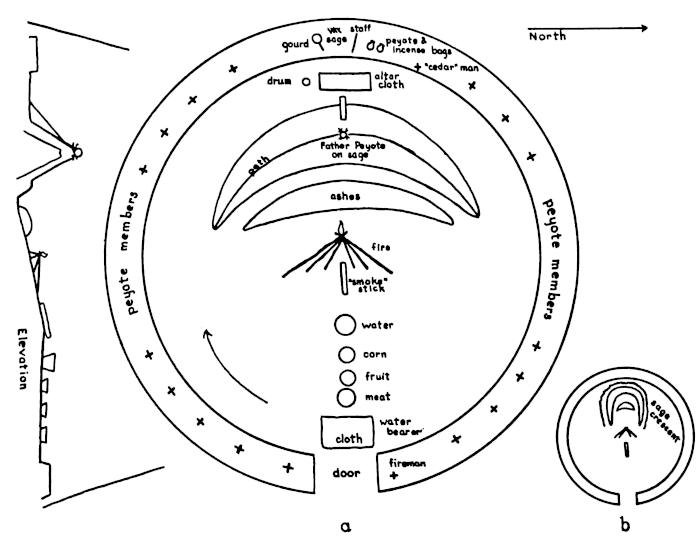
Fig. 1. Arrangement of interior of tipi for peyote meeting. a, Kiowa “standard” peyote meeting; b, Comanche horseshoe moon variant.
Title: The peyote cult
Author: Weston La Barre
Release date: January 26, 2026 [eBook #77791]
Language: English
Original publication: Hamden, CT: The Shoe String Press, 1959
Other information and formats: www.gutenberg.org/ebooks/77791
Credits: Tim Lindell and the Online Distributed Proofreading Team at https://www.pgdp.net (This book was produced from images made available by the HathiTrust Digital Library.)
[1]
Transcriber’s Note: The author’s citations of works published in languages other than English are sometimes inaccurately spelt. In addition, he uses a mixture of standard and nonstandard IPA symbols to transcribe words in the Kiowa and other Native American languages; these are preserved as originally printed.
THE PEYOTE CULT
BY
WESTON LA BARRE
Professor of Anthropology
Duke University
REPRINTED BY
THE SHOE STRING PRESS, INC.
Hamden, Connecticut
1959
[2]
© 1959, THE SHOE STRING PRESS, INC.
Originally published as
Yale University Publications
in Anthropology
Number 19
Reprinted by permission of the Department of Anthropology, Yale University
PRINTED IN THE UNITED STATES OF AMERICA
[3]
The field work which is a partial basis of this study was begun in the summer of 1935, when the writer was a member of the Laboratory of Anthropology at Santa Fé ethnological group which worked with the Kiowa under Dr. Alexander Lesser of Columbia University. The field work was continued alone in the summer of 1936 with funds granted by Yale University and the American Museum of Natural History. Field data were gathered with varying completeness from fifteen tribes: Kiowa, Comanche, Shawnee, Kickapoo, Osage, Quapaw, Seminole, Delaware, Pawnee, Cheyenne, Caddo, Oto, Ponca, Kiowa Apache and Wichita; in the case of the Kiowa, Oto, and Wichita two peyote meetings each were attended.
The debt to my almost constant field companion, Charles Apekaum (Kiowa), game warden, ex-Navy man, graduate of Chilocco, Haskell, and Carlisle, and my chief interpreter, is such that I may say my work could not have been carried out with such comparative facility and speed without his aid. His knowledge of people and places was invaluable to me. Special appreciation is expressed to Mr. Alfred Wilson (Cheyenne) of Thomas, Oklahoma, several times state president of the Native American Church, for lending me numerous letters and other documents from the official files of the organization, and to Jim Waldo (Kiowa) and Kiowa Charley for similar documents, including the articles of incorporation and state charter. To Jim Pettit (Oto) of Red Rock, local president of the Native American Church, and Charles Tyner (Quapaw) of Miami, the added debt of personal hospitality was incurred. The following informants were of particular help in gathering data: Cecil and Henry Murdock (Kickapoo); Sly Picard, George May and Henry Hunt (Wichita); Jim Aton, Belo Kozad and Homer Buffalo (Kiowa); Howard White Wolf (Comanche); Carl Pettit, Murray Little-crow, and Mrs. George Pipestem (Oto); Albert Stamp (Seminole); Tom and Collins Panther (Shawnee); Tennyson Berry (Kiowa Apache); Robert Little-dance and Louis MacDonald (Ponca); Mack Haag (Cheyenne); Elijah Reynolds (Delaware); and Sun Chief and James Sun-eagle (Pawnee). To Jonathan Koshiway (Oto), founder of the Church of the First-born, I wish to express appreciation for his painstaking efforts at completeness of information made on my behalf.
In a study of this scope one necessarily incurs considerable debts to colleagues for aid generously given and gratefully received. The notes of James Mooney on Kiowa, Comanche, and Tarahumari peyote, deposited in the Bureau of American Ethnology, as well as manuscripts by Frances Densmore on Winnebago, and Dr. Truman Michelson on Sauk and Fox peyote, were made available through the generosity of Dr. Matthew Stirling, to whom I express particular thanks. Mrs. Elna Smith very kindly lent further Bureau of American Ethnology material which had been in her care. Mr. D. F. Murphy of the Indian Office amplified my Osage notes, and Mr. John Collier, Commissioner of Indian Affairs, [4]has been generous with information of legal and administrative nature. To Donald Collier, student at the University of Chicago, and Ing. Luis Híjar y Haro of Mexico City, I express appreciation for bibliographic items, as well as to Dr. Ralph Beals of the University of California at Los Angeles. Richard Schultes, student at Harvard University, who was with me for an ethnobotanical study during several weeks of my second summer of work, has also been generous in giving help on bibliographic as well as botanical and pharmaceutical matters. Dr. E. A. Hoebel of New York University made available his notes on Northern Cheyenne and Comanche peyote. Dr. Ruth Benedict of Columbia University and Dr. M. E. Opler of the University of Chicago have aided with Mescalero Apache notes, and the latter has very generously lent valuable manuscript notes on Tonkawa, Carrizo and Lipan peyotism. Dr. Frank Speck of the University of Pennsylvania was fertile with suggestions during the second period of field work, and since its completion has contributed important Delaware material. Mrs. Erminie Voegelin, student at Yale University, kindly lent her voluminous notes on Shawnee peyote, as did Mrs. Anne Cooke for the Ute, and John Noon, student at the University of Pennsylvania, for the Kickapoo. Dr. A. H. Gayton kindly lent an interesting paper on datura. While the present paper was still in proof form, Dr. Leslie A. White of the University of Michigan and Dr. Fred Eggan of the University of Chicago generously lent material on Taos and Northern Cheyenne peyotism respectively.
To Dr. Edward Sapir of Yale University, to the Laboratory of Anthropology at Santa Fé, and to Dr. Clark Wissler of the American Museum of Natural History, I wish to express my thanks for making available the funds on which field work was undertaken. To Dr. Sapir and to Dr. John Dollard of the Institute of Human Relations at Yale University I owe the warm personal debt of founding a knowledge and an interest in matters of psychological import herein treated. And to Dr. Leslie Spier, my dissertation adviser, I express gratitude for his constant stimulating interest, valuable bibliographic help, and leads of considerable ethnographic significance.
Weston La Barre
In the twenty years since the original publication of this book, studies of peyotism have continued to appear, until there are at present over one thousand bibliographic items on the ethnography of peyotism and related subjects. The author has summarized recent studies in an extended review of “Twenty Years of Peyote Studies,” which is in press for appearance in an early issue of Current Anthropology. Readers interested in following two decades of developments in peyotism may wish to be referred to this publication.
[5]
| PAGE | |
| Preface | 3 |
| Introduction | 7 |
| Botanical and Physiological Aspects of Peyote | 10 |
| Botany | 10 |
| Ethnobotany | 11 |
| Names for peyote | 14 |
| Etymology of “peyotl” | 16 |
| Identification of peyote | 17 |
| Physiology of Peyote Intoxication | 17 |
| The Ethnology of Peyotism | 23 |
| Non-ritual Uses of Peyote | 23 |
| Ritual Uses of Peyotl | 29 |
| Huichol | 30 |
| Tarahumari | 33 |
| Comparison of Mexican peyote rituals | 35 |
| Mescalero Apache and transitional forms of ritual | 40 |
| Kiowa-Comanche type rite | 43 |
| Comparison of Mexican, transitional, and Plains peyotism | 54 |
| Comparative Study of Plains Peyotism | 57 |
| Psychological Aspects of Peyotism | 93 |
| Historical Interpretations | 105 |
| The Pre-peyote Mescal Bean Cult | 105 |
| History of the Diffusion of Peyotism | 109 |
| Appendix 1: Peyote in Mexico | 124 |
| Appendix 2: Peyote and the Mescal Bean | 126 |
| Appendix 3: Peyote and Teo-nanacatl | 128 |
| Appendix 4: “Plant Worship” in Mexico and the United States | 131 |
| Appendix 5: Chemistry of Peyote | 138 |
| Appendix 6: Physiology of Peyote | 139 |
| Appendix 7: John Wilson, the Revealer of Peyote | 151 |
| Appendix 8: Christian Elements in the Peyote Cult | 162 |
| Appendix 9: The Native American Church and Other Peyote Churches | 167 |
| Bibliography | 175 |
[6]
| PLATES | |
| Explanation of plates | AT END |
| 1. Peyote leaders | |
| 2. Altar and ash birds | |
| TEXT FIGURES | |
| PAGE | |
| 1. Arrangement of tipi for peyote meeting (Kiowa) | 44 |
| 2. Peyote paraphernalia | 47 |
| 3. Peyote drum | 49 |
| 4. Peyote altars or moons | 75 |
| 5. The diffusion of peyotism | 122 |
| 6. Cement altar of the Big Moon rite (Osage) | 154 |
| 7. Altar in West Moon Church (Osage) | 155 |
[7]
Peyote (Nahuatl, peyotl) or Lophophora williamsii Lemaire, is a small, spineless, carrot-shaped cactus growing in the Rio Grande Valley and southward. It contains nine narcotic alkaloids of the isoquiniline series, some of them strychnine-like in physiological action, the rest morphine-like. In pre-Columbian times the Aztec, Huichol, and other Mexican Indians ate the plant ceremonially either in the dried or green state. This produces profound sensory and psychic derangements lasting twenty-four hours, a property which led the natives to value and use it religiously. Peyote is not, however, the same as teo-nanacatl, as Safford believed; the latter is a narcotic mushroom which likewise had a Mexican distribution. The term “peyotl” is also used in Mexico to designate other cacti and non-cacti, some of which, like peyote, are reputed to have aphrodisiac and other properties.
Physiologically, the salient characteristic of peyote is its production of visual hallucinations or color visions, as well as kinaesthetic, olfactory and auditory derangements. Psychiatrists have used it (experimentally) with unsatisfactory results in producing temporary psychosis, and therapeutically its use has been similarly disappointing because of the uncertainty of action of the antagonistic alkaloids of pan-peyotl. First, exhilaration is produced by the strychnine-like alkaloids, followed by profound depression, nausea and wakefulness, and finally, under the influence of the morphine-like alkaloids, brilliant color visions are produced, which last for several hours. There are no ill after-effects, and peyote is not known to be habit-forming. These properties have led to a number of non-ritual uses by natives for prophesying, clairvoyance, finding lost objects and the like, as well as empirically for the cure of all manner of illnesses.
In Mexico peyote was used seasonally in an agricultural-hunting religious festival, preceded by a ritual pilgrimage for the plant. Participants danced all night around a fire to the rasp-music of the shaman, as they ate the drug in this tribal celebration. Since about 1870 the cult has spread to the United States, particularly in the Plains, where nearly all groups use it. In the Southwest transitional region peyote became deeply involved in shamanistic rivalries and witchcraft, and in the Plains with war. A pre-peyote narcotic, the “mescal bean” (Sophora secundiflora) had there prepared the way for its introduction. The Plains cult is like the warriors’ societies of earlier times in some respects. The Kiowa, Comanche and Caddo were the chief agents of the spread of the cult throughout the entire Plains region to southern Canada and parts of the Great Basin. The standard ritual is an all-night meeting in a tipi around a crescent-shaped earthen mound and a ceremonially-built fire; here a special drum, gourd rattle and carved staff are passed around after smoking and purifying ceremonies, as each person sings four “peyote songs.” Various water-bringing [8]ceremonies occur at midnight and dawn, when there is a “baptism” or curing rite, followed by a special ritual breakfast of parched com, fruit, and boneless meat.
The Caddo-Delaware John Wilson had peyote visions that led him to modify the altar and ceremony; this new form has spread to the Caddo, Delaware, Quapaw, Osage and others. Wilson was one of a long line of Indian prophet-messiahs, and his “moon” has been somewhat exploited economically. The Oto teacher, Jonathan Koshiway, founded a Christianized version of peyotism which spread to the Omaha, Winnebago and others. An organization of confederated tribes known as “The Native American Church” grew out of Koshiway’s “Church of the First-born” (which latter spread to Negro groups also). The cult has had considerable legal difficulties.
Praying and doctoring in meetings, and occasionally public confession of sins, are the major means for the liquidation of life-anxieties of this profoundly functional cult’s many present-day communicants. In the following pages we shall attempt to delineate the history of the study of the cult, the various botanical questions surrounding peyote, its physiological action and the various ethnological, psychological and historical questions involved in its diffusion.
First of modern students to describe the peyote rite was James Mooney, who visited the Kiowa, Comanche, Tarahumari, and “a number of other tribes, among them the Mexican tribes of the Sierra Madre, and as far south as the City of Mexico.”[1] But at his death he had published no further study of peyote; ethnographers of the period were in general concerned with preserving complete records of older native cultures, and ignored or paid scant attention to the modern cult of peyote. Mooney himself gave little notice to the rite in his monographs on the Cheyenne and the Kiowa,[2] although at the time he was undoubtedly the authority on the subject.
Wissler, for example, barely mentions the peyote cult.[3] Indeed, in its role of modern destroyer or supplanter of older native religions, peyote was even a matter of concern[4] and annoyance to some ethnographers. Lumholtz, with wonted thoroughness, published considerable data on Huichol and Tarahumari peyote in 1898 and later, and Kroeber in 1902 wrote a chapter on Arapaho peyote which has remained a model for later investigators.[5]
It remained for Paul Radin, however, in his studies of Winnebago peyote,[6] to point out to ethnographers an engrossingly interesting, but widely ignored, religious cult which was growing and spreading before their very eyes. Since the appearance of his papers in [9]the years following 1914, the ethnographic literature on peyote has grown considerably, due importantly to the impetus Radin gave such studies. Lowie devoted a chapter partly to peyote in his book Primitive Religion; Rouhier paid some attention to ethnographic questions in his pharmacological monograph on peyote; and Wagner wrote a short comparative paper based largely on the Comanche and Huichol cults. Petrullo’s Diabolic Root was devoted entirely to Delaware peyotism.[7]
No comparative treatment of the peyote cult of the order of Mooney’s on the Ghost Dance, Lowie’s on Plains societies, or Spier’s on the Sun Dance had ever been made when Dr. Maurice Smith of the University of Oklahoma began his studies. The unfortunate death of this investigator, however, prevented the finishing of his work, of which only a short paper[8] has seen publication. But studies of the peyote cult in individual tribes, both published and in manuscript, have multiplied to such an extent since the time of Kroeber’s and Radin’s studies that the time appears ripe to attempt an integrated comparative treatment of the religion.
[1] Mooney, A Kiowa Mescal Rattle, 64-65; Mescal Plant and Ceremony (from which dates the medical and pharmaceutical interest in peyote); statement in Peyote, as Used in Religious Worship, 58.
[2] The Cheyenne, 418; Calendar History, 237-39.
[3] The American Indian, 376.
[4] Skinner, Material Culture, 42-43; Societies of the Iowa, 693-94, 724.
[5] Lumholtz, Tarahumari Dances; Huichol Indians; Explorations en Mexique; Symbolism of the Huichol; Unknown Mexico; Kroeber, The Arapaho, 398-410.
[6] Radin, Sketch of the Peyote Cult; The Winnebago Tribe, 388-426; Crashing Thunder.
[7] Lowie, Primitive Religion, 200-204; Rouhier, Monographie du Peyotl; Wagner, Entwicklung und Verbreitung; Petrullo, The Diabolic Root.
[8] Smith, Mrs. Maurice G., A Negro Peyote Cult.
[10]
Numerous errors involved in the study of peyote, many of them still widely current, make it advisable to identify our subject-matter clearly at the very outset of our study. The plant peyote was first described by Sahagún in 1560 as a narcotic cactus used ritually by the Chichimeca, the root peiotl.[1] Jacinto de la Serna[2] in 1626 mentioned peyote, which he distinguished from other intoxicants. The first properly botanical description was made in 1638 by Hernandez,[3] the naturalist of Philip II of Spain, under the rubric De Peyotl Zacatensi, seu radice molli et lanuginosa. Ortega,[4] again, in 1754, mentioned peyote as used in a Cora dance.
Since 1845 peyote has had numerous modern botanical classifications, being listed variously as Echinocactus williamsii Lem., Anhalonium williamsii Lem., Mammillaria williamsii Coulter, Echinocactus lewinii Hennings, Mammillaria lewinii Karsten, Lophophora lewinii Thompson, etc. The commonest designation in the older ethnological literature is Anhalonium lewinii or A. williamsii. For a considerable period it was thought that these last were two species—a point argued both on botanical and ethnographic grounds—but the present classification of peyote is as a single species, the unique member of its genus, Lophophora williamsii.[5]
[11]
The peyote plant is a curious and unique little cactus. It has no spines whatsoever, and ranges from the carrot-like to the turnip-like in shape and size, without, however, any branches or leaves. The rounded top surface, which alone appears above the soil (and which, cut off and dried, becomes the peyote “button”), is divided radially by straight, or slightly spiral, or sinuous furrows that in some specimens become so complex as to lose the appearance of ribs altogether. These ribs bear little tufts or pencils of matted grayish-white hair, not unlike artists’ fine camel’s-hair brushes. It is from these that the cactus takes both its modern botanical designation, Lophophora (“I bear crests”) and its Aztec name peyotl (from the resemblance to cocoon-silk). In the center of the top there is a little spot of closely matted fuzz, from which the ribs derive and grow; the flower, borne on a stalk, grows from here too, the pinkish-whitish blossom growing into a rapidly maturing club-shaped pinkish-reddish fruit.[6]
Several matters regarding the botany of peyote should be discussed, for their having given rise to legends about the plant. After discussing the nefarious uses to which the Chichimeca put peyote, Hernandez writes that
on this account the root scarcely issues forth, but conceals itself in the ground, as if it did not wish to harm those who discover and eat it.[7]
Dr. Parsons[8] recounts a Taos origin legend in which peyote acts even more spectacularly. A warrior on the war-path heard a singing, and when he approached,
the plant would go open and shut like this [the narrator moves his finger-tips close together and then opens them].... Then the plant told the Indian to come inside. But the opening was so small. Then it got bigger; it got to be a big hole in the ground, a square hole. The Indian went down the hole. There was a big hollow place down there in the ground, round like a kiva.
And the story continues, telling of how the Indian learned the peyote rite from the man in the kiva. On scrutiny this appears to be the Kiowa origin legend for peyote, modified by the addition of familiar Pueblo folk-tale motifs. The Kiowa themselves say,
you must look closely at peyote, because it is like a mole when it comes on top of the ground—if you don’t look closely it is gone again.
[12]
These curious legends, however, are not without some histological[9] and ecological reality. In this semi-desert region the subterranean funnel-formed tap-root of the plant is covered with woody scales which form a rigid shell. Rouhier writes:[10]
All this chlorophyll-region [the portion above the ground] is tumid, plump and fleshy, firm and elastic to the touch, when, after the season of heavy rains, the plant is replete and vigorous. During the hot season it droops and shrivels, becomes soft, and has a dull rumpled look. It retracts then into the rigid cylinder formed by the desiccated corky desquammated part of the stem; the plant literally gives the impression of pulling its head into its neck. (M. Diguet has told us that the plant, at this time, buries itself in the soil, as though drawn, by a powerful force of traction of its adventive radicles, at the base of the funnel which its tap-root has bored.)
Another matter of ethnobotanical interest concerns the supposed existence of two varieties of peyote.[11] In discussing Peyotl Zacatensis Hernandez[12] writes that “they say they are male and female.” The Huichol likewise distinguish two kinds of Peyote, one, the more active and bitter in taste and presenting smaller and more numerous mammillations on the surface, called Tzinouritehua-hicouri, “Peyotl of the Gods,” the other, whose physiological effect is less pronounced, called Rhaïtoumuanitarihua-hicouri, “Peyotl of the Goddesses.” In the opinion of Rouhier,[13] “The Peyotl of the Goddesses ... is the young form of Echinocactus williamsii [= Lophophora williamsii], and the Peyotl of the Gods is its adult form.”
Nor is this the end of the matter. It is well known that sex is attributed to plants in the Plains, but there is also a well-defined pattern regarding the sex[14] specifically of peyote [13]throughout Mexico and the Plains. The Huichol have a tutelary goddess for peyote called Hatzimouika; the peyote deity of the Tarahumari, on the other hand, is male, and great reverence is paid by them to the hikuli walúla sälíami, or “hikuli great authority,” literally, who is surrounded by smaller plants, his “servants,” and who, not satisfied with mere sheep and goats, demands the sacrifice of oxen.
Being persons, peyote plants naturally talk and sing on occasion. Lumholtz[15] writes of the Tarahumari belief that
in the fields in which it grows, it sings beautifully, that the Tarahumare may find it. It says, “I want to go to your country, that you may sing your songs to me.” ... It also sings in the bag while it is being carried home. One man, who wanted to use his bag as a pillow, could not sleep, he said, because the plants made so much noise.
Bennett and Zingg[16] mention the Tarahumari belief that the singing one hears as the bakánawa moves about in the night near the sleeper may be made clearer by chewing a bit of the plant. Indeed, Mooney[17] says the Tarahumari find the peyote by hearing its song, Híkurówa, which it sings day and night. Peyote speaks to the Tarahumari shaman during the night of dancing and curing, and encourages him with words and by singing to him. The fetish-plant in the ceremony proper is placed on the altar under a half-gourd resonator; the rasping of the shaman, thus amplified, is very pleasing to peyote, who manifests his strength by the amount of noise produced with his aid.
In the Plains, however, when pleased with the singing, the peyote goddess actually joins in with it.[18] The Kiowa call her sęⁱmąyi, literally, “Peyote Woman.” Mooney describes a Kiowa peyote rattle on which she is represented, and at her feet the Morning Star, which heralds her approach. A Taos origin legend for peyote tells of a warrior abandoned [14]by his companions, who heard a singing and rattling near where he lay, and finally discovered it coming from the blossom in the center of the top of the plant.
The Shawnee[19] say that if you listen carefully you can “catch songs” from Peyote Woman. The Kickapoo likewise have the concept of the peyote “goddess” who sometimes sings in meetings when pleased; one informant further said that “the spirit of a woman who had been faithful to peyote sings after she has passed away. Sometimes we put pieces of food near the fire for spirits of a dead man or woman or child. Sometimes you hear a man’s voice too.” The Lipan say they hear “Changing Woman’s” voice in peyote meetings. The Wichita believe it is kicu·ídie, “the woman who stays in the water,” and her little son, wi·ḱιdiwιdá, “the boy who rolls along the banks of the water,” who are mentioned in prayer, and who give power in meetings. The “peyote-woman” belief is attenuated elsewhere in the Plains.[20]
Native terms for peyote differ somewhat in denotation and connotation. For clarity sake we shall list only those terms referring specifically to Lophophora williamsii. Native classifications of cacti, as well as extensions of the term “peyotl,” will be discussed in an appendix, as involving special problems.
The Huichol of Jalisco call peyote hícuri, hicori, xicori or hicouri (in the notation of speakers of different European languages); sometimes they refer to it metaphorically as foutouri, “flower.” The Cora of the Tepic mountains term peyote huatari, houtari or watara; the Tepehuane of Durango, kamaba. The Tarahumari of Chihuahua call it hikuli or hikori, sometimes adding, according to Lumholtz, the epithet wanamé (or houanamé), “superior,” to designate the peyote par excellence; the same meaning appears to be indicated in the reduplication híkurí-íkuríwa.[21]
The Opata[22] call it pejori, the Otomi beyo. The Pima of the Gila River region use the name peyori. The Comecrudo or Carrizo of Tamaulipas call peyote kóp, and Gatschet recorded the term kúampamát for “bailar el peyote” (“many are dancing [the peyote dance]”). The Lipan name is xʷucdjiyahi, “pricker one eats.” The Tonkawa of southern [15]Texas call peyote nonč-gáⁱɛn; the Taos name is walena, the generic term for “medicine.” Mescalero Apache call it ho or hos; the Wichita nesac’. The Comanche wokwi or wokowi is said by Mooney to be the generic name for cacti.[23] The Arapaho call peyote hahaayāⁿx. Most of the Oklahoma tribes have their own version of the term peyotl, such as the Kickapoo pi·yot, or, like them, they may use some older native term for “medicine” such as natáⁱnoni. John Wilson (Caddo-Delaware), curiously, called peyote “sugar” or “bee-sugar”; and some Anadarko Delaware call peyote-eating “ear-eating.”
Whites have used numerous confusing and erroneous non-botanical terms for Lophophora williamsii. Of these usages the commonest, “mescal,” “mescal beans” or “mescal buttons” are the most confusing. Mescal (from the Nahuatl mexcalli, “metl [maguey] liquor”) in northern Mexico, properly refers to the Agave americana or Agave spp. baked in earth ovens and widely eaten in the Southwest, and from which the Mescalero Apache take their name. By extension the term is applied to the intoxicant distilled from the native beer, pulque, also made from Agave spp. A more precise designation of this native brandy (as opposed to the native beer) is tesvino and its variants, from the Nahuatl tehuinti or teyuinti, “intoxicating.”[24]
“Mescal bean” as used to designate Lophophora williamsii is quite indefensible, being wrong on two counts: the “mescal” bean proper is Sophora secundiflora (= Broussonetia secundiflora) or, incorrectly, Erythrina flabelliformis. The former is a red bean which was used in a pre-peyote narcotic cult of the southern Plains, to be discussed later. The adjectival use of “mescal” in the designations “mescal beans” or “mescal buttons” no doubt comes from the known intoxicating properties of the distilled liquor mescal, as extended in meaning to other unfamiliar new intoxicants, Sophora secundiflora (bean), and Lophophora williamsii (cactus); the term “dry whisky” bears this out. Lumholtz,[25] indeed, wrote that the Texas Rangers, during the Civil War, when taken prisoner and deprived of all other stimulating drinks, soaked peyote (which they called “white mule”) in water and became intoxicated on the liquid. Further confusion of peyote with mescal has arisen from the north Mexican habit of mixing the two in a drink. Dealers call peyote the “turnip [16]cactus” or “dumpling cactus” from its shape, to which also refers the local Mexican term biznagas, “carrot.” A local name in Starr County, Texas, where the plant grows abundantly, is challote, but the usual dealers’ name is “peyote buttons,” from their flat shape when dried.
A precise understanding of the meaning of this term is essential, for it gives a linguistic clue of primary importance in botanical identification. Molina[26] in 1571 recorded the Nahuatl term peyutl, whose elastic and imprecise sense designates something white, shining, silky or woolly, and which applies to the moth-cocoon, a spider-web, a fine tissue, or, indeed, from its appearance (familiar enough to the Aztecs) even to the pericardium or covering of the heart. Rémi Siméon, in his Nahuatl dictionary of 1885, lists “Peyotl or Peyutl—A plant whose root served to make a drink that took the place of wine (Sahagún); silkworm cocoon; pericardium, envelope of the heart.”[27]
This etymology, the oldest as well as the most authoritative, is accepted by Rouhier.[28] The present writer, having been informed of its linguistic impeccability, further finds it explanatory of otherwise curious extensions of the term “peyotl” in Hernandez,[29] as well as later Mexican usages. Various plants in Mexico besides Lophophora williamsii, some of them not even belonging to the Cactus Family, have been called “peyote.” In each case, however, there has been some part of the plant to which the meanings of flocculence or cocoon-like woolly pubescence descriptively can legitimately apply. An appendix is devoted to the clearing up of this terminological confusion.
[17]
We have now touched upon the etymological connotation of “peyotl,” and its extended denotation in Mexican usage. But one further matter remains to be pointed out, viz., incorrect identification and misusages involving peyote. Safford[30] in 1915 adequately indicated the identity of the modern peyote of the Plains with the peiotl of Sahagún and other earlier Spanish writers. Not content, however, with proving this somewhat obvious point, he went beyond and even contrary to his evidence and attempted to prove the identity of peyote with a further narcotic mentioned in Spanish sources, a yellow thin-stemmed mushroom, called teo-nanacatl by the Aztec. This confusing and wholly erroneous identification is discussed at length in an appendix, inasmuch as it has unfortunately won wide acceptance.
A more widespread error is the application of the terms “mescal,” “mescal bean” or “mescal button” to the cactus Lophophora williamsii or peyote. These misusages are common in the literature on peyote, and arise from confusion with a pre-peyote narcotic of the southern Plains and Texas, the red bean of Sophora secundiflora, a true member of the Bean Family. The word “mescal” as applied either to the cactus or the bean is erroneous and misleading, and should properly be applied only to the “Indian cabbage” (Agave spp.) of the Southwest, or the brandy distilled from Agave-beer or pulque.[31] The true “mescal bean” is discussed elsewhere.
The present section of our study proposes to deal with the physiology of peyote intoxication only insofar as it may be supposed to have influenced the form of native culture-patterns and rites surrounding its use. The efficacy of native doctoring with peyote, however, must be decided on the basis of properly controlled medical experiments, of a sort discussed in Appendix 6, and is not at issue here.
So far as the brute effect of the drugs is concerned, the first stage is one of physical and mental exhilaration. To this physiological fact no doubt is due the Mexican use of peyote in foot-races, in war and for allaying hunger and thirst when on fasting pilgrimages for the plant. Expression of this exhilaration by dancing is common in Mexico, and is found likewise among the Tonkawa, the Lipan and sporadically in the Plains.[32]
[18]
Gross attitudinal behavior may be exhibited in extreme cases. Lumholtz[33] says of the Huichol that
in a few cases a man may consume so much that he is attacked with a fit of madness, rushing backward and forward, trying to kill people, and tearing his clothes to pieces. People then seize upon him, and tie him hand and foot, leaving him thus until he regains his senses. Such occasions are thought to be due to infringements of the law of abstinence imposed upon them before and during the feast.
This semi-psychotic state is no doubt as much conditioned culturally as the Malay “running amok”; in Mexico early Spanish writers repeatedly describe native visions as sometimes horribly frightening as well as sometimes laughable. Indeed, in Mexico, among the Mescalero, and the early Plains users, aggressions welling up under peyote intoxication commonly took the form of witchcraft fear and counter-witchcraft. Typically in the Plains, however, the attitude repeatedly emphasized is that of intertribal brotherhood and an individual feeling of friendliness and well-being. Nevertheless some fifty native visions collected indicate great variability in the psychic state. A Taos instance records euphoria to the point of laughter,[34] but Crashing Thunder (Winnebago)[35] experienced a state of deep depression and intense fear:
The next morning [he writes] I tried to sleep. I suffered a great deal. I lay down in a very comfortable position. After a while a fear arose in me. I could not remain in that place, so I went out into the prairie, but here again I was seized with this fear. Finally I returned to a lodge near the one in which the peyote meeting was being held, and there I lay down alone. I feared that I might do something foolish to myself if I remained there alone, and I hoped that someone would come and talk to me. Then someone did come and talk to me, but I did not feel any better. I went inside the lodge where the meeting was taking place. “I am going inside,” I told him. I went in and sat down. It was very hot and I felt as though I was going to die. I was very thirsty, but I feared to ask for water. I thought that I was surely going to die. I began to totter over. I died and my body was moved by another life. I began to move about and make signs. It was not myself doing it and I could not see it. At last it stood up. The eagle feathers and the gourds, these it said, were holy. They also had a large book there. What was contained in the book my body saw. It was the Bible.... Not I, but my body standing there, had done the talking [this schizoid quality of consciousness in peyote intoxication has been frequently noted by white observers]. After a while I returned to my normal condition. Some of the people present had been frightened thinking I had gone crazy. Others, on the other hand, liked it. It was discussed a great deal; they called it the “shaking state.”
The vision experiences of John Wilson (Caddo-Delaware) and Enoch Hoag (Caddo) are typical results of physiologically-induced hallucinations in individuals whose culture-background highly values vision-experiences.[36] The Enoch Hoag “moon” had its origin [19]apparently in a (tetanic?) trance, wherein he saw himself as dead, with many people around him weeping and his arms composed on his chest as with a corpse. His companions tried to give him water with a spoon, but his jaws were stiff—a common symptom of strychnine poisoning.[37]
The stimulating effect of peyote may partly account for the holding of meetings at night, for there is no desire or ability to sleep for ten or twelve hours after eating peyote; however, all-night meetings for various purposes are not unknown in the Plains, and the older culture pattern merely exploits the physiological fact as a limiting condition probably. Some observers report that, although there is heightened reflex-activity (including those of the skin), peyote induces a partial skin anaesthesis. A Zacatecas ceremony reported by Arlegui,[38] on the occasion of the birth of the first male child, appears to utilize this virtue of the plant:
The relatives gather and invite other Indians to a horrible ceremony of which the father is the object. They give him to drink a brew concocted of a root called peyot and which not only has the property of intoxicating him who drinks it, but also renders him insensible and drugs the flesh and paralyzes the whole body. This drink is administered to the patient after twenty-four hours of fasting. Then he is seated on a staghorn in a place specially chosen for this. The Indians come with sharpened bones and teeth of different animals. Then with different ridiculous ceremonies, they approach the unfortunate victim one by one; each one makes a wound on him, without pity, making a great deal of blood flow out; and as those present are numerous, the wounds are many and the unfortunate person is so maltreated that, from head to foot, he offers a lamentable spectacle.... According to how the miserable victim has borne this, they augur the valor which the son of a father who has suffered so much will possess.
The stages of peyote intoxication have been noted by natives. Writing of the Kiowa and Comanche, Mooney[39] maintained that “in the peyote ceremonies, the songs of those [20]present are more vigorous after midnight,” and informants frequently indicate their awareness of this.[40] Kroeber says of this period late in the intoxication that[41]
the physiological discomforts have usually worn off, and the pleasurable effects are now at their height. It appears that new songs, inspired perhaps by the visions of the night, are often composed during this day.
Many well known songs composed by such leaders as Quanah Parker (Comanche), Enoch Hoag (Caddo) and John Wilson (Caddo-Delaware, called Nĭshkûntŭ or “Moonhead”) are said to have arisen from the auditory hallucinations of peyote intoxication. The popular song “Heyowiniho” came to John Wilson in a synaesthetic auditory hallucination in which he heard the sound of the sun’s rising. Crashing Thunder[42] said of the beating of a drum that “the sound almost raised me in the air so pleasurably loud did it sound to me.” Other kinaesthetic derangements have been reported in visions.
The dilation of the pupils of the eyes possibly explains the Huichol[43] belief that the squirrel- and skunk-fetishes of their ceremony can see better than ordinary people, guiding and guarding the hikuli-seekers on their way. Visual phenomena, indeed, are perhaps the most conspicuous effects of peyote eating. The colors red and yellow, usually with reference to birds and feathers, are common in both Mexican and Plains peyote symbolism.[44] The widespread Plains belief that peyote makes one see better may derive from pupil-dilation; white observers have reported acuter vision in peyote intoxication from this cause. Indians frequently manifest a marked “photophobia” even in the mild morning sunlight after meetings, and many younger men affect colored glasses at this time.
The peyote alkaloids cause increased salivation, and there is a constant noise in meetings of spitting as the users eat peyote; in some meetings attended individual tin-can spittoons were provided. The increased flow of saliva probably accounts for the thirst-allaying effect of the plant encountered in the origin legends and elsewhere, but this and the diuretic[45] action of the drugs cause thirst to reappear more strongly later. A regular feature, [21]therefore, of the typical Plains ritual is the bringing in of water at midnight and in the morning, which is passed around clockwise.[46] The widespread taboo on the use of salt in connection with peyote may have some reference to this action of the plant.[47] On the other hand, the use of sweet[48] foods is a necessary part of the ritual; these are stereotyped both in the Plains and Mexico to include parched corn in sugar-water, sweet fruit, and sweetened meat either dried and powdered or cut into chunks, and candy is a regular feature in some meetings. Sugar may in effect relieve the stage of depression in peyote intoxication somewhat.[49]
The classification of plants into male and female on the basis of their physiological action has, as we have seen, a botanical basis. We are convinced on the other hand, however, that peyote has no effect whatsoever in the curbing of an appetite for liquor. Both native and white apologists[50] for peyote advance this argument in extenuation and defence. Natives are perfectly sincere in their belief that the antagonism of peyote and alcohol is physiological (even in the face of conspicuous contrary evidence),[51] and Plains Indians are annoyed and hurt at the widespread association of drinking and peyote-eating through the confusion of the term “mescal.” Yet the stubborn ethnographic fact remains that in Mexico peyote is commonly drunk with tesvino or mescal.
Various other physiological effects noted by whites find native parallels. Many of the visions recorded for natives deal with synaesthesias of sight and hearing and smell, and [22]there occur cases of taste- and smell-hallucinations as well as the more common auditory and visual ones. Kinaesthetic derangements are also not unknown.[52]
One final question is less of physiological than psychological and ethnographic import. Along with teo-nanacatl, marihuana (Cannabis spp.) and the Peyotl Xochimilcensis (Cacalia cordifolia), peyote has been said to have an aphrodisiac action. This association suggests that a matter of Spanish-White or Mexican-Indian ethnography is involved.[53] But love-magic was not unknown either in Mexico or the Plains, and it is conceivable that this new medicine (particularly since it was used for “witching”) because of its other spectacular effects, might have been valued for this purpose also.
We have now discussed the bearing of physiological reactions on the peyote ritual and other native behavior: the exhilarating first effect of the drug (in the allaying of hunger and thirst on the march, to give courage in war, and strength in dancing and racing) and the second stage of depression and visions (“running amok,” witchcraft-suspicion, psychic fear-states, euphoria and feeling of brotherhood, partial anaesthesia, the “suffering to learn something” characteristic of the Plains vision quest, synaesthesias, auditory hallucinations, and “catching songs,” visual hallucinations, and “learning” of painting- and bead-designs, symbolical birds and feathers, etc.).
We found, too, behavior definitely related to the pupil-dilating power of peyote as well as its sialogogue and diuretic action; the injunction against salt and the use of sweet foods, however, may involve culture-historical matters. We have been skeptical of the alleged anti-alcoholic virtue of peyote, and have likewise doubted that physiologically peyote is either aphrodisiac or anaphrodisiac, despite heated claims on both sides. The efficacy of native doctoring with peyote is a special problem treated elsewhere along with the therapeutic and psychiatric experiments of Whites.
The following ethnographic part of our study deals first with the non-ritual uses of peyote, arising from its special properties, and secondly with the ritualization of its use.
[1] “They [the Chichimeca] have a considerable knowledge of plants and roots, their qualities and their virtues. They were the first to discover and use the root called peiotl, which enters among their comestibles in the place of wine” (Sahagún, Histoire générale, 10:661-62). Again, “There is another herb, like tunas of the earth [tunas is the Spanish name for the fruit of the prickly pear, Opuntia opuntia]; it is called peiotl; it is white; it is produced in the north country; those who eat or drink it see visions either frightful or laughable; this intoxication lasts two or three days and then ceases” (Sahagún, Historia general, 3:241; in Safford, An Aztec Narcotic, 294-95).
Translations from the Spanish have been made with the aid of Mr. H. W. Tessen of the Yale Graduate School.
[2] “Teo-nanacatl [has] ... the same properties as ololiuhqui or peyote, since when eaten or drunk, they intoxicate those who partake of them, depriving them of their senses, and making them believe a thousand absurdities” (Manual de Ministros; in Safford, An Aztec Narcotic, 309-10).
[3] “Peyote of Zacatecas, or soft and lanuginous root. The root is of nearly medium size, sending forth no branches nor leaves above ground, but with a certain wooliness adhering to it, on which account it could not be aptly figured by me” (De Historia Plantarum, 3:70; in Safford, An Aztec Narcotic, 295. See also Rouhier, Monographie du Peyotl, 43-44).
[4] “Nearby [the leader] was placed a tray filled with peyote, which is a diabolical root [raiz diabolica] that is ground up and drunk by them so that they may not become weakened by the exhausting efforts of so long a function” (Ortega, Historia del Nayarit; in Safford, An Aztec Narcotic, 295).
[5] Those interested in the taxonomic problem should consult the numerous botanical references in the bibliography. Britton and Rose, in their four volume work on the Cactaceae classify peyote as Lophophora williamsii, which will be followed in the present study.
[6] The most succinct and complete description of the plant is found in Britton and Rose, The Cactaceae, 83-84.
Peyote’s range is comprehended within an irregularly-shaped lozenge from Deming, New Mexico, to Corpus Christi, Texas, to Puebla, Sombrerete, Zacatecas, and back to Deming. That is, the valley of the Rio Grande (north), Tamaulipecan Mountains (east), the watershed of the affluents of the right bank of the Rio Grande de Santiago and Rio de Mezquital (south), and the foothills of the Sierra Madre, the Sierra de Durango and the Sierra del Nayarit (west). It prefers the calcareous and argillaceous soils of the Cretaceous formation in the north of this region.
[7] In Safford, Aztec Narcotic, 295; see also Narcotic Plants, 401.
[8] Parsons, Taos Pueblo, 63.
[9] The best histological account is in Rouhier, Monographie, 34-42; the work of Dr. Helia Bravo, Nota acerca de la Histología, is more recent. Richard Schultes at Harvard has also pursued histological studies. It is noteworthy that the Indians ordinarily take only the upper portion of the plant, which contains a larger proportion of the alkaloids according to Rouhier.
[10] Rouhier, op. cit., 25. I am persuaded that many such insights would be afforded us in ethnography if we had a less cavalier attitude toward native science and history: for after all even our own science grows from criticism of traditional notions.
[11] From the middle of the last century there has raged an acrimonious debate as to whether there are two varieties of peyote corresponding to Anhalonium williamsii and A. lewinii. The former, it was contended, had seven or eight straight ribs and lacked most of the alkaloids of the latter, which had more numerous (twelve or more) sinuous ribs. This long, somewhat nationalistic debate may be regarded as ended since Rouhier (Monographie, 67) in 1926 figured a bicephalous plant on the same root, one head being a true williamsii, the other a perfect lewinii. It is apparent that the lewinii “variety” is merely an older plant, which often takes the williamsii aspect in its younger stages of growth; the more numerous alkaloids of the former more mature plant is likewise purely a growth-phenomenon, as are the rib-configurations and mammillations, though environmental and seasonal conditions may be involved as well.
[12] Hernandez, De Historia Plantarum, 204, “Se dice que hay macho y hembra.” Inaccurately translated by Safford, Aztec Narcotic, 295, and Rouhier, Monographie, 43. The simplest and most obvious translation is the most satisfactory. According to the Lipan (Opler, Use of Peyote, 279) male peyotes bloom red, female peyotes white.
[13] Diguet, Le Peyote, 25; Rouhier, Monographie, 133.
[14] Handbook of the American Indians. 1:604b. Spier informs me this is also Navaho and perhaps Pueblo as well. As indicated elsewhere, peyote, teo-nanacatl and associated plants have repeatedly been thought to be aphrodisiacs. The supposed sex of the plants may have some reference to this belief; cf. the Huichol belief that “Maize is a little girl whom one sometimes can hear weeping in the fields; she is afraid of the wild beasts, the coyote and others that eat corn” (Lumholtz, Unknown Mexico, 2:279). Different colors of corn belong to different deities also; it is interesting to note that the Huichol attribute different colors symbolically to peyote which have no effective reality (Rouhier, op. cit., 133). In 1935, in a non-peyote context, Apekaum told me that cotton plants in a field we were passing were male and female; some trees were male, too, and others female, he thought. No botanical realities were involved in any of these cases. The Jivaro also attribute sex to plants (Karsten, Civilization, 301, 304-06, 314-15, 323) as do the Aymará and others.
[15] Lumholtz, Unknown Mexico, 1:362.
[16] Bennett and Zingg, The Tarahumara, 295.
[17] Mooney, Tarumari-Guayachic; Lumholtz, Unknown Mexico, 1:365; Bennett and Zingg, The Tarahumara, 293.
[18] This auditory hallucination of hearing voices in peyote intoxication is most striking. Several explanations may be offered: the cultural (the belief is common in Mexico and the Plains that peyote talks and sings), the physiological (white observers, many in obvious ignorance of the ethnographic facts, have reported aural hallucinations), or the physical (the peculiarly resonant vibrations of the water-drum echoing from the taut, cone-shaped canvas of the tipi). A physiological constant for Indians and whites (culturally modified) seems indicated. See Mooney, A Kiowa Mescal Rattle, 65; Parsons, Taos Pueblo, 63.
[19] Statements without references are understood to be made from my own field work.
[20] The Cora peyote goddess appears to be “Mother Hūrimoa” (Preuss, Die Nayarit-Expedition, 103). Tarahumari dancers sometimes imitate hikuli’s talk with a sound which reminded Lumholtz of the crow of a cock (Tarahumari Dances, 455). The Lipan information is from Opler (The Use of Peyote).
[21] Diguet, Le peyote et son usage, 21, 25; Rouhier, Monographie, 4; Safford, An Aztec Narcotic, 297; Lumholtz, Unknown Mexico, 1:357, 2: passim; Preuss, Die Nayarit-Expedition, 103; Bennett and Zingg, Tarahumara, 135; Mooney, Tarumari-Guayachic.
[22] Rudo Ensayo (1760) in Mooney, Tarumari-Guayachic. A note by F. W. H[odge] indicates a purely medicinal use of peyote for the Opata. Otomi: León, fide Mooney; Mooney doubts this, somewhat unwarrantedly I think. Pima: Alegre, in Mooney, Tarumari-Guayachic. Comecrudo: Handbook of the American Indians, 1:209a; Mooney, Tarumari-Guayachic, whose source is probably Gatschet. Lipan: Opler, The Use of Peyote. Tonkawa: Mooney, op. cit. Taos: Parsons, Taos Pueblo, 114, note 115. Mescalero Apache: Rouhier, Monographie, 4 (Opler records this as xuc); Safford, An Aztec Narcotic, 297; Mooney, op. cit. Comanche: Mooney, Miscellaneous Notes; the present writer recorded wↄ´kweᵖⁱ and pua´kιt (= “medicine”).
[23] Mooney (Peyote Notebook, 21) likewise says the Kiowa term for peyote sęⁱ means “prickly” or “prickly fruit” and is generic for all cacti. But peyote, it will be remembered, is conspicuous for its lack of spines; perhaps this was an older term for the prickly pear, Opuntia opuntia, transferred to the more recently known plant. In any case it occurs nowadays in many compounds: sęⁱmąyi, “peyote woman,” sęⁱpiⁱ, “peyote meeting,” etc., and in the phrase behábe sęⁱᴅɔki, “smoke, peyote power.” (Compare the Comanche hos mäbä´mho’i.) See also Mooney, Calendar History, 239; Rouhier, Monographie, 4; Kroeber, The Arapaho, 399; Speck, Notes on the Life of John Wilson, 552.
[24] See Handbook of the American Indians, 2:845, 846 (the Yuma, Mohave, Ute, Apache, etc., use it). The Mescalero Apache do not derive their name from the use of the peyote, “mescal,” as Mooney stated, being so designated long before they knew or used peyote. In the second etymology see Siméon, Dictionnaire, 436; also Safford, An Aztec Narcotic, 293. See also La Barre, Native American Beers, 225.
[25] Lumholtz, Unknown Mexico, 1:358. For “dry whiskey” see the New Century Dictionary, Supplement: “Mescal Buttons.” For the other names see Rouhier, op. cit., 4; Britton and Rose, The Cactaceae, 3:84 (the spelling pellote of Velasco, from Mooney, is a Castillianization of the Nahuatl); Peyotes, datos para su estudia, 209. The spelling pezote in Alarcón, Tratato de las Supersticiones, 131, is obviously a copyist’s error.
[26] de Molina, Vocabulario, 80, “Peyutl—capullo de feda, o de gufano.” The Spanish o and u constitute a single phoneme in Nahuatl, according to Mr. Benjamin Whorf, so the vowel is purely a matter of recording. On the other hand, Reko’s etymology in Was bedeutet das Wort Teo-Nanacatl? (lent through the courtesy of R. E. Schultes) is inadmissable. He writes: “Pe-yotl, Old-Aztec Pi-yautli, is quite clear in its etymology: Pi is the significative (or affix) for ‘little.’ ... Yau-tli is always something narcotic or strong narcotic-smelling substance. Yau- is the root, -tli the post-positive article (substantive significative).... A pi-yautli (pe-yotl) is therefore the mildly intoxicating poison, in contrast with Hua-yautli (today Guayule, sap of the Gum-tree, which smells very strong) which means extremely intoxicating.” This is an ad hoc forcing of an etymology on a word, according to Whorf: in the first instance “old Aztec” pi-yautli appears to be an assumed rather than a quoted form; but even so, -yautli should not give -yotl or -iotl of Sahagún’s recording, but an unchanged -yautli. If the rules for Nahuatl sound-change are to be observed, peyotl must come from an uncontracted stem of two syllables, plus the absolutive suffix, this stem being pe-yo; -yautli, on the other hand, must come from a contracted stem, originally of two syllables, ya-wi (the -i standing for a variable or unknown vowel), plus the absolutive suffix, having the form -tl when preceded by a vowel, -tli when preceded by a consonant, i.e., a contracted stem. As for the first syllable, pi- and pe- are absolutely distinct phonemically in Aztec. The etymology, therefore, is neither phonetically nor phonemically correct, and assumes random and unexplained sound changes. The writer is grateful to Mr. Whorf for the preceding information. P. Augustin Hunt y Cortes (in Rouhier, 7) derives peyotl from the active verb pepeyoni, pepeyon, “to move, to stir, to set into motion, to excite, to activate.” Other offerings are “child” and a derivation from peyonanic, “stimulate, goad, prick, incite.” These are untenable for the same reasons that Reko’s is.
[27] Siméon, Dictionnaire 412, 436.
[28] Rouhier, Monographie 7.
[29] De Historia Plantarum, 3:70 (Peyotl Xochimilcensi). Peyote, because of its abundance in certain localities, figures frequently in place names.
[30] Safford, An Aztec Narcotic; see also other items by this author in the bibliography.
[31] See the New Century Dictionary, “Pulque,” 4841, a word conjectured to be of Carib (Haiti or Cuba) or Spanish origin. Agave and maguey are the American aloe, sometimes called “century plant” (cf. “maguey,” 3578, “agave,” 108). “Mescal” proper, therefore, = Agave americana = maguey = American aloe = “century plant.”
[32] White Wolf (Comanche) tells of Kuaheta, at the time acting as fireman in Comanche Jack’s meeting, that he once failed to return after having asked to leave the tipi. Commissioned to investigate, White Wolf found him outside “jumping like a deer” from deep peyote intoxication. Hoebel relates a similar experience in a Northern Cheyenne meeting. Tonakat, the well-known Kiowa “witch,” once forced a man to get up and dance in a meeting (Autobiography of a Kiowa Indian, recorded by the writer, 1936). Jonathan Koshiway (Oto) laughingly told me of a meeting in Kansas where the singer’s jaw became locked; the whole meeting was upset while they shook and fanned him with cedar incense until his jaw “came back.” This may have been an effect of the strychnine-like alkaloids in peyote, as in the case of Tom Panther (Shawnee) who became unable to talk or sing once in George Fry’s meeting: “it took me four or five minutes to say the word ‘study’,” he said.
[33] Lumholtz, Huichol Indians, 9.
[34] Parsons, Taos Pueblo, 63.
[35] Radin, Crashing Thunder, 198-99.
[36] Fernberger (Further Observations, 368), citing Petrullo, writes: “The best reporters of this group of Indians [Delaware] insist that visions may occur under peyote intoxication but that it has become socially admirable to suppress these visions and that, after some practice, this may be successfully accomplished.” But after establishing ordinarily friendly relations with informants I found no such reticence about visions; these, indeed, were publicly discussed in the Sunday forenoons after meetings (usually spent lounging under “shades” quietly exchanging peyote experiences). Many, like Spotted Horse (Kiowa), Tom Panther (Shawnee) and Sly Picard (Wichita) distinguished the ordinary effects of peyote from full-blown “visions”; and some corrective modesty is occasionally exhibited for the familiar Plains assertiveness and individualism, for, in fact, through peyote visions individuals push themselves to positions of leadership and influence. Fernberger continues: “The informants also state that they are able to control visions when they occur, that is, to change the vision to that of any particular known object or to hold a vision that occurs in consciousness for a considerable time. Both of these statements are totally at variance with the descriptions of all previous observers of the visual manifestations.” We disagree with this dictum; many informants would paraphrase the statement of Tom Panther (Shawnee) that in peyote intoxication, “I wasn’t boss of myself.” White observers too have remarked on the dualism of consciousness exhibited by Crashing Thunder. One might even go so far as to say that this is a reason natives think of peyote as an external “power” working its influence on them.
[37] Is the peculiar mode of wearing a blanket in meetings due to the necessity of supporting the back in strychnine-opisthotonos (from lophophorine and anhalonine)?
[38] Arlegui, Crónica, 144; Rouhier, Monographie, 331.
[39] Mooney, in Rouhier, op. cit., 344.
[40] “We’re pulling for daylight now—that’s the time those boys sang a little faster” (Voegelin, Shawnee Field Notes). “I wish you could see Quanah’s songs—they just like beautiful race horses—go fast” (Mooney, Peyote Notebook, 12).
[41] Kroeber, The Arapaho, 404-405. Maillefert (La Marihuana, 6) says that marihuana habitués in Mexico have special songs that they sing together; a marked feature of the Mexican use of drugs, of which this may be a case, is the pattern of group-narcosis.
[42] Radin, Crashing Thunder, 178.
[43] Lumholtz, Unknown Mexico, 2:272.
[44] This is obviously heavily culture-conditioned, but Klüver (Mescal, 41) records the predominance of red and green early in peyote intoxication, and yellow and blue in later stages, with possible reference to the Ladd-Franklin phylogenetic theory of color vision.
[45] Maillefert (loc. cit.) says marihuana habitués believe water decreases the effect of the drug, and therefore they do not use it when smoking. Although the peyote leader must otherwise be present all through the meeting (to prevent rival witching among the Apache), a fixed part of the Plains ritual is his exit alone at midnight to whistle at the four points of the compass, an opportunity which is no doubt exploited. Again, spitholes are a part of Tarahumari altars (Lumholtz, Unknown Mexico, 1:365).
[46] The Caddo, however, make a point of not drinking water at night, as though looking upon the meeting as a vision-ordeal; this aberrance is given point by the fact that they do no doctoring in peyote meetings either, and must make four rounds of the drum before quitting, no matter if it takes until noon of the next day.
[47] The Comanche exclude the eating of pork also, but whether this is because pork is commonly a salt meat or because it is oily like the flesh of another tabooed food animal, the bear, I do not know.
[48] Maillefert (op. cit., 6-7) says marihuana smokers believe that sugar augments the effect of the “grifos” (“reefers” in Harlem parlance), so they eat sweets while smoking them. Compare the consuming of honey with teo-nanacatl in Mexico.
[49] The Arapaho (Kroeber, 407) use a more magical means to this end: they tie four bunches of yellow-hammer or other feathers at the northeast, southeast, southwest and northwest poles of the tipi to brush the bodies of worshippers who become tired.
[50] E.g., Skinner, Societies of the Iowa, 694.
[51] For mescal (the agave-drink distilled from pulque) and peyote are mixed and used together in northern Mexico. Yet Mooney often and at length produced this argument with regard to alcohol; Skinner said it destroyed the desire of tobacco as well (see appendix on the Native American Church). But peyote, physiologically and culturally, is only one more means of achieving the culturally valued state of psychic derangement, and such fundamentally deep-rooted patterns as this one is in native America do not change over-night. Even so, is the cure any better than the disease? The writer was a little startled when a Kiowa friend, an ardent peyote user, suggested that we go to a neighboring town one mid-week to drink. When I sought to discover his attitude on this he soon made it clear that it was no matter of moral sentimentality but purely one of physiology: there wasn’t another peyote meeting until Saturday, so what was the harm? One can eat lobsters one day and ice-cream the next, but one ought not eat them the same day. This informant conceived of the antagonism as a fight between liquor- and peyote-power, a matter-of-fact attitude probably not universal, and by no means as cynical as it seems.
[52] Rouhier (Monographie, 320) however suggests that the illusions of phonation (the distance, strangeness and hollowness of the voice) may not be entirely sensory, i.e. auditory, but may also be a matter of voice-production; he cites Ellis, Putt, and Eshner.
[53] Note the ritual necessity that a woman bring the morning water into a meeting formerly restricted to men, and the mythological significance of the “Peyote Woman.” Opler (The Influence of Aboriginal Pattern) says that Mescalero saw women in visions and wanted them, believing that if one began with visions of women they would stay with him. Crashing Thunder (Radin, 177) confessed that at one time he attended meetings chiefly to find “a woman whom I cared to marry permanently. Before long,” he says, “that was the only thing that I would think of when I attended the meetings.” We have on the other hand, however, the healthy skepticism of an Oto who said, “You can see dead people in meetings, but peyote won’t get you a woman you desire though. She makes up her mind.” But may not other explanations than the physiologically-aphrodisiac be involved? Might there not be an association with promiscuity of the ritual mingling of the sexes (for in the older Sun Dance just this was implied when the main lodge-pole was brought in) in a region where sexual segregation ritually was usual? Compare the injunction of one Ghost Dance prophet to the people not to think of women, but to join hands with them on either side and dance the Ghost Dance. Would he have made the explicit statement if it had not been implicitly considered reasonable to expect natural sexual arousement or preoccupation in a rite in which men and women are not separated? Indeed, there is evidence among the Shawnee at least that sexual opportunities afforded through the Ghost Dance were not left unexploited.
[23]
An Oto in all seriousness informed the writer that “peyote doesn’t work outside meetings, because I have tried it”—a belief understandable in a group whose sole acquaintance with the plant is through a recent ritual.[1] Nevertheless, owing to its marked physiological properties peyote is widely used both in Mexico and the Plains non-ritually, a fact which forms an interesting ethnological background to the rite proper.
One of the most important and striking of these uses is in prophecy and divination. We find the Spanish missionaries in Mexico early protesting against this abomination. The confessional of Padre Nicolás de León[2] contains the following questions for the priest to ask the penitent:
Art thou a sooth-sayer? Dost thou foretell events by reading omens, interpreting dreams, or by tracing circles and figures on water? Dost thou garnish with flower garlands the places where idols are kept? Dost thou suck the blood of others? Dost thou wander about at night, calling upon demons to help thee? Hast thou drunk peyotl, or given it to others to drink, in order to discover secrets, or to discover where stolen or lost articles were?
This last was no idle matter, as appears from other evidence; Hernandez[3] says that
[the Peyotl Zacatensis] causes those [Chichimeca] devouring it to be able to foresee and to predict things; such, for instance, as whether on the following day the enemy will make an attack upon them; or whether the weather will continue favorable; or to discern who has stolen from them some utensil or anything else; and other things of like nature which the Chichimeca really believe they have found out.
Padre Arlegui,[4] after mentioning the therapeutic uses to which the Zacatecans put peyote, complains that
this would not be so bad if they did not abuse its virtues, for, in order to have a knowledge of the future and find out how their battles will turn out, they drink it brewed in water, and, as it is very strong, it intoxicates them with a paroxysm of madness, and all the fantastic hallucinations that come over them with this horrible drink they seize upon as omens of the future, imagining that the root has revealed to them their future.
[24]
Prieto[5] says of a Tamaulipecan group that
often in these orgies was wont to impose silence, at the height of their drunkenness, the voice of some ancient, who, assuming a magisterial tone, prognosticated to them future events, usually depicting them as sad and unhappy, and in spite of the lugubriousness of his predictions, he usually ended his harangue by exhorting them to enjoy in the dance the interval between the present and the next unhappiness.
Alarcón[6] adds other functions and relates of other drinks similarly used:[7]
If the consultation is about a lost or stolen article or concerning a woman who has absented herself from her husband, or some similar thing, here enters the gift of false prophecy, and the divining that has been pointed out in the preceding treatises; the divination is made in one of two ways, either by means of a trance or by drinking peyote or ololiuhqui or tobacco to attain this end, or commanding that another drink it, and ordering him to remain under its spell; and in all this goes implicitly hand in hand the pact with the devil who by means of said drinks appears to them and speaks to them, giving them to understand that he who speaks to them is the ololiuhqui or the peyote or whatever beverage that they had drunk for the said end; and the sorry part of it is that many put faith in [the drink] as in the very lying cheats themselves, [indeed] even more than in the evangelical predicators.
As we move farther north in Mexico the use of peyote in prophesying becomes valuable in warning of the approach of the enemy.[8] For the Tarahumari Lumholtz[9] says that the [25]various kinds of hikori were particularly good “to drive off wizards, robbers, and Apaches, and to ward off disease.” Of Anhalonium fissuratum he says “robbers are powerless against it, for Sunami calls soldiers to its aid,” while the variety Rosapara “is particularly effective in frightening off Apaches and robbers.”
In the Comanche version of the usual Plains origin tale of peyote, the leader of a group on the war-path goes up alone to an Apache camp where a peyote ceremony is in progress. Though an enemy, he is invited in, the leader telling him that peyote had predicted his coming in a vision.[10] One Comanche informant said eating peyote enables one to hear an enemy coming, though still far away; peyote likewise predicted the success of one of the last Comanche horse-raids, and aided in its prosecution.
From these uses of peyote in war it is no jump to its fetishistic use as a protector in war[11] and in ordinary witchcraft. Sahagún[12] writes that peyote
[26]
is a common food of the Chichimecas, for it stimulates them and gives them sufficient spirit to fight and have neither fear, thirst, nor hunger, and they say it guards them from all danger.
De la Serna[13] said that ololiuhqui and peyote were carried by persons “forsaken of God” as charms against all injuries, and Arlegui deplored the custom of parents to “hang little bags on their children, and inside of them in place of the four Evangels that they place around the necks of children in Spain, [to] place peyot or some other herb.” Arias described a surreptitious worship of the fetish: the natives hung the herb in the choirs “as a special creation of the malignant spirit which they designate with the name of Naycuric,” and they communicated with the numen by drinking an infusion of peyote instead of wine.[14]
Peyote is also a powerful protection against witchcraft in ritual foot-races. Rivals are liable to throw bones and herbs on the track and cause the Tarahumari runner to be bewitched and lose the race, which is run at night. For this contingency, however, “hikuli and the dried head of an eagle or a crow may be worn under the girdle as a protection.”[15] Peyote is a great protection too when traveling, both in war and on peyote-pilgrimages.[16]
The Comanche commonly wore peyotes in buckskin bags attached to beaded bandoliers, recalling the mescal bean bandolier which the Kiowa and others commonly wore in battle. Indeed, peyote was even a part of the Θawikila and Kispoko war bundles of the Shawnee, long before they knew the generalized peyote ritual—a custom similar to the Iowa use of mescal beans in their war bundles.[17]
[27]
But in Mexico and the Southwest war and witching are closely connected ideologically. As a matter of fact, peyote itself as well as the peyote shaman’s rasp, is employed in Tarahumari witchcraft.[18] Among the Mescalero Apache,[19] however, witching within the tribe by rival peyote shamans was an ever-present anxiety, their feuds being conceived in terms of battles and war, with the “shooting” of arrows and struggles to see who had the more powerful and compelling songs. The Mescalero peyote leader was merely a shaman primus inter pares, whose major function was to prevent witching in meetings. The purpose of the Tonkawa peyote songs, it is said, was to ward off the enemies’ witching. Witching with peyote is less in evidence in the Plains, save among the Kiowa, Comanche, and Cheyenne who early received it, but as late as the time when the Caddo-Delaware messiah John Wilson took peyote and the Ghost Dance to the Quapaw there was witching by “shooting” objects. The Northern Cheyenne feared the “trickiness” of peyote itself; and the Lipan fireman was chosen for his braveness because “he has to go out at night to get wood and it is a frightening job sometimes, especially when one is under the influence of peyote; peyote is sure a joker!”
Besides this fetishistic use in war, peyote was also used somewhat more “technologically” to cure wounds. Alegre writes that the Sonoran
manner of curing the wounds is with peyote, that they call peyori after it has been made into a [28]powder, with which they fill the cut, cleaning it and renewing it three times every two days, or with a species of balm composed of [maguey].
Prieto says that, in Tamaulipecan war, among the provisions carried by the women in the rear were
gourds full of peyote and water ... and in addition to all these provisions they carry some plants, which, chosen and prepared beforehand serve to stop hemorrhages from the wounds, and to aid in their curing.
The Opata used pejori for arrow-wounds, cleaning them out with cotton squills on sticks dipped in the powder; the Lipan put peyote on wounds of all kinds.[20]
The other therapeutic uses of peyote are various. At Taos it was used for snake-bite. The Caxcanes of Teo-caltiche employed peyote for cramps and fainting spells, the Chichimeca for relieving painful joints. The Tarahumari apply peyote externally for bruises, snake-bites and rheumatism. The Huichol use few remedies except hikuli, unlike the Tepecano who use many, but it is good for anything from a minor ache to a major wound. Medicinal uses are also recorded for the Tepecano, Yaqui, Opata, Pima, Papago, Cora and Lipan.[21]
In the Plains a Wichita case of blindness of fifteen years’ standing was cured by the sole application of peyote-infusion.[22] Radin cites a similar Winnebago case. The Kiowa use peyote as a panacea: uses are recorded for tooth-ache, hemorrhages, headache, consumption, fever, breast pains, skin disease, hiccough, rheumatism, childbirth, diabetes, colds and pulmonary diseases in general. Mooney records the further use as a “tonic aperitif.” The Shawnee chew peyote into poultices for sores and snake-bites and eat it for colds, pneumonia, rheumatism, aches and pains.[23]
The remaining non-ritual uses of peyote are quite varied. The Acaxee employed it in some manner in their ball games, probably eating it in small doses, according to Beals. In Tlaxcala peyote was used by “the auxiliary forces of the conquistadores, in order not to feel fatigue on their marches”—a widespread use in Mexico; in the Plains the typical [29]origin legend tells of peyote aiding a seriously wounded warrior or a woman and child left behind by their companions without food or drink. The legend is not unlike the common Plains stories of receiving power from animals in a stress-situation; Old Man Horse (Kiowa) said “peyote is the only plant from which one can get power,” obviously thinking in terms of the old vision quest. Peyote in fact gave power to perform shamanistic tricks in the old days.[24]
The Tarahumari, among other things, left a hikuli plant with the corpse, the motive for which is unstated.[25] A Wichita, captured in war and imprisoned, was aided in escaping unseen from the enemy camp by his fetish-plant; the lobbying power of peyote in influencing Federal bonus legislation has already been mentioned. Indeed, peyote has had a record of unbroken success in preventing Federal anti-peyote legislation.[26]
Despite the unsatisfactory state of the literature, it is clear that the ceremonial use of peyote in Mexico differs widely from that in the Plains. First we shall characterize the Mexican type by summarizing the Huichol and Tarahumari rites, and later adding comparative Mexican data.
[30]
Though the most important of their fiestas, Huichol peyotism is a seasonal matter, the hikuli seldom being eaten outside the ceremonial period in January. In October a preliminary trip lasting fifteen days each way is made to Real Catorce (San Luis Potosí) to obtain the plants. The eight or twelve pilgrims bathe and sleep in the temple with their wives the night before leaving, not washing again until the feast some four months later. After receiving new names for the trip, the next morning they pray around a fire, wearing squirrel tails tied to their hats, and sacrifice five tortillas[27] to the fire. Then, after sprinkling their heads with a deer-tail dipped in water steeped with certain herbs, all weep as each man puts his right hand on his wife’s left shoulder and bids her farewell.[28]
Their route is full of religious associations, since formerly the gods went out to seek peyote and now are met with in the shape of mountains, stones and springs; their dreams en route are also important in deciding religious arrangements for the coming year (who is to sacrifice cattle for rain, who is to be fire-maker, etc.). The pilgrims carry sacred hour-glass shaped gourds and the leader also carries the yákwai, a ball of native-grown tobacco called macuchi, which is solemnly distributed after they pass Puerta de Cerda. In the afternoon they place ceremonial arrows toward the four corners of the world, and sit around a fire until midnight. Tobacco belongs to the personified fire; after much praying the leader touches the tobacco-ball with his plumes and wraps small portions in corn husks[29] “so that they look like diminutive tamales,” and each man puts one in a special tobacco-gourd tied to his quiver. This act symbolizes the birth of tobacco and henceforth they must preserve ritual order on the march, and only cease to be the “prisoner” of Grandfather Fire when the sacred bundles are given back to him, i.e., burned.
On the fourth afternoon the women at home gather to confess their sins to Grandfather Fire; they knot palm-leaves lest they forget the name of even a single lover and the men consequently find no hikuli. After this public confession each woman throws her leaf into the fire and becomes ritually clean. The men make a similar confession “to the five winds” a little beyond Zacatecas and burn their tallies in the fire. The hikuli-seekers are henceforth gods and the leaders fast (save for eating stray plants) until they reach the peyote country.[30]
Arrived, they line up, each man with an arrow on his bow-string which he points successively to the six regions of the world without letting it fly. As they march toward the mesa-“altar” where the leader has seen hikuli as a “deer,” each man shoots two arrows [31]each over five hikuli plants, crossing over their tops that they may be taken “alive.” They make a ceremonial circuit of the mesa, but the “deer” assumes the form of a whirlwind and disappears, leaving two hikuli in his tracks; there they sacrifice votive bowls, arrows, paper flowers, beads, etc., and pray. After this they return to get their five hikuli, and eat and gather others. The whole ceremony is of hunting deer, and after five days they reverse the logs of their fireplace and return home with gourds of holy water, wood for the shaman’s rasp, sotol for the “godseats,” yellow paint material and the hikuli they have gathered. Their tobacco-gourds and faces are painted yellow, the color of the God of Fire. The face-painting represents the faces or masks of the gods, and expresses prayers for rain, luck in deer-hunting and good crops, symbolized as corn field, cloud, ear of corn, “rain-serpent,” squash-vine and -flower designs.[31]
Approaching home, they must hunt deer until they have enough for the feast, before being freed from the ritual restrictions of continence, fasting, and non-use of salt, meanwhile being sustained by slices of green hikuli eaten from time to time. The deer meat is cooked and then cut into small cubes which are strung (precisely as peyote is) on cords.[32] The deer-killing is to obtain rain for the next growing season.[33] The hunting period over, men and women bathe for the first time since the beginning of the hikuli-pilgrimage.
For the hikuli feast the men deck their hats lavishly with brilliant macao and hawk feathers, and wear supernumerary girdle-pouches; the women wear strings of yellow and red plumes across the back. A temple fire, another at the east of the patio to “guard” the dancers, and a third at the north for visitors from the underworld are built in a special fashion: the shaman carefully brings an eighteen-inch billet of green wood, offers it to five directions and finally to the sixth by placing it on the ground, after which others place sticks pointing east and west on this molitáli or “pillow” of Grandfather Fire.[34]
Then the shaman and hikuli-seekers ceremonially circle the freshly white-plastered “god-house of the Sun,” enter, pray aloud and give a long account of their journey until late at night. The temple fire place (áro) is a circular clay basin in the center with a slightly raised rim; the poker is the “arrow” of the God of Fire. The niches at the west of the temple behind the shaman are filled with god-images; the others sit on either side of him in a semi-circle on sotol or century-plant stools. Their wives, flower-garlanded and painted, sit farther back in the temple, while the pilgrims smoke and sing all night about Greatgrandfather Deer-Tail, the Morning Star and all the other gods who, long ago, went out to seek hikuli. The next morning all wash their faces, heads and hands in water from the hikuli-country, and salute the rising sun with a bowl of burning incense, sprinkling water [32]to the four corners of the world with a flower and praying for life and for luck in hunting deer.[35]
Meanwhile the patio has been prepared for dancing. Beside the fire are jars of holy water and tesvino, a stuffed fetish-skunk tied to a stick, and a stuffed grey squirrel decorated with dark green beetle wing-covers, small clay birds, feathers and a crucifix.[36] The shaman, sitting west of the main fire (behind the usual ceremonial arrows, plumes, tamales, and a pot of hikuli-liquor) sacrifices water to the six regions with a stick; then, with assistants on either side who take turns helping him, the shaman sings the mythological songs, unaccompanied by a drum, and the long dance begins.[37] Both sexes take part in the dance, “a quick, jumping walk with frequent jerky turns of the body,” in a circle counter-clockwise around the shaman and the fire—though the circle tends to an ellipse as they approach the fetish-animals at the northwest.[38]
At sunrise of the third and last day comes the corn-roasting ceremony which gives its name to the entire festival, Rarikira (from raki, “toasted corn”).[39] The shaman fastens a plume with a ribbon in the hair of the woman who is to do the toasting and gives her a coarse straw whisk to stir the corn on her comal, supported on three stones over the fire. The hikuli-seekers appear with large varicolored ears of corn in their pouches, and after ceremonial circuits they shell it, sacrificing five grains to the fire. The woman then prepares the esquite, and all eat this, together with deer meat and broth, thus ending the festivities.[40]
The Huichol ritual paraphernalia is heavily symbolized. With his eagle and hawk plumes the singing shaman can see and hear everything anywhere, cure the sick, transform the dead, and even call down the sun; they symbolize the antlers of deer, and deer-antlers in turn symbolize peyote and the “chair” of Grandfather Fire. Peyote itself symbolizes both corn and deer, while the flames of the greatest shaman of all, Grandfather Fire, are his plumes (the brilliantly-colored macao is his particular bird). Deer-antlers, furthermore, for the Huichol symbolize arrows,[41] arrows being the symbol par excellence of prayer. Again, arrows symbolize a bird flying with outstretched neck, the feathered portion representing the [33]heart. The peyote plant, finally, is considered the drinking-bowl of the god of fire and wind.[42]
This intricate symbolic complex (corn = peyote = drinking-bowl of Grandfather Fire = god of wind = whirlwind = deer = deer-tracks = peyote = deer-antlers = shaman’s plumes = deer antlers = chair of Grandfather Fire = flames of fire = brilliant bird [macao] plumes = flying bird = arrow = prayer for rain, corn and deer-hunting, etc.) is deeply rooted in Huichol religion, and each one of the symbolic equations has a ritual reflex.[43]
Tarahumari peyotism is on the decline in Samachique, Quírara and Guadalupe, though still remaining around Narárachic; in Guadalupe the bakánawa cactus is valued instead. From two or three to a dozen men make the month-long trip to the region around the mouth of the Rio Conchos at any time of the year, though usually not in the rainy season. They first purify themselves with copal incense; on the way anything may be eaten, but in the hikuli country they eat only piñole, and speech is forbidden. Arrived, they erect a cross near the first plants found, in order to find an abundance of others, and carefully cut off the tops with wooden sticks to leave the roots uninjured. They sing and eat green peyote while gathering it and in the evening they dance the dutubúri around the cross and a fire. The harvesting lasts several days, some taking turns dancing while the others sleep. Each variety of hikuli is put in a separate bag, for they would fight if mixed.[44]
The plants are left on a blanket in the mountains near home, and the blood of a slaughtered sheep or goat is sprinkled on them to “feed” them, with a special song. After drying they are placed in covered ollas away from the house. The hikuli-seekers are met on their [34]return with singing, and a fiesta is held with the sacrificial sheep or goat. The dutubúri and the hikuli-dance are then danced all night around a large open-air fire, much green peyote and tesvino being consumed. This ceremony is to “cure” the pilgrims: the shaman’s necklace of Coix lachryma-Jobi seeds is dipped into a bowl of agua-miel, sotoli, or mescal, each one receiving a spoonful, while the shaman sings of hikuli standing on a Job’s Tears seed as big as a mountain.[45]
Tarahumari hikuli-feasts are held at other times also. The women grind the plants with water on a metate into a thickish brown liquid. The dancing-patio is carefully swept with a straw broom and several crosses are planted, and near one of these the peyote is piled with jars of “tea” and tesvino, baskets of unsalted tamales and bowls of meat and “medicine.” A large fire is built with logs in an east-west position and hikuli and yumari are danced all night.[46]
Near the shaman and his assistants who sit west of the fire is a leaf-covered hole into which they carefully spit; the olla-cuspidor of the men to one side and the women to the other is passed around and emptied here also. With a drinking-gourd rim the shaman makes a circle on the ground and in it the right-angled cross of the world-symbol. Then he inverts a gourd over a hikuli placed on the cross, as a resonator for his rasp; hikuli enjoys this music and manifests his strength by the noise produced.[47] The shaman’s headdress is of bird-plumes, which prevent the wind from entering and causing illness; through them the birds impart to him all their wisdom. The assistants, of both sexes, carry incense bowls of copal, kneeling and crossing themselves at the cross, and then pass out the peyote.[48]
At times the shaman dances, at times his assistants, and women may dance either separately or simultaneously with the other men participants. The bare-footed men are wrapped to the chin in white blankets; the women wear clean skirts and tunics. The clockwise dancing (with a turn of the body at the shaman’s place) consists in a “peculiar quick, jumping march, with short steps, the dancers moving forward one after another, on their toes, and making sharp, jerky movements, without, however, turning around.” The men have deer-hoof sonajas, and the rasping and singing are continuous save when the shaman politely excuses himself to the fetish hikuli; others must also ask permission to [35]leave the patio. In the intermittent dancing they beat their mouths with the palm imitating hikuli’s talk, or cry “Hikuli vava! (Hikuli over yonder!)” in shrill falsetto.[49]
At dawn the dancing stops at three raps on the shaman’s rasp. All rise and gather at the east cross. Then the shaman, followed by a boy with a gourd of palo hediondo medicine (ohnoa roots steeped in water), “cures” each one with his rasp wetted in the medicine, as they cry, “Thank you!” The shaman makes three long raspings with his stick on the man’s head; its dust is so potent in curing that it is carefully gathered from around the resonator and preserved in buckskin bags. A spoonful of other medicines is sometimes swallowed as the shaman blows and makes passes; sometimes tesvino exclusively is used. Blankets are also smoked with copal now. Then, facing the rising sun, the shaman makes three raspings at arms’ length, waving home hikuli who had come from the east early in the morning, riding on green doves, to prevent sorcery in the meeting; now he turns into a ball and returns, accompanied by the owl. Doctoring of the sick as well as “curing” may now occur. Then all wash carefully, and after the shaman sacrifices tortillas and tesvino as they stand in a line facing east, they all participate in a feast.[50]
Huichol peyotism is more intricate and important than Tarahumari, though it is seasonal only and the latter venerated several varieties of cactus. The state of the literature advises caution, but a far better case could be made for the Huichol as a center of diffusion: the neighboring Cora, for example, had a vigorous peyote rite, while the Tubar, who share tesvino and the yohe dance with the Tarahumari and otherwise resemble them culturally, lack it.[51] Beals, however, points out that since the Cora-Huichol do not live within the region of growth of peyote, they must have borrowed it; our sole knowledge of Huichol peyotism is modern, unfortunately, but the Cora rite is known from 1754. On the whole, the gaps in our knowledge are too great to discuss possible centers of diffusion of Mexican peyotism; they may, indeed, lie in the little known area to the northeast.[52]
[36]
A relatively full account of the Tamaulipecan rite is extant:[53]
One of the Tamaulipecan tribes would usually hold feasts for only those of its own community, or it would invite some of those that were neighbors and friends. They took place generally by night. Devoting two or three previous days to the preparation of a sufficient quantity of peyote, and the gathering of fruits of the season, and in allotting certain fruits of the chase, which, broiled on the hearth that illuminated the feast, were served at a common banquet. The feast always had an object among these peoples. With feasts they celebrated the beginning of summer, which was the season least rigorous for these nude people, or the abundant harvests of corn, or of forest fruits, or their victory in some attack on their enemies. When these feasts were held for one tribe alone they took place commonly in the rancherías where they lived permanently. But when one who was promoting the feast invited some of his neighbors, then he chose an intermediate point between the two places that they inhabited, and that was picked out generally in the most inaccessible or hidden places in the mountains. As soon as everything was prepared for the banquet and the guests had collected, a great bonfire was lighted. They placed around it the fruits of the hunt prepared before hand. Those that took part in the dance immediately formed a circle around the fire, and to the measured beats of the drum (the drum was made of an aro of wood over which they attached the parchment of a deer or a coyote) which, united with the voices, composed the music. They took part in the dance alternately raising one foot and then the other, or the whole circle started circling around the fire. During the dance dancers and spectators broke out in discordant howls, each one reciting in his own strophes, alluding to the cause that was motivating the feast. Of this versification I have already previously given you an idea: relative to the celebration of some triumph gained in their skirmishes; and in the same way they directed their phrases to the sun, to the moon, and to the clouds, when they were enjoying good weather; to the earth and to the rain when they had an abundance of fruit; and finally to their strength and bravery when they recalled their hunts in the mountains or their wars. The poetic enthusiasm of the guests became more animated with the first fumes of the peyote, which, placed on a counter that was improvised on the trunk of a tree, was served to them by young Indian girls and the old men, and in the same gourds, jars, or rude baked clay vases. This class of feast always used to end with the complete drunkenness of all the guests, who, exhausted moreover by the dance, fell asleep around the almost burnt-out fire. [As previously noted, prophecy was a feature of these rites]. In addition to these feasts that are called mitotes, they also have other games and recreation during the hours of the day, such as ball, fighting, and foot-racing; and these games are often that which gives the motive for their mutual discontent, and sometimes precipitates formal wars among them.
[37]
We note in this account the connection of peyote with corn harvests, deer hunting and war; and dancing, racing and a morning ceremony are also mentioned. Regarding the ball-game:[54]
Among the Acaxee [peyote] was reported to have been placed on one side of a ball ground during a game; its further use here is unknown, but it is likely that it was taken in small doses by the players during the game, as is done in the kicking race of the Tarahumare in modern times.
Chichimecan peyote-eating appears to be connected with war:
Those that eat it or drink it see frightening and laughable visions. This spree lasts two or three days and then stops. It is a common food of the Chichimecas, for it stimulates them and it gives them sufficient spirit to fight and have neither fear, thirst, nor hunger, and they say it guards them from all danger.
The Zacatecan use of peyote seems likewise to pertain to war, since they eat it to learn the outcome of battles. The drugging and ceremonial wounding of the father of a new-born male child, further, is to augur its valor in war. The Caxcane used peyote ceremonially, with associations unknown to us, but the Tlaxcaltecan use points again, though uncertainly, to war. Preuss writes that “the god of the Morning-Star has a close relationship to this cactus, among the Huichol,” and the Morning Star has definite war associations.[55]
Dancing is commonly associated with peyotism in the Mexican area, being recorded for the Comecrudo, Chichimeca, Cora, Huichol, Tamaulipecan, Tarahumari and Lipan.[56] Use in ritual racing is known for the Tarahumari, Huichol and Tamaulipecan tribes; and the Acaxee tied strips of deer-hide or -hooves (the word used means either) on the instep as an aid in climbing hills—a custom recalling the carrying of hikuli-deer in racing and the Wichita use of mescal beans. The ritualized journey for peyote is recorded for the Cora, Huichol, Tarahumari, Tepecano and somewhat doubtfully for the Tlaxcaltecan.[57]
The ceremonial fire has no definitive association with peyotism in Mexico,[58] though it [38]is a prerequisite of the Plains rite even on the hottest summer nights; nor has the copal incense of the Huichol and Tarahumari any relation to the Plains use of sage and cedar.[59] The corn shuck cigarette among the Huichol and Tarahumari is, furthermore, in a somewhat different context, though Plains ceremonial cigarettes are certainly Mexico-Southwest in origin.[60] The gourd rattle is Mayo, Tarahumari, Gila River Pima, Walapai, Havasupai, Pueblo, Mescalero, Lipan, Karankawa, Wichita, Seri, Chitimacha, Cherokee, Creek, Koasati and Yuchi (i.e., southern Mexico, the Southwest, peripheral Plains and Southeast) and therefore has no special association with peyote, though again, it may be the origin of the gourd rattle in the central and northern Plains.[61] Though the staff is a constant feature in the Plains ceremony, in Mexico[62] this is decidedly not the case. The shaman’s rasp among peyote-using tribes is noted only for the Cora, Huichol and Tarahumari—and has a far wider distribution among non-users of peyote, while being absent in the Plains rite.[63] The Tamaulipecan aro with drumhead of coyote- or deer-skin is unlike the peyote drum of the north, and further, the use of the drum is untypical in the Mexican rite.[64]
On the other hand, the use of parched corn is more clearly a part of Mexican peyotism, as is also deer-hunting.[65] “Plant-worship” is most evident perhaps for the Tarahumari, who [39]revere hikuli, bakánawa, mulato, rosapara, sunami, ocoyomi and dekúba; the Tepecano sometimes substitute marihuana or rosa maria (Cannabis sativa) for peyote in their worship, and elsewhere other plants are involved.[66] Birds are a recognizable feature in Mexican peyotism: the Huichol macao, humming-bird and swift are noted, and the Tarahumari humming-bird, green dove and owl.[67]
Bennett and Zingg on the Tarahumari would as well apply to all Mexican peyotism:[68]
... the use of peyote resembles an elaborate curing ceremony rather than a cult. There is nothing to suggest a society centered around peyote-eating.... The group of peyote-eaters does not involve any exclusiveness, requirements, or ritual pertaining to individuals. The peyote ceremonies are not given for the pleasure of eating the plant, but to cure some disease.
Properly speaking, then, Mexican peyotism is a tribal affair, centering around the shaman, on whose shoulders rests the whole tribal welfare as involved in abundant corn harvests, successful deer-hunting, and success in war (which he may prognosticate).[69] Shamanistic curing is conspicuous in both Huichol and Tarahumari peyotism. Beals,[70] writing of northern Mexico says that
the degree of shamanistic influence apparent at present is greater than at some time in the past.... Possibly the use of peyote also had some influence in extending and reviving shamanistic concepts.... Visionary experiences reach their highest development ordinarily in religions of the shamanistic type.
[40]
These remarks go far toward explaining the differential diffusion of peyotism. Peyote never penetrated the Yuman Southwest, perhaps because the dream performed the psychological function of the peyote vision (which, moreover, was not very significant in Mexico). Again, the ritual use of peyote failed to penetrate the Pueblo Southwest or the Aztec, both strongholds of priestly religion; perhaps the stereotyped institutional rituals of these regions stifled such orgiastic individual emotional experiences as peyote is calculated to induce. On the other hand, peyotism entered the shamanistic Southwest (the Mescalero) and one Pueblo, Taos, where the kachina cult was weak, and once it reached the individualistic vision-valuing Plains, it fairly ran riot.
Peyote came to the Mescalero[71] about 1870, in the same “general movement which resulted in its adoption by a large number of the tribes of the United States.”[72] Like other Apache ceremonies its origin was attributed to an individual’s encounter with a power, but the tribe involved was the Tonkawa, Lipan or “Yaqui.” Like the Plains groups, the Mescalero made a trip south to get peyote,[73] which was kept by the shaman for ceremonial use only, lest private individual users who did not “know” and have the right to use the power go mad. The primary purpose of meetings was for doctoring,[74] though “occasionally a peyote meeting was called for some other purpose—for peyote, like other sources of supernatural power, was believed to be efficacious for locating the enemy, finding lost objects, foretelling the results of a venture, etc.”
The news that a peyote shaman is conducting a meeting for a sick person spreads rapidly, and all who are to attend bathe at noon of the appointed day.[75] At nightfall they [41]enter the tipi, where the peyote chief is sitting west of the fire facing the door, with a gourd rattle in one hand and an incised wooden staff in the other.[76] The staff is his protection against witchcraft, and he “sings to it”; he exchanges the gourd for the drum of his assistant, but retains the staff in his left hand. In front of him on an eagle feather or piece of buckskin lies the large talismanic “chief peyote” or “Old Man Peyote.”[77]
He is assisted by a door-keeper and a fire-tender, who builds a crescent mound of earth around the fire-pit with the horns east, and keeps the fire going all night.[78] Once having entered, one is not supposed to leave the tipi until morning save briefly, taking one of the eagle feathers lying on either side of the door, and replacing it as soon as possible. The peyote,[79] in a sack or on a woven tray, is first eaten by the peyote chief, who then administers their first buttons to novices, using two eagle-tail feathers as a spoon, with three ritual feints, after which these “fly” into their mouths. Then after smoking[80] the peyote is passed around by the assistants as the leader prays. Beginning at the southeast the drum is passed clockwise as each person sings four songs, his own ceremonial songs or songs received in visions, while the leader or his assistants shakes the rattle. The leader sings most of the songs.
There was a mild bias against women[81] among the Mescalero; they received medicine power, but could not become a peyote chief, because the responsibilities of the office were too great—for a leader must prevent anything happening between even the greatest of rival [42]shamans in meetings.[82] In this he was aided by the chief peyote which “he frequently consulted ... to ascertain whether anything were amiss; any evil thoughts or efforts at witchcraft were said to ‘show’ on this ‘chief peyote’.” A favorite device of witches to weaken the leader was to make his assistants vomit the peyote.
Peyotism was readily accepted by the Mescalero, in whose older culture were patterns of receiving supernatural power from animals, etc. Indeed, Opler calls the Mescalero
a tribe of shamans, active or potentially active [and peyote became another among many sources of power for them]. It will be readily grasped, however, that since peyote leadership and the conduct of peyote rites were open to any one who claimed a supernatural experience with the plant, since, in other words, an individualistic, shamanistic premise underlay the utilization of peyote for religious purposes, centralized leadership and definite organization could not be achieved. The Mescalero use of peyote never developed into a cult or society with a regular membership and place of meeting, with officers and principals selected or agreeable to the entire body of devotees ... [even with the] emphasis on curative rites....
This, in Mexico, made the rite tend to be tribal in character, the shaman quasi-priest. Mescalero peyotism, therefore, is truly transitional between the Mexican all-inclusive rite of tribal cure and the individualistic Plains societal ceremony; no equilibrium was permanently reached between the two, and Opler adduces abundant evidence of the rival nature of peyotism among competing shamans.[83] The concept was that everyone was to get in rapport with his power(s) via peyote, with the peyote shaman, however, remaining the figurehead leader—a multiple “working together” of powers, peyote being the power par excellence that worked with other powers. The Mescalero, then, attempted to force the physiologically somewhat refractory individual peyote experience into the shamanistic mold. The leader remained the arbiter and mediator, and held special symbols of authority, the staff and the rattle, to compensate for his real loss of status as cynosure, when participants in the curing rite were enlarged beyond the patient and his relatives.
Notable is the lack of Christian elements in Mescalero peyotism, in contrast with some Plains groups; indeed, “far from becoming a weakened and Christianized version of native beliefs, the Mescalero Apache acceptance of peyote resulted instead in an intensification of the aboriginal religious values at many points.”[84] On the other hand, when we recalled the [43]history of their relations with Whites and such psychologically similar cults as the Ghost Dance of the Plateau, Great Basin and Plains, it is somewhat surprising that a warlike and predatory group like the Mescalero did not associate peyote and anti-White feeling. Opler has recorded a Tonkawa peyote ceremony with clear anti-White features; but the Mescalero had an aboriginal ceremony before peyote whose function was the consternation and defeat of enemies, and this, directed toward the whites, usurped the function of ritual opposition through peyote.[85]
Aside from the John Wilson, John Rave, and Church of the First-born variants, the basic Plains ceremony is remarkably homogeneous in various tribes. Since the Kiowa and the Comanche, historically considered, were the center of this diffusion,[86] in the interests of economy we choose their ceremony to detail as the “Plains type-rite.” In the following account care is taken that every statement be specifically true of the Kiowa and at the same time representative of the Plains; minor Comanche differences are shown in footnotes.
Living beyond the habitat of peyote, all Plains tribes have to make pilgrimages for it or buy it. The journey is not ritualized, but there is a modest ceremony at the site: on finding the first plant, a Kiowa pilgrim sits west of it, rolls a cornshuck cigarette and prays, “I have found you, now open up, show me where the rest of you are;[87] I want to use you to pray for the health of my people.” He sings and eats green plants while harvesting them; only the tops are taken, that the root may regenerate buds, a fine large one being saved as a “father peyote” for meetings later.[88]
Many groups, like the Kiowa, “vow” meetings as in the Sun Dance. They may be held in gratitude for recovery from illness, on a child’s first four birthdays, for doctoring the sick, to pray for the successful delivery of a child, or for the health of the participants in general. Present too is the possibility of instruction and power through a peyote vision; in the Plains this is the primary motive, with doctoring second. In the last twenty years “holiday meetings” have been introduced.[89]
[44]
Fig. 1. Arrangement of interior of tipi for peyote meeting. a, Kiowa “standard” peyote meeting; b, Comanche horseshoe moon variant.
[45]
In preparation, the Kiowa commonly take a sweatbath.[90] In the old days buckskin dress was prescribed, but nowadays a “blanket” or folded sheet for men and a shawl for women satisfies this requirement; buckskin moccasins are more comfortable than stiff-soled shoes during a night spent sitting cross-legged. Older men still paint for meetings; one leader for example had a yellow hair-part with a short red forehead line perpendicular to this, vertical red lines in front of the ears, and yellow around the eyes.[91]
The sponsor selects his leader (ᴅωλḱi) or himself acts as one; a leader usually has his own drummer (o’ᴅ’asodeḱi) and fireman (ɢ’iɢ’uḱi), and some a “cedar man” also. The sponsor’s womenfolk erect the tipi, prepare and bring the food and water the next morning. The floor is carefully cleaned and plumes of sagebrush are spread around the inside of the tipi, as in a sweat-lodge, for a seat. The sponsor stands the cost of the meeting (from twenty-five to fifty dollars), or others may help in paying; he also supplies the peyote or pays the leader for it, but communicants often bring their own buttons also.
The leader supplies the paraphernalia: the staff (ᴅo’ᴅę́ä, “brace-to hold-stick”) of bois d’arc, the gourd rattle, eagle wing-bone whistle, cedar incense, altar cloth, drum, and perhaps his personal “feathers” for doctoring. The drum (ᴅωä´ᴅω or ʙώλkωᴅωä`ᴅω) is a No. 6 cast-iron three-legged trade-kettle with the bail-ears filed off. The buckskin head is well soaked and tied over the kettle, a third- or half-filled with water into which ten or a dozen live coals (and sometimes herb-perfumes) have been dropped; the Kiowa say the drum represents thunder, the water in it rain, and the coals lightning. Seven marbles are put under the buckskin around the outside kettle rim to serve as bosses for the thong wound once-and-a-half times round them; the same thong is passed through each loop and laced criss-cross seven times under the kettle, unknotted, to tighten the head and form on the bottom the seven-pointed “Morning Star.” The single drumstick (ʙωλkωtωn) is straight, carved, beaded, and embellished with a buckskin tassel or fringe on the handle end. The gourd-handle is also beaded and fringed, and tufted with red horse-hair (ɢuλks’ǫgʸä) at the top end passing through the gourd, the neck of which is plugged with half a spool; the gourd [46]itself may be covered with texts or symbolical drawings.[92] Participants are free after midnight to use the cult drumstick and gourd or their individual ones as they choose. Formerly “only the leader brought in the medicine fan with him, but now many young men bring them in who have no special business to.” These have a beaded and fringed cylindrical handle, with feathers loosely supported in individual buckskin sockets sewed around the shafts; often they are notched, tipped with horse-hair, or down feathers are added at the base—as individual “visions” dictate. The leader also supplies the fetish “father peyote,” but no Bible is used in the Kiowa or usual Plains ceremony.[93] Formerly only old men and warriors attended meetings, but now women and girls over thirteen come in, when not menstruating, though they may not sing the songs or use the paraphernalia.[94]
The tipi is entered any time after nightfall, with a preliminary clockwise circuit outside as in the sweatbath (all circuits inside must be clockwise also). Sometimes several line up behind the leader, who prays briefly: “I am going into my place of worship. Be with us tonight.” Entrance however is often informal and made one by one, before the leader comes in with his rattle and staff in one hand, and his paraphernalia-satchel[95] in the other; he sits west of the fire, which has been started by the fireman, north of the door, who comes in first of all. His drummer is south of him, to his right, his cedar-man (if there is one) north and left. Others enter and informally take places, but after he is seated they kneel on the right knee at the door for a moment, looking to him for permission to enter and be assigned a place; the sponsor meanwhile may call out, “Come in! So-and-so,” to these, informally welcoming them. A tipi some twenty-five feet in diameter seats thirty people comfortably. In summer the sides are raised to allow a breeze to blow through.
At the west center, horns to the east, is the crescent altar[96] (piέtᴅω) with a groove or “path” (ɢ’ωmhoṇ) along it from horn to horn, interrupted by a flat space in the center where the “father peyote” is later to rest on sprigs of sage. The “path” symbolizes man’s [47]path from birth (southern tip) to the crest of maturity and knowledge (at the place of the peyote) and thence downward again to the ground through old age to death (northern tip). The crescent, carefully shaped beforehand by the fireman out of clayey earth, also represents the mountain range of the origin story where sęmąyi or “Peyote Woman” first discovered the plant. East of it in a shelving depression is a fire, constantly mended by the “fire-chief” during the night to keep it in a worm-fence arrangement, the closest approximation to the ritual crescent-shape possible with straight sticks. The accumulating ashes are shaped with great care into another crescent between fire and altar. A “smokestick”[97] is kept smoldering in an east-west position close to the fire to light all cigarettes.
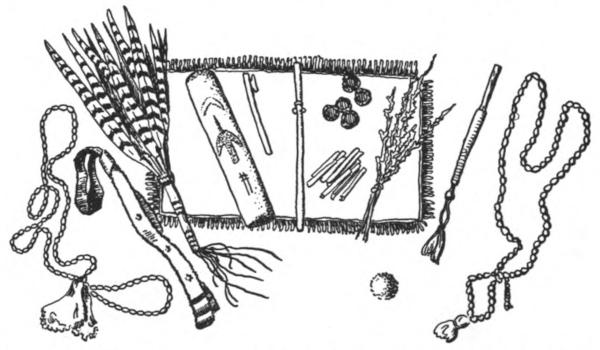
Fig. 2. Peyote paraphernalia. Left to right, Mescal bean necklace; “peyote” necktie from a strip of trade-blanket with selvage stripes, and bead-work representing peyote buttons; beaded and fringed pheasant feather fan; black velvet, gold-fringed altar cloth; smokestick carved with water bird, etc., eagle bone whistle; drumstick; peyote buttons; corn husk cigarette “papers”; bundle of sage plumes; pile of powdered cedar incense; a beaded, fringed, and carved drumstick; mescal bean necklace.
All seated, the leader places the father peyote on the sage sprigs, orienting it by the thorn or mark made when he cut it.[98] After this the ceremony is considered begun, all [48]informal talking and joking ceases, and others entering are late-comers. Everyone begins to stare at the fetish peyote and the flickering fire.[99] Then the leader leans his eagle-humerus whistle against the west outside of the moon, mouth end up, takes out his cedar incense bag, gourd, tobacco, etc., and arranges them conveniently near him.
The first ceremony is smoking or praying together. The leader makes himself a cigarette of Bull Durham with corn husk “papers” dried and cut to shape, and passes the makings clockwise to the rest, including women.[100] His own made, the fireman presents the smokestick to the leader (who may first offer it courteously to his drummer) and this too is passed to the left. While all smoke, the leader prays: “beha´be sęį´ᴅɔki (smoke, peyote power). Be with us when we pray tonight. Tell your father to look at us and listen to our prayers.” He holds his cigarette mouth end toward the peyote and motions upward that it may smoke as he prays:
We are just beginning our prayer meeting. We want you to be with us tonight and help us. We want no one to be sick at this meeting from eating peyote. I will pause again at midnight to pray to you. I will pause again in the morning to pray to you. [Then he prays for the person who is sick or whose birthday the meeting celebrates or for relatives and participants.] If there are any rules connected with you, peyote, that we don’t know of, forgive us if we should break them, as we are ignorant.
All pray silently to ᴅómᴅɔki, “earth-creator” or “earth-lord,” and older men may add their prayers aloud after the leader. Then, following the leader, all snuff their cigarettes in the ground and place them on the west curve of the altar, outside, or at either horn; the fireman may gather those of women, old people or visitors.
The incense-blessing ceremony immediately follows. The leader (or his “cedar-man”) sprinkles some dried and rubbed cedar on the fire; then he makes four clockwise motions of the peyote bag toward the fire, takes out four buttons and passes the bag. Kneeling on both knees, he reaches down beneath the hides or blankets of the seat, and bruises a tuft of sage between his palms, and smelling it with deep inhalations, rubs his hands over and [49]down his head, breast, shoulders and arms, with outward downward movements, ending with the thighs. Though the peyote may not yet have reached them, the others follow suit, reaching out their palms to absorb the blessing of the incense and rubbing themselves.

Fig. 3. Peyote drum with lashing around bosses.
This done, all eat[101] their peyote, to the accompaniment of much spitting out of the woolly center of the buttons; hereafter during the night in the intermissions of singing, anyone can call for the peyote bag (the incense burning may or may not be repeated). Then more cedar is sprinkled on the fire and the leader makes four motions with the staff in his left hand and the rattle in his right toward the rising incense smoke.[102] The drummer motions similarly with the drumstick, pulling smoke from the fire to the drum. The leader takes a bunch of sagebrush from between the tipi-cover and pole behind him (previously prepared by the fireman), holds it with his staff and the singing begins.[103] The drummer shifts his left thumb over the drumhead or sloshes the water inside on it or blows on it to get the proper tension and tone, then the leader holds his staff and sage at arm’s length between himself and the fire and rattles for the Hayätinayo or Opening Song.[104] The leader exchanges [50]his staff and rattle for the drum the latter always passing under the staff,[105] and the drummer sings four songs of his own choosing. The paraphernalia, staff preceding drum, are then passed to the left; each man sings to the drumming of the man on his right, and then himself drums for the man on his left.[106] This singing, rattling, and drumming forms the bulk of the ceremony during the night. At intervals older men pray aloud, with affecting sincerity, often with tears running down their cheeks, their voices choked with emotion, and their bodies swaying with earnestness as they gesture and stretch out their arms to invoke the aid of Peyote. The tone is of a poor and pitiful person humbly asking the aid and pity of a great power, and absolutely no shame whatever is felt by anyone when a grown man breaks down into loud sobbing during his prayer.[107]
About midnight the leader announces that he is going to put incense on the fire after the next four songs, and when he does, everyone blesses himself in the smoke. The announcement gives the fireman time to mend the fire and build up the ash moon[108] and sweep the cigarette butts into the fire. If the paraphernalia are north of the door they are passed backwards to the leader drum first, if at the south (i.e. past the door) clockwise and staff first as usual. Smoking stops, and the leader, to the drumming of his assistant, sings the Midnight Song.[109] When the first of the four is finished, the fireman (sometimes given a [51]feather for this errand by the leader) leaves, gets a bucket of water, returns, sets it in front of the fire and unfolds a blanket on which he sits in line with it facing west. The leader, finishing the second song, blows four increasingly loud blasts on the eagle wing-bone whistle (to imitate the water bird) then replaces it by the peyote and sings the last two songs. While his assistant holds the staff and gourd, he spreads an altar cloth just west of the fetish, and places on this the staff, gourd, sage and his fan, together with the “feathers” of communicants passed to him for this purpose; the drum is to the south of this, the drumstick, etc., on the cloth.
After cedar-incensing, the fireman makes a smoke, puffs four times and prays, thanking those responsible for the honor of being chosen fire-chief, and praying for the leader and his family, the sick and the absent. Next the leader prays, then the drummer, using the same cigarette, and to complete the figure of a cross, the man to the north or “cedar-man” prays. When the butt is placed by the altar, the fireman makes a circuit of the altar and passes the bucket to the man south of the door. Quiet conversation is permitted in the somewhat informal drinking period.[110] When the fireman has drunk, the leader passes back the fans and the paraphernalia to where the singing had been interrupted, and leaves the tipi. He goes about thirty feet east of the tipi, whistles four times and prays, repeating this at the south, west and north.[111] When four songs are completed, he returns, blessing himself in the incense smoke which the drummer throws on the fire.[112] Now is the preferred time to leave the tipi and stretch cramped legs. Singing continues as before until dawn.
As the first grey light appears, the leader tells the fireman to waken or notify the woman who is to bring the water (she has no special seat, if she has attended the meeting). The fireman always brings the midnight water, a woman that at dawn.[113] The leader whistles four times, even in the middle of a song, when the fireman tells him she has arrived outside. When the singer finishes his four songs, the leader calls for the paraphernalia and sings the [52]four Morning Songs; after the first of these the woman enters, arranges a blanket and sits as did the fireman. Finishing the three remaining songs, the leader calls for feathers and spreads them with the paraphernalia on the altar cloth, as at midnight. A smoke is made for the woman, who thereupon prays, after which the leader and his assistants smoke it. Doctoring[114] is best done at this time; the leader may do this, or he may ask an older man to fan the patient with consecrated feathers from the altar cloth.
Then the fireman spills a little water before the fire, the woman drinks, and the bucket moves clockwise as before from south of the door. The woman makes a circuit of the altar, picks up her blanket and takes the bucket out. The feathers are passed out again, and the paraphernalia returned to the place of the next singers in the circle (because of such ritual interruptions, praying, passing of peyote, etc., a complete round of the drum requires two or three hours).
While waiting for the ritual breakfast, the meeting is again somewhat informal. Several women may leave to help the water-woman prepare the food, and younger men may go outside for a stroll and a secular smoke. Old men often lecture younger members on behavior at this time, “preaching” directly to a relative, and more indirectly to others.[115] When he has finished another old man may exhort: “You must do as that old man has said. He’s had [53]experience. What he’s telling you is good.” At this time too visitors are given opportunity to express gratitude for the hospitality of their host, who in turn thanks them for coming.
When the food arrives outside, the fireman notifies the leader, who calls for the paraphernalia and sings four songs, the last of which is the Quitting Song. The food meanwhile is passed in and placed in line with the father-peyote and fire, west-to-east thus: water, parched corn in syrup, fruit and meat.[116] No one sits east of it as in the water ceremonies. The four songs completed, the leader tells the drummer to unlace the drum, and all the paraphernalia are passed around (between the food and the fire at the east) for everyone to handle,[117] as an older woman (“because food is their life-work”) or a Ten-Medicine keeper, who typically functions at such Kiowa group-prayers, asks a blessing. The leader then removes the father peyote from the altar, and when he puts it in his satchel with the rest of the paraphernalia the meeting is ended.
Complete social informality now reigns as the food is passed to the man south of the door and thence clockwise. Much joking[118] goes on during this meal, which has none of the seriousness of the Christian partaking of the Host. When the fireman has finished eating, at the leader’s instruction, he leads the line out of the tipi.[119] The tipi may be taken down immediately, or moved bodily a little, but the older men drift back into its shade and lie around talking and exchanging peyote experiences.[120] As meetings are ordinarily held on Saturday nights, Sunday forenoon is free for such visiting, talking and dozing under arbors. Nearly everyone stays for a secular dinner at noon, and they take home what they cannot eat; sometimes other guests come who have not attended the meeting.
[54]
Having now characterized the Huichol-Tarahumari type-rite for Mexico, the Lipan-Mescalero for the transitional nomad Southwest, and the Kiowa-Comanche as the historical prototype for the Plains, we may attempt a comparison and contrasting of them.
In Mexico as a whole “curing” is perhaps the most salient characteristic, while both curing and doctoring are conspicuous in Mescalero. In the Plains, while doctoring is an important feature it is by no means indispensable.[121] Peyotism in Mexico, therefore, has a tribal character, while in Mescalero the ceremony is a forum for rival shamans—a trait not altogether absent in early Plains rites—and in the Plains peyotism has a societal nature. These facts have an important bearing on the cultural manifestations of the physiological action of peyote. In Mexico visions are turned to the uses of prophecy;[122] in Mescalero they enable a shaman to detect rival witchcraft; while in the Plains, visions are a source of individual power. These categories should not be made too rigid, however, for clairvoyance, if not prophecy, as well as witchcraft anxiety are known for early Plains peyotism, and on the other hand, peyote medicine-power is a source of Mescalero shamanistic rivalry. Yet as indications of relative emphasis these statements might be allowed to stand.
The Mexican symbolisms point to an association with hunting, agriculture and gathering activities, and the typical anxiety expressed in the religion is the desire for rain. In Mescalero, peyote is the focal point for the warfare of antagonistic powers, and expresses the mutual suspicion of formerly small local groups; the intense and ever-present anxiety is the fear of aggression and reprisal by witchcraft. In the early Plains peyote ceremonies, associations with warfare were prominent (influenced no doubt by a forerunner of peyotism there, the mescal bean ceremonialism), though in later times this element had become so nearly absent that Mooney could point quite properly to the “international” character of the cult in his time.[123]
[55]
Areal contrasts in minor points are no less striking. Dancing was conspicuous in Mexico, less important transitionally, and on the whole lacking in the Plains. Painting of a symbolic nature was ritually significant in Mexico; in the Plains individual styles were dictated by peyote visions. Peyotism in Mexico is a seasonal matter, but in the Plains the rite occurs the year around (in the south the trip for peyote may have been associated more with the ritual salt pilgrimage, in the north with the ritualized war journeys; parallels are also suggested in the Maricopa ritualized mountain-sheep hunting and Navaho deer hunting).
In Mexico peyote was a tribal affair and women participated on equal terms with the men in dancing, etc. In Mescalero, women were excluded from meetings, as in the Plains also originally. The rite was held principally outdoors in Mexico, and in a tipi transitionally and in the Plains—a patio arrangement in Mexico, and an altar centering around the “moon” in the Plains. Ritual racing and ball games[124] are part of Mexican peyotism, but not elsewhere. Smoking is inconspicuous in Mexico, but in the Plains it has been important enough to involve church schisms.[125] Huichol peyote had no drum, though elsewhere in Mexico a wooden drum was used, while in the Plains the water-drum (intrusive from the Southwest) is universal. The rasp is Mexican, but the Plains rite has the gourd rattle and eagle wing-bone whistle in addition to the drum. The “staff” is a special problem in the Plains.
The Huichol and Tarahumari have a squirrel fetish in addition to the fetish plant; the Plains have only the latter. Ceremonial drunkenness with tesvino, etc., is an integral part of Mexican “curing”; in the Plains peyote and alcohol are so far mutually exclusive that the familiar propaganda calls the first a specific against the second. The alleged aphrodisiac virtue of peyote is a Mexican belief; but curiously enough in Mexico, where many “peyotes” were said by natives to be aphrodisiac, Lumholtz pronounced Lophophora williamsii definitely anaphrodisiac; while in the Plains, where the natives most strenuously deny this virtue for peyote, enemies of the cult most consistently claim that it produces aphrodisiac orgies.[126]
In Mexico the shaman alone sings, though his assistants may “spell” him; in the Plains all male participants drum and rattle. In Mescalero, though the drum circles the tipi, the staff and gourd remain with the leader. Finally, Mexican and Mescalero peyotism are almost wholly free of Christian elements; so too were the early Plains rites diffusing from the Kiowa-Comanche, though in the John Wilson rite, the Oto Church of the First-born [56](and its successor, the Native American Church) and the Winnebago Rave-Hensley variant, Christian symbolism and interpretations are frequent.
Common elements are numerous: the ceremonial trip for peyote (more elaborate in Mexico, to be sure), the meeting held at night, the fetish peyote, the use of feathers and the abundance of symbolisms connected with birds, the ritual circuit, ceremonial fire and incensing, water ceremonies, the “Peyote Woman,” morning “baptism” or “curing” rites, “talking” peyote, abstinence from salt, ritual breakfast, singing, tobacco ceremonials, public confession of sins, Morning Star symbolisms, and (for northern Mexico) the crescent moon[127] altar. The fear of being blinded by the peyote-fuzz is Mescalero, Lipan and Plains, and the water-drum is shared by both non-peyote Southwestern groups and those of the Plains who have the peyote rite. The use of parched corn in sugar water, boneless, sweetened meat and fruit for the “peyote breakfast” may be regarded as universal for peyotism, wherever found.
[1] Rouhier (Monographie, 91, n. 1) argues immense antiquity for peyotism, circa 300 years B.C., among the Chichimeca on quasi-historical grounds. Our knowledge of peyote from Spanish documents goes back to the sixteenth century in Mexico. A manuscript in the Library of Congress reports the trial of a Taos Indian, February 3-8, 1719, for having “taken peyote and disturbed the town” (cf. Twitchell, Spanish Archives, 2:188). See Bandelier, Manuscript; Mooney, Tarumari-Guayachic.
[2] Adapted from Lewin, Phantastica, 96, and Nicolás de León in Brinton, Nagualism, 6.
[3] Hernandez, De Historia Plantarum, 3:70.
[4] Arlegui, Crónica, 2:154-55 in Urbina, El Peyote y el Ololiuhqui, 26.
[5] Prieto, Historia y Estadistica, 123-24, in Mooney, Peyote Notebook.
[6] Alarcón, Tratado de los supersticiones, 195.
[7] Lindquist, The Red Man, 70-71, is in error in stating that the Zuñi use peyote for religious purposes; moreover the document of 1720 cited refers to Taos, not Zuñi. Mr. An-che Li assures me that the Zuñi lack peyote even today. Lindquist has evidently confused peyote with datura; see for example Safford, Narcotic Plants, 405, 406. Still other plants, e.g., datura, cohoba snuff, coca, yahé, aya-huasca, etc., were used in Middle America as prophetic aids; see for example Safford, op. cit., 393; Gayton, Narcotic Plant Datura.
[8] Bennett and Zingg (The Tarahumara, 135) write that “in a culture where animals are thought to talk and cattle are supposed to warn their masters of impending drought or plague, it is not surprising that plants also are imbued with personality and harmful or helpful attributes. The small ball of cacti is especially revered by the Tarahumara.” Some Mammillaria spp. have a striking resemblance to a head of hair; one figured in Higgins with flowing white “hair” is called “Old Man Cactus”; again, natives have an intense fear of even touching these plants—an attitude recalling the Pima belief that even one drop of Apache blood falling on a person would make him ill (Hrdlička, Physiological and Medical Observations, 243). In this connection it is interesting to note that Spier has collected evidence bearing on the magical use of enemies’ scalps. The magical malevolence of the enemy or his scalp is cited (Warfare) for the Maricopa, Yuman and Piman groups, Navaho, Jicarilla, and Pueblo. The Yumans and Pimans required stringent purification from contact with the enemy or his scalp; the Pimans, again, along with the Navaho and Pueblos turned this power to account in curing and rain-bringing. Spier states that for the Pima-Papago the scalp is turned into an ally against the enemy, and made a specific prophylactic against such enemy-engendered dangers as paralysis, swooning at the sight of blood or a violent death; the Maricopa, indeed, convert a scalp into one of themselves, much as a captive is ceremonially converted and purified. Further still, according to Spier, the Maricopa and Yumans received prophetic foreknowledge of the enemy from these scalps, which therefore they carried with them to war. Still more strikingly, scalps are thought to laugh and cry and babble incessantly, much as the noisily talkative peyote plant is supposed to do.
[9] Lumholtz, Tarahumari Dances, 452; also Unknown Mexico, 1:372-74.
[10] Spier (Warfare) writes that “Clairvoyance on the part of the shaman who accompanied a war party is noted for Maricopa, Yuma, Pima, and Papago [as well as] in the Plains and Plateau.” Zuñi war chiefs, he adds, sought sound-omens on the eve of setting out on the war-path. In this last connection the detailed similarities in attitude and conduct of war-expeditions, peyote-pilgrimages, and salt-gathering expeditions in Mexico and the Southwest should not be overlooked. (The Huichol shooting of the peyote plant, however, is a hunting rather than a war symbolism, that of hunting the hikuli-deer of the peyote origin legend.) Information on the Comanche horse-raid is from E. A. Hoebel; unfortunately the Government took most of these peyote-given horses back again.
In the 1850’s the only Kiowa who ate peyote was Big Horse. When he wished to know the whereabouts of an absent war party he would take a drum and a rattle into a tipi, saying “gʸägūṇboṇta” (I am going to look for medicine), eating peyote and afterward telling what he had seen; sometimes he made the sound of an eagle, the bird that flies high above the earth and sees afar.
C. W., president of the Kickapoo Native American Church, often has prophetic peyote visions; Kishkaton says they are of “Judgment Day” when the “new world” will come, and makes them a proselytizing argument for peyote. The debt to earlier Kickapoo prophets is obvious. A specific Caddo prophecy among the visions collected would have prevented a serious industrial accident if it had been properly interpreted.
[11] In the Plains the “father peyote” is often carried as a fetish. Kroeber (Arapaho, 406) cites a typical case: “The pouches used to contain the peyote plant have room for only one of the disks, which is usually carried more or less as a personal amulet, in addition to being the center of worship during ceremonies. A circular area of bead-work covering the front of the pouch itself, is said to represent the appearance of a peyote-plant while being worshipped. In the center a cross of red beads represents the morning star. Around the edge of this circular bead-work are eight small triangular figures, which denote the vomitings deposited by the ring of worshippers around the inside of the tent in the course of the night. The yellow fringe around the pouch represents the sun’s rays.”
War Eagle, Delaware (Speck, Delaware Peyote Symbolism) told of a man gassed in the World War whom peyote cured after his case had been pronounced hopeless. Quanah Parker, the famous Comanche chief, used to carry a peyote on his chest as protection in battle. A Ponca story tells of J. W. and his wife returning home as a cyclone was coming up; when they finally arrived the house was destroyed, but in an undisturbed drawer they found four articles still intact: a “peyote chief,” a bag of peyotes, a Bible, and a peyote drumstick.
[12] Sahagún, Historia general, 3:241; Histoire générale, 737. Lumholtz (Unknown Mexico, 2:354) adds marihuana to the list of plants which protect against witchcraft injury: the doctor comes on a Tuesday, Thursday or Friday, reverses the ill person’s sandals, shirt and drawers, recites the credo backwards to summon the owl, and burns a heap of marihuana and old rags in the house. Many persons also carry marihuana in their girdles as a protection against sorcery. The Cocopa and Yuma uses of an unidentified plant (awimimedje) to offset fatigue and give luck suggests peyote (Gifford, Cocopa, 268).
[13] De la Serna, in Safford, An Aztec Narcotic, 390; Arlegui in Urbina, El Peyote y el Ololiuhqui, 26; Arias, in Urbina, loc. cit.
[14] See the modern Tepecano votive bowl altar used with peyote or marihuana (Lumholtz, Unknown Mexico, 2:124-25).
[15] Lumholtz, op. cit., 1:284-85. The Wichita use the “mescal bean” in racing, and the Kiowa as a prophylactic against stepping on menstrual blood. Peyote is associated with racing in Mexico by the Huichol, Tamaulipecans, and Tarahumari (Lumholtz, Unknown Mexico, 2:49-50; Prieto, Historia y Estadistica, 123-24; Lumholtz, op. cit., 1:372; Bennett and Zingg, Tarahumara, 136-37, 295, 338).
[16] A Wichita leader envisioned a flag three months before being drafted into the army; the fetish-peyote he carried over-seas miraculously escaped confiscation during an inspection and disinfection of clothing, and because of it he was only slightly wounded in battle. One meeting I attended was in performance of a vow if the Bonus legislation then pending would pass. This same leader prophetically dreamt of how peyote would protect him on a pilgrimage to Mexico and aid him through the customs with a supply of plants, and all happened as predicted.
The Tarahumari dare not touch the dekúba (datura) plant lest they go crazy or die; this presents a problem since the plants are common in their winter caves. The peyote shaman, however, armed with the more powerful plant uproots the datura with impunity. Peyote is the only cure for the otherwise fatal disease which comes from touching dekúba (Bennett and Zingg, op. cit., 138, 294).
[17] Hoebel, Comanche Field Notes; Voegelin, Shawnee Field Notes. The Iowa Red Bean medicine bundle was used for war, horse stealing, hunting and horse racing (Skinner, Ethnology of the Ioway Indians, 245-47, Societies of the Iowa, 718-19). A similar mescal war bundle and cult was present among the neighboring and related Oto. The Red Medicine bundles of the Pawnee contained mescal beans likewise; indeed the Pawnee are thought to be the origin of the Iowa bundle and associated war-dance. The Pawnee “kill” the beans by breaking and stirring them in a large kettle, drinking the concoction toward morning until they vomit, to “clean out” the body. There is an unmistakable similarity to the “black drink” ritual vomiting here (see Appendix 4).
[18] Mulato, sunami, and rosapara cacti, however, protect against Apache machinations; Mooney (Tarumari-Guayachic) cites a Chalája arroyo near Conaguchi (from chärä or chälä, “squirrel,” the epithet of witches) where witches were formerly burned; cf. the use of the squirrel-fetish in the Tarahumari peyote ritual. In Tamaulipas intertribal peace was so precarious that peyote mitotes were commonly held in remote and inaccessible intermediate mountain regions; the recital of war deeds was sometimes part of the rite (Prieto, in Mooney, Tarumari-Guayachic). De la Serna (in Safford, An Aztec Narcotic, 310) describes the use of teo-nanacatl in witching. For Tarahumari witching with hikuli see Lumholtz, Unknown Mexico, 1:314, 323-24, 371-72.
[19] A favorite diversion of witches to weaken the leader was to make his assistants vomit (Opler, The Influence of Aboriginal Pattern). My Kiowa companion vomited in a Ponca meeting, the first he had ever attended in that tribe. He attributed it to their unfriendly feeling and felt considerably relieved when we visited next morning a meeting held by old friends among the Oto; but he himself had once witched a Comanche in a meeting (Autobiography of a Kiowa Indian). Tonkawa data is from Opler, Autobiography of a Chiricahua Apache. The exploits of the Kiowa witch Tonakat have already been mentioned. The Comanche “used it in the old times, but not rightly; the medicine men used it for sorcery, so people got scared and stopped using it” (Hoebel, Comanche Field Notes). Among the Cheyenne, Flacco and Cloud Chief strongly opposed the introduction of peyote; the former said “it was used to witch people and make them crazy.” The Northern Cheyenne (Hoebel, Field Notes) and Lipan (Opler, The Use of Peyote) and Winnebago “fear states” may have a physiological basis.
Mrs. Voegelin (Shawnee Field Notes) quotes an informant: “Wilson showed them how to swallow mescal beads.... N. S. didn’t go; she was afraid of them. The Delaware had it too; she never wanted to go look. John Wilson also taught them how to shoot a person with red beads two inches long; the person would fall down, hard; then John Wilson doctored on them with medicine. [Several Shawnee] crept up in the grass when the Quapaws were holding a Ghost Dance once, at night. S’s wife got shot.... Finally some one spoke to John Wilson, ‘You men, you abuse the women.’ An old Peoria woman who went all the time, and swallowed those red beads—she was kind of crazy—told Wilson that. The agent finally stopped it.... When they were shot, John Wilson used peyote to bring them back.”
[20] Alegre, Historia de la Compañía, 2:219-20; Prieto, Historia y Estadistica, 131. It is not proven that peyote applied externally has an anaesthetic or anodyne action (the Zacatecan use in the childbirth ceremony is internal); but natives recognize the ability of peyote to induce a stuporous state. The Aztec (Gerste, Notes sur le médicine, 51) used peyote to stupify sacrificial victims. But peyote does not cause sleepiness, and the following Maratine Indian battle song (in Prieto, op. cit., 119-20; Mooney, Peyote Notebook) should perhaps be translated “become stuporous:” “The women and ourselves shouting with pleasure, Shall drink peyote and shall fall asleep.” For Opata data see Ensayo, in Mooney, Tarumari-Guayachic; for Lipan see Opler, The Use of Peyote.
[21] Parsons, Taos Pueblo, 59; Flores, in Urbina, El Peyote y el Ololiuhqui, 26; Rouhier (Monographie, 96) adds the Caxcane use “for swellings and spasms”; Hernandez, De Historia Plantarum, 3:70; Safford, An Aztec Narcotic, 295; Bennett and Zingg, The Tarahumara, 294; Hrdlička, Physiological and Medical Observations, 173, 242, 244, 250, 251; Lumholtz, The Huichol, 9; Unknown Mexico, 2:241-42.
[22] Would pupil-dilation from peyote cause temporary “cures” satisfying the uncritical?
[23] Radin, Crashing Thunder, 183, 196; Mooney, The Mescal Plant, 9. Lumholtz (Unknown Mexico, 2:157) himself confidently prescribed peyote for a scorpion-sting.
[24] Beals, Comparative Ethnology, 131 (Acaxee); Rouhier, Monographie, 12, fn. 3 (Tlaxcala). The Kiowa witch Tonakat fixed a fireplace in the form of a turtle, the source of his power, and used a meeting once for shamanistic display, being shot with a cartridge and remaining unharmed, etc. A Caddo-Delaware tells of a famous Kiowa doctor who used similar tricks in doctoring a woman. He held a black handkerchief over her to see the location of the disease, dipped a feather in water, cut the skin and removed two 1½″ bugs, the wound healing immediately. Both popped when thrown into the fire, thus prognosticating her recovery from a twenty years’ illness. Wild Horse (Caddo-Delaware) said doctors did “wizard sleight-of-hand tricks” in meetings; “some Indians can make you believe you see things.” Some Tonkawa who visited the Kiowa about 1890 performed tricks in meeting like eating fire (Mooney, Peyote Notebook).
[25] Lumholtz, Unknown Mexico, 2:241-42.
[26] The suppression of peyote was sought under an act of Jan. 30, 1897 (29 Stat. 506), Sect. 6 of the Food and Drugs Act of June 30, 1906 (34 Stat. 768-72), Sect. 11 of the same act, and Service and Regulatory Announcement No. 13, Dept. of Agriculture, Bureau of Chemistry (issued May 3, 1915)—all without success. Specific Federal anti-peyote bills were next attempted: Senate 1862 (65th Congress 1st Sess. Apr. 17, 1917), House of Representatives 10669 (64th Congress 1st Sess.), House of Representatives 4999 (65th Congress 1st Sess. June 12, 1917), House of Representatives 2614 (65th Congress 2nd Sess. May 13, 1918-Oct. 7, 1918). These all failed of passing. An anti-peyote proviso attached as a rider to Appropriations bill House of Representatives 8696 of March 28, 1918 was deleted before passage, under pressure from a powerful and alert Indian lobby. Later bills were House of Representatives 398 (66th Congress 1st Sess.), House of Representatives 2071 (about March 29, 1924), House of Representatives 5057 (not passed by Senate, but amended as:) House of Representatives 5078 (about Jan. 24, 1924, 68th Congress 1st Sess.)—all defeated. The Senate bill 1399 of Feb. 8, 1937 is pending at the present writing.
State laws against peyote have been more successful. The Oklahoma law of March 11, 1899 was automatically repealed by omission in the codification of the state laws; the Darnell bill of 1927 was defeated April 13, 1927. The following states have anti-peyote laws: Colorado (before 1923), Idaho, Iowa, Kansas, Montana (by 1925), Nebraska, Nevada (by 1918), New Mexico, North Dakota (before 1923), South Dakota, Utah (before 1918), and Wyoming (1929). The Native American Church is incorporated in Oklahoma and Montana, however, under state charters.
[27] The trip is made after the rainy season and the corn harvest (Lumholtz, Unknown Mexico, 2:127); the roasting of corn is of equal ritual importance with the hikuli-harvest and the deer-hunt: the three, indeed, deer, corn and peyote are symbolically the same (Lumholtz op. cit., 2:156, 279).
[28] Lumholtz, Unknown Mexico, 2:82, 126-27, 141, 157, 271, 272; Handbook of the American Indians, 1:576-77; Klineberg, Notes on the Huichol, 449. For the gourd-symbolism see also Lumholtz, op. cit., 2:57-58, 129, 220; for the arrows, Handbook of the American Indians, 2:663.
[29] Cf. the universal corn shuck cigarette of Plains peyotism (a region of deep-rooted pipe ceremonialism), a remarkable case of culture-continuity.
[30] Lumholtz, Unknown Mexico, 2:129-35.
[31] Lumholtz, The Huichol, 8; Unknown Mexico, 2:129-32, 141, 277-78; for the use of the water see 2:57-58, 220.
[32] Cf. the Plains mode of preparing the meat, though the memory of the meaning of this feature (like the corn shuck cigarette and ritual parched corn) is long since gone.
[33] Lumholtz, Unknown Mexico, 2:132-35, 153, 156, 189, 271. The triple corn-deer-peyote symbolism is completed when the women grind peyote on a metate.
[34] Lumholtz, Unknown Mexico, 2:54, 272, 273-74. Cf. the Plains “fire-stick” and fire-arrangement.
[35] Lumholtz, Unknown Mexico, 2:29-31, 142-44, 149-50.
[36] Spanish friars came in after 1722, but Huichol peyotism is almost wholly free of Christian beliefs (Handbook of the American Indians, 1:576-77). Even the “baptism” rite is probably native.
[37] Klineberg (Notes on the Huichol, 449) mentions special dances led by “angels” the next day—a boy and a girl dressed in their finest. It is not clear if this refers to the dance leaders or to the ceremonial “race for life” with the eating of cake-animals and spraying of the runners by the elders. But elsewhere Lumholtz describes a dance with carved bamboo serpent-sticks, deer-tails on short sticks, and whiskbroom “combs” (Unknown Mexico 2:49-50).
[38] Lumholtz, Unknown Mexico, 2:272, 274-75.
[39] But the whole peyote ritual might be divided into (1) the trip for hikuli, (2) the deer hunt, and (3) the roasting of corn, though peyote-deer-corn are symbolically identical.
[40] Lumholtz, Unknown Mexico, 2:279. Tamaulipecan peyotism is similarly a hunting and first-fruits ceremony.
[41] “The idea of the antlers being arrows readily occurred to the Huichol, since they are the animal’s weapon of attack and defence” (Lumholtz, Symbolism of the Huichol, 69).
[42] Lumholtz, Unknown Mexico, 2:7-8, 56, 172-73, 201-203; Handbook of the American Indians, 1:663b; Symbolism of the Huichol, 42, 66, 71, 174; The Huichol, 10.
[43] Bits of deer meat, corn-tamales and strung peyote-plants are treated with exactly equivalent ritual. In the peyote dance serpent-sticks are thrust into the air (like prayer sticks, praying for rain?), and small whisks made of materials brought from the hikuli-country represent deer-tails. In the origin legend, peyote first arose in the tracks of a gigantic deer; indeed, when the gods first used peyote they ground deer-antlers on a metate with water to make an intoxicant, just as peyote is ground to make “tea” and corn to make tesvino. The fire is built in a special way suggesting deer-antlers or the god-chairs. Arrows as definitely symbolize prayer as the prayer sticks of the Southwest. The poker or fire-arrow of Grandfather Fire is smeared with blood and decorated with plumes; it is his “pillow” and the rest of the sticks are his “chair.” (One “appearance” of the god is a heart, modelled of the paste of the sacred wáve seed toasted and ground like corn, and renewed in the god-house every five years.) Facial paintings of the Huichol are called úra, “spark,” being made of a yellow root dug in the peyote country when the hikuli is gathered; yellow particularly symbolizes the fire gods, of whom there are two. Tatévali, “Grandfather Fire,” is the god of prophesying and curing shamans whose birds are the macao, royal eagle, cardinal bird, etc. The other, Tatótsi Mára Kwári, “Greatgrandfather Deer-tail,” is the god of singing-shamans, whose bird is the white-tailed hawk. Their relationship is peculiar: Greatgrandfather Deer-tail, the symbol of fertility, is the son of Grandfather Fire, from whose plumes he sprang. Lumholtz (Symbolism of the Huichol, 10-11) explains the difficulty by indicating that the former represents a spark, the latter a fire fed by wood.
[44] Bennett and Zingg, The Tarahumara, ix, 136, 291-92; Mooney, Tarumari-Guayachic; Lumholtz, Tarahumari Dances, 453; Unknown Mexico, 1:362.
[45] Bennett and Zingg, op. cit., 292; Lumholtz, Unknown Mexico, 1:363. The rasp is not used in the fiesta on returning from the trip, but in later ones.
[46] Lumholtz, Unknown Mexico, 1:171-72, 343-44, 363-64. The shaman’s women assistants are called rokoro, “stamens”; he is the pistil—a botanically erroneous symbolism, however.
[47] The Tarahumari rasp is definitely associated with peyotism, indicating (Bennett and Zingg, The Tarahumara, 71) a Huichol provenience; but they list rasps for the Cora, Mayo, Pima (“rain sticks”), Hopi (in the kachina dance) and N. Paiute (to charm antelope into a corral). The rasp is not exclusively Uto-Aztecan however; it occurs for the Wichita, Hidatsa, Salinan, and archaeologically in Illinois. Tarahumari Brazil-wood rasps are brought from the hikuli-country.
[48] Lumholtz, Unknown Mexico, 1:313, 363-66; Bennett and Zingg, op. cit., 293; Mooney, Tarumari-Guayachic.
[49] Lumholtz, Unknown Mexico, 1:367-69, 371; Bennett and Zingg, The Tarahumara, 293. Near Eagle Pass a folk-Catholic saint is El Santo Niño de Jesús Peyotes, whose attributes are a staff, gourd, feathered hat and basket similar to but distinct from El Santo Niño de Atoche. In Mexican legend he is a little boy; his statue is in the cathedral or cathedral square at Rosales, Mexico. Another attribute is said to be the crescent moon.
[50] Lumholtz, Unknown Mexico, 1:292-93, 314, 344, 347-48, 371-72, 384; Bennett and Zingg, The Tarahumara, 294. The ceremony is called napítshi nawlíruga, “moving (dancing) around the fire” (Lumholtz, Unknown Mexico, 1:364). In the dry season the Tarahumari dance the yumari almost nightly to the Morning Star, and sacrifice tesvino to the sun; a man is often deputed to do the dance alone while the others work in the fields, to bring rain (Lumholtz, op. cit., 1:352). The Morning Star is important in the Cora rite too (Lumholtz, op. cit., 1:344; Preuss, Nayarit-Expedition, passim) as well as figuring in Plains peyotism, though somewhat vaguely.
[51] Lumholtz, Unknown Mexico, 1:357-58, 444; Bennett and Zingg, The Tarahumara, 360, 366-67, 379, 383.
[52] Beals, Comparative Ethnology, 131. He adds, though, that “This [use] may also be aboriginal, and very probably dates back to the separation of the Huichol from their peyote-using relatives, the Guachachiles.” He cites Thomas and Swanton (Indian Languages, 22) but evidence is meagre. For the Cora we have Ortega (in Safford, An Aztec Narcotic, 295, and Narcotic Plants, 402): “Close to the musician was seated the leader of the singing whose business it was to mark the time. Each of these had his assistants to take his place when he should become fatigued.... They began forming as large a circle as could occupy the space of ground that had been swept off for this purpose. One after the other went dancing in a ring or marking time with their feet, keeping in the middle the musician and the choirmaster whom they invited, and singing in the same unmusical tone that he set them. They would dance all night from five o’clock in the evening to seven o’clock in the morning, without stopping or leaving the circle. When the dance was ended all stood who could hold themselves on their feet; for the majority from the peyote and the wine which they drank were unable to utilize their legs or hold themselves upright.”
[53] Prieto, Historia y Estadistica, 123-24.
[54] Beals, Comparative Ethnology, 131.
[55] Sahagún, Historia general, 3:241 (Chichimeca); Prieto, Historia y Estadistica, 119-20, cites a Maratine Indian (Tamaulipecan) peyote song referring to war. Arlegui, in Urbina, El Peyote y el Ololiuhqui, 26; see also Rouhier, op. cit., 12, note 3, 96, 331, note 3; Alegre, in Urbina, op. cit., 26; Preuss, Die Nayarit-Expedition, 39. The Morning Star is the principal Cora god (Lumholtz, Unknown Mexico, 1:511, see also Handbook of the American Indians, 1:348a). Elder Brother among the Huichol is the god of wind and hikuli (Lumholtz, Symbolism of the Huichol, 42). The Tarahumari dance yumari for the Morning Star (Lumholtz, Unknown Mexico, 1:344). In the Plains the drum-lacing signifies the Morning Star. Spier (Yuman Tribes, 165) writes: “[The battle leader’s] song first described the morning star, ‘big star,’ which in some unidentified way is connected with war. Just what was his function in battle was not ascertained.” He also dreamed he saw cacti fighting like men.
[56] Mooney, Tarumari-Guayachic; Sahagún, Historia general, 3:118; Ortega, Historia del Nayarit, 22-23; Lumholtz, Unknown Mexico, 1:367-68, 2:274-75; Prieto, Historia y Estadistica, 123-24.
[57] Racing (Tarahumari, Huichol, Tamaulipas, Acaxee): Lumholtz, Unknown Mexico, 1:284-85, 2:49-50; Prieto, Historia y Estadistica, 123-24; Beals, The Acaxee, 8.
[58] Beals (Comparative Ethnology, 127, 141, 211-12) lists it for Southern Mexico, Jalisco-Tepic, Southwest.
[59] Lumholtz, Unknown Mexico, 1:362, 2:54; Bennett and Zingg, The Tarahumara, 295. See also Wissler, The American Indian, 213; Handbook of the American Indians, 1:604b. In the Plains some tribes differentiated twigs and leaves as male and female.
[60] The Tarahumari feast for the moon involves smoking to make clouds (Lumholtz, Unknown Mexico, 2:130; Tarahumari Dances, 441). The Huichol carry “tamale” cigarettes in their gourds and offer them to Grandfather Fire.
[61] Bennett and Zingg, The Tarahumara, 67; Beals, Aboriginal Survivals, 32; Russell, The Pima, 168; Spier, Havasupai Ethnography, 272; Lumholtz, Unknown Mexico, 1:313; Opler, The Influence of Aboriginal Pattern, The Use of Peyote; Sayles, An Archaeological Survey, Table 2; Oliver, in Gatschet, The Karankawa Indians, 18; Gatschet, in Swadesh, Chitamacha Texts; Kroeber, The Seri, 14, 42; Roberts, Musical Areas, 21; Paz, Koasati Field Notes; Bartram, Travels, 502; Speck, Yuchi, 61.
[62] Tarahumari officials are called igúsuame, “stick-bearers” (Bennett and Zingg, op. cit., 375-76) but this may be an Hispanicism. However, Aztec merchants (Sahagún) carried staffs. But so far as the peyote ritual is concerned, the staff is not mentioned for the Cora-Huichol or Tarahumari; and the various names for the peyote staff in the Plains suggests either an indigenous or a Southwestern, not a Mexican, origin.
[63] Bennett and Zingg, The Tarahumari, 71, 293-94; Lumholtz, Unknown Mexico, 1:366-67. The Tarahumari hunter used a notched deer-bone rasp. The Cora, Mayo, and Pima, Hopi and Northern Paiute suggest a general Uto-Aztecan occurrence of the trait, but the rasp, is also Wichita, Hidatsa.
[64] Prieto, Historia y Estadistica, 123-24. See the Plains section for discussion of drums.
[65] A little white flower, tōtó, of the wet corn-producing season symbolizes corn for the Huichol and is a prayer for it, being plastered on women’s cheeks, woven in girdles, etc. (Lumholtz, Unknown Mexico, 229-30). The Tamaulipecan rite celebrates the harvest and deer-hunting as well as war; the Tepehuane all-night rite with a mimicry of deer-hunting ends with a feast on the first “toasted corn” of the season (Lumholtz, 1:479). Acaxee corn toasted on the ear was the usual food on war-parties (Beals, 10). Concerning the standardized parched-corn in sugar-water of the Plains, note that the Aztec made offerings of toasted corn (sometimes with honey), and to the culture-hero Opuchtli offered mumuchtli “a sort of corn which when toasted opens up and shows the white marrow [popcorn] forming a very white flower. They said this represented hail, which is attributed to the water gods.” (Sahagún, A History of Ancient Mexico, 1:36, 40, 87.)
[66] Bennett and Zingg, The Tarahumara, 138, 295; Lumholtz, Unknown Mexico, 1:357-58 (wherein all but the last named are cacti), 2:124-25 (Tepecano). The accepted etymology of teo-nanacatl, “divine mushroom,” suggests the same attitude; in the Antilles “among the most prominent of the plants worshipped ... [are] mushrooms, pines, opuntias, zapos, and zeybas.” (Rafinesque, cited in Bourke, Scatological Rites, 91; but Rafinesque is an undependable authority). The Cherokee called casine yapon (the “black drink”) “the beloved tree” (Bartram, Travels, 357). It is also said that in Virginia toadstools were an object of worship because of their mysterious growth (Bourke, ibid.). In Peru coca was looked on with veneration and suppliants must approach priests only with some in their mouths. Compare the use and attitudes toward tobacco, mescal beans, datura, guarana paste, cohoba, chocolate (Theobroma cacao), aya-huasca, yahé, etc.
[67] Lumholtz, Unknown Mexico, 2:172-73, 207, 263 ff. The Huichol had hikuli-shields; curiously, Crow-Neck (Kiowa) about 1860 made a peyote shield according to a vision he had at Mescalero, but he threw it away when he was captured on his first fight in Mexico. The Kiowa, however, had heraldic shield-societies before peyote, of which this is probably an aberrant example. (For the bird and arrow equation see Spier, Yuman Tribes, 331, Lumholtz, op. cit., 2:201-202.) See also Lumholtz, op. cit., 1:313, 323-24, 371-72; Tarahumari Dances, 452.
[68] Bennett and Zingg, The Tarahumari, 294.
[69] Lumholtz, Unknown Mexico, 1:311, writes: “Without his shaman the Tarahumare would feel lost, both in this life and after death. The shaman is his priest and physician. He performs all the ceremonies and conducts all the dances and feasts by which the gods are propitiated and evil is averted, doing all the singing, praying, and sacrificing. By this means, and by instructing the people what to do to make it rain, and secure other benefits, he maintains good terms for them with their deities, who are jealous of man and bear him ill-will. He is also on the alert to keep those under his care from sorcery, illness, and other evil that may befall them ... the Tarahumare ... keeps his doctor busy curing him, not only to make his body strong to resist illness, but chiefly to ward off sorcery, the main source of trouble in the Indian’s life.”
[70] Beals, Comparative Ethnology, 128.
[71] This entire section is summarized from data collected by M. E. Opler. I gratefully acknowledge the courtesy and generosity of his lending me the article The Influence of Aboriginal Pattern before publication, as well as The Autobiography of a Chiricahua Apache, and unpublished notes on Lipan, Tonkawa and Carrizo peyotism; it would be difficult to establish Mexican-Plains continuities without these invaluable data and the warm coöperation of Dr. Opler.
[72] The Mescalero are listed neither in Shonle (Peyote: The Giver of Visions, 53-75) nor in Newberne and Burke, Peyote. Mescalero peyotism, like Tarahumari, is on the decline.
[73] The Lipan make a smoke and pray when the first plant is found; they are hard to find unless one eats one, then “a noise like the wind” comes, and one by one the plants appear “just like stars.” Only the tops are cut off.
[74] Though this was general in Mescalero ceremonialism, they also controlled the weather thus, found lost objects, located the enemy, etc.; a Chiricahua prayed for health, in the name of Yuan and Child of the Water. The Lipan formerly did not use it for doctoring apparently. The Tonkawa, according to Mooney, performed shamanistic tricks in peyote meetings; and a Carrizo chief, for example, filled the tipi once with down-feathers blown from his mouth, then sucked them all in save one which he gave to a Lipan visitor. Others made a bear, turtle, and buffalo, etc., appear.
[75] The Lipan wash themselves with yucca or soapweed and perfume themselves with mint, and use the same kind of sage in meetings as they wear in their hats against lightning. The Tonkawa wore G-string, leggings and blanket, and preferably long hair and face paint; native perfumes were proper but white men’s were forbidden. The Carrizo entered barefoot, wearing only a G-string. Some Lipan fasted the day before.
[76] The Lipan leader “is supposed to stop all arguments in there; he has to watch all the men.” Unlike the Mescalero, the Lipan staff and gourd were passed around clockwise (both preceding the drum); the retention of these by the leader is probably an aspect of his special authority among the Mescalero, since the Lipan lacked the rasp, retained by the leader, which might have been transmitted from Mexico. The Tonkawa sometimes used a lard-can drum covered with buckskin, and passed the rattle (aberrantly) after it; the leader never drummed.
[77] Some shamans trace a cross of pollen on the chief peyote. The Tonkawa use the largest one they can find, put some red paint on the top, and surround it with smaller buttons on a fine buckskin; they claimed to be able to see far off with the aid of peyote and to detect witchcraft. Some Lipan like the Mescalero put peyote buttons in a circle around the fire pit and the chief peyote (cf. the Comanche placing of them in a sage horseshoe west of the altar).
[78] The Lipan fire-tender, like the Carrizo and some Mexican groups, made simply a fire-pit, with no crescent altar; this form originated with the Mescalero or in northwestern Mexico, not around the lower Rio Grande. The Carrizo, like the Tamaulipecan, held the ceremony in the open.
[79] The Lipan used peyote green or dry or pounded up in a wooden bowl, which was passed like the drum from the southeast. The Carrizo made a peyote “tea” (compare the neighboring Karankawa “black drink”). The Tonkawa used a flat basket. Among the Mescalero (also Lipan and Kiowa), “Care was taken to keep the ‘fuzz’ from the top of the peyote button from coming in contact with the eye, for it was thought to cause blindness.”
[80] Not all Mescalero leaders do this; oak-leaf cigarettes are usually used but one leader has a red stone Sioux pipe, which is passed clockwise. The Lipan smoke oak-leaf or corn husk cigarettes at the beginning and at the end. Their eagle wing-bone whistle in peyote is recent, and not all Mescalero leaders use it.
[81] The Carrizo on each side of the door had a woman wearing a red blanket; the one at the south had hers fastened with a red flicker feather, the other with a woodpecker. This non-exclusion of women is Mexican. But the Lipan allow no women around; they may not even erect the peyote-tipi. The Tonkawa originally allowed no women in peyote meetings; but doctoring gradually broke down this restriction.
[82] “The virulence of these rivalries and attempts to harm others at peyote meetings led to the development of a number of protective measures and safeguards.” For these see Opler, The Influence of Aboriginal Pattern.
[83] In the old shamanistic curing, the shaman was the performer and the others merely onlookers, but in peyotism the inevitable physiological effects of the drug made all present potential receivers of power, and shamanistic display and rivalry was correspondingly increased. This had not wholly disappeared even in early Plains peyote-using groups: the Tonkawa, Lipan, and Kiowa had shamanistic displays of power in peyote meetings, and we have recorded considerable witchcraft anxiety in early Kiowa, Comanche, Caddo, and Tonkawa meetings.
[84] The reasons for this are several: a nomadic people presents few opportunities for the establishing of missions; the Apache were one of the American Indian groups last subjugated; they are notoriously suspicious and unfriendly toward innovation, and recognized the alien origin even of peyotism; and further, the rite they received from Mexico had few or no Christian elements in it. It might be suggested that the “baptism” ceremonies in the morning or the ritual breakfast are Christian in origin; but this is thoroughly doubtful, since it occurs in pre-White peyotism (e.g., Lipan).
[85] In the Plains, peyotism largely followed the Ghost Dance frustration of anti-White sentiment and preached conciliation instead; such Christian elements as were added had a largely propagandist function in this direction.
[86] Wagner, Entwicklung und Verbreitung, 74; Shonle, Peyote: Giver of Visions, 55.
[87] As told, this seemed to have reference to the miraculous proliferation of the Biblical loaves and fishes, but it is sufficiently similar to aboriginal hunting beliefs.
[88] The Comanche and others usually had a meeting on the spot, eating green peyote.
[89] The Kiowa now have five Easter meetings, six on New Year’s Day, four to six on Thanksgiving, and two or three on Armistice Day (by World War soldiers and sailors). Bert Crow-lance vowed to eat a hundred if all the Kiowa boys returned safely from the War (but this is an enormous quantity actually to have eaten). The Kiowa differ from other groups in having no funeral meetings; mourners commonly abstain for several months from meetings. Meetings have been held for heyoka-like display. The Comanche formerly held meetings before a war journey to invoke peyote’s protection from the enemy, and to prophesy the outcome of the battle.
[90] “A sweatbath was always undergone by warriors preparing for war ... and perhaps generally, before any serious or hazardous undertaking.... Sweating was important in medical practice for the cure of disease.... Sometimes the friends and relatives of the sick person ... assembled in the sweathouse, sang and prayed for the patient’s recovery” (Handbook of the American Indians, 2:661b). The peyote meeting and sweating present many such analogies.
[91] Painting is commonly dictated in visions: a Kiowa saw a red-bird after a meeting once as a red-blanketed man who told him to use red paint thereafter. Comanche formerly went in wearing only breech-clout and “blanket,” being painted white or yellow all over the body. One Comanche had an all-over body yellow with blue zigzags up the arm and down the side and leg, with a red zigzag paralleling this (on the outside of the arm and therefore on the inside of the leg); on each cheek a small blue-bordered red spot, and a large three-inch red spot on the breast under the throat. The Tonkawa painted the top of the fetish-plant red also. Leaders often wear otter skin braid-coverings, and at certain points in the ritual fur headdresses. Mescal beans as necklaces or on moccasin- and gourd-fringes are common (the Kiowa wear them on their moccasins as protection against stepping on menstrual blood). The “blanket,” or sheet (in the summer), is invariable.
[92] Mooney (A Kiowa Mescal Rattle, 64-65) describes a Kiowa gourd with the Peyote Woman, peyote, moon, ash crescent, and Morning-Star under her feet heralding her morning approach with water.
[93] The basic rite is practically free from Christian symbolism. Some call the sage under the fetish a “cross”; some leaders make a cross under the water-bucket or in the water with feathers at midnight. Mooney wrote that “many of the mescal eaters wear crucifixes ... the cross representing the cross of scented leaves ... while Christ is the mescal goddess.” But all crosses are not necessarily Christian. See Appendix 8.
[94] Older men carry real “feathers,” but younger ones often bring small, ribbed, commercial, folding ladies’ fans—an interesting compromise. The Comanche nácihita “resting-stick, to walk,” was formerly a bow, according to Hoebel, on war-party meetings, while the drum was formerly of wood. The Lipan formerly used a bow, hit with a stick.
[95] Following a suggestion of Dr. Wissler, I made a special note of this and found that the ubiquitous satchel is as much a “trait” of the peyote leader’s paraphernalia as his staff or gourd or feathers.
[96] The Kiowa moon is crescent-shaped, the Comanche horseshoe-shaped—a significant point in tracing provenience of altars in other tribes. Some Comanche garland the entire west side of the altar with sage, in which the fetish rests. In war the Comanche used a shield as an altar. A cement moon made by a Choctaw adopted by the Kiowa was an innovation much in disfavor, as was a Seminole altar made among the Caddo; the symbolical interior of the latter was removed to make a simple crescent. Indeed, many Caddo are moving away from the John Wilson symbolic cement moon.
[97] Cf. the Huichol “pillow” for Grandfather Fire.
[98] Belo Kozad’s (Kiowa) father peyote had been Quanah Parker’s (Comanche) and was handed around after the meeting almost as an heirloom. Mumsika (Comanche) still preserves a famous peyote button of Kutubi’s (Hoebel). Howard White Wolf (Comanche) has a peyote he addresses as “older brother” since it had cured him as a baby. Clyde Koko (Kiowa) quit peyote one Christmas night and gave Charley two father peyotes to take back to Laredo and plant with smoke and prayer; uncertain, the latter brought them back to find Koko had completely changed his mind: “I never made such a mistake in my life. If you’d done that it sure would have ruined me. I’ve learned a lesson!”
[99] “The neophyte is constantly exhorted not to allow his eyes to wander, but to keep them fixed upon the sacred mescal in the center of the circle.” (Mooney, The Mescal Plant, 11). Changing the cross-legged position too often, leaning backward on one elbow or the like to rest is considered frivolous, indicating lack of seriousness. One may leave the meeting at any time with permission, but it is best to try to wait till after midnight, unless there is the emergency of nausea from peyote. In leaving and entering the leader is always consulted to see if the path to one’s seat is “clear,” i.e., that no one is eating peyote or smoking; as smoking or eating peyote is conceptually praying, it is extremely bad manners to pass between a person doing either and the altar fire, hence the need for instruction from the leader. This is old Plains etiquette (Handbook of the American Indians, 1:442b). Thus, to avoid his having to pass before smokers, the brand might be passed backwards to the fireman; his movements in tending the fire never entail passing before anyone, and the feather given him by the leader symbolizes delegation of power to enter or leave as necessary for wood. But no one may pass between him and his seat while tending the fire.
[100] Corn shucks are standard, but Comanche and Shawnee sometimes use black-jack oak-leaves (just so the materials are native). Interestingly, the elbow pipe is never used in the Plains, but at Mescalero a pipe was used instead of the usual Southwestern cigarette—a case of reverse or reciprocal borrowing.
[101] There are many individualized modes of eating peyote. Hoebel describes a Comanche way: chew into a ball, spit into palm of hand, rub in clockwise circle, swallow bolus. On the war-path one spits in his hands again and rubs his head and ears, the better to hear. Belo said he once ate a button when each person sang. Kiowa often make several clockwise motions of buttons toward the fire before eating, to prevent nausea, or hold the palms out toward it and rub themselves. One may request another to chew peyote for him if he has bad teeth or is sick, and swallow the bolus so prepared. The number of buttons eaten ranges from four to about thirty.
[102] Mooney (Miscellaneous Notes) mentions an odorous root from New Mexico, but is unclear about its use; cedar incense was universal in the writer’s experience. The sage may be passed around also; some chew, eat it.
[103] Cf. the whisk of sage used in sweat-bathing; in view of other parallels, this otherwise functionless item in the peyote meeting should not be overlooked.
[104] This is the first of four sets of four songs each, sung at stated times in the ritual; the others are: Yáhiyano (midnight water song), Wakahó (daylight song for morning water) and Gayatina (Closing Song). All are Esikwita (Mescalero); all end with a fast unrhythmical shaking of the gourd. The two Kiowa groups sęįhoṇ (Peyote Road) and Goihoṇ (Kiowa Road) differ in that in the former only the initial song of each group is set, in the latter all songs of all four groups are set.
[105] There are specific and detailed rules about passing the paraphernalia. Ordinarily, save in the case of the leader and his assistant at the opening song, etc., the paraphernalia (here the staff) never move counter-clockwise. The drum always passes inside the staff, i.e., proximally, the staff at arm’s length in the left hand, the drum being passed under it with the right, when for any reason this occurs. The symbolism of this is perhaps obvious. A man may not be the singer more than once in a round, but he may be successively drummer, singer and drummer. (Though the staff may not go backward, the drum may, and in this case A receiving the staff, passes the drum with his right hand under his outstretched left, from the man on his right to the man on his left, B. A then sings to B’s drumming; the staff is then passed forward from A to B, and the drum exchanged or passed backward from B to A, this time A drumming and B singing. Still going clockwise, the staff may be passed from B to C, and the drum from A to B, C singing this time and B drumming a second time.)
[106] At the east door the drum may be passed as stated to the second man so that the first man south of the door gets a chance to sing (because the fireman is too far away to drum for him) then an exchange and normal passing again, staff first. If a person right of the singer is old, sick, a woman or a visitor, he may request a friend to drum for him of the leader; the friend moves clockwise and sits by him temporarily. Women neither drum nor rattle nor sing (but like other participants they tend to sing softly favorite songs or the universally known set songs). Men try to make their four songs different from those previously sung, but favorites may be repeated.
[107] Kutubi (Comanche) in a war-party peyote meeting once visioned that they would be killed, and wept and upbraided peyote for doing this. H. H. (Wichita) during a meeting wept with total unrestraint for his brother and nephew, who had been hurt in an auto accident.
[108] The Kiowa sometimes make a humming-bird of the ashes (a prominent Kiowa family is called Hummingbird); cf. the Comanche, Oto, Shawnee, Yuchi and (?) Ute ash-birds.
[109] Peyote Road cultists: one fixed song, three optional; Kiowa Road: four fixed songs. The words of the standard song are unintelligible. Many tribes use their own language for these set songs (e.g., one Winnebago group). The schism in the Kiowa, if such it may be called, is excessively minor and communicants of one are freely welcomed in the other; though it purports (probably wrongly) to be the original and more pure rite, the Kiowa Road (led by Atape) is felt to be an uncalled-for variant.
[110] Mooney (The Mescal Plant, 8) writes: “At midnight a vessel of water is passed around, and each takes a drink and sprinkles a few drops upon his head.” We believe Mooney has slipped into error here, for this “baptismal” ceremony comes in the morning when the contents of the drum, not the bucket, are used. Non-Kiowa data likewise agree on this point. According to Mooney, the leader drinks first among the Comanche. The Caddo drink no water at this time: “One must suffer to peyote.” Such abstemiousness with a thirst-producing substance like peyote suggests the psychological flavor of the vision quest. Note that Anhalonium means “without salt.” “If there is suffering, this is the time. That’s the reason I took a good rest so I could stand it. Many a time I have fallen over at this time. The hour of the Crucifixion. Everyone is suffering now ... the dark hour” (Simmons, in Peyote Road).
[111] “The four whistles at midnight by the leader outside the tipi are to notify all things in all directions that they were having a meeting there at the center of the cross ... calling the great power to be with us while we were drinking so that it could hear our prayers and bless us” (Hoebel, Comanche Field Notes).
[112] Others may be incensed when they reënter too, and everyone holds out his fan for the blessing. If a communicant is smoking when another reënters, it is good manners to place the cigarette on the ground temporarily that he may pass in front of him.
[113] There is a suggestion that this woman, usually the wife of the sponsor, symbolizes sęįmąyi or “Peyote Woman”; the Morning Star heralds her approach (see Mooney, A Kiowa Mescal Rattle).
[114] Doctoring is second only to the vision for individual knowledge and power in the Plains. Kiowa peyote doctors have special prestige among other tribes. In 1936 I sponsored a Kiowa meeting near Stecker, Oklahoma, for Belo Kozad to doctor Ernest Kokome who was suffering from tuberculosis. (Ernest had given me his trade-blanket beaded peyote-necktie in 1935 on the morning after a meeting at which I had admired it.) After midnight, Belo chewed four peyote and gave them to Ernest, fanning him with feathers and cedar incense; then he made a cross in front of the patient with a glowing coal, and, putting it in his mouth, blew all over the face and chest of the sick young man, who unbuttoned his shirt for the purpose. Next Belo fanned or batted him with his feathers, the patient holding up his palms to absorb the medicine virtue. Finally he took a mouthful of water and blew it on Ernest’s head, praying and beseeching in the name of Jesus Christ for him to get well. Peyote gave Belo the power to doctor thus and not be burned by the coal.
Peyote was brought to the Creek, indeed, for doctoring by Jim Aton (a famous Kiowa peyote doctor). Much in demand, he has doctored in peyote meetings of the Yuchi, Shawnee, Kickapoo, Creek, Caddo, Osage, Comanche, Kiowa Apache, Kiowa, Mescalero Apache and Quapaw; also whites and Mexicans. His methods of doctoring have been described previously. The well-known Comanche peyote doctor, Jim Post-oak, “hollers like a bear in doctoring.” (People often imitate the animal-sources of their power in the morning, in the midst of others’ singing, either from peyote-“euphoria” or in praise of particularly good singing.) Peyote doctoring by Old Man Horse (Kiowa) influenced the Oto rite of the Church of the First-born too. Peyote can perform cures unassisted outside meetings also, as shown by the case of Tommy Cat who ate peyote over the protests of his nurse in a hospital and was cured.
[115] Polonian obviousness is usually the note in these harangues (sit up straight and keep awake in meetings, wear clean clothes and bathe before coming, wear a blanket, keep your mind on good things in the ceremony, don’t look around the tipi, don’t drink whiskey, don’t lie to your wife or show off, but pray for your wife and children, respect old people, humble yourself, go home again if you come to a crowded meeting)—but occasionally specific admonitions are made. A Kiowa jokester, J. S., had had trouble with his wife, and was plainly talked to in meeting. Quanah Parker used to lecture young people in the morning. Long prayers are another means of making psychological transactions. Some tribes make individual public confessions at this time.
[116] Mooney, The Mescal Plant, 8.
[117] Some rattle the marbles of the drum, put them in the mouth and spit them into the palm. Members commonly “baptize” themselves with the drum-water, using the drumstick to moisten the palm and rubbing the hair, face, chest, arms and thighs as in blessing with cedar incense; some paint themselves with the charcoal in the drum. The remaining water in the drum is poured along the moon. The sage under the peyote may be passed to the patient, if there is one, or it may be requested for absent ailing relatives.
[118] Sometimes the stories have a moral point; the following was told by O. W. (Comanche) to E. R. (Delaware): the leader of a Wichita Easter meeting had a fine watch, costing from $150 to $200. At daylight, before water time, wanting to display it, he put it down by the feathers. A man to the north was singing and making vigorous punches toward the peyote. When he looked at his watch later, “it was just a mess of works in there loose, and the hands dropped off,” though nobody had touched it. “It don’t pay to go in there and then try to show off.”
[119] “The first shall be last and the last shall be first.” Hoebel says the Comanche fire-chief takes one step outside, turns completely around once, and continues his way, the others exiting in a straight fashion. Cf. the Huichol turns.
[120] A Comanche told me a Kiowa ate a lot of peyote once and tried to sing a Comanche song. He sang the wrong words, which meant “Mentula exposita est, Mentula exposita est!” (Cf. the Oto jokes about songs.) A typical experience of Belo Kozad involves the hearing of a new peyote song, psychological anxiety, a moral, and an explanation about power-getting: A peyote song, without words, once came to him in a vision. He seemed to be in the south, in soft grass. In the distance he saw a man, whom he followed. He did not know it, but this man represented Temptation. Belo followed the man, who was leading him off somewhere. Suddenly the man kicked backwards with his foot [a familiar folkloristic element] and went on. When Belo approached he found apples there; he refused to take one. Further on the man kicked back with his other foot. This time Belo found dollar bills and playing cards; these he refused too. A third time he found pictures of beautiful girls in various poses, but he withstood temptation. Finally he came to the top of a hill, over the brow of which the man had disappeared ahead of him. Then he heard the man talk to him from behind: “The apples, the cards, and the pictures all meant temptation. You have withstood them all. Upon the top of this hill you will find good fortune if you take this peyote.” Belo went up and saw there a terrible chasm, crossed by a bridge of a single tipi pole. The man said that the pole had to be crossed with four steps; if he did this he would have great curing power. The man danced forward and backward across the pole to show Belo, singing this song the while. But Belo was afraid to cross the chasm and turned back thus not acquiring the curing power.
[121] Indeed, among some groups like the Caddo, doctoring is expressly absent.
[122] In Mescalero, too, “prophecy and advice were no small part of the performance. It was rarely that his power did not vouchsafe the shaman some reassuring information concerning the longevity of his patient, the number of grandchildren with which he would be blessed, and the future state of his fortunes.” They also controlled the weather thus, found lost objects, located the enemy, etc., but doctoring was the main feature of Mescalero peyote meetings.
[123] Shonle (Peyote: Giver of Visions, 57) notes that peyote was latterly a reservation phenomenon, when tribal enmities were gone. The Ghost Dance had been anti-White; peyotism was a compromise, and the friendly intertribal contacts growing out of the Ghost Dance could now be exploited.
[124] Cf. Tamaulipecan rites and the black-drink ball-game of the Southeast. (The black drink was as nearby as the Karankawa.) The Southwest-Southeast connections are more than superficial; Beals (Comparative Ethnology, 142) believes there is a probable connection of Southwest-Mexican alcoholic drinks with the Southeastern black drink.
[125] Curiously the cigarette of the region farther west is universal in the intrusive Plains peyote rite, while at Mescalero the stone elbow pipe is passed around in the calumet fashion of the Plains in one leader’s ceremony.
[126] Is this a culture-environmental problem?—for the same substance which was spectacularly aphrodisiac in Lame Deer, Montana, was stubbornly anaphrodisiac in Philadelphia. Unfortunately for the accusing school of thought, Bennett and Zingg’s trait-distribution tables indicate a negative association of sexual promiscuity and the ritual use of peyote in Mexico.
[127] Opler says that “in no other Mescalero ceremony is a mound of earth in the shape of a crescent found. On the other hand, crude earth tracings did grace a Mescalero rite occasionally, and the moon was much in evidence in ritual song and design. The staff of the peyote shaman seems an innovation at first thought; yet it has a counterpart in the ‘old age stick’ held by the singer in the girl’s puberty rite.” The gourd in Mescalero has exclusively peyote associations. On the whole, the standard Plains ceremony appears to have taken shape among the Lipan-Mescalero. But Curtis (North American Indian 19:199-200) says that the White Mountain Apache were the first United States users and that “the ritual [in the United States] is obviously copied from the Wichita ceremonial form.”
[57]
We have now compared the basic Plains rite with that of Mexico and the transitional Lipan-Mescalero. Yet an independent development of this basic rite in the Plains and a multiform flowering of the cult there, influenced by older cultural concepts of a different nature, necessitates a discussion of more minute variants within the region. In other words, we have determined in the previous section the major variations of the peyote ceremony as aboriginally constituted, and now trace the fate of the cult as it invaded a different cultural terrain and came under the influence of other culture patterns, including the Christian.[1]
Trip for Peyote. A typical nine-day trip was made by the Cheyenne in 1914 from Watonga, Oklahoma, to Laredo, Texas. Ten “peyote boys” contributed the total cost of $61.85, and several suitcases full of buttons were brought back (about 1,400 each); these were bought from a White dealer in Laredo.[2] Another time a Southern Cheyenne, then President of the Native American Church, brought back a special trailer full of peyote from Romer, Texas. The northern Plains tribes make infrequent pilgrimages for the plant, depending largely upon supplies shipped from Texas or bought from Indians nearer the source. One Wichita leader sold 40 acres of land to buy a car in which to make a trip to Mousquis, his fourth or fifth such trip in about ten years. An early Comanche party going for peyote in the Apache region had much the character of a war journey; as described by Hoebel it involved a clairvoyant discovery of the enemy, prophecy of the outcome, and a horse-raid. Typically, however, the Kickapoo “chip in” money for peyote pilgrimages, and precede this with prayers for the safe-keeping of the travellers.
Rite at Site. The Lipan[3] say that
peyote is pretty hard to find when you are looking for it ... a person who is not used to it doesn’t recognize it though he is in the middle of a whole clump of peyote. Once he sees one, another appears and so on until they all come out just like stars. If you are having a hard time finding them you do this: when you find just one by itself you eat it. When it takes effect, when you get a little dizzy, you will hear a noise like the wind from a certain direction. Go over there ... from the place where the noise is coming you will get many peyote plants.
Mrs. Voegelin[4] reports an interesting Shawnee concept:
You can get power by visiting the peyote patch in Texas, and telling it at evening that you want help to cure people and get medicine. You sprinkle tobacco there. The next morning, when the [58]Morning Star comes up, the person goes to the patch where he put the tobacco and when he comes close he hears a rattler rattling. If he has nerve enough to go over there, likely he does not find a snake there, but just something to scare him. If he does find a snake there, he grabs the rattlesnake (which is coiled up on top of the medicine) and takes it off and then he picks one peyote button from that place. Then he goes to another bunch and picks another button.... Perhaps at the fourth spot where he picks his fourth button, the snake is there again and he must remove it.... Jim Clark related this defying of a rattlesnake to the obtaining of another very powerful herb in the old days.[5]
The typical Plains gathering ceremony has been described to the writer for the Kiowa, Wichita, and Kickapoo: one sits west of the first peyote found and makes a smoke-prayer before orienting the plant with a thorn or mark that it may be properly used as a “father peyote” later; this first plant shows the gatherer where to find more.
Vowing of Meetings. Spier has traced the pattern of “vowing” the Sun Dance in the Plains and it is interesting to note the persistence of this trait in the peyote ceremony. It is particularly a pattern of the Algonquian-speaking peoples; but we have recorded it for the Kiowa and Wichita as well as the Shawnee, Kickapoo, and Northern Cheyenne.[6]
Time of Meetings. Peyote meetings are generally held Saturday nights so that the forenoon of the following Sunday may be spent relaxing and talking under a “shade”; but the Comanche and Seminole sometimes set theirs for Sunday night, following the White pattern for religious meetings.[7] The Caddo, Tonkawa and Lipan often had four meetings on successive nights, particularly for sick persons; the Caddo sometimes mark four birthdays with meetings a year apart. Holiday meetings on Easter, New Year’s, Thanksgiving and Christmas are common; an Arapaho meeting was once held with a Christmas tree. Many tribes like the Northern Cheyenne drink tea outside meetings, when practising songs or “to sharpen one’s mind” when solving some particularly knotty personal problem, but some groups maintain that it is forbidden to use peyote outside meetings, for it would be useless then, even for doctoring. The frequency of meetings throughout the year would be difficult to ascertain, though there is no seasonal restriction as in Mexico; perhaps one or two meetings a month in each tribe might be an average number when the whole year is considered.
Purpose. Doctoring of the sick is the commonest reason given for calling a meeting; but though infrequently expressed as an official motive, the vision-producing physiological effect of peyote is probably the major reason. However, so various are the stated purposes of meetings, that one is led to conclude that when a man wishes to have one, he ordinarily finds little difficulty in discovering a reason for it. A Lipan Apache said,
[59]
In the early days they just had a good time for one night. It was not used as a curing ceremony then.... At first they wanted to have good visions, that’s what they were after. But then, recently, they began to use it as a medicine for sick people.[8]
The Kickapoo and Caddo do not doctor in meetings; the latter pray for the sick, however, and commonly have four meetings in close succession for this purpose, as well as on the first four anniversaries of a child’s birth or a man’s death.
The primary reason for Northern Cheyenne meetings is social, with doctoring second; they knew of meetings held for rain, but despite prolonged droughts in their region never made them themselves. Comanche formerly held meetings to exercise clairvoyance about the enemies’ position, to obtain protection from them[9] and to ascertain by prophecy the outcome of battle; like the Mescalero they also held meetings to divine and combat sorcery, and one meeting was held to celebrate the surveying of their lands. Delaware meetings were for the welfare of the community in general, to show hospitality to visiting friends and to mark the first four anniversaries of a death.[10] Kickapoo hold meetings to obtain rain, in consolation for a death, to name a child[11] and for a dead person.[12]
Mescalero ate peyote to locate the enemy, to find lost objects and to foretell the future as well as for curing.[13] The Osage have funeral meetings, and meetings to “see the face of Jesus” or the faces of their dead relatives;[14] the Oto say they can see the deceased in meetings too. In the Oto Church of the First-born, Jonathan Koshiway baptized, married, and conducted funerals; the Pawnee have no funeral meetings but celebrate birthdays, New Year’s Eve, Christmas and Easter.[15]
A typical Ponca meeting attended at White Eagle was to doctor a sick child with peyote tea. Another, a Shawnee meeting at McCloud, had been vowed if the soldiers’ bonus legislation passed Congress. One Shawnee held meetings for his eldest daughter yearly for thirteen years; sometimes they hold purely social meetings and for health and doctoring, but not for rain. Wichita, on the other hand, set up meetings to pray for rain and good crops, on anniversaries, and for doctoring; and a Wichita “bonus” meeting was held in 1936. Prophecy has been present in Wichita meetings also. The Winnebago[16] have death-consolation [60]meetings, death-anniversary meetings and meetings to doctor the sick. At Taos[17] meetings are for curing, or simply when “someone thinks they ought to have a peyote meeting.”
Participants. The Carrizo had two women by the door to bring water into the meeting, but the Lipan permitted no women to be present or even erect the tipi. In the early days the Kiowa, Comanche, Tonkawa, Sauk, and Oto prohibited women from attending, and only old men used peyote, but forty or fifty years ago women started coming in to be doctored and gradually came in for other reasons, though they could not use the ritual paraphernalia; under no circumstances may a menstruant woman enter.[18] The restriction against women appears to apply only to groups who early had peyote, when it still had much of the flavor of a warriors’ society about it; for example, the Arapaho, Cheyenne, Ponca, Kickapoo, Mescalero, Shawnee, Taos and Wichita apparently always allowed women to attend.[19] In the Iowa meeting the women formed the outer of two concentric circles, the men the inner, and the former were allowed only two buttons.[20] Women never use eagle feather fans.
Some tribes, like the Caddo, still have a strong objection to the presence of White men in meetings, but other groups do not object to White men as such.[21] A number of tribes have a bias against the attendance of Negroes, but this is not the case at least with the Kiowa, Wichita, and Kickapoo.[22]
Visiting. All Indians, however, of whatever tribe, are welcome in the meetings of all other tribes.[23] For example, at a Shawnee leader’s meeting at McCloud there were 12 Kickapoo, 6 Shawnee, 3 Caddo, 2 Kiowa, 2 Whites, a Wichita, a Seminole, a Sauk-and-Fox, an Oto, a Potawatomi and a Negro—a not untypical aggregate.[24] Individual users visit around a great deal in trying to “learn about peyote”; an old Kickapoo user had been in meetings of the Arapaho, Cheyenne, Caddo, Delaware, Wichita, Apache, Kiowa, Osage, Yuchi, Sauk-and-Fox, Oto, Iowa, Shawnee, Comanche, Pawnee and Ponca. Indeed, the very origin legend of peyote indicates a period of beginning intertribal contacts, and peyotism [61]in later days became the specific vehicle of intertribal friendships, when mutual warfare disappeared.
Place of Meeting. The typical place of meeting for the Plains, as well as Taos, Mescalero, and Lipan, is the tipi. The Arapaho-Winnebago peyote tipi has twelve poles, symbolizing the earth.[25] The Pawnee have special painted tipis for peyote, as in the Ghost Dance; and, like the Pawnee, the Wichita and Winnebago dismantle the tipi immediately at the end of a meeting.[26] The Osage, Quapaw, Omaha, Northern Winnebago and others[27] have special peyote churches, or “round houses” (really polygonal), and many, like the Taos, hold winter meetings in the home of some member.
But meetings were held elsewhere too in the past. The Carrizo had meetings in the open within a circle of sticks. The first Kiowa meetings took place within a circle of upright poles with canvas stretched around it, open to the sky; Comanche also used simple wind-breaks as do even now the Northern Cheyenne, who sometimes also hold the ceremony on a hill-top in the open.[28] The Caddo have held meetings in a canvas-covered subconical “stick house” holding over forty people in two rows; and the Bannock of Idaho, on account of opposition to peyotism, have held meetings in backwoods log-houses—in short, the holding of the meeting in a tipi, while common and typical, is not ritually required.
Bathing. The Lipan customarily washed their hair in yucca suds before a meeting, and perfumed themselves with mint. In the Plains and at Mescalero they take a sweatbath or a bath with water; the Arapaho[29] plunge once against the current and once with it, then rub themselves with teaxuwineⁿ or waxuwahan and other scented plants. The Osage build a sweat lodge as an integral part of their church, in a direct line east of it. A man in Hominy specializes in giving Osage old-style sweat baths, but some of them somewhat ostentatiously travel to Claremore, a hundred miles away, to take “radium baths” before meetings.
Painting. Face and body painting is recorded for the Arapaho, Comanche, Delaware, Kiowa, Oto, Shawnee, Tonkawa, Wichita and Winnebago, yellow being the commonest color used by the Arapaho and Comanche.[30] A Kiowa story tells of the acquiring of [62]an individual paint design in a vision of a red bird which turned into a man. The Tonkawa even painted the fuzz on the top of the fetish peyote red, according to Opler. Painted stripes symbolize for the Wichita the extent of one’s experience with peyote: a beginner paints the part of the hair yellow and puts one blue line on his face, adding up to four finally: “He’s supposed to know something then.” Both men and women painted for Winnebago meetings.[31]
Clothing and Headdress. Formerly native dress was prescribed for Plains peyote meetings, and even now a blanket (in summer a folded sheet) among male communicants and a shawl among female is common—to symbolize affiliation with “blanket Indians.” Younger men, otherwise in ordinary White dress, often wear a “peyote-necktie” made of an old-fashioned trade blanket, beaded, and with the selvage-stripes as a design; soft neckerchiefs drawn through rings with “water-bird” and “Morning-Star” designs are also common. The Arapaho[32] water woman wears a symbolically painted buckskin dress; men wear special wrist-bands and headdresses of yellow hammer and woodpecker feathers. Carrizo men wore only a loincloth in meetings, not even moccasins; the women attendants wore red blankets, the one to the north with woodpecker feathers and the one to the south with a red flicker feather.[33] Iowa wear Kiowa-Comanche style leggings, the thongs of which are knotted with “red medicine” or mescal beans.[34]
A turban or head-scarf has been observed among the Delaware, Shawnee, Kickapoo, Wichita and Winnebago,[35] but the otter-skin cap of the Kiowa and Winnebago is optional. At Taos the variant dress of the “peyote boys” has become a symbol of the strife of the old and the new. The young men who use peyote cut out the seats of their trousers, thus converting them into a G-string and leggings and necessitating a blanket, and let their hair grow in Plains fashion.[36] Among older Osage men the “roached” style of scalp lock was formerly still in vogue, but the younger men who have adopted the peyote religion wear their hair long, parted and braided on each side with ribbons and yarn.[37] Among the Winnebago, on the other hand, the progressivism of the peyote cult demands that long hair be cut, and Crashing Thunder discovered that it was a “shame to wear long hair.”[38]
Ritual Restrictions. Salt may not be eaten on the day that peyote is consumed among the Huichol, Tarahumari, Arapaho, Comanche, Kickapoo, Wichita, etc.; the distributional gaps are more likely gaps in our information than lack of the taboo, which is probably [63]universal at least among the early Plains users of peyote.[39] It is also considered hygienically if not ethically unwise to use peyote in connection with alcoholic drinks; indeed, many insist that the former cures addiction to the latter. The Arapaho[40] did not bring sharp instruments into a peyote meeting, a taboo elsewhere unreported.
Officials. The “road chief” is the most important individual in a meeting. Kroeber writes of the Arapaho leader in a manner which might apply to any Plains leader:[41]
The leader of each ceremony is sole director of it. He may ... base [his ceremony] partly on visions during previous ceremonies. In other cases, he follows ceremonies that he has participated in, changing or adding details to suit his personal ideas. No two ceremonies conducted by different individuals are therefore exactly alike; but the general course of all is quite similar.
We do not agree with Petrullo that the leader is a mere “figurehead.” Indeed, as we shall see later, the variation in ceremonies is a function of leadership far more than of tribal affiliation. The leader has full authority to change the ceremony in any way he wishes, and his permission must be asked and secured even in such little matters as leaving the tipi temporarily; even the fireman, his chief assistant, constantly consults with him and receives directions.[42]
In fact, peyote leadership is a matter bringing much prestige, and in these days is a major means of advancement among one’s fellows. John Rave, Albert Hensley, Jonathan Koshiway, Quanah Parker and John Wilson find parallels to a less degree in all peyote leaders, and rare is the man who does not seize the opportunity presented by his authority to introduce some change, however trifling, into the ceremony.[43] Each tribe has a limited number of recognized peyote leaders which can be named. The Shawnee, for example, have nine only and the Pawnee have only eight recognized leaders in a population of eight hundred. In the case of the Osage the number of leaders is further limited by the number [64]of permanent “churches” available; Murphy lists eighteen “East Moons” on the reservation and three “West Moons.”
Originally the officials in a peyote meeting appear to have been limited to the “road-chief,” drummer, and “fire-chief.”[44] The “cedar-chief” is a later development. Among the Winnebago the leader, drummer and cedar-man symbolize respectively the Father, the Son and the Holy Ghost, and the leader gives the drummer his staff even as God delegated authority to Jesus.[45] In the Quapaw “Big Moon” the officials number eight: three firemen north of the door (required since every person must be fanned with feathers every time he reënters the tipi), the leader, drummer and cedar-man west of the altar, and in addition “one good man” at each arm of the altar-crucifix cross-piece.
Economics. On the basis of 13,300 peyote users in 1922 (and the number has since substantially increased) in the United States alone, it is clear that the cult is of economic significance in a number of ways. The price of peyote from dealers in Laredo, who supply most of the northern Plains and Great Basin users, is from $2.50 to $5.00 a thousand buttons; it is said that “the inhabitants of the small town of Nuevo Laredo, on the Mexican side of the Rio Grande, derive their livelihood almost exclusively from the peyote trade.” Schultes estimates $20,000 as the annual commercial transactions involved north of the Rio Grande.[46]
The Tarahumari used to combine their peyote journeys with trading and other commercial transactions, but the trip was otherwise profitable since peyote itself commanded a good price; Lumholtz says one plant cost a sheep at one time in Tarahumariland, and he himself was asked $10 for a dozen plants.[47] The Huichol sold part of their harvest sometimes to non-pilgrims.[48]
In the Plains the sponsor usually meets the expense of a meeting himself, but some groups like the Oto pass around a vessel in the morning for a “free-will offering.” At Taos the peyote chief bears the expense, though others may make contributions to help defray the cost. The chief expense at Tarahumari, as elsewhere, is the sacrificial beef. The total cost of a meeting varies considerably, according to the number of persons fed at the secular meal the next day. Meetings that Mooney attended in 1918 cost $15, $58 (including a beef [65]costing $35), and $80 respectively, but these amounts seem excessive. The writer has sponsored an average meeting costing only about $15, and Hoebel has supplied “groceries” for meetings at from $6 to $10 only.[49]
Considering their importance and authority, it is not surprising that the peyote chiefs come in for some financial recompense. The Tarahumari peyotero was given a quarter of the slaughtered beef, and one peyote doctor at Narárachic made his entire living by peyote cures. Several Kiowa doctors nearly or completely match this. A Sioux doctor at Taos was given a silk dress of the patient’s wife, a belt and $5 cash. Indeed, one of the complaints against Wilson, the Caddo-Delaware peyote messiah, was that he over-exploited the financial opportunities afforded by peyote leadership.[50] Victor Griffin (Quapaw) claims to be the only man authorized by Wilson to make Big Moons, and for the building of a small Quapaw “round house” near Miami, Oklahoma, he and his assistant, Charles Tyner (Quapaw) received $750. There was and is considerable exchanging of gifts in connection with peyote meetings and intertribal visiting; feathers, drum sticks, etc. are common gifts, as well as “father peyotes” which have become heirlooms.[51]
Amount of Peyote Eaten. The minimum number of buttons eaten by each participant is usually four. Several persons claim to have eaten 75 to 100 or more, but the average is nearer a third or a fourth of this.[52] Personal observations tend to confirm Mooney’s estimate [66]of 12 to 20 as a night’s average consumption; he said that 90 was the most any Kiowa had ever eaten, and he believed this was possible since the individual was powerfully built—although that number would amount to about a pound and a half. This may be so, but one is skeptical of alleged consumptions of more than 30 or 40 average-sized buttons in the dry form. For the green form we should set the maximum at considerably fewer, perhaps 15 or 20 good-sized plants, which even so is a liberal estimate. About 300 each was the average for two Winnebago meetings, and assuming an ordinary group of 20 communicants this amounts to only 15 buttons apiece. We should call this a fair estimate of the average for beginners and old users combined in a meeting; before accepting larger estimates it should be recalled that there is a certain prestige in eating and retaining large amounts of peyote, a fact which may color statements somewhat. Peyote is also consumed as tea, especially by the old and the sick; in one case 24 discs made 15 cups of tea, and in another 30 made 2 quarts of the infusion. A pneumonia patient drank the latter, one cupful every two hours, to induce perspiration deemed necessary for his cure.
Peyote Paraphernalia in General. Typical Plains peyote paraphernalia includes minimally the leader’s satchel, gourd rattle, water drum, drum stick, staff, feathers, eagle wing-bone whistle, corn shucks and loose tobacco, bags for peyote and cedar incense, altar cloth, sage, water bucket and ritual-breakfast containers. The rasp is not used by the Lipan or Mescalero or in the Plains, and the whistle is recent for the two former. The Lipan previously used a bow struck with a stick in place of the later one-sided tambourine drum; the kettle drum, from Mexico, is still more recent.[53] Mescalero shamans sometimes added the use of pollen, which they used to trace a cross on the father peyote, and like the Tonkawa, occasionally served the peyote on woven trays instead of in bags. Taos paraphernalia is standard Plains in type. A common color for Arapaho peyote objects is yellow; Skinner thought the bead-work on Iowa gourds and magpie feather fans indicated a Kiowa or Kiowa-Apache provenience. Among the Delaware and others each devotee has his own gourd rattle, but this (like personal drum sticks and feathers) may not be used until after midnight.[54]
Staff. From ancient times, and possibly before Columbus, the cane or staff was a symbol of authority in Mexico,[55] and for this reason we should hesitate before labeling this feature of peyote an Hispanicism. Again, Opler equates the staff of the Mescalero shaman (which [67]he holds throughout the ceremony, not passing it around with the drum) with the “old age stick” held by the singer in the aboriginal girl’s puberty rite.
Similar syncretism with older patterns seems to have occurred also in the Plains. The Comanche used a bow for a staff when holding peyote meetings on the war path, but the term naci-hιta means literally “resting stick-to walk,” according to White Wolf. In the Iowa Red Bean war bundle ceremony, the rattle was held in the left hand [sic] while the bow and arrow were waved in the right as the person sang. The Delaware call the leader’s staff “arrow,” and so also do the Osage, Quapaw and Oto; the Ponca, on the other hand, call it a “bow.” The Kiowa suggest that a bow was formerly used, but the term ᴅo’ᴅęⁱä means “brace-to hold-stick”; it must be of bois d’arc (Maclura pomifera C. K. Schneider), however, and some are nocked at the top and bottom like a bow. The Lipan “cane” was called ilkibenatsi´e or “ram-rod.”[56]
The Shawnee, according to Mrs. Voegelin, called the peyote staff the walking stick of the old, but the red tassel at the top symbolized the headdress worn with a single feather at the war dance. The t’owayennemö of Taos was held in the left hand “for the strength of life,” and the red and white horse-hair tufts encircling the top (so Dr. White was told) were there “because the White man is above the Indian.” A Delaware staff which Dr. Speck saw contained designs representing a tipi, water, the door of the lodge, the blue sky and fire, symbolized by the colors of the bead-work.
Reinterpretations of the meaning of the staff are common. A Wichita called it the “staff of life.” The Iowa staff represents the staff of the Saviour, while the Winnebago variously interpret it as a shepherd’s crook and the rod with which Moses smote the rock (in obvious reference to the leader’s calling for water in the ceremony). Differences in the staff have even come to symbolize a schism in the Winnebago church: that used by Rave was decorated, as elsewhere in the Plains, but Clay used a simple undecorated staff, lacking even feathers, calling attention to the fact that Moses staff was undecorated.[57]
Gourd Rattles. Rattles made of gourds (Lagenaria spp.) have become universal in the Plains since the spread of peyotism; but the Iowa had a small gourd rattle with beaded handle in their Red Bean war bundle dance, and the peripheral-Plains distribution of this trait in pre-peyote times has been traced elsewhere. Some groups (Delaware, Osage, Ute, etc.) have individual rattles for each participant.[58] A large one seen at Apache, Oklahoma, made by Spotted Crow (Cheyenne) had drawn on it a moon with a fire and a Morning Star in negative, together with the following “Jesus talk:”[59]
[68]
A Wichita gourd was said by one informant to represent the world or sun; the beads are “people talking” and the bead-work in general is “things on the earth,” while the horse-hair tuft dyed red on the top represents the rays of the rising sun. A Delaware gourd of Dr. Speck’s has bead-work on its handle symbolizing morning (blue), fire (red) and a row of X X X’s (the songs sun).[60]
Drum. The standard peyote drum, already described for the Kiowa, made of a small iron kettle with seven bosses in the lacing, is found also among the Arapaho, Comanche, Iowa, Cheyenne, Lipan, Pawnee, Ute, Shawnee, Kickapoo, etc.[61] The Kickapoo say the seven marbles represent the days of the week, just as the twelve eagle feathers of the fan symbolize the twelve months of the year; the four coals which are dropped into the water of the drum are lightning, the water rain and the drumming itself thunder.[62]
In drumming, the vessel is given an occasional shake to wet the head with the contained water, and the left thumb is used to test the tone and tighten the head: sometimes too the head is sucked or blown upon, so that the water is forced to ooze through the skin. The Ponca, however, do not permit the drum head to be touched—“peyote makes the sound, not the hand,”[63] they say—and hence make a handle of the lacing-rope twisted upon itself. [69]Old Man Sack (Caddo) also forbade blowing on the drum, “even when it cups up and sounds like a tin can,” a Kiowa peyote-boy said; in the stricter Caddo moons no water is drunk until the drum has made four rounds, with the result that some of their meetings consequently last well into the forenoon of the next day—a genuine ordeal according to informants. Among the Iowa, and possibly also in some Caddo Delaware “Big Moons” the drum chief accompanies the drum around the circle, drumming for each singer. The Jesse Clay style of drumming among the Winnebago, described by Densmore, is common among the southern tribes: a rapid unaccented beating before the beginning of the singing, gradually slackening to match the speed of the voice. Another mannerism may be noted at the end of each song, when the rattle is shaken unrhythmically as fast as possible during the last few bars of the song, then suddenly stopped with the last drum beat.[64] The water drum is typically Southeastern in distribution, but its presence in the Plains peyote cult must be accounted another Southwestern feature, inasmuch as it was standardized and diffused over the Plains before Southeastern groups in Oklahoma received peyote and hence could have introduced the trait into it.[65]
Feathers. Feathers are important in peyote symbolism. In the original Comanche rite only the leader brought in a medicine fan with him; “now many young men bring them who have no special business to.” Skinner wrote that eagle feathers were “badges of the society” among peyote-using Iowa; women were never allowed to use eagle feathers in [70]meetings, however. Younger Oto men carry modern ribbed folding-fans, older ones commonly an entire wing. The individual fans of the Northern Cheyenne, as elsewhere, are not produced until the full effects of the peyote come on, some time after midnight. The eagle feather fans of the Winnebago represent the wings of birds mentioned in Revelations, while the Kickapoo state that the twelve feathers of the eagle fan symbolize the twelve months of the year; twelve is a common Delaware ritual number also.[66]
The Arapaho hang bunches of feathers on the northeast, northwest, southeast and southwest tipi poles to brush off the bodies of tired worshippers. The Mescalero use eagle feathers as a spoon to feed their first peyote to neophytes. The Winnebago, like other tribes, pass a feather around with the staff in its circuit. The Kiowa, Ponca and others use feathers in the water rites: the former make a cross in the midnight water with the feathers of all present, held in a bunch, while the latter place a single feather across the top of the bucket and whistle along the feather. The use of feathers among the Ponca, where cedar incensing is not a strong trait, is especially conspicuous: a feather is passed to the fireman as a symbol of authority, allowing him to leave the tipi without express permission each time from the “road-man,” and there is a “baptism” with feathers in the water ceremonies too. The vanes of Ponca feathers are often notched. The red blankets of the two Carrizo women helpers were fastened with a woodpecker and a flicker feather respectively.[67]
Feathers are common in visions too. A Kiowa envisaged his barred hawk-feathers as a ladder rising through the smoke hole of the tipi to heaven, like a Jacob’s Ladder, and another time as rippling water. Feathers are commonly arranged and cut, colored and tufted, etc., in accordance with visions seen during meetings.[68] Jonathan Koshiway (Oto) had assembled a favorite fan from individual gift feathers, each of which had a different history—one from an old Osage woman who wished for him her long life, two from Hunting-horse (Kiowa), and the like. An interesting development in the Big Moon ceremony is the ritual necessity for each person to be fanned at the fire by the fireman or others every time he re-enters the tipi. This trait is Delaware, Caddo, Osage and Quapaw[69] in distribution, the latter having two special “guards” at the north and south arms of the altar cross who are charged with fanning each entrant; ordinary incensing with cedar has been reported even among the Ute and is probably universal in peyotism. Perhaps with the same purpose in mind, protection from dangerous influences, the Mescalero takes an eagle feather from either side of the door as he makes his exit, returning as soon as possible.[70]
[71]
Birds. We have already noted the importance of birds in Huichol and Tarahumari peyote symbolism, and are to discover that they are equally significant in the Plains. Here the “water-bird” somewhat ambiguously suggests a bird that lives in the water or the bird involved with the whistling for the midnight water. Arapaho songs refer to peyote and the birds which are its messengers, and sparrow hawk, yellow hammer and other woodpecker feathers are common in their meetings. When the fireman goes to get the water he carries an eagle wing, and the whistling which he makes is said to imitate the cry of a bird in search of water (the end of the eagle wing-bone whistle is finally dipped into the water bucket, as though it were the bird drinking).[71]
The Comanche peyote bird is the “sun-eagle,” said to be just under the rising morning sun; “Comanches always mention that bird in their meeting.” This bird, the kʷina-óhap (literally, “eagle-yellow”), which is represented in the shaped ashes west of the peyote fire, “flashes like the sun; ... water bird feathers are used just because they are pretty.” In this connection it is interesting to recall the Tarahumari place name Couwápigóchi, “place of the wapigóri,” from the name of a fishing bird, “a cross between an eagle and a hawk, with feet like an eagle,” which the Mexicans call aquillala, and the brilliantly colored macao and other birds belonging to the Huichol “Grandfather Fire.”[72]
The Kiowa represent their “water-bird” on peyote tie-slides as a long-necked bird like a kingfisher or crane; these have been traded all over the Plains. If a Kiowa peyote-user sees an eagle in a vision, he thereafter carries his eagle-feather fan in his left hand as a sign of this.[73] The peyote bird is prominent in symbolic Kiowa paintings also. Jonathan Koshiway, the Oto peyote teacher, said:
The peyote spirit is like a little humming bird. When you are quiet and nothing is disturbing it, it will come to a flower and get the sweet flavor. But if it is disturbed, it goes quick.
Hence the admonitions to sit quietly in meetings and “study” to see if you can “maybe learn something.” Tom Panther, a Shawnee leader, called the ash-bird
a holy bird; it drinks as well as we do of the holy water [i.e. some of the ritual water is poured on the ash-figure in the morning] and it gets alive a little when people drink, and from then on is lively until morning.
The martin is said to be the Shawnee peyote bird, as indicated perhaps in the “scissors-tail” shape of some ashes. A Mexican who had long lived with the Wichita had an interesting [72]vision during the water-ceremonies of an Arapaho meeting, when he saw a white feather of the leader “turn into Christ and boss the bald-eagle feather of the fireman around.” The association of birds with peyotism, therefore, appears to be universal in the Plains and Mexico alike.
Fetish Peyote. Peyote is the only plant toward which the Kiowa and other typical non-agricultural Plains tribes have a religious attitude and from which they can get “power.” Yet the fetishistic attitude as a psychological phenomenon is not unknown in the Plains of pre-peyote times; the Kiowa taime or Sun Dance image and the “Ten-Medicine” bundles have widespread parallels in the Plains—the Cheyenne fetish-arrows and sacred heart, the Iowa red bean war-bundles, and the ubiquitous medicine-bundles of which the Blackfoot are a type.[74] The Arapaho wore the fetish-plant in an amulet pouch covered with beads, and when placed on the altar a head-plume was sometimes put nearby. The Cheyenne also carry exceptionally large specimens in beaded buckskin cases,[75]
the bead-work being in the form of a star to represent the sun [?] and the case being suspended from his neck by four strands of beads “to represent the four thoughts that lead to peyote.”
A Wichita informant carried a peyote button with him to France in the late War, and the fetish miraculously escaped detection during the sterilizing of uniforms; it protected him until he could return to collect his soldier’s bonus in 1936, when a special meeting was held to thank peyote for these boons.
Some Shawnee call the hogimá or “peyote chief” the messenger between humans and God; others call it the “interpreter” or the Holy Ghost. Crashing Thunder addressed the most holy peyote medicine as “grandfather,” but the usual designation of the fetish is “peyote chief” or “father peyote.” While Wolf (Comanche) called it “elder brother” because as a child one specific plant had protected him during an illness.
The Winnebago are evidently influenced by an older tribal pattern in their use of two sacred peyotes, one “male” and the other “female.” John Wilson in an early Caddo meeting near Fort Cobb, Oklahoma, “before the country opened,” placed three peyote buttons on the moon (symbolizing the Trinity of leaders?); his drummer saw one of these turn into a person he had known in life. The Lipan usually had only one hucdjiya´isia, or “big peyote lying,” but sometimes put buttons in a circle around the fire pit, somewhat like the Comanche who placed them in the sage crescent west of the fire.[76]
The Osage, with their usual flair for ostentation, place the “chief peyote” “within the marked outline of a heart and set upon a beaded cylinder support,” according to Dr. Speck. [73]Iowa father peyotes are notable for their size. The Tonkawa sometimes painted the fuzz on the plant red, as though it were a person. The Taos addressed the peyote chief as “Father Ear,” probably carrying over to peyote a common Pueblo fetishistic attitude toward corn. Lipan and Mescalero father peyotes were an active ally of the shaman leading the meeting, as any attempt at witchcraft would “show” on it and inform him of something amiss.[77]
Some individuals particularly cherish and prize their “father peyotes.” A well-known Wichita leader showed the writer his private collection of them one forenoon after a meeting.[78] Some famous “peyote chiefs” are almost heirlooms. Belo Kozad, a prominent Kiowa peyote leader, has one which once belonged to the famous Comanche chieftain, Quanah Parker. This was passed around at the end of the meeting and handled with the utmost reverence.[79]
Bible. Peyote-users have also taken over the typical Protestant fetishism of the Bible, but this Christian element in peyote meetings is confined exclusively to Siouan-speaking groups. Radin states categorically that “the use of the Bible is an entirely new element introduced by the Winnebago,” but there is good reason to believe that Hensley borrowed this trait from more southerly Oklahoma groups which he visited in the early days of Winnebago peyotism. The Omaha placing of an open Bible near the father peyote may indeed have been influenced by the Winnebago (who put the peyote directly on the open book), and so too the Iowa, but the Oto use of the Bible in the Church of the First-born probably preceded it in Oklahoma, where, indeed, John Wilson’s Big Moon cult embodied Christian elements. Further, the reading of the Bible is a feature of the Rave rite only, not of the Clay version, a more aboriginal form.[80]
The Winnebago use the New Testament, especially Revelations. Hensley used to have the singing stop at intervals, so that the younger educated men might translate and [74]interpret portions for non-reading members. For some individuals at least, the Bible was the touchstone of behavior:
Then we went home [says Crashing Thunder] and they showed me a passage in the Bible where it said that it was a shame for any man to wear long hair. I looked at the passage. I was not a man learned in books, but I wanted to give them the impression that I knew how to read so I told them to cut my hair. I was still wearing it long at the time. After my hair was cut I took out a lot of medicines, many small bundles of them. These and my shorn hair I gave to my brother-in-law. Then I cried and my brother-in-law also cried. He thanked me, told me that I understood and that I had done well.
Another time, in a peyote vision, his body deserted Crashing Thunder and turned the leaves of the Bible until it came to Matthew 16 and read[81] that “Peter did not give himself up”; this meant that the peyote was troubling him because he was stubborn and would not acquiesce to its power.[82]
The Bible was also used to support rationalizations after the fact:[83]
At first our meetings were started without following any rule laid down by the Bible, but afterwards we found a very good reason for holding our meetings at night. We searched the Bible and asked many ministers for any evidence of Christ’s ever having held any meetings in the day-time but we could find nothing to that effect. We did, however, find evidence that he had been out all night in prayer. As it is our desire to follow as closely as we can in the footsteps of Christ, we hold our meetings at night.
The Bible is said to mention peyote in several places:
And they shall eat the flesh in that night, roast with fire, and unleavened bread; and with bitter herbs they shall eat it (Exodus 12.8).
And this day shall be unto you for a memorial; and ye shall keep it as a feast by an ordinance forever (Exodus 12.14).
Mrs. Voegelin cites a Shawnee belief in a Bible reference to peyote, but it is somewhat ambiguous and obscure.[84]
Altars or “Moons.” Peyote altars range in complexity from the simple war-shield of a Comanche war-party leader on which the peyote was laid, to the elaborate permanent symbolic concrete altars in the Big Moon round-house churches. All the Plains variants are built on the standard crescent altar, grooved from tip to tip by the “peyote road” [75]which devotees must follow to a knowledge of peyote.[85] Interpretations of the moon symbolism are almost as numerous as individual users; for, given the physiological effects of peyote and the acceptance in Plains culture of the individual vision “authority,” standardized meanings are not to be expected. One Shawnee, for instance, said the mound represented the mountain of the origin story where “Peyote Woman” first found peyote; another that the place of the peyote on the moon represented the space between Jesus Christ’s eyes, just over the brain, and the arms of the crescent his arms as he lay face downward on the cross: “If we eat the peyote which is on his brain, maybe it will make us think too.”
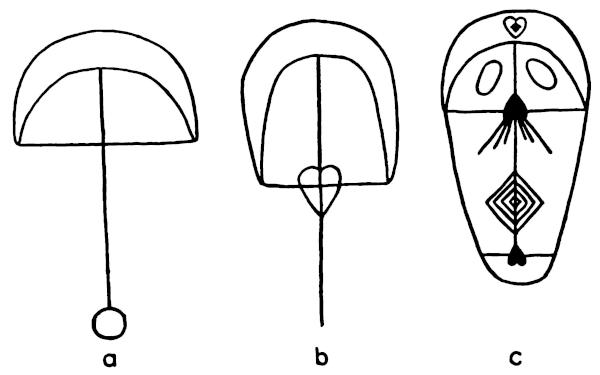
Fig. 4. Peyote altars or moons. a, Basic Caddo-Delaware moon with a mound at the east of the cross; b, the Caddo Big Moon altar; c, Enoch Hoag (Caddo) moon, as drawn by Elijah Reynolds (probably the same as Petrullo, Plate 5 B).
Again, given these factors and the nature of peyote leadership, it is not surprising to find variations run riot; sometimes even the same leader does not conduct two meetings exactly alike, or construct the moon precisely the same (changing the ashes, etc.) Three Osage leaders, for example, change the tribal altar by simply turning everything through 180° to make a “West Moon.” John Elcare (Delaware) is said to have a unique “fish moon,” north of the fire and facing east, which he feeds and gives to drink. The Omaha[86] dug a heart-shaped fireplace eight to twelve inches deep to represent the heart of Jesus. We were unable to discover the exact nature of Leonard Taylor’s (Cheyenne) “Heart Moon,” no longer conducted, but it appears rather to resemble a Winnebago altar figured by Densmore: [76]a heart superimposed on a cross in the fireplace, under the fire, with a small mound to the east representing the earth.
This mound opposite and to the east of the crescent appears to be of Caddoan origin.[87] Jimmy Hunter’s moon shows this in perhaps its earliest, and certainly its simplest form: a line joining the mound and the center of the crescent, with another crossing this from horn to horn of the crescent. Bob Dunlap’s moon has a further minor addition, a heart at the juncture of the crossed lines. The moon of Ernest Spybuck, pictured in Harrington, is Shawnee rather than Delaware-Caddo, but shows definite Big Moon influence; it is intermediate in complexity, perhaps, between the Caddoan small moons and the elaborately symbolic John Wilson Big Moon. The Enoch Hoag moon[88] (a favorite among the Caddo nowadays) shows features parallel with the Wilson moon: it has a star and a heart at the hair-parting or forehead of the altar “face,” ash mounds simulating eyes, an inverted heart at the crossing of the altar-lines as a nose, four concentric lozenges for an oracular mouth, and another heart east of this resembling a cleft chin; the moon itself is the figure’s hair. Moonhead’s (i.e. John Wilson’s) altar similarly represents a man’s head, and contains the leader’s initials or “foot-prints” and his “grave” alongside that of Jesus. The Black Wolf moon is another elaboration of the Big Moon type.
It must not be thought, however, that the bold innovations begun by John Wilson and others have resulted in a complete chaos of individualism. It requires considerable prestige and force of personality to vision a moon impressively enough to gain an adequate following. In recent years leaders in the Native American Church have expressed themselves unfavorably on the growing variety and profusion of rival moons, and have urged a return to the standardized simplicity of the older more deeply entrenched forms. Perhaps for this reason, and personality factors as well, several new “moons” have been considerably less than complete successes. A case in point is that of Albert Stamp (Seminole). His design is not strikingly original or different from the moons of the Caddo among whom he lives: he has six concentric lozenges to Hoag’s four and has added three concentric triangles. That is all. But his moon has not found acceptance, and he has dismantled his cement altar, removing the entire central symbolic portion, leaving only the crescent and simple polygonal apron.[89]
This is only a single instance of a general movement back to more “pure” original forms, [77]stimulated perhaps by the standardizing influence of the Native American Church. This sentiment has had its effect even upon followers of the Wilson Big Moon rite, which is apparently dying out among the Caddo-Delaware (though still strong among the Osage and Quapaw), in favor of the “more Caddo” Hoag moon. If a generalization might be made about the influence of the three tribes most important in the diffusion of Plains peyotism—the Kiowa, the Comanche and the Caddo (who because of their southerly position first received the new religion)[90]—we might call the Kiowa the original standardizers and teachers, who have departed only in the most minute ways from earlier forms; the Comanche the proselytizers and missionaries of the new religion; and the Caddo[91] the innovators.
Fire. Nowhere is the kind of wood for the fire ritually prescribed. Mulberry, slippery elm, cottonwood and black jack are said not to be good because they pop and give off sparks, tending to scatter the carefully piled-up ashes. Red bud, which gives off much light and little heat, is a favorite for summer use, while box alder is considered good for winter. But “Grandfather Fire” (as the Delaware, Winnebago, Kickapoo and Shawnee address it) is built in a ritually prescribed way, like the angle of a worm-fence with the apex to the west. The Shawnee say the first four sticks represent tipi poles. The ritual number of peyotism, seven, appears in the number of sticks prescribed for the Northern Cheyenne and Taos.[92]
The fire stick at a Kickapoo-Shawnee meeting attended near McCloud, Oklahoma, was elaborately carved with a crescent, a bird, a father peyote on a rosette, the word “Christ” and crossed sticks.[93] The Caddo say this fire stick is the “heart,” while the twelve interlacing sticks of the fire are the “ribs” and the two ash mounds the “lungs” of Jesus; in some Caddo moons two fireman put sticks on alternately.[94] The Wilson moon of the Quapaw [78]and Delaware has three firemen who sit by the door to fan entrants. The Arapaho[95] leader chooses his hictänäⁿtcä or “fire chief” by silently pointing an eagle wing-feather at him, which the latter uses as a fan during the ceremony; the feather of the Ponca fireman is a symbol of authority. The ceremonial fire as a trait is Mexican, Southwestern, Southeastern and southern Plains (e.g., Caddo and Hasinai), but as involved in peyotism it is a Mexican-Southwestern borrowing rather than Southeastern.[96]
Ashes. An interesting feature, remotely suggesting the Southwest, is the building up of the ashes of the peyote fire into a figure. The commonest form is a crescent, smaller than and parallel to the crescent of the earthen moon, which is nearly universal in the Plains. At an early date the Comanche began making the ashes into the shape of a “sun eagle” and the Kiowa into a “humming-bird.” The Shawnee and Kickapoo call it a “water bird”; one Shawnee leader occasionally makes buffalo heads. A Pawnee leader, Good Sun, makes an “eagle” in the ashes. Jonathan Koshiway (Oto) says the bird is “the holy spirit when Jesus was baptized; it’s got good eyes like an eagle—you can’t fool it.”[97]
The separation of the ashes into two piles in the Big Moon rite comes in for similarly varying interpretations. A Delaware informant said that on one’s journey in life toward the peyote “if you’re the right kind of fellow you can pass the fire and everything opens up” like the Red Sea. Some say the two ash piles are the lungs of Jesus; others that one is the grave of John Wilson and the other the grave of Jesus Christ. Some Osage say the whole interior of the altar represents a grave.
Smoking. Most of the variations in this ceremony are rather minor. In some groups like the Kiowa only the leader or an older man prays; in others like the Oto all pray aloud at the same time with individual prayers. The Kickapoo ask permission of the leader to make a smoke prayer. The Caddo stop the singing while a prayer is going on, but this is not universal elsewhere. The rule not to pass a smoker or a person chewing peyote appears everywhere, save in the Wilson rite; in this only the leader smoked, and “show-offs” who made requests for tobacco were frowned upon. This descriptive fact is minuscule in importance, save in pointing out the authority of the leader and personality traits of Wilson himself. The original ceremony, as indicated by the Lipan, was a communal smoke at the beginning. The Osage are said to smoke cigars in their peyote meetings, but the usual insistence [79]is on native materials, the corn shuck or, occasionally, the oak leaf cigarette.[98]
In view of the nearly universal ritual use of tobacco in the Americas, the negative cases which occur are interesting. This is traceable to the influence of White Protestantism of the “Russellite” sect in Kansas upon the founder of the Church of the First-born, Jonathan Koshiway. Persuaded by the Kiowa, however, Koshiway and the Oto later abandoned this prohibition, but meanwhile it had spread to other groups. The Iowa[99] “threw away” smoking along with liquor, and did not smoke in peyote meetings. The conjectured Oto origin of Winnebago peyotism is seemingly confirmed by their rejection of smoking in the Jesse Clay meetings:[100]
My elder brother [says Crashing Thunder upon conversion to peyote] hereafter I shall only regard Earthmaker as holy. I will make no more offerings of tobacco. I will not use any more tobacco. I will not smoke, nor will I chew tobacco. I have no further interest in these things.
The non-use of tobacco in peyote meetings appears to be Pawnee[101] as well. Nowadays, as though in compensation for his earlier defection from the pure native rite, Koshiway uses extraordinarily long six-inch corn shucks.
Sage. Sagebrush is used in several ways in peyote meetings: around the periphery of the tipi as a seat, in a cross or rosette under the father peyote on the altar, and in the perfuming ceremony before eating peyote, when it is rubbed between the palms, smelled and rubbed over the head and arms, body and legs.[102] Sometimes a bunch of sage tied together is passed around with the singing-staff also.[103] Dr. Parsons says that at Taos[104] the perfuming is done “to keep the smell of it [on us] so we won’t feel weak or dizzy”; and as a similar protective function of sage is reported by Opler for the Lipan and the “Sun Dance weed” by Mrs. Cooke for the Ute, it is evidently widespread. The Ute sometimes place a willow rope around the tipi, about four feet in from its circumference.
Passing of Objects. The standard clockwise circuit of tobacco, sage, peyote, paraphernalia, water, food and persons has already been described. This trivial ritual has nevertheless been made the vehicle of expression of the leader’s authority to change it. Sometimes the circuit begins at the door (Lipan), sometimes at the leader or cedar chief (Iowa), and elsewhere smokes may begin at the leader but food and water at the southeast.[105] In [80]the morning after the untying of the drum the ritual paraphernalia and the father peyote are commonly passed around for participants to handle (Kickapoo, Kiowa, Ponca, etc.) The Ponca make a point of passing the water between the fire and the paraphernalia at the altar-cloth in the midnight ceremony.
The obsessive, involutional quality of ritualism is nowhere better illustrated than in the minutiae of these rules for passing. We have particularized for the Kiowa the standard modes of passing paraphernalia,[106] but even experienced “peyote boys” are in need of instruction concerning the “way” of an unfamiliar leader when they visit other tribes. The Northern Cheyenne, for example, may not pass the drum in his clockwise circuit to leave the tipi, save in grave emergencies when permission is asked of the leader through the fireman. One may not pass a person praying or smoking or eating peyote, and must again consult the leader to see if the way out is clear; there is still another obstacle in the fireman, for no one may exit between him and his seat while he is fixing the fire (the smoker may temporarily put his smoke on the ground before him, or the fireman temporarily take his seat in these cases).
The Clay rite of the Winnebago has a unique method of passing objects: clockwise along the north from the leader to the fireman at the east, then counter-clockwise back to the leader and around along the south to the door, and again clockwise to the leader. The Caddo meticulously observe another rule in entering and leaving the tipi, as though the interior were divided into north and south sides: those on the south enter clockwise and exit counter-clockwise, while those on the north enter counter-clockwise and exit clockwise.
These sometimes complicated “rules” are not the least part of “learning about peyote,” and the ordering of them by the leader reflects similarly complex psychological transactions among individuals. For instance, the simple matter of leaving the tipi at recesses is involved in schism among the Caddo. Translating the terms, they cite the full-blood Caddo, Enoch Hoag’s, as the “systematic way,” or “pure tribal way,” to which they are currently returning (because the leader must be consulted before leaving); the half-Caddo, John Wilson’s, is “any kind of way” (because he is said to have abrogated some of these rules). The Seminole, Stamp, attempted a compromise, allowing persons to exit without permission if they observed the rules about not passing in front of a smoker or eater of peyote; “I’m right in the middle,” he said. But Elijah Reynolds says, “The older men were skeptical. He just made it up to gain influence among others. It’s a kind of racial feeling there.”
Praying. Minor variations occur in this procedure too. The Cheyenne are said to pray at great length—“an hour or more sometimes,” a Comanche told me. The Oto use cedar incense instead of tobacco when they pray. The Ponca pray in unison and audibly before the meeting, seated. The Winnebago stand up together to pray, and the leader stands up to [81]pray with a confessant west of the altar. The Shawnee pray on getting the dirt for the “moon,” getting the sage, making the moon, putting a cross on it, cutting the corn shucks, when the food is brought in, etc. The door-man in Pawnee meetings makes a special prayer of dismissal. Often, as with the Kiowa and Oto, the “tribal priest” or curator of the tribal palladium is asked to make an official prayer at some time in the meeting. At Taos the chief prays before the line of worshippers enters inside, and all pray inside. Murie says all the Pawnee pray after the closing song, when the sun’s first rays strike the altar through the opened door.[107]
Mrs. Voegelin gives a typical Shawnee prayer:
My prayer is that of a pitiful man. And also these people here, visitors, I wish my creator to answer my prayer to take pity on those visitors. They came to my daughter’s meeting for some good reason to learn something about my daughter’s meeting. So each of us give blessing, and bless the water that was brought in this morning. So let our friendship purify it, that we might drink this water, to give us long life, and a better life; and I ask our father to bless all my children, and my wife, and all of us who are in this meeting tonight. I am glad my friends came here to help me with my prayer tonight, my daughter’s birthday meeting, and we thank thee for this food she brought in, that our friends who are going to eat this food, that they might feel better from now on in everyday life. We ask in the name of Jesus, Amen. (He then cried ceremonially at the finish of the prayer; a few tears ran down his cheeks.)
Praying in peyote meetings appears to have much of the psychological flavor of the old vision quest. The speaker’s voice becomes louder as he proceeds, earnest and quavering as he sways with the fullness of his emotion and stretches out his hands toward the peyote and the fire. Sometimes his speech is wholly interrupted by uninhibited broken sobbing as he cries out for the pity of the supernaturals. John Rave, the Winnebago teacher, said that “only if you weep and repent will you be able to attain knowledge.” Several of the Delaware face-paintings collected by Dr. Speck represent “crying for repentance.”
Incense. Cedar incense is invariably placed on the fire at the beginning of the ceremony to purify the paraphernalia and to “bless” the participants before they eat peyote. A patient or one sick from eating peyote is incensed and fanned with an eagle wing, and incense is burnt for the fireman at midnight when he returns with the water, for the leader on returning from the whistling ceremony outside, and for the water woman in the morning. Others extend the incensing and fanning to every person who re-enters the tipi after a recess, and the Wilson rite[108] has special officials to perform this duty. Many leaders about [82]midnight provide for the cedar smoking of personally-owned feathers, drum sticks, gourds, etc., and permit individuals to use their own after midnight until morning in place of the equipment provided by the leader.
Method of Eating. Peyote is most commonly eaten in the raw dried state as “buttons,” but when obtainable, in the green form also, which is said to be more potent in action. Sometimes both are provided in the same ceremony, as well as peyote “tea,” a dark-brown infusion made of soaked and boiled buttons. For the old and sick the buttons may be soaked and softened in water, or pounded dry in mortars and molded into small moist balls; the latter form is reported for the Arapaho, Caddo, Delaware, Lipan, Osage and Winnebago. In chewing the dry buttons the Kiowa, Mescalero and others take care to pick off the fuzz on the top lest it cause sore eyes and blindness.[109]
Singing. The leader always sings the four sets of Esikwita or Mescalero Apache songs as his assistant drums: Hayätinayo (Opening Song), Yáhiyano (Midnight Song), Wakahó (Daylight Song) and Gayatina (Closing Song). All the other songs, sung by the participants during the rounds of the drum, are entirely optional. But the standard set songs are not everywhere used: those of the Ponca are said to be Comanche. The ritual songs of the Pawnee are in the Pawnee language, and those of the John Rave rite are in Winnebago (though the followers of Jesse Clay still use the Apache songs.) The circumstances of the origin of some famous songs by Quanah Parker, John Wilson (e.g., Heyowiniho) and Enoch Hoag (e.g., Yanahiano) are widely known.[110]
Many show Christian influence. The Iowa, for example, sing the following songs with Indian vocables, but in a high-pitched style which makes the English words nearly unrecognizable:
The closing song of the Winnebago varies; Yellowbank gave this one:
[83]
The followers of Rave close with the Lord’s prayer and a song about wings:
The first of these is said to have come from the Arapaho, the second from Isaiah 6.2, although a New Testament explanation is offered.[111] The last song of the Pawnee meeting refers to Christ.[112]
Other Winnebago songs (with repetitions omitted) are as follows:
(This is an opening song, according to Yellowbank. Another opening song:)
The following are two morning songs:
Other peyote songs are not sung at ritually-set times:
Radin[114] adds the following Winnebago songs:
Midnight Ceremonies. The whistling outside the tipi at the four quarters is variously rationalized. The Kickapoo say the leader’s circuit follows that of the singing inside, the Shawnee that he whistles at the cardinal points “on account of the four different winds.” The Northern Cheyenne, according to Hoebel, say they are following the instructions of their culture-hero Sweet Medicine in this, while the Comanche say the whistling is to “notify all things in all directions that we are having a meeting here in the center of the cross, and calling the great power to be with us while we drink so that it could hear our prayers.” The Winnebago “flute” blown at this time is to “announce the birth of Christ to all the world”; it also represents the trumpet of the Day of Judgment, and the leader’s otter skin hat symbolizes Christ’s crown of glory. Other Winnebago[115] say the whistling symbolizes the song of praise of the birds in heaven whom God created. The Arapaho say the whistling is an eagle’s cry when it is searching for water, and imitates its coming from a great distance until it dips its beak into the water.[116]
The midnight songs of the Pawnee are said to be for the protection of the man who fetches the water. Old-time Comanche used a paunch for the water, but a bucket is everywhere now used; Comanche and Iowa drinking begin at the cedar chief, rather than south of the door as is usual. The Ponca leader dips a feather in the water and sprinkles patients and those nearby with it; and Shawnee sacrifice a cupful to the earth before drinking. The Kickapoo and others drink directly from the bucket when the fireman brings the midnight [85]water, but use a cup when the woman brings the morning water, in graceful symbolism. Some say the woman represents “Peyote Woman”; others, like the Wichita, identify her with older native powers.[117]
The Lipan have no midnight water ceremony. The Hoag (Caddo) rite has no water ceremonies until the drum has made four rounds of the tipi, but water is brought in for visitors who might call for it or provided outside to be drunk at recesses.[118] In Moonhead’s meeting the fireman gets a feather from the leader on leaving and touches the peyote on his return as he is fanned and incensed with cedar.
Recess. After the midnight water ceremony anyone can leave on permission of the leader when he has returned from the whistling ritual outside and been incensed with cedar smoke. People usually leave in twos and threes, as the meeting continues, but they return promptly since others may wish to go out. The Pawnee are apparently unique in their midnight recess: after the water ceremony all leave for a ten to twenty-five minute period, the paraphernalia meanwhile resting on the altar cloth.
Doctoring. Doctoring in peyote meetings (save those of the Kickapoo, Caddo and possibly the Osage)[119] is of prime importance, and in a majority of cases is the expressed purpose of calling a meeting. The supposed therapeutic virtues of peyote, or in the less technological view, its “power,” have been important in the history of the cult. Quanah Parker, the great Comanche proselytizer of peyote, at first opposed to it, was cured of a stomach ailment in 1884 and became one of the most enthusiastic proponents of the herb. Peyote doctoring has been the occasion many times of the spread of peyotism from tribe to tribe (e.g., the Kiowa bringing it to the Creek). Kiowa doctoring was also probably influential in modifying the Church of the First-born on Koshiway’s visit in their country, and in bringing it into the fold of the Native American Church.
The motives for the spread of peyotism in the Plains could perhaps be equally divided between doctoring and power-seeking, but the dichotomy is somewhat artificial in terms of native ideologies: indeed, the chief “power” one gets in meetings is for doctoring.[120] Winnebago attitudes recorded by Radin[121] find parallels elsewhere:
[86]
The first and foremost virtue predicated by Rave for the peyote was its curative power. He gives a number of instances in which hopeless venereal diseases and consumption were cured by its use; and this to the present day is the first thing one hears about it. In the early days of the peyote cult it appears that Rave relied principally for new converts upon the knowledge of this great curative virtue of the peyote.... Along this line lay unquestionably its appeal for the first converts. Its spread was due to a large number of interacting factors. One informant claims that there was little religion connected with it at first, and that people drank the peyote on account of its peculiar effects.
Densmore[122] says that prayer during Winnebago peyote doctoring “are petitions to God for the recovery of the sick person, not affirmations of his recovery.”
Opler quotes a Lipan informant on doctoring:[123]
In the early days they just had a good time for one night. It was not used as a curing ceremony then.... At first they wanted to have good visions, that’s what they were after. But then, recently, they began to use it as a medicine for sick people.... If a sick person comes in the tipi, they see what is the matter with him. Perhaps a witch has shot something into him, a bone or something like that. It is seen. Then the sick one rolls a cigarette and gives it to someone there who he thinks can cure him. Perhaps some man says, “I think I can take that out with the help of peyote and these other men.” So he does his ceremonial work in there and extracts what is bothering the patient.... He sucks it out usually with his own lips, not with a tube. It is nasty work right there. It might be dirty and full of pus. But the medicine man doesn’t think of it in that way. To them it is just as if they were sucking nice juice out of something. Yet it will look terrible to others.... All the bad things have to go into the fire and burn down to ashes.... Sometimes they suck out things like insects which have been shot into people and these things pop. Sometimes when they throw the evil object in the fire it blazes up blue but does not pop.
Northern Cheyenne and Shawnee patients sit in special places in the peyote tipi, as in the sweat lodge, suggesting that older patterns of doctoring are involved; as we have seen, the sweat lodge is an integral part of the Osage peyote round-house plan. That associations of curing by peyote and curing in the sweat lodge lie close to the surface finds affirmation in an interesting Arapaho case:[124]
One of the recent modifications of the peyote ceremonial was devised by a firm devotee, to cure a sick person. The originator of this new form of the worship believes himself to have been cured by the drug. In this ceremonial, which was repeated four times, the tent seems to have represented a sweat house, and a path led from the entrance to a fire outside, as before a sweat lodge. The ritual, while remaining a peyote ceremony, conformed more or less to the ordinary processes of doctoring a sick person.
[87]
One could easily over-emphasize the novelty of such a procedure, considering the widespread use of peyote in doctoring, yet even the Caddo, who do not doctor with peyote, often have four meetings to pray for the recovery of the sick person; certainly cures by peyote do not rest entirely on the “technological” procedure of the patient’s eating and drinking peyote, but others present “help” by eating in the name of the sufferer and praying. This is not at all unlike the presence of relatives and others in the sweat bath praying for the patient’s recovery; the various uses of sage, the fire pits in some altars, and the ritual necessity for a fire even on the hottest summer nights further suggest sweat bath parallels.[125]
Peyote is a panacea in doctoring. A Cheyenne woman was cured of a cancer of the liver which had been pronounced hopeless at a White hospital. Such invidious distinctions between White and peyote doctoring are common; for the former represents merely human skill, and is not the unmodified herb the direct creation of God? Belo Kozad, himself a well-known Kiowa peyote doctor, spoke as follows:
When my sick wife was in there I chewed peyote for her. Her skin got like wood bark—the hair come out. The doctors couldn’t make it. We give it up, can’t do anything. [It was] diabetes, and we shoot him every time she eats. That spoils the people; they lose the mind and the skin gets bad. That morphine for Howard [Sankadote, who was ill the night of the meeting and could not be present] make him talk funny. It just ruin the people in the mind. Come to peyote! God knows more than any people!
Perhaps Belo had every “pragmatic” right to talk thus: had he not himself cured a boy’s hemorrhage by eating one hundred green peyotes for him? Peyote indeed is a famous cure for tuberculosis and respiratory diseases.
John Bearskin (Winnebago) knew of two cures by “Sister Etta” in meetings: one a woman with goitre, the other a boy who had previously been dumb.[126] Pneumonia also readily yields to peyote, producing beneficial perspiration when thirty buttons are drunk over a period of hours in two quarts of water. The writer has seen doctoring with peyote for a crushed thigh, tuberculosis, and malnutrition (?) in a two-year-old child; this last cried fretfully in the early part of the meeting, but was fed “tea” until it was blue and quiet in strychnine tetanus by morning. The wife of our Quapaw host had also been “operated on in church.”
A Sioux doctor, who had gotten his power from a vision in which peyote turned into a man, doctored at Taos; but an acquaintance of Dr. Parsons imputed his trachoma to witchcraft on the part of “foreigners” who came to large meetings. He found that peyote water prevented the inflammation of his eyes. Another boy’s leg was “all gone, rotten,” and the boy himself emaciated. Peyote men prayed over him for a month, whereupon he [88]became well and fat, though his leg remained drawn up because he had taken too much White man’s medicine. The wife of a peyote man, herself cured of neck sores by the plant, asserted that witch sickness is lacking nowadays in Taos because of the power of peyote in exorcizing witchcraft; a peyote chief, however, holding a button in his hand, had had to remove a porcupine quill which some witch had shot into her nose. At Taos even anti-peyotists consider it good for cures, and Dr. Parsons, no doubt with some reason, makes the query: “Will peyote find its character of witch prophylaxis an introduction to the southern pueblos?”[127]
Peyote is equally successful in treating mental cases. An Oto informant told of four successive meetings held for a man who had “gone crazy” when his wife left him. Formerly under observation at Norman, he was afraid people were coming for him during the meeting; he could hardly talk, wanted to run out and people had to wrestle with him. Old Man White Horn gave him a peyote and told him it would protect him; finally, in the third successive meeting the man “came to” and asked what had been happening. Another Oto patient chopped wood incessantly, rolled and unrolled strings, etc., and used to have “meetings” by himself, drumming, singing and eating peyote all alone. An Oto told me of a Taos boy who had “gone crazy”; some said it was peyote that was doing this. But a doctor from west of Albuquerque came and pulled a snake and a dead water dog out of him; these had been his medicines, taught him by his father, and it was decided that he had clearly broken some taboo surrounding his father’s medicine.
“Preaching.” An interesting feature of peyotism, probably deriving from earlier patterns, is the moral lecture in the morning. In one Caddo “moon” the leader “talks to the boys, teaches them, just like a preacher, telling them to do the right thing through life, and the consequences if they didn’t do the right things.” White Wolf (Comanche) says Quanah Parker lectured younger people in the morning; so too did Kickapoo, Carrizo, Shawnee and Wichita leaders.
After passing peyote, the Delaware leader “addresses the peyote and the fire, prays, and often delivers a regular sermon or moral lecture.” In the Iowa meeting:[128]
The peyote chief ... leads in the preaching and Bible reading.... The leader (or, as the writer understands it) perhaps some visiting preacher of the faith, gets up and delivers a sermon, while the cedar chief casts some more incense on the fire. [He commonly exhorts them to confession.] The leader then calls on other preachers to talk, and then asks the fire chief [to pass the peyote again].... Meanwhile he continues to read the Bible and exhort all sinners to repent. He points out that all the old ways have been given up, and with them their “idols,” such as the great drum of the religious dance.
John Wilson ordinarily began his meetings with a talk by himself; the Oto are commonly addressed in meetings by their “tribal priest.” The estrangement of the lively J. S. (Kiowa) [89]and his young wife was composed through moral homilies delivered by older relatives in a peyote meeting—a typical occurrence.
At the end of the Pawnee meeting[129]
the members ... sit in their places and talk over their experiences.... The leader closes the meeting at noon with a lecture, or sermon, on ethical matters, speaking especially against the use of alcohol.
Possibly Osage “testimony” may have some relation to this.[130] The Winnebago[131]
ceremony is opened by a prayer by the founder and leader, this being followed by an introductory speech.... During the early hours ... speeches by people in the audience [are made], and the reading and explanation of part of the Bible.
The midnight sermon, after the midnight water, also occurs:[132]
Then the leader asks anyone he desires to make a speech. This may emphasize any point in regard to peyote.
The moral harangue is no doubt derived from earlier Plains patterns, though it is a Southwestern feature as well, among the Rio Grande Pueblos and elsewhere.[133]
Prophecy. The gift of prophecy has often been claimed by individuals in native America. The first well-known such was Popé of the Pueblo Revolt in 1680, but his successors were many: Wabokieshiek, or “White Cloud,” the Winnebago-Sauk prophet of the Black Hawk War; the Delaware prophet of Pontiac’s Conspiracy (1762); Tenskwatawa, twin brother of Tecumseh, and the well-known “Shawnee Prophet” (1805); Kanakuk, the Kickapoo[134] reformer (1827); Smohalla, the Sokulk dreamer of the Columbia (1870-1885); Tavibo, the Paiute; Nakaidoklini, the Apache (1881); Wovoka, or Jack Wilson, the Paiute prophet of the Ghost Dance of 1889 and later; Skaniadariio, or “Handsome Lake,” the Seneca teacher, etc.[135]
[90]
Save for the revelations of the Caddo-Delaware John Wilson, and the teachings of John Rave and Jonathan Koshiway, this tradition has become much attenuated as regards peyotism. Large-scale prophecies can no longer be made to skeptical and disillusioned audiences, but prophecy in minor matters still occurs via peyote (e.g., the Delaware case in which a serious industrial accident might have been avoided if he had only been able to interpret correctly a warning peyote gave him). Old-time Comanche could hear the enemy while still away off when they ate peyote, and in making raids could discover the whereabouts of horses, etc. White Wolf, again, visioned Charley Seminole’s face all bloody at a peyote meeting, but was unable to interpret the prophecy; somewhat later, sure enough, the Seminole accidentally shot himself under the eye.
In the origin story of peyote, when the Kiowa or Comanche were on the war-path, the Apache leader knew of their leader’s approach to the tipi where they were having a meeting, and told his fireman to invite him in, whence the visitor brought peyote back to his tribe; this story is known all over the southern Plains. Around 1870 the only Kiowa who ate peyote was Pabo, or Big Horse. When he wished to find the whereabouts of an absent party he would go into a tipi and say “gʸäʰgūṇboṇta” (I am going to look for medicine), and would drum and rattle and eat peyote, and tell the results of his inquiry afterward. Pabo’s power was from the eagle, but Kiowa owl-doctors had clairvoyant powers in pre-peyote times. Another Kiowa user miraculously predicted the coming of telegraph lines and the railroad to Anadarko, having previously never seen either, and a Wichita predicted the World War.
“Baptism” and Other Morning Ceremonies. The “curing” ceremonies of Mexico and the Southwest still find a reflex in the Plains “baptism” in the morning ceremonies. The leader in the tipi whistles for the water as in the midnight ceremony, and a smoke is made for the bearer, the only difference being that this time it is a woman, often symbolically costumed,[136] who some say represents Peyote Woman of the legend. Many groups, however, have a ritual “baptism” in this morning ceremony, which is lacking at midnight.[137] The Arapaho,[138] for example, untie the drum and pass it around the circles; each man wrings out the wet drum head, makes a loop of the lacing-rope and throws it lasso-fashion over his foot to symbolize the roping of horses, presses the seven marbles of the drum to various parts of his body, and drinks a little of the drum water. The worshippers then wash the paint from their faces, and comb their hair, a towel, a mirror, a comb and water making the round of the tipi; then finally the drinking water is passed around.
The Delaware file out behind the fireman to greet the rising sun with prayer, and, standing in the same relative positions they occupied in the tipi, wash their faces with the water which the fireman pours on their hands; those who fall down at this time are said [91]to be visiting heaven. The rest re-enter for the ritual breakfast. The Caddo similarly file out to wash and comb their hair, and preserve the same order even at the secular meal at noon. The Iowa wash with soap and water as they sit in the tipi; “the peyote chief himself carries the water to show his humility, because of Biblical references to the washing of feet.” The Shawnee are marshalled outside in two lines at sun-up to wash their faces and “do arm exercises.” The Kickapoo, Wichita, Oto, Northern Cheyenne and others pass the drum and sometimes all the ritual paraphernalia around to be handled; some lick the drum stick dipped in the water and touch it to various parts of their bodies. The Ponca leader, using a feather, shakes water on participants both at midnight and in the morning, and as in some other groups, waters the drum also.[139]
The ritual “quitting songs” are sung by the Pawnee just at dawn, as the first rays of the sun strike the altar through the opened door; the last song is sung five times, and each member then prays in turn to God. The “baptism” ceremony of the Winnebago John Rave cultists (derived from the Oto) is more Christian in tone than that of the Jesse Clay rite (of Arapaho origin). Rave dipped his fingers in a peyote infusion, and passed them over the forehead of a new member saying, “God, His holiness,” (or, as some say, “God, the Son, and the Holy Ghost”).[140] A little water is also poured on the ground as a sacrifice. The well-nigh universal mode of disposing of the remaining water in the drum is to pour it along the earthen “moon.”
Peyote Breakfast. The foods in the ritual breakfast in the tipi are so standardized as scarcely to allow comparative treatment. They are merely minor variations on the theme: water, parched corn in sweetened water, fruit and dried sweetened meat.[141] From the Lipan (roasted corn, yucca fruit, wild fruit and meat, according to Opler) to the Ute (canned corn, canned peaches and corned beef, as reported by Mrs. Cooke) the uniformity is striking. These foods are eaten from a common set of four vessels,[142] which are passed around with a single spoon in each. Sometimes ground hominy or parched corn mush is substituted, and Hoebel reports the Northern Cheyenne use of Cracker Jack for the parched corn. Beef is the usual meat, in boneless chunks or dried, pounded and sweetened, but pork (tabooed [92]for the Comanche) is reported for the Ponca and Northern Cheyenne.[143] Wild fruits are somewhat preferred to canned varieties, but are not always obtainable. Although the original meanings and connections with agricultural, gathering and hunting ceremonies have long since been lost sight of, the feeling for the proper foods in a peyote breakfast is still quite strong in the Plains, a remarkable instance of culture continuity.
[1] For convenience of reference I have followed with all possible care the sequence of the development and appearance of elements laid down in the Kiowa-Comanche type-rite (above), of which the following paragraphs are largely comparative discussions.
[2] Mooney, Miscellaneous Notes, 40.
[3] Opler, Lipan Apache Field Notes.
[4] Erminie Voegelin, Shawnee Field Notes.
[5] Ritual gathering of plants is not unknown elsewhere; see Mooney, The Sacred Formulas.
[6] See G. A. Dorsey in Handbook of the American Indians, 2:650a (Sun Dance), as well as Spier’s The Sun Dance of the Plains Indians.
[7] Hoebel says the Comanche formerly did not have all night meetings because of the danger of attack while under the influence of the drug.
[8] Opler’s data suggest that even the vision-seeking motive is recent among the Lipan.
[9] The Lipan prayed for protection from their enemies as well as for health and long life.
[10] Petrullo, 48. The mourning council meeting was not unfamiliar in pre-peyote times. One such council was held for Tarhe, chief priest of the Wyandot, at Upper Sandusky, in the old days, attended by all the tribes of Ohio, the Indiana Delaware and the Seneca of New York (Handbook of the American Indians, 2:294).
[11] Four older men pray and the child is passed clockwise around the tipi as every one present calls out its name.
[12] Meetings are held for the corpse, which is present “facing east” (head west) in the meeting; at the funeral next day he faces west. The writer omitted to attend an Osage meeting at Hominy because it was a funeral meeting.
[13] Cf. the uses of datura.
[14] La Flesche, Peyote as Used in Religious Worship, 21.
[15] A favorite Indian holiday in Oklahoma is Memorial Day, when graves are lavishly decorated.
[16] Densmore, The Peyote Cult.
[17] Parsons, Taos Pueblo, 12 ff.
[18] Only two cases are known of women who fully participated in meetings: Dog-woman (deceased), wife of John Red-turtle (Cheyenne) sang and beat the drum; a woman at Taos, Apekaum says, sings in meetings like men.
[19] Kroeber, The Arapaho, 398-99; Opler, The Influence of Aboriginal Pattern; Parsons, Taos Pueblo; the rest field investigation.
[20] Skinner, Societies of the Iowa, 725.
[21] One William Richard Nebuchadnezzar West ate peyote with the Kiowa for years. Petrullo mentions one Pat Noonigan who ate with the Delaware, and the Shawnee had a white participant for some twenty years. Early white familiarity with peyote in Texas must be postulated to account for its use by Texas Rangers in the Civil War (Lumholtz, 1:358).
[22] A Negro brought by the Kiowa drummed and sang along with the rest in a Shawnee meeting; the former existence of a Negro “peyote” church near Tulsa argues for a considerable amount of such contact.
[23] Again excepting the Caddo, who are over-suspicious for reasons discussed later.
[24] The most homogeneous meeting I attended was a special tribal Wichita one which, nevertheless, was attended by three Kiowa, four Comanche, and two Whites, beside fourteen Wichita.
[25] Radin, The Winnebago Tribe, 415.
[26] Murie, Pawnee Indian Societies, 638; Densmore, The Peyote Cult.
[27] Radin, A Sketch of the Peyote Cult, 2; The Winnebago Tribe, 388.
[28] Hoebel, Northern Cheyenne Field Notes.
[29] Kroeber, The Arapaho, 399; Smith (Mrs. Maurice G.), A Negro Peyote Cult, 452, note 10; see also Handbook of the American Indians, 2:661.
[30] Kroeber, The Arapaho, 404-405; see also Petrullo, The Diabolic Root, 101. Shawnee sometimes paint their temples; Oto use red bars below side burns. Delaware examples from Speck: red hair-part, red-blue-red-blue-red horizontal lines over the bridge of the nose and cheeks (Wilson’s Big Moon meetings); red and blue lines below and at corners of eyes (“crying for repentance”); green zigzags in yellow cheek spots, two red and one blue line at corner of eyes; all red chin bounded by a blue semilunar arc on the upper lip and up the cheeks (representing the altar “moon”); and blue red-bordered dots on each cheek-bone and forehead representing peyote-buttons (a woman’s design).
[31] Radin, Crashing Thunder, 182.
[32] Kroeber, The Arapaho, 403, 405.
[33] Opler, Lipan Apache Field Notes.
[34] Skinner, Ethnology of the Ioway Indians, 261.
[35] Densmore, Winnebago Songs of the Peyote Ceremony.
[36] Parsons, Taos Pueblo, 119.
[37] Speck, Notes on the Ethnology of the Osage, 163.
[38] Radin, Crashing Thunder, 186-87.
[39] Anhalonium means “without salt.” The salt-taboo is a common Southwestern one, unconnected with peyotism there (e.g., Kroeber, The Seri, 45) but associated in Plains peyotism with such borrowed Southwestern traits as the water-drum.
[40] Kroeber, The Arapaho, 400.
[41] Idem, 398. “The slight variations in pattern,” writes Opler of the Mescalero, “... undoubtedly owe their existence to the fact that there are a number of peyote shamans, each eager to assert his own individuality and ‘way’ by some minor departure or ‘rule’.”
[42] The peyote shaman in Mexico was certainly no figurehead, and the peyote leaders of the Carrizo, Tonkawa, Lipan and Mescalero were important in preventing rivalry.
[43] The authority of the leader finds ritual reflection throughout the John Wilson “moon”: e.g., only the leader might smoke and pray, and others calling for smokes were frowned upon as presumptuous. Further, John Wilson’s “moon” contains his “grave” alongside that of Jesus Christ, and his initials W. (Wilson) or M. (Moonhead). The altar, indeed, represented Moonhead’s face; he even prescribed face-painting styles with his initials in them. A man equated with Jesus Christ is scarcely a negligible person. Koshiway (Oto) performed marriages and baptisms and conducted funerals in the Church of the First-born. The point is just as well demonstrated by the negative cases of those who aspired to peyote leadership and failed. Even the local Pawnee President of the Native American Church, James Sun-eagle, does not lead meetings.
[44] Delaware meetings appear to have had only road-man and fire-guard (Harrington, Religion and Ceremonies, 188) but this may be an error of omission. The Kiowa, Pawnee, Cheyenne, Iowa, and Taos all have the “cedar-man” in addition.
[45] Radin, A Sketch of the Peyote Cult, 3; The Winnebago Tribe, 388. Densmore (Winnebago Songs of the Peyote Ceremony), lists only three leaders but may not be counting the fireman. See Skinner, Societies of the Ioway, 724; Parsons, Taos Pueblo, 62 ff.
[46] Schultes, Peyote and Plants Used, 129-31.
[47] Excessive prices for peyote have been reported elsewhere. Mooney says (Miscellaneous Notes, 30) an Oklahoma White dealer once charged 25 cents a button, though they cost him only $5.00 a thousand. Hoebel says a Comanche once traded a fine horse for five hundred buttons. See Bennett and Zingg, The Tarahumara, 291-92; Lumholtz, Tarahumari Dances, 453-55.
[48] Diguet, Le Peyote et son usage, 28.
[49] Parsons, Taos Pueblo, 60; Bennett and Zingg, The Tarahumara, 293, xiv; Mooney, Miscellaneous Notes, 60 ff.
[50] Big Moon leaders apparently required fees; Speck (Peyote MSS.) says the Seneca were too poor to pay more than the leader’s carfare when the cult was brought to them. Wilson himself met his death when some horses given him by the Quapaw and tied to the back of his wagon pulled backward at a crossing as a locomotive approached, and some of his enemies assert that this was in punishment for his avariciousness and economic exploitation of peyotism. He even charged money for sweatbaths he prepared in connection with meetings.
[51] Cf. Kroeber, The Arapaho, 410. A Shawnee gave the meeting-tipi to two old men the next morning, and the writer has exchanged gifts with several tribes, notably the Oto and the Kiowa.
[52] Koshiway said he ate 100 once: “I was like a Ford, all broken down, connecting rods loose. The next day I was overhauled and hitting on all four, and went to work.” Belo Kozad, well-known Kiowa leader, said he ate 100 green peyote once but had a “hard time keeping it down.” Big Bow (Kiowa) claims to have eaten 75 at the time of his prophetic vision of the World War. One Oto sometimes eats 40 to 50 at which a man comes and instructs him. Alfred Wilson (Cheyenne) for eight years President of the Oklahoma N.A.C. said he ate 84 green ones once. Densmore (Winnebago Songs of the Peyote Ceremony) says Winnebago ate 40 to 100, and many of them ate 60; elsewhere (The Peyote Cult) she states a Winnebago usually ate 15, but some ate up to 40. Lipan (Opler, Lipan Apache Field Notes) ate 12 to 50. A Tonkawa leader (Opler, Chiricahua Apache) ate 40. Users at Taos (Parsons, Taos Pueblo, 66) ate as many as 60, but usually about 20 or 30. Mescalero (Opler, The Influence of Aboriginal Pattern) ate from 4 to 40, with 12 as a “generous amount.” Iowa (Skinner, Societies of the Iowa, 724-25) considered 16 a good amount, women being restricted to 2. Huichol (Lumholtz, The Huichol Indians, 9) rarely ate more than 4 or 5 daily, but at times consumed up to 20. An Arapaho stated under oath (Peyote as Used in Religious Worship, 49) he had eaten 12-30 peyote at different times, agreeing with Kroeber’s average of 12, with amounts of more than 30 eaten sometimes. A White observer in a Comanche meeting said he had seen them eat 30 or 40 apiece (Simmons, The Peyote Road). An Osage, on the other hand, stated before an official group that 5 was the upper limit for women and 7 for men (Peyote as Used in Religious Worship, 31), a statement open to doubt.
[53] Opler, Lipan Apache Field Notes.
[54] Opler, The Influence of Aboriginal Pattern; Chiracahua Apache; Parsons, Taos Pueblo, 3; Kroeber, The Arapaho, 402, 405; Skinner, Ethnology of the Ioway, 249 (but the Christian symbolism here is Plains); Harrington, Religion and Ceremonies, 187-88; Petrullo, The Diabolic Root, 53.
[55] The cane was the symbol of the Aztec merchant, and his friends did this utlatl or otate great reverence at a feast on the return from his travels; it symbolized Yiacatecutli, the god of merchants. Slaves were also sacrificed at a temple rite involving the canes (Sahagún, A History of Ancient Mexico, 1:41-42). Among the Huichol the staff of the judges in the native courts are accorded “a superstitious reverence” as symbols of authority (Lumholtz, Unknown Mexico, 2:250). And although Governor Valdes had visited most of the pueblos to appoint native governors and captains by the year 1642, in Tarahumari the native term for leaders is igúsuame, “stick-bearers” or selfgame, “lance-bearers” (Bennett and Zingg, The Tarahumara, 375-76).
[56] Skinner, Societies of the Iowa, 718; Harrington, Religion and Ceremonies, 187-88; Opler, Lipan Apache Field Notes.
[57] Parsons, Taos Pueblo, 65; Skinner, Societies of the Iowa, 725; Radin, A Sketch of the Peyote Cult, 4, 21; Densmore, The Peyote Cult (but there is no biblical authority for this in Exodus 7. 19, 20. or concerning Aaron’s rod in Exodus 8 or 10.13).
[58] Skinner, Societies of the Iowa, 724; Cooke, Ute Field Notes.
[59] Winnebago gourds often have on them pictures of Christ, the cross and “crown” of thorns, the shepherd’s crook and other Christian symbols (White Buffalo, in Blair, The Indian Tribes, 282; see also Harrington, Religion and Ceremonies, 188; Handbook of the American Indians, 2:355b; Kroeber, The Arapaho, 400, 405; Radin, Crashing Thunder, 20).
[60] The best gourds are relatively small, not more than 3″ in diameter, somewhat flattened on the top rather than spherical, and elongated toward the handle. A hole is made through the gourd opposite the neck, cut off an inch or so from the round part; a stick is thrust through these, the neck hole being reinforced and made smaller by whittling down half a spool and glueing it in. There is no peg transversely through the portion emerging through the top, but both this and the handle part are usually covered with tightly-sewn buckskin to which bead-work is attached; some handles are carved or left plain. A tuft of red-dyed horse-hair is often put on the top and a buckskin fringe at the bottom; shot or pebbles make the sound.
[61] Kroeber, The Arapaho, 400; Skinner, Ethnology of the Ioway, 249; Societies of the Iowa, 724; Hoebel, Voegelin, Opler, and Cooke, Field Notes; Mooney (Miscellaneous Notes) says Comanche drums had eight marbles sometimes, as had also the Shawnee, according to Mrs. Voegelin.
[62] The Kickapoo once tried a four-legged brass kettle instead of the regulation three-legged iron one, but soon discarded it, having decided that the tone was not right (this probably rationalizes some criticism of their ostentation). The Caddo had a 10-marbled crock drum with a deer skin head; the Oto, who have the kettle drum, sometimes use a crock, as do the Omaha (Gilmore, The Mescal Society, 166; Uses of Plants). The Delaware sometimes used otter skin instead of deer skin, with four bosses tightened with a sharp stick or deer-horn (Harrington, Religion and Ceremony, 188; Petrullo, The Diabolic Root, 50).
[63] Cf. the Mexican belief about the peyote under the gourd-resonator. Such taboos in regard to drums are also Iroquoian I believe, and possibly Southeastern.
[64] Skinner, Societies of the Iowa, 726; Densmore, Winnebago Songs of Peyote Ceremonies.
[65] The Chickasaw beat on a wet deer skin tied over the mouth of a large clay pot (Adair, History, 140). The Choctaw beat with one drumstick on a deer skin stretched over an earthen pot or kettle (Swanton, Social and Religious Beliefs, 222); they used the goat skin covered cypress knee drum as well (Bushnell, Choctaw, 22), and also bear skin and deer skin (Swanton, op. cit., 224). The Koasati older drum was deer skin over a cypress knee, and later the small iron kettle (Paz, Field Notes). The Taskigi Creek used a hollow vessel partly filled with water (Speck, The Creek Indians, 137). The Yuchi, besides the log drum, had the pot drum, containing water, about 18″ high; the hide was usually decorated with a wheel-like design and the privilege of beating the drum was invested in a certain individual (Speck, Yuchi, 61, cf. the Caddo, in some respects a peripheral Southeastern group and who have the “crock” drum). The Catawba and Quapaw also had the pot-drum (Speck, Catawba Texts; Handbook of the American Indian, 2:335b). It is not known if the Tonkawa water-drum is pre-peyote, but the Lipan pottery drum is late according to Opler. The water-drum of the Southeast is continuous through the Antilles into South America (Wissler, The American Indian, 154).
Wissler makes no mention of Mexican or Southwestern occurrences of the kettle-drum or water-drum, but the trait is common in these regions. The Aztec had the kettle-drum (Sahagún, A History of Ancient Mexico, 1:87, 91). Beals (Comparative Ethnology, 112, 188, Table 71) lists the atabale or kettle-drum in Tehueco, Culiacan, Tepic (Zentispac), Tarasco, and Mexico. The pottery drum is Lacandone, Natchez and Chitimacha also (Swanton, Aboriginal Culture, 708, in Beals, 188). Stevenson (The Zuñi, 39) mentions a Tepehan pottery drum struck loudly at certain ceremonies to insure the presence of beings who would keep the singing of songs correct. The Western Apache have “male” and “female” water drums (Henry, J., Cult of Silas John Edwards). The Huichol use no drum in the peyote ceremony; the Tamaulipecan peyote-drum is the wooden type, as is also the Tarahumari drum (Bennett and Zingg, The Tarahumara, 67-68) and the Huichol drum, which is “alive” (Lumholtz, Unknown Mexico, 2:32-34). The Taos is the standard peyote drum; but the pottery drum is found among non-users of peyote: e.g., Navaho, Chiricahua, W. Apache, Jicarilla, Yavapai and Pueblo in general (Spier, information).
[66] Hoebel, Comanche Field Notes; Skinner, Societies of the Iowa, 724, 758; Densmore, The Peyote Cult; Parsons, Taos Pueblo, 65; Speck, A Study of the Delaware, passim.
[67] Kroeber, The Arapaho, 405-409; Opler, The Influence of Aboriginal Pattern; Radin, Crashing Thunder, 176; Opler, Carrizo Field Notes. The feather as a symbol of delegated authority is also found in the Ghost Dance.
[68] Cf. Boas, Anthropology, 91, “... the feathers of the Dakota Indians ... by the way they are cut and painted, express warlike exploits.”
[69] Hills, Eating Medicine with the Quapaws.
[70] Harrington, Religion and Ceremonies, 188; Opler, The Influence of Aboriginal Pattern. Handbook of the American Indians, 1:455-56, “The downy feather was to the mind of the Indian a kind of bridge between the spirit world and ours.” Note the Ponca whistling along the water bucket feather.
[71] Kroeber, The Arapaho, 403, 405, 407.
[72] The Oto and Arapaho wear tufts of down feathers on their hair in meetings; cf. the Tarahumari shaman’s feather headdress which tells him all the bird knew and protects him by preventing air from entering his head and making him ill (Lumholtz, Unknown Mexico, 1:313).
[73] Mooney, Peyote Notebook, 28. Crashing Thunder visioned an eagle with outspread wings in a meeting once (Radin, 188-89).
[74] Huichol peyote fetishes include the squirrel, skunk, birds and the shaman’s fetish plant; the Tarahumari have the squirrel, birds and peyote plant; the southern Plains birds and the peyote plant; and the northern Plains the plant only—an interesting degeneration in complexity of symbolism, a sort of diffusionist law of inverse squares.
[75] Kroeber, The Arapaho, 401, 406; letter of L. L. Meeker to Mooney.
[76] Radin, Crashing Thunder, 181-82; A Sketch of the Peyote Cult, 21; The Winnebago Tribe, 389, “They are regarded by a number of people, certainly by Rave, with undisguised veneration [i.e., the peyote ‘chiefs’].”
[77] Skinner, Societies of the Iowa, 724; Opler, Chiricahua Apache; The Influence of Aboriginal Pattern; Lipan Apache Field Notes; Parsons, Taos Pueblo, 64-65. Cf. the Anadarko Delaware phrase “ear-eating” for peyote-eating (Speck, Notes on the Life of John Wilson, 552).
[78] An especially handsome and regular one, oriented with a thorn on its “north” side, had fifteen full radial lines of hair-tufts. Of three others, one was kept in a woman’s small mirrored vanity-case, a pomade jar, and a silk handkerchief, all carefully wrapped up. Another very old one was given his brother-in-law, Yellow Bird, by a Comanche. A cracked one was kept in a beaded buckskin pouch along with a Catholic medallion dated 1890; it had been given him by an Apache. He has also preserved one given his wife by Mexicans at El Rio on their first peyote trip in 1926, and tied up with the mother’s he keeps two little ones which helped his little girl. And finally, there were seven which he laid behind the whistle one New Year’s meeting to represent the seven days of the week; his daughter drank the water in which they were soaked and became well in seven days. She is a grown woman now and he still keeps these peyotes which have so well demonstrated their power.
[79] The Comanche leader Mumsika still preserves a famous peyote button formerly belonging to Kutubi which performed prophecies on an historical war party into Texas (Hoebel, Comanche Field Notes). The anxiety of Clyde Koko (Kiowa) when he thought he had lost his “father peyotes” after changing his mind about sending them back to their original country, well demonstrates the psychological reality of these fetishisms.
[80] Radin, Crashing Thunder, 169, note; Gilmore, The Mescal Society, 165-66; Speck (manuscript); Skinner, Societies of the Iowa, 724; Densmore, The Peyote Cult; Winnebago Songs of the Peyote Ceremony.
[81] Radin, Crashing Thunder, 200. This is indeed a miracle if he read it in Matthew 16.
[82] Radin, Crashing Thunder, 186-87; Sketch of the Peyote Cult, 5; The Winnebago Tribe, 394-95.
[83] Radin, Sketch of the Peyote Cult, 6; The Winnebago Tribe, 395-96. The reference to John 1.4 indicates nothing of relevance.
[84] Romans 11.16-18. No native with whom the writer is acquainted has to date noted the obvious Shakespearean reference to peyote, in the speech of Banquo as the three witches vanish incorporeally into thin air (Macbeth I, iii): “Were such things here as we do speak about, or have we eaten on the insane root that takes the reason prisoner?”
[85] The Carrizo-Lipan had no crescent mound, which is probably of Mescalero origin.
[86] Gilmore, The Mescal Society, 165-66.
[87] Cf. Handbook of the American Indians, 2:2b, 661: “Formerly among the southern Plains tribes a buffalo skull was placed on a small mound in front of the sweat house, the mound being formed of earth excavated from the fireplace.” The original Comanche and Caddo moons appear to have been more horseshoe- than crescent-shaped, and the apron of the Caddoan Big Moons obviously developed from an elongation of the horns. The introduction of the heart is apparently Caddoan also, influenced probably by the Catholic “Sacred Heart” of Jesus.
[88] Enoch Hoag was at one time John Wilson’s assistant or drummer.
[89] A Comanche told Hoebel of a “moon” with the entire tipi-floor of cement; if this is identical with one I was told about, it has been subsequently destroyed. The rationalization given was that the cement floor distorted the sound of the drum, and a return to an earthen floor was made.
[90] The Kiowa and Caddo are therefore at opposite extremes; the Kiowa were the leading spirits in the institutionalizing of peyotism in the Native American Church, which gathered to itself even the earlier Church of the First-born. In this respect they are the “Catholics” of the movement, and, tired of the warring rival Protestantisms let loose by Caddo visionaries, many groups are undergoing an “Oxford Movement” back to the simplest earlier native forms, sans Bible and sans elaborate altars, which after all have been the vehicles for prestige and wealth of ambitious individualism.
[91] Several of Petrullo’s examples (Hoag, Black Wolf, etc.) are Caddo rather than Delaware. His Hoag moon (The Diabolic Root, pl. 5, B, p. 181) was given to the writer with a half-ellipse joining the moon-tips to form the lower part of the “face,” and the ash-mounds in position as “eyes,” and the two eastern hearts reversed.
[92] Hoebel, Northern Cheyenne Field Notes; Parsons, Taos Pueblo, 64.
[93] This specimen is figured in Schultes, Peyote and Plants Used, 7. Is this a reflex of an older Kickapoo pattern? The prophet Kanakuk furnished his followers with a chart showing a path through fire and water, and gave them prayer sticks graven with religious symbols. See Handbook of the American Indians, 1:650b, “Kanakuk.”
[94] Petrullo, Diabolic Root, 50, 101, 113. The symbolism of twelve of the Caddo here is clearly a Delaware borrowing; cf. the twelve panels in the Big Moon altars, the twelve eagle feathers, and the twelve sticks of the fire. See Speck, Delaware Big House, for the symbolism of twelve (twelve “heavens” etc.; cf. the twelve steps in the altar apron of the Wilson moon). Petrullo says the twelve sticks represent the months of the year or the tail-feathers of the eagle.
[95] Kroeber, The Arapaho, 401. See also Speck, A Study of the Delaware Big House, 47, 51. Cf. the Arapaho, Sitting Bull, the Ghost Dance prophet giving feathers to his assistants.
[96] The ceremonial fire we have seen is Huichol and Tarahumari (cf. the “pillow of Grandfather Fire” of the Huichol with the “heart” of the Caddo-Delaware peyote fire: both are used as a “smoke stick”). The Caddo ceremonial fire, however, was pre-peyote (Handbook of the American Indians, 2:2b; Swanton, Aboriginal Culture, 701). Beals (Comparative Ethnology, 127) lists the ceremonial fire for the Tarahumari, Caddo, Hasinai, Chitimacha, Houma, Natchez, Tunica, Taënsa, Jalisco (Cutzalán), Mexico, and Maya (Lacandone); it is lacking in Tepic-Culiacan, Old Sinaloa, Old Sonora, Southern Sierra and Tamaulipas (whence a southern Plains provenience for the ceremonial fire in peyotism is implausible). See also Beal’s map 26, 209; table 121, 211-12.
[97] It is believed that the Yuchi example figured by Petrullo in Plate 2 is erroneous in the placing of the ash eagle and in the presence of the redundant ash crescent.
[98] Interestingly, though the bulk of modern peyotists are Siouan, Caddoan and Algonquian groups, none used the elbow pipe in the ceremony—only Taos. See Wissler, The American Indian, 26, fig. 6.
[99] Skinner thought peyote destroyed the appetite for tobacco (Societies of the Iowa, 694, 726).
[100] Radin, Crashing Thunder. See Kroeber, The Arapaho, 401; Parsons, Taos Pueblo, 64, for standard form.
[101] Murie, Pawnee Indian Societies, 640-41.
[102] The importance of taking a comparative viewpoint is indicated by the statement of Gilmore, The Mescal Society, 165, “... the Omaha, of Nebraska, have interjected the use of wild sage, Artemesia gnaphalodes, in connection with mescal ceremonies, that plant having been an immemorial symbol of sacredness among the Omaha.” But see Kroeber, The Arapaho, 399, 401; Radin, The Winnebago Tribe, 415 and others.
[103] In view of other peyote parallels, note the sweat bath sage-whip.
[104] Parsons, Taos Pueblo, 65. The Arapaho (Kroeber, 402), Kiowa, and others chew bits of sage.
[105] Skinner, Societies of the Iowa, 722.
[106] Harrington (Religion and Ceremonies, 189) may be in error in stating that the staff is passed to the drummer’s right; the native painting contradicts this; cf. Kroeber, The Arapaho, 402, for the standard method; concerning passing persons, see Parsons, Taos Pueblo, 65.
[107] Radin, Crashing Thunder, 171, 175-77, 185-87; cf. The Winnebago Tribe, 394-95; Parsons, Taos Pueblo, 64. Murie, Pawnee Indian Societies, 637.
[108] Cedar was used to purify the Delaware Big House (Speck, A Study of the Delaware, 171), which may account for the special cedar-man in the Delaware rite of Wilson. But the pattern may have been reinforced by the censer of the Catholics, by whom Wilson is known to have been influenced. The Mescalero ascribe sickness after eating peyote to witching by rival shamans. Mooney mentions an odorous root from New Mexico used protectively perhaps, in Kiowa or Comanche meetings. See Kroeber, The Arapaho, 402-403; Parsons, Taos Pueblo, 65, 105; Densmore, The Peyote Cult; Winnebago Songs of the Peyote Ceremony.
[109] Opler, The Influence of Aboriginal Pattern; cf. Parsons, Taos Pueblo, 63, 65.
[110] Mooney, Miscellaneous Notes, 8; Peyote Notebook, 12, 14. Dr. Maurice G. Smith collected a number of peyote songs near Anadarko in 1930 (see Densmore, Winnebago Songs of the Peyote Ceremony) as did Richardson in 1935 (Kiowa largely); see also Klineberg, Notes on the Huichol, 458. Radin (A Sketch of the Peyote Cult, 3; The Winnebago Tribe, 388) implies that the paraphernalia circulate only among the four leaders and others sing only occasionally. Songs are best in the morning when the unpleasant effects of the peyote have worn off (cf. Mooney, The Mescal Plant; Kroeber, The Arapaho, 404-405; Rouhier, Monographie, 344). Koshiway (Oto) told a joke in the morning about a partially deaf man’s misunderstanding the song “Jesus in the glory now, he ya na ha we,” and singing “Jesus in Missouri now.” Jack said, laughing, “He must be getting close, He’s just over the river now!” Opler’s informant said the Lipan can sing songs of a personal ceremony such as bear songs in peyote meetings, but not masked dancer songs.
[111] Skinner, Societies of the Iowa, 728. Densmore, The Peyote Cult: “The greatness (power) of God is made manifest through seven beasts, as prophesied. One beast is in power now, as seen by the troubles of the present time, all of which are according to prophecy. There is some spirit [the seraphim] praising God constantly, which signifies that we also should do that in order to inherit eternal life.”
[112] Murie, Pawnee Indian Societies, 637.
[113] Densmore, The Peyote Cult; Winnebago Songs of the Peyote Ceremony.
[114] Radin, A Sketch of the Peyote Cult, 5; The Winnebago Tribe, 395.
[115] Densmore, The Peyote Cult; Radin, The Winnebago Tribe, 416-17.
[116] Kroeber, The Arapaho, 403. A more concrete physiological reason for the leader’s exit was suggested in the preceding section.
[117] Skinner, Societies of the Iowa, 725, 727. Murie (Pawnee Indian Societies, 637) misplaced emphasis in stating that midnight ceremonies as such are peculiar to the Pawnee, yet he was correct, I believe, in implying that their special midnight recess was unique.
[118] Cf. Petrullo, The Diabolic Root, 116. Spybuck follows this Caddo-Delaware custom (Voegelin, Shawnee Field Notes.) Cf. the painting in Harrington (Religion and Ceremonies, pl. 9); but Spybuck is Shawnee not Delaware.
[119] The Osage case is offered thus tentatively as it was in answer to a leading question in a public hearing. See Office of Indian Affairs, Discussion Concerning Peyote, 44.
[120] Certainly doctoring was the most important element in the Southwest; cf. Bennett and Zingg, The Tarahumara, 294: “The use of peyote resembles an elaborate curing ceremony [among the Tarahumari] rather than a cult.” Opler (The Influence of Aboriginal Pattern) writes that “Apache ceremonialism had for its primary object the curing of disease,” and peyotism came within this framework.
[121] Radin, A Sketch of the Peyote Cult, 12-13; The Winnebago Tribe, 423.
[122] Densmore, Winnebago Songs of the Peyote Ceremony, 3.
[123] To be sure, diagnosis of illness by clairvoyance, etc., is resorted to, but this is to be expected when witchcraft is the main cause of sickness. (Cf. the combination of doctoring and divination with cohoba snuff in Haiti. Safford, Narcotic Plants, 393.) Obsessive elements of interest to psychiatry are found both in the witchcraft fear and in the methods chosen to cure the ill.
[124] Kroeber, The Arapaho, 405.
[125] Kiowa and Comanche parallels with older doctoring methods have been collected also. One of the latter involves a 2 foot mound in the tipi with a cedar sprig on it, a fire, a woman assistant, smoking of tobacco, and blowing on the patient.
[126] Densmore, The Peyote Cult; Winnebago Songs of the Peyote Ceremony.
[127] Parsons, Taos Pueblo, 60, 67-68.
[128] Harrington, Religion and Ceremonies, 189; Skinner, Societies of the Iowa, 725.
[129] Murie, Pawnee Indian Societies, 637.
[130] “[At] 5 o’clock in the morning, when suddenly the singing ceased, the drum and the ceremonial staff were put away, and the leader, beginning at the door, asked each person, ‘What did you see?’” (La Flesche, in Peyote as Used in Religious Worship, 33).
[131] Radin, A Sketch of the Peyote Cult, 3; The Winnebago Tribe, 388.
[132] Radin, Crashing Thunder, 176; Densmore, The Peyote Cult.
[133] Wissler, The American Indian, 189: “One prominent feature of Nahua life was the elaboration of the moral lecture. In the Pueblo region of the Rio Grande the chiefs and head men were given to daily moral lectures.... Perhaps we are again dealing with a general characteristic of New World society.” Cf. the Tamaulipecan harangue (Prieto, Historia y Estadistica, 123-24).
[134] The prophecies and predictions of C. W. (Kickapoo president of the Native American Church) on the basis of his visions have an old-time flavor, though colored by Christianity and proselytizing for peyote: he prophesied the “Judgment Day” and the “new world” to come; “it will be too late to go in [the peyote tipi] when the time comes—you’ve got to start now,” Kishkaton reports him as saying.
[135] Handbook of the American Indians, 1:65a, 309-10, 401-402, 650; 2:371a, 587a, 885-86. Cf. the elaborate Quichua and Aztec Messiah legends.
[136] Kroeber, The Arapaho, 403-404; Densmore, The Peyote Cult.
[137] Mooney (The Mescal Plant, 8) errs, we believe, in citing a Kiowa midnight baptism.
[138] Kroeber, The Arapaho, 404.
[139] Petrullo, The Diabolic Root, 93; Harrington, Religion and Ceremonies, 190; Skinner, Societies of the Iowa, 727; Voegelin, Shawnee Field Notes; Hoebel, Northern Cheyenne Field Notes. “Baptism” is Lipan also.
[140] Murie, Pawnee Indian Societies, 637; Radin, A Sketch of the Peyote Cult, 3, 5; The Winnebago Tribe, 389; Densmore, The Peyote Cult. It is said that “the peyote-eaters wanted to get baptized and unite with the church in Winnebago, but the clergyman in charge would not permit them, so they went and did their own baptizing through their leader John Rave.”
[141] Some add cookies and candy. The use of sweet foods and the sweetening of others recalls the eating of teo-nanacatl with honey, and the eating of sweet-meats while smoking “grifos” or marihuana. See Maillefert, La Marihuana, 6-7.
[142] Mopope (Kiowa) painted a special set of white enamel-ware vessels for Kozad’s meetings: water-bucket (tipi and “water-bird”), parched-corn pan (ear of corn and four-direction feathers), fruit-pan (thunderbird, fruit within a crescent design) and meat-dish (cooking fire, buffalo horns and sun design).
[143] A recurrence of an old custom ascribed to Sweet Medicine appears in the Northern Cheyenne peyote breakfast, when an individual takes five pieces of meat across the lodge to a visitor (Hoebel, Northern Cheyenne Field Notes).
[93]
A descriptive account of a ritual pattern, however meticulously detailed it be, must always fall short of reality unless supplemented by further information regarding its functioning in terms of individuals. The older descriptive ethnography and the newer interest in the dynamics of culture are as necessary to each other as anatomy and physiology, of which, indeed, they are the anthropological parallels. We accordingly embark upon the somewhat anecdotal filling in of the pattern sketched in the preceding section.
Every student of peyote has been met with a sometimes odd mixture of suspiciousness and candor, an ambivalence in attitude derived primarily from the native attitudes toward peyotism itself. Most of the younger adherents of the cult have had White schooling of a sort, but though the express intent of this schooling has been the deculturation of the Indian, on returning to their tribes old loyalties are characteristically reestablished and old ways of thinking fallen into; the total effect of Christian teaching on peyotism, therefore, has not been particularly profound.
But all peyote adherents are aware of the efforts, both religious and secular, to suppress the movement, and most of them are familiar with the arguments advanced against peyote as an allegedly harmful drug. They have commonly met this with the counter-propaganda that peyote is a specific cure for alcoholism, but nevertheless this attitude on the part of bearers of the powerful and prestige-full White culture has not left them unimpressed, and there is a consequent lack of psychological security in their belief and practice of peyotism. Though the cult is a compromise solution between Christianity and older native religions, there is still a large number of persons whose attitude toward peyote is thoroughly precarious—as evidenced by the vacillations, defections and rationalizations we are about to list.
Save for the Caddo (and there are perhaps historical reasons for this) ordinary sincerity and interest are met by the Plains practitioners with corresponding candor and friendliness toward the ethnographer. There is no very great difficulty in a sympathetic White man’s attending a peyote meeting nowadays. Indeed, some groups, out of naïve faith in the plant’s power, seem even to invite attendance in the hope of producing a propagandist for the cult to counteract the unfriendliness which they feel, and not unrightly, has arisen from ignorance and prejudice. An instance of this good faith and even naïveté occurs in an Osage petition to Congress that in the event of a law being passed to regulate the use of peyote, an exception be made for the “Indian lodges using it as a sacrament,” and they promised to use it only under the supervision of reservation superintendents![1] And a sincerity not open to doubt was evidenced by a Cheyenne, one time president of the Native American Church, who sent 200 peyote buttons on his own initiative through his agency-superintendent [94]to a chemist at Stanford University, requesting a thorough and disinterested scientific analysis, and offering his further services if necessary.[2]
Another factor making for insecurity of belief and practice has been the intense opposition on the part of some leaders of older cults in the tribe itself. We will recur to this subject in discussing the history of peyote in specific groups, but cite here the rather accentuated example of hostility at Taos.[3] Dr. Parsons tells of a lawsuit between a “peyote boy” and one of the Mexican Penitentes which was resolved by both paying the costs, to prevent the betrayal of native customs. Thereafter the chiefs said:
[Peyote] does not belong to us. It is not the work given to us. It will stop the rain. Something will happen.
But as desire for rain is the typical anxiety reflected in native ritual in the agricultural Southwest, the peyote boys retorted in the same vein. In the drought of 1922 they said:
“Now it is so dry this summer because the peyote boys can’t have their meetings; they used to bring so much rain.” [Indeed, nowadays,] the townspeople are given to referring all their inclination to feud to the peyote situation.
But there is ample evidence that this tendency existed before peyote ever came to Taos. On the other hand, the wife of one peyote-user asserted that there was no more “witch sickness” in the town because of the peyote people, who were able to exorcize witches; nevertheless, one man attributed his trachoma to witching by “foreigners” in peyote meetings.
Such intense seriousness is in marked contrast to the situation in some Plains tribes, where peyote jokes are told at times in the forenoons after meetings, when sufficient rapport has been established. A Comanche story tells of a leader who took his expensive watch into a meeting and laid it on the altar cloth near the father peyote to “show off.” A man shaking the gourd vigorously on the north side was making motions toward the father peyote, and miraculously the watch became broken up; “it was just a mess of works there loose, and the hands dropped off.” The informant was highly amused at this story. An Oto told the tale of a man whose jaw became stiff as he was singing, a contretemps which upset the whole meeting. Though this effect was apparently due to peyote, the story was greeted with much laughter. People laugh at the incorrect singing of peyote songs too. We have already mentioned the one involving the alarming proximity of the Messiah just [95]across the river in Missouri. Another story is told of a visiting Kiowa who attempted to sing a Comanche song in meeting. He mispronounced the words and sang, “Mentula exposita est! Mentula exposita est!” All the auditors of this story laughed at this further proof that the Comanche have “no shame.”
The attitudes surrounding the plant itself are interesting. Perhaps the Tarahumari[4] attitudes are most accentuated:
Those who have never eaten peyote fear it most. Should they touch the plant, they believe they would go crazy or die. Those who have once eaten it at a fiesta need have no fear of it, providing they treat it properly.
At Tarahumari feasts of the dead peyote protects the living from the ghost of the deceased, quite as eating it prevents bears from attacking the hunter or deer from running away from him; it confers invulnerability from the Apaches and warns of their approach, and likewise foils the machinations of sorcerers and robbers. In short, “hikuli is a powerful protector of its people under all circumstances.”
The Lipan well represent the attitude of early users in the United States:
If a fellow is not scared, is not afraid of it, he will surely have a good time. A fellow who is afraid of it just gets dizzy and frightened. He sees things that frighten him. What he sees is not true, but is just playing a joke on him.... When a fellow is honest and good natured it is easy for him. But when a fellow is rough and ill tempered he will have a hard time learning from peyote. It will scare him and make it hard for him.... The chief peyote is pretty tough. It watches what is going on. It keeps everything straight. It is a plant, but it can see and understand better than a man. If someone has wrong thoughts, he had better look out or he will go crazy....
When they first start eating peyote they put their thoughts on something good, something they want, for they say that whatever you are thinking about when you start is what you will see all during the night in your vision.... Sometimes a man sees a vision and it scares him and he goes out running. But he is all right the next day. The thing that frightened him won’t happen unless he thinks about it all the time and it frightens him continually. Then he begins to be afraid of it and thinks it will happen. But if he holds it off—holds off the bad thoughts that frighten him—nothing will occur.... Sometimes it makes you dream something pleasant, sometimes it makes you dream something dangerous.... In the morning, just after the meeting is over, you can tell others what you saw.
Hoebel writes that
the trickiness of peyote is emphasized by the Cheyenne. They constantly reiterate that a man must keep hold of himself and also that he must live straight or peyote will shame him.
[96]
A Delaware rationalized the unpredictable effect of peyote somewhat differently:[5]
I had the feeling once that it was going to make me foolish, but that happens to everybody, and is a test of one’s faith in peyote.
Vomiting of peyote is a punishment for one’s sins, but it cleanses the body of its impurities in the process and purifies the blood. Part of the symbolism in the bead-work on an Arapaho fetish-pouch is the “vomitings” deposited in a ring around the inside of the tipi.[6]
It would be naïve to suppose that peyote tastes any less unpleasant to natives than it does to Whites. But we should remember that peyote is eaten by Indians influenced by strong motives and deep belief, and the consequent physiological state is easily and adequately rationalized. It is not surprising that a man addicted to alcohol and shamed by it before both Indians and Whites believes that “whiskey and peyote fight in a man, and usually peyote wins and brings it out.” No doubt such a cure ad nauseam is as good as any, and more effective than some. The depressing effect of peyote is also well recognized and measures are taken to overcome it. The Arapaho have feathers at four corners of the tipi to brush persons who tire during the meeting, and the “smoke” at Taos is made to overcome the depression of the early stages of eating, as sage is similarly used in the Plains.[7]
But suffering is counted even a positive virtue among people who had the “vision quest” in the old days. A crippled Indian at Miami told me that “to get power from peyote a man must suffer to it.” The four rounds of the drum without water among the Caddo suggests an intention of making the meeting an ordeal, and Mrs. Voegelin’s Shawnee informant emphasized that the Spybuck moon modelled on the Caddo was “hard.” Most informants would consider the Osage, who have “beds” in their meeting-houses sometimes, not merely ostentatious but also “soft”; one old man said that sage under the blankets of the seat as a cushion indicated a decadent generation, for did not they sit on the bare ground in the old days? A Kickapoo informant said Quanah Parker used to warn them that the taste of peyote wasn’t good, though “it would keep you on the right path.” About 2:10 in the morning a Comanche informant of Simmons said:
If there is suffering, this is the time. That’s the reason I took a good rest: so I could stand it. Many a time I have fallen over at this time. It’s getting on to what they call the dark hour, the hour of the Crucifixion. Everyone here is suffering now.
The Winnebago[8] elaborated into a dogma the physiological effect of peyote in producing occasional vomiting:
[97]
If a person who is truly repentant eats peyote for the first time, he does not suffer at all from its effects. But if an individual is bull-headed, does not believe in its virtue, he is likely to suffer a great deal.... If a person eats peyote and does not repent openly, he has a guilty conscience, which leaves him as soon as the public repentance has been made.... If a peyote-user relapses into his old way of living, then the peyote causes him great suffering.... The disagreeable effects of the peyote varied directly with a man’s disbelief in it. This explanation [Rave] persistently drummed into the ears of beginners, who otherwise become terrified and give up too soon.
We have already noted the Huichol-Tarahumari belief that peyote sees and punishes evil deeds. Similarly, when as an old man Kutubi (Comanche) became sick he gave his father peyote to Mumsika, reasoning that he had “probably eaten something peyote didn’t allow”; this is probably the same father peyote which years before had predicted a bad fate for a war party. The leader had wept and strenuously upbraided peyote for this and may later have felt some guilt for his presumptuousness. In any case he held peyote responsible both times for his bad fortune.
But if peyote is blamed for bad fortune, it is also accredited with the liquidation of manifold anxieties. Fear of death is perhaps the most conspicuous anxiety in Plains culture. It is not surprising, therefore, that doctoring plays a major part in the cult. But the power and authority of peyote are relied upon in other ways too. In a number of tribes peyote or peyote tea is used whenever the individual finds himself confronted with any important personal problem. To be sure, it is the individual’s total wishes which ultimately find expression in the course of action followed, but the consultation with peyote composes conflicts and gives an authority to the decision which the “unaided” individual might not have been able to summon.[9]
The protective function of the father peyote is most highly patterned, perhaps, among the Mescalero Apache.[10] In this culture the aggressions arising from the particular socio-economic system of marriage find expression in intense witchcraft activity. But for the typical aggressions which a culture engenders, a culture often has a patterned solution to offer. For though the means used were magical, the aggressions and counter-aggressions were real in the psychological sense, and peyote had a real function in witch-prophylaxis. Shamanistic rivalry was most virulent and witchcraft-anxiety was correspondingly as intense as the projected hatreds. One never knew what dangerous and powerful supernatural possessions [98]a hated rival possessed, hence a number of protective devices were developed in Mescalero peyotism.[11] Yet characteristically in this uncomfortable culture, the power of peyote was itself dangerous, and elaborate care had to be exercised in removing the fuzz from the top of the buttons before eating. Should it touch the eyes, it would cause blindness!
In the Plains the fear is often expressed, not without justification, that the white man is ever about to take away the peyote religion from the Indian, as he has taken almost everything else material and immaterial. But the frequency of this asserveration, sometimes in contexts which the writer thought were unrealistic, indicates that Indians view peyote in a sense as a protector from the Whites. Peyote is rather confidently thought to be able to take care of itself—which accounts for the comparative ease with which a white man can obtain entrance to a meeting, where he will be exposed to “proof” of peyote’s power. We need not emphasize this function of peyote beyond its true proportions, but it may be recalled that peyote enabled a native to escape from a white man’s jail; that it aided peyote pilgrims to bring plants undeterred through the white man’s customs; that it is the sovereign remedy for the evil of the white man’s whiskey; that peyote has so far protected itself against the white man’s attempted sumptuary legislation; that it miraculously escaped detection and confiscation in a white man’s war, through which it protected its bearer; and, not least in psychological importance, that peyote characteristically succeeds (because it is of God, not man) in cures which the white doctor has long since given up as hopeless.
This function of peyote as protector is rooted in earlier history: it sees from afar the approach of the enemy, predicts the results of battle and protects one in battle from the hazards of war. Peyote would have prevented a gun accident, and an accident with a mechanical saw, in instances collected, if the persons involved had only been able to understand its warning. And in another case, when a serious automobile accident had already happened, peyote quelled the anxiety of worrying relatives in assuring an ultimate cure. Again, Mary Buffalo, White Wolfs mother and Belo Kozad’s wife had all lost many children, until they took their sons into peyote meetings and prayed to the power that they be spared; in each case the son grew to manhood. Peyote is the comforter in the event of death also; a funeral meeting is often held as the last rite of respect to the deceased, and some groups hold anniversary meetings for four years after the death.
But peyote punishes as well. An inconstant result of its physiological action is the production at times of an intense fear-state. Rave, for example, (Winnebago)[12] in a period of mental stress experienced his fear:
Suddenly I saw a big snake. I was very much frightened. Then another one came crawling over [99]me. “My God! Where are these snakes coming from?” There at my back there seemed to be something also. So I looked around and saw a snake about ready to swallow me entirely. It had arms and legs and a long tail. The end of its tail was like a spear. “Oh God! I am surely going to die now,” I thought. Then I turned in another direction and I saw a man with horns and long claws and with a spear in his hand. He jumped for me and I threw myself on the ground. He missed me. Then I looked back. This time he started back but it seemed to me that he was directing his spear at me. Again I threw myself on the ground and he missed me. There seemed to be no escape for me.
A similar experience of Crashing Thunder (Winnebago) is noted elsewhere; and in a story told of Bear Track (Cheyenne) and his Osage wife on their visit to the Holy Land, the parents seem to have communicated some of their anxiety and fear surrounding mysterious experiences there to their small daughter, who awoke screaming one night at a presence she saw in the room.
The peyote meeting of many groups has incorporated in it a powerful mechanism for the liquidation of individual anxieties in the practice of public confession of sins. It is difficult to over-estimate the importance of this feature.[13] On the exhortation of the leader, many members rise and accuse themselves publicly of misdemeanors or offenses, asking pardon of persons who might have been injured by them. How large a part peyote has in the production of such states is an open question (for the pattern of public confession is widespread aboriginally in the New World); but that confession to the father-peyote and his authority, and repentance before the group is of profound significance cannot be doubted. More than ritual tears stream down the confessant’s cheeks as he acknowledges his faults and asks aid to keep his promise to mend his ways.
Peyote often figures in matters of personal adjustment. The story of John Rave is too well known to require more than mention here. The somewhat similar history of Jonathan Koshiway (Oto) is likewise interesting in showing how a compromise was struck between the older pagan culture and Christianity, to whose influence this individual had been exposed. The personal solution in Koshiway’s case seems to have been a perfectly satisfactory one: in the Church of the First-born he doctored and “hollered” like the source of his power in good old Indian fashion, and on the other hand baptized, conducted funerals and married couples just as in white churches. The statements of Crashing Thunder’s father[14] indicate a somewhat less happy and inclusive solution, which involved the sacrifice of the old customs:
[100]
The peyote people are rather foolish for they cry when they feel happy about anything. They throw away all the medicines that they possess and whose virtues they know. They give up all the blessings they received while fasting, give up all the spirits who blessed them. They stop giving feasts and making offering of tobacco. They burn up all their holy things, destroy the war-bundles. They stop smoking and chewing tobacco. They are bad people. They burn up their medicine pouches, give up the Medicine Dance and even cut up their otter-skin bags.
Crashing Thunder, as we have seen, was himself persuaded by peyote cultists that it was disgraceful to have his hair long, and he gave his shorn hair with his medicine bundles to his brother-in-law, as both wept and as he received the thanks of his relatives. Clothing and headdress are also symbols of conflict between the old and the new for Taos and Osage.
A dramatic solution of a life-long problem was offered Crashing Thunder in peyotism. He had lied about having gotten power from a vision-experience in connection with the the older native religion: so important for personal prestige was this experience that he was betrayed into fabrication to obtain it. But he never lied to himself. All his life he was aware of the deception, and being a man of marked fundamental honesty, he keenly felt the fraud. Finally at the age of forty-five he did achieve through peyote the experience which he had missed in his youth. His conversion to the peyote religion was consequently most profound: “It is the only holy thing that I have become aware of in all my life,” he said simply, after this experience.
Jack Thomas (Delaware) solved a problem of major importance to himself through peyote. He had been appointed a Government policeman, and found considerable conflict between his duty and his sympathies. Finally he became gravely ill, and a meeting was put on by his brother and another relative to pray for his recovery. In this meeting the answer came to him:
The others in the tipi did not like me. Peyote told me this. I had been a man-catcher. That was the reason. The two persons that loved me prayed for me and I got well. I did not go back to my job of man-catcher. Peyote showed me that it is wrong.
The mechanisms for social control afforded by the public and communal nature of the cult (as opposed to the individualism of the older religions in the Plains) are on the whole very effective. The speeches of the leaders and old men give ample opportunity for the expression of opinions concerning the conduct of younger members in peyote meetings and out. We have already noted the case in which a Kiowa marriage was saved from destruction by timely advice and reprimand addressed to the husband in a peyote meeting. The prayers, too, which almost any individual may make by calling for a smoke, are further vehicles for quite various psychological transactions.
Peyote leadership carries with it much prestige, and the great road-chiefs like Quanah Parker, Belo Kozad, Old Man Horse, White Horn, John Rave and Jonathan Koshiway are spoken of with considerable respect. In the case of John Wilson peyote was further made the vehicle of economic success. But the negative instances are just as interesting. We have [101]already mentioned A. S., a Seminole who lived and married among the Caddo. He built a moon of the general John Wilson-Enoch Hoag type, which differed from these in only minor details. His bid for personal prestige, however, received so little support on the part of his group that he removed the inner symbolic part of his altar to the woods nearby, and left only the crescent and apron of a “small moon.”
Another case is that of H. B., a Kiowa. This group has been unimpressed by any major changes in the rite, and success in leadership lies along rather conventional lines since they regard themselves as the repositors of the original native rite. H. B. aspired to be a peyote leader and to increase his prestige through the cult. His wife’s brother was the leader of the minutely variant “Kiowa Road,” his mother’s brother, further, was one of the two original users of peyote among the Kiowa and his step-father was an owner of one of the “Ten Medicine” bundles. All in all his chances might have seemed good in the beginning. But a train of bad luck befell him: his wife died, his step-son fell sick, and his mother’s brother died, all within a year. His mother quarreled with the rather well-to-do wife of her nephew, C. A., who among the middle-aged men is perhaps the most promising and widely accepted peyote leader (though he still modestly confines himself to the job of “fire chief”). Then, as C. A. said—and he was not above sabotaging his rival H. B.’s chances—“he couldn’t quite make the grade, because people wondered why all these things had happened to him; some fellows are like that.”
There is much therefore that is psychologically precarious in peyotism. Personal histories and happenings to the individual determine his attitude toward the cult, and the attitude may change as new anxieties arise and old ones are solved. A typical conversion perhaps is that of John Bearskin (Winnebago), described by Densmore:[15]
The parents of John Bearskin belonged to the medicine lodge and he belonged to that organization until 1912. The mother of John Bearskin became sick in 1905 and told him that she was near to death. He was so distressed that he went to town and became drunk. The next morning they wakened him and said that his mother was dead. His father died in 1909. At that time he had a little girl two years old and his sister had a little girl five years of age. Both children died a week after his father’s death. Bearskin’s father left him a farm with house, stock and implements. He disposed of these, spent part of the proceeds and with the remainder bought a house in Winnebago [Nebraska] but later sold that and spent the money. He was drifting from place to place and working as he had opportunity when a cousin wrote him about peyote, advising him to return and use it. He went back and on January 19, 1912, he and his two daughters joined the peyote organization, being baptized by John Rave. His wife joined later, during an illness. Since that time he has not wavered in his attachment to the peyote cult, neither has he gambled nor used liquor nor tobacco.
But there are skeptics who do not join. Michelson[16] quotes a Sauk informant, who first belonged and later quit the cult:
[102]
I do not believe in it because it gives you the same effect as whisky when you are drunk four or five days; only peyote will affect you when you eat it once. I have eaten so there is nothing in it. I quit five years ago. And another reason why I do not believe in it is because the man did not know who the manitou was who did the talking [in the Peyote origin legend]; because the men pitied by manitous, among us Sauks, knew who they were, such as Wolf, Wisake, Turtle, or such as that.
An Oto informant was skeptical at first about the power of peyote, and experimented with it: for two days he drank tea to test its virtues, and then went to a meeting. There he was converted or “saved” when he realized that he was “pitiful like a stick.”
Delos Lonewolf (Kiowa) quit peyote and became a preacher again, though he had been an important peyote leader and one-time president of the Oklahoma Native American Church; he had had “family troubles” and was apparently persuaded thereto by his wife. Cecil Horse and Albert Cat (Kiowa) have also recently quit peyote. When Kiowa Jim lost his son, he gave his staff, gourd and feathers to Baptiste Derond (Oto), a brother-in-law of Jonathan Koshiway. Derond was later killed in an automobile accident. His younger brother Frank now has the paraphernalia, but according to Koshiway, “they are afraid of them, and want to return them,” since they are associated with misfortune.[17]
Sometimes Christianity itself is invoked in defence of peyote. Old Man Green (Oto) used arguments from the Bible to confound a Protestant minister who had been unfriendly to the native religion. He quoted from Genesis 1.12 an opinion from God Himself upon His completing the creation of green herbs: “and God saw that it was good.” Said Green, “Peyote was there then. If you condemn peyote, you condemn God’s work.” On the whole, however, peyotism and Christianity are mutually exclusive in the southern Plains at least, so far as membership in the one or the other is concerned. This is partly due to the usual time peyote meetings are held (i.e., Saturday night and Sunday forenoon), but partly also to the intransigence and stubbornness to native overtures on the part of white Protestant ministers.
Bert Crow-lance (Kiowa) is an interesting case of a man who has tried both the old religion and peyote, and found both unsatisfactory. In 1935 he attempted the vision quest, fasting and praying on a hill west of Anadarko. A hernia had partially incapacitated him for work, and he was seeking means to support his large family. He went out to fast and pray in the hope (so he told the writer) of finding gold and diamonds in Oklahoma through a vision, and failing that, oil, which would make him rich. But before he had completed the required four days, his deceased mother appeared to him in a vision and told him that there were snakes around which endangered him, and that he must return later with a pipe, which he had forgotten. But the second attempt was no more successful than the first.
[103]
Crow-lance had gone to a number of peyote meetings. In one of them he prayed that his sick daughter be made well. She later died. Crow-lance in disgust threw his peyote feathers into the Washita River. A friend who heard of this was horrified:
Only when a Kiowa dies do you throw things in the river. Your children and grandchildren are living. That’s a mistake, and he must right it now. We’re getting after him now—he threw away all his good feathers!
The articles were recovered in part, and selections of gourds and feathers were made by other peyote-users. Another anecdote we have already recounted of a father peyote which was almost returned to the place where it had been gathered. Again, Timbo (Comanche) formerly had many cattle and horses. He has lost all of them now, and this he blames on the displeasure of peyote. In short, all manner of happenings are attributed to the approval or ill favor of peyote, and rare is the event which may not be rationalized on this basis.
From these data, then, it may be well seen that peyotism functions in all ways as a living religion: peyote christens the new-born and protects their early years, teaches the young, marries young men and women, rewards and punishes the behavior of adult years, and buries the dead—offering throughout consolation for troubles, chastening for bad deeds or thoughts, and serving as the focus for tribal and intertribal life. Peyotism is without question the living religion of the majority of Plains Indians today. Perhaps the statement of a Delaware may make this clear:[18]
The old Delaware religion is too heavy for us who are becoming few and weak. It is too difficult; Peyote is easy in comparison. Therefore we who are weak take up this new Indian religion. This is the very objection raised by the old men, taking it up. But Peyote knows that the Indian’s burden of becoming educated and at the same time keeping up the old religion is too heavy, for he said that to the old woman who was the first to discover our new religion. Peyote is to be the Indians’ new religion. It is to be for all the Indian people and only for them.
The intent of the present section was to give the reader some sense of the emotional immediacy of peyotism to the present-day Plains Indian. Such a study might properly be termed “functional,” and in biological analogy corresponds to the physiology or dynamic aspect of the anatomy or descriptive morphology attempted in our preceding discussion of cultural traits and patterns. But we must at once abandon our analogy, lest like some others we extrapolate illegitimately terms which have meaning in one universe of discourse into another where they serve only to produce confusion. In biology and medicine, anatomy may perhaps be understood wholly divorced from palaeontological and physical-anthropological (i.e., historical) considerations, but this is peculiarly not the case with any attempt to discuss a culture-pattern functionally or psychologically. Here the immediacy and the momentum of past history, that is the functioning of culture-patterns in terms of individuals, is precisely the point at issue. And here the aggregation of traits into a complex is less the result of organismic-biological factors than of “historical accident” (e.g., [104]the use of parched corn in the Plains ritual breakfast—its function in the religious pattern of an agricultural economy having long since been in abeyance). The traits of a complex do not gain their relatedness or their adhesiveness from any biological-organismic “function”; culture-traits are not chromosome-linked genes, and change of one trait of a pattern need not organically change the rest. Indeed, if we can speak of “the peyote cult” at all, it is only after demonstrating its historical continuity as such.
For Bert Crow-lance and Homer Buffalo, we maintain, judged from the vantage-point of any other culture than their own, would remain enigmas or examples of inexplicably bizarre behavior if we did not fall back on history—on the decadent pattern of the vision-quest, and on patterns now almost vanished of prestige and power-seeking, etc. But the problem of the ethnologist as we see it is not the reporting of the outlandish and the picturesque; it is the discovery of plausible motivations in terms of native meanings, the discovery of the essentially humane in its to us often disguised manifestations. In practice, then, we can never know enough history either biographical or cultural, in explaining a present culture as it functions in individuals acting in such and such a (historically-conditioned) way. We feel the more free, therefore, to trace in the next section the history of a pre-peyote Plains narcotic used ritually, inasmuch as it affords an insight into the historical problem.
[1] Peyote as Used in Religious Worship, 11, lent through the courtesy of Alfred Wilson (Cheyenne).
[2] Letter of Mack Haag (Cheyenne), Calumet, Oklahoma, to Dr. R. W. Miles, San Francisco, California, Sept. 16, 1925, and reply Oct. 2, 1925. What unfriendliness the writer met was largely the projection of individual suspiciousness, e.g., that of a Caddo who concocted a preposterous story out of his own imagination. When I returned to Anadarko in 1936 with a White companion who remained for several weeks, this man circulated the story that James Mooney’s son and the son of the Commissioner of Indian Affairs had arrived to make a thorough check-up on peyote, that to obtain an “absolute lowdown” we had a man stationed on every corner in the town to check up on every Indian who took a drink of beer in a saloon, picked up a woman, or was overheard swearing—in any of a dozen Indian languages!
[3] Parsons, Taos Pueblo, 66-68.
[4] Datura or Jimsonweed was also greatly feared; it killed or drove crazy anyone who touched it. Only shamans armed with the more powerful peyote dared uproot it. Bakánori was used by runners to rub on their legs or to carry in the girdle to counteract witchcraft in the ritual races; but if kept too long this plant also would drive a man crazy or kill him. See Bennett and Zingg, The Tarahumara, 136-38, 292, 338, 347; Lumholtz, Unknown Mexico, 1:359-60, 372-74; also Mooney, Tarumari-Guayachic.
[5] Opler, The Use of Peyote; Lipan Apache Field Notes; Hoebel, Northern Cheyenne Field Notes; Petrullo, The Diabolic Root, 71.
[6] Can this be a reflex of an older pattern? Spier (The Sun Dance, 473) lists as a part of the Sun Dance of the Arapaho, Kiowa and Southern Cheyenne a prepared drink and the induction of vomiting. Kozad (Kiowa) believed peyote had a good effect whether vomited or not—the virtue being in the quantity eaten. Cf. the emetic rites in connection with the “black drink.”
[7] Kroeber, The Arapaho, 406-407; Parsons, Taos Pueblo, 65.
[8] Radin, A Sketch of the Peyote Cult, 5-6, 19-20; The Winnebago Tribe, 395.
[9] E.g., Charles Lonewolf (Kiowa) in Peyote as Used in Religious Worship, 53; Hoebel, Comanche Field Notes. Again, all the prestige of the culture itself was behind Old Man White Horn’s pronouncement to the psychotic Oto, R. E., that peyote would protect him. This individual suffered apparently from an obsessional neurosis (stereotyped actions, collecting string, rolling and unrolling balls of it, persecutory fears, avoidance of people, fear of being pursued etc.). If his difficulties had originally arisen from real or supposed aggressions upon him of members of his group, the therapeutic value of the assertion that the fetish would protect him is obvious. For the belief that it would protect him was shared by all the others present, and he had the support of the enormous impetus a deep-seated culture-pattern possesses. The importance of the fetish plant as a psychic “authority” should likewise not be minimized.
[10] Opler, The Influence of Aboriginal Pattern, passim.
[11] For one matter, the shaman’s staff never left his hand to be passed around as in the Plains; and each individual had some prophylactic fetish in his hand which he never dared relinquish throughout the meeting. Note, too, the fetish peyote on the altar: on this the leader could detect evil thoughts and acts, such as the magic intrusive “shooting” of water-beetles and feathers by rival shamans into each other.
[12] Radin, Crashing Thunder, 180, see also 193-94, 198-99; A Sketch of the Peyote Cult, 8-9; Densmore, Winnebago Songs of the Peyote Ceremony.
[13] Skinner, Societies of the Iowa, 725; Radin, Crashing Thunder, 177; A Sketch of the Peyote Cult, 5-6, 19-20; The Winnebago Tribe, 395; Densmore, The Peyote Cult; Winnebago Songs of the Peyote Ceremony. Confession is present in Iowa, Oto, and Winnebago peyotism. But I have noted non-peyote instances of public confession among Aztecs, Aurohuaca, Carrier, Chichimeca, Crow, Dogrib, Eskimo, Guatemaltecans, Huichol, Ijca, Inca, Iroquois, Maya, Nicarao, Plains Cree, Plains Ojibwa, Salteaux, Shawnee, Slave, Tahltan, Western Apache, Yellowknife, and Yucatecans. Related practices are reported for the Arikara, Blackfoot, Southern Cheyenne, Oglala, and Sarsi.
[14] Radin, Crashing Thunder, 171, 186-87; Petrullo, The Diabolic Root, 111.
[15] Densmore, Winnebago Songs of the Peyote Ceremony.
[16] Michelson, Sauk and Fox Myths.
[17] A Wichita told an anecdote which he thought evidenced his own very good fortune. During a storm he was trying to get to a meeting at Red Rock in his old car, which failed him. A tragedy occurred in this meeting: Riley Fawfaw (Oto) was killed by lightning. A supporting wire had been put on the tipi and along this the lightning apparently traveled, for money in his pocket was melted, his neighbors made unconscious and others thrown about the tipi by the force of the bolt. Unfortunately it seemed inexpedient to inquire more deeply into detailed attitudes about this incident.
[18] Petrullo, The Diabolic Root, 76.
[105]
As we have noted in the section on the botany of peyote, the use of the term “mescal” is surrounded with considerable confusion, and is persistently used in the older literature to designate Lophophora williamsii or peyote. The true mescal is the Agave spp. whose cabbage-like center is baked by the tribes of the Southwest and northern Mexico as a food; “mescal” also refers to the brandy distilled from mescal beer or pulque. No doubt it is due to their intoxicating properties that two other distinct plants, Sophora secundiflora and Lophophora williamsii, have been called, respectively, “mescal bean” and “mescal button.” A further confusion of these last has been contributed to by the fact that both have been involved in Plains cult uses.
Sophophora secundiflora is an evergreen shrub bearing two or three tough-shelled red seeds in a bean-like pod. Known in Mexico as “toleselo” and elsewhere as mescal-bean, coral-bean,[1] frijolito, frijolillo and mountain laurel,[2] it contains the extremely toxic narcotic alkaloid sophorine or cytisine,[3] the physiological action of which accounts for its ceremonial use by natives. This is a powerful poison causing nausea, convulsions and finally death by asphyxiation; it is said[4] to resemble nicotine closely in physiological action. A more complete botanical and physiological account appears in an appendix, and we are here concerned only with its ethnographic aspects.
Havard says that the Indians near San Antonio
formerly used the seed as an intoxicant, half of a seed producing a delirious exhilaration followed by a deep sleep lasting two or three days.
Opler tells a Chiricahua Apache coyote story in which the trickster pounded up a number of the beans and gave them to the people to eat:
So while the people were out of their minds, Coyote cut out their hair in patches the way Indians cut their hair. So there they were, crazy.
Lumholtz says that the Tarahumari added the root (?) of the frijolillo to their maguey wine “as a ferment,” and Bennett and Zingg report an archaeological occurrence at a Rio Fuerte site in Chihuahua on a Basket-Maker horizon:
Containers found here and in another site held nothing but a few seeds of the poisonous wild “bean,” which may have ceremonial significance.
[106]
This inference is not implausible when we recall the Mexican mode of keeping peyote.[5]
The use of peyote in racing and in ball games is noted for the Tarahumari and Tamaulipecan groups, and in this connection it is interesting to learn that the Wichita used to eat mescal beans before they ran a race. A Cheyenne informant said that his tribe used the “red-berry” as an eye-wash long before they knew of peyote, though he never heard of their eating it; “it’s poison,” he said. The Comanche used to get mescal beans from near Fort Stanton, apparently for ornamental purposes only.[6] Like most of the Plains tribes, the Kickapoo used mescal beans chiefly as beads, but in common with the Cheyenne they used them medicinally: for earache they boiled, mashed and strained the beans through a cloth.
The Kiowa use the ḱɔnḱoλ or mescal beans typically, as beads in peyote meetings, much as they formerly wore bandoliers of them on the war-path. One Kiowa is said to have chewed the inside of a mescal bean before breaking a bad wild horse bareback. A Kiowa peyote chief had several of the beans on his moccasin heel-fringe, to protect from the dangers of inadvertently stepping on menstrual blood, and another Kiowa “peyote boy” had a mescal bean attached to the thong of his gourd rattle. Mescal beans are clearly thought to possess great medicine-power.
The Iowa had leggings which Skinner thought might have been of a modified Kiowa-Comanche type, with a perforated scarlet mescal bean (Iowa, maka shutze, “red medicine”) knotted on each thong of the fringe. The Omaha used as beads and good luck charms bright red beans which Gilmore thought were Erythrina, and which they called makaⁿ zhide or “red medicine” likewise. In adopting the use of chinaberries (Melia azerdache L.) as beads, they likened them to mescal beans and called them, curiously, makaⁿ-zhide sabe, “black red-medicine.”[7] Pawnee informants said that long ago they used bat or mescal beans for medicine “to strengthen the body,” but now use them only for decoration. The Oto used to eat “liar(?) berries” or mescal beans in one of their lodges; they had the interesting superstition that they breed (recalling the sex attributed to peyote):
Tie two or three in a bundle, leave it a year or so, and when you open it again you’ll have a dozen.
The inference that the Pawnee and Oto used the mescal bean ritually is borne out by the Iowa, who had a full-fledged ceremony called the “Red Bean Dance:”[8]
This is an ancient rite (maⁿkácutzi waci) far antedating the modern peyote eating practice but on the same principle. The society was founded by a faster who dreamed that he received it from [107]the deer, for red beans (mescal) are sometimes found in deer’s stomachs.[9] There are four assistant leaders, besides the leader, and it is their duty to strike the drum and sing during ceremonies.
In this society members were obliged to purchase admission from some one of the four assistant leaders. This was done in the regular ceremonial way. A candidate brought gifts and heaped them on the ground before the assistant leader and begged for the songs, etc., which he taught them and was then a leader. There was no initiation ceremony. During performances the members painted themselves white and wore a bunch of split owl-feathers on their heads. Small gourd rattles were used and the members while singing held a bow and arrow in the right hand which they waved back and forth in front of the body while they manipulated the rattle with the left.
This ceremony was held in the spring when the sunflowers were in blossom on the prairie, for then nearly all the vegetable foods given by wakanda were ripe. The leader, who was the owner of a medicine and war bundle called maⁿkácutzi warúhawe connected with this society, had his men prepare by “killing” the beans[10] by placing them before the fire until they turned yellow. Then they are taken and pounded up fine[11] and made into a medicine brew. The members then danced all night, and just past midnight they commenced to drink the red bean decoction. They kept this up until about dawn when it began to work upon them so that they vomited[12] and prayed repeatedly, and were thus cleansed ceremonially, the evil having been driven from their bodies. Then a feast of the new vegetable foods[13] was given them and a prayer of thanks was made to wakanda for vegetable foods and tobacco.
The connection of the maⁿkácutzi warúhawe, or red bean war bundle with the society is not altogether clear to me, save that it was a sacred object possessed by the society which brought success in war, hunting, especially for the buffalo, and in horse-racing.[14] Members of this society tied red beans around their belts when they went to war, deeming them a protection against injury.[15] Cedar berries and sagebrush were also used with this medicine.[16] Sage was boiled and used to medicate sweat baths on the war trail.
Further information is afforded by Harrington,[17] who collected a typical red bean bundle figured by Skinner, indicating a Pawnee parallel to the Iowa cult:
In addition to the two varieties of Ioway war bundles before described, a third sort was found, Maⁿkaⁿshudje oyu, or Red Medicine Bundles.... This was not discussed with the others, for the reason that the Ioways claim that it did not originate with them, but was derived from the Pawnee, who, in return for many presents, gave them authority to use it, and instructed them [108]in its preparation and ritual. The legend of its origin among the Pawnee was not known to my informants.
The bundle, says Chief Tohee, belonged to a society, whose annual meeting was held about the time corn is ripe.[18] There was but one main bundle, but each member had a “flute” or whistle, and a small package of medicine. When the time approached for the meeting, the member who was to give the feast sent a crier or “waiter” around to the different members, calling them to meet at a certain night in his bark house or tipi, whichever he was using at the time. All painted themselves and fixed themselves up in their best style for the occasion. Music was furnished by a number of singers, who kept time to the sound of drumming upon a tight bow-string,[19] and the sound of small gourd rattles. During the ceremonies the singers seated themselves in four different places at the side of the lodge, corresponding to the four directions, and sang in each one the verses prescribed by tradition, the order being: east, south, west, and north.[20] The dance is said to have consisted of peculiar jumping movements.
Now, the “Red Medicine” which forms the basis of the bundle, is the sacred red Mescal bean (Erythrina flabelliformis) which seems to have narcotic or perhaps intoxicating properties when taken internally.[21] Formerly widely used by the Indians of the Southern Plains[22] to produce dreams or visions at certain ceremonies, it has now been supplanted by the more powerful “button” cut from the Peyote cactus, which is sometimes wrongly also called “mescal,” thus taking the name of its predecessor.
When morning put an end to the dances of the ceremony under discussion, a large number of the red beans were broken up, or “killed” as the Indians say (regarding the beans as alive) and stirred up with water in a large kettle, together with certain herbs which are said to make the decoction milder in action. Then all the participants drank a cup or two of the mixture. The only description of the action of the drug was that everything looks red to the drinker for a while, when he vomits, and evacuates the bowels, which the Indians say, cleans out the system, and benefits the health, even in the case of children. The medicine drinking, and the stupor and purging consequent upon it end the ceremony.
It is said that the bundle has been handed down for a number of generations, since it was obtained from the Pawnee, all in one family, which must have benefited considerably, one would think, from the valuable presents necessary to join the society.... The [bundle’s] taboo was very strict, forbidding its owners to break the bones[23] of any animal under any circumstances. They must never allow the bundle to touch the ground either....
When not in use, it was kept carefully wrapped in hides or canvas so as to exclude the weather, hanging on a pole standing just east of the owner’s lodge, in front of the doorway. In addressing the bundle, they called it “Grandfather,” and made offerings to it by throwing tobacco on the ground near the pole where it hung. On festal occasions the sweet smoke of burning cedar twigs was wafted upon it as an offering.
In time of war, a special man was appointed to carry it, as was the case with most war bundles. [109]Like them, too, it was opened when the enemy was sighted, when its enclosed amulets were put on by the warriors. Tooting their war-whistles, they rushed gaily into battle, confident of the Red Medicine’s protection.
Mrs. Voegelin[24] quotes an informant on a Shawnee use of mescal in a war connection:
Čalikwa’s grandfather gave him one of these mescal beans (manitowimskočii’Oa). This old man knew prayers about these beans.... He had four grandsons. He made a prayer to give each of these boys a bean—one apiece.... He made a prayer about how the Creator made these beans and how they’re used, using tobacco ... out in the woods; he built a fire, where he offered prayer. This old man wanted his grandsons to be warriors. So he told the first grandson to swallow one of those beans.
When the first boy swallowed the bean, the bean came out. He told the boy, “You can never be a powerful man or anything; there’s something in the way, that that bean didn’t want to stay (inside you).” This happened to three of the boys. The last grandson to take the bean was Čalikwa; when he took it, the bean didn’t come out. So when he saw his grandson keeping that bean, the old man was thankful. He told him, “Now you have a power; any time you see a battle you’ll be the leader.” [And so he was in 1865, when the Shawnee almost wiped out the Tonkawa in battle.]
Far too little is known—or probably ever will be known—about peyotism in Mexico to attempt to reconstruct its history; but our earliest Spanish sources indicate its pre-Columbian presence among the Aztec, and probably also the Cora-Huichol.[25] But the latter do not live in the region of growth of the plant, whence Beals argues that they must certainly have borrowed the cult. Rouhier claims immense antiquity for Huichol peyotism, but unconvincingly. If, indeed, as Beals with great plausibility argues, peyote is historically associated with shamanism, then it may have been involved in a late reinvigoration of shamanistic elements, at the expense of the priestly-sacerdotal elements of an older, impoverished culture stratum. Evidence is even less conclusive for other Mexican groups, but on the whole it appears that the ritualization of the use of peyote was already vigorous in many parts of Mexico at the time of the first Spanish contact.
The approximate age of the peyote cult among the Tarahumari is likewise unknown to us. It is not so integrated into their culture as in the case of the Huichol, and in nearly all respects the southern cult is more complex than the northern. Furthermore, Tarahumari peyotism has for some time been in decline, indicating perhaps a borrowing which was not [110]sufficiently rooted—the neighboring Tubar, for example, did not use hikuli, though their customs otherwise much resembled the Tarahumari. Both Lumholtz and Bennett and Zingg consider Tarahumari peyotism a diffusion from the Cora-Huichol; certainly the Tarahumari themselves show very little indication of being a center of diffusion in Mexico in their lack of characteristic traits[26].
Despite our comparative ignorance of the region, a much better case could be made for northeastern Mexico as a center of diffusion, for the region immediately south of the Rio Grande is one of the abundant growth of peyote. The oldest use in the United States is in this region, rather than in the Southwest as represented by the Mescalero. Tonkawan peyotism, for example, may be quite old: Velasco wrote in 1716 that many of the Indians of Texas drank “pellote” in connection with their dances. The Lipan got peyote from the Carrizo before white contact, according to Opler’s informants. The Lipan used to go to a place called Biγaguɫgai, which was “wide grass country beyond the Pecos in Texas,” where the Mescalero came sometimes to meet them. Wagner says the Mescalero got peyote from the Lipan about 1880, but later Plains history of the cult as evidenced by the Kiowa leads us to accept the date 1870 set by Opler, as more plausible. Opler has well accounted for the ready acceptance by the Mescalero of this shamanistically-colored complex, and its integration into their pattern of aggression by witchcraft; he believes that peyotism was brought to their door by the same movement which brought it to the Plains, though Mescalero peyotism is appreciably older.[27]
From Dr. Parsons’ careful account, it is clear that Taos practises the classical Plains rite. Contact with the Arapaho-Cheyenne version dates at least as far back as 1907, and tentative beginnings of this sort continued in later years.[28] Interestingly, Cozio recorded in 1720 the prosecution of a Taos Indian who had taken peyote and disturbed the town.[29] In any case the history of peyote at Taos has been a stormy one.[30] About 1918 the hierarchy [111]became bitterly opposed to peyote, and turned three men out of their kiva membership in an attempt to rout it out. Dr. Parsons[31] believes that the weakness of the kachina cult at Taos accounts perhaps for peyote getting any foothold there at all. It is no coincidence that the Water Kiva, which has to do with the main elements of the kachina cult, the pilgrimage, is the one most outstandingly opposed to peyote. Considerable political activity has erupted over the issue, and Dr. Parsons surmises that the protective influence of a recently deceased political figure in the pueblo was also of significance. It may well be that recent Federal legislation will so strengthen the hand of the civil authorities at Taos that the suppression of peyote can be accomplished; in 1923 the number of “peyote boys” was only 52 in a population of 635.
In the Plains the most important tribes in the diffusion of the peyote cult were the Kiowa, the Comanche, and to a lesser degree perhaps, the Caddo. Most Kiowa agree that they got peyote and the accompanying ritual from the Mescalero Apache. The usual story is that a raiding party came to the Apache country, and that during an Apache peyote meeting being held at the time, the leader by clairvoyant means was made aware of the approach of the war-party leader. He told his fireman to invite the man in, enemy though he was. In this manner the man learned the ceremony, and at the end he was presented with peyote and ritual paraphernalia to take back to his tribe.[32]
Pabo, or Big Horse, was the only user among the Kiowa about 1868 or 1870, and Mooney began to notice Kiowa peyote only around 1886, so the vigorous activity of a cult proper may be said to date from about this time (though friendly contacts with the Mescalero in his opinion dated as far back as 1850 or before).[33] But the introduction of peyote was not exclusively the doing of one tribe, any more in the case of the Kiowa than of other groups. Tribal contacts have been multiple since the cessation of intertribal warfare, and one is not at all inclined to discount the vague information from Kiowas that they knew of peyote from the Cáγeso, the Zé·bakiɛni or “Long Arrows,” the Yæk’i (a loose designation for various north Mexican tribes) and the Kωɔnhęɢo. These last so-called “bare-footed” people are probably the Carrizo, who ranged within the region of growth of peyote. The Tonkawa[34] also made visits to the Kiowa around 1890 and performed shamanistic tricks in peyote meetings. We therefore set the date of Kiowa peyotism somewhat earlier than Shonle’s[35] “before 1891” (her data were based on official Government sources which might not have become cognizant of the cult until late in its history), for Kiowa were holding meetings by 1880 or before. The Kiowa probably contributed little or nothing [112]definitive to the general shape of the ceremony, most of whose features were already standardized among the Lipan and the Mescalero.[36]
At one time, however, there was intense opposition to peyote on the part of some Kiowa. In the winter of 1887-88 Bąįgʸä had a revelation on the strength of which he claimed to be the successor to Pate’te or “Buffalo-Bull-Coming-Out” (the “Buffalo Prophet” of 1881-82 who had promised to bring back the buffalo if his followers joined him in resisting the Whites and returning to the old customs). He organized a group of about thirty into an order called Baiyui or “Sons of the Sun,” with a special costume, singing of guedωgʸä, or old “going-to-war” songs, smoking ceremony and dance. These he commanded to resume the old costume, weapons and customs, and distributed to them a sacred new fire made with a drill to take the place of fires kindled with flint-and-steel or matches. The Sons of the Sun were bitterly opposed to peyote on the ground that it was in conflict with the Ten Medicine Bundles, though since its introduction some years before there had been no special opposition to peyote. One of their rules was to drink always from an individual cup or bucket, in pointed contrast to the peyote custom.
Bąįgʸä predicted that a great whirlwind would come in the spring, followed by a four-day prairie-fire in which the Whites and all their works would be destroyed and the buffalo and the old Indian life restored. He ordered all the Kiowa to gather at Elk Creek, where they would be safe when the catastrophe came. He claimed that his followers would be invulnerable to the white soldiers’ bullets, and that he himself could kill the latter with the glance of his eye as far as he could see them. As the time grew near there was intense excitement and the whole tribe, save for a few skeptical chiefs and medicine men, assembled at the appointed spot. When the holocaust failed to materialize the people lost faith in him. He held his original group together until the coming of the Ghost Dance in the fall of 1890. Shortly before this his son had died, and when the Ghost Dance came he claimed to have seen the fresh tracks of this son on his grave, resurrected, and through this revelation attempted to identify his group with the Ghost Dance, without, however, any success. His disciples continued to ride around together in a group, and maintained their bitter hostility to peyote, but were not taken seriously. Finally, indeed, Lone Bear and other Sons of the Sun, became staunch peyote-users themselves and opposition vanished.
The first Comanche user of peyote was Buigʷat, who married an Apache woman and is said to have learned it from the Mescalero. Other early users were Dešode (“Smart Man”) and Tašipa, but by far the most important peyote leader among the Comanche was [113]Quanah Parker. Previously opposed to it, he later changed his mind when peyote cured an illness of his. One of the earliest Comanche meetings was held east of Fort Sill in 1873 or 1874, about the time Kicking Bird was imprisoned there. Quanah subsequently visited the Cheyenne, Arapaho, Ponca, Oto, Pawnee and Osage among others[37] and conducted meetings among them in the early 1890’s. The Comanche origin legend is similar to that of the Kiowa, except that the White Mountain Apache were involved.
Regardless of priority, the prestige of both these tribes as teachers of peyote is considerable.[38] Due to their influence, peyote spread rapidly in Oklahoma until it assumed the proportions of an “international” religion such as the Ghost Dance had been. Distinctly a reservation phenomenon in the days following the cessation of intertribal warfare, peyotism was able to exploit the friendly contacts growing out of the Ghost Dance. As Opler writes, “The spread and increased prominence of peyote ceremonies coincided suggestively with the final triumph of white civilization over the tribes of our western plains, those very groups upon whom peyote obtained so strong a hold.”
The express intention of Indian policy of the period was the deculturation of the natives, to be obtained by sending the children to white schools, away from the influence of tribal life.[39] But this policy prepared the way for peyotism in several ways: it weakened the tradition of the older tribal religions without basically altering typical Plains religious attitudes, and multiplied friendly contacts between members of different tribes. Friendships made as school-boys account for considerable visiting and revisiting from tribe to tribe, and nearly ideal conditions for the diffusion of the cult were established. When Eagle Flying Above (Pawnee) got peyote from White Eyes (Arapaho) the sign language was the vehicle used, but in modern times the use of English as a lingua Franca is an enabling factor of great importance in the diffusion of the cult. Thus, ironically, the intended modes of deculturizing the Indian have contributed preëminently to the reinvigoration of a basically aboriginal religion.
Among the groups of considerable secondary importance in this diffusion, the Caddo are perhaps outstanding. The variations which the Caddo-Delaware messiah John Wilson began, and taught to the Quapaw, Osage and other “Big Moon” worshippers, is a somewhat special historical development and is treated in an appendix. The significance of the Oto in the development of the Christianized version among the Omaha, Winnebago and other Siouan groups is shown in another appendix on the history of the Church of the First-born and other peyote churches.
[114]
In the diffusion of the standard rite the Arapaho and the Cheyenne perhaps come next after the Kiowa and the Comanche. Jock Bullbear was one of the earliest Arapaho users, learning it from the Comanche when he returned from Carlisle[40] in 1884, and by 1891 Arapaho peyotism came to the attention of Mooney. A Cheyenne and Arapaho custom in connection with peyote meetings is the giving of presents to friends and visitors the next morning after a meeting.[41] The sweat lodge doctoring modification of Arapaho peyotism has been described previously.
The Bannock of Idaho have used peyote since 1906-1911, apparently against considerable opposition. They formerly met in log-houses in the backwoods, and did not use the plant openly until the Oklahoma Native American Church was organized. The Cheyenne are believed by the writer to be the source of their cult.
The Blackfoot in 1913 were said to lack[42] the peyote religion, but Wissler states that he heard them singing peyote songs within a hundred yards of the very agent who denied the existence of the cult among them. Alfred Wilson (Cheyenne), who as president of the Native American Church has occasion to know, says that the Blackfoot have peyote, though they were officially[43] listed as non-users in 1922.
The Five Civilized Tribes received peyote at a very late date. Wagner[44] in 1932 said that the Creek, Choctaw and Chickasaw do not eat peyote; this agrees with the statements of Jim Aton (Kiowa) who said the Cherokee did not have it when he himself took peyote to the Creek in 1931. The Seminole have also taken it up recently, but some acquaintance with the plant must be postulated as early as 1922, since Newberne and Burke[45] list 40 users among the 101,506 population of the combined Five Tribes. The influence involved here is probably the Yuchi, who in turn got it from the Cheyenne.[46]
The Cheyenne are currently a source for peyote among the Blood in Canada, who were being organized in the summer of 1936. The Canadian Cree and Chippewa are very recent partial converts too; the latter received it from the Chippewa of Minnesota.[47]
The Cheyenne in Oklahoma used peyote before 1885, the date of the first Government census. The Government scout Flacco was violently against it and said that it was used “to witch people and make them crazy.” Cloud Chief, of the Snake Clan, also opposed the coming of peyote, as he had previously opposed the Ghost Dance. But Leonard Tylor [115]and John Turtle went to the Kiowa country in 1884-85 and learned the ceremony. A little later, in 1889-90, Henry White Antelope and Standing Bird visited the Comanche and learned Quanah Parker’s “way.” Tylor later got a “heart moon” of his own (Caddo influence?) some time after the allotment of lands.
Northern Cheyenne peyotism is largely parallel in its history to that of the Southern Cheyenne. It began among them around 1900 or before, some of them having learned it at Haskell; recently they have become affiliated with the Native American Church. Hoebel writes:[48]
There has been a limited amount of friction between the religious conservatives and the Peyote worshippers, and a distinction is drawn between a Peyote leader and a medicine man. For example, a ranking Peyote leader volunteered to give me much esoteric information on old cultural ways, explaining that he could talk to me about sacred things because he is not a medicine man. The Peyote people have taken over the entire leadership of tribal life. All members of the tribal council are Peyote worshippers and probably 80 per cent of the adults in the tribe are affiliated with the Peyote cult. Only the very old men abstained from Peyote and held to the old medicine beliefs. Among the Northern Cheyenne, Issiwin or the Sacred Hat is still revered and is under the care of an old medicine man. The Peyote leaders took a sacred button to the hat keeper and asked him to put it in the ancient bundle with the old hat but they claim not to know whether the keeper had done so or not. My guess is that they did know but did not care to tell.
There is a tendency to separatism between the sections on the reservation, but nothing suggesting a schism in Northern Cheyenne peyotism; there is interparticipation in meetings of the various groups, though there is a mild rivalry between the Muddy Creek and the other territorially-defined groups.
The Delaware got peyote from the Kiowa and Comanche about 1886, the earliest users including Chief Charles Elkhair, Joe Washington, James C. Webber, George T. and John Anderson, Benjamin Hill, Reed and Frank Wilson, Mrs. Allie Anderson, Mrs. Ora Spybuck and Mrs. Little Tethlies. Washington’s family still has the original articles given them by the Comanche.[49]
Iowa peyote[50] was in full swing in 1914, but is said to have died out since 1922. In this tribe the introduction of peyote
has driven out of existence almost all the other societies and ancient customs of the tribe; almost all of the Iowa in Oklahoma are ardent peyote disciples, and only ... a few ... still follow the older customs.
Peyotism has relaxed the rules of secrecy about the older medicine ceremonies also, and may perhaps be ultimately responsible for the final deculturation of the Iowa.
[116]
Kansa[51] peyotism came from the Ponca about 1907. It was very strong among them by 1915, “having apparently superseded all of the old Kansa beliefs.”
Henry Murdock (Kickapoo) brought the new religion from Quanah Parker and the Comanche in 1906; but he had personally known of peyote before, having gone to Mexico in 1864. Quanah had known Murdock before the peyote religion began spreading and invited his friend by letter to visit him. He put on a meeting in his honor, taught him the ceremony and presented him with peyote paraphernalia. The set songs in the Kickapoo rite are Comanche, and the custom of making the ashes into a bird likewise indicates a Comanche provenience for the ceremony. The Kickapoo were originally much against peyote.[52]
Peyote began to have a limited adherence among the Menomini a little before 1914, owing largely to marital ties with Winnebago and Potawatomi users.[53] The ritual has the Christian character of the Winnebagos’ and membership in the peyote society not only precludes any in all the other societies, but also demands the abandonment of all ancient practices and destruction of their paraphernalia. Skinner believed that
its success will mean the death-blow to all the ancient customs of the tribe, already decadent, without the compensation of any advantageous or progressive substitute.
The spread of the cult has been met with determined opposition among the Menomini, and some peyote users later sought and received reinstatement in the older tribal rites.
One Modoc in Oklahoma, Sam Ball, married a Quapaw woman and took up peyote as a result. At present he is the only one,[54] but such marital ties have often before been the source of the spread of peyote.
Peyote was introduced to the Omaha[55]
in the winter of 1906-07 by an Omaha returning from the Oto in Oklahoma. He had been much addicted to alcoholics, and was told by an Oto that the plant and the religious cult practiced therewith would be a cure. On his return he sought the advice and help of the leader of the Mescal Society of the Winnebago, next door neighbors tribe of the Omaha. He and a few other Omaha, who also suffered from alcoholism, formed a society which has since increased in numbers and influence against much opposition, till it includes about half the tribe.
The medicine-men were particularly opposed to the use of peyote; one native Omaha, [117]Thomas L. Sloan, prepared a bill against peyote and presented it to the Nebraska State Legislature, but later suffered a change of heart.
The Osage are a typical example of the multiple origins for peyotism in one tribe. Chief Lookout testified[56] that the Osage had peyote about 1896, and in a petition to Congress signed by him and Eves Tailchief, Edgar McCarthy and Arthur Bonnecastle, it was stated that Chief Black Dog and Chief Clermont established lodges among them in 1898. The source was Caddo, and nearly all the 800 full-bloods were ultimately peyote users; the Quapaw ceremony may also have had an influence upon them. The Caddo-Delaware messiah, John Wilson, came to the Osage in 1902, after most of them around Hominy and elsewhere had known of it.[57] The younger Osage who embraced the new religion could be distinguished from the conservatives in their wearing of braids decorated with ribbons and colored yarn, in place of the older reached style of headdress. In the last year or so an Osage named Morell has invited the Caddos Alfred Taylor and Ben Carter to bring the “Enoch” (Caddo) moon to his home; he already had a Wilson moon on his place, but his sons wanted to have the more basic Caddoan moon.[58]
The Tonkawa first brought peyote to the Oto very long ago; Koshiway places this as far back as 1876 (which is not implausible in view of the earliest Kiowa and Comanche contacts with the plant). This must not be regarded, however, as the date of the vigorous functioning of the cult, but it is well to recall here the Oto mescal bean cult which may have facilitated the borrowing of the later narcotic.[59]
We have elaborated in an appendix the origin of the Christian elements in Oto peyotism, which spread to other Siouan groups (Omaha and Winnebago). The Church of the First-born embodied Russellite doctrines familiar to the Oto teacher Koshiway.[60] It was [118]incorporated in 1914, though its roots may have gone back as far as 1896, apparently with some consultation with the Shawnee,[61] and the consent of White Horn (Oto) leader of the older and already established native peyote ceremony. Its influence on the Native American Church and the Negro Church of the First-born is elsewhere discussed, as are also the specific Christian elements in peyotism as a whole. The famous meeting 14 miles east of Red Rock at which the Kiowa leaders Belo Kozad and Jack Sankadote and an Apache named Star visited the Oto, was responsible for the amalgamation of the Church of the First-born and the Native American Church. Dugan Black, leader of the first Oto meeting attended, is stated to have gotten his “road” from Little Henry (Kiowa) and uses Kiowa songs; another Oto leader uses Conklin Hummingbird’s fireplace.
The Ponca are said by Shonle[62] to have gotten peyote from the Southern Cheyenne in 1902-04, but native information indicates that there were Comanche sources too (Ponca songs, e.g., are frequently Comanche). The Cheyenne, White Horse, brought them the cult in September, 1904, but when they heard that it was recent among this group, they went to Quanah Parker among the Comanche “to get to the bottom of it.” The late Robert Buffalo-head was the earliest leader of the Cheyenne rite. A suggestion of Caddo influence appears again in the rules surrounding the drum; the typical Ponca peyote drum has a handle made of the twisted rope-end of the lacing. “The old people are strict, and you’re not allowed to put your hand on the drum [head],” we were told.
Eagle Flying Above, who later became oil-wealthy, was the first Pawnee user of peyote, obtaining it from White Eyes, an Arapaho friend, about 1890 or a little later. Several months later Sun Chief, the writer’s informant, took it up. At the death of Eagle Flying Above, Sun Chief was the only Pawnee leader, and all the others learned the rite from him; he has eaten peyote since 1892-94, but only later became a leader. A still earlier source appears to be the Quapaw,[63] whom two Pawnee youths visited in 1890, but the cult became vigorous only after further instruction from the visiting Arapaho. There was some opposition to peyote among the Pawnee in the early days: “they didn’t understand it.” The leaders of the opposition were Sky Chief, head of the Kuγau or “Doctor Dancers,” and Good Buffalo, leader of the Buffalo Dance ceremonialists; later, however, both joined the peyote-users. The cult is found chiefly among the Pítahauírata, where the form originated, but found a later following among the Chauí, then the Kítkaháxki and a few Skidi.
It is interesting to note that, as with the Shawnee and others, Pawnee peyote was early involved in the Ghost Dance excitement. The leader claimed from peyote the same sort of revelations acquired in the Ghost Dance trance, and taught that while under the influence [119]of peyote one could learn the rituals belonging to bundles and societies; in this manner he himself amassed considerable star lore. One unusual Pawnee feature was the use of a special Ghost Dance form of painted tipi for peyote meetings; minor changes were made in the type of drum and rattle also.[64]
The Potawatomi first had peyote sometime between 1908 and 1914, but little else is known about it there. Quapaw peyotism derives from the Caddo-Delaware. The Ree[65] [Arikara] were strongly against the cult, and it apparently died out among them by 1924. Ed Butler brought Sauk[66] peyote directly from the Tonkawa:
In the early days women were not allowed to be members, and the manitou who gave the man this medicine made it a rule that it should be used [only] in war-time.... It is only a war-bundle among other tribes.
But the Sauk have been tenacious of their older religion and its fetishes,[67] though peyotism is now strong among them; indeed, about 1923, attempted affiliation with the Native American Church failed because five rival chiefs ran different meetings.[68]
The Seminole have started the religion only recently, about the same time as the Cherokee; they have learned it through the Yuchi, Caddo and Kiowa. George Anderson (Delaware) brought the Wilson moon to the Seneca in 1907, when eighteen men and women became members. One of the Seneca had a Quapaw wife, who gave him the idea of obtaining the moon; they were too poor to pay Anderson’s usual fee, and merely gave him carfare home.[69]
The Shawnee Jim Clark received peyote from the Comanche in the late 1890’s. Informants say the Shawnee have had peyote as a plant for a long time, using it to keep from getting tired on the march, for moistening the mouth when dry-camping and to relieve hunger. The first Absentee Shawnee meeting was held by the Scotts in 1900, under the tutelage of the Kickapoo. John Wilson was among the Shawnee about 1894, and George [120]Fourleaf (Delaware) brought peyote to White Oak from Mexico about 1898. Ernest Spybuck got his moon from the Delaware near Dewey, while the Panthers are said to use the Yuchi manner. The majority of the Shawnee, however, use the standard Kiowa-Arapaho moon. Some Shawnee liken the leader’s staff to the staff in the Green Corn Dance, and there is a legend of getting power from peyote which some say was not peyote but another plant which preceded it.[70]
A Sioux introduced peyote to the Uintah and Ouray Agency.[71] The Ute around Fort Duchesne have used peyote “on the sly” since before 1916; the cult was vigorous around Randlette, Utah, by the spring of 1916. Mrs. Cooke attended a Ute meeting in 1937 about ten miles from Whiterocks; an informant told her that
sometimes they have a half moon instead of a crescent—depending on the size of the moon in the sky at that time.... They had twice had a moon which had eyes and a mouth made in it—this is “God peeping.”
This last suggests a Caddoan “Big Moon” influence, but the motif of the changing moon must be Ute, as it is not encountered elsewhere. The Gosiute near the Salt Lake Desert began about 1921, as did the Paiute west of Salt Lake City. Little is known of these groups, but possibly Cheyenne teaching is responsible; Southern Ute visited Oklahoma peyote groups as early as 1910 according to information of Dr. Parsons.[72]
The Wichita, like the Shawnee, claim to have had peyote long before they learned to eat it in meetings. In one of their rain ceremonies they used a medicine bundle containing four objects: feathers, a little buckskin doll, a piece of flint and peyote. The ceremony was called hä·ctiaš, “fire-people-around,” and they sang all night for four nights to bring rain. The coming of the peyote ritual, therefore, aroused no hostility:
No Wichita was ever against it [Sly Picard says]; they couldn’t be, as all our medicine men and women had peyote in their medicine—the whole tribe.
Yellow Bird (Wichita-Kichai) may have eaten peyote as early as 1889, before the Washita bridge between Anadarko and Gracemont was built, and Sly’s father used it in 1892, learning it from the Caddo. But they were dissatisfied with the Caddo moon, and invited Frank Moitah (Comanche) and Salo (Kiowa) to teach them. Old Man Horse (Kiowa) is usually credited, however, with bringing peyote to the Wichita about 1902.
In 1893 and 1894 the Winnebago John Rave visited peyote eaters in Oklahoma (though he had eaten it as early as 1889,) and again in 1901. On the return from his second trip he tried to introduce the religion, but without success save among a few of his own relatives. [121]In 1903 or 1904 Rave went to South Dakota, Minnesota and Wisconsin to preach the new religion; he had been visiting the Kiowa and Comanche, as well as the Oto. Somewhat later Jesse Clay was taught the rite at Winnebago by a visitor called Arapaho Bull, and Dick Griffin learned another version from the Osage at Pawhuska, at a time when John Wilson was there. Yellowbank said that the Winnebago of Nebraska got peyote from the Arapaho, and thence it came to the Winnebago of Wisconsin. Thunder Cloud was among those opposing it, but by 1914 nearly half the tribe were adherents.[73]
The Yankton of South Dakota by 1916 had a peyote cult strong enough to warrant the sending to Congress of a petition to pass an anti-peyote bill signed with ninety-two names. The Yuchi affiliated with the Creek around Sapulpa and Kellyville, received peyote from the Cheyenne. Shonle cites three additional groups we have not yet included. These are the Shoshoni, who received peyote in 1919, the Sioux (1909-10) and the Crow (1912). Comparisons of the present list with Shonle’s gives on the whole earlier dates, yet this need not be considered in any sense a discrepancy. Shonle’s data were based on government sources, and should stand as indicating the dates when the various cults became virile enough to attract official notice. Our own data, based on native sources, give on the other hand what are probably the earliest contacts and introductions of the rite, without reference to the number or percentage of adherents in any tribe. It is evident from them too that tentative starts and multiple origins are the rule rather than the exception, and Shonle’s information and our own should be regarded as supplementary rather than contradictory.[74]
Although peyotism is gone or decadent among the Tarahumari and the Mescalero, it is still vigorously spreading in the United States and southern Canada. Conceivably it could spread until it embraced all Plains, Basin and Woodlands groups whose earlier culture is sufficiently consonant with its concepts, and it may have some slender chance of spreading in the southern and eastern Pueblos and Plateau, but scarcely elsewhere, for both geographical and cultural reasons. The cult may be expected to spread for some time in the future, but when its inevitable decadence and probable ultimate disappearance will have been accomplished, we may have witnessed in it the last of the great intertribal religious movements of the American Indian.
The present section sums up the external history of the diffusion of peyotism so far as it can be known from our Mexican sources, and in the Plains, where it appears that the pre-peyote mescal bean cult prepared the way somewhat for the use of the narcotic cactus.
The Plains rites are basically derived from the Kiowa, Comanche and Caddo peyote ceremonies, which in turn derive from the Mescalero Apache (whence the diffusion traces back to the Lipan and Tonkawa through the Carrizo perhaps to Tamaulipecan groups). The Kiowa and the Comanche led in the diffusion of the standard aboriginal ceremony, [122]but the Caddo variant was powerfully influenced by the individual, John Wilson, and diffused to the Osage, Quapaw, Delaware and others in a somewhat modified form. This is the subject of a special appendix.
The Oto are probably the crucial group in the diffusion of the later Christianized version of peyotism among such Siouan groups as the Winnebago and Omaha. Here again an individual gave a new turn to the ceremony by summing up in himself two streams of culture, the aboriginal and the Christian. Jonathan Koshiway is discussed in an appendix on the Native American Church, and a special appendix is devoted to the matter of Christian elements in the cult. The diagram on the opposite page sums up the external history of peyotism succinctly.
[123]
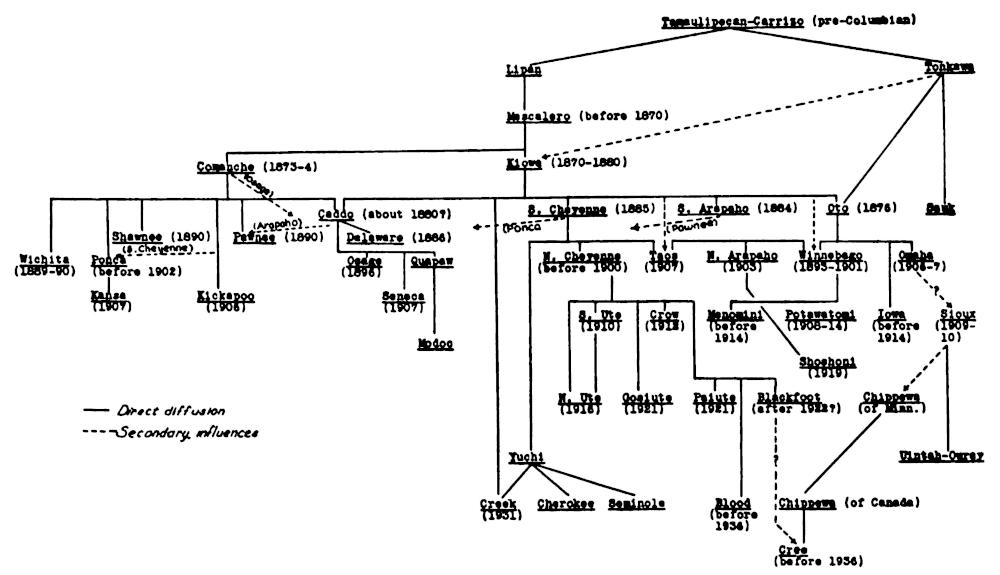
Fig. 5. Chronological outline of the diffusion of peyotism.
[1] “These beans are often confused with those of a certain species of Erythrina, which are sometimes sold in their place in the markets of Mexico, but which are not at all narcotic” (Safford, Narcotic Plants, 397).
[2] Not to be confused with the “mountain laurel” Kalmia latifolia.
[3] Henry, The Plant Alkaloids, 395, 398.
[4] Henry, op. cit., 397; cf. Safford, Narcotic Plants, 397.
[5] Bellanger, in Havard (Bulletin 519:6); Opler, The Autobiography; Lumholtz, Unknown Mexico, 1:256; Bennett and Zingg, The Tarahumara, 358. The use of frijolillo in maguey liquor (which equates with mescal) probably accounts for the usage “mescal bean.” Since the text was written further Apache material has appeared (Castetter and Opler, Ethnobiology of the Chiricahua and Mescalero Apache, 54-55).
[6] Mooney, Miscellaneous Notes, 6. Schultes figures a Kiowa necklace of true mescal beans (Sophora secundiflora Ortega, Lag. ex DC.) strung on buckskin, with a piece of red ribbon, beaver fur and a child’s ring enclosing a bundle of dried beaver-testis “medicine” in a lace handkerchief, as trinkets or amulets.
[7] Skinner, Ethnology of the Ioway, 261; Gilmore, Uses of Plants, 99.
[8] Skinner, Societies of the Iowa, 718-19.
[9] Cf. the origin of peyote in deer’s foot-prints or hooves.
[10] “The maⁿkácutzi beans were supposed to be alive. Those I have seen in the possession of various Iowa were kept in a buckskin wrapper which was carefully perforated that they might see out.” Cf. the ability of the father peyote to see.
[11] Cf. the preparation of peyote by grinding on metates like corn.
[12] Cf. the black drink ceremony to the east, and the Plains Sun Dance.
[13] Early peyotism was likewise an agricultural “first-fruits” rite.
[14] The Wichita used mescal beans in horse-racing too. Cf. the use of peyote in racing and deer-hunting, and the use of datura in deer-hunting.
[15] Cf. the fetishistic use of the father peyote in war.
[16] Cedar and sage are likewise involved in peyotism.
[17] Harrington, quoted by Skinner, Ethnology of the Ioway, 245-47.
[19] The Delaware, Osage, Quapaw and Oto call the leader’s peyote staff an “arrow,” the Ponca a “bow.”
[20] Cf. peyotism’s four ritual songs, and the whistling outside at midnight at the four points of the compass.
[21] But Erythrina flabelliformis contains no toxic alkaloids; see Appendix 2.
[22] Did that truculent and little-known group, the Caddo, have the mescal cult?
[23] Has this taboo any reference to the boneless meat of the peyote ritual breakfast?
[24] Voegelin, Shawnee Field Notes.
[25] The Huichol, for whatever such evidence is worth, in the mythological songs of their shamans, recite how the world began and how they were taught to hunt deer, to seek hikuli and to raise corn (Lumholtz, Unknown Mexico, 2:8). The route they take in gathering peyote is from beginning to end full of religious and mythological associations, and they meet their deities on the way in the shape of mountains, stones, springs, etc. (idem, 2:132). According to their traditions, they originated in the south, but got lost under the earth as they wandered northward, reappearing in the country of the hikuli (idem, 2:23). Such deep-rooted symbolisms as theirs argues age.
[26] Bennett and Zingg, The Tarahumara, 360, 366-67, 379, 383, 386; Lumholtz, Unknown Mexico, 1:357-358, 444 (but see 1:378).
[27] Velasco, Dictamen Fiscal, 194; Opler, The Autobiography; Lipan Field Notes; The Influence of Aboriginal Pattern; Wagner, Entwicklung und Verbreitung. Opler says that peyote was introduced within the memory of the oldest living Mescalero; after 1910 it was in decided decline.
[28] Parsons, Taos Pueblo, 62-63. The origin legend is Kiowa. Mooney received a letter dated July 18, 1921 from the Taos Indian, Star Road, relative to trials of “peyote boys.”
[29] Cozio, Proceso.
[30] In 1921 on the orders of the Governor, Manuel Cordova, a peyote meeting was raided and the blankets and shawls of all participants somewhat highhandedly confiscated. Prominent medicine-men refused to doctor “peyote boys” because the new religion was prejudicial to their vested interests. In 1923 two adherents of the cult were whipped, one twenty-five lashes, by the Lieutenant-Governor. Three men were fined $700, $800 and $1000, and the case ultimately reached the American court; the judge decided that the Governor had no right to impose such heavy fines, reversed the judgment and ordered the return of the property. This done, the officers resigned from office, and for a time there were no secular officers at Taos because no one wanted to take up the controversy. In 1931 the confiscated property taken ten years before had still not been returned, the Council refusing even to consider a $10 fine in compensation; $25 was demanded for the return of each shawl and blanket.
[31] Parsons, Taos Pueblo, 80, note 64; 99, note 166; 118; John Collier, in Peyote as Used in Religious Worship.
[32] This widespread origin legend of the Plains is also Mescalero and Lipan, and from certain indications I suspect that it is Tamaulipecan also.
[33] Mooney, in Handbook of the American Indians, 1:701, “Kiowa Apache.”
[34] Mooney, Peyote Notebook, 14.
[35] Shonle, Peyote; The Giver of Visions, 54. Jack Sankadote, for example, was carried into a meeting as a baby by his father, and he is in his fifties.
[36] Several older Kiowa patterns parallel peyote usages (e.g. the smoking ceremony of the Old Women’s Society: leader west of central fire, lieutenants on either side of the door, five dishes of food from the fire eastward; the Buffalo Medicine Men’s Society bundle-repair meeting with a sage “stage,” etc.), and the Kiowa-Comanche had the all night singing and beating on a rolled-up hide on the eve of departure on the war-path. But such parallels from the tribes one knows best lead to often naïve particularistic explanations and should be guarded against. As a matter of fact it is the wide distribution of sweat bath doctoring and society meetings which accounts for the ease with which peyotism made its way in the Plains. The following two paragraphs are partly based on data gathered by Donald Collier, a colleague of the Laboratory of Anthropology Kiowa trip.
[37] In judging the relative importance of the Kiowa and the Comanche in the diffusion of peyotism, one should recall that Comanche was historically the lingua Franca of the southern Plains. Quanah took peyote to the Caddo and Wichita it is said, though he was not the first to do so; he led meetings among the Cheyenne and the Arapaho in 1884. Petrullo (The Diabolic Root, 129) says he learned peyote about 1868 in Arizona, New Mexico and Old Mexico.
[38] “It is desirable to eat with the Comanche or the Kiowa because they are reputed to have learned of Peyote many years before the others.” (Petrullo op. cit., 33.)
[39] Handbook of the American Indians, 2:870b; cf. Mooney, in Peyote as Used in Religious Worship, 13-14, 15; Rouhier, Monographie, 102.
[40] Jock Bullbear’s and Mooney’s testimonies in Peyote as Used in Religious Worship, 40, 48, 57.
[41] Kroeber, The Arapaho, 410. The practice apparently is also Kiowa and Oto.
[42] Wissler, Societies and Dance Associations, 436; the statement was made in conversation.
[43] Newberne and Burke, Peyote: An Abridged Compilation, table.
[44] Wagner, Entwicklung und Verbreitung, 84, footnote.
[45] Newberne and Burke, op. cit., 33 ff.
[46] Petrullo, The Diabolic Root, 71-72.
[47] Wilson said that one Smith had been in Oklahoma from a group on the Yukon River in southern Alaska; they were said to have used it for fifteen years. Jenness (letter to Schultes) reported a rumor that a little peyote had filtered into Salishan groups of British Columbia but Gunther (letter to Schultes) reported its absence among the Flathead and Kutenai.
[48] Hoebel, Northern Cheyenne Field Notes.
[49] Letter from Fred Washington to Dr. F. G. Speck, April 21, 1932. Petrullo (The Diabolic Root, 165) says the Delaware got peyote from the Kiowa; there is obvious Caddo influence too, via John Wilson.
[50] Skinner, Societies of the Iowa, 693-94, 724; Medicine Ceremony of the Menomini; Ethnology of the Ioway, 190, 217, 248-49.
[51] Skinner, Societies of the Iowa, 758.
[52] “We the undersigned members of the Kickapoo Tribe of Indians in Kansas most earnestly petition you to help us keep out the pellote, or mescal, from our people. We realize that it is bad for us Indians to indulge in that stuff. It makes them indolent, keeps them from working on their farms, and taking care of their stock. It makes men and women neglect their families. We think it will be a great calamity for our people to begin to use the stuff.... We most urgently petition you that immediate action must be taken before the stuff gets hold of our people” (Seymour, Peyote Worship, 183).
[53] Skinner, Medicine Ceremony of the Menomini, 24, 42-43, 97.
[54] Speck, Delaware Peyote Symbolism.
[55] Gilmore, The Mescal Society, 163-67; The Uses of Plants, 104-106; Mooney, Tarumari-Guayachic; Speck, Delaware Peyote Symbolism; testimony of Sloan in Peyote as Used in Religious Worship, 35. Murie, Pawnee Indian Societies, 637.
[56] Peyote as Used in Religious Worship, 10-11, 30-31, 43, 44-45. This booklet was compiled after 1911, giving for “twenty years [ago]” a maximally early date of 1891; but other internal evidence indicates a publication date of 1916, giving the date 1896 as quoted.
[57] Speck, Notes on the Ethnology, 171.
[58] No doubt with the memory of the fate of Albert Stamp’s attempted “moon” among the Caddo, Taylor exhibited considerable modesty when this flattering offer was made. “I appreciate that offer,” he said, “but I’m just Alfred Taylor, that’s all I am, and I never did run a meeting, and I would rather you’d get somebody else from down home who runs meetings to do it for you.” Several weeks later my informant said he didn’t think Taylor would accept, though he might drum or build the fire “like a servant”—“He’s afraid the Caddos will think he is pushing himself ahead too much, but he has even drummed for Enoch Hoag; he just don’t like to jump ahead of everybody too much away from home.” This abnegation is all the greater when it is understood that the Osage are accustomed to make handsome money gifts on such occasions.
[59] Koshiway compared the smoke-meeting before the war path to peyote: “They have a meeting and smoke the pipe together and leave the next day. This clears up the enemies, and you can prophesy then. Peyote is similar to this—all night.” Another older pattern interestingly survives among the Oto: in the informal morning period in the tipi, joking relationship seems to function.
[60] One wonders if the Russellite eschatology was not made more acceptable historically among the Oto because of an approximation to certain Ghost Dance notions. In any case, the curious prohibition on smoking may have symbolized, on the one hand, the rejection of older patterns of religious smoking, reinforced by the prohibition of secular smoking too.
[61] Mooney, Tarumari-Guayachic, 38.
[62] Shonle, Peyote: The Giver of Visions, 55.
[63] Murie, Pawnee Indian Societies, 636-37. Wagner (Entwicklung und Verbreitung, 75) disputes Shonle’s statement that they got it from the Quapaw, on the ground of the greater complexity of the Quapaw rite. His argument is unimpressive and a priori: John Wilson was the source of that complexity. Cf. Opler, The Autobiography.
[64] There may be Doctor Dance parallels in peyotism (e.g., an earthen altar, a fire in a round hole in the center of the tipi, doctoring at night with coals, fan or sucking horn, presence of the relatives of the patient in the meeting, etc.); another older Pawnee pattern in peyote may be the special morning prayer-maker south of the door.
[65] “PEYOTE FAILS. It is a good thing that peyote is stopped for it was doing more harm than good. Our young men of the reservation were just beginning to start in eating the devil’s root.... Peyote fails because it has no mouth so can not speak to its followers of their origin and destiny, nor as to sin, repentance, forgiveness, salvation nor of anything else. It has no ears, so can not hear prayer; it has no eyes, so it can not see a person’s needs; no hands so can not help; no mind, so can not think. It is therefore unable to ask God for the thing which its worshipers need, and which they plead with it to implore God for. Our boys tried to make others believe that peyote is a God and a religion, but if one wants to believe in mysterious things it must be Christ or peyote.” (Sam Newman, Ree [Arikara], in The Indian Leader.)
[66] Michelson, Sauk and Fox Myths.
[67] Skinner, Observations on the Ethnology, 10, 85.
[68] Native American Church, President’s Report, 1925.
[69] Speck, Delaware Peyote Symbolism.
[70] Voegelin, Shawnee Field Notes.
[71] Peyote, An Insidious Evil, 3-4; Office of Indian Affairs, Discussion Concerning Peyote, 13.
[72] Much of this information is from Alfred Wilson, a Southern Cheyenne. His presidential report for 1925 (Sixth Annual Convention of the Native American Church) cites “locals” for the Caddo, Wichita, Pawnee, Arapaho, Yuchi, Kiowa, Oto, Shawnee, Ponca, Sauk and Fox, Cheyenne, and Omaha. Parsons, Taos Pueblo, 62; Willard Park informed me in 1936 that the Paviotso lacked peyote.
[73] Radin, A Sketch of the Peyote Cult, 4-5, 7; The Winnebago Tribe, 394, 400, 415, 423; Crashing Thunder, 169-70, 179, 185; Lowie, Notes Concerning New Collections, 289; Densmore, The Peyote Cult; Winnebago Songs of the Peyote Ceremony; Speck, Delaware Peyote Symbolism.
[74] Seymour, Peyote Worship, 184; Petrullo, The Diabolic Root, 71-72; Shonle, Peyote; The Giver of Visions, 55.
[124]
The connotative etymological implications of the term “peyotl” become valuable when an understanding of its wider denotative applications is sought. In Hernandez’ original description, Lophophora williamsii is called “Peyotl Zacatensi, seu radice molli et lanuginosa”[1]—that is to say, the whitish flocculence which gains the plant both its Aztec and modern botanical names, is again pointed out in Hernandez’ Latin synonym, “soft and lanuginous root.”
But Hernandez distinguished two peyotes, “Peyotl Zacatensi” and “Peyotl Xochimilcensi,”[2] the latter not even one of the Cactaceae, and one wonders at the classification until the plant is botanically described:
This peyote, a rather excellent medicine, has a heavy round root covered with woolly rootlets, in addition to other roots which resemble acorns, because of their form and size, growing out in every direction.... It has few stems ... with yellow flowers at their extremities.
From even this brief characterization it is clear that the term “peyotl” was extended to this non-cactus (later identified as Cacalia diversifolia or C. cordifolia)[3] because of its balanoid lanuginous roots. The latter species is sold in the drug markets around Guadalajara, Jalisco, as “peyote”; specimens from Alvarez, San Luis Potosí, locally known as “cachan,” are valued as an aphrodisiac and remedy for sterility, the rhizic-orchic pubescence of the plant being evidently viewed in terms of sympathetic magic.
Dr. Alfonso[4] applies the term peyote or piote further to Cacalia sinuata, La Llave, and Etchevarria coespitosa Dec., the former Compositae, the latter one of the Crassulaceae. One of the Compositae, Senecio spp., ranging from Cerro del Pino to the Valley of Mexico is thus described:
The tap-root is tuberous-ovoid, size of a small hen’s egg, a little curved above, carrying almost all [its bulk] in the heavy extremity.... All the surface is covered with a nap formed of long matted hairs of the color of cannel, and a number of long roots.
[125]
The “Peyote of Tepic”[5] (Senecio hartwegii) is smaller and more globular than the above, and contains no alkaloid, the gluey, sticky sap having no effect on the dove or the rat. The “Peyote of Querétaro” (Echinocactus turbinatus Henning), said to be distinguished from Anhalonium only by the spiral disposition of the hair-pencils, is a common form of Lophophora williamsii.
In the case of all these non-cacti to which the term peyote has been applied, the plants have exhibited descriptively either a lanuginous or pubescent surface-nap, or balanoid, orchitic, or nut-like root-nodules, and in some cases both; in one case there was a cocoon-shaped pod in addition. But Schultes[6] lists other “peyotes” which may not fit this explanation: Compositae: Senecio calophyllus Hemsl., S. Hartwegii Benth., S. ovatiformis Sch. Bip., S. Petasitus DC and Cacalia spp. (e.g., C. cordifolia HBK); Leguminosae: Rhynchosia longeracemosa Mart. & Gal.; and even one of the Solanaceae, Datura meteloides DC.
All the above are non-cacti, but many Cactaceae have also been called “peyote.” These include: Anhalonium Englemannii Lem., A. prismaticum Lem., A. furfuraceum Wats., A. pulvilligerum Lem., A. areolosum Lem., Lophophora williamsii Lem., Ariocarpus fissuratus (Englm.) K. Schum., Astrophytum myriostigma Lem., A. asterias (Zucc.) Lem., Pelecyphora aselliformis Ehrenb., and Strombocactus disciformis DC. The diminutive “peyotillo” has been applied to Dolichothele longimamma Britton and Rose, and Solisia pectinata Britton and Rose.[7]
[1] Hernandez, in Safford, Aztec Narcotic, 295; Peyotes, Datos para Estudia, 204.
[2] In simpler Mexican cultures, peyote was in the hands of shamans; this other peyote appears to derive its name from the priests of a certain class in the higher Aztec culture: “According to some authorities, the highest grade of these native hierophants bore among the Nahuas the symbolic name of ‘flower weavers,’ Xochimilca, probably from the skill they had to deceive the senses by strange and pleasant visions (Xochimilca, que asi llamavan á los mui sabios encantadores)” (Torquemada, in Brinton, Nagualism, 298).
[3] A specimen in Mooney, Peyote Notebook, 56, was so identified. Schultes viewed this and identified it as C. cordifolia which in addition has cocoon-shaped pods. Cf. the use of Lophophora as an aphrodisiac.
[4] Alfonso, in Rouhier, Monographie, 3; Santoscoy, Nayarit, 32. Schultes (Peyote and Plants Used, 135) lists Cotyledon caespitosa Haw. as a Crassulaceous “peyote.”
[5] Peyotes, Datos para Estudia, 111, 206, 208. This non-cactus “peyote” of Tepic may have been the false clue leading Rouhier to believe an earlier range of peyote into Tepic.
[6] Schultes, Peyotes and Plants Used, 135. The Reko etymology preferred by Schultes (p. 136) so far as botanical evidence goes derives peyotl from Aztec pi- (small) and -yautli or -yolli (herb with narcotic odor or action), making “peyotillo” a double diminutive. Schultes has accepted, at the instance of the present writer, the thesis that Cacalia spp. might well enough fit the “velvety, cocoon-like” etymology, but argues nevertheless that “this etymology does not seem to explain the application of the same name to the great array of plants which possess no soft or silky parts whatsoever.” Schultes is undoubtedly right on this point in terms of descriptive botany; yet may not some items be included in our lists illegitimately? Anhalonium prismaticum Lem., for example, is called hikuli, not peyote, and is only partly its terminological equivalent. And does the “little narcotic” etymology explain all these instances?
[7] Urbina, in Harms, Über das Narkotikum, 31; Schultes, op. cit., 135.
[126]
Far the commonest designation for peyote in the older literature is “mescal bean,” a curiously persistent misusage, since either in the dried or the green state Lophophora williamsii resembles a bean even less than a mushroom, Safford’s teo-nanacatl. On probing more deeply into this confusion, a widespread pre-peyote narcotic cult of the southern Plains was discovered. The ethnographic results of this study are presented in the text, but a brief characterization of the “mescal bean” proper is essential as well.
Collected specimens of the old Plains “red bean” (= mescal bean proper) have been identified by authorities at the Harvard Botanical Museum as Sophora secundiflora (Ortega) Lag. ex DC.[1] Variously known as “mescal bean” (southern Plains), “colorín” (Coahuila, Nuevo León, Texas), “frijolillo” (Nuevo León, Texas), “frijolito” (Texas), “evergreen coral-bean,” “coral-bean” and “mountain laurel” (southern New Mexico), this plant grows from Coahuila to San Luis Potosí, western Texas and southern New Mexico, being specially characteristic of the dry limestone hills. It is not, however, the “mountain laurel” Kalmia latifolia, being a true member of the Fabaceae or Bean Family; the term “coral-bean” is likewise applied to two other legumes of Texas, both, however, Erythrina spp., not Sophora.[2]
Sophora secundiflora contains the highly toxic narcotic alkaloid sophorine, C₁₁H₁₄ON₂, which is identical with cytisine (= ulexine, = baptitoxine). Resembling nicotine closely in physiological action, the contents of one bean are said to be able to produce nausea, convulsions and even death by asphyxiation in man.[3] Sophora secundiflora (= Broussonetia [127]secundiflora) itself is a handsome evergreen shrub or small tree, eight to thirty-five feet high, bearing thick, leathery, dark glossy green leaves. The violet-blue bunches of flowers appearing in the spring give off a strong rank fragrance, and from these develop, in the summer, woody pods, satiny outside, two to four inches long, and containing one to four hard-shelled bright red beans.[4]
Safford[5] states that “these beans are often confused with those of certain species of Erythrina, which are sometimes sold in their place in the markets of Mexico, but which are not at all narcotic.” It is therefore possible, and indeed probable, that the beans used as necklaces and bandoliers in the Plains were both Sophora spp. and Erythrina spp.; Mooney[6] for example had specimens of red bean necklaces identified as S. secundiflora and E. fruticisa. The confusion of the two closely related groups is understandable when the beans alone are available for diagnosis; the bean of Sophora secundiflora differs from that of Erythrina flabelliformis, for example, in little more than the shape of the hilum, or scar of attachment, that of the former being rounded and of the latter more linear, while the beans of E. corraloides are more elongate than those of Sophora. Gilmore’s[7] identification of the Omaha “red-medicine” with Erythrina spp. may possibly be wholly correct since he mentions only decorative and magic uses for the beans; but in view of the chemical composition of the two, any ritual narcotic use must a fortiori refer to Sophora secundiflora, the “mescal bean” proper.
[1] There is no problem of identifying the old Plains “red bean” with the “mescal bean”; both Schultes and I obtained Kiowa specimens in the field. The problem is the correct botanical classification of the specimens, and the widespread misusage of their name for peyote.
[2] Standley, Trees and Shrubs, 435; Dayton, Important Western Browse Plants, 87; Boughton and Hardy, Mescalbean, 5; Opler, Autobiography. The Chiricahua “Mountain laurel” is S. secundiflora.
[3] Henry (T. A.), The Plant Alkaloids, 395; Dayton, op. cit., 89. Havard (Report on the Flora, 500) says the alkaloid sophoria [sic] was isolated by Dr. H. C. Wood in 1877 as a whitish, amorphous substance producing convulsions, temporary loss of voluntary movement, and distressing vomiting; again (Drink Plants, 39) he says sophorine [sic] is an irritant-narcotic. Another alkaloid, matrine, is found in Sophora spp. (Nagai, Plugge, Kondo et al. in Henry (T. A.), The Plant Alkaloids, 398). Havard, citing one Bellanger, says the Indians near San Antonio formerly used the seed as an intoxicant, half of one producing a delirious exhilaration followed by a deep sleep lasting two or three days; a whole bean, according to Dr. Rothrock’s informant, would kill a man. Dayton, 89, says children have been known to die from the effects of eating seeds of S. secundiflora; in any case, a rupture of the hard, leathery coat of the bean would be required for the release of the alkaloid in the bean-flesh.
Cattle and sheep appear to be more affected by the leaves of the plant, which also contain the alkaloid, than by the beans. The effect on them is marked: sheep fed about one percent body weight of the leaves were paralyzed in the legs for days and calves fed as little as .25% of body weight of fresh leaves died in 45 hours; one fed 1.0% died in 1¾ hours. Recovery in sheep sometimes required 12 days, in calves up to 16 days (Boughton and Hardy).
[4] Condensed and synthesized from Boughton and Hardy; Havard, Report on the Flora, 458, 500; Drink Plants, 39-40; Standley, 435; Dayton, 87-89.
[5] Safford, Narcotic Plants, 398.
[6] Mooney, Tarumari-Guayachic (quoting Safford?).
[7] Gilmore, Uses of Plants, 99 writes: “The Omaha traveling into Oklahoma have found them [chinaberry] there, and have taken up their use. They already had employed for beads as well as for a good-luck charm the bright red seed of a species of Erythrina. They say it grows somewhere to the southwest, toward or in Mexico. They call it ‘red medicine,’ makaⁿ zhide (makaⁿ, medicine; zhide, red). When the seeds of Melia (azerdache L.) [chinaberry] were adopted for use as beads, they likened them to makaⁿ zhide, and so call them makaⁿ-zhide sabe, ‘black red-medicine’.”
[128]
The already sufficiently intricate ethnobotanical problem of peyote has been further complicated by an erroneous identification of a narcotic mushroom used by the Aztecs with the cactus peyotl. Safford[1] identifies the two by a somewhat casual use of his evidence, and mystifies himself with the consistent contradiction offered by all the early Spanish writers to his assumption. He composes the contradiction by assuming that the Aztecs did not recognize the dried discoidal button as the same plant as the green cactus; despite overwhelming etymological evidence he supposes they called the former teo-nanacatl and the latter peyotl. Only a complete review of the evidence can clear up this misapprehension.
The Spanish writers consistently describe the two separately, with detailed circumstantial distinctions which leave no room for misunderstanding. Sahagún,[2] says
[The Chichimeca] had a great knowledge of herbs and roots and knew their qualities and their virtues. They themselves discovered and first used the root that they call peiotl and those that used to gather and eat them used them in place of wine, and they did the same with those that they call nanacatl, which are toadstools [hongos malos] that also make one drunk like wine.
Again, in a special chapter on intoxicating plants, Sahagún distinguishes the two:
There is another herb like tunas of the earth [the Spanish name for the fruit of the prickly pear, Opuntia opuntia] which is called peiotl. It is white. It grows in the northern part. Those that eat it see frightening and laughable visions. This intoxication lasts two or three days and then stops....[3]
There are some little mushrooms in their land that they call teo-nanacatl. They grow under the grass of the fields or pastures. They are round. They have a sort of high stem [pie], thin and round. They are eaten with great relish, but they harm the throat and make one drunk.[4]
[129]
Still further to emphasize the point, Sahagún in the next section of this chapter[5] goes on to speak of edible mushrooms:
The cone-shaped mushrooms (mushrooms or nanacatl) genus campos agrorum in the mountains are good to eat. They are cooked because of this, and if they are raw or badly cooked, they produce vomiting or diarrhea, and they kill one,
and he continues to list and describe a number of other edibles.
The naturalist Hernandez[6] is even more explicit. He describes teo-nanacatl under the heading “De nanacatl seu Fungorum genere”; and from the harmless white mushrooms, iztacnanacame, the red mushrooms, tlapalnanacame, and the yellow-orbicular mushrooms, chimalnanacame, he distinguishes teo-nanacatl as “teyhuinti,” that is, “intoxicating.” Siméon’s Nahuatl dictionary even uses nanacatl as an illustration:[7]
Teo-nanacatl, espece de petit champignon qui a mauvais gout, enivre et cause des hallucinations; il est medicinal contre les fievres et la goutte.... Teyuinti, qui enivre quelqu’un, enivrant; teyhuinti nanacatl, champignon enivrant.
Safford quotes this evidence himself!
Padre Jacinto de la Serna[8] records for us another compound of the Nahuatl word for mushroom, and describes the fungus while likewise specifically distinguishing it from peyote and ololiuhqui:
To this meeting had come an Indian ... who had brought some of the mushrooms that are gathered in the monte, and with these he had performed a great idolatry. But before proceeding with my story I wish to explain the nature of the said mushrooms, which in the Mexican language are called Quahtlananacatl, “wild mushrooms.” ... These mushrooms were small and yellow and ... were collected by priests and old men, appointed as ministers for these impostures, who would proceed to the place where they grow and remain almost the whole night in prayer and in superstitious conjuring; and at dawn, when a certain little breeze known to them would begin to blow, then they would gather the narcotic,[9] attributing to it deity, with the same properties as ololiuhqui or peyote, since when eaten or drunk, they intoxicate those who partake of them, depriving them of their senses, and making them believe a thousand absurdities.
In Safford it appears that de la Serna distinguished these from Picietl, tobacco, also. There [130]is an implied confusion, to be sure, in Alarcón, but he supplies confirmation of this last point, along with interesting ethnographic details:[10]
One should notice that in almost every case that they are moved to offer a sacrifice to their imagined gods, there comes to take charge of it and preside over it some quack, medicine-man, seer or diviner from among other Indians, the majority of them falling back on their crazy ceremonies, or on whatever whim arises when they are deranged from the drinking of what they call ololiuhqui or pezote [sic] or tobacco, whatever it might be called in particular localities.
The Franciscan Fray Toribio de Benvento mentions teo-nanacatl, to which he gives an erroneous etymology:[11]
They had another kind of drunkenness ... which was with small fungi or mushrooms [hongos ó setas pequeñas] ... which are eaten raw, and, on account of being bitter, they drink after them or eat with them a little honey of bees, and shortly after that they see a thousand visions, especially snakes. They went raving mad, running about the streets in a wild state [bestial embriaguez]. They called these fungi “teo-na-m-catl,” a word meaning “bread of the gods.”
Tezozomoc,[12] again, related that at the coronation of Montezuma the Mexicans gave wild mushrooms [hongos montesinos] to the strangers to eat; that the strangers became drunk, and thereupon began to dance. Diego Durán[13] gives further particulars of the coronation of Montezuma II; he says that after the usual human sacrifices had been offered, all went to eat raw mushrooms (hongos crudos), which caused them to lose their senses, more than if they had drunk much wine. In their ecstasy many of them killed themselves with their own hands, and by virtue of the mushrooms had visions and revelations of the future.
The conclusion from all this evidence is obvious: the peyote of the Plains, Lophophora williamsii, is identical with the peiotl, peyotl, pellote, peyote, pejori, peyori or bejo of the Aztec and other Mexican tribes, but this cactus is wholly distinct from the little yellow thin-stemmed fungus teo-nanacatl, and Safford’s identification of the two is erroneous.
[1] Safford, An Aztec Narcotic 294; Identification of Teo-nanacatl, Narcotic Plants; Peyote, 1278-79.
[2] Sahagún, Historia general, Lib. 10, cap. xxix: “... ellos mismos discubrieron, y usaron primero la raíz que llaman peiotl, y los que comian y tomaban la usaban en lugar de vino, y lo mismo hacian de los que llaman nanacatl que son los bongos malos que emborrachan tambien como el vino.” The authoritative edition of Jourdanet and Siméon, 661-62 translates nanacatl as “champignon vénéneux.”
[3] Sahagún, Historia general, 3:241-42: “Hay otra yerba como tunas de tierra, se llama peiotl, es blanca, hacese ácia la parte del norte, los que la comen ó beben vén visiones espantosas ó irrisibles.” (Lib. 11, cap. vii, pt. i, “De ciertas yerbas que emborrachen.”) Jourdanet and Siméon, 737, unfortunately describe tunas as “une ... plante qui rapelle la truffe,” which is a mushroom. Sahagún’s work is virtual dictation from Aztec informants, later translated with painstaking care into Spanish. It is difficult to assume, as did Safford, that such able herbalists did not know the difference between a cactus and a fungus.
[4] “Hay unos honguillos en esta tierra que se llaman teo-nanacatl, críanse debajo del heno en los campos ó páramos; son redondos, tienen el pie altillo, delgado y redondo, comidos son de mal sabor, dañan la garganta y emborrachan.” (Idem, 3:241-42.) To be sure our own best scientific knowledge must always be the touchstone for the data of the various folk-sciences; yet one is not entitled to a lofty and comprehensive á priori distrust of native knowledge, particularly when detailed with such clarity as this.
[5] “Las setas (hongos ó nanacatl) hacen genus campos agrorum en los montes, son buenas de comer....” (Sahagún, Historia general, 3:243).
[6] Hernandez, in Safford, Aztec Narcotic, 293. The very word itself means “mushroom!” Reko’s etymology for teo-nanacatl, “divine nourishment,” is unsound according to Whorf; and indeed, there is nothing of the edible par excellence about fungi (see Schultes, Peyote and Plants Used, 136-37).
[7] Siméon, in Safford, Identification of Teo-nanacatl, 400, 412.
[8] de la Serna, Manual de Ministros, 261.
[9] Cf. the Huichol peyote-gathering ritual and the wind which arises.
[10] Safford, Aztec Narcotic, 291. Indeed in this short sub-chapter, Sahagún distinguishes and describes coatlxoxouhqui = ololiuhqui [its seeds] peyotl, tlapatl, tzintzintlapatl, mixitl, teo-nanacatl, tochtetepo, atlepatli, aquiztli, tenxoxoli and quimichpatli! Alarcón, Tratado, 131; also in Urbina, El Peyote y el Ololhiuqui, 27.
[11] Ritos Antiquos; in Kingsborough, 9:17. Jourdenet and Siméon, translators of Sahagún, Histoire général, 738, have: “[Teo-nanacatl] c’est-à-dire: champignon dangereux. Le terme générique est nanacatl qui se met en composition avec d’autres mots pour désigner les diverses espèces de champignons.”
[12] Crónica Mexicana; in Kingsborough, 9:153. The fact that raw mushrooms are mentioned disposes of Safford’s supposition that dried peyote buttons are meant.
[13] Durán, Historia de las Indias, 564, quoted from Kingsborough’s Mexican Antiquities by Bourke, Scatological Rites, 90.
[131]
Peyote is only one of several narcotics in the southern United States and Mexico which because of their physiological action find ritual and other uses. Since, in many of these, uses are related, there arises the problem of their possible historical relationship. In any case, it is illuminating to study the general background of attitudes out of which peyotism grew.
The Tarahumari of northwestern Mexico, though their hikuli cult is less elaborate than that of the Huichol, have a complex of “worship” and use of several varieties of cacti. Besides hikuli wanamé (Lophophora williamsii) Lumholtz[1] lists the following:
Mulato (a Mammilaria), believed to make the eyes large and clear to see sorcerers, to prolong life, and to give speed to runners who eat it.[2]
Rosapara (a more advanced vegetative form of the same, but with many spines) which has very keen eyes for Tarahumari wrong-doing; it punishes by driving the offender mad, or throwing him down a precipice; “it is therefore very effective in frightening off bad people, especially robbers and Apaches.”[3]
Sunami (Mammilaria fissurata),[4] rare, but even more powerful than wanamé, for it calls soldiers to its aid. The drink produced from it is strongly intoxicating. Deer cannot run away from you, nor bears harm you when carrying this cactus.[5]
[132]
Hikuli walúla sälíami, “hikuli great authority,” is the greatest of all; it is extremely rare, and Lumholtz never saw a specimen, though it was described to him as “growing in clusters of from eight to twelve inches in diameter, resembling wanamé with many young ones around it.”[6]
Ocoyome, unlike the preceding hikuli which are good, is used only for evil purposes. It has long white spines or “claws,” and comes from the Devil. If accidentally touched with the foot, it would break one’s leg; it also throws offenders over precipices.[7] Lumholtz says it was very rarely used, and Mooney says the Tarahumari used it not at all—though the “Apaches” did—since it was “poison.” Mooney describes the plant as having a reddish down, root and surface, which may account for the Apaches’ tying it around their waists to make them brave, in their battles.[8]
Bennett and Zingg are perhaps referring to the same plant under the name “peyote cimarrón,” which is “small, red, and ineffective; it is not used or even touched, since the abuser might die.” “Peyote christiano” (hikuli dewéame), a larger, green variety, apparently Lophophora, is considered the “most efficacious.”[9]
Bennett and Zingg give two other kinds of cactus used by the Tarahumari:[10]
Witculíki (Mex. biznaga, Mammillaria hyderi), a ball cactus of the gorges, is roasted about four minutes in ashes, after being split and divested of its spines; the soft center is squeezed into the ear in case of earache or deafness. (This curiously echoes of the talking peyote stories.)
Bakánawa or bakánori, a small ball cactus, is used by the Indians of the barrancas. Shamans, not peyoteros, carry small bits of the root in their bags; it can be kept only three years, after which it must be sold or hidden, lest the owner go crazy. The shaman chews and anoints the patient with it. So powerful is it that runners use it three days before racing; one man died of fear after having offended this plant.
Of the ritually used narcotics of this area we have already discussed the “mescal bean,” or Sophora secundiflora, and teo-nanacatl, the sacred mushroom of the Aztec and [133]Chichimeca.[11] The use of marihuana (Cannabis spp.) in counteracting sorcery, and other beliefs surrounding its employment are also elsewhere discussed.[12] The use of the mescal-bean of the southern Plains and the various alcoholic drinks[13] of Mexico and the Southwest are perhaps related to the “black drink” made of the leaves and twigs of the “beloved tree” (Ilex cassine), which is distributed continuously from the Carolinas to the Rio Grande, with a continuation of the trait across the Antilles into northeastern and central South America.[14]
But the narcotic exhibiting perhaps the most numerous parallels in usage with peyote [134]is datura.[15] Gayton lists as datura-users in the Southwest[16] the Pima, Zuñi, Navaho, Hopi, Havasupai, Walapai, Mohave, Yuma and Cocopa, and in California the Akwa’ala, Southern Diegueño, Pass Cahuilla, Gabrielino, Luiseño, Serrano, Chumash, Salinan, Miwok, Eastern and Western Mono, and the Foothill and Southern Valley Yokuts. This distribution is continuous with that in northwestern Mexico among the Opata, Tepehuane, Cora, Tepecano and Aztec.[17]
The parallel uses of peyote, cohoba snuff and datura in prophecy and divination have been summarized elsewhere,[18] but there are further interesting uses of datura. The Aztec of Mexico[19] had special officials who took ololiuhqui (the seeds of datura) to discover cures for illnesses, to find lost or stolen property, to ascertain the origin of long sickness due to witchcraft, etc., receiving pay for their services. Sometimes they prescribed the drug for their patients; datura was also used empirically as an anodyne in setting fractures, and it may have been one of the drugs employed to stupefy sacrificial victims, though peyote is the only one identified. Ololiuhqui was also mixed with tobacco and the ashes of venomous insects to make the sacred ointment of the priesthood; set on altars it was called Divine Meat.[20] The Cora[21] refer to daturas in their songs and myths, but their use of it is not known.
In northern Mexico, the Tepehuane used toloache [datura] in place of peyote.[22] Tepecano prayers refer to datura as the husband of Corn Daughter and the son-in-law of Father Sun; having taken two mistresses, he was punished for this by being stuck head downward in the ground and commanded to give mortals whatever they begged of him. They believe him to have great riches, which they pray for and “borrow.” Datura is one of the five narcotics whose flowers decorate a love charm.[23]
[135]
In the Southwest, the Pima had a jimsonweed song which brought success in deer-hunting[24] and cured vomiting and dizziness. The White Mountain Apache[25] mixed the root of D. meteloides with their corn beer to make it more intoxicating. The Apache of Bourke[26] credited datura with the power of making men crazy, but denied using it medicinally or ceremonially. The Havasupai[27] eat datura leaves occasionally apparently for purely secular pleasure, and also use the drug in their arrow poison. At Zuñi[28] datura was one of the medicines formerly belonging to the gods, and only the rain priests and directors of the Little Fire and Cimex fraternities could use it; the rain priests propitiated birds with the powdered root, or a man ate it to bring rain. They also administered it to clients who had been robbed, to discover the thief, and to patients with broken bones; the pulverized root and flower were also used with corn meal for all types of wounds. In myth the daturas were once brother and sister who walked the earth and saw who committed thefts, but the Divine Ones said they knew too much and caused them to disappear into the earth forever; perhaps for this reason it is also used to communicate with the dead. The Navaho[29] eat the root of D. meteloides, and sometimes “the Indians under its influence, like the Malays run amuck and try to kill everybody they meet.” There is a record of Hopi doctoring with datura.[30]
Nearly all the tribes of southern California used datura. The Akwa’ala, Yuma, Mohave and Eastern Mono took it to acquire gambling luck; the Central Miwok did not eat it, but considered that a dream about datura aided one’s gambling fortune.[31] Of the remaining tribes of the region who used it ceremonially, some features were held in common: (1) it was not taken before puberty,[32] (2) it was usually administered to a group,[33] and (3) a supernatural helper, sometimes an animal, was sought.[34]
In southwestern California the use of datura is strongly ritualized in the Chungichnich cult of the Luiseño, and Northern and Southern Diegueño. According to Kroeber the ritual is comparatively recent and overlies an older, simpler use of the plant over a wider area. [136]In the Chungichnich ceremony datura is given to boys as a preliminary ritual in puberty observance; its use is not seasonal, nor do women ever partake of it.[35]
The Mountain Cahuilla[36] are typical of groups who had the simpler datura rite in puberty ceremonials before the addition of Chungichnich ritualism.
Manet (datura) was given to boys of 18-20 in a ceremony lasting 3 to 6 days in which other younger boys of 6-10 years were taught clan and “enemy” songs by their fathers. The paha or leader prepared strings of reed, eagle and flicker feathers which were worn by the dancers, who practiced away from the village. The drinking ceremony or kiksawel took place inside the ceremonial dance house, and women and children were warned away by the manet-dancer’s bull-roarer.[37] Each boy was given a drink of a decoction of datura pounded in a mortar by the clan chief. The men in the enclosure took each boy by the waist, and they all danced around the fire, led by the manet-dancer. The boys remained unconscious in the house all night when the effect of the drug became manifest, and were removed the following afternoon to a secluded cañon where for a week they were taught songs and dances nightly. The last afternoon a sand-painting was made and its symbolism explained. After an ant-ordeal and a fire-dance they were regarded as men and full-fledged members of the clan.
A second group of tribes in the San Joaquin basin and Sierra Nevada foothills had a datura-drinking ceremonial every spring for both sexes shortly after the age of puberty.[38]
The participant’s social status was not changed and the rite alone constituted a ceremonial unit, the tananhibina or tanabi-drinking of the Western Mono. Dancing to clappers took place until the children fell unconscious, whereupon they were carried away to special camps by relatives. If a person appeared to be covered with blood or maggots and vermin (the causes of sickness), they were brushed off with an eagle-feather brush.[39] In discovering the sickness the seer used an eagle-bone whistle which enabled him to “hear” the sickness; if a man had poison, one could see where it was. One could also see things at very great distances, as well as discover what medicine-man had caused the death of people by witchcraft. The seer could likewise find lost articles and discover wealth by means of datura. The drinkers were guarded during this time lest they harm themselves or be harmed. Some men did not have any datura-visions; this was because some medicine-man feared his bad deeds would be discovered, and hence rendered the drink harmless by magic and “covered up” those persons. If a medicine-man wanted to become very powerful, he took tanabi on ten successive seasons. Datura leaves were placed on the forehead of a dead person to drive out the spirit,[40] and people boiled tanabi leaves so the steam filled their house that the spirit of the dead man would not return to them in dreams.
In view of these repeated parallels in the attitudes and usages surrounding both peyote and datura, it is certainly not without significance that their distribution, while contiguous, [137]is mutually exclusive in northern Mexico and the southwestern United States: peyote is generally central and northeastern in Mexico, whence it spread northward and eastward into the Plains, while datura is northwestern in Mexico and extends through the Pueblo and nomadic Southwest to southern California. And if the “black drink,” native American beers in Mexico and the Southwest, and the mescal bean be all counted with peyote and datura as part of one general distribution, we have a large continuous area or “narcotic complex” across the whole southern United States and northern Mexico. Such large general distributions are not unknown (e.g., bear ceremonialism), and datura (via Central America), ilex drinks (via the Antilles) and aboriginal alcoholic liquors (continuous from the Southwest through Mexico and Central America to include the entire northern three-quarters of South America) are surely connected ultimately with the same traits in South America—more particularly since not alone are the plants involved the same, but also detailed “superorganic” attitudes and ritual manifestations.
[1] Lumholtz, Unknown Mexico, 1:372-74. These short paragraphs are summaries, not direct quotations.
[2] Cf. the physiological action of peyote-alkaloids, discussed elsewhere (dilation of the pupil, increased reflex excitability). The use of narcotics in this area in connection with racing appears again with peyote in northern Mexico, and with the “mescal bean” (Sophora secundiflora) among the Wichita. The Acaxee used peyote in their ball play, much as the “black drink” (Ilex cassine) was used in the Southeast. Cf. Mooney’s (Tarumari-Guayachic) “Muräto,” apparently identical with Lumholtz’ Mulato, that “is used mostly in races, not ground up, but tied whole around waist, at back.”
[3] Lumholtz, Unknown Mexico, 1:373. In this region narcotics in general are much employed in connection with war, and the magical “witching” of the enemy—whose power is not merely physical but magically malevolent too. “Mescal beans” were part of the war-bundle in some southern Plains tribes, and both peyote and datura were used clairvoyantly and prophetically in war connections. The attitude that the enemy is a witch, Dr. Spier informs me, is widespread among both the Yumans and Athapascans of the Southwest. Cf. also peyote and captured scalps (e.g., Maricopa) talking, and being danger-ridden.
[4] This is an instance where it is rewarding conscientiously to respect native categories and ethnobotanical statements for hordenine (= anhaline, one of the alkaloids of Lophophora) was discovered in Anhalonium fissuratum in 1894 by Heffter (see Appendix 5, fn. 5).
[5] Mooney, Tarumari-Guayachic, says sunami is very much respected, and is used only by doctors. Women doctors grind them on metates, placing the plant upright and crushing it with one blow (cf. the “killing” of mescal beans in the Plains). Doctors assemble for this feast, which requires the sacrifice of a beef. Special rites attend its gathering, and it must be gathered in a black blanket and bleeds red blood. It must be kept in a double basket in a cave, lest it hear quarreling in the house. It dislikes fire, and after ten or twenty years it loses its virtue and must be replanted with copal incensing where originally found. Doctors rub tizwin-and-sunami over the heart and rest of the body, for it makes one win races. Anhalonium fissuratum has a striking resemblance to deer-hooves; it is likely the hikuli referred to in this and other Tarahumari-Huichol tales—but it should be recalled that peyotism in Mexico is also connected with deer-hunting.
[6] Lumholtz, Unknown Mexico, 1:373-74; Mooney, Tarumari-Guayachic, says this variety is as big as a man’s hat. The description probably refers to an occasional polycephalous specimen of Lophophora williamsii (hikuli wanamé).
[7] Lumholtz, Unknown Mexico 1:374; Tarahumari Dances, 253, 452-54; cf. Mooney’s (Tarumari-Guayachic) kókoyómi. Mooney thought Lumholtz’ “walulasahane” was Tepecano, not Tarahumari.
[8] The resemblance of some Mammillaria spp. to a head or scalp of hair is quite striking; Higgins, in fact, figures an “Old Man Cactus” with long flowing white “hair.”
[9] Bennett and Zingg, The Tarahumara, 290.
[10] Bennett and Zingg, op. cit., 137, 295. The users of bakánawa believe it to be even more powerful than peyote. One can more easily believe that the ataxic gait of a peyote-intoxicated person would “throw” him over a cliff or break a leg, than that it would result in any conspicuously superior racing ability.
[11] Dorman, in Bourke, Scatalogical Rites, 91, says mushrooms were “worshipped” in the Antilles, in Virginia, and possibly also in California. The Siberian use of Amanita spp. is well-known, but no doubt these sporadic uses are all independent of each other.
[12] Lumholtz, Unknown Mexico, 2:354; see also notes 41, 45, 48 in Appendix 6.
[13] The writer has published elsewhere on the subject of the numerous native American beers (see Native American Beers). So far as a cactus-source of these is concerned, the following groups make use of Cereus giganteus Englm. and C. Thurberi Englm. for their sahuaro drink: Huichol (?), Pima, Maricopa, Yuma, Papago, Halchidoma (?), and San Carlos Apache.
[14] The ilex “black drink” is Catawba (Handbook of the American Indians, 1:150a, 2:1000-1001); Alibamu (Forster, Bossu, 254, 261, 294, 354-55); Creek (Swanton, Social Organization and Social Usages, 307, 445; Adair, in Swanton, Social and Religious Beliefs, 265; Speck, The Creek Indians, 110, 117-18, 134; Bartram, Travels, 449, 507), both Taskigi and Mikasuki; Cherokee (Bartram, Travels, 357); Chickasaw (Swanton, Social and Religious Beliefs, 240); Koasati (Paz, Koasati Field Notes); Yuchi (Speck, Ethnology of the Yuchi, 122-24, 135); Natchez (Charlevoix, Histoire de l’Isle, 166; du Pratz, Histoire, 2:46, 3:13); Atakapa (Forster, Bossu, 1:354-55), Chitamacha (Gatschet, in Swadesh, Chitamacha Texts) and Karankawa (Oliver, in Gatschet, The Karankawa Indians, 18-19). Also in Florida (de Laudoniére, in Lewin, Phantastica, 279; Safford, Narcotic Plants, 417; Romans, A Concise Natural History, 94), and also possibly in Virginia (Beverly, History of Virginia, 175-80; Ribault [1666], Dominique de Gourages [1567], McCullough, Le Moyne—all in Havard, Drink Plants, 41-42; Lawson, History of Carolina, 380-82 [1860 ed.]; Adair, The History of the American Indian, 108). A similar emetic rite is also found among the “Cutalchich” of Texas (Cabeza de Vaca, in Safford, Narcotic Plants, 416-17), the Tainan or Greater Antilles Arawak (Gower, The Northern and Southern Affiliations, 39-40), the Lesser Antilles Carib and Guiana (Dixon [R. B.], Some Aspects, 1-12), the Amazon Basin (Wissler, The American Indian, 213), Jivaro and Canelo of Ecuado (Karsten, in Lewin, Phantastica, 279-81; Safford, Narcotic Plants, 413, 416); Guarani of Northern Bolivia (Safford, op. cit., 413; Spruce, Notes of a Botanist, 2:419-20). See also Thurnwald, Economics, 65; Harrington, Cuba Before Columbus, 295, 388-89; Spier, Yuman Tribes, 181; Handbook of the American Indians, 2:32a, 145-46; Sapir, Kaibab-Paiute. An interestingly parallel distribution (which may have historical relevance) is that of fish and arrow poisons. Fish poisons are reported for northeastern South America, the Orinoco valley, the upper Amazon, the Antillean Carib; the Tarahumari, Acaxee, Opata and in California; the Catawba, Taskigi Creek, Cherokee, Koasati, Yuchi and Iroquois (cf. the blow-gun of the Creek, Cherokee, Choctaw, Iroquois, Yuchi, central Carib, Florida Key-dwellers, natives of Hispaniola and of northeastern South America). Arrow poisons are found in Sonora, Central America, the Guianas, the Antilles (Carib), Florida Arawak (?) and, in historic times, the Tarahumari, as well as in South America. The Opata, curiously, used yerba de fleche to poison deer at water-holes. Beals (Comparative Ethnology, 115, 193) also lists poison arrows for the Southern Diegueño, Chumash, Cahuilla, Yavapai, Havasupai, Navaho, Western Apache, Lipan, Natchez (?), Seri, Mixtec and in Sinaloa and Culiacan. Spier adds the Blackfoot and perhaps other Plains groups to this list. The group with poison arrows south of the Great Lakes (Jesuit Relations, 8:302, in Gower, 21) one would guess is Iroquois.
[15] We ignore for our purposes the South American area of the use of datura, though it is surely connected with the Mexican culturally and historically, as well as the South American use of coca, tobacco, cohoba snuff (Piptadenia peregrina), guarana (Paullinia cupana or P. sorbilis), chocolatl (Theobroma cacao), aya-huasca (Banisteria caapi) and yajé (Haemadictyon Amazonicum Spruce). Many of the uses of these plants in war, prophesying, divination, ordeals, and doctoring are strikingly similar to the Mexican uses of marihuana, datura, teo-nanacatl and peyote.
[16] The sources for these are cited in Gayton, The Narcotic Plant Datura, a manuscript to which I am much indebted.
[17] Note the parallel uses of datura in South America found among the Inca, Matacuna, Chancay, Sipibo, Cocoma, Omagua, Jivaro, Canelo, Quijo, Zaparo, Guanes (Guanuco?), Chibcha and in Darien (after Gayton). The “wysoccan” used by the Pamunky (Beverly, History of Virginia, 2:24) is said to be a datura (Safford, Daturas, 557-58); the sporadic use as a medicament in Jamaica (Beckwith, Notes on Jamaica, 9, note 5, 28) may not be aboriginal.
[18] The writer hopes in due time to publish further data on New World narcotics.
[19] De la Serna, in Safford, Daturas, 551, Arlegui, Crónica, 144; Rouhier, Monographie, 331.
[20] Gerste, Notes sur la médicine, 51. This may be the source of Reko’s erroneous teo-nanacatl etymology.
[21] Preuss, Nayarit-Expedition, 1:231.
[22] Diguet, Le Peyote et son Usage, 21, note 1.
[23] Mason, Tepecano Prayers, 138, 139, 142, 143. Cf. the supposed aphrodisiac effects of peyote, teo-nanacatl, and marihuana.
[24] Russell, The Pima, 299-300. Cf. sunami of the Tarahumari for deer hunting, and the mescal bean for buffalo hunting.
[25] Hrdlička, Physiological and Medical Observations, 28; cf. Handbook of the American Indians, 2:837b.
[26] Bourke, The Medicine-Men, 455.
[27] Spier, Havasupai, 249, 269.
[28] Stevenson, Ethnobotany of the Zuñi, 46, 47, 88; The Zuñi Indians, 385; Parsons, A Zuñi Detective, 168-70. Every single instance in this paragraph finds parallels in the uses of peyote: the powdering of the root, rain-getting, discovery of robbers, as an anodyne, for wounds, etc., differentiation in sex and communication with the dead. Note also in connection with rain-making the “water-bird” of peyotism.
[29] Lumholtz, Unknown Mexico, 1:4; The American Cave-Dwellers, 389; cf. the running amuck with peyote.
[30] Robbins et alii, Ethnobotany of the Tewa, 55, note 1.
[31] References from Gayton, The Narcotic Plant Datura.
[32] Cf. the use of peyote formerly only by adult warriors.
[33] Cf. the group use of marihuana, teo-nanacatl and peyote in Mexico.
[34] Again compare peyote, particularly in the Plains.
[35] Kroeber (Handbook 462, 589, 593, 609, 613-14) lists tribes who may lack it. See also Kroeber, Anthropology, 309-311.
[36] Summarized from Gayton, citing W. D. Strong, Aboriginal Society.
[37] Cf. the preparation of peyote in Mexico.
[38] Summarized from Gayton.
[39] Cf. this and the following elements with peyote usages.
[40] Cf. the Mexican use of peyote.
[138]
Alkaloids are found in a number of cacti: Cereus peruvianus, C. pecten aboriginum, Pilocereus sargentianus Orcutt, Phyllocactus ackermanii, P. russelianus, Echinocereus mamillosus, Mammillaria cirrhifera, M. uberiformis, M. centricirrha, Anhalonium prismaticum, A. fissuratum,[1] and Lophophora williamsii. Lophophora in its mature state, however, is notable for the number of alkaloids which it contains, nine being known at present.
The long and hotly-disputed botanical question of Anhalonium williamsii versus A. lewinii, beyond its ethnographic significance in accounting the plants “male” and “female,” has a chemical aspect for a time obscuring their botanical identity. A. williamsii (young specimens of Lophophora) contains only the alkaloid Pellotine,[2] while A. lewinii (the mature Lophophora) contains at least nine, as follows:[3] Anhaline (C₁₀H₁₅ON), Anhalamine (C₁₁H₁₅O₃N), Mescaline (C₁₁H₁₇O₃N), Anhalonidine (C₁₂H₁₇O₃N), Anhalonine (C₁₂H₁₅O₃N), Lophophorine (C₁₃H₁₇O₃N), Pellotine (C₁₃H₁₉O₃N), Anhalinine and Anhalidine. Lophophorine is an oily colorless liquid; mescaline crystallizes only in the presence of atmospheric CO₂; and anhalonidine crystallizes imperfectly; the rest are crystalline. Their physiological activity appears to increase with their chemical complexity.[4]
Hordenine was first isolated from A. fissuratum by Heffter in 1894 and shown to be identical with Späth’s anhaline from Lophophora in 1920; Heffter isolated pellotine in 1894, mescaline, anhalonidine, anhalonine and lophophorine in 1896, Kauder adding anhalamine in 1899. Capellman collaborated with Heffter on mescaline in 1905. If Heffter first isolated the Lophophora alkaloids, Späth is to be largely credited with establishing their chemical constitution and synthesizing them: mescaline in 1920, anhalamine in 1921, and anhalonidine and pellotine in 1922. Röder in 1922 and Gangl in 1923 collaborated in establishing the chemical constitution of others of the alkaloids.[5]
[1] Tschirsch, Handbuch, 680.
[2] Henry (T. A.), The Plant Alkaloids, 194; Moureu, Review, 519; Heffter, Ueber zwei Cacteenalkaloïde, 2977; Ueber Pellote, 309 ff.; Späth, Über die Anhalonium; I, Anhalin und Mezcalin, 129; Kunkel, Handbuch, 836; Schumann, Über giftige Kakteen, 106.
[3] Henry (T. A.), loc. cit. The more recently discovered anhalinine and anhalidine are cited from Schultes, Peyote and Plants Used, 134.
[4] Rouhier, Monographie, 196, 201, 205, 212.
[5] Henry (T. A.), The Plant Alkaloids, 194-95; Moureu, Review, 520; Heffter, Ueber zwei Cacteenalkaloïde, 2976; Ueber Pellote, 69-73; Späth, Ueber die Anhalonium; I, Anhalin und Mezcalin, 129, 138-39; II, Die Konstitution, 97, 263. Anhalonine has been found in A. jourdanianum (Henry, op. cit., 194; Heffter, Ueber Pellote, 427) which is identical with Lophophora. See Heffter, Ueber zwei Cacteenalkaloïde, 2976-77, also vols. 29:216, 223-25, 227; 34:3005, 3008, 3013; Heffter and Capellman, Versuch zur Synthese, 38:3634-40; Kauder, Über Alkaloide, 190-98. Späth, with Gangl and Röder, Über de Anhalonium, IV, VI; Kunkel, Handbuch, 836.
[139]
Since the alkaloids of peyote fall into two classes with regard to physiological action, the strychnine-like (increased reflex-irritability to the point of tetanus) and the morphine-like (sedative-soporific) and since there are important ethnographic considerations concerning the supposed “sex” of peyote, we discuss the action of each alkaloid before characterizing pan-peyotl physiologically. The two groups are somewhat antagonistic in action; ethnographic indications seem to point to the earlier action of the strychnine-like alkaloids, and a delayed reaction of the morphine-like. However, the size of the dose and the continued ingestion of buttons during the night cause variations in the length of the different periods of intoxication.
The peyote-alkaloids might be arranged in a scale, with mescaline at the morphine-like extreme and lophophorine at the other: (morphine-like) mescaline, peyotline, anhaline, anhalamine, anhalonidine, anhalonine, lophophorine (strychnine-like). Peyotline, however, has a variable effect on different individuals, while anhalonine has been accounted of the morphine-like group by Rouhier.[1] The color-visions so conspicuous in peyote-intoxication are chiefly produced by mescaline.[2] Lophophorine is the most toxic.[3] Physiologically the effects of the individual alkaloids are:[4]
Mescaline: slowing of pulse, slight headache, sensation of heaviness in the limbs lasting one to several hours; heavier doses, feeling of discomfort and fullness of stomach (even when injected intravenously) in addition to the above symptoms; still heavier doses, accentuation of symptoms and appearance of color-visions.
Peyotline: in about an hour reduces the pulse approximately one-quarter the normal number of beats; two hours after ingestion, heaviness of eyelids, sensation of fatigue, aversion to all physical or mental effort; has no marked analgesic action but is a fairly good sedative and has a very appreciable hypnotic and anodyne action.
Anhaline [= hordenine]:[5] exercises a paralyzing effect on the central nervous system.
Anhalamine: this has not been adequately studied physiologically. Nor have Anhalinine and Anhalidine.
[140]
Anhalonidine: only slight sleepiness and dull sensation in head; pulse not affected.
Anhalonine: produces no sensible effect, except perhaps a slight sleepiness.
Lophophorine: the most toxic, has no narcotic action; a quarter-hour after ingestion an accentuated sickening feeling in the back of the head, with hotness and blushing of face, slight pulse diminution; symptoms disappear after 40 minutes.
“In short,” says Rouhier,[6] “save for anhalonidine which, in strong doses, provokes in the frog paralysis of the motor nerve-ends (which is not observed otherwise in mammals), the alkaloids of peyote act on the central nervous system.... [Mescaline] acts on the brain, which it paralyzes. [Lophophorine] is antagonistic in action to this, augmenting the irritability of the spinal cord and its elongations.... Peyotline, anhalonine and anhalonidine hold a middle place between the two preceding. They produce in the frog a soporific effect (due to the paralysis of the brain or central nervous system), followed by an effect of tetanus. Anhalonidine and anhalonine have identical physiological effects. The paralyzing effect of the former is of long duration. That of the second is much reduced and is lacking in warm-blooded animals.”
The native use of peyote, however, involves of course the whole series of alkaloids, and we must discuss the physiological effect of pan-peyotl preparations. Since antagonistic alkaloids are at work, it is not surprising to find several stages of physiological action with the whole plant. Dixon writes:[7]
The action may be divided into a preliminary stage and a stage of intoxication. In the former there is excitement, a feeling of exhilaration, and diminished kinaesthetic sensations, performances involving effort being hardly noticed; the face is flushed, and the pupils dilated; there is a tendency to talkativeness, which may become wandering later, when the patient begins to feel “lightheaded.”
This stage quickly passes away, and is followed by one of intoxication, in which there is a great inclination to lie down, although there is never any tendency to sleep. The pupils are now widely dilated, but act sluggishly to light. On attempting to walk, the gait closely resembles that in alcoholic intoxication, and in all bodily movements requiring precision, the incoördination is evident. The body is generally in a tremulous condition, the tremors showing well when the attention is fixed on anything held in the hand. Reflexes over the whole body are much increased, including the skin reflexes, although there is considerable blunting of painful and tactile sensation. Twitching of muscles occurs in various parts of the body, especially noticeable in the face, and there is a curious feeling as if the face, lips, tongue, etc., were much swollen.
[141]
As in cannabis indica, time is over-estimated, possibly as a result of the rapid flow of ideas[8] and the inability to fix the attention. Perception of space is also modified,[9] on one occasion giving the impression that the ground sloped away in all directions.
Perception may be considerably delayed; for example, one may look at a person one knows well, and it is only after scanning his features for what appears to the experimenter a considerable time, that recognition occurs;[10] it is possible, however, that this may be explained by the increased time-relation. The attention cannot be fixed, as the least stimulus is sufficient to alter the train of thought; thus it was found impossible to fix the attention on a book, and a subsequent examination of notes attempted during intoxication showed incoördination both as regards language and writing.
On two occasions when deeply under the influence of the drug, there was an indescribable feeling of dual existence; thus after sitting with closed eyes subjectively examining the color visions, on suddenly opening them for a brief space one seems to be a different self, as on waking from a dream we pass into a different world from that in which we have been. This may be to some extent comparable to the rhythmical rise and fall of the “physical waves” in Indian hemp intoxication.[11]
But by far the most remarkable of these subjective phenomena are the sensory hallucinations,[12] [142]especially visual. These arise gradually, and are at first only seen with closed eyes.... The visions rapidly become more marked, until on closing the eyes a regular kaleidoscopic play of colours can be seen with either eye, precisely the same; hence the condition must be central.
These colours may assume all kinds of fantastic shapes; they are never still, but constantly in motion, sometimes in a circular or to-and-fro manner, but more generally there is a kind of pulsation somewhat similar to that in the cinematograph.[13]
Both native visions and white observations testify abundantly to the phenomena of synaesthesis, or the perception of the data of one sense in terms of another. Rouhier figures a painting made by an experimenter in which the sound of a bell is seen as a surréaliste aggregate of flowing, pulsating lines; and a subject of Havelock Ellis had a “curious sensation of tasting colors.” Crichtly mentions a color-taste synaesthesia also.[14] All these phenomena are physiological constants, as indicated by comparison of native visions with white experimenters’ observations.
After visual hallucinations far the commonest are auditory ones. The writer, with a number of other observers, has noted the preternatural resonance, hollowness, discreteness and far-away quality of one’s own voice; if vocal disfunction were involved one would expect a raising of pitch here, hence it is probably auditory. On this point Dixon bears critical evidence:[15]
The whole effect of the sound of the piano was most curious and delightful, the whole air being filled with music, each note of which seemed to arrange itself around a medley of other notes which appeared to me to be surrounded by a halo of colour pulsating to the music. Nasal hyperaesthesia was also present, though less evident than either the visual or auditory phenomena.
The more strictly physiological effects may be summed up as follows:[16]
Skin: no local irritation on injection of pan-peyotl; one observer reports partial skin anaesthesia, but this does not affect cutaneous reflex-excitability, which is much increased.
Respiration: moderate amounts in Rana esculens produce no effect, but in toxic doses respiration becomes quicker and shallower, death ultimately occurring from paralysis of the respiratory center. In man respiration is ordinarily not affected, but some observers report shallower and more rapid breathing with “occasional long-drawn and deep sighs, and a painful feeling of suffocation.” Still another observer states that “respiration slows immediately after injection but is not influenced in a durable manner.”[17]
[143]
Circulation: in the frog a marked effect on heart-beat: diminished rapidity, but increased duration; in the dog a small dose causes a slight rise in pressure, stronger doses considerable depression on the heart and vasodilation; in the cat mescaline causes initial lower pressure, slowly rising, and with a larger dose a greater initial fall, more marked slowing in beat, with variable promptness in recovery. In man .05 gr. of lophophorine causes marked slowing of beat but a rise in pressure and force. An ordinary dose of four “buttons” produces a 15-25% fall in the number of beats, with a slow recovery from a sharp drop unless more are eaten. But death in guinea pigs and frogs comes through paralysis of respiration, not of the heart, since in Wiley’s experiments it would beat 15-20 minutes after the death of the animal. “All this evidence points to the conclusion that the main effect of these alkaloids is a direct one on cardiac muscle ... [since] very large doses, quite non-therapeutic in amount, are ... required before the colour visions ... are observed.”
Salivation: increased in the cat, whether administered by mouth or subcutaneously; the alkaloids are secreted in the saliva (one cc. of cat saliva produces the same symptoms in a frog); in man salivation is somewhat increased.
Digestive system: in small doses pan-peyotl is constipating, according to some. In the cat large doses produce diarrhea and blood in the feces. In man and the quadrupeds all sensations of hunger are suppressed or absent during the period of intoxication, but the appetite returns somewhat increased after recovery; on first injection or ingestion there is a marked nausea and feeling of fullness in the stomach which passes off, without, however, hunger arising.
Blood, secretions, etc.: no increase in the coagulability of the blood; pancreatic and biliary secretions unaffected.
Kidneys: peyote alkaloids chiefly excreted by the kidneys; experiments show increased renal blood supply, and pan-peyotl is markedly diuretic.
Eyes: in the later stages of intoxication the pupils are widely dilated, accompanied by lack of accommodation and consequent photophobia.
Nervous system: sizeable doses produce their most marked effect on the nervous system: wakefulness (despite cardiac and muscular depression), exaggeration of all reflexes (due to selective action on the spinal cord). A frog injected with pan-peyotl became “exceedingly susceptible to stimuli, until even the slightest touch or even a breath of cold air is sufficient to give rise to a little nervous explosion, with the resulting contraction of several muscles”; the frog became rigid in tetanus as the reflexes degenerated. Convulsions are produced in the dog with ⅕ cc. of pan-peyotl, sometimes light, sometimes as violent as those of strychnine; death in convulsions with 1 cc. per kilogram of body weight. Pan-peyotl immediately kills a rabbit with a dose of 2 cc. per kilogram of body weight, injected intravenously; 2 cc. injected in the lymphatic sac paralyzes a frog. An injected cat shows “ataxic gait, with jerky and stiff movements”—a staccato effect in an animal notable for the legato quality of its movements—with “irregular twitchings of muscles over the whole body.” The same effects, less marked because of relatively smaller doses, appear in man as in other mammals. Extraordinary doses cause qualitatively and quantitatively the same reactions: the writer has seen a child, quite ill and suffering from malnutrition, brought very fretful into a peyote meeting and fed peyote “tea” until rigid in strychnine-like tetanic opisthotonos.
Psychic state: exceedingly variable, varying culturally, with the stages of intoxication, and in the individual himself at different times. Mexican visions sometimes have a frightening tone, sometimes one of hilarity. The writer had marked confirmation of this while still ignorant of this ethnographic fact: in an Oto meeting in 1936 visions were of monstrous animals so ridiculous and hilariously funny that proper self-restraint in meeting was difficult; yet, in a control experiment comfortably [144]conducted in New Haven, the psychic state developed into one of stark, galloping, psychotic terror, quite inexplicable on realistic grounds (later, parallels were found in Winnebago material and in white observations). Curiously enough Dixon noted in a cat photophobia, dilated pupils and a fixed “stare ... [and] most of the physical elements of ‘terror.’ ... The ears were drawn back, the hair over the body, especially the tail, becomes erected, there is twitching of the superficial muscles, the respiration being shallow and hurried, and the heart weak and irregular.” One experimenter’s subject became possessed of the fixed idea that he was being poisoned, when the intoxication had thoroughly developed. This experience, once felt, is so strikingly physiological that one is tempted to wonder if there is any hypersecretion of adrenalin, perhaps in adjustmental reaction to the effect of the alkaloids on the heart. Dixon thought Lophophora differed from Cannabis indica in never provoking merriment; yet Wertham and Bleuler had one subject who achieved a state of to him quite meaningless hilarity. Fear states are present among native users also, to judge from the content of some visions recorded; conceivably these might be the psychic end-results of the intensified reflex-excitability induced by the strychnine-like alkaloids. However, one should bear in mind throughout the antagonistic effect of the alkaloids, which together with individual, cultural and other differences (physiological state, amount eaten, the form in which the drug is taken—infusion or solid, dry or green—the continued eating of it in late stages of intoxication, etc.) contribute to widely variable reactions. The experiments of Wertham and Bleuler are impressive in this connection.[18] This variability for the same subject at different times, Indians explain, is conditioned by what one starts thinking about when the intoxication begins.[19]
We have previously noted the use in Mexico of teo-nanacatl, Cacalia spp. and Cannabis spp. for their supposed aphrodisiac virtues. Peyote too has become involved in this use, but it has been as warmly defended as attacked, some indeed maintaining that it is a specific anaphrodisiac. It can hardly be both. The present writer, as a matter of fact, considers this less a problem of physiology than one of ethnology, psychology or even psychiatry, and is persuaded that in the pharmacological-physiological sense there exist neither aphrodisiacs nor their opposite, anaphrodisiacs.
The matter is not to be settled off-handedly by resort to experiments on white subjects; it is a more intricate question of culture and personality. If white subjects argue heatedly for peyote’s aphrodisiac and anaphrodisiac virtues, this proves nothing physiological. It merely indicates the long notorious fact that given the somewhat anti-sexual tradition of [145]west European culture, the typical anxiety of its culture-bearers is sexual. This is scarcely the case with the Plains Indians I have observed. As expressed in ritual, symbolism and prayer, the typical anxiety of these natives is that about life itself—and the culture-historical background out of which this has grown will be readily recalled by students of Plains ethnography (constant warfare, prestige symbolisms, the coming of the Whites with new diseases, superior weapons, etc.).
We shall merely cite here, therefore, instances showing up the order of “proof” so far adduced to support these contrary stands about peyote. Lumholtz leads the anaphrodisiac school:
Another marked effect of the plant is to take away temporarily all sexual desire. This fact, no doubt, is the reason why the Indians, by a curious aboriginal mode of reasoning, impose abstinence from sexual intercourse as a necessary part of the hikuli cult.[20]
Wertham and Bleuler also write of subjects that[21] “efforts to conjure up an erotic scene were unsuccessful.” Fernberger,[22] however, exhibits a still more naïve sense of evidence:
[An ethnographer] reports that in the Peyote Cults investigated there is no actual, implied or even symbolic eroticism[23] which marks these ceremonies off from practically every other known American Indian ceremony of any tribe or group [!]. In order to test the validity of some of these reports, nine mature members of the faculty ... submitted together to extreme peyote intoxication.[24] [The experiment was performed in a group because it] gave the opportunity for suggestion of one observer upon another [and permitted a ceremony complete with rattles and drum. Consequently[25]] one unexpected and unforeseen result of this investigation is the evident strongly anti-aphrodisiac[26] effect of the drug. This would again explain, for social psychology and for anthropology, [146]the purely and totally unerotic character[27] of the ceremonies of the Peyote Cults so unusual to American Indian ceremonies.[28]
It seems alike profitless to enter into a discussion of those who argue the aphrodisiac properties of peyote.[29] These have often enough been missionaries and administrators whose use of the argument in bitter attacks on the Native American Church shows them to be scarcely disinterested. Certainly from the evidence so far at hand we can only heartily endorse the opinion of Klüver[30] that “the drug apparently does not influence the sexual sphere in any specific way.”
From the physiological relation of the peyote alkaloids to strychnine and morphine, considerable enthusiasm was early shown about their pharmacodynamics and possible therapeutic uses. Jolly[31] in 1896 experimented on pellotine [= peyotline] as a hypnotic and soporific, for when used in small doses in man the fall of the pulse initially is accompanied by sleepiness. Heffter[32] likewise reports a marked heaviness of limbs and eyelids. Loaeza,[33] apparently using pan-peyotl preparations, maintained that peyote and Cereus serpentinus (organillo) had value as tonics or cardiac regulators, but variable action and individual idiosyncrasy is marked. Henry[34] says the therapeutic dose of pellotine is one-third to two-thirds of a grain, but that it is only “slightly narcotic.” The high toxicity of lophophorine discourages its therapeutic use. Rouhier[35] wrote in 1926 that “properly speaking, therapeusis by peyote does not yet exist. Although the drug was introduced in the American [147]pharmaceutical market[36] for twenty years, from which it has since disappeared, it is still unknown to the great medical public.” On the whole, however, the therapeutic possibilities of Lophophora seem unimpressive.[37]
Because peyote produces what has been described as a “mescal psychosis,” it has been suggested that it might be a useful approach for the psychiatrist in the study of schizophrenia. The production of “horrible depressions” in a subject of Prentiss and Morgan and “fear that his life was leaving him,” as well as the unaccountable hilarity of Wertham and Bleuler’s subject, suggests a similar value, if any, in the study of manic-depressive psychoses too. No doubt psychoses may be exteriorized with increased facility in peyote intoxication, but this strikes one as a crude method and subject to the introduction of extraneous factors over which there is no control.[38]
Hutchings used pellotine as a hypnotic on psychotic patients in the St. Lawrence State Hospital. Pilcz likewise reports this use of peyote as a sedative for the insane, but Warburg states that these experiments have met with little success, on account of the by-effects of the alkaloids. Dr. Goodall of the Carmarthen Asylum, according to Havelock Ellis, tried peyote on melancholic and stuporous patients, but “beyond dilation of pupils and rapidity [!] of heart action, the results were nil.” Martindale and Westcott report that formerly peyote was used in neurasthenia, hysteria and asthma; it is hard to see in some cases where the cure is any superior to the disease, however. Briau employed peyote in “anxiety states,” but the extremely variable emotional states under peyote intoxication [148]make even tentative conclusions precarious.[39] Indeed, peyote would be calculated to aggravate asthma and anxiety states under some circumstances!
Bensheim found different mescal reactions in cycloids and schizoids, but Wertham and Bleuler somewhat surprisingly discovered both reactions in a single person, and argued for the inconstancy of the formal structure of the “personality.” Probably, however, peyote had no definitive importance in either case though the former used only mescaline and the latter pan-peyotl. Zucker induced mescaline intoxication in the hallucinated insane, but far too many variables appear to be involved here. Zador conducted experiments on the blind and patients with disordered vision, using mescaline, the chief hallucination-producing alkaloid of peyote. Klüver discussed color predominance in reported visions (red-green in the initial phases, blue-yellow later). This suggests selective action of the alkaloids on various regions of the retina, evidence bearing on the Ladd-Franklin phylogenetic theory of color vision. Possibly, too, colors predominant in peyote-symbolisms of natives may have a physiological meaning. Klüver’s “form-constants” in peyote-intoxication may have similar significance, but he dealt largely with White visions only.[40]
Of more concern, however, to those who interest themselves in the welfare of Indians is the possible ill effect or habit-forming nature of the drug. On this point we quote the opinions of those better qualified than the writer to speak.
Briau,[41] in his psychiatric study, emphasized
the innocuousness of peyote.... No signs of grave intolerance were ever exhibited, nor any accident more disagreeable than vomiting, all too frequent at the beginning of a treatment with opiates. There was no notable organic upsetment produced during the time of action of the medicament. The effects on the circulation, respiration, digestive system and excretory functions have not appeared noxious. We have frequently examined urine for the existence of abnormal constituents revealing some derangement of the liver or the kidneys. In short, never during our researches have distressing secondary phenomena been manifested (headache, obnubilation, confusion, psychic and physical depression, or gastro-intestinal disturbances).... No brutality in the action [of pan-peyotl] can be remarked.
Briau believes the drug non-habit forming. Rouhier expresses himself more guardedly:
That peyote-mania can sometimes exist, we will not dispute. We merely remark, to explain our [149]optimism on the subject, that the drug does not seem to provoke that irresistible physiological appetite, nor that “state of need,” purveyors of the great toxicomanias which opium, cocaine, heroine or alcohol create.
Havelock Ellis expresses himself as follows:
The few observations recorded in America and my own experiments in England do not enable us to say anything regarding the habitual consumption of mescal in large amounts. That such consumption would be gravely injurious I cannot doubt. Its safeguard seems to lie in the fact that a certain degree of robust health is required to obtain any real enjoyment from its visionary gifts.
The last statement is somewhat gratuitous, if not erroneous.[42]
Hrdlička[43] writes as follows:
My views ... are that any substance which is capable of producing such effects on the brain and nervous system if abused is bound to produce harm. Fortunately peyotl is rather scarce, is used on special occasions only—in a large majority of cases—and thus it is probably quite free from any permanent injury.[44] The drug can perhaps be likened to nicotine, and like the latter will doubtless [150]not affect different individuals to the same degree. Also, as with nicotine, it may be quite impossible with our present means to detect the harm it has done. Besides which it is quite possible that the system may build up some resistance or safeguard against it and thus prevent any substantial injury. I should by no means join myself to those who see in it any great danger.
[1] Rouhier, Monographie, 231.
[2] Kobert, Lehrbuch, 1008-1009; Rouhier, op. cit., 227; Henry (T. A.), The Plant Alkaloids, 199: Dixon (W. E.), The Physiological Action, 71. Rouhier (op. cit., 228, 231) places peyotline in the strychnine group; it has a narcotic and tetanic effect on animals, to be sure, but in man, according to Jolly, it causes slight hypnosis, but no anaesthesia. Schmiedeberg puts it in the morphine group, which we have followed (cf. Kobert, Lehrbuch, 1009).
[3] Henry (T. A.), The Plant Alkaloids, 199; Rouhier, op. cit., 238; Dixon (W. E.), The Physiological Action, 71.
[4] Condensed from Rouhier, op. cit., 227-32. Note “pellotine” is the same as “peyotline.”
[5] Henry, loc. cit. Staub and Grassmann (Über die Wirkungsgrenze, 336) state, in dogs, increased heart-beat and pressure.
[6] Rouhier, op. cit., 231. I have modified and added to Rouhier’s classifications. Ellis (Mescal: A New Artificial Paradise) describes the effects on the central nervous system as “acute cerebrasthenia.” The lethal dose of anhalonine hydrochloride for rabbits is 0.16 to 0.2 grams per kilogram of body weight; lophophorine kills frogs by a dose of only 0.011 grams per kilogram of body weight. (Henry, op. cit., 199).
[7] Dixon (W. E.), The Physiological Action, 79-81. Rouhier (op. cit., 268-69): “Intoxication by peyote in man comprises two very distinct phases, one, general superexcitement, contentment; euphoria, the other of nervous sedation, of more or less accentuated physical indolence, and of hypocerebrality; this last phase is almost entirely filled with the production of color-visions.” Henry (op. cit., 199) likens this preliminary stage to alcoholic intoxication.
[8] Fernberger (Observations, 270) mentions “a very clear but rapidly changing focus of attention”; see also his Further Observations, 367. Crichtly (Some Forms, 102) notes the “rapidity of change,” though visions “lasted many hours.” It is in this that the “indescribability” of the visions lies (Ellis, Mescal: A New Artificial Paradise).
[9] Fernberger (Observations, 269) notes “distortion of time and space”; and (Further Observations, 367) a “grave upsetting of space and time ... space was extremely extended and time extremely slowed.” Maggendorfer (Intoxikationspsychosen, 355-56) notes for mescaline a time and space derangement, similar to those in other “intoxikationpsychosen.” Crichtly (op. cit., 105) describes micropsia and megalopsia, or gravely deranged perception of size.
[10] In these careful statements by Dixon (on a subject not notable for the accuracy of all observers) many physiological bases for ethnographic observations I have made may be found, e.g., the mistaking in a Kiowa meeting of the medicine-man Tonakat by an informant for a hideous alligator-like monster; he believed then he had seen this witch “for what he was.”
[11] The writer testifies to the accuracy of Dixon’s somewhat amazing statement. So marked have been the physical effects of the first stage of intoxication, that when these pass off to give rise to the feeling of physiological normality (introspectively), one almost has a distrust of the existence of these spectacular mental displays particularly if the observer is of a markedly non-“psychic” or skeptical cast of mind. The visions arise in the midst of a psychological state I can only describe as one of perfectly plausible “epistemological orientation,” sometimes acutely felt in alcoholic intoxication. The feeling of dissociation with this unfamiliar and spectacular side of one’s peyote-intoxication experience has suggested to some observers incipient schizoid psychoses. Small wonder natives often exhibit curiously ambivalent attitudes toward their visions, and sometimes explicitly reject and disclaim them as “bad,” the result of trickery by the peyote power (“he’s testing me”) or by some human witch present. Hoebel in conversation has insisted on the Northern Cheyenne attitude of suspicion of peyote’s “trickiness.” But I wholly disagree with Havelock Ellis and others who have argued for the “ineffability” of visions, and even less do I see in peyote-intoxication any approach to the mystical state of the epistemological convincingness of the visions. It is this concomitant state of seeming objectiveness and reality-orientation which accounts for the marked feeling of duality. On this point, cf. Drs. Monakow and Morgue: “[Peyote produces] a particular state of dreaming, without losing, relatively, the idea of orientation, accompanied by pseudo-hallucinatory phenomena.”
[12] Ellis (Mescal: A Study of a Divine Plant, 60) reports a “vague olfactory hallucination”; Fernberger (Observations, 269) and the writer have noticed kinaesthetic derangements which have parallels in native visions. Hearing is very acute (Fernberger, ibid.; Further Observations, 371), but subject to hallucination and synaesthetic derangement.
[13] Some fifty native peyote “visions” were collected in the original dissertation from which this paper is derived.
[14] Rouhier, op. cit., 315, fig. 44; Ellis, Mescal; A Study, 68; Crichtly, Some Forms, 106.
[15] Dixon (W. E.), The Physiological Action, 81.
[16] Based largely on Dixon and Rouhier, with additional data from Jaensch, Wiley, Crichtly, Prentiss and Morgan, Ellis, Fernberger, Wertham and Bleuler, Lewin, Maggendorfer, Staub and Grassmann.
[17] Rouhier, op. cit., 232. But Dixon writes, “In man the nervous effects are extremely interesting, but on account of the respiratory depression which is liable to occur it is not desirable to experiment too freely; it is necessary to remember that this substance, like Indian hemp, varies considerably in its effects on different individuals, and that the element of idiosyncrasy is marked.”
[18] Wertham and Bleuler, Inconstancy of the Formal Structure of the Personality. The general thesis of these experimenters was that personality types might be studied as they were exteriorized in mescaline intoxication via the Rorschach test. One of the observers described two personalities in a normal subject in two periods of intoxication, not knowing that it was the same person. They conclude, interestingly: “It is suggested that these observations indicate that the form of a personality is not a constant, but that it may be influenced by outer circumstances, and that the usual psychologic ‘type’ of a person does not necessarily exhaust the description of the formal structure of his personality.”
[19] “What an excellent use for a medical congress,” Sir Francis Galton dryly wrote Havelock Ellis (Mescal: A Study, 71, note), “to put one half of their members under mescal, and to make the other half observe them.”
[20] Lumholtz, Unknown Mexico, 1: 359; cf. Explorations in Mexique, 181-82. It is a curious west-European mode of reasoning that leads one to expect in all psychic upsetments such as this the emergence of the sexual anxiety—more particularly in the case of peyote intoxication, which provokes marked fall of heart-beat, physical and mental depression at one stage, uncomfortable “stomach fullness” and acute nausea!
[21] Wertham and Bleuler, 60. The presence of prior suggestion is blatantly obvious. Cf. Karwoski, 212: “To the sexologist an easy way of obliterating temporarily the genital response is offered since mescal is a powerful anaphrodisiac.... My own experience confirms the anaphrodisiac properties of mescal, but the fact that under its influence I found my imagination turning to erotic situations, although temporarily impotent, is an illustration of the persistence of conditioning that offers an interesting suggestion with reference to the extirpation experiments reported in the controversy over the James-Lange theory of emotions.” Unfortunately, culture cannot be extirpated.
[22] Fernberger, Further Observations, 368. But Fernberger misunderstood his informant, Petrullo, who (The Diabolic Root, 8, note) of course disclaims this statement from “which” on.
[23] Field workers protest privately, but not often enough explicitly, against the projection of these culturally- and personally-subjective values into other cultures. The envisaging of primitive cultures as unspoiled Arcadias where one’s frustrated dreams for one’s own culture come true, is at least as old as Tacitus’ “Germania,” and is still going on, not alone among laymen.
[24] We repeat that results either positive or negative for white observers have no bearing on the problem as regards natives, as this problem is cultural.
[25] Fernberger, Further Observations, 377.
[26] All but one vomited.
[27] It is scarcely surprising that one does not find in Indian ceremonies what is not there.
[28] Had Fernberger investigated such of his predecessors as Lumholtz, the novelty of his results would have impressed him less. And had his experiments been more critical he would not be superfluously supplied with an “explanation” to a problem where no data to be explained exist (compare the a-priorism of the “parapsychologists”). But Fernberger continues: “For every one of the observers the anti-aphrodisiac effect of the drug was marked and continued, in most cases, for at least 24 hours after the period of intoxication. Efforts at erotic stimulation proved ineffective. In several cases physical automanipulation of the genitals failed to produce the usual physiological effect. The calling up of erotic images—visual and verbal—were equally ineffective.”
[29] An able and sincere field worker has told the writer of an experience at a meeting which ended for him in orgasm. But he would agree that detailing of similar White “aphrodisiac” experiences is edifying more as regards individuals than the drug. This paper aims to deal with the native peyote cult.
[30] Klüver, Mescal, the Divine Plant, 101; but peyote is a complex of physiologically antagonistic drugs of quite variable reaction.
[31] Jolly, Über die schlafmachende; Über Pellotine, 375-76. This effect is all the more remarkable since Heffter in similar experiments noted that pellotine produced in the frog excitability and reflex tetanus.
[32] Heffter, Über Pellotin, 327-28.
[33] Loaeza, in del Campo, Peyote, 145. Koang-Hobschette (Les Cactacées, 41) says cactine, the active element of Cereus grandiflorus Mill. is used like digitalis as a cardio-tonic, strengthening the systole and diminishing the diastole like strychnine.
[34] Henry (T. A.), The Plant Alkaloids, 199.
[35] Rouhier, Monographie, 340.
[36] Parke Davis and Co. formerly manufactured the drug. See their Newer Pharmacology.
[37] But not to all persons! The typical over-enthusiasm with which new materia medica are received is itself an interesting ethnographic commentary. Prentiss and Morgan (Therapeutic Uses, 4-5) prescribed it variously for “cramps, griping and colic ... [and] nervous headache” as well as “tickling in the throat.” They also report (The Alkaloids of Anhalonium, 123-37) uses by other doctors. Two brothers, doctors, prescribed peyote for their brother who was suffering from “softening of the brain.” He died a few months later, uncured. Nevertheless, they prescribed peyote for their sister, who was “very low and out of her head;” she later recovered. Richardson (D. A.), (A Report, 194-95) reports still more spectacular sequelae. He administered peyote to a man with “frontal cephalalgia.” “Especially would I remark,” he says, “on the clearing of the skin of pimples over the chest and back, and a marked softening of the hair, which before the exhibition of the anhalonium was dry, with a tendency to break easily.” It nevertheless also decreased the abnormal oiliness of the skin. Further, he thought it was a solvent for uric acid, likely to be of value for stones in the bladder. Lastly, “In my opinion, anhalonium is a superior cardiac tonic, and, like nitroglycerine, its effects are prolonged after the administration of the drug is withdrawn.”
The efficacy of peyote in native doctoring seems as little established also. Reasons of ethnographic nature have already been cited for doubting the anti-alcoholic virtue of peyote. Indeed, the leader of one meeting I attended I visited in jail later in the week; he had been arrested for drunken street-fighting. I could uncharitably cite half-a-dozen similar cases, but it seems amply enough demonstrated that there is no relation of exclusiveness between peyotism and alcoholism.
[38] Klüver, Mescal, The “Divine” Plant, 97, 108. Prentiss and Morgan, Anhalonium Lewinii, 581; Wertham and Bleuler, Inconstancy in the Formal Structure, 52, 60.
[39] Hutchings, in Heffter, Ueber Pellote, 409; Pilcz, Ueber Pellotin, 1121-22; Warburg, in Bennett and Zingg, The Tarahumara, 136; Ellis, Mescal: A Study, 71; Martindale and Westcott, The Extra Pharmacopoeia, 1:836; Briau, in Koang-Hobschette, Les Cactacées. Karwoski (Psychophysics, 212) suggests that peyote might heighten rapport in psychoanalysis; cf. Deschamps.
[40] Bensheim, Typenunterschiede, 121; Wertham and Bleuler, Inconstancy in the Formal Structure, 70; Zucker, Versuche, 107; Zador, Meskalinwirkung bei Störung, 30; Meskalinwirkung; Klüver, Mescal, The “Divine” Plant, 36-39, 41; Ladd-Franklin, Colour and Colour-Theories, passim.
[41] Briau, in Koang-Hobschette, Les Cactacées, 73-74; Rouhier, Le Peyotl, 337; Ellis, Mescal: A New Artificial Paradise, 141.
[42] An editorial Paradise or Inferno? (Editorial, 390) sharply rebuked Ellis for the attractiveness which he had ascribed to mescal intoxication, basing the criticism on grounds of medical ethics.
[43] Letter to Schultes, Feb. 21, 1936. My own experience leads me fully to endorse Hrdlička’s careful statement. Elsewhere in the text are cited numerous cases of natives who, in good faith I believe, gave up the use of peyote entirely upon the rising of special or acute anxieties. My informants, on the other hand, quite as frankly admitted that there were some individuals who showed signs of addiction, in the sense that they consumed the plant often and abundantly, but these are not clear uncomplicated instances of drug-addiction; I trust such native candor implicitly. Besides, peyote is not wholly pleasant (“You must suffer to peyote”).
[44] The issue of the native religious use of the drug is indeed a complex one. But whatever else may be said, it is only fair to the Indians to state that the bitterest and most unmeasured condemnations of the drug have issued from quarters which are scarcely disinterested. Whatever the merits of the case, those persons are concerned with the deculturation of the Indian, and see in the peyote religion a formidable obstacle to their progress in inducting the native into modern life. The doubtless good intentions of such persons have on occasion, however, led them into errors of judgment when, for instance, they would argue that peyotism is merely out-and-out drug addiction in religious guise (e.g. Daiker, Hughes, Newberne and Burke, Seymour, Watermulder, and the writers in the Indian Rights Association and Literary Digest articles;) Lindquist, for example, feels free to commit numerous errors of fact yet still pontificate on the “false gods” of “the cult of Death” which is “nothing but an evil” (The Red Man, 72, 73, 75). For, given the Plains religious and ideological background, the peyote cult is entirely plausible as a religion, and the issue is properly one of religious freedom.
The intellectual “authority” in west European culture is, of course, the empirical and pragmatic (or putatively), while that of the Indian in this religion, as elsewhere, can correctly be termed mystical, if we understand by this a super-normal knowledge-technique transcending ordinary epistemological considerations. For there can be no shadow of a doubt concerning the deep and humble sincerity of the worship and belief—and sincerity perhaps, even in the absence of other ingredients, is the chief component of a living religion. And if the chief function of a religion is the liquidation of the anxieties and the solution of the fears and troubles of its adherents, then surely the peyote religion eminently qualifies as such.
The issue then balances somewhat delicately on the point of “authority,” which is really at bottom a matter of comparative ethnography. If, as we believe, the scientific is truly the most mature knowledge-technique man has yet perfected, then facile and off-hand condemnation of peyotism on its basis is even less possible. Aside from the probable ultimate disappearance of the Native American Church, a generous and libertarian philosophy would condemn present attacks on it as often misguided and even oftener uninformed. The chief human difficulty in the world today is the adjustment of one culture to another, of one absolutistic ideology and Weltanschauung to another. But the scientific spirit itself would protest against the dictatorship of any one ideology, of whatever sort; there is too much chance that any self-contained scheme be dangerously wrong, when unchecked by modifying differing beliefs. Science, indeed, has been lifted above the level of folklore precisely because the spectacle of variously conditioned culture-historical outlooks has necessitated self-criticism and an objective comparative survey of beliefs. A fetishistic attitude toward science and its tentative pronouncements, therefore, is itself folkloristic in tone. This however, is not to suggest any distrust in the ability of the scientific method to obtain such sound results as have been so far achieved; but it is intended to point out the real limitations in our information.
Although the best modern scientific knowledge would indicate that the alkaloids in peyote do not perform the manifold therapeutic miracles which natives ascribe to it, one might still well wonder whether harsh sumptuary laws would not work more positive hardship and harm than the drug itself. If not the injustice then certainly the inexpedience of such exercise of civil authority has been amply demonstrated in the Eighteenth Amendment and its sorry consequences. We may not presume therefore to judge what should be the administrative fate of the peyote cult. The emotional and ideological side of the religion is not open to judgement; and on the properly scientific and physiological side of the question the simple fact is that we actually don’t know enough about it.
[151]
The life and career of a remarkable individual were successively involved in the several traditions of the Ghost Dance, mescalism, old Algonquian shamanistic “shooting” ceremonies and finally peyotism. Both for its intrinsic interest and its historical significance we give here in some detail the life of this man. Wilson appears first as a leader in the Ghost Dance movement of the 1890’s. Mooney[1] writes:
The principal leader of the Ghost dance among the Caddo is Nĭshkûntŭ, “Moon Head,” known to the whites as John Wilson. Although considered a Caddo, and speaking only that language,[2] he is very much of a mixture, being half Delaware, one-fourth Caddo, and one-fourth French. One of his grandfathers was a Frenchman. As the Caddo lived originally in Louisiana, there is a considerable mixture of French blood among them, which manifests itself in his case in a fairly heavy beard. He is about 50 years of age [in 1892-93], rather tall and well built, and wears his hair at full length flowing loosely over his shoulders. With a good head and strong, intelligent features, he presents the appearance of a natural leader.... He was one of the first Caddo to go into a trance, the occasion being the great Ghost dance held by the Arapaho and Cheyenne near Darlington agency, at which Sitting Bull presided, in the fall of 1890. On his return to consciousness he had wonderful things to tell of his experiences in the spirit world, composed a new song, and from that time became the high priest of the Caddo dance. Since then his trances have been frequent, both in and out of the Ghost dance, and in addition to his leadership in this connection he assumes the occult powers and authority of a great medicine-man, all the powers claimed by him being freely conceded by his people.
Captain Scott, who visited the Caddo in 1890-91 during the period of their greatest excitement about the Ghost Dance, also met Wilson, of whom he writes:[3]
John Wilson, a Caddo man of much prominence, was especially affected [by the Ghost Dance], performing a series of gyrations that were most remarkable. At all hours of the day and night his cry could be heard all over camp, and when found he would be dancing in the ring, possibly upon [152]one foot, with his eyes closed and the forefinger of his right hand pointed upward, or in some other ridiculous posture. Upon being asked his reasons for assuming these attitudes he replied that he could not help it; that it came over him just like cramps.
Wilson soon became a well-known doctor in this connection. Scott continues:
John Wilson had progressed finely, and was now a full-fledged doctor, a healer of diseases, and a finder of stolen property through supernatural means. One day, while we were in the tent, a Wichita woman entered, led by the spirit. It was explained to us that she did not even know who lived there, but some force she could not account for brought her. Having stated her case to John, he went off into a fit of the jerks, in which his spirit went up and saw “his father” (i.e., God), and who directed him how to cure this woman. When he came to, he explained the cure to her, and sent her away rejoicing. Soon afterwards a Keechei man came in, who was blind of one eye, and who desired to have the vision restored. John again consulted his father, who informed him that nothing could be done for that eye because that man held aloof from the dance.
When Mooney visited the Caddo on Sugar Creek late in 1895,
John Wilson came down from his own camp to explain his part in the Ghost dance. He wore a wide-brim hat, with his hair flowing down to his shoulders, and on his breast, suspended from a cord, about his neck, was a curious amulet consisting of the polished end of a buffalo horn, surrounded by a circlet of downy red feathers, within another circle of badger and owl claws. He explained that this was the source of his prophetic and clairvoyant inspiration. The buffalo horn was “God’s heart,” the red feathers contained his own heart,[4] and the circle of claws represented the world. When he prayed for help, his heart communed with “God’s heart,” and he learned what he wished to know. He had much to say also of the moon. Sometimes in his trances he went to the moon and the moon taught him secrets.... He claimed an intimate acquaintance with the other world and asserted positively that he could tell me “just what heaven is like.” Another man who accompanied him had a yellow sun with green rays painted on his forehead, with an elaborate rayed crescent in green, red, and yellow on his chin, and wore a necklace from which depended a crucifix and a brass clockwheel, the latter, as he stated, representing the sun.
On entering the room where I sat awaiting him, Nĭshkûntŭ approached and performed mystic passes in front of my face with his hands, after the manner of the hypnotist priests in the Ghost dance, blowing upon me the while, as he afterward explained to blow evil things away from me before beginning to talk on religious subjects....[5] Laying one hand on my head, and grasping my own hand with the other, he prayed silently for some time with bowed head, and then lifting his hand from my head, he passed it over my face, down my shoulder and arm to the hand, which he grasped and pressed slightly, and then released the fingers with a graceful upward sweep.[6]
A curious mixture of Caddoan (?) mescalism, Ghost Dance, Delaware “shooting” [153]ceremonies and early peyotism occurred among the Shawnee when Wilson came to them about 1889. The Quapaw were being taught the Ghost Dance, in which a small water drum was used to accompany the circling of the dancers, alternately men and women. Wilson showed them how to swallow mescal beans, and also how to “shoot” them into a person so that he or she would fall down. Then he doctored the person with peyote to bring him back to consciousness. A number of tribes were involved in these doings, according to Mrs. Voegelin, the Shawnee, Delaware, Mohawk, Peoria, Caddo (?), Quapaw, Iowa and Oto. Gradually, however, Wilson turned from the Ghost Dance to peyote. Already in Mooney’s time he was “prominent in the mescal [i.e., peyote] rite, which has recently come to his tribe [the Caddo] from the Kiowa and Comanche.”[7]
Both mescalism and the Ghost Dance, in his person, have traceable influence upon peyotism. This syncretism of cultures in one personality is of considerable interest.
Before Wilson had quite reached the age of forty, he had lived the life of an ordinary Indian of Oklahoma. He was addicted to moderate drinking. He frequented the social dances and gambling gatherings usual among reservation groups of his type. He had participated likewise in the contemporary religious ceremonies performed by the Delaware.... As a vagrant, not however in the condemning sense of the term, he had wandered as most Oklahoma Indians do, from tribe to tribe and inevitably also among the whites experiencing the wide range of personal and social contacts which might be inferred from the statement. Anderson states, in short, that his uncle had lived a sinful life but adds in effect that he had not been guilty of any major offences. He was married to a woman of Delaware and Caddo descent and had an adopted son, Black Wolf, reputed to be also part Delaware part Caddo, and who is still living (1932) and carrying out Wilson’s teachings and ministrations.
About this time he attended a Comanche dance, where a Comanche man presented him with a peyote button and told him to give it a trial—which he did in an unusually thorough manner. Speck continues:
Before long he concluded to adopt the advice given and to retire from worldly companionship, to make the trial and to study its outcome. With this objective in mind he informed his wife, secured provisions for a few weeks stay in camp and together they drove away in a wagon to a little creek where an abundant supply of fresh drinkable water might be had. The place he selected was a secluded “clean and open place” where they would be alone free from intrusion and worldly distractions. Anderson thinks that Wilson remained there about two or three weeks but he does not remember hearing him say how long. When all was ready he began his innovation to the mysteries of Peyote the first night by eating 8 or 9 “buttons.” We learn that during the period of self exposure to the power of Peyote he took the medicine at frequent intervals during the day or night as the impulse prompted him using about the same quantity each time it was taken. As soon as he began, using the words of the informant, “Peyote took pity on him” for his humble mien and sincere desire to learn its power. During the whole period he allowed nothing to distract him, giving his entire thought and wish to learn what Peyote might teach him. The outcome was the revelation [156]that motivated him for the rest of his life and made him a teacher of the Peyote doctrines, which he himself exclusively evolved through the revelations given him at this time.
During the time of his sojourn, Wilson did not fast or undergo other abnegations but lived normally.... Each time Wilson took peyote during those days and nights of seclusion he ate about fifteen peyote “buttons.” ... During the two weeks or so of his experimental seclusion, Wilson was continually translated in spirit to the sky realm where he was conducted by Peyote. In this estate he was shown the figures in the sky and the celestial landmarks which represented the events in the life of Christ, and also the relative positions of the Spiritual Forces, the Moon, Sun, Fire, which had long been known to the Delawares, through native traditional teachings, as Grandfather and Elder Brothers. Here, too, he was shown the grave of Christ, now empty, “where Christ had rolled away the rocks at the door of the grave and risen to the sky.” He was shown, always under the guidance of Peyote, the “Road” which led from the grave of Christ to the Moon in the Sky which Christ had taken in his ascent. He was told by Peyote to walk in this path or “Road” for the rest of his life, advancing step by step as his knowledge would increase through the use of peyote, remaining faithful to its teachings ... [and if he did] he would finally, just before his death, bring him into the actual presence of Christ and of Peyote.... The details of construction of the earth works to form the “Moon” which he was to construct in the Peyote tent were all revealed to him with their meanings as Peyote continued his instructions to Wilson during his visits to the sky.... Also came revelations as to how the face should be painted, the hair dressed. Of major importance, however, was the complete course of instruction given to Wilson by Peyote in the singing and syllabization of the numerous Peyote songs which were to form the principal parts of the ceremony of worship. Anderson felt certain that Wilson possessed and used no less than two hundred of these songs.[8]
[154]
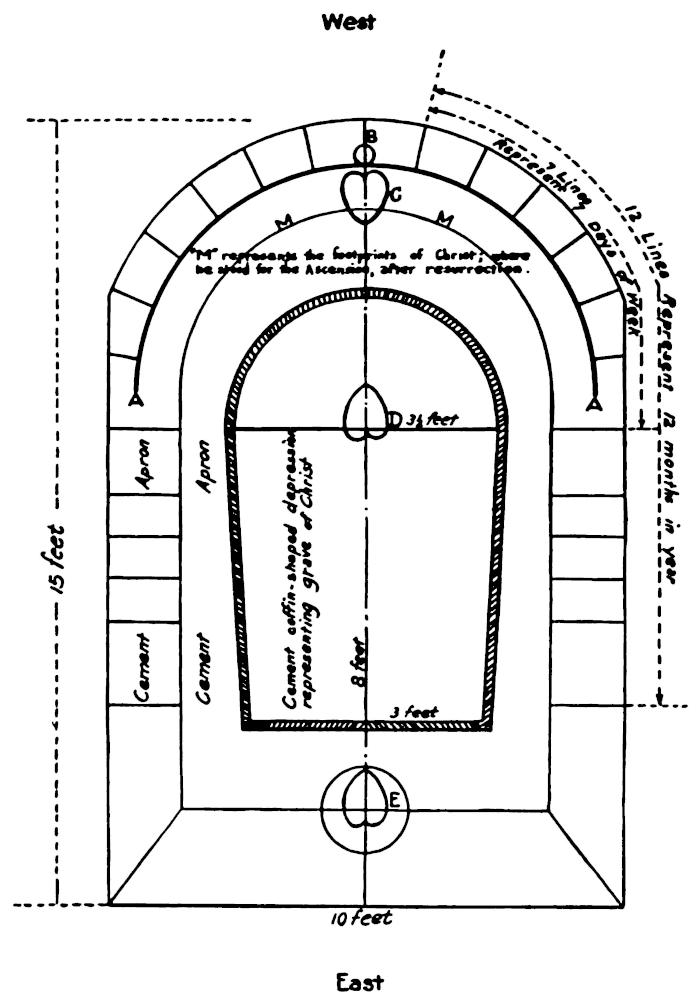
Fig. 6. An Osage altar of the John Wilson Big Moon type. A, “Peyote path,” or Moon-Head (Wilson’s name); B, hole for “arrow” when not in use; C, “Heart of Goodness” where father peyote is placed; D, Heart of the World above which the ritual fire is built; E, the Sun, giver of life. The east-west line is the “straight road” the way to heaven, or “thinking straight”; the north-south line represents “the road across the world”; together they form a cross symbolic of the crucifixion.
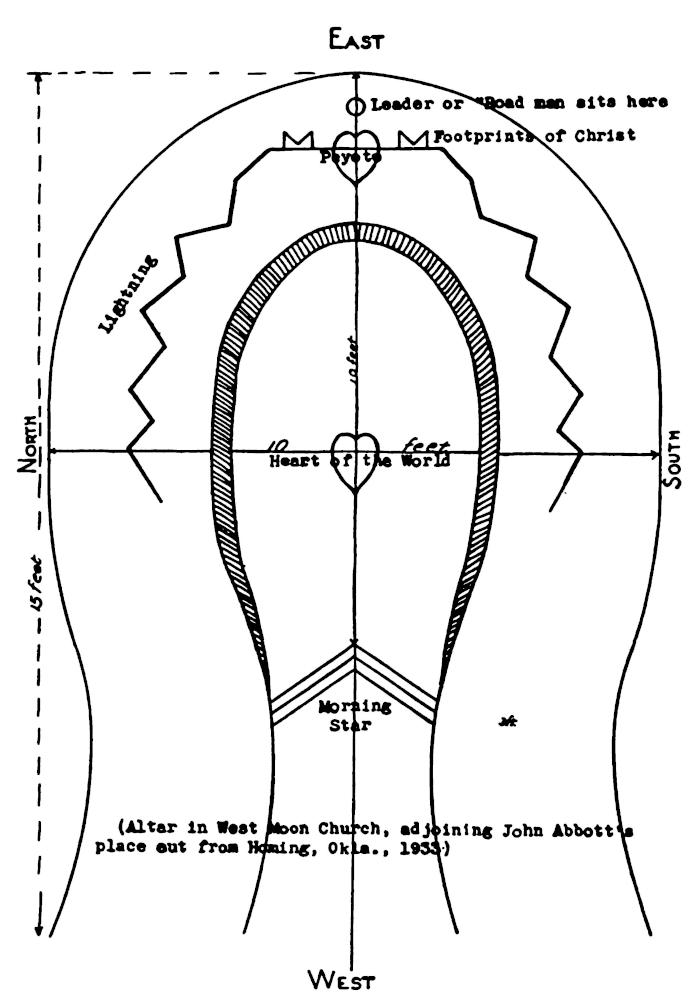
Fig. 7. A variant Osage moon of somewhat esoteric symbolism. This and the Osage moon in Figure 6 are reproduced through the courtesy of Mr. D. F. Murphy.
Wilson’s original moon, however, passed through an evolution, for Anderson’s drawing in Speck is considerably simpler in design than those depicted for the Osage by Murphy, or photographed by the author for the Quapaw. An early version, apparently, is one collected from Henry Hunt (Wichita) near Anadarko. In this the crescent or “moon” is elongated to imitate the parted hair of an Indian, whose eyes are the two mounds of ashes between its horns; a line runs from the father-peyote to the east, terminating in a mound with five circles concentrically zoning it like a globe-map, with another line at right angles to this drawn from tip to tip of the crescent, making a cross, at the intersection of which is drawn a heart resembling a man’s nose. There is also a heart at the “parting” of the hair, on which the fetish peyote rests, and a third one on the top of the zoned mound at the east. This altar is said to symbolize Moonhead’s face, and indeed it much resembles one when seen from the eastern door. Speck says in confirmation of our conjecture that
at first, he said, he made a small “Moon,” increasing its size day by day symbolical of his progress in spiritual knowledge. By the end of his sojourn amid spiritual environment, he came to make the so-called large “Moon,” the Wilson “Moon” which has become typical of his followers.[9]
[157]
But Wilson, no doubt, made still later additions, for these early moons entirely lack the elaborate apron symbolism of the Osage and Quapaw altars.
A Delaware informant said Wilson’s moon was first used north of Lookeba, Oklahoma. Black Wolf and George Caddo were early converts to his version—which, indeed may initially have been not so different from the older Caddo moon with a cross and mound east of the crescent (the Wilson division of the tipi into north and south side, for example, is an old one in Caddoan ceremonial organization).[10] The symbolism of the Wilson “Big Moon” receives varied interpretations nowadays. The Osage call the three hearts of the altar the “Heart of Goodness,” the “Heart of the World,” and the “Heart of Jesus;” others interpret the “world” as the “sun.” The ashes are the graves of Christ and Wilson for some, the dividing of the Red Sea for others. Some say the whole fire-pit is the grave of Christ, and the ash mounds his lungs, as the figure under the fire is his heart. The twelve lines of the altar apron are variously the twelve steps to heaven, the twelve heavens of Delaware mythology, the twelve months of the year, the twelve feathers of the eagle’s tail, etc. The symbolism of seven for the “days of the week” is possibly Southwestern in origin (cf. the seven bosses of the drum). Diamond-shaped figures close to the sun-mound represent Christ’s foot-prints, according to Petrullo,[11] while the “WW” or “MM” at the west of the altar are said to mean this for the Quapaw (“Moonhead” or “Wilson” depending on one’s position while reading the initials). The cross of the altar, of course, is symbolical of the Crucifixion. The cigarette of corn husk is known as the “Pipe of Jesus” among the Delaware.[12]
Peyote taught Wilson many variations in the ceremony as well. He used a crock instead of a kettle for the peyote drum. At one period in the development of the ritual only the firemen did the drumming besides the leader and his assistant (i.e., four men, three firemen and the leader’s assistant, proceeded clockwise around the tipi with the drum, drumming for each singer in turn, instead of the standard method of passing the drum for all to use); Wilson did not require the drum to make four rounds, for this might occasionally have interfered with the morning rite of filing out of the tipi “to meet the sun” with raised arms and prayer. In his rite only the leader made the initial prayer-smoke, though older men might ask for smokes later in the night if they so desired. Cigarettes could be made only at one of four places, one informant stated: at the leader’s place, at the north or south at the ends of the cross, and at the fireman’s place, and the leader had to smoke all of them first. Upon reentering after a recess, each person was incensed and fanned by the firemen [158]and others to blow away whatever evil influences might cling to him from the outside night. In time Wilson added special functionaries at the cross-bars of the crucifix to perform this fanning, making eight officials: two fanners, three firemen-drummers and three leaders (road man, drummer and cedar man) symbolizing the Father, Son and Holy Ghost of the Christian Trinity. In the Wilson rite there was much touching of the father peyote as communicants made their circuit of the altar on reentering. It is said that water could be asked for at any time, and permission to leave was not necessary if the rules about passing in front of an eater or smoker were observed.
Wilson himself took his “moon” to the tribes of northeastern Oklahoma. The Shawnee were influenced impermanently, and today only Ernest Spybuck has a modified Big Moon. The Seneca were influenced through the Quapaw, whom Wilson first succeeded in deeply influencing. The Quapaw leader, Victor Griffin, made a moon at Devil’s Promenade which was modified around 1906 or 1907 from Wilson’s moon.[13] The Delaware around Dewey were much influenced by Wilson from 1890-92 on.[14] But the Osage were the most important converts. By 1902 “most of the Indians at the Hominy camp and elsewhere in the Nation [had] taken it up and become devoted to it.”[15] Black Dog, one of the first Osage converts, introduced the “West Moon” in which the door is at the west and the altar similarly reversed; most of the Osage moons today, however, are the standard Clermont east moons. The Potawatomi may have been influenced by the teachings of Wilson somewhat also.[16] Wilson’s nephew, Anderson, brought the Seneca peyote in 1907 on the request of a Seneca married to a Quapaw woman.[17]
The economic motive seems evident in much of Wilson’s behavior. Speck tells of the introduction of peyote among the Osage as follows:[18]
[About 1891] John Wilson was on his way from Anadarko to conduct meetings among the Delawares around Copan. While passing through the Osage nation he visited Tall Chief, a Quapaw married to an Osage woman. While here Wilson was stopped by an Osage who had previously attended Peyote meetings among the Delawares and requested to meet a group of Osage and tell them about his revelations and his convictions and instruct them in its rules. He consented and complied with their wishes. The Osage in attendance at his meeting were convinced and converted. He accordingly stayed on with them about three weeks. Black Dog was at the time Chief of the Osage. His tribe was won over in force to the Wilson sect of Peyote worshippers.... J. Wilson [159]then returned to Anadarko, leaving behind him among the Osage two young Delawares who stayed back attracted by the prospects of fortune offered by the wealthy Osage. Wilson had received presents from the tribe of new converts amounting to considerable value, a wagon, a carriage, a buggy and teams of good horses and harness for each and other horses, fourteen in all, not to mention blankets, goods and money.
His death occurred after a similar mission to the Quapaw. He had been among them to conduct a meeting and was returning to Anadarko in a buggy with a Quapaw woman and another woman. Wilson’s wife was still living at the time, and he was either offered the Quapaw woman or demanded her while among the tribe. Speck quotes his nephew:[19]
Anderson said he did not like to think this but that the Quapaw were not all good people and had possibly been actuated by a desire to establish a home for Wilson in order to keep him and his ministry in their midst.
In any event, Wilson had been given a number of horses, which were tied to the back of his buggy. While crossing a railroad track, these horses pulled back and prevented their crossing just as a locomotive bore down upon them. Wilson was instantly killed. His detractors maintain that this was just punishment for his failure to live up to his own teachings. Since this period many communicants have fallen away from his “moon,” for his own[20]
moral instructions ... referred to abstinence from liquor, to restraint [in] sexual matters and fidelity to matrimony.
Though influenced by Catholic teachings, Wilson had a peculiar and specific attitude toward the Bible.[21] According to Speck,[22] he
instructed the Indians to seek knowledge by direct communion and to avoid consulting the Bible or the Gospels for the purpose of moral instructions. He insisted that the Bible was intended for the white man who had been guilty of the crucifixion of Christ and that the Indian who had not been a party to the deed was exempt from guilt on this score and that therefore, the Indian was to receive his religious influences directly and in person from God through the Peyote Spirit, whereas Christ was sent for this mission to the white man.
He nevertheless embodied in his person many of the messianic characteristics of his several native prophet predecessors; a Delaware informant said “John Wilson used to perform miracles” in meetings, such as divining what was in a man’s mind, and telling him who the persons were that he saw in a vision. The Osage, at least formerly, had a marked reverence for Wilson. Speck wrote in 1907 that[23]
[160]
pictures of Wilson are in demand among the devotees, who kiss them on sight. The man has been deified since his death.
There is much variation of opinion about Wilson among Indians of various tribes, but perhaps the statements of his nephew, George Anderson, are authoritative if not entirely disinterested. Speck says:[24]
An idea seems to have become current, either through the rumors of designing persons who opposed him or through exaggeration among his followers, that Wilson is responsible for having told his associates that he would return to life again after death and also that they should pray to him in the Peyote meetings.... Anderson denies that Wilson made either assertion. He had heard Wilson tell in his meetings that at times the worshippers when taking peyote might see him, as some are said since to have done, his face appearing to their vision over the fire. [With reference to the second statement Wilson on the contrary warned them not to pray to him, but through peyote to God.] ... This warning has not, however, prevented the practice of praying directly to and through John Wilson from becoming frequent among some of the Osages ... and probably among the Quapaw.
In both the latter groups [Anderson] has seen Wilson’s portrait placed on the “moon” in the Peyote lodge near the peyote “button” and the crucifix. Some who do this, he is convinced, actually concentrate thought upon Wilson instead of Peyote. And Anderson regards both practices as contrary to the teachings of Wilson. A custom has also spread among the Osage to wear a portrait button of John Wilson on the coat or, when in native dress, upon one of the fur or feather ornaments.... Anderson’s testimony [was] that John Wilson told his followers that he was not sent by God to fulfill a mission, but that he was shown by Peyote how to conduct religious worship in the Peyote meetings in order to cure disease, heal injury, purge the body from the effects of sin[25] and to lead the Indians to reach the regions “above” hukweyun in Delaware, or heaven, where they would see Peyote and the Creator.
The Caddo and Delaware, nevertheless, display considerable “touchiness” on the subject of John Wilson even today, since other tribes have ridiculed his real or supposed claims to divinity. Native criticism is not lacking either on the score of his economic exploitation of peyote leadership.[26] Petrullo[27] writes that
[161]
his enemies claim that in the course of his life he professed to have had fresh visions which always were interpreted to his personal gain....
However, his followers staunchly deny these allegations. Perhaps in answer to the accusation of being mercenary, Wilson, with one of his followers named Wolf, themselves set up a meeting once, at which they showed their generosity by giving away all their clothes with other gifts until they were clad only in breechclouts.[28] Yet even so the belief is widespread that his death was due to his exploitation of the gift-giving pattern to the extreme of demanding a Quapaw woman for his wife.[29]
The Wilson sect is still strong among the Osage and the Quapaw, but elsewhere, even among the Delaware and Caddo, it is waning considerably. The Caddo show a disposition to return to the Enoch Hoag “moon,” which is considered more “pure” and aboriginal.[30] But antagonisms to new elements Wilson sought to introduce date as far back as 1885. About this time Elk Hair was hunting in Comanche territory and learned a ritual he has since kept without change:[31]
Elk Hair preferred the Comanche way because it was the pure Indian way.... We brought back to our people the pure Peyote rite and we have used Peyote in the right way ever since.
Elk Hair, according to Petrullo,[32] “has barely managed to keep a following among the Delawares of Dewey,” but this region is the stronghold of the Anderson family and if defection of the Anadarko groups to the Hoag moon is any indication, we may expect a reinvigoration of the Elk Hair rite. Indeed, War Eagle wrote from Dewey in 1932 that[33]
Bacon Rind [whose recent death is mentioned in the letter] was one of the last of the old people who beli[e]ved in [the] Wilson cult; these first followers of peyote are about all gone. [The] small moon now prevales in the Osage. It will be a blessing to the world when all the Quapaws and what few Delawares [are left practicing it] will change [to the standard peyote rite].
[1] Mooney, The Ghost Dance, 903-905.
[2] Capt. Hugh L. Scott, in Mooney, The Ghost Dance, 904.
[3] We have elsewhere expressed the opinion that the Caddo had an historical significance in the spread of peyotism second only to that of the Kiowa-Comanche, and that Wilson represents this Caddoan influence predominantly. Though he had Delaware blood, this numerically small group could scarcely have wielded the influence or exercised the prestige necessary to account for the spread of his “moon;” the Caddo, on the other hand, who early had peyote, did have this prestige. We therefore believe Petrullo in error in claiming Wilson as a Delaware. Speck (Notes on the Life, 540) writes that “His associations with the Comanche and Caddo, to whom he was related by blood, were close.” Petrullo himself, indeed (The Diabolic Root, 44) indicates Caddoan influences on Wilson: “John Wilson, the originator of the Big Moon, was living among the Caddo. He was one of the first Delaware to eat peyote. He belonged to the Black Beaver band ... held by the Government at the Wichita and Caddo reservations. It was there that Wilson was born and raised.” Petrullo also says Wilson made visits to Arizona and New Mexico before returning to make his moon on the Caddo reservation.
[4] Note the prominence of hearts in the altar elaborated by Wilson. According to Petrullo (The Diabolic Root, 45) “John Wilson ... had received some Catholic instruction.” These probably derive, therefore, from the Catholic “Sacred Heart.” (The heart is present in Huichol religion, but even if not wholly aboriginal [Aztecan influence?] and Catholic-influenced there too, it is quite independent of the Wilson heart motifs.)
[5] Cf. the prominence in Wilson’s moon of brushing each person entering with feathers.
[6] Cf. the Winnebago leader’s similar praying with confessants in peyote meetings.
[7] Speck, Notes on the Life, 540-42; cf. also Petrullo, The Diabolic Root, 80.
[8] “In response to the question as to whether Wilson ever spoke of the Peyote songs as symbolizing the singing of birds, Anderson asserted that he had heard of this among other Peyote sects but had never heard Wilson express it.” (Speck, op. cit., 542 note.)
[9] Some of Wilson’s Caddoan teachings were sufficiently unlike those of the Delaware to antagonize them. A Delaware informant of Petrullo (The Diabolic Root, 66) said, “It [peyote] should be eaten in order to get well, not to have visions.” (Benedict’s study indicated, one recalls, that in the Woodlands only puberty-visions occurred, while in the Plains adults too may obtain them.) Again (p. 68) “Wilson was wrong. Peyote is good, but it is good and powerful medicine, not a religion like the Big House. [For instance] four boiled Peyote placed on top of the head will help in cases of insanity.”
[10] Cf. the Pawnee (Murie, Pawnee Indian Societies, 642).
[11] Petrullo, The Diabolic Root, 172.
[12] Petrullo, op. cit., 56-59, 67, 96, note 29.
[13] Petrullo (The Diabolic Root, 103). He claims to be Wilson’s authorized successor and has revised his moon. Petrullo (op. cit., 4) says John Quapaw is Wilson’s real successor.
[14] Harrington (Religion and Ceremonies, 156) says Wilson brought the Lenape peyote from the Washita River Caddo as well as the Ghost Dance in 1890-92, which died out with him among the Delaware (idem, 190-91).
[15] Speck, Notes on the Ethnology, 171.
[16] On the mere score of Christian elements we do not agree, however, that Wilson’s influence necessarily extended to the Wichita, Winnebago, Kickapoo, and Omaha (Petrullo, The Diabolic Root, 79). See following appendices.
[17] Speck, Notes on the Life, 554.
[18] Idem, 553.
[19] Idem, 544.
[20] Idem, 546.
[21] For this reason we doubt the soundness of Petrullo’s inference that the Omaha, Winnebago, etc., were influenced by Wilson. These groups actually used the Bible in meetings and read from it. This influence, we believe, traces to another teacher, the Oto Jonathan Koshiway.
[22] Speck, Notes on the Life, 547.
[23] Speck, Notes on the Ethnology, 171.
[24] Speck, Notes on the Life, 549.
[25] Wilson taught that the number of peyote required to be eaten varies according to the amount of impurity in the “heart” and stomach of the individual, “which impurity resulting from sins committed he likened to ‘dirt’” (Speck, Notes on the Life, 545). The more frequently the communicant attended peyote meetings, the less dirt, obviously, there could accumulate. The degree of nausea, Wilson taught, is the punishment meted out for sin (cf. John Rave’s teaching).
[26] To be sure the pattern of gift-giving is deep-rooted in the Plains, yet it is a curious coincidence at least that Wilson should have taken peyote to the Quapaw, who own the largest lead and zinc mining fields in the world, and the Osage, made notoriously wealthy through oil. Anderson told Speck that the Osage had given Wilson $200 for building them a moon, and Charles Tyner (Quapaw) told me that he and Victor Griffin (Quapaw) had received $500 for an altar in one sum and some hundreds of dollars in money gifts later. The Osage once gave Anderson $20 and his wife $10 because his uncle, John Wilson, had built their moon (Speck, op. cit., 551). Wilson even used to charge $1 per person for the sweatbaths he gave before meetings.
[27] Petrullo, The Diabolic Root, 82; cf. 45, 95.
[28] Petrullo, op. cit., 45; cf. 104.
[29] His followers, in any case, betray their expectancy of financial reward. It was remarked, for example, that the impecunious Seneca gave Anderson only his trainfare when he brought peyote to them. Griffin, more business-like, always arranges beforehand the amount of compensation he is to receive.
[30] Cf. the case of the Caddo Alfred Taylor whom the Osage invited to introduce the basic Caddo moon—even the Osage are turning from the Wilson rite.
[31] Petrullo, op. cit., 43.
[32] Idem, 31-32.
[33] War Eagle, letter to Speck from Dewey, Oklahoma April 1, 1932. We believe Petrullo, as shown by this letter, has over-emphasized the decadence of the basic rite at Dewey. The Wilson-Elk Hair antagonism is shown in even trivial ways. The latter use the feathers of swift-flying birds to “hurry up” the medicine cure, the faster the singing of songs, the quicker the cure. The Wilson cultists, who sing slowly, accuse the little moon followers of “putting too much vigor and speed into their healing and praying meetings as is typified by their inclination to decorate their Peyote paraphernalia with Hummingbird feathers, symbolical of the acme of speed.” (Speck, Notes on the Life, 551; thanks are due to the University of Pennsylvania Committee of Faculty Research, for Grant No. 93 on which his work was done.)
[162]
Very few ascertainably Christian elements are discoverable in Mexican peyotism. Some such as “curing” with rosaries of Job’s-tears beads dipped in tesvino, eating bits of the idol’s body and the like, may be largely aboriginal.[1] “El Santo Niño de Peyote” of Santa Rosalia is apparently a local variation of El Santo Niño de Atoche; the mission of El Santo Nombre de Jesus Peyotes is so-called merely from the abundance of the plant thereabouts. The overlay of Mexican Catholicism is elsewhere thin and localized also. The Huichol[2] see the saints in their color visions as pictures or giant men and women walking about; sometimes they press the saints into service in their rain-making ceremonies. The cross[3] in tesvino-curing and those on the Huichol peyote patio may really derive from an old native four-point symbolism. The Tarahumari[4] call the large green hikuli “peyote christiano,” in contrast to a small, red, ineffective one called “peyote cimarrón,” and Christian Tarahumari lift their hats to the plant and make the sign of the cross, but the essential ritual was unmodified by Christian ideas. None of these Christian features is common to Mexican peyotism.
The rite as it came to the United States, then, was aboriginal in character, as far as we can ascertain. Opler writes that[5]
there is no hint of the influence of Christianity in the Mescalero use of peyote. The growth of the cult among these people has been maintained entirely within the traditional bounds of Apache ceremonialism. Indeed, far from becoming a weakened and Christianized version of native beliefs, the Mescalero Apache acceptance of peyote resulted instead in an intensification of the aboriginal religious values and concepts at many points.
This characterization would equally well fit the basic Kiowa-Comanche rite of the Plains, in which Christian elements are quite absent. These elements in the Plains are distinctly a secondary development, stemming from the Oto Koshiway and such Oto-influenced [163]groups as the Omaha, Iowa and Winnebago[6] and the groups taught by John Wilson, such as the Delaware, Quapaw and Osage.
Arapaho-Winnebago officials and ritual food are given Christian symbolism:[7]
During the evening the leader represents the first created man, the woman dressed up is the New Jerusalem, the bride waiting for the bridegroom. The cup used by the leader and the woman is supposed to symbolize the fact that they are to become one; the water represents the God’s gift, His Holiness. The corn represents the feast to be partaken of on the Day of Judgment and the fruit represents the fruit of the tree of life. The meat represents the message of Christ and those who accept it will be saved.
The Winnebago, Quapaw and Osage peyote officials represent the Father (the leader), the Son (the drummer) and the Holy Ghost (the cedar-man); the trinity of hearts in the Big Moon may represent much the same idea in the Osage-Quapaw rite.
Koshiway said that the bird into which the Oto ashes are shaped is
the Spirit descending when Jesus was baptized: the Holy Spirit, like an eagle, with good eyes; you can’t fool it. [The ashes themselves represent] a prayer for the white hair of old age, and the fire is like the fire through which God spoke to Moses. Peyote is like a “telescope” through which you can see God.
The Delaware twin piles of ashes symbolize Christ’s lungs; Mary Buffalo says one pile is the grave of Christ, the other of John Wilson, among the Osage; the Quapaw say the whole coffin-shaped fire-pit is Christ’s grave. The Ponca, according to Brabant, believed the body of the Saviour would emerge from the altar and become visible to those who had eaten enough of the sacred plant. Among the Caddo,
the first stick in the fire represents the heart. There are twelve other sticks which represent the ribs [of Christ, as the ashes his lungs].[8]
The paraphernalia of the ceremony are also given Christian interpretations. The Delaware followers of Wilson call the corn husk cigarette the “pipe of Jesus.” And of an unspecified group Mooney writes that
many of the mescal eaters wear crucifixes, which they regard as sacred emblems of the rite, the cross representing the cross of scented leaves upon which the consecrated mescal rests during the ceremony, while the Christ is the mescal goddess.
Some Kiowa leaders make a cross under the water bucket, and cross the feathers in the water before drinking[9] and the peyote staff, like that of the Delaware, often has an inconspicuous [164]cross near the top. The twelve feathers of the Omaha leader’s fan represent the twelve apostles of Christ. The Winnebago fans differ for the John Rave and the Jesse Clay rites, but both sects use eagle feathers which represent the wings of the birds mentioned in Revelations. John Rave’s staff is symbolic of the “shepherd’s crook,” and the mound of earth in the altar is “Mt. Sinai.” White Buffalo said that gourd rattles among the Nebraska Winnebago commonly bore drawings of Christ, his cross and crown, etc., and Radin says they often bear drawings of scenes from the Bible as well as peyote visions. A Cheyenne gourd seen at Apache and made by Spotted Crow had the following “Jesus talk” on it:
Help me O Lord My God O save me According to thy Mercy O God my heart is fixed. I will sing And give praise Even with my Glory.
The Winnebago explain that the exchange of gourd and drum between the leader and his assistant when singing the set songs means that “God gives power to Christ, in Heaven and earth,” just as the leader delegates his authority. The blowing of the leader’s “flute” at the four points of the compass is to announce the birth of Christ to the world, and later it symbolizes the trumpet of the Day of Judgment, when Christ will appear wearing the crown of glory (symbolized by the leader’s otter skin hat, worn at this time).[10]
The Bible as an additional piece of peyote paraphernalia probably stems from the Christianism of the Oto, who used it in their meetings, being mentioned also for the Iowa, Omaha and Winnebago. The New Testament, and particularly Revelations, is a favorite among the Rave cultists (Jesse Clay’s followers do not use the Bible)—Crashing Thunder finding in it authority for a hair-cut, and others discovering reasons after the fact for holding their meetings at night. Three Old Testament texts are widely known also:
And they shall eat the flesh in that night, roast with fire, and unleavened bread; and with bitter herbs they shall eat it. (Exodus 12.8.)
And this day shall be unto you for a memorial; and ye shall keep it as a feast by an ordinance forever. (Exodus 12.14.)
For if the firstfruit be holy, the lump is also holy: and if the root be holy, so are the branches.... Boast not against the branches. But if thou boast, thou bearest not the root, but the root thee. (Romans 11.16 and 18.)
Various other Biblical references appear in the ceremony. Among the Iowa the leader carries the water himself in the morning to show his humility, and because of Christ’s washing of feet mentioned in the Gospels. The Winnebago equate the physiological action of peyote with Christ’s casting out devils. A Comanche said suffering is caused by one’s sins and lack of faith in peyote, and that point in the night when nausea is commonly [165]severest is called the “Dark Hour, the hour of the Crucifixion.” A Kickapoo leader often cast his prophecies in Biblical language. A Kiowa, again, appeared to have a belief about the first peyote found which parallels the miraculous proliferation of the loaves and the fishes in the Bible. Koshiway compared the Indians to the fishermen on the Sea of Galilee, when Christ said “Peace, be still!” to the angry waves, just as peyote says it to the storm-tossed Indians in this latter-day world. And for the man who lives a good life, the ashes of the fire will open up like the waters of the Red Sea, and he can pass through the fire to the father peyote along the “Peyote Road” on the moon.[11]
Some two dozen songs, previously reported in the text, show Christian influence. The closing song of the Negro Church of the First-born was the Christian hymn, “Till We Meet Again,” but the majority of peyote songs have native words. The Rave rite, derived from the Oto and the Quapaw (influenced by the Christianity of Jonathan Koshiway and John Wilson, respectively), contained more Christian elements in symbolism and song than the Jesse Clay cult. This was the more aboriginal, yet he back-handedly quoted the Scriptures to justify the plain staff (“like Moses’”) of his ceremony as against the decorated staff of Rave. Occasional peyote visions show Christian influence: some of Crashing Thunder’s were of this sort, and a Kiowa had visions of a mitred priest who nodded smilingly and approvingly at the father peyote on the altar, but in the visions collected Christian elements are uncommon.[12]
Mexican peyotism and the Wilson rite were influenced by Catholicism, but the Church of the First-born and the Native American Church by Protestantism (the Russellites, the Mormons, etc.). At the first Oto meeting attended a vessel was passed around in the morning for a “free-will offering,” as in Protestant churches, and the Pawnee, Kiowa and others have “Ladies’ Auxiliaries” to the local Native American Church. These women have quilting parties, can fruit, make up box lunches to raise church money and visit the sick, much as their White sisters do. Other White elements appear in the meetings themselves. The Iowa leader and fireman, for instance, shake hands with everyone in the tipi after the ritual feast, in token of friendship and good will. The Osage and Quapaw “round-houses,” too, are in obvious imitation of White peoples’ churches, but the Osage are criticized for ostentation along White “leisure class” lines. More conservative groups make disparaging remarks about the “beds” in their meetings, their electric lights in the round house, and their cigars—some Osage churches are even provided with spittoons!
Yet when all these features have been summed up, it is still clear that the layer of Christianity on peyotism is very thin and superficial indeed. Furthermore, the Christianized [166]Wilson and Rave rites among the Caddo and Winnebago are currently losing followers to the more conservative Hoag and Jesse Clay moons—and there are frequent expostulations against the mixing of the native religion with the White.[13] Some groups feel no inconsistency in belonging to both the peyote church and some White Protestant sect as well, but the unfriendliness of the functionaries of the latter groups toward peyotism and their lack of reciprocal tolerance has driven many borderline cases openly into the peyote church. The Indians feel, perhaps rightly, that peyotism is their last strong link with the aboriginal past, which others are trying to destroy. Hence it has contributed greatly to the sense of community and morale of the Indian groups in Oklahoma.
Of course apologists sometimes use Christian arguments to confound the enemies of the cult, as when peyote and the water are equated to the Catholic use of bread and wine in Communion,[14] or when Old Man Green (Oto) told a minister that he was condemning God’s work in attacking peyote. But these do not proceed from any profound faith in Christianity. A Shawnee comment is most typical:
Christ was born only several hundred years ago, not when the world was created, like peyote.
Prayers are still addressed to the older tribal deities in peyote meetings: the Winnebago to Earthmaker, the Oto to Wakan, the Cheyenne to Mayan, etc. A Kickapoo summed up the religious history of his tribe as follows:
We had medicine bags before Jesus was born over in Bethlehem, in the old country. The old generation worshipped idols. When God’s son was going to be born, they were trying to make the people believe God. And after Jesus was born, they commenced this [peyote].
Nevertheless, it should be reiterated that on the whole, despite the apparent and superficial syncretism with Christianity, peyotism is an essentially aboriginal American religion, operating in terms of fundamental Indian concepts about powers, visions and native modes of doctoring. The Christianity of many native Christians is precarious at best—as we have seen from various case histories—when it comes into any very serious conflict with native culture. Perhaps most peyote-users would echo the words of the famous Comanche chief, Quanah Parker, with reference to the superiority of peyotism over Christianity:
The white man [he said] goes into his church house and talks about Jesus, but the Indian goes into his tipi and talks to Jesus.[15]
[1] “[De la Serna] adds that ... they delighted in caricaturing the Eucharist, dividing among their congregation a narcotic yellow mushroom for the bread, and the inebriating pulque for the wine. Sometimes they adroitly concealed in the pyx, alongside the holy water, some little idol of their own, so that they really followed their own superstitions while seemingly adoring the Host. They assigned a purely pagan sense to the sacred formula, ‘Father, Son, and Holy Ghost,’ understanding it to be, ‘Fire, Earth, and Water,’ or the like” (Brinton, Nagualism, 28); Bennett and Zingg, The Tarahumara, 369, 385. Coix Lachryma Jobi was an early Spanish introduction, but may have replaced some native seed (e.g., mescal) used as beads. Serna’s mushroom is probably teo-nanacatl.
[2] Klineberg, Notes on the Huichol, 449; Lumholtz, Unknown Mexico, 1:314; 2:170, 189.
[3] Lumholtz, op. cit., 2:171-72, 272; Bennett and Zingg, The Tarahumara, 294.
[4] Bennett and Zingg, op. cit., 290; Lumholtz, Unknown Mexico, 1:360-61. On Tarahumari Christianity see Handbook of the American Indians, 2:692b; the ease of acceptance suggests congruence with aboriginal forms.
[5] Opler, The Influence of Aboriginal Pattern.
[6] The Winnebago did not introduce the first Christian elements, as Radin believed. A Taos Indian (Plains-influenced?) once visioned Christ (Parsons, Taos Pueblo, 66).
[7] Radin, The Winnebago Tribe, 418; Densmore, The Peyote Cult.
[8] Petrullo, The Diabolic Root, 101, 113; Brabant, in Seymour, Peyote Worship, 182. Cf. Gilmore’s Omaha (The Mescal Society, 165-66) whose fireplace is the heart of Jesus.
[9] But there seemed to be a certain quality of propaganda for the ethnographer’s benefit in one Kiowa doctoring meeting, when the name of Jesus was mentioned in prayers with unwonted frequency.
[10] Petrullo, The Diabolic Root, 96, cf. 56-59, 67, 96, note 9; Mooney, A Kiowa Mescal Rattle, 65; Harrington, Religion and Ceremonies, 186-88; Gilmore, The Mescal Society, 165-66; Uses of Plants, 106; Densmore, The Peyote Cult; Radin, A Sketch of the Peyote Cult, 4, 12; The Winnebago Tribe, 416-17; White Buffalo in Blair, The Indian Tribes, 282 (letter of April 15, 1909).
[11] Skinner, Societies of the Iowa, 724, 727; Gilmore, The Mescal Society, 165-66; The Uses of Plants; Densmore, Winnebago Songs of the Peyote Ceremony; The Peyote Cult; Radin, A Sketch of the Peyote Cult, 5-6; The Winnebago Tribe, 394-95; Crashing Thunder, 186-87, 200; Simmons, in Mooney, Miscellaneous Notes.
[12] Skinner, Societies of the Iowa, 727-28; Murie, Pawnee Indian Societies, 637; Densmore, The Peyote Cult; Winnebago Songs of the Peyote Ceremony; Radin, A Sketch of the Peyote Cult, 5; The Winnebago Tribe, 395; Crashing Thunder, 193-94; Smith [Mrs. M. G.], A Negro Peyote Cult.
[13] The turmoil among the Caddo seems to grow out of the attempt to mix Christian with native motives and John Wilson is nowadays by no means universally revered. “There have been some Delawares living with the Caddo who have from time to time tried to introduce the Catholic faith in the Peyote meeting. Often they used the crucifix on the Peyote on the moon. All these attempts have met with opposition from most of the Delawares” (Petrullo, The Diabolic Root, 77).
[14] Petition of 62 Osage to the Senate Committee on Indian Affairs, in Peyote, as Used in Religious Worship, 64-67.
[15] Simmons, The Peyote Road.
[167]
The many attempted anti-peyote legal measures, and the frank hostility of some persons[1] to peyotism early stimulated the cultists to seek some sort of legally-guaranteed security for their worship. The first of several incorporated peyote churches, the Oto Church of the First-born, has heretofore been little known. Peyote came to the Oto under the late White Horn’s leadership from the Tonkawa some time before 1896. The original rite is said to have been “just like the Apache,” which is to say, the standard pre-John Wilson Plains type. But the Oto, like other tribes, began to have “government trouble” about their worship shortly before the World War. A group of younger men, Frank Eagle, George Pipestem, Charles MacDonald and Charles W. Dailey, who had been away to school and were considerably influenced by White Protestantism, sought, at this juncture, to use the White man’s weapons in their own defence. But by far the most important figure in this movement was Jonathan Koshiway.
Although enrolled as a Sauk-and-Fox, Koshiway’s mother was an Oto. He had formerly lived in northeastern Kansas, and had been an Indian evangelist for the Church of Latter-Day Saints.[2] As an individual Koshiway was considerably influenced by Middle Western Protestantism, and solved for himself the adjustmental problem of double culture-bearers by discovering that the old native religion of his childhood was the same as the White Christianity of his maturity, with merely different phrasing and vocabulary. Did not God speak to Moses through a burning bush, like the Indians’ peyote fire? When God viewed his creation, does not the Bible say that “God saw that it was good,” and was not the little peyote plant one of the herbs of the field thus created? Did not Christians also make use of wafers and sacramental wine just as the Indians used the flat buttons of the sacred herb and peyote “tea”? Did not Christianity even embody the Plains ritual number in the “Four Foundations” of Love, Faith, Hope, and Charity?
Jack was a “Bible student” in Kansas City at one time, and is notably fluent in these [168]syncretic interpretations, being called upon frequently to speak in peyote meetings, especially when visitors are present to whom explanations are in order. Another important influence upon Koshiway—as well as upon George Deroin (Iowa) of Perkins, who may once have been his associate—was that of the Russellites, a somewhat desiccated Protestant cult of the Middle West, who did not believe in any “earthly” government. This dogma naturally suited a group in difficulties with temporal government. Koshiway explained to me that the name finally chosen for the organization is a “heavenly name” and that the church proper is “up there”; yet practical peace must be made with Caesar on earth, and this Koshiway set about with care to do.
First of all he consulted White Horn, leader of the native peyote rite, and gained his support. Koshiway generously states that White Horn was the co-founder of the Church of the First-born, but the fact appears to be that the latter’s role consisted in giving the official approval of the older established peyote cult. Koshiway also visited many white ministers to get their advice on organization. There appears to have been some friction about this, and even Koshiway ended up by insisting that the peyote church should not be “under” any white Protestant church, but independent. Then, despite the fact that the Russellites preach non-cooperation with the Government and the ultimate break-up of all temporal governments, Koshiway went to a lawyer in Perry, Oklahoma, H. F. Johnson, and sought legal advice. On December 8, 1914, the “First-born Church of Christ” was incorporated under the laws of Oklahoma and received a charter for an organization located at Red Rock, Oklahoma, signed by Benjamin F. Harrison, the Secretary of State.[3] The articles of incorporation were signed by Jonathan Koshiway and four hundred and ten other names.
Koshiway wanted an “authorized” preacher to come and baptize the newly constituted church’s adherents, but this never became a regular practice, if, indeed, it ever actually occurred at all. A reluctance to come half-way was manifested by the Protestant groups concerned, and in time Jack himself took up all the usual functions of a minister, marrying, conducting funerals and in addition doctoring in meetings and “hollering” the way his source of medicine power does. Secondary Shawnee influences occurred in this later period, but the chief ritual difference between the usual peyote rite of the Plains and that of the Oto Church of the First-born is directly traceable to the influence of the Russellites.
This difference was over the question of smoking in meetings. As Koshiway reconstituted the Church, the preliminary smoking of corn shuck cigarettes was abolished—a remarkable innovation when one recalls the deeply entrenched ceremonial use of tobacco in the Plains, but when a narcotic was sacrificed in the ritual, tobacco went, not peyote. Koshiway took peyote to a group of Oto in Kansas under Charley Rubido, and by this time the work of syncretism which had been accomplished became evident, for,
when we examined the literature [says Koshiway] we found that [the native Russellites under Rubido and the Koshiway peyotists] were just alike.
[169]
In both groups smoking was omitted, and cedar leaves were burned in place of this at intervals of prayer. When the leader called upon an individual to pray, he was given cedar to burn to produce smoke and bear away the prayer. The Bible was a conspicuous part of the meeting also.[4]
The later history of the Church of the First-born was influenced by the interaction of Koshiway and the later-founded Native American Church. At Cheyenne, a little town northwest of Calumet, Oklahoma, a group of Oto, Kiowa and Arapaho had an intertribal conference to decide upon measures of defence for peyotism. Jack took the Oto charter to this conference and explained his solution of the problem. James Mooney at this, or a later conference, was influential in persuading the assembly to adopt this method of organization, but many of the group apparently objected to the element of White religion implied in the title “First-born Church of Christ” and rejected the name. The title ultimately chosen was the “Native American Church,” which emphasized the intertribal solidarity of the cult, as well as its aboriginality.
Koshiway’s behavior at this point is interesting. He had not succeeded in making himself the head of the church of his naming as extended in a state-wide organization. As he himself puts it he “began to deny” the First-born Church of Christ, and “joined” the Native American Church, where, though he was less important as an individual, he nevertheless was a member of a larger and more official in-group. He is much amused in his attitude toward the remnants of the Oto church; says he,
They were so religious [about smoking]—I converted them, and then they turned around and said I wasn’t right; that’s how peculiar us Indians are!
As a matter of fact, however, Koshiway seems to have believed that the true belief about peyote was a fortiori what he, the founder of the church, successively believed. When later he re-introduced the smoking of tobacco into the ceremony, he actually was himself backsliding into the older native custom and retreating from the Russellite-influenced no-smoking rule. The real Puritans, obviously, were the Kansas group who retained the rule. A curious and amusing compensation is evident in the most modern reconstitution of the Oto smoking ceremony: the “shucks” in meetings attended were fully twice as long as those normally used in the Plains rite!
The present Oto church in Oklahoma, under the presidency of James Pettit, considers itself a local branch of the Native American Church, but the Kansas group still carries on the Russellite no-smoking rule. The return to the older standard pattern came about in this way.[5] The well-known Kiowa leader, Belo Kozad, came to the Oto with Jack Sankadote (one of the two original Kiowa users) and an Apache named Star. The meeting was held [170]fourteen miles east of Red Rock, and Koshiway’s attendance at this was a turning-point. Belo prayed to peyote—a practice itself rejected by Koshiway—that Jack take up his “road.” Jack maintained his disapproval of smoking, but for some time had apparently come to prefer being an accepted member of the larger group to being an important outsider. Somewhat later, he revisited the Kiowa and his friend Albert Cat, attending several meetings there. At one of these Belo offered Koshiway a prayer-smoke, and finally after some hesitation he took it—a very small act objectively, to be sure, but symbolizing the healing of a schism in the native peyote religion. On this trip south Koshiway had been given money gifts, and a sick woman the Oto had brought with them had been doctored by Old Man Horse (Kiowa); these factors perhaps weighed somewhat in favor of his embracing the state-wide cult. In the ideology of Belo (and most Kiowa as well) there was no theoretical objection to Christian churches, but the usual attitude was that peyotism and Christianity were mutually exclusive alternatives.[6] Still later Belo Kozad again visited the Oto and led a meeting, and this time Koshiway was his assistant or drummer, and Koshiway now had his place in the classic rite. His adaptability and good humor have given him a position of considerable importance in Oto peyotism, though he is by no means the oldest user—more important perhaps even than that of Sam Bassett, the “tribal priest.”
Several other fore-runners of the Native American Church should be mentioned. In 1897 the Oto brought the new religion to the Omaha and Winnebago of Nebraska and by 1909 there was an organization called the Union Church of mescal-eaters at Winnebago, Nebraska, which made use of the Bible.[7] The Omaha formed a similar organization called the American Indian Church Brother Association, whose elaborate symbolic crest is figured in Wagner. The Kiowa United American Church mentioned by Mrs. Voegelin may also have been a forerunner of the Native American Church.
This organization was formed by an intertribal group which met at El Reno and included Mack Haag (Cheyenne) of Calumet, Sidney White Crane of Kingfisher, Charles W. Dailey (Oto), George Pipestem (Oto), and Charles E. Moore (Oto), all of Red Rock, Frank Eagle (Ponca) of Ponca City, Wilbur Peawa (Comanche) of Fletcher, Mam Sookwat (Comanche) of Baird, and Apache Ben of Apache, Oklahoma.[8] A certificate of incorporation was granted to “The Native American Church” at Oklahoma City under the Great Seal and the signature of the Secretary of State, dated October 10, 1918, and signed by [171]Alfred Wilson (Cheyenne), Louis McDonald (Ponca), Delos Lonewolf (Kiowa), Herman McCarthy (Osage) and Tennequah (Comanche). The strongly intertribal nature[9] of the organization is indicated by the various tribal affiliations of the men elected to the offices of the Native American Church. The constitution under which the charter was obtained was changed at Washington in the administration of Ned Brace, and several amendments were made in 1935. Frank Cayou (Omaha) of Hominy has for some time been seeking a national charter from Congress, through Secretary Ickes and Commissioner Collier, so far with no success.
Formerly there was an annual tax of two dollars for each individual member of the state organization, one half kept by the local group and the other half sent to the state headquarters, but later this was changed to a ten dollar tax per tribe. In Oklahoma there are now (1936) twenty-four tribes organized in the church, and these send two delegates from each local church (if there are several locals there may be as many as six delegates from one tribe). The yearly convention is held the last Friday in November, formerly always in El Reno, though in 1936 it was held in Hominy. El Reno is the site of “The Wigwam,” a young Indian men’s fraternal organization which once maintained a museum-meeting room convenient for these conventions, hence the Native American Church was incorporated as of this place. Because of the many native languages represented, English is the lingua Franca of negotiations at conventions. The chief function of the state organization so far has been the mobilizing of political power and application of pressure on legislative groups, in the preservation of what the Indians regard as their constitutionally guaranteed right of religious freedom.
The Winnebago and Omaha of Nebraska, and also the Indians of South Dakota, Wisconsin and Kansas have patterned their constitutions after that of the original Oklahoma Native American Church. The Native American Church is now also incorporated in Montana and Nebraska;[10] in the latter state Jesse Clay was the first president[11] of an actively evangelistic group which sends “missionaries” into new regions, ambitious of making peyote the universal Indian religion. In Oklahoma there are local tribal organizations within the Native American Church. For example, among the Kickapoo there is a “men’s club” which meets after every peyote meeting and a “women’s club” which meets on the second Thursday of every month. The Ponca also have a “Ladies’ Auxiliary,” as do [172]also the Pawnee. These data are of course incomplete, but it is believed that they are representative.
Of particular interest, however, is the Negro Church of the First-born, formerly existing near Tulsa, Oklahoma.[12] The founder was John Jamison who was born in Lincoln Co., Oklahoma. His parents for some reason were given allotments, and he grew up among the Iowa, speaking Iowa, Pawnee and Comanche. When he sought to take up the peyote cult, the younger men were less friendly than the older ones; they resented a Negro’s taking the “old Indian religion.” The rite which he conducted was the typical Indian one, but involved more use of the Bible than was general; the elements of the drum, gourd dishes for sacred food, medicine feathers, cane, sage, cedar, canvas tipi and chief peyote button were all present. Jamison sometimes dressed in a chief’s bonnet, blanket and moccasins. He conducted meetings as far back as 1920 which Indians sometimes attended, and occasionally he was sent for to conduct Indian meetings. In 1926 Jamison died of a brain concussion after he had been attacked by a half-crazed Negro. The cult did not survive his death; it had never been popular outside a small group, though some persons were attracted by the healing he attempted to do. But even the devoted became suspicious when they learned of Government hostility to their practices. As Mrs. Smith writes,
This attitude on the part of the negroes is doubly interesting in view of the rebellious attitude which the Indians displayed under the same circumstances.
Jamison’s rite differed in a number of respects from the standard Plains ceremony: the peyote on the moon was eaten by the leader at midnight; the leader sat at the west with four “sisters” to his right and four “brothers” to his left (including his drum and cedar man); the fireman north of the door was usually the same man in every meeting. Participants sat “goat fashion,” i.e., kneeled and sat on their heels, when singing or eating peyote. The leader sang Indian songs or hymns indifferently. After an opening prayer the leader, or a male assistant, read a passage from Scripture, and toward morning a member talked on the passage. During the midnight song, the ashes of the ritual fire were made “heart-shaped,” then this was deliberately destroyed by the leader[13] and the ashes swept to the side. This “burning the heart of the fire” signified the “end of the day.” There was a recess at midnight and the drummer beat to signify the close of this period, after which the communicants reentered and ate peyote and sang until daylight.
As the sun rose, they threw open the door and, all standing, sang the closing song, “Till We Meet Again.” The sun is supposed to hit the center of the fire “heart.” Then the “sisters” [173]leave and serve a sweetened meal which must contain no salt. There is no ceremonial smoking[14] as in the Indian ceremony, and cedar smoking is used only once toward the beginning. The food served is parched corn soaked and sweetened, beef prepared the “Indian way” (roasted, ground and sweetened; or dried, soaked, stewed, ground and sweetened), fruit, cereal or mush and finally water. The presence of parched corn is an interesting object lesson in the stability of a culture trait; centuries later and hundreds of miles away from the Mexican corn-harvesting ritual we find members of another race still practising the now meaningless pattern. The mere accident of historical association of parched corn and peyote has imposed a cultural compulsion!
Jamison always took Epsom salts[15] Friday night before the meeting, usually held on Saturday nights, and a hot bath before going to the meeting. If he ate salt or otherwise failed to follow these rules, he would see “spooks” and “crazy things.” Further syncretism with Christian elements is evidenced in the following confession of faith, a copy of which was possessed by all the faithful and framed:
David Walker
Director
Our Motto: “The World for Christ”
Christ, the Good Shepherd
[picture of group sitting goat fashion, paraphernalia]
Church Covenant
of the Church of the First-born
“Hebrews 12th Chapter, 23rd verse”We, the undersigned believers in Jesus Christ, do by virtue of Scriptural Faith submit ourselves to the cause of Christ and the Gospel; to live therein; to walk therein; to teach therein; to sing therein; to pray therein; to preach therein; to baptize therein; to observe all the ordinances of Him who has called us to peace, that God may have all the glory thereof. In testimony whereof we the undersigned hereunto set our hands, by virtue of our own free will.
John C. Jamison
Conductor in ChargeMrs. Lucinda Walker
Mother of the Household of the FaithKatie Hoggins
Secretary of the Household of the FaithMrs. J. L. Ramsey
AssistantMrs. Polly Marshall
Assistant.
The quotation from Hebrews 12.23 the source of the name of the church:
[But ye are come] to the general assembly and church of the firstborn, which are written in heaven, and to God the Judge of all, and to the spirits of just men made perfect.
[174]
Unlike the Oto group, Jamison never succeeded in getting his “moon” incorporated, although there are suggestions[16] that Negro groups in South Dakota may have been influenced by peyotism.
[1] The cult use of peyote has been persecuted not alone by legislatures and religious groups. The following broadside, obtained from Alfred Wilson (Cheyenne) through Enoch Smokey (Kiowa) was posted at Harry Ehoda’s home in Mountain View, Oklahoma: “To all Indians addicted to the use of peyota and other forms of heathen or pagan forms of worship. You are hereby warned to sease form such degrading practices. Our Government has spent and is spending thousands of dollars each month to educate and life up the Indians and the Ku Kluck Klan of this state have determined that no Indian who has been educated by the Government shall come back home and debouch his people. Take Due Warning. The Clan in Your Community Will Look After You and Other Ku Kluck Klan of Okla.”
[2] Cf. Harry Rave (brother of John), quoting another Indian, in Seymour, Peyote Worship, 182: “‘My friend we must organize a church and have it run like the Mormon Church’.” Could this have been Koshiway? Mormon interest in peyotism is indicated in letters to C. Warden (Arapaho) of Gary, Oklahoma, from the Latter Day Saints, which I have seen. See the Book of Mormon, I Nephig:2-28.
[3] Data on this charter from a note in Mooney, Peyote Notebook, 38.
[4] This element introduced by Albert Hensley into Winnebago peyotism, was probably influenced by the Oto church, when Hensley made his visits in Oklahoma.
[5] With this native “Oxford Movement” cf. the parallel cases of the Caddo defection from the Wilson rite to the Enoch Hoag “moon” and the Hensley separatists to the Rave and Jesse Clay groups, the latter in each case representing a more aboriginal phrasing of the ceremony.
[6] Which is of course mere theory; actually there is considerable unconscious syncretism, and Belo himself frequently refers to Jesus in his prayers.
[7] Report on the case, in Safford, Aztec Narcotic, 306. “Twelve years ago the Otoes brought the new religion to the Winnebagoes and Omahas of Nebraska.... In talking with Albert Hensley, one of the prominent leaders, he said, ‘The mescal was formerly used improperly, but since it has been used in connection with the Bible it is proving a great benefit to the Indians. Now we call our church the Union Church instead of Mescal-eaters’” (Letter, April 15, 1909 in Blair, The Indian Tribes, 282.)
[8] From articles of incorporation kindly lent me by James Waldo (Kiowa). The original paper was lost by Mooney in Washington; Kiowa Charley’s copy gives the date Oct. 29, 1919—probably a duplicate reissue. Other data from Murdock and Wilson.
[9] From 1918 to 1936 the officials have been (president, vice-president and treasurer, respectively): Frank Eagle (Ponca), Mack Haag (Cheyenne), Calumet, Louis MacDonald (Ponca), Ponca City; Mack Haag, Delos Lonewolf (Kiowa), Carnegie, James Waldo (Kiowa), Verden; Delos Lonewolf, Alfred Wilson (Cheyenne), Thomas, James Waldo; Alfred Wilson, Ned Brace (Kiowa), Mountain View, Oscar Whyel (Kickapoo); Alfred Wilson, Ned Brace, Louis Toyebo (Kiowa); Ned Brace, Frank Cayou (Omaha), Edgar McCarthy (Osage); Frank Cayou, Alfred Wilson, Edgar McCarthy. George Pipestem (Oto) of Red Rock was the secretary of the Native American Church from its founding until his death in 1936.
[10] Letter of C. C. Guinn of Guinn & Maddox, Attorneys, to Mack Haag, President of the Native American Church, dated Hardin, Montana, Feb. 16, 1916; Densmore, The Peyote Cult.
[11] Elections of officials are held yearly in Nebraska instead of every two years as in Oklahoma.
[12] Condensed from Mrs. M. G. Smith’s article, A Negro Peyote Cult. Mrs. Smith does not mention any possible Oto influence, which, in view of the near-identity of the name appears probable.
[13] This occurs in no Indian peyote ceremony known to the writer. This deliberate destructive act suggests a symbolic aggression. The psychic mechanisms underlying this behavior have been shown with fine perception in John Dollard’s penetrating book Caste and Class in a Southern Town.
[14] This again suggests Oto influence.
[15] Cf. the related emetic rites!
[16] Reko, Ein Kultus die Gespenster, 431: “Die Christian Peyotl Church in South Dakota benutzt diese Dinger an Stelle der Hostie und verabreicht sie bei der Kommunion and die Glaübigen. Daneber haben sie jenseits der Grenze noch eine nicht unbedeutende Kunschaft in der nordamerikanischen Indianer und den Schwarzen die die Mescalbottons [sic] freilich keineswegs zum Kommunizieren benützen.”
[175]
Adair, James. The History of the American Indians (London, 1775).
de Alarcón, Hernando Ruis. Tratado de las supersticiones y costumbres gentilicas, 1629 (Anales del Museo Nacional de Mexico, vol. 6, 1898).
Alberts, ——. Einwirkung des Meskalins auf komplizierte psychische Vorgänge (Dissertation. Heidelberg, 1920).
Alegre, F. J. Historia de la Compañía de Jesus en Nueva-España (3 vols. Mexico, 1841-42).
Altimirano, Fernando. Anhalonium Lewinii: Cacteas (Gaceta Médica de Mexico, vol. 36:59-64, 1900).
de Alva, Bartolomeo. Confessionario mayor y menor en lengua mexicana ... y pláticas contra las supersticiones de idolatría (Mexico, 1634).
American Pharmaceutical Association. Yearbook (vol. 8, 1919; vol. 10, 1921; vol. 13, 1924). Proceedings (vol. 36:378, 1888; vol. 46:844, 1898; vol. 47:744, 1899; vol. 48:636, 1900).
Angier, R. P. Letter to Robert Hall (Hearings Senate Indian Affairs Committee; Indian Appropriation Bill. Washington, D. C., 1919).
de Arlegui, P. J. Crónica de la provincia de Zacatecas (2nd ed. 1851).
Armendariz, ——, Ed. Alcaloide del Peyote (Informes Sec. 3 A, Anales del Instituto Médico Nacional de Mexico, vol. 5, 1903).
Backeberg, Curt. Kakteenjagd zwischen Texas und Patagonien (Berlin, 1930).
Neue Kakteen; Jagden, Arten, Kultur (Berlin, 1931).
de Balsalobre, Gonçalo. Relación autentica de las idolatrías, supersticiones de los Indios del Obispado de Oaxaca (Reprint. Museo Nacional, Mexico, 1892).
Baltimore Cactus Journal, vol. 2:247, 1896.
Bancroft, H. H. The Native Races of the Pacific States of America (5 vols. London, 1875-76).
Bandelier, A. F. Manuscript (in Report Madrid Exposition, in Harvard Peabody Museum, 1893).
Bartram, William. Travels through North and South Carolina, Georgia, East and West Florida, the Cherokee County ... with Observations on the Manners of the Indians (Philadelphia, 1791).
Basauri, Carlos. Monografía de los Tarahumaras (Mexico, 1929).
Beals, Ralph L. Aboriginal Survivals in Mayo Culture (American Anthropologist, vol. 34:28-39, 1932).
The Acaxee, a Mountain Tribe of Durango and Sinaloa (Ibero-Americana, No. 6, 1933).
The Comparative Ethnology of Northern Mexico before 1750 (Ibero-Americana, No. 2, 1932).
Beckwith, Martha Warren. Notes on Jamaica Ethnobotany (Publications, Vassar Folklore Foundation, No. 8:1-47. Poughkeepsie, N. Y., 1927).
Benedict, Ruth Fulton. The Vision in Plains Culture (American Anthropologist, vol. 24:1-23, 1922).
Bennett, Wendell C., and Robert M. Zingg. The Tarahumara (Chicago, 1935).
Bensheim, H. Typenunterschiede bei mescalin versuchen (Zeitschrift für die gesamte Neurologie und Psychiatrie, vol. 121:531-43, 1929).
Beringer, K. Experimentelle Psychosen durch Meskalin (Zeitschrift für die gesamte Neurologie und Psychiatrie, vol. 24, 1920).
Experimentelle Psychosen durch Meskalin (Vortrag auf der südwestdeutschen Psychiater-Versammlung in Erlangen, 1922).
Intoxication due to Alkaloid from Mescaline: Resulting Mental and Physical Phenomena (Archivo Argentino de Neurologia, vol. 2:145-54, 1928).
Der Meskalinrausch, Seine Geschichte und Erscheinungsweise (Monographien aus dem Gesamtegebiete der Neurologie und Psychiatrie, vol. 49:35-89, 119-315, 1927).
Beverly, Robert. History of Virginia, by a Native and Inhabitant of the Place (2nd ed. London, 1722).
[176]
Blair, E. H. The Indian Tribes of the Upper Mississippi Valley and Region of the Great Lakes (Cleveland, 1912).
Boas, Franz. Anthropology (Encyclopedia of the Social Sciences, vol. 2:73-110. New York, 1930).
Bolitho, William. Article (The New York World, January 3, 1929).
Boston Herald [article] (April 14, 1927).
Boughton, I. B., and W. T. Hardy. Mescalbean (Sophoro Secundiflora) Poisonous for Livestock (Texas Agricultural Experiment Station, Bulletin No. 519, 1935).
Bourke, John G. The Medicine-Men of the Apaches (Annual Report, Bureau of American Ethnology, 9:443-603, 1892).
On the Border with Crooke (New York, 1891).
Scatalogical Rites of All Nations (Washington, 1891).
Boyer, Jacques. Visual Hallucinations from Peyote (Nature, vol. 55, whole number 2760:403-06, 1927).
Bravo, Helia H. Las Cactaceas de Mexico (Mexico, 1937).
Nota acerca de la Histología del Peyote, Lophophora williamsii, Lemaire (Anales del Instituto de Biología, 1931).
Bresler, J. Anhalonium Lewinii (Psychiatrische-Neurologische Wochenschrift, vol. 7:249-55, 1905-06).
Briau, R. Du Peyotl dans les États anxieux (Thesis. Université de Paris, 1928).
Brinton, Daniel G. Nagualism (American Philosophical Society, Proceedings, vol. 33, 1894).
Notes on the Floridian Peninsula, Its Literary History, Indian Tribes and Antiquities (Philadelphia, 1859).
Religions of Primitive People (New York, 1897).
Britton, N. L., and J. N. Rose. The Cactaceae (4 vols. Washington, D.C., 1922).
Buchanan, D. N. Meskalinrausch (British Journal of Medical Psychology, vol. 9:67-88, 1929).
Buhler, K. Handbuch der Psychologie, Vol. 1, Die Strucktur der Wahrnehmungen; Part 1, Ersehrungsweisen der Farben (1922).
Buschmann, J. C. Die Spuren der aztekischen Sprache im nördlichen Mexico und höheren amerikanischen Norden (Abhandlungen der Königlicher Akademie der Wissenschaft zu Berlin für 1854:106-07, 1859).
Bushnell, David I. The Choctaw (Bulletin, Bureau of American Ethnology, 48. Washington, 1909).
Cairns, H. Divine Intoxicant (Atlantic Monthly, vol. 144, no. 5:638-45, 1929).
Del Campo, Juan Martinez. Peyote (Anales del Instituto Médico Nacional de México, vol. 6:142-43, 1904).
De Cardenas, Juan. Primera Parte de los problemas y secretos maravillosos de las Indias (2nd ed. Museo Nacional de Arqueología, Historia y Etnología, no. 17:145-208, 1913).
Castetter, E. F., and M. E. Opler. The Ethnobiology of the Chiricahua and Mescalero Apache (Bulletin, University of New Mexico, Ethnobiological series, vol. 4, no. 5, 1936).
Castetter, E. F. and Ruth M. Underhill. Ethnobiology of the Papago Indians (University of New Mexico Bulletin, Biological Series, vol. 4, no. 3, whole no. 275. Albuquerque, 1935).
Ceroni, Luigi. L’intossicazione mescalinica (Autoespierienze) (Rivista Sperimentale de Freniatria, vol. 56, 1932).
De Charlevoix, P. F. D. Histoire de l’Isle Espangnole ou de St. Dominique (Amsterdam, 1733).
Chotzen, ——. Article (Psychiatrisch-Neurologische Wochenschrift, 1909).
Cobo, Bernabé. Historia del Nuevo Mundo (4 vols. Sevilla, 1890-93).
Collier, Donald. Peyote: A General Study of the Plant, the Cult and the Drug (in Survey of Conditions of Indians in United States, vol. 34. Washington, 1937).
Conklin, Edmund S. Photographed Lilliputian Hallucinations (Journal of Nervous and Mental Diseases, vol. 62:133-40, 1925).
Cooke, Anne M. Northern Ute Field Notes (Manuscript).
Corlett, William T. The Medicine-man of the American Indian (Baltimore, 1935).
Corona, Rosendo. Los Huicholes del Pueblo de Santa Caterina (1888).
Coulter, John M. Preliminary Revision of the North American Species of Cactus, Anhalonium and Lophophora (U. S. National Herbarium, Contributions, vol. 3:91-132. Washington, 1894).
Cozio, Antonio Valverde. Proceso contra un Indio de Taos que había tomado peyote y alborotado el pueblo (1720).
[177]
Crichtly, M. Some Forms of Drug Addiction: Mescalism (British Journal of Inebriety, vol. 28, no. 3:99-108, 1931).
Curtis, E. S. The North American Indian (20 vols. Cambridge, 1907-1930).
Curtis’ Botanical Magazine, vol. 73, fig. 4296, 1847.
Daiker, F. H. Liquor and Peyote, a Menace to the Indian (Report, Thirty-Second Annual Lake Mohonk Conference: 62-68. Albany, 1914).
Daul, A. Illustriertes Handbuch der Kakteenkunde (Stuttgart, 1890).
Dayton, W. A. Important Western Browse Plants (U.S. Department of Agriculture, Miscellaneous Publication, No. 101. Washington, 1931).
Densmore, Frances. The Peyote Cult and Treatment of the Sick among the Winnebago Indians (Bureau of American Ethnology, Manuscript 3205, 1931).
Winnebago Songs (Bureau of American Ethnology, Manuscript 1971, n.d.).
Winnebago Songs of the Peyote Ceremony (Bureau of American Ethnology, Manuscript 3261, 1932).
Department of Agriculture, Bureau of Chemistry. Service and Regulatory Announcement, No. 13 (Washington, 1915).
Deschamps, André. Ether, Cocaine, Hachich, Peyotl et Démence précoce (Paris, 1932).
Diccionario Universal. Appendice, Vol. 1 (Mexico, 1856).
Diguet, Leon. Les Cacteceas utiles du mexique (Paris, 1928).
Le Peyote (Paris, 1929).
Le Peyote et son usage ritual chez les Indiens du Nayarit (Journal de la Société des Americanistes de Paris, n.s. vol. 4, no. 1:21-29, 1907).
La Sierre du Nayarit (Nouvelles Archives des Univers Scientifiques. Paris, 1928).
Dixon, R. B. Some Aspects of the American Shaman (Journal of American Folk-Lore, vol. 21:1-12, 1908).
Dixon, W. E. The Physiological Action of the Alkaloids Derived from Anhalonium Lewinii (Journal of Physiology, vol. 25:69-86, 1899-1900).
Dixon, W. E., and Edmund White. A Preliminary Note on the Pharmacology of the Alkaloids Derived from the Mescal Plant (British Medical Journal, vol. 2:1060-61, 1898).
Documentos inéditos ó muy raros para la historia de Méjico (35 vols. Mexico, 1905—).
Documentos para la Historia de Mexico (20 vols. Mexico, 1853-57).
Dollard, John. Caste and Class in a Southern Town (New Haven, 1937).
Dorman, Rushton M. The Origin of Primitive Superstitions (Philadelphia, 1881).
Dragendorff, Georg. Die Heilpflanzen der verschiedenen Völker und Zeiten (Stuttgart, 1898).
Durán, Diego. Historia de las Indias de Nueva-España y Islas de Tierra Firme (2 vols, Mexico, 1867, 1880).
Editorial. Paradise or Inferno? (British Medical Journal, vol. 1:390, 1898).
Editorial. Peyote (Outlook, vol. 115:645-46, 1917).
Ellis, Havelock. Mescal: A New Artificial Paradise (Contemporary Review, vol. 73:130-41, 1898).
Mescal: A Study of a Divine Plant (Popular Science Monthly, vol. 61:52-71, 1902).
A Note on the Phenomena of Mescal Intoxication (Lancet, vol. 1, whole no. 3849:1540-42, 1897).
Engelmann, George. Cactaceae of the Boundary (Report on the United States and Mexican Boundary Survey, vol. 2:1-78. Washington, 1859).
Synopsis of the Cactaceae of the Territory of the United States and Adjacent Regions (American Academy of Arts and Sciences, Proceedings, vol. 3:259-314, 345-46, 1852-57).
Ensayo, Rudo (Eusebio Guiteras, Tr.). Rudo Ensayo (Records, American Historical Society of Philadelphia, vol. 5, Philadelphia, 1894).
Ewell, Ervin E. The Chemistry of the Cactaceae (Journal of the American Chemical Society, vol. 18:624-43, 1896).
Ewers, Hans Heine. Die Besessenen: Seltsame Geschichten (Munich, 1922).
Farmacopía Méxicana. (4th ed. Mexico, 1904).
Ferías, Pedro. Idolatrías de Chiapas, 1585 (Anales del Museo National de México, vol. 6, 1892).
[178]
Fernberger, Samuel W. Further Observations on Peyote Intoxication (Journal of Abnormal and Social Psychology vol. 26:367-78, 1932).
Observations on Taking Peyote (American Journal of Psychology, vol. 34:267-70, 616, 1923).
Figg, Herbert B. Mescal (Pharmaceutical Journal and Pharmacist, vol. 127:240-41, 1931).
Flores, Andrés Estrada. Relación y mapa del partido de San Pedro Teo-caltiche (Manuscript, 1659).
Foerster, C. F. Handbuch der Kacteenkunde in ihrem ganzen Umfange (Leipzig, 1846; 2nd ed. 1885).
Förster, E. Selbst-experiment im Mescalinrausch (Zeitschrift für die gesamte Neurologie und Psychiatrie, vol. 127:1-14, 1930).
Forster, J. R., Tr. Bossu: Travels through that Part of North America Formerly Called Louisiana (2 vols. London, 1771).
Fortune, R. F. Omaha Secret Societies (Columbia University Contributions to Anthropology, vol. 14. New York, 1932).
Fournier, P. Les Cactées et les plantes grasses (Paris, 1935).
Frank, Paul. Field Notes on the Peyote Cult of the Mescalero (Manuscript, 1931).
García, Bartholomé. Manual para administrar los Santos Sacramentos (Mexico, 1760).
Gatschet, Albert S. The Karankawa Indians (Archaeological and Ethnological Papers, Peabody Museum, Harvard University, vol. 1:69-167, 1891).
Gatton, A. H. The Narcotic Plant Datura in Aboriginal American Culture (Thesis. University of California Library, 1928).
Gelb, Adhémar. Über den Wegfall der Warnehmung von “Oberflachenfarben” (Zeitschrift für Psychologie, vol. 84:193-257, 1920).
Gerste, A. Notes sur la médicine et la botanique des anciens Mexicains (Rome, 1909).
Gifford, W. E. The Cocopa (University of California Publications in American Archaeology and Ethnology, vol. 31:259-334, 1933).
Gilmore, Melvin R. The Mescal Society among the Omaha Indians (Publications, Nebraska State Historical Society, vol. 19:163-67, 1919).
Uses of Plants by the Indians of the Missouri River Region (Annual Report, Bureau of American Ethnology, 33:43-154, 1911-12 [1919]).
Gower, Charlotte D. The Northern and Southern Affiliations of Antillean Culture (American Anthropological Association, Memoir 35, 1927).
Grace, G. S. The Action of Mescaline and Some Related Compounds (Journal of Pharmacological and Experimental Therapeutics, vol. 50:359-72, 1934).
Griffiths, David. Cacti (U. S. Department of Agriculture, Circular No. 66. Washington, 1929).
Guttman, A. Bericht: Die Spaltung der Persönlichkeit durch ein Medikament (Frankfort-am-Main, n.d.).
Experimentelle Halluzinationen durch Anhalonium Lewinii (Bericht über den VI Kongress für experimentelle Psychologie. Göttingen, 1914).
Halluzinationen und andere Folgenscheinungen nach experimenteller Vergiftung mit Anhalonium Lewinii (Mescal) (Zeitschrift für die gesamte Neurologie und Psychiatrie, vol. 24:50-53, 1921).
Medikamentöse Personlichkeits-spaltung (Monatsschrift für Psychiatrie und Neurologie, vol. 56:161-87, 1924).
Hale, E. M. Ilex Cassine, the Aboriginal North American Tea (U. S. Department of Agriculture, Bulletin 14, Washington, 1891).
Hall, Robert D. Affidavit on Peyote (Bulletin, Office of Indian Affairs, 21 Washington, 1923).
Hamet, Raymond. Sur l’action physiologique de la mescaline, alcaloïde principal du Peyotl (Bulletin de l’Academie de Médicine, vol. 105:46-54, 1931).
Hammond, G. P., Ed., and A. Rey, Tr. Balthasar de Obregon: History of Sixteenth Century Explorations (Los Angeles, 1928).
[179]
Handbook of the American Indians (Bulletin, Bureau of American Ethnology, 30. 2 parts. Washington, 1907, 1910).
Harms, H. Über das Narkotikum Peyotel der alten Mexicaner (Monatsschrift für Kakteenkunde, vol. 31:90-92, 1921).
Harrington, M. R. Cuba Before Columbus (Indian Notes and Monographs, No. 17, 2 vols. New York, 1921).
New Kiowa Collection (Masterkey, vol. 11:132, 1937).
Religion and Ceremonies of the Lenape (Indian Notes and Monographs, vol. 19, 1921).
Hartwich, Carl. Der Menschlichen Genussmittel (Leipzig, 1911).
Havard, V. Drink Plants of the North American Indians (Torrey Botanical Club, Bulletin, vol. 23:33-46, 1896).
Report on the Flora of Western and Southern Texas (Proceedings, U. S. National Museum, vol. 8:449-533, 1886).
Heffter, A. Articles (Journal de chimie et de pharmacie, vol. 1, 1895; vol. 8, 1898).
Über Pellotin (Therapeutische Monatshefte, vol. 10:327-28, 1896).
Ueber Cacteenalkaloïde (Berichte der Deutschen chemischen Gesellschaft, vol. 20, pt. 1:216-27, 1896; vol. 31, pt. 1:1193-99, 1898; vol. 34, pt. 2:3004-3015, 1901).
Ueber Pellote (Archiv für Experimentelle Pathologie und Pharmakologie, vol. 34:65-86, 1894; vol. 40:385-429, 1898).
Ueber zwei Cacteenalkaloïde (Berichte der Deutschen chemischen Gesellschaft, vol. 27, pt. 3:2975-79, 1894).
Heffter, A., and R. Capellman. Versuch zur Synthese des Mezcalins (Berichte der Deutschen chemischen Gesellschaft, vol. 38, pt. 3:3634-40, 1905).
Hennings, Paul. Eine Giftige Kaktee, Anhalonium Lewinii, N. Sp. (Gartenflora, vol. 37:410-11, fig. 92; Berichte des Botanischen Vereins der provinz Brandenburg in Berlin, Feb. 10, 1888).
Henry, Jules. The Cult of Silas John Edwards (Manuscript).
Henry, Thomas Anderson. The Plant Alkaloids (2nd ed. London, 1924).
Hernandez, Francisco. De Historia Plantarum Novae Hispaniae (Anales del Instituto Médico Nacional, vol. 4, no. 11:204, 1900).
Hernandez, Topete Diego. Ceremonias que celebran a la fecha los Huicholes (El Indio, vol. 1:45, 1924).
Herrera, Alfonso. Sinonimia vulgar y científica de algunas plantas silvestras y de varias de las que se cultivan en México (La Naturaleza, vol. 6, no. 8, 1883).
Herrera, A. L. Farmacopía Latino-Americana (Mexico, 1921).
Higgins, E. B. Our Native Cacti (New York, 1931).
Híjar y Haro, Ing. Luis. El Peyote a través de los siglos (Revista Mexicana de Ingeniería y Arquitectura, vol. 15, no. 9:543-63; no. 11:665-92, 1937).
Hill, A. F. Economic Botany (New York and London, 1937).
Hill, J. R. Note on Mescal Buttons (Pharmaceutical Journal, vol. 64, 4th series, vol. 10:191, 1900).
Hills, F. D. Eating Medicine with the Quapaws (Manuscript).
Hirscht, K. Bericht über die Jahreshauptiersommlung (Monatsschrift für Kakteenkunde, vol. 5, 1895).
Hoebel, E. Adamson. Comanche Field Notes (Manuscript).
Northern Cheyenne Field Notes (Manuscript).
The Wonderful Herb: An Indian Cult Vision Experience (Manuscript).
Hrdlička, Aleš. Physiological and Medical Observations among the Indians of the Southwestern United States and Northern Mexico (Bulletin, Bureau of American Ethnology, 34 Washington, 1908).
Hughs, W. Perils of Peyote (Commonweal, vol. 9:719, 1929).
Hutchings, ——. Report on the Use of Pellotine as a Sedative and Hypnotic ([St. Lawrence] State Hospital, Bulletin, 1897).
Index Kewensis. Fasc. I, 136; II, 813, 1893; III, 156, 1894. First Supplement: 29, 253, 263, 1901-04. Second Supplement: 1905.
[180]
Indian Helper. Vol. 14:26, April 21, 1899.
Indian Leader. Vol. 27:26, March 21, 1924.
Ixtlilxochitl, F. d’Alva. Histoire des Chichiméques (Paris, 1840).
Jacod, Guillarmot. La Pellotine chez les Alienés (Thesis. Lausanne, 1897).
Jaensch, E. R. Über den Aufbau des Bewusstseins (Zeitschrift für Psychologie und Sinnesorgane, Abt. I, Ergänzungsband 16:305-07, 1930).
Jaensch, Walter. Pharmakologische Versuche über Beziehungen optischer Konstitutionsstigmen zu den Halluzinationen (Zentralblatt für die gesamte Neurologie und Psychiatrie, vol. 23, 1920).
Jahrreiss, W. Störungen der Bewusstseins (Handbuch der Geistekranken, vol. 1:640-41, 1928).
James, Henry, Ed. Familiar Letters of William James (Atlantic Monthly, vol. 126:1-15, 163-75, 305-317, 1920).
Janot, M., and M. Bernier. Article (Bulletin des Sciences Pharmacologiques, vol. 40:145-53, 1933).
Jimenez, ——. De la naturaleza y virtudes de las plantas de Neuva España.
Jolly, F. Über die schlafmachende Wirkung des Pellotinum muriaticum (Therapeutische Monatshefte, vol. 10:328-29, 1896).
Über Pellotine als Schlafmittel (Deutsche Medicinische Wochenschrift, vol. 22:375-76, 1896).
Jones, C. C. Historical Sketch of Tomo-Chi-Chi, Mico of the Yamacraws (Albany, 1868).
Jourdanet, D., and Rémi Siméon. Histoire générale des choses de la nouvelle Espagne (Paris, 1880).
Journal de Pharmacie et de Chemie (6me series, vol. 8:519-23, 1898).
Kalischer, S. Über giftige Kakteen (Monatsschrift für Kakteenkunde, vol. 5:59-60, 1895).
Karsten, R. The Civilization of the South American Indian (New York, 1926).
Karsten, G., and H. Schenck. Vegetationsbilder, Heft. 8: Mexikanische Kakteen-, Agaven-, und Bromeliaceen-Vegetation (Jena, 1904).
Karwoski, Theodore. Psychophysics and Mescal Intoxication (Journal of General Psychology, vol. 15:212-20, 1936).
Kauder, ——. Über Alkaloide aus Anhalonium Lewinii (Archiv der Pharmazie vol. 237:190-98, 1899).
Über Alkaloide aus Mescal-buttons (Chemische Central-Blatt, vol. 1:1244, 1899).
Kelly, E. L. Individual Differences in the Effects of Mescal (Journal of General Psychology, vol. 9:462-72, 1933).
King, Edward (Lord Kingsborough). Antiquities of Mexico (London, 1831).
Kinney, B. A Drug Peril under Religious Guise (Native American, Jan. 1, 1921).
Klineberg, Otto. Notes on the Huichol (American Anthropologist, vol. 36:446-60, 1934).
Klüver, Heinrich. Mescal, The “Divine” Plant and Its Psychological Effects (London, 1928).
Mescal Visions and Eidetic Visions (American Journal of Psychology, vol. 37:502-15, 1926).
Knauer, Alwyn. Psychologische Untersuchungen über den Meskalinrausch (Zeitschrift für die gesamte Neurologie und Psychiatrie, vol. 4:37-39, 1912).
Knauer, A., and W. J. M. A. Maloney. Psychic Action of Mescaline (Journal of Nervous and Mental Diseases, vol. 40:425-38, 1913).
Koang-Hobschette, A. Les Cactacées, leur utilisation général et thérapeutique (Thesis. Université de Nancy. Paris, 1929).
Kobert, Rudolf. Lehrbuch der Intoxikationen (2 vols. Stuttgart, 1902-1906).
Kraemer, Henry. Applied and Economic Botany (2nd ed. New York, 1914).
Kroeber, A. L. Anthropology (New York, 1923).
The Arapaho (Bulletin, American Museum of Natural History, vol. 18, 1907).
Handbook of the Indians of California (Bulletin, Bureau of American Ethnology, 78. Washington, 1925).
The Seri (Southwest Museum Papers, vol. 6. Los Angeles, 1931).
Kunkel, A. J. Handbuch der Toxikologie (2 vols. Jena, 1901).
Kupper, H. Kakteen.
[181]
La Barre, W. The Autobiography of a Kiowa Indian (Manuscript).
Native American Beers (American Anthropologist, vol. 40, no. 2:224-34, 1938).
Labouret, J. Monographie de la Famille des Cactées (Paris, 1858).
Ladd-Franklin, Christine. Colour and Colour Theories (New York, 1929).
de Landa, Diego. (B. de Bourbourg, Tr.). Relation des choses de Yucatan (Paris, 1864).
Landry, S. F. Notes on Anhalonium Lewinii, Embelia Ribes, and Cocillaña (Therapeutic Gazette, vol. 13, 3rd series, vol. 5:1, 1889).
Langstein, ——. Pellotin als Schlafmittel (Prager Medicinische Wochenschrift, vol. 21:446, 1896).
Lawson, John. History of Carolina (London, 1714; reprint, Raleigh, 1860).
Lemaire, C. A. Article (Berliner Allegemeine Gartenzeitung, vol. 3:385, 1845).
Cactearum aliquot novarum ac insuetarum in horto monvilliano cultarum accurata descriptio, Fasc. I. (Lutetiae Parisiorum, 1838).
de León, Alonzo. Historia de Nuevo León (in Documentos Inéditos ó muy raros para la historia de Méjico, vol. 25, 1909. Mexico, 1905-).
de León, Nicolás. Camino del Cielo (Mexico, 1611).
de León y Gama, Antonio. Description Histórica y Cronológia de las Dos Piedras (2nd ed. Mexico, 1832).
Le Page du Pratz, Antoine S. Histoire de la Louisiane (3 vols. Paris, 1758; London, 1763, 1764).
Leroy, R. Les états affectifs dans les hallucinations liliputiennes (Journal de Psychologie normale et pathologique, 1928).
Leuba, J. H. The Psychology of Religious Mysticism (New York, 1929).
Lewin, Louis. Anhalonium Lewinii (Therapeutic Gazette, vol. 12, 3rd series, vol. 4:231-37, 1888).
Article (Berichte der Deutschen botanischen Gesellschaft, vol. 12:9, 289, 1894).
Les Paradis Artificiels (1928).
Phantastica; Narcotic and Stimulating Drugs (New York, 1931).
Ueber Anhalonium Lewinii (Pharmazeutische Zeitung, vol. 40:343, 1895).
Über Anhalonium Lewinii (Archiv für experimentelle Pathologie und Pharmakologie, vol. 24:401-11, 1887-88).
Über Anhalonium Lewinii und andere Cacteen (Archiv für experimentelle Pathologie und Pharmakologie, vol. 34:374, 1894).
Lindquist, G. E. E. The Red Man in the United States (New York, 1923).
Lowie, R. H. Notes Concerning New Collections (Anthropological Papers, American Museum of Natural History, vol. 4:274-329, 1910).
Primitive Religion (New York, 1924).
Lumholtz, Carl. The American Cave Dwellers (Bulletin, American Geographical Society, vol. 26:299-325, 1894).
Explorations en Mexique de 1894 a 1897 (Journal, Société des Americanistes de Paris, vol. 7:181-82, 1899).
The Huichol Indians of Mexico (Bulletin, American Museum of Natural History, vol. 10:1-14, 1898).
Report of Explorations in Northern Mexico (Bulletin, American Geographical Society, vol. 23:386-402, 1891).
Symbolism of the Huichol Indians (Memoirs, American Museum of Natural History, vol. 3, pt. 1:1-228, 1900).
Tarahumari Dances and Plant Worship (Scribner’s Magazine, vol. 16:451-56, 1894).
Tarahumari Life and Customs (Scribner’s Magazine, vol. 16:305-11, 1894).
Unknown Mexico (2 vols. New York, 1902).
Macleod, William C. The American Indian Frontier (Philadelphia, 1924).
Maggendorfer, F. Intoxikationspsychosen (Handbuch der Geistekranken, vol. 7:159, 162, 355-56, 1928).
Maillefert, E. M. G. La Marihuana (Ethnos, vol. 1:5-7, 1920 [Mexico City]).
[182]
Manakow, ——, et —— Mourgue. Introduction biologique à l’etude de la neurologie et de la psychologie (Paris, 1928).
Martindale, William, and W. W. Westcott. The Extra Pharmacopoeia (20th ed. 1932).
Martinez, Maximino. Catalogo alfabetica de nombres vulgares y cientificas de plantas que existen en México (Mexico, 1923).
Las plantas medicinales de México (Mexico, 1933).
Plantas narcóticas de México (Dirección de estudias biológicas, Boletin, vol. 4:1, 1925).
Plantas útiles de México (Mexico, 1928).
Mason, J. Alden. Tepecano Prayers (International Journal of American Linguistics, vol. 1:91-153, 1918).
Mayer, H. W. Der Cocainismus (Leipzig, 1926).
Mayer-Gross, W., and J. Stein. Pathologie der Wahrnehmung I, II (Handbuch der Geistekranken, vol. 1, 1928).
Über einige Abanderungen des Sinnestatigkeit im Mescalinrausch (Zeitschrift für die gesamte Neurologie und Psychologie, vol. 101, 1926).
Mendieta, Jerónimo. Histórica Eclesiástica Indiana (1596).
Merck, E. Berichte der chemischen Fabrik E. Merck (Darmstadt, 1899).
Merck’s Index (4th ed. New York, 1930).
Nicht offizielle Alkaloide (Wissenschaftliche Abhandlungen der Chemischen Fabrik E. Merck, vol. 22:384-86. Darmstadt, 1918).
Michaelis, Paul. Beiträge zur vergleichenden Anatomie der Gattungen Echinocactus, Mammillaria und Anhalonium (Thesis. Erlangen, 1896).
Michelson, Truman. Sauk and Fox Myths (Bureau of American Ethnology. Manuscript 2736 Washington, n.d.).
Mitchell, S. W. The Effects of the Fluid Extract of A. Lewinii (American Neurological Association, Transactions, vol. 22, 1896).
Remarks on the Effects of Anhalonium Lewinii (the Mescal Button) (British Medical Journal, vol. 2:1625-29 1896).
Mogilewa, Affanasia. Ueber die Wirkung einiger Kakteenalkaloide auf das Fraschherz (Archiv für experimentelle Pathologie und Pharmakologie, vol. 49:137-56, 1903).
de Molina, A. Vocabulario de la Lengua Mexicana (Leipzig, 1880).
Monatsschrift für Kakteenkunde. Articles (vol. 1:93-94, 1891; vol. 4:36-39, 1894; vol. 5:14, 59, 94, 1895; vol 7:94, 1897; vol. 8:110-11, 116, 127, 164, 1898; vol. 10:161, 1900; vol. 21:47-48, 183, 1911; vol. 31, 1921).
Mooney, James. Calendar History of the Kiowa Indians (Annual Report, Bureau of American Ethnology 17, pt. 1:129-444. Washington, 1898).
The Cheyenne Indians (Memoir, American Anthropological Association, vol. 1, no. 6, 1907).
The Ghost Dance Religion (Annual Report, Bureau of American Ethnology 14, pt. 2:641-1110. Washington, 1892 [1893]).
A Kiowa Mescal Rattle (American Anthropologist, o.s. vol. 5:64-65, 1892).
The Kiowa Peyote Rite (Der Urquell, Bd 1. Leyden, 1897).
The Mescal Plant and Ceremony (Therapeutic Gazette, 3rd series, vol. 12:7-11, 1896).
Miscellaneous Notes on Peyote (Bureau of American Ethnology. Manuscript 1887. Washington, n.d.).
Peyote Notebook (Bureau of American Ethnology. Manuscript 1930. Washington, n.d.).
The Sacred Formulas of the Cherokee (Annual Report, Bureau of American Ethnology 7:303-97. Washington, 1891).
Tarumari-Guayachic, January 21, 1898 (Bureau of American Ethnology. Manuscript 2537. Washington, n.d.).
de la Mota Padilla, Matias Angel. Historia de la Conquista de la Provincia de la Nueva-Galicia (Mexico, 1870).
[183]
Moureu, Charles. Review (Journal de Pharmacie et de Chemie, 6me séries, vol. 8:519-23, 1898).
Murie, James R. Pawnee Indian Societies (Anthropological Papers, American Museum of Natural History, vol. 11:543-644, 1914).
Murphy, D. F. Notes on Osage Peyote (Manuscript).
Newberne, R. E. L., and C. H. Burke. Peyote: An Abridged Compilation from the Files of the Bureau of Indian Affairs (Washington, 1922).
The New Century Dictionary (New York, 1914).
New Mescal Religion (Independent, vol. 66:430, 1909).
Noon, John A. Notes on Kickapoo Peyotism (Manuscript).
Noriega, Juan Manual. Curso de Historia de Drogas (Mexico, 1902).
Ochoterena, Isaac. Nota acerca la identificación botanica de algunas de las plantas conocidas vulgarmente con el nombre de Peyotl (Revista Mexicana de Biología, vol. 6:95, 1926).
Office of Indian Affairs. Discussion Concerning Peyote, April, 1935.
Documents on Peyote, Part I. May 18, 1937.
Peyote (Office of Indian Affairs, Bulletin 21, 1923).
Old Coyote Protests (Commonweal, vol. 9:585, 1929).
Oliva, Leonardo. Lecciones de Farmacología (vol. 2:392. 1926).
Opler, Morris E. The Autobiography of a Chiricahua Apache (Manuscript).
Chiricahua Apache (Manuscript).
The Influence of Aboriginal Pattern and White Contact on a Recently Introduced Ceremony, the Mescalero Peyote Rite (Journal of American Folk-Lore, vol. 49:143-66, 1936 [1937]).
Lipan Apache Field Notes (Manuscript).
The Use of Peyote by the Carrizo and Lipan Apache Tribes (American Anthropologist, vol. 40, no. 2:271-85, 1938).
Orozco y Berra, Manuel. Geográfica de las lenguas y carta etnografica de México (Mexico, 1864).
Ortega, J. Historia del Nayarit, Sonora, Sinaloa, y ambas Californios (1887).
Parsons, Elsie Clews. Taos Pueblo (General Series in Anthropology, No. 2. Menasha, Wis., 1936).
A Zuñi Detective (Man, vol. 16, no. 99:168-70, 1916).
Paz, Lyda. Koasati Field Notes (Manuscript).
Perez, Bolde Jesus. Dos observations hechas en el hombre sano, relativos a la acción del peyote (Anales del Institut Médico Nacional, vol. 7, 1905).
Perez de Ribas, Andrés. Historia de los Triumphos de Nuestra Santa Fee en los Misiones de la Provincia de Nueva España (Madrid, 1645).
Petrullo, Vincenzo. The Diabolic Root (Philadelphia, 1934).
Peyote Cult Gaining among Indian Tribes (New York Times, November 12, 1936).
Peyote: Hearing before a sub-committee of the Committee on Indian Affairs of the House of Representatives, on H.R. 2614, 1918.
Peyote: An Insidious Evil (Indian Rights Association, No. 114, 1918).
Peyote: A Pernicious Indian Religion (Literary Digest, vol. 68:34, 1921).
Peyote as Used in Religious Worship by the Indians (Compilation from Public Records and Congressional Hearings [no date, no author, Edgar McCarthy probable publisher]).
Peyotes, Datos para su Estudia (Anales del Instituto Médico Nacional de Mexico, vol. 4:11, 203-14, 1899).
Pfeiffer, —— and —— Otto. Abbildung und Beschreibung bluender Cacteen (Cassel, 1843).
Pierson, D. L. American Indian Peyote Worship (Missionary Review of the World, vol. 28:201, 1915).
Pilcz, Alexander. Ueber Pellotin (Wiener klinische Wochenschrift, vol. 9:1121-22, 1896).
Pincussohn, L. Zur Kenntnis des Pellotins (Berliner klinische Wochenschrift, vol. 2:44-47, 1907).
Ponce, Pedro. Breve relación de los dioses y ritos de la gentilidad (Anales del Museo Nacional de Mexico, vol. 6, 1892).
[184]
Ponte, Dino. Il Peyotl (Giornale de Farmacie, di Chimica et di Scienza Affini, vol. 82:245-56, 1933).
Prentiss, D. W., and F. F. Morgan. The Alkaloids of A. Lewinii (National Medical Review, vol. 6:147-51, 1896-97).
The Alkaloids of Anhalonium Lewinii (Mescal Buttons) with Notes upon Therapeutic Uses (Medical Society of the District of Columbia, Transactions for 1896:123-27, 1897).
Anhalonium Lewinii (Mescal Buttons) a Study of a Drug with Especial Reference to its Physiological Action upon Man (Therapeutic Gazette, vol. 19, 3rd series, vol 11:577-85, 1895).
Mescal Buttons: A. Lewinii, Henning (Lophophora Williamsii Lewinii, Coulter) (Medical Record:258-66, 1896).
Therapeutic Uses of Mescal Buttons (Therapeutic Gazette, vol. 20, 3rd series, vol. 12:4-7, 1896).
Preuss, Konrad T. Die Nayarit-Expedition, Erster Band: Die Religion der Cora-Indianer (Leipzig, 1912).
Prieto, Alejandro. Historia y Estadistica del Estado de Tamaulipas (Mexico, 1873).
Prinzhorn, Hans. Entrückung durch Rauschgift (Zeitschrift für Parapsychologie, January, 1918).
The Problem of Peyote (Review of Reviews, vol. 65:437-38, 1922).
Putt, E. B. Mescal (Hearing Senate Indian Affairs Committee, Indian Appropriation Bill. Washington, 1919).
Mescal (Office of Indian Affairs, Bulletin 21:7-12, Washington, 1923).
Quercy, Pierre. Hallucinations visuelles peyotliques (Congres de Blois, 1927).
Etudes sur l’hallucination (Etude clinique, vol. 1, Paris, 1930).
Radin, Paul. Crashing Thunder: The Autobiography of a Winnebago Indian (New York, 1926).
A Sketch of the Peyote Cult of the Winnebago: A Study in Borrowing (Journal of Religious Psychology, vol. 7:1-22, 1914).
The Winnebago Tribe (Annual Report, Bureau of American Ethnology, 37. Washington, 1915-16).
Raffour, ——. La Médicine chez les Mexicains precolombiens (Thesis, Paris, 1900).
Ramírez, J. El Peyote (Estudias de Historia Natural 140. Mexico, 1904).
El Peyote (Anales del Instituto Médico Nacional de México, vol. 4, 1909).
Reko, B. P. Star-names of the Chilam Balam of Chuymayel (El México Antiguo, vol. 4:124-25, 1937).
Reko, V. A. Botánica médica méxicana (Mexico, 1929-36).
La Flora Diabólica de México (Mexico, 1928).
Gespenster in Mexico (Mexico, 1925).
Ein Kaktus die Gespenster Ruft (Atlantis, vol. 7:428-34, 1932).
Magische Gifte in Mexico (Deutsche Zeitung von Mexico, May 1924).
Der Peyotl-kaktus (Die Bruecke, vol. 2:9-10, n.d.).
Rausch- und Betäubungsmittel der neuen Welt (Stuttgart, 1936).
Der Unheimliche Gast (Reichspost, Vienna, May, 1932).
Was bedeutet das Wort Teo-Nanacatl? (Manuscript).
Was ist Peyote? (Zeitschrift für Parapsychologie, 4:7, July, 1929).
Report of the Secretary of the Interior on the Senate Bill 1399 Dealing with the Interstate Shipment of Peyote (Washington, 1937).
Report on the Case of the United States Versus Nah-qua-tah-tuck, alias Mitchell Neck. (Manuscript. Archives of the Bureau of Chemistry, Washington, 1914).
Richardson, D. A. A Report on the Action of Anhalonium Lewinii (Mescale Buttons) (New York Medical Journal, vol. 64:194-95, 1896).
Richardson, Jane. Kiowa Peyote Songs (Manuscript).
Richet, C. Les Poisons de l’Intelligence (Paris, 1922).
Robbins, W. W., J. P. Harrington, and Barbara Freire-Marreco. Ethnobotany of the Tewa Indians (Bulletin, Bureau of American Ethnology 55. Washington, 1916).
Roberts, Helen H. Musical Areas in North America (Yale University Publications in Anthropology, No. 12. New Haven, 1936).
[185]
Robles, Clemente, and José Gomez Robleda. Trabajo Initial acerca de la Acción Fisiológica de Clorhidrata de Peyotina (Anales del Instituto Biología, 1931).
Romans, Bernard. A Concise Natural History of East and West Florida (New York, 1775).
Rouhier, Alexandre. Monographie du Peyotl (Thesis, Paris, 1926).
Phénomènes de metagnomie experimentale observés au course d’une experience fait avec le peyotl (Revue metapsychique, 144-54, 1925).
La Plante qui fait les yeux émerveillés—Le Peyotl (Paris, 1927).
Les Plantes divinatoires (Paris, 1927).
Rusby, H. H. A. Lewinii (Bulletin of Pharmacy, vol. 2:126, 1888).
Mescal Buttons (Bulletin of Pharmacy, vol. 8:306, 1894).
Mescal Buttons (Reference Handbook of the Medical Sciences, vol. 6:456, 1903).
Russell, Frank. The Pima Indians (Annual Report, Bureau of American Ethnology, 26:3-389, 1908).
Safford, W. E. An Aztec Narcotic (Journal of Heredity, vol. 6:291-311, 1915).
Cactaceae of Northeastern and Central Mexico (Washington, 1909).
Daturas of the Old World and the New (Annual Report, Smithsonian Institution, 1922:536-67 [1923]).
Identification of Teo-nanacatl of the Aztecs with the Narcotic Cactus L. Williamsii (Botanical Society of Washington, D. C., 1915).
Narcotic Plants and Stimulants of the Ancient Americans (Annual Report, Smithsonian Institution, 1916:387-424 [1917]).
Peyote, The Narcotic Mescal Button of the Indians (Journal, American Medical Association, vol. 77:1278-79, 1921).
de Sahagún, Bernardino. A History of Ancient Mexico by Fray Bernardino de Sahagún, Vol. I. (Fanny R. Bandelier, Tr.) (Nashville, 1932).
Histoire générale des choses de la Nouvelle-Espagne (D. Jourdanet and Rémi Siméon, Tr. and Ed.) (Paris, 1880).
Historia general de las cosas de Nueva España (C. M. de Bustamente, Ed.) (3 vols. Mexico, 1829-30).
Salm-Dyck, Otto. Article (Cact. hort. 34, 69).
Article (Botanical Magazine, t. 4295).
Salm-Dyck, Otto, and —— Dietrich. Article (Berliner Allegemeine Gartenzeitung, vol. 13:385, 1845).
Santoscoy, Alberto. Nayarit (Collección de Documentos inéditos, historicos y etnográficos. Guadalajara, 1899).
Noteas etnograficas del Ing. oficial del Estado de Jalisco (Collección Documentos. Mexico).
Sapir, Edward. Kaibab Paiute Field Notes (Manuscript).
Sauer, Carl O. The Distribution of Aboriginal Tribes and Languages in Northwestern Mexico (Ibero-Americana, No. 5, Berkeley, 1934).
Saville, Marshall H., Ed. Notes on the Superstitions of the Indians of Yucatan (Indian Notes and Monographs, vol. 9:202-08, 1921).
Sayles, E. B. An Archaeological Survey of Texas (Medallion Papers, No. 17. Globe, 1935).
Scheideweiler, M. J. Descriptio diagnostica nonnullarum Cactearum (Bulletin de l’Academie Royale des Sciences de Bruxelles, vol. 5:492, 1838).
Schmeideberg’s Archiv für experimentelle Pathologie und Pharmakologie (vol. 24:401-411. Leipzig, 1873).
Schoolcraft, H. R. Historical and Statistical Information Respecting the History, Condition and Prospects of the Indian Tribes of the United States (6 vols. Philadelphia, 1851-1857).
Schultes, Richard Evans. Peyote and Plants Used in the Peyote Ceremony (Harvard Botanical Museum Leaflets, vol. 4, no. 7, 1937).
Peyote Cult (Literary Digest, Nov. 13, 1937).
Peyote Intoxication, A Review of the Literature on the Chemistry, Physiological and Psychological Effects of Peyotl (Thesis, Harvard University, 1936).
[186]
Peyote (Lophophora Williamsii) and Plants Confined with It (Harvard Botanical Museum Leaflets, vol. 5, no. 5, 1937).
Schumann, Karl. Articles (Monatsschrift für Kakteenkunde, vol. 4:36-37, 86, 1894; vol. 5:77, 1895; vol. 6:177-80, 1896).
Blühende Kakteen (Iconographia Cactacearum) (3 vols. Neudamm, 1913).
Cactaceae, Die Naturliche Pflanzenfamilien (Leipzig, 1894).
Gesamtbeschreibung der Cacteen (Monographia Cactacearum, II) (Neudamm, 1903).
Über giftige Kakteen (Berichten der Pharmaceutische Gesellschaft; 103-10, 1895).
Science News Letter, September 20, 1930.
Serko, A. Im Mescalinrausch (Jahrbücher für Psychiatrie und Neurologie, vol. 34:355, 1913).
de la Serna, Jacinto. Manual de ministros de Indios para el Conocimiento de sus Idolatrías y Extirpación de Ellas (Documentos inéditos, 104:165. Madrid, 1892).
Seymour, Gertrude. Peyote Worship: An Indian Cult and a Powerful Drug (Survey, vol. 36:181-84, 1916).
Shell, C. E. Experience of Charles E. Shell while under the Influence of Pellote (Peyote) on June 21, 1909 (Office of Indian Affairs, Bulletin 21:27-29, 1923).
Shonle, Ruth. Peyote: The Giver of Visions (American Anthropologist, vol. 27:53-75, 1925).
Siméon, Rémi. Dictionnaire de la langue Nahuatl ou Mexicaine (Paris, 1885).
Simmons, C. S. The Peyote Road (Manuscript).
Skinner, Alanson. Associations and Ceremonies of the Menomini (Anthropological Papers, American Museum of Natural History, vol. 13:167-215, 1915).
Ethnology of the Ioway Indians (Bulletin, Public Museum of the City of Milwaukee, 5:181-354, 1926).
Kansa Organizations (Anthropological Papers, American Museum of Natural History, vol. 11:741-45, 1915).
Material Culture of the Menomini (Indian Notes and Monographs no. 20, 1921).
Medicine Ceremony of the Menomini, Iowa, and Wahpetan Dakota (Indian Notes and Monographs, vol. 4, 1921).
Observations on the Ethnology of the Sauk Indians (Bulletin, Public Museum of the City of Milwaukee, 5:1-57, 1923; 59-95, 119-80, 1925).
Societies of the Iowa, Kansa, and Ponca Indians (Anthropological Papers, American Museum of Natural History, vol. 11:679-740, 1915).
Slossen, E. E. Peyote Paradise (Collier’s, vol. 84:44, 1929).
Smith, B. A Note on the Action of Mescal (British Medical Journal, vol. 2 for 1913, p. 21).
Smith, Maurice G. Peyote (Oklahoma Daily, December 8, 1929).
Smith, Mrs. Maurice G. A Negro Peyote Cult (Journal, Washington Academy of Sciences, vol. 24:448-53, 1934).
Späth, E. Über die Anhalonium-Alkaloide. I. Anhalin und Mezcalin (Monatshefte für Chemie, vol. 40:129-52. Wien, 1920); II. Die Konstitution des Pellotins, des Anhalonidins, und des Anhalamins (idem, 42:97-115, 1924); III. Konstitution des Anhalins (idem, vol. 42:263-66, 1924); V. Die Synthese des Anhalonidins und des Pellotins (idem, vol. 43:477-84, 1924).
Späth, E., and J. Gangl. Über die Anhalonium-Alkaloide. VI. Anhalonin und Lophophorin (Monatshefte für Chemie, vol. 44:103-113, 1924).
Späth, E., and H. Röder. Über die Anhalonium-Alkaloide. IV. Die Synthese des Anhalamins (Monatshefte für Chemie, vol. 43:93-111, 1924).
Speck, Frank G. Catawba Field Notes (Manuscript).
The Creek Indians of Taskigi Town (Memoir American Anthropological Association 2, no. 2, 1907).
Delaware Peyote Symbolism (Manuscript).
Ethnology of the Yuchi Indians (University of Pennsylvania, Anthropological Publications of the University Museum, vol. 1, no. 1. Philadelphia, 1909).
[187]
Notes on the Ethnology of the Osage Indians (Transactions, University of Pennsylvania, Department of Archaeology vol. 2:159-71, 1907).
Notes on the Life of John Wilson, the Revealer of Peyote, as Recalled by his Nephew, George Anderson (General Magazine and Historical Chronicle, vol. 35:539-56, 1933).
A Study of the Delaware Big House Ceremony (Publications, Pennsylvania Historical Commission No. 2. Harrisburg, 1931).
Spier, Leslie. Havasupai Ethnography (Anthropological Papers, American Museum of Natural History, vol. 29, pt. 3, 1928).
The Sun Dance of the Plains Indians (Anthropological Papers, American Museum of Natural History, vol. 14, 451-527, 1921).
Yuman Comparative Study: Warfare (Manuscript).
Yuman Tribes of the Gila River (Chicago, 1933).
Spinden, H. J. Ancient Civilizations of Mexico and Central America (Handbook 3, American Museum of Natural History, 3rd edition, 1928).
Spruce, Richard. Notes of a Botanist on the Amazon and the Andes (London, 1908).
Standley, Paul C. Trees and Shrubs of Mexico (Contributions, U. S. National Herbarium, vol. 23, pts. 1, 2, 3. Washington, 1920-23).
Staub, H., and W. Grassmann. Über die Wirkungsgrenze einiger Gifte am isolierten Sängerherzen (Archiv für experimentelle Pathologie und Pharmakologie, vol. 154:317-41, 1930).
Stevenson, M. C. Ethnobotany of the Zuñi Indian (Annual Report, Bureau of American Ethnology. 30:31-102. Washington, 1915).
The Religious Life of the Zuñi Child (Annual Report, Bureau of American Ethnology, 5:537-55. Washington, 1887).
The Zuñi Indians (Annual Report, Bureau of American Ethnology, 23. Washington, 1904).
Swadesh, Morris. Chitamacha Texts (Manuscript).
Swanton, John R. Aboriginal Culture of the Southeast (Annual Report, Bureau of American Ethnology, 42:673-726. Washington, 1928).
Religious Beliefs and Medical Practices of the Creek Indians (Annual Report, Bureau of American Ethnology, 42:473-672. Washington, 1928).
Social Organization and Social Usages of the Indians of the Creek Confederacy (Annual Report, Bureau of American Ethnology, 42:23-472. Washington, 1928).
Social and Religious Beliefs and Usages of the Chickasaw (Annual Report, Bureau of American Ethnology, 44:169-273. Washington, 1928).
Thomas, Cyrus, and John R. Swanton. Indian Languages of Mexico and Central America and their Geographical Distribution. (Bulletin, Bureau of American Ethnology, 44. Washington, 1911).
Thompson, W. The Species of Cacti Commonly Cultivated under the Generic Name Anhalonium (Annual Report, Missouri Botanical Gardens, vol. 9:127-35, 1898).
Thurnwald, Richard. Economics in Primitive Communities (Oxford, 1932).
Thwaites, R. G., Ed. Jesuit Relations (73 vols. Cleveland, 1896-1901).
Toro, Alfonso. Las plantas sagradas de los Aztecos y su influencia sobre el arte precortesiano (Proceedings, Twenty-third International Congress of Americanists: 101-21, 1930).
Triede, Georg. Die Alkaloide: Ein Monographie der natürlichen Basen (2 vols. Leipzig, 1909).
Tschirsch, A. Handbuch der Pharmakognosie (3 vols. Leipzig, 1909).
Twitchell, R. E. Spanish Archives of New Mexico (vol. 2:188. 1914).
Underhill, Ruth. The Autobiography of a Papago Woman (Memoir, American Anthropological Association, 46, 1936).
Urbina, Manuel. Article (La Naturaleza, vol. 3, 1912).
El Peyote y el Ololiuhqui (Anales del Museo Nacional de Mexico, vol. 7, 1900).
[188]
Vaschide, N. Une Plante Divine: Le Mescal (La Quinzaine, vol. 46:112, 1905).
Velasco, ——. Dictamen Fiscal, Nov. 30, 1716 (Memoria de Nueva España, 27:194).
Voegelin, Erminie. Shawnee Field Notes (Manuscript).
Wagner, G. Entwicklung und Verbreitung des Peyotes Cultes (Baessler-Archiv, vol. 15:59-141, 1932).
Walter, ——. Les Excitants artificiales dans le travail intellectuel (Paris, 1905).
Watermulder, G. A. Mescal (Report, Thirty-second Annual Lake Mohonk Conference: 68-76. Albany, 1914).
Wertham, Frederic, and Manfred Bleuler. Inconstancy of the Formal Structure of the Personality: Experimental Study of the Influence of Mescaline on the Rorschach Test (Archives of Neurology and Psychiatry, vol. 28, July, 1932).
White, Edmund. Article (Journal of Physiology, vol. 25:69, 1899-1900).
Wiley, H. W. Statement (Office of Indian Affairs, Bulletin 21:15-19, 1923).
Williams, P. Watson. Les Boutons de Mescal en Amerique (Journal de Pharmacie de Belgique, vol. 3:619-20, 1921).
Wissler, Clark. The American Indian (2nd edition, New York, 1922).
Societies and Dance Associations of the Blackfoot Indians (Anthropological Papers, American Museum of Natural History, vol. 11:359-460, 1916).
Youngken, H. W. Drugs of North American Indians (American Journal of Pharmacy, vol. 96:489, 1924).
Zador, Julius. Meskalinwirkung auf das Phantomglied (Monatsschrift für Psychiatrie und Neurologie, vol. 77, 1930).
Meskalinwirkung bei Störung des optischen System (Zeitschrift für die gesamte Neurologie und Psychiatrie, 127:30, 1930).
Zador, Julius, and K. Zucker. Meskalinwirkung am Halluzinanten (Zeitschrift für die gesamte Neurologie und Psychiatrie, vol. 227:15-29, 1930).
Zeman, H. Verbreitung und Grad der Eidetischen Anlage (Zeitschrift für Psychologie, vol. 96:208, 1925).
Zucker, K. Versuche mit Meskalin am Halluzinanten (Zeitschrift für die gesamte Neurologie und Psychiatrie, vol. 127:107, 1930).
Zucker, K., and Zador, J. Zur Analyse der Meskalinwirkung am Normallen (Zeitschrift für die gesamte Neurologie und Psychiatrie, vol. 127:1-2, 1930).
Plate 1. Peyote leaders. Upper left, Charley Apekaum (Kiowa) and Jonathan Koshiway (Oto); upper right, Alfred Wilson (Cheyenne) twice president of the Native American Church; lower left and right, Packing-Stone (Kiowa) a “Ten-Medicine” keeper and peyote leader in typical leaders’ costume of blanket and buckskin clothes; the headdress is old Kiowa.
Plate 2. Altar and ash-birds. Upper left, Quapaw permanent cement altar of the John Wilson Big Moon rite. The ash mounds are the “graves” of John Wilson and Jesus Christ; the W’s or M’s on each side of the heart signify “Moon-Head” or “Wilson.” The nearest heart of the mound is the Heart of the World, that under the fire the Sacred Heart of Christ, that on the moon the Heart of Goodness on which the father peyote rests. Seven lines around the apron represent week days, the twelve lines the months of the year. The ashes mean the parting of the Red Sea, or mean to some the sheep and the goats. This altar was made by the authorised builder, Victor Griffin, and his assistant, Charley Tyner. Upper right, Symbolic peyote painting by Mopope (Kiowa) showing sacred staff, seven-marbled drum, drumstick, gourd rattle, doctoring feathers, and altar or moon with ash crescent. The water bird intermediary is carrying a prayer from the father peyote on the altar across the ritual fire to the great spirit indicated by the seven rays of feathers of the rising sun. The lightning lines from the god-head result from the artist’s visits to the Southwestern pueblos. Center, A fine example of the scissors-tail ash bird made at an Oto meeting near Red Rock, Oklahoma. Lower, An unusually fine example of the water bird ash bird made at a Shawnee meeting near McCloud. The burnt sticks finish out the scissors-tail of the bird. The smokestick in the foreground is carved with native and Christian symbols (now in Peabody Museum, Harvard University). (It is believed that the Yuchi altar of Petrullo, Plate 2, is erroneously figured and is of the order of those shown here.)
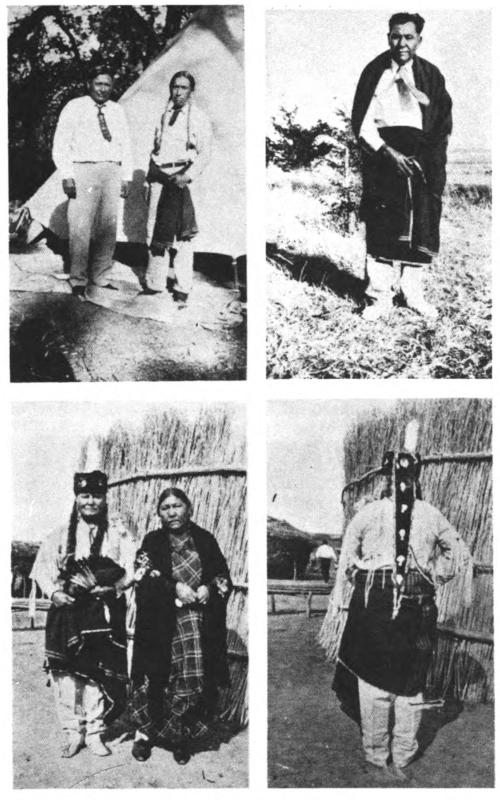
[LA BARRE] PLATE 1
Peyote Leaders
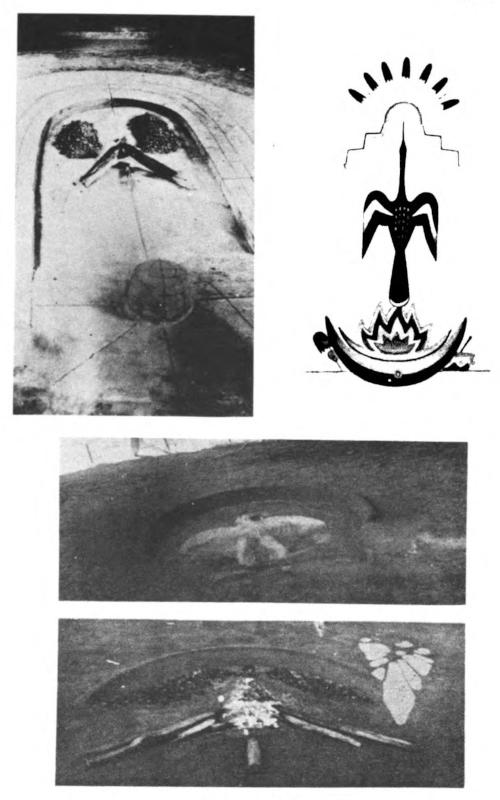
[LA BARRE] PLATE 2
Altar and Ash Birds