Title: The gateway to China
pictures of Shanghai
Author: Mary Ninde Gamewell
Release date: January 26, 2026 [eBook #77783]
Language: English
Original publication: New York: Fleming H. Revell Company, 1916
Other information and formats: www.gutenberg.org/ebooks/77783
Credits: Alan, deaurider and the Online Distributed Proofreading Team at https://www.pgdp.net (This file was produced from images generously made available by The Internet Archive)
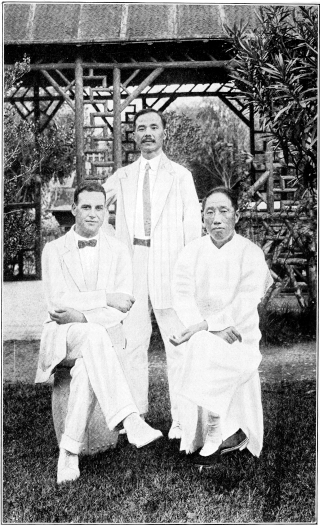
MR. BAO ON LEFT, ONE OF THE THREE FOUNDERS
OF THE COMMERCIAL PRESS, WITH OTHER
MEMBERS OF THE STAFF
(See chapter “A Wizard Publishing House”)
THE
GATEWAY TO CHINA
PICTURES OF SHANGHAI
BY
MARY NINDE GAMEWELL
Author of “We Two Alone in Europe”
ILLUSTRATED

New York Chicago Toronto
Fleming H. Revell Company
London and Edinburgh
Copyright, 1916, by
FLEMING H. REVELL COMPANY
New York: 158 Fifth Avenue
Chicago: 17 N. Wabash Ave.
Toronto: 25 Richmond St., W.
London: 21 Paternoster Square
Edinburgh: 100 Princes Street
[Pg 7] TO MY HUSBAND
PREFACE
SHANGHAI is a little world, where all China in miniature may be studied at close range. Thither drift Chinese from every province in the country, who for the most part in the new environment follow their age-long customs and cherish their inherited traditions. But the city is also remarkable for its rapid and constant changes. A member of a local book-firm declared not long since, “We have never tried to publish a guide to Shanghai because in six months it would be out of date.” To an Occidental the chief fascination of this busy metropolis lies in the curious commingling of things old and new, practices ancient and modern, which meet one at every turn. More strikingly than any other city in the Far East, Shanghai represents the Orient in transition. To catch and portray some of these shifting scenes, the following “Pictures” have been drawn, with the hope that they may stimulate interest in China and awaken a new love and admiration for the Chinese people. It need hardly be explained that no attempt has been made at a complete study of the subjects described. This is particularly true of the last chapter, where several phases of missionary activity have been touched upon by way of illustration, while societies and organizations doing an equally valuable work have not been mentioned. The history of the Christian Literature Society, for example,[Pg 8] reads like a romance and it is a well-established fact that its books had much to do in shaping the radical policy of the late Emperor Kuang Hsü and the liberals of that period, which eventuated in the dawn of progress and a New China. To all friends, Chinese and foreign, whose suggestions and criticisms have helped make possible this little book, warmest thanks are extended.
M. N. G.
Methodist Episcopal Mission,
Shanghai, China.
[Pg 9]
CONTENTS
| I. | Evolution of a City | 13 |
| II. | Civic Features | 20 |
| III. | Street Rambles | 42 |
| IV. | The Lure of the Shops | 57 |
| V. | Housekeeping Problems | 73 |
| VI. | Something About Vehicles | 91 |
| VII. | A Peep into the Schoolroom | 106 |
| VIII. | A Wizard Publishing House | 127 |
| IX. | The Chinese City | 140 |
| X. | Customs Old and New | 155 |
| XI. | A Typical Shanghai Wedding | 172 |
| XII. | Foreign Philanthropies | 185 |
| XIII. | Chinese Successes in Social Service | 199 |
| XIV. | The Romance and Pathos of the Mills |
217 |
| XV. | A Page from the Story of Protestant Missions |
234 |
[Pg 11]
ILLUSTRATIONS
| Mr. Bao on Left, One of the Three Founders of the Commercial Press, with Other Members of the Staff |
Title |
| Chinese Policemen Drawn up for Inspection | 20 |
| Some Shops on Nanking Road | 58 |
| High, Black Rickshas Outside the Foreign Settlement | 92 |
| Advertising Singer Sewing Machine Products | 106 |
| Miss Zee’s New School Building. Kindergarten in the Rear |
120 |
| Chinese Composing Room | 128 |
| The Original Willow Pattern Tea House | 140 |
| A Modern Chevalier and His Happy Family | 156 |
| The Coffin in a Funeral Procession | 160 |
| School Girls in Gymnasium Drill | 168 |
| Rescued Child Just Brought to the Children’s Refuge—Old Men at the Home of the Little Sisters of the Poor |
186 |
| Rescued Kidnapped Children as They Were Photographed for Advertisement in the Chinese Daily Newspapers |
200 |
| On the Way to the Mill | 218 |
| Chinese Boy Scouts | 234 |
| Corner Stone of Boys’ Building, Y. M. C. A. | 244 |
[Pg 13]
EVOLUTION OF A CITY
FROM time immemorial the Yangtsekiang has deposited at its mouth quantities of silt borne downward from the far West on its mighty yellow tide. Little by little, water gave place to mud flats, and mud flats to green fields. On this alluvium a handful of fisher-folk settled a thousand or so years ago, and from their straggling village gradually evolved the Shanghai of today. Shanghai means “Mart on the Sea,” but the city is now sixty miles inland. The Whangpoo River, a branch of the Yangtse, that flows past it, has during the past fifty years narrowed one-third, and only by constant dredging is the channel kept open.
For many years the obscure fishing-station gave no promise of its future greatness; but all things come to them that wait, and Shanghai’s prosperity began when an official in charge of shipping and customs was stationed there in 1075. Five hundred years later, the place had blossomed out into a kind of Oriental Athens, celebrated for its musicians, poets, prose writers, and statesmen. It gave birth, also, to women of repute, praised far and wide as models of virtue and filial piety. The city, like human beings, had its vicissitudes. Again and again, it was infested by[Pg 14] Chinese and Japanese pirates, swept by typhoons, inundated by torrential rains. Although in the latitude of Savannah, Georgia, one piercingly cold winter it was almost buried under snow, the river covered with ice, and men and animals frozen to death.
At the beginning of the nineteenth century Shanghai’s population was estimated at over half a million, and her star was in the ascendant. A forest of masts from a thousand quaint junks, each gaily painted to represent a fish, with staring eyes—for how, say Chinese mariners, can a ship see where to go without eyes?—thronged the anchorage. Shanghai was the busy seaport for the central provinces reached by the Yangtse and for points up and down the coast. Long before ever a foreigner settled within her borders her commercial possibilities had been largely realized and her position as “Queen of the Sea” assured.
In 1842 occurred the great epoch in her history, when with four other cities she was forced by Great Britain to throw open her gates as a treaty port. The first Occidentals to reside within the city were the British Consul and his suite. The most pressing business that confronted the resident British was to secure land for a permanent foreign settlement. They soon discovered that it was one thing to select the site but quite another to get it. The territory chosen lay to the north and west of the Chinese City and for the most part consisted of cultivated fields, dotted here and yonder with a village, and always and everywhere graves, rising in pyramidal grass-grown mounds. As usual, the chief difficulty was over the graves, which[Pg 15] the purchasers agreed should remain undisturbed. When finally the British were in complete possession of the land, they decided the struggle had been even more severe and nerve-racking than the capture of the City. The French followed close on the heels of the British, demanding from the Chinese a concession of their own, something that the Americans a little later, with less friction and noise, simply quietly appropriated.
In 1848, five years after the opening of the Settlement, it is recorded that the foreign population numbered over one hundred, including a few women. How imagination takes wings to itself and pictures the conditions under which the community lived at that time! There were no hill resorts to flee to for a refreshing breeze in summer, no electric fans to temper the heat, no ice-cooled drinks, no screens to shut out the flies and mosquitoes. A stroll on the street was robbed of its pleasure by lack of sanitation, and a ramble even in the near suburbs almost unendurable because of the excrement used on the fields as a fertilizer. Cholera, plague, and other Oriental diseases waxed rampant, and in the first foreign cemetery many a tiny mound watered with tears wrung from aching hearts, told an eloquent story of young lives sacrificed to make possible the Shanghai of to-day.
An outstanding event in the history of Shanghai was the investment of the city in the early 60’s by the T’aiping rebels, those fanatical hordes that for fourteen years kept the country in a ferment, and well-nigh overthrew the Manchu dynasty. As the excited[Pg 16] rebels advanced from the west the populace around fled before them to Shanghai. In the original Land Regulations drawn up by the foreigners Chinese were forbidden to reside in the Settlement. The panic-stricken refugees, however, could not be restrained. They camped first on the outskirts, but soon afterward pushed in and overran the Settlement without let or hindrance. Shacks were built to house them. They went up by the hundreds, like mushrooms, in a night, and real estate speculators reaped a rich harvest, for often the refugees were people of wealth and paid handsome rentals. Many of these same speculators, who, carried away by their good fortune, continued to build at a mad rate, suffered heavy losses, and some even bankruptcy, when at the close of the Rebellion the crowds began emptying out as fast as they had poured in. One reason for the wholesale exodus of the Chinese was their dislike of the sanitary regulations at that time in force in the Settlement, and they were in great fear lest the foreigners might gain sufficient control over the Chinese officials to put the same hated rules into operation in the interior cities. Though so many refugees returned to their homes just as soon as it was safe to do so, large numbers remained, enjoying the protection offered them in the Settlement. Efforts were made from time to time to eject them, but without avail, while others gradually drifted into this desirable haven. Thus began what Shanghai has ever since continued to be, an asylum for the lawless from all parts of China. The class of respectable unfortunates is also numerous. A Chinese “Who’s Who” for Shanghai,[Pg 17] if accurately compiled, would astonish the reader with its list of half-forgotten, erstwhile famous personages, deposed officials, bankrupt aristocrats, antiquated scholars, men who figured prominently in the affairs of the world, but, having lost “face,” favor, and fortune, find the cosmopolitan metropolis a safe retreat in which to end their days.
“First things” always possess a peculiar interest, and of these Shanghai can lay claim to her full share. The first railroad ever laid in China ran between Shanghai and the forts at Woosung, twelve miles distant, where the Whangpoo River joins the Yangtse. The two men sent out to survey the line had a hard time of it and one of them was nearly killed by the infuriated people, who declared he should not desecrate the graves of their ancestors that lay in the path of the proposed road. This line was completed in 1876, but it was destined to a short existence. The stealing of window-glass and the blue silk window curtains by Chinese passengers, unable to comprehend their utility except as a means to fill their pockets with coveted cash, was a small matter. The road roused the deep-seated resentment of all classes, and from the first was doomed. The grand finalé came when a group of Shanghai officials perfunctorily inspected the entire line from their sedan-chairs, scorning to stoop to the indignity of riding on the train, and gravely pronounced it a menace. Soon after this the rails were tom up and it was long before others were laid in their places. But the world moved even under the reign of the Manchus, and before their sun had set the shriek of the locomotive was heard[Pg 18] many times every day between Shanghai and Woosung, while in the “most pro-foreign city in the world” sedan-chairs are almost as great a novelty as trains were formerly.
It seems strange that it should have been during the stressful period of the T’aiping Rebellion that one of the greatest boons China ever fell heir to was conferred on the distracted nation. That was the inauguration in Shanghai of the Imperial Maritime Customs, called by one writer “the most telling Western leaven ever introduced into China.” The story of the Customs service under the Chinese is one long, tiresome record of failure, graft, and loss, and it was not till 1854, when the management was assumed by foreigners, whose probity became at once the wonder and delight of the natives, that a change was effected. Guided through half a century by the master hand of Sir Robert Hart, to whom must also be given much of the credit of the National Chinese Postal System established during his incumbency, the work has gone on growing steadily and yielding an increasing revenue. It is eminently fitting that a statue of Sir Robert in characteristic pose, should recently have been unveiled in the Bund Park close by the Custom House.
Shanghai has not yet reached the zenith of her prosperity. The Customs receipts last year were larger than ever before. Twenty and more vessels bound for as many different ports often leave her docks in a single day. Never was there as much building in progress, especially of Chinese houses. The Western traveller who looks out upon the wide Bund, flanked by handsome[Pg 19] foreign buildings, with automobiles and carriages speeding to and fro, almost wonders whether he is not arriving at a European capital instead of a city in China. The native population has grown to over a million. Of the twenty-one thousand resident foreigners, including Japanese and East Indians, about five thousand are British and fifteen hundred Americans. The city is a political theatre where plots are hatched and reforms initiated. It is the national headquarters of missionary work, the chief seat of commerce, the home of progress, in short the nerve-centre of China whose influence reaches out to the remotest corners of the land. Shanghai faces problems and dangers peculiar to the Orient, but her future is bright with the promise of boundless development.
[Pg 20]
CIVIC FEATURES
“THE quaintest little republic in the world” is what Shanghai is often called. Certainly there is no city like it in China. Within its present limits are peoples from many countries, eighteen having consular representation, and all living, in the main, amicably together under a polyglot governing body whose members are elected by popular vote. The working out of the present system of autonomy was a difficult task. The city fathers long ago fought their way through more than one bitter controversy, for there were many minds as well as many nationalities. The Land and Municipal Regulations now in use are practically the same as those adopted back in 1869. Ten years after Shanghai became a treaty port the French withdrew from the union and set up a government of their own. The others formed themselves into the “International Settlement,” latterly known as the “Model Settlement.” Truth compels the admission, however, that it is not in all respects as worthy a “model” as its wellwishers would like to see it. Still it has admirable features, and as self-respecting a metropolis as Hongkong was urged by one of her citizens [Pg 21]in a recent appeal to wake up and emulate the example of stirring, progressive Shanghai.
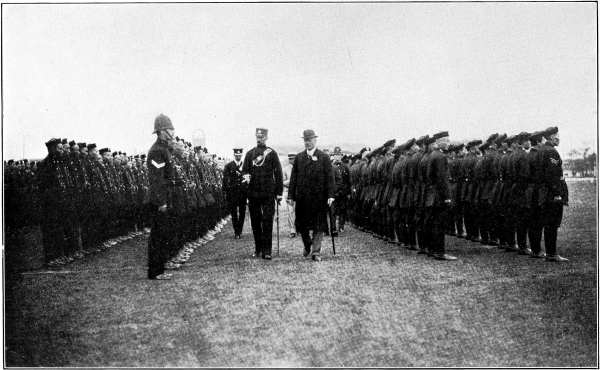
CHINESE POLICEMEN DRAWN UP FOR INSPECTION
The centre around which everything political revolves is the Municipal Council. The consuls of the International Settlement each spring call a meeting of the rate-payers or electors. Any foreigner who owns or rents property of a fixed value possesses the right of franchise. The rate-payers elect the members of the Municipal Council, and that done they retire from the public gaze till the following year, unless convened for special business. The Council holds weekly sessions. Its nine members are unsalaried business men. Chinese are not eligible to membership, but Japanese are, though as a matter of fact there never had been a Japanese member, greatly to this people’s displeasure, until a year ago, when one succeeded in getting elected. Judicial authority is vested in the consuls. Each consul arbitrates for his own nationals except in the cases of the three countries having fully organized law courts with resident judges. These are England, America, and Germany. The English court was established years ago; the American held its first session in 1907. The Chinese are extremely sore on the subject of extraterritoriality. That it does not exist in Japan only adds to their grief and mortification. Since the New Law Codes have been framed the nation is more insistent than ever that this thorn in its flesh shall be removed and foreign courts abolished. But the new laws are not widely operative, and until the old methods of bribery and torture are forever relegated to the past the Treaty Powers will continue to claim exclusive[Pg 22] rights over their subjects, and the subjects to demand protection.
A unique institution peculiar to Shanghai, indeed, as some one has called it, “the most unique institution ever dedicated to justice,” is the Mixed Court. In the early days, when Chinese were made prisoners in the International Settlement, they were turned over to the Chinese City officials for trial and punishment, but justice was rare, and cruel or unduly lenient treatment the rule. To protect the Chinese, and insure fair dealing in those cases in which foreigners were involved, as well as to try the cases of foreigners having no consular representation, the Mixed Court was established in 1865. It has not proved a wholly satisfactory solution of the difficulty, for the law in force is the Chinese law, and the foreign assessor, an Englishman, American, or German, according to the day of the week, who occupies a seat on the judicial bench beside the Chinese judge, ranks as little more than a figurehead, acting merely in an advisory capacity. Practically though, it must be said, and this is particularly true since 1911, he is coming to be the real power behind the throne, and to exercise pretty much of a controlling influence. At the time of the revolution the management of the Mixed Court passed from the hands of the Chinese to the control of the Municipal Council. The change was effected quietly, so that while the Chinese were well aware of what was going on they could appear not to know, and thus save their “face.” If only “face” can be preserved facts are of small moment.
A morning spent in visiting the Mixed Court[Pg 23] is to most people an experience of absorbing interest, as it throws innumerable side-lights on Chinese life and character. At half-past nine each morning, the hour of opening court, the foreign assessor and the Chinese judge walk in and take their seats, each flanked by his interpreters and clerks of solemn mein. The witnesses, Chinese and foreign, assemble on opposite sides of the room, the prisoners, most of them poor forlorn specimens of humanity, file into the docket closely guarded by Sikh and Chinese policemen, with an English sergeant-at-arms on duty near by, while in the hall, around the door and pressing as far inside as they dare, gathers the curious, motley crowd of onlookers, many of them relatives and friends of the prisoners, but stolidly immobile during all the proceedings. Is there another place in the world where such a variety of cases is heard as at the Shanghai Mixed Court, cases civil and criminal, tragic, pathetic and comic? Some are intricate enough to tax the wisdom of a Solomon, and some are simple as a child’s play. An old couple appeared one morning to petition for a divorce. Their faces wore such a kindly expression, they seemed so at peace with mankind in general and each other in particular, that the judge was puzzled. “Have you quarreled?” he asked. “Oh, no.” “Don’t you live happily together?” “We are most happy and that is why we are here,” hastily explained the old woman. Then the whole story was poured out. An evil omen had convinced them that in the future they would quarrel frightfully, separate, and die apart of broken[Pg 24] hearts, so in order to avert such a calamity they had determined to take time by the forelock and part company while they were still good friends. A few words of advice and assurance set matters all right, and it was not long before the aged lovers, for that is what they really were, passed smilingly out of the courtroom, hand in hand, to return to their humble home. No executions take place in the Settlement. Prisoners sentenced to capital punishment are handed over to the Chinese authorities, and here again “face” is considered, for while the death sentence has actually been passed the court in the Chinese City is allowed to assume that it has not, and proceed as if the prisoner was condemned on its own initiative.
The building occupied by the Mixed Court is bounded on the right by the Woman’s Prison and on the left by the Debtor’s Prison. Under the Chinese regime discipline was practically nil and affairs were left largely to run themselves. Inmates of the Debtor’s Prison might smoke opium and gamble to their heart’s content, provided they could get the money, while dancing-girls furnished them entertainment. In the woman’s prison conditions were even worse. The top floor was set apart as a rendezvous for the young children of the prisoners, wretched, neglected little ones, exposed to every kind of evil influence. Their mothers in the cells below did pretty much as they liked. One of their tricks was to thrust their hands between the iron rods at the windows, and tear away by main force the corrugated iron screen so that they could chatter noisily with the people in the street[Pg 25] below, and by letting down a string draw up food or anything else their friends were minded to tie on the end. The wardresses (the only man about the place is the gatekeeper) were deceitful, faithless, open to bribes, in fact little better than the women behind the bars.
But marked changes have taken place during the past few years. As soon as the foreign municipality assumed control, a prerogative by the way likely any time to revert to the Chinese, who are considerably nettled over their loss of authority, the young children were removed from their pernicious environment and placed in a Home under the care of a Christian woman. The Municipal Council supports this Home. The whole staff of wardresses was dismissed and their places filled by others who were strictly watched till their faithfulness was proved. The filthy building underwent a thorough cleaning, repainting, and calcimining. Baths, laundries, and doctors’ examining rooms were added to the plant and the prisoners required to exercise an hour daily in the sunny, cement-paved court, which has resulted in a marked improvement in the health record. The chief lack now is industrial work for the women, who have absolutely no employment except scrubbing the corridors and washing their own clothes. The sole break in the dull monotony of their lives comes when the gentle, sweet-faced missionary from the Door of Hope visits the prison with her Chinese Bible woman, going from cell to cell to sing, read, and pray. Four women are confined in a cell, which is fairly well lighted and sufficiently large. The Chinese[Pg 26] beds are entirely devoid of bedding even in the coldest weather, the padded garments of the prisoners being expected to suffice. Nursing babies up to four or five months old are allowed to stay with their mothers. Most of the women are convicted for kidnapping, and the sentences do not extend at the longest beyond eight or ten years.
The Debtor’s Prison is officially known as the “House of Detention.” Its prisoners are not chained, may walk about freely, smoke, play games provided they are not games of chance, and at certain hours each day are allowed to see their friends in a small room at one side. On a winter’s day, when the windows and door of this room are shut, the contracted space packed with people, and the air heavy enough with tobacco smoke to cut with a knife, it is almost as much as a foreigner’s life is worth to take even a hasty peep inside. The prisoners provide their own bedding and food, with the exception of rice, and on the whole appear to enjoy themselves and to be in no hurry for their release, though some have hidden away quite enough money to pay their debt if they cared to, and others have relatives or friends who could easily pay it for them. Recently two men were set at liberty by the court on the presumption that they were really unable to meet their obligation, one after seven years’ imprisonment and the other five. The Municipal jail for men is several miles away, in a more open part of the city. Its massive, gray brick walls shut in between eleven and twelve hundred prisoners, all of them Chinese, for foreign prisoners are lodged temporarily in small prisons connected[Pg 27] with their consulates, or, when the consulate has no prison, in the British jail. The discipline and upkeep of the jail are about perfect. The superintendent is a Christian who arranges for regular Sunday services for the prisoners, the Young Men’s Christian Association having general charge.
Industrial work of various kinds, including tailoring, mat weaving, and carpentering, is carried forward on a large scale, and a considerable amount of the city’s road-paving and repairing is done by the prisoners. Short terms in jail are rather welcomed than otherwise by many of the men, for they mean to them shelter, good food, warm blankets, and a chance to learn a trade under the most favourable conditions. Indeed, it has come to pass that many habitual offenders are in the habit of flocking to Shanghai as soon as the cold weather sets in with the express purpose of putting up at the jail for the winter. A specific instance occurred a while ago when a Chinese walked into one of the police stations and cheerfully announced that he wanted to be arrested. “My belong velly bad man,” he said, “velly bad man.” Not being able to give any special reason why he should be arrested at that particular time, he was told to go about his business. But he insisted. He was “velly bad,” and wanted to be arrested, and it was with a look of pained surprise that he made his way out of the station. As he walked down the street, thinking with dismay of the cold weather ahead, a happy inspiration struck him. He went in search of a policeman, and having found one, proceeded to beat him. He did his work thoroughly,[Pg 28] was quickly arrested by another policeman, and taken to the nearest police station, beaming with satisfaction. The problem of his winter’s lodging had been solved. A moot question for some time past has been the advisability of reviving the practice of flogging with the bamboo. Many officials, Chinese as well as foreign, contend that this punishment as formerly administered by the Mixed Court, was thoroughly humane, and that as it has real terror for the Chinese nothing begins to be so effective in preventing crime, which has of late been greatly on the increase.
Formerly there was no Reformatory, and young boys convicted of no worse crime than petty stealing were often confined in the same cell with hardened criminals. It was the present superintendent who agitated the need of a separate building for the boys under sixteen, and finally a great three-story warehouse was purchased and fitted up for this purpose by the Municipal Council. Some of the lads are as young as nine. “The longer I live in China and the more I see of its poverty-stricken multitudes the less I blame any one for stealing,” exclaimed a Y.M.C.A. visitor at the Reformatory. The boys do industrial work in the morning and in the afternoon study, drill, and play. The fire drill is fine, but the military drill is the boys’ delight. Those best trained take turns in acting as drill-master. They give the orders in English and the company responds with a vim. Insubordination is punished by obliging the offender to scrub the wooden floors with sand, sometimes for a whole day. They are kept beautifully white. “You should see the kitchen!” said a frequent[Pg 29] caller to a new comer. “It is so clean you could eat off the floor!” Several Christian Chinese business men in Shanghai have an understanding with the superintendent that they will receive a limited number of boys sent out from the reformatory, give them employment and a chance to begin life anew.
One of the first things that impressed itself on the early foreign settlers in Shanghai was the need of an adequate police force. In the beginning it was limited to a handful of Chinese watchmen under the joint jurisdiction of the Chinese and foreigners. An amusing story of those days is that the police were in the habit of lining up for inspection in their own nondescript garments, but wearing foreign military caps and carrying in place of rifles closed Chinese umbrellas of oiled paper! Now the city is well guarded by 230 English policemen, 450 Sikh Indians, and over a thousand Chinese. The picturesque red turbans of the Sikhs are conspicuous everywhere. These men are harsh but efficient preservers of the peace. The Chinese are afraid of them. There is one especially tall Sikh of whom his foreign superior says, “He is the only man that I am absolutely certain will carry out my orders in my absence as if I were present.” One of his duties is to punish Chinese police delinquents by putting them through a severe physical drill half an hour long in summer and an hour in winter. “It looks easy enough,” a foreign lady remarked, as she watched the men, “Why, I exercise harder than that when I play tennis.” “Oh no, you don’t bring into action every muscle in this way,” smiled the head officer.[Pg 30] “These men are glad enough to lie down and rest after their stunt is finished. I had one man that fainted, but he was abnormal.” What makes this punishment especially objectionable to the Chinese is that it is administered by a Sikh. If an English officer were over them it would not hurt half so much. The work of a policeman attracts the Chinese and there is never any lack of recruits. The course of training lasts three months. Scientific wrestling appeals to the novice strongly and he soon acquires real skill. The officers have a unique method of putting a stop to fighting among the men. The combatants are given boxing gloves, forbidden to bite or kick, two favorite forms of attack with them, and then made to fight until they are thoroughly tired out. One such experience usually works a cure for all time.
Chinese barracks are clean and severely plain. “We carry on a constant warfare against bedbugs,” says the foreign sergeant. “I do not allow a hook or nail in the walls, except the bracket back of each bed for holding the rifle, and that I wouldn’t permit up again, for vermin hide in the corners.” Every Saturday the planks on which the men sleep are scrubbed with sand and water. The sand soon works into the pores of the wood where bugs are apt to lodge, so it acts both as a cleanser and an insect preventive. When a man goes home to spend a day, as he is sometimes allowed to do, the barracks on his return must undergo a special cleaning, for he is sure to bring back a fresh relay of bugs. The past year an innovation has been introduced in furnishing the[Pg 31] Chinese police with rifles, a convincing proof of their general faithfulness and the trust reposed in them. They are not permitted to take the rifles to their homes, but when going off duty leave them at the police stations.
The Sikh recruiting station is on the same grounds with the Chinese but in a separate yard. The chief embarrassment in connection with the Sikhs is their food. They are East Indians and can not eat what the Chinese do. Caste rules are inflexible and time must be given them to prepare food in their own way no matter how greatly the staff is inconvenienced. The Sikhs are stern disciplinarians, but in character no more dependable than most of the Chinese, nor in some cases as much so. A Sikh watchman patrolling an outlying district rang one evening the doorbell of a foreigner’s house. “It is raining,” he remarked blandly. “Can I have a chair and sit on your veranda?” It was observed afterward that he frequently camped on the veranda when it was not raining. The Sikhs are not required to learn Chinese, but they are encouraged to do so by being promoted and given higher salaries when they can speak it. Chinese is demanded of European policemen. They of course constitute the backbone of the staff. The Municipal Department supports a hospital, one of the cleanest and best in the city, for Chinese policemen; it is also used for prisoners from the Municipal Jail. Women prisoners when sick are sent to a woman’s mission hospital.
In case of riot or other emergency Shanghai would not need to rely wholly on the police force, for it has a dependable Volunteer Corps, at present 1,300 strong.[Pg 32] As long ago as 1853 the Volunteer Corps was organized, and ever since the T’aiping Rebellion, when the members rendered such valiant service, there has been occasion time and again to turn to them for help. Their most recent laurels were won during the Rebellion in the summer of 1913, when Shanghai was the centre of the war zone. To watch the Corps at drill or on parade, so many sturdy young men among the older ones in the ranks, gives foreign residents an exhilarating sense of security, and warms their hearts with a glow of honest pride in their defenders. Among the many nationalities represented in the Volunteer Corps is a strong Chinese contingent, and it causes a still further quickening of the pulse to learn from the commanding officer that whenever the Chinese Volunteers have been called into action their efficiency and loyalty have been in the highest degree commendable. During the past year a Volunteer Motor Car Company was added to the force. It started with eighteen private cars and men to run them, but in case of need practically all the private as well as public cars in the city would be placed at the disposal of the Volunteers.
The Shanghai Fire Department dates back to 1866. The three chief officers are employees of the Municipal Council, but all the members of the four companies are volunteers. There are three fire stations and three watch towers, besides a one-thousand-gallon fire float moored at one of the jetties on the Bund. Three motor vehicles are in use and the purpose is to abolish horses as rapidly as possible. In a cosmopolitan city like[Pg 33] Shanghai, where all sorts of buildings crowd upon one another in the densely populated districts, fires are constantly breaking out, but the Fire Brigade handles them so well that destructive ones are rare.
“Why is it your letters always come to me with a two-cent United States stamp on them?” wrote a bright American club woman to a friend in Shanghai. Her perplexity is not surprising, since even certain government departments in Washington have been known to send to Shanghai franked envelopes bearing five-cent stamps. The independence of the “Little Republic,” albeit on Chinese soil, is emphasized by its having six foreign postoffices—British, American, German, French, Russian, and Japanese. Three countries—Great Britain, America, and Germany—have legalized the domestic rate of postage to and from Shanghai. But home letters forwarded from Shanghai to interior points require the usual foreign postage of five cents, and parcels from abroad sent inland must be rewrapped, restamped, and go through the Chinese postoffice.[1]
[1] As these pages go to press arrangements are being made for an International Parcel Post.
It is a pity that China failed to improve her flood-tide of opportunity in 1878, when she was formally invited to join the International Postal Union, in the hope that it would encourage her to establish a national postoffice. But with a short-sighted policy she declined to do so, and it was not till September 1st, 1914, that this privilege was finally embraced. Though for years a national postoffice was urged upon the people and often seemed about[Pg 34] to materialize through the efforts of progressive statesmen like Li Hung Chang, yet it did not really make its appearance till 1896. Up to that time mail was distributed from local stations under local control, and as means of rapid transit were very few, much of it was delivered by couriers. There are still many courier routes in the interior where railroads and steamers do not penetrate, but the couriers, often on foot, sometimes on mule or horseback, waste no time in getting over the ground, not infrequently travelling between eighty and ninety miles a day, and this in spite of unspeakably bad roads, to say nothing of brigands, floods, and a few other minor difficulties! Shanghai is the largest distributing centre in China, and in the substantial red brick Chinese postoffice, just across the road from the British postoffice, an enormous business is carried on. All heads of departments are foreigners. Periodically the Chinese voice a protest, declaring that as the Chinese staff has now received sufficient training, it is prepared to fill unaided the most responsible positions. But sagacious Chinese politicians are loth to release the foreigners, realizing that a change at the present time would inevitably entail a grave risk. It is rather interesting that the newest and handsomest postoffice building in Shanghai is the Japanese. There are no foreign postmen except Japanese. Chinese postmen in neat green livery cover their route on bicycles. There are six deliveries a day in the business districts and three and four in the residential. One family was so disturbed by the postman bringing mail at ten o’clock or later at night, and insistently ringing the door-bell[Pg 35] until it was answered, that they requested him to defer delivering the late mail until morning, but he continued to call whenever he had letters, evidently impressed that the postoffice rules were inflexible and must no more be broken than the laws of the Medes and Persians.
Probably the most interesting of any branch of the foreign Municipal government is the Health Department. Eighteen years ago when the doctor in charge settled in Shanghai and started a campaign against disease, he was not building on another man’s foundation, for nothing like it had ever been attempted. A member of the staff has aptly called the Municipal laboratory “the brain of the department.” It is certainly kept busy in a thousand ways. People from all over China, for one thing, turn to it for the Pasteur treatment. But its chief work centres about plague prevention. Plague is the bane of the Orient, and plague, it was discovered in 1908, is transmitted to human beings through fleas that carry the poison from infected rats. Then to prevent plague, rats must be exterminated, no easy matter in a city like Shanghai. The campaign began in this way. The city was divided into districts, the districts into sub-districts and sub-districts into blocks, and a map made of the whole. A raid on rats followed. Every one caught, dead or alive, was taken to the laboratory and an examination made. A black-headed pin was stuck in the map over the spot where each plague-infected rat was found. A red headed pin on the map indicated a human death from plague. In this way it was soon learned what parts of the city were specially invaded by the pests. To[Pg 36] kill the rats, however, amounted to little, for others soon appeared to take their places. Something more radical needed to be done. After the Municipal Council had passed rules calling for the rat-proofing of houses, a more difficult task confronted the officers of the Health Department in getting the rules enforced. They were needed badly enough for foreign houses, but were drawn up especially for Chinese dwellings where often four and five families are crowded like sardines into one small building. At first the Chinese strenuously opposed and ridiculed the rules but later came to regard them more favorably. The people are terrorized at the outbreak of plague, and when a few years ago Shanghai was threatened with a bad epidemic, they were ready for the time being to submit to anything that promised to stamp it out and prevent another visitation. The rules demand that there shall be no open space underneath the ground floor, and by laying three inches of tar chips on six inches of concrete, it is impossible for rats to enter the house from below. The health officers also urge upon householders, although not included in the rules, that walls be made solid and the upper story left without a ceiling, showing simply the bare rafters. Many old houses as well as new ones are treated in this way. Sometimes a whole block of old houses is rat-proofed at one time. While the work goes on the people turn out of their homes and camp in the street in front of them, cooking their meals over little charcoal fires, and squatting patiently about till they can go back. But education is a slow process and opposition still continues. The ideal worked toward[Pg 38] is the one already reached in Manila and held up as an example, “No hollow spaces whatever accessible to rats.” With the most careful economy it costs the Health Department two cents to catch each rat, yet whenever notified by a foreign or Chinese tenant it is prepared to send its employees with traps to rid the premises. Stationary garbage receptacles of concrete, with spring lids, that are fire and rat proof, have been placed in large numbers all over the city. Several times a day they are emptied through an opening below and the contents carried off in municipal carts. The receptacles are liked by the Chinese, who seldom now throw their garbage on the ground.
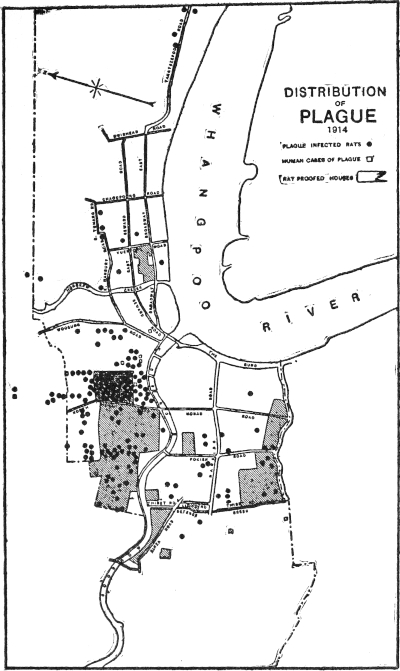
DISTRIBUTION OF PLAGUE 1914
The danger from contagious diseases is not so easily controlled. There is no law requiring small-pox, cholera, or even plague patients to go to the Chinese Isolation Hospital. Moral suasion is the only influence that can be brought to bear on them, and it is not always sufficiently powerful. But a vigorous campaign in the interest of the prevention of disease is continually in progress. Every month, and every day of the month, printed circulars are scattered broadcast. They are written in both English and Chinese, and relate to sanitation, hygiene, the danger of promiscuous spitting, of flies and mosquitoes, the need of removing stagnant water and rat-proofing houses. In the autumn and winter notices are posted on electric light and telephone poles calling the attention of passers-by to free vaccination for Chinese at any one of the sixteen branch offices of the health department. Health lectures are given weekly at the health offices, and not only that but heed is paid to the[Pg 39] old proverb: “If the hill will not come to Mahomet, Mahomet will go to the hill.” Although the lectures, which are of a popular character, usually draw a large, attentive crowd, trained Chinese employees lecture in schools, tea-shops, and other places where the people are wont to gather. They carry around a dinner bell which they ring to attract an audience, and they soon have it. When the lectures first began the people did not understand their intent, and they aroused almost fierce opposition. But the Chief of the Department, a physician of great tact and urbanity, sent invitations to some of the leading business men and officials to meet him at a specified time and place when he addressed them in person explaining the character of his campaign. After that there was no further trouble. A large force of coolies is employed to fight mosquitoes. They work in pairs in districts assigned to them. Their duty is to gather up old tins, bottles, and broken crockery, warn residents against leaving about their premises tubs, empty flower-pots, and other vessels capable of holding rain-water, obliterating shallow pools and slushy places by means of scratch drains or filling them up with house ashes, and sprinkling kerosene oil on stagnant water that can not be drawn off. The coolies are inspired to faithfulness by frequent and unannounced inspection of their work.
Among the many business houses regularly inspected by the Health Department are dairies, laundries, tea, fruit, and meat shops, restaurants and bakeries. Licenses prohibit in tea-shops the hawking of fresh food stuffs on the premises; dairies, bakeries, and laundries[Pg 40] must be calcimined twice a year, no one shall sleep or eat in them, nor may they be attached to a dwelling-house. In bakeries the spraying of fluid from the mouth on the products of the bakery is prohibited, and in laundries the same rule applies to the sprinkling of clothes. In dairies workers are required to keep their clothes clean and wash their hands before milking. Always and everywhere spitting is forbidden and also the employment of persons with communicable diseases. To suppose that these rules are carried out to the letter, would be altogether too much to expect of human nature. That they act as a powerful deterrent is certainly true. The foreign dairies are the best, but one Chinese dairy enjoys the enviable reputation of never having been either fined or cautioned. The Municipal Slaughter House is kept strictly sanitary and cattle and carcasses are examined daily. Good meat is stamped with the words “Killed Municipal Slaughter House.” Inferior meat but free from disease is marked “2nd Quality.” No meat for foreign consumption is allowed to be brought into the Settlement unless it bears the Municipal stamp.
Tuberculosis is the Chinaman’s Nemesis, and too often pursues him from the cradle to the grave. It is also frightfully common among the poor Eurasians who herd together under lamentable conditions. The only remedy for this prevailing malady seems to be to educate, educate, educate, and that is being done as thoroughly and effectively as possible. The Society of King’s Daughters recently did a fine thing. They planned a Tuberculosis Exhibit, which was held for a week or more in an empty down town store. Much[Pg 41] of the exhibit was loaned and set up by the Young Men’s Christian Association that is itself carrying on a telling campaign against China’s “White Scourge.” Maps, charts, pictures, devices of all kinds for arresting the attention and teaching a lesson, were arranged attractively, but two things in particular produced a profound impression. One was a bell that every thirty-seven seconds clanged ominously. Over it hung a placard announcing in Chinese and English that every time the bell tolled some poor victim in China died of tuberculosis. The other design was more conspicuously placed in one of the large show windows and always attracted a crowd of absorbed, silent Chinese. The sight that held them spell-bound was a perfect model of a Chinese house, out of which stepped a Chinaman, who, after walking a few steps, fell into a Chinese coffin that instantly disappeared in the earth. This happened every eight seconds and each drop of the coffin represented a death from tuberculosis somewhere in the world.
Before 1898 there was practically no Health Department and no health campaign. If progress at times seems slow, one has only to look back to realize what a marvellous change for the better has been wrought in a decade and a half. Perhaps more to the Health Department than to any other branch of the Municipal Government Shanghai owes its right to be called “The Model Settlement.” The group of Central Municipal Buildings covering an entire square in the heart of the city forms one of the finest plants of the kind to be found in the Far East.
[Pg 42]
STREET RAMBLES
“I HAVE lived in China nearly twenty-five years, yet I never go on the street without seeing something new and interesting,” exclaimed a vivacious little missionary doctor to a group of fresh arrivals. Her remark was made about Peking, but the outdoor life in Shanghai has its own unique charm.
To begin with, in the International Settlement there are no “streets” at all, so called; only roads. Some of the byways, to be sure, too narrow and short to be dignified as roads, go by the name of “lane,” and the city boasts a “Broadway,” or, to be exact, “Broadway Road.” It is unnecessary to explain that this lies in the district originally ceded to the Americans. The Shanghai Broadway makes no pretense of emulating in appearance or importance its western prototype, though quite a brisk trade is carried on in the modest shops near its lower end.
The first permanent foreign settlement was along the Bund, beginning with the site occupied by the British consular offices and residence. The splendid Bund, bounded on one side by sightly bank and club, steamboat and insurance buildings, and on the other by the Whangpoo River, is the city’s pride and glory. It[Pg 43] is hard to realize that this wide, white road, humming with life and swept by costly automobiles, was once nothing but a well-trodden tow-path bordering a marsh. Away to the south, across what until recently was an ill-smelling creek but is now being rapidly metamorphosed into a handsome boulevard, begins the French Bund, with its wharves and warehouses, and where it ends the Chinese Bund starts.
The characteristic feature of the Chinese Bund is its boat population. For more than half a mile little boats called sampans, protected by a low arched covering of bamboo mats, line the shore and extend well out into the river. Each tiny sampan swarms with life as if it were an ant-hill. The occupants are permanent householders and their habitations are anchored. Many of them were originally famine refugees from the north. Most of the men earn a living as wharf coolies. The wives add a little to the income by gathering rags to make into shoe soles and by patching and darning old garments for coolies without families who pay a few cash in return. Planks set on stakes serve as footpaths to connect the boats with the shore, and little toddlers run about on the narrowest of them at will, yet rarely tumble into the water or soft mud below. Births, marriages, and funerals lend variety to the life of the boat people. Two or three empty coffins usually stand about on the wharf ready for an emergency, and are meanwhile useful as benches, especially for the women when they sew.
The International Bund on its water side is unobstructed with buildings, except at the Customs jetty,[Pg 44] and is laid out in grass plots which gradually widen near the Garden Bridge into the Public Gardens. This charming little park in the heart of the city, with its lawns, flowers, shade trees, and a band-stand where the celebrated Municipal Band plays in summer, is a favorite resting place for weary pedestrians and a rendezvous for parents and nurses with young children. Chinese are not admitted to the Gardens, except nurses with foreign children, unless dressed in foreign clothes or accompanied by a foreigner. This is to keep the grounds from being overrun by the coolie class. The Customs jetty has witnessed many a stirring scene. Trim launches carry outgoing passengers twelve miles down the river to the anchored ocean liners beyond the “bar” and bring them up the river on arrival. Its sheltering roof has caught the echo of sobs and laughter, tremulous good-byes and joyous welcomes.
The river at this point is half a mile wide and presents an animated picture. Every variety of craft floats on its waters, from the busy sampan to the light-draught coasting vessel or man-of-war. Whether seen beneath the radiance of the noonday sun, or under a starlit sky, reflecting myriads of twinkling lights, it is a never-failing delight to resident and visitor alike.
The most picturesque, as well as the leading business street in Shanghai is Nanking Road, or as the Chinese call it, “The Great Horse Road.” “Great,” however qualifies “Road” and not “Horse,” for while numerous horses travel over it, most of them are the small swift-footed Mongolian ponies, whose clattering little hoofs are heard early and late. Indeed the name[Pg 45] “Great Horse Road” strikes one as rather out of date in these days of the ever-present automobile, of which there are already more than eight hundred in Shanghai. Nanking Road starts at the Bund with the Palace Hotel, and following the windings of a former creek, ends at the race course. For a short distance west of the Bund it is given up mainly to foreign stores, the largest and finest in the city. Then the street widens and becomes an avenue of high grade Chinese shops, many of them with the national flag afloat and all displaying aloft the characteristic vertical signboard in black and gold. The vista in either direction on a bright day is quite dazzling, and especially at night when the avenue from end to end is ablaze with electric lights. Then crowds of Chinese going to and from the theatres and tea-houses, or simply out for a stroll, jostle each other on the sidewalks and pour over into the road, where they narrowly escape being knocked down by rapidly moving vehicles. Conspicuous everywhere are the Chinese “Women of the Street,” or rather the girls and children, for nearly all are pitifully young. Bedecked and bejeweled, they stand sometimes in the bright glare, but oftener within the shadow of a closed doorway, or at the entrance to a lane, usually in groups under the care of an older woman who acts as “business agent.” A notable hour on Nanking Road is between five and six on Saturday afternoon, when it seems as if the whole city turns out to loaf or saunter in quest of pleasure. A babel of shrill voices rings in the ear, mingled with the shouts of ricsha coolies and the tooting of motor cars. It is a gay,[Pg 46] panoramic scene, such as could hardly be duplicated anywhere else in China.
A Britisher in Shanghai once made the remark, “There are two things an Englishman must have, a king and a race-course.” The Shanghai race-course, with the Public Recreation Grounds adjoining, covers about sixty-six acres in a part of the city where property is valued the highest. The land was bought up years ago. So much open space in that locality could scarcely be secured to-day at any price.
Bubbling Well Road is a synonym for the patrician quarter of Shanghai. It is a continuation of Nanking Road and takes its name from the effervescent pool enclosed by a low cement wall at its terminus. Near by Bubbling Well is the foreign cemetery, a shady, restful spot. Every thirtieth of May the Americans gather within its gates for a national memorial service. They represent all creeds and callings, merchant and missionary, tourist and adventurer, aliens on a distant shore, drawn together by a common love for a common flag. The American corps of the Shanghai Volunteers and the “Regulars” from the American cruisers anchored in the river, march up from the Bund with bugle and fife and salute in front of the flower-strewn mounds. A few of these graves date back more than sixty years.
Some of the handsomest residences on Bubbling Well Road are owned by wealthy Chinese. Pleasant afternoons and evenings automobiles by the score flash up and down this wide, smoothly-paved road and on to the delightful suburbs beyond, many of them crowded[Pg 47] to overflowing with merry-making Chinese, women as well as men.
In the French Concession, the avenue formerly called “Paul Brunat,” after the first French Consul, but since the outbreak of the war changed to Avenue Joffre, vies with Bubbling Well Road in the elegance of its residences, which some prefer because of their more varied style of architecture. Being a newer thoroughfare, this avenue lacks in a measure the abundant shade trees and fine old gardens which are among the chief attractions of Bubbling Well Road. It is frequently pointed out to strangers as one of the few long roads in Shanghai which is also a straight one, running most of its entire length of between two and three miles with scarcely a jog.
The “tenderloin” district centres about Nanking and Foochow Roads. The latter is a narrow street with nothing at first sight to arrest the attention, but men shake their heads at the mention of it and women avoid it if possible. Its mark of distinction is the number and character of its tea-houses. They are entered directly from the street. A wide staircase leads to the restaurant which occupies the second story, the ground floor being used for business. Along the front of the building and on the side as well, if it happens to be on a corner, runs a narrow veranda, a much-sought-for gathering place in mild weather, where idlers can chat and sip their tea or wine while enjoying a view of all that is going on in the street below. The tea-houses, often richly furnished with carved black-wood from the south, are practically deserted till the latter[Pg 48] part of the afternoon, when a few loungers make their appearance. But it is at night that the crowds pour in. Then the tables fill up, Chinese musicians rend the air with what to foreign ears seems a riot of discord and by nine or ten o’clock everything is in full swing. In and out among the square tables, filling the brilliantly lighted rooms, trail slowly little processions of young girls. Nearly all are pretty and very young. Clad in silk or satin, adorned with jewelry, their faces unnatural with paint and powder, they follow the lead of the woman in charge of each group. She stops often to draw attention ingratiatingly to her charges and expatiate on their good points. When one is chosen she leaves her to her fate and passes on to dispose of others. Multitudes of victims, innocent of any voluntary wrong, having been sold into this slavery when too young to resist and not uncommonly in babyhood, are kept up hour after hour in the close atmosphere of the tea-room awaiting the pleasure of their prospective seducers. Out on the street, by ricsha and on foot, women continue to hurry to the tea-houses with their living merchandise, and still they keep arriving till the night is far advanced and business at a stand-still.
Opposite the Public Gardens, where Soochow Creek empties into the river, stand three consulates in close proximity, with their nation’s flag floating in the breeze from the flagpole. They represent Japan, America, and Germany, other Consulates occupying roomy mansions on Bubbling Well Road. The new Russian Consulate that is being built next to the German will soon be completed and add considerably to the sightliness[Pg 49] of the river front. Across the street on the corner of Broadway stands the Astor House, the oldest hostelry in Shanghai. This district, once a part of the American Concession and now known as “Hongkew,” does not bear a very fair reputation, though some of the best families still reside within its boundaries. But nothing can be said in disparagement of Hongkew Market, by far the largest and best in the city. Housekeepers on Bubbling Well Road, miles distant, have been known on occasion to send their cooks to the Hongkew market and bewail the fact that they could not go every day. What Covent Garden Market is to London this market is to Shanghai. The saying, that one of the quickest ways of getting acquainted with a city is to visit its markets, is singularly applicable here. An hour or two spent in the early morning walking, or edging one’s way through the noisy square where all nationalities congregate, is worth an entire guide-book of ordinary information. The market covers a whole block, has cement floors and wooden pillars holding up the tiled roof, running water for keeping fresh the fish and vegetables, clean stalls, and very decent people in charge of them. The women are not as numerous as the men but they manage to make their presence felt, and discuss prices and provender in shrill voices that rise above the din and tumult of the multitudes. Vendors without stalls line the sidewalks, squatting close by their baskets, and between sales sip tea or gulp down hot rice and bean curd with well-worn chop-sticks. The money-changers’ tables, protected by a strong net-work of wire, dot the place here and there, for “small[Pg 50] money” is always a necessity, the big heavy coppers and “cash” being most in evidence.
Yangtsepoo Road, meaning Poplar-Tree-Shore Road, is a continuation of Broadway, and as it is chiefly a street of mills, stands rather low in the social scale. It runs parallel with the river and should have been a residential avenue, the most beautiful in Shanghai, but somehow the mills got there first and then there was no help for it, although the fresh breezes and fine outlook are lost on the tired mill hands shut up behind brick walls from dawn to dawn.
One of the best known streets in the city and one of the longest, although it lays claim to no other distinction, is Szechuen Road. It starts at the Chinese city, changing at Soochow Creek to North Szechuen Road, then to North Szechuen Road Extension, and pursues its devious way northward far beyond Hongkew Public Park, which by the way is not in Hongkew at all. This park of forty-five acres is the largest in Shanghai, and a genuine godsend to foreigners remaining in the city during the summer. Those living in the neighbourhood seek it in the early morning and late afternoon for golf and tennis, securing the exercise so necessary to health in this Eastern climate, and from far and near people resort there in the evening to rest and listen to the band play. Along its northern end, outside the limits of the International Settlement, Szechuen Road winds back and forth like a corkscrew. Some say it follows an old buffalo path, but most agree that the road’s meanderings are due to the unwillingness of the original Chinese property owners to sell their land, since to do[Pg 51] so might affect their “good luck.” Perhaps some old graves blocked the way, and albeit no one living cherished any sentiment regarding them, still they must not be removed for fear of offending the spirits of the dead. Or possibly the terrible dragon inhabiting the nether regions in this vicinity would resent an innovation like a paved road above his domains, and naturally it would never do to arouse his ire. Hence the road-builders were obliged to let the street follow the line it could and not the one of their preference. Apropos of the superstitious fear aroused in the minds of the common people by the building operations of foreigners, the case of the Methodist chapel in the French Concession is a good illustration. When this mission church was erected many years ago, the Chinese in the neighbourhood were thrown into a state of great consternation. What would their outraged tutelary deities say and do now? How could they escape the afflictions that unquestionably would be visited upon them by the evil spirits hovering about the foreign worship house? But necessity is the mother of invention, and the terrified residents at last hit upon a happy ruse to deceive the inimical spirits which seemed to be efficacious. Any one visiting that corner to-day may see on the roof of the house just across the road from the chapel two bottles with long necks pointing toward it. The bottles represent cannon which, as the most stupid spirit may guess, are likely to belch forth fire and destruction the moment that so much as a threatening glance is cast that way!
Many of the most travelled thoroughfares in Shanghai[Pg 52] are inconveniently narrow, and in addition have scarcely any sidewalk, so that it is necessary for pedestrians to use the road. Yet the early settlers who laid out the Foreign Settlement almost quarrelled among themselves over what seemed to some an altogether unnecessary width of twenty-five feet allowed for the streets. As for sidewalks they were apparently not taken into consideration at all. The Municipal Council has now decreed that whenever a building that abuts on the street is torn down, the new one, at whatever sacrifice, must be put back several feet. This law, which is strictly enforced, is gradually working a vast improvement in the appearance and comfort of the city. All the Shanghai streets inside the foreign settlements are paved. A large number of them are macadamized, though it has been found that in the purely Chinese districts, chip paving on a bed of concrete and tar is more suitable and economical. Road repairing is constantly going on, for as the soil is alluvial, the innumerable heavy wheelbarrows and trucks cause rapid deterioration. Several of the streets, notably the Bund and Nanking Road, have received what promises to be a permanent paving, consisting of wood and lithofelt blocks on a foundation of concrete. If the public funds were sufficient to treat all the streets in the same way it would be a boon to the city and a matter of rejoicing to the populace.
It is surprising how muddy and disagreeable the streets become after only a few hours’ rain, while actual floods in the low-lying sections accompany a downpour, and this in spite of the excellent sewers. It is equally[Pg 53] interesting to note how quickly the streets dry. Almost as soon as the rain stops the water-sprinkler is out laying the dust. The Municipal street sweepers are always busy. They wear for uniform a bright red cotton jacket showing below it their faded blue trousers, and a wide-brimmed straw hat with a broad red cotton band, both band and jacket stamped with three large letters, S.M.C. (Shanghai Municipal Council). Each one is furnished with a bamboo dustpan and a small reed broom with which he ploddingly sweeps up the detritus. This débris is not wasted. Indeed in China scarcely anything is thrown away, and besides, there is no place to throw it, since all the ground is sown with crops. The Foreign Municipality utilizes the street sweepings either for fertilization or in raising low land. And right here the creeks which intersect Shanghai prove their usefulness, for the refuse is dumped from zinc-lined carts onto native boats and poled along at little expense to the place where it is needed. Shanghai could hardly do without its tidal creeks, offensive as they often are when the tide is out.
Shanghai is nothing if not a city of contrasts. Right among the elegant homes, club-houses, and private hotels on exclusive Bubbling Well Road squat the insignificant shops of “the butcher, the baker, the candlestick maker.” In front of its fashionable gardens pass fantastic idol processions, displaying as one of their prominent devices mammoth paper dragons, of variegated colours, whose opening and closing jaws and writhing scaly bodies, manipulated with cunning art by men carrying them, are gruesomely realistic. In the busiest[Pg 54] section of Nanking Road an inconspicuous passageway leads a few yards back to a grimy Buddhist temple that seems as far apart from the hurrying crowds and bustle of street traffic outside as if it were on another planet. An occasional worshiper slips in to bow before the blackened altar, where red wax candles drip grease and incense wafers are forever smouldering. In a side room, gloomy as the entrance to Dante’s Inferno, are seated tiers of black idols streaked with gilding and paint. They are a repulsive sight and one turns with relief to the living shaven-headed priests in dull grey gowns lolling about the court.
The most modernized Shanghai thoroughfares sometimes witness quaint scenes. The following was described by an eye-witness: An old Chinese woman, with all her winter padding on, tried to cross a down-town street through the maze of traffic. Ten yards or so from the pavement an electric tram car caught her full in the chest and propelled her neatly on to the further track, where another car caught her in the back. The second car pushed her staggering under the feet of a ricsha coolie drawing a Chinese cook home from market with a load of vegetables, a ham and two live ducks. By the time the old lady had disentangled a flapping duck from her elaborate headdress and the coolie had wiped the ham clean with his dirty sleeve, all the traffic of motor-cars, wheelbarrows, and broughams had been held up, and it took some minutes more of hard work to get the innocent cause of the trouble safely back to the spot from which she started.
There is a law prohibiting beggars from invading[Pg 55] the Foreign Settlement, but the law is lax and beggars—the maimed, the halt, and the blind—are all too numerous. Parents often mutilate their young children or twist their little bodies out of shape by confining them in a deep earthen vessel, intended to hold water, in order to make them successful beggars. Yet the blind eyes can many times see, and the poverty-stricken frequently have stowed away snug little sums of money, quite sufficient to keep them in comfort the rest of their lives. Begging in Shanghai is a profession, like any other, and there are beggars’ guilds and beggars’ camps where the tribes congregate. To watch them about five or six at night, trooping home to their mat sheds, with the day’s earnings securely stowed away on their dirty persons, is something to be remembered. Formerly there was a Beggar King, a regal sort of personage in spite of his rags, who with a band of associates made laws, adjudged cases, etc., but of late years the organization has been less complete. Foreigners as a rule do not make a practice of dispensing charity on the street. A certain benevolently minded individual, however, on arriving in Shanghai decided that it was his duty never to refuse to give alms. It soon fell out in consequence that he scarcely dared venture away from his own dooryard, and life became a burden until he had wrought a complete change in his habits.
The majority of the Chinese people in the Foreign Settlement live in lanes that lead off at right angles from the highways. Only fifteen or twenty feet wide, they are not open to vehicle traffic, being paved with cement, and are squalid or measurably clean according[Pg 56] to the locality and the community inhabiting them. The houses are almost precisely alike, except that some have two living rooms, one above the other, and some have four, with several very small ones at the back. In front is a tiny open court shut in by a cement wall reaching to the second story. Through a wide double door in this wall, which wall, while it protects, also keeps out light and air, the house is entered. The long line of connecting tiled roofs terminates at each end in the graceful, upturned gables the Chinese love so well. Crude handpainting and handcarved woodwork usually decorate the poorest of Chinese houses. The rental averages about fifteen dollars a month. Looking down one of these long alley-ways, that resemble good-sized cracks in the main thoroughfares, the effect is decidedly sombre, for the grey outside walls conceal the house fronts and the little courts, often made homelike and attractive with palms and flowering plants. It is the human element that saves from utter ugliness these populous alleys, which throb with life, but generally such a restless, high-pitched, uncontrolled life, that the better class of Chinese complain of the noise, and most foreigners would find them impossible places of residence.
[Pg 57]
THE LURE OF THE SHOPS
ONCE upon a time an American missionary came to China with ten pairs of boots, enough to last till the period of furlough. As he was going into the interior it was doubtless a wise provision, although leather deteriorates rapidly during the “rainy season.” Until quite recently, foreigners living away from the coast depended for goods of foreign manufacture altogether on the home market. Now they are more and more sending to Shanghai for supplies, and people in Shanghai seldom send abroad for anything. A lover of London once remarked enthusiastically, “It is a storehouse of treasures, for what it does not possess in the original it has in casts.” So one may say of Shanghai, “What it doesn’t import it copies.” And the Chinese are wonderful adepts at copying. Take a woman’s tailor, for instance. Show him a picture in a fashion book (many of them subscribe themselves for fashion books), and he will evolve something, which if not an exact reproduction, comes incredibly near it. Shanghai has four foreign department stores, all on Nanking Road, and all under English management. They are especially popular with the women. Then there are numerous lesser lights, of[Pg 58] various nationalities, most of them located on or near Nanking Road, though Broadway has its share. An Anglo-American Walkover shoe store is a boon, especially to resident Yankees. Several Parisian shops display behind plate glass, the latest designs in gowns, hats and fine lingerie. A German drug store enjoys the reputation of being the only place in town where Parke, Davis & Co.’s drugs can be bought, while an English chemist’s shop is much frequented in summer for its ice-cream sodas, a recent innovation in Shanghai. Bianchi’s ice-cream is famous, and so are Sullivan’s home-made candies. At many a counter may be purchased Huyler’s and Cadbury’s chocolates, so carefully packed that they are not a whit the worse for their journey across the briny deep. Two piano stores do a lucrative business keeping pianos in tune, and selling, besides Steinways, Chickerings, and other makes, instruments made in their factories with special reference to withstanding the climate of China. The East Indian and Japanese shops always attract, except when the Japanese are boycotted by the Chinese because of strained relations. Some Japanese began recently to fold their tents, like the Arab, and prepare to creep quietly away, when confidence was partially restored and trade revived.
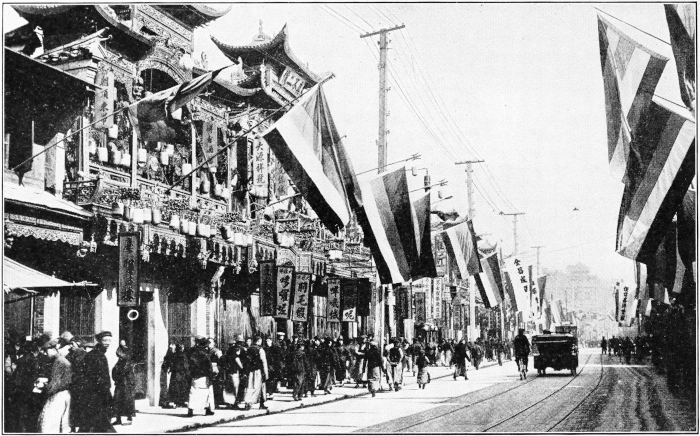
SOME SHOPS ON NANKING ROAD
Living in Shanghai is proverbially high, yet it is chiefly so in comparison with other parts of China. The market is good the year around; many competent judges assert it is the best in the world. Chinese mutton and beef sell for eight or nine cents a pound. Pork and veal are a trifle more. Game is plentiful. Eggs [Pg 59]rarely go above ten cents a dozen. They are considerably smaller though than hen’s eggs at home. Fish, as might be expected, is abundant. A small variety of oyster, that makes excellent stew, is sold in bulk, and a large oyster in the shell, measuring often several inches across and weighing over a pound, brings ten or twelve coppers apiece, about six cents. Nearly every variety of fruit and vegetable known to the Western market, and many kinds peculiar to the Orient, are found here. Bamboo sprouts and water chestnuts are favorites with most foreigners as well as the Chinese. Grapefruit is imported from San Francisco, but is generally not so well liked as the native pumelo, which it resembles. Mangoes are shipped from the Philippines, and from Japan, Australia, and America come apples, much superior to those grown in China. On the other hand Chinese oranges, and particularly the loose-skinned, Mandarin oranges, are delicious. The fruit most common in the autumn is the golden-red persimmon. Cheap and luscious, without a suggestion of pucker except when under-ripe, the tempting piles, that seem to have caught and held the sunshine, are without a rival during their season. All canned and bottled goods—vegetables, fruits, pickles, olives, syrups, extracts—being imported, are expensive, but as they are more or less in the line of luxuries most of them may be dispensed with if necessary.
There is a canning factory in Shanghai, opened in 1907 by a Cantonese company. One would expect it to be Cantonese, for the southerners are the most wide-awake people in China. Besides making a variety of[Pg 60] crackers, the factory turns out quantities of tinned foods. Among them are bamboo sprouts, shrimps’ eggs, spiced roast pork, chicken with chestnuts, frogs’ legs, native and foreign fruits, soups, and what appeals particularly to the palate of foreigners, the delicious candied ginger, for which Canton has a world-wide reputation.
Drugs are costly, and constantly needed articles, such as picture wire, and hooks, are for some reason absurdly highpriced.
“Sam Joe” on Broadway claims to be the leading Chinese grocer in the city. He is certainly one of the best known. Like other grocers he keeps no fresh vegetables and no fresh fruits except apples and lemons. His place is clean and inviting, and presided over by numerous clerks of low and high degree. Any one of these middle-aged men, of dignified mien and scholarly cast of countenance, will kindly deign to take an order, discuss the merit of goods, and even point them out if within sight. But when a piece of cheese is to be wrapped up, or a bottle taken down from the shelf, he waves his long-finger-nailed hand in a lordly manner to an underling, who hastens to perform the menial service. Sam Joe used to own an automobile, with “Sam Joe, Shanghai’s leading grocer,” prominent in large gilt letters on its back. It was a familiar object for some time on the streets, but its upkeep proved too great an expense, so the firm has reverted to the ordinary delivery wagon and horse. Still, a horse-drawn wagon is extraordinary enough in this city of man labor, and Sam Joe’s outfit is in advance of most Chinese grocers,[Pg 61] who content themselves with box carts propelled by tricycles.
On a bright morning nothing is more delightful than a leisurely stroll up and down Nanking Road for a study of the shops. Some are shut in behind a door and show windows, like foreign stores, and others after the manner of the general run of Chinese shops have the entire front open to the street. Occasionally, in addition to the regular street crossings, a slit between the buildings leads to a narrow lane or alley, without sidewalks, long, narrow, and fearsome, yet possessing a compelling fascination for the wanderer. The Nanking Road shops are almost uniformly two stories high, with frequently a tall, fancy cornice giving the effect of a third. The most striking are the large silver shops. The façades of several stand out boldly, ornamented with coloured stucco in relief. One is resplendent with a gorgeous peacock of heroic size and spreading tail. Another shows two mythical figures disporting themselves on either side of a huge vase of flowers of wondrous hues, while a third, more recently built of plain brick, is dotted over with electric bulbs. On gala occasions, these shops, as well as others able to afford it, are lighted up at night with elaborate electrical designs, making Nanking Road the most brilliantly illuminated street in the city. In addition, it is customary at the time of an opening or anniversary to decorate the entire façade with gay-coloured cotton cloth or silk that is twisted, puffed, puckered, and curled into rosettes and other fantastic designs. Often a light bamboo scaffolding is erected in front of the shop[Pg 62] and the trimmings attached to it instead of to the walls. When the sun fades the decorations they are taken down, re-dyed, and put in place again. Close against the show windows of the unforeignized silver shops are glass shelves ranged one above another and loaded with silver. Many of the pieces are massive and richly embossed, Buddhas, vases, jewelry cases, tea-sets, besides less ornate small pieces such as wine cups and bonbon dishes, all of native design and manufacture. Inside the shop the foreigner meets with a surprise, for there are no show cases, and no sign of silver is visible except away at the back where a glimmer can be discerned behind a glass door protected by a wooden or wire lattice. Panel mirrors and carved blackwood chairs at the sides give a drawing-room effect which is enhanced by the leisurely manner in which the numerous clerks move about or lean idly upon the counter, as if their main purpose in life was to pose as useless adjuncts of the firm employing them. Yet in reality a paying business is carried on from day to day, though it may be conducted quietly and unostentatiously over tea-cups and with true Oriental deliberation.
The favorite meat in China is pork, popularly known as the “Great Meat.” From the number of shops where cured hams are sold, often nothing at all but ham lining the walls and suspended from the ceiling, it would seem as if the people’s whole diet consisted of pork. The pork shops on Nanking Road are very clean. Sometimes one side of a shop is devoted to hams and the other to ducks and sweetmeats. Roast ducks are sold everywhere in Shanghai. The turned-back neck of[Pg 63] the duck forms a loop by which the fowl is attached to a hook fastened to a bamboo rod several feet long, and this is hung in the front of the shop in full gaze of the passerby, where no intervening window dims the allurements of the savory delicacy. It surely does look good enough to eat, glossy, of a rich reddish brown colour, and done to a turn in the oven of a Chinese chef. Back a few steps from the street, in a dimly lighted room, the curious stranger, if tactfully polite, may witness the preparation of the fowl for the market. On one side of the contracted space are live ducks, in a pen, while near by the cook’s assistant is busily plucking dead ones. They are roasted on top of a Chinese stove under a huge iron basin, and then comes the painting, the grand finale in the process. A small quantity of red vegetable matter is added to sesame oil, and with this mixture the cook carefully smears the fowl, using a reed brush. The coating soon hardens like varnish when the duck is exposed to the air, and besides giving it an appetising appearance, keeps the flesh impervious to the dust from the road.
Nothing captivates more than the bake shops where cooking is done close to the street. Chinese stoves are simplicity itself, a bed of charcoal on a foundation of brick or cement, and an iron grating through which the ashes fall to the floor. Large but shallow iron basins are placed over the red hot coals, and in them are fried or boiled all sorts of remarkable viands. It is a common saying that the best cooks in the world are the French and the Chinese, and it is easy to believe it. The way in which many a common fellow will roll[Pg 64] and knead his dough, fashion it into some extraordinary shape with a dexterous flip and twist, then fry it to exactly the right shade of brown, and all without an instant’s thought or effort, proves him to be in his own line an artist of no mean order.
Customers young and old frequent the shop, sometimes carrying bowls of their own which they get filled with nutritious food for a few coppers and take home to furnish, it may be, a meal for an entire family. Perhaps a woman drops into the shop with a nest of wooden trays. She says something to the shopkeeper, who begins laying into them wonderful little cakes, sticking into each one a wee cluster of artificial flowers. This choice collection of dainties is to form part of a wedding feast. The year round, at certain hours of the day, but especially in the early morning, women and children, provided with kettles, wend their way to the restaurants to buy hot water for tea. Hot water is cheaper than fuel, and besides to buy it saves trouble.
Chinese candy shops never want for trade. Those on Nanking Road are much patronized by foreigners, for some kinds of Chinese candy fairly melt in the mouth. The only drawback to a full enjoyment of it is the realization that too often instead of being protected under glass it has lain for hours on an open counter exposed to dust, flies, and dirty hands.
Fine teas from Hangchow, put up in pretty coloured paper boxes, are seen in the windows of tea shops, and beside them other fancy boxes containing small dried flowers. One or more dried rosebuds placed in a cup of tea impart a delicate flavor to the beverage and are[Pg 65] said by the Chinese to aid digestion. They, however, are a luxury indulged in only by the well-to-do epicure, but this class is numerous.
Silk shops are pre-eminently the most popular shops in Shanghai as silk is the commodity for which it is most celebrated. Many silk shops are found on the “Great Horse Road,” the largest and showiest being in a three-story building well down toward the Bund. But the two of special repute and reliability do a thriving business a block south of the busy thoroughfare. No goods are displayed in their windows as is the case with those on Nanking Road. The more conspicuous one has behind each sheet of plate glass a single potted plant on a stand. The other, across the road, disdains to indulge in even that much decoration. Its windows are the small, old-fashioned kind that fold in like blinds with little panes of glass, and up and down over each one stretch protecting iron bars. The reputation of the aristocratic house of “Laou Kai Fook” is too well established to need the help of advertisements. While neighbouring firms may boast of a business career of a few decades, this one points back proudly three quarters of a century to the date of its founding. Though nothing on the exterior of the shop attracts the eye, there is an abundance within to draw on the purse-strings. Laou Kai Fook’s clerks are gravely dignified but wide-awake. It was not one of them but an employee in a lesser shop who, when a would-be purchaser indicated a piece of silk in a showcase that she wished to see, after making a feeble and abortive effort to unlock the case, turned his long finger-nails out, remarking unconcernedly,[Pg 66] “It won’t open,” and let the customer walk away. The shelves lining the walls of the silk shops from top to bottom are heaped with rolls of silk wrapped in light brown paper, the rolls lying crosswise on the shelves. From each roll depends a white paper tag marked with Chinese characters, and these tags, seen on every side, produce a curious effect but give to the uninitiated no clue to the wealth they represent. Some of the finest silks, with the paper coverings removed, are kept in showcases to decoy the unwary.
The clerks in these stores, as in fact in most of the shops, are to all appearances greatly in excess of the number required. While some are kept busy, many seem to be paid merely to lounge about and tread on each other’s toes. They are keenly sensitive to the superiority of their high calling and will brook no slights apparent or unintentional. An American lady, new to China, was being waited on one day by a very youthful clerk and in the course of conversation innocently addressed him as “boy,” the usual form of address among the servant class. Instantly the young man drew himself up proudly and corrected her with grave displeasure, “I am not a ‘boy,’ I am Mr. Smith.” Two characteristics of the Shanghai silk shops of the better class are especially appreciated by foreign women. First, prices are fixed and uniform; no time need be wasted in bargaining. Second, if a sample needs to be matched the danger of failure is small. When roll after roll has been laid on the counter and the sample placed against them without success the clerk will be certain to observe politely,[Pg 67] “We can dye a piece for you.” “How long will it take?” “Only three days if the sun shines. How many yards do you want?” “Four.” “We don’t usually dye less than ten yards, but we will dye four for you if you wish to have us.” In most cases the silk proves to be entirely satisfactory and no extra charge is made for the dyeing.
Changes are going on continually all over the city. Day by day old buildings, rotten and unsanitary, are disappearing and modern ones rising in their place. It is to be feared that many of the ancient landmarks dear to the antiquarian will soon be gone. Last year an Englishman said to a friend, “I can take you to a street in Shanghai that I believe looks just as it did a thousand years ago.” But in a few weeks he wrote to his friend, “The street is gone. Every old building has been torn down and the rubbish cleared away.” On Nanking Road a handsome block has just been erected by the Chinese on a conspicuous site, bearing the ambitious title of “The New World,” written in gilt Chinese characters on its front. Soon a wealthy Cantonese company is to build a great department store on Nanking Road that in size and elegance promises to outrival all others. It will contain a theatre, restaurant, and tea-room, elevator and roof garden, accessories to which even the most select of the foreign department stores have not aspired.
But Nanking Road does not possess a monopoly in interesting shops. Many of the most fascinating are the very small unpretentious ones on the side streets, for it is there that Chinese life and customs may be studied[Pg 68] most intimately. The common people regard with good nature and tolerance the inquisitive stranger and rarely object to his advances. Pawn shops tell their own story and are discovered at almost every turn. They are known by a particular Chinese character painted in black on the white cement of the front wall or on the wooden screen just inside the entrance.

Tang, a Pawn Shop.
Shanghai would not be Shanghai without its Money Exchange shops. Though perfectly respectable, they do business mostly on the unfashionable side streets. Nanking Road in the main scorns them. They do not lack patronage, for “small money” is necessary to every thrifty body. The Exchange Shops give silver for gold and paper money, and for one of the current silver Mexican dollars, the customer receives one hundred and thirty-eight or so coppers, or eleven dimes and several coppers according to whatever the exchange happens to be on the day in question. Shop bills amounting to less than a dollar can ordinarily be paid in “small money,” and as for car fare, a dollar’s worth of coppers goes much farther than the even hundred contained in a “big dollar.” The Exchange shops[Pg 69] make their money by drawing money from the Exchange Banks at a little higher rate of exchange than they allow to their customers. It must be confessed though that the mysteries of Chinese currency are well nigh beyond the power of the ordinary human mind to fathom.
Coffin shops are of necessity very numerous, and have open fronts directly on the street. The shopkeeper performs none of the duties of an undertaker. His sole business is to make and sell coffins. Chinese coffins are extremely large and heavy, and in a foreigner’s eyes ugly even to the point of gruesomeness. The costly ones are made of blackwood and camphor wood and their glossy tops and ends decorated with pictures done in coloured paint and gilt. The shopkeeper’s home is usually at the back of the premises, but the family find it agreeable to pass much of the day in the shop where the unfinished coffins that chance to be left standing about prove convenient in many ways. The wife may perch on one while she eats her bowl of rice, or the master himself drop down on another for his noonday nap, while the children frolic in and out around them like squirrels. But to a Chinese there is nothing objectionable in a coffin. As with the old Shanghai mother, whose son returning from a journey presented her with a coffin as the handsomest and most welcome gift he could offer, so it is generally felt that to have one’s coffin bought and set up in the house ready for use is a most desirable provision. In the meantime it is a convenient article of furniture to have at hand, and no harm is done if while waiting for[Pg 70] the hour of decease the coffin is utilized as a clothes press or perhaps as a pantry.
As one passes along the streets, in addition to the sounds most commonly heard, is often added the shrill falsetto of the cheap phonograph. The records usually are Chinese melodies in which the street crowds delight. Any shop wishing to draw attention to itself has only to set up an instrument and start it playing. Phonographs are commonly found in the better class barber shops, where they dispense music to the accompaniment of the strokes of the razor. The character of Chinese barber shops has changed considerably since the revolution of 1911. Before then customers sat on stools and the principal work of the tonsorial artist was shaving the forefront of heads and combing and braiding queues. Now foreign barbers’ chairs have taken the place of stools and the barber gives careful attention to clipping hair in the most approved fashion. There recently appeared outside a hairdresser’s shop the following unique announcement, “Hair done in foreign, Chinese, and civilised style.” Just what the “civilised” style of hairdressing might be in contradistinction to other modes, the interested public has not yet learned. But shopkeepers who aspire to the distinction of English signs above their doorways, frequently meet with serious difficulties in their struggles with a strange tongue. The results are often strikingly original,—for example, “Horeshueing Manufactured Any Kinds of Foreign and China Horeshueing. Price $2.00 each hoersh.” “The towels are weaving up to the different colors to sell.” “House panier and decorator[Pg 71] for European and China.” “Mating Shop and House Furnishing.” “Gentleman and Ladys snots and bots.”
The beautiful curio shops on Nanking Road entrance the eye and delight the heart, yet who would compare them for a moment in charm with the quaint old shops on Pig Alley? Pig Alley used to border on the moat around the Chinese city and was in truth an alley. Now the moat has been filled up and its site covered by a broad macadamized road, but the shops that gave it its reputation have not changed in character. The dust of years still clings to them, wrinkled crones continue to sip their tea in the corners, and old men, with skin as yellow as their brasses, smoke contentedly in the sunshine outside. Stacked on the shelves reaching to the ceiling are articles in bronze, brass, and china, some as valueless as old iron, but among the collection, choice bits, rare and ancient, worth almost their weight in gold. It takes time and patience to shop in Pig Alley, for prices must be haggled over, and perhaps several visits made before the coveted treasure is finally secured.
In the shops of the Foreign Settlement it is estimated that more than twenty thousand boys are employed as apprentices. Their work-day is as long as the shop keeps open, which in many cases is from sixteen to nineteen hours out of the twenty-four. Pay is small or nothing at all, but the boys are given rice and lodging where they work. The large majority have no chance for play or study. They are bound out by their parents or guardians under much the same system as[Pg 72] formerly prevailed in England. If badly treated, and little fellows unable to resist are often most cruelly beaten, the apprentice has no redress, and must bear it, run away, or take his own life, which he sometimes does, though usually he stays on, for the spirit of the Chinese is to endure hardship patiently. Not long ago the local Young Men’s Christian Association, through its Boys’ Department, made a valuable survey of the condition of Chinese boys in the Settlement. What added to the interest was the fact that the survey was conducted by boys, which, so far as is known, was the first time this has been done in any country. Volunteers were called for from among the Y.M.C.A. High School students, all Chinese of course, and twelve at once responded, promising to spend their vacation period in doing this work. Others were gradually added to the list, till finally over sixty were at work assisted by a Chinese teacher and several Chinese and foreign secretaries. No reward was held out to them, and their task was not an easy one. They were ridiculed and buffeted, but they kept bravely on, meeting every day at five o’clock to report progress and gather fresh courage over a social cup of tea. The facts and figures collated with so much labour will not be wasted. Definite plans are being laid for the betterment of the boy community, and they have already begun to materialize since the opening of the splendid new Y.M.C.A. building for boys’ work.
[Pg 73]
HOUSEKEEPING PROBLEMS
“WELL, my Dear,” said Mr. Dunlap briskly, one bright spring morning, laying down on the breakfast table “The North China Daily News” which he had been intently perusing, “I have here a list of houses advertised for rent. Suppose we start out and look at some of them.” “Just the thing,” assented Mrs. Dunlap eagerly. “You call the ricshas and I’ll be ready in a minute.” “No, we will go in a carriage. It will take us around more quickly and cost no more for the time we are out. Just think,” he added, “of our being able to hire for a whole day a nice victoria and pony, with driver and footman, for less than a dollar and a half! Life in Shanghai certainly has its advantages.” “Don’t let the driver forget his French license,” called Mrs. Dunlap to her husband as he was hurrying away to make arrangements for the carriage. “That’s so. We may want to go into the French Concession.” “Yes, and we’d rather not be held up as the Blanks were.” Then both laughed merrily at the memory of the experience of their friends who went for a joy ride in celebration of their wedding anniversary, but they had hardly left the International Settlement before a policeman stopped[Pg 74] the “mafoo,” and because he had no French license made him drive with the pair to a police station to get one and pay the fine of a dollar, rather an inglorious episode. The Dunlaps were gone all day and returned to their stopping place at night well-nigh exhausted. But the next morning they were out early again, this time to hunt up the office of a real estate company and tell the agent they had decided to take one of his houses. “Good, I will put your name right down on the list of applicants. There are only eleven ahead of you.” “Eleven ahead of us!” exclaimed Mrs. Dunlap in astonishment and dismay. “Why, we supposed the houses that were advertised in the paper had not been rented.” “And so they haven’t,” responded the agent cheerfully. “These are only possible tenants. You stand a good chance of getting the place. Last week I rented a house to the fifteenth party in a list of applicants. All the others, for one reason and another, had dropped their names.”
The couple finally secured a house to their liking, quite new and somewhat out from the centre of the city. The rent being agreed on, the agent added, “You will pay six per cent taxes.” “How is that?” queried Mr. Dunlap. “I am not buying the property.” “No, but here in Shanghai the tenant pays the tax on the house, the landlord on the land. You are getting off cheap. If your house were within the limits of the ‘Settlement’ you’d have to pay twelve per cent in taxes.” “Oh, then we are not in the Settlement? Somebody told me the road in front of the house was a Municipal Council road.” “That’s right. It is. A[Pg 75] year or so ago the Council, after hard effort, obtained permission to lay that road through Chinese territory. It is a good road, too, isn’t it? A first class macadamized thoroughfare.” “That is most interesting,” agreed the Dunlaps. “But you say the land on which the house itself stands belongs to the Chinese?” “Yes, they refused to sell it, so the best the company could do was to rent it in perpetuity.” Mr. Dunlap turned to his wife with a smile, “Well, if we get into trouble, we can go out and sit in the road.” “Ha, ha, not a bad idea,” chuckled the agent. “But you will be well protected. The Settlement police patrol the road and Chinese police the territory around it. The Chinese have no desire to see foreigners’ houses looted, for this gets them into trouble.”
As soon as the Dunlaps began moving into their new domicile, they found themselves greatly inconvenienced by the lack of closets, shelves, hooks, and drawers. The house in fact was a mere shell, with roof and walls and little else. However, there was running water, hot and cold, and this is a luxury rarely found outside of Shanghai. Indeed in the older parts of the Settlement hot water for baths is still bought at nearby shops and brought to the home in big wooden buckets suspended from carrying poles on the backs of coolies. Though the wires were laid for electric lights, there were no fixtures. This was an oversight on the part of the contractor that must be rectified at once, so Mr. Dunlap sought another interview with the agent. “We shall be glad to have the fixtures put in as soon as possible,” he urged, “as we are depending for light on two[Pg 76] or three small kerosene lamps.” “But we don’t furnish such things.” “What?” “I mean they don’t go with the house.” “So I must buy them?” “Assuredly.” “Well, well, whoever heard of such a thing? But how about the stationary wash-basin for the bathroom, and the draining board for the kitchen, and the—,” “If you have them you get them yourself.” “You see it is like this,” continued the agent goodnaturedly, “Shanghai is very cosmopolitan, and all sorts of people settle here. Some tenants, when vacating a house, have been known to steal the locks off the doors, the chandeliers from the ceiling, and occasionally a stationary bathtub is cut loose and carried away in the dead of the night. Oh no, you wouldn’t do it,” smiling at Mr. Dunlap’s incredulous stare, “but such things happen oftener than you would think.” It was plain then to the Dunlaps that they must begin to furnish their house from the bottom up, or perhaps, to speak more accurately, from the top down. Therefore, their first business was to buy lumber, hire carpenters, and set them to work making pantry shelves, and supplying a few other immediate necessities. Soon the little back court resounded with the noise of hammer and saw.
It was somewhat exasperating to the head of the house, who longed to expedite matters, to have the workmen stroll in about nine o’clock in the morning, or possibly not come at all, leave promptly at five, and spend anywhere from one to two hours and more in the enjoyment of the noon siesta. But scolding was of little avail. Shanghai workmen, particularly since the revolution of 1911 have assumed an easy, independent air[Pg 77] all their own and must be borne with as patiently as may be.
The next matter to which the family gave their attention was the buying of furniture. Friends advised them to get it at auction. As the population of Shanghai is a constantly shifting one, auction sales are a common incident of the city’s life. Homes are being broken up every day and parties moving out, perhaps after only a few months’ residence. The easiest, and really the most profitable method of disposing of household effects, which often are practically new, is by auction. Auction sales are very popular with all classes of society and usually draw an eager crowd, but the Dunlaps picked up only a few things in this way, for they found too much time was consumed in the process. Then they were referred to Peking Road. Now Peking Road at its eastern end, where it approaches the Bund, is a very high-toned, aristocratic street, but away toward the west its character changes, and instead of substantial brick office and apartment buildings, the road is lined on both sides with Chinese junk shops. Yet according to the dictionary definition of “junk,” that is not exactly the right word to apply to them either, for far more than mere junk is exposed to the gaze of the curious beholder in the wide open shop fronts, in the dark places at the rear, and in the dusty, musty, low-ceilinged rooms above approached by a ladder-like stairway. “Old Curiosity Shop” might appropriately be written over each one. Most of the goods have been bought up at auction and bear the marks of age in a greater or[Pg 78] less degree, though some are new, but it is not the commonplace new things that attract the eye of the average foreigner, who is apt to exclaim at first glance, “What a lot of old trash!” Worming his way in gingerly fashion among the piled up closely-stacked stuff, the reward comes once and again in the discovery of a rare piece of old mahogany or teakwood, or a quaint hit of China or glass, which may be bought at a ridiculously low price. Of course, if the “find” is an article of furniture, some risk is run in carrying it home, and the very fastidious may eschew it altogether, but a good airing and repeated cleansing with disinfectants and soap and hot water, and if necessary, scraping and repolishing, generally render it perfectly harmless.
However, a foreign house can not be furnished throughout from the shops on Peking Road, so after investing in a few small articles like coal buckets and shovels and tongs, Mr. and Mrs. Dunlap finally and firmly resolved to waste no more valuable time hunting for bargains, but to have all their furniture made to order. This sounds very luxurious and a bit extravagant. On the contrary it was the most economical thing that they could do, for they did not order from one of the high-priced English department stores on Nanking Road, but from a Chinese shop on a side street with an entrance and show windows that might have been passed many times without attracting the least notice. The place however had been highly recommended and the work in the end proved quite satisfactory. Mark the words “in the end,” for they are spoken advisedly, since the grand consummation did not occur till more[Pg 79] than a year from the time the first order was given. Inside, the shop was found to be much more of an establishment than appeared from the street. It carried a considerable stock of ready-made furniture, but it was from the pictures in the firm’s imported books that the Dunlaps chose their models, then selected their wood, and finally, after considerable haranguing, came to an agreement on prices. Subsequently calls without number were made at the shop by Mr. and Mrs. Dunlap in a vain endeavour to hurry up the work. Sometimes they came upon the elderly head of the firm and his clerks eating their forenoon meal at a table near the centre of the showroom, for according to the usual custom, the clerks were boarded on the premises. But the entrance of a customer in no wise embarrassed them and he was always waited on with the politest attention. One by one the pieces ordered were brought to the house on a hand truck or wheelbarrow, some of the lighter articles being suspended from a carrying pole borne by coolies. After remaining a day or two, back they went, with few exceptions! Either the hat-rack was too short, or the clothes-press shelves were too long, or the bureau drawers wouldn’t open, or the locks didn’t fit. Always something was “ch’a pu to,” just a little wrong, a favorite expression in China which is used to excuse a multitude of faults. One much-doctored upholstered chair was carried to and fro so many times it had finally to be partially re-covered. But the dining table fared the worst. Once it fell off the cart in transit and was broken. Because the wood was not well seasoned, it kept splitting across the top and teetering[Pg 80] disconcertingly on uneven legs. Four tables were made in succession before a satisfactory one was produced.
While the patience of the Dunlaps was sorely taxed during this period of waiting, they could not help being deeply impressed with the unfailing good nature and courtesy of the firm, always regretful, ever ready for another trial, though the money loss was their own.
Some of their work, too, was really a pronounced success, as in the case of the sectional bookcases which they patterned after one loaned them by Mr. Dunlap. When the two were set up side by side in the library it was next to impossible to tell them apart.
The absolute confidence of the Chinese in the honour of foreigners was often remarked on in the family. Not for five months after work began and until several hundred dollars’ worth of goods had been delivered was any money asked for or expected. A dishonest person might easily have slipped out of town and left furniture and debt behind him.
One noon, during the period of house-settling, when Mr. Dunlap returned from his office, he was surprised to see a bevy of men at work sodding the lawn, a matter he had not yet had time to consider. He was still more astonished when he learned that this was being done for him by the company of whom he rented his house. There was nothing personal about it. All the company’s property was being treated in the same way. But sod, it seems, could not easily be carried off, while lighting fixtures might!
The Dunlaps did not find it necessary to go to the florist’s in search of plants to beautify the grounds, for[Pg 81] street vendors brought them to their door. From the very morning they moved in these men fairly haunted the place. They carried the plants in round, slightly convex baskets, suspended by ropes from a bamboo pole slung across one shoulder. Every time Mrs. Dunlap appeared in sight there they were, an eager, smiling group of them, holding out their flowers and begging her to buy in their best pidgin English. Mrs. Dunlap always shook her head saying, “By and by. Not now. I am too busy.” But one bright day, when the house-wife was unusually occupied with work indoors, an enterprising fellow actually took it upon himself to border the entire garden, and it was a good large one, with handsome plants of many varieties, and ended by placing on the veranda four mammoth potted palms. The effect was charming. Of course Mrs. Dunlap might have ordered the plants taken out of the ground, but what woman would? Instead she gladly paid a little less than the price asked, which was about six dollars. Afterward a neighbour told her that had she happened to have any second-hand clothing to offer the man, he would willingly have taken it in place of money. “Each year I replenish my garden with flowers in that way,” concluded the friend.
The day the Dunlaps ate their first meal in their new home was a very happy one, but before that time two important matters had been attended to by Mr. Dunlap. These were putting in a first-class filter, and covering the floors of the store-room and pantry with zinc which was allowed to turn up around the walls for a foot and a half in order to guard against the encroachments[Pg 82] of ubiquitous Shanghai rats. The Berkefeld filter is generally used in Shanghai and is supposed to preclude the necessity of boiling the drinking water. But as every one knows, the “candle” must be carefully washed in boiling water once a week, and as Mrs. Dunlap soon found she could not trust a servant to do this, who might or might not have the water really boiling, or handle the candle without breaking, she attended to it herself.
Among her first callers were the “runners” from several Chinese grocery stores. The nearest secured her patronage. Each morning his man came to receive the day’s orders, and before noon the groceries were delivered in a neat box-tricycle. In addition a daily visit to the market was made by the cook, for the grocery stores in Shanghai carry neither meat nor fresh vegetables. “Just think, we no longer have to depend on tinned butter and milk!” exclaimed Mrs. Dunlap delightedly to her husband soon after their removal to the coast city, as her eyes turned with satisfaction to the neat pat of fresh Australian butter on her pretty Welsh butter dish. The dairies, the best being the European, are carefully inspected by the Municipal Health Department and deliver milk in sealed bottles to insure not being tampered with on the way from the dairy to their destination. Notwithstanding this, never a drop of milk or cream was used on the Dunlaps’ table that had not been scalded. Neither was lettuce indulged in, not even that grown in private gardens, nor any other uncooked vegetable. In view of the ravages of Oriental dysentery and kindred diseases,[Pg 83] the family agreed that it was wise to obey the injunctions of foreign doctors and take no risks. Fresh fruit from which the skin could be removed was eaten freely in season, but was dipped in boiling water, or underwent a thorough washing in filtered water before it was set on the table. Strawberries were subjected to a special cleansing process under Mrs. Dunlap’s personal supervision. Placed in a colander, boiling water was poured over them three times, and lastly a solution of permanganate. Later on in her experience Mrs. Dunlap learned of a better and easier way of disinfecting the fruit, and that was to plunge it for an instant into boiling syrup, by which the flavor of the berry was retained and its appearance but little altered. Even after every reasonable precaution had been taken in the matter of food, the Dunlaps were made aware that through the carelessness of servants, and in other ways, they were constantly running serious risks. However, they concluded to do the best they could and then not worry.
Another early caller to put in an appearance was the public laundryman. Shanghai houses are not built with the idea of doing washing at home, except perhaps a few of the small pieces. So it is sent out, and as to just what kind of places, one may possibly be happier not to inquire into too diligently. The public laundries in the International Settlement, it is true, are subject to inspection by the Health Department, but questionable habits are liable to continue notwithstanding. Take, for instance, a Chinese washerman’s manner of sprinkling clothes, which is to fill his mouth with water,[Pg 84] then squirt it out through his closed teeth. It is bad enough when the spray falls on hosiery and underwear, but handkerchiefs, napkins—well, Mrs. Dunlap soon found that it was not well under such circumstances to give reins to her imagination. She certainly had no fault to find with the pricelist, paying barely one cent and a half apiece for everything, from a face cloth to the most elaborate white dress. As a rule the clothes were exquisitely laundered, even though the method employed did cause rapid deterioration.
Although the process of setting their house in order was a most tedious one, at last Mr. and Mrs. Dunlap had progressed far enough to be comfortable and feel that they could turn their attention to other and more important matters. At first they were a little disturbed by having to look at the back courts of their neighbours’ houses across the street instead of onto their well-trimmed lawns, for it is usual in Shanghai to build so that all houses may face the south, from which the breeze comes. Then too, Mrs. Dunlap’s soul was somewhat tried by the lines of washing, innumerable as the sands on the sea-shore, hung out to dry on the vacant lots stretching away to the south. But it was at least a more agreeable sight than the coffins lying scattered about on the ground just beyond her east windows, left there, perhaps by perfect strangers to the Chinese landowner, to await a convenient time of burial. A little farther away, Mr. Dunlap passed every morning, in going to his office, a lot which evidently was a favorite spot for depositing the dead. Fresh coffins appeared each morning, most of them tiny ones. Often the baby[Pg 85] was not given a coffin at all, but tied in a grass mat which was thrown carelessly on the ground. The bodies are supposed to be gathered up and carted away daily. One seems gradually to get hardened in China to things grown too familiar. The Dunlaps used often to marvel that their surroundings, depressing though they were, did not affect them more.
Mrs. Dunlap’s daily routine began each morning after breakfast by “taking accounts” with the cook. The cook in China does the marketing, and he also gets his commission or “squeeze” as it is popularly called. That is, he buys a pound and half of meat and brings in a bill for two, or he charges his mistress a few coppers more a pound than he has paid. This squeezing business is perfectly understood by both parties, and providing it does not exceed certain bounds, nothing is said about it. Market prices are quoted each morning in one of the Shanghai dailies, and by consulting this and making an occasional visit herself to market, Mrs. Dunlap kept informed as to about what she ought to pay. Whenever the cook began to take undue advantage of her, she did not accuse him of it directly, but a conversation something like the following would ensue: “Ta Shih-fu (Great Assistant), you are paying too much for meat.” “Yes, so I told the butcher, but he won’t take less.” “Then go somewhere else.” Or, “One hundred and four eggs are too many to use in two days for our small family.” “It certainly is a great many but I had to put eighteen into a cake.” “You must use fewer.” “I will try.” Now Mrs. Dunlap knew, and the cook knew that she knew, that he[Pg 86] had paid a moderate price for the meat and was charging her for eggs which he never bought or had disposed of himself. But through this indirect method of dealing with him, by no means original with her, she gained her end and saved the face of the Great Assistant. Had he suffered “loss of face” probably nothing would have been said by him at the time, but later he might have appeared before his mistress to announce sorrowfully that his uncle or great-aunt had just died and he must leave at once. Perhaps next day he would be found comfortably installed in a neighbouring kitchen. Occasionally a young housekeeper, new to China, undertakes to do her own marketing and even to dispense with a cook altogether. But after a few days, or at the most a few weeks, she usually gives up the trial she made so hopefully, realizing that as conditions are in China it is next to impossible for a foreign woman to do her own housework.
Following the taking of accounts came giving out “stores” for the day. Housekeepers differ. Some keep nothing under lock and key. Others deal out what is needed in minutest measure, a cupful of rice, a half cup of sugar. Mrs. Dunlap found it expedient to follow a middle course, not putting temptation in the cook’s way by giving him free access to the stores, but at the same time showing that he was trusted by letting him have a fairly liberal quantity at a time. If the supplies disappeared too rapidly she dealt with him after the ordinary indirect fashion. Frequently she and her neighbors helped one another by “comparing notes.” “How long does a fifty pound bag of[Pg 87] flour last you?” “How many pounds of sugar do you average in a week?”
Mrs. Dunlap’s cook was an artist in his way. When the spirit moved him he sent his cakes, pies, and puddings to the table ornamented in a style that would do justice to a Fifth Avenue caterer. One day, however, he gave the family a surprise. A cake was served for dinner that had a most peculiar flavor. “I told the cook to use lemon filling, but there is no taste of lemon about this,” declared Mrs. Dunlap, critically sampling a bit of the cake. “No, and there is a strong taste of onion,” said her husband. “Oh, impossible! But yes, there really is!” The cook was called in. “What did you make the filling of?” questioned Mrs. Dunlap. “Onions,” was the prompt reply. “Onions! Why, I told you to use lemon.” “No, the lady said onions, and I am an obedient cook. I always do just as the lady bids.” Then suddenly it dawned on the crest-fallen mistress that she had ordered onion, the Chinese word for that pungent vegetable and for lemon being somewhat alike. But this was not quite as bad as the experiment of a friend’s cook, who, with no malice whatever, but the best of intentions, flavored the soup with kerosene oil, and on another occasion poured a liberal quantity of hair oil into the pudding. As to cleanliness or rather the lack of that admirable virtue in the moral make-up of many otherwise desirable chefs, without question the least said the better. But when a cook is discovered washing his waistcoat in the dishpan, or polishing the stove with a fine tea-towel, if a summary dismissal ensues, can any one blame the[Pg 88] sorely-tried house-wife? Many a merry half hour the ladies of the neighbourhood spend over their teacups sharing experiences both amusing and tragic. The longer Mrs. Dunlap lived in China the more she realized that while the “servant problem” in the Orient is not solved, as many in Western lands seem to think it is, yet the excellencies of Chinese servants are many and pronounced. These are more noticeably away from the coast cities, and were more general before the recent revolution, and even before 1900, but the sterling good qualities of the better servants are still worthy of the highest praise. Where will more devoted, faithful service be found? Were the children sick at night, or was Mr. Dunlap leaving the city by a midnight boat or an early train, the servants were on duty, eager and willing without a word of complaint.
One time the Dunlaps arrived home from a journey at midnight to find a hot supper awaiting them. It had been ready since seven o’clock when the family was expected, but by some occult process known only to the cook, the food had been kept from burning or drying up during the intervening hours. The men were blinking and heavy-eyed, but absolutely good-natured.
It was a never failing comfort to Mrs. Dunlap to be able to announce the arrival of unexpected guests to the servants without the shadow of a fear of any unpleasantness. Indeed, the larger the number, the happier was the cook, for the more he had to buy the bigger his “squeeze.” Still a great amount of extra work was often involved, which was always taken as a matter[Pg 89] of course. The “boy” delighted to decorate the dining table, and if left to his own devices a favorite diversion was to write on the tablecloth, with colored rice and flower petals, characters meaning love, happiness, long life, and peace.
But it was when the Dunlaps gave their house-warming that the servants’ virtues shone the brightest. To save time, the small cakes, toothsome and delicate, were bought at a foreign bakery. To save money, though there are caterers in Shanghai, the ice-cream was made at home. Freezers were borrowed from neighbors, and late in the afternoon a busy scene was enacted in the little courtyard. The cook had called in coolies from the street, and “boys” from the houses around, and all were soon grinding away as if for dear life. Ice can always be had in Shanghai. The Dunlaps often observed with interest that whenever the neighboring ponds were encrusted with ice, even half an inch thick, the Chinese cut it carefully away and stored it in nearby sheds. This broken ice sells for much less than the foreign artificial ice, which however comes in cakes and is much better. Mrs. Dunlap ventured to ask the cook if the cream would keep till a late hour. With a lordly wave of the hand the Great Assistant replied, “Leave that to me, Lady. Leave that to me.” And she knew she could.
Meanwhile the boy had been given the responsibility in the dining-room. Mrs. Dunlap laid on the table extra silver. “Here are so many forks, so many spoons,” she explained. “Strange men will be in the kitchen this evening. The silver is in your care.” That was[Pg 90] all, and she never gave it another thought. Had a piece been missing, it would shortly have been returned. How, and from where, who knows? The secret service system of Chinese servants is a mystery to foreigners.
That night before going upstairs Mrs. Dunlap was respectfully requested to look at the silver, washed and neatly piled on the sideboard. The tired boy would not sleep until she had inspected it and declared it all right.
[Pg 91]
SOMETHING ABOUT VEHICLES
LET them be named decently and in order. First and foremost is the wheelbarrow. It does not take this rank because of its superior size, elegance, or even usefulness, but on account of its antiquity. To be sure, it can not lay claim to antedating the sedan-chair, but the dignified and exclusive sedan-chair has practically dropped out of Shanghai street life and hence will not be considered. The wheelbarrow on the contrary, instead of being relegated to the interior or less modern towns, creakily holds its own, and is not to be downed. Nor does any one want it to be, useful vehicle that it is, unless perchance some nervous invalids, or weary sleepers, whose morning rest is disturbed by the rising crescendo of the rasping, tormenting, unconquerable nuisance. The creak could be stopped with a few drops of oil—the easiest matter in the world, but the coolie loves that creak—he would not part with it for anything. It means business. It is the evidence of work being accomplished. Without it he would feel lost. Every wheelbarrow, the Chinese say, has its individual creak. People too far off to be recognized are identified in this way. “Friend Wong is coming,” says a man to his neighbor, “I hear his creak.” A Chinese wheelbarrow has this advantage[Pg 92] over its foreign compeers, that instead of a small wheel at the end, it has a large one in the center. To be sure, the wheel rising up divides the wheelbarrow into halves, but makes it much easier to carry the weight. A stout woven rope band fastened to the handle-bars and passing back across the coolie’s shoulders helps greatly to steady the load.
The Shanghai wheelbarrow is mostly used for freight, but because of its cheapness it is a favourite passenger vehicle with a certain class of Chinese, especially the women and children going to and from the mills. Often eight or ten crowd on, sitting sideways with their feet hanging down. Once eleven women and girls were seen on one, pushed along by a single coolie. A coolie ordinarily is able to manage anywhere from six hundred to a thousand pounds. He carries everything, from building-stone to goose feathers. When the cargo is heavy the poor fellow staggers like a drunken man, moving from side to side to balance his load. His veins stand out like whipcords and the perspiration pours off from him in streams. To keep from being blinded by it in summer he frequently has to wear a band forming artificial eyebrows across his forehead to catch and hold the water. All the time, breathless as he is, he usually keeps up his singing cry, partly from force of habit and partly to warn people that he is coming and to clear the road. But street-cars can’t turn out of the way, and some other vehicles won’t, so occasionally the coolie gets caught in a trap, the wheelbarrow loses its balance, and over it goes. With certain kinds of cargo no damage [Pg 93]is done and the only inconvenience is the delay and extra lifting, but if the load is rice bags which burst open, or breakable merchandise, the coolie faces a bad situation. He earns, as a rule, a fair living wage for a poor man, but there is no surplus to cover the cost of accidents.
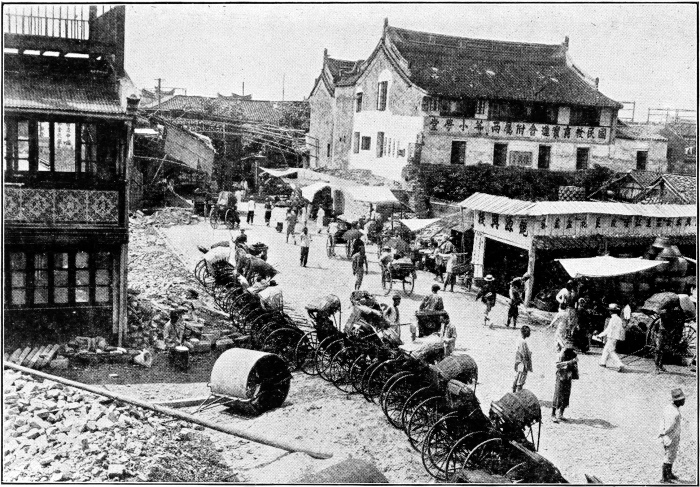
HIGH, BLACK RICKSHAS OUTSIDE THE FOREIGN SETTLEMENT
Wheelbarrow coolies, though, are said to live longer and fare better than most ricsha coolies. This latter class is very shortlived as a rule. Their working years do not ordinarily extend beyond three, five, or at the most ten. One Shanghai ricsha coolie declared he had pulled a ricsha for twenty-four years, but this, if true, was most exceptional. At the present time there are between nine and ten thousand public ricshas in Shanghai, but probably a shifting population during the year of many times that number of coolies. Some one who has studied the subject estimates that the entire coolie population of Shanghai, including all classes, reaches as high as four hundred thousand. The average earnings of a ricsha coolie are seven coppers, about three or four cents, a day, and from this pittance he must support a family, and that too in a city noted over China for high cost of living. No wonder a doctor in charge of a mission hospital where many sick coolies are sent recently reported, “A large number of the cases brought in are in a state of collapse due to malnutrition and the bad hygienic conditions of their life superadded to the strenuous spasmodic strain they undergo.” Heart trouble and China’s inveterate foe, tuberculosis, carry off the majority. Perspiring freely, even in winter, after a hard run,[Pg 94] then waiting, it may be an hour, for another “fare,” in the penetrating wind or chilling rain, with no extra covering for their thinly clad bodies, the coolies are in a condition to succumb readily to disease. Married men live in colonies in the outskirts of the city, in little straw or bamboo huts, for which they pay a rental of from fifteen to twenty cents a month. In cold weather the whole family crawls inside to keep warm, where the air is heavy with tobacco smoke and the fumes from the little charcoal fire over which the rice is cooking. Many a baby contracts eye disease that later leads to blindness. Unmarried ricsha coolies sleep wherever they can find shelter, ordinarily in the cheap tea-houses, often as many as fifty herding together in one small room. The conditions in these places beggar description.
The coolies do not own their ricshas. They are the property of companies, some foreign, others Chinese, each owning anywhere from fifty to seven or eight hundred, while two large companies have in stock a thousand and twelve hundred, respectively. One of these companies manufactures its own ricshas, turning out a hundred a month. Women are employed to make the cushions for the back and seat. Several of the companies provide the men with uniforms. Generally it is only a coat, while the wearer’s ragged trousers show more ragged in contrast. In a single instance the clothes are washed every twenty-four hours in the company’s laundry and returned clean to the coolies. The Municipal Council has decreed that in the International Settlement ricsha coolies must be decently clad,[Pg 95] but the rule is not strictly enforced. On the back of ricshas belonging to Chinese companies is written in Chinese the company’s name, which is generally rather poetic not to say moral in tone, such as “Able to Fly Co.,” “Everlasting Remembrance,” “Steadfast Righteousness.” One company’s ricshas exhibit above the license plate a small metal locomotive, highly suggestive of incomparable speed. A rubber-tired ricsha costs, when new, fifty or sixty dollars, and its rental per day is from thirty-five to forty cents. A coolie hiring a ricsha, after using it a few hours, or half a day, sublets it, and that man in turn often rents it to another, so that in the course of twenty-four hours, it is likely to pass through two, three, or perhaps four hands, consequently the number of ricsha coolies is naturally far in excess of the ricshas. Passengers pay either according to the time the ricsha is used, the regular tariff being twenty cents an hour (but if the poor fellow gets eight or ten cents he does well), or by the trip, say five cents for a run of a mile or a mile and a half. At night the coolie expects a trifle more, as he has to spend a cent to buy the candle that lights his paper lantern or tiny lamp. These are the prices for foreigners. Chinese as a rule give less. Ricshas are of two kinds, the high black ones and the low brown style. All the latter are furnished with rubber tires. Most of the high ones formerly were without them, and as they could be rented more cheaply in consequence, were much used by the poorer Chinese, but of late the Municipal Council has succeeded in banishing all such ricshas from the Settlement. Most of the[Pg 96] worn-out ricshas are apparently bought up for use in the Chinese district, as it abounds in a multitude of rickety, ramshackle vehicles, probably purchased for a mere song. Many of them are pulled by young boys, scarcely more than children.
Ricsha coolies running in the International Settlement must have a license from the Municipal Council. If they are to travel beyond the limits of the Settlement they require in addition a French and a Chinese license. The license, in the form of a tin plate, is slipped into a groove at the back of the ricsha. It is furnished to the coolies by the companies owning the ricshas who pay into the city treasury a dollar a month for each one. The coolie loses his license if he commits a misdemeanor. Often for a very slight one, like blocking the road, generally in his eagerness to secure a passenger, he has his license taken from him by a Sikh policeman. Then the poor fellow is sorely troubled, for he can do no business without his license, and it is sometimes several days, or weeks, before it is restored, on the payment of a fine of forty cents. Once a month the ricshas in the Settlement must have their licenses renewed and be officially inspected.
At the examining station opposite the Honkew Market, between three and four hundred gather every day. An English policeman is in charge. One by one the ricshas are brought before him, while he and a Chinese assistant shake, pull, and pound them to see if they are in good condition. If any part shows signs of weakness it is wrenched off, the license withheld, and the ricsha sent back to the company that owns it for[Pg 97] repairs. The companies are represented on these occasions by Chinese foremen. Occasionally the foreman is a forewoman. A regular habitué is an old wizened creature, with bound feet and half blind, but as the foreign officer aptly describes her, “Keen as a razor when it comes to looking after the fifty ricshas placed in her care.” Accidents to ricshas are not infrequent on the crowded streets of Shanghai. The marvel is that they do not occur oftener. Nearly all coolies run with their heads down and their minds,—well, who can tell where a coolie’s mind may be wandering? It is doubtless dormant most of the time. Nearly all coolies come from the lowest stratum of society, and having nothing else to give in exchange for bread, or rather rice, sell their strength. The literal interpretation of the word “coolie” is “The man who sells his strength.”
The ricsha coolie’s movements are erratic and impulsive. He seldom reasons. There are foreigners who will not risk their life in a ricsha and hair-breadth escapes occur nearly every day. An American lady was riding on one of the narrow, congested streets, when suddenly her coolie attempted to dash across the road between two electric cars approaching from opposite directions. He succeeded in clearing the track himself but the cars closed on the ricsha, crushing it to splinters. The woman with great presence of mind saved herself by grasping the front railing of one of the cars and holding to it until she could be drawn up. Another remarkable escape was that of a mother who, with her young baby, was riding on one of the quiet streets supposed to be perfectly safe. The coolie[Pg 98] saw a man approaching on a bicycle, zigzaged several times in front of him, then utterly losing his nerve and wits, he dropped the shafts and ran away. The sudden stop and downward movement of the ricsha threw the baby out of its mother’s arms. The little thing fell, face down, on the hard macadamized road, and lay so still the mother feared the child was dead, but it proved to be only stunned, and except for some bad bruises, the next day seemed none the worse for its fall.
The ordinary wear and tear of ricshas is made good by the owners, but damages due to accidents are often charged to the coolie, at least in part. The amount for which he is responsible depends on the company. One large firm exacts two and three dollars for a tire. These prices are ruinous for the coolie, who is obliged to borrow the money to pay the fine, and money lenders demand exorbitant rates of interest. The coolie who is unable to pay his debt has no recourse but to run away, commit suicide, or go to the Debtor’s Prison. In the latter case, unless he has more fortunate friends or relatives who come to his rescue he is likely to remain a prisoner indefinitely.
It is interesting to see how quickly a fresh arrival from the West accustoms himself to ricsha riding. At first he is apt to inveigh against man-drawn vehicles, or if he gets into a ricsha, to sit lightly on the seat, with perhaps one foot hanging out at the side, with the idea of helping the coolie along, but presently he abandons himself to the enjoyment of the little, easy-running carriage, or as one enthusiastic woman described it “a grown-up’s perambulator,” and almost[Pg 99] ceases to think of the puller as a human being. But let him stand on the Bund some day in the late afternoon and watch the stream of ricshas hurrying by. There is scarcely a coolie whose face is not drawn as if with pain, and many are actually contorted. Although a ricsha coolie’s life is far from a bed of roses, in his own happy-go-lucky way he does manage to get some pleasure out of it. One of the ricsha companies, with benevolent intentions, undertook to furnish free hot tea to its men at the company’s headquarters, but the plan didn’t work, for the reason that the coolies preferred to buy their own tea at a tea-house. Wretched as is the low-class tea-house, it is the coolies’ favorite gathering place, where, surrounded by their cronies, they can gossip, smoke, and gamble till necessity drives them forth to work again.
The coolies who come to the city in winter from farms and return to them in the spring, may be called gentlemen of means compared with the others. A very few, the number is almost negligible, are able to make ricsha pulling a paying business, as in the case of the man who gave up the position of “boy” at six dollars a month in a private family to become a ricsha coolie, because he said he could make more money.
Many articles are lost in the ricshas. A passenger gets out and hurries away, forgetting his bundle or umbrella, and unless he has thought to look at the number on the ricsha, that is the last he ever sees of it. Not always though. The narrow margin on which the poor coolie exists from day to day makes the exceptionally[Pg 100] honest one stand out in all the brighter light. An elderly gentleman, carrying a very valuable package, left his ricsha with the package in it and went into a store. His business detained him some time and he finally returned home in a street car, entirely forgetting he had a ricsha waiting for him. After a considerable time the coolie, who had not observed the gentleman go away, went into the shop to look for him. A clerk said he had gone. Then was the coolie’s opportunity to run off with his prize. But no, in a moment he had brought in the package and laid it on the counter, asking anxiously how he could get it to the owner. As the gentleman was a regular customer at the shop, the clerk agreed to send it to his residence. That coolie not only received no reward for his honesty, since he slipped back into the crowd and it was impossible to identify him, but he lost time and fare as well. Another case was that of a lady who, in stepping from her ricsha, dropped a five dollar bill, which was discovered by the coolie after she had gone. Not being sure which house the lady had entered the coolie went from one to another until he found the owner of the money, to whom he restored it. It sometimes happens that dishonesty crops up where it is not looked for, and an unprincipled passenger, sad to relate, sometimes a foreigner, after using a ricsha for several hours, eludes his coolie and escapes the payment of fare by going into a shop or house and disappearing out another door.
The ricsha is not indigenous to China. It was introduced from Japan as many as fifty years ago and[Pg 101] promises to be seen on the streets of Shanghai for some time to come in spite of the increasing popularity of more modern conveyances.
There is a Christian mission for the ricsha coolies. It was started four years ago by a Scotch business man on whose heart had been laid the spiritual needs of this neglected class. At two centres in thickly-populated coolie districts week-day and Sunday meetings are held in rented Chinese houses, besides Sunday-schools and day-schools for the children of the ricsha coolies and a weekly religious meeting for women. A native evangelist visits the men in their homes and in the tea-shops they are wont to frequent, a Bible woman goes among the women, hot rice and beds are given to the really destitute in cold weather, and the sick are sent to the hospital. At the special Christmas services held one year each coolie was presented with a cheap towel, to his great delight. But let it not be imagined that the coolie’s satisfaction was due to the fact that he could now remove a few layers of dirt from his hands and face. That consideration, if it entered his mind at all, was wholly secondary. The chief use of the towel was to wipe the sweat from his brow when running, so that he could see more clearly. The coolies’ incredulous amazement that any one should care for them was most touching. At first when they flocked to the Hall they would say to the evangelist, “Is this for us?” and at the close of the meeting, “We never heard anything like it!” There have been a number of very bright conversions among them. The work is supported by voluntary contributions,[Pg 102] the coolies themselves, out of their extreme poverty, giving generously. The ambition of some is to raise enough money to build a church! It is a noble purpose but leagues beyond the possibilities of their meagre resources.
Tramcars began running in the International Settlement in Shanghai in 1907. Six years later they were introduced on Chinese territory. No street in the Chinese city being wide enough for a car to pass through it, the intention is to surround the city with a track in place of the old moat, and it will not be long before the circle is complete. The cars are divided into two unequal sections, the larger one for third-class passengers and the smaller for first-class. Some foreigners travel third-class and many Chinese first-class. On one line in the Settlement, owing to the rude treatment accorded them in the third-class compartment by Chinese men, Chinese women are allowed to travel first-class for a third-class fare. Two notices stand out conspicuously in third-class cars. One prohibits spitting and is put up by the Municipal Health Department to guard against tuberculosis. The other warns passengers not to enter or leave while the cars are in motion. The warning is emphasized by a coloured picture of a man who has fallen in jumping off a car and is lying on the ground with the blood flowing from his wounds. Still, every year some Chinese are killed and many more injured in attempting, in their ignorance of physical laws, to imitate what they see foreigners do. Yet accidents do not deter them from using the cars, and during the busy hours of the day they[Pg 103] fairly swarm into them. Nearly all the cars carry a trailer, and except for a few seats in front reserved for first-class passengers, that too is crowded with Chinese. Fares are rated according to the distance traveled. Both motorman and conductor are Chinese, and the latter understands just enough English to collect fares. But if a stranger in the city asks in English for general information he will rarely succeed in making himself understood. Railless cars, brought over from England, were introduced on one road in the autumn of 1914, but proved too heavy for the paving and were prohibited after a week or two. The following spring, the road foundation having been strengthened, a second trial of the cars was made, and this time with pronounced success. They soon became very popular. Underground and elevated cars have not yet made their appearance in Shanghai, but the son of one of its most prominent Chinese citizens has been spending some time in Paris learning to fly, so on his return in the near future almost anything may be expected to develop in this progressive corner of the Orient.
Shanghai being one of the greatest shipping ports in the Far East, quantities of merchandise are handled daily. Besides wheelbarrows, and coolies who carry loads suspended by ropes from poles resting on their shoulders, men-drawn carts are constantly in requisition. Coolies take the place of horses and mules as beasts of burden. It is true that the foreign hotels and many foreign firms have their wagons and vans, nowadays they are oftener motor cars, but these vehicles[Pg 104] of Western manufacture are far outnumbered by native hand-pulled carts. The carts are of the simplest design, several oblong planks nailed together and set on two wheels. Most of the loads have to be tied on with ropes, and no account is taken of weight. The coolies’ muscle is not spared. Three, four, or more coolies are stationed in front of the cart to pull, with often several at the back to push. Stout ropes fifteen or twenty feet long are fastened by one end to the cart and knotted at the other. Each coolie takes a rope, passes it over his shoulder, changing occasionally for relief from one to the other, and grasps the knot with both hands. If the load is extremely heavy, such as iron rods or building stone, the pullers even on level ground are obliged to stop frequently to rest and recover breath. But it is when crossing the arched bridges over Soochow Creek that the tug of war comes. The forward coolies bend almost double, while those at the rear push with might and main till their faces are congested and it seems as if they must burst every blood-vessel in their bodies. But perhaps the cart does not yield an inch. After a moment’s rest another effort is made. This time the coolies at the back grasp the wheels and at last succeed in turning them ever so little, while slowly, very, very slowly the cart is drawn up the incline. When the highest point of the bridge is reached, unless the road in front is clear, there is another pause. Then the coolies who have been pushing, pull back, assisted by some of the others, while the forward coolies rush ahead in the liveliest manner to keep from being hit by the cart. It impresses foreigners[Pg 105] as a cruel way of getting work done and draws painfully on their sympathies, but if a sudden change were made to horse power, the carters would doubtless be the first ones to raise a hue and cry against it.
[Pg 106]
A PEEP INTO THE SCHOOLROOM
“HOW many schools for the Chinese, not counting missionary schools, are there in Shanghai?” The question was asked of a Y.M.C.A. secretary, who with others had just completed a canvass of the city with reference to its educational facilities. “It is not possible to tell exactly,” he replied, puckering his brow. “As nearly as we could find out, there are at least five hundred, probably more. Of course that list does not include the schools for girls. Miss Blank can tell you about them.” The Chairman of the Committee on the Investigation of Girls’ Schools was interviewed. She brought out her maps, charts, and reports, and spread them on the table. “It was such a difficult search,” she explained. “We discovered between thirty and forty boarding schools alone, but it is almost certain that does not include all. Some of them were hidden away in the queerest places.” “What a difference in the number of schools for girls compared with those for boys!” exclaimed her visitor. “Oh, well, you must remember we made no effort to tabulate the little day-schools. They seemed to be legion and met us at every turn.” The large majority of the schools enumerated were established after 1900, and very many sprang[Pg 107] up at the time of the revolution in 1911, or quickly following it.
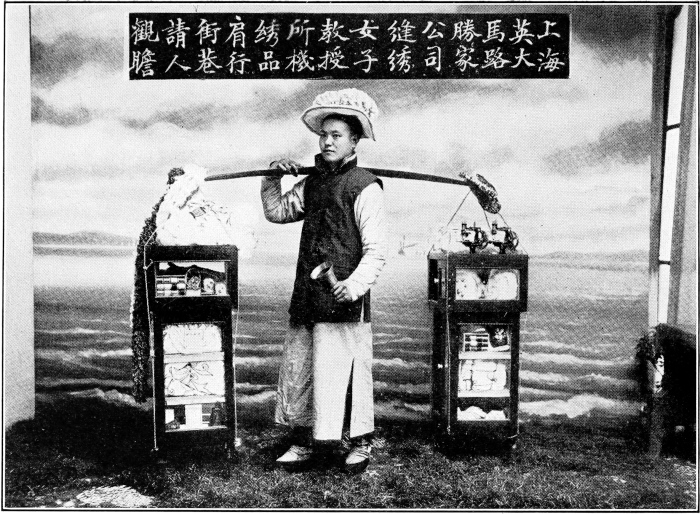
ADVERTISING SINGER SEWING MACHINE PRODUCTS
From these statistics it might appear that the education of the children of Shanghai was fairly well provided for, but with no compulsory system, thousands that are employed in mills and factories, bound out as apprentices, thrust forth to beg or allowed to loaf, never cross the threshold of a schoolroom.
The Municipality of the International Settlement supports four large public schools for Chinese boys (there are none for girls), the ground in each instance having been donated by philanthropic Chinese, and the native residents in the Settlement, who form the bulk of the population, paying their share of the taxes on the buildings.
One of the handsomest buildings in the French Concession is a public school for Chinese boys.
Private schools, or as they are termed “Gentry Schools,” are very popular with the Chinese. In Shanghai this class far outnumbers all others, and it is moreover an interesting fact that of the schools under government control very many were started by an individual or group of individuals as private enterprises. China is a nation that reverences learning above all else. Not a scrap of paper that has written or printed on it even a single “character” is willingly allowed to be blown about carelessly or trampled under foot. These precious bits, soiled and torn though they may be, are laboriously picked up by men or boys armed with tongs or pin-pointed sticks, who travel to and fro through the streets in search of them. The well-to-do hire[Pg 108] proxies to perform this meritorious work. The paper is carried to the public ovens, where it is burned, and the ashes afterward thrown out in the river. The belief is millenniums old that heaven vouchsafes special blessings to those who show due regard for the sacred symbols of knowledge. It follows then quite naturally that to open and maintain a school ranks with the Chinese among the highest forms of service one can render to mankind.
Since Western education has been introduced, many of China’s best young men have dedicated their lives and fortunes to popularizing it. Among the numerous examples that could be cited in Shanghai alone, the Akademio Utopia is one. Four years ago a group of ten zealous young men started a school in a small rented building. They had little capital, but each one agreed to devote twenty per cent of his income to meeting the running expenses. Several who had studied abroad gave also of their time and taught one or more classes. The principal was a graduate of Cornell University and the first Chinese student from that institution to be elected to Phi Beta Kappa. The current expenses were soon met, or nearly so, by the fees of the students, whose number quickly ran up to over a hundred, but when it became necessary to build, the young promoters again put their hands in their pockets, and out of their modest earnings gave most liberally. The principal’s father offered him financial help but in a spirit of manly independence he refused it, preferring to depend on his own and the school’s resources. The fine new building is finished and in use,[Pg 109] though plain benches take the place of desks which will be added later, together with other needed furnishings, as the debt is gradually paid off.
In the plebeian district of the Settlement, on a street little frequented by foreigners, is a boarding and day-school attended by five hundred and fifty boys. Unlike the former school, this one started full-fledged the year of the Boxer Rebellion, which witnessed the birth of so many new enterprises. The plant consists of three brick buildings, the middle one surmounted by a stately clock tower, and all connected by covered passageways. The main building is divided from front to back into parallel sections, with open courts between, though joined on the upper story by bridges. In this way good light and air are secured for each of the forty-six rooms. There is a laboratory, a science class-room with seats in amphitheatre style, a library containing both Chinese and English books, a hall dedicated to Confucius whose walls are hung with scrolls inscribed with quotations from the writings of the Sage and where the students gather semi-annually for worship, and finally a reception-room, having as its chief ornament a portrait of the founder of the school. The founder began life as a poor boatman. By careful saving of his earnings he was by and by able to open a small metal-ware shop. Possessed of great business sagacity, he rose step by step, gradually amassing wealth, until he became a millionaire. Though he never learned to read and write, this self-made man had ideals and gave liberally for the free education of the poor. When he was past sixty he conceived[Pg 110] the idea of founding a school as the best and most lasting memorial of himself he could leave to the city. The plans were made and the building begun, though the philanthropist did not live to see it completed. A statue is soon to be erected in his honour by a company of Shanghai merchants. The founder’s sons built a beautiful little memorial temple to their father on the school area between the playground and the out-of-doors gymnasium, and thither they resort at stated intervals to prostrate themselves before the ancestral tablets, as the students do in front of the philanthropist’s portrait in the reception hall. But they have no love for learning and take no interest whatever in the school, which goes to prove that not all the conservatives lived in the past century nor that all of the progressives are confined to the new. The fees are kept low, board and tuition for the entire school year of ten months and a half costing less than twenty-four dollars. Fifty of the boys are charity pupils. English and French are taught, the latter by a graduate of the school, and there is a small industrial department. The course of study extends through eleven years and carries the student up to about the third year in a home High School.
Close to the South Gate of the Chinese City, or where the South Gate formerly stood, is a plain red brick building called in English “The Shanghai High School.” The interior arrangement could not be simpler, a hall running through the middle, which is also a dining-room for the boarders, and class-rooms opening off from it on either side. Above are dormitories.[Pg 111] In this building and three smaller ones on the grounds, five hundred boys, half of them boarders, whose ages average sixteen, are receiving a thorough education. A foreign educator remarked when visiting the school, “This shows what excellent work the Chinese can do with a very modest equipment, which, after all, answers in every way to their actual needs.” The story of this school is worth repeating. Thirteen years ago four progressive brothers banded together to help educate the youth of Shanghai. Not having sufficient money to purchase a suitable site and erect a building, they fitted up the family residence for a school, supporting it largely with their own funds. Three of the brothers are successful business men, and the fourth became the principal. He is a graduate of St. John’s University of the Protestant Episcopal Mission in Shanghai, a man in his early prime, of scholarly tastes and habits. Hardly had the doors of the school been opened when ninety boys flocked to it, and the number increased so rapidly that within a year or two it became necessary to look for more commodious quarters. The school in the meantime had received recognition from the local government and was given an annual grant-in-aid. The Chinese Municipality donated some of the public land for a site for the new plant, and in 1909 the present edifice was completed. Thirty teachers are employed, three of them being foreigners, and women. Speaking one day of the qualifications of his foreign teachers, reference was made by a friend to the fact that one of them had graduated with honour from the University of Edinburgh. “Yes,” said the[Pg 112] principal smilingly, “I consider myself fortunate in securing her, but I always seek the very best for my school, for it is my purpose to maintain the highest standard.” And that he does maintain it was proved when several of his students on examination entered St. John’s University unconditioned, the first time a school under Chinese management had attained such distinction.
Four years after the brothers started their venture, their three sisters launched a school for girls. This school, like the other, had a small beginning, but from the first was a pronounced success. Later, its promotors were also given public land on which to build, and what is more, bricks from the city wall, at that time in process of being torn down, were donated for building material. Can the imagination conjure up anything more strange and romantic than a part of the old storied walls metamorphosed into a school for Chinese girls? How the city fathers who planned those walls, to say nothing of Confucius himself, whose prophetic eye caught no vision of a liberally educated womanhood, would have shrunk in horror from such unseemly desecration! The sisters are all married, one being a widow, and with their families live in neat apartments in the rear of the school. They are well-to-do, and teach for love’s sake rather than for the money there is in it. Indeed, the school has not yet become self-supporting. One teacher is principal, another supervises the classes in embroidery, and the third manages the business. The one hundred and thirty bright-faced pupils, besides the common[Pg 113] branches, are taught music, drawing, painting, and plain sewing. They receive regular instruction in physical training from a young Chinese woman who had her own education in Boston. The school has been honoured with medals from several expositions to which specimens of beautiful embroidery and drawings have been sent.
Fifty years ago a baby girl destined for an unusual career was born in one of the patrician Chinese homes in Shanghai. She was reared in luxury and given the meagre education at home usually accorded by indulgent parents to girls in her position. Allowed by choice to remain unmarried, she eventually allied herself with a society of austere Buddhist religionists known as “vegetarians.” Years rolled by, till the girl, grown to womanhood, had passed her thirty-ninth birthday. She had long observed that her father was a liberal-minded man, and that his benefactions were frequently in aid of schools for girls, which were gradually becoming common. “If my father is interested in the education of girls,” she reasoned within herself, “why should I not open a school and he help me?” But when she mentioned the plan to her father he frowned upon it harshly, and her stepmother was even more violent in her opposition. Education might be condoned in others, but no daughter of theirs needed more than she had, and much less should she aspire to be a medium for encouraging it. Moreover, the father realized the young woman’s marked ability, and had plans of his own respecting the help she would by and by render him in the management of his estate. The[Pg 114] more she was opposed, however, the stronger grew her purpose, until finally the controversy led to her being practically disinherited and driven from the parental roof. She had a little money with which she managed to open a small school, and then sold her jewels to keep it running. That was twelve years ago. Twice she has moved, the last time, in the spring of 1914, to a handsome new building she erected herself largely with the portion of her inheritance she was able to secure when her father died. There was a notable “opening” to which many Chinese guests and a few favored foreigners were invited. On the wall of the Assembly Room hung a large portrait of the principal’s father, for the flower of filial piety rarely dies in China, no matter how rough the winds that blow upon it. Chinese flags were draped over the platform and fluttered from pillar to post. In the side rooms the industrial work of the girls was on exhibition and a fine collation set forth.
The building and grounds of this school are always kept neat and attractive, and no matter what hour of the day the unexpected visitor arrives, he is sure to find dormitories and hall, and even dining-room, kitchen, and laundry worthy of the closest inspection. The kindergarten building is slightly separated from the main one, and it would be hard to find anywhere a more perfect model of its kind. Mothers’ Meetings are held from time to time when practicable. Matters relating to the child’s moral, mental, and physical well-being are frankly discussed.
“Commencement Day” is observed with great éclat.[Pg 115] Last year, four “sweet girl graduates” sat on the platform, all dressed alike, in white Chinese silk made in Chinese style, white slippers with foreign heels, and tiny blue ribbon bows at the neck, and bands of narrow blue ribbon around their hair. The class colours were blue and white, and behind the girls hung their class banner, bearing on a white ground their motto “Excelsior” in blue letters. Each graduate had prepared an essay in English, but only one was read, “The Influence and Responsibility of the Young Women of China.” In thought and language it would have done credit to a school-girl in any land. The others wrote on, “The Need of Compulsory Education,” “The Evils of the Cigarette Habit,” and “The Advantages of an Education in China Over That Received Abroad.” Songs, piano solos, duets, and eight-handed pieces, recitations in French and English, and an eloquent address on “The Value of Education for Women,” by the Chinese Commissioner of Foreign Affairs, completed the programme, which throughout was of an exceptionally high order. Then came the closing scene as a delightful climax. Dr. Wu Ting Fang, former Minister to the United States, presented to each graduate a diploma tied with ribbon in approved Western style, which he received from the hand of the principal. It was hard to realize that the little woman standing beside Dr. Wu, so modest and retiring, in simple, dark Chinese dress, her hair combed straight back from her face in old-time Chinese fashion, was the promoter and controlling spirit of this most successful up-to-date school. She speaks no English and prefers[Pg 116] to keep in the background as much as possible, yet hers is an unusual personality. Though not a professing Christian she is a believer in heart and is quite a regular attendant at a Protestant Episcopal Mission Church.
Another popular school for girls is known generally as the “Suffragette School.” Like so many others, its existence began at the close of the recent revolution, and grew out of it. The exigencies of the revolution brought women into the public arena as they had never thought of figuring before. A few who had studied medicine went to the front as doctors and many more as Red Cross nurses. A large number acted as spies, secreted refugees, carried ammunition to the soldiers, and sacrificed property and life itself for their country. From various quarters there gathered in Shanghai a hundred or so school-girls, most of them runaways, fired with an all-consuming if misguided desire to aid their country, who donned uniforms, shouldered arms, drilled, and begged to be allowed to march at once to the firing-line, which fortunately for them they were not permitted to do. They were known as the “Amazons.” All these events, however, so stirred the patriotism of the women of Shanghai that a numerous company banded together to raise money for the revolution, which they did very successfully. When the fighting ceased, instead of disbanding they formed themselves into a permanent organization under the name of “The Chinese Woman’s Co-operative Association.” Its purpose was to protect the interests of women in general, and in particular to gain for them the right of suffrage.
[Pg 117]
The society is still in existence, though greatly modified in tone and reduced in numbers by the elimination of the most rabid and troublesome spirits. Occasional meetings are held and men are frequently invited to address them, a woman occupying the chair. The principal work done by this Association since the revolution has been the founding and fostering of the Suffragette School, with the idea of inculcating advanced ideas in the minds of the young. At first the teachers, all of them women, worked without salary, and turned with disdain from men and marriage. While the curriculum includes Western studies, particular emphasis is laid on Chinese subjects, especially the writing of Chinese characters, which the pupils do exceedingly well. They are encouraged to make their clothes of Chinese cloth, use Chinese furnishings in their homes and preserve the old-time customs and the old-time beliefs; in short, to be Chinese to the backbone and independent of the foreigners’ supplies and the foreigners’ religion.
The school has prospered better numerically than financially. An interested missionary was talking one day about the school to Miss C., a recent graduate of Wellesley College and a relative of the principal. “You say the school is poor?” “Not poor in the quality of work done, but, O yes, very poor in money.” “What is the reason of that?” “Well, it hasn’t financial supporters. You see, right after the revolution so many women were enthusiastic about suffrage. But they are not now in the same way, and they don’t take as much interest in keeping up the school.” “What do you think[Pg 118] makes them less interested in the question of suffrage?” “They don’t believe the time has come in China to push it. Other things they feel are at present more important and necessary.” “What is your personal opinion?” The bright eyes of the young woman rested an instant thoughtfully on her questioner, then came the decided reply, “I am sure we are not ready to vote yet, and it is a mistake to divert our thoughts from greater needs by thinking of it and working for it.”
More and more as the New Learning is crowding out the old-time impractical methods, the desire grows to relate the work of the schools to the life of the people. Hitherto industrial training has received little attention in China, but the Republic has been gradually awakening to its importance, so that to-day schools of this kind are the ones that appeal most strongly to the popular mind and receive the readiest support from governmental and private sources. In Shanghai, commercial and industrial schools, or schools that have added these departments to their curricula, are constantly on the increase.
The World’s Chinese Students’ Federation, with headquarters at Shanghai, is carrying on both day and evening schools which are largely attended. The teachers give their services free and are young men of independent means, or those who are able and willing to devote a portion of their time to this work. The principal is only twenty-one, a graduate of the Young Men’s Christian Association school and unusually gifted.
The leading institution in Shanghai under Chinese[Pg 119] auspices is the Government Institute of Technology. As in the case of so many other educational enterprises, this one received its initial impulse from an individual, a man high in government employ. It began in 1897 as a Normal School, then added Preparatory and Grammar School departments, and finally, under the skillful leadership of Dr. John C. Ferguson, developed into Nanyang College, still later adding courses in civil and electrical engineering, and changing its name to “The Government School of Technology.” The handsome buildings in the midst of spacious well-kept grounds, the complete equipment, fine corps of teachers, eight of whom are Americans, the standard of work maintained, and the character of the large student body, all combine to make this a school Shanghai may well be proud of. A few of the best students are sent each year to Europe and America for a period of practical training.
The Mining and Railway College is not so large nor so old an institution, but in its way quite as remarkable. Its founder, who is also its president, is a young man in his early thirties, with a finely chiselled, scholarly face and gracious manner. When travelling abroad after finishing his education at Queen’s College in Hongkong, he became convinced that what China required more than almost anything else was trained engineers. So four years ago (many things happened in Shanghai four years ago), unaided, he started this school, giving himself and his money without reserve to the work. Already the students number two hundred and sixty, as promising a body of young men as one[Pg 120] would wish to see. They come from nearly every province in the country and a few from Java. Five of the fifteen teachers have studied abroad, but only one is a foreigner, a Belgian who teaches mining and mineralogy. The entering students are put at once into English classes and it is remarkable what they accomplish in a single year. A specialty is made of chirography, “for,” says the president, “unless the boys learn to form their letters carefully, they will not draw well, and as engineers they must do that.”
The School of Medicine and of Engineering, carried on by the Germans for Chinese students, is unique in its way. An eminent physicist in Shanghai has said that in his opinion it is the greatest institution in China. The school, its two departments being entirely distinct, is not missionary nor even philanthropic in character. This is simply a business enterprise fostered by the German government for business purposes. They give the best training in return for what, to the Chinese, are heavy fees, in order that these men may be prepared later to work in their employ. The teaching force is of the highest grade and the scientific equipment as perfect as the means provided can make it.
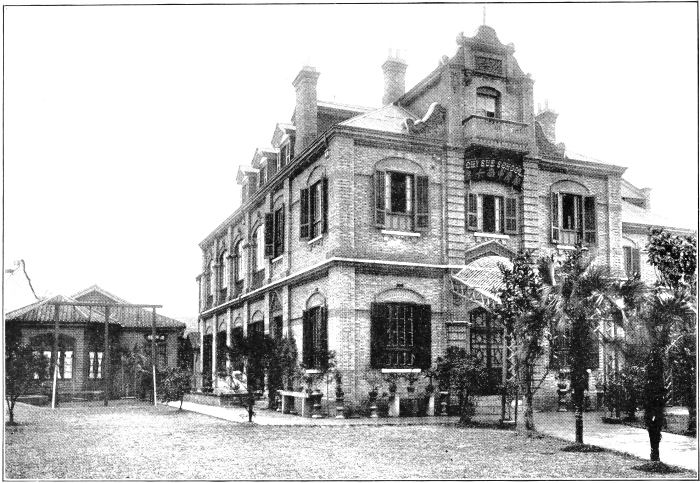
MISS ZEE’S NEW SCHOOL BUILDING. KINDERGARTEN IN THE REAR
Perhaps of all the schools in Shanghai, the little day-schools appeal to one most because of their unfailing human interest and the possibilities stored up in them. They are of every kind and degree of excellence, or badness, according to the way they are looked at. On the whole, most of them seem to be doing good and even the poorest keep the children off the street. Often there are amusing features. In the Chinese city, on a[Pg 121] signboard over a doorway appears the rather unusual announcement, “English taught from A. to L.” Just what is done with the remaining letters of the alphabet is not explained. On a side street the passerby reads again in large English letters, “Daily Progressive School.” In two poorly lighted, none too clean rooms of an old Chinese house, thirty or forty children bend over their roughly made desks, studying aloud in vociferous tones. The head teacher quiets them while he greets the chance visitor and points with pride to his foreign textbooks in geography and English. He too has ideals, and when reference is made to the name of the school, answers, “Yes, that is what I want to make it, ‘Daily Progressive.’” He adds that he has started two branches of his “Daily Progressive School” in other parts of Shanghai. Then comes the unexpected question, “Are you a Christian?” “I am a Christian,” naming the mission school where he received his education.
Sometimes a little day-school is hidden away in the back room of a rambling old house, or in an inner apartment of a Buddhist temple, where the unsophisticated easily loses himself amid its labyrinthine windings. During the stormy iconoclastic days of the revolution, temples and ancestral halls were turned over wholesale by the provisional government to be used as schools, and though many have reverted to their original purposes, others, like Li Hung Chang’s Temple in Shanghai, are still kept as seats of learning. This memorial to the great statesman, built by public funds, was taken possession of five years ago by the trustees[Pg 122] of Fuh-tan College, and now the bronze statue of the famous Li from its pedestal in the garden looks down each day on three hundred and fifty students hurrying to and fro through the numberless courts and passageways. Commencement exercises are held in the Hall of Ancestral Worship, where, on a raised platform against an ornate background, sits the Chinese President, an alumnus of Yale, surrounded by his faculty, all in collegiate cap and gown, making one of the curious anomalies common in these days of transition.
From the Provincial Normal School, located in the Chinese city, thirty young men graduated last year and more than five hundred have gone out from its doors during the eleven years since it was opened. Such is the demand for teachers that long before the school-year closes every member of the graduating class has been spoken for. The alumni are scattered far and wide over the country. Near the Normal School is a large practice school of four hundred pupils. The students of the Normal School are taught music, clay-modelling, wood-carving, painting, drawing. They are ardent patriots and keenly resent any real or supposed indignity offered to their native land. Sometimes they express their patriotism in original ways, as they did not long ago, when feeling ran high because of the unreasonable demands made on China by Japan. The boys’ sleeping and study rooms open onto courts in the rambling structure, or rather a series of Chinese buildings which constitute the school plant. These rooms were cleared out and each one made the scene of some pictorial or material representation[Pg 123] of the current political issue. Many of the exhibits were exceedingly clever, a few were most amusing, but all were strikingly illustrative of the animus of the student body and showed the kind of teachers that are being sent forth over China to instill their principles into the minds of the rising generation.
It is significant of the spirit of the times that a young man in Shanghai a few months ago went to his father and begged to be given his portion of the family gambling money. With it he opened a school which has now one hundred and fifty pupils. The secretary of the Provincial Educational Association, recently back from an extended tour in America, requested a resident missionary to give him lessons in English. He was so impressed with the excellence of the American system that he decided to introduce the same methods into his own schools as rapidly as possible, and wanted a better knowledge of English that he might be qualified to select text-books and arrange courses of study.
Last summer for the first time the Shanghai prefect fixed a uniform vacation period for the elementary schools extending through five weeks, from July 22d to August 25th. In sending out the notice the prefect added a clause to the effect that during two weeks of the vacation three hours a day must be spent by the pupils in reviewing their lessons.
There are two flourishing Japanese schools in Shanghai. One is a large public school that is growing so rapidly a new building has been added to the group which suffices for six or seven hundred pupils. Boys[Pg 124] and girls of all ages are accommodated under the same roof, but with the exception of the very little children in the kindergarten, they occupy separate rooms and have their recess at different hours. They make a pretty sight in their gay coloured garments flitting about in the sunshine like radiant butterflies during play hours, or pouring joyously out on the street at the close of school, some going off in ricshas accompanied by nurses, more on foot, while a lot of youngsters scramble onto the street cars, clutching their coppers in dirty little paws, each one carrying a school bag or books tied up in a square of cloth, and a little lunch box, while on every urchin’s head rests a smart military cap.
The other school is a Japanese College with nearly three hundred students, strong of body, alert in mind, picked men all of them. They are sent from Japan by their respective prefectures to study in Shanghai for three years, every expense being met. The course includes commerce, engineering, and agriculture. During the fourteen years since the school opened, eight hundred have graduated, seventy receiving certificates last June. At the end of the second year’s work, seventy or eighty of the most promising students at the expense of the school, are sent far and wide over China to study the country and its condition, agricultural, mining, social, political. “When the men graduate from the college they return to Japan, do they not?” was asked of the president. “Oh, no,” came the emphatic reply, “they are expected to stay in China and help the Chinese develop their resources.”
[Pg 125]
A group of schools in Shanghai which are not for the study of books, but, in their line, of great value, the public generally knows little about. These are the six Singer Sewing-Machine Schools for women and girls. The Singer Sewing-Machine made its advent in China a decade ago, and thus far it is without a rival. It “took” almost at once with the Chinese and is now found everywhere, even in the most unlooked for and absurdly out-of-the-way places. In 1910 Singer Sewing-Machine schools were started in Shanghai. At first they met with small success. Those for men were a signal failure and soon closed their doors. The few who ventured to enter the schools for women and girls had to be paid for coming, but the old conservatism seemed to die out with the revolution. The leading school now numbers fifty pupils. The period of training covers three, six, or twelve months according to the kind of work taken up, whether plain tailoring or fancy embroidery. The pupils come from widely scattered districts and it is the intention when they return to their village or town that they shall open a school of their own, and in this way introduce the machines throughout the country. There are already more than four hundred selling stations in China, each in charge of a Chinese agent. The machines are sold on the installment plan. “We consider ourselves missionaries in our way,” said the foreign representative of the company in Shanghai, “for is it not a charity to lighten the labour of these poor hard-working people by selling them our sewing-machines on easy terms?” The Singer Company subscribes[Pg 126] liberally to all benevolences, and during the revolution, and the rebellion the following year, it loaned its machines free of charge to organizations engaged in making garments for the destitute. One effective way it has of advertising is to send men about the streets of Shanghai dressed fantastically in clothes made in its shops, while offering for sale small articles carried in portable show-cases.
[Pg 127]
A WIZARD PUBLISHING HOUSE
“THE pen is mightier than the sword” has through the centuries been a working axiom in China, for soldiers stood at the foot of the social ladder, while scholars sat proudly on the top rung. Recent experiences, it is true, have somewhat altered the views of the people, though not reversed them. But the accompanying adage, “The printed page is mightier than the sword,” has not seemed to acquire popularity, despite the fact that printing from movable type was discovered in old China long before Gutenberg saw the light of day. Indeed, the “Peking Gazette,” whose lineal descendant still flourishes in the Capital, claims the honour of being the first newspaper ever published. It was printed from wooden blocks, some of which are still in existence, no one knows just how long ago, though tradition makes it as many as a thousand years. But for centuries the art was little used and even as late as the Chino-Japanese war in 1894 news travelled so slowly that people living only seventy-five miles from the coast had not even heard there was a war. Now, Shanghai alone, which is far in advance of other cities in this respect, publishes more than thirty newspapers and periodicals, twelve of them being[Pg 128] dailies. Many of the sheets are illustrated, and as a proof that they are thoroughly abreast of the times, advertisements of well known patent medicines are given a prominent place!
With the dawn of China’s “New Day,” and the increasing thirst for Western learning, an insistent cry was heard, not alone for newspapers, but for books, books, and plenty of them. Then to meet the need arose the Commercial Press. The story of the rapid growth and development of this great publishing house reads like a tale from the Arabian Nights. The idea was born in the minds of three young, wide-awake Chinese, all practical printers, and all of them Christians, the product of a Presbyterian Mission School in Shanghai. Work began in 1897 in a modest way with two small printing presses. The shop was a Chinese house in an alley off one of the main roads. These quarters were speedily outgrown, and after two moves the plant was finally lodged permanently in a group of fine brick buildings covering eight acres in the northern end of the city. To-day sixty modern presses, the very best to be had, are annually, in round figures, using up twenty-five thousand reams of foreign paper and thirty-four hundred reams of Chinese paper, the bulk of which is turned into school books and scattered far and wide over the land, from Manchuria to Thibet. The year after the revolution, although new machinery was bought, additional workmen taken on as fast as they could be found, and the presses kept running night and day, the enormous demand for books could not be met.
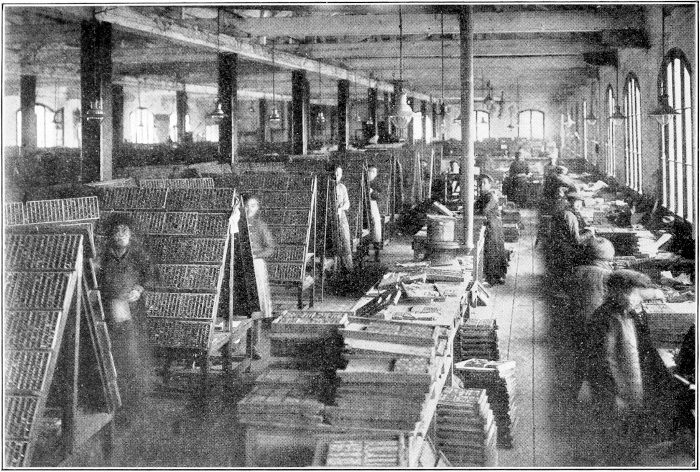
CHINESE COMPOSING ROOM
[Pg 129]
From the first, the policy of the Commercial Press has been never to print any books that are antagonistic to the Christian religion, and to this purpose it has faithfully adhered. Indeed, the twenty or more heads of departments are either Christians or in sympathy with Christianity.
The rules of this house governing the treatment of employees may not sound unusual to Western ears, but studied in comparison with conditions as they have been in China, and still are for the most part, their true worth is keenly realized. The Commercial Press employs about fourteen hundred men and four hundred women. Several of the boys are deaf mutes from a missionary institution in the north, and a number are from the Shanghai Reformatory, taken on by the company to give them a fresh start in life, with a hostel built especially for their accommodation. Most of the women work in the bindery, though they are found here and there throughout the establishment and some of the lighter machinery is operated by them. One is a forewoman and a few bright girls are studying to be bookkeepers. None are admitted under fourteen years of age, while the majority are much older. An innovation has lately been introduced, permitting women to work in the same room with men, although at different tables. It has proved a perfect success. All hands attend strictly to business and the new arrangement has distinct advantages over the old, as, in giving employees better light and air, since the rooms can be kept larger. The hours of labour are from 7:30 to 12 and from 1 to 5:30 o’clock. The bell rings for[Pg 130] the women to leave five minutes before the men. “Ladies first, you see,” a member of the staff laughingly remarked to a visitor. When a woman expects to become a mother she is given two months off with full pay and five dollars in addition to meet extra expenses. Sundays are holidays. About one-eighth of the force are Christians and two Protestant churches are located in the neighborhood of the Works, which many of them attend. Wages are excellent with the addition of a bonus for special merit. There is a reserve fund for the benefit of the families of the deceased, and old, retired employees. Profit sharing is a part of the system and the head men in each department are shareholders in the company.
A small hospital with accommodation for a score of patients, and with an immaculate dispensary and operating room, is another feature of this remarkable establishment. An attendant is always present, and a Chinese foreign-trained doctor visits the hospital every morning. The clinic is open to outsiders as well as employees and their families. All pay a fee of three Chinese coppers, about one cent, as it has been found necessary to charge something to keep the place from being overrun. Near the Commercial Press the management has built a number of small but comfortable houses, and these are rented, at a nominal rate, to employees who care to occupy them. A school is maintained for the children of employees, and a night-school and reading-room for apprentices. A kindergarten, for which the Commercial Press furnishes the premises and the Presbyterian Mission Press the teachers, is also close by.[Pg 131] None of these schools are free, as parents are able to pay a little tuition and feel more self-respecting to do so. A tea garden, made attractive with shrubs, flowers, and seats scattered about on the well-kept lawn, furnishes a delightful resting-place for the clerks when off duty. The fire brigade is a most important factor in the concern. It is composed of twenty-six men, all employees, and is kept at a high grade of efficiency by frequent drills. A stone’s throw from the main building is the fire station, fitted up with bright hose wagons, ladders, buckets, torches for carrying safety oil lamps of brass, besides complete uniforms for the men, the burnished brass helmets being their special pride. The brigade stands ready to respond to a limited number of outside calls.
Visitors to the press works are always cordially welcomed, and courteously shown over the establishment by a competent guide, whenever possible a member of the staff. So extensive is the plant it usually requires several hours for even a cursory tour of inspection. Two of the buildings are used for the printing plant and foundry, one for the Chinese bindery, another is reserved for the editorial department, Chinese and English, two are warehouses, one is a carpentry shop, and one, a long low building somewhat apart from the others, is devoted to photography and its various branches. The rooms are airy, clean, and cheerful, in marked contrast to most of the workshops in China. Each is connected by telephone with the main office, and light tracks are laid for carrying merchandise to and fro. Electric motors supply the motive[Pg 132] power, while both gas and electricity are used for lighting purposes.
Most of the printing presses are from England and America. Those for finer work, including the immense wonder-working machines in the colour printing department, are of German manufacture. The Commercial Press was the first firm to introduce three-colour printing into China. One is tempted to linger long beside these marvellous presses. As the blue, yellow, red, each in its turn, is added so quickly and easily to the maps, charts, pictures, and kindergarten scrolls, the visitor is almost persuaded that he is viewing an exhibition of the cunning art of a magician, rather than the automatic movements of an insensate piece of machinery. Here is laid before the eyes a gay picture of the landing of Columbus for a history of America in Chinese, and yonder an equally charming one of the child Raleigh for a history of England. Much is made of illustrations in the school books published by the Commercial Press. Their ethical readers for little folks are fascinating productions. Each page is a coloured picture, which teaches its own lesson. Children are represented on their way to school, saluting the teacher, reciting their lessons, giving alms to the poor, caring for the aged, the young, sick, and blind, dusting and sweeping the rooms, washing, brushing, mending, and folding clothes, brushing their teeth, eating, playing. Houses are pictured as clean and sanitary, living as wholesome and pure. Especial emphasis is placed on proper manners and morals, teaching sadly needed to-day in China, when there is such an alarming tendency to abandon[Pg 133] all that was really admirable under the old régime, and adopt in an exaggerated form all that is bad from the West. In the First Year Primary books practically no reading matter is introduced, only a few Chinese characters to explain the text. The little ones scan them attentively, absorbing knowledge without being conscious of the fact. How different is this from the old way, when children were shut all day long in dark, close rooms, shouting aloud unmeaning phrases from the Chinese classics, while the teacher dozed in his chair!
The newest addition to the plant is the installation of three “off-set” presses, the first in the Far East. An expert came out from America with them to set them up and instruct the Chinese workmen in their use. They are often kept busy through the twenty-four hours in turning out bonds and bank-notes by the millions for the Government.
Too much praise can not be given to the work of the editorial department. The entire second floor and part of the third of a quiet, three-story building is devoted to it. At long, unpainted wooden tables, littered with books and papers, sit the hundred and fifty scholars, bending over their work. Above four thousand original books have already gone out from their busy workshop, besides countless others that have been translated and edited. Eight monthly magazines are published by the editorial staff, a general one, an educational, a political, student’s, child’s, short story, a woman’s magazine, and one entitled “The English Student,” of which twenty thousand copies are issued monthly. The[Pg 134] newest publication is a magazine called “The English Weekly.” The aim of the last two is to help Chinese students in the study of English. The Woman’s Magazine is one of the most popular. A bright girl who has studied in America was speaking about it one day to a group of foreign friends. “Just think,” she said, “the last number contains recipes for cooking eggs in twelve different ways.” “Is that so unusual?” asked an interested listener. “Why, they were not for making foreign dishes, but cooking Chinese food! I never before heard of a printed Chinese food recipe. If Chinese women begin to learn about food values it will mean everything in their lives.” The Woman’s Magazine started its life two years ago with a man as editor-in-chief. This fall a young woman will take over that position. She is a recent graduate of Wellesley College and married to a Harvard alumnus. Modest and lovable, she graciously answered the questions of her foreign callers. “Yes,” she admitted, with a little apologetic laugh, “I am going to try to edit the magazine.” “There will be assistant editors of course?” “Oh, yes.” “Women?” “No, I believe they are all men.” This young wife is a beautiful housekeeper, and it is safe to assume her home and family will not be neglected on account of the outside work she is about to take up. Indeed, it is worthy of comment that no one is more pleased about it than the young husband himself.
An interesting fact in connection with the editorial department of the Commercial Press is that most Western books are translated through the medium of the[Pg 135] Japanese language, instead of directly from the English. This is because the present system of education in China is based on that of Japan, and scientific terms are more easily adapted from the Japanese. But Chinese students returning from abroad are strong in their feeling that this second-hand method of acquiring knowledge must soon give way to the more direct.
Glancing about the editorial room with its scores of hard-working men, pouring out the best that is in them for the uplift and enlightenment of their country, it is impossible not to feel a strange stirring of the heart, and one is also thrilled when looking through the warehouses where room after room is filled with books stacked to the ceiling or packed in boxes to be shipped away. Some of the largest orders come from the most distant provinces. The aim of the publishing house is not to issue many handsome, expensive books, but to flood the land with cheap editions that shall be within the reach of all.
Tiptoeing out of the editorial department, the visitor passes on to the English and Chinese composing rooms, which present a very different scene. There is a sort of mystery about Chinese type. That a “character” made up of a score or more of tiny individual strokes can be reproduced perfectly in a clean-cut piece of lead, seems nothing short of marvellous. Chinese type-setting is exceedingly complex. The cases are set on slanting frames, placed to form a triangle, within which stands the compositor. About six thousand characters are in ordinary use and a font of type[Pg 136] weighs fifteen hundred pounds. An American woman is chief proof-reader for English text, assisted by a Portuguese and many Chinese. Behind the printing department is the foundry. Type-casting is a specialty and is done on a large scale. Indeed the market for a long time was so generally supplied from the Commercial Press that their sizes became the standard for all China. The matrices, kept in a fire-proof safe, are among the Company’s most valuable assets. A few modern automatic type-casters from Chicago are used, but they are far outnumbered by the old-style, hand-worked machines. The type cast from the old-style machines must be assorted, trimmed, and polished, all of which is done by women. “We are not always keen in making use of the latest machines,” explains the staff, “since labour is so cheap in China, and it is a blessing to the poor people to give work to as many as possible.”
Nearly all of the smaller machinery used in the Commercial Press Works is made in their own foundry and carpentry shop, besides physical, physiological, and chemical apparatus for schools, tools for industrial work, and small reed organs. The job-printing department is strictly up to date and large returns are realized from it. Recently one of the heads of the company made a trip around the world in order to study the best and latest processes of printing. The two hundred copies of the English edition of “China’s Young Men,” the organ of the Young Men’s Christian Association, are sent out monthly from this press.
No expense has been spared to make the equipment[Pg 137] of the photo-engraving department as perfect as possible. It is provided with arc lamps and an acid-blasting etching machine, so that orders can be quickly filled irrespective of the weather. A fine photographic gallery is annexed whose chief furnishing is a new camera bought in London and making the fifth in use. The lens is able to produce pictures 32 × 43 inches, and with a single exception is the largest in the world. The camera rests upon a handcar, which runs back and forth over a small track. For some years, one-fourth of the company’s stock was held by Japanese, but at the beginning of 1914 this was bought back, so that now the concern is wholly Chinese. This consummation of a long-anticipated hope was celebrated with great rejoicing.
Several miles away from the works, on one of the busiest streets in a Chinese section of the International Settlement, stands the business house of the Commercial Press. The four-story building of reinforced concrete, ornamented with iron pillars, is quite new, having been built only six years ago at a cost of twenty thousand dollars. The fine show windows at once attract attention. Those on the right of the entrance are reserved for Chinese books and the ones on the left for English. Among the latter, besides standard works in literature, fiction, biography, and travel, are seen titles like the following: “Ready Made Speeches,” “Cooking,” “How the People Rule,” “Our Sick and How to Take Care of Them,” “Poultry and Profit,” “All about Railways,” “Railway Conquest of the World,” and a series under the general head, “Common[Pg 138] Commodities of Commerce,” including tea, coffee, sugar, iron, oil, rubber. The sales rooms are on the ground floor. But many things are found there besides books and the usual appurtenances of a bookstore. In the apartments at the rear, in glass cases, are displayed samples of the many kinds of school apparatus manufactured at the works, also a large collection of stuffed birds from different countries, various forms of insect and animal life preserved in alcohol, besides what is of exceeding value to Chinese students, studies in rice, cotton, the silkworm, and other products, showing the progressive changes and best methods of their development and the uses to which they are and may be put. For the accommodation of customers who wish to look over the books at their leisure, numerous benches are scattered conveniently about, and the pleasant little reading room is always well patronized.
The second and third stories are mainly devoted to offices, while a good part of the fourth is reserved for the dining-hall. According to the usual custom in China, the two hundred employees have their board furnished them as a part of their pay, and all who receive under ten dollars a month are given lodging as well, though not in the same building. A roof garden, where the clerks may gather for the noon rest, or enjoy the cool evening breezes in hot weather, is one of the attractions of the place. Perhaps the two most useful adjuncts are the elevator, which carries both freight and passengers, and the electric cash register and delivery system, the only one in China. The Commercial Press has over forty branch offices in China, the large branch[Pg 139] in Peking being employed chiefly with work for the government. It has besides more than a thousand selling agencies in other countries where the Chinese have settled, and is the largest publishing house in the Orient.
[Pg 140]
THE CHINESE CITY
MANY visitors to this busy port hurry on to richer fields of conquest with never a glimpse of the Chinese City, and some doubtless do not even know there is such a place. Yet not the International Settlement, nor the French Concession, but the Chinese City is the real Shanghai. The city is the nucleus north and south of whose storm-beaten walls the foreign settlements sprang up and without which they would not have been. The coming of the foreigner is of recent date, for few men from the West saw the spot, and certainly not one resided there till after Shanghai was opened as a treaty port in 1842. The city itself, though in the heyday of youth, compared with many other cities in China, still counts its age by centuries that creep close on to a millennium. The walls were not built until 1555, a year after the city had been sacked, burned to the ground, and left a howling wilderness by Japanese raiders. Gone now are the old walls, since the revolution, and the creaking gates that swung back and forth night and morning so many years on their rusty hinges, or if a vestige is left it is fast disappearing under the blows of pick-ax and hammer. [Pg 141]But no, that is a mistake, for a halt has just been called in the work of demolition. The Chinese Town Council it is reported, is a house divided against itself, and some of its members strongly advocate the rebuilding of the walls for the sake of protection. A compromise has been effected by voting to allow the walls to remain down but letting the gates stand, or what is left of them, to serve as triumphal arches.
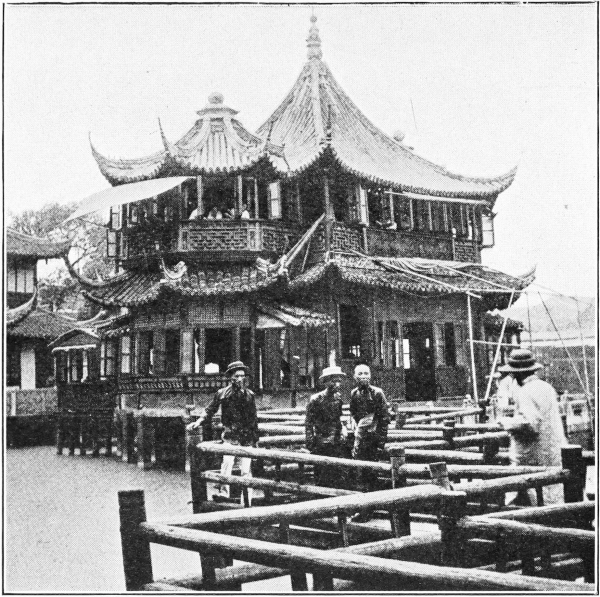
THE ORIGINAL WILLOW PATTERN TEA HOUSE
Of course it is better that the old walls should go, more sanitary and more modern. The ill-smelling moat has been covered on the north and west by a splendid boulevard ninety feet wide. Trolley lines will by and by encircle the whole city, as they now run along two sides. Many of the streets in the outer circumference of the city are being widened, while those in the heart of it are receiving some attention, though improvement is difficult on account of property interests. Ramshackle rat-infested hovels, here, there, and yonder, have vanished from sight, and new tea-houses, and shops, glistening with fresh paint, are taking their places. Public nuisances are being attacked. A well-to-do family reports that since the pestilential creek back of their house has been filled in, their property has advanced in value hundreds of dollars. Street refuse is swept up and carried away each day. Meat is inspected. Pipes have been laid and running water introduced, so that one no longer hears the monotonous cry of the water carriers trotting along with a pole across their shoulders from which were suspended the overflowing buckets spilling water at every step. Electric lights have largely superseded little smoky kerosene lamps, or still more primitive[Pg 142] pottery or tin lamps with a tiny wick swimming in vegetable oil.
All this is just as it should be. The improvements are highly commended by every one, and yet, inconsistent beings that we are, why is it that with our rejoicing over the changes, our hearts likewise experience a pang of regret? What is there about things old and quaint, albeit noisome and repulsive, that things brand new somehow do not possess for us? So with the passing of the old walls and a modicum of the old dirt, a certain indefinable charm has slipped away too, never to return. Nevertheless the Chinese City continues to exist, although since the walls are down its boundaries are not so clearly defined, and enough of the ancient landmarks remain in the way of foul-smelling alleys, streets of gay shops, beggars and crowds, to satisfy most lovers of the haunting allurements of the Orient.
The city is approximately three miles in circumference. There is no map of it beyond the merest outline, and neither a Murray nor a Baedeker to facilitate a tramp through its labyrinthian byways. But the stranger crossing its boundaries is not left coldly to his own devices, for the instant he appears in sight he is met by a chattering company of self-constituted guides. If perchance their services are declined, they still manage unobtrusively to shadow the Innocent Abroad and entice him to shops that are almost certain to loosen his purse-strings and where they propose to secure a fat commission on the purchases made.
The shops in the Chinese City are the originals of[Pg 143] the replicas in the Settlement, only that being the originals they are more bizarre and delightful. Like birds of a feather, shops doing the same kind of work, or selling the same kind of articles, are apt to flock together. For example, most of the furniture shops handling the beautiful red and black wood from the southern province of Kwangtung are found near the north gate, also the shops selling exquisitely carved ivory. Elsewhere are grouped the silversmiths, the jewelers with tempting displays of jade, amber, pearls, and precious stones, cloth and silk merchants, shoe and cap makers, dealers whose specialty is all kinds of fans; brass, pewter, and china shops, makers of coffins from the costly red and teak woods to the less expensive pine and ash—but the amazing variety of the shops is fairly bewildering and defies enumeration!
There are no department stores in the city. Each tradesman confines himself strictly to his own line of goods. Not for his life would he dare encroach on the rights and privileges of another, for every trade has its guild which sees to it that the interests of its members are protected. Many of the guilds are wealthy and powerful, politically as well as commercially, like the silk merchants’ and silversmiths’ guilds. They have their guild houses, all more or less elaborately fitted up with rooms for conferences and feasts, and attached to them are rows of long low buildings divided into small chambers, where, upon the payment of a rental, the coffins of deceased members may be deposited until a convenient time for burial.
Certain shops sell nothing but funeral trappings, but[Pg 144] instead of presenting a sombre appearance they are among the gayest in the city. Hung aloft to show off to the best advantage are elaborately embroidered crimson satin coverings for the coffin, and around on the shelves or under glass cases is apparel for the dead, very richly embroidered robes, slippers, and headgear, this latter in the shape of mitres and helmets, of remarkable design and ornamentation. There are also priests’ robes and white cotton raiment and sackcloth for the mourners. Other shops carry only the paper furnishings that are an essential part of a funeral ceremony. When the spirit of the deceased leaves the body and passes to the spirit world, according to Chinese superstition he requires for his comfort the same conveniences to which he was accustomed in life. Hence the dutiful elder son, in proportion to his financial ability, and often far beyond it, for Chinese funerals are fearfully costly, sees that his honoured parent is provided with them. The articles are made of coloured paper, the larger ones over a light framework of bamboo, and include every conceivable object, from a sedan chair to a teacup. These images are borne in the funeral procession through the streets and burned at the grave, the smoke being supposed to waft them through ether to the waiting spirit. They are such exact facsimiles of the real thing, especially in the case of small articles like vases, jewelry boxes, braziers, lamps, clocks, basins, that it is hard to believe they are false. One of the best imitations ever produced in a Shanghai city shop was that of a fur-lined Mandarin coat, so perfect in every detail as almost to deceive the Chinese themselves.
[Pg 145]
A shopkeeper who always attracts custom is the portrait painter. He is an important personage and does business behind closed doors—that is, his shop is not open to the street as most are; but has a front partition with a door and show window. On the window is pasted a collection of small pictures of human heads cut from newspapers and magazines. Inside the shop quantities more are stored away. When a widow, it may be, wishes a likeness of her consort who left no pictured memorial behind him, or a youth perhaps craves a reminder of the grand-uncle he never saw, they find their way to one of these portrait shops. The shopkeeper spreads out before them an array of pictures, and after careful study a selection is made of a particular portrait which either bears some imaginary resemblance to the dear departed, or is what the sorrowing relatives would choose to have him look like. The shopkeeper then paints the head in life size and adds a body clothed in whatever style of garments may be mutually decided on. The finished portrait is finally hung on the wall of the family dwelling and pointed to with pride and affection as the face of the deceased ancestor.
Drug shops are many and are invested with an air of quiet exclusiveness and semi-professionalism, which suffers but a slight declension when in hot weather the clerks, after the manner of most shopkeepers, divest themselves of their non-essential upper garments and pass the day stripped to the waist. Upon the shelves of the shop stand rows and rows of large pewter cannisters and blue and white china jars, innocent enough[Pg 146] to look at and yet designed to arouse the curiosity of the beholder as to the nature and character of their contents. Below are quantities of drawers containing dried roots, herbs, bones, seaweed, chalk, things indescribable and inscrutable, drawn from the air above, the earth beneath, and the waters under the earth. In addition to drugs the shop frequently keeps on exhibition some special attractions, such as glass jars with snakes preserved in alcohol, dried alligator skins, corals and geological specimens. In filling prescriptions china bottles, coloured pasteboard boxes and squares of white paper are used. Sometimes a score or more of the paper squares are placed on the counter at once, and from the different drawers an interesting assortment of medicines is laid on them. Here is dried orange peel, said to be an unfailing remedy for loss of appetite, a yellow berry that removes phlegm, a dried beetle that in a solution of water makes the best kind of eyewash. The silkworm taken from the cocoon when eaten with rice greatly assists digestion, and so does a flat bug that from its appearance might be great-grandfather to the bedbug. The ladybug, or what resembles one, is a sure cure for liver complaint, and another insect if rubbed on wounds quickly heals them. Also in certain troubles it has been found that a little of the alcohol in which a serpent is preserved, if taken internally, proves particularly efficacious. On the wall at the back of the shop is painted a picture of the god of medicine, at whose shrine tapers are kept burning. Chinese shops carrying foreign drugs, some of them excellent shops, too, are not uncommon in the[Pg 147] Settlement but are seldom to be seen in the Chinese City.
The dentist, like his confreres in other countries, is ever in demand. Occasionally an aspiring, prosperous fellow is discovered doing business in a shop where the patient may balance himself on a stool, though still in full view of the curious street crowd, and tilting his head back, have the offending molar extracted without further ado. But ordinarily the professional outfit is limited to a small wooden table and what it will hold, set out in the street. Back of the weather-worn stand lounges the dentist, soiled and uncouth, keeping guard over his stock in trade, bottles of ointments, salves, a pair of forceps and other nondescript instruments, a few sets of teeth under a dust-covered glass case, and last but not least, piles of decayed teeth successfully extracted from tortured victims and kept as decoys to attract patronage. There are travelling dentists whose shop is a wheelbarrow which carries the dental equipment, with the inevitable pile of teeth conspicuous in the centre. They move from point to point, in inclement weather under cover of a mammoth coloured umbrella, and sound a gong to draw the ever-ready crowd.
More common still are the peripatetic restaurants. The outfit of the manager of the Liliputian establishment is a model of convenience and compactness. A simple bamboo frame, easily borne by one man even with all the appurtenances, is divided into two sections. On one side in a pocket rests a clay stove, with a place underneath for holding the wood. On the other is a[Pg 148] series of drawers of various sizes, in which the dough, sugar, and spices are kept. A little kneading board pulls out from a slit between the drawers, and on it the baker deftly fashions his cakes and meat pies, frying them in vegetable oil in a shallow iron basin, or if they are to be baked, plastering them against the inner sides of the clay stove above the fire. Despite the dirt, dust, and flies, even the ultra fastidious can not deny that the finished product is decidedly appetizing.
Not a foot of valuable land in the Chinese City is wasted on sidewalks. Hence everybody and everything is right on the street, and the very narrow passages are badly congested. Rickety jinricshas, a few sedan chairs which are fast disappearing from Shanghai, burden-bearers and pedestrians hurry continually to and fro, shouting in shrill falsetto tones to one another to clear the way and running in imminent danger of colliding with the unwary and trampling on children. Yet not all the streets are mere alleyways. A few, but it must be admitted a very few, are wide enough to allow a carriage to pass through with comparative ease, and they seem in comparison like boulevards. Then there are others along which a carriage can manage to creep providing the driver is skillful and the people hug the sides of the roads or retire precipitately into the shops out of harm’s way, but this is too risky a venture to be indulged in often and is seldom permitted by the police. Once in a while it happens that a carriage gets wedged into a tight place where it can neither move forward, back out nor even find room to turn at right angles into a cross street. The only[Pg 149] thing then is to unhitch the horse, lead him out, pull the carriage back, and finally lifting it up bodily, turn it around and harness the horse to it again.
Not all the city is laid out in streets, for there are some open places and even flourishing vegetable gardens which quite suggest the country. That this is possible in so densely populated an area seems a marvel, and where and how the people are all hidden away is a puzzle. In the poorer sections, with the closing down of night they vanish as if by magic, except in hot weather when many camp on the streets, and in the morning the crowds swarm forth as mysteriously, like rats from their holes.
The best known and most popular breathing spot in the city is that about the lake or pond, in whose centre on a small island rises the far-famed Willow Ware Tea-House, for the identical tea-house pictured on the much sought for willow-ware porcelain is located in the Chinese City. This to the average globe-trotter is the city’s chief attraction, but alas, never was the saying “Distance lends enchantment” more truly applicable, for while the pictures of the old tea-house are undeniably charming, with its graceful upturned gables and the zigzag bridges leading to it, made zigzag to ward off evil spirits who are said to travel in straight lines, yet seen near at hand how quickly the enchantment is dispelled! Filth, rottenness, and roistering are the main present-day characteristics of this tea-house of fair renown. Instead of reflecting the blue sky above, the water is covered with a thick vegetable scum, green and unwholesome. The shores[Pg 150] around are made lively with a colony of small vendors whose wares are set on tables or spread out over the ground. They evidently reap a paying harvest from the sale of scrolls, pottery, towels, sheepskin coats, toys, and all manner of cheap foreign knickknacks which are much sought after by the people. Switches of long, jet black hair, especially plentiful since queues went out of fashion, are given places of prominence. Many doubtless are sent abroad to add beauty to the coiffures of dames of high degree.
The business of the man who deals in rags must flourish like the green bay tree judging from the number engaged in it. What a sight is a rag-man’s shop, rags, rags everywhere, stuffed in baskets and bags, hanging from the walls, covering the floor in huge piebald bundles and mounds, germ-infected, poisonous, alive with vermin, gathered up and brought in from heaven knows where! Yet every day women and children spend long hours industriously picking them over and making them up into mops and the soles of Chinese shoes, for which they find a ready sale.
Shanghai once boasted a supremely great citizen. He lived back in the sixteenth century, a veritable Chinese Maecenas. Besides being a man of letters and encouraging Western learning, he rose to the highest position in the empire, as Premier and Chancellor of the Privy Council. His name will be of little consequence to the outside world, but it is Siu Kuang-ki, should any one care to know it. He was converted to Christianity under the Jesuit Fathers, and lived a pure, consistent, devoted life, dying so poor in spite[Pg 151] of large emoluments that his funeral expenses had to be paid from the public treasury. He built in the Chinese City the first Christian church ever seen in these parts. During the exigencies of later years it was converted into a temple sacred to the god of war, but was afterward redeemed and restored to its original use. This church is still standing, a striking edifice back a little from the noisy street, with a typical Chinese roof, and below it on the front outside wall, a beautiful gilded cross.
The present war god’s temple is near the temple of Confucius, with its grass-grown court and deserted halls. Once a year, in the early dawn, the military governor of Shanghai and the city officials enter the sanctuary dedicated to the god of war and conduct a weird pageant-like ceremony in honour of two local military heroes. The tutelary deities of the Chinese City, black and repelling, occupy a large centrally located temple more frequented by worshippers than any other. The roomy outer court, like the temple court in Jerusalem, is given up to buying and selling, also to eating and drinking, gambling and fortune-telling, and there is no busier, noisier mart in all the city.
The local official in the Chinese City is called the “Chih-hsien,” or District Magistrate, and is appointed from Peking. His official residence styled the Yamen, is a common, ordinary building, approached through several untidy courts lined with the low one-story quarters of the Yamen retainers and petty officials. Every day, in three small, bare rooms of the Yamen, court is held, the Chinese judges in their professional gowns[Pg 152] looking distinctly out of keeping with their surroundings. To the left and back of the Yamen is the City Prison and adjoining it a much smaller one for women. Stories are afloat regarding the unsanitary condition of the prison and the treatment of prisoners that cause one to cringe and dread an investigation, but whatever may have been the state of affairs under the old régime, and the prison manager is frank to confess that things were very different ten years ago, there is now little to criticise and a great deal to commend. The grey brick buildings are in thoroughly good repair, the cells of the four hundred men and the fifty women prisoners, clean and fairly well lighted and ventilated, though, as the manager himself will hasten to tell the visitor, too crowded for health. A few carefully tended plants are growing in the centre of each of the courts, a praiseworthy effort to introduce a touch of the æsthetic. Industrial work on a considerable scale is carried on in the men’s prison, though the grant of money from the government is too small to keep all at work. Wooden and rattan furniture, towels, mats, shoes, and clothing are made. A very little industrial work is given the women in the way of cutting out and making garments, but from lack of funds to supply workrooms and material, most of the poor creatures are forced to pass their days in idleness. The wardens of the women’s prison are women. The discipline is excellent, yet not severe, the prisoners look well fed and well cared for, and the men especially, happy and contented. Provision is made to send sick prisoners to a Chinese hospital, where they receive the best of care.
[Pg 153]
The Yamen, disappointing as it is in appearance, yet witnesses some stirring scenes, as when, not long ago, a quantity of opium and opium-smoking utensils were burned on the open ground in front of it in the presence of an interested throng of spectators. Not an opium den or shop exists in the Chinese City. Long ago they were effectually closed by order of the government.
The city is well policed. There has been a wonderful shaking up of the dry bones in that department in recent years, particularly since the revolution. The Chief of Police is chosen on the recommendation of the local military governor by the provincial governor at Nanking, but the Chief of the Fire Department is the choice of the people, and affairs of the department are wholly under their control. All the seven hundred members of the Fire Brigade are volunteers and serve without pay. Of late the brigade has attained a high grade of efficiency, and in the engine stations scattered over the city may be seen a very creditable equipment of modern machinery including some small motor cars. They must of necessity be small in order to get through the narrow streets. At the central station between the east and south gates stands a splendid tower supporting a bell weighing 6,000 lbs. which sounds the fire alarm not only in the city itself, but in the surrounding territory included in the Chinese municipality. This tower is the work of Shanghai’s engineering genius Nicholas Tzu, who patterned it after a small model of the Eiffel tower, but with changes that adapted it more perfectly to its present[Pg 154] use. At a recent large fire in the city, the chiefs of the International and French Fire Brigades were present and looked on, but their assistance was not asked for nor was it needed, though the Chinese firemen were obliged to fight valiantly for three hours before they got control of the flames.
That the Chinese City is taking on thoroughly up-to-date airs will be generally conceded when it is known that strikes are becoming rather general. The latest one to break out was in the Dyers’ Union. The masses of the people in China dress in blue cotton. Indeed, so universally is it worn, that it might almost be called the national dress, consequently the business of dyeing is one of the most common and the Dyers’ Union is very strong. Since a Presidential mandate had gone forth that every labor union must be approved by the police, and as in this case the police interfered to put down the strike, it failed of its object. But a strike last winter was more successful. The women working in a silk filature mill within the Chinese precincts, though outside the Chinese City, were roused to fury by a reduction in their wages. Early one morning ninety or a hundred of them gathered at the mill gate and made such a clamour, pounding and shouting as only enraged Chinese women can, that the authorities, realizing that after all right was on the side of the strikers, were glad to effect a speedy and satisfactory compromise.
[Pg 155]
CUSTOMS OLD AND NEW
A STUDENT in a mission school for girls received an invitation from a young gentleman of her acquaintance to accompany him on a certain evening to a place of amusement. The note fell into the hands of the missionary in charge who sought an interview with the man. “It is against the rules of the school for our girls to go out unchaperoned,” she told him, “besides why do you make such a request? You know it is not Chinese custom.” “Ha, ha,” laughed the youth derisively, “perhaps it was not formerly, but now that we have a Republic we can do anything.”
Great changes and grave dangers accompanied the birth of the republic, and nowhere are they as apparent as in Shanghai. Old things are passing away and the new order is not yet firmly established. Young women are particularly sensitive to the changed conditions. In their eagerness to imitate the ways of the West, the real meaning of which many do not fully understand, liberty and license are often confused. But the girls must not be judged too harshly, for while some are unblushingly bold, others are like imprisoned birds who, suddenly finding the cage door ajar, pant[Pg 156] to try their wings in the open. It is scarcely to be wondered at if sometimes they fly too far afield and drop back weary and bruised. The better class of students who have studied abroad are helping to set matters right. They show how it is possible for friends of both sexes to meet on the tramcars, on the street, or in one another’s homes and chat together naturally and yet modestly. It was with great gusto that a young matron who had never been out of China but associated freely with those who had, told of a picnic enjoyed by the mixed choir of the Chinese church to which she belonged. “We went down the river in a launch, taking our supper with us.” “Wasn’t it hard to carry Chinese food in baskets?” “Oh, we had foreign food—cake and sandwiches. I made some peanut sandwiches and every one seemed to like them.” “Were the picnickers all married people?” “No, some were not,” was the laughing reply. A Wellesley graduate who had been absent eight years from her Shanghai home was asked on her return what impressed her most. “The way my sister-in-law goes about the streets alone and even shops in the big stores.” “Wouldn’t she have done that before you went to America?” “I should say not! But now she doesn’t seem to think anything of it.” “How about your mother, does she go out too?” “No, mother prefers to follow the old customs, but she makes no objection to what we do.”
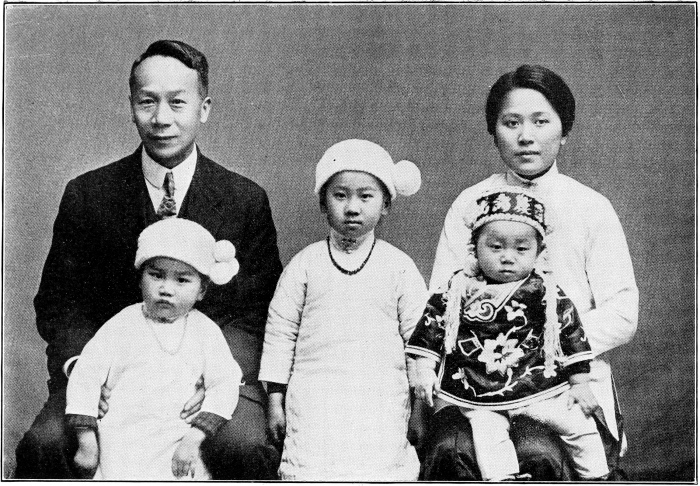
A MODERN CHEVALIER AND HIS HAPPY FAMILY
It is easy enough to view the social changes with fear and trembling and many of them are bad enough in their trend to justify any amount of anxiety, but there is a bright side and perhaps in deprecating the[Pg 157] evil it has been too often overlooked. Nothing is more commendable than the loving comradeship that is growing up between husband and wife. This might be expected among students who have lived abroad and are used to foreign ways, but it is by no means confined to that class. “You have a pretty home,” commented a foreign friend to a bride of a year. Her husband was the editor of a popular Chinese daily and neither of them had ever been away from their native land. The bride beamed with pleasure. “Your lace curtains are hung so tastefully,” continued the caller. “Wasn’t it hard to show your servant how to do it?” “My husband and I hung them. We worked evenings after he came home from the office,” replied the blushing little wife. A few months later, when an expectant mother, she displayed with shy satisfaction, an exquisitely dainty layette, each tiny garment made with her own hands after a foreign pattern. “What a fine baby!” exclaimed another friend to the jubilant parents of their firstborn. “It is a boy, isn’t it?” “No, a girl,” corrected the father, gazing with fond pride into the tiny face of the rosy mite, “but she cries a good deal. I was up with her for three or four hours last night and had to walk with her most of the time to keep her from disturbing my wife.” “I was very glad to see your wife at my party on Friday,” remarked an American lady to a busy Chinese secretary. “Yes, I got off early from the office and went home to take care of the children so she could go. I wouldn’t have had her miss that pleasure for anything. My Margaret is such a good wife.”
[Pg 158]
When charming little Mrs. F. sailed for America to see a brother graduate at the University of California her husband was at the jetty looking after the baggage, and went with her on the launch down the river to where the ocean liner was anchored. Dr. Wu Ting Fang, ex-Minister to the United States and one of Shanghai’s best known citizens, meeting Dr. F. soon afterward, twitted him facetiously: “Oho, it used to be the custom in China for the husband to go away and the wife to stay at home with the family, and now it seems to be just the other way and the wife goes while the husband stays at home.” Dr. F., who, with the help of his mother and sister, was caring for his three little ones in Mrs. F.’s absence, laughed goodnaturedly and explained that it was he who had urged this trip on his wife. Once when this same husband was presiding at a formal banquet, it was noticed by those near him that in the midst of the festivities he quietly left his place and passed down to the other end of the long table. Mrs. F., detained it may be by putting the children to bed, had just come in, and Dr. F., not too engrossed in conversation to be watching for his wife, rose to draw out her chair and seat her in it with all the gallantry of a chevalier. The afternoon Mr. and Mrs. C. gave their “tea,” the young husband greeted the incoming guests at the door, while his wife, clad in soft white Chinese silk with a wreath of tiny pink rosebuds nestling against her black hair, presided over the tea-table with all the ease and grace of a society belle, and withal a sweet modesty which every society belle does not possess.
[Pg 159]
Perhaps these incidents, trifling in themselves, will possess small significance for the reader who has never lived in China, but to those who have they are encouraging signs that the leaven is working which of a certainty will by and by raise women all over the land from the position of mere chattels whose chief business is the bearing of children to be the equals and companions of their husbands. Dr. Arthur H. Smith, an authority in things Chinese, said recently in conversation, “I believe that the reorganization of the life of women in China is the most important sociological and educational event of modern times.”
Bound feet are becoming less and less the fashion in Shanghai. The increasing spread of physical training in all the schools is a great aid in favour of anti-footbinding, for the popular exercises can not well be taken on tiny feet. A medium course at present much in vogue is neither to let the feet alone nor bind them tightly, but by the use of comparatively loose bandages to prevent their growing too large. The little bound feet of old, common enough still in the interior, are in Shanghai generally looked upon with shame by the younger generation, who if they are so unfortunate as to own them, try to conceal their crippled members underneath long skirts or by wearing large shoes. It is not the women alone who frown upon bound feet. In many instances their husbands are equally opposed to them, men who a few years ago would have spurned a woman not swaying uncertainly on her much admired “Chinese Lilies.” A native teacher, supposed to be of the “old school,” was telling his foreign pupil[Pg 160] of the recent death of his wife. “She fell down when crossing our courtyard and never regained consciousness.” “That was remarkable,” was the surprised answer. “How did she happen to fall?” “It was her small feet that did it. She lost her balance. But her feet were bound before I married her, or they never would have been bound.” “Then you disapprove of the custom and probably do not intend to bind the feet of your little daughters?” The man’s voice rose to an indignant pitch and with a vehemence quite unusual for a Chinese he ejaculated, “I shall not!”
Young men back from years of study in America or Europe, and there are many such in Shanghai, wear foreign clothes and look well in them. Some indeed are quite dudish in their attire. Many older men of the upper class on state occasions array themselves in dress suits and high hats, but in private life they ordinarily lay aside the torturing starched shirt and choking collar and resume their loose, comfortable Chinese garments. Women students on returning to China usually drop back at once into native dress, wherein they show their good sense, for besides the comfort of this style, nothing becomes them quite so well. Some years ago two girls from the interior arrived in Shanghai on their way to study medicine in America. They were told that in order to attract less attention on shipboard it would be well at once to adopt foreign dress, so they did, corsets and all. The older one’s description of her sensations is most amusing. “I couldn’t breathe. I couldn’t eat. The food had no room to go down. I never felt so miserable.” “What[Pg 161] did you do?” “I took the corsets off.” “How long had you worn them?” Mary held up a little forefinger, as she announced solemnly, “Just one awful day.”
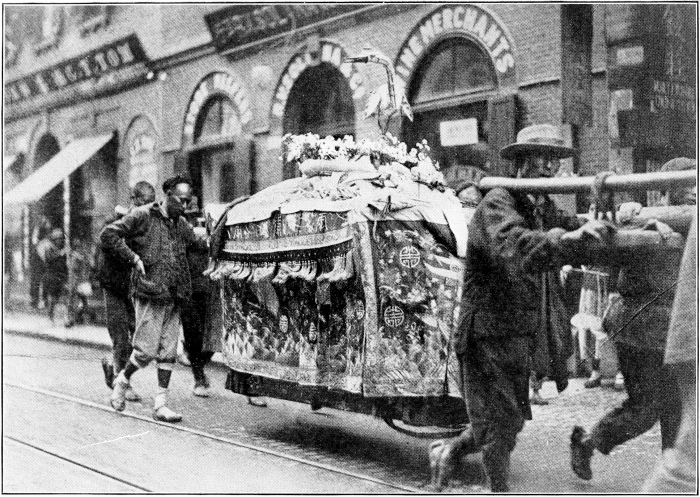
THE COFFIN IN A FUNERAL PROCESSION
The ultra-stylish dress of the “fast set” among young women in Shanghai is tight trousers, short tight jacket with short tight sleeves, and very high collars. To Western eyes this is neither pretty nor modest, and Chinese from the interior look upon it askance. Instead of bare heads, girls in winter are coming to wear, not hats, except those who have adopted foreign dress, but worsted caps, usually trimmed with coloured ribbon or artificial flowers. There is a shop on a busy street, called “Love Your Country Shop,” which deals largely in these fancy articles. Foreign shoes are also gradually taking the place of the cloth-soled, satin-topped Chinese shoes, and it is a wise change if women are to go much abroad in this city of heavy and frequent rains.
The old-time wedding procession is no longer an every day sight in the International Settlement, though happily for lovers of the antique, still common about the Chinese City. Carriages have to a large extent superseded the gorgeous sedan chairs, draped with embroidered crimson satin, and pale pink silk the orthodox crimson satin wedding gown. Veils are much worn too, and occasionally a very up-to-date bride is decked out in a gown of white silk or satin made in the most extreme Western fashion. More often, however, there is a painfully inartistic combination of Chinese and foreign styles. Little Miss Y. invited her foreign[Pg 162] friends to inspect her trousseau shortly before her marriage. Garment after garment, evolved from heavy brocaded satin, sheeny silks, and gauzy web-like stuffs, was unfolded before admiring eyes. Finally the grand climax was reached when the wedding gown was brought in. The marvelous embroidery on the delicate pink silk evoked “Ohs” and “Ahs” of rapture, accompanied by exclamations such as “A perfect dream,” “I never saw anything so beautiful!” But when a common pink net veil, cheap white imitation flowers and coarse white cotton gloves bought at a foreign department store and plainly regarded as the crowning touches to the outfit were laid beside the exquisite Chinese gown, there were inward groans from the disappointed visitors. Miss Y. wore on the third finger of her left hand a heavy ring set with diamonds and pearls. On her wedding day she would have her band of gold like a Western bride. “You are very fond of the gentleman, of course,” some one asked her. The bright eyes dropped quickly as the low answer came back, “I have seen him only once.” “Were you alone?” “No, my aunt was in the room.” Plainly then, notwithstanding her foreign finery, this was not one of the so-called present day “liberty girls.”
The case of Miss W. was quite different. She and her fiancé had met and fallen in love in the good old-fashioned way. They were married by the bride’s father, an Episcopal clergyman, who, being tall and well-favoured, made a rather imposing figure in his priestly robe. After he had walked in and taken his place inside the chancel, a church warden to the strains of[Pg 163] Lohengrin’s Wedding March ushered up the aisle with due ceremony the groom and best man. That done, they were left standing for fully ten minutes. The wedding march was played and re-played, the party at the altar shifted and turned while the audience craned their necks till they were sore in an effort to catch a glimpse of the incoming bride. What was the matter? Was she sick? Was she panic-stricken? Had an accident befallen the wedding dress? None of these calamities had overtaken the girl, who was dressed and ready to follow her fiancé into the church. But ancient marriage customs in China prescribe that a bride must be sent for again and again by the groom before, with tears and great reluctance, she is at last persuaded to leave her home. Although this was a modern wedding, it would not do to disregard wholly the time-honoured practice, hence a proper interval was allowed to elapse before the bride made her appearance. During the ceremony outbursts of laughter several times proceeded from the Chinese guests, many of whom had evidently never witnessed a Christian wedding and to whom the plighting of the troth and other passages were highly amusing. The bridal couple was not in the least disturbed by these demonstrations any more than when the warden from time to time stepped forward and taking one or the other by the arm, turned them around, or jerked them into proper position. Soon after the conclusion of the ceremony the bride retired and removed her veil, which was doubtless an uncomfortable if stylish appurtenance of which she was very glad to be rid.
[Pg 164]
Sometimes embarrassing situations are created because the young people are attracted to modern ways while their forbears much prefer the old. This happened recently when a law student just back from America married the girl to whom he had been betrothed before he left home. The bride wore a white satin gown with slit hobble skirt and fish-tail train, veil, kid gloves, slippers, and carried a shower bouquet. All was as modern as it was possible to have it, but at the last moment the groom was thrown into a state of great perturbation because of the refusal of his parents and their old-fashioned friends to attend the wedding. In his desire to have every arrangement conform to Western ideas he had omitted to send conveyances for his relatives, according to immemorial Chinese custom, and they were so incensed by the omission they refused to stir from their homes, although abundantly able to hire carriages or sedan-chairs as they might prefer. At the last moment, with the greatest difficulty, a sufficient number of vehicles was found and hurried off to bring the families to the wedding, but so offended were they that it required the utmost persuasion to induce them to come.
A Shanghai bride not long ago was taken to task by her friends for daring to show a glad countenance. “Don’t you know it is a bride’s duty to be sad and cry? Instead of that you look really happy,” they cried. “I am happy, and why shouldn’t I look so?” she replied with fervour. But the high-water mark of self-assertion was reached when a Shanghai maid, the daughter of wealthy parents, declared that her acceptance[Pg 165] of her suitor depended on whether he was willing to shave off his beard, to which demand he promptly and meekly acceded. Truly the order of things changeth in old China!
Shanghai has something of which no other city in China can boast, and that is a Nuptial Hall. Contracting parties who wish a modern wedding but have not homes suited for it may rent this building. It contains a guest hall, banquet room, and bed chambers, all nicely furnished. Here the newly wedded pair can remain if they choose, for a few days of their honeymoon or arrange for automobile or carriage to take them away at once.
Occasionally a clash occurs between customs past and present which results in tragedy. A while ago a youth and maiden, both teaching in a government school in Shanghai, fell deeply in love. The girl’s father heard of it but objected to his daughter’s marrying because she was the mainstay of the family, and he argued that filial duty required her to continue their support although perfectly competent to shoulder the burden himself. Taking her one day in a small boat to the middle of a deep stream near their home, he demanded of the girl that she give up her lover. When she loyally clung to him her inhuman parent threw her overboard and let her drown before his eyes. A few years ago a deed like this would have attracted little attention. “The girl belonged to her father and it is nobody’s business what he did to her,” would have been the popular verdict. But it is not so in Shanghai to-day. The papers were full of the awful crime, the broken-hearted[Pg 166] lover carried the case to the Chinese Court, and so great a stir was made that no one will dare to repeat such an act, at least openly.
It can not be said that Shanghai has progressed beyond the stage of polygamy. Under the old régime, for a man to take one or many “secondary wives,” as they were called, was a well-nigh universal practice, but it has died out among the younger, educated classes and before long will be forever relegated to the past in the treaty ports. The women themselves are rising up in defence of one another. An interesting instance is that of a man who left a young wife of six months in Shanghai and disappeared for several years. When he came back, bringing a new wife with him, he repudiated the first. Her condition was very pitiful. Being at last turned out on the street by her husband’s relatives after the death of her child, she went to learn tailoring in a Singer Sewing Machine shop. It was at this juncture that the Chinese Woman’s Co-operative Association, composed of some of the leading women in Shanghai, espoused her cause. They distributed broadcast a circular which read: “The legitimate wife of —— is too poor to engage a lawyer. We therefore ask those who sympathize with her to come to her assistance and see that she has justice, otherwise our two hundred million sisters will ever remain under the yoke of the other sex.” This resulted in the case being carried into the court and a fine imposed on the offender of eighty days’ imprisonment, pitifully inadequate yet a move in the right direction, and a victory for the band of progressive women.
[Pg 167]
Funeral ceremonies are undergoing a radical change in Shanghai though not so rapidly as marriage customs. Ancient observances are still held sacred by the majority, and through the streets trail the old-time funeral processions. Some are pathetic in their simplicity, a cheap unadorned coffin swinging from bamboo poles resting on the shoulders of coolies striding rapidly forward followed by a few mourners on wheelbarrows or in ricshas. Others are the long processions of the well-to-do, grotesquely spectacular. First come coolies in a straggling irregular line holding aloft tawdry banners and lanterns, after them priests, bands (often two, a Chinese and a foreign string band), paper images to be burned at the vault and trays of cooked food to be left there, the sedan-chair of the deceased and the carriage he may or may not have owned, quite empty save for a crayon portrait of him standing upright on the seat in the midst of wreaths of flowers and palm leaves, and finally the catafalque concealed under a crimson satin cover and surmounted by an imitation crane which is believed to carry heavenward the released spirit. Behind the coffin, borne by perspiring, hired coolies, the very lowest down in the social scale, for only such can be induced to act as pall-bearers, walk the adult sons as chief mourners. They are robed in white cotton with a strip of sackcloth as a head band or a sackcloth helmet. A sheet, spread out to form the three sides of a square and carried by coolies, furnishes a screen inside of which the men march. Following them in carriages are the widow, the daughters, and other relatives and friends. Even this is a strange[Pg 168] mixture of old and present day usages, for formerly there were no carriages, no brass band, and above all no palm leaves, which in a non-Christian funeral are of course devoid of religious significance. Between the wholly modern funeral and one of this description there are varying degrees of transition. Often a hearse is used whose blackness is hidden under a wealth of bright blossoms covering sides as well as top, so that it has more the appearance of a gala trap than a conveyance for the dead. The Chinese have an inherent objection to sombre effects at a funeral, the mourners wearing white and the draperies being of the brightest colours.
A curious incident occurred recently which is a striking illustration of the way in which old and new customs may be said to elbow one another in their struggle for supremacy. A tired foreigner trying to sleep was disturbed by a persistent clatter of metal instruments and medley of voices close by. Finally in desperation he got up and looked out on the street, determined to locate the noise and if possible put a stop to it. It was summer weather and through the open windows of a neighbouring Chinese house he found himself the half unconscious observer of a strange scene. On the bed lay an old woman, evidently very sick, while a Chinese doctor and several assistants were running about the room with Chinese rattles and whistles, frightening away the evil spirit that had caused the malady. At last he was chased to the court below, where a pause was made, and the impudent intruder politely asked what his wishes might be. Replying that he desired [Pg 169]to visit a neighbouring village he was told he could go, whereupon the relieved family shut and bolted the outer door after paying the doctor a fat fee for his services. This all took place under the very shadow of a group of the most up-to-date Municipal hospitals in Shanghai.
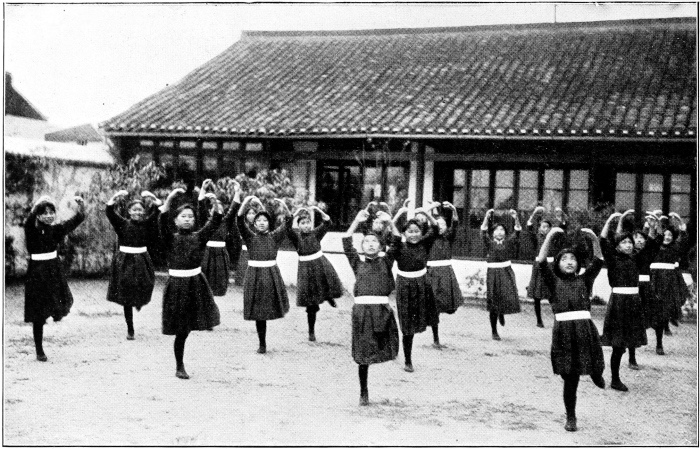
SCHOOL GIRLS IN GYMNASIUM DRILL
One of the hopeful signs of these later days in China is the changing attitude of the people toward physical exercise, for it means better health and better morals for the nation. Not long ago, really only a very few years, round shoulders were by every one highly commended, in the women as indicating modesty and in the men scholarly habits. A girl who held herself erect, with well developed chest, would have been set down at once as bold and forward, and not only that, but any kind of physical exertion was regarded by the upper classes, young and old alike, as coolie’s work and quite beneath their dignity. Some Chinese girls were watching a game of tennis for the first time, when one turned to her companion with a puzzled expression and the remark, “Can’t they get coolies to do that work for them?” Several Englishmen living in the western part of the city were in the habit of rising early every morning for a tramp in the country. The Chinese in the neighbourhood who saw them start out day after day were told the men walked for the pleasure of it, but they shook their heads incredulously, “We know they mean to worship at some secret shrine, for no one in his senses would work so hard if he didn’t have to” A couple of foreigners were crossing Garden Bridge when a troop of Chinese youths went rushing[Pg 170] past with foot-balls tucked under their arms. Said the gentleman laughingly to his companion, “You wouldn’t have seen that a short time ago in Shanghai.” “Why? Because the boys were not playing ball?” “Yes, and neither would they have done such an unmannerly thing as to run. Just now they were so interested in the coming ball game they forgot all about appearances.”
In the spring of 1915 Shanghai witnessed a unique spectacle, something that will go down in history, and deservedly, as one of the great events in the life of the city. It was the Second Far Eastern Olympiad, the first having been held the year before in Manila. The Municipal Council turned over Shanghai’s finest park for the games, and the Young Men’s Christian Association fitted it up with the necessary accessories. No one who was there will ever forget that week. Many foreigners were present, but they were almost lost among the crowds of Chinese, for this was a distinctly Chinese celebration, just as it was meant to be. The élite Chinese turned out as well as the common people, men and women, young and old. Wide-eyed and tense, they watched their countrymen contest with crack players from Japan and the Philippines, and cheered tremendously when again and again the Chinese “won out.” It was good to look upon these lusty youths, who instead of cultivating long finger nails and cramping their chests after the manner of the old-time Chinese scholars, were clad in gymnasium tights, vaulting, running, swimming, batting, while their sires and grandsires forgot themselves and[Pg 171] their traditions so far as to urge them on with shouts of approval.
Shortly afterward, under the auspices of the Young Women’s Christian Association, several hundred girls from mission and private schools gave a physical exhibition of their own. This was not open to the public, guests being admitted by ticket and only a few gentlemen invited. Some of the girls wore modified gymnasium suits, but most appeared in their ordinary school clothes. It was all-important that the conservatives should not be shocked, who were none too friendly to the idea of physical training for their daughters. Mothers, grandmothers, and aunts, their prejudice partly overcome by their curiosity, sat around in crowds on the borders of the grassy campus viewing the exercises, first with indifference, then interest, and at last, genuine enthusiasm. The leader was a young Chinese woman who received her training in Boston. These two events marked a new era in the physical development of Young China and the ravages of tuberculosis have received a check, while good, hard, honest work is understood, by athletes at least, as something not to be shunned as a disgrace.
[Pg 172]
A TYPICAL SHANGHAI WEDDING
IT was the day before the wedding. Downstairs in the home of the fiancé all was bustle and excitement. The marriage dowry, that for weeks had been collecting, was being made ready to carry over to the house of the groom’s father. Articles large and small, useful, and ornamental were scattered everywhere.
First, and most important of all, there was the trousseau. Each suit consisted of three pieces—trousers, skirt, and jacket—made of the same material. They were carefully folded and piled one on top of another in the regulation bridal trunks, which are moderate sized wooden boxes covered with glossy red or brown oilcloth. Though the family was greatly rushed, still as relatives and friends dropped in to watch the proceedings and offer congratulations, the more elaborate costumes were taken out with ill-concealed pride and held up for inspection. And they were worth seeing! Silks, brocaded satins, crêpes, gauzes, ranging in colour from the palest hues of pink, green, blue, and violet, down to rich crimson, dark grey, brown, and even black, lay together in bewildering profusion. Some were delicate[Pg 173] as sea-foam, others handsome but quiet, while the splendidly embroidered ones might well have rejoiced the heart of a princess. The jewels were arranged to show off to the best advantage in numerous small glass-covered cases. They presented a dazzling array—bracelets, rings, buckles, necklaces, hair ornaments. Diamonds, rubies, pearls, sapphires, shone resplendent, but jade was the principal stone.
The bride’s wardrobe, however, though of absorbing interest, was only one portion of her dowry. The rest of the outfit blocked the way in every direction. The usual sets of graded wooden tubs, pails, and chests with conspicuous brass locks occupied the entire side of one room. These were painted either a rich red or brown and highly polished. On the other side of the room the most conspicuous object was a couch or divan weighed down under a huge pile of quilts. No Chinese girl goes to her husband’s home without a collection of bed-coverings. Though differing greatly in number and elegance, always they are of bright colours and folded lengthwise with exquisite neatness. In this case most of the quilts were of the costliest materials, flowered silks, figured satins, with a few gay prints and soft cashmeres for summer use.
In an adjoining apartment was a set of bedroom furniture in carved teakwood, wardrobe, table, chairs, and washstand. The ornate brass bed was of foreign make. The silk curtains and silver ornaments with which it was later to be hung, were temporarily reposing in one of the many chests. Embossed silver teasets of Chinese pattern, silver and ivory chopsticks,[Pg 174] foreign glass finger bowls, gaudy native silver wine cups, bonbon dishes, jewelry cases, hand-painted scrolls, silk banners, later to be converted into gowns for the bride, these were but a few of the riches lavished on the girl sitting apart in an upper chamber, shy, half afraid, wholly expectant.
The list of attractions on this great occasion would be incomplete were mention not made of the trays of edibles, fruits, fancy cakes, and confections of marvellous variety, intended as a gift from the bride’s parents to the family of the groom. On the evening of the wedding day the groom’s parents will return the compliment by sending to the bride’s home a sumptuous repast consisting of cakes, fruit, cooked fowls, fish, and one, possibly three or four, roasted pigs. After roasting the pig is coated over with sesame oil, which hardens when exposed to the air and imparts an appetizing gloss to the skin. The animal is carried through the streets by coolies in a red tray suspended from poles, to the admiration of all onlookers and the despair of the hungry. On arriving at its destination, the upper part of the head, and the tail, with a thin slice of meat attached to it, are cut away and returned to the donors. This is done to insure the uninterrupted bliss of the young couple, since the head and tail of the pig represent the beginning and end of happiness in the lives of the newly wed.
It was no light contract to get such a generous marriage dowry conveyed safely from one home to the other. Early in the morning preparations began, yet by three in the afternoon the procession had not started.[Pg 175] People were flying to and fro. Coolie bearers with long bamboo poles stood around in every one’s way, talking in loud shrill tones. In a side room sat a scholarly mandarin writing Chinese characters on slips of red paper. These were pasted vertically across each chest beside the lock and served the double purpose of announcing the name of the bride and adding to the safety of the contents of the chest in transit, since it could not be opened without tearing the paper. The quilts were fastened securely to the couch on which they lay by an ornamental network of red cord. Smaller articles, placed on box-shaped trays, were in like manner made secure from pilfering fingers. Red paper cards, red ribbon and flowers figured prominently as decorations. As one by one the pieces were made ready they were taken to the street and fastened by ropes to the coolies’ carrying poles. When the long procession was complete and awaiting the order to start, a gayer scene could scarcely be imagined. The bride’s entire dowry, excepting her trousseau, was in full view of curious eyes, that all spectators along the route might be duly impressed with the family wealth. Leading off were two closed carriages (a short time ago they would have been sedan chairs), in each of which sat in state two gentlemen “go-betweens,” whose particular mission at this time was to convey the cases containing the jewels to the home of the groom. But alas for human pride and ambition! Just at the critical moment, when the coachman had whipped the horses into action, the coolies raised the poles to their shoulders, and a tremor undulated down the whole line—a few[Pg 176] drops of rain fell. Then such a scurrying of feet ensued as servants rushed into the house for pieces of oiled cloth to protect perishable treasures! So it was with eclipsed glory that the parade eventually started on its way, to the vast disappointment of all concerned.
On the day of the wedding the centre of interest was transferred from the bride’s home to that of the groom. He lived in a three-story mansion, becoming the rank of his father, who was a high official holding a responsible government position. At the gate of the compound, or grounds, were stationed several Chinese policemen whose chief business was to keep the motley crowd outside from encroaching on the premises. But either they were unequal to their task, or what is more likely, condoned the intrusion of the ragamuffins, for more and more of the nondescript element drifted past the sentinels, till the yard in front was well filled. The arched gateway and main entrance to the dwelling were decorated with flowers and greens, while along the wide veranda was suspended a row of mammoth lanterns, gorgeous with crimson silk trimmings and tassels. At one end of the veranda hung strings of firecrackers, yards and yards in length, lending an added splash of colour to the picture. The house was built around the four sides of a glass-covered court, with galleries on the second and third stories from which the rooms opened. Two bands were stationed in the court, one Chinese and the other Filipino, the latter a contingent from the Municipal Band of the International Settlement. The contrast between them was ludicrous.[Pg 177] The Filipinos in fresh uniforms with shining instruments sat erect before their leader and played with spirit. The ten or a dozen Chinese were of all ages, their rags showing beneath faded red jackets and in their hands a collection of indescribable instruments on which from time to time they blew, pounded and pulled, to the evident enjoyment of all the guests but the few suffering foreigners present. Beyond the court was the reception hall. As it was entirely open in front, its magnificence caught and held the gaze immediately on entering the front door. The walls were ablaze with crimson satin banners, while crimson satin covered the chairs and tables, every piece of it, like the banners, elegantly embroidered. Wedding decorations are rented for the occasion as it would cost a small fortune to buy them. The ground floor was mainly given up to the men, who sat around in the ante-rooms, in social groups, sipping tea and wine, and smoking.
Upstairs the women of the family held court. As guests arrived they were conducted at once to the bridal chamber, a large bright room, decked out with the furniture and bric-a-brac sent over the day before from the bride’s home. The bed was the most striking object, for the white silken curtains were carefully hung, though almost hidden under a glittering assortment of quaint and rare ornaments in wrought silver, nearly all of them possessing some symbolical meaning. The carved teakwood table covered with a heavy white satin spread embroidered in peach blossoms, stood in the centre of the room. So many gifts had been sent by friends to swell the marriage dowry, that the bridal[Pg 178] chamber and room back of it could scarcely contain them all. Frequently next to an exquisite bit of ivory or jade would repose a cheap glass vase or china matchbox that looked as if it might have come from a ten-cent store in America. In an adjoining apartment stood a table set in foreign style. The table-cloth was a strip of coarse cotton sheeting, and on it were placed fancy china dishes heaped with all manner of cakes, fruit, and confections. Even such accessories as knives and forks, and tiny napkins embroidered around the edge in deep blue were not lacking. In the centre was a spreading floral piece of remarkable design. To beguile the time while waiting for the coming of the bride, guests were invited to partake of the refreshments, which they did freely.
The hours passed slowly by. One o’clock had been named in the invitations as the time of the wedding, but three struck and no bride. Four o’clock rolled around and still no signs of her. Indeed, not a Chinese guest expected her, for had the bride made her appearance promptly, she would have been committing a shocking and unpardonable breach of etiquette. Several times, according to custom, the bridegroom had sent his messengers to bring her, but without avail. The bridegroom must go himself. At last, late in the afternoon, the word passed around, amid a wild flurry of excitement, that he was about to set out. He left in a closed carriage drawn by a span of horses with coachman and footman. His two little sisters, flower-girls, in white foreign dresses, pink sashes and hair ribbons, followed in another carriage. The foreign band went[Pg 179] too, on foot, while the Chinese musicians exerted themselves with commendable energy to keep up the flagging spirits of the waiting guests.
The minutes dragged heavily till an hour had gone by. During the interval there were occasional breaks in the monotony. Coolies hurried in with belated wedding gifts, women servants of the bride arrived bearing additional jewel cases, and finally three men walked in, importantly. Two wore Chinese dress, the third one foreign clothes of the best modern cut. It was whispered around that he had come all the way from Peking to act as chief functionary at the ceremony. Presently the bridegroom’s carriage rolled into the compound. The excitement then rose to a tremendous pitch and every one who was not already crowding forward rushed to the entrance and the front verandas. Soon the glad shout arose on every side: “The bride is coming! The bride is coming!” First in through the gateway marched the Filipinos playing a stirring air. Close behind was the carriage of the flower girls, and then came the bride, riding alone. Her carriage on top had the appearance of a flower garden with its elaborate rainbow-coloured trimmings. The horses’ harness too was gaily decorated. But the poor animals were badly frightened when a match was set to the firecrackers and boom after boom rent the air. They reared and pranced, and though a footman held tightly to each bridle, it seemed for a moment or two as if the carriage with its precious burden would not succeed in getting safely inside the gate. By this time the policemen had abandoned all effort to control the street mob, and they poured into the compound, a[Pg 180] gaping throng, in strange contrast to their brilliant surroundings.
The little flower girls, carrying beautiful floral baskets, had tripped lightly to the ground, when an intimate woman friend of the bride’s family stepped forward to open the coach door for the bride. Not a glimpse had been had of her, for the blinds were closely drawn. Very slowly she dismounted as custom required, but had the poor child wished ever so much to hurry, she would have been too seriously hampered by her attire to do so. Delicate satin slippers encased her small though unbound feet. Her gown was of old rose satin, stiff with embroidery. Over her little shapely hands were drawn loose-fitting cotton gloves. Necklaces without number, of extraordinary design, nearly hid the waist of her dress in front, while quantities of gold and jade bracelets encircled her slender wrists. But the most amazing creation of all was the bride’s headgear. It was the time-honoured helmet, worn for centuries back in these parts by Chinese brides, but seldom seen nowadays in Shanghai. Studded with brilliants and coloured glass, and encircled with strings of bangles that fell around and almost concealed the girl’s face, the weight must have been enough to bow down, without any effort to appear modest, the head that had to sustain it. But, O, ye shades of a stereotyped past, what is this grand climax to the bride’s dress which now rivets the attention of the astonished beholder! Can it be? yes, it certainly is—a modern wedding veil of white net, gathered above the helmet in a tuft-like bunch and falling around the[Pg 181] bride to her feet in billowy folds! The towering crown wavered uncertainly, as, guided by her chaperon, the girl moved deliberately toward the house.
Just inside the door she was joined by the groom in a well fitting Tuxedo, but looking about as ill at ease as a man can. Keeping a good elbow’s distance apart, the bridal couple, followed, not preceded, by the flower girls and after them the groom’s relatives, walked across the court and on into the reception hall, where a girl was vigorously pounding out Mendelssohn’s Wedding March on a clanging piano. They stopped a few feet in front of an oblong table behind which stood the three men who had preceded the groom to the house. The bride and groom bowed low to each of the three dignitaries, beginning with the one in the centre, who was the little man in foreign clothes. This gentleman picked up a document written over with Chinese characters, and holding it in his two hands, read from it in a loud voice. After that he handed a ring to the groom, who placed it on the third finger of the left hand of the bride, over her cotton glove. This act was accompanied by formal bows from one party to the other. The bride then received a ring from her chaperon and timidly slipped it on the left hand little finger of the groom. More bowing ensued. At this juncture some little girls came forward, and facing the bride and groom, sang very sweetly, in English, “Jesus Bids us Shine,” a feature of the ceremony introduced by a Chinese Christian friend with the consent of the non-Christian families. At the conclusion of this number, bowing became the order of the programme.[Pg 182] It took the place of the friendly congratulations offered to bridal couples in the West The bride and groom first saluted each other, then the gentlemen who officiated, afterward the parents of the groom, kneeling before them with their heads to the floor, in token of filial respect, and lastly the brothers, sisters, uncles, aunts, cousins, and friends generally. Each group was saluted three times, and bowed three times in return. Those older and higher in rank stood above the couple, but in the case of children the order was reversed. The last to be greeted was an aunt of the bride, the only member of her household that custom allowed to be present. This ceremony was very formal and occupied considerable time. While it lasted the chaperon was kept busy, since it was her duty to turn the bride around, and push her head forward at the proper time to bow.
When all was at last over, strains from Mendelssohn were again struck up, the bride attempted to slip her hand in her husband’s arm, which in his embarrassment he allowed to hang limply by his side, and surrounded by a chattering, pushing crowd, the bridal pair ascended the uncarpeted stairs, soiled with the dust from many feet, and found their way to the bridal chamber. As the newly married always do, they sat for several minutes together on the edge of the bed, then the bridegroom made his escape to the rooms below, where, constraint cast aside, he entered heartily into the enjoyment of the hour. But no such good fortune awaited the bride. Her ordeal had just begun. She rose to her feet while her[Pg 183] girl friends pressed close about her for the usual bantering. “Aren’t you stupid!” “What a hideous gown!” “How ridiculously you behave!” “Whoever saw such an ugly bride!” During this tirade not a muscle of the bride’s face quivered, and the lowered eyes were never once raised. But perspiration stood in beads on her forehead and the soft round cheeks were flushed and feverish, for the thoughtless, teasing crowd shut out the air, and besides, not a morsel of food or a drop of liquid had passed her lips that day.
Seven o’clock brought a respite, for at that hour the wedding feast was declared ready, and the bride escorted by her chaperon returned to the reception hall where the tables were spread. One table was reserved especially for her, and there she was placed in solitary state facing the entire roomful of guests. Not so the groom, who occupied a side table in the midst of a group of friends. The bride’s wedding veil had been removed, but the helmet remained, having assumed meanwhile a somewhat tipsy air, as if the head underneath was too weary to hold it steady or in the merry-making it had been jarred out of its equilibrium. But no hand offered to adjust it, and least of all could the girl herself do so. She sat immovable, her eyes downcast, her face as impassive as a Buddha’s. Dish after dish of tempting Chinese food was put before her, to be taken away untouched. While others all over the room were eating and chattering happily, she continued mute and alone. A break came when the wine was served. Lifting one of the little silver wine cups in both hands the groom passed it to the chief guest, who received it in his two hands,[Pg 184] and after taking a sip returned the cup to the groom. He presented it likewise to each of the principal guests, and last of all to his bride amid an outburst of merriment from the interested spectators. It was then the bride’s turn. Whatever may have been her inner feelings, she betrayed no sign of emotion as she stepped calmly from one to another with the cup and ended by placing it in the hands of the groom, while the guests cheered and laughed uproariously.
With this ceremony the feast broke up but not the wedding festivities. They continued unabated till early morning. During the evening, four of the bride’s brothers came in, but they did not seek her out. The men, including the groom, stayed below to carouse and gamble. Upstairs the young friends of the bride gathered around her once more and prepared for a wild frolic. First, according to custom, they demanded a gift, whereupon one of her woman servants distributed boxes of Chinese confections among them, prepared for this purpose. After that she was put through a series of ridiculous performances for the amusement of her persecutors, such as crawling, hopping, skipping, crowing. When at last dawn streaked the sky and the house lights went out with the departing guests, is it a wonder that the exhausted little bride of eighteen sank down on the nearest couch and cried herself to sleep?
[Pg 185]
FOREIGN PHILANTHROPIES
A BISHOP visiting in Shanghai said he should sometime like to write a book on the “cries” of China. It would make interesting reading. The cries are many and diverse. Most coolies, for example, whether on land or water, work to the accompaniment of a rhythmical chant, and though the poor fellows, carrying heavy burdens, fairly gasp in their effort to continue the vocal exercise while under the strain of physical exertion, they seem unable to proceed without it.
In the early days, when foreigners first settled in Shanghai, it is related that house servants, as they carried food to and from the table, indulged in the usual monotonous sing-song till the distracted diners peremptorily put a stop to the habit.
But of all the cries known to China, the most pitiful is the cry of the children, the sharp insistent wail of suffering childhood that ascends night and day all over this great land. Had Mrs. Browning visited the Far East she would surely have been impelled to pen another noble poem on the “Cry of the Children” whose pathos would have pierced the heart of the world. Many people believe slavery in China is a[Pg 186] thing of the past, as a multitude imagine foot-binding is no longer practised. It is true that edicts from time to time have gone forth abolishing slavery, but they have not been enforced and old customs die hard. The most that can be said is that this hydra-headed monster no longer stalks abroad as openly and unchallenged as formerly, though that the evil exists no one who knows conditions can for a moment deny.
Out from the centre of the noisy city, where the fields are green and the air pure and fresh, stands a substantial red brick building. The presiding genius is a sweet-faced, motherly woman in the garb of a Protestant Episcopal deaconess. “Is this the Slave Girls’ Refuge?” asks the visitor. “It is the Children’s Refuge.” Then, with a deprecatory smile, “We are leaving the word ‘slave’ out now because we want to do all we can to help the children forget their sad past.” The house is plain, not a dollar wasted on ornamentation, and filled to overflowing. Built to accommodate seventy-five, last year a hundred and fifty-six were crowded into it. Little cots line the upper verandas, and the superintendent’s bedroom is turned into a day nursery for the smallest tots. “You surely ought to have one spot you could call your very own,” exclaims the half indignant visitor. “I should find it restful and pleasant, but with my big family I can’t manage it,” and the ever ready smile again illumines the kind face.
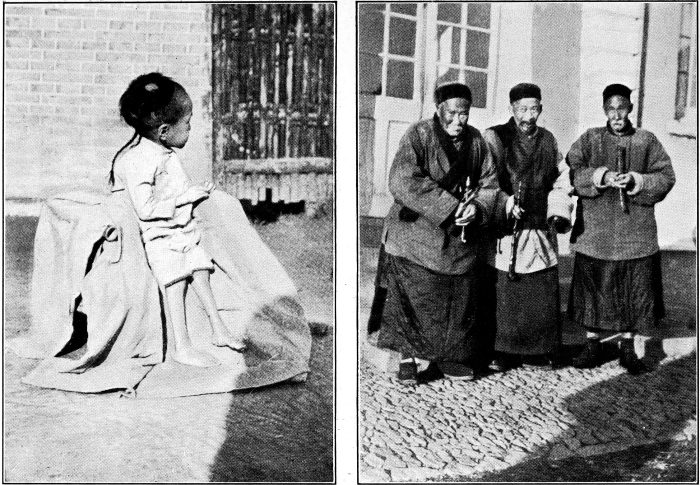
RESCUED CHILD JUST BROUGHT TO THE CHILDREN’S REFUGE
OLD MEN AT THE HOME OF THE LITTLE SISTERS OF THE POOR
This work, which is undenominational, was started by a band of Christian women after the upheaval of 1900, although the present building was not occupied [Pg 187]till ten years later. Now, in so short a time, it has been outgrown, and the need for an addition is imperative. The children range in age from three to twenty, for some have been in the Home a long time and developed into useful assistants. Most of the little ones are rescued by the police, who take them to the Municipal Mixed Court, and from there they are turned over to the Refuge. And what eventually becomes of these waifs? A few are returned to parents from whom they have been stolen, others are adopted by families or mission schools, while a large number die, too weakened because of ill treatment to resist disease. Occasionally there is a simple wedding at the Refuge and a girl goes out from it to a home of her own. Shanghai is a great slave market. Children are sent and brought here from all over China, kidnappers having a large hand in the shameful trade. Parents frequently sell their own offspring, for there are many mouths to feed and rice is often very, very scarce. Only girls are slaves. They become the property, body, mind, and soul, of their owners, who may do with them as they like. Their pitiful little life stories are almost too harrowing to repeat. A baby of five had its flesh pinched with red-hot irons, another of six was tied to a post for days without food, having had hot needles run under her nails. One was three times buried alive. A mite three years old, nearly dead from neglect and starvation, weighed only ten pounds when brought to the Refuge. A doctor counted on the body of a bleeding child two hundred and forty cuts, burns, and bruises. One was brought in with an arm twisted[Pg 188] out of shape and an eyelid nearly torn away. A little slave, after repeated beatings that almost crushed the life out of her, was thrown by her mistress on an ash-heap to die. When rescued and sent to the Refuge her mind seemed clouded. She took scarcely any notice of her surroundings, but if any one approached her the poor child shrieked in terror. “You are going to kill me! I know you are going to kill me!” “A few weeks later,” said the superintendent, tears filling her eyes as she told the story, “the little thing was following me around everywhere, repeating softly to herself, ‘Jesus loves me, Jesus loves me.’” How the superintendent with her great warm heart mothers her flock! The more marred, feeble, and wretched they are the more her love surrounds them. And it is most wonderful how these little bruised, neglected plants, blossom out under her tender care. Until recently she was the only foreigner in charge of the work. While so many others flit away in the fierce heat of summer for a breath of cool air, this faithful worker remains, season after season, at her post. “I can not leave the children,” she will urge. But she asks no one’s commiseration, for a happier heart is not to be found in China.
There is a shelter called “The Home for Waifs and Strays” at quite the opposite side of Shanghai. It gathers in a somewhat different class of children, not many slaves, but outcasts, down to new-born infants picked up on the street by the police. Many of the children are mentally deficient and some suffer from incurable diseases. A devoted Christian woman is at[Pg 189] the head of the Home, which receives its support from the Municipal Council, by whom the work was inaugurated several years ago.
A new building has just been completed close to the Children’s Refuge, which so long stood entirely alone in the midst of cultivated fields. It is the home of the School for Blind Boys. No charity is more appealing in a country where diseased eyes, leading to partial or total blindness, are so fearfully common. The school opened its doors only three years ago in a rented house, yet the mental development of the boys has been most remarkable. There is certain to arise soon an insistent demand for blind teachers for the blind, and the purpose of the school is to give their boys a general education which will qualify them for that work. It also has a growing industrial department, and the Blind School, like the Children’s Refuge, is in part supported by the sale of its products. The plan is later to establish on the same site a similar school for girls.
One of the best known institutions in Shanghai is the Door of Hope. As the name implies it is intended to succor girls bound by a slavery the most cruel of all. No other city in the country contains as many brothels as Shanghai. It is often called the Sodom of China, and is known to many of the native Christians away from the coast only as the Far Country of the Prodigal Son. Sadly enough, the presence of degenerate foreigners is largely responsible for the sin laid at the gates of the gay metropolis.
It is safe to say that the majority of Chinese girls found in houses of ill-fame are there through no fault[Pg 190] of their own. Kidnappers dispose in this way of many of the children they have stolen. Often parents, particularly in famine times, sell their little daughters, choosing in their ignorance such a fate for them rather than to see them die of starvation.
The “Receiving Home” is in an alley-way just off Nanking Road, which is the Piccadilly of Shanghai. Several years ago a few philanthropic and influential Chinese gentlemen succeeded in securing from the International Municipality the passage of a law whereby a notice was placed in each brothel telling of the Receiving Home and how to reach it. Another law was passed at the same time prohibiting brothels from accepting girls under fourteen. Both of these statutes have gradually been allowed to become dead letters, and little or no attention is now paid to them. A rescued girl stays in the Receiving Home only over night, or until her case is brought up in the Mixed Court and she is committed to the Door of Hope. This building is in the outskirts of the city, far removed from the crowded, dangerous district with which the girls have grown too familiar. For obvious reasons, although all are under the same roof, it has been found wise to separate the first-year girls from those of the second year. This charity is supported by grants from the Municipal Council together with voluntary gifts and the sale of industrial work. The Door of Hope dolls are famed far and wide. The little wooden heads, beautifully carved, are the only parts of the dolls not made by the girls. Shanghai firms gladly donate in abundance bright-coloured scraps of silk, satin, and[Pg 191] cotton cloth. The dolls are dressed to represent all grades and classes of society, and a set, consisting of sixteen, is of real value educationally.
The first-year girls spend the morning in study and the afternoon in work. They begin by learning to make their own clothes, cloth shoes and all, then when the tailor’s trade has been thoroughly mastered, they are set to dressing dolls. For this work a slight compensation is given which acts as a spur and encouragement. The second-year girls are busy all day at their embroidery frames with a little schooling in the evening. They receive regular pay and are expected in the main to clothe themselves. The embroidery is exquisitely fine and dainty and there is a constant call for it, both in and out of Shanghai, especially from prospective brides and mothers. In the long, cheerful work-room, lined on both sides with windows, the sixty or more girls of the second year gather each morning at eight o’clock for prayers. Half an hour later, the embroidery frames are laid out on small tables, and materials unrolled to the accompaniment of happy chatter. When all is in readiness to begin, a sudden hush falls on the room, as some one points to the text for the day on a Scripture calendar hanging on the wall. This is repeated in concert, followed by a brief prayer from one of the girls. It is a sweet custom and seems to give just the right start to the day. The calendar is compiled annually by a Chinese woman living in Shanghai.
It is not necessary to ask if the girls are happy. Their bright, contented faces show that. Few are inherently bad. Only once in a long while some one tires of the[Pg 192] quiet routine and revolts or runs away. But it is natural that they should crave change and the sight of a face from the outside world is eagerly welcomed. Noticing this, a foreign lady living in the neighbourhood once asked the girls in relays to her home for afternoon tea. The day the first-year girls were present, one of them, pointing to the piano, turned to the missionary in charge with the question, “What is that black box?” It was explained to her that it was a musical instrument, and when later it was played upon, the delight of the girls was unbounded. An American visitor was so touched by the incident that she secured for the Door of Hope the gift of a splendid victrola which, being a thing of beauty, is likewise sure to prove a joy forever.
Most of those who enter the Door of Hope, after a few months or a year, become earnest Christians, and sooner or later are married to Christian men. In China it is considered no disgrace to marry a fallen girl, provided she has changed her way of living. One girl who was recently married to a minister made such a favourable impression on her husband’s friend that he went to the Home begging that he be given a wife just like her. “But how are these poor girls for whom often a very large sum of money has been paid, rescued from their owners?” asks the puzzled caller. Ah, it is here that a ray of light streams through the darkness. There is a law in China, yes, and a very old law too, that no woman can be made to lead a life of shame against her will. If she has a chance to express herself in court, she may choose the[Pg 193] better way, and no one is allowed to oppose her. The difficulty is to escape from bondage and secure the chance to voice a protest. Besides, many are too young to speak for themselves, like the baby of three, who the other day was carried to a brothel in the arms of her own father and offered for sale. The keepers prefer to buy very young children, as they cost little and can be used as singing girls during their early years.
Five miles out from Shanghai, in a pleasant farming district, is the children’s branch of the Door of Hope. In this beautiful protected spot, a hundred and sixty little ones, snatched from the horrible pit in which they had been thrown, live happily together. With the blessed forgetfulness of childhood, the past soon fades into indistinctness, till it is well-nigh effaced from their memory. The cottage system is in vogue, and the big family is divided up into groups of about twenty. Each cottage has its house-mother, one of the older, trusted girls from the City Home, and all are under the care of two devoted foreigners. The hours are filled with house-work, studies, simple industries, gardening, play. If a girl shows special aptitude, she is sent in time to a mission school, where the curriculum is broader and better adapted to her largest development. As soon as the children are old enough, they are trained in evangelistic work, such as teaching in Ragged Sunday-Schools and holding village prayer meetings. Practically every one ripens into a genuine little Christian.
Two of the most striking philanthropies in Shanghai are conducted by the Roman Catholics. If there[Pg 194] is a class of society that draws on one’s sympathies even more than friendless children, it is friendless old people, since their capacity for conscious suffering is greater. A most admirable characteristic of the Chinese is their usually kind treatment of the aged. Filial piety shines its brightest in poverty stricken homes, where real sacrifice is required to provide for the parents, who are often much better able to care for themselves than their children are for them. But very many are left alone in the world without food or shelter, or money to buy a coffin in which they would so gladly lie down and die.
The Catholic Home for indigent old people is popularly known by the name given to the Sisters of Charity in charge of it, “The Little Sisters of the Poor.” The capacious three-story building shelters a hundred and fifty old men and as many old women, which is all it will hold. But as fast as any die others are ready to take their places, for there is always a long waiting list. The only conditions of admission to the Home are that the applicant must be over sixty and wholly without means of support. Most of those taken in are seventy or more. One might easily imagine that a place like this, which gathers under its roof so many old people, whose lives for the most part have been spent in the midst of poverty and filth, and with never an idea of cleanly habits, would be anything but inviting. Yet it is a sort of Eden, not a speck of dirt on the well-scrubbed floors, not a bad or even a close smell in the big airy rooms, not a spot on the white bed curtains and pretty patch-work[Pg 195] coverlids made by the old people from the scraps sent in from the shops. And as for the inmates enjoying themselves, why the faces of the dear old souls fairly radiate happiness! They are allowed tobacco and plenty of tea and chatter like magpies over their pipes and cups. In order not to make life under the new conditions terrifying for them, a weekly bath is not insisted on, but clean, neatly mended garments are donned every Sunday morning. When sick, the simple-minded folk are attended by old-fashioned Chinese medicine men, instead of foreign trained doctors whose new-fangled ways the patients would spurn. All who are able to work have regular duties, spinning, laundering, tailoring, nursing. The women’s quarters are on one side of the building, and the men’s on the other, with the chapel between them. “Yes,” says the Sister Superior, stopping a moment as she passes in front of the altar to kneel and make the sign of the Cross, “the chapel is in the centre, so you see it is God who divides and God who unites us.” Several of the Sisters are Chinese, and one round-faced novitiate works in the kitchen, where the shining brass and copper vessels call to mind “Father Lawrence” and his immaculate domain. No Chinese girl can enter as an “aspirant” to the privileges of sisterhood, unless she belongs to the third generation of Christians.
Shanghai’s great show-place is the Catholic institution at Siccawei, a suburban village named after the Jesuit missionaries’ patron saint. No one coming to the city willingly leaves without seeing it, certainly not if the visitor is a woman. For the laces and embroideries[Pg 196] made under the direction of the French Sisters are the very quintessence of artistic loveliness, and the salesroom is seldom empty.
More than fifty years ago, at the close of the T’aiping Rebellion, the Jesuits, after many persecutions and vicissitudes, returned to Shanghai, from whence they had fled, and settled at Siccawei. There they began a small work, which has steadily grown till it has reached almost gigantic proportions. Clustered about the Cathedral, glaringly modern and capacious, whose tall spires are a landmark in all the country round, are the old church, a men’s college and theological seminary, observatory, museum, orphanages, schools, and industrial plants. The women’s and girls’ buildings are on one side of a tidal creek, and those of the men and boys on the other. Asked some question by a stranger about the boys’ work, the Sister addressed replied in a tone of finality, “I can’t tell you. I know no more about what is going on over there than you do.” Each Sister is assigned her own duties for which she is responsible, and gives herself to them exclusively. There are fifty Sisters, more than two-thirds of whom are Chinese. The spirituelle expression seen sometimes on the faces of these Chinese recluses, is most remarkable. The foreign Sisters are all French. No one can doubt their devotion. They take no vacation; they never go home on furlough. Several have been at their posts over forty years.
It is a large household the Sisters have under their care, averaging in number seventeen hundred, but the work is so divided and runs with such systematic regularity[Pg 197] that there is no suggestion of friction or confusion. First in order come the foundlings. Each day, tiny, new-born babes are brought into the Home, or often left at the gate in the darkness of the night. None are turned away. They are washed, dressed, laid in clean little cribs, and as soon as possible baptised with a Christian name in the chapel on the premises. Many are so frail when they enter, that a few brief hours or days end their troubled existence. Next are the day-schools of various grades for Catholic children, the large orphanage, and the boarding-school for non-Christian or pagan children, as the Sisters call them, with playground, dormitories, dining and school rooms entirely separate from the others. In a secluded corner of the grounds live the sixty unfortunates, who are either blind, crippled, or mentally deficient. Their chief occupation is spinning cotton by the aid of crude spinning wheels, something the dullest are found capable of learning to do.
But it is through its industrial department that Siccawei is best known to the general public. Hundreds of women are employed in making lace and embroidery, most of them having been reared in the Home, and married from it to Catholic husbands whose earning capacity is insufficient for the family needs. A day nursery and school is maintained for the babies and young children of the employees. The work rooms are of enormous size and well lighted. In the centre of each one, on a raised platform, sits a Sister, overlooking the women. The proceeds from the sale of work are very large.
[Pg 198]
The industrial plant for the men and boys, on the other side of the creek, is even more elaborate. It includes many departments, wood-carving, carpentry, shoemaking, work in iron and brass, glass-blowing, painting in oils and water colours, and a printing establishment. The genial Father in charge of the wood-carving and carpentering, is in his line a genius. Some of the work turned out under his supervision is wonderfully beautiful, and ranks among the finest specimens of Chinese art sent to the Panama Exposition. The youngest apprentices, lads of ten or twelve, begin their industrial training by making little coffins for the foundlings across the way. “Yes,” Father B. is in the habit of remarking, pointing to the boys with a smile, “they start in life where others leave off.” The Siccawei Mission is self-perpetuating within the limits of its own constituency. Growth comes through the ever inflowing stream of helpless humanity. But no effort is put forth, either by the missionaries or Chinese communicants, to reach the unevangelized masses. Formerly this work was subsidized from France, but it now depends for support wholly on the sale of its industries and voluntary contributions.
All Shanghai philanthropies from time to time receive liberal donations from the Chinese themselves, many of whom understand and genuinely appreciate what is being done for their people. The recent founding of the Society of Organized Charities (Protestant) has aided greatly in carrying on systematic work in behalf of the deserving poor.
[Pg 199]
CHINESE SUCCESSES IN SOCIAL SERVICE
SEVERAL years ago a company of lepers numbering about forty, living in one of the southern provinces of China, were driven from their miserable shacks and burned alive. When the official by whose order the atrocious deed was committed was called to account for it, he excused himself by saying that since the lepers were public nuisances, mere cumberers of the ground, he decided that the sooner they were out of the way the better. Such was his idea of social service and he represents a class in China who regard calamities like famine, flood, and pestilence as heaven-sent blessings to relieve the land of its superfluous population. But to the educated youth, touched by the spirit of a common brotherhood, and to the better elements of an earlier generation the incident just related is as abhorrent as it can possibly be to a Westerner.
Philanthropy of a certain kind is not new in China. Almsgiving for the sake of winning and storing up merit is centuries old. But galling poverty, the fierce struggle for existence, strange customs and superstitions, have all contributed to deaden the sensibilities and quench the naturally kind impulses of the heart.[Pg 200] For example, to care for a man lying sick by the roadside means to the rank and file that the Good Samaritan brings down on his own head the ill-luck that followed the poor unfortunate, and to carry him into his house to die involves not only the obligation of paying for his coffin and burial, no small matter in China, but of answering to his relatives, if he has any, for his decease. Not long ago in the Chinese City a humble dwelling-house took fire and quickly burned to the ground. The family barely escaped with their lives, a mother with a new-born baby, and a troop of older children, one of them sick. The father was away, presumably at work. A missionary passing through the narrow street saw the poor things huddled together in a forlorn little group and her heart was stirred with pity. “Why don’t some of you take them home?” she asked of the crowd looking on. “Her husband is coming, we must wait for him,” they answered. An hour or two later, on returning, the lady found the family in the same spot, the woman weak and weary, pressing her infant to her breast. A cold rain was falling. “If you don’t give these people shelter I shall take them home with me,” she exclaimed indignantly to a bystander. “The husband will be here soon, we dare not interfere,” he said in tones of sharp decision. The next morning, unbelievable as it seems, the woman and her children were still on the street, unsheltered and uncared for. At once they were hurried to the mission hospital and tenderly nursed. Then, and not till then, did the real truth in the case come out. Had any one befriended these outcasts, the evil spirit that caused[Pg 201] the destruction of their house, would in anger have entered the home of their benefactor and wrought disaster. Hence the only safe course, since they had incurred the displeasure of the gods, was to let them severely alone. Yet to offset this circumstance is the sweet story, and by no means an isolated case, of the old Chinese grandmother, who when a little foreign babe was rescued from drowning, but chilled to the marrow and ready to die, quickly opened her padded coat, and pressed it to her warm bosom, till it revived, thus saving its life.
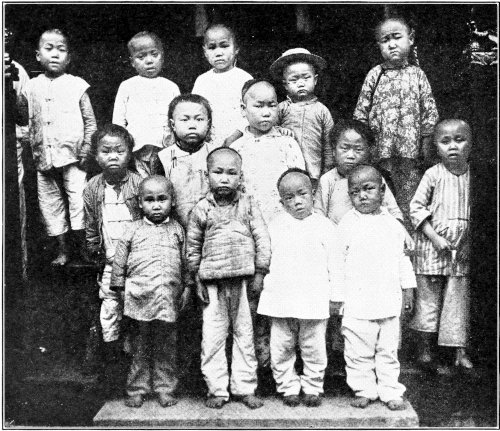
RESCUED KIDNAPPED CHILDREN AS THEY WERE PHOTOGRAPHED
FOR ADVERTISEMENT IN THE CHINESE DAILY
NEWSPAPERS
The recent revolution ushered in many innovations, but nothing that is destined to result in larger good to China than the practice of social service as understood in the West. The idea has met with a quick and enthusiastic response by the Chinese, Christians, and non-Christians alike, and is already yielding notable results in many places. “Why should we not do for ourselves what foreigners have so long been doing for us?” the leaders are asking one another, and hospitals, orphanages, model prisons, refuges, industrial plants, are rising up here, there, and yonder, till it is scarcely possible to open a newspaper without reading of some new project afloat. In progressive Shanghai social service is fast becoming a slogan. An unusual opportunity is afforded here of contrasting the old style of philanthropy with the new, and the study is valuable as well as interesting.
The local Charitable Society that antedates all others has its headquarters, known as The Hall of United Benevolence, in the Chinese City. Its exact age is[Pg 202] difficult to determine as no one seems to know. Some say it has as many as three hundred years to its credit. A managing board of ten men, with offices in a Chinese house of spacious dimensions, does the business of the Society, which is very wealthy, owning large tracts of public land. Its chief work is to donate lots to philanthropic institutions, furnish coffins to paupers, subsidize various existing charities, and dispense free of charge Chinese medicines. This Association is held in the highest regard by all classes of Chinese, and may be called the fountain-head from which most of the existing charities have sprung.
One of the older philanthropies, started more than fifty years ago, is the Home for Widows in the Chinese City. It receives widows without money or relatives to support them, who have determined not to re-marry, a most praiseworthy resolve according to Chinese standards. The house-mother, an old woman of seventy, delights to tell that she has been an inmate of the Home for forty years, and certainly the bright-eyed, rosy-cheeked dame is as good an advertisement as the place could have. Widows with young children are allowed to keep their little ones with them till the girls are betrothed and the boys able to go out to work. In the meantime they are sent to day-schools in the city. A family of three hundred is crowded into the rambling old house, the gift of a former governor, which consists of a series of small courts shut in by low two-story buildings. Each woman has her own little room, or perhaps more than one if her family is large. The premises are fairly neat, but what troops of children[Pg 203] swarm around, noisy and undisciplined, and as a Chinese caller once pointedly remarked, “How the women must quarrel!” Their salvation evidently lies in their industrial work, for while food and shelter are given them, the able-bodied are expected to provide their own and their children’s clothes. So they spend their days making articles which are sold and yield a slight revenue, chiefly Chinese shoes, idol money, and clothing.
The Widows’ Home, despite its limitations, commands a degree of genuine respect, but not so the two Foundlings’ Homes that awaken only pity and almost fierce resentment. They are meant to do good, yet alas, what a travesty on the real thing! The institution inside of the Chinese City is the oldest philanthropy in Shanghai and dates back to 1710. From the Hall of United Benevolence that fosters it an occasional report goes forth telling about this work. The reports are written in the usual florid Chinese style, and after describing at length the virtuous motives of the founders and supporters, give the rules governing the organization. For instance the age of each child is registered, a note made of its appearance and condition, also “of the lines and fashion of its fingers, five senses and four limbs.” Wet nurses are made to draw lots for the babies in order to avoid partiality. Close to the street entrance is a perforated drawer in which the foundling is to be left. The one who brings the baby must rap on the door with a stick that hangs beside the drawer to announce its arrival. These and many more minute directions are recorded with painstaking elaboration.
[Pg 204]
They read well, but what are the facts? It requires considerable tact and insistence for a visitor to gain access to the inner rooms of the Home, where the real life of the babies is dragged out. Two or three of the well-favoured will be brought in the arms of nurses to an outer court, but when permission is asked to go inside there is evident reluctance and many excuses are offered. Sometimes the only sure open sesame is the official card of the City Magistrate. Apparently no cruelty is practiced, but it is the gross ignorance and negligence of the caretakers that makes so pitiable the brief life of the babies, for most of them die after a few weeks or months. Each wet nurse is given the charge of two foundlings. The nurses may remain at the Home or if they prefer take the little ones to their own home, in which case they receive somewhat larger pay. If a sufficient number of wet nurses can not be secured, the foundlings, irrespective of age, whether a few days or several months old, are fed on rice water sweetened with coarse brown sugar. Scarcely any reach the Home in a normal condition. Diseased, weak, bruised, one coming with a terrible gash in its neck given with intent to kill, the death-knell of the puny things is generally sounded before birth. The rooms where they are kept are small, and as a rule almost devoid of light and air. In one of the Homes even through the heat of a Shanghai summer the babies not only sleep in stifling rooms but on beds surrounded by closely-woven cloth curtains. In the other Home they lie the long day through in bamboo cribs, their little bodies eaten with flies and poisoned with mosquitoes. The[Pg 205] chorus of feeble wails that constantly arises pierces the visitor’s heart, as does the sight of the tiny skeleton-like limbs. With scarcely an exception the fifty babies in each of the Homes, and the far larger number that are put out to nurse, are girls. Just one thought comes as a slight comfort, that wretched as is the condition of the children they are certainly quite as well, or even perhaps better off, than they would be in their own homes. No wonder physicians in China say the mortality among children reaches as high as seventy or eighty per cent.
In happy contrast to these Homes, is the Hospice of St. Joseph, which has gathered into its safe shelter nearly eleven hundred of Shanghai’s sick and poverty-stricken Chinese. But the story is too good not to be told from the beginning. Four years ago two Christian men, members of the Catholic Church, determined to found a philanthropic institution. One holds several highly responsible offices in the Chinese Municipality. The other is a successful business man. Many of the tramcars in the International Settlement, and all of those under Chinese control, were turned out from his foundry. His snug steamers ply the waters of the upper Yangtse as far as Chungking, conquerors at last, after many futile efforts, over the difficulties presented by the dangerous rapids. He subscribes for American journals on mechanics which he studies diligently through an interpreter, and after absorbing ideas gleaned from them, invents and adapts machinery for use in China. It is his desire to see Chinese farmers follow improved methods of agriculture, and to encourage[Pg 206] them he occasionally presents a village with a modern threshing machine made in his foundry. His Sundays are frequently spent in evangelistic work in the country, and busy man that he is, he makes it a practice as often as possible to leave his work and go to the Arsenal to pray with condemned prisoners before they die. Recently the President honoured him with a medal rarely bestowed, and all who know him, Protestant and Catholic alike, pronounce him a “rare character.”
The land for the Hospice was donated by the Charitable Society of the Hall of United Benevolences, and the Chinese Municipality gave bricks (those bricks seem to multiply miraculously!) from the old city wall for building material. The colony includes a men’s hospital, a women’s hospital, a home for boys, a refuge for girls, an asylum for the blind, a chapel, dispensaries, kitchens, quarters for the insane, for opium patients, and prisoners from the jail in the Chinese City. These buildings are already completed and others are projected. While the two founders direct the business affairs of the institution, they have given the care of it to twelve Sisters of Charity, four of whom are Europeans and the rest Chinese.
The upkeep of such a great establishment, under the conditions that exist in China, is no small matter, but the next to impossible has been achieved and the management is well-nigh beyond criticism. The long, light airy wards, with every cot filled, are visited each morning by a foreign-trained Chinese physician, who donates his services. On the second floor of the men’s hospital is a beautiful white-tiled operating room, with all the[Pg 207] latest equipment. There are industries, indoors or out, for those able to work. Children study half a day. Incurables and old people without support are kept on for life, but the strong and middle-aged are sent away from the institution as soon as they are well to make room for others. It is a joy in this land, where the insane have been so long neglected and maltreated, to find a retreat prepared for them where they receive the kindest consideration. The consequence is that many after a few months go home cured. Every cement-lined cell is protected in front by iron bars, so that the door can be left wide open, admitting light and air. A door at the back of each cell opens into a narrow corridor which leads to bathrooms with large earthen tubs and running water. Several of the cells are neatly padded to accommodate violent patients. This place and the prisoners’ wards next to it, as clean and wholesome as heart could wish, are in charge of a Christian young man of tried character.
In addition to the Hospice, its two large-hearted founders have built, on a much frequented street, a three-story Evangelistic Hall. Said the elder one, “We want it to be a place where any passerby and especially strangers in the city, can stop a while and discuss the Christian doctrine.” There is a day school for boys in connection with it.
Out in the neighbourhood of the old pagoda, set in the midst of blooming peach orchards, is a large orphanage for both boys and girls. This also is a Christian institution, but Protestant, and was started eleven years ago by a group of men, several of whom had studied[Pg 208] in mission schools. The boys and girls are in separate though connecting compounds, and a happier, merrier lot of young folks it would be hard to find. Much is made of Bible Study, and industrial work among the boys is strongly emphasized. The sale of their rattan furniture, painted scrolls, cloth and hot-house flowers, especially at the time of their annual chrysanthemum show, goes a long way toward meeting the current expenses of the work.
On the same road as the orphanage, but nearer town, is “The Shanghai Home for Poor Children.” This is not Christian, but it is one of the most interesting and best conducted institutions in the city. A few influential business men are its promoters, Chinese with high ideals and broad vision. There are in the Home about twenty girls and a hundred boys, many of them waifs picked up on the streets by the directors themselves. A peculiarity of this institution is that the children do not use beds but sleep on the floor in great breezy dormitories where there can be no question of well-inflated lungs. The school has a famous orchestra, and a picture that catches the eye at once, on the wall of the reception room, represents the band members, girls as well as boys, sitting with their instruments in their hands on the platform in the main hall. This Home is characterized by two unique features, one, that the old-time Chinese boxing and fencing are taught in the fine out-of-doors gymnasium, and the other, the prominence given to agriculture and horticulture as school branches. Indeed this seems to be the only school in Shanghai where agriculture is a study, with[Pg 209] opportunity for practical work in the ample grounds around the institution. In connection with this charity it is worth recording that of the ten members on the Board of Directors five are women. However, they have not advanced quite far enough to join with the men in committee meetings but hold separate sessions. Or possibly it is the men, poor benighted creatures, who are to blame!
It is impossible to lay too much emphasis on the value of industrial schools, and social service can be turned into no more beneficent channels than in starting and maintaining such schools. Until very recently industrial training was wholly neglected in China. Even now, if a Chinese educator is asked, “Are there any industrial schools in Shanghai?” he will answer, “None,” and yet there are at least two and one more soon to be opened. But these, it seems, are not classed as schools, since they admit only poor boys unable to pay tuition, and because the study of books is made secondary. The best industrial school was opened four years ago. Work is carried on in a single large building that is not divided into rooms, but from whose centre apartments branch off in different directions like the spokes of a wheel, all well supplied with windows, thus insuring plenty of fresh air and good ventilation even in the hottest weather. “How many boys have you?” was asked of the head teacher. “One hundred, and I wish I had room for five hundred!” came the reply with surprising earnestness. The boys range in age from very little fellows to lads of sixteen and eighteen. There are industries enough to suit the bent[Pg 210] of each one. They include carpet-weaving, wicker work, soap-making, pottery, portrait painting, the manufacture of kindergarten toys, clothing made on sewing machines, and stockings on knitting machines. The boys work during the day and study in the evening. Their pride is in their brass band and they earn quite a bit of money for the school by playing at weddings and funerals. The third of an acre covered by the school plant was originally a cemetery, and how characteristic it is of China, that in order to secure the land one hundred and thirty-nine graves had to be removed!
One of the commonest crimes in Shanghai is kidnapping. Chinese children, if they are healthy and attractive, need to be carefully guarded. Most of the kidnappers are women, and the nefarious business is so lucrative that a large number are engaged in it. Kidnappers grow bold as well as wily, picking up children at play on the street, or off on errands, and even beguiling or snatching them away from their very doors. Both boys and girls are stolen, though boys are greater prizes, being always in demand as apprentices and adopted sons in families that have not been blessed with an heir, for the master of a house who has no son to burn incense before his ancestral tablet after his death, and to worship at his grave, is of all men most miserable. Still, pretty little girls are always easily disposed of, either in brothels or in private homes as slaves or future daughters-in-law.
Several years ago about thirty public-spirited Chinese gentlemen in Shanghai formed themselves into an[Pg 211] Anti-Kidnapping Society and set to work in earnest to combat this evil. They hired skilled Chinese detectives to meet out-going and in-coming coast and river steamers and arrest all suspicious characters. Cunning as the kidnappers are, again and again they prove no match for the quickwitted detectives, who succeed in rescuing many children. The poor little victims are frequently concealed in baskets of clothing, or hidden away in boxes that ostensibly contain fruit or merchandise. Sometimes two or three will be found crouching together in a single box with only the tiniest holes for admitting air. The very young children are usually drugged, and older ones frightened into silence by the most terrible threats. Five miles out from Shanghai, convenient to the railroad yet in the midst of open country, has stood for years a large Buddhist temple. At the time of the revolution, when so many of the temples in China were abandoned, and put to other uses, this one was leased by the Anti-Kidnapping Society as a Home for rescued children. Stripped of its idols and incense burners, the smoke-blackened walls white-washed, the priests ejected, the old place that so long echoed the mumbled prayers of heathen devotees now resounds with the happy voices of between two and three hundred children. The girls, who are considerably in the minority, occupy the courts in the rear, large and pleasant however, and the boys those in front. The Worship Hall of the temple has been converted into a school and assembly room for the boys. Every day in the Chinese newspapers of Shanghai the Home is advertised, with a description[Pg 212] and photographs of the children most recently rescued. In this way hundreds have been identified by their parents and returned to them. Unclaimed children are kept in the Home, being taught some kind of industrial work until they are able to go out and care for themselves. Ethics is a branch of the school curriculum, but the children are at liberty to accept whatever religious belief they will.
The Chinese gentry in Shanghai maintain several free dispensaries. The largest of these, fronting on a crowded street, has in Chinese characters over one door the motto, “Loving to Save,” and above another “Heaven Bestows Perfect Happiness.” This charity is said to be half a century old and the building itself bears evidence of having endured that long. Every second day the dispensary is open, when patients by the hundred visit it. The dozen or so Chinese trained doctors in attendance are divided into two classes, those treating internal diseases and the others dealing with external troubles. They are separated like sheep from goats, sitting each at his own table, under covered corridors on opposite sides of a court. In the rear of the dispensary is a large workshop where coffins are made and given to the poor.
Seven years ago, when plague raged, an isolation hospital was opened by a well-known Chinese philanthropist in the outskirts of the city. He succeeded in buying the house of a wealthy Chinaman, whose several wives and numerous offspring actually performed the unprecedented feat, for Chinese, of vacating the premises in two days. Wards have since been added to the main[Pg 213] building, so that the hospital will now accommodate about a hundred. Through the efforts of this same philanthropist, aided by a distinguished foreigner, Dr. Timothy Richard, the China Branch of the Red Cross Society was established in 1904 with headquarters in Shanghai. Three Red Cross hospitals are operated in widely separated districts of the city, two of them intended to be used exclusively for cholera patients during the cholera season. One of these had its opening some months ago when the hospital was visited by many influential Chinese and a few foreign guests. Nothing could have illustrated more clearly the progress the people are making in the science of social service. The building is a thoroughly renovated old-fashioned Chinese mansion, with courts and rooms innumerable and the usual lovely carved woodwork, mural decorations and tiny squares of translucent glass set in quaint wooden screens, though most of these had been replaced by good-sized modern windows. The most fastidious Westerner could not have asked for cleaner wards, arranged for the various classes of patients, whiter examining and operating rooms for both men and women, or a more complete equipment, though the whole was on a somewhat diminutive scale. The question, it is true, would occasionally intrude itself, “How will this place look a month from now?” but it was followed by the reflection “What began best, can’t end worst,” and that a committee capable of initiating such a work could be trusted to supervise its upkeep. The corps of young men nurses wore a neat uniform of white with blue trimmings. The women nurses,—well,[Pg 214] to be frank, there were none. “It is so difficult to find women nurses,” explained one of the doctors. “We must have them of course or we can’t open the women’s department.” The keen interest of the Chinese themselves in the hospital, evidenced by the numbers present and their painstaking inspection, was one of the most hopeful signs. An elderly gentleman, of a singularly refined and benevolent countenance, had come all the way from Nanking, half a day’s journey, to study the plant with a view to starting something similar in his own city.
Time fails to tell of the fine modern hospital of the little Chinese woman doctor who received her training at a mission medical school in Canton, and about whom a whole chapter could be written. Unselfish to a fault, serving devotedly under the Red Cross Society during the revolution, pouring her money and her life out in kindred charities, no personal sacrifice is too great for the betterment of her people whose spiritual as well as physical needs lie as a burden on her heart.
A minor charity but one by no means to be despised is that of furnishing on the street in summer free drinks, not of intoxicants, but of tea. The tea is poured hot into earthen jars which stand inside small booths. Beside the jar is a bamboo dipper, and any passerby may stop and quench his thirst. The tea stations are scattered at frequent intervals throughout the foreign settlements as well as the Chinese City, and are an inestimable boon, particularly to the hard-working coolies.
Another charity that well illustrates the poverty of[Pg 215] China is the conservation of waste rice. Rice is China’s staff of life. The servant calls his master to eat not by saying “Dinner is ready,” but “Rice is ready.” To waste rice is a sin; to save it, meritorious. As junks laden with rice from the country around are poled down the river and creeks to Shanghai, a few handfuls of the precious grain inevitably sift out from the bags onto the bank. This is picked up by benevolently minded persons, along with the mud in which it has fallen, and afterward laboriously separated and washed. Some hundreds of pounds in the course of a year are collected in this way and distributed to the poor. A number of local Chinese guilds during the coldest winter weather, are in the habit of feeding daily large numbers of the suffering poor, who line up at specified hours for their allotted portion; also generous sums of money are contributed annually by the Chinese and sent to the districts devastated by flood and famine to relieve the destitute.
Perhaps the most significant event of the last year in Shanghai was the organization by young Chinese women of a Social Service League. The leaders are Christians, who in a tactful but persistent way, are sure to make their influence felt. Already as a beginning five free day-schools for the poor, with a total attendance of several hundred, have been started and others are expected to open soon. A Sunday School taught by volunteer workers is held in connection with each day-school. It is the plan to dot the city with these charity schools, which divide the day between the study of the Chinese language and manual training. The whole financial burden is met[Pg 216] by the League members and their interested friends, while a few, ladies of high position, who heretofore have led self-centred lives, are giving several hours a week to teaching. The movement is attracting wide attention.
[Pg 217]
THE ROMANCE AND PATHOS OF THE MILLS
IT was the close of a cold December afternoon, and a raw penetrating wind was blowing. In the mill district out Yangtsepoo way the road was alive with people. Women and little children, with a sprinkling of men, were hurrying along the dusky highway on foot and in wheelbarrows, for it was nearing six o’clock, the hour of the night shift. In front of one of the great cotton mills a crowd of shivering humanity had gathered waiting for the Sikh policemen to throw open the gates. Faces were blue and pinched, shoulders bent, and hands drawn up for warmth inside the padded cotton sleeves. Nearby, within a shallow niche in the brick wall stood a small, solemn-faced boy, perhaps seven years old. He looked like a young sentinel, straight as a ramrod, arms stretched down close to his body. When asked what he was doing he replied briefly, “Keeping warm,” and tried to hug a little closer the sheltering wall. Poor laddie, the whistle would soon blow calling him on duty to work without intermission amid pounding machinery and dizzily whirling spindles, until the welcome signal set him free at six o’clock in the morning.
The story of cotton-growing in China is not a very[Pg 218] old one. It began only a few hundred years back, some say in the eleventh, others in the thirteenth century, when the first cotton seeds were brought here from Chinese Turkestan. Strangely enough, it was a woman who gave the cultivation of cotton its initial impulse, for not until Lady Hwang, public-spirited and enterprising, took it upon herself to distribute cotton seeds among the farmers of the Yangtse Valley, was the plant grown to any extent. This valley is to-day the most flourishing cotton producing district in the country. Ninety per cent of China’s millions dress in cotton, a coarse, strong cloth, dyed blue. But what did the people wear in the long ago before the cotton plant had ever been heard of? Did peasant as well as prince array himself in silk and fine linen? What we do know is that the introduction of cotton was strenuously opposed by the silk and hemp growers. It is a curious fact that as early as 500 A.D. reference is found in Chinese books to “cotton robes,” though they were evidently regarded as rarities and were doubtless brought into the country by travellers, or as tribute for the august ruler of the Flowery Kingdom.
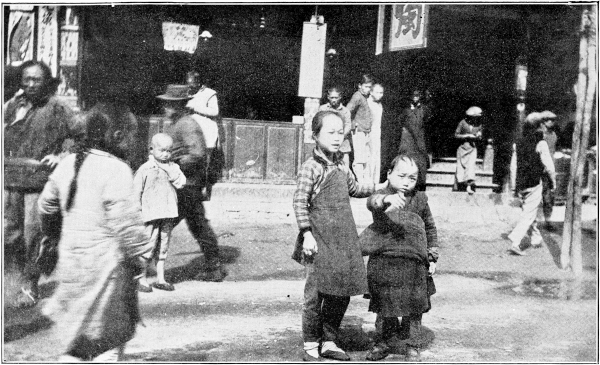
ON THE WAY TO THE MILL
India gave China her first spinning wheel, and this same crude wheel, scarcely improved upon at all, is still seen, not only in the interior, but in many a home in and around metropolitan Shanghai. Multitudes of families too, as in the olden days, run their own simple hand loom. Time-honoured customs die slowly in China, but the southern provinces are the least conservative, and Canton is one of the most progressive of cities. So we are not surprised to find that about 1870 a Cantonese[Pg 219] company started a factory for spinning cotton by steam-operated machinery. When all was in readiness would the farmers trust their cotton to this wizard concern? Not a man of them! It was their firm conviction that by some occult process their dearly grown product would vanish from sight never to reappear. Thus the enterprise launched so hopefully was doomed to failure. Twenty years later, however, the experiment was tried again, and this time with success. Foreign capital too was attracted to the venture, and at the close of the Chino-Japanese war, when the new treaty gave assurance of protection, a number of foreign-owned mills were built. At first they were operated without profit if not at a positive loss. This was mainly due to the fact that on account of the sudden and greatly increased number of spindles the supply of cotton was not equal to the demand, which caused a rise in price. That is no longer true, and dividends now are often very large. Cotton, to a greater or less extent, is grown in every province in China, but the quality is inferior and the staple short. This is not because of an unfavourable soil and climate, especially in the lower central provinces, but is wholly due to the carelessness and ignorance of the farmers. They cultivate the farms in a haphazard fashion, or strictly speaking, pay no attention whatever to cultivation, allowing nature to run riot at her own sweet will. There is no reason why, with the introduction of scientific methods in seed selection and planting, China in a few years should not see a complete transformation in the character of her crops. Foreigners are planning to start an experimental farm[Pg 220] in the neighbourhood of Shanghai, and hope each year to induce a few farmers from the interior to spend several months working on it and receiving practical instruction. It is estimated that within the last ten years the acreage devoted to cotton growing in China has increased one hundred per cent.
Great as has been this advance, the end is not yet, and cotton fields will continue to multiply. “But where is the land to come from?” some one asks. “China’s millions must be fed, and surely the rice and wheat fields can not be sacrificed.” No, but the acres once aflame with the now prohibited poppy will be available, and then there are the burial lands. The amount of ground taken up by the mammoth mound-shaped and horse-shoe graves is enormous, but little by little it is yielding to the encroachments of Western civilization. At a recent medical conference in Shanghai, one of China’s most brilliant foreign-trained doctors, for sanitary and economic reasons dared advocate cremation, or at least confining the sepulchres of the dead to the hillsides and other untillable spots. Half of China’s cotton crop is exported annually to Japan. On the other hand she imports quantities of cotton from America. Foreign countries send many kinds of cotton cloth to China, where it is most popular, particularly the cotton prints. While Japan’s goods flood China’s markets, the Japanese markets are closed to the finished product from China. Yet it should be easily possible in the near future for China to supply her own needs, growing the best quality of cotton, and opening cotton mills all over the country. This would relieve the congested[Pg 221] agricultural districts and furnish employment to many idle hands.
What the cotton industry in China requires above everything else is the fostering care of the government. Until this is given there will be little advance in either quality or quantity of production. The most the central government has done thus far has been to give its tardy recognition to “The Cotton Anti-Adulteration Association” of Shanghai, and to place the testing of cotton against adulteration under a Commissioner of the Customs, which has led to most beneficial results. It is a pity that thus far the Chinese-owned mills have declined to join the Association. The greatest handicap to the native industry is heavy taxation. In Japan the raw material is imported and the finished product exported free of duty. In China not only is no such encouragement given, but internal taxes are levied as well, so that the farmer must pay to send his cotton down the river to the manufacturer, the manufacturer to return it in yarn and cloth to the merchant, and the merchant to pass it on to the country buyer.
At present China has approximately forty cotton mills, nearly two-thirds of which are in and around Shanghai. Three in the city are owned and operated by the Japanese, several are the property of European companies, but the majority belong to the Chinese. The oldest cotton mill, started more than twenty-five years ago in Shanghai, was financed by China’s great statesman, Li Hung Chang. It is still running under Chinese management, though the original buildings were burned a few years ago. This mill is one of the[Pg 222] largest, having sixty thousand spindles. The assistant superintendent is a bright young man who recently graduated from the University of Pennsylvania, where he specialized in sociology. He brings to his work high ideals which he hopes gradually to see realized. The next oldest mill is also Chinese. Its owner, Mr. C. C. Nieh, an unusual man, recently returned from a five months’ tour in the United States, where he made a careful and critical study of cotton growing and cotton mills. It is his purpose as quickly as possible to bring his mill up to the highest grade of efficiency. Indeed his American manager reports that his chief is anxious to advance more rapidly than the operatives can be trained to follow, and describes him as a “delightful man to work for.” The largest mill in Shanghai is under British management. It operates seventy thousand spindles and employs between five and six thousand hands. One of the newest mills, that represents the very latest thought in building and equipment, belongs to the Japanese. The brick walls are lined with cement, the floors are reinforced concrete, while the saw-tooth roofs, with glass on one side, admit an abundance of light. The machinery, the best made in England, is operated by electricity, all of the other mills in Shanghai, except Mr. Nieh’s, using steam. A peculiarity of this mill is that the majority of the employees are men and boys, female help being almost exclusively found in the other mills.
A few years ago the Japanese mill owners in Shanghai did a good thing for themselves and for the Chinese in sending to Japan a hundred Chinese men and women[Pg 223] to take a course of nine months’ instruction in the mills. Since their return, these trained workers have been used to teach the raw Chinese mill hands in Japanese employ.
Wages in all the mills are about the same, and are good, as pay goes in China. Children receive from eleven to fifteen cents a day, women from fifteen to thirty-five according to their skill, and men fifteen to twenty dollars a month. This is reckoned in Mexican currency, which would yield less than one-half that amount in American money. Some of the mill people come from farms in the suburbs and are in comfortable circumstances. One or two members of a family may work in the mill, not so much from necessity as to be able to add a little to the general income. But others, and these far outnumber the more fortunate class, are the poorest of the poor, often unable to pay the “cash” or two required to ride in a wheelbarrow between the mill and their home which is frequently miles distant. A single instance may be given. A young girl supports a widowed mother and little brothers and sisters on two dollars and a half a month. She starts to the mill each morning at four o’clock, as it takes her two hours to walk there, and when her day’s work is over, at six in the evening, she is two hours more walking home. Many a time when the moon is shining the child mistakes its bright light for dawn and sets out at three or earlier. The walk is not so bad in pleasant weather, lonely only until she joins crowds of other mill folk moving in the same direction. But what of the chill days in winter, with a bleak wind[Pg 224] blowing, rain falling, and roads treacherously slippery with mud? It is hardest for the women who have bound feet, women too poor to pay for a seat on a wheelbarrow with five or six others. Yonder comes a group uncertainly picking their way along in the blinding mist. One poor soul at last reaches the gate of the mill and drops all in a heap on the cold wet ground to wait for the blowing of the whistle. “Have you come far?” is asked of her pityingly. Half fearfully, half defiantly, as if braced for a reprimand, she struggles to her feet and answers, “From Honkew,” a distance of nearly three miles. A fleeting smile is by and by coaxed into her pale face, but she is tired, so very tired, and a long twelve hours of unremittent labour lies before her. Let us hope she is one who works at a loom, for then she can have a seat on a narrow bench. The women and children who watch the spindles must stand the long night through.
The employees carry their lunch in a small round basket, all of uniform size. The basket is half filled with cold boiled rice, and set in the midst of it is sure to be a little bowl containing a few mouthfuls of bean curd, salt fish or some other simple relish. Before eating, the food is warmed by pouring boiling water into the basket and allowing the water to filter through the rice and out at the bottom. Hot water is also furnished in the mills for tea. In the new Japanese mill tea itself is given the hands. “Not the best kind,” says the superintendent, “but nevertheless, tea.” This mill has rough dining halls for its employees, and allows a half hour at noon and[Pg 225] the same at midnight for eating. Another mill gives fifteen minutes at noon and at midnight. An Englishwoman living in the neighbourhood says she always awakens at night when the great engines stop their throbbing and thinks with tender pity of the wan-faced women and wide-eyed little children toiling across the way while she rests in her comfortable bed. In most of the mills no intermission whatever is granted for rest or food, and the people eat whenever they are hungriest, snatching a morsel now and then as they tend their looms or watch their reels and spindles. Formerly mothers brought their nursing babies to the mills, and laid them at their feet while they worked, but this is no longer permitted in the large mills. Some relative, it may be a grandmother, carries the little one to the mother to nurse twice a day, in the middle of the morning and again in the afternoon. Mothers who work at night often draw from the breast before they leave home sufficient milk to last the baby until they return in the morning.
All of the mills run their spinning department through the twenty-four hours, but weaving can not be done as well at night, so the looms shut down. One mill makes its day fourteen hours long. “And these little children must stand and work all those hours?” asked a visitor of the manager. “Yes,” and with a slight shrug of the shoulder, “rather hard on them, isn’t it?” “But then you know how it is in the Chinese shops,” he added, “they keep their apprentices at work often eighteen and twenty hours on a stretch.”
The best mills no longer employ very young children,[Pg 226] that is tots of five and six. This is not so much in the interest of the children as because the little ones are found to be more of a hindrance than a help. But parents try to smuggle them in past the keen-eyed Sikh policemen at the gate, who are kept busy at the times of shift driving them out.
The hiring of women and girls is generally committed to Chinese forewomen, who are responsible for keeping their full quota at work. These women are usually shrewd and business-like, with a full appreciation of the dignity of their position. One recently entered the first class compartment of a tramcar. She wore the loose blue gown, apron, and head cloth of the working people and when the Chinese conductor came by he addressed her gruffly. “Old woman, you belong in the third class. Get out of here.” “Why should I get out?” she responded with spirit, “I have money to pay for a seat in the first class.” The conductor changed his tone and manner at once, recognizing a dominant personality behind the coarse clothes. “Pardon me, Madame,” he said and meekly took the proffered coppers. The mills as a rule give four holidays a month, though they are not always Sundays. Some employees object to Sunday as a holiday as they say it brings bad luck.
The Chinese for so many centuries have been an agricultural race that they do not take as kindly to mechanical labour as the Japanese, who have long had industrial training in the schools and make at first steadier, more dependable mill hands. Yet these patient, plodding people, with almost unlimited endurance,[Pg 227] are capable of being trained to do the highest grade of work. The improvement of their material condition is a crying need. Said the superintendent of one of the foreign-owned mills: “I have been in this work in Shanghai now for twenty years, and I hope I may not leave for home till I have seen the employees in the mills better housed, fed, clothed, and educated. But employers can not do this until the Chinese government enables them to compete on better terms than at present with others in the cotton market.” Mr. Nieh is making practical application of his philanthropic principles in an effort to divide the twenty-four hours into three shifts instead of two, and as fast as possible to dispense with child labour, so that the boys may be free to enter the public school which is being built on land donated by him near his mill. This same generous-hearted man, who recently accepted the Christian faith, is also planning for a girls’ school, a day nursery, and a hospital in the mill district. Several years ago he and his wife, also a Christian, threw open their beautiful private garden as a playground for street children. When remonstrated with by their friends they replied smilingly, “We feel it is selfish to enjoy it alone.” The recently organized “Mill Owners Association of Shanghai” it is expected will pave the way for concerted action in relation to needed reforms.
Although cotton is an exotic in China proper, silk is a native product. More than four thousand years ago, in the dim, semi-prehistoric days, China alone of all the countries in the world, understood the art of sericulture.[Pg 228] Again it was a woman to whom she was indebted, for tradition has it that as early as 2600 B.C. the wife of the great emperor Hwang-ti experimented with silk-worms and finally discovered a way of unwinding the silk from the cocoons much in the same manner that it is done now. This was a precious secret and China guarded it jealously. But during the fifth century of the Christian era it leaked out, as secrets often will, and lo, it was a woman who divulged it, which is not as surprising a happening as might be. It fell out that the Prince of Khotan in Chinese Turkestan wedded a Chinese princess, and when the bride was being conducted to her new home, so the story goes, she managed to carry with her, concealed in her headgear and at the risk of her life, some seeds of the mulberry plant and eggs of the silk-worm. Thus sericulture became known in Central Asia and later in Europe. It is an interesting coincidence that while it was Khotan that learned the art of silk manufacture from China, it was also Khotan that furnished China with her first cotton seeds several centuries later. So the debt was paid back in part.
Though China shared with the rest of the world the secret of sericulture, yet up to within fifty years she possessed half the world’s trade in silk. Then Japan outstripped her in the race and now leads in silk production and export. It is generally admitted that this would not have happened had the Chinese Government realized the value of the silk industry sufficiently to foster it, abolish undue taxation, and introduce scientific methods of sericulture. As it is, under[Pg 229] favouring conditions she may regain what she has lost, for the finest cocoons are found in China, with a tenacity far beyond that of any others. While there is not a province where silk-worms are not raised, broadly speaking two-thirds of the silk produced in China comes from the Yangtse valley and the country north of it, and the other third from the south. Filature steam mills are of recent date. During long centuries it was on crude hand reels that the delicate thread was spun, and equally crude hand looms wove it into the exquisite fabrics so dear to the heart of womankind. Even now there are no silk looms in China run by machinery. All the weaving is done on hand looms. Their familiar thud, thud is heard everywhere. As the traveller stops to look into one of the small, smoke-blackened shops, where half a dozen people it may be are busy with their shuttles, he marvels that textiles so rare and beautiful can come forth from such an environment. Usually a city is celebrated for some one kind of silk, or a province perhaps for two or three hundred varieties.
It was not till 1882 that an unsuccessful attempt was made to start a steam silk filature mill. Ten years later a few were in operation, most of them under Chinese management. As in the case of cotton mills, foreign capital was not invested largely in silk filatures till the close of the war between China and Japan. By 1901 there were 28 mills in Shanghai, the number being about the same to-day. The largest mill in this early period employed 90 men, 630 women and 385 children. It requires considerably[Pg 230] less capital to launch a silk filature mill than a cotton mill, but it is a more precarious venture. Cocoons must be ordered at the time the eggs are hatched and put in cold storage, but it is impossible to foretell what the market will be when they are delivered nearly a year afterward. It is most desirable that the filature mills be maintained, as their silk brings two or three times the price of that spun on hand-looms, and the greater part of the gain goes in wages to the employees.
Industrial conditions, in some respects, are rather better in the silk filatures than in the cotton mills. The mills close down at night, not for humanitarian reasons, however, but because the work can not be done well after dark. Sundays are usually holidays. In some of the mills work continues every other Sunday. Fifteen minutes are allowed in the morning for breakfast and an hour at noon for dinner and rest. In at least one of the Chinese mills mothers keep their nursing babies with them, the tiny things lying all day on the floor at the mother’s feet. They seldom cry. It seems as if they knew by instinct that they must not. The lesson of patient endurance is learned early in China.
The first work in a silk filature mill is sorting the cocoons, throwing out the worthless ones, and separating the perfect from the inferior. This is an easy but monotonous task and is given to women. Slipping the wound silk off the reels, testing, weighing, and twisting it into beautiful shapes for shipment requires more skill, and brings somewhat higher wages. Most of this, too, is woman’s work.
The pathos of a silk filature mill centres in the reeling[Pg 231] room. Steam pipes for supplying boiling water keep it at a high temperature the year around, while in the fierce heat of July and August, the place, as one foreign manager expressed it, “is a veritable Gehenna.” Only when the breeze is not strong enough to break the silken, web-like threads can the windows be left open. Down the length of the long apartment sit rows of women, and in front of them, with a wire frame between, stand rows of little girls. Each child controls a stationary copper basin half filled with boiling water. It is her business to soften the cocoons by swashing them around in the water, using a small reed brush. After the threads are sufficiently loosened, the bunch of cocoons is handed over to the woman opposite, who also has in front of her a shallower copper basin filled with boiling water. Dexterously she picks up a thread from each cocoon and fastens it to the frame. Then by working a treadle it is spun out and out and finally passes above and back of her, where it is wound onto the reel, which is enclosed on three sides by a wooden case to keep it from the dust. Quickly and deftly the women splice the almost invisible threads when they break, keeping often as many as six spinning at the same time. When at night the silk is taken off the reel, any shortness in weight or imperfection in the thread means a fine for the one who has wound it. Women and children grow very skilful in keeping their hands out of the water, yet they are loose-skinned and parboiled, for fingers must of necessity be continually dipped in. Then, too, the Chinese women overseers, passing constantly up and down the lines, occasionally[Pg 232] punish a child’s inefficiency, or supposed laziness, by thrusting the little hand into the bubbling caldron. The hours are long, from five thirty in the morning to five or six at night, and it is not strange if, as the day wanes, youthful senses are dulled and energy flags. The children, most of them, are such slips of girls and some scarcely more than babies. Faces are blanched by the continuous moist heat, and the little slim bodies, even in winter, are often wet with perspiration. Robbed of their birthright of schooling and play, not the youngest among them knows the sweet luxury of laying her tired head on mother’s breast in sleep. An American lady living in the vicinity of a silk filature mill was aroused morning after morning about half past four o’clock by the shrill cries of a child. One day she slipped out on her veranda to discover the cause of the trouble, and saw a little girl being dragged along the ground by one arm to the mill. Frightened perhaps by the sternness of the overseer, or half sick from the confinement, she was trying to escape from bondage. But her parents were inexorable, for in over-populated, underfed China,
One European mill has for its manager a kind-hearted Italian, who says he understands sericulture from A to Z, having learned to care for silk-worms when a little lad in his native land. He has introduced several humane features, one of them being stools for[Pg 233] the children to sit on while at work, the only mill in the city that has them. Fines collected from the employees the management allows him to use in buying medicine for the sick, coffins for the dead, and in paying for beds in the hospital. “Do the people ever faint in this great heat?” a visitor asked. “Oh, yes.” “And drop dead?” “No, they have never done that. If we see they are getting too bad we send them home in a ricsha.”
None of the silk from the filature mills is kept in China. It is all exported, most of it to Lyons, France, and to New York. Waste silk, which is made principally from defective cocoons, is one of the paying by-products of the industry. The only waste silk filature mill in China is in Shanghai. The silk it turns out is coarse in quality and does not keep its lustre but can be utilized in many ways, as for sewing silk, and in making cords, tassels, Chinese caps, carpets, and portières.
[Pg 234]
A PAGE FROM THE STORY OF PROTESTANT
MISSIONS
LATE in the autumn of 1842 as the setting sun was illumining the western sky, a vessel very different from the surrounding Chinese junks steamed slowly up the Woosung river toward Shanghai. On board were the new British Consul and his suite and the Consul’s interpreter, the Rev. Walter H. Medhurst, D.D. But the missionary had other and more important business, for with his colleague, William Lockhart, M.D., a younger man, he came as the first ambassador of the Great King to the Yangtse valley. Eight years before he had called at this port, when cruising up and down the coast, and distributed thousands of Testaments and tracts among the friendly natives. Indeed Dr. Medhurst was already a veteran of twenty-seven years’ service, while Dr. Lockhart had landed in Canton in 1839, being the second medical missionary sent to China. Both men were commissioned by the historic London Missionary Society, which gave to China its first Protestant Missionary, Robert Morrison, in 1807.
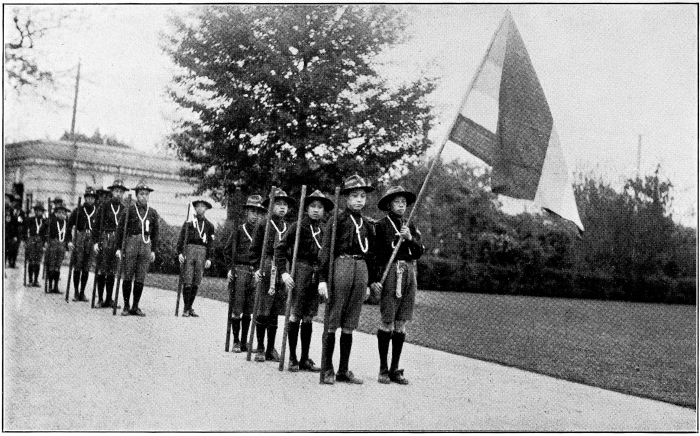
CHINESE BOY SCOUTS
While the Consular party was proposing toasts to the[Pg 235] greatness of the Shanghai to be, the missionaries were thinking hopefully and prayerfully of the task awaiting them in proclaiming the Kingdom of Christ to this people. For a while, on that memorable day, it was impossible to see the city because of the intervening masts on the numberless junks lying at anchor, but presently, as the little steamer approached the shore, it was found to be thronged with Chinese who had gathered to watch and ridicule the strange “fire-wheel ship” of the “foreign devils.”
The following weeks sped quickly by, and before the year closed, a little chapel and a small hospital had opened their doors inside the Chinese city. It is easy enough to state the bald fact, but what mountains of difficulty were climbed, what dangers faced and discouragements overcome before that much was accomplished, is told only in part in the sacredly guarded mission records, yellow and worn with age. Happily, ludicrous episodes were not lacking. Dr. Medhurst in particular was blessed with a saving sense of humour which eased many an otherwise hard jolt on the rough road he and his colleague were obliged to travel.
As time passed other missionaries were sent out from home to reinforce the pioneers, and women’s voices and children’s sweet laughter made homelike the mission premises. Then suddenly a war-cloud appeared in the sky, and almost before its presence was realized, it had burst and the T’aiping Rebellion was raging in all its fury. Grave dangers now threatened the little foreign community, officials and merchants as[Pg 236] well as missionaries. It was during this period that a fair-haired, handsome youth made his appearance in Shanghai, and although not a member of the London Mission sought a home among their missionaries. He was Hudson Taylor, destined to become the founder of the China Inland Mission. The story of his early years in China, as told in his recently published biography, makes one of the most captivating chapters in the history of Shanghai. From it we are interested to learn that this sensitive, shrinking young man did not at first adopt from choice the Chinese dress and mode of living, afterward a distinguishing mark of China Inland Missionaries, but because he was driven to it through scarcity of funds.
The present headquarters of the China Inland Mission are conveniently located in the down-town district. They include business offices, a rest house for travelling missionaries, and a chapel where both Chinese and English services are held, although the Mission, as it has done from the beginning, confines its actual work to the interior. The buildings form a square around a spacious, secluded compound that seems as far apart from the turmoil of the street as if it were miles distant. In the spring of 1915, at the Jubilee celebration of the founding of the Mission, tea was served on the beautiful lawn, and following it a large company of friends gathered in the chapel to listen to the reading of reports and papers of thrilling interest relating to the experiences of the past fifty years.
While the T’aiping Rebellion was still in full swing,[Pg 237] the London missionaries performed a courageous act. Having succeeded in purchasing a large tract of land at some distance from the foreign Settlement and the Chinese City, they at once effected the transfer of their work and took possession of the new property. When the British Consul learned of it he shook his head dubiously, affirming frankly that if the missionaries were rash enough to risk living in that exposed place, he could not undertake to furnish them protection. But unaffrighted they stayed on, and presently a hospital, a chapel, and a few dwelling houses arose amidst the rice fields. Events proved that the missionaries builded better than they knew, for the plot that at first seemed so far away and out of reach of the very people the work was intended to benefit is now in the heart of one of the most thickly populated Chinese districts of the International Settlement.
The mission chapel bears the marks of age and is shortly to be torn down and replaced by a more commodious one, but will the tablets back of the chancel, to the memory of the brave missionary veterans, ever seem quite so appropriate on any other walls? At the Christian Endeavour meeting held in the chapel every Wednesday afternoon may usually be seen a little white-haired lady of over ninety, the oldest Chinese Christian in Shanghai and some say in all China. Though exceedingly deaf, Mrs. Lai Sun’s memory is unimpaired and her mind as alert as a woman half her age. She delights to see her friends and entertain them with stories of her romantic life, how in her earlier years she visited America with her parents, dined at the[Pg 238] White House as the guest of President and Mrs. Grant and was made much of at a time when Chinese women were a rarity in the Occident. But her favourite topic is her student days in Miss Aldersey’s school in Ningpo, Miss Aldersey being not only the first single woman to enter China as a missionary, in 1843, but the first one to open a school for Chinese girls. Mrs. Lai Sun is without question the only living pupil of that far-famed school.
The chapel built so long ago by Dr. Medhurst in the Chinese city is still standing, sandwiched in between a book shop on one side and a shop selling funeral supplies on the other. Its years exceed the allotted age of man, and if bricks could speak, many a tale this pile could relate of fires and floods, famines and pestilence, riots and rebellions. While destruction was rife and changes taking place all around, the little chapel, within whose walls was proclaimed daily the Evangel of Peace, remained intact as if it possessed a charmed existence.
It is rather singular that to-day there is not a single hospital foreign or Chinese, in the populous Chinese City. The small plant started so long ago by Dr. Medhurst was transferred, in 1861, with the other activities of the Mission, to the new site, now known as Shantung Road, where a great medical work is carried on. Accident cases are especially numerous in the roomy wards, where an empty bed is rarely seen, and hundreds attend the daily clinic.
In the centre of another crowded district is beautiful St. Elizabeth’s Hospital of the American Episcopal[Pg 239] Mission. This hospital, which is for women only, receives patients from the Municipal Prison, and when one looks about the cheerful, sunny wards, it ceases to be a wonder that the poor creatures often make a feint of illness in order to be kept on a little longer where they are so happy and comfortable.
One other woman’s hospital is located near the western entrance to the Chinese City. Thirty-five years ago a large-hearted American, Margaret Williamson, had a vision of helpless sufferers in China, and in dying left money for a hospital which bears her name. While waiting for the building to be completed, the doctor and trained nurse just out from home opened a dispensary in a small rented house in the disease-infected Chinese city. They toiled on day after day through all the unaccustomed heat of July and August. “Some friend ought to have warned us of the danger of it,” one of them, years afterward, smilingly told a caller. “How did the Chinese feel about the hospital? Were the women afraid to go to it?” “Oh, not at all. We were always full. In fact it was necessary to keep enlarging our borders as fast as we could get the money.” The sweet face in its frame of snow-white hair broke into a reminiscent smile, and the listener knew something interesting was coming. “We used to have most amusing clinic experiences. Patients many times would persist in taking internally what was meant for external application. It was necessary to be careful and give nothing strong enough to do any great harm either way. Then, too, the women would get so excited and jealous over the medicines.[Pg 240] If one patient received something and another did not, the latter felt unhappy. It did no good to explain to her that she wasn’t in need of that particular medicine. She wanted it just the same. I remember one time the doctor had ordered a large dose of castor oil for a patient. Her companion saw it and begged for some too. She was so persistent that I finally asked the doctor if I should give it to her. “Yes, do,” said she. “It can’t hurt her and the experience may do her good.” The clinics are very large. On a winter’s afternoon an unexpected visitor found one young doctor in sole charge, her colleague having been taken sick. She that day treated two hundred and forty-seven dispensary patients besides caring for the wards and performing three difficult operations. “I shall not stay a minute,” declared the caller when the last woman had departed, “you must rest.” “Oh, do sit down a little while. I need to get my mind off my work,” urged the doctor. Just then the friend, noticing the exhausted look on the wan face before her, remarked impulsively, “I wish I could take you home with me and put you to bed and give you a little mothering.” “Don’t speak to me like that,” cried the younger woman almost sharply, while a few hot tears forced themselves into her eyes. “I shall break down and cry if you do, and I mustn’t; I mustn’t!” This hospital belongs to that pioneer in the field of woman’s work for women, The Woman’s Union Missionary Society of America.
The glory of the Presbyterian Mission is its Press. In 1843, that year of momentous happenings in the Far[Pg 241] East, it was first set up in Macao, a Portuguese settlement near Canton and of chief interest to Protestants because on its tropical shores Robert Morrison, the first Protestant missionary to China, was laid to rest. Soon afterward the Press was brought north to Ningpo, and in 1860 was moved to Shanghai. With it came Mr. Gamble, whose name was William and not John, but if ever a man was “sent of God” to do an all-important work, he was one. A native of Ireland, from an old Protestant family that had the honour of giving many ministers to the Presbyterian Church, he migrated to America in his youth and got his training as a printer in a publishing house in Philadelphia and later in the Bible House, New York. Mr. Gamble spent only eleven years in China and nine of them in Shanghai, but in that brief period he accomplished a monumental work. With a prophet’s eye he foresaw the future development of the city when few believed in it and urged the removal of the Press to this metropolitan centre, influenced “by his desire to plant the Gospel in the heart of China with the minimum of effort and the maximum of results.” His energy, industry, and inventive genius gave a great impulse to printing throughout the country, not only in connection with the mission press but the secular press as well. This was so universally recognized that when he died years later in America every one realized the truth of the eulogy pronounced at his funeral: “For a century to come not a Bible, Christian or scientific book in China or Japan but will bear the impress of Mr. Gamble’s hand.”
[Pg 242]
The Presbyterian Press justly claims to be the oldest in China, although the London Mission Press, established by Robert Morrison in Malacca in 1818, was removed to Hongkong, at very nearly the same time. The Presbyterian Press was the first to introduce movable Chinese type in China, and for a long time remained the sole source of supply. During the fifty-seven years since the plant was set up in Shanghai it has changed homes several times and is now housed in new, completely equipped quarters which would have delighted the aspiring soul of William Gamble. A dozen power presses are kept busy from Monday morning till Saturday night turning out vast quantities of Christian literature, veritable “Leaves of Healing,” which find their way the year through to the remotest corners of this needy, sin-cursed land and whose uplifting influence far outreaches all human reckoning.
Among the Chinese publications which are working a quiet transformation in the lives of the people are two popular monthly magazines, “The Woman’s Messenger” and “Happy Childhood.” The very artistic cover of a recent Christmas number of “Happy Childhood” was designed by one of the pupils in a Girls’ Baptist Mission Boarding School.
The spiritual interests of the large force of Press employees are not forgotten. In two chapels Sunday and week-day services are held. There are day schools and a kindergarten for the children of the men, the wife of one of the Presbyterian missionaries devoting much of her time to evangelistic work among the[Pg 243] women. Every morning prayers are conducted by the missionary in charge, attended by most of the employees, at least half of whom are Christians. Many give touching and convincing proof of the sincerity of their profession. The case of Elder Loo is an illustration and refutes the oft-repeated assertion that no Chinese can handle money without some of it clinging to his palm. For twenty years all the Press’s money excepting checks passed through Mr. Loo’s hands. He died one night very suddenly. It was with considerable anxiety that the foreign manager the next morning opened the accountant’s safe and examined his books, but they balanced exactly. In a corner of the safe were found stowed away several bad dollars that had been palmed off on Mr. Loo, but which he had quietly made good out of his own meagre funds.
“Where did you receive your education?” The question was asked of a bright young Chinese matron into whose pretty home a foreign friend had just been introduced. “In McTyeire School,” came the smiling answer. This reply, in response to similar inquiries, is given so often in Shanghai that a newcomer, unfamiliar with local mission work, is sure soon to ask another question: “What and where, pray, is this famous institution?” Every resident knows, or nearly every one. Those who do not are half ashamed to confess it, for to be uninformed about McTyeire Girls’ School is to be ignorant indeed. Its capacious buildings are kept full, too full, even though the younger pupils have just been transferred to rented Chinese[Pg 244] houses across the road, the Assembly Hall converted into dormitories and every available foot of space utilized to the best advantage.[2] Pleasant recitation rooms open from either side of the school corridors and a peep inside shows well organized classes hard at work, in algebra, drawing, physics, sewing, domestic science. What an immaculate place is the domestic science kitchen, with snowy tables, muslin window curtains, shining stove, and artistically arranged enamel pots and pans! No wonder the cooking class covers itself with laurels. The missionary in charge modestly disclaims the credit, but adds, “I do mean that my girls shall learn two important lessons, to keep themselves tidy and to clean up when their work is done,” items that it would do no harm to emphasize in other countries than China. The music rooms are upstairs. An invitation to a musicale is something to rejoice over. Last year one of the graduates in music gave a recital, all her own, and acquitted herself most creditably. Two years ago Commencement week opened with Baccalaureate Sunday, a distinct innovation in the history of Girls’ Schools in China, but a custom other mission schools are beginning to follow.
[2] Since writing the above a splendid piece of property covering about fifteen acres, with a three-story brick mansion on it built by a wealthy deceased Chinese, has been purchased, and the congestion is relieved now that the High School pupils have removed to the new quarters.
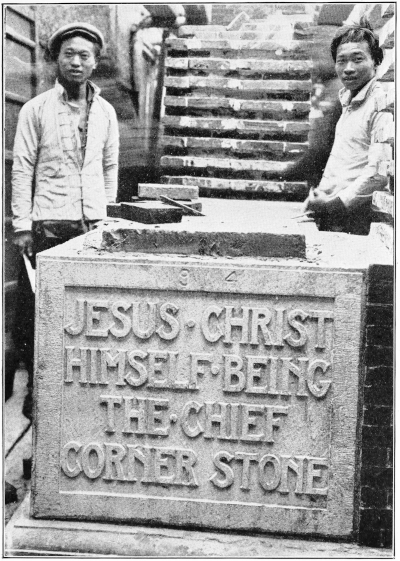
CORNER STONE OF BOYS’ BUILDING, Y. M. C. A.
It is doubtful whether any department of work in McTyeire School is yielding more abundant fruit than the “Annex,” a school for married women and girls too old or backward to enter the regular classes. Last[Pg 245] term among the many interested pupils was the wife of the socialist leader of Shanghai, the mother of five young children. The patriarchal system of family life common in China makes it possible for a mother to leave her children for lengthy periods, as there are usually plenty of women relatives ready to assume the care of them in her absence. Any pupil in the Annex ambitious to pursue a complete course of study is admitted to the regular school classes as soon as she can be prepared for them.
Above the mantel in the parlour of the Missionary Home, adjoining the main building, hangs the portrait of a noble-faced woman. It is Laura Haygood, the first principal, who “being dead yet speaketh.” She was sent to China in 1884 by the Woman’s Board of the Methodist Episcopal Church, South, and for eight memorable years prayed and toiled, much of the time weighed down by great physical weakness. Then came the glad realization of her cherished hopes in the opening of this girls’ school named for a bishop of the denomination.
The highest grade of scholarship is the goal, but the building up of Christian character and training for service have always had first place. “I want to save my people,” sobbed a girl in a burst of confidence to her foreign teacher. “As soon as I finish here I mean to go as a missionary to my native place and teach and try to save that place.” This is the spirit that prevails among the Christians. Every week Bible students and teachers go out to hold services for the street children in the neighbourhood. Last winter evangelistic[Pg 246] meetings were held in the school chapel. “I wish you could see how our Christian girls work for their unconverted friends,” said one of the missionaries. “They have their sweetest and holiest times in their own little prayer-meetings, led by themselves. The passionate earnestness of their prayers and testimonies would move any heart.”
It was the beautiful month of May and invitations were out for a great celebration at St. John’s University of the Protestant Episcopal Mission. Early in the afternoon guests began to arrive, for the first number on the programme was the military drill, set for two o’clock, something no one wanted to miss. Promptly at the hour the students in trim uniforms assembled on the parade-ground and lined up for inspection. The tactics over, and enthusiastically applauded, every one hurried to the Assembly Hall to listen to speeches in English and Chinese, and witness the crowning event of the day, which was the presentation to the President, Dr. F. L. Hawks Pott, for the University, of a generous gift of money from the alumni in commemoration of this twenty-fifth anniversary of Dr. Pott’s incumbency. An alumni supper followed, and then, as evening shadows fell, the spacious grounds were transformed into a sort of fairyland by the soft light from countless Chinese lanterns, hung in graceful festoons from tree to tree and building to building. Fireworks brought to a close a notable anniversary that will not soon be forgotten by the people of Shanghai.
St. John’s University and campus, covering forty-nine acres, is undeniably the most charmingly picturesque[Pg 247] spot in the city. It lies five miles out from the centre of the town in the suburb of Jessfield. A more ideal location could not have been found, and the wonder is that when the larger part of the property was bought as early as 1878, the bishop who made the purchase had the foresight to choose so well.
Like most great enterprises, the University had a small beginning and developed gradually, through successive stages. The work really started back in 1845 with some little day schools for boys, for it must be remembered that while the London Mission pioneers were the vanguard of the missionaries to enter Shanghai, they were soon reinforced from America by the Protestant Episcopalians, the Presbyterians and the Southern Baptists. The day schools grew into successful boarding schools, chief among them one for older boys,—seventy youths so poor that tuition, board, and clothing were furnished them free of charge. Soon a call came for an English department and it was added. By and by a few ambitious students begged for college work, and finally, in 1906, by an act of Congress at Washington, D. C., St. John’s was formally incorporated as a University and empowered to grant degrees. Her alumni are now privileged to enter institutions in Europe and America for post-graduate work without examination, and she has the honour of sending more students abroad than any other mission college in China. Including all departments the student body numbers over five hundred, whose fees make the work in large measure practically self-supporting.
A five-story brick building was opened last year in[Pg 248] one of the busiest sections of the down-town district, not in itself a singular occurrence, but in this case of unusual purport, for it is the headquarters of the Chinese Boys’ Branch of the Young Men’s Christian Association. This is the only building of its kind in the Far East, and it is certain that nowhere in the world is the kind of work it stands for more needed than in Shanghai, where the boy problem is one of the gravest. Figures are often dry reading, but in this connection a few will tell in a nut-shell a story of remarkable progress. The Boys’ Branch was started less than three years ago, and now what does the first report record? Seven hundred members, five hundred in the schools, three hundred voluntary members of Bible classes, one hundred regular boarders, two hundred at meals each day, and forty scouts, the scoutmaster being one of the Chinese secretaries. In the city are altogether no less than five hundred Chinese scouts. The organization among the Chinese is quite new but it may be called a “howling success,” the boys taking to it like ducks to water, and it is doing much for them in numberless ways. The Y.M.C.A. boy scout, who is taught reverence toward God, kindness to women, children, the aged, and animals, truth, honesty, courage, faithfulness without pay, loyalty and obedience to all in authority, and who stands for clean thought, clean speech, and clean habits, is bound to grow up into the kind of man that China has dire need of to-day. The new Boys’ Building is finely equipped from top to bottom and connects with the local headquarters of the Y.M.C.A., which fronts on Szechuan Road.
[Pg 249]
The National offices are likewise in Shanghai but in rented quarters. An eligible building site has been secured, and as soon as money is a little less scarce the work of construction will begin. The local headquarters is a centre of ceaseless activity, with day and evening schools offering all kinds of practical courses, gymnasium and swimming classes, athletic and reading clubs, “movies,” lectures, socials, Bible classes, and evangelistic meetings. A busier hive can not be imagined. It was the Y.M.C.A. that led in the Mott and Eddy Evangelistic Campaigns, it has inaugurated a health movement in the interest of sanitation and the prevention of disease, it has attacked the problem of social service which it is stressing by every available means, and it brought to China the Olympic Games with their rejuvenating, health-giving influences. Through its remarkable scientific lecture department it is reaching men that could not be approached in any other way. In short, the Association is a “live wire” and a tremendous force for good.
The Sunday Service League was organized by the Y.M.C.A. for the benefit of the large body of students from abroad who so easily slip their moorings and go adrift on their return to China. There is a well-attended five o’clock service in English for them on Sunday afternoons which is often addressed by notable speakers passing through Shanghai. Excellent music is furnished by the Chinese Glee Club, composed of both men and women. The Returned Students Club was a spontaneous outgrowth of the Sunday Service League. It holds occasional socials during the winter[Pg 250] in the parlours of one of the foreign hotels, where music, conversation, a few simple games, and light refreshments make a most enjoyable evening. The gentlemen, all of whom wear foreign clothes, represent almost every profession and calling. With scarcely an exception the women appear in Chinese dress; wherein they show their good taste and good sense, for nothing becomes them half so well. Most of them are happy young wives and mothers, but there is sure to be a generous sprinkling of unmarried teachers, specializing it may be in English, music, elocution, physical training, or kindergarten work, with perhaps a doctor or two, a charming company in short, such as only Shanghai can bring together.
The Young Women’s Christian Association is a younger organization in China than the Young Men’s Christian Association, but it is doing on a somewhat smaller scale the same efficient work. The first secretary was sent to China in 1903 expressly to labour among the mill hands. It was later felt, however, that this plan of campaign was too slow, and that to win the upper and middle classes, make Christian leaders of them, and then send them out to evangelize the multitudes, would yield larger and more lasting fruitage. So this is the course being followed now, and the outcome abundantly proves its wisdom. The consummation of a long-cherished hope has been realized in the opening of a National Normal School in Shanghai for Physical Training. The school is under the direction of a foreign secretary of large experience, assisted by a Chinese secretary, a graduate of Wellesley College[Pg 251] who received her professional training in Boston. One result of the interest aroused by the work of the Normal School is the recent organization of a Young Woman’s Athletic Association, with a charter membership of twenty-six. Wonderful indeed!
The school classes are always popular, especially with young married women who have been deprived of early school advantages. Besides teaching from books there are classes in embroidery, plain sewing, stenography, and cooking. Chinese girls are delighted to understand a little about foreign cooking, especially if they are the wives of young men who have been educated abroad, and it is a proud moment for them when they are able to serve their husbands with some of the dishes the latter have learned to relish during their residence in the Occident. The first class in Scientific Chinese Cooking has just been started, with a most gratifying show of interest.
The strongest emphasis is laid on student work not only in mission schools, but as fast as opportunity offers, in private and government schools as well. Many hundreds are converted and baptized annually as a result of the evangelistic meetings conducted by the student secretary. Six summer conferences were held last year with a far larger attendance, and more encouraging manifestation of genuine heart-awakening than was ever known before. The force of secretaries for this vast field numbers in all thirty-three, eight Chinese, three English, one Australian, one Swedish, and twenty American. The remark is often heard regarding the staff, “What unusual young women!” And[Pg 252] it is true. Deeply and genuinely spiritual, broadly cultured, resourceful, of wide vision and keen insight, they are pushing forward with unwavering devotion a unique and regenerative work in China that but for them would in large measure be left undone.
PRINTED IN THE UNITED STATES OF AMERICA
Transcriber’s Notes:
Variations in spelling and hyphenation are retained.
Perceived typographical errors have been changed.