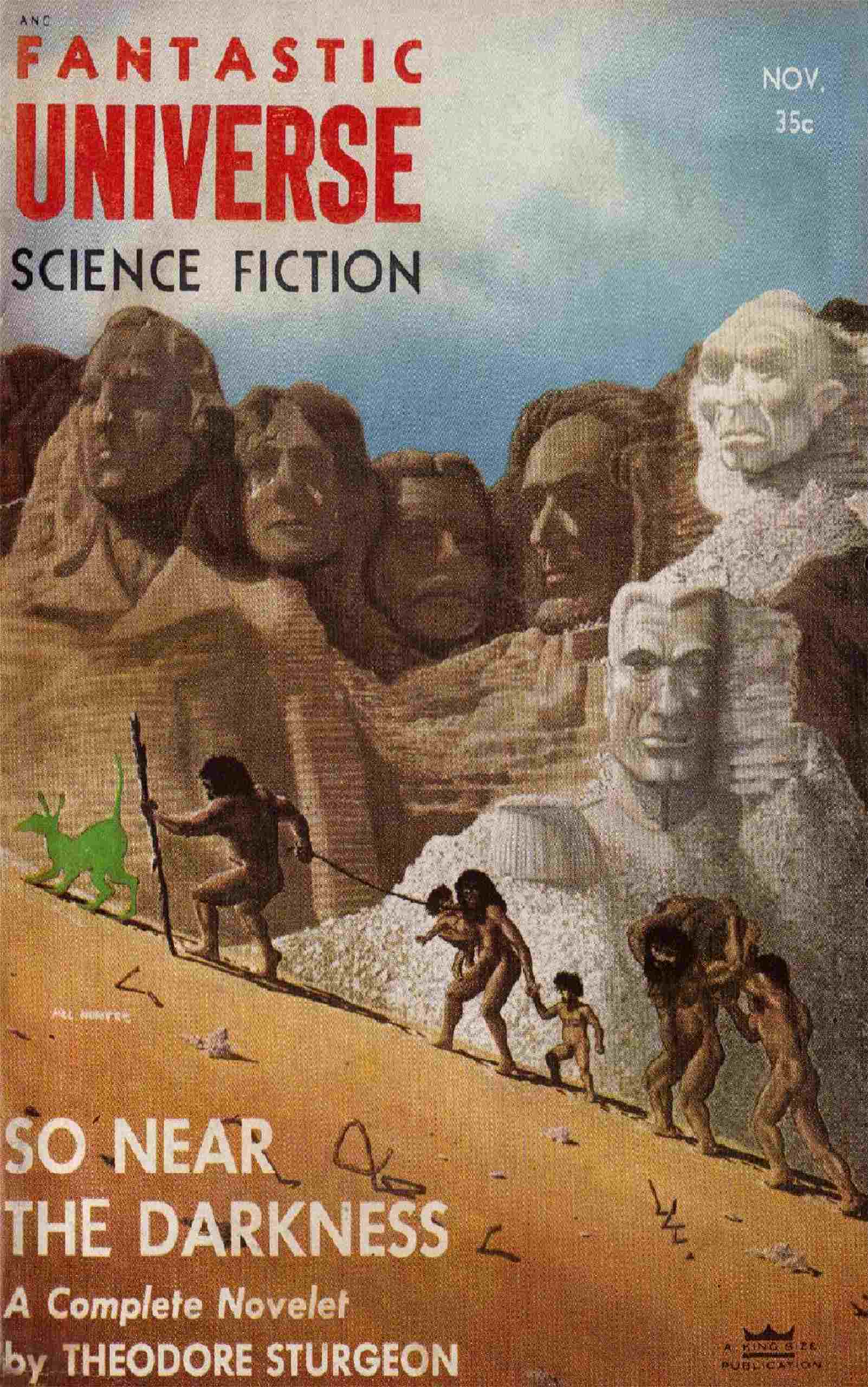
Title: Final exam
Author: Jr. Sam Merwin
Illustrator: Mel Hunter
Release date: January 16, 2026 [eBook #77718]
Language: English
Original publication: New York: King-Size Publications, Inc., 1955
Other information and formats: www.gutenberg.org/ebooks/77718
Credits: Tom Trussel (This file was produced from images generously made available by The Internet Archive)
by Sam Merwin Jr.
Sam Merwin’s entertaining, provocative, and warmly human little yarns about spacemen and their foibles have enlivened our pages—along with novelette-length stories of wider compass and somewhat graver import—since that momentous hour when FANTASTIC UNIVERSE was born out of the fire-mists of an island universe hovering directly opposite the Pleiades. But seldom has he come up with a shorter-length yarn quite as excitingly unusual as this.
They had prepared a sturdy bomb shelter to protect the Great Man from the Flying Saucers. But he had to see them with his own eyes.
They tried to make the Great Man go down into the lead-and-graphite-sheathed bomb shelter deep under the outwardly modest Midwestern house that was his “secret” summer residence. His aides, his secretary, the civilian-clothed bodyguards—all of them were insistent.
“You’re much too valuable, sir” ...
“It’s our sworn duty to protect you, sir” ...
“We don’t know what they are, sir....”
The Great Man knew he was breaking the hearts of his official family by disobeying. But curiosity was one of the traits that had helped him to the top, and he had heard too much about “them”—although he had yet to see one of the alien visitors. He looked at his wife, and read in her serene gaze that she understood and approved. He said, to his chief aide: “If they’ve found us here, there’s not much sense in hiding, is there?”
And, when no definite reply was forthcoming, he asked, “What is your theory as to their nature—and just how many of them are there?”
“Denver reports half a dozen headed directly this way at an estimated two thousand miles per hour,” said the Air Force aide, his handsome face a rigid mask of disapproval. “That was five minutes ago.”
“And their nature?” the Great Man repeated quietly.
It was the Air Defense aide who answered him. “We don’t know, sir. They look simply like rather large, moving lights in the sky. But, as always, radar has picked up solid bodies.”
“Thank you.” The Great Man glanced at the banjo clock on the flower-papered wall. “They should be here any minute then,” he said. “Gentlemen, I ask you to leave us alone. I have no wish to command you.”
Obviously, this unorthodox request put an alarming spoke in the closely-meshed wheels of the armed defense plans. Sensing the uncertainty and dismay of everyone in the room, the Great Man said, “I wish you to observe, and report—but on no account are you to inaugurate hostile action. Is that clear?”
“But what if they attack first?” The Air Force aide inquired anxiously.
“I said you were not to inaugurate hostile action,” was the Great Man’s quiet reply. “If they actually attack—and I doubt that they will from the past records—you are free to take whatever defensive measures you may consider necessary.”
They left the room reluctantly, unhappily. The Great Man smiled at his wife. “Darling,” he said, “let’s go to the balcony. If those well-meaning friends of ours think they’re going to stop me from seeing my first flying saucers they’re tragically mistaken.”
“Of course, dear,” his wife replied.
She already had her knitting neatly stowed away in the needlepoint bag in which she customarily carried it. Now she removed her glasses and put them in their case, and rose quickly to her feet, still a trim, attractive figure of a woman despite her fifty years.
As they walked toward the balcony, the Great Man wondered what he could have accomplished without her. Certainly, the nine years since their marriage had been his happiest—each a glowing milestone in his swift climb to political eminence.
They stood side by side on the broad balcony, which was really the verandah roof, and looked out at the star-swept skies. Roughly gauging the direction with his eyes, the Great Man said, “If the reports are accurate, they should be coming from there.” He pointed toward the low flat sweep of the southwestern horizon.
“Darling! Look over there!”
There was controlled excitement in his wife’s soft voice.
He followed her gaze a bit further north, and immediately saw them—one, two, three, and then three more—as they came sweeping earthward at an incredible speed.
They looked like immense balls of light, slightly fuzzy around the edges, leaving faint trails of white fire in their wake.
They were terrifyingly near—and they moved into silence. The Great Man knew that all around the house, in a complex involving many square miles, alert defenders were stationed—some at radar panels and others around electronic anti-aircraft cannon and Nike launchers, their weapons primed with atomic warheads. Yet the night was silent.
A cricket chirped somewhere, but its song was quickly drowned in the faint unmistakable whine of a distant jet engine. The Air Force was on sky reconnaissance. The Great Man uttered a silent prayer that they would confine themselves to observation. There was another whine, and then another and another, each growing louder against the stars as the mysterious invaders swept rapidly closer.
Although flying saucer stories had appeared in the press in waves, with long intervals between reports, in official circles that activity had not died down since their first sighting by Kenneth Arnold in 1947. Of late, more and more such activity had been reported. They had been seen over the big cities, as well as above more isolated regions. Unmistakably, it was a pattern of approaching climax.
Over Europe, Africa, South America and behind the Iron Curtain as well as over North America, the Unidentified Flying Objects had been observed and had given birth to the wildest speculations.
A disturbed Moscow had labeled them horror weapons of the imperialistic powers. And certain American journals had insisted they were super-Soviet aircraft that foreshadowed another and greater Pearl Harbor.
But until now the Great Man had never seen one of them—had even disbelieved in their existence. He watched them swoop closer, ever closer, and his left arm sought the reassuring solace of his wife’s waist.
“What are they?” he wondered aloud. “Where do they come from? What do they want?”
Suddenly the leading invader dropped with incredible swiftness, until it seemed to be hovering directly above them. A quartet of searchlight beams stabbed out and, for an instant, held it in a crossflare of light.
The Great Man gasped. It was solid, and its billowing contours hinted at a complex simplicity that was, the Great Man sensed instinctively, beyond the inventive capacity of human technology at its most ingenious.
Then, as suddenly as it had appeared, it was gone—and with it went the other lights. The Great Man realized he was gripping his wife far too tightly, and released her. He laughed, a bit shakily, and said, “Well, anyway, I’ve seen one of them close up.”
“What do you think it was?” his wife asked quietly as they went back indoors. He shook his head. “I’m damned if I know,” he told her. “Darling, I think I’d better talk to Harlan. He may have an idea. Do you mind?”
“Of course not,” she replied warmly. “Give him my love. And let me know what he thinks they are.”
Harlan was not an official. A philosopher, a teacher, a writer, a brilliant theoretical astrophysicist, he was the Great Man’s closest friend and most trusted advisor. Independently wealthy, he had stubbornly refused to take any salaried post. “This way,” he had told the Great Man more than once, “I’m still my own master and can offer occasional suggestions that you won’t have to frown upon officially.”
He had taken a house less than a mile from the Great Man’s inland residence. He did not seem to care at all that it was a comfortable, hideously ugly relic of the “big house” period that extended roughly from 1880 to 1910. It took the Great Man less than five minutes to reach it.
As always on seeing him again after a month’s absence the Great Man was startled by his advisor’s outward youthfulness. Save for the grey that peppered his close-cropped hair, and the tiny crow’s-feet about his eyes, Harlan might have been a remarkably precocious, quite recent university graduate.
More shaken than he cared to admit, the Great Man asked, “Did you see it, Harlan?”
“I saw,” said Harlan softly. Like the Great Man’s wife, the famed astrophysicist seemed built around an inner serenity that enabled him to meet each of life’s crises, firmly, rationally, and without foolish or fearful deviation.
“What do you think?” the Great Man asked him.
For a moment Harlan regarded his guest calmly from around the bowl of his pipe. Finally he said, “What should I think? It occurs to me that what you think is vastly more important.”
The Great Man had risen and was pacing the floor. “Harlan,” he said. “I’m beginning to think the military is right. I’m beginning to believe that these UFO’s are of alien origin. From the steadily increasing and consistent pattern of their appearances, I can only conclude that they are the prelude to some sort of invasion from space.”
“Who’d want this little planet?” Harlan asked, with ironic bitterness. “It is already despoiled, overpopulated....”
“Not knowing the nature of our visitors,” said the Great Man, “and not knowing their needs or desires, how can we answer such a question?” He paused, regarding his host steadily for an instant. Then he said: “You’ll be glad to know I refused to permit hostile action, a stand which you yourself strongly urged me to take.”
“Thank you,” said Harlan, simply and sincerely.
Something in his tone stopped the Great Man in his tracks. “Thank you,” he said. “Why thank me? Harlan. Why are you staring at me like that?”
Harlan held his gaze, and nodded slowly. “It’s true,” he said. “I’m one of them. We have techniques—hypnotics and the like—to make the records misleading. Don’t look so horrified, my friend. Although I am not of Earth, I’m human enough.”
The Great Man sank into a chair, still staring in stunned horror at his advisor. “But Harlan,” he said, “why have you done this to me? Where are you from? What do you and your people want?” He felt a sick dizziness at the base of his brain, such as he had not felt since the last election had hung precariously in the balance.
“You have asked me three questions,” was the reply, “and none of them simple.” A faint smile tugged at his lips. “However, I’ll try to answer them to the best of my ability. Why have I done this to you? I scarcely believe, if you’ll think back over the past few years, that I have done anything to you.
“The advice I gave you was sincerely given and it was in the best interests of your country, and your world. I may as well tell you I became your advisor because I was assigned to the task on my own world.”
The Great Man could only keep staring at Harlan, wondering what his real name was, and whether he was seeing him as a human being only because Harlan had planned it that way.
Harlan went on quickly: “As to where we are from, I can only say the inhabited Galaxy. You see, there are hundreds of far-flung planets suitable for human life scattered among the stars of what you call the Milky Way.”
“And precisely what do you want? Why are you invading Earth at this time?” the Great Man asked in a faraway voice.
“All we want,” was the quiet reply, “is to see the people of your world become sufficiently mature to join the rest of us—without repeating some of the ghastly mistakes that certain other strong, primitive planetary societies have made. That is why I—and many others—have been given the assignment of trying to prepare you for your most difficult task—the early control of atomics.
“You speak of ‘invasion.’ What you are witnessing is actually quite the reverse. We have done all we can on Earth. The rest is up to you. The vessels which you call flying saucers are actually here to take us home.”
The Great Man was on his feet again, somehow more alarmed by Harlan’s last statement than by his previous fears. “But you’re leaving us in a terrifying mess,” he said. “Why can’t you keep on helping us a little longer. Why can’t you?”
Harlan slowly shook his head. “We have guided you as far as we can,” he replied. “We cannot teach you to master yourselves. We have managed to bring you, without self destruction, to the final test. It will either take you to the stars or leave your planet a briefly glowing cinder in the skies. But we cannot take the examination for you.”
“I see.” The Great Man was humble beyond his habit. He was just beginning to realize how completely he had depended on Harlan to make his decisions for him. Without him ... and without his wife ... he would be like a small boy trying to run a business. A defiant spark flamed within him.
“I could give orders to have you confined—to keep you here,” he said.
But Harlan shook his head. “You couldn’t. I want you to leave me now. It will be easier that way. This is goodbye, my friend, unless fate wills us to meet out there.” He nodded toward the windows and the glowing night sky beyond.
There was something in his manner which forbade disbelief. The Great Man shook his hand and, unexpectedly, there were tears in his eyes. Harlan put a sympathetic hand on his shoulder and said, “That is what will bring you through. You can love.”
“Yes,” said the Great Man. “We can love. I only hope it is enough.”
“It will have to be,” said Harlan, “for you have very little else.” And there was something—a warning, perhaps—in his tone which echoed in the Great Man’s ears long after he was back in the big car en route to his own house.
The taut excitement of a half hour earlier had vanished. His aides and bodyguards were casual, and relaxed, as if nothing out of the ordinary had happened. Wondering, more than a little frightened, the Great Man went upstairs to the apartment he occupied with his wife. He called to her but she did not answer. He searched for her but she was not there.
All at once, he knew. She, too, was one of them—the serene, wonderful woman who had, in a few short years, guided him from obscurity to the pinnacle, and whose quiet poise and steadfastness had brought him triumphantly through so much. When he looked in her closet, he was somehow not surprised to discover that his own things—his golf clubs and fishing gear—had replaced her removed garments.
He wandered out on the balcony. All at once a light flashed down out of the sky and hovered low, no more than a half mile away, over what had been Harlan’s house. It hovered for an instant and then, suddenly, it was gone—and the Great Man felt alone as never before in his life. What had Harlan said—about love being enough? “It will have to be, for you have very little else.”
The Great Man looked up at Orion, and the Big Dipper, and at Jupiter lurking low on the horizon. Somehow, he knew, mankind had passed a lot of tests, with a great deal of travail—and the big one still lay still ahead. He wondered about his opposite numbers around the Earth. Had they, too, had advisors from the stars?
That, he decided, was one intangible he was going to have to take for granted. As he went back inside, he was formulating plans to bring them all together, to get them over the last hurdle safely. And for the first time he had the feeling that, elsewhere in the world, sad but still-important great men and women were sharing his thoughts and emotions. It wasn’t a bad thing to know. Not a bad thing at all.
This etext was produced from Fantastic Universe, November 1955 (Vol. 4, No. 4.). Extensive research did not uncover any evidence that the U.S. copyright on this publication was renewed.
Obvious errors have been silently corrected in this version, but minor inconsistencies have been retained as printed.