The Project Gutenberg eBook of The natural history of Aleppo, and parts adjacent
This eBook is for the use of anyone anywhere in the United States and
most other parts of the world at no cost and with almost no restrictions
whatsoever. You may copy it, give it away or re-use it under the terms
of the Project Gutenberg License included with this eBook or online
at www.gutenberg.org. If you are not located in the United States,
you will have to check the laws of the country where you are located
before using this eBook.
Title: The natural history of Aleppo, and parts adjacent
Containing a description of the city, and the principal natural productions in its neighbourhood; together with an account of the climate, inhabitants, and diseases; particularly of the plague, with the methods used by the Europeans for their preservation.
Credits: Charlene Taylor and the Online Distributed Proofreading Team at https://www.pgdp.net (This file was produced from images generously made available by The Internet Archive/American Libraries.)
*** START OF THE PROJECT GUTENBERG EBOOK THE NATURAL HISTORY OF ALEPPO, AND PARTS ADJACENT ***
[i]
THE
NATURAL HISTORY OF ALEPPO, AND
PARTS ADJACENT.
CONTAINING
A Description of the CITY, and the Principal Natural Productions in its Neighbourhood;
TOGETHER WITH
An Account of the Climate, Inhabitants, and Diseases;
particularly of the PLAGUE, with the Methods used by the Europeans for their Preservation.
By ALEX. RUSSELL, M. D.
LONDON,
Printed for A. Millar, in the Strand.
MDCCLVI.
[ii]
[iii]
TO
ALEXANDER DRUMMOND Esq; Consul,
THE GENTLEMEN OF THE BRITISH
FACTORY AT ALEPPO,
AND
THOSE NOW IN ENGLAND WHO HAVE
FORMERLY RESIDED AT THAT PLACE,
THE FOLLOWING SHEETS ARE,
WITH THE DEEPEST SENSE OF
GRATITUDE AND ESTEEM,
INSCRIBED
BY
THE AUTHOR.
[iv]
[v]
Advertisement.
The Author’s intention, when he first
began to digest his materials, was only
to exhibit an account of the epidemic diseases
at Aleppo, particularly of the plague,
which raged three years in that city during
his residence therein. A long and extensive
practice among all ranks and degrees of
people, had furnished him with the means of
being perfectly well acquainted with the customs
and manners of the inhabitants. The
neighbourhood of this place, its site, and natural
productions, he found had not been so
fully described, but that there still was room
left for improvement. Instead, therefore, of
confining himself singly to so much of the
general history of the place as might be sufficient
for the purpose of his profession, he
has entered into the subject more at large,
and has endeavoured to present the reader
[vi]with a succinct, but at the same time an
exact account of such things relative thereto
as seemed most to merit attention. It must
however be remembered that his observations
are confined to one city, and its environs
only. Other places, and those too at
no great distance, may have other customs;
and to this it may be ascribed, that different
writers on the head of the customs of eastern
nations present us with very different accounts.
When it is considered that the Author resided
many years abroad, and conversed
daily in other languages more than in his
own, which he had but little leisure to cultivate,
the defects in his stile, it is hoped,
will be forgiven.
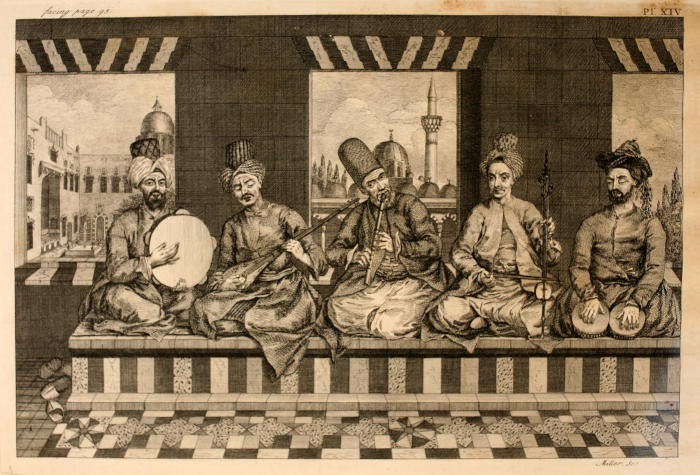
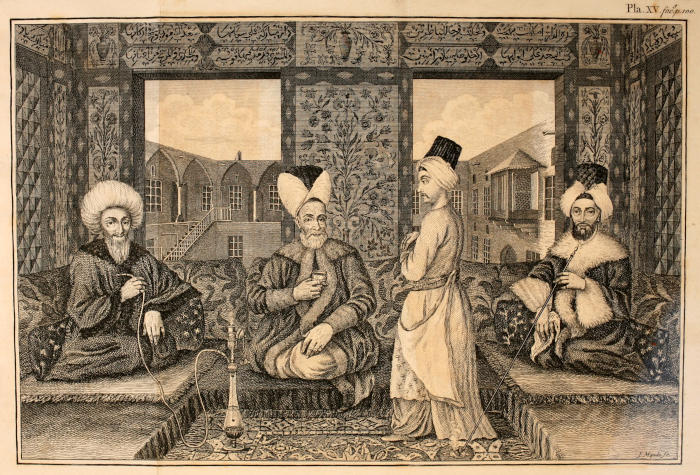
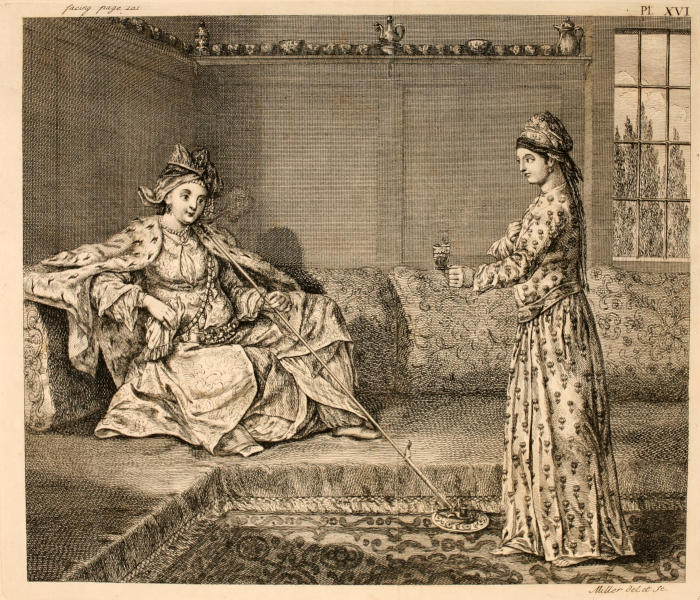
In the plates he has not only endeavoured
to give an idea of the various dresses of the
people, but a view of their furniture, habitations,
and amusements.
[vii]
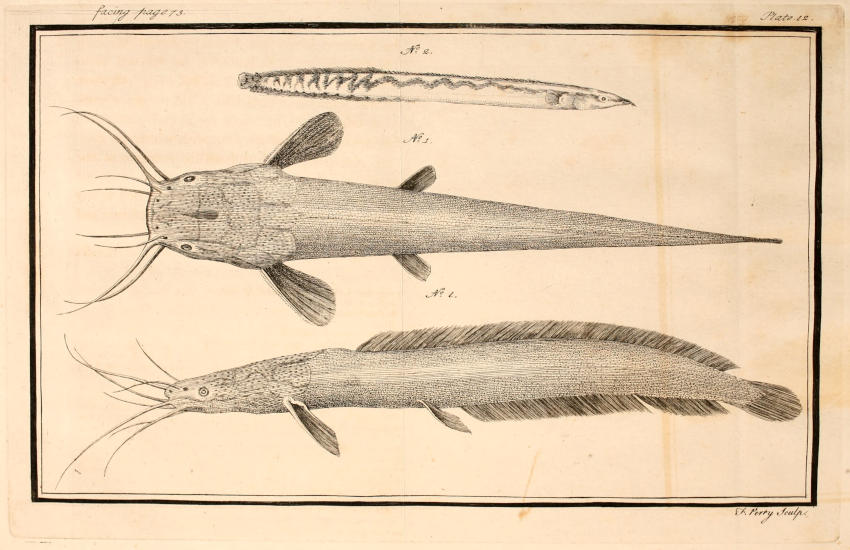
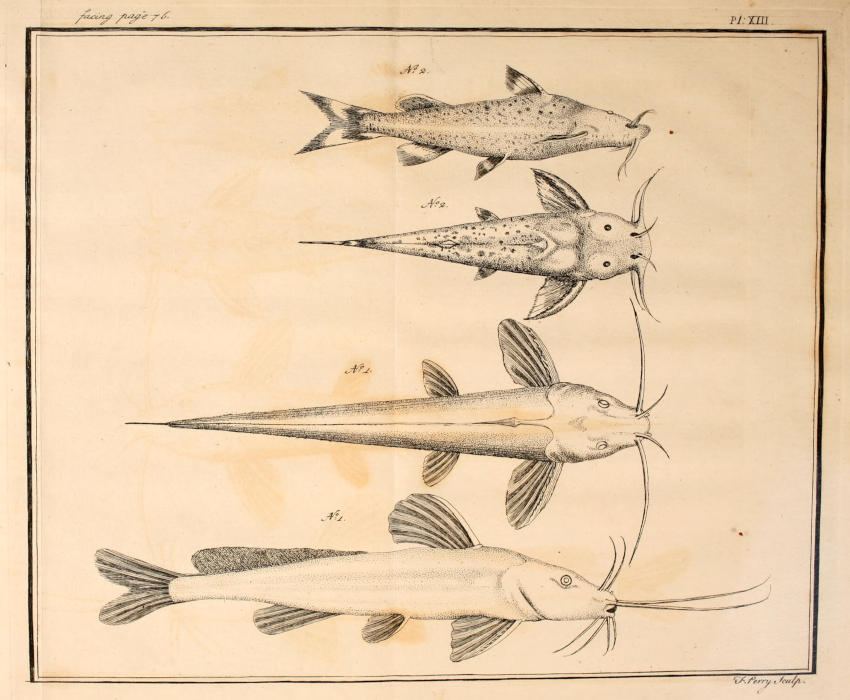
The birds and fishes here delineated are
such as, to the best of the Author’s knowledge,
have not before been properly represented,
and those of the plants are chiefly of
the same kind. So many of the Arabic names
of these as were collected, would have been
given, had it been possible to have expressed
them justly in English characters, or easy to
have had them correctly printed in Arabic;
in which language, it must be observed, all
the names of places, &c. in this work are
given, unless mentioned to be otherwise.
The different subjects in the first part were
intended to have been pointed out, by varying
the running-title according to the subject;
but, by mistake, this was omitted till
too late.
The method used by the Europeans for
their preservation during the rage of a pestilence
was chiefly intended for the use of the
[viii]Author’s friends in Aleppo, to whom it was
presented on his leaving that country. To
those in Europe he sincerely wishes that it
may never otherwise be useful than to satisfy
their curiosity.
How far the Author’s abilities have been
equal to the task he has undertaken, the
public will judge; and he intreats their
candour. That he has had fair opportunities
of observing, that he has given a faithful
narrative of facts, and that he has used no
false colouring in his representation, he presumes
to appeal to his cotemporaries and acquaintance,
who, in visiting these places
again in his description, may perhaps call to
mind many agreeable hours they have spent
even in these scenes, so far distant from their
native country.
[1]
A
DESCRIPTION OF THE
CITY of ALEPPO, AND
THE PARTS ADJACENT.
PART I.
Haleb, or, as we call it, Aleppo, the present
metropolis of Syria[1], though greatly inferior
to the cities of Constantinople and Cairo in
extent, number of inhabitants, riches, and perhaps
several other circumstances, yet, in respect to buildings,
yields to none in the Turkish empire.
This city and suburbs stand on eight small hills or
eminences, none of them considerable, except that in
[2]the middle of the place, on which the castle is erected.
This mount is of a conic form, and seems, in a great
measure, to be artificial, and raised with the earth
thrown up out of a broad deep ditch that surrounds it.
The suburbs, called Sheih il Arab, to the N. N. E.
are next in height to this, and those to the W. S. W. are
much lower than the parts adjacent, and than any
other parts of the city.
An old wall not a little decayed, and a broad ditch
now in most places turned into gardens, surround the
city, the circumference of which is about three miles
and an half; but, including the suburbs, which are
chiefly to the North East, the whole may be about
seven miles[2].
The houses, are composed of apartments, on each of
the sides, of a square court all of stone, and consist of
a ground floor which is generally arched, and an upper
story which is flat on the top, and either terraced with
hard plaister, or paved with stone. Their ceilings are
of wood neatly painted, and sometimes gilded, as are
also the window-shutters, the pannels of some of their
rooms, and the cupboard doors, of which they have
a great number: these, taken together, have a very
[3]agreeable effect. Over the doors and windows within
the houses of the Turks, are inscribed passages out of the
Koran, or verses either of their own composition, or
taken from some of their most celebrated poets. The
Christians generally borrow theirs from scripture.
In all their houses the court yard is neatly paved,
and, for the most part, has a bason with a jet d’eau
in the middle, on one or both sides of which, a small
spot is left unpaved for a sort of garden, which often
does not exceed a yard or two square; the verdure,
however, which is here produced, together with the
addition of a few flowers in pots, and the fountains
playing, would be a very agreeable sight to the passenger,
if there were openings to the street through
which these might be discovered, but they are entirely
shut up with double doors so contrived, as that, when
open, one cannot look into the court yard; and there
are no windows to the street, except a very few in
their upper rooms; so that nothing is to be seen but
dead walls, which make their streets appear very disagreeable
to Europeans.
Most of the better sort of houses have an arched alcove
within this court open to the north, and opposite
to the fountain; the pavement of this alcove is raised
about a foot and an half above that of the yard, to
[4]serve for a divan[3]. Between this and the fountain the
pavement is generally laid out in mosaic work, with
various coloured marble; as is also the floor of a
large hall with a cupola roof, which commonly has a
fountain in the middle, and is almost the only tolerably
cool room in their houses during the summer.
The people of fashion have in the outer court but
one or two rooms below stairs for themselves, the rest
are for servants and stabling; the pavement of this is
but rough, as their horses stand there all the summer,
except a few hours in the middle of the day. Above
stairs is a colonade, if not round the whole court, at
least fronting the west, off from which are their rooms
and kiosks[4]; these latter are a sort of wooden divans,
that project a little way from the other part of the
building, and hang over the street; they are raised
about one foot and an half higher, than the floor of the
room, to which they are quite open, and, by having
windows in front and on each side, there is a great
draught of air, which makes them cool in the summer,
[5]the advantage chiefly intended by them. Beyond this
court is another, containing the womens apartments,
built much in the same manner that I have described
the other houses; some few of them have a tolerable
garden, in which, as well as in the outer yard, there
is generally a tall cypress tree.
The mosques in Aleppo are numerous, and some
few of them magnificent; before each is a square
area, in the middle of which, is a fountain for the appointed
ablutions before prayers, and behind some of
the larger mosques there is a little garden.
Besides these open spaces there are many large khanes
or (as most travellers call them) caravan seraijs, consisting
of a capacious square, on all sides of which are
built on the ground floor a number of rooms, used occasionally
for stables, warehouses, or chambers. Above
stairs a colonade occupies the four sides, to which opens
a number of small rooms, wherein the merchants, as
well strangers as natives, transact most of their business.
The streets are generally narrow, but, however, are
well paved, and kept remarkably clean.
The market places, called here bazars, are properly,
long, covered, narrow streets, on each side of which
[6]are a number of small shops just sufficient to hold the
tradesman (and perhaps one or two more) with all the
commodities he deals in about him, the buyer being
obliged to stand without. Each separate branch of
business has a particular bazar allotted them, and these,
as well as the streets, are all locked up an hour and
an half after sunset, and many of them earlier, which
is a great security from house-breakers. It deserves to
be remembered, how odd soever it may appear, that
though their doors are mostly cased with iron, yet their
locks are made of wood.
In the suburbs, to the eastward, are their slaughter-houses,
in a very airy place, with a large open field before
them. The tanners have a khane, where they
work, in the south west part of the town near the river.
To the southward, just without the walls in the
suburbs, they burn lime; and a little way further is a
small village, where they make ropes and catgut, which
last manufacture is, at some seasons, extremely offensive.
In Mesherka, which is part of the suburbs on the
opposite side of the river to the westward, is a glass-house,
where they make a coarse kind of white glass,
but they work only a few months in the winter, the
greatest part of this manufacture being brought from a
[7]village called Armenass, about thirty-five miles to the
westward, from whence also they bring the sand used
in their glass-house at Aleppo.
The city is supplied with very good water from some
springs near the banks of the river at Heylan, about
five miles to the north north east, which is conveyed
from thence by an aquæduct, and distributed to the
different parts of the town by earthen pipes. There is
a tradition, that this aquæduct was the work of the
empress Helena, and that from her the springs took
their present name: this water is sufficient for the necessary
purposes of drinking, cookery, &c. Besides
this, almost every house has a well, but the water of
these, being brackish, is only employed for washing
their court yards, and filling the reservoirs for their
fountains.
The fuel, used in their houses, is wood and charcoal;
for heating their bagnios, they burn the dung of animals,
leaves of plants, parings of fruit, and such like,
which they employ people to gather and dry for that
purpose.
The markets are well supplied with provisions, of
which we shall have occasion to give a more particular
account.
[8]
For at least four or five miles round Aleppo, the
ground is very stony and uneven, having a number of
small eminences, most of which are as high as any part
of the city. From the west south west to the north
west by west, this sort of country continues for at least
twenty miles, with a number of small fertile plains interspersed.
To the northward and southward, after
about six or seven miles, the country is level and not
stony. To the eastward a vast plain commences, which,
though it is called the desart, yet for a great many
miles beyond Aleppo, affords a fine fertile soil.
In clear weather, the top of mount Cassius, bearing
west by south, and part of the mountains, called
Amanus, are to be seen from several places in the city;
but, as the nearest of these, viz. that part of Amanus,
which stretches to the eastward and approaches to Killis,
is at least thirty miles distant from Aleppo, they can be
supposed to have but very little influence upon the air of
the place, any more than a small conical rocky hill, called
Sheih Barakat, at about twenty miles to the west by
north, and a narrow chain of low rocky hills, usually
named the Black Mountains, to the south south east, at
about ten miles distance.
The river Coic[5] (if a stream scarce six or eight yards
wide deserves that name) passes along the western part
[9]of the city within a few yards of the walls, and barely
serves to water a narrow slip of gardens upon its banks,
reaching from about five miles north to about three
miles south of the town. Besides these gardens, there
are a few more near a village called Bab Allah, about
two miles to the north-east, which are supplied by the
aquæduct.
The rising-grounds above the gardens, to which the
water cannot be conveyed, are in some places laid out
in vineyards interspersed with olive, fig, and pistachio
trees, as are also many spots to the eastward, where
there are no gardens.
Inconsiderable as this stream and these gardens may
appear, yet they contain almost the only water and trees
that are to be met with for twenty or thirty miles
round, for the villages are all destitute of trees, and
most of them only supplied with water by what rain
they can save in cisterns.
The latitude of Aleppo, as fixed by a French mathematician
who was there in the year 1753, is thirty-six
degrees twelve minutes N. latitude, which, though some
minutes different from the observations of others, yet is
probably the most exact, as he was not only a man of
eminence in his profession, but was also furnished with
[10]the best instruments, an advantage which perhaps the
other observators had not. The longitude is said to be
37 D. 40 M. east from London. Its distance from the
sea, in a direct line is about sixty miles, and its height
from thence is considerable, but not yet accurately ascertained.
Having thus finished what was thought necessary
concerning the situation of Aleppo, with respect to the
parts adjacent, let us now take a general view of the
face of the country throughout Syria.
The coast in general is bordered by very high mountains,
except near Seleucia, and there from mount Pieria
to mount Cassius, which is ten or fifteen miles, is
quite level, leaving a passage for the river Orontes to
empty itself into the Mediterranean. Those mountains
are covered with trees, shrubs, and a number of plants;
so that, different from the plains, they retain their verdure
all the summer. As they abound with springs
these collect into little rivulets, and in a few places on
that side next the sea rivers, which plentifully irrigate
the plains that are between them and the sea. Behind
them, on the land side, are generally extensive plains
which receive great benefit from the streams that descend
from the mountains, nigh to which they are well
cloathed with myrtle, oleander, and other shrubs. The
[11]opposite boundaries of those plains are for the most part
low, barren, rocky hills, and behind them other large
plains, which though they have no water but the rain
which falls in the winter, yet are exceeding fertile; and
this is not improbably occasioned by the quantity of soil
which must necessarily be washed down into them from
the surrounding little rocky hills, by the violent rains of
the winter. This intermixture of rocky eminencies
and plains reaches within land about sixty or seventy
miles, after which the country is generally level, from
what I have been told, all the way to Bassorah, and is
properly Arabia Deserta.
In all Syria there is but one river, (the Orontes) that
having its rise on the land side of the high mountains,
finds its way to the sea; the rest, which indeed are but
few and inconsiderable, being soon absorbed by the
thirsty plains through which they run, more especially
as they receive but very few supplies in their passage:
and even the Orontes, though it be swelled by a number
of little brooks from the high mountains behind
which it runs, and derives a farther supply from the
lake of Antioch, yet seems as considerable a great many
miles above Antioch, as where it empties itself into the
Mediterranean.
[12]
The seasons in this country, generally speaking, are
exceeding regular, particularly at Aleppo, where the air
is usually very healthy, and so pure and free from damps
that all the inhabitants, of what rank soever, sup and
sleep in their court-yards, or upon the house tops, exposed
to the open air, from the end of May to the middle
of September, without suffering any inconveniency
from it. However, as I shall hereafter have occasion to
be more particular on this subject, I will at present only
mention in general the changes of the seasons as they
appear to our senses.
The natives reckon the severity, of the winter to last
but forty days, which they call Maarbanie, beginning
from the twelfth of December, and ending the twentieth
of January; and in fact this computation comes near
the truth. The air, during this time, is excessively
piercing, particularly to strangers, even though they are
but just come from a cold climate. In the thirteen
years that I resided there, it happened not above three
times that the ice was of sufficient strength to bear a
man, and that too with caution, and only in a situation
where the sun-beams never reached it. The snow, excepting
three years, never lay above a day, and even
in the depth of winter, when the sun shines out and
there is no wind, it is warm, nay sometimes almost hot,
[13]in the open air. Narcissus’s are in flower during the
whole of this weather, and hyacinths and violets at the
latest appear before it is quite over.
As February advances, the fields which were partly
green before, now by the springing up of the later grain
become entirely covered with an agreeable verdure, and
though the trees continue in their leafless wintery state
till the end of this month, or the beginning of March,
yet the almond, when latest, being in blossom before
the middle of February, and quickly succeeded by the
apricot, peach, &c. gives the gardens an agreeable appearance.
The spring now becomes extremely pleasant,
and has no defect but its short duration, for as
March brings it on with rapidity, so April advances
with like haste towards summer, and the gay livery that
the fields wore in those two months, and indeed most of
the winter, fades before the middle of May; and before
the end of this month the whole country puts on
so parched and barren an aspect, that one would scarce
think it was capable of producing any thing but the very
few robust plants which still have vigour enough to
resist the extreme heats. From this time not so much
as one refreshing shower falls, and scarce a friendly
cloud appears to shelter us from the excessive heat of
the sun till about the middle of September, when generally
[14]a little rain falling, either in Aleppo, or the neighbourhood,
refreshes the air greatly.
From these first rains till the second, an interval of
at least between twenty and thirty days, the weather is
temperate, serene, and extremely delightful, and if the
rains have been at all plentiful, though but of a few
hours duration, the country soon assumes a new face;
after the second rains the weather becomes variable,
and winter approaches by degrees, not with so swift a
pace as the summer, for the greater part of the trees retain
their leaves till the middle of November; the
most delicate never make fires till about the end of this
month, and some few pass the whole winter without
them.
It is seldom that Aleppo is troubled with very hard
gales of wind; the coldest winds in the winter are those
that blow from between the north west and the east,
and the nearer they approach to the last-mentioned
point, the colder they are during winter and part of the
spring. But from the beginning of May to the end of
September, the winds blowing from the very same points
bring with them a degree and kind of heat which one
would imagine came out of an oven, and which, when
it blows hard, will affect metals within the houses, such
as locks of room doors, nearly as much as if they had
[15]been exposed to the rays of the sun; yet it is remarkable
that water kept in jars is much cooler at this time
than when a cool westerly wind blows. In this season
the only remedy is to shut all the doors and windows,
for though these winds do not kill as the sumyel, (which
are much of the same nature) do on the desart, yet they
are extremely troublesome, causing a languor and difficulty
in respiration to most people. Many summers
pass without any of these winds, and, during my stay,
in no summer have there been more than four or five
days of them; for though the easterly and northerly
winds reign most in the winter, yet providence has
wisely ordered it that the westerly winds are the most
frequent in the summer, without which, considering
the intense heat of the sun’s rays, and the reflection
from a bare rocky tract of ground, and from the white
stone walls of the houses, the country would scarcely
be habitable.
Where the town is situated it is, as most of the other
rising grounds, rocky, and the soil just round it a white
light earth, very stoney, and not fertile; but in most
other parts of the country, the soil is a redish, or sometimes
blackish light mold, and produces the fruits of
the earth in great abundance.
A considerable part of the country lies uncultivated,
from the tyranny of their government, the insecurity of
[16]property, and the consequent indolence of the inhabitants;
but very little is allowed to lie fallow with a
view to culture, nor do they use much manure.
They begin to plough about the latter end of September,
and sow their earliest wheat about the middle
of October. The frosts are never severe enough to prevent
their ploughing all the winter, so that they continue
to sow all sorts of grain to the end of January,
and barley sometimes after the middle of February.
No harrow is used, but the ground is ploughed a second
time after it is sown, in order to cover the grain; in
some places where the soil is a little sandy they plough
but once, and that is after sowing. The plough is so
light, that a man of a moderate strength may easily
carry it with one hand: a little cow, or at most two,
and sometimes only an ass, is sufficient to draw it in
ploughing, and one man both drives and holds it with
so much ease that he generally smokes his pipe at the
same time.
Besides Turkey wheat, barley, and cotton[6], they
sow in the fields, cicers[7], lentils[8],
beans[9],
[17]chickling[10],
small vetch[11], sesamum, ricinus, hemp,
a green kidney bean[12], called by the natives mash,
and much eat; musk melon[13] water melon[14],
a small
sort of cucumber called ajour, fennel-flower[15],
fœnugreek[16],
bastard-saffron[17], Turkey millet.
About Aleppo they sow no oats, their horses being
all fed with barley; but near Antioch, and on the
coast of Syria, I have seen some few fields of them.
Near the city tobacco[18] is planted in the gardens
only, but in the villages about ten or fifteen miles off a
large quantity is planted in the fields, and all the hills
from Shogre to Latachia produce such plenty of this
vegetable that it makes no inconsiderable branch of
trade, particularly with Egypt.
The harvest commences with the barley about the
beginning of May, and that, as well as the wheat, is generally
all reaped by the twentieth of the same month.
The more wet the spring the later the harvest and
[18]the more plentiful the crop. As soon as it is cut down,
or rather pluck’d up, (for this is their more usual way)
it is carried to some neighbouring spot of hard even
ground, and there dislodged from its hulk by a machine
like a sledge, which runs upon two or three rollers,
drawn by horses, cows, or asses. In these rollers
are fixed low iron wheels, notched like the teeth of a
law, and pretty sharp, at once cutting the straw and separating
the grain.
Their granaries are even at this day subterraneous
grottos, the entry to which is by a small hole or opening
like a well, often in the high way, and as they are
commonly left open when empty, they make it not a
little dangerous riding near the villages in the night.
The cotton is not gathered till October, and such
spots as are sown with it yield a pleasant verdure when
every thing else seems to be burnt up. In the neighbourhood
of Aleppo there is no great quantity.
The olives produced about the city are, as I apprehend,
very little more than sufficient for pickling for
the use of the inhabitants. But at Edlib, about thirty
miles to the south west, and the other villages near it,
they have large plantations affording yearly abundance
of oil, with which, and the ashes brought by the Arabs[19]from the desart, a very considerable quantity of soap is
annually made, some at Aleppo, but the greatest part
at Edlib.
When proper care is taken, the oil is very good, but
as the people of the country are not nice in their taste,
they are less disposed to be attentive about it.
The ricinus furnishes an oil which serves the common
people for burning in their lamps, and from the sesamum
an oil likewise is extracted called seerage, consumed
chiefly by the Jews.
The vineyards round the city produce several sorts
of tolerably good grapes, sufficient for the supply of the
markets. I need scarce mention that the Turks make
no wine, but the Christians and Jews are allowed to
make sufficient for their own use, upon payment of a
certain tax; and the grapes for this purpose, as well as
raisins, are all brought from some distance. Their
white wines are palatable, but thin and poor, and seldom
keep sound above a year. The red wine is deep-coloured,
strong, and heady, without any flavour, and
much sooner produces sleep or stupidity than mirth and
elevation of spirits.
[20]
From the raisins, usually mixed with a few aniseeds,
they draw an ardent spirit, which they stile arrack, and
of this the Christians and Jews drink pretty liberally.
The inspissated juice of the grape[19], called here
dibbs, is brought to the city in skins, and sold in the
publick markets; it has much the appearance of coarse
honey, is of a sweet taste, and in great use among the
people of all sorts.
Though use seems the chief thing consulted in the
laying out of their gardens (except in a few where they
have small summer-houses) and they have not either
fine walks, or any sort of ornament, yet, after what has
been said of the country, it will be easily imagined how
agreeable their verdure and shade must be in the hot
weather, and consequently how much they must be resorted
to at that season. But this is not the only refreshment
they afford the inhabitants, for the markets
are from them plentifully supplied with several sorts of
fruits, pot-herbs, roots, and sallading; though, as they
are obliged to use a great deal of water (which they
raise with the Persian wheel) it must be owned that
their fruits in general have very little flavour, nor do
[21]they often stay till they are ripe before they gather
them. The following are all the variety here produced.
Cherries three sorts; the common red cherry[20], the
white heart cherry[21], and Visnia cherry[22];
apricots
two sorts, one of which has a sweet kernel, and is an
exceeding good fruit, they ingraft it upon the almond,
and reckon its delicacy proceeds from that particular
circumstance[23]. Peaches but indifferent[24];
several
sorts of plumbs[25]; cornelian cherry[26];
two or three
sorts of apples, but very bad[27]; some indifferent good
pears[28]; quinces[29];
pomegranates of three sorts,
sweet, sour, and another between both[30];
almonds[31];
black mulberries[32]; white mulberries in great abundance;
with the leaves of this tree the silk-worms are
fed[33]; walnuts[34];
figs[35] of four kinds;
[22]hazel-nuts[36], the kernels of which they parch and eat between
meals. Pistachio nuts[37], of a very good quality,
and of which a considerable quantity is yearly sent
to Europe; jujubs[38]; olive[39];
sumach, used much
as a relisher in many of their dishes[40]; one tree only
of St. John’s bread[41], is to be found in the gardens,
though it is very common on the coast, and the fruit
sold in the bazars at Aleppo.
These trees are all standards planted promiscuously,
and very little obliged to culture. In some places they
are thrown together in thickets, in others they form inclosures
for the beds of garden-stuff, in which inclosures
are also found the plane tree[42], white poplar[43],
common
white willow[44]; another willow that bears a
sweet-scented flower, called by the natives baan, from
whence they distill a simple cordial water much used[45].
Horn-beam[46], a very few oaks[47],
ash[48], lilac[49],
[23]bead tree[50],
a very few of the nettle trees[51],
oleaster[52],
tamarisk[53], turpentine tree[54], a very few
medlars[55], elder[56],
roses of various kinds[57], thorn[58],
balaustine tree[59], forming on the whole a wild and
irregular but agreeable prospect. The cypress trees[60]
are generally planted nigh the house; the black-berry[61]
also grows wild all over the gardens. They have
neither goosberries nor currants now, though in Rawolf’s
time there seems to have been a few.
The pot-herbs, &c. produced by the gardens will be
best ranged according to the seasons in which they are
most plentiful, in order to give a clear idea of the food
of the inhabitants in the different seasons, for which
reason also I shall here take the liberty to mention several
that have been already enumerated.
[24]
From the beginning of November to the end of
March, cabbage[62], spinnage[63],
endive[64], radishes of
two sorts[65], turnips[66],
beet[67], carrot[68], are in great
plenty; collyflowers[69] make their appearance towards
the end of January, are in great abundance in
February and part of March, by the end of which
month they become scarce. April and May produce
lettuces of different kinds[70], beans[71],
truffles[72], artichoaks[73],
which are very small, and chiefly eat by the
natives when very young, so as when stew’d they eat
the whole; and pease[74].
The two last-mentioned remain in season all the
month of June. Purslane[75], and cucumbers[76]
come
[25]in season also in May, and are in plenty till the
end of July; in September and October the latter are
again brought to market in great abundance, and towards
the end of this last mentioned month the young
ones are gathered for pickling.
The months of June, July, and August produce musk melons[77]
in great abundance; and a small cucumber called
ajoor, which is often extremely bitter. To these, in
the month of July, are added water melons[78], which
we have in great perfection; Jews mallows[79]; kidney
beans[80]; adders cucumbers[81]; Syrian
mallow[82];
lupines[83]; as also several kinds of gourds[84];
three species of mad apples[85], called by the natives
badinjan; which remain all September, and the
latter as far as the middle of November, making the
principal part of the food of the inhabitants during
the months of July, August, September, and October;
and they are so fond of them, that they preserve them
[26]various ways, so as to afford occasionally a dish through
the whole year. Squash[86] comes in towards the end
of September, and continues all the year. The orange-shaped
pumpion[87] we have more common in the
summer-months. They have none of the colocassia
at Aleppo, but great quantities at Tripoli; where the
shopkeepers use the leaves (as Rawolf mentions of Aleppo)
instead of paper, for putting up their wares.
The few following are to be met with at all seasons;
parsley[88], cress[89],
mint[90], onions[91],
and garlick[92]; which though they come last in the
list, yet they are far from being the least in use or
esteem among the natives.
In the gardens they also cultivate carraway[93],
coriander[94], dill[95],
cypress canes[96], and common
reed[97], both much used by the manufacturers of silk
and cotton stuffs, by way of reels, &c.
[27]
Besides what have been already mentioned, which
are produced by culture, the fields afford the bugloss[98],
mallow[99], and asparagus[100],
which they use as
pot-herbs; the capper[101], which they pickle; the
dandelion[102], and water cresses[103],
used in sallading;
and the summer savory[104], which, dried and powdered,
and mixed with salt, they call zater, and often
eat as a relisher with bread, serving many of the natives
by way of breakfast in the winter-season; also
the Spanish nut[105];
and a species of hartwort[106], called
by them secacul; both which they eat crude.
In their little gardens they cultivate, besides the
roses already mentioned, the Dutch hundred-leaf rose[107];
monthly rose[108], which, by proper management,
flowers about ten months in the year; a few plants of
[28]the passion flower[109];
and several kinds of jasmin[110]:
oleander[111], and myrtle[112],
grow plentifully in all
the water’d parts of Syria, but here only by culture.
Henna[113] is kept in pots, and preserved with great
care from the inclemency of the winter, being much
esteemed on account of its sweet-scented flowers; Spanish
broom[114], vervain mallow[115],
night-shade[116], winter
cherry[117]; and abundance of flowers, several of which
have been brought there by the Europeans, and of which
they are very fond, the women in particular, who decorate
their head-dress with them: of these the chief are
the ranunculus and anemony, carnation, hyacinth, narcissus,
violet, tuberose[118], African
marigold[119], lupines,
sow-bread, Indian bellflower[120], marvel of
Peru[121], columbine, stock-gelliflower. They also
[29]raise in these little gardens Guinea pepper[122], which
they use as a pickle; and love apples[123], which are
but little ate by any of the natives, except the Jews;
rosemary[124], basil[125],
flower gentle[126], female
balsamine[127], musk scabious, rue[128],
wormwood[129].
The common Seville orange[130], the sweet Seville
orange[131], China orange[132],
common lemon[133],
sweet lemon[134], and citron[135],
are also with care preserved
here by the natives, for they will not bear a severe
winter in Aleppo; though they are in great abundance
at Byas, Latachia, Tripoly, and other places on
the coast of Syria; from whence the city is plentifully
supplied with these fruits.
Neither my time, nor knowledge in botany, even
though assisted by my brother, who had a great deal
more of both, were equal to the task of making a
[30]compleat list of all the plants growing round Aleppo;
but though several may have been omitted, great care
has been taken that none should be inserted in the
following account but what have been determined with
as much accuracy as possible.[136] It may not be improper
to observe, that the plants in general are of a much
humbler growth here than in most other parts.
Several plants have been already mentioned as flowering
early in the year, as hyacinth[137],
daffodil[138], tulip[139],
and violet[140]; but the Spanish nut is what
may be called the harbinger of the spring, and esteemed
so by the natives, who are fond of its roots, which are
sold at this season in the publick streets in great quantities;
and from this time the botanizing season commences.
Towards the middle of February the banks
[31]of the river are covered with a small cranesbill[141];
and about the same place is found the daizy[142], mentioned
by Rawolf. To these are quickly joined a profusion
of plants, but chiefly in the gardens and low grounds,
meadow saffron[143];
flower-de-luce several species[144],
bulbous flower-de-luce[145], snow drop[146],
ox eye[147],
marigold[148], archangel[149],
fumitory[150], shepherds
purse[151], dandelion[152],
hypecoon[153], grape hyacinth[154],
saffron[155],
great variety of crowfoot[156],
[32]particularly one species (ranuncul. vern. rotundifol.
minor), that generally covers all the marshy parts of
the gardens.
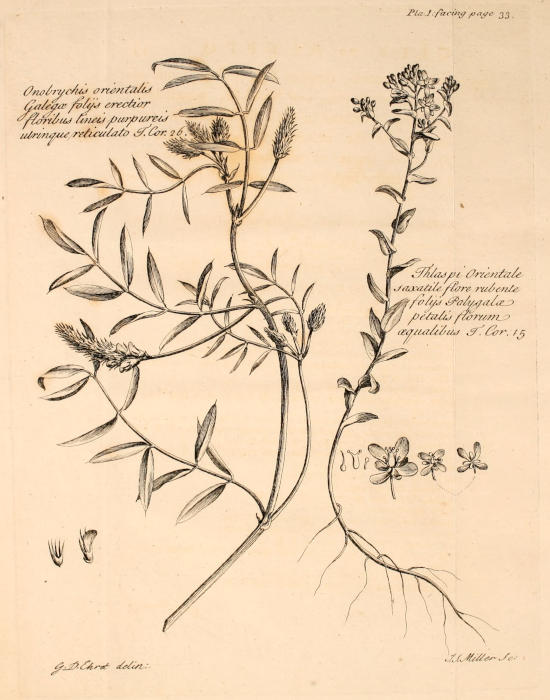
Pla 1: facing page 33.
Onobrychis orientalis Galegæ folijs erectior floribus lineis purpureis
utrinque reticulato T. Cor. 26.
As the spring advances, the following come on
with surprising rapidity. Madder[157],
cleavers[158],
periwinkle[159], plantain[160],
androsace[161], burnet[162],
speedwell of many species[163], wake
[33]robin[164]
several species, dragons[165], several kinds of
toad flax[166], clary[167],
sow bread[168], which near
Aleppo is chiefly cultivated in their little gardens, but
very common on the mountains; various sorts of
clarey[169], three species of charlock[170],
Mithridate
mustard[171], bastard Mithridate
mustard[172],
[34]stock-gellyflower[173],
dames violet[174] four species, wild
radish[175], two species of chickweed[176],
four kinds of
mouse-ear[177], house-leek[178],
caltrops[179], two species
of anemony[180], parsley[181],
petty madder[182], hartwort[183],
shepherds needle[184],
clove-gellyflower[185],
various species of garlick[186], bindweed two
[35]kinds[187],
spurges several species[188],
horehound[189],
field Basil[190], treacle-mustard[191],
woad[192], hemlock[193],
water parsnip[194], navel-wort[195],
brank
ursine[196], gold of pleasure[197],
flix-weed[198], horned
wild cumin[199], sweet fern[200],
bastard parsley[201],
shrub hartwort[202],
scorching carrot[203].
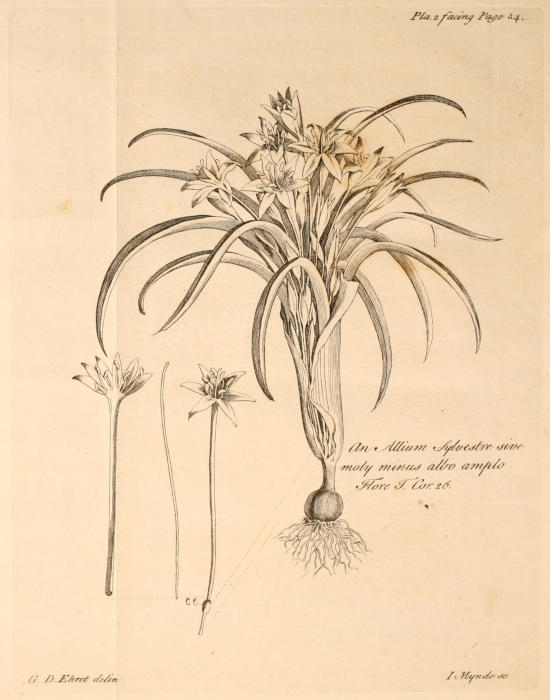
Pla. 2 facing Page 34.
An Allium Sylvestre sive moly minus albo amplo Flore T. Cor. 26.
G. D. Ehret delin:I. Mynde sc:
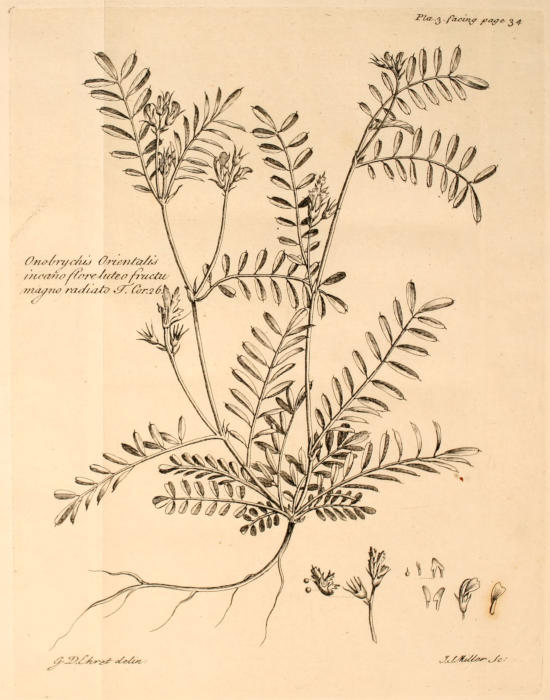
Pla. 3. facing page 34
Onobrychis Orientalis incano flore luteo fructu magno radiato T. Cor.
26.
G. D. Ehret delin:J. S. Miller Sc:
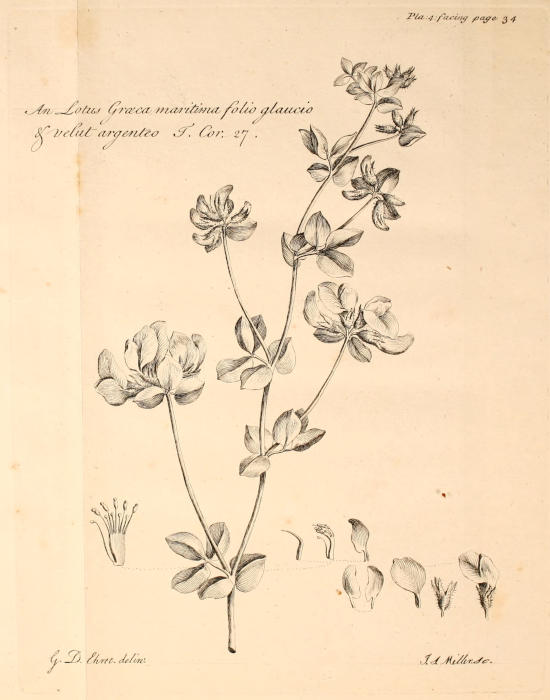
Pla: 4: facing page 34
An Lotus Græca maritima folio glaucio & velut argenteo T. Cor. 27.
G. D. Ehret delin:J. S. Miller sc:
And towards the middle of April the country is in
its full bloom, the verdure of the fields being beautifully
[36]variegated by poppies[204],
bellflower[205], gromel[206],
comfrey[207], mullein[208],
sage[209], rocket[210],
hedge-mustard[211], mustard[212],
horned poppy[213],
great variety of campions[214],
[37]pimpernel[215],
figwort[216],
berry bearing chickweed[217],
flax[218], corn-flag[219],
lilly daffodil[220], larkspur[221],
bugloss[222], ladies bed-straw[223],
birthwort[224],
ironwort[225], skull-cap[226],
trifoil[227], melilot[228],
calves snout[229], Moldavian
balm[230],
[38]medick[231],
rest harrow[232], goats rue[233],
bastard rocket[234],
kidney vetch[235], corn sallet[236],
two species
of satyrion[237], knapweed[238],
hatchet vetch[239], columbine[240],
scabious[241]. Nor are the stoney, uncultivated
rising grounds without their plants; as
thyme[242], vipers buglos[243],
ground pine[244],
cress[245], common whitlow grass[246],
[39]madwort[247],
eryngo[248], St. Foin
several species[249], birds
foot[250], horse-shoe vetch[251],
birds foot trefoil[252],
moon trefoil[253], vetch several kinds[254],
milk vetch[255],
betony[256], knapweed[257].
Among the rank herbage in the gardens are
found at this season, borage[258], German
madwort[259],
hounds tongue[260], broom rape[261],
[40]mint[262],
rush[263], balm[264],
thyme[265], vervain[266],
dittander[267], hollyhock[268],
cinquefoil[269],
lilly[270], burdock[271],
but in small quantity; mug-wort[272].
But among the plants that adorn the fields
at this season, no one is more conspicuous or common
than the lion-leaf[273]: nor should we here omit a
beautiful species of henbane[274], with a strong musk
smell; which seems to be the hyosciamus rubello flore,
C. B. P. 169. though the peculiarity of its smell I do
not find has been mentioned.
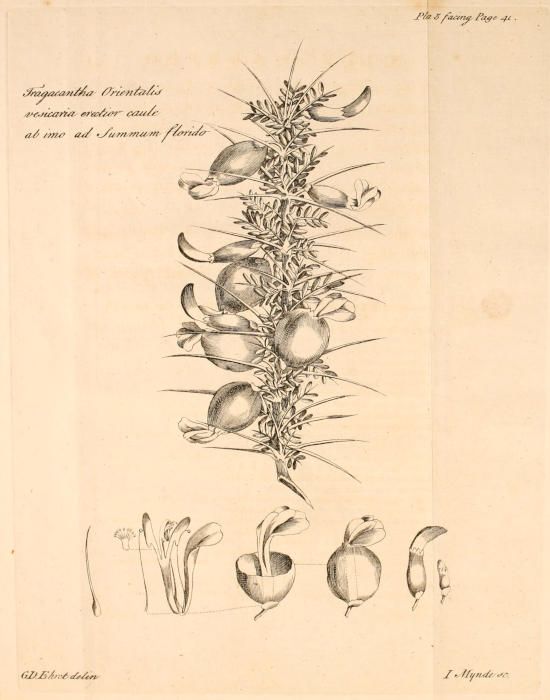
Pla 5 facing Page 41.
Tragacantha Orientalis vesicaria erectior caule ab imo ad Summum florido
G. D. Ehret delin:I. Mynde sc:
As the heats come on, the few following plants being
of a hardier nature, are the only ones that are capable
[41]of resisting them. Wild or Syrian rue[275],
bean capers[276], capers[277],
which grow in plenty on
the tops of old houses; kings spear[278] several species;
a variety of stars of Bethlem[279],
liquorice[280], night-shade[281],
fennel[282], blessed thistle[283],
wild cucumber[284].
Nothing now remains of the spring-plants in
the open fields.
Of the plants that belong to the summer, except
the following, al hagy[285],
a very low kind of acacia[286],
goats thorn[287], kali[288],
several species of
[42]thistles[289],
and the gundelia[290], the greatest part are to
be found under the shade, or nigh the little channels
where the water runs in the gardens. Molucca balm[291],
base horehound[292], bastard horehound[293],
dwarf oleander[294],
ricinoides[295], thorn apple[296],
turnsole[297],
leadwort[298], pimpernel[299],
teasel[300]. After the
first rains in the autumn, the fields every where
throw out the autumnal lilly daffodil; and the
few plants which had stood the summer now glow
with fresh vigour.
Besides what plants have been already enumerated,
the country produces the camomile-like ox-eye[301],
[43]sneezwort[302],
yarrow[303], cats foot[304],
fleabane[305],
several sorts of grass[306], ragweed[307],
stinking orach[308],
wild orach[309], vipers grass[310],
ox-eye[311], May
weed[312], corn marigold[313],
goats beard[314], Achilles’s
yarrow[315], American night-shade[316],
chickling[317],
chickling vetch[318], French
honeysuckle[319], fever-few[320],
chamomile[321], hemp[322], sharp-pointed
[44]dock[323],
bloodwort[324],
pellitory of the wall[325], true
maiden-hair[326], nettle[327],
starry hawkweed succory[328],
groundsell[329]. The weeping willow[330]
should
likewise have been mentioned before, which is very
common in the gardens.
And the river affords plenty of the yellow water-lilly[331],
from whence the natives distil a cordial-water
much used by them.
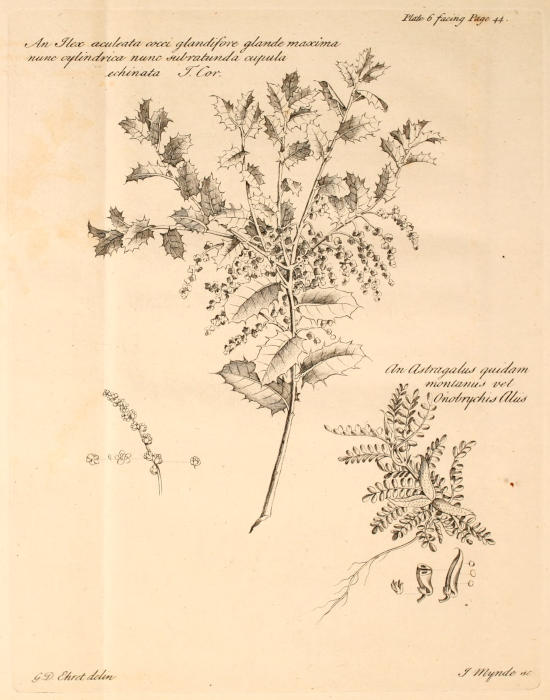
Plate 6 facing Page 44.
An Ilex aculeata cocci glandifore glande maxima
nunc cylindrica nunc subrotunda cupula
echinata T. Cor.
An Astragalus quidam montanus vel Onobrychis Aliis
G. D. Ehret delin:J. Mynde sc:
I never travelled through Syria, either with a botanical
view, or at the proper season; so that I cannot pretend
to give any tolerable account of the plants growing
at any distance from Aleppo. The few, however,
that came to my knowledge, I shall just mention.
On the mountains grow several sorts of oaks, pines,
myrtle, juniper, bay, St. John’s bread, kermes, azarole,
the fruit of which is brought to market in the
autumn; and the andrachne in such plenty, that it affords
nigh one half of the wood used for fuel in Aleppo.
[45]The shining red of its bark, together with the beauty
of its flowers and fruit, will, I doubt not, make it
esteemed as a valuable acquisition to the British gardens,
if it agree with our climate, which the thriving
condition of several plants raised here seems to promise.
The bindweed[332], from whence the Aleppo scammony
of the shops is procured, does not grow near the city,
but chiefly on the mountains. This drug is the inspissated
milky juice that flows from the root by incision;
and each produces but a very small quantity. As the
plant grows wild, it is the property of any one that
will take the trouble to look for it, which is the employment
of some peasants at the proper season; and
having collected what they can of the milky liquor,
they carry it to the nearest village of any note, where
there are always some traders (chiefly Jews) ready to
purchase it of them; and these people generally mix
it with wheat flour, sand, ashes, &c. so that at present
very little is brought quite pure to market at
Aleppo. It does not appear that any thing it is adulterated
with increases its violence in operating; on the
contrary, the purer the scammony, the smaller I have
always found the dose: so that the notion of its being
mixed with the juice of the spurge seems without foundation.
However, the proportion of the heterogeneous
[46]substances mixed with it being various, renders
the dose of the medicine as found in the shops very
uncertain, and so occasions its being seldomer prescribed
than so safe and efficacious a purgative otherwise
deserves. For further particulars relating to this
plant, see Medical Observations and Inquiries, Vol. I.—At
the bottom of the page is a catalogue of such
other plants as have come within my observation on
the mountains, and in other parts of Syria[333].
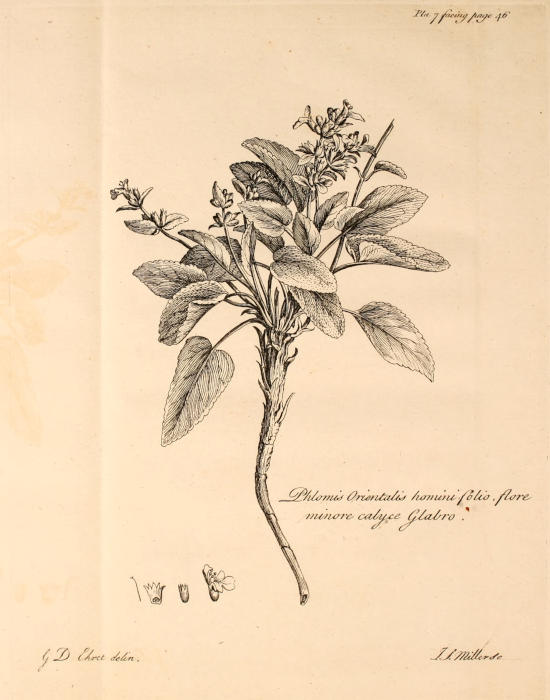
Pla 7 facing page 46
Phlomis Orientalis hormini folio flore minore calyce Glabro.
G. D. Ehret delin:J. S. Miller sc:
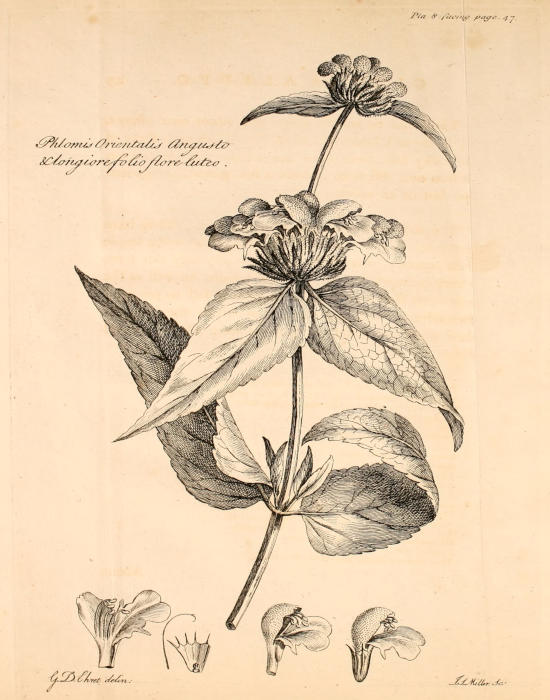
Pla 8: facing page 47.
Phlomis Orientalis Angusto & longiore folio flore luteo.
G. D. Ehret delin:J. S. Miller sc:
[47]
There are no metals found any where near Aleppo,
or, so far as I know of, in all Syria; though some of
the rocky hills from their appearance seem to contain
an iron ore. Nigh to Antioch a few garnets are picked
up, but of an inferior quality.
The soil has been already mentioned. They have
scarce any clay; and, what they do meet with, has so
little tenacity, that it is with difficulty they can form
a very ordinary sort of bricks; which, as well as the
water-jars they make of it, frequently fall to pieces of
themselves. The potters clay, of which the holes of
their pipes are made, is brought from Damascus and
Sidon.
[48]
About six hours from Aleppo is found a sort of fullers
earth, called by the natives bayloon, which is often
used in the bagnio instead of soap, and particularly
by the women for cleansing their hair; for which
purpose it is kept in balls, made up with rose-leaves,
to give it an agreeable smell. I may add, that a good
deal of it is ate by longing women, and such as have
a depraved appetite from a chlorosis.
For common buildings they make use of a white
gritty stone, every where plenty about the town; and
is very proper for the purpose, as it is easily cut, and
grows hard afterwards. For the gateways, pillars, and
pavements of their best buildings, they employ a yellow
marble, which is capable of a tolerable polish,
and is likewise the produce of this country. This is
often intermixed with a red, white, and coarse black
marble in their buildings, by way of ornament. None
of the three last mentioned are found in the neighbourhood
of Aleppo; being brought, the first from
Damascus; the second, either from Italy, or extracted
from old buildings, chiefly about Antioch; and the
last, both from Damascus and Killis. When they are
in want of the red, they can dye the yellow marble of
Aleppo, so as to have much the same appearance, by
rubbing it over with oil, and then putting it into a
[49]moderately-hot oven for some hours. The slight partition-walls
are built of a coarse sort of chalk, of which
there is abundance to the northward of the city.
Lime-stone is met with in plenty near the city, affording
them good cement for their buildings; which
they carry on with great ease and dexterity, and generally
without any scaffolding. A few hours distance is
found the gypsum in small quantities, of which their
plaister of Paris is made. This is chiefly used in cementing
the earthen pipes employed in carrying water,
and for a few other purposes about their best
buildings.
About eighteen miles south-east from Aleppo, is a
large plain, which we generally call the Valley of
Salt, bounded with low, rocky hills, so as to form a
kind of natural bason, which keep in the rains descending
from them, together with the water derived
from a few springs in the neighbourhood, and cause
the whole to be entirely covered with water in the
winter. The extent and evenness of the surface, however,
prevents this water from collecting to any great
depth; so that it is soon evaporated by the summer’s heat, and leaves a cake
of salt in some places not less than half an inch thick,
but it is more or less in proportion to the quantity of
rain that falls in the winter; and with this crust the
[50]whole inclosed plain is covered. The soil of this plain
is a stiff clay, and strongly impregnated with salt; but
I could not discover that the springs above mentioned
had any taste communicated by this mineral.
In the month of August a number of people are
employed in gathering this salt; which is of a good
quality, and in quantity proves sufficient to supply all
this part of the country.
What few black cattle they have near the city, are
chiefly used for the plough, or drawing water for the
gardens. The greatest part of those employed for this
purpose are very large, with remarkably long legs, and
a gaunt belly, such as we often see on antique intaglios.
The other cattle of this species are small, and all in
general have very short horns.
The Turks or Jews scarce ever eat beef, and it is
but of late that the Christians have begun to be fond
of it; so that what is killed is chiefly for the Europeans,
who have it tolerably good at all seasons, but
best in summer, as the natives to this day religiously
observe the ancient custom of allowing the oxen employed
in separating the corn from the straw to eat
what they please.
[51]
In some parts of Syria there are abundance of buffaloes,
but near Aleppo very few, and these chiefly
kept for milk. Mutton is plentiful, fat, and good
the whole year, except a few weeks in the spring, and
makes by far the greater part of the animal food of
all ranks of people. Lamb is also to be had in every
season, but in greatest plenty in February, March,
and April.
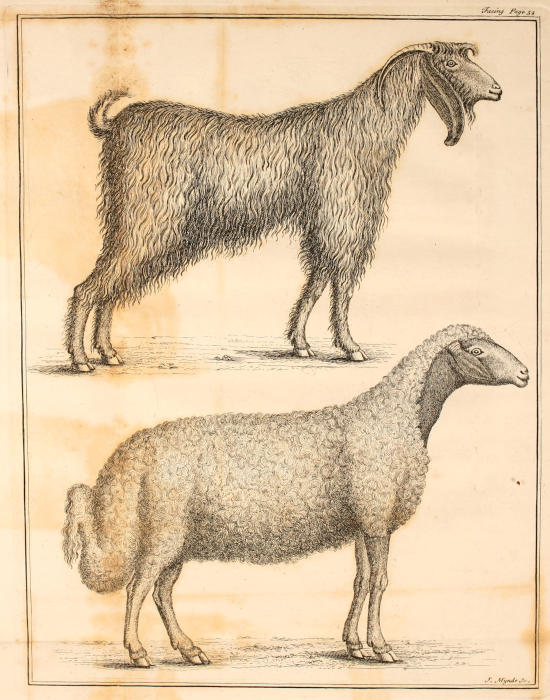
They have two sorts of sheep in the neighbourhood
of Aleppo: the one called Beduin sheep, which differ
in no respect from the larger kinds of sheep in Britain,
except that their tails are somewhat longer and thicker:
the others are those often mentioned by travellers on
account of their extraordinary tails; and this species
is by much the most numerous. This tail is very
broad and large, terminating in a small appendix that
turns back upon it. It is of a substance between fat
and marrow; and is not eaten separately, but mixed
with the lean meat in many of their dishes, and also
often used instead of butter. A common sheep of this
sort, without the head, feet, skin, and entrails, weighs
about twelve or fourteen Aleppo rotoloes[334], of which
the tail is usually three rotoloes or upwards; but such as
[52]are of the largest breed, and have been fattened, will
sometimes weigh above thirty rotoloes, and the tails of
these ten; a thing to some scarce credible. These
very large sheep being about Aleppo kept up in yards,
are in no danger of injuring their tails; but in some
other places, where they feed in the fields, the shepherds
are obliged to fix a piece of thin board to the under
part of the tail, to prevent its being torn by bushes,
thistles, &c. as it is not covered underneath with
thick wool like the upper part; and some have small
wheels, to facilitate the dragging of this board after
them; whence, with a little exaggeration, the story
of having carts to carry their tails.
This thin skin on the under part of the tail is much
used by the natives for pains and swellings of all sorts,
being applied warm to the part affected, and allowed
to remain on till it stinks abominably; and as they are
very often applied to the head and abdomen in fevers,
this last circumstance makes them prove generally detrimental:
and indeed I have seldom, if ever, seen
much benefit received by their application, except in
some old rheumatic pains.
Facing Page 52
J. Mynde sc.
They have also two kinds of goats; one that differs
little from the common sort in Britain; the other
as remarkable for the length of its ears, as the sheep
[53]above mentioned for the largeness of their tails. The
size of the animal is somewhat larger than ours; but
their ears are often a foot long, and broad in proportion.
They are chiefly kept for their milk, of which
they yield no inconsiderable quantity; and it is sweet,
and well-tasted. Great numbers of them are brought
to the city about the beginning of April, and are drove
through the streets every morning, and their milk sold
as they pass, till September. The other part of the
year they are generally supplied with cows milk, such
as it is; for as they are commonly kept at the gardens,
and fed with their refuse, the milk generally
tastes so strong of garlick or cabbage leaves, as to be
very disagreeable. Besides the milk of the goats, their
kids add some part to the diet of the inhabitants, a
few being killed in the spring and autumn.
Butter and cheese, both of which are bad, are made
indiscriminately of the milk from cows, buffaloes,
sheep, or goats: and the city is supplied with these
things, as well as with cattle of all kinds, by the
Arabs, Rushwans, or Turkmen; all of whom place
their wealth, or at least derive their subsistence from
those animals, and travel about the country with their
flocks, much in the same way as the patriarchs did
of old.
[54]
Leban[335] is brought in great plenty to the city
during the winter and spring, and is a favourite dish
with the inhabitants.
The country round Aleppo abounds with antelopes;
which are of two sorts: that which is called the
mountain antelope is the most beautiful; its back and
neck are of a dark brown colour: the antelope of the
plain is not either so swift or well-made, and is of a
much lighter colour. Both sorts afford no small diversion
to the sportsmen; but are so extremely fleet, that
the greyhounds, though very good, can seldom take
them without the assistance of a falcon, unless in soft
deep ground. In the sporting season they are lean, but
have a good flavour. In the summer, when fat, they
may vie even with our venison in England. But this
is to be understood of such as are caught abroad, for
those that have been fattened in the houses are not so
delicious. From this account it will easily be conceived,
that such dainties only make their appearance
[55]at the tables of the Europeans, and a few of the more
considerable Turks.
Hares are in great plenty, and also afford good sport;
but the natives are not fond of them, except the
Arabs, whose method of dressing them is particular,
and said to be very good. They dig a hole in the
earth, which they fill with such light brushwood as
they can pick up, and set it on fire: when thoroughly
lighted, the hare, the flue, the entrails, and all together
just as it was taken, is thrown into it; and, after
the flame has ceased, they cover the hole up with the
loose earth that had been dug out of it, and which at
first had been laid round the verge of the fire, so as to
grow hot: thus it is left till they judge it to be sufficiently
roasted, when throwing a quantity of salt over
it, they eat it without any further dressing.
A few tame rabbits are kept in the city, chiefly for
the tables of the Europeans; and now and then a wild
hog is brought from abroad, which, though seldom
fat, yet is esteemed by us, as it is a rarity.
The country also affords a few porcupines, which are
sometimes, though seldom, ate by the Europeans; and
land-turtle and frogs in great abundance, which furnish
[56]a dish for the Franks of the Romish religion, and for
many of the native Christians, in their lents.
These are the animals which are commonly dressed
for food by the inhabitants of Aleppo; for the camel,
though reckoned a delicious morsel by the Arabs,
makes no part of their diet. This creature, however,
is of the utmost consequence to them in transporting
from place to place every thing for which they have
occasion; there being no such thing as a wheel-carriage
in all this part of the country, except a very
clumsy machine, now and then used for bringing large
pillars, or other stones of great weight, from the
quarry.
There are four sorts of camels known here, viz. the
Turkman camel, the Arab camel, the dromedary, and
the camel with two bunches on its back.
The Turkman camel is much stronger, larger, more
woolly or hairy, and of a darker colour, than any of
the others. Their common load is 160 rotoloes, or
800 pounds; but sometimes it carries much more. This
animal cannot bear heat, and therefore they never
work it in the months of June, July, and August.
[57]
The Arab camel is much smaller than the former,
of a lighter colour, and not so hairy. This seldom
carries above 100 rotoloes, but can bear the heat and
thirst much better than the Turkman; nor is there any
need that the Arab camel be fed with barleyflour and
chopp’d straw; for the dry thistles, and other plants which
grow on the desart, are almost all it requires, and it
feeds as it goes along with its burthen. I remember
an instance, where, in a caravan from Bussorah, the
camels which were of this sort travelled without water
for fifteen days; but the quantity they drank as soon
as they could come at any, proved fatal to many of
them.
The dromedary, by all I could ever discover, is nothing
but a high breed of the Arab camel. The only
distinction observed is, that it is of a lighter and handsomer
make; and, instead of the solemn walk to which
the others are accustomed, it paces, and is generally
esteemed to go as far in one day as the others do in
three.
The camel with two bunches on its back is of Persian
breed, and, except a few that come in the caravans
from Bagdad and Bussorah, is but seldom seen
here. The only distinction between it and the Arab[58]camel seems to be its having two bunches, whereas the
other sorts have but one.
In mentioning their beasts of burthen, the ass ought
not to be omitted: of which they have two sorts;
one very large, with remarkably long ears; the other
small, and much like ours in England; both of no
contemptible use in carrying all lighter burdens to and
from the parts adjacent to the city.
Formerly this part of the country was famous for
fine horses; and though many good ones are still bred
here, it may be said they are much degenerated.
Those of the Arab breed are slight, and not very handsome,
but esteemed for their fleetness. The Turkman
horses are larger, of a stronger make, and more sightly
appearance; and therefore more valued by the people
of fashion among the Turks, whose large furniture does
not show to advantage upon a small horse. They are
for the most part very well broke, and particularly
taught to go off in full speed at once, and stop as
quickly; so that in the space of a few yards the rider
can lay them out at full stretch, and stop and turn
them. Far the greater part are stone-horses, but in
general not vicious; and it is observed of most of their
animals, that they are exceeding gentle and familiar
with the human species.
[59]
Among the rocky hills there are hyænas; but they
are not so large as those which are found in the mountains[336].
If this animal could formerly imitate the human
voice, and learn some of the shepherds names, so as to
call them out and devour them, as some writers have
reported, it is more than they do at present, being, so
far as I can learn, fonder of the flocks than of the
shepherd. However, though they will not attack men
but in their own defence, or through excess of hunger;
[60]yet they still retain the character of robbing sepulchres
when they have an opportunity.
Wolves and foxes are found in the champaign, but
smaller than those in Europe; and jackalls are in so
great plenty about the gardens, that they pass in numbers
like a pack of hounds in full cry every evening,
giving not only disturbance by their noise, but making
free with the poultry and other provisions, if very good
care is not taken to keep them out of their reach.
I might be excused from mentioning their dogs,
which abound in the streets without any owner, were it
not that I think it worth observing, that though they
live upon the most putrid substances, have but little
water, and in so excessive hot a climate as this is in
the summer, yet no instance has been known of any
of them running mad. Their wolves however seem to
be subject to madness; for the rusticks talk much of
an animal called a sheeb, which they imagine to be generated
between a wolf and a dog; but, from their
description of it, viz. that it is so like a wolf as not to
be distinguished from it; that it attacks every person
or animal that comes in its way, all of whom die
raving mad, &c. I think it would appear that this
animal is no other than a mad wolf.
[61]
Their greyhounds are of a very light, slender make,
and remarkably fleet. Their ears are longer than ours in
Britain, and, as well as their tail, covered with a long,
soft hair, which adds very much to their beauty.
Though Mount Taurus, near to Maraash, gives shelter
to the ounce, and some few tygers are found in
most of the high mountains, the lion on the Euphrates
between Bagdad and Bussorah, and the jerboa
on the desart, and perhaps on examination many other
animals in the same places; yet my present purpose
only comprehending the parts adjacent to Aleppo, what
I have already said on this subject may perhaps be
thought sufficient.
As to reptiles, insects, &c. time would not permit
me to be minute; so that I shall just mention such
as are hurtful or of use to the inhabitants, and a few
of those that are most commonly met with. Of the
first sort are the serpents of various kinds, with which
the country abounds, many of them of the most venomous
nature; but as they all fly from man, and the
barrenness of the fields in summer, the only season in
which they are abroad, prevents either their being surprised,
or people’s treading upon them undesignedly,
no great number of accidents happen. In the houses
[62]there are often found large white snakes; but I never
knew any one bit by them. The scolopendra and
scorpion however very often sting the natives in their
houses, causing pain for several hours, but attended
with no farther bad consequences.
Of the noxious kind may well be reckoned the locust,
which sometimes arrive in such incredible multitudes,
that it would appear fabulous to relate, destroying
the whole of the verdure where-ever they pass: but
though there are always in the spring and summer
some of two or three different species to be met with
about Aleppo, yet none of these destructive flights of
them appeared during my stay there. It may not be
amiss to mention that the Arabs eat this insect when
fresh, and also salt them up as a delicacy.
Of insects for use, we have only the bee, which
produces excellent honey, and the silk-worm, now
sufficiently known all over Europe, as well as the method
of managing them in order to procure the silk; of
which there is but very little made nigh Aleppo: though
that being the market to which it is brought from all
parts of Syria, great quantities are sent from thence
yearly to Britain.
[63]
Various sorts of lizards are found in great abundance
over the whole country, and in the gardens a few tree-frogs[337].
It is worth observing, that toads are scarce
ever seen here, though common enough upon the coast.
The view with which these sheets were composed, it
is hoped, will sufficiently apologize for beginning the
account of the feathered tribe with such as are used
for food by the inhabitants. Of domestic fowls, they
have in their markets, the dunghill cock and hen[338];
the Bagdad fowl which is of a large breed; the rumkin[339],
or cock and hen without rumps; the turkey[340],
goose[341], and duck[342].
Of game there are on
the river in winter, the water hen[343],
water rail[344],
wild goose[345],
plenty of common wild duck and mallard[346],
several kinds of widgeon[347], coot[348],
spoon-bill[349],
and various sorts of teal[350], with which the
[64]tables of the Europeans are plentifully supplied, and
some ate also by the natives.
In the winter there are also plenty of wood-cocks[351];
spring and autumn produce abundance of quails[352]
and rails[353]. In the last mentioned season the
witwall[354] and becca figos are both in season, and
(the last in particular) esteemed as delicacies.
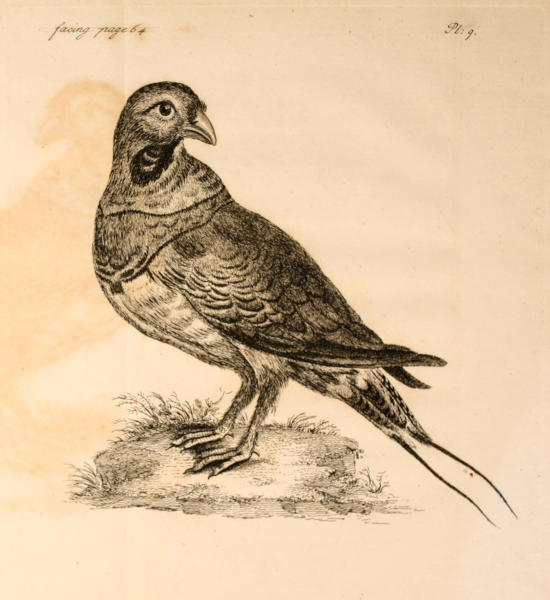
facing page 64Pl: 9.
In the months of May and June great numbers of
a bird, called by the natives kata (which are also to be
met with at all seasons, though not in so great plenty),
are brought to market, and much ate by them; but
their flesh is so black, hard, and dry, that the Europeans
never touch them. As this bird has not as yet
been described, a figure and description of it are annexed[355].
Other game in the neighbourhood are,
[65]the bustard[356]
of two kinds; red-legg’d partridge[357];
frankolin[358], the flesh of which is delicious, but
this bird is not to be met with at less than a day’s journey
from the city; common sky-lark[359],
wood-lark[360],
crested lark[361], calandra[362];
hortulanes[363], and
citrils[364], chiefly ate by the French;
snipe[365], gird
or jack snipe[366], song-thrush[367],
wind-thrush[368],
turtle-dove[369]; a brown-coloured dove, which builds
in the windows, &c. of the houses in the city; and
another much like it, only speckled on the neck and
pinions, which is very common when the corn is ripe,
but disappears as soon as that is reaped; wild pigeon,
[66]wood pigeon[370]. They have also variety of tame
pigeons, and particularly the carrier[371], formerly
made use of by the Europeans for conveying expeditiously
the news of a ship’s arrival at Scanderoon; but
this practice has been disused for many years. The
pigeon thus employed was one that had young at
Aleppo. Upon enquiring into their method of training
them, some asserted, that they were sent down
to Scanderoon in an open cage, and, as soon as
let go there, would fly directly to Aleppo. But I am
more apt to believe what others affirmed, that the bird
was brought to this by first letting it return from shorter
distances on the Scanderoon road. All agree, that if
the pigeon had been a fortnight at Scanderoon, it was
not afterwards to be trusted to fly back, lest it should
have forgot its young, and consequently not be so
eager to get home. A small piece of paper, with the
ship’s name, day of arrival, and what else material
could be contained in a very narrow compass, was
fixed so as to be under the wing, to prevent its being
destroyed by wet. They also used to bathe their
feet in vinegar, with a view to keeping them cool,
so as they might not settle to drink or wash themselves,
which would have destroyed the paper. And I have
[67]heard an English gentleman, who remembered that
practice, say, that he has known them arrive in two
hours and an half.
Shooting, as a sport, is rarely followed by any of
the natives, though many practise it to gain a livelihood;
but the diversions of coursing and hawking
are in great esteem among the people of fashion. They
have both in great perfection; but the latter exceeds
any thing of the kind that I have ever met with. The
falcons bred for taking hares and antelopes are the Baraban
and Sefy, both large falcons; and, though caught
wild, they train them in a few days to fly at their
prey.
For antelope-hawking, they chuse such of these
hawks as they find to be fierce, and eager to seize their
prey; and they are taught to fix upon the cheek of
the animal, which retards its motion, so that the
greyhounds come in.
Though the falcons used for hare-hawking will
sometimes, when very hungry, strike the hare dead at
once; yet for this sport they prefer such as are not disposed
to fix upon the animal, but who, by repeated
buffetting on the head with their pounces (rising in the
[68]air between each blow), retard the hare, till an ordinary
greyhound can come up and seize it.
For bird-hawking, they use a large falcon, with
long legs, somewhat like the goshawk, which they
call espeer; and two smaller falcons, stiled the one
zanous, and the other shaheen. This latter must be
taken out of the nest, for when old they cannot be
trained, and is so fierce that it will fly at any thing.
If there were not several gentlemen now in England
who can attest it, I should scarce venture to mention,
that with the shaheen, which is about the size of a pigeon,
they often take the largest eagles, of which
in this country there are plenty. They formerly were
trained to seize the eagle under the wing: and so depriving
him of the use of that part, they fell to the
ground together: but their present method, as I am
informed, is to seize him on the back between the
two wings, which has the same effect, but brings him
down more slowly, and so gives the falconer time to
come in to his hawk’s assistance; in which if he is
not very expeditious, the hawk is in either case speedily
destroyed.
They have also a small hawk, which they train to
fly at quails; it much resembles the spar-hawk.
[69]
Besides those already mentioned for food and sport,
the country produces the black vulture[372],
some few pelicans[373],
the kestrel[374], white stork[375],
black stork[376],
great eagle-owl[377], several other kinds of smaller
owls, the crane[378];
another beautiful sort of crane[379],
called by the natives querky, which they have
often tame in their houses or court-yards; the common
heron[380], the flamingo[381]
at some seasons, the
cormorant[382], the stone curlew[383],
the raven[384],
the Royston crow[385],
the common or carrion crow[386],
the jackdaw[387], the magpye[388],
the night raven[389],
the starling[390], the common blackbird[391];
a kind of
jay, whose feathers are beautifully variegated with blue,
[70]green, and a sort of brown; as also in the summer
the locust bird[392].
The black caps[393], a sort of gull, are in great numbers
about the city all the winter, and so tame that the
women call them from the terraces, throwing up pieces
of bread, which these birds catch in the air. The
house-swallow[394], martin[395],
and swift[396], of which,
besides the common, there is one with a white belly,
come about the end of February; and having
hatched their young, disappear about the end of July.
The swallow returns again the beginning of October,
but stays not above a fortnight. The hopooe[397] and
bee-eater[398] come in the spring, and remain all the
summer and autumn.
facing page 71.Pl: 10.
J. S. M. del et. Sc:
Of small birds the following are what I have observed.
The house-sparrow[399], the chaffinch[400],
the
goldfinch[401], the common linnet[402],
the
[71]field-fare[403],
the white water-wagtail[404],
the cuckow[405],
the king-fisher[406],
the greater spotted wood-pecker[407],
the stone-chatter[408], the wren[409],
a Brasilian bird
a-kin to the king-fisher[410],
green plover[411], grey
plover[412];
and abundance of nightingales[413],
which not only afford much pleasure by their song in
the gardens, but are also kept tame in the houses, and
let out at a small rate to divert such as chuse it in
the city; so that no entertainments are made in the
spring without a concert of these birds.
There are also several other birds, which I could
not determine from any books I had, and my occasions
did not allow me to preserve; besides which I doubt
not there are many others which escaped my searches:
so that I can only add a remarkable sort of bittern[414],
[72]and a bird somewhat like a lapwing[415], with a remarkable
spur in its pinnion: the figure and description
of both which are annexed.
From the Euphrates and Orontes in the winter, particularly
the Lent of the Christians, are brought a sufficient
quantity of fish for their consumption; but the
Turks seldom eat any: and indeed most of them taste
so muddy, that they are disagreeable.
facing page 72.Pl: 11.
facing page 73.Plate 12.
F. Perry Sculp.
[73]
The different kinds that I have observed are carp[416],
Mystus Niloticus Bellonii[417], barbel[418],
nasus[419],
tœnia cornuta Schonfeldii[420], eel[421];
and there
are likewise some other sorts that I had not an opportunity
of examining; but none are in such abundance
as what are called the black fish, with which the markets
are plentifully supplied from the entrance of the
winter till the beginning of March; when they are
esteemed out of season. As this fish, to the best of my
knowledge, is of a genus not yet described, a figure and
description of it are inserted[422].
[74]
Besides the fish which we have mentioned, most of
those that are found in the Aleppo river, are likewise
brought from abroad, and known in town by the same
names.
The sheat fish[423] is also sometimes to be met with,
and is caught in a lake near Marash.
I did not imagine, from the appearance of the river
Coic, or indeed from what is commonly met with at
the tables of the inhabitants, that our list of fish caught
there would have swelled to any thing worth mentioning;
and yet, upon examination, they were found to
amount to no less than seventeen, and even some of
these not yet described. They are in general very small,
occasioned in part by the assiduous industry of the
fishermen; for at Hylan, and the Fountain of Fish,
where they remain unmolested, they grow to larger
[75]sizes, though very rarely so large as in other parts of
the world.
The loche[424] is the most common; the barbel is
less than those brought from abroad. The bleak[425]
is known by two names; that is, there are two
sorts of fish that appear to agree in every characteristic
with the bleak, which nevertheless are esteemed different;
the first called mirmeed, seven or eight inches
long; the second, tiftaf, is not above one and a half
or two inches, and, they say, never exceeds. Chub[426]
are plenty; roches[427]
seldom large; gudgeons[428] of
three sorts; the first is much spotted on the back, and
called tuckle; the second, kureety, has fewer spots;
the third, kalloor, scarce any, and is smaller than the
other two. The mugilis[429] I am less certain of than
the rest, but yet it agrees tolerably well with the description;
dace[430], carassius[431],
the phoxinus[432];
also a fish called by the natives simak il inglese[433],
[76]from a corruption, I suppose, of anguilla, as it has
been commonly imagined to be a kind of eel; though,
upon examination, it is found to be a genus hitherto undescribed;
and two species of mystus[434][435]:
of which
[77]three, as I have met with nothing like them in other
authors, I have given descriptions and drawings.
There are also, on the banks of the river, crabs in
abundance, which are much eat by the native Christians,
and which often furnish the tables of the Europeans
with a delicate dish.
facing page 76.Pl: XIII.
F. Perry Sculp.
The inhabitants of Aleppo, though of different religions,
yet seem to be much the same people. I wish
I could say that those who profess Christianity were
better than their neighbours. The number of souls in
the city and suburbs is computed at about 235,000, of
whom 200,000 are Turks, 30,000 Christians, and
5000 Jews[436]. Of the Christians, the greater number,
are Greeks; next to them the Armenians, then the
Syrians, and lastly the Maronites; each of whom
[78]have a church in the suburbs called Judida; in which
quarter, and parts adjacent, most of them reside.
The language generally spoke is vulgar Arabic. The
Turks of condition use the Turkish. Most of the Armenians
can speak Armenian, some few Syrians understand
Syriac, and many of the JewsHebrew; but
scarce one of the Greeks understand a word of Greek,
either ancient or modern.
The people in general are of a middle stature, rather
lean than fat, indifferently well made, but not either
vigorous or active. Those of the city are of a fair
complexion; but the peasants, and such as are obliged
to be much abroad in the sun, are swarthy. Their
hair is commonly black, or of a dark chesnut-colour;
and it is very rare to see any other than black eyes
amongst them. Both sexes are tolerably handsome
when young; but the beard soon disfigures the men;
and the women, as they come early to maturity[437],
fade also as soon, and in general look old by the time
they reach thirty. The greater part of the women are
married from the age of fourteen to eighteen, and often
sooner. The tender passion of love can have very
little share in promoting matrimony among them, for
[79]the young folks never see one another till the ceremony
is performed. A slender waist, far from being admired,
is, on the contrary, rather looked on as a deformity
in the ladies of this country; so that they do all
they can to make themselves plump and lusty.
The men are girt very tight round the middle with
a sash. The womens girdles are not only very slight
and narrow, but loosely put on; which, with the
warmth of the climate, and frequent use of the bagnio,
is probably one principal reason why their labours are
much easier than those in Britain; the most delicate
being seldom confined above ten or twelve days, and
those of the villages are rarely hindered from going
about their usual employments the next day. Women
of all conditions suckle their own children, and seldom
wean them, till either the mother is again with child,
or they arrive at the age of three, and sometimes four
years.
The people of distinction in Aleppo may justly be
esteemed courteous and polite, if allowance is made for
that superiority which the Mohammedan religion teaches
those who profess it to assume over all who are of another
faith. And as this prejudice is observed to encrease
among the people in proportion to their vicinity
to Mecha, the natives of Aleppo have still a much
[80]greater proportion than those of Constantinople, Smyrna,
and other parts at a greater distance; though, even
here, it has greatly declined within these few years, insomuch
that several bashaws have conferred many public
honours and civilities on the Europeans, that formerly
would have caused great popular discontent. As to
the common people, an affected gravity, with some
share of dissimulation, is too much their characteristic.
And though few in the world are more given to harsh
language and quarrelling, yet none are less guilty of
fighting. One can seldom pass a few yards in the street
without being witness to some noisy broil; yet in many
years you may perhaps never see one blow struck, except
the person who gives it is very well assured that it
will not be returned. But though they are so prone to
anger upon the most trifling occasions, yet no people
in the universe can be more calm when it is their interest
so to be. This, I am sorry to say, is but too generally
a true representation: but it would be very ungrateful,
as well as unjust in me, not to acknowledge
that there are many amongst them of all sects who deserve
a much better character, and whom I know, from repeated
experience, to be persons of the utmost honour
and integrity.
Their usual bread is of wheat flour, not well fermented,
made into thin flat cakes ill-baked, and for
[81]the most part ate soon after it comes out of the oven.
The better sort have small loaves of a finer flour, well
fermented, and well baked. Besides these, there are a
variety of rusks and biscuits, most of which are either
strowed on the top with the seeds of sesamum or fennel-flower.
The Europeans have very good bread,
baked in the French manner.
Coffee made very strong, and without either sugar
or milk, is a refreshment in very high esteem with
every body; and a dish of it, preceded by a little wet
sweet-meat (commonly conserve of red roses, acidulated
with lemon-juice), and a pipe of tobacco, is the
usual entertainment at a visit. If they have a mind to
use less ceremony, the sweet-meat is omitted; and, if
they would shew an extraordinary degree of respect,
they add sherbet, (some syrup, chiefly that of lemons,
mixed with water) a sprinkling of rose or other sweet-scented
water, and the perfume, with aloes-wood,
which is brought last, and serves as a sign that it is time
for the stranger to take his leave. This is looked upon
as an entertainment sufficient for the greatest men in
the country, only that such have a piece of embroidered
or flowered silk thrown over their knee when they drink
the coffee and sherbet: and if it is a visit of ceremony
from a bashaw, or other person in power, a fine horse,
sometimes with furniture, or some such valuable present,
[82]is made him at his departure. People of inferior
rank (or even others, if they have any favour to ask)
commonly bring a small present (a flower is frequently
thought sufficient) when they visit.
Tobacco is smoked to excess by all the men, and
many of the women. Even the labourers or handicraft-tradesmen
have constantly a pipe in their mouths, if
they can afford it. Those pipes are made of the twig
of a rose-bush, cherry-tree, &c. bored for that purpose:
those of the better sort are five or six feet long,
and adorned with silver. The bole is of clay, and
often changed; but the pipes themselves last for years.
Many who are in easy circumstances have lately adopted
the Persian manner of smoking the nargeery[438]; which
is an instrument so constructed, that the smoke of the
tobacco passes through the water before it comes into
the mouth. The method of drawing it is different
from that of a pipe; and a good part of the smoke
seems to descend some way into the breast. The
Persian tobacco is what they use in this instrument,
which has an agreeable flavour; attended with this further
advantage, that, when smoked in this way, neither
the taste or smell of it remain after washing the
mouth.
[83]
The vulgar, in imitation of their superiors, have at
the coffee-houses an ordinary instrument of the same
construction: in this they use the common tobacco,
wetted a little with dibbs and water, or an infusion of
raisins, adding at times sheera[439], to make it intoxicating;
and they will draw in such vast quantities of
smoke, that when they throw it out again at the
mouth and nostrils, it appears surprising where they
found room to contain it.
Opium is not of so high esteem with the inhabitants
of Aleppo as at Constantinople, and some other places;
nor could I ever find the taking it so general a practice
in Turky as is commonly apprehended, being chiefly
practised only by debauchees. They who take it to excess
are commonly stiled teriaky; and the Theriac. Andromach.
is called in Turkishteriack, which perhaps may countenance
a conjecture that this was the original form they
used it in. At present they not only use it in that form,
[84]but have various other electuaries or confections wherein
it is mixed with aromatics. Some few use it pure;
and the greatest quantity I ever knew taken was three
drachms in twenty-four hours. The immediate effects
that I observed it to have upon such as were addicted to
it was, that their spirits were exhilarated, and, from a
dosing, depressed state which they fell into after passing
the usual time of taking their dose, they became
quite alert. The consequences of a long use of it are,
that they soon look old and besotted, like such as in
Europe have ruined their constitutions by hard drinking.
And it may be considered as point of fact, that
they but seldom live to a good old age: though they
are rarely carried off by dropsies, or such other diseases,
the usual consequences of hard drinking amongst
us; but rather having first lost their memory, and
most of their intellectual faculties, they decline, in all
appearance, in the same way as those who sink under
the weight of years.
In Aleppo there are a number of public bagnios, which
are frequented by people of all sects and conditions, except
those of a very high rank, who have mostly baths
in their own houses. The first entrance in the public
bagnio is a large, lofty room; in the middle of which
is a fountain, with a bason, which serves for washing
the linen, that hangs upon lines at a considerable height
[85]all over the room. In this first apartment are broad
benches, where they dress and undress; and the air
is here not at all influenced by the heat of the bath,
except it be just at the door, by which you pass into a
small room, which is pretty warm, and from thence
into a larger very hot. About the sides of these two
rooms are placed round stone-basons, of about two feet
and a half diameter, with two cocks, one of hot, and
the other of cold water; so that you may temper it according
to your own pleasure, and there are copper-bowls
for you to lave it upon your body. In the corners of the
inner room there are small retiring-chambers; in one
of which there is frequently a cistern of warm water,
about four feet deep, and large enough for bathing the
whole body. All these rooms are surmounted by cupolas;
and the inner receive their light from small
openings in their domes, which are covered with
glasses. The outer room receives its light, not only
from the lanthorn of its dome, but also from windows.
Some few bagnios are solely for the men,
others are appropriated to the women only; yet the
generality of them admit both sexes, though at different
times; that is, the men in the forenoon, and women
in the afternoon.
When a man goes into the hot room, the first thing
[86]he does is to apply the dewa[440], (or medicine for taking
off the hair), to the pubis and armpits. This is
suffered to remain till the hair is quite loose, and then
must be immediately washed clean away with great
care. After this, one of the servants of the bagnio begins
with chaffing, or kneading violently, first the tops
of the shoulders, and then by degrees the whole body.
When he comes to the hand, he pulls the joints of the
fingers, so as to make each crack separately; then laying
the person on his back, with his arms across his
breast, he raises him forcibly by the back part of the
neck, so as to make the greatest part of the vertebræ
crack. He then chaffs the back a little more, and,
throwing a quantity of warm water over the whole
body, rubs him hard with a bag made of a fort of coarse
camelot, which is drawn over the servant’s hand, for
some time. He is next rubbed over with a soap-lather;
and the whole being washed clean off, he puts
one towel round his middle, another round his head,
and perhaps a third over his shoulders; in which manner
he goes out to the great room, where he generally
smokes a pipe, drinks coffee, and perhaps eats some
fruit, before he dresses.
[87]
The women having the additional trouble of combing
and washing, as well as unplaiting and plaiting
their hair, besides very frequently that of a number of
children to wash, remain generally in the hot room
for a considerable time; but refresh themselves at intervals,
by going out into the other rooms, where they
smoke, converse, and drink coffee, with one or other
of the various parties that are commonly there. Every
company of two or three are attended by an old woman,
whose business it is to rub and wash them; but
do not chaff and crack their joints as the men, and
their bag for rubbing is much finer. They also use
the dewa.
Each company, generally speaking, has its collation,
which they eat in the middle room before dressing: and
as the bagnio is the principal place where they have an
opportunity of showing their fine cloaths, seeing a number
of company, or enjoying the freedom of conversation,
though with their own sex only, it is not to be
wondered that they are very fond of it, though their
entertainment may not be so elegant as Europeans
might expect.
The first time a woman of the country (whether
Christian, Turk, or Jew) goes to the bagnio after child-bearing,
[88]she must have what they call the shdood;
which is thus performed. She is set down in one of
the washing-places of the inner room, and the midwife
rubs her over with a composition of ginger, pepper,
nutmegs, and other spices, made into a sort of
ointment, or rather electuary, with honey. In this
manner she sits for some time, the other women in the
mean while singing and warbling with their voices in a
particular tone, which is their usual way of rejoicing in
this country. After this the lady is washed clean,
and the ceremony finished. This they imagine
strengthens them, and prevents a great many disorders
that would otherwise ensue after delivery; and
they use it also after recovery from any very severe fit
of sickness.
The people here have no notion of the benefit of
exercise, either for the preservation of health, or curing
diseases; and it is with reluctance that they use
much, either for business or pleasure. To walk or
ride to the gardens once or twice a-week at the proper
seasons, is as much as most of them do for the last
mentioned purpose; and the other is different, according
to the nature of their employments.
The people of condition, and their dependents,
should however be excepted in some instances, they
[89]being commonly very active on horseback, and in sporting,
or the jareed[441], using very violent exercise. This
however is but seldom, and hardly compensates for the
time they spend in that indolent indulgence, of lolling
on their divans, which is the way the generality pass
much the greatest part of their time.
As they have no coaches, persons of condition ride on
horseback in the city, with a number of servants walking
before them, according to their rank; which,
though it may not be so convenient in bad weather,
has certainly a more manly, if not a grander appearance,
than our coaches. The ladies, even of the greatest figure,
are obliged to walk on foot, both in the city,
and when they go to any garden, if it is but at a moderate
distance. In longer journies, the women of
rank are carried by mules in a litter, close covered up;
and those of inferior condition on these occasions are
commonly stowed one on each side of a mule, in a sort
of covered cradles.
Most of the natives go to bed in good time, and rise
early in the morning. They sleep in their drawers, and
[90]at least one or two waistcoats, and some of them in winter
in their furs. Their bed consists of a matrass laid
on the floor, and over this a sheet (in winter a carpet,
or some such woollen covering), the other sheet being
sowed to the quilt. A divan-cushion often serves for a
bolster and pillow; though some have a bolster and pillow
as we have. When the time for repose draws nigh,
they sit down on this matrass, and smoke their pipe,
till they find themselves sleepy; then they lay themselves
down, and leave their women or servants to cover
them when asleep; and many of the people of fashion
are lulled to rest by soft music, or stories told out of the
Arabian Nights Entertainment, or some other book of
the same kind, which their women are taught to repeat
for this purpose. If they happen to wake in the
night, they sit up, fill their pipe, have a dish of coffee
made, and sometimes, especially in the long winter-nights,
eat some of their sweet pastry, and so sit till
they drop asleep again. In the summer their beds are
made in their court-yard, or on the house-top; in the
winter they chuse for their bed-chamber the smallest
and lowest-roofed room on the ground-floor. There is
always a lamp burning, and often one or two pans of
charcoal; which sometimes proves of bad consequence
even to them, and would certainly suffocate such as
have not been accustomed to this bad practice.
[91]
The coffee-houses are only frequented by the vulgar.
The masters of these houses have often, for the
entertainment of their customers, a concert of music, a
story-teller, and, in time of Ramadan particularly, an
obscene, low kind of puppet-show, and sometimes tumblers
and jugglers; and these, properly speaking, are
all their public diversions.
Their amusements within doors are playing at chess,
in which they are very expert, and a fort of backgammon,
both borrowed from the Persians; draughts,
mankala, tabuduk, and the play of the ring, as they
call it, which is what the great men often amuse themselves
with in the winter-evenings. It consists merely
in guessing what coffee-cup, out of a number that are
placed on a large salver, the ring is hid under. They
have several engaged in the play on each side; and the
parties that win have the privilege of blacking the faces
of their antagonists, putting fools caps on their heads,
and making them stand before them while they sing
extempore songs in their own praise, and in derision of
the losers. But it is only their servants, or ordinary
people, that they treat in this manner; and some of
these, especially if they have any turn to buffoonry,
are always of the party on purpose.
[92]
Though some Christians have learned of the Europeans
to play for money; yet these games are only
used by the Turks for amusement, and chiefly to pass
the long winter-evenings. Sometimes, ’tis true, they
will go so far as to play for an entertainment.
Dancing is not, as in Europe, reckoned an accomplishment
for people of fashion, and is scarce practised,
even among the vulgar, but by such as make a trade of
it. Their dexterity does not consist in agility, but
chiefly in the motion of the arms and body, putting
themselves in different attitudes, many of which (particularly
of the women) are none of the most decent.
Their manner is not ill described by Juvenal[442].
At their festivals they have also wrestlers as a part of
their entertainment. They have still a resemblance to
the athletæ of the ancients, in anointing their naked
bodies, having nothing on but a pair of breeches, and
strut and vaunt so much at their entry as seems to promise
great matters; but they make but very sorry figures
in their performance.
[93]
I should not omit among their amusements to mention
buffoons, who are the constant attendants at all
merry-makings, and without whom their mirth and
conversation would soon languish, or conclude.
The music of the country is of two sorts; one for
the field, the other for the chamber. The first makes
part of the retinue of the bashaws, and other great military
officers, and is used also in their garrisons. It consists
of a sort of hautboy[443], shorter, but shriller than
ours; trumpets[444], cymbals[445],
large drums[446], the
upper head of which is beat upon with a heavy drum-stick,
the lower with a small switch. A vizir-bashaw has
nine of these large drums, while a bashaw of two tails has
but eight, the distinction by which the music of one may
be known from that of the other. Besides these, they
have small drums[447], beat after the manner of our kettle-drums.
This music at a distance has a tolerable
good effect.
Their chamber-music consists of a dulcimer[448],
guittar[449],
dervises flute[450], blown in a very particular manner;
[94]Arab fiddle[451], a couple of small drums, and
the diff[452], which serves chiefly to beat time to the voice,
the worst of all their music; for they bellow so hideously,
that it spoils what without it would be in some
degree harmonious. This diff is a hoop, (sometimes
with pieces of brass fixed in it to make a jingling) over
which a piece of parchment is distended. It is beat
with the fingers, and is the true tympanum of the
ancients; as appears from its figure in several relievos,
representing the orgies of Bacchus, and rites of Cybele.
It is worth observing, that, according to Juvenal, the
Romans had this instrument first from hence[453]. They
also have a kind of flute, like the ancient syrinx; but
it is not much used among them, there being but few
that can play upon it.
Besides the above mentioned instruments, they have
likewise a sort of bagpipe, which numbers of idle fellows
play upon round the skirts of the town, making it
a pretence to ask a present of such as pass.
facing page 95.Pl. XIV
Miller Sc:
[95]
Though they understand the different measures in
music, and have names for them; yet they have no
method of writing the notes. They learn entirely by
the ear; yet it is observable, that when several persons
play together they keep time very exactly. They
have neither bass, nor other different parts in music, all
playing the same.
The print annexed represents a Turkish concert,
drawn from the life; in which care has been taken
also to show, through a window, the inner court-yard
of a house, with the little garden, fountain, &c. and
through another is seen part of a mosque, with the
minaret, from whence the imaums call the people to
prayers. The dress of the performers also show the
different kinds wore by the ordinary people, according
to their sect, &c. The first, who beats the diff, represents
that of an ordinary Turk; the next a slovenly
ordinary Christian; the middle figure is a Dervise;
the fourth is a Christian of a middle rank, playing
upon the Arab fiddle. What is peculiar in his
dress, is, that the sash of the turbant is strip’d with,
blue, and his slippers red. The last is an ordinary
fellow, beating the small drums with his fingers, as
they often do, instead of drumsticks. His head-dress
is such as is worn by many Janizaries, and commonly
[96]by the Arabgarlees, a race of Armenians, who attend
upon the Europeans.
Whatever figure the inhabitants of this country
made formerly in literature, they are at present very
ignorant. Many bashaws, and even farmers of the
customs, and considerable merchants, cannot either read
or write. It must be observed, however, that their
youth of late years are better taught than formerly;
though, even at this time, their education seldom extends
farther than just to read a little of the Koran,
and write a common letter, except such as are bred
to the law or divinity, which are closely allied in this
country. The professors of both usually pretend likewise
to some skill in physic. In the time I lived there,
only one inhabitant of the place understood enough of
astronomy to be able to calculate the time of an eclipse;
for which he was looked upon as a very extraordinary
person. Numbers there are who imagine they understand
judicial astrology, in which the natives have great
faith: but it would take up too much time even so
much as to mention their various superstitions in this
and many other respects.
In the city there are a great number of colleges, but
very little taught in them; they being generally built by
such as have raised great estates by oppression, and other
[97]bad means, and are intended by the founders, partly as
an atonement for their wickedness, and partly to secure
an estate in the family, their descendents being commonly
appointed curators of these endowments, and
seldom fail to apply to their own private use what seemed
intended for public benefit; and thus the school soon
runs to decay. Many of these have a sort of library belonging
to them, and a few private men among the
learned have some books; but these are very rarely good
for much, and are kept more through vanity, than for
any use they either make of them themselves, or suffer
to be made of them by others.
Though the Turks are predestinarians, they are taught
however to believe, that tho’ God has afflicted mankind
with diseases; yet he has sent them also the remedies,
and they are therefore to use the proper means for their
recovery: so that practitioners in physic are here well
esteemed, and very numerous. These are chiefly native
Christians, and a few Jews. The Turks seldom
make this their profession. Not one of the natives, however,
of any sect is allowed to practise without a licence
from the Hakeem Bashee; but a few sequins are sufficient
to procure this to the most ignorant; and such
most of them are egregiously, for they have no colleges
in which any branch of physic is taught: and as the present
constitution of their government renders the dissection
[98]of human bodies impracticable, and that of brutes
is a thing of which they never think, they have a very
imperfect idea of the situation of the parts, or their
functions.
Of the use of chemistry in medicine they are totally
ignorant; but now and then one amongst them just acquires
a smattering enough of alchemy to beggar his
family by it.
Many of them are brought up under masters who live
by the profession of physic; but these are seldom capable
of teaching them much; and, to conceal their
own ignorance the more effectually, they commonly pretend
to a number of secrets not to be disclosed: so that
such of them as know any thing, must obtain it by their
own reading and observation. But to the latter they are
seldom much indebted, as they look upon whatever they
find in any book as an established fact, and not to be
by them contradicted, however opposite it may appear
to their own experience.
The books they have amongst them are some of the
Arabian writers; Ebensina in particular, whose authority
is indisputable with them. They have likewise some
translations of Hippocrates, Galen, Dioscorides, and a few
other ancient Greek writers. But their copies are in general
[99]miserably incorrect. Hence it may easily be seen,
that the state of physic among the natives in this country,
as well as every other science, is at a very low ebb,
and that it is far from being in a way of improvement.
But, ignorant as they are in regard to physic, they are
great matters in temporising, and know how to suit a
plausible theory to the patient’s way of thinking; in
doing which they scruple not to quote the authority of
Hippocrates, Galen, and Ebensina, in support of opinions
the most ridiculous and absurd.
It is from the pulse alone that they pretend, and are
expected to discover all diseases, and also pregnancy:
from their confidence in which last they are daily the
death of numbers of infants, by persuading the women
that their complaints are from obstructions, and giving
them medicines accordingly; while many others, under
real diseases, are amused with the hopes of pregnancy
till past recovery.
Their practice is very trifling in most cases, and
commonly adapted rather to suit the opinion of the sick,
and those about them, than the cure of the disease.
While they apprehend the sick to be in no danger, they
attend close, and give quantities of medicines; but, as
[100]soon as they think they are in danger, they do not go
near them unless sent for, and then give no medicines, but
advise the relations to use some trifling things; for which
indeed they have some reason, for commonly the last
medicine taken is held to be the cause of the patient’s
death.
What has been said with regard to practitioners in
physic, relates solely to the natives; for the Europeans,
of whom there are several, practise in their own way,
and are greatly respected by the inhabitants; though,
partly to save their money, and partly from a notion of
their giving violent medicines, they seldom apply to
them, till they have tried their own doctors to no purpose.
Though their bards are the last mentioned, yet they
are far from being the least worthy of notice; for at
times a poetical genius shows himself among them, and
produces some things which they greatly esteem.
Pla. XV. facᵍ. p. 100.
J. Mynde Sc.
facing page 101Pl. XVI
Miller del. et sc.
A particular description of their dress, as it would be
foreign to my purpose, so it would carry me beyond my
proposed limits. Some tolerable idea of it may be gathered
from Plate XIV.XV. and XVI.[454]. All that I
[101]shall say, therefore, on this head is, that, notwithstanding
their peculiar attachment to ancient customs,
they are of late become not a little extravagant in this
article. And though their fashions do not alter so
quick as in Europe, yet they do alter, and that not
seldom. Such of their singularities, however, in respect
to dress and ornament, as seem more immediately
to regard their health, it may be proper to
mention.
Some of the old men dye their beards, and the old
women their hair, of a red colour, with henna, which
gives them a very whimsical appearance; and many of
[102]the men dye their beards black, to conceal their
age[455].
Few of the women paint, except among the Jews,
and such as are common prostitutes; but they generally
black their eye-brows, or rather make artificial ones,
with a certain composition which they call hattat[456].
This practice, however, is daily declining.
Upon a principle of strengthening the sight, as well
as an ornament, it is become a general practice among
the women, to black the inside of their eye-lids, by
applying a powder called ismed[457]. Their method of
[103]doing it is by a cylindrical piece of silver, steel, or
ivory, about two inches long, made very smooth, and
about the size of a common probe. This they wet
with water, in order that the powder may stick to it;
and applying the middle part horizontally to the eye,
they shut the eye-lids upon it, and so drawing it through
between them, it blacks the inside, leaving a narrow
black rim all round the edge. This is sometimes practised
by the men, but is then regarded as foppish.
Another singular method of adorning themselves
the women have, which is, by dying their feet and
hands with henna; which is brought in great quantities
from Egypt, chiefly for that purpose, as the practice
is general amongst all sects and conditions. The common
way is only to dye the tips of the fingers and
toes, and some few spots upon the hands and feet, and
leave them of a dirty yellow colour, the natural tincture
from the henna, which to a European looks very
disagreeable. But the more polite manner is to have
the greatest part of the hands and feet stained in form
of roses, and various figures, and the dye made of a
very dark green[458]. This however, after some days,
[104]begins to change, and at last looks as nasty as the
other.
The women in some of the villages, and all the
Arabs and Chinganas[459], wear a large silver or gold
ring through the external cartilage of their right nostril.
I have seen some of at least an inch and an half
diameter. It is usual for these people likewise, by way
of ornament, to mark their under-lip, and sometimes
their breasts and arms with a blue colour. This is
done by pricking the part all over with a needle, and
then rubbing it with a certain powder, which leaves a
distinct and indelible mark, like that which one so often
sees among the sailors and common people in
England.
[105]
With respect to the people in general, these remarks
may be sufficient. But as, in their manner of living,
the Turks differ from the Christians, and the Jews from
both, it may not be improper to take a view of each.
To begin with the Turks, who are the most numerous;
such as can afford, and dare show it, live well,
and are far from being the abstemious people that many
imagine them to be. As soon as they get up in the
morning, they breakfast on fried eggs, cheese, honey,
leban, &c. About eleven o’clock in the forenoon in
winter, and rather earlier in summer, they dine. Their
table is round, and as well as their dishes, is made either
of copper tinned, or for bashaws, and other persons of
high distinction, of silver. It is placed upon a stool about
a foot or fourteen inches high. A piece of red cloth,
cut in a round form, is spread upon the divan under
the table, to prevent that from being soiled; and a long
piece of silk-stuff is laid round, to cover the knees of
such as sit at the table, which has no covering but the
victuals. Pickles, sallads, small basons of leban, bread,
and spoons, are disposed in proper order round the
edges. The middle is for the dishes, which (among
the great people) are brought in one by one; and,
after each person has ate a little, they are changed.
Their fingers serve them for knives and forks; but for
[106]liquids they are obliged to have spoons, which are made
of wood, horn, or tortoise-shell, for silver or gold is not
permitted them for that purpose by their religion.
The first dish is generally a sort of broth, or soup[460],
and the last pilaw. The intermediate dishes, which,
generally speaking, are numerous, consist of mutton
cut into small pieces, and roasted[461], or stewed with
herbs and cicers[462]; stewed pigeons, fowls, or other
birds, which are commonly stuffed with rice and spices.
A whole lamb, stuffed with rice, almonds, raisins, pistaches,
&c. and stewed, is a favourite dish with them[463].
Rice, and minced meat, wrapped up in vine-leaves[464],
beet, endive, borrage, &c. or stuffed into cucumbers[465],
mad apples[466] (badinjans), gourds, quinces, &c. and
stewed, they are very fond of, and call mahshee, in
Turkishdolmah, with the name of the enveloping vegetable
added, as badinjan mahshee, &c. Pastry, both
with meat, and of the sweet or fruit kind, they would
make very well, if the badness of their butter did not spoil
them. A large pilaw, with a dish of sweet starch[467],
which they sometimes eat with it, comes last, excepting
the khushaf; which is a very thin syrup, with currans,
[107]raisins, dried apricots, pistaches, slices of pears,
apples, or the like, swimming in it; and of this each
person takes a large spoonful, with spoons brought in
with it on purpose, and finishes the repast. Water is
their liquor at table, and after dinner they drink coffee.
Almost all their dishes are either greasy with fat,
or butter pretty high-seasoned with salt and spices;
many of them made sour with verjuice, pomegranate,
or lemon-juice; and onions and garlick often complete
the seasoning.
They sup early, that is, about five o’clock in the
winter, and six in the summer, in much the same
manner that they dine; and in winter, as they often
visit one another, and sit up late, they have a collation
of kennafy[468], or other sweet dishes.
In the summer their breakfast commonly consists of
fruits; and, besides dinner and supper, they often,
within the compass of the day, eat water-melons, cucumbers,
and other fruits, according to the season.
It is to be observed, that they are not so regular in
their times of eating as the Europeans: and though it
[108]should happen that they are but just rose from table,
they cannot withstand the invitation of another company,
but sit down and eat again with them.
The common people have no such variety as has
been before described. Bread, dibbs, leban, butter,
rice, and a very little mutton, make the chief of their
food in the winter; as rice, bread, cheese, and fruits,
do in the summer. Their principal meal is in the evening,
when they return to their families from the exercise
of their respective occupations.
Through the whole of the month of Ramadan[469],
they fast from the dawn of day till sunset, and do not
either eat or smoke: but, as soon as the sun is down, they
eat a hearty meal; and, such as can afford to sleep in
the day, keep eating and drinking the greatest part of
the night, living more luxuriously than at other times,
and generally spending as much money in that one, as
in any other two months in the year: but the poor
labourers, or those whose business calls them abroad in
[109]the day, suffer a great deal during this fast, more especially
when it happens in the summer.
Though wine and spirits are only drank by the irreligious
and licentious among the Turks, yet the number
of these is more than what from appearance one
would apprehend: for as these liquors are prohibited
by their religion, they chiefly drink in secret at their
gardens, or privately in the night; and, if they once
begin, they generally drink to great excess whenever
they can come at liquor.
By their religion they are obliged to wash before their
prayers, which are five times in the twenty-four hours[470],
and also every time they ease nature. As they eat
chiefly with their fingers, they are likewise under a necessity
to wash after every meal, and the more cleanly
do it before meals also. Besides, every time they cohabit
with their women, they must go to the bagnio
before they can say their prayers; so that they are almost
all day long dabbling in water.
[110]
Though by law, or rather from an implied toleration[471],
they are allowed four wives, and as many
concubines, or more properly female-slaves, as they
can or care to maintain; yet as they are obliged
to pay money for their wives, few of any rank have
more than two; the poorer sort have seldom more
than one, and hardly ever a concubine. Those of middling
circumstances rarely exceed three or four; though
some I have known, of greater opulence, have kept
forty, exclusive of those employed in the menial offices
of the family. It may appear strange how such
a number should agree tolerably well together; and in
fact the master of the family hath very frequently
enough to do to keep the peace among them. But
if we consider, that they are accustomed from their
infancy to a servile obedience, that the husband can at
pleasure divorce his wife without assigning any cause, and
sell such of his slaves as he has had no children by, it
will not appear so extraordinary that they live together in
a tolerable degree of harmony. On the other hand,
the wife has also a check upon him; for if he divorces
his wife, it is attended with expence, as he must
not only lose all the money she at first cost him, but
[111]there is generally a sum equal to that stipulated by the
contract, to be paid in case he should at any time divorce
her.
In this country marriages are commonly brought
about by the ladies: and the mothers, in order to find
out a proper wife for their sons, take all opportunities
of introducing themselves into company where they expect
to have a sight of a young woman who may be
disengaged; and, when they have met with one they
think will be agreeable, they propose to the mother a
match between her and the young man. This puts the
family upon enquiring into his character and circumstances;
and, if matters are likely to be adjusted, she is formally
demanded of her parents by the father, the price is
fixed that he is to pay for her, and a licence is procured
from the kadè, for such a person to marry such a
woman: each of the young folks then appoint a proxy,
who meet with the imaum, and several of the male relations;
and, after witnesses have been examined to
prove those are the proxies regularly appointed, he asks
the one, If he is willing to buy the bride for such a
sum of money? and the other, If he is satisfied with
the sum? To which having received answers in the affirmative,
he joins their hands; and the money being
paid, the bargain is concluded with a prayer out of the
Koran.
[112]
The bridegroom is at liberty after this to take his
bride home whenever he thinks proper; and the day
being fixed, he sends a message to her family, acquainting
them with it. The money which he paid
for her, is laid out in furniture for one chamber, and
cloaths and jewels, or gold ornaments for the bride,
whose father makes some addition, according to his
circumstances, which are sent with great pomp to the
bridegroom’s house three days before the wedding. He
invites, at the same time, all his friends and acquaintance,
and, if a man in power, a great many others, for
all who are invited send presents, whether they think
proper to go or not. Rejoicings are made, and a sort of
open house, is kept for several days preceding the
wedding. The women, on the day appointed, go
from the bridegroom’s to the bride’s house, and bring
her home to his, accompanied by her mother, and
other female relations, where each sex make merry in
separate apartments till night. The men then dress the
bridegroom, and give notice to the women; upon which
he is introduced into the court-yard of the womens
apartment, and there met by his own female relations,
who dance and sing before him to the stair’s foot of the
bride’s apartment, who is brought half way down stairs
to receive him, being veil’d with a piece of red
gause, and often, if young, especially her forehead and
[113]cheeks covered with leaf-gold, cut into various forms.
When he has conducted her up stairs, they are left to
themselves[472].
They have a few black slaves, which are commonly
brought from Æthiopia, by way of Cairo; but the
greater part of their slaves are white, being mostly furnished
from Georgia, or such as are taken in war; and
the beauty of a male-slave enhances the value as much
as it does that of a female, occasioned by the frequency
among them of a crime not to be named. When I
mention their slaves, it will not be amiss to observe,
that they are generally very well treated, and, provided
they behave as they ought, very often marry their
masters daughters, and inherit their whole fortunes.
The Turks of Aleppo being very jealous, keep their
women as much at home as they can; so that it is but
seldom they are allowed to visit each other. Necessity
however obliges the husband to suffer them to go often
to the bagnio, and Mondays and Thursdays are a sort
of licenced days for them to visit the tombs of their deceased
relations; which furnishing them with an opportunity
of walking abroad in the gardens or fields,
they have so contrived, that almost every Thursday in
[114]the spring bears the name of some particular sheih[473],
whose tomb they must visit on that day. By this means
the greatest part of the Turkish women of the city get
abroad to breathe the fresh air at such seasons, unless
confined (as is not uncommon) to their houses by order
of the bashaw, and so deprived even of that little freedom
which custom had procured them from their
husbands. When the women go abroad, they wear
white veils, so managed that nothing appears but
their eyes, and a small part of the nose. They are
usually in large companies, and have always either an
old woman or a young lad for a guard.
The haram, or women’s apartment, among the
people of fashion, is guarded by a black eunuch, or
young boy. And though necessity obliges many of the
inferior people to trust their wives out of doors, yet some
are locked up till the husbands return; so that the utmost
care in that way is taken among them to prevent
a breach of the marriage-vow. But where there are
no ties of love or virtue, one may easily conceive that
others prove ineffectual; and how far affection has
place among them, may be guessed from what has been
already mentioned in regard to choice: or at least
when to this is added, that it is a kind of reproach
[115]among them to be thought fond of their women, or to
shew them much tenderness or respect; the best of them
being only treated as upper servants, and often abused
and drove about by the very eunuchs or boys bought
or hired to look after them.
When a Turk dies, the women immediately fall a
shrieking, (a practice followed by all the natives) and
continue so to do till the body is buried; which however
is dispatched as soon as possible, for they never
keep it longer than is absolutely necessary for acquainting
the relations who live in town. The first thing
done is to wash the corpse upon a large table, which
every hara[474] has for this purpose: they next stop all
the natural passages with cotton, to prevent any moisture
from oozing out, as this would render the body
unclean; then wrapping it up in a clean cotton-cloth,
they lay it in a kind of coffin, much in the form of
ours, only that the lid rises with a ledge in the middle,
and at the head there is a wooden battoon, about a foot
long, that stands up, on which the proper head-dress of
the deceased is placed, if a man; but if a woman, it is not
her head-dress, but an old-fashioned one, flat on top like
a trencher, and over it is thrown a handkerchief. The
middle part of the pall is composed of a small piece of
[116]the old covering of the holy house at Mecca, the rest
of it being of no particular colour or stuff. Over the
pall are laid some of the deceased’s best cloaths.
When the corpse is carried out, a number of sheihs,
with their tattered banners, walk first, next come the
male-friends, and after them the corpse, carried with the
head foremost, upon mens shoulders. The bearers are
relieved very often, for every passenger thinks it meritorious
to lend some little help on such solemn occasions.
The nearest male-relations immediately follow,
and the women close the procession with dreadful
shrieks, while the men all the way are singing prayers
out of the Koran. Thus they proceed to a mosque;
where the bier is set down in the court-yard, and a service
said by the imaum: after which it is carried on in
the same order as before to the burying-place; of which
there is but one that is public within the city, the
others being all abroad in the fields.
The graves lie east and west, and are lined with
stone. The corpse is taken out of the bier, and put in
a posture between sitting and lying on the right-side,
with the head to the westward, so that the face may be
to the south, that is, towards Mecca; a small portion
of earth being put behind the body to keep it steady,
the grave is covered with long stones, which go across,
[117]and prevent the earth they put over from falling in
upon the corpse. The imaum throws on the first handful
of earth, saying at the same time a prayer for the
soul of the deceased[475], and exhorting such as hear
him to be mindful of their end. After him every one
present throws also a handful of earth, saying, God be
merciful unto the deceased person. This done, the
grave is filled up. At each end of their graves is set
up a stone, upon which are commonly wrote some
prayers, and the name of the person there interred.
Some have the upper part of the head-stone cut into
the form of turbant for a man, or an old-fashioned sort
of head-dress if a woman; and as they never open the
old graves in less than seven years, or seldom so soon,
their cemetaries occupy a very considerable space round
the city.
The nearest relations go to pray at the grave on
the third, seventh, and fortieth days, as also that day
[118]twelve-month, after the person’s decease; and on every
one of those days a quantity of victuals is dressed, and
given to the poor. The women go to the tomb every
Monday or Thursday, and carry some flowers or green
leaves to dress it with. They make a great shew of
grief, often expostulating heavily with the dead person,
“Why he should leave them, when they had done
every thing in their power to make life agreeable to
him?” This, however, by the men is looked upon
as a kind of impiety; and, if over-heard, they are chid
severely for it: and I must say the men generally set
them a good example in this respect, by a patient acquiescence
in the loss of their nearest relations, and indeed
shew a firm and steady fortitude under every other
kind of misfortune.
The men wear no mourning; but the women put
on their gravest-coloured cloaths, and the head-dress is
of a dark brick-dust colour. They also lay aside their
jewels, and other pieces of female finery, for the space
of twelve months, if they mourn for their husband,
and six months if for their father. These periods,
however, they do not observe very strictly.
But before the widow marries again, she must mourn
forty days for her deceased husband, without going out
of the house, or speaking to any person more than
what is absolutely necessary; and this prohibition extends
[119]even to her nearest relations. This term of
forty days does not commence from the demise or burial;
but, on the contrary, is rarely observed till several
months after.
It would not only be foreign to my present purpose,
but also superfluous, to mention any thing particular, either
in respect to their religion or government, especially
as the reader may have recourse to such pieces as
expressly treat of these subjects. I shall only say in regard
to the first, that they are very exact observers of
their times of prayer, and other exterior forms; but
practise very little the other duties enjoined by it, if you
except giving alms to the poor, (of whom there are
great numbers in Aleppo) and hospitality to strangers;
which last they practise in a very eminent degree. I
remember once, in conversation with the muftee, who
is a jocose old man, he told me that he had a favour
to beg of me, which was, that, when I returned to
England, I would not misrepresent the Mohammedan
faith, by giving an account of it from what I had seen
in the practice of the Moslems. But, says he, if you
will take just the reverse of what you see daily practised
by us, you will be pretty near the truth. I shall not
however take the liberty to say that they are quite so
bad as he represented them.
[120]
Their military governors, as vizir-bashaws, &c. are
not now composed of slaves, or sons of Christians, as
they were formerly; but are either favourites of the
Grand Signor, or such as will purchase their places at
the highest rate, for the best bidder generally carries it;
and as they pay large sums to the Port, and the legal
income of their government is not sufficient for a quarter
of their expences, they are suffered to fleece the
people: and though they make some false pretence for
it, and often have the cause formally tried before the
kady; yet the veil is so thin, that it evidently appears,
that sic volo sic jubeo is the only plea for seizing a man’s
whole fortune, and sometimes depriving him of life
also. However, they are far from being so cruel as
they were formerly.
As to their civil magistrates, or kadys, money goes a
great way with them in their determination of lawsuits,
and witnesses may be always had for a trifle to
prove any thing that is desired. However, there is one
good thing, that ought not to be forgot, which is, their
quick decision of the causes that come before them.
It ought likewise to be mentioned in their praise, that
they will commonly accept of less money to determine
a suit in favour of the person who has right on his side,
than of him who is in the wrong. The expence of a suit,
[121]which is 10 per cent. upon the sum demanded, is paid
to the judge by the person who carries his cause; which
is one great encouragement to bad men to make false
demands on such as they are at enmity with, as it costs
them nothing, and the innocent man must pay, and
that too in proportion to the weight of the injury intended
him. Some kadys, however, when the thing
is very apparent, accept of a smaller sum than they
are intitled to; but the false accuser is never punished.
The common punishment for slight offences is beating
the soles of the feet with small sticks; and sometimes,
when they would punish more severely, they
beat also the back and buttocks; which last is the
way in which they chastise the Janizaries and women.
For capital crimes, if the offender is a Janizary, he
is strangled; not in the way generally imagined, but
by putting a cord twice round their neck, and with a
piece of stick twisting it in the nature of a tournequet.
Other criminals are hanged, beheaded, or impaled, according
to the caprice of the bashaw. After all their
executions, the body remains exposed for at least three
suns.
[122]
It is a mistaken notion, that such as have been at
Mecca may commit crimes with impunity, since, according
to their law, they cannot be put to death.
Their being hadgys doth not intitle them to any privilege
of that nature; and, even on the road to and
from Mecca, such of the pilgrims as commit crimes are
punished as in other places; there being not only a bashaw,
but a kady, in the caravan on purpose to try
them; and numbers are executed every year on their
journey, as well returning as on the road thither.
The Emeers, or relations of Mohammed, distinguished
by a green sash round their heads, instead of the white
wore by the other Moslems, have indeed a privilege of
being tried and punished by the Nakeeb, an Effendy
appointed on purpose to preside over them. However,
the bashaws, when they please, break through this custom.
They have a much greater benefit, by their being
exempted from paying any part of the expences of
the city; which, since the great decrease of trade from
the disturbances in Persia, and the ruin of many of the
villages by their own bad government, falls very heavy
upon the people; for they are daily less able to pay,
and the demands of the governors rather encrease.
The Christians, by the contentions between such as
have become Roman Catholics, and others that remain
[123]of the old churches, furnish the governors with numerous
pretences of extorting large sums of money from
them; so that it is not extraordinary that their ruin
should be the farthest advanced.
The Christians, except in their Lent or fast-days,
eat much in the same manner as the Turks; only we
must observe, that they do not introduce either the
shorba or pilaw so frequently at their tables. They eat
more burgle[476], and less rice, and frequently use oil
where the Turks use butter. The Turkishhushaf is
supplied by wine or spirits; of which many of them
drink pretty liberally.
On their fast-days, the number of which is very considerable[477],
their chief subsistence is a few pot-herbs,
[124]roots, and pulse, dressed with oil, which is seldom
good. Fish is not always to be had, nor allowed by
the greatest part of them in their great Lent before
Easter. Pickled green olives, or black (ripe) ones
salted, make a considerable part of their food at such
times.
In keeping their fasts, they are generally very exact,
or rather rigorous. However, if a physician declares
their life to be in danger, the Greeks, Syrians, and Maronites,
will often break their fast; but the Armenians
are for the most part so very strict, that not even the
preservation of life is sufficient to prevail with them to
interrupt it so much as for a day. Most of them (Armenians)
in the great Lent do not so much as eat oil.
[125]
The Christian women are as closely veiled, though in
a different manner, as Turkish women are, when they
go abroad, which the better sort seldom do but to
church, the bagnio, their physicians, or now and then
to visit a relation. Some few of them permit their
wives, perhaps twice or thrice a-year, to go to the gardens;
and others, though the gardens are not a mile
from their house, never saw one in their lives.
Most of them are contracted while children by their
parents. There being nothing very material in the ceremonies
of the different sects, I shall give the description
of a Maronite wedding, which will serve as a specimen
of all the rest.
After the bride has been demanded, the relations of
the bridegroom are invited to an entertainment at the
house of the bride’s father, in order to consult with her
relations (for the young folks themselves have no vote in
such affairs, nor are ever seen) concerning the proper
day for celebrating the wedding; and it is almost always
agreed on for that day fortnight. On the appointed
day, in the afternoon, they again go to the
bride’s house; and, having supped there, return to
that of the bridegroom, who hitherto has not appeared,
though some little enquiry has been made after him;
[126]for he is by custom obliged to hide himself, or at least
is not to be found without a seemingly strict search.
When he is brought out, dressed in his worst cloaths,
great noise and rejoicings are then made on the finding
him; and he and the bride’s man, after being led several
times round the court yard in a noisy procession,
are carried into a room, where their wedding-cloaths
are laid out in form. A priest says a long prayer over
them; and, being dressed, they are led back into the
court-yard with the same ceremony as before.
At midnight, or a few hours later, the relations, accompanied
by all that have been invited to the wedding,
men and women, return once more to the
house where the bride is, in procession, each carrying
a candle, and music playing before them. When they
come to the door, it is shut upon them; and when
they knock, and demand the bride, they are refused
admittance. Upon this ensues a mock-fight, but the
bridegroom’s party always prevails. The women then
go to the bride’s chamber, lead her out veiled quite
over, and in the like procession carry her to the bridegroom’s;
but not more than one or two of her sisters, or
nearest female-relations, must accompany her. She is
there set down at the upper end of the room among the
women, continues veiled with a red gause; and must
sit like a statue, neither moving nor speaking on any
[127]account, except rising to every person that comes into
the room, which is notified to her by one of the women
who sits by her constantly, for she must not open
her eyes. The rest of the night is spent by each sex
in their separate apartments in noisy mirth, eating fruits
and sweet-meats, there being no want of wine and arrack.
Some few retire to rest.
The next day, about nine in the morning, the bishop
or priest comes to perform the ceremony. Before
he enters the womens apartment, all the women are
veiled. The bride stands covered entirely, and supported
by two women, the bride’s maid standing by to
keep the veil well adjusted. The bridegroom is dressed
in a gaudy robe, and, going in with the bishop, is
placed on the bride’s left-hand, with his bride’s man
by him. After a short service, the bishop puts a
crown, first on the bridegroom’s head; after which
the bride, bride’s man and maid, are crowned in the
same manner. He next joins the hands of the bride
and bridegroom; and, after some longer service, puts a
ring on the bridegroom’s finger, and delivers another
to the bride’s maid to be put upon that of the bride.
Near the conclusion of the service, he ties round the
bridegroom’s neck a piece of tape or ribbon; to take
off which a priest comes in the afternoon. The ceremony
being finished, the bridegroom, and all the men,
[128]retire again to their proper apartment, where they drink
coffee, and sit very gravely while the bishop remains,
which is not long; for dinner being served up immediately
for him, and a few select people of the company,
he soon dines, and takes his leave; and he is
scarcely gone a few yards from the house, before their
noisy mirth begins. Great quantities of victuals are
dressed, and several tables covered, both for dinner
and supper; and there is usually a profusion of tobacco,
coffee, wine, and arrack.
About eleven or twelve at night, the bridegroom is
led in procession to the bride’s chamber, where he presents
her with a glass of wine, in which she drinks to him,
and he returns the compliment: after this he is carried
back again with the same ceremony.
The music, during the whole of the time, continues
to play, buffoons and other of their diversions are
going forward, and the house is usually full of company
till next day in the afternoon, when they take
their leave, all but a few intimate friends, who sup
with the bridegroom, and about midnight leave him
heartily fatigued to retire to the bride’s chamber.
All those that have been invited to the wedding send
presents; and, for several days after the marriage is
[129]consummated, quantities of flowers are sent to the bride
by all the women of their acquaintance.
On that day seven-night the wedding was celebrated,
the bride’s relations are allowed to come and visit her,
and an entertainment is provided for them.
It is not reputed decent, in this country, for a bride
to speak to any person for at least a month (the Armenians
extend this to a year), excepting a few words to
her husband; and there is generally a very strict charge
given them by the old women about this, and particularly
not to talk to him too soon.
Few women are allowed to sit at table with their
husbands, but wait upon them as servants; and in general
they are not much better treated than I have described
those of the Turks to be. Though they have
no guards upon their apartments, yet the people of
fashion are never suffered to appear unveiled before
men, except they are their servants, near relations,
priests, or physicians. The Maronites are the least
strict in this respect; and some of them will appear before
particular strangers, and are even admitted to sit at
table with their husbands. Their confinement, however,
does not proceed from jealousy in respect to their
[130]conduct, so much as from the fear of bad consequences,
should a Turk see and take a liking to any of them.
The Christians are carried to the grave on an open
bier; and besides many appointed days, when the relations
go to the sepulchre, and have mass said, and
send victuals to the church and poor, many of the
women go every day for the first year, and every
great holiday afterwards.
The Jews have their synagogue within the city, in
Bahsyta, near Garden-Gate, and they live all in that
quarter. Many of their houses are upon the city-wall;
and the ditch being there turned into gardens,
makes their situation agreeable, but not so healthy.
The houses of other Jews have their court-yards
mostly several feet below the level of the street; which,
with the natural nastiness of the people, contributes towards
rendering their dwellings very offensive.
As most of their time during their festivals is employed
in the exercise of their religion, on the greatest
part of them, they cannot dress victuals; and as it is
not lawful for them to eat or drink but of such things
as have been managed in a different way from what
they find among the Christians or Turks, they have no
great opportunities of committing excesses; so that
[131]they may with justice be pronounced the most abstemious
people in Aleppo.
It having been agreed, for the benefit of the poor
of this religion, that meat shall be sold amongst
them at an under-price, and the deficiency made good
out of the public stock, the managers take care that
their markets shall be very ill supplied, so that sometimes
they are for several days without a bit of mutton.
This is the reason why they eat more poultry, and
the poorer sort chiefly herbs, roots, and pulse, dressed
with oil expressed from the sesamum, than most other
people.
Six days[478] in the year they fast from about two
hours before sunset, till the next evening after the sun
is down. All of them attempt once in their lives to
fast from Saturday night at sunset, till the Friday following
at the same hour. Some hold out two, some
three, others four days, and a few complete it; but
there are several who perish in the attempt.
[132]
Except the particular ceremonies which their religion
obliges them to observe, it would be only repeating a
great deal of what has been already said to give an account
of their weddings. Amongst the latter, the most
remarkable is, that the bride’s eye-lids are fastened together
with gum; and, if I remember right, the bridegroom
is the person that opens them at an appointed
time.
Their dead are carried to the grave on a covered
bier. They have certain days, wherein they go to the
sepulchres; and the women, like those of other sects,
often go there to howl and cry over their dead relations.
The Europeans, or Franks[479] (as they are generally
called), residing in Aleppo, are chiefly English and French;
of the former at present[480], besides the consul, chaplain,
cancellier, or chancellor, physician, and cheaux[481],
there are ten merchants. The French have a consul,
and other officers, as mentioned, and their druggomen[482]
are likewise of their own nation. The number
[133]of those in quality of merchants and clerks is nigh
double that of the English. Besides which they have
many of a lower class, who are married to natives of
the country, or others of a mixed race: the number
of whom in the Levant was become so considerable,
and likely to be so troublesome, that the French King,
not many years ago, issued an edict, ordering all such
as were married to return home, and prohibiting any
others from marrying without his licence, which has
greatly diminished their number. Under the French
protection are likewise the Roman Catholic convents, of
which there are in the city no less than three[483], and
a college of Jesuits. The Dutch have a consul residing
here, but no other person of that country. There are
also a few Venetian merchants, and some Italian Jews.
The major part of the Europeans live in khanes in
the principal quarter of the city. The ground-floor
serves for their warehouses, the upper story is fitted up
for their dwellings, by building between the pillars of
the colonade, which forms a long corridore; opening on
which are a number of rooms, so that they much resemble
cloisters; and as they are unmarried, and their
[134]communication with the people of the country is almost
solely on account of trade, their way of life also not
a little resembles the monastic. It was formerly
customary for all, or most of them, to wear the Turkish
habit, retaining only the hat and wig by way of distinction;
but of late years the far greater part have
continued in their proper dress.
The Italian Jews, who are mostly married, and such
of the French above mentioned as have families, must
be excepted, as they have houses after the manner of
the natives, and conform more to their customs than
the other Europeans.
As to provisions, it has been already mentioned
what the place affords, and those are dressed after the
European manner. The evening being the chief time
of entertaining their friends, they eat more animal food
for supper than is customary in Britain. In respect to drink
they are exceeding moderate: their common draught
at table is a dry white wine, and Provence red wine.
In summer, the English generally before dinner and supper
drink a draught of weak punch; which is found
so very refreshing, that now the greater part of the
other Europeans, several of the Christians (and I might
add some Turks), follow their example.
[135]
All the English, and some of the others, keep
horses, and ride out for an hour or two of an afternoon
three or four times a-week. On Saturdays, and
often on Wednesday likewise, they dine abroad under a
tent in the spring and autumn, and during the good
weather in the winter; the month of April, and part
of May, they generally live at the gardens near Baballah;
and in the heat of summer, in the room of the tent,
they dine at the gardens. Such as love hunting or hawking,
usually go abroad twice a-week, after the second
rains, till the weather grows too warm in the spring;
and there is game for such as love shooting at the same
seasons, as also plenty of quails spring and autumn.
From the above account it would appear that the
English in particular use a good deal of exercise: but
it ought to be considered, that, if we except a little walk
in an evening on the house-top, what has been mentioned
is the whole they take; the greatest part of their
time besides being spent in the compting-house, or in
reading; so that they are rather sedentary than active.
Though, from what has been said of the people of
this country in general, their character may not appear
the most amiable; yet the Europeans have no reason to
complain of their behaviour. Their capitulations with
[136]the Port prevents their being any way subject to the
oppressions of the government; and the bashaws, and
the people of distinction, usually treating the consuls
with civility and respect, others of course follow their example;
so that we live among them in great security
in the city, and can travel abroad unmolested by Arabs
or Curds, where the natives dare not venture, though
defended by a much greater force. This is owing partly
to a small annual present sent to the Prince of the
Arabs, and the civil treatment that the Curds sometimes
meet with at Scanderoon, and partly to our travelling with
no more money than what is absolutely necessary for our
expences; so that they would get but little by us.
And besides, an insult of this nature would be made
a pretence by the Turkish government for chastising
them severely: whereas, if they rob a native, they generally,
in money and horse-furniture, find a good
booty; and, unless he happens to be a person in power,
he dares not complain, as he would run the risk of being
fleeced of as much more by the very person who
should procure him redress.
The epidemic diseases which prevail most in Aleppo,
are continual fevers, various species of intermittents
and remittents, dysenteries, catarrhal fevers, quinsies,
rheumatisms, pleurisies, and peripneumonies; to which
may be added the plague. During the extreme heats
[137]an anomalous fever, sometimes with, at others without
a diarrhœa or dysentery, is exceeding frequent among
very young children; and in August and September the
ophthalmia, which is not very rare, even in other months,
is so common that in most years at least one sixth of the
inhabitants are more or less afflicted with it[484].
Though the continual fevers of the spring are often
attended with worse symptoms, in appearance, than those
of the autumn, yet in general they are not so dangerous.
The former discover themselves sometimes about the
beginning of January, though more frequently about
the vernal equinox, and disappear in June: the latter
sometimes begin in June, but more commonly in July;
by the autumnal equinox they come to their height,
and generally go off by the beginning of December.
The intermittents and dysenteries commence and finish
exactly at the same seasons as the autumnal continual
fever, and the spring intermittents follow the course of
the continual fever of that season.
General inflammatory fevers, catarrhal fevers, rheumatisms,
quinsies, pleurisies, and peripneumonies,
[138]make their appearance in the months of December, January,
February, March, and sometimes April; but
they are seldom either frequent or remarkably violent.
If we set aside the ophthalmia, there are none of
the above diseases more acute than they are commonly
in Britain; nor can I say more frequent, except the
plague, of which hereafter, and certain malignant, remittent,
and intermittent fevers, that sometimes break
out with great vehemence; but this is only in particular
years, or in such towns and villages as are situated
near stagnant waters, whether naturally marshes, or that,
for the benefit of the silk-gardens, they lay them under
water by art: and the bad effects of such situations is
evident even in Aleppo, where those who inhabit the
houses on the fosse of the town, now turned into gardens,
are always most subject to intermittents.
The Europeans are but very seldom affected by
any epidemics. This perhaps may in part be owing to
their not conversing much with, the natives, and so
keeping out of the way of the contagion, of which
most of those diseases partake in a greater or less degree;
partly to their living above stairs, and not in the
cool and damp air, which the fountains in their little
courts and gardens occasion; and partly likewise, because
the Europeans do not indulge themselves so freely
[139]as the natives in the use of crude and indigestible fruits.
That these circumstances strongly co-operate towards
their preservation, may also be inferred from hence, that
the European priests, who mix much with the natives,
and those Europeans who are married, and have houses
in the country-manner, are as subject to the attacks of
every reigning epidemic as the natives themselves. It
must be likewise observed, that when a disease seizes any
one of the different sorts of people who reside here, its
symptoms and progress are exactly the same in all, whether
European, Turk, Jew, or native Christian: but it
must be at the same time remarked, that, in treating
the sick, regard must be had to their very different method
of living; for those who are accustomed to drink
nothing stronger than water or coffee, will not bear so
warm a regimen, as those, who are accustomed to fermented
and spirituous liquors.
The generality of fevers here, though of the continual
kind, and indeed almost all acute diseases in this
place, are subject to exacerbations once or twice in twenty-four
hours, which are usually accompanied by a flushing
in one or both cheeks, and the critical days and
evacuations agree much better with the account given
of them by the ancients than they are observed to do
in Britain: but I could never discover the truth of
[140]Dr. Brown’s remark[485], That “as to fevers at and
about Aleppo, though they have the same type there
as in England, yet there are two things peculiar to
them; one is, that in acute fevers cold sweat commonly
signifies recovery, but hot sweat portends
death; the other is, that in such acute fevers even
an intermittent pulse denounces no danger.” Perhaps
this might have been peculiar to some epidemic
that prevailed at the time the Doctor was at Aleppo;
but, during all the time I resided there, I am certain
that both the one and the other have been as dangerous
symptoms in Aleppo as any where else. And probably he
may have been led into a mistake by the common expression
of the natives, who give the appellation of a cold
sweat to such a critical one, as having carried off the
fever, leaves the body cool, and of course the sweat
that remains upon it feels cool: whereas, what they
call a hot sweat, is such as often happens in fevers without
any abatement of the symptoms, so that both the
body and sweat remain hot; and such sort of sweats
are bad symptoms, as often in other places as in
Aleppo.
The Europeans, particularly the English, are subject,
soon after their arrival, to a very violent fever;
[141]which however seldom lasts above twenty-four hours.
This, from what cause I know not, has got the
name of the goose. It is necessary to bleed largely in
this fever, and the most prudent way is to purge the
patient once or twice at proper intervals after the disease
is removed. When they have remained any time
at Scanderoon, they are often seized with tertian agues
soon after they arrive at Aleppo, which is also common
to the natives that live upon the coast, though they
have been well while they continued there, and the disease
not at all epidemic in the city. If it is in the winter,
or spring, these fevers are commonly regularly formed,
and easily cured; but in the autumn they are of a very
bad kind, and, if the bark is not soon given, are not a
little dangerous. The ingenious Mr. Cleghorn’s account
of the tertians of Minorca answers exactly to those
of Cyprus, Scanderoon, the coast of Syria, and what
some years happen at Aleppo; and a long course of experience
has convinced me that his method of cure is
the safest, as well as the most successful.
The Christians, from the great quantity of oil they
eat in their Lent, and that too mostly burnt, as frying
is their favourite manner of dressing that kind of victuals,
are at such seasons subject to a feverish disorder,
attended with a cough. The skin over the whole body
feels hot, parched, and dry; but it is most violent in
[142]the palms of the hands and soles of the feet. They
wheez much in breathing, and labour by coughing to
expectorate, but without effect. Bleeding, a gentle
laxative, with the plentiful use of pectoral and saponaceous
diluters, soon remove their complaints.
The mal d’Aleppo, of which a more particular account
shall be given hereafter, is a disease that may
properly be called here endemial. Of sporaides, the
following are the most frequent, viz. Almost all the diseases
that the eyes are subject to, which are many of
them the consequences of the ophthalmia. Obstructions
of the abdominal viscera, often the consequences
of acute diseases, and to which also they are much subjected
by the nature of their aliment, want of exercise,
method of fitting, and also in the men their large and
tight-bound girdles. Ruptures and hæmorrhoids, which
they are much afflicted with, seem to owe their origin
to some of the same causes. The tinea seems occasioned
from nastiness, as they seldom so much as uncover either
their children or grown people’s heads but in the
bagnio; and worms, one kind or other of which scarce
one person, either young or old, are free from, seem
also to take their rise from the nature of their aliment.
The leprosy is now exceeding rare in these countries,
but scorbutic eruptions and putrid gums very common.
Notwithstanding their jealousy and strict watch over
[143]their women, the venereal disease is very frequent
amongst them. As they have no idea of a gonorrhœa
different from what is mentioned in their own authors,
they neither conceive it to be infectious, nor to be in
danger of ending in a worse disease. The consequence
of the first is, the spreading of the infection; and of the
last, that it often terminates in a pox. When this appears,
it is called Frank zahmedy, or the Frank disease, probably
from their having it first from Europe; and they
are then much alarmed: and though they imagine
this to be infectious, yet are more apt to attribute it to
their having smoked out of the same pipe, or ate out
of the same spoon, &c. with a person infected, than to
any other cause. As the natives know very little of
the use of mercury, numbers of them labour under
the disease great part of their lives, and some without
any very considerable uneasiness; the warmth of the
climate, and frequent use of the bagnio, may perhaps
conduce towards preventing its making a very quick
progress.
Such persons as have any tendency to a phthisis pulmonalis
should avoid the air of Aleppo, for it is seldom
that any afflicted with that disease outlives a few months,
if they do not leave the place.
[144]
Besides these diseases already mentioned, all others
known in Britain are to be met with at Aleppo, and
nearly in the same proportion, except the gout, which
is rare amongst them, and mostly hereditary.
[145]
PART II.
OBSERVATIONS on the Epidemical
Diseases in the City of Aleppo.
CHAP. I. Observations on the Weather in General.
The weather at Aleppo differing but very little
in any one year from another, I thought it
would save a great deal of unnecessary trouble, if I gave
a general account of the weather usual in every month,
drawn from a meteorological register, regularly kept,
with only few intermissions, for about ten years, and
afterwards noted what was particular.
The barometer used in the following observations
was English, and graduated according to the measure
of that country. The first column denotes inches, the
second 10ths of an inch.
The thermometers, (for, from accidents of breaking,
several were used) except for the last two years,
were small portable ones, graduated according to
[146]Farenheit’s scale; the other was larger, upon the same
scale. All of them were of mercury, and (as well as
the barometer) made by the accurate Mr. Bird in
London.
The situation of the instruments for the years 1743,
44, 45, and those of 52 and 53, was in a little
wooden kiosk[486], facing the east, which projected over
a narrow street that run south and north, with high
buildings on each side. The sun had only access by the
south-window, and that scarce an hour in the day.
To this place there was a free ingress of air, the two
opposite windows, and often the whole, being constantly
open from the month of April till the latter end
of October; and in the winter, though these windows
were shut, a free access still remained by the door, and
a window which opened into a passage fronting the west,
the outer door of which in the day-time was always
open. Add to this, that these wooden kiosks have not
either their wood-work, or numerous windows, so well
closed as to prevent a pretty considerable communication
with the external air through the chinks.
This is the situation which appears to be much
preferable to any other, and from which the general
[147]account of the weather is taken. But a multiplicity
of practice rendering it impossible for me to keep the
register, I was obliged to a friend, who was so kind
as to take that trouble for me; and then the thermometer
was placed in a vaulted south-room, which was
defended from the west by two other rooms, and opposite
to the window a door opened into a large vaulted
hall. In the winter (particularly the forenoon) this
was frequently open, and in the summer-months was
shut only by a door made of lattice-work, the window
being open all that season. In this country the
rooms so situated are remarkably warm in winter, and
cool in summer.
In this last position the thermometer must be understood
to be kept from July 1746 till the end of 1747.
Both these situations being within doors, were some degrees
warmer than the external air in winter, as would
appear from the thermometer never sinking to the
freezing point even in time of frost; and they are
cooler than the external air in summer, as I have found
by several trials. These things were necessary to be
premised, as they may account for the variations in
the instrument, that are remarkable in the different
situations.
[148]
JANUARY.
The weather in January is commonly either frosty
or rainy. What snow falls is chiefly in this month;
but it is in no great quantity, and does not lie many
hours. The middle of the month is its most usual time
of falling, and then it often remains frosty till the
end.
Whenever rain falls, it is usually in the night, and
in very heavy showers.
The winds are moderate, and mostly from the northern
or eastern quarter.
Therm.
Barom.
Greatest height
57
Greatest
29
3
Greatest variation of therm. in one day, 4 deg.
Least
34
Least
28
6
The most common height of the thermometer at
nine in the morning is 40 and 46, and the difference
between that and three in the afternoon a gradual rise
of 3 or 4 deg. In rainy days, or even such as are
cloudy, this variation seldom exceeds 1 or 2 deg. and
often there is none at all; and this observation holds
through all the year.
FEBRUARY.
This month is for the most part as rainy as the former;
with this difference, that neither rain nor fair
[149]weather continue so many days together, but change from
one to the other every four or five days. A little snow
often falls in this month, and commonly there are a
few frosty days. It is very often cloudy, though no
rain falls, particularly in the afternoon; but they are
light, white clouds. At such times the air without
doors is moderately warm. The winds are much as in
the preceding month, till towards the end, and then
it sometimes blows hard westerly.
Therm.
Barom.
Greatest height
55
Greatest
29
3
Greatest difference of therm. in one day, 8 deg.
Least
40
Least
28
4
The first fortnight, the usual morning-height of the
thermometer is from 42 to 47; the variation between
the morning and evening observation, 1, 2, or 3 deg.
In the last fortnight, when there happens no frost, it
gradually rises to about 50, and the difference between
morning and evening commonly 4 or 5.
MARCH.
A good deal of rain falls in the month of March;
but it is generally in short, hard showers, and often accompanied
with thunder. At such times the weather
is dark and gloomy; but for the greater part it is clear,
only a few white light clouds. The weather begins to
be hot in the open air.
[150]
The winds are stronger than in the preceding
months, and blow much oftener westerly.
Therm.
Barom.
Greatest height
67
Greatest
29
Difference in the thermometer in one day, 9 deg.
Least
44
Least
28
6
The common height of the thermometer in the
morning is in the beginning of the month as in the end
of the last; about the middle, 52; the end, 56 to
58. The difference between morning and evening
observations become more considerable as the month
advances; in the beginning, commonly 5; the end,
8 to 9. If it rains, the variation is very inconsiderable,
as has been mentioned before.
APRIL.
This month is in general fair, clear weather, with
white, light clouds in the afternoon; seldom dark or
cloudy, except when it rains, which it does in hard
thunder-showers as in the last month, but not so often.
There are commonly a few close, hazey days;
these happen when there are light breezes northerly
or easterly; but the winds in general are fresh
westerly.
The days begin to grow very hot, but the mornings
and evenings as yet remain cool.
[151]
Therm.
Barom.
Greatest height
82
Greatest
29
1
Difference in the thermometer in one day, 10 deg.
Least
51
Least
28
5
The mercury in the thermometer has its morning-station
gradually raised from 60 to 66 as the month
advances, and the variation 8 to 10 between the morning
and evening observation, except when it rains.
MAY.
May has generally one or two hard showers of rain,
sometimes accompanied with hail, and often thunder;
at others, the weather is serene, with very few clouds,
and those light and white.
The weather begins to grow very warm in this
month, particularly when calm, or the wind northerly
or easterly; but the wind for much the greater part is
fresh, and westerly. And here it will not be amiss to
observe, that, during the whole of the summer, the
westerly winds have a considerable influence over the
thermometer. When they are weak, the heat encreases;
if calm, it becomes still hotter; but even then
not so hot as when a northerly or easterly wind blows,
which raises the mercury several degrees, and makes
the air very disagreeable. See p. 14.
Therm.
Barom.
Greatest height
92
Greatest
29
Greatest variation of the therm. in one day, 10 deg.
Least
67
Least
28
6
[152]
The usual station of the mercury in the thermometer
is at the beginning 70, and it gradually rises, as the
month advances, to 76 or 80. The variation between
the morning and evening observation rises also from
6 to 9.
JUNE.
This month is serene throughout, seldom so much
as a few flying clouds to be seen. It is very rare that
even so much as one shower of rain falls, and that at most
but for a few minutes.
The westerly winds reign chiefly in this month;
and freshening after mid-day, often continue through
the night, which allay the extreme heat, now become
very troublesome.
Therm.
Barom.
Greatest height
96
Greatest
29
Greatest variation of therm. in one day, 12 deg.
Least
76
Least
28
5
The morning-height of the mercury, at seven
o’clock, gradually encreases with the month, from 76
to about 80; as that of the afternoon, at four o’clock,
does from 84 to 92.
JULY.
July differs very little from the former month; the
weather constantly serene.
[153]
The westerly winds usually blow fresh; but, if they
fail, it becomes excessive hot.
Therm.
Barom.
Greatest height
101
Greatest
28
9
Greatest variation of therm. in one day, 11 deg.
Least
77
Least
28
5
Eighty, is the common height of the mercury, in the
morning, at the beginning of the month, as 85, 86 is
at the end. The difference between the morning and
evening observation, 8 or 10.
AUGUST.
Till about the 20th, August is exactly like the two preceding
months: from that to the end, there usually appear
a number of white clouds, but larger than any that
accidentally appear in other summer-months. These
are commonly termed the Nile clouds; and from this
time, the dews (which are scarce ever observed in the
two preceding months) begin to fall in the nights; but
they are not very considerable.
Therm.
Barom.
Greatest height
97
Greatest
29
Greatest variation in the therm. in one day, 10 deg.
Least
74
Least
28
4
The height of the thermometer, till the clouds appear,
is pretty much the same as in that of last month;
but, whenever they come, they commonly sink it 4 or
5 degrees.
[154]
SEPTEMBER.
For the first fortnight this month is like the former,
or rather more sultry, as the wind seldom blows strong.
If no rain falls, this weather continues all the month;
but usually between the 15th and 25th dark, gloomy
clouds arise; and a squal, in the nature of a whirlwind,
blows from the westward, bringing with it a great
cloud of dust that covers the whole city. This prognosticates
rain, and in one or two days more some heavy
showers fall, either in the city, or not far off. These
are called the first rains; and though they are usually
inconsiderable, yet the air is much cooled, and the remainder
of the month rendered very pleasant.
Seldom a night passes without much lightening in
the north-west quarter, but not attended by thunder.
When this lightening appears in the west or south-west
points, it is a sure sign of the approaching rain, which
is often followed by thunder.
The winds in September are westerly, but often not
more than light breezes.
Therm.
Barom.
Greatest height
92
Greatest
29
Greatest difference of the therm. in one day, 12 deg.
Least
62
Least
28
6
In the beginning of this month, the usual morning-height
of the thermometer is much as in the end of
[155]August; the variation between the morning and evening
observation rather more considerable. The falling
of rain sinks it 3 or 4 degrees, and it usually keeps falling
all the month till it gets to 65. The variation in
one day seldom then, exceeds 3 or 4, and just at the
falling of the rain much less, perhaps 1 or 2.
OCTOBER.
Till the second rains fall in October, the weather is
serene, cool, and rather more pleasant than at any
other time of the year; afterwards it becomes more
variable. These rains are usually regulated by those
in September, being between twenty and thirty days after
them; and, like them also, the quantity varies considerably
in different years. However, those of October
are seldom less than three or four days; but it must
not be understood that it continues a constant rain during
the whole of those days.
The winds are rarely strong in this month, but are
commonly variable.
Therm.
Barom.
Greatest height
84
Greatest
29
Greatest difference of the therm. in one day, 10 deg.
Least
51
Least
28
6
The morning-height of the thermometer, till the
rains fall, is usually about 72; the difference between
the morning and evening observation, 5 or 6. After
[156]the falling of the rains it gradually sinks to 60. The
variation then in one day is seldom more than 3 or 4,
on the rainy days commonly less.
NOVEMBER.
November may be reckoned one of the rainy months,
though frequently there is an interval of very fine weather.
The number of rainy days rarely exceed seven
or eight, and most of them only a few heavy showers.
It is unusual to see snow fall in this month; but after
the first fortnight it is generally frosty in the morning
when the weather is serene.
The winds are variable, seldom strong, but more
inclined to the north and east than any of the other
quarters.
Therm.
Barom.
Greatest height
65
Greatest
29
1
Greatest variation of the therm. in one day, 8 deg.
Least
44
Least
28
4
As the month advances, the mercury in the thermometer
gradually falls from 60 to 50; the former being
its usual morning-height at the beginning, as the
latter is at the end. The variation in one day, from 5
to 2; but on rainy days there is very often no variation
at all.
[157]
DECEMBER.
This is usually a rainy month, and much more
cloudy, foggy weather in the intervals than in the preceding,
consequently not near so agreeable. The greatest
number of rainy days mentioned in the register is 16,
the fewest 6, commonly 8 or 9.
There is always more or less frosty weather in this
month, and frequently a little snow. This falls out
commonly after or about the end of the first fortnight,
and with it commences the cold weather.
The winds are, as in the preceding month, commonly
easterly or northerly, and seldom strong.
Therm.
Barom.
Greatest height
55
Greatest
29
1
Greatest difference of the therm. in one day, 5 deg.
Least
40
Least
28
4
Forty-six is the common height of the thermometer
through this month. The difference between the
morning and evening observation, when it does not
rain, is often 3.
[158]
CHAP. II. Of the Weather from the Year 1742 to 1747, and of
the Years 1752 and 1753.
A. D. MDCCXLII.
The winter of this year was more severe than
usual in this country, and much less rain in
March and April than is customary at that season.
About the end of April the weather became very
warm, and continued so till the 20th of May; from
which time, till the 22d of June, it grew rather
cool for the season of the year, the air being refreshed
by strong westerly breezes.
The 22d of June, the wind changed to north-west,
and was very moderate; upon which the weather became
exceeding hot, and continued so all that month,
and for the first ten days in July. The remainder of
the summer was such as is common in this country,
without any of the hot easterly winds.
On the 25th of September the first rains fell, and
continued only one day; after which the weather was
extremely pleasant till the end of October; when the
[159]second rains fell, and continued a few days. Upon
their ceasing, it set in fair and serene till the 14th of
December; when a small shock of an earthquake was
felt, and a hard frost began, which continued all that
month.
For want of proper instruments, the changes of heat
and cold this year are here represented according to
what they appeared to our senses.
A. D. MDCCXLIII.
From the beginning of January till the middle, a
great deal of snow fell, the frost continued, and the
air was exceeding cold; the thermometer being but
once above 40 in the evening, and in the morning
commonly 36, once 34, on the third at 9, A. M.
A few days of fair, pleasant weather succeeded this cold,
and then began violent rains, which continued during
the remainder of the month.
The rains were almost constant till the 20th of February;
the latter part of which month was fair, pleasant
weather.
March set in with variable spring-weather, (though
somewhat cooler than usual), which continued till the
23d; from which time till the end a great quantity of
rain, hail, and thunder.
[160]
April was fair (except one thunder-shower) till the
19th; during which the weather was pretty warm,
with a sort of haziness in the air. The 20th and 21st,
it blew very hard from the south-west, with much rain,
and the weather became unusually cool for the season.
The mercury in the thermometer, which had before
commonly rose to 74 in the afternoon, seldom afterwards
getting up so high as 66 during the whole month,
which was attended with a good deal of rain and thunder,
some hail, and the wind generally fresh westerly.
May (except on the 13th and 23d, when some severe
thunder-showers fell) was fair, pleasant weather,
and much cooler than usual. The thermometer was
unfortunately broke this month; so that from this time
till May following, the observations were made by a
large thermometer, filled with spirits, which showed distinctly
the changes of heat and cold, but was not upon
any known scale.
The beginning of June was fair and cool weather
for the season. On the 10th it began to be hot; and,
notwithstanding strong westerly winds, and often flying
clouds, the air was very hot during the rest of the
month. On the 12th, at 8 P. M. were felt two small
shocks of an earthquake. The sky was at that time serene,
and it blew fresh.
[161]
On the night between the 1st and 2d of July, some
severe thunder-showers fell; a thing very extraordinary
at this season. During the whole of the month, the
westerly wind blew fresh, and generally continued great
part of the night, by which means the air was rendered
remarkably cool.
This chill weather continued a few days in August;
but the remainder of that month, the winds, though
westerly, being moderate, and ceasing a little after sunset,
together with its succeeding such cool weather,
made it seem uncommonly warm, though from the
thermometer it appeared that the heat was not in reality
greater than in other years. On the 19th, at half an
hour after eleven o’clock at night, was felt a small shock
of an earthquake. The sky was at that time serene,
and little wind stirring.
The beginning of September was hot, as in August;
but on the 10th it became sultry, particularly in the
night, and continued so till the 18th at night, when
the first rains began to fall; and though they were
but moderate, they rendered the remainder of the
month quite cool.
Though it rained a little on the 8th of October, and
continued cloudy for several days; yet the second rains
did not, properly speaking, fall till the 23d, when they
[162]were plentiful, and continued three days. The remainder
of that month, and all the rest of the year,
afforded nothing remarkable.
A. D. MDCCXLIV.
The snow which fell on the 5th of January lay six
inches deep, and continued for several days in places
shaded from the sun; which is not usual in this
country; the quantity that fell in this month was
likewise somewhat extraordinary.
February and March had nothing in them different
from other years.
April was more rainy than customary. On the
28th, at half an hour after one in the morning, were two
pretty brisk shocks of an earthquake, and at six in the
evening another.
May and July were as usual in a moderate summer;
but June had more northerly winds, and was
hotter than common; the usual height of the thermometer
being 95.
From the first week in August, several days of easterly
winds rendered the air unusually hot, which by a very
singular, though but small, shower of rain on the
[163]30th, was cooled for a few days; the thermometer,
P. M. falling from 92 to 83.
The first rains were ushered in by the accustomed
squall of wind on the 4th of September at night, and
were violent for a few hours, but did not cool the air.
On the 20th and 22d, one shower of rain fell, and
rendered it more cool; and the plentiful rain on the
evening of the 23d, and greatest part of the day on the
24th, completed it.
On the 16th of October, at night, the second rains
fell, with a good deal of thunder, and on the 19th
some more; after which the rest of the year afforded
nothing that was remarkable.
A. D. MDCCXLV.
This year had nothing uncommon in the weather
till the 12th of March, when it became cold; and an
unusual frost, with, a north-east wind for a few days,
nipped most of the blossoms on the trees; the mercury
in the thermometer after noon being rarely above 54,
whereas before it was at 62.
April was remarkably dry, having but one shower
of rain, on the 6th. May and June had nothing extraordinary.
[164]
July, except a few days at the latter end, and all
August, not being refreshed with the westerly breezes,
and having several days of easterly wind, particularly
the middle of August, were extremely hot; the afternoons
height of the thermometer being often 100, and
twice 101.
The first rains were very moderate, and fell on the
10th September, being as usual preceded by a squal of
wind. The second rains fell heavy and seasonable,
about the middle of October; from which time happened
nothing singular all the rest of the year.
A. D. MDCCXLVI.
The 4th, 5th, and 6th of January this year, it
snowed almost continually; so that it lay in the streets
above a foot thick, which is very uncommon. It was
not all thaw’d in the city for some days; and in such
places abroad where the sun-beams did not reach, there
was still some lying on the 13th. From this time till
June the weather was as usual.
It began to blow very hard westerly on the 13th
June, and the wind brought along with it many clouds,
which let fall two small showers of rain on the 14th,
one at 10 A. M. the other at 7 P. M. which sunk the
[165]mercury in the thermometer from 84, its usual afternoon’s
height, to 76 three fourths.
August had none of the usual cloudy weather; yet
the rest of the summer had nothing in it particular.
Though it began to be cloudy on the 4th of September,
and continued so for a few days, and even thundered;
yet no rain fell till the 11th in the afternoon,
and then only a gentle shower of about an hour, which
sunk the thermometer from 82 and an half, its common
afternoon’s height, to 77. It soon however rose again;
and the wind being easterly or northerly from the 20th
to the end of the month, the weather was unusually
warm; the afternoon height of the mercury
being 85 or 86.
In the month of October there fell but one shower
of rain, the 25th P. M. so that the thermometer kept
high all the month, and the weather was extremely
pleasant.
On the 2d and 3d of November the rains fell plentifully;
and, through the whole of this and the succeeding
month, more fell than is usual in other years.
There did not happen either frost or snow.
[166]
A. D. MDCCXLVII.
From the beginning of January till the end of
March, the winds were much higher than usual at
that season, neither was there any frost or snow; but
more rain fell in January and February than is common,
and the weather in general was bleak and unpleasant.
The rest of the year till September was mild, and
very moderate.
Though it was cloudy, and threatened rain about the
20th of September, yet none fell in this month at Aleppo;
so the thermometer’s evenings height kept up at
82 till the end of the month.
The whole of October was clear and settled weather,
except one thunder-shower on the 13th, (which sunk
the mercury in the thermometer from 81 to 73) a small
shower on the 22d, and a gentle rain the whole of the
24th.
On the 7th of November the rains began to fall plentifully,
the weather became as in other years, but there
was no frost in this month.
December was rather more foggy than common,
without either frost or snow.
[167]
Being, for want of leisure, prevented from giving a
particular account of the epidemic diseases from 1748
to 1751, that of the weather is also omitted.
The change of stile from the Julian to the Gregorian
rendering references to the general account of
the weather, which were made according to the Julian
calendar, indistinct, I conceived it necessary to give the
weather of the years 1752 and 1753 compleat.
It is true that the short method formerly used might
have served till September, as the act of parliament did
not take place till the 3d of that month: but, besides
the want of uniformity that would have attended a
change in the method before the year was out, I
thought, that, if there were any who should make an
objection to the former, this would make them some
atonement; and that it could be disagreeable to none,
more especially as the epidemic fevers of those two
years changed their appearances so remarkably according
to the season.
The thermometer used, till noted otherwise, was the
large one, and the situation during the whole two years
in the wooden kiosk. Where-ever a rainy day occurs,
with one ′, it is to be understood that a small shower
[168]or two happened on that day; ‴ denotes violent rains,
and ″ an intermediate degree of rain.
A. D. MDCCLII.
JANUARY.
The first week of this month cloudy and rainy;
from the 8th to the 29th continued clear, fair weather,
with some light clouds now and then intervening.
Rainy Days.
1st and 4th ″ at night, 5th ‴, 6th ″ at night, with
squalls of wind, 7th and ″ 29th in the night, 30th ‴,
and 31st ‴.
Greatest height of the thermometer
56
on the 28th and 29th, at 3 P. M.
Least height
40
on the 10th and 11th, at 9 A. M.
Greatest height of the barometer
29
1
on the 9th.
Least height
28
5
on the 4th.
In the first fortnight, the mercury in the thermometer
never rose above 50. Through the whole
month, the most general height at nine in the morning
was 46, from which time it usually rose 3 or
4 degrees; so that at 3 P. M. it stood at 49 or 50,
except in rainy weather, when the variation was less
considerable, and there was frequently none at all.
[169]
FEBRUARY.
Light clouds were more frequent in this month than
in the former; the weather in the afternoon often became
overcast; the three last days serene; the rain
fell mostly in the night, and in violent showers.
Rainy Days.
7th, begun in the evening, and continued till the
8th ″ in the forenoon, 9th ″ in the night, 10th ″ A. M.
22d ′, 23d ‴ in the night, and 24th ′ in the forenoon.
Greatest height of the thermometer
53
on the 19th, at 3 P. M.
Least height
45
several days.
Greatest height of the barometer
28
9
for the greatest part of the last fortnight.
Least height
28
3
on the 11th P. M.
The most common height of the thermometer in
the morning was 48, its variation in the beginning of
the month 3, and in the middle and latter part 5, unless
in rainy weather.
MARCH.
The same serene weather with which the last month
ended, continued till the 9th; from thence till the
18th, light flying clouds, with some rain; the remainder
[170]of the month serene, except the 24th, 25th, and
26th, which were cloudy.
Rainy Days.
8th ″ in the night, 9th ′ P. M., 13th ′ in the night,
14th ″, 16th ′ in the night with thunder, 26th ′, and
27th ′ A. M.
Greatest height of the thermometer
67
on the 24th, at 3 P. M.
Least height
44
on the 2d and 11th, at 9 A. M.
Greatest height of the barometer
28
9
fluctuated often through the month between
these two heights.
Least height
28
5
The general height of the mercury in the thermometer
in the morning was 45 in the beginning of the
month, about the middle 52, at the end 56. The difference
between the morning and evening observations
grew more considerable as the month advanced; at the
commencement it was commonly 5, towards the end 8
or 9.
APRIL.
During the first week, mostly clear weather, with
light, flying clouds in the afternoon. From the 7th to
the 12th, variable weather, frequent hard showers of
rain, sometimes attended with lightening and thunder.
These showers fell chiefly in the night or morning.
The rest of the month, except one day, clear weather,
diversified with light clouds.
[171]
Rainy Days.
7th ′ A. M. and in the night ′, 8th ′ in the night, 9th ′
A. M. and a storm in the night, 10th ‴, 11th ′, 22d
P. M. and in the night ″.
Greatest height of the thermometer
81
on the 30th, at 3 P. M.
Least height
58
on the 8th, at 9 A. M.
Greatest height of the barometer
28
8
on the 8th, and from the 14th to the 18th.
Least height
28
4
on the 22d.
For the first ten days, the morning-station of the
thermometer was 60, the afternoon 66, except it
rained, when the difference was less. The remainder
of the month, the height was commonly 65, and the
variation in the same day 9 or 10.
MAY.
There was a considerable quantity of rain fell the
beginning of this month. The register till the 18th is
incompleat; from the 18th the weather clear and pleasant;
thunder in the morning of the 22d; the wind
westerly all the month, and blowing fresh, particularly
from the 20th.
Rainy Days.
3d A. M. ″, in the night ″, 4th ′ morning.
[172]
Greatest height of the thermometer
86
on the 30th, at 4 P. M.
Least height
67
on the 4th, at 3 P. M.
Greatest height of the barometer
28
9
from the 26th till the 29th P. M.
Least height
28
6
on the 4th.
From the 18th to the 29th, the common height of
the mercury in the thermometer, at ten in the morning,
was 70; the difference in one day 6, sometimes
9. The three last days the station in the morning was
78, the difference 8.
JUNE.
Fine serene weather through the whole month; some
few light, flying clouds on the 17th and 27th; from
the 7th a fresh westerly wind.
Rainy Days none.
Greatest height of the thermometer
92
on the 12th, at 4 P. M.
Least height
76
Greatest height of the barometer
28
9
on the 9th and 10th.
Least height
28
5
from the 24th to the end.
The morning-height of the mercury, at seven
o’clock, increased gradually with the month, from
76 to 80; as that of the afternoon, at four o’clock,
did from 85 to 91. This in general was the case; but
the strength of the wind had also much influence.
[173]
JULY.
Serene and cool weather for the season, except the
last eight days; when the west wind, which had blown
fresh from the beginning of the month, giving way to
calms and light breezes, it became exceeding hot.
Rainy Days none.
Greatest height of the thermometer
95
on the 30th and 31st, at 4 P. M.
Least height
77
on the 3d, 20th, and 21st, at 7 A. M.
Greatest height of the barometer
28
7
on the 1st.
Least height
28
5
From the 5th, at 4 P. M. till the 7th at the same
hour; as also the 20th and 21st.
The common height of the mercury was in the
morning 80, and in the afternoon 90. In the last
week it stood in the morning at 85, and in the afternoon
at 94 or 95.
AUGUST.
Till the 21st, serene, fresh weather, some light,
flying clouds appearing now and then about mid-day,
or in the afternoon. The 21st, black, flying clouds
threatened rain the whole day: from this to the end
of the month, clouds of this kind passed almost every
day. In the nights of the 6th, 20th, and 23d, many
[174]dark, gloomy clouds, with lightening. The west
wind continued to blow fresh all the month.
Rainy Days none.
Greatest height of the thermometer
93
on the 12th and 17th, at 4 P. M.
Least height
74
on the 24th, 27th, and 28th, at 7 A. M.
Greatest height of the barometer
28
8
from the 29th till the end.
Least height
28
5
on the 7th and 8th.
The general difference in the height of the mercury,
between the morning and evening observation,
was 10, and the morning-height 80. In the cloudy
weather towards the end of the month, the mercury
sunk to 75 in the morning, and in the afternoon stood
at 85.
SEPTEMBER.
Dews in the night were common at the beginning of
this month. The weather till the 18th (which the
reader must remember was but a few days, the 3d being
by act of parliament reckoned the 14th) was much
like August. For two hours before mid-day on the
18th, a small rain; from that till the end the weather
by degrees became cooler, particularly in the
nights. The wind continued westerly, but was not so
fresh as in the last month; light, flying clouds frequent
in the afternoon.
[175]
Rainy Days.
18th ′ A. M.
Greatest height of the thermometer
86
on the 14th, at 4 P. M.
Least height
68
on the 29th, at 7 A. M.
Greatest height of the barometer
28
9
from the 27th till the end.
Least height
28
7
from the 15th till the 27th.
The height and variation of the thermometer was
in the beginning the same as in the latter part of August;
about the 20th, the morning-height was 73,
and it continued falling all the month. In the afternoon
it seldom rose more than 3 or 4 degrees.
OCTOBER.
Light, flying clouds throughout the day, a fresh west
wind, and cool weather. From the 4th to the 15th,
serene, and somewhat warm; the wind little, and variable.
The 16th, flying clouds, and violent blasts of
wind, by which volumes of dust were raised and hurried
about in a surprising manner. The four succeeding days
the wind blew fresh from the west or south-west.
The 22d overcast, and threatening rain, which
began that evening, and was violent in the night: all
next day gloomy, with small rain; violent rains again
in the night. The 28th, till mid-day, as before described;
after that, violent showers, with thunder and
lightening. It then cleared up, but some more rain
fell in the evening. The remainder of the month (except
the 26th and 27th, which were cloudy) proved
serene weather.
[176]
Rainy Days.
22d ″ evenings and night, 23d ‴, and 24th ″.
Greatest height of the thermometer
80
on the 4th, at 3 P. M.
Least height
58
on the 29th and 30th, at 8 A. M.
Greatest height of the barometer
28
9
fluctuated every few days from that to 28 8.
Least height
28
6
on the 23d and 24th.
The thermometer’s morning-height in the first fortnight
was commonly 72, the difference at the times
of observation in the same day 5 or 6. In the last
fortnight it fell gradually to 60, and its variation in
the day was rarely more than 3 or 4.
NOVEMBER.
The first eight days, fine pleasant weather, light
clouds sometimes appearing, but, except one day, no
black clouds. The afternoon of the 8th cloudy, the
two following days gloomy, with some rain; from the
11th to the 16th, serene mornings, and light clouds in
the afternoon; from that to the 20th, much cloudy
weather, with some rain; the five succeeding days, fair,
and frosty. The month ended with cloudy, rainy
weather.
In the first fortnight, light breezes of wind west
south-west, sometimes east or north-east. In the last
fortnight, constantly moderate east or north-east. The
[177]wind blew rarely fresh, or, if it did, was but for a little
while at night.
Rainy Days.
8th ″ at night, 9th ′, 10th ′, and 16th ′ A. M.
26th ′ in the night, 27th ″, 28th ″, and 29th ″ in the
night.
Greatest height of the thermometer
65
on the 1st, 2d, and 3d, at 3 P. M.
Least height
46
on the 25th, at 8 A. M.
Greatest height of the barometer
29
0½
on the 24th, 25th, and 26th.
Least height
28
8
the greatest part of the month.
As the month advanced, the mercury in the thermometer
fell from 60 to 50; the former being the usual
morning-station at the beginning, as the latter was at
the end. The variation in the day was at first 5, and
afterwards 3; in rainy weather 2, sometimes nothing.
DECEMBER.
This month begun with cloudy, gloomy weather,
which continued the first ten days; the mornings generally
foggy; the 11th and 12th, dark weather; the
two following days were fair, and frosty; from the 15th
to the 18th, dark and gloomy; from that to the 23d,
frost; from the 23d to the 28th, gloomy winter weather.
Most of the rain in this month, except on the
23d, fell after sunset.
[178]
The wind, as in last month, moderate, at east or
north-east.
Rainy Days.
5th ″ with thunder, 9th ″, 23d ‴, 26th ″, 27th ″,
storm in the night from the west.
Greatest height of the thermometer
55
on the 1st, at 3 P. M.
Least height
42
on the 13th and 14th, at 8 A. M.
Greatest height of the barometer
29
1
on the 14th.
Least height
28
5
on the 27th.
In the first week the mercury usually stood at 54;
from the 5th to the 11th, at 50; from that till the
24th, that it got up again to 50, it continued fluctuating
between 43 and 46. The most common height
was 44. The difference in the same day was very inconsiderable,
never exceeding 3, and for the most part
1, sometimes not discernible.
A. D. MDCCLIII.
JANUARY.
The preceding year concluded with pleasant serene
weather, which, one gloomy day excepted, continued
till the 11th of this month; to this succeeded four
dark winter days; from the 15th to the afternoon of
the 22d, fair, and frost, light flying clouds now and
[179]then; the remainder mostly gloomy, rainy weather;
the last day uncommonly cold, with some snow; more
rain fell in the day-time than usual in this month.
Wind generally north-east or east, and moderate.
Rainy Days.
3d ′, 11th ′ A. M. ″ in the night, 12th ‴, 14th ″,
22d ′ A. M. ″ evening, 23d ′ and 24th ′ A. M.
27th ‴, 28th ″, 29th ″, and 30th ″, in the day-time.
Greatest height of the thermometer
53
on the 7th and 8th, at 3 P. M.
Least height
40
on the 31st, at 4 P. M.
Greatest height of the barometer
29
on the 6th.
Least height
28
5½
on the 30th and 31st.
The most common height of the thermometer, at
eight in the morning, during the first fifteen days, was
49, the remaining part of the month 45; the variation
in the same day, at the different hours of observation,
as usual.
FEBRUARY.
Till the 12th, fair, frosty weather, except the 2d
and 3d; on the former it snowed all day, and the
latter continued overcast; the 12th, cloudy, and
rained several hours; the eight following days serene,
with light clouds after mid-day; the remaining part
[180]of the month cloudy and clear by turns; a good many
showers of rain, but of no long continuance.
The wind very moderate, as in the last month; the
first ten days, north-east or south-west; from the 15th
to the 20th, east; the last eight days somewhat fresher,
west.
Rainy Days.
12th ″ began at noon, 21st ′ P. M. 22d ′ P. M.
24th ′ P. M. with thunder, 25th, 26th, 27th, 28th,
showery.
Greatest height of the thermometer
54
at 3 P. M. from the 20th to the end.
Least height
36
on the 3d, at 8 A. M.
Greatest height of the barometer
29
0½
on the 5th, 6th, and 7th.
Least height
28
6½
on the 24th, 25th, and 26th.
The height of the mercury, in the morning, for the
first twelve days, was 38; after that it continued
ascending gradually to 52. The difference in the afternoon,
or variation in the same day, was at the beginning
and middle of the month exactly as mentioned
in February last year; the few last days being rainy,
the variation (as usual) was only 1 or 2.
MARCH.
To the 20th, serene, some few light clouds now
and then in the afternoon; the 9th excepted, which
was cloudy and stormy; the remainder of the month
[181]variable weather, though chiefly cloudy. The rain
fell mostly in short showers.
The first ten days the wind variable, south-west,
south-east, or east; the other part of the month, commonly
west or south-west. It was in general moderate
throughout, only sometimes blew a little fresh in the
afternoon; storm on the 9th.
Rainy Days.
9th ‴ A. M. 21st ′ evening, 23d ′ P. M. 24th ″,
29 ′, 31st ″ in the night.
Greatest height of the thermometer
61
on the 19th, 28th, and 30th, at 3 P. M.
Least height
48
on the 12th, at 8 A. M.
Greatest height of the barometer
28
9
fluctuated often between that and 28 7 till the 20th.
Least height
28
4
on the 22d, P. M.
The common station of the mercury, in the morning,
was at the beginning 52, some days about the
middle of the month 49, after which it gradually rose
to 57; the variation on the cloudy days 2, at other
times 4 or 5, but never so considerable as in the preceding
March.
APRIL.
Begun with cloudy, rainy weather; from the 2d
to the 9th; serene; hazey weather frequent in the second
[182]week; the 16th and 17th, serene; from this
time to the 27th, the weather unusually cool and
cloudy. There were properly only two rainy days, the
rain at other times falling only in short showers.
The reigning wind, particularly towards the end,
west or south-west; frequent calms, and throughout
the month the wind moderate.
Rainy Days.
1st ″ P. M. 2d ‴, 13th ′ night, 14th ′ A. M. 15th ′,
19th ″, 22d ″ P. M. with thunder, 25th ′, 26th ′,
31st ′, A. M.
Greatest height of the thermometer
69
on the 13th, at 4 P. M.
Least height
51
on the 2d, at 7 A. M.
Greatest height of the barometer
28
8
from the 8th to the 11th.
Least height
28
4
on the 2d.
As the month advanced, the morning-station of the
thermometer rose gradually from 51 to 62; the variation
in the same day was generally 6, and never exceeding;
but as there was much cloudy weather, it was
often only 2 or 3.
MAY.
The first day, gloomy, with continual rain till four in
the afternoon; the three following days, showery, with
thunder; the three next days, fair, with flying clouds,
[183]and a fresh wind; in the evening of the 8th, a storm,
and thunder; the ensuing week, much hazey weather,
and the sun sometimes obscured by the clouds;
from the 16th to the 28th, serene weather, and generally
a fresh wind through the day, clouds sometimes
in the evening; the 28th, overcast; the two last days,
windy, and several dark clouds passed. Frequent calms
in this month; the wind variable, south-east, or east.
When it blew fresh, as it did towards the latter end of
the month, it was at west.
Rainy Days.
1st ‴, 2d ′ at noon, 3d ″ thunder-showers, 4th ′
P. M. 7th ″ with thunder P. M. 15th ′ evening, 28th ′
P. M.
Greatest height of the thermometer
78
}
as far as the 16th of the month.
Least height
59
}
Greatest height of the barometer
28
8
Least height
28
7
The morning-station of the mercury, in the first
fortnight, rose from 61 to 70; the variation in the
same day advancing also regularly with the month from
3 to 9[487].
[184]
JUNE.
The weather through the whole of this month was
in general cool for the season; dark clouds frequent in
the first week; from the 8th to the 14th, light, flying
clouds in the forenoon; the remainder of the month
serene, except a few hours before noon, that light,
fleecy clouds sometimes appeared, but more seldom as
the month advanced.
The west wind blew for the most part pretty fresh
through all the month. In the afternoon of the 2d,
at a quarter past five o’clock, there was a slight shock
of an earthquake; the wind fresh all that day.
Rainy Days.
1st, a small shower.
Greatest height of the barometer
28
8
on the 1st.
Least height
28
6½
a few days towards the latter end.
The ordinary station of the mercury in the barometer
was 28 7.
JULY.
The weather in the two first weeks, cool and pleasant,
fleecy clouds, as in the last month, often appearing
before noon; to the 22d, little wind, serene,
and warm; then three days cool weather; the remainder
moderate breezes, and hot. The wind westerly.
[185]
Greatest height of the barometer
28
6
Least height
28
5
To the 20th, the mercury in the barometer stood
invariably at the greatest height, as it did the rest of the
month at 28 5.
AUGUST.
Through this whole month, the weather was mostly
serene, few clouds of any kind appearing; the 1st day,
a fresh wind; to the 14th, hot, and little or no wind,
particularly from the 4th the nights very hot; from the
14th to the 19th, the weather cooler, being refreshed
by a morning and evening breeze; the rest of the
month, calm, or little wind; many white clouds passed
on the 23d and 25th, the west wind blowing fresh.
The wind throughout westerly.
Rainy Days none.
Greatest height of the barometer
28
6½
Least height
28
5
The mercury in the barometer stood at 28 5 from
the beginning till the 9th, from that time till the 29th
its invariable station was 28 6, as on the three last
days of the month it was 28 6½.
[186]
SEPTEMBER.
The first week serene, the mornings and evenings
cool; from the 13th to the 16th, frequent hard gusts
of wind, that brought along with them clouds of dust,
as usual before the autumn-rains; flying clouds often,
and sometimes dew in the nights; frequent lightening
in the west; the 12th and 13th, steady gales of
wind; a little rain in the night of the 16th; the four
succeeding days, overcast, and often threatening rain;
from the 20th to the 25th, serene; the remainder of
the month stormy.
In the first fortnight, 82 was the usual morning-height
of the thermometer; in the afternoon it commonly
rose to 89 or 90; in the storm it fell to 76,
and rose in the afternoon only to 80; in the last fortnight,
72 was the common height in the morning; the
variation in the same day 8.
[187]
OCTOBER.
Mornings serene, and flying clouds in the afternoon,
made up the weather in the first week; from the 9th
to the 14th, much cloudy weather; the 15th, rainy;
the other part of the month fair, the mornings sometimes
serene, sometimes cloudy; but through the day
there were generally white clouds, except the 24th,
25th, 26th, and 29th, which were quite serene.
The wind little, and variable; sometimes it blew
fresh in the night at west.
Rainy Days.
10th ″ evening and night, 15th ′ A. M. P. M. ″ and
evening.
Greatest height of the thermometer
81
on the 1st, at 4 P. M.
Least height
56
on the 25th, at 7 A. M.
Greatest height of the barometer
29
0½
on the 25th.
Least height
28
7
on the 16th.
The variation of the mercury in the thermometer
was in the same day generally 8 or 9, sometimes 5,
the morning-station being 68 or 70; from the 15th
it continued gradually sinking to 59; and the variation
in the same day was 5 or 6.
[188]
NOVEMBER.
The two first days, cloudy; the evening of the 2d
threatened rain; From that to the 20th, serene and
pleasant; from the 23d to the 27th, gloomy weather;
the latter days of the month, serene through the day,
but cloudy both in the morning and evening.
The wind little, and variable, at east, north-east,
south-east, &c.
Rainy Days.
23d A. M. ″ in the night, 25th ‴ in the night, 26th ′
morning.
Greatest height of the thermometer
71
on the 4th, at 3 P. M.
Least height
43
on the 29th, at 8 A. M.
Greatest height of the barometer
29
0½
on the 19th.
Least height
28
7
on the 26th and 27th.
The mercury in the thermometer, in the progress of
the first fortnight, descended from 58 to 52, the variation
in the afternoon being generally 9 or 10; in the
last fortnight it gradually fell from 52 to 44; the variation
in that time was seldom more than 6.
DECEMBER.
The first fortnight, except two or three clear days,
was for the most part dark and cloudy; the 17th was
serene, but from that to the 27th foggy; the morning
[189]of the 28th clear, at noon cloudy, and rained violently
in the evening; the two last days of the year
were serene and pleasant, and through the whole
month the weather was unusually mild.
Frequent calms, little winds, at east or north-east;
on the 5th it blew fresh at west, with a shower of
hail.
Rainy Days.
2d ′ P. M. 3d ‴ in the day, 4th ‴ in the day, 5th ′
P. M. 11th ′ in the night, 12th ″ A. M. 13th ″,
14th ″, 23d ′ night, 25th ′ A. M. 28th ‴ afternoon
and evening.
Greatest height of the thermometer
51
on the 17th and 20th, at 3 P. M.
Least height
43
on the 23d and 24th, at 8 A. M.
Greatest height of the barometer
29
0½
on the 20th.
Least height
28
5
on the 4th.
The height of the mercury in the thermometer
throughout the month was 44 or 45 at eight in the
morning; the variation in rainy weather nothing, and
at other times 2 or 1.
[190]
CHAP. III. Of the Epidemical Diseases, from the beginning of 1742
to the end of 1747, and of the Years 1752 and 1753.
A. D. MDCCXLII.
This year was very healthy, till about the beginning
of March; when an acute fever, attended
with a pain in the right hypochonder, became very
frequent, both among adults and children, though few
of those were seized with it who were under ten years
old. Copious bleeding, emollient glysters, cooling
purges, with antiphlogistic medicines internally, and
emollient fomentations to the part affected, generally
relieved the symptoms, and brought the fever to a favourable
crisis on the seventh or ninth day in adults
by a plentiful sweat, and in children most commonly
by a diarrhœa.
In some these evacuations only carried off the pain,
and brought the fever to a regular intermission; when it
was soon and safely cured by the cortex; though, if
any errors were committed in the use of the non-naturals,
the patients were very subject to relapses.
[191]
But when evacuations were not used in due time,
the disease often proved fatal, or at best the fever was
protracted to thirty, and even forty days, and some few
of the sick died hectic.
Though the above mentioned fever did not quite
disappear till the autumn; yet, after the beginning of
June, it affected so few, that it could scarcely be called
epidemical.
Inflammatory quinsies were also frequent at this
time; but they were not violent, and quickly yielded
to the common methods.
Through the winter the plague had been frequent in
Antab, Kilis, Azass, and most of the villages among
the mountains Amanus; to which places, according to
the best information we could get, it had been brought
from Bias[489], where it had raged the summer before.
The Chinganas, who came as usual from these parts,
about the middle of April, to be hired for reaping corn,
brought it with them to Aleppo. To these, and a
few others in the out-parts of the town, it was confined
for some time; and it was not till the 18th of May,
that we had any notice of it, when, upon strict enquiry,
[192]it was found that there had been some seized with
the distemper in the city. In a few days, it encreased
pretty much among the Jews (who suffered greatly in
proportion to their small number this season) and came
to be more general through the city and suburbs, where
it continued, though in a limited degree, till the beginning
of July, when the extream heat of the weather
put a considerable check to it: some, however, were
daily carried off by the disease till near the end of this
month, when it entirely ceased. The Europeans shut
up[490] this year the beginning of June, and continued
so about a month.
About the middle of July, diarrhœas and dysenteries
became very frequent. The discharges at first were
bilious, and the gripes violent. A very high fever was
a constant attendant often with petechiæ, and other
malignant symptoms: plentiful bleeding was always
necessary at the beginning; after which an ipecacuan
vomit, with a few doses of rhubarb (found most effectual
when a few grains of calomel were added) prepared
the way for anodynes and gentle astringents: these,
with soft mucilaginous aliment, in most instances,
compleated the cure; but in several, from a promising
appearance, it proved suddenly mortal: this was likewise
the case with some in intermitting fevers that were
[193]now epidemic, and continued with the dysentery all
the autumn. This unexpected fatality happened at
times, to such as were not shut up, in all acute diseases
during the time of the plague; but buboes, or other
signs of that distemper, were seen but seldom[491].
About the beginning of September, the small-pox
made their appearance, especially amongst children;
but being of a mild distinct kind, very little assistance
was required from medicine. In October this disease
became more frequent; and much the greater part that
were seized, had the confluent sort, attended with hæmorrhages,
petechiæ, phlyctanæ, and other the worst of
symptoms. Convulsions (always violent) on their first
seizure, indicated that the pock would flux, and prove
fatal. In this confluent kind the eruptions were often
discovered on the extremities as soon as the child was observed
to be out of order, and never were later in appearing
than the end of the second day. These patients generally
died on the beginning of the eleventh, reckoning
from the first attack, when the distemper was left to nature,
as is commonly the case in this country; or, if
they survived, yet many of them were afterwards harrassed
with corrosive ulcers, carious bones, hard tumors
[194]on the glandular parts, difficult either to discuss or
bring to suppuration, coughs, and fluxes; which last
soon put an end to their miseries. By degrees this great
malignancy seemed to wear off; so that by December
the disease became mild and favourable, and most of
the sick recovered.
The Jews were the most severely afflicted by this
sort of small-pox.
Bleeding, bathing the extremities in warm water,
with a plentiful use of diluting, antiphlogistic medicines,
if used at the beginning, often prevented fatal
consequences. Purging in the secondary fever, or after
the decline of the disease, is never practised here by
the natives; from the neglect of which, perhaps, the
dreadful symptoms above enumerated were more frequent;
though they often happened when all possible
means had been used to prevent them.
Inoculation is only practised here among the Christians,
and is not yet general even among them. However,
it appears to gain ground daily, though their injudicious
method of proceeding in it seems to lay this
practice under several disadvantages. They do not either
prepare the body beforehand, or consider the habit
of the child to be inoculated, or the nature of the
pock, or other diseases of the party from whom they
[195]receive infection, but carry the child to be inoculated
into the chamber of the sick; where an old woman
opening one of the pustles with a needle, takes a little
of the matter upon its point; with this needle she
pricks many times the fleshly part of the child’s hand,
between the first joint of the thumb and the same joint
of the fore-finger, taking up a little more matter
upon the point of the needle after every two or three
punctures; then putting a bit of cotton on the part,
it is tied up, and the operation finished.
About the middle of November the plague began to
shew itself again in the suburbs called Bankusa[492], and
that neighbourhood; and before Christmas it was found
to be in some parts of the city, though it made little
or no progress.
A few pleurisies and rheumatisms began to make
their appearance in December.
A. D. MDCCXLIII.
In January, the small-pox, which were now for the
most part distinct, abated considerably, and by the end
of February they quite disappeared.
[196]
The pleurises and rheumatisms grew more common
in January, and continued through the greatest part of
February. They were commonly accompanied with
headach, thirst, and other febrile symptoms. The
pulse was low, quick, and hard; the urine not so
high-coloured as usual in those inflammatory fevers,
but without sediment. The blood was sizey. The
pains of the rheumatics were not generally very acute,
though fixed, and more especially in the knees, which
soon swelled considerably, and were often subject to great
weakness long after the pain and fever were removed.
In both diseases the method of cure was the same.
They could not for the most part bear such large and
repeated bleeding as is usual in those inflammatory
cases at other times; but, by moderate bleeding, twice,
or at most thrice, cooling purges, emollient fomentations
to the parts in pain, a plentiful use of antiphlogistic
and saponaceous diluters, with volatiles added towards
the decline of the disease, they speedily recovered.
During the winter, a continual fever, much like that
of the preceding spring, affected several; but the pain
in the right hypochonder did not so commonly attend it.
[197]
During the course of the spring, intermittents were
common; but they had nothing in them particular.
The plague which had continued in the suburbs
during all the month of January, though hitherto it
had made but little progress, now began to spread
among the Jews in the city, and seized many of the
Christians in the month of February; though, as it was
then diminished at Bankusa, it might more properly
be said to have changed its quarters, than to have augmented
its forces.
About the beginning of March, some Jews and
Turks, who were known to the Europeans, dying suddenly,
they began to be alarmed. However, whether
from a cessation of the distemper, or from great industry
used in concealing it, together with the natural
credulity of mankind in what they wish to be true,
cannot easily be determined; but certain it is, that we
then heard no more of it, and most people flattered themselves
with hopes that it was entirely ceased: but, on
the 20th of March, we were credibly informed, that
two Jews were dead in the same house, and that several
other persons of different sects were dead or infected,
which raised a fresh alarm amongst us; and,
in truth, the increase became soon too visible, particularly
among the Armenians, who suffered in a very extraordinary
[198]manner during the whole continuance of the
distemper.
Hitherto the greatest part of the infected were women
and children, and mostly in the suburbs; but,
about the beginning of April, there was a manifest encrease
of the burials in the city, and several were seized
in the Khanes, where the Europeans live, so that most
of them shut up the 11th of that month.
It continued encreasing gradually in all parts, and
among all sorts of people during the month of April,
but continued its ravages in May with much more violence,
and arrived at its greatest height, according to
the reports we received, about the last of that month,
when the number of burials was every day apparently
great. But as we had no account that could be depended
upon, it is not possible to ascertain the precise
number. Our list of the Christians was however tolerably
exact; and, notwithstanding many of them were
gone out of the city, and the rest who could afford it
were shut up, though not in the most regular way,
their burials amounted from 20 to 30, and sometimes
34 a-day. Hence it is evident, that the number of
Turks must have been very considerable; though, according
to the informations of those who remember
former plagues in this place, the mortality attending
this was but very moderate.
[199]
About the beginning of June the distemper decreased
pretty much amongst the Turks, according to
the accounts brought to us, though the number of
Christian burials (of which we were informed with
more certainty) diminished but little. From the 13th
to the 17th, it again encreased, particularly among
the Turks, though not to the height it was at about the
end of May. On the 18th it began again to decline,
and continued decreasing with a surprising rapidity,
some small interruptions excepted, till the end of the
month, by which time the burials were reduced to a
very few. However, they kept at that stand the greatest
part of July; nor could the city be said to be quite
exempt from the infection till about the middle of August,
though it was so much abated that most of the
Europeans got abroad about the 18th of July.
About the beginning of August, intermittent fevers
became frequent, and were at their height in September;
after which they abated, but did not entirely
cease till the close of the year.
For a few days after their commencement, they often
resembled continual fevers, with violent and irregular
symptoms, not unlike those of the plague; but, after
bleeding and vomiting, or, what was most commonly
practised, purging, with a plentiful use of nitrous
[200]medicines, they formed into tertians, double
tertians, or quotidians, and were speedily and safely
cured by the use of the bark. It was remarkable in
those fevers, that they affected many more of the Europeans
than epidemics in this country commonly do.
Diarrhœas were also frequent throughout the autumn,
and till the end of December, but without any
thing particular in their symptoms.
From the middle of November till the end of the
year, we now and then heard of a person dying of the
plague; but these instances were very rare, hardly
more than two of whom we could be certain that they
had the distemper.
A. D. MDCCXLIV.
A few pleurisies and peripneumonies occurred during
the months of January and February; but these
were not either frequent or violent, yielding, and that
very quickly, to the common methods.
About the middle of February the chincough broke
out among the children. It was often attended with a
smart fever, and pain in the side. Copious bleeding
was necessary, cooling purges, with pectoral and antiphlogistic
medicines, and, towards the decline of the
[201]fever, blisters, which were most effectual when applied
to the part affected: but it was not often that the parents
would consent to this application, having in general
a great aversion to blistering on any account.
Notwithstanding this treatment, the fever, and often
the pain, remained fourteen days, and the cough for
two or three weeks after; but the force of it was much
diminished, and the intervals between the fits long.
This disease ceased by the end of March.
At this time also an inflammatory fever, without affecting
any particular part, was frequent amongst children;
which bleeding, purging, and nitrous medicines,
with the testacea, commonly carried off in a
few days.
For want of bleeding, the above mentioned diseases
proved fatal to many, this operation being scarce ever
performed upon children by the physicians of this
country. They content themselves with making a few
slight scarifications on the top of the ears, or on the
calves of the legs; from whence they seldom procure
more than a few drops of blood.
The plague, which began to appear in November,
made very little progress during the months of January
and February. In March it became a little more apparent,
and proceeded exactly in the same course as the
[202]year before, ceasing entirely about the middle of August.
The number of the infected were but few; so
that the English nation did not shut up at all, and some
of the French only towards the middle of May.
In the preceding years, I prescribed for the sick
chiefly from the accounts I had from a person I employed
to visit them; for though, notwithstanding all
my precautions, I was often deceived by false representations,
and employed to visit some of the infected
before we shut up, yet I avoided it to the utmost of
my power; but this year, the fears of infection being
(like that of all other dangers to which one has been
long exposed) much wore off, I attended the sick of the
plague in common with those under other diseases.
Intermittents made their appearance about the middle
of March, and continued till the beginning of May.
Those who had laboured under this disease in the autumn,
were now the most subject to it.
As the greatest part were regular, formed tertians, a
vomit or purge, with the use of the cortex, was all
that was necessary to cure them; and the same medicine,
with the warm bitters, and elixir of vitriol, were
continued for some time after, to prevent a relapse.
In June, July, August, and part of September, a
malignant fever was common, attended with much the
[203]same symptoms as the plague, excepting buboes and
carbuncles. The vomiting, with which it began,
lasted for several days, and the fever continued at least
till the fourteenth, but often longer; some few after
the fourteenth had regular intermissions.
The method of cure was much the same as that of
the plague, only that they bore a second bleeding, and
nitrous medicines, better than I usually found they did
in that distemper. When the fever intermitted, the
bark was given with success.
From June till December, intermittent fevers of various
forms were very frequent. They did not put on
the appearance of continual fevers in the beginning, like
those of the last year; but, if they were not timely
stopped by the bark after the fourth paroxysm, (viz.
the seventh day) there was no remission; but the fever
became continual, remaining at least till the fourteenth
day, but more frequently till the twenty-first, if it did
not prove fatal before, which was often the case while
the warm weather continued.
A few diarrhœas occurred between the end of August
and the beginning of January. In November and
December some pleurisies and quinsies appeared; but
neither of these diseases had any thing in them different
from those of other seasons.
[204]
A. D. MDCCXLV.
We had no disease that could be called epidemic,
excepting the spring-intermittents, which began early
(January), and continued till the beginning of May.
They indeed were more frequent than usual.
The summer-fevers among the young children begun
in June, and were generally accompanied with a
diarrhœa, but had nothing unusual.
Intermittents also made their appearance this year in
June, and were numerous till December; but though
they were very liable to return, they were not of a
bad kind.
A few dysenteries were to be met with in the autumn,
but scarce so many as to entitle the disease epidemic.
In September, the small-pox appeared among the children.
The few that were first seized had a mild, distinct
pock; but by the middle of October they became
very common, and the generality of the sick had a bad
confluent kind, which proved fatal to many on the
eleventh day from their seizure; but of such as were
treated after Sydenham’s method, very few died. The
most part of those that recovered had inflammatory tumors
[205]on the elbows, which always suppurated, and proved
tedious in their cure; but, if timely opened, the
bone was seldom affected.
A. D. MDCCXLVI.
The small-pox, which had raged violently in November
and December, became milder in January, as
also less frequent, and by the beginning of February
entirely disappeared.
In January and February several had inflammatory
fevers, which were commonly cured in a few days by
bleeding, cooling purges, and a plentiful use of nitrous
medicines.
In June, a putrid fever, with petechiæ, began, and
continued during the months of July and August; but
the number of the sick was but small. It however seldom
proved fatal, but commonly terminated happily by
a critical sweat on the eleventh day, or at the furthest
on the fourteenth.
This autumn was most remarkably free from intermittents;
none were seen before September, and they
totally disappeared by November. The remainder of
the year was very healthy.
[206]
A. D. MDCCXLVII.
As the last year ended, so this begun, free from any
disease that had the appearance of an epidemic. A few
diarrhœas occurred during January and February, in
April peripneumonies affected several, and now and
then through all these months intermittents appeared:
but none of these diseases were either frequent or dangerous;
so that this season might be esteemed one of
the most healthy.
In May a putrid fever broke out, and was very frequent
through the whole of the summer, and to the
end of October; after which, though it became less
common, yet it now and then shewed itself till the end
of January 1748.
This fever began with a shivering and vomiting,
which were soon succeeded by violent headachs, pains
over the whole body, and an evident loss of strength,
though the pulse was full and hard for the first four
days. The tongue was first white, then became brown,
hard, and dry. Most of the sick became delirious on
the fifth day, and towards the end of the disease comatose.
The heat was violent, both internally and externally,
with regular exacerbations in the evenings,
preceded by flushing in the cheeks. Purple spots,
[207]about the size of a flea-bite, generally broke out over
the whole body about the fifth day, and the fever most
commonly ended by a plentiful sweat, either on the
seventh or by the ninth; sometimes indeed it continued
to the eleventh. At its first appearance, the fourteenth
day was usually critical. Signs from the urine
were very fallacious. However, in proportion to the
number of the sick, and violence of the symptoms,
this fever was not very mortal.
The method found most effectual in treating the sick,
was to bleed plentifully on the first days of the disease;
once to discharge the contents of the primæ viæ, with
a gentle laxative, which was the more necessary, as
the generality of the sick voided quantities of worms; to
give nitrous medicines in small doses often repeated,
with the plentiful use of the spir. vitrioli, and cooling
glysters pro re nata. Towards the end of the disease,
warmer medicines were added as the state of the pulse
seemed to indicate; and blisters, when the sick could
be prevailed upon to admit them, were of great service.
In September and October several were seized with a
fever that seemed different from that before described,
and which indeed proved fatal to more than one half
of those who were afflicted with it.
[208]
The first attack of this fever was by a slight shivering
and nausea, sometimes a vomiting. These were
not succeeded by any violent heat, but by an excessive
languor, and most exquisite pains over the whole
body. The head either did not ache at all, or but very
little. Several times in a day, however, they complained
of a lancinating pain, which, as they expressed
it, run through their head; and as it came suddenly, it
as suddenly went off again; and, though they had no
great pain, they complained of a giddiness, and constant
noise in their ears, like the rushing of water. From
the very beginning they laboured under great dejection
of spirits; and their eyes appeared muddy, with a
particular ghastly look, much like to that of a person in
the plague. The tongue was moist; and, like one in
health, for several hours they seemed to be without
thirst, or other uneasiness, and then would suddenly
complain of a violent internal heat, and drink great
quantities of liquor greedily, though neither their pulse
nor tongue were altered, nor any external heat to be
observed.
The urine was of a straw-colour, without cloud or
sediment, till the sixth day, when there appeared in it
a small cloud suspended about half-way; and this appearance
it had in those who died, as well as in those
who recovered. They slept very little, or not at all, during
[209]the whole course of the disease. The pulse from
the beginning to the end was but very little quicker
than natural; about the fifth day it sunk, and about
twelve hours before death was not to be felt. The
sick were scarcely ever delirious, and never comatose,
continuing entirely sensible till they expired, which
was commonly on the seventh day of the disease. Those
who recovered had a crisis by a plentiful sweat on the
ninth. None of the sick had any petechiæ.
The blood that was drawn on the first day was like
that of a person in health; but, after the third day, it
was of the colour of coffee-grounds, appearing quite
thin as it run out of the vein, and, when cold, was
bluish on the top, and but very loosely coagulated.
This fever did not appear any way infectious; for I
observed no instance wherein two persons had it in the
same family, nor where any of the sick could be supposed
to have caught it from another affected with the
disease: and indeed the whole number of the sick that
came within my knowledge did not amount to above
thirty, twelve of whom were my own patients, and
out of these I lost four. The others seemed to owe their
recovery to a pretty large bleeding, and an ipecacuan
vomit at the beginning of the disease, small and repeated
doses of pulv. contrayervæ comp. with a few grains of
nitr. stibiat. gentle anodynes, with moderate acidulated
[210]cordials pro re nata, and an emollient refrigerating
glyster every evening. Towards the fifth day, a warmer
regimen was necessary, with blisters applied to the back,
legs, and arms, according as the sinking of the pulse
seemed to require.
Plenty of barley-water, acidulated with spirit of vitriol,
was allowed for the patient’s drink; and panada,
rice-gruel, and roasted apples, for food; though, to
such as would not be contented with this diet without
the addition of butter, which is the method of this
country, I chose rather to allow weak chicken-broth,
with crum of bread, or a little rice, boiled in it.
The autumnal intermittents were this year but few;
nor did any other diseases besides those already mentioned
appear so frequently as to claim the title of epidemics.
From the year 1748 to 1751, I was prevented from
taking notes in the manner that was necessary to furnish
an account of the epidemics of those years, by a
constant engagement in the duties of my profession, together
with an almost daily attendance on the Bashaw;
which however furnished me with an opportunity of
seeing more of the manners of the people than I
should otherwise have done, and was fully recompensed
by the large presents, and other public marks of his favour,
which he was pleased to confer on me. In general,
[211]however, the first three years were healthy, if we
except the measles and small-pox, which were sometimes
in this period very frequent. The measles first made
their appearance in the spring of 1749, and finished in
the spring of 1750. As this disease had not visited Aleppo
for several years, it affected numbers of adults, as well as
children; so that it was no uncommon thing to see the
father, mother, children, and servants, all sick of the
measles together. No description of the disease could
be more exact than that which Sydenham gives us of
1670, nor any method of cure more effectual, none
having died that were treated after his manner, though
it proved fatal to many of those who were treated after
the manner of the country; which is, to keep them
extremely warm, and on the ninth day to take the sick
out of the hot room, in which they have been kept, to
the bagnio; without which they imagine that the sick
would fall into an incurable diarrhœa: whereas in the
small-pox, which one would imagine is a disease that
should require more washing, they don’t allow them
to go to the bagnio till after the fortieth day.
The small-pox made their appearance about the
middle of August 1750, and were at first of a bad confluent
kind: however, they became more mild by the
middle of November, and disappeared early in the
spring.
[212]
The harvest of the year 1750 proved bad; so that
a want of corn began to be felt early in the winter, and
the poor were much distressed for want of bread. The
new bashaw embraced this opportunity to bring in large
quantities of wheat from his own granaries at Hamah,
where it had been hoarded up for several years; by
which means it was very much damaged, and the bread
made of it was extremely black and musty: however, it
was all that the poor had to eat till the coming in of
the new grain.
About the beginning of June 1751, a most fatal
dysentery made its appearance, and continued till the
middle of November; and possibly proceeded as much
from the bad bread, as the epidemic constitution of the
air, though both causes perhaps concurred in producing
it.
A. D. MDCCLII.
The first part of the year was very healthy; but, about
the vernal equinox, a continual fever began, which attacked
a great many people of all ranks, and continued
with violence till near the end of July; after which
the number of the sick diminished greatly, and by the
middle of September this fever quite disappeared.
It began in the usual way, by a slight shivering, and
often with a nausea; to which succeeded heat, thirst,
headach, and pain in the loins. The head was much
[213]confused from the first seizure, and a remarkable stupidity
appeared in the patient’s look. The tongue became
immediately white, soon after brown, and often,
towards the end of the disease, was covered with a
black crust. The pulse was quick, but seldom hard or
full, and continued in a more equal state than I ever
observed in any other fever in this country, few or none
of the sick having any remission or exacerbations, the
heat and other symptoms continuing almost uniformly at
one regular standard from the beginning to the end, if
the patient’s strength was not exhausted by unseasonable
evacuations and improper management. On the
ninth or eleventh day most of the sick had an hæmorrhage
from the nose, which in some seemed to mitigate
the symptoms, though many grew worse upon it; in
others it had no manifest effect, either good or bad.
The crisis was almost always by a plentiful sweat; but
this happened to none at the first appearance of this
disease before the fourteenth, and to the greater part on
the seventeenth.
Towards the end of May, the hæmorrhage commonly
happened on the seventh day, and a copious discharge
by sweat on the eleventh; which, though it very
much relieved, yet was not a perfect crisis, the fever
never quite leaving them till the fourteenth. Many of
the sick now had petechiæ.
[214]
As the hot weather advanced, so likewise these discharges
came on earlier in the disease; so that by the
latter end of June almost all had the hæmorrhages, the
fifth or seventh, and on this last the sweats likewise.
And what is very remarkable is, that from about this
time till the epidemic ceased, though the sick had been
duly purged after the fever, and the utmost care taken
in respect to the non-naturals; yet none of them
escaped a relapse, which seized them in the same way
as the preceding fever, only the heat was much more
intense. The second day they were taken with violent
pains in the hypochonders, bilious vomitings, and often
purging, which left them the third day; a smart
fever remaining till the fifth, with many remissions and
exacerbations, when a critical sweat put an end to it;
I mean in such as had recovered of the preceding fever
on the seventh day; but such as had grown better on
the fourteenth, did not recover of the relapse before
the eleventh.
Several of the sick had the fever so slightly, that they
were able to walk abroad; but, notwithstanding this
mildness of the symptoms, the disease continued the
same number of days as in the others.
Though this fever was not in its own nature very
dangerous, yet it proved fatal to many, particularly in
the months of April and May, when the number of
[215]the sick was very great, and the fever was of long
continuance. The increase of its mortality was probably
owing to bleeding and purging, which were often
used by the natives towards the eleventh day of the
disease, and to which they were prompted by the spontaneous
hæmorrhages, and an impatience under the
long duration of the fever; but it seldom happened
that any evacuations were used after the eighth day,
without manifest detriment to the sick, either by retarding
their recovery, or sinking them irretrievably.
Of several hundreds that were treated after the following
method, only two died. As soon as the person
was taken ill, he was blooded pretty largely; next
day he took a laxative potion of infus. sennæ limon. and
manna, and in the evening of that day a gentle anodyne.
If he was strong and plethoric, the bleeding was repeated
the third day; but, after this, blood was seldom,
if ever, taken. Nitrous medicines, with a small proportion
of pulv. contrayerv. composit. were given every
six hours, and the last encreased or diminished according
as the pulse seemed to require; and towards
the end of the disease, or when the pulse was low,
the pulv. contrayerv. comp. Phar. Edin. was substituted
in its stead. A glyster of milk, pulp of cassia fistula,
or sugar, and a little oil, was injected every evening
till the eleventh, if the head was much confused, and
[216]the body costive, which was generally the case in the
first months; though afterwards, when the disease became
more acute, most of the sick had several stools
every day.
When petechiæ appeared, and the heat was intense,
with great languor, moderate cordials, acidulated with
spir. vitrioli, together with the above mentioned powders,
were repeated as necessity required.
The second day after the crisis, they were purged
with the same potion as at the beginning, and it was
repeated at proper intervals, once or twice: when a
tendency to relapses became so general, a decoction of
the cortex, with a small proportion of elixir vitrioli,
was given to prevent them, and often with success.
In these relapses, though the symptoms seemed violent,
they were seldom or never blooded. When the
vomiting came on, the sick were ordered to drink
quantities of warm water, to wash the stomach; glysters
were occasionally injected, and the medicines before
mentioned exhibited.
The patient’s drink was a ptisan, in common use
here, made of barley, grass-roots, and a few injubs,
sometimes acidulated with lemon-juice; their food,
weak chicken-broth, with a little rice, or crum of
[217]bread, boiled in it, and now and then a roasted
apple.
From the beginning of the summer till the end of
September, the chincough was frequent among the children;
but though it was very violent, it much sooner
gave way to medicines than I ever knew it; for by
once bleeding, (which was generally with leeches) a few
purges, and a weak solution of gum ammoniac in water,
with a small proportion of acet. scillitic. & tinct.
castor. they either soon recovered, or the cough grew
much less frequent and violent, and went off entirely
in about a fortnight more.
This year the fever usually attending young children
was more frequent than in others.
Scarcely one intermittent was to be met with this
autumn; and the place was exceeding healthy till the
middle of November, when a fever became very frequent
(chiefly among children three years old and upwards)
with a swelling in one or both parotids, the maxillary
glands, and sometimes over the whole face.
Bleeding, with a gentle purgative once or twice repeated,
and a low diet, generally cured those that had
it the most violently in five or six days, and such as
had it slightly recovered without any assistance in about
the same time; and though this fever continued to affect
[218]great numbers all the year, and till about the
middle of January 1753, I did not hear of any to
whom it proved fatal.
A. D. MDCCLIII.
With this year commenced a continual fever, which
was chiefly confined to adults, and to the northern
suburbs of the city, where the Christians mostly inhabit.
The disease began with a shivering and nausea, but
the patient seldom vomited. The heat was intense
during the first two or three days, the pulse strong and
frequent: the sick did not so much complain of pain,
as of great confusion in their head, and noise in their
ears, acute pains in their back, legs, and arms; which
last they could scarcely bear to move. The tongue
was at first white, afterwards yellow, and towards the
height of the disease generally black. From the beginning
their aspect was stupid, and by the sixth day they
became delirious; from the seventh to the ninth petechiæ
appeared over the whole body, not round, as
usual, but in irregular figures. The pulse by this time
began to sink, and they were often comatose; from the
ninth to the eleventh, a moderate sweat sometimes
broke out, or they had a few loose stools, which seemed
to relieve, and for the present to abate the symptoms;
[219]yet the fever always continued till the seventeenth day,
when it began to decline gradually, and went off without
any remarkable evacuation. When the head was
much affected, the urine was pale as water, without any
sediment; in some it was of a blackish cast, like a weak
tincture of steel. On the eleventh day it commonly
let fall a white sediment in those who recovered; and
indeed all who were treated in the method mentioned
for the continual fever of last year (with the addition of
sinapisms to the soles of the feet, for they are much
averse to blisters) recovered.
Those who were bled to any considerable quantity
after the seventh day generally died on the ninth or the
eleventh.
This fever continued to prevail till the beginning of
February, when the very cold weather we had at that
time put a check to it; so that, from the beginning to
the 20th, I saw but two persons who had any appearance
of it. These, besides the above mentioned symptoms,
had an acute pain in the right hypochonder affecting
their breathing, and bore larger bleeding than
could be endured without great injury in the preceding
constitution, and the blood was sizey. Both these patients
had a crisis of the fever by a large hæmorrhage
from the right nostril on the seventh day, and very nearly
about the same hour in which they were first seized.
[220]In one of them the hæmorrhage was accompanied by a
diarrhœa, and about a fortnight after he had a regular
tertian.
In January several old people had apoplexies, though
few proved mortal: they commonly ended in hemiplegias,
which in several, though much advanced in
years, gave way to medicine.
About the 20th of February, the continual fever
above mentioned, which had almost totally ceased upon
the setting in of cold weather, again made its appearance,
and with additional force. Almost all now
had petechiæ, which were round, very small, and of a
purple colour. These, after the twelfth or thirteenth
day, disappeared, without any manifest alteration in
the disease. The urine during the first three or four
days was of an orange colour, and towards the seventh
let fall a copious white sediment; after that it became
clear and pale as water till the eleventh or twelfth;
when, though it still retained the same appearance
whilst warm, when cold it let fall a sediment like fine
flour, and continued thus till the end of the disease,
which always happened on the seventeenth.
Many of the sick in the fever, both of this and the
last year, voided many worms of the round kind, and
towards the height of the disease almost all were deaf,
[221]which last was a good sign; and it may here be remarked,
that these two symptoms are almost common
to all fevers in Aleppo.
About the middle of April near one fourth of the
people were seized with violent coughs, which did not
either last long with those attacked, or in the compass of
a few days continued to spread any farther.
The Jews, who had hitherto kept pretty clear of the
fever, though it was now very common in the city, began
to feel its effects severely very soon after their feast,
about the middle of April.
In May several of the sick had a critical sweat on the
seventh day, preceded in some by an hæmorrhage from
the nose; but all who had this hæmorrhage, in about
five or six days after, had a return of the fever, which
was more violent than at the first attack, and continued
five days. In several those relapses were accompanied
with peripneumonic symptoms, and required bleeding.
Children had hitherto escaped this disease; but in
this month (May) a considerable number of them, from
nine years old and upwards, were seized with it. The
symptoms and duration were much the same as in
adults; only their most frequent complaint was of
pains in the belly, and they voided worms either by vomiting
or stool, chiefly of the round kind.
[222]
The number of the sick was much diminished by the
beginning of June, and the fever quite disappeared before
July.
The method pursued in the cure of the fever of last
year was attended with the same success in this; and
evacuations after the seventh day, as in the preceding,
so likewise in the present, were always prejudicial, and
often fatal.
The summer-fever, commonly incident to young
children in this country, began this year in June, and
continued through the summer as customary.
In July a very few were seized with mild dysenteries,
others with intermittents, chiefly quartans; but
neither of these distempers were so frequent as to be
termed epidemic.
The ophthalmias, which, according to custom, were
epidemic in September, had this particular from other
years, that the inflammation was chiefly external in the
palpebræ.
Both this and last year furunculi were frequent on
different parts of the body, but more especially the
fingers; in November, and part of December, they often
broke out in the armpits, but without any other
disorder.
[223]
A very few had pleurisies in December, and several
died suddenly of apoplexies about this time.
It should have been before observed, that the continual
fever of this year, particularly after the month of
February, seldom affected one person in a house, without
going through two thirds of the family; but it
was rare to find two sick together, one being generally
a few days recovered before the other was taken ill.
[225]
CHAP. IV.
Of the PLAGUE.
Sect. I. Of the Plague in General.
All the facts mentioned in the notes are taken from old journals or letters written
at the times they happened.
It is the common opinion of the inhabitants of
Aleppo, that they are visited with the plague about
once in ten years, and that it is brought thither from
some neighbouring city, where it first makes its appearance,
as Antab, Urfa, &c. to the northward, or
Damascus to the southward; from which last place it
is generally alledged that the worst plagues have
been brought; though some assert that those which
have come from the northward have raged with the
greatest violence.
With respect to the intervals between the returns
of the plague, though that of 1742 is an exception,
yet the common opinion seems in some measure to be
[226]founded on experience[493]. And it seems a fact pretty
well attested, that it never rages at Aleppo without having
first visited some of the above mentioned places;
though the first appearance of all is, from what I have
been able to learn, always in some town on the coast
of Syria[494]. If it first shews itself in Sidon, Byroot, or
Tripoly, Damascus is usually the channel through which
it comes to Aleppo; but if in Scanderoon or Byass, then
it commonly passes by way of Antab, Killis, Urfa, &c.
During the winter this disease is constantly moderate;
as the spring advances it grows more violent, it
[227]comes to its height in June, decreases greatly in July,
and certainly disappears in August; and this seems to be
the constant course of the plague at Aleppo: so that
none are ever seized with it in the months of September
and October, even in such extraordinary instances
as when it has made its appearance for three years successively,
as it did in 1742, 1743, and 1744[495].
A considerable difference is observable, both as to
the mortality and number of the infected, in different
years; but it does not appear that it has ever raged
in this country with the violence that it has often done
in Europe.
Extreme heat seems to check the progress of the distemper;
for though, during the few first hot days, the
mortality, as well as the number of those newly infected,
[228]encreased, yet a few days longer continuance of that
weather greatly diminished the number of the sick.
Add to this, that the season wherein it always ceases
at Aleppo, is that in which the heats are the most excessive.
Though the natives, as well as several authors, have
a notion that the moon has some influence over this
distemper, yet experience no ways favoured this opinion
in the late plague at Aleppo.
Having the distemper once, does not prevent a second
seizure, numbers of people being alive when I
left Aleppo, who have had it twice or oftener; and I
have even seen instances of the same person’s having had
the disease three several times in the same season.
SECT. II. Of the Plague, as it appeared in Aleppo, in 1742,
1743, and 1744.
It is no wonder that the very name of plague among
us should strike terror whenever it is mentioned;
for, besides the numerous and terrible distresses of the
whole body of the people during the rage of a pestilence,
[229]and the scenes of death and misery which are
continually before our eyes, the distemper itself is the
most lamentable to which mankind are liable. The
torments of heat, thirst, and pain, frequently unite in
some patients; an unspeakable languor and dejection
in others; the loathsome remains of the distemper in
the painful and putrid ulcers, even in those who escape;
the desertion of friends and attendants; the want of
common necessaries, and medical assistance, are all of
them circumstances which aggravate the miseries of the
sick, and contribute not a little towards augmenting
the general horror.
And as there is no disease incident to mankind that
is in its nature more terrible and destructive, so there
is none more difficult to describe. Its symptoms are
scarcely in all respects alike in any two persons; nay,
they even vary extremely in an hour in the same subject.
The disease begins often with the most flattering
appearances, and ends fatally in a few hours.
Some complain of a pain at their heart, are seized with
a vomiting and giddiness, and die in a few minutes;
while the most alarming attacks sometimes end speedily
in health and security.
In general, however, a coldness or shivering, with
sickness, vomiting large quantities of porraceous bile,
[230]often of a very offensive smell, pain in the back or
loins, an intense headach, uncommon giddiness, and
a sudden loss of strength, were the first complaints of
those who were seized with this distemper; and these
were usually attended with great uneasiness or anxiety
about the pit of the stomach, and a sharp, shooting pain
darting into the parotid, axillary, or inguinal glands.
These symptoms were soon succeeded by a violent
fever; in which, while the patients complained of extreme
inward heat, their skin felt but little hotter
than usual. Sometimes this heat soon became general
and intense, at other times particular parts only were
affected therewith; and it seldom continued many
hours together alike, but remitted and returned with
considerable, but unequal force several times in a
day. The face, in these exacerbations, became florid,
and was often changed from a deep scarlet to a livid
colour, resembling that of a person almost strangled.
These appearances again would suddenly give place
to a cadaverous paleness. The eyes soon lost their
lustre, and acquired a kind of muddiness; and the countenance
of the greatest part of the sick was ghastly,
and confused beyond description.
The pulse, at the first seizure, was very little different
from its natural state, only somewhat more quick
[231]and low. In a few hours it commonly encreased in
quickness and strength; but these seldom continued
in the same way an hour together, nay, scarce many
minutes, but varied without any manifest correspondence
with the other febrile symptoms, both as to
strength and quickness, incessantly.
In those who complained of pains, either darting
into the parotids, the armpits, or groins, a small,
painful, hard, deep-seated tumor was discovered by
the touch in the part, without any manifest discoloration
of the skin. Such were the first beginnings of the
pestilential buboes.
This was the common appearance of the distemper
the first day of the disease; and those who had the
most favourable escape were often attacked at first
with as alarming symptoms as those who died in a few
hours; for sometimes this febrile paroxysm dissolved
in a few hours, and left the patient indeed languid,
and weakened to an extreme degree, but free from
other complaints, except the pain of the tumor above
mentioned; which in many encreased from this time,
both in size, tension, and pain, during about twelve
or fifteen days, when it commonly suppurated, the patient,
all the time, the first day excepted, walking about
as usual.
[232]
But though many thus escaped, yet several who were
seized in this manner, especially in the month of
March 1743, suddenly dropped down dead, or at least
lived but a few hours; the headach, vomiting, and
pain about the præcordia, encreasing every moment to
such a degree as to occasion immediate death, or fatal
convulsions. Few of those who died in this manner
had any appearance of such indurated tumors,
though generally the armpits, groins, or internal
parts of the arms and thighs, were livid or black,
and the whole body was covered with confluent petechiæ,
interspersed with livid pustules, especially after
death.
Those who survived the first attack of the distemper,
which was by much the greatest part of the sick, in the
evening had a very considerable encrease of every symptom.
The heat became excessive, both internally and
externally; and as the sick were by this time for the
most part delirious, it was often with difficulty they
could be kept within doors. They were disposed to
talk a great deal, but faultered so much in their speech
as scarcely to be understood; the tongue having also
shared in the debility that was evident in every other
part of the body.
[233]
In this state they continued during most part of the
night; towards morning the violence of the heat, inquietude,
and delirium, abated; a manifest remission succeeded;
some recovered their senses entirely, some in great
part, and then complained much of intense headach,
or pain of the buboes, which last would often increase
suddenly, and decrease as quickly, in the space of a few
hours. About one half of the sick about this time had
an additional complaint of a painful pustule, like an
angry, confluent pock, surrounded by a circle of a deep
scarlet tinge, which soon became livid, and was attended
with an intense burning pain; from which circumstance,
as well as from its fiery aspect, it has probably
obtained the name of carbuncle.
These pustules broke out indiscriminately on all parts
of the body, and increased from the size of a large
pock to the extent of an inch and a half diameter, sometimes,
though rarely, to three inches.
The remission of the feverish symptoms was commonly
but of very short continuance, the rigors, anxiety,
and delirium soon returning with greater violence,
with a frequent and strong subsultus tendinum. These
symptoms, however, did not proceed with a regular increase
during the day; but the rigors and heats coming
[234]and going by turns, formed short, but alarming intermissions,
each paroxysm surpassing the former either in
violence or duration; till, in the evening, the pulse was
scarcely to be counted by reason of its depression and
quickness. The patient grew comatose, with a quick,
laborious, and interrupted respiration.
The buboes, which some hours before seemed manifestly
to increase, now often subsided, and almost disappeared,
and the livid circle about the carbuncle became
black, resembling a large eschar made by a
caustic; and livid or black spots, of different dimensions,
about this time often appeared dispersed over the
whole body.
Under these circumstances, dreadful as they seemed,
some hope of recovery still remained; for though many
died on the third day, yet several had a favourable
crisis by a profuse sweat: some struggled under these
difficulties to the fifth day, a few to the seventh, and
here and there one even to the eleventh, before any
critical alteration appeared.
If the disease was not wholly carried off by a copious
sweat on the third day, it was always considerably
abated, and was in general totally removed by a second,
though less profuse one, by the fifth; so that no
[235]symptoms of the disease were then left, weakness excepted,
and the pain proceeding from the buboes and
carbuncles. And it may here be remarked, that all who
were attacked had buboes; though, even in many that
recovered, they discussed without any manner of bad
consequences: but the carbuncles did not appear on
above one half of the sick, and often begun to digest
before the critical sweat happened.
It is evident, from the account already given, that
nothing could be more difficult than to form a judgment
about the event of this disease, or be more just
than what Morellus[496] observes on a similar occasion.
This author, after reciting several circumstances proving
the irregularity of its type, concludes, “That, in respect
to the plague, even our senses and reason deceive
us, the aphorisms of Hippocrates are erroneous;
and Hippocrates himself, was he present, would likewise
be mistaken.”
The tongue was in some quite moist, and in all respects
like that of a person in health through the whole
course of the distemper; in others it was at first white,
but soon became yellow, black, and covered with a dry,
[236]rough scurf or fur. Some had no thirst at all, and
could scarcely be prevailed upon to take liquids in sufficient
quantities. But the generality of the sick were
extremely thirsty, and drank with great eagerness whatever
they had given them, especially at particular times;
for the intenseness of their thirst had irregular intervals,
and did not continue alike through the progress of the
distemper, nor often correspond with the violence of
the fever.
In most patients the vomiting ceased after the first
few hours, excepting when they overloaded their stomachs
during this excess of thirst; at which times the
vomiting returned.
The urine was as little to be depended on as a sign
as any other circumstance, being scarce alike at the
same time of the disease in any two persons; and its
appearance varied no less in the same patient every day.
In general, however, it was somewhat of a deeper yellow
than usual in a person in health, and without sediment.
Some had a diarrhœa during all the time, others were
costive; in most the discharges were natural. The
distemper, however, seemed never to admit of a critical
solution by either stool or urine. Some few had
hæmorrhages from the nose or uterus: and if these
[237]happened after the second day, a plentiful sweat, which
was most commonly critical, soon followed; a circumstance
different from what usually has happened in the
plague at other places.
In the years 1742 and 1743, the buboes often
appeared as soon as the patients were taken ill, in
some not till twelve hours after, and in a few not
till after two or three days: but, in 1744, some
perceived the buboes a day or two before they had
any other symptom of the disease. And during all the
time the plague raged at Aleppo, none of the sick were
without them, except such who died suddenly. In
general, the sick had but one, and they were more
common in the axillary or inguinal glands than in the
parotids. Some few had even two or three, which were
not confined to one side of the body. Their first appearance,
as hath been mentioned, was like a small indurated
gland; deeply seated; in some they were fixed but more
frequently moveable, and most commonly painful to
the touch. They would often, increase considerably in
a few hours with intense pain, and would as suddenly
subside; and these changes would frequently succeed
each other several times in twenty-four hours. Sometimes
an exacerbation immediately following the decrease
of the bubo, would prompt one to imagine this
decrease to have been the cause; but this was not so
[238]constantly the case as to induce me to think it was so
in reality.
The buboes, so far as I could learn, never advanced
towards a regular maturation, till a critical sweat had
carried off the fever. In ten, twelve, or fifteen days
from the first attack, they commonly suppurated
with the usual attendants of heat and pain. Sometimes,
nay frequently, I have known them to disappear
soon after the critical sweat, and discuss without
any detriment to the patient. At other times, when
grown pretty large, about the height of the disease, they
sunk, and mortified without being attended with fatal
consequences: for as soon as the crisis was compleat,
the mortification stopped, and the eschar separated gradually,
leaving a large deep ulcer, which healed without
difficulty by the usual methods.
The inguinal buboes were seldom single, there being
generally two, and in the same groin. The superior
was the largest, of a long figure, somewhat resembling
a cucumber, lying obliquely, but lower than where the
venereal buboes appear, and it was this which commonly
came to suppuration. Once I met with a case
where an axillary bubo divided into two; one part getting
under the pectoral muscle, the other sinking
[239]deeper into the armpit: both of them grew painful
and inflamed; but that in the armpit only suppurated.
I met with no instance of a bubo not followed or
preceded by the fever.
In respect to the carbuncles, it has already been
observed, that they broke out on all parts of the body,
the muscular and tendinous especially. From the size
of a silver penny they often spread themselves speedily
to the extent of an inch and half, two inches, nay
sometimes three inches, diameter, frequently penetrating
deep into the substance of the parts they attacked.
Their most common time of appearing was on the second
day of the disease. Their progress was very quick,
and not above one half of the sick had them. In such
as died, I was told, (for I saw none of those cases myself)
that from the pustule issued a quantity of ichorous
matter; but the black circle remained hard and dry;
in the others the mortification usually stopped on the
third day, and in a day or two more digested, and began
to separate round the edges. The separation of the
whole eschar was completed rather sooner than in such
as are made by a caustic.
A few of the sick had pustules, which were filled
with well-concocted matter, without any livid or discoloured
[240]circle about them: these, after a certain time,
dried up, and fell off, as it commonly happens in the
distinct small-pox; and as all the patients who had
this eruption recovered, it was considered as a favourable
symptom.
To enumerate all the various changes that happened,
with the sudden and unexpected transitions
from extreme danger to great safety, would be tedious,
and little instructive. Such, however, were the general
outlines of the distemper, and the most usual
symptoms; which though they by no means furnish
one with the necessary helps to form a certain prognostic,
yet some hints may from thence be deduced for
establishing a rational, and perhaps a successful practice.
Upon considering, however, the several circumstances
attending this fatal distemper, the various shapes it
assumes, the sudden transitions from one appearance to
another, the precipitate advances to its height, and the
danger which the physician incurs in visiting the sick,
the wonder ceases, that we meet with in authors so various
and contradictory accounts of the proper methods
for treating it. Some plead for evacuations, others
decry them with vehemence: if we allow, that difference
of climates, different constitutions of the air in
[241]the same climate, and perhaps some variety even in the
plague itself, might lead practitioners to judge not always
alike concerning it; yet it is not so easy to reconcile
the jarring opinions of those who have practised at the
same time, and in the same place, in respect to this essential
part of management: and as in a disease, wherein
reason is often perplexed, and experience itself fallacious,
one would chuse to rely much on proper authority,
it is greatly to be lamented, that nature has not
been more, and opinion less, attended to. As the
plague has so often visited that country, one might
reasonably have expected among the natives some
vestiges of unbiassed observation, and attempts at least
towards a proper method of cure; but, so far as I have
hitherto been able to discover, no traces of any thing satisfactory
are to be met with among them. The Turks
have less faith in medicine for the cure of this disease
than of any other, believing it to be a curse inflicted
by God Almighty for the sins of the people; and
as the chief of those who practise physic are either
Christians or Jews, and not so strongly prepossessed
with the doctrine of predestination, consequently
afraid of catching the distemper, they rather endeavour
to confirm the Turks in their false notions, lest
they should be forced to visit the sick. Hence it follows,
that the greatest part of those who are seized
with the plague, either are left to struggle with the
[242]violence of the disorder without any assistance, or must
submit to the direction of the meanest and most ignorant
of mankind. The practice which seems to prevail
most generally amongst them, is to bleed all who
apply to them, and in every stage of the disease; after
which they endeavour to promote sweat by a few
grains of bezoar, in the simple distilled water of scorzonera;
which is the medicine they chiefly confide in,
such is the slender acquaintance they have yet acquired
in the materia medica.
From the most impartial and attentive observation I
could make, it seemed to me, that very plentiful bleeding
at the first appearance of the disease was of great
service; but after the first day was always prejudicial.
Vomiting was also of the utmost consequence at the
beginning: warm water was commonly sufficient to
procure it, as the sick had generally a propensity to this
discharge. If a stimulus was required, a small dose of
ipecacuanha or sal vitrioli was all that was necessary for
most patients.
Though purging with the violent cathartics is justly
condemned; yet an emollient glyster, or even a gentle
laxative with manna and crem. tartar. when the patient
was costive, and the head much affected, was
[243]not only safe, but often of great service; and, when the
symptoms were not violent, I have frequently given a
gentle purge of infus. sennæ, mann. & crem. tartar.
the second day of the disease with success. It may
appear strange; but it is a fact confirmed to me by
many instances, that a purgative of this kind, given
after the critical sweat, was the most effectual means
to bring the buboes to suppuration.
The natural crisis of the disease was always by sweat;
and, when the same evacuation could be procured by
art, it was also of service; but there were two great inconveniences
attending attempts of this kind on the
first day. One was, that the common medicines in
the usual doses for this purpose, if they failed of procuring
the desired diaphoresis, threw the patient into
a flame, and greatly augmented all the symptoms: the
other inconvenience was, that though we succeeded in
raising a sweat, it was requisite to continue it a much
longer time than most of the people in that country
could be persuaded to endure; and, if checked, it was
of bad consequence, either increasing all the symptoms,
or, what was often the case, bringing on a diarrhœa;
which though at first it seemed to relieve, yet generally
proved fatal in the end.
The cordial and diaphoretic medicines found to
be most efficacious were, Rad. contrayerv.Valerian.
[244]sylvest.Croc. Anglic.Pulv. contrayerv. comp.
Pharm. Edin. and Theriac. Androm. or Diascord. when
a diarrhœa attended. Anodynes also greatly assisted the
other medicines in their operations; but those of the
gentler kind, as syr. diacod. seemed to agree better with
the sick than opium.
I made an attempt to try the effects of the cortex in
this distemper; but a popular clamour being raised
against that medicine, I thought it most prudent to
desist, as I was convinced that my youth, and the short
time I had then resided in the place, would render any
efforts I could make to get the better of it ineffectual.
No fair trial was made of the rad. serpentar.
Virgin. because few of the natives would take it on
account of its bitterness: for whoever would obtain
a ready compliance with his orders in that country,
must as seldom as possible offend their palates with
unpleasant remedies; because whatever may be the
consequence to themselves, they will often chuse to incur
distant, though great risks, rather than submit to
present inconveniences. Small doses repeated every
four hours, was the most effectual method of giving
these medicines, and plenty of diluent liquors, acidulated
with spirit of vitriol, not only assisted in promoting
a diaphoresis, but was of the utmost consequence
in moderating the fever, which the cordials and
diaphoretics were otherwise apt to increase.
[245]
Nitrous medicines in this disease neither were attended
with their usual success in allaying heat, nor
could the sick in general bear the common doses without
a sensible increase of languor and dejection, or
danger of bringing on a diarrhœa.
The following method of treating the sick I found
the most successful upon repeated trials.
As soon as the patient was seized, from 10 to 20
ounces of blood, according to the present condition of
the sick, or violence of the symptoms, were ordered to
be taken from the arm. Seldom more than a pound
however was taken from any; that being a quantity
greatly exceeding what they usually lose at once in any
disease.
After bleeding, if the nausea was considerable, they
were ordered to drink plentifully of warm water, (which
was presently brought up again, and with it a quantity
of bile), and this operation to be repeated several times.
If the nausea was not sufficient, which was but seldom
the case, a small dose of rad. ipecacuan. or sal. vitriol.
was given to promote the vomiting. It appeared from
experience of such consequence that those evacuations
should be made early, that most of my acquaintance
[246]had previous directions to set about them immediately,
in case any person should be infected in their family.
A gentle anodyne was given after vomiting, or, if
that did not settle their stomachs, Riverius’s saline
draught, with an ounce of diacodium, or 15 drops of
laudanum.
These evacuations being premised, small doses of
the cordial and diaphoretic medicines, above mentioned,
joined with a very small proportion of nitr.
stibiat. were given every four hours; and the sick
were encouraged to drink liberally of a decoction of
scorzonera roots and barley, or even of spring
water, but always tepid, if they could be persuaded
to drink it so, and acidulated with as much sp.
vitrioli, as to make it agreeable. A certain proportion
of this spirit, with syrup of violets, made it more grateful
both to the eye and the palate, and was no small
inducement to them to drink the necessary quantity.
In the winter, the sick were ordered to be removed
into a larger and more airy room, than they were accustomed
to sleep in at that season; and the air to be
both warmed and corrected by a moderate fire. In
the summer, all the doors and windows were allowed
to be opened, excepting that which was immediately
[247]opposite to the patient’s bed; and many of them would
not even bear that restriction, but would have all open
in the day time, and often in the night lay upon the
house top. Their covering was the same as in health.
A moderate cordial of some of the simple waters,
with a little Tinct. croci, Tinct. Valerian, sylv. Confect.
alkerm. well acidulated with sp. vitrioli, and commonly
sweetened with syrup of white poppies, was allowed
them when faint or uneasy, and they expressed great
satisfaction upon taking this mixture. For children,
this alone, with plenty of acidulated liquors, was what
I chiefly used, and with good success.
When the sick could be persuaded to submit to
the above regimen, a sweat often broke out the
second or beginning of the third day, when they
were covered up, and the sweat was encouraged so long
as they could bear it.
Whether it proceeded from the carelessness of the attendants,
in giving way to the impatience of the sick,
and so not encouraging the sweat so long as it ought to
have been, or from the nature of the disease, I know
not, but certain it is, that this first sweat, particularly
if it happened on the second day, though it greatly
relieved the patient, yet did not entirely carry off
[248]the fever. A continuance of the same medicines,
in somewhat larger doses, generally enabled nature
to throw off every subsequent exacerbation by a
plentiful sweat, till a compleat crisis was obtained.
When the sweat was sufficient, and had greatly mitigated
the symptoms, notwithstanding some degree of
fever still remained, a mild cathartic was given the next
morning, the other medicines were continued during its
operation, and an anodyne was ordered early in the
evening.
When an encrease of the symptoms seemed to be the
consequence of a sudden sinking of the buboes, which
sometimes happened on the second or third day, a
blister applied just below the bubo was of service.
Upon the first appearance of a coma, or debility in
the tongue, a blister was applied to the head,
and to the other usual parts, as necessity required. Some
patients, who had been deemed past recovery, having
struggled through the disease, and apparently by the
use of blisters, at length brought them into credit, and
induced the natives to submit, with less reluctance, to
a practice which they would otherwise have abhorred.
Stimulating cataplasms of one part garlic, and two parts
crum of bread, with the addition of a little vinegar,
applied to the soles of the feet, were of great service in
[249]this case; and if the patient was costive, emollient
laxative glysters were injected. The dose of the alexipharmics
was encreased, and diluting acidulated liquors
given often in small quantities.
Suppurating cataplasms were sometimes applied to
the buboes, but as they were kept on with difficulty,
the Empl. Diachyl. cum Gum. was more
generally used; and when a stimulus was required, a
few cantharides, or a little euphorbium was added.
In most of the sick, they were left to open of themselves,
on account of the dread the natives have of the
lancet or caustic, and the want sometimes of proper
persons to apply them: and indeed, by what I observed,
none suffered from the long delay in opening
them, farther than the usual inconveniences attending
other tumors thus left to themselves; and they
never required any method different from the common
to heal them.
When the buboes mortified, they were treated as the
carbuncles; and though, upon the separation of the
mortified parts, the ulcers were often large and deep,
yet they healed very soon.
Sometimes the carbuncles were scarified, but
oftener not: the dressings that agreed best with them,
[250]were Ung. Basilic. Flav. with a small proportion of Ol.
Terebinthinæ, and sometimes Tinct. Myrrh. applying
over all an emollient cataplasm; and after the indurated
black parts were separated, they soon healed,
without any particular accidents.
SECT. III. Of the method used by the Europeans for their preservation
from the Plague.
Next to the protection of Divine Providence, the
means that the Europeans at Aleppo depend
upon for their preservation during the time of the
plague, are either retiring from the city, or shutting
up at home, in such a manner as effectually to prevent
all communication with either persons or goods
capable of conveying the infection. The first method
was formerly the common practice of the English,
when the nature of their business was such as allowed
them to retire early in the season, and their number
so considerable, that they encamped upon the Bylan
mountains, without any danger from the Curds[497]: so
that, by keeping the person employed to go to the village
[251]to market at a proper distance, and using the necessary
precautions in receiving provisions, &c. if the plague
should be there, they were quite secure, and had at the
same time an opportunity of amusing themselves by riding,
shooting, and other country-recreations, and enjoying
the cool air and verdure among those mountains;
a pleasure at other times surpassing most others in that
warm climate, though now barely sufficient to allay the
melancholy reflexions so natural on this occasion. At present,
however, as the nature of their business is such as
prevents their retiring early, their number small, and
the Curds more troublesome than heretofore, so that
they cannot well encamp upon the mountains, a retirement
from the place is attended with considerable
inconveniences; for it is next to impossible, when the
season is advanced, but one or other of the servants who
must unavoidably be hired to carry baggage, &c. on
the road, (for all sorts of necessaries must be carried along
with one in this country, even provisions and bedding)
either has the distemper in his own family, or at best
has daily intercourse with numbers in that condition.
And though, by carrying tents, the danger of sleeping
in an infected village may be avoided; yet it may nevertheless
happen to be at the very place where the
retirement has been intended, it being, I believe, very
rare that it rages at Aleppo without likewise affecting
most other places within a few days journey round it,
[252]and full as rare that the people will confess its being
amongst them.
Shutting up at home is attended with none of these
inconveniences, and, when conducted in the proper
manner, its salutary effects are found by experience to
be such, that persons in this situation remain without
danger in the middle of a city where the plague rages
with the greatest violence; a circumstance so evident,
that all the Christians and Jews who can afford it follow
the example of the Franks in this respect. And though
the Turks cannot, on account of their religion, do it
avowedly[498]; yet such of them as have been any ways
conversant with the Europeans, and are not mere bigots,
either keep at home, on pretence of being indisposed,
or retire to some garden for change of air, if their affairs
will not admit of their going abroad to some
distant place, where they imagine the disease does not
reach. A journey to Mecca, on pretence of devotion,
is their most common expedient.
It having been mentioned, that the Europeans are
not so subject to the epidemic diseases of that country
as the natives, it is necessary to inform the reader, that
experience confirms their being liable to the plague,
[253]some of them having generally been infected when the
distemper raged in the place, either before they shut
up, or after they came abroad. It may also be proper
to add, that their servants, who are natives, and are a
much greater number than the Europeans, enjoy the
same benefit from shutting up.
While the number of the sick is inconsiderable, as
is commonly the case during the winter, the Europeans
content themselves with using the following precautions,
viz. to have no more intercourse with the natives
than what they are necessarily obliged to by their business;
to keep their servants at home, if possible, which
however is not easily accomplished; not to make use
of a common barber, if it can be avoided; and to carefully
enquire concerning the health of those who wash
their linen, chusing for that office such as are not employed
by the natives. This does not however prevent
their visiting each other, and enjoying their usual recreations
abroad in the country.
During this time it is usual for the natives to make
use of all the arguments in their power to persuade the
Europeans, that either the whole of the reports concerning
the distemper are false, or, when this cannot be
accomplished, that the little which had appeared is now
quite over; which last pretence, however untrue, or indeed
[254]vain to hope for, many are willing to be deceived
by, till either some European, their dependants, or
others under their immediate inspection, being infected,
causes a general consternation, and occasions
their shutting up with all expedition. Such of the
Franks as act with the most prudence not only use the
precautions already mentioned, but also make the proper
dispositions for shutting up, so as to be ready to do
it upon the first visible increase of the distemper, which
they look upon as unavoidable in the spring, and lay
their account with being confined till July. The
progress of the disease is so quick, that the difference
between such as shut up early, and those that
brave it out to the last, is seldom more than a few
days.
As it would be disagreeable for a single person to be
confined by himself, they generally divide into small
parties, and shut up in such houses as are most spacious
and convenient. It is an advantage to be in one that
has no communication, by way of the terrace, with
any other; for though when the distemper is not frequent,
going over the house-top to visit such other of
their friends as are also shut up, is sometimes practised,
yet, when the plague rages much, it is reckoned safest not to
trust to any one, lest they should be guilty of irregularities;
and when such communications are open, it is impossible
[255]to be sure of keeping the servants in order. Provision
is made, as has been already mentioned, for a
confinement till July; for, after the doors are once
shut, nothing is admitted but letters, and what is absolutely
necessary for the table, and these too with the
precautions which shall be mentioned. One thing,
though it may seem trifling, conduces not a little to
their ease, and that is, to have one person that can
shave; for a long beard is extremely disagreeable in
hot weather. Cats, being great ramblers, are looked
upon as dangerous animals at such times; and therefore
the Europeans either confine theirs at home, or
send them to be taken care of by some of their dependants,
in a distant part of the city; and no quarter
is shewn to any strange cats that shall happen to
be seen within their bounds, but such are immediately
shot, and thrown into the street by the help
of a pair of tongs.
This disposition being made, and the distemper so far
advanced that it is thought imprudent to go abroad
any longer, the street-door is locked, and, for the
greater security, sealed up; and, if there are any windows,
or passages of any kind below stairs, through
which the servants might possibly receive any thing from
without, they are secured also; even the small hole cut
in the door through which the water, for the service of
[256]the family is conveyed, has a lock and key, so that it is
never opened, but when the Sacka (or water-carrier)
comes, and then usually one of the Europeans attends;
for these water-carriers, being of the same race with the
servants, are the most likely to bring them such things
as they may desire. A window above stairs is next
allotted, through which the necessary provisions, &c.
are to be received; and such an one is usually chose
as looks into the most private part of the Khane, or
street, to avoid drawing together a concourse of idle
passengers, which the novelty of the sight would naturally
do: but the more this window is exposed to
the eyes of the family within, the better it is for
preventing irregularities from servants. The necessary
apparatus for this window, consists of a rope, which,
with the addition of a few yards of an iron chain, and a
hook to the lower end, reaches within two or three
feet of the ground; an iron or copper pail, which is
hung on the hook of the chain, and let down for conveying
things to or from a person below, whom they
hire on purpose, and is all day in waiting to bring the
necessary provisions, carry messages, &c. A quantity
of vinegar, a pail of water, a long reed split at one end
for conveying letters, and some brimstone to smoke
them with, as also a pair of tongs for taking out the
provisions. Meat, poultry (which last must be well
picked) and every thing else that will allow of it, is
[257]dipped in water, mixed with a small proportion of vinegar,
and hung up some little time before it is touched.
Bread, which will admit of nothing of that nature, is
exposed to the air for some hours before it is handled;
and letters or other papers, are sprinkled with vinegar
and smoked with sulphur; for which purpose, if it
was a more general practice to have a box so contrived,
as to impregnate the papers more throughly with the
fumes of that mineral, it might perhaps be more safe.
Some few, in place of sulphur, smoke their letters
with the following, which is what is commonly used
in the Lazaretto at Malta[499].
The impatience under confinement, with the melancholy
occasion of it, the apprehension that some of
the company may have received the infection, though
it may not as yet have appeared, the singing before the
[258]corps in the day, and the shrieking of the women for the
dead, both day and night, all contribute to make the
first week’s confinement very disagreeable. Custom,
however, soon renders those things so familiar, as to
lose much of their force; and the company falling
into various ways of amusing themselves, in a very little
time, though they cannot help feeling for the unhappy
sufferers, yet the only uneasiness most people express,
on their own account, is from a want of liberty to go
abroad; this want, they endeavour to supply by an
evening’s walk upon the house-top, from whence as
many of the European houses are but at a small distance
from each other, they enjoy the conversation of
some of their friends, though too far off for secrecy.
Though the shutting up of the Europeans and many
Christians, as also the retirement of some Turks, as has
been already mentioned, in a great measure puts a stop
to trade while the distemper rages violently, yet the
markets are all open, and as great plenty of provisions,
and every thing else to be had as at any other time:
the streets too, though not so much crouded, yet are
still pretty full of people; the generality of the Turks
visit the sick, and attend their funerals, in the same
manner as at other times; and though the Christians
and Jews do not, except on very emergent occasions,
visit their sick friends, and very few besides a priest,
[259]and those who carry the bier, attend the funerals, yet
there is no want of servants and relations, to do the
necessary offices about the sick, the same as if it was
any common distemper.
As soon as the number of the sick begins to decline,
the same causes that prevented some from shutting up
early, together with a natural desire that all have for
liberty, generally induces several to get abroad too soon.
The difference between the first and the last, in opening
as in shutting up, seldom exceeds a few days; and
yet this, however, makes a very considerable one in the
risk, for both the increase and decrease of the distemper,
are very sudden.
The first step upon opening, is usually to ride
abroad; and though it is at a season wherein there is
not the least verdure, except in the gardens, yet, after
so long a confinement, the sight of the open country
affords no small pleasure. Care is taken, while the
gentlemen are abroad, to prevent the servants in the
family from having intercourse with any body; and,
after the doors are opened, the same precautions are
used for a week or two, as before shutting up.
The above precautions, are all that the Europeans
commonly practise; but by myself, and such of the
[260]natives, who being obliged to be amongst the sick,
asked my advice, the following rules were observed,
which, though nothing new, I have taken the liberty
to insert; as they have hitherto proved successful,
and many of them may be useful to the Europeans,
while their business obliges them to go abroad: to
this, however, it is but justice to add, that the
trials were not many, and that there were some
few persons who were equally in the way of the
disease, without being infected, though they used no
precautions at all. The rules laid down were these:
Never to go abroad in the morning fasting.
To avoid, as much as possible, all excesses, violent
passions, or large evacuations, but not to live more
abstemiously, either with regard to eating or drinking,
than usual: perhaps one or two glasses of good wine
more than customary, might rather be beneficial than
otherwise; and a plentiful use of acid liquors, such as
a very weak sour punch in the summer, is not only
agreeable but useful.
While in the sick person’s chamber, passing a
corpse, or near any thing infected, not to swallow the
saliva, and to breathe, in the natural way through a
[261]handkerchief or spunge, wetted either with plain vinegar,
or such as had rue infused in it.
When examining the pulse, and other circumstances
that require being very nigh the sick, to hold the breath
as much as possible, and, as soon as retired from the
chamber, to wash the mouth, face, and hands with
vinegar.
Upon returning home, to put on other cloaths,
and expose such as had been wore to the air; perhaps
it might also be of service to smoke them with sulphur,
but this was not practised. At such times also, it is
proper once more to wash the mouth, face, and hands
with vinegar.
As to medicine, a large dose of the extract of the
bark, with a draught of wine and water, well acidulated
with elixir of vitriol, taken twice a day, were all
that were used. For such as can take the bark in a
liquid form, a strong decoction of it may answer the
purpose as effectually.
[262]
SECT. IV.
Of the MAL d’ALEPPO.
A Cutaneous disease, thought by some to be peculiar
to this place, has acquired the name of
Il mal d’Aleppo, or Aleppo evil, among the Europeans.
The natives call it Habt il senne, or Botch of a year,
from the supposed time of its duration. In Turkish,
Haleb Choban, or the Aleppo ulcer. This disease is not,
however, peculiar to this place, being almost as common
at Antab, and all the other villages on the banks
of the rivers Sejour and Coick, as at this place; which
favours the opinion of its being occasioned by the water.
The natives reckon but two species of this disorder,
and distinguish them by the names of male and female;
but there is a third kind of cutaneous distemper, which,
though it is commonly ascribed to the bite or sting of
a common millepedes, or wood-louse, seems to me to
be altogether of the same nature, though milder in
degree.
What they call the male distemper, makes its appearance
in the form of a small, red, hard
[263]tubercle or pimple, which commonly passes some weeks
unregarded, as it gives no manner of uneasiness: afterwards
it begins to encrease, and usually comes to the
size of an English sixpence, which, after some months,
begins to be scurfy on the top; by degrees the little
matter that oozes out of it, forms into a thick crusty
scab; which, unless it is picked off, or otherwise disturbed,
remains upon it till the parts underneath being
healed, it falls off, and leaves but a very small
mark. The whole of its duration is seldom above
eight months.
What is called the female species begins like the
former; but after a month or two it becomes somewhat
painful, encreases often to double the extent
of the male, discharges a good deal of the ichorous
matter from under the scab, and by degrees comes
to have the appearance of an indigested scorbutic ulcer,
with a livid circle round it; but seems to be no deeper
than the tunica cellulosa. In this condition it remains
for several months, and is in general about a year from
its first appearance before it is cured: but this is not a
thing certain, many getting well some months sooner,
while others remain several months longer. After it
is cicatrised, it leaves an ugly scar, which remains
thro’ life, and for many months has a livid colour. When
they are not irritated, they seldom give much pain.
[264]
The third kind of Mal, which they call the pinch
of a millepedes, begins like the two others, but seldom
grows larger than about twice the size of a large
pin’s head, and never changes its appearance, remaining
a small tubercle for many months, without any pain,
after which, it usually throws off a few scurfy scales and
disappears; but some remain a much longer time.
It affects the natives when they are children, and
generally appears in the face, though they also have
some on their extremities; for most of them have two,
three, or sometimes more, it being rare that they have
but one. In strangers, it commonly appears some
months after their arrival; and they have them not so
frequently on the face as the natives: very few escape
having them, but they seldom affect the same person
above once; dogs and cats are as subject to the disease
as men; it commonly breaks out upon the nose
of these creatures.
In respect to the cure, like the tooth-ach, or ague
with us, every one pretends to an infallible remedy for
them; but the many beautiful faces, daily impaired
by the disease, are too evident proofs of their ill success:
and in truth, from what I have observed, it is
[265]infinitely better to apply nothing, than any of the
numberless medicines they make use of.
Of several applications that I made trial of upon
myself and some others, I found the mercurial plaister
the most efficacious; the prescription was the same as
the Emplastrum commune cum mercurio, with a smaller
proportion of mercury, and a little larger of Bals.
sulphur.
If this was applied at the beginning, it often prevented
their making any farther progress; if they had
begun to run, it hindered them from increasing so
much as they would otherwise have done, and generally
cured them before their usual time. This is to
be understood of that called the female; for the male,
as well as the third kind, seldom require any medicinal
application.
The reader, it is hoped, is now no longer a stranger
to most of the particulars relating to Aleppo; but I
cannot conclude these sheets, without rendering justice
to their natural patrons, the gentlemen of the British
factory there, who still maintain that excellent character,
for which they have been long celebrated, of
mitigating the inconveniences that necessarily attend
their residence in that city, by the perfect harmony in
[266]which they live, and improving every circumstance of
advantage by the same social quality, of which, having
been so long witness, and in which being so much
a partaker, I make no doubt, the public will receive
with candor, this testimony which gratitude requires.
FOOTNOTES
[1] Thought to be the ancient Beræa, Beroe, or Berrhæa.
[2] Two hours and four minutes on horseback, in the usual way of riding for pleasure,
which, I am apt to believe, is nearer four miles than three and an half per hour.
[3] Divan is a part of the room raised above the floor, as is said in the text:
this is spread with a carpet in winter, in summer with fine matts, along the sides
are thick mattrasses about three feet wide, covered commonly with scarlet cloth,
and large bolsters of brocade hard stuffed with cotton are set against the walls
(or rails, when so situated, as not to touch the wall) for the conveniency of leaning.
See plate 15 and 16. As they use no chairs, it is upon these they sit, and all their
rooms are so furnished. The word divan is also employed to signify a number of
people assembled in council.
[136] It must be observed, that all the various species of each
plant are placed together, though to be met with at different seasons,
and such as are produced only by culture, are marked with *.
[137] Hyacinthus orientalis flore violaceo, C. B. P. 44.
Hyacinthus orientalis primus albus.
[138] Narcissus pallidus medio aureus, C. B. P. 50.
* Narcissus orientalis flore multiplico & pleno albo luteo, ditto, 49.
[335] Leban is a coagulated sour milk, usually prepared by boiling the milk,
and, when hot, putting a small proportion of leban into it, which coagulates the
whole before next morning. How it was made originally, I could never learn, the
natives never using any other than the above method: but, from some experiments
which I have been told were made, it would appear, that by first letting
some milk stand till sour, then putting a little of it to some fresh milk, which it
will turn also, next day repeating the same with this new-turned milk, and so
continuing for a number of days, one may at last produce the true leban.
[336] I dissected a male of this species, which was shot a few hours from the city.
It was a little bigger than a large mastiff-dog, which it resembled in many respects.
Its colour was grey, and streaked transversely with black; the hair harsh,
and somewhat longer than that of a dog; and from the hind-part of the head,
down the neck and back, it had a long white mane, as described by Aristotle[A].
The opinion of this animal’s being incapable of moving the neck, &c.[B], is without
foundation, it having vertebræ, and as easy a motion of the head as dogs, or
other animals of that species. I could not observe any thing in the eye particular
when dead: however, as I saw it not alive, I cannot contradict what Pliny says,
Oculis mille esse varietates colorumque mutationes. Just over the anus was an aperture,
which at first sight appeared like a female pudendum, but proved on examination
only a shallow kind of sack. Its use I could not find out: but this
seems to have given rise to what the ancients report of this animal, and what the
natives of this country still believe, viz. that it changes its sex every year. The
penis differed from that of a dog, in having no bone. The scrotum was but
small, and at first sight seemed to contain but one testicle, the other being
close bound up by the skin, so as not to appear externally. The vasa præparantia
and deferentia were traced from the testicle through the rings of the
muscles; but they were unfortunately cut out with the entrails, which the person
who killed the animal had thrown away for the lighter carriage.
[355] The kata (See plate IX.) is about the size of a partridge, and its shape between
that and a pigeon. The bill is of a light colour, tipp’d with black, short,
and thick; the legs white, covered with short feathers on the fore-part; three
toes stand forward, and a small spur behind. There is a good deal of variety in
their plumage. The bird now described is one of the most beautiful. Round
the eyes, and the fore-part of the neck (except under the throat, where it is
black), the feathers are of a bright colour; the tips being black, form a sort of
ring on the upper part of the breast, which is of a cinnamon colour, terminated
at the lower part by a ring of black, like the former. The belly is white. The
back, and that part of the wing next to it, is of a mouse-colour, with most of the
feathers tipp’d with a bright yellow. Of the same colour is the tip of the pinnion;
but the short feathers under it are broad, and tipp’d with black, or a coffee-colour,
with a narrow rim of white at the very extremity, having the appearance
of so many half-moons. The long feathers of the wing are of a mouse-colour,
with the quill black. The feathers on the rump are agreeably variegated with
black, white, and yellow. The tail, which is short, like that of a pigeon, ends
in two long, very narrow, black feathers or quills, running out near three inches
beyond the others, and ending in a point. These birds are in such plenty in the
months mentioned in the text, that a whole ass-load has often been taken at once
shutting of a clasp-net.
[392] This bird is about the size and shape of a starling, and seems of that species.
The bill is short, and black; of which colour are also the legs. The plumage on
the body is of a flesh-colour: the head, neck, wings, and tail, are black.
[414] See Plate X. where it is drawn with its neck stretched out, being the common
action of this bird. The length of the bird in this posture, from the point
of the bill to the end of the tail, is 15 inches; the neck, from the setting on of
the shoulders, 5½; the bill 2 inches; from the tip of one wing to that of the
other, when extended, 20½ inches. The body of the bird is but small, about
the size of a rail; and the colour of the feathers resemble also those of that bird.
The top of the head, and tips of the wings, are black; the legs are long, of a
greenish white colour: the toes four. This bird is common on the river Coic
near Aleppo.
[415] See Plate XI. The description is as follows. From the tip of the bill to
the end of the tail, 11½ inches; the breadth between the tips of the extended
wings 23 inches; weight of the bird 4 ounces. The bill is somewhat more than
an inch in length, the upper mandible being the longest, and a very little
crooked at the extremity. From the upper part of the thigh to the extremity
of the middle claw, is 7 inches. These long legs are bare of feathers from the
middle of the thigh, and black. The claws are also black, three in number;
of which the middle one is the longest, and is joined by a membrane to the outer
claw. This bird has no back-claw.
The crown of the head is black; the neck white, except a streak of black,
which is continued from the chin to the breast. The breast, with the greater
part of the belly, is black; the feathers of the lower part of the belly and the
thighs white. The back is of a mouse-colour. The tail is not forked, and about
4 inches in length; the half next to the body white, the other half black[C].
The nine longest quill-feathers of the wings are black; the others white, but
black at the tips; so that the whole lower part of the wing appears of that
colour. The covert-feathers are of the same colour with the back[D]. In the
fore-part of each wing is a little sharp, straight, blackish horn, like a cock’s
spur; below which for a little way the covert-feathers are white.
[422] The fish, Plate XII. No. 1. in its shape resembles very much the Silurus
Rondeletii, like it too having no scales. Its length (from the nose to the tip of the
tail) 20 inches, weight 20 ounces; but they are of different sizes. The head
and back are black: the lateral line runs quite from the head to the tail, on
the middle of the side; below which, to the belly, the colour generally changes
to a dark purple. Of the same colour is the under-part of the head. The
head is flat, and in length near 5 inches; the body is round, till within a few
inches of the tail, where it grows flat. The mouth is not so large in proportion
as that of the silurus. It has no tongue; and the structure of the mouth and palate
agree exactly with the description of that fish. From the edge of the nostril
on each side arises a small cirrus, and from the angles of the mouth two others,
that are stronger, and twice as long. On the lower lip are four more, the two
external being the longest. The eyes are situated near the corner of the mouth,
close upon the inferior edge of the upper jaw. The branchiæ are four on each
side; and all of them have a double row of sharp points, like the teeth
of a comb. It has two fins near the branchiæ, consisting of seven radii; to
the anterior part of which joins a pretty strong prickly bone. About an inch
above the anus are two smaller fins. A long fin extends from under the anus to
the tail, as another of the same kind does from the neck all along the back:
neither of these join with the tail, which is round at the tip, and composed of
about 22 feathers.
This fish is found in the river Orontes, and, I believe, also in some stagnant
waters near it. The markets of Aleppo are plentifully supplied with it from
the month of November till the beginning of March. The flesh is red, like beef,
of a rank taste; and though, for want of better, ate much by the people, yet
is esteemed unwholsome. The name it usually goes by is simack il aswad, which
signifies the black fish. Its proper name however among the natives is siloor.
[433] The fish, Plate XII. fig. 2. has, upon a slight view, so much the appearance
of an eel, and, except its not being so fat, eats so like that fish, that though
it is much oftener brought to the tables of the Europeans at Aleppo than any
other fish found in the river Coic, it has never been suspected of being any ways
different from the common eel; and yet, upon examination, it will be found of
quite another genus.
The head is long and small: the extremity of the upper jaw runs out to a narrow
point, like the bill of a bird; on each side of which, a little distant from the
extreme point, are two tubuli, or processes. As in the common eel there are
two fins at the gills, from the occiput, all along the ridge of the back, small
prickles are placed at little distances, resembling the teeth of a saw. These terminate
at the origin of a membranaceous fin, rising about four inches from the tail,
and is continued (as in the eel) along the lower part of the belly to the anus; at
which place are also found two or three prickles. The colour of the head and
back is blackish, variegated with dark yellow spots; the lower belly white, changing
gradually into a yellowish cast. The fin of the lower belly, near to the anus,
is yellow; the other half spotted with black. The length of the fish described
was eleven inches.
[434] The fish, Plate XIII. fig. 1. is about four inches long. The head is large
and flat, the body oblong and compressed. Its colour is mostly of a dark silver.
The eyes are large and protuberant. From the lower jaw arise four cirri; the
longer measure one inch, the shorter two-thirds of an inch. From the upper
jaw arise two longer, each measuring two inches and a half, of a firmer texture
than either those of the lower jaw, or of two other small ones placed just by the
nostrils. Between the two long cirri are two small tubuli. The whole of the
cirri are of a white colour, excepting the two longest, which are of a darkish
colour, like the upper part of the head. The fins are eight in number; two by
the gills, each furnished with a strong saw-like bone: two small ones near the
anus; one of eight radii, situated half-way between the anus and the tail; one
consisting of seven radii on the back. Another fin, of a membraneous and
fleshy texture, arises from the middle of the back, and is continued all along
to the tail. The tail is forked.
[435] Plate XIII. fig. 2. represents a fish, which in its general form, somewhat
resembles the above. It is in length three inches: the head is rather flatter: the
mouth has a more inferior situation, and is in proportion larger, than that of
the former fish: eyes much smaller. The cirri, situated as in the other, are
eight in number, but much shorter, these that rise from the upper jaw (being the
longest) measuring only one inch; they are also flatter at their origin. They
both agree in the number of their fins; neither has the saw-like bone in the fin
of the back, but only in those near the gills. The fleshy fin of the back is much
smaller than in the zakzuk, and rises at a much greater distance from the backfin.
The colour is a pale silver, marbled with grey, particularly the lower part
of the fins and tail; the two larger cirri likewise marbled, the others white.
These two fishes, fig. 1. & 2. have no scales; and the palate, and other structure
of the inside of the mouth, is like that of the silurus.
This last described fish is also from the river Coic.
[436] This calculation was made by some priests from the harach, (a pole-tax
levied upon the male Christians and Jews, after they arrive at a certain age that
they are supposed to be capable of work): an estimate of the bread consumed
in the city, and the number of those who died of the plague in 1742; which
they found to be among the Christians in the proportion of five to the hundred,
and from thence they calculated the Turks to be in the same proportion, and so
reckoned the number at 300,000: but as all the Christians who can afford it
keep out of the way of infection, which but few Turks dare do, it is plain a
much greater proportion of the latter must die of the disease, and so cause a fallacy
in this calculation; so that I have only reckoned them at 200,000.
[437] Their menses begin from the age of twelve to fourteen, and continue till
forty, sometimes forty-five. In most they return once in four weeks, and continue
from three to seven days.
[439] This appears to be the same with what in India they call bing, and is no
other than the leaves of the female hemp, first powdered, then put into wet pepper,
and covered with hot ashes till it forms a sort of paste, which they press
into a thin cake, and then cut it into small lozenges, and dry it. About half a
drachm of this put into a pipe of tobacco, or rather the nargeery, and smoked
with the tobacco, will make a person drunk, or rather mad; and a few grains,
mixed with any thing sweet (particularly, as they say, figs, though perhaps what
it is swallowed in is of little consequence), will, if taken inwardly, have the same
effect. They assert that acids will immediately put a stop to its effects. This
intoxicating quality of the hemp is mentioned by Galen.
[440] Composed of 720 drachms of quick-lime, and 90 drachms of orpiment
powdered. This they moisten a little at the time of using.
[441]Jareed is a kind of javelin, or small stick, about two feet and a half long, which
they learn to throw very dextrously, so as to go pointed as a dart. The exercise here
meant is the throwing this when on horseback, a mock-fight with this weapon being
a common entertainment: and it is surprising to see with what dexterity
they manage their horses, so as to avoid running one against another, when
numbers are galloping seemingly in the greatest disorder.
[454] Explanation of Plate XV. The windows are represented as opening on the outer
court-yards of a great house, where the colonade, or gallery, and stair-case, are
easily distinguished. In the front of the picture, the Turkish method of decorating
their rooms with Arab inscriptions, painting and carving, is exhibited.
The carpet, matrass, and cushions, denote the divan properly furnished; in the
nearest corner of which sits a kadee, smoking the nargeery after the Persian
manner. He is dressed in what they call a ferragee, which is lined with fur, and
has wide sleeves. This dress, though most commonly worn by the lawyers, is
also sometimes wore by other persons of distinction: but the turbant is of that
sort which is peculiar to that profession. In the centre sits a sardar, or aga of the
Janizaries. The form of his turbant is that which belongs to the officers of that
body; but that of his robe is what is wore indiscriminately by all well-dressed people,
only peculiar to such vests as are lined with short-haired furs, as sable, ermin, squirrel,
&c. which they wear in the spring and autumn. He is drinking coffee; and
before him stands a servant to receive the coffee-cup, in that dress, and humble,
submissive attitude in which they are accustomed to wait upon their masters. In
the farther corner sits a bashaw, smoking a pipe after the manner of the Turks.
His turbant is in the form that all the people of fashion in that country wear, and his
robe that which constitutes a full dress in the winter; when it is lined with long-haired
fur, such as is taken from the ounce, foxes of different kinds, &c. The
whole forms a scene of a Turkish entertainment.
Plate XVI. represents a Turkish lady of condition in the proper dress of
Aleppo. She is represented as sitting carelessly on a divan, smoking a pipe,
and her servant presenting a dish of coffee in the usual manner.
[455] They have several methods of doing this; but the most common composition
is the following, viz. Take 120 drachms of sumach, and boil it in 360
drachms of water, to the consumption of two-thirds of the liquor. In this decoction,
when strained, infuse the following ingredients for some days; green vitriol,
galls, allum, fresh branches of walnut-tree, of each 5 drachms. With this the
beard being first washed, and well dried, is rubbed over, and the tincture suffered
to remain on about the space of an hour, after which they wash with
warm water.
[456] The composition is as follows. Put 60 drachms of oil into an earthen
vessel on a gentle fire; and, when it begins to boil, throw in by degrees 60
drachms of galls: cover the vessel with a smooth stone, and let it remain on the
fire till the galls become of a black, burnt colour. It is then to be removed
from the fire, and what is found sticking to the cover being taken off, mixed
with the finer part of what remains in the vessel. To this must be added the
following ingredients, finely powdered, crude sal. ammoniac 20 drachms,
æs. ust. 20 drachms, henna 120 drachms: the whole, by kneading with the hands,
is formed into little pieces or tablets. It is applied with a little bit of wet
stick.
[457] This is made of a mineral substance, called also Ispahany, from the place
it is brought from. It appears to be a rich lead-ore, and is prepared by roasting
it in a quince, apple, or trufle: then it is levigated with oil of sweet almonds on
a marble-stone. If intended to strengthen the eyes, they often add flowers of
olibanum or amber.
[458] The method of applying the henna is thus. They take some of the henna
in powder, and making it into a paste with water, roll or spin it out into small
threads; then they take a piece of leaven, and with a rolling-pin roll it out into a
very thin cake, which they cut out into proper forms, for covering the hands, feet,
fingers, and toes; and upon this the threads of the henna-paste are placed in the
forms they intend to imprint upon the parts. A piece of the henna-paste is applied
to the tip of each finger and toe; and then the pieces of leaven-cake,
prepared as above, are tied on to the different parts they are intended for, and
suffered to remain there for two or three hours; at the expiration of which all
is taken off, and the mark of the several figures made with the henna are found
imprinted on the parts to which they were applied. They then cover the whole
hands and feet with a paste made of wheat-flour, a small proportion of crude
sal ammoniac, and a little quick-lime, with a sufficient quantity of water, which
in about half an hour turns all the parts that had been before dyed of a dirty
red or yellow, with the henna, into a sort of black, or rather very dark green
colour.
[459] Chinganas are a race of people, who are generally esteemed to be the same
with our Gypsies. They very much resemble Arabs, and, like them, live under
tents; but they are not acknowledged by them, or esteemed orthodox Moslems.
They are extremely poor, and some few are lodged in tents round the skirts of
the town all the year round, and hire themselves for labourers, and other menial
offices; but the greatest number come thither in the spring from all parts, to
assist in reaping the corn.
[468]Kennafy is a mixture of flour and water, made just thin enough to run
through the holes of a vessel they have on purpose, held over a hot copper plate,
which dries it quickly; so that it has the appearance of a number of threads.
This is mixed with butter and honey, and baked in the oven.
[469] The fast of Ramadan happens successively in every season of the year: for as
the Turks keep the lunar months, without any allowance, as the Jews have, to
make them correspond with the seasons, so they lose about eleven days in every
solar year; and by this means the month of Ramadan anticipates about that number
of days every year. In other affairs, that are requisite to fall at particular
seasons, as farming their duties on tobacco, &c. they observe the Greek months,
which correspond to the Julian calendar.
Sallah il Assr. The common opinion is, that this praying-time is mid-way
between noon and sunset; but their true calculation, I have
been told, is as long after noon as half the distance of time
between Sallah il Subh and Sallah il Dohr amounts to.
Sallah il Muggreb, at sunset.
Sallah il Ashie, at an hour and a half after sunset.
[471] The Koran expressly says, that they shall have but four women, whether
wives or concubines (Sale’s Koran, ch. iv. p. 60.); and most of the learned among
them know this strictly to be their law: but what I have mentioned above being the
common practice, the far greater part of the people believe it to be lawful. See
Sale’s Koran, Preliminary Discourse, § 6. p. 133.
[472] The tokens of virginity are expected by all sects in this country, but
more indecently exposed by the Turks than any other.
[473]Sheih here signifies a saint, or holy man; but the name is also applied to
the head person in a village.
[474]Hara is the general name given to the different divisions of the city, which
answers to our word parish.
[475] This service in English may be rendered thus. “O man, from the earth
thou wert at first created, and to the earth thou dost now return. This grave
being the first step in thy progress to the mansions of the other world, if in thy
actions thou hast been benevolent, thou art absolved by God; but if, on the
contrary, thou hast not been so, the mercy of God is greater than all things.
But remember what thou didst believe in this world, That God is thy Lord,
Mohammed thy Prophet, and in all the Prophets and Apostles, and pardon is
extensive.”
The Curds have a different service; which though it does not so much regard
the people of Aleppo, yet for its singularity I shall mention.
“If thou hast taken, thou shalt give: If thou hast done, thou shalt find: If
thou believest not, thou shalt see presently.”
[476]Burgle is wheat boiled, then bruised by a mill, so as to take the husk off,
then dried, and kept for use. The usual way of dressing it is either by boiling
it like rice into a pilaw, or made into balls with meat and spices; and, either
fried or boiled, these balls are called cubby.
[477] The Greeks, Syrians, and Maronites, are kept upon the same occasions,
but differ as to the number of days. They are as follows:
Greeks.
Syrians.
Maronites.
Soom il Kebeer, or Great Lent before Easter
48
days.
48
days.
48
days.
Soom il Rassle, or Fast of the Apostles
12
12
4
Soom il Seida, or Fast of the Holy Virgin
15
15
15
Soom il Milaad, or Lent before Christmas
40
25
20
115
100
87
The Armenian Lents differ considerably from the others, and are
Soom il Ratas
7
days.
Soom il Rasheishie
7
Soom Mar Elias
7
Soom il Kebeer, or Great Lent before Easter
48
Soom Kirkoor Saureech
7
Soom il Seida
7
Soom il Raffa il Saleeb, or Elevation of the Cross
7
Soom il Ajeeb il Saleeb
7
Soom Sarkees
7
Soom Mar Jacob
7
111
Soom Marè Hannah il Chinkaly, which is a voluntary
fast, and all not obliged to keep it
48
Besides these Lents, all the native Christians keep fast Wednesdays and Fridays
(one or two excepted), through the whole year.
[481] An officer of ceremony (in the nature of one among the Turks of the same
name), who walks before the consul with a staff tipp’d with silver. He is also
employed as a messenger, and takes care of all letters.
[483] One of the Terra Santa, pretty large, whose church the French, and many
of the natives of the Romish faith (when not prohibited by the bashaw) frequent.
One of Capuchins.
}
Each has only two or three friars.
One of Carmelites.
}
The Jesuits College seldom has more than two or three.
[484] This is attributed to the dews, which fall in small quantities during the
nights at that season, and which the natives who sleep abroad have nothing to
shelter them from; and as the Europeans, who usually sleep on bedsteads, are
exempted from this complaint, and, by lying abroad without this conveniency,
have been seized with the ophthalmia, this conjecture seems to have some foundation
in experience.
[485] Lowthorp’s Abridgment of the Phil. Transactions, vol. iii. p. 605.
[487] On the 16th of this month, the thermometer was unfortunately broke, and
it was the beginning of September before another could be procured.
[488] The thermometer now used was a small portable one.
[489] A town in the gulf of Scanderoon, the chief port in that part of the country
for landing goods from Egypt; the inhabitants of which have a good deal of
commerce with the Curds, who dwell on these mountains.
[490] See the method in the chapter on the plague.
[491] From what I have since seen of the manners of the people, I have reason
to believe that those symptoms were often concealed.
[492] A high part of the suburbs to the north-east.
[493] In a letter written, at Aleppo in the year 1719, by an English gentleman who
had then been about thirty years in that country, the author says, that, since
he had been there, the plague had never visited them oftener than once in ten or
twelve years. Those within the memory of the people were in 1719, 1729, 1733,
and the late one, which ended in the year 1744; since which time ten years are
now elapsed without any appearance of it, either here or upon the coast of Syria.
[494] Some have told me, that the plague of 1719 came from the northward;
but none of the journals or letters I have perused make any mention of this circumstance;
though all of them confirm its raging at Tripoli, Sidon, &c. some
months before it appeared at Aleppo.
In the year 1728 the plague made great havock in Egypt, and in the summer
of that year it raged at Byass, and the parts adjacent; but did not break out
at Aleppo till the year 1729.
At Tripoly, Sidon, and Damascus, the plague raged in the year 1732. It
was 1733 before it raged at Aleppo.
For the progress of the last plague, see p. 191. concerning its coming to
Aleppo; from thence it went to Damascus, and the coast of Syria, where its
greatest force was exerted in the year 1744; at which time it was greatly abated
at Aleppo.
[495] In the year 1719, the plague made great havock, and advanced so fast in
the spring, that the Europeans shut up about the middle of March, and opened
about the middle of July.
In 1729 the number of the sick being few, it was the middle of May before
any shut up, and they were not above a month confined.
In 1733 the disease raged with violence, though not quite so much as in
1719. The Europeans, however, shut up, and got abroad again at the same
seasons as in the former year.
In 1742 they were confined much about the same time as in 1729.
In 1743 the distemper raged with violence, though not quite to that degree
as in 1733. The Europeans shut up the 11th of April, and opened about the
middle of July.
In 1744 the number of the sick being inconsiderable, and the terror from the
distemper much abated by being used to it, few of the Europeans shut up. The
progress of the disease was just as above mentioned.
[496] Unde fit ut in peste fallat nos sensus, fallat ratio, fallant Hippocratis aphorismi;
& ipse, ut puto, in his falleretur Hippocrates. De Febre Pestil. c. 5.
[497] Curds, or, as the English commonly call them, Gourdeens, are a race of
hardy, robust people, who inhabit most of the mountains Amanus, and live
chiefly by plunder, making excursions for this purpose into the neighbouring
plains, and retiring to the mountains again whenever any force is sent against
them.
[498] It is lawful for them to abstain from going into an infected city, but not to
fly from one infected while they are in it.
Take of Sulphur, six pounds. Orpiment. Crude Antimony. Litharge. Cummin seeds. Euphorbium. Black pepper. Ginger, of each four pounds. Assa fœtida. Cinnabar. Sal Ammoniac, of each three pounds. Arsenic, one pound.
Reduce these into a powder, to which add: Of Raspings of pine wood, six pounds. Bran, fifty pounds.