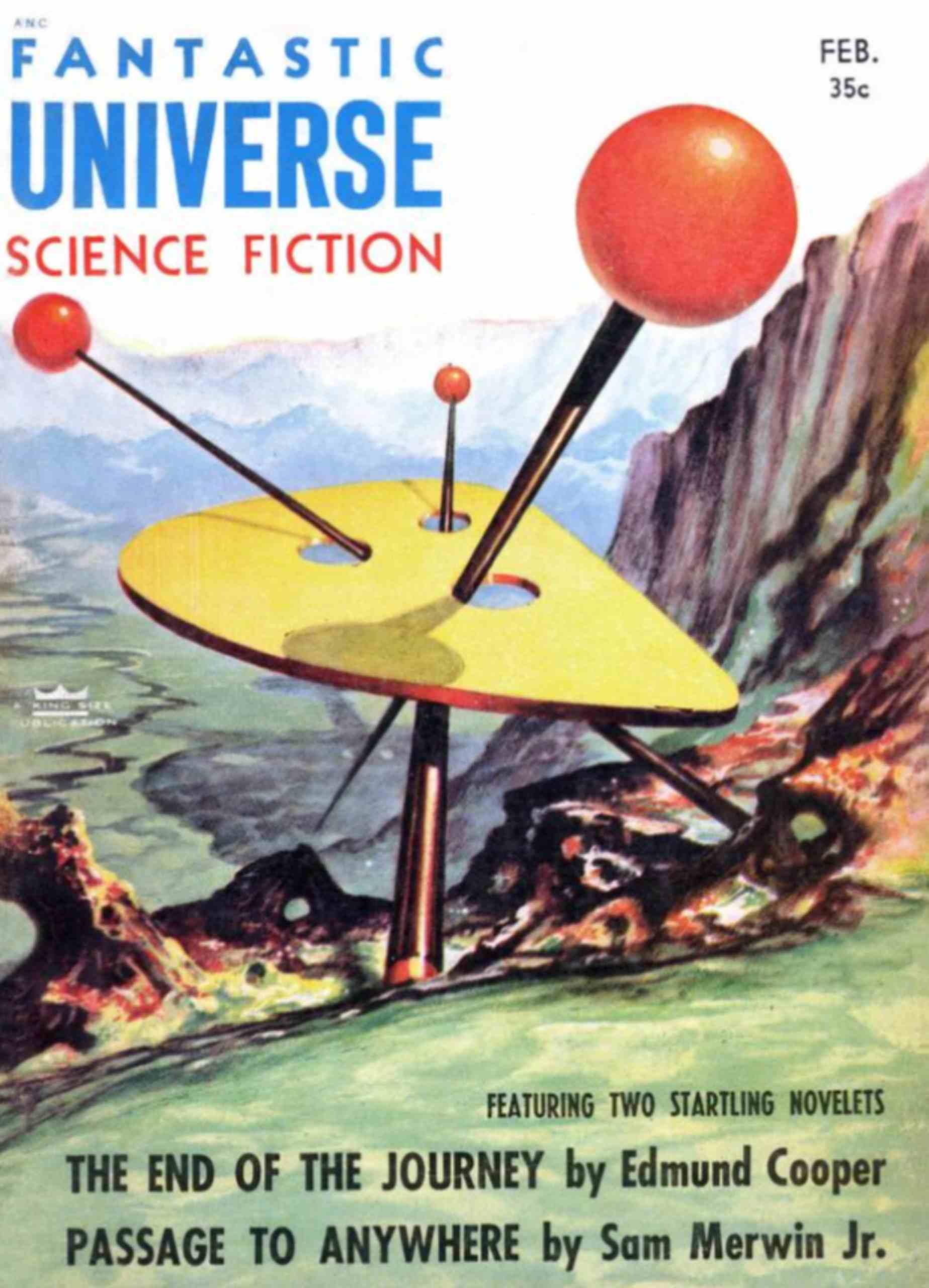
Title: Shades of Davy Crockett
Author: Theodore Pratt
Illustrator: Kelly Freas
Release date: January 9, 2026 [eBook #77662]
Language: English
Original publication: New York: King-Size Publications, Inc., 1955
Other information and formats: www.gutenberg.org/ebooks/77662
Credits: Tom Trussel (This file was produced from images generously made available by The Internet Archive)
by Theodore Pratt
There are a good many Davy Crocketts around these days, great and small. But though the memory and the glory of Davy have been sweeping the Nation for almost two years now, we’re quite sure that only Theodore Pratt—whose fine novels have made him a writer of considerable fame and stature—would have dared to revisit the Alamo in a fantasy wholly magical, and to place Davy once again—coonskin cap and all—at the hub of a young lad’s shining imagination.
Davy Crockett had a real problem to solve. How to set things right when youth’s bright vision proclaimed that nothing was wrong.
The big man in the fringed buckskin outfit and coonskin caр, with the bushy tail hanging down from it in back, walked slowly along the busy city street. His broad brown face looked troubled. He had tried to carry his long rifle sideways over his arm, but he found that people bumped into it. He did not like the experience, and had said so, and now he carried the gun over his shoulder. His powder horn flapped slightly against his hip. The hard pavement hurt his moccasin-clad feet.
Most people took little notice of him. Others looked at him, оссаsionally turning to glance back. A girl giggled. A few people made remarks, such as, “I don’t know how far they’ll carry this Davy Crockett thing.”
A police officer stepped up to the big man and asked, “You got a license to walk around like this?”
The big man drawled, “License? Do you got to have a license just to walk around?”
“You do when you’re carrying a gun on the city streets, concealed or not,” the officer informed him. The tall man sounded bewildered. “I just fail to understand.”
“Let me see that thing,” the officer commanded.
He reached out to take the rifle. The big man, for an instant, held it back. Then, with a scowl, he let it go.
The officer examined it curiously, then returned it with some disgust. “I guess you can’t do any harm with that thing.”
“I got no intention to do anybody harm,” the tall man replied, “but I can hit a bear at—”
“Well, you go find yourself a bear. Maybe at the zoo. But get off my beat. What’s your name, any way?”
“My name’s Crockett.”
“Crockett?”
“David Crockett.”
The officer gave him a look.
“Familiar-like,” the big man continued, “I’m known as Davy Crockett. There’s no reason why that should surprise you.”
The officer commented, “My kid plays he’s Davy Crockett, too.”
“But I am—”
“Sure, sure. And pretty soon a publicity guy is going to come along here with a reporter and a photographer and they’ll get your picture for the paper and this Crockett business will get bigger than ever. Only I won’t be in your picture and have people laugh at me. Let them laugh at you alone.”
“I don’t know all you’re talking about,” the big man said, “but it ain’t just like that.”
“If it ain’t, then you’re pretty old to go around in an outfit like this.”
“I’m truly Davy Crockett and nobody else.”
The officer looked at him again. “Move on,” he instructed, “before I do something about you.”
The big man moved on. He came to a store whose large window was filled with Davy Crockett clothing, caps, and all appurtenances, including knock-down miniature log cabins and replicas of the Alamo. Going inside, he was approached by a young male clerk, who smiled slightly when he asked, “What can I do for you, sir?”
The tall man smiled back at this friendly greeting, which was the first one he had received. “Well,” he said, “I need a thing.”
The clerk examined him and smiled some more when he said, “You look as if you have about everything in the Crockett line. I’m afraid our log cabins wouldn’t quite fit you. And our Alamos aren’t large enough either.”
The big man shook his head, making his coonskin cap tail waggle slightly. “I don’t want anything like that. I need to know a thing.”
“Yes, sir?” asked the clerk politely, but still unable not to smile.
“I’d sure like to know why people are doing this to me.”
“Doing what?” asked the clerk.
“Well, for one thing, having their young ones get rigged up in my clothes.”
The clerk stared. His smile began to leave his face, but it quickly returned. “Your clothes?”
“And the second thing is telling all these lies about me. How I could make shots no human being could make even if he was right on top of a target. And how I could grin a coon out of a tree. And kill a bear when I was threе years old and later how I could just look a bear to death, didn’t have to shoot him at all. I don’t like being misrepresented like that. I don’t like that way of doing things at all.”
“You don’t?”
“And then making all these things of mine and selling them.”
“The Crockett Craze.”
“Is that what they call it?”
“Well,” said the clerk, “if you don’t mind my saying so, you seem to be a part of it.” He laughed.
“Me? But I’m Davy Crockett.”
The clerk’s smile was even broader now. Lowering his voice, he advised, “You don’t have to put it on with me.”
“Put it on?”
“You’re from the Crockett Manufacturing Company, of course,” said the clerk. “And a very good gag, too. I’ll sell our Crockett goods even faster than the way they’ve been going.”
“No, no,” protested the big man. “I ain’t—” He stopped. “But might be this company that makes these things can tell me what I want to know. Can you give me their address?”
“I don’t get it,” the clerk said. “Unless you were hired by an agency downtown and want to go out to the Company’s office to collect your pay. Is that it?”
The big man nodded. “You got it right.”
The clerk gave him the address, saying, “It’s way over on the other side of the city. You got a car?”
“Car?”
“Automobile.”
“Them are the things out there making the smell and noise?”
The clerk sighed, and instructed, “You can take a B bus.”
“I’ll walk.”
“It’s a long walk.”
“I’m used to walking.”
It took the tall man the better part of an hour to reach the large red brick building housing the Crockett Manufacturing Company. His feet were sore, from the hard pavement, by the time he reached there. He entered the office of this concern. Through glass panels could be seen a large space where the busy manufacture of synthetic Davy Crockett buckskin outfits, synthetic coonskin caps, cardboard powder horns, and wooden long rifles was proceeding frantically.
A man sitting at a large desk looked up and said, “Well, if it ain’t Davy himself.”
“Sir,” replied the tall man, “I want to thank you for knowing who I am.”
“I could mistake that?” asked the manufacturer.
“I heard about what was going on. People who arrived lately where I....” He stopped.
“Arrived where?”
“Oh, where I live, or, rather, stay now. They told me. And I had a hankering to see it for myself. I obtained permission to return for a time and look around so I could find out why this was going on.”
Indulgently, the man inquired, “What do you want to know?”
“Why are you doing such as this?”
“What do you think? To make dough, large amounts of lettuce. And I’m making it.”
“But do you think you got the right to use the name of Davy Crockett the way you are doing?”
“Look, Davy ain’t copyrighted. He’s in the public domain, see? Hе don’t own himself any more. He’s a public figure. And I’m making him more public, more famous. I don’t see what he’s kicking about.”
“But I don’t like myself done to in this way, commercialized-like,” the big man protested. “It—well, it ain’t nice. It’s cheap, downright cheap and not according to decency.”
The Crockett manufacturer rose and came out from behind his desk. “I’ll admit my goods ain’t maybe like your get-up there, but mine are better than most.” He fingered Davy’s jacket. “Say, that’s real buckskin. And your cap’s real coon. And that rifle, it’s the real thing, too, ain’t it, along with the powder horn.”
“Of course,” said the tall man.
The manufacturer had been studying him closely. “Well, let’s get down to business. I’ll admit your approach was good. Got my attention right away. You deadpanned it fine; bet you’re an actor out of work.” He laughed, and the big man noted he was the second person to laugh at him, not counting the girl who had giggled.
“But I’ll tell you what,” the manufacturer continued, “I can’t use you for an ad. And you want to know why? Because business is too good. I can’t handle any more. Come around when business begins to fall off and maybe I’ll hire you. Sure, come to see me then and I’ll give you a job. You can walk around downtown with my name hanging from your neck.”
Shortly, the tall man answered, “I’m thanking you, but that ain’t what I want.”
“What’s the matter? Not good enough for you?”
“In all humility,” the big man replied, “that is correct. I don’t aim to think of myself as a historical American figure, but others have seen fit to make me so. It being like that, I believe you and such should get more respect for the name of Davy Crockett.”
“We got all the respect in the world,” the manufacturer said. “In fact, every night I get down on my hands and knees and say a prayer of thanks to Davy Crockett.”
“I ain’t had the hearing of you,” the big man informed him. “And I figure if your heart was in the right place and you prayed the way you say, it would of reached me.”
The manufacturer now gazed at him in quizzical fashion. “You know something?” he asked. “I think you got yourself really believing you’re Davy Crockett and you’re going around pretending you’re him. That ain’t good. It ain’t good for my business and you better stop it. And speaking of respect for Davy, that ain’t any way to show respect and right now let me tell you I couldn’t use you no matter how bad business got. You better beat it before I call the man with the net.”
The big man left. He walked to Washington, D.C., and looked up one of the Congressmen from Tennessee, who was quite happy to see him, even after he introduced himself and said, “You’re holding the self same job I once had.”
Indulgently, the Congressman observed, “So you’re Davy Crockett. Glad to know you, Davy.” They shook hands. A slightly glassy look then came to the Congressman’s eyes, as if, belatedly, he had fully realized something. But he went on smoothly, “I’ve had all kinds of constituents call on me, but never one such as you. It is an honor to have you here. I only hope I can fulfill my duties as a Congressman from Tennessee as well as you did, Davy.”
“You can start,” said the big man, “by putting a stop right off to this Crockett Craze.”
The Congressman looked horrified. “Put a stop to it?” he cried. He shook his head. “I don’t know as I would want to do that, Davy.”
“You mean,” the tall man demanded, “you got to thinking it’s good?”
“In a way,” the Tennessee Congressman temporized, “it’s a pretty good thing, pretty good. Makes our state known around a good deal, gets it mentioned here and there on such things as the films, the radio, and TV.”
“What are them things?”
The Congressman gazed at him for a moment before proceeding, “Thanks to you, Davy, it’s good for the tourist business, too. And excellent for attracting other business to Tennessee; makes people think the people of Tennessee are as honest and straightforward as you, Davy.”
“Well, ain’t they?”
“Of course, of course!”
Stiffly, the big man stated, “Still, I can’t help but think the Crockett Craze is a downright insult to me.”
“Well, now,” said the Congressman, “I wouldn’t look at it exactly that way, Davy. I think you can take it as a compliment as much as anything. Have you tried to think of it like that?”
“Such would be a hard thing to do,” said the tall man, “while other people are making money out of it, using my name in such a way.”
“You mean you’d like to be in on it yourself?” inquired the Congressman.
“Nothing like that,” said the tall man. “I don’t aim to have any use for making money.”
“Independently wealthy already, is that it?”
“You might say so,” the big man admitted. “In a manner of speaking.”
“Well, Davy, that must be pretty comfortable.”
“If they paid all this attention to me,” explained the big man, “without making anything out of it, it would be right fine. But that ain’t the state of affairs.”
“Times change,” the Congressman pointed out reasonably. “Values have been altered since your day, Davy. I sympathize with your ethics carried over from another time. They are on a much higher plane than those of today. But I’m afraid not too practical now. I’m sure you’ll realize that when you think it over. Now if you’ll give your name and—I mean, that is, your address to my secretary as you leave, I know you’ll be interested in receiving some campaign literature when I come up for reelection, Davy.”
The Congressman looked at the big man again and laughed, as though he had wanted to laugh before but had only got around to it now, unable to contain himself longer. The big man, wishing that everybody wouldn’t laugh at him, found himself eased out to the outer office. Here a young lady solemnly took down his name. She didn’t even look up when she asked for his address and the first thing he thought to answer was, “Last one I had here was the Alamo, San Antonio, Texas.”
The tall man thought he would go and see if the Davy Crockett Craze had reached the shrine of Texas liberty. While walking to San Antonio he kept off the hard pavements and this was a lot easier on his feet.
There were not many people in the ruins of the Alamo when he arrived. Only a few tourists wandered about the ancient monument. One of these was a young boy clad in Davy Crockett costume. His phony coonskin cap was too large and fell over his eyes occasionally, while his fake rifle was too small. But these imperfections made no difference to his fierce pride in having them. He had evidently become separated from his parents. He saw the big man and demanded shrilly, “What’s the idea?”
The big man asked, “What do you mean, son?”
“I mean you all dressed up like Davy.”
“But, son,” the tall man told him, “I’m Davy.”
“You? Huh!”
“I really am. I’m Davy Crockett.”
“No, you ain’t. You can’t be.”
“Why not?”
“Because I’m him.”
“I don’t mind your saying so, son, because your heart is pure, not like that of those who made that shoddy costume for you.”
“Aw, you ain’t Davy.”
The big man smiled. “Yes, I am. Right over there is where I died. Why, it’s just like yesterday here. We had run out of ammunition. All we had was our rifles to use as clubs, and our knives. We kept killing Santa Anna’s men, hundreds of them, but he kept sending them in. There were just too many for us.”
“I know all that,” the boy said.
“You do? Now, ain’t that nice?” The big man pointed to another spot. “And speaking of knives, there is where James Bowie died. He was the one who invented the Bowie knife, which is named after him.”
“You don’t have to tell me!” cried the boy. He whipped out his own small Bowie knife and brandished it before restoring it to its sheath at his belt. Then he stared at the big man. “You had me going there for a minute, Mister, but you ain’t any more. Cause you ain’t Davy Crockett. Why, you don’t even look like him. Anybody can see that.”
The tall man asked softly, “You don’t think so?”
“And you better stop going around hurting Davy.”
“Hurting him?”
“By pretending you’re him. People will laugh at you like they was laughing at Davy. You’re hurting him doing that, ain’t you?”
Slowly, the big man answered, “Yes, son, I guess I am. And I expect I couldn’t ever find out what I came to learn, anyway.”
“Sure you couldn’t, whatever that is. Davy Crockett!” the youngster shrilled scornfully, his voice sounding hollowly in the emptiness of the Alamo, just the way it had sounded once long ago when Davy’s name was called. “You ain’t him!” The boy raised his tiny wooden rifle. “You’re a bear and I’m going to kill you!”
“You mean,” the big man asked, “you’re Davy Crockett and you’re fixing to kill your bear?”
“That’s what! And if I don’t kill him with my rifle I’ll kill him with a good hard look! So get ready!”
The big man smiled broadly now. “Maybe,” he whispered, “I found out what I came for, after all. And I’m glad to have you be Davy Crockett, son. Why, I expect I’m downright proud to be remembered like you and all the rest are doing.”
Davy raised his tiny wooden rifle all the way and began to shoot, calling loudly, “Bang! Bang!”
The big man pretended to duck, and then he ran, with Davy after him, shooting steadily. Davy chased him right out the front of the Alamo and there he stopped, for his oversize coonskin cap dropped over his eyes. He pushed it up and then stared about in the bright sunlight, astonished. No one was there.
Little Davy looked around, puzzled. “I got him, all right,” he said. “But where’d he go?”
This etext was produced from Fantastic Universe, February 1956 (Vol. 5, No. 1.). Extensive research did not uncover any evidence that the U.S. copyright on this publication was renewed.
Obvious errors have been silently corrected in this version, but minor inconsistencies have been retained as printed.