Transcriber’s Note: New original cover art included with this eBook, and derived from the book's cover and title page, is granted to the public domain.
Title: Outlook editorials
Author: Theodore Roosevelt
Release date: December 31, 2025 [eBook #77590]
Language: English
Original publication: New York: The Outlook Company, 1909
Other information and formats: www.gutenberg.org/ebooks/77590
Credits: Produced by Donald Cummings and the Online Distributed Proofreading Team at https://www.pgdp.net (from images generously made available by The Internet Archive/American Libraries).
Transcriber’s Note: New original cover art included with this eBook, and derived from the book's cover and title page, is granted to the public domain.
Outlook Editorials
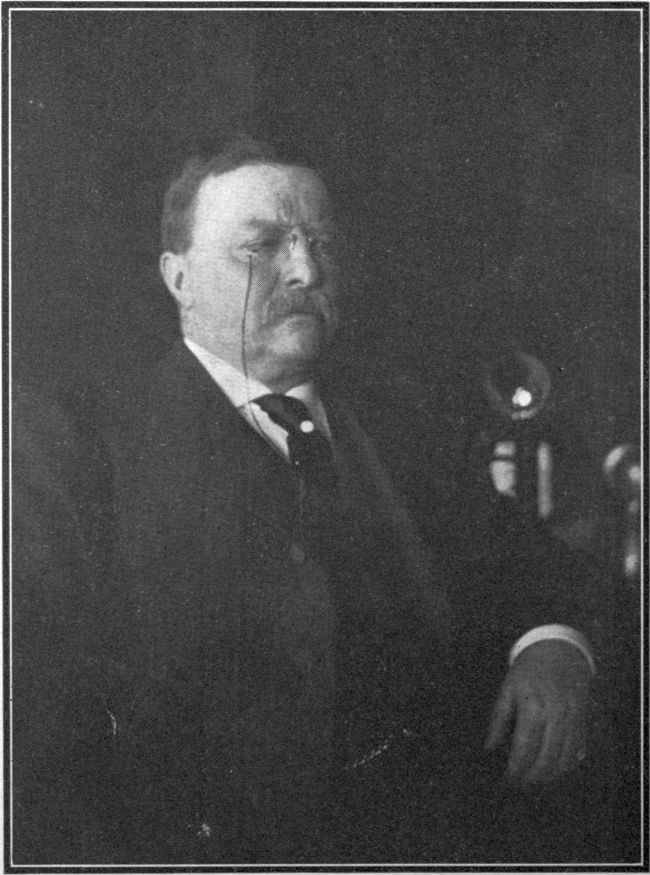
Theodore Roosevelt
At His Desk in the Outlook Office
New York
The Outlook Company
1909
Copyright 1909 by
New York
All rights reserved
The first eleven editorials of
Theodore Roosevelt, published
in The Outlook from March
sixth to July seventeenth,
nineteen hundred and nine
From The Outlook of March 6, 1909

It would be a singular affectation to introduce to the readers of The Outlook its new Associate Editor, Theodore Roosevelt. He is the most widely known representative of the present world movement towards industrial democracy. It is needless here to describe that movement, so fully has it been described by editorials in The Outlook, and by the public addresses and state papers of the retiring President of the United States. Unconsciously co-operating, we have pursued a common end, which in the future we shall pursue in conscious co-operation. Our object is to bring the industrial institutions of democracy into harmony with its political and educational institutions. Our resolve is that the money power in America, as its political and educational power, shall come from the people, be exercised for the people, and be controlled by the people. Our motto is, Special privilege for none, equality of opportunity for all. In the name of the editorial and publishing departments of The Outlook, I frankly acknowledge our gratification that Theodore Roosevelt has chosen this journal to be the medium for his published utterances on social, economic and political subjects, and in their name I welcome him as an Associate to its editorial staff.
LYMAN ABBOTT.
[1]
[2]
[3]
I first came into close contact with The Outlook when Governor of New York, ten years ago, and I speedily grew to have a peculiar feeling of respect and regard for Dr. Abbott and his associates. We did not always agree, and as our convictions were strong our disagreements were sometimes positive; but experience taught me that, in the first place, Dr. Abbott and his associates always conscientiously strove to be fair, and that, in the second place, they not only desired to tell the truth, but made a serious endeavor to find out the facts. I found, moreover, that they combined to a peculiar degree a number of qualities, each of them good, but rarely found in combination.
Every owner, editor, or reporter of a conscientiously and ably conducted newspaper or periodical is an asset of real value to the whole community. It would be difficult to [4]overestimate the amount of good which can be done by the men responsible for such a publication—responsible for its editorial columns, responsible for its news columns, responsible for its general policy. We have many newspapers and periodicals, big and little, of this kind. But we also have many that are emphatically not of this kind.
During the last few years it has become lamentably evident that certain daily newspapers, certain periodicals, are owned or controlled by men of vast wealth who have gained their wealth in evil fashion, who desire to stifle or twist the honest expression of public opinion, and who find an instrument fit for their purpose in the guided and purchased mendacity of those who edit and write for such papers and periodicals. This style of sordid evil does not even constitute a temptation to The Outlook; no influence of any kind could make the men who control The Outlook so much as consider the question of abandonment of duty; and they hold as their first duty inflexible adherence to the elementary virtues of entire truth, entire courage, entire honesty.
[5]
Moreover, they are as far removed as the poles from the apostles of that hideous yellow journalism which makes a cult of the mendacious, the sensational, and the inane, and which, throughout its wide but vapid field, does as much to vulgarize and degrade the popular taste, to weaken the popular character, and to dull the edge of the popular conscience, as any influence under which the country can suffer. These men sneer at the very idea of paying heed to the dictates of a sound morality; as one of their number has cynically put it, they are concerned merely with selling the public whatever the public will buy—a theory of conduct which would justify the existence of every keeper of an opium den, of every foul creature who ministers to the vices of mankind. Here, again, it is perhaps not especially to the credit of Dr. Abbott and his associates that they have avoided this pit; fortunately, they are so constituted that it is a simple impossibility for them to fall into it.
But they do deserve very great credit for avoiding another type of temptation which has much fascination for men of cultivation [6]and of refined taste, and which is quite as fatal to their usefulness as indulgence in yellow journalism. A newspaper or periodical which avoids vulgar sensationalism, which takes and cultivates an interest in serious matters, and things literary, artistic, and scientific—which, in short, appeals to people of taste, intelligence, and cultivation—may nevertheless do them grave harm, and be within its own rather narrow limits an element of serious mischief; for it may habitually and consistently practice a malign and slanderous untruthfulness which, though more refined than, is at least as immoral as, the screaming sensationalism of any representative of the journalism which it affects to despise. A cultivated man of good intelligence who has acquired the knack of saying bitter things, but who lacks the robustness which will enable him to feel at ease among strong men of action, is apt, if his nature has in it anything of meanness or untruthfulness, to strive for a reputation in what is to him the easiest way. He can find no work which is easier—and less worth doing—than to sit in cloistered aloofness from the men who wage the real and [7]important struggles of life and to endeavor, by an unceasing output of slander in regard to them, to bolster up his own uneasy desire to be considered superior to them. Now a paper edited by men of this stamp does not have much popular influence, and therefore is less detrimental to the people at large than yellow journalism; but it may, to the extent of its power, exert a very real influence for evil, by the way in which it teaches young men of good education, whose talents should be at their country’s service, that decent and upright public men are as properly subjects of foul attack as the most debased corruptionist; that efficiency and wickedness are interchangeable; and that the correct attitude to adopt, in facing the giant problems of our great and troubled time, is one of sneering and supercilious untruthfulness.
Dr. Abbott and his associates have avoided this pitfall also. With them cultivation and good taste have not implied weakness. Demand for righteousness in others has not led to abandonment of truth on their own part.
The Outlook has stood for righteousness, but it has never been self-righteous. It stands [8]for the things of the spirit, and yet it remembers the needs of the body. It serves lofty ideals, it believes in a lofty idealism. But it knows that common sense is essential above all other qualities to the idealist; for an idealist without common sense, without the capacity to work in hard, practical fashion for actual results, is merely a boat that is all sails, and with neither ballast nor rudder. The Outlook’s belief in gentleness and tenderness, in the spirit of brotherly love, never blinds it to the necessity of cultivating those hardy, rugged, and vigorous qualities for the want of which in the individual as in the Nation, no gentleness, no cultivation, and, above all, no gift of money-making and no self-indulgence in the soft ease of living, can in any way atone.
The Outlook has shown a fine scorn of untruth in every form, of unfairness and injustice to any man or any cause. It is not given to humanity never to err; but The Outlook makes a resolute effort to find out what the facts actually are before passing judgment. With it earnestness and strength of conviction go hand in hand with a sincere [9]desire to see and to state the other man’s point of view. It believes that things in this world can be made better, but it does not indorse quixotic movements which would merely leave things worse. It champions the rights of the many. It desires in every way to represent, to guide aright, and to uphold the interests of those whom Abraham Lincoln called the plain people. It feels a peculiar desire to do all that can be done for the poor and the oppressed, and to help upward those struggling to better themselves. But it has no sympathy with moral weakness or sentimentality. All that it can do it does and will do for the cause of labor; but it will in no shape or way condone violence or disorder. It stands for the rights of property, and therefore against the abuses of property. It believes in a wise individualism, and in encouragement of individual initiative; and therefore all the more it believes in using the collective force of the whole people to do what but for the use of that collective force must be left undone.
I am glad to be associated with Dr. Abbott and the group of men and women he has [10]gathered around him, because they practice what they preach; and because they preach the things that are most necessary to the salvation of this people. It is their earnest belief that every man must earn enough to support himself and those dependent upon him; but that when once this has been accomplished, money immediately becomes secondary to many other things. In this matter The Outlook puts its principles into practice. It strives in proper ways to make money. If it did not make money it could not be run at all. But making money is not the prime reason for its existence. The first question asked when any matter of policy arises, so far as The Outlook is concerned, is whether or not a given course is right, and should be followed because it is in the real and lasting interest of the Nation. If this question is answered in the affirmative, then The Outlook follows the course indicated with all the courage, earnestness, and ability that are at its disposal.
[11]
[12]
[13]
A year after leaving Harvard I ran for the New York Legislature and was elected. In the Legislature I was soon brought in contact with various advocates of what is known as labor legislation; and I eyed both them and their schemes with great distrust. When in Harvard I had studied what were then considered the orthodox political economists; and after leaving college the older men whom I met were for the most part lawyers or business men of wealth who quite sincerely took the ordinary wealthy business man’s view of labor matters. Moreover, in the Legislature, most of the men who professed a loud and ardent interest in the welfare of the laboring man were exceedingly unattractive persons, who, to put it mildly, did not impress one as being either sincere or honest. Many of the labor bills which were introduced were foolish, and were urged in a transparently demagogic spirit, and the labor leaders who came to Albany to argue for them eyed me with a suspicion [14]which I cordially reciprocated. Most of them, I am now inclined to think, were by no means of the best type; and I, in my turn, because of my surroundings both in the classroom and in the social and business world, was alert to pick flaws in anything concerning a labor union, and possessed a self-satisfied narrowness in approaching all labor questions which must have been highly exasperating to my opponents.
My college training had biased me against all governmental schemes for the betterment of the social and industrial conditions of laborers, or for the control of corporations. The education which I afterwards received in these matters, and which completely changed my views, was gained partly from books, but more from actual experience in governmental work, and from a constantly widening and more intimate knowledge of the real life of different bodies of our people. My first step in this education began when, after leaving college, I joined, and endeavored to make myself count in, my local Republican association—instead of joining some parlor gathering of well-meaning dilettante reformers.
[15]
The labor unions had been demanding legislation to stop the manufacture of cigars in tenement-houses, and during my second term in Albany the Assembly appointed a committee to look into the conditions. My belief is that the committee was appointed with the hope that it would not recommend any change in the law, and that I was put on because, on account of my education and social surroundings, it was supposed that I would naturally take this view; and I certainly expected to take it. One of my colleagues was a then well-known sporting Tammany politician who afterwards abandoned politics and became a professional racing man. There were many points on which our theories of ethics were as far asunder as the poles; but I soon discovered that there were other matters, and some of these of fundamental importance, on which we thought alike, and our association ended in mutual respect and good will. Soon after the investigation started I told him that I was a good deal shocked at what I had seen, and was wavering in my preconceived opinions. He answered by saying that, as far as he personally [16]was concerned, he was pledged in advance against recommending any change in the law, but that he had known that I was a free agent and had all along believed that when I looked into the matter for myself I would be a very ardent advocate of the change. He was quite right in his supposition. The investigation convinced me beyond shadow of doubt that to permit the manufacture of cigars in tenement-houses, which necessarily meant their manufacture not only by the men but by the women and children of the poverty-stricken immigrants who were engaged in the task, was an evil thing from every standpoint, social, industrial, and hygienic. I accordingly cordially supported the bill; which made a large number of my friends regard me as erratic and dangerous, or else as influenced by demagogic motives. The bill was badly drawn. No lawyer of any note had been consulted; there was no one to pay such a lawyer. When it passed both houses, the then Governor, Grover Cleveland, appointed a day for a hearing, and the labor unions asked me to appear. Appear we did, several good counsel being against us, while on our [17]side there were, besides myself, merely five or six representatives of the cigar-makers’ union, all of them foreigners—battered-looking men, with whom the battle of life had evidently gone hard. As this was long before I had established any real relations with, or had any real understanding of, the unions, while they felt that I was a crank, influenced by incomprehensible motives, we worked on entirely independent lines, neither side feeling altogether comfortable in the relationship. However, the main argument—and indeed almost the only argument—for the bill was made by me. I answered various questions which the Governor put to me. He afterwards called me up and told me that, though he felt very doubtful, yet that, in view of the state of facts I had set forth, he would sign the bill.
The employers and tenement-house owners immediately contested the constitutionality of the act, and after the usual long delays the highest State court finally pronounced the measure invalid. The cigar-makers were poor, and the great majority of them were ignorant foreigners. They had no money [18]and no special influence even in the world of labor. They could not employ counsel either to draw their bill well in the first place, or to present their case to the best advantage when it was before the courts. The great mass of respectable, well-to-do people were nervously sensitive to attacks on what they considered the rights of property, and regarded as an infringement on these rights any effort to correct the abuses of property. The judges, as was quite natural, shared the feelings of the classes from which they were drawn, and with which they associated. The decision went against the dwellers in the tenement-houses. Anything like an effective reformation of tenement-house conditions was thereby deferred for fifteen or twenty years, and during that time men, women, and children were guaranteed their “liberty” to fester in sodden misery.
The judges invoked a technical construction of the Constitution in order to declare invalid a law deliberately enacted by the legislative body; a law which I firmly believe it was entirely in the province of the Legislature to pass. Every consideration of public [19]morals and public weal demanded that it should be declared valid. At the present day few courts in any State of the Union would make such a decision as was then made; yet the judges making it were learned in the law, and according to their own lights were upright and honorable men. But they were men without any sympathetic understanding or knowledge of the needs and conditions of life of the great mass of their fellow-countrymen. If those judges had understood “how the other half lived,” if they had possessed a working knowledge of tenement-houses and factories, of tenement-house dwellers and factory workers, and of the lives that were lived where the tenement-house and the factory were one and the same, I am absolutely certain that they would have rendered no such decision as was rendered. They knew the life of the well-to-do, both the business life and the home life. They knew nothing of the lives of those who were not well-to-do. It was this lack of knowledge and the attendant lack of sympathetic understanding that formed the real barrier between the judges and a wise judgment.
[20]
My reason for relating this anecdote is because from that day to this I have felt an ever-growing conviction of the need of having on the bench men who, in addition to being learned in the law and upright, shall possess a broad understanding of and sympathy with their countrymen as a whole, so that the questions of humanity and of social justice shall not be considered by them as wholly inferior to the defense of vested rights or the upholding of liberty of contract. A hair-splitting refinement in decisions may result in as much damage to the community as if the judge were actually corrupt. Freedom of contract should be permitted only so far as is compatible with the best interests of the community; and when vested rights become intrenched wrongs, they should be overturned. I do not for one moment believe that the mass of our judges are actuated by any but worthy motives. Nevertheless, I do believe that they often signally fail to protect the laboring man and the laboring man’s widow and children in their just rights, and that heartbreaking and pitiful injustice too often results therefrom; and this primarily because our judges lack [21]either the opportunity or the power thoroughly to understand the working man’s and working woman’s position and vital needs.
There are many judges, from the Supreme Court of the Nation down to the district bench in each State, who do possess this sympathy and understanding, in addition to uprightness, trained ability, broad intelligence, and entire fearlessness in the face of wrong, whether committed by capitalist or by laboring men; such judges are the best and most useful of all our public servants; public opinion should uphold them as clearly as it condemns their short-sighted and narrow-minded brethren.
[22]
[23]
[24]
[25]
I am about to go to Africa as the head of the Smithsonian expedition. It is a scientific expedition. We shall collect birds and mammals for the National Museum at Washington, and nothing will be shot unless for food, or for preservation as a specimen, or unless, of course, the animal is of a noxious kind. There will be no wanton destruction whatever.
I very earnestly hope that no representative of any newspaper or magazine will try to accompany me or to interview me during any portion of my trip. Until I actually get to the wilderness my trip will be precisely like any other conventional trip on a steamboat or railway. It will afford nothing to write about, and will afford no excuse or warrant for any one sending to any newspaper a line in reference thereto. After I reach the wilderness of course no one outside of my own party will be with me, and if any one pretends to be with me or pretends [26]to write as to what I do, his statements should be accepted as on their face not merely false but ludicrous. Any statement purporting to have been made by me, or attributed to me, which may be sent to newspapers, should be accepted as certainly false and as calling for no denial from me. So far as possible I shall avoid seeing my representative of the press, and shall not knowingly have any conversation on any subject whatever with any representative of the press beyond exchanging the ordinary civilities or courtesies. I am a private citizen, and I am entitled to enjoy the privacy that should be the private citizen’s right. My trip will have no public bearing of any kind or description. It is undertaken for the National Museum at Washington, and is simply a collecting trip for the Museum. It will be extremely distasteful to me and of no possible benefit to any human being to try to report or exploit the trip, or to send any one with me, or to have any one try to meet me or see me with a view to such reporting or exploitation. Let me repeat that while I am on steamer or railway there will be [27]nothing whatever to report; that when I leave the railway for the wilderness no persons will have any knowledge which will enable them to report anything, and that any report is to be accepted as presumably false.
[28]
[29]
[30]
[31]
It is always difficult to discuss a question when it proves impossible to define the terms in which that question is to be discussed. Therefore there is not much to be gained by a discussion of Socialism versus Individualism in the abstract. Neither absolute Individualism nor absolute Socialism would be compatible with civilization at all; and among the arguments of the extremists of either side the only unanswerable ones are those which show the absurdity of the position of the other. Not so much as the first step towards real civilization can be taken until there arises some development of the right of private property; that is, until men pass out of the stage of savage socialism in which the violent and the thriftless forcibly constitute themselves co-heirs with the industrious and the intelligent in what the labor of the latter produces. But it is equally true that every step toward civilization is marked [32]by a check on individualism. The ages that have passed have fettered the individualism which found expression in physical violence, and we are now endeavoring to put shackles on that kind of individualism which finds expression in craft and greed. There is growth in all such matters. The individualism of the Tweed Ring type would have seemed both commonplace and meritorious to the Merovingian Franks, where it was not entirely beyond their comprehension; and so in future ages, if the world progresses as we hope and believe it will progress, the standards of conduct which permit individuals to make money out of pestilential tenements or by the manipulation of stocks, or to refuse to share with their employees the dreadful burdens laid upon the latter by the inevitable physical risks in a given business, will seem as amazing to our descendants as we now find the standards of a society which regarded Clovis and his immediate successors as pre-eminently fit for leadership.
With those self-styled Socialists to whom “Socialism” is merely a vaguely conceived catchword, and who use it to express their [33]discontent with existing wrongs and their purpose to correct them, there is not much need of discussion. So far as they make any proposals which are not foolish, and which tend towards betterment, we can act with them. But the real, logical, advanced Socialists, who teach their faith as both a creed and a party platform, may deceive to their ruin decent and well-meaning but short-sighted men; and there is need of plain speaking in order accurately to show the trend of their teaching.
The immorality and absurdity of the doctrines of Socialism as propounded by these advanced advocates are quite as great as those of the advocates, if such there be, of an unlimited individualism. As an academic matter there is more need of refutation of the creed of absolute Socialism than of the creed of absolute individualism; for it happens that at the present time a greater number of visionaries, both sinister and merely dreamy, believe in the former than in the latter. One difficulty in arguing with professed Socialists of the extreme, or indeed of the opportunist type, however, is that those of them who are sincere almost invariably suffer from great [34]looseness of thought; for if they did not keep their faith nebulous, it would at once become abhorrent in the eyes of any upright and sensible man. The doctrinaire Socialists, the extremists, the men who represent the doctrine in its most advanced form, are, and must necessarily be, not only convinced opponents of private property, but also bitterly hostile to religion and morality; in short, they must be opposed to all those principles through which, and through which alone, even an imperfect civilization can be built up by slow advances through the ages.
Indeed, these thoroughgoing Socialists occupy, in relation to all morality, and especially to domestic morality, a position so revolting—and I choose my words carefully—that it is difficult even to discuss it in a reputable paper. In America the leaders even of this type have usually been cautious about stating frankly that they proposed to substitute free love for married and family life as we have it, although many of them do in a round-about way uphold this position. In places on the continent of Europe, however, they are more straightforward, their attitude being [35]that of one of the extreme French Socialist writers, M. Gabriel Deville, who announces that the Socialists intend to do away with both prostitution and marriage, which he regards as equally wicked—his method of doing away with prostitution being to make unchastity universal. Professor Carl Pearson, a leading English Socialist, states their position exactly: “The sex relation of the future will not be regarded as a union for the birth of children, but as the closest form of friendship between man and woman. It will be accompanied by no child bearing or rearing, or by this in a much more limited number than at present. With the sex relationship, so long as it does not result in children, we hold that the State in the future will in no wise interfere, but when it does result in children, then the State will have a right to interfere.” He then goes on to point out that in order to save the woman from “economic dependence” upon the father of her children, the children will be raised at the expense of the State; the usual plan being to have huge buildings like foundling asylums.
Mr. Pearson is a scientific man who, in his [36]own realm, is as worthy of serious heed as Mr. Flinders Petrie, whom I mention later, is in his realm; and the above quotation states in naked form just what logical scientific Socialism would really come to. Aside from its thoroughly repulsive quality, it ought not to be necessary to point out that the condition of affairs aimed at would in actual practice bring about the destruction of the race within, at most, a couple of generations; and such destruction is heartily to be desired for any race of such infamous character as to tolerate such a system. Moreover, the ultra-Socialists of our own country have shown by their attitude towards one of their leaders, Mr. Herron, that, so far as law and public sentiment will permit, they are now ready to try to realize the ideals set forth by Messrs. Deville and Pearson. As for Mr. Herron, I commend to those who desire to verify what I have said, the article in the Boston Congregationalist of June 15, 1901; and to those, by the way, who have not the time to hunt up all the original authorities, I would commend a book called “Socialism; the Nation of Fatherless Children,” a book dedicated to the American [37]Federation of Labor. The chapters on Free Love, Homeless Children, and Two Socialist Leaders are especially worth reading by any one who is for the moment confused by the statements of certain Socialist leaders to the effect that advanced Socialism does not contemplate an attack upon marriage and the family.
These same Socialist leaders, with a curious effrontery, at times deny that the exponents of “scientific Socialism” assume a position as regards industry which in condensed form may be stated as, that each man is to do what work he can, or, in other words, chooses, and in return is to take out from the common fund whatever he needs; or, what amounts to the same thing, that each man shall have equal remuneration with every other man, no matter what work is done. If they will turn to a little book recently written in England called “The Case Against Socialism,” they will find by looking at, say, pages 229 and 300, or indeed almost at random through the book, quotations from recognized Socialist leaders taking exactly this position; indeed, it is the position generally taken—though it [38]is often opposed or qualified, for Socialist leaders usually think confusedly, and often occupy inconsistent positions. Mrs. Besant, for instance, putting it pithily, says that we must come to the “equal remuneration of all workers;” and one of her colleagues, that “the whole of our creed is that industry shall be carried on, not for the profit of those engaged in it, whether masters or men, but for the benefit of the community.... It is not for the miners, bootmakers, or shop assistants as such that we Socialists claim the profits of industry, but for the citizen.” In our own country, in “Socialism Made Plain,” a book officially circulated by the Milwaukee division of the Socialist party, the statement is explicit: “Under the labor time-check medium of exchange proposed by Socialists, any laborer could exchange the wealth he produced in any given number of hours for the wealth produced by any other laborer in the same number of hours.” It is unnecessary to point out that the pleasing idea of these writers could be realized only if the State undertook the duty of taskmaster, for otherwise it is not conceivable that anybody whose work would [39]be worth anything would work at all under such conditions. Under this type of Socialism, therefore, or communism, the government would have to be the most drastic possible despotism; a despotism so drastic that its realization would only be an ideal. Of course in practice such a system could not work at all; and incidentally the mere attempt to realize it would necessarily be accompanied by a corruption so gross that the blackest spot of corruption in any existing form of city government would seem bright by comparison.
In other words, on the social and domestic side doctrinaire Socialism would replace the family and home life by a glorified State free-lunch counter and State foundling asylum, deliberately enthroning self-indulgence as the ideal, with, on its darker side, the absolute abandonment of all morality as between man and woman; while in place of what Socialists are pleased to call “wage slavery” there would be created a system which would necessitate either the prompt dying out of the community through sheer starvation, or an iron despotism over all workers, compared to which any slave system of the past would [40]seem beneficent, because less utterly hopeless.
“Advanced” Socialist leaders are fond of declaiming against patriotism, of announcing their movement as international, and of claiming to treat all men alike; but on this point, as on all others, their system would not stand for one moment the test of actual experiment. If the leaders of the Socialist party in America should to-day endeavor to force their followers to admit all negroes and Chinamen to a real equality, their party would promptly disband, and, rather than submit to such putting into effect of their avowed purpose, would, as a literal fact, follow any capitalistic organization as an alternative.
It is not accident that makes thoroughgoing and radical Socialists adopt the principles of free love as a necessary sequence to insisting that no man shall have the right to what he earns. When Socialism of this really advanced and logical type is tried as it was in France in 1792, and again under the Commune in 1871, it is inevitable that the movement, ushered in with every kind of high-sounding phrase, should rapidly spread so as to include, not merely the forcible acquisition [41]of the property of others, but every conceivable form of monetary corruption, immorality, licentiousness, and murderous violence. In theory, distinctions can be drawn between this kind of Socialism and anarchy and nihilism; but in practice, as in 1871, the apostles of all three act together; and if the doctrines of any of them could be applied universally, all the troubles of society would indeed cease, because society itself would cease. The poor and the helpless, especially women and children, would be the first to die out, and the few survivors would go back to the condition of skin-clad savages, so that the whole painful and laborious work of social development would have to begin over again. Of course, long before such an event really happened the Socialistic régime would have been overturned, and in the reaction men would welcome any kind of one-man tyranny that was compatible with the existence of civilization.
So much for the academic side of unadulterated, or, as its advocates style it, “advanced scientific” Socialism. Its representatives in this country who have practically [42]striven to act up to their extreme doctrines, and have achieved leadership in any one of the branches of the Socialist party, especially the parlor Socialists and the like, be they lay or clerical, deserve scant consideration at the hands of honest and clean-living men and women. What their movement leads to may be gathered from the fact that in the last Presidential election they nominated and voted for a man who earns his livelihood as the editor of a paper which not merely practices every form of malignant and brutal slander, but condones and encourages every form of brutal wrong-doing, so long as either the slander or the violence is supposed to be at the expense of a man who owns something, wholly without regard to whether that man is himself a scoundrel, or a wise, kind, and helpful member of the community. As for the so-called Christian Socialists who associate themselves with this movement, they either are or ought to be aware of the pornographic literature, the pornographic propaganda, which make up one side of the movement; a pornographic side which is entirely proper in a movement that in this country [43]accepts as one of its heads a man whose domestic immorality has been so open and flagrant as to merit the epithet of shameless. That criminal nonsense should be listened to eagerly by some men bowed down by the cruel condition of much of modern toil is not strange; but that men who pretend to speak with culture of mind and authority to teach, men who are or have been preachers of the Gospel or professors in universities, should affiliate themselves with the preachers of criminal nonsense is a sign of either grave mental or moral shortcoming.
I wish it to be remembered that I speak from the standpoint of, and on behalf of, the wage-worker and the tiller of the soil. These are the two men whose welfare I have ever before me, and for their sakes I would do anything, except anything that is wrong; and it is because I believe that teaching them doctrine like that which I have stigmatized represents the most cruel wrong in the long run, both to wage-worker and to earth-tiller, that I reprobate and denounce such conduct.
We need have but scant patience with those who assert that modern conditions are [44]all that they should be, or that they cannot be improved. The wildest or most vicious of Socialistic writers could preach no more foolish doctrine than that contained in such ardent defenses of uncontrolled capitalism and individualism as Mr. Flinders Petrie’s “Janus,” a book which is absurd, but which, because of this very fact, is not mischievous, for it can arouse no other emotion than the very earnest desire that this particular archæological shoemaker should stick to his early-Egyptian last. There are dreadful woes in modern life, dreadful suffering among some of those who toil, brutal wrong-doing among some of those who make colossal fortunes by exploiting the toilers. It is the duty of every honest and upright man, of every man who holds within his breast the capacity for righteous indignation, to recognize these wrongs, and to strive with all his might to bring about a better condition of things. But he will never bring about this better condition by misstating facts and advocating remedies which are not merely false, but fatal.
Take, for instance, the doctrine of the extreme Socialists, that all wealth is produced [45]by manual workers, that the entire product of labor should be handed over every day to the laborer, that wealth is criminal in itself. Of course wealth is no more criminal than labor. Human society could not exist without both; and if all wealth were abolished this week, the majority of laborers would starve next week. As for the statement that all wealth is produced by manual workers, in order to appreciate its folly it is merely necessary for any man to look at what is happening right around him, in the next street, or the next village. Here in the city where The Outlook is edited, on Broadway between Ninth and Tenth Streets, is a huge dry goods store. The business was originally started, and the block of which I am speaking was built for the purpose, by an able New York merchant. It prospered. He and those who invested under him made a good deal of money. Their employees did well. Then he died, and certain other people took possession of it and tried to run the business. The manual labor was the same, the good-will was the same, the physical conditions were the same; but the guiding intelligence at the top had [46]changed. The business was run at a loss. It would surely have had to shut down, and all the employees, clerks, laborers, everybody would have been turned adrift, to infinite suffering, if it had not again changed hands and another business man of capacity taken charge. The business was the same as before, the physical conditions were the same, the good-will the same, the manual labor the same, but the guiding intelligence had changed, and now everything once more prospered, and prospered as had never been the case before. With such an instance before our very eyes, with such proof of what every business proves, namely, the vast importance of the part played by the guiding intelligence in business, as in war, in invention, in art, in science, in every imaginable pursuit, it is really difficult to show patience when asked to discuss such a proposition as that all wealth is produced solely by the work of manual workers, and that the entire product should be handed over to them. Of course, if any such theory were really acted upon, there would soon be no product to be handed over to the manual laborers, and they [47]would die of starvation. A great industry could no more be managed by a mass-meeting of manual laborers than a battle could be won in such fashion, than a painters’ union could paint a Rembrandt, or a typographical union write one of Shakespeare’s plays.
The fact is that this kind of Socialism represents an effort to enthrone privilege in its crudest form. Much of what we are fighting against in modern civilization is privilege. We fight against privilege when it takes the form of a franchise to a street railway company to enjoy the use of the streets of a great city without paying an adequate return; when it takes the form of a great business combination which grows rich by rebates which are denied to other shippers; when it takes the form of a stock-gambling operation which results in the watering of railway securities so that certain inside men get an enormous profit out of a swindle on the public. All these represent various forms of illegal, or, if not illegal, then anti-social privilege. But there can be no greater abuse, no greater example of corrupt and destructive privilege, than that advocated by those who say that each [48]man should put into a common store what he can and take out what he needs. This is merely another way of saying that the thriftless and the vicious, who could or would put in but little, should be entitled to take out the earnings of the intelligent, the foresighted, and the industrious. Such a proposition is morally base. To choose to live by theft or by charity means in each case degradation, a rapid lowering of self-respect and self-reliance. The worst wrongs that capitalism can commit upon labor would sink into insignificance when compared with the hideous wrong done by those who would degrade labor by sapping the foundations of self-respect and self-reliance. The Roman mob, living on the bread given them by the State and clamoring for excitement and amusement to be purveyed by the State, represent for all time the very nadir to which a free and self-respecting population of workers can sink if they grow habitually to rely upon others, and especially upon the State, either to furnish them charity, or to permit them to plunder, as a means of livelihood.
In short, it is simply common sense to [49]recognize that there is the widest inequality of service, and that therefore there must be an equally wide inequality of reward, if our society is to rest upon the basis of justice and wisdom. Service is the true test by which a man’s worth should be judged. We are against privilege in any form: privilege to the capitalist who exploits the poor man, and privilege to the shiftless or vicious poor man who would rob his thrifty brother of what he has earned. Certain exceedingly valuable forms of service are rendered wholly without capital. On the other hand, there are exceedingly valuable forms of service which can be rendered only by means of great accumulations of capital, and not to recognize this fact would be to deprive our whole people of one of the great agencies for their betterment. The test of a man’s worth to the community is the service he renders to it, and we cannot afford to make this test by material considerations alone. One of the main vices of the Socialism which was propounded by Proudhon, Lassalle, and Marx, and which is preached by their disciples and imitators, is that it is blind to everything except the merely [50]material side of life. It is not only indifferent, but at bottom hostile, to the intellectual, the religious, the domestic and moral life; it is a form of communism with no moral foundation, but essentially based on the immediate annihilation of personal ownership of capital, and, in the near future, the annihilation of the family, and ultimately the annihilation of civilization.
[51]
[52]
[53]
It is true that the doctrines of communistic Socialism, if consistently followed, mean the ultimate annihilation of civilization. Yet the converse is also true. Ruin faces us if we decline steadily to try to reshape our whole civilization in accordance with the law of service, and if we permit ourselves to be misled by any empirical or academic consideration into refusing to exert the common power of the community where only collective action can do what individualism has left undone, or can remedy the wrongs done by an unrestricted and ill-regulated individualism. There is any amount of evil in our social and industrial conditions of to-day, and unless we recognize this fact and try resolutely to do what we can to remedy the evil, we run great risk of seeing men in their misery turn to the false teachers whose doctrines would indeed lead them to greater misery, but who do at least recognize the [54]fact that they are now miserable. At the present time there are scores of laws in the interest of labor—laws putting a stop to child labor, decreasing the hours of labor where they are excessive, putting a stop to unsanitary crowding and living, securing employers’ liability, doing away with unhealthy conditions in various trades, and the like—which should be passed by the National and the various State Legislatures; and those who wish to do effective work against Socialism would do well to turn their energies into securing the enactment of these laws.
Moreover, we should always remember that Socialism is both a wide and a loose term, and that the self-styled Socialists are of many and utterly different types. If we should study only the professed apostles of radical Socialism, of what these men themselves like to call “scientific Socialism,” or if we should study only what active leaders of Socialism in this country have usually done, or read only the papers in which they have usually expressed themselves, we would gain an utterly wrong impression of very many men who call themselves Socialists. There [55]are many peculiarly high-minded men and women who like to speak of themselves as Socialists, whose attitude, conscious or unconscious, is really merely an indignant recognition of the evil of present conditions and an ardent wish to remedy it, and whose Socialism is really only an advanced form of liberalism. Many of these men and women in actual fact take a large part in the advancement of moral ideas, and in practice wholly repudiate the purely materialistic, and therefore sordid, doctrines of those Socialists whose creed really is in sharp antagonism to every principle of public and domestic morality, who war on private property with a bitterness but little greater than that with which they war against the institutions of the home and the family, and against every form of religion, Catholic or Protestant. The Socialists of this moral type may in practice be very good citizens indeed, with whom we can at many points co-operate. They are often joined temporarily with what are called the “opportunist Socialists”—those who may advocate an impossible and highly undesirable Utopia as a matter of abstract faith, but [56]who in practice try to secure the adoption only of some given principle which will do away with some phase of existing wrong. With these two groups of Socialists it is often possible for all far-sighted men to join heartily in the effort to secure a given reform or do away with a given abuse. Probably, in practice, wherever and whenever Socialists of these two types are able to form themselves into a party, they will disappoint both their own expectations and the fears of others by acting very much like other parties, like other aggregations of men; and it will be safe to adopt whatever they advance that is wise, and to reject whatever they advance that is foolish, just as we have to do as regards countless other groups who on one issue or set of issues come together to strive for a change in the political or social conditions of the world we live in. The important thing is generally the next step. We ought not to take it unless we are sure that it is advisable; but we should not hesitate to take it when once we are sure; and we can safely join with others who also wish to take it, without bothering our heads overmuch as to [57]any somewhat fantastic theories they may have concerning, say, the two hundredth step, which is not yet in sight.
There are many schemes proposed which their enemies, and a few of their friends, are pleased to call Socialistic, or which are indorsed and favored by men who call themselves Socialists, but which are entitled each to be considered on its merits with regard only to the practical advantage which each would confer. Every public man, every reformer, is bound to refuse to dismiss these schemes with the shallow statement that they are “Socialistic”; for such an attitude is one of mere mischievous dogmatism. There are communities in which our system of State education is still resisted and condemned as Socialism; and we have seen within the past two years in this country men who were themselves directors in National banks, which were supervised by the Government, object to such supervision of railways by the Government on the ground that it was “Socialistic.” An employers’ liability law is no more Socialistic than a fire department; the regulation of railway rates is by no means [58]as Socialistic as the digging and enlarging of the Erie Canal at the expense of the State. A proper compensation law would merely distribute over the entire industry the shock of accident or disease, instead of limiting it to the unfortunate individual on whom, through no fault of his, it happened to fall. As communities become more thickly settled and their lives more complex, it grows ever more and more necessary for some of the work formerly performed by individuals, each for himself, to be performed by the community for the community as a whole. Isolated farms need no complicated system of sewerage; but this does not mean that public control of sewerage in a great city should be resisted on the ground that it tends toward Socialism. Let each proposition be treated on its own merits, soberly and cautiously, but without any of that rigidity of mind which fears all reform. If, for instance, the question arises as to the establishment of day nurseries for the children of mothers who work in factories, the obvious thing to do is to approach it with an open mind, listen to the arguments for and against, and, if necessary, [59]try the experiment in actual practice. If it is alleged that small groups of farmers have prospered by doing much of their work in common, and by a kind of mutual insurance and supervision, why of course we should look into the matter with an open mind, and try to find out, not what we want the facts to be, but what the facts really are.
We cannot afford to subscribe to the doctrine, equally hard and foolish, that the welfare of the children in the tenement-house district is no concern of the community as a whole. If the child of the thronged city cannot live in decent surroundings, have teaching, have room to play, have good water and clean air, then not only will he suffer, but in the next generation the whole community will to a greater or less degree share his suffering.
In striving to better our industrial life we must ever keep in mind that, while we cannot afford to neglect its material side, we can even less afford to disregard its moral and intellectual side. Each of us is bound to remember that he is in very truth his brother’s keeper, and that his duty is, with judgment and common sense, to try to help the brother. To [60]the base and greedy attitude of mind which adopts as its motto, “What is thine is mine,” we oppose the doctrine of service, the doctrine that insists that each of us, in no hysterical manner, but with common sense and good judgment, and without neglect of his or her own interests, shall yet act on the saying, “What is mine I will in good measure make thine also.”
Socialism strives to remedy what is evil alike in domestic and in economic life, and its tendency is to insist that the economic remedy is all-sufficient in every case. We should all join in the effort to do away with the evil; but we should refuse to have anything to do with remedies which are either absurd or mischievous, for such, of course, would merely aggravate the present suffering. The first thing to recognize is that, while economic reform is often vital, it is never all-sufficient. The moral reform, the change of character—in which law can sometimes play a large, but never the largest, part—is the most necessary of all. In dealing with the marriage relation the Socialist attitude is one of unmixed evil. Assuredly woman should be guarded and [61]honored in every way, her rights jealously upheld, and any wrong done her should be regarded and punished with severe judgment; but we must keep in mind the obvious fact that equality of consideration does not mean identity of function. Our effort should be to raise the level of self-respect, self-control, sense of duty in both sexes, and not to push both down to an evil equality of moral turpitude by doing away with the self-restraint and sense of obligation which have been slowly built up through the ages. We must bring them to a moral level by raising the lower standard, not by depressing the high. It is idle to prattle against the “economic dependence” of woman upon man. In the ideal household—an ideal which I believe, though very far from being universally realized, is yet now more generally realized than ever before—there is really complete economic interdependence, as well as the high spiritual and moral interdependence which is more nearly attained in happy wedlock, in a permanent partnership of love and duty, than in any other relation of life which the world has yet seen. Rights should be forfeited by [62]neither partner; and duties should be shirked by neither partner. The duty of the woman to be the child-bearer and home-keeper is just as obvious, simple, and healthy as the duty of the man to be the breadwinner and, if necessary, the soldier. Whenever either the man or the woman loses the power or the will to perform these obvious duties, the loss is irreparable, and whatever may be the gain in ease, amiable softness, self-indulgent pleasure, or even artistic and material achievement, the whole civilization is rotten and must fall.
So with our industrial system. In many respects the wage system can be bettered; but screaming about “wage slavery” is largely absurd; at this moment, for instance, I am a “wage slave” of The Outlook. Under certain conditions and in certain cases the co-operative system can to a greater or less degree be substituted with advantage for, or, more often, can be used to supplement, the wage system; but only on condition of recognizing the widely different needs occasioned by different conditions, which needs are so diverse that [63]they must sometimes be met in totally different ways.
We should do everything that can be done, by law or otherwise, to keep the avenues of occupation, of employment, of work, of interest, so open that there shall be, so far as it is humanly possible to achieve it, a measurable equality of opportunity; an equality of opportunity for each man to show the stuff that is in him. When it comes to reward, let each man, within the limits set by a sound and far-sighted morality, get what, by his energy, intelligence, thrift, courage, he is able to get, with the opportunity open. We must set our faces against privilege; just as much against the kind of privilege which would let the shiftless and lazy laborer take what his brother has earned as against the privilege which allows the huge capitalist to take toll to which he is not entitled. We stand for equality of opportunity, but not for equality of reward unless there is also equality of service. If the service is equal, let the reward be equal; but let the reward depend on the service; and, mankind being composed as it is, there will be inequality of service for [64]a long time to come, no matter how great the equality of opportunity may be; and just so long as there is inequality of service it is eminently desirable that there should be inequality of reward.
We recognize, and are bound to war against, the evils of to-day. The remedies are partly economic and partly spiritual, partly to be obtained by laws, and in greater part to be obtained by individual and associated effort; for character is the vital matter, and character cannot be created by law. These remedies include a religious and moral teaching which shall increase the spirit of human brotherhood; an educational system which shall train men for every form of useful service—and which shall train us to prize common sense no less than morality; such a division of the profits of industry as shall tend to encourage intelligent and thrifty tool-users to become tool-owners; and a government so strong, just, wise, and democratic that, neither lagging too far behind nor pushing heedlessly in advance, it may do its full share in promoting these ends.
[65]
[66]
[67]
The best lesson that any people can learn is that there is no patent cure-all which will make the body politic perfect, and that any man who is able glibly to answer every question as to how to deal with the evils of the body politic is at best a foolish visionary and at worst an evil-minded quack. Neither doctrinaire socialism, nor unrestricted individualism, nor any other ism, will bring about the millennium. In the last analysis the welfare of a nation depends on its having throughout a healthy development. A healthy social system must of necessity represent the sum of very many moral, intellectual, and economic forces, and each such force must depend in its turn partly upon the whole system; and all these many forces are needed to develop a high grade of character in the individual men and women who make up the nation. No individual man could be kept healthy by living in accordance with a plan which took cognizance only of one set of [68]muscles or set of organs; his health must depend upon his general bodily vigor, that is, upon the general care which affects hundreds of different organs according to their hundreds of needs. Society is, of course, infinitely more complex than the human body. The influences that tell upon it are countless; they are closely interwoven, interdependent, and each is acted upon by many others. It is pathetically absurd, when such are the conditions, to believe that some one simple panacea for all evils can be found. Slowly, with infinite difficulty, with bitter disappointments, with stumblings and haltings, we are working our way upward and onward. In this progress something can be done by continually striving to improve the social system, now here, now there. Something more can be done by the resolute effort for a many-sided higher life. This life must largely come to each individual from within, by his own effort, but toward the attainment of it each of us can help many others. Such a life must represent the struggle for a higher and broader humanity, to be shown not merely in the dealings of each of us within the realm of the [69]State, but even more by the dealings of each of us in the more intimate realm of the family; for the life of the State rests and must ever rest upon the life of the family and the neighborhood.
[70]
[71]
[72]
[73]
There are certain elementary principles all of which should be kept steadily in view if a nation wishes to act justly both by itself and by others. It must insist upon what is necessary for its own healthy life, and this even at the cost of a possible clash; but this insistence on what is due to itself should always be accompanied by all possible courtesy to and fair dealing with others.
These are the principles upon which the people of the United States should act as regards the question of the immigration of the Japanese into this country. The Japanese are a highly civilized people of extraordinary military, artistic, and industrial development; they are proud, warlike, and sensitive. I believe that our people have, what I personally certainly have, a profound and hearty admiration for them; an admiration for their great deeds and great qualities, an ungrudging respect for their national character. But [74]this admiration and respect is accompanied by the firm conviction that it is not for the advantage of either people that emigrants from either country should settle in mass in the other country. The understanding between the two countries on this point should be on a basis of entire mutuality, and therefore on a basis which will preserve unimpaired the self-respect of each country, and permit each to continue to feel friendly good will for the other. Japan would certainly object to the incoming of masses of American farmers, laborers, and small traders; indeed, the Japanese would object to this at least as strongly as the men of the Pacific Coast and Rocky Mountain States object to the incoming in mass of Japanese workmen, agricultural laborers, and men engaged in small trades. The Japanese certainly object to Americans acquiring land in Japan at least as much as the Americans of the far Western States object to the Japanese acquiring land on our soil. The Americans who go to Japan and the Japanese who come to America should be of the same general class—that is, they should be travelers, students, teachers, scientific [75]investigators, men engaged in international business, men sojourning in the land for pleasure or study. As long as the emigration from each side is limited to classes such as these, there will be no settlement in mass, and therefore no difficulty. Wherever there is settlement in mass—that is, wherever there is a large immigration of urban or agricultural laborers, or of people engaged in small local business of any kind—there is sure to be friction. It is against the interests of both nations that such unrestricted immigration or settlement in mass should be allowed as regards either nation. This is the cardinal fact in the situation; it should be freely recognized by both countries, and can be accepted by each not only without the slightest loss of self-respect, but with the certainty that its acceptance will tend to preserve mutual respect and friendliness.
But in achieving this policy we should bear steadily in mind that it is our duty to combine the maximum of efficiency with the minimum of offensiveness. Only the National Government can carry out such a policy effectively, and the surest way to do harm is for State, [76]municipal, or other local governments to pass laws which would be ineffective to obtain the real object and yet would produce intense irritation. The best of all possible ways in which to achieve the object is that which the governments of the two countries have now by common agreement adopted; for the Japanese Government has on its own initiative and of its own accord undertaken to prevent the coming hither in any appreciable numbers of Japanese of the classes to which I have referred. This agreement during the last year or thereabouts has worked so well that actually more Japanese have left the country than have come into it, and there has therefore been a diminution of their numbers. If this continues, all difficulties will cease without the need of further action, whether by treaty or by legislation. On the one hand, it is for the common interest of both countries that Japan should effectively and rigorously carry out this policy. On the other hand, it is not only the interest but the duty of America to take no further action until it can be seen whether this policy is successful; and this is just as wise, just as incumbent on [77]us, whether we do or do not believe that it will be successful. The success of the policy must be gauged by its actual results; that is, by the extent to which it arrests the immigration of large bodies of Japanese. If the Japanese Government proves unable to carry its policy through, then undoubtedly this Government, by treaty or by legislation, must protect itself and secure the desired result on its own initiative. But in such a case it would be doubly incumbent upon us to take the action in the way that would provoke the least possible friction and cause the least possible hard feeling. Moreover, we should make it evident that the recognition of the fact that it is to the interest of both races that the masses of both races should be kept apart is in no way incompatible with the heartiest feelings of mutual respect and admiration between the two races.
The fact that all really patriotic and far-sighted Americans insist that hand in hand with a policy of good will toward foreign nations should go the policy of the upbuilding of our navy is often interpreted by well-meaning but short-sighted men as being a [78]threat toward other nations, or as being provocative of war. Of the two assumptions the first is utterly unwarranted, and the second is the direct reverse of the truth. We have the right to say, for instance, what immigrants shall come to our own shores; but we are powerless to enforce this right against any nation that chooses to disregard our wishes, unless we continue to build up and maintain a first-class fighting navy. The professional peace advocate who wishes us to stop building up our navy is, in reality, seeking to put us in a position where we would be absolutely at the mercy of any other nation that happened to wish to disregard our desires to control the immigration that comes to our shores, to protect our own interests in the Panama Canal, to protect our own citizens abroad, or to take any stand whatever either for our own international honor or in the interest of international righteousness. Moreover, those well-meaning but fatuous advocates of peace who would try to prevent the upbuilding of our navy utterly misread the temper of their countrymen. We Americans are ourselves both proud and high-spirited, [79]and we are not always by any means far-sighted. If our honor or our interest were menaced by a foreign power, this Nation would fight, wholly without regard to whether or not its navy was efficient. In the event of a crisis arising, the peace advocates who object to our building up the navy would be absolutely powerless to prevent this country going to war. All they could do would be to prevent its being successful in the war. A strong navy is the surest guaranty of peace that America can have, and the cheapest insurance against war that Uncle Sam can possibly pay.
[80]
[81]
[82]
[83]
One of the comic features of the political campaign last fall was the letter which Count Tolstoy wrote on behalf of Mr. Bryan. In this letter Count Tolstoy advocated the election of Mr. Bryan on the ground that he was the representative of the party of peace, of anti-militarism. From the point of view of American politics, the incident possessed no importance beyond furnishing material for the humorous columns of the newspapers. But it had a certain real interest as indicating Count Tolstoy’s worth as a moral guide. He advocated Mr. Bryan on the theory that Mr. Bryan represented peace and anti-militarism. Now there was but one point in the platform of either political party in 1908 which contained any element of menace to the peace of the world. This was the plank in the Bryanite platform which demanded the immediate exclusion by law of all Asiatic laborers, and therefore of the Japanese. Coupled with it was the utterly [84]meaningless plank about the Navy, which was, however, intended to convey the impression that we ought to have a navy only for the defense of our coasts—that is, a merely “defensive” navy, or, in other words, a quite worthless navy. Now I have shown in a preceding editorial that at this present time there is neither justification nor excuse for such a law—and this wholly without regard to what the future may show. The exclusion plank in Mr. Bryan’s platform represented merely an idle threat, a wanton insult, and it was coupled with what was intended to be a declaration that the policy of upbuilding the Navy, which has been so successfully carried on during the past dozen years, would be abandoned. Any man of common sense, therefore, ought to perceive the self-evident fact that the only menace to peace which was contained in any possible action by the American Republic was that contained in the election of Mr. Bryan and the attempt to put into effect his platform. That Count Tolstoy did not see this affords a curious illustration of his complete inability to face facts; of his readiness to turn aside from the truth in the [85]pursuit of any phantom, however foolish; and of the utter fatuity of those who treat him as a philosopher, whose philosophy should be, or could be, translated into action.
Count Tolstoy is a man of genius, a great novelist. “War and Peace,” “Anna Karénina,” “The Cossacks,” “Sebastopol,” are great books. As a novelist he has added materially to the sum of production of his generation. As a professional philosopher and moralist I doubt if his influence has really been very extensive among men of action; of course it has a certain weight among men who live only in the closet, in the library; and among the high-minded men of this type, who, because of their sheltered lives, naturally reject what is immoral, and do not have to deal with what is fantastic, in Tolstoy’s teachings, it is probable that the really lofty side of these teachings gives them a certain sense of spiritual exaltation. But I have no question that whatever little influence Tolstoy has exerted among men of action has told, on the whole, for evil. I do not think his influence over men of action has been great, for I think he has swayed or dominated only the [86]feeble folk and the fantastic folk. No man who possesses both robust common sense and high ideals, and who strives to apply both in actual living, is affected by Tolstoy’s teachings, save as he is affected by the teachings of hundreds of other men in whose writings there are occasional truths mixed with masses of what is commonplace or erroneous. Strong men may gain something from Tolstoy’s moral teachings, but only on condition that they are strong enough and sane enough to be repelled by those parts of his teachings which are foolish or immoral. Weak persons are hurt by the teachings. Still, I think that the mere fact that these weak persons are influenced sufficiently to be marred means that there was not in them a very great quantity of potential usefulness to mar. In the United States we suffer from grave moral dangers; but they are for the most part dangers which Tolstoy would neither perceive nor know how to combat. Moreover, the real and dreadful evils which do in fact share in his denunciation of an attack upon both good and evil are usually not evils which are of much moment among us. On the other [87]hand, we are not liable to certain kinds of wickedness which there is real danger of his writings inculcating; for it is a lamentable fact that, as is so often the case with a certain type of mystical zealot, there is in him a dark streak which tells of moral perversion. That side of his teachings which is partially manifested in the revolting “Kreutzer Sonata” can do exceedingly little damage in America, for it would appeal only to decadents; exactly as it could have come only from a man who, however high he may stand in certain respects, has in him certain dreadful qualities of the moral pervert.
The usual effect of prolonged and excessive indulgence in Tolstoyism on American disciples is comic rather than serious. One of these disciples, for instance, not long ago wrote a book on American municipal problems, which ascribed our ethical and social shortcomings in municipal matters in part to the sin of “militarism.” Now the mind of this particular writer in making such a statement was influenced not in the least by what had actually occurred or was occurring in our cities, but by one of Tolstoy’s theories [88]which has no possible bearing upon American life. Militarism is a real factor for good or for evil in most European countries. In America it has not the smallest effect one way or the other; it is a negligible quantity. There are undoubtedly states of society where militarism is a grave evil, and there are plenty of circumstances in which the prime duty of man may be to strive against it. But it is not righteous war, not even war itself, which is the absolute evil, the evil which is evil always and under all circumstances. Militarism which takes the form of a police force, municipal or national, may be the prime factor for upholding peace and righteousness. Militarism is to be condemned or not purely according to the conditions. So eating horse meat is in itself a mere matter of taste; but the early Christian missionaries in Scandinavia found that serious evil sprang from the custom of eating horse meat in honor of Odin. It is literally true that our very grave municipal problems in New York or Chicago have no more to do with militarism than with eating the meat of horses that have been sacrificed to pagan deities; and a crusade against [89]one habit, as an element in municipal reform, is just about as rational as would be a crusade against the other. Oliver Wendell Holmes said that it had taken a century to remove the lark from American literature; because the poets insisted upon writing, not about the birds they saw, but about the birds they had read of in the writings of other poets. Militarism as an evil in our social life is as purely a figment of the imagination as the skylark in our literature. Moreover, the fact that in spite of this total absence of militarism there is so much that is evil in our life, so much need for reform, ought to show persons who think that the destruction of militarism would bring about the millennium how completely they lack the sense of perspective.
Another disciple used to write poetry in defense of the Mahdi, apparently under the vague impression that this also was a protest against militarism and therefore in line with Tolstoy’s teachings—as very possibly it was. Now, Mahdism was as hideous an exhibition of bloodthirsty cruelty, governmental tyranny, corruption and inefficiency, and homicidal religious fanaticism as the world has [90]ever seen. Its immediate result was to destroy over half the population in the area where it held sway, and to bring the most dreadful degradation and suffering to the remainder. It represented in the aggregate more wickedness, more wrong-doing, more human suffering, than all the wickedness, wrong-doing, and human suffering in all the Christian communities put together during the same period. It was characteristic of the fantastic perversion of morality which naturally results from the serious acceptance of Tolstoy as a moral teacher that one manifestation of this acceptance should have been a defense of Mahdism. Of course when the Anglo-Egyptian army overthrew Mahdism it conferred a boon upon all mankind, and most of all upon the wretched inhabitants of the Sudan.
So much for Tolstoyism in America, the only place where I have studied it in action, and where its effect, although insignificant for good, has been not much more significant for evil, being absurd rather than serious. As to the effect in Russia itself, I am not competent to speak. But the history of the Duma proved in the most emphatic way that [91]the greatest danger to liberalism in Russia sprang from the fact that the liberals were saturated with just such folly as that taught by Tolstoy. The flat contradiction between his theory and practice in such matters as his preaching concerning the relations of the sexes, and also concerning private property—for of course it is an unlovely thing to profit by the private property of one’s wife and children, while affecting to cast it aside—is explicable only by one of two very sad hypotheses, neither of which it is necessary here to discuss. The important point is that his preaching is compounded of some very beautiful and lofty sentiments, with much that is utterly fantastic, and with some things that are grossly immoral. The Duma fell far short of what its friends in other lands hoped for, just because it showed these very same traits, and because it failed to develop the power for practical common-sense work. There were plenty of members who could utter the loftiest moral sentiments, sentiments quite as lofty as those once uttered by Robespierre; but there was an insufficiency of members able and willing to go to work in practical [92]fashion, able and willing to try to make society measurably better by cutting out the abuses that could be cut out, and by starting things on the right road, instead of insisting upon doing nothing unless they could immediately introduce the millennium and reform all the abuses of society out of hand with a jump. What was needed was a body of men like those who made our Constitution; men accustomed to work with their fellows, accustomed to compromise; men who clung to high ideals, but who were imbued with the philosophy which Abraham Lincoln afterwards so strikingly exemplified, and were content to take the best possible where the best absolute could not be secured. This was the spirit of Washington and his associates in one great crisis of our National life, of Lincoln and his associates in the other great crisis. It is the only spirit from which it will ever be possible to secure good results in a free country; and it is the direct negation of Tolstoyism.
To minimize the chance of anything but willful misunderstanding, let me repeat that Tolstoy is a great writer, a great novelist; [93]that the unconscious influence of his novels is probably, on the whole, good, even disregarding their standing as works of art; that even as a professional moralist and philosophical adviser of mankind in religious matters he has some excellent theories and on some points develops a noble and elevating teaching; but that taken as a whole, and if generally diffused, his moral and philosophical teachings, so far as they had any influence at all, would have an influence for bad; partly because on certain points they teach downright immorality, but much more because they tend to be both foolish and fantastic, and if logically applied would mean the extinction of humanity in a generation.
[94]
[95]
[96]
[97]
It seems rather queer to go abroad and discover an American author. Two books have appeared in England during the last year or two, named “The Scar” and “The Scourge.” They have been a success, not only in England, but on the Continent; for translations have appeared or are appearing in German, French, and Russian. Yet they are by an American, Mr. Warrington Dawson, of South Carolina; and they deal with localities, questions, and types exclusively and typically American. It is not very creditable to us that this American, writing with unusual power of American scenes and problems, should have an exclusively European audience.
Mr. Dawson’s stories are laid in the country districts and small towns of Virginia. In each volume a Northerner, in the first a woman, in the second a man, is thrown into intimate contact with the members of a proud caste of provincial aristocrats, who have been slowly sinking under the burden [98]of grinding poverty, whose poverty-stricken lives are both hardening and narrowing, but in whose strongly individualized natures there dwell qualities and capacities of the highest kind. It is in his studies of these native Southern whites—both men and women, both those who are painfully struggling upwards and those whom an iron fate is slowly forcing downwards—and in his studies of the dark-skinned alien race standing so utterly aloof from them and so intimately connected with them, that Mr. Dawson excels; and it is not necessary to agree with all his conclusions in order to appreciate the value of his work. But almost equally good is the study of the Northerner who dwells South, who has made a real business success, who is in his own fashion devoted to the interests of the people with whom he has spent his life, but whom they at bottom never cease to regard as an interloper; and Mr. Dawson is entirely just in showing how ungenerous and unwarranted part of this attitude is, and, on the other hand, the measure of justification which it has in the hard narrowness that makes the [99]intruder insist on trying to do good to the community in many ways which represent what is either unnecessary or even injurious.
I have no intention of writing a criticism of Mr. Dawson’s two books; but it is worth while calling attention to the fact that this author, who writes with power and interest of vital home matters, has his critics and his audience abroad, but has neither critics nor audience at home. He should have both.
[100]
[101]
[102]
[103]
It behooves our people never to fall under the thraldom of names, and least of all to be misled by designing people who appeal to the reverence for or antipathy toward a given name in order to achieve some alien purpose. Of course such misuse of names is as old as the history of what we understand when we speak of civilized mankind. The rule of a mob may be every whit as tyrannical and oppressive as the rule of a single individual, whether or not called a dictator; and the rule of an oligarchy, whether this oligarchy is a plutocracy or a bureaucracy, or any other small set of powerful men, may in its turn be just as sordid and just as bloodthirsty as that of a mob. But the apologists for the mob or oligarchy or dictator, in justifying the tyranny, use different words. The mob leaders usually state that all that they are doing is necessary in order to advance the cause of “liberty,” while the dictator and the oligarchy are usually defended [104]upon the ground that the course they follow is absolutely necessary so as to secure “order.” Many excellent people are taken in by the use of the word “liberty” at the one time, and the use of the word “order” at the other, and ignore the simple fact that despotism is despotism, tyranny tyranny, oppression oppression, whether committed by one individual or by many individuals, by a State or by a private corporation.
Moreover, tyranny exercised on behalf of one set of people is very apt in the long run to damage especially the representatives of that very class by the violence of the reaction which it invites. The course of the Second Republic in France was such, with its mobs, its bloody civil tumults, its national workshops, its bitter factional divisions, as to invite and indeed insure its overthrow and the establishment of a dictatorship; while it is needless to mention the innumerable instances in which the name of order has been invoked to sanction tyranny, until there has finally come a reaction so violent that both the tyranny and all public order have disappeared together. The Second Empire in France led [105]straight up to the Paris Commune; and nothing so well shows how far the French people had advanced in fitness for self-government as the fact that the hideous atrocities of the Commune, which rendered it imperative that it should be rigorously repressed, nevertheless did not produce another violent reaction, but left the French Republic standing, and the French people as resolute in their refusal to be ruled by a king as by a mob.
Of course when a great crisis actually comes, no matter how much people may have been misled by names, they promptly awaken to their unimportance. To the individual who suffered under the guillotine at Paris, or in the drownings in the Loire, or to the individual who a century before was expelled from his beloved country, or tortured, or sent to the galleys, it made no difference whatever that one set of acts was performed under Robespierre and Danton and Marat in the name of liberty and reason and the rights of the people, or that the other was performed in the name of order and authority and religion by the direction of the Great Monarch. Tyranny and cruelty were tyranny and cruelty [106]just as much in one case as in the other, and just as much when those guilty of them used one shibboleth as when they used another. All forms of tyranny and cruelty must alike be condemned by honest men.
We in this country have been very fortunate. Thanks to the teaching and the practice of the men whom we most revere as leaders, of the men like Washington and Lincoln, we have hitherto escaped the twin gulfs of despotism and mob rule, and we have never been in any danger from the worst forms of religious bitterness. But we should therefore be all the more careful, as we deal with our industrial and social problems, not to fall into mistakes similar to those which have brought lasting disaster on less fortunately situated peoples. We have achieved democracy in politics just because we have been able to steer a middle course between the rule of the mob and the rule of the dictator. We shall achieve industrial democracy because we shall steer a similar middle course between the extreme individualist and the Socialist, between the demagogue who attacks all wealth and who can see no wrong done anywhere unless it is [107]perpetrated by a man of wealth, and the apologist for the plutocracy who rails against so much as a restatement of the Eighth Commandment upon the ground that it will “hurt business.”
First and foremost we must stand firmly on a basis of good sound ethics. We intend to do what is right for the ample and sufficient reason that it is right. If business is hurt by the stern exposure of crookedness and the result of efforts to punish the crooked man, then business must be hurt, even though good men are involved in the hurting, until it so adjusts itself that it is possible to prosecute wrong-doing without stampeding the business community into a terror-struck defense of the wrong-doers and an angry assault upon those who have exposed them. On the other hand, we must beware, above all things, of being misled by wicked or foolish men who would condone homicide and violence, and apologize for the dynamiter and the assassin because, forsooth, they choose to take the ground that crime is no crime if the wicked man happens also to have been a shiftless and unthrifty or lazy man who has never amassed [108]property. It is essential that we should wrest the control of the Government out of the hands of rich men who use it for unhealthy purposes, and should keep it out of their hands; and to this end the first requisite is to provide means adequately to deal with corporations, which are essential to modern business, but which, under the decisions of the courts, and because of the short-sightedness of the public, have become the chief factors in political and business debasement. But it would be just as bad to put the control of the Government into the hands of demagogues and visionaries who seek to pander to ignorance and prejudice by penalizing thrift and business enterprise, and ruining all men of means, with, as an attendant result, the ruin of the entire community. The tyranny of politicians with a bureaucracy behind them and a mass of ignorant people supporting them would be just as insufferable as the tyranny of big corporations. The tyranny would be the same in each case, and it would make no more difference that one was called individualism, and the other collectivism, than it made in French history whether tyranny [109]was exercised in the name of the Commune or of the Emperor, of a Committee of National Safety, or of a King.
The sinister and adroit reactionary, the sinister and violent radical, are alike in this, that each works in the end for the destruction of the cause that he professedly champions. If the one is left to his own devices, he will utterly discredit the entire system of government by individual initiative; and if the other is allowed to work his will, he, in his turn, will make men so loathe interference and control by the State that any abuses connected with the untrammeled control of all business by private individuals will seem small by comparison. We cannot afford to be empirical. We must judge each case on its merits. It is absolutely indispensable to foster the spirit of individual initiative, of self-reliance, of self-help; but this does not mean that we are to refuse to face facts and to recognize that the growth of our complex civilization necessitates an increase in the exercise of the functions of the State. It has been shown beyond power of refutation that unrestricted individualism, for instance, means the destruction [110]of our forests and our water supply. The dogma of “individualism” cannot be permitted to interfere with the duty of a great city to see that householders, small as well as big, live in decent and healthy buildings, drink good water, and have the streets adequately lighted and kept clean. Individual initiative, the reign of individualism, may be crushed out just as effectively by the unchecked growth of private monopoly if the State does not interfere at all, as it would be crushed out under communism, or as it would disappear, together with everything else that makes life worth living, if we adopted the tenets of the extreme Socialists.
In 1896 the party of discontent met with a smashing defeat for the very reason that, together with legitimate attacks on real abuses, they combined wholly illegitimate advocacy even of the methods of dealing with these real abuses, and in addition stood for abuses of their own which, in far-reaching damage, would have cast quite into the shade the effects of the abuses against which they warred. It was essential both to the material and moral progress of the country that these [111]forces should be beaten; and beaten they were, overwhelmingly. But the genuine ethical revolt against these forces was aided by a very ugly materialism, and this materialism at one time claimed the victory as exclusively its own, and advanced it as a warrant and license for the refusal to interfere with any misdeeds on the part of men of wealth. What such an attitude meant was set forth as early as 1896 by an English visitor, the journalist Steevens, a man of marked insight. Mr. Steevens did not see with entire clearness of vision into the complex American character; it would have been marvelous if a stranger of his slight experience here could so have seen; but it would be difficult to put certain important facts more clearly than he put them. Immediately after the election he wrote as follows (I condense slightly):
“In the United States legal organization of industry has been left wholly wanting. Little is done by the State. All is left to the initiative of the individual. The apparent negligence is explained partly by the American horror of retarding mechanical progress, and partly by their reliance on competition. They [112]have cast overboard the law as the safeguard of individual rights, and have put themselves under the protection of competition, and of it alone. Now a trust in its exacter acceptation is the flat negation of competition. It is certain that commercial concerns make frequent, powerful, and successful combinations to override the public interest. All such corporations are left unfettered in a way that to an Englishman appears almost a return to savagery. The defenselessness of individual liberty against the encroachment of the railway companies, tramway companies, nuisance-committing manure companies, and the like, is little less than horrible. Where regulating acts are proposed, the companies unite to oppose them; where such acts exist, they bribe corrupt officials to ignore them. When they want any act for themselves, it can always be bought for cash. [This is of course a gross exaggeration; and allusion should have been made to the violent and demagogic attacks upon corporations, which are even more common than and are quite as noxious as acts of oppression by corporations.] They maintain their own members in the legislative [113]bodies—pocket Assemblymen, pocket Representatives, pocket Senators. In the name of individual freedom and industrial progress they have become the tyrants of the whole community. Lawless greed on one side, and lawless brutality on the other—the outlook frowns. On the wisdom of the rulers of the country in salving or embittering these antagonisms—still more, on the fortune of the people in either modifying or hardening their present conviction that to get dollars is the one end of life—it depends whether the future of the United States is to be of eminent beneficence or unspeakable disaster. It may stretch out the light of liberty to the whole world. It may become the devil’s drill-ground where the cohorts of anarchy will furnish themselves against the social Armageddon.”
Mr. Steevens here clearly points out, what every one ought to recognize, that if individualism is left absolutely uncontrolled as a modern business condition, the curious result will follow that all power of individual achievement and individual effort in the average man will be crushed out just as effectively [114]as if the State took absolute control of everything. It would be easy to name several big corporations, each one of which has within its sphere crushed out all competition so as to make, not only its rivals, but its customers as dependent upon it as if the Government had assumed complete charge of the product. It would, in my judgment, be a very unhealthy thing for the Government thus to assume complete charge; but it is even more unhealthy to permit a private monopoly thus to assume it. The simple truth is that the defenders of the theory of unregulated lawlessness in the business world are either insincere, or blind to the facts, when they speak of their system as permitting a healthy individualism and individual initiative. On the contrary, it crushes out individualism; save in a very few able and powerful men, who tend to become dictators in the business world precisely as in the old days a Spanish-American president tended to become a dictator in the political world.
Moreover, where there is absolute lawlessness, absolute failure by the State to control or supervise these great corporations, the [115]inevitable result is to favor, among these very able men of business, the man who is unscrupulous and cunning. The unscrupulous big man who gets complete control of a given forest tract, or of a network of railways which alone give access to a certain region, or who, in combination with his fellows, acquires control of a certain industry, may crush out in the great mass of citizens affected all individual initiative quite as much as it would be crushed out by State control. The very reason why we object to State ownership, that it puts a stop to individual initiative and to the healthy development of personal responsibility, is the reason why we object to an unsupervised, unchecked monopolistic control in private hands. We urge control and supervision by the Nation as an antidote to the movement for State Socialism. Those who advocate total lack of regulation, those who advocate lawlessness in the business world, themselves give the strongest impulse to what I believe would be the deadening movement towards State Socialism.
There must be law to control the big men, and therefore especially the big corporations, [116]in the industrial world, in the interest of our industrial democracy of to-day. This law must be efficient, and therefore it must be administered by executive officers, and not by lawsuits in the courts. If this is not done, the agitation to increase out of all measure the share of the Government in this work will receive an enormous impetus. The movement for Government control of the great business corporations is no more a movement against liberty than a movement to put a stop to violence is a movement against liberty. On the contrary, in each case alike it is a movement for liberty; in the one case a movement on behalf of the hard-working man of small means, just as in the other case it is a movement on behalf of the peaceable citizen who does not wish a “liberty” which puts him at the mercy of any rowdy who is stronger than he is. The huge irresponsible corporation which demands liberty from the supervision of Government agents stands on the same ground as the less dangerous criminal of the streets who wishes liberty from police interference.
But there is an even more important lesson [117]for us Americans to learn, and this also is touched upon in what I have quoted above. It is not true, as Mr. Steevens says, that Americans feel that the one end of life is to get dollars; but the statement contains a very unpleasant element of truth. The hard materialism of greed is just as objectionable as the hard materialism of brutality, and the greed of the “haves” is just as objectionable as the greed of the “have-nots;” and no more so. The envious and sinister creature who declaims against a great corporation because he really desires himself to enjoy what in hard, selfish, brutal fashion the head of that great corporation enjoys, offers a spectacle which is both sad and repellent. The brutal arrogance and grasping greed of the one man are in reality the same thing as the bitter envy and hatred and grasping greed of the other. That kind of “have” and that kind of “have-not” stand on the same eminence of infamy. It is as important for the one as for the other to learn the lesson of the true relations of life. Of course, the first duty of any man is to pay his own way, to be able to earn his own livelihood, to support himself and his wife and [118]his children and those dependent upon him. He must be able to give those for whom it is his duty to care, food and clothing, shelter, medicine, an education, a legitimate chance for reasonable and healthy amusements, and the opportunity to acquire the knowledge and power which will fit them in their turn to do good work in the world. When once a man has reached this point, which of course will vary greatly under different conditions, then he has reached the point where other things become immensely more important than adding to his wealth. It is emphatically right, indeed I am tempted to say it is emphatically the first duty of each American, “to get dollars,” as Mr. Steevens contemptuously phrased it; for this is only another way of saying that it is his first duty to earn his own living. But it is not his only duty, by a great deal; and after the living has been earned, getting dollars should come far behind many other duties.
Yet another thing. No movement ever has done or ever will do good in this country where assault is made not upon evil wherever found, but simply upon evil as it happens to [119]be found in a particular class. The big newspaper, owned or controlled in Wall Street, which is everlastingly preaching about the iniquity of laboring men, which is quite willing to hound politicians for their misdeeds, but which with raving fury defends all the malefactors of great wealth, stands on an exact level with, and neither above nor below, that other newspaper whose whole attack is upon men of wealth, which declines to condemn, or else condemns in apologetic, perfunctory, and wholly inefficient manner, outrages committed by labor. This is the kind of paper which by torrents of foul abuse seeks to stir up a bitter class hatred against every man of means simply because he is a man of means, against every man of wealth, whether he is an honest man who by industry and ability has honorably won his wealth, and who honorably spends it, or a man whose wealth represents robbery and whose life represents either profligacy, or at best an inane, useless, and tasteless extravagance. This country cannot afford to let its conscience grow warped and twisted, as it must grow if it takes either one of these two positions. We [120]must draw the line not on wealth nor on poverty, but on conduct. We must stand for the good citizen because he is a good citizen, whether he be rich or whether he be poor, and we must mercilessly attack the man who does evil, wholly without regard to whether the evil is done in high or low places, whether it takes the form of homicidal violence among members of a federation of miners, or of unscrupulous craft and greed in the head of some great Wall Street corporation.
[121]
[122]
[123]
In one of Lowell’s biting satires he holds up to special scorn the smug, conscienceless creature who refuses to consider the morality of any question of social ethics by remarking that “they didn’t know everything down in Judee.” It is to be wished that some of those who preach and practice a gospel of mere materialism and greed, and who speak as if the heaping up of wealth by the community or by the individual were in itself the be-all and end-all of life, would learn from the most widely read and oldest of books that true wisdom which teaches that it is well to have neither great poverty nor great riches. Worst of all is it to have great poverty and great riches side by side in constant contrast. Nevertheless, even this contrast can be accepted if men are convinced that the riches are accumulated as the result of great service rendered to the people as a whole, and if [124]their use is regulated in the interest of the whole community.
The movement which has become so strong during the past few years to secure on behalf of the Nation both an adequate supervision of and an effective taxation of vast fortunes, so far as their business use is concerned, is a healthy movement. It aims to replace sullen discontent, restless pessimism, and evil preparation for revolution, by an aggressive, healthy determination to get to the bottom of our troubles and remedy them. To halt in the movement, as those blinded men wish who care only for the immediate relief from all obstacles which would thwart their getting what is not theirs, would work wide-reaching damage. Such a halt would turn away the energies of the energetic and forceful men who desire to reform matters, from a legitimate object, into the channel of bitter and destructive agitation. The reader of Prince Kropotkin’s Memoirs must be struck by the damage wrought to Russia by the unwise opponents of all reform, who, by opposing every sensible movement for betterment, turned the energies of the young men who under happier [125]conditions would have worked for rational betterment into the channels of a useless and destructive revolutionary movement.
The multimillionaire is not per se a healthy development in this country. If his fortune rests on a basis of wrong-doing, he is a far more dangerous criminal than any of the ordinary types of criminals can possibly be. If his fortune is the result of great service rendered, well and good; he deserves respect and reward for such service—although we must remember to pay our homage to the service itself, and not to the fortune which is the mere reward of the service; but when his fortune is passed on to some one else, who has not rendered the service, then the Nation should impose a heavily graded progressive inheritance tax, a singularly wise and unobjectionable kind of tax. It would be a particularly good thing if the tax bore heaviest on absentees.
Transcriber’s Notes:
Punctuation and spelling inaccuracies were silently corrected.
Archaic and variable spelling has been preserved.
Variations in hyphenation and compound words have been preserved.