
Title: The wondrous sickle, and other stories
Author: A. L. O. E.
Release date: December 30, 2025 [eBook #77569]
Language: English
Original publication: London: Gall and Inglis, 1892
Other information and formats: www.gutenberg.org/ebooks/77569
Transcriber's note: Unusual and inconsistent spelling is as printed.
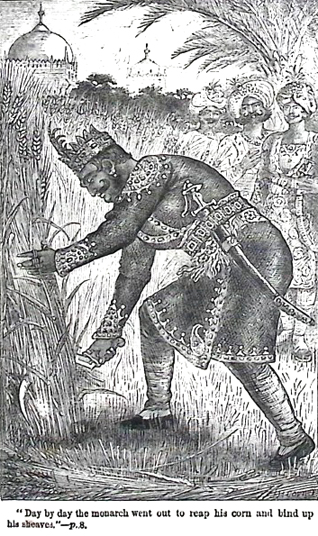
Day by day the monarch went out to reap his corn
and bind up his sheaves.
And Other Stories
BY
A. L. O. E.
Authoress of "Ned Franks,"
"The White Bear's Dean," &c.

London
GALL AND INGLIS, 25 PATERNOSTER SQUARE;
AND EDINBURGH.
Contents.
——————
THE TWENTY-FOUR PIECES OF SILVER
THE
WONDROUS SICKLE
And Other Stories

FATH MASIH had been appointed "patwari" * in a large village. Though many Hindus and Mahomedans in that village had been annoyed at the situation being given to a Christian, and some bigoted individuals annoyed him as much as they could, the poor in general were pleased. Here was a man who dealt justly; here was a man who took no bribes; here was a man ready to listen to the appeal of the humblest, a friend of the widow and the orphan. The people thought better of Christianity, when they saw the life led by the Christian.
* The business of the patwari is to measure land, keep a map of
the district, &c. His is a small office under Government, giving
considerable opportunity for fleecing the peasantry.
Fath Masih and his wife were almost shut out from intercourse with any others of their own faith. The only Christian whom they ever saw was Ishák, who had a place in the Forest Department at a station ten miles distant, and who, about once a-month, managed to come over and see them. Ishák was a pious man, and a warm friend of Fath Masih. It might be expected that the meeting between the two Christians would be a great pleasure to both. It would, indeed, have been so, had not Ishák, every time that he came to Durhiala, found Fath Masih more and more in low health, and depressed in spirits.
"I can hardly endure this life," said the poor patwari, one day, as he sat under the shade of a banyan beside his friend. "My wife and I have no one with whom to hold Christian converse. There is no church in which, on Sundays, our souls can be refreshed by hearing the Word of God. When we are in trouble, there is no one to remind us that the Lord chasteneth those whom He loveth. If we look to the right, behold, a Hindu temple,—to the left, we see through the trees the domes of a Mahomedan mosque. It is very depressing!"
"It is so, indeed," replied Ishák, who was himself in much the same position. "But you have still the comfort of the Bible and prayer."
The face of Fath Masih grew only the sadder. He gave a deep sigh before he replied,—"The worst of all is that I am losing my pleasure in reading the Bible, and all my comfort in prayer. My soul, from want of Christian intercourse, is becoming dry, like a field that never is watered. I fear that were my Lord to send a message to me, as He did to Ephesus of old, it would be, 'I have something against thee: thou hast fallen from thy first love'" (Rev. ii. 4). The words ended with a deep sigh.
Ishák looked anxiously at his friend, whose melancholy was evidently affecting his health.
"Does your wife feel the loneliness as much as you do?" asked Ishák, after a pause.
"Perhaps not," replied Fath Masih gravely. "Many women come to visit my wife, both Mahomedan and Hindu, but their talk is mere gossip. They show their jewels, expect my wife to take pleasure in their weddings, and mourn at their funerals. But, of course, there is no religious intercourse between them."
Ishák looked almost as grave as his friend on hearing this. He had noticed that Moni's dress was less distinctively Christian than it had been in the city in which she had formerly dwelt; that she wore more gaudy ornaments, as if to look like the women around her. He fancied that Fath Masih was not quite satisfied with his wife, and felt that, in this heathen place, her love, like his own, was growing cold.
"I sometimes wonder whether I ought to stop in Durhiala," said Fath Masih.
"Your present situation was procured with much difficulty," observed his friend; "and I remember how fervently you thanked God for granting your prayers at last, and enabling you to be independent of all assistance from the Mission."
"Yes, I was thankful, and I am thankful, for this," replied Fath Masih. "I think it a mean thing, and a wrong thing, for a man who can support himself to be always coming for help, and taking from the store, which is all too small to supply the wants of such as are really unable to work. I have seen men—with a great show of religion, too—who seemed to me like the leech, with their one cry of 'Give, give!' Thank God! I am able to help the good cause a little myself, instead of sitting with folded hands, expecting others to put bread into the mouth of a sluggard." Fath Masih followed the excellent example of those who always give at least a tenth of whatever they possess to God, and find that they are never the poorer for so doing.
"Were you to leave your post here, you would be dependent again," observed Ishák.
"That is what keeps me here, and the thought that God sent me here," said Fath Masih. "But am I right in believing that He sent me here, when my soul is in danger of starving for lack of spiritual food? Its life seems to be decreasing day by day. If we remain here long, I fear that we shall be 'dead' Christians—Christians only in name!" Fath Masih turned his face aside, to hide the tears that had started into his eyes.
Ishák said nothing more at that time, and indeed had then no opportunity to continue the subject, for Moni gave notice that she had served up the evening meal.
The food was eaten almost in silence. Fath Masih felt too sad and too ill to care to eat much, and his friend was lost in thought. But when the "pilau" was succeeded by fruit, as the heap of ripe mangoes rapidly lessened, Ishák, in a cheerful tone, engaged in conversation, and even Fath Masih, swallowing the luscious golden juice, seemed to forget half his gloom. Ishák offered to tell a story, and Moni, as well as her husband, gladly listened.
"Once upon a time there was a king, good and just, and beloved by his subjects. But he had not been long seated on the throne before his health began to fail. Re cared not to go forth from his palace, and all its beautiful adornments gave him no pleasure. The feast spread before him he scarcely tasted, for all his appetite was gone. The king grew thin, his form wasted, he had no spirit either for work or amusement. At last, the courtiers whispered amongst themselves, 'Alas! Alas! Our king is gradually wasting away! He will not long remain in this world!'
"Many doctors were sent for; various were the opinions which they gave as to the cause of the king's illness, the nature of his disease. Some persons even hinted at poison. Much medicine was given to the king, but still he grew no better. He seemed at last unable to do anything but recline on cushions, taking hardly any nourishment, and finding solace in nothing but smoking his hookah. It was commonly reported in the city, 'Our good king is going to die.'
"At last, a very famous physician from a neighbouring country was sent by its friendly king. The fame of this physician had been spread far and wide, so numerous had been the cures which he had wrought. It was said, 'Our king's last chance is from this man's skill; if it fail in this case, all hope is lost!'
"The physician was admitted to the presence of the king, whom he found pale and almost lifeless, with closed eyes, extended on his soft couch. The physician felt the king's pulse, inquired into his symptoms, and then asked for twenty-four hours before deciding on his case.
"Those twenty-four hours were a time of great anxiety to many both within and without the palace, and most of all to the poor sick king.
"The next day the physician returned with something wrapped up in an embroidered cloth, and with a countenance so cheerful that the hearts of all gathered hope.
"'Have you, O physician! found out any cure for my grievous sickness?' asked the king.
"'I have found something, O Ruler of the world! which, by the favour of the All-merciful, may work a cure, if used with courage and perseverance,' said the physician.
"'I will shrink from no remedy, however painful,' cried the king, 'if only my lost health can be restored.'
"The physician slowly opened the folds of the cloth, and behold! a bright sickle, with handle of carved ivory, appeared in view. The attendants looked on in wonder, for they knew not by what magic power a sickle could work a cure.
"Then said the physician, 'Every day, O mighty Monarch! take this sickle in your royal hand, and descend into yon field in which I behold corn ripening in the sunshine. Ply the sickle with force and vigour, until the ivory handle almost cleave to the hand that grasps it, and the toil-drops stand on your Majesty's brow. Then, returning to the palace, deign to partake of the food which will then be set before your Majesty. Persevere in thus using my sickle until yon field be reaped, and if my lord's health be not improved, let his servant's head be the forfeit.'
"The sick monarch agreed to try the virtue of the wonderful sickle, which, when not actually used, was, by his command, to be kept locked up in a sandal-wood chest. No one was to touch one ear of corn in the little field except the king, who hoped to gather health from its reaping.
"He went forth alone on the following morning with the wonderful sickle, nor returned till his hand almost clave to the ivory, and the toil-drops stood on his brow.
"Bring me food—and quickly!' cried the king, 'I am half dead with fatigue!' And he threw himself back on his cushions.
"Food was served in silver vessels. The courtiers looked on wondering as the king proceeded to eat it.
"'Yesterday,' whispered one, 'the dishes went away almost as full as when they were brought. To-day the king has almost finished the pilau, and now he is busy with the curry and rice!'
"After a plentiful meal, the king, who was usually sleepless, fell into a long, deep slumber. When he awoke, he observed with a smile, 'I have not had such a sleep for many months. There must be magic virtue in the sickle.'
"Day by day the monarch went out to reap his corn, and bind up his sheaves, which were always given to the poor. Day by day he returned weary, and very hungry. His step grew firmer, his eye brighter, he was far more cheerful and hopeful. Soon the king gave audience to ambassadors, then felt able again to judge the cause of the poor in person. All the dwellers in the city rejoiced to see his returning health, all praised the gifted physician, and sick grandees offered the latter thousands of rupees for magic sickles like that used by the king.
"When all the corn in the little field had been reaped by the royal hand, the monarch sent for the physician. He loaded the doctor with praises and costly gifts, and permitted him to return to his own land. The wonderful sickle was preserved amongst the choicest treasures of the king."
"Was there really magic virtue in the sickle?" asked Fath Masih, when Ishák had finished his story.
Ishák's only reply was a smile.
"I suspect that the real medicine in it was the work which it made the king do, and the cure was the effect of that work on the monarch's health and spirits," observed Moni, who was a very intelligent woman.
"True," was Ishák's reply, "and it was not without a purpose that I have told you this story, which I read in a book long ago. Fath Masih! Your soul is faint, you are almost weary of life; you think that you are placed in a spiritual desert; I see in it a field, yea, a promising field of corn. You are surrounded by enemies of your faith; there is not one amongst them that is not a possible convert to that faith. To the Hindu temple and Mahomedan mosque throng beings with immortal souls, souls that our Lord died to save, souls that may be won for Him. Take the sharp weapon of God's Word in your hand; grasp it by the ivory handle of prayer. Why hath God brought you to this dark place but that your light may shine to His glory! There is little danger of love dying out when it is actively, prayerfully engaged in work for the good of souls."
Fath Masih made no reply, his eyes were fixed on the ground. A painful consciousness had come upon him that his conduct had been that of the man who buried his talent in the earth. He was becoming less and less "fervent in spirit," because not "serving the Lord."
No more was said in conversation on the subject, but when Ishák that evening led the family devotions, he earnestly prayed that the Holy Spirit of God might be shed into the heart of each present, that not one might stand idle when the Lord saith, 'Go work in my vineyard;' but that all might inherit the blessing promised to those who, turning 'many to righteousness, shall shine as the stars for ever and ever.' (Daniel xii. 3).
"We are all weakness!" he cried. "But Thou, O Lord, art our strength! Thou canst put treasure into earthen vessels; Thou canst touch the dumb lips with living fire; Thou canst give power to the feeblest reaper; and from Thee alone we look for the harvest, the precious harvest of souls!"
Ishák departed on the following morning, and a longer time than usual elapsed before he was again able to revisit his friend. The weather being exceedingly hot, Ishák started on his long walk to Durhiala whilst the stars were yet shining in the sky, and arrived about two hours after sunrise.
As Ishák approached the village, he met ten or twelve little children, some of whom had primers in their hands, and who were smilingly repeating to each other some simple rhyme which they had just been learning.
"What! Is there a school in Durhiala?" asked Ishák of the eldest child of the party.
"No, there never was a school," said the child; "but the patwari's bibi lets us come to her of a morning, and teaches us 'bhajans' * and our letters, and when we learn well, she sometimes gives us fruit."
* A wild kind of song, much admired by Hindus.
"And she tells us such nice stories!" cried a smiling, bright-eyed little girl.
"What kind of stories?" asked Ishák.
Then half-a-dozen eager voices answered at once—
"Oh! About the Holy Baby that was put in a manger."
"About the Lord who loves little children."
"About the song of the angels."
"About the lost sheep and the Good Shepherd!"
Ishák smiled on the eager little pupils, and passed on, with a silent thanksgiving to God that Moni had laid her hand to the sickle.
One lame little girl came limping after the rest.
Ishák stopped to speak to her also. "Have you too been to the patwari's bibi?" he asked.
The child looked up timidly into his face, and reading kindness there she replied, "She has been putting something on my bad boils to make them well."
"Is the bibi clever at making people well?" inquired Ishák.
The girl looked rather doubtful. "She could not make little brother well, though she tried," was the child's reply. "She sat beside him all night long, but he died in the morning, and poor mother sobbed and wailed, for he was her only boy."
"Did the bibi not try to comfort her?" asked Ishák gently, stooping down to listen to the scarcely audible reply.
"The bibi told mother that she had lost her own—her only little baby; but she said that God had comforted her in her trouble, for she knew that her baby had gone to be with the Lord Jesus, who carries little lambs in His bosom."
Again a silent thanksgiving arose from the heart of Ishák. "My friend's wife is like the woman who hid leaven in three measures of meal," he said to himself. "Oh! May God make this once childless woman the spiritual mother of many!"
Ishák had now come in view of the patwari's house. He saw Fath Masih, who was engaged in such earnest conversation with an intelligent-looking young man, that he did not notice the approach of his friend.
Tired as he was, Ishák would not interrupt the conversation, for, from the earnest manner of the speakers, and the few words which reached his ears, it was evident that it was on the subject of religion. Ishák saw Fath Masih place a little book in the young man's hand, and heard his parting words, "You promise to read it—and with prayer!"
The reply Ishák could not hear, but he read it in the thoughtful countenance of the young man as he turned and departed with a copy of the Gospel in his hand.
Then Fath Masih caught sight of Ishák, and hastened to welcome him, with a countenance beaming with joy. As he grasped his friend's hand, he exclaimed, "O Ishák, I thank God for bringing me here! I think that there are three real inquirers in this place!"
"You too have laid your hand to the sickle," said Ishák; "and, to judge from your face, you do not find the work irksome."
"It is a blessed, blessed work!" exclaimed Fath Masih. "God forgive me for leaving it so long undone! I feel now that not only missionaries, but every Christian in India should pass on the glad tidings to others. I used to content myself with praying, 'Lord! The harvest is great; send forth more labourers into Thy harvest.' Now I myself have heard His call, and venture humbly to say, 'Here am I, send me!'"
"But do not your efforts raise up much opposition?" asked Ishák. "Do you not bring yourself into trouble?"
"I have sometimes a little of that trouble which is coupled with a blessing," replied Fath Masih cheerfully. "But I never now feel that weariness, that deadness of spirit which oppressed me when last you were here. My experience has been something like that of the king in your story," he added, smiling; "I find that health, and vigour, and joy come from the use of the wonderful sickle!"


THE sun had set; the red glow had just died away in the sky, but the moon had risen. A railway official, named Karim, stood on the platform of the small station of Banda, watching for an expected train. A zamindar (peasant) * named Matrá, came up to him, and asked him respectfully when the train from Calcutta would arrive.
* In parts of India, a farmer.
"I expect it in ten minutes," answered Karim.
The zamindar sat down on the ground, like one who is very weary. As Karim looked at him, pity arose in the official's heart. Matrá was quite young, scarcely eighteen years of age, but lines of care were already on his features. His blanket was little better than a rag. His limbs, naturally strong and graceful, were thin as if from lack of food. As he sat on the ground, a deep sigh came from the poor zamindar.
"You seem tired," observed Karim kindly.
"I was up before the sun, and have been driving the plough all the day," said Matrá; "and now I have just walked seven miles to this station."
"Are you going a long journey?" asked Karim, who noticed that the zamindar had no bundle with him, not even a hookah or brass lota.
"I am not going on any journey," replied the zamindar. "I have come to meet the train, because I hope that it may bring my father."
"You must be very anxious to see him that you come so far after a long day's work," observed Karim, seating himself beside the zamindar on an empty box which chanced to be on the platform.
It was pleasant to the zamindar to have some one to converse with, some one who spoke in a friendly tone, and who was willing to listen. Matrá was soon telling his simple story.
"My father is a sepoy," he said, "and it is ten or twelve years since he left our village to march away with his regiment. I can remember that day very well; how grand I thought it to see the sepoys marching, and hear the music playing. But we have never had anything but trouble since that unlucky day. First came my marriage."
"Was that a trouble?" asked Karim, smiling.
"It did not seem so at the time. We had fine clothes, and feasting, and drum-beating, and fireworks let off in our village. It was a grand 'tamasha!' The girl's family were Chhatries, so, of course, my grandfather would have all done in good style, and many rupees were given both to the father of the bride and the Brahmins, and there were jewels to buy besides. Then first my grandfather fell into debt, and in debt we have been ever since. It is easier to get into a bog than out of it."
Karim nodded his head in assent.
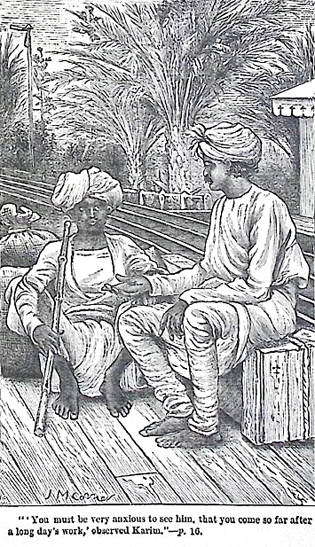
"You must be very anxious to see him that you come so
far after a long day's work," observed Karim.
"Before the girl came to live with us," continued the young zamindar, "as she was playing with her little companions on the top of the house, she fell over, broke her neck, and was taken up dead!"
Matrá could not be expected to mourn much for a child-wife whom he had hardly seen. Karim rightly guessed that the zamindar's evident regret was chiefly on account of the debt incurred by the expense of such a profitless marriage. "And what were your other troubles?" he asked.
"My grandfather fell sick not long after this, and sick he continued for years. He had no son but my father, and my father was far away with the army. Mere boy as I was, I did what I could, looked after the buffaloes, and worked in the fields, but I could not do the work of a man. And there was always the debt a-growing, like the gourds in the rains."
"Did your father do nothing to help you?" inquired Karim.
"He sent several times five-rupee notes," said the zamindar, "but it was like throwing stones into a bog, which swallows them up and you see no more of them. The money-lenders could never have enough. My mother fretted and went on pilgrimage, and bathed at holy ghauts, and did pujá at many shrines. But she took the smallpox and died, though she had made many offerings to the goddess of smallpox." Matrá sighed very deeply; the loss of his mother lay much more heavily on his heart than that of his little wife.
"You have indeed had troubles," observed Karim.
"You have not heard the end of them," said the poor young zamindar. "My grandfather died at last. I paid all the respect I could to his body. I feasted for days a hundred neighbours who came to its burning, gave a cow and many rupees to the Máhá-Brahmin, and myself carried the ashes to the Ganges, though it was just the season when the corn was ripe for reaping. If I had been in the bog of debt before, I was now up to my eyes! It's heartless work watering one's fields in the dry season, and seeing the corn springing up so green, when one knows that the money-lender may sweep down any day like the locusts, and eat up all the fruit of one's toil!"
"Is not running into debt at all the cause of the mischief?" observed Karim.
"What is to be done?" said the zamindar sadly. "Wedding and funeral ceremonies are the ruin of the poor, and bad seasons which come now and then, when there's drought, and the heat dries up all the crop."
"Have you no relations to help you?" asked Karim.
"Not one on earth but my poor old grandmother, who is now scarcely able even to spin or card cotton; and my father, who has been so long away. But he is coming back at last!" said the zamindar, and a look of joy beamed on his careworn face. "I had a letter from him some weeks ago (I've learned to read a little in a village school), and I made out that he would be here before the rabi * harvest is ripe; the corn is green enough yet, but I thought that after work, I would come over here to meet him. Maybe my father will arrive sooner than he said; any-ways, I would not miss my chance of the first sight of him, if I had to walk twenty miles."
* The spring harvest. Let it be borne in mind that there are two annual
harvests at least in some parts of India, so that the zamindar may
often be seen ploughing in one field, while a rich crop covers the next
one.
"Would you remember the face of the father whom you have not seen since you were a child?" asked Karim.
"I know that he was tall—taller than any other peasant in our village—and that he used to seat me on his shoulder, and then I could pluck mangoes from the high boughs," replied Matrá, brightening at the recollection of the happy time which he had had with his father. "I can't just bring his face to my mind—I wish that I could—but surely I should know him if he arrived. How long the train is of coming!" he said suddenly, looking down the long, dark line of railway.
"The whistle has not yet sounded," said the official; "we shall have notice when the train is drawing near."
"I TOO have had many troubles," said Karim, after a little pause, "perhaps even greater troubles than you. But my Father has helped me out of them all."
"It is a great thing to have a father near at hand," said the young zamindar. "Probably you live with yours, and see him every day."
"I have never seen Him yet," replied Karim.
"Never seen him yet!" repeated Matrá. "Then you are worse off than I am. But you say that he helps you in all your troubles."
"There is not a thing that happens to grieve me that I do not tell Him of," said Karim, "and my Father sets everything right. There never was another so kind and so wise, or so powerful either."
"Then I wonder that he keeps you here looking after the trains," observed Matrá. "He might find some better situation for you; or, if he be rich, give you all that you want, without need of your working at all."
"My Father thinks it better for me to earn my bread by honest labour," observed the official. "But after awhile, He will call me to His own beautiful dwelling-place, and put splendid robes upon me, and give me freely all that my heart can desire."
"I wish that my father could do so," said Matrá; "but I doubt that he will ever have enough to pay off our debt. Does your father live very far off, that he never sees you at all?"
"He sees me always," said Karim, looking upwards; "night and day, in darkness and light, He is ever close beside me. God is my Heavenly Father, I have now no parent beside Him."
"Are you a Christian?" asked the zamindar. There was a little scorn in his tone as he uttered the word.
"I am a Christian," was Karim's reply. "A year ago, I had father, mother, brother, sisters, friends, and as many rupees as I chose to spend; now I am cast off by every one except that Heavenly Father, whose love makes up for all."
The zamindar did not understand why a man should give up home and everything for the sake of changing his religion. "I suppose that you were a Mahomedan," he said.
"I was, and a bigoted one," replied Karim.
"I think that the Mahomedan religion is good for the Mahomedans, and the Christian for the English, and the Hindu for us Hindus," said Matrá. "I believe what my fathers believed, and do what my fathers did. They always performed pujá to the gods."
"And what benefit did they receive from so doing?" asked Karim.
It was a difficult question to answer; Matrá did not attempt to reply.
"You do pujá to many gods; we pray but to One Supreme Being," said Karim; "He is the Maker of everything that we behold, the bright sun, yon moon, earth, sea, and the myriads of creatures that live therein. As to a man there can be but one father, so can there be but one God, and that God is Love. This is what we are taught in our holy Book."
"I know that you Christians believe not in Krishan, Vishnu, or Mahedeo," said Matrá, slowly rising to his feet, as if inclined to end the conversation.
"Listen to me, brother," said Karim, also rising to a standing position. "You are expecting your father by the coming train, a father whom you love, though you do not remember his face. Suppose that, when the train stops, a Brahmin should get out of a carriage, and carry with him some dozens of images, one with the head of an elephant, another with a hundred arms, another with no shape at all, and should say to you, 'Rejoice, O zamindar! "These" are the fathers whom you have been expecting so long! Would you take the figures of brass or stone to your bosom, and cry, 'Now am I satisfied!' Would you receive the lifeless things, and acknowledge them to be your parent indeed?"
The zamindar shook his head. He was expecting a living father, a loving father; he could not receive as such any image of stone or brass.
"And if it would be an insult to your parent to let an image for one moment take his place, think you that the one great Father, the Eternal, the Invisible, is not offended when His creatures liken Him to such monstrous forms as you do pujá to in your temples?"
"No one ever spake such things to me before," said Matrá, his common sense striving against the force of old habits, and his fear of the anger of those whom he had been taught to look on as gods.
"Listen but a minute longer," said Karim earnestly. "If in your village you heard any one saying that your father had committed theft, murder, and done other things that it is shameful even to mention, would you listen with a pleased countenance, and reward the speaker at the end?"
"I would break the liar's head with my goad!" muttered the young zamindar.
"And yet you are willing that Brahmins should tell you of deities committing crimes, which, if committed by a man, would drive him from society and bring him to prison, or to the gallows! Look at yon clear sky with its pure moon, and the stars just beginning to shine above us, can you believe it to be peopled with beings revelling in blood, delighting in suffering, pleased with the shrieks of helpless babes flung into the Ganges, or the groans of victims crushed under Juggernath's car? Does not Nature, beautiful, bounteous, pure, tell of a Maker all perfect and holy—repeat, as it were, the words of our Book, that there is one God, the Heavenly Father of all, and that He is Love?"
There was no time for reply, for as Karim uttered the last word, the whistle was heard which announced the coming train. Soon, snorting and puffing, like some mighty monster, its one red eye gleaming through the gloom, the train rushed up. It slackened its pace, and then stopped as it reached the side of the platform. Karim was ready at his post. With lamp in his hand, he passed from carriage to carriage, giving the name of the station in case any traveller should wish to alight.
Eagerly Matrá ran along the platform, passing the carriages occupied by Europeans with scarcely a glance at the faces within, but anxiously peering into every one filled with natives. The station was a small one, and but few passengers alighted. There was a sahib whose "sais" (groom) was waiting with his horse, a bunniah and his family, and that was all. There was not a trace of a sepoy.
It was with a heavy heart as well as weary limbs that poor Matrá left the station. He knew too well the face of the bunniah, for he owed him a debt, and had found in him one of the hardest of his creditors. The poor man slunk away, as debtors will, with mingled fear and shame. Matrá murmured to himself as he left the station, "I have had my weary walk for nothing."
HAD Matrá indeed had his walk for nothing? Any one who could have read his heart as he went on his homeward way would hardly have said so. A seed of truth, a living seed had been dropped there, and had found good soil to grow in. As Matrá walked on, with the soft pure moonlight around him, he almost forgot his weariness, he almost forgot his burden of debt, so constantly were Karim's words coming back to his mind—"There is but one God, and that God is Love."
"The one God of the English seems to do more for them than our millions of gods do for us," thought Matrá. "The English press onward like that engine which I saw rushing into the station, with a long line of carriages behind it. What speed, what straight course, what power! We go on like one of our country waggons, creaking along in the old ruts, and sometimes a wheel comes off or an ox drops down, and there we are left on the road. What makes the difference between us? The engine goes faster and better, pushed on by something which we cannot see, than does the cart with the oxen which we always are goading. The God of the Christians must be a very strong God, and the man at the station says that He is a very kind one; but it's likely enough that He would have nothing to do with poor Hindu zamindars such as we."
Matrá found his old grandmother Sibbi still awake, and preparing for him some chapatties. The poor old woman, with her shrunken fleshless limbs, looked almost like a living skeleton as she crouched by her little oven. There was not much appearance of life about her except in the wistful black eyes deep sunken under the brows whitened by age.
Sibbi was a strange old woman, not like the others in the village, and no great favourite with them. She could actually think of something besides marriage and funeral ceremonies, pilgrimages and pujás. Even before she became a widow, Sibbi's whole heart had not been set on her ornaments, and she had sold all of any value to help to pay her husband's debts, taking even the ring out of her nose. Sibbi had drawn upon herself the anger of the Máhá-Brahmin, by suggesting to her grandson that on account of their exceeding poverty, the gift to him of a very old and almost useless cow might be sufficient. It was indeed the only one which the family possessed, but another was procured to satisfy the covetousness of the Brahmin.
It was supposed, and probably with reason, that the difference which existed between old Sibbi and her neighbours was caused by her having, when eleven years old, passed six weeks in the house of an English lady. The parents of Sibbi had lost her at one of the great melás at which tens of thousands of Hindus assemble, melás which occasion a fearful amount of confusion, disease, and misery. An English magistrate found the poor girl, frightened and almost famished, crying by the side of the road. In compassion, he took her home to his wife. Sibbi received in that English home kindness which she never forgot. She was clothed, fed, and allowed to attend on the Mem Sahiba's sweet little girl.
In that house Sibbi had, as it were, a glimpse of paradise; and though a loving daughter, she was hardly glad when her parents found her at last. The parents took her away back to their village, though the lady offered to keep her. From that day, the usual occupations of zamindars' girls were those of Sibbi. She cooked, she carded cotton and spun it, she worked in the fields; married early, was a servant to her husband, and a slave to her husband's mother; but she often recalled the past, and asked herself if the six weeks, so unlike all that preceded or followed them, had not been a beautiful dream! One persuasion remained on her mind, that there were other places in the world besides her mud-built village, and that people existed more clever, and at least as holy as Brahmins.
Matrá sat down hungry to his insufficient meal, having first washed his hands, feet, and face. He could have eaten twice as much as was prepared, but took care to leave something for his poor old grandmother. Matrá took his meal in silence, but then told Sibbi all that had passed between himself and the man at the station.
"One God,—and that God is Love!" repeated Sibbi to herself, looking like one trying to recall something that has almost escaped memory, as she put her wasted hand to her wrinkled forehead. "Missy Baba learned to say that, little Missy Baba—the pretty one—who died. I almost cried my eyes out when they took her away to bury her!"
Tears came into the old woman's eyes as she remembered the sorrow which nearly fifty years had not effaced from her loving heart. "Missy Baba could not speak many words even in her own language, but the Mem taught her to say, 'Our Father' and 'God is Love,' that she might repeat them to me. She said them both the very day that she died. And when I was crying and moaning over the little form that looked so peaceful where it lay still and cold on the bed with a rose on its breast, the Mem said to me, quite quiet and calm-like, 'She has gone to the God who is Love.' I never shall forget that night! I wondered why the Mem did not moan and beat her breast as we do, she loved the little darling so dearly."
"Perhaps," thought Matrá, "the same great Father who helps that Christian in all his troubles was comforting the poor mother too." Then Matrá observed aloud, "How could the Mem Sahib be sure that her child had been taken to her God—how could she know that her soul had not passed, by a new birth, into some unclean dog or ass?"
"I am sure that it never did!" said Sibbi quickly. "Missy Baba's soul could never have gone into anything unclean. I often think that she's somewhere up above, like one of those; stars, safe with the Heavenly Father!" And as she spoke, the old Hindu pointed with her trembling fingers to a brilliant star in the east.
Another seed of truth had been dropped into the mind of Matrá, a thought of One who could not only support in life, but receive after death. But it was as yet as a seed wrapt up in its husk, that needs warmth and moisture to make it rise up to life, and burst forth to beauty.
"I WONDER whether that poor half-starved fellow will come over again this evening on the chance of meeting his father," said Karim to himself, as on the following evening he again took his station on the platform to watch for the train. "Here come some to meet the train, but I take it that they are very different sort of folk from my zamindar."
A prisoner, in clanking irons, led by two policemen, stood now on the platform. He was going to be tried on a charge of murder, and if a man's character could be read in his face, this one might have been deemed guilty of any crime. Fierce wolf-like eyes glared under a mass of shaggy hair, and as he squatted on the ground, just under the yellow gleam of the lamp, he looked somewhat like a wild beast crouching in the act to spring.
As Karim gazed at this wretched man with mingled pity and disgust, he was saluted by Matrá, the zamindar. Karim courteously returned the salám, and then walked to the other end of the platform, that conversation might not be overheard by policemen or prisoner, if, as he thought probable, the zamindar should talk to him again.
As he expected, Matrá followed his steps.
"Have you been thinking over what I said to you last night?" asked Karim, when both men had reached the end of the platform.
"I've thought of little else," said the peasant. "As I watered my buffaloes, and drove my plough, I was always turning over in my mind what you told me of the one God, who lives up yonder, the God of Love."
"And you believe that I spake truth?" asked the railway official.
"How can I believe it?" cried the zamindar bitterly. "If God be a God of love, why is the world so full of misery? Why are the poor oppressed and trodden down like the dust under foot? Why is there crime and wickedness?" Matrá pointed as he spake towards the prisoner. "The sun, the dew, the rain, and the green crops seem to tell us that there is a great God who made them, and who wishes man to be happy; but thorns and briars, locusts and blight, plague and pestilence, poverty and famine, they tell quite a different tale. If God be good, and powerful too, how came misery into the world?"
"It is a sad story, and a somewhat long one," said Karim, "but if you wish, you shall hear the account given in our Scriptures."
"I wish to hear it," said Matrá.
"The good God when He had made this world, created one man and one woman, from whom all the people that ever lived are descended."
"What!" exclaimed Matrá in surprise. "English, Hindus, Brahmins, Mehtars,—all descended from one pair! This is not what our Vedas tell us."
"No indeed," replied Karim; "your Gorus tell you that Brahmins came from Brahma's mouth, and low caste folk from his feet; being Brahmins themselves, they have their own reasons for telling you this," he added, with a smile. "But listen to the true account given in the Holy Scriptures. This first pair, named Adam and Eve, God placed in a beautiful garden, where they lived in love, innocence, and joy. They had abundance of fruits to eat; only as regarded one tree, the Maker of all gave command, 'Thou shalt not eat of its fruit; if thou eatest thereof thou shalt surely die."
"Such a command was easily obeyed," observed Matrá.
"There was an evil spirit, called Satan, who envied the peace and happiness in which dwelt Adam and Eve. He had, however, no power to harm them, unless he could tempt them into sin. Alas! He succeeded too well! It was as if the husband and wife had had a choice placed before them, 'Will you believe God or Satan? Will you choose God or Satan to be your master?' A fatal choice was made. The woman ate of the forbidden fruit and gave it to her husband, and from that hour both fell under the power of cruel Satan. Misery, pain, sin, and death came into the world!"
"An evil hour for the first pair," said Matrá, "as it was for my grandfather when he first got into the clutches of the money-lenders, and mortgaged our land. But was it not rather hard that all the race born of this man and woman should suffer as well as themselves?"
"Let us take your simile," said Karim. "Your grandfather, by his act, laid a heavy debt upon you, his grandson, but you yourself, by your own account, have added to the debt. So not only were Adam and Eve sinners, but Satan once getting power in the world, has tempted and drawn into sin every man and woman in it, and one terrible sentence, that of death for the body, and death for the soul (which is eternal separation from God) hangs over all."
"Could not God forgive us all the debt, as He is, as you tell me, Love?" inquired the zamindar.
"If your creditor took you before the judge, and that judge were the kindest man in the world, he might pity you, indeed, but justice would compel him to give a sentence against you. The judge might be powerful, wise and good, but still you would be ruined."
Poor Matrá looked very sad; he knew that this was indeed too true. A just and kind judge could not save him from the consequences of incurring a debt which he could not pay.
"I don't think that there is any comfort at all in your religion," said the zamindar with a sigh. "If it only tells us that we are in the power of a wicked spirit, and that we are separated for ever from God, and have a great debt like a heavy stone hung round our necks to drown us, it makes us out to be in a miser able state indeed."
"But from that state God has found a way to save us," cried Karim cheerfully. "If you were to be told how all your debt could be cleared off at once, and that you should be restored to your father, and live all the rest of your life in plenty and peace, would not your heart be glad?"
"I should feel as if I were in heaven!" cried Matrá. But he sighed after he had uttered the words, for he felt that he could no more hope for such joy than he could build a house on a rainbow.
"God 'has' found a way of saving us, of freeing us from Satan, of paying our debt, of—" here Karim was suddenly interrupted by the shrill railway whistle.
Matrá had been so much interested in the conversation that he had almost forgotten for the moment why he had come to the station. But now the sound of the whistle gave him joy, for it might be the signal that his father was near.
The same sound made a groan burst from the wretched prisoner, for it told him that he was soon to be hurried off to the place of his trial, probably the place of his execution. It is with such different feelings that God's children and His enemies hear that death draws nigh. To the first it brings hopes of a blissful meeting, to the latter the terror of coming judgment
AGAIN, on the train's arrival, Matrá ran anxiously along the line of carriages, in search of his father. There was the usual hum of many speaking, and the hissing noise of the steam let out from the boiler, but no sound of greeting from a once familiar voice! The prisoner was hurried by his keepers into a third-class carriage, and Matrá saw him no more.
Once again the zamindar sorrowfully retraced his steps homewards. He had not the same peaceful feeling which had soothed him on the preceding night. It was not so much a God of Love that had been presented to his mind, as the terrible condition of those born and living in sin.
"Satan was cruel indeed to make the man and woman so miserable," thought Matrá, "when they were so peaceful and happy. Why did they listen to his evil counsel? But I might as well ask, why did we go into debt? We knew well enough that a money-lender's heart is as hard as a buffalo's hide. The crackers at my wedding were soon let off, the fireworks died into darkness, the sweetmeats were eaten, the fun was over, and then came the debt to crush us! We've had to pay dear for the honour of the thing. Why, all that we have borrowed for wedding, burning, and everything else hardly came to 500 rupees, and I'm sure that, little by little, 'we've paid the whole sum three times over,' * yet the debt remains large as ever!
"Our land is mortgaged, every inch of it; my creditors only leave the fields to me now, because they enable me to work, and as long as I can work, they can squeeze something out of me still, ay, if it were my very life-blood! Were I to fall sick—and ill-fed as I am, I am likely enough to do so—they would be down on me at once. My poor old grandmother and I might just lie down by the side of the road and perish of hunger. That station-man did but mock my misery when he asked how I should feel if I heard that my debt could be cleared off at once, and I be restored to my father, with peace and plenty before me. That never, never will be!"
* I fear that this is no exaggeration. The simple peasants are
grievously cheated, and pay enormous interest.
Matrá walked fast, as if he wished to walk away from his own bitter thoughts, but they followed him like his black shadow. When he had almost reached his mud hut, which was at the nearer end of the village, the zamindar heard a low murmuring behind some bushes, in a voice which he recognised as that of his grandmother.
Noiselessly Matrá approached the spot, near enough to catch the meaning of the words uttered. The old woman, with her hands pressed together, and her forehead almost touching the ground was in the attitude of one performing pujá, but there was no temple or idol in that place, only the quiet jungle before her, and the dark blue sky above her. These were the words which the zamindar heard, broken by a few low sobs—
"I have done pujá at many shrines, but the gods do not hear me; I am poor and old, and getting blind, and if my son does not come back soon, I shall die without seeing his face. O God of Love! Hear me! We are very needy and wretched, and sorely want Thy help. Perhaps up in the bright place Thou canst look down on us poor ignorant folk, who do not even know how to pray. Wilt Thou be angry if I too say, 'Our Father,' and beg Thee very, very hard to send back my only son!"
A slight rustling in the bush made by Matrá, startled the poor old woman. She raised herself trembling lest she should have drawn upon herself a storm of wrath by such a strange and terrible act as that of addressing the God of the Christians. It had been some remembrance of olden days that had made the poor creature attempt to do what she had seen done by the English lady and Missy Baba.
Matrá looked on Sibbi quietly for some time without uttering a word. In the faint moonlight, and with her dimmed eyes she could not tell from his face whether her grandson were angry or not. Still less could Sibbi read the strange thoughts that were rising in the soul of Matrá. Without knowing it, the old Hindu had dropped another seed of life into the zamindar's heart. He saw devotion in a form to him perfectly new. It was no shouting of "Rám! Rám!" or "Hari! Hari!" No wild loud singing and drum-beating before a painted idol; no Brahmin's purchased prayers! It was addressing an unseen Being as if He could listen, and answer, and help. It was like a child's cry of pain, which a parent at least understands.
Matrá turned silently away.
Sibbi said to herself, "He despises me; he thinks I have done an evil thing. If I were not his grandmother, Matrá would spurn me with his foot, and get the Brahmins to curse me."
But Matrá's silence was not that of contempt, it was that of perplexity and doubt. As he lay down to rest that night on his charpai, wrapped in his ragged blanket, Matrá, caught himself repeating some of his grandmother's words of prayer.
When in the morning Matrá looked towards the rising sun, he thought of what the Christian had told him about the God who made it, and wondered whether there were in truth such a Being, to whom the sorrowful might go in their troubles, to find in Him a Father indeed. Then Matrá remembered what the Christian had been saying when the conversation had been suddenly interrupted, of God's having found a way to save poor sinners.
"I will tie up the buffaloes a little earlier than usual," said Matrá to himself, "that I may have a longer talk with the Christian. He at least finds comfort in his religion, and I have none in mine. I will hear of the way of being saved of which he told me; there is no harm in knowing what other men believe. That Christian must have found something in his faith very precious to be ready to give up for its sake father, mother, all that he had in the world. Did he not say that the love of his God made up for the loss of all?"
"I WANT to hear the end of your account of what you Christians think about man and his miseries," said the zamindar, as again he stood on the railway platform beside his new friend.
"I would rather tell you of the way of escape which God has made for man out of his miseries," replied the Christian. "I know the way, for I am in it; I wish you to know it also, for it is open to you."
The two men seated themselves, the one to speak, and the other to listen.
"God pitied lost man," continued Karim, "yet Divine justice and truth required that by man punishment should be borne. No mere human being could help his brother, because every one was himself under the same condemnation. You, for instance, could not pay a brother's debt, because you are in the same strait as he."
"I could certainly help no one out of a bog in which I am sinking myself," sighed Matrá.
"So God sent His own Son into the world to become a man, that He might suffer as man, and for man," said Karim.
"Stop! You told me that there is but one God, and now you speak of His Son!" exclaimed Matrá. "Do you Christians worship two Gods?"
"There is but one God," replied Karim with reverence, "and yet we find from our Scriptures that in this One there are three Persons, the Father, the Son, and the Spirit, so closely joined that they are One, and yet each in Himself a distinct object of devotion."
"I do not understand," said Matrá.
"Man cannot understand the deep things of God, but what is revealed we must believe. A simile makes it more simple to my own mind," continued Karim, "and it may make it more simple to yours. Is the sun in the sky one object or two?"
"Certainly there is but one sun," replied Matrá.
"When we speak of the sun, we mean the sun and his beams also, for the sun and his beams are as one. Yet, seen through a mist, the sun appears shorn of his beams, and sometimes, on the other hand, we see the rays when the sun himself is hidden. In one sense, therefore, they are distinct, while in another they form but one glorious sun."
"It is a mystery," said the zamindar thoughtfully, "but I think that all religions have mysteries."
"The great God," continued Karim, "sent His Son into the world to save sinners by the sacrifice of Himself. Christ came as the sunbeams come down, to enlighten, warm, and bless. As a body was needed for sacrifice, the Saviour assumed a mortal body. He was born of a pure virgin. Thus the Lord Jesus Christ was Man that He might suffer, whilst ever continuing to be God that He might save."
"A deity putting on a mortal form—that is an avatar," said Matrá. "I did not know that Christians, like Hindus, believe in avatars."
"Your Brahmins," said Karim, "tell you that one of your deities nine times became incarnate, and that while inhabiting a body—as a fish, a tortoise, a boar—he performed wonders, or committed crimes. We Christians believe but in one sinless avatar; that God's Son appeared as a mortal, that He might conquer Satan, give an example of perfect holiness, and then die as a sacrifice for sin. The Lord Jesus, before His avatar, knew perfectly well what His life on earth would be, and what its terrible close. He knew that He would be despised and rejected, poor and afflicted, He knew that He would be put to a death of torture, nailed hands and feet to a cross. His death was the punishment of sin, but of sin 'not His own;' He stood in our place, bore the shame of our guilt, and paid our debt with His blood."
"Do you indeed believe this?" exclaimed the astonished Hindu.
"As firmly as I believe in my own existence; so firmly that I would lay down my life as a witness to its truth, as thousands of Christians have laid down their lives."
"The Son of God slain as a sacrifice for sin! It sounds so strange, so wonderful!" cried Matrá.
"It is love passing knowledge," said Karim. "Love in the Father to send His Son; love in the Son to be willing to die for man. The idea of sacrifice is no new thing to Hindus. Do not your books tell of the wondrous merit of the sacrifice of a thousand horses? But what is the value of the blood of a crore of horses, weighed against one drop of the blood of an Incarnate God!"
"And what do you think that you gain by this great sacrifice?" inquired Matrá.
"Everything!" exclaimed the Christian with animation, his whole face radiant with joy. "First, there is the debt of sin wiped out as if it had never been, full and free forgiveness. Then there is peace with God—adoption into His family, and an inheritance of endless glory and joy in the kingdom of heaven. No mere absorption, no loss of individuality, which is the highest hope of the Hindu, but conscious happiness, unutterable bliss in the society of blessed saints and angels dwelling together in perfect love in the presence of the Heavenly Father of all."
THE words were still on Karim's lips, when he interrupted himself by the sudden exclamation, "See yonder!"
"There is a man running along the line!" said Matrá, looking in the same direction.
"The madman!" cried Karim. "He will be crushed by the coming train!" And loudly he shouted, again and again, to warn the man off the dangerous line.
The runner appeared not to heed or to hear. The speed at which he was advancing left him no breath to call out, but he threw up his arms wildly as if to excite attention.
"There may have been some accident to the train!" exclaimed Karim.
The words went like a knife to the heart of Matrá. He could hardly forbear rushing forwards to meet the runner, but Karim laid a hand on his arm. The men had not long to wait. In two minutes the panting messenger reached the platform.
"Train ran off the line!" he gasped forth. "Carriages smashed—people killed!"
Karim instantly hurried away to the telegraph office, and as rapidly as he could sent off a message to the nearest station, then went in search of some one to despatch with the tidings to the magistrate of the neighbouring town. He would have sent Matrá, but Matrá was not on the platform.
The zamindar was rushing along the line to the place where the accident had occurred. In his overwhelming anxiety, his former fatigue was forgotten; only Matrá felt as if weights were attached to his feet, for his speed could not keep pace with his will.
The scene of the accident was reached. The engine, a huge black object, loomed before Matrá, half encircled by a mass of broken carriages. A number of passengers were standing about, some shouting for help, some moaning with pain, some, especially women, crying with terror.
"Is any one killed?" gasped forth Matrá; he could hardly utter the question.
"A good many are hurt, only one killed," replied a railway guard, whose face bore the mark of severe bruises. "A sepoy lies yonder, poor fellow! His head was crushed under a wheel!" As he spoke, he pointed to a spot a few yards distant, where, in a little pool of blood, a fearful object to behold, lay the corpse of a tall sepoy.
In a moment, poor Matrá was on his knees beside the body, beating his breast, and sobbing forth, "My father! It is my father!"
It was to him a terrible moment. For years the young zamindar's hopes had clung to a meeting with his parent, the thought of seeing Bhola Náth had been the one bright spot in Matrá's prospect, the one sweet drop in his cup. And now as he looked on that poor mangled disfigured corpse, and saw in it the wreck of all his hopes, the strength and courage of Matrá completely gave way, he wept and sobbed like a child.
And if such was the grief of the son, what was the anguish of the poor old mother, when, on the following day, the sepoy's body was carried to her wretched hovel! Then indeed did Sibbi bewail the day of her birth; she tore the grey hairs from her head, and uttered bitter wailings, the wailings of those who mourn without hope.
By this time, poor Matrá had regained some calmness, but it was the calmness of despair. He had to make preparations for burning the corpse that night, and so miserably poor was he, that he had the bitter task of collecting most of the materials himself. The Brahmins, knowing that Matrá had no more power even to borrow, took very little interest in the funeral rites; one even reproached poor Sibbi, saying that the terrible misfortune which had come upon her was doubtless due to the wrath of the gods whom she had offended. It mattered little now to Sibbi whether they reproached her or not. Does the agitated ocean show more disturbance because of the pelting of a shower?
Nearly two hours after sunset the sad preparations were completed. The sepoy's corpse was laid on the funeral pile, the head to the north, the feet to the south. A man with shaven head set fire to the pile, and soon red flames were crackling and curling around the body, and a mass of smoke was obscuring the light of the full moon. Meta, in silent anguish, stood by, watching the fire do its terrible work.
"My son! What dost thou here?" exclaimed a voice behind him.
Matrá started, as if he had been spoken to by the dead. Turning round, he uttered a cry of joyful surprise, and then threw himself into the arms of his father!
Yes, it was indeed Bhola Náth who had arrived at Banda by that evening's train, and had come in time to see his mother and son, in bitter woe, paying the last honours to the corpse of one in no way related to them, whilst he whom they mourned as dead stood in life and vigour beside them. Sibbi rushed forward with extended arms, shrieking forth, "My son! My son!"
The sudden appearance of Bhola Náth beside what all supposed to be his funeral pile, roused the superstitious fears of some ignorant peasants. They believed him to be no man but an evil spirit. Some actually caught up stones, and Bhola Náth was in danger of being mercilessly pelted by his neighbours, but Sibbi threw her arms around her new-found son.
"He is no ghost!" she cried. "Behold his feet are not turned backwards! His voice is the voice of a living man! It is he whom I nursed as a babe in my arms! It is indeed my son, the light of mine eyes! Now shall I die happy!" *
* This strange kind of reception of Bhola Náth by his neighbours was
suggested to me by my accomplished native critic, who knew what,
under such circumstances, would probably occur. To have "feet turned
backwards," and "to speak through the nose," are supposed by the Hindus
to be the characteristics of ghosts!
It was some time before Bhola Náth was left alone with his mother and son. There was too much to say, too much to think of, for any of the three to retire to rest. Day broke as they still sat together outside their little hut. Sibbi and Matrá looked very happy; their minds were too full of the unexpected joy of Bhola Náth's return, to have at that time any room for care or regret. But it was otherwise with Bhola Náth himself. He looked thoughtful and grave.
"Perhaps my father is thinking of the wife and parent whom he misses from our home," reflected Matrá; "those whose faces he never more can behold."
AT last, after a pause of silence, Bhola Náth thus spake:—"O mother and son! Two things are on my mind; of two things I have to tell you; one will cause you joy, the other will cause you grief. Of which shall I speak first?"
Then replied Matrá, "Father, this is a time of rejoicing, because we behold you again. Let your words, then, be of joy."
"Thou knowest, my son, that the debt which has pressed on thee has lain also as a weight on my heart. When, on leaving the service, I found myself entitled to a pension, I reasoned thus in my mind—'I am still a strong man; I can earn my living; what need is there to me of a pension? If I could change it for a sum large enough to pay off our debt at once, then would we be as free men, the mortgage would be off our land, and no money-lender could devour its produce year by year."
Sibbi and Matrá listened with intense interest.
"After turning over this matter much in my mind, I resolved to ask the advice of my colonel, and find from him if such a thing could be. The Colonel Bahadar * had shown me much favour since I had had the good fortune to save him from an enemy's sword. I went to his quarters, and made my salám, and told him of all our trouble."
* A title of respect.
"What said the Sahib Bahadar?" asked Matrá.
"He muttered to himself, 'Debt, debt; it is always the same story. Debt is the cancer that eats into the very life of this people.' Then said the sahib to me, 'How much does your family owe?'
"I replied, 'O my lord! The debt altogether is 500 rupees. It has been paid over and over again, but we could never clear off all at once; and where interest is fifty per cent.—'
"'Fifty per cent.!' exclaimed the sahib, looking more angry than I had ever seen him look before. 'This India is full of rogues, and their senseless victims, the zamindars!'
"So he strode several times up and down the room, as is the colonel's way when he is thinking. Then, after a while, he stopped straight before me.
"'Bhola Náth,' said he, 'you are a brave fellow and an honest man, and have done me a great service. I am loth that you should be all your life like a man with a halter round his neck. I will myself pay off your debt at once, but upon one condition.'"
Sibbi uttered a cry of delight, and Matrá eagerly said, "What was that one condition?" He feared that some very difficult thing, some lifelong task would be named.
"The one condition was, that neither I nor my son should ever go to a money-lender again."
"I would as lief go into the den of a hungry tiger!" exclaimed Matrá with vehemence. "Never, never again will I plunge into the bog of debt!"
The news just given by Bhola Náth caused great delight to his hearers. Matrá, remembered the words of Karim, which had seemed to him at the time like a mocking of his hopeless trouble—"How would you feel if you knew that your debt would be cleared off at once, and you be restored to your father, with peace and plenty before you?"
"And now perhaps it is better that I should tell you at once of what you will deem my evil tidings," said Bhola Náth.
"There can be no evil tidings for us now!" exclaimed the rejoicing Matrá.
"You are just reunited to a long-lost father. Would it be no sorrow to you to be separated from him again, and perhaps for ever?"
"Nothing shall separate us!" exclaimed Matrá.
"Nothing—but death," murmured old Sibbi.
"What if all the world should despise me, and abuse me, and cast me off?"
"Father! I would stand by you against all the world!" exclaimed the young zamindar.
"Then hear the truth at once," said Bhola Náth. "After three years of thinking, reading, praying, I have resolved to be baptised as a Christian!"
He looked as a brave man might do tied to a gun, when the match is brought to blow him to pieces. But there was not the loud explosion of grief and anger which he expected. Matrá looked on his father in mute surprise.
Sibbi muttered to herself, "Then I can keep my vow."
"What vow? What do you mean?" asked her son.
"When I prayed to the Christian's God to bring you back, I vowed that if He heard me, I would—" she dropped her voice to a faint whisper—"that I would throw our idol into the river!"
"Well done, brave mother!" exclaimed Bhola Náth, with an unutterable sense of relief, for he had dreaded more than anything else the grief and opposition of his parent. "And you, my son," he continued, turning towards Matrá, "will you despise me for changing a false religion for the only true one?"
"Father," replied the young zamindar, "I as yet know nothing of the Christian religion but a little which I have heard from a man at the station, who was a Mahomedan once. But you will teach me more. If I once saw my way to getting clear of the debt of sin as we are getting clear of the mortgage, let the Brahmins say what they may, I will never again worship any god but the God who has redeemed me from evil."
WE will not follow closely the events of the following days, weeks, and months. Bhola Náth sought out the native pastor of Banda, and had many interviews with him, as well as with his son's Christian friend, Karim. It was principally from the latter that Matrá received instruction, and from reading the New Testament with his father, when the work was done.
When it became known in the village that the sepoy had come back with new strange notions, that he no longer did pujá to the gods, nor feasted Brahmins, nor shouted "Rám! Rám!" bitter opposition was raised against him. Matrá and Sibbi came in for their full share of persecution. Their neighbours would not eat nor barter with them; the family were driven from the well; they were even pelted and beaten.
But blows and insults were not arguments, and the more Matrá contrasted the spirit of Hinduism with that of Christianity, the more he felt convinced that Karim and his father had found the true way of salvation. After the lapse of some months, the whole family—aged grandmother, brave father, and stalwart son—were baptised in a tank. Crowds of Hindus assembled to witness the baptism; some mocked, some abused the new converts, but in the hearts of many arose the thought, "Perhaps these honest Hindus have some good reason for changing their religion. Perhaps there is some truth in the Bible."
The family of Matrá were not long to be the only Christians in their village. As one torch lights another, so by their means gradually spread the knowledge of the Gospel.
Sibbi did not long survive her baptism. Receiving the Gospel simply, as a little child might do, she dropped peacefully asleep as her Missy Baba had done, feeling that she had a Heavenly Father, and that she was going to Him. The aged woman's body was not burned, but buried; it was laid like a seed in the ground, to rise again, even as the seed which the husbandman lays in the soil.
Matrá said, what he had never said when standing by a heathen's funeral pile, "We shall see her again in glory. Thanks to Him who died for sinners, we shall meet once more, never to be parted, in the presence of the God who is Love!"

ACHHRUMAL, the bunniah, came from Kashi (Benares) to visit his kinsman, Nand Lál, who dwelt in a little village about twenty kos distant. The home of Nand Lál was close by a jungle, and in a lonely part of the country. Achhru had never visited the place before, and, with some contempt, contrasted the mud-built village with the tall buildings, the grand pagodas, the wide "ghats" (bathing-places) of his own large and beautiful city.
On the first morning after Achhru's arrival, Nand Lál asked him how he had slept during the night.
"How could I sleep, O brother!" cried Achhru. "The horrid noises which I heard so distracted me that I could scarcely close my eyes!"
"What noises?" inquired his cousin.
"First there was such a croaking of frogs from yon pond, that one might have thought that all the frogs in Bengal had come on pilgrimage to a sacred tank, and were crying 'Rám! Rám!' together. Then, as I was beginning to drop asleep, wild wailing yells came from the jungle, as if the place were haunted by demons!"
"Only the jackals," observed Nand Lál; "we so often hear the noise that we hardly heed it."
"That was not all," continued his cousin. "As I lay awake, listening to the yells of the jackals, I heard another horrible sound, which made my heart almost stand still. It was between a howl and a laugh!"
"A hyena has been prowling about," said Nand Lál. "Three kids were taken by it last week."
"When that horrible sound ceased," cried Achhru, "and the jackals had stopped their yelling, I was more troubled than ever, for my ear caught a sound which was, I am sure, the hissing of a serpent."
"There are many hereabouts," observed Nand Lál; "our people are often bitten by snakes when they go out in the jungle."
"I shall certainly not stay long in this dreadful place," thought the timid-hearted Achhru. And he suddenly remembered that there was to be a festival in honour of the goddess Lachmi, in Kashi, which he must certainly attend. He would therefore go back on that very day to the city.
Poor Nand Lál looked mortified and disappointed. "Why, brother!" he cried. "Thou hast had no time to take rest. Thou hast scarcely partaken of food in my house. After an absence of years, I had looked for a long visit, I had hoped that we should have passed weeks together!"
"We shall pass weeks, and months, too, if you will," cried Achhru, "but not in this noisy village. Come back with me to Kashi. You have never yet seen the holy city, or visited its thousands of shrines. Come and bathe in the sacred Ganges, and delight thy soul with such sights as have never met thine eyes before."
Nand Lál did not need much pressing, for he had often felt curiosity to visit Kashi, and bathe in the Ganges. His preparations were few, and speedily made. Nand Lál fastened up his cooking vessels in a little bundle, wrapped his blanket about him, put some "annas" into his hamarband, and told his wife to expect him back in a fortnight. Then he departed with his cousin.
Before the fortnight was over, however, Nand Lál found his way back to his secluded village beside the jungle. His wife welcomed him with gladness, for he was a good and gentle husband, and had never been known to beat her. Quickly she prepared the evening meal, and brought the hookah to refresh the weary traveller.
Neighbours, impelled by curiosity, came to visit Nand Lál; his wife asked him why he had returned before the appointed time.
"I could not stand the noises," replied Nand Lál, with a smile; "like my cousin Achhru, I did not like the croaking of frogs, the yelling of jackals, the howling of hyenas, the hissing of snakes."
"Why, surely Kashi is not like our jungle!" cried one of his friends.
"Not like our jungle, but a thousand times worse!" exclaimed Nand Lál.
"Explain your meaning," said his friend.
"O Nattu! The sounds of a large city are worse than any made by wild beasts," replied Nand Lál. "I have heard murmurs and complaining, the groanings of the poor, the grumbles of the rich that they are not richer. The voices of discontent are to me as the croaking of myriads of frogs."
"And your jackals, what are they?" asked Nattu, who began to see the meaning of his companion.
"I witnessed quarrelling and heard disputes. There were sellers and buyers in the bazaars abusing each other for a matter of a few pice, or even cowries, reviling each other's mothers, wives, and daughters, pouring out curses and threats; and I said to myself, 'The city has its jackals and hyenas as well as the jungle, to yell over their carrion prey.'"
"And your hissing serpents?" asked his friend. "Did you find them too in the city?"
"In the city—here—everywhere—for is there a spot in all Hindostan where the liar is not to be found? Speak not our children lies almost as soon as they can utter the name of father? But I had deemed that in a holy city I might find some who would speak the truth. Alas! The very air seemed filled with the hissing of falsehood. The bunniah lies, the beggar lies, the courtier lies, and the priest at the shrine tells the greatest lies of all. My heart grew sad, and I said to myself, 'If I could but hear of one man who keeps his lips pure from murmuring, abuse, and lying, I would go a hundred kos to prostrate myself before him, and put his foot on my head."
"Was there ever such a man?" said Nattu.
"Such was my thought," continued Nand Lál. "When passing through the bazaar one day I saw a crowd gathered together, and went up to the place in hope of seeing some 'tamasha' (show). In the midst of that crowd stood an earnest-looking man, with a book in his hand, who was addressing the people. I stood with the rest to listen, and I heard the preacher tell of One who 'did no sin, neither was guile found in His mouth, who when He was reviled, reviled not again, when He suffered, He threatened not' (1 Pet. ii. 22, 23). I exclaimed to myself, 'Here must have been a perfect man He who thus governed His lips, He who was free from all guile, must have been a saint indeed! Such a one would I choose for my Goru!'"
"But perhaps the preacher was himself telling lies when he described such a Goru," observed one of the peasants.
"He spoke as one who believes what he teaches," was the reply of Nand Lál, "and I had occasion to see that, in one thing at least, he followed the example of his Master. Some of the crowd abused the preacher; some even pelted him with dust; but he spake not an angry word. Then I said to myself, 'As is Goru, so is disciple.' Since he is like the Holy One whom he preaches, in having on his tongue the law of kindness, so also he must surely be like Him in having lips free from guile."
"Perhaps the man was a 'Karáni'" (Christian), observed Nattu.
"He certainly is a follower of Him whom he called the Lord Jesus Christ," said Nand Lál. "He spake so much of his Master's purity, goodness, and gentleness, that my heart was melted within me. I desired to hear some of the gracious words which, as the preacher said, came from the Holy One's lips. I had my desire gratified. The man with the book, looking earnestly round at the crowd, repeated to them the invitation given, as he said, by his Master,—'Come to me, all ye that are weary and heavy laden, and I will give you rest' (Matt. xi. 28). O brothers! These words were to me as the note of the 'bul-bul' (nightingale) after the howling and cries and wild yells of the jungle! Discord seemed changed to music, tumult to peace. I listened as if I could listen for ever!"
"I would that I too had heard the preacher," said Nattu.
"Close to him was a lad selling books," continued Nand Lál. "After the preacher had finished his discourse, he advised the hearers to buy the Holy Gospels, which would tell them about the Heavenly Goru. The books cost but an 'anna' each [less than 1 ½ d.]. Even I was able to buy one, and I have it here in my bosom."
"Thou art something of a scholar, Nattu; thou wilt read it to us after the day's work is done," said one of his companions.
And so the first ray of light fell on the little mud-built village beside the jungle. The Gospel was read and re-read, till the pages of the little book would hardly hold together. A whole Testament was afterwards with some difficulty procured, through a peasant going to Kashi. What had been mocked at in the city was listened to with gladness by simple zamindars. And one of the first effects of receiving the Gospel of salvation was to be noticed in the conversation of those who had learned something of Him who had no guile in His mouth. Still round the village were the noises which had so disturbed Achhru Mal: the frogs croaked from the pond, the jackals yelled in the jungle, the serpents hissed in the long rank grass; but the tongues of peasants, and even the lips of their children, now spake the truth, and had learned, as it were, a new song, words of prayer and praise to God, words of kindness and love to man.


MANY hundred years ago, a king built a palace which was a miracle of beauty. The treasures stored up within were greater than man could count. The interior of the building was inlaid with jewels, and beside it the glories of the Taj Mahal would grow pale. The king did not wish so to shroud himself in his grandeur that his subjects should not have free access to him. He gave command that a door of his palace should be left constantly open, so that all, whether rich or poor, might be able to enter his presence. There was no bell placed on that door, no bar placed across, and no guard of sepoys denied admittance: a single porter waited within. But the door was exceedingly small, its height was as that of a child but seven years old.
But to that door came a noble of high rank, who proudly traced back his lineage to kings of old. He came mounted on an elephant in a howdah of carved sandal-wood, and the gilded trappings of the elephant glittered in the sunshine.
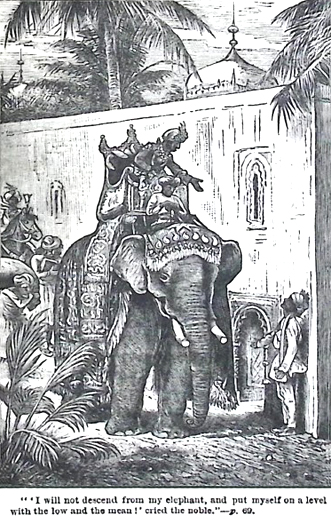
"I will not descend from my elephant, and put myself on
a level with the low and the mean!" cried the noble.
"How shall I enter the king's palace?" he said to one of his attendants. From his lofty height he had not even noticed the little door.
Then answered the porter from within, "This is the way, O descendant of monarchs! Your honour must descend from your howdah, and even, as doth the son of the humblest peasant, enter in by this door."
"I will not descend from my elephant, and put myself on a level with the low and the mean!" cried the noble. "There should be a loftier, more worthy door for those in whose veins runs the blood of princes!"
So, full of the pride of rank, he departed, never to enter the palace, or behold the glories within.
Then came a man bearing a large bundle of valuable goods, through which he hoped to become the most wealthy man in the city. He was so fearful of losing his treasure that he would entrust it to no one, lest some precious thing should be lost. But he desired to see the palace, and prostrate himself before the king.
Then said the porter within, "Lay down your burden, or give it to others, and enter in by this door."
The rich merchant looked at the door, then at the bundle, which he prized as much as his life. He shook his head, and, proud of his riches, turned away. He was never to enter the palace, or behold the glories within.
Then came a learned pundit, reading in a book as he walked along. He too intended to enter the presence of the king, and he believed himself, by reason of his learning, to be entitled to a high place at court. He was so buried in his book that when he reached the little door, he did not observe it, nor hear the invitation of the porter within.
Full of the pride of talent, he passed on, never to enter the palace, or to behold the glories within.
Then came a religious devotee, a very tall man, wrapped in a blanket. Many had been his austerities, terrible the penances which he had performed. He was believed to be a great saint; the people sought his blessing and dreaded his curse. He looked upon himself as the chosen of Heaven. The tall devotee walked up to the door and then paused. Said he, "How can I possibly pass through so low an entrance as this?"
"Thou who carriest thy head so high must stoop low," cried the porter within.
"What! I—deeply read in the mysteries of religion, I whose life is spent in holy meditation, bow down my head so low as to be of but the stature of a child! Let the wide doors of ivory be thrown open for me, or I care not to cross the threshold."
So, full of the pride of self-righteousness, the devotee passed on. He was never to enter the palace, or behold the glories within.
Then came a youth mounted on a white horse, and wearing a mantle stiff with gold. When he rode up to the door, he somewhat marvelled to see it so low, but he dismounted and approached it. The youth was as tall as the devotee, and though he stooped low and lower, he but struck his head in the attempt to pass through.
"The rich mantle hampers your movements," said the porter inside.
It had indeed caught on a nail, and was so thoroughly entangled that no efforts of the youth could release it.
He now hesitated, but only for a moment. Undoing the clasp which fastened the mantle round his neck, he left it behind, then falling on his knees, and so humbling himself to the stature of a child, in the attitude of a suppliant the youth entered the palace, and beheld the glories within.
The palace, O reader! is the religion taught by the Lord Jesus Christ. To the true believers who enter in, it presents treasures of grace, of joy, of glory, such as no pen can write, or tongue can speak, or mind conceive.
What are some of its treasures?
Free forgiveness of every sin, full acceptance with God, purity of life, gladness of heart, comfort in this world, and eternal joy hereafter.
But he who would enter must lay aside "pride," whether of birth, wealth, or talent. Above all, he must lay aside the pride of self-righteousness. The first step towards heaven is the knowledge of sinfulness. We must go down on our knees and pray,—
"God be merciful to me a sinner! Create in me a pure heart, O God! and
renew a right spirit within me!"
The Christian religion exalts God and humbles man. The Mahomedan trusts to enter paradise by the favour of his Prophet, and his own good works. He says, "Have I not observed the fasts, and prayed five times a day?"
The Hindu religion fosters pride in the Brahmin, and makes the favour of the gods an accident of birth. In his view, how can the Sudra or the Chumar enter like him the state of absorption which he tries to regard as bliss?
The Christian exalts God, for it shows Him to be perfectly holy, merciful, and just. And while God is exalted, the pride of man is humbled.
Is he puffed up because of lofty birth? Thus saith the Scriptures, "Dust thou art, and unto dust shalt thou return" (Gen. iii. 19).
Is he proud of his wealth? "We brought nothing into the world, and certainly we shall carry nothing out" (1 Tim. vi. 7).
Is he vain of his learning? "The wisdom of man is foolishness with God" (1 Cor. iii. 19).
Is he proud of his holiness and his good works? "The heart is deceitful above all things, and desperately wicked" (Jer. xvii. 9). "By the works of the law shall no man living be justified" (Gal. ii. 16).
If a man be saved from the just punishment of his sin, it is because our Substitute, Christ, hath borne that punishment on the cross. If a man be accounted righteous, it is because the Holy One hath clothed him in the robe of His own merits. If a man be admitted into heaven, it is because the Son of God hath purchased admittance for him by shedding His own precious blood. If a man be called to wear a crown of glory, it is because his Saviour wore a crown of thorns. Everything that is good in a Christian comes from the gift of God's Holy Spirit; his only plea for mercy is the spotless sacrifice—Christ; his only hope of acceptance with a holy God is that the Saviour died for sinners!
Therefore, O proud man! descend from thy height, and humble thyself in the dust. It is on thy knees, stooping to be as a little child, that thou mayst enter the spiritual palace, and behold the glories within. "Pride goeth before destruction, and a lofty spirit before a fall." "Before destruction the heart of man is haughty, and before honour is humility" (Prov. xviii. 12).


FAZL DE, a merchant, was travelling towards the city of Delhi with camels and asses laden with various goods. After the day's stage was over, his attendants pitched his tent under a clump of mango trees, and unlading his beasts of burden, suffered them to graze. The place was not far from a village. The hour was sunset. Many of the peasants returning from field-work drew near; to them the merchant spoke with kindness. Then, opening one of his bales, Fazl De disposed amongst them, at cheap rates, of such of his goods as suited the needs of peasants.
More and more people now gathered around, pleased both with the traveller's goods and with his gracious speech. After a while, when business was over, seated outside his tent with a circle of listeners around him, the merchant thus addressed them:—
"I bring you, O my friends! something better than anything contained in my bales; and that, which is most valuable, you may have without money and without price. That I may better explain to you my meaning, I will tell you of an adventure which happened to myself some three years ago."
The crowd listened in perfect silence.
"I had business that took me from Jhelum to Pind Dadar Khán. I had no goods with me then, but I travelled alone and on horseback. I came to a village, where I stayed for more than an hour. I expressed my intention of going on as soon as my horse should have rested a little, for my business required urgent haste.
"Then said the villagers, 'The road is not safe for your honour. Rain has been falling for three days, and the way is now over an almost impassable bog.'
"I was not a man to be easily daunted, and I replied, 'I know that many persons travel by this road.'
"'It is perfectly safe in dry weather,' said the peasants; 'but now, even with a guide, it is not safe to cross the morass.'
"I thought this a cunning attempt to make me stop longer at the serai (inn). I determined to press on. I, however, took the precaution of engaging a guide. Then again I mounted my horse and rode on.
"I proceeded on my way, deep in thought, for many things pressed on my mind at that time. I was a seeker after truth. I had heard much of the Gospel, and I admired greatly the purity of its teaching. But one doctrine in it offended the pride of my heart—the doctrine that man cannot be saved by any good works, by alms-giving, fasting, or pilgrimages; that he can only be saved by faith in Jesus Christ, a crucified Saviour. I was a man bearing a good character, and I thought that by strenuous efforts I could certainly reach heaven at last. Turning these things over in my mind, I rode to the edge of the bog, and then looked round for my guide. The cowardly fellow had failed me; he was nowhere to be seen.
"'It matters not,' I said to myself, 'my horse is a good one, and neither he nor his rider mind floundering through a little soft mud. I shall soon reach firm ground on the farther side.'
"Now mark me, my friends," continued the merchant, "I have always looked on that day's adventure as a kind of parable of my own state. I trusted my body's safety to my good horse, just as I trusted my soul's safety to my good works, and in both cases I played the part of a fool. I rode on some way with difficulty indeed, but no great danger. At last, I found that at every step my horse's feet sank up to the fetlocks, to go even a few yards cost him such exertion that he was soon as thoroughly wet as if he had been hunting all day. But I was too proud to go back. I spurred and whipped my poor horse, and tried to encourage him by my voice. 'I will soon reach the farther side,' thought I; 'I see good firm ground before me.'
"But that good firm ground I was never to reach by any efforts of my horse, though desperate were the efforts which he made. I felt him sinking deeper and deeper under me, till he could no longer get on; his ears were turned back with terror, he sank to his knees, then down, down to the girths of the saddle!
"'His weight and mine are sinking him!' thought I. 'My only chance is to abandon the poor brute to his fate. I am comparatively light, and am not clogged with mud as he is. By going with springing step, I may manage to reach firm ground.'
"But, O my friends! I felt mine to be but a desperate chance. I would have given all that I possessed to have been fairly out of that terrible bog.
"What gave me some hope, however, was to see a mounted camel before me at a place where the bog evidently ended, for the ground was a little raised, and there were some bushes upon it. I called out loudly to the man on the camel, and he halloed back to me. I knew, however, that no man would ride a heavy camel into the bog. The man would only be a witness of my terrible end.
"For I felt that the end was at hand. I was no more able to reach safety without my horse, than I had been when in the saddle. In vain I tried to lift my legs, it seemed as if some cruel enemy from beneath were pulling me down! Then I thought of my sins as I had never thought before. Then I dreaded to meet an angry God. Then the terrors of judgment rose up before me. My good works were as the poor perishing brute behind me. I longed, oh! How I longed for a Saviour then!
"In my perplexity, floundering and struggling, I had not marked the movements of the man in front. Through the merciful providence of God, the camel had been laden with tent ropes and poles; the former the man was, as rapidly as he could, unwinding, and preparing to throw out to me. At last, I perceived his aim; but my impatience grew to agony when I saw the difficulty which my kind friend experienced in making the rope reach me. He threw it again and again, but had to draw it back, it was quite beyond reach of my hand.
"I had by this time sunk up to my waist! I saw the man look anxiously around, as if seeking for other means of saving me; at last, he seized on a long tent-pole. The man then, holding with one hand the end of the rope, of which he had fastened the other end to the camel, placed the pole on the bog before him. I was now in the mud up to my arm-pits. Ten more minutes and I knew that I must be suffocated and perish. I saw the man step cautiously on the tent-pole, but could it, even for a few minutes, support his weight? My senses became confused with terror, I hardly knew what was passing before my eyes till I heard a loud voice cry, 'Grasp it, and hold fast!'
"Then I saw the rope which my preserver, stepping along the slippery half-sinking pole, had risked his life to throw, I saw it just within reach of my hand! I grasped it, poor perishing wretch that I was, how tightly I grasped it! It was my one hope for life. It was hard to hold on—the strain of my weight, all mud-clogged as I was, was so great! Still I never for an instant let go, till the camel, impelled by his master, drew me out of the bog!"
"That moment was doubtless the happiest of your honour's life, when you stood again on firm ground," observed one of the peasants, who had listened with interest to the story.
"No, I had a happier moment still," observed the merchant, "and that was when I found firm ground for my soul to rest on. I told you that my adventure is to me as a parable, now I will unfold to you the lesson which it taught me. The bog is like the everlasting punishment inflicted by a just God for sin. I thought that, mounted, as it were, on my good works, I had nothing to fear from it. I nearly lost my soul through my error. The rope thrown to me is the emblem of salvation freely offered to all who will 'grasp it and hold fast.'"
"Who throws the rope?" asked one of the hearers.
"The Lord Jesus Christ," was the reply; "He who watched from heaven the vain struggles of poor sinners, even as my preserver mine from the farther side of the swamp. Christ descended from heaven to earth and assumed the form and nature of man that He might deliver sinners from the endless pangs of hell. He gave His life a ransom for many, and by His perfect obedience, even unto death, He saved believers from the just punishment of their disobedience to the law of a holy God."
These were new words to the peasants, who wondered at the, to them, strange doctrine taught by the merchant.
"Notice, my friends, that I had nothing to do with procuring the rope, nothing to do with throwing the rope; all that I could do was to grasp it and hold it fast. And so when I found that without any desert of my own, free salvation was offered to me by another, I accepted that free offer of mercy, I grasped and held fast the blessed hope of eternal life given to us in the Saviour Jesus Christ. I believed that Christ could save me, I believed that He was willing to save me. I was, all clogged with the mire of sin, helpless and perishing, dragged, as it were, by the cord of love to the firm ground of salvation. And there I stand now, rejoicing in hope of eternal glory, washed from my sins, cleansed, and made an heir of the kingdom of heaven. It is that you may reach this safe ground, it is that you too may receive this blessing, that we Christians now preach the Gospel amongst you. Being saved ourselves, we are not willing that others should perish. The rope is held out to all; it only needs faith in Christ to receive it. To you I now call in the words of my kind preserver—Grasp it, and hold it fast!"


THE beautiful young Gangi went to gather flowers for the shrine of the goddess Durga. Gangi was not a widow, and yet she dressed in the garb of a widow. There were no bracelets on her arms, no ornament on her slender ankles. Her unbraided hair fell on her shoulders, and her form drooped like a creeper that is torn from the stem around which it had twined. Gangi's young husband had become a Christian; he had broken caste, and henceforth was to all whom he loved as one dead and forgotten, or remembered only to be cursed.
But Gangi could neither curse nor forget, though she feared that her husband had done some very horrible thing. She could hardly believe that her kind, gentle Charu Dás was wicked, but she knew that she herself was wretched. Gangi dared not speak of Charu Dás, though he was constantly in her thoughts. Oh! Could she but win him back by austerities! Gladly would she have wasted away her flesh by fasting, or have walked, with bare and bleeding feet, all the way to Kashi. Gangi was possessed with the same spirit of loving devotion which, in former days, made the Satí burn herself on the funeral pyre of her husband.
Gangi was bending over a tank to gather some beautiful lotus blossoms, when she started, as if she had seen a snake in the water below. It was the reflection of some one standing behind her, one whom she knew well, but from whom she had deemed herself parted for ever. With a faint cry, Gangi started from her stooping position, and fled a few steps; then she paused, for a familiar voice entreated her to stop, a voice which she had never yet disobeyed.
"I am an outcast from all my family; dost thou desert me also, O Gangi! Light of my soul?" said the husband of the youthful Hindu.
Gangi stood trembling, and the tears fell fast from her eyes.
"I am not changed towards thee, O Gangi! Is not my form the same, my voice the same, the love in my heart the same? Yea, greater than ever! We were so happy together!"
"And cannot we be happy again?" exclaimed Gangi suddenly, as a hope flashed across her soul. "The Brahmins may be won * to receive you back by large offerings, and great penances. I will give everything that I possess; oh! would that I had more to give! Your father, brothers, will strip themselves of their property—"
* This receiving back is not so difficult a matter to accomplish as
it was formerly. As more converts from Hinduism are drawn into the
Christian fold, the Brahmins are opening their eyes to the fact that
it is more for their own interests to tempt them back, than to bar and
bolt the door against them.
"Never, never will I cease to be a Christian!" said Charu Dás firmly.
The sudden blaze of hope in the heart of Gangi as suddenly died out, like the fire which consumes a light muslin veil. With bitterness, she said, "I do not know what is meant by being a Christian, but I have heard that my lord has broken caste, thrown away his janeo, no more does pujá to our gods, and eats with those of low caste, or Christians, who have no caste at all."
"Didst thou also hear why I broke caste?" asked her husband.
"I have not heard much, save that my lord was beguiled—led astray by the juggling arts * of the wicked Christians," said Gangi sadly.
* The natives are ready to imagine that missionaries practise some kind
of enchantment. At Batála it has been said that the Rev. F. B— puts his
hand on the head of a Hindu, in consequence of which charm the man on
returning towards the city, "beholds it in flames," and dares not go on!
"Hear, then, my story, beloved one, and judge for thyself whether in breaking caste I committed a sin so great as to deserve the hatred of my family and wife."
Gangi listened, leaning against the trunk of a tree, at a little distance from her husband.
"I went to Agra, as thou knowest, and was detained there for a long time on business. Whilst there, O Gangi! I found myself in a terrible position. Thy husband was a criminal, and under sentence of death."
Gangi started in horror. "Under sentence of death!" she exclaimed. "Then he was falsely accused, cruelly condemned."
"Not falsely accused,—but justly condemned," replied Charu Dás. "I could plead nothing in my own defence; I knew myself to have deserved any punishment that might be inflicted."
"But how is my lord free now?" asked Gangi, drawing a step nearer in her eagerness to hear the reply.
"I had a Friend, not a Brahmin, not one of my race, but One of high rank and the most exalted character," replied Charu Dás. "This man loved me with a love as great, yea, even greater than mine for thee, O wife of my youth! When all other hope failed me, He gave the greatest proof of love that a friend could give—He offered to die in my stead!"
Gangi clasped her hands and drew nearer still, for her whole soul was absorbed in listening.
"And my Friend 'did die,'" continued Charu Dás, dropping his voice almost to a whisper. "For me the guilty one, He, the innocent, died; it is through His mortal agony that I now am free."
"Oh! What love," faltered Gangi.
"Before undergoing a shameful and most painful death, my deliverer made a dying request that I would come, and in His company, share a meal with His chosen companions. Gangi, I could not do so without breaking my caste; I could not do so without forfeiting my privileges as a Brahmin. What choice should I make? I hesitated long. If I consented, I should become an outcast; if I refused my Benefactor's dying request, should I not be the most ungrateful of men?"
Gangi bowed her head in silence.
"Now tell me, joy of my soul, hadst thou been in my place, wouldst thou have turned a deaf ear to a dying Saviour, or wouldst thou have broken thy caste?"
Gangi was now so near to her husband that he could catch the faintly whispered words, "I think—I believe, that I should have broken my caste."
"Then, O Gangi! How canst thou condemn me?" exclaimed Charu Dás.
"But what sin had my lord committed that he should be counted worthy of death?" asked Gangi, to whom the first part of her husband's story appeared hardly credible.
"Not one sin only, but a thousand," was Charu Dás's reply. "O Gangi! Every man and woman in this world has broken again and again the commands of a holy God, and is by His law justly sentenced to eternal death. How can a sinner be justified before his Maker? We Hindus pictured our deities themselves full of every vice, and therefore we regarded not vice with horror; but the true religion reveals to us a Being whose very nature is perfection. How dare the polluted sinner approach Him! Man could find no way, though he sought it by pilgrimages, penances, prayers.
"God Himself found a way. He sent His beloved Son to earth, and His Son was willing to leave heaven to save us. This Friend, whose love exceeds that of a brother, became incarnate, assumed a mortal body, that He might offer up that pure body as a sacrifice for our sin. O Gangi! The Lord Jesus Christ offered Himself to stand in our place. He underwent the punishment which we had deserved. He humbled Himself unto death, a painful shameful death, that we might receive eternal life.
"And, O Gangi! What a gift was that which Christ purchased for us! The highest bliss which we aim at is absorption into deity, which leaves the soul no separate existence; it is a bliss which resembles annihilation. The Christian's heaven is a place of pure unmixed delight, where the redeemed of the Lord meet around Him as one large family, shining in His light, rejoicing in His love, washed in His blood from every stain.
"Gangi! When I believed that God's Son had died for me, when I received from Him the gift of pardon and peace, and the hope of eternal life, what could I do but give myself up, body and soul, to Him who loved and gave Himself for me?"
"Hark!" exclaimed Gangi suddenly. "I hear the sound of steps! Fly, fly! If my kindred find you here, they may kill you."
Before the sentence was completed, Charu Dás had disappeared in the jungle.
But the deep impression made by his words remained in the mind of his youthful wife. Gangi said little, but she thought much. She ceased to weep for her lost husband—her relatives thought that she was learning to forget—but silently and secretly a resolve was gaining strength in her mind, which was soon to bear fruit in action.
Charu Dás, according to the law, appealed to the magistrate for permission to have an interview with his wife before they should be separated for ever. The young Hindu, under Government protection, would be allowed to make her final choice as to whether she would remain amongst her own people, or break caste and cut herself off from them by following her husband. It was a time to Charu Dás of terrible anxiety, but he tried to cast his burden of care upon God, and trust to Him to incline the heart of Gangi towards the husband whom she had certainly at one time loved.
The Hindus felt little uneasiness as to the result of the meeting. Gangi was a Brahminee, brought up from infancy amidst those who professed her religion, and they believed that she would as soon be trampled under foot by elephants, as break caste and become an outcast. But they knew not the strength of a woman's love, nor were they aware that a gleam of heavenly light had fallen on the soul of Gangi. Closely shrouded, the young wife went to what all her relatives believed to be her last meeting with the despised Christian. In shrinking modesty she stood before the magistrate. Gangi dared not raise her eyes to meet the anxious gaze of Charu Dás.
The grave magistrate then gave her her choice, that choice which would affect the whole of her future life.
To the surprise of all present, except one, Gangi, with trembling voice, said she would go with her husband.
The anger of her relatives was great; threats and entreaties were alike used to move her from her purpose, but Gangi, though trembling and weeping, kept firm. But for the presence of the magistrate, the poor young girl would have been dragged away by violence, and never suffered to see again him whom she loved best upon earth. But force was forbidden by the law. The Hindu wife must be allowed a free choice. In the midst of uproar, but full of thankfulness and joy, the convert bore away his rescued treasure.
The rest of the story is soon told. The young Brahminee learned ere long to believe what Charu Dás believed, and to serve the God whom he served. When once reproached by a former companion for her change of religion, Gangi meekly replied, "How can we refuse to give our lives to the generous Benefactor who gave His for us? I have learned to say from my heart, 'We love Him, because He first loved us'" (1 John iv. 19).


MANY hundred years ago, a beautiful temple was built, of pure white marble, for the worship of the great God, the Creator of all. On the walls of the building were inscribed, in letters formed of diamonds, emeralds, and rubies, the words HOLINESS, HAPPINESS, PEACE. As guardian of the temple, a strong watchman was placed, whose name was Conscience. He was to keep the holy place clean, and take care that nothing defiling should enter.
For awhile all was well, until an enemy, full of the greed of spoil, determined to possess himself of the jewels in the white marble temple. He had no power to do so by force. The door was strong, the watchman who kept the keys was always at his post, and he had a bell by which he could bring powerful help whenever needed. The enemy saw no means of accomplishing his purpose but by deceiving or bribing the watchman. Night, also, was the only time when he could do so unobserved by the rest of the world.
One dark and windy night the enemy came and knocked at the door of the temple.
"Who art thou?" cried the watcher within, without opening the strongly-barred door.
"I am a pilgrim who has come from a great distance, and with very large offerings," replied the deceiver. "I know no one in the neighbourhood, the night is stormy, and I fear to remain without, lest I should be robbed of my treasures. Only see what I have brought with me."
"It is against rules to admit any one at night," said the porter.
"But every rule has exceptions. Mine is a peculiar case. I have brought gifts, also, for you," said the robber.
The watchman, in his folly, believed the word of the stranger; curiosity and covetousness overpowered his caution. In an evil hour, he unbarred the strong door, and let the enemy in.
The deceiver entered, bringing with him what he called his treasures, which were carefully enclosed in many wrappings, and secured by seals. Entrance had thus been effected, but as long as Conscience remained awake, the enemy could do but little. The bell might at any moment be rung, he be overpowered, and thrust out, or handed over to justice. The robber was indeed within the walls, but his every movement was watched by one stronger than he.
Deferring opening out his pretended treasures till the morning, the intruder produced from his wallet some fruit, cakes, and delicious-looking sweetmeats, and prepared to refresh himself after his long journey by a meal, of which he asked the watchman to partake.
"It is against rules to eat in the temple," said the watchman; "go outside and eat your meal in peace."
The deceiver pleaded the roughness of the night, and the length of his journey. "There can be no harm," said he, "in breaking a rule for once, and no one will know that you have done so." He spread out the tempting food on the floor, and used such artful persuasion, that the watchman not only permitted him to sit down and eat, but after awhile was induced to sit down also and partake of a few sweetmeats which wore of a most tempting appearance.
The sweetmeats were drugged, and in the midst of his forbidden meal, the faithless guardian of the temple fell into a deep sleep.
Then, indeed, the enemy had it all his own way. Quickly unwrapping what he had called his treasures, he produced instruments suited to accomplish his wicked designs. With dexterity the robber extracted the jewels from the walls. It was a work of time, for they had been well and firmly set. But first the word HOLINESS was effaced, then HAPPINESS, and then PEACE. Only a rude broken outline was left to show where they once had been. Hours and hours went by, and all this time the watchman slept.
The enemy's object was not only to despoil, but to defile the once beautiful temple. There were a number of little idols with him, and these he placed in niches in every direction. There was one called Falsehood, an idol representing a woman, with snakes instead of hair curling around her brow; there was Covetousness, with many hands; Cruelty, with a necklace of skulls; Impurity, with an animal's head. What was beautiful had been destroyed, what was hideous was put in its place; the once pure white temple was pure no longer, and still the guardian slept!
How long he might have slept none can tell, had not what may be called a trifling incident occurred. Just when the work of destruction was almost completed, and the first gleam of dawn appeared in the sky, a little bird flew through a small opening in the temple, and struck the sleeper with its wing as it passed.
Startled, Conscience awoke, but, dizzy from the effects of the drug, was at first hardly able to understand what had happened. The lamps in the temple were still burning, and the faint light of morn was stealing in. Conscience looked round and perceived hideous idols in the niches. He saw that the jewels had been torn from their places, and beheld the enemy going on with his work of destruction,—soiling, marring, defiling the temple raised to the One pure God. Conscience, through the effects of the drug, had lost power to overcome the enemy. His strength had become as weakness, but he was still able to pull the rope which was attached to the bell.
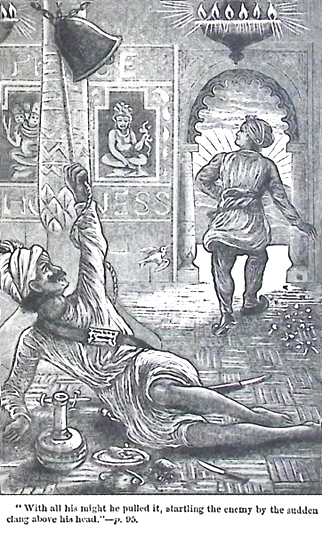
"With all his might he pulled it, startling the enemy by
the sudden clang above his head."
With all his might he pulled it, startling the enemy by the sudden clang above his head. Knowing that many would rush to the spot on hearing the sound of the alarm bell, the robber hastily rushed out from the temple, dropping, in his flight, the jewels which he had plundered.
Measures were taken as quickly as possible to repair the sore mischief done. The idols Covetousness, Cruelty, Falsehood were, one after another, thrown down. The place received a thorough cleansing. Gradually, though not without much difficulty, the jewels were put back in their places, and HOLINESS, HAPPINESS, and PEACE again glittered on the wall. But it was long ere Conscience recovered his health, or the confidence of his superior, and never without shame and grief could he remember the night when he threw open the door to a traitor, and let the spoiler enter and pollute the temple of God.
Reader! The temple of God is the human heart, first formed by its Maker pure and clean, with holiness, happiness, and peace within it. How Satan, the enemy, first gained entrance, how he stained, robbed, and despoiled it, is written in the Word of God, and alas! its effects are seen in the world around us.
And what is meant by the watchman Conscience?
Conscience is that power to distinguish between good and evil which God has placed as a guard on the human heart. It is Conscience that tells us that to kill, to rob, and to lie is sin, and that sin is hateful to a holy God, and must be punished by Him.
But the enemy, Satan, has had power to drug Conscience, to put it to sleep, so that its voice has been silent. Look at Hindostan, and see how deep has been the slumber of Conscience! Murder is sin of the blackest dye; yet widows have been burnt alive, innocent babes killed by their own parents, thugs have strangled travellers, without Conscience being awakened to cry out, "O wretches! You will be called to a fearful account for crimes such as these! God's wrath is upon your heads!"
Where is Conscience in the heart of the deceit, the midnight thief, or the bold robber who rejoices over his ill-gotten spoils! Where is Conscience in the hearts of millions who utter lies as they swallow in air, quite unconscious that the path of falsehood leads to destruction! It is asleep, drugged and senseless! Conscience says nothing when man is robbed of happiness and God is robbed of honour. The once holy temple of God becomes a harbour for idols, for Covetousness, Hatred, Pride, and every other sin, and the watchman Conscience is silent and asleep!
Asleep, indeed, but not dead. Sometimes what seems an accident may awaken it from its dangerous repose. Even a little book, such as this, like the flap from the wing of a bird, may rouse Conscience, and open the watchman's eyes to the peril of the soul. Ask yourself these questions, O reader! "Is the temple of my heart clean; are purity, happiness, and peace within it? Do I abhor all sin, and give to none a place in my soul? Do I harbour no covetousness, hatred, or pride? Do I refuse all unlawful gains? Are my lips clean from lying and slandering?"
If these questions are honestly asked, and a voice within you answers "No!" that is the voice of awakening Conscience.
If, then, in anguish of soul you exclaim, "How can I escape from sin, and the dreadful punishment of sin?" know that the watchman has sprung to his feet, he is ringing the alarm bell for help.
God is ready to grant that help, to send His cleansing Spirit into your heart, to give back to it all that it has lost. The Christian religion not only tells of Satan's entering the world to despoil the temple of God, but it tells of the Conqueror of Satan entering the world to restore what had been polluted and spoiled. The temple may become fairer than ever before, for the blood of the Lamb of God was shed to cleanse it from sin. Conscience, made more watchful and faithful, may once more be trusted to keep guard against the entrance of evil, and happiness, holiness, and peace be again inscribed in shining letters within the temple of the heart.

THE TWENTY-FOUR PIECES OF SILVER.

A MERCHANT bade his servant Kesho go into the bazaar, and buy such things as he required. The merchant counted out twenty-four pieces of silver, and regarding their expenditure, gave the following directions to Kesho:—
"Take this money, and with it buy seven pillows, at the cost of one rupee each. Lay out, at least, eight on working tools, and see that they be thoroughly good. Thou must also buy food, and various other things which thou knowest to be required. But first of all, go to the railway station, where there are three parcels of value waiting to be called for. Pay what is requisite for them, and bring them to me with the utmost care. Be diligent and obedient, and show thyself worthy of trust."
Kesho salaamed and departed, having wrapped up the twenty-four rupees in the scarf which he wore round his waist.
My story, O reader! is a parable. In Kesho we behold an emblem of every man and woman now in this world. To each is entrusted the treasure of Time, the twenty-four hours of each day. Seven may be spent on the pillows of sleep; eight should be given to honest work, whether in the fields or the bazaar, whether in the school or in the office. They who have not to earn their own bread must be diligent still. Let them work freely for the good of others, spending their time in labours for God, caring for the poor, teaching the ignorant, pleading the cause of the widow. No one without guilt, and consequent punishment, can waste the twenty-four hours committed every day to his charge by his Maker.
And the three precious parcels which are first of all to be redeemed are—Prayer to God, Praise of the Most High, and Reading of the Holy Scriptures. These offer to us the noblest employment of time, and bring the richest profit.
Now hear what Kesho did with the rupees entrusted to his care.
Kesho took with him a mule to carry his purchases, and in the evening again appeared before his master. A very high but not very heavy burden made the mule's back appear almost as lofty as that of a camel.
"My lord, I bring the goods on the purchase of which I have expended my twenty-four rupees," said Kesho to the merchant, after a humble salaam.
"'Thy' rupees, forsooth!" muttered the merchant, knitting his brow in displeasure. Then, advancing to examine the mule's burden, he exclaimed, "O thou most dull of soul! I told thee to expend seven rupees on seven pillows, and behold thou bast brought to me twelve! What idle waste of my money. Doubtless thou hast spent on pillows for sleep five of the silver pieces that were meant for a nobler purpose. Where are the good working tools which I ordered?"
Kesho was slowly and lazily unpacking the mule. He now produced, one by one, put up carelessly between the pillows, the tools which were needed for work. The merchant examined each closely.
"These are too few in number, and not thoroughly good of their kind," he said, angrily laying one down. "Thou hast taken no pains in their choice, and hast doubtless spent too little upon them. What else hast thou bought with my money?"
Kesho produced a supply of food.
"More silver rupees have been spent on this than was required," observed the merchant; "your greatest expenditure seems to have been on eating and sleeping. But I see that thou hast still many things to show me. What are in those two bags slung across the back of the mule?"
Kesho did not appear to be in any haste to open them. Looking rather sullen, he poured out the contents of one upon the ground; it showed a hookah,* and a heap of worthless rattles.
* The hookah is the Eastern representative of pipes and cigars. Women
smoke it as well as men.
"Are you a child or an idiot that you have spent rupees on such trash as this?" cried the merchant, spurning the rattles with his foot. "I hope that my three valuable parcels are safe in the other bag. Show me its contents directly."
Kesho was more unwilling than before, but he had no option. He first took out a box, which he held in his hand, and then emptied the bag on the ground. Out came packs of dirty playing-cards,—mingled with dice! So many had been bought by the faithless servant with his master's rupees, that the merchant saw that Kesho must have spent on them at least half of the money that should have gone for the tools, perhaps a good deal more than half!
Exceedingly wrathful was the merchant. The two heaps before him showed how utterly unworthy was his servant to be entrusted with the money of time. But even worse was to come. Hoping that his master might not notice the movement, Kesho was trying to hide the box which he held behind the pile of cushions. But the merchant's eye was keen, and he detected the attempt in a moment.
"Slave! What art thou attempting to conceal?" he exclaimed in a voice of thunder. "Open that box, and show me upon what worse than trash thou hast been wasting my money!"
Most unwillingly, and with a trembling hand, Kesho obeyed. Scarcely had he raised the cover of the box when a number of hideous black scorpions were crawling about in every direction.
The merchant was more wrathful than ever. "Wretch! Worthy of a thousand stripes!" he exclaimed. "Is that what thou hast to show for my entrusted money? And where are the three parcels which I charged thee first of all to redeem?"
Prostrating himself in the dust, the servant faltered forth, "I forgot them!"
"Then thou hast injured thyself only!" said the merchant sternly. "Those parcels contained gifts for thee which are now lost to thee for ever!"
Scarcely had the words fallen on the ear of Kesho, when he sprang up from his prostrate position screaming with pain, for three of the scorpions had fastened on his leg!
Terrible was the effect of the stings of those scorpions, and still more terrible the scourging inflicted by the merchant upon his worthless servant. Kesho never forgot either the stings or the dreadful punishment to the end of his days.
O reader! Art thou like unto Kesho? Or hast thou learned to make a better use of the treasure of time? Review the way in which yesterday was spent; deceive not thyself, for thou canst not deceive Him who entrusted to thee those twenty-four hours which thou canst never recall. How many were lost in lazy sloth? How many were given to unnecessary spinning out the time employed in eating and drinking? How many were spent in that idle gossip which is worthless as the rattle of a child? Were any thrown away in those games of chance which have been the ruin of many? Oh! Search thy heart, and answer the solemn question truly, have any of thy hours been spent in such deeds of evil as are more poisonous than scorpions, deeds which thou wouldst gladly hide? Seriously consider these questions, and let thy conscience give answer. If it be silent now, at the last Day it will most assuredly speak.
After reviewing but "one" day of the many of thy life, dost thou not tremble and cast thyself in the dust, exclaiming to thy great Master, "'Lord! be merciful to me a sinner.' I have forgotten, or carelessly performed the duties of Prayer, Praise, and Perusal of Thy Word; I have indulged in sloth, in idle-speaking, in sinful pleasures, perhaps in acts of which I should be ashamed. And that not for one day only, but for weeks—for months—for years! Thousands on thousands of precious hours have been wasted, squandered, lost for ever!"
And now, O Reader! How can the past be redeemed? Thou canst not tell how many hours remain to be spent; make the best use of the one now before thee. And first, I would earnestly urge upon thee to search the Scriptures. Reading them carefully, prayerfully, thou wilt find a means of escaping both from the scourge and the scorpions, the punishment here and hereafter, which thou hast justly deserved. And there are to be found directions for redeeming the time in future, for laying out to the best advantage such hours as may be left to thee yet. We may count the treasures of time, but the treasures of Eternity cannot be counted. The one are as silver rupees in the girdle, the others, if blissful, will be as mountains of gold. On the way in which time is spent here, eternity will depend. Oh! May God bestow His Spirit upon thee, and make thee what all of His servants are commanded to be, "not slothful in business, fervent in spirit, serving the Lord"! (Rom. xii. 11).


TRUTHFULNESS is as the Koh-i-nur, the gem without a flaw, which shines in the crown of a monarch. If you would know what comes of falsehood, hear ye the story of Shibbu.
In the island of Ceylon dwelt Lachman Dás, who, above all other men, was skilled in the art of making false jewels. He used to provide such for those men who go to ships arriving from England, to cheat unwary passengers by selling the false under the name of the true. Those who knew Lachman Dás best called him by the title of Father "Jhuth Muth" (Falsehood).
One of the customers who most often came to the dwelling of Lachman Dás was a man of the name of Shibbu, who had amassed some hundreds of rupees by cheating the English by selling false gems. One day he came to Lachman's house with a look of great eagerness on his face.
"What hast thou ready, O Father?" he cried. "The smoke of a large steamer is now to be seen in the sky, passengers will soon be arriving, and I have not so much as a bit of glass bottle left with which to tempt them!"
Lachman Dás did not answer at once; he was putting the last finishing touch to a beautiful ornament made of false rubies. But presently he relieved the impatience of Shibbu by drawing forth from a secret place a basket containing many more, each more splendid-looking than the other. Shibbu was dazzled by their beauty, and eager to buy.
"How many are there altogether?" he cried.
"Twenty-four choice ornaments," replied Lachman Dás, after counting them slowly.
"I do not mind taking the whole lot,—four annas * each, six rupees for them all," said Shibbu, trying to look as if he were indifferent to gain, and rather bestowing a favour on the maker.
* An anna is less than three half-pence.
"Four annas each!" cried Lachman Dás indignantly. "Wert thou born without eyes! Seest thou not that the worst of these is fit for the wear of a rajah!"
"If it were real," said Shibbu. "But come, you are an old friend of mine, I will give you—say five annas each."
"I will not let them go for one pie under a rupee each," said Lachman Dás with decision.
"A rupee each! Would you ruin a poor man with five children?" cried Shibbu. "Come, come, I am an old customer, let us say six annas a-piece."
"A rupee each, not a pie less. I shall find many who will purchase my jewels at that rate; go then elsewhere and buy," said the maker of false gems, beginning to put his gaudy trash back again into the basket.
"Do not be hard on an old friend. You have made many rupees by me, O Father!" cried Shibbu, in a pleading tone.
Lachman Dás considered for several moments; he appeared to be counting the false emeralds in a ring which he held in his hand. At last, he said, "I am willing to make a bargain with thee, O Shibbu! Thou shalt have, if thou wilt, the whole lot on the following terms. For the first ornament thou shalt give but one pie." *
* Less than a "mite." A rupee is now worth about 1s. 8d.
"'One pie!'" exclaimed the delighted Shibbu, scarcely able to believe his own ears.
"For the second 'two' pies, for the third 'four,' so to go on doubling till the whole twenty-four be paid for."
Shibbu was not clever at counting, but he soon made out that all the first four ornaments would cost him but a mere trifle. Was ever bargain so good! Shibbu began to think that the cunning old cheat before him must have grown crazy from age to sell his jewels for a few pice! He eagerly closed with the bargain, if Lachman Dás would but wait for payment until the false jewels should be sold.
"Enough," said Lachman Dás, with twinkling eyes. "Thou shalt sign an agreement before witnesses that if thou pay me not, not merely shall thy property be mine, but thou thyself shalt be my bondsman to the end of thy days."
Shibbu, eager to gain more rupees by lying and cheating, willingly put his mark to the paper which was drawn up for him to sign. He could hardly bear waiting till the business was over, so much afraid was he that some other seller of gems should get the start of him, and cheat the strangers out of their rupees before he had time to display before them his beautiful but worthless ware.
But Shibbu had no need for such haste. Not only did he reach the quay before the passengers landed, but his false gems were so superior to those of any other seller, that he disposed of the whole twenty-four, and made three hundred rupees!
"I never had such a catch in my life!" thought the exulting teller of lies. "It will break old Lachman's heart when he finds what a wretched bargain he has made. If he had stuck to his demand for rupees, I should have given in at last. Now he must content himself with his pice!" And Shibbu laughed to himself at the mortification of the covetous old man.
But Shibbu did anything but laugh when standing by the maker of false jewels, with many witnesses around, he heard the beginning of the calculation made as to the real amount of his debt. He kept silent at first, though growing graver and graver, till he found that though the first jewel cost him but one pie, the twelfth was rated at "ten rupees," "ten minas," and "eight pies."
"Stop! Stop!" he cried. "There is some jugglery here. They never can come to so much!"
"Go on," said the maker of jewels to the accountant who, pen in hand, was making up the sum.
Now poor Shibbu was like a wretch undergoing the torture. As the doubled price of each ornament was named, he first groaned, then actually shrieked, as if a twisted rope were being drawn tighter and tighter around him. Long before the price of the twentieth jewel was reached, he was a ruined man; and when the twenty-fourth was named as worth upwards of "forty thousand" rupees, Shibbu threw himself on the ground, beat his breast, tore his hair, and cast dust on his beard.
"Oh! Have mercy—mercy on me!" he cried.
He might as well have asked mercy from the stones as from the wicked Lachman Dás.
Shibbu saw himself stript at once not only of his ill-gotten three hundred rupees, but of his house, everything that he possessed,—yes, even of his very freedom! Lachman Dás kept him to his agreement, and the fruit of Shibbu's successful, lying and cheating was poverty, misery, and bondage to the end of his wretched days.
Reader! Have you ever made anything by lying or cheating? Then are you in as evil a condition as Shibbu? You have a hard creditor in Satan, the evil spirit, and every pie that you have gained by his means is "set down," to be accounted for hereafter. You may now, like Shibbu, be exulting in your success. Perhaps you are a bunniah, rich from what you have wrung from the poor. Perhaps a Government official, whose hands are not clean from bribes. Perhaps a contractor, who has amassed thousands of rupees by dishonest bargains. In whatever way the ill-gotten money has come, be sure that the reckoning day is near.
Do you know what, in the Word of God, is written about the fate of the liar? Hear it, O sinner! and tremble—"All liars shall have their part in the lake which burneth with fire and brimstone, which is the second death" (Rev. xxi. 8). You have sold yourself as bondsman to him who is indeed the father of lies, one who is more cruel than Lachman Dás. Man can but hurt the body, but the evil one destroys the soul. Poor lost one! Dost thou boast of thy successful lies and thy clever bargains? See what they will bring thee to in the end. Thou hast heaped up a debt beyond what thou canst count, and every pie must be paid.
Yet even thou needst not despair; if thou, O lost one! repent and forsake thy sin, there is a way by which even your enormous debt can be paid—The Son of Man is come to save that which is lost (Matt. xviii. 11). The Christian religion offers pardon to the sinful, freedom to the bound, and life to the dying.
What would have been the feelings of Shibbu, when grovelling on the ground, groaning and despairing, had some prince come forward and said, "Fear not, I will pay all thy debt; my treasury is full, and were thy debt even to empty it, thou shouldst go free." Would not Shibbu have sprung up from the dust, then thrown himself at the prince's feet, and wept for joy? Even this act of mercy hath the Lord Jesus, God's Son, performed for thee, if thou believe. From the treasures of His grace He pays all thy debt, so that Satan hath no power to ruin thee. Christ came from heaven to pay it; He shed His own blood to pay it; there is freedom and life and joy for those who trust in His name!


TO the wise and virtuous Hossein was born a son whom he called Shádia Shah (Prince of Pleasure) in the gladness of his heart. But the son at whose birth had been many rejoicings, grew up to be a care and sorrow to his parents. As the son of a wealthy man, Shádia fell into temptations which assail the rich more than the poor. He thought that, having no need to labour for his bread, he was not required to labour at all.
Shádia was placed at a Government school, but scarcely attended one day out of three. He fell amongst evil companions, who led him into habits of gambling. From morn till night the youth would sit in worse than idleness, rattling the dice or shuffling the cards. In vain his father reproved him, in vain his mother entreated. Shádia constantly incurred debts which his father paid with sorrow and shame.
"Alas!" said the neighbours. "That so wise a man should have so foolish a son!"
One evening Shádia, having partaken of a plentiful meal, stretched himself on his charpai, wrapped his rich coverlet around him, and closed his eyes as if to sleep. His father and a friend named Mihr Dád, sat at a little distance smoking their hookahs. Then after a while, the bubbling sound of the hookahs ceased, and the two friends engaged in the following conversation:—
"Is it not time," asked Mihr Dád, "that your honour should make some arrangement for the marriage of your son?"
"Arrangements are already in progress," was the reply.
This was to Shádia startling and interesting intelligence. * He noiselessly turned round on his charpai, and raised his head a little that he might listen the better.
* But not as astounding as it would have been to a European. In the
East, relatives arrange marriages, the bride and bridegroom are not
supposed to meddle in the matter.
"No doubt your honour has chosen for Shádia the daughter of some highly-esteemed man of excellent family," said Mihr Dád.
"I cannot say that," replied Hossein. "The bride's father is not a respectable man, but one of mean and grasping character, and of very low birth. He is, moreover, exceedingly ugly."
"That sounds not well," said the friend. "But perhaps the good qualities of the bride's mother counterbalance the evil ones of the father."
"Oh! The mother is mad!" replied Hossein.
Poor Shádia became very uneasy as he listened, and raised his head a little higher, hoping that he was unnoticed, as he lay in the shadow of a pillar.
"It is to be hoped that the girl does not resemble her parents," observed Mihr Dád.
"She is said to be more ugly than her father, and more mad than her mother," was Hossein's reply.
The poor intended bridegroom could hardly refrain from an exclamation of disgust. What could his father mean by making so horrible a marriage for his only son and heir!
"I suppose that the money arrangements at least will be satisfactory," said Mihr Dád after a pause; "the girl will bring great wealth to the house of her future lord."
"Anything but wealth," replied Hossein with a sigh. "Her father makes many promises indeed, but he is pretty certain never to fulfil them. On the other hand, Shádia's friends must settle on his bride all that he now possesses, or may inherit at my death. I believe that the result of the union will be to bring him to beggary at last."
Shádia could listen in silence no longer. He sprang from his charpai, and with flashing eyes and quivering lips suddenly appeared before his father.
"I will never make such a marriage!" he exclaimed. "Why have you chosen for me so hateful a bride?"
"I have not chosen her for thee, O my son!" Hossein mildly replied. "Thou hast chosen her for thyself. I would have wedded thee unto Wisdom, thou hast given thyself unto Gambling."
The youth looked somewhat perplexed.
"Sit down beside us," said the father, "and hear the meaning of my parable, and profit by it, my son."
Shádia took his place on the mat, and listened in silence while Hossein went on. "Gambling is the daughter of Covetousness, and her mother is the mad Love of Pleasure. She inherits the evil qualities of both her parents. She brings the rich to poverty, and the honourable unto shame. Didst thou ever know a gambler who rose to distinction by honest, persevering industry? Didst thou ever know a gambler who was blessed by his family, or who left a good name behind him?"
Shádia hung his head as one ashamed.
"Oh! My son, it is in youth that unions are formed on which the happiness or misery of the whole life may depend. You are now contracting habits which, if confirmed, will prove your ruin. The wild mirth of your associates is like the festivities and fireworks at a marriage, where the bridegroom is a victim, and the bride a fiend in disguise. For is it not the natural effect of the vice of gambling to destroy all that is noble in the character of man? If the parents of Gambling be Covetousness and the mad Love of Pleasure, what are her children? Idleness, Selfishness, Neglect of Duty, Poverty, Misery, and at length Despair."
Shádia took to heart the words of his father, and resolved from that day to break from the evil habit which was ruining his prospects and corrupting his heart.
And now, O reader! There is another kind of gambling against which I would warn you, Gambling daily practised by many who never touch a dice or a card. It is playing at the game of chance, at which the immortal soul is the stake. You may have been born among Hindus or Mahomedans, Sikhs or Christians; you may have learned from childhood to streak your forehead with the mark of Shiv, or to say, "There is one God, and Mahomed is His prophet," or to honour Goru Nanak, or to reverence the name of Christ. You go on doing these things, but as a matter of custom. Your common sense tells you that amongst many differing religions not all can be right—that if God be One, so Truth must be one; many paths lead to Hell, only one can lead to Heaven. Why do you not search and inquire, to be certain which is the right one? Why read you not Shastra and Grundth, Qurán and Bible, and compare them together, with earnest prayer to God for guidance? Because you shrink from labour, because you are willing to stake your soul on a "chance!"
Consider what is the stake. If you saw a royal gambler who should cry as he rattled the dice—"If I throw anything but six, I am content to forfeit my crown, come down from my throne, and take my place amongst the beggars who throng my gates!" Would you praise that king for wisdom? Would you not say, "Alas! He is mad!"
Or if you saw a youth seated at play, and heard him exclaim with a solemn oath—"If I lose this game of chance, I will throw myself into yon well a thousand feet deep, and make my life the forfeit of failure!" Would you praise that youth for wisdom; would you not rather cry, "Put him at once into confinement; it is not safe to leave him to himself!"
But he who stakes his soul, stakes more than a crown, stakes more than his earthly existence. He stakes future happiness, more precious than kingdoms; he risks the loss of bliss through millions and millions of ages. He risks it on the "chance" that his forefathers were right, and seeks no proof that they were so. Is this conduct the conduct of the wise? If the Mahomedan religion be from God, what will become of the Hindu? If the Christian Faith be indeed the true one, what will be the fate of those who, refusing to examine its proofs, reject it?
O reader! Gamble not with your own soul; become a patient, earnest, prayerful inquirer after truth. Examine the foundations of various religions, especially of that which fears no test. Mahomed himself declared the Tauret of Moses, the Books of the Prophets, and the Gospel to be the Word of God, yet willed not that his followers should read them! Has Wisdom no answer to the question "'Why' was he unwilling that men should search the Scriptures, though Christ, whom he knew to be a Prophet, commanded that men should search them?" Was it not that he had reason to dread the light that would pour in on the soul from reading the inspired books?
To seek for the truth—this is wisdom. To search and examine whether the foundation on which we build our hopes of heaven be firm and sure—this also is wisdom. To pray to the unseen God to guide us in our search—this is wisdom; and having found truth, to embrace and hold it fast to the end—this is wisdom indeed!


LOOK on the shadow of great realities shown forth in a dream! I beheld as it were a mighty Cross, the top of which I could not see, for it was hidden in a bright cloud; and the arms spread from East to West, as if to embrace all the world. Against this Cross, resting upon it, was a wondrous ladder with poles of gold, and seven rounds of various tints, each different from the other.
The first round of the ladder was of the hue of ashes, and on it was written these words from Scripture—"I acknowledge my transgressions, and my sin is ever before me: what shall I do that I may be saved?" The name of this round was Repentance.
The second round was blue and bright as the summer sky. On it was written these words—"God so loved the world that He gave His only begotten Son, that whosoever believeth in Him should not perish but have everlasting life." The name of this round was Faith.
The third round was of glowing crimson hue, richer and more beauteous than that of rubies. On it was written these words—"We love Him because He first loved us." The name of this round was Love.
The fourth round was green as emeralds sparkling in the light of the noonday sun. Even to look on it gladdened the heart, and ever and anon flowers appeared to blossom upon it, as roses bloom on the green earth. The name of this round was Joy. On it was written—"In whom believing, ye rejoice with joy unspeakable, and full of glory."
The fifth round was very marvellous to look on. Its colour was pale violet, and on it appeared in gold the semblance of an eye, an ear, a mouth, a hand, a heart, and other objects. The name of this round was Service, and on it was written—"I beseech you, by the mercies of God, that ye present your bodies a living sacrifice, holy, acceptable unto God, which is your reasonable service."
The sixth round was of spotless whiteness, compared to which the pearl is without beauty, and the new-fallen snow without brightness. The name of the round was Holiness, and on it was written, "Holiness—without which no man shall see the Lord."
The seventh round appeared to be formed of golden light, but it dazzled my eyes so much, that I could not see it distinctly. The name of that round was Glory. On it was written, though I scarcely could read, on account of the excessive brightness—"To them who by patient continuance in well-doing seek for glory, and honour, and immortality, eternal life."
When I looked upon the ladder, I rejoiced, but when I looked from it to the earth I trembled. In the distance I saw red flames, as of a vast conflagration, and though yet afar off, minute by minute they drew nearer and nearer. I knew that a fiery deluge of destruction was spreading over the land, and was conscious that at last there would be no means of escape but by the way of the ladder that was resting upon the Cross.
On the first round of the ladder, Repentance, I saw several women seated, and all appeared to be in trouble, looking ever and anon to the fire at a distance. I heard first one, then another, repeat with weeping the words inscribed on the round. These were women whose hearts were touched with a sense of their sins.
"Oh! What must I do to be saved?" cried one.
A Brahmin in a long dhoti, and with painted lines on his forehead, and a string of beads in his hand, stood near. He heard the woman's exclamation and replied, "Go on pilgrimage to Kashi, bathe in the sacred Ganges, do pujá at the shrines, give offerings to the priests, and possibly even thou mayst obtain emancipation."
A turbaned Mahomedan Moulvie on the other side, with a copy of the Qurán in his hand, cried aloud, "There is but one God, and Mahomet is his prophet. Keep the fasts, pray five times a day, observe all the laws of Islam; even for women a place in Paradise may be found; saith not the prophet, that God will lead the believers of both sexes to the gardens of delight?"
Some of the women descended from their place on the round, and followed the one or the other speaker. I know not whether their hearts had found rest, but as they were now standing on the doomed earth, I feared that none were really in safety. Their eyes were fixed on that earth, and they turned their backs upon the Cross.
Two youthful sisters remained on the round of Repentance, nor listened to Brahmin nor Moulvie. Their gaze was anxiously fixed on the second round of the ladder, a round which was very high, and therefore hard to climb. At last, one of the sisters raised her hand, grasped firmly the round of Faith, and by her companion's aid got a footing upon it. The uppermost climber then helped the other up. Trembling from the exertions which they had made, both the young women stood trembling upon the round.
Then loudly from those below arose the cry, "Come down!" mingled with angry threats and curses. And suddenly a tremendous wind began to blow, increasing to a hurricane. It could not shake the ladder indeed, but it greatly harassed and frightened the girls who were clinging to it.
"I cannot stop here!" cried the elder. "I cannot endure this storm!" I could see in my dream that every limb was trembling from the blast of "persecution."
"Hold on! Oh! Hold on, my sister!" cried the younger. "A voice is sounding even through the storm, 'Whosoever shall confess Me before men, him will I confess also before my Father which is in heaven.'"
"Oh! This is terrible!" exclaimed the elder. "I can endure no more!" As she uttered the words she let go her hold, and dropped to the ground, sorely bruising herself against the round of Repentance as she fell.
A cry of anguish burst from her sister; but still notwithstanding the furious storm, and the fiercer cries of those beneath, she maintained her grasp, and only clung the harder, the louder the tempest of persecution blew.
She not only clung, but she climbed. It seemed as if the very blast helped to bear her upward, so quickly did the brave girl reach the third round, the ruby round of Love. It appeared as if there she would find some rest; from thence she could look down on the crowd, and less heed their hooting and upbraiding. I thought in my dream that I heard her say, "Perfect love casteth out fear."
Upward and upward still, struggling, clinging, climbing, the girl has reached the round of Joy. Then suddenly the wind went down, as if a voice had commanded it to be still, and as I looked on the climber, I beheld her face lighted up with exceeding delight. A song of joy burst from her lips, "My soul doth, magnify the Lord, and my spirit hath rejoiced in God my Saviour!" Methinks there is no happiness on earth like the happiness which fills the heart of those who have risen from Faith and Love to Joy!
But there were other heights to be reached, and the climber was soon upon the round of Service. The ruby light of Love, the emerald radiance of Joy were about her still, as if she carried them with her. Her happy song did not cease; Service was evidently to the climber a post of honour and pleasure. To devote heart and eye, lips and hand, all that we have, and all that we are to Him who gave Himself for us, this is not the task of the slave, this is the adopted child's privilege and delight.
But still, even when on the round of Service, the girl's eyes were fixed on the round of Holiness above her, the beauteous pearly round. She stretched her hand upwards, longing to reach it, but it seemed too high for her even to touch. "Oh! Create in me a clean heart!" she cried. "And renew a right spirit within me!"
As the climber stretched upwards with wistful gaze, I saw an angel with snowy wings and starry crown suddenly swoop down from the sky. He caught the weary one in his strong arms, and in a moment placed her on the round of Holiness, and then onwards—upwards to Glory!
The crowd below cried, "The Christian is dead!" I knew that she had but entered into heavenly rest. They saw in the winged messenger the terrible form of Death, I beheld in him a ministering angel sent by the Lord of Life. Blessed are they whom He finds on the round of Service, still shining with Faith, and Love, and Joy!
Reader! This is a parable for all who have learned that they are sinners, who have heard of the love of a Saviour! If you have read this book, the Ladder of Life is before you, it remains with you whether or not you will resolve to climb it. At the last Great Day you cannot plead, "No one warned me of coming judgment, no one showed me a way to escape." Have you reached even the first round of the ladder? Has the cry ever burst from your heart, "God be merciful to me a sinner! What must I do to be saved?"
If, as is possible, though you yet be called a Hindu, you have reached the second round of the ladder, think not that it is possible to rest securely on the bare belief that Christ died for sinners, without the Love which can raise you above the fear of man. The devils believe, but do not love; their dead faith can never save them. If you, like too many, are content to think as a Christian, but live like a heathen, you are in fearful danger of a fall. Oh! Climb upward, struggling and praying, and be assured that it is Love that leads to Joy, and to that ready glad Service which shows to all that true faith inevitably leads to a useful, devoted life.
Do you long for Holiness, never fully attained on earth, yet aimed at by every sincere Christian? Hear the words of the Saviour— "Blessed are they that hunger and thirst after righteousness, for they shall be filled. We know that when He shall appear we shall be like Him, for we shall see Him as He is." To be with Him, and like Him for ever, this is glory indeed!
Once more look at the rounds of the Ladder of Life, and as you look, ask your own heart, "Do I desire to climb it?" And if you find the desire, oh! Turn it into a prayer—"Lord! By the help of Thy Holy Spirit, give me strength to climb it, for the sake of Thy blessed Son."
A. L. O. E. would suggest to kind young friends eager to help Missionaries, how very acceptable would be copies of this Ladder made in cardboard, with bright colours and gilding. She has herself made several, and few things are so useful to her in Zenanas as the one which she has reserved for herself. A friend greatly added to its value by putting a little figure of a man upon it, who, by being drawn up by means of a string at the back, mounts from round to round. Children in Mahomedan schools have readily learned by heart the precious verses attached to Repentance, Faith, &c. Nothing should be written on the Ladder except the names of the rounds and references to suitable verses. Each Missionary should learn to repeat these verses in the language of the people she visits.
Ladder of Life.
GLORY WITH CHRIST.
LIKENESS TO CHRIST.
SERVICE FOR CHRIST.
JOY IN CHRIST.
LOVE TOWARDS CHRIST.
FAITH IN CHRIST.
REPENTANCE FOR SIN.

PRITHU was the eldest son of a "Brahmin" (one of the highest "caste" or class in India, who think themselves twice-born, and so entitled to look down on their fellow-men). Little Prithu would probably at one time have almost rather starved than have eaten food which had been touched by one of low caste, or by a Christian, or have cut off the tuft of hair at the top of his head, which was a sign of his being a Brahmin. Prithu has cut away the precious tuft, and now sits down at the Christian's table, and gives thanks to the Christian's God. But the Brahmin boy had a hard struggle to go through before he left father and mother, country and friends, for the sake of the Gospel.
Prithu's home was in Narowal, which is in the large province called the Punjab. Narowal is a heathen place, but in it is a school, which was watched over by Mr. Bateman, an English missionary. Earnestly had Mr. Bateman been trying to win souls for Christ in Narowal and the country around. His was not an easy work, nor always a safe one. On one occasion some villagers were so angry with Mr. Bateman for having been the means of drawing a boy to the Saviour, that they threatened to drown the missionary the next time that he should cross their ferry.
"I am not easily drowned," was Mr. Bateman's good-humoured reply.
The natives dared not drown the English gentleman, however willing they were to do so, but they showed their spite by trying to drown his camels. When the large heavy beasts had to cross the ferry, a villager led them into a quicksand, where they had no safe footing. Down went the poor camels and Mr. Bateman's luggage into the water. The heathen around refused to bring a boat, or to help the poor struggling beasts. But let us return to our Brahmin.
Prithu's father placed his boy at the Narowal school, hoping to make him a clever man, but certainly "not" a Christian; he wished his son to gain knowledge, but not that knowledge which is more precious than all besides. But Prithu was thus within hearing of God's Word, and with him it did not fall like seed by the wayside. The boy listened, attended, and learned to love the Gospel, Prithu did not read his Bible as carelessly as do many so-called Christian boys. The truth was taking root in his heart, and the young Brahmin believed that Christ died for sinners, and felt that he must love Him who had given so great a proof of His love for mankind.
Great was the vexation of Prithu's father when he found that his son wished to become a Christian. He took his boy from Narowal, and placed him in a school at Lahore. But though no longer with his friend the missionary, Prithu did not forget his teachings. The seed of truth went on growing, Prithu's faith and love increased. In the spring, Prithu returned to Narowal, and spent a fortnight there, studying the Gospel, and trying to encourage a fellow-scholar who, like himself, believed the truth, and had to suffer persecution for righteousness' sake.
You must not suppose that Prithu was a boy without faults; he had to fight against sin within, as well as bear opposition from without. The Brahmin lad had been brought up in a land where sins of the tongue, evil-speaking, and lying, are fearfully common. On one occasion, he insulted his friend the missionary.
Mr. Bateman was engaged in writing, when Prithu asked him a question. The reply did not please the young Brahmin, who uttered a rude word to express that he did not believe that what the clergyman had told him was true.
The missionary rebuked the insolent lad. "Do you take me for a Hindoo or a Mahometan," said he, "that you think that I should lightly tell you a lie?" And turning round, the missionary went on with his writing.
Mild as was the reproof, it cut the boy to the heart. As Mr. Bateman described it, "he shrivelled up like the branch of a sensitive plant." Prithu felt how unjust, how ungrateful it had been to give the lie to one whom he so well knew to be speaking the truth in love.
For about half-an-hour Mr. Bateman went on with his writing, leaving the boy to reflect over his fault. Then the missionary, looking at the silent humbled Prithu, asked him of what he was thinking.
"I was thinking that if God were to cut out my unworthy tongue, it would be better for me," was the poor young Brahmin's reply.
Surely the "idle word" thus repented of was forgiven both by the master on earth and the Master in Heaven.
Thus has been described the peace and joy which came to Prithu when shown how he could overcome the sins of the tongue.
No burst of Sunshine on that April day made any landscape brighter than was his face when God's light broke through the cloud which hung over his heart, and he found the true remedy for his fault as he learned to pray, "Set a watch, O Lord, before my mouth, and keep the door of my lips, that I offend not with my tongue." How many of my British readers have from the heart uttered this prayer, and if they have never yet done so, is it "because they do not need it?"
Brightly and more brightly the light of truth shone upon the Brahmin boy. He received Christ as his Saviour, he was willing to leave all, and take up his cross to follow Christ. But oh! what a heavy cross it was to the tender loving heart of Prithu!
We who have been born of Christian parents, and brought up in Christian homes, know little of the agony to be borne by the convert who stands alone in his family, the one Christian amongst many heathen. The more tender the heart, the more sharp is the pain.
Prithu had the courage to ask for baptism, but Mr. Bateman thought him, under the circumstances, too young yet to receive it. Prithu was then not fifteen years old; he must count the cost before he gave up all for Christ; he must not hastily take a step which might divide him for ever from those whom he fondly loved. Prithu returned to Lahore without having had the water of baptism on his brow, but he carried with him the grace of God in his heart. Unlike many lads in Britain who dread even the scoff or laugh from ungodly companions which might follow their showing that they care for religion, unlike those who are ashamed even to be seen engaged in prayer, Prithu boldly confessed his faith in Christ.
The Brahmin father took his boy from the school in Lahore, and placed him in another, where he heard wicked blasphemous words uttered against Christ. Prithu was sorely distressed. He was like a light shining in a dark place; the wind of opposition was blowing round it; would it not flicker, would it not go out? Could a boy not yet fifteen years old hold fast his faith to the end?
Mr. Bateman was anxious about Prithu, and consulted a magistrate regarding the case of the boy. By the magistrate's advice, the missionary had a serious conversation with the father of his young friend. Mr. Bateman told the Brahmin that in three months more Prithu would be old enough to judge for himself which God he would serve, and that if, after that time, the lad still wished to be a Christian, the missionary would no longer refuse to baptise him. But during those three months of trial Prithu must go home with his father; that father might do all that he could to draw him back to the Hindoo religion, every means might be taken to work upon the boy's love or fear, his desire of praise, his dread of shame, and his pride of caste.
It was just and fair that the father should be given those three months during which he might try to win back his boy; it was honourable in the missionary to do nothing, even for the sake of converting a soul, in a deceitful underhand way. But it was a bitter trial to Mr. Bateman thus to part with his beloved young convert; he could not but dread the effect which those terrible three months might have upon the courage and faith of Prithu. Could the lad, with no Christian friend beside him, resist the arguments of his father, the tears of his own dear mother, the taunts or entreaties of those whom he had known from his childhood? Doubtless Mr. Bateman was very earnest in prayer for his poor Brahmin boy, but he felt like Darius when giving up Daniel to be thrown into the den of lions!
Prithu had indeed a trying time before him, his faith and perseverance had to endure a very sharp test. He was carried off into the land of Cashmir, which does not belong to our Queen, that he might be quite beyond reach of Christian friends. He was washed in so-called sacred springs; he was talked to by famous Brahmins; he was made to sit day after day before one of the hideous idols whom the heathen worship. Those around him tried to stir up the pride of the youthful Brahmin.
"Alas!" said one. "That you should trouble so holy a man as your father, and disgrace so great a family by becoming a Christian!"
"If I am the son of a great and good man, why should I not put out my hand to take a great and good thing?" was Prithu's reply.
Prithu had indeed put out his hand to grasp the Christian's hope; but would he have strength to hold it fast? The poor boy's comfort and strength was found in prayer. Even when forced to crouch before a hateful idol, the young convert was lifting up his heart to his Lord.
Prithu was specially comforted by the Saviour's promise, "BE THOU FAITHFUL UNTO DEATH, AND I WILL GIVE THEE A CROWN OF LIFE."
Prithu had no opportunity of writing to Mr. Bateman, and yet he contrived to send a message to him. The way in which the poor lad did this is one of the most interesting parts of his story.
Before Prithu had been forced to leave his Christian friend, the two had studied together a part of the Bible which to some of my readers may be little known. In the law of Moses it is written that a freed slave might have the choice of serving his master still, if he loved that master so well as to resolve never to leave him till death. In sign of such earnest, devoted love, the freed slave had his ear bored, such was the token appointed by Moses. Now Prithu had resolved to take the Lord Jesus as his Master for ever, and he thought that he would have a sign like that of the freed slave. There was no need to bore Prithu's ear, for it was already pierced for rings, after the custom of the East, where boys as well as girls wear jewels. Prithu, as a token of his love for his Master in Heaven, had put a little sprig of wood into the hole in his ear, and had told Mr. Bateman that if ever he, Prithu, should take that sprig out, it would be because he had given up serving Christ as his Master.
Often must the missionary have anxiously thought of his tempted boy, and have asked himself the question, "Does my poor Prithu still wear the sprig in his ear, or has he thrown it away, and with it cast away his faith in Christ, and his hope of heaven?"
Mr. Bateman was not to be left in doubt. One day a letter from Prithu's father reached the missionary. I do not know what the letter contained, most likely words of reproach, perhaps of abuse. But it was not on the letter itself but on the yellow envelope which had held it that the eyes of Mr. Bateman were fixed with eager interest.
I have seen that yellow envelope in the missionary's album, there kept amongst his treasures; and why is it thus preserved and valued? It is certainly a very common-place thing to look at, and its neatness is not improved by having on it an odd little sketch of a head in profile, a head not so large as a pea, and roughly drawn, as if by the hand of a child. Out of the head something appears to be sticking, such a very small thing that when I saw it first it scarcely attracted my notice. But that tiny head with something sticking out of it, had not only attracted the missionary's notice, but had filled his heart with thankful delight. Not the finest painting in the world could have given Mr. Bateman such joy as did the rude sketch on the yellow envelope. He knew that Prithu, his brave noble boy, must have drawn it on the cover of his father's letter; and was sure that the small line, which to a stranger would have no meaning, must represent "the sprig in the bored ear!" The tried, tempted Prithu in that sketch had sent a token that he was still resolved to serve the Lord.
Mr. Bateman described his feelings on seeing the tiny picture as like those of King Darius when he heard the voice of the living Daniel coming from the lions' den, "My God hath sent His angel, and stopped the lions' mouths, that they should not hurt me."
It wanted but one day to the end of the three months of trial, when the Brahmin father brought back Prithu to Mr. Bateman. There was a little disappointment felt by the missionary at that meeting; for though Prithu said that his faith was firm, yet he did not ask yet to be baptised. Perhaps the lad's courage failed him a little before he took so decisive a step; perhaps he shrank from cutting himself off from family and friends. Prithu may have been suffered to feel natural fear, that he might know the better that all his former strength had been given by God. But if Prithu wavered a little, it was not for long, his mind soon was made up, and soon the Brahmin convert was baptised in the Name of the Father, the Son, and the Holy Ghost, thus openly confessing his faith, and devoting himself, boy and soul, to the service of his Redeemer.
You may think that Prithu had now passed through his trials, but they were not quite over yet. The boy was dear to his family, and even after his baptism they would have taken him back to their home and their hearts, had he consented to deny his Lord. But neither entreaties nor taunts moved Prithu to give up Christ.
The first time that Prithu's father came to see him after his baptism was a painfully anxious time for Mr. Bateman. The Brahmin took his boy alone with him to the top of the house; what passed between them I know not, but the time was one of great anxiety to Mr. Bateman, who remained below. The private conversation lasted so long, that the missionary grew very uneasy. Great was his relief when Prithu at last appeared, corning down from the top of the house, and singing that song which has cheered and encouraged so many Christians—
"Safe in the arms of Jesus,
Safe on His gentle breast."
When Mr. Bateman, on account of shattered health, came to England, he brought his Prithu with him, and it was thus that I met the Christian convert. So bright I thought him, so clever, so full of intelligence and affection! I hope to meet Prithu again in his native land. The dear boy is anxious that the Gospel should be carried to his loved country; and he "wants me to see his mother."
And now, what lesson shall be gleaned from the story of Prithu the Brahmin boy? Dear readers, great is the need that Christian men and women should go to that dark dark land to tell the poor heathen, who worship wood and stone, of a Father in Heaven, and a Saviour who pities and loves them.
Let it first make us more zealous to help the cause of missions. Whilst I am writing this, the fields of England are bright with the golden harvest, sheaves are ready to be carried into the garner. Would it not be grievous if hands were wanting for the work, if no sickle were gleaming in the sunshine, if man looked on it with folded arms, till the overripe corn should rot on the stems, or be destroyed by the frosts of winter?
And India is a part of God's harvest field, a part many times larger than our isle. There are more than "two hundred millions" of souls in India! Oh! How vast a harvest, and the labourers how few, how very few! I have heard that there is but one European missionary to "five hundred thousand" natives! Oh! Pray, earnestly pray to the Lord of the harvest, that He may send forth more labourers into His harvest!
Pray that amongst the natives themselves many teachers may arise; even children may speak to children. The lips of a boy, young as Prithu, may be opened to tell former playmates of that loving Lord who hath said, "Suffer the little children to come unto Me."
And pray for the English labourers already there, and those who are going forth to help them. How few we are, and how weak! Think of the difficulties before us, remember our need of help from above,—of courage, wisdom, patience, and love.
But why should we ask the prayers of those who perhaps have never once in their lives really prayed for themselves? The young Brahmin will, I fear, rise up in the judgment to condemn many who have had an open Bible before them from the time when they first could read it, those whose parents, unlike Prithu's, have tried to teach them to know the Saviour. Prithu, in face of opposition, turned from his idol to serve the living God. Reader! Will you turn away from God to serve your idol?
"We have no idols in Britain," perhaps you reply.
O Reader! Search your own heart; do not flinch from the duty. Ask yourself; "Has God the first place in my heart?" If not, some idol is there. It may be pride, or selfishness, or love of money; whatever it be, if it be what we will not give up at our Lord's command, it is as much an idol to us as is a bit of carved wood to the heathen. St. John's warning is for "all"—"Little children, keep yourselves from idols!"
Remember the sprig in the ear of Prithu, the sign that he had given himself to serve the Lord, and Him only. How often during his months of trial must the boy have felt tempted to take out that sprig, to give up the hard struggle, and go back to his heathen state! How often in such moments of temptation did God's Word sound in his heart, BE THOU FAITHFUL UNTO DEATH, AND I WILL GIVE THEE A CROWN OF LIFE! Do you know anything of such a struggle, are you seeking for, or caring for the crown of life? Think what it must be "to win;" and oh! think what it would be "to lose it!"
Dear Reader, I earnestly entreat you, "seek the Lord whilst He may be found, call upon Him whilst He is near." "Choose you this day whom ye will serve," and if your choice be made to serve your Master in Heaven, like Prithu, be faithful and firm, keep not the sprig in the ear, but the love in the heart. And oh! by the grace of God's Holy Spirit, may we be kept from falling away; and when our trial time is over, may we receive a welcome from the Master whose blood has bought and whose Spirit has led us! May we hear from His blessed lips the gracious words, "Well done, good and faithful servants, enter ye into the joy of your Lord!"
FINIS.