Title: The straight road is shortest and surest
Author: A. L. O. E.
Release date: December 30, 2025 [eBook #77568]
Language: English
Original publication: London: Frederick Warne and Co., 1867
Other information and formats: www.gutenberg.org/ebooks/77568
Transcriber's note: Unusual and inconsistent spelling is as printed.
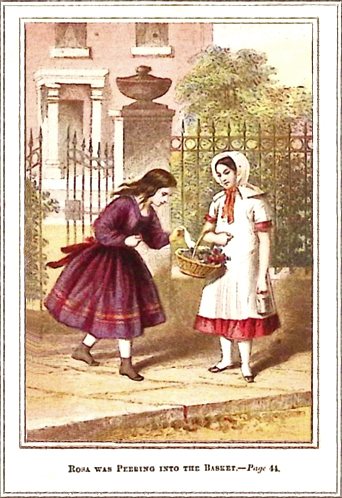
ROSA WAS PEERING INTO THE BASKET.
BY
A. L. O. E.

LONDON:
FREDERICK WARNE AND CO.
BEDFORD STREET, COVENT GARDEN.
1867.
CONTENTS.
——————
CHAP.
THE STRAIGHT ROAD
IS
SHORTEST AND SUREST.
———————————
A MISHAP IN THE WOODS.
IT was a glowing, sultry day in the glorious month of June. In the drawing-room of Cortley Hall every window was thrown wide open to admit the breeze, which scarcely stirred the muslin curtains, or moved one leaf of the delicate maiden-hair fern which drooped from a fancy basket. In the deep recess of one of these windows sat a merry black-eyed girl, with a quantity of white satin ribbon heaped loosely upon her knee, and her workbox placed upon a little table beside her. A graceful young maiden stood near, and pensively and tenderly, as if each blossom were linked in her mind with thoughts of a home she was soon to quit, was arranging a quantity of flowers—roses, fuchsias, and geraniums—to fill a porcelain vase. Mina, was less inclined to laugh and chat than was Rosa, her gay young cousin, whose tongue rattled merrily on, while her nimble fingers transformed the ribbon into piles of rosettes and favours.
In the corner of the room a gentleman, not much beyond middle age, but whose broad bald forehead and "sable-silvered" hair made him seem older than he really was, was seated writing at a desk. This was Mr. Marsden, the master of Cortley Hall, and the father of Mina, the young bride-elect. He was engaged in writing orders on a munificent scale for donations to the sick and poor, on the occasion of the approaching wedding. In every cottage, for miles around, the plentiful feast would be spread; for Mr. Marsden was a benefactor to all who came within reach of his large-hearted charity, and many had had reason to bless the day when he had entered into possession of Cortley Hall.
"What on earth can have become of Wilfred!" exclaimed Rosa May, looking impatiently towards the door. "How am I to finish off these favours, with not a sprig of orange-blossom to put in the middle! He does not usually play the snail, that young brother of yours!"
"Nay, you must remember," said Mina, "that the town is full three miles distant, and the weather exceedingly hot; I was vexed when I heard that you had sent him upon such an errand!"
"Oh! All the servants are busy, you know, in making grand preparations for Thursday; and I thought," added Rosa with a laugh, "that it was an act of public utility to get a boy out of the way for a couple of hours, and tame down his wild spirits a little by teaching him to make himself useful. You have spoilt Wilfred sadly, I fear!"
"How can you say so!" cried the smiling Mina.
"How dare you say so!" exclaimed a merry voice from without, and—not through the door, but the window—in sprang a fine-looking boy of fourteen, with heated face, and moistened hair, and a bright good-humoured smile in his clear blue eyes, from which seemed to look forth a spirit free and open as the day.
"Why, Wilfred, you truant knight; what can have delayed you so long?" exclaimed Rosa May, with her finger raised in an affected attitude of reproof. "We thought that you would have been back an hour ago, laden with orange-blossom from the town, ready to cut, clip, run messages, do the dutiful in every possible way to both bridesmaid and bride! But is anything the matter?" she added. "Your clothes seem torn; your face scratched."
"You have not met with any accident, dear Will?" exclaimed the fair young bride; and at the question, asked in her gentle tone of concern, Mr. Marsden turned round from his desk, and glanced at the handsome lad, who was his only son and heir.
"Oh! I don't care a straw for a few rents in my clothes, or scratches on my face!" exclaimed Wilfred Marsden. "But this is what provokes me: look here, I've crushed your dainty box of orange-blossoms as flat as a pancake!" And with an air of vexation, the boy rather threw down than placed upon the table a light millinery box, which appeared in deplorable plight.
"Oh! dear; how could you manage to do this!" cried his cousin the bridesmaid, opening and surveying with a rueful air the crushed blossoms within.
"Never mind, Wilfred dear," said Mina, approaching with a kindly smile; "it was very good in you to go yourself to Manton for the flowers, buy them, and bring them—"
"And smash them on the way!" added Wilfred.
"Oh! I don't believe that they are spoilt," said the bride, taking up a sprig in her delicate fingers. "A little twist here, a little pulling out there, and see—now is not that perfectly lovely?" And she held up the renovated flower.
"If it is not, I know who is!" cried the boy, looking with fond admiration upon his only sister, and thinking what a happy fellow Edward Lyle was going to be. "I hope that there's not much harm done, after all. I thought that the poor flowers were demolished when my foot came smash on the lid of the box!"
"How did it happen, awkward boy?" asked the bridesmaid.
"The story is soon told," said Wilfred, sitting down, and fanning his heated face with his straw hat. "You know that the day is grilling hot, and I thought that I should be fairly baked if I took the straight path across the fields, where there is not a yard of shade."
"So you went round by the wood?" said Mina.
"A fine roundabout way!" cried her cousin.
"I fancied that I could make a cut through the thicket, so struck out from the path and tried to get across through the bushes. But it seemed as if Puck and all the fairies had conspired to catch me prisoner! Now my jacket was caught in a bramble; then a bough nearly knocked off my hat; when I got free from the thorns on the right hand, I was caught by a long straggling briar on the left! Then suddenly I felt a sharp sting on my neck, just underneath my collar—" Wilfred clapped his hand on the place—"I dropped the box like a hot potato, and what betwixt wasp and briars and brambles, hardly knew what I was about, till I felt my unlucky foot crunching through the pasteboard of the box!"
"Ah! Well, things might have been worse!" said Mina, with smiling philosophy. "Your kind intention was all the same. Your long walk has enabled me—"
"To show that you have the sweetest temper as well as the fairest face in the world!" interrupted Wilfred.
"And it has taught you, I hope," said Rosa, "that the straight road is the shortest and surest."
"Ay, I wished often enough in the wood that I had taken my way through the fields, however hot it might have been," said Wilfred.
"That proverb, my boy," observed Mr. Marsden, who had locked his desk and joined the group, "holds good in more important matters than your adventure of to-day. There's many a sharp, clever fellow, with more wit in his brain than truth in his heart, who has found in the end that through life the straightest road is the shortest and surest."
"You mean the path of honour, papa."
"I mean the path of duty."
"Duty and honour, surely they are the same," cried Wilfred. "They are but two names for one thing."
"Scarcely so," said the father. "I shall call honour a high sense of what we owe to 'ourselves;' duty, a high sense of what we owe to 'our God!'"
"But if they be not the same thing, they lead to the same actions, surely. They both make a man shrink from anything false, dishonest, or mean."
Mr. Marsden looked down with something of paternal pride upon the fine, intelligent countenance of his only son, so expressive of the contempt which the mere thought of dishonourable conduct inspired. He, however, shook his head gravely as he made answer, "Honour, as we usually understand the word, is but man's standard of what is becoming in a man, and must be fallible like its author. Honour has fired the ambitious leader, who sacrifices thousands of his fellow-creatures to win for himself the name of a hero; honour has loaded the duellist's pistol, and made brave men slaves to the dread of reproach. We could as safely direct our steps by the fitful blaze of a meteor, as take earthly honour alone for the guide of our words and actions."
"Was it not honour that made Edward Lyle give up that good living which he could have had by merely letting it be thought that he was a few weeks older than he was?"
At the mention of the name of her betrothed, Mina timidly raised her blue eyes and fixed them on her father, and the tint on her soft cheek deepened as she listened for his reply.
"I think," said Mr. Marsden, "that in that occurrence Edward was guided by that which is always his pole-star—the fear and love of his God."
Wilfred glanced at his sister, and caught her look of intense pleasure at the praise of her betrothed from the lips of her father.
"Well, Edward was soon rewarded," said the boy. "It was a lucky thing that the living here fell vacant—so unexpectedly, too—not a twelvemonth after, and that it should be in your gift! A snug little nest for our ladye-bird, and just within reach of us all. What a different affair it would have been," continued the boy, "if Cortley Hall had been left to cousin Benson instead of to you!"
"I should have been working on still at my desk in Barnes' Court," observed Mr. Marsden, with his quiet smile.
"And I'd have been brought up as a clerk; and Mimi, poor darling Mina! She'd have looked like some pale withered flower, one of those crushed orange-blossoms in the smoky air of the city. Ugh! Our old great-uncle did one good thing in his life, if he never did another, when he left the Hall, and estate, and the gift of the living to such a man as my father."
"Cousin Benson does not think so, I guess," laughed Rosa, who had just finished her pile of white satin cockades.
"Cousin Benson is no more fit to be a lauded proprietor than I am to be king of the Cannibal Islands!" exclaimed Wilfred. "A mean, sneaking, stingy fellow; one who would skin a flint; one—"
"Oh! Wilfred!" expostulated Mina.
"No ill words of the absent, my boy," said Mr. Marsden.
"We'd better talk of some one else, then," cried Wilfred, "for I can never think of Tom Benson with patience."
"I had a note from Sophia to-day," said Mina.
"Sophia! Oh, how is it she is not here? I thought that she was to arrive to-day. I know that you ordered the Oak room to be made ready."
"She comes this morning," replied his sister, "but she does not wish the Oak room."
"How do you know that?" asked Wilfred.
"She writes so in her note. Here it is."
"You don't mean to say," cried Wilfred, with a look of amused curiosity, "that Sophia is afraid to sleep in that room, because she fancies that it is haunted?"
"Not exactly 'haunted,'" began Mina Marsden, as she handed the letter to her brother; "but she writes about disagreeable associations."
"Oh! I see; here it is." And Wilfred read aloud snatches from the letter of one of his sister's expected bridesmaids: "'Don't laugh at me as absurd—' That's more than I can promise, fair lady!—'but the idea of occupying a room in which your poor old great-uncle was actually burnt to death would so affect my nerves.'—Oh! Hang nerves!" exclaimed Wilfred, tossing back the note to his sister. "That was a wise old dame who was glad that she was born before nerves were invented."
"But you wont mind exchanging rooms, dear Wilfred?"
"Mind! I should think not!" cried the boy. "I shall have much the best of the exchange. Oak panels instead of twopenny paper, carved ceiling instead of white plaster, stained glass instead of square panes, one of which, by-the-bye, I cracked right across yesterday with my elbow! I wish that everybody would fancy that grand, gloomy room to be haunted, that I might keep it, ghost and all, to myself! But what a joke I'll have against Sophia! I think I'll bring in something about it when I propose the health of the four lovely bridesmaids on Thursday."
"Nay," cried Rosa, "if you take to quizzing any of the bridesmaids, I think that, after to-day's exploit in the woods, they may fairly turn the tables upon you, and let the bridesman come in for his share of the banter. You have proved yourself not a much better messenger than the valiant squire in the song." And in a high, clear voice Rosa trilled forth a merry lay.
THE SQUIRE.
A squire set out one moonlit night,
And prayed to the moon to give good light,
For he had many miles to travel that night,
All through the forest glen, O!
He bore a lock of his master's hair,
A tender gift to his ladye fair;
At peril of his life he the pledge must bear,
All through the forest glen, O!
Quoth he, "I fear there are robbers near,
Or goblins stalk the thicket drear,
Or merry witches hold their revels here,
All in the forest glen, O!"
An oak o'er the path its long arms spread—
Sudden it strikes him—he starts with dread:
Terrified and wild, at speed he sped
All through the forest glen, O!
He never looked behind him, or turned his head
All through the forest glen, O!
Panting and pale, at length he came
To the sheltered hall of the noble dame;
"I've brought a pledge from a knight of fame,
All through the forest glen, O!"
And he hunted—he searched—he sought for the same,
Lost in the forest glen, O!
Where was the pledge of the lover's vow?
Waving in the breeze on the oak's long bough;
And for aught that I know, it may wave there now,
All in the forest glen, O!
THE OAK ROOM.
VERY merrily passed that Tuesday evening at Cortley Hall. Neighbours "dropped in" to tea, Sophia arrived from London, her luggage swelled to an unreasonable size by divers boxes and parcels labelled "glass," and "with care," with which she had been entrusted for the bride. There were so many presents, of which the unpacking gave no small amusement to Wilfred, that he declared that his wedding-gift to Mina ought to have been a manifold writer instead of a "lady's companion," that she might not have had half her time taken up in penning letters of thanks. Tom Benson, the churl, was the only one, as Wilfred affirmed, who had not done his duty, nor given so much as a flower to the bride.
There were songs and mirth, laughing and banter, interspersed with the pleasant preparations for a village wedding, in the feasting and gladness of which all the poor around were to share. The young clergyman and his betrothed were deeply, tranquilly happy, the bridesmaids full of frolic and fun, and Wilfred, the merriest, noisiest "best man" that ever wore a white favour. There was to him nothing but pleasure in the prospect of the marriage. There would be no separation from the sister whom he fondly loved, for the Vicarage was so near to the Hall that Wilfred considered that he should only possess two happy homes instead of one.
It was late before the cheerful circle dispersed, for time seemed too rich in enjoyment for much to be wasted in sleep. With a light step and lighter heart, whistling the merry song of "The Squire," Wilfred retired to the old Oak chamber; but there was something in the solemn aspect of the room which, as soon as he entered, stopped his music if it did not damp his spirits. The gleam of his solitary candle so dimly lighted the dark carved panels, the massive furniture, the heavily-draperied bed, that it seemed but to make darkness visible. One of the pillars of that bed, blackened and charred, bore token yet of the awful fate which had befallen the last owner of Cortley Hall.
Wilfred examined it with thrilling interest, and felt less disposed than he had done by day to laugh at the feelings of Sophia. His mind would perpetually recur to the miserable old man who had retired to rest in that very room, as little expecting to rise no more as the boy who now occupied his place. There had he lain, just there, the candle by the bedside, the bottle on the table, the novel in his hand. There had he fallen asleep—and oh! What an awful waking!
Wilfred found such thoughts depressing after the gay excitement of the evening. He hurried over his toilet, extinguished his candle, and stretched himself on the bed; he wished to sleep, but sleep would not come at his bidding. He tried to turn his mind to Mina and her fair prospects, but his thoughts again and again returned to the poor old man who had perished by fire in that place, unwarned and unprepared!
"I think that this room has never lost the suffocating heat of that fire!" exclaimed Wilfred at last, with feverish restlessness. "I feel hardly able to breathe! How stupid I was not to throw the window wide open, to let in a little fresh air!"
The boy pulled back his curtain, and rose, feeling his way towards the window by the wall. As he groped thus along, passing his hand over each panel, to his surprise Wilfred felt one of them slightly move under his pressure. He felt angry with himself for the little start which he gave; and his curiosity being aroused, the boy drew the panel backwards with stronger force, and thus assured himself that he had made no mistake in imagining that he was able to move it.
"I may have made some grand discovery," said Wilfred, half aloud. "I may have found some secret hiding-place for treasure! There's no saying what a store of old family plate or family jewels may lie behind that sliding panel. If only the room were not so dark. The moon is up, I fancy, and the window looks to the east; but there's as much stone as glass in it, and the glass itself is stained, so that the casement seems expressly contrived to let in as little light as may be. I must light my candle again, if only I knew where to find the matchbox."
Wilfred groped, and felt, and fumbled, knocked over the candlestick in his search for the box, and started at the sudden noise in the stillness of that dark apartment. It was several minutes before he was able to get a light, which seemed to burn dimly and heavily in the hot, close air of the room. Wilfred instantly returned with the candle to the spot where he had moved back the panel. The place was marked by what looked like a broad black line on the wall; the boy soon widened the opening, and put his hand into the recess. Wilfred could feel but one thing within it, and that was a long parchment roll. Burning with intense curiosity to know its contents, he drew out the roll, and, after placing his candle upon a table, seated himself on a heavy carved armchair beside it, to examine his prize at his leisure.
"Some great document, awfully long, and all written in black letter, with a big red seal at the bottom! I dare say that I shall understand as little of it as if it were all in Hebrew. Oh! Here's a date. I guess that it will show the deed to be centuries old. No, 'eighteen hundred and thirty-eight,' that's only ten years before I was born. Here are signatures at the bottom. What a frightfully crabbed hand! 'Josiah Marsden,' that's the name of my great-uncle, who was burned to death in this room. I dare say that this is only some document relating to the Cortley estate."
Wilfred rolling up the parchment from the bottom, so as to examine with greater ease what was written at the top. "Last will and testament of Josiah Marsden." Wilfred felt a little nervousness, for which he could hardly have accounted, as he slowly made out the first line. With a little difficulty, as he was unaccustomed to read black letter, and the tedious forms and repetitions of a law-deed made it difficult to be understood, Wilfred went on with his perusal.
A description of all the demesnes of the Cortley estate, which, comprising the minutest particulars, stretched through some hundred most tedious lines, closed with one which, like a sudden apparition, blanched the cheek of the boy, made his hand tremble, and his heart beat fast. "To my nephew Thomas Benson and his heirs."
Wilfred could not, would not at first believe the evidence of his senses. He rubbed his eyes as if they must be in fault, shook himself with the idea of awaking from what he almost hoped might be but a dream, looked again at the yellow parchment with its thick black letters, in which the hated name appeared so painfully distinct. Wilfred read and re-read the will, with a desperate hope of finding out that he had mistaken its meaning. Each perusal made the fact but more clear that his father was not mentioned in the will, though by birth next of kin; that the old man had bequeathed Cortley Hall, with all the surrounding estate, fields, cottages, and timber, and the gift of presentation to the adjoining living, to his nephew, Thomas Benson, and his heirs!
In a paroxysm of passionate rage, Wilfred dashed the parchment on the floor, and throwing himself back in his chair, groaned aloud in his anguish of soul.
FIRE.
"WHAT am I to do—what on earth am I to do!" exclaimed Wilfred. "Oh! That I had never seen this detestable deed!" And he spurned the parchment with his foot. "What ought I to do? Carry that will to my father in the morning? That would certainly be the course of duty, the course of honour; and he—my noble, upright parent—he would at once make known to the world the existence of a will which robs him of all, which reduces him almost to beggary, which compels him to begin the world again, and toil for his daily bread. I can't do it—I wont do it!" cried Wilfred, springing from his chair, and beginning to pace up and down the gloomy apartment.
"The living, too, would be lost; all the happiness of my darling Mina would be crushed at a blow. I never could deal that blow. It is not," said Wilfred, pausing in his rapid walk, and trying to bring argument after argument to drown the voice of his conscience; "it is not as if this Benson deserved anything at our hands; it is not as if he were one to make a good use of fortune. The building of the school would be stopped at once; the poor widows, whom my noble father supports, would have no refuge but the workhouse. It would be cruel, wicked, to sacrifice at once so many interests for the sake of one mean wretch who cares for no one on earth but himself."
Ah, Wilfred, self-deceiver! It is not for him, not for any mortal, that the sacrifice is required; it is sacrifice to duty, simple obedience to the command of God, "provide things honest in the sight of all men!" Our enemy is ever ready to persuade us that what is expedient must be right; that we may turn a little—but a little—from the straight, narrow path, and yet walk on with our faces towards heaven. Again and again the voice sounds in our hearts,—
"To do a great right, do a little wrong;"
but it is the voice of the tempter.
Wilfred Marsden in his happy, peaceful home, had been guarded from many evils, and was growing up, as he believed, in the practice of many virtues. Generous, affectionate, truthful, kind, in reference to outward obedience to the commandments, Wilfred might almost have said like the ruler, "All these things have I kept from my youth up." From conscious purity of conduct, and rectitude of purpose, had sprung a reliance upon his own strength, his own honour, his power of resisting temptation, which had its secret root in pride. And now, like that of the ruler, Wilfred Marsden's obedience was brought to the test. He was called upon to resign all that he possessed, to take up his cross and follow his Lord! Resolution snapped, pride gave way, honour could not stand in the trial! Like the young ruler, with a sad heart and bleeding conscience, Wilfred was turning away from the duty which seemed too hard to be performed. He reasoned and argued with himself, until he became half persuaded that to ruin his family, and stop works of charity, could not be required of him by God.
"I'll burn this parchment, I'll forget that it ever existed!" cried Wilfred, with hasty resolution, snatching the will from the floor. He held it to the flame of the candle, and a dark smoke-mark, like a stain, showed the action of fire upon the roll. But Wilfred soon perceived that it would take a considerable time to burn a large parchment thus; and his impatient spirit could not endure the protracted torture of thus slowly and deliberately committing a crime.
"I will burn it in the grate," muttered Wilfred. But it was summer-time, the grate was empty, and he hastily looked around for something that might serve as fuel. Wilfred's desk had been left downstairs—in vain, he searched his pockets for letters—the only book that was to be seen in the Oak room was his own Bible! Wilfred put his handkerchief into the grate, with a few scraps of paper which, with difficulty, he collected, laid the parchment on the little heap, and lighted it by the candle. He then stood with his back to the fire, for he could not bear to watch it while it was doing its unholy work of destruction. The grate had for months been unused; the wind blew down the chimney, a volume of smoke came curling and spreading into the room, making the dimness yet deeper, and the heat of the place more oppressive. With a sense of suffocation Wilfred turned round to see the flames—quickly kindled, and quickly spent—expiring round the great roll, which lay, blackened indeed, but unconsumed! The smell of burning gave to the miserable Wilfred a feeling of sudden horror!
"Here, in this very room, where 'he' perished by fire, do I attempt to burn his last will and testament! Can I find no other place, no other way, when I wrong both the living and the dead?" Wilfred caught up the roll from the grate. "O God, have mercy upon me!" he faltered. "Who could have believed that I would ever have been guilty of wickedness like this! These blackened smoke-marks are as witnesses against me. If fire itself loses its power to destroy, I will take this as a token that to conceal the truth is a crime against Heaven. I will not delay; I will at once carry the will to my father. Better suffer anything than this terrible feeling of remorse."
Wilfred moved some steps towards the door, and paused. "What am I about to do? Am I not putting a match to a train that, in exploding, will shatter everything that I hold dear? Mina, my own precious sister, how shall I bear to look on her grief, to hear—no, I shall never 'hear' reproaches; but in her heart may she not say, 'Wilfred might have spared me this misery! It was hard that such a trial should come to me through my only brother!' Mina shall never say, never think this!" Wilfred turned away from the door: "I dare not burn, but I will bury this scroll. Shall I replace it in that recess from which would—would that I had never moved it? No, some one else would be certain to discover it, as I have done to-night. I will bury it deep, deep in the earth, where no one can find it!"
Again Wilfred turned towards the door. "All the house is shut up; my step would be heard on the echoing stair; the bolts and chains could not be withdrawn without noise; the household would be roused; I should be questioned, and that would drive me distracted! I must at least wait till the morning. What! Wait with that horrible blackened parchment like a death-warrant before my eyes! I cannot endure to wait; I cannot support through a long dreary night this terrible indecision. I can open the window, drop down on the sod, and then bury the will in the garden."
Wilfred hastened to the casement, and, with fingers which trembled with nervous excitement, drew back the bolt and threw open the window. How refreshing was the breath of the soft night air upon his fevered brow! Wilfred hastily dressed himself, thrust the roll into his bosom, clambered out on the sill, and then, regardless of personal danger, first hung for a moment by his hands, and then half dropped, half clambered down, assisting his descent by a trained rose-tree, with whose broken twigs and crushed petals he strewed the sod beneath.
EARTH.
CALM and beautiful was the aspect of nature in the stillness of that summer night. The silence was scarcely broken by the softly-warbled song of the nightingale, which poured its lay from neighbouring grove. The rising moon shone in the deep blue sky, tinging with silvery brilliance the fleecy clouds amidst which she moved, and throwing a whiteness over the dewy sward, which had almost the effect of frost, save where the dark shadows of the trees lay sleeping upon the grass. The breeze ever and anon lightly stirred the branches, sounding like a low, soft sigh.
Wilfred gazed up at the Hall, with its numerous mullioned windows gleaming in the silver moonlight, and its gable ends, with their orb-crowned pinnacles, cutting the clear deep blue. All was so serene, so calm, that a softening influence fell on the soul of Wilfred. Nature seemed to lie in such holy beauty under the eye of God, that the unhappy boy felt as if his presence were the only thing to mar the peaceful repose of the scene. On what errand was he abroad, when every inmate of the Hall, save himself, was buried in quiet slumber? Was it not on an errand of evil as that which draws the robber forth under the cover of darkness? Was it not to defraud a cousin of his right, to defeat the ends of justice, to silence the voice of truth? Was it not to commit an act which he dared not confess even to his nearest and dearest friend?
Again the resolution of Wilfred wavered: better to return and dare the worst. Did not every tremulous orb in that sky tell, as with an angel's voice, how fleeting and insignificant are all the concerns of this brief life compared with those eternal interests which shall survive the stars! But Wilfred caught sight, between the trees, of the tower of the ancient church. It was there where Mina would so soon be united to the husband of her choice; it was there where Edward would faithfully preach the gospel to the poor. The guilt of concealment would not be theirs. Wilfred might load his own conscience with a weight of sin, but theirs would be clear from reproach. Well knows the tempter how to use the ties of earthly affection as well as the links of pride, when he would draw a soul to evil. Wilfred tried to stifle, and almost succeeded in stifling conviction, by keeping the thought before his mind that he was acting no selfish part—that he was sacrificing his peace for the sake of others. He turned from the simple view of the question—that he had a plain duty to perform, and must ask for strength to perform it. He did not dare to pray; he feared to think upon God; he would fain, like the first sinners, have hidden himself from that Presence which rebukes the bare deformity of guilt.
Wilfred, even at the midnight hour, was afraid of being watched from the Hall. Those glimmering windows were so many eyes, and he must avoid their ken. Wilfred turned to the left; his footsteps sounded too loud on the gravel path; he trod noiselessly on the green verge. Scarcely noticing the emerald spark, where the glow-worm, on his mossy bed, had kindled his fairy lamp, Wilfred made his way to a secluded part of the garden. The gloomy foliage of a cypress there completely screened him from view, even if some watcher in the Hall should be gazing forth on the stars. Wilfred took the roll from his breast, and was about to commence his work of burying, when a sudden sound made him start. It was but the rustle caused by a frightened bird that flew forth from the tree at his unexpected approach; but it made his pulse throb fast with terror.
Wilfred looked around and upwards ere he began to dig: he saw nothing but the wheeling bat, darting between him and the moon, in search of her nightly prey. No human being was near; no sound of human voice was borne on the whispering breeze. Wilfred knelt down and began to displace the sod. Unfurnished as he was with any kind of appropriate tool, he found the unaccustomed labour far harder than he had expected. The season was hot, the ground was dry; the boy proceeded but slowly with the work of scooping out the earth. Anxious and impatient as he felt to complete his painful task, and bury the parchment in the sod so deeply that none should find it, the minutes seemed lengthened to hours. With hands torn, bruised, and blistered, Wilfred at last finished digging a narrow trench, just long enough and wide enough to hold the hated roll. He pressed it in, hastily covered it over with mould, then rose and stamped it down, sprinkling the surface with light earth to hide the marks of his feet.
It was done—the deed was done, and Wilfred's first sensation was that of relief. He had now leisure to remember that he was weary and needed rest, as from the church tower solemnly pealed forth the stroke of one. Should he return to the house? Wilfred was about to do so, when he recollected the impossibility of getting in without rousing the inmates by ringing the great door-bell. The house had long since been carefully shut up, bolted and barred for the night. Wilfred could not climb up to the casement from which he had so lately descended at no small personal risk.
"I must wait till the servants open the doors in the morning," was Wilfred's reflection, "and creep up unnoticed to my room. Where in the meantime shall I spend the rest of this miserable night? In the arbour at the end of the shrubbery: there at least I shall find a bench on which to stretch my weary limbs."
To the arbour Wilfred proceeded; the air was beginning to feel chilly, and he was glad of the slight protection which the place afforded. Lying down on the wooden bench, it was not long before the exhausted boy fell into a feverish sleep—a sleep haunted by terrible dreams. Whatever form his slumbering fancies might take, they had ever some reference to the parchment: now it was torn into a thousand fragments, and reunited as if by magic; then in the vestry-room of the church, Mina, a smiling bride, came to sign, according to custom, her maiden name for the last time. With horror Wilfred beheld in his dream that, instead of the page of the parish register, her hand rested upon the deed; it was not her signature that met his gaze, but the crabbed "Josiah Marsden."
Then the scene changed to the forest. Wilfred seemed again, amidst briars and thorns, with stinging hosts of hornets around him, struggling in vain to make his way through with the fatal roll in his hand! His feet were-entangled, he could not press on, though sounds of pursuit were behind him. In the agonized struggle to break from his bonds, the unhappy dreamer awoke.
PUT TO THE QUESTION.
WILFRED MARSDEN awoke with his frame chilled and stiffened, and a weight like lead at his heart. Before full consciousness returned, he had a sense that something dreadful had happened, or was going to happen. It was no longer night. The bright summer morning had dawned; the air was full of the music of birds and the perfume of flowers; already the bee was abroad, humming merrily on the wing. The sky was gorgeous with crimson clouds, and the dew sparkled in the level rays of the rising sun, as if the sward had been spangled with diamonds!
But the beauty of Nature, its fair sights and sweet sounds, had now no charm for Wilfred. He rose, stretched himself, heaved a deep-drawn sigh, and then slowly sauntered towards the Hall. Still every blind was drawn down, and all was silence within. Wilfred knew that the house would not be opened for two or three hours, and there was something intolerably irksome to the boy in having to wait so long, with no company but that of his own remorseful thoughts. He stood for some minutes gazing at the closed door, with its knocker which he dared not raise, its bell which he dared not ring; and a fearful idea crossed Wilfred's mind, that as he was shut out from his father's home, so might he be one day shut out from heaven! Would not a single unforsaken, unforgiven sin bar the door of mercy for ever? Wilfred could hardly endure his own reflections: he paced up and down, up and down, restless as a caged wild beast, during the weary interval that elapsed before the church clock struck seven. Then, indeed, there were sounds of movement in the house.
Young Marsden, with a feeling of relief, heard the rattle of the chain, and the grating of the bolt of the large outer door. He resolved to wait for a few minutes outside until Martha the servant, as was her wont, should have passed on to open the dining-room shutters, as he did not wish to be seen as he entered the Hall. Meantime, Rosa May, who had risen very early, had been attracted to the gate by the appearance at it of a little girl carrying a basket full of lovely field flowers. It was the young daughter of the farm-bailiff, who, having been sent by her mother with cream and fresh butter to the Hall from the home farm, had added to her charge a bouquet of fragrant blossoms as her own offering to the bride.
Rosa was peering into the basket when Wilfred (who was concealed behind the laurels) perceived her and again hesitated. He thought she would never leave off talking to the village child, but at length she turned to enter the house, and was going up the steps when she caught sight of him.
"Why, I thought that I was first in the field!" cried the lively girl. "How did you manage to get out before me? Did you pass like a fairy through the key-hole?"
Wilfred could stand no questioning then; brushing past the young lady with uncourteous haste, he hurried into the house, then up the broad staircase three steps at a time, and buried himself in his room.
But change of place brought no relief to the unhappy Wilfred; wherever he went, he bore with him the burden of his terrible secret.
Time passed; Wilfred heard at last the familiar sound of the bell for prayers. Almost for the first time in his life he did not obey the summons. How could he kneel down and pray for forgiveness of sin, when resolved to go on in his sinning? How venture to ask for grace, when he did not wish to obtain it? Wilfred knew that such prayers would be but a mockery; and yet how could one brought up in the fear of God endure to live without prayer?
After awhile, another bell sounded; guests had come to breakfast, and Wilfred knew that the family were assembling at the social meal. Wilfred was aware that his absence would be noticed, and yet could hardly summon up courage sufficient to face the circle below. Would not everyone read in his face the secret which burdened his soul?
While yet undecided, Wilfred heard a soft tap, then a gentle voice at his door.
"Dear Willy," said Mina Marsden, "are you not coming to breakfast? Mr. Allfrey and sisters have dropped in early to settle arrangements for to-morrow. I miss you so much at the table. Will you not come down soon, and help me to entertain all our guests?"
"I am coming," said Wilfred, laconically; and, as soon as he had heard Mina's light step tripping downstairs, he followed her to the breakfast-room, which she had quitted in order to call him.
A burst of merry laughter was the first sound which fell on Wilfred's ear as he entered, and the words uttered in Rosa's liveliest tone, "I'm certain that he had seen a ghost!"
"Here he is himself!" cried Mr. Allfrey, jovial young squire, whose sisters were to act as bridesmaids.
"Why, we thought that you were never going to make your appearance, Master Wilfred, and I can certify that you were up early enough!" exclaimed Rosa, as the boy exchanged morning greetings with his father and his guests.
Wilfred would fain have taken his place by Mr. Marsden or Mina, but Rosa had reserved a seat for him by herself, and he could not avoid taking possession of it, as no other chair was vacant.
"Now, we're all dying of curiosity, Sophia especially, to know what you saw in the old oak room!" continued the lively young lady, fixing her keen black eyes upon Wilfred.
Mina saw uneasiness in the countenance of her brother, and proposed deferring questioning until he should have taken his breakfast.
"Breakfast! Who could talk or think of such a common every-day thing when a real ghost is on the 'tapis?' Wilfred has seen something—I'm certain that he has! Nothing but an apparition of the most strange and striking description could account for his singular conduct this morning."
"What do you mean?" asked Wilfred, with a stern resolution to face out the difficulty as best he might.
"Don't you call it very singular conduct in a young gentleman to make his exit from the house by an upper window instead of a door?" cried Rosa, with the keen enjoyment which a sharp lawyer might feel in bringing forward incontrovertible evidence.
"Who said that I did?" asked Wilfred.
"It was a riddle to me," cried Rosa, "how you had managed to leave the house without unfastening the bolts, until I looked at the trained rose-trees which had the ill-luck to be planted under your window—which window was, by the way, wide open! It was clear enough that that rose-tree, ill-fitted as it might be for the purpose, had been used last night as a ladder. Some of the branches were torn from their fastenings, several twigs were snapped, and the poor roses looked as if some great bear had chosen the plant as a pole for climbing."
There was profound silence round the table as Rosa paused, and every eye was turned upon Wilfred in curiosity and interest. The boy stared sternly at his plate, but could not utter a word.
"Besides," added Rosa, triumphantly, "there was a good deep print of a pair of slippers impressed on the sod just beneath the window. I've a notion that Master Wilfred Marsden knows who wore those slippers."
Wilfred longed to rush out of the room, but struggled hard to hide all outward sign of emotion.
"Now we may imagine," continued the young lady, "that the occupant of the oak room had merely taken a harmless fancy for a ramble by moonlight, a hunt after bats and owls, or a quiet study of the stars. But if so, why, when he met a fair lady in the morning, did he start as if he took her for a goblin—which she certainly by no means resembles? Why was his face, as white as a sheet, his eyes hollow and wild in expression, and his hands all covered with earth? Why did he not answer a civil question, but rush madly into the house?"
"Really, Wilfred," said Sophia, a young lady with languid eyelids, long light hair, and a manner rather affected, "we shall expect from you a thrilling account of your adventures in a haunted chamber."
"What did you see?" asked John Allfrey.
"Or hear?" added his sister Amelia.
"Was there not a ghost, just say—was there not a ghost?" cried Rosa, leaning eagerly forward, and laying her hand upon Wilfred's arm.
The boy's patience was utterly exhausted. Shaking off his cousin's hand with a rudeness which he had never before shown to a lady, he rose from table with the muttered remark, "None but idiots talk about ghosts."
Mr. Marsden looked grave, Mina distressed, an angry flush came to the cheek of Rosa; in a moment the merriment of the party was changed to painful restraint. No one knew what to say next, till Edward Lyle mentioned archery, in order to effect a diversion, and the guests rose at once, and broke up the circle round the table.
All soon quitted the room, except the Marsdens, who lingered behind. Mina perceived that her father was displeased with her brother, and, dreading a painful scene, she entreated her parent with her pleading eyes to spare the wounded spirit of his son. Wilfred was evidently then in no state to bear a rebuke.
"I leave him to you," said Mr. Marsden, in answer to her silent appeal, and he also quitted the apartment. He was surprised as well as annoyed at the temper shown by his boy.
Mina noiselessly performed the little duties which belong to the lady of a house; replaced the sugar-basin, locked the tea-caddy, and set aside the broken loaf for the poor. She was giving time to Wilfred, who stood at the window, to recover his temper and self-command. Then she softly addressed her young brother—
"You have taken no breakfast, dear Wilfred?"
"I want none," was the sullen reply.
"I think—I fear that you cannot be well."
"Why should you think so?" asked her brother.
"Because—you were not like yourself just now." Mina laid her soft hand on the arm of the boy. "Perhaps you did not mean it, dear Wilfred, but your words gave pain to poor Rosa."
"She brought it on herself," muttered Wilfred. "I never knew so provoking a tongue."
"She has high spirits and a playful manner, but she never means to give serious offence," said Mina; "and at a time like this," added the young bride, "I should wish her—you—all to be so happy."
Wilfred glanced hastily at his sister, and saw moisture gleaming on her soft lashes.
"Are you not happy?" he exclaimed.
"How can I be so," answered Mina, "when I see that my darling brother has some trouble which he has not confided to me?"
The heart of Wilfred was softened. "You must not care about me, nor think about me," he said; "I am not to be always crushing your blossoms. I have a headache." He pressed his hot brow—the plea was not altogether a false one, though the pain in the poor boy's heart was much worse than that to his head.
"Would the air do you good?" suggested Mina, looking anxiously into his face.
"I can't join that noisy party at the shooting."
"But a quiet walk in the garden with me?"
"If you wish it—anything," answered Wilfred; and he added, with a little sigh, "I shall not have you with me to-morrow!"
And so forth into the garden sauntered the brother and sister; Mina indulging a hope that in their quiet converse together Wilfred might unburden his heart of the mysterious weight which she felt assured was pressing upon it.
FACING IT OUT.
MINA and Wilfred Marsden walked for some minutes together in silence; she hoping that her brother would commence conversation, he not knowing what to say. Wilfred had always been accustomed to show perfect candour towards his sister. Though a few years younger than herself, he had been her constant playmate and companion, sharing with her his hopes and fears, and making her in all things his confidante and adviser. This was the first time that the boy had possessed a secret which he withheld from Mina, and if his silence was painful to her, it was yet more burdensome to himself.
The maiden made one or two unsuccessful attempts to commence conversation. Her observations called forth no reply from her brother, and she was beginning to feel the restraint of his manner almost intolerable, when, on turning a corner of the shrubbery, Wilfred gave a start so sudden and violent that it was sympathetically communicated to the sister whose arm was linked in his own.
"What is it?" exclaimed Mina, in alarm.
"He's digging near the cypress!" cried Wilfred.
The tone, not the sense of the exclamation, made the wondering girl look in the same direction as did her brother, and she saw certainly no cause either for surprise or apprehension in the familiar figure of Joe, the gardener, bending over his spade. Wilfred, however, could not conceal his nervous excitement, as he hastened up to the man.
"Why are you digging to-day," cried he, "when you ought to be stripping the beds of flowers to deck the church and the Hall?"
"Miss Rosa said as how the ladies would gather the flowers themselves," replied Joe, passing his brown hand across his rough chin.
"You should make a triumphal arch, then," said Wilfred.
"Well, Master Wilfred, ye see, that's what all the school-children—"
"Who cares for the school-children?" exclaimed young Marsden, almost stamping with irritation. "Such things are not to be left to them! This is no time to be turning up the earth, like a mole! Leave your spade, and go help in the preparations—no common work shall be done to-day."
Joe set his spade against the tree and slowly went away, wondering—if his unimpressionable nature was capable of wonder—at the strangely changed manner of the boy, who had usually a merry word and a kind smile for the faithful old servant.
On turning round, Wilfred met his sister's distressed and anxious gaze; a terrible idea had just flashed across her mind, that her brother's brain might be affected.
"Why do you look at me so?" he said, sharply.
"I cannot help feeling uneasy, dear Wilfred; I cannot—"
"Oh, here's Edward Lyle coming to see what has become of his bride; I leave you to his care," cried Wilfred, "he's a better companion than I." And turning abruptly towards the Hall, the boy left his sister in tears.
"I can't leave it there—no, no!" muttered Wilfred to himself as he strode along. "I can't have a thrill of terror through my soul whenever I see a man digging in the garden. What shall I do with that fatal parchment? If fire can't burn it, if earth will not hide it, how shall I cover my secret so closely as to lose this intolerable dread of its being discovered at last? I will dig up the will as soon as darkness sets in; I will carry it to the swift, deep stream which flows at the bottom of the field, tie a heavy stone to it, and let the waters bury it for ever. Yes, yes, I was insane not to think of this before. Would that the night were come! I shall have no rest until I have drowned the roll! I will not wait till the house is shut up; I will make my escape after dinner; for twenty minutes I shall not be missed, and twenty minutes will suffice for the deed. In the meantime, I must lull suspicion by putting on my old cheerful manner. I must let no one consider me strange; I must reassure the mind of sweet Mina; I must act a lie!" Wilfred ground his teeth at the thought. "I must lay aside my natural frankness and candour to wear the mask of deceit! And this is the life-long task which I have imposed on myself. Oh, what a miserable thing it is to wander from the straight path of duty!"
As Wilfred entered the Hall, he met his father accompanied by the very last man whom young Marsden would have wished at that moment to see—his injured cousin, Tom Benson!
Mr. Benson was a thin, sickly-looking man, with a stoop. A long struggle with difficulties and cares, which weak health and feeble spirits had rendered more hard, had left the stamp on his features of almost peevish melancholy. There were lines on his face and furrows on his brow which, however, on the present auspicious occasion, were rather less marked than usual; and though his smile was of a sickly character, there was still an attempt to smile. Mr. Benson bore a reputation for narrowness of mind and penuriousness of nature, which had rendered him an object of contempt to Wilfred, who had prided himself on generosity and delicate sense of honour.
But what a change the last twelve hours had wrought in the feelings of the youth! But the day before, it would have been impossible to have persuaded Wilfred Marsden that he could ever be abashed and humbled by the presence of his cousin, that he could ever be ashamed to look that man in the face, or feel a pang of remorse at shaking him by the hand!
"Our cousin has walked over all the way from Thornley to see our dear bride," said Mr. Marsden, "and has kindly brought her strawberries which have been gathered from his own garden."
"Poor things, poor things!" said Mr. Benson apologetically. "I am my own gardener, as you know. And how have you been?" he continued, addressing himself to Wilfred. "It does not seem to me that you are looking as well as usual."
"I do not think that Wilfred is very well," said Mr. Marsden, struck, as the visitor had been, by the haggard looks of his boy.
"Too much bustle for him, too much excitement; he feels parting with his sister," observed Benson. "You must let him, when all is over, come to me for a change. I've not much to offer, to be sure, but the air is counted fine at Thornley."
"Your cousin is very kind," said Mr. Marsden to Wilfred, whose silence he mistook for rudeness.
"Too kind," faltered the boy; and his words had a depth of meaning which his hearers little understood.
"Shall we join the party on the lawn?" said Mr. Marsden. "I heard something said about archery."
The three proceeded to the place where the guests were assembled in front of the target, amusing themselves by shooting.
Wilfred at once commenced following out his resolution of lulling any suspicions which his strange demeanour might have excited, by assuming gaiety of manner. He almost over-acted his part. Amidst his cheerful companions, none was so uproariously merry as he. He jested with the bridesmaids, whistled, sang, readily joined in amusements, and though he did not shoot with a steady hand, when his arrows went wide of the mark, none laughed so loudly as Wilfred. He was making a desperate effort not only to deceive those around him, but to drown in wild excitement the misery which he felt. He would give himself no time for thought; he would intoxicate himself with amusement! Wretched resource of the worldly, who seek to fly from themselves, and gild the fetters which they cannot throw off, in hopes of forgetting their weight.
There were but two of those around him whose society Wilfred instinctively shunned.
He could not bear to be near the relative whom he was defrauding of his rights, and he avoided all converse with Rosa with a kind of intuitive dread. Wilfred knew that he had offended the young lady; he believed that he had drawn upon himself both her suspicion and dislike; he felt that she was watching him, and, though at present forbearing to question, was intent upon discovering his secret.
With these two exceptions, Wilfred chatted freely with all the guests of his father. He even, in conversation with Sophia, purposely entered on the subject of the oak room, and forced himself to assure her, with a smiling face, that he had not seen the shadow of a ghost. He had, however, he said, found the chamber oppressively hot, and had taken the simplest means of getting fresh air without disturbing the house.
So passed the day before the wedding until the dinner-hour arrived. The afternoon had been rainy, and archery had been exchanged for in-door amusements. Wilfred had been the life and soul of the party at the bagatelle-table and the round game, and had shown indefatigable energy in decorating the Hall. Yet Mina's heart was not at rest; she suspected that her brother's mirth was assumed, and that his jests and laughter were no true tokens of a light and buoyant heart. Even with her betrothed at her side, the young maiden's spirit was troubled on account of her brother. It pained Mina to notice at dinner that, though Wilfred's usual beverage was water, he filled and refilled his glass of wine, and pledged the bride and bridesmaids with loud and boisterous mirth. Mina gave the signal to leave the table earlier than she otherwise would have done, and the gentlemen immediately followed the ladies.
Wilfred watched for an opportunity of stealing away from the party. The arrival and unpacking of the grand cake from London, which had come so late that fears had been entertained lest the splendour of the wedding-breakfast should be marred by its non-appearance, gave the opportunity required. While the party gathered around the box, whose contents were of so interesting a nature, Wilfred glided silently away, unnoticed, as he thought, by all; he knew not that a pair of sharp black eyes were watching every movement; keen as hound on a scent was curiosity in the bosom of Rosa May.
WATER.
THE night was very different from what the preceding one had been. The day, which had begun in sunny smiles, had changed to rain at noon, and now it had closed in storm. Wilfred little heeded the wild wind, the pelting rain, or the muttering thunder; he was well content that heavy clouds should deepen the shades of twilight. In the present state of his mind, storm was far more congenial than sunshine. To his wild mirth had succeeded deep gloom—as the bright flame of kindled paper soon dies out, leaving but blackened ashes behind.
Wilfred in a few minutes was again kneeling under the cypress. He had provided himself with a large knife, and with very little difficulty dug up the old man's will from the moist earthy bed in which it had lain. Clogged with mould, soiled and stained was the roll, as Wilfred drew it forth; then, rising with a heavy sigh, the boy made his way to the garden-door. It was locked, as he might have expected it to be at so late an hour.
In Wilfred's present mood, such a difficulty as this caused irritation, but little delay. He climbed over the wall, he knew not how, bruised his hands, but was not at the time even aware that he had done so. The wide field lay before him, he could not miss his way. Wilfred strode through the long wet grass, which grew almost as high as his knees, drenched and dripping from the rain from-above, and the heavy damp from below. Once he fancied that he heard a sound as if some one were following behind. Wilfred stopped and listened, but nothing, was to be heard but the patter of the rain and the howl of the wind.
"I am growing as nervous as a girl," he muttered; "I who was once proud of my courage! How true is that line of Shakspeare—''Tis conscience that makes cowards of us all!'"
Wilfred reached the hedge which bounded the lower end of the field. There was a gate some hundred paces to the left, but the impatient boy would not go so far out of his way. He mounted the embankment, pushed aside straggling branches and briars, and forced his path through the hedge.
The dark swift river was now before Wilfred; he could dimly trace the course of the waters flowing between their sedgy banks, bending the rushes, and eddying around the drooping tresses of a willow. Wilfred searched for a large heavy pebble; in the feeble light it was no easy task to find one that would suit his purpose. The thought actually crossed his mind of making a weight of his watch! A large smooth pebble was, however, at last discovered; with nervous fingers the unhappy Wilfred fastened some twine around it, and then tied it on to the roll. But when young Marsden was about to fling both into the dark water, again the secret force of conscience arrested his uplifted arm.
"What am I about to do? That stream may hide the parchment from the eye of man, but can even its deep current hide it from the eye of God? That eye is upon me now. I have known no peace since I resolved to do that which must draw God's wrath upon me. I shall never know peace—in life or in death—while I wilfully break His law. Happily, I have not yet gone too far to return. I have yet power to carry this fatal deed to my father; to do what conscience bids me do, and leave the rest to God."
But the tempter whispered again of crushed hopes and blighted joys, pictured a revered parent wrestling in life's decline with poverty and distress, a sister broken-hearted, friendships dissolved, schemes overthrown—nay, he even brought to Wilfred's mind many a treasured possession, which, though comparatively of no great value, the boy felt it hard to part with. His horse, his dog, his gun, all must be given up. He must leave the home that he loved for some smoky lodging in London, the occupations in which he delighted for hard dry study, in order to earn the means of subsistence. Wilfred did not pause long, the temptation was too strong upon him; with a sudden desperate impulse, he flung the parchment into the stream.
The violence with which it was thrown dislodged the large smooth stone from its insecure fastening, splash it fell into the water several feet from the roll. With a feeling of superstitious horror, Wilfred discerned a dim white object floating upon the river. After all his care to weight it, the fatal scroll would not sink!
"I believe that if I flung that will into the burning crater of Vesuvius, it would float down on some lava-stream to the very feet of Benson," exclaimed Wilfred, in desperation. "But I must get it out of the water, nor let it bear my secret to others."
He leant forward—he could almost touch the end of the parchment with his hand; he went to the very edge of the slimy, slippery bank; the object was just beyond his reach, in another minute the current would carry it to a part of the stream from which it would be impossible for him by any exertion to regain it! Wilfred grew dizzy with anxious fear. He made one more desperate attempt to seize the roll, caught (clutched) it, held it fast, but over-balanced himself in the effort, and fell headlong into the river!
That was an awful moment! Wilfred excelled in most manly exercises, but he was unable to swim. The night was dark, the water deep; he sank struggling to the bottom. There was a gasping, a gurgling, a rushing sound in his ears, and then came that strange power given to the drowning, to recall in a moment the events of the past, the last effort of expiring nature. The gloomy oak room rose before the mind's eye of Wilfred as the waters rolled over his head, the will, with its black letter writing, and seal as red as blood. He had a horrible consciousness that he had sinned; that the hand of Death was upon him; that he was arrested by Heaven's stern minister, even in the act of committing a crime. The agony of that knowledge was more terrible than the anguish of the death-struggle. Then fell a dullness, a darkness over the wretched boy, and Wilfred lay amongst the weeds beneath the rushing stream, with the parchment still in his grasp.
A CHASE.
WE will now return to the wedding guests at the Hall.
"Mr. Allfrey! Mr. Allfrey!" whispered the voice of Rosa May.
And the tall young squire, who had been standing surveying the most magnificent pile of white sugar, silver leaves, and orange-blossom that had ever appeared in that part of the Country, turned slowly round to meet the eager, animated gaze of the bridesmaid.
"Now's your time! He has just left the house. After him, and see where he goes."
"What! Stolen away—and on a night like this?" The rain was pattering against the windows.
"Hist!" whispered Rosa May. "You do not mind weather, I suppose?"
"No more than a duck," said the squire. "I've been out in many a pretty pelting. But how can I know that the young fellow has not quietly gone to his room?"
"He left this house a moment ago, I tell you, and turned to the left, as if he were going to the garden. Be quick, or the track will be lost! Just steal out without attracting any notice; leave the cake to those who care for such things."
So, in obedience to a lady's command, John Allfrey stalked out into the rain, turned to the left as directed, and proceeded for about twenty paces. He then stopped, as he could see nothing of Wilfred, and felt himself to be in rather a foolish position, standing there all alone to get drenched with the rain on a stormy night. Soon, however, the squire's ear caught the noise made by Wilfred in clambering over the wall.
"There he goes! Hark! Follow," cried the jovial sportsman. "The fox is taking to the fields." And Allfrey proceeded to the nearest point at which he himself could climb the wall. The tall young man, however, took longer in doing this than the active boy had done, and, before he had jumped down on the opposite side, Allfrey had again lost the track of Wilfred.
"There's a gate on t'other side of the field, he'll be making for that," said John to himself; he knew every yard of the country round. The young squire's height gave him a great advantage in striding through the long grass. Before he had reached the gate, however, he heard the crashing of boughs to the right, where Wilfred was breaking through the hedge.
"The boy must want to get to the river. I will go on to the gate, spring over it, and be round in two minutes by the bank; then he will not hear my approach."
On to the gate, and over the gate, went John Allfrey, while Wilfred was anxiously groping about for something with which to weight his parchment. With slow stealthy steps the hunter crept round towards him, unable in the dim light to distinguish what the boy could possibly be doing. Allfrey saw then—or rather heard—that something was thrown into the stream, which, in a minute afterwards, Wilfred seemed to be eagerly trying to recover.
"If he lean over so, he'll be in, as sure as a gun!" muttered the watcher, and, even as the words were on his lips, Wilfred fell splashing into the stream.
Well was it for the unhappy young Marsden that a strong man and bold swimmer was near. Not that John Allfrey was an impetuous philanthropist, eager to rush forward to the rescue on seeing a fellow-creature in danger. He took off his hat and drew off his coat and boots preparatory to the plunge before he made it. Allfrey expected to see Wilfred rise to the surface of the river, but he expected in vain, so sprang into the water, and dived at the spot where he had seen young Marsden disappear. But the boy had been carried a short way down by the current, the swimmer could not find him at once; several minutes elapsed before the gasping Allfrey reappeared, dragging with him by the hair the senseless body of the boy.
"This has been a strange, and might have been a fatal adventure," muttered the squire, as he laid the youth on the bank, with his face to the ground, so that the water might flow freely from his nostrils and mouth. "I must get him back at once to the house, there a hot drink and warm bed will set all to rights, I hope, before morning. What is it that he holds in his hand? A long roll—a parchment deed!" The young man disengaged the will from the grasp of the cold livid fingers. "It must have been this which he was so anxiously fishing out of the water. Mysteries never will end! Well, whatever it be, it must not be lost, since he almost threw away his life to get it."
Allfrey was now hastily drawing on his own coat, and he secured the long roll, wet as it was, under his outer garment; then, raising poor Wilfred in his arms, the strong man carried him as if he had been a young child, not over the field, but round by the road and the front drive of Cortley Hall—a way longer, indeed, but far easier, as no wall would have to be climbed.
While with long, rapid strides John Allfrey went on his road, he turned over in his mind what he should say in regard to the night's adventure. "I've a notion—" thus flowed the current of his thoughts—"that the whole secret, whatever it may be, lies in that wet roll of sheep-skin as the kernel lies in a nut. Shall I give it to Rosa May? I don't see," pursued honest John, "what right she has to possess it, nor what mischief might be done by her seeing it. There's a world of trouble often comes from meddling with bits of old parchment! Shall I look into the roll, and judge for myself? It does not seem to me that to do so would be the act of a gentleman. It is not mine—I have no right to read it. I'll keep the whole matter quiet. If this poor fellow recovers, as I hope that he will, he shall have his roll back unopened; if not, I shall make it over to his father."
And having thus settled the question in his mind, and at the same time reached the door of the Hall, Allfrey shouted out with stentorian voice to bring the household to his assistance.
The scene that followed may readily be imagined. Great were the alarm and surprise in the Hall when the tidings spread that John Allfrey had just entered, dripping with water, and bearing in his arms the only son and heir of the master of the house, senseless—perhaps lifeless. There was running to and fro, loud ringing of bells, voices calling for flannels, brandy, hot water. Anxiety, curiosity, or wonder, were marked upon every face. A horse was saddled at once, and Edward Lyle rode off at full speed for a doctor.
Wilfred Marsden was borne to his room in the arms of his father, undressed, swathed in hot flannels, his cold limbs chafed with anxious care. No means of restoring circulation were left untried by Mr. Marsden and his weeping daughter.
The guests below, who could not share the labours of the sick-room, eagerly gathered around John Allfrey, and the young man was overwhelmed by a perfect torrent of questions. How had he tracked Wilfred Marsden? What had taken the boy to the river? How could he possibly have fallen in? Allfrey replied to some of the questions, others he left unanswered. He wanted to get to a fire, and change his wet clothes, and not be kept, as he said, like a poor wretch in a witness-box, after a sudden cold bath in the river.
It was some time before Allfrey was suffered to make his retreat to Mr. Marsden's room, in which a fire had been lighted, and where, while he changed his clothes for some of his host's, he took the opportunity of drying—not reading—the parchment.
CONJECTURES.
"I'M sure that it is a perfect mystery to me what could have induced him to leave all the party here, to wander about in the rain and end by throwing himself into the river!" exclaimed Sophia Adair.
"Every act of the boy during the whole of the day has been incomprehensible," cried Rosa. "His wild looks in the morning when I met him, his late appearance at breakfast, his temper, his rudeness, he who was always courtesy itself to the ladies."
"He seemed in high spirits during the whole afternoon."
"Strange, uncertain, unnatural spirits. Did you notice the feverish flush on his check?"
"Has the doctor seen him?" asked John Allfrey, who joined the speakers at that moment.
"Yes, the doctor has been here for some time, but I have not yet heard his opinion. Such a bad business, is it not?" cried Sophia. "And just the night before the wedding! I suppose that the marriage will be put off!"
"Oh! I should not think so," said John; "a boy is not usually the worse for wetting."
"But he has been so long in coming to himself, and then—" Sophia lowered her voice and touched her forehead as she added, "it looks as if something were wrong with his head."
"I suspect that poor Mina thinks so," observed Rosa, "for she looks the picture of misery."
"And she was so happy," sighed Sophia.
"But I want to know everything that you saw, from beginning to end," cried Rosa, addressing John Allfrey. "You said that you first heard him getting over the garden-wall; what could have taken him to the garden?"
John only shrugged his shoulders in reply.
"And then down the field, through the hedge, and so straight on to the river. Do you think that the wretched boy really meant to throw himself in?"
"I don't think so," replied young Allfrey.
"Why, then, should he go to the river at all? There's no way of crossing it there."
John was quite aware of that fact.
"He could not fish in the dark; the idea of bathing is absurd. Could he wish to get anything out of the water?"
"You had better ask himself, when he is able to answer," said Allfrey, who grew more and more determined to let her know nothing of the roll.
"There goes the doctor," cried Rosa. "Oh! I wish that I had seen him before he went."
"Mina will tell us the news," said Sophia, as, pale with anxious watching, the bride-elect entered the room.
"He has come to himself, thank God!" said Mina. "The doctor is going to send him fever-draughts at once, for his pulse runs high. Dr. Penn says that we have nothing to fear; but I can't help being anxious—oh! so anxious! He is so dear a brother to me!"
"Has he said anything since he has revived?" asked the curious Rosa. "Does he seem conscious of all that has happened?"
"I scarcely know whether he is. He looks wildly around him, as if he were in search of something; he cries 'Where is it?—Where is it?' Like one who has lost what he prized very much. The doctor says that Wilfred should be kept very quiet, but our poor boy is so anxious to rise."
"He'll never get round while his mind is in this excited state," observed Rosa.
"I cannot stay away from him longer, though papa never leaves his bedside," said Mina, quitting the room as she spoke.
John Allfrey followed her into the hall, closing the door behind him.
"Miss Marsden—one word," said he.
Mina paused with her foot on the stair.
"When I drew your poor brother out of the water, he had a roll clenched so tight in his hand that I could hardly get it away." The young man drew forth the parchment. "If he is so restlessly looking for something, it seems likely that it may be this. I need scarcely add," said Allfrey, as he placed the roll in the maiden's hand, "that not a single word has been read."
"Oh! Mr. Allfrey," exclaimed Mina, with deep emotion, "you have done us a service to-night which we can never, never repay. You must have thought me the most ungrateful of beings, in my anxiety for my brother, never yet to have expressed my gratitude to his preserver."
John felt embarrassed at being thanked for what he thought so simple a matter as pulling a drowning boy out of the river; he muttered something about seeing whether the carriage had not come for his sisters, while Mina, with a throbbing heart, glided up to her brother's apartments.
As she entered the room with the roll in her hand, her father came forward to meet her, his finger raised to his lips.
"He sleeps," said Mr. Marsden, to his daughter; "I have sent Martha out of the room, for I wish to keep away all noise—anything that may cause excitement." He resumed the seat which he had quitted; Mina knelt at his side.
"Father," she softly whispered, "you should know everything; you will judge what is right. Mr. Allfrey has just given me this parchment, he took it out of poor Wilfred's grasp when he had drawn him out of the water. It may be something of importance, it may be the cause of the restless uneasiness which alarms us so much to-night."
The father took the roll with the keenest interest.
"Thankful, most thankful should I be," he said, "to discover any sufficient cause for the conduct of my poor boy."
"Will you examine the parchment, papa?"
Mr. Marsden remained for several moments buried in thought before he replied, "Perhaps it would be better not to do so; perhaps it may quiet Wilfred's mind to be assured that no one is in possession of his secret, if a secret there be."
"Then what would you have us do?"
"Place the roll within his reach, my child; if it be that for which he so anxiously inquires, the sight of it cannot but soothe him. And now that you are here to watch, I will go down and dismiss our guests. I fervently trust that the worst is over, and I fain would have the house quiet."
Noiselessly Mr. Marsden left the sick-room; noiselessly Mina approached the bed, and, as she laid the will upon it, tenderly gazed on the sleeping boy. What sad traces had the sufferings of the last twenty-four hours left on that pale young face! Even in sleep it wore an expression of distress, which went to the heart of Mina. She knelt down beside the bed, and clasping her hands together, long, and fondly, and fervently prayed to a merciful God for her brother. Mina approached the Throne of Grace with the same trustful, childlike confidence with which she had come to her earthly father. The maiden's heart felt soothed and calmed by the act of devotion; as she rose, more full of hope that this strange, mysterious cloud of sorrow on her bright sky would pass away, she looked at her brother and saw that his eyes were wide open, and lovingly fixed on herself.
"You were praying for me," he murmured, and a deep sigh followed the words.
"And God has answered my prayer already," she replied, thankful to see him so collected.
At that moment Wilfred's glance fell on the roll beside him. With almost a cry of surprise, he grasped it in feverish haste.
"How came this here?" he exclaimed.
"I put it there," answered Mina.
"You—you! Have you read it?" gasped Wilfred, half raising himself in his bed.
"No, no one has read it," said Mina.
An expression of unutterable relief came over the features of Wilfred; he hid the parchment under his pillow, and then, in a calmer voice, asked his sister where she had found the roll.
"John Allfrey found it—but he did not look into it," added Mina, quickly, for she saw that her first sentence had re-awakened her brother's fears.
"You are sure of that?"
"Quite sure," she replied.
"But how came Allfrey to be near me?"
The question was asked in a tone so rational that Mina's hope rose yet higher.
"I can hardly tell you," she answered; "I think that our merciful God must have sent him to the river to preserve so precious a life."
"It was strange, indeed!" murmured Wilfred.
"But you must think of nothing now, dearest, to perplex, excite, or distress you. You must just remain quiet and still, and let us nurse and take care of you. Ah! Here comes papa with the fever-draught. He will be so thankful to find you better."
Mina poured out the cooling drink, and gave it to her brother; he drank it, and felt refreshed.
"Is it late?" he abruptly asked. "Have the Allfreys left the house?"
"They have just gone," replied Mr. Marsden, "and Sophia and Rosa have retired to their rooms."
"And so must our bride," said Wilfred; "I cannot endure to see her looking so pale and wan, and with those red marks under her eyes. What a torment I have been to you all! Mina must rest and get strength for to-morrow—for her wedding-day," he added.
"Not my wedding-day, if you are ill. I could not leave you thus," said Mina.
"What! Delay your happiness for me! That would indeed be more than I could bear. I shall be all right to-morrow," said Wilfred, raising himself in the bed. "I am only tired and chilled. I shall be at the wedding, or, if not, John Allfrey can take my place. It would put me into a fever if any change were made on my account."
Mr. Marsden saw that Wilfred was thoroughly in earnest; and his own mind being greatly relieved, he readily promised that if his son were no worse in the morning, no change should be made in the wedding arrangements. He bade Mina go to rest, gave her his paternal blessing, but proposed himself to pass the remainder of the night in the chamber of his boy. Against this latter part of the arrangement, Wilfred expostulated in vain.
DECISION.
"AND so everything is to go on as was settled yesterday?" said Sophia to Rosa, when the two fair bridesmaids met on the following morning.
"Yes; favours, flowers, feasting, and fun, all after the most approved fashion," replied Rosa. "I have just sent off a note, by Mina's desire, to ask the Miss Allfreys to be here by ten, that we of the white tulle and rosebuds may set off to the church together. Of course you have heard that their brother is to act the part of best man?"
"Has the doctor been here to-day?"
"Oh! He was here before seven," said Rosa, "and he found that the fever was almost gone! He won't let the patient get up, however, and talks of excitement and that sort of thing; but it is clear that not much is the matter." And Rosa gave a little scornful toss of the head. "I am only vexed about poor Mina. There is she on her wedding morning talking of chicken broth and barley-water, and listening as earnestly to old Dr. Penn as if he were her bridegroom. I don't believe that if her four bridesmaids went to church in black poke bonnets instead of white veils, Mina would even notice the difference, her head is so full of this Wilfred."
"And his father sat up all night?"
"I've no patience with the boy," cried Rosa, whose curiosity had been kept so long on the rack, that the effect was seen in her temper.
"I think," said Sophia, gravely, "that this has all been the result of an attack on the nerves, brought on by sleeping in that horrible chamber."
Rosa gave a little laugh at the mention of nerves, remembering what Wilfred himself had said to her on the subject. "No," she replied, "it is that the boy did yesterday what he did on a smaller scale on the preceding day. He has gone wildly blundering on, in some self-chosen path of his own, till he has not only wounded himself with the thorns, but has almost succeeded in crushing poor Mina's bridal blossoms."
Rosa had little idea how very near her guess was to the truth.
Merrily rang the church bells; the sound of the school-children's happy voices, as they assembled on the lawn to see the bride going to church, and to strew her path with flowers, rose on the summer air.
Wilfred lay alone in his chamber, listening and thinking. The sunshine came through the coloured panes of the mullioned window, throwing gorgeous many-tinted stains on the oak-panelled wall. In the stillness of that room, how severe a conflict was going on in the mind of that boy! Words of his sister rang in his ears, "the mercy of God," as shown towards himself in the strange events of the night. Was it not through that mercy that he now lay on his pillow, a living, breathing form? Why was it, that instead of the merry chime, there was not the slow toll of the bell for the dead; that robes of mourning were not to be prepared for his sister instead of white bridal attire; that his own body was not laid out—a cold lifeless corpse—drawn after long search from those waters on whose chilly depths Wilfred shuddered to think? Was it not through the mercy of God—that God whose commands he had broken? Had he not been snatched—it seemed to Wilfred almost by miracle—from a fate so well deserved? And, had his body perished in that dark river, where would his soul now have been? Most awful of all thoughts to young Marsden! He would have been cut off in his sin, summoned to his last account, without space given for repentance, without time vouchsafed for prayer. Lines haunted the boy, he knew not where he had read them, but they seemed to image forth to him his own experience—
"Methought by a slender cord I hung
O'er the black abyss of eternal death;
Wildly I struggled and wildly clung,
Sobs of agony choked my breath;
Sin drew me down, with a mountain's weight,
Each frenzied effort more hopeless making.
Was judgment passed? was return too late?
The last hope failing—'the cord was breaking.'
I woke with a cry
Of agony—
My God! how fearful was that waking!"
"Yes, Mina, all that I have suffered, all that I have made you suffer, has been through my turning aside from the duty which I had not courage to face. Never, never can I forget the lesson branded into my heart, that no sacrifice for God can be so painful as the effects of disobedience, and that, however thorny it be—in the end, THE STRAIGHT ROAD IS SHORTEST AND SUREST."
THE END.
LONDON:
SAVILL AND EDWARDS, PRINTERS, CHANDOS STREET
COVENT GARDEN.