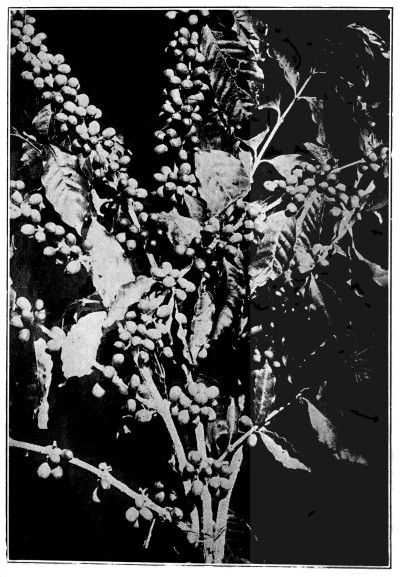
Near View of Berries of Coffea Arabica
Title: Coffee merchandising
A handbook to the coffee business giving elementary and essential facts pertaining to the history, cultivation, preparation, and making of coffee
Author: William H. Ukers
Release date: December 27, 2025 [eBook #77554]
Language: English
Original publication: New York: The Tea and coffee trade journal co., 1924
Other information and formats: www.gutenberg.org/ebooks/77554
Credits: Charlene Taylor and the Online Distributed Proofreading Team at https://www.pgdp.net (This file was produced from images generously made available by The Internet Archive/American Libraries.)
Near View of Berries of Coffea Arabica
A Handbook to the Coffee Business Giving Elementary
and Essential Facts Pertaining to the History,
Cultivation, Preparation, and Marketing
of Coffee
By
William H. Ukers, M.A.
Editor, The Tea and Coffee Trade Journal
Author, All About Coffee; A Trip to Brazil

NEW YORK
The Tea and Coffee Trade Journal Co.
1924
Copyright 1924
By
THE TEA AND COFFEE TRADE JOURNAL CO.
New York
International Copyright Secured
All Rights Reserved in the U. S. A. and Foreign Countries
PRINTED IN THE U. S. A.
To My Co-workers on
The Tea and Coffee Trade Journal
[Pg vii]
This work has been written in response to a demand for a handbook for the especial use of those engaged in the coffee business. To a certain extent it represents a condensation of the author’s encyclopedic work, “All About Coffee.” “Coffee Merchandising,” however, is designed primarily for beginners in the coffee business. It will be found to contain all the elementary and essential facts pertaining to the history, cultivation, preparation, and marketing of coffee.
In it the author has tried to avoid dogmatism. He has aimed to tell briefly the story of coffee, including all those things which every intelligent coffee man should know concerning the early history of the beverage, the botany of the plant, the chemistry of coffee, how coffee grows, how it is prepared for the market, how it is bought and sold in the countries of production, and how it is marketed at wholesale and at retail in the United States. In the telling of the story the author has given the reader the best thought of the trade on all controversial questions, striving to keep his own opinions in the background.
Then, too, the aim has been not only to tell the history story, but to show how successful men in the coffee trade have built up the most enduring business. For this reason the work should prove a source of inspiration, as well as a fount of knowledge, for students and salesmen.
Those who may wish to make a more thorough study of the subject, to delve deeply into the history, romance, and poetry of coffee, or its scientific aspects, are referred to “All About Coffee,” by the same author.
There are two important factors which make for success in the [Pg viii] coffee business,—faith and work,—an abiding faith in the opportunity which it offers to render a public service and which inspires the faithful student to get all the facts about coffee so as to be able to give reasons for his faith; then an intelligent application of the knowledge coupled with that diligence in business which always spells success in any trade or profession—and lo! the battle is won. It is the author’s hope that “Coffee Merchandising” will prove a lamp that will shed some helpful light on the way of all those who are pushing on to greater achievements in the coffee business.
[Pg ix]
CONTENTS
| CHAPTER I. | |
| A Short History of Coffee | |
| A brief account of the beginning of coffee in the Near East—Early | |
| legends, persecutions, first printed references—The introduction | |
| of the beverage into England, France, and Germany—Early London | |
| and Paris coffee houses—The story of the spread of coffee | |
| propagation around the coffee belt of the world—Early American | |
| coffee houses | Page 1 |
| CHAPTER II. |
|
| The Botany of Coffee | |
| Its complete classification by class, sub-class, order, family, | |
| genus, and species—How Coffea arabica grows, flowers, and | |
| bears—Other species and hybrids | Page 17 |
| CHAPTER III. |
|
| Chemistry and Pharmacology of Coffee | |
| The chief factors which enter into coffee goodness—Brief discussion | |
| of caffein and caffeol—Coffee’s place in a rational dietary | |
| —Latest scientific discoveries that establish the whole truth | |
| about coffee as a wholesome, satisfying drink for the great | |
| majority of people and cause it to be regarded as the servant, | |
| rather than the destroyer, of civilization | Page 25 |
| CHAPTER IV. |
|
| Where Coffee Grows | |
| Locating the principal coffee-growing districts in the world’s | |
| coffee belt, with a commercial coffee chart of the leading | |
| growths, giving market names and general trade characteristics | |
| Page 31 | |
| CHAPTER V. |
|
| How Coffee Is Grown | |
| Coffee cultivation in general—Soil, climate, rainfall, altitude, | |
| propagation, shade windbreaks, diseases—How the plant grows | |
| in all the principal producing countries | Page 37 |
| CHAPTER VI. |
|
| Preparing Green Coffee for Market | |
| The marvelous coffee package, one of the most ingenious in all | |
| nature—How coffee is harvested—Picking—Dry and wet methods | |
| of preparation—Pulping—Fermentation and washing—Drying— | |
| Hulling, or peeling and polishing—Sizing or grading— | |
| Preparation methods of different countries | Page 43 [Pg x] |
| CHAPTER VII. |
|
| Buying Coffee in the Producing Countries | |
| How green coffee is bought and sold in the countries of origin | |
| Page 61 | |
| CHAPTER VIII. |
|
| Buying and Selling Green Coffee at Wholesale | |
| The seven stages of transportation—Handling coffee at New York— | |
| How green coffee is graded—Spot-market trading—Buying coffee | |
| C. & F.—Futures and hedging—Buying and selling commissions— | |
| Brokers—The Exchange Clearing House—Brazil quotations—London, | |
| Havre, and Hamburg markets—Rulings | Page 69 |
| CHAPTER IX. |
|
| Green and Roasted Coffee Characteristics | |
| The trade values, bean characteristics, and cup merits of the | |
| leading coffees of commerce—Appearance, aroma, and flavor in | |
| cup testing—How experts test coffees—Typical sample-roasting | |
| and cup-testing outfit | Page 81 |
| CHAPTER X. |
|
| Coffee Blending | |
| Blending green coffees—Properly balanced blends—Low-priced and | |
| high-priced blends—Blends for restaurant and hotel trade— | |
| Doubtful value of sample blends | Page 105 |
| CHAPTER XI. |
|
| Coffee Roasting | |
| Separating, milling, and mixing—The roasting operation—Dry and | |
| wet roasts—Finishing and coating—Cost card for roasters— | |
| Cooling and stoning—Roasting equipment—Blending roasted coffee | |
| —A trip through a model coffee-roasting plant—Evolution of | |
| coffee-roasting apparatus | Page 111 |
| CHAPTER XII. |
|
| Coffee Grinding | |
| “Steel-cut” coffee—Wholesale coffee grinding—Evolution of | |
| grinding apparatus | Page 131 |
| CHAPTER XIII. |
|
| Selling Roasted Coffee at Wholesale | |
| How coffees are sold at wholesale—The wholesale salesman’s | |
| place in merchandising—Ten things every master salesman | |
| should know—Profit sharing for salesmen—Some coffee costs | |
| analyzed—Common sense in cost finding—Terms and credits— | |
| About package coffees—Coffee-selling chart—Various types | |
| of coffee containers—Labels—Coffee-packaging economies— | |
| Practical grocer helps—Coffee sampling—Premium method of | |
| sales promotion | Page 139 [Pg xi] |
| CHAPTER XIV. |
|
| Selling Coffee at Retail | |
| How coffees are sold at retail—The place of the grocer, the tea | |
| and coffee dealer, the chain store, and the wagon-route | |
| distributer in the scheme of distribution—Starting in the | |
| retail coffee business—Coffee blends for retailers—Small | |
| roasters for retail dealers—Model coffee departments—Creating | |
| a coffee trade—Meeting competition—Profits and costs— | |
| Splitting nickels—Figuring costs and profits—A credit policy | |
| for retailers—Premiums for retailers—How to build and hold a | |
| retail coffee business | Page 155 |
| CHAPTER XV. |
|
| Brewing Coffee in Hotels and Restaurants | |
| Analyzing the potential market—The supreme coffee test—Freshly | |
| roasted and freshly ground—Coffee-brewing conclusions—Coffee | |
| urns—Rules for making coffee in hotels and restaurants— | |
| General directions for improving coffee service—How to | |
| operate a successful coffee shop, with sample menus, hints | |
| on equipment and service | Page 175 |
| CHAPTER XVI. |
|
| Production and Consumption of Coffee | |
| A statistical study of world production and consumption of | |
| coffee by countries—Coffee in the United States—The trend | |
| of the trade in 1923—Brazil’s coffee valorization | Page 197 |
| CHAPTER XVII. |
|
| Coffee Advertising | |
| The first coffee advertisement—Evolution of coffee advertising— | |
| Package-coffee advertising—Advertising to the trade—Advertising | |
| by various mediums—Advertising for retailers with ready-made | |
| sample copy—Advertising to the nose—Successful coffee window | |
| displays—Advertising by government propaganda—Coffee | |
| advertising efficiency | Page 219 |
| CHAPTER XVIII. |
|
| Coffee Making in the Home | |
| The importance of correct grinding and brewing—Drip or filter | |
| coffee—Boiled or steeped coffee—Percolated coffee—The | |
| perfect cup of coffee—Some coffee recipes | Page 233 |
[Pg xii]
INDEX TO ILLUSTRATIONS
| Facing page | |
| Near view of berries of Coffea arabica (frontispiece) | iii |
| Legendary discovery of the coffee drink | 1 |
| First advertisement for coffee | 6 |
| A coffee house in the time of Charles II | 10 |
| Merchants Coffee House in New York | 14 |
| Coffea arabica flower and fruit | 17 |
| Green and roasted Bogota coffee | 25 |
| 800,000 coffee trees in bearing | 31 |
| Coffee nursery under a bamboo roof | 37 |
| Efficient weeding and harrowing at Ribeirao Preto | 38 |
| Picking coffee on a well-kept fazenda | 43 |
| Coffee drying ground, Sao Paulo | 50 |
| Loading coffee aboard ship at Santos | 61 |
| Weighing and sacking coffee at Santos | 62 |
| Coffee pit in the New York Coffee & Sugar Exchange | 69 |
| Samples of typical roasted coffee beans | 81, 86, 90, 98 |
| Modern gas coffee-roasting plant | 111 |
| Dumping the roast in a coal roasting plant | 118 |
| Some leading trade-marked coffee containers | 139 |
| Luhrs, of Poughkeepsie, features freshly roasted coffee | |
| in his window | 155 |
| Johnson of Red Oak roasts before the customer | 162 |
| One of the coffee kitchens of the Waldorf-Astoria Hotel | 175 |
| Day and night coffee room of the Rice Hotel, Houston | 184 |
| Advertising copy of the Joint Coffee Trade Publicity | |
| Committee | 219 |
| Drawing upon history for social-intercourse atmosphere | 224 |
| A prize-winning coffee window display | 228 |
| Coffee-making devices used in United States | 233 |
| Brewing the guest’s coffee in a Mohammedan home | 236 |
| Showing how grinding breaks open the oil cells | 242 |
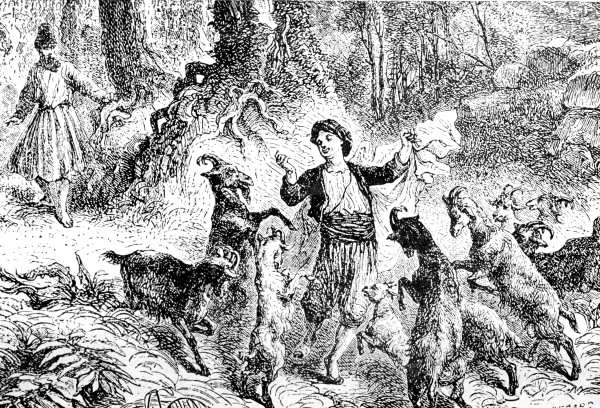
Legendary Discovery of the Coffee Drink:
Kaldi and His Dancing Goats
From a drawing by a modern French artist
[Pg 1]
A brief account of the beginning of coffee in the Near East—Early legends, persecutions, first printed references—The introduction of the beverage into England, France, and Germany—Early London and Paris coffee houses—The story of the spread of coffee propagation around the coffee belt of the world—Early American coffee houses.
Coffee is at least 1,000 years old. It was first mentioned in literature by Rhazes, a famous Arabian physician, about the year 900; only Rhazes called it bunchum. The early Arabians called the bean and the tree that bore it bunn; the drink, bunchum.
Our word “coffee” comes from the Arabic qahwah, through the Turkish kahveh, being originally one of the names employed for wine in Arabic. The word has no connection with the town of Kaffa in Abyssinia, as many writers have supposed. Its final form in French became café; in German, kaffee. The North American Indians knew it as kaufee.
Coffee was first a food, then a wine, a medicine, and lastly a beverage. Its use as a popular beverage dates back 700 years.
Coffee Was First a Food Ration
In the beginning, the whole ripe berries, beans, and hulls were crushed and molded into food balls held in shape with fat. This was about 800 A. D. The Galla, a wandering African tribe, still make use of these food balls. One of them, of the size of a billiard ball, constitutes a day’s ration, and sustains them on long marches. The inhabitants of the island of Groix, off the coast of Brittany, also thrive on a diet that [Pg 2] includes roasted coffee beans. But, however nourishing these isolated groups may find coffee taken in this way, so far they have no imitators, and the rest of the world wisely prefers to use it in the liquid form.
Following its use as a food ration, a kind of aromatic wine was made in Africa from the fermented juice of the hulls and pulp of the ripe berries. Next a medicine was made by boiling the dried berries in water. About 1200, the practice began of making a drink from the dried hulls alone and boiling in water. Toasting the hulls followed, and about 1300 it was the custom to roast the dried beans after hulling and to boil them whole. Grinding in mortars was a later development.
Same Early Legends
Sheik Omar, a doctor-priest and a disciple of Sheik Schadheli, the patron saint and legendary founder of Mocha, quite by chance discovered coffee as a beverage at Ousab in Arabia in 1258. Omar was in exile and facing starvation. He was forced to eat certain berries which he found growing on wild bushes in his Ousab retreat. In this way he discovered that they were possessed of stimulating—or, as he called it, magical—properties. Later he tried roasting them and boiling them in water. He got even better results. Next he prescribed the drink for those of his former patients who came to visit him, and these carried back such stories of benefits received that Omar was invited to return in triumph to Mocha, where a monastery was built in his honor and he himself was made a saint.
There are several versions of this legend. One ascribes the discovery of the drink to an Arabian herdsman in upper Egypt, or Abyssinia, who complained to the abbot of a neighboring monastery that the goats confined to his care became strangely frolicsome after eating the berries of wild shrubs found near their feeding grounds. The abbot tried the berries on himself, and, being astonished at their exhilarating effects, experimented by boiling them in water and ordering [Pg 3] the decoction served to his monks, who too often fell asleep over their nightly religious ceremonies. Thereafter the monks found no difficulty in keeping awake.
About 1300, it is recorded that the coffee drink was a popular decoction among the churchmen. It was made from the roasted berries, crushed with a mortar and pestle, the powder being placed in boiling water and the drink taken down, grounds and all.
About 1454, Sheik Gemalledin, mufti of Aden, having discovered the virtues of the coffee berry on a journey to Abyssinia, sanctioned the secular use of coffee in Arabia Felix. It quickly reached Mecca and Medina. About 1500, the propagation of the plant had spread from Abyssinia through Arabia and into Ceylon.
Early Coffee Persecutions
In 1511, soon after the drink had reached Cairo, and the coffee house had become a favorite resort, Kair Bey, governor of Mecca, being outraged by the extent to which the new drink was being consumed by clergy and laymen, called a consultation of lawyers, physicians, and leading citizens, and succeeded in browbeating a majority into issuing an indictment of the beverage, while he issued an edict prohibiting its use. His master, the sultan of Cairo, ordered it revoked shortly thereafter, and Kair Bey subsequently came to an inglorious end, being first exposed as “an extortioner and a public robber” and then slowly “tortured to death.”
In 1524, the kadi of Mecca tried his hand at closing the coffee houses, because of disorders, but permitted coffee drinking in private. By 1532, the coffee house had taken root in Damascus and Aleppo. In 1534, a religious fanatic denounced coffee in Cairo, and led a mob against the coffee houses, many of which were wrecked. The city was divided into two parties,—for and against coffee. To put an end to the [Pg 4] agitation, the chief judge invited the leading physicians to a conference, and at the end not only served coffee to all present, but drank some himself.
In 1554, the first coffee houses were opened in Constantinople by Shemsi of Damascus and Hekem of Aleppo. Here, too, religious zealots soon became jealous of their popular appeal, and about 1570 they put forth the argument that roasted coffee was a kind of charcoal, and, as the Koran forbade the use of charcoal among the other unsanitary foods, the use of coffee was against the law of the Koran. The mufti was so impressed by this that he ruled that coffee was forbidden by the law of the Prophet.
The prohibition was more honored in the breach than in the observance. Coffee drinking continued in secret, instead of in the open; and when Amurath III, about 1580, at the further solicitation of the churchmen, declared that coffee should be classed as a wine, also forbidden by Mohammed, and ordered all coffee houses suppressed, the people only smiled and persisted in their disobedience. The civil officers, finding it useless to try to destroy the custom, winked at violations of the law, and, for a consideration, permitted the sale of coffee privately; so that many Ottoman “speakeasies” sprang up,—places where coffee might be had behind shut doors, shops where it was sold in back rooms.
This was enough to reestablish the coffee houses by degrees. The prohibition was repealed de facto, if not de jure. Then came a mufti less scrupulous or more knowing than his predecessor, who declared that coffee was not to be looked upon as coal, and that the drink made from it was not forbidden by the law. There was a general renewal of coffee drinking; religious devotees, preachers, lawyers, and the mufti himself indulging in it, their example being followed by the whole court and the city.
First Printed References
The first printed reference to coffee appeared as chaube in Rauwolf’s Travels, published in German at Frankfort and Lauingen [Pg 5] in 1582. Rauwolf was a German physician and botanist, who made a journey to the Levant in 1573.
The first authentic account of the origin of coffee was written by the sheik Abd-al-Kadir, in an Arabian manuscript still preserved in the Bibliotheque Nationale at Paris.
The first printed reference to coffee in English appeared as chaoua in a note of Paludanus in Linschoten’s Travels, translated from the Dutch and published in London in 1598.
About 1600, coffee cultivation was introduced into southern India by a Moslem pilgrim, Baba Budan.
The first printed reference to coffee in English, employing the modern form of the word, appeared in W. Parry’s book, Sherley’s Travels, as coffe, in 1601. In 1610, Sir George Sandys in his Travels recorded, “The Turks sip a drink called coffa (of the berry that it is made of) in little china dishes, as hot as they can suffer it.” Francis Bacon also wrote in 1627, “They have in Turkey a drink called coffa made of a berry of the same name, as black as soot, and of a strong scent. This drink comforteth the brain and heart and helpeth digestion.” In 1632, Burton, in his Anatomy of Melancholy, wrote, “The Turks have a drink called coffa, so named from a berry black as soot and as bitter.”
Coffee Baptized by the Pope
The news of coffee caused early dissensions in Italy. Because coffee drinking originated in Mohammedan lands, many churchmen in the 16th century were concerned about the propriety of permitting its use in Christendom, denouncing it as an invention of Satan. Discussion arose, and the disputants appealed to Pope Clement VIII for a decision. The pope wisely decided to drink some before committing himself.
After imbibing a steaming beaker, according to the much quoted legend, [Pg 6] the pope exclaimed, “Why, this Satan’s drink is so delicious that it would be a pity to let the infidels have exclusive use of it! We shall fool Satan by baptizing it, and making it a truly Christian beverage.” This he did, and added the Church’s seal of approval to the waxing popularity of the harmless and invigorating decoction. Coffee was introduced into Venice in 1615.
The drink was brought to England by Canopios, a Cretan student at Oxford, in 1637. A Dutch merchant offered beans from Mocha at public sale in Amsterdam in 1640, although the drink was introduced into Holland as early as 1616. Coffee came to France in 1644. In 1645, the first coffee house was opened in Venice.
A Jew named Jacobs opened the first coffee house in England, at Oxford, in 1650. The first coffee house in London was opened by Pasqua Rosee, a Greek youth, body servant to Daniel Edwards, a London merchant who brought the boy back from Smyrna with him. When in the Levant, Mr. Edwards had acquired the coffee habit. In London, Pasqua was wont to prepare the beverage for his master daily. The novelty of the drink caused the Edwards house to be overrun with company, and Edwards, in self-defense, set the youth up in a shed or tent in St. Michaels Alley, Cornhill, opposite the church. Here, in the same year, Pasqua Rosee issued the first advertisement for coffee in English. It was in the form of a handbill acclaiming “The Vertue of the Coffee Drink.” After leaving England, Pasqua Rosee went to Holland and opened a coffee house there.
First Newspaper Advertisement for Coffee
The first newspaper advertisement for coffee appeared in the Publick Adviser, London, May 19, 1657. It was as follows:

The Vertue of the COFFEE Drink.
First publiquely made and sold in England, by Pasqua Rosee.
The Grain or Berry called Coffee,
groweth upon little Trees, only in the
Deserts of Arabia.
It is brought from thence, and drunk generally throughout
all the Grand Seigniors
Dominions.
It is a simple innocent thing, composed into a Drink, by being dryed in an Oven, and ground to Powder, and boiled up with Spring water, and about half a pint of it to be drunk, fasting an hour before, and not Eating an hour after, and to be taken as hot as possibly can be endured; the which will never fetch the skin off the mouth, or raise any Blisters, by reason of that Heat.
The Turks drink at meals and other times, is usually Water, and their Dyet consist; much of Fruit; the Crudities whereof are very much corrected by this Drink.
The quality of this Drink is cold and Dry, and though it be a Dryer, yet it neither heats, nor inflames more then hot Posset.
It so closeth the Orifice of the Stomack, and fortifies the heat with; it’s very good to help digestion, and therefore of great use to be bout 3 or 4 a Clock afternoon, as well as in the morning.
It quickens the Spirits, and makes the Heart Lightsome. is good against sore Eys, and the better if you hold your Head o’er it, and take in the Steem that way.
It suppresseth Fumes exceedingly, and therefore good against the Head-ach, and will very much stop any Defluxion of Rheums, that distil from the Head upon the Stomack, and so prevent and help Consumptions; and the Cough of the Lungs.
It is excellent to prevent and cure the Dropsy, Gout, and Scurvey.
It is known by experience to be better then any other Drying Drink for People in years, or Children that have any running humors upon them, as the Kings Evil. &c.
It is very good to prevent Mis-carryings in Child-bearing Women.
It is a most excellent Remedy against the Spleen, Hypocondriack Winds, or the like.
It will prevent Drowsiness, and make one fit for busines, if one have occasion to Watch, and therefore you are not to Drink of it after Supper, unless you intend to be watchful, for it will hinder sleep for 3 or 4 hours.
It is observed that in Turkey, where this is generally drunk, that they are not trobled with the Stone, Gout, Dropsie, or Scurvey, and that their Skins are exceeding cleer and white.
It is neither Laxative nor Restringent.

Made and Sold in St. Michaels Alley in Cornhill; by Pasqua Rosee, at the Signe of his own Head.
First Advertisement for Coffee (1652)
Handbill used by Pasqua, who opened the first coffee house
in London. (Reproduced from the original in the British Museum.)
[Pg 7]
In Bartholomew Lane on the back side of the Old Exchange, the drink called Coffee (which is a very wholesome and Physical drink, having many excellent vertues), closes the Orifice of the Stomach, fortifies the heat within, helpeth Digestion, quickneth the Spirits, maketh the heart lightsom, is good against Eye-sores, Coughs, or Colds, Rhumes, Consumptions, Head-ach, Dropsie, Gout, Scurvey, Kings Evil, and many others is to be sold both in the morning and at three of the clock in the afternoon.
Meanwhile, in 1656, coffee was subjected to further persecution in Constantinople, where the grand vizier Kuprili, for political reasons, suppressed the coffee houses and prohibited the use of coffee. For the first violation the punishment inflicted was cudgeling; for the second offense the offender was sewed in a leather bag and thrown into the Bosporous.
Despite the severe penalties staring them in the face, violations of the law were plentiful among the people of Constantinople. Venders of the beverage appeared in the market places with “large copper vessels with fire under them; and those who had a mind to drink were invited to step into any neighboring shop where every one was welcome on such an account.”
Later, Kuprili, having assured himself that the coffee houses were no longer a menace to his policies, permitted the free use of the beverage that he had previously forbidden.
At this time to refuse or to neglect to give coffee to their wives was a legitimate cause for divorce among the Turks. The men made promise when marrying never to let their wives be without coffee. “That,” says Fulbert de Monteith, “is perhaps more prudent than to swear fidelity.”
In 1657, coffee appeared in Paris, but it was not served publicly until introduced by Soliman Aga, the Turkish ambassador, in 1669. He made it in Turkish style, had it served by black slaves, “on bended knees, in tiny cups of egg-shell porcelain, and poured out in saucers of gold and silver, placed on embroidered silk doylies, fringed with gold bullion.” Naturally, his sumptuous coffee functions became the rage of Paris. [Pg 8]
The coffee drink came to North America in 1668. It was first sold in Boston in 1670.
Opposition to London Coffee Houses
Coffee and the coffee houses were fiercely attacked by publicans and ale-house keepers in London between the Restoration and 1675. A series of broadsides and tracts were launched against them. They bore such titles as, “A cup of coffee: or coffee in its colours,” “A Broadside against coffee, or the marriage of the Turk,” and “The Women’s petition against coffee,” the latter presenting the argument that coffee made men as “unfruitful as the deserts whence that unhappy berry is said to be brought.”
These were ably answered by coffee’s defenders, and the drink continued to find favor in spite of its detractors.
The beverage was introduced into Germany in 1670, and the next year the first coffee house in France was opened in Marseilles. Pascal, an Armenian, opened the first coffee house in Paris, at the Fair of St. Germain, in 1672. The progenitor of the real French café was the Procope, opened in Paris in 1689 by Francois Procope, a lemonade vender of Florence.
The coffee house spread rapidly in France. In the reign of Louis XV, there were over 600 cafés in Paris. These became famous: Tour d’Argent, the Royal Drummer, Café Foy, Régence, Momus, Café de Paris, Voisins, Café de la Paix, and Tortoni. At the close of the 18th century there were over 800 cafés in Paris; in 1843, there were over 3,000. They played an important part in the French Revolution, in the development of French literature and of the stage. Among the notables that frequented them were Voltaire, Rousseau, Fontenelle, Beaumarchais, Diderot, Desmoulins, Napoleon, Marie Antoinette, de Musset, Victor Hugo, Gautier, Talleyrand, Marat, Robespierre, Danton, and Rossini. [Pg 9]
While it is recorded that coffee made slow progress with the court of Louis XIV, the next king, Louis XV, to please his mistress du Barry, gave it a tremendous vogue. It is related that he spent $15,000 a year for coffee for his daughters.
Coffee Houses Suppressed
In 1675, Charles II of England issued a proclamation to close all London coffee houses as places of sedition. By that time there were hundreds of them, and they were known as penny universities. The king’s proclamation was so unpopular in nearly all quarters that it stands today as one of the worst political blunders in history. Upon petition of the coffee traders, the order was revoked eleven days after issue.
Some Famous Coffee Houses
The London coffee houses of the 17th and 18th centuries were centers of wit and learning. They were referred to as the “penny universities” because they were great schools of conversation, and the entrance fee was only a penny. Twopence was the usual price of a dish of coffee or tea, this charge also covering newspapers and lights. Quoting a poem of the period:
By 1715, there were 2,000 coffee houses in London. Every profession, trade, class, and party had its coffee house. Men had their coffee houses as now they have their clubs; sometimes contented with one, sometimes belonging to three or four. Johnson, for instance, was connected with St. James’s, the Turk’s Head, the Bedford, Peele’s, besides the taverns which he frequented. Addison and Steele used Button’s; Swift, Button’s, the Smyrna, and St. James’s; Dryden, Will’s; Pope, Will’s and Button’s; Goldsmith, the St. James’s and the Chapter; [Pg 10] Fielding, the Bedford; Hogarth, the Bedford and Slaughter’s; Sheridan, the Piazza; Thurlow, Nando’s.
Among the famous English coffee houses of the 17th-18th century period were St. James’s, Will’s, Garraway’s, White’s, Slaughter’s, the Grecian, Button’s, Lloyd’s, Tom’s, and Don Saltero’s.
St. James’s was a Whig house frequented by members of Parliament, with a fair sprinkling of literary stars. Garraway’s catered to the gentry of the period, many of whom naturally had Tory proclivities.
One of the notable coffee houses of Queen Anne’s reign was Button’s. Here Addison could be found almost every afternoon and evening, along with Steele, Davenant, Carey, Philips, and other kindred minds. Pope was a member of the same coffee house club for a year, but his inborn irascibility eventually led him to drop out of it.
At Button’s, a lion’s head, designed by Hogarth after the Lion of Venice, “a proper emblem of knowledge and action, being all head and paws,” was set up to receive letters and papers for the Guardian. The Tatler and the Spectator were born in the coffee house, and probably English prose would never have received the impetus given it by the essays of Addison and Steele had it not been for coffee-house associations.
Pope’s famous Rape of the Lock grew out of coffee-house gossip. The poem itself contains one charming passage on coffee:
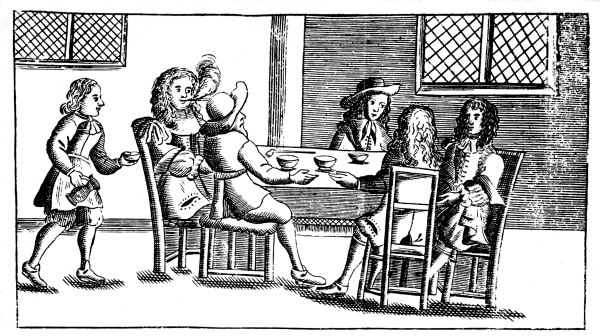
A Coffee House in the Time of Charles II
From a woodcut of 1674
[Pg 11] Another frequenter of the coffee houses of London, when he had the money to do so, was Daniel Defoe, whose Robinson Crusoe was the precursor of the English novel. Henry Fielding, one of the greatest of all English novelists, loved the life of the more bohemian coffee houses, and was, in fact, induced to write his first great novel, Joseph Andrews, through coffee-house criticisms of Richardson’s Pamela.
Other frequenters of the coffee houses of the period were Thomas Gray and Richard Brinsley Sheridan. Garrick was often to be seen at Tom’s in Birchin Lane, where also Chatterton might have been found on many an evening before his untimely death.
The second half of the 18th century was covered by the reigns of the Georges. The coffee houses were still an important factor in London life, but were influenced somewhat by the development of gardens in which were served tea, chocolate, and other drinks, as well as coffee. At the coffee houses themselves, while coffee remained the favorite beverage, the proprietors, in the hope of increasing their patronage, began to serve wine, ale, and other liquors. This seems to have been the first step toward the decay of the coffee house.
The coffee houses, however, continued to be the centers of intellectual life. When Samuel Johnson and David Garrick came together to London, literature was temporarily in a bad way, and the hack writers dwelt in Grub Street.
It was not until after Johnson had met with some success, and had established the first of his coffee-house clubs at the Turk’s Head, that literature again became a fashionable profession. [Pg 12]
This really famous literary club met at the Turk’s Head from 1763 to 1783. Among the most notable members were Johnson, the arbiter of English prose; Oliver Goldsmith; Boswell, the biographer; Burke, the orator; Garrick, the actor; and Sir Joshua Reynolds, the painter. Among the later members were Gibbon, the historian, and Adam Smith, the political economist.
Certain it is that during the sway of the English coffee house, and at least partly through its influence, England produced a better prose literature, as embodied alike in her essays, literary criticisms, and novels, than she ever had produced before.
The advent of the pleasure garden brought coffee out into the open in England; and one of the reasons why gardens, such as Ranelagh and Vauxhall, began to be more frequented than the coffee houses was that they were popular resorts for women as well as for men. All kinds of beverages were served in them, and soon the women began to favor tea as an afternoon drink. At least, the great development in the use of tea dates from this period, and many of these resorts called themselves tea gardens.
After the Turks failed in their attack on Vienna in 1683, Kolschitzky, a hero of the siege, was given the supplies of green coffee which they left in their flight, and with them he opened the first coffee house in Vienna.
Early Coffee Propagation
In 1696 and again in 1699, the Dutch introduced the propagation of coffee into Java. The same year the first coffee house (the King’s Arms) was opened in New York.
“Java” coffee seeds were received at the Amsterdam Botanical Gardens in 1706, and in 1714 a plant raised from them was presented to Louis XIV and by him nurtured in the Jardin des Plantes at Paris. It was a seedling of this plant that Captain Gabriel De Clieu carried to Martinique in 1723, sharing his drinking water with it on a long voyage. [Pg 13]
In 1715, coffee cultivation was first introduced into Haiti and Santo Domingo. Later came hardier plants from Martinique. In 1715-17, the French Company of the Indies introduced the cultivation of the plant into the isle of Bourbon (now Réunion) by a ship captain named Dufougeret-Grenier from St. Malo. It did so well that nine years later the island began to export coffee.
The Dutch brought the cultivation of coffee to Surinam in 1718. The first coffee plantation in Brazil was started at Pará in 1723 with plants brought from French Guiana, but it was not a success. The English brought the plant to Jamaica in 1730. In 1740, Spanish missionaries introduced coffee cultivation into the Philippines from Java. In 1748, Don José Antonio Gelabert introduced coffee into Cuba, bringing the seed from Santo Domingo. In 1750, the Dutch extended the cultivation of the plant to the Celebes. Coffee was introduced into Guatemala about 1750-60. The intensive cultivation in Brazil dates from the efforts begun in the Portuguese colonies in Pará and Amazonas in 1752. Porto Rico began the cultivation of coffee about 1755. In 1760, João Alberto Castello Branco brought to Rio de Janeiro a coffee tree from Goa, Portuguese India. The news spread that the soil and climate of Brazil were particularly adapted to the cultivation of coffee. Molke, a Belgian monk, presented some seeds to the Capuchin monastery at Rio in 1774. Later, the bishop of Rio, Joachim Bruno, became a patron of the plant and encouraged its propagation in Rio, Minas, Espirito Santo, and São Paulo. The Spanish voyager, Don Francisco Xavier Navarro, is credited with the introduction of coffee into Costa Rica from Cuba in 1779. In Venezuela, the industry was started near Caracas by a priest, José Antonio Mohedano, with seed brought from Martinique in 1784.
Coffee cultivation in Mexico began in 1790, the seed being brought from the West Indies. In 1817, Don Juan Antonio Gomez instituted intensive [Pg 14] cultivation in the state of Vera Cruz. In 1825 the cultivation of the plant was begun in the Hawaiian Islands with seeds from Rio de Janeiro. The English began to cultivate coffee in India in 1840. In 1852, coffee cultivation was begun in Salvador with plants brought from Cuba. In 1878, the English began the propagation of coffee in British Central Africa, but it was not until 1901 that coffee cultivation was introduced into British East Africa from Réunion. In 1887, the French introduced the plant into Tonkin, Indo-China.
Frederick, the Great Beer Drinker
Germany also had its attempts at coffee suppression. Frederick the Great, of Prussia, had a violent scorn for any beverage so innocuous as coffee—until he found in its increasing popularity, despite his tirades and ukases against it, a comfortable source of revenue to the crown.
Following is the text of Frederick’s celebrated Coffee and Beer Manifesto issued September 13, 1777, a curiosity:
It is disgusting to notice the increase in the quantity of coffee used by my subjects and the amount of money that goes out of the country in consequence. Everybody is using coffee. If possible, this must be prevented. My people must drink beer. His Majesty was brought up on beer, and so were his ancestors and his officers. Many battles have been fought and won by soldiers nourished on beer; and the king does not believe that coffee-drinking soldiers can be depended upon to endure hardship or to beat his enemies in case of the occurrence of another war.
Later, in 1781, Frederick established state coffee-roasting plants and made the coffee business a government monopoly. The common people were forbidden to roast their own coffee. “Coffee smellers” were employed to seek out violations of the law. In 1784, Maximilian Frederick, elector of Cologne, prohibited the use of coffee except by the well-to-do. The decree failed of its purpose.
Holland early adopted the coffee house, and the Dutch were the pioneer coffee traders. History records no intolerance of coffee in Holland.
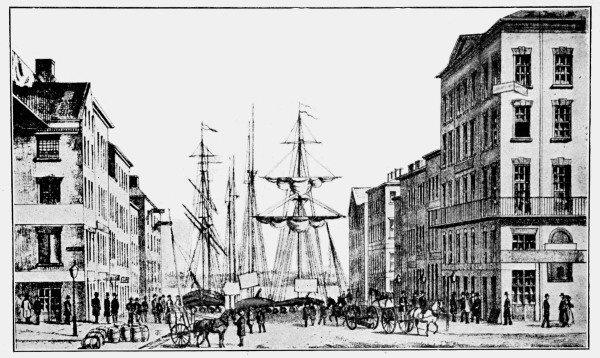
Merchants Coffee House in New York (at the Right)
as It Appeared 1772-1804
The original coffee house of this name was opened on the northwest corner of Wall and Water Streets about 1737, and was moved to the southeast corner in 1772.
[Pg 15] If Vienna helped make coffee famous, London and Paris gave us the last word in coffee houses. The two most picturesque chapters in the history of coffee have to do with the period of the old London and Paris coffee houses of the 17th and 18th centuries. Much of the poetry and romance of coffee centers around this time. The London coffee house was, however, a male institution; indeed, out of it came the solid British club. The Parisian coffee house, on the other hand, was, like everything French, distinctly Gallic. Women were welcome, and it is not to be wondered that the French adaptation of the oriental coffee house became in time a much more esthetic and artistic institution,—the unique French café.
The early history of coffee in the United States centers around the coffee houses of New York, Boston, and Philadelphia. These were patterned largely after the English prototype. Gradually they became taverns, and not infrequently evolved into hotels. In Colonial days, Americans were also large consumers of tea, and, indeed, were in a fair way to become a nation of tea drinkers, when King George III perpetrated that fatal blunder known as the Stamp Act. The Boston Tea Party of 1773 cast the die for coffee. It became a patriotic duty to drink something else, and coffee didn’t have to come from England. Thus was started a national habit which made coffee our national drink. So, when the coffee house disappeared, the coffee drink was found to be strongly intrenched in the homes of the people, and it has stayed there ever since,—“King of the American breakfast table.”
In Boston, the London, Crown, and the Gutteridge were the best known early coffee houses. Later came the King’s Head, Indian Queen, and Green Dragon. The Exchange Coffee House, erected in 1808, was a seven-story skyscraper, and was probably the largest and most costly [Pg 16] commercial coffee house ever built. It was a center of marine intelligence, like Lloyd’s of London.
The burghers of New Amsterdam began to substitute coffee for “must,” or beer, in 1668. In 1683, the year following William Penn’s settlement on the Delaware, we find him buying supplies of coffee in the New York market, and paying for them at the rate of 18 shillings and 9 pence (about $4.68) a pound.
The King’s Arms (1696) was the first coffee house in New York. It was followed by the historic Merchants Coffee house (sometimes called “the birthplace of our Union”), the Exchange, Whitehall, Burns, and Tontine houses.
The coffee houses of early Philadelphia loom large in the history of the city and the republic. Picturesque in themselves, with their distinctive colonial architecture, their associations were also romantic. Many a civic, sociological, and industrial reform came into existence in the low-ceilinged, sanded-floor main rooms of the city’s early coffee houses. One of those reforms was the ultimate abandonment of the public slave auctions which were held regularly on a platform in the street before the second London coffee house, kept by William Bradford, the printer.
There is this to be remarked in closing this brief sketch of the early history of coffee: In Europe and in America the houses where the coffee drink was first served became forums of democracy and temples of free speech. Wherever introduced, coffee has spelled revolution. It ushered in the Commonwealth in England, it was first aid to the French Revolution, and it undoubtedly helped make the American republic.
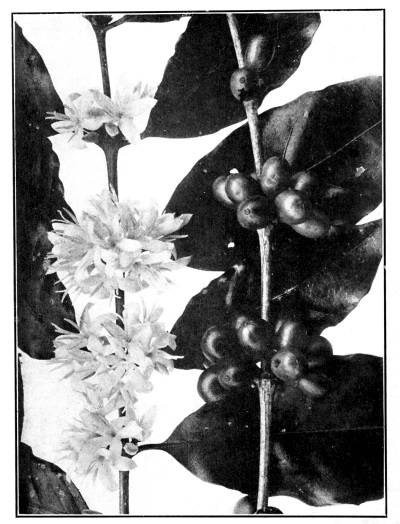
Coffea Arabica (Costa Rica)
Flower and Fruit
[Pg 17]
Its complete classification by class, sub-class, order, family, genus, and species—How Coffea arabica grows, flowers, and bears—Other species and hybrids.
The coffee tree, scientifically known as Coffea arabica, belongs to the two-leaved class of a large sub-kingdom of vegetable plants known as the Angiospermæ. Because it bears a flower arranged with its corolla all in one piece, forming a tube-shaped arrangement, it is further classified as Sympetalæ or Metachlamydeæ, which means that its petals are united.
Pursuing its classification still further, botanists place it in the order Rubiales and in the family Rubiaceæ or madder family, which also includes various herbs, and a few American plants, like the familiar bluets or Quaker ladies, and partridge berries. Quinine and ipecac are also members of this family.
Botany divides all families into smaller sections known as genera, and the coffee plant belongs to the genus Coffea. Under this genus are several sub-genera, and to the sub-genus Eucoffea belongs the common coffee, which the trade and the general public know best, Coffea arabica.
Coffea arabica is the original species indigenous to Abyssinia and Arabia, and for many years it was known as “Java” when it came from Java and “Mocha” when it came from Arabia. The Arabica seed transplanted to different soils and climates takes on local characteristics, and this gives us Bourbon, Mexican, Coban, Blue Mountain, Bogota, Bourbon Santos, etc., as the case may be.
There are many other species of coffee besides Arabica. They [Pg 18] haven’t been described frequently, because, with one or two exceptions, they are commercially unimportant. Indeed, all botanists do not agree in their classification of the species and varieties of the Coffea genus. The systematic division of this interesting genus is far from finished; in fact, it may be said hardly to be begun.
Coffea arabica we know best because of the important role it plays in commerce.
| Kingdom | Vegetable |
| Sub-kingdom | Angiospermæ |
| Class | Dicotyledoneae |
| Sub-class | Sympetalæ or Metachlamydeæ |
| Order | Rubiales |
| Family | Rubiaceæ |
| Genus | Coffea |
| Sub-genus | Eucoffea |
| Species | C. arabica |
The coffee plant most cultivated for its berries is, as already stated, Coffea arabica, which is found in tropical regions, although it can grow in temperate climates. Unlike most plants that grow best in the Tropics, it can stand low temperatures. It requires shade when it grows in hot, low-lying districts; but, when it grows on elevated land, it thrives without such protection. There are about eight recognized species of Coffea.
Coffea arabica is a shrub with evergreen leaves, and reaches a height of fourteen to twenty feet when fully grown. The shrub produces branches of two forms, known as uprights and laterals. When young, the plants have a main stem, the upright; which, however, eventually sends out side shoots, the laterals. The laterals may send out other laterals, known as secondary laterals, but no lateral can ever produce an upright. The laterals are produced in pairs and are opposite, the pairs being borne in whorls around the stem. The laterals are produced only when the joint of the upright, to which they are attached, is young; and, if they are broken off at that point, the upright has no [Pg 19] power to reproduce them. The upright can produce new uprights also; but, if an upright is cut off, the laterals at that position tend to thicken up. This is very desirable, as the laterals produce the flowers, which seldom appear on the uprights. This fact is utilized in pruning the coffee tree, the uprights being cut back, the laterals then becoming more productive. Planters generally keep their trees pruned down to six to twelve feet.
The leaves are lanceolate, or lance-shaped, being borne in pairs opposite each other. They are three to six inches in length, thin, but of firm texture. They are very dark green on the upper surface, but much lighter underneath. The margin of the leaf is entire and wavy. In some tropical countries, the natives brew a coffee tea from the leaves of the coffee tree.
The coffee flowers are small, white, and very fragrant, having a delicate characteristic odor. They are borne in the axils of the leaves in clusters, and several crops are produced in one season, depending on the conditions of heat and moisture that prevail in the particular season. The different blossomings are classed as main blossoming and smaller blossomings. In semi-dry, high districts, as in Costa Rica or Guatemala, there is one blossoming season, about March, and flowers and fruit are not found together, as a rule, on the trees; but in lowland plantations, where rain is perennial, blooming and fruiting continue practically all the year, and ripe fruits, green fruits, open flowers, and flower buds are to be found at the same time on the same branchlet, not mixed together, but in the order indicated.
The flowers are tubular, the tube of the corolla dividing into five white segments. The number of petals is not at all constant, not even for flowers of the same tree.
While the usual color of the coffee flower is white, the fresh stamens and pistils may have a greenish tinge, and in some cultivated species the corolla is pale pink. [Pg 20]
The size and condition of the flowers are entirely dependent on the weather. The flowers are sometimes very small, very fragrant, and very numerous; while at other times, when the weather is not hot and dry, they are very large, but not so numerous. Both these kinds “set fruit,” as it is called; but at times, especially in a very dry season, the trees bear flowers that are few in number, small, and imperfectly formed, the petals frequently being green instead of white. These flowers do not set fruit. The flowers that open on a dry sunny day show a greater yield of fruit than those which open on a wet day, as the first mentioned have a better chance of being pollinated by the insects and the wind.
After the flowers droop, there appear what are commercially known as coffee berries. Botanically speaking, “berry” is a misnomer. These little fruits are not berries, such as are well represented by the grape; but are drupes, which are better exemplified by the cherry and the peach. In the course of six or seven months, these coffee drupes develop into little red balls about the size of an ordinary cherry; but, instead of being round, they are somewhat ellipsoidal, having at the outer end a small umbilicus. The drupe of the coffee usually has two locules, each containing a little “stone” (the seed and its parchment covering), from which the coffee bean (seed) is obtained. Actually, then, the coffee berry is not a berry but a “drupe”; also, the coffee bean is not a “bean” but a seed.
Some few drupes contain three beans, while others, at the outer ends of the branches, contain only one round bean, known as the peaberry. The number of pickings corresponds to the different blossomings in the same season; and one tree of the species Arabica may yield from one to twelve pounds a year.
In countries like India and Africa, the birds and monkeys eat the ripe coffee berries. The so-called “monkey coffee” of India, according to [Pg 21] Arnold, is the undigested coffee beans that passed through the alimentary canal of the animal.
The outer fleshy part or pulp surrounding the coffee beans is at present of no commercial importance. From the human standpoint, the pulp, or pericarp, as it is scientifically called, is rather an annoyance, as it must be removed in order to procure the beans. This is done in one of two ways. The first is known as the dry method, in which the entire fruit is allowed to dry, and is then cracked open. The second is called the wet method; the pericarp is removed by machine, and two wet, slimy seed packets are obtained. These packets, which look for all the world like seeds, are allowed to dry in such a way that fermentation takes place. This rids them of all the slime; and, after they are thoroughly dry, the endocarp, the so-called parchment covering, is easily cracked open and removed. At the same time that the parchment is removed, a thin silvery membrane, known scientifically as the spermoderm (which means seed skin), referred to in the trade as the silver skin, beneath the parchment, comes off too. There are always small fragments of this silver skin to be found in the groove of the coffee bean contained within the parchment packet.
We have said that the coffee tree yields from one to twelve pounds a year, but of course this varies with the individual tree and also with the region. In some countries the whole year’s yield is less than 200 pounds an acre, while there is on record a patch in Brazil which yields about seventeen pounds a tree, bringing the acre yield much higher.
The beans do not retain their vitality for planting for any considerable time; and, if they are thoroughly dried, or are kept for longer than three or four months, they are useless for that purpose. It takes the seed about six weeks to germinate and to appear above ground. Trees raised from seed begin to blossom in about three years, but a good crop cannot be expected of them for the first five or six years. Their usefulness, save in exceptional cases, is ended in about thirty years. [Pg 22]
The coffee tree can be propagated other than by seeds. The upright branches may be used as slips, which, after taking root, will produce seed-bearing laterals. The laterals themselves cannot be used as slips. In Central America, the natives sometimes use coffee uprights for fences, and it is no uncommon sight to see the fence posts “growing.”
Thus far there are 12 recognized varieties of Arabica, as follows: Laurina, Murta, Menosperma, Mokka, Purpurescens, Variegata, Amarella, Bullata, Angustifolia, Erecta, Maragogipe, and Columnaris.
Two other species of coffee that have become better known in the trade are Liberica and Robusta. Liberica is a much larger and sturdier tree than Arabica, and sometimes reaches a height of thirty feet. Its leaves are twice as long, and the flowers are larger and borne in dense clusters. At any time during the season, the same tree may bear flowers, white or pinkish, and fragrant, or even green, together with fruits, some green, some ripe and of a brilliant red. The corolla has been known to have seven segments, though as a rule it has five. The fruits are large, round, and dull red; the pulps are not juicy, and are somewhat bitter. Unlike Coffea arabica, the ripened berries do not fall from the trees, and so the picking may be delayed at the planter’s convenience. The Liberica bean produces a drink which is classed as inferior to Arabica by trade experts.
The Robusta plant is larger than either Arabica or Liberica. The leaves of Robusta are much thinner than those of Liberica, though not so thin as those of Arabica. The tree, as a whole, is a very hardy variety, and bears blossoms even when it is less than a year old. It blossoms throughout the entire year, the flowers having six-parted corollas. The berries are smaller than those of Liberica, but are much thinner skinned; so that the coffee bean is actually not any smaller. They mature in ten months. Although the plants bear as early as the first year, the yield for the first two years is of no account, but by the [Pg 23] fourth year the crop is large. Recently cup tests have established high merits in certain strains of Robusta. A variety of Robusta called Canephora has flowers tinged with red, its unripe berries are purple, and the bean narrower and more oblong than Robusta. It grows well in high altitudes. Among the allied Robusta species are Ugandæ and Quillou.
Experiments in coffee culture are constantly being made by well-known botanists, and some interesting hybrids have been produced, the most popular belonging to a crossing of Liberica and Arabica. Excelsa, an allied Liberica species, has also given much promise.
A species of coffee growing wild in the Comoro Islands and Madagascar has been found practically caffein-free. Certain Porto Rico coffees are also very low in caffein content.
[Pg 24]

Green (Longitudinal Cross Section).
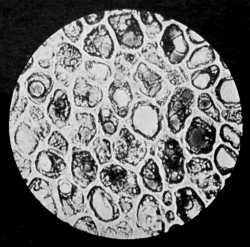
Roasted (Tangential).
Green and Roasted Bogota Coffee
(Magnified 200 Diameters)
[Pg 25]
The chief factors which enter into coffee goodness—Brief discussion of caffein and caffeol—Coffee’s place in a rational dietary—Latest scientific discoveries which establish the whole truth about coffee as a wholesome, satisfying drink for the great majority of people and cause it to be regarded as the servant, rather than the destroyer, of civilization.
Generally speaking, the trade and the consumer are concerned chiefly with those factors which enter into coffee goodness. These are the caffein content and the caffeol. Caffein supplies the principal stimulant. It increases the capacity for muscular and mental work without harmful reaction. The caffeol supplies the flavor and the aroma,—that indescribable oriental fragrance that woos us through the nostrils, forming one of the principal elements that make up the lure of coffee. There are several other constituents, including certain innocuous so-called caffetannic acids, which, in combination with the caffeol, give the beverage its rare gustatory appeal.
In the roasting of green coffee, part of the original caffein content is lost by sublimation (vaporizing), and caffeol is formed. Chemists recognize two groups of constituents which are formed during roasting and are soluble in water,—heavy extractives and light aromatic materials.
The heavy extractives include caffein, mineral matter, proteins, caramel, and sugars, “caffetannic acid,” and various organic materials. Some fat will also be found in the average coffee brew, melted from the bean by the heated water and carried along with the solution. The light extractives are collectively known as caffeol. [Pg 26]
Caffein has a slightly bitter taste, but, because of the small percentage present in a cup of coffee, it contributes little to its cup value. Nevertheless, it furnishes the stimulation for which coffee is generally consumed. The caffein content of Coffea arabica, green, is 1.5 percent.
The mineral matter, together with certain decomposition and hydrolysis products of crude fiber and chlorogenic acid, contribute toward the astringency or bitterness of the cup. The proteins are present in such small quantity that their only role is to raise somewhat the almost negligible food value of a coffee infusion. The body, or what might be called the licorice-like character, of coffee is due to the presence of bodies of a glucosidic nature and to caramel. The degree to which a coffee is sweet-tasting or not is, of course, dependent upon its other characteristics, but probably varies directly with the reducing sugar content.
The term “caffetannic acid” is a misnomer, for the substances called by this name are in all probability mainly coffalic and chlorogenic acids, neither of which is a true tannin, nor do they evince but few of the characteristic reactions of tannic acid. Some neutral coffees will show as high a “caffetannic acid” content as other acid-charactered ones. Careful chemical analysis has shown that the actual acidities of some East Indian coffees vary from 0.013 to 0.033 percent. These figures my be taken as reliable examples of the true acid content of coffee, and, though they seem very low, it is not at all incomprehensible that the acids they indicate produce the acidity in a cup of coffee. They probably are mainly volatile organic acids together with other acidic-natured products of roasting.
We know that very small quantities of acid are readily detected in fruit juices and beer, and that variation in their percentages is quickly noticed, while the neutralization of this small amount of acidity leaves an insipid drink. Hence it seems quite likely that this small acid content gives to the coffee brew its essential acidity. A few minor experiments on neutralization have proved the production of a [Pg 27] very flat beverage by thus treating a coffee infusion. Acidity of certain coffees most apparently should be attributed to such compounds rather than to the miscalled “caffetannic acid.” For personal proving of this statement, put a small pinch of the weakly alkalin baking soda (NaHCO₃) into a cup of coffee and note the difference that it makes.
The light aromatic materials and other substances that are steam-distillable (i. e., which are driven off when coffee is concentrated by boiling) are important factors in determining the individuality of coffees. These compounds (caffeol) vary greatly in the percentages present in different coffees, and thus are largely responsible for our ability to distinguish coffees in the cup. It is these compounds that supply the pleasingly aromatic and appetizing odor to coffee.[1]
Like all good things in life, the drinking of coffee may be abused. Indeed, those having an idiosyncratic susceptibility to alkaloids should be temperate in the use of tea, coffee, or cocoa. In every high-tensioned country, there is likely to be a small number of people who, because of certain individual characteristics, cannot drink coffee at all. These belong to the abnormal minority of the human family. Some people cannot eat strawberries, but that would not be a valid reason for a general condemnation of strawberries. One may be poisoned, says Thomas A. Edison, from too much food. Horace Fletcher was certain that overfeeding caused all our ills. Overindulgence in meat is likely to spell trouble for the strongest of us. Coffee is, perhaps, less often abused than wrongly accused. It all depends. A little more tolerance!
Trading upon the credulity of the hypochondriac and the caffein sensitive, in recent years there has appeared in America and abroad a curious collection of so-called coffee substitutes. They are “neither fish, nor flesh, nor good red herring.” Most of them have been shown by official government analyses to be sadly deficient in food [Pg 28] value, their only alleged virtue. One of our contemporary attackers of the national beverage bewails the fact that no palatable hot drink has been found to take the place of coffee. The reason is not hard to find. There can be no substitute for coffee. Dr. Harvey W. Wiley has ably summed up the matter by saying, “A substitute should be able to perform the functions of its principal. A substitute in a war must be able to fight. A bounty jumper is not a substitute.”
A brief summarization of available information on the pharmacology of coffee indicates that it should be used in moderation, particularly by children, the permissible quantity for adults varying with the individual, his constitution, mode of living, etc., and ascertainable only through personal observation.
Recent scientific research has destroyed many bugaboos manufactured by the traducers of our national beverage; for one, the alleged harmful effects of the caffein content. We now know that the small amount of caffein in the coffee cup is distinctly beneficial to the majority and that it is a pure stimulant having no harmful reaction.
Then there was the notion that cream in coffee made the beverage indigestible. The statement was made that milk or cream caused the coffee liquid to become coagulated when it came into contact with the acids of the stomach. This is true, but it does not carry with it the inference that indigestibility accompanies this coagulation. Milk and cream, upon reaching the stomach, are coagulated by the gastric juice, but the casein product formed is not indigestible. These liquids, when added to coffee, are partly acted upon by the small acid content of the brew, so that the gastric juice action is not so pronounced, for the coagulation was started before ingestion, and the coagulable constituent, casein, is more dilute in the cup as consumed than it is in milk. Accordingly, the particles formed by it in the stomach will be relatively smaller and more quickly and easily digested than milk per se. [Pg 29]
Used in moderation, coffee has invariably proved a valuable stimulant, increasing personal efficiency in mental and physical labor. Its action in the alimentary regime is that of an adjuvant food, aiding digestion, favoring increased flow of the digestive juices, promoting intestinal peristalsis, and not tanning any part of the digestive organs. It reacts on the kidneys as a diuretic, and increases the excretion of uric acid; which, however, is not to be taken as evidence that it is harmful in gout. Coffee has been indicated as a specific for various diseases, its functions therein being the raising and sustaining of low vitalities. Its effect upon longevity is virtually nil. A small proportion of humans who are very nervous may find coffee undesirable, but sensible consumption of coffee by the average, normal, non-neurasthenic person will not prove harmful but beneficial.
Until the campaign of education recently conducted by coffee men in the United States, many neurotics received with gladness the tales of the harmfulness of coffee. They eagerly welcomed the doubtful substitutes, coffee minus the caffein, or some nauseating cereal preparation. They were convinced that by avoiding coffee they could cure their nervous condition.
Commenting upon the campaign of enlightenment, the New York Medical Journal & Medical Record said:
This whole question has been exaggerated. Coffee in moderation does not produce nervous ailments. Removal of coffee from the diet does not cure them. Coffee with cream and sugar is a source of food and energy. In many cardiac and nephritic conditions there is no better or simpler preparation than well prepared coffee.
It is amusing to see chocolate, cocoa, and even tea substituted for coffee in various nervous or other conditions, when as a matter of fact the amount of stimulus cup for cup is the same or even greater. What foundation there is for giving children and old persons various chocolate preparations in place of coffee is difficult to determine.
It would be well to look at the coffee question squarely and not cover the situation by inane avoidances. Coffee is one of the mainstays [Pg 30] of our rapid civilization. Those adults who wish to live and enjoy life, let them drink their coffee in peace. Those who wish to ascribe illness or nervousness to magical causes, let them abandon it.
This is an able summing up of the question of the alleged harmfulness of coffee. Those who may wish to examine the evidence pro and con will find it detailed in the chapter on the pharmacology of coffee in All About Coffee. Opinions, names, and full references are given there.
For more than three years the Massachusetts Institute of Technology made an exhaustive investigation of coffee. This investigation was made at the invitation of the coffee trade of the United States to determine by scientific research the whole truth about coffee and coffee making. It involved a total cost of $40,000 and was one of the most thorough investigations ever made of any food product.
The result of this scientific research, as announced by Professor Samuel C. Prescott, director of the institute’s Department of Biology & Public Health, shows that coffee is a wholesome, helpful, satisfying drink for the great majority of people.
The report covers many hundreds of pages, for every aspect of coffee and coffee making was studied, but in just one paragraph of 92 words Professor Prescott swept aside all the old prejudices and superstitions, and gave coffee the cleanest bill of health that could be wished. He said:
It may be stated that, after weighing the evidence, a dispassionate evaluation of the data so comprehensively surveyed has led to no alarming conclusions that coffee is an injurious beverage for the great mass of human beings, but on the contrary that the history of human experience, as well as the results of scientific experimentation, point to the fact that coffee is a beverage which, properly prepared and rightly used, gives comfort and inspiration, augments mental and physical activity, and may be regarded as the servant rather than the destroyer of civilization.
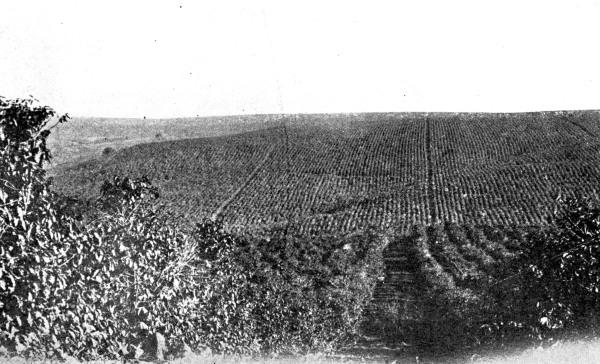
800,000 Coffee Trees in Bearing at Guatapara, Brazil
[Pg 31]
Locating the principal coffee-growing districts in the world’s coffee belt—With a commercial coffee chart of the leading growths, giving market names and general trade characteristics.
The coffee belt of the world lies between the Tropic of Cancer and the Tropic of Capricorn. The coffee tree, while native to Abyssinia and Ethiopia, grows well in Java, Sumatra, and other islands of the Dutch East Indies; in India, Arabia, equatorial Africa, the Pacific islands, Mexico, Central and South America, and the West Indies.
The leading growths that find favor in the world’s markets are listed in the Commercial Coffee Chart on page 36, reproduced from All About Coffee, where they are described in greater detail. Their general trade uses are, however, discussed farther along in this work in the chapter entitled, “Green and Roasted Coffee Characteristics.”
Mexico is the principal producing country in the northern part of the western continent, and Brazil in the southern part. In Africa, the eastern coast furnishes the greater part of the supply; while, in Asia, the Netherlands Indies, British India, and Arabia lead.
Within the last two decades there has been an expansion of the production areas in South America, Africa, and in southeastern Asia, and a contraction in British India and the Netherlands Indies.
In Mexico, although coffee growing is widely distributed in most of the more southern states, the principal coffee territory is Vera Cruz, where lie the districts of Cordoba, Orizaba, Huatusco, and Coatepec. In the same region are the Jalapa district and the mountains of Puebla, where considerable coffee is grown. Farther south are the Oaxaca [Pg 32] districts on the mountain slopes of the Pacific Coast, and still farther south the districts in the state of Chiapas. The youngest district is Soconusco. On the Gulf slope of Oaxaca are many plantations; also in the western regions of the table lands of Colima and Michoacan.
In Guatemala, coffee is grown on the table lands of three great mountain ranges. The principal districts are Costa Cuca, Costa Grande, Barberena, Tumbador, Coban, Costa de Cucho, Chicacao, Xolhuitz, Pochuta, Malacatan, San Marcos, Chuva, Panan, Turgo, Escuintla, San Vincente, Pacaya, Antigua, Moran, Amatitlan, Sumatan, Palmar, Zunil, and Montagua.
In Salvador, the berry is grown in all districts that have altitudes of 1,500 to 4,000 feet. The most productive plantations are in the departments of La Paz, Santa Ana, Sonsonate, San Salvador, San Vincente, San Miguel, Santa Tecla, and Ahuachapam.
In Costa Rica, the coffee-growing districts are principally on the Pacific slope and in the central plateaus of the interior. Plantations are in the provinces of Cartago, Tres Rios, San José, Heredia, and Alajuela.
The principal plantations in Honduras are in the departments of Santa Barbara, Copan, Cortez, La Paz, Choluteca, and El Paraiso. British Honduras doesn’t raise enough coffee for domestic consumption. In Nicaragua, the most extensive plantings are in the departments of Managua, Carazo, Matagalpa, Chontales, and Jinotega. The best district for coffee growing in Panama is Bugaba, where great suitable areas exist, but the Boquete district in the province of Chiriqui produces the bulk of Panama’s coffee.
On the island of Haiti, coffee grows well in the republic of Haiti and in the Dominican Republic. The principal plantations are in the vicinity of the town of Moca in the eastern or Santo Domingo section of the island, and in the districts of Santiago, Bani, and Barahona. [Pg 33]
In Jamaica four parishes lead in coffee producing,—Manchester, St. Thomas, Clarendon, and St. Andrew. A few estates in the Blue Mountains produce the famed Blue Mountain variety.
In Porto Rico, the coffee belt extends through the western half of the island beginning in the hills along the south coast around Ponce and extending north through the center of the island almost to Arecibo, near the western end of the north coast. Some coffee is grown in 64 of the 68 municipalities. The largest plantations are in Utuado, Adjuntas, Lares, Las Marias, Yauco, Maricao, San Sebastian, Mayaguez, Ciales, and Ponce.
Coffee can be grown in practically every island of the West Indies, and is grown in a small way in many of them. Little is produced for international trade except in the islands already mentioned. Cuba was formerly a heavy producer, but now only a small quantity is grown there, and she has been forced to import from Porto Rico to supply her own needs. Guadeloupe grows coffee, some of which is shipped to Martinique and exported as the product of that country; no longer the coffee producer it was in the 18th century after De Clieu introduced the plant there. Small amounts of coffee are grown on Trinidad and Tobago.
Colombian coffees are grown in nearly all departments where the elevations range from 3,500 to 6,500 feet. Chief among them are Antioquia (capital, Medellin); Caldas (capital, Manizales); Magdalena (capital, Santa Marta); Santander (capital, Bucaramanga); Tolima (capital, Ibague); and the Federal District (capital, Bogotá). The department of Cundinamarca produces a coffee that is counted one of the best of Colombian grades. The finest grades are grown in the foothills of the Andes, in altitudes 3,500 to 4,500 feet above sea level.
In Venezuela, there are no great coffee belts as in Mexico and Central America. Many districts are days rides apart. The chain of the Maritime Andes, reaching eastward across Colombia and Venezuela, [Pg 34] approaches the Caribbean coast in the latter country. Along the slopes and foothills of these mountains are produced some of the finest grades of South American coffee. Here the best coffee grows in the tierra templada and in the lower part of the tierra fria, and is known as the café de tierra fria, or coffee of the cold, or high, land. In these regions the equable climate, the constant and adequate moisture, the rich and well-drained soil, and the protecting forest shade afford the conditions under which the plant grows and thrives best. On the fertile lowland valleys nearer the coast grows the café de tierra caliente, or coffee of the hot land.
The Guianas (British, Dutch, and French) grow coffee, but little more than is needed for home consumption.
Brazil’s commercial coffee-growing region has an estimated area of 1,158,000 square miles, and extends from the river Amazon to the southern border of the state of São Paulo, and from the Atlantic Coast to the western boundary of the state of Matto Grosso. This area is larger than that section of the United States lying east of the Mississippi River, with Texas added. In every state of the republic, from Ceará in the north to Santa Catharina in the south, the coffee tree can be cultivated profitably, and is, in fact, more or less grown in every state, if only for domestic use. However, little attention is given to coffee growing in the north, except in Pernambuco, which has only about 1,500,000 trees, as compared with the 764,000,000 trees of São Paulo in 1922.
The chief coffee-growing plantations in Brazil are on plateaus seldom less than 1,800 feet above sea level, and ranging up to 4,000 feet. The principal coffee-growing districts are in the states of São Paulo, Rio, Minas Geraes, Bahia, and Espirito Santo.
Coffee is grown in a small way in Ecuador, Peru, Bolivia, Chile, Paraguay, and Argentina. Ecuador gives the greatest promise. Cayo is the leading district.
In Arabia, coffee growing is confined to the mountains in the vilayet [Pg 35] of Yemen, a district along the southwestern coast, back from the Red Sea. Coffee can be grown almost anywhere in Yemen, but it is cultivated entirely in small gardens in a few scattered districts, and the total acreage is not large.
In India, half of the coffee-producing area is in Mysore; other plantations are to be found in Kurg (Coorg), the Madras districts of Malabar, and in the Nilgiri hills.
In the East India Islands, Java and Sumatra lead. Coffee is produced commercially in nearly every political district in Java, but the bulk of the yield is obtained from East Java. The names best known to the trade are those of the regencies of Besoeki and Pasoeroean, because their coffees make up 87 percent of Java’s production. Some of the better known districts are Preanger, Cheribon, Kadoe, Samarang, Soerabaya, and Tegal. Practically all the coffee districts in Sumatra are on the west coast, with Padang as headquarters. The best known are Angola, Siboga, Ayer Bangies, Mandheling, Palembang, Padang, and Benkoelen. The east coast has recently gone in for heavy plantings of Robusta. Coffee is also grown in several other islands of Dutch East Indies, chiefly Celebes, Bali, Lombok, the Moluccas, and Timor. In the Malay States, Liberica is mostly grown.
In Africa, Abyssinia supplies two coffees known as Harar and Abyssinian. The former is grown in the province of Harar and mostly around the city of Harar. The latter is the fruit of wild Arabica trees that grow mainly in the provinces of Sidamo, Kaffa, and Guma. Coffee also grows in Angola, where there are large areas of wild trees; in Liberia, Uganda, Nyasaland, and Kenya Colony.
The Kona side of the island of Hawaii produces the best known Hawaiian coffee. Other districts are Hamakua, Puna, and Olaa.
The Philippines produce a negligible amount of coffee, as does also the Queensland district of Australia. The industry is being developed in French Indo-China, however, where Robusta has been found to do very well. Some coffee is still grown in Ceylon, but it is commercially unimportant. [Pg 36]
COMMERCIAL COFFEE CHART
World’s Leading Growths, with Market Names
and General Trade Characteristics
| Grand Division |
Country | Principal Shipping Ports |
Best Known Market Names |
Trade Characteristics |
| North America |
Mexico | Vera Cruz | Coatepec Huatusco Orizaba |
Greenish to yellow bean; mild flavor. |
| Central America |
Guatemala | Puerto Barrios |
Coban Antigua |
Waxy, bluish bean; mellow flavor. |
| Salvador | La Libertad | Santa Ana Santa Tecla |
Smooth, green bean, neutral flavor. |
|
| Nicaragua | Corinto | Matagalpa | Large blue washed, fancy roast; acid cup. |
|
| Costa Rica | Puerto Limon |
Costa Ricas | Blue-greenish bean; mild flavor. |
|
| West Indies |
Haiti | Cape Haitien |
Haiti | Blue bean; rich, fairly acid; sweet flavor. |
| Santo Domingo |
Santo Domingo |
Santo Domingo |
Flat, greenish-yellow bean; strong flavor. |
|
| Jamaica | Kingston | Blue Mountain | Bluish-green bean; rich, full flavor. |
|
| Porto Rico | Ponce | Porto Ricans | Gray-blue bean; strong, heavy lavor. |
|
| South America |
Colombia | Savanilla | Medellin Manizales Bogota Bucaramanga |
Greenish-yellow bean; rich, mellow flavor. |
| Venezuela | La Guaira Maracaibo |
Merida Cucuta Caracas |
Greenish-yellow bean; mild, mellow flavor. |
|
| Brazil | Santos Rio de Janeiro |
Santos Rio |
Small bean; mild flavor. Large bean; strong cup. |
|
| Asia | Arabia | Aden | Mocha | Small, short, green to yellow bean; unique, mild flavor. |
| India | Madras Calicut |
Mysore Coorg (Kurg) |
Small to large, blue-green bean; strong flavor. |
|
| East India Islands |
Malay States |
Penang (Geo’t’n) Singapore |
Straits Liberian Robusta |
Liberian and Robusta growths for Malaysia. |
| Sumatra | Padang | Mandeheling Angola Ayer Bangies |
Large, yellow to brown bean; heavy body; exquisite flavor. |
|
| Java | Batavia | Preanger Cheribon, Kroe |
Small, blue to yellow bean, light in cup. |
|
| Celebes | Menado |
Minahassa | Large, yellow bean; aromatic cup. |
|
| Africa | Abyssinia | Jibuti | Harar Abyssinia |
Large, blue to yellow bean; very like Mocha. |
| Pacific Islands |
Hawaiian Islands |
Honolulu | Kona Puna |
Large, blue, flinty bean; mildly acid. |
| Philippines | Manila | Manila | Yellow and brown large bean; mild cup. |
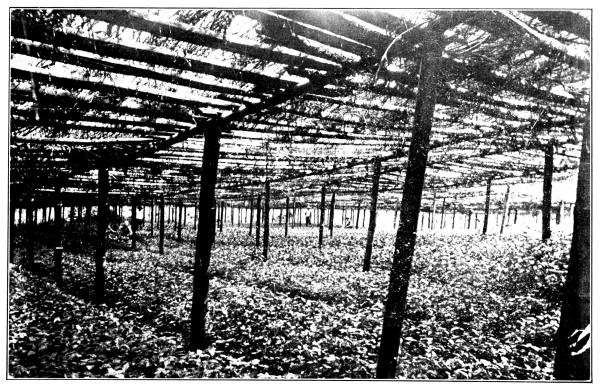
Coffee Nursery Under a Bamboo Roof in Colombia
[Pg 37]
Coffee cultivation in general—Soil, climate, rainfall, altitude, propagation, shade, windbreaks, diseases—How the plant grows in all the principal producing countries.
Coffee grows best in rock ground that pulverizes easily, and, if possible, of volcanic origin. The plant favors a temperate climate within the Tropics. It requires about 70 inches of rainfall supplied evenly throughout the year. It will flourish from sea level up to 6,000 feet, but the quality improves the higher the elevation. Robusta and Liberica do well in the lower levels, but Arabica thrives best in the hills or high table lands.
Coffee trees are grown most generally from seeds planted in shaded nursery beds. Germination takes place in about six weeks. Usually the plantation is laid out on heavily wooded and sloping ground. The forest trees having been cleared and the ground prepared, the young plants are transferred when about a year old. They are set out in shallow holes at regular intervals of eight to 12 or even 14 feet apart. In the triangle or hexagon system they are planted in the form of an equilateral triangle, each tree being the same distance (usually eight or nine feet) from its six nearest neighbors.
Shade and windbreak trees are provided for Arabica in countries subjected to strong chilly winds and intensely hot sunlight. Hand plows and horse-drawn cultivators are employed to cultivate the ground between the rows.
If left to grow, the coffee tree may reach a height of 40 feet; so the planter prunes regularly after the first crop to keep it from six to 12 [Pg 38] feet. This makes for a quality bean and facilitates picking. The tree bears its first crop at three years and is in full bearing from the sixth to the 15th years, though some trees give paying crops for 30 years. The production varies from half a pound to eight pounds annually, and 12 pounds have been gathered from a single tree.
There are numerous pests and diseases that attack the trees, the worst known being a leaf disease (Hemileia vastatrix), which destroyed the Ceylon coffee industry in 1869.
The beauty of a coffee estate in flower is of a very fleeting character. One day it is a snowy expanse of fragrant white blossoms for miles and miles, as far as the eye can see, and two days later the soft, gentle winds have blown them all away. The flowers are beautiful, but the eye of the planter sees in them not alone beauty and fragrance. He looks beyond and in his mind’s eye sees bags and bags of green coffee, representing to him the goal and reward of all his toil and worry.
Coffee cultivation methods are pretty much the same in all coffee-producing countries, but there are always certain local variations. In Brazil’s coffee belt there are two seasons,—the wet, running from September to March, and the dry, running from April to August. The coffee trees are in bloom from September to December. Here the blossoms last about four days, and are easily beaten off by light winds or rains. If the rains or winds are violent, the green berries may be similarly destroyed; so that great damage may be caused by unseasonable rains and storms.
The harvest usually begins in April or May, and extends well into the dry season. Even in the picking season, heavy rains and strong winds—especially the latter—may do considerable damage, for in Brazil shade trees and windbreaks are the exception.
Approximately 25 percent of the São Paulo plantations are cultivated by machinery. A type of cultivator very common is similar to the small corn plow used in the United States. The Planet Junior, manufactured by a well-known United States agricultural-machinery firm, is the most popular cultivator. It is drawn by a small mule, with a boy to lead it, and a man to drive and guide the plow.
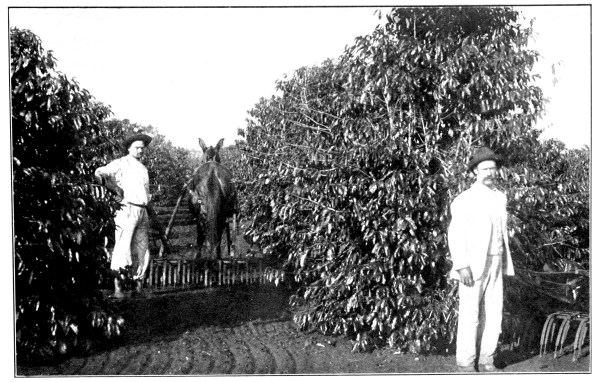
Efficient Weeding and Harrowing at
Ribeirao Preto,
São Paulo, Brazil
[Pg 39] In Colombia, the coffee tree bears its first crop when four or five years old. The trees are not subject to unusual hazards from the attacks of injurious insects or parasitic diseases, and on the whole their cultivation is rather easy.
In Java, the climate and soil have long been ideal for coffee culture, although in recent years the soil in some districts has shown the need of fertilizer. Robusta grows well even at altitudes below 1,000 feet, but its bearing life is only 10 years, as compared with the 30 years of Arabica at altitudes of 3,000 to 4,000 feet. On some of the highland plantations pruning is not considered necessary and the trees reach 30 or 40 feet in height. With climate and soil similar to Java, the island of Sumatra has the added advantage that the land is not “coffee moe,” or “coffee tired,” as is the case in parts of Java.
In Salvador the coffee trees begin bearing when they are two or three years old, reaching full maturity at seven or eight years and lasting for 30 years.
Coffee cultivation in Guatemala has reached a high degree of perfection. The most modern methods are employed. The trees flower in February, March, and April.
Coffee cultivation in Mexico, more especially in Soconusco, near the border of Guatemala, reflects the influence of Guatemalan methods.
The soil, climate, and temperature all favor coffee cultivation in Porto Rico, where the virgin land of the interior requires less labor in its preparation than in other coffee-growing countries. It is cleared in the usual manner, the trees are planted eight feet apart, and hoeing and spading take the place of plow cultivation because of the lay of the land.
Costa Rica, in its San José and Cartago districts, has a rich volcanic soil especially adaptable to coffee cultivation. [Pg 40]
In India, much cultivating has been done under the shade of the original jungle trees. Arabica is favored. Robusta and Maragogipe have been tried, but without much success.
Nicaragua has a soil that will grow coffee well in altitudes of 2,000 to 3,000 feet. Transportation is poor and costly.
In Abyssinia, the natives plant the trees in rows about 12 to 15 feet apart, but pay little attention to cultivation.
In Arabia, land for the coffee gardens is selected on hill slopes, and is terraced with soil and small walls of stone until it reaches up like an amphitheater, often to a considerable height. The soil is well fertilized. For sowing, the seeds are thoroughly dried in ashes, and, after being placed in the ground, are carefully watched, watered, and shaded. In about a year, the shrub has grown to a height of 12 or more inches. Seedlings in that condition are set out in the gardens in rows, 10 to 13 feet apart. The young trees receive moisture from neighboring wells or from irrigation ditches, and are shaded by bananas.
At maturity the trees reach a height of 10 or 15 feet. Since they never lose all their leaves at one time, they appear always green, and bear at the same time flowers and fruits, some of which are still green while others are ripe or approaching maturity. Thus, in some districts, the trees are considered to have two or even three crops a year. All the trees begin to bear about the end of the third year.
Inefficient methods of cultivation for many years retarded the development of coffee growing on the island of Haiti, but recently there has been some improvement. Most of the coffee is Arabica. The trees blossom twice before bearing, in January and April-May.
No shade is needed for coffee growing in Panama, and the only cultivation consists of three or four cleanings a year to keep down the weeds. No plowing is required.
Advanced methods of planting and cultivation are being followed in French Indo-China and British East Africa, fostered by the French and British governments. [Pg 41]
In Hawaii, the volcanic soil lends itself easily to successful coffee cultivation. Coffee trees in Kona are planted principally in the open, though sometimes they are shaded by the native kukui trees. They are grown from seed in nurseries; and the seedlings, when one year old, are transplanted in regular lines nine feet apart. In two years a small crop is gathered, yielding five to 12 bags of cleaned coffee an acre. At three years, the trees produce eight to 20 bags of cleaned coffee an acre, and from that time they are fully matured. The ripening season is between September and January, and there are two principal pickings. Many plantations are cultivated by Japanese labor.
Conditions of soil and climate are favorable to coffee cultivation in the Philippines, labor is cheap and abundant, but enterprise is lacking.
[Pg 42]
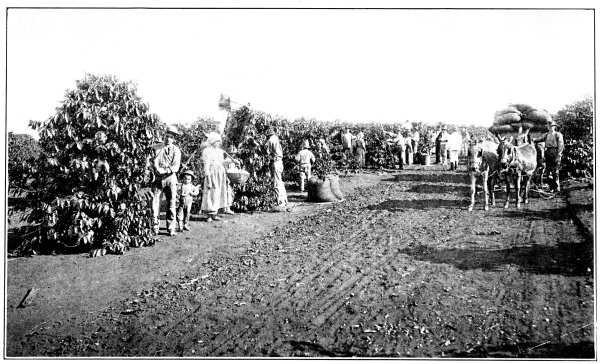
Picking Coffee on a Well-Kept Fazenda, Brazil
[Pg 43]
The marvelous coffee package, one of the most ingenious in all nature—How coffee is harvested—Picking—Dry and wet methods of preparation—Pulping—Fermentation and washing—Drying—Hulling, or peeling and polishing—Sizing or grading—Preparation methods of different countries.
It is doubtful if in all nature there is a more cunningly devised food package than the fruit of the coffee tree. It is very like a cherry, though somewhat elongated and having in its outer end a small umbilicus. But mark with what ingenuity the package has been constructed! The outer wrapping is a thin, gossamer-like skin which incloses a soft pulp, sweetish to the taste, but of mucilaginous consistency. This pulp in turn is wrapped about the inner seal, called the parchment, because of its tough texture. The parchment incloses the magic bean in its last wrapping, a delicate silver-colored skin, not unlike fine-spun silk or the sheerest of tissue papers. And this last wrapping is so tenacious, so true to its guardianship function, that no amount of rough treatment can dislodge it altogether, for parts of it remain clinging to the bean even into the roasting and grinding processes.
Coffee is said to be “in the husk,” or “in the parchment,” when the whole fruit is dried; and it is called “hulled coffee” when it has been deprived of its hull and peel. The matter forming the fruit, called the coffee berry, covers two thin, hard, oval seed vessels held together, one to the other, by their flat sides. These seed vessels, when broken open, contain the raw coffee beans of commerce. They are usually of a roundish oval shape, convex on the outside, flat inside, marked longitudinally in the center of the flat side with a deep incision, and [Pg 44] wrapped in the thin pellicle known as the silver skin. When one of the two seeds aborts, the remaining one acquires greater size, and fills the interior of the fruit, which in that case, of course, has but one cellule. This abortion is common in the Arabica variety, and produces a bean formerly called gragé coffee, but now more commonly known as peaberry, or male berry.
The various coverings of the coffee beans are almost always removed on the plantations in the producing countries. Properly to prepare the raw beans, it is necessary to remove the four coverings,—the outer skin, the sticky pulp, the parchment or husk, and the closely adhering silver skin.
There are two distinct methods of treating the coffee fruits, or “cherries.” One process, the one that until recent years was in general use throughout the world, and is still in many producing countries, is known as the dry method. The coffee prepared in this way is sometimes called “common,” “ordinary,” or “natural,” to distinguish it from the product that has been cleaned by the wet or washed method. The wet method, or, as it is sometimes designated, the “West Indian process” (W.I.P.), is practised on many of the large modern plantations that happen to have a sufficient supply of water.
In the wet process, the first step is called pulping; the second is fermentation and washing; the third is drying; the fourth is hulling or peeling; and the last, sizing or grading. In the dry process, the first step is drying; the second, hulling; and the last, sizing or grading.
The coffee cherry ripens six to seven months after the tree has flowered, or blossomed, and becomes a deep, purplish crimson color. It is then ready for picking. The ripening season varies throughout the world, according to climate and altitude. In the state of São Paulo, Brazil, the harvesting season lasts from May to September; while in Java, where three crops are produced annually, harvesting is almost a continuous process throughout the year. In Colombia, the harvesting [Pg 45] seasons are March and April, and November and December. In Guatemala, the crops are gathered from October through December; in Venezuela, from November through March. In Mexico, the coffee is harvested from November to January; in Haiti, the harvest extends from May to December; in Arabia, from September to March; in Abyssinia, from September through November. In Uganda, Africa, there are two main crops, one ripening in March and the other in September, and picking is carried on during practically every month except December and January. In India, the fruit is ready for harvesting from October to January.
The general practice throughout the world has been to hand pick the fruit; although in some countries the cherries are allowed to become fully ripe on the trees and to fall to the ground. The introduction of the wet method of preparation, indeed, has made it largely unnecessary to hand pick crops, and the tendency seems to be away from this practice on the larger plantations. If the berries are gathered promptly after dropping, the beans are not injured, and the cost of harvesting is reduced.
The picking season is a busy time on a large plantation. All hands join in the work,—men, women, and children,—for it must be rushed. Overripe berries shrink and dry up. The pickers, with baskets slung over their shoulders, walk between the rows, stripping the berries from the trees, using ladders to reach the topmost branches, and sometimes even taking immature fruit in their haste to expedite the work. About 30 pounds are considered a fair day’s work under good conditions. As the baskets are filled, they are emptied at a “station” in that particular unit of the plantation, or, in some cases, directly into wagons that keep pace with the pickers. The coffee is freed as much as possible of sticks, leaves, etc., and is then conveyed to the preparation grounds. [Pg 46]
A space of several acres is needed for the various preparation processes on the larger plantations; the plant including concrete-surfaced drying grounds, large fermentation tanks, washing vats, mills, warehouses, stables, and even machine shops. In Mexico, this place is known as the beneficio; in Brazil, the cafezale.
Where water is plenty, the ripe coffee cherries are fed by a stream of water into a pulping machine, which breaks the outer skins, permitting the pulpy matter enveloping the beans to be loosened and carried away in further washings. It is this wet separation of the sticky pulp from the beans, instead of allowing it to dry on them, to be removed later with the parchment in the hulling operation, that makes the distinction between washed and unwashed coffees. Where water is scarce, the coffees are unwashed.
Either method being well done, does washing improve the strength and flavor? Opinions differ. The soil, altitude, climatic influences, and cultivation methods of a country give its coffee certain distinctive drinking qualities. Washing immensely improves the appearance of the bean; it also reduces curing costs. Generally speaking, washed coffees will always command a premium over coffees dried in the pulp.
Whether coffee is washed or not, it has to be dried; and there is a kind of fermentation that goes on during washing and drying about which coffee planters have differing ideas, just as tea planters differ over the curing of tea leaves. Careful scientific study is needed to determine how much, if any, effect this fermentation has on the ultimate cup value.
The dry method of preparing the berries is not only the older method, but is considered by some operators as providing a distinct advantage, over the wet process, since berries of different degrees of ripeness [Pg 47] can be handled at the same time. However, the success of this method is dependent largely on the continuance of clear warm weather over quite a length of time, which cannot always be counted on.
In this process the berries are spread in a thin layer on open drying grounds, or barbecues, often having cement or brick surfaces. The berries are turned over several times a day in order to permit the sun and wind thoroughly to dry all parts. The sun-drying process lasts about three weeks; and after the first three days of this period the berries must be protected from dews and rains by covering them with tarpaulins, or by raking them into heaps under cover. If the berries are not spread out, they heat, and the silver skin sticks to the coffee bean, and frequently discolors it. When thoroughly dry, the berries are stored, unless the husks (outer skin and inner parchment) are to be removed at once. Hot air, steam, and other artificial drying methods take the place of natural sun-drying on some plantations.
In the dry method, the husks are removed either by hand (threshing and pounding in a mortar, on the smaller plantations) or by specially constructed machinery, known as hulling machines.
The wet method of preparation is the more modern form, and is generally practised on the larger plantations which have a sufficient supply of water, and enough money to install the quite extensive amount of machinery and equipment required. It is generally considered that washing results in a better grade of bean.
In this method the cherries are sometimes thrown into tanks full of water to soak for about 24 hours, so as to soften the outer skins and underlying pulp to a condition that will make them easily removable by the pulping machine; the idea being to rub away the pulp by friction without crushing the beans. [Pg 48]
On the larger plantations, however, the coffee cherries are dumped into large concrete receiving tanks, from which they are carried the same day by streams of running water directly into the hoppers of the pulping machines.
At least two score of different makes of pulping machines are in use in the various coffee-growing countries. Pulpers are made in various sizes, from the small, hand-operated machine to the large type driven by power, and in two general styles,—cylinder and disk.
The cylinder pulper, the latest style—suggesting a huge nutmeg-grater—consists of a rotary cylinder surrounded with a copper or brass cover punched with bulbs. These bulbs differ in shape according to the species, or variety of coffee, to be treated,—Arabica, Liberica, Robusta, Canephora, or what not. The cylinder rotates against a breast with pulping edges set at an angle. The pulping is effected by the rubbing action of the copper cover against the edges, or ribs, of the breast. The cherries are subjected to a rubbing and rolling motion, in the course of which the two parchment-covered beans contained in the majority of the cherries become loosened. The pulp itself is carried by the cover and is discharged through a pulp shoot, while the pulped coffee is delivered through holes in the breast. Cylinder machines vary in capacity from 400 pounds (hand power) to 4,800 pounds (motive power) an hour.
Some cylinder pulpers are double, being equipped with rotary screens or oscillating sieves, which segregate the imperfectly pulped cherries so that they may be put through again. Pulpers are also equipped with attachments that automatically move the imperfectly pulped material over into a repassing machine for another rubbing. Others have attachments to crush the cherries partially before pulping.
The breasts in cylinder machines are usually made with removable steel ribs; but in Brazil, Nicaragua, and other countries, where, owing to the short season and scarcity of labor, the planters have to pick, simultaneously, green, ripe, and overripe (dry) cherries, rubber breasts are used. [Pg 49]
The disk pulper (the earliest type, having been in use for more than 70 years) is the style most generally used in the Dutch East Indies and in some parts of Mexico. The results are the same as those obtained with the cylindrical pulper. The disk machine is made with one, two, three, or four vertical iron disks, according to the capacity desired. The disks are covered on both sides with a copper plate of the same shape, and punched with blind punches. The pulping operation takes place between the rubbing action of the blind punches, or bulbs, on the copper plates and the lateral pulping bars fitted to the side cheeks. As in the cylinder pulper, the distance between the surface of the bulbs and the pulping bar may be adjusted to allow of any clearance that may be required, according to the variety of coffee to be treated.
Disk pulpers vary in capacity from 1,200 pounds to 14,000 pounds of ripe cherry coffee an hour. They, too, are made in combinations employing cylindrical separators, shaking sieves, and repassing pulpers, for completing the pulping of all unpulped or partially pulped cherries.
The next step in the process consists in running the pulped cherries into cisterns, or fermentation tanks, filled with water, for the purpose of removing such pulp as was not removed in the pulping machine. The saccharin matter is loosened by fermentation in 24 to 32 hours. The mass is kept stirred up for a short time; and, in general practice, the water is drawn off from above, the light pulp floating at the top being removed at the same time. The same tanks are often used for washing, but a better practice is to have separate tanks.
Some planters permit the pulped coffee to ferment in water. This is called the wet fermentation process. Others drain the water from the tanks and conduct the operation in a semi-dry state, called the dry fermentation process. [Pg 50]
The coffee bean, when introduced into the fermentation tanks, is inclosed in a parchment shell made slimy by its closely adhering saccharin coat. After fermentation, which not only loosens the remaining pulp but also softens the membranous covering, the beans are given a final washing, either in washing tanks or by being run through mechanical washers. The type of washing machine generally used consists of a cylindrical tub having a vertical spindle fitted with a number of stirrers, or arms, which, in rotating, stir and lift up the parchment coffee. In another type, the cylinder is horizontal, but the operation is similar.
The next step in preparation is drying. The coffee, which is still “in the parchment,” but is now known as washed coffee, is spread out thinly on a drying ground, as in the dry method. However, if the weather is unsuitable or cannot be depended upon to remain fair for the necessary time, there are machines which can be used to dry the coffee satisfactorily. On some plantations, the drying is started in the open and finished by machine. The machines dry the coffee in 24 hours, while 10 days are required by the sun.
The object of the drying machine is to dry the parchment of the coffee so that it may be removed as readily as the skin on a peanut, and this object is achieved in the most approved machines by keeping a hot current of air stirring through the beans. One of the best-liked types, the Guardiola, resembles the cylinder of a coffee-roasting machine. It is made of perforated steel plates in cylinder form, and is carried on a hollow shaft through which the hot air is circulated by a pressure fan. The beans are rotated in the revolving cylinder; and as the hot air strikes the wet coffee it creates a steam that passes out through the perforations of the cylinder. Within the cylinder are compartments equipped with winged plates, or ribs, that keep the coffee constantly stirred up to facilitate the drying process. Another favorite is the O’Krassa. It is constructed on the principle just described, but differs in detail of construction from the Guardiola, and is able to dry its contents a few hours quicker. Hot air, steam, and electric heat are all employed in the various makes of coffee driers. A temperature from 65° to 85° centigrade is maintained during the drying process.
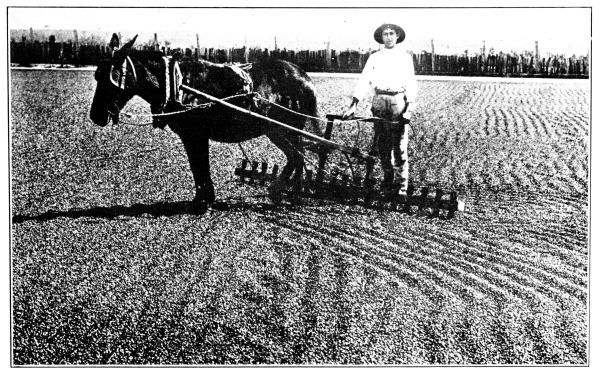
Coffee Drying Ground of the Cia.
Agricola Santa Sophia,
São Paulo, Brazil
[Pg 51] When thoroughly dry, the parchment can be crumbled between the fingers, and the bean within is too hard to be dented by fingernail or teeth.
The last step in the preparation process is called hulling or peeling, both words accurately describing the purpose of the operation. Some husking machines for hulling or peeling parchment coffee are polishers as well. This work may be done on the plantation or at the port of shipment just before the coffee is shipped abroad. Sometimes the coffee is exported in parchment, and is cleaned in the country of consumption, but practically all coffee entering the United States arrives without its parchment.
Peeling machines, more accurately named hullers, work on the principle of rubbing the beans between a revolving inner cylinder and an outer covering of woven wire. Machines of this type vary in construction. Some have screw-like inner cylinders, or turbines, others having plain cone-shaped cores on which are knobs and ribs that rub the beans against one another and the outer shell. Practically all types have sieve or exhaust-fan attachments, which draw the loosened parchment and silver skin into one compartment, while the cleaned beans pass into another.
Polishers of various makes are sometimes used just to remove the silver skin and to give the beans a special polish. Some countries demand a highly polished coffee; and, to supply this demand, the beans are sent [Pg 52] through another huller having a phosphor-bronze cylinder and cone. Much Guadeloupe coffee is prepared in this way, and is known as café bonifieur from the fact that the polishing machine is called in Guadeloupe the bonifieur (improver). It is also called café de luxe. Coffee that has not received the extra polish is described as habitant; while coffee in the parchment is known as café en parché. Extra polished coffee is much in demand in the London, Hamburg, and other European markets. A favorite machine for producing this kind of coffee is the Smout combined peeler and polisher, the invention of Jules Smout, a Swiss. Don Roberto O’Krassa also has produced a highly satisfactory combined peeler and polisher.
For hulling dry cherry coffee, there are several excellent makes of machines. In one style, the hulling takes place between a rotating disk and the casing of the machine. In another, it takes place between a rotary drum covered with a steel plate punched with vertical bulbs, and a chilled iron hulling plate with pyramidal teeth cast on the plate. Both are adjustable to different varieties of coffee. In still another type of machine, the hulling takes place between steel ribs on an internal cylinder, and an adjustable knife, or hulling blade, in front of the machine.
The coffee bean is now clean, the processes described in the foregoing having removed the outer skin, the saccharin pulp, the parchment, and the silver skin. This is the end of the cleaning operations; but there are two more steps to be taken before the coffee is ready for the trade of the world,—sizing and hand sorting. These two operations are of great importance; since on them depends, to a large extent, the price the coffee will bring in the market.
Sizing, or grading by sizes, is done in modern commercial practice by machines that automatically separate and distribute the different beans [Pg 53] according to size and form. In principle, the beans are carried across a series of sieves, each with perforations varying in size from the others; the beans passing through the holes of corresponding sizes. The majority of the machines are constructed to separate the beans into five or more grades, the principal grades being triage, third flats, second flats, first flats, and first and second peaberries. Some are designed to handle “elephant” and “mother” sizes. The grades have local nomenclature in the various countries.
After grading, the coffee is picked over by hand to remove the faulty and discolored beans that it is almost impossible to remove thoroughly by machine. The higher grades of coffee are often double-picked; that is, picked over twice. When this is done on a large scale, the beans are generally placed on a belt, or platform, that moves at a regulated speed before a line of women and children, who pick out the undesirable beans as they pass on the moving belt. There are small machines of this type built to be operated by one person, who moves the belt mechanism with a treadle.
In Brazil, the operation of some of the large fazendas requires a large number and a great variety of preparation machines and equipment. Generally considered, the state of São Paulo is better equipped with approved machinery than any other commercial district in the world.
Practically every fazenda in Brazil of any considerable commercial importance is equipped with the most modern of coffee-cleaning equipment. Some of the larger ones in the state of São Paulo, like the Dumont and the Schmidt estates, are provided with private railways connecting the fazendas with the main railroad line some miles away, and also have miniature railway systems running through the fazendas to move the coffee from one harvesting and cleaning operation to another. The coffee is carried in small cars that are either pushed by a laborer or are drawn by horse or mule. [Pg 54]
Some of the larger fazendas cover thousands of acres, and have several millions of trees, giving the impression of an unending forest stretching far away into the horizon. Here and there are openings in which buildings appear, the largest group of structures usually consisting of those making up the cafezale, or cleaning plant.
Brazilian fazendeiros follow the methods described in the foregoing in preparing their coffee for market, using the most modern of the equipment detailed under the story of the wet method of preparation. On most of the fazendas the machinery is operated by steam or electricity, the latter coming more and more into use each year in all parts of the coffee-growing region.
The workers on some of the largest Brazilian fazendas would constitute the population of a small city, more than a thousand families often finding continuous employment in cultivating, harvesting, cleaning, and transporting the coffee to market. For the most part, the workers are of Italian extraction, who have almost altogether superseded the Indian and Negro laborers of the early days. The workers live on the fazendas in quarters provided by the fazendeiros, and are paid a weekly or monthly wage for their services; or they may enter upon a year’s contract to cultivate the trees, receiving extra pay for picking and other work. Brazil in the past has experimented with the slave system, with government colonization, with cooperative planting, with the harvesting system, and with the share system; and some features of all these plans, except slavery, which was abolished in 1888, are still employed in various parts of the country, although the wage system predominates.
Brazil has six gradings for its São Paulo coffees, which are also classified as Bourbon Santos, flat bean Santos, and Mocha-seed Santos. Rio coffees are graded by the number of imperfections for New York, and as washed and unwashed for Havre. [Pg 55]
In Colombia, now (1924), next to Brazil the world’s largest producer, the wet method of preparing the coffee for market is most generally followed, the drying processes often being a combination of sun and drying machines. Many plantations have their own hulling equipment; but much of the crop goes in the cherry to local commercial centers, where there are establishments that make a specialty of cleaning and grading the coffee.
The Colombia coffee crop is gathered twice a year, the principal one in March and April and the smaller one in November and December, although some picking is done throughout the year. For this labor native Indian and Negro women are preferred, as they are more rapid, skilful, and careful in handling the trees. Contrary to the method in Brazil, where the tree at one handling is stripped of its entire bearings, ripe and unripe fruit, here only the fully ripened fruit is picked. That necessitates going over the ground several times, as the berries progressively ripen. More time is consumed in this laborious operation, but it is believed that thereby a better crop of more uniform grade is obtained and in the aggregate with less waste of time and effort.
Colombian planters classify their coffees as café trillado (natural or sun dried), café lavado (washed), café en pergamino (washed and dried in the parchment). They grade them as excelso (excellent), fantasia (excelso and extra), extra, primera (first), segundo (second), caracol (peaberry), monstruo (large and deformed), consumo (defective), and casilla (siftings).
Venezuela employs both the dry and the wet methods of preparation, producing both “washed” and “commons,” and also, like Colombia, has a large part of the coffee cleaned in the trading centers of the various coffee districts. Dry, or unwashed, coffees are known as trillado (milled), and compose the bulk of the country’s output. Venezuela’s plantation-working forces are largely natives of Indian [Pg 56] descent and Negroes; some of them coming during harvesting season from adjoining Colombia and returning there after the picking is done. Modern plantation machinery is very scarce; the ancient method of hulling coffee in a circular trough, where the dried berries are crushed by heavy wooden wheels drawn by oxen, is still a common sight in Venezuela. In preparing washed coffees, some planters ferment the pulped coffee under water (wet fermentation process), while others ferment without water (dry fermentation).
The planters in Salvador favor the dry method of coffee preparation, and the bulk of the crop is natural, or unwashed.
Most Guatemalas are prepared for market by the wet method. The gathering of the crops furnishes employment for half the population. German and American settlers have introduced the latest improvements in modern plantation machinery into Guatemala.
In Mexico, coffee is harvested from November to January, and large quantities are prepared by both the dry and the wet methods, the latter being practised on the larger estates that have the necessary water supply and can afford the machinery. Here, too, one will find coffee being cleaned by the primitive hand-mortar and wind-winnowing method. The laborers employed on the plantations are mostly half-breeds and Indians.
In Haiti, the picking season is from November to March. In recent years better attention has been paid to cultural and preparation methods, and the product is more favorably regarded commercially. Both dry and wet methods are employed in Haiti.
In Porto Rico, planters favor the wet method of coffee preparation. The crop is gathered from August to December. The coffees are graded as caracollilo (peaberry), primero (hand-picked), segundo (second grade), trillo (low grade). [Pg 57]
The wet method of coffee preparation is mostly favored in Nicaragua. Many of the large plantations are worked by colonies of Americans and Germans, who are competent to apply the abundant natural water power of the country to the operation of the modern coffee-cleaning machinery that has been introduced.
Costa Rica was one of the first countries of the western world to use coffee-cleaning machinery. Marcus Mason, an American mechanical engineer then managing an iron foundry in Costa Rica, invented three machines that would respectively peel off the husk, remove the parchment and pulp, and winnow the light refuse from the beans. Mason brought out other machines until he had developed a complete line that was largely used on coffee plantations in all parts of the world.
Modern cleaning machinery and methods of preparation are employed to some extent in the large coffee-producing countries of the eastern hemisphere, and do not differ materially from those of the western.
In Arabia, the fruit ripens in August or September, and picking continues from then until the last fruits ripen late in the March following. The cherries, as they are picked, are left to dry in the sun on the housetop terrace, or on a floor of beaten earth. When they have become partly dry, they are hulled between two small stones, one of which is stationary, while the other is worked by the hand power of two men who rotate it quickly. Further drying of the hulled berry follows. It is then put into bags of closely woven aloe fiber, lined with matting made of palm leaves. It is next sent to the local market at the foot of the mountain. There, on regular market days, the Turkish or Arabian merchants, or their representatives, buy and dispatch their purchases by camel train to Hodeida or Aden.
In Aden and Hodeida, the bean is submitted to further cleaning by the principal foreign export houses to which it has come from the mountains in rather dirty condition. Indian women are the sole laborers employed [Pg 58] in these cleaning houses. First, the coffee beans are separated from the dry empty husks by tossing the whole into the air from bamboo trays, the workers deftly permitting the husks to fly off while the beans are caught again in the tray. The beans are then surface cleaned by passing them gently between two very primitive grindstones worked by men. A third process is the complete clearing of the bean from the silver skin, and it is then ready for the final hand picking. Women are called into service again, and they pick out the refuse husks, quaker or black beans, green or immature beans, white beans, and broken beans, leaving the good beans to be weighed and packed for shipment. The cleaned beans are known as bun safi; the husks become kisher. Some of the poorer beans also are sold, principally to France and Egypt. Hand-power machinery is used to a slight extent, but mostly the old-fashioned methods hold sway.
The Yemen, or Arabian, bale, or package, is unique. It is made up of two fiber wrappers, one inside the other. The inside one is called attal or darouf. It is made from cut and plaited leaves of nakhel douin or narghil, a species of palm. The outer covering, called garair, is a sack made of woven aloe fiber. The Bedouins weave these covers and bring them to the export merchants at Aden and Hodeida. A Mocha bundle contains one, two, or four fiber packages, or bales. When the bundle contains one bale, it is known as a half; when it contains two, it is known as quarters; and when it contains four, it is known as eighths. Arabian coffee for Boston used to be packed in quarters only; for San Francisco and New York, in quarters and eighths. The longberry Abyssinian coffees were formerly packed in quarters only. Since the World War, however, there has been a scarcity of packing materials, and packing in quarters and eighths has stopped. Now, all Mocha, as well as Harar, coffee comes in halfs. A half weighs 80 kilos, or 176 pounds net, although a few exporters ship halfs of 160 pounds. [Pg 59]
Little machinery is used in the preparation of coffee in Abyssinia; none, in preparing the coffee known as Abyssinian, which is the product of wild trees, and, only in a few instances in cleaning the Harari coffee, the fruit of cultivated trees. Both classes are raised mostly by natives, who adhere to the oldtime dry method of cleaning. In Harar, the coffee is sometimes hulled in a wooden mortar; but for the most part it is sent to the brokers in parchment, and cleaned by primitive hand methods after its arrival in the trading centers.
In Angola, the coffee harvest begins in June, and it is often necessary for the government to lend native soldiers to the planters to aid in harvesting, as the labor supply is insufficient. After picking, the beans are dried in the sun for 14 to 40 days, depending upon the weather. After drying, they are brought to the hulling and winnowing machines. There are now about 24 of these machines in the Cazengo and Golungo districts, all manufactured in the United States and giving satisfactory results. They are operated by natives.
The coffee industry in Java and Sumatra, as well as in the other coffee-producing regions of the Dutch East Indies, was begun and fostered under the paternal care of the Dutch government, and for that reason machine cleaning has always been a noteworthy factor in the marketing of these coffees. Since the government relinquished its control over the so-called government estates, European operators have maintained the standard of preparation, and have adopted new equipment as it was developed. The majority of estates producing considerable quantities of coffee use the same types of machinery as their competitors in Brazil and other western countries. [Pg 60]
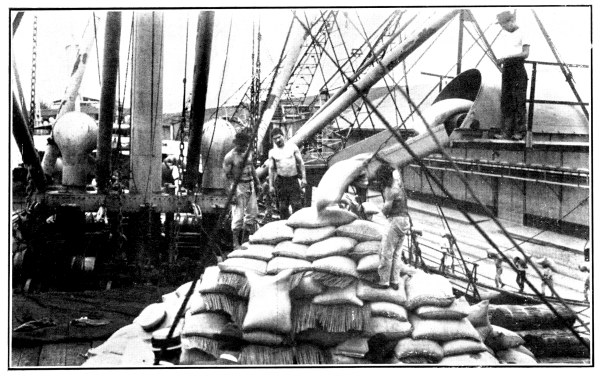
The Automatic Belt Pours Into the Hold a Continuous Stream
of Bags of Coffee at Santos
[Pg 61]
How green coffee is bought and sold in the countries of origin.
Buying coffee in the producing countries and shipping it to the consuming countries is an important branch of the coffee industry and one for which many years of constant study and application are required in order to achieve success.
Consider Brazil,—here is a country where a knowledge of Portuguese is the first essential for a foreigner seeking to do business in coffee. Many English, German, French, and American houses have branch offices in Rio and Santos, with resident buyers who have had long experience in the coffee business, an intimate knowledge of Brazil manners and customs, and are, moreover, able to converse fluently in the native tongue.
Buying coffee in Aden or Harar requires a knowledge of 10 different languages or dialects. Buyers in Java and Sumatra must understand Dutch and be able to speak the Sudanese tongues. One must have a good acquaintance with Spanish if he is to buy coffee successfully in Mexico and Central America.
The marketing begins when the dried coffee beans are swept up from the drying grounds or collected from the grading machines on the coffee estates and started on the way to the port of shipment.
In Brazil, the fazendeiro (grower) usually sends his crop to his commissario (commission merchant) at Santos, Rio, Victoria, [Pg 62] Bahia, etc. Here the coffee is cleaned and stored in private and public warehouses. At these warehouses samples of each bag are taken; the tester or sampler, standing at the door with a sharp tool, resembling a cheese tester, which he thrusts into the center of the bag as the men pass him with the bags of coffee on their heads, removing a double handful of the contents. The samples are divided into two parts; one for the seller, and one that the commissario retains until he has sold the consignment of coffee covered by that particular lot of samples.
The commissario puts his samples on the Street, one set at a time. He names his “asking” price, known locally as the pedido, which is the maximum rate he expects to get, but seldom receives. A set of samples may be shown to 25 or 30 exporting houses in a day, one at a time. When the sample is in the hands of a firm for consideration, no other exporter has the right to buy the lot even at the pedido price, and the commissario cannot accept other offers until he has refused the bid. On the other hand, if a house refuses to give up the samples, it is understood that it is willing to pay the pedido price. The firm first offering a price acceptable to the commissario’s broker gets the lot, even though other houses have offered the same price.
Having bought a lot of coffee, the Brazil buyer grades and tests it and ships it overseas. Where the exporter is Brazilian, he collects his money by drawing a draft against his American or European customer on deposit of bill of lading, cashing the draft through an exchange broker. The exporter must obtain a consular invoice, a shipping permit from both federal and state authorities, and pay several state and export taxes before the coffee is permitted to be sent aboard the ship. This process is known as “dispatching,” while the dock company’s charges are known as capitazias.
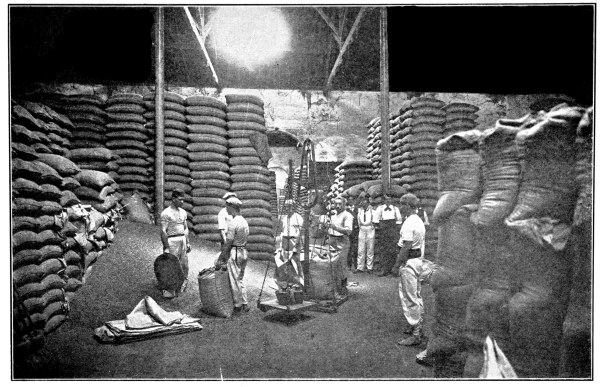
Weighing and Sacking Coffee in a Santos Warehouse
[Pg 63] In practically all coffee-growing sections the small planter is helped financially by the owners of processing plants or by the exporting firms. The larger planters may even obtain advances on their crops from the importing houses in New York, Havre, Hamburg, or other foreign centers.
In Santos, there is a coffee exchange known as the Bolsa de Café, to which coffee brokers of Brazilian citizenship may belong, but they must be indorsed by three reputable commission men or exporters, and may not themselves be a partner in any mercantile firm nor deal for their own account in spot or future coffees. Street transactions are permitted here, unlike the New York Exchange, and, as a matter of fact, the bulk of the business is done in the street, but the exchange must be informed of all transactions. Spot coffee is actual coffee in the warehouse; future coffee may still be on the trees. Rio also has an exchange, the Centro do Commercio de Café, which serves the Rio trade in similar fashion.
Under the Brazil government’s recent plan of permanent valorization, the regulation of coffee shipments in the state of São Paulo includes 10 government armazems, or storage warehouses, at strategic points throughout the coffee-growing districts. There is also one in the state of Rio. All coffee produced in the interior must pass through these warehouses. In this way the government regulates the arrival of coffee at ports of shipment. The fazendeiros are given negotiable warehouse receipts. These warehouses can handle a crop of 11,500,000 bags a year; Santos entries are restricted to 35,000 bags a day; Rio, to 12,000 bags daily.
In Abyssinia, coffee is grown by small farmers, who mostly finance themselves and sell the crop to native brokers, who in turn sell it to representatives of foreign houses in the larger trading centers. Trading methods between farmer and broker are not much more than the old system of barter. In the southwestern section, where Abyssinian coffee grows wild, transport to the nearest trading center is by mule [Pg 64] train, and not infrequently by camel back. In the Harar district, the women of the farmers living near Harar, the market center, carry the coffee in long shallow baskets on their heads to the native brokers. In the more remote places the coffee farmer waits for the broker to call upon him. From the town of Harar the coffee is transported by mule or camel train to Dire-Daoua, whence it is shipped by rail to Jibuti, to be sent by direct steamers to Europe, or across the Gulf of Aden to Aden in Arabia.
In Harar, the native dealer takes the coffee to the custom house; whence, after the government has been paid its tax, he sells it through brokers to European merchants. It may be cleaned at Harar or at Aden.
Most of the coffee in Arabia is grown in almost inaccessible mountain valleys by native Arabs, and is transported by camel caravan to Aden or Hodeida, where it is sold to agents of foreign importing houses. Mocha, once the principal exporting city for coffee, was abandoned as a coffee port early in the 19th century, chiefly because of the difficulty of keeping the roadstead of the harbor free from sand bars.
Mocha coffee, grown in the Yemen district of Arabia, comes from there to Aden by either sea or overland. Fully 60 percent comes by boat from Hodeida, 10 percent from other Red Sea ports, and 30 percent by camel caravan. Before the World War, many of the importing and exporting houses had agencies in Hodeida, where the finest qualities were bought on the spot; but since the war few of these agencies have again been opened, although the installations are in many cases there awaiting the developments of the market.
At present most of the coffee is bought in Aden from native merchants or brokers. These send around samples to exporting houses, which set the price they are willing to give, depending upon the amount of probable loss from impurities.
The coffee is generally packed 10 maunds. The maund is 28 pounds, and [Pg 65] there are four to the cwt. The coffee is usually repacked for export into bags of six to 6.4 maunds.
The methods of cleaning in Arabia are primitive. The principal work is done by Indian women and children, who sift and sort out the dirt, stones, and dead beans, leaving only beans of best quality. These are paid about one rupee for 10 maunds, and each can clean about a bag a day. In some houses the coffee is then put through a cleaning machine, which adds a finish to the process.
It costs about 25 cents a pound to buy coffee in 100-bag lots in Aden from a native broker. Harar coffee bought in Jubuti costs about 18 cents a pound in 300-bag lots.
In Java and Sumatra, coffee from private estates, not under government control and operated by European corporations or individuals, has now succeeded the government-monopoly coffee. Private estate crops are sold by public tender, usually on or about January 28 of each year. If the owners do not get the price they desire in Batavia or Padang, the coffee is sent to Amsterdam for disposal.
In Colombia before the World War, the coffee trade was in the hands of the larger exporters of the country, who were also the larger importing merchants. They made loans to their clients on the security of future crops. Such loans were usually represented by small stocks of merchandise and supplies, together with some cash. These accounts were taken up at the end of the picking season with coffee delivered to the merchant, who had the beans cleaned in the local coffee-cleaning plants, sacked, and shipped for export for his own account, the small planter really receiving a small part of the profit.
During the speculative period in 1919, which was induced by the high prices in New York for Colombian coffee, there was active competition [Pg 66] in coffee buying, intensified by the activity of a large American export and import concern, with the result that the producer received a much larger margin of profit for his coffee and more actual cash than ever before.
This situation has meant a revolution in the coffee trade and industry of Colombia. Instead of coming into town (the nearest large commercial center) about twice a year, at the end of the November-December and April-May-June picking seasons, to solicit goods and a small loan from his dealer, the small producer has been sought out for his product with cash offers. He has escaped from the prevailing high interest rates charged him, and has been able to buy where and how it has best suited his interests. He is no longer controlled by the local merchants, and has money in hand with which to enlarge his plantations, purchase better equipment, and improve his living conditions.
To understand fully the far-reaching effect of this situation, it should be borne in mind that, with the exception of the plantations of Cundinamarca, nearly all the coffee in the country is produced on small plantations owned and worked by individual planters of the poorer class.
Importing merchants of the coast cities of Barranquilla and Cartagena are large buyers of coffee in the interior, which they export for their own account, investing their surplus every year in coffee and hides for export.
Formerly most exports from Colombia to the United States were financed by 30-, 60-, and 90-day drafts drawn by the exporter (by arrangement with the American consignee), generally for two-thirds the market value of the merchandise at time of shipment, but during recent years American banks established in Colombia have handled a growing proportion of the export business to the United States. The producer turns over his coffee or hides to the bank for export, the bank recognizes a credit in his favor for two-thirds the market value, and when the goods are sold credits him with the balance, less expenses, [Pg 67] interest, commission, and exchange. The terms on which these credits are generally arranged, both locally and in New York, are 2½ percent commission plus interest, the latter item 12 percent for local transactions.
After the coffee is purchased in the producing countries, there are still to be reckoned the factors of additional expenses and time in shipment overseas before the consuming markets are reached. The freight rates are not constant, and the time required varies from four days for Mexicans to New Orleans, 11 to 18 days for Brazils to New York, 30 days for Javas to New York, and 20 to 40 days for Mochas from Aden to New York, depending on whether the ship comes direct or not.
[Pg 68]
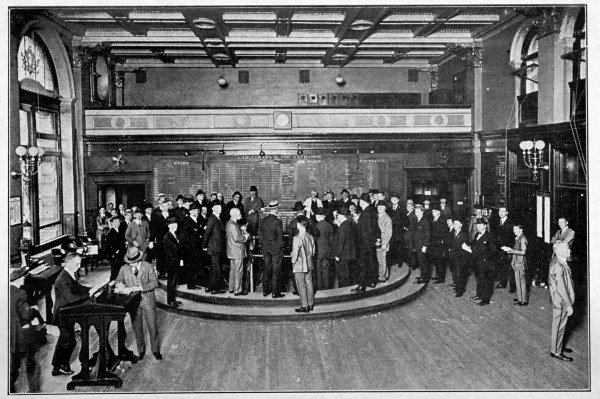
The Coffee Pit in the New York Coffee & Sugar Exchange
[Pg 69]
The seven stages of transportation—Handling coffee at New York—How green coffee is graded—Spot-market trading—Buying coffee C. & F.—Futures and hedging—Buying and selling commissions—Brokers—The Exchange Clearing House—Brazil quotations—London, Havre, and Hamburg markets—Rulings.
Green coffee passes through seven stages of transportation in its route from plantation to roaster. These are: First, from the drying grounds or cleaning plant to the railroad, river, mule, or camel, that, secondly, carries it to the city of export; thirdly, into the warehouse at point of shipment; fourthly, into the steamer for movement overseas; fifthly, out of the steamer and on to the wharf at port of destination; sixthly, from the wharf into the receiving warehouses; seventhly, from the warehouse to the roasting room.
Green-coffee buyers in the large importing centers of the United States and Europe recognize two distinct markets in their operations. One of these is called the “spot” market, because the importers, brokers, jobbers, and roasters trading there deal in actual coffee in warehouses in the consuming country. In New York the spot market is in the district of lower Wall Street, which includes a block or two each side on Front and Water Streets. Importers, roasters, dealers, and brokers here conduct their “street” sales.
The other market is designated as the “futures” market, in which the trading is not concerned with actual coffee, but with the purchase or [Pg 70] sale of contracts for future delivery of coffee that may still be on the trees in the producing country. Futures, or “options,” as they are frequently called, are dealt in only on a coffee exchange. The principal exchanges are in New York, Havre, and Hamburg. New Orleans and San Francisco exchange dealers trade on their local Boards of Trade.
Coffee-exchange contracts are dealt in just like stocks and bonds. They are settled by the payment of the difference, or “margin,” and it is seldom that the option of delivering actual coffee is executed. The operations generally are either in the nature of ordinary speculation on margin or for the legitimate purpose of effecting “hedges” against holdings or short sales of actual coffees.
The New York Coffee & Sugar Exchange, the most important in the world, because of the volume of its business, deals in all coffees from North, South, and Central America, the West Indies, and the East Indies, except the Robusta variety, and uses type No. 7 as the basis for all exchange quotations; all other types are judged in relation to it.
In determining the type, the coffee is graded by the number of imperfections in it. These are black beans, broken beans, shells, immature beans (“quakers”), stones, and pods. For counting the imperfections, the black bean has been taken as the basis, and all imperfections, no matter what they may be, are calculated in terms of black beans, according to a scale, which is practically as follows:
| 3 shells equal | 1 | black | bean |
| 5 quakers equal | 1 | ” | ” |
| 5 broken beans equal | 1 | ” | ” |
| 1 pod equals | 1 | ” | ” |
| 1 medium-size stone equals | 1 | ” | ” |
| 2 small stones equal | 1 | ” | ” |
| 1 large stone equals | 2 to 3 | ” | ” |
[Pg 71] By this scale, a coffee containing no imperfections would be classified as type No. 1. The test is made on one-pound samples. If a sample shows six black beans, or equivalent imperfections, it is graded as No. 2; if 13 black beans, as No. 3; if 29, as No. 4; if 60, as No. 5; if 110, as No. 6; if more than 110, as No. 7 or No. 8, which are graded by comparison with recognized exchange types. Coffees graded lower than No. 8 are not admissible to this country.
In the spot market, a trader may also buy or sell coffee “to arrive”; i. e., a consignment that is aboard ship on the way to market. Coffee is shipped to New York either on a consignment basis and sold for a commission, or it may have been bought in the shipping port and already be the property of an importer. When shipped on consignment, a wholesaler usually buys on the in-store contract, which provides that the purchaser must take delivery at the warehouse, though he is generally given a month’s storage privilege before removal of the coffee.
The practice among New York importers now is to buy coffee on either the basis of f. o. b. delivery steamer at loading port, or delivery c. & f. (cost and freight) or c. i. f. (cost, insurance, and freight), port of destination. Payment is made by letter of credit on a New York or London bank, entitling the exporter to draw at 90 days sight against the shipping documents, so that the shipment will be in the hands of the purchaser long before the draft is made.
Frequently, a jobber acts as his own importer of Brazil coffee, buying direct from the exporter without using the agency of a broker or a regular importing firm.
The following analysis shows the method of buying Brazil coffee “cost and freight”:
Minimum lots sold by reputable firms are 250 bags of a grade. Coffee from Brazil is shipped and billed on a uniform weight of 60 kilos, equal to 132 pounds a bag American.
The quotation for shipments from Brazil is “cost and freight,” which [Pg 72] means that the price covers the cost of the coffee and the freight to the seaport at which delivery is made. The freight is not prepaid by the shipper, but is deducted from the invoice, and only the net amount of the invoice is drawn for.
The buyer may elect to buy the coffee to be graded, on the types of the New York Coffee & Sugar Exchange, or he may take it on what is known as “Brazil grading.” If he elects to take it to be graded, the coffee on arrival is graded on the types, and if superior to the grade he must pay the excess; if it is below, the shipper pays for the deficiency. If bought on Brazil grading, the grade as shipped is final and must be accepted by the buyer. Probably 90 percent of the coffee sold to America is taken on Brazil grading, and it is really the most satisfactory way for the buyer to operate, assuming that he places his orders with thoroughly reputable shippers.
Marine insurance must be covered by the buyer, and it is customary for this insurance to cover the coffee up to time of arrival at buyer’s warehouse, without extra charge. Premiums on marine insurance for first-class vessels are about 30 cents per $100. It is customary for the trade to insure say 10 percent over the cost.
Shippers require that the buyer shall have issued in their favor a satisfactory and first-class letter of credit. Against such credits drafts are drawn at 90 days sight and invariably must be payable in New York. Bankers issuing credits demand that a set of documents—bill of lading, copy of the invoice, and consular certificate—accompany the draft. The draft is then sent from the shipping port for acceptance, and, if the documents are in order and as required by the terms of the letter of credit, drafts are accepted by the issuing banker and payable 90 days after it has been accepted. This practically means that the buyer usually has 75 to 85 days after the coffee arrives in America to pay for it.
Buyers should use fully as much care in buying for import as they do when selling their own merchandise, if not more, for a letter of credit is irrevocable and once issued cannot be canceled except by agreement of both parties to the document, the issuer and the receiver.
For a buyer of moderate-size lots, especially of described coffees, it is very important that his order be placed only with a house of established reputation and standing.
While coffee is shipped from Brazil at 132 pounds net weight, there is a loss in weight on the voyage up, generally due to climatic conditions, leakage in the bags, etc., and certainly not less than [Pg 73] three-quarters of one percent must be added to the cost for this deficiency. The loss by leakage in the bags is made up by what is known as “ship fills.” All of the coffee that leaks out of the bags in a cargo is collected at the seaports by the agents of the lines and apportioned equally among those having shipments on the steamer. These ship fills, of course, are a conglomeration of everything on the boat, and as a rule the loss from this feature is not at all excessive and frequently nothing at all.
The New York Coffee & Sugar Exchange was designed to be a market place for trading in coffee futures. As such it offers the protection of hedges to bankers and merchants. It operates after this fashion:
An American coffee importer buys a lot of coffee in Brazil. The coffee is likely to be on the way for 30 to 60 days, perhaps a longer or a shorter time. During all that time the merchant would be in a precarious position, having paid for the coffee in Brazil, probably partly on borrowed money or through banker’s credits, if he hadn’t immediately hedged that coffee in this market.
Hedging means selling “futures” in a quantity approximately equal to the shipment he is going to receive. When the coffee reaches New York, the merchant has it sampled, stored, etc., under the regulations of the exchange. He may sell a portion of it to a coffee roaster. Then he takes in his “hedges.” If a roaster buys more than he has immediate needs for, he too may put out hedges against it. Any grocer dealer may, in this way, buy more than he needs and protect himself by using futures.
The minimum rates of commission on coffee “per contract of 250 bags, for members of the exchange residing in the United States, are based upon a price” as seen on the next page, quoting from the exchange bylaws adopted June 8, 1920: [Pg 74]
Coffee Exchange Commission Rates
(Per contract of 250 bags)
| Floor | |||
| Commission | brokerage | ||
| for buying | for buying | ||
| or selling | or selling | ||
| Below 10 cents | $6.25 | $1.50 | |
| 10 cents up to 19.99 cents | 7.50 | 1.75 | |
| 20 cents and above | 10.00 | 2.00 |
For non-members residing within the United States, double the above rates of commission shall be charged.
For members and non-members residing outside of the United States, a commission of $2.50 shall be charged in addition to the above rates.
Whenever before 30 minutes after the close of the exchange a member gives to another member for clearance purchases and sales of contracts corresponding in all respects except as to price, made during the day by himself or for his account when present on the floor of the exchange, a charge for each contract shall be made equal to the corresponding floor brokerage rate for buying and selling, in addition to any floor brokerage incurred.
Members procuring business for other members may, by agreement, be entitled to one-half the commission rates for non-members prescribed in this section, less the corresponding brokerage charge, whether paid or not.
When a transferable notice is given or received by a customer in fulfillment of a contract, the brokerage in that case shall be not less than one-half of the corresponding buying or selling commission prescribed in Section 103.
In the coffee trade there are three kinds of brokers,—floor, spot, and cost and freight. Floor brokers are those who buy and sell options on the Coffee Exchange for a fixed consideration per lot of 250 bags.
Spot brokers are those who deal in actual coffee, selling from jobber to jobber, or representing out-of-town houses; the seller paying a commission of about 15 cents a bag in small lots, and half of one percent in large lots.
Cost-and-freight brokers represent Brazilian accounts, and generally receive a brokerage of one and one-quarter percent. On out-of-town [Pg 75] business, they usually split the commission with the out-of-town or “local” brokers. The out-of-town brokers sometimes, however, deal direct with the importer. All brokers except floor brokers are sometimes called “street brokers.” Most of the large New York, New Orleans, and San Francisco brokerage houses also do a commission business, handling one or more Brazilian or other coffee-producing country accounts.
There is considerable trading in future contracts; and a standard form has been adopted by the exchange. No future contracts are valid unless they are made in the following form:
Brazilian Coffee—Not Santos
Sold for M_____________________
To M_____________________
Thirty-two thousand five hundred pounds in about 250 bags coffee, growth of North, South, or Central America, West Indies, or East Indies, excepting coffee known as Robusta, and also any coffee of new or unknown growth, deliverable from licensed warehouse in the port of New York, between the first and last days of _______next, inclusive. The delivery within such time to be at seller’s option, upon a notice to buyer of either five, six, or seven days, as may be prescribed by the trade rules. The coffee to be of any grade, from No. 8 to No. 1 inclusive (no coffee to grade below No. 8), provided the average grade of Brazilian coffees shall not be above No. 3. Nothing in this contract, however, shall be construed as prohibiting a delivery averaging above No. 3 at the No. 3 grade. At the rate of________________cents per pound for No. 7, with additions or deductions for other grades according to the rates of the New York Coffee & Sugar Exchange, existing on the afternoon of the day previous to the date of the notice of delivery. Either party to have the right to call for margins as the variations of the market for like deliveries may warrant, which margins shall be kept good.
This contract is made in view of and in all respect subject to the rules and conditions established by the New York Coffee & Sugar Exchange, and in full accordance with section 102 of the bylaws.
[Pg 76]
Across the face is the following:
For and in consideration of one dollar to_____________________
in hand paid, receipt whereof is hereby acknowledged,____________
accept this contract with all its obligations and conditions.
All deliveries on such future contracts must be made from licensed warehouses. There is a separate “to arrive contract”; but this likewise requires delivery at a licensed warehouse, unless the buyer and the seller have a mutual understanding to deliver the coffee from dock or ex ship. Margins to protect the contract may be called for by either party. The largest deposit for margins was made in 1904, when $22,661,710 was deposited with the superintendent as required by the exchange rules.
The basic grade in a future sale is No. 7, but variations are provided as follows: 30 points for Rio, Victoria, and Bahia of all grades between 7 and 1, and of 50 points between 7 and 8; 50 points are allowed on Santos and all other coffees except between grades 1 and 2 and 2 and 3 Santos, which are allowed 30 points. Thus, the buyer and the seller when entering upon a transaction know exactly what the difference will be between the standard No. 7 and the coffee that can be delivered. The right to deliver any grade in a future transaction has done much to lessen the probability of corners in coffee; but this protection is further given by the stringent rule that the maximum fluctuations on the exchange can be only two cents a pound on coffee in one day and one cent on sugar. If greater changes should threaten, the exchange operations would automatically cease.
False or fictitious sales are prohibited, and all contracts must be reported to the superintendent. All contracts are binding and call for actual delivery.
The exchange, after careful investigation, issues licenses to certain specified warehouses, graders, and weighers, so that parties trading under its rules and regulations are well and fully protected. [Pg 77]
The board of managers has power to close the exchange or to suspend trading on such days or parts of days as would in their judgment be for the exchange’s best interest.
The Clearing Association is a recent outgrowth of the exchange, and is composed exclusively of exchange members. Every member has to bring his contracts up to market closing every night, either by making a deposit with the association to cover his balances, or by withdrawing in case he should be over. Members deposit $15,000 at the time of joining as a guaranty fund; and, if the surplus is not sufficient to take care of balances, the bylaws provide for the levying of assessments.
The daily quotations on the Coffee Exchanges of New York, Havre, and (before the war) of Hamburg determine to a large extent the price of green coffee the world over. The prices prevailing on the New York Coffee & Sugar Exchange are studied by coffee traders in all countries, the fluctuations being reflected in foreign markets as the reports come from the United States. Quotations are cabled from one great market to another; and, as each must heed those of the others to some extent, the coffee trade thus obtains a world price, and the effect on supply and demand is universal rather than local, as would be the case if quotations were not exchanged. In 1921, the exchange adopted an amendment to the trade rules which abolished the one-day transferable notice for both coffee and sugar.
Brazil Coffee Quotations
Brazil coffee cable quotations are the market prices in Rio or Santos of 10 kilograms of coffee; the price stated in milreis, the monetary unit of Brazil money. The basic grade of coffee at Rio is the No. 7 of the New York Coffee Exchange, and at Santos the international standard of good average (“g. a.”) Santos. One kilogram (often written “kilo” or [Pg 78] abbreviated to K.) is equal to 2⅕ pounds, and the 10-kilogram standard of quantity is therefore equivalent to 22 pounds, just one-sixth of a standard Brazil bag.
The money value is not so simple, since Brazilian paper currency is unstable; and the milreis quotation means nothing unless it is considered in connection with the rate of exchange for the same day; i. e., the current gold value of the milreis. This gold value is always given with the daily quotations from Brazil, and is expressed in British pence. The par value of the paper milreis (1,000 reis) is 32.45 cents of United States money, but its present actual value is only about 11¼. Our dollar sign is used to denote milreis, placing it after the whole number, and before the fractional part expressed in one-thousandths. Thus, 8¼ milreis would be written 8$250 Rs.
Suppose, for example, a Rio quotation is given at 8$400, with exchange at 7½d. (15 cents.) This means that 22 pounds of coffee have a gold value of 63 British pence (8.4 × 7½ = 63.0), or 5/3, as the Englishman would write it, which is equal to $1.27½, or 5.8 cents a pound.
Of course, the person familiar with Brazil quotations will not need to make this reduction to the pound-cent term in order to understand the figures. They will have a proper relative meaning to him in their original form; and it must not be overlooked that it is in this form only that they express correctly the value of the coffee in Brazil. It may make a great difference to the Brazil planter or exporter whether an increased gold value of his coffee arises through a higher milreis bid or an appreciated exchange, simply on account of local currency considerations. That is to say, the purchasing power of a milreis in Brazil will not necessarily vary exactly in proportion to the rate of exchange on London.
London, Havre, and Hamburg
London quotations are made in shillings and pence, on one hundredweight [Pg 79] (cwt.) of coffee. This cwt. is not 100 pounds, but 112 pounds, one-twentieth of the English ton (our long ton) of 2,240 pounds, and in all English coffee statistics the coffee quantities are expressed in this ton. A London quotation of 30/9 (30 shillings and 9 pence), for example, is equivalent to $7.44 for 112 pounds of coffee, or 6.64 cents a pound at the normal rate of exchange (which is figured as being $4.80 to $4.86 the pound sterling).
At Havre, the coffee price is given in francs, on a quantity of 50 kilograms. This is 110 pounds, almost as much as the British cwt. In normal times the franc is equal to 19.3 cents. A French quotation of 37½, for instance, means, therefore, $7.19 for 110 pounds of coffee, or 6.54 cents a pound.
The Hamburg quotation (formerly from Brazil per 50 kilos) is made on one pound German, equal to half-kilogram, and is expressed in pfennigs. One pfennig is one-hundredth of a mark, and the mark was once equal to 23.8 cents. A German quotation of, say, 31 means, therefore, 7.38 cents (31 × .238 = 7.378) for 1.1 pounds, or 6.71 cents a pound.
Under the government rulings no coffee grading below exchange type No. 8 may be imported to this country. Coffees below No. 8 generally contain a large proportion of sour or damaged beans, known in the trade as “black jack,” or damaged coffee, as found in “skimmings.” “Black jack” is a term applied to coffee that has turned black during the process of curing, or in the hold of a ship during transportation, or it may be due to a blighting disease.
Another ruling is intended to prevent the sale of artificially “sweated” coffee, which has been submitted to a steaming process to give the beans the extra-brown appearance of high-grade East India and [Pg 80] Mocha coffees which have been naturally “sweated” in the holds of vessels during the long journey to American ports.
Other rulings are to the effect that only coffees grown on the island of Java may be called Java; only Yemen coffee from Arabia may be labeled Mocha; painted, coated, or polished coffees are prohibited; Minas coffee may not be called Santos; also Coffea rubusta may not be sold as Java, even though it may have been grown on the island of Java.
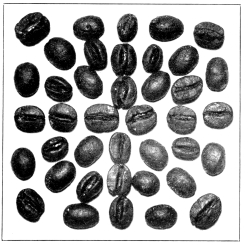
Flat bean and Bourbon Santos.
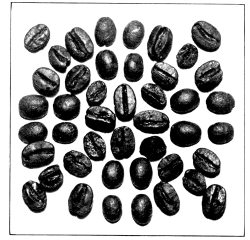
Rio.
Samples of Typical Roasted Coffee Beans
[Pg 81]
The trade values, bean characteristics, and cup merits of the leading coffees of commerce—Appearance, aroma, and flavor in cup testing—How experts test coffees—Typical sample-roasting and cup-testing outfit.
More than a hundred different kinds of coffee are bought and sold in the United States. All of them belong to the same botanical genus, and practically all to the same species, the Coffea arabica; but each has distinguishing characteristics which determine its commercial value in the eyes of importers, roasters, and distributers.
The American trade deals almost exclusively in Coffea arabica, although in the latter years of the World War increasing quantities of Robusta and Liberica growths were imported, largely because of the scarcity of Brazilian stocks and the improvement in the preparation methods, especially in the case of Robustas. Considerable quantities of Robusta grades were sold in the United States before 1912, but trading in them fell off when the New York Coffee & Sugar Exchange prohibited their delivery on exchange contracts after March 1, 1912.
All coffees used in the United States are divided into two general groups, Brazils and Milds. This is an arbitrary geographic, not a cup quality, designation. Brazils comprise those coffees grown in São Paulo, Minas Geraes, Rio de Janeiro, Bahia, Victoria, and other Brazilian states. The Milds include all coffees grown elsewhere. In 1921, Brazils made up about three-fourths of the world’s total [Pg 82] consumption. They are regarded by American traders as the “price” coffees, while Milds are considered as the “quality” grades.
Brazil coffees are classified into four great groups, which bear the names of the ports through which they are exported,—Santos, Rio, Victoria, and Bahia. Santos coffee is grown principally in the state of São Paulo; Rio, in the state of Rio de Janeiro and the state of Minas Geraes; Victoria, in the state of Espirito Santo; and Bahia in the state of Bahia. All of these groups are further subdivided according to their bean characteristics and the districts in which they are produced.
Under Mild coffees, the trade groups principally the coffees grown in Colombia, the four Central American republics, and Mexico. These supply the growths required for high-grade roasted coffee blends. The terms “mild” and “soft” should not be misunderstood as meaning deficient in body. As a matter of fact, these coffees are among the world’s fanciest, possessed of the finest flavor and fullest body.
Among the Mild coffees there is a much greater variation in characteristics than is found among the Brazilian growths. This is due to the differences in climate, altitude, and soil, as well as in the cultural, processing, storage, and transportation methods that are employed in the widely separated countries in which the coffees known as Milds are produced.
Mild coffees generally have more body, more acidity, and a much finer aroma than Brazils; and from the standpoint of quality they are far more desirable in the cup. As a rule, they have also better appearance, or “style,” both in the green and in the roast, due to the fact that greater care is exercised in picking and preparing the higher grades. Milds are important for blending purposes, most of them possessing distinctive individual characteristics, which increase their value as blending coffees. [Pg 83]
Not All Coffees Improve with Age
Although it has long been held that green coffee improves with age, and there is little doubt that this is true in so far as roasting merits are concerned, the question has been raised among coffee experts as to whether age improves the drinking qualities of all coffees alike.
Rio coffees should improve with age, as they are naturally strong and earthy. Age might be expected to soften and to mellow them and others having like characteristics. If, however, the coffee is mild in cup quality in the first instance, then it may be asked if age does not weaken it so that in time it must become quite insipid. Several years ago, a New York coffee expert pointed out that this was what happened to Santos coffees. The new crop, he said, was always a more pleasant and enjoyable drink than the old crop, because it was a more pronounced mild coffee in the cup.
Santos. Of the Santos growths, the best is that known in the trade as Bourbon, produced by trees grown from Mocha seed (Coffea arabica) brought originally from the French island colony of Bourbon (now Réunion) in the Indian Ocean. The true Bourbon is obtained from the first few crops of Mocha seed. After the third or fourth year of bearing, the fruit gradually changes in form, yielding in the sixth year the flat-shaped beans which are sold under the trade name of Flat Bean Santos. By that time, the coffee has lost most of its Bourbon characteristics. The true Bourbon of the first and second crops is a small bean, and resembles the Mocha, but makes a much handsomer roast with fewer “quakers.” The Bourbons grown in the Campinas district often have a red center.
As regards flavor, a good Bourbon Santos is considered the best coffee for its price, and is the most satisfactory low-cost blending coffee to [Pg 84] be obtained. It is used with practically any of the high-priced coffees to reduce the cost of the blend. When properly made, this coffee produces a drink that is smooth and palatable, without tang or special character, and is suitable to the average taste. When aged, Bourbon Santos decreases in acidity, and increases somewhat in size of bean.
The Santos coffee described as Flat Bean usually has a smooth surface, varying in size from small to large bean, and in color from a pale yellow to a pale green. The cup has a good and smooth body of neutral character, and the bean may be used straight or in a blend with practically any Mild coffee.
Another Santos growth, known in the trade as Harsh Santos, grows near the boundary between São Paulo and Minas Geraes. It often has some of the Rio characteristics, and commands a lower price than other Santos coffees.
Some trade authorities are of opinion that Santos coffees are an exception to the rule that most green coffees improve with age. They argue that careful cup testing will reveal that a new-crop Santos is to be preferred to an old crop.
All Santos coffees, washed or natural, are graded as, 1 Fine, 2 Superior, 3 Good, 4 Regular, 5 Ordinary, 6 Escolha.
Rios. Rio coffee is not generally liked in the United States, though in former years it had some following even in the better trade. The demand for all grades of Rios has been decreasing, Santos taking their place in the United States. Rio coffee has a peculiar, rank flavor. It has a heavy, pungent, and harsh taste which traders do not consider of value either in straight coffee or in blends. However, its low price recommends it to some packers, and it is often found in the cheapest brands of package coffees and also in many compounds. In color, the bean runs from light green to dark green; but when it is stored for any length of time—a common practice in the [Pg 85] past—the color changes to a golden yellow and the coffee is then known as Golden Rio. The bean also expands with age.
All Rio coffee is described by the name Rio; but the American trade recognizes eight different grades, designated by numerals from one to eight. These grades are determined by standards adopted by the New York Coffee & Sugar Exchange, and are classified by the number of imperfections found in the chops exported. No. 1 Rio contains no imperfections, such as black beans, shells, stones, broken beans, pods, or immature beans (“quakers”). Such a chop is rarely found. No. 2 has six imperfections, No. 3 has 13, No. 4 has 29, No. 5 has 60, No. 6 has 110, No. 7 has 200, and No. 8 has about 400, although on the exchange these last two are graded by standard types.
Victorias. Up to about the year 1917, Victoria coffees were held in even less favor by American traders than were Rios. As a rule, the bean was large and punky, of a dark brown or dingy color, and its flavor was described as muddy. Then, the coffee growers began to introduce modern machinery for handling the crops, with the result that the character of the product has been much improved, and the demand for it has been steadily growing. Many roasters who formerly used Rios straight for their lower grades have changed to Victorias, not only to improve the appearance of the roast, but to soften the harsh drinking qualities of the low-grade Rios.
Bahias. Until recent years Bahia coffee has been decidedly unpopular in the United States, largely because of its peculiar smoky flavor, due to drying the coffee by means of wood fires, instead of by the usual sun method. This practice has been abandoned; Bahia coffee has shown a marked improvement in quality; and importations into the United States have increased. The Bahia coffee produced in the Chapada district is considered to be the best of the [Pg 86] group. The bean is light-colored and of fair size. Other types are Caravella and Nazareth, both of which are below the standards demanded by the majority of those in the American trade.
Maragogipe. This is a variety of Coffea arabica first observed growing near the town of Maragogipe on All Saints Bay, county of Maragogipe, Bahia, Brazil, where it is called Coffea indigena. The green bean is of huge size, and varies in color from green to dingy brown. It is the largest of all coffee beans, and makes an elephantine roast, free from quakers, but woody and generally disagreeable in the cup. However, Dr. P. J. S. Cramer of the Netherlands government’s experimental garden in Bangelan, Java, regards it very highly, referring to it as “the finest coffee known,” and as having “a highly developed, splendid flavor.” This coffee is now found in practically all the producing countries, and shows the characteristics of the other coffees produced in the same soil.
Mexicans. Considering those mild coffees grown nearest the American market first, we come to the coffees of Mexico. All coffees grown in this republic are known as Mexicans. They are further divided according to the states and districts in which they are produced, and as to whether they are prepared according to the wet or the dry method. The types best known in the American market are Coatepec, Huatusco, Orizaba, Cordoba, Oaxaca, and Jalapa. The lesser known are the Uruapan, Michoacan, Colima, Chiapas, Triunfo, Tapachula, Sierra, Tabasco, Tampico, and Coatzacoalcos. Some of these are rarely seen in the markets of the United States.
The coffee most cultivated in Mexico is supposed to have come from Mocha seed. Of this species is the Oaxaca coffee, which is valued because of its sharp acidity and excellent flavor, two qualities that make it desirable for blending. The bean of the Sierra Oaxaca (common unwashed) is not large, nor is the appearance stylish. The Pluma Oaxaca (washed) coffee, however, is a fancy bean and good for blending purposes.
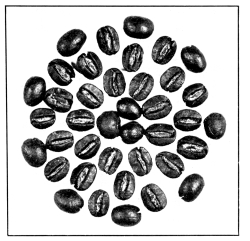
Mexican.
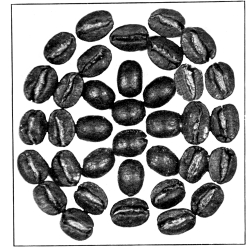
Guatemala.
Samples of Typical Roasted Coffee Beans
[Pg 87] Coatepec coffees are among the finest grown in Mexico, and take rank with the world’s best grades. They are quite acidy, but have a desirable flavor; and, when blended with coffees like Bourbon Santos, make a satisfactory cup.
The Orizaba, Huatusco, and Jalapa growths resemble Coatepecs, of which they are neighbors in the state of Vera Cruz. They are thin in body, but are stylish roasters, and have good cup qualities. As a class they do not possess the heavy body and acidity of genuine Coatepecs. Some Huatuscos are exceptions. Orizaba is superior to Jalapa. Chiapas and Tapachula coffees are generally more like Guatemalan growths than any others produced in Mexico, which is natural in view of the proximity of the districts to the northern boundary of Guatemala. The Sierra, Tampico, Tabasco, and Coatzacoalcos coffees are uncertain in quality; mostly they are low grade, some of them frequently possessing a groundy, flat, or Rioy flavor.
Cordoba coffees lack the acidity and tang of the Oaxacas, but make a handsome roast. They are considered too neutral to form the basis of a blend, but may be used to balance the tang of other grades.
All Mexicans are classed as Commons (customary or natural), washed (W. I. P.), and Caracollilo (peaberry).
Central Americans. Central American coffee is the general trade name applied to the growths produced in Guatemala, Honduras, Salvador, Nicaragua, Costa Rica, and Panama, the countries comprising Central America.
Guatemala. This country sends the largest quantity to the United States, and also produces the best average grades of the Central American districts. Guatemalas are mostly washed and are very stylish. The bean has a waxy, bluish color. It splits open [Pg 88] when roasting and shows a white center. Low-grown Guatemalas are thin in the cup, but the coffees grown in the mountainous districts of Coban and Antigua are quite acidy and heavy in body. Some Cobans border on bitterness because of the extreme acidity. The Antiguas are medium, flinty beans, while Cobans are larger. Both grades are spicy and aromatic in the cup, and are particularly good blenders. Properly roasted to a light cinnamon color, and blended with a high-grade combination, Cobans make one of the most serviceable coffees on the American market.
Most Guatemalas are washed and fall into these five general classes: 1. The extremely acid and flavory high-altitude growths of Antigua, Moran, and Amatitlan. 2. The heavy-bodied and finely acid coffees grown in the mountain districts of Coban, Costa Cuca, Tumbador, and Chuva. 3. The heavy-bodied but non-acid coffees in altitudes of 2,000 to 3,000 feet. 4. Mild-cupping coffees grown from 1,500 to 2,500 feet. 5. Lower-altitude neutral-cupping coffees of the Bourbon type.
Honduras. While the upland coffee of Honduras is of good quality, the general run of the country’s production seldom brings as high a price as Santos of equal grade. Nearly all Honduras coffee consists of small, round berries, bluish-green in color. Very little of this growth comes to the United States, the bulk of the exports going to Europe, where they command a high price, especially in France.
Salvador. Salvador coffee is inferior to Guatemala’s product, grade for grade. Only a small proportion is washed, and the bulk of the crops is “naturals”; that is, unwashed. The bean is large and of fair average roast. The washed grades are fancy roasters, with very thin cup. The largest part of the production goes to Europe; some 25 percent of the exports are brought into the United States through San Francisco.
Nicaragua. The ordinary run of Nicaragua coffee (the naturals) [Pg 89]is looked upon in the United States as being of low quality, though the washed coffees from the Matagalpa district have plenty of acid in the cup and usually are fine roasters. Matagalpa beans are large and blue-tinged. Germany, Great Britain, and France take about all the Honduras coffee exported, only about six percent of the total coming to the United States.
Costa Rica. Good grades of Costa Rican coffee, such as are grown in the Cartago, San José, Alajuela, and Grecia districts at high altitudes, are highly esteemed by blenders. They are characterized by their fine flavor, rich body, and sharp acidity. It is frequently declared that some of these are often acidy enough to sour cream if used straight. Due to careless methods of handling, sour or “hidy” beans are sometimes found in chops of Costa Ricans from the low-lands.
Panama. Panama grows coffee only for domestic use, and consequently it is little known in foreign markets. The bean is of average size and tends toward green in color. In the cup it has a heavy body and a strong flavor. The coffee grown in Boquette Valley is considered to be of fine quality, due no doubt to the care given in cultivation by the American and English planters there.
Colombians. Colombia produces some of the world’s finest coffees, of which the best known are Medellins, Manizales, Bogotas, Bucaramangas, Tolimas, and Cucutas. Old-crop Colombians of the higher grades, when mellowed with age, have many of the characteristics of the best East India coffees, and in style and cup are difficult to distinguish from the Mandhelings and the Angolas of Sumatra. Such coffees are scarce on the American market, practically all the shipments coming to the United States being new crop and lacking some of the qualities of the mellowed beans. Compared with Santos coffee, good-grade Colombians give one-fourth more liquor to a [Pg 90] given strength with better flavor and aroma. They are classed and graded as:
Classes for All Colombians
Café Trillado (natural or sun dried), Café Lavado (washed).
Gradings for All Colombians
Excelso (excellent), fantasia (excelso and extra), extra (extra), primera (first), segunda (second), caracol (peaberry), monstruo (large and deformed), consumo (defective), pasilla (siftings).
Medellins are a fancy, mountain-grown coffee, and are esteemed for their good qualities. The beans vary in size, and the color ranges from light to dark green, making a rather rough roast. In the cup they have a fine, rich, distinctive flavor, and in the American grading are regarded as the best of Colombian commercial growths.
Manizales rank next to Medellins, and have nearly the same characteristics.
Bogotas of good grade are noted for their acidity, body, and flavor. When the acidity is tempered with age, the coffee can be drunk “straight,” which cannot be done with many other growths. The Bogota green bean ranges from a blue-green bean to a fancy yellow. It is long, and generally has a sharp turn in one end of the center stripe. It is a smooth roaster, and has a rich mellow flavor.
Bucaramangas, grown in the district of that name, are regarded favorably in the American markets as good commercial coffees for blending purposes; the naturals have heavy body, but lack acidity and decided flavor, and are much used to give “backbone” to blends. The fancies sometimes push the superior East Indias for first place.
Tolimas are considered a good-grade average coffee, and are characterized by a fair-sized bean, attractive style, and good cup quality.
Cucuta coffees, though grown in Colombia, are generally classified among the Maracaibos of Venezuela, because they are mostly shipped from that port. They are described, accordingly, with the Venezuelan coffees.
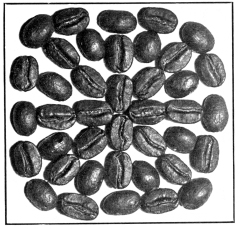
Bogota, Colombia.
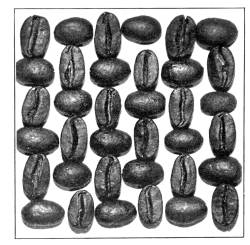
Maracaibo.
Samples of Typical Roasted Coffee Beans
[Pg 91] Venezuela. The coffees of Venezuela are generally grouped under the heads of Caracas, Puerto Cabello, and Maracaibo, the names of the ports through which they are exported. Each group is further subdivided by the names of the districts in which the principal plantations lie. La Guaira coffee includes that produced in the vicinity of Caracas and Cumana.
Caracas coffee is one of the best known in the American market. The washed Caracas is in steady demand in France and Spain. The bean is bluish in color, somewhat short, and of uniform size. The liquor has a rather light body. Some light-blue washed Caracas coffees are very desirable, and have a peculiar flavor that is quite pleasant to the educated palate. Caracas chops rarely hold their style for any length of time, as the owners usually are not willing to dry properly and thoroughly before milling. When, however, the price is right, American buyers will use some Caracas chops instead of Bogotas. At equal prices the latter have the preference, as they have more body in the cup. Puerto Cabello and Cumana coffees are valued just below Caracas. They are grown at a lower altitude, and have been found to be somewhat inferior in flavor.
Merida and Tachira coffees are considered the best of the Maracaibo grades, Tovars and Trujillos being classed as lower in trade value. Though Cucuta coffee is grown in the Colombian district of that name, it is largely shipped through Maracaibo, and hence is classed among the Maracaibo types. It ranks with Meridas and fine-grade Boconos, and somewhat resembles the Java bean in form and roast, but is decidedly different in the cup. Washed Cucutas are noted for their large size, roughness, and waxy color. They make a good-appearing roast, splitting open, and showing irregular white centers. New-crop beans are sometimes sharply acid, though they mellow with age and gain in body. [Pg 92]
Until recent years, Tachira coffee was always sold as Cucuta; but now there is a tendency to ship it under the name Tachira-Venezuela, while true Cucuta is marked Cucuta-Colombia. Tachiras closely resemble the true Cucutas, grade for grade. Up to about 1905, the coffees grown near Salazar, in Colombia, came to market under the name of Salazar; but since then they have been included among the Cucuta grades and are sold in the market under that name.
The state of Tachira lies next to the Colombian boundary, and its mountains produce much fine washed coffee. This has size and fair style, as a rule, but does not possess cup qualities to make it much sought. It ages well and, being of good body, the old crops, other things being equal, frequently bring a tidy premium. The Rubio section of Tachira produces the best of its washed coffees.
The Meridas are raised at higher altitudes than Cucutas, and good grades are sought for their peculiarly delicate flavor—which is neither acidy nor bitter—and heavy body. They rank as the best by far of the Maracaibo type. The bean is high-grown, of medium size, and roundish. It is well knit, and brings the highest price, while it still holds its bluish style, as it then retains its delicate aroma and character. The trillados of Merida run unevenly.
Tovars rank between Trujillos and Tachiras. They are fair to good body without acidity; make a duller roast than Cucutas, but contain fewer quakers. They are used for blending with Bourbon Santos. Boconos are light in color and body. They are of two classes; one a round, small to medium bean; and the other larger and softer. Their flavor is rather neutral, and they are frequently used as fillers in blends. Trujillos lack acidity and make a dull, rough roast, unless aged. They are blended with Bourbon Santos to make a low-priced palatable coffee. Some coffees of merit are produced at Santa Ana, Monte Carmelo, and Bocono in Trujillo. [Pg 93]
Other South American Countries. The coffees from other South American countries, even where there is an appreciable production, are not important factors in international trade. The coffee of Ecuador, shipped through the port of Guayaquil, goes mostly to Chile, a comparatively small quantity being exported to the United States. The bean is small to medium in size, pea-green in color, and not desirable in the cup. The coffee is about equal to low-grade Brazil, and is used principally as a filler. Peru produces an ever-lessening quantity of coffee, the bulk of the exports in prewar years going to Germany, Chile, and the United Kingdom. It is a low-altitude growth, and is considered poor grade. The bean ranges from medium to bold in size, and from bluish to yellow in color. Bolivia is an unimportant factor in the international coffee trade, most of its exports going to Chile. The chief variety produced is called the Yunga, which is considered to be of superior quality, but only a small quantity is grown. Guiana’s coffee trade is insignificant. The three best known types are the Surinam, Demerara, and Cayenne, named after the ports through which they are shipped.
West Indies. The chief producing districts are found on the islands of Porto Rico, Haiti (and Santo Domingo), Jamaica, Guadeloupe, and Curaçao. Coffees coming from these islands are generally known by the name of the country of production, and may be further identified by the names of the districts in which they are grown.
Porto Rico. Since the United States took possession of Porto Rico, soil experts have endeavored to raise the quality of the coffee grown there, especially the lower grades, which had peculiarly wild characteristics. Today, the superior grades of Porto Rican coffees rank among the best growths known to the trade. The bean is large, uniform, and stylish; ranging in color from a light gray-blue to a dark [Pg 94]green-blue. Some of these are artificially colored for foreign markets. The coffee roasts well, and has a heavy body, similar to the fanciest Mexicans and Colombians. Its cup is not so rich, but it makes a good blend. Porto Rican coffees command a higher price in France than in the United States, which accounts for the larger proportion of exports to Europe, excepting when the French market was cut off during the World War.
Jamaica. Jamaica produces two distinct types of coffee, the highland and the lowland growths. Among the first-named is the celebrated Blue Mountain coffee, which has a well-developed pale blue-green bean that makes a good-appearing roast and a pleasantly aromatic cup. It is frequently compared with the fancy Cobans of Guatemala. The lowland coffee is a poorer grade, and consists largely of a mixture of different growths produced on the plains. It is a fair-sized bean, green to yellow in the “natural” and blue-green when washed. In the cup it has a grassy flavor, but is flat when drunk with cream. It is used chiefly as a filler in blends and for French roasts.
Haiti and Santo Domingo. The coffees of these two republics have like characteristics, being grown on the same island and in about the same climatic and soil conditions. Careless cultivation and preparation methods are responsible for the generally poor quality of these coffees. When properly grown and cured, they rank well with high-grade washed varieties, and have a rich, fairly acid flavor in the cup. The bean is blue-green, and makes a handsome roast.
Guadeloupe. Guadeloupe coffee is distinguishable by its green, long, and slightly thick bean, covered by a pellicle of whitish silvery color, which separates from the bean in the roast. It has excellent cup qualities.
Martinique. This island formerly produced a coffee closely resembling the Guadeloupe; but no coffee is now grown there, though some Guadeloupe growths are shipped from Martinique, and bear its name. [Pg 95]
Other West Indian Islands. Among the other West Indian islands producing small quantities of coffee are Cuba, Trinidad, Dominica, Barbados, and Curaçao. The growths are generally good quality, bearing a close resemblance to one another. In the past, Cuba produced a fine grade; but the industry is now practically extinct, though it has lately showed signs of revival.
Arabia. For many generations, Mocha coffee has been recognized throughout the world as the best coffee obtainable; and, until the Pure Food Law went into effect in the United States, other high-grade coffees were frequently sold by American firms under the name of Mocha. Now, only coffees grown in Arabia are entitled to that valuable trade name. They grow in a small area in the mountainous regions of the southwestern portion of the Arabian peninsula, in the province of Yemen, and are known locally by the names of the districts in which they are produced. Commercially they are graded as follows: Mocha Extra, for all extra qualities; Mocha No. 1, consisting of only perfect berries; No. 1-A, containing some dust, but otherwise free of imperfections; No. 2, showing a few broken beans and quakers; No. 3, having a heavier percentage of broken and quakers and also some dust.
Mocha beans are very small, hard, roundish, and irregular in form and size. In color, they shade from olive green to pale yellow, the bulk being olive green. The roast is poor and uneven, but the coffee’s virtues are shown in the cup. It has a distinctive winy flavor, and is heavy with acidity, two qualities which make a straight Mocha brew especially valuable as an after-dinner coffee, and also esteemed for blending with fancy, mild, washed types, particularly East Indian growths.
As in other countries, the coffees grown on the highlands in Yemen are better than the lowland growths. As a rule, the low-altitude bean is larger and more oblong than that grown in the highlands, due to its [Pg 96] quicker development in the regions where the rainfall, though not great, is more abundant.
While Mocha coffees are known commercially by grade numbers, the planters and Arabian traders also designate them by the name of the district or province in which each is grown. Among the better grades thus labeled are the Yafey, the Anezi, the Mattari, the Sanani, the Sharki, and the Haimi-Harazi. For the poorer grades, these names are used: Remi, Bourai, Shami, Yemeni, and Maidi. Of these varieties, the Mattari, a hard and regular bean, pale yellow in color, commands the highest price, with the Yafey a close second. Harazi coffee heads the market for quantity, coupled with general average of quality.
India and Ceylon. Coffees from India and Ceylon are marketed almost exclusively in London, little reaching the American trade. Of the Indian growths, Malabars, grown on the western slope of the Ghat Mountains, are classed commercially as the best. The bean is rather small and blue-green in color. In the cup it has a distinctive strong flavor and deep color. Mysore coffee ranks next in favor on the English market. It is mountain grown, and the bean is large and blue-green in color. Tellicherry is another good-grade coffee, closely resembling Malabar. Coorg (Kurg) coffee is an inferior growth. It is lowland type, and in the cup is thin and flat. The bean is large and flat, and tends toward dark green in color. Travancore is another lowland growth, ranking about with Coorg, and has the same general characteristics. See the Complete Reference Table in All About Coffee for details.
Ceylon, although it once was one of the world’s most important producers, has been losing ground as a coffee-producing country since 1890. Ceylon coffees are classified commercially as “native,” “plantation,” and “mountain.” [Pg 97]
French Indo-China. The coffee of French Indo-China is highly prized in France, where the bulk of the exports goes. The coffee tree grows well in the provinces of Tonkin, Annam, Cambodia, and Cochin-China. Tonkin is the largest producer, and grows the best varieties. In the cup, Tonkin coffee is thought by French traders to compare favorably with Mocha. Of the several varieties of Coffea arabica grown in Indo-China, the Grand Bourbon, Bourbon rond, and Bourbon Le Roy are the best known. The first-named is a large bean of good quality; the second is a small, round bean of superior grade; and the third is a still smaller bean of fair cup quality.
Abyssinia. The coffee grown in Abyssinia is classified commercially into two varieties; Harari, which is grown principally in the district around Harar, and Abyssinian, produced mainly in the provinces of Kaffa, Sidamo, and Guma. Harari coffee is the fruit of cultivated trees, while Abyssinian comes from wild trees. The first-named produces a long and well-shaped berry, and is often referred to as Longberry Harari. The bean is larger than the Mocha, but similar in general appearance. Its color shades from blue-green to yellow. Good grades of Harari have cup characteristics resembling Mocha, and by some are preferred to Mocha, because of their winier cup flavor. The Abyssinian coffee is considered much inferior to Harari, and chops generally contain many imperfections. The bean is dark gray in color. Little Abyssinian coffee comes to the United States.
Many other African countries produce coffee, but little of it ever reaches the North American market. Uganda, in British East Africa, grows a good grade of Robusta coffee, which is valued on the London market. Liberian coffee, grown on the west coast, used to be mixed with Bourbon Santos to some extent; but it is generally considered low grade, although it makes a handsome, elephantine roast. The product of Guinea is a very small bean, half way between a peaberry [Pg 98] and a flat bean, and has a dingy brown color. It is considered worthless as a drink. A medium-sized, strong-flavored bean that is rich in the cup is grown in the African Congo district. In Angola a fair quantity of coffee is produced. In the cup it has a strong and pungent flavor, but lacks smoothness and aroma. Zanzibar produces a pleasing coffee in very limited quantities. The bean is medium size, and regular in shape. Mozambique’s coffee is greenish in color, of medium size, and mellow. The production is small. Madagascar produces an insignificant quantity for export, although the coffee is considered fair average, with rich flavor, and considerable fragrance. Bourbon coffee, grown on the island of Réunion, commands a high price in the French market, where practically all exports go. It is a small, flinty bean, and gives a rich cup and fragrance.
East Indian Islands. Some of the coffees from the East Indian islands rank among the best in the world, particularly those from Sumatra. East India coffees are distinguished by their smooth, heavy body in the cup, the fancy grades giving an almost syrupy richness.
Java. Java coffees are generally of a smaller bean than those from Sumatra, and are not considered so high grade. The bulk of the new-crop growths have a grassy flavor which most people find unpleasant when drunk straight. Under the old culture system, coffee was bought by the government, and held in godowns from two to three years, until it had become mellow with age. In late years, this system has been abandoned, and the planters now sell their product as they please, and in most cases without mellowing excepting as they age during the long sea voyage from Batavia to destination. Before the advent of large fleets of steamers in the East Indian trade, the coffee was brought to America in sailing vessels that required from three to four months for the trip. During the voyage, the coffee went through a sweating process which turned the beans from a light green to a dark brown, and considerably enhanced their cup values. The sweating was due to the coffee being loaded when moist, and then practically sealed in the vessel’s hold during all its trip through the tropical seas. As a consequence, the cargo steamed and foamed, and as a rule part of the coffee became moldy, the damage seldom extending more than an inch or two into the mats. Sweated coffees commanded from three to five cents more than those that came in “pale.”
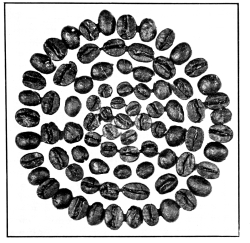
Mocha.
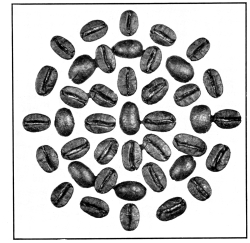
Washed Java.
Samples of Typical Roasted Coffee Beans
[Pg 99] Before the Java coffee trade began to decline in the latter part of the 19th century, Coffea arabica was grown abundantly throughout the island. Each residency had numerous estates, and their names were given to the coffees produced. The best coffees came from Preanger, Cheribon, Buitenzorg, and Batavia, ranking in merit in the order named. All Java coffees are known commercially either as private growth, or as blue bean washed, the former being cured by either the washing or the dry hulling method, while the latter are washed. Private growths are usually a pale yellow, the bean being short, round, and slightly convex. It makes a handsome, even roast, showing a full white stripe. The washed variety is a pale blue-green, the bean closely resembling the private growth in form and roast. These coffees have a distinctive character in the cup that is much different from any other coffee grown. Their liquor is thin.
All the better known coffees of Java, which are designated by the districts in which they are grown, are listed in the Complete Reference Table in All About Coffee. Coffee from a few of the many districts comes to the North American market. Among those which are sold in the United States are the Kadoe and Samarang, both of which are small, yellowish green, and the Malang, a green, hard bean which makes a better roast than Kadoe and Samarang, but is inferior to them in the cup. [Pg 100]
Sumatra. Sumatra has the reputation of producing some of the finest and highest-priced coffees in the world, such as Mandheling, Angola, Ayer Bangies, Padang Interior, and Palembang. Mandheling coffee is a large, brownish bean which roasts dull, but is generally free from quakers. It is very heavy in body, and has a unique flavor that easily distinguishes it from any other growth. The Angola bean is shorter and better appearing than Mandheling, but otherwise bears a close resemblance. Its flavor is only slightly under Mandheling, and, like that coffee, it is recommended for blending with the best grades of Mocha. While the Ayer Bangies bean is somewhat larger than the other two just mentioned, it is not so dark brown in color, and is not quite so heavy in body; the flavor is very delicate. These three growths are known in the trade as the “Fancies,” and are considered the best of Sumatra’s production.
The Sumatra coffee best known to the American trade is the Padang Interior, which is shipped through the port of Padang on Sumatra’s west coast. The bean is irregular in form and color, and makes a dull roast. However, the flavor is good, although it lacks the richness of the Fancies. Another celebrated coffee grown on the west coast is the Boekit Gompong, grown on the estate of that name near Padang. It is a high-grade coffee, making a handsome roast, and possessing a delicate flavor. The foregoing coffees are produced on what were formerly termed government estates, and during the heyday of government control were sold by auction and came mostly to the United States.
Among the private estate coffees, Corinchies take first rank for quality, some traders saying that they are the best in international commerce. They closely resemble Angolas, but range a cent or two lower in price. Next in order of merit is Timor coffee, grown on the island of that name. It is not so attractive in appearance, roast, or cup quality as the Corinchie. A grade below Timors is Boengie coffee, which is seldom seen on the North American market. Kroe coffee is better known and more widely used in the United States. The bean is large, but [Pg 101] has an attractive appearance. Kroes are of heavy body, of somewhat groundy flavor when new crop, and are good roasters and blenders. Other East Indian coffees are Teagals, Balis, and Macassars, all of which are second-rate growths as compared with the bulk of Sumatras, grade for grade. The Macassars are produced in the district of that name on island of Celebes. The best coffee grown in Celebes comes from the province of Menado, and is known by that name. It is thought to be of superior quality, and commands a high price in Europe.
The Pacific Islands. The Philippine Islands have not figured in international coffee trade since 1892, although in preceding years they exported several million pounds of an average good grade of coffee. While coffee is one of the shade trees used by householders in Guam, none of the fruit is exported. Coffee production is an unimportant industry in Samoa, Australia, New Guinea, New Caledonia, and other Pacific islands, and none is grown for export.
Hawaii. Since the beginning of the 20th century, the Hawaiian Islands have taken a position of increasing importance, shipping some 2,000,000 pounds of good-quality coffee to the United States, their biggest customer. Coffee grows to some extent on all the islands of the group, but fully 95 percent is raised in the districts of Kona, Puna, and Hamakua on the main island of Hawaii. All Hawaiian coffee is high grade, and is generally large bean, blue-green in color when new crop, and yellow-brown when aged. It makes a handsome roast, and has a fine flavor that is smooth and not too acid. It blends well with any high-grade mild coffee. Kona coffee, grown in the district of that name, commands the highest price. Old-crop Kona coffee is said by some trade authorities to be equal to either Mocha or Old Government Java.
Before the beginning of the 20th century, practically all coffees [Pg 102] bought and sold in the United States were judged for merit simply by the appearance of the green or roasted bean. Since that time, the importance of testing the drinking qualities has become generally recognized, and today every progressive coffee buyer has his sample-roasting and testing outfit with which to carry out painstaking cup tests. Both buyers and sellers use the cup test, the former to determine the merits of the coffee they are buying, and the latter to ascertain the proper value of the chop under consideration. Frequently a test is made to fix the relative desirability of various growths considered as a whole, using composite samples that are supposed to give representation to an entire crop.
The first step in testing coffee is to compare the appearance of the green bean of a chop with a sample of known standard value for that particular kind of coffee. The next step is to compare the appearance when roasted. Then comes the appearance and aroma test, when it is ground; and finally, the most difficult of all, the trial of the flavor and aroma of the liquid.
Naturally, the tester gives much care to proper roasting of the samples to be examined. He recognizes several different kinds of roasts which he terms the light, the medium, the dark, the Italian, and the French roasts, all of which vary in the shadings of color, and each of which gives a different taste in the cup. The careful tester watches the roast closely to see whether the beans acquire a dull or bright finish, and to note also if there are many quakers, or off-color beans. When the proper roasting point is reached, he smells the beans when still hot to determine their aroma. In some growths and grades, he will frequently smell of them as they cool off, because the character changes as the heat leaves them, as in the case of many Maracaibo grades.
After roasting, the actual cup testing begins. Two methods are employed,—the blind cup test, in which there is no clue to the [Pg 103] identity of the kind of coffee in the cup, and the open test, in which the tester knows beforehand the particular coffee he is to examine. The former is most generally employed by buyers and sellers; although a large number of experts, who do not let their knowledge interfere with their judgment, use the open method.
In both systems the amount of ground coffee placed in the cup is carefully weighed so that the strength will be standard. Generally, the cups are marked on the bottom for identification after the examination. Before pouring on the hot water to make the brew, the aroma of the freshly ground coffee is carefully noted to see if it is up to standard. In pouring the water, care is exercised to keep the temperature constant in the cups, so that the strength in all will be equal. When the water is poured directly on the grounds, a crust or scum is formed. Before this crust breaks, the tester sniffs the aroma given off; this is called the wet-smell, or crust, test, and is considered of great importance.
Of course, the taste of the brew is the most important test. Equal amounts of coffee are sipped from each cup, the tester holding each sip in his mouth only long enough to get the full strength of the flavor. He spits out the coffee into a large brass cuspidor designed for the purpose. The expert never swallows the liquor.
Cup testing calls for keenly developed senses of sight, smell, and taste, and the faculty for remembering delicate shadings in each sense. By sight, the coffee man judges the size, shape, and color of the green and roasted bean, which are important factors in determining commercial values. He can tell also whether the coffee is of the washed or unwashed variety, and whether it contains many imperfections, such as quakers, pods, stones, brokens, off-colored beans, and the like. By his sense of smell of the roast and of the brew, he gages the strength of the aroma, which also enters into the valuation calculation. His palate tells him many things about a coffee brew,—if the drink has body and [Pg 104] is smooth, rich, acidy, or mellow; if it is winy, neutral, harsh, or Rioy; if it is musty, groundy, woody, or grassy; or if it is rank, hidy (sour, muddy, or bitter). These are trade designations of the different shades of flavor to be found in the coffees coming to the North American market, and each has an influence on the price at which they will be sold.
The up-to-date cup tester requires special equipment to get the best results. A typical installation consists of a gas sample-roasting outfit, employing at least a single cylinder holding about six ounces of coffee, and perhaps a battery of a dozen or more; an electric grinding mill; a testing table, with a top that can be revolved by hand; a pair of accurately adjusted balance scales; one or more brass kettles; a gas stove for heating water; sample pans; many china or glass cups; silver spoons; and a brass cuspidor that stands waist high and is shaped like an hour glass.
Since the World War, there have been some notable changes in the buying of coffees, particularly in European markets. For example, the old idea of buying fancy coffees at fancy prices is probably gone for good in Europe.
[Pg 105]
Blending green coffees—Properly balanced blends—Low-priced and high-priced blends—Blends for restaurant and hotel trade—Doubtful value of sample blends.
Most roasters blend the different types of coffee when green. Some blend them after they have been roasted separately. When blended before roasting, the coffees are mixed by a machine built especially for that purpose. The mixing machine in general use consists of a large metal cylinder which, in wholesale operations, is revolved by the factory’s general power plant or by a separate motor. The cylinder is equipped on the inside with sets of reverse-screw mixing flanges that tumble the beans around until they are thoroughly blended, and there is usually a fan attachment to remove dust. This operation serves also to smooth down and to polish the surfaces of the beans, which add to the style of the coffee when roasted. The average blending machine will mix from 10 to 20 bags of coffee at a time. The actual mixing requires less than five minutes, but a longer period is needed for feeding and discharging.
Rarely is a single kind of coffee drunk straight. The common practice in all countries is to mix different varieties having opposing characteristics so as to obtain a smoother beverage. This is called blending, a process that has attained the standing of an art in the United States. Most package coffees are blends. In addition to other qualities, the practical coffee blender must have a natural aptitude for the work. He must also have long experience before he becomes [Pg 106] proficient, and must be acquainted with the different properties of all the coffees grown, or at least of those which come to his market. Furthermore, he must know the variations in characteristics of current crops, for in most coffees no two crops are equal in trade values. Innumerable blends are possible, with more than a hundred different coffees to draw upon.
A blend may consist of two or more kinds of coffee, but the general practice is to employ several kinds; so that, if at any time one cannot be obtained, its absence from the blend will not be so noticeable as would be the case if only two or three kinds were used.
In blending coffees, consideration is given first to the shades of flavor in the cup and next to price. The blender describes flavors as acidy, bitter, smooth, neutral, flat, wild, grassy, groundy, sour, fermented, and hidy, and he mixes the coffees accordingly to obtain the desired taste in the cup. Naturally, the wild, sour, groundy, fermented, and hidy kinds are avoided as much as possible. Coffees with a Rio flavor are used only in the cheaper blends.
Generally speaking, a properly balanced blend should have a full rich body as a basis, and to this should be added a growth to give it some acid character, and one to give it increased aroma.
Personal preference is the determining factor in making up a blend. Some blenders prefer a coffee with plenty of acid taste, while others choose the non-acid cup. For the first-named, the blender will mix together the coffees that have an acidy characteristic, while for a non-acidy blend he will mix an acidy growth with one having a neutral flavor.
Coffees may be divided into four great classes,—the neutral-flavored, the sweet, the acidy, and the bitter. All East Indian coffees, except Ceylons, Malabars, and the other Hindustan growths, are classified as bitter, as are old brown Bucaramangas, brown Bogotas, and brown Santos. The acid coffees are generally the new-crop, washed varieties of the [Pg 107] western hemisphere, such as Mexicans, Costa Ricas, Bogotas, Caracas, Guatemalas, Santos, etc. However, the acidity may be toned down by age so that they become sweet or sweet-bitter. Red Santos is generally a sweet coffee, and is prized by blenders. High-grade washed Santo Domingo and Haiti coffees are sweet both when new crop and when aged.
Practical coffee blenders do not mix two new-crop acid coffees, or two old-crop bitter kinds, unless their bitterness or acidity is counteracted by coffees with opposite flavors. One blender insists that every blend should contain three coffees.
Some Bourbon and flat-beaned Santos coffees are better when new, and some are better when old; but a blend of fine old-crop coffee with a snappy new-crop coffee gives a better result than either separately. A new-crop Bourbon and an old yellow flat bean make a better blend than a new-crop flat bean and an old-crop Bourbon. Probably the very best result in a low-priced blend may be obtained by using one-half old-crop Bourbon Santos with one-half new-crop Haiti or Santo Domingo of the cheaper grades.
Typical low-priced coffee blends in the United States may be made up of a good Santos, possibly a Bourbon, and some low-cost Mexican, Central American, Colombian, or Venezuelan coffee, the Santos counteracting these acidy Milds.
Going next higher in the scale of price, fancy old Bourbon Santos is used with one-third fancy old Cucuta or a good Trujillo.
For a blend costing about five cents more a pound retail, one-third fancy old Cucuta or Merida is blended with fancy old Bourbon Santos.
The highest-priced blend may contain two-thirds of a fine private estate Sumatra and one-third Mocha or Longberry Harari.
In blending coffees, those coffees which hold their own from the start, [Pg 108] or boiling point, until they become cold, or even improve right through, are more desirable; those which are best at the drinking point should be given the preference.
The coffee of prime importance in preparing restaurant blends is Bogota. We advise the use of a full-bodied Bogota and an acid Bourbon Santos in the proportion of three-fourths Bogota to one-fourth Santos. Blends may also be made up from combinations of Bogota, Mexicans, and Guatemalas.
The average blend of good coffee when made up, two and one-half pounds of coffee to five gallons of water, will produce a liquor of good color and strength. For many hotels, however, this may not answer, as it is not heavy enough. More coffee must then be used, or 10 percent of chicory added. A blend with chicory may be made by using two-thirds Bogota, one-third Bourbon Santos, and 10 percent chicory. No steward, hotel man, or restaurant man should, however, advertise “coffee” on his menu, and then serve a drink employing chicory; because, while there is no federal law against such a practice, there are state laws against it. Chicory is all right in its place, and many prefer a drink made from coffee and chicory; but such a drink cannot properly be called coffee.
Hotel men should purchase their coffee in the bean, and do their own grinding. Then they need never have cause to complain that their coffee man deceived them, or that some salesman misled them. The hotel steward wishing to furnish his patrons with a heavy-bodied coffee, particularly a black after-dinner coffee, without chicory, will use three, four, or even four and one-half pounds of ground coffee to five gallons of water.
With so wide a choice of coffees to choose from, a coffee blender can make up many combinations to meet the demands of his trade. Probably no two blenders use exactly the same varieties in exactly the same [Pg 109] proportions to make up a blend to sell at the same price. However, they all follow the same general principles laid down in the foregoing flavor classification of the world’s coffees.
Formulas for coffee blends are best worked out in actual experience. So much depends upon the nature of the business, whether wholesale or retail, capacity of the plant, nature of equipment (with or without grinders, packing machines, etc.), class of trade sought, price of blend, etc. The beginner should consult the machinery man from whom he buys his roasting equipment or his green-coffee supply house. After careful consideration, the author of this work has decided to omit specific formulas from the volume, for the reason that they are so likely to prove misleading. What with constantly changing market conditions, differences in chops of the same coffee, it is exceedingly difficult to lay down hard and fast rules for any set of sample blends. It is doubtful if any of the large roasters and successful blenders ever use the same coffees in the same proportions three times running, and yet they know how to keep their blends uniform. A good knowledge of cup testing becomes a first essential for successful blending. The general suggestions given here are as far as the author feels it safe to go in this matter. For more specific rules, the novice needs to consult competent trade authorities, and his trade paper is one of the best places for him to go to be put into touch with these.
[Pg 110]
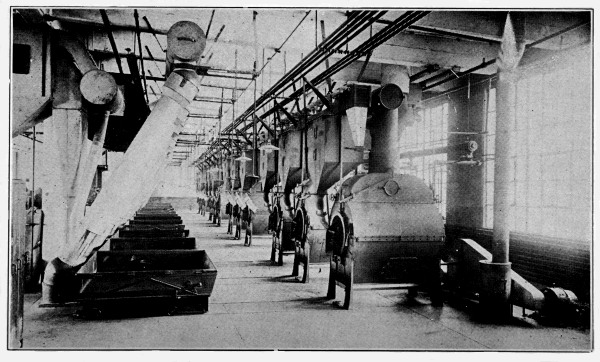
Modern Gas Coffee-Roasting Plant; Daily Capacity, 1,000 Bags
Twelve Jubilee machines in
the roasting room of the Jewel Tea Co.,
Hoboken, N. J.
[Pg 111]
Separating, milling, and mixing—The roasting operation—Dry and wet roasts—Finishing and coating—Cost card for roasters—Cooling and stoning—Roasting equipment—Blending roasted coffee—A trip through a model coffee-roasting plant—Evolution of coffee-roasting apparatus.
The most modern way to roast coffee is in revolving, perforated metal cylinders, by coal or gas fuel. For anyone to make a real success in the coffee business, he must have had considerable experience in this particular line. However, in this business as in others, intelligent application spells success, but, whether the business is wholesale or retail, it takes time. The roaster man, or coffee chef, is the first and most important cook necessary to a good cup of coffee.
A study of the chemistry of roasted coffee discloses that in the roasting process the beans swell up by the liberation of gases, and the aromatic oils are developed or cooked and made ready for solution in water when the cells are broken up by grinding.
The roasting operation is preceded by separating, milling, and mixing. Where the coffees have not been graded and cleaned before delivery to the roasting plant, they must be run through a separator for grading closely as regards the size of the beans, and particularly for the separation of round beans, or peaberry. Then they must be milled and [Pg 112] mixed. This operation may be performed in special machines designed for these purposes, or the regular roasting cylinder may be utilized.
“Roasting per se is not such a difficult operation as many experts would have us believe,” says A. L. Burns, an authority on the subject. Manufacturers of modern coffee-roasting machines have made them practically fool proof. In this business, however, experience is, as always, the best teacher.
A typical roasting machine employs an open perforated metal cylinder, the inside being arranged with reverse spiral flanges which mix the coffee, while the cylinder revolves over the fire. It is fitted with a front head opening to receive the green coffee, and through this, when turned to the lower position, the finished product is discharged into the cooler box.
Modern coffee-roasting machines provide for easy control of the heat (from coal, coke, or gas fuel), for constantly mixing the coffee in such a manner that the heat is transmitted uniformly to the entire batch, for carrying away all steam and smoke rapidly, for easy testing of the progress of the roast, and for immediate discharge when desired. The operator’s problem, therefore, is the regulation of the heat and deciding just when the desired roasting has been accomplished.
If all coffees were alike, roasting would soon be almost automatic. In some plants most of the work is one uniform grade or blend; but coffees which vary greatly in moisture-content, in flinty or spongy nature, and in various other characteristics, will puzzle the operator until he establishes a personal acquaintance with them in various combinations in repeated roasting operations. The roaster man, therefore, must be able to observe closely, to draw sensible conclusions, and to remember what he learns. Roasting coffee is work of a sort which anybody can do, [Pg 113] which a few people can do really well, and no one so well but that further improvement is possible.
Because the roasting principles vary in different green coffees, trained study and a nice science in timing the roast and manipulating the fire are necessary to a perfect development of aroma and flavor. There is no absolute standard of what the best roasting results are. Some dealers want the coffee beans swelled up to the bursting point, while others would object to so showy a development. Some care nothing at all about appearance as compared with cup value, while others insist on a bright style even at some sacrifice of quality. Business judgment must decide what goods can be sold most profitably.
Coffee roasting requires a temperature of about 420° Fahr. A slow roast is favored by some roaster men; others argue that this bakes the coffee and does not give full development. The quicker the roast, the better the coffee.
So there is no universal rule for the degree to which coffee should be roasted. The average time in the United States is 15 to 30 minutes, depending on the fuel and machine employed. (The Germans have “quick roasters” that do it in 3½ to 10 minutes.) The trade knows these different roasts: Light, cinnamon, medium, high, city, full city, French, and Italian. The city roast is a dark bean, while full city is a few degrees darker. In the French roast, the bean is cooked until the natural oil appears on the surface, and in the Italian it is roasted to the point of actual carbonization, so that it can be easily powdered. Germany likes a roast similar to the French type, while Scandinavia prefers the high Italian roast.
In the United States, the lighter roast is favored on the Pacific Coast; the darkest, in the South; and a medium-colored roast, in the eastern states. The cinnamon roast is most favored by the trade in Boston.
Coffee loses weight in roasting; the loss varying, depending upon the [Pg 114] kind of bean, its age, and the style of roast. The average loss is about 16 percent. It has been estimated that 100 pounds of coffee in the cherry produce 25 pounds in the parchment; that 100 pounds in the parchment produce 84 pounds of cleaned coffee; that 100 pounds of cleaned coffee produce 84 pounds of roasted.
After the coffee has been in the roasting cylinder for a short time, the color of the bean becomes a yellowish brown, which gradually deepens as it cooks. Likewise, as the beans become heated, they shrivel up until about half done, or at the “developing” point. At this stage, they begin to swell, and then “pop open,” increasing 50 percent in bulk. This is when the experienced roaster man turns on all the heat he can command, to finish the roasting as quickly as possible. The roast is considered done when the bean cracks easily between the fingers. Some roaster men use their teeth, others the palm of the hand and a coffee trier.
At frequent intervals, he thrusts his “trier”—an instrument shaped somewhat like an elongated spoon—into the cylinder, and takes out a sample of coffee to compare with his type sample. When the coffee is done, he shuts off the heat and checks the cooking by reducing the temperature of the coffee and of the cylinder as quickly as can be done. In the wet roast method he will spray the coffee, as the cylinder is still revolving, with three to four quarts of water to every 130 pounds of coffee. In the dry method he depends altogether upon his cooling apparatus.
Roasters generally are not in favor of the excessive watering of coffee in and after the roasting process for the purpose of reducing shrinkage. “Heading” the coffee, or checking the roast before turning it out of the roasting cylinder, is quite another matter and is considered legitimate. Where coffees are watered in the cylinder at the close of the roast to reduce the shrinkage, it is possible to get back only about four percent of the shrinkage by such treatment, and the [Pg 115] practice is usually looked upon with disapproval by the best roasters.
Generally speaking, water is turned into the roasting cylinder to quench the roast. The amount varies with the style of machine, whether gas or coal. Usually the water turns to steam, and the result is not an absorption of the water, but a momentary checking of the roast, with a tendency to swell and to brighten the coffee. This is, comparatively speaking, a “dry roast,” but not an absolutely dry roast. It is doubtful if more than one percent of American coffee roasters employ an absolutely “dry” roast: it does not give satisfactory results. The word has been abused for advertising purposes. Of course, a dry roasted coffee is a better article for making a satisfactory beverage than one that has been soaked with water, but the word needs to be given a definite meaning. The real dry roast represents the coffee’s highest cup value.
Finishing whole-bean roasted coffee by giving it a friction polish when it is still moist, using a glaze solution, or water only, is a practice not harmful if the proper solutions are employed. A machine comes for finishing or glazing. Coatings of sugar and eggs, glucose, mustard oil, and chicory are sometimes employed, but their use must be stated on the label.
Coffee roasters are divided on this question of coffee coating. The best thought of the trade is undoubtedly opposed to the practice when it is done to conceal inferiority or abnormally to reduce shrinkage. Some New York coffee roasters, who made a thorough investigation of the matter, found coating coffee with a wholesome material not injurious and the coated coffee better in the cup. Dr. Harvey W. Wiley found, in the celebrated Ohio case against Arbuckle Brothers, that coating coffee with sugar and eggs produced beneficial results, and that the coating preserved the bean. The Bureau of Chemistry has never issued any ruling on the subject of coating coffee. [Pg 116]
COST CARD FOR ROASTERS
Showing the value added to the cost of green coffee by roasting.
By A. C. Aborn
Basis: 16 per cent shrinkage, ¾-cent a pound for roasting.
A = Cost Green, Cents per Lb.
B = Cost Roasted, Cents per Lb.
| A | B | A | B | A | B | A | B | A | B |
| 5 | 6.85 | 10 | 12.80 | 15 | 18.75 | 20 | 24.70 | 25 | 30.65 |
| 5⅛ | 6.99 | 10⅛ | 12.95 | 15⅛ | 18.90 | 20⅛ | 24.85 | 25⅛ | 30.80 |
| 5¼ | 7.14 | 10¼ | 13.10 | 15¼ | 19.05 | 20¼ | 25.00 | 25¼ | 30.95 |
| 5⅜ | 7.29 | 10⅜ | 13.24 | 15⅜ | 19.20 | 20⅜ | 25.15 | 25⅜ | 31.10 |
| 5½ | 7.44 | 10½ | 13.39 | 15½ | 19.35 | 20½ | 25.30 | 25½ | 31.25 |
| 5⅝ | 7.59 | 10⅝ | 13.54 | 15⅝ | 19.49 | 20⅝ | 25.45 | 25⅝ | 31.40 |
| 5¾ | 7.74 | 10¾ | 13.69 | 15¾ | 19.64 | 20¾ | 25.60 | 25¾ | 31.55 |
| 5⅞ | 7.89 | 10⅞ | 13.84 | 15⅞ | 19.79 | 20⅞ | 25.75 | 25⅞ | 31.70 |
| 6 | 8.04 | 11 | 13.99 | 16 | 19.94 | 21 | 25.89 | 26 | 31.85 |
| 6⅛ | 8.19 | 11⅛ | 14.14 | 16⅛ | 20.09 | 21⅛ | 26.04 | 26⅛ | 31.99 |
| 6¼ | 8.33 | 11¼ | 14.29 | 16¼ | 20.24 | 21¼ | 26.19 | 26¼ | 32.14 |
| 6⅜ | 8.48 | 11⅜ | 14.43 | 16⅜ | 20.39 | 21⅜ | 26.34 | 26⅜ | 32.29 |
| 6½ | 8.63 | 11½ | 14.58 | 16½ | 20.54 | 21½ | 26.49 | 26½ | 32.44 |
| 6⅝ | 8.78 | 11⅝ | 14.73 | 16⅝ | 20.68 | 21⅝ | 26.64 | 26⅝ | 32.59 |
| 6¾ | 8.93 | 11¾ | 14.88 | 16¾ | 20.83 | 21¾ | 26.79 | 26¾ | 32.74 |
| 6⅞ | 9.08 | 11⅞ | 15.03 | 16⅞ | 20.98 | 21⅞ | 26.93 | 26⅞ | 32.89 |
| 7 | 9.23 | 12 | 15.18 | 17 | 21.13 | 22 | 27.08 | 27 | 33.04 |
| 7⅛ | 9.37 | 12⅛ | 15.33 | 17⅛ | 21.28 | 22⅛ | 27.23 | 27⅛ | 33.18 |
| 7¼ | 9.52 | 12¼ | 15.48 | 17¼ | 21.43 | 22¼ | 27.38 | 27¼ | 33.33 |
| 7⅜ | 9.67 | 12⅜ | 15.63 | 17⅜ | 21.58 | 22⅜ | 27.53 | 27⅜ | 33.48 |
| 7½ | 9.82 | 12½ | 15.77 | 17½ | 21.73 | 22½ | 27.68 | 27½ | 33.63 |
| 7⅝ | 9.97 | 12⅝ | 15.92 | 17⅝ | 21.87 | 22⅝ | 27.83 | 27⅝ | 33.78 |
| 7¾ | 10.12 | 12¾ | 16.07 | 17¾ | 22.02 | 22¾ | 27.98 | 27¾ | 33.93 |
| 7⅞ | 10.27 | 12⅞ | 16.22 | 17⅞ | 22.17 | 22⅞ | 28.13 | 27⅞ | 34.08 |
| 8 | 10.42 | 13 | 16.37 | 18 | 22.32 | 23 | 28.27 | 28 | 34.23 |
| 8⅛ | 10.57 | 13⅛ | 16.52 | 18⅛ | 22.47 | 23⅛ | 28.42 | 28⅛ | 34.38 |
| 8¼ | 10.71 | 13¼ | 16.67 | 18¼ | 22.62 | 23¼ | 28.57 | 28¼ | 34.52 |
| 8⅜ | 10.86 | 13⅜ | 16.82 | 18⅜ | 22.77 | 23⅜ | 28.72 | 28⅜ | 34.67 |
| 8½ | 11.01 | 13½ | 16.97 | 18½ | 22.92 | 23½ | 28.87 | 28½ | 34.82 |
| 8⅝ | 11.16 | 13⅝ | 17.11 | 18⅝ | 23.07 | 23⅝ | 29.02 | 28⅝ | 34.97 |
| 8¾ | 11.31 | 13¾ | 17.26 | 18¾ | 23.21 | 23¾ | 29.17 | 28¾ | 35.12 |
| 8⅞ | 11.46 | 13⅞ | 17.41 | 18⅞ | 23.36 | 23⅞ | 29.32 | 28⅞ | 35.27 |
| 9 | 11.61 | 14 | 17.56 | 19 | 23.51 | 24 | 29.46 | 29 | 35.42 |
| 9⅛ | 11.76 | 14⅛ | 17.71 | 19⅛ | 23.66 | 24⅛ | 29.61 | 29⅛ | 35.57 |
| 9¼ | 11.90 | 14¼ | 17.86 | 19¼ | 23.81 | 24¼ | 29.76 | 29¼ | 35.71 |
| 9⅜ | 12.05 | 14⅜ | 18.01 | 19⅜ | 23.96 | 24⅜ | 29.91 | 29⅜ | 35.86 |
| 9⅝ | 12.35 | 14⅝ | 18.30 | 19⅝ | 24.26 | 24⅝ | 30.21 | 29⅝ | 36.16 |
| 9¾ | 12.50 | 14¾ | 18.45 | 19¾ | 24.40 | 24¾ | 30.36 | 29¾ | 36.31 |
| 9⅞ | 12.65 | 14⅞ | 18.60 | 19⅞ | 24.55 | 24⅞ | 30.51 | 29⅞ | 36.46 [Pg 117] |
The cooling and stoning operation which follows the roasting requires efficient apparatus.
Generally speaking, the process is to dump the roast into a metal car having a perforated false bottom, to which is attached a powerful exhaust fan that sucks the heat out of the coffee. The stoner has for its function the removal of stones and other foreign matter which the green-coffee operations have failed to get rid of. Usually the coffee beans are carried up a pipe by a regulated air current which is strong enough to raise the coffee but not the stones, which remain at the bottom of the stoner boot, whence they are dumped at intervals into a pan underneath.
Equipment
For those about to engage in the coffee business, it is best to take counsel with the manufacturers of coffee-roasting machinery, of whom there are several old established concerns. Their names and addresses, as well as the names and addresses of makers of all other kinds of equipment and supplies needed for large or small plants, may be obtained by consulting the latest edition of Ukers Tea & Coffee Buyer’s Guide.
After cooling and stoning, unless it is to be polished or glazed, the coffee is ready for grinding and packing, if it has been blended in the green state. Otherwise, the next step will be to mix the different varieties before grinding, although some packers blend the different kinds after they have been ground. To mix whole-bean roasted coffee without hurting its appearance is rather difficult, and there is no regular machine for such work.
A Trip Through a Coffee-Roasting Plant
Perhaps a little journey through a small but altogether modern [Pg 118] coffee-roasting plant is the best way to acquaint oneself with first-hand knowledge of how coffee is roasted. We have selected a typical New York plant, having many model features.
Entering the ground floor, the receiving and shipping department, we notice the fine light and air characteristic of every floor in this house of sunlight and fresh air. Entering with us are many bags of green coffee, unloaded from trucks at the door and ending long journeys from distant lands. There are, for instance, a consignment of bales of real Arabian Mocha, in their original, oriental bindings which began their round-the-world trip on the back of a camel; Javas, genuine products of Java soil; old brown East Indies, with complexions like the swarthy natives, who picked and stored them; fine old-crop Bogotas, Bucaramangas, Maracaibos, and adventurous bags escaped from bandit raids in Mexico; also coffees from Brazil, with high-grade district marks, and coffees from other parts of the world, the chosen of their kind, are here. Each of the coffees is a “survival of the fittest,” a champion, having won over its fellows in the testing room.
Suppose we follow the coffee and go up with it on the electric elevator, running in a fire-proof well, with its automatic doors, safety devices, and smooth, quick action.
Disembarking on the storage floor (fourth), we walk over and watch the start of the green coffee for its course through the building. It is dumped into galvanized bins and taken by a bucket elevator to the floor above. Along one wall on this floor are the big, galvanized, dirt-proof, storage bins, the modern steel grinders turning out efficient granulations, and the pulverizers producing “stone-ground,” powdered coffee. We enter the stairway fire tower, go up one flight, and pass into the concrete, fire-proof roasting and milling room, the pride of the building.
The clean, white walls, the lofty ceiling, with its great skylight, shedding a flood of sunlight upon the glistening, white-enameled, bricked roasters, the large windows, contributing big drafts of fresh air, all make a picture which draws an admiring comment. The machinery is all run by electric power and up to the minute in every detail. You see how the green coffee, run up from the floor below, into the milling machine, is being cleaned by agitating sieves, friction brushes, and blown by fans. All particles of dirt, sticks, and foreign matter are removed, and the coffee made immaculate and ready for the roasting process, which is the cooking of the berry.
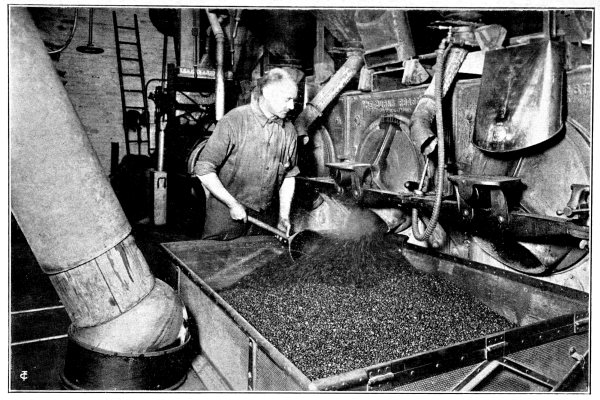
Dumping the Roast in a Coal Roasting Plant
The roasted coffee is being turned into the cooling car,
equipped with a swinging
“flex-arm” which keeps it always in connection with a suspended header pipe; the
cooling being started as soon as the coffee leaves the roaster. The cooled coffee
is tipped into a floor hopper.
[Pg 119] Automatic conveyors take the coffee from the milling machine into the big roasting cylinders, holding 250 to 300 pounds each, revolving over coal fires; for this is a coal roasting plant. The roaster men, in the neat khaki uniform of the building, stand in front of the cylinders with a “trier,” a sort of open tube. With this they draw small samples of the coffee, which is tossing around within the cylinder and gradually assuming a brown shade as it is roasted.
Each coffee requires special care, according to its character, and the roaster man skillfully governs his fire and times his roast accordingly. Carefully comparing the shade of the roast with his standard sample, at the precisely right moment the cooler box, a perforated iron car, is rolled up on its track, the cylinder gate is opened, and the hot, delicately browned berries pour out. It is the dramatic moment in the roasting room, and the “roast is off.” Immediately the hot coffee meets a current of cool air supplied from electric fans through a large pipe. This pipe is a new type, moving, with the car, upon an ingenious ball-and-socket joint, thus beginning the cooling process instantly. The new, quick control is an important point in producing a perfect roast.
The car is rolled back, tips automatically, and the coffee is discharged into the stoner on the floor below, whence a strong current of air draws it up again, through a large pipe, into the roasting room. [Pg 120] Small stones and weighty particles, being heavier than the coffee, are left behind, and any foreign substances which may have escaped previous processes are thus removed. Green coffee passes through various cleaning and sifting processes at the plantations, but the final cleaning and perfecting are done by the roasters with their modern and extensive equipment.
Some interesting and curious things, suggestive of foreign life, are occasionally picked out by the machines; for instance, a small Spanish coin dropped by some native worker, or, as once occurred, a Mauser cartridge from the belt, perhaps, of a revolutionist.
The roasted coffee, now on the roasting floor, is dropped into runabout iron cars which are rolled over the chutes. The cars open at the bottom and the coffee descends on its last lap into the shipping room, or packaging department, where it is ready for packing and shipping, having been turned into as perfect a product as the best human resources can make it.
We leave the pleasant and efficient roasting room, realizing how greatly modern machinery has improved the roasting process and made possible white walls and spotless floors, with dust and smoke eliminated by the modern, electric, suction ventilation.
A few steps up through the fire tower and out on the roof show the numerous fire ladders, the huge chaff collector which collects all the chaff from the roasting coffee, and the spot reserved for a little roof garden for employees.
Passing down two floors to the package department, we visit one of the most interesting and important parts of the building.
Busy workers, the women in blue uniforms and white caps and the men in khaki, are working under bright, cheerful, and sanitary conditions. Near the windows, in front, is the printing department, with its electric power press turning out labels, bags, circulars, at short notice and with creditable effect. [Pg 121]
The coffee-packaging department is on the east side of the floor, where a long packing table is set under the automatic weighing machines receiving coffee from the chutes. At one end girls are making paper bags, also tinfoil-lined bags, a most efficient container for coffee. The bags are put upon a moving belt, filled under the weighers, carried along again on the belt, then folded, sealed, and packed in cases. Well known, favorite brands are moving rapidly along, every package representing cleanliness, purity, and sanitary ideals, the coffee untouched by human hands and protected from all contacts.
After a glance at the dressing rooms and employee accommodations, we go downstairs to the floor below into the office and salesroom. There are few offices in New York so light and well ventilated. The whole front is a group of large windows which furnish fine daylight for the observation of goods. Back of these are the round, sanitary-top, testing tables with smoking cups giving out fragrant odors. The shining brass kettles are singing merrily. Here is where the ultimate value, the drinking quality, is ascertained. Cup testing has always been a specialty of this firm, and unusually fine distinctions of flavor and character are considered on these tables. The goods are purchased by strict cup standards, and the drinking quality of shipments, as well as purchases, is repeatedly tested and confirmed. The samples of coffee are ground by electric power, in a small mill.
Before saying farewell, we again step down into the shipping room, which is a hum of activity. The gates in the galvanized chutes are opening and closing, and the fragrant, crisp, browned berries, fresh from the roasters above, milled and cleaned, having traveled automatically by gravity through the various processes, pour into drums, barrels, bags, etc. These are swung upon suspension scales, the most accurate type known. One man takes the weight, another checks it, [Pg 122] the package is marked with a machine-cutstencil, and is finally ready for shipment. You look the second time at a busy and ingenious little truck or conveyor, which is run under platforms piled high with goods. The man steps upon a lever, the conveyor “humps its back,” and the whole load of 2,000 pounds, platform and all, in one unit, is easily moved along and gently deposited. The conveyor is slipped out and continues on for another load. This saving of movements, by handling bags in groups, instead of singly, is a principle of the “scientific management” of which every up-to-date factory management makes some study.
As we pass out into the entrance way, we are invited to take a brief look into the water-proof basement, boiler rooms, and fire-proof passage connecting with the screened fire escape in the rear. A moment is spent in hearing of the fire-alarm system and fire drills. The little red box under a great gong, on each floor, almost thinks and acts for itself, announcing not only the fire, but its location, and also, if out of order, or not wound up, declaring the fact.
Every modern fire precaution safeguards the workers from fire as effectively as the light, air, and sanitary equipment safeguard their health and the purity of the goods turned out by this establishment.
Crude, burnt clay dishes and stone vessels were the first coffee roasters. In them the dried hulls and green beans were roasted over open fires about 1200 to 1300.
Between 1400 and 1500, individual earthenware and metal coffee-roasting plates appeared. These were circular, four to six inches in diameter, about ¹/₁₆-inch thick, slightly concave, and pierced with small holes, something like the modern kitchen skimmer. They were used in Turkey and Persia for roasting a few beans at a time over braziers (open pans, or basins, for holding live coals). The braziers were usually mounted on feet and bore very rich ornamentation. [Pg 123]
The Turkish coffee grinder seems to have suggested the individual cylinder roaster which later (1650) became common, and from which developed the huge, modern-cylinder, commercial roasting machines.
Between 1500 and 1600, shallow iron dippers with long handles and foot rests, designed to stand in open fires, were used in Bagdad, and by the Arabs in Mesopotamia, for roasting coffee. These roasters had handles about 34 inches long, and the bowls were eight inches in diameter. They were accompanied by a metal stirrer (spatula) for turning the beans.
Another type of roaster was developed about 1600. It was in the shape of an iron spider on legs, and was designed, like that just described, to sit in open fires.
When La Roque speaks of his father bringing back to Marseilles from Constantinople in 1644 the instruments for making coffee, he undoubtedly refers to the individual devices which at that time in the Orient included the roaster plate, the cylinder grinder, the small, long-handled boiler, and fenjeyns (findjans), the little porcelain drinking cups.
When Bernier visited Grand Cairo about the middle of the 17th century, in all the city’s thousand-odd coffee houses, he found but two persons who understood the art of roasting the bean.
About 1650, there was developed the individual-cylinder coffee roaster made of metal, usually tinplate or tinned copper, suggested by the original Turkish pocket grinder. This was designed for use over open fires in braziers. There appeared about this time also a combined making-and-serving metal pot which was undoubtedly the original of the common type of pot that we know today.
There appeared in England about 1660 Elford’s white iron machine (sheet iron coated with tin), which was “turned on a spit by a jack.” This was [Pg 124] simply a larger size of the individual-cylinder roaster, and was designed for family or commercial use. Modifications were developed by the French and Dutch. In the 17th century, the Italians produced some beautiful designs in wrought-iron coffee roasters.
Before the advent of the Elford machine, and, indeed, for two centuries thereafter, it was the common practice in the home to roast coffee in uncovered earthenware tart dishes, old pudding pans, and frying pans. Before the time of the modern kitchen stove, it was usually done over charcoal fires without flame.
By combining the long-handle idea contained in the Bagdad roaster with that of the original cylinder roaster, the Dutch perfected a small, closed, sheet-iron, cylinder roaster with a long handle that permitted its being held and turned in open fireplaces. From 1670, and well into the middle of the 19th century, this type of family roaster enjoyed great favor in Holland, France, England, and the United States, more especially in the country districts. The museums of Europe and the United States contain many specimens. The iron cylinder measured about five inches in diameter, and was from six to eight inches long, being attached to a three- or four-foot iron rod provided with a wooden handle. The green coffee was put into the cylinder through a sliding door. Balancing the roaster over the blaze by resting the end of the iron rod projecting from the far end of the roasting cylinder in a hook of the usual fireplace crane, the housekeeper was wont slowly to revolve the cylinder until the beans had turned the proper color.
Between 1700 and 1800, there was developed a type of small portable household stove to burn coke or charcoal, made of iron, and fitted with horizontal revolving cylinders for coffee roasting. These were provided with iron handles for turning. A modification of this type of roaster, under a three-sided hood, and standing on three legs, was designed to sit on the hearth of open fireplaces, close to the fire, or in the [Pg 125] smoldering ashes. Because of its greater capacity, it was probably used in the inns and coffee houses for roasting large batches. Still another type, which made its appearance late in the 18th century, was the sheet-iron roaster suspended at the top of a tall, iron, boxlike compartment, or stove, in which the fire was built. This, too, was designed to roast coffee in comparatively large quantities. In some examples it was provided with legs.
In 1704, Bull’s machine for roasting coffee was patented in England. This probably marks the first use of coal for commercial roasting.
In 1710, the popular coffee roaster in French homes was a dish of varnished earthenware.
French inventors continued to apply themselves to coffee-roasting and coffee-making problems, and many new ideas were evolved. Some of these were improved upon by the Dutch, the Germans, and the Italians; but the best work in the line of improvements that have survived the test of time was done by inventors in England and the United States.
It was common practice to roast coffee in England in “an iron pan or in hollow cylinders made of sheet-iron”; while in Italy the practice was to roast it in glass flasks, which were fitted with loose corks. The flasks were “held over clear fires of burning coals and continually agitated.” Anthony Schick, was granted an English patent in 1812, on a method, or process, for roasting coffee; but, as he never filed his specifications, we shall probably never know what the process was. The custom of the day in England was to pound the roasted beans in a mortar, or to grind them in a French mill.
While French inventors were busy with coffee makers, English and American inventors were studying means to improve the roasting of the beans. Peregrine Williamson, of Baltimore, was granted the first patent in the United States for an improvement on a coffee roaster in 1820. In [Pg 126] 1824, Richard Evans was granted a patent in England for a commercial method of roasting coffee, comprising a cylindrical sheet-iron roaster fitted with improved flanges for mixing, a hollow tube and trier for sampling coffee while roasting, and a means for turning the roaster completely over to empty it.
In 1829, the Établissements Lauzaune, Paris, began to make hand-turned, iron-cylinder machines for the roasting of coffee.
The English began exporting coffee-roasting and coffee-grinding machinery to the United States in 1833-34.
In 1840, Abel Stillman, Poland, New York, was granted a United States patent on a family coffee roaster having a mica window to enable the operator to observe the coffee while roasting.
During the first half of the 19th century, the French were only toying with the roaster, because roasting in France was not yet a separate branch of business, as it had become in England and the United States, where keen minds were already at work on the purely commercial coffee-roasting machine. The application of intensive thought in this direction was destined to bear fruit in America in 1846, and in England in 1847.
James W. Carter, of Boston, was granted a United States patent in 1846 on his “pull-out” roaster; and this was the machine most generally employed for trade roasting in America for the next 20 years. Carter did not claim to have invented the combination of cylindrical roaster and furnace; but he did claim priority for the combination, with the furnace and roasting vessel, of the air space, or chamber, surrounding it, “the same being for the purpose of preventing the too rapid escape of heat from the furnace when the air chamber’s induction and eduction air openings or passages are closed.”
The Carter “pull-out” was so called because the roasting cylinder of [Pg 127] sheet iron was pulled out from the furnace on a shaft supported by standards, to be emptied or to be refilled from sliding doors in its “sides.” It was in use for many years in such oldtime plants as that of the Dwinell-Wright Company, 25 Harberhill Street, Boston; by James H. Forbes and William Schotten, in St. Louis; and by D. Y. Harrison, in Cincinnati.
In 1847-48, William and Elizabeth Dakin were granted patents in England on an apparatus for “cleaning and roasting coffee and for making decoctions.” The roaster specification covered a gold, silver, platinum, or alloy-lined roasting cylinder and traversing carriage on an overhead railway to move the roaster in and out of the roasting oven; and the “decoction” specification covered an arrangement for twisting a cloth-bag ground-coffee container in a coffee biggin, or applied a screw motion to a disk within a perforated cylinder containing the ground coffee, so as to squeeze the liquid out of the grounds after infusion had taken place.
The roaster has survived, but the coffee maker was not so fortunate. The Dakin idea was that coffee was injuriously affected by coming into contact with iron during the roasting process. The roasting cylinder was inclosed in an oven instead of being directly exposed to the furnace heat. The apparatus was provided also with a “taster,” or sampler, the first of its kind, to enable the operator to examine the roasting berries without stopping the machine.
In 1849, Thomas R. Wood, of Cincinnati, was granted a United States patent on a spherical coffee roaster for use on kitchen stoves. It attained considerable popularity among housewives who preferred to do their own roasting.
In 1852, Edward Gee secured a patent in England on a coffee roaster fitted with inclined flanges for turning the beans while roasting.
In 1862, E. J. Hyde, of Philadelphia, was granted a United States patent on a combined coffee roaster and stove, fitted with a crane on which the roasting cylinder was revolved and swung out horizontally for [Pg 128] emptying and refilling. It was a commercial success. Benedickt Fischer used one in his first roasting plant in New York. It is still manufactured by the Bramhall Deane Company, of New York.
In 1864, Jabez Burns, of New York, was granted a United States patent on the original Burns coffee roaster, the first machine which did not have to be moved away from the fire for discharging the roasted coffee, and one that marked a distinct advance in the manufacture of coffee-roasting apparatus. It was a closed iron cylinder set in brickwork.
Until the Burns roaster appeared, coffee roasters were usually cylinders that revolved upon an axis; the other devices that were tried were not successful.
Jabez Burns patented an improved form of his roaster in 1881, and a sample coffee roaster in 1883, before he died in 1888; and since that time his sons, who continue the business, have perfected a number of improvements and brought out new machines.
Thomas Page, a New York millwright, began the manufacture of a pull-out coffee roaster similar to the old Carter machine, in 1868. Later, Chris Abele, who was foreman in the Page shop, succeeded to the business, and in 1882 he was granted a United States patent on an improvement on a coffee roaster similar to the original Burns machine (the patent had then expired), which he marketed under the name of Knickerbocker.
In the 1860s, ’70s, and ’80s, French, English, and Dutch inventors began producing gas coffee roasters, some of which were brought to America. For the complete story of their evolution and the evolution of other apparatus, the reader is referred to All About Coffee.
The first direct-flame gas coffee roaster in America was installed in the plant of the Potter-Parlin Company, New York, by F. T. Holmes, in 1893. This was Tupholme’s machine, patented in England in 1887, and in [Pg 129] the United States in 1896-97. The Potter-Parlin Company subsequently placed the Tupholme machines throughout the United States on a daily rental basis, limiting the leases to one firm in a city, having obtained the exclusive American rights from the Waygood, Tupholme Company, now the Grocers Engineering & Whitmee, Ltd.
In 1897, a special gas burner, not to be confused with the direct-flame machine, was first attached to a regular Burns roaster in the United States, and was made the basis of application for a patent. The Burns direct-flame gas roaster, with patented swing-gate head for feeding and discharging, was introduced to the trade in 1900. The Burns gas sample roaster followed.
In 1901, Joseph Lambert, of Marshall, Michigan, introduced to the trade one of the earliest indirect gas roasting machines.
In the same year, 1901, F. T. Holmes, formerly with the Potter-Parlin Company, joined the Huntley Manufacturing Company, Silver Creek, New York, which then began to build the Monitor direct-flame gas coffee roaster.
In 1915, and again in 1919, Jabez Burns & Sons, New York, patented their Jubilee roaster, an inner-heated machine in which the gas is burned inside a revolving cylinder in a combustion chamber protected from direct coffee contact. The heat is deflected downward and then passes upward through the coffee.
In 1897, Joseph Lambert, of Vermont, began the manufacture and sale at Battle Creek, Michigan, of the Lambert self-contained coffee roaster without the brick setting then required for coffee-roasting machines. In 1900, he was joined by A. P. Grohens. In 1901, the Lambert Food & Machinery Company was organized. In 1904, the company was reorganized. Since then, many improvements have been made under Mr. Grohens direction. The Lambert gas roaster, one of the first machines employing gas as fuel for indirect roasting, dates back to 1901, as mentioned. The [Pg 130] Economic roaster is Mr. Grohens latest development for coal or coke fuel. It is a compact, self-contained equipment, operating in connection with a new-type rotary cooler. He has also recently brought out a gas-fired, electrically operated, 600-pound Victory roaster and a 50-pound miniature coffee-roasting plant designed for retail stores.
In 1903, John Arbuckle was granted a United States patent on a coffee-roasting apparatus employing a fan to force the hot-fire gases into the roasting cylinder. From this was developed the Jumbo roaster, now used in the Arbuckle plant, which roasts 10,000 pounds an hour.
[Pg 131]
“Steel-cut” coffee—Wholesale coffee grinding—Evolution of grinding apparatus.
Unless the coffee is to be sold in the bean, it is sent to the grinding and packing department, to be further prepared for the consumer. Since the federal Food Law has been in effect, the public has gained confidence in ground and bean coffee in packages; and today a large part of the coffee consumed in the United States is sold in one- and two-pound cartons and cans, already blended and ready for brewing.
A progressive coffee-packing house may have three different styles of grinding machines; one called the granulator for turning out the so-called “steel-cut” coffee; the second, a pulverizer for making a really fine grind; and the third, a grinding mill for general factory work and producing a medium-ground coffee.
Commercial coffee-grinding machines are alike in principle in all countries, the beans being crushed or broken between toothed or corrugated metal or stone members, one revolving and the other being stationary. While all grinding machines are alike in principle, they may vary in capacity and design. The average granulator will turn out about 500 pounds of “steel-cut” coffee in an hour; the pulverizer, 75 to 100 pounds; and the average grinding mill, 500 to 600 pounds. Some types of grinding machines have chaff-removing attachments to extract, by air suction, the chaff from the coffee as it is being ground. [Pg 132]
A large number of trade terms for designating different grinds of coffee are used in the United States, some of them meaning the same thing, while similar names are sometimes contradictory. A canvass of the leading American coffee packers in 1917 discovered that there were 15 terms in use, and that there were 34 different meanings attached to them. For the term “fine,” there were five different definitions; “medium” had five; “coarse,” seven; “pulverized,” four; “steel-cut,” seven; “ground,” two; “powdered,” one; “percolator,” two; “steel-cut-chaff-removed,” one; “Turkish ground,” one; while “granulated,” “Greek ground,” “extra fine,” “standard,” and “regular” were not defined.
The term “steel-cut” is generally understood to mean that in the grinding process the chaff has been removed and an approximate uniformity of granules has been obtained by sifting. The term does not necessarily mean that the grinding mills have steel burrs. In fact, most firms employ burrs made of case iron or of a composition metal known as “burr metal,” because of its combined hardness and toughness.
The “steel-cut” idea is another of those sophistries for which American advertising methods have been largely responsible in the development of the package-coffee business in the United States. The term “steel-cut” lost all its value as an advertising catchword for the original user when every other dealer began to use it, no matter how the ground coffee was produced. When the public has been taught that coffee should be “steel-cut,” it is hard to sell it ground coffee unless it is called “steel-cut”; although a truer instructor of the consumer would have caused him to insist on buying whole bean coffee to be ground at home.
“Steel-cut” coffee—that is, a medium-ground coffee with the chaff blown out—does not compare in cup test with coffee that has been more scientifically ground and not given the chaff-removal treatment that is largely associated in the public mind with the idea of the “steel-cut” process. [Pg 133]
According to the results of the trade canvass previously referred to, it would appear that the terms most suited to convey the right idea of the different grades of grinding, and likely to be acceptable to the greatest number, would be “coarse” (for boiling and including all the coarser grades); “medium” (for coffee made in the ordinary pot, including the so-called “steel-cut”); “fine” (like granulated sugar, and used for percolators); “very fine” (like cornmeal, and used for drip or filtration methods); “powdered” (like flour, and used for Turkish coffee).
Coffee begins to lose its strength immediately after roasting, the rate of loss increasing rapidly after grinding. In a test carried out by a Michigan coffee packer, it was discovered that a mixture of a very fine with a coarse grind gave the best results in the cup. It was also determined that coarse-ground coffee lost its strength more rapidly than the medium ground; while the latter deteriorated more quickly than a fine ground; and so on, down the scale. His conclusions were that the most satisfactory grind for putting into packages that were likely to stand for some time before being consumed was a mixture consisting of about 90 percent finely ground coffee and 10 percent coarse. His theory is that the fine grind supplies sufficiently high body extraction; the coarse, the needful flavor and aroma. On this irregular grind a United States patent (No. 14,520) has been granted, in which the inventor claims that the 90 percent of fine eliminates the interstices—that allow too free ventilation in a coarse-ground coffee—and consequently prevents the loss of the highly volatile constituents of the 10 percent of coarse-ground particles, and at the same time gives a full-body extraction.
As long as there continues a consumer demand for ground package coffee, there will be found manufacturers willing to supply it, despite all the well-turned arguments in favor of grinding at home or in the shop at the time of purchase. [Pg 134]
There are to be had factory mills in which coffee may be reduced to the desired fineness at one passage through a pair of metal-disk grinding plates, which are capable of producing 500 pounds an hour of finely ground coffee such as will pass completely through a square-mesh sieve having ³/₆₄-inch clear openings. These mills can be made to produce as much as 1,000 to 1,500 pounds of finely ground coffee an hour.
For retail distributers there are many excellent counter mills that render efficient service in grinding whole-bean loose or package coffee for the housewife while she waits.
In the beginning,—that is to say, in Ethiopia, about 800 A. D.,—a primitive stone mortar and pestle were the original coffee grinder. Next, the coffee beans were ground between little millstones, one turning above the other; then came the mill used by the Greeks and Romans for grain. This mill consisted of two conical millstones, one hollow and fitted over the other, specimens of which have been found in Pompeii. The idea is the same as that employed in the most modern metal grinder.
In the 15th century, we notice the first appearance of the familiar Turkish pocket-cylinder coffee mill. The Turkish coffee grinder seems to have suggested the individual-cylinder roaster which later (1650) became common, and from which developed the huge, modern, cylinder commercial roasting machines.
Between 1428 and 1448, a spice grinder standing on four legs was invented, and this was later used for grinding coffee. The drawer to receive the ground coffee was added in the 18th century.
Between 1600 and 1632, mortars and pestles of wood, iron, brass, and bronze came into common use in Europe for braying the roasted beans. For several centuries, coffee connoisseurs held that pounding the beans [Pg 135] in a mortar was superior to grinding in the most efficient mill. Peregrine White’s parents brought to America on the Mayflower, in 1620, a wooden mortar and pestle that were used for braying coffee to make coffee “powder.”
The improved Turkish combination coffee grinder with folding handle and cup receptacle for the beans, used for grinding, boiling, and drinking, was first made in Damascus in 1665.
In 1665, Nicholas Book, “living at the Sign of the Frying Pan in St. Tulies Street,” London, advertised that he was “the only known man for making of mills for grinding of coffee powder, which mills are sold by him from 40 to 45 shillings the mill.”
Coffee grinders were so common in France in 1720 that they were to be had for $1.25 each. Their development by the French had been rapid from the original spice grinder. At first, they were known as coffee mills; but in the 18th century, roasters came to be known by that name. They were made of iron, retaining the same principle of the horizontal millstones—one of which is fixed while the other moves—that the ancients employed for grinding wheat. They were squat, box-shaped affairs, having in the center a shank of iron that revolved upon a fixed, corrugated iron plate. There was also the style that fastened to the wall. At first, the drawer to receive ground coffee was missing, but this was supplied in later types. Before its invention, the ground coffee was received in a sack of greased leather, or in one treated on the outside with beeswax—probably the original of the duplex paper bag for conserving the flavor.
The French brought their innate artistic talents to bear upon coffee grinders, just as they did upon roasters and serving pots. In many instances, they made the outer parts of silver and of gold.
English and American inventors soon afterward produced the well-known wall-mill type of coffee grinder. The original Parker mill appeared in [Pg 136] 1832. Jabez Burns secured a patent on his granulating mill in 1872. Mr. Burns had some very definite ideas on the subject of grinding coffee, as well as on how the product should be roasted. At that time the French and English lap and wall mills, the English steel mills, and the Swift mills were all used in the United States. Troemner’s, the Enterprise, and others were extending their use in a retail way; but Jabez Burns confined his attention to a practicable mill for wholesale grinding establishments.
For manufacturing purposes, burr-stone mills were for many years exclusively employed, especially one first known as the Prentiss & Page, and later as the Page mill. There was a time when all coffee establishments in New York sent their coffee to Prentiss & Page to be ground. Some of the places roasted by hand, others by horse power; and, if by steam, it was limited, and they did not have enough to spare for grinding.
With the march of improvement, burr-stone mills went into the discard. The difficulty lay in finding men experienced in stone dressing to run them; and the demand grew for a better style of grinding than could be done in a mill out of face and balance. This demand was met in an altogether different style of machine, which for 25 years was well known as the Barbor mill. It was for improvements on this mill that Jabez Burns in 1867, 1872, and 1874 obtained his granulator patents.
The mill comprised cutters in the form of an iron roller running in near contact with a concave, also of iron, and a revolving cylinder provided with sieves, or screens, that received the ground material, rolled it over the wire surface, sifting out the fine and discharging the course automatically into the cutter, to be again manipulated until it was fine enough to pass through the meshes of the screen.
In 1875-76-78, Turner Strowbridge, of New Brighton, Pennsylvania, was granted three United States patents on a box coffee mill. [Pg 137]
In 1878, Landers, Frary & Clark, New Britain, Connecticut, brought out an improved box coffee grinder for home use.
In 1878 and 1880, United States patents were issued to John C. Dell, of Philadelphia, on a store coffee mill.
In 1879 and 1880, United States patents were issued to Orson W. Stowe, of the Peck, Stowe & Wilcox Company, Southington, Connecticut, on a household coffee mill.
In 1881, the Morgan Brothers, Edgar H. and Charles, began the manufacture of household coffee mills, the business being acquired in 1885 by the Arcade Manufacturing Company, of Freeport, Illinois. The latter concern brought out the first pound coffee mill in 1889. Its mills became very popular in the United States. In 1900, Charles Morgan was granted a United States patent on a glass-jar coffee mill, with removable glass measuring cup.
In 1897, the Enterprise Manufacturing Company, of Pennsylvania, was the first regularly to employ electric motors for driving commercial coffee mills by means of belt-and-pulley attachments.
In 1898, the Hobart Manufacturing Company, of Troy, Ohio, introduced to the trade another early coffee grinder connected with an electric motor and driven by belt-and-pulley attachment.
In 1900, the first gear-driven electric coffee grinder was put on the market by the Enterprise Manufacturing Company, of Pennsylvania.
In 1902, the Coles Manufacturing Company (Braun Company, successor) and Henry Troemner, of Philadelphia, began the manufacture and sale of gear-driven electric coffee grinders.
In 1905, the A. J. Deer Company, Buffalo, New York (now at Hornell, New York), began to sell its Royal electric coffee mills direct to dealers on the installment plan, revolutionizing the former practice of selling coffee mills through hardware jobbers. [Pg 138]
In 1905, H. L. Johnston was granted a United States patent on a coffee mill. He assigned the patent to the Hobart Manufacturing Company.
In 1905, a celebrated case was decided in Kansas City involving litigation between William E. Baker, of Baker & Company, Minneapolis, and the F. A. Duncombe Manufacturing Company, of St. Joseph, Missouri, over Mr. Baker’s patent rights in a machine to produce steel-cut coffee. The suit was brought in 1903, and Mr. Baker contended that his patent gave him the exclusive right to the “uniformity of granules by means of the sharply dressed mechanism” and by the use of a fan for blowing away the silver skins, produced by his machine; while the defendant said he obtained the same result (steel-cut coffee) by grading the granules through screens or sieves. The defense was that Mr. Baker’s process was not a discovery; because, grinding coffee was as old as the world’s knowledge, and winnowing the chaff was equally ancient. The lower court dismissed the bill, because the “patents sued upon are devoid of patentable invention,” and the United States Court of Appeals confirmed the decision.
Herbert L. Johnston, assignor to the Hobart Electric Manufacturing Company, Troy, Ohio, was granted a United States patent on a machine for refining coffee in 1913.
In 1915, the National Coffee Roasters Association’s Home coffee mill, employing an improved set screw operating on a cog-and-ratchet principle, was introduced to the trade.
In 1916, Jules Le Page, Darlington, Indiana, obtained two United States patents on cutting rolls to cut—and not to grind or crush—corn, wheat, or coffee. These were subsequently incorporated in the Ideal steel-cut coffee mill and marketed to the trade first by the B. F. Gump Company, Chicago, and later through Jabez Burns & Sons, New York.
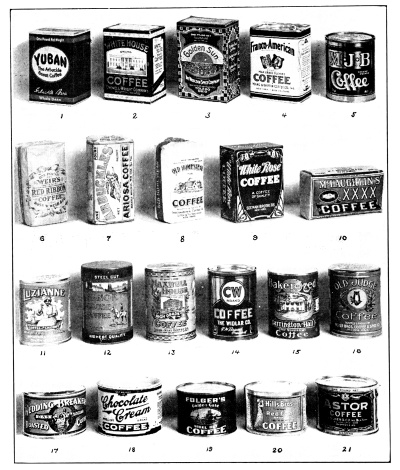
Some of the Leading Trade-Marked Coffee Containers
1. Double carton. 2-3. Cartons. 4. Fiber sides, tin top and
bottom, friction cover. 5. Vacuum tin can. 6. Fancy paper bag. 7.
Machine-wrapped paper package. 8. Fancy paper bag. 9. Carton with
patented opening and closing device. 10. Wrapped paper package. 11. Tin
can with slip cover. 12. All-fiber can with slip cover. 13. Tin can
with slip cover. 14. Lithographed tin can with friction cover. 15-16.
Tin cans with slip covers. 17. Squat tin cans. 18. Napacan. 19-20-21.
Vacuum tin cans.
[Pg 139]
How coffees are sold at wholesale—The wholesale salesman’s place in merchandising—Ten things every master salesman should know—Profit sharing for salesmen—Some coffee costs analyzed—Common sense in cost finding—Terms and credits—About package coffees—Coffee-selling chart—Various types of coffee containers—Labels—Coffee-packaging economies—Practical grocer helps—Coffee sampling—Premium method of sales promotion.
In the United States in 1923, some 1,500 coffee roasters and 4,000 wholesale grocers were engaged in the business of selling roasted coffee in a wholesale way. A number of these also sold green coffee to retail distributers who did their own roasting.
Most of the roasted coffee sold is ground, although in some parts of the United States there is a growing consumer demand for coffee in the bean. Of the coffee sold in trade-marked packages in 1919 in the United States, about 75 percent was ground ready for brewing.
The larger wholesale houses generally confine their operations to the section of the country in which they are located, but some of the biggest coffee-packing firms seek national distribution. In both cases, branch houses are usually established at strategic points to facilitate the serving of retail customers with freshly roasted coffee at all times necessary.
In recent years, too, it has become a general practice for the home offices, or main headquarters, to advertise their product in magazines, newspapers, street cars, and by mail and on billboards; while the [Pg 140] branches solicit trade in their territories by means of traveling salesmen, local newspaper advertisements, booklets, circulars, and demonstrations at food shows.
The traveling salesman is probably the most effective agency in securing the retailer’s orders for coffee. A good coffee salesman not only sells coffee, but he teaches his customer how he can best build up and hold his coffee trade. He acquaints the retailer with all the talking points about the coffee he handles, how to feature it in store displays and advertisements, how to stage demonstrations and to work up special sales.
If he is a good salesman, he does not permit the merchant to buy more coffee than he can dispose of when it is still fresh, and he shows the dealer the folly of handling too many brands of package coffees. If he sells coffee in bulk, the efficient salesman has also a sound working knowledge of blending principles, and is able to suggest the kinds of coffee to blend to suit the particular requirements of each grocer’s trade. In short, he takes an intelligent interest in his customer’s business, and cooperates with him in building up a local coffee trade.
In order to become a master salesman in any line of business, here are 10 things which it is essential salesmen should know:
1. He Should Know Himself. Happy is that man who has found himself, who is “onto” himself, who appreciates himself at his true worth, neither more nor less, and who, having discovered himself and his right relation to society, resolves to be true to himself. “To thine own self be true, and it must follow, as the night the day, thou canst not then be false to any man.” The master salesman is the man who has found the secret of all salesmanship, and that is sincerity, also the basis of true character, without which there can never be a master salesman.
2. He Should Know Human Nature. The poet has said, “The proper study of mankind is man.” Know your fellows. So [Pg 141] shall you become more tolerant, and tolerance helps you to learn patience, another of life’s most important lessons. Knowing human nature comprehends a study of its weaknesses as well as its strength. All kinds of people go to make up the world of your prospects. Try to understand their little frailties and learn how to turn their psychology to their own, and incidentally to your, advantage. But never take an unfair advantage. Always be the gentleman. If you can’t afford to be a gentleman, you have no right to be a salesman. Keep your head high and your voice low. Every merchant is your friend, or will be when he knows you. Treat him as such.
3. He Should Know That He Is First of All a Soldier in the Army for the Common Good, and that as such he has a duty to perform in rendering a real social service to his customers. He needs to get the thought that it isn’t a package of goods that he is selling, but something bigger and better, and that is an opportunity. It is his good fortune, by means of the sale, to open wide the door that will lead his customer to greater efficiency, to success and happiness.
4. He Should Know His Goods. Let no detail, however small, escape you. Get full of your subject. This is the one safe dissipation for every salesman. Get intoxicated with your line. We sometimes say of the successful salesman, as of the genius, “He’s a crazy Indian.” There is more truth here than we are wont to recognize; only he is not crazy, he’s just plain drunk, drunk with enthusiasm for his line. He is literally full of it, and that’s the only way to impart knowledge of any subject to others,—first get filled with it yourself. So, find out all you can about your goods. Be a walking encyclopedia on the subject.
5. He Should Know the Laws of Approach. There is valuable psychology in the right salesman attitude. Always be agreeable, but not effusive. Don’t argue; never lose your temper. Anyhow, the customer is always right; you know that because George Boldt proved it years ago in the success he achieved by building the Waldorf-Astoria on the dictum.
6. He Should Know How to Tell His Story Simply, Truthfully. There is an art in “getting it across.” The mechanics of it are not hard to learn. They are based upon a recognition of the four laws which govern every sale,—Attention, Interest, Need, and Closing the Sale. It is important not to become involved in these laws, or to overemphasize any one of them. There is a time to listen and a time to stop.
7. He Should Know His Prospect. Put [Pg 142] yourself into his place. Get his viewpoint. Familiarize yourself with his problems. Be ready with helpful suggestions for their solution. Always talk your prospect’s business. The proposition should ever be, “How can I help you?—how this line will help you, save you money.”
8. He Should Know How to Make His Prospect a Satisfied Customer. To do this don’t sell him something he doesn’t need, or isn’t ready for or doesn’t want, and don’t oversell him; but, having sold him, make good on all your promises. Make the sale fool proof. Follow it through.
9. He Should Know How to Render Service. The transaction isn’t over with the delivery of the goods. For the master salesman this is only a beginning, the starting of an endless chain of goodwill. There are helpful follow-up calls to be made, friendly counsel to be given, a sincere interest to be taken in the merchant’s welfare, and this leads naturally into:
10. He Should Know How to Make His Customer a Goodwill Agent. A continued lively interest in the merchant not only holds his trade and keeps him satisfied, but it soon transforms him into a hard and fast booster for your line. Then the master salesman does not need to be told how to capitalize a grateful customer. The customer himself will show him!
Profit Sharing for Salesmen
In a report made by the Bureau of Business Research of New York University to the National Coffee Roasters Association, the results were given of a comprehensive questionary, answered by 76 leading coffee roasters, and it was recommended that commissions on net profits were the best method of paying salesmen, with the addition of special bonuses and prizes, charging them with 50 percent of the loss on their accounts.[2]
Some Coffee Costs Analyzed
In estimating the price at which he must sell his coffee to make a fair profit, the wholesale coffee merchant has many items of expense to consider. To the cost of the green coffee he must add the cost of [Pg 143] transportation to his plant; the loss in shrinkage in roasting, which averages about 16 percent; packaging costs, if he is a packer; the items of expense in doing business, such as wages and salaries, advertising, buying and selling, freight, express, warehouse and cartage, postage and office supplies, telephone and telegraph, credit and collection; and the fixed overhead charges for interest, heat, light, power, insurance, taxes, repairs, equipment, depreciation, losses from bad debts, and miscellaneous items. The average loss for bad debts among grocers in 1916 was 0.03 percent of the total sales, according to the director of business research, Harvard University, who estimated also that the common figure for credit and collection expense was 0.06 percent. The total cost of doing business has been estimated as ranging between 12 and 20 percent of the total annual sales; so that a bag of green coffee costing $16 in New York or New Orleans costs the coffee packer in the Middle West $22.33 to $24.56, according to the expense of carrying on his business.
A special study[3] of the statistical requirement of the coffee trade disclosed that roasters were prone to regard themselves as merchandising rather than manufacturing establishments, and many of them are neither one nor the other but a combination of the two. The statistical requirements of the wholesaler are comparatively simple, comprising largely a knowledge of the unit costs of warehousing, shipping, and distributing—all of which are frequently expressed as percentages to sales. As a concern departs from purely merchandising activities, however, its statistical needs increase; not only because of the necessity for knowing the unit costs of processing, but also because the manufacturers selling conditions are likely to be more complicated than those of the jobber. [Pg 144]
Too much emphasis cannot be laid on the effect of unintelligent competition. A quotes a price; B quotes a lower price, because he needs the business badly; C quotes a still lower price, on the theory that he is a better trader than B; finally, A makes a still lower quotation, because he thinks that there must have been something wrong in his original figure. It is a vicious circle. The result is to debase prices, and to bring about a condition of affairs that can be corrected only by increased knowledge of cost.
The expenditures in the coffee trade may be classified in four major groups. The relative volume of outgo in these groups will vary in accordance with the commodities handled, the styles of packaging used, and the methods of distribution. In order that we get a broad picture of the problem, the various elements may be aligned as exhibited in the following tabulation. These percentages may be accepted as reflecting more or less closely those which might obtain in a house that is producing a wide line and selling to two or more classes of trade:
| Raw materials | 50% to 60% of outgo. |
| Packing materials | 10% to 20% of outgo. |
| Manufacturing costs | 5% to 15% of outgo. |
| Commercial and selling expenses | 10% to 25% of outgo. |
In cost finding, it is necessary to reduce all classes of outgo to unit bases, in elements that may be compiled as increments of the final cost of each product. In some items of expenditure, the unit will apply to only a single product; in others, it will apply equally to a class of products and in some cases to all products.
In considering the four major classifications of outgo enumerated, it will be noted that the unit cost of “raw materials” and “packaging materials” may ordinarily be identified with individual products very readily, and hence offer comparatively little difficulty from a cost-finding standpoint. It is when we come to the numerous items of “manufacturing costs” and “commercial and selling expenses” that the [Pg 145] cost-finding difficulty arises. The vital statistical need of this industry is for closer knowledge of the unit costs of doing business, especially in these elements.
An operating-analysis book is recommended to those roasters who wish to install a system of uniform accounting. The plan provides for classifying the expenses. The information thus obtained may be utilized in building up the cost of individual products.
Wholesale coffee trade contract terms and credits are not dissimilar from those in other lines of commerce. The wholesaler helps the retailer finance his business to the extent of granting him 30 to 60 days in which to pay his bill, offering him a cash discount if the invoice is paid within 10 days of date of sale. Until recent years, these terms were frequently abused, the customer demanding much longer credits, and often taking a 10-day cash discount after 30 or more days had elapsed. This abuse was particularly prevalent from 1907 to 1913, when coffee prices were low and competition was especially keen. In addition, the retailers often demanded special deliveries of supplies, which added to the wholesalers costs, and some retailers refused to pay the cost of cartage from the cars to their stores.
With the coming of high prices after the close of the World War, the wholesalers showed a tendency to tighten up their credit and discount terms, the National Coffee Roasters Association especially recommending 30 days credit, or at most 60 days, and a maximum cash discount rate of two percent.
Another trade abuse which has been corrected almost altogether was the practice of “selling coffee to be billed as shipped”; that is, the wholesaler held coffee on order, and billed only when delivered, even after weeks or months.
Since the beginning of the 20th century, the sale of coffee in packages [Pg 146] has increased steadily, until now (1924) this form of distribution competes strongly with bulk coffee sales. While bulk coffee is still preferred in some eastern sections of the United States, coffee packers are making deep inroads there, to the extent that practically all high- and medium-grade retailers feature package coffees, either under their own brand name or under that of a coffee specialty house.
The prime requisite for success in any package coffee is the composition of the blend. One of the leaders in the field, which we will call Y, is said to be composed of Bogota, Bourbon Santos, and Mexican. In 1924, it was being sold at retail in New York for 45 cents. A competing brand, which we will call Z, is said to be a blend of Bogota and Bourbon Santos. It was being sold at retail in New York at the same time for the same price. Simultaneously, in the retail stores of a well-known chain system, a bulk blend composed of 60 percent Bourbon Santos and 40 percent Bogota was to be had loose for 35 cents.
The second important factor that contributes to package-coffee success is the container. It must be of such character as will best preserve the freshness—the flavor and aroma of the coffee—until it reaches the consumer.
Package coffee has not yet won universal favor. Some of the arguments used against it are that the price is generally higher than the same grade in bulk; that it leads to price cutting by stores that can afford to sell it at about cost as a leader for other articles; that the margin of profit is frequently too close for some retailers; that, when the market advances, some packers change their blends to keep down cost and to maintain the advertised price; and that, when packed ground, there is a rapid loss of flavor, aroma, and strength.
Friends of package coffees point to the saving in time in handling in the store; to the fact that the contents of a package are not contaminated by odors or dirt; that the blends are prepared by experts and are always uniform; that the coffee is always properly roasted, and, in the case of package ground coffee, properly ground; that the brand names are widely and consistently advertised, and that the retailer has the benefit of the packer’s cooperation in building up sales campaigns, by means of booklets and local advertising. [Pg 147]
Roasted Coffee Chart Showing Prices Necessary
to Bring Various Percentages on Sales
By A. J. Dannemiller
| A = Cost, Roasted and Packed | ||||||||
|---|---|---|---|---|---|---|---|---|
| A | 10% | 11% | 12% | 13% | 14% | 15% | 16% | 17% |
| 7 | 7.78 | 7.87 | 7.95 | 8.05 | 8.15 | 8.25 | 8.35 | 8.45 |
| 7½ | 8.34 | 8.43 | 8.52 | 8.62 | 8.72 | 8.83 | 8.93 | 9.04 |
| 8 | 8.89 | 8.99 | 9.09 | 9.20 | 9.31 | 9.42 | 9.53 | 9.65 |
| 8½ | 9.45 | 9.55 | 9.66 | 9.77 | 9.87 | 9.99 | 10.12 | 10.25 |
| 9 | 10.00 | 10.12 | 10.23 | 10.35 | 10.47 | 10.59 | 10.72 | 10.85 |
| 9½ | 10.56 | 10.68 | 10.80 | 10.92 | 11.04 | 11.17 | 11.31 | 11.45 |
| 10 | 11.11 | 11.24 | 11.37 | 11.49 | 11.63 | 11.77 | 11.90 | 12.05 |
| 10½ | 11.66 | 11.81 | 11.93 | 12.07 | 12.21 | 12.36 | 12.49 | 12.65 |
| 11 | 12.22 | 12.37 | 12.50 | 12.64 | 12.85 | 12.95 | 13.08 | 13.26 |
| 11½ | 12.77 | 12.93 | 13.07 | 13.21 | 13.37 | 13.54 | 13.68 | 13.86 |
| 12 | 13.33 | 13.49 | 13.64 | 13.79 | 13.95 | 14.12 | 14.28 | 14.46 |
| 12½ | 13.89 | 14.05 | 14.21 | 14.37 | 14.53 | 14.71 | 14.88 | 15.06 |
| 13 | 14.44 | 14.62 | 14.78 | 14.93 | 15.11 | 15.30 | 15.47 | 15.66 |
| 13½ | 15.00 | 15.18 | 15.33 | 15.51 | 15.69 | 15.88 | 16.07 | 16.27 |
| 14 | 15.55 | 15.73 | 15.90 | 16.08 | 16.28 | 16.48 | 16.67 | 16.84 |
| 14½ | 16.11 | 16.29 | 16.48 | 16.65 | 16.86 | 17.05 | 17.26 | 17.47 |
| 15 | 16.66 | 16.85 | 17.05 | 17.23 | 17.44 | 17.65 | 17.85 | 18.07 |
| 15½ | 17.23 | 17.43 | 17.61 | 17.80 | 18.03 | 18.22 | 18.45 | 18.67 |
| 16 | 17.78 | 17.98 | 18.18 | 18.38 | 18.60 | 18.83 | 19.05 | 19.28 |
| 16½ | 18.33 | 18.54 | 18.75 | 18.97 | 19.18 | 19.41 | 19.64 | 19.88 |
| 17 | 18.89 | 19.10 | 19.33 | 19.52 | 19.76 | 20.01 | 20.24 | 20.48 |
| 17½ | 19.44 | 19.66 | 19.89 | 20.10 | 20.35 | 20.59 | 20.83 | 21.08 |
| 18 | 20.00 | 20.22 | 20.45 | 20.67 | 20.93 | 21.18 | 21.43 | 21.69 |
| 18½ | 20.55 | 20.79 | 21.02 | 21.24 | 21.51 | 21.77 | 22.02 | 22.29 |
| 19 | 21.11 | 21.35 | 21.59 | 21.84 | 22.09 | 22.36 | 22.62 | 22.90 |
| 19½ | 21.66 | 21.91 | 22.16 | 22.41 | 22.68 | 22.95 | 23.21 | 23.50 |
| 20 | 22.22 | 22.47 | 22.73 | 22.99 | 23.25 | 23.54 | 23.81 | 24.11 |
| 20½ | 22.77 | 23.03 | 23.30 | 23.55 | 23.83 | 24.14 | 24.40 | 24.70 |
| 21 | 23.33 | 23.60 | 23.87 | 24.14 | 24.42 | 24.70 | 25.00 | 25.30 |
| 21½ | 23.88 | 24.16 | 24.43 | 24.71 | 25.00 | 25.29 | 25.59 | 25.90 |
| 22 | 24.44 | 24.72 | 25.00 | 25.28 | 25.58 | 25.92 | 26.19 | 26.51 |
| 22½ | 24.99 | 25.29 | 25.57 | 25.85 | 26.16 | 26.47 | 26.78 | 27.12 |
| 23 | 25.55 | 25.85 | 26.14 | 26.42 | 26.74 | 27.06 | 27.38 | 27.71 |
| 23½ | 26.11 | 26.41 | 26.70 | 27.00 | 27.32 | 27.66 | 27.97 | 28.32 |
| 24 | 26.67 | 26.97 | 27.26 | 27.58 | 27.90 | 28.24 | 28.57 | 28.92 |
| 24½ | 27.22 | 27.54 | 27.84 | 28.15 | 28.49 | 28.83 | 29.16 | 29.52 |
| 25 | 27.78 | 28.09 | 28.41 | 28.73 | 29.07 | 29.41 | 29.76 | 30.12 |
| A | 18% | 19% | 20% | 21% | 22% | 23% | 24% | 25% |
| 7 | 8.54 | 8.65 | 8.75 | 8.86 | 8.96 | 9.09 | 9.21 | 9.33 |
| 7½ | 9.15 | 9.26 | 9.30 | 9.50 | 9.63 | 9.75 | 9.87 | 10.00 |
| 8 | 9.76 | 9.88 | 10.00 | 10.13 | 10.26 | 10.39 | 10.53 | 10.67 |
| 8½ | 10.37 | 10.40 | 10.63 | 10.76 | 10.90 | 11.04 | 11.19 | 11.33 |
| 9 | 10.98 | 11.12 | 11.25 | 11.40 | 11.54 | 11.70 | 11.85 | 12.00 |
| 9½ | 11.59 | 11.73 | 11.88 | 12.03 | 12.18 | 12.34 | 12.51 | 12.67 |
| 10 | 12.20 | 12.34 | 12.50 | 12.66 | 12.82 | 12.98 | 13.16 | 13.33 |
| 10½ | 12.81 | 12.95 | 13.12 | 13.29 | 13.46 | 13.63 | 13.81 | 14.00 |
| 11 | 13.43 | 13.57 | 13.75 | 13.93 | 14.10 | 14.28 | 14.47 | 14.67 |
| 11½ | 14.03 | 14.19 | 14.38 | 14.56 | 14.74 | 14.93 | 15.13 | 15.33 |
| 12 | 14.65 | 14.81 | 15.00 | 15.19 | 15.38 | 15.58 | 15.79 | 16.00 |
| 12½ | 15.24 | 15.43 | 15.63 | 15.83 | 16.02 | 16.23 | 16.45 | 16.67 |
| 13 | 15.85 | 16.05 | 16.25 | 16.45 | 16.67 | 16.87 | 17.10 | 17.33 |
| 13½ | 16.46 | 16.67 | 16.88 | 17.08 | 17.31 | 17.53 | 17.76 | 18.00 |
| 14 | 17.07 | 17.28 | 17.50 | 17.72 | 17.95 | 18.17 | 18.40 | 18.67 |
| 14½ | 17.68 | 17.90 | 18.13 | 18.35 | 18.59 | 18.83 | 19.07 | 19.33 |
| 15 | 18.29 | 18.51 | 18.75 | 18.98 | 19.23 | 19.48 | 19.74 | 20.00 |
| 15½ | 18.90 | 19.13 | 19.38 | 19.61 | 19.87 | 20.12 | 20.39 | 20.67 |
| 16 | 19.51 | 19.75 | 20.00 | 20.25 | 20.51 | 20.77 | 21.05 | 21.33 |
| 16½ | 20.12 | 20.38 | 20.63 | 20.88 | 21.16 | 21.42 | 21.70 | 22.00 |
| 17 | 20.73 | 20.99 | 21.25 | 21.51 | 21.78 | 22.07 | 22.36 | 22.67 |
| 17½ | 21.34 | 21.60 | 21.88 | 22.15 | 22.43 | 22.72 | 23.03 | 23.33 |
| 18 | 21.95 | 22.22 | 22.50 | 22.78 | 23.05 | 23.37 | 23.68 | 24.00 |
| 18½ | 22.56 | 22.84 | 23.13 | 23.42 | 23.70 | 24.02 | 24.34 | 24.67 |
| 19 | 23.17 | 23.45 | 23.75 | 24.05 | 24.34 | 24.67 | 25.00 | 25.33 |
| 19½ | 23.78 | 24.07 | 24.38 | 24.68 | 24.99 | 25.32 | 25.66 | 26.00 |
| 20 | 24.39 | 24.68 | 25.00 | 25.31 | 25.64 | 25.97 | 26.32 | 26.67 |
| 20½ | 25.00 | 25.30 | 25.63 | 25.94 | 26.28 | 26.61 | 26.97 | 27.33 |
| 21 | 25.62 | 25.92 | 26.25 | 26.58 | 26.92 | 27.26 | 27.63 | 28.00 |
| 21½ | 26.22 | 26.54 | 26.88 | 27.22 | 27.56 | 27.91 | 28.28 | 28.67 |
| 22 | 26.83 | 27.16 | 27.50 | 27.86 | 28.10 | 28.56 | 28.94 | 29.33 |
| 22½ | 27.44 | 27.78 | 28.13 | 28.48 | 28.85 | 29.22 | 29.61 | 30.00 |
| 23 | 28.06 | 28.38 | 28.75 | 29.11 | 29.48 | 29.86 | 30.26 | 30.67 |
| 23½ | 28.66 | 29.00 | 29.38 | 29.76 | 30.12 | 30.51 | 30.92 | 31.33 |
| 24 | 29.27 | 29.62 | 30.00 | 30.38 | 30.77 | 31.17 | 31.58 | 32.00 |
| 24½ | 29.88 | 30.24 | 30.63 | 31.02 | 31.41 | 31.81 | 32.24 | 32.67 |
| 25 | 30.49 | 30.86 | 31.25 | 31.65 | 32.05 | 32.47 | 32.90 | 33.33 |
Note for Example: Coffee costing 13.50 per 100 pounds (see first column), to realize 17% on sales, must bring 16.27; which really represents 21% on cost. [Pg 148]
Various Types of Coffee Containers
Five types of containers are used for packing coffee; namely, cardboard cartons, paper bags, fiber or paper cans, tin cans, and composite (tin and fiber) cans and packages. Fiber packages include paraffin-lined as well as those which have been chemically treated with other water-proof and flavor-retaining substances.
The carton is popular, because it takes up less room in storage and in shipment to the packing plant, and also because the label can be printed directly on the package. Another economy feature is its adaptability to the automatic packaging machine, which transforms it from a flat sheet into a wrapped and sealed package of coffee. Moisture-proof and flavor-retaining inner liners and outside wrappers are generally used to prevent rapid deterioration of the coffee’s strength and aroma.
Paper bags are the least expensive containers to be obtained; and, when lined with foil or prepared paper, are considered to be satisfactory. Like the carton, the label can be printed directly upon the bag. They also lend themselves to close packing in shipping cases.
Another popular type of container is the paper, or fiber, can which is made of fiber board with a slip cover. Fiber cans are also made with tin tops and bottoms, the metal parts supplying a measure of rigidity to the package. These composite packages are made round, square, oblong or cylindrical.
Paraffined containers are characterized by an outer covering of glossy paraffin, and are made in various shapes. In some makes, the paraffin [Pg 149] is forced into the pores of the paper base, making for added flavor-retaining and moisture-proof properties. In this type of package the label may also be printed direct on the package.
In recent years, vacuum-packed coffee has won great favor, first in the West and latterly in the East. Tin cans are used. Vacuum sealing machines close the containers at the rate of 40 to 50 a minute. Private tests by responsible coffee men are said to have shown that coffee in the bean or ground, when vacuum packed, retains its freshness for a longer period than when packed by any other method.
Labels
Coffee packers must give due attention to certain well defined laws bearing on package labels. Before the federal Pure Food Act went into effect on January 1, 1907, many coffee labels bore the magic names of “Mocha” and “Java,” when in fact neither of those two celebrated coffees was used in the blend. Even mixtures containing a large percentage of chicory or other addition were labeled “Pure Mocha and Java Coffee.” The enactment of the Pure Food Law ended this practice, making it compulsory that the label should state either the actual coffees used in the blend, or a brand name, together with the name of either the packer or the distributer. When chicory or other addition is used, the fact must be stated in clear type directly following the brand name. The reading matter on the label should contain statements of fact only, and should not bear extravagant claims of superior quality or of methods of preparing or packing that have not been followed.
During the United States participation in the World War, tin became practically unobtainable, and coffee packers turned to paper and fiber containers as substitutes in packaging nearly all grades. In this war period, commercial economy became a fetish in the business world, and coffee packers worked to save not only material, but shipping space, [Pg 150] labor, and time. Paper and fiber containers proved to be not only practicable but economical packages. Because of their wartime experience, many packers changed permanently to square and oblong containers. They found that these could be packed “solid” in shipping cases, leaving no unfilled space between packages, as is the case with cylindrical cans; also, that smaller shipping cases could be used. As a further measure of economy, several packers changed from the square “knocked-down” paper or fiber carton to the oblong carton that is made up, filled, and sealed by automatic machinery from a flat, printed sheet of cardboard. This type of container is generally lined or wrapped with a moisture-proof and flavor-retaining paper.
There has been a tendency in recent years to standardize coffee packages as a means of working out packaging and shipping economies. One of the leading American proponents of standardization said:
One of the first arguments raised against standardization is that it eliminates individuality, and individuality is one of the big guns covering the front line trenches in the war of competition. The folly of recommending that every one-pound coffee carton, for instance, should be of exactly the same size and shape is immediately apparent; but let us not confuse such unification with standardization.
Assuming that a pound of coffee may be safely contained in 72 cubic inches, we find that a carton three inches thick by four inches wide by six inches high will serve our purpose; and, as an illustration of extremes, a carton three inches thick by three inches wide by eight inches high, or one [carton] two inches thick by six inches wide by six inches high, will each have exactly the same cubical contents. In fact, there is an almost infinite variety of combinations of dimensions which will contain substantially 72 cubic inches.
As an example of how coffee packages can be standardized, this authority cites the following sizes of flat-sheet containers and their respective dimensions and capacities: [Pg 151]
| Size | Thick and Wide, Inches |
High, Inches |
Contents, Cubic Inches |
|
| 1 lb | 2⅝ | by 4½ | 6¼ | 73.83 |
| ½ lb. | 2¼ | by 3⅛ | 5¼ | 36.91 |
| ¼ lb. | 1⁹/₁₆ | by 2⅝ | 4½ | 18.46 |
The advantages claimed for these packages are that each is well proportioned and makes a good selling appearance, each bears a direct relation to the other two, and all may be handled with uniformly good results on the same set of standardized packaging machinery. One size of shipping case, instead of three, may be used to hold exactly the same number of pounds of coffee, regardless of whether shipped in one-pound, half-pound, or quarter-pound cartons. For smaller-dealer assortments, any two or all three sizes also exactly fit the following standard shipping cases:
This standardization of packages and shipping containers results in a lower cost of containers and a smaller stock to carry, with attendant reductions in details in purchasing and billing departments, in inventories, and in many other overhead expense factors.
Practical Grocer Helps
Wholesale coffee merchandising does not properly end with the delivery of a shipment of coffee to a retailer. The progressive wholesaler knows that it is to his best interest to help that grocer sell his coffee as quickly as possible, to make a good profit on a quick turnover, and to dispose of it before the coffee has deteriorated.
Practical cooperation between wholesaler and retailer is one of the most important factors in coffee merchandising. In these days of keen and unremitting competition, neither agency can stand alone for long. The progressive wholesaler does not sell a retailer a poorer quality of coffee for any particular grade than his trade calls for, and he does [Pg 152] not load him up with more than can be disposed of while still fresh. He gages the capacity and facilities of each retail customer, and then gives him practical help to keep the stock moving.
The packer of branded coffees helps by advertising to the consumer in magazines and newspapers, always featuring the name of his brands; and he supplies the grocer with educational pamphlets and booklets on the growing, preparation, and merits of coffee in general, with an added fillip about the desirability of his particular brand. Through his salesmen the packer shows the grocer how to display the coffee on the counter and in the window, and often supplies him with placards and cut-outs featuring his brand. He cooperates in staging special coffee demonstrations in the store, instructs the retailer in the importance of teaching his clerks how to talk and to sell coffee intelligently, and how to prepare advertising copy for his local newspaper, so as to get the fullest measure of profit from the wholesaler’s national or sectional advertising.
The sampling method of creating a demand for merchandise has been tried in the wholesale coffee trade, only to be abandoned by the majority of packers. With other and more satisfactory ways of creating consumer interest, promiscuous sampling was found to be too expensive, in view of the comparatively small returns. One indictment against sampling is that it does not make any more impression on the average person than does an advertisement that appears only once, and is then abandoned. Wide-awake merchants have learned that the public’s memory is exceedingly short; and that they must keep “hammering” with advertisements to establish and to maintain a demand for their products.
It would seem that the logical place for sampling is in the retailer’s store, especially in connection with demonstrations. Many progressive [Pg 153] grocers stimulate interest in their coffees by serving, on special demonstration days, small cups of freshly brewed coffee, giving the customer a small sample of the brand or blend used, to be taken home to see if the same pleasing results can be obtained there also. Generally, this form of sampling, when properly conducted, has shown a larger percentage of returns than any other method.
For many years, the premium method of sales promotion has been an important factor in wholesale coffee merchandising, as well as in retail distribution. The premium system has been characterized as a form of advertising, and many coffee packers and wholesalers prefer to spend their advertising appropriations in that way rather than in transitory printed advertisements in newspapers and general magazines.
While certain forms of the system have been legislated out of existence in some states, friends of the plan claim that it is a true profit sharing method which “blesses both him that gives and him that takes,” and that it is an advanced and legitimate means of promoting business, when properly conducted. They assert that it is a system of sales promotion whereby the advertising expense, plus a large percentage of the profits of the business stimulated thereby, is automatically returned to the dealer buyer, without increasing cost or lowering the quality of the product so advertised; that it eliminates advertising waste by producing a given volume of sales for a given expenditure of money; that it reduces the cost of advertising by prompting a continuous series of purchases at one advertising expense; that it promotes cash payments and discourages credit business. Premium users claim that the force of a printed advertisement is often spent in stimulating the first purchase; while, to secure a premium, the purchaser must continue to buy the commodity carrying the premium, or trade with the giver of the premium until merchandise of a stipulated value or quantity has been purchased. [Pg 154]
In general practice, the premium-giving coffee packer or wholesaler may either offer the retailer an inducement in the form of a desirable store fixture, household article, or item for his personal use, or he may offer it to the consumer through the retailer.
The methods of giving the premium are numerous. To the retailer he may give the article outright with each purchase of a stipulated quantity of his coffee, or he may offer it as a prize to the retail distributer selling the most coffee in a certain period in a specified territory. Frequently the premium is of such value that the wholesaler cannot give it with any quantity of coffee a distributer can dispose of in a short time; so he issues coupons or certificates with each purchase, permitting the retailer to redeem the premium when he has saved the required number; or, the retailer may get the premium with the first purchase by paying the difference in cash.
In giving premiums to consumers, the wholesaler follows the same general plan used with retailers, except that in most cases the coupons are packed with the coffee and are redeemable at the retailer’s store. Sometimes, however, the consumer sends the coupons or certificates to the wholesaler, getting the premium direct from him. In another phase of the premium system, the retailer works independently of the wholesaler, buying and giving away his own premiums to promote or to hold trade for his store. This phase is explained in the next chapter.
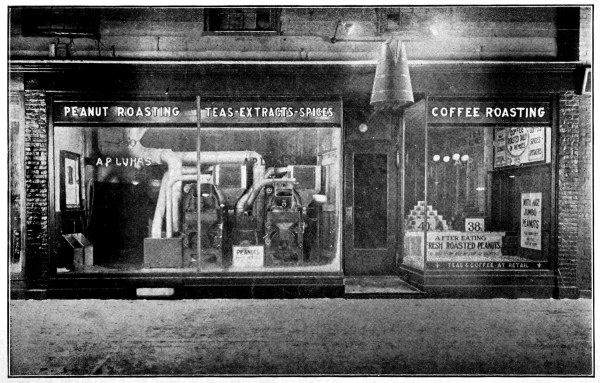
Luhrs, of Poughkeepsie, N. Y.,
Features Freshly Roasted Coffee in His Window
Smoke from the roasters is blown into the street
through the coffee pot over the door.
[Pg 155]
How coffees are sold at retail—The place of the grocer, the tea and coffee dealer, the chain store, and the wagon-route distributer in the scheme of distribution—Starting in the retail coffee business—Coffee blends for retailers—Small roasters for retail dealers—Model coffee departments—Creating a coffee trade—Meeting competition—Profits and costs—Splitting nickels—Figures costs and profits—A credit policy for retailers—Premiums for retailers—How to build and hold a retail coffee business.
Seven different types of distributers figure in the retail merchandising of coffee in the United States. These are the independent retail grocer, chain store, mail-order house, house-to-house wagon-route distributer, specialty tea and coffee store, department store, and drug store.
Considering the methods of merchandising, the seven retail distributing agencies may be grouped into three distinct classes. The first class would comprise the independent grocer, the chain store, the department store, the drug store, and the specialty store, all of which maintain stores where the consumer comes to buy. The second class takes in the mail-order house, which solicits orders and delivers its coffee by mail, and sometimes by freight or express. The third class covers the wagon-route dealer, who goes from house to house seeking trade, and delivers his coffee on order at regular periods direct to the consumer in the home. As an inducement to contracting for large quantities to be delivered in weekly or biweekly periods, the house-to-house dealer generally gives some household article, or the like, as a premium to [Pg 156] establish goodwill and to retain the trade of his customers.
The mail-order houses confine their sales efforts to agricultural districts and small towns, soliciting trade by catalogs, by circular letters, and by advertisements in local newspapers, and in magazines which circulate chiefly among dwellers in rural districts.
The majority of wagon-route distributers depend upon the lure of their premiums, and upon personal calls, to develop and hold their coffee trade. The leading wagon-route companies, sometimes called “premium houses,” maintain offices and plants in cities or towns adjacent to the territories to which they confine their sales efforts. At strategic points, they have district agents who engage the wagon men that do the actual soliciting of orders and deliver the coffee. All wagon-route companies handle other products besides coffee, specializing in tea, spices, extracts, and such household goods as soap, perfumes, and other toilet requisites that promise quick sale and frequent reorders.
Wagon-route coffee retailing began to make itself felt seriously about the year 1900. At first, the premiums usually consisted of a cup and saucer with the first order, the customer being led to continue buying until at least a full set of dishes had been acquired. Later, the range of premiums was expanded, until today the wagon man offers several hundred different articles that can be used in the home or for personal wear or adornment. Practically all the leading wagon-route concerns favor the advance-premium method; that is, a special canvasser induces a consumer to contract for a large quantity of coffee and other products in return for receiving the premium at once, though the coffee is delivered only as the customer wants it, generally two pounds every two weeks. The wagon man delivers the coffee, and is usually held responsible for the customer’s fulfilling the agreement, and is expected to secure repeat orders with other premiums. [Pg 157]
The importance of the wagon-route plan of coffee retailing is shown by the fact that in 1924 there were 600 houses of this kind in the United States; and it was estimated that they distributed 10 percent of the total amount of the coffee consumed in the country. The biggest company was capitalized at $16,000,000, and operated 1,100 wagons. Most of the wagon-route concerns were operating in the central states, practically one-third of them covering the states of Illinois, Wisconsin, Indiana, and Iowa. Pennsylvania is also a wagon-route-dealer center.
The premium wagon-route distributers have an organization called the National Retail Tea & Coffee Merchants Association. It is composed of 200 members (all of whom use premiums), who operate 3,500 wagons. The largest single wagon-route operator is the Jewel Tea Company, of Chicago. The members of this organization claimed to have served more than 3,000,000 families in 1923.
In the chain-store system of merchandising, we see the opposite extreme of coffee retailing. The wagon-route man features his delivery service; while, in the chain-store plan, all customers must pay cash and carry home their parcels (some chain stores, however, maintain more or less complete delivery service). Though the earliest established chain stores gave premiums, the practice has now been generally abandoned. Roasting, blending, and packing coffee in a large central plant, the chain-store operator advertises that he can sell coffee at a price lower than his competitors. As a rule, only one grade of coffee is offered for sale. While it is generally good value, many consumers prefer better quality and go to the independent grocer for it. Others patronize the grocer because of his convenient delivery service, and because he gives credit on purchases. Chain-store organizations seem to be growing rapidly, however; the largest of the chains, the Great Atlantic & Pacific Tea Company, reporting in 1924 that it had nearly 10,000 branches throughout the country, which sell 60,000,000 pounds of [Pg 158] coffee annually. This chain has a capitalization of $13,750,000, and in 1923-24 sold $302,880,369 worth of groceries, as compared with $246,940,873 in the preceding year. This company opens about 1,500 new stores every year.
The chain-store men are organized in the National Chain Store Grocers Association, having 75 members, representing 25,000 stores, operating in 23 states. It is estimated that there are not to exceed 150 chain-store grocery organizations in the United States, representing about 30,000 store units and having a minimum of 25 units each. The chain-store grocer turns his stock over from 12 to 25 times a year, sells for cash, makes no deliveries, and claims to save the consumer an average of 15 percent in buying. These stores do business on a net margin not exceeding three percent on sales, as against the average retail grocer’s 30 percent, while their average gross cost of doing business has been stated as between 13½ percent (lowest) and 18½ percent (highest).
It is estimated that these chain-store organizations distribute 270,000,000 pounds of coffee a year, or about 20 percent of the total amount consumed in the United States.
When taking up the retail merchandising of coffee, the practical grocer learns all he can about the popular grades to be had in the principal markets, and how the coffees are grown, roasted, blended, and ground. He also ascertains the best methods of brewing, testing out each grade and kind on his own table, if he does not have testing facilities in his store. He studies the relative trade values of different varieties of coffee and the requirements of his particular clientele.
An interesting analysis of some 250 grocery stores in the United States[4] made in 1919, showed that 29 percent of the dealers bought all their coffee from wholesale grocers, 48 percent exclusively from [Pg 159] roasters and specialty wholesalers, 10 percent got over half of their coffee from wholesale grocers, and 13 percent bought less than half from the wholesale grocery houses.
There are two fundamental plans on which a retailer builds a successful coffee business,—by buying coffee already roasted, and by buying it green and roasting it in the store. Each plan has its advantages; but its practicability depends upon conditions in different localities.
Beyond acquiring a general talking knowledge about coffees, the retailer buying his stocks roasted in bulk or package form does not generally need the intimate knowledge of his goods required by the grocer who roasts his own coffee. If he grinds the coffee for his customers, he must know the type of grind best suited to the way the coffee is to be brewed, and must be able to tell the best brewing method.
The practical grocer who makes up his own blend is acquainted with blending principles and methods. While he cannot expect to be so expert as the large wholesale blender, he should know that green coffees are generally classified by blenders into five great divisions; Brazils, including Santos, Bourbon, and flat bean, Rios, Victorias, and Bahias; Washed Milds, embracing, as of the most commercial value, Bogotas, Bucaramangas, Guatemalas, Mexicans, Costa Ricans, Maracaibos, and Meridas; Unwashed Milds, such as Maracaibos, Bucaramangas, La Guairas, and Mexicans; Javas, Sumatras, and Padangs; and Mocha and Harari.
It has been found by experience that a good assortment for the average retailer to carry consists of Santos, because of price; a natural unwashed Maracaibo or Bucaramanga, because of full-body and general blending values; and a washed coffee, preferably a Bogota, which gives quality and character to a blend. In stocking up with these coffees, the practical merchant avoids Santos with a strong or Rioy flavor, bitter or “hidy” Maracaibos, and acidy or thin Bogotas. [Pg 160]
A grocer equipped with these coffees has the Santos for his low-priced seller. For his medium grade, he blends Santos and Maracaibo, half-and-half. The next higher grade is made up of one-third each of the three coffees; while the best blend consists either of half-and-half Bogota and Maracaibo, or three-quarters Bogota and one-quarter Maracaibo.
The chief advantage of these three coffees is that they blend well in any way they are mixed; and the dealer with a little experience, and working with the two necessary ideas in mind,—satisfactory coffee and price,—can make up various combinations.
In view of the fact that the United States imports coffee from more than a hundred different sections of the world, and that there are wide variations in flavor among the coffees produced in each of the hundred, it is easy to understand that the blender has an almost unlimited supply from which to make up a blend with a distinctive individuality. Practically all coffee importers, and most wholesalers, are thoroughly acquainted with the relative trade values of the different coffees, and help their customers make up desirable blends.
While the wholesale coffee roaster is obliged to install a large and somewhat complex equipment, the retailer must use a small, compact, self-contained unit that does not take up much space in his store and is easily operated. Retail roasting machines are constructed on the same general principle as the wholesale roaster. The roasting cylinder is generally revolved by electric power and the heat is derived from gas or gasoline fuel. Cooling is by air suction in a box attached to the roaster. The capacities of the machines range from 10 to 300 pounds, the operating cost running from approximately eight cents per 100 pounds for gas fuel and 10 cents for electric power. The roasters [Pg 161] cost from $300 for the smaller sizes to $1,500 for the one-bag type, and to $2,000 or $3,000 for the two-bag type.
One coffee-roaster-machinery manufacturer has recently brought out a gas-fired, electrically operated, 50-pound miniature coffee-roasting plant designed for retail stores, which comprises a roaster, a rotary cooler, and a stoning device, that sells for $650.
Retail coffee roasting is similar to the wholesale operation. When the cylinder has become heated, the green coffee is run in and allowed to roast in the revolving cylinder for about half an hour. If the coffee is the average green kind, the full heat may be applied at once; but, if old and dry, a lesser degree is used. When the roast begins to snap, the flame is turned lower, to allow the beans to cook through evenly, and, when nearly done, it is almost extinguished. During the operation, the roaster man, who may be the proprietor or a clerk delegated to the work, frequently “samples” the coffee by taking out a small quantity with his “trier” and comparing the color of the roast with a type sample. When the colors match exactly, the coffee is dumped automatically into the cooler box just below the cylinder opening, and, when sufficiently cooled, is ready for grinding to order.
A large number of retailers roast coffee in their stores; and the most successful find that, besides being able to make a feature of freshly roasted coffee, they can save money and increase their sales. One progressive grocer found that he was able to get 88 pounds of roasted coffee out of 100 pounds of green coffee, as compared with the wholesaler’s 84 pounds; that he could buy green coffee at a closer price than roasted; and that it cost him less for labor, fuel, overhead, and similar items than it did the wholesale roaster to turn out a roast.
A chain of coffee specialty stores in which the coffee is roasted fresh every day was started in California about 1916, and met with almost [Pg 162] instant success. In this system, the proprietor buys the green coffee in large quantities, and it is roasted in each of his specialty stores, which are located in public markets, store windows, and alongside heavily traveled highways. The roasting machinery is invariably set up in front of the store where passersby can easily see it in operation and also smell the coffee roasting. Four years after starting the first store, there were 50 in operation along the Pacific Coast, doing an annual business of $600,000, some units taking in more than $7,000 a month.
Authorities generally agree that a well-laid-out coffee department not only increases a grocer’s coffee business, but speeds up sales in other departments as well. Coffee lovers are inclined to “shop around” for a coffee that suits their taste, and, when they have found the store that sells it, they buy their other groceries there also. Another argument advanced in favor of a coffee department is that coffee pays more money into the retailer’s cash drawer than any other grocery item.
Most successful retail coffee merchandisers establish the coffee department near the entrance to the store, where it can be seen through a window by passersby, especially if there is ornamental roasting and grinding equipment. It has been found that a department at the left of the entrance is almost certain to draw attention, because people are inclined to glance in that direction first. Some merchants, having the space, erect attractive booths, designed somewhat like the familiar food-show booths, directly in front of the door, after the fashion of department stores when holding a special sale on a certain article. Such a booth is generally used for demonstration purposes, and is decorated with signs and possibly with bunting. A permanent department is usually less ornamental, but still attractive. In telling how he made a success of his department, one American grocer said that he was careful that his fixtures were not so ornamental as to draw attention from the goods. While the decorations were always attractive, they were subordinated sufficiently to form a background for his coffee display.
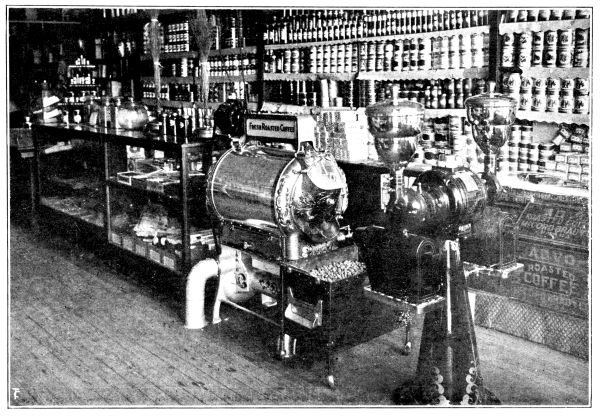
Johnson, of Red Oak, Iowa,
Roasts Before the Customer
[Pg 163] The most popular layout is the conventional counter system, behind which the clerk stands to serve the customer on the other side. There are many advocates of the counter that is built into the shelving, believing that, the closer the customers are brought to the coffee, the more they will be inclined to buy. This system also makes for cleanliness, doing away with the possibility of the runway behind the counter becoming a catch-all for dirt, torn paper, bits of wood, and the like.
The modern coffee department has counters divided into compartments having glass fronts. This type serves both as a storage place for coffee and for display purposes. The top of the counter is used for wrapping up parcels, etc., and also for displaying bulk and package coffees. In the well regulated store, the counter top is never used for storage, all stock being kept on shelves or in the counter’s compartments. Good merchants find that cleanliness pays; and that a “littered up” store drives away desirable custom. The wise proprietor never allows a clerk to weigh out coffee after handling cheese, onions, and other odorous articles, without first thoroughly washing his hands. He knows that few food products in his store will more quickly absorb undesirable odors and flavors than coffee, and consequently is careful to protect his coffee from contamination. In the better stores, the proprietor will either take charge of the coffee department himself, or will delegate a competent man who will do nothing else.
The wide-awake retail coffee roaster always features his roasting machine, which is generally highly ornamental and draws attention even when not in use. Some progressive merchants plan to roast coffee at noontime and at night, when homeward-bound passersby are hungry and are particularly susceptible to the pungent aroma of roasting coffee. It is [Pg 164] a quite common plan for the retail roaster to arrange the exhaust of the machine so that the full strength of the odor is blown into the street.
Because of steady sales and quick profits, there is keener competition in retail coffee merchandising than in other food products; but, all things being equal, any intelligent person can create and hold a profitable trade if he follows approved business methods—and works. The best practice among coffee merchants shows that the prime essential is good coffee, freshly roasted and ground. After that comes intelligent and unremitting sales-promotion work.
The many ingenious trade-building plans worked out successfully by grocers in all parts of the country are too numerous to describe in a book of this character, but the methods cited in the following, all of which have been tested in actual working conditions, will serve to indicate the fundamentals of good retail coffee-sales promotion.
Among the chief sales-winning methods are demonstrations in the store, at local food shows, and at church socials, picnics, or functions, judicious sampling either in person or by mail, personal canvassing from house to house, circularizing by mail, linking up window displays with current happenings, local newspaper and outdoor poster advertising, and selling coffee by telephone. Most of the foregoing plans are worked intermittently. The telephone, however, is a most important sales factor, and should be employed constantly and consistently. Many successful stores consider the telephone, properly used, the greatest single sales help in retail coffee merchandising.
One grocer had such faith in this method that he paid half the annual telephone rental for a large number of his best-paying customers. Another large merchandiser put in an individual telephone for each of his salesmen, who called up his regular customers each day to suggest [Pg 165] articles for that day’s order, always of course mentioning their “superior brand of coffee.” Telephoning is the next step to personal contact, and, if tactfully done, is considered to be even more advantageous because of the time it saves both the customer and the storekeeper.
Coffee demonstrations in stores are easily arranged, in most cases. The main consideration is fresh coffee of good quality, served daintily and hot. Lacking a coffee urn, some grocers make their brews in large-size home-service coffee-making devices. Those most advanced in the correct method of brewing use the drip process. It is generally agreed that demonstrations should not be held too often. They not only cut into profits, but lose much of their advertising value. Food-show demonstrations require more elaborate equipment, consisting of a decorated booth, educational booklets, posters, and exhibits of different kinds of coffee, both green and roasted, whole bean and ground. Generally, coffee packers cooperate with retail demonstrators by suppling gratis the coffee to be brewed, if the names of their brands are suitably displayed. They supply also posters, signs, samples, and booklets for free distribution.
Window displays form one of the best means of advertising at the command of the average grocer, and one of the least expensive. A popular coffee display consists of a series of educational “windows,” starting with green beans in the bags in which they are shipped from the growing country. Generally the bags, mats, or bundles are obtained from the wholesale house, and are filled almost to the top with some inexpensive stuffing, the green coffee being spread over the top to give the appearance of a full bag. Pictures showing how the coffee is grown, harvested, prepared, and shipped are frequently used in such a display. The next exhibit consists of whole roasted coffee spread thickly over the window floor to create the impression of bulk, accompanied by a few pans of green coffee by way of contrast, and with [Pg 166] pictures showing scenes in coffee-roasting plants. A barrel, lined with blue paper, and lying on its side with roasted coffee beans spilling out, serves as a centerpiece for such a display. Following this, comes a coffee package window, accompanied by pictures showing how coffee is roasted, ground, and packed. This completes the series; but there are many variations that have proved successful as trade builders.
Meeting Competition
Since the advent of the wagon-route distributer and the chain store, the independent retail grocer has been faced with the problem of how to regain at least a fair measure of the coffee trade he has lost. The grocer is not only concerned about his profits on coffee sales, but on other goods as well; for a trade investigation has shown that a large percentage of the regular customers of the retailer are held to the store by their purchases of coffee and tea. This means that if coffees and teas are bought from the wagon-route distributer and the chain store, the remainder of a family’s order is “shopped around.”
To meet this competition, the best authorities agree that the independent grocer should feature coffee in every practical way, such as soliciting coffee trade from each customer that enters the store; give up offering coffee on a price basis, and make up his own blends from good-quality growths; perhaps make up his own brand and push it at every opportunity; display coffee artistically, with frequent changes of layouts; and have occasional store demonstrations. He should see that the coffee is roasted properly, and that it is always fresh; that the selling effort is not expended on the lowest-priced blend, but on a grade that can be recommended for cup merit. This should be a leader, but a lower-price coffee could be carried to suit the trade that buys on price. Persistent efforts should be made to persuade the last-named class of customers to use the better grades, which in the end are [Pg 167] cheaper and give better satisfaction. In short, the grocer should work consistently to establish a vogue for his leader blend on the basis of merit.
Because of its influence on other grocery items, coffee can often be sold at a close margin of profit, particularly if a competitor’s store or wagons are cutting into a grocer’s neighborhood trade. Twenty-five percent is recommended as a reasonable gross profit on coffee in most cases, although some grocers make less, and not a few make more; the range being usually from 20 to 39 percent. The independent dealer should meet chain-store competition in coffee on a price basis, making a special on a superior grade and figuring to get not more than three cents profit a pound, like his competitor. A bag of roasted coffee will bring back $3 gain, and the cash to pay for another—and the grocer has kept his customers, 90 percent of whom, theoretically, will have bought their other food supplies from him. As a matter of fact, in the last year of the World War retailers showed a tendency to demand cash on sales of all grocery items. This practice reduces the cost of operation and allows the storekeeper to reduce his prices. A large number of grocers charge a small percentage of the total sale for credit privileges, and five or 10 cents for each delivery below a certain total value of the purchase price of the articles to be delivered. As a result, they have been able to meet chain-store competition. Collective buying has also been a factor in offsetting the inroads of the “chains.”
Splitting Nickels
One of the reasons advanced for the loss of coffee trade by retail grocers is that they price their blends in “round numbers,” that is, 20, 25, 30, or 40 cents, while their competitors “split nickels,” selling their product at 18, 23, 28 or 38 cents.
Most of the retail enterprises in other lines of trade have built up [Pg 168] their business on the penny-change plan, and many coffee men believe that this should become the universal merchandising method among retail distributers of coffee. One of the leading advocates of “splitting nickels” has worked out a chart to show how coffee should be priced to make predetermined profits:
Table Showing Profit Percentage on Sales
| Selling Price and % Profit | |||||||||
|---|---|---|---|---|---|---|---|---|---|
| Cost of Coffee |
——————————————————————————————— | ||||||||
| 25c. | 26c. | 27c. | 28c. | 29c. | 30c. | 31c. | 32c. | 32c. | |
| 20c. | 20% | 23% | 26% | 28% | 31% | 33% | 35% | 37% | 39% |
| 20½c. | 18% | 21% | 24% | 26% | 29% | 31% | 33% | 35% | 37% |
| 21c. | 16% | 19% | 22% | 25% | 27% | 30% | 32% | 34% | 36% |
| 21½c. | 14% | 17% | 20% | 23% | 25% | 28% | 30% | 32% | 34% |
| 22c. | 12% | 15% | 18% | 21% | 24% | 26% | 29% | 31% | 33% |
| 22½c. | 10% | 13% | 16% | 19% | 22% | 25% | 27% | 29% | 31% |
| 23c. | 8% | 11% | 14% | 17% | 20% | 23% | 25% | 28% | 30% |
| 23½c. | 6% | 9% | 13% | 16% | 19% | 21% | 24% | 26% | 28% |
| 24c. | 4% | 7% | 11% | 14% | 17% | 20% | 22% | 25% | 27% |
| 24½c. | 2% | 5% | 9% | 12% | 15% | 18% | 21% | 23% | 25% |
| 25c. | 0% | 3% | 7% | 10% | 13% | 16% | 19% | 21% | 24% |
| 25½c. | 2% | 5% | 8% | 12% | 15% | 17% | 20% | 22% | |
| 26c. | 0% | 3% | 7% | 10% | 13% | 16% | 18% | 21% | |
| 26½c. | 1% | 5% | 8% | 11% | 14% | 17% | 19% | ||
| 27c. | 0% | 3% | 6% | 10% | 12% | 15% | 18% | ||
| 27½c. | 1% | 5% | 8% | 11% | 14% | 16% | |||
| 28c. | 0% | 3% | 6% | 9% | 12% | 15% | |||
While the cost of conducting a retail grocery business naturally varies according to local conditions and the size of the enterprise, an investigation among some 250 stores in small and large cities made in 1919 by the Bureau of Business Research, Harvard University, showed that the average cost was 14 percent, that the net profit averaged 2.3 percent, and that stock was turned about seven times a year. Gross profits ran from 10.5 to 26.04 percent of the net sales, the most typical figure being 16.9 percent. Sales cost formed the largest single item of expense, varying from 3.41 to 9.94 percent, with the bulk of figures showing around 1.8. [Pg 169]
According to advanced business practice, the cost of doing business should be based on these 14 points:
1. Charge interest on the net amount of the total investment at the beginning of the business year, exclusive of real estate.
2. Charge rental on real estate or buildings at a rate equal to that which would be received if renting or leasing to others.
3. Charge, in addition to what is paid for hired help, an amount equal to what the proprietor’s services would be worth to others; also treat in like manner the services of any member of the family employed in the business and not on the regular payroll.
4. Charge depreciation on all goods carried over on which a less price may have to be made because of damage or any other cause.
5. Charge depreciation on buildings, tools, fixtures, or anything else suffering from age or wear and tear.
6. Charge donations and subscriptions paid.
7. Charge all fixed expenses, such as taxes, insurance, water, lights, fuel, etc.
8. Charge all incidental expenses, such as drayage, postage, office supplies, livery expenses of horses and wagons, telegrams and telephones, advertising, canvassing, etc.
9. Charge losses of every character, including goods stolen, or sent out and not charged, allowances made customers, all debts, etc.
10. Charge collection expense.
11. Charge any other expense not enumerated here.
12. When it is ascertained what the sum of all the foregoing items amounts to, prove it by the books, which will give the total expense for the year; divide this figure by the total of sales, and it will show the percent which it has cost to do business.
13. Take this percent and deduct it from the price of any article sold, then subtract from the remainder what it cost (invoice price and freight), and the result will show the net profit or loss on the article.
14. Go over the selling prices of the various articles, and see what are profits; then get busy in putting your selling figures on a profitable basis, and talk it over with your competitor as well.
A Credit Policy for Retailers
While the minor factors governing a credit policy for retailers vary [Pg 170] with local conditions, the fundamental principles are alike everywhere, and should have the thoughtful consideration of all retail distributers of coffee. After a retail-grocery-store experience of 25 years, a past president of the National Association of Retail Grocers of the United States found that a grocer should insist upon references and a thorough investigation of every new applicant for credit, refusing the privilege when the prospective customer hesitated to give the needed information; that he should arrange a date for periodical payments, explaining that this was necessary so that the storekeeper could arrange to meet his own bills, which would enable him to discount his invoices and to sell his goods cheaper; that statements of accounts should be sent out promptly and never a few days late; that he should insist upon payment in full when due, requesting the customer to call if an extension of time was asked; that he should not let the customers decide when they would pay bills, bearing in mind that the possible loss of a few customers who did not pay promptly was offset by the advantages of cash when promised; that he should never abandon the hope of collecting an old account, but should try the method of sending statements only to the surest customers, sending a clerk for the collection of all other accounts; that he should personally examine all uncollected accounts every month, insisting upon a reason for failure to pay; that he should study his customers and not trust those who gave a bad impression; that he should have the courage to say “No” when necessary; not to be satisfied with merely a financial rating on a credit applicant, but to ascertain his general reputation and character; and to help to eliminate the deadbeats by giving careful attention to all requests received from other retailers for credit information.
Premiums for Retailers
House-to-house dealers are the largest users of premiums among coffee distributers. Most of them operate under what is known as the advance-premium method. [Pg 171]
The plan followed by house-to-house dealers until about 1910 was to issue checks redeemable in premiums after a certain amount of tea, coffee, or other products had been purchased. This practice has not been entirely abandoned; but in most instances the premium is now handed to the consumer in advance of the initial purchase in consideration of the buyer’s promise to use a stipulated quantity of tea, coffee, or other merchandise. The driver of the wagon generally carries a portfolio illustrating numerous premium items redeemable through the purchase of varying amounts of merchandise.
Many retail coffee stores also employ premiums, using both the old-style and the “advance” methods. This type of store, however, is being supplanted by the chain grocery store.
Some independent retail grocers use premiums to a limited extent. These usually carry a small line of premiums, featuring a piece of kitchenware, or other inexpensive item, with bulk coffee.
It is significant that one of the largest chain-store organizations in the United States, the Great Atlantic & Pacific Tea Company, uses few premiums today, although its business was founded upon the premium idea.
Trading stamps, which are sold to grocers and other merchants by firms making a specialty of this form of premium giving, are little used nowadays. The average retail grocer is antagonistic to trading stamps, as a result of the methods of certain unscrupulous stamp dealers. Legislation against trading stamps is in effect in many states.
Whether the retailer roasts his own coffee or features several reliable blends of package coffees, there are certain things he should bear in mind if he wishes to build and hold a substantial coffee trade. [Pg 172]
First he needs to know all about coffee, in order not only to buy intelligently, but also to discuss the subject entertainingly with his customers. To this end he should put in all the available spare time in reading up on the subject.
Every dealer should know that he is first of all a soldier in the army for the common good, and that as such he has a duty to perform in rendering a real social service; not to the manufacturer, not to the jobber, but to the consumer.
Every dealer should know that “honesty is the best policy” because it pays; and that is what the Latter Day Psalmist meant when he said, “The crown of virtue is riches.”
Every dealer should know how to figure his cost of doing business, remembering that this involves salary for himself, and a charge for rent even if he owns the building.
He should know his net profit on every pound of coffee he sells.
He should know that he is not a merchant if he sells any product at less than 20 percent on his selling price, because the approximate cost of doing business in the grocery line is 17 percent, and at 20 percent he makes only three percent net; also that there are many safe investments at six percent.
He should know that his most valuable advertising medium is his window; and, because this is so, it should be dressed never less than once a week, and it would be better if it were dressed every other day. If he owns space in a newspaper, he should not repeat the same copy every day.
He should know that the one great trade winner that costs nothing is politeness.
He should know that another, costing little, but worth all it costs, is cleanliness.
He should know that the customer is always right; that he is “the boss,” because he not only pays the clerks wages, but also the proprietor’s salary.
He should know that advertised goods are sold for him. [Pg 173]
He should know that anybody can give goods away, but it takes a merchant to sell them, and this means, Do not be a price cutter.
He should know that, while good fixtures cost money, they soon save what they cost. The initial expense is temporary; the saving, perpetual.
Every dealer should know that, if he subscribes for every newspaper, magazine, or book published, he will not get so much information about his business from all of them put together as he will from one issue of a good trade paper; that the trade-paper editor is his best friend in his fights for fair profits; that in the advertising columns of his trade paper is to be found his best market place.
He should know that a chain store and the wagon-route man cannot take business away from him if he is well posted, aggressive, and renders the right kind of service; that the tea and coffee business of his community belongs to him by right, and that it can slip away from him only if he neglects this profit-making department of his business.
Then, too, the dealer should know that to get the trade of his community he must go after it, not wait for it to come to him. To be a go-getter, he should study first how to arrest the prospective customer’s attention, how to arouse his interest, how to create in him a desire to buy his favorite kind of coffee in the dealer’s store, and how to hold his trade.
To arrest the customer’s attention, he must have a bright, shining store, with “come-hither” windows (the windows are the eyes of the store), and he may add to the attractiveness of the place by a window coffee roaster, or by enticing window displays of coffee in bulk or in packages.
If the dealer does his own roasting, the manufacturer of the roasting machine may be depended upon to furnish him with all needful guidance in green-coffee selection, blending, roasting, etc. If he buys in bulk, he should seek only reliable sources of supply, and take advantage of [Pg 174] all the sales help his jobber has to offer. Above all, he should resolve to carry only blends of quality,—not how many, but how good. Let him be sure he is right in this, then go ahead.
Next, the proper grinding equipment is of prime importance. Get a good grinder and instruct the housewife in the matter of the right grind for her method of making the beverage. The National Coffee Roasters Association will gladly cooperate with any dealer in this matter. The live dealer knows that every family in his territory buys at least one pound of coffee a week, and if the purchase is not made at his store the fault is in himself, not in the customer. He should make up a list of names, and keep after them regularly, systematically.
Any prospective customer’s interest may be aroused by personal attention, practical demonstration, and thoughtful study of his coffee requirements. Offer to make up a blend just for him. Have a card index to this blend, so that any clerk may serve him. Send solicitors to call upon him at his home. Demonstrate at church fairs and social gatherings. Get a good coffee maker, and demonstrate the gospel of good coffee making in all seasons. Give it away, or, better still, sell it to him. Be an authority on the proper grinding and brewing of coffee. Be a coffee enthusiast. Such enthusiasm is infectious. The coffee custom of any community will soon wear a beaten path to such a dealer’s store.
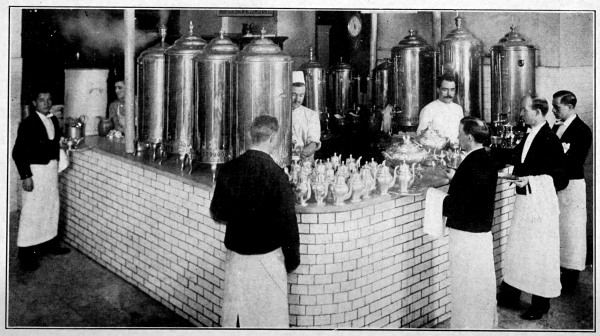
In One of the Coffee Kitchens
of the Waldorf-Astoria Hotel,
New York
[Pg 175]
Analyzing the potential market—The supreme coffee test—Freshly roasted and freshly ground—Coffee-brewing conclusions—Coffee urns—Rules for making coffee in hotels and restaurants—General directions for improving coffee service—How to operate a successful coffee shop, with sample menus; hints on equipment and service.
The correct brewing of coffee in hotels, restaurants, cafeterias, soda fountains, and in centralized “eating places” should interest every dealer, because these are important avenues through which to promote an increase in coffee consumption. Intelligent study of this subject is certain to result in more business.
It will pay any coffee man to make an analysis of the hotel and restaurant trade in his community. Invariably there is room for improvement or need for reform. Until recent years, it used to be said that public eating places in the United States where good coffee might be had were few and far between; yet many a hotel and restaurant has built up a national reputation on its coffee. The old Astor House in New York enjoyed such a reputation.
The American breakfast cup is a food beverage because of the milk or cream and sugar additions, and more and more this same generous cup serves again as a necessary part of the noonday and evening meals for most people. Any hotel or restaurant man will lend a willing ear to [Pg 176] suggestions making for improvements in his coffee. This is a splendid avenue of sales approach. Once an eating place gains a reputation for surpassing coffee, its fortune is made. No one thing attracts and holds patronage like good coffee.
In making an analysis of the coffee needs of any hotel or restaurant, the starting point is to find out the class of patrons catered to and suggest the best blend for that trade. If it is a popular eating place, it may be foolish to suggest a high-priced blend, for the patrons may have acquired a combination coffee and chicory taste. In the chapter on Coffee Blending, we have already discussed the matter of suitable blends for hotels and restaurants. It is necessary to add here only that after the best blend for the money has been selected the emphasis should be placed upon freshness and the most efficient grinding and brewing.
Certain A-B-C’s of grinding and brewing should be gone over with the customer, for the chances are that he is not a coffee specialist and does not realize the importance of them.
The supreme test of the coffee served in any restaurant is this: Does it inspire the customer with a desire for more? Does he come back for a second cup, or go out of his way to patronize the place because he knows the coffee is always uniformly good?
The coffee merchant should occupy the position of counsel and friend to the hotel and restaurant man. He should visit him frequently and make it his personal business to see that his instructions to the help are being carried out to the letter. Employees will grow lax in the essentials, and we know of no system that is fool proof.
Having got the right blend, the coffee must be freshly roasted and ground just before making. No hotel or restaurant can afford to use [Pg 177] stale coffee. The grinder must be inspected regularly; not only must it be kept clean, but it needs to be watched to see that the fixed grind does not vary. Many coffee dealers have a special hotel and restaurant service to look after these matters, but the customer should be urged to have several men in his employ that are familiar with all requirements, so that in the absence of the coffee chef nothing can go wrong. The use of a stale batch of coffee, a change in the grind, a mistake in measuring, some apparently trivial error, is likely to make for dissatisfaction in the cup, and the labor of years goes for naught. The patron is displeased, and his custom likely to be lost forever.
Accuracy in measuring the amount of coffee to be brewed and the quantity of water are also important. It will pay to check up frequently on weights and measures, urns, leach bags, and other utensils, and to stress the importance of cleanliness in every operation.
When we come to the actual making of the beverage, it is well to bear in mind the following brewing conclusions arrived at after much careful research by Professor Samuel C. Prescott of the Massachusetts Institute of Technology:
1. Coffee should be brewed with water at temperatures between 185° F. and 200° F. Above this temperature decompositions yielding bitter flavors take place, and mask to some degree the characteristic and delicate true coffee flavor.
2. The time of contact of the ground coffee and the water should be brief. We have found the best results when this time period did not exceed two to two and a half minutes. With long contacts, woody flavors are extracted from the bean, and bitter principles gradually pass into the solution.
3. The coffee infusion should not come into contact with metals, but should be brewed and kept in glazed or vitrified containers, such as porcelain, glass, or agateware. Even brief contacts with some metals yield pronounced bitter, astringent, or metallic flavors, due undoubtedly to the actual solution of and combination with minute amounts of the metal. [Pg 178]
4. Eighty to 85 percent of the total caffein is extracted in a contact of two minutes when all the grains of coffee are thoroughly wetted. As coffee is an oily seed, it is necessary to have the water penetrate the superficial film of oil in order to emulsify it and to gain access to the other ingredients. Obviously, the small grains of a fairly fine grind will yield more dissolved material in a unit of time than if the coffee is coarsely ground. In the latter case, more coffee must be used to secure the same strength of infusion.
5. Freshly roasted and freshly ground coffee yields a beverage far superior to that made from ground coffee which has been exposed to the air. Our results seem to indicate that under these conditions there is a loss of the volatile ethereal flavors, and possibly an oxidation of the oils bringing about an incipient rancidity.
Of course, the ideal way to prepare coffee in hotels and restaurants would be to provide an individual service where the time of infusion would be under strict control; but this is not practical where large quantities of coffee “base” are required for quick service. To approximate the filtration or drip method, which experience has proved to be the best, resort must be had to coffee-making urns employing bags or paper or to the various rapid coffee-making devices on the market. The urn should have a liner of glazed earthenware or glass. If a cloth bag is used, it must be kept clean and immersed in cold water to prevent fouling when not in use.
The use of paper presents the advantage of a clean new filter for each brew. Many hotels and restaurants now use a filter with a layer of fiber paper which can be renewed for each batch of coffee. This filter paper is put into a container which fits into the top of the urn. The bottom of the container is perforated to permit the coffee to drip through as it filters through the paper. Here are the rules prepared by the manufacturer of one of these devices:
1. Put into the coffee urn all the boiling water required for the batch of coffee. [Pg 179]
2. Place the receptacle on top of this urn, with the coffee evenly distributed over the filter, having the entire sheet well covered with coffee.
3. Fasten the water spreader over the coffee to keep it from floating.
4. Transfer from the urn into the receptacle only as much boiled water as will fill it.
It is contended that this method of making coffee is more convenient and more sanitary, since it does away with the necessity of handling and keeping the cloth filter bag clean. It also obviates the necessity of repouring, because the water cannot get into the urn below until it trickles through the ground coffee; whereas, with the drip-bag method a large part of the water comes through the sides of the bag without touching the coffee. Another advantage claimed for this method is that the coffee grounds are always suspended above the water and cannot stew in the brew.
The method which gives the best results for hotel and restaurant custom of course depends upon the class of restaurant and that restaurant’s type of trade; the kind of coffee used, the grind of the coffee, and the degree of roasting; also, the factors of whether the restaurant’s trade is relatively steady or spasmodic and the time of day at which it is intended to serve the coffee are points for consideration. The type of urn and coffee maker used are also determinative factors.
In general, where the usual type of urn is employed, the coffee being made in a bag, and with coffee of the proper degree of fineness of grind and the proper intensity of roast, and where the trade to whom the coffee is to be dispensed is average, the following procedure may be recommended:
Use two and a half gallons of boiling water to a pound of coffee, and after placing the coffee in the urn sack pour the boiling water through it, then repour the entire amount of liquid through the coffee once. If coarser coffee is used or the water is not boiling, further repouring [Pg 180] is necessary. The urn bag and grounds should be removed from the urn 20 to 30 minutes after the last repouring. Further contact of the grounds with the coffee liquor is likely to promote extraction of undesirable elements and consequent deterioration of the brew.
It is essential that the urn sack be clean, that the coffee be fresh, the water be boiling, the water jacket of the urn be kept at approximately 220° to 210° Fahr., and the interior of the urn be kept religiously clean and sweet. Between brews, the urn bag should be washed in cold water and kept immersed in cold water. Soap or any other cleanser should not be used for cleaning the bag. If these instructions be followed, a desirable brew of coffee is always sure to result. It is not advisable to add egg, salt, butter, or vinegar, as seems to be the tendency in some restaurants.
How to Make Coffee in Hotels
and Restaurants
The Joint Coffee Trade Publicity Committee has provided the following rules for making coffee in hotels and restaurants:
1. See that you have a plentiful supply of fresh boiling water in hot-water urn.
2. See that the gage shows plenty of water in jacket of coffee urn and that it is at a temperature of 170° to 180°. The water in the jacket should not boil, because too much heat cooks the brewed coffee.
3. Look inside coffee urn to see that it is in proper condition.
4. See that leaching bag is clean and sweet.
5. Put correct amount of dry coffee into leaching bag.
6. Note that water in the hot-water urn is boiling, not only blowing off, but boiling hard, and that the water in the gage is moving up and down.
7. Heat hot-water measure by rinsing with hot water.
8. As rapidly as possible draw the correct number of measures of water and put through coffee; keep urn cover down between measures of water, and be careful not to pour water on fast enough so that it will overrun top of bag in urn.
9. At once repour coffee. Repour entire making; i. e., if [Pg 181] water is five gallons, repour five gallons. If the coffee is ground sufficiently fine, one repouring should be enough. Repouring a second time to gain more “body” may make the brew bitter and sacrifice delicacy of flavor.
10. Remove the leach bag with coffee grounds immediately after coffee making has been finished.
11. Use only pure, unadulterated cream, 1½ ounces to each cup.
12. New leach bags must be washed in cool water to remove sizing before bags are put into use. Wash out bags immediately after removal from the urn, and keep them submerged in cool water when not in use. Renew bags frequently.
13. Every 24 hours carefully clean inside of urns. Inspect and clean faucets frequently.
Correct quantities of dry coffee to use per gallon:
| 1 | gal. | water, | use | 10 | oz. | coffee |
| 2 | ” | ” | ” | 18 | ” | ” |
| 3 | ” | ” | ” | 22½ | ” | ” |
| 5 | ” | ” | ” | 37½ | ” | ” |
| 8 | ” | ” | ” | 60 | ” | ” |
Never use hot water from jacket of urn in making coffee. Guess at nothing.
That in all cases the water must be freshly boiled, should go without saying, yet it is just as well to dwell upon this point continually.
A good grade of cream should be served with the drink, and particular care must be taken to have the service pots and the coffee cups warmed before using.
Lists of manufacturers of coffee urns of all kinds, filters, coffee pots, etc., will be found in the latest edition of Ukers Tea & Coffee Buyer’s Guide.
Waldorf and Ambassador Style
The method of preparing coffee for individual service in the Waldorf-Astoria, New York, which has been adopted by many first-class hotels and restaurants that do not serve urn-made coffee exclusively, is the French-drip plus careful attention to all the contributing factors for making coffee in perfection, and is thus described by the hotel’s steward: [Pg 182]
A French-china drip coffee pot is used. It is kept in a warm heater, and, when the coffee is ordered, this pot is scalded with hot water. A level tablespoonful of coffee, ground to about the consistency of granulated sugar, is put into the upper and percolator part of the coffee pot. Fresh-boiling water is then poured through the coffee and allowed to percolate into the lower part of the pot. The secret of success, according to our experience, lies in having the coffee freshly ground, and the water as near the boiling point as possible, all during the process. For this reason, the coffee pot should be placed on a gas stove or range. The quantity of coffee can be varied to suit individual taste. We use about 10 percent more ground coffee for after-dinner cups than we do for breakfast. Our coffee is a mixture of Old Government Java and Bogota.
C. Scotty, chef at the Hotel Ambassador, New York, thus describes the method of making coffee in that hostelry:
In the first place, it is essential that the coffee be of the finest quality obtainable; secondly, better results are obtained by using the French filterer, or coffee bag.
Twelve ounces of coffee to one gallon of water for breakfast.
Sixteen ounces of coffee to one gallon of water for dinner.
Boiling water should be poured over the coffee, sifoned, and put back several times. We do not allow the coffee grounds to remain in the urn for more than 15 to 20 minutes at any time.
The coffee service at the best hotels is usually in silver pots and pitchers, and includes the freshly made coffee, hot milk or cream (sometimes both), and domino sugar.
With a desire to be helpful to the proprietors of hotels and restaurants wishing to improve their coffee service, the National Coffee Roasters Association published the following directions:
Keep the urn, including faucets and connections, scrupulously clean. Scour and scald daily. See that there is no leak from the water jacket. Glazed earthenware makes the best container for the brewed coffee. Avoid metal contact so far as possible, and if metal equipment is in touch with the coffee see that it is kept well tinned or otherwise protected from corrosion. [Pg 183]
Keep water in the water jacket very hot, but not boiling. Have the urn hot before brewing coffee.
The bag which holds the ground coffee should be of fine enough mesh to hold the finest particles. Muddy or cloudy coffee means that grounds are in solution with the water—an inexcusable error.
Use muslin of medium weight. Don’t use cheese cloth. For powdered coffee, use light canton flannel, “fuzzy” side in.
Wash out new bags thoroughly, in hot or cold water, before using, to remove the starch sizing.
The bag should not be deep enough to hang in the brewed coffee. The shape should be such as to allow a free penetration of water through the grounds. Do not use a bag too narrow or conical or one with sides reinforced with any material resistant to free flow of water. The result of letting water stand on the grounds is overdrawn coffee and a bitter flavor.
Remove the bag immediately after the drip is finished, not more than 10 or 15 minutes after the last pouring.
Never dry the drip bag. Rinse it thoroughly in cold water; never in hot water, which cooks in the coffee. Keep bag when not in use submerged in clean, cold water, which seals it from the air. Exposure to the air causes souring. Use new bags frequently.
The water must be fresh; must be boiling, at the top boiling point, before it is poured on the coffee. Water at the highest possible temperature is necessary for the most efficient extraction of flavor, aroma, and color. Coffee brewed at 212° Fahr. is 100 percent efficient, compared with only 50 percent efficient, if the water is as low as 150° Fahr.
Ground coffee loses strength rapidly, and should be kept in a closed container as nearly air-tight as possible. It is highly desirable that coffee be freshly ground as well as freshly roasted.
There is no more important factor in good coffee making than the right grind. On this subject, however, opinions differ, and the restaurant manager who is interested in serving a perfect brew will do well to make a few experiments before deciding which degree of granulation to adopt. A coarse grind, such as that favored in households that stick to the old-fashioned boiling process and the medium granulation used in percolators are not suited to the restaurant urn. The principle of the drip method is to extract strength and flavor by a quick contact of grounds and boiling water. To get the best results, the bean must be well opened.
Restaurant coffee, therefore, should be ground at least as fine as granulated sugar. Many dealers recommend a grind as fine as fine [Pg 184] cornmeal, which shows a slight grit when rubbed between thumb and finger. The grind should not be so fine, however, as to mat and prevent the free penetration of water.
Measure the water and measure or weigh the ground coffee carefully. Don’t guess. When you have found the right proportions, stick to them. The proportion of coffee is governed by the strength and color of the brew desired and by the grind used. Eight ounces of finely ground coffee, finer than fine granulated sugar and as fine as the cornmeal grind will produce one gallon of good, strong coffee. With a coarser grind, use 10 to 12 ounces. Allow about 20 percent for absorption of water by the grounds; for instance, five gallons of brewed coffee require six gallons of boiling water.
Bear in mind that a partly filled bag will drip more quickly than one filled to its designed capacity. When brewing in smaller quantities, therefore, use more coffee in proportion to water.
Pour water at highest possible temperature over the ground coffee in the drip bag. Never stir with a spoon or otherwise. If the bag is correct in material and shape and not filled with coffee over its designed capacity, there will be no congestion or standing of the water on the grounds. No agitation or mixing or cooking of water and grounds together is necessary to perfect and complete extraction.
Some authorities maintain that one pouring is enough, if a very fine granulation is used and the water is at full boiling point. They declare that any repouring of the brewed liquor through the grounds extracts the bitter elements of the bean and injures the delicate coffee flavor. If the desired color and flavor do not result from the first pouring, three remedies are open,—one, use finer grind; two, use more coffee; three, repour.
It may be necessary to resort to repouring if a grind coarser than fine cornmeal is used, because the bean may not have been broken into particles fine enough to let the water have access to all the cells in which are stored the aromatic oils upon which flavor depends.
Fresh-brewed coffee is essential for best results. Brew as near the time of service as humanly possible. Don’t let the brew stand in the urn any longer than absolutely necessary.
Serve coffee hot. Never allow the brew to get chilled either in the urn or after it is drawn. A perfect brew is frequently ruined by delayed service, cooling, and thereby losing flavor. Reheating will not restore lost flavor and aroma.
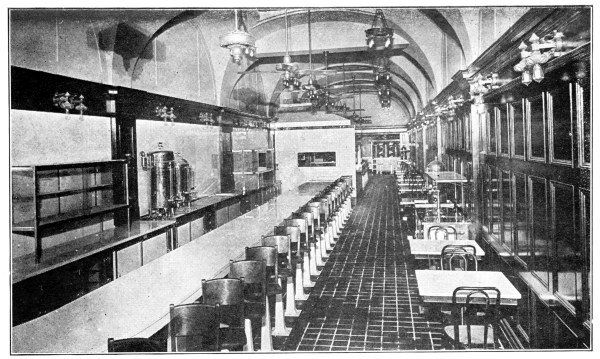
Day and Night Coffee Room
of the Rice Hotel,
Houston, Texas
[Pg 185]
Mrs. Ida C. Bailey Allen, writing on the Successful Coffee Shop, makes the following suggestions on how to establish, equip, and conduct it:
The successful coffee shop must be more than a place in which to eat and to enjoy a perfect cup of coffee: it must be a place ruled by geniality and sociability, a pleasant place to spend a few moments of leisure.
The coffee shop which furnishes perfect coffee and combines this rare atmosphere with quick and up-to-date service, and those homelike touches that irresistibly draw customers, is a profitable business venture and a landmark in the community.
The success of the coffee shop depends largely upon the right location. Exactly what this may be hinges upon the locality and the type of patron. A coffee shop destined to cater to the needs of both men and women in the shopping section of a city would necessarily differ from a coffee shop in a village inn or on a good automobile road; yet both might be proportionately successful.
In many cases, it will not be necessary to search for an entirely new location for the coffee shop, for there is often waste space in connection with a hotel or restaurant which can be used to good advantage.
The large restaurant with rather formal service, desiring to make a quick and speedy turnover, will find the institution of a small coffee shop, with a direct entrance on the street, a good investment.
The hotel can easily make of the discarded barroom an excellent coffee shop, using in many instances some of the original furnishings. This will undoubtedly prove a very popular breakfast and luncheon room, especially for the men guests.
The abandoned saloon, with its conspicuous street entrance, offers a wonderful opening for a coffee shop; provided, the right atmosphere of geniality and cordiality is maintained.
Many a wayside inn has held sacred for years an almost unused sitting room, while hungry automobiles, longing for a bite to eat, are led to a bare and unattractive dining room, where the “bite” is anything but good; and yet, the unused sitting room, located near the front entrance, could often be made into a most alluring little coffee shop, at almost no expense.
Then there is the larger and more pretentious hotel, in which a coffee shop can often be installed in a little-used part of the lobby, where it is of easy access from the street. [Pg 186]
In still other cases there are well-ventilated basement rooms which can be utilized for this purpose. In fact, the coffee shop itself may be worked up in various ways to suit the space that can be allotted to it, as well as to meet the needs of the patron.
The three types of coffee shop which may be developed are self-service; counter service, with waitress or restaurant service; or combination of counter and waitress service.
Obviously, when space as well as expense must be curtailed, the self-service method will prove most practicable. When there is more room, the counter method may be used, but when there is ample space, the waitress or restaurant method will prove most popular, if the service is speedy, and if, at the same time, the guests who have leisure are not hurried.
The self-service coffee shop will succeed in a busy locality, where the clientele consists largely of people of limited means and leisure, both men and women. The counter service will be a success where the clientele consists only of men, who desire to obtain a quick meal at a moderate price. A man in a hurry depends more upon his coffee than anything else on the menu. In fact, the smaller the shop and the more limited the bill of fare, the greater the importance of coffee. The difference in cost between a cup of good coffee and a cup of bad coffee is so slight that no restaurant or lunch room can afford to serve the latter, however low his prices and humble his establishment.
There is a great opportunity for the opening of the small coffee shop, in any business or manufacturing locality, where men may get a cup of coffee, a sandwich, a piece of pie, or some crullers in almost no time at all. This idea has been very successfully carried out with the installation of built-in stands, from which iced summer drinks have been sold, but it should prove equally popular with coffee,—iced coffee, coffee sodas, and hot coffee in the summer time, and hot coffee and coffee sodas in the winter.
The initial outlay can be very small, the rental for such stands being very reasonable. The dishes and knives, forks, and spoons may be of moderately good quality, but durable; the greatest outlay being for the coffee urn, a two-burner gas stove for the frying of eggs for fried-egg sandwiches, and a small counter with or without stools. Needless to say, the place should be spotlessly clean, an all-white effect appealing to everyone.
Such a place is best handled by men, who should wear white. Menus are [Pg 187] not necessary, but it is a good plan to change the type of sandwiches and the kind of pie from day to day, to avoid monotony. A fortune awaits the man who can establish such places in a large city, in time developing a chain which might extend over a large territory. This type of coffee shop, properly run, means a good living to the person who has foresight and business ability enough to put it through.
The backbone of a coffee shop is coffee—and still more coffee. It must be a perfect beverage, the kind that leaves a glow of satisfaction and invariably calls back the guest again and again. The coffee must be so good and the service so excellent that men and women will not only drop in, with reasonable regularity, at mealtime, but will avail themselves of the quiet sociability of the place for morning conferences over the coffee cups, and a mid-afternoon “bite” with coffee—hot or iced as the season may suggest.
There is still another element entering into the type of coffee shop to be inaugurated,—the help. In a large city, where this problem is not so perplexing, the waitress type of service can be carried out successfully; but, where waitresses are difficult to secure, it will be necessary to use either the counter or the self-service method. Also, when prices must be comparatively low, it will not be practicable to use the waitress method, as this increases the overhead to such an extent that the profits will be unduly decreased.
The coffee shop itself is such an adaptable sort of eating place that it can be made equally attractive for both rich and poor,—just as popular in a first-class hotel as it is when conducted rightly in a factory. This is the reason that the locality, the type of help, and the sort of service must be absolutely mapped out before the actual gathering together of the equipment is considered.
As the equipment depends largely upon the menu that is to be provided, the latter must be outlined in general before the equipment is purchased. The menu should be of a suitable type to correspond with the kind of coffee shop that is being opened, and must be made to fit the probable needs and pocketbooks of the patrons.
The first item to be thought of in connection with the menu is coffee, and ample provision must be made to serve it to the very best advantage, for it is really the foundation of the entire enterprise. The foods to be served must be of a nature that will combine well in a meal with coffee.
In case a coffee shop is being opened for very simple service in any [Pg 188] locality, and if the amount of money that may be spent for equipment is limited, it will be found most practicable to include largely cold foods on the menu, merely making provision for the cookery of eggs in a few simple ways, to accommodate breakfast patrons.
A simple menu begun in such a comparatively small way, backed up by the right service and excellent coffee, will invariably result in quick expansion into a larger business. Such a menu might include the following dishes: Sandwiches, cold meats, salads, pastry and cake, icecream, coffee.
The menu should be changed from week to week, no matter what type is used, in order to give sufficient variety to encourage guests to come over and over again. A suitable menu of this type for the fall and winter season might include: Ham sandwiches, minced ham sandwiches, sliced chicken sandwiches, chicken salad sandwiches, egg sandwiches, egg salad sandwiches, club sandwiches, cheese sandwiches, pimento cream cheese and lettuce sandwiches.
The salads should, as far as possible, be of a different nature from the salad sandwiches, as so many guests will order a salad and a sandwich, together with a pot of coffee. A suitable group of salads would include: A fish salad, such as shrimp, lobster, or tuna fish; egg salad, with Russian dressing or mayonnaise; lettuce and tomato salad, with Roquefort dressing; chicken salad; potato salad; cold slaw, occasionally varied with green peppers, chopped nuts, or pimentos; a seasonable vegetable salad. If possible, hot, home-made Parker-house rolls or little tea biscuits may be served with the salads. If it is not feasible to keep these really hot, and if the bread is to be included in the salad course, bread and butter sandwiches will prove the most economical adjunct from the standpoint of both materials and service.
The cold meats should include: Sliced ham, served with a little chowchow, or other suitable relish, in an individual paper cup; cold fried chicken or sliced chicken; cold tongue; and occasionally cold roast lamb or roast beef.
It may sometimes be advisable, if there is a place to keep the roast hot, to serve hot meat sandwiches occasionally, as roast beef, lamb, or chicken sandwiches, with gravy, utilizing the remainder of the roast for cold meat on the succeeding day.
To be at its best, a coffee shop should incorporate homy, rather than exotic, cookery, to correspond with its warm, inviting, and simple surroundings.
Who would not go a long way for a perfect piece of apple pie, with a bit of rare-flavored cheese and a pot of perfect coffee? So, let the [Pg 189] pastries, again, be varied, in order to avoid monotony; but keep them homelike.
Apple pie, pumpkin or squash pie, or sweet potato pie (in the South), a lemon pie with a thick meringue, custard or well made coconut pie, old-fashioned cream pie, the newer butter-scotch pie, together with the full gamut of fruit pies, such as orange, huckleberry, blackberry, rhubarb, pineapple, cranberry, raisin, and all the others, certainly afford a wide choice. But have them perfect! As to crullers and coffee cake itself, they should be so good as to become specialties. These will attract guests from miles around, for the inevitable pot of coffee with these incomparable accompaniments.
Good home-made cookies should also be included. Old-fashioned ginger drop cookies “with a raisin in the center,” and thick cream cookies sprinkled with sugar before baking, will surely become famous. As to old-fashioned ginger bread, served with good butter, cheese, or whipped cream, it will be in favor winter or summer as a combination with coffee.
The cakes, too, should be strictly home-made and very much of a specialty. If there is but one kind, have it good. Nut cakes with thick white icing, fudge cake with fudge frosting, layer spice cake with a made cream filling, and rich marble cake offer a few good suggestions. Keep the cake out of the ordinary: it’s sure to mean “talk,” the best kind of advertising.
Regarding the icecream in a small coffee shop, one or two kinds will be ample. Of course, coffee icecream will always be served. This can be made into a variety of sundaes, such as marshmallow nut, coffee sundae, coffee butter-scotch sundae, coffee caramel sundae, and coffee maraschino sundae. A second cream would naturally be vanilla, which might be served as a sundae with a delicious coffee sauce, coffee nut sauce, or a maple sauce, with a topping of coffee whipped cream. In other words, emphasize the coffee flavor: it’s the best stock in trade that a coffee shop can have.
This menu will take care of the luncheon and supper trade, of the mid-morning “bite,” and the afternoon and late evening “snack.” With the addition of fresh fruit in season, ready-cooked cereals, such as corn flakes, etc., toast, of boiled, poached, and scrambled eggs, and marmalade and honey served in individual jars, the variety of foods will be increased sufficiently to cover breakfast, even though the serving equipment is limited. If space permits, the equipment may be enlarged and the list may include pancakes with sirup, and blueberry [Pg 190] pancakes in season, as well as waffles. However, in cooking foods of this type, great care must be taken to provide for proper ventilation. If there is ample provision for the carrying off of cooking fumes, bacon and ham may be served along with fried eggs and omelets.
Basis for More Elaborate Service
This simple skeleton menu may serve as a basis for the development of one that is more elaborate and adapted to any of the three types of coffee shops. To it may be added one or two soups, one of a clear variety, such as consomme, tomato bouillon, clam bouillon, clear vegetable soup, chicken soup with rice, etc., and a heavier soup, such as cream of pea, cream of celery, oyster stew, or a chowder. If there is ample provision for order cooking, steaks, chops, etc., may be offered on a menu.
In any case, whether these are served or not, a certain number of special substantial dishes should be included on the menu, the selection depending on the clientele and the facilities for keeping the specials hot. They should be decidedly substantial if men are the only guests, but, when men and women both patronize the coffee shop, some of the specials should be of rather dainty nature. If, for instance, only two specials were to be run, and the catering is to both men and women, a choice might be breaded veal cutlets with tomato sauce and mashed potatoes, or chicken patties with peas. A group of staple specials of a substantial nature might include broiled pork chops with mashed potatoes and baked apples; stewed chicken with dumplings; hot tongue with spinach and horse-radish sauce; beef cutlets with spaghetti-Italian, etc.
Suitable dainty specials might be escalloped oysters with dressed lettuce, veal loaf with buttered rice and brown gravy, chicken à la king, eggs au gratin, welsh rabbit (made with milk and served on toast), etc.
Any menu increased beyond this point must take on the characteristics of a regulation restaurant, with perfect coffee as a background. In this case, the equipment must of a necessity be quite elaborate, as provision must be made for the preparation of a goodly number of dishes to order, as well as of roasts, vegetables, etc.
The menu served in the famous coffee shops of England includes, besides the usual staple sandwiches, salads, pastry, and coffee, all kinds of egg dishes, cereals, fruits, toast, marmalade, honey, and hot breads at breakfast. Both the noon and night specials are of heavy nature, including roasts, steaks, chops; baked, French-fried, and boiled potatoes; a special beefsteak pie à la Dr. Johnson, or a veal and [Pg 191] ham pie; kidney, pigeon, or chicken pie. A snappy salad is always provided, such as onion and pepper or tomato with Roquefort dressing, and there are plenty of plain vegetables, such as buttered carrots, fried onions, stewed marrow, etc.
The desserts would include deep-dish fruit tarts, cheese cake, and always plum pudding, and a special, as a fruit dumpling, bread and custard pudding, or something of like nature. Of all eating places, the coffee shop should spell comfort, and there must be a sufficient number of well-cooked simple foods to correspond with this purpose.
The small coffee shop of self-service type, or of the type that combines self-service with a few tables, can be worked out successfully with the aid of only a small kitchen, as there will be few foods cooked to order and almost no last-minute preparation. But the coffee shop serving a number of specials must have a comfortable kitchen, with sufficient space in which to prepare the food, and a short-order range, that is certainly not in full view of the patron, for the coffee shop must present a restful atmosphere. It should not appear too new, too glaring, or sanitary looking to a startling extent. As far as possible, what one might term the machinery of cooking should be kept out of sight.
In the kitchen will be needed an adequate range to burn the fuel best obtainable in the locality, a short-order range, a work table of the right height for the cook, a small room or a good-sized pantry for the pastry-cooking equipment, and, in case a large amount of pastry is being prepared, an adequate set of bake ovens should be installed. There must be an icebox of the right size, with sections, accessible to both cook and pastry cook. Dishes should be washed and stored near the entrance to the dining room, so that when they are delivered to the dish washer the carry will not be long, and so that they may be stored where they are washed and dried, ready for service.
The time has gone by when it is desirable from the viewpoint of the patron, as well as from the standard of good taste, to display large quantities of food. Groups of foods, properly assembled in tightly closed glass cases, may sometimes be used to good advantage when counter service is employed. The actual food that is served, however, will be obtained from another room. In case a barroom has been fitted over into a coffee shop, the back bar may be used for such display, if desired. [Pg 192]
If the cafeteria method of service is adopted, there will be, of course, no food prepared in the restaurant proper. In this case, the equipment must include an adequate steam table and serving counter, on which the food may be assembled.
The menu should be clearly displayed on the wall in such position that the guests will not crowd in front of it and thereby upset the serving arrangements.
The silver, trays, etc., as well as the foods, should be assembled in their natural order of use; first, the trays and napkins, then the silver, water, and water glasses, followed by soups, hot “specials,” vegetables and meats, the breads, salads, desserts, and coffee.
It goes without saying that the coffee-making equipment should be the best that can be obtained. “Best” does not always mean the most costly, for adequate coffee-making equipment is always simple in design, so that it may be kept clean, the absolute cleanliness of all utensils used in the making being one of the fundamentals underlying the preparation of perfect coffee.
Suitable urns, provided with leach or drip bags, may be obtained from about $65 upward, according to size. Cup warmers should be provided. The coffee itself should be served with cream, real cream, which should be put in by the patron; not served ready mixed, as so many prefer black coffee.
In some instances, it may be necessary, because of shortage of space, to prepare some of the food in the dining room. In this case, the equipment must be kept in perfect condition and the cook be spotless—literally—from head to foot. An adequate gas or electric griddle, gas or electric waffle iron, egg boiler, and well-scoured aluminum cooking utensils are an absolute necessity. Sometimes it will be necessary to install a short-order range in this room, as well. The cook must also be taught to work quietly. Much of the noise in many restaurants may be traced to the carelessness of the waitresses and other employees in the handling of dishes and utensils.
First of all, the service must be pleasant. There is no one thing—other than perfect cooking itself—which brings a guest back over and over again, more than a smile and a well-chosen word of greeting. In several well-known restaurants, home economics graduates are employed to act as hostesses. The guests are then seated by a well-trained head waitress, who is quiet and efficient.
This idea could well be applied to the coffee shop, but the professional hostess should not be ultrafashionable: rather, [Pg 193] middle-aged, comely, and wholesome in appearance. For waitresses, choose comfortable, homy-looking women, and dress them in simple uniforms of natural linen color, with white aprons.
In case cafeteria or counter-style service is used, the same natural linen-color scheme for uniforms may be carried out. It must be kept in mind that the person in charge of the cafeteria can often be a very deft salesman as well, helping guests who are undecided as to their choice of food to make a selection extremely profitable to the restaurant and—if the food is as perfect as it ought to be—to the individual. A good waitress can be trained to be as clever in this line as a maitre d’hotel. It would well pay the proprietor to have a little talk occasionally with his employees on salesmanship.
If the guests are seated at tables, they should be handed menus as soon as they are settled. A glass of water, a napkin, and the silver for each guest should then be put immediately upon the table by an underwaitress. The guest then feels that he is getting immediate attention, and his order can be taken as soon as possible by one of the regular waitresses, a highly trained person, who, if relieved from the burden of the water glasses, silver, replenishing of butter, water, etc., can practically handle double the amount of usual trade.
In case of cafeteria service, no waitresses will be needed, except women to gather up the soiled dishes from the tables as fast as they accumulate. The crumbs should then be brushed off, but not on to the floor, then the table should be wiped clean. Insufficient observation of these two little items alone keeps many a fastidious guest from eating in a cafeteria.
Coffee shops may be developed in appearance in two ways,—the very up-to-date white porcelain and nickel, with its expensive and sanitary equipment, or it may be made a place of atmosphere, of quiet and restful appearance, by the proper utilization of decorations and furnishings that one might term “seasoned looking.” At the same time, the furnishings should be so simple that they may be kept spotlessly clean.
There is no more attractive background for the coffee shop than the old English type. Panels may extend from the ceiling to the floor, or a high wainscot only may be used, topped by a plate rail with the wall decorated in coffee color, from the plate rail to the ceiling. Well chosen English prints may be hung on a plain background. Pieces of old [Pg 194] Wedgewood, dull copper pitchers, and platters in old willow design may be on the plate rail. There should be a rack of “grandfather’s pipes,” an old eight-day clock, and if possible a fireplace with a crane and a fire in cool weather.
The curtains at the windows—which should be, if possible, of the casement type—may be of some washable, rather dark, natural linen-colored material, and plain, old-fashioned red geraniums should be in the window boxes.
The tables should be bare save for a small center square of rather dark, linen-colored material. The napkins should match. The chairs should, of course, match the tables, and the floor should be finished in a dark tone, to harmonize with the furniture.
Settles, if desired, may line the sides of the room, a table being put before each settle, with two chairs on the opposite side, or stalls, with tables accommodating four, may be used in part of the room, with well-disposed tables and chairs to fill the remaining space.
As far as feasible, the entire equipment should savor of the old-fashioned. China, of the English willow-ware pattern, may be obtained anywhere. Silver of plain design should be used, and, if possible, steel-bladed, horn-handled knives should be used with the meat service.
Menus of a design to correspond with the decorations should be planned. Nothing can be better than rough, dull-finished paper, of linen color, with rough cut edges, and the printing in dark brown. In case a list of the “specials” is not printed each day, it may be written or typed on to the menu. The menu itself should be changed from time to time, in order to make the standing dishes seasonable. It is a good plan to include on the menu some short and interesting quotations about coffee from well-known people. If a little care and thought are expended in making the cards unique and interesting, guests will frequently ask for them as souvenirs—an excellent advertisement.
If rent is not a big item, it will prove a good plan to have an informal lounging and game room, opening out of the coffee shop. The decorations should be of the same type as those in the shop itself. Comfortable tables and chairs should be provided, and there should be an abundance of games accessible, such as checkers, parchesi, chess, and the like, as well as a table with current magazines, a low case of interesting books of short stories, a desk with letterheads (featuring the coffee shop) and, if there is ample room, a pool table.
Tables should bear menus, featuring coffee, and a few of the lighter [Pg 195] dishes that would naturally accompany it, for refreshments suitable for afternoon and evening. Of course smoking should be allowed.
Whatever type of coffee shop may be chosen, a candy and cigar counter should be stationed near the entrance door: not the ordinary candy counter, but one featuring coffee candies, which are put up for sale in little 10- and 15-cent coffee-colored bags, or which may be obtained in larger quantity in coffee-colored boxes, bearing the trad-emark of the coffee shop. The candies should be somewhat of an old-fashioned type, as coffee butter-scotch, coffee molasses taffy, chocolate coffee creams, coffee pralines, and so on. The bags, in nine cases out of 10, will be emptied of their contents in the street or office, and each bag that is thrown down will act as an advertisement of the coffee shop, and each coffee-colored box tied with its coffee-colored ribbon will serve as a reminder to the passerby, who sees it on its way home to the wife or to sweet-heart, of the shop around the corner where there is such delicious food, and where the internationally loved beverage may be obtained in perfection.
[Pg 196]
[Pg 197]
A statistical study of world production and consumption of coffee by countries—Coffee in the United States—The trend of the trade in 1923—Brazil’s coffee valorization.
Leaves and beans are the vegetable sources of the world’s three great non-alcoholic beverages,—tea, coffee, and cocoa. Of the three, tea leaves lead in total amount consumed, coffee beans are second, and cacao beans are a distant third, although advancing.
But in international commerce coffee beans occupy a far more important position than either of the others, being imported into non-producing countries to twice the extent of the tea leaves. All three enjoy world-wide consumption, although this consumption does not extend to every nation. Where either coffee beans or tea leaves have thoroughly established themselves in a given country, the other two of the beverages receive comparatively little attention, and usually have a good deal of difficulty in making any appreciable advance. Cacao beans, on the other hand, have not risen to the position of popular favorite in any important consuming country, and so have not aroused the opposition of their two important rivals.
These three beverages dominate the world’s breakfast, dinner, and supper tables, and have no serious competitor except in one or two restricted localities. Down in South America, millions of people drink yerba maté in preference to any other beverage, whether containing alcohol or not, but efforts to push it on the markets of the United States and Europe have met with only limited success. [Pg 198]
During the war, many substitutes for the three standard beverages were concocted, and on account of high prices some of them may still be used here and there, but none of them offers any serious competition to the regular trade. The world seems pretty well satisfied with the beverages it has tried out for so many centuries, and any new table drink that comes along will have to be meritorious indeed to take its place alongside them.
Of the three, the oldest dominates the most territory, and the youngest in point of world-wide reputation covers the least.
The beginnings of tea drinking are lost in the vista of Chinese history; but, whatever its age, it is today in very vigorous commercial health. Tea is the favorite drink of what a few years ago were the three greatest empires, geographically speaking, of the world,—the Chinese, Russian, and British Empires. It is estimated that the Chinese alone consume some 2,000,000,000 pounds of tea a year, thus elevating it to first place in amount used, although much more coffee than tea passes from producing to consuming countries.
Coffee reigns over the United States and western continental Europe, particularly France, Belgium, Netherlands, Germany, Switzerland, and Scandinavia, as well as South Africa, Cuba, and southern South America.
With regard to cocoa, the trade figures do not tell so distinct a story, as the raw material from which the cocoa powder is made, the cacao beans and nibs, is also used so extensively in the making of chocolate and chocolate products. But the annual trade in cacao beans is so large in several countries that cocoa as a beverage probably takes second place among the three.
Where Coffee Rules
In its 300 years of acquaintance with civilized countries, coffee has [Pg 199] planted itself firmly in North and South America, Australasia, and western Europe, but in that vast stretch of territory beginning with western Russia and extending over almost the whole of Asia it is little known.
Among the western nations the United Kingdom stands out as a conspicuous example of countries that refuse to be conquered by coffee, and the dominions, with one exception, have followed the taste of the mother country. The exception is the Union of South Africa, where the settlers have shown the same adherence to the habits of the country from which they came as the settlers of English-speaking dependencies, as the large coffee consumption is due to the presence of the Boers, descendants of the coffee-drinking Hollanders.
Among southern countries Argentina is the chief coffee buyer, with Chile second; but the island of Cuba passes both in individual consumption, ranking alongside the United States in that respect.
The following table gives the percapita consumption of coffee in the last year before the war and in a recent year since the war, for the important coffee-drinking countries of the world. The figures are based entirely on statistics of imports and exports, and do not take into account any stocks that may have been held over:
| Postwar | 1913 | ||
| Year | Pounds | Pounds | |
| United States | 1923 | 12.45 | 8.90[5] |
| Canada | 1922 | 2.40 | 2.17[6] |
| Newfoundland | 1920[7] | 0.19 | 0.19 |
| United Kingdom | 1922 | 0.74 | 0.61 |
| France | 1922 | 9.83 | 6.41 |
| Spain | 1920 | 2.33 | 1.64 |
| Portugal | 1919 | 0.86 | 1.16 |
| Belgium | 1922 | 11.01 | 12.27 |
| Holland | 1922 | 10.49 | 18.80 |
| Denmark | 1921 | 13.19 | 12.85 [Pg 200] |
| Norway | 1922 | 14.76 | 12.29 |
| Sweden | 1922 | 12.96 | 13.41 |
| Finland | 1921 | 8.25 | 8.85 |
| Russia | 1916 | 0.05 | 0.16 |
| Austria-Hungary | 1917 | 0.34 | 2.54 |
| Germany | 1922 | 1.35 | 5.43 |
| Rumania | 1919 | 0.29 | 1.04 |
| Greece | 1920 | 2.97 | 1.19 |
| Switzerland | 1921 | 8.17 | 6.48 |
| Italy | 1922 | 2.68 | 1.79 |
| Egypt | 1921 | 1.53 | 1.15 |
| Union of South Africa | 1922 | 4.44 | 4.19[8] |
| Ceylon | 1920 | 0.43 | 0.36 |
| China | 1920 | 0.001 | 0.01 |
| Japan | 1920 | 0.01 | 0.004 |
| Cuba | 1920[9] | 13.79 | 10.00 |
| Argentina | 1919 | 4.40 | 3.74 |
| Chile | 1920 | 3.06 | 3.04 |
| Uruguay | 1921 | 3.61 | [10] |
| Paraguay | 1920 | 0.26 | [11] |
| Australia | 1920[12] | 0.42 | 0.64 |
| New Zealand | 1920 | 0.24 | 0.29 |
On account of the wide fluctuations in imports during the war and the period following the war, percapita figures have naturally changed radically during recent years; but, for the most part, the trade in coffee has about swung back to normal, and the percapita figures since the war, as given, are fairly close to prewar figures. As percapita calculations must take into account population as well as amounts of coffee consumed, and as population figures are usually estimates, the results arrived at by different authorities are likely to vary slightly, although usually they are not far apart. [Pg 201]
Coffee in the United States
The rise of the United States as a coffee consumer during the last century and a quarter has been marked not only by steadily increased imports, but also by a steady growth in percapita consumption. Today it is close to its highest point, the 12.45 pounds being enough to supply each man, woman, and child with some 500 cups a year. This is four times as much as it was 100 years ago, and more than twice as much as in the years immediately following the Civil War. Since about 1897, the average consumption percapita has increased some 50 percent. Net imports in the year ended December 31, 1923, covering only continental United States, were 1,407,855,966 pounds.
The United Kingdom
Coffee drinking has never become popular in the British Isles, and there is no sign that the English taste is changing. Present consumption percapita, in fact, is lower than it was 40 years ago. Consumption and percapita figures for the last six years and for 1913 are as follows:
| Imports for Home Consumption, Pounds |
Percapita Consumption, Pounds |
|
| 1913 | 28,000,000 | 0.61 |
| 1917 | 28,784,000 | 1.02 |
| 1918 | 47,264,000 | 1.19 |
| 1919 | 51,072,000 | 0.76 |
| 1920 | 35,280,000 | 0.74 |
| 1921 | 34,363,000 | 0.72 |
| 1922 | 35,181,530 | 0.74 |
This low consumption is because tea is the universal beverage in the United Kingdom.
The Two Countries Compared
The following comparison of the growth of percapita consumption of tea and coffee in the United Kingdom and the United States will show that [Pg 202]the attitude of the public toward the two beverages has been directly opposite for 58 years:
| United States | United Kingdom | |||
| Coffee | Tea | Coffee | Tea | |
| Pounds | Pounds | Pounds | Pounds | |
| 1866 | 4.96 | 1.17 | 1.02 | 3.42 |
| 1870 | 6.00 | 1.10 | .98 | 3.81 |
| 1875 | 7.08 | 1.44 | .98 | 4.44 |
| 1880 | 8.78 | 1.39 | .92 | 4.57 |
| 1885 | 9.60 | 1.18 | .91 | 5.06 |
| 1890 | 7.77 | 1.32 | .75 | 5.17 |
| 1895 | 9.24 | 1.39 | .70 | 5.65 |
| 1900 | 9.84 | 1.09 | .71 | 6.07 |
| 1901 | 10.43 | 1.12 | .76 | 6.16 |
| 1902 | 13.32 | .92 | .68 | 6.07 |
| 1903 | 10.80 | 1.27 | .71 | 6.04 |
| 1904 | 11.67 | 1.31 | .68 | 6.02 |
| 1905 | 11.98 | 1.19 | .67 | 6.02 |
| 1906 | 9.72 | 1.06 | .66 | 6.22 |
| 1907 | 11.15 | .96 | .67 | 6.26 |
| 1908 | 9.82 | 1.03 | .66 | 6.24 |
| 1909 | 11.43 | 1.24 | .67 | 6.37 |
| 1910 | 9.33 | .89 | .65 | 6.39 |
| 1911 | 9.29 | 1.05 | .62 | 6.47 |
| 1912 | 9.26 | 1.04 | .61 | 6.46 |
| 1913 | 8.90 | .90 | .61 | 6.64 |
| 1914 | 10.14 | .91 | .63 | 6.89 |
| 1915 | 10.62 | .91 | .71 | 6.87 |
| 1916 | 11.20 | 1.07 | 1.66 | 6.56 |
| 1917 | 12.38 | .99 | 1.02 | 6.03 |
| 1918 | 10.43 | 1.40 | 1.19 | 6.75 |
| 1919 | 9.13 | .87 | .76 | 8.43 |
| 1920 | 12.78 | .84 | .74 | 8.51 |
| 1921 | 12.13 | .65 | .71 | 8.2 |
| 1922 | 10.97 | .76 | .74 | 8.6 |
| 1923 | 12.45 | .94 | .74 | 8.6 |
In France
Second only to the United States in the total of coffee consumed is France, although that country before the war occupied third place, being surpassed by Germany. Havre is one of the great coffee ports of [Pg 203] Europe, and has a coffee exchange; organized in 1882, only a short time after the exchange in New York began operations.
France draws on all the large producing regions for her coffee, but is especially prominent in the trade in the West Indies and the countries around the Caribbean Sea. Imports in 1922 amounted to 385,475,860 pounds, exports to 445,940 pounds, and net consumption to 385,029,920 pounds.
In Germany
Hamburg is one of the world’s important coffee ports, and in normal times coffee is brought there in vast amounts, not only for shipment into the interior of Germany, but also for transhipment to Scandinavia, Finland, and Russia. Up to the outbreak of the war, Germany was the chief coffee-drinking country of Europe. While the blockade lasted and coffee imports were quite shut off, the Germans resorted to substitutes, and after the war, because of high prices, there was still much consumption of them.
Percapita consumption in Germany is still somewhat low in comparison with prewar consumption. In 1920 only 90,602,000 pounds were imported. In 1921 net imports were 228,687,567 pounds, but in 1922 they fell off to 80,992,595 pounds. This of course is not comparable with prewar consumption, as Germany’s territory and population are considerably smaller than before the war. In 1913, the country as then constituted imported 371,130,520 pounds and exported 1,783,521 pounds, leaving a net consumption of 369,346,999 pounds.
Netherlands
Netherlands is one of the oldest coffee countries of Europe, and for centuries has been a great transhipping agent, distributing coffee from her East Indian possessions and from America among her northern neighbors. Before sending these coffee shipments along, however, she kept back enough to supply her own people most plentifully, so that for many years before the war she led the world in percapita consumption. As [Pg 204] far back as 1867-76, coffee consumption was averaging over 13 pounds percapita; in the year before the war, it was 18.8 pounds.
The blockade and other abnormal conditions during the war threw the trade off, and it is not yet normal. Consumption in 1920 was 96,197,000 pounds, or about 14 pounds percapita. However, preliminary figures for 1921 showed a much heavier reexportation than in 1920, and a consequent drop in consumption. Imports in 1921 were 136,566,943 pounds and exports 66,567,702, leaving 69,999,241 pounds for consumption. This drop in consumption is probably more apparent than real, as exports in 1921 doubtless included much coffee held over from the year before. Net imports for 1922 were 73,203,743 pounds, or 10.49 pounds percapita. Eighty percent of the Netherlands coffee trade is handled through Amsterdam.
Coffee in Other Countries
Denmark, Norway, and Sweden are all heavy coffee drinkers. In 1921, Sweden had the highest percapita consumption in the world, 15.25 pounds. Before the war these three countries each consumed about as much percapita as the United States does today,—amounting to 11 to 13 pounds a year.
The 1922 net imports for consumption were as follows: Denmark, 50,906,680 pounds; Norway, 39,015,680 pounds; Sweden, 77,343,640 pounds.
Austria-Hungary was formerly an important buyer of coffee, large quantities coming into the country yearly through Triest. Imports in 1913 totaled 130,951,000 pounds, and 124,527,000 pounds in 1912. In 1917, the war cut down the total to 17,910,000 pounds net consumption. Imports for consumption in 1922 were 9,588,260 pounds.
Finland shares with her neighbors of the Baltic a strong taste for coffee, importing 30,459,880 pounds in 1922. [Pg 205]
In the same year Belgium had a net import of 82,324,000 pounds and Spain of 41,131,640 pounds. Portugal, in 1919, imported 6,926,575 pounds and exported 1,258,271 pounds, leaving 5,668,304 pounds for home consumption. Coffee is not especially popular in the Balkan States and Italy, importations into the last-named country in 1922 amounting to 103,961,000 pounds net. Switzerland is a steady coffee drinker, consuming 29,182,560 pounds in 1922.
Russia was never fond of coffee, and her total imports in 1917, according to Soviet figures, were only 4,464,000 pounds.
The Union of South Africa in 1922 imported 8,991,400 pounds net. Cuba purchased 66,342,540 pounds in the fiscal year 1922, Argentina 38,727,040 pounds in 1920, and Chile 10,252,220 pounds in 1922. Australia, in the year 1921-22, imported 3,100,120 pounds, and New Zealand in 1921 imported 250,580 pounds.
Coffee Consumption of Brazil
In considering the world consumption of coffee, usually only importing countries are taken into account; but there is, of course, considerable consumption in countries where the coffee is grown. In the largest of these, Brazil, there is a population loosely estimated at 20,000,000 to 30,000,000, and the habit of coffee drinking is widespread, although not by any means universal. Just how much coffee is consumed annually is difficult to determine. There are no figures of actual production, the crop of any given year when coffee moves normally being given usually in terms of exports.
Estimates of annual coffee consumption in Brazil by persons familiar with the country vary widely. One authority, for instance, places the figure at more than 200,000,000 pounds, and says that Brazil ranks about seventh in percapita consumption, while another gives less than one-tenth that amount. It is generally agreed that coffee consumption is much less than might be expected, seeing that Brazil supplies the world with so large a proportion of its total coffee.
One reason, perhaps the chief one, is that in the southern part of the [Pg 206] country many millions of the working class drink the distinctive South American beverage maté in place of coffee. In the northern and western regions, moreover, coffee production is of no importance, and overland transportation facilities from the coffee-raising states are very poor; so the natives have not become accustomed to the use of the chief product of their country and drink more spirituous liquors instead. The German colony in Rio Grande do Sul consumes considerable coffee, and its population probably forms the largest coffee-drinking group of the whole country; but the number of people in that section is not large, compared with the total population.
If one more shipload of coffee had reached a United States port in time to be counted in the 1923 imports, our incoming coffee trade that year would have been higher in point of volume than in any previous fiscal or calendar year of our history. As it was, the total of 1,407,855,966 pounds that we purchased fell a little short of the record figure, which was 1,414,228,163 pounds in the fiscal year 1920; but the 1923 figure was higher than that of any previous calendar year. In point of value, imports in 1923 were less than in the calendar years 1920 and 1921, but they exceeded those of any other year.
The quantity and value of coffee imports for each calendar year since 1913 are shown in the following table:
| Calendar Year |
Pounds | Value |
| 1913 | 852,529,498 | $104,671,501 |
| 1914 | 1,011,071,873 | 104,794,319 |
| 1915 | 1,228,761,626 | 113,797,866 |
| 1916 | 1,166,888,327 | 118,813,421 |
| 1917 | 1,286,524,073 | 122,607,254 |
| 1918 | 1,052,201,501 | 99,423,362 |
| 1919 | 1,337,564,067 | 261,270,106 |
| 1920 | 1,297,439,310 | 252,450,651 |
| 1921 | 1,340,979,776 | 142,808,719 |
| 1922 | 1,246,060,667 | 160,855,076 |
| 1923 | 1,407,855,966 | 189,993,330 |
[Pg 207] The features of the year’s trade were big gains in imports from Brazil, Colombia, and Central America, and a considerable falling off in these from Venezuela, and especially the Dutch East Indies. From Mexico, the West Indies, and Aden there were considerably increased shipments, but no startling gains over the preceding year.
Brazil’s Banner Year
The year 1923 was a banner one for Brazil in her coffee trade with this country. She shipped more hither last year than in any previous year of her history, and after many years again reached the point where she furnishes us with two-thirds of all our coffee imports. Her total shipments to us, 934,758,879 pounds valued at $115,881,226, represented a big gain over those of 1922, when the total was 802,546,870 pounds having a value of $98,932,292, as well as the 1921 total of 839,212,388 pounds valued at $77,186,271. If the gain is maintained at the same rate during the present year, 1924 shipments will pass the 1,000,000,000-pound mark for the first time, with 50,000,000 or 100,000,000 pounds to spare.
It is interesting to note how Brazil has gradually come back in the proportion of our total coffee imports that she supplies. The shipping and other disarrangements caused by the war reduced Brazil’s share in our purchases from 74 percent in the year before the outbreak of the war in Europe to 57 percent in 1918. Since the close of the war, there has been a slow but steady gain. In 1919 the proportion was 59 percent, in 1920 60.5 percent, in 1921 62.5 percent, in 1922 64.3 percent, and last year, 1923, it reached 66.4 percent, or practically two-thirds.
The average price of Brazil coffee, as shown by the import statistics, remained almost exactly the same in 1923 as in 1922, being 12.39 cents as compared with 12.32 cents in the year before. This compares with a slight advance in the average pound price of our total coffee imports, and also of our total imports from other countries than Brazil. The [Pg 208] price of total imports from all countries in 1923 was 13.5 cents, which compares with 12.9 cents in 1922, while that of coffee imported from non-Brazilian sources was 15.6 cents in 1923 and 13.9 cents in 1922.
Coffee from Other Countries
Colombia’s shipments to this country in 1923 showed a marked increase over 1922, indicating that the slump last year was only temporary. The 1923 total of 221,720,899 pounds valued at $37,324,925 compared with 191,848,984 pounds valued at $29,568,471 in 1922, and registered the second largest coffee year that the trade between the two countries has enjoyed, having been surpassed only by the 249,000,000 pounds valued at $37,000,000 of 1921. The average price increased with the volume, having been 16.8 cents in 1923 as compared with 15.5 cents in 1922.
Central American coffee picked up in 1923, jumping from 99,173,458 pounds valued at $11,779,387 in 1922 to 118,286,003 pounds valued at $15,819,156 in 1923. This is a considerable gain, although the total imports are far below the high marks reached during and immediately following the war, when in one year almost 200,000,000 pounds were shipped.
West Indian coffee also registered an increase, amounting to about 20 percent in volume and 30 percent in value, but did not approach the high figures of recent years. Shipments in 1923 amounted to 8,273,127 pounds having a value of $1,207,664, as compared with 6,919,437 pounds valued at $920,036 in 1922.
The other neighboring source of coffee imports, Mexico, a little more than held her own, sending us 38,933,431 pounds valued at $6,176,548, as against 37,800,973 pounds valued at $5,130,167 in the year before. This may be considered as about normal for Mexico under present conditions, although it is still below the average shipments of 15 or 20 years ago. [Pg 209]
Venezuela registered a considerable decrease in exports to the United States, sending us only 53,587,162 pounds having a value of $8,539,038, as compared with 66,644,133 pounds valued at $9,417,446 in 1922. While this is less than half the high figure of 109,000,000 pounds reached in 1919, it probably represents a fair average for a trade that fluctuates in volume rather widely from year to year.
The figures for the Dutch East Indies indicate that the high total for 1922, which was 32,097,648 pounds having a value of $3,759,174, was probably abnormal. The 1923 shipments, amounting to 11,757,923 pounds valued at $2,008,800, were about the same as those for 1921 and were higher than the usual figures reached before and during the war. Since the war, this trade has fluctuated uncertainly, reaching a high mark of 56,000,000 pounds in 1919. Last year’s imports were the lowest since 1918.
From Aden there was an increased importation of about 18 percent over 1922, the figures for last year having been 2,239,015 pounds valued at $406,069 as compared with 1,901,013 pounds valued at $332,741 in 1922.
Coffee exports, including green coffee, roasted coffee, and coffee extracts and substitutes, were practically the same in 1923 as in the year before. Green-coffee exports, mostly from Porto Rico to foreign countries, amounted to 24,714,418 pounds valued at $4,801,728 in 1923 as compared with 25,493,085 pounds valued at $4,818,780 in 1922. Roasted coffee was sent abroad to the amount of 1,652,355 pounds valued at $429,194 as against 1922 shipments of 1,256,971 pounds valued at $327,744. Reexports of coffee again fell off, amounting to 22,021,984 pounds valued at $3,345,609 as compared with 26,012,894 pounds valued at $3,358,952 in 1922.
Cuba was a heavy purchaser, taking over 9,000,000 pounds, and Mexico followed with 2,300,000 pounds. Most of the rest went to Europe, [Pg 210] Germany having been the chief destination and taking 2,000,000 pounds valued at $361,000.
Our trade with our own coffee producers, Hawaii and Porto Rico, fell off last year, Hawaii sending us only 2,170,334 pounds valued at $407,535 and Porto Rico 308,103 pounds valued at $67,351.
Taking into account the trade with the island possessions, the percapita coffee consumption of continental United States in 1923 was 12.45 pounds. This is a substantial gain, the figure having been 11.1 pounds in 1922, 12.09 pounds in 1921, and 11.7 pounds in 1920.
The following shows United States coffee imports by sources for the last three years:
| 1921 | 1922 | 1923 | C 1922 |
|||||
| ——— | ——— | ——— | ——— | |||||
| From | A | B | A | B | A | B | A | B |
| Central America | 8.80 | 8.6 | 7.9 | 7.3 | 8.4 | 8.3 | +19.1 | +34.3 |
| Mexico | 2.00 | 2.4 | 3.0 | 3.2 | 2.7 | 3.2 | +3.0 | +20.4 |
| West Indies | 1.10 | 1.0 | 0.5 | 0.5 | 0.5 | 0.6 | +19.5 | +31.1 |
| Brazil | 62.50 | 54.0 | 64.3 | 61.5 | 66.4 | 60.9 | +16.5 | +17.1 |
| Colombia | 18.50 | 26.1 | 15.4 | 18.3 | 15.7 | 19.6 | +15.5 | +26.2 |
| Venezuela | 4.40 | 4.8 | 5.3 | 5.8 | 3.8 | 4.5 | -19.6 | -9.3 |
| Aden | 0.20 | 0.3 | 0.2 | 0.2 | 0.1 | 0.2 | +17.7 | +22.0 |
| Dutch East Indies | 0.90 | 1.2 | 2.6 | 2.3 | 0.8 | 1.1 | -63.3 | -46.5 |
| Other countries | 1.60 | 1.6 | 0.8 | 0.9 | 1.6 | 1.6 | — | — |
| Total | 100.00 | 100.0 | 100.0 | 100.0 | 100.0 | 100.0 | +11.4 | +18.1 |
Because of the effect which it is likely to have on production and consumption figures, the following statement concerning Brazil’s coffee valorization by W. L. Schurz, United States commercial attaché at Rio de Janeiro, is given here for the benefit of those who wish to be fully posted concerning the plan and its operation:
The device generally known as the valorization of coffee signifies the entrance of the Brazilian government into its coffee market on a scale that aims to enable it to control the price of that commodity. [Pg 211] This is accomplished by the official fixing of prices at a point higher than the prevailing market prices, and by regulating the entries from the interior into the principal ports of shipment, so that there may be no congestion of stocks to depress the price of coffee and prejudice the smooth working of the operation.
Thus, in July, 1921, entries into Santos were limited to 30,000 bags a day. By official order of July 21, 1922, daily entries for the 1922-23 crop were limited to 28,000 bags for Santos and 11,000 bags for Rio de Janeiro. It was formerly the custom for 80 to 85 percent of the crop to come to the ports within six months after picking had begun.
The immediate object of the government is to acquire enough of the current crop to enable it to dominate the world market, and, when stocks in the consuming countries are sufficiently depleted, to force buying at prices that are considered remunerative to Brazilian growers. An expedient of this kind is made possible by Brazil’s extraordinary position in the coffee industry of the world, and demands, moreover, for its complete success a combination of other factors, such as a sustained demand and buying capacity in the consuming markets and the curtailment of the crop by unforeseen frosts. It was probably the latter circumstance that saved the government from a disastrous loss in connection with the valorization of 1918.
The resort to such an apparently hazardous measure is justifiable only by the fact that coffee still constitutes the very basis of the general economy of Brazil. Its failure to yield an adequate profit to the producers is little short of a calamity, not only to this class, but to the federal government and the governments of the coffee-producing states, particularly Sao Paulo. Coffee normally represents from 50 to 60 percent of the total value of the exports of the country, and the duties directly paid by coffee constitute about 40 percent of the total ordinary revenues of the state of Sao Paulo. Even these figures do not represent the entire importance of the position held by coffee in the general business and financial system of Brazil.
The present valorization was provoked by the abrupt fall early in 1921 of the price of coffee abroad, in common with prices of other lines of goods, following the inflated postwar conditions. This fall coincided with the inability of Germany and other countries to buy anything [Pg 212] approaching their former purchases. Due to blockade and to restrictions on imports by belligerent nations, the first three years of the war were a time of great depression for Brazilian coffee, the price in New York varying from six to 10 cents. However, the crop failure of 1918, due to general devastating frosts of that year, created an unheard-of shortage in the consuming markets and put Brazil into position to dictate the price of coffee, which rose in New York to 25 cents. Prices gradually scaled down during 1918-19 and 1919-20 crop years to a general level of 18 cents.
During 1920, however, several European governments, disturbed by a continued unfavorable balance of trade, began to place severe restrictions upon the importation of coffee, though the unfavorable effect of this on Brazil’s interests was partly counterbalanced by another short crop, thereby serving to maintain prices at a satisfactory level. The resumption of anything approaching normal buying by European markets began in 1921, but this increased demand coincided with a large crop, amounting to 14,490,000 bags. Prices fell rapidly, the decline in Rio 7s in the New York market for the 12 months ending in September amounting to over 50 percent, with the price reaching a low level of five cents.
In view of the prospective size of the crop, the dominant elements in the federal government, headed by the president and strongly urged by the state government of Sao Paulo, decided on recourse to valorization as the only measure capable of saving the country from the consequences of a low price of coffee. The state government of Sao Paulo had already entered the market before the end of 1920 with the purchase of 300,000 bags. The purpose of the administration was announced in March, 1921, and the government began buying at about that time.
For some time the valorization operations were conducted on behalf of the Brazilian government by the Cia. Mechanica & Importadora de Sao Paulo, a very important firm of the country. Later the work of valorization was shared with the Brazilian Warrant Company, an English concern, which announced its profits for 1921 at £105,000.
After placing a loan of £9,000,000 in May, 1922, a committee was formed, composed of Brazilian and British representatives of the bankers instrumental in floating the loan, to assume charge of subsequent valorization operations, at least in so far as they relate to the utilization of the proceeds of the loan and the liquidation of the government stock abroad. [Pg 213]
The financing of an undertaking of this magnitude presented a very difficult problem, as it required the carrying by the government of several million bags of coffee until such time as it could be liquidated at a profit. The balance of opinion was opposed to the usual resort to an issue of paper money. Instead, the government made use of the notes of the newly created rediscount section of the Bank of Brazil. Though the volume of these notes was limited, and the time in which they might continue to circulate was fixed, both limits are said to have been exceeded during the course of the valorization.
According to a formal agreement made between the federal government and the governments of the principal coffee-producing states, the latter were to contribute a certain quota toward the expenses of valorization. Four of the principal clauses in the contract made between the federal and state governments read as follows:
“Profits and losses resulting from these deals shall be distributed in proportion to amounts invested by the national treasury and states entering the agreement, it being clearly understood that any losses that may eventually be incurred shall in no circumstance, in so far as Sao Paulo is concerned, exceed 15,000 contos, the limit of that state’s contribution.
“The buying and selling of coffee in Santos and Rio, proportionately to the amount exported from each of these ports, shall be directed exclusively by the federal government.
“All coffee purchased in either Santos or Rio shall be deposited in warehouses and insured against all risks.
“Operations resulting from this agreement shall be finally liquidated on the sale of the total amount of coffee bought by the government, at which time the national treasury shall present accounts to the state of Sao Paulo.”
During the period under consideration there have been frequent rumors of loans floated in Europe for the purpose of refunding the short-time rediscount notes, but no loan was actually placed for this purpose until the joint British-American loan for £9,000,000 in May, 1922. This was floated in London by Rothschild’s, Baring Brothers, and Schroder, and in New York by Dillon, Read & Company. The American quota of the loan was £2,000,000. The loan was offered at 97, with interest at 7.5 percent, and amortization in 30 years. A first mortgage on the government stock of coffee, amounting at that time to 4,534,000 bags, [Pg 214] held in Santos, Rio, Victoria, London, and New York, was given as security. This coffee represented then a value of about £13,000,000.
Various conditions affect valorization, one of most importance being the size of the coffee crop. Total exports from Brazil for the crop year 1921-22 amounted to 12,632,634 bags. Available figures indicate that the total Brazilian production for the year was 12,862,000 bags. Though the long drought of the past summer undoubtedly reduced the crop to some extent, the desired frost did not materialize, and the diminution in the crop was not heavy enough to affect appreciably the course of the valorization operations. The Santos share of the 1922-23 crop has been estimated at 6,875,509 bags. The Department of Agriculture of Sao Paulo has estimated the crop for that state at 5,990,000 bags, as against 6,290,338 bags, the estimate made by a bank in that state.
As usual for several years, the shortage of labor in the coffee districts has constituted one of the most serious problems of the industry. In spite of considerable immigration, especially from Italy, the supply of laborers for the fazendas has continued far below the demand. Moreover, the tendency of the laborers after the expiration of their term of service in the fazenda is to drift into Sao Paulo or the larger towns, where they seek work in the factories or engage in small businesses on their own account. The laborers are also constantly more exigent in the matter of accommodations and wages, and are accustomed to demand permission to plant corn or beans between the rows of coffee trees, a practice that naturally reduces the productivity of the trees. An increasing number of laborers are also desirous of acquiring tracts of land for their own use.
Competition of Other Countries
Many Brazilians have been greatly concerned over the growing production of coffee in the Caribbean countries, particularly in Colombia. One anonymous writer in an influential newspaper, the Estado de Sao Paulo, in a series of articles, has emphasized the menace to Brazil from that area. However, one of the leading Brazilian authorities on valorization declared in the same paper, “It is evident that Colombia is not a formidable competitor, in spite of the fact that she is the strongest of our rivals.” The development of coffee production in the lake region of East Africa has also not escaped the attention of those responsible for the prosperity of the Brazilian industry. [Pg 215]
The greatest anxiety has been felt for the American market, on which in last resort the prosperity of the Brazilian coffee industry depends. Efforts have been made to stimulate the consumption of coffee in America, and much has been hoped for through an increase in coffee consumption that was expected would follow national prohibition in the United States. Not only is the state of the American coffee trade followed with the closest attention in Brazil, but the statistics of the origin of American coffee imports are watched carefully. Quoting from The Tea & Coffee Trade Journal, to the effect that the most important development in the coffee trade during 1921 was the increase in shipments from Colombia to the United States, a Brazil trade weekly recently published the following statistics of imports into the United States for 1920 and 1921:
| 1920 | 1921 | |
| From | Pounds | Pounds |
| Central America | 59,204,341 | 118,607,382 |
| Mexico | 19,519,365 | 26,895,034 |
| West Indies | 20,204,674 | 15,398,073 |
| Brazil | 785,810,689 | 839,212,388 |
| Colombia | 194,682,616 | 249,123,356 |
| Venezuela | 65,970,954 | 59,787,303 |
| Aden | 889,633 | 2,799,824 |
| East Indies | 28,135,083 | 12,438,016 |
| Other countries | 14,021,455 | 16,722,400 |
The total exports of coffee from Colombia during 1919, 1920, and 1921 were 1,600,000, 1,400,000, and 2,250,000 bags, respectively.
Though many responsible persons, even in the state of Sao Paulo, have opposed the principle of valorization, the government of that state, as well as of Minas Geraes, and the federal government, has been overwhelmingly committed to it. President Pessoa declared his support of that policy in his messages and in numerous speeches. In August, 1921, he said in Sao Paulo, “The valorization of coffee must continue. The federal government will do this, whatever the cost, confident that the ultimate results will be of incalculable benefit to the country.”
A project for that purpose was introduced into the federal Congress in October, 1921, by a deputy of Brazil, and its passage recommended in a [Pg 216] special message from President Pessoa on October 17. Though the measure was discussed at length at that time, it was not incorporated into law until June 19, 1922, when it was included in a general law for the promotion and protection of national production. (Decree No. 4548, published in the Diario Official of June 22, 1922.)
The text of the part of section 2 of the decree that applies to coffee follows:
“Art. 6. A department for permanent coffee protection is hereby created, with right to representation in court, and to be directed by a council composed of the minister of Finance as president, minister of Agriculture as vice president, and five other members appointed by the president of the republic, to be chosen from persons of noted capacity in agricultural, commercial, and banking business. Besides the presidency, the minister of Finance, or in his absence the minister of Agriculture, shall have the right to veto deliberations contrary to the express dispositions of this law.
“The head office of the department for permanent coffee protection shall be in the federal capital, with branches located at markets indicated by the government as requiring same. These departments are to be operated by technical employees especially contracted for home and foreign service in the different markets.
“2. Article 10 of the federal Constitution in favor of the union is not applicable to the department of permanent coffee protection.
“3. The permanent protection of coffee shall consist of:
“I. Loans to interested parties on reasonable conditions, terms and interest to be determined by the council and guaranty of coffee deposited in general warehouses of the union of states.
“II. Purchase of coffee for temporarily relieving the market, when the council deems advisable for the regulation of selling prices.
“III. Coffee information and propaganda service for increasing demand and repressing substitutes.
“4. The fund for permanent coffee protection shall be 300,000 contos [1 conto = 1,000,000 reis, or $546 normal exchange].
“5. The fund is to be drawn from the following sources: Profits realized by the selling of stocks; net profits from other transactions for the protection of coffee; state contributions; internal or external credit transactions, when necessary, if same can be made by the executive committee at favorable terms and interest; by the issuing of paper currency to complete the fund for coffee protection, the executive committee being hereby expressly authorized for this purpose. [Pg 217]
“6. This issue shall be based on that part of the gold deposit for guaranty of paper currency not already guaranteeing issues made by virtue of decree No. 3546 of October 22, 1916, at a proportion of 805 for coffee acquired by the council or which is warranted by private concerns.
“7. Once transactions are completed, incineration of notes, corresponding to amounts issued, shall take place monthly.
“8. In case the protection of coffee requires the warranting of this product brought by the council for increasing its resources for the protection of same, the warranting shall be made on a maximum basis of 50 percent of the current prices of coffee.
“Art. 7. All dispositions to the contrary are hereby canceled.”
Except for changes in detail, this decree represents substantially the same ideas as found in the original proposed project.
Popular Opinion as to Benefits
Concerning the principle of permanent valorization, there appeared in the Estado de Sao Paulo on June 17, 1922, this:
“The establishment of permanent protection for coffee is the cornerstone in consolidating the coffee industry. The department shall most certainly enter the market in difficult periods; but this shall not be its principal object. It shall be devoted principally to forecasting, studying, and improving the product and placing it advantageously in the market; to protecting it against industrial and financial speculations. It shall be a factor in systematizing and putting into execution all measures for making Brazil the strongest, the best prepared, the most solid, richest, and largest coffee-producing country in the world.”
Contrary to this aspect of valorization, the editor of O Economista wrote in that publication, “As conceived by the authors of the law, permanent protection is a mistake, because it is based on the withdrawal of our coffee, increasing prices, and in this manner creating good market and excellent opportunities for all competitors. To hold to this idea will be to ruin the coffee industry in Brazil. At first coffee will be planted profusely because its sale to the government is certain. The more coffee is planted, the more necessity for protection of this industry and the more encouragement to competitors, because they will not have to enter the market. Instituting permanent protection is instituting permanent crisis. Issues of paper currency will depreciate coffee in proportion to the price in the world market, lowering our exchange and altering the value of our paper money, without corresponding to foreign quotations.” [Pg 218]
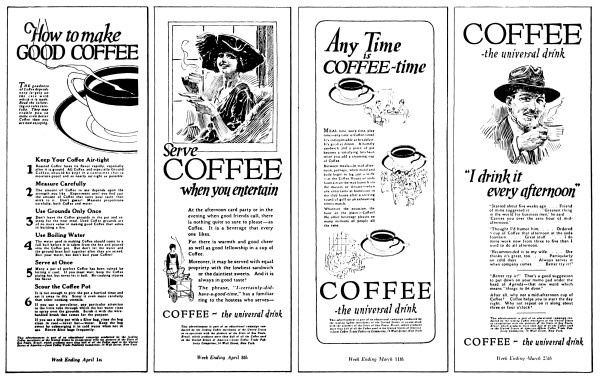
Advertising Copy of the
Joint Coffee Trade Publicity Committee,
Spring of 1922
[Pg 219]
The first coffee advertisement—Evolution of coffee advertising—Package coffee advertising—Advertising to the trade—Advertising by various mediums—Advertising for retailers with ready-made sample copy—Advertising to the nose—Successful coffee window displays—Advertising by government propaganda—Coffee advertising efficiency.
The first coffee advertisement was Sheik Abd-al-Kadir’s famous Argument in favor of the legitimate use of coffee, an Arabian manuscript of 1587, preserved in the Bibliotheque Nationale at Paris. It was frank propaganda for coffee. The latest and best advertising for coffee being done in America today is equally frank propaganda, showing that the friends of the universal beverage, 337 years after, are still alive to the need for intelligent advertising if they would continue to serve mankind with the “Gift of Heaven”; for coffee has its enemies in the 20th century just as in the 16th: our age is producing those who are jealous of this “beverage of the friends of God” like that early time when the first persecutions and attempted suppressions came to such inglorious ends.
The first printed advertisement for coffee in English has already been referred to in Chapter I. It was Pasqua Rosee’s shop- or handbill of 1652, the original being in the British Museum. It is worthy of close examination. It reads:
First publiquely made and sold in England, by Pasqua Rosee.
The Grain or Berry called Coffee, groweth upon little Trees, only in the Deserts of Arabia.
It is brought from thence, and drunk generally throughout all the Grand Seigniors Dominions. [Pg 220]
It is a simple innocent thing, composed into a Drink, by being dryed in an Oven, and ground to Powder, and boiled up with Spring water, and about half a pint of it to be drunk, fasting an hour before, and not Eating an hour after, and to be taken as hot as possibly can be endured; the which will never fetch the skin off the mouth, or raise any Blisters, by reason of that Heat.
The Turks drink at meals and other times, is usually Water, and their Dyet consists much of Fruit, the Crudities whereof are very much corrected by this Drink.
The quality of this Drink is cold and Dry; and though it be a Dryer, yet it neither heats, nor inflames more than hot Posset.
It so closeth the Orifice of the Stomack, and fortifies the heat within, that it’s very good to help digestion, and therefore of great use to be taken about 3 or 4 a Clock afternoon, as well as in the morning.
It much quickens the Spirits, and makes the Heart Lightsome.
It is good against sore Eys, and the better if you hold your Head over it, and take in the Steem that way.
It suppresseth Fumes exceedingly, and therefore good against the Head-ach, and will very much stop any Defluxion of Rheums, that distil from the Head upon the Stomack, and so prevent and help Consumptions; and the Cough of the Lungs.
It is excellent to prevent and cure the Dropsy, Gout, and Scurvy.
It is known by experience to be better than any other Drying Drink for People in years, or Children that have any running humors upon them, as the Kings Evil, &c.
It is very good to prevent Mis-carryings in Child-bearing Women.
It is a most excellent Remedy against the Spleen, Hypocondriack Winds, or the like.
It will prevent Drowsiness, and make one fit for busines, if one have occasion to Watch; and therefore you are not to Drink of it after Supper, unless you intend to be watchful, for it will hinder sleep for 3 or 4 hours.
It is observed that in Turkey, where this is generally drunk, that they are not trobled with the Stone, Gout, Dropsie, or Scurvey, and that their Skins are exceedingly cleer and white.
It is neither Laxative nor Restringent.
Made and sold in St. Michaels Alley in Cornhill, by Pasqua Rosee, at the Signe of his own Head. [Pg 221]
The noteworthy thing about this advertisement is that, in comparison with the best copy of today, it has high merit; for this early advertisement seems to have embodied in it superbly well those qualifications which modern advertising experts agree are essential requirements for success, measured in terms of sales to the consumer.
The first newspaper advertisement was in the form of a reader in the Publick Adviser of London for the week of May 19 to May 26, 1657. It is quoted on page 6.
There followed many broadsides, some illustrated, and all designed to tell the public about the new drink. There is to be noted a curious contrast between the copy of that far-off time and today. Two hundred seventy years ago all the resources of advertising were being laid under contribution to make propaganda for coffee as the great cure for many ailments of which nowadays the enemies of coffee would have us believe coffee is the cause! Those who have possessed themselves of the facts about coffee know that both arguments are equally fantastic.
Coffee was mentioned in shopkeepers announcements appearing in the Boston News Letter as early as 1714, and in other newspapers of the colonies during the 18th century, usually being offered for sale at retail with strange companions. In 1748, “tea, coffee, indigo, nutmegs, sugar, etc.,” were advertised for sale in Dock Square, Boston.
It appears that the first advertisement dealing with coffee alone was published in the New York Daily Advertiser for February 9, 1790; and this was primarily an advertisement of a wholesale coffee-roasting factory rather than an advertisement of coffee per se.
Not until package coffee began to come into vogue in the 1860s was there any change in the stereotyped business-card form followed by all dealers in coffee; and even then the monotony was varied only by inserting the brand name, such as “Osborn’s Celebrated Prepared Java Coffee. Put up only by Lewis A. Osborn”; “Government coffee in tin foil pound papers put out by Taber & Place’s Rubia Mills.” [Pg 222]
Real progress in coffee advertising, as in publicity for other lines of trade and industry, began in the United States. Here, too, it has been brought to its lowest degradation and to its highest efficiency. The entire process has taken something less than 50 years.
The first step forward was the picture handbill. The handbill, or dodger, had been common enough in England and on the Continent, where, for upward of 200 years, it had served as an advertising medium, in company with the more robust broadside, and in competition with the pamphlet and newspaper. It remained for America, however, to glorify the handbill by means of colored pictures.
Soon the handbill copy began to appear in the newspapers, but mostly without the illustrations. Later newspaper developments were to introduce more of the picture element, decorative border, and design. The ideas of European artists were freely drawn upon, but put to such utilitarian uses that their originators would scarcely have been able to recognize them.
In the Ladies Home Journal for December, 1888, the Great London Tea Company, Boston, an early mail-order house, advertised, “We have made a specialty since 1877 of giving premiums to those who buy tea and coffee in large quantities.” In the same issue, there was an advertisement of Seal Brand and Crusade Brand coffees by Chase & Sanborn, Boston. Dilworth Brothers, Pittsburgh, were also among the early users of magazine space.
The menace of the coffee-substitute evil and the misleading and untruthful substitute copy had grown to such proportions in the early days of the 20th century that the coffee men began to be concerned about it. At one time there were nearly 100 coffee-substitute concerns engaged in a bitter campaign directed against coffee in this country alone. After a time the coffee men organized as the National Coffee Roasters Association to defend their rights. Later, the cereal [Pg 223] substitute was thoroughly discredited by government analysis.
In the United States today, coffee advertising has reached a high plane of copy excellence. Our coffee advertisers lead all nations. The educational work started by The Tea & Coffee Trade Journal, fostered by the National Coffee Roasters Association, and developed by the Joint Coffee Trade Publicity Committee, has laid low many of the bugaboos raised by the cereal sinners.
Coffee advertising began to take on a distinctive character with the introduction of Ariosa by John Arbuckle in 1873. Some of the early publicity for this pioneer package coffee appears typographically crude, judged by modern standards; but the copy itself has all the needful punch, and many of the arguments are just as applicable today as they were a half-century ago.
Most of the original Arbuckle advertising was by means of circulars or broadsides, although some newspaper space was employed. Premiums were first used by John Arbuckle as an advertising sales adjunct, and they proved a big factor in putting Ariosa on the map. Mr. Arbuckle created the kind of word-of-mouth publicity for his goods that is the most difficult achievement in the business of advertising. It caused so deep and lasting an impression, that in some sections it has persisted through at least five decades. The advertising moral is: Get people to talk your brand.
Among the many long-established advertised package-coffee successes may be mentioned:
It was estimated that the amount of money spent by the larger coffee roasters upon all forms of publicity in the United States in 1920 was about $3,000,000.
Experience has proved that a package coffee, to be successful, must have back of it expert knowledge of buying, blending, roasting, and packing, as well as an efficient sales force. These things are essential: A quality product; a good trade-mark name and label; an efficient package. With these, an intelligently planned and carefully executed advertising and sales campaign will spell success. Such a campaign comprehends advertising directed to the dealer and to the consumer. It may include all the approved forms of publicity, such as newspapers, magazines, billboards, electric signs, motion pictures, demonstrations, and samples. One phase of trade advertising which should not be overlooked is dealer helps.
Until a comparatively recent date, the green-coffee importer, selling the roasting trade, has not realized the need of advertising, because, in most instances, green coffee is not sold by the mark, and, to a certain extent, price has been the determining factor.
During late years, however, many green-coffee firms have come to realize that there is a goodwill element that enters into the equation which can be fostered by the intelligent use of advertising space in the coffee roaster’s trade journal; also, a few importers are now featuring trade marks in their advertising, thus building up a tangible trade-mark asset in addition to goodwill.
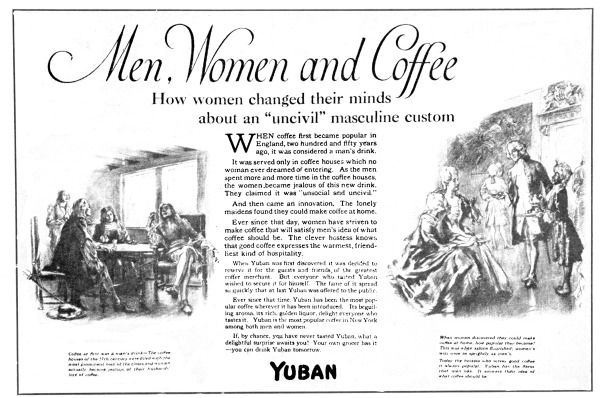
Drawing Upon History for Social-Intercourse Atmosphere
[Pg 225]
Billboard and other outdoor advertising, also car cards, are being used to a considerable extent for coffee publicity. Painted outdoor signs have been the backbone of one Middle West roaster’s campaign for a number of years. Both car cards and billboards are growing in popularity, because they enable the coffee packer to reproduce his package in its natural colors and permit also of striking displays. Such firms as Arbuckle Brothers, New York; Dayton Spice Mills, Dayton, Ohio; W. F. McLaughlin & Company, Chicago; the Puhl-Webb Company, Chicago; the Bour Company, Toledo; B. Fischer & Company, New York; and the Cheek-Neal Coffee Company, Nashville and New York, are consistent users of this character of advertising. Electric signs also have proved effective for coffee advertising.
Motion pictures are a comparatively new development in coffee advertising. One of the first coffee roasters to adopt this plan of publicity was S. H. Holstad & Company, Minneapolis. The film used depicted the cultivation and preparation of coffee for the market, also the complete roasting and packaging operations. The A. J. Deer Company, manufacturer of coffee mills and roasters, Hornell, New York, was another pioneer in the use of coffee films. Jabez Burns & Sons, coffee-machinery manufacturers, followed with an educational coffee picture. The National Packaging Machinery Company, of Boston, is another concern that has utilized films for advertising purposes, showing its machines in operation in a coffee-packing plant. Many roasters made use of the coffee film produced by the Joint Coffee Trade Publicity Committee.
When retailers analyze the people to whom they sell coffee, they usually find three types. First, there is the woman who thinks she is an expert judge of coffee, but is unable to find anything to suit her [Pg 226] cultivated taste. Then, there is the new housewife, possibly a bride of a few months, who knows very little about coffee, but wants to find a good blend that both she and her husband will like. The third is the most acceptable class, the satisfied people who have found coffee that delights them, day after day.
The following “ready-made” copy appeals for the three classes. To “Mrs. Know-it-all-about-Coffee,” this style has been found effective:
IMPROVE THE COFFEE AND YOU
IMPROVE THE MEAL
The corner of the table that holds the coffee urn is the balancing point of your dinner. If the coffee is a “little off” for some reason or other—probably it’s the coffee’s own fault—things don’t seem so good as they might; but when it is “up to taste,” the meal is a pleasure from start to finish. If the “balancing point” is giving you trouble, let Any Blend Coffee properly regulate it for you. 35 cents, three pounds for $1.
ANY TEA & COFFEE COMPANY
For the good lady who is eager to find a suitable blend of coffee, and who desires information, this is a good appeal:
A SUCCESSFUL SELECTION
Of the coffee that goes into the every-morning cup will arrive on the day when Any Blend is first purchased. Many homes have been without such a success now for a long time, but, of course, they didn’t know of Any Blend—and even now it is hard to really know Any Blend till you try it. That is why we seem to insist that you ask for an introduction by ordering a pound.
ANY BLEND TEA & COFFEE COMPANY
Taking both classes and dealing with them alike:
“BLENDED TO BALANCE”
Is a good descriptive phrase of Any Blend coffee, for care is taken in the preparation that the strength does not overpower the flavor. The aim of the blender is to get an acceptable and delightful drinking quality. He has been more than successful, as you will see when you try Any Blend. 35 cents, three pounds for $1.
ANY TEA & COFFEE COMPANY
[Pg 227]
The satisfied class, of course, is not averse to making a change, and it is well, occasionally, for the dealer to let his own satisfied customers know he still believes in his goods. The argument might take this form:
A SERVICE THAT SAVES
Is the serving of Any Blend, when coffee is desired. Any Blend saves many things. It saves worry, for it is always uniform in flavor and strength. It saves time, for when you order Any Blend we grind it just as fine or just as coarse as your percolator or pot demands. Any Blend also saves expense, because there is no waste, as you know just how much to use, every time, to make a certain number of cups. 35 cents, three pounds for $1.
ANY TEA & COFFEE COMPANY
Again, possible new customers may listen to this appeal:
TO PROVE YOUR APPROVAL
Of Any Blend coffee, you are asked to try just one pound. We know you will like it, for it is blended and roasted and ground as an exceptional coffee should be, with the care that a good coffee demands. Prove to yourself that you approve of this method of preparing coffee. 35 cents, three pounds for $1.
ANY TEA & COFFEE COMPANY
In some households the cook is permitted to do the ordering, and usually the cook does not read the daily papers with an eye for coffee ads. To reach this individual through her mistress:
CAN YOU NAME YOUR COFFEE?
Or is it one of those many unknown brands that comes from the store at the order of your cook? Let the cook do the ordering, for you are lucky if you have one you can rely upon, but tell her you prefer Any Blend to the No-Name Blend you may now be using. Any Blend has one distinct advantage over all others; it is freshly roasted. Tell the kitchen-lady, now, to order Any Blend.
ANY TEA & COFFEE COMPANY [Pg 228]
Advertising to the Nose
Advertising, for the most part, is designed to attract attention and custom through the eye. Sometimes the ear can successfully be appealed to, but the sounds rarely have any real relation to the object advertised; and, so, often prove unsatisfactory in their results. Not so long ago, a California coffee concern made successful appeal to the noses of possible purchasers of its wares.
A chain of coffee specialty stores in which the coffee is roasted fresh every day was started in California about 1916, and it met with almost instant success. In this system, the proprietor buys the green coffee in large quantities, and it is roasted in each of his specialty stores (which are located in public markets), store windows, and alongside heavily traveled highways. The roasting machinery is invariably set up in front of the store where the passerby can easily see it in operation and also smell the coffee roasting. Some retail coffee roasters direct the smoke from the roasting machine through the spout of a huge coffee pot on the sidewalk in front of their stores. This makes a very effective advertisement, as the odor from the fresh-roasted coffee tickles the noses of passersby for blocks around.
O. Wallace Davis, who won first prize in the $2,000 window-trimming contest of National Coffee Week in 1920, has some worth-while things to say on grocery-window displays of coffee. He writes:
Your show windows are the eyes of your store. As you look into a friend’s eyes to learn his true thoughts, so the prospective customer gazes into your windows to find out what kind of store you keep.
Keep the eyes of your store bright, honest, and attractive.
A well-arranged show window is the retailer’s best asset. Goods well displayed are half sold. Every grocer knows this, but not everyone knows how to use his windows to the best advantage. Here are a few simple directions, the fundamental principles of the window dresser’s art, which anyone can follow:
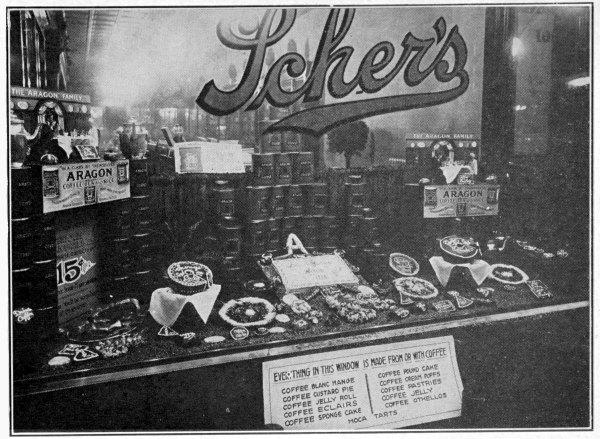
A Prize-Winning Coffee Window Display
This unusual display of coffee-flavored eatables won first prize for the southern district in the National Coffee Week window-trimming contest. The cakes, pies, tarts and other pastries that constituted the main feature, rested in a bed of green coffee. The customer's interest was cleverly attracted to the dealer's brand by a pyramid of large coffee cans in the center background and by two miniature dining- room sets.
[Pg 229] In arranging grocery or provision windows, the first and most important principle is cleanliness.
Your window glass, flooring, background, fixtures, merchandise, and display material must be absolutely clean. Use nothing that will in anyway suggest anything but the most sanitary conditions in your store. A can of tomatoes with a rust-stained label inevitably indicates ancient goods. A finger-marked price ticket causes the customer to see dirty hands touching your merchandise; and so small a thing as a flyspeck on a soda cracker will queer an otherwise attractive display.
So cleanliness is the first great commandment; and the second is like unto it,—neatness. No window can ever be too neat. A crooked stand, pyramid, or shelf has no place in a store’s show window.
Arrangement, color, merchandise, make,—select and get these fundamental elements right, and your window must be attractive. Neglect any one of them, and your display will suffer.
Merely to stop the crowd, to arouse curiosity or entertain, is not enough. The argument must be there so convincingly that the observer will be drawn irresistibly into the store or persuaded to buy.
Try to work into your displays the unusual; not necessarily some freak, but something that will arrest attention of the passerby, and, having secured attention, lead his eye to the real object of the display, which should always be the merchandise itself or some advertising matter pertaining to the goods for sale.
Effective displays may be obtained by filling an entire window with one item, with a cleverly phrased card telling the story. In conjunction with a one-item display, a good color scheme adds greatly to the pulling force. For instance, if you are displaying a package of coffee with a tan and black label, a brown background trimmed with a “motif” in black would emphasize the articles and lead the eye directly to them.
It is not always desirable to specialize on a single article. Several, and sometimes a large number of, items can be shown in such manner as to give to each its own individuality. This is known as “unit trimming.” Arrange each article in a group, with plenty of space between groups. For example, several pyramids of canned goods, arranged in groups on high pedestals or shelves in the background of the window, would not necessarily detract from smaller items or articles on the floor near the front.
Keep your floor covering in harmony with your background, and generally [Pg 230] lighter in color. An example may be helpful: Suppose you wish to show a window of canned goods with a blue and white label and the brand name, “Tulip,” or “Daisy,” or “Rose.” A rich shade of orange would make a strong background for these, and a few flowers, such as the brand suggests, would aid materially in making an attractive window.
In arranging these special displays, a little study of the package itself will suggest many ideas and help you put an extra punch into your window. Most manufacturers furnish free window display material advertising their own goods, such as dummy packages, posters, hangers, strips, and cut-outs; but the window that attracts the biggest crowd and sells the most goods usually is one upon which the boss, or one of his clerks, has used his own gray matter. The standardized window may reach a high grade,—in fact, the displays arranged by salesmen or traveling representatives of the big manufacturers and jobbers are uniformly good and far above the average,—but standardization cannot supply the personal touch and the local color which any grocer should be able to furnish if he is willing to devote to his windows a fair amount of time, thought, and labor. Frequently an ideal combination can be obtained through the use of a standard window trim to which the retailer has added just a few touches of his own to give it individuality.
Many warnings have been written against “overcrowding” a window; but don’t skimp your display. Fill it full of interest, enthusiasm, and pep. Remember that there is no better or cheaper advertising. Compare its cost with the cost of any other form of advertising, and you will need no further argument to convince you that it is worth all the time and attention you can give it.
The displaying of coffee offers endless opportunities. In the first place, it is a familiar article, in which everyone is interested. It comes in many forms, which suggest a great variety of ways to handle it in a window. No article the grocer sells is more attractively packed. Cartons, bags, and cans are easy to arrange in a multitude of attractive designs. Coffee in bulk, in either the berry or ground, looks well in almost any receptacle, and the finished product suggests familiar household scenes.
A coffee display offers unusual opportunities to the clever sign writer, and the advertising literature issued by the roasters and the Joint Coffee Trade Publicity Committee furnishes a never-failing source of material. The public, and especially housewives, are always interested in signs telling how to prepare and serve coffee. [Pg 231]
Advertising by Government Propaganda
Advertising coffee by government propaganda has been indulged in with more or less success by the British government in behalf of certain of its colonial possessions; by the French and the Dutch; by Porto Rico, Costa Rica, Guatemala, and Brazil. The markets most cultivated have been Italy, France, England, Russia, Japan, and the United States.
Over 20 years ago, the author began an agitation for cooperative advertising by the coffee trade. He suggested as a slogan, “Tell the truth about coffee,” and it is gratifying to find that many of his original ideas have been embodied in the present Joint Coffee Trade Publicity campaign, which has been going on for five years.
This campaign, made possible by generous contributions from Brazil and the coffee merchants of the United States, has, by means of advertisements in newspapers and periodicals, through scientific research, by educational booklets, etc., done much to dissipate the erroneous ideas propagated by the traducers of our national beverage and to acquaint the general public with the truth about coffee.
In advertising coffee, it is well to bear in mind these three thoughts, which should be woven into the fabric of all copy:
1. The intrinsic desirability of coffee—the actual pleasure to be derived from the act of partaking of it.
2. That it is delightful medium for social intercourse—part of the essential equipment for an intimate chat or more general assemblage of friends.
3. That its proper service is a badge of social distinction—the mark of a successful hostess.
[Pg 232]
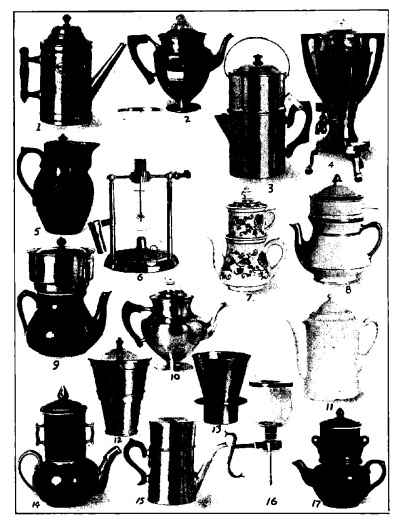
Coffee-Making Devices Used in United States
1. Marion Harland pot. 2. Universal percolator. 3. Gait vacuum-process coffee maker. 4. Universal electric urn. 5. English coffee biggin (Langley ware). 6. Universal cafenoira (glass filter). 7. Vienna (Bohemian or Carlsbad) coffee machine. 8. Tru-Bru pot. 9. Tricolator. 10. Manning-Bowman percolator. 11. Blanke’s Sanitary coffee pot. 12. Phylax coffee maker. 13. Private Estate coffee maker. 14. American French-drip pot. 15. Kin-Hee pot. 16. Silex opalescent glass filter. 17. French-drip pot (Langley ware).
[Pg 233]
The importance of correct grinding and brewing—Drip or filter coffee—Boiled or steeped coffee—Percolated coffee—The perfect cup of coffee—Some coffee recipes.
The ideal way to prepare the coffee drink would be to buy the coffee green, then roast and grind it just before making the beverage. This was the ancient custom, and obtained even in our grandmothers day. Today, especially for busy people in cities, it isn’t so practical to buy coffee in the green and roast it as needed.
Then, too, there are efficient roasting plants, usually just around the corner, where it is much better done than ever Grandmother did it, for all her loving care and infinite patience; and, for those who live some distance from the roaster, there are air-proof, dust-proof, and damp-proof containers,—aye, even vacuum tins,—in which the freshly roasted bean may be kept reasonably fresh until it is needed for table use.
Again, for those too busy to grind their own, there are efficient grinders in the factory or store which make it possible to supply any grind in package form or on demand. It is possible to get freshly roasted and freshly ground coffee of excellent quality in almost any given community.
At the same time, it is a coffee-making axiom that, the shorter the time between roasting and making, the better the beverage. For those who wish a superior cup of coffee, it is well to bear this thought in mind. Most everyone knows that green coffee improves with age; roasted coffee loses its flavor rapidly, especially after it is ground. This is because the aromatic flavoring elements developed by roasting begin to [Pg 234] escape as soon as exposed to the air. The roasted berry also absorbs moisture, which causes destructive changes in the flavoring oils. Ground coffee, therefore, should be kept in a container that is moisture proof and as nearly air-tight as possible. If the original package does not give this protection after it is once opened, place the contents in a glass fruit jar or other vessel which can be kept sealed.
The following general directions for making coffee in the home have been worked out by Edward Aborn, the New York coffee-brewing expert, and published by the Joint Coffee Trade Publicity Committee in cooperation with the National Coffee Roasters Association:
The roasted berry is constructed of fibrous tissues formed into tiny cells visible only under the microscope, which are the “packages” wherein are stored the whole value of coffee, the aromatic oils. Like cutting up an orange, the grinding of coffee is the opening of surrounding tissue and pulp.
If coffee is bought “in the bean” and ground at home, use a mill that can be adjusted to give a uniform granulation best suited to the particular brewing method adopted. There are several on the market.
There is no set rule for the proper proportions of coffee and water. This will vary with the kind of coffee used, the way it is ground, and the method of brewing, and, above all, with individual taste. But, once you have found the right proportion, that is the proportion best suited to your use: stick to it. Don’t guess; measure carefully, both water and coffee. Remember that, in brewing, the coffee grounds absorb a certain amount of the water in the pot; therefore, to make five cups of coffee, use, say, five and one-half cupfuls of water, and in the same proportion with larger or smaller quantities.
Chemists have analyzed the coffee bean and told us that its delicious taste is due to certain aromatic oils. This aromatic element is extracted most efficiently only by fresh-boiling water. The practice of [Pg 235] soaking the grounds in cold water, therefore, is to be condemned. It is a mistake also to let the water and the grounds boil together after the real coffee flavor is once extracted. This extraction takes place very quickly, especially when the coffee is ground fine. The coarser the granulation, the longer it is necessary to let the grounds remain in contact with the boiling water. Remember that flavor, the only flavor worth having, is extracted by the short contact of boiling water and coffee grounds, and that, after this flavor is extracted, the coffee grounds become valueless dregs.
Use Grounds Only Once
Although the foregoing rules are absolutely fundamental to good coffee making, their importance is so little appreciated that in some households the lifeless grounds from the breakfast coffee are left in the pot and resteeped for the next meal, with the addition of a small quantity of fresh coffee. Used coffee grounds are of no more value in coffee making than ashes are in kindling a fire.
Serve at Once
After the coffee is brewed, the true coffee flavor, now extracted from the bean, should be guarded carefully. When the brewed liquid is left on the fire or overheated, this flavor is cooked away and the whole character of the beverage is changed. It is just as fatal to let the brew grow cold. If possible, coffee should be served as soon as it is made. If service is delayed, it should be kept hot but not overheated. For this purpose, careful cooks prefer a double-boiler over a slow fire. The cups should be warmed beforehand, and the same is true of a serving pot, if one is used. Brewed coffee, once injured by cooling, cannot be restored by reheating.
Scour the Coffee Pot
Unsatisfactory results in coffee-brewing frequently can be traced to lack of care in keeping utensils clean. The fact that the coffee pot is used only for coffee making is no excuse for setting it away with a hasty rinse. Coffee-making utensils should be cleansed with scrupulous care after each using. If a percolator is used, pay special attention to the small tube through which the hot water rises to spray over the grounds. This should be scrubbed with a wire-handled brush.
Don’t Dry Filter Bags
In cleansing drip or filter bags, use cool water. Hot water “cooks in” [Pg 236] the coffee stains. After the bag is rinsed, keep it submerged in cool water until time to use it again. Never let it dry. This treatment protects the cloth from the germs in the air which cause souring. New filter bags should be washed before using to remove the starch or sizing.
The principle behind this method is the quick contact of water at full boiling point with coffee ground as fine as it is practicable to use it. The filtering medium may be of cloth or paper, or perforated chinaware or metal. The fineness of the grind should be regulated by the nature of the filtering medium, the grains being large enough not to slip through the perforations.
The amount of ground coffee to use may vary from a heaping teaspoonful to a rounded tablespoonful for each cup of coffee desired, depending upon the granulation, the kind of apparatus used, and individual taste. A general rule is, The finer the grind the smaller the amount of dry coffee required.
The most satisfactory grind for a cloth drip bag has the consistency of powdered sugar, and shows a slight grit when rubbed between thumb and finger. Unbleached muslin makes the best bag for this granulation. For dripping coffee reduced to a powder, as fine as flour or confectioner’s sugar, use a bag of canton flannel with the fuzzy side in. Powdered coffee, however, requires careful manipulation and cannot be recommended for everyday household use.
Put the ground coffee into the bag or sieve. Bring fresh water to a full boil, and pour it through the coffee at a steady, gradual rate of flow. If a cloth drip bag is used, with a very finely ground coffee, one pouring should be enough. No special pot or device is necessary. The liquid coffee may be dripped into any handy vessel or directly into the cups. Dripping into the coffee cups, however, is not to be recommended, unless the dripper is moved from cup to cup so that no one cup will get more than its share of the first flow, which is the strongest and best.
The brew is complete when it drips from the grounds, and further cooking or “heating up” injures the quality. Therefore, since it is not necessary to put the brew over the fire, it is possible to make use of the hygienic advantages of a glassware, porcelain, or earthenware serving pot.
For boiling or steeping, use a medium grind. The recipe is a rounded tablespoonful for each cup of coffee desired, or, as some cooks prefer to remember it, a tablespoonful for each cup and “one for the pot.” Put the dry coffee into the pot and pour over it fresh water briskly boiling. Steep for five minutes or longer, according to taste, over a low fire. Settle with a dash of cold water, or strain through muslin or cheese cloth and serve at once.
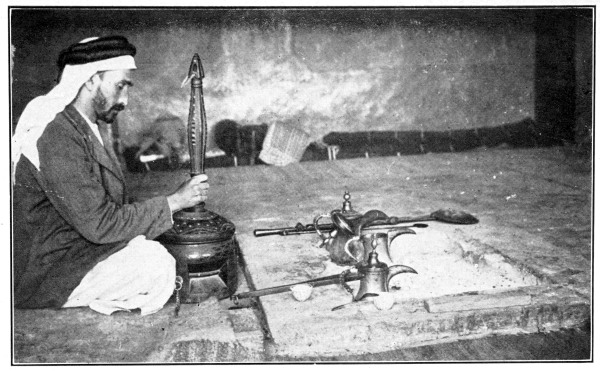
Brewing the Guest’s Coffee in a Mohammedan Home
[Pg 237]
Use a rounded tablespoonful of medium-fine-ground coffee to each cupful of water. The water may be poured into the percolator cold or at the boiling point. In the latter case, percolation begins at once. Let the water percolate over the grounds for five to 10 minutes, depending upon the intensity of the heat and the flavor desired.
“For Better Coffee”
In June, 1924, the Joint Coffee Trade Publicity Committee, in cooperation with the National Coffee Roasters Association, published for distribution among consumers a booklet entitled “For Better Coffee Making,” prepared from the 1923 coffee-research report of Professor Samuel C. Prescott of the Massachusetts Institute of Technology. Its purpose was “to explain as clearly and concisely as possible the best way to prepare beverage coffee as recommended by the institute.” This booklet heads as follows:
Making good coffee is an art easily acquired. The American housewife has it, but her methods are varied and her success not always assured.
American coffee roasters felt there must be a uniform way to make better coffee, so they consulted the highest scientific authority in the country upon the subject. The Massachusetts Institute of Technology was chosen because of its prestige. In the public mind its findings become at once authoritative.
For three years it sought a way to make better coffee. Thousands of experiments were made. Individual tastes were tested. Safeguards were laid against prejudice and bias. All the previous works upon the subject were consulted and their recipes given consideration. Every known way of making coffee was tried out until the best was ascertained.
This booklet, prepared from the report, purposes to explain as clearly and concisely as possible this best way recommended by Massachusetts Tech. to prepare beverage coffee. [Pg 238]
No doubt millions of women are making coffee, by percolation and by boiling, that has been satisfactory to them. This booklet neither discourages nor condemns these methods, but merely shows a newer and a better way, a way in which the most in flavor and aroma will be secured.
The buying is as important as the making. Be sure you start out with a good quality of coffee. The handling, after the purchase has been made, has a direct bearing upon the quality of the beverage.
Two simple rules govern the purchase of coffee if this way is to be tried. These are very good reasons for these rules:
1. Coffee in the bean loses its carbondioxid and its freshness much less rapidly than ground coffee. Grinding the coffee, in fact, results in a marked and immediate loss of this necessary element.
Roasted coffee contains considerable carbondioxid. Carbondioxid is absolutely harmless. It is being used extensively with foodstuffs at present. In dairy products it prevents the growth of bacteria and retards the development of rancid acids. It enables many food materials to be preserved for a long period of time. In coffee its action is similar. Hence, it is desirable to retain as much of it as possible.
2. Be sure that any coffee you buy, whether bulk, package, or can, is fresh. Fresh coffee contains the greatest amount of carbondioxid, and the carbondioxid gives the assurance that the flavor and aroma will be longer retained and the quality of the coffee kept at its best.
The preservation of the aroma, flavor, and freshness of the coffee from the time of purchase until the time of consumption depends upon several precautions:
1. Keep the coffee in a tight container.
2. Do not expose it to the air by leaving the container uncovered.
3. Place the container where it will have no contact with moisture.
4. See that the container is kept as far as possible from any heat.
5. If you buy whole bean coffee, grind it only in the quantity needed at the time of making.
All of these rules have to do with the retention of the flavor and aroma. While coffee in the bean loses both slowly, there are a number [Pg 239] of ways in which carelessness will permit a rapid loss. One is exposing a large amount of the surface of the bean to the air; another is allowing moisture to get into the container; and a third is permitting heat to drive away the gas.
The fifth rule, of course, relates to the purchase of the coffee in the bean. To secure and conserve the maximum flavor and aroma, the grinding should be done just as the brewing is to begin.
For this reason the coffee mill should be restored to its proper place in the kitchen. It should be a good mill, giving a uniform grind, and not the cheap types, which quickly get out of order.
The most delicious results are obtained by using fresh-roasted coffee, freshly ground, through which water of a temperature just below the boiling point is dripped for not more than two minutes.
The rules to be followed to attain this most desired result are not hard to remember:
1. See that the coffee is not ground too coarse. A fine grind yields a richer flavor than a coarse grind, because of the more rapid and complete solution of the flavor-giving substances.
2. Allow at least a tablespoonful of ground coffee to a cup of water. The exact proportion depends upon the kind of coffee used, and can be determined only by individual taste. In measuring the water always allow an extra cup for the evaporation.
3. Be sure the water boils; then pour it over the freshly ground coffee. Many types of coffee pots are provided with special perforated containers for the freshly ground coffee. By means of these perforations the hot water drips slowly through the coffee. By pouring at the boiling point, the water in contact with the coffee falls to just the temperature needed to extract the greatest amount of flavor and aroma. If a coffee drip bag is used, be sure it is kept clean and sweet.
4. The dripping process should not last longer than two minutes. Long dripping at a lower temperature increases the bitter taste and decreases the flavor and aroma.
5. Serve at once. Letting coffee cool ruins it. If there is a delay in serving, keep the coffee piping hot, but do not let it boil.
6. Do not use the ground coffee a second time. Coffee once used has given all its aroma and flavor to the beverage. There is nothing of any value left in the grounds.
7. Scour the coffee pot. It is necessary to have the utensil clean. Remnants of the old grounds will weaken the freshly ground coffee.
These are the simple rules for a better cup of coffee—proved by science and well worth a trial. [Pg 240]
Coffee Making Devices
There are many coffee-making devices used in the United States, the best known being the Marion Harland pot, the Private Estate coffee maker, Galt vacuum-process coffee maker, Universal percolator and glass filter, English coffee biggin, Manning-Bowman percolator, Vienna coffee machine, Blanke’s Sanitary coffee pot, Phylax coffee maker, American French-drip pot, tricolator, Kin-Hee pot, Tru-Bru pot, and Silex glass filter.
Lovers of coffee in the United States are in better position to obtain an ideal cup of the beverage than those in any other country. While imports of green coffee are not so carefully guarded as tea imports, there is a large measure of government inspection designed to protect the consumer against impurities, and the Department of Agriculture is zealous in applying the Pure Food Law to insure against misbranding and substitution. The department has defined coffee as “a beverage resulting from a water infusion of roasted coffee and nothing else.”
Today, no reputable merchant would think of selling even loose coffee for other than what it is, and the consumer may feel that, in the case of package coffee, the label tells the truth about the contents.
With a hundred different kinds of coffee coming to this market from 19 countries, so many combinations are possible that there is sure to be a straight coffee or a blend to suit any taste, and those who may have been frightened into the belief that coffee was not for them should do a little experimenting before exposing themselves to the dangers of the coffee-substitute habit.
Once upon a time, it was thought that Java and Mocha were the only worth-while blend, but now we know that a Bogota coffee from Colombia and a Bourbon Santos from Brazil make a most satisfying drink; and, if the individual should happen to be a caffein-sensitive, there are [Pg 241] coffees so low in caffein content, like some Porto Ricans, as to overcome this objection; while there are other coffees from which the caffein has been removed by special treatment. There is no reason why any person who is fond of coffee should forgo its use. Paraphrasing Makaroff, Be modest, be kind, eat less, and think more, live to serve, work and play and laugh and love—it is enough! Do this, and you may drink coffee without danger to your immortal soul.
If you are accustomed to buying loose coffee, have your dealer do a little experimental blending for you until you find a coffee to suit your palate. Some expert blends are to be found among the leading package brands. But you really cannot do better than to trust your case to a first-class grocer of known reputation. He will guide you right if he knows his business; and, if he doesn’t, then he doesn’t know his business—try elsewhere. Test him out somewhat along this line:
Let us reason together, Mr. Grocer. Let us consider these facts about coffee: Green coffee improves with age? Granted. As soon as it is roasted, it begins to lose in flavor and aroma? Certainly. Grinding hastens the deterioration? Of course. Therefore, it is better to buy a small quantity of freshly roasted coffee in the bean and grind it at the time of purchase or at home just before using? Absolutely!
If your grocer reacts in this fashion, he need only supply you with a quality coffee at fair price and you need only to make it properly to obtain the utmost of coffee satisfaction.
Some connoisseurs still cling to the good old two-thirds Java and one-third Mocha blend, but the author has for years found great pleasure in a blend composed of half Medellin Bogota, one-quarter Mandheling “Java,” and one-quarter Mocha. However, this blend might not appeal to another’s taste, and the component parts are not always easy to get. The retail cost (1924) is about 50 cents. [Pg 242]
Another pleasing blend is composed of Bogota, washed Maracaibo, and Santos, equal parts. This should retail from 40 to 45 cents. Good-drinking coffees are to be had for prices ranging from 32 to 37 cents. In the stores of one of the large chain systems, an excellent blend composed of 50 percent Bourbon Santos and 50 percent Bogota is to be had (1924) for 35 cents. All these figures apply, of course, to normal times.
If you are epicurean, you will want to read up on, and to try, the fancy Mexicans, Cobans, Sumatra growths, Meridas, and some from the “Kona side” of Hawaii.
In preparing the perfect cup of coffee, then, the coffee must be of good grade, and freshly roasted. It should, if possible, be ground just before using. The author has found a fine grind, about the consistency of fine granulated sugar, the most satisfactory. For general home use, a device that employs filter paper or filter cloth is best; for the epicure an improved porcelain French percolator (drip pot) or an improved cloth filter will yield the utmost of coffee’s delights. Drink it black, sweetened or unsweetened, with or without cream or hot milk, as your fancy dictates.
It should be remembered that to make good coffee no special pot or device is necessary. Good coffee can be made with any china vessel and a piece of muslin. But to make it in perfection pains must be taken with every step in the process from roaster to cup.
Hollingworth points out that through taste alone it is impossible to distinguish between quinine and coffee, or between apple and onion. There is something more to coffee than its caffein stimulus, its action on the taste buds of the tongue and mouth. The sense of smell and the sense of sight play important roles. To get all the joy there is in a cup of coffee, it must look good and smell good, before one can pronounce its taste good. It must woo us through the nostrils with the wonderful aroma that constitutes much of the lure of coffee.
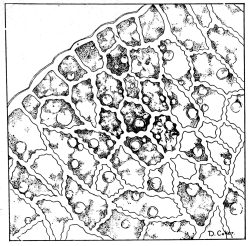
Cross section of roasted bean
magnified 600 times.
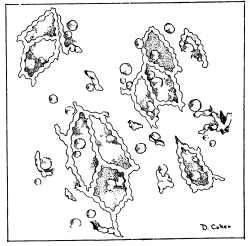
Medium grind of the same bean.
Showing How Grinding Breaks Open the Oil Cells
[Pg 243] That is why, in the preparation of the beverage, the greatest possible care should be observed to preserve the aroma until the moment of its psychological release. This can be done only by having it appear at the same instant that the delicate flavor is extracted: roasting and grinding the bean much in advance of the actual making of the beverage will defeat this object. Boiling the extraction will perfume the house; but the lost fragrance will never return to the dead liquid called coffee, when served from the pot whence it was permitted to escape.
To recapitulate, with an added word on service, the correct way to make coffee is as follows:
1. Buy a good grade of freshly roasted coffee from a responsible dealer.
2. Grind it very fine, and at home, just before using.
3. Allow a rounded tablespoonful for each beverage cup.
4. Make it in a French-drip pot or in some filtration device where freshly boiling water is poured through the grind but once. A piece of muslin and any china receptacle make an economical filter.
5. Avoid pumping percolators, or any device for heating water and forcing it repeatedly through the grounds. Never boil coffee.
6. Keep the beverage hot and serve it “black,” with sugar and hot milk, or cream, or both.
When Mrs. Ida C. Bailey Allen prepared a booklet of recipes for the Joint Coffee Trade Publicity Committee, she introduced them with the following remarks on the use of coffee as a flavoring agent:
Although coffee is our national beverage, comparatively few cooks realize its possibilities as a flavoring agent. Coffee combines deliciously with a great variety of food dishes, and is especially adapted to desserts, sauces, and sweets. Thus used, it appeals particularly to men and to all who like a full-bodied, pronounced flavor.
For flavoring purposes, coffee should be prepared just as carefully as when it is intended for a beverage. The best results are obtained by using freshly made coffee, but when, for reasons of economy, it is desirable to utilize a surplus remaining from the mealtime brew, care should be taken not to let it stand on the grounds and become bitter. [Pg 244]
When introducing made coffee into a recipe calling for other liquid, decrease this liquid in proportion to the amount of coffee that has been added. When using it in a cake or in cookies, instead of milk, a tablespoonful less to the cup should be allowed, as coffee does not have the same thickening properties.
In some cases, better results are gained if the coffee is introduced into the dish by scalding or cooking the right proportion of ground coffee with the liquid which is to form the base. By this means, the full coffee flavor is obtained, yet the richness of the finished product is not impaired by the introduction of water, as would be the case were the infused coffee used. This method is advisable especially for various desserts which have milk as a foundation, as those of the custard variety and certain types of Bavarian creams, icecream, and the like. The right proportion of ground coffee, which is generally a tablespoonful to the cup, should be combined with the cold milk or cream in the double-boiler top and should then be scalded over hot water, when the mixture should be put through a very fine strainer or cheese cloth, to remove all grounds.
Coffee may be used as a flavoring in almost any dessert or confection where a flavoring agent is employed.
On iced coffee and the use of coffee in summer beverages in general, Mrs. Allen writes as follows:
Iced Coffee. This is not only a delicious summer drink, but it also furnishes a mild stimulation that is particularly grateful on a wilting hot day. It may be combined with fruit juices and other ingredients in a variety of cooling beverages which are less sugary and cloying than the average warm-weather drink, and for that reason it is generally popular with men.
Coffee that is to be served cold should be made somewhat stronger than usual. Brew it according to your favorite method, and chill before adding sugar and cream. If cracked ice is added, make sure the coffee is strong enough to compensate for the resulting dilution. Mixing the ingredients in a shaker produces a smoother beverage, topped with an appetizing foam.
It is a convenience, however, to have on hand a concentrated sirup from which any kind of coffee-flavored drink may be concocted on short notice and without the necessity of lighting the stove. Coffee left over from meals may be used for the same purpose, but it should be kept in a covered glass or china dish and not allowed to stand too long. A [Pg 245] coffee sirup made after the following recipe will keep indefinitely and may be used as a basis for many delicious iced drinks:
Coffee Sirup. Two quarts of very strong coffee; 3½ pounds sugar. The coffee should be very strong, as the sirup will be largely diluted. The proportion of a pound of coffee to one and three-fourths quarts of water will be found satisfactory. This may be made by any favorite method, cleared and strained, then combined with the sugar, brought to boiling point, and boiled for two or three minutes. It should be canned when boiling, in sterilized bottles. Fill them to overflowing, and seal as for grape juice or for any other canned beverage.
Footnotes:
[1] Ukers: All About Coffee (p. 718-19, 1922).
[2] Tea & Coffee Trade Journal, Sept., 1922, p. 357.
[3] T. M. Harrison; Tea & Coffee Trade Journal, April-June, 1923.
[4] Bureau of Business Research, Harvard University.
[5] Fiscal year 1913.
[6] Fiscal year ending March 31, 1914.
[7] Fiscal year.
[8] Based on population figure including both white and colored.
[9] Fiscal year.
[10] Figures not available.
[11] Figures not available.
[12] Fiscal year.
Transcriber’s Notes:
Deprecated spellings or ancient words were not corrected.
The illustrations have been moved so that they do not break up paragraphs and so that they are next to the text they illustrate.
Typographical and punctuation errors have been silently corrected.