The Project Gutenberg eBook of The captain of the "Mary Rose"
This eBook is for the use of anyone anywhere in the United States and
most other parts of the world at no cost and with almost no restrictions
whatsoever. You may copy it, give it away or re-use it under the terms
of the Project Gutenberg License included with this eBook or online
at www.gutenberg.org. If you are not located in the United States,
you will have to check the laws of the country where you are located
before using this eBook.
Credits: chenzw, Tim Lindell and the Online Distributed Proofreading Team at https://www.pgdp.net (This file was produced from images generously made available by The Internet Archive/American Libraries.)
*** START OF THE PROJECT GUTENBERG EBOOK THE CAPTAIN OF THE "MARY ROSE" ***
To every Briton, the question: “What will the sea-fighting
of to-morrow be like?” is of supreme
interest and importance. Ours is a sea empire.
The confines of our dominions lie, not upon
our own coasts, but upon the coasts of our
neighbours; and unless in the future we
can, as we have done in the past, hold our dominions, be
they shore or be they ocean, against all comers, our national
glory will be eclipsed, our wealth will vanish, and our
greatness will be annihilated.
It is primarily in order to put forward a tentative
answer to this question that I have written the story of
the Mary Rose. I have seen no real fighting at sea. There
are very few who have. But I have seen an immense
amount of sham-fighting—more, it is possible, than anyone
else; for, besides witnessing manœuvres abroad, I have
for eight successive years gone afloat to follow the operations
consequent upon the annual mobilisation in our own
home waters. The sham thing, I am quite aware, must
be very different from the terrible reality. It affords,
nevertheless, a key to the reality; and, armed with that
key, I have been so bold as to endeavour to open the
[Pg xiv]future. Similar endeavours have been made before. In
conjunction with my friend, Commander Charles Napier
Robinson, R.N., I myself made the endeavour in 1886, when
Messrs. Hatchards re-published for us, from the pages of
the St. James’s Gazette, “The Great Naval War of 1887.”
Not long afterwards another friend, Mr. H. O. Arnold-Forster,
now M.P. for West Belfast, contributed to a monthly magazine
his excellent forecast called “In a Conning Tower; or,
How I took H.M.S. Majestic into Action,” and last year
he re-published it. Last year, also, appeared “The Last
Great Naval War: An Historical Retrospect,” by “A. Nelson
Seaforth,” whom, I shrewdly suspect, I have the pleasure
of knowing under a name which, in the Navy, is closely
identified with lamps, signals, speeches at the Royal United
Service Institution, and letters to The Times. Other endeavours
I need not particularly allude to. The present
one is intended to differ from its predecessors in being less
technical, and in paying attention to some aspects of naval
warfare that have been neglected by all the rest. These
aspects, I venture to hope, will especially recommend themselves
to British boys. If they will take an intelligent
interest in modern naval developments, we shall not, twenty
or thirty years hence, have to lament that upon naval
questions the tax-paying public is ignorant or apathetic;
for not only the boy is the father of the man, but also
the study of matters naval is so seductive that, I believe,
no Englishman who has once taken it up has ever willingly
relinquished it.
My first aim, then, has been to give a readable tentative
[Pg xv]answer to the question: “What will the sea-fighting of to-morrow
be like?”
My second has been to call attention to our position in
the Mediterranean. We maintain there a large Fleet of fine
ships, and it is our duty to do so; because we are a Mediterranean
Power of the first rank; because, while we are
paramount in the Mediterranean, we are, to a far greater
extent than is commonly realised, the peace-keepers of
Europe; and because our paramount position in the waters
of the Mediterranean is essential to the preservation of most
valuable material interests, which, if we once lost them,
we might never be able to regain. And so we maintain
a large Mediterranean Fleet. But “large” is, after all, only
a comparative term. France has at her immediate disposal
a far larger one in the same sea, and unless we keep our
naval strength in the Mediterranean, as elsewhere, superior
to that of France, our only dangerous naval rival, we imperil
our position. The ships which are mentioned in the
story are all existing ships. The Mediterranean ships mentioned
are practically the existing Mediterranean Fleets.
In writing as I have written, I have been animated by
no unfriendly and by no unfair feeling towards France. I
have represented French officers as being fully as scientific
and brave as their British “opposite numbers,” and I have
never represented a Frenchman as doing a thing which,
if done by an Englishman, would shame him. In the past,
when we have been enemies, we have, I trust, been honest
and cordial ones. I am sure that, in the future, if fate
should unhappily make us opponents, we shall not be less
[Pg xvi]loyal foes than we were ninety years ago, and that afterwards
we shall not diminish our respect one for the other.
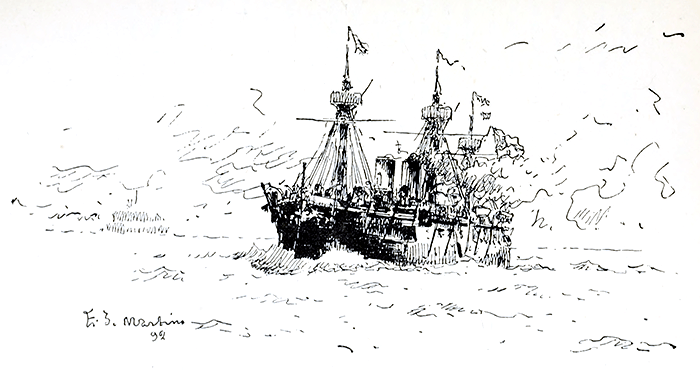
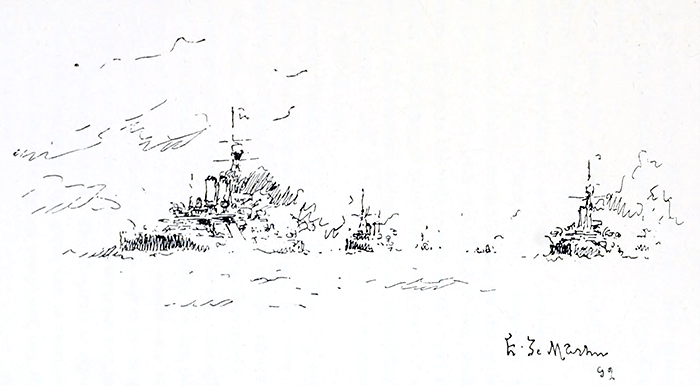
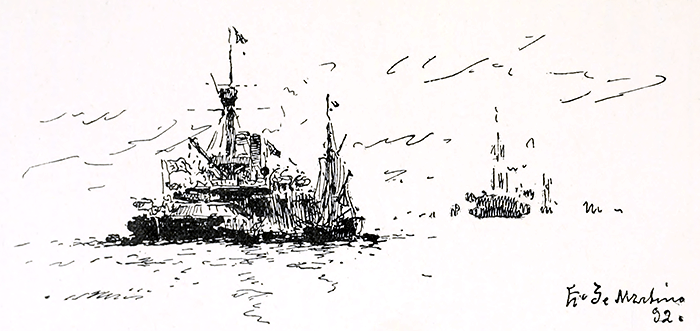
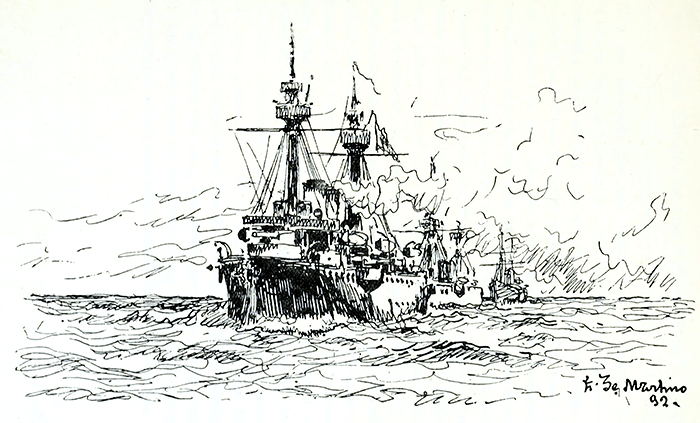
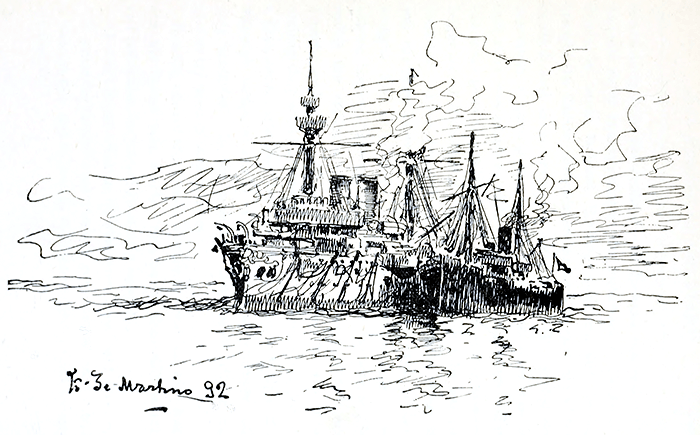
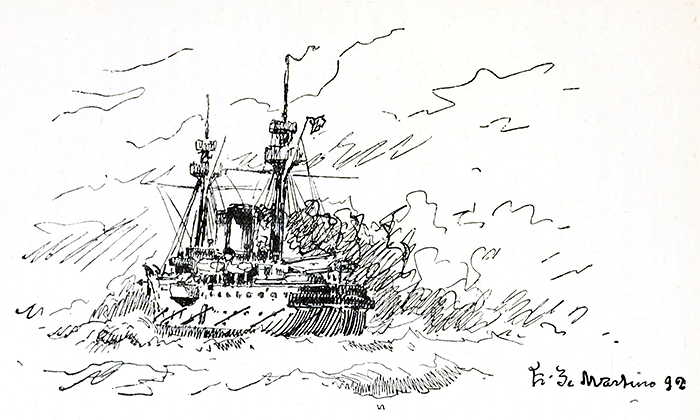
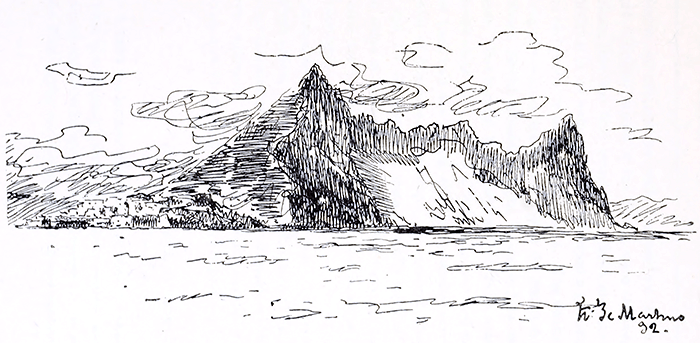
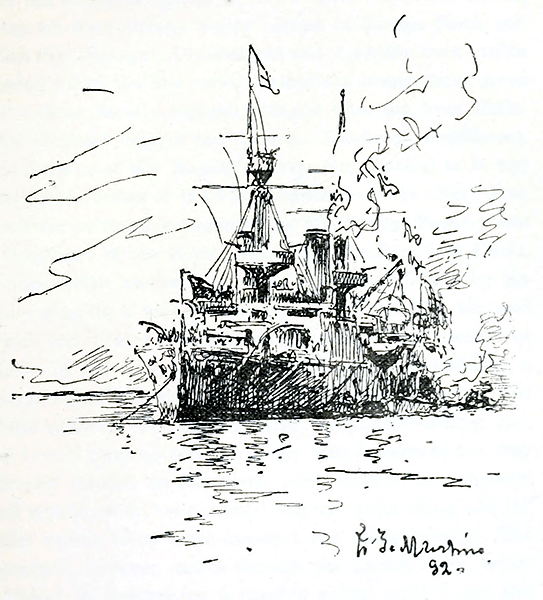
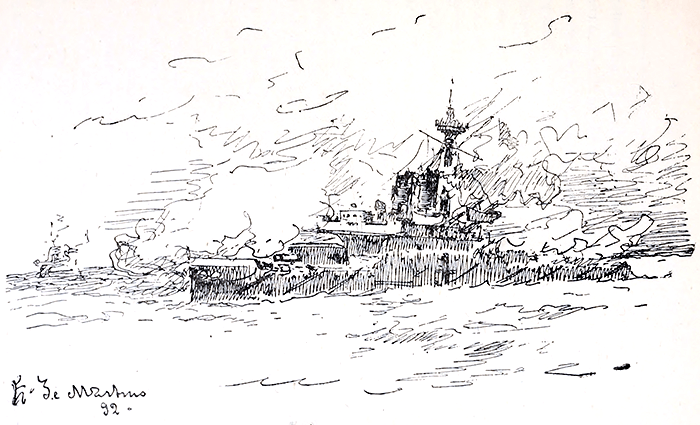
I am most fortunate in having had, in this work, the
co-operation of my friend, that most distinguished of marine
painters, the Chevalier Edouardo de Martino. He volunteered
to illustrate what I should write; and to receive
such an offer from so admirable an artist was, of course,
to gladly accept it. When, as he and I believed, we had
completed our labour, he was called to South America. The
editor of The Engineer was then so good as to think that
the story of the Mary Rose might be welcome to the
readers of his paper. He wished, however, to have additional
illustrations, and these were in due time supplied
by Mr. F. T. Jane, a young artist who has already made
his mark in this particular branch of black and white
drawing. While the story was being published in The
Engineer, Mr. Jane offered to prepare a number of
further illustrations, and these, now printed for the first
time, will, I think, be found among the most effective of
his contributions. To the proprietors of The Engineer, for
their permission to use Mr. Jane’s first series of illustrations,
and for the facilities which they have placed in my way,
I tender my grateful thanks.
New Travellers’ Club, Piccadilly, November, 1892.
[Pg 1]
THE CAPTAIN OF THE
“MARY ROSE.”
CHAPTER I.
A BOLT FROM THE BLUE.
On the morning of Tuesday, April 28th
189—, the publication in London of the
following Reuter’s telegram created no
small amount of uneasiness and excitement
in commercial as well as in political
circles. The telegram was dated, “Toulon,
Monday Evening,” and it was thus worded:—
“This afternoon a bluejacket, belonging to the British
Mediterranean Fleet, which arrived here yesterday, got into
an altercation in a café with a French seaman. Other
sailors, British and French, who were present, took sides;
the argument assumed the dimensions of a quarrel; blows
were freely exchanged; and the British bluejackets were at
last driven into the street, and thence to their boats. In
the course of the disturbance some revolver and rifle shots
[Pg 2]were fired, it is believed by the Frenchmen, and, unfortunately,
there seems to have been bloodshed, and possibly
loss of life. Owing, however, to the excited attitude
of the local population, to the extreme reticence of the police,
and to the fact that a military cordon has been drawn round
the scene of the outbreak, it is as yet impossible to obtain
any trustworthy particulars. The Maritime Prefect at once
went on board the British flagship Victoria. It is supposed
that his object was to offer or to ask for explanations;
but, upon his return to the shore, no public announcement
was made, and nothing definite is therefore
known. The situation, without being serious, may at any
moment become so. The local authorities are in brisk
telegraphic communication with Paris.”
This telegram was, in itself, alarming; but the gravity of
its import was increased a thousandfold by an announcement
which followed it in the columns of the Times.
“The above news,” said that journal, “is, so far as we can
learn, the latest that has been received from France. It
reached the Times office shortly after eight o’clock last
evening. We at once took steps to obtain further particulars.
We were, however, informed that between half-past
seven and half-past eight telegraphic communication
with France had been totally interrupted, and that all the
Channel cables, as well as the Irish cable from Havre to
Waterville, had ceased to work. There is reason, therefore,
to fear that the Toulon affair is of graver importance than
[Pg 3]Reuter’s agent seems to have suspected when he sent off
his dispatch. Up to the hour of going to press, no further
intelligence bearing upon the matter has reached us. We
hope, however, to receive further news in the course of the
night by way of Belgium or Holland, communication with
those countries being still open. A copy of Reuter’s telegram
was, immediately after the arrival of the message,
posted up in all the clubs, and exhibited in the windows of
several newspaper offices in Fleet Street. The news caused
much speculation and excitement, and, for the remainder of
the evening, formed everywhere the sole topic of conversation.
It is a subject for congratulation that Parliament is
sitting, and that all the Ministers are in town. In the
Commons, as will be seen on reference to our Parliamentary
report, the Under Secretary for Foreign Affairs rose at nine
o’clock, and, apologising for interrupting the senior member
for Northampton, who at the moment was speaking in support
of the motion for the appointment of a Royal Commission
on International Arbitration, read the telegram to
the House, which listened in hushed silence. In reply to
several questions, the right honourable gentleman stated that
he had no further information, and that he trusted that,
until further news should be forthcoming, the House and
the country would, in deference to the susceptibilities of a
friendly Power, refrain from demonstrations of any kind.
He hoped that the affair would have no serious results;
and he had every confidence, he said, that the French
[Pg 4]Government would act in the matter with absolute fairness.
In answer to a question as to the alleged interruption of
telegraphic communication, he replied that he had no information.
At a late hour all the Ministers met in informal
conclave in the Prime Minister’s room in the House of Lords.
They had not separated when we went to press, and nothing,
therefore, is known of the upshot of their deliberations.
But in the lobbies, and among private members, the
fact of the interruption of communications was definitely
substantiated soon after ten o’clock, and it naturally excited
much alarm. There is very little doubt that the cables
have been deliberately cut; though a few sanguine people
assert that the non-receipt of further news is due entirely
to the effects of the storm which raged during the evening,
and which, pitiless as it was, failed to disperse the crowds
that thronged the neighbourhood of St. Stephen’s in anxious
expectation of hearing that some additional Ministerial announcement
had been made. The behaviour of the people
was strikingly quiet and orderly. Strong feeling was, of
course, general, but, for the most part, its exhibition was
suppressed. That there were very few noisy demonstrations
or patriotic harangues in the streets, may, however, be
partially attributed to the effect of the rain, which fell in
torrents.
“Upon inquiring at midnight at the French Embassy at
Albert Gate, we were assured that no information as to the
Toulon affair had been officially received.
[Pg 5]
“For the satisfaction of those who may be ignorant on the
subject, we give below the strength of that portion of the
Mediterranean Fleet which anchored off Toulon on Sunday
afternoon.
Tons.
H.P.
Guns.
Men.
Battleship,
1st class—
Camperdown
10,600
11,500
10
526
”
”
Sanspareil
10,470
14,000
15
587
”
”
Collingwood
9,500
9,570
10
459
”
2nd class—
Colossus
9,420
7,500
9
325
”
”
Dreadnought
10,820
8,210
4
440
”
”
Edinburgh
9,420
7,500
9
445
”
1st class—
Nile
11,940
12,000
10
500
”
2nd class—
Inflexible
11,880
8,010
12
460
”
1st class—
Benbow
10,600
11,860
12
500
”
”
Trafalgar
11,940
12,000
10
500
”
”
Victoria
10,470
14,000
15
500
Belted cruiser—
Australia
5,600
8,500
12
460
”
Undaunted
5,600
8,500
12
460
Torpedo ram—
Polyphemus
2,640
5,520
—
132
Cruiser, 3rd class—
Fearless
1,580
3,300
4
140
”
Scout
1,580
3,200
4
140
Dispatch vessel—
Surprise
1,650
3,030
4
93
“The rest of the Mediterranean Fleet consists exclusively
of unarmoured cruisers and light vessels, and is composed
of H.M. ships Amphion, Dolphin, Cockatrice, Gannet, Hecla,
Imogene, Landrail, Melita, Phaeton, and Sandfly, with one
or two stationary vessels. Several are in the Levant or
the Red Sea, and none are nearer to Toulon than Malta or
Gibraltar. Of the French ships at Toulon we have at present
no particular information. We know, however, that there
[Pg 6]are at least twelve ironclads ready for, or actually in, commission,
several powerful cruisers, and a considerable number
of torpedo boats, both large and small.”
In a leading article on the Toulon affair, the Times advised
its readers to suspend the formation of opinion until further
news should be received; to abstain from any demonstrations
which might make worse a state of things that was already
sufficiently grave; and loyally to support the Government
in whatever measures it might deem itself called upon to
adopt. Much the same advice was given by all the other
London morning papers, not one of which, it should be
added, contained any more detailed news than appeared in
the Times.
And, upon the whole, the advice was faithfully acted upon
throughout that Tuesday of anxiety and agitation. A few
roughs raised insulting shouts outside the French Embassy,
and some truculent individuals broke a window there with
stones; but in each case the police promptly interfered, and
took the offenders into custody. No more news reached
London until shortly before midday; but the early editions of
all the evening papers contained the following telegram, which
had been received by way of Brussels and the Middelkerke-Ramsgate
cable:—
“Advices from Toulon report that, shortly after nine
o’clock last night, the British Mediterranean Fleet, consisting
of eleven battleships, two belted cruisers, and four other
vessels, quitted its anchorage off that port. A French squadron
[Pg 7]hastily put to sea at about the same time. The object
of these movements is unknown, and in consequence, the most
alarming rumours are current. Toulon is in a state of great
excitement, and bodies of men patrol the streets singing
patriotic songs. Several British bluejackets were killed in
yesterday’s affray. The authorities refuse to give any information;
but it is known here that last evening at a late
hour all the submarine cables connecting the British Islands
with France were cut by order of the French Government.
All messages that cross the Franco-Belgian frontier are now
jealously scrutinised, and several have been stopped.”
During the day, with very brief intervals between them,
many still more alarming telegrams poured in. The more
important of them are quoted below:—
“Ostend, Tuesday, 12.15 p.m.—The British Ambassador to
the French Republic has suddenly arrived here. Late last
night he was roused from his bed and ordered to quit Paris
at two hours’ notice; and he was subsequently conducted by
an armed escort to the Belgian frontier. He leaves at once
by special steamer for England. The French Toulon Fleet, it
is rumoured, put to sea yesterday evening, with orders to
prevent the British Fleet from leaving until full satisfaction
should be given for the alleged murders by British sailors
during yesterday’s riots. It is also rumoured that, in defiance
of the Maritime Prefect’s order to the contrary, the British
Admiral has quitted his anchorage. The situation is regarded
as most serious; and the dismissal of the Ambassador clearly
[Pg 8]points to a rupture. French troops are being rapidly concentrated
at Cherbourg, Brest, Lorient, Dunquerque, and other
coast towns; and it is whispered that, as a precautionary
measure, a Belgian army corps is to be mobilised and is to
occupy the frontier. Numerous British refugees from France
have already reached this place.”
“Dover, Tuesday, 12.38 p.m.—The passenger steamer Victoria
started this morning as usual for Calais. When she was
at a distance of about two miles from the French coast, a
French gunboat hailed her and informed her captain that
communication between England and France is forbidden,
pending the issue of further directions from Paris. The
Victoria had, therefore, no alternative but to return. Two
other passenger steamers have been similarly treated. The
excitement here is intense.”
“Brussels, Tuesday, 1.50 p.m.—The French Government
last night sent to the Admiral at Toulon orders which, if they
be acted upon, can only bring about immediate war between
France and Great Britain. The orders were to prevent, at all
hazards, the British Fleet from putting to sea so long as the
serious questions which were raised by yesterday’s riot should
remain unsettled. The exact nature of these questions lies in
some obscurity. The prospect of war is said to have already
provoked unbounded enthusiasm in Paris.”
“Flushing, Tuesday, 3.20 p.m.—It is reported that the
formal declaration by France of war with Great Britain is
only a question of hours; and it is believed that this precipitancy[Pg 11]is due to the conviction which is entertained in
French Government circles that England is just now very ill-prepared,
particularly in the Mediterranean; and that France,
by striking a sudden and unexpected blow, may produce results
such as she could scarcely hope to attain, if ample time
were allowed her adversary for the making of complete preparations.
In the meantime the French army is mobilising.”
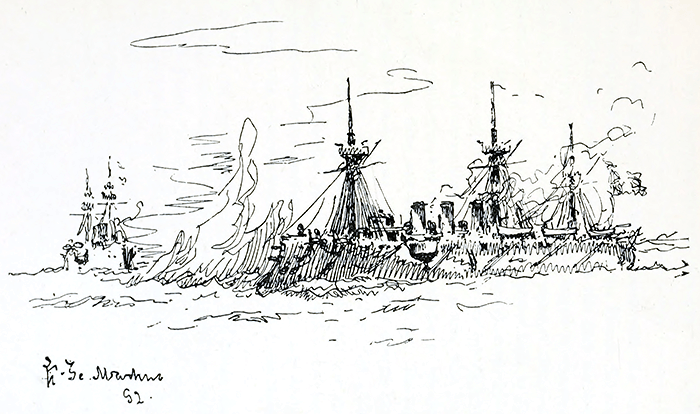
“EVEN SOME OBSOLETE GUNBOATS.”
“Portsmouth, Tuesday, 3.30 p.m.—Orders have just been
received here for the immediate commissioning of every ship
in harbour that can, by any exertion on the part of the dockyard
officials, be made ready for the pennant, and for the
hurried preparation of all the rest, not excluding several old
vessels that have recently been advertised as ‘For Sale,’ or
even some obsolete gunboats. Similar orders have been telegraphed
to each of the naval ports. The dockyard, where,
until to-day, work was slacker than it has been since the
departure of the ships for last year’s Naval Manœuvres, is
already the scene of feverish activity. The coastguard ironclads
have been directed to assemble with all haste at Spithead,
and not to wait for their full complements, but to leave
their respective ports as soon as they can get up steam. Some
of them are expected to-morrow. The Naval Commander-in-Chief
is now concerting with the General in command of the
Southern District elaborate measures for the defence, by
means of mines, booms, and picket-boats, of the port and of
the anchorage at Spithead, and to-night the carrying out of
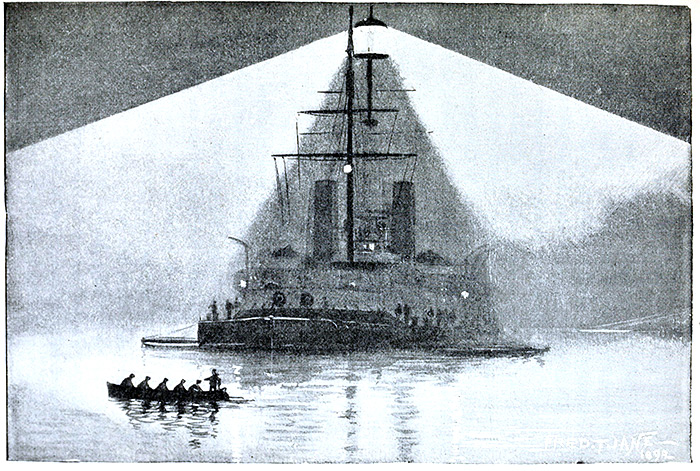
their plans will be begun. Masthead electric lights of novel
[Pg 12]design are being fitted to some of the larger battleships.
These are so arranged as to shed a zone of illumination all
around the vessel, but to leave the craft herself in comparative
darkness, and it is confidently expected that they will be of
great value should our squadrons be obliged to anchor at
night within raiding distance of the enemy’s torpedo boats.
Some experienced officers, however, are of opinion that a ship
which desires to remain exempt from attack should on no
account exhibit a light of this kind, since it must of necessity
be visible from a considerable distance to the foe; and they do
not hesitate to say that, even if they be supplied with it, they
will not use it. The advantage of the light lies in the fact
that no ship, so long as she employs it, can possibly be closely
approached by any enemy that does not to a very dangerous
extent expose himself. On the other hand, it is pointed out
that the apparatus is large, and offers so fine a mark for
machine-gun fire, that it could doubtless be easily extinguished
by moderately good gunners at 3000 yards, or even
more. Experts here are loud in their regrets that this device,
which is quite new, has not, together with other electric
lighting devices which are much older, been properly experimented
with in peace time, and that, in consequence, no certainty
exists as to either its practical utility or its vulnerability.
Unfortunately there are symptoms of the existence of a certain
degree of friction between the naval and military authorities;
nor can this be wondered at when it is remembered by how
vague and arbitrary a line their respective functions are
[Pg 15]divided. The feeling here is strongly to the effect that all
the defences on the sea-front should be unreservedly entrusted
to the Navy and Royal Marines. On the other hand, there is
an undoubted lack of both officers and men even for the manning
of the vessels which are to be commissioned. So great,
indeed, is the scarcity of stokers, seamen-gunners, and signalmen,
that only by calling out all the reserves can even the
immediate necessities of the situation be supplied. It is not
certain, however, that the reserves will be of much use, seeing
that the engines of modern men-of-war greatly differ, as a rule,
from those of merchant vessels; that few men of the Royal
Naval Reserve have any practical familiarity with heavy
breech-loading guns; and that hardly any men, outside the
service proper, are qualified as signalmen. There is also a
scarcity of lieutenants, and a good many small craft will, if
commissioned at all, apparently have to be commanded by
gunners, carpenters, and boatswains. As for the local permanent
defences, they are very imperfect. Many of the works
on the land side have no guns at all, and the re-arming of
Southsea Castle and the Spithead forts has not yet been completed.
War is here regarded as as good as declared. No
one, and least of all naval men, can look forward to it with
anything like light-heartedness, and many Portsmouth people
regard the prospect with distinct apprehension, and propose
to leave the town as soon as they can conveniently do
so; yet the naval and military population here shows an
admirable spirit, and numbers of retired officers of both
[Pg 16]services are offering their assistance to the Government.”
“MASTHEAD ELECTRIC LIGHTS OF NOVEL DESIGN ARE BEING FITTED TO SOME OF THE LARGER BATTLESHIPS.”
“Brussels, Tuesday, 5.8 p.m.—There are grave reports
from the South. It is said that a conflict of some nature has
actually taken place between the British and French Fleets off
Toulon, but no details of any kind are given. There is also
serious news from Paris. A declaration of war is undoubtedly
by this time on its way to London. It was to have been
dispatched at noon. The French capital is violently excited,
and extremely enthusiastic. Very little news reaches this
city, and that little slips through the fingers of very jealous
French censors, dozens of whom must be employed along the
frontier.”
“Barcelona, Tuesday, 5.20 p.m.—The Italian steamer
Monte Pulciano, which arrived here this afternoon, reports
that very late last night, when off Toulon, she heard the
sound of heavy firing, and saw in the sky the reflections of
what seemed to be explosions on a very large scale. She did
not, however, call at any French port, and so brings no definite
intelligence.”
“Genoa, Tuesday, 6 p.m.—The news of difficulties having
suddenly arisen at Toulon had scarcely reached this place ere
rumours began to arrive to the effect that the French Admiral
had received orders from Paris to destroy the British Fleet in
case it should attempt to quit Toulon Roads. No one credited
this report at first, but it must now be admitted that corroborative
evidence of a kind is not lacking. A correspondent
[Pg 17]at Hyères telegraphs that much heavy firing took place late
last night off that town, but, apparently, at a great distance
out at sea, and that to-day some French men-of-war, which
seemed to be somewhat damaged, re-entered Toulon. All messages
from France are subjected to strict censorship, in consequence
of the strained relations between that country and
Great Britain. Too much reliance must not, therefore, be
placed upon the trustworthiness of this news.”
Then came the most unambiguous telegram of the eventful
day.
“Dover, Tuesday, 6.20 p.m.—A French torpedo boat named
the Lance has just entered the harbour under a flag of truce.
The lieutenant in command of her brought dispatches which
have already been sent on by train to the French Ambassador
in London. Their purport is, however, no secret. They contain
an announcement to the effect that the British Admiral
having refused to consider the legitimate demand of the
authorities at Toulon for apology and reparation in the matter
of yesterday’s riot, and having, in defiance of French orders to
the contrary, quitted Toulon Roads while the grievances of
the French Government remained unredressed, the French
Republic recalls its Ambassador and declares war against
Great Britain. The French lieutenant, who was of course not
allowed to land, departed as soon as he had communicated
with the coastguard boat which went out to meet him. The
civil population is apprehensive lest the town may be shelled
to-night. Steam is being got up to work the turret on the
[Pg 18]Admiralty pier; and the men are to sleep beside their guns
both there and in the various batteries on the heights. Stringent
measures are to be adopted to preclude all possibility of
a coup de main; and no vessels will in future be allowed to
enter or leave the port until they have been searched. Very
few people here are likely to sleep much to-night. Numbers of
nervous folk are going inland without even waiting to pack
up their effects. A large French man-of-war is now visible in
the Strait, but her name is not known. It is hoped that she
may be brought to action by the Audacious from Hull, the
Hotspur from Harwich, or the Iron Duke from the Forth; for
all these ships have been ordered to rendezvous at Spithead,
and one or more of them is expected to pass Dover to-night.
Here there is not so much as a gunboat; but it is believed
that, at the latest, by Friday, some of the coast-defence ironclads
will be assembled in the Downs, where, in case of need,
they will be within easy reach of this most important position.
No lights are to be shown to-night, and the windows of even
private houses are ordered to be darkened. Pickets are to go
round to enforce this rule. The town is already, in fact,
though not in name, in a state of siege; and so long as hostilities
last, it must be a prey to continual and very harassing
alarms, if to nothing worse.”
A later telegram explained that “the large French man-of-war”
which had excited Dover was only a steam yacht.
“WAS ONLY A STEAM YACHT.”
These were not the only telegrams that brought the country
to a quick realisation of the fearful suddenness with which
[Pg 21]she had fallen into a state of war with her nearest neighbour
and most powerful maritime rival. There were many others,
but the effect of all was the same. They startled England,
not only with the definite news of imminent hostilities, but
also with the vague report, which was far more terrible, that
some paralysing blow had already been dealt against the
Power which, for three centuries at least, had prided herself
upon being mistress of the seas. The nature and result of
that mysterious blow were alike unknown; but lack of knowledge,
fed by apprehension, often produces strange popular
impressions; and the very absence of definite news from the
Mediterranean Fleet was, at such a juncture, almost by itself
sufficient to create very wild alarm.
The excitement in London increased, therefore, as the day
wore on. The House met early, but the Ministers were able
to say little that was encouraging. They were prepared, in
case of necessity, to maintain the honour of the Sovereign
and of the Empire; they had adopted such measures as prudence
and the counsel of the most experienced officers suggested,
and as their immediately available resources rendered
possible; and they were, until late in the afternoon, not
altogether hopeless that peace might still be preserved; but
they had only the most meagre information to give: they
were unable to inspire the public with that confidence which
they professed to feel; and worst of all, they had absolutely
no intelligence concerning the Mediterranean Fleet save that
it had left Toulon on Monday night.
[Pg 22]
In the afternoon crowds gathered in Trafalgar Square
and other public places; and, in spite of the efforts that were
made by the police to disperse the people, addresses—treasonable
as well as patriotic—were delivered by persons who,
whether they were loyal or not, would in the circumstances
have more wisely kept their mouths shut. Most of the
theatres opened as usual; and those which opened were
thronged, for the temperament of the population at the
moment required that men should congregate in any place
where the latest news was likely to be obtainable. But no
attention seemed anywhere to be paid to the performance.
People loitered in the passages and foyers, and talked or
listened with tongues and ears devoted to one topic only. As
the successive editions of the evening papers came out, copies
were brought in and handed round, and struggled for even
by the musicians in the orchestra. Twenty-four hours previously,
war had seemed the most improbable of catastrophes.
It was now practically certain, and what its end might be no
one could foretell. At the Lyceum Theatre “Macbeth” was
being played. Towards the conclusion of the first act the
curtain was suddenly lowered, and the familiar figure of Mr.
Irving immediately appeared before it.
“Ladies and gentlemen,” said the great actor, who was
much moved, “news of a very grave character has this
moment reached the theatre; and I deem it my duty to
interrupt the performance in order to communicate it to
you. I regret to have to say that, according to a telegram
[Pg 23]which I hold in my hand, the British Fleet in the Mediterranean
was yesterday attacked by a French Fleet of
superior force, and was very severely handled. There are,
unfortunately, no details. I trust that the news is not really
so grave as it at present sounds; but even if it be untrue
that war has actually broken out, and that our brave bluejackets
have already been surprised by anything in the remotest
degree resembling disaster, I feel that I shall only, in
the circumstances, be forestalling your wishes, when I announce
that the performance cannot continue. Ladies and
gentlemen, it is not for me, standing before you in this dress,
to say much; but this I must say: the opportunity seems to
have arisen for us to show that we are still the sons of our
fathers. This, you will agree with me, we may do, not
merely by volunteering or otherwise directly contributing
towards the defence of our country; but also by lending a
steadfast and loyal moral support to her most gracious
Majesty’s Ministers in this moment of terrible anxiety and
public danger. England, facing her enemies, has always
hitherto been as one man. Let us see to it that she be one
man now. Let us banish all divisions; let us think not of
ourselves but of our country; and, believe me, though the
path through this difficulty may be dark and terrible, we
shall emerge into the light.”
The earlier part of this brief address was listened to almost
in silence. The latter part provoked first low expressions of
approval and then cheers. When Mr. Irving had concluded
[Pg 24]the audience, as with one accord, stood up bareheaded; and,
as the orchestra played the first note or two of the National
Anthem, there began a scene of indescribably contagious
enthusiasm. People leapt upon the seats and waved hats or
handkerchiefs; women burst into tears; and there was a
confused babel of sounds which, in a few moments, blended
into the noble and solemn chorus of “God save the Queen.”
[Pg 25]
CHAPTER II.
THE BATTLE OFF TOULON.
What, then, had happened off Toulon?
The Times of Wednesday morning was the
first newspaper to give anything like a full
account of the affair. This it did in the
following painful telegram:—
“San Remo, Tuesday Night.—I have just been landed here,
thanks to the courtesy of the commander of the Italian dispatch
vessel Agostino Barberigo, and, with much grief, I
telegraph to inform you of the sudden and terrible disaster
which early this morning overtook the Mediterranean Fleet.
That Fleet, as your readers will see on referring to any of the
service papers of last week, consisted of the battleships
Camperdown, Nile, Collingwood, Colossus, Dreadnought,
Edinburgh, Benbow, Inflexible, Sanspareil, Trafalgar—flag
of the Rear-Admiral—and Victoria—flag of the Commander-in-Chief.
On Sunday afternoon these vessels, together
with the belted cruisers Australia and Undaunted, the
armoured ram Polyphemus, and the unarmoured craft Fearless,
Scout, and Surprise, anchored off Toulon, and found the
French Mediterranean Fleet lying there also. This squadron,
[Pg 26]which had come in earlier in the day after a cruise, consisted
of the battleships Amiral Baudin, Courbet, Dévastation,
Formidable, Duguesclin, Hoche, Marceau, Vauban, Caïman,
Bayard, Neptune, and Indomptable, with the cruisers Cosmao,
Troude, and Lalande, the torpedo dispatch vessels Vautour,
and Condor, and the torpedo gunboats Dragonne, Dague,
Aventurier, Kabyle, Audacieux, Ouragan, and Téméraire.
Up the harbour, in addition, lay the battleships Trident,
Colbert, Terrible, Redoutable, and five other ironclads, all
belonging to the ‘Escadre de Reserve,’ which has been newly
constituted. There were also up harbour several cruisers and
torpedo vessels.
“We exchanged salutes in the usual way; the Admirals
called on one another; and yesterday after dinner about four
hundred of our bluejackets were allowed to go ashore. I
was, at the time, on board the Benbow, and can give,
therefore, only a hearsay account of what occurred in the
town.
“It appears that at about four o’clock in the afternoon some
of our men, who were drinking in a wine-shop, got into an
altercation over the merits of the two navies with several
French seamen belonging to the Colbert. The Frenchmen
boasted that their ships were in every way superior to ours;
Jack strongly objected; from words the disputants went to
blows; and, in less time than it takes to write it, our fellows
were retreating down the street, pursued by a mixed crowd of
French soldiers, sailors, and civilians. Reports vary as to the
[Pg 27]damage done, but it is, unfortunately, certain that at least a
dozen of our men lost their lives, and that the French loss was
nearly as severe.
“We, of course, lay too far out to be able to hear or see
anything of the hubbub on shore. The first hint of what occurred
came to us from the ship’s chaplain, who, returning on
board in a shore boat, reported that a row was going on in the
town. I went up into the top, whence through the glass I
could see our men crowding into other shore boats and pushing
off in great haste. There was much struggling, and I saw
occasional puffs of smoke, which, I knew, could not proceed
from our fellows, all of whom were, of course, unarmed.
Being closely followed by boats full of Frenchmen, our men
made for the Surprise, which lay closer in than the rest of the
squadron. By this time the pursuers were using firearms
freely, and we realised that the business was a very serious
one. We were therefore ordered to man and arm boats and
to cover the retreat. Our fellows pulled like demons, and, with
oars and boat-hooks, fairly sunk one craft which came too
close. Those of us who remained on board were all on the
bridge or in the top; but just as we were wondering whether
we should not have to open fire with our machine guns, we
were disappointed by the Commander-in-Chief semaphoring
from the flagship that, bearing in mind the evident gravity of
the situation, nothing must be done that might complicate
matters. This order did not, however, prevent our captain
from directing the magazines to be opened, and all preparations
[Pg 28]to be made that could be made without too pronouncedly attracting
the attention of the French. Meanwhile our boats
had gained the Surprise, and the men were scrambling on
board as fast as they could. A regular swarm of French
boats of all kinds was crowding round the ship, and the people
in them were screaming and gesticulating as if they were
madmen. The Commander-in-Chief went in his steam launch
to the Surprise. Through our glasses we watched his crew
shoving the French boats aside, and I doubt whether the shore
people would have made room for the launch to get alongside
the dispatch vessel if a French officer had not opportunely
arrived on the spot in a torpedo boat from up the harbour.
When he appeared the French retired to a respectful distance,
but continued vociferating so loudly that we could quite
plainly hear them. The French officer followed our Admiral
on board the Surprise, and there had an interview with him.
Not long afterwards they were joined by a stout gold-laced,
red-sashed dignitary from the shore; and the two Frenchmen
between them made out, or tried to make out, that our bluejackets
had begun the row, had deliberately murdered some
men in the wine-shop, and, in fine, that they only were to
blame. Our Admiral, of course, promised to institute the
fullest inquiry; but the French officers took a high-handed
attitude from the first. They demanded that all our men who
had been ashore should be surrendered. Compliance with this
was out of the question. They then said that they had telegraphed
to Paris for instructions. Before the Commander-in-Chief
[Pg 31]got back to the flagship, we saw that most of the French
ships in harbour were getting up steam.
“At a quarter to six all our captains were ordered on board
the Admiral. When our captain returned, he looked very
serious, and sent first for the commander, and then for the
Fleet Engineer and all the lieutenants, most of whom remained
with him in his cabin for three quarters of an hour. The
French Admiral had promised to dine in the evening on board
our flagship, but he sent a somewhat awkward excuse. If I
may judge from what I saw in the wardroom in the Benbow,
where I was a guest, the business spoilt the dinners of every
one in both Fleets, for all our people had no end of work to
do. We made as many preparations for action as we could
without actually going to quarters: we got up steam for full
speed; we kept unusually strict watch, and allowed no boats to
approach us; and most of us unshipped all the pictures and
breakables that we had in our cabins.
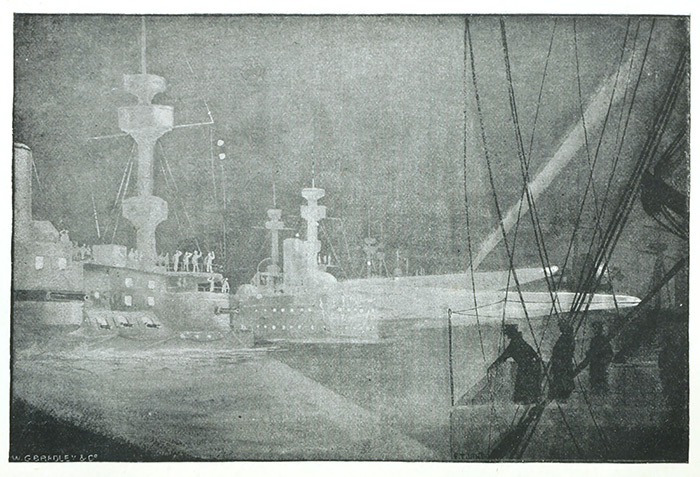
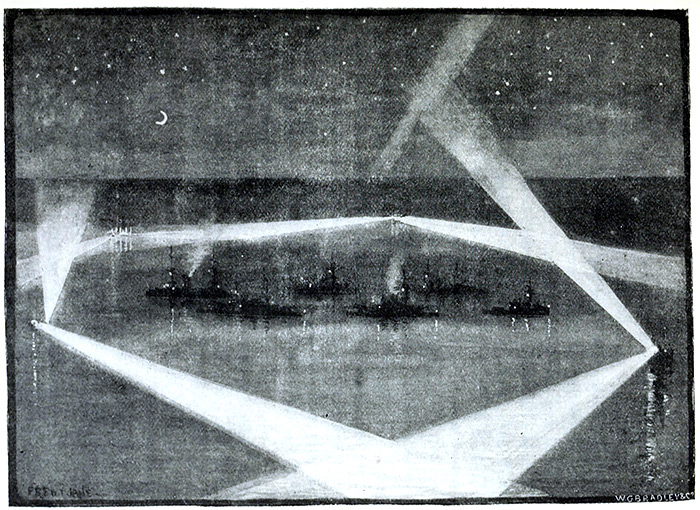
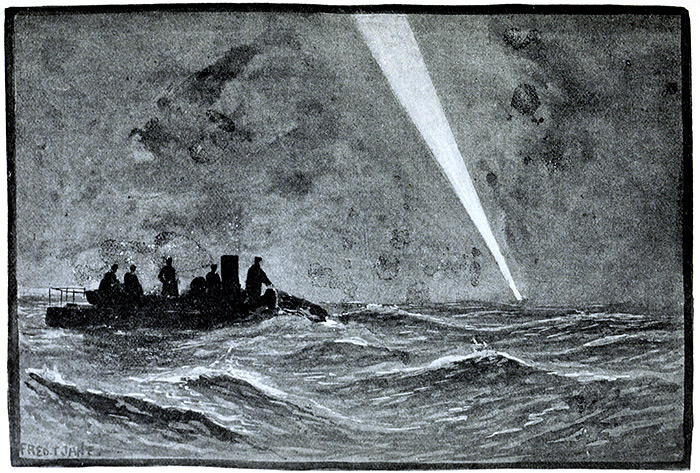
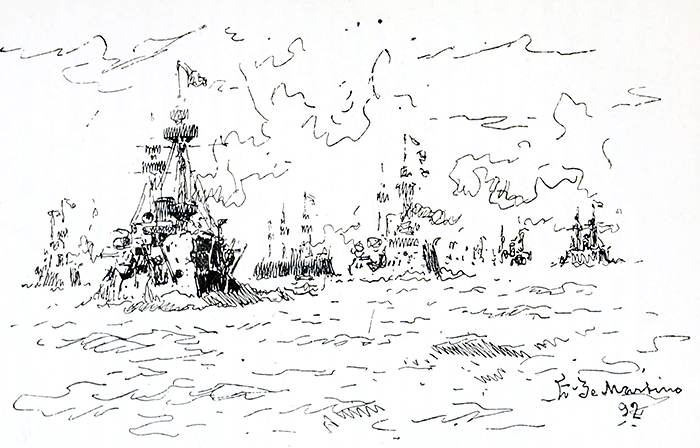
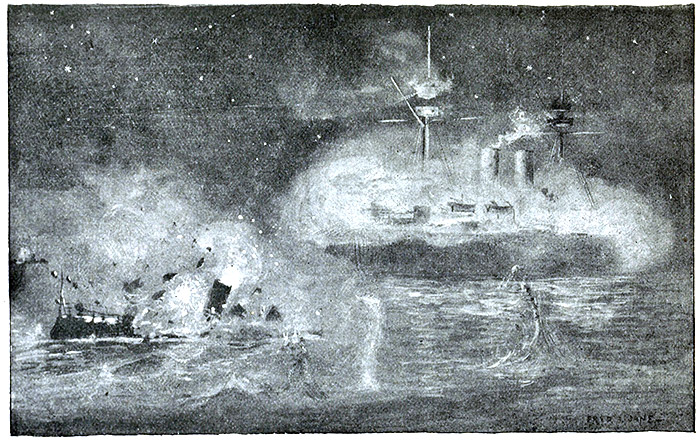
“CERTAIN CRAFT WERE ORDERED TO USE THEIR SEARCH-LIGHTS IN COMBINATION.”
“At seven, the Surprise, by order, shifted her berth, and
took up a fresh position outside our lines—we were anchored
in two columns. The Scout and Polyphemus, under easy steam,
went round the Fleet and swept their search-lights shoreward
continually. To guard against sudden attack by torpedo
boats, certain craft were ordered to use their search-lights in
combination in such a manner as to form a complete path of
brightness round the Fleet. The effect was very striking, but
it was also very puzzling, for the illumination not only intensified
the surrounding darkness, but also rendered it extremely
[Pg 32]difficult for us to again ‘pick up’ any craft—and there were
several about—after it had once crossed the protected zone;
and when half-an-hour’s experience had thoroughly demonstrated
this, the experiment was ordered to be discontinued.
The eyes of many of us had not, however, recovered from the
dazzling results of the trial when, some hours later, we needed
our best night sight; and I doubt whether we should not have
been wiser had we relied solely throughout upon such natural
light as was vouchsafed to us. At a quarter to nine a French
steam launch went on board the Commander-in-Chief, and
half-an-hour later we all knew what it had come out for. It
brought a formal demand for the surrender by nine o’clock
this morning of every officer and man who had been ashore
during the day, and an imperious order that in the meantime
no British vessel was to leave the roadstead.
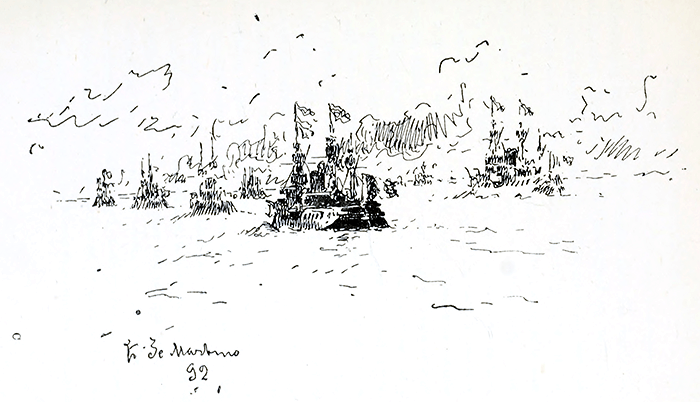
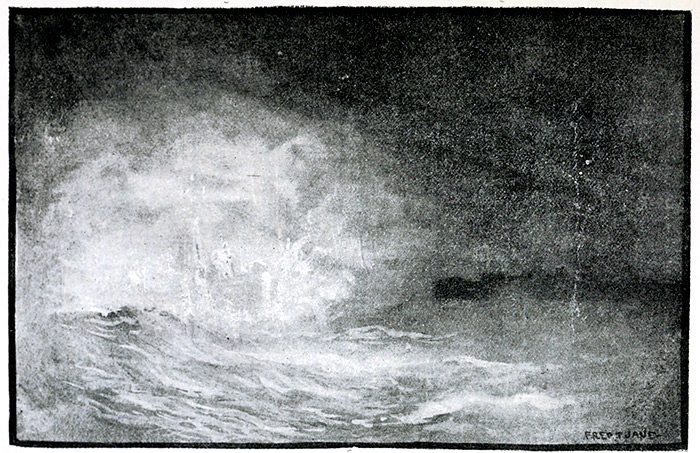
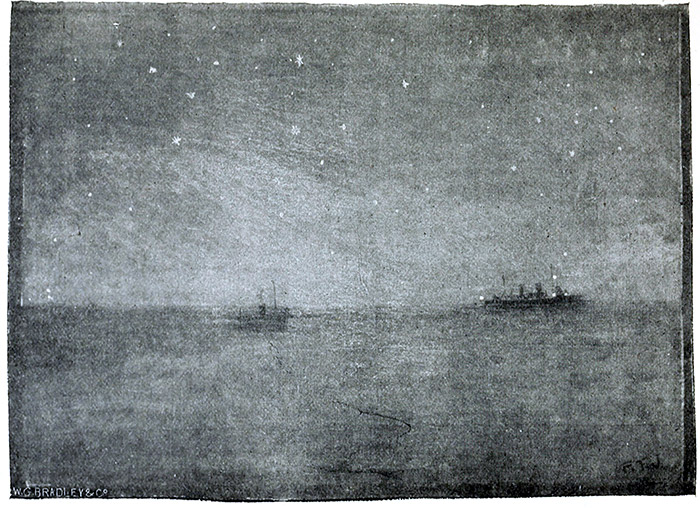
“A NUMBER OF FRENCH SHIPS WERE COMING OUT.”
“As soon as the French launch had shoved off again, the
Commander-in-Chief signalled the Fleet to weigh. Almost at
the same moment the Scout reported that a number of French
ships were coming out. They soon began to play their search-lights
freely on us, but we went on weighing as before, until
one of their flagships, a great ironclad as big as the Trafalgar,
but much higher out of the water, was abreast of the Victoria.
It seems that the Frenchman hailed the Commander-in-Chief,
and with great politeness demanded whether he intended
to go to sea. Our lights showed us that all the French
ships were cleared for action, and were full of men. I suppose
that our Admiral said ‘Yes,’ and we half expected from
[Pg 35]the threatening attitude of the enemy that fire would be
opened at once. But the French Fleet passed on, and went
quietly out in single line ahead, the battleships being between
us and their own light craft, which, naturally, kept off, and
seemed to be in no regular formation. They were all a mass
of lights, and we could plainly see the officers in full dress
standing on the bridges and poops, and saluting us as they
passed, some of them at a distance of less than a couple of
cables from us. As far as I could count, there were sixteen
battleships, eight or nine cruisers, and over a dozen torpedo
boats.[1] When they had got well outside of us, they suddenly
extinguished all their lights, as if by preconcerted agreement,
and ten minutes later another launch from the shore
went on board the Commander-in-Chief. One of our lieutenants
was in the flagship at the time for orders, and he
told us on his return that the French had sent to say that any
further attempt on our part to get away that night would, without
hesitation, be prevented by force. Of course we were at once
sent to quarters—we had really been at them all the evening,
in the Benbow, at least. It was realised that, right or wrong, it
was impossible, in the circumstances, to obey the dictation of
any foreigner. At ten minutes past ten we got under way,
and formed in two columns of divisions line ahead, the
Victoria, Camperdown, Edinburgh, Collingwood, Sanspareil,
and Inflexible constituting the starboard division in the order
[Pg 36]named, and the Trafalgar, Nile, Benbow, Colossus, and
Dreadnought the port. The Polyphemus was a mile and a
half ahead, the Undaunted an equal distance on the starboard
bow, the Australia an equal distance on the port bow,
the Scout on the starboard and the Fearless on the port
quarter, and the Surprise a mile and a half astern. A
rendezvous, which, for obvious reasons, I suppress, was given
us, and the course, so soon as we had made an offing, was
south-west. Although a guest on board, I, of course, volunteered
to be of what use I could.
[1] For the exact composition of the French Fleet, vide the statement at
the end of this chapter.
“It was an intensely dark night, and there was a nasty sea
from the south-east, but very little wind; half a gale, which
had been blowing during the afternoon, having dropped at
sundown.
“It is not my business—and, indeed, I am still far too
fagged and knocked up—to tell you much about our individual
feelings and actions. I believe that we were all determined
to do our duty, and I venture to think that, in what
followed, most of us did it, although, for once, the luck was
against us. You at home must remember, ere you judge us,
that we were outnumbered, that several of our heaviest guns
were very defective even before the action began, that the
speeds of our ships were very unequal, and that, upon the
whole, the French vessels were better protected at the water-line
than ours. I am bound to mention these facts in justice
to the hundreds of brave fellows who are gone. It was not
their fault that guns broke down, or that the Fleets were un-equally
[Pg 39]matched. With anything like equal forces, the results
of this, the bloodiest naval fight that the world has yet seen,
would, I am confident, have been different. Surely the blame
lies, not with those who had to use the weapons, but rather
with those who forged them too weak and too few for the
work required of them.
“For three hours we steamed at about ten knots, the slowness
of the older turret ships preventing our easily doing
much more, save under great pressure. We saw nothing of
the French, and, as we showed no lights, we had much difficulty
in keeping station.
“At half-past one this morning, the Polyphemus flashed a
signal to the effect that she had sighted the French Fleet about
two miles ahead of her, apparently lying to. We therefore
altered course six points to the eastward, so as to head south-south-east,
and, if possible, avoid the enemy; but I suspect
the French must have seen the flashes by which the order was
signalled, for half-an-hour later, the Scout reported them a
mile on her starboard quarter, steaming fast, and apparently
coming up with us. We then put on full steam to the utmost
capacity of our slowest ships, and again altered course two
points to the eastward, so as to bring our heads due south-east;
but the Fleet, as a whole, could not, it was soon found,
do more than 10½ knots against the sea which was running,
the Inflexible doing barely that, and lagging behind in the
most dangerous way. The Frenchmen, therefore, steadily
drew up with us, having altered course soon after we
[Pg 40]did, and being able to steam fully 11½ knots, and perhaps
more.
“It must have been inexpressibly galling to our gallant
Commander-in-Chief thus to be obliged to show his heels even to
an enemy of obviously superior force. But it is clear that he
could not have remained at Toulon, where he could have accomplished
nothing against the forts and batteries; and
would, moreover, have been exposed to destruction from mines,
submarine boats, and torpedoes worked from the shore, besides
having to reckon with the French Fleet. It is clear, too, I
think, that in the circumstances it was his duty, if possible, to
avoid action; though on this point, there will probably be
great differences of opinion. When once the French were outside
of him, he had to think of Malta and Gibraltar, his immediate
bases. I must, however, leave these questions for
others to discuss.
“At this time I was sent for by the captain, who was on
the bridge intently watching the Nile, whose huge hull
ploughed through the water two cables ahead of us, leaving in
her wake a broad strip of foam on the broken waves. The
Benbow’s bows plunged ever and anon into the seas, which dashed
aft against the barbette, well-nigh hid the muzzle of the great
gun as they burst, and deluged us with spray. We must
have had hundreds of tons of water at a time upon the forecastle,
but the ship rising, shook them off with scarcely an
effort, and then plunged again, as the rolling seas lifted her by
the stern.
[Pg 43]
“We had no torpedo boats with us, and, had we had any,
they would have been only so many encumbrances in such a
sea as was running. Even our biggest boats—the 135 ft. ones—do
not steam well in circumstances like those which
environed us early this morning; and, unfortunately, we had
nothing between them and the regular torpedo cruisers, Scout
and Fearless, vessels of 1580 tons displacement. Very useful
indeed to the Commander-in-Chief would have been a few fast
gun-vessels of the Grasshopper or Sharpshooter class, not so
big as to be easily visible, yet big enough to stand the knocking
about and still preserve a decent speed of 15 or 16 knots.
Alas! we had nothing of the kind, the Landrail and
Sandfly being detached. The French, on the other hand,
were well provided in this respect. They had with them
several large torpedo boats, or avisos-torpilleurs, of the
Bombe class, which served them in particularly good stead as
scouts, and which, being craft of over 300 tons displacement,
could breast the sea. With these, as we speedily found, they
were able to creep up and observe us, without being sighted
until they were close upon us. We, therefore, had an uneasy
feeling that we were all the time being watched by spies which
remained almost invisible.
“Finding, at last, that it was hopeless to think of getting
rid of the foe by out-steaming him, the Admiral—the French
being now reported broad-on the Inflexible’s starboard quarter,
at a distance of between two and three miles—decided to
attack. He, therefore, in accordance with a previously concerted
[Pg 44]arrangement, led his division ahead of the other one, so
placing himself in the van of a long single column disposed in
line ahead; and having completed this change of formation,
ordered the battleships to alter course in succession ten points
to starboard, and the cruisers to obey previous instructions,
which seem to have run to the effect that they were to be as
useful as possible, and to be ready to tow the ironclads, but
not to needlessly imperil themselves.
“It looked at first as if we were going to engage the enemy
in the old-fashioned manner, for the French were steaming in
a direction nearly at right angles with our line, and in single
column; but they very speedily altered formation, so as to
bring themselves into a line abreast in groups of three. In
this formation the two fleets neared one another, the Trafalgar
leading, the Nile coming next, and after us in succession coming
the Benbow, Colossus, Dreadnought, Victoria, Agamemnon,
Edinburgh, Collingwood, Sanspareil, and Inflexible.
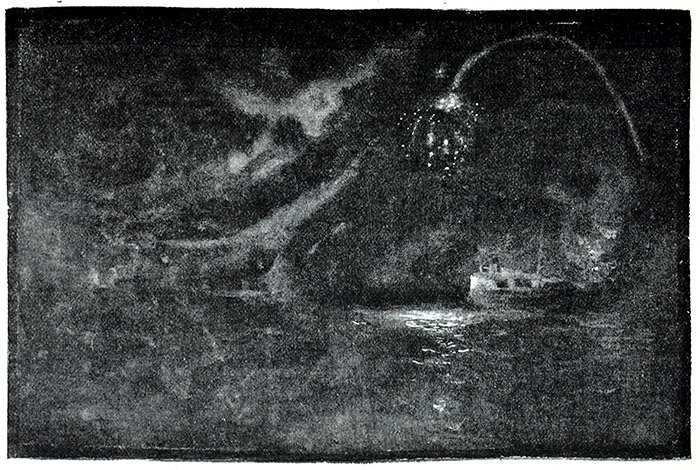
“SUDDENLY A SHIP NEAR THE CENTRE OF THE FRENCH LINE BEGAN TO USE HER SEARCH-LIGHTS.”
“It was about half-past two o’clock. Suddenly a ship near
the centre of the French line began to use her search-lights on
us, and fired a blank charge. Immediately all the other
vessels did the same, and we soon followed suit, not, however,
firing. Both sides seemed to feel that to engage in darkness
would be doubly dangerous; but, in truth, the electric lights
served only to render the situation more puzzling. The effect
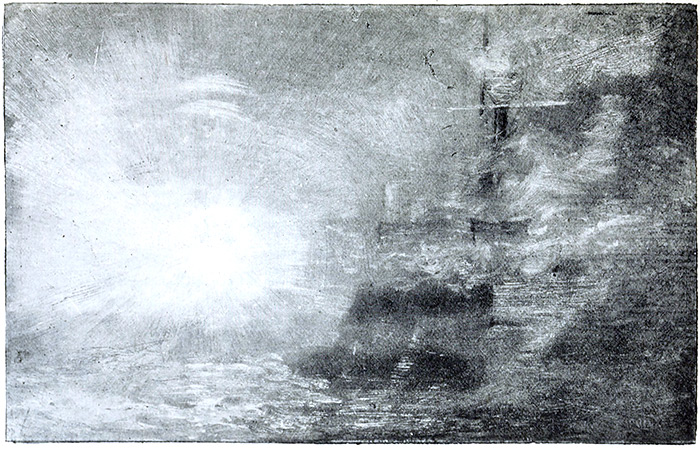
of the light when it shines into the eyes of the spectator is
confusing in the extreme. It is absolutely impossible to
decide, or even to guess, how far off the projector, whence the
[Pg 47]beam comes, is; and when the glare permits of surrounding
objects being seen at all, it seems generally to show them distorted
or misplaced. Moreover, in certain conditions of
atmosphere, dependent, no doubt, upon the amount of moisture
in the air, the beam, instead of being translucent, has the effect
of a dazzling and semi-opaque white screen. Upon it, in these
circumstances, shadows can even be cast, and phenomena
resembling the mirage or the ‘Brocken spectre’ may be
produced. I remember hearing Sir Nowell Salmon, years ago,
tell how once in his steam launch he actually went in chase of
one of these apparitions, and how he only discovered that he
was pursuing his own shadow when he had occasion to shake
his fist at the artificer in charge for not getting more speed out
of the boat. I mention this solely because I am sure that
more harm than good is, as a general rule, likely to be done
during night actions by the use of the search-light.
“THE EFFECT OF THE LIGHT WHEN IT SHINES IN THE EYES OF THE SPECTATOR IS CONFUSING.”
“IT IS IMPOSSIBLE TO GUESS HOW FAR OFF THE PROJECTOR IS.”
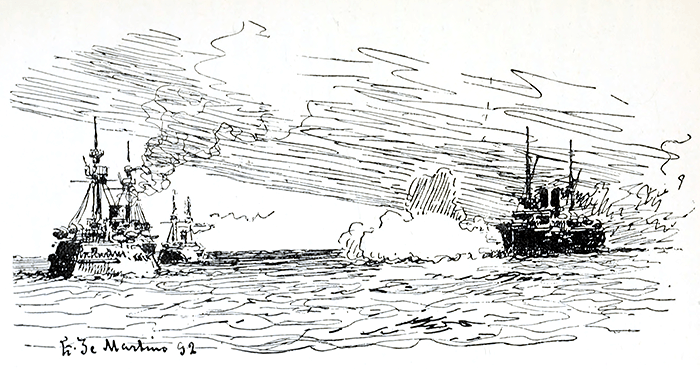
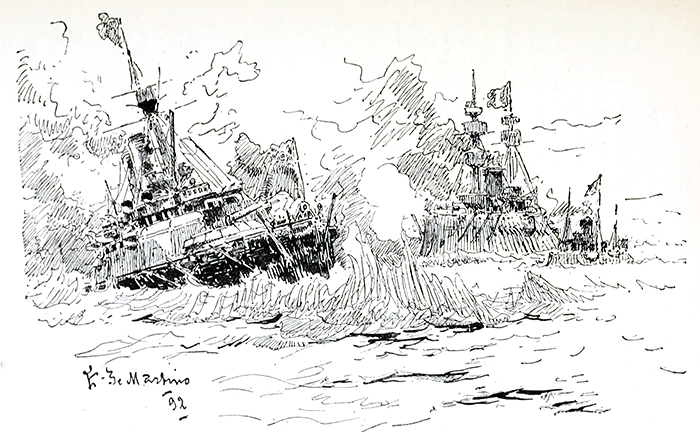
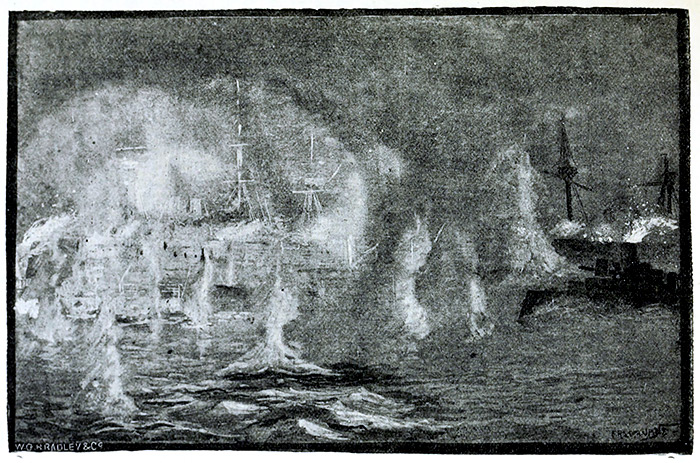
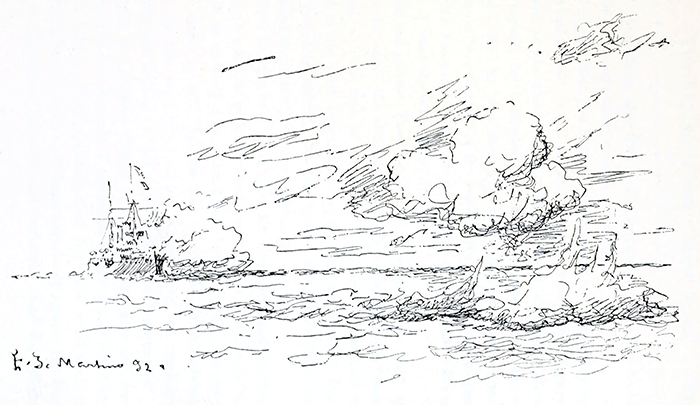
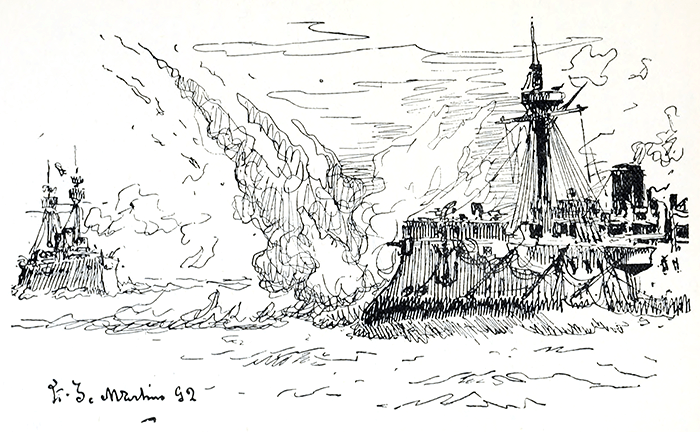
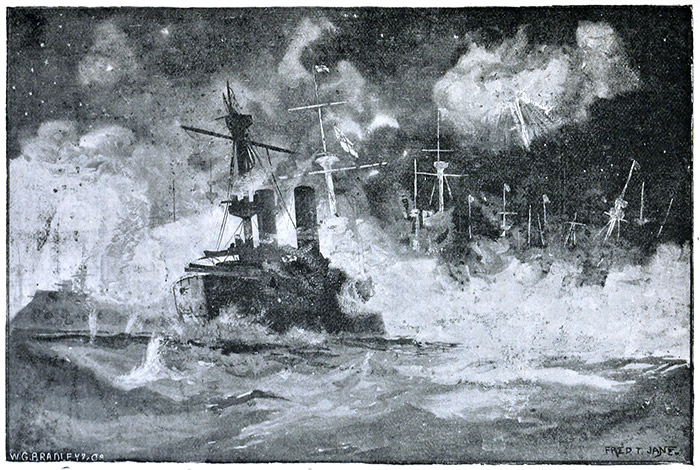
A moment later the French opened a perfectly awful fire on
us, apparently from every gun that would bear. It seemed as
if the whole horizon had become a mass of ragged smoke and
belching flame. Only a very few of our men happened to be
on deck, but nearly all these were killed or wounded. The
captain himself, who was still on the bridge, was wounded in
the right leg, but he refused to go below. We got him into
the conning tower, however, without further injury, and I
remained at his side until the end, the enemy’s fire continuing,
without intermission, from the moment when it first began
until the action was over.
[Pg 48]
“The wind being so light as to scarcely stir the air, and that
little coming now from the north-west, such smoke as did not
hang rolled gently down the French line, and shrouded from
us the greater part of it. Almost ahead of us was a group
of ships, which I took to be the Formidable, Hoche, and
Marceau. As the Admiral neared them he swerved to
port and went straight for the Formidable, while we swerved
to starboard and headed for what I believe was the Marceau.
The Nile went for the remaining one. We thus put ourselves
to windward of the flagship, and the smoke of her
guns, as she opened fire, hid her from us. But I could see
our immediate opponent quite plainly, a great towering single-funnelled
three-masted ironclad, with a central battery, lofty
sponsons, and a high forecastle. At less than a cable’s distance
we got one shell from our fore barbette gun fairly into her
starboard bow, where it burst, wrecking all the fore part of
her. At almost the same instant, however, something struck
our conning tower and caused nearly everything in it to fly, so
depriving us of our communication with the people at the
guns, except by means of the voice tubes which still held, but
which were, in the din, nearly useless. There were only the
captain, the staff-commander, myself, and two signalmen in
the confined little box, from which, of course, no one could be
spared, and which, for the moment, was practically cut off
from the rest of the ship. The 6-inch guns in our starboard
battery fired once; but in vain did we shout down the voice
tubes for them to continue, although we were now almost
[Pg 51]brushing the paint off the Frenchman’s side as she just
managed to escape our ram, and although we might, had we
given her a broadside from our guns well depressed, have
blown her bottom out. In the meantime she was treating us
terribly; and it was not until we had passed through the
enemy and well beyond him that it was possible for us to send
a man below to convey orders and to report upon what
had happened.
“The news that came up soon afterwards was even worse
than I had feared to learn. The whole starboard side of the
box battery was beaten in, two of the guns in it were
dismounted, and every man in the battery had been killed or
wounded. Part of the hydraulic loading apparatus of the
gun in the fore barbette had broken down, and the gun was
useless; the funnels were so knocked to pieces as to seriously
reduce our steaming power, two 5½ inch projectiles had hit us
and pierced us below the water-line, and two of our compartments
were flooded. There were many other damages, the
details of which were not reported, and there was no time, of
course, for full inquiry.
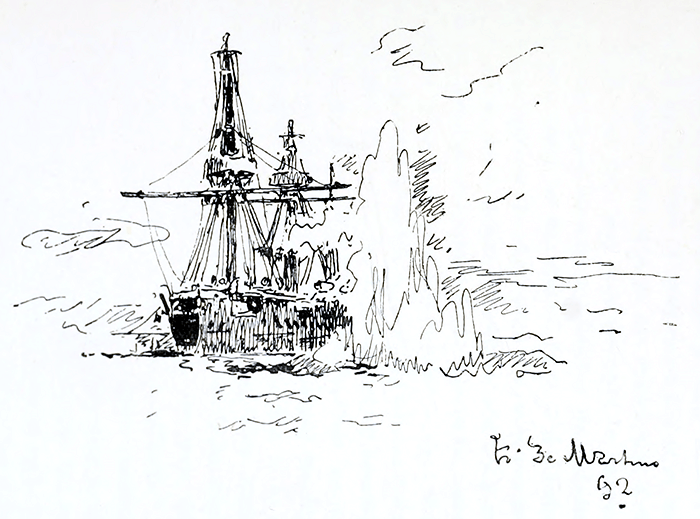
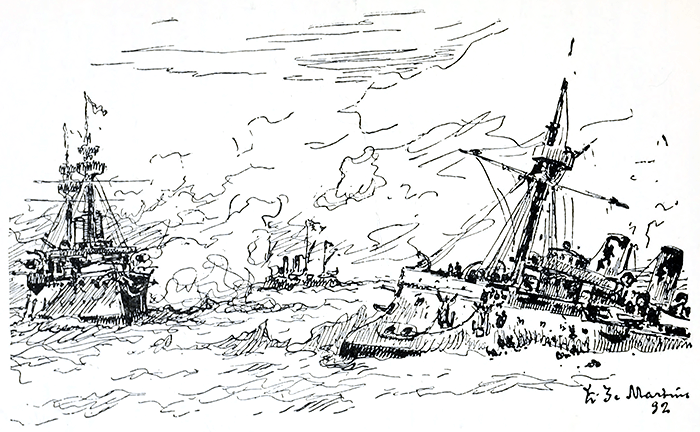
“A TORPEDO HIT US ON THE PORT BOW.”
“The captain, in spite of his injuries, was still able to retain
command, and he had, after clearing the French line, brought
the ship round sixteen points to port, in order to renew the
action with the Marceau; or, in case we could not discover
her, to engage some other ship. But scarcely had we turned
ere we were attacked by two of the avisos-torpilleurs, to
which I have already alluded, as well as by several torpedo
[Pg 52]boats of a smaller type. Ahead of us the battle was raging,
and the night was lurid with flash and explosion; but abreast
and astern of us all was darkness, and out of this darkness our
little foes dashed upon us suddenly from all directions. At
the first onset, as I have explained, our men had been driven
from the quick-firing and machine guns on the upper deck by
the enemy’s terrible fire. Many of these guns had been dismounted
or injured, and the torpedo boats came on while
those guns which had escaped were being again manned. For
a few seconds, in consequence, we had nothing with which to
meet the attack, and, in the meantime, the enemy was blazing
away at us from his 3-pounders and machine guns. We tried
to use our search-lights once more, but we could not get them
to work, probably because the cables had been destroyed.
We did, however, succeed in opening fire to a limited extent
before the enemy got very close, and, I believe, we sunk one
of the small boats. But, although the men behaved splendidly,
and worked at the guns with admirable steadiness, the game
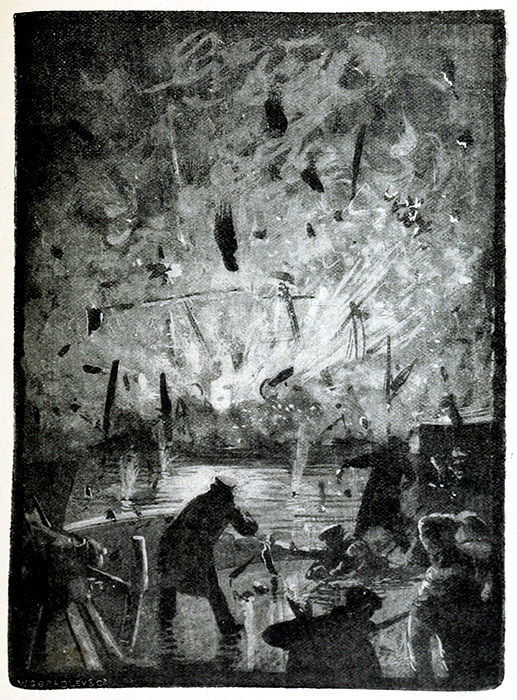
was up. A torpedo hit us on the port bow, just under the forward
sponson; and, in an instant, or, rather, as soon as we
realised what had happened, we knew that the dear old Benbow
was done for. The shock was tremendous, and threw us all
down, for the ship’s bows rose violently into the air, and
trembled as if they had been wrenched and twisted by some
angry giant. But, bruised and bloody as we were, we were
soon up again. The entrance to the conning tower was half
blocked with the débris of boats and booms, yet the captain,
[Pg 55]in spite of his wound, managed to struggle out on deck, and I
followed. Several boats were by this time almost alongside,
and, as we appeared, a French lieutenant in one of them cooly
removed his hat, and made a motion as if to ask whether we
surrendered. The captain fired his revolver at the gallant
fellow, and, even as he did so, fell back, shot through the
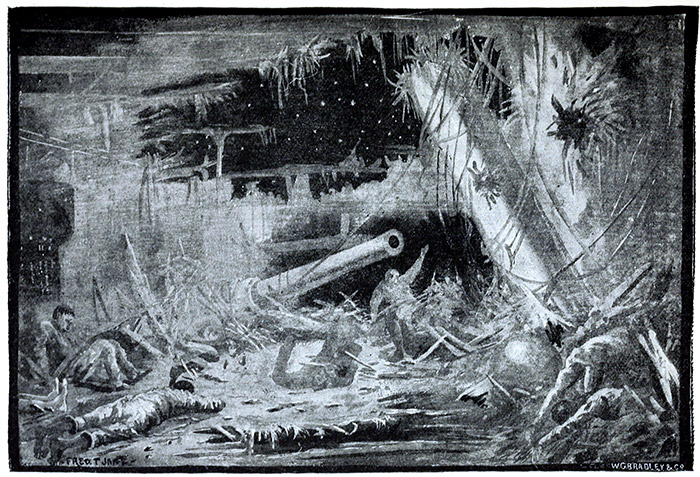
chest by a bullet from a machine gun. ‘Don’t haul it down
while we float,’ he cried, as he lay writhing in his last brief
agony: ‘remember what they will say at home.’
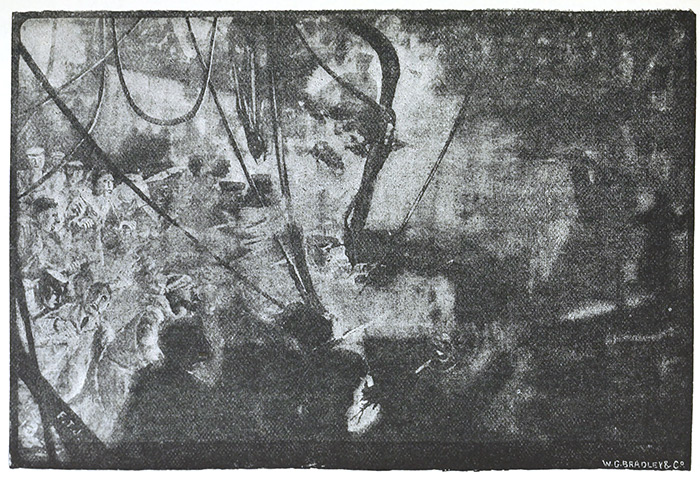
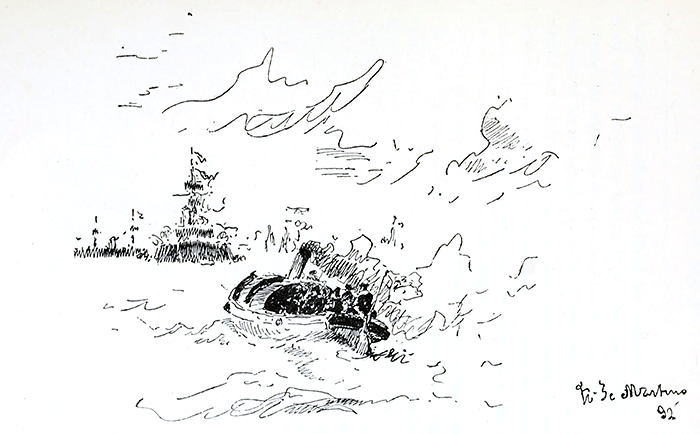
“BY THE ENEMY’S TERRIBLE FIRE.”
“REMEMBER WHAT THEY WILL SAY AT HOME.”
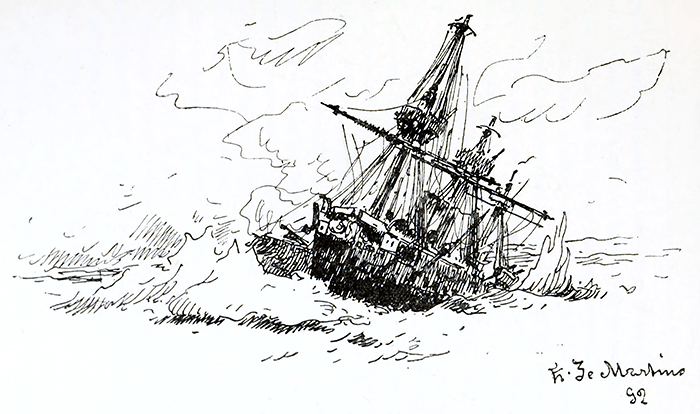
“We did not haul it down. We drove the boats off, and
gave them a weak cheer as they went, but the ship was by
that time settling rapidly down by the head, with a frightful
heel to port. The boats were ordered to be got out. They
were, however, all knocked to pieces. We did our best also to
steam back into the still battling fleets, feeling that no fate
could be much worse than the one which immediately threatened
us; but the water had got into the stokeholes, owing, I
suspect, to some of the bulkheads having given way under the
pressure, and we could not move. Just when everything
seemed most hopeless, I saw what looked like a small cruiser
rapidly making for us, with all her lights showing. But she
came too late for most of us. While she was still a full mile
away the Benbow’s stern rose high out of the water, so high as
to send everything and everybody on deck adrift, and then,
with a great gurgle, the ship dived down bows first.
“I have no further recollection that helps me to explain
how, when the day was beginning to dawn, I found myself
[Pg 56]clinging to a splintered grating, alone upon the sea. I was
dizzy and chill, and sore from head to foot, and I was almost
naked, but I clung on mechanically. Indeed, my arms were
so stiff that it seemed that I could scarcely have unclasped
them, even if I had wished to do so. As the sun rose I caught
sight of a vessel under steam, less than half a mile from me;
and, although I was able to make no effort to attract attention,
I was, in another quarter of an hour, so fortunate as to
be picked up by a boat which was sent for me by the commander
of the Agostino Barberigo, and to be taken on board by
the kindly Italians. They tell me that at first I could give no
account of myself, and that I could neither speak nor stand,
but they treated me so well that by midday I recovered.
“My first question was, naturally, about the Fleet. Terrible,
even beyond my apprehension, is the fragmentary story which
my rescuers told me. The Agostino Barberigo had been
almost within gunshot during the action, which had lasted for
less than an hour. After the battle, her commander had hailed
the French ironclad Amiral Baudin, and had learned that, of
our ten battleships, five—namely, the Benbow, Camperdown,
Edinburgh, Inflexible, and Collingwood—had been either sunk
or compelled to strike, and that of the remainder, two at least,
although they had temporarily got away, were entirely
disabled. One of these was understood to be the Victoria, in
which, quite early in the engagement, there had, apparently,
been some serious accident. The fate of the Polyphemus was
unknown, but she had rammed or torpedoed and sunk the
[Pg 59]Trident. The Australia had got away, but the Undaunted,
towards the end of the action, had made a gallant endeavour
to ram the Vauban, and, although she had considerably damaged
her, had been sunk, firing as she went down. The
Surprise had got away, but was on fire when last seen. The
Fearless, after colliding with one of our own vessels and
having her bows stove in, had been taken. The Scout had
rammed and sunk the cruiser Sfax, but had herself gone down,
though I am glad to be able to add that most of her officers
and crew are safe on board the cruiser Cécille. Finally, in addition
to the Trident and Sfax, the French are said to have
lost the Vautour cruiser and the Kabyle—torpilleur de haute
mer—as well as two small torpedo boats.
“But the victory, which is an undoubted one, lies with
them. Our Mediterranean Fleet, as such, exists no longer.
Half of it has been destroyed or taken; the other half is
disabled, and, in all probability, scattered. Never before,
in all her history, has England experienced so complete a
disaster upon the sea, and it can be but slight satisfaction
to us to know that to purchase this grand success our
enemies have spent an old second-class ironclad, a large
but not very new cruiser, and three or four small craft, even
when we know also that many of their other vessels must
be severely damaged.
“When I was picked up I was nearly ten miles from the
scene of the action; and, so far as I know, I am the only one
of my ship’s company that has escaped, though one cannot
[Pg 60]but trust that others were picked up by the cruiser which
was approaching us when we went down. The Agostino
Barberigo had, however, on board about thirty bluejackets
and a wounded sub-lieutenant, whom she saved when the
Camperdown sank; and it is certain that in the French Fleet,
the greater part of which put back to Toulon, there are many
other survivors.
“I can add no more. As a British officer who, as a volunteer,
has tried to do his duty, I cannot, nevertheless, avoid expressing
the opinion that if we had had a proper Mediterranean
Fleet—one equal or superior to that of the French, this
grievous disaster would not have occurred. We allowed
ourselves to be lulled to sleep by the peaceful aspect of affairs
here; and the unforeseen storm has found us unprepared to
cope with it. Such Fleet as we had was weak, not only
numerically, but also in armour and armament; for enormous
guns and partial belts have proved a failure. We have been
pinning our faith too much to these partial water-line belts,
and to guns of monstrous proportions. The only one of
the Sanspareil’s big guns that was fired broke down; the
other could not, for some reasons which I have not been able
to discover, be fired at all. And I am informed, by a seaman
who belongs to the Victoria, but who had been lent as a
signalman to the Camperdown, that the accident already
alluded to as having occurred in the Victoria was, in fact,
the bursting of a 110-ton gun in her turret. If I can, ere I
start for home, learn any further details of our unexampled
[Pg 63]misfortune, I will lose no time in telegraphing them. I am
aware that this account leaves much to be desired. The
awful circumstances in which it is written must be my excuse.
The fact that I have, in a short hour, lost, as I cannot
but believe, most of my shipmates and dearest friends, gives
me personally such poignant pain that I can barely concentrate
my thoughts; but even more am I overwhelmed by the consciousness
of the irreparable loss in officers and material that
has fallen upon the country. Would that half the gallant
fellows who perished to-day were still at the call of England;
for sorely will she need them.”
Thus the bolt fell from a clear sky, and, within a few hours,
the two most powerful naval nations of the world found themselves
engaged in deadly struggle.
Elsewhere in its issue of that Black Wednesday, the Times
gave particulars (see Table, p. 64), derived from other sources,
of the victorious French Fleet. It also mentioned, in a leading
article, that the telegraphic dispatch above quoted had been
sent to it by Lieutenant Thomas Bowling, R.N., an officer on
half-pay, who had been present as a guest in the ill-fated
Benbow. And in its later editions it contained a great deal
of bad news from a spot far less distant than the Mediterranean.
This news will be found in the next chapter.
[Pg 64]
Table. French Fleet Engaged in the Action of April 27th-28th.
Tons.
H.P.
Guns.
Men.
Battleship—
Amiral Baudin
11,380
8,320
15
500
Courbet
9,652
8,112
14
670
Dévastation
9,639
8,154
14
685
Formidable
11,441
9,700
15
500
Hoche
10,650
11,300
20
660
Marceau
10,581
12,000
21
660
Amiral Duperré
10,487
8,120
19
664
Caïman
7,200
6,000
6
332
Friedland
8,824
4,428
16
676
Indomptable
7,168
6,605
6
332
Richelieu
8,767
4,240
19
720
Trident
8,456
5,083
16
730
Colbert
7,713
6,230
6
332
Redoubtable
8,857
6,071
14
700
Vauban
6,150
4,561
11
440
Bayard
5,986
4,538
12
450
Cruiser—
Cosmao
1,877
6,000
4
150
Troude
1,877
6,000
4
150
Lalande
1,877
6,000
4
150
Sfax
4,502
6,522
16
473
Jean Bart
4,122
8,000
10
360
Cécille
5,766
9,600
16
486
Faucon
1,240
3,233
3
134
Vautour
1,280
3,391
5
134
Condor
1,240
3,582
5
134
Wattignies
1,310
4,000
5
140
Torpedo gun-vessels—
Dragonne
395
2,000
Q.F.
63
Dague
395
2,000
”
63
Leger
450
2,200
”
63
Bombe
395
2,000
”
63
Levrier
450
2,200
”
63
And the first-class torpedo boats Ayéla, Audacieux, Coureur, Ouragan,
Téméraire, Kabyle, Orage, Aventurier, and Eclair.
[Pg 65]
CHAPTER III.
SOME STAGGERING BLOWS.
In the first edition, already extensively quoted
from, of its issue of Wednesday, April 29th,
the Times contained the following telegram
from its Portsmouth correspondent:—
“Portsmouth, Tuesday, 9.30 p.m.—H.M.S.
Invincible, guardship at Southampton,
arrived here early this afternoon, and is now at Spithead,
where H.M.S. Hero, Minotaur, Hercules, Glatton, Galatea,
Latona, Iris, Bellona, Seagull, and Rattlesnake, all vessels belonging
to the A Division of the Fleet Reserve of this port,
are also at anchor. The ten ships last named represent the
only Portsmouth vessels that are immediately available, and
several of them are not really quite fit for sea. Moreover,
they are all, at present, short-handed. It may be recollected
that some time ago, when the five cruisers and two gun-vessels
of the Australian Squadron were commissioned, the
rule restricting service on the Australian station to men of
five years’ standing and upwards was suspended in order to
provide crews for them, and that, in addition, many men were
taken out of the harbour ships. From the depletion which
[Pg 66]was thus caused, the Royal Dockyards and the various Naval
Barracks have never completely recovered; and in consequence
there has to-day been the greatest difficulty in finding
for the mobilised vessels even sufficient crews to take them to
Spithead. Other ships could be sent thither, if only men
were forthcoming. The ten warships that have been commissioned
here would, to man them properly, need 2800 officers
and men. Barely 1200 were available, and, although a few
men of the Royal Naval Reserve have offered themselves, and
have been gladly accepted, I doubt whether the total number
of people now on board the ships in question exceeds 1500 all
told. All kinds of civilians are volunteering, but none of
them are accepted pending the receipt of instructions from the
Admiralty. The ships are in the meantime busily engaged in
getting in their powder and shell, and work is, while I write,
being energetically carried on by the aid of the electric light.
All the seaward forts are manned, and many of the buoys and
beacons have been to-day removed, nor were the usual lights
exhibited this evening; but unfortunately the conflict between
the naval and the military authorities continues, and it is but
too evident that the rapid perfecting of our defensive preparations
is being dangerously delayed by the fact that the local
command is divided. I learn, as I close this dispatch, that the
Alexandra, flagship of the Reserve Squadron, from Portland,
has also arrived and has anchored at Spithead. The Hotspur
from Harwich, the Audacious from Hull, the Shannon from
Bantry, and the Neptune from Holyhead, are expected in the
[Pg 69]course of to-morrow, and the Iron Duke from Queensferry,
the Superb from Greenock, and the Belleisle from Kingstown
on Thursday.”
“THE ‘ALEXANDRA’ HAS ALSO ARRIVED.”
The same issue also contained the appended brief reports
from Plymouth and the Medway:—
“Plymouth, Tuesday, 11 a.m.—The Conqueror, Achilles,
Gorgon, Hecate, Prince Albert, Forth, Inconstant, Thames,
Spanker, and Sharpshooter have to-day gone out of harbour,
and are now anchored with the Black Prince within the
breakwater. They are the only vessels at this port that are
in anything like a state of immediate readiness for sea, yet
they are only half manned, and there is no probability, so far
as can at present be seen, of providing proper complements for
more than half of them.”
“Sheerness, Tuesday, 11 p.m.—The following vessels of
the Medway Fleet Reserve, A Division, are now here—viz.,
Empress of India, Northampton, Cyclops, Hydra, Narcissus,
Arethusa, Mersey, Medea, Medusa, Barracouta, Grasshopper,
Salamander, Skipjack, and Sheldrake. Though all of
them have been officially reported as ready for sea, several—notably
some of the cruisers and gun-vessels—are suffering
from various temporary defects, and not one is, or at present
can be properly manned, as neither lieutenants nor men are
available in sufficient numbers. The Empress is reported to
have developed defects in her big guns, and is therefore partially
useless. The Blenheim is not completed, but she may
be got ready in ten days.”
[Pg 70]
“THE CHANNEL FLEET HAS BEEN ORDERED HOME.”
It was further announced that the Channel Fleet, consisting
of the battleships Royal Sovereign, Anson, Howe, and Rodney,
the belted cruisers Aurora and Immortalité, and the
small craft Curlew and Speedwell, was at Vigo, and had been
ordered home by telegraph, viâ the Falmouth-Vigo cable. It
might be expected at Spithead on Saturday morning. Most
of the above-quoted news was of an unsatisfactory nature;
for though the mention of so many ships as being more or less
ready for sea inspired a certain vague confidence in the mind
of the average layman as he sat at his breakfast table, the
admission that, owing to lack of men, half of them were
really useless, was one the significance of which could not but
strike even him who had only the most casual knowledge of
naval affairs. To the expert the reports were still more
painful, for every expert knew well enough that ships like
the Minotaur, Shannon, Achilles, Prince Albert, and others
were, manned or unmanned, of little value save on paper.
Naturally, therefore, the early morning news, and particularly
the terrible intelligence of the catastrophe off
Toulon, aroused immense excitement and universal uneasiness.
But excitement does not at once betray itself. Men
must first meet and talk, and hear one another’s views and
apprehensions concerning what has happened and what is to
come. And ere they had time to meet and talk on that awful
Wednesday, more alarming news than had yet reached them
arrived, and drove them from a state of repressed excitement
into a condition of panic.
[Pg 73]
The French had struck boldly, promptly, and effectively at
Toulon, but, alas! not only there. Before ten o’clock a second
edition of each of the morning papers announced the occurrence
of a fresh and more humiliating catastrophe than that
which had befallen us in the Mediterranean. The Standard’s
account is here given:—
“Portsmouth, Wednesday, 6.45 a.m.—While lamenting the
magnitude of the misfortune that has just overtaken a great
part of the Fleet assembled here, and the dreadful fate that
has overwhelmed I am afraid to say how many hundreds of
Her Majesty’s officers and men, it is impossible to avoid admiring
the energy and dash of an enemy who, almost as soon
as war is declared, succeeds in planting a deadly blow at our
very vitals. What has happened is shocking in the extreme;
but it is also marvellous. With a suddenness that seems almost
inexplicable, the squadron at Spithead has been practically
destroyed. Late last night it seemed ready to go anywhere
and do anything; this morning the little that exists
of it is a shattered remnant, barely able to keep itself afloat,
and utterly useless for any of the purposes of the immediate
future.
“I had, as you are aware, obtained authority from the
Admiralty to proceed to sea as a passenger on board H.M.S.
Alexandra during the Channel cruise, which it was yesterday
announced the Reserve Squadron would undertake as soon as
it could be assembled at Spithead. The only ships of the
squadron to arrive yesterday were the Invincible from Southampton
[Pg 74]and the Alexandra from Portland. The latter did
not take up her anchorage until between nine and ten o’clock
at night; but as she had been previously sighted and signalled,
I—with some difficulty—engaged a shore boat and was
at Spithead, ready to board her when she appeared. The
ships already there were anchored in two lines, which
stretched from the south-west, nearly abreast of No Man’s
Land and the Horse Sand to the north-west, abreast of Gilkicker
Point and Ryde. The heavier part of the Fleet formed
the line which lay nearest to the Isle of Wight, and, beginning
from the south-east, consisted of the Hercules, Minotaur,
Alexandra, Hero, Invincible, and Glatton. The cruiser
squadron formed the line which lay nearest to the harbour,
and, beginning from the south-east, consisted of the Rattlesnake,
Bellona, Iris, Galatea, Latona, and Seagull. There
were thus six vessels in each line, the Rattlesnake being
abreast of the Hercules, the Bellona of the Minotaur, and so
on; and there was a distance of two cables between the ships
of each line, and of four cables between the lines.
“SHIPS WERE TAKING IN POWDER AND SHELL.”
“Most of the ships, when I reached Spithead, were taking
in powder and shell, and were doing so by the light of their
search-lights, from the hoys and barges which lay alongside.
Some ships, also, were completing with coal. All, moreover,
were taking in sea stores and supplies of every kind, the
result being that night seemed to be turned into day, and that
Spithead was crowded with boats and launches. I boarded
the Alexandra as soon as she had taken up her berth between
[Pg 77]the Minotaur and the Hero; but, though it was getting late,
there was, of course, no thought of turning in. Indeed, even
if there had been no work on hand, and if Spithead had been
as quiet as it commonly is at ten o’clock, there was so much
anxiety in every ship concerning the news from the Mediterranean,
and such continuous expectation that weighty intelligence
of some sort would presently be brought off by one
of the numerous craft from the shore, that no one cared to go
to sleep lest perchance he might not hear the first word of
definite intelligence. The few officers who had leisure to sit
in the ward-room and smoking-room could talk of nothing
but the war and the ships up the Straits. Those who had to
be on deck thought, if they did not talk, on the same subjects.
The Vice-Admiral and captain had gone ashore to see the
Commander-in-Chief; the ship was in charge of the commander;
and I had nothing better to do than to take stock of
the scene around me.
“Alongside the Hero a hoy was hoisting out powder cases
and boxes of ammunition, which were stacked around the
turret on her low deck forward, and thence gradually removed
to the magazines below. The Minotaur was filling up with
coal, and had a barge on each side of her. The Iris, abreast
of us, was, like the Hero, taking in her powder, and also a
number of huge electro-contact mines—great red-painted iron
cases, which must have weighed nearly a ton a-piece. We
at first did nothing, but soon a coal barge came alongside, and
we began not only to fill up our bunkers, but also to pile coal
[Pg 78]on our decks, for the order had gone forth that every ship was
to be coaled to her utmost capacity. Usually when a ship is
coaling her ports are closed, and pains are taken to exclude
as much as possible the all-pervading dust; but we and the
other ships were coaling cleared for action, and with half the
guns loaded and run out. No vessel had her torpedo nets
completely down, as all had craft alongside; but all had a
certain number of boats out, and the whole anchorage between
the Nab on the east and Hurst Castle on the west was
supposed to be patrolled by these and by torpedo boats. A
large amount of material in the shape of spars and buoys had
been towed out of harbour during the day, with a view to
constructing substantial defence booms, within which ships
might lie in safety; but the work of construction had not
been begun, and most of the material was anchored on No
Man’s Land, where it was to remain for the night. No one,
I think I may safely say, thought that there was the slightest
probability of our being attacked. At midnight, however,
with a view to making all sure, a couple of first-class torpedo
boats were sent out by each entrance, and the four were
ordered to scout between Christchurch and Selsea Bill, and at
the back of the Isle of Wight.
“A COUPLE OF FIRST-CLASS TORPEDO BOATS WERE SENT OUT.”
“Portsmouth, as the crow flies, is only about seventy knots—nautical
miles—from Cherbourg. A vessel steaming, therefore,
at a speed of fifteen knots, should do the distance easily
in five hours. Our enemy must have come from Cherbourg.
He can scarcely, indeed, in the circumstances, have come from
[Pg 81]anywhere else; and he probably left Cherbourg at about nine
o’clock, for he came upon us soon after two this morning.
The sea was smooth, the night was dark and chilly, and our
vitality was at its lowest, as most men’s vitality is in the
small hours, when suddenly, apparently not more than two
or three miles from us, we heard the boom of a gun. In an
instant all were on deck. Some declared that the sound had
come from the east; others swore that they had seen the flash
light up the sky over Egypt Point to the westward. The
commander at once ordered away all the craft from alongside,
and directed that the nets were to be fully rigged out; but,
as everyone knows, lighters and barges cannot be got rid of
in an instant, and long before the order could have been
obeyed, we and our consorts were in the midst of one of the
bloodiest struggles of which history gives any record.
“Within a minute of the time when we heard the first
report we heard others, and saw over Bembridge Point the
bouquet of a rocket which, we knew, had been fired by one
of our boats as a signal that the enemy was approaching in
force. I am not exaggerating, and I in no way do injustice to
our officers and men, when I say that a scene of the direst
confusion followed. The captain of the Hercules was the
senior officer present. He signalled by means of flash lights
from his mast-head, ‘Cruisers will slip their cables and proceed
with dispatch to sea in search of the enemy, those lying
to eastward of the Galatea going out by the eastward, and
those lying to westward of the Iris going out by the westward
[Pg 82]entrance. Rendezvous, Spithead, 8 a.m. Battleships
will prepare to slip cables and follow—’ But the signal
was never completed. The shore boats and lighters were
still pushing off; our officers were still shouting at them from
the bridge and gangways for their delay, and the poor bum-boat
women were shrieking, partly from fear and partly because
they and their goods had been separated, when another
rocket and yet another went up from a point well on our
side of the Nab, and, under the glare of their explosions, we
saw, not a mile and a half from us, three or four low-lying
black hulls, which we knew could only be those of the torpedo
cruisers of the enemy. In an instant, and forgetful of our
torpedo boats, which must have sent up the warning rockets,
and which must, therefore, have been not far out of the line of
fire, every vessel that could bring a gun of any kind to bear,
opened in the direction of the foe. The roar was infernal,
and, for a brief period, the dense smoke hid everything
from us; but such slight air as there was gently carried
the smoke to the westward, and soon we could see the
enemy again. He was apparently none the worse for
his reception, and was now much nearer to us. Fire was
re-opened, and maintained with fury. The Alexandra
was incommoded somewhat by the ships to windward of her,
and fired only occasionally; but the Hercules, Minotaur, and
Rattlesnake seemed to blaze away almost without intermission,
and the volumes of smoke that came slowly to leeward
showed how freely they were spending their powder. The
[Pg 85]enemy fired very little. We expected to hear him using his
torpedoes. And use them he did, but not from the direction
which we anticipated. That attack had lasted, I suppose, a
quarter of an hour, and there had been little, if any, cessation
of the firing from our side, when, to our consternation, a second
attack quickly developed itself from the westward. It is
quite clear to me now that the eastward attack by three or
four torpedo cruisers—probably vessels of the Condor and
Bombe types—was merely a feint intended to amuse us while
the real attack from the westward was being made. The
Needles, or westward passage to Spithead, is not a particularly
easy one in any circumstances, and is commanded not only by
numerous batteries, but also by the Brennan torpedo station at
Fort Cliff End; but our enemies chose to take the risk of
coming to grief in their attempt to find their way in by that
passage, and it must be sadly admitted that the results have
more than justified their temerity.
“EVERY VESSEL OPENED IN THE DIRECTION OF THE FOE.”
“IT WAS FEARFUL WORK; THE VERY SILENCE OF THE GREY BOATS MADE THE SCENE THE MORE IMPRESSIVE.”
“The real attack was delivered by torpedo boats only,
some being of the ‘haute mer’ type, and others of the ordinary
first-class. The larger vessels seem to have acted as ‘division
boats,’ and there appear to have been four divisions engaged,
each division on this occasion consisting of one torpilleur de
haute mer and three torpedo boats, making sixteen craft all
told. I do not pretend to be certain either as to the exact
numbers or as to the exact constitution of the force; but those
who had the best opportunities of knowing, place both as I
have given them. The flotilla must have evaded our scouts,
[Pg 86]possibly by first making the land near Christchurch and then
by keeping close under it; for it was not seen until, almost
like a flash, it steamed in close order past Fort Cliff End.
Both Fort Cliff End and Hurst Castle were using their search-lights,
and it was owing to this fact that the enemy was
discovered. But the forts were unprepared for instant action,
and ere fire of any kind could be opened, the boats were
somewhere abreast of the Bramble, and within ten or twelve
minutes’ steam of their quarry. Even when the forts did
open they did no harm, for the smoke of the action which was
raging at the other end of the anchorage was drifting between
them and the enemy. Besides, when the search-lights from
the forts, or later, from the ships, fell upon any particular
craft, they rendered all the other craft of the enemy completely
invisible; and the operators, speedily becoming conscious of
this fact, and being anxious to show up as many of the enemy
as possible, shifted their projectors so rapidly as to confuse the
eyes of the men at the guns. The truth seems to be that the
most effective shelter under which a torpedo boat can approach
to do damage is the shelter afforded by a search-light played
upon some other vessel by the intended victim. Moreover,
very few guns could be brought to bear, the chief works being
so constructed as to be almost powerless for action on the
Solent side, and being mainly designed to impede the foe as he
comes in from the west-south-west, not to destroy him after
he has got in. Thus the French steamed up without let or
hindrance to within quite a short distance of the Glatton and
[Pg 89]Seagull, which formed, as I have already said, the north-eastern
extremities of our two lines. These ships, or their
picket boats, sighted the flotilla when it cannot have been
anything like a mile from them. At the first shot from the
Fleet, or perhaps before it, the divisions must have separated
in order to act in accordance with orders previously given to
them. Two divisions, now formed in a single column of
line ahead, came up at full speed between our lines. The
other two divisions, disposed respectively on the port
and starboard quarters of the central divisions, came up also
in columns of line ahead, one on each side of the still anchored
Fleet. The central divisions came on therefore at a distance of
about two cables from the ships on either beam of them. The
other divisions kept about as far outside the lines, and the speed
I imagine was fully eighteen knots. As the boats executed
that terrible rush through us, they were saluted with a perfect
hurricane of projectiles; but they did not, so far as I know,
fire a gun in reply, and I fear that a good many of our own
shot intended for the central divisions must have done more
harm to friend than to foe. It was fearful work: the very
silence of the grey boats made the now brilliantly illuminated
though smoke-dimmed scene the more impressive. One could
not help admiring so splendid an exhibition of pluck, even
though one was fully conscious of the magnitude and imminence
of one’s own peril. But there was little time for
thought. Our lines were less than a mile in length. Travelling
at eighteen knots a boat covers a mile in about three
[Pg 90]minutes, and in five or six minutes at the outside the dismal
tragedy had begun and ended. The French launched their
torpedoes with wonderful precision, the central divisions discharging
both right and left, and the outside divisions, which
approached a few seconds later, apparently endeavouring to
rectify any mistakes or omissions which their comrades of the
centre had been guilty of. Too well, alas! did they do the
business. It is as yet too early to send you details, save of
what happened to the vessels immediately within my own
sphere of vision; but there is no hope, that, by waiting, I can
obtain any less disheartening general results than those which
I can already give you. The Hero, Invincible, Iris, Galatea,
and Bellona have been sunk or have been obliged to run
ashore to avoid sinking; the Minotaur has been blown up,
the explosion of a torpedo having, it is believed, fired some of
the explosive stores which she had just taken on board;
the Alexandra has a great hole in her port quarter and a compartment
full of water; and the Glatton has a hole in her
bows. Only the Hercules, Latona, Seagull, and Rattlesnake
have escaped uninjured. A torpedo, barely submerged, seems
to have actually exploded in contact with the Hercules, but
that ship’s stout construction and armoured belt saved her
from anything worse than a very severe shaking. Several
lighters and small craft were also sunk; and the loss of life,
in one way and another, is, I fear, frightful. It is doubtful
whether more than fifty of the Minotaur’s people survive.
The blowing up of the vessel was so violent that we, who were
[Pg 93]anchored immediately astern of her, felt as if we were jerked
out of the water, and a moment later our decks were covered
with and even set on fire by her burning fragments. May I
never live to have another so awful experience. Limbs,
ragged pieces of charred flesh, scraps of clothing, as well as
wreckage, fell on board of us; and the shock of the explosion
smashed everything in the Alexandra that had not already
been shattered by the bursting of a French torpedo under her
own port quarter. The Iris was struck just before we were,
and, being in a sinking condition, was run on to the Sturbridge
Sand, where she lies with her bows in two and a half fathoms.
The Bellona is on the Harrow Bank, immediately under Fort
Monckton. The Galatea and Hero lie sunk at their anchorages;
and I am sorry to have to say that, in the struggle,
a quantity of ammunition on the Hero’s deck blew up, killing
and injuring a number of people. The Invincible sank while
endeavouring to run on to the outer Spit. The heaviest losses
were suffered by the Minotaur, Hero, and Galatea. The other
ships have lost very few men killed, but have had a good many
wounded; and in all the vessels which were torpedoed there
were numerous sufferers from the poisonous and suffocating
effects of the explosive gases and from shock. The Alexandra’s
loss is ten killed, and sixty-four wounded or otherwise
injured. The torpedo which struck her threw down everyone
on board, and raised a column of water of such volume that
when part of it fell on deck, it washed men into the scuppers
just as if it had been a heavy sea.
“MAY I NEVER LIVE TO HAVE ANOTHER SO AWFUL EXPERIENCE.”
“THEY RENDERED ALL THE OTHER CRAFT OF THE ENEMY INVISIBLE.”
“THE ATTACK ON THE ‘HERCULES.’”
[Pg 94]
“The enemy also have suffered, but very slightly in comparison
with us. Two torpilleurs de haute mer and four torpedo
boats are said to have been sunk or blown up, and of those
which got away several are known to have been badly damaged.
Whether our fire did any harm worth mentioning to the small
cruisers which began the affair is more than we can tell. We
cannot, however, claim to have done much more than destroy
six little craft, and to have worked other harm which, altogether,
may represent a quarter of a million. The French
have done us damage to the extent of at least two and a
quarter millions in money alone. They may have lost a hundred
in killed and wounded; we, at the lowest computation,
have lost nearly a thousand. The blow, therefore, is one the
seriousness of which it would be folly to shut one’s eye to.
It is, as far as the Portsmouth squadron is concerned, a
thoroughly crippling one.
“That the French attack was both well designed and well
carried out it is impossible to deny. It came swiftly after the
declaration of war; it was so arranged as to give the attacking
torpedo boats the full advantage not only of the feint
from the eastward, but also of such wind as was moving; and
it was designed in such a way as to place the torpedo boats,
after they had done their work, in a position whence, in case
of necessity, they could be rescued by their friends the cruisers.
In fact it cannot be doubted that, after their wild rush through
our lines, some of the boats must have been very glad to run
at once under the protection of their larger consorts; for
[Pg 97]several of them were certainly badly mauled. Of our own
four boats which went out at midnight to scout we have as
yet heard nothing; but there is every reason to fear, at least
with regard to those which were on the eastern side of the
Isle of Wight, that they have been destroyed or captured.
The Rattlesnake slipped her cable and followed the retreating
enemy for some miles, but was recalled by the Vice-Admiral,
who was returning from the shore when the alarm was first
given, and whose steam launch narrowly escaped being run
down by the port line of French torpedo boats as the vessels
turned at the head of our port line in order to rejoin their
friends. The Spithead forts, I should add, did not fire during
the engagement. It is rumoured that they had not been supplied
with ammunition. The Commander-in-Chief has just
left harbour in his yacht, the Fire Queen, to inspect the ships
which are damaged or aground, and to settle what is to be
done. In the meantime the town is in a panic, other attacks
being feared. The blowing up of the Minotaur broke nearly
every pane of glass in Southsea, and created such alarm that
several aged people are reported to have died from fright.”
“WHOSE STEAM LAUNCH NARROWLY ESCAPED BEING RUN DOWN.”
“THE BLOWING UP OF THE ‘MINOTAUR.’”
The second edition of each of the morning papers contained
a dispatch to the above effect. The bad news, owing to the
lateness of its arrival, was printed without comment; but immediate
comment was unnecessary—the intelligence spoke for
itself. We had been suddenly deprived of the services of five
ironclads and three cruisers; which, added to the tale of vessels
that had been lost or taken off Toulon, made a total of ten
[Pg 98]ironclads and five cruisers accounted for by the enemy within
forty-eight hours of the commencement of hostilities.
The panic that ensued has had no parallel in the history of
the country. The violation of our coasts, and indeed of our
chief naval port, was an exploit which the majority of Englishmen
had for generations deemed beyond the power of any
foreigner or combination of foreigners: and the shock of
knowing that it not only could be, but had been effected,
threw nearly all men off their balance. The less-educated
classes entirely lost their heads, and, at hastily summoned
meetings in Trafalgar Square and elsewhere, wildly denounced
not only those who were, but also those who were not, responsible
for the disaster. It was, perhaps, difficult to apportion
the responsibility among those who might be fairly
blamed—among, for example, the members of the Government,
the Lords of the Admiralty, and the chiefs of certain departments—but
it was ridiculous to blame, as many mob orators
did, the admirals and captains who had been concerned.
Steadier brains realised this, and their views were substantially
represented on this occasion by the St. James’s Gazette,
which in the course of its reflections that afternoon, said:—
“Let us be under no delusion as to the real causes of our
misfortunes. These may be easily catalogued. For years we
have had naval manœuvres every summer; and all of these
have been full of valuable lessons, to the majority of which
we have, nevertheless, kept our eyes shut. For years we have
had a large number of ships on the list of the Royal Navy;
[Pg 101]but we have not taken the trouble to make certain that the
greater part of these shall always be ready for immediate
service. For years we have had a Naval Intelligence Department;
but we have not made it large enough to be thoroughly
efficient, and we have never raised it to the level which it
ought to occupy as the supreme adviser of what should and
what should not be done in naval affairs. For years we have
known that the French Fleet at Toulon was being gradually
increased, but we have never taken care that our Mediterranean
Fleet should be in all respects superior to it. For years
we have had it dinned into our ears that divided command at
the naval ports—especially with regard to coast and harbour
defences—is a source of danger, but we have not listened.
For years we have been told that we were lamentably short
of stokers, seamen-gunners, and, indeed, bluejackets of all
sorts; but our efforts to increase their numbers have been
spasmodic and half-hearted. For years we have been aware
that excessively big guns were a broken reed on which to
depend, but no action has been taken in consequence. We
might extend the lamentable catalogue of our omissions and
commissions, but it is useless and undignified to moan over
the unalterable past. The future only is now our concern.
Existing arrangements have convincingly demonstrated their
feebleness and inadequacy. Some means must be provisionally
adopted for properly managing the naval affairs of the Empire.
It may be a bad thing to swap horses when one is crossing a
stream; but if one’s own horse be sinking, there is no better
[Pg 102]course open. The Admiralty has collapsed; yet, although it
is moribund, it still has the power to work harm. Let it,
therefore, gracefully and promptly hand over its duties to
stronger men. We do not blame their Lordships so much as
we blame the system under which they have worked. But
we have no time for making compliments or for considering
excuses. Already we have been hardly hit. Another blow
may paralyse us altogether. The safety of the country is the
one thing to be thought of, and we trust that neither the
Admiralty nor the public will think of anything else. To the
one we recommend unselfishness and resignation to the needs
of the moment; to the other, calmness, loyalty, and patriotic
devotion. Ours is not an inheritance to vanish in a day, but
neither is it a treasure to be trifled with.”
[Pg 103]
“A TORPEDO EXPLODED UNDER HER OWN PORT QUARTER.”
[Pg 105]
CHAPTER IV.
A LETTER OF MARQUE.
It has already been said that the account of
the battle of Toulon had been sent to the
Times by Lieutenant Thomas Bowling,
R.N., a half-pay officer who had been a
guest in the Benbow. In thus corresponding
with a newspaper this officer had, of course,
broken the regulations; and it must be
admitted that the peculiar circumstances of
the case did not tend to diminish his fault
in the eyes of his superiors. All that he had to say should
have been said to their Lordships, and not to the public; and
when the natural excitement consequent upon participation in
the stirring events concerning which he telegraphed had subsided,
Mr. Bowling was as willing as anyone to admit this.
Unfortunately, he had acted upon the impulse of the moment,
and under the conviction that a whole country was waiting in
awful suspense to hear what he happened to be able to relate;
and this rashness cost him dearly. On Wednesday the moribund
Admiralty summarily removed Mr. Bowling’s name from
the Navy List, and ordered that the delinquent should be
[Pg 106]informed that his services were no longer required by Her
Majesty.
The next step taken by their Lordships was more important,
and possibly more necessary. They convened by
telegraph a meeting of certain naval officers of high rank and
great experience at the Admiralty. They also obtained the
presence of the sorely-worried Prime Minister, and of several
of his colleagues; and by three o’clock in the afternoon of
Friday, the Admiralty, as such, had ceased to exist. Its place
had been taken by, and its powers transferred to, a Supreme
Board of War, and the nominations to the Board had all been
duly confirmed by Her Majesty. This Board was constituted
under the presidency of one of the Royal princes, a personage
of great tact and experience in the conduct of affairs, and
devoid, of course, of political bias; and it consisted of two
branches, the Naval and the Military. Of the Military it is
unnecessary here to say more than that it was not, as the
Naval branch was, a new formation. The Naval branch was
placed under the control of a Chief Director of Fleets; and for
that high and responsible office Sir Humphrey Thornbeigh, an
Admiral of the widest knowledge, remarkable decision of
character, and unrivalled administrative ability, was chosen by
acclamation. Immediately under him were the chiefs of the
various departments—viz., the Staff and Intelligence Department,
the Construction Department, the Engineering Department,
the Ordnance Department, the Victualling Department,
the Hydrographic Department, the Stores Department, the
[Pg 109]Sanitary Department, and the Secretarial Department. Many
of the old permanent officials were retained, but many also
were discharged; and for these, retired officers and a few
civilians, who were chosen because they possessed special
technical knowledge, were substituted. The chiefs of departments
were, in all cases, officers of flag or post rank; several
being men who, although they were on the retired list, were
still full of work and energy; and, in spite of the fact that
the new arrangements could obviously be not expected to work
with perfect smoothness at first, the knowledge that such
officers as Sir Humphrey Thornbeigh, Sir George Lyon, Sir
William Howl, Sir Mewstone Hewart, and their like, had
undertaken the management of affairs, exerted, from the very
first, a salutary influence on the rather depressed spirits of
the Royal Navy.
“THE ‘BELLONA’ ASHORE.”
The Channel Fleet had sailed from Vigo before
the advent of the new Board to office: but several fast
cruisers were despatched to intercept it, and new orders
were sent to the coastguard vessels and the various dockyards;
with the result, that by Saturday, May 2nd, without
the occurrence in the interim of any further mishap, the
following ships, with steam up and everything ready for sea,
were assembled within proper defences at Spithead. Battleships:
Hercules, Neptune, Audacious, Iron Duke, Hotspur,
Belleisle, Royal Sovereign, Anson, Agamemnon, Howe,
Rodney, Triumph, Superb, Conqueror, Achilles, and Black
Prince. At Plymouth were the coast defence ironclads
[Pg 110]Hecate, Hydra, Gorgon, Cyclops, and Prince Albert, and the
armoured cruisers Northampton, Shannon, Aurora, Immortalité,
and Narcissus. And in the Channel were the lighter
cruisers Forth, Thames, Mersey, Indefatigable, Latona, Melampus,
Inconstant, Intrepid, Naiad, Arethusa, Medea, Medusa,
Barham, Bellona, Barossa, Seagull, Rattlesnake, Spanker,
Sharpshooter, Barracouta, Grasshopper, Salamander, Skipjack,
Curlew, Speedwell, and Sheldrake. These ships were largely
manned by Naval Reserve men, who had by this time become
available in considerable numbers, and by members of the
recently-disbanded Royal Naval Artillery Volunteers, a corps
which at last began to be appreciated. The reinforced French
Channel Fleet, consisting of the ironclads Tonnerre, Requin,
Victorieuse, Furieux, Suffren, Vengeur, Fulminant, La Galissonnière,
and Tempête, with the cruisers and gun-vessels SurcoufAréthuse, Coëtlogon, Duguay-Trouin, Epervier, Lance, and
Salve, besides torpedo vessels, had gone out with the intention
of meeting our Fleet on its way from Vigo, but had been
evaded, and was still at sea. For the moment the country
was almost reassured, although reports that were in themselves
sufficiently bad reached England almost every hour, of
merchant vessels captured or burnt, both in the Channel and
in the Mediterranean as well as elsewhere.
“THE FLEET AT SPITHEAD.”
In the meantime, Mr. Thomas Bowling, after having
travelled with all haste by way of Italy, Switzerland, Germany,
and Holland, had reached England on Friday, May 1st,
and had found, to his intense chagrin, that his occupation had
[Pg 113]deserted him. An officer who loved his profession as he did
could have received no heavier blow. No one doubted his
bravery, his capacity, or his single-heartedness. He owed
the loss of his commission to no fault that reflected on his
honour, but solely to the very impulsiveness which, in other
circumstances, might have shown him the way to professional
distinction. His position was not enviable, so far as
his professional prospects were concerned.
Thomas Bowling, or, as he was invariably called in the service,
Tom Bowling, was a lieutenant of a little more than eight
years’ seniority, and had worn his extra half stripe for scarcely
three months when all was taken from him. Rich and well
connected, a favourite in society, and a man of great ability,
he was, according to the opinion of nearly all his unprofessional
friends, wasted in the service. They would have preferred
to see him in Parliament, or in the army, or even living
the life of an English country gentleman. But Tom Bowling
did not adopt that view. He was not fond of unnecessary
talk, therefore he had no Parliamentary aspirations. He did
not think that the army opened a more suitable career than
the Royal Navy to an Englishman. And as for country life,
he liked it only as a temporary relaxation. It must be admitted
that he was not particularly well fitted for military
life as we know it in England. His small wiry figure would
have looked wholly insignificant in the uniform of any regiment;
and he had for what may be called the superior niceties
of dress an unaffected contempt, which would scarcely
[Pg 114]have harmonised with the pipe-clay conventionalities of the
parade ground, or the fashions of a woman’s boudoir. The
sea was the only place where he felt completely at home. He
could shoot or hunt on every day of a fortnight’s leave, but
at the end of that time he had always had enough of it, and
invariably longed to be on board ship again. He was completely
wrapt up in his profession; and although he had an
income of nearly twenty thousand a year, he would, when he
returned to England on the 1st of May, have gladly surrendered
the whole of it rather than lose his commission.
He heard the news as soon as he arrived in town, and for a
moment it overwhelmed him. But he was not a man to be
for long cast down. He had been foolish, but he had done
nothing to be ashamed of. His naval friends still had confidence
in him: he was rich, young, and strong, and he had an
equable buoyancy of spirits that no misfortune could permanently
depress.
“They have kicked me out of the service,” he said to an
officer whom he met in that cheerless waiting-room in which
the Admiralty has for generations permitted its professional
visitors to cool their heels, “and I suppose that they are right.
But if I live I am going to find my way in again, so I’m not
going to sell my uniform yet, though I hope that when I put
it on once more, I shall find another half stripe at least
on it.”
“I’m devilish sorry, Bowling,” said his friend, “and I wish
you all the luck in the world, but you’ll find it an uphill
[Pg 117]game, I’m afraid. After all, you know, they’ve let you down
pretty easily. They might have court-martialled you.”
“And shot me, perhaps,” continued Bowling, laughing;
“for Heaven only knows what they can do in war time. One
of the things that I must certainly do is to take a course of
Queen’s Regulations before I get back into the service.”
“And what else are you thinking of doing in the meantime?”
asked his friend.
“Well, I’ve come here to take Uncle Humphrey’s advice, if
I can get it, and whether I can get it depends upon whether,
in his new billet, he has leisure to see me. I was at sea
with him years ago. You see, France has decided not to observe
the stipulations of the Treaty of Paris, and both she and
we are issuing letters of marque. My own idea is to get a
ship and make a privateer of myself. Do you know of anyone
who will stand in with me?”
The officer smiled. “I shouldn’t mind something of the
sort myself,” he said, “but I’m going to commission the
Gossamer to-morrow morning. I wish you were going with
me, old chap; and I’ll take you on board as a passenger if
you like to come; but as for helping you in the privateer
business, why, I haven’t any money to put into it. I wish I
had.”
“I can get the money, I suppose,” said Bowling, awkwardly.
“The most serious difficulty is to get men. It is a pity that I
can’t serve under you as my skipper. That’s what I should
like.”
[Pg 118]
“Thanks for the compliment,” returned Lieutenant St. John
warmly; “but I am booked. If you take my advice, you will
command your own craft. You won’t find a better qualified
man. They are digging up all the retired commanders and
lieutenants for the new men-of-war, the coast defence business,
or the merchant cruisers. There is a terrible dearth of
officers, as well as of seamen-gunners and stokers; and I
really am almost astonished that they plucked up courage to
get rid of you. You may take it as settled that you won’t be
able to get any retired naval officer, who is fit for duty, to
join you.”
“That’s encouraging. Then I must get the best men I can.
Do you know any yachtsmen who are worth their grub and
who know something of navigation?”
“I know Day. He would, I am sure, go with you if I
were to advise him to do so. I will give you a line to him.
He is a barrister, who, instead of practising, likes to wander
about the world in a twenty ton yawl, or to hunt for treasures
on desert islands, or to do anything of that kind. You may
trust him as a sailorman as you would trust yourself, and I
happen to know that he is in town. I daresay, too, that he
can introduce you to some more men of the same sort. How
are you going to get a ship?”
“I haven’t the ghost of an idea yet. I only got home this
morning, and I haven’t had time to look about.”
“And what sort of a sum are you prepared to pay for her?
Don’t think me inquisitive. I may be able to help you.”
[Pg 119]
“As much as I can raise,” answered Bowling. “I’m ready
to put all I am worth into the business, and I fancy that I
know others who will take a share. Do you really know of a
vessel?”
“Yes, I do, but the figure is high. Of course, since war
broke out, no man-of-war that happened to be lying in the
contractors’ yards has been allowed to leave. Now, there’s a
very fine armoured cruiser in the Tyne. She has been built
for one of the South American Governments, and she is practically
ready for sea. Indeed she was to have been handed
over yesterday. I happen to know that the builders are going
to offer her to the Admiralty for £300,000. That’s a big
sum, but the craft is a very smart and likely one, and she can
do her 17 knots without using forced draught. Why not
try to get her? The Admiralty—I mean the Board of War—is
scarcely likely to buy her; for we can hardly man the ships
we have.”
Bowling knitted his brows and gazed reflectively at the
bare floor. “Humph!” he exclaimed after a pause, “it is a
big sum; but I’ll think about it. Who are the builders?”
“The Elswick Company; and the ship’s name is the
Valdivia.”
“Then give me that line to your friend Day. I’m staying
at the Grand Hotel.”
St. John scribbled a hasty note and gave it to Bowling.
“Good-bye,” he said, “and good luck to you, and don’t forget
to drink the saucy Gossamer’s health.” And, having been at
[Pg 120]length summoned to the presence of one of the chiefs, he
hurried away upstairs.
Bowling himself saw Sir Humphrey Thornbeigh, or Uncle
Humphrey as he was affectionately called in the service; but
when, after giving him as many details as possible of the
Toulon affair, he sounded him upon the subject of restoration
to the Navy, the Admiral assumed a rather horny-eyed expression,
and gave him no encouragement. “You have contravened
the Queen’s Regulations; you must take the consequences
as they have been dealt to you by the late Board.”
That was Uncle Humphrey’s verdict, and the brief interview
was ended.
But Bowling, who knew the Admiral well, was not very
astonished when, later in the day, a messenger brought him a
note which ran: “My dear Bowling, make it convenient to
take an unofficial breakfast with me to-morrow morning at
the Admiralty at eight o’clock, and in the meantime believe
me yours faithfully, Humphrey Thornbeigh.”
It was barely noon when Bowling left the Admiralty—noon
on Friday, the 1st of May. He walked thoughtfully to
his hotel, sat for five minutes with a pipe between his lips in
the smoking-room, and then rose suddenly, left a message as
to where he might be found, and hurried across the road to
Craig’s Court. His solicitor had an office there. The solicitor
was a little Jew, shrewd, but honest as the day.
THE LETTER OF MARQUE, “VALDIVIA” (AFTERWARDS “MARY ROSE”).
“Look here, Lawson,” Bowling began, as soon as he was in
the presence of the lawyer. “I’ve not come to spin you a
[Pg 123]yarn about the battle, and I don’t want sympathy, and I don’t
want advice; I just want your help. Can you give me the
rest of the day, luncheon time and all?”
“I suppose I can, if it is a matter of business,” said Mr.
Lawson.
“Very good. First of all, tell me how much money have
you in the house? I want a deuce of a lot at once. In the
meantime be good enough to send this note to Mr. Day, of
Gray’s Inn, and let the messenger ask Mr. Day, with my compliments,
whether he can make it convenient to call and see
me here as soon as possible.”
The solicitor called a clerk, and despatched him with the
note. “I could let you have a thousand in an hour, Mr.
Bowling,” he said.
“A thousand! Why, man, that’s of no use to me. I want
heaps more. What am I good for? How much can you raise
on me? How much can you borrow on me?”
“What do you want?”
“I want three hundred thousand pounds by this time to-morrow.”
Mr. Lawson fell back gasping. “Three hundred thousand
pounds!” he ejaculated. “What?”
“Three hundred thousand pounds,” repeated Bowling.
“Can you raise it, or can you not?”
“I daresay I can raise it, if only I have time enough; but
by this time to-morrow—”
“If you can’t do it, or the greater part of it, someone else
[Pg 124]must. But you can do it; you have interest with bankers
and people of that sort. Now, be a good fellow and spare no
pains and no expense; and, above all, waste no time over the
business. Sell me up entirely if necessary, body and soul.
Get rid of everything.”
“But, Mr. Bowling,” said the solicitor, who suspected his
client of sudden madness, “in justice to yourself, let me know
what you are going to do?”
“You know that they have deprived me of my commission?”
“Yes.”
“Well, I’m going to buy it back again. I’m going to endeavour
to render them anxious to have my services once
more. To be brief: I’m going to buy a ship and take out
letters of marque, and get to sea as soon as I can manage it.
Now you know all you want to know.”
“But surely you are not going thus hastily to embark your
whole fortune in such a precarious venture?”
“Well, don’t let us argue: that is my intention. Now, will
you take the needful steps at once? This office must be mine
for the next day or two. You must give me a room in which
I can see people, and a clerk to write letters, and a boy to run
messages; and I must be able to carry on here, if necessary,
night and day.”
Lawson made no audible reply, but rang a bell, in answer
to which a second gentleman of Hebrew physiognomy entered.
[Pg 125]
“Lazarus,” said the solicitor, “Mr. Bowling wants to raise
three hundred thousand pounds at once—mind you, at once.
Please see what can be done, and don’t lose a moment. You
have the papers, and Mr. Bowling will be close at hand. I
wish him to have a table here. Put another also for Mr.
Brownlow, who is to hold himself at Mr. Bowling’s entire disposal
until further notice. I can undertake no further business
to-day. If anyone calls, say that I am engaged.”
Mr. Lazarus disappeared. “He’ll do his best,” said Lawson,
“and I’ll do mine.”
Mr. Brownlow was a most capable clerk and shorthand
writer, and he saved Bowling no end of trouble. He took
down from Bowling’s dictation a long telegram to Sir W.
Armstrong, Mitchell & Co., asking that firm to send immediately
to London an agent fully competent to negotiate for the
disposal of the Valdivia. He also took down telegrams to
several people who, Bowling imagined, might be willing to
assist or join him. Finally, the clerk took down a telegram
addressed to the proprietors of the Times. “In consequence
of my dispatch to you from San Remo,” it ran, “the Admiralty
has removed my name from the Navy List. I intend to
take out letters of marque, and I shall be glad to learn what
assistance or co-operation you may be inclined to render me
in fitting out a vessel. Time presses.”
In the course of the afternoon Mr. Day called in reply to
Bowling’s note. He was a tall, untidy, slim, slightly bowed
man, with black hair and moustache, spectacles, and a somewhat
[Pg 126]hesitating and nervous manner of speech. He looked
very little like a barrister, and still less like a sailor; and at
first, Bowling was very far from being favourably impressed.
But it soon appeared from his conversation that Mr. Day
knew a good deal about the sea, and, what was perhaps as
important, he proved to be an intimate friend of the Duke of
Norland, a nobleman who, besides being of immense wealth,
possessed an adventurous spirit, and had much influence.
“It is very curious,” said Day, after Bowling’s plans had
been partially explained to him, “that only last night, when I
was dining with the Duke, he suggested that I should buy a
steam yacht and fit her out as a privateer. He offered to
supply some money—he didn’t say how much—and I told
him that I was quite ready to put down what I could afford,
though that, I am sorry to say, is only a matter of a few
hundreds. The worst of it is, however—and I told him so—that
I know nothing about steamships. I’m quite willing to
join you in any capacity; indeed I shall be only too pleased
if I can be useful. I’ll go and see the duke at once, and try
whether I can’t persuade him to take a hand in your venture.
Of course, he won’t go himself; but I don’t doubt that he’ll
take a share, possibly a big one.” And Mr. Day departed,
promising to lose no time and to return later.
This was satisfactory, as far as it went. Not less so was
the reply of the proprietors of the Times, who, in the course
of the afternoon, sent a representative to Craig’s Court. This
gentleman, after thanking Bowling for his account of the
[Pg 127]Toulon affair, listened to the outlines of the scheme, and then
said he was empowered by his principals to take on their behalf
a twentieth share in the first cost of the vessel, on condition
that a twenty-fourth share in the net profits—if any—of
the venture should be guaranteed to them, and that
Bowling should contrive to act as their correspondent.
Lawson at once drew up a form of agreement to this effect,
and the representative of the Times took it away with him,
he also promising to return later.
The next visitor of importance was an emissary from
Elswick. He had, upon receipt of Bowling’s telegram, been
despatched by special train to town, and brought with him
full particulars of the Valdivia. These were briefly as
follows:—
The Valdivia is a steel twin-screw armoured cruiser of
6900 tons displacement, with engines capable of developing
8000 indicated horse-power with natural draught, and of
giving a speed of seventeen knots; and capable of developing
12,000 indicated horse-power with forced draught, and of giving
a speed of nineteen knots. The vessel’s dimensions are:
length, 328 ft.; beam, 60 ft. 8 in.; depth to upper deck beams,
35 ft.; mean draught, 21 ft. 10 in. She has a complete water-line
belt of compound armour, over 6 ft. 5 in. wide, with a maximum
thickness of 11¾ in., a complete protective deck of 2-in. steel,
and above the deck a light central redoubt 134 ft. 6 in. long, armoured
with 4-in. steel. The armament consists of four 9·2-in.
23-ton breech-loaders thus disposed—viz., one on the forecastle,
[Pg 128]having an arc of training over 135 deg. on each bow; one on
the poop, with a similar arc of training on each quarter; and
one in a sponson on each broadside amidships, with an arc of
training over 180 deg. on the beam. Each of these guns fires
en barbette over an armoured breastwork, and is covered by a
steel screen. The secondary armament consists of eight 4·7-in.
quick-firing guns disposed in pairs in lightly armoured steel
turrets, one on each bow somewhat abaft the barbette, and one
on each quarter somewhat before the barbette. These guns all
train over arcs of 135 deg. The twelve guns above named are
on the upper deck, where also are mounted four 6-pounder
quick-firing guns, and six 5-barrelled Nordenfelt machine-guns.
In each of the two tops there is a Maxim gun of rifle calibre;
and on the main deck there are ten 6-pounder quick-firing
guns, three being on each broadside within the redoubt, two
forward and two aft. There are six ejectors for Whitehead
torpedoes, one in the bow and one in the stern being under
water. There are also three powerful electric search-lights, a
steam cutter, and steam pinnace, and the usual boats and fittings.
The ship has two funnels, and has fore-and-aft sail on
two light masts, each of which is provided with a military top.
The coal capacity of the bunkers is 400 tons, an amount sufficient
for 7000 knots, steaming at a speed of ten knots.
DECK PLAN OF THE “VALDIVIA”.
The Elswick agent laid before Bowling these, together with
more detailed particulars, as well as plans, diagrams, and inventories;
and Bowling very speedily decided that, if he
could raise the necessary money, the vessel would exactly suit
[Pg 131]his views. She was of a type, fast and well armed and fairly
well protected, especially at the water-line, that was absolutely
unrepresented in the Royal Navy, although the Chilian ship
Arturo Prat was on very similar lines. He felt that, while
she promised to be an excellent cruiser, she was powerful
enough to tackle, in case of need, any but the most formidable
battleship. Having, therefore, engaged the agent to remain
for twenty-four hours in London, and to keep open Messrs.
Armstrong’s offer for that length of time, Bowling set to work
with renewed energy to solve the financial problem.
In this he was greatly assisted by the Duke of Norland,
who in the course of the evening drove to Craig’s Court
with Day. The Duke was an eminently practical man. He
was too old, he said, to go to sea in the Valdivia, and he
could, he knew, be more useful on shore. What he would do
was this. He would undertake, in conjunction with his
friends, to form a syndicate which should take a half share in
the cost and a two-fifths share in the proceeds of the venture,
provided that Bowling and his friends would bear the
remaining half of the cost and accept the remaining three-fifths
of the proceeds. In the meantime, Bowling might
draw on him personally to the amount of a hundred
thousand pounds.
During the interview, in the course of which this unexpectedly
satisfactory arrangement was arrived at, several
of Bowling’s friends, who had been summoned by telegraph,
called; and as Day had mentioned the business to some of
[Pg 132]his acquaintances who were yachting men, several of them
also dropped in. Moreover, the representative of the Times
returned; the Duke sent round to the clubs for certain of
his friends, naval and otherwise, in whom he placed confidence;
and the emissary from Elswick was summoned from
his hotel. By midnight, therefore, a committee of ways and
means, with full powers, was in session in the largest room of
Mr. Lawson’s office, and when it broke up at daylight, nearly
everything was settled. The Duke drove home; Day and
two of his friends departed to visit the various ports and
to engage men; and Bowling, finding that it was nearly five
o’clock, and remembering that he was due at Sir Humphrey
Thornbeigh’s breakfast table at the Admiralty at eight,
relinquished every idea of turning in, and, instead, wrote some
letters, had a cold tub in the kitchen by favour of Lawson’s
housekeeper, and then walked over to Whitehall.
Sir Humphrey was waiting for him. “Well, Bowling,” he
said, “yesterday you came to see the Admiral, who, I hope,
made you feel that you had behaved most improperly. To-day
you have come to breakfast with the old friend and shipmate,
who is very sorry that you are out of the service, and
who will do all that is in his power to help you. I don’t
mind saying that I look upon you as too good an officer to lie
rusting on shore in such times as these. What are you going
to do? Have you any plans?”
Bowling related not only what he proposed to do, but what
he had already done; and Uncle Humphrey’s grey eyes
[Pg 133]sparkled. “You haven’t let the grass grow under your feet,”
he said: “but you don’t suppose that I’m going to let you
take such a fine fighting craft as the Valdivia out of the
country, and man her with a lot of ‘long-shore ullage’ that
will render her anything but a credit to everyone concerned.
Not I! yet since you have been so prompt, so energetic, and,
I may add, so disinterested, I don’t feel that I should be
altogether consulting Her Majesty’s interests by thwarting
you. Perhaps, even, it is my duty to help you a bit. Oblige
me by ringing the bell, Bowling.”
A servant appeared, and Sir Humphrey ordered him to
bring in certain volumes and lists which he mentioned. When
they were before him, he said, “Now, Bowling, you know how
hard pressed we are for men. I’m afraid we can’t spare you
much that is worth having. But here are the names of some
retired officers, commissioned and otherwise, whom we intend
to call out. Some have not been long out of employment, as
you may see. If you like to choose half-a-dozen of them, and
can let me know that they are willing to go with you, I’ll
undertake that the Royal Navy shall not want them just at
present. Do you understand? I believe that they may be as
useful with you as with us, for the Valdivia is a fine craft,
and you ought to be able to make something of her. But,
mind you, I reserve the right to take these officers when I
want them, and I expect you to submit yourself in a general
way to my orders. You know me well enough to understand
exactly what I mean. You have your chance,
[Pg 134]Bowling, and it seems to me a bright one. May God
bless you.”
Bowling was much moved by Sir Humphrey’s kindness to
and confidence in him. He selected two warrant officers and
three lieutenants, substituting for his first choice one or two
names which Sir Humphrey suggested as being more suitable.
Then, with a feeling that some of his most formidable initial
difficulties had been removed, he bade good-bye to his patron,
walked to his hotel, packed up his gear, and, in pursuance of
an understanding which had been come to at the meeting in
Craig’s Court, took the earliest possible train to Newcastle,
where, alone, he could attend to the immediate fitting for sea
of his first command. In the train he enjoyed the most
refreshing sleep that had come to him since the catastrophe off
Toulon, for new hopes and enthusiasms had taken the place of
old anxieties and despondencies.
[Pg 135]
CHAPTER V.
THE ATTACK ON THE ROCK.
The naval policy of France in almost all her
wars with Great Britain has been to
gain, if possible, some material advantage
without deliberately risking a Fleet action.
The naval policy of Great Britain has
simply been to seek the enemy’s Fleet
and to endeavour to sink, burn, or take
it. On numerous occasions France has
missed the opportunity of gaining a great
victory because she has preferred the prospect of securing
ultimate advantages. On occasions still more numerous
Great Britain has won a great victory because she has had no
eye for anything more distant than the foe. The methods
of action have been contrasted over and over again, and
most ably by Captain A. T. Mahan, U.S.N., in his volume
on “The Influence of Sea Power upon History.” This
valuable work appeared some time before the sudden outbreak
of hostilities off Toulon; and so convincing is it, at
least to the Anglo-Saxon mind, on the subject of the relative
values of the traditional naval policies of the two Powers,
[Pg 136]that it is difficult for an Englishman to believe that, after
the publication of that book, France could ever again have
been capable of playing her old part. But service traditions
are not easily destroyed; and after having, in a moment of
unreflecting rage, fallen upon the British in the Mediterranean
and practically annihilated them there, France
settled down into her usual modes of war. It is true that
she reinforced her own Division cuirassée du Nord, and sent
it, as has been shown, in search of the home-coming British
Channel Squadron; but that was on the impulse of the
first heat of hostilities. She soon dispatched word to it to
proceed to Gibraltar, whither she also ordered a strong
squadron from Toulon, leaving in that port only sufficient
vessels to watch the very small and enfeebled British force
which, after the Toulon disaster, had assembled at Malta.
The captains of the partially disabled British ships would,
no doubt, have all proceeded to Gibraltar after the battle,
especially as Gibraltar had been named by the Commander-in-Chief
as his rendezvous; but several of the vessels were
so mauled and leaky that they needed immediate docking,
and, as everyone knows, there is unfortunately no dock at
Gibraltar, while at Malta there are good facilities for ships
of all sizes. The consequence was that, after the Toulon
affair, the Colossus, Sanspareil, Victoria, Polyphemus, and
Surprise went to Malta, and only the Trafalgar, Dreadnought,
and Australia to the Rock.
Thither also went the French Division cuirassée du Nord.
[Pg 137]The Australia, which, having received but little damage in
the action, was kept on scouting duty in the Strait, sighted
it early on the morning of May 2nd, and at once steamed
in to report. Of course, a British force of two battleships,
a belted cruiser, and the three first-class torpedo boats,
Nos. 7, 18, and 70, which, apart from stationary and harbour
craft, constituted the entire floating strength at
Gibraltar, could hope to do very little against a French
Fleet of eight ironclads and six cruisers, besides torpedo
boats. The Malta cable informed the Admiral that he
must, for the present, harbour no hope of succour from
the eastward. He depended, therefore, for help upon the
Fleet which he knew was gathering at Spithead, and, in
the meantime, he made up his mind to confine himself
mainly to the defensive. But his prospects looked blacker
than ever when, on Sunday, May 3rd, a second hostile
Fleet coming from Toulon was sighted. This included the
ironclads Formidable, Dévastation, Hoche, Amiral Baudin,
Terrible, and Indomptable, which, with the Victorieuse,
Requin, Furieux, Suffren, Fulminant, Vengeur, Tempête,
and Tonnerre, made a fleet of fourteen ironclads, besides
smaller vessels, designed for the attack on Gibraltar. The
idea of the directing brains in Paris was, no doubt, that,
if Gibraltar fell, Malta would fall too; and that, after the
capture of these strongholds, the Mediterranean might be
reduced to the condition of a French lake.
Gibraltar had been held, even by many French writers,
[Pg 138]to be impregnable. A very great number of heavy
ordnance, including two 100-ton, and a battery of 38-ton
guns, of tolerably modern construction, had been mounted
in it, and in the matter of water and of provisions it was
better prepared against a siege than it had been at any
previous period of its history. But it lacked armoured defences
of the most recent kind, as, for example, Gruson
cupolas; and it also lacked a proper supply of quick-firing
and machine guns. Yet it was very strong. So, too, was
the French Fleet.
“OFF THE ROCK.”
The two French Fleets, having effected a junction, kept
under easy steam off the Barbary coast between Ceuta and
Tangier during the whole of Sunday, and never approached
within about ten miles of the Rock; but after sunset, having
crossed to the European side opposite Tarifa, they
steamed eastward under cover of the land, and kept barely
outside the limit of Spanish territorial waters. Thus they
reached the mouth of Gibraltar Bay, where, formed into
two divisions, they opened a furious fire, at a range of
about 9,000 yards, on that face of the fortress which extends
from Europa Point to the new Mole. Each division moved
independently and slowly in a circle, and, the wind coming
briskly from the north-west, the smoke was borne away
in such a manner as to inconvenience neither side; but,
as the night was dark, the practice was at first very indifferent.
The garrison and the warships lying off the old
Mole replied promptly and spiritedly, but used search-lights,
[Pg 141]and so, after a time, assisted the aim of the enemy, who,
throughout, showed no lights at all. Discovering their
mistake, the defenders turned off their lights, and used instead
rockets, which were fired well to seaward, and burst,
if not over, at least in the direction of the foe, and, for
brief intervals, showed them clearly under the bright blaze
of the magnesium stars. But the range of the rockets was
not sufficient to render their light thoroughly effective,
and they seemed to help the attack fully as much as the
defence. The French further improved their situation by
occasionally throwing on to the Rock a species of carcase,
which burnt very brilliantly, and could not be extinguished.
Whenever one of them fell near a battery, the enemy seemed
to find no difficulty in getting the range, and immediately
poured in so hot a fire that for a time that particular position
became almost untenable. Even the solid rock failed to
resist the enormous force of the heavy mélinite shells which
were hurled against it in bouquets, as light and opportunity
served, and which, bursting, brought down hundreds of
tons of débris, choking up the casemates, and sometimes
burying guns and gunners in common ruin. These shells
also, when they burst, as they once or twice did, in a
gallery, or in any comparatively confined space, evolved such[2][Pg 142]suffocating fumes that all near were obliged to crawl away,
or to remain and be stifled. All night, from sunset to dawn,
the bombardment continued without intermission, for not
until daybreak was the Fleet out of sight behind Cabareta
Point, and it continued its fire as long as it was within range.
It withdrew apparently intact, and a few hours later it
was seen cruising as before on the south side of the Strait,
still fourteen ironclads strong. Some ships, no doubt, had
suffered; but the Rock, it was tolerably clear, had suffered
more. The loss of life, it is true, had been small in comparison
with the huge number of projectiles that had been
thrown into the place, but the damage to the material had
been enormous; and both inhabitants and garrison looked
forward with considerable uneasiness to the prospect of
a long succession of nights similar to the sleepless night
of the 3rd of May. The ships at anchor off the old Mole
had not been struck, and they were therefore able, upon
the withdrawal of the French, to proceed to the mouth
of the Bay, so as to be ready, in case of need, to afford
some protection to any British vessel that might seek shelter
beneath the fortress; but they could attempt nothing more,
and, indeed, the whole attitude of the defence, during the
days of anxiety and nights of horror that followed, was,
[Pg 145]so far as the men-of-war were concerned, perforce a very
passive one.
[2] Picric acid is supposed to form the main constituent of mélinite.
“Picric acid is very deficient in oxygen, as its formula shows. The
productions of its explosion will, therefore, largely consist of the actively
poisonous carbonic oxide, and hence, as a blasting agent in mines, it would be objectionable. In digging out some shells which had been
charged with some picric acid explosive and fired into earth, some French
soldiers were poisoned by the noxious fumes some time after the shells
had been fired and burst.”—Major Cundill’s “Dictionary of Explosives.”
1889. Page 87.
“THEY OPENED A FURIOUS FIRE.”
“ALL NIGHT LONG THE BOMBARDMENT CONTINUED.”
But there was an opportunity for the torpedo boats; and
nobly did they avail themselves of it. The following account
of the exploits of boat No. 70 on the second night of the
attack is taken from the Daily News. No. 70, it should
be explained, was a 125 ft. boat, 13 ft. broad, with a displacement
of about 75 tons, engines of 670 indicated horse-power,
and a smooth water speed of 19·5 knots. She was built
at Poplar by Messrs. Yarrow & Co., in 1886, and carried,
in addition to her torpedo armament, three machine guns,
and a crew of sixteen officers and men. The Daily News
correspondent, who was, by profession, a medical man, was
permitted to accompany the boat as volunteer surgeon.
There were thus seventeen all told on board the little craft
when she went out on as perilous a mission as was ever
undertaken.
“Gibraltar, Tuesday, May 5th.—Last night at ten o’clock,
the French Fleet having about an hour earlier renewed the
bombardment, the Admiral, after consultation with the
Governor, sent for the three lieutenants commanding the
torpedo boats in harbour here, and explained to them that
he was desirous of trying whether or not it might be
possible to do damage to the enemy, but that he could not
afford to risk the sacrifice of the only three boats at his
disposal. He therefore asked one of the lieutenants to
volunteer. All three volunteered at once. The Admiral
[Pg 146]pointed out the great danger of the mission, and offered to
allow the officers to reconsider their decision. All volunteered
again. He then thanked them handsomely, but
said that he could not avail himself of the services of more
than one; upon which the officers, retiring for a few minutes
to consider the matter, ultimately settled it by throwing
poker dice. Lieutenant Penherne, of torpedo boat No. 70,
won, throwing five sixes. The losers then begged to be
allowed to accompany Penherne in any subordinate capacity,
but this was not permitted by the Admiral, who nevertheless
complimented the other lieutenants on their zeal. Penherne
was ordered to wait his opportunity for going out, and,
acting in accordance with his own judgment, to run into
the enemy’s Fleet, and do his best to torpedo one or more
of their ships. With some difficulty I obtained permission
to go with him.
NO. 70.
“By a quarter to eleven we were all on board, with steam
up for full speed. The enemy was at the time throwing in a
very heavy fire on our batteries, which were replying steadily;
and there seemed to be a good opportunity for us to get
away without exciting much attention; but it was rather
too light to suit Lieutenant Penherne. There was very little
moon. The stars, however, were bright between the masses
of scudding cloud, and he decided to wait until some heavier
masses of vapour which were coming up from the westward
should give him a greater degree of concealment. Knowing,
as I did know, how anxious this gallant young officer was
[Pg 149]to get at the enemy, I could not help admiring the coolness
which prompted this decision. There was a brisk westerly
breeze, with a short lumpy sea not altogether most suitable
for torpedo boat work; but the unsuitableness of the weather
would, we hoped, give us the better chances of success, by
putting the enemy to some extent off his guard.
“By half-past twelve, the bombardment still continuing
with full fury, Lieutenant Penherne found the sky to be
much more obscured, and determined to cast off. We had
lain during the previous hour and a half inside the old Mole,
watched with curiosity by a small crowd of people who,
though they did not know on what mission we were bound,
had discovered for themselves that we were about to leave
harbour. Our first movements could not greatly have enlightened
them, for as soon as we were clear of the Mole head
we steered straight to the westward across the Bay, as if we
were making for the mouth of the Palmones. Our immediate
object was to get out of the way of shells, and we succeeded,
but not until we had had a very narrow escape. Scarcely
had we started ere a big projectile came screeching over the
Mole, sent the people flying panic-stricken, and pitched quite
close to us in the water, where it burst. We were not more
than twenty feet away, and part of the column of mud and
water that shot up fell on us, while the waves caused by the
explosion made us heel over until our port side was altogether
under. But we were not damaged. Penherne had ordered
all of us to put on cork belts, had seen that the machine guns
[Pg 150]were well supplied with ammunition, had loaded all five of
our torpedo tubes—after having carefully examined the
torpedoes—and had had the dingy’s cover removed. By this
time we were under the Spanish side of the bay—very
much, I am afraid, within Spanish waters. We altered our
course to port, therefore, and steamed slowly down the coast,
and so near to it that as we passed Algesiras Island we could
see the Algesiras people, backed by the lights of their town,
watching the bombardment. We could even hear—for we
were sheltered by the shore, and such wind as reached us was
from the right quarter—the exclamations of the crowds whenever
any exceptionably loud or brilliant explosion attracted
their attention. I could not resist being reminded of a firework
night on the terrace of the Crystal Palace, though the
circumstances were so terribly different. So occupied were
the Spaniards that they did not seem to notice us, in spite of
the fact that we passed within a couple of cables of three of
their gunboats; and we went quietly on, confidently expecting
to find a French cruiser, or at least a torpedo boat, waiting
somewhere off Cabareta Point to upset all our plans.
Surely enough we did sight a craft of some kind there, but
keeping inside Pigeon Island, we avoided being noticed by
her, and thus reached the open Strait. Here we altered course
again, this time to starboard, and still stole along under the
coast. From our new position the scene behind us was fearfully
grand. The wild puffing rattle of heavy projectiles in
the air was continuous. Ever and anon, high in the darkness,
[Pg 151]there came out a red blotch of flame and silver smoke, and a
minute later we heard the report of an exploded shell. More
than once, several of these blotches of red flashed out almost
simultaneously. Below them, on each side, tongues of flame
leapt out at the rate, I should suppose, of from forty to fifty a
minute. Those from the grim old Rock came from all sorts of
elevations. Those from the enemy came, of course, all from
the water, but were directed upwards. And against the
dense bank of smoke that rolled to leeward the dark hulls of
the French ships stood out clearly and plainly at every
flash.
“We went westward until we were abreast of Tarifa, and
until the flashes from the French ships seemed to spring up,
not from dark hulls, but from the horizon. ‘You must go
below now,’ said Lieutenant Penherne, coming slowly to me
aft where I was sitting on the after conning tower. ‘I will
only have the fighting hands on deck. But you can get inside
this conning tower if you can find room alongside the
lookout there. If we get into the thick of it, I may go into
the forward conning tower; but I don’t yet know whether,
when we are steaming at full speed, I shall be able to see
anything from it; and, if I can’t, I shall stay on deck, and
not use the director, or anything else, but discharge the torpedoes
with my own hands. Now’—with a smile—‘down
you tumble. England, you know, expects every man to do
his duty. You have to write a dispatch, and patch us up if
we get hit; so, down you tumble, and out with your stylograph
[Pg 152]pen and your saws and bandages. You must cut us
up on the cabin table. Let us have a look at it.’
“He led me below, and stood by, cutting up some tobacco
in his palm, while I opened my instrument case and loosened
my bundles of lint rolls. I recollected that between me and
the enemy’s shot there would be no better protection than is
afforded by a steel plate about as thick as a piece of cardboard,
and I admit that I felt very nervous; but Penherne was absolutely
cool. When he had cut his tobacco, he said: ‘Those
beggars will see the spark of my pipe if I’m not careful. Can’t
you lend me something to cover it up?’ I offered him the top
of a small metal box. This he fitted to his pipe, after he had
bored a few holes through the tin with the point of his knife.
Then hastily cramming in the tobacco, lighting it, giving a
couple of vigorous puffs, and clapping on his impromptu cover,
he climbed on deck again, and, as he went up the ladder, cried,
‘I hope this pipe will last me till the business is over. So
long!’
“No sooner was the lieutenant on deck than he altered the
boat’s course again, and headed his craft right across the
Strait for Al Kazar Point. It was already nearly a quarter-past
two, and seeing that the sun would rise at half-past four,
we had less than a couple of hours’ darkness before us. But
we were now steaming fast, and gradually swerving more and
more to the eastward; and as, in the middle of the Strait,
there is a constant current in that direction, we were making
good progress. From my place in the after conning tower, I
[Pg 155]could only see the points of Penherne’s elbows as he held his
night glass to his eyes, for he stood just forward of the funnel;
but I heard him, from time to time, giving the order to alter
course one point more to port, and I knew that we were getting
up behind the French Fleet. Soon, indeed, I could see it on
our port bow, still circling slowly in two divisions, with a bank
of smoke to leeward, and the vivid flashes of guns and bursting
shells all around it. The spray was now flying over us,
and the boat was throbbing from stem to stern with the vibration
of her machinery, for Penherne had clapped on full
speed. Right ahead loomed a long low black mass, without
lights. It must have been a French torpedo boat on the look-out.
Another point to port enabled us to clear it easily. The
enemy must have either not seen us, or mistaken us for one
of his own boats; for there was no hail and no symptoms
of alarm; and now, not two miles before us, was the leeward
division of the foe’s ironclads.
“Penherne laid down his glass, and stepped to the foremost
broadside torpedo tubes, which were trained upon the
beam. Taking the lanyards in his hands, he stood upright
between them. The enemy must, by this time, have seen us,
for the flames glowed above the top of our funnel, and
shone on the spray that came swishing over our nose. Nearer
and nearer we drew, but still there was no sign that the enemy
believed anything to be wrong. His ships were circling
in column of line ahead, with about three cables between
the vessels; and the leader of the line—apparently a flagship—was
[Pg 156]just coming round to port, after having delivered
her fire, when we came within range of her. Confident that
he was mistaken for a friend, Penherne altered course yet
another point or two to port, as if to pass under the ironclad’s
stern. There was at once some indistinct shouting
from the ship’s bridge and poop; but Penherne did not heed
it, and when he was on the enemy’s quarter, and not a hundred
yards from it, he pulled his right-hand lanyard, and I
saw the starboard torpedo glisten for an instant as it leapt
with a splash into the waves. The French, too, must have
seen this, and I can only attribute the fact that they did not
immediately open a heavy fire on us to the probable circumstances
that the starboard guns, having just been engaged,
were cooling, and so, of course, were unloaded. The second
ship of the line was by this time coming up slowly on our
starboard bow. Penherne shouted ‘Hard-a-port!’ and even
as he did so, I heard the muffled explosion of our first torpedo.
We swung round quickly, crossing close under the
second ship’s forefoot; and, while she towered over us, Penherne
pulled his left lanyard and sent his second torpedo into
her broad bows. The weapon had barely fifty yards to
travel, and the almost instantaneous shock of its explosion
jolted us up as if we had ridden over a submarine volcano,
and, smashing the glass in the little scuttles of the conning
tower, covered me with the fragments. But there was so
much smoke, spray, and darkness that I could not see
the results. ‘Helm amidship!’ shouted Penherne, running
[Pg 157]aft to the other two torpedo tubes. ‘Keep her steady
now;’ and once more steaming with wind and current,
we tore across to where the rearmost ship of the French
line was still firing deliberately at the Rock. She, however,
ceased that fire as we approached, and devoted her whole attention
to us. Her consorts also began blazing at us from almost
every side; for we had placed ourselves, as it were, within the
horseshoe formed by the encircling squadron. Nor was this
all; the shells from Gibraltar were dropping all around us.
Yet Penherne, who, at the after tubes, was quite close to me,
was calm and cool. Red rents began to open in our funnel as
the Hotchkiss projectiles struck it. Machine gun bullets,
fired at too acute an angle to penetrate, rattled upon our deck.
‘Come in, Penherne,’ I cried involuntarily. ‘You have done
enough, in all conscience.’ But he took no heed, for he was
carefully training the port after tube upon the last ship. We
neared her rapidly. A perfect storm of bullets swept over us,
and some penetrated my tower. Penherne stumbled backwards,
and, knowing that he was hit, I rushed to the companion.
But as soon as my head appeared at the top of it, he
sang out, ‘Don’t be a fool! Keep below!’ and I saw that,
though he now lay at full length on deck, he was watching
the foe, and had the lanyard ready in his hand. I could not
obey him; indeed, for a moment I could not move. We were
passing the last ship’s port quarter. Her side was crowded
with men, who were firing at us with rifles. Penherne
struggled and cried out as if with pain, and then the spell
[Pg 158]passed away from me, and I clambered on deck and ran to
him. He had the lanyard in his teeth, and, as I reached him,
he raised himself with an effort, threw himself violently backward,
and discharged the torpedo. ‘I have done it!’ he
cried. And then came a roar behind us, and a blast of wind,
as our third torpedo struck its mark.
“I HAVE DONE IT!”
“That explosion relieved us, for the last ship of the line
fired no more, and we left her in the darkness.
“Penherne, as gallant an officer as ever ornamented the
Navy, was dead. No fewer than five bullets had struck him,
and two at least had inflicted wounds, either of which would
have been mortal. It was with the last ebbing remnants of
his strength and consciousness that he pulled the lanyard.
“Sub-lieutenant Smith, who had been all night in the fore
conning tower, and who had been wounded in the shoulder,
took command of the boat, and brought her into the Bay just
before sunrise. Although Lieutenant Penherne was the only
person on deck while we were under fire, we have lost two
bluejackets killed and five wounded, by shots which pierced
the vessel’s deck or sides. The boat herself has been struck
by over a hundred Hotchkiss and machine gun projectiles, and
has a good deal of water in her; but her engines and boilers
are untouched, and she can easily be made ready for work
again in a few days.
“The French temporarily drew off almost immediately after
we left them. As I write, they are in sight on the other side
of the Strait; but there are only eleven instead of fourteen of
[Pg 161]their ironclads, and we have, therefore, the best grounds for
hoping that we have disabled—if not actually sunk—three
vessels. This, looking to our comparatively small loss, is very
satisfactory. Yet the fall of so marvellously brave and cool
an officer as Lieutenant Penherne is a heavy price to pay for
success. His body has been brought ashore in the Admiral’s
barge, which was expressly sent for it, and it is to be buried
this afternoon with all honours.”
It afterwards appeared that No. 70 had actually sunk the
Victorieuse, and had so seriously disabled the Suffren and
Tonnerre as to oblige those vessels to proceed, under convoy
of the Troude and Lalande, to Toulon, to be docked and repaired.
This misfortune, though it did not relieve the British
force at the Rock from the presence of any considerable part
of the enemy, had the effect of rendering the French very shy
and careful. Each night they renewed the bombardment;
but not until they had first surrounded their Fleet with such a
crowd of torpedo boats that undetected approach from any
quarter was rendered almost hopeless. On the night of May
6th, torpedo boat No. 18 tried to steal out and repeat the exploit
of No. 70, but was at once driven back by a heavy fire
from some French craft which were lying in wait in the
shadows on the Spanish side of the bay, where, apparently,
the Spaniards were quite willing to shut their eyes to their
presence. This may be explained by the fact, since discovered,
that the French ambassador at Madrid, without
asking for any pledges in return, secretly informed the
[Pg 162]Spanish Government that, if Gibraltar fell into French hands,
it should, upon the conclusion of hostilities, be delivered over
to Spain.
Two nights later, on the night, that is, of Friday, May 8th,
the French made a counter attack upon the Trafalgar and
Dreadnought, which lay with their nets out, as far up the Bay
as was considered safe. The Dreadnought was the southernmost
of the two; the Trafalgar was two cables astern of her,
and both vessels headed to the southward. Around them and
outside their nets was a strong boom composed of spars and
wire hawsers. It was jumpable by torpedo boats, but it was
very securely moored, and was, moreover, so thoroughly fitted
with ugly spikes and hooks that no boat could hope to jump it
without receiving severe damage. The attack was made at
about midnight by two divisions, each of six torpedo boats of
the 114 ft. class. They crept in under the Spanish shore, and
were unseen until they were nearly opposite Algesiras. A
chance beam from one of the search-lights of the Australia,
which lay inside the ironclads, then showed them up for an
instant. The officer on the Australia’s bridge promptly extinguished
the light, and flashed to the Trafalgar: “Torpedo
boats about to attack from direction of Algesiras.” The senior
officer had already directed what was to be done in the event
of such an attack, and, as the night was not so dark but that
the enemy, when once his position was known, could be pretty
easily seen, the French were under observation some minutes
before fire was opened upon them. One division attacked the
[Pg 163]Trafalgar, and the other the Dreadnought. Some of the boats
fired their torpedoes from outside the boom; others jumped
the boom and fired afterwards. Two torpedoes exploded in
rapid succession against the Trafalgar’s nets, and three
against the Dreadnought’s; but no harm worth mentioning
was done, and, in the meantime, the boats themselves were
suffering awfully. Two were “hung up” on the boom; five
got over it, but were almost blown to pieces when inside by
the concentrated quick-firing gun fire from the ships; and all
these five were sunk. The two on the boom struck their flags
and called for quarter, and the remaining five either got away
to the French Fleet or were run ashore on the neutral ground
to save them from foundering. The loss on the side of the
attack was, in addition to the loss of boats, at least sixty men
killed or wounded; while the defence escaped with only two
men wounded.
This ill-judged but pluckily executed onslaught had been
covered by an unusually hot fire from the French Fleet,
which, on perceiving that the attack had wholly failed, drew
off for the rest of the night, and was not anywhere visible in
the morning. The garrison’s hopes that it had gone elsewhere
were, however, disappointed, for on the evening of the 9th the
bombardment was resumed with greater fury than ever; and
for several nights afterwards it was continued. It was only
temporarily interrupted by an incident, an account of which
will be found in the next chapters.
[Pg 164]
CHAPTER VI.
THE SAILING OF THE “MARY ROSE.”
It is true that Mr. Thomas Bowling was engaged
to be married to Mary Rose, youngest
daughter of Admiral Sir Taffrail Stormer,
G.C.B. That may be why he renamed
the Valdivia the Mary Rose, but, on the
other hand, it may not; for, for nearly
four hundred years, Mary Rose has been a
good old ship-name in the Royal Navy of England, and it is a
name as historically venerable as Dragon or Lion, and more
so than Royal Sovereign, Antelope, Unicorn, Falcon, Phœnix,
Triumph, or Victory. A Mary Rose, of 600 tons, capsized
during the action with the French at Spithead in 1545, and
from fifty years before that time until the close of the last
century, there was nearly always a Mary Rose in the Navy
List. Moreover, when she figured there, she generally figured
there to some effect.
One thing, however, is certain. Sir Taffrail, accompanied
by his daughter, ran down to Newcastle while the ship was
preparing for sea, and lunched with Bowling in his half-fitted
cabin; and there being on the luncheon table an unopened
[Pg 165]bottle of champagne, Bowling carried it on to the forecastle,
and persuaded Miss Stormer to fling it against the gilt scroll-work
on the cruiser’s bows, and to say: “I re-christen you
Mary Rose.” All of which she did very prettily, and with
many smiles and some blushes.
That was on Wednesday, May 6th, the day preceding the
night on which torpedo boat No. 18 made the unsuccessful
attempt to get out of Gibraltar and attack the French Fleet.
All that day and all the following night the Elswick people
worked like bees on board; and next morning Bowling, who
had scarcely taken off his clothes, or even slept, for four days,
was able to telegraph to London, “I shall be ready to sail this
evening.” Later in the day he had the satisfaction of receiving
a private dispatch from Sir Humphrey Thornbeigh.
In the meantime, the ship took on board her shell and her
ammunition, including, for all weapons, cordite as well as
ordinary powder.
Bowling had succeeded in collecting a much better ship’s
company than he had dared to hope for. Germany and
America, and, indeed, nearly all countries, had issued formal
proclamations of neutrality, but these did not prevent a
certain number of excellent German and American seamen
from shipping with him; and some of each nationality had,
he was delighted to find, served in their own navies, and, if
not quite up to his standard of what bluejackets should be,
knew what man-of-war discipline was, and had a certain
acquaintance with modern guns and modern conditions.
[Pg 166]He obtained most of his engine-room staff with much less
difficulty than he had anticipated. The slower merchant
steamers, harassed by the numerous fast cruisers which the
French Government chartered, armed, and sent to sea immediately
after the outbreak of war, had already begun to lie
up, and, although the Admiralty took over many of their
engineers and stokers, Bowling managed, with the assistance
of agents at Hull, Glasgow, and Liverpool, to engage all he
wanted, and even to pick and choose a little. His chief
engineer, a rugged Scot named Macpherson, had volunteered
into one of the Congressional ships during the Civil War of
1891 in Chili, and had then, on more than one occasion,
evinced his complete coolness and his fulness of resource. He
came, surrounded by a legend, which he professed to laugh at
as utterly baseless, that once, when a shell burst in his engine-room,
causing a frightful outburst of steam, he ordered all his
juniors away, went in alone, shut off everything, and was
found so badly burnt as to have his life despaired of: but the
frightful white scars with which his hands and face were
nearly covered lent probability to the story, and helped to inspire
a confidence, which, it may be said at once, was never
misplaced.
Bowling saw no necessity for cutting loose from all the
traditions in which he had been brought up. He therefore
assumed for himself the title of captain, and gave his executive
officers the title of lieutenant. The Mary Rose’s
staff, when completed, and set down as it would have been
[Pg 167]had the cruiser been one of Her Majesty’s ships in the Navy
List, was:—Captain, Thomas Bowling (late R.N.); lieutenant,
John K. Maintruck, R.N. (retired); lieutenant (N), Benjamin
Binnacle, R.N. (retired); lieutenant (G), Henry B. Tompion,
R.N. (retired); lieutenant (T), James Water Tripper (late
R.N.); lieutenant, Frederick Day; lieutenant, William Salthorse,
R.N. (retired); surgeon, Arthur Rhubarb, M.D.; paymaster,
Noah Nipcheese, R.N. (retired); chief engineer,
Alexander Macpherson; sub-lieutenant, Henry Echo (late
R.N.A.V.); gunner, George Prism Brown (late R.N.); boatswain,
Benedict Tiller (late R.N.); carpenter, Michael
Plane.
There were also, of course, subordinate engineer officers, and
there were three young gentlemen, Messrs. Williams, Roberts,
and Harris, who had been senior cadets in the Worcester or
the Conway, and who, at the urgent request of their parents,
who were retired naval officers without interest, were permitted
to join the Mary Rose as midshipmen. Each of these
had had a little experience at sea in a merchant ship.
Mr. Maintruck was an admirable all round officer, whose
only service fault was that he had no influential friends. He
had seen service in all parts of the world, and after having
been twenty-two years a lieutenant, had been obliged, on the
score of age, to retire. Like several of his fellow lieutenants,
he insisted upon sinking his seniority in favour of Bowling.
He was a somewhat old-fashioned man in his notions,
and, in common with Mr. Salthorse, who was very little
[Pg 168]his junior, he affected greatly to regret the days of masts
and sails, and to think that modern naval officers were
very indifferent seamen. With these supposed opinions of the
two old lieutenants Mr. Binnacle agreed. They were really
his opinions, though not really theirs. He fervently believed
that seamanship and navigation, save in so far as they were
preserved in his own person, were nearly lost arts. They
merely grumbled as a matter of principle, and in their hearts—although
they would never admit it—were staunch admirers
of what is called “new navy.” Mr. Tompion and Mr.
Tripper were thorough-going scientific officers of the modern
school. Tompion had fallen in love, and retired in order to
marry; but, having retired, had almost immediately lost his
inamorata, who had faithlessly married a subaltern in the
Buffs. This blow, while it had soured Tompion so far as the
whole fair sex was concerned, had rendered him more than
ever devoted to his lost profession; and he had therefore
seized with avidity the opportunity of going afloat again.
Tripper had, in a moment of disgust, retired in order to become
manager to a firm which promised, in its prospectus, to
provide the world with a torpedo of a new and subtle dirigible
type; but the company having collapsed before its torpedo
had been adopted by any government, Tripper had found
himself thrown without occupation upon his own resources.
The Admiralty, annoyed at losing him, had insisted upon his
returning his commission, and had thus surrendered all claim
upon his services. Otherwise, no doubt, their Lordships would
[Pg 169]have been glad enough to get back so good a torpedo
officer.
Mr. Day, barrister-at-law, has already been introduced to
the reader as a determined amateur yachtsman. Salthorse
declared that he would not join the Mary Rose at all unless
he was allowed to join as junior lieutenant; for he urged that
he had not been to sea for many years, and, in the quasi-retirement
of a coast-guard billet, had grown very rusty.
Thus it was that he ranked junior even to Day; although in
his time he had been first lieutenant of an ironclad in the
Channel, and of a guardship in one of the Scottish ports, and
had commanded a gunboat on the West Coast. His modesty
met its reward in the respect with which he was regarded by
everyone on board.
Dr. Rhubarb was a civilian, young and enthusiastic, and a
clever surgeon as well as a learned physician. He threw up
a rapidly-growing London practice in order to accompany
Bowling; and, as he was a bachelor, no one had a right to
prevent him. Mr. Nipcheese, the oldest officer in the ship,
was a gentleman who sincerely believed that the bone and
marrow of the Royal Navy was represented by the accountant
branch of the service, and this being his opinion, he was, of
course, although retired, a very superior person in his own
estimation, and invariably behaved himself as such, except,
on occasions, after dinner, when, if he had been able to lay
hands on any Madeira, he would sleep in the ward-room with
his feet on the stove, and by turns snore and mumble incoherencies,
[Pg 170]some of which sounded suspiciously like blasphemies,
aimed, however, at nobody and nothing in particular.
He would sometimes, when awake, unbend sufficiently to
listen to a good story, and even to smile at it in a superior
kind of way; but he was never known to tell one. Mr. Echo,
by profession a barrister, was a keen officer of a type which
was by no means uncommon in the unfortunate Royal Naval
Artillery Volunteers. He was an enthusiastic all-round
yachtsman, and had, moreover, devoted full attention to
gunnery work. Ever since the disbandment of his corps he
had continued to keep himself au courant with naval matters,
in hope that some day the R.N.A.V. would be re-established.
He was fully equal to a lieutenant’s duties, he was smart and
tireless, he volunteered to do any work for which a volunteer
was required, and his good nature and ingenuous character
rendered him a general favourite. Of Mr. Brown and Mr.
Tiller it need only be said that they were pensioned warrant
officers, barely over fifty, and as good as the Navy has ever produced.
As for Mr. Plane, he had been carpenter in a crack
Cunarder, and belonged to the Royal Naval Reserve.
Thursday, May 7th, when the Mary Rose sailed, was a great
day on the Tyne. Sir Taffrail Stormer and his daughter lunched
on board again, and remained by the ship until she had dropped
down to the Narrows, below North Shields, where they were
put on board one of the several tugs and steamers that had
come out to bid the cruiser good-bye. As they went over the
side, Tompion, who was on the bridge, heaved a sigh of relief.
[Pg 171]
THE “MARY ROSE” ESCORTED OUT OF THE TYNE.
[Pg 173]
“I beg your pardon, sir?” said Echo.
“Oh! I didn’t say anything,” answered the gunnery lieutenant;
“I was only pleased to see the last of that little petticoat.
I was half afraid that the skipper wouldn’t be able to
cast off from it. Thank heaven! That’s gone! A ship is
never a ship while there’s a petticoat on board.”
Bowling was shaking hands with the Admiral at the starboard
gangway. “And look here, Bowling,” said Sir Taffrail,
“if, with a ship like this under you, you don’t come back a
bigger man than you sail, I shall think that the Admiralty
dealt with you as you deserved. And remember, she shan’t
marry a man who’s not in the service. My father was in the
service and my grandfather. I’m in the service, and my son-in-law
is to be in the service, and I’ll have my grandsons in
the service if I live to have a word to say to their mother.
God bless you, my boy.” And the Admiral, very red in the
face, went over the side after his daughter, sat down in the
sternsheets of the boat which was to carry him to the tug,
took the tiller-lines, swore at the crew, just as if Miss Stormer
had been a hundred miles away, and, when he thought he was
unobserved, brushed a tear from his eye, and muttered, “God
bless him!” in so loud and angry a tone that the men at the
oars thought that the objurgations had begun anew, and
pulled as if his Satanic Majesty himself was coxing them.
Mary Rose, who had stood up to wave her handkerchief to
Bowling, was capsized by the suddenly-increased impetus of
the boat, and fell upon her father’s knees, whereupon the
[Pg 174]Admiral picked her up very tenderly, placed her at his side,
and frowned around him as if to say: “Who dares to tell me
that the daughter of Sir Taffrail Stormer, G.C.B., can’t stand
up in a boat and wave a handkerchief? If there be any such
person, let me get at him.”
It is therefore fortunate that he did not hear Tompion’s ungallant
exclamation to Echo: “There, didn’t I tell you so?
Serves her right, poor little beggar, for not having stayed on
shore.”
Bowling ran up to the bridge as soon as his friends were
fairly away. In the pleasure of having so fine a ship as the
Mary Rose under his command, he forgot alike the disappointment
of his removal from the Navy, the personal sacrifices
which he had made, the terribly hard work of the past
week, and the pain of parting with the girl he loved. He
felt that untold possibilities were within his grasp; he believed
that, while he might render his country splendid services,
he might also reinstate himself. And it was in the
highest spirits that he took command, ordered full speed
ahead, and steamed out against the salt breeze of the North
Sea—the first English privateer to leave a British port in the
service of Sovereign and country for many a long year. But
he was not only in the service of Sovereign and country; he
was in the service also of himself and his fellow-owners of the
Mary Rose, and it was his business as much to make prizes
from as to do damage to the foe. He was, moreover, to some extent
in the service of Sir Humphrey Thornbeigh personally;
[Pg 175]for, but for Sir Humphrey, the ship could not have been
officered as she was. Bowling was beginning to congratulate
himself that, though he was serving so many interests, he was
still mainly his own master—when he recollected that, enclosed
with Sir Humphrey’s dispatch of that day, there was a
sealed envelope marked, “To be opened only after you have
left port. Private and confidential. On Her Majesty’s service.”
He took the dispatch from his pocket, and, pulling out
the envelope, opened it. Within were a letter and another
envelope, the latter being addressed to the Admiral-Superintendent,
Malta Dockyard. Bowling read the letter, which
ran:—
“My dear Bowling,—I haven’t the least idea where you are
going to cruise or what you propose to attempt, and it is not
my business to inquire; but if you find yourself in the Mediterranean,
and will deliver this, you may render the country
and yourself a considerable service. Of course I am taking
other measures to get the letter, a copy of which I enclose, delivered
at Malta; but the enemy seems to be holding the
Strait pretty closely, and my messengers may not get through,
while you may. I don’t advise you one way or another.
You have duties to yourself and to your owners. But the
Mediterranean used to be a fine privateer’s cruising ground,
and may be so still, and there’s honour to be gained there.
You have all my good wishes, and I suspect you will not
disappoint them. But, again I say, remember your duties to
[Pg 176]your owners and yourself, and don’t be influenced by your
sincere friend,—H. T.”
Bowling whistled and gazed up speculatively at the foretop,
over which peeped the covered muzzle of a gun. “He wants
me to go to Malta,” thought he, “and yet he doesn’t want to
formally advise me to do so. I should surely pick up more
prizes in the Channel. But Uncle Humphrey has something
in the wind, and, if I don’t take his suggestions, I feel that I
shall be a fool. He’s not the man to throw out these hints
without an object; nor is he the man to mislead me. He has
helped me, so, by Jove, if I can possibly see my way to it, I’ll
help him. But how we shall get into the Mediterranean,
heaven only knows!”
He thrust the papers back into his pocket, and looking
round and seeing that the ship had by this time steamed well
clear of the river’s mouth, he ordered the course to be altered
eight points to starboard.
It was nearly three bells, and the sun was setting over the
land in a blinding blaze of golden splendour. The sea was
perfectly smooth; such light breeze as there was came from
the north-west, and the ship came round so gently and sped
southward so quietly that it was difficult to believe that she
was making even the 10 knots which the captain had ordered.
“Running at this speed, when shall we be off Dover, Mr.
Binnacle?” asked Bowling of the second lieutenant, who
stood by his side.
[Pg 177]
“THE FORETOP OVER WHICH PEEPED THE COVERED MUZZLE OF A GUN.”
[Pg 179]
Mr. Binnacle went into the chart-house, set to work with
his ruler and dividers, and in half a minute came out again,
touching his cap, with the reply, “At about three o’clock to-morrow
afternoon, sir.”
“Thank you; very good. Messenger, run down and ask
the chief engineer to be so good as to speak to me.”
A boy who was in waiting sprang down the ladder, and
very speedily Mr. Macpherson came upon the bridge.
“She runs very easily,” said Bowling. “We will keep her
at ten knots for the present. But I should like steam, if you
please, for seventeen knots at eleven o’clock to-morrow morning,
and after that time you must be prepared, until further
orders, to use forced draught, if necessary, while we are running
down the Channel. Is everything going well below?”
“Couldn’t go better, sir,” said the chief. “I never had
better engines.”
“Very good, Mr. Macpherson; I won’t try them more than
I can help. Thank you.”
“We must make shift to get the men smart with the guns,
Mr. Maintruck,” said Bowling. “They must be practised at
general quarters as much as possible, and I shall go to night
quarters to-night, though you needn’t let anyone know it. I
don’t want to tire out the crew, and I hope they will understand
that; but we are all rather fresh to our work, and we
have no time to waste. Who knows whether we shan’t have
to fight an action to-morrow? So we must lose no opportunities.
Perhaps you will be so good as to speak to Mr. Tompion
[Pg 180]on the subject. For the present I don’t see how we can manage
to run any torpedoes; but you may tell Mr. Tripper that
I shall bear him in mind, and give him a chance when I can.”
Mr. Tompion needed no inciting to duty. Assisted by the
gunner, he had long since made out his quarter bill, and had
already exercised his men at the guns, though, of course, he
had not yet been able to fire, except on the morning of the
5th, when the ship had been out to test her gun-mountings.
In all departments the regular sea-routine of a man-of-war
was observed, and it was astonishing with how little friction
the men fell into their places, and how rapidly things
settled down. From the first the ship was kept partially
cleared for action, and the guns were always loaded; but, as
all the guns were on the upper-deck, where there was but
little protection from the weather, Bowling did not think it
necessary to make the men sleep at their quarters. That
night, at half-past eleven, he went up on to the bridge and
ordered the ship to general quarters, and when less than four
and a half minutes later everything was reported ready, he
felt that he had with him the material for an extraordinarily
smart ship’s company, and that it would be very bad policy
on his part either to unnecessarily expose, or to unnecessarily
weary, a very willing crew.
There were no further alarms during the night. The sun
rose at about twenty minutes past four, but already Mr.
Maintruck was busy on deck; and all the morning, with but
rare intervals, drills of one kind or another were going on.
[Pg 181]At ten, Bowling ordered targets to be dropped, and then
exercised his guns’ crews for an hour at firing at a mark.
The practice, especially with the 4·7-in. guns, was much better
than could fairly be expected, but naturally it was not very
brilliant. In all directions, however, there were signs of improvement,
and as officers and men alike were exceedingly
keen, the captain was more than satisfied. Soon after three
in the afternoon, the speed having already for some hours
been increased to nearly 17 knots, the ship was off Dover, and
exchanged signals with the shore. Bowling altered course
very little, and headed diagonally across the Strait, making
for the direction of Havre, so that by ten o’clock at night he
was off the mouth of the Seine. Many craft of all kinds were
sighted in the Channel, but very little attention was paid to
them. They were chiefly British and German vessels, and the
captain’s immediate idea was to leave as quickly as possible
those waters, in which he could not expect to encounter something
well worth the trouble of capturing. Both Mr. Echo
and the carpenter knew almost every steamer that traversed
the Atlantic. Bowling therefore ordered them to keep watch
and watch on the bridge that night, and having altered course
to the westward, reduced his speed to 10 knots, and began to
look out for a homeward-bound French liner.
The French Government, with marvellous promptitude, had
issued as early as April 30th a code of private signals, copies
of which had been given to all outward-bound vessels leaving
French ports on and after that date. Captains were directed
[Pg 182]to communicate with all French ships which they might meet
at sea, apprise them of the outbreak of war, and deliver to
them a copy of the signals. They were directed also to sink
or destroy the signal-books in the event of their capture being
probable; and, as the adoption of these measures had been reported
in England several days before the sailing of the Mary
Rose, Bowling felt pretty confident that, although hostilities
were less than a fortnight old, he would have to depend, not
upon ruse, but upon speed and force, for any prize which he
might be so fortunate to make. While, therefore, reducing
his speed to ten knots, he still kept steam for seventeen.
Day and Echo relieved Salthorse and the carpenter at midnight.
There was a clear moon, and the sea was still smooth.
The dark mass of Cape La Hogue was visible to the south-west,
and behind it Alderney was just opening out, like a
black cloud upon a field of silver.
Day took his station on the bridge; Echo, glass in hand,
climbed into the foretop, and had not been there more than a
quarter of an hour when he hailed Day with the information
that he had sighted three sail in company, at a distance of
about eight miles on the port bow, coming up Channel, one, at
least, being evidently a big passenger vessel.
Day went into the chart-house and roused the captain, who
was sleeping there as best he could, coiled up on some bunting
and coats in a corner. Bowling was upon his legs and wide
awake in a moment, and, in half a minute more, was in
the top by Echo’s side. He had no difficulty in perceiving
[Pg 183]the strangers, though he could not make out what they
were.
“One of them looks uncommonly like the Normandie of the
Compagnie Générale Transatlantique, sir,” ventured Echo.
“And one is a man-of-war, if I’m not mistaken,” added the
captain; “and not one of ours either. Keep your eyes open,
Mr. Echo, and report all their movements.” And Bowling
scrambled down again, and mounted to the top of the chart-house,
where he was not too far removed from the bridge to
be able to give his orders. No sooner was he there than he
directed the crew to be sounded off to quarters. Almost at
the same moment two rockets went up from the centre ship of
the three, and glittered for a second against the dark blue of
the sky. This was clearly a private night-signal, for several
lights were also shown, and then suddenly extinguished.
“Full speed, if you please, Mr. Day,” shouted Bowling,
keeping his glass on the strangers, “and keep her a point
nearer in.” Day gave the necessary directions to the engine-room
and to the quartermaster at the wheel, but, by that
time, Mr. Maintruck and Mr. Binnacle, both looking very
sleepy, were on the bridge, and he was free to go to his
station at the quick-firing guns aft.
The strangers, who had clearly been making for Havre,
altered course a little when their signal was not answered, and
seemed to be about to attempt to get into Cherbourg; but, as
Cherbourg was already broad on the port beam of the Mary
Rose, they soon recognised this as hopeless, and, rounding
[Pg 184]Alderney, headed southward for St. Malo or Cancale Bay.
The one which looked like the Normandie took station ahead,
and the one which looked like a man-of-war took station
astern, the three vessels thus steaming in column. In ten
minutes’ time they were shut out from view by the land, but
already it was plain that the Mary Rose was rapidly gaining
on them.
The three ships were, in fact, the Normandie, 6217 tons,
homeward-bound from New York; the Paraguay, 3450 tons,
homeward-bound from South America, and owned by the
Chargeurs Réunis; and the cruiser Duguay-Trouin, of the
French navy. The cruiser, detached from the Division Legère
de l’Atlantique, had been sent to the mouth of the Channel to
look out for homeward-bound ships, and to see them safely
into port, and, having fallen in with the Normandie and
Paraguay almost simultaneously off Ushant on the previous
afternoon, was convoying them at the speed of thirteen knots—all
that the Paraguay could manage—to Havre, which was
their normal destination.
In an hour the privateer rounded the cape, and enjoyed once
more a view of the chase. At half-past two the Mary Rose
was off Cap de Flamanville, and was well within gunshot of
the cruiser, which still kept station at the rear of the
column.
“She has a lot of guns, sir,” said Tompion, who, for a few
minutes, had been consulting a book by the light of the
binnacle lantern. “There are five 6·4-in. and five 5·4-in., besides
[Pg 187]four quick-firers, and five revolving cannon; and she has a
couple of torpedo tubes stowed somewhere.”
“I’m glad that you know so much about her. Probably she
can’t make head or tail of us. If she be really the Duguay-Trouin,
as you make out, I ought to know something about
her myself, for I lunched on board her some years ago at
Brest. She’s an iron ship, with no protection whatever, and
we could blow her out of the water. Now, I’m going to pass
her, Mr. Tompion; and if she doesn’t fire at me, I shan’t fire at
her. I want the other ships first.”
But the gallant Frenchman had determined to make an
effort to save his charges. Just then the Duguay-Trouin
yawed a little, and, at about two thousand yards, fired as
much of her port broadside as would bear at the Mary Rose.
No projectile struck, but the spray from more than one
splashed across the privateer’s deck.
“GIVE HER THE BOW 9·4-IN. GUN.”
“Give her the bow 9·4-in. gun, Mr. Tompion,” said Bowling.
“I don’t want to sink her; but perhaps you can disable her
screw or steering gear. Don’t fire, however, until we are a
little closer to her. Let the men lie down, Mr. Maintruck.
And, by the way, Mr. Tompion, please keep the starboard
midship gun trained on her as we come up on her quarter.”
Again the Duguay-Trouin yawed to port, and delivered
her broadside. A storm of projectiles shrieked past the Mary
Rose’s bridge; a few splinters flew from the wood-work of
the chart-house; and a shell burst harmlessly against the base
of the sponson of the starboard barbette. Had the officers
[Pg 188]remained on the bridge, some of them would doubtless have
been hit, but, at the first sign of the enemy’s yawing, Bowling
had made them take shelter behind the conning tower.
The privateer was now coming up so rapidly that the
Frenchman dared not again yaw to port for fear of being
rammed; but he began to circle round to starboard, so as to
bring his starboard broadside to bear; whereupon Bowling
ordered the two big barbette guns, of which he had already
spoken, to be fired. They were discharged almost simultaneously
at the cruiser’s stern; and, when the smoke had
cleared away, it was evident that at least one of them had
spoken with effect, for the enemy’s mizzen topmast was seen
to have toppled over her starboard quarter, and to be hanging
with all its hamper in such a position that, as the cruiser continued
to circle, it must infallibly foul her screw. And this is
indeed what happened a minute later.
But the Duguay-Trouin, though temporarily disabled, did
not cease to fire as the privateer passed under her stern, and
beyond her, in hot chase of the convoy.
“Leave her alone for the present,” said Bowling; “I intend
to pass the next ship, and stop the leading one. Don’t use the
big guns again without orders. We can tackle these gentlemen
with the small quick-firers and machine guns.”
The Paraguay, the centre ship, was easily overhauled
and passed; but the Normandie, having increased her
speed to 15 knots, was not so easily come up with,
and she was off St. Catherine’s Bay, Jersey, ere the Mary
[Pg 191]Rose ran alongside her and hailed her to strike. She
of course had no alternative; and Bowling, having hastily
lowered a couple of boats and put Mr. Williams, an assistant
engineer, and five-and-twenty well-armed men on board of
her, returned to look after the other ships. The Paraguay,
immediately after having been passed, had altered her course
sixteen points and fled again to the northward. The Duguay-Trouin
had made sail, but the wind being light she had
scarcely moved, and before daybreak the privateer was once
more within shot of her. Bowling fired a gun across her
bows, whereupon she replied with a broadside, which did a
little damage and wounded three men; but a couple of well-aimed
rounds, at 750 yards, from the privateer’s 9·4-in. guns,
brought the French captain to his senses; and at a quarter-past
four, being on fire and having thirty men killed or
wounded by the bursting of a shell in his battery, he surrendered.
Lieutenant Tripper and fifty men went on board
and took possession; 150 of the cruiser’s crew were for
safety’s sake removed into the Mary Rose, and the Paraguay
having got into Cherbourg and given the alarm, Bowling and
his two prizes made the best of their way to Plymouth, where
they dropped anchor soon after noon on Saturday, May 9th.
THE “MARY ROSE” AND PRIZES ENTERING PLYMOUTH SOUND.
[Pg 192]
CHAPTER VII.
THE FORCING OF THE STRAITS.
Plymouth Sound was a scene of great bustle
and activity, and it was by no means easy for
a ship like the Mary Rose, which had no
claim upon the services of a single man in the
place, to get anything done. By nightfall,
however, Bowling had not only handed over
his two prizes to the proper authorities for adjudication, and
communicated his directions to his agents concerning the
vessels, but had filled up with coal, and put to sea again.
To make up for the time which he had lost, he steamed out
of the soundings at a speed of fifteen knots, and, heading for
Cape Finisterre, determined for the present to think no more
of making any prizes beyond those which he could not do
without. By breakfast time on the morning of the 10th he
had passed Brest without sighting any French warship, and
very early on the morning of the 11th, Cape Finisterre was
visible, distant about ten miles on the port beam. That evening
at sunset, in lovely weather, the privateer passed Lisbon,
and on the morning of the 12th she was in the latitude of the
Straits, but about two hundred miles to the westward.
[Pg 193]
Bowling had decided to run at all hazards into the Mediterranean,
but he was not disposed to attempt so bold an
undertaking without first replenishing all his coal bunkers.
He knew that, if he got through the French Fleet that was engaged
at Gibraltar, he would probably be chased, and he had
no mind to be taken owing to lack of fuel. He therefore reduced
his speed to 10 knots, hoisted French colours, and,
keeping a little outside those waters which he felt were likely
to be patrolled by the French scouts and cruisers, he set to
work to look for a vessel that would serve his turn.
She came sooner than Bowling had ventured to hope. That
afternoon at about six o’clock a trampish-looking steamer was
sighted, labouring along, at a speed of between seven and eight
knots, from the southward. The Mary Rose passed close to
her and hailed her, and her skipper, a little old man whose
face was of the texture and almost of the colour of a dried
raisin, replied in French that his ship was the Gédéon, of
Rochefort, homeward-bound from Gabon with a cargo of palm
oil, copal, and caoutchouc. The man was ordered to heave to,
and Day, who spoke French like a native, went with a boat’s
crew to him.
The dried skipper met Day at the gangway, and unsuspectingly
informed him that he had heard down the coast some
rumours of war. “Were they,” he asked, “true?”
Day told him that they were quite true, and that a French
Fleet was at that moment busy in an attack upon Gibraltar,
whereat the Frenchman looked very proud and happy.
[Pg 194]
“But there are a great many English cruisers about,” continued
Day; “and if you don’t look very sharp, you’ll be
snapped up before you get into the Charente. Are you steaming
so slowly because you are short of coal?”
“Oh, no,” said the man; “I have plenty of coal. The
reason is that I can’t steam any faster. But come to my
cabin and take a glass of wine, and let us drink to the confusion
of these English.”
“I’m much obliged to you,” replied Day; “but really it
isn’t wine, but coal, that I’ve come in search of. That ship is
an English privateer, and....”
The Frenchman’s face grew black. “This is a trap, then?”
he asked.
“As you please. You perceive that my ship is now flying
her own colours. You cannot escape from her. You must
therefore allow her to take such coal as she requires.”
“I will allow nothing of the sort. Quit my deck, sir!”
And the little dried man assumed an attitude so well expressive
of the direst and most contemptuous wrath that he
looked positively noble.
“My ship will take you in tow,” said Day, not replying to
the Frenchman’s outburst.
“Never!” cried the little man; and flying at Day, he flung
his arms round the lieutenant’s waist as if he intended to
heave him overboard.
Day’s men were all in the boat; and therefore, although he
could have very easily tackled the irate master mariner alone,
[Pg 195]the officer was at a great disadvantage when a couple of
stalwart Frenchmen sprang forward to reinforce their chief.
Day lost his glasses, without which he was as blind as a bat;
but he was too proud to cry for help, and he struggled manfully
against the overwhelming odds; until at last, hot, dishevelled,
and angry, he found himself tied ignominiously
to the bitts at the foot of the steamer’s mizzen.
During this time Day’s boat alongside was hanging on, and
suspecting no evil.
“Now, sir,” said the French skipper to the prisoner, “I will
give your friends coal. Ho, there, François and Jacques! Go
below and bring up the largest and finest piece of coal you can
find.”
Day bit his lip, but said nothing. “They must see me from
the cruiser,” he thought; but he was so short-sighted that he
did not perceive that the bulwarks of the Gédéon were too
high for anyone on the bridge of the Mary Rose in her
then position to be able to see over them. In a couple of
minutes François and Jacques appeared, staggering beneath a
lump of coal which may have weighed nearly a hundredweight.
“C’est beau, ce gros bloc, n’est ce pas?” asked the French
skipper, with a leer. “Croyez-vous que ça suffira? Moi je le
crois bien. Essayons-nous! Dégouttez moi ce charbon dans le
canot de monsieur. ’Suis etonné qu’on envoie un canot si fragile
pour une telle cargaison. Vite! Laissez tomber!”
And before poor Day, with his bad sight, had realised what
was in the wind, François and Jacques had hoisted the coal
[Pg 196]over the bulwarks and dropped it clean through the bottom of
the Mary Rose’s boat.
It has been noted that the crew of the privateer was drawn
from several nationalities. Cosmopolitan, in consequence, was
the bad language which, as the boat filled and sunk, arose
from the men who were left floundering in the water. Bowling,
from the Mary Rose’s bridge, saw what had happened,
and at once ordered out another boat, but long before it was
under way for the Gédéon the men from the water had by
some means managed to scramble up to the Frenchman’s deck,
to send the little dried skipper sprawling, to release Day, and
to haul down the tricolour. No one but the French captain
dreamt of resisting.
By this time the privateer had come under the Frenchman’s
stern, and Bowling was able to see for himself how matters
were going. “Send a hawser to us, Mr. Day,” he cried, “and
we will take you in tow. You shouldn’t have let yourself be
caught napping in that way. Ha! ha! No one is any the
worse, I hope. Can you take charge of her?”
Day, who had recovered his glasses, and who, with them on
his nose, was equal to anything, sang out, “Aye, aye, sir! No
one hurt!” and sent the end of the hawser, by the second
boat, to the Mary Rose, which in a few minutes passed ahead,
and, with the Frenchman in her wake, steamed off to the
south-east.
COALING OFF THE WADI GLOUG.
By daybreak next morning the privateer and her prize
were off the mouth of the Wadi Gloug, a little stream which
[Pg 199]comes down from the mountains of Morocco and enters the
Atlantic about twenty miles to the southward of El Araish.
There, in seven fathoms, Bowling anchored, and, having
brought the Gédéon alongside, set to work to take out of her
as much coal as his own ship could hold. He adopted the
precaution of putting the Gédéon outside the Mary Rose, so
that, if he were attacked while coaling, his prize would afford
him some protection, while he, in consequence of his superior
height out of the water, could fire over her. But he was not
disturbed. A few boats from the wretched shore came off,
and curiously observed what was going forward. Others
brought fish, milk, fruits, and vegetables for sale. The
natives, however, seemed to know nothing of the war, and to
realise the existence of no difference between British and
French; and if the Mary Rose had arrived to seize their
country they would apparently have been equally ready to do
a little trade with her; for even in that far-away spot Her
Majesty’s image, on a gold or silver coin, was recognised and
duly honoured. In the meantime Lieutenant Tripper was
able to try most of his torpedoes.
Bowling invited the French skipper to breakfast with him;
and the honest man, who felt that he had done all that duty
and patriotism demanded, graciously accepted.
“I don’t know what to do with your ship,” said Bowling.
“It seems barbarous to set you and your men ashore on such
a place as this, and to scuttle the Gédéon; but I don’t see any
alternative.”
[Pg 200]
“I am your prisoner, sir,” said the skipper, “and I can do
nothing, but I warn you that my country will amply avenge
this insult.”
“Yes, I know. And of course, if I were to let you go, you
would, as soon as possible, find out the nearest French cruiser
and set her on my track.”
“I should have that honour,” assented the little Frenchman.
“Then I can’t let you go; that’s all. You must remain
here!”
“Sir! It is an outrage, an indignity, a barbarism, a
piracy!”
“I can’t help it. I’m very sorry. Will you remain here
ashore or afloat?”
“Sir, you may put me ashore and destroy my ship. That
is as you please! But if you leave me master of my ship,
nothing shall prevent me from steaming as fast as possible to
denounce your dastardly interference with me—your unheard
of robbery.”
Bowling touched the bell at his elbow, and, when his servant
appeared, sent to beg the chief engineer to speak to him.
“I want to know, Mr. Macpherson,” he said, when that
officer arrived, “whether, without doing the Gédéon any permanent
damage, you can so deal with her engines that she
shall be unable to move from here for a week?”
“Certainly, sir.”
“Then be so good as to do so, and let me know when the
business is finished.”
[Pg 203]
And thus it happened that late that afternoon, when the
Mary Rose steamed proudly away to the northward, the little
dried skipper stood stamping and cursing on his quarter-deck,
with the knowledge that the engines beneath him had been
deprived of half-a-dozen small pieces of metal, without which
they were useless. The little pieces of metal were not far off.
Mr. Macpherson himself had dropped them overboard, and the
depth was only seven fathoms. The local natives, moreover,
were capital divers, and the bottom was pretty clean, so that
the valuable fragments were not likely to be lost. But they
would require a good deal of looking for. And no wonder
that the little dried Frenchman stamped and swore until the
Mary Rose, steaming with his coal, was below the horizon.
“STEAMING WITH HIS COAL.”
Mr. Macpherson also swore. “This is,” he said, “the very
dirtiest and vilest coal that I have met with in the whole
course of my experience.” And Mr. Maintruck, as he saw his
white decks growing blacker and blacker, and watched the
plumes of funereal smoke above the cruiser’s funnels, swore
too, but solaced himself by remarking to Salthorse, “Well,
they may take us for anything but an Englishman. This is a
deuced sight more deceptive than flying a dozen French
ensigns. I never saw anything like it, unless it was the smoke
from the German squadron at Spithead in ’89. Whew! I got
a whiff of that, and I shall never forget it.”
It is but about eighty miles from the mouth of the Wadi
Gloug to the mouth of the Strait of Gibraltar. Maintaining a
speed of ten knots, but having ordered steam for full speed to
[Pg 204]be ready by ten o’clock, Bowling followed the coast as far to
the northward as Arzilla, and then, altering course four points
to port, kept away to seaward. At eight o’clock, and again at
half-past nine, he increased speed until he was running at sixteen
knots, and until at midnight Cape Spartel bore S.S.E.,
eighteen miles. He was therefore about fifty miles due west
of the narrowest part of the Strait.
The men, excepting the watch, had turned in at the usual
hour, but at midnight Bowling turned up all hands, and briefly
addressed them. He said that, so far as he knew, the French
Fleet was still bombarding Gibraltar; but that, whether or no,
he was going to rush the Strait. If the French were there he
intended to do them as much harm as possible in his passage.
He was going through at full speed. He did not purpose to
use the ram, as he had no desire to damage himself, and as he
knew how difficult it was to use the ram with effect. Whatever
work might be done must therefore be done with the gun
and torpedo. If he got through, he would, no doubt, be
chased—perhaps all the way to Malta, whither he was bound.
The men, consequently, must be prepared for a long spell of
hard work. He had absolute confidence, however, in their
willingness to stand by him and his officers. They had already
made two very valuable prizes, the due proportion of the proceeds
of which, upon their return home, would be at their
disposal, and in the Mediterranean there would doubtless be
other prizes not less worth having, but that night he was not
looking for prizes, but for glory. The men, who received the
[Pg 205]address with enthusiasm, were then dismissed to their quarters,
and Bowling, mounting to the bridge, ordered speed to be
further increased to seventeen knots, and headed his ship to
the eastward.
It was a cloudy and rather dark night. There was but
little wind, but there was a heavy swell from the Atlantic, and
the Mary Rose, as she bounded away before it, took the water
over her bows in great showers of spray, and pitched pretty
deeply, although, as she had plenty of freeboard, she seldom
or never absolutely buried her nose.
“It’s not much of a night for torpedo boats,” said Bowling
to Tripper. “I doubt whether we shall be troubled with
them. They will all have run for shelter.”
“Well, even if they are out,” answered the torpedo
lieutenant, “they will steam very badly in this swell, and we
shall have the legs of the best of them.”
“I think that we won’t use our above-water torpedo tubes,”
continued Bowling. “I don’t quite like the risk of having
such quantities of explosives where a chance shell from the
enemy may get at them and blow us up. In case of our
having an opportunity, I will manœuvre so as to enable you
to use the bow and stern under-water tubes, and these must
suffice for to-night. But please, Mr. Tripper, be ready with a
second and third torpedo for each. I’m going to do all the
damage I can; and it won’t be my fault if our friends in the
Strait don’t remember this 13th of May.”
“Sail right ahead!” hailed the look-out in the foretop.
[Pg 206]
“Kindly go up and have a look at it, Mr. Salthorse,” said
Bowling.
Salthorse, who, in spite of his seniority in the Navy, was
not lacking in activity when serious business was doing, went
up with an agility worthy of a midshipman, and reported that
the stranger looked like a cruiser, but was still too far off to
be exactly made out.
“Now for the rush, then,” cried Bowling, as he bent over
the engine-room speaking tube. “Put on the forced draught,”
he shouted down, “and give me all the speed you possibly
can.” To a messenger he said, “Take my compliments
to the chief engineer, and beg him to make the
best arrangements for getting plenty of coal and for keeping
plenty of steam. We shall probably want forced draught
all night.” And to the gunnery lieutenant, “Please, Mr.
Tompion, have every gun that will bear trained on this ship
as we come up with her, and be ready to fire at my direction,
but not before. Make your men lie down when you safely
can, and see that there is plenty of ammunition on deck.”
Then he glued his eyes to his night-glass, and with legs
apart and greatcoat flapping in the wind made by the ship,
gazed over the spray-washed bows into the pregnant darkness.
When a vessel is moving by night at a speed of about twenty
statute miles an hour she very quickly closes any stationary
or nearly stationary objects that may be sighted lying near
her course. Soon, therefore, Bowling saw a huge masted mass
[Pg 209]looming up ahead of him: and his familiarity with the outward
appearance of most of the ships of the French Escadre
de la Méditerranée at once told him that this dark monster
was the great protected cruiser Tage, the largest unarmoured
cruiser in the French Navy. She was a vessel of 7045 tons
displacement and 12,410 indicated horse-power, built at St.
Nazaire in 1884, and carrying, in addition to numerous lighter
weapons, six 6·4-in. and ten 5·4-in. guns. She was moving very
slowly diagonally across the Mary Rose’s course, with her
nose to the south-west, and she did not appear to see the
privateer until the latter was within a mile of her. Having
seen her, she increased speed a little, and came towards the
intruder, whereupon Bowling, who by that time felt quite
sure that it was the Tage and no other craft that was approaching
him, starboarded his helm a bit, and as his ship
came round, ordered the starboard 9·4-in. gun to be fired at the
Frenchman, who, when the word was given, was barely three
cables away.
“ORDERED THE STARBOARD 9·4 IN. GUN TO BE FIRED.”
The Tage was clearly taken by surprise, and before she
returned the compliment the Mary Rose’s people had fired
their big starboard gun a second time, and had poured in a perfect
hail of projectiles from their 4·7-in. and smaller guns. The
enemy, who had sent up three rockets, then replied with a
broadside, which, being badly aimed, did no damage, and
with a dropping fire, which had scarcely begun to be effective
ere it ceased.
The ships had been moving on two ever-nearing arcs, and
[Pg 210]were nearly broadside to broadside, when the Tage ceased
firing. At the same instant she appeared to lose her way.
“Look out, sir,” cried Echo suddenly to Bowling, “she has
fired a torpedo. I saw it enter the water. There!” and he
pointed to a luminous streak which was lengthening out from
the Tage’s side and rapidly approaching the Mary Rose.
Bowling put the helm hard over to starboard, and reversed
one engine, so that he quickly showed his stern to the enemy,
and so handy was the ship, that, to his delight, almost as
much as to his relief, he was able to let the torpedo pass
harmlessly along her whole length, and slowly vanish into the
gloom beyond.
The few seconds during which the danger was imminent
were trying ones for all who were aware of it; but the men
at the guns were in blissful ignorance, and they continued to
pound the Tage and to make excellent practice at her.
Bowling completed the small circle which the discharge of the
torpedo had forced him to begin, and while he was completing
it the enemy resumed her fire, although she now fired feebly
and in a desultory manner. Several of the Mary Rose’s men
had fallen and had been carried below, and the captain, anxious
to make an end as soon as possible of the unsatisfactory combat,
put himself in the Frenchman’s wake, and almost immediately
discovered that in that position he was very little exposed to
the enemy’s fire, and was, indeed, comparatively safe.
But, since first sighting the Mary Rose, the Tage had
greatly improved her pace, and, although cinders and flame, as
[Pg 211]well as smoke, were pouring from the privateer’s funnels, and
the ship was throbbing like some wild thing burdened with a
heart too big for it, the British vessel was little, if at all,
superior to her opponent in speed. The Tage was heading
direct for the narrow part of the Strait, and there Bowling
realised that he must expect to find nothing but enemies,
while the other would probably find nothing but friends.
Mr. Binnacle, with his sextant to his eye, carefully watched
the chase. “I think we are coming up a little, sir,” he would
say at one moment, and at another: “I believe she is gaining
a trifle again, sir.”
“What is her distance, do you think?” asked Bowling.
“Well, sir, I haven’t the height of her spars, but I should
imagine not more than four cables.”
“Too far for a torpedo, I’m afraid,” remarked Bowling,
regretfully: “surely we ought to be able to stop her with our
guns. Where is Mr. Tompion?”
In less than a minute Tompion saluted the captain.
“We’re not making very good practice, Mr. Tompion, I’m
afraid,” said the latter. “I know it’s very difficult shooting
with so much water coming over our bows, and with the ship
pitching so freely, but we must stop the enemy if we can.”
“We can only hope for a lucky shot, then, sir,” returned
Tompion. “I have fired two or three rounds myself, and I
know the difficulty. Perhaps if you were to yaw a little, so
that I could bring one of the sponson guns to bear, I might be
more successful. I don’t like to fire them right ahead for fear
[Pg 212]of damaging the ship, but if you would yaw two points I
could manage it, though, of course, we should lose ground.
However, there is much less motion with the sponson guns,
and the shooting would certainly be better.”
“No! I won’t yaw yet,” decided Bowling. “I should lose
too much. For the present, please, go on firing as before with
the bow gun, but see that they don’t waste the ammunition.”
Below, on the privateer’s forecastle, the scene was an
exciting one. Not only the 9·4-in. gun was engaged; the four
4·7-in. guns immediately abaft it were firing too. But every
few seconds, as the staggering ship pitched into the water, sea
and spray flew tempestuously over her bows, and threatened
to wash the men from their quarters. The guns had no
chance of getting hot. They were kept far too wet for that,
but that was the only advantage of the situation. The dark
object which represented the Tage was now hoisted high on
the swell, and now nearly hidden by it; and even had there
been no spray, it would have been exceedingly hard to hit so
unstable a mark.
Meanwhile, the flying enemy was sending up signal rockets
at frequent intervals, and, at the same time, firing desultorily.
Tompion was sent for again to the bridge. Macpherson and
Tripper were also summoned thither. But Tompion could
make no better practice than before; Macpherson could not
provide an ounce more steam than he was already providing;
and Tripper held out no hope that a torpedo, discharged at so
great a range and at a fast retreating target, would reach its
[Pg 213]mark. “The torpedo will make its twenty-seven knots, sir,”
explained the last named officer, “but the enemy is doing her
nineteen, and is already four cables ahead of us. We should
only waste the torpedo, for it would have to run over a mile
and a half at full speed to catch up the chase, and I never yet
knew a torpedo run more than fourteen or sixteen hundred
yards before stopping altogether.”
It was therefore tolerably certain that, barring accidents,
the Tage, if her friends were still off the Rock, must escape.
Bowling, whose temper was usually very equable, could not
conceal his annoyance, but his attention was suddenly distracted
by an unexpected hail from the look-out in the top.
“Two sail in chase on the starboard quarter,” sang out the
man, who had lungs of brass. And there, truly enough,
coming out from under the shadow of Cape Spartel, were a
couple of black hulls, from whose funnels were trailing sheets
of flame, and sparks, and shrouds of smoke of the very
blackest. They were a good two miles off, when first sighted,
but a brief break in the thick clouds let the moonlight down
to them, and Bowling speedily recognised them as two cruisers
of the Surcouf class. There was no room for doubt. Everyone
who saw the Surcouf herself at Spithead, in the summer
of 1891, and who recollects her, must agree that a craft of her
type is not easily to be taken for anything else that floats and
steams. They were, as afterwards appeared, the Cosmao and
the Coëtlogon, third-class cruisers of about 1850 tons displacement
and 6000 horse-power, each mounting four 5·4-in. breech-loading,
[Pg 214]three quick-firing, and four machine guns, carrying
five torpedo tubes, and having a speed nominally about half a
knot superior to that of the Mary Rose.
Bowling looked at the chase, half expecting to see her turn,
and mentally calculating whether, if she did so, it would be
worth while to endeavour to ram her; but he quickly decided
that it would not. He recollected that never, up to that time,
in the history of modern naval warfare, had the ram been
effectively used while the enemy still had sea-room and control
of her machinery and steering gear. If he could first disable
his opponent, the ram might, he concluded, be his proper
weapon, but not unless.
The two vessels astern had already opened fire, but they did
no harm, the distance being too great and the swell too heavy.
The projectiles, however, came near enough to the bridge to make
themselves loudly heard; and, as the Tage also was now firing
freely from several revolving cannon which she had got up on
to her poop, as well as from the few larger guns that would
bear, Bowling determined not to expose himself and his officers
more than was absolutely necessary, and to fight the ship, for
the present, from the quarter-deck, instead of from the neighbourhood
of the conning tower. He still kept the tops manned,
of course, with a midshipman in each of them; and, as a
matter of fact, the men, even had he ordered them to come
down, would have been very unwilling to do so, for, in such
circumstances, the tops are the most exciting positions in a
ship.
[Pg 215]
But although Bowling nominally fought his ship from the
quarter-deck, he did not continuously remain there. Followed
by a bugler and a couple of messengers, he went everywhere,
now watching the firing of the guns on the forecastle, now
mounting upon the hammock nettings to get a wider view, and
now revisiting the bridge, in order to consult the chart with
Binnacle. For half-an-hour the relative positions of the ships
did not apparently vary by a couple of cables’ lengths.
Then, in the west, were seen innumerable lights, as of
a floating city, and, above them, in the black night, shone
patches of red, green, and violet stars, as the great French
Fleet—stretching half across the Strait—came westward,
alarmed by the repeated signals of its scouts, and signalled in
return promises of succour.
Bowling saw this sight first from the bridge. Soon he could
see it from the forecastle, as the ship rose on the swell. His
heart beat, one may suspect, a little faster than usual; but his
voice was only a trifle rougher and harder than his ordinary
voice, when, having summoned his officers, he said, briefly,—
“Gentlemen, there is the French Fleet. I want you to help
me to take the Mary Rose through it. If I fall, the officer who
commands must carry her to Malta, and hand over to the Admiral
there a dispatch which is now in my pocket. I have
weighted it, so that it may be sunk if necessary. But God
forbid! If necessary also, the private signals must be sunk.
Mr. Tripper, I shall use the underwater bow and stern tubes:
I confide in you to have everything ready. Mr. Macpherson,
[Pg 216]you have done nobly, so far, in your department. Give us,
please, all the help you can. Mr. Tompion, man both sides, and
tell the officers of quarters not to lose a shot, and not to fire at
a greater range than a thousand yards. Gentlemen, to your
quarters, and may our work be well done.”
Owing to the fact that she carried nearly all her guns on
the upper deck, the Mary Rose had been fitted with a considerable
number of shot-hoists, which worked through scuttles
in that deck. These were, of course, open in time of action,
and Bowling had already made up his mind that, rather than
trust to mechanical or electrical signalling apparatus, he would
pass all orders to the main deck by word of mouth or bugles
through the scuttles. Instructions were given for the orders
to be handed on in the same way to their destinations, and
thus, independent of wires, tubes, bars, and levers, the captain
was able to communicate pretty promptly with every department,
no matter where he might be. Not the least advantageous
feature in this arrangement was that an officer standing
near a scuttle could obtain a certain amount of protection from
the shield of the gun, for the service of which the scuttle was
designed, and could thus derive from the shelter some of the
benefits of a conning tower, while, at the same time, the real
conning tower, the natural target for all hostile projectiles, was
unoccupied.
“IT WAS IMPOSSIBLE TO DISTINGUISH THE ORDER IN WHICH THE FRENCH FLEET WAS STEAMING.”
It was, at first, impossible to distinguish the order in which
the French Fleet was steaming, for across the privateer’s bows
stretched a confused row of lights that bobbed upon the swell,
[Pg 219]and that seemed to have little or no order at all; but soon
Bowling made out that the cruisers, in line abreast, were about
a couple of miles ahead of the battleships, which were in similar
formation. The entire Fleet was coming out in a body. It,
therefore, evidently believed that it was being attacked in
force, and that a general action might be expected. The Tage
held on, heading straight for the centre of her friends, and
pouring forth more flame, sparks, and smoke than ever. The
Mary Rose, three or four cables astern of her, held on also, the
quartermasters at the wheel having general directions to follow
the Tage into the enemy’s line. All firing at the cruiser
had ceased, although the Tage continued to fire as before; and
the Mary Rose’s men worked silently at their guns, training
them on the high hulls that were so rapidly approaching, and
eagerly awaiting the word to begin.
The speed of the advancing French was not more than
eleven knots, but that of the privateer was nineteen. The
two were thus closing one another at a speed of about thirty
knots, or, as nearly as possible, one thousand yards a minute.
At first, it was quite clear, the French did not know what to
make of the situation, but it may be assumed that the Tage
made some kind of signal to them, for, when their first line
was a mile or so from the privateer, their cruisers began to
converge towards the Mary Rose, and, as was evident from
their augmented smoke, to endeavour to greatly increase their
speed.
Bowling stood immediately above the main deck wheel, from
[Pg 220]which his ship was being steered. He had unsheathed his
sword, and he leant upon it as he stooped from time to time
over the scuttle to shout down his orders. His face was
bloodless, but his lips were set. Behind him stood the bugler,
who looked as if, at that moment, he could not have blown a
call to save his life. The enemy, on both bows, began to fire.
Once or twice the projectiles from their machine guns swept
across the deck like hail, until the range was again lost. Then
the bigger guns opened, at about a thousand yards, and
splinters began to fly from the woodwork above, and from the
boats.
Bowling looked up and saw that, owing to the converging
movement, the first French line had drawn in to nearly half
its former breadth, and that the ships on his port bow had
converged somewhat more than those on his starboard, having
made a more sudden turn. In an instant, therefore, he ordered
his own helm to be put somewhat over to starboard, thus
bringing his course nearly parallel with that of the right flank
of the French. At the same time he gave the word to open
fire, and every gun in the ship at once answered him.
The Mary Rose’s last movement had had the effect of placing
all the French cruisers, except one, upon her starboard bow
and beam. To get near her, the vessels which had been
carrying starboard helm would, Bowling knew, have either to
risk making an awkward turn, which would expose them to
his ram, or to continue going round to port. The one evolution
would get them into difficulties with their ships of the left
[Pg 221]flank, the other would cause them to lose a great amount of
valuable time. As a matter of fact, none of these ships ventured
to port the helm, but the outside ship, seeing herself, as
it were, cut off for the moment from her friends, was obviously
determined to endeavour to ram.
She was easily recognised as the Davout, a fine steel twin-screw
protected cruiser of over 3000 tons displacement, and
9000 indicated horse-power, that had been launched at Toulon
in 1889; and, as she headed straight for the privateer’s port
bow, and came on rapidly, she towered a magnificent object.
Bowling shifted his helm a point or so, so as to offer his bow,
and shouted in rapid succession: “Ready, bow tube!”...
“Fire, bow tube!”... Then, when the two ships were
almost in collision, he swung the Mary Rose’s head still more
to port.
The torpedo hit its mark, striking the Davout on the port
bow immediately under the anchor davit; and, even while the
huge column of white water from the explosion was still in the
air, the Mary Rose swept close along the Davout’s starboard
side, and, with guns depressed to their utmost limit, fired down
through her armoured deck. The Davout’s people must have
been lying down in preparation for the shock of ramming, for
only one of her guns replied to that tremendous salvo; but
that one sent its 6·4-in. shell clean through the privateer’s thin
citadel armour. It burst, with terrible result, on the main
deck, close to the wheel above which Bowling stood, and killed
or wounded every man in the vicinity; but Bowling, although
[Pg 222]temporarily blinded and half suffocated by the smoke and
dust which poured up through the scuttle at his feet, was unhurt,
and, almost ere the ship had had time to fall off, the
wheel was taken by others.
The Mary Rose had passed the line of cruisers. She had
still to pass the line of battleships a couple of miles ahead, and
she now had half-a-dozen cruisers close at her heels.
“I can’t see astern as well as ahead,” cried Bowling to Maintruck.
“Station someone here to pass the word down
promptly. I must go into the conning tower, or on to the
bridge, and chance it.” And up he went.
There was but a brief respite. The privateer headed due
east, and plunged gallantly through the seas towards the
second line, and, in three minutes, she was in the thick of a
fire ten times heavier than anything which she had previously
experienced. Strange to say, the machinery in the conning
tower worked. The unseen brain in that little steel bandbox
directed, for a few moments, everything and everybody in the
ship. The manœuvre which had succeeded so well with the
Davout was tried again, more or less successfully, with an
ironclad. The after torpedo tube was also discharged. The
wheel on the main deck spun this way and that. The ship
darted hither and thither in the smoke. She trembled with
the bursting of shells. She echoed with the short shrieks of
injured men, she shook with the firing of her own guns, she
heeled as the helm was put hard over in order to avoid a blow.
But all happened so quickly, that to tell it would occupy an
[Pg 225]hour for each minute of that sharp hot piece of work. Somehow,
to be brief, the Mary Rose got through the line, thanks
to the guiding eye of Bowling; but barely was she clear ere a
shell burst against the conning tower and wrecked it. In a
moment the guiding intelligence ceased to influence her.
Everyone was conscious of the change, and would have been,
even had the cause of it not been so plainly evident.
“MARY ROSE” TORPEDOING AN IRONCLAD.
“Poor old Bowling!” cried Tompion to the first lieutenant.
“Take command, Maintruck. The skipper’s done for. God
rest him!”
And so, therefore, it was to Maintruck that fell the duty,
now that the Mary Rose had traversed her enemies, of saving
her from their pursuit. Yet, happily, Bowling was not done
for. The shell had shattered everything in the conning tower,
and the flying objects had injured him seriously. Moreover,
he was stunned by the shock, and, when found, was bleeding
from eyes, nose, mouth, and ears, and was quite unconscious;
but, though the sight of one eye was destroyed, and he had
received a dozen other wounds, he had sustained no mortal
hurt.
Would that as much could be said for the members of the
brave ship’s company! Lieutenant Day had his left arm
broken by an iron splinter; Lieutenant Salthorse had an ugly
wound in the chest from a machine gun bullet; Mr. Roberts,
midshipman, and Mr. Plane, carpenter, were killed by the
bursting of the same shell, and of the crew, fifty-seven were
killed, and thirty-nine badly wounded. Of small wounds
[Pg 226]nearly everyone had several, for enormous numbers of splinters
had been flying about. Indeed, scarcely a single person,
except those whose duties had kept them below, had escaped
unscathed, and Dr. Rhubarb had his hands full. Burnt with
powder, stained with blood, splashed with horrible relics of
unrecognisable humanity, the main and upper decks of the
Mary Rose presented a sickening sight. The two quick-firing
guns on the starboard quarter were literally covered with the
mangled remains of the guns’ crews, who had been blown
to pieces at their duty. The starboard sponson gun had
become unshipped from its mounting, and had to be lashed for
safety, and almost every place between decks was simply a
hole full of wreckage.
But the engines and machinery, and, indeed, the ship as a
whole, were as sound as ever. Very little water came in over
the armoured deck, and none below it, and Maintruck, as he
looked back at the French cruisers, now in full pursuit, and
saw the glint of the rising sun upon their white bow waves,
felt easier concerning them than he had felt at midnight.
[Pg 227]
CHAPTER VIII.
THE CHASE TO MALTA.
Before proceeding with the account of the
Mary Rose’s cruise, it may be well to insert
here two newspaper extracts. One is
from the Gibraltar Guardian of Wednesday,
May 14th; the other is from the Paris
Moniteur de la Guerre of two or three days
later.
Said the Gibraltar paper: “Something mysterious occurred
last night to disturb the enemy. At dusk he renewed the
bombardment as usual, and with, if possible, more than his
usual fury, and the batteries replied as they have replied every
night since the 3rd inst. Soon after midnight it was reported
from the top of the rock that rockets had been observed at
the mouth of the Strait to the westward. A little later the
entire French Fleet ceased firing, formed in two columns of
line abreast, and steamed away in the direction in which the
signals had been seen. Heavy firing followed, but though the
flashes were distinctly visible, it was impossible to make out
what was going on. The warships, which for some days have
been lying in the Bay with banked fires, were ordered to get
[Pg 228]up steam for full speed, it being believed that our Fleet had
come down in force to raise the siege, and that the co-operation
of the naval flotilla here might be desirable. In about an hour
the French came back pell-mell, and apparently in no sort of
order, firing furiously. They went away to the eastward, as
if in flight or pursuit, but that they were not in flight became
evident early this morning, when most of them were discovered
in their ordinary position under the African shore.
Speculation is rife as to exactly what occurred, but it is
certain that the enemy was surprised and seriously disturbed.
One opinion is that heavy reinforcements have run through in
order to strengthen the squadron at Malta. No news bearing
on the subject has come in from the Spanish side, and, all the
cables being cut, it is only from that side that we can hope to
get any definite explanation.”
The Moniteur de la Guerre was more precise, but less accurate.
It headed its dispatch, “One more Victory in the
Mediterranean,” and described the affair as follows: “Early on
the morning of the 14th, the cruiser Tage, which had been
dispatched to the westward by the Admiral in command off
Gibraltar to observe the mouth of the Strait, signalled the approach
of the enemy in force, coming from the direction of the
Atlantic. The enemy was soon afterwards observed by the
cruisers Cosmao and Coëtlogon, which had been lying under
Cape Spartel. The three vessels, undismayed by the superior
strength of the enemy, advanced to the attack, and taking
position on the flanks of the English squadron, discharged a
[Pg 229]succession of terrible broadsides, which must have been very
murderous, but the effect of which could not in the darkness
be accurately measured. Certain vessels were, it is declared,
sunk by our fire; but the enemy was too powerful to be destroyed
by only three ships. It was therefore with a sense of
relief that the brave captain of the Tage remarked that his
signals had been observed, and that, in reply, the whole of
our magnificent Fleet, abandoning for the moment the bombardment
of Gibraltar—which, we are assured, is already a
heap of débris—was coming to complete the destruction which
he had so nobly begun. It approached in two lines. In vain
did the unfortunate English manœuvre to evade it. The
shock was tremendous. It is recounted that our splendid
ironclads rammed several of the enemy, which sank without
leaving a trace. The struggle was desperate. One could not
suspect that our brave Fleet could sustain so determined an
attack without grievous loss. Alas! The beautiful cruiser
Davout, struck by a torpedo near the bows, when she had already
suffered severely from the gun fire of at least three
ships, sank in less than an hour. The ironclad Terrible was
also struck by a torpedo, but, though cruelly injured, is capable
of being repaired. As for the brave Tage, she has received
at least fifty balls, and has suffered horribly; but she
remains with the Fleet. It is believed that but one vessel of
the enemy escaped the disaster. She is an ironclad of the
largest size, and of immense speed; but, pursued by some of
our fastest ships, she should be by this time captured. Thus
[Pg 230]gallantly has our immortal Fleet confounded the efforts of the
enemy to put once more his squadrons into the Mediterranean.
That sea, cleared forever from the presence of the usurper by
the glorious battle of Toulon, remains, and will remain, French.
We offer the homage of our warm and enthusiastic congratulations
to the brave Admiral and the brave officers who have
added this triumphant page to the brilliant history of our
great country.”
The Moniteur de la Guerre was not, it should be explained, an
official print; but as the Parisians preferred its accounts to the
official dispatches—which were by many degrees more modest—the
paper deserves to be quoted as a representative of
French views. Even the French Admirals were not able to
give the true story of the night’s work; but that was not
their fault. Of nothing is it more difficult to obtain a correct
impression than an unexpected night action at sea.
It was true that some of the fastest ships of the French
Fleet were engaged in the pursuit of the Mary Rose. When
the sun was well up, Maintruck had little difficulty in making
out that astern of him, at distances varying from two to six
miles, were the Cécille, Alger, Troude, and Cosmao. The first,
a new protected cruiser, of 5766 tons displacement, headed the
enemy; then came the Alger, of 4122 tons, and, in order, the
remaining pair, craft of 1877 tons. The two smaller vessels
were nominally the fastest of the flotilla, having done at their
trials about 19·5 knots, or half-a-knot more than the other
two; but they were not big enough to do that speed in
[Pg 231]broken water, and, indeed, both chased and chasers were not
actually doing much more than 17·5 knots, for all experienced
some little difficulty in getting the coal out of the bunkers.
Maintruck was assured, however, by Mr. Macpherson, that, if
things came to a pinch, the privateer had nearly a knot of
speed in hand, but the trimmers and stokers, who had been
working like niggers all night, were naturally very much exhausted,
and the chief engineer deemed it wise to spare them
as much as possible.
There was much to be done that morning. The ship was in
an awful condition, blood, splinters, and wreckage being
everywhere; but a liberal use of the hose, and the exertions
of the carpenter’s mate, Mr. Prism Brown, and Mr. Tiller, soon
reduced things to something like order, and cleared away the
most repulsive traces of the fight. The dead men were
reverently committed to the deep, Maintruck reading over
them the appointed simple service; and the wounded were attended
to more fully than had been possible during the heat
of the action. The enthusiasm of all hands was now extraordinary.
Even men who had been badly hurt, and who, of
course, had not closed their eyes for more than twenty-four
hours, men who had worked hard at coaling ship off Wadi
Gloug, and who had worked harder at the guns all night, declined
to return themselves as injured, stuck to their posts,
and expressed themselves as quite ready for another brush
with the enemy. And Bowling himself set the example. He
could not walk, but he caused a splintered arm-chair to be
[Pg 232]taken from his cabin and set on the quarter-deck, and then
had himself carried up and placed in it in the warm sunshine,
whence, as the good ship pitched slightly, he could see the foe
in hot chase, with the spray flying white from their bows and
the smoke rolling black from their funnels.
“Glad to see you on deck, sir,” said Maintruck, “though I
suspect that you would be better in your bunk.”
“Nonsense,” said Bowling, “this air does one good. Besides,
it doesn’t do to knock under. It shows a bad example
to the men. It will be time enough to turn in when I get to
Malta. But I’ll have you, Mr. Binnacle, and Mr. Tompion
turn in at once. It won’t do for you to break down. Mr.
Echo and one of the midshipmen shall keep watch, and you
shall be called if necessary. How are Mr. Day and Mr. Salthorse?”
“They are both on deck, sir, and won’t go below,”
“Then send for them, if you please, Mr. Maintruck.”
The two officers quickly appeared, Day with his left arm in
a sling and a bloody bandage, and Salthorse with his coat cut
open, and his blood-stained shirt showing through the aperture.
Both were pale but cheerful.
“Why don’t you go below, Mr. Day?” asked the captain.
“I’m sorry to see that you are badly hurt.”
Day took his glasses from his nose, and said: “Oh, it’s not
much, sir. If I stay on deck I can carry on well enough, but
if I turn in, you know, I may get stiff, and not be able to be
up when they come on again.”
[Pg 233]
“And what have you to say, Mr. Salthorse?” demanded
Bowling.
“Say, sir?” returned Salthorse. “Well, you know how
long I’ve been at sea, and you know that, until this cruise, the
only fighting I have ever seen has been with niggers, Egyptians,
Arabs, and that sort of ullage. Never had a chance, sir.
Now there is a chance, sir, and with your permission I don’t
intend to lose it. I’ll go below, but if I go, sir, you must put
me under arrest.” He said this almost angrily, as if he suspected
Bowling of aiming in an unjustifiable manner at the
liberty of the subject.
“I shan’t order you below, then, at present,” replied Bowling,
with a painful smile. “But do take care of yourselves, please,
gentlemen. There may be plenty for us to do yet. Get
chairs on deck or on the bridge, and then, if you really think
that we can keep watch among us, I’ll order all the unwounded
officers, and as many of the men as can be spared, to
turn in. That is, perhaps, the best economy. We are not
good for much more fighting just now, but we can keep some
sort of look-out.”
And thus it happened that soon after breakfast, few beside
the wounded remained on deck. Those who had only
been bruised or scratched, or who had escaped unhurt,
were all asleep or, at least, lying down. None took off their
clothes, and hardly any enjoyed much more than broken
snatches of slumber; but a sailor does not need sleep in large
quantities at a time, and for him a rug on the bare deck or a
[Pg 234]ward-room sofa makes as pleasant a resting-place as any other
in war time.
The Cécille occasionally fired her bow guns and the
machine guns in her tops; but the range was long, the motion
was still considerable, and Salthorse, who had placed a chair
for himself behind the wreck of the conning tower, was able
to keep a good look-out without much exposing himself.
Nevertheless before dinner-time one man had been killed, and
a second had received a further wound. The enemy’s vessels
gained little if anything on the Mary Rose; but by noon they
were more together, and the Alger was nearly abreast of the
Cécille, and had also begun to fire. Bowling had the chart
brought down to him, and having caused an observation to be
taken, and having looked at the log, made out that at eight
bells the ship was still 960 miles from Malta, and that if all
went at the best, she could not get into Valetta Harbour before
five or six o’clock on Saturday, May 16th. She had still
therefore, or might have, to run for about fifty-four hours before
the enemy. He shook his head doubtfully, and having
got a bluejacket to bring him his pipe, considered the matter
silently, until, at half-past three, Maintruck—who had had a
bath and some tea—came on deck again, declaring that he felt
quite refreshed and fit for anything.
“Look here, Mr. Maintruck,” said Bowling, “we have before
us a fifty hours’ run to Malta. After what we have been doing,
our boilers can’t be as good as they were. A hundred slight
accidents may occur to temporarily disable us. Tubes may
[Pg 235]burst or leak, the bearings may heat, a chance shot may
damage our helm as the ship lifts; or we may smash a shaft.
Even if we have no accidents, how can we expect the engine-room
staff to carry on for another fifty hours on end?
Flesh and blood can’t stand it. I wonder that I haven’t had
reports already of men knocking up. They are sticking to it
like Britons down there, but we musn’t forget that they are
human beings. Now, what do you think?”
“Perhaps, sir, if the night is dark,” said the first lieutenant,
“and if for a few hours we can pile on that extra knot which
Mr. Macpherson tells us he has in reserve, we might manage
to give the enemy the slip, especially if we steam without
lights.”
“That’s the point,” soliloquised Bowling aloud. “First, can
we give them the slip? I think not. If we pile on that
extra knot, we shall have such a flame dancing from the tops
of our funnels that we shall be visible all over the Mediterranean.
Secondly, do we want to give them the slip?
Again I think not. There are four ships there, it is true, but
not one of them is armoured, while we, after our last night’s
work especially, may almost be classed as a battleship. The
question, then, is: Shall we run, or shall we turn; shall we
flee, or shall we fight?”
“I see what you mean, sir,” said Maintruck. “Of course we
are now very short-handed, and the men, particularly the
stokers, are tired.”
“They will be more tired if we carry on like this for long.
[Pg 236]No, Maintruck; I think that we will fight. That’s what the
people at home would like us to do. Here is what I intend
to attempt. Just before it grows dusk I shall crack on that
extra knot of Mr. Macpherson’s. This will induce the enemy,
who now seem to think that if they can’t catch us they can at
least hold on, to crack on steam also. The result will be that
in a few hours we shall spread them out in a long tail as they
were the first thing this morning. We will carry no lights.
Suddenly we will shut off steam, and let the enemy come
down right on top of us. They will think that some accident
has happened to us. One or two of them will perhaps be
venturesome; and then, starting our engines again, we will let
them have it. The swell is very much less than it was. We
shall make far better shooting than we did last night. What
do you think?”
Mr. Maintruck was not the officer to shrink from any
action that promised the remotest chance of success; and this
project, though a daring one, seemed, upon the whole, to be
less risky than the alternative of keeping everybody and
everything at the highest possible tension for another fifty
hours. “If that is your plan, sir,” he answered, “all I have to
say is that I am sure your officers and men will try to carry it
through.”
“Then, if you please, send all hands aft that I may explain
things to everyone.”
No one who was able to move and who was not detained
by duty failed to appear in answer to the call. It was a
[Pg 237]motley assemblage. Half the men wore bandages, the clothes
of all were torn and dirty, all were powder-stained and unkempt;
but all were ready for anything; and there was not
one who preferred fleeing to fighting when Bowling, from his
arm-chair, told them how matters lay. Their general demeanour
removed from the captain’s mind any traces of
hesitation that may have lingered there. “My men,” he said
warmly, when he saw how they received his ideas, “I am
proud to command you; and if you do your duty as I believe
you will, you will be hereafter as proud as I shall to have
sailed in the Mary Rose.”
The events of the previous night had given everyone great
confidence in the captain, and after Bowling’s brief address
the men clustered together as if debating something which
caused them considerable uneasiness. Suddenly a tough old
quartermaster stepped forward. “We means no offence, sir,
to any of the orficers,” said he bluntly; “and we’ll do our
best no matter who commands us, but we begs respectful to
arst whether you feels yourself well enough, sir, for this ’ere
bit of work, seein’ as if you don’t, and if you think as ’ow you
might feel more inclined like to-morrow night, why, sir, we
ain’t got no objections to waiting for you. Only we do ’ope,
sir, as you’ll command the ship, sir, if so be as it’s conwenient.”
Bowling laughed, and managed to rise. It hurt him to
laugh, and it cost him a most painful effort to stand up, but it
did him good to have this awkward but honest token of the
[Pg 238]confidence of the lower deck. “My men,” he said, “I’m not
much use, as you may see, but no bones are broken, and while
I can stay on deck I shall be the captain of the Mary Rose.
You needn’t fear about that.”
The chase continued without much incident all the afternoon,
except that the Cosmao, having apparently broken
down, abandoned the pursuit, and that shots were exchanged
at intervals. The swell almost disappeared, and the shooting
consequently became less wild. Indeed, some very fair
practice was made with the Mary Rose’s after guns, both the
Alger and the Cécille being struck more than once. On the
other hand, a shell from the Alger burst in the captain’s cabin
of the Mary Rose, and would, had Bowling been present, have
infallibly made an end of him.
The gun on the starboard sponson was, as has been noticed,
disabled. Bowling, determined, therefore, to fight his port
side as much, and his starboard side as little as possible.
Just before dusk, as he had intended, he increased speed to
the utmost limit, and, as he had expected, this induced the
Cécille to forge a little ahead of her consorts. The truth, no
doubt, was that all day she had been adapting her speed to
theirs, so as to avoid leaving them or being herself unsupported,
and that now, with darkness coming on and the Mary
Rose drawing away, she was afraid of losing sight of the
privateer in the night. Mr. Binnacle, who gave the subject
his very careful attention, was of opinion that when the Mary
Rose quickened to 18·5 knots the Cécille did the same, and
[Pg 239]that thus she left her consorts each hour about a knot further
behind her in her wake, for they appeared to be incapable of
materially increasing speed.
Speed was raised at seven o’clock, and was admirably maintained
by Mr. Macpherson and his people. The result was
that at eleven o’clock, when about two miles still intervened
between the Mary Rose and the Cécille, there was a gap of at
least six miles between the Cécille and the Alger, and a further
gap of over one mile between the Alger and the Troude.
Bowling, with a rug thrown over him, had since about
eight o’clock been dozing in his arm-chair on deck, after leaving
word that he was to be roused at one bell. He was not,
however, able to secure as much sorely needed rest as he had
bargained for. At about ten minutes past eleven the enemy
played a wholly unexpected card, which, but for the Mary
Rose’s admirable look-out, and the coolness and discipline of
the men at the guns, would have inevitably and very summarily
decided the game.
The chasing squadron must either have been accompanied
by, or have fallen in with and picked up a division of torpedo
boats. It is possible that the boats followed the chase all the
way from Gibraltar, and that the “tailing off” of the French
cruisers may, after all, have been deliberately devised in order
to enable the torpedo boats to remain well out of sight in the
rear without losing touch of the privateer. On the other
hand, the boats may have been scouting independently, and
have been accidentally sighted by the French senior officer
[Pg 240]and then taken under his orders. The point is immaterial,
and in all probability it will now never be cleared up. All
that is certain and material is that, at a few minutes past
eleven, the look-out in the Mary Rose’s mizzen-top reported that
three suspicious-looking objects were creeping up ahead of the
Cécille, one being nearly under her bows, and the two others
betraying a tendency to work round on the Mary Rose’s
quarters. Bowling was at once apprised of the discovery, and
he caused himself and his chair to be carried up on to the
after end of the superstructure at the foot of the mizzen,
whence he could not only see the enemy, but could direct the
fire of all the after guns, i.e. of the 9·2-in. breech-loading and
the four 4·7-in. guns on the poop, of two 6-pounder quick-firing
and two Nordenfelts on the upper deck, of the Maxim
R.C. machine gun in the mizzen-top, and of two 6-pounder
quick-firing guns mounted in his own cabin on the main deck.
It was by no means very dark, and, bearing in mind the experience
gained in the action off Toulon, Bowling, who
speedily saw that a torpedo attack was pending, gave orders
that, though the search-lights were to be kept in readiness,
they were on no account to be used without special and definite
instructions. He also ordered cordite ammunition to be
got up for all the quick-firing and machine guns, and no other
to be employed. On previous occasions he had used ordinary
powder, except for rifle fire; but he realised that in the coming
crisis smoke would seriously inconvenience him, and be of
no possible counterbalancing advantage.
[Pg 241]
“SUSPICIOUS-LOOKING OBJECTS WERE CREEPING UP.”
[Pg 243]
The boats, as has been said, were first noticed at 11° 10′.
The Mary Rose was then doing about 18·3 knots, and the
Cécille, though holding her own, was not coming up. After a
few minutes of careful observation, Binnacle came to the conclusion
that the boats were doing about 20·3, or two knots
more than the privateer. There was apparently a distance of
about four cables between the centre boat and each of the two
flank ones. The centre one kept a course immediately ahead
of that of the Cécille. The outer ones were disposed on each
of her bows about four points before her beam, and it was
tolerably obvious that the tactics of the foe contemplated
holding the centre boat in reserve under the dark bows of the
Cécille, and utilising her to attack during the confusion which,
it was anticipated, would be caused by the simultaneous onslaught
of the two other boats, one on each quarter of the
Mary Rose.
These tactics, though ingenious, were demonstrably faulty,
for it is a cardinal rule that no torpedo attack upon an armed
vessel under steam should—especially when the attacking
force is weak—be attempted from astern; and the reason for
this is simple and obvious.
For the sake of argument, let the armed vessel be steaming
at a rate of 10 knots, or 17 ft. a second; and let the attacking
boats be steaming at a rate of 18 knots, or 30 ft. a second;
and let the “dangerous zone” of fire from the armed vessel
be taken to be 2000 yards, and the effective range of the
boats’ torpedoes discharged at night at a moving mark at 150
[Pg 244]yards. The great object of the attacking boats is, of course, to
traverse the “helpless zone”—the zone, that is, in which,
although they may be fired at, they cannot effectively discharge
their torpedoes—in as brief a period as possible. This
zone is 1850 yards broad. If the boats enter it from directly
ahead of the armed ship, they traverse it in 1′ 58″; but if
they enter it from directly astern, it takes them 7′ 7″ to cross
it. Therefore, other things being equal, a boat attacking
from ahead has much more than three times as good a chance
of escaping unhurt as a boat attacking from astern has. But
in addition to this, in the particular case in question, if the
boats had passed unseen ahead of the Mary Rose, and had attacked
her from ahead, they would probably—even if they
had not seriously damaged her—have forced her to turn, and
would so have allowed their consorts the cruisers to come up
with her. To pass from a position two miles astern of her to
one, say, two miles ahead of her, without undergoing risk of
being sighted by her, would, it is true, have taken the torpedo
boats in this instance a period of three or four hours at least;
but, then, the result might easily have been success, instead of
failure and disaster.
The non-employment of the search-lights by the Mary Rose
left the French ignorant as to whether or not the progress of
the attack was observed. Bowling, on the other hand, was
able to keep his men perfectly cool and unflurried. He
ordered that fire from everything, the 9·2-in. guns only excepted,
that would bear, should be opened upon the enemy
[Pg 247]when he was at a distance of 400 yards, and not before. The
port quarter guns were devoted to the boat on the port
quarter; the starboard quarter guns to that on the starboard
quarter. The Maxim gun was bidden to divide its attentions,
and the riflemen were also divided; and, just upon the stroke
of midnight, without having previously given forth the least
warning of what was intended, the privateer opened. It was
short, quick, terrible work. Harried by very little smoke, the
men fired as fast as was consistent with the most careful aiming,
and the boats, though most gallantly handled, really had
no chance. A landsman might have experienced difficulty in
seeing the low, dark, ill-defined masses upon the water; but
to the trained eyes of men who had followed the sea, the scene
was almost as clear as was to be desired; and, even when the
boats themselves occasionally showed doubtfully, their white
bow-waves sufficiently betrayed them and guided the gunners.
All was over in five minutes. Torpedoes may have been discharged;
but if so, they did not reach the privateer, or run
anywhere near her; and as for the boats, they sank under the
awful storm of projectiles that rained upon them. The third
one, coming up astern under a great head of steam in the
thick of the fight, blew up. Whether her boilers had exploded,
or she had been struck by a projectile, can never be
known. No one in the Mary Rose received so much as a
scratch.
“IT WAS SHORT, QUICK, TERRIBLE WORK.”
“THEIR WHITE BOW-WAVES BETRAYED THEM.”
At half-past twelve, determined, if the enemy should still
give him a chance of doing so, to carry out his original plan,
[Pg 248]Bowling ordered Mr. Tompion to see that the poop and forecastle
heavy guns, and all the guns that would train over on
to the port side, were loaded and once more ready for action.
Then he caused himself to be moved to a partially sheltered
position near the wreck of the conning tower, whence he
could shout down his commands through one of the deck
scuttles already mentioned. “When we stop the engines, Mr.
Tompion,” he said, “or rather, when we go dead slow—for
perhaps it is not wise to have no way on the ship—I shall
bring her very gently round to port, so that if the enemy
keeps on his course we shall lie right across his bows. If he
doesn’t keep on his course, I shall still endeavour to put myself
in that position, and to maintain it as long as I safely can.
It will at least entice him to attempt to use his ram, though, of
course, I don’t intend to let him go as far as that. Now, I
want you to have every gun, great and small, concentrated on
his bows as he comes up. Have them sighted for five hundred
yards, and fire at that distance only. You give the
word. I know you won’t estimate the distance very wrongly.
I will confine myself to handling the ship, but I must have
the first lieutenant close at hand, so that he may take command
in an instant, should anything happen to me. Please,
therefore, ask Mr. Maintruck to come here, and ask Mr.
Tripper to stand by with the underwater torpedoes in case we
want them.”
Mr. Maintruck, who had been making the round of the ship,
reported everything ready. The men, including many of the
[Pg 251]wounded, were at their quarters; Day and Salthorse had
taken command of their own guns, almost as if they had
never been hurt; and there was everywhere an orderly quietness
that seemed marvellous in a vessel that had been fitted
out and commissioned in so great a hurry. But by this time
confidence reigned throughout, and there is nothing so conducive
to discipline as well-placed confidence in a ship and in
her officers. Both had been tried; neither had been found
wanting.
The Cécille, two miles astern, was just visible—a blacker
spot than the rest of the darkness. She showed no lights
ahead, though doubtless, for the benefit of her consorts,
she showed some astern. They were, of course, out of
sight.
“Reduce speed to sixty revolutions,” cried Bowling, and
added at intervals of a few seconds: “Reduce to forty!”
“Reduce to twenty!”
In a minute or so the growing blackness and distinctness of
the Cécille indicated that she was rapidly coming up. To
assist her, Bowling reversed his engines gently for a short
time, and then went ahead again at twenty revolutions and
put his helm over. The Frenchman was approaching at the
rate of a mile in four minutes. There was not, therefore,
much delay. Yet to the men at the guns, and especially to
the captains, who had their eyes along the luminous sights,
the period seemed an eternity. Suddenly a rocket shot up
from the Cécille, followed by another and another.
[Pg 252]
“SUDDENLY A ROCKET SHOT UP.”
“That must be her signal that we have broken down, sir,”
said Maintruck. “She will slow up now, I suspect.”
“Let her think what she likes,” said Bowling, “so long as
she doesn’t think that we have surrendered,” and he looked
aloft, where three enormous blue ensigns were fluttering, one
from each truck, and one from the forestay, these being in addition
to the ensign on the ensign-staff. “I don’t want her to
be able to say that she thought that we had given up the
game. Gad! she is coming straight down on us.”
“But now she is swerving, sir. She is going to range up on
our port hand.”
“Hang it!” cried Bowling, staggering to his feet; “I can’t
sit here and fight the ship from an arm-chair. Yes, by Jove!
she is going round to port, but she is slowing! Pass the
word, there, to go ahead at forty revolutions. I can still
bring the ship nearly across her bows.”
But the Cécille turned only slightly. Her captain seemed,
on second thoughts, to conclude that he could not take up a
more advantageous position than circumstances had prepared
for him; and, firing a single shot, which whistled harmlessly
between the Mary Rose’s funnels, he held on as before, keeping
his head straight for the privateer, but slowing considerably.
When he was but eight hundred yards distant he fired
again. This time the projectile struck the deck forward,
scooped out a great hole, drove up a torrent of splinters, and
ricochetted away to the eastward. The enemy was clearly
beginning to think that he did not quite know what to make
[Pg 255]of the situation. Once more he swerved to port, but as he
did so, Bowling put the Mary Rose’s helm over to starboard,
and so kept his ship still more or less across the cruiser’s
bows. A minute later, Tompion, in a voice like the bellow of
a bull, gave the word to fire; and three 9·4-in. and four 4·7-in.,
besides smaller guns, were discharged almost simultaneously,
making the ship tremble from stem to stern.
What breeze there was was from the west. The rush of
smoke, therefore (for ordinary powder was being used again),
floated gently across the privateer’s deck, and, for an instant,
blinded everyone. But already Bowling had ordered full
speed ahead, and had put his helm still further over to
starboard, so that the Mary Rose began to round the cruiser’s
bows, and to pass alongside of her, though in the contrary
direction.
“It is ticklish work, Maintruck,” said the captain, “and I
know it; but I must do it, because we can only fight the port
guns.”
“We shall clear her easily,” cried the first lieutenant as the
smoke drifted off. “By heavens! What’s the matter, sir?
They’re hanging out lights.”
The two vessels were still about five hundred yards distant
one from the other, and no one in the Mary Rose could make
out very clearly what was going forward in the Cécille, but
there was great shouting on board, and lanterns were being
waved, and the ship was not firing.
“Mr. Tompion wishes me to say, sir, that he believes the
[Pg 256]enemy has struck,” said Echo, suddenly appearing and saluting
Bowling.
The captain, with a great effort, dragged himself on to the
bridge, and gazed for a moment, but not at the Cécille.
“Struck or not struck,” he said to Maintruck, as he staggered
down again, “I don’t care. The others are coming up.
We have not finished this business yet.” And regaining his
chair, into which he sank from sheer weakness, he cried
through the scuttle, “That will do! Helm amidships! Full
speed!”
The Mary Rose, now heading nearly west, passed the Cécille,
on board of which the shouting and waving of lights continued,
and quickly sighted the Alger approaching on the port
bow, but at a considerable distance. This distance, however,
rapidly decreased. “Concentrate your fire again, Mr. Tompion,”
shouted Bowling, “and let this one have it, like the
other, at five hundred yards.” And he held on, still keeping
the enemy about four points on his port bow. The Frenchman
evidently intended to do his best to ram, for he came up
gallantly, not even firing until he was well within a thousand
yards. In this position only two of the Mary Rose’s 9·4-in.
and two of her 4·7-in. guns would bear, but at the right distance
they were fired, and at the next instant Bowling ported
his helm, and so brought his after port guns to bear. They,
too, were fired, but they did not stop the Alger, which
pluckily began to follow the privateer’s motions and to circle
in pursuit of her, firing furiously at the same time. The work
[Pg 257]was getting warm. Men flung up their arms and fell forward
on their faces. Splinters flew. Two shells, in rapid succession,
burst below. Maintruck staggered sideways, and collapsed
under the break of the poop.
“Stand by to fire the stern torpedo,” shouted Bowling
hoarsely. “Full speed astern starboard engine! Full speed
ahead port engine!”
This order and “Port helm!” brought the ship round so
rapidly that the Alger, turning less quickly, passed under the
privateer’s stern. The distance was barely two cables, when
Bowling, seeing the enemy’s broadside fully exposed, gave the
word. Fifteen seconds later the Whitehead struck its mark,
and as Bowling heard the explosion he sank senseless on
deck.
[Pg 258]
CHAPTER IX.
A “GLORIOUS FIRST OF JUNE.”
Mr. Binnacle took command of the privateer.
The Alger, which was evidently sinking
fast, was now aflame with lights, and
all firing from her had ceased. The men
clustered on her decks were shouting wildly
for help. Some even leapt into the water,
and strove to reach the Mary Rose by swimming. Regardless,
for the moment, of everything except the saving of life,
Binnacle ordered the boats to be got out, but soon learnt that
he had not a single boat of any kind which would float. In
the meantime the Troude was warily coming up, with the
obvious intention of continuing the action. Binnacle’s decision
was soon taken. He steamed round the Alger so as to
place her between him and his new enemy, and when he was
as close to her as he dared venture, hailed her.
“THE ‘TROUDE’ WAS WARILY COMING UP.”
“I have no boats,” he cried. “Signal to your consort to
help you. I won’t interfere unless she attacks me. God preserve
you!” And then, pretty confident that his permission
would be gladly taken advantage of, he steamed back to
where the Cécille lay motionless on the water a mile or more
to the eastward.
[Pg 261]
The Cécille, it was now plain, had struck, and as the Mary
Rose approached her, she hailed to say so. Binnacle replied,
ordering her to send a boat, and in five minutes a boat left
her side.
The officer who came in her was a grey-headed captain in
full dress. He climbed on deck with some little difficulty, for
his left arm was bound up in a sling; but although, as his
slit sleeve showed, he had put on his full uniform after he had
received his wound, and although he was in considerable pain,
there were about him no other traces of having been in action.
His face was clean, his linen was spotless, and his hair and
whiskers were carefully brushed. The side was piped for him,
and, hat in hand, he stood with bowed head asking in broken
English for the captain.
Binnacle moved forward, a great contrast in every way to
his visitor. The latter was clean, and almost spruce. The
former had his clothes burned full of holes, and wet blood upon
his cuffs, while his face was black, his hands were dirty, his
head was bare, and his hair was badly singed. “Have I the
honour of speaking to the captain of this ship?” asked the
Frenchman in a voice which, though distinct, trembled with
emotion.
“The captain is wounded, sir,” rejoined Binnacle; “but I
am in command.”
“Perhaps, nevertheless, you will conduct me to the captain.”
Bowling lay near the break of the poop, where Dr. Rhubarb
was attending to him. He had not received any further injury
[Pg 262]of importance. He had merely fainted from the effects
of excitement acting upon his already sorely injured frame,
and he was now regaining his senses. Binnacle pointed him
out to the Frenchman, who approached him. Bowling looked
up, and, realising the situation, struggled to his feet and took
off his cap. But that Mr. Nipcheese supported him he would,
however, have again fallen.
“Sir,” said the French captain, who had put his hat on the
bitts, and who now tendered his sword, “my engines are disabled,
half my crew are killed, and I have no choice but to
surrender. It is a sad consolation for me to know that I surrender
to an officer of your distinguished gallantry. Permit
me to say that you have fought me splendidly, and have
handled your ship to perfection. I do myself the honour of
constituting myself your prisoner, and of begging you to assist
my poor fellows.”
He had prepared this little speech, no doubt, and had steeled
himself to utter it. When he had finished it he burst into
tears and sobbed like a child. Bowling, still dazed, grasped
the proffered sword, and attempted to reply, but was too weak
to speak aloud. He could only beckon Binnacle to him and
whisper: “Poor chap! Tell him to keep it, Binnacle. And
do you carry on.” Then once more he fainted.
It was arranged that the prize should be towed to Malta,
unless, indeed, her engines could in the meantime be rendered
serviceable, and unless the other vessels of the enemy endeavoured
to interfere. But it soon appeared that the enemy
[Pg 265]had no further stomach for fighting. The Troude, lying close
to the Alger, was busily engaged in saving the ship’s company
of that ill-starred craft, which, before daylight, but not until all
her people had been removed, gave a great roll to port, and
pitching down by the bows, sank; whereupon the Troude
steamed slowly away to the westward. In the interval
Lieutenant Tripper had gone to take charge of the Cécille.
“ON BOARD THE ‘CÉCILLE’ A PERFECTLY AWFUL STATE OF AFFAIRS WAS FOUND.”
He found on board of her a perfectly awful state of affairs.
Tompion had worked his guns only too well. The Mary Rose,
with her concentrated broadside, had raked the great French
cruiser fore and aft along nearly the whole length of her
spacious decks; and by that one terrible discharge had not
only killed or wounded 239 out of the 486 officers and men in
the Cécille, but had dismounted two out of six 6·4-in. and four
out of ten 5·4-in. guns; had carried away the foremast close to
the deck, had demolished the forward funnel, and had literally
filled up the open engine-room hatch with heavy débris from
the foremast, the funnel, the fore-bridge, the boats, and the
deck structures. The débris had choked and jammed the
engines, and had so caused a general dislocation of the
machinery. Two out of the three 9·4-in. shells had, it appeared,
burst high up under the upper deck, and, besides tearing it
open and covering the upper deck from end to end with splinters,
had spread equal devastation on the lower deck, which
was in places actually covered with the mangled and unrecognisable
remains of brave men, and across which a wash of
blood swept from side to side as the ship rolled. Tripper was
[Pg 266]not squeamish. He had already seen some frightful sights in
his own ship. But when he first went down to the Cécille’s
lower deck and experienced the horrible warm odour of the
slaughter-house there; when, lantern in hand, he saw the
splashed brains, the fragments of flesh, and the trickling
streams of crimson; and when he heard the sounds that filled
that den of terrors, he could barely force himself to remain.
Here a 6·4-in. gun, weighing about four tons, had been torn
from its mounting and flung upon three men, whom it had
crushed out of all shape of human kind; there again a body
cut in half lay across the gangway and oozed blood and
horror. The new war methods may not be more cruel, nor
even more fatal than the old, but they are a hundred times
more fearful.
When matters had been put a little ship-shape on board the
prize, and when some of the prisoners had been removed from
her, and a small prize crew, which could hardly be spared,
sent on board from the Mary Rose, a hawser was passed to
the Cécille, and she was taken in tow.
Malta was about 750 miles steam from the scene of action,
and had the privateer been alone, she would probably have
reached Valetta Harbour by six o’clock on the evening of
Saturday, the 16th. With the French cruiser astern of her
she did not, however, reach it until twenty-four hours later,
and even then she made very good time, seeing that she
covered the distance at an average speed of over 11·3 knots.
This she could not have done had not a favourable wind
[Pg 267]sprung up, and had not the prize been able to slightly help
her by hoisting a certain amount of sail.
During the passage Bowling picked up wonderfully, as did
also Maintruck, Day, and Salthorse, and when, late on Sunday
afternoon, the Mary Rose and the Cécille dropped anchor, by
direction from the Admiral, off Point Bichi, all four of the
wounded officers were not only on deck, but on their legs.
For a fortnight Malta had been almost cut off from the rest of
the world. A few Italian small craft had run across from
Syracuse and Alicata, but they had busied themselves with
the bringing of supplies rather than of news. All the cables
were cut; a torpedo boat, which had been sent for orders to
Messina, had not returned, and was supposed to have been
captured; and a considerable French force, including the ironclads
Richelieu, Friedland, Bayard, and Duguesclin, and the
cruisers Milan, Jean Bart, and Faucon, having been observed
off the island, it was not difficult to account for the non-arrival
of the duplicate dispatches which, as Bowling knew, had been
sent overland from London at about the time of his own departure
from the Tyne.
The arrival of the two ships caused a scene of the wildest
enthusiasm. Within a few minutes the harbour, as if by
magic, became crowded with boats, the occupants of which
seemed to be never tired of staring at the blue ensign which
floated above the tricolour at the Cécille’s peak, or of examining
the various marks of rough usage with which both vessels
were liberally covered, and ever and anon some excitable
[Pg 268]person on the water started rounds of cheering for the mysterious
British cruiser, and for her gallant but unknown captain,
officers, and complement.
The warships in harbour or in dock were the Colossus, Sanspareil,
Polyphemus, and Surprise, besides the half-dismantled
Orion and the Victoria, which was, for the time, absolutely unserviceable.
Their boats came off to the strangers, and many of
those who came in them were rather astonished to find on the
Mary Rose’s quarter-deck old shipmates, or at least old friends.
The Admirals, also, too anxious to be able to stand strictly on
their dignity, came off, the Mediterranean Commander-in-Chief
in the Sanspareil’s galley, and the Admiral-Superintendent in
his steam launch. To the latter officer Bowling had the satisfaction
of personally handing Sir Humphrey Thornbeigh’s
dispatch. Warm indeed were the congratulations which he
received from all ranks when, in as few words as possible, and
very modestly, he told his story.
“By Gad, Bowling,” said the Admiral-Superintendent, a
little man, who habitually jumped about as if he were treading
upon hot bricks, “to be able to say that I had done what you
have done, I would willingly surrender all this gold lace.
Damme, sir; if they don’t make a K.C.B. of you, I shall leave
the service in disgust—when the war is over, of course.”
“I’m more desirous to get a little of the gold lace, sir,”
laughed Bowling. “If they will give me my three stripes I
shall be content, although that would involve my leaving the
ship.”
[Pg 269]
The two Admirals, as soon as they had satisfied a little of
their natural curiosity concerning what Bowling could tell
them, took possession, without any ceremony, of his cabin, and
in privacy opened Sir Humphrey’s dispatch. It was externally
addressed to the Admiral-Superintendent, because Sir
Humphrey, when he wrote it, was of course ignorant as to the
whereabouts of the Mediterranean Commander-in-Chief, but
it was internally addressed to the senior officer at Malta. It
directed him to spare no efforts in getting ready for service as
many vessels as possible, and then, taking command, to proceed
to sea with them; running as little risk as might be, yet if
necessary at all hazards. The object to be strictly kept in view
was to make a rendezvous at one o’clock a.m. on Monday, June
1st, five miles south of Europa Point; and to effect this everything
was to be sacrificed. “At the place and hour mentioned,”
continued the dispatch, “I purpose to concentrate all
available forces from Malta, from Gibraltar, and from home, in
order, if the French Fleet be still off the Rock, to annihilate it;
and if that Fleet be gone elsewhere, to resume our command
of the Mediterranean, and then to follow the enemy, should
they have left it for the Atlantic or the Channel.”
The dispatch—which was a long one—need not be further
quoted. It contained plain directions as to the manner in
which each squadron was to approach the rendezvous; a
special code of signals; and minute instructions as to the
course to be pursued in almost every conceivable combination
of circumstances; and it concluded with the expression of a
[Pg 270]hope that the senior officer would treat Captain Bowling of
the Mary Rose, letter of marque, with favourable consideration,
and would utilise the services which Captain Bowling, Sir
Humphrey felt sure, would be very eager to render to Her
Majesty’s officers.
From that moment, Bowling, although he had no rank, held
a unique and exceptional position. He was taken into the
councils of the Admirals to an extent to which even the oldest
post-captains were not; his advice was not merely asked, but
frequently followed, and he was offered every facility which
the dockyard officials, without prejudice to the naval service,
could supply towards refitting his ship and bringing her
sorely reduced complement once more up to the mark. Of
men there was no lack, for many large merchant ships, including
several vessels of the P. and O. Company’s fleet, were
laid up in harbour. Indeed it was found possible to refit and
re-man the Cécille as well as the Mary Rose. The former was
re-named Rose, and the Commander-in-Chief suggested that,
unless Bowling very much desired to keep her under his orders,
she should be purchased into the Navy and officered by naval
officers. Bowling preferred the latter course; whereupon the
Admiral assumed the responsibility of the bargain, and the
prize having been duly condemned, he gave Bowling bills for
the very large amount at which she was officially valued.
In pursuit of the orders from home, Malta Dockyard, which
had been busy enough before the Mary Rose’s arrival, became
busier than ever. The Sanspareil was in No. 4 Dock, the
[Pg 271]Colossus in Somerset Dock, and the Polyphemus in No. 2—Inner
Dock—so that the other vessels of large size had to
make shift to repair alongside; but labour being plentiful, and
the Admiral-Superintendent having with foresight erected
some temporary but very powerful shears, it was found
possible to lighten both the Mary Rose and the Rose sufficiently
to enable their underwater injuries, which were not
extensive, to be got at and set to rights. The Commander-in-Chief
decided to sail on the evening of Wednesday, the 27th;
but he did not allow his determination to become known to
anyone except his brother Admiral and Bowling. Everyone,
however, knew quite well that exciting events were in the air.
Such matters seem to have mysterious tongues of their own,
and to be unable to keep silence concerning themselves, even
although they do not always blab of particular details.
In the battle off Toulon both the 111-ton guns of the Sanspareil
had been put, or rather had put themselves, out of
action, but as at Malta there were neither reserve guns nor
appliances for, in so short a time, lifting out the old ones, they
were obliged to be left in the ship. The accident was a very
serious one, for it condemned the most important portion of
the great vessel’s armament to inactivity, and deprived the
craft of the whole of her bow fire. This being so, the Admiral,
though very unwilling to desert her, felt it incumbent
upon him to haul down his flag in her, and to transfer it to
the Colossus. He even went so far as to question whether he
should allow the Sanspareil to go to sea at all, and only at the
[Pg 272]urgent solicitation of her captain did he at length consent to
permit her to accompany the squadron when it should leave
harbour. In the meantime, and in order to neutralise to some
slight extent the ship’s absence of heavy guns forward, he
succeeded in getting a couple of 4·7-in. quick-firing guns
mounted behind shields on the spar deck abreast of the funnels,
so that they were partially protected by the otherwise
useless turret, and could fire over it.
The ten days that were spent by the Mary Rose at Malta
went very quickly. Work went on by night with as little interruption
as by day, and upon the morning of the 27th all the
vessels with which the Admiral intended to sail had hauled
out from their docks and jetties, and lay at anchor in harbour,
fully coaled, and in all respects ready for sea. During these
ten days very little news of a trustworthy nature dribbled in
from the outer world. It became known, however, that a
further attempt by the French against the ships collected at
Spithead had been repulsed without serious loss on the
British side; but that, on the other hand, several open towns
on the south coast had been bombarded by French cruisers,
after having declined to pay ransom; that the Channel trade,
so far as Great Britain was concerned, was almost at a standstill;
and that in some parts of the country bloody bread riots
had occurred, while in London itself there had been much disorder,
owing to the supposed undue dilatoriness of the Board
of War, and to the great rise in prices. Sir Humphrey Thornbeigh
had been burnt in effigy in Trafalgar Square, and had
[Pg 273]immediately afterwards ridden out of the Admiralty court-yard,
addressed the crowd from on horseback, and been cheered
by the rabble as he returned. It became known also that, as
late as the 22nd, the nightly bombardment of Gibraltar was
being continued, and that the French were pretty confident of
reducing the place by the end of the month, as they had improvised
some floating batteries, armed with mortars of the
largest calibre, throwing mélinite shells, which were excessively
destructive.
Bowling was almost well, and, but for the loss of his eye,
was very little the worse for having been in action. Hard
work, indeed, seemed to be the best restorative for both him
and his officers.
The 27th of May was a magnificent day. The sky was
clear and of the deepest blue, and the gentle breeze was barely
sufficient to blow out the bunting of the ships in harbour and
the Union Jacks of the forts on shore. At ten o’clock the
Admiral suddenly signalled for steam to be got up ready for
12 knots at five o’clock; at half-past four, having already un-moored,
he signalled “Prepare to weigh,” and at five he
weighed and led his ships out. Earlier in the day he had
sent torpedo boats to scout all round the island, and, as they
returned reporting no signs of the enemy, he did not hesitate
to put to sea before dark. It subsequently appeared that the
French vessels, which for a time had formed a squadron of observation
off Malta, had, two days earlier, been ordered to reinforce
the Fleet off the Rock, preparatory to the general and,
[Pg 274]as was hoped, the final bombardment, the French Admiralty
having made up its mind that the ships in Malta were too
badly damaged to venture much for some time to come, and
too weak to dare to come out, even if they were patched up.
Only a single cruiser had been left to watch, and she had, it
turned out, gone off in chase of a vessel which she took to be
British, but which was really the Italian corvette Cristoforo
Colombo, bound for Palermo. The excellent Italian captain did
not deem it to be his duty to enlighten his French “opposite
number,” and steamed gaily away at 14 knots without answering
the signals which the cruiser made to him. He was at
length overhauled, and he then made, of course, most courteous
explanations; but by that time the British squadron was at sea,
and well on its way to the westward. When the cruiser returned
to her station it was too dark for her to discover that
the bird had flown. Next morning she did discover it, and
then she pelted off to Toulon with the news, and received from
the Commander-in-Chief there a sound rating for having been
lured away by an Italian, who, as the Admiral chose to put it,
was “only an Englishman in disguise.” There may have
been an atom of truth in this assertion, for throughout
the war the Italians certainly, although they always spoke
French with the greatest politeness, spoke it, as used to be
said at the time, with a decidedly English accent. In
other words, they scarcely disguised their sympathies,
and would, upon the smallest encouragement, have openly
declared them. Happily for all parties, they managed to
[Pg 277]preserve for themselves that greatest of blessings—peace.
THE “CRISTOFORO COLOMBO.”
“IN THE DAYS OF SAILING SHIPS.”
In the days of sailing ships pre-concerted action between
fleets or even between single vessels was difficult and precarious.
It was not, for example, of much use for the Admiralty to base
important plans upon the junction at a particular time and in
a particular place of two forces. It might be absolutely impossible
for one or both of the forces to reach the spot within
a month of the specified hour,—impossible, not because of the
occurrence of unforeseen accidents, but simply because of the
normal and natural conditions under which the work had to
be done. If the wind did not blow, the ship did not go. But
in modern days ships are independent of winds, tides, and
currents. Mail steamers run, and have run for years, between
points thousands of miles apart with almost the punctuality
of railway trains; and if it were desirable that at eight o’clock
in the morning of every Monday in the year a vessel should
leave New York, and that, at eight o’clock in the morning of
the following Wednesday week she should drop anchor in the
Cove of Cork, there is no doubt whatever that in fifty cases
out of every fifty-two, the programme could be literally carried
out. If, in short, a slight margin over and above the time
actually necessary for the voyage in moderate weather be
allowed, ships can, barring unforeseen and unpreventible
accidents, now move about with something akin to absolute
punctuality. This fact lies at the root of all modern naval
strategy, and at the root, also, of much of modern naval tactics;
[Pg 278]but it had never before been so frankly recognised and
so boldly utilised as it was for the combined operations which
were planned at Whitehall to be carried out on the 1st of
June in the Strait of Gibraltar.
The gallant Admiral whose flag flew in the Colossus took
care to keep a certain amount of time in hand from the beginning.
At twelve knots, Gibraltar is, as nearly as possible,
ninety-six hours’ steam from Malta. The rendezvous was for
one o’clock a.m. on June 1st; therefore in order to keep it, a
squadron steaming the whole distance at twelve knots, with a
little speed in hand, was not obliged to leave Malta until
one a.m. on the morning of May 28th. But the Admiral
prudently allowed himself an additional eight hours; and thus,
towards the end of his cruise, when he might reasonably expect
to fall in with the enemy, he was able to go warily.
The last day was indeed an anxious time. To approach the
African shore was to risk encountering French vessels on their
way to or from Gibraltar and Algiers. To approach the
Spanish shore, on the other hand, was to risk encountering
French vessels on their way to or from Gibraltar and Toulon.
Upon both routes men-of-war must necessarily be continually
moving, Toulon being the repairing, and Algiers or Bizerta in
all probability the coaling depôt for the hostile Fleet; and although
the Admiral had come out to fight, he had come to
fight in a particular place at a particular time, and not otherwise.
In this difficulty the Rose was useful. Her French
build and rig, and her general resemblance to other cruisers
[Pg 281]which still flew the tricolour, rendered her, the Admiral felt,
invaluable as a scout; and, as a matter of fact, in the early
morning of the 31st she was able, without exciting suspicion,
to warn the squadron of the vicinity of a French ironclad
which, although she might have been captured, might also
have fatally delayed the combined movements upon which the
success of the entire scheme depended. The Admiral kept for
the most part a course as equidistant as possible between
Spain and Africa all that day, the order being Colossus, Sanspareil,
Polyphemus, and Mary Rose, in column of line ahead,
with the Rose on the port and the Surprise on the starboard
bow of the column at a distance of five miles. Bowling was
treated almost exactly as one of the captains of the squadron,
and obeyed signals, etc., just as they did; nor, owing to the
good services which he had already done, was there the least
trace of jealousy concerning him. Indeed, the squadron was
proud of him.
The grand bombardment of Gibraltar began on the night
between May 30th and May 31st. The French had previously
collected for the purpose a fleet of twenty-five ironclads, inclusive
of armoured coast-defence ships, ten floating batteries
specially prepared, and numerous small unarmoured vessels,
each mounting a single heavy gun. Attached to this force
were two large squadrons of cruisers, one of which was disposed
fan-wise at the Atlantic end, and the other at the Mediterranean
end of the Straits, so as to give timely alarm in case
of any threatened interference with what was going on at the
[Pg 282]Rock. In fact, almost the whole available resource of the
French Navy was concentrated for the occasion, it having
been determined in Paris that—at all costs—Gibraltar must be
made to fall. Many of the most enlightened French critics
doubted the wisdom of this policy; and, among others, M. E.
Weyl, the distinguished naval editor of Le Yacht. In the
course of an article, which he published within a few hours
after the scheme had been decided upon, he wrote:—
“We shall never deal an effective blow at the naval power
of Britain by hurling ourselves against her fortresses. We
have rightly made up our minds, for the present, to leave
Malta alone. Why not deal in a similar manner with Gibraltar?
And why not consistently pursue those principles which,
in the ardour of the moment and before the theorists had time
to make themselves heard, we put in force off Toulon on the
glorious day of the 28th of April? Gibraltar, like Malta,
stands or falls with the British Navy. On the other hand, we
may possess ourselves both of Gibraltar and of Malta without
materially or permanently diminishing the power of our
opponents on the sea. It is our duty, rather, to keep a single
eye on the Navy of the enemy. If we destroy that, we gain
everything; if we do not destroy it, all our other gains will
be vain and illusory. Let us, then, implore the Ministry to
alter its plans while there is yet time. Let us seek for a decisive
action on the ocean. Already, in the past, Gibraltar has
been the scene of one of the most costly of naval follies.
Surely we are not about to deliberately repeat the stupidity of
[Pg 285]1782? To attack Gibraltar with this huge force is to court
disaster.”
AN ATLANTIC GREYHOUND.
But the French Ministry did not listen to the advice of M.
Weyl, and of those who, with him, were students of the great
principles enunciated by Captain Mahan. The official mind
could not resist the specious reasoning: “If you place the tricolour
on Gibraltar you become the doorkeeper of the Mediterranean;”
and so, as has been said, the grand bombardment,
began. It was resumed on the night of May 31st-June 1st,
and fearful indeed upon forts, towns, and rock itself was the
effect of that unexampled fire. But for two nights only did it
continue.
At dusk, on the evening of the 31st, the little squadron
from Malta slowed down to nine knots, being then about fifty
miles from the Gut of Gibraltar. Steam was, however, kept
for full speed, and the Admiral signalled that, as soon as any
French cruiser should be observed ahead, full speed should be
put on, and that the squadron should thenceforward restrain
its pace only by the best speed of the flagship. The Surprise
and Rose were directed to fall back before the enemy, and to
take station astern of the other vessels, and avoid engaging.
The incidents leading up to the battle off Toulon and to the
passage of the Straits by the Mary Rose had been exciting;
but they were far less so than the incidents which were now
leading up to an action, the nature and results of which not
one man of the thousands who were about to take part in it
could form even the faintest idea of. Three separate forces
[Pg 286]were moving independently upon the scene and towards the
great French Fleet. None knew for certain how any one of the
others was composed; none had any means of making sure
that any one of the others would arrive at the right moment;
and none knew either the strength or the disposition of the
foe. Only afterwards did the world at large learn that the
Fleet from Spithead consisted, so far as armoured ships were
concerned, of two divisions—the first composed of the Royal
Sovereign (flag), Anson, Camperdown, Howe, Rodney, Aurora,
Immortalité, Narcissus, and Galatea, and the second of the
Hercules (flag), Triumph, Neptune, Audacious, Iron Duke,
Superb, Northampton, Nelson, and Shannon; that the Trafalgar,
Dreadnought, and Australia issued from Gibraltar, and
that from Malta came the Colossus (flag), Sanspareil, Polyphemus,
and Mary Rose. The first Spithead and the Gibraltar and
Malta divisions—fifteen ironclads in all—had orders to effect
the junction at the rendezvous at one o’clock a.m. The second
Spithead division, to which were attached an exceptional number
of fast protected cruisers, had orders to make the same
rendezvous forty minutes later, and had, in fact, left British
waters two days earlier than the second division.
“GIB.”
The arrangement seems to have been upon the whole a very
prudent one. The second Spithead division was the weakest
and slowest. Its numerous fast scouts would bring it, while
on the passage, early information of the approach of an enemy,
and would enable it, if necessary, to fall back upon the first
and most fast and powerful division. On the other hand, the
[Pg 289]first division, in conjunction with the modern ships from
Malta and Gibraltar, would, if the French were still engaged
at the Rock, bear the first brunt of the fight, and allow the
second division in its wake to come fresh upon a partially disorganised
and probably badly damaged foe. The weakness of
the scheme, if weakness there were, lay in the fact that at the
outset fifteen British ironclads might be opposed to twenty-five
French. But it must be recollected that while nearly all
these British ships were vessels of very large size and modern
design, at least half the French ships were smaller and older,
and several of them, as, for example, the Colbert, Richelieu,
Bayard, and La Galissonnière, were partially built of wood.
Even the ships of the second Spithead division were most of
them, vessel for vessel, nearly equal to the average of the
French battleships off Gibraltar.
It is hopeless to attempt to describe in detail the episodes of
a great Fleet action. The best general description of the battle
of Gibraltar is contained in the official dispatch which was
afterwards addressed by the Commander-in-Chief to the
Chief Director of Fleets, and which is here copied:—
“Royal Sovereign, Gibraltar Bay,
“June 1st.
“Sir,—I have the honour to inform you that it has pleased
God to bless Her Majesty’s arms with signal success, and that
the combined movements which were directed to be carried
out by the Fleet under my command, and by the squadrons at
[Pg 290]Malta and Gibraltar respectively, have been performed, and
have to-day resulted in the gaining of a victory which, while
it will, I trust, add a ray of glory to Her Majesty’s crown, will
also, I pray, tend in no small degree to benefit the Empire and
to bring to a speedy conclusion the present unhappy war.
THE “ROYAL SOVEREIGN.”
“The second division of the Spithead Fleet, composed of
H.M. ships mentioned in the margin, sailed from Spithead on the
24th of May. The first division, with my flag in the Royal
Sovereign, followed, in pursuance of your instructions, on the
26th. Neither division encountered on the passage any force
of the enemy, and on the 31st, at noon, I communicated with
and passed the second division, and proceeded at 13 knots for
the mouth of the Strait. Shortly before 11 p.m., at which
hour we could distinctly hear that the bombardment of
Gibraltar was being vigorously continued, my cruisers, the
night being clear and brilliant, sighted the cruisers of the
French Fleet about six miles ahead, and soon afterwards exchanged
shots with some of the most advanced of them. The
French cruisers presently withdrew, and I increased speed to
14 knots, formed my command into quarter line, and disposed
my cruisers on the quarters and at the rear of the division,
with orders to them to expose themselves as little as possible,
to keep out of the way of the second division as it came up
forty minutes later, and, generally, to be prepared to render
assistance to the battleships. The French Fleet, upon receiving
intelligence of our approach, must have relinquished the bombardment,
and in a formation of which I could not learn the
[Pg 293]nature, steamed leisurely to the eastward. At this time we
had not ourselves sighted it, but a little before one o’clock,
when we were already nearly abreast of Europa Point, and
when the Trafalgar, Dreadnought, and Australia were visible
coming out of the Bay, we discovered the enemy about seven
miles ahead, fiercely engaged with the squadron from Malta.
This consisted only of the Colossus, Sanspareil, Polyphemus,
and Surprise of Her Majesty’s Navy, but attached to it, and
obeying the orders of the Vice-Admiral, were the Mary Rose,
armoured privateer, commanded by Mr. Thomas Bowling, late
a lieutenant of the Royal Navy, and the Rose, late Cécille,
a prize which was captured from the French Navy by the
Mary Rose in a very gallant manner on the 14th ult., and
which had been purchased into the service and manned at
Malta by the Vice-Admiral upon his own responsibility, a
course which I venture to hope will meet with approval. The
Malta squadron was handled with conspicuous ability, but,
ere I could come up with the enemy, was, I regret to say, very
severely mauled, the Sanspareil being rammed by two ships,
and sinking with her colours flying and guns firing, and the
other vessels being much damaged and losing heavily. The
squadron, however, broke through the French Fleet, which
followed it, maintaining a running action until I was able
to interfere. The enemy was by that time in somewhat confused
formation; and my division in its original order, but
reinforced, passed through it with less loss than might have
been expected, and then altered course sixteen points together
[Pg 294]and returned, executing the whole movement at full speed, and
with a precision which I have never seen equalled. Unhappily
in this second passage, the Howe became unmanageable,
and was torpedoed, rammed, and sunk. I am proud to
be able to report that, except the vessels which received
damage to their machinery or steering gear, and which were
thus obliged to quit the line, all my ships preserved their
stations, and that, so far as the British Fleet was concerned,
there was nothing in the shape of a chance melée. Having
twice passed through the French, and perceiving that they
were falling into disorder, I led the way through once more,
so as to place them between my own ships and the second
division. In this passage I had the misfortune to lose the
Dreadnought, which, after joining from Gibraltar, had taken
station in the line, and which was blown up by the concentration
of the depressed heavy gun fire of three French ships
upon her low deck. After the third passage the enemy ceased
to manœuvre as a fleet, but his single ships fought with great
determination. As soon as I observed the approach of the
second division I made the signal, ‘Ships will engage the
enemy independently,’ and also that for close action. The
latter, however, I presently annulled, it rapidly becoming
clear that for a vessel to obey it was to unnecessarily expose
herself to the French torpedoes. I made instead a signal
ordering the ships of the first division to keep to westward of
the enemy, and to engage as much as possible beyond torpedo
range. It was now 1.45 a.m., and the second division had
[Pg 297]opened fire. I had ceased to have any doubts as to the
general results of the action, but I was scarcely prepared for
the effect which the arrival of the fresh ships had upon our
opponents. The French had lost terribly, and were thoroughly
disorganised; and when they found themselves placed between
two fires, and with retreat cut off in both directions by
forces of the exact strength of which they were no doubt
ignorant, they evidently lost heart. So bright was the moonlight
that we could distinctly see some of them strike their
flags. Upon this, using the electric semaphore, I directed the
Vice-Admiral in command of the second division to send his
torpedo gun-vessels into the French Fleet. With admirable
alacrity these little craft obeyed the order. The French,
whose cruisers and torpedo boats were nearly all to the eastward
of us, and were easily kept at a distance by the fire
of our quick-firing guns, made some considerable resistance,
and, I am sorry to say, sank two of our gun-vessels. But
when three of their number had been torpedoed, the rest, to
my great relief, surrendered, and were before three o’clock
taken possession of by the ironclads of the second division.
The cruisers of the combined Fleet were meanwhile dispatched
in general chase of the cruisers of the enemy, and as I write
are beginning to return. So far as I can at present ascertain,
they have destroyed four and captured two of the cruisers
which were attached to the French Fleet, but several reports
have yet to come in. Concerning the losses on both sides in
armoured ships I can inform you more exactly. We went into
[Pg 298]action with, in all, twenty-four vessels, including the Mary
Rose, of this class. Of these, four are sunk or blown up, two
have had to be run ashore to save them from sinking, and
seven are so badly damaged as to be totally unfit for future
service for some time to come. The enemy went into action
with twenty-five armoured ships, and of this number she has
not preserved one. Fourteen have been sunk or blown up;
three are ashore; and eight, all more or less damaged, are now
at anchor here under my orders. As to the losses in officers
and men, they are, I am pained to inform you, exceedingly
serious. My own flagship has over 400 killed and wounded;
and many other ships, especially those of the first division
and of the Malta squadron, have suffered heavily in proportion.
The names of the ships lost and captured are set forth in the
margin, and in an enclosure are such detailed statements as
have yet reached me of the loss in officers and men.
“I HAD THE MISFORTUNE TO LOSE THE ‘DREADNOUGHT.’”
“All ranks behaved in a manner which merits my warmest
approbation, and which is worthy of the finest traditions of
our country and of the service. In a future dispatch I hope
to render to individuals that particular meed of praise which
as yet I lack the necessary materials for fairly apportioning.
Of Mr. Bowling of the Mary Rose, whose situation both before
and during the action has been an exceptional one, I cannot
delay speaking. To do so would, I am convinced, be to hurt the
feelings of every officer and man under my command. On the
14th ult. he, being at the time entrusted with duplicate dispatches
to the Admiral-Superintendent at Malta, ran through the
[Pg 299]French Fleet into the Mediterranean, sinking the cruiser Davout,
and badly damaging the ironclad Terrible and the cruiser
Tage. In this gallant exploit he was badly wounded. On
the following day, pursued by the cruisers Cécille, Alger, and
Troude, he took the first, which is now H.M.S. Rose, sank the
second, and only permitted the third to escape because she had
taken on board the survivors of the second. He was again
injured. In the action of this morning he behaved with a
courage and coolness to which I cannot do justice, passing
four times through the French Fleet, handling his ship in the
most magnificent manner, and, I regret to have to add, being
once more severely wounded. It will be within your recollection
that a month ago the name of Mr. Bowling was removed
from the list of Her Majesty’s Navy. I venture respectfully
to represent that the Royal Navy would be greatly honoured
by having it restored, though in what rank I do not venture
to suggest. I merely, with all the urgency which I can attach
to my words, beg that the magnificent services of Mr. Bowling
and of his officers—nearly all of whom are retired from the
Royal Navy—may be recognised in a manner that will partially
repay the country’s great indebtedness to him and to them. In
thus specially mentioning Mr. Bowling, who, on account of his
wounds, goes home in the Surprise—his own ship being on shore
badly damaged—I am acting not only in accordance with my own
promptings, but also in accordance with the wishes of, I believe,
every officer and man in the Fleet which to-day has had the happiness
to gain for Her Majesty a complete and conclusive victory.”
[Pg 300]
CHAPTER X.
“HOME AND BEAUTY.”
H.M.S.Surprise left Gibraltar at noon on the
day of the victory of the “Glorious First of
June,” and, steaming at 14 knots in very
favourable weather, dropped anchor in
Plymouth Sound at about breakfast time
on the 5th.
A “GLORIOUS FIRST OF JUNE.”
On the passage, Bowling, who in the
height of the action had received a ball
from a Hotchkiss revolving gun that had
shattered the bone of his left arm just above the elbow, was
obliged to have the arm amputated; but the operation was
perfectly successful, and his other wounds, which, though
numerous, were slight, rapidly mended. The ship was little
better than a floating ambulance full of wounded officers, and,
upon her arrival, she immediately discharged all of them to
the Royal Hospital. Bowling, however, not being a naval
officer, was provisionally retained on board as a guest of the
captain, whose cabin he shared. The captain himself went at
once by special train to London with his dispatches, leaving his
wounded guest in charge of the first lieutenant and the surgeon.
Bowling was doubly a hero at Plymouth. He had already
brought thither two very valuable prizes, the Duguay Trouin[Pg 303]and the Normandie, and the fame of his exploits in the Mediterranean
was rapidly disseminated throughout the Three
Towns as soon as communications were opened between the
ship and the shore. Though unable to sit up, he sent to Plymouth
for a short-hand writer, to whom he dictated, for
transmission to The Times, a full but modest account of his
cruise. He was interrupted more than once, while engaged
upon this duty, by visitors who came off to see him and to
offer their congratulations; but he succeeded in finishing it
before evening, and in getting it telegraphed to London in
plenty of time for Saturday morning’s paper. On that day
Sir Taffrail and Miss Stormer arrived, the latter, upon receipt
of the news of Bowling’s return wounded, having obliged her
father—who indeed did not need much persuasion—to take
her where, even if she could not attend upon her lover, she
could at least be near him. The Admiral alone came on board
in the afternoon, and was suffered to see the invalid. But the
old sailor was so violent in his congratulations, and betrayed such
anxiety to talk, that he had to be forcibly removed in the interests
of the patient. Using extremely uncomplimentary language
to the surgeon who personally executed the unpleasant office, he
was handed down to his boat, but in the evening he returned.
The surgeon, having heard his voice, met him on the quarter-deck.
“You really must not go below, Sir Taffrail,” said that
officer; “I have Captain Brace’s strict directions to prevent
Mr. Bowling from being unduly excited by visitors, and he is
now exceedingly fatigued.”
[Pg 304]
“And who the devil is Captain Brace, sir?” demanded the
Admiral, with an angry stamp on the deck.
“Captain Brace is the captain of this ship, Sir Taffrail, and
permit me to beg of you not to stamp in that manner.”
“Pish! nonsense!” returned the fiery Admiral. “I know
better, sir. I know who is captain of this ship, sir, and I do
not require to be instructed by you, sir.”
At this crisis the first lieutenant came up. “What Dr.
Blister says is perfectly true, Sir Taffrail; and I am really
afraid that our conversation here will be very agitating to
Mr. Bowling.”
“I am going to see him, damme,” asserted the Admiral, with
another stamp, “and if anyone tries to prevent me, gentlemen,
by Gad, I’ll—I’ll—yes, gentlemen, damme, I will.” And he
walked aft to the cabin.
Bowling looked up wearily.
“I’ve come off,” said the Admiral, “to tell you about your
friend Brace. They have promoted him. Wait, I’ll read you
the telegram, my boy.”
He leisurely put on his spectacles, pulled two or three pink
papers from his pocket, and from one of them read: “‘Admiralty,
June 6.—The following promotion has been made.
Commander Ernest William Brace, who yesterday arrived at
Plymouth with dispatches from the Commander-in-Chief of the
Fleet now at Gibraltar, to be Captain in her Majesty’s Fleet.’”
“I’m very glad to hear it,” said Bowling; “but of course it
is only what one expected.”
[Pg 305]
“What one expected! No, it isn’t what one expected. I
didn’t expect, and I don’t care. Is there anything else that
you expect, eh?”
“They’ll promote all the commanders and first lieutenants, I
hope.”
“Bowling, my boy, you’re a fool. Listen to this.” And
selecting another pink paper, he read: “‘Admiralty, June 6.—Her
Majesty has been pleased to restore Mr. Thomas Bowling,
late a Lieutenant in Her Majesty’s Fleet, to his former rank and
seniority as a Lieutenant.’”
Bowling’s white face flushed with pleasure. “Thank you,
Sir Taffrail,” he said; “that is good news, indeed.”
“Well, I don’t think so,” said the Admiral. “No, damme, I
don’t think so at all. But look here: there’s Mary Rose alongside,
and if you’d like to see her, by Gad, no one shall prevent
my bringing her in. You have only to say the word, boy.”
“How good of her to come. Why did you not bring her in?
Please ring the bell, Sir Taffrail.”
“No, I’ll fetch her; there are sharks about. The beggars
dared to try and stop me—to stop me!” and going out on
deck, he presently returned leading his daughter, who was
very pale and agitated, by the hand.
“Oh, Tom,” she said, coming softly to him and seizing the
hand which he held out to her and kissing it, “do forgive me,
I couldn’t keep away. I am so proud, Tom, and so happy.
And oh, Tom, I do hope and pray that you are going on well,
and won’t be made worse by the good news.”
[Pg 306]
“I haven’t told him any good news,” blurted out the Admiral;
“I’ve only told him that he is a lieutenant again, and about
Brace.”
“May I tell him, then, papa?” asked Mary.
“As if you could help telling him!” retorted the Admiral.
“Yes, read the telegram.”
Mary sat down, took the paper which her father gave her,
and in a voice that was unsteady with happiness and emotion,
read: “‘Admiralty, June 6th.—The following promotions have
been made: Lieutenant Thomas Bowling to be Commander in
Her Majesty’s Fleet. To date May 14th.’”
“Thank God!” ejaculated Bowling, whose colour came and
went with every breath. “That’s what I hoped.”
“Hush!” continued Mary; “I haven’t done. Listen. ‘Commander
Thomas Bowling to be Captain in Her Majesty’s Fleet.
To date June 1st.’”
“That’s more than I dared to hope,” said the invalid, almost
inaudibly. “I’m afraid, dear, I really can’t ... I can’t ...
bear....”
He had fainted. Doctor Blister, who had been jealously
watching at the door, entered quite angrily, and bustled out
both visitors without much ceremony. Outside on the quarter-deck
Mary sobbed and the Admiral swore: but Blister would
not relent, and the visitors were handed down to their boat
and obliged to pull off. Ere they did so, however, Mary
squeezed a crumpled piece of paper into Blister’s hand, and said,
“I haven’t told him all. Please tell him for me. He’s to be a
[Pg 307]baronet, too. And when may I come again? You’ll find it all
in the telegram. And do, please, take care of him.”
Bowling’s condition was not immediately improved by the
excitement of that evening, and next day he was very feverish;
but Blister had learnt by experience, and he permitted no
further visits to be paid to his patient—until the latter was
fully able to receive them. Mary, therefore, had to content
herself with sending off twice daily to know how Bowling
was getting on, and with supplying her gallant lover with
more delicacies in the shape of jellies and fruits than could
have been consumed by five post-captains in the enjoyment of
the soundest health and the largest appetite. In a week
Bowling was allowed to be moved to the shore, where Sir
Taffrail had taken suitable rooms and engaged an excellent
nurse. Three weeks later he was able to walk about, and before
the end of July, The Times of one fine morning contained
the announcement:
“Yesterday, at Plymouth, Captain Sir Thomas Bowling,
Bart., R.N., the gallant capturer of the Duguay Trouin and
Cécille, etc., was married to Mary Rose, only daughter of
Admiral Sir Taffrail Stormer, G.C.B. The wedding, which
was celebrated in the Dockyard church, was a naval one, and
was attended by nearly every officer from the ships in port,
and by many officers of the garrison. The bride was given
away by her father; and Captain Maintruck, R.N., C.B., who, it
will be remembered, was first lieutenant of the Mary Rose,
and who, for his services in her under Sir Thomas Bowling,
[Pg 308]was promoted to be Commander, acted as the bridegroom’s
best man. The presents, which were exceedingly numerous
and valuable, included a silver gilt centre-piece from Her
Majesty, a silver gilt bowl from the Commander-in-Chief at
Devonport, a silver dessert service from the officers who were
engaged in the Battle of Gibraltar, and a sword from the
officers lately serving in the privateer Mary Rose. Late in
the afternoon Sir Thomas and Lady Bowling left Plymouth
on board Sir Taffrail Stormer’s steam yacht Beelzebub for the
Mediterranean, where, we understand, they will be, for a time,
guests of the Admiral-Superintendent at Malta, Sir Thomas
having been recommended to seek, for a short period, a warm
climate. We are glad, however, to be able to say that the
gallant baronet appeared to be in the best of health, and
seemed to be in little need of such a change.”
The same day’s paper contained an account of the final signature
of a treaty of peace between Great Britain and the
French Republic. May that peace, so glorious to this country
and yet so honourable to its defeated foe, never again be
broken! And if, unhappily, it be broken again, may Britain
be readier than she was at the beginning of the bloody two
months’ war to hold her own in every sea.
THE END.
MORRISON AND GIBB, PRINTERS, EDINBURGH.
TOWER PUBLISHING CO.’S PUBLICATIONS.
GENERAL LITERATURE.
Ready shortly.
Demy 8vo, bound in illuminated cloth, price 6s.
With 28 Illustrations by Harold H. Piffard.
ZORAIDA,
A ROMANCE OF THE HAREM AND THE DESERT,
By WILLIAM LE QUEUX, F.R.G.S.,
AUTHOR OF “THE GREAT WAR IN ENGLAND,” “GUILTY BONDS,” “THE TEMPTRESS,” ETC.
Ready shortly.
Demy 8vo, handsomely bound in cloth, price 6s.
With numerous Illustrations by E. S. Hope.
THE OUTLAWS OF THE AIR.
By GEORGE GRIFFITH,
AUTHOR OF “THE ANGEL OF THE REVOLUTION,” “OLGA ROMANOFF,” ETC.
Ready shortly. Price 6s.
THE TOWER ROMANCE SERIES.
Vol. 1. A TORQUAY MARRIAGE.
By G. and E. RAYLEIGH-VICARS.
Ready shortly. Price 6s.
IN QUEST OF A NAME.
By MRS. HENRY WYLDE,
AUTHOR OF “SEVERED TIES,” “HER OATH,” “FATHER AND SON,” “WRONGED,” ETC.
With Illustrations by H. H. Piffard.
GENERAL LITERATURE.
Ninth Edition. Price 6s.
Demy 8vo, handsomely bound in cloth gilt.
Uniform with “The Captain of the Mary Rose,” with numerous Illustrations by
Fred T. Jane and Edwin S. Hope.
THE ANGEL OF THE REVOLUTION.
TALE OF THE COMING TERROR.
By GEORGE GRIFFITH.
In this Romance of Love, War, and Revolution, the action takes place
ten years hence, and turns upon the solution of the problem of aerial
navigation, which enables a vast Secret Society to decide the issue of the
coming world-war, for which the great nations of the earth are now preparing.
Battles such as have hitherto only been vaguely dreamed of are fought on
land and sea and in the air. Aerial navies engage armies and fleets and
fortresses, and fight with each other in an unsparing warfare, which has for
its prize the empire of the world. Unlike all other essays in prophetic
fiction, it deals with the events of to-morrow, and with characters familiar
in the eyes of living men. It marks an entirely new departure in fiction,
and opens up possibilities which may become stupendous and appalling
realities before the present generation of men has passed away.
A FEW PRESS OPINIONS.
“Since the days of the Arabian Nights’ Entertainments, we know of no writer
who ‘takes the cake’ like Mr. George Griffith.”—Daily Chronicle.
“A really exciting and sensational romance.”—Literary World.
“As a work of imagination it takes high rank.”—Belfast News Letter.
“Full of absorbing interest.”—Barrow Herald.
“This powerful story.”—Liverpool Mercury.
“An entirely new departure in fiction.”—Reynolds’ Newspaper.
“Of exceptional brilliancy and power.”—Western Figaro.
“This remarkable story.”—Weekly Times and Echo.
“There is a fascination about his book that few will be able to resist.”—Birmingham
Gazette.
“This exciting romance.”—Licensing World.
“A work of strong imaginative power.”—Dundee Courier.
“We must congratulate the author upon the vividness and reality with
which he draws his unprecedented pictures.”—Bristol Mercury.
“Is quite enthralling.”—Glasgow Herald.
“A striking and fascinating novel.”—Hampshire Telegraph.
GENERAL LITERATURE.
Demy 8vo, handsomely bound in cloth, price 6s.
With Frontispiece by Edwin S. Hope.
OLGA ROMANOFF;
OR,
The Syren of the Skies.
By GEORGE GRIFFITH,
AUTHOR OF “THE ANGEL OF THE REVOLUTION,” “THE OUTLAWS OF THE AIR.”
Dedicated to Mr. HIRAM S. MAXIM.
A sequel to the author’s striking and successful romance, The
Angel of the Revolution, describing the efforts of a beautiful daughter
of the House of Romanoff to restore the throne of her ancestors
destroyed in the World-War of 1904, and presenting to the reader
the spectacle of a world transformed into a wonderland of art and
science, yet trembling on the brink of a catastrophe, in comparison
with which even the tremendous climax of The Angel sinks almost
into insignificance.
SOME PRESS OPINIONS.
“Mr. George Griffith has made himself a high reputation as an imaginative
novelist by his brilliant romances, The Angel of the Revolution and The Syren of
the Skies.”—Sketch.
“This is quite as imaginative, as clever, and as enthralling a book as its
predecessor.”—Glasgow Herald.
“The book is a wild one, but its wildness and imaginative boldness make it
uncommonly interesting.”—Scotsman.
“The flights of fancy and imagination displayed by the author show a most
marvellous power and conception.”—Aberdeen Free Press.
“An entrancing book.”—Birmingham Post.
“Full of originality in its rendition.... A marvel of imaginative strength
and picturesque pen painting.”—European Mail.
“On the whole Mr. Griffith has published a work which to our mind is the
most suggestive of its kind that has been published for many years.”—Admiralty
and Horse Guards Gazette.
“The work hardly lends itself to critical remark other than the expression of
one’s appreciation of an imaginative and glowing style likely to add to the pleasure
of those who enjoy purely speculative fiction. These pictures have a weird
splendour in keeping with the theme, but it is natural to desire a better future
for the human race than the one here prophesied.”—Morning Post.
GENERAL LITERATURE.
Ninth Edition. Price 6s.
Demy 8vo, bound in illuminated cloth.
With numerous Illustrations by T. S. C. Crowther and Captain T. Field.
THE GREAT WAR IN ENGLAND IN 1897.
By WILLIAM LE QUEUX,
AUTHOR OF “GUILTY BONDS,” “STRANGE TALES OF A NIHILIST,” ETC.
This extraordinary and entrancing work is based upon the prognostications
of the best living authorities on modern warfare, who have personally assisted
the author. It is the first time an attempt has been made to describe in detail
the invasion of Great Britain, and the narrative deals not with the vague, shadowy,
and distant future, but with the almost immediate present, and in the most graphic
manner describes our chaotic condition during the war. Fierce battles—in which
all the destructive engines which modern science has devised are brought into
play—are fought on land and on sea, and the author has described them with
vivid and appalling realism. Military and naval experts on all hands have pronounced
the work absolutely unique, and a most valuable contribution to our
literature.
SOME OPINIONS OF GREAT AUTHORITIES.
The Duke of Cambridge has written to Mr. William Le Queux, F.R.G.S.,
after reading his “Great War in England in 1897,” a long letter, in which he
congratulates the author on the vividness of his interesting forecast, and says:—“Such
books cannot fail to have a good effect in inducing people to think more
seriously of the necessity which lies upon the whole country to always be
prepared, and to be more open-handed in giving money for the means of
defence.”—Standard.
Lord Roberts, in a long letter to the author, says:—“I have read with
considerable interest your vivid account of the dangers to which the loss of our
naval supremacy may be expected to expose us. You very properly lay stress
on the part which might be taken by the volunteers in the defence of the United
Kingdom, and I most thoroughly agree with you as to the value the force might
be under such serious circumstances as you depict. Under the conditions
specified by you, I should be inclined to regard your forecast of the result of the
supposed invasion as being unduly favourable. I can only add that I trust such
conditions may never arise, and that your estimate of the means immediately
available for foreign attacks may be more correct than my own.”
Lord Wolseley says:—“A pleasure to peruse it.”
Lord George Hamilton says it is “striking and original.”
Sir Charles Dilke says:—“I think it is most valuable as tending to make
people realise how little we are prepared for war.”
Mr. Le Queux has also received letters expressing approbation from the
German Emperor, King of Italy, Duke of Connaught, Marquis of Salisbury,
Lord Alcester, Mr. Gladstone, Mr. J. Chamberlain, and many other
distinguished men.