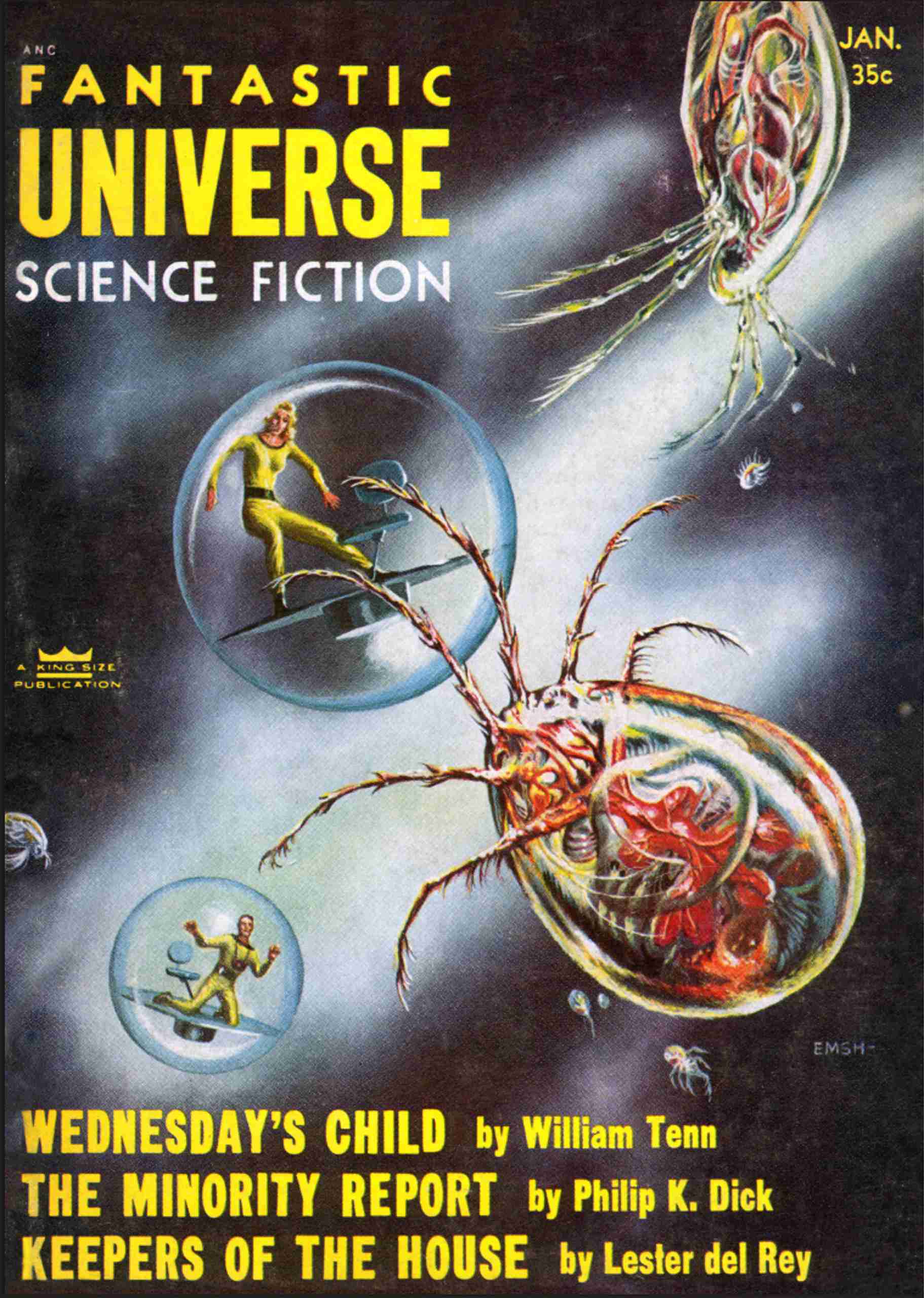
Title: The last quarry
Author: Bryce Walton
Illustrator: Ed Emshwiller
Release date: December 22, 2025 [eBook #77529]
Language: English
Original publication: New York: King-Size Publications, Inc., 1955
Other information and formats: www.gutenberg.org/ebooks/77529
Credits: Tom Trussel (This file was produced from images generously made available by The Internet Archive)
by Bryce Walton
We’ve always believed that when the last man stands alone and defiant beneath the dwindling radiance of a dying sun he will still find a way to ward off disaster—precisely as Bryce Walton has boldly enabled his predecessors to do with such triumphant logic. Do you remember Mr. Walton’s earlier, astounding story of a twenty-first century Jack the Giant Killer? Well, there are slayers far more insidiously terrifying to combat here, each as deadly as a basilisk.
The Servitor’s zombielike eyes mirrored man’s deepest yearnings. By what miracle had human science sired creatures so monstrous?
The sky was the color of mercury, and thick snow fell out of it, heavily as though it would never stop.
Hall had been sitting at the window for almost two hours looking at the snow, as if fascinated by the way it seemed to dissolve everything into a peaceful and white anonymity. He sat heavily, hunched over in the gray light watching the snow, and watching the figures walking along the street.
Almost all of them were walking by twos—hurrying somewhere together. And the ones who were alone were hurrying in a way that said they wouldn’t be alone long.
Hall, a big man, sat heavily as though he would be alone forever. So absorbed was he in the white world beyond the windowpane that the phone rang five times before he realized it.
He scooped up the receiver, a look of embittered weariness seeming to add years to his age.
Yes, indeed he was getting tired of the hunt.
“Hall, I’ve got to see you at once!” said a woman’s voice at the other end of the wire.
“All right, Donna,” Hall replied. “Are you at home?”
The woman’s voice was ragged, and anyway Hall had known he was nearing the end of the hunt. His hands tingled, and some of the old excitement came back....
“Did you get to see Martin?”
“Yes, yes. Just a glimpse of him. But God—that was enough.”
“And—the servant?” Hall asked quietly.
“He wouldn’t let me stay. He’s sharper than any of the others. He knew I wasn’t a public stenographer as soon as he saw me. But I managed to catch a glimpse of Martin through the library door. An accident ... the door came open a little. Then our little public enemy number nine hundred and ninety-nine told me to get out!”
“So it could follow you, of course,” said Hall. “I guess Martin looks pretty bad by now.”
“Horrible. So fat—like a huge white toad in a wheelchair. It was unbelievable. He was staring at me, but he didn’t seem to see me at all.”
“I’ll be right over, Donna,” Hall said. “Be sure it’s me outside your door. Check the identification. We’re the only two who should know about your apartment. If anyone else tries to get in, kill them.”
Hall replaced the receiver. He turned slowly toward the door. They hadn’t wasted any time. One of them was in the hallway.
No. 999 had gone much farther than most of the others. Using human beings to do its legwork. But human beings were comparatively easy to handle.
Hall stood in the middle of the dim room and gave it a last survey, knowing he would never see it again.
My room, he thought. My headquarters for five years.
It was a dingy mouldy three-floor walkup in a section of the city that had been condemned and would soon be destroyed and replaced by glass and chrome and neat little flower gardens.
Just a gray room with a worn carpet, a single narrow bed, a flowered vase lampbase with a dusty shade. A room with nothing distinctive about it to identify it as belonging to Hall, either under that name or any of the other names he used at various times. No books, no magazines—nothing really individualistic.
Except for the topcoat over the chair there weren’t even any clothes in the closet. Hall had only one suit and he was wearing it, as he had worn it continuously for five years. He stood there as though he were about to rent the room, or had only just moved in.
Hall moved silently to the door. The vague sound came again and he evaluated the sound with the trained attunement of his unique training. To others it would have been a sound thoroughly non-suspect in its resemblance to a whisper of wind, or the rustling of torn wallpaper, or even a rat.
Hall could picture the fool standing out there. Some cheap thug, no doubt, who had no idea who had hired him, or what he was really involved in. Some habitual criminal type whom no amount of arrests and treatment had been able to change. And now he wanted to die.
Hall could even tell exactly where the fool was standing, hunched over slightly, listening with his every nerve alert.
Hall stepped forward and jerked the door open. The man was still trying to drag a small revolver up. With an oath Hall grabbed his wrist and swung him around and pressed his fingers into a yielding throat.
The miserable wretch made no sound. He struggled in nervous spasmodic movements like a fish. When he stopped struggling any way at all, Hall put him on the bed and then went out into the hallway.
He didn’t know if the man were dead or not. By the time Hall reached the window and the fire escape he had forgotten all about him. Hall’s efficiency depended, among many things, on dismissing unimportant incidents from his mind.
He had hunted down and destroyed but two less than a thousand of them, and there was only one left who could be thought of as dangerous. So far it was a perfect record, and Hall intended to finish the job before dawn.
He was no longer tired. He didn’t feel that frightening loneliness any more either. He felt nothing now except the finely-tuned machinery of the hunter working, a kind of high but careful excitement.
Two figures stood across the street under the white-crusted trees. He was sure that two more were stationed just at the foot of the third-floor stairwell waiting for a signal from the man who wasn’t going to give them any signal.
It would be easier to go down the fire escape—and faster. He knew that he had to move fast, very fast. There was a chance that he hadn’t learned the identity of No. 999 soon enough to stop him from using vital information he had certainly been squeezing out of Martin. The other Servitors had fixed themselves to some high and important people. But No. 999 had really hit high.
Ben Martin had been the Administrator of the Secret Government Research Center in Virginia for ten years. A month ago he had retired in the face of loud protest—giving illness as an excuse—and a week after that his wife had died of a heart attack.
But even that wouldn’t have aroused any suspicions. It was a word about a servant Martin had recently hired—and a word from his wife before she died—which had given Hall the clue he needed, and started him on his last hunt.
Martin’s wife had hired what she thought was a servant. She could scarcely have been blamed for not knowing that the servant she had engaged in good faith was not a human being, but a Servitor. Neither could she have known that a Servitor was an artificial creation no one could distinguish from a human being except by its destructive influence. And the victim was not in a position to make any such distinctions.
No. 999 had wormed plenty of dangerous information out of Martin. What it intended doing with the information wasn’t Hall’s concern. No. 999 would use it to gain power, of course. He might try to get out of the country with the information and use it against the United States with the backing of some antagonistic nation. No. 999 might even be planning to blast loose at the living breathing humanity which had created it and which it hated with such unhuman virulence.
One thing was certain: No. 999 was far more intelligent than any of the others had been. It had avoided detection for five years where the others had failed. It had benefited from its predecessor’s mistakes. It knew a lot more than it had known five years ago, and it had been built to be highly intelligent to start with.
Hall’s only concern was to kill it.
He went to the window, jerked it up and went through, under the guard rail and down the stairwell in the fire escape platform. The rust and cold iron tore at him, but he didn’t feel it. His hands broke the fall, and then he dropped on down, with bullets chipping around him at the metal.
He ran for three blocks in the gray evening that was fast turning charcoal, and the lights blinking on in the few poor scattered shops hardly seemed like light at all.
He ran into the alley. Wind bit at his cheeks and kicked at his hair, and pushed the smell of the sky like a fading hope into his breathing.
Icicles hung from the lip of the garbage can and a half-dead cat huddled against the brick wall. The animal didn’t even snarl as Hall moved beside it against the wall. The thickening shadows were blue now like the shadows of all his hunting years. Except that this particular year seemed older as Hall waited, as though it had suddenly grown incredibly ancient in a month.
He knew he would never hunt again, so he thought of Donna as he waited. She at least would go on living and hunting. Like so many others, she had started to love him, never once suspecting that he couldn’t love her in return. Her cross was her excessive need for an unreal love. That kind of abnormally centered hunger was dangerous. It was the big human weakness....
He heard the pursuer who had stayed close behind him and ahead of the others, coming on stolidly. It was not even moving with the aliveness of uncertainty down the white funnel of the night. It was no more than a dumb clod carrying out orders against humanity—the orders of something that had never been human.
There he was, in the alley’s mouth. He flinched suddenly, and crouched like some kind of animal, realizing that he was standing vulnerable, wide open to attack.
He started to cry out as Hall swung the heavy soggy weight of the garbage can into his stomach. It struck him and he fell with a groan to his knees, fumbling stupidly in his topcoat pocket for a gun.
Hall used his fist, very sharply, and only twice. He employed the simplest means and worked silently so as to avoid the red tape of apprehension, and all the pretensions of being something else that slowed up his work.
Snow fell on the man’s upturned face, melting on his wide, big-pupiled eyes. Swiftly Hall ran to the other end of the alley and then over to Seventh Avenue and ducked into a drugstore to call Schor, the Security Chief.
A few of the others had hired humans to stooge for them, but only a few. No. 999 was less prejudiced than the others of his kind. The stooges never knew of course.
No one knew that a thousand Servitors, experimental models, had been built by the Dalsan Company six years before. No one knew that they had disappeared of their own volition, and that due to some unforeseeable miscalculation, they had been not only as intelligent as most humans, but had possessed a degree of free will, and a consuming hatred for humans.
The Security Department had decided it would be better if people didn’t know. And that it would also be a good idea if people never found out.
In fact, only three individuals knew now. Allen Schor the Security Chief, Donna Connell a top operative—and Hall. The scientists who had designed and built the Servitors for the Dalsan Company had known, of course. But they had committed suicide.
“Hello, Schor,” Hall said on the telephone. “I’m on my way to Martin’s. I know it’s got him. I’m dropping by to see if Donna’s all right. Then I’m heading straight for Martin’s.” There was a long pause. Then Schor said: “Let us stand by this time.”
“That wouldn’t do any good,” Hall told him. “It might,” Schor persisted. “This one’s the worst. I don’t want anything—”
“—to happen to me?” Hall smiled. “I’m afraid you’re getting sentimental in your old age.”
“Just give me the word to stand by,” Schor pleaded.
“You’d only get yourself killed. You wouldn’t stand a chance. You’ve always wanted to stand by, but you know damn well if I can’t swing it, then you couldn’t do a thing—except die.”
“Well—be careful,” Schor warned. “For God’s sake, Hall, be careful. This is the last one. If something happened to you now, after we’ve gotten clear through to the last one—”
“It’s too late to worry,” Hall said. “Oh ... and tell your wife I really enjoyed our long talk the other night about Plato. Tell her I still don’t agree with her that he was anything but a detriment to history, but that it was a very pleasant evening.”
“Yes, yes—all right. I’ll tell her.”
“Good-bye!”
Hall stared at the door. Donna wasn’t there to greet him.
He knew that she had been in the apartment only a few minutes before. But she wasn’t anywhere in the three-room hideaway now. He knew as well that no one had arrived before him to spirit her away.
She had gone because a part of her over which she had no control had forced her to go. Back to Martin’s—and the Servitor. She had looked too long and too deeply at No. 999, and now she was gone.
The power of the Servitors resided solely in the weakness of the human beings who looked at them, and were looked at in return. And no one was immune, Hall remembered with horror as he ran back down the stairs to get a cab to take him to the airport. No one—not even Donna.
She had resisted all the others, with Hall’s constant support. But No. 999 had looked too deeply. And Donna was just a little too hungry for love. True, there was no better operative than Donna. But she was human and—she believed in magic. Unfortunately a belief in magic was common among primitive tribes, and universal among children, and it lingered on in every civilized human being. Every modern man and woman had some one deep desire, stronger than all the others, and that desire was fortified by the feeling that if this one big urge could be satisfied, they would then be free of anxiety—made whole, and utterly happy. It was a reaching out for some kind of Nirvana.
Donna covered up her deep unconscious loneliness well enough. She was pretty enough. But unconsciously she believed in the magic of a great love that would cure everything. And the trouble with the Servitors was that when they looked at you, you became convinced that they could give you the one thing you wanted most on earth.
They could too. But what a human wanted most, he could die from having. He could die because what a human wanted most was a pathological need. No matter what it was—if he could get all he wanted of it—it killed him.
Hall thought of Martin turning from a gaunt man into what Donna had described as a huge white toad. As soon as he had suspected that No. 999 was Martin’s servant, he had investigated Martin’s background. No. 999 had simply been giving Martin what his neurotic self had always wanted most.
And that was precisely what Donna had gone back to get from No. 999.
As the helioplane lifted and moved off through the snow sea of the sky, Hall remembered the room he had left, the hidden apartment of Donna’s which neither he nor she would ever see again.
Once ... once she had been waiting there for him. They had worked together for years but Hall had never suspected how Donna was beginning to feel about him. It was a better kind of irony that he could think about it now.
The invitation to dinner—the candle light—the red Chianti wine.... That never-to-be-forgotten night with Donna was something that could only happen once with Hall, but then—it hadn’t happened. It might have but it hadn’t. Which was all that Hall could have expected, of course. It was strange that he couldn’t quite rub out the way he had expected more....
He could remember the smell of her perfume, the intimate tones of her voice calling softly to him in his loneliness. He could remember how her dark eyes seemed to come closer and ever closer, and her warm hands on his face....
He could feel her touch again now—the subdued flickering inside him like an uneasy flame. The fire that could smoulder but never leap high.
There was a pain in his throat, and like a flashlight into his dark misery he saw her figure as he had seen it so many times before.
That was his weakness.
But he had conquered it.
He took another cab from the village toward Martin’s country estate. Along a narrow road already carpeted with snow it sped, and the entire world seemed covered, and silent in the night. The only sound was the hissing of flakes that seemed to be falling clear across the land. They descended slow and sullen in a kind of quiet that seemed as endless as the sky.
“No, don’t wait,” Hall said to the driver as the red tail light blinked out.
He left the cab at a turn in the road about half a mile from Martin’s house, and started walking through the snow toward its squares of yellow light. He knew Martin very well from an intricate study of his life. The man had been one of the top research physicists, and yet he had never really grown up. His wife had taken care of him for years, babied him. It was inevitable that Martin should never have really learned to take care of himself. Unconsciously, therefore, he had always wanted above everything else for someone to take care of him.
That was Martin’s weakness.
Martin’s wife had evidently needed help because of Martin’s demands, so she had hired a personal servant—No. 999. The Servitor had killed her. Then, without regret or remorse, it had taken over completely the job of fulfilling Martin’s needs. And it had managed the task far more effectively than Mrs. Martin could have done.
Martin probably didn’t even bother feeding himself any more—just sat day after day in his wheelchair growing fatter and fatter. Being completely taken care of the way he had always wanted and stripped of all of his worries. No more headaches, no more terrible responsibilities. No more decisions involving cobalt bombs or sprays of germs, or something even more hideous to contemplate.
No. 999 would take care of everything.
And Donna?
No. 999 had promised Donna love. She hadn’t been conscious of it, but the promise itself was what she had really been afraid of when she had called Hall earlier, with such terror in her voice.
Of being taken over, of being given what she wanted until she wouldn’t want anything else again, wouldn’t even want to live again....
Hall dropped flat on his stomach and crawled toward the porch, his senses scanning the area. He waited for long minutes, but could detect nothing. He was almost certain that No. 999 wouldn’t be ready. How could the Servitor have any way of knowing that a lucky chain of circumstances had enabled him to act almost immediately.
Hall lay tight against the base of the porch, with its rocks and ice-crusted mortar. Every danger-charged minute seemed only a kind of re-living, for the hunt was no longer anything new. Slowly he raised himself on his elbows and looked through the French windows.
Donna was lying on a couch before the burning fireplace. She might have been dead. Her arms were hanging down on both sides of the couch, and she was staring at the ceiling. In her eyes there was an expectant joy too great to describe or understand. Like a wraith stretched out in a coffin she seemed, waiting for the joys of Heaven.
He remembered again the night when she had offered him everything—far more than she was offering him now. Then at least there had been something full and genuine in her feelings about him. He felt sad, tragically sad, and somehow responsible for her defeat.
He desensitized himself so he would feel no disconcerting pain, and then he resolutely heaved himself over the porch railing, and without pausing to draw breath hurled himself through the glass of the French windows. But the element of shocking surprise wasn’t enough. For an instant Hall saw the lean deadly form through a glittering spray of splintering wood and slivers of glass, and rolled desperately to seek cover behind a chair.
The three explosions rang deafeningly in his ears, and the impact of the slugs seemed to drive him into the gray rug of the floor. If No. 999 had been clasping a circuit gun Hall would no longer be alive.
Desensitized, he felt nothing except the bitter black gall of possible failure. His shattered leg wouldn’t function. He hitched himself around, and as he did so a wheelchair came out of a door to the right of the blazing fireplace. Martin was covered with an Indian blanket. He was a huge mound of unrecognizable suet.
No one could have remembered at that moment that the figure had ever been Martin. Hall heard a frightful voice, a grotesque wheezing sigh of babyish irritation. But nothing moved behind the sound except the pink rosebud lips, and even they moved with a heavy torpor.
“Richard ... who is it? What is happening here?”
The puffed marshmallow face, the eyes like those of a grazing animal faded as Hall twisted on around, moving the circuit gun. The voice, the image of Martin, had all filled up no more than a second’s space of time.
So it was called Richard now! It was moving along the wall as though in some strange fashion it had moved out of the wall itself. Immaculate, lean and trim in a black suit, with its white face destitute of any emotion that Hall could see. Yet how odd that that face had been so effective in reflecting the deepest, most despairing needs of human beings. It was an evil kind of mirror.
It fired again. Hall slid forward, feeling his body throb. He saw the hole appear in his coat sleeve. His fingers spread out uselessly and the circuit gun slipped away from him....
Hall felt the leg of the heavy table against his other hand. Richard smiled down and aimed the revolver relentlessly at Hall’s head. Only it wasn’t really a smile at all.
“So you’re not a man,” it said.
“No,” Hall replied, in a defiant whisper.
“You’ve done a good job of concealing the fact.”
Hall didn’t move. “I threw up a different oscillation, so you would think I was human,” he said. “It made you just careless enough to make the difference. You and the others.”
“What difference? You die. You’re not like the rest of us, though.”
“Not exactly,” Hall said. “I was number one thousand, only my motivations were different. I was made for only one purpose—to kill you.”
“Then they didn’t do such a good job with you. You must realize that I’m going to kill you.”
“You won’t kill me,” Hall affirmed quietly.
He moved like an explosion. The table crushed the middle of No. 999 into the wall. Hall fired a full charge from the circuit gun into its neck and—into the vital thermostat.
The face of No. 999 became a melting lopsided mask. One of its eyes fell out, and twisted on a wiry strand in the lamplight like a pendant.
No. 999—Richard—was dead.
The end of the road.
No human could have done it. A human had needs that were stronger than his ability to resist a Servitor, even for a minute. And the limitation had included Schor, Donna, every human victim. A human was too vulnerable. But now No. 999 lay on the floor, a pile of synthetic clay. It too had become vulnerable. Hall heard a scream....
Martin’s body fell from the wheelchair and lay, a shapeless mound of real clay on the floor, as though released from some overmastering compulsion. Was he dead—or just paralyzed?
It was no concern of Hall’s. His concern had never been with men.
He managed to get up and half fell toward the door. A feeling of uselessness was taking hold of him. His efficiency was now gravely impaired.
He wasn’t even aware that someone was standing just outside the door. Hall glanced at Donna, still waiting for the love he could never give her. Still waiting for some perfect host to supply the substance of all her childhood dreams of a glorious, all-consuming love....
It would be better with a human being, real....
Once she had almost made Hall feel human. But that had been a long time ago.
He opened the door.
Schor was standing there, his hands in his topcoat pockets, a little hunched man with an owl’s face and snow on his eyebrows. Behind him was an official Security car, and two Security officers stood at the foot of the porch steps with their guns ready.
Schor held Hall in his arms, and patted his back with a slow, deep affection.
“I came out anyway, Hall,” he said, his voice husky. “Thought you might need me for this last show. I wanted to come.”
I won’t be working with him again, Hall thought. Friendship ended when his task was done. “If you’d arrived a minute earlier it would have killed you,” Hall said. “It had more power than any fifty of the others.”
Schor essayed an anxious laugh. “Sure, I know. I’m only human.”
“Well—all your worries are over,” Hall said.
“Are the remains taken care of, Hall?”
Hall nodded. “Like the others. A few more minutes and there won’t be any trace of him except a charcoal gray suit.”
“Convenient,” Schor said. “I’m referring, of course, to that built in, self-incinerating device.”
“Very,” Hall acknowledged.
The Security officers were coming in. Someone was using a phone ... announcing that Martin was dead. Hall heard Donna moan vaguely and he was glad she was alive.
No. 999 was a melting pile against the wall, fading away. Hall started limping down the steps.
“Where are you going?” Schor asked quickly. “My wife wants you to—”
“Tell her good-bye,” Hall said, abruptly. Schor’s face had a painful expression. He whispered. “Don’t go. It isn’t over. Listen. You can keep on working—together with me, Hall. You can hunt men just as well as—”
“No,” Hall said. “Only men should hunt men.”
When Schor left him, Hall continued to crawl through the snow until he was well away from Martin’s house. The snow thickened as he crawled on until he was lost among the dark naked trees by a frozen creek. He could see nothing but a wilderness of falling snow. He stood there as the snow fell more thickly, covering him over gradually until he blended into the pale silence. Then he pressed the button.
A moment later he was melting slowly away like a snowman reacting to some private sun of its own.
He had been made to do a job, and now it was finished and he ...
... No. 1000.
This etext was produced from Fantastic Universe, January 1956 (Vol. 4, No. 6). Extensive research did not uncover any evidence that the U.S. copyright on this publication was renewed.
Obvious errors in punctuation have been silently corrected in this version, while spelling and hyphenation have been kept as is.