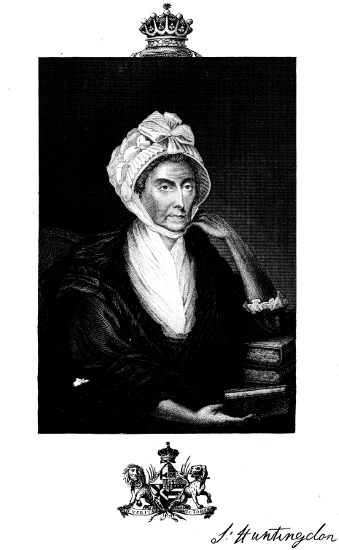
S. Huntingdon
Title: The life and times of Selina, Countess of Huntingdon, Vol. 1 of 2
Author: Aaron Crossley Hobart Seymour
Release date: December 21, 2025 [eBook #77517]
Language: English
Original publication: London: William Edward Painter, Strand, 1844
Other information and formats: www.gutenberg.org/ebooks/77517
Credits: Brian Wilson, Karin Spence and the Online Distributed Proofreading Team at https://www.pgdp.net (This file was produced from images generously made available by The Internet Archive/American Libraries.)
THE LIFE AND TIMES
OF
SELINA, COUNTESS OF HUNTINGDON.
S. Huntingdon
BY A MEMBER OF THE HOUSES OF SHIRLEY AND HASTINGS.
SIXTH THOUSAND—WITH COPIOUS INDEX.
VOL. I.
ENTERED AT STATIONERS’ HALL.
LONDON: WILLIAM EDWARD PAINTER, STRAND;
AND JOHN SNOW, PATERNOSTER ROW.
1844.
[v]
It was the express wish of Lady Huntingdon, that, at least for some years after her decease, her memory should be suffered to rest, and her actions to make their own impression on the minds of men. In deference to this wish, all attempts at the publication of her Correspondence have been resisted by her noble relatives; and it is only at the present day that a Cadet of her illustrious family, after long years employed in the collection and examination of the documents and papers to which he alone, perhaps, was in a condition to have easy and continued access, has been induced to arrange his materials into the form of a Memoir of the Life and Times of Selina, Countess of Huntingdon.
Circumstances having prevented the author from personally superintending the publication of this work, a large share of responsibility has been thrown on those to whose hands it was committed; but the task was a labour of love, and the publication has been conducted with all possible regard to the public demand for ample information, to the feelings of the living, and the memory of the dead.
Among the illustrious characters of the eighteenth century, no one has shone more conspicuously in the religious world, or enjoyed a greater share of heartfelt esteem and love, than the[vi] venerable Countess of Huntingdon. Above all her celebrated contemporaries, she was honoured with a life of continued usefulness, protracted to the utmost period of mortal existence; with extraordinary talents, ample means, and a head and heart alike devoted to promote the “glory of God in the highest, and on earth peace and good-will towards man.”
Her body has long been committed to the earth from which it sprang, and her soul has returned to God who gave it, but she has left on earth a testimony which will outlive monuments of brass and stone—a reputation which has spread to the corners of the world—and a name which is reverenced by all whose approbation is praise.
The curiosity that has been as generally expressed as universally felt, to know more of the life and character of this, in the best sense of the word, illustrious woman, is a feeling which ought to be respected; and it has at length become a duty to make every effort in order to save from destruction those invaluable records of her heart and feeling, those delightful traits of her distinguished friends, those heart-stirring pictures of her private and every-day life, and those important records of her public services to religion and humanity, which are contained in these volumes, and which, but for the present publication, might have expired with their compiler, or have left but a vague memory of her excellence, except in those instances where the sacrifice of her fortune has raised imperishable monuments to her piety.
The object of the present work has been to afford a view of the “life and times” of this distinguished woman, so clear and ample as to render superfluous all future or collateral efforts at illustration. Every fact and incident of her long life is here recorded—every triumph of the cross under her vigorous and well-directed leading—every place of worship opened under[vii] her auspices—and every mark of divine favour and encouraging grace bestowed upon her labours.
Conscious of the purity of his motive, and having for all his incentive the desire to pay just tribute to the memory of the departed saint whose name he honours, the author has spoken truth from his heart, resolved to flatter no one—to know no fear in the discharge of his duty. He has sought, with candid zeal, to avoid every evidence of a sectarian or party spirit in his statements. Bigotry, on both sides, may censure; but the just and generous, on all sides, will approve his course. Narrow prejudices are already vanishing; and good men, of all denominations, are ready to embrace the truth and each other. The good Countess was, in this respect, before her age; and it is her Catholic and Christian spirit which appears to have inspired her kinsman in the composition of this Memoir. Read in the same spirit, it will serve to accelerate the benevolent current of true godliness, and to sweep away the narrow and contracted dispositions which would check its overflow or turn aside its course.
With this feeling, the author has drawn, without hesitation, from all accessible sources, the illustrative matter of his Memoir. The biographies of Whitefield, Wesley, Venn, and the works and letters of Fletcher, Berridge, Romaine, Watts, Hill, and other eminently pious individuals, have supplied invaluable contributions to the work; but its more valuable portion consists in the original letters and anecdotes with which it teems, and in the straightforward integrity of purpose in its author. Of himself and of his work, he says—
“To God, only wise, the Author of every good and perfect gift, my humble acknowledgments are paid. His grace rendered the subject of this Memoir what she was—His wisdom directed her pious and benevolent efforts for the extension of the Redeemer’s kingdom—and His Spirit supported her in her[viii] departing hours. To Him, therefore, and Him alone, whose influence I implore, I commit these Memoirs, such as they are, in the hope that He will vouchsafe His blessing on a work which originated in an ardent desire to promote His glory; and that He will render it an instrument to extend the knowledge and experience of the glorious Gospel of God our Saviour.”
With these glowing words of the pious author, the conductors commit his work to the candid judgment of the enlightened reader; remarking merely, as they are in justice bound to do, that the religious institution now known as “The Connexion of the late Countess of Huntingdon” does not incur the slightest responsibility with regard to this work; and that the reverend author of the Introduction to the present volume has undertaken to resume his pen for a similar introductory paper to the second volume of these Memoirs.
[ix]
PART I.
Man, amidst an almost infinite variety of circumstances, and modified, both in body and mind, by a thousand accidental influences, is, in every age and country, essentially the same. The os sublime and the mens alta alike distinguish him from the other inhabitants of the earth, and show, whatever may be his complexion and mental training, that God has made him to have dominion over the works of his hands—has put all things in subjection under him. Nor is there less of identity in man’s moral propensities than in his corporeal and instinctive powers. Bent from his original rectitude, he stoops towards earth and the things of earth, and gives sad proof of having lost affection for the Source of his existence, and of being inclined to worship the creature more than the Creator. The rude savage, the superstitious devotee, and the intellectual sceptic do not like to retain God in their knowledge—that God who is “glorious in holiness,” who is partially made known to his creatures by the works of his hands, and more fully revealed, and in a more encouraging light, by the words of his mouth.
This Atheistic spirit laboured with a giant’s strength to deface the character of Deity impressed on the world before the flood; had cursed the earth with abominable idolatry, or with heartless[x] superstition, before the coming of our Lord in the flesh; and, not satisfied with the mischief effected under dispensations of mercy less intelligible and distinct, has, to a most awful extent, corrupted a Church, professedly Christian, as it had polluted both the Jewish temple and the Patriarchal tent. To educe good out of evil is the province of the Supreme Good; to pervert the good, and, so far as it relates to his own perceptions and conduct, to abuse and prostitute it to the worst of purposes, is, alas! the work of man.
Nothing can more affectingly evince the truth of this remark than the contrast of the Church of Rome with the Church of the Apostles; than the pomp and mummery, the dogmatism and tyranny, the secularity, the superstition, and the heathenism of Popery, with the simplicity, the spirituality, and the divinity of that religion which the writers of the New Testament advocated, for which they all suffered, and for which most of them died. The vapour which, rising from the twofold shores of Corinth and the province of Galatia, annoyed St. Paul, continued to spread itself and to increase in density, till the true Church of Jesus Christ became scarcely perceptible, and ultimately was totally obscured by the thick and dark cloud. Let the mind proceed from the apostles to Eusebius, thence to Augustine, and the next advance is to settled darkness, rendered visible by a few solitary rays of piety—real, though faint and sickly—and the transient scintillations of scholastic wit and learning. The page of ecclesiastical history, though inscribed by persons less evangelical than the Milners, will show that even superstition was only one shade in the dark ages; that vital godliness, as if in disgust, had fled from the Church, as she was pleased to call herself, to deserts, and mountains, and dens, and caves of the earth; that justification before God, by faith alone in Jesus Christ, the “Articulus stantis aut cadentis Ecclesiæ,” as Luther termed it, was buried beneath the records of Councils and the volumes of Fathers; and that men, having renounced the Lord as their RIGHTEOUSNESS, were without him as their STRENGTH. Like Samson, the Church was shorn of her energy and deprived of sight—the sport of the Philistines.
[xi]
It was the glory of the Reformation that it struck at the root of the evil. The Church of Rome, not satisfied with seeking righteousness by the works of the law, must needs arrogate to herself a property in works of supererogation, and impudently bring it into the market; but for this daring imposition on common sense, the fire of Luther might have been employed rather in consuming the drapery of the Man of Sin than in the destruction of his person. The sale of indulgences, however, was such an outrage on the principle of the Gospel, that it roused his powerful mind, even when only partially enlightened, to bring all its united force against the blighting and unholy doctrine of human merit. Thus, in the process of resuscitation, the Holy Spirit, by the agency of the Reformers, instead of restoring vital heat by friction at the extremities, breathed into the dead Church the breath of life, and restored to her a living soul. Animation diffused itself through a vast range of nominal Christians, converting them into living members of the body of Christ; and the life, which was felt to be redeemed, was consecrated to Him “who loved his Church, and gave himself for it.”
The number of truly converted persons was, no doubt, very considerable in the days of the Reformers, and the hallowed work progressed under their survivors, both on the continent of Europe and in Great Britain. It would, however, be false charity to conclude that all Protestants, even during the warmth and freshness of the Reformation, were true Christians: an acquaintance with the history of the times and with human nature, as well as with the subsequent condition of Protestant Christendom, will compel us to say, “that all were not Israel who were of Israel;” that multitudes, from political and secular motives, and from the force of custom, or from a conviction of the truth rather as an intellectual than as a moral proposition, protested more against the errors of the Man of Sin than against his iniquities, and were more anxious for emancipation from the thraldom of superstition, than from the bondage of corruption. The easy transition, indeed, of the majority from one state to another, under Henry the Eighth and the youthful Edward; their coming back again to Popery under Mary; and their[xii] ready return to Protestantism under her sister, proves that, however many loved the truth, even unto the death, more were indifferent to its divine claims, and accommodated themselves to the times. The Vicar of Bray was only one of many who ebbed and flowed with the ocean, and of those who will always show that a national religious improvement may be effected where the renewal of the mind in the great body of society does not take place. Worldly men will preserve the element of their character amidst great external modifications—an element as decidedly opposed to the holy and humbling truths of the Gospel in the Protestant as in the Papist, though exhibited under different forms.
This was the case in the reign of Elizabeth. We hail, indeed, with feelings kindred with those of Milton when he escaped “the Stygian Pool,” the settling of a better order of ecclesiastical affairs, the liberty of prophesying given to the ministers of Christ, and the eminent piety, learning, and zeal of many of the clergy. Her reign is as illustrious for men devoted to the kingdom of our Lord Jesus Christ as it is for patriots and politicians: the preaching and the writings of those men, some of whom were the survivors of the martyrs, and of whom others seemed to grow out of their ashes, tended much to instruct the people in the great principles of the Gospel. These labourers, however, were few, compared with the extent and population of their spheres of action, and they could not fail to leave the mass of the people without the knowledge of true religion, and, consequently, unrenewed by its power. Nay, the majority of those who professed to guide the blind were themselves, it is to be feared, destitute of the wisdom that cometh from above, and thus unqualified to show to others the way of salvation; for we are informed that, “by the Report of the visitors to the Queen, it was found that comparatively very few of the Popish Bishops, Clergy, and Heads of Colleges, resigned their preferments on account of the new order of things; and it was remembered that the greatest part of them went with the tide in Edward’s reign, and veered about as readily with the wind on the accession of Mary.” (Custance’s Reformation). It would have been ex fumo dare lucem, indeed, if such men had done[xiii] much towards the evangelizing of the nation. The Queen, herself a genuine Tudor, aiming at absolute sovereignty, wished to encircle her throne with clouds of darkness, admitting only so much light as might show that she, and not the Bishop of Rome, was seated on it. She chose, and with reason, men of powerful minds to assist her in working the State machine; but she by no means wished that society at large should be enlightened with principles which, raising the intellectual as well as the moral character, and cherishing a consciousness of this elevation, would probably lead her subjects to question, where it was more convenient to her that they should obey. “One preacher is enough for a county,” was the recorded expression of her sentiment on this most important subject.
We must, therefore, conclude, that under this extraordinary ruler—for one does not like to contemplate her as a woman—the nation, as a whole, with all its improvements, was dark, or, at best, only relieved with a dim religious light. Under James, the Bible was re-translated, copies of it were multiplied, and ministers sincerely Protestant greatly increased in number; but there was a re-action in theological sentiments, which tended to lower the tone of piety in those even who were truly religious. Calvinism, as it is called, had, before this reign, in numerous instances, assumed an appearance of harshness, in the employment of supralapsarian terms, though so generally and ably supported by men of the most holy character and kindly hearts; but now the influence of Arminius was experienced. A large part of the clergy went over from scholastic terms and metaphysical notions, more speculative than practical, to doctrines which, as they reject the grace by which we are saved, necessarily leave the soul, amidst all its moral boastings, in the bonds of iniquity. This obscuration of the glorious Gospel of the blessed God by low, self-righteous instructors, more than by any affectation of godliness, in the time of the Protector, prepared the nation for that laxity, both of morals and of creed—that licentiousness and infidelity, which stamp infamy on the reign of the second Charles. The ribaldry of Rochester, the[xiv] wit of Butler, and the buffoonery of South, all had a baneful influence on the court and the nation, and obscured the holy light which had appeared to radiate from the stake of the martyrs.
Morals and religious principles have perhaps never been at a lower ebb in our nation, since the Reformation, than during this period—a period, the true character of which it is one of the most difficult studies in English history to determine. Even the best men of the age, in their joy for a restored monarchy, and bewilderment at the splendour and politeness of the Court, were led to give a false colour to their records of these times, and to merge the all-important considerations of morals and truth in the theoretic speculations of a civil and religious establishment. Whatever may be said on the question of equity, there can, we imagine, be no doubt in an unprejudiced Christian, that the ejecting of the Nonconformists, and the patronizing of a very different class of men, taken as a whole, both ecclesiastic and secular, was a heavy blow inflicted on true piety, and introduced a style of preaching which operates as a soporific on the moral sense, and as a cloud on the moral vision. Most victories are costly, and the triumph of monarchical principle, however desirable, by overlaying the living and evangelical spirit with a uniform machinery, in too many instances worked by careless hands, was gained at an expense which it is not easy to calculate, but which must qualify the pleasure suggested to a loyal heart by the return of the twenty-ninth of May.
England may well be proud of the science and literature of the subsequent age, and call it Augustan. Newton and Locke, in the worlds of matter and of mind; Dryden, Pope, and Thomson, in that of the imagination; and Addison, with a host of prose writers, on subjects of taste and morals—have given it claims to distinction, and illuminated its pages in intellectual history. These writers obtained great influence over the nation, and whatever good they effected, by giving currency to thought, they directed it in channels leading from evangelical piety, to sentiment, and ethics, and taste, or to physical knowledge. The waters were indeed clear and beautiful, but they were unhealthy, and, in some respects, the opposite of the prophetic[xv] stream, of which it is predicated, “Everything shall live whither the river cometh.” The most chaste and moral of these popular works, though recognizing Christianity, are unvivified by its spirit; and while they advocate the claims of virtue, found not their argument on the principles of the Gospel, and teach, often not otherwise than as a heathen would have taught, social duties and graces, rather than “the obedience of faith.” The founder of Methodism was not far from the truth when he said that few things were more unfriendly to the progress of the Gospel than the national fondness for Addison’s Spectator.
Nor was the political feeling without its baneful influence on the religious character of the people. As the fashion of the Court, under the profligate Charles, had raised up many wits, like Butler, to caricature true piety, by confounding it with hypocrisy, so the repeated efforts made to restore the Stuarts filled Protestants with a dread of change, and induced the High Church party, most unjustly, to consider all Dissenters, however attached to the House of Brunswick, and however excelling in all the virtues of true religion, as confederate with the Scottish Nonjurors and Jacobites; and thus, by an easy though fallacious transition, to identify evangelical doctrine with revolutionary propensities.
This, as the following work will show, was a reason assigned by the local magistrates of the day for their leaving the Methodist preachers unprotected to the mal-treatment of the mob, in opposition to royal pleasure directly expressed; and this, too, was the pretext under which the magistrates themselves avowedly and ostensibly excited the ignorant to violence and outrage. Let us not be deemed illiberal if we notice, as one cause of the general apathy, the great popularity of Tillotson. It would, indeed, be uncandid and unjust not to recognize his numerous excellences, both as a man and as a writer, and his merit of giving a more popular character to pulpit addresses in the Established Church; but whatever other good his sermons may have effected, there was little in them to send the people home imbued with the great principles of the Gospel, and sympathizing with St. Paul, when he exclaims, “But God forbid[xvi] that I should glory, save in the cross of our Lord Jesus Christ, by whom the world is crucified unto me, and I unto the world.”
An almost total absence of evangelical doctrine—the blood of sprinkling—and an evident carelessness about the great object of the Christian ministry, even where there may not be gaiety and immorality of conduct, are so palpably inconsistent and reprehensible in a professed minister of the Gospel, that the evil, in a great degree, neutralizes itself; but when moral excellence combines with truth indeed, animated with zeal and affection, yet lacking that prominence of the all-important doctrines of revelation which the Holy Ghost has in all ages been pleased to bless to the glorifying of Christ, a sort of quietus is ministered to the conscience, and decorum and formality take the place of “repentance towards God, and faith towards our Lord Jesus Christ.” Such writers as Tillotson, and his older friend, Barrow, will be studied with advantage by men spiritually minded, because such readers will give an evangelical cast to the strong reasoning and beautiful illustrations of these writers; but where the tone of feeling is to be received from the authors themselves, we cannot but think that it will be cold. English literature, from Steele to Johnson, though its period has become an era in the history of morals, has had the same tendency. Amusement and instruction, taste and decorum, were circulated among a people now denominated “a reading nation;” but who ever heard of a sinner being brought to true repentance, and to rejoice in Christ Jesus, having no confidence in the flesh, by a paper of the Spectator or of the Rambler? All these movements, indeed, had a beneficial influence on society, in preparing the way for a revival in religion, by exciting the attention and teaching the mind how to think; but the direct effect, in most cases, of such instruction, was either to lull the moral sense altogether, or to awaken it to a class of feelings of a self-righteous character, and, as such, opposed to the Gospel—the righteousness which is of God by faith.
Thus the slumbering embers of the martyr-flame had died out, and a degeneracy of doctrine and profligacy of manners had spread a chilling and destructive influence over a partially enlightened[xvii] community; and infidelity, political convulsions, and even literature itself, had each contributed its quota to form a national soporific. Happily, there were a few in the national pulpits who had not drank of this cup, and among the Dissenters some holy men, such as Watts and Doddridge, well represented those who had suffered for conscience sake after the Restoration. Theological writings, too, had accumulated, which will continue to instruct and bless the Church of Christ till she shall know even as she is known: but there was a heaviness in those folios, and too much of evenness in the public ministrations of the word, for an age which needed a moral disturbance to prevent its sleeping the sleep of death. Arguments against infidelity, and ethics cold though beautiful, were the usual themes of the parochial desk; and the withering influence of Arianism, or of a heartless orthodoxy, produced death in many of the Dissenting congregations. England and Wales, therefore, in an improved condition of politics and literature, and perhaps also of morals, was generally benumbed by the torpedo of formality; and the vital feeling and zealous activity of Christianity were known to the few only, and these rather mourned over the state of things in secret, than exerted themselves in public to effect an alteration.
It is not for us to hazard even a conjecture respecting the number of persons who truly loved our Lord Jesus in this country at the earlier part of the last century. Piety is essentially a quiet and secret thing, and, though it labours to do good at all times, is greatly dependent on circumstances for the platform on which it acts—that may be the domestic hearth, or it may be “a spectacle to the world.” At this period, as if wearied with political distractions and disgusted with the impertinence of infidelity, the pious of all denominations very much sought retirement. We may hope, therefore, that the number of those who loved the Gospel was much greater than at first, and by comparison with the present age, it seems to have been; and perhaps no documents furnished greater proofs of this delightful fact than the early correspondence of the Countess of Huntingdon. This gives the most satisfactory evidence that “honourable women not a few,” and some men also in the highest walks, were quietly[xviii] exercising the Christian graces, and waiting and longing for better days, before the Methodists had obtained publicity. Christians in the lower ranks of the community, though less conspicuous, were not likely to be far behind the rich and the noble in true religion; from which we infer that a goodly number, even in those seasons of visible lifelessness, was reserved by himself for the God of all grace, especially to hail and to aid the new era which was about to rise on the Church. Extending charity, however, to the utmost point which correct judgment will allow, we must look back on that period with feelings far from pleasurable. The Church is not likely to be in a healthy state when she is without exercise, and when she makes little or no aggressions on the world; nor can she richly enjoy those blessings herself which she is not anxious to distribute to others. But there are speculations which may not become us: “the day shall declare it.”
Happy was it for the world that this slumbering did not continue—that men arose, who, instead of enquiring about the number who should be saved, themselves strove to enter in at the strait gate, and zealously endeavoured to excite others to follow their example. The rise of Methodism now took place, in a band of brothers who studied at Oxford. Mr. John Wesley, in point of time as well as of talent, may be considered the first, though it is evident that He, who brings the blind by a way they know not, was simultaneously preparing the hearts of many for a most efficient co-operation in the blessed work about to be performed. Such were Whitefield, Charles Wesley, Ingham, and Hervey. The piety of these great men was deep and energetic, and it clothed them with so much boldness, that, although their pretensions were humble, and they were in a great degree the creatures of circumstances, as well as of divine grace, yet they were distinguished from their contemporaries—even from the best of them—and appeared the representatives of the ancient prophets and apostles. Men felt that they were the servants of the Most High, and earnest in declaring unto them the way of salvation. Like the ministry of John the Baptist, theirs was a voice in the wilderness, and while it proclaimed the kingdom of heaven, it was heard with no ordinary attention.
[xix]
The reader who, piously curious, desires to trace the movements of the Holy Spirit on the heart, will find no common gratification in the following records: he will behold, in so many parts of the great deep, numerous symptoms of life, and will conclude that they are not to be attributed to any artificial or partial heat, but to divine power. “The Spirit of God moved upon the face of the waters.” There is, perhaps, no error to which we are more exposed than that of supposing that the originators of a series of movements, à priori, saw the whole process from the beginning, and acted from plan rather than from circumstances. We see the connexion which an event has with its antecedent, and therefore imagine the agent was well acquainted with the tendency of the one to effect the other. Universal experience, however, contradicts this inference: even in the history of men of this world, whose plans are often sagaciously formed, and whose object is more definite, we see that the ultimate success is more owing to a skilful and prompt use of accidents than to the guidance of an original design. No philosophy, independently of experience, could foresee the branching and stately oak in the acorn.
To assert, therefore, that the founders of Methodism began their career by chalking out their future operations, is to pay a compliment to their foresight at the expense of truth, and of the continued superintendence of that Being who apportions to his servants their daily work, as much as he does their daily bread. God has a plan, but he does not expose it to the workmen of the temple: it is enough that each knows what he has to do, and how to perform it, at the present moment.
The following history will abundantly verify these sentiments. Can a sober man, however systematized, imagine that anything like the impression which was made would have been effected, both in our own country and in America, if the leaders of the cause—all of whom were attached to the Established Church—had maintained what is called regularity, and a tame canonical obedience to men who had no spirit of enterprise in their character? Would the highways and hedges have been visited? Would the various branches of orthodox Dissenters have been[xx] roused to co-operation? Would lay agency have been made available to the furtherance of the cause? Would the more regular clergy themselves have been so active and useful within the pale of their own community, if there had been no pressure and provocation from without?
Now, nothing is more evident than that this irregularity was unintended. Zeal, indeed, was enkindled, but it would have continued to warm the churches had it not been dislodged by ecclesiastical power. The fire, however, was inextinguishable; and being forbidden to burn on the usual altar, it sought every avenue of escape, and visited and blessed other places. Field-preaching succeeded rejection from the churches; and the Countess of Huntingdon, who thought only of chaplains for her preachers, and of Episcopal ordination for her students, was at length compelled, very much against her will, to violate ecclesiastical order, and shelter herself and her companions in zeal under the Act of Toleration. This growth in the cause of the Gospel, and extension of their original design, characterize these “workers together with God,” and secure all the glory of the plan, as it does that of the execution, to Him: while this view of the economy meets a thousand objections urged by the enemies of vital godliness against this labour of mercy.
If, turning from the more general to the more particular instance, we contemplate the chief subject of the following biography, we shall recognize the same characteristic of divine guidance. How steadily and beautifully does grace advance in the Countess! We follow her, in the present history, from the girl of nine years of age, impressed with solemn thought and purposes on witnessing a funeral, through a series of changes, till we mark an elevation of spirit truly and sublimely Christian, which rises above the splendour of a court—which dares to allow zeal to act, first in visiting the poor—then in opening the drawing-room for noble hearers of the Gospel—then in the employment of laymen and in providing chapels for the accommodation of the multitude, even although those chapels were to be denominated conventicles! The CHILD becomes a MOTHER in Israel indeed, and theologians of the first-rate powers feel it a privilege to[xxi] learn the way of God more perfectly from the lips and the pen of this saintly woman.
No contemplative mind will peruse The Life and Times of the Countess of Huntingdon without noticing the power and the beauty of divine grace, when brought in contact with a vigorous mind, elevated in society by nobility and fortune. That energy which, unsanctified, gives obstinacy to prejudice and pride to vanity, when under the control of “the meekness of wisdom” leads to boldness of investigation, the avowal of Evangelical truth, and to humility, which, in the sight of God, is of great price.
It will be difficult, indeed, to find an instance of the power of God unto salvation brighter than that here exhibited. A woman, a noble personage, a favourite at Court, the wife of a nobleman who only tolerated and aided her zeal as he was won over by her chaste conversation; a widow, and at times much afflicted in her children—living, too, in an age when the gaiety and superstition of the nation were scarcely disturbed by the sober and reasonable voice of truth—every disadvantage overcome, and a meek yet firm profession made of love to our Lord Jesus Christ.
Nor is the providence less conspicuous than the grace of God in the Life of the Countess, as related to her Times. There was needed a hallowed work in progress among the poor and middle classes in society, but the means of reaching these, which the necessity of the case directed, such as preaching in fields and in barns, were not likely to command the attention of the rich and the noble. There needed, therefore, an instrument to bring the Gospel into friendly contact with the highest ranks. This instrument was the Countess. There was an attraction and an influence about her which were felt by many of the great in an extraordinary degree; and not only the courtly Chesterfield, the political Duchess of Marlborough, the gay and frivolous Nash, but the infidel Bolingbroke paid her marked and sincere homage, and listened to the preachers whom she patronized and commended. Many will, doubtless, be astonished, on reading the following pages, to find so large a number of distinguished personages brought by this[xxii] zealous woman to hear the word of truth, as well in the despised conventicle as in her own habitation. It was thus, by applying the discharging-rod to the two extremes, that a shock was given, and that circulation and sensibility were effected in the social body. Many of the rich and more of the poor met together, and their place of meeting was the foot of the cross. How wisely God adapts his agents to his work!
The personal character of the Countess of Huntingdon will be best seen in the general history of her Life and Times: she stands, indeed, so connected with almost all which was good in the last century, that the character of the age, so far as religion is concerned, was in some measure her own. It is not insinuated that she alone impressed that character on the Church, but that she entirely sympathized with it, and was not a whit behind the foremost in affection for souls and zeal for God—in spirituality of mind and fervour of devotion—in contrivance and energy for the extension of the Gospel—in a large and disinterested soul. If she did not appear as the public advocate of the cause, it was because a woman is forbidden to speak in the Church; and if she did not more excel in literary productions, it was because she knew her proper talent—that she was rather fitted to think with vigour and comprehensiveness, than to marshal words to please a critical review. She never, indeed, seems to have thought of the manner and structure of her sentences, but only of giving utterance to the sentiments—always pious, frequently burning—which filled her breast. Those who may be inclined to blame her letters, as deficient in smoothness and perspicuity, will do well to remember that they were not intended for the public eye; they will also admit that some minds of a high order and especially endowed with a power over others, are remarkable for an abruptness of expression which sometimes involves confusion: of this Cromwell was a striking instance. The mental powers of Lady Huntingdon were anything but feeble. No lady, however pious and exalted by rank, could have commanded such respect as she did, unless in the possession of intellectual superiority. The sincerity of her piety and the ardour of her zeal were felt by the first personages of the land, as they were combined[xxiii] with the force of her understanding; and it is believed that the recognition of this fact, in the following work, will, by all impartial readers, be considered a sufficient refutation of Dr. Southey’s poetic imaginings of her mental weakness, and, indeed, insanity!
It will, likewise, be seen that the vigour of the Countess’s mind and the boldness of her zeal were in perfect keeping with the feminine graces. She was not an Elizabeth. The lady, the friend of the poor, the wife, the mother, the sister, the widow—all private and domestic relations—were adorned by her elegance and affection, her meekness of wisdom and boundless kindness, her chaste and winning conversation. The reader will find it difficult to judge whether she appears to the greater advantage when co-operating with the spirits which were effecting a change throughout the moral world, or when quietly moving in domestic and social life.
The circumstances, too, in which she was placed, were favourable to the development of her character. Light enough shone on the professing Church to render the darkness visible; the efforts of the Oxford band, with those of other pious ministers of various denominations, both in England and in Scotland, had brought the deadness of merely formal Christianity into juxtaposition with the living truth of the Gospel, and the Countess saw the contrast, and her eye affected her heart. She wept, she vowed, she acted. She determined to throw all the weight of her influence into the scale of the Gospel; and while considerations of sex, of the disposition and views of her beloved lord, of the rank she held, and which she was so well qualified to support, would have restrained an ordinary mind of common piety from public interference, these very circumstances to her appeared to be talents of great worth, and she was excited to employ them to the greatest advantage. She beheld the rude and cruel treatment which holy men endured, as well from the educated and wealthy as from the ignorant and poor—from magistrates and ecclesiastics as much as from private individuals; and for what? For promulgating the truth—truth which she felt was essential to human salvation—and she generously stepped[xxiv] forward to their defence and encouragement. She had magnanimity enough to break the ranks of her order, and attraction enough to induce many to follow her example. She was as persevering as she was courageous; and you see her, having passed the rubicon, steadily advancing to the capitol. She remembered Lot’s wife; and no opposition—no unforeseen difficulty—no associations necessary to the furtherance of her work, however plebeian, could induce her to look backward. When, therefore, it was necessary to remove out of the drawing-room into the chapel, she did remove; and when she could no longer conduct the services with an ecclesiastical regularity, to which she was attached to the utmost reasonable extent, she braved the reproach of the conventicle; and as the demand for help increased, while clerical labourers were few, she went before even Wesley in taking advantage of lay agency. She followed where, in her judgment, God was pleased to direct; and, secluded from her former elegant associations, she ultimately gave up herself entirely to the direction of her college and of her more immediate Connexion, and to the most really Catholic co-operation with all who loved the Lord Jesus in sincerity.
The world has, perhaps, never seen a finer instance of the power of divine grace, in enabling the mind to rise above all the unchristian restraints of State etiquette, the prejudice of early ecclesiastical associations, and the spirit of party and sectarianism. The last triumph will be viewed by some who understand human nature as the greatest of the three; for it is easier to shake off the trammels of rank and of education, than to merge the individuality of selfishness in the general cause of souls and of Christ. In this fine characteristic, to the glory of her age let it be recorded, the Countess met with much sympathy. Her Life and Times will prove how grand, how sublime, were the views of most of the distinguished agents in the work of God at that stirring period. With the exception of the leader of the great section of Methodism—whose intention to organize a distinct body we do not blame—all seemed to be so intent on the general good of the Church, that they overlooked the advantage of their own particular denominations, and were too eager to[xxv] pluck men as brands from the burning, to spend time and energy in discussing questions of comparative non-importance. It was, indeed, to be expected that a time of greater leisure and calmness would follow, and that then an opportunity would be furnished of investigating the merits of the respective modes of worship and forms of government. We blame not this exercise when kept in a subordinate station; but who, possessed of a shred of the Countess’s mantle, does not weep over the state of truly Evangelical parties in the present day of strife? So far from combining their powers to oppose and overturn infidelity and idolatry, they more than waste a large portion of them in direct contention with each other. This is an unholy warfare indeed—a species of fratricide. What, indeed, is Churchmanship or Dissent compared with the salvation of the soul? The spirits of the noble group encircling the truly Catholic Selina return an answer—“What indeed!”
Should the perusal of the following pages enkindle no breast into zeal for Christ, they will certainly fail of their reward; for we can scarcely conceive of anything, next to the history of our blessed Lord and his apostles, more likely, under the divine blessing, to set the heart on fire than the facts here recorded. Zeal, glowing, active, untiring zeal, animates all the story, and forms the living soul of the entire body: and while, on the one hand, we behold how God honours zeal in his servants, in making it tell so powerfully on the world; on the other hand, we see the proper workings of the doctrines of the cross, and how they consecrate the affections and form the true philanthropist. Let the world be brought under the action of the same principles, and what a scene of brotherly kindness and charity, of mutual zeal, of millennial happiness, will it exhibit!
The publication of the Life and Times of the Countess of Huntingdon will appear to many very opportune, as a spirit of missionary enterprize has been conferred on the Churches, and success has attended, in an extraordinary degree, the efforts which have been made in the South Sea Islands,[1] so dear to the heart of this zealous and almost prophetic woman;[xxvi] and as the Lord has put it into the hearts of many to seek, with growing earnestness, the revival of this work at home. Those who look upon meetings of Christians for especial prayer for the Holy Ghost, or upon public exertions in endeavouring to impress the conscience and win over the heart to Christ, with surprise, as though some new thing had happened, will stand corrected as they find how the present movements were anticipated by those holy personages whose lives are here recorded. Had their successors in the great work been warmed with their zeal, and secured the aid of the Almighty with prayer, united and continuous as theirs, the Church would have presented a different appearance. We only, therefore, seem to be returning to the piety and fervour of the days of old, when we become most anxious to work out our principles and to win souls to our divine Redeemer. The rise and success of Methodism, in all its sections, are the models of revival meetings, and an encouragement to engage in them.
Those persons who may look on the gracious principle of the Gospel with fear or disapprobation will remember, that if the sacred band to which these pages refer did, in their zeal for the Gospel of the grace of God, ride over the forms of dull and lifeless ethics, which had been so generally adopted, and if they did offend the vicious and the self-righteous, their object was as pure as it was benevolent. They carried with them “letters of commendation” in the holiness of their own conduct, and personified the apostolic sentiment, that “grace reigns through righteousness.” Let any man of impartial mind read the following biography, and then say that the tendency of a gratuitous salvation is licentious. Nor could such a leader, however attached to one of the great sections of Methodism, with any fairness, charge the followers of the other leader, as a body, either with an undermining of moral requirements, or with a rejection of the righteousness which is of God by faith. Let facts, and not à priori reasoning, guide the judgment, and it will decide that the doctrines of faith are doctrines which purify the heart; and that the essential, plain, scriptural statements and belief of those doctrines, and not scholastic and metaphysical[xxvii] refinements, are the great instruments, in the economy of our salvation, of transforming the mind and of adorning the character with the Christian graces. The day is gone by, we trust, or at least it ought to have passed away, when either party shall condemn the other for deductions which are not admitted; when the Calvinist shall charge the Wesleyan with denying a sinner’s justification in the sight of God by faith alone in Jesus Christ; and when the Wesleyan shall teach his hearers to identify the Calvinistic scheme, as it is generally received, with the monstrous practical error of Antinomianism. “My little children, love one another.” Perhaps few, since the days of the catholic and amiable Apostle John, have repeated these words with more sincerity and emphasis than Selina, Countess of Huntingdon. She chose her side of the controversy—and, we think, with reason; but however strongly those writers might have expressed themselves, whom, on the whole, she approved, and whatever transient alienations may have taken place, they were clouds passing before the sun: the habit of her mind was Christian affection, and her prayer was for grace to be with all them that love our Lord Jesus Christ in sincerity.
A rigid examiner and critic of the following papers may, perhaps, be able to detect some variations, at different periods of her life, in the minuter parts of the Countess’s creed, as well as in her attachments—a temporary leaning towards mysticism, or towards legality, or towards hyper-Calvinism; but these aberrations were kept within bounds, and mutually corrected each other. He will, however, never find a want of true Catholicity, or the temperament of piety low and frigid. The fervour of her Christian affections would not allow her to be indifferent and heartless; her strong sense and reverence for the holy Scriptures preserved her from the practical errors of the mystics; and her views of the Saviour were too enlarged to admit of self-righteous pride; while her concern for the glory of God and the salvation of mankind was too abiding and active to suffer her to be otherwise than “zealous of good works.” She practically as well as theoretically confessed her imperfection and[xxviii] sinfulness, whilst she rejoiced in the all-sufficiency of God her Saviour; and of no one perhaps whose name adorns the history of the Church of Christ can it be said with greater propriety than of this extraordinary Lady—“Many daughters have done virtuously, but thou excellest them all. Favour is deceitful, and beauty is vain; but a woman that feareth the Lord, she shall be praised. Give her of the fruit of her hands; and let her own works praise her in the gates.”
J. K. FOSTER.
Cheshunt College,
April 15th, 1839.
Antiquity of the Shirley Family. Saxon Origin. Norman Dignities. Royal Alliances. Foreign Crowns. British Coronets. The Clanricardes. Battle of Aghrim. The Parkers. The Lord High Chancellor found guilty. The Levinges. Irish Alliances. Birth of Lady Selina. Her Early Character. First Religious Impressions. The Grave of Youth. Piety. Private Prayer. Fashionable Life. Marriage. The Huntingdon Family. Its Ancestry. Tho Earl of Huntingdon. His Character. “Tears of the Muses.” Self-righteousness. The Methodists. Lady Margaret Hastings. The Light of Religious Truth. Force of Example. Conversion.
Lord Huntingdon. The Bishop of Gloucester. Mr. Whitefield’s Preaching. Its effects. Dr. Southey. Dr. Hurd. Archbishop Seeker. First Methodist Society. Lady Anne Frankland. Lord Scarborough. Dr. Young. Lady Fanny Shirley. Mrs. Temple. Lady Mary Wortley Montague. Lady Townshend. Mr. Pope. Mr. Ingham. Mr. Charles Wesley. Miss Robinson. Lord Lisburne. The House of Lords. Hammond the Poet. Somerville the Poet. Sarah, Duchess of Marlborough. Anecdotes. Duchess of Buckingham. Anecdotes. Duchess of Queensbury. Lord Orford. Lady Hinchinbroke.
Early Methodists. Lay Preaching. Mr. Bowers. Mr. Cennick. Itinerants. Ordination. Mr. Maxfield. Mr. Wesley’s Opinion of his Call. Mr. Wesley’s Sanction. Bishop of Derry. Fetter-lane Society. Conduct of the Bishops. Opposition without. Bickerings. Shaw. The Moravians. Separation in Fetter-lane. First Division. The Society in Moorfields. Enthusiasm. Pluralities. Bishop Burnet. Mrs. Mitchell. Anecdote. Mr. Charles Wesley and the Moravians. David Taylor. General Baptists. Mr. Bennett. Grace Murray. John Nelson.
The Clergy. Mr. Simpson. Mr. Wesley’s Opinion of him. The One Wrong Principle. Mr. Graves. His Recantation. His Explanatory Declaration. Lady Huntingdon’s Schools. Lord Huntingdon’s Character. Miss Cooper: her Death. Letters. The Poor. Death of Mr. Jones. The Poor Penitent’s Death-bed. Mr. Wesley’s preaching on his Father’s Tomb. Donnington Park. Lady Abney. Dr. Watts. “The Grave.” Dr. Blair. Letters. Colonel Gardiner. His Marvellous Conversion. Letters.
Lay-Preachers. Mr. Wesley’s Defence of them. Converted Clergy. Death of Lady Huntingdon’s Sons, George and Ferdinando Hastings. First Methodist Conference. Dr. Doddridge. Letters from Lady Huntingdon. Mr. Jones. The Pretender. Lord Carteret. George II. Death of Colonel Gardiner. Letters to Mr. Wesley, Dr. Doddridge, and Charles Wesley.
Death of the Earl of Huntingdon. His Lordship’s Epitaph. Letters from Sir John Thorold. Lady Huntingdon’s Piety. Letter to Dr. Doddridge. Lady Kilmorey. Duchess of Somerset. Welsh Preachers. Lady Frances Hastings. Mrs. Edwin. Lady Huntingdon’s adherence to the Church of England. Letter from Dr. Watts to Dr. Doddridge.
Mr. Whitefield arrives in England. Preaches at Lady Huntingdon’s. Letters. Lord Chesterfield. Lord Bolingbroke. Anecdotes of Mr. Whitefield’s Preaching. Appointed Chaplain to Lady Huntingdon. Christian Soldiers. Bishop of Exeter. Colonel Gumley. Mrs. Edwin. Lord St. John. Lady Suffolk. The Court Beauties. Lord Chesterfield. Marquis of Lothian. Lady Mary Hamilton. Anecdotes. Lady Townshend. English Nobility at Lady Huntingdon’s. Sir Watkin Williams Wynn. Persecution of the Welsh Methodists. Liberal Conduct of the Government. Marmaduke Gwynne, Esq.
Dr. Gibbons. Dr. Gill. Mr. Darracott. The Young Lord Huntingdon. Lord Chesterfield. The Jews. German Minister. An Impostor. David Levi. Lady Fanny Shirley. Mr. Whitefield and Mr. Wesley. Ashby-place. Mr. Baddelley. Lady Huntingdon’s Illness. Lady Anne Hastings. Mr. Hervey. Bishop of Exeter. Mr. Thompson. Duke of Somerset. Mr. Moses Bruce. Bishop Lavington.
Mr. Romaine. Earthquake in London. Mr. Romaine appointed Chaplain to Lady Huntingdon. Ashby-place. Dr. Stonhouse. Dr. Akenside. New Jersey College. Governor Belcher. President Burr. Dissenting Ministers. Dr. Doddridge. Education of Ministers. Mrs. Hester Gibbon. Mr. Law. Mr. Whitefield’s success at Rotherham. Lord Lyttleton. Mr. Hervey. Dr. Doddridge.
Mr. Whitefield at Ashby. Mr. Moses Browne. Mr. Martin Madan. Lady Frances Hastings. Dr. Stonhouse. Mr. Hartley. Death of the Prince of Wales. Anecdote. Lady Charlotte Edwin. Dr. Ayscough. Lord Lyttleton. Death of Lord Bolingbroke. Dr. Trapp. Dr. Church. Anecdotes.
Mr. Whitefield visits Scotland. Dr. Erskine and Dr. Robertson. Scotch Nobility. Mr. and Lady Jane Nimmo. Letter to Lady Huntingdon. Mr. Wardrobe. Mr. Hervey: his “Theron and Aspasio.” Letters to Lady Huntingdon. Lady Fanny Shirley. Prince and Princess of Wales. Mr. Hervey’s Method of Preaching. Letter from Lady Huntingdon. Mr. Steward. Lady Hastings.
History of Mr. Whitefield’s Tabernacle and Tottenham-court Chapel. Whitefield in London. Mr. Broughton. Countess of Hertford. Fetter-lane. Mr. Cennick. Methodist Society. Tabernacle commenced. Welsh Preachers. Moorfields. Lay Preachers. Nobility at the Tabernacle. Opposition of the Dissenters. Anecdotes of Dr. Watts. Lady Huntingdon and the Moravians. Sir Thomas and Lady Abney. Tabernacle opened. Long-acre Chapel. Hon. Hume Campbell. Tottenham-court Chapel opened. Mr. Edward Shuter. Foote the Player. “The Minor.” Lord Halifax. Duke of Grafton. Mr. Fox. Mr. Pitt. Mr. Rowland Hill. Captain Joss. Mr. Matthew Wilks. Mr. Knight. Mr. Hyatt. Mr. Whitefield’s Will.
Mr. Venn begins to attract notice. Revival of Religion in the Established Church and among the Methodists. By whom first commenced. Mr. Venn’s acquaintance with Mr. Broughton, one of the Original Methodists. Dr. Haweis. Mr. Law. Illness of Mr. Venn. Accompanies Mr. Whitefield to Bristol. Remains with Lady Huntingdon at Clifton. Letter from Mr. Whitefield. Letter to Mr. Venn from Lady Huntingdon. Mr. Whitefield’s Letter to Mr. Venn. Oxford Students. Dr. Haweis. Mr. Whitefield’s Letter to Dr. Haweis. Convicts. Preaching to the Nobility at Lady Huntingdon’s. Handel. Giardini. Musical Composers.
Lady Huntingdon and Mr. Fletcher. Introduction to Lady Huntingdon by Mr. Wesley. Bishop of London. Letter to Mr. Charles Wesley. Mr. Fletcher preaches and celebrates the Communion at Lady Huntingdon’s. Letter to Mr. C. Wesley. Letter to Lady Huntingdon. Mr. Fletcher appointed Vicar of Madely. Writes to Lady Huntingdon and Mr. Charles Wesley. Visits Mr. Berridge. Letter to Lady Huntingdon. Induction to Madely. Success of his Ministry. Letter to Lady Huntingdon.
Rise of Methodism in Yorkshire. Mr. Ingham. Count Zinzendorff. Mr. Delamotte. Mr. Okeley. Mr. Rogers. Letter from Mr. Whitefield. The United Brethren. Mr. Batty. Lady Betty Hastings. Ledstone Hall. Mr. Ingham’s Marriage with Lady Margaret Hastings. Count Zinzendorff visits Yorkshire. Moravian Settlement at Fulneck. John Nelson. Mr. Whitefield’s Letter to Mr. Ingham. Mr. Grimshaw. Lord and Lady Huntingdon visit Ledstone Hall. Mr. Charles Wesley. Mr. Graves encourages John Nelson. Persecution. Provincial Magistrates. John Nelson taken to Prison. Liberated by the influence of Lady Huntingdon. Lord Sunderland. Letter from Lady Huntingdon to Mr. Ingham. The Vicar of Colne. Mr. Grimshaw’s Opinions. Moravian Nobles. John Cennick. Mr. Ingham leaves the Moravians. John Allen.
Mr. Whitefield returns to England. Writes to Mr. Ingham. Visits Yorkshire. Lady Huntingdon in Yorkshire. Extraordinary Occurrence. Mr. Graves. Mr. Milner. Mr. Grimshaw. Conference at Leeds. Mr. Ingham is chosen General Overseer. Mr. Charles Wesley. Mr. Whitefield at Haworth. Inghamite Churches. Church Discipline. Inghamite Preachers. Mr. Newton visits Yorkshire. His Letter to Mr. Wesley. Anecdote of his Preaching at Leeds. Mr. Romaine’s Opinion of the Inghamite Churches. Lady Huntingdon at Aberford. Mr. Romaine preaches in Mr. Ingham’s Chapels. Mr. George Burder. Mr. Romaine at Haworth. Mr. Grimshaw. Sandeman’s Letters. Church Government.
Mr. Venn removed to Huddersfield. Mr. Burnett. Lord Dartmouth. Dr. Conyers. Visitation Sermon. Mr. Thornton. Lady Huntingdon visits Yorkshire. Mr. Romaine. Mr. Wesley. Mr. Madan. Letters from Dr. Conyers to Lady Huntingdon. Letter from Mr. Venn. Mr. Titus Knight. Letter from Mr. Grimshaw. Death of Mr. Grimshaw. Letter from Mr. Venn. Letter from Dr. Conyers. Letter from Mr. Fletcher. Lady Huntingdon, with Messrs. Townshend and Fletcher, visit Huddersfield. Illness of Lady Huntingdon. Mr. Whitefield in Yorkshire. William Shent. Mr. Venn’s Irregularities. Mrs. Hannah More. Defence of Mr. Venn. Letter from Mr. Fletcher. Mrs. Deane. Lady Irvine. Mr. Occum, the Indian Preacher. Captain Scott. The London Shunamite. Mr. Wilson.
Melancholy State of Mr. Ingham. Lady Huntingdon and Mr. Venn. Illness and Death of Lady Margaret Ingham. Letter from Mr. Ingham. Letter from Mr. Romaine. Mr. Ingham’s Treatise on the Faith and Hope of the Gospel. Mr. Riddell. Lady Huntingdon sends Students to Yorkshire. Letter from Mr. Riddell. Mr. Joseph Milner, of Hull, attends Lady Huntingdon’s Preachers. Begins to Preach the Gospel. Mr. Myler. Letter from Lady Huntingdon to Mr. Romaine. Mr. Tyler’s Labours at Hull. Letter from Lady Huntingdon to Mr. Milner. York. Mr. Wren. Letter from Lady Huntingdon. Letter from Mr. Wren. Mr. Glascott. Mr. Wells. Mr. Powley. Lady Huntingdon’s Chapel at York.
Death of the Hon. Henry Hastings. Lady Huntingdon’s Exertions at Brighton. Joseph Wall. Mr. Whitefield’s first Visit to Brighton. Lady Huntingdon sells her Jewels. The Chapel opened by Mr. Madan. Mr. Romaine. Oathall. Captain Scott. Anecdote. Old Abraham. Letters from Mr. Fletcher and Mr. Romaine. Christian Perfection. Mr. Maxfield and Mr. Bell. Letter from Mr. Romaine. Mr. Madan. Letters from Messrs. Berridge, Romaine, and Venn. Mr. Jones (of St. Saviour’s).
Dr. Haweis. Mr. Romaine driven from the Chapel of the Broadway. Lord Dartmouth. Letters from Messrs. Romaine and Conyers. Sinless Perfection. Letters from Messrs. Romaine and Wesley. Erasmus, Bishop of Arcadia. Mr. Toplady. Letters from Messrs. Fletcher and Berridge. Death of Lady Selina Hastings. Colonel Hastings. Account of Lady Selina’s Death. Letters from Lord Dartmouth. Mr. Venn. Mr. Fletcher. Mr. Berridge. Oathall Chapel. Letters from Mr. Berridge. Mr. Venn’s “Complete Duty of Man.” Letters from Messrs. Venn and Berridge.
Mr. Romaine. Lectureship at St. Dunstan’s. Lord Mansfield. Darkness Visible. The Bishop of Peterborough. Popular Election. St. Ann’s, Blackfriars. Probation Sermon. Contest. Canvassing. Scrutiny. Second Election. Suit in Chancery. Gratitude of Lady Huntingdon. Mr. Jesse. Mr. Shirley. Mr. Romaine’s Views of his Preferment. Lewes. Lady Huntingdon procures an opening for Mr. Romaine, for Mr. Madan, and Mr. Fletcher. The Oratorio. Musical Taste of Mr. Madan and Dr. Haweis. Lady Huntingdon’s Chapel at Lewes opened and re-opened. Mr. Mason. His Work on the Catechism. Mr. Edwards, of Ipswich. Mr. Berridge and the Bees. Southey’s “Reflections.” Their Refutation. Character of Berridge. His Wit. His Labours. Berridge and the Bishop.
Mr. and Mrs. Powys. Letters. Mr. Whitefield. Mr. Fletcher. Mr. Venn. Sir C. Hotham. Howel Harris. Chapel at Brighton re-opened. Letters. Mr. Romaine. Mr. Talbot. Mr. Berridge. Anecdote of the Countess. Mr. De Courcy. Mr. Vincent Perronet. Mr. Toplady. Mr. Bliss. Mr. Pentycross. Chapel at Chichester opened. Chapels at Petworth, at Guildford, and Basingstoke. Enlargement of that at Brighton. Mr. Thomas Jones.
Public Fast. Extracts from Lady Huntingdon’s Letters. Prayer-meetings for the Nation. Mr. Venn. Mr. Berridge. Singular Effects of his Preaching. Mr. Romaine and Mr. Madan’s visit to Everton. Mr. Wesley preaches at Everton. Convulsive Motions amongst the Congregation. Letters to Lady Huntingdon. Lady Huntingdon visits Mr. Berridge. Mr. Venn and Mr. Fletcher preach at Everton. Loud Cries amongst their Hearers. Duke of York. Dr. Dodd. Murder of Mr. Johnson. Lord Ferrers. Tried by his Peers. Visited in Prison by Lady Huntingdon. Singular Conduct of Lord Ferrers. Execution.
Proposed Union among the Evangelical Clergy. Methodism in Scotland. Lady Frances Gardiner. Mr. Townshend sent to Edinburgh. Mr. De Courcy. Lady Glenorchy. Mr. Wesley. Lady Maxwell. Samson Occum, the Indian Preacher. Mohegan Indians. Dr. Haweis. Affair of Aldwincle. Lady Huntingdon purchases the Advowson; writes to Mr. Thornton. Lady Huntingdon’s Letters to Lord Dartmouth and Mr. Madan. Anecdote.
Progress of Piety at Cambridge. Rowland Hill. Oxford. St. Edmund’s Hall. The Six Students. Expulsion. Sir Richard Hill. Dr. Horne, Bishop of Norwich. Mr. Goodwyn. Charges against Lady Huntingdon. Account of the Students, and the Proceedings against them. Letter from Lady Huntingdon. Lady Buchan. Letter from Mr. Wesley. Cheltenham. Lord Dartmouth. Letter from Mr. Venn. Mr. Wells. Mr. Trinder. Mr. Whitefield to Mr. Madan. Mr. Madan to Mr. Wesley. Lady Huntingdon to Mr. Alderman Harris. Gloucestershire Association. Lady Huntingdon to Mr. Brewer. Chapels at Gloucester, Worcester, and Cheltenham. Lady Huntingdon’s Letter concerning them.
Chapel at Bath. Pope the Poet. Warburton, Bishop of Gloucester. Lady Fanny Shirley. Charles Wesley. John Wesley. Beau Nash. Anecdote. Mr. Hervey. Methodist Conference. Mr. Larwood. Potter, Archbishop of Canterbury. Dr. Doddridge. Hon. Mrs. Seawen. Mr. Cruttenden. Mr. Neal. Dr. Doddridge visits Bristol. Visits Lady Huntingdon at Bath. Anecdote. Dr. Oliver. Dr. Hartley. Prior Park. Death of Dr. Doddridge. Mr. Grinfield. The Moravians. Count Zinzendorff. Elizabeth King. Lady Gertrude Hotham. Death of Miss Hotham. Marriage of Sir Charles Hotham. Death of his Lady. His own Decease. Death of his Mother, Lady Gertrude. Mr. Theophilus Lindsay. Mrs. Brewer. Lord Huntingdon and Mr. Grimshaw. Lord Chesterfield and Mr. Stanhope. Countess of Moira. Mrs. Carteret and Mr. Cavendish. Countess Delitz. Lady Chesterfield. Earl of Bath. Lord Cork. Anecdote of George II.
Chapter at Bath. Bretby Hall. Mr. Townsend and Mr. Jesse. Mr. Romaine. Mr. Shrapnell. Mrs. Wordsworth. Letters from Mr. Romaine. Chapel opened at Bath. Mr. Whitefield and Mr. Townsend. Mr. Fletcher’s Labours at Bath. Lord and Lady Glenorchy. Letter from Lady Glenorchy to Lady Huntingdon. Death of Lord and Lady Sutherland. Lady Huntingdon, the Wesleys, and Mr. Whitefield. Letter from Lady Huntingdon to Mr. Wesley. Horace Walpole. Lady Betty Cobbe. Nobility attend Lady Huntingdon’s Chapel. Letter from Mr. Whitefield to Mr. Powys. Mr. Stillingfleet. Mr. Venn and Sir Charles Hotham. Anecdotes of Mr. Venn. Mr. Andrews and the Bishop of Gloucester. Mr. Venn at Trevecca. Mr. Lee. Captain Scott and Mr. Venn. Anecdotes of Captain Scott. Letter from Mr. Venn. Mr. Howel Davies. Anecdote. Dr. Haweis. Mr. Cradock Glascott’s Letter from Mr. Fletcher.
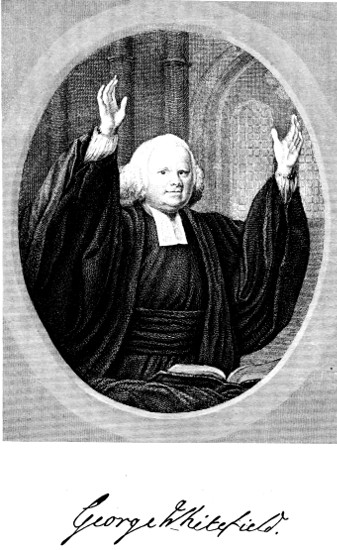
George Whitefield
[1]
LIFE AND TIMES
OF THE
COUNTESS OF HUNTINGDON
Antiquity of the Shirley Family—Saxon origin—Norman dignities—Royal alliances—Foreign crowns—British coronets—the Clanricardes—Battle of Aghrim—the Parkers—The Lord High Chancellor found guilty—the Levinges—Irish alliances—Birth of Lady Selina—her early character—First religious impressions—The grave of youth—Piety—Private prayer—Fashionable life—Marriage—The Huntingdon family—its ancestry—The Earl of Huntingdon—his character—“Tears of the Muses”—Self-righteousness—The Methodists—Lady Margaret Hastings—The light of Religious Truth—Force of Example—Conversion.
SELINA, Countess of Huntingdon, the most extraordinary woman perhaps of an age fertile in extraordinary characters, and in many respects the greatest whom England has produced, was descended from the ancient and honourable house of Shirley—a house as remarkable for a long successive union of piety with nobility, as for the rarely-equalled purity of its genealogical tree, one of whose ancient branches is coeval with the time of Edward the Confessor. All its intermarriages having taken place with the most ancient and illustrious English houses, many of its line having distinguished themselves in the military history of their country—it would be difficult to find a family more illustrious or better entitled to the claim of true nobility. The devotion and fidelity they have always borne to their Sovereign Princes are great and singular. Their high and renowned alliances joined them in a near degree of propinquity of blood to the Royal Stem of England, both Saxon and Norman; to those of France, Scotland, Denmark, Aragon, Leon, Castile, the Roman Empire, and almost all the princely houses of Christendom. Within the kingdom of Great Britain, they are connected with the most honourable and princely houses of the Barons of Berkeley, Dukes of Norfolk and Buckingham, Earls[2] of Arundel, Oxford, Northumberland, Shrewsbury, Kent, Derby, Worcester, Huntingdon, Pembroke, Nottingham, Suffolk, Berkshire, and to most of the ancient and flourishing families of the nobility and gentry of the monarchy. Thus the living descendants of this illustrious house have the honour to issue from the blood of Emperors, Kings, Princes, Dukes, and some of the most renowned Earls. The lands and seigniories which they have held from the remotest period have added to their honour; but, above all earthly things, we hold their ardent and inextinguishable zeal for the advancement of the service of the Most High God, and their singular liberality towards the Church—for they have, at all periods, evinced the sincerity of their devotion by the great number of places of worship they have founded, built, re-edified, endowed, or enriched, with their means and revenue, in various parts of the kingdom.
The Shirleys derive their descent from Sasuallo or Sewallus de Etingdon, whose name (says Dugdale, in his “Antiquities of Warwickshire”) argues him to have been of the old English stock; which Sewallus resided at Nether-Etingdon, in the county of Warwick, about the reign of Edward the Confessor, the seat of his ancestors for many generations before. After the Conquest, the lordship of Nether-Etingdon was given to Henry, Earl of Ferrars, in Normandy, who was one of the principal adventurers with the Norman Duke William, and was held under him by this Sewallus; to whose posterity, in the male line, it has continued to the present day.
From this Sewallus descended, in a direct line, Sir Henry Shirley, Bart., who was sheriff of Leicester in the last year of the reign of James the First. He married, in 1615, Lady Dorothy Devereux, the youngest of the two daughters of that great but unfortunate favourite of Queen Elizabeth, Robert, Earl of Essex, and sister and co-heiress to her brother, the last Earl of Essex. By this alliance, the Earls Ferrars quarter the arms of France and England with their own; the Earl of Essex having been maternally descended from Richard Plantagenet, Earl of Cambridge, grandson to King Edward III., and grandfather to King Edward IV., and also from Thomas Plantagenet, Duke of Gloucester, youngest son of Edward III. Sir Henry Shirley had, by the Lady Dorothy Devereux,[2] two sons and[3] one daughter, Lettice,[3] who married William de Burgh, Earl of Clanricarde. His eldest son, Charles, died unmarried about the year 1649; and Sir Henry Shirley was succeeded by his son, Sir Robert Shirley, who, for his loyalty to Charles I., was[4] imprisoned[4] in the Tower of London, by Oliver Cromwell, where he died during his confinement, not without suspicion of poison. It was his singular praise to have done the best in the worst times, and to have hoped even in the most calamitous circumstances. By his wife, Catherine, daughter of Humphrey Okeover, Esq., of Okeover, in the county of Stafford, he had two sons: Sir Seymour Shirley, his successor, and Sir Robert, afterwards Earl Ferrers;—also two daughters: Catherine, married to Peter Venables, Baron of Kinderton; and Dorothy, to George Vernon, Esq., of Sudbury, in Derbyshire. The only son of Sir Seymour Shirley, by the Lady Diana Bruce, daughter of the Earl of Aylesbury, surviving his father but a short time, the title of Baronet devolved on his uncle, Sir Robert Shirley, the grandfather of Lady Huntingdon; which Sir Robert Shirley, First Earl Ferrers, was born at East-Sheen, in Surrey, during his father’s confinement in the Tower; and on December 14, 1677, his Majesty King Charles II., taking into consideration that this Sir Robert Shirley was grandson and heir to Lady Dorothy Devereux, the younger of the two sisters and heirs of Robert Devereux, the last Earl of Essex of that family, and that the issue male of the elder sister and co-heiress, the Lady Frances, who married William Seymour, Marquis of Hertford, was then extinct, was pleased to confirm unto him and his heirs the ancient Baronies of Ferrars of Chartley, Bourchier, and Lovaine; which honour had been in abeyance between the Ladies Frances and Dorothy Devereux, and their descendants, from the decease of their brother, the Earl of Essex, without issue. Sir Robert Shirley being so declared Lord Ferrars of Chartley, &c., was introduced into the House of Peers, January 28, 1677–8, and took his place according to the ancient writ of summons to John de Ferrars, his lineal ancestor [February 6, 27th Edward I.] He was Master of the Horse and Steward of the Household to Queen Catherine, consort of King Charles II., and was sworn of the Privy Council to King William [May 25, 1699]. In the reign of Queen Anne, he was again sworn of the Privy Council [November 25, 1708], according to the act for the union of the two kingdoms; and on the 3rd September, 1711, was advanced to the titles of Viscount Tamworth and Earl Ferrars, by reason of his descent from the ancient and noble family of Ferrars.
His Lordship was twice married, and had a family of twenty-seven children. His first Countess was daughter and heiress to[5] Lawrence Washington, Esq., of Caresden, in Wiltshire, who, dying October 2, 1693, was buried at Stanton-Harold; he married, as his second wife, in August, 1699, Selina, daughter of George Finch, Esq., of the city of London. This Lady Ferrars died March 20, 1762. Robert Shirley, the eldest son, was created Earl Ferrars, but died before his father. He had been twice married; first, to his cousin, Catherine, daughter to Peter Venables, Baron of Kinderton, who dying in her nonage, he married, secondly, Anne, daughter of Sir Humphrey Ferrars, heiress to her grandfather, John de Ferrars, Esq., of Tamworth Castle, last heir male of the Barons Ferrars of Groby. She bore him three sons, Robert, Ferrars, and Thomas, and a daughter, Elizabeth. Robert became, by his father’s death, heir-apparent to his grandfather, and was elected Knight of the Shire for the county of Leicester in the last Parliament called by Queen Anne. He survived both his brothers, and likewise died of the small-pox in the life-time of his grandfather, July 5, 1714, unmarried, leaving his sister Elizabeth, married, in 1716, to James Compton, Earl of Northumberland, his heir; she died March, 1740–1, leaving an only daughter, and heiress, Charlotte, Baroness Ferrars, first wife of George, Marquis Townshend.
Earl Ferrars departed this life on the 25th of December, 1717, and was succeeded in his title and estates by his second son, the Honourable Washington Shirley, who took his seat in the House of Peers as Second Earl Ferrars. His Lordship was father to Lady Huntingdon, and was born June 22, 1677, and named Washington, after his mother, the daughter and heiress, as we have said, to Lawrence Washington, Esq., by Eleanor, sister to Sir Christopher Guise, Bart., of Hynam Court, in the county of Gloucester. Lord Ferrars was a nobleman of great honour and probity, and a lover of justice; the affability and benevolence of his disposition, and the goodness of his understanding, made him beloved and esteemed throughout his life. The respect and veneration paid to him while he lived, and the universal lamentations at his death, are ample testimonies of a character not easily to be paralleled.
Lady Huntingdon’s mother was descended from a family of great respectability and antiquity, seated at Parwick, in the county of Derby, as early as 1561. Her great grandfather, Richard Levinge, Esq., of Parwick, married the aunt of Thomas Parker, an eminent lawyer, who rose to the dignity of Lord High Chancellor and Earl of Macclesfield. It was an extraordinary instance of the fallibility of human virtue, that this every way distinguished character, one of the great ornaments of the Peerage, who had so long presided at the administration of justice,[6] should himself be arraigned as a criminal on charges of corruption. He was tried at the bar of the House, and unanimously pronounced guilty; in consequence of which he was removed from his high office and fined thirty thousand pounds, as a punishment for his offence. He was the second Lord Chancellor of England impeached by the grand inquest of the nation for corruption of office; and, like his great predecessor, Lord St. Alban’s, found guilty of the charge. The prosecution was carried on with great virulence; and though rigid justice demanded a severe sentence, yet party zeal and personal animosity were supposed to have had their weight in that which was passed upon him. His Lordship’s son succeeded, as second Earl of Macclesfield; and his only daughter, Lady Elizabeth Parker, married Sir William Heathcote, of Hursley, in the county of Southampton, Bart. Upon the male descendants of this lady the honours of her father are entailed, in default, at any period, of the direct male line.
Her Ladyship’s grandfather, the Right Hon. Sir Richard Levinge, Knight, of Parwick, Recorder of, and member for, Chester, having attained great eminence at the English Bar, was appointed, in 1690, Solicitor-General in Ireland and Speaker of the House of Commons. He was created a Baronet of that kingdom by Queen Anne, October 26, 1704; he was a man of good judgment and great integrity; and set himself with great application to the functions of his important post. In 1711, Sir Richard was nominated Attorney-General, and in 1720, Lord Chief Justice of the Court of Common Pleas. A few years after his removal to Ireland he purchased the estate of High Park, now Knockdrin Castle, in the county of Westmeath, the present residence of the Levinge family. Sir Richard married, first, in 1680, Mary, daughter and co-heiress of Sir Gawen Corbyn, of London, Knt., by whom he had three sons and three daughters; the eldest of the latter, Mary, married Washington, Earl Ferrars; the second, Dorothea, married first Sir John Rawdon, of Moira, and afterwards, Dr. Charles Cobb, Archbishop of Dublin; the third, Grace, married Edward Kennedy, Esq., of Mullow, in the county of Longford.
Sir Richard Levinge married, second, Mary, daughter of the Hon. Robert Johnson, one of the Barons of the Exchequer in Ireland, by whom he had one son, who died July 13, 1724, and was interred in St. Mary’s, in Dublin. His eldest son, Sir Richard, succeeded to him as the second Baronet. He was for many years member of Parliament for Blessington, and died November 2, 1731, without issue. Lady Levinge survived him till the 25th of February, 1747. She was a daughter of Sir[7] Arthur Rawdon (brother of Mary, Countess of Granard, and nephew of Edward, Earl Conway), by Helena, daughter and heiress to Sir James Graham, third and youngest son of William, Earl of Monteith and Airth, in Scotland. The title devolved upon Sir Richard’s brother, Sir Charles Levinge, whose grandson, Sir Richard Levinge, the present representative of the family, married the eldest daughter of Lord Rancliffe, and has a very numerous family. Miss Selina Levinge, sister to Sir Richard, married the Rev. Henry Lambert Bayley, of Ballyarthur, in the county of Wicklow; and Miss Anne Levinge espoused the Rev. William Gregory, second son of W. Gregory, Esq., Secretary of the Civil Department in Ireland, and grandson, maternally, of William, first Earl of Clancarthy, and nephew of the present Archbishop of Tuam.
Dorothy Levinge, one of the three sisters of the Right. Hon. Sir Richard Levinge, Bart., married Henry Buckston, Esq., whose ancestors had been seated at Bradborne, in Derbyshire, for several centuries. His descendant, the Rev. German Buckston of Bradborne, is the present representative of that family.
Lady Selina Shirley was the second of the three daughters and co-heiresses of Washington, second Earl Ferrars, and was born August 24, 1707. Her eldest sister, the Lady Elizabeth, was married to Joseph Gascoigne Nightingale, Esq., of Enfield, in the county of Middlesex, and Mamhead, in the county of Devon; and the youngest, Lady Mary, to Thomas Needham, Viscount Kilmorey, of the kingdom of Ireland, nephew to the Earl of Huntingdon. His Lordship dying Feb. 3, 1768, without issue by Lady Kilmorey, who died August 12, 1784, was succeeded by his next surviving brother, John, tenth Viscount, grandfather of Francis, present Earl of Kilmorey. Lady Elizabeth Nightingale had a son, named Washington Nightingale, who died, unmarried, in 1754; and a daughter, Elizabeth, sole heiress to her father and mother, who was married to Wilmot, Earl of Lisburne, an Irish Peer, and died May 19, 1755, in giving birth to Wilmot Vaughan, second Earl of Lisburne. On the death of Sir Robert Nightingale, Bart., one of the directors of the East India Company, who died, unmarried, in 1722, the family estates devolved upon his cousin, Robert Gascoigne, Esq., second son of the Rev. Joseph Gascoigne, of Enfield; and the baronetcy lay dormant for three quarters of a century, until it was claimed, in 1797, by Lieut.-Colonel Edward Nightingale, father of the present Baronet. But the eldest son of Mr. Gascoigne had assumed the name of Nightingale previous to his marriage with the Lady Elizabeth Shirley, in 1725, who was interred with him in Westminster[8] Abbey, where a well-known and unrivalled monument by Roubilliac is erected to their memory.
Lady Selina’s mind, even in very early infancy, was of a serious cast. When she was only nine years of age, the sight of a corpse, about her own age, on its way to the grave, induced her to attend the burial. There the first impressions of deep seriousness concerning an eternal world took possession of her heart, and with many tears she earnestly implored God, on the spot, that whenever he should be pleased to take her away, he would deliver her from all her fears, and give her a happy departure. She often, afterwards, visited that grave, and always preserved a lively sense of the affecting scene she had there witnessed.
Though no correct views of evangelical truth had hitherto enlightened her Ladyship’s mind, yet even during her juvenile days she frequently retired for prayer to a particular closet, where she could not be observed, and in all her little troubles found relief in pouring out the feelings of her heart to God. When she grew up and was introduced into the world, she continued to pray that she might marry into a serious family. None kept up more of the ancient dignity and propriety than the house of Huntingdon: the family possessed a sort of decorum which she perhaps mistook for religion. With the head of that family she accordingly became united on the 3rd of June, 1728. His Lordship was descended in a direct line from Francis, second Earl of Huntingdon, who married Catherine, eldest daughter and co-heiress to Henry Cole, Lord Montacute, son and heir to Sir Richard Cole, Knight of the Garter, and Margaret, Countess of Salisbury, daughter to George Plantagenet, Duke of Clarence, brother to Edward IV., and heiress to her brother Edward, Earl of Warwick, who was the last heir male of the Royal House of Plantagenet. Talent and piety adorned the Hastings family: Lord Hastings, the uncle of Lord Huntingdon, was a nobleman of great learning, and of so excellent a disposition, that no less than ninety-eight elegies were made on him, and published under the title of “Lacrymæ Musarum; the Tears of the Muses:” among which was Dryden’s first essay.
The house of Huntingdon has produced many bright examples of religious females, who consecrated their endowments to the service of God. Of this number was the Lady Elizabeth Langham, the lady of Sir J. Langham, Bart., and aunt to Lord Huntingdon, of whom an interesting account has been preserved in “Burder’s Memoirs of eminently Pious Women.” His Lordship’s sisters, particularly Lady Betty and Lady Margaret Hastings, were women of singular excellence.
Theophilus, ninth Earl of Huntingdon, was the eldest son of[9] Theophilus, seventh Earl, by his second marriage, and was born at Donnington Park, November 12, 1696, and was baptized on the 20th of the same month. He succeeded his half-brother George, eighth Earl of Huntingdon, February 22, 1704–5; and at the coronation of George II., October 11, 1727, carried the sword of State. His Lordship’s mother, Frances, Countess of Huntingdon, was daughter and sole heiress to Francis Levison Fowler, Esq., of Harnage-Grange, in the county of Salop, and granddaughter of Lord Kinderton, who had married Lady Catherine Shirley, sister to Robert, first Earl Ferrars.
Lord Huntingdon’s exemplary character, his marriage and issue, are set forth in an elegant inscription from the pen of Lord Bolingbroke, on a monument erected to his memory[5] by Lady Huntingdon, in the church of Ashby-de-la-Zouch, where he lies interred.
Such was the noble Earl to whom the Lady Selina Shirley was united “in love’s inviolable bonds;” and his Lordship well knew how to value the treasure which Providence had given him, in a woman of such exalted merit and amiable qualities, and accordingly made it his study to repay the felicity with which she crowned his life. He considered himself possessed of the greatest possible addition to his earthly happiness, and from the period of his marriage was uniformly an attentive and affectionate husband, which character he maintained with a becoming mixture of dignity and affection till the day of his death. His esteem for her was equal to that affection, and he often declared that time increased it—that her life and actions rendered virtue amiable, and that in her society he found his greatest happiness. Nor could any one be happier than herself in such a partner; for whom, the longer she knew him, she had the greater reason to bless God: indeed, the venerable Countess continued to the last moments of her protracted life to express the highest veneration and affection for his memory; and, but a short time before her death, she discovered how incapable she was of forgetting him, by shedding fresh tears at every mention of his name.
Lady Huntingdon was, unquestionably, formed for eminence. Her tender age exhibited a fine dawn of her mature excellence; and she gave early presages of proving highly useful and ornamental to society, if permitted to arrive at those years necessary for maturing the powers of the human mind. Her endowments were much above the ordinary standard. She possessed a highly intelligent mind, an extraordinary quickness of apprehension, a brilliant fancy, a retentive memory, a strong clear understanding,[10] and a sound judgment, much improved by reading, conversation, deep thought, and observation. Her knowledge of mankind, even at an early age, and her penetration into the characters of those with whom she was acquainted, were admirable. Though she was obliged, from her situation in life, to mix with others in fashionable amusements, an attachment to them, or to the ornament of dress, was not the foible of her discerning and contemplative mind. Though not a regular beauty, she possessed a large portion of the charms of her sex: her person was noble, commanding respect—her countenance was the living picture of her mind, and united in it, in a happy combination, both the great and the condescending. This engaging exterior was animated by a soul, lively and ardent in its pursuits, and enriched with those qualities which the world most highly commends and esteems.
At a very early period of life, Lady Huntingdon discovered an elevated turn of mind: she was impressed with a deep sense of divine things—a feeling which had a powerful influence on her conduct, in leading her to read the word of God with great diligence. She manifested an extraordinary turn for religious meditation; and repeatedly felt the most awful convictions of the certainty and eternal duration of a future state. Her conversation was modest, and her whole conduct marked with a degree of rectitude not usually to be found in early life. After her marriage, she manifested a particularly serious deportment; and though sometimes at Court, yet, in visiting the higher circles, she took no pleasure in the fashionable follies of the great. At Donnington Park she was the Lady Bountiful among her neighbours and dependents; though, as she herself afterwards felt and declared, going about to establish her own righteousness, she endeavoured, by prayer, and fasting, and alms-deeds, to commend herself to the favour of the Most High. For, notwithstanding the early appearance of piety in Lady Huntingdon, it is evident she continued for many years a perfect stranger to the true nature of that Gospel which is the power of God to every one that believes. She aspired after rectitude, and was anxious to possess every moral perfection—she counted much upon the dignity of human nature, and was ambitious to act in a manner becoming her exalted ideas of that dignity. And here her Ladyship outstripped the multitude in an uncommon degree: she was rigidly just in her dealings, and inflexibly true to her word; she was a strict observer of her several duties in every relation of life; her sentiments were liberal, and her charity profuse; she was prudent in her conduct, and courteous in her deportment; she was a diligent enquirer after truth, and a strenuous advocate for[11] virtue; she was frequent in her sacred meditations, and was a regular attendant at public worship. Possessed of so many moral accomplishments, while she was admired by the world, it is no wonder that she should cast a look of self-complacency upon her character, and consider herself, with respect to her attainments in virtue, abundantly superior to the common herd of mankind. But while the Countess was taken up in congratulating herself upon her own fancied eminence in piety, she was an absolute stranger to that inward and universal change of heart, wrought by the gracious operations of the Spirit of God, by which new principles are established in the mind, new inclinations are imparted, and new objects pursued.
In acting thus, Lady Huntingdon was by no means singular. It is the faith of multitudes in the present day, who call themselves Christians, but who, by presuming to compare their own imaginary good deeds with the all-perfect and only justifying righteousness of the Saviour, as the ground of their acceptance before God, make void, as far as in them lies, all the glorious designs of Jehovah’s free and sovereign mercy in man’s salvation.
Nothing short of the depravity of our fallen nature can account for our obstinately persisting in the notion, that the sinner can do anything towards reconciling himself to the favour of the Most High and Most Holy; forgetting that the righteousness of the Lord Jesus Christ, being in all respects consummate and glorious, cannot want, and will not admit of, any works of the sinner as auxiliary to his justification. For, “by the obedience of one, many are made righteous.” And, “to him that worketh not, but believeth in Him that justifieth the ungodly, his faith is counted to him for righteousness.”
He who made the heart, and He alone, can change it. A truth this, to which the experience of every true believer bears an additional testimony, and which is confirmed by the express authority of the Word of God. “Without me (says the Saviour) ye can do nothing.” And he says again, “No man can come unto me except the Father, which hath sent me, draw him.” If ever the sinner is converted to God, and pursues heavenly and divine objects, it must be through the power of the Holy Spirit, by whom he is “created anew in Christ Jesus unto good works, which God hath before ordained that he should walk in them.” This gracious change Lady Huntingdon now experienced, for which thousands and tens of thousands will have abundant reason to bless God to all eternity. The manner in which it was brought about, and the mighty effects produced by it, it now becomes the province of her biographer to relate.
Mr. Whitefield, Mr. Ingham, the Wesleys, Mr. Hervey, and[12] others, the great revivers of heartfelt and serious religion, had now awakened great attention in the land, and were branded with the name of Methodists. As they all set out with professions of strict adherence to the Church of England, the distinguishing tenets of her Articles and Homilies were particularly enforced by them. As this was utterly unlike the manner of preaching which then chiefly obtained, they attracted numerous audiences; and the lively manner of address, as well as the matter of their discourses, exceedingly struck the hearers with their novelty, as well as importance. Nothing awakened greater attention to their preaching, than their quitting the universal habit of reading their sermons from a book, without any animation, and addressing extempore discourses to the congregations where they ministered.
The multitudes that followed them were much affected; a great and visible change was produced in the minds of many; the attention paid to these ministers, and the blessings evidently attendant on their labours, roused them to vigorous and increasing exertions: they were always at their work, preaching wherever they could find admittance into the churches, and, perhaps—for they were human—not a little flattered by the popularity attending their ministrations. Some wild-fire could hardly fail to mingle with the sacred flame—whilst the sensation created by their preaching was inconceivable. Roused by opposition and encouraged by success, the Methodists continued to extend their influence and spread their name over various parts of the kingdom. The churches being incapable of containing the crowds which flocked after them, they took to the fields, and preached everywhere. Their congregations under the canopy of heaven were prodigious—sometimes, indeed, riotous and insulting, but, in general, solemn and attentive. By these labours a flood of Gospel light broke upon the nation—societies increased by thousands, and their ministry was blessed, to the great revival of religion, wherever they itinerated. Men more laborious than these leaders were, have hardly appeared since the days of the apostles: they repeatedly travelled over a space more than the circumference of the globe—wherever they moved, they were as a flame of fire, and left behind them a train of evangelical light. They were in preaching unwearied—two, or three, and frequently four times a-day, and this sometimes in places many miles distant from each other; and notice having been previously given of their coming, thousands awaited and welcomed them, heard them with reverence, and received them as angels of God. By their instrumentality many Church ministers were awaked from the lethargy which[13] had beset them, and amazing multitudes were called to the happy experience of the salvation of Jesus by their labours, and added to the church of such as shall be everlastingly saved.
As all are by nature alike, in a moral and spiritual sense, equally guilty and vile, weak and worthless, so divine grace is a kind of leveller of distinctions, and is no respecter of persons or classes. Though not many women wise after the flesh, not many mighty, not many noble are called; yet, to show the sovereignty, and power, and riches of divine grace, God is pleased sometimes to select the monuments of his mercy from among the wealthy and noble, and to show that he is no respecter of persons, but is rich in mercy to all that call upon him. The sisters of Lord Huntingdon were women not more distinguished by rank than by general excellence of character. From motives of curiosity some of the Ladies Hastings were induced to attend the preaching of the first Methodists, and there the Lord met them with the blessings of his grace. Under this ministry they were given to see the insufficiency of their own righteousness and the method of salvation on which they had been resting, and were made willing to receive the Lord Jesus Christ as the foundation of their hope and trust. Then “what things were once gain to them,” they, with St. Paul, “counted loss for Christ. Yea, counted all things but loss, for the excellency of the knowledge of Christ Jesus their Lord.” They soon joined themselves to the people of God, and never appeared to be ashamed to own whose they were, or whom they served.
Salvation to one of a family, to one of a city, is often but the prelude of salvation to the whole house, and to hundreds in that city. When the streams of mercy begin to flow through such channels, who can say how many different directions they may take, and how far they may ultimately extend? Upon the important result of one conversion, no man is able to calculate; and, therefore, it is said—no doubt with some reference to the truth of this remark—“that there is joy in the presence of the angels over one sinner that repenteth.” All who are themselves brought near to God by the blood of the cross, will be earnestly concerned for the salvation of others, especially their own kindred; and they will estimate the success of their labours for the accomplishment of this object as the highest joy in time, and their crown of rejoicing in that day when the Lord of Hosts shall make up his jewels. No sooner did the Lord Jesus Christ manifest himself to the woman of Samaria, than she went into the city to proclaim the glory of his name, and many of the Samaritans of that city believed on him through[14] her testimony. Lady Margaret Hastings was the first who received the truth as it is in Jesus; and the change effected by the power of the Holy Spirit on her heart soon became visible to all. Considering the obligations she was under to the sovereign grace of God, she felt herself called upon to seek the salvation of her fellow-creatures, and the promotion of their best and eternal interests. Next to her own soul, the salvation of her own family and friends became her care. She exhorted them faithfully and affectionately, one by one, to “flee from the wrath to come;” and the Lord was pleased to make her the honoured instrument of Lady Huntingdon’s conversion, as well as of many others of her family.
Conversing with Lady Margaret one day on this subject, Lady Huntingdon was exceedingly struck with a sentiment she uttered, “that since she had known and believed in the Lord Jesus Christ, for life and salvation, she had been as happy as an angel.” To any such sensation of happiness, Lady Huntingdon felt that she was, as yet, an utter stranger. The more she examined herself, and considered the subject, the more she was convinced of the momentous truth. This conviction caused many reflections to arise in her mind; and beginning also to see her sinfulness and guilt, and the entire corruption and depravity of her whole nature, her hope of being able to reconcile herself to God by her own works and deservings, began gradually to die away. She sought, however, by the most rigorous austerities, to conquer her evil nature, and dispel the distressing thoughts which continually engrossed her mind. But, alas! the more she strove, the more she saw and felt that all her thoughts, words, and works, however specious before men, were utterly sinful before Him who is of purer eyes than to behold iniquity.
A dangerous illness having, soon after, brought her to the brink of the grave, the fear of death fell terribly upon her, and her conscience was greatly distressed. She now perceived that she had beguiled herself with prospects of a visionary nature; was entirely blinded to her own real character; had long placed her happiness in mere chimeras, and grounded her vain hopes upon imaginary foundations. It was to no purpose that she reminded herself of the morality of her conduct; in vain did she recollect the many encomiums that had been passed upon her early piety and virtue. Her best righteousness now appeared to be but “filthy rags,” which, so far from justifying her before God, increased her condemnation. The remorse which before attended conscience, on account of sin, respected only the outward actions of her life; but now she saw her “heart was deceitful above all things, and desperately wicked—that all have[15] sinned and come short of the glory of God;” and that “the thoughts of man’s heart are only evil, and that continually.” When upon the point of perishing in her own apprehension, the words of Lady Margaret returned strongly to her recollection, and she felt an earnest desire, renouncing every other hope, to cast herself wholly upon Christ for life and salvation. From her bed she lifted up her heart to her Saviour, with this important prayer, and immediately all her distress and fears were removed, and she was filled with peace and joy in believing.
Now the day began to dawn—Jesus, the Sun of Righteousness, arose, and burst in meridian splendour on her benighted soul. The scales fell from her eyes, and opened a passage for the light of life which sprang in, and death and darkness fled before it. Viewing herself as a brand plucked from the burning, she could not but stand astonished at the mighty power of that grace which saved her from eternal destruction just when she stood upon its very brink, and raised her from the gates of hell to the confines of heaven; and the depths from which she was raised, made the heights which she reached only the more amazing; she felt the Rock beneath her, and from that secure position looked with astonishment downward to that horrible pit from which she was so mercifully delivered—and upwards, in ecstacy, to that glory to which she should be raised. The “sorrow of the world, which worketh death,” was now exchanged for that godly sorrow which worketh repentance unto life; and “joy unspeakable, and full of glory,” succeeded that bitterness that comes of the conviction of sin; she enjoyed, already, a delightful foretaste of heaven. Her disorder from that moment took a favourable turn; she was restored to perfect health, and, what was better, to newness of life. She determined thenceforward to present herself to God, as a living sacrifice, holy and acceptable, which she was now convinced was her reasonable service.
This mighty change began at her Ladyship’s heart, and extended its salutary influence to all the sublime faculties of her mind, and the whole tenor of her outward conversation. Her understanding was renewed in knowledge. The stubbornness of the will was broken, and changed into a passive acquiescence in the sovereign will of God. “Her carnal mind, which was enmity against God,” was subdued by the superior influence of Divine grace. All offences at the Gospel plan of salvation died away; for, when the veil of unbelief that covered her heart was rent, it then “turned to the Lord,” and from that moment she learned “to count all things but loss for the excellency of the knowledge of Christ Jesus her Lord.” The eye of her understanding being illuminated, and her heart enraptured[16] with a view of matchless excellency, she was ready to exclaim, “Whom have I in heaven but thee? and there is none upon earth that I desire besides thee!” The desire of her soul was to him, and to the remembrances of his great name and glorious salvation. Believing in Jesus, as the Scripture hath said, she found in him a well of consolation, “springing up unto everlasting life.” All her wanderings were at once happily terminated—her doubts were removed, her tears were dried up, and she rejoiced in hope of the glory of God, whom she contemplated, in all his amiable and august perfections, with delight and wonder; and enraptured with a view of him as reconciled to her in the Son of his love, she gave vent to the fulness of her heart in the most glowing affections of gratitude and astonishment. Her conversion, in which the hand of God was so conspicuous, was not imaginary, but real. It not only influenced her sentiments, but extended to her conduct, and was productive of the most salutary effects. No sooner was her heart surrendered to God, and her alienated affections restored to their original claimant, than outward fruits appeared in her conversation: her renovation introduced new light into her understanding, and new desires into her heart and affections, and produced its effect upon her temper; not wholly to eradicate its constitutional peculiarity, but to sanctify, and render it subservient to the glory of God and the good of souls. Reason resigned its pretensions to the sacred authority of revelation: her intellectual powers were extricated from the darkness of nature, and brought by the irradiating Spirit of God into the bright region of light and liberty. Whom she had found a Saviour, Him she was unalterably determined to follow as a Guide: He possessed the supreme affection, reverence, and homage of her heart—was the centre of its wishes, and the spring of its comforts. A great cloud of witnesses are ready to testify, that from her earliest acquaintance with the truths of the Gospel, the venerable and elect Countess of Huntingdon continued, through every stage of her protracted pilgrimage, to walk worthy of her high vocation, “growing in grace, and adorning the doctrine of God her Saviour in all things.”
[17]
Lord Huntingdon—The Bishop of Gloucester—Mr. Whitefield’s Preaching—its Effects—Dr. Southey—Dr. Hurd—Archbishop Secker—First Methodist Society—Lady Anne Frankland—Lord Scarborough—Dr. Young—Lady Fanny Shirley—Mrs. Temple—Lady Mary Wortley Montagu—Lady Townsend—Mr. Pope—Mr. Ingham—Mr. C. Wesley—Miss Robinson—Lord Lisburne—The House of Lords—Hammond the Poet—Somervile the Poet—Sarah, Duchess of Marlborough—Anecdotes—Duchess of Buckingham—Anecdotes—Duchess of Queensbury—Lord Oxford—Lady Hinchinbroke.
The biography of pious persons, who have devoted their lives to the benefit of mankind and to the glory of God, is an acknowledged source of pleasure and profit, and a species of writing possessing peculiar attractiveness, as we trace our subject through the scenes of life and the chamber of death, to the very gate of heaven! The illustrious subject of the present memoir was an example of piety, benevolence, and zeal, in the best of causes, such as succeeding generations may admire, when the warriors and statesmen who were her contemporaries shall be known no more.
On Lady Huntingdon’s recovery from the illness adverted to at page 14, she sent a kind message to Messrs. John and Charles Wesley, who were then preaching in the neighbourhood, professing to be one with them in heart, cordially wishing them good speed in the name of the Lord, and assuring them of her determined purpose to live for Him who had died for her.
The change which divine grace had wrought upon her Ladyship’s heart soon became observable to all around, by the open confession which she made of the faith once delivered to the saints, and by the zealous support she gave to the cause of God, amidst the torrents of reproach with which it was attended. To the noble circle in which the Countess moved, such professions and conduct appeared strange; and there were not wanting some who, under the guise of friendship, wished Lord Huntingdon to interpose his authority; but, although[18] he differed from her Ladyship in her views of religion, he continued to manifest the same affection and respect, and at his demise left her the entire management of her children and their fortunes. His Lordship was too generous to yield to such insidious advice, but he recommended her to converse with Bishop Benson, who had been his tutor, and with this request she readily complied. The Bishop was accordingly sent for, and he attempted to convince her Ladyship of the unnecessary strictness of her sentiments and conduct. But she pressed him so hard with Scripture, brought so many arguments from the Articles and Homilies, and so plainly and faithfully urged upon him the awful responsibility of his station under the Great Head of the Church, that his temper was ruffled, and he rose up in haste to depart, bitterly lamenting that he had ever laid his hands upon George Whitefield, to whom he attributed the change wrought in her Ladyship. “My Lord! (said the Countess) mark my words: when you are on your dying bed, that will be one of the few ordinations you will reflect upon with complacence.” The Bishop’s conduct at that solemn season verified her prediction: for when near his death he sent ten guineas to Mr. Whitefield, as a token of regard and veneration, and begged to be remembered by him in his prayers![6]
Dr. Southey has, with a partiality little to his credit, related the former, but suppressed the latter portion of this anecdote, and has prostituted his talents in order to heap sarcasm, ridicule, and contempt upon the Countess. Her religious feelings, he insinuates, originated in a “decided insanity in her family!”—an assertion as wicked as it is false—and tells us that all the arguments of Bishop Benson “were ineffectual to bring her to a saner sense of devotion.” In the next edition of his caricature of Mr. Wesley, it would be candour to notice the Bishop’s dying[19] gift to Mr. Whitefield—his dying professions of regard for Mr. Whitefield—and his dying request for Mr. Whitefield’s prayers; a luminous commentary on the almost prophetic language of Lady Huntingdon, and a decisive reproof to the Poet Laureate’s fiction of hereditary insanity, which indeed is sufficiently disproved by her every act, her every letter, and her every word.
Though few persons have ever had so just a claim as her Ladyship to universal approbation, she was far from courting the applause of a world in which her Lord and Master had been publicly despised and rejected, or of making an ostentatious display of superior parts and accomplishments. Her family and connections, her attainments in science and grace, with whatever else might be considered as tending to her advantage, she regarded as matters of trivial estimation; while, in the lowliness of her heart, she adopted the language of the great Apostle; “God forbid that I should glory, save in the cross of our Lord Jesus Christ, by whom the world is crucified unto me, and I unto the world.”
In 1738, the first Methodist Society was formed in the (now Moravian) chapel, a plain but venerable building, in Neville’s-court, Fetter-lane, London: Messrs. Wesley, Whitefield, Ingham, Howell Harris, and many other eminent men, preached there with amazing power and success; Messrs. Cennick and Oakley, and others who afterwards made a distinguished figure in the Church of Christ, were members of the congregation at this time. It was at this place that Lord and Lady Huntingdon first attended the Society meetings. Sir John Phillips and Sir John Thorold were amongst the awakened, and members of the Fetter-lane Society. Mr. Whitefield, who had lately returned from Bristol, where he had been preaching in the open air, was now in London, and, with Howell Harris, preached frequently at Fetter-lane. This was the central place of meeting. Here they had their love-feasts, and encouraged each other in devotedness to God. “On the first night of the new year (says Mr.[20] Wesley), Messrs. Hall, Kineton, Ingham, Whitefield, Hutchins, and my brother Charles were present at our love-feast, with about sixty of our brethren. About three in the morning, as we were continuing intent in prayer, the power of God came mightily upon us, insomuch that many cried out for exceeding joy, and many fell to the ground. As soon as we recovered a little from our awe and amazement at the presence of the Divine Majesty, we broke out with one voice, ‘We praise thee, O God! we acknowledge thee to be the Lord!’” “It was a pentecost season indeed (says Mr. Whitefield): sometimes whole nights were spent in prayer: often have they been filled as with new wine, and often have I seen them overwhelmed with the Divine Presence, and heard them cry out, ‘Will God indeed dwell with men upon earth? How dreadful is this place! This is no other than the house of God and the gate of heaven!’”
The preaching of Mr. Whitefield now excited an unusual degree of attention among persons of all ranks. In many of the city churches he proclaimed the glad tidings of great joy to listening multitudes, who were powerfully affected by the fire which displayed in the animated addresses of this man of God. Lord and Lady Huntingdon constantly attended wherever he preached, and Lady Anne Frankland became one of the first fruits of his ministry amongst the nobility in the metropolis.[7] Her Ladyship spent much of her time with Lady Huntingdon, from whose society and conversation she derived great comfort; but was so affected by the many mortifications she met with,[21] that she survived her brother, Lord Scarborough, but a few days, and her separation from Mr. Frankland only eight months.
The illustrious author of the “Night Thoughts” lived at this time among the great with that respect to which his literary talents justly entitled him. He had married Lady Elizabeth Lee, daughter of the Earl of Lichfield, and widow of Colonel Lee.[8] With Mrs. Temple, the amiable daughter of Lady Elizabeth, by her former husband, Lady Huntingdon had been extremely intimate; and having met Dr. Young at the residence of Lord Bolingbroke, soon after his return from abroad, their conversation had reference to the death of this lady, who died of a consumption at Montpelier, the year after her marriage with Mr. Temple, son of Lord Palmerston. It is more than poetically true, that the Doctor and Lady Elizabeth accompanied her to the continent.
But in vain. Her funeral was attended with the difficulties painted in such animated colours in “Night the Third.”[9]
Lady Huntingdon, who had many opportunities of seeing Dr. Young at this time, observed a settled melancholy in his disposition, and with a view to remove the load of domestic grief[22] which seemed to oppress his spirits, introduced him to Mr. Charles Wesley, with whom he conversed freely, and of whom he afterwards spoke to her Ladyship in times of high commendation. From the preaching of the great Methodist leaders, whose ministry he occasionally attended, he appeared to derive some consolation and support. But another breach in his domestic happiness was soon after made by the decease of Lady Elizabeth; and to the sorrow Dr. Young felt from these losses, religion and morality are indebted for the “Night Thoughts.”
Lady Huntingdon’s intimacy with Lord Bolingbroke, and her frequent visits to Twickenham, the residence of her aunt, Lady Fanny Shirley, brought her acquainted with most of the literary characters of that day.[10] Lady Fanny had long been one of the reigning beauties of the Court of George the First, and her only rival was the Lady Mary Wortley Montagu, whose talents, wit, literary genius, and eccentricities, have made her fame as extensive as the English language. Lady Fanny frequently attracted the notice of his Majesty, and likewise that of the Prince of Wales.[11]
Previous to any decided religious impression having been made on her mind, Lady Huntingdon was much at Court, but took no part in the fashionable levities of the great and gay. Amongst her acquaintances, at that period, we find Lady Betty Finch, daughter of Daniel, Earl of Nottingham, who had just espoused Mr. Murray, afterwards Lord Mansfield; Lord Townshend’s Lady, whose wit and eccentricities made so much noise[23] during a great part of the last century,[12] and Lady Mary Wortley Montagu (the rival of Lady Fanny Shirley), who was the life and soul of the Court circle, and at one period very intimate with Lady Huntingdon, though her senior by seventeen years.[13]
At one period of her life, Lady Huntingdon appears to have been much occupied with political questions. Her sentiments were conformable with those of Sir Robert Walpole and his Administration; and she was much connected with the courtiers of that day. A little incident which occurred at this period will serve to mark the natural ardour of her character. There were some stormy debates in the House of Lords, in May 1738, on the depredations of the Spaniards, in which Lord Huntingdon, Lord Hervey, and others of his intimate friends, took a leading part. Her Ladyship expressed her intention of being present, though ladies were excluded. “At the last warm debate in the House of Lords (says Lady Mary Wortley Montagu), it was unanimously resolved there should be no unnecessary auditors; consequently the fair sex were excluded, and the gallery destined to the sole use of the House of Commons. Notwithstanding which determination, a tribe of dames resolved to show, on this occasion, that neither men nor laws could resist them. These heroines were Lady Huntingdon, the Duchess of Queensbury, the Duchess of Ancaster, Lady Westmoreland, Lady Cobham, Lady Charlotte Edwin, Lady Archibald Hamilton and her daughter Mrs. Scott, Mrs. Pendarves, and Lady Frances Saunderson. I am thus particular in their names, since I looked upon them to be the boldest assertors and most resigned sufferers for liberty I ever read of. They presented themselves at the door at nine o’clock in the morning, when Sir William Saunderson respectfully informed them that the Chancellor had made an order against their admittance. The Duchess of Queensbury, as head of the squadron, ‘pished’ at the ill-breeding of a mere lawyer, and desired Sir William to let them up stairs privately. After some modest refusals, he swore he would not admit them. Her Grace, with a noble warmth, answered, they would come in, in spite of the Chancellor and the whole House. This being[24] reported, the Peers resolved to starve them out; an order was made that the doors should not be opened till they had raised their siege. These Amazons now showed themselves qualified for the duty even of foot-soldiers; they stood there till five in the afternoon, without sustenance, every now and then plying volleys of thumps, kicks, and raps, with so much violence against the door, that the speakers in the House were scarce heard. When the Lords were not to be conquered by this, the two Duchesses (very well apprised of the use of stratagems in war) commanded a silence of half an hour; and the Chancellor, who thought this a certain proof of their absence (the Commons also being very impatient to enter), gave orders for the opening of the door, upon which they all rushed in, pushed aside their competitors, and placed themselves in the front rows of the gallery. They stayed there till after eleven, when the House rose; and during the debate gave applause, and showed marks of dislike, not only by smiles and winks (which have always been allowed in these cases), but by noisy laughs and apparent contempts, which is supposed the true reason why poor Lord Hervey[14] spoke so miserably.”
Her high birth of course entitled Lady Huntingdon to the society and respect of her equals; and Sarah, Duchess of Marlborough, and Catherine, Duchess of Buckingham, were her correspondents. The former and her sister, the Countess of Tyrconnell, were two of the most remarkable beauties of their day. The Duchess of Marlborough was, in early life, appointed maid of honour to the Duchess of York, and to her external attractions added, what was rarely met with in those days, all the witchery of mind and all the dignity of conscious rectitude. Her conversation and deportment were alike irresistible, from a just and delightful mixture of softness and sprightliness: a little petulance and caprice of temper; a little heedlessness of manner; a good deal of her sex’s pride, yet more of its vanity; a quickness of imagination, which sometimes hurried her to the verge of imprudence, and a natural acuteness and readiness of wit which as often extricated her—
were the characteristics of this woman’s masculine mind and intriguing spirit, which, by her influence in the Cabinet, may be said to have swayed the destinies of Europe with greater effect than did her husband by his talents in the field. Her name is[25] introduced in this place, however, to show the vanity of earthly triumphs. Two letters from her Grace of Marlborough to Lady Huntingdon, written about this time, refer principally to the preaching of the great Methodist leaders, whom her Ladyship had invited the Duchess to hear:—
“My dear Lady Huntingdon is always so very good to me, and I really do feel so very sensibly all your kindness and attention, that I must accept your very obliging invitation to accompany you to hear Mr. Whitefield, though I am still suffering from the effects of a severe cold. Your concern for my improvement in religious knowledge is very obliging, and I do hope that I shall be the better for all your excellent advice. God knows we all need mending, and none more than myself. I have lived to see great changes in the world—have acted a conspicuous part myself—and now hope, in my old days, to obtain mercy from God, as I never expect any at the hands of my fellow-creatures. The Duchess of Ancaster, Lady Townshend, and Lady Cobham were exceedingly pleased with many observations in Mr. Whitefield’s sermon at St. Sepulchre’s Church, which has made me lament ever since that I did not hear it, as it might have been the means of doing me some good—for good, alas! I DO WANT: but where among the corrupt sons and daughters of Adam am I to find it? Your Ladyship must direct me. You are all goodness and kindness, and I often wish I had a portion of it. Women of wit, beauty, and quality, cannot hear too many humiliating truths—they shock our pride. But we must die—we must converse with earth and worms.
“Pray do me the favour to present my humble service to your excellent spouse. A more amiable man I do not know than Lord Huntingdon. And believe me, my dear Madam, your most faithful and most humble servant,
“S. Marlborough.”
“Your letter, my dear Madam, was very acceptable. Many thanks to Lady Fanny for her good wishes. Any communications from her, and my dear good Lady Huntingdon, are always welcome, and always, in every particular, to my satisfaction. I have no comfort in my own family, therefore must look for that pleasure and gratification which others can impart. I hope you will shortly come and see me, and give me more of your company than I have had latterly. In truth, I always feel more happy and more contented after an hour’s conversation with you, than I do after a whole week’s round of amusement. When alone, my reflections and recollections almost kill me, and I am forced to fly to the society of those I detest and abhor. Now there is Lady Frances Saunderson’s[15] great route to-morrow night—all the world will be there, and I must go. I do hate that woman as much as I do hate a physician; but I must go, if for no other purpose than to mortify and spite her. This is very wicked, I know, but I confess all my little peccadillos to you, for I know your goodness will lead you to[26] be mild and forgiving, and perhaps my wicked heart may gain some good from you in the end.
“Make my kindest respects to Lord Huntingdon. Lady Fanny has my best wishes for the success of her attack on that crooked, perverse little wretch at Twickenham.[16] Assure yourself, my dear good Madam, that I am your most faithful and most obliged humble servant,
“S. Marlborough.”
This very conspicuous, very assailable, and very irritable woman, so celebrated for quarrelling with all the rest of human kind, always took in good part whatever Lady Huntingdon said or wrote, and never appears to have been affronted or offended by the home-truths which she must have heard from her.[17]
The Duchess of Buckingham, a woman perfectly mad with pride, was distantly connected with Lady Huntingdon’s family. Her first husband, the Earl of Anglesea, from whom she was separated by the unanimous consent of the King and Parliament, was cousin-german to Charles Annesley, Esq., Captain of the Battle-Axe-Guard, who married Lady Levinge, the second wife of the Right Hon. Sir Richard Levinge, the grandfather of Lady Huntingdon. A few years after this she was married to John Sheffield, Duke of Buckingham, died at her house in St. James’s Park (now Buckingham Palace), March 13, 1742,[27] and was publicly interred about a month after in Westminster Abbey. During the early days of Methodism, her Grace occasionally attended the preaching of Mr. Whitefield and the Wesleys, but she was decidedly opposed to the doctrines which they promulgated. In a short epistle to Lady Huntingdon she says:—
“I thank your Ladyship for the information concerning the Methodist preachers; their doctrines are most repulsive, and strongly tinctured with impertinence and disrespect towards their superiors, in perpetually endeavouring to level all ranks, and do away with all distinctions. It is monstrous to be told, that you have a heart as sinful as the common wretches that crawl on the earth. This is highly offensive and insulting; and I cannot but wonder that your Ladyship should relish any sentiments so much at variance with high rank and good breeding.
“Your Ladyship does me infinite honour by your obliging inquiries after my health. I shall be most happy to accept your kind offer of accompanying me to hear your favourite preacher, and shall wait your arrival. The Duchess of Queensbury insists on my patronizing her on this occasion; consequently she will be an addition to our party.
“I have the honour to be, my dear Lady Huntingdon, your Ladyship’s most faithful and obliged,
“C. Buckingham.”[18]
During her last illness, Lady Huntingdon made some efforts to see her, but from a short note which remains, written by one of her maids of honour, there is reason to believe the attempt was vain:—
“The Duchess of Buckingham presents her compliments to the Countess of Huntingdon, is extremely obliged by her kind offer and attentions, but regrets exceedingly her entire inability to undergo the fatigue of conversation.
“March 2, 1742.”
[28]
The Duchess of Queensbury, to whom allusion has been made, was a very conspicuous figure in the circles of fashion at this period; she was second daughter of the Earl of Clarendon and Rochester, and celebrated for extraordinary beauty, wit, and sprightliness, by Pope, Swift, and other poets, particularly by Prior, in one of his well-known ballads. She and the Duke were forbid the Court by George II., for their patronage of the poet Gay, but were received by Frederick, Prince of Wales, and the Duke had an appointment in his household.
At one period of her life, the Duchess was much affected by the preaching of the first Methodists, whose ministry she constantly attended. But her wit and beauty drew her back into the vortex of dissipation, and she appears to have lost all trace of the impressions which had been made on her mind in early life. She was particularly partial to the preaching of Mr. Charles Wesley and Mr. Ingham, who occasionally visited London, and were extremely popular. Her Grace survived both her children, one of whom shot himself by accident, and the other died from the fright and fatigue he underwent at Lisbon, at the time of the destruction of that city by the great earthquake, in 1755.
A deep gloom was cast over the family and connections of Lady Huntingdon at this time, by the sudden and very alarming illness of Charles Cotes, Esq., Member of Parliament for Tamworth, then on a visit at Lord Huntingdon’s house, whilst attending his parliamentary duties. Dr. Battie and Mr. Cheselden, head surgeons to Chelsea hospital, were in daily attendance on Mr. Cotes, who was soon pronounced out of danger, and in a few weeks completely convalescent. Religious subjects were frequently discussed during the visits of these medical gentlemen; and, on one occasion, a passage in the beginning of Mr. Locke’s “Reasonableness of Christianity,” which implies the eternity of that death which all the race of Adam were exposed to by his transgression, until redeemed by Christ, became the subject of warm debate. Mr. Locke explains 1 Cor. v. 22—“As in Adam all die, so in Christ shall all be made alive”—thus: as the death that all men suffer is owing to Adam, so the life that all shall be restored to again is procured them by Christ. Dr. Battie differed from Lady Huntingdon and Mr. Cheselden in the interpretation of this passage; and some time after communicated to his friends the result of his reflections, in a pamphlet printed for private circulation. Both these medical gentlemen were men of singular excellence, and esteemed the first men in their profession. One of the daughters of Dr. Battie was the wife of Admiral Sir George Young, one[29] of the bravest officers in the British service. The only child of Mr. Cheselden was married to the above-mentioned Mr. Cotes, the cousin of Lady Huntingdon, and nephew of Lady Fanny Shirley.
Some time prior to this period, Lady Huntingdon, who was distinguished by that superiority of demeanour which is acquired by the habit of intercourse with persons of the most cultivated talents and the most polished manners, had formed an intimacy with Margaret Cavendish Harley, only daughter and heir of the Earl of Oxford, who had married the Duke of Portland, a lady well known for her love of the arts and her patronage of literature. Their friendship was cemented by her Ladyship’s frequent visits to Wimpole, in Cambridgeshire, the seat of Lord Oxford, a nobleman eminently distinguished for his disinterestedness both in public and private life, and respected as one of the principal patrons of literature in his age. His Lordship had a high opinion of the singular worth of Lady Huntingdon, whom he had known from his earliest days, and, when near his death, sent for her to attend him and administer consolation in his last moments. He was a great admirer of Mr. Whitefield’s eloquence, and often attended his ministry; but barren admiration seems to have been the utmost effect produced on the mind of his Lordship. What might have been the result of Lady Huntingdon’s faithful and heart-searching conversations with him, in his dying hours, we are not informed. He died at his house in Dover-street, June 16, 1741, and was buried in Westminster Abbey. Lady Mary Wortley Montagu, speaking of his death, says he refused all remedies till too late. His Lordship’s valuable collection of manuscripts was preserved by his Countess, at her residence in Dover-street, till her Ladyship, for the service of the public, consented to their purchase by the Parliament, in 1754, and they are now deposited in the British Museum. The Harleian Library was the choicest and most extensive in England; and the catalogue of its literary treasures was printed in two large folio volumes. Lord Oxford was only forty-two years of age at the time of his decease.
It was during one of Lady Huntingdon’s visits to Wimpole that she first became acquainted with Miss Robinson, a lady perhaps better known in her time in the circles of fashion and genius than any of her contemporaries. She was afterwards married to Mr. Montagu, a man eminent for his acquirements in science, particularly in mathematics, and much beloved and respected for his amiable character and strong understanding. Lady Huntingdon, with a large circle of her acquaintance, was[30] present at the marriage ceremony; and her Ladyship, many years after, had the pleasure of seeing that she was an exemplary wife to a man much older than herself, and proved herself worthy to be the bosom friend of a husband whose strict honour and integrity, as a gentleman and a member of Parliament, were not less conspicuous than his unwearied diligence and deep research as a man of science.
Lord Lisburne dying about this time, without male issue, was succeeded in title and estates by his next brother, Wilmot, the third Viscount. This nobleman was on terms of great intimacy with the family of Lord Huntingdon, to whom he had been introduced by his cousin, Lady Hinchinbroke, the mother of John, fourth Earl of Sandwich. Lord Lisburne had married Miss Watson, of Berwick-upon-Tweed, a woman of great excellence, and a frequent attendant on the preaching of the first Methodists. Roused by their powerful ministry to a lively concern for eternal things, she zealously sought to diffuse in the circle of her acquaintance the savour of those truths which she loved and believed. Her Ladyship’s intimacy with Lady Huntingdon was considerably increased some years after by the marriage of her son, Lord Lisburne, with Miss Nightingale, the only daughter of Lady Elizabeth Nightingale, and the niece of Lady Huntingdon.
Lady Hinchinbroke, the granddaughter to the Duke of Montagu, and nearly allied to those ladies of epistolary genius, Lady Mary Wortley and Mrs. Montagu, was early left a widow, and was afterwards married to the second son of the renowned Sir Edward Seymour, Bart., and brother to the eighth Duke of Somerset. Her Ladyship had many domestic afflictions, which she bore with patient resignation to the will of Heaven. Her mind was deeply imbued with a sense of religion, under the powerful ministry of these great Methodist leaders, and there is abundant reason to believe that she was truly converted to God. Her early acquaintance with Lady Huntingdon was of essential service in directing her attention to the great and important concerns of eternity; and, in one of her letters to the Countess, we find her thus expressing herself:—
“My dear Madam,—I am extremely sensible of the honour your Ladyship has done me by the book which you have sent, from which I expect to derive much gratification and instruction. I am deeply indebted to your kindness, and the anxiety you have manifested at all times for my spiritual improvement. Indeed, I stand in need of all your sympathy and all your unwearied exertions; for I feel myself utterly helpless, miserable, and guilty, in the sight of Heaven; and[31] were it not for the ray of hope which I have in the atoning sacrifice of Christ, would be driven to despair and ruin.
“I shall have much pleasure in waiting on your Ladyship to-morrow. Have you heard where Mr. Whitefield and Mr. Wesley are to preach this week? With kindest regards to Lord Huntingdon, I remain, my dear Madam, your faithful friend and most humble servant,
“E. Hinchinbroke.”[19]
Early Methodists—Lay Preaching—Mr. Bowers—Mr. Cennick—Itinerants—Ordination—Mr. Maxfield—Mrs. Wesley’s opinion of his call—Mr. Wesley’s sanction—Bishop of Derry—Fetter-lane Society—Conduct of the Bishops—Opposition without—Bickerings—Shaw—The Moravians—Separation in Fetter-lane—First Division—The Society in Moorfields—Enthusiasm —Pluralities—Bishop Burnet—Mrs. Mitchell—Anecdote—Charles Wesley and the Moravians—David Taylor—General Baptists—Mr. Bennett—Grace Murray—John Nelson.
Methodism, from the reports made of it, and the place it maintains in the page of history, is so well known, that for its advocates to try and conceal anything concerning it would be a vain attempt, even were they so disposed. Such was the artlessness, simplicity, and integrity of those excellent men, on whose life and doctrine the epithet was first fixed; and so far were they from having anything of the deceitfulness of unrighteousness about them, that their rejoicing was this—the testimony of their conscience, that in simplicity and godly sincerity, not with fleshly wisdom, but by the grace of God, they had their conversation in the world.
They came forth with no plan before them but that which[32] they supposed would have been executed within the sphere of a parish, and by their own personal exertion. Had they foreseen the extent of the work which was to be assigned to them, and the help they must have required, being themselves devoted to letters, having formed a just estimate of literary endowments, and knowing their subservience to the work of the ministry, it is most probable that men of such qualifications would have been the persons they would have mainly sought and solicited to take part with them in the ministry. But such was the providential appointment they were under, that the extent of their work, at the first commencement of it, was concealed from them: and the help provided for it was brought to them, accompanied with evidence that it was not for them to seek, but for the Lord to send.
The first example of lay-preaching appears to have been set by a Mr. Bowers, who is not otherwise named in the history of Methodism. Once, after Mr. Whitefield had finished a sermon in Islington churchyard, Mr. Bowers got up to address the people; Charles Wesley entreated him to desist, but his entreaties were disregarded. Mr. Bowers preached again in the streets of Oxford, and, after a severe reproof from Charles Wesley, confessed that he had done wrong, and promised he would do so no more. Mr. Wesley had formerly appointed Mr. Cennick to reside at Kingswood, with a view to meet the Society as often as he could, in order to confirm them in the ways of God, either by reading to them, or by prayer, or by exhortation. The want of an assistant of this kind was particularly felt in London, and Mr. Wesley being compelled to leave town on some important business, and having no clergyman to watch over the flock in his absence, he appointed Mr. Maxfield to pray with the people, and to give them such advice as he judged to be needful. Both these persons were men of great natural powers, and, though ultimately both separated from him, they did honour to his discernment, and never disgraced his choice.
Lady Huntingdon, at this time, was a constant attendant at Fetter-lane, and a member of the first Methodist Society formed in that place. Having frequently heard Mr. Maxfield pray, she at length urged him to expound the Scriptures. He was remarkably useful, and excited the astonishment of those who heard him. Her Ladyship having heard him several times with pleasure and profit, wrote to Mr. Wesley in terms of high commendation:—
“I never mentioned to you that I have seen Maxfield: he is one of the greatest instances of God’s peculiar favour that I know: he is[33] raised from the stones to sit among the princes of his people. He is my astonishment! How is God’s power shown in weakness! You can have no idea what an attachment I have to him. He is highly favoured of the Lord. The first time I made him expound, expecting little from him, I sat over against him, and thought what a power of God must be with him to make me give attention to him. But before he had gone over one-fifth part, any one that had seen me would have thought I had been made of wood or stone; so quite immoveable I both felt and looked. His power in prayer is quite extraordinary. To deal plainly, I could either talk or write for an hour about him.”
This letter was written the latter end of the year 1739, or the beginning of 1740; and is no inconsiderable testimony in favour of Mr. Maxfield, especially from so excellent and extraordinary a character in the Church of God.
From expounding to preaching is an easy step. It is certain Mr. Wesley had not the most distant idea of his attempting to preach, nor does it appear that Mr. Maxfield had any such intention himself. Being fervent in spirit, and mighty in the Scriptures, he greatly profited the people. Multitudes crowded to hear him; and by the increase of their number, as well as by their earnest and deep attention, and the urgent entreaties of Lady Huntingdon, he was insensibly led to go further than he had at first designed, and at last began to preach! The Lord so blessed his word that many were not only deeply awakened and brought to repentance, but were also made happy in a consciousness of pardon. The Scripture marks of true conversion, inward peace, and power to walk in all holiness, evinced the work of God.
Mr. Maxfield was, therefore, the first itinerant lay-preacher thrust forth among the people, and thus Lady Huntingdon was the honoured instrument of sending this new and unwearied sickle into the harvest; and to old age she retained a firm regard for one, of whom in early life she had so highly spoken. After Mr. Maxfield had laboured faithfully and successfully for a few years, he received episcopal ordination from the Bishop of Derry, who, during a residence at Bath for the benefit of his health, frequently attended the ministry of Mr. Whitefield, Mr. Romain, Mr. Fletcher, and others, at the chapel of Lady Huntingdon, in that city, whither he was led by her Ladyship’s relative, the Lady Betty Cobbe. On receiving Mr. Maxfield at Mr. Wesley’s particular recommendation, the Bishop said the following remarkable words:—“Sir, I ordain you to assist that good man, that he may not work himself to death.”
Mr. Maxfield was for several years stationed in London; and his withdrawing from Mr. Wesley was a great blow to the latter,[34] as it occasioned him a loss of no less than six hundred of his members. Mr. Wesley was so deeply affected at it, that he feelingly, and with tears, preached from that pathetic passage, “If I am bereaved of my children, I am bereaved.” Mr. Maxfield, after this, had a very large chapel in Princes-street, in the neighbourhood of Moorfields, where he was made very useful for many years. He also frequently preached in the chapels of Lady Huntingdon, particularly at Bath; and often supplied the parish of Everton, during the absence of Mr. Berridge in his itinerant excursions for Lady Huntingdon. At one time Mr. Maxfield was situated near South Petherton, and was made the instrument of much benefit to the late well-known Dr. Cope, at that period curate of Petherton. Mr. Maxfield died very suddenly, of a paralytic stroke, but undoubtedly he was prepared for the solemn change, and was, therefore, thus suddenly translated to that glorious “rest which remaineth for the people of God.” Mr. Maxfield having thus, as some thought, usurped the sacred office without a regular call, gave great offence to many; and, however successful his preaching, it was represented to Mr. Wesley as an irregularity which it required his presence to put a stop to, and he was requested to hasten to London without delay, in order to arrest the evil in its progress. His mother lived at that time in his house adjoining the Foundry. She was a woman of deep piety, strong sense, and sound judgment in the things of God: she had heard Mr. Maxfield preach, and was fully persuaded that he was called of God to the work of the ministry. Perceiving marks of displeasure in the countenance of her son on his arrival, she enquired the cause. He warmly replied, “Thomas Maxfield has turned preacher, I find.” Mrs. Wesley looked at him seriously, and said, “John, you know what my sentiments have been; you cannot suspect me of favouring readily anything of this kind; but take care what you do with respect to that young man, for he is as surely called of God to preach as you are. Examine what have been the fruits of his preaching, and hear him also yourself.”
Mr. Wesley was always ready to correct any part of his conduct, or system, as soon as he discovered it was inconvenient or erroneous. He was too wise a man to be obstinate, and too sincere in all his actions to feel any reluctance at acknowledging that he had been mistaken. He heard Mr. Maxfield preach, and expressed at once his satisfaction and his sanction, by saying, “It is the Lord; let Him do what seemeth Him good.” He saw that it was impossible to prevent his followers from preaching, and with admirable readiness resolved to lead the stream which it was beyond his power to turn. From that time, therefore,[35] he admitted volunteers whom he thought qualified to serve him, as “sons of the Gospel;” but always on condition that they should labour where he appointed, because otherwise they would have stood in each other’s way.
The Methodists still continued to attract considerable attention, and the persons of rank who attended their ministry became objects of notoriety, “The Methodists (says the Countess of Hertford) have had the honour to convert my Lord and Lady Huntingdon both to their doctrines and practice; and the town says that Lady Margaret Hastings is certainly to marry one of the preachers, whose name is Ingham.” “The news I have heard from London is (writes Lady Mary Wortley Montagu, from Rome), Lady Margaret Hastings has disposed of herself to a poor wandering Methodist!” The irregularity of Mr. Wesley’s and Mr. Whitefield’s proceedings—their frequent practice of field-preaching, and particularly the encouragement they now gave to lay-preachers, were thought sufficient causes of alarm and discontent to the careless, and even to the more regular part of their brother clergymen. The spirit of opposition was consequently excited in the minds of all those who either did not understand, or did not approve, the doctrine and practices of the infant sect. Most of the churches were now shut against them. Everything that railing and calumny could effect was employed to crush the new doctrine. The sober part of the clergy lamented, and laboured to check, the rising spirit of enthusiasm; while the lethargic and the vicious employed the base arts of persecution and misrepresentation, to stifle that disposition to enquiry which now began so much to prevail among the people.
Nor was opposition from the enemies of Methodism among its greatest troubles. Whilst the societies had fightings without, they were harassed by fears within; and although they increased in number daily, yet intestine bickerings and misunderstandings began to threaten their very existence.
Some of the Fetter-lane brethren meantime had pursued their master’s fundamental principle further than he had any intention of following it. A layman, whose name was Shaw, embraced the notion, that any Christian might preach and administer the sacraments; and that, in fact, Christianity knew nothing of any distinctive order of men, as spiritual church-officers. Such a teacher found ready believers; and two or three more ardent innovators began to trouble the brethren with their speculations, and to disturb their meetings by unseasonable intrusions. Lady Huntingdon set her face against the leaders of this faction, who, although laymen, claimed a right to baptize, and administer the[36] Lord’s Supper; and, at a meeting held at her Ladyship’s house, it was unanimously agreed by Mr. Ingham, Mr. Stonhouse, and others, that she should write an account of these proceedings to Mr. Wesley, and urge his presence in London as speedily as possible.
Many of the Moravians had joined the society in Fetter-lane, and now began to introduce some fatal errors among them. All was confusion. By some it was contended that believers had nothing to do with the ordinances—were not subject to them—and ought to be still: that they ought to leave off the means of grace; and not go to church; not to communicate; not to search the Scriptures; not to use private prayer, till they had living faith; and to be still till they had it. And it was further explicitly affirmed, that there were no degrees in faith—that none had any faith who had ever any doubt or fear, and that none were justified till they had clean hearts, with the perpetual indwelling of Christ and of the Holy Ghost—and that every one who had not this, ought, till he had it, to be still—that is, as it was explained, not to use the ordinances, or means of grace so called. At length matters came to a crisis, and a division was unavoidable. On Mr. Wesley’s arrival, much time was spent in useless debate, and fruitless attempts to reclaim those who had erred from the faith. A meeting was held at his mother’s, at which Lady Huntingdon attended, and after prayer and much deliberation, it was unanimously agreed what steps should be taken with regard to their brethren of Fetter-lane. Mr. Ingham, being about to leave London, preached to the society, and bore a noble testimony to the ordinances of God and the reality of real faith. But the short answer was, “You are blind, and speak of the things you know not.” The following Sunday Mr. Wesley preached in Moorfields: and, accompanied by Lady Huntingdon, Mr. Seward, and others, went in the evening to the love-feast in Fetter-lane, at the conclusion of which he read a prayer, expressive of his belief, and his abhorrence of the errors into which they had fallen. He then withdrew, and was followed by a very small portion of the society.
This was the first division among the Methodists. After the withdrawal of Mr. Wesley and his friends, the Moravians retained quiet possession of the meeting-house, and received large additions to their numbers. It is still in the possession of the united brethren, and is known under the name of Neville’s-court. In the room of this place, the Foundry, in Upper Moorfields, was engaged, and thither the feeble remains of the society repaired. There the first Methodists continued to meet,[37] till the differences between Mr. Whitefield and Mr. Wesley caused another separation to take place. Thus the chapel in Fetter-lane was the original cradle of the whole Methodist body! There the first society was formed—there likewise the first lay-preachers commenced their immensely blessed labours—there the noble Countess, destined to take such a prominent lead in the great revival of religion—there the great leaders in this glorious warfare, with their zealous coadjutors—persons whose whole souls were consecrated to the cause of God our Saviour—often took sweet counsel together. They have all long since gone to their rest, to meet in the better temple together, as they have often worshipped in the temple below, and to go out no more.
There is in every new community a superior energy, a peculiar fervour in the early days of its existence, which is heightened by an opposition from the world, that harasses, but does not crush. This energy was evident in the beginning of Christianity; it appeared again at the reformation from Popery; it was roused once more at the era of nonconformity; and at the period of which we speak, was in full force among the Methodists. It is a pleasing and commendable spirit, but enthusiasm sometimes lurks under the name, and wholly occupies the place of piety, or almost pushes religion out of the heart. Indeed, in every revival of the Church of Christ, even where the pure truth is preached with the greatest wisdom and sobriety, it has been found that, in numerous instances, while the passions were moved almost to extasy, the soul has not been truly renewed. Enthusiasm and fanaticism were the epithets bestowed on Methodism by the regular clergy. The Methodists may perhaps, in some instances, have been wanting in candour towards the clergy: and under the feeling of personal insult, or of zeal arising out of general apathy, may have employed epithets not sufficiently courteous; nevertheless the general conduct of many of the clergy deserved the severest reprehension. Their ignorance and irreligion were become proverbial. Although they were amply paid to instruct the people in Christianity, yet the amount of their labours was a dry critical discourse on a Sunday, which charmed their hearers to sleep, and left them as lukewarm as their teachers. With the doctrines of religion they never meddled, nor did they attempt to arouse the affections by any of the motives that may be supposed to influence the human heart in the pursuit of an important object. It is no wonder, therefore, that infidelity prevailed; and as the civil government was mild and tolerant, the most barefaced attacks were made upon the truths of Christianity. This afforded a new topic for the[38] discourse of the clergy, but as little conducive to edification as the former, while the religion of the heart was neglected. At this critical juncture, the Methodists sprung up, to awaken the energies of the Establishment, and to instil new life and vigour into the different sects. Animated by an apostolic zeal, they burst the fetters of sectarian bigotry, and went forth preaching the glad tidings of the Gospel to all grades and classes of their countrymen. The boundless labours of these energetic men gave great offence to the more cold and regular brethren, who, alarmed at their popularity, and put to shame by their diligence, endeavoured to silence them by episcopal authority, and by various acts of persecution. Lampooned in pamphlets, belied in newspapers, threatened by men in authority, and robbed by those of the baser sort, the Methodists, however, persevered with fervour and constancy in their work; and their extraordinary courage, zeal, and activity in this noble cause rendered them a perpetual thorn in the sides of the Bishops, who left no engine unemployed either to silence or ruin them. When some person complained to George II. of Mr. Whitefield’s popularity and success, and recommended some restraint upon his preaching, the monarch answered with jocose severity—“I believe the best way will be to make a Bishop of him!” But all the thunder of the Episcopal Bench was ineffectual to stay the Methodists in their course. Sincere in the cause they had undertaken, opposition only served as a stimulus, and abundant success attended their exertions. From this time, the cause of religion revived and prospered in the Establishment, and a flame was kindled in the nation, which has continued burning to the present day. The duty enjoined all Methodists to propagate the spirit of religion, and the unwearied endeavours of almost every individual to convert his neighbours, confer the most distinguished honour on their system. From the days of the Apostles, the great principle, “that it is the duty of every Christian to endeavour to convert sinners from the evil of their ways,” was never so fully acted upon as by the English Methodists of both divisions. This assertion we make boldly; for at the period of the Reformation itself the great object was to work a national and outward change in the form more than in the spirit of religion: the reformation of the Methodists aimed at the heart.
For their discourses, too, the Methodists are entitled to singular praise. The talents of the leaders are known, and some of their helpers were men of ability, knowledge, and wisdom, as well as zeal. With respect to the greater part of them, as to method, propriety of language, and delivery, they were exceedingly[39] defective; but in the choice of subjects, and in bearing upon the great design of their ministry, they have scarcely been equalled. To convert sinners was their business and their object, and they kept it in view with a steadiness and perseverance, of which there has perhaps not been another instance in any sect of the Christian Church. In the edification of believers they depended more on their power of animation, and their knowledge of practical religion, than on the resources of artificial eloquence and minute points of controversy; but in plain, earnest, forcible, and highly-impassioned addresses to the impenitent, they are a pattern to all, and their labours were accompanied with success in an uncommon degree. This practice has since been adopted by the evangelical preachers of every other denomination in England, so far as it suits the circumstances of such as officiate in stated congregations. The subject is kept more constantly in view than it was before; scarcely a discourse is preached, in which the conversion of a sinner to God is not hinted at, and in some measure explained and enforced. The practice is sanctioned by its success.
On the subject of pluralities, Lady Huntingdon always spoke with marked disapprobation. “The awful responsibility of such men (says her Ladyship) makes me tremble. How the blood of lost, neglected souls will cry against them in that great day when the Chief Shepherd shall summon them to His tribunal!” She was fond of relating an anecdote of that excellent and conscientious prelate, Bishop Burnet, who, in his charge to the clergy of his diocese, with disinterested integrity exclaimed against pluralities as a most sacrilegious robbery. In his first visitation at Salisbury he urged the authority of St. Bernard, who, being consulted by one of his followers, whether he might accept of two benefices, replied, “And how will you be able to serve them both?” “I intend (answered the priest) to officiate in one of them by a deputy.” “Will your deputy be damned for you too?” (cried the saint). “Believe me, you may serve your cure by proxy, but you must be damned in person.”
“I venerate the memory of this good prelate (says her Ladyship); and I love those who have descended from him, praying that the like faith which was in him may be in them also.” Richard West, Esq., only son of Lord Chancellor West, of Ireland, by Elizabeth, daughter of Bishop Burnet, was a great favourite with Lord and Lady Huntingdon; but in 1742, a rapid consumption terminated his brief career, in the 26th year of his age. In a letter to Mr. Wesley, her Ladyship pathetically laments the death of this young man, whose piety and talents bid fair for extensive usefulness. For Mrs. Mitchell, a daughter[40] of the Bishop’s, Lady Huntingdon had a great esteem. She was a woman of great piety and benevolence, and was often heard to say, that not being able to do more good was the greatest burden which attended her through life, and the infinite mercy of God in Christ Jesus her only refuge and chief support in the prospect of dissolution. She was very frequent in her visits to Lady Huntingdon, who used to take great delight in her conversation. “I was well acquainted with Mrs. Mitchell[20] (says her Ladyship); she was the daughter of Bishop Burnet, one of very superior parts, and an excellent woman.” To the best of my memory, from her I had the following pleasant fact conveyed to my still admiring mind:—
“Her father, the Bishop, from his zealous care of his diocese, made it a rule yearly to visit the various parishes of which it was composed; and treated with the most distinguished regard such ministers as were eminent for their piety, and most attentive in their care of the souls of the people. One of those had frequently expressed the great importance of well understanding our Lord’s meaning of the beatitudes, and of this in particular—‘Blessed are the meek, for they shall inherit the earth.’ Many anxious enquiries yet left this gracious minister unsatisfied in his own mind of the just and true explanation, and many prayers were added, to prevent any partial view or hasty opinion from being adopted by him.
“In this unresolved state, he took a morning’s walk some considerable distance from his parish, and observing a habitation more wretched than any he had before seen, walked towards it, and to his surprise heard a voice of great joyous praise: drawing nearer, he heard it as that of an individual only. He wanted to learn the cause, and, looking in at the window, viewed the poor inhabitant in the most wretched state of outward want and poverty that he had ever beheld. She had, on a little stool before her, a piece of black bread and a cup of cold water; and with her eyes and hands lifted up to heaven, as in a rapture of praise, repeated these words—‘What! all this, and Jesus Christ too? What! all this, and Jesus Christ too?’ It wants not to be added, that with the living lesson which this blessed man here learnt, he with holy gratitude returned, well understanding who only inherited, in our Lord’s sense, the whole earth, by possessing Him. And thus we best find out the supposed paradox of St. Paul—‘as having nothing, yet possessing all things.’”
[41]
Mr. Wesley had at this time some cause for apprehending a division, which would have grieved him far more than anything which had occurred to him. His brother Charles, who had assisted him so cordially in opposing the errors which sprang up among the members of the society in Fetter-lane, was inclined to side with the Moravians, and proceeded so far as to declare his intention not to preach any more at the Foundry. “The Philistines are upon thee, Sampson (says Mr. Wesley in his Journal on this occasion), but the Lord is not departed from thee. He shall strengthen thee yet again, and thou shalt be avenged of them for the loss of thine eyes.” Mr. Hutchings, Mr. Stonhouse, the Vicar of Islington, Mr. Chapman, Mr. Hall, and Charles Wesley, kept aloof from all connexion with the Foundry, and appeared inclined to join the Moravians, with whom they associated, and amongst whom they occasionally preached. This was the cause of much grief to Lady Huntingdon, who had a sincere regard for Mr. Charles Wesley, with whom she remonstrated very freely, and who soon yielded to the opinions of the Countess, whom he so entirely respected and loved. A breach between the brothers, indeed, would have afforded a malignant pleasure to their enemies, but they had too long been linked together for good to be separated by any slight difference. Mr. Wesley was fully sensible of the value of such a coadjutor as his brother, who had one heart and object with himself; whom he knew so thoroughly, and upon whom he could perfectly rely; and whose life, conversation, talents, and acquirements, he could hold up to the world as confidently as his own, defying calumny, and courting investigation.
That Lady Huntingdon was the instrument in God’s hands of Mr. Charles Wesley’s deliverance from the errors of the Moravians is obvious from her Ladyship’s letter to his brother:—
“October 24, 1741.
“Wisdom is justified of her children. Your answer to the former part of mine has quite silenced me on that subject. But I believe your brother’s Journal will clear up my meaning more fully to you, for I should labour very much to have as few snares in his way as possible. Since you left us, the still ones are not without their attacks. I fear much more for him than for myself, as the conquest of the one would be nothing to the other. They have by one of their agents reviled me very much, but I have taken no sort of notice, as if I had never heard it. I comfort myself very much that you will approve a step, with respect to them, your brother and I have taken. No less than his declaring open war with them. He seemed under some difficulty about it at first, till he had free liberty given him to use my name, as the instrument in God’s hand that had delivered him from them. I rejoiced[42] much at it, hoping it might be a means of working my deliverance from them. I have desired him to enclose to them yours on Christian perfection. The doctrine therein contained I hope to live and die by; it is absolutely the most complete thing I know. God hath helped your infirmities; His Spirit was with you of a truth. You cannot guess how I in spirit rejoice over it.
“Your brother is also to give his reasons for quite separating; and I am to have a copy of the letter he sends them to keep by me. I have great faith God will not let him fall; he will surely have mercy on him, and not on him only, for many would fall with him. I feel he would make me stagger through his fall; but I fly from them as far as pole from pole; for I will be sound in my obedience. His natural parts, his judgment, and the improvement he has made, are so far above the very highest of them, that I should imagine nothing but frenzy had seized upon him; but when I consider him, with so many advocates for the flesh about him, having the form of angels of light, my flesh trembleth for fear of him, and I should have no comfort did I not know assuredly, that He that is for him is greater than he that is against him.
“When you receive his Journal, you will rejoice much when you come to Thursday, October 15. I think you must have felt our happiness; it was more than I can express. We set out a week ago for Donnington. I will not allow you to call me a still branch. I spoke so strongly against boasting, I can desire nothing at present, but that my name may be cast out from among men, and that you and your brother might think on me as you do on no one else. I am sure God will reward you ten thousand times for your labour and love to my soul; I am sure of your prayers. You are continually borne upon my heart to God, as well as the flock over whom the Holy Ghost has made you overseer.
“You shall hear from me as soon as I get to Donnington, and have heard how your little flock goes on in that neighbourhood.
“S. Huntingdon.
Most of the first race of itinerant preachers, like their predecessors, the first ministers of the Gospel, were men of sound judgment and of a quick understanding, in the fear of the Lord. Satisfied of their call from God, and burning with holy zeal for his glory, they went forth in his strength, making mention of his righteousness, and his only. They simply and affectionately related to their congregations the important truths which they had been taught from the Scriptures, and which they had happily experienced in their own souls—“not in the wisdom which the world teacheth, but in the demonstration of the Spirit and with power.” And the great Head of the Church bore testimony to the words of his servants.
The excellent Lady Huntingdon, who had drank deep into the spirit of the great Methodist leaders, and entered warmly[43] into their views, exerted all the influence which her rank and fortune gave her to promote their success. The labours of Mr. Ingham, and of his zealous coadjutors, in Yorkshire and the surrounding counties, had received her warmest approbation. Having witnessed the immensely blessed labours of the itinerants sent forth by Mr. Whitefield and the Wesleys, her Ladyship now determined to become the patroness of itinerant preaching in the neighbourhood of Donnington Park.
David Taylor, one of Lord Huntingdon’s servants, a man of ability, knowledge, and wisdom, who had received a tolerable education, was early called to the knowledge of the grace of God in truth, under the preaching of the Methodists. Having tasted of the good word of God, and felt the powers of the world to come, he was anxiously concerned for the state of his fellow-servants, and also for his neighbours, whom he saw thronging the downward road, and perishing for lack of knowledge. This induced the Countess to send him forth to the villages and hamlets in the immediate vicinity of Donnington Park, to speak to lost sinners of their dreadful state—of the gracious intentions of God in Christ Jesus concerning them—and of the happiness resulting from the possession of true religion. His word was in the demonstration of the Spirit, and with power, so that her Ladyship was encouraged to extend the sphere of his usefulness. In one of these itinerant excursions, David Taylor was sent, in 1741, to visit Glenfield and Ratby, two villages near Leicester. Many were incited, through curiosity, to hear the strange preacher and his new doctrines, and to enquire concerning their sect, which, at that time, was everywhere spoken against; and among the rest, Mr. Samuel Deacon, of Ratby, being informed, while at work in the field, that a person had been preaching in the streets of Glenfield, and that he was going to preach again at Ratby, immediately laid down his scythe and went to hear him. The sermon made a lasting impression on his mind, and induced him to search the Scriptures. The dissoluteness and ignorance of the clergyman of his parish now struck him in a new light, and he began to reflect on his own danger, a part of the flock of so careless a shepherd. After much reading, reasoning, and perplexity, he was enabled to rely on Christ for salvation, and immediately found peace and joy in believing.
Eventually Mr. Deacon became the pastor of a little Church at Barton-fabis, in Leicestershire, which arose out of his labours, and those of a few colleagues, over which he presided fifty-two years. This Church, like the leaven in the meal, spread to Hugglescote, Melbourne, Loughborough, Derby, Leicester[44] (where an old decayed Church was resuscitated), Nottingham, &c. These Churches, at least such of them as then existed, with others in Yorkshire, Cambridgeshire, &c., were formed into a Connexion in 1770, and its beginning was small, but its latter end has greatly increased. It now contains one HUNDRED AND THIRTEEN CHURCHES, 11,358 members, five District Home Missionary Societies, a Foreign Missionary Society, established in 1816, two Academies, &c. The principal strength of the New Connexion of General Baptists is in the Midland Counties, and Barton-fabis is considered the “mother of them all!” In 1802, the Midland Conference included twenty-one Churches. In 1816, the Warwickshire Churches, six in number, formed themselves into a separate Conference; as also in 1825, four or five Churches in the north of Nottinghamshire were formed into what was called the North Midland Conference. The Midland Conference, in 1832, included forty-two Churches. These forty-two Churches in the Midland Counties probably contain 7,000 members; many of the chapels are large and well attended; the Sunday-schools attached have many hundred children in them. As the little one has become a thousand, may the small one at home and abroad become a strong nation!
These details, when viewed in connexion with the itinerant labours of a servant belonging to the Countess of Huntingdon, sent forth under her patronage, are peculiarly interesting. But for those labours, and the benedictions of the Spirit resting upon them, giving maturity and reproduction to the seed sown, what would have been the state of thousands in those villages and towns? Coventry is a Home Missionary station of this district, as are also Northampton, Mansfield, Ashbourne, Macclesfield, Manchester, &c.
The success attending David Taylor’s efforts induced Lady Huntingdon to enlarge the circle of his labours. He now began to itinerate in various parts of Cheshire and Derbyshire; and soon after commenced field-preaching in the neighbourhood of Chinley, which was about the same time visited by Messrs. Whitefield and Wesley, and Mr. Ingham, from Yorkshire. Many were awakened to a concern for their eternal interests, and began to meet together for prayer and reading the Scriptures. These innovations were opposed by Dr. Clegg, the Dissenting Minister at Chinley, both in his sermons and private admonitions, so strenuously, that several of his respectable hearers took offence at his conduct, and espoused the cause of the Methodists. By this event his mind was much wounded, and his popularity impaired in the latter years of his life.
The late Mr. Bennett, a gentleman of respectable family in[45] Derbyshire, who had been intended for one of the learned professions, with a view to which he received a classical education, having heard much to his own spiritual profit from one of the itinerant Methodist preachers, became warmly attached to them, and was the first person who introduced Mr. Ingham and David Taylor into his own and the adjoining counties. He was soon made known to Lady Huntingdon, and paid her a visit at Donnington Park; and by her was first induced to declare the things which he had seen and felt; and his word was remarkably owned and blessed of God. By her Ladyship he was introduced to Mr. Whitefield and Mr. Wesley, and soon after commenced preacher in connexion with them. His extraordinary labours were attended with a remarkable blessing, and he was instrumental in raising several societies in Lancashire, before Mr. Whitefield or Mr. Wesley had visited that part of the kingdom. His sentiments coinciding more with those of the former than the latter, he publicly separated from Mr. Wesley a few years after at Bolton, and a chapel was erected for him at Warburton, in Cheshire, a thinly-inhabited part of the country, where Methodism gained some of its earliest trophies. His ministry, however, was not confined to this people, but he extended his itinerant excursions to various parts of the country, frequently visiting Donnington Park and its neighbourhood, until the year 1759, when he sunk under a series of most arduous, self-denying, and highly useful labours, and “finished his course with joy.”
Mrs. Bennett was a native of Newcastle-upon-Tyne; her maiden name was Norman, but under that of Grace Murray (which she derived from a former marriage) she occupies a place no less distinguished than that of her husband in the annals of early Methodism. She possessed superior personal accomplishments, united to a mind cultivated by education, and an imagination brilliant and lively in the highest degree. She was employed by Mr. Wesley to organise his female societies, and for this purpose she travelled through various parts of both England and Ireland. Mr. Wesley used to call her his right hand; and it is known that he wished to make her his wife. An acquaintance, however, was formed between her and Mr. Bennett, which, in its origin and continuance, was marked by several extraordinary circumstances, and which eventually led to their marriage. For several years she continued to travel with her husband; but when her family and its cares increased, she retired to the neighbourhood of Chapel-en-le-Frith, where, for more than half a century, her life and conversation uniformly did the greatest honour to her religious principles and profession. Her[46] views of Gospel doctrines, after her separation from Mr. Wesley, were always decidedly Calvinistic, but she retained a partiality to the modes and usages of the Methodists, and had for many years a class-meeting in her house. She died, after a short illness, Feb. 23, 1803, in the 89th year of her age; her last words being, “Glory be to thee, my God: peace thou givest me!”
With Lady Huntingdon’s permission, David Taylor frequently assisted Mr. Ingham, preaching with distinguished success amongst his societies in various parts of Yorkshire, particularly at Bristol, where he was instrumental in exciting a great spirit of enquiry, prior to the arrival of John Nelson in his native town, and the commencement of the immensely blessed labours of that extraordinary man in Yorkshire and various other parts of the kingdom.
In the letters of Lady Huntingdon, and in Mr. Wesley’s journals, frequent mention is made of David Taylor; and about this period he seems to have incurred their displeasure; but from what cause, unless perhaps it was an ill-judged marriage, does not appear. He still, however, continued under Lord Huntingdon’s roof, and remained for several years after in Mr. Wesley’s connexion. In the following letter to Mr. Wesley, her Ladyship makes particular mention of him:—
“January 9th, 1742.
“Your opinion of David Taylor will, I fear, be found too true. I think it will be best to take no notice till I find a way to do it effectually. When we lose our plainness, there ends the Christian. A double-minded man who can bear?
“I have enclosed you Mr. Simpson’s conversation. He has left the Moravians, as he tells me, and is not quite at rest now. I have no doubt but he will be brought right at last. I leave the affair of your sister to you and your brother. Act in it as you think best, and know that God will order all things as shall be most for his glory; I feel no desire on earth or heaven, but to cease from offending him, that his name may be glorified upon earth, and that all the world may know the salvation of God.
“I know that your pious soul would rejoice at the object[21] now before me, who is waiting for the consolation of Israel with that firmness of faith and hope that is not to be described: and indeed she grows in grace, and in the knowledge and love of our Lord and Saviour. She has no joys; but the work seems gradual, and the light, I doubt not, will shine out ere she is called hence.
“I think there is not one thing in the Journal that ought to be omitted. The manner in which you speak of yourself cannot be mended, supposing you have done justice to the grace you have received. We never forget to recommend you, and all your undertakings,[47] at the throne of grace; and as long as you follow the Lord Jesus in simplicity and godly sincerity, I hope to be the happy friend that shall live and die by you, if the Lord permit; and may you be his peculiar charge now, henceforth, and for ever.
“My whole heart has not one single grain, this moment, of thirst after approbation. I feel alone with God; he fills the whole void; I see all mortals under my feet. I have not one wish, one will, one desire, but in him; he hath set my feet in a large room. All but God’s children seem as so many machines appointed for uses which I have nothing to do with. I have wondered and stood amazed that God should make a conquest of all within me by love. Others may be conquered by less gifts and graces, but what must that evil heart be that nothing but the love of God can conquer? I am brought to less than nothing; broken to pieces like the potter’s vessel. O may you thus be subject—may these tears be your meat night and day. I long to leap into the flames to get rid of my sinful flesh, and that every atom of these ashes might be separate, that neither time, place, nor person should stay God’s Spirit. And may the same Spirit dwell in you, protect and guide you to love the Lord Jesus in sincerity and truth! Fear not, be strong, and he will establish you. Adieu, your most faithful friend,
“S. Huntingdon.”
The Clergy—Mr. Simpson—Mr. Wesley’s opinion of him—The one wrong Principle—Mr. Graves—His Recantation—His Explanatory Declaration—Lady Huntingdon’s Schools—Lord Huntingdon’s character—Miss Cooper—Her death—Letters—The Poor—Death of Mr. Jones—The Poor Penitent’s Death-bed—Mr. Wesley’s Preaching on his Father’s Tomb—Donnington Park—Lady Abney—Dr. Watts—“The Grave”—Dr. Blair—Letters—Colonel Gardiner—His Marvellous Conversion—Letters.
At this period there were two awakened clergymen in the neighbourhood of Donnington Park, with whom Lady Huntingdon became acquainted by means of Mr. Wesley. Concerning Mr. Simpson there is little information to be obtained at this distance of time. He was a student at Oxford, and one of those who composed the first Methodist society in that University. Soon after he was ordained, he got a living of considerable value in Leicestershire, which he was persuaded to dispose of, when he left the Church of England and joined the Moravians. For some time before he took this step, he preached amongst Mr. Ingham’s societies in Yorkshire, Lincolnshire, and Derbyshire, and his ministry was owned of God to the conversion of[48] many. When speaking of him after he joined the Moravians, Mr. Wesley says, “Of this I am fully persuaded, that whatever he does, it is in the uprightness of his heart: but he is led into a thousand mistakes by one wrong principle (the same which many either ignorantly or wickedly ascribe to the whole body of the people called Methodists), the making inward impressions his rule of action, and not the written word.” He appears to have been a pious, well-meaning man, but was led to adopt some of those singular notions which distinguished the Moravian body at that time. He was for a time resident at Nottingham, Ogbrook, Breson, and Markfield, where he propagated his sentiments, and drew many people from the Church, asserting that “there was no Scripture for family prayers, nor for praying in private at any particular seasons, which a believer need not do.” Lady Huntingdon had a great regard for him, and used her utmost exertions to lead him back to the path he had left, but in vain. Some years after, however, he withdrew from the Moravians, and expressed a wish to return to the Church of England, when his friends promised to provide for him. The last mention of him which we have been able to trace, is in Mr. Wesley’s Journal for 1747, where he says, “Poor Mr. Simpson spent an hour with me, distressed on every side: drawn up to London by fair and specious words, and then left to perish, unless he would promise never more to preach out of a church. Alas! what a method of conversion is this! I love the Church too; but I would no more starve men into the Church, than burn them into it.”
Of Mr. Graves we have likewise but very scanty information. He was a student of St. Mary Magdalen College, Oxford, where he became acquainted with the Messrs. Wesley, and joined the Methodists in the University. For some time after his ordination he was very zealous, preaching in the fields and wherever Providence opened a door for him. But giving way to the fear of man, and the opinion of those whom he accounted wiser than himself, he was induced to sign a paper, renouncing all connexion with the Methodists, and promising for the future not to frequent their meetings or attend their expositions. Mr. Graves experienced considerable uneasiness of mind after this sinful compliance, and in 1742 joined Mr. Wesley at Bristol, when, being unable to delay it any longer, he sent the following letter to the fellows of St. Mary Magdalen College:—
“Bristol, August 29, 1742.
“Gentlemen,—In December, 1740, I signed a paper containing the following words:—‘I, Charles Caspar Graves, do hereby declare, that I do renounce the modern practice and principles of the persons commonly[49] called Methodists, namely, of preaching in fields, of assembling together and expounding the holy Scriptures in private houses, and elsewhere than in churches, in an irregular manner; and their pretensions to an extraordinary inspiration and inward feeling of the Holy Spirit.
“‘I do further declare my conformity to the Liturgy of the Church of England, and my unfeigned assent and consent to the Articles thereof, commonly called the Thirty-nine Articles.
“‘Lastly, I do declare that I am heartily sorry that I have given offence and scandal by frequenting the meetings and attending the expositions of the persons commonly called Methodists, and that I will not frequent their meetings nor attend their expositions for the future, nor take upon me to preach and expound the Scriptures in the manner preached by them.
“‘Charles Caspar Graves.’
“I believe myself indispensably obliged openly to declare before God and the world, that the motives whereby I was induced to sign that paper were partly a sinful fear of man; partly an improper deference to the judgment of those whom I accounted wiser than myself; and, lastly, a resolution, that if my own judgment should at any time be better informed, I would then openly retract, in the presence of God and man, whatever I should be convinced I had said or done amiss.
“Accordingly, having now had (besides a strong conviction immediately consequent thereon) many opportunities of informing my judgment better, and being fully convinced of my fault, I do hereby declare my sincere repentance for my wicked compliance with those oppressive men who, without any colour of law, human or divine, imposed such a condition, of receiving a testimonial, upon me.
“I do further declare, that I know no principles of the Methodists (so called) which are contrary to the word of God, nor any practices of theirs but what are agreeable both to Scripture and to the laws of the Church of England; and I believe, in particular, their preaching the Gospel in the fields (being first forbid to do so in churches, although a dispensation of the Gospel is committed to them, and woe unto them if they preach not the Gospel), or in private houses, or in any part of His dominion who filleth heaven and earth, can never be proved to be contrary to any written law, either of God or man: that I am not apprised of their preaching anywhere in an irregular, disorderly manner, neither of their pretending to any extraordinary inspiration or extraordinary feelings of the Holy Spirit; but to those ordinary ones only, which, if a man have not, he is without hope and without God in the world.
“I do yet further declare, that (whatever indiscretion I may in other respects have been guilty of) I know no just offence or scandal which I ever gave, by frequenting the meetings or attending the expositions of the persons commonly called Methodists, and that I verily believe no offence was ever taken thereat, unless either by persons loaded by prejudice, or by those who enter not into the kingdom of heaven themselves, and if others would enter in, suffer them not.
[50]
“I do lastly declare, that I look upon myself to be under no kind of obligation (except only that I still assent and consent to the Articles and Liturgy of the Church) to observe anything contained in that scandalous paper, so unchristianly imposed upon me.
(Witness my hand).
“Charles Caspar Graves.”
About a month after the date of this paper, Mr. Charles Wesley and Mr. Graves visited Donnington Park, and were received by Lady Huntingdon with the utmost cordiality and kindness. Her Ladyship rejoiced that Mr. Graves had burst his degrading fetters, and was determined once more, in the strength of his Divine Master, to go forth into the highways, and proclaim the savour of that name which he loved. During their stay, Lady Huntingdon invited many persons in the upper ranks in society, to whom they declared “the unsearchable riches of Christ,” and were heard with apparent deep and serious attention. From this period Mr. Charles Wesley and his brother, and those connected with them, became constant visitors at Donnington Park, where they were always received by her Ladyship as the servants of that God to whom she had so solemnly dedicated herself, and treated with every mark of polite attention on the part of the noble Earl. This accomplished nobleman undoubtedly had a high esteem and ardent affection for the Countess; indeed, a man with far less discernment than he possessed could not have been insensible to her superior talents and worth. The high veneration in which she was held by him was abundantly evinced by his permitting and enabling her to promote those schemes of usefulness, and those plans for the advancement of the interests of religion, which he well knew constantly lay so near her heart. Every minister of the Gospel, of whatever name and denomination, whom she wished to invite, was always welcome at Donnington Park, and treated by his Lordship with that politeness and affability for which he was so distinguished. With many of these worthy men Lord Huntingdon would freely converse on subjects of a religious nature, proving, however, that he himself was not imbued with true devotion. It was on one of those occasions that the conversation turned on the great doctrine of the Atonement through the death of Christ, when his Lordship observed, “The morality of the Bible I admire, but the doctrine of Atonement I cannot comprehend.”
The Countess appears to have continued at Donnington Park the greater part of this year, fully occupied in devising schemes for the more extensive diffusion of divine truth, and meliorating the condition of the poor around her. Sensible of[51] the benefits resulting from a religious education, her Ladyship established schools at Ashley and Markfield, for the instruction of the children of those districts. For a time they seemed to prosper well; but not succeeding according to her wishes, she was obliged to give them up, and discharge the masters. This circumstance is briefly noticed in one of her letters to Mr. Wesley:—
“March 15, 1742.
“My very much beloved Friend in the Lord—I cannot help saying that I thought it long till I heard from you; not but I was well assured that some good reason had prevented you. May the Lord strengthen you more and more! I am sure you are a chosen vessel, and sent for the defence of the Gospel. It is the Lord’s work, and the good that is done upon earth he doeth it himself. Stagger not then through unbelief at any of his promises. He is come to send fire upon earth, and soon I believe it will be kindled. O that we may all be fit for the day of trial! He will thoroughly purge his floor. The chaff and the wheat are now mixed together, and it is the Lord of Hosts must separate them. But I trust we shall be among those who rejoice at his appearing.
“Many things agreeing have determined me to lay aside the school at Markfield, and for that end I have discharged the schoolmasters. It is but too plain the time is not yet come. Mr. E—— is gone much backward; fear, and all evil, I find, now break in upon him. I believe longer experience, with much better observations than I am able to make, will prove this an undeniable truth—that a school will never answer the end of bringing forth any of the Gospel fruits of holiness, till the parents are first made Christians. The parents must lay up for the children, not the children for the parents.
“* * * * * Surely, my friend has a mind to exercise his gift of humility in an extraordinary manner, when he could once ask my opinion upon his Journal. That it will both delight and comfort me, I have no doubt; and I think nothing is left for me but to speak my heart, knowing the love God hath for you. He will bring good out of evil for your sake, and in this hope I will do my uttermost in much simplicity.[22] Our friend,[23] now in town, seems as a lamb in the midst of wolves. May the Lord give him the wisdom of the serpent and the innocence of the dove! Divine grace and the uprightness of his heart will make him more than conqueror.
“I think and believe that God had blessed your conversation to Mr. Graves, whom I have just heard has, with much love and gratitude, expressed warm sentiments for you. The Lord will water his word in his own time.
“All goes on well here with respect to an abundance of the outward[52] means; but, alas! none of the signs which follow believers. Do you not think that John the Baptist’s disciples had remission of sins under his ministry? It is said, ‘that he was filled with the Holy Ghost, and that he gave the knowledge of salvation by the remission of sins.’ Or rather, is it only meant here, the good tidings which were to follow, and that our Lord was to give the knowledge of salvation? We read, that repentance went before his baptism; and is it not proved that pardon followed it, by fire and the Holy Ghost, given by our Lord himself? Surely less is not meant than entire purification of soul. But my blindness your light will assist in this, when you have leisure.
“We are earnest in prayer for you; and, could I do justice to my heart, I should say, how much love and gratitude I hourly feel for you; and it is the only good I know that it ever was possessed of. May the Lord enable you to remember me! May your patience be tried by this, as I think it is the only good you can receive by so tedious and unpleasant a scrawl. May our Lord bless you; I wish you good luck in his name, and that he may prosper your handiwork. Your most unworthy, but affectionate friend,
“S. Huntingdon.”
There was at this period a young lady residing with Lady Huntingdon of the name of Cooper.[24] She was in the last stage of consumption, and her soul was on the wing for eternity. Miss Cooper having expressed an earnest wish to see Mr. Wesley, Lady Huntingdon wrote to him on Saturday, the 15th of May, pressing him to come without delay, and pay the last office of friendship to one whose spirit was hovering on the brink of the eternal world. Three days after the receipt of this letter, Mr. Wesley left London, and arrived on Saturday, the 22nd, at Lord Huntingdon’s. “About five in the afternoon (says Mr. Wesley) I reached Donnington Park. Miss Cooper was just alive; but as soon as we came in, her spirit greatly revived. For three days we rejoiced in the grace of God, whereby she was filled with a hope full of immortality; with meekness, gentleness, patience, and humble love, knowing in whom she had believed.”
The following letter to Mrs. Bridget Bethel, of Bath, contains some account of her last hours:—
“My dear Friend in the Lord—Upon receiving yours, we could not help falling prostrate before the throne of grace to acknowledge the great love wherewith the Lord hath loved you; and with praises, and thanksgivings, and hearts of joy, expressing our gratitude. I never think on you but with uncommon comfort. Dear Miss Fanny Cooper was then with us, and day and night prayed to the Lord to[53] increase and strengthen your faith: she has at last laid down the burden in much joy and peace. O! my dear friend, were I to tell you the whole of her sufferings, and the wonderful supports she had, you would declare that God was with her of a truth. * * * May the Lord grant us to follow Christ as she has done, for a blessed saint she lived and died. Whole nights, when for her pain she could not rest, yet in hymns, and prayers, and reading, she would say—‘O! how delightful a night have I felt.’ Miss Cooper is still with me: it has not seemed like death amongst us: we rejoice upon every remembrance of her; all tears are wiped from our eyes; her last hours were all spent in prayer: and when her change came her countenance spoke her blessed; and I for a moment tasted her joy, for I thought my whole soul was so filled with delight it could have followed. She often would say, ‘That sweet woman, Mrs. Bethel, I pray for her.’
“I beg my most sincere compliments to dear Lady Cox[25] and Mrs. Bethel; and believe me, your most sincere and affectionate friend in the Lord Jesus,
“S. Huntingdon.
“I find the world more and more a burden to me—pray for me, that I may no longer live to the desire of man, but of God.”
Lady Huntingdon appears to have been much affected by this incident: nevertheless she still continued actively engaged in doing good to the souls and bodies of the poor around her; she bountifully relieved them in their necessities, visited in sickness, conversed with and led them to their knees, praying with them and for them. She sought them out with the most industrious care, and gave bountifully, and always with more pleasure than even the poor themselves felt at receiving her alms. Her satisfaction appeared in her countenance and eyes; she spoke to them with kindness, and entered into all the particulars of their wretchedness; and the more rude, ignorant, and barbarous she found them, the more they became the objects of her compassion. In the exercise of these and of all other virtues she was wonderfully secret, endeavouring to come up as near as she could to the rule of not “letting her left hand know what her right hand did.”
The inexpressible concern which her Ladyship felt for the enlargement of the kingdom of Christ and the salvation of immortal souls induced her to speak concerning divine things in all companies, where she had any prospect of doing good thereby, and to set her face as a flint against all who might oppose the truth or grace of God. Animated with that burning charity by[54] which the great Apostle of the Gentiles was impelled to publish the Gospel from nation to nation, Lady Huntingdon was constrained to warn the ignorant, the careless, and the abandoned, that the “wrath of God is revealed from heaven against all ungodliness and unrighteousness of men.” Her highest wish was to “convert the wicked from the errors of his ways,” and her labours were not in vain.
The following letter to Mr. Wesley, written shortly after Miss Cooper’s death, will prove how incessant and unwearied were the labours of Lady Huntingdon to save perishing fallen mortals from the error of their ways:—
“My dear Friend—The Lord hath removed from you one whom you much loved: but I have the pleasure to believe, because he loved her better, and therefore he graciously delivered her from this present evil world. Some plain account, unornamented, of what her life and death were, under the character of a believer, would have the most weight, in which we might justly boast of God’s love to her. I would have as little of the creature thought of as possible, that God may be ALL in ALL.”
The Countess here relates the death of Mr. Jones, of Fonmon Castle, in Wales; a gentleman of large fortune and a truly pious convert, through the labours of the early Methodists, to the truth as it is in Christ Jesus. He died in June, 1742, and Mr. C. Wesley wrote an elegy on his memory, to which in this letter Lady Huntingdon refers, observing that—
“For this fortnight past I have found that instruction and some short exhortations to the weak have been of great use, especially among my workpeople, with whom I spend part of every day.[26] I have found much comfort in this myself, and am rarely or ever out of the presence of God. He is a pillar of light before me. I want more of this knowledge, that I may keep his holy law. Yea, I then shall keep it with my whole heart; clouds and darkness are at times the habitation of his seat: but there shall go a consuming fire before him, which shall burn up his enemies, and shall destroy all them that persecute me; and he shall say unto my soul, ‘I am thy salvation.’ The Lord often appeareth out of Zion in great beauty. Surely he hath done a marvellous thing of late; and I find so much done by this act of his love, that I am all love and wonder. The heaviness of my heart[55] respecting Miss Cooper’s death is, that she, having so much light, I expected great things from her. My heart used to say, we have prayed so much, and have longed so much for this triumph of faith in her last moments, that we shall surely have it: not considering that we should not be heard for our much speaking, or that there is anything in man that could incline God, but only for his holy name’s sake. The devil thrust sore at me, but I looked unto the Lord, and, though in the dark, he bade me tarry his leisure.
“After Miss Anne Cooper was gone, I walked a little way from their house by the water-side, where there are some houses for the poor, in number about six, two of which were ale-houses, and appear to be a harbour for the devils themselves. I called in at one of the other houses to see a poor woman that I used to think meant well, in order to stir her up a little. After talking with her, she told me she had been asking one of her neighbours if she had any hope of knowing before she died whether she should be happy? and they both wished to know my opinion. I answered, that as they believed, so would it be done unto them; and added, that I would come down and read to them. *** I took a friend with me, and found her apparently in great bodily suffering, but on feeling her pulse I could not find it so much as ruffled; but her sweats were the most violent I had ever seen. Her agony of mind was so great, that she could not contain, but cried out, ‘This is nothing; I possibly may die, and what will become of my soul? O, pray for me! O mercy! mercy!’ Her trouble and misery were such as brought tears from all our eyes. I beheld her with my heart filled with love and pity, and said, ‘Now where are all your good works? What is become of all your honest labour for sixty years? What! are you a perishing sinner at last?’ She answered, ‘It will not do, I am too bad to be saved.’ Her tears and the expression of her sufferings were more than can be described. I said, ‘Well, now that you are quite lost, you will find Him who came to seek and to save just such as you are. Now, my life upon it, he will soon come.’ ‘What! (she cried), to such a sinner as I am?’ I answered, ‘Yes, it was only for such that he died.’ These extreme agonies had so affected her body that we thought they had brought on a fever, but from her pulse this did not appear. ‘I shall die (she said). Peace will be your portion first’—but she would not be comforted.
“Next day I found her still the same, and we received the sacrament with her. I found the presence of the Lord there. As soon as it was over, I said, ‘O what a living Saviour have you!’ The tears were still flowing down her cheeks, with all the marks of misery as before—the sight was enough to affect a heart of stone.
“About six at night, they brought me word that she was seized with a cold shivering fit, and was in the agonies of death, and had desired to take leave of her children. This was her last plunge into the deep. Her soul and body were as if in hell. Four men were not sufficient to hold her in bed, so great was Satan’s power over her. After these hours of sufferings, the heavenly child was born. The poor people were surprised to find her on a sudden lie so still: and she continued twelve hours, as it were, feeding on the fatted calf. She told[56] them, ‘I have not slept, but have been all night partaking of the joys of heaven.’ When I came at noon to see her, she said, ‘O, my Lady, my dear Lady, what great things the Lord hath done for me! I have no doubt or fear. He hath given me that peace which the world can neither give nor take away.’ Her looks were altered; she laid with such sweetness and complacency in her countenance, that my soul delighted to behold her. ‘You have saved my soul’ (she said); ‘you know the blessedness I have found this night: I have such tastes of divine love as are not to be expressed. O! what a thing it is to have the heart all flaming to the Lord Jesus!’ From that hour she has felt no pain, either of body or mind, but exhorts all who come near her to turn to the Lord. She has quite forgot all the knowledge and experience of seventy years, and is become a little child. I have sent many to see her; and one of her daughters is now seeking in the bitterness of her heart that Lord who hath so comforted her mother.
“Much of my time is taken up in bringing souls to seek after the Lord. I have some difficulty in keeping them from clinging to me—such wondrous love they bear me; and this I know must be for the Lord’s sake, for in me dwelleth no good thing.
“S. Huntingdon.”
Her Ladyship continues her interesting account of the poor penitent in the following letter:—
“My dear Friend—What blessed effects does the love of God produce in the heart of those who abide in him! and how solid is the peace, and how divine the joy, that springs from an assurance that we are united to the Saviour by a living faith! Blessed be his name, I have an abiding sense of his presence with me, notwithstanding all the weakness and unworthiness I feel; and an intense desire that he may be glorified in the salvation of souls, especially those who lay nearest my heart and affections. But how vile and worthless are my best services! After the poor labours of the day are over, my heart still cries, ‘God be merciful to me a sinner!’ I am deeply sensible that I daily, hourly, and momentarily stand in need of the sprinkling of my Saviour’s blood. Thanks be to God, the fountain is always open. There I may daily wash, and be cleansed from every spot and every stain. O! what an anchor is this to the soul!
“The poor woman whom I mentioned to you lately has left us, and has joined the Church of the first-born whose names are written in heaven. About a week before her triumphant exit she was in great pain all the day, and in the evening Lady Anne, Lady Frances, and I went to prayer with her. When prayer was ended, she broke forth in praise to God, and continued for a long time, crying, ‘All glory! glory! glory to the Lamb!’ During the night she broke out again in an holy extasy of joy and praise.
“She endured constant, often violent, pain. We esteemed it a privilege to visit her. Never did I see the power of faith more remarkably exemplified. She drank deep of the cup of suffering; but through divine grace and the supporting hand of the great Author of her eternal salvation, was made more than conqueror. I prevailed on my Lord Huntingdon to visit her. He was surprised and affected even[57] to tears. She was supposed to be dying. As soon as she saw him, she cried aloud, ‘Glory be to God, that Jesus Christ came to seek and to save the lost! How great is his love for poor sinners! If we are saved, it is because he has died, and poured out his precious blood to wash our guilty souls. God be praised for that Scripture—He that cometh unto me I will in no wise cast out.’ Sometimes her voice was loud, and then so low that we supposed her dying. The whole of the next day she continued in a state of extreme weakness, waiting with calm resignation for the appearance of her Lord. In the evening she desired us to sing; after which, and prayer, she was much exhausted. The following day many symptoms of approaching dissolution appeared. I visited her again, with Lady Anne and Lady Frances, and found her extremely weak. Lady Frances said, ‘Your sufferings will soon be over.’ She put forth her hand and bid us farewell. A little before her departure, she said, ‘The fear of death is gone—O, the name of Jesus! how sweet it is! All glory to the Lamb!’ She attempted to proceed, but was unable; but signs, looks, and broken accents explained the happiness she enjoyed. Just before she breathed her last, she gave us a parting smile, and her happy spirit entered into rest.
“There were many witnesses around her dying bed, to whom I spoke with much fervour and fidelity. The impression will, I trust, be lasting. Vast numbers, from respect, as well as from curiosity, attended her funeral.
“I had a visit from Mr. Graves lately. He seems much alive to God, and much in earnest for the salvation of souls. Mrs. Ingham and Lady Margaret intend coming to Donnington next week. I wish you or your brother could give us a little of your time to meet them here. May every blessing attend you, prays your most faithful friend,
“S. Huntingdon.”
To return to Mr. Wesley: before the death of Miss Cooper he quitted Donnington Park, and preached in various places in Yorkshire. On his return thence, he visited Epworth, the place of his nativity, where he was refused the use of the church by the curate. In the afternoon the church was exceedingly full, a report being spread that Mr. Wesley was to preach. After service, David Taylor, who had accompanied him from Donnington Park, stood in the churchyard, and gave notice, as the people came out, that Mr. Wesley, not being permitted to preach in the church, designed to preach there at six o’clock. “Accordingly at six (says he) I came, and found such a congregation as, I believe, Epworth never saw before. I stood near the east end of the church, upon my father’s tombstone, and cried, ‘The kingdom of heaven is not meat and drink; but righteousness, and peace, and joy in the Holy Ghost.’”
Mr. Wesley returned to Donnington Park on the 19th of June. The next day being Sunday, he preached in the morning[58] at Ogbrooke, and at six in the evening at Melbourne. At the latter place, and at Markfield, the congregations were so large that they could not be accommodated within the church, and Mr. Wesley was obliged to preach in the open air. At this period Mr. Wesley’s visits at Donnington Park were very frequent; Lady Huntingdon having a very sincere esteem for him, and they were much united in sentiments of a theological nature. Easy and affable in his demeanour, he accommodated himself to every society, and showed how happily the most finished courtesy may be blended with the most perfect piety. In his conversation, we might be at a loss which to admire most, his fine classical taste, his extensive knowledge of men and things, or his overflowing goodness of heart. While the grave and serious were charmed with his wisdom, his sportive sallies of innocent mirth delighted even the young and thoughtless; and both saw, in his uninterrupted cheerfulness, the excellency of true religion.
It was about this period that Lady Huntingdon became acquainted with the well-known and much-admired Dr. Watts, to whom her Ladyship appears to have been introduced by his kind friend and patroness, Lady Abney. Between these truly excellent characters a warm friendship existed, which, however, was of short duration, as the Doctor and Lady Abney were at this time rapidly descending the vale of life, and a few short years after were numbered amongst the spirits of the just made perfect; whilst the noble and elect Countess was destined, during the protracted period of half a century, to exhibit to mankind a life of the most extensive usefulness, unbounded intrepidity, and intrinsic excellence, in the cause of religion. Unequivocally may it be said, that her character has never been surpassed or equalled in any age, or even nation.
From a fragment of a letter still remaining, it has been ascertained, that somewhat about this period Dr. Watts transmitted to Lady Huntingdon the manuscript copy of a poem, entitled, “The Grave,” at the particular request of the author, the Rev. Robert Blair, a Scotch divine, minister of Athelstaneford, in East Lothian.[27] With this accomplished man her Ladyship[59] was not altogether unacquainted, having often heard honourable mention made of him by her valued friends, Colonel and Lady Frances Gardiner. Lady Huntingdon appears to have approved of the poem and advised its publication, for in a letter, written some considerable time after, Colonel Gardiner says—
“Our good friend is much flattered by your Ladyship’s approbation of his production. Good Dr. Watts has likewise signified his approval of the piece in a manner most obliging. Many thanks for your oft-repeated expressions of regard for one so worthless as I am. I shall convey your Ladyship’s assurances of esteem and respect for Dr. Blair, to whom I intend writing very soon. Few stand in need of your prayers and advice more than I do. May the Almighty Saviour preserve your valuable life; bless your exertions for the eternal good of others; and that you may ever enjoy a thriving soul in a healthful body, shall be the continual prayer of, my dear Madam, your most faithful, most obliged, and most humble servant.”
For Dr. Watts, Colonel Gardiner had a most sincere esteem. He had been introduced to the Doctor at Lord Huntingdon’s house, during one of his visits to the metropolis. Speaking of this sweet singer in our Israel, he says:—
“I have been in pain lest that excellent person should have been called to heaven before I had an opportunity to let him know how much his works have been blessed to me, and of course of returning him my hearty thanks: for though it is owing to the operation of the blessed Spirit, that anything works effectually upon our hearts, yet if we are not thankful to the instrument which God is pleased to make use of, whom we do see, how shall we be thankful to the Almighty, whom we have not seen? Therefore I must beg the favour of you to let him know, that I intended to have waited upon him in the beginning of last May, when I was in London, but was informed, and that to my great sorrow, that he was extremely ill, and therefore I did not think that a visit would have been seasonable; especially considering that I have not the happiness to be much acquainted with the Doctor; but well am I acquainted with his works, especially with his psalms, hymns, and lyrics. How often, by singing some of these to myself on horseback and elsewhere, has the evil spirit been made to flee away:—
“I desire to bless God for the good news of his recovery; and entreat you to tell him, that although I cannot keep pace with him here, in celebrating the high praises of our glorious Redeemer, which is the great grief of my heart, yet I am persuaded, that when I join the glorious company above, where there will be no drawbacks, that none will outsing me there; because I shall not find any that has been more indebted to the wonderful riches of divine grace than I:—
[60]
“I know it is natural for every one who has felt that almighty power which raised our glorious Redeemer from the grave to believe his case singular. But I have made every one in this respect submit, as soon as he has heard my story; and if you seem so surprised at the account which I gave you, what will you be when you hear it all?
“I cannot express (says the Countess) how much I esteem that most excellent man, Colonel Gardiner. What love and mercy has God shown to him in snatching him as a brand from the burning! He is truly alive to God; and pleads nothing but the plea of the publican in the temple—‘God be merciful to me, a sinner!’ Surely God’s work is perfect. What a monument of the grace, mercy, and love of God! To glorify God, and to serve him with all his ransomed powers, is now his only aim and end.”
Lay Preachers—Mr. Wesley’s defence of them—Converted Clergy—Death of Lady Huntingdon’s Sons, George and Ferdinando Hastings—First Methodist Conference—Dr. Doddridge—Letter from Lady Huntingdon—Mr. Jones—The Pretender—Lord Carteret—George II.—Death of Colonel Gardiner—Letters from Mr. Wesley, Dr. Doddridge, and Charles Wesley.
Methodism had now assumed some form and consistence, and had taken deep root in the land. Meeting-houses were erected in various places, societies were formed and disciplined, funds raised, rules enacted, lay-preachers admitted, and a regular system of itinerancy begun. When the great leaders had once admitted the assistance of lay-preachers, volunteers in abundance offered their zealous services. If they had been disposed to be nice in the selection, it was not in their power. They had called up a spirit which they could not lay; but they were still able to control and direct it. They had taken no step in their whole progress so reluctantly as this. The measure was forced upon them by circumstances, and by the strong remonstrances of Lady Huntingdon, whose penetrating mind perceived, that if these men were not permitted to preach with the[61] sanction of Mr. Whitefield and Mr. Wesley, they would not be withheld from exercising the power which they felt in themselves. Her Ladyship had coolly and impartially considered the difficulties of the case, and upon the calmest view of it, notwithstanding her educational prejudices in favour of the Established Church, and her repugnance to the irregularity which was sanctioned by this step, she still thought, that those who were called only of God, and not of man, had more right to preach than those who were called only of man, and not of God. Now, that many of the clergy, though called of man, are not called of God to preach his Gospel, is undeniable: first, because they themselves utterly disclaim, nay, and ridicule the inward call; and, secondly, because they do not know what the Gospel is; of consequence they do not, and cannot preach it.
Mr. Wesley justified the measure by showing how it had arisen: a plain account of the whole proceeding was, he thought, the best defence of it:—
“And I am bold to affirm (says he, in one of his appeals to men of reason and religion), that these unlettered men have help from God for that great work, the saving souls from death; seeing he hath enabled, and doth enable them still, to turn many to righteousness. Thus hath he ‘destroyed the wisdom of the wise, and brought to nought the understanding of the prudent.’ When they imagined they had effectually shut the door, and locked up every passage, whereby any help could come to two or three preachers, weak in body as well as soul, whom they might reasonably believe would, humanly speaking, wear themselves out in a short time—when they had gained their point, by securing (as they supposed) all the men of learning in the nation, ‘He that sitteth in heaven laughed them to scorn,’ and came upon them by a way they thought not of. Out of the stones he raised up those who should beget children to Abraham. We had no more foresight of this than you. Nay, we had the deepest prejudices against it, until we could not but own that God gave wisdom from above to those unlearned and ignorant men, so that the work of the Lord prospered in their hands, and sinners were daily converted to God.”
About this time, several clergymen, who were awakened by the preaching of Messrs. Wesley, Mr. Whitefield, and their zealous coadjutors, boldly came forth, and, according to the measure of light dawning on their minds, bore a faithful testimony to the atonement and grace of the Redeemer. Of these, the Rev. John Hodges, Rector of Wenvo; Rev. Henry Piers, Vicar of Bexley, Kent; Rev. Samuel Taylor, Vicar of Quintin, Gloucestershire; Rev. Charles Manning, Vicar of Hayes; Rev. Vincent Perronet, Vicar of Shoreham, Sussex; and the Rev. John Merriton, from the Isle of Man, joined the Methodist[62] Society, attended several of the Conference meetings, and laboured zealously to promote the cause of God our Saviour wherever they itinerated, as well as in their respective parishes. To these was added the Rev. Richard Thomas Bateman, a man of high birth and great natural endowments; he was Rector of St. Bartholomew’s the Great, London, and also held a living in Wales, where he was awakened under the powerful ministry of the Rev. Howell Davies.
These excellent men were early and intimately acquainted with Lady Huntingdon, whose patronage and support were powerfully influential in exciting and encouraging them to persevere in an itinerant course of life; and some of them proved eminently useful and laborious ministers of the Gospel. They did not disdain to associate with the lay-preachers in these labours of love—they were one in heart and mind with those devoted men, many of whom were instrumental either in awakening, converting, or building up souls—labours which have ever been regarded as the great business and the peculiar glory of a Methodist preacher. After a time many of the first preachers withdrew from the career, not because they were desirous of returning to the ways of the world, and emancipating themselves from the restraints of their new profession, but because the labour was too great. Through the instrumentality of Lady Huntingdon, Messrs. Maxfield, Merrick, Richards, Reeves, and Williams, whom her Ladyship particularly noticed and recommended to Mr. Wesley as the first lay-preachers who assisted him, were, with several others, episcopally ordained, became useful ministers of the Establishment, and most indefatigable and successful labourers in the vineyard.
It pleased the Almighty Disposer of human events to remove from Lady Huntingdon, at this time, two of her beloved children, George and Ferdinando Hastings; one aged thirteen and the other eleven, within a very short period of each other. They died of the small-pox, a disease very prevalent at that time.
Her Ladyship’s mind was much affected with this solemn event: she was properly sensible of the loss she had sustained, and felt as a mother. Her only source of relief was the unbounded goodness of God, exhibited in the precious promises of his word. Deeply humbled before Him under this bereaving stroke, yet was she enabled to reap much spiritual profit; she saw light through the dark cloud, for the Lord can and will comfort the mourners in Zion.
On the 25th of June, 1744, the first Methodist Conference was held in London. There were six clergymen and four[63] travelling preachers present. Lady Huntingdon was then in London, and received them with much hospitality at her house. This is the first mention we have of any public service at her Ladyship’s during Lord Huntingdon’s life-time. On this occasion Mr. Wesley preached from this passage, “What hath God wrought?” Mr. Piers, Vicar of Bexley, and Mr. Hodges, Rector of Wenvo, assisted at the other parts of the service; Messrs. Maxfield, Richards, and Bennett, who settled as minister of a Dissenting congregation, and John Downes, who died in the work, were present. Downes was a man of sincere, unaffected piety, of great affliction, and possessed of an uncommon genius; he died in the pulpit of West-street chapel. His last text was, “Come unto me, all ye that labour and are heavy laden, and I will give you rest.” His words were unusually weighty, and with power, but few: he perceived he could not finish his discourse, and gave out this verse of the hymn—
His voice failing, he fell upon his knees as meaning to pray, but he could not be heard. The preachers ran and lifted him from his knees, for he could not raise himself. They carried him to bed, where he lay quiet and speechless till eight o’clock on Saturday morning (Nov. 6th, 1744), and then fell asleep. His widow, who had but one sixpence in the world at the moment of his death, was afterwards befriended by Lady Huntingdon.
Her Ladyship, though circumscribed in her means, continued to pursue her labours with new zeal, and the Redeemer crowned them with augmented blessings. She ever kept one great object in view, the conversion of souls to God, and the increased dominion of the religion of Jesus over the hearts and lives of its professors. She now (in 1744) formed some of those friendships with pious and distinguished persons beyond the pale of her own communion, which were the honour and delight of her future days. She became the friend of Doddridge,[28] author of “The Rise and Progress of Religion in the Soul,” a work of such excellencies and defects as render it equally hazardous to praise or blame: but which, with all the faults imputed to it, has been honoured with extensive usefulness. The letters of the Doctor cannot be laid before the reader, but those of the Countess sufficiently indicate the tone of the correspondence, as the following specimen will testify. It was written in answer[64] to one from Dr. Doddridge, and treats principally on the necessity of preaching free grace:—
“May 10th, 1744.
“Dear Sir—I was most extremely obliged by your very kind letter, and though I am very glad and thankful to hear from my Christian friends, yet I consider their callings as so many interruptions from what their inclinations are often most disposed to. We want not that friendship which the world has, discovering its degree by the mere outside shows of ceremony, but those hearts who know Him that was from the beginning; by this acquaintance they can trace back the several other influences upon their minds, besides the secret ones of his to them, and will not wonder such things should help them to maintain an esteem of mankind till a stronger motive supplies its place. No, my worthy friend, never be under any care about anything relating to me; I never can esteem you less, and only more, by the further favour the Lord Jesus Christ shall and will still more bestow upon you; and may you abound in hope, through the power of the Holy Ghost! If I understand upon what your satisfaction was founded in my discourse with Mr. Jones,[29] I think it depended upon my open and free declaration of present salvation—to be free, and through Jesus Christ alone; and yet, for many reasons, your being as open in it as a preacher may not be so effectual, to your universal service I mean, as by attending to smaller degrees of good in all. In my last letter to Mr. Whitefield, I think I have said to this effect: ‘It is for this point we must contend, of which we are witnesses: with that tender regard to all degrees or steps leading to it, by which we can alone extricate ourselves from the trifling wrangles of the schools upon words, and better confound the infidel world. It is the only answer to that remark, which, though I never have heard it, is surely strong; viz., that uncertain ties must level all religious feeling too much; and they must arise always rather upon the conclusions of men, then the sapient evidence of the divine propositions.’
“Here, then, my friend, is what our Lord offers us. It is for such a religion I live, and in which, with his grace, I will die. This manifestation in the soul of Britain will prove as satisfactory as light is to the eye; and whenever this light appears equally great, there will be a perfect agreement; the degrees may and will cause disputes, as about the several imperfect objects a day-dawn produces: and in this state, the well-meaning among the Moravians seem disputing with all who see differently with them. In this case our Lord’s rule seems best, which was, not to destroy error with evil, but, by the establishment of truth, the rather to let it fall from its own weakness: exhort all the[65] souls back, and the deadly thing will not hurt them, though they drink of it. I must fear their political schemes, and cannot tell how to account for many things upon any other principle than as prior to the introduction of this, as their phrase is, infallible Church; and, indeed, when we go beyond the written word, which will, simply attended to, open with the light by degrees, as we receive its blessed rays; I say, when we go beyond this, where must the great confusion end? In nothing but a mere traditionary Church, made up of many pious but superstitious minds; which I hope Turkey is not without.
“Your sermon[30] I read with much care, as well as attention to your request, that I would sit with pen and paper by me, to mark all I could find amiss in it; but if it will be any satisfaction to you to know it, I assure you, with all my care I was not able to make one objection, nor even to fear one from any mortal for you; and I must beg you will be so good to let me have a hundred sent, in order to give away. I hope Mr. Hervey’s fears are groundless about the dedication; it is, in all respects, the very best judged one, both for your character and his, that I think could be penned; you have done right, and my grand maxim will support you: “Do that which is best, and leave the rest to God.” By your confidence in me, you have led me to be thus free to you. I speak from my heart; it may mean well, but do you correct its judgments when you find them wrong. I think I should be even glad to confess them so, whenever I see them so; and I hope for more excellent ways of godliness and truth. With many wishes to Mrs. Doddridge for her safety, and prayers for you, my friend, I remain, most sincerely and faithfully yours,
“S. Huntingdon.
“P.S. Do not forget unworthy me in your prayers. Lady Frances Gardiner is to be in England soon, as Mr. Whitefield writes me word.”
In the year 1745, Lady Huntingdon felt, in common with most who were deeply interested in the welfare of religion, the most distressing alarms from the rebellion in the north. The Jacobite faction, which existed chiefly in Scotland and in the northern parts of the kingdom, made a last and desperate effort to overturn our liberties and enthrone the Pretender. The exiled Stuarts, who had ever been the dupes of the Roman Catholic princes, were again thrown upon our shores, as an apple of discord, to divide our attention and procure a diversion in favour of the enemy. The young Pretender landed in Scotland when there were no hopes of shaking the throne of his rival; and with all the silly fondness for royal pomp which characterised his family, wasted his precious moments of unexpected prosperity in proclaiming his father, and disposing of seats in[66] the paradise which he had not yet regained. During the struggle many valuable lives were lost; and the excellent Colonel Gardiner fell a sacrifice to the good cause, which eventually triumphed.
While the civil and religious liberties of our country were thus exposed to jeopardy, it was natural for the government to look around with the keen eye of jealousy, to see which way men’s hearts turned. That the character of the government should be affected by the violence of political feeling is not at all surprising: and if persons in power have occasionally shown hatred to the Methodists, their malice has been defeated, either by the tolerant disposition of the monarch, or by a variety of other circumstances which have had a favourable effect upon religious liberty. Although the storm of rebellion and popery was dispelled by the victory at Culloden, the principles that distinguished the bulk of the Pretender’s adherents diffused themselves throughout the country. When a rogue wishes to supplant an honest man in the favour of his prince, it is no uncommon thing for him to libel his character by a charge of disloyalty. For the attachment they showed to the great cause of civil and religious liberty, and for the joy that some of them expressed at the downfall of the house of Stuart, the Methodists were held up as disaffected to their own country. The strangest suspicions and calumnies were circulated; and men believe any calumnies, however preposterously absurd, against those of whom they are disposed to think ill. It was commonly reported that Mr. Wesley was a Papist, if not a Jesuit; that he kept Popish priests in his house: nay, it was beyond dispute that he received large remittances from Spain, in order to make a party among the poor; and when the Spaniards landed, he was to join them with twenty thousand men. Sometimes it was reported that he was in prison upon a charge of high treason: and there were people who confidently affirmed that they had seen him with the Pretender in France. Reports to this effect were so prevalent, that when a proclamation was issued requiring all Papists to leave London, he thought it prudent to remain a week there, that he might cut off all occasion of reproach; but this did not prevent the Surrey magistrates from summoning him, and making him take the oath of allegiance, and sign the declaration against Popery. Mr. Wesley was indifferent to all accusations; but the charge of disaffection, in such times, might have brought upon him serious inconvenience. He therefore drew up a loyal address to the King, in the name of “The Societies in derision called Methodists.” They thought it incumbent upon[67] them to offer this address. This paper said, they must stand as a distinct body from their brethren; but they protested that they were a part, however mean, of the Protestant Church established in these kingdoms, and that it was their principle to revere the higher powers as of God, and to be subject for conscience sake.
Lady Huntingdon was likewise attacked in a very scandalous manner, and accused of favouring the Pretender. These aspersions tended to aggravate the increasing obloquy under which her Ladyship, and those whom she patronised, were now labouring. But she paid little attention to these malicious reports, until several of the itinerants under her auspices were beaten and ill-treated. Some of the neighbouring magistrates refused to act in behalf of the Methodists, when their persons and property were attacked; and her Ladyship was forced to apply to higher authority. She addressed a remonstrance to Lord Carteret, one of his Majesty’s Principal Secretaries of State, who laid it before the King. George II. was a prince of superior accomplishments—of an enlarged and liberal mind—and well skilled in the art of government. True to those principles that placed him upon the throne, he continued to the last the decided friend of civil and religious liberty. If the evil spirit that resided in the clergy walked forth upon some occasions, it was instantly laid by the genial influence of a tolerant monarch. It is well known that some evil-minded persons commenced a prosecution against the amiable Doddridge for keeping an academy, which being represented to the King, he instantly put a stop to it, declaring that he would suffer no persecution in his reign.
Lord Carteret, a nobleman well known in the annals of the State, was upon very intimate terms with the family of Lord Huntingdon. Lady Worsley,[31] the mother of Lady Carteret, to whose illustrious descent were added a fine person and delicate understanding, was a relative of Lady Huntingdon’s. Lord Carteret’s reply to Lady Huntingdon’s communication was dated November 19th, 1745, only a few days before his going out of office, in which he was succeeded by the Earl of Harrington. It was as follows:—
[68]
“Madam—I laid your remonstrance before his Majesty the King; my Royal Master commands me to assure your Ladyship, that, as the father and protector of his people, he will suffer no persecution on account of religion; and I am desired to inform all magistrates to afford protection and countenance to such persons as may require to be protected in the conscientious discharge of their religious observances.
“His Majesty is fully sensible of your Ladyship’s attachment to the House of Hanover; and has directed me to assure your Ladyship of his most gracious favour and kindest wishes. I have the honour to be, Madam, your Ladyship’s most obedient humble servant,
“Carteret”.
Mr. Charles Wesley was more seriously incommoded by the imputation of disloyalty than his brother, or Lady Huntingdon. When he was itinerating in Yorkshire, an accusation was laid against him of having spoken treasonable words, and witnesses were summoned before the magistrates at Wakefield to depose against him. Fortunately for him he learnt this in time to present himself and confront the witnesses. He had prayed that the Lord would call home his banished ones; and this the accusers construed, in good faith, to mean the Pretender. The words would have had that meaning from the mouth of a Jacobite: but Charles Wesley, with perfect sincerity, disclaimed any such intention. “I had no thought (he said) of praying for the Pretender, but for those who confess themselves strangers and pilgrims upon earth—who seek a country, knowing this is not their home. You, Sir (he added) addressing himself to a clergyman upon the bench,—you, Sir, know that the Scriptures speak of us as captive exiles, who are absent from the Lord while present in the body. We are not at home till we are in heaven.” The magistrates were men of sense: they perceived that he explained himself clearly—that his declarations were frank and unequivocal, and they avowed themselves perfectly satisfied.
These aspersions aggravated the odium under which the Methodists were now labouring. “Every Sunday (says Charles Wesley) damnation is denounced against all who hear us; for we are Papists, Jesuits, seducers, and bringers in of the Pretender. The clergy murmur aloud at the number of communicants, and threaten to repel them.” He was himself repelled at Bristol, with circumstances of indecent violence. In many places they were exposed to the insults of the rude mob, who had not yet forgotten the art of disturbing conventicles, nor entirely lost the relish of those delights which they enjoyed, when terrifying the women or children whom[69] they found in those assemblies. It, therefore, became necessary for the Methodists, either to endure all the injuries which the Nonconformists suffered when they were considered as outlaws, or to contradict their solemn professions of indissoluble union with the Established Church, by classing themselves with Dissenters, taking refuge under the Toleration Act, registering their places of worship, and licensing their preachers, as that Act required. They were not so in love either with persecution or the Church of England, as to hesitate long between the unequal alternatives; but instantly became Dissenters in the eye of the law, in order to become Christians according to the dictates of conscience.
It was, indeed, a curious phenomenon to behold a whole host of persons, who rejected the name of Dissenters as an unfounded calumny, who professed themselves the truest sons of the Church; attached to her doctrines, ceremonies, and hierarchy; many of whom retained, even in their places of meeting, her Liturgy and vestments, and who still communicated at her altars; yet resorting for protection to an Act passed “to exempt persons dissenting from the Church of England from certain pains and penalties.” Had they professed to dissent, it would have been a question whether the Toleration Act could have afforded them legal protection; for neither this, nor any other law, could be intended to provide for all possible futurity, and to gather under its wing every sect, of whatever principles and practices, which might arise in the revolution of ages. But when the Methodists declared they were not Dissenters, how could they claim the advantages of an Act made to protect persons dissenting from the Church of England from the penalties of certain laws?
The politic conduct of the government, in choosing rather to give a large and liberal interpretation to the Toleration Act, than to run the hazard of introducing another, was a grand step in the progress of religious liberty; for it converted this law into a much more extensive and mighty blessing than it was ever designed to be.
As the Methodists of every class—those who still remained within the walls of the Establishment; those who, like Whitefield, retained her doctrines, but broke loose from her restraints; and those who, with Mr. Wesley, adopted the Arminian creed,—all formed a body as active as they were new, they put the practical liberality of the government and the nation to a severe test. The Methodists came forth as a foreign army, they traversed the kingdom through all its extent; professing to belong to the Establishment, they entered into its precincts,[70] sought their converts in its very bosom, and thus roused attention, jealousy, and rage, by the novelty, nearness, and anomalous singularity of their attack. The practice of field-preaching, which Mr. Whitefield, their most intrepid champion, introduced, was a measure daring as it was unprecedented. When the government heard that he drew out of London the almost incredible number of thirty thousand persons to hear him preach on Kennington Common—when he regularly collected numbers, not much inferior, in Moorfields—when Mr. Wesley imitated the bold measure, and thus rendered it a Methodist fashion to stand upon Tower-hill—in the streets of Bristol—amidst the colliers at Kingswood or Newcastle—among the miners of Cornwall, or wherever else immense crowds could be collected—would it have been surprising if the usual jealousy of governments had been displayed by the new dynasty, which had just begun to sit firm on the British throne? What then must have been the wisdom of the prince, and the conscious strength and dignity of the government, that, in such untried and critical circumstances, laissez nous faire prevailed without limitation, and the rising sect not only gave neither alarm nor offence to the civil powers, but was even defended by the sword and the mace? Whenever the mobs were excited by their own depraved passion, or by the insidious arts of bigoted gentry or clergy, to disturb the worship of the Methodists, though inferior magistrates might refuse redress, the superior courts were a sure refuge, where not scanty justice, but liberal countenance was afforded to the new species of Dissenters. At Bristol the magistrates instantly quelled the persecuting spirit of the populace, and placed the Methodists in perfect peace and security. And such was the effect of the timely and determined interposition of the civil power, that the Methodists were never again disturbed by the rabble in that city. If the London mobs were more violent, the persecuted people received the satisfaction of being informed, from high authority, before they made application for redress, that they had no need to suffer the insults and injuries which they experienced, since the justices of the peace had received particular orders from the government to afford them full protection. The House of Hanover, being assured of the affections of the Dissenters, regarded them as among the firmest supporters of the throne: it is, therefore, not improbable that this new accession to their numbers was far from being disagreeable to the court, which gladly extended to the Methodists the protection originally designed for other denominations.
The storm that threatened to blast every prospect of usefulness soon blew over, and left Lady Huntingdon to exchange[71] the cry of danger—the prayer of faith—for the song of praise, and this grateful enquiry, “What shall I render to the Lord for all his benefits?” The rebellion called forth all her ardour in the cause of liberty, both civil and religious; and the sermons and exhortations of the great leaders of the Methodist cause spoke the lively interest which they felt in the success of the contest. Nor were the evangelical Dissenters less zealous or less agitated with solicitude for the safety of the tolerant throne of Brunswick. Dr. Doddridge exerted himself with great zeal, and at considerable expense, in a cause which appeared to him to affect the Christian as deeply as the patriot. His biographer says:—
“When a regiment was raising in Northamptonshire, to be under the command of the Earl of Halifax, he wrote many letters to his friends in that county and neighbourhood to further the design. He went among his own people to encourage them to enlist, and had the pleasure to find many of them engaging cheerfully in the cause. He drew up, and printed at his own expense, a friendly letter to the private soldiers of a regiment of foot, which was one of those engaged in the glorious battle of Culloden.”
When his friend Colonel Gardiner fell in the struggle between the House of Hanover and the family of Stuart, Dr. Doddridge honoured him as one who had poured out his blood for the sacred as well as civil liberties of Britain. It was his high sense of the importance of the contest to the religious interests of the kingdom which inspired the biographer with the unusual eloquence that glows in his memoirs of the Colonel. The Doctor preached an eloquent and animated discourse on the occasion of his death, which was afterwards published, one hundred copies of which he sent to Lady Huntingdon for distribution. Her Ladyship’s opinion of this sermon is given in a letter to Mr. Wesley, in which she likewise expresses her lamentations on the death of the Colonel:—
“Jan. 15, 1746.
“My much esteemed Friend—I deferred acknowledging your last kind favour till I could send you the excellent sermon of my good friend, Dr. Doddridge, upon the lamented death of that eminent Christian and gallant soldier, Colonel Gardiner. His death is a heavy affliction to good Lady Frances, as well as to all his numerous family and acquaintances. But he is gone to the great Captain of our salvation, to see him as he is: to praise him who covered his head in the day of battle, and has taken him to himself to sing the wonders of that love which hath redeemed him from the earth, and made him meet to be a partaker of the inheritance of the saints in light.
“Eminently successful in illuminating multitudes in various parts of the country with the knowledge of the truth as it is in Jesus, the soul[72] of this excellent minister of Christ is ever burning for a more extensive advancement of religion, where it is not yet known, or its blessed effects felt by the people. A high degree of praise is due to this devoted man for his exertions in calling sinners to repentance, and stirring up the professors of religion to the spirit of the Gospel. He would do honour to any age of the Church, and his honesty and zeal entitle him to unqualified praise.
“If I mistake not, you will be much delighted with the energy of expression and the evangelical strain which runs through his discourse. Though it may be deficient in vigour, it is rich in the display of Gospel truth. No man can be more remote from party spirit, or exhibit more of that love which embraces all who love the Lord Jesus Christ, of every name and sect, than the Doctor does in all his writings. This I record to his honour, while there are but too many of the Dissenting denomination very differently minded, who are cold, and stand aloof from Christians and fellow-heirs of the same inheritance, because they gather not with them.
“Amidst abounding opposition much good still continues to be done, and many poor souls are returning to the fold of the great Shepherd. The hand of a King is amongst us: many hard-hearted rebels have been subdued by the resistless power of the Word: many have fled for refuge to the hope set before them: and very many are asking the way to Zion. May the great Shepherd and Bishop of our souls give us more abundant increase! The fruits of your ministry yet flourish: and we long for your coming once more amongst us. May your ministry be attended and followed by the blessing of the Holy Ghost, and many be added by your means to the Church of such as shall be saved.
“I have lately heard from dear Mr. Whitefield. He is making full proof of his ministry in America. Mr. Jones has been with me for some weeks; and has been very acceptable and useful to many. I have just seen Mr. West’s ‘Observations on the History and Evidences of Christ’s Resurrection,’ but have not yet perused it. Dr. Doddridge has a high opinion of it, and thinks it calculated for great and extensive usefulness amongst infidels.
“And now, my good friend, farewell! I heartily commend you to the care and guidance of my adorable Master—Him on whom I hang the weight of my eternal interests, and through whose precious blood I hope to be cleansed from all my vileness, my worthlessness, and misery, and made a partaker of the blessings of his everlasting covenant.
“I am, my worthy and esteemed friend, your very obliged,
“S. Huntingdon.”
In the month of April, Lady Huntingdon was attacked by a severe illness, and her friends became seriously alarmed; but, by the blessing of God on the means used by her medical advisers, she was restored to many years of labour and usefulness. To promote the spread of the religion of Christ was ever the most prominent object of her life, and she made personal ease and convenience entirely subservient to it. Notwithstanding her[73] debility at this time, she wrote to Dr. Doddridge and Mr. Charles Wesley, asking them to recommend her a pious clergyman to supply the church at Markfield, the living of which she had given to the Rev. George Baddelley, D.D., then domestic chaplain at Donnington Park.
“June, 1746.
“My worthy Friend—This very day, after my letter to you, I was taken ill of a fever, and am now far from a state of perfect recovery, and I am sure I shall have your prayers, that all those adorable instances of God’s great mercy to me may be answered according to his kind intentions towards me.
“Weak as I am, a circumstance I am much interested about makes me forget all I feel at present: a young gentleman, to whom I have just given the rectory of Markfield, in Leicestershire, and who serves in my family as my chaplain, is at present in great want of a curate to supply that place in his absence. His situation with me gives him an entrance into four churches: and, could we get a Gospel curate, very great good would be done. I hope he has here won the hearts of many people, and a little meeting in my house is begun, and though with much bitterness to me, in spite of all opposition, it increases. Should Mr. Baddelley leave me to fix in his living, all this prospect would be at an end: but could we get a faithful minister for his assistance, the having two who would then preach the Gospel might be instrumental to unspeakable good. Such a person, who is properly qualified, he has not yet been able to meet with: he should be not only a good Christian, but one who is a sensible man, who can act prudently, and who, in Mr. Baddelley’s absence, would be proper to perform his duty in my family.
“So surrounded am I by eyes that long to find fault with all I do, that it makes me cautious to give no offence, either to Jew, Gentile, or the Church of God; but to serve all men to their good edification, and to labour with the remains of life to advance our Lord and Saviour’s kingdom upon earth. Do, my friend, try to look out for me for this purpose; and if you know or can hear of any man so qualified, let me know from you. Could I explain the consequences of this matter with sufficient strength, I am sure it would raise emotion in so warm and earnest a heart as yours, for your most active trial. May heaven assist you, and live assured that, with great sincerity and pure friendship, I am, my worthy friend, your very obliged,
“S. Huntingdon.”
The next letter is dated June 18, 1746. It is addressed to Mr. Wesley, and repeats the early part of the preceding:—
“I have written to my worthy friend, Dr. Doddridge, to assist in obtaining a pious, sensible man, one whose whole soul is alive to God and the concerns of eternity, and I have to solicit your assistance, my good friend, in aiding me in this matter. Amongst your very numerous connexions, you may hear of some one suited to the situation, which is of great importance, as he will have four churches open to him,[74] where the light of divine truth may be widely extended amongst a people hungering and thirsting after the bread of life.
“Do aid me in this business with your willing services, your prayers, and your advice. I am but a weak instrument, and need the supporting care of my great Advocate every minute of my existence. Though I am hardly able to hold my pen, yet I am willing, thanks be to God, to be employed in any way that may conduce to the good of others. Pray for me, my good friend, that if it be the will of God and our Lord Jesus Christ, I may be strengthened for the work which is before me, and that which he has appointed for me on earth. I feel the flame still burning within me—the ardent longing to save sinners from the error of their ways. O, how does the zeal of others reprove me! O, that my poor cold heart could catch a spark from others, and be as a flame of fire in the Redeemer’s service! Some few instances of success, which God, in the riches of his mercy, has lately favoured me with, have greatly comforted me during my season of affliction; and I have felt the presence of God in my soul in a very remarkable manner, particularly when I have prayed for the advancement of his kingdom amongst men in the world. This revives me, and if God prolongs my poor unprofitable life, I trust it will ever be engaged in one continued series of zealous, active services for him, and the good of precious, immortal souls.
“Adieu, my most worthy friend. Let me hear from you soon, and give me some tidings to rejoice my heart. Your most faithful friend,
“S. Huntingdon.”
Death of the Earl of Huntingdon—His Lordship’s Epitaph—Letter from Sir John Thorold—Lady Huntingdon’s Piety—Letter to Dr. Doddridge—Lady Kilmorey—Duchess of Somerset—Welsh Preachers—Lady Frances Hastings—Mrs. Edwin—Lady Huntingdon’s adherence to the Church of England—Letter from Dr. Watts to Dr. Doddridge.
Afflictions seldom come alone. The loss of Lady Huntingdon’s children was soon followed by the decease of the Earl, who departed this life on the 13th of October, 1746, at his house, in Downing-street, Westminster, in the fiftieth year of his age. His Lordship (who, it was remarkable, had hardly ever dreamt in his life before) dreamed one night, that death, in the semblance of a skeleton, appeared at the bed’s foot, and, after standing a while, untucked the bed-clothes at the bottom, and crept up to the top of the bed (under the clothes) and lay between him[75] and his lady. His Lordship told his dream, in the morning, to the Countess, who affected to make light of it; but the Earl died of a fit of apoplexy, in about a fortnight after. This circumstance was narrated by her Ladyship to Mr. Toplady, at Romford, in Essex, April 12, 1776, and was printed in his posthumous works.[32]
The death of Lord Huntingdon formed a new era in the life of his devoted Countess. The loss of children, and the decease of her Lord, gave such a blow to the elasticity of her mind as a loss like this at her time of life was calculated to inflict. She had a fine bust of herself placed upon the tomb of her deceased husband, and the widowed bosom, in which his memory was enshrined, remained as cold to earthly passion as the insensible marble amidst the symbols of death.
[76]
During Lord Huntingdon’s life, her Ladyship’s means of usefulness were necessarily circumscribed. Yet all that she possessed was expended in promoting the extension of the Redeemer’s kingdom, or in relieving the temporal distress of the indigent. Unlike the summer bird, which flies on the first approach of the winter’s storm, the chilly blasts of adversity had peculiar attractions for her benevolent heart. The beautiful description of an amiable writer was not more applicable to his deceased friend, than to his illustrative personage: “She was seen wherever disappointment and losses had left nothing but the attraction of misery. She and the selfish crew were sure to meet very near the door—they leaving their friends when they found nothing more was to be enjoyed, and she hastening thither as soon as she found something was necessary to be done.”
Lady Huntingdon was left a widow in the thirty-ninth year of her age, with the entire management of her children and their fortunes, which she carefully attended to, and improved with the greatest fidelity. Her family affairs necessarily occupied her attention during Lord Huntingdon’s life; but now, become her own mistress by the demise of his Lordship, she resolved to devote herself wholly to the service of Christ and to the souls redeemed by his blood.
Few characters have been more erroneously estimated by the world than that of Lady Huntingdon. She was, in fact, neither the gloomy fanatic, the weak visionary, nor the abstracted devotee which different parties have delighted to paint her.
The circumstance of her having forbidden the publication of her papers, and her retired mode of life, for even her charities were principally distributed through the medium of her chaplains, were the causes that baffled the curiosity of those who felt desirous of discovering the motives which could tempt a woman to resign the allurements of fashion, frivolity, and high station, and to devote upwards of a hundred thousand pounds during her life for the extension of peculiar religious opinions: and that too without any view towards the personal distinction which has been too often a leading inducement with the founders of new sects.
Instead of giving way to unavailing grief under this afflicting bereavement, or suffering her mind to prey upon itself in seclusion, Lady Huntingdon endeavoured to find comfort in affliction by those unremitting exertions for the extension of divine truth which characterised every part of her life. The first six months of her widowhood were spent at Donnington Park, which she continued to occupy till the young Earl of Huntingdon[77] became of age. The members of the little societies in her neighbourhood were perpetually in her thoughts, and her heart was penetrated with the most lively concern for their welfare. Although her endeavours during this season of affliction were chiefly exercised for their spiritual benefit, yet was her heart enlarged also toward all the children of God, by whatever name they were distinguished, or wherever the bounds of their habitation were fixed.
The consolations of friendship were highly valued by the Countess. To her most excellent friend, Sir John Thorold, she expressed herself deeply indebted for the paternal interest which he took in her concerns, and his unremitting exertions for the improvement of her children’s fortunes. Sir John was a man of piety, and the early and steady friend of her deceased Lord.[36]
From this period Lady Huntingdon’s devotion to Christ was[78] sincere and unreserved. Whatever she had formerly admired and pursued, she now voluntarily laid at the feet of her Lord: and dedicated her time, her studies, her acquisitions, and her substance to the service of God, and the furtherance of his cause in the world; desiring at once to present him with her whole being, as a living sacrifice, expressive of her entire devotion. She had no interest to serve, no inclination to gratify, nor any connection to maintain, but such as was necessary to prove the sincerity of her zeal, or the fervour of her love. Wherever she appeared, she breathed the spirit of devotion; and wherever she was familiarly known, the purity, the fervour, the resolution, and the constancy of that devotion were universally apparent. Possessed of that faith which “overcometh the world,” she beheld it with the feelings of her tempted Master; anxious for its good, but despising its yoke; prepared to labour in its service, but resolute to reject its rewards; deaf to its promises, blind to its prospects, and dead to its enjoyments.
Wherever she was called by the providence of God, she was acknowledged as a “burning and shining light.” The common lights of Christianity were eclipsed before her; and even her spiritual friends could never stand in her presence, without being overwhelmed with a consciousness of their own inferiority and unprofitableness. Amongst innumerable instances which might be adduced, I shall merely add the testimony of the late excellent Mr. Toplady, who considered her Ladyship “the most precious saint of God he ever knew.” The following letters to Dr. Doddridge, written at this period, prove the love and veneration which he had for a character of such inestimable worth; and while they exhibit her extraordinary zeal for the glory of God, which blazed forth with such undiminished fervour through every stage of her existence, and continued with unabated vigour till removed to her eternal rest, will cause every reader to blush at his own ingratitude and luke-warmness.
“February 23, 1747.
“My very worthy and much-esteemed Friend—I would not lose the opportunity of conveying my enquiries after you, and most thankfully acknowledging your letters, for one of which, I find, I am obliged to a mistake.
“As there is nothing you either write or do that I am not interested for, you must forgive my reminding you that so faithful a minister of the glorious Gospel not only merits our highest regards, but our many blessings also. I hope you will comfort me by all the accounts you can gather of the flourishing and spreading of the glad tidings. O![79] how do I lament the weakness of my hands, the feebleness of my knees, and coolness of my heart. I want it on fire always, not for self-delight, but to spread the Gospel from pole to pole. Pray for me, my very excellent friend, and cause others to do so. I dread slack hands in the vineyard: we must be all up and doing; the Lord is at hand, and let us not lose the things we have wrought, but labour and exhort each other to diligence and faithfulness. O! my friend, we shall reap plentifully if we faint not: it is thinking of your unwearied labours that inspires even so dead a heart as mine at this moment with great earnestness; and I want words to tell you what shall be your reward: all I can say is, it is not less than Infinite Bounty which is to pay you.”
“March 15th, 1747.
“My most excellent Friend—I have so sincere a regard for you, that I own it would flatter me to have you think it long since you heard from me. Company, some business, and my weak body, make my writing often to be attended with difficulty. I wished much to have been earlier in my acknowledgments of your last than usual, as it gave not only all that spirit of Christian friendship that I now am honoured by from you, but the consolation of assuring me you have hopes of finding out a youth who may be thought worthy, from pious disposition and education, for the ministry. What contribution will be wanting from me towards this purpose, I beg you will let me know, and my excellent friend may depend upon my utmost gratitude for this high honour vouchsafed me: I feel my mite is cast into the treasury of God; and O! inexpressible consolation! that he in his love is sending these calls to poor, vile, and unworthy me. My heart wants nothing so much as to dispense all—all for the glory of Him whom my soul loveth.
“I have ventured to send you a letter written by a young lady upon the death of her sister, but with perfect confidence that you will communicate it to no one but Mrs. Doddridge, and that you will be so good as to return it. A most wonderful conversion, and it has had the same effect upon both the sisters left behind! I knew it would make your gracious heart glad, as many incidents lately happening would do, could I enumerate all. O! many prophets and religious men have desired to see those days, and have not seen them: great, great is the power of the Lord, and for ever glorified be his name. Some important time is coming: O might I hope it is that time when all things shall be swallowed up by the enlightening and comforting displays of our glorious Redeemer’s kingdom; when love shall be the burning language of the heart, and every soul be longing for the moment of his appearing. My hopes are not only full of immortality, but of this. Your works are blessed, and God is making you a polished shaft in his quiver. I want everybody to pray with you, and for you, that you may wax stronger and stronger. I have had a letter from Lord Bolingbroke, who thus says—‘I desire my compliments and thanks to Dr. Doddridge, and hope I shall continue to deserve his good opinion.’
[80]
“I am strongly baited to have some advice about my health: it seems good enough for me, but not for my children, and my sister, who is now with me, and who is very unhappy to see me so weak and ill. In submission, I have consented to apply to one of the faculty, and I have desired that it may be Dr. Stonhouse, of your town, who is the only person to be sent for to me, whenever I should be so ill as to be thought in any immediate danger: and, till then, his advice taken upon my case.
“I have this day received a fresh mark of your unwearied pains and thoughts about me. Alas! could you know those sighs and tears I am continually offering through the weakness and unprofitableness of my life, they would speak cruel and bitter answers to the tender care of all my dear friends. I often look to that bed which promises me a refuge from an evil world, and from a yet more evil heart; but how does it bound, as the roe or hind over the mountains, when that all-transporting view presents itself—presents, O glorious! an eternity of joy, to follow this glad release from time; everlasting triumphs sounding throughout the angelic thrones to welcome my arrival. Such love and pity dwell in heaven, and only there, for misery and poverty like mine. What liberty to delight in that which is most excellent! How enlarged those faculties which can take in celestial purity, and, by sweet attraction, engage and eternally maintain a union with it! Thus do I look on death; he is called a monster, a king of terrors, but as a Gabriel’s salutation shall my soul meet him: he can bring no other message to the redeemed in Christ, but, ‘Hail, thou who art highly favoured of the Lord!’ and though it is true so great a stranger may surprise for a little, yet his smiles of victory will clear even the grievance of flesh and blood, and make the grave appear a consecrated dormitory for sweet repose. O glorious Emmanuel! how, how do I long for that immortal voice to praise thee with; and till then, that mortal one which may sound through earth thy love to man!
“The post will not let me say more. I am happy in writing to you, as I find so perfect a liberty in my mind as causes me to rejoice. My kindest services to Mrs. Doddridge and your daughters; thank them a thousand times for their thoughts about me; and live assured of the most unfeigned esteem and highest regard of your most unworthy friend, who hopes to continue to all eternity, ever, ever your friend,
“S. Huntingdon.”
The following allusion to the malignity of popular persecution must be deeply interesting:—
“May 21, 1747.
“My excellent Friend—I delivered your letter to our friend, who was here, and read it with pleasure and joy, as all that comes from you occasions to those who love our Lord in sincerity. We have prayed earnestly together for you, and recommended, just before we parted, the young man.
“My heart is the same; I drag about a painful companion, and yet I am quite satisfied to do so: how long it may last I know not. Our affronts and persecutions here, for the world’s sake, are hardly to be described.
[81]
But, alas, these are among those honours that should not be mentioned by me: that so unworthy a mortal should thus be favoured by so loving a Father ought to make me bow down with confusion of face that he should regard me. Many secret and shameful enemies of the Gospel, by His will, appear; the particulars would amuse you, and, blessed be God, they rejoice me, as good must follow from it. They called out in the open streets for me, saying, if they had me, they would tear me to pieces, &c.; but, alas! this does but prove that it is the Lord that offends them, and so must He continue to the unregenerate heart. In haste I must assure you how sincerely and affectionately I remain your obliged friend,
“S. Huntingdon.”
Other letters of interest we are compelled to omit; one, written on the eve of her sister’s[37] departure for Shropshire, when Lady Bentley was also to leave her, is conceived in a spirit of extreme humility, gratitude, and affection, and of intense longing for relief from the burden of the flesh.
Lady Huntingdon’s health, although she had a partial recovery, soon began to decline, and her disorder to increase, to an alarming degree. Dr. Stonhouse was sent for; but her complaint increasing rather than abating, he wisely recommended her to go, as soon as convenient, to Bath, as the most likely means to restore her. On her way thither, she spent some days with her sister, Lady Kilmorey, in Shropshire. A letter to Dr. Doddridge, written about this time, sufficiently manifests the blessed state of her mind during the season of affliction, and expresses the humility and faith of this illustrious woman:—
“Bath, Nov. 1747.
“I hope you will never care about the ceremony of time in your letters to me, but just when attended with the greatest ease to yourself, as we both agree in this sentiment, that the one thing worth living for must be, the proclaiming the love of God to man in Jesus Christ; so all calls for that end will secure my approbation for your silence.
“I am nothing—Christ is all; I disclaim, as well as disdain, any righteousness but his. I not only rejoice that there is no wisdom for his people but that from above, but reject every pretension to any but what comes from himself. I want no holiness he does not give me, and I could not accept a heaven he did not prepare me for: I can wish for no liberty but what he likes for me, and I am satisfied with every misery he does not redeem me from; that in all things I may feel that without him I can do nothing. To sit at his feet and hearken to his sayings is an honour worthy of Gabriel, who is always in the presence of God; to behold the glory of such a Saviour even the seraphs might veil their faces—such love and honour, I say, as this, ought to make us breathe his praises from pole to pole. Many are our enemies, and[82] of these, not only our own sins, but the spirit of that world in which dwells nothing but wretchedness; but while it is through his love that we are to conquer, let the patience of his saints be seen in us; let our prayers and labours be useful (instrumentally) in obtaining crowns of pure gold to be placed on the heads of our most cruel foes; that the infinite evil of the worst may serve only to raise our hearts to heaven for their infinite good. Did we enough take root downward, we should bear more of this fruit upwards: ’tis humility must make us ascend by the fiery chariot: that Divine Being (whom my soul most delights in) shows me my lesson in these few words, ‘Learn of me, for I am meek and lowly.’
“My family consists of two sons and as many daughters; for all of them I have nothing to do but to praise God. The children of so many prayers and tears, I doubt not, shall one day be blest, your prayers for us all helping. The hint you gave me is great matter of joy to me; my soul longeth for grace. To preach Christ and his blessing upon repentance over the earth is the commission—the event must be with him; all else is from man, and of man: He must gather and unite the faithful, since it is He alone who sits in heaven that may instruct the heart for His purposes. At present the more the little leaven is hid in all, the more of the whole will be leavened. Parties and divisions have ever been the stumbling-blocks of the weak; if we were altogether with the Lord, as watchmen for him, calling day and night in order only to prepare the materials, we need not be fearful, for the city would be established and prevail upon the earth; but this having always been attempted by man’s power, and so little in grace, it hath come to nought. May the Lord give us all such love, to live and to die to Him and for Him alone. I am, with most kind respects to Mrs. Doddridge, your most sincere, but weak and unworthy friend,
“S. Huntingdon.
“P.S. As I write from my heart, and not from my head, you may more easily forgive incorrectness when you meet with it.”
The learning, piety, candour, and politeness of Dr. Doddridge recommended him to the esteem and friendship of Lady Huntingdon; and her correspondence with him, from which the subjoined extracts are made, was continued up to the time of his death.
A letter from Dr. Watts to Dr. Doddridge, dated Nov. 1747, contains the following words:—
“Yesterday my Lady Hertford[38] gave me the honour of a letter, wherein she expresses a very high esteem and respect for you, as the author of the ‘Rise and Progress,’ and for your account of ‘Colonel Gardiner’s Life,’ which pleased her very much, and she tells me that I should let you know it.”
[83]
But it was reserved for Lady Huntingdon to be the means of introducing the Doctor to the correspondence of the Duchess. In one of her Ladyship’s letters she writes thus concerning this celebrated woman:—
“Reverend Sir—Since I wrote my last to you, I have received a letter from my beloved Duchess of Somerset, who thus writes concerning you—‘I should be very glad to see any sermons of Dr. Doddridge, and should look upon a letter from him as an honour, provided he will write to me as a person who wants both instruction and reproof, but not as one who has attained any share of that Christian piety and self-denial without which all pretensions to the name of a disciple are vain.’
“I could not satisfy myself till I had sent you the above, as it will not only encourage you to write to her, but show you how amiable and humble a disposition you have to address. I pray to God to improve this friendship to you both, and then I shall think myself of some service in life. You were so good as to design for us a parcel, which I shall be glad to receive, as there is nothing you either write or do but I am interested in. You must forgive my reminding you, that so faithful a minister of the Gospel not only merits our highest regards, but our many blessings also.
“My kindest respects to Mrs. Doddridge, and the young gentleman who was with you here, and to Mr. Jones, whom I shall be extremely glad to see whenever he has an opportunity of coming my way. Live assured of the most sincere regard of a very unworthy, but truly faithful and obliged friend,
“S. Huntingdon.”
Lady Huntingdon had diligently studied the Gospel, and had just ideas of the extent and importance of Christian liberty. She had impartially examined the controversy between the Dissenters and the Church of England, and thought it her duty to adhere to the latter. But she was desirous to countenance and encourage all those who appeared to have the interest of religion much at heart, and to be zealous to instruct and save souls, though they were of different persuasions from herself. Her generous heart never confined truth and goodness to one particular sect, nor in any other respect appeared bigoted to that, or uncharitable to those who differed from her. She rejoiced when she met with worthy ministers of moderate principle; thought herself happy in the intimate friendship of some of them; and maintained a regular correspondence with others. She always spoke of them in the most respectful terms, frequently invited them to her house, and did them all the service in her power, as she believed they acted agreeably to the convictions of their own consciences. Dr. Doddridge was eminently a man of candour and liberality. A rigid spirit, and a stiffness[84] about things non-essential, he very much disliked; he entertained a high opinion of the piety and zeal of many of those clergymen of the Church of England who were stigmatized as Methodists. He had seen the good effects of their itinerant labours in his own neighbourhood—he had heard of more, and on unquestionable authority; and this left him no room to doubt that God had owned them. He was well aware that there was some enthusiasm among them, and much among their followers; but he was nevertheless fully convinced that they were eminently useful in rousing the attention of the careless and indifferent to the great things of eternity; in leading them to read and study the Scriptures, and attend religious worship in places where they might be better instructed and edified. Many friendly and faithful admonitions he gave them, and it was no inconsiderable evidence of the humility and candour of some of the great leaders of Methodism, particularly Mr. Whitefield and Lady Huntingdon, with whom he was more congenial in sentiment, that they desired him freely to tell them what he thought amiss in their sentiments and conduct, and that they received his admonitions with thankfulness. He endeavoured to show them their errors and to regulate their zeal, which he thought a more friendly part, and more becoming a Christian minister, than to revile and ridicule them. As they saw the common people struck and captivated with their address and appearance of zeal, he wished their wiser brethren would plainly and seriously teach the Gospel, take due care of the souls committed to them, labour more abundantly in their Master’s work, and thereby secure yet greater popularity and acceptance by means which they themselves must think just and laudable; for these he thought it their duty to use, whatever their particular sentiments and stations were.
About the month of May, 1748, Lady Huntingdon and her daughters, accompanied by Lady Anne and Lady Frances Hastings, left Bath, where they had been staying some considerable time, on a tour through Wales. It is a matter of regret that so little information can now be obtained of her Ladyship’s journey into a part of the kingdom where she was destined in after years to reap a harvest so abundant. From the scanty materials, however, which remain, an imperfect and irregular journal in the handwriting of Lady Frances Hastings, we are informed that Lady Huntingdon was met at Bristol by Mr. Howel Harris, Mr. Griffith Jones, Mr. Daniel Rowlands, and Mr. Howel Davies, all of whom accompanied her into the principality. They appear to have travelled slowly, taking short[85] stages every day. For fifteen days successively two of the ministers that accompanied her Ladyship preached in some town or village through which they passed, by which means the seed of divine truth was widely scattered over a large extent of country. In Cardiganshire her Ladyship was visited by the Rev. Philip Pugh, a Dissenting minister, eminent for his piety, diligence, and success. On their arrival at Trevecca, in Brecknockshire, they were joined by several of the awakened clergymen, particularly Mr. William Williams, Mr. Thomas Lewis, Mr. Penry Baillie, Mr. John Powel, and Mr. Thomas Jones; also by some of the exhorters, or lay-preachers, and some pious and laborious Dissenting ministers, amongst whom Mr. John Watkins, Mr. Lewis Jones, of Glamorganshire, and Mr. Lewis Rees, from North Wales, were the most notable. Her Ladyship remained a few days at Trevecca, which exactly twenty years after became her chief residence and scene of action. Whilst there, they had preaching four or five times a day, to immense crowds who had collected from all the adjacent country. “The divine influence of the Spirit of God (says Lady Frances) was very evidently afforded with his word, and many were added unto the Lord’s people.” On one occasion, when Mr. Griffith Jones preached in a large field from that passage in the fortieth chapter of the prophecies of Isaiah, “What shall I cry?” there was an extraordinary manifestation of the grace and power of God over the assembled multitude, so that many were deeply convinced of their misery and guilt, and cried aloud in the most awful manner. When the sermon was ended, Lady Huntingdon enquired of many of those who had been so affected, the cause of their loud and bitter cries. Most of them replied, “that they were so powerfully and deeply convinced of their sinfulness and awful condition in the sight of God, that they were afraid he never would have mercy on them.” The people in general, through the whole assembly, seemed greatly bowed down and humbled before the Lord, and many said, “they should never forget the time when God was so gracious unto them.”
On another occasion, when Mr. Rowlands preached at a small town in Carmarthenshire, God accompanied the word in a very powerful manner. “It was remarkable at this season (observes Lady Frances) that as sinners were generally under a most distressing sense of their guilt, so the people of God were sensibly refreshed and comforted. Their souls were magnifying the Lord, and rejoicing in God their Saviour, who hath done[86] such great things for them; while others in distressing agony were crying out, ‘Men and brethren what shall we do?’”
Accompanied by Mr. Howel Harris and Mr. Howel Davies, Lady Huntingdon left Wales, and arrived in London on the 15th June, a few weeks before Mr. Whitefield’s return from America. Her Ladyship was both gratified and refreshed by what she witnessed in the principality. “On a review of all I have seen and heard, during the last few weeks (says the Countess), I am constrained to exclaim, ‘Bless the Lord, O my soul, and all that is within me bless his holy name.’ The sermons were in general lively and awakening, containing the most solemn and awful truths—such as the utter ruin of man by the fall, and his redemption and recovery by the Lord Jesus Christ, the energetic declaration of which produced great and visible effects in many. I enquired the meaning of the outcry which sometimes spread through the congregation, and when informed that it arose from a deep conviction of sin working powerfully on the awakened conscience, I could not but acknowledge, ‘This is the Lord’s doing, and it is marvellous in our eyes.’ Many, on these solemn occasions, there is reason to believe, were brought out of nature’s deepest darkness into the marvellous light of the all-glorious Gospel of Christ. My earnest prayer to God for them is, that they may continue in his grace and love: and, with full purpose of heart, cleave unto the Lord, approve themselves the true and faithful disciples of a crucified Saviour, and through manifold temptations, opposition, and reproach, be enabled to press toward the mark for the high prize of the calling of God in Christ Jesus.”
Not long after her Ladyship’s return to London, Dr. Doddridge paid a visit to the metropolis. During his stay he was very frequently at Lady Huntingdon’s house. In a letter to Mrs. Doddridge he says:—
“I can conclude with telling you that I am now come to the conclusion of one of the most pleasant days I shall ever spend without you. After an hour’s charming conversation with Lady Huntingdon and Mrs. Edwin, I preached in her family, by express desire, and met Colonel Gumley, who is really a second Colonel Gardiner. Such a monument of the power and sovereignty of divine grace as, truly, I have hardly met with since I was acquainted with his story. After dinner, the ladies entertained us with their voices and a harpsichord, with which I was highly delighted: and I have stolen a hymn, which I steadfastly believe to be written by good Lady Huntingdon, and which I shall not fail to communicate to you.
“Lady Huntingdon is quite a mother to the poor; she visits them[87] and prays with them in their sicknesses; and they leave their children to her for a legacy when they die, and she takes care of them. I was really astonished at the traces of religion I discovered in her and Mrs. Edwin,[39] and cannot but glorify God for them. More cheerfulness I never saw intermingled with devotion. Lady Frances Gardiner sets out on Tuesday next: I have taken my leave of her.”
Mr. Whitefield arrives in England—Preaches at Lady Huntingdon’s—Letters—Lord Chesterfield—Lord Bolingbroke—Anecdotes of Mr. Whitefield’s preaching—Appointed Chaplain to Lady Huntingdon—Christian Soldiers—Bishop of Exeter—Colonel Gumley—Mr. Edwin—Lord St. John—Lady Suffolk—The Court Beauties—Lord Chesterfield—Marquis of Lothian—Lady Mary Hamilton—Anecdotes—Lady Townshend—English Nobility at Lady Huntingdon’s—Sir Watkins Williams Wynne—Persecution of the Welsh Methodists—Liberal Conduct of the Government—Marmaduke Gwynne, Esq.
Lady Huntingdon had now become the open and avowed patroness of all the zealous clergy of the Church of England who dared to be singular in the unambiguous preaching of the Gospel, many of whom exposed themselves, particularly at this period, to much obloquy, abuse, and persecution. Her Ladyship became a shelter and the companion of all those who were so used. A difference on some doctrinal points caused a separation between Mr. Whitefield and Mr. Wesley, and their[88] disciples soon after became divided. “They parted, indeed (says Dr. Haweis), like Paul and Barnabas; but the extent of the sphere of their usefulness was thereby enlarged.” Her Ladyship’s correspondence with Mr. Howel Harris, and several of the Welsh clergy who had been awakened under Mr. Whitefield’s ministry, was the means, under God, of leading her into more consistent views of divine truth, which she ever after maintained, and in the firm belief of which she ended her days. Her zealous heart embraced with cordiality all whom she esteemed real Christians, whatever their denomination or opinion might be; but from this period her connexions with ministers and Christians of the Calvinistic persuasion, according to the liberal sense of the Articles of the Church of England, became greatly enlarged.
Lady Huntingdon’s heart expanded towards all the children of God—she loved all those whom she had reason to believe loved her Divine Master—and considering herself as “a debtor both to the Greeks and Barbarians,” she was ready, had it been possible, to have visited the uttermost parts of the earth with the glorious truths of the Gospel of God our Saviour.
At what exact period Lady Huntingdon first became acquainted with Mr. Whitefield cannot now be ascertained with any degree of accuracy. But it must have been previous to his voyage to America in 1744. Her Ladyship had heard him preach several times in London, Bristol, and other places, and was personally acquainted with him at a very early period. In one of his letters from Boston, in the beginning of the year 1745, he speaks of her Ladyship’s kindness to him, and his joy at hearing that she continued steadfast and immovable in her profession of the faith once delivered to the saints. From Bethesda, in December, 1746, when writing to Howel Harris, he says:—
“Blessed be God for the good effected by your ministry at the Tabernacle, of which I have been informed by letters from Herbert Jenkins and Thomas Adams. The good Countess had been there frequently, and was much pleased, I am told. She shines brighter and brighter every day; and will yet, I trust, be spared for a nursing-mother to our Israel. This revives me, after the miserable divisions that have taken place amongst my English friends. I trust the storm is now blown over, and that the little flock will enjoy a calm. Her Ladyship’s example and conduct in this trying affair will be productive of much good. My poor prayers will be daily offered up to the God of all grace to keep her steadfast in the faith, and make her a burning and a shining light in our British Israel.”
And again, in June, 1747, when writing from New York, he[89] begs to “return his most dutiful respects to good Lady Huntingdon, the Marquis of Lothian, &c.”
After four years’ absence he returns to England, and in one of his earliest letters, after landing at Deal, he says:—
“Words cannot express how joyful my friends were to see me once more in the land of the living, for I find the newspapers had buried me ever since April last.[40] But it seems I am not to die, but live—O that it may be to declare the works of the Lord!”
Howel Harris was at this time in London, having come thither with the Countess, whom he accompanied from Wales. Her Ladyship having now drank in the same spirit with Mr. Whitefield, requested Mr. Harris to bring him to her house at Chelsea as soon as he came on shore. He went, accompanied by Mr. Harris, and having preached twice, her Ladyship wrote to him, that several of the nobility desired to hear him. This was on the 20th of August, and the next day Mr. Whitefield sent the following letter to the Countess:—
“August 21, 1748.
“Honoured Madam—I received your Ladyship’s letter last night, and write this to inform you that I am quite willing to comply with your invitation. As I am to preach, God willing, at St. Bartholomew’s on Wednesday evening, I will wait upon you the next morning, and spend the whole day at Chelsea. Blessed be God that the rich and great begin to have hearing ears. I think it is a good sign that our Lord intends to give to some, at least, an obedient heart. Surely your Ladyship and Madam Edwin[41] are only the first-fruits. May you increase and multiply! I believe you will. How wonderfully does our Redeemer deal with souls. If they will hear the Gospel only under a cieled roof, ministers shall be sent to them there. If only in a church or a field, they shall have it there. A word in the lesson, when I was last at your Ladyship’s, struck me—‘Paul preached privately to those who were of reputation.’ This must be the way, I presume, of dealing with the nobility who yet know not the Lord. O that I may be enabled, when called to preach to any of them, so to preach as to win their souls to the blessed Jesus! I know you will pray that it may be so. As for my poor prayers, such as they are, your Ladyship hath them every day. That the blessed Jesus may make you happily instrumental in bringing many of the noble and mighty to the saving knowledge of his eternal self, and water your own soul every moment, is the continual request of, honoured Madam, your Ladyship’s most obliged, obedient, humble servant,
“G. Whitefield.”
He delayed his departure from London to preach to the[90] nobility at Lady Huntingdon’s: to her Ladyship’s invitation the following letter refers:—
“Ever since the reading of your Ladyship’s condescending letter (says he), my soul has been overpowered with His presence who is all in all. As there seems to be a door opening for the nobility to hear the Gospel, I will defer my journey till Thursday, and, God willing, preach at your Ladyship’s on Thursday. In the mean while I wait upon or send to the Count, the Danish Ambassador’s brother, who favours me with his company on Monday, to dine. On Monday morning, from nine to near eleven, I will be at your Ladyship’s, and wait to know your order concerning Tuesday. O that God may be with me and make me humble! I am ashamed to think you will admit me under your roof, much more am I amazed that the Lord Jesus will make use of such a creature as I am. Under a sense of this I write to you now. It is late, and my poor body calls for rest. But as I am to preach four times to-morrow, I thought it my duty to send these few lines to-night. Quite astonished at your Ladyship’s condescension, and the unremitted superabounding grace and goodness of Him who has loved me and given himself for me, I subscribe myself, honoured Madam, your Ladyship’s most obliged, obedient, humble, and willing servant,
“G. Whitefield.”
On the day appointed, Mr. Whitefield preached at Lady Huntingdon’s. The Earl of Chesterfield, and a whole circle of the nobility, attended; and having heard once, desired they might hear him again. “My hands (says he) have been full of work, and I have been among great company. A Privy Councillor of the King of Denmark and others, with one of the Prince of Wales’s favourites, dined and drank tea with me on Monday. On Tuesday I preached twice at Lady Huntingdon’s to several of the nobility. In the morning the Earl of Chesterfield was present; in the evening the Lord Bolingbroke. All behaved quite well, and were in some degree affected. Lord Chesterfield thanked me, and said, ‘Sir, I will not tell you what I shall tell others, how I approve of you,’ or words to this purpose. He conversed with me freely afterwards. Lord Bolingbroke was much moved, and desired I would come and see him the next morning. I did, and his Lordship behaved with great candour and frankness. All accepted of my sermons, and seemed surprised, but pleased. Thus the world turns round; ‘In all time of my wealth, good Lord, deliver me!’”
Mr. Whitefield never sought the patronage of the great, nor[91] ever employed it for any personal end. To the credit of his first noble friends—the Marquis of Lothian, Earl of Leven, and Lord Roe—they sought his friendship because they admired his talents and appreciated his character. They were captivated by the preaching which won the multitude; and when they wrote to him, he answered them, just as he did any one else who sought his counsel or prayers, cautiously and faithfully. He paid them, indeed, the current compliments of his times; and if these ever amounted to flattery in appearance, they were followed by warnings which no real flatterer would have dared to whisper. In his first letters to the Marquis of Lothian, he said, “You do well, my Lord, to fear lest your convictions should wear off. Your Lordship is in a dangerous situation in the world. Come then, and lay yourself at the feet of Jesus. As for praying in your family, I entreat you, my Lord, not to neglect it. You are bound to do it. Apply to Christ for strength to overcome your present fears. They are the effects of pride, or infidelity, or both.” These are not unfair specimens of Mr. Whitefield’s correspondence with the Scotch nobles who honoured him with their confidence. Upon some of the English noblemen, who were brought to hear him by Lady Huntingdon, his influence was equally great and good.
Among his friends were, also, “honourable women not a few.” These needed “strong consolation,” in order to resist the strong temptations presented by a frivolous Court, a witty Peerage, and a learned Bench, in favour of a formal religion. Nothing but “the joy of the Lord” could have sustained them in such a sphere. Happiness in religion was the best security for their holiness. They could not be laughed out of a good hope through grace. Wit and banter may make the fear of persisting seem a weakness or a fancy; but they cannot make hope, peace, or joy seem absurd. Neither the rough jibes of Warburton, nor the polished sarcasms of Chesterfield and Bolingbroke, could touch the consciousness of peace in believing, or of enjoyment in secret prayer, in the hearts of those Peeresses who had found, at the Cross and the Mercy-seat, the happiness they had sought in vain from the world.
Few preachers possessed eloquence so well adapted to an auditory as Mr. Whitefield. His metaphors were drawn from sources easily understood by his hearers, and frequently from the circumstances of the moment. The application was generally happy, and sometimes rose to the true sublime; for he was a man of warm imagination, and by no means devoid of taste. In a company of noblemen and gentlemen, at breakfast, some[92] years since, the conversation turned on powerful preachers, when Mr. Whitefield was naturally mentioned. The Rev. John Newton said—
“I bless God that I have lived in his time; many were the winter mornings I have got up at four, to attend his Tabernacle discourses at five: and I have seen Moorfields as full of lanterns at these times as I suppose the Haymarket is full of flambeaux on an Opera night. As a preacher, if any man were to ask me who was the second I ever had heard, I should be at some loss; but in regard to the first, Mr. Whitefield exceeded so far every other man of my time, that I should be at none. He was the original of popular preaching, and all our popular ministers are only his copies.”[42]
As might have been expected, the spirit-stirring eloquence of Mr. Whitefield fixed the attention of the Countess, and she resolved to appoint him her Chaplain. Her Ladyship’s letter, with the offer of a scarf, and her patronage and protection, is thus acknowledged by Mr. Whitefield, on the eve of his departure from London.
“London, Sept. 1, 1748.
“Honoured Madam—Although it is time for me to be setting out, yet I dare not leave town without dropping a few lines, gratefully to acknowledge the many favours I have received from your Ladyship, especially the honour you have done me in making me one of your Chaplains. A sense of it humbles me, and makes me to pray more intensely for more grace, to walk more worthy of that God who has called me to his kingdom and his glory. As your Ladyship hath been pleased to confer on me the honour before mentioned, I shall think it my duty to send you weekly accounts of what the Lord Jesus is pleased to do for and by me. Glory be to his great name, the prospect is promising. My Lord Bath received me yesterday morning very cordially, and would give me five guineas for the orphans, though I[93] refused taking anything for the books. I send your Ladyship a little box of my sermons, and the last account of God’s dealing with me, and of the money expended for the Orphan-house, with my oath before the magistrates of Savannah. I hope God intends to honour your Ladyship in making you instrumental in doing good to the nobility. His Providence, his peculiar Providence, hath placed you at Chelsea. I am persuaded you will not quit that part till he that hath placed you there plainly gives you a dismission. I dare add no more, but my hearty prayers for the temporal and eternal welfare of your Ladyship, and your whole household; and I subscribe myself, honoured Madam, your Ladyship’s most obliged humble servant,
“G. Whitefield.”/p>
Mr. Whitefield’s connexion with Lady Huntingdon, as her Chaplain, and his having preached to large numbers of the nobility at her house, now became generally spoken of in all circles, so that his popularity was considerably increased thereby. The manner in which he refers to this introduction amongst the great has been quoted against him as a proof of vanity. Why should it? “True (he says in his letters to Mr. Wesley and other private friends), the noble, the mighty, and the wise have been to hear me.” These are also the very words which Lady Huntingdon employed in her letters to Dr. Doddridge at the time. Was she vain, or flattered, because she rejoiced that a door was opened for the nobility to hear the Gospel? Besides, this new sphere did not divert him from any of his old work, nor at all change his spirit or purposes. At the very crisis of his elevation, he said to Mr. Wesley, “My attachment to America will not permit me to abide long in England. If I formed societies, I should but weave a Penelope’s web. I intend, therefore, to go about preaching the Gospel to every creature.” His preaching so frequently at St. Bartholomew’s Church gave great offence to Dr. Gibson, then Bishop of London, and involved Mr. Bateman, the reader, in some unpleasant litigations with his Lordship: for that prelate had given strict injunctions to the clergy of his diocese to exclude all whom they were pleased to brand with Methodism; which is literally preaching and zealously inculcating the Articles they have themselves subscribed.[43]
The war in Flanders being now over, the British troops returned from the Continent. In a letter to Mr. Bateman, Mr. Whitefield says:—
“I was much delighted to hear there were so many Christian soldiers[94] among the King’s forces that came from Flanders. A young Christian lady, under whose roof they were, while in Scotland, told me that one or other of them were continually wrestling with God.”
Some of these devout soldiers soon became known to Colonel Gumley,[44] and he presented them to Lady Huntingdon, who took a great interest in the welfare of those pious veterans. “I was truly amazed (says the Countess) with the devotional spirit of these poor men, many of whom are rich in faith, and heirs of the kingdom.” Mr. Whitefield collected them together, and formed them into a small society at Edinburgh; and on his removal to Glasgow, addressed the following letter to the little band, a copy of which he sent to Lady Huntingdon:—
“To some devout Soldiers.
“Glasgow, Sept. 29, 1748.
“My dear brethren—It gave me no small satisfaction, when I was lately at Edinburgh, to hear that several of you were enabled to behave like good soldiers of Jesus Christ. I rejoice greatly that you are made partakers of his grace; and I earnestly entreat the Lord of all lords that you may grow and increase in it day by day. This is the Christian’s duty—he must forget the things that are behind; he must press forward towards the things which are before: he must not stop till he arrives at the mark of the prize of his high calling. I trust, my dear brethren, you are all thus minded; and that whatever befalls you, you will, through divine assistance, hold on and hold out to the end. If I can be any way serviceable to you, be not backward to send to me. I hear of others of your profession that have lately enlisted under the banner of the ever blessed Redeemer. Happy they! happy you! You have a good Captain, a good cause, good armour, and an exceeding great reward. That you may at all times quit yourselves like men, and be strong; that you may fight the good fight of faith, and at length lay hold on life eternal, is the hearty prayer of, my dear brethren, your affectionate friend and willing servant, for Christ’s sake,
“G. Whitefield.”
[95]
About this period Lavington, the inveterate enemy of Methodists and Moravians, having but lately been advanced to the bishopric of Exeter, delivered a charge to the clergy of his diocese. Some persons, from what motive it is difficult to say, circulated a manuscript copy of what his Lordship was said to have delivered at the visitation, which contained such a declaration of doctrines and Christian experience as soon exposed him to the stigma of Methodism. This pretended charge was soon after printed, and was the means of producing several pamphlets in reply and congratulation. This drew forth a “declaration” from the angry prelate, in which he charged the Methodist leaders with being the authors of the fraud. A gentleman, who appears to have had some influence with the Bishop, vindicated the character of Mr. Whitefield, and informed his Lordship that he knew nothing of the printing of his pretended charge, or of the pamphlets occasioned by it. When the former was sent to Mr. Whitefield in manuscript, as the production of the Bishop of Exeter, he immediately said it could not be his:—
“When I found it printed (says he), I spoke to the officious printer, who did it out of his own head, and blamed him very much. When I saw the pamphlet, I was still more offended; repeatedly, in several companies, I urged the injustice as well as imprudence thereof, and said it would produce what it did—I mean a declaration from his Lordship that he was no Methodist. I am sorry he had such an occasion given him to declare his aversion to what is called Methodism; and though I think his Lordship in his ‘declaration’ hath been somewhat severe concerning some of the Methodist leaders; yet I cannot blame him for saying that he thought some of them were worse than ignorant and misguided, supposing that he had sufficient proof, that they either caused to be printed, or wrote against when printed, a charge which his Lordship had never owned nor published.”
The Bishop’s “declaration” obtained a wide circulation; and the bitter invectives against the Methodists were not easily forgotten by those who longed for an opportunity to load them with calumny and approach. Although well assured that neither Mr. Whitefield or the Messrs. Wesley had any hand in the publication or circulation of the spurious charge, his Lordship had not candour to acquit them of the heavy charges which he brought against them. Jealous of the reputation of her Chaplain, and feeling the aspersions cast upon all the professors of the Gospel as most cruel and unjustifiable, Lady Huntingdon determined to interpose, and wrote to his Lordship of Exeter, demanding a candid and honourable renunciation of the charges contained in his “declaration.” Her letter contained an acknowledgment, on the part of the printer, that the publication of the[96] charge was solely his deed—that he had got the manuscript from one entirely unconnected with the Methodists—and that he was ready to verify his statement on oath when required.
The Bishop had the rudeness to suffer Lady Huntingdon’s communication to remain unnoticed, which drew forth a most spirited letter from her Ladyship, announcing her determination of making the transaction public, except his Lordship complied with her demand, and retracted the charge he had brought against her Chaplain and the Messrs. Wesley. This had the desired effect, and the Bishop sent the following recantation to Lady Huntingdon, which she caused to be inserted in the leading journals of the day:—
“The Bishop of Exeter, having received the most positive assurance from the Countess of Huntingdon and other respectable persons, that neither Mr. Whitefield nor Mr. Wesley, nor any one in connexion with, or authorized by them, had any concern in the fabrication and publication of a charge said to be delivered by him to the clergy of his diocese, takes this opportunity of apologizing to her Ladyship and Messrs. Whitefield and Wesley for the harsh and unjust censures which he was led to pass on them, from the supposition that they were in some measure concerned in, or had countenanced the late imposition on the public.
“The Bishop of Exeter feels that it is imperative on him to make this concession to the Countess of Huntingdon; and requests her Ladyship and Messrs. Whitefield and Wesley will accept his unfeigned regret at having unjustly wounded their feelings and exposed them to the odium of the world.”
Such was the recantation of this wily prelate, but it was only in the language of hypocrisy. He had cast all the odium of this transaction on the Methodist leaders, but had not the honesty publicly to apologize for the error into which he had been betrayed, and the false, unjust, and injurious accusations which he had made. This implacable enemy of all Methodists had flattered himself that Lady Huntingdon would have been fully satisfied with the submissive apology which he wrote, and that it would obtain a circulation only among the Methodist body. But his Lordship’s indignation rose to its utmost height when informed that his humiliating concessions were made public by the Countess; and from that period he became the bitter and malignant reviler of her Ladyship and the Methodist leaders.
With the intention of giving Mr. Whitefield a wider field of usefulness, Lady Huntingdon now removed to London, and opened her house in Park-street for the preaching of the Gospel; supposing, as a Peeress of the realm, that she had an indisputable right to employ as her family Chaplains those ministers of the[97] Church whom she patronized. Early in November, Mr. Whitefield returned from Scotland, and on the 10th of that month opened his ministry at her Ladyship’s residence, before a large circle of the nobility, and continued to preach there twice a week during the winter. “Good Lady Huntingdon (says he) is come to town, and I am to preach at her Ladyship’s house twice a week to the great and noble. O that some of them may be effectually called, and taste of the riches of redeeming love! About thirty have desired to come, and I suppose they will bring thirty more. I have heard of two or three more dear Christians among the great ones. I know you will pray the Lord of all lords to increase their number. Her Ladyship hath a great regard for all those in Scotland who stand up for vital religion. She intends to send you down the picture of poor Aaron, the late negro preacher.”
The Earl of Chesterfield, Lord Bolingbroke, the Earl of Bath, Lady Townshend, Lady Thanet, and many of the nobility attached to the Prince of Wales’s Court, were constant in their attendance on Mr. Whitefield’s ministry. Lord St. John was also very frequently at Lady Huntingdon’s house at this time, and was amongst the few “great ones” who had heard to profit.[45]
“My last (says Lady Huntingdon, in one of her letters, dated February, 1749, and addressed to Mr. Whitefield) mentioned the sudden illness of my Lord St. John. A few days after, her Ladyship wrote to me in great alarm, and begged me to send some pious clergyman to her Lord, who was most anxious to receive the sacrament before his death, which was then fast approaching. Mr. Bateman happening to be with me when the letter came, went immediately to his Lordship, whom he found in the last extremity. He grasped the hand of Mr. Bateman, on his approaching his bed; enquired for me, and for you, to whom he said he was deeply indebted. Mr. Bateman prayed and read some chapters from the Bible; after which his Lordship expressed his firm reliance on the Lord Jesus Christ, renouncing every dependence on his own merit. His last words to Mr. Bateman were—‘To God I commit myself—I feel how unworthy I am—but He died to save sinners, and the prayer of my heart now to Him is, God be merciful to me a sinner!’ Shortly after this his Lordship’s imminent danger became apparent. At the request of poor Lady St. John, Mr. Bateman remained with her expiring Lord, who breathed his last about an hour after, whilst Mr. Bateman was concluding a most importunate prayer on his behalf.
“This, my good friend (continues the Countess) is the first-fruits of that plenteous harvest, which I trust the great Husbandman will yet[98] reap amongst the nobility of our land. Thus the great Lord of the harvest hath put honour on your ministry, and hath given my heart an encouraging token of the utility of our feeble efforts. O that He may crown them still more abundantly with his blessing! Some, I trust, are savingly awakened, while many are enquiring. My Lord Bolingbroke was much struck with his brother’s language in his last moments: I have not seen him since, but am told he feels deeply. O that the obdurate heart of this desperate infidel may yet be shook to its very centre—may his eyes be opened by the illuminating influence of Divine truth—and may the Lord Jesus Christ be revealed to his heart as the hope of glory and immortal bliss hereafter! I tremble for his destiny—he is a singularly awful character; and I am fearfully alarmed lest that Gospel which he so heartily despises, yet affects to reverence, should prove eventually the savour of death unto death to his immortal soul.”
With the family of Lord Bolingbroke, Lady Huntingdon lived on terms of great intimacy. The impression made upon him by Mr. Whitefield’s preaching may be judged by his saying to the Countess, “You may command my pen when you will: it shall be drawn in your service. For, admitting the Bible to be true, I shall have little apprehension of maintaining the doctrines of predestination and grace, against all your revilers.” His Lordship’s sister, Lady Luxborough, the friend and correspondent of Shenstone, the poet, and his sister-in-law, Lady St. John, were amongst her most intimate friends. With them were associated Lady Monson, daughter of the first Lord Rockingham, and Anne, relict of Lewis Watson, Earl of Rockingham, all of whom were very frequent in their attendance on Mr. Whitefield’s ministry, whenever he preached at Lady Huntingdon’s. Lady Rockingham was a woman of general knowledge, of infinite wit and pleasantry, of a delightful temper, and with a mind most disinterested. She was cousin-german to Lady Huntingdon, and niece to Lady Fanny Shirley. A few years after the decease of Lord Rockingham, she became the third wife of Francis North, first Earl of Guildford, by which marriage he acquired the noble seat of Waldershare, near Dover, and a large surrounding estate of great value: her Ladyship possessed considerable influence in the higher circles, and had an extensive acquaintance with persons of genius in her day. She was often at Court, and lost no opportunity of recommending religion to the notice of the great.
Mr. Whitefield’s lectures to the “brilliant circle” at Lady Huntingdon’s were evidently as faithful as they were eloquent. The well-known Countess of Suffolk found them so. Lady Rockingham prevailed on Lady Huntingdon to admit this beauty to hear her chaplain; he, however, knew nothing of her presence:[99] he drew his bow at a venture, but every arrow seemed aimed at her. She just managed to sit out the service in silence, and when Mr. Whitefield retired she flew into a violent passion, abused Lady Huntingdon to her face, and denounced the sermon as a deliberate attack on herself. In vain her sister-in-law, Lady Betty Germain, tried to appease the beautiful fury, or to explain her mistake—in vain old Lady Eleanor Bertie and the Duchess Dowager of Ancaster, both relatives of Lady Suffolk, commanded her silence: she maintained that she had been insulted. She was compelled, however, by her relatives who were present, to apologize to Lady Huntingdon: having done this with a bad grace, the mortified beauty left the place, to return no more.[46]
Just about this period Lord Chesterfield, who had been dismissed from the situation of Lord High Steward, with marks of strong resentment, was admitted into the Cabinet, very much against the will of the King, who had long considered him as a personal enemy. He had married the King’s sister, the natural daughter of George I., and having served his Majesty with steadiness for many years, seemed to have a right to expect particular favours, but in this he was disappointed. The secret cause of this disappointment was his behaviour towards the Queen and Lady Suffolk, which Lady Huntingdon often lamented:
“I fear (says her Ladyship) that neither influence nor offers can ever recall Lord Chesterfield from the line of conduct he has adopted towards the Queen and Lady Suffolk.[47] I wish it were otherwise; my[100] friendship would save him from this error, as well as others more fatal; but it is God alone that can open the eyes of his understanding, to see and know the things which belong to his everlasting peace, as well as his upright intentions towards his fellow-men, which would be rendered more just and honourable thereby. I do sometimes hope well of him, as of Lord Bolingbroke, and some others, and pray continually that the grace and love of the Saviour may be magnified in their renovation.”
The Marquis of Lothian now arrived in London to attend his Parliamentary duties, having been elected one of the sixteen Scotch peers successively returned to all the Parliaments of Great Britain since the union. He was accompanied by the Marchioness, then in a very declining state of health. She was a daughter of Sir Thomas Nicholson, Bart., of Kemnay, in the county of Aberdeen, and, from her parents, had imbibed those principles of religion which became so influential in after life.[48][101] Her Ladyship was one of those pious females of rank and influence who united with the Countess of Leven, Lady Balgonie, Lady Frances Gardiner, Lady Jane Nimmo, and Lady Mary Hamilton,[49] in establishing a meeting for prayer and reading the Scriptures, to be held alternately at each other’s houses, which continued to be well attended, and singularly useful for many years. It was strictly confined to a very select circle of women in high life, many of whom were ornaments to the Christian Church, and adorned the doctrine which they professed by a life of holiness, and deadness to the present evil world. Many years after, the then Countess of Northesk and Hopetown, the daughters to Lord and Lady Leven, the Countess of Buchan, Lady Maxwell, Lady Glenorchy, Wilhelmina Countess of Leven (formerly Lady Balgonie), with her excellent sisters, Lady Ruthven and Lady Banff, Lady Henrietta Hope, and Sophia, Countess of Haddington, were valuable members of this select band. These have all long since joined the general assembly and church of the redeemed from amongst men, and are now uniting in ascriptions of praise to Him who hath redeemed them to God by His blood.
Lady Huntingdon’s acquaintance with the Scottish nobility was much increased by the introduction, through the Lothian family, of several of the representative peers, most of whom were induced to attend the ministry of Mr. Whitefield at her Ladyship’s house. Amongst these, the Countess particularly notices Archibald, Duke of Argyle, cousin to the Marquis of Lothian, the Earl of Aberdeen, Earl of Lauderdale, and Earl of Hyndford, who had just then returned to England, after many years’ absence, having been appointed Envoy Extraordinary to the King of Prussia, from whose Court he proceeded, in the same character, to the Emperor of Russia; his Lordship’s mother, the Dowager Lady Hyndford, who was the intimate friend of Lady Huntingdon, the Duchess of Somerset, and the Marquis of Tweeddale, also a representative peer and Secretary of State for Scotland,[102] were all very frequently at Lady Huntingdon’s about this period. The Marchioness was youngest daughter of John, last Earl of Granville, and sister to Lady Louisa Carteret, who married the Viscount Weymouth, cousin to the Duchess of Somerset, by whom they were introduced to Lady Huntingdon.
The following letter from Lady Huntingdon to Dr. Doddridge, written at this time, will give some idea of the success of the Gospel among the “great ones” who frequented her Ladyship’s circle:—
“London, 1748.
“My being ill has interfered with my answering yours; and with it some interruptions arose which you would, I know, be much pleased with. Religion was, I believe, never so much the subject of conversation as now. Some of the great of this world hear with me the Gospel patiently; and thus much seed is sown by Mr. Whitefield’s preaching, and, I need not tell you, some of the best. Oh! that it may fall in good ground, and bring forth fruit abundantly. I am sorry to find that you are still interrupted by the Moravians: many good souls are among them, and, by-and-by, our Lord will separate them from the chaff. I have sent Christian salutations to the Count Zinzendorff, and expect to see him. If the Lord will allow me, I expect to speak a word in the spirit of love and meekness, but with plainness, to him, upon many points he establishes as fixed, on which, in some particulars, the Scripture is silent; and in many others, it is absolutely contrary to most of their avowed principles. A hymn-book is lately published by them, which, to speak as I feel towards them in love, can be thought of no other way but as the product of the most wild enthusiasts upon the earth.
“I had the pleasure, yesterday, of Mr. Gibbon’s and Mr. Cruttenden’s company, with that of Mr. Gifford, to dine with me. Lord Lothian and Lady Frances Gardiner gave them the meeting, and we had truly a most primitive and heavenly day; our hearts and voices praised the Lord, prayed to Him, and talked of Him. I had another lady present, whose face, since I saw you last, is turned Zionwards. Of the honourable women, I trust there will be not a few; patience shall have its proper work; and if we love our Lord, we must be tender over his lambs, and lead those gently who yet appear not to be so. I trust he will assist us to keep fanning the flame in every heart: this, my friend, is our joyful task for the best master we can serve, either in time or eternity. Do not let our hands hang down; we must wrestle for ourselves, and for all dead in their sins, till the day break, and the shadows of time flee away. Many will be our attacks from a world lying in the way of the Wicked One, from our evil hearts, and the infirmity of our flesh; but let us remember we know in whom we believe, and that the Captain that leads us is nothing less than an Almighty Conqueror over all those, and that nothing is too hard for[103] Him. Remember, it will soon be over; and let us withstand, for a moment, eyeing the recompense of reward.
“My kind respects attend Mr. Doddridge. My family are obliged by your kind enquiries. I am, Sir, beseeching your constant prayers, your most sincere and affectionate friend,
“S. Huntingdon.”
Whilst Lady Huntingdon thus sought to promote the spiritual interests of the rich and the noble, she was not unmindful of those of her more humble neighbours; to them her house was constantly open, that they might be enriched with that “faith which comes by hearing, and which is the substance of things hoped for, the evidence of things not seen”—a practice which was regularly continued for several years. On the week-days her kitchen was filled with the poor of the flock, for whom she provided suitable instruction; and on the Sabbath the rich and the noble were invited to spend the evening in her drawing-rooms, where Mr. Whitefield and other eminent ministers of Christ proclaimed all the words of this life, and with eloquence which was exceeded only by their faithfulness and affection. The following anecdote, communicated by Lady Huntingdon to the late Mr. Barry, R.A., proves that Mr. Whitefield had other trophies besides the rich and noble, who had escaped eternal death through the blood and righteousness of the Son of God. Some ladies called one Saturday morning to pay a visit to Lady Huntingdon, and during the visit her Ladyship enquired of them if they had ever heard Mr. Whitefield preach? Upon being answered in the negative, she said, “I wish you would hear him; he is to preach to-morrow evening.” They promised her Ladyship they would certainly attend—they were as good as their word; and upon calling on the Monday morning on Lady Huntingdon, she anxiously enquired if they had heard Mr. Whitefield on the previous evening, and how they liked him? The reply was, “O my Lady! of all the preachers we ever heard, he is the most strange and unaccountable. Among other preposterous things (would your Ladyship believe it?) he declared that Jesus Christ was so willing to receive sinners, that he did not object to receive even the devil’s castaways! Now, my Lady, did you ever hear of such a thing since you were born?” To which her Ladyship made the following reply: “There is something, I acknowledge, a little singular in the invitation, and I do not recollect to have ever met with it before; but, as Mr. Whitefield is below in the parlour, we will have him up, and let him answer for himself.” Upon his entering the drawing-room, Lady Huntingdon said, “Mr. Whitefield, these ladies have been preferring a very heavy charge[104] against you, and I thought it best that you should come up and defend yourself: they say, that in your sermon last evening, speaking of the willingness of Jesus Christ to receive sinners, you expressed yourself in the following terms: ‘So ready is Christ to receive sinners who come to Him, that he is willing to receive the devil’s castaways.’” Mr. Whitefield immediately replied, “I certainly, my Lady, must plead guilty to the charge: whether I did what was right or otherwise, your Ladyship shall judge from the following circumstance:—Did your Ladyship notice, about half an hour ago, a very modest single rap at the door? It was given by a poor, miserable-looking, aged female, who requested to speak with me. I desired her to be shown into the parlour, when she accosted me in the following manner:—‘I believe, Sir, you preached last evening at such a chapel?’ ‘Yes, I did.’ ‘Ah, Sir, I was accidently passing the door of that chapel, and hearing the voice of some one preaching, I did what I have never been in the habit of doing—I went in; and one of the first things I heard you say was, that Jesus Christ was so willing to receive sinners, that he did not object to receiving the devil’s castaways. Now, Sir, I have been on the town for many years, and am so worn out in his service, that I think I may with truth be called one of the devil’s castaways. Do you think, Sir, that Jesus Christ would receive me?’ ‘I (said Mr. Whitefield) assured her there was not a doubt of it, if she was but willing to go to Him.’” From the sequel, it appeared that this was the case, and that it ended in the sound conversion of this poor creature; and Lady Huntingdon was assured, from most respectable authority, that the woman left a very charming testimony behind her, that, though her sins had been of a crimson hue, the atoning blood of Christ had washed them white as snow.
That would-be wit and affected woman, Lady Townshend,[50] was one of Mr. Whitefield’s earliest and most strenuous admirers; she was always running from one extreme to another,[105] always extravagant in ideas and conduct—she changed about from one opinion to another with singular velocity.
“Have you heard (says Horace Walpole) the great loss the Church of England has had? It is not avowed, but hear the evidence and judge. On Sunday last, as George Selwyn was strolling home to dinner, at half an hour after four, he saw my Lady Townshend’s coach stop at Carracioli’s chapel; he watched—saw her go in: her footman laughed—he followed. She went up to the altar, a woman brought her a cushion—she knelt, crossed herself, and prayed. He stole up and knelt by her—conceive her face, if you can, when she turned and found him close to her—in his most demure voice, he said, ‘Pray, Madam, how long has your Ladyship left the pale of our Church?’ She looked furies, and made no answer. Next day he went to her, and she turned it off upon curiosity; but is anything more natural?—no: she certainly means to go armed with every viaticum—the Church of England in one hand, Methodism in the other, and the Host in her mouth!”
Lady Townshend was attacked with severe illness, and her life was considered in danger; Lady Huntingdon, who was frequent in her attendance, informed Mr. Whitefield of her state, and, as she professed to be under serious impressions at times, he wisely considered that a letter at such a moment might be attended with lasting benefit:—
“London, Nov. 19, 1748.
“Honoured Madam—When I was lately in Scotland, Colonel Gumley wrote me word, that your Ladyship was pleased to desire my poor prayers. Before his writing, they had been put up to the throne of grace in behalf of your Ladyship very frequently, and I would then have written to you, had I not feared it would have been making too free. Yesterday, good Lady Huntingdon informed me that your Ladyship was ill; had I judged it proper, I would have waited upon you this morning; but I was cautious of intruding. However, the regard I bear to your Ladyship constrains me to inform you, that my heart’s desire and prayer to God is, that this sickness may not be unto death, but to his glory, and the present and eternal good of your better part—your precious and immortal soul. This, no doubt, is the end of afflictions—God’s name and nature is Love; he cannot, therefore, chastise us for any other purpose, than that we may be made partakers of his holiness. Every cross and disappointment—every degree of pain, brings this important call with it, ‘My son, my daughter, give me thy heart.’ O that your Ladyship’s soul may echo back, ‘My heart, Lord Jesus, will I give!’ O that from a feeling, spiritual, abiding sense of[106] the vanity and emptiness of all created good, you may, in a holy resentment, cry out—
“Then, and not till then, your Ladyship’s mind will be at unity with itself; then, and not till then, will your Ladyship, upon truly rational principles, with cheerfulness wait for the approach of death, and the coming of the Lord from heaven. It is faith in Jesus—a true and living faith in the Son of God, that can alone bring present real peace, and lay a solid foundation for future and eternal comfort. I cannot wish your Ladyship anything greater, anything more noble, than a large share of this precious faith; and a large, yea, very large share in the glorious Redeemer, ready to give to all that sincerely ask for and seek after it. He waits to be gracious—He giveth liberally—He upbraideth not. When, like Noah’s dove, we have been wandering about in a fruitless search after happiness, and have found no rest for the soles of our feet, he is ready to reach out his merciful hand, and receive us into his ark. His hand, honoured Madam, is he reaching out to you. May you be constrained to give your heart entirely to him, and thereby enter into that rest which remains for the happy, though despised people of God. But whither am I going? I forget that your Ladyship is indisposed, and I almost a stranger to you: I will only make this apology—‘the love of Jesus constrains me.’ Hoping, therefore, your Ladyship will excuse the freedom I have here taken, I beg leave to subscribe myself, honoured Madam, your Ladyship’s most obliged humble servant,
“G. Whitefield.”[51]
Some years before her death, which took place in 1788, Lady Townshend was again under serious concern for her eternal interests; several letters passed between her and Lady Huntingdon, only one of which has been rescued from oblivion;[107] it is without date, but was written in 1775, the period of Lady Townshend’s illness:
“My dearest Madam—The postscript of your Ladyship’s letter engaged all my few poor attempts to answer that meaning of our only wise and true Instructor, who enjoins to this purpose in saying, ‘Freely ye have received, freely give.’ The state of your heart (as it appears to me) is in the Lord’s hands, preparing for his own appearance to your joy. The praying for anything but the faith we have not, and which only can reveal to our distressed souls that true and heavenly manifestation of our salvation, seems to have little meaning in it, as this must, and this only can, be the foundation of any lasting peace, or Jesus Christ the proper object of our everlasting praise. He must take us as sinners into favour, and no preparation that our own ideas form can alter the nature of our true condition. Let us pass through what we will, all can only prove our want of a satisfactory knowledge of him, as our Saviour; and when he has thus addressed our hearts he will become himself the true Leader and Teacher.
“With the truest esteem, and best wishes for your eternal welfare, I am, my dear Madam, your Ladyship’s most faithful friend,
“S. Huntingdon.”
Early in December, Mr. Whitefield made an excursion to Gloucester and Bristol, where he preached to great multitudes. He intended remaining some time in Gloucestershire, and proposed making an excursion into Cornwall, but a letter from Lady Huntingdon on the 12th of December, requiring his immediate return to London, obliged him to postpone his intention. We find him about this time submitting his journals to the correction of Dr. Doddridge, who gave him some excellent advice relative to this publication:—
“I thank you (says he to the Doctor) for your letter a thousand times: it has led me to the throne of grace, where I have been crying, ‘Lord, counsel my counsellors, and show them all that thou wouldest have me to do!’ Alas, alas! how can I be too severe against myself, who, Peter-like, have cut off so many ears, and by imprudence mixed with my zeal, have dishonoured the cause of Jesus? I can only look up to Him who healed the high priest’s servant’s ear, and say, ‘Lord, heal all the wounds my misguided zeal has given.’ Assure yourself, dear Sir, everything I print shall be revised: I always have submitted my poor performances to the correction of my friends. Time and experience, I find, ripen men’s judgments, and make them more solid, rational, and consistent, both in their conduct and writings. O that this may be my case! O that the blessed Jesus may enable me to hold on, and hold out, and keep me from flagging in the latter stages of my road.”
Dr. Doddridge also communicated his ideas on the same[108] subject to Lady Huntingdon, who was of opinion that the journals, as corrected by the Doctor and others, should be reprinted.
On his return to London, Mr. Whitefield was occupied in his usual way, besides preaching very frequently at Lady Huntingdon’s to very numerous and brilliant assemblies. In a letter to Dr. Doddridge, he says, “Blessed be God, the prospect is promising. Last Sunday evening I preached to a most brilliant assembly indeed; they expressed great approbation, and some, I think, begin to feel. Good Lady Huntingdon is indeed a mother in Israel—she is all in a flame for Jesus.” To Howel Harris he says, “I am now waiting for Lord Bolingbroke and some others, who are coming to hear the glorious Gospel. Lord Lothian is in town. Our good Lady is going on, and every day increasing her reward in heaven.” And again to Mr. Hervey: “You will not be offended if I tell you that good Lady Huntingdon saw your letter: she was much pleased with it, and has a great regard for you. She goes on from strength to strength—the prospect of doing good to the rich that attend her Ladyship’s house is very encouraging. I preach twice a week, and yesterday Lord Bolingbroke was one of my auditors: his Lordship was pleased to express very great satisfaction. Who knows what God may do? He can never work by a meaner instrument.”
Horace Walpole, when writing to his friend, Sir Horace Man, at this time, says, in his scoffing way, “If you ever think of returning to England, as I hope it will be long first, you must prepare yourself with Methodism—I really believe by that time it will be necessary; this sect increases as fast as almost ever any religious nonsense did. Lady Fanny Shirley[52] has chosen this way of bestowing the dregs of her beauty; and Mr. Lyttleton[53] is very near making the same sacrifice of the dregs of all those various characters that he has worn. The Methodists love your big sinners, as proper subjects to work upon—and indeed they have a plentiful harvest.” Amongst the persons of distinction who attended at Lady Huntingdon’s house at this time, we find the following names:—Duchess of Argyle—Lady Betty Campbell—Lady Ferrers, whom Walpole styles “General my Lady Dowager Ferrers,” a woman of singular habits, and extremely odd in many respects—Lord Burlington—Bubb Doddington[54]—George Selwyn—Lady Sophia Thomas—the[109] Duchess of Montagu[55]—Lady Cardigan—Lady Lincoln—Lord Holderness—Lord Townshend—Charles Townshend—Mr. Lyttleton—Mr. Pitt—Lord North—Countess of Rockingham—Mrs. Boscawen—Mrs. Pitt—Miss Rich—Lady Fitzwalter—Sir Luke and Lady Schaubs—Lady Caroline Petersham—Duke of Kingston—Lord Trentham—Lord March—Lord Haddington—Duchess of Queensbury—Duchess of Manchester—Mr. Hussey[56]—Mr. Hume Campbell[57]—Lady Hinchinbroke—Lord Sandwich,[58] &c.
After six weeks’ incessant preaching at Lady Huntingdon’s to large circles of the nobility, Mr. Whitefield, finding his health much impaired, thought that travelling and preaching in the country would do him good; he therefore made another excursion to Bristol, and from thence to Exeter and Plymouth, where he was agreeably surprised to find a great alteration in the people since his former visit. From Bristol he wrote thus to her Ladyship:—
“I came hither this evening, where I found my brother in the very temper I could wish, seemingly quite fixed to leave the world for God. His visit to town has been greatly blessed to him. Surely your Ladyship will never know, till the day of judgment, the great ends God had in view in calling you to London. I rejoice in the prospect of seeing your Ladyship happy amidst a crowd of your spiritual children, who will come to you, from time to time, to be built up in their most holy faith: you will suffer many pangs for them; but all shall work for your present and eternal good. I suffer much in my bodily health for preaching to the nobility; but thanks be to God that some seem to have a hearing ear and an understanding heart. My warmest prayers are continually ascending to the throne of grace for your Ladyship, and for all those who have heard the word, especially those honourable women that used to join with you in receiving the sacred symbols of the Redeemer’s blessed body and blood. My cry to our Lord in their behalf is this,
Sir Watkin Williams Wynn, of Wynnstay, in the county of Denbigh, Bart., representative of one of the most ancient and influential families in the principality of Wales, was at this time the bitter enemy and persecutor of all whom he suspected of being tinctured with Methodism; but the immensely blessed[110] labours of the apostolic Howel Harris could not be checked by the persecuting spirit of the Welsh magistrates. “The gentlemen (says he), in part of Brecknockshire and Carmarthenshire, hunt us like partridges; but still the work prospers.” In a letter to one of his friends, Mr. Harris gives an interesting account of his continued labours, sufferings, and success in Wales:—
“Are you surprised (says he) at my silence? Could you but take a turn with me for two or three months, and see my labours and trials, your surprise would cease. However, I will inform you, that it is now about nine weeks since I began to go round South and North Wales, and this week returned home. I have visited, in that time, thirteen counties, travelled about one hundred and fifty miles every week, and discoursed twice a day, occasionally three or four times. In this last journey I have not taken off my clothes for seven nights together, being obliged to meet the people, and discourse at midnight, or very early in the morning, to avoid persecution. One man, near Wrexham, the week before I went thither, was obliged to pay twenty shillings to Sir W. W. Wynn, several of the hearers five shillings; and one of them, who had paid that sum before, was now fined ten shillings. This is the third time the poor people have been so served in that neighbourhood for assembling together. Near the town of Bala, where I was formerly like to be murdered, I had a severe blow on my head, but received no hurt. I never saw such crowds coming to hear; many hearts and doors have been opened lately; we know of several who have been awakened; and many speak with delight in coming to hear Mr. Whitefield when he visits us again.”
Mr. Whitefield and Mr. Harris having communicated to Lady Huntingdon the conduct of Sir W. W. Wynn, and the sufferings of the Methodists in several parts of Wales, through the intemperate conduct of the magistrates, her Ladyship lost no time in laying the particulars before Government; and, to the no small mortification of Sir Watkin, the different sums of money which he had exacted from time to time from the Methodists were ordered to be returned. The conduct of the Welsh preachers excited the indignation of this haughty and persecuting baronet, who vowed to take ample revenge upon every Methodist in Denbighshire; but before the lapse of many months the unhappy man was summoned to another world, having died suddenly in consequence of a fall from his horse when returning from hunting.
All the Welsh magistrates, however, were not alike culpable. Howel Harris being once expected near Garth, in Breconshire, the residence of Marmaduke Gwynne, Esq., that gentleman, alarmed at the reports he had heard respecting him, determined, as a magistrate, to put an end to his proceedings.[111] Regarding him as an incendiary in Church and State, Mr. Gwynne prepared himself for an open attack, but said to his lady, on going out, “I’ll hear the man myself before I commit him.” Accordingly, he made one of the congregation, eagerly waiting to lay hold of anything that might be construed into a charge against the preacher. He had also the Riot Act in his pocket, which he was prepared to read, and thus disperse the people. Mr. Harris’s sermon, however, was so truly evangelical, so calculated to arouse the careless, to alarm the wicked, and to encourage the penitent, and his manner so zealous and affectionate, that Mr. Gwynne thought he resembled one of the apostles. He was so convinced of the purity of his doctrines and of the benevolence of his motives, that, at the end of the discourse, he went up to him, shook him by the hand, told him how much he had been misled by slanderous reports, avowed the intention he had formed of committing him, asked his pardon, and, to the amazement of the assembly, entreated him to accompany him back to Garth to supper.
The authority and countenance of Mr. Gwynne and his family now became highly important to the cause of religion. Regardless of public and private censure, he openly stood up in Mr. Harris’s defence, and made use of his extensive influence in promoting the spread of the Gospel. One of his daughters was soon after married to Mr. Charles Wesley.
Dr. Gibbons—Dr. Gill—Mr. Darracott—Lord Huntingdon—Lord Chesterfield—The Jews—German Ministers—An Impostor—David Levi—Lady Fanny Shirley—Mr. Whitefield and Mr. Wesley—Ashby-place—Mr. Baddelley—Lady Huntingdon’s Illness—Lady Anne Hastings—Mr. Hervey—Bishop of Exeter—Mr. Thompson—Duke of Somerset—Mr. Moses Browne.
On Mr. Whitefield’s leaving London, Lady Huntingdon invited Mr. Wesley to preach at her house, which he did twice a week, and continued so to do, with the occasional assistance of Mr. Charles Wesley, Mr. Bateman, and some others, until Mr. Whitefield’s return to the metropolis. Her Ladyship’s acquaintance with Dr. Andrew Gifford and Dr. Gibbons, men of great piety,[112] of unimpeachable morals, refined manners, upright and benevolent, and of great cheerfulness, enabled her to enlarge the circle of her usefulness. Her spirit and temper were catholic, in the only true sense of the word. The Christian minister, whatever the name or denomination of his Church, was always welcomed to her house. The late Robert Cruttenden, Esq., a pious Dissenter, in a letter to Mr. Whitefield, writes thus:—“Dr. Gibbons went with me to wait on her Ladyship, where he owns he spent two hours with more pleasure than he ever remembered to have done in any company before; and, I must freely own, he spoke my own sentiments.” This intelligence was gratifying to the benevolent heart of that great and good man:—
“I am glad (says he) your Ladyship approves of Dr. Gibbons. He is, I think, a worthy man. By maintaining your present course, you will have an opportunity of conversing with the best of all parties, without being a bigot and too strenuously attached to any. Surely in this your Ladyship is directed from above. The blessed Jesus cares for his people of all denominations. He is gathering his elect out of all. Happy they, who, with a disinterested view, take in the whole Church militant, and, in spite of narrow-hearted bigots, breathe an undissembled catholic spirit towards all. I believe that you will daily reap the fruit of this spirit, and a free conversation with the truly gracious of all denominations. It is a conduct truly godlike. I rejoice that your Ladyship hath such a promising prospect of doing good among the rich and great—that you approve of Mr. Wesley’s conduct, and that he hath preached at your house. The language of my heart is—Lord, send by whom thou wilt send, only convert some of the mighty and noble, for thy mercy’s sake! Then, I care not if I am heard of no more. I am much obliged to those honourable ladies who are pleased to send me their good wishes. In return, they have my earnest prayers that they may be filled with all the fulness of God.”
Few men were more unconscious of their own abilities, or more desirous of improving by the meanest instrument, than Mr. Whitefield. In lowliness of mind, he would prefer others to himself. He never considered himself as George Whitefield, the celebrated preacher, but as a poor guilty sinner, equally indebted to Divine grace with the lowest and meanest of the human race. Lady Huntingdon having written him word, that “the prospect of doing good at his return to London was very encouraging,” this otherwise intrepid man trembled at the idea of again addressing the rich and honourable. In a letter to Mr. Cruttenden, he thus expresses himself:—“This post carries answers to the honourable women. I suppose you will[113] be pleased to find that I am thus far on my return to London. O my friend, my friend, I come with fear and trembling. To speak to the rich and great, so as to win them to the blessed Jesus, is indeed a task. But wherefore do we fear? We can do all things through Christ strengthening us.”
Mr. Whitefield now returned to London, having travelled about six hundred miles in the West of England, where he had found, to his satisfaction, that his former labours had been abundantly blessed. At this period Lady Huntingdon had a house in North Audley-street, where he preached every Thursday evening to very crowded auditories, composed chiefly of the nobility, whom her Ladyship invited to hear him. To an American correspondent, he says:—“The news you have had of my preaching to some great ones is true; I have done so for some time twice a week; and, thanks be to the blessed Redeemer, it has already produced great effects. Lady Huntingdon is a mirror of piety indeed. In time, I trust, of the honourable women, there will not be a few who dare to confess the Lord Jesus before men.”
Lady Huntingdon continued in London till the month of June, when she removed to Clifton for the benefit of her health; and about this time became acquainted with that eminent writer, Dr. Gill, whose private character was so excellent, that it has been said, his learning and labours were exceeded only by the invariable sanctity of his life and conversation. He had then lately published his celebrated Commentary on the New Testament, in three folio volumes, which impressed Lady Huntingdon with esteem for the purity of his intentions, and admiration for the magnitude of his labours. The immense reading and learning which it displayed induced the University of Aberdeen to send him the diploma of D.D., with the following compliment: “On account of his knowledge of the Scriptures, of the Oriental languages, and of Jewish antiquities, of his learned defence of the Scriptures against deists and infidels, and the reputation gained by his other works, the University had, without his privity, unanimously agreed to confer on him the degree of Doctor of Divinity.” His intimate friend and warm admirer, Mr. Toplady, has left on record a high opinion of his excellent character.
The young Earl of Huntingdon was now approaching his majority, and Lady Huntingdon was preparing to resign Donnington Park to her son. She left Bristol early in the month of August, and taking a house at Ashby, established herself there with her other children, and her excellent sisters-in-law,[114] the Ladies Hastings. In a letter to the Rev. Risdon Darracott her Ladyship mentions this favourite residence:—
“The affairs of my family called me from home; but I am again brought back in safety, and much happiness of heart, and that to a sweet little family, who live but to devote every hour more and more to the love and knowledge of the Lord Jesus. We had agreed upon this retreat, and taken a larger house among us for this purpose, and we wish all your prayers. To become the Lord’s in body, soul, and spirit, is the one cry and desire of our hearts; and we know He will not reject us, nor cast us out; and though we can do nothing, yet we can receive of his fulness grace for grace; and in this world suffer reproach and persecution for his name’s sake, which is sweet and honourable to us; when, though we can do nothing, we glory in this, that, to his praise, he hath redeemed, and will make us priests unto God. We should rejoice to see you amongst us: and I hope nothing will prevent it, if convenient to you. All Gospel ministers it is our highest honour and happiness to serve, and no denomination do we ever reject.”[59]
[115]
On coming of age, the Earl of Huntingdon took possession of Donnington Park, Ledstone Hall, &c.; and soon after set out on his travels through France, Italy, and Germany. The Earl of Albemarle was then ambassador to the court of France, and lived in a style of great magnificence. Among the English residents in Paris, were Lady Hervey, Sir John Lambert, Colonel York, and Lord Stormont, who received the young Earl with most polite attention. Lord Chesterfield, who considered himself his second father, thus introduces him to the notice of one of his most intimate correspondents, a lady whose accomplishments and personal virtues were at least equal to her birth and high rank:—
“In spite of my promises, Madam, not to saddle you with my countrymen, here is one whom I take the liberty to recommend to you. Don’t be afraid, don’t be presently angry, and I dare say you will thank me hereafter. It is the Earl of Huntingdon, one of the first peers of England, whose family is celebrated in the most ancient records. His merit and talents are at least equal to his descent; he is distinguished from all our young nobility by his personal erudition; in short, he wants nothing to make him perfect, but what he will acquire with you, better than anywhere else; I mean an acquaintance with the polite world. I will venture to add one merit more, which I flatter myself he will have in your opinion, which is that of being my particular friend. He looks upon me as his father, and I consider him as my adopted son. I therefore earnestly beg, Madam, you will protect, encourage, and even advise him. He has too much discernment not to be sensible of the value of your friendship, and too much feeling ever to forget it. To sum up all in one word, he will soon be what his second father is now, your very faithful servant,
“Chesterfield.”
Lady Fanny Shirley now began to make an open profession of the faith once delivered to the saints, and amidst all the scoffs and tauntings of a benighted, ill-natured, and ridiculing world, to rejoice with joy unspeakable, even a joy that is full of glory. During Lady Huntingdon’s absence from London, Lady Fanny opened her house for the preaching of the Gospel: there Mr. Whitefield, and other ministers of Christ, proclaimed all the words of this life, and were heard with deep and serious attention. “On Saturday (says he, in a letter to Lady Huntingdon), I had the honour of being almost all the day long with Lady Fanny, Lady Gertrude Hotham, Lady Chesterfield, and the Countess Delitz. Lady Fanny and the Countess received the blessed sacrament before the others came, and I think they both grow.” The Countess Delitz had been the instrument of much good to Lady Fanny, and was the open and avowed friend of Mr. Whitefield, and all who were suffering for[116] the testimony of Jesus. When writing to her Ladyship, he observes—“How much are you indebted to divine grace, that hath singled you out from among the mighty and noble, and placed your Ladyship in the number of those happy few to whom it is given to know the mysteries of the kingdom of God! I trust your honoured sister (Lady Chesterfield) will ere long bear you company, and travel with you in that narrow road which leads to eternal life. When I remember you, I always think of her, and beg my most dutiful respects may find acceptance with her Ladyship.”
Mr. Whitefield was very attentive to the spiritual interests of his converts in high life, and maintained a constant correspondence with several of them. Soon after he left London, for a tour in Yorkshire and the North of England, he writes thus to Lady Fanny Shirley:—
“Newcastle, Oct. 1, 1749.
“Honoured Madam—Some time last week, my wife sent me the letter your Ladyship was pleased to favour me with about three weeks ago; though I was sorry it did not reach me before I left town, yet I rejoiced to find that it bespoke your Ladyship’s attachment to the ever-loving, ever-lovely Jesus, and a desire to partake of the sacred symbols of his most blessed body and blood. I doubt not but your Ladyship, with full purpose of heart, will cleave unto him, and, in spite of men and devils, go on in that narrow way which leads to life eternal. God’s grace will be sufficient for you—he hath promised, and he is faithful who hath promised, never to leave or forsake those that put their trust in him. He is in the burning bush—he is in the fiery furnace—he can and will make us more than conquerors over all. With what courage then may your Ladyship go on through this howling wilderness, whilst leaning on our beloved Saviour! In him alone is all our strength found. Honoured Madam, look to him, consider him, and thereby you will be kept from being weary and faint in your mind. I doubt not but you meet with daily crosses. Persons that stand alone, and in high places, must expect storms; but Jesus is able and willing to uphold you—thanks be to his great name for giving you such a share of prudence and courage. May the glorious Immanuel increase both; and, without being attached to any party, may you be preserved unspotted from the world, and be a common friend to all! My heart’s desire and prayer is, that you may go on from strength to strength, and be continually growing in the knowledge of yourself and Christ Jesus your Lord. I must now add no more, but my repeated thanks for all your Ladyship’s favours, and my repeated assurances of being, honoured Madam, your Ladyship’s most obliged, obedient, and ready servant, for Christ’s sake,
“G. Whitefield.”
Another object lay near to Mr. Whitefield’s heart at this time. It was during this winter that he formed the design of identifying[117] Lady Huntingdon with his Societies—the only plan he ever laid for perpetuating them. He told Lady Fanny that he had disengaged himself from the immediate care of the Societies, that he might be more at liberty to preach the Gospel; and he saw Lady Huntingdon a Dorcas, and felt that she might and ought to be a Phœbe. She had used her influence, at his solicitation, with the Court and the Government, in behalf of the sufferers in the Cork riots; and had readily patronized such poor or persecuted ministers as he brought under her notice. All this, and the want of a leader, led him to seek her patronage, especially for his Societies in the west end of the town. How he opened the subject to her is not known, but it does not seem to have been ill received, for she desired the public prayers of the Tabernacle for herself at the time; and Mr. Whitefield read that part of her letter to the people, and informed her, that “thousands heartily joined in singing the following verses for her Ladyship:”—
In the same letter he said to her—
“A leader is wanting. This honour hath been put upon your Ladyship by the great Head of the Church; an honour conferred on few, but an earnest of one to be put upon your Ladyship before men and angels, when time shall be no more. That you may every day add to the splendour of your future crown, be always abounding in the work of the Lord, is the fervent prayer of, &c.——”
The great leaders of both the Methodistic connexions were at this period in the metropolis, each at their different spheres, labouring diligently to promote the salvation of immortal souls. Lady Huntingdon, always desirous of promoting peace and unanimity amongst those who professed to be the followers of her adorable Master, determined on an endeavour to heal the differences that then existed between these great and good men. For this benevolent purpose she wrote to Mr. Whitefield and[118] Mr. Wesley, urging on them to love as brethren, to let controversy alone, and to labour more zealously for the service of their Lord and Master. This advice seems to have had the desired effect. In a letter, dated the 12th of January, 1750, Mr. Whitefield informed her Ladyship that he had offered Mr. Wesley to assist occasionally at his chapel:—
“And I do not know (says he) but it may be accepted: your Ladyship will hear soon. O that I may learn from all I see to desire to be nothing! and to think it my highest privilege to be an assistant to all, but the head of none. I find a love of power sometimes intoxicates even God’s own dear children, and makes them to mistake passion for zeal, and an overbearing spirit for an authority given them from above. For my own part, I find it much easier to obey than govern, and that it is much safer to be trodden under foot, than to have it in one’s power to serve others so. This makes me fly from that, which at our first setting out we are too apt to court. Thanks be to the Lord of all lords for taking any pains with hell-deserving me! I cannot well buy humility at too dear a rate. This is a grace after which your Ladyship pants, and with which our Lord will delight to fill you more and more. Your Ladyship’s letter convinces me that those who know and do most, think they know and do least. If it were not so, grace itself would prove our bane, and goodness and zeal, through the pride and corruption of our hearts, be our destroyers. Honoured Madam, my hands and heart are continually lifted up for you, that you may abound ever more in every good word and work, and be clothed with that humility which your Ladyship delights to wear every day—I mean that humble mind which was in Christ Jesus.”
Peace being thus happily restored, Mr. Wesley read prayers at the chapel in West-street, on Friday, the 19th of January, after which Mr. Whitefield preached an affectionate discourse to a very crowded congregation. On the following Lord’s-day Mr. Whitefield read prayers, and Mr. Wesley preached at the Tabernacle, after which the sacrament was administered to above twelve hundred persons. The following morning Mr. Wesley prayed at the Foundry, and Howel Harris preached a powerful sermon to an overflowing auditory. This delighted Mr. Whitefield much. “Oh for love and gratitude! (he exclaims) I have preached thrice in Mr. Wesley’s chapel, and God was with us of a truth.” From this time those two great men always spoke of each other in the most affectionate manner, and assisted each other in their labours wherever they providentially met; and kept up a correspondence by letter while Mr. Whitefield lived.
“Thanks be to God (says Lady Huntingdon) for the love and unanimity which have been displayed on this happy occasion. May the God of peace and harmony unite us all in a bond of affection! In[119] forbearance towards each other, and mutual kindness, may we imitate his blessed disciples, so that all those who take knowledge of us may say—‘See how these Christians love one another!’”
The close of the year 1749, and beginning of the succeeding year, Lady Huntingdon spent at Ashby-place, fully occupied in administering to the spiritual and temporal necessities of the poor around her. In these labours of love her Ladyship was ably assisted by her domestic chaplain, Mr. Baddelley, and her excellent sisters, the Lady Anne and Lady Frances Hastings. In her Ladyship’s intercourse with the poor and illiterate, she always studied what was most plain and easy, and best suited to their capacities; and endeavoured to set before them from time to time the most important and necessary truths of Christianity, such as most immediately concerned their speedy conversion to God; the sinfulness and misery of their state by nature; the desperate depravity of their hearts; the entire pollution of their natures; the heavy guilt they were under, and their liability to everlasting punishment; as also their utter inability to save themselves, either from their sins, or from those miseries which are the just punishment of them; their unworthiness of any mercy at the hands of God, on account of anything they themselves could do to procure his favour; and consequently their extreme need of Christ to save them. These truths were insisted on with zeal and fidelity, while, at the same time, her Ladyship endeavoured to open to the view of her attentive listeners the fulness, all-sufficiency, and freedom of that redemption which the Son of God has wrought out by his obedience and suffering—how this provision he had made was suited to all their wants; and how he called and invited them to accept of everlasting life freely offered, notwithstanding all their sinfulness, inability, and utter unworthiness.
The degree of knowledge which some of these poor people attained was considerable: and that which afforded Lady Huntingdon the greatest encouragement, amidst many difficulties and disconsolate hours, was that the truth of God’s word seemed at times to be attended with some power upon the hearts and consciences of those around her. Several of them came of their own accord, to speak with her Ladyship about their souls’ concerns; and some, with tears, enquired what they must do to be saved? A visible reformation appeared in the lives and manners of some; many vicious practices were broken off; and a greater degree of regard was manifested for the Lord’s-day. Yet there was much of a discouraging nature; and while the benevolent heart of the Countess rejoiced to observe any seriousness[120] among the poor in her neighbourhood, she was not without continual fear lest such encouraging appearances might prove like a morning cloud that passeth away.
Mr. Baddelley resided, as we have said, in the family of Lady Huntingdon, in the capacity of domestic chaplain: his piety and talents were much respected by her Ladyship, and he was very zealous in the discharge of his ministerial duties. His views of divine truth became more consistent; and at this change his religious friends rejoiced, and none more than Lady Huntingdon, whose heart-searching conversations, under the influence of the Spirit of God, first directed his apprehensions to Christ’s righteousness; and led him to a clear light and understanding of the Gospel of the grace of God. He seems to have been peculiarly endeared to her Ladyship, from the frequent mention of him in Mr. Whitefield’s letters.
“I thank the Lord (says he) ten thousand times that your Ladyship is so well pleased with Mr. Baddelley: he expresses the strong sense he has of the obligations he lies under to the Lord Jesus Christ, and under him, to your Ladyship. O that neither of us may prove ungrateful in any respect!” And again: “I bless God for Mr. Baddelley, and rejoice exceedingly in the comfort which your Ladyship has in him. I will take care to cultivate our acquaintance, and earnestly pray that it may be blessed to our natural improvement. I trust he will be a good soldier of Jesus Christ, and doubt not ere long I shall hear of his receiving some wounds and scars of honour in the field of battle.”
Mr. Whitefield had a strong personal regard for Mr. Baddelley, and frequently corresponded with him. The following letter, while it exhibits that good man’s concern for him, makes Mr. Baddelley’s principles and views also evident:—
“London, Jan. 12, 1750.
“My very dear Sir—Lest I should be hindered to-morrow, or in the beginning of the week, I now sit down to answer your kind letter. O that I may be helped to write something that may do you service, and be a means of quickening you in that delightful cause in which you are embarked. I see, my dear Sir, you are likely to have hot work before you quit the field; for I find you have begun to batter Satan’s strongest holds—I mean the self-righteousness of man. Here, Sir, you must expect the strongest opposition—it is the Diana of every age—it is the golden image which that apostate Nebuchadnezzar, man, continually sets up; and the not falling down to worship it, but much more the speaking, writing, or preaching against it, exposes one immediately to the fury of its blind votaries, and we are thrown directly into a den of devouring lions. But fear not, Mr. Baddelley; the God whom we serve—the Captain under whose banner we are listed, is able to deliver us: he knows how to train us up gradually for war, and is[121] engaged to bring us off more than conquerors from the field of battle. If any one need give way, it must be the poor creature that is writing to you, for I believe there is not a person living more timorous by nature. But I trust, in a degree, Jesus hath delivered me from worldly hopes and worldly fears, and by his grace strengthening me, he makes me often bold as a lion. But O, my dear Sir, this petty character of mine I did not at first care to part with; ’twas death to be despised, and worse than death to think of being laughed at by all: but when I began to consider Him who endured such contradiction of sinners against himself, I then longed to drink of the same cup, and, blessed be God, contempt and I am pretty intimate, and have been so for about twice seven years. Jesus’ love makes it a very agreeable companion, and I no longer wonder that Moses made such a blessed choice, and rather chose to suffer affliction with the people of God, than to enjoy the pleasures of sin for a season. May the Lord Jesus make us thus indeed! For there is no doing good without enduring the scourge of the tongue; and take this for a certain rule, ‘the more successful you are, the more hated you will be by Satan, and the more despised you will be by those that know not God.’ What has the honoured Lady Huntingdon suffered, under whose roof you dwell? Above all, what did your blessed Master suffer, who hath done such great things for you? O let us follow him, though it be through a sea of blood. I could enlarge, but time will not permit. I am ashamed of my unprofitableness, and must retire after begging that you will not forget, reverend and dear Sir, yours, &c.,
“G. Whitefield.”
Whilst Lady Huntingdon was thus actively engaged in the country, Mr. Whitefield was rejoicing in the success attending his ministry in the metropolis:—
“Though I am wearied (says he) in walking to and from South Audley-street,[60] yet I must not omit sending to your Ladyship this night. Every day we have new hearers, and I find some one or another is almost continually brought under convictions, or is edified at the Tabernacle. Were it as big again, I believe, on Sunday mornings, it would be filled. This day hath been spent with the Countess,[61] Lady Gertrude,[62] Colonel Gumley, &c. I gave them the communion, and afterwards preached; the public minister from Genoa came to hear me, and I believe it was a profitable season. Lady Fanny holds on, and writes word to the Countess, that she wishes all were as happy as she hath been in reading Bishop Hall’s ‘Contemplations.’”
He also expounded at the residence of Lady Gertrude Hotham—
“Where (says he) I gave the blessed sacrament, and afterwards a word of exhortation. Our Lord was there, and your Ladyship and[122] honoured sisters were remembered before Him. On Tuesday next the blessed feast is to be again repeated at the Countess’s house.”
Towards the end of January, Lady Huntingdon was attacked by an alarming indisposition, which for several days seemed to threaten the loss of her valuable life. The Ladies Hastings, with that solicitude all must feel for an object of so much moment, sought the best medical assistance which could be procured in the vicinity of Ashby-place, yet looked continually to God for his blessing on every means pointed out for the relief of the Countess. An express was immediately despatched to Northampton, and in about ten days the violence of the disease began to abate under the judicious treatment of Dr. Stonhouse, and her Ladyship became so far recovered as to be able to write to her friends, though for some weeks unable to leave her apartment. Lady Anne Hastings wrote to apprise Mr. Whitefield of Lady Huntingdon’s alarming situation, but he being in the country, did not receive her letter, and knew nothing of her Ladyship’s indisposition, till he heard of her recovery on his arrival at Bristol, whence he wrote to her thus:—
“With great delight (on my coming to Bristol last night), I heard of your Ladyship’s recovery. May the Lord of all lords perfect the begun blessing, and give you to live many years to be an ornament to his Church, and a blessing to his people. May the Lord Jesus be with your spirit, and with the spirit of your honoured sisters, whom I always remember. I doubt not but they were much concerned at your Ladyship’s illness. May they long live with you to be fellow-helpers of each other’s faith, and to shine as lights in the world! May the blessing of many ready to perish descend on your Ladyship!”
Immediately on the approach of convalescence, Lady Huntingdon wrote to Mr. Whitefield, who replied from Bristol, where he was still labouring, to the following effect:—
“Blessed be the God and Father of our Lord Jesus Christ, who, in mercy to his Church and people, is yet pleased to hold your soul in life, and make your Ladyship instrumental in plucking sinners as brands out of the burning. All these things I look upon only as the earnests of good things to come. Goodness and mercy will follow your Ladyship all the days of your life, and you shall dwell in the house of the Lord for ever! Lady Anne’s sudden shock[63] proves that the old observation is true, ‘seldom one affliction comes alone.’ I rejoice to hear that her Ladyship is recovered, and pray the Lord of all lords so to sanctify it to her better part, that she may be ready at a moment’s warning to go forth and meet the heavenly Bridegroom. O, to be[123] always ready—to have nothing to do but to die! Surely the Redeemer hath purchased this blessing for us. Doth not your Ladyship find it difficult to be resigned to life, and to continue so long absent from the Lord? But there is one consideration which may make life desirable to the greatest saint on earth; he may here do and suffer for Jesus, and call sinners to Him; but in heaven all this will be over. Come life, then, come death, Jesus, may thy will be done, in, by, and upon thy people! I know your Ladyship’s heart echoes back, Amen. But what shall I say to the opposition arising at Ashby? I trust it is a sign that good has already been done, and that more is still doing. The Searcher of hearts knows how highly I value your Ladyship’s letters: yet I think it honour enough to have leave to write to you, without expecting punctual answers. O that I may gladden your heart with glad tidings from the west! I believe I shall. I have been much helped in preaching here, and have heard of two that were thoroughly ashamed when I was here last. But I forget that your Ladyship is yet confined to your room. May the Lord Jesus make it a Bethel, a house of God, and a gate of heaven to your soul!”
Hitherto Lady Huntingdon had not corresponded with Mr. Hervey, though she had long entertained a great regard for this amiable man. One or two letters had passed between them, but no regular correspondence took place till the close of the year 1749, at which time Mr. Whitefield congratulated him thus:—“I am glad you have opened a correspondence with our elect Lady. Keep it open, I entreat you, my dear friend, and be not nimis nullus.” To the repeated request of Lady Huntingdon, conveyed through Mr. Whitefield, Mr. Hervey at length yielded, and commenced a correspondence, which continued uninterrupted till he was removed to his eternal reward. His first letter was dated February 2, 1750, and runs thus:—
“My Lady—It is impossible for me to withhold my pen, or to neglect the opportunity of the very first post, since I am assured by your ladyship’s excellent chaplain, that a letter from so mean a hand may hope for the honour of your acceptance.
“But how shall I proceed, now I have begun? What religious truth can I write that your Ladyship has not known? What Christian grace can I suggest, that your Ladyship does not exercise? Or, what valuable subject touch upon, which your own meditations have not gone through? Yes, there is one subject, which even your Ladyship’s exalted apprehensions have never found out to perfection; I mean the sublime and adorable attributes of the infinite God. What amazing glories shine forth, even in the ‘back parts’ of the Lord Jehovah, in those transient and dim discoveries of himself which He vouchsafes to the children of men—to creatures that dwell in clay!
“If we talk of power, who is like unto the Lord our God?[124] ‘which shaketh the earth out of her place, and the pillars thereof tremble; which commandeth the sun and it riseth not, and sealeth up the stars; which alone spreadeth out the heavens, and treadeth upon the waves of the sea; which doeth great things past finding out; yea, and wonders without number.’
“If we admire greatness, how supremely great is He who inhabits eternity; who spans immensity; before whom all nations are as the small drop of the bucket; are as the smaller dust upon the balance; are less than nothing, and vanity.
“If we reverence holiness, the Lord of Hosts is ‘glorious in holiness.’ O how transcendently holy is that Being who looketh into the moon, and it shineth not; yea, the stars are not pure in his sight; who sees defilement in the brightness of the firmament, and charges his angels with folly; to the footstool of whose throne not the most irreproachable saint may draw near, but only through the atonement and intercession of a Divine Mediator.
“Does wisdom challenge our esteem? ‘O the depths of the riches both of the wisdom and knowledge of God!’ He has ordered all things, through heaven, through earth, and through universal nature, in numbers, weight, and measure. But, by the marvellous work of redemption, he has brought light out of darkness; fetched the most sovereign good from the most destructive evil; has reconciled the claims of inflexible justice with the overtures of unmerited mercy. Has given such a display of his unsearchably wise counsels, as the highest archangels contemplate with amazement, adoration, and joy.
“Is goodness aimable? How superabundant is the goodness of the Lord! To give us a world for our accommodation, enriched with innumerable conveniences, adorned with innumerable beauties, is a small thing for the God of love. He has prepared a heaven of happiness, and mansions of immortal glory, for our final reception. Is not this enough?—enough, one would think, to charm our hearts, and make them glow with gratitude. Yet not nearly enough for the boundless beneficence of our God. He spared us when we deserved everlasting punishment. He loved us when we were altogether become abominable. So immensely, so inconceivably did he love us, apostates and rebels as we were, that he gave his Son, his Son beyond thought illustrious, to die in our stead, and to make a reconciliation for our iniquities.
“My paper shortens, and my subject increases: I must therefore refrain. Only I pray that your Ladyship may enjoy, every day, every hour, every moment, richer manifestations of this adorable God, and of Jesus Christ, whom he hath sent. May your Ladyship delight yourself in this unutterably excellent Being, and may he give you the desire of your heart! Your Ladyship’s desire, I am persuaded, is, that you may be conformed to his lovely image, and resigned to his blessed will. My desire, and the desire of thousands, to whom your Ladyship’s bounty has been a relief, and your Ladyship’s example a blessing, is comprehended in that precious promise recorded Psalm xci. 14, 15, 16. I have not room to transcribe it; but it shall be turned[125] into a prayer for your Ladyship, by your Ladyship’s most obliged and most dutiful servant,”
“James Hervey.”
To return to Mr. Whitefield. From Bristol he proceeded to the Land’s End, preaching at a great many places by the way. From St. Ginny’s he writes thus:—
“I preached at Tavistock on my way hither, and yesterday was a glorious day of the Son of Man. Our Lord gave us to see his stately steps and outdoings in the sanctuary. Four of Mr. Wesley’s preachers were present, and also four clergymen in their gowns and cassocks; Mr. Bennett, aged four-score, Mr. Thompson, Mr. Grigg, and myself. Mr. Thompson desired that his most dutiful respects might be presented to your Ladyship. Blessed be God that you are better. I am not forgetful of you by night or by day. I hope the souls of your honoured sisters do prosper; and that you will yet live to see Jesus Christ formed in the hearts of all your relations. That everything your Ladyship writes, says, or does, may be mightily owned and blessed by the Redeemer, is the continual prayer of your Ladyship’s most obliged and ready servant, for Christ’s sake.”
One reason for Mr. Whitefield’s visit to the West, at this time, was to see how his letter to the Bishop of Exeter had been received. He found, in his own circle there, that it had been “much blest.” He learnt also that “my Lord of Exeter had said, he writes like an honest man, and had recanted several things; but (added Lavington) he goes on in the same way yet.” He did. He went to Exeter, and appeared in the fields again. The Bishop, therefore, threatened another pamphlet. Lavington could do no more against Methodists than write. Mr. Thompson, Vicar of St. Ginny’s—the intimate friend of Lady Huntingdon, Mr. Whitefield, Mr. Wesley, and Mr. Hervey—was educated at Exeter College, Oxford; and after entering into orders, became chaplain to the “Tiger” man-of-war, in which he went to America. On his return to England, he became incumbent of St. Ginny’s, near Camelford, in Cornwall, and succeeded to a family estate of about five hundred pounds a year. He was a first-rate genius, and much caressed by neighbouring ministers and gentry; but was a very gay, dissipated young man. In the midst of his debaucheries, he had the following dream:—“This day month, at six in the afternoon, you must appear before the judgment of Christ, to give an account of the dreadful abuse of all your talents, and the injuries done to the souls committed to your care.” This remarkable dream, twice repeated, with circumstances of great terror, was the means of his conversion. He was now filled with a burning zeal for the honour of God, and love for immortal souls. He[126] returned to his pulpit, and commenced preaching experimentally the doctrine of man’s fall, sin, and misery; the necessity of regeneration; the imputation of Christ’s righteousness; the necessity of holiness as the evidence of acceptance before a holy God; and the absolute need of the energy of the Holy Spirit, to begin and carry on a saving change in the heart and life. The hand of the Lord remarkably sealed the promulgation of these doctrines in the conversion of numbers in his parish. In March, 1748, all the neighbouring ministers shut their pulpit doors against him; and he was soon after summoned before his diocesan to answer the charges made against him. The Bishop threatened to “strip the gown from him” for his “Methodistical practices,” and for daring to countenance Mr. Whitefield. His Lordship was saved the trouble; for that moment Mr. Thompson stripped himself, and throwing the gown at Lavington’s feet, said, “I can preach the Gospel without a gown;”[64] and retired. Astonished at such independent conduct, the Bishop stood amazed, and on recovering his surprise, sent for Mr. Thompson, and soothed him; but he indemnified himself for his condescension, by publishing immediately the second part of his “Enthusiasm Compared.” Mr. Whitefield had good reason, as well as great provocation, to say of both parts, “The Bishop has served the Methodists as the Bishop of Constance served John Huss, when he ordered painted devils to be put round his head before burning him.” He did not answer him. He did better. He went to Exeter,[127] accompanied by a Rural Dean, to preach the Gospel as usual, and divine influence accompanied the word. “This (he says) is, I think, the best way to answer those who oppose themselves.” He preached there twice on the same day. In the evening, the Bishop and several of his Clergy stood near to him, and saw ten thousand persons awe-struck by his appeals. They saw also three large stones thrown in succession at his head, by a furious drunkard, one of which cut him severely; but neither the high-priest nor his Levites interfered, although one of their own parishioners also was felled to the ground at the same time.
These particulars are detailed in a letter from Mr. Whitefield to Lady Huntingdon.
About this period Lady Huntingdon received the melancholy intelligence of the death of the Duke of Somerset, which occurred on the 7th of February, at Percy Lodge, near Colnbrook. “Truly (writes her Ladyship) I sympathize with my beloved Duchess on the loss of such a husband, who was not more distinguished for his high birth and exalted rank, than for generosity, affability, and every amiable quality which can render a nobleman beloved and esteemed.” For some time previous to his decease, his Grace was afflicted with severe pain, which he was enabled to bear with the utmost patience and sweetness of temper. He was a man of real piety, and presented to the view of every noble person a pattern worthy of imitation. His end was peace: and in his last moments he displayed such a calmness, composure, and resignedness, such a heroic fortitude and constancy in death, as excited admiration, and left a glorious proof of the powerful support with which the faith and hope of the real Christian will furnish the good man in his most destitute and latest moments.
On the decease of the Duke, her Grace retired to “Percy Lodge,” the place so often mentioned in the works of Shenstone, Thomson, and other poets of her time, by whom she was deservedly admired and celebrated for her fine taste, distinguished genius, amiable manners, and exalted virtues. It was at Bath that Lady Huntingdon first became acquainted with the Duchess, to whom she was introduced by the Dowager Lady Hyndford, when a friendship commenced that continued uninterrupted to the death of her Grace, which took place a few years after.[65]
[128]
Her Grace’s acquaintance with Lady Huntingdon was the means, under God, of leading her to a saving knowledge of the Gospel before she was removed hence. Mr. Whitefield, writing to Governor Belcher, speaking of Lady Huntingdon, says:—“Her Ladyship corresponds with the Duchess of Somerset, but I fear the latter doth not yet glory in the cross of Christ so much as might be wished. You know we must have true self-denial and a disinterested spirit, before we can be sincerely willing to be accounted fools for Christ’s sake.”
Earthquake in London—Mr. Romaine, his popularity—Lord Northampton—The King’s Coachman—Lady Huntingdon appoints Mr. Romaine her Chaplain—Ashby-place—Dr. Stonhouse—Dr. Akenside—New Jersey College—Governor Belcher—President Burr—Dissenting Ministers—Dr. Doddridge—Education of Ministers—Mrs. Hester Gibbon—Mr. Law—Mr. Whitefield—Success of his Ministry at Rotherham—Dr. Doddridge dedicates his Sermon to Lady Huntingdon—Lord Lyttleton—Mr. Hervey—Dr. Doddridge visits Ashby—Singular Accident—Lady Stonhouse—Colonel and Mr. Galatin—Dr. Cotton—Miss Hotham.
Events of a most disastrous and terrifying nature had at this time spread a general alarm, and awakened the most stolid in the metropolis to a sense of danger. The earthquake by which Lisbon was destroyed, the shocks felt in London, and the false alarm excited by pretended prophecies of still greater devastation, had filled many with terror, whom they could not bring to repentance. These signal judgments of Jehovah were preceded by great profligacy of manners, and its fruitful parent, licentiousness of principle. Iniquity stalked with brazen front through the streets; and error, in ten thousand forms, vented its unsoftened blasphemies against God and his Messiah.
[129]
“As to faith (says one who preached on that occasion), is not the doctrine of the Trinity and that of the Divinity of our Lord and Saviour—without which our redemption is absolutely void, and we are yet in our sins, lying under the intolerable burden of the wrath of God—blasphemed and ridiculed openly in conversation and in print? And as to righteousness of life, are not the people of this land dead in trespasses and sins? Idleness, drunkenness, luxury, extravagance, and debauchery—for these things cometh the wrath of God, and disordered nature proclaims the impending distress and perplexity of nations. And O may we of this nation never read a handwriting upon the wall of heaven, in illuminated capitals of the Almighty—Mene, Mene, Tekel, Upharsin: God hath numbered the kingdom, and finished it. Thou art weighed in the balances of heaven, and found wanting the merits of a rejected Redeemer, and therefore the kingdom is divided and given away.”[66]
The shocks felt in London at this time were considerably more violent than any remembered for a great number of years: the earth moved westward, then east, then westward again, through all London and Westminster. It was a strong and jarring motion, attended with a rumbling noise like that of thunder. Many houses were much shaken, and some chimneys thrown down, but without any further hurt. Multitudes of every description fled from the city with astonishing precipitation, and others repaired to the fields and open places in the city. Tower-hill, Moorfields, and, above all, Hyde Park, were crowded with men, women, and children, who remained there a whole night under direful apprehensions. Places of worship were thronged with frightened sinners, especially the chapels of the Methodists, where multitudes came all night knocking at the doors and begging admittance for God’s sake. The convulsions of nature are always regarded by enthusiasts and fanatics as the sure harbingers of its final dissolution. A soldier “had a revelation” that a great part of London and Westminster would be destroyed by an earthquake on a certain night, between the hours of twelve and one o’clock. In consequence of his assertion thousands fled from the city for fear of being suddenly overwhelmed, and repaired to the fields, where they continued all night, in momentary expectation of beholding the prophecy fulfilled: whilst thousands ran about the streets in the most wild and frantic state of consternation, quite certain that the day of judgment was about to commence: the scene[130] was truly awful. Fear filled the chapels of the Methodists with persons of every description. Mr. Charles Wesley, who was then in London, preached incessantly, and very many were awakened to a sense of their awful condition before God, and led to rest their hopes of eternal salvation on the Rock of Ages. Mr. Whitefield, animated with that burning charity which shone so conspicuously in him, ventured out at midnight to Hyde Park, where he proclaimed to the affrighted and astonished multitudes the most essential and important intelligence that ever assailed the ear of mortals—that there is a Saviour, Christ the Lord. The darkness of the night, and the awful horrors of an approaching earthquake, added much to the solemnity of the scene. The sermon was truly sublime, and to the ungodly sinner, the self-righteous pharisee, and the artful hypocrite, strikingly terrific. With a pathos that bespoke the fervour of his soul, and with a grand majestic voice that commanded attention, he took occasion from the circumstances of their assembling to call the attention of the surrounding thousands to that most important event, in which every soul will be essentially and particularly concerned—namely, the grand final consummation of all things, the universal wreck of nature, the dissolution of this lower world, and the confirming and fixing the eternal and unalterable state of every son and daughter of Adam. The awful manner in which he addressed the careless, Christless sinner, the sublimity of the discourse, and the appearance of the place, added to the gloom of the night, combined to impress the mind with seriousness, and to render the event solemn and memorable in the highest degree. Among those who failed not to improve these awful providences was Mr. Romaine, who then published his “Alarm to a Careless World,” and “The Duty of Watchfulness Enforced”—subjects treated so nobly, and with such awful views of our state and danger, that the two discourses remain, not merely the temporary warnings of the day, but equally applicable at the present time to the inhabitants of the great metropolis, where the sins that bring down God’s judgment, and the number of those who commit them, seem to have gone on in an increasing ratio, and the same punishment for which can be delayed or averted only by the piety and prayers of such men as Mr. Whitefield and Mr. Romaine.
We must brave abuse when speaking the truth, and fear not to lay open the nakedness of the land, because of the enmity which the fidelity of our narrative may excite. It may be a bold, but it is nevertheless a faithful assertion, that Mr. Romaine was, at the time of which we speak, almost, if not altogether, singular in the testimony he bore for Christ in the Church of[131] England in this metropolis. The Methodists had indeed awakened great attention; they had at their commencement attracted immense auditories by their occasional discourses in the different churches to which they were invited; but as no one of them had any church settlement in the metropolis which could be considered as legally his own, the doors of the Church were soon closed against them, and they were driven into the fields, or into the chapels of their own erection, whither they whom their ministry had awakened fled for refuge, resolved to hear the Gospel wheresoever it should be preached, rather than be confined to mere morals and the husks of formality. They who have once tasted that the Lord is gracious must have the bread of life, and they will seek it even in Egypt.
Mr. Romaine, who had descended from the stilts of self-taught excellence, and the enticing words of man’s wisdom, to the plainness and simplicity of the doctrine of the cross, determined henceforth to know nothing else but Jesus Christ, and him crucified; and God immediately began to bless his testimony with the signs of conversion. He had been elected to St. Dunstan’s somewhat before his appointment to St. George’s, Hanover-square, and at both places the word of the Lord, preached in the light of love, was glorified. Mr. Romaine’s now eminent position drew attention—to his voice, his manner, and more especially to the subjects he treated, to the dissimilarity of all around him to what was observed in other churches. Although he still adhered to the written sermon, he delivered it with energy and pathos, and great and small bore testimony to the power with which he spake. The Gospel from his mouth appeared to them another Gospel from that which they had heard before. His fame spread—multitudes thronged around him; the church was crowded, the parishioners incommoded;[67] the merely formal among the clergy were tacitly reproved by his example, so opposite to theirs; a conspiracy was formed to remove him, and the rector, wrought upon by his enemies, was induced to dismiss him, on no other ground than that he had ceased not to preach and to teach the Gospel of Christ Jesus. Among the members of the congregation who continued stedfast to Mr. Romaine was Mr. John Sanderson, many years state coachman to George III. He exemplified in himself the life,[132] the walk, and the triumph of faith so excellently described by the honoured instrument of his conversion. Of this individual, now occupying a place before Him who is no respecter of persons, a few recollections may be acceptable. He was brought up a coachman, and although, in his day, post-chaises were in little use, yet his road-work, such as driving the nobility down to Bath, &c., had already pointed him out for good conduct and recommended him to favour, when, being at Exeter, while Mr. Cennick was preaching in the streets, a new motive for the exercise of Christian energy was afforded him; the preacher, who had already been ill-treated by the mob, was expatiating on the blood of Christ, when a ruffian butcher, exclaiming “If you like blood, you shall soon have enough of it,” rushed from his shop with a pail nearly full of blood, which he would have cast on Mr. Cennick, had not Mr. Sanderson calmly met him, and, suddenly catching the pail, poured its contents over the man’s own head. This drew the attention of the mob from the preacher to Mr. Sanderson, who escaped with difficulty, and was obliged to leave the city early in the morning. From that moment to his death, which occurred on the 13th of August, 1799, in the 89th year of his age, he adorned the doctrine he professed by a conversation such as becometh godliness.
But the greatest good often results from the sufferings and persecutions of God’s people; as the blood of the martyrs has been always the seed of the Church. Lord Northampton, who had married Lady Huntingdon’s relative, the Baroness Ferrars, of Chartley, granddaughter and heir of Robert, first Earl Ferrars,[68] had mentioned Mr. Romaine with high commendation. He spoke of his doctrine with respect, and of his abilities with admiration. He was now turned out of St. George’s, Hanover-square, but, reluctant to part with many who were dear to him, and who wished still to profit by his labours, he met them at the house of a Mr. Butcher; for which pretended irregularity, being threatened with a prosecution in the most apostolic spiritual court, the excellent Lady Huntingdon, supposing she had a right to protect him from this fresh opposition, invited him to her house in Park-street, gave him her scarf, and, as her chaplain, he continued long to preach to the poor in her kitchen[133] unmolested; as he did afterwards in her drawing-room, to numbers of the nobility who were invited by her Ladyship to hear the Gospel, and where, by his aid, with that of Mr. Whitefield, the seraphic Mr. Jones of St. Saviour’s, Mr. Wesley, and others, a weekly lecture was delivered to a very polite circle. The utility of these labours shortly after induced the Countess to erect or open a variety of chapels at Brighton, Oathall, Bath, and Bretby, in all which Mr. Romaine zealously laboured for her with singular benediction. But the relation of these faithful services, and the great success attending them, must be reserved for a fitter period of our history, with the observation, that God never fails to bring still greater good out of man’s enmity and opposition to his Gospel. “The wrath of man shall praise him.”
To return to the earthquake. During that awful visitation Lady Huntingdon continued at Ashby-place, much indisposed. In a letter to her Ladyship, Mr. Whitefield says:—
“God has been terribly shaking the metropolis. I hope it is an earnest of his giving a shock to secure sinners, and making them to cry out, What shall we do to be saved? I trust, honoured Madam, you have been brought to believe on the Lord Jesus, and have experienced the beginning of a real salvation in your heart. What a mercy is this! To be plucked as a brand out of the burning—to be one of those few mighty and noble that are called effectually by the grace of God; what consolation must this administer to your Ladyship under all afflictions! What can shake a soul whose hopes of happiness, in time and in eternity, are built upon the Rock of Ages? Winds may blow, rains may and will descend even upon persons of the most exalted stations; but they that trust in the Lord Jesus Christ never shall, never can, be totally confounded.”
In a letter to the Countess Delitz, sister to the excellent Lady Chesterfield, he likewise notices the awful occurrences in the metropolis:—
“The earthquake hath been an alarming providence. Happy they that have an interest in Christ, and are always ready! On him alone is my strength and safety founded. Did not this support and comfort your Ladyship under the awful alarm? Go on, then, honoured Madam, and, by a constant looking to Jesus, make continual advance in the divine life, which I believe hath been communicated to you from above. The more you see of His excellences, the more will all created things sicken and die in your view and taste. Wherever I am, your Ladyship and honoured sister, with the other honourable ladies, are continually remembered by me at the throne of grace. I hope all are determined with full purpose of heart to cleave unto the Lord.”
Lady Huntingdon’s indisposition still continuing, Mr. Whitefield[134] left London for Ashby, and on his way thither had an interview with Drs. Stonhouse and Doddridge, and Messrs. Hervey and Hartley.
“On the Tuesday (says Mr. Whitefield), I preached in the morning to Dr. Doddridge’s family, and in the afternoon to above two thousand in the field. Dr. Stonhouse, Mr. Hervey, &c., attended me, and walked with me afterwards along the street; so that I hope the physician will now turn his back on the world, and be content to follow a despised crucified Redeemer without reserve. I expounded at his house in the evening, and am hereafter to come to it as my own.”
Of this interview Mr. Hervey has preserved the following account:—
“I have seen lately that most excellent minister of the ever-blessed Jesus, Mr. Whitefield. I dined, supped, and spent the evening with him at Northampton, in company with Dr. Doddridge and two pious, ingenious clergymen of the Church of England,[69] both of them known to the learned world by their valuable writings. And, surely, I never spent a more delightful evening, or saw one that seemed to make nearer approaches to the felicity of heaven. A gentleman of great worth and rank in the town invited us to his house, and gave us an elegant treat; but how mean was his provision, how coarse his delicacies, compared with the fruit of my friend’s lips!—they dropped as the honey-comb, and were a well of life. Surely people do not know that amiable and exemplary man, or else, I cannot but think, instead of depreciating, they would applaud and love him. For my part, I never beheld so fair a copy of our Lord, such a living image of the Saviour, such exalted delight in God, such enlarged benevolence to man, such a steady faith in the Divine promises, and such a fervent zeal for the Divine glory; and all this without the least moroseness of humour or extravagances of behaviour, sweetened with the most engaging cheerfulness of temper, and regulated by all the sobriety of reason and wisdom of Scripture; insomuch, that I cannot forbear applying the wise man’s encomium of an illustrious woman to this eminent minister of the everlasting Gospel: ‘Many sons have done virtuously, but thou excellest them all.’”
On Mr. Whitefield’s arrival at Ashby, he found the Countess very weak, but better than he expected. On this, as on a former visit to Ashby, some of the baser sort were stirred up to riot before her Ladyship’s door while Mr. Whitefield was preaching, and some persons in their way home narrowly escaped being murdered. A magistrate residing in the neighbourhood sent a message to Lady Huntingdon, in order to bring the offenders before him. In a letter to Mrs. Colonel Galatin, Mr. Whitefield says:—
[135]
“Good Lady Huntingdon hath been ill, but is recovering. There hath been an awakening at Ashby; but opposition begins to show itself in these parts by the instrumentality of a Dissenting minister.”
To another of his correspondents he writes thus:—
“For a few days I have been at good Lady Huntingdon’s, who, though weak in body, is always abounding in the work of the Lord. I preach daily at her Ladyship’s, and this week, God willing, I shall preach in two or three churches.”
After Mr. Whitefield left Ashby, in a letter to her Ladyship, he says:—
“I shall be glad to hear what becomes of the rioters. O that your Ladyship may live to see many of those Ashby stones become children to Abraham!” And again:—“Ungrateful Ashby! O that thou knewest the day of thy visitation! Surely your Ladyship may shake off the dust of your feet against them. This was the command which the meek and lowly Jesus gave to his apostles where the Gospel was not received; and he himself departed when the Gadarenes desired him to go from their coasts. This justifies your Ladyship in removing Mr. Baddelley. What avails throwing pearls before swine, who only turn again and rend you?”
In a subsequent letter he writes:—
“Ever-honoured Madam—The Lord, as yet, hath but begun to bless you; you shall, you shall, you will be made a great blessing indeed. If dear Mr. Hervey gets Ashby, that will be making you a blessing. I am glad that both he and Mr. Doddridge have been with your Ladyship. I would have all good ministers come and visit you; there are numbers would go scores of miles willingly for that purpose. Your Ladyship hath acted like yourself in forgiving the offenders; such offences come that Christ’s followers may give evidence of his blessed temper being wrought in their hearts. Your letter revived my heart, and gave me some fresh hopes for ungrateful Ashby.”
To his friend and correspondent, Lady Gertrude Hotham, Mr. Whitefield says:—
“Good Lady Huntingdon I left some time ago, weak in body, but strong in the grace which is in Jesus Christ. Thousands and thousands flocked to hear the word twice every day, and the power of God has attended it in a glorious manner. But the good people of Ashby were so kind as to mob round her Ladyship’s door whilst the Gospel was preaching. Alas! how great and irreconcilable is the enmity of the serpent! This is my comfort—the Seed of the woman shall at length be more than Conqueror over all. Her Ladyship will yet live, I trust, to declare the works of the Lord. Ashby is not worthy of so rich a pearl. The Countess and Lady Fanny were constantly remembered at Ashby at the holy table.”[70]
[136]
About the period that Dr. Stonhouse[71] and Dr. Akenside, author of the “Pleasures of Imagination,” came to reside at Northampton, the Rev. James Hervey had also removed to that part of the country, and his preaching began to be attended with signal success. Mr. Whitefield soon after paid a visit to Northampton, and was invited by Dr. Doddridge to preach in his pulpit. This gave violent offence, and exposed the Doctor[137] to the censure and expostulations of many of his brethren in the ministry: but the Christian simplicity and gentle firmness with which Dr. Doddridge defended himself and two of his pupils, Mr. Darracott and Mr. Fawcett, from the unmerited and bigoted reproaches with which his moderate conduct towards the Methodists had been assailed, reflects the highest credit on his character. The wrath manifested towards him was unreasonable: for Mr. Whitefield’s visit at Northampton was rather to his old friend and brother Churchman, the ingenious author of the “Meditations.”
Dr. Johnson, in his “Lives of the Poets,” speaking of Akenside, observes—“Being now to live by his profession, he first commenced physician at Northampton, where Dr. Stonhouse then practised with such reputation and success, that a stranger was not likely to gain ground upon him.” Dr. Akenside was patronized by the Huntingdon family, and an Ode was addressed by him to the young Lord Hastings, afterwards Earl of Huntingdon. Encouraged by such patronage, he tried the contest with Dr. Stonhouse for a time; but his unnecessary zeal for what he called and thought liberty disgusted Lord Huntingdon: “A zeal (says Dr. Johnson) which sometimes disguises from the world, and not rarely from the mind which it possesses, an anxious desire of plundering wealth or degrading greatness, and of which the immediate tendency is innovation and anarchy—an impetuous eagerness to subvert and confound, with very little care what shall be established.” Though the son of a Presbyterian, and educated for the office of a Dissenting minister, yet he was entirely unsupported by the Dissenters at Northampton. He might have had the support and countenance of Dr. Doddridge, to whom he was known, but the intimacy which had subsisted for some time between him and Dr. Stonhouse, and the obligation which the town and country owed to the latter, as the founder of the infirmary, induced him to deny his support to Dr. Akenside, who, after losing the patronage of Lord Huntingdon, and deafening the place with clamours for liberty, removed to Hampstead, where he resided a short time, and then fixed himself in London, the proper place for a man of accomplishments like his.
Of Mr. Hervey, Mr. Whitefield says:—
“Your sentiments concerning Mr. Hervey’s book are very just. It has gone through six editions; the author of it is my old friend, a most heavenly-minded creature, one of the first of the Methodists, who is contented with a small cure, and gives all that he has to the[138] poor. He is very weak, and waits daily for his dissolution. A neighbouring clergyman[72] near him preaches the Gospel; and a physician,[73] formerly a noted Deist, has lately espoused the interest of Jesus of Nazareth. We correspond with, though we cannot see one another: we shall, ere long, meet in heaven—
Soon after Dr. Stonhouse, the converted infidel, had become the apostolic minister, we find Mr. Whitefield writing thus to Mr. Hervey:—
“For Christ’s sake, my dear Mr. Hervey, exhort Dr. Stonhouse, now he hath taken the gown, to play the man, and let the world see that, not worldly motives, but God’s glory and a love for souls, have sent him into the ministry. Though when I conversed with him he was exceedingly weak, yet, as I trust there is sincerity at the bottom, I hope he will turn out a flamer at last.”
The prevailing weakness of this good man was a dread of being considered a Methodist. Worldly hopes and worldly fears were a perpetual stumbling-block in his way. He had not yet learned to endure the cross, despising the shame.
“I earnestly wish (says the Countess) to see you more actively engaged in the cause of Christ, and in shedding abroad the savour of his most precious name. Go forth boldly—fear not the reproach of man—and preach the inestimable gift of God to impotent sinners. My poor intercessions are ever offered in your behalf, that you may be led forth to testify the righteousness of our Immanuel, freely imputed to guilty, hell-deserving man, for his complete justification and acceptance with the Judge of all; and I shall cease not to beseech the Father of mercies and Fountain of light that you may be anointed with the Holy Ghost and with power.”[74]
Mr. Whitefield’s interview with Dr. Stonhouse, on his way[139] to Ashby, excited in his warm and generous heart the liveliest sensations of gratitude for the signal conversion which God had wrought. On his arrival at Lady Huntingdon’s he communicated what he had witnessed to her Ladyship, who rejoiced with him that the Doctor had been called without the camp to bear that reproach which all who will live godly in Christ Jesus, but especially those who preach him to a proud, self-righteous, gainsaying world, must ever expect to meet for their fidelity. Knowing some of the peculiarities of his character, Mr. Whitefield lost not a moment in communicating that advice which he conceived most needed for the confirming of the new convert.[75] A few days after his arrival at Lady Huntingdon’s he addressed the following letter to Dr. Stonhouse:—
“Ashby, May 11, 1750.
“My dear Doctor—I have thought of and prayed for you much since we parted at Northampton. Now, I believe, is the time in which the axe is to be laid at the very root of the tree. How wonderfully doth the Lord Jesus watch over you! How sweetly does he lead you out of temptation! O! follow his leadings, my dear friend, and let every, even the most beloved Isaac, be immediately sacrificed for God. Kindness is cruelty here. Had Abraham consulted either Sarah or his affections he never would have taken the knife to slay his son. God’s law is our rule, and God will have all the heart or none. Agags will plead, but they must be hewn in pieces. May the Lord strengthen, stablish, and settle you! Good Lady Huntingdon was much rejoiced to hear that you had been without the camp. May you quit yourself like a man, and in every respect behave like a good soldier of Jesus[140] Christ! Her Ladyship is very weak, but I hope will yet be spared to do much good on earth. O, the happiness of giving up all for Christ, who hath given himself for us. The Lord be with you. I am yours to command,
“G. W.”
Lady Huntingdon was much interested at this time about an institution which seemed to promise much benefit to the cause of God, and the extension of his kingdom on the continent of America. From time to time her Ladyship had received letters from his Excellency Governor Belcher, relative to the Presbyterian College in the New Jerseys. The importance and extensive usefulness in this seminary to the spread of the Gospel in the New World had been often mentioned by Mr. Whitefield, who had been on the spot, and had conversed with many connected with it. Principally by the exertions of Governor Belcher, the College was now on a different footing from what it had hitherto been; and in the early part of this year two gentlemen, Mr. Allen and Colonel Williams, friends of the Governor, arrived in England, to negotiate all matters concerning the institution, and collect funds which would enable the president and trustees to enlarge the sphere of its operations. These gentlemen brought letters to Lady Huntingdon, from Governor Belcher and President Burr, which Mr. Whitefield presented to her on her arrival at Ashby. A statement of the intended plan and enlargement of the College was drawn up, and several of the Dissenting ministers in London promised their assistance. By the advice of Lady Huntingdon this statement was printed, together with a recommendation of the plan, subscribed by her Ladyship, Dr. Doddridge, Mr. Whitefield, and others. Being desirous of serving the interests of this rising institution, which had many worthy presidents, some of whose names are well known in the learned world, such as President Burr, Dr. Jonathan Edwards, Dr. Samuel Davies, Dr. Samuel Finley, Dr. Witherspoon, &c., her Ladyship was very active in collecting considerable sums amongst her friends and acquaintances, and corresponded with many persons of eminence in England and Scotland, to whom she communicated the mission of Mr. Allen and Colonel Williams. Mr. Whitefield, likewise, lost no opportunity of recommending the institution to the attention of those who, he thought, could effectually further the objects it had in view. He preached several sermons in its behalf; and in the course of a few months considerable sums were collected, which were immediately transmitted to America.
Mr. Whitefield, in a letter to the Rev. Mr. McCulloch, of[141] Cambuslang, dated about a week after his arrival at Lady Huntingdon’s, says, “I have desired to write you a long letter for a considerable time, but was so hurried when at London that I could not be so explicit as the affair I wanted to write about necessarily required. It is concerning the Presbyterian College in the New Jerseys, the importance and extensive usefulness of which I suppose you have long since been apprized of. Mr. Allen, a friend of Governor Belcher’s, is come over with a commission to negotiate this matter: he hath brought with him a copy of a letter, which Mr. Pemberton sent to you some months past. This letter hath been shown to Dr. Doddridge and several of the London ministers, who all approve of the thing, and promise their assistance. Last week I preached at Northampton, and conversed with Dr. Doddridge concerning it. The scheme that was then judged most practicable was this:—‘That Mr. Pemberton’s letter should be printed, and a recommendation of the affair, subscribed by Dr. Doddridge and others, be annexed;—that a subscription and collections should be then set on foot in England, and afterwards that Mr. Allen should go to Scotland.’ I think it is an affair that requires despatch. Governor Belcher[76] is old, but a most hearty man for promoting God’s glory and the good of mankind. He looks upon the College as his own daughter, and will do all he can to endow her with proper privileges. The present[142] President, Mr. Burr,[77] and most of the trustees, I am well acquainted with. They are friends to vital piety, and I trust this work of the Lord will prosper in their hands. The spreading of the Gospel in Maryland and Virginia in a great measure depends upon it, and therefore I wish them much success in the name of the Lord.”
Unhappily for the scheme of the New Jersey College, Mr. Allen, who came over on purpose to negotiate it, was smitten by the fatal infection which, during the summer of this year, was so prevalent at the Old Bailey,[78] and died about two months after his arrival in England. Colonel Williams returned to America, and Dr. Doddridge wrote largely to Mr. Pemberton, urging him to visit England the ensuing summer, and to bring over with him some of the converted Indians—a scheme which had been suggested by Lady Huntingdon, from an idea that it[143] would be a convincing proof to the public of the good that had already been effected, and was likely to result more largely from the extended operations of the College. Thus matters remained till the visit of Messrs. Tennant and Davies to England in 1753.
It was about the same period that several meetings were held in London for the purpose of establishing an academy for the education of young men for the ministry amongst the Dissenters. In many congregations the life and power of religion was almost extinct, and others were wholly destitute of pastors; so much so, that when Mr. Whitefield was applied to for a minister to take charge of a church in America, he returned for answer:—
“I wish I could send you good news about your minister. But, alas! I despair of procuring one. I waited upon Dr. Gifford immediately after my arrival; he gave no hopes. The person that was fixed upon declined it. Several of the large congregations in London, besides many more in the country, are without pastors: they are obliged to make use of our preachers. O that the Lord of the harvest may thrust out more labourers into his harvest!”
Dr. Doddridge felt extremely anxious for the establishment of an institution that would furnish a succession of true Christian evangelical ministers to the churches. He circulated the printed prospectus which had been sent him by the Committee in London, and was very active in procuring funds, and recommending it to the Dissenting churches in his neighbourhood. From Lady Huntingdon, to whom he mentioned the scheme when at Ashby, he received a most liberal contribution, accompanied by her prayers and good wishes for its success. When her Ladyship’s donation was remitted to the Committee in London, the Rev. John Barker, an eminent Dissenting minister in the metropolis, says, “Lady Huntingdon’s generosity is noble and catholic.”[79]
Mr. Barker was morning preacher at Salter’s Hall, long esteemed one of the most celebrated places of worship among the[144] Dissenters. For many years the congregation was large and respectable, and it was considerably increased during Mr. Barker’s ministration, by the attendance of great numbers of the awakened people in the metropolis, who were eager to profit by his preaching. Lady Huntingdon, Lady Chesterfield, Lord Dartmouth, and some others of the nobility, occasionally formed part of his auditory.
In the correspondence of Lady Huntingdon, Dr. Doddridge, and Mr. Barker, frequent allusion is made to the decline of vital godliness in many of the Dissenting churches. “In my opinion (says the Countess), coldness and indifference have much to do with the desertion so often and so justly complained of. Were the Gospel of our adorable Saviour preached in purity and with zeal, the places would be filled with hearers, and God would bless his own word to the conversion of souls. Witness the effects produced by those whom he hath sent forth of late to proclaim his salvation. What numbers have been converted to God, and what multitudes attend to hear the word wherever it is proclaimed in the light and the love of it.”
In his “Free Thoughts on the most probable means of serving the Dissenting Interest,” and in his letter to his numerous correspondents, Dr. Doddridge expresses his firm persuasion that the preaching of evangelical doctrines in a plain, spiritual, experimental, and affectionate way, is the only thing which can preserve a congregation from decay, and revive it when it is decayed. So much did the existence of Dissenters, in his view, depend on this one thing, that he expresses his sentiments in the following terms:—
[145]
“I cannot but believe, if the Established clergy and the Dissenting ministers in general were mutually to exchange their strain of preaching and their manner of living but for one year, it would be the ruin of our cause, even though there should be no alteration in the constitution and discipline of the Church of England. However you might fare at London, or in some very singular cases elsewhere, I can hardly imagine that there would be Dissenters enough left in some considerable counties to fill one of our largest meeting-places.”
On the character of its ministers the prosperity of the Church will at all times greatly depend. That they should first be men of talents and piety is devoutly to be desired. Education succeeds to prepare them for this peculiar service. Could a greater blessing be wished for the human race, than that it might be regarded as an universal maxim, “that no man should receive an education for the pastoral office who had not first been made a partaker of a divine nature, and know the grace of God in truth?” Could a man write Latin with the elegance of a Cicero, or Greek with the sublimity of a Plato—could he compose poetry like Virgil, and vie as a mathematician with Euclid or Sir Isaac Newton, how little would they all conduce to make him a good minister of Jesus Christ; for they all lie at the remotest distance from the knowledge of a Saviour, and the doctrine which is according to godliness. The most illiterate man that ever entered a pulpit, if he understands the method of salvation, is versed in the Scriptures, and can tell one unvarnished tale of Him who died upon the cross to save the chief of sinners, though he cannot utter a single sentence without a breach of the rules of grammar, is infinitely better qualified for the pastoral office, and will do unspeakably more service in promoting the salvation of immortal souls.
The awful departure from the “faith once delivered to the saints” in many of the old Dissenting congregations, and the great want of evangelical ministers and students to supply the place of those who were daily dropping into another world, became the objects of Lady Huntingdon’s particular solicitude. She had contributed nobly to the evangelical seminary to be established by the Dissenting ministers in London, and now turned her attention to the academy at Northampton, under the management of Dr. Doddridge, whom she and some of her friends enabled to increase his establishment by the addition of two tutors, and six boys to be instructed in grammatical learning:—
“The want of ministers and students is so seen and felt (says the Doctor), and the necessity of the scheme for educating lads not yet[146] ripe for academical studies is grown so apparent, that between three and four score pounds per annum have been, by well-disposed persons, without any pressing solicitations from me, subscribed for that purpose. And I have now in that view the six following—Mr. Bennett, a serious lad, lately arrived, and who is subsisted by an exhibition of ten guineas yearly from Lady Huntingdon; Messrs. Howe, Brooks, Robotham, Cole, and Smith, three of whom come from a distance: and I hope they will many of them prove a seed to serve the Lord, who shall be accounted to him for a generation. The number of pupils and lads altogether is now thirty-six.”[80]
Mr. Whitefield appears to have continued at Ashby about a fortnight, actively engaged in preaching whenever he could obtain a pulpit:—
“Your kind letter (says he to Dr. Doddridge) found me happy at our good Lady Huntingdon’s, whose path shines brighter and brighter unto the perfect day. Gladly shall I call upon you again at Northampton, if the Lord spares my life; and in the meanwhile shall not fail to pray that the work of our common Lord may more and more prosper in your hands. I thank you a thousand times for your kindness to the chief of sinners, and assure you, reverend Sir, that the affection is reciprocal. Good Lady Huntingdon greatly esteems you. I go with regret from her Ladyship, who intends writing to you this evening: do come and see her soon. I shall not be unmindful of your sick student.[81] May the Lord Jesus sanctify all pain, and through his sufferings make him perfect.”
Leaving Ashby, Mr. Whitefield proceeded to Nottingham, and on his way thither preached at Milburn and Radcliff. At the latter place, where he was attended by great crowds, he[147] preached on these words: “But one thing is needful.” After sermon he conversed with Mrs. Hester Gibbon, Mrs. Hutcheson, and a sister of the celebrated mystic, Mr. Law. The divine power accompanied the word, “and many (says Mr. Whitefield) were deeply impressed. Mr. Law’s sister seems to be under awakenings.”
About ten years previous to this period, Mrs. Hester Gibbon, aunt to the eloquent but infidel historian of the “Decline and Fall,” and Mrs. Hutcheson, widow of Archibald Hutcheson, Esq., of the Middle Temple, having formed the plan of retiring from the world to the exercise of charitable and religious duties, took the well-known author of “The Serious Call to a Devout Life” as their chaplain, instructor, and almoner, and came to reside at King’s Cliffe, in Northamptonshire, having previously lived for a short time at Thrapston, in the same county. With these singular and benevolent characters Lady Huntingdon soon became acquainted, and occasionally corresponded with Mrs. Gibbon and Mr. Law. They were frequently visited by Mr. Hartley, who was an extravagant admirer of the mystic writers, and in the latter years of his life an enthusiastic follower of the Baron Swedenborg. The severe indisposition under which Lady Huntingdon so long and resignedly laboured appears to have excited considerable alarm in the minds of Mrs. Gibbon and her amiable associates, and Mr. Hartley was deputed bearer of the following letter to her Ladyship:—
“King’s Cliffe, May 29, 1750.
“My dear Madam—Your excellent physician, and our worthy and respected friend, Dr. Stonhouse, about a month since, was so kind as to inform us of your Ladyship’s illness, and the alarming state of debility to which you were reduced. At our particular wish, Mr. Law requested good Mr. Hartley to visit Ashby, and report to us the result of his observations; but the duties of his parish prevented his leaving home at that time, and we were not able to learn any tidings of your Ladyship till the other day, when we were delighted with the sight of your valuable chaplain, Mr. Whitefield. O, my dear Madam, how have we prayed and wrestled with the great Author of life and light for the preservation of your invaluable existence! Precious above estimation is the prolongation of such a life as yours. We mourned, we wept, we prayed, and each returning day your case was presented on our family altar. Thanks, eternal thanks to Him, with whom are the issues of life and death, for your restoration and subsequent amendment. My dear Mrs. Hutcheson has not been quite well for some time, and good Mr. Law’s advanced stage of life precludes our leaving our beloved retreat, or we should do ourselves the gratification of personally congratulating you on your recovery. Present our united[148] thanks and good wishes to Lady Anne Hastings for her kind remembrance of us. We hope, now that your Ladyship is so much better, she will pay us her long-promised visit. Best compliments to Lady Frances and all your amiable circle, in which good Mr. Law most cordially unites.
“I remain, my dear Madam, very sincerely, and with Christian affection, your faithful friend,
“Hester Gibbon.”[82]
At Nottingham, Mr. Whitefield was attended by great multitudes, who thronged every avenue to the place appointed for his preaching. “Several came to me (says he) enquiring what they should do to be saved? I preached four times. One evening Lord Essex and several gentlemen were present, and behaved with great decency.” After leaving Nottingham, Mr. Whitefield proceeded to Mansfield, Rotherham, and Sheffield, in which places he preached several times with great and remarkable success.
“After leaving Mansfield (writes Mr. Whitefield), I went to Rotherham, where Satan rallied his forces again. However, I preached twice on the Friday evening and Saturday morning. The crier was employed to give notice of a bear-baiting: your Ladyship may guess who was the bear. About seven in the morning the drum was heard, and several watermen attended it with great staves. The constable was struck, and two of the mobbers were apprehended, but rescued afterwards. But all this does not come up to the kind usage of the people of Ashby. I preached on these words: ‘Fear not, little flock.’ They were both fed and feasted; and after a short stay I left Rotherham, when I knew it was to become more pacific.”
With this species of brutal opposition, the propagation of malicious falsehoods was encouraged, with a design to counteract the good effects of his labours. Mr. Thorpe, afterwards pastor of the Independent Church at Masborough, near Rotherham, ranged under the standard of his most virulent opposers; and not content with personal insult, added private ridicule to public interruption. Public houses became theatres where the[149] fate of religious opinions was to be determined.[83] But a mighty change awaited Mr. Thorpe, the heart of the scoffer became changed, and the people whom, in the days of his blindness and thraldom to Satan, he so frequently reviled, became the object of his delight. He sought their company with avidity, and soon after became a member of Mr. Ingham’s connexion, which at this period had spread over a great part of Yorkshire and some of the neighbouring counties. His habitual seriousness and uniform morality soon endeared him to his new connexions, and the specimen he gave of his talents, in his occasional exercises in private, flattered their hopes that he would soon be called forth to public notice. In these expectations they were not disappointed,[150] for he was quickly sent forth by Mr. Ingham to “preach the faith which he once laboured to destroy.” He afterwards preached for a short time in Mr. Wesley’s connexion; but his ideas becoming more enlarged in the doctrines of grace, he was eventually chosen pastor of the Independent Church at Masborough, where he exercised the ministerial function thirteen years. On the 8th of November, 1776, and the 46th year of his age, he gently resigned his breath without a struggle, and doubtless went triumphantly to the perfect worship and happiness of heaven! He left a son, the Rev. William Thorpe, for many years one of the stated supplies at the Tabernacle and Tottenham-court Chapel, London, and minister of Castle-green meeting, in Bristol.
It was about this time that Dr. Doddridge, who had long known and highly estimated the talents and virtues of Lady Huntingdon, preached at a meeting of ministers at Creaton, in Northamptonshire, and afterwards published a sermon, the title of which is, “Christian Candour and Unanimity stated, illustrated, and urged.” This is an admirable discourse, and exhibits a fine transcript of the author’s own mind, which was fully attuned to the virtue he recommended. It was addressed to Lady Huntingdon,[84] and strongly displays his admiration of her excellent character.
Not long after the publication of this sermon, Lady Huntingdon wrote to Dr. Doddridge. Her letter speaks of his friendship and candour, and towards the close mentions Mr., afterwards the well known and excellent Lord Lyttleton, with whom her Ladyship became acquainted about this time. The letter is dated Ashby-place, June 6, 1750:—
“My most excellent Friend—I know no one who, without intending it, seems more calculated to betray me into a spirit of partiality than yourself: for as your friendship and great kindness to me bind me by obligation, so your piety and abilities obtain both my love and highest estimation; and were I to judge by you of all that think with you, I should have more to say for my partiality than has fallen to the share[151] of any particular denomination; and yet, by looking a little farther, I find to distinguish is my best privilege, as it ever will be one of yours to be the most eminently distinguished; and thus my preference honours and admires in you only what it would rejoice to see in all; but this is reserved for heaven, and a few pledges of it are given us to show how worthy it will be to all eternity of our friendship.
“Your candour is such a blessedness about you, that I fear it will make you too soon fit for heaven, and leave no mourning followers of your example. It is what my whole soul aspires after—it is my reigning object, as well as subject of delight; yet how do the fetters of prejudice, weakness, and ignorance, contend with me; and still hope assures me, that feeling these so strong will but occasion my bolder springs for liberty; and while my chains thus oppress me, my longing heart pants for the deliverance, and sighs after the happy prospect of breathing love upon the whole creation. I live satisfied for this to be despised, mistaken, and reproached; rejected by all, yet rejecting none; from the unwearied labours of my life and love hoping all things, and, in conformity to heaven’s best gift to man, the Son of God, ready to yield up those prison garments of flesh and blood a humble offering to testify it. For such a paradise in man it was that Jesus Christ paid the penalty—for this blessed reality he died. O, this high price! Happy am I, though but a redeemed slave, and following my mighty Conqueror in the bonds of guilt, fear, and shame; the multitude does not make him forget me, though so far behind them all; and on his pardon, the captive’s liberty has reached my rebellious heart, he will yet delight to listen.
“Thus does divine compassion show me the extremes of love in him, and by it best discovers the depths of misery in myself, and that nothing but a sad insensibility to the one can exclude me from the other. That watchful care follows every unguarded thought, and with those eyes which are as flames of fire pursues all our enemies and drives them out before us, so will he prepare the habitation of his creatures for himself, till, from the charity of their souls, he can rejoice in them; it is through this transparency alone we can behold him, for ‘blessed are the pure in heart, for they shall see God;’ and, indeed, when we reflect upon the price of our ransom, we can join in the reasonableness of the Apostle’s argument, and expect unboundedly from such liberality—‘He who spared not his own Son, but delivered him up for us all, how shall he not with him freely give us all things?’ and yet by man a guilty heart is thought too much to offer him! Oh! had he not the love of God, even earth could not bear us, heaven could not receive us, and then our miserable but just portion in eternal banishment would be to enjoy only our own horrid natures—all we could have left, and hell enough. I can say, for one, mine would be so were I left to it, and that, my worthy friend, I find myself a miserable being, existing in time out of eternity; but that only in order to become, by an infinite redemption from evil, a glorious, happy, and immortal creature, by an acquaintance and resemblance of nature with the God and Lord of all heaven and earth; and I do now, in part, by actual possession, rejoice in the hope of that glory with God for evermore. These truths[152] want no metaphors: that well of living water is ever springing up, and will eternally abound with further displays of these infallible truths; and thus a Christian can never have cause to despair, or ask any one if the promises in the Bible belong to him;—he has got them, they are wrote with the Spirit of the living God within him, and each hour serves but to make the characters more legible. Of this divine knowledge my soul now breathes with the force and ardour of anticipated glory in hallelujahs with those blessed spirits who are permitted to rejoice for us, though not with us; they are strangers to the joys of redemption; and oh! they must long to have come from Abraham’s loins, since the humility of Jesus took upon him his nature; and who, being thus lowly, makes them the blessed beings they are. Alas! what a lesson of humility have they come from; rather, how must they see their glory in this respect to be nothing, by reason of that which so far excelled in the Son of God: they gaze and admire, but these depths exceed the capacities of their natures. But how or where am I looking myself? Even in a mystery the angels are not worthy to look into. Forgive the eager adoration and high sensibility of the love of Jesus Christ which carries my transported heart to forget what I am, from the view of what his love is resolved to make me, and from my great poverty: do not wonder that this exaltation seems too much for me; it is literally taking the beggar out of the dust and seating him for a moment with the princes of his people.
“But I must now beg you to return my kindest respects to Mr. Lyttleton. I honour his sentiments of universal love to all good men; may the choicest of all blessings rest upon him! I own I should be glad to hear he was out of those trammels his vast parts and knowledge may make him liable to continue in long; his heart none ever doubted of being truly upright; but under such his great temporal advantages, these humble condescensions of becoming simple and quite unknown before God as a little child, perhaps his whole life has been calculated to destroy; books, men, friends, earthly pursuits, with the wise man’s ambitious heart, all serve but to hold that humility cheap which is to exalt God above all these; and till He is depended upon for all, as the ignorance and helplessness of a little child makes his parent the object of all its hopes and fears, there is no help for man that can yield him a rational joy or a secure hour upon earth. I suspect you have spoken of me to him with that partiality of the friend I have felt you to be: this is owing to your knowing me little, as well as the goodness of your heart, that it makes you hope all things.
“Assure Mrs. Doddridge it is I must sustain the disappointment, by not having the pleasure of seeing her. How am I bound to your prayers! It is these have again lifted me from the gates of death. Do thank and bless for me the kindness of those charitable souls who so entreated for me; may heaven, with every pure joy upon earth, be their reward.
“I am, my most excellent friend, with the truest respect and most affectionate regard, your companion in the Gospel of Jesus Christ,
“S. Huntingdon.”
[153]
Before Mr. Whitefield left Ashby, Lady Huntingdon wrote to Mr. Hervey, requesting him to pay her a visit as soon as convenient. Mr. Hervey obeyed the summons, and arrived at Ashby a few days before Mr. Whitefield set out on his tour. Mr. Baddelley had been some weeks in London, and during his absence Mr. Graves and Mr. Simpson alternately supplied his place as domestic chaplain to the Countess and the Ladies Hastings. Mr. Baddelley had been usefully and actively engaged during his stay in the metropolis, preaching wherever he could obtain a pulpit:—
“I am glad (says Mr. Whitefield) you have sounded the silver trumpet in London; crescit eundo must be your motto and mine. There is nothing like keeping the wheels oiled by action. The more we do, the more we may do; every act strengthens the habit: and the best preparation for preaching on Sundays, is to preach every day in the week. I am glad you have peace at Ashby. What a fool is Satan, always to overshoot his mark! I hope that Mr. Graves, as well as Mr. Simpson, will hold on. They will be glorious monuments of free grace indeed. I am like-minded with you in respect to the Doctor’s comment; he is indeed a glorious writer! May the Lord Jesus strengthen him to finish the work! My dear Mr. Baddelley, what blessed opportunities do you enjoy for meditation, study, and prayer! Now is your time to get rich in grace, to search into the depths of divine love, and the mystery of iniquity hid in your own heart. Such an example, and such advantages, no one in England is favoured with but yourself. I do not envy you; but I pray the Redeemer, from my inmost soul, to sanctify your situation, and give you to increase with all the increase of God.”
In the month of June, Dr. Doddridge arrived at Ashby, but his stay was of short duration, the duties of his congregation obliging him to return to Northampton, having but lately returned from London, Norwich, and other places, where he had been preaching with great acceptance and success. He remained one Lord’s-day at her Ladyship’s, on which day Mr. Baddelley read the service of the Church of England, and the Doctor preached to a numerous congregation. In the evening Dr. Doddridge exchanged places with her Ladyship’s chaplain, reading the Liturgy, and Mr. Baddelley preaching. Speaking of this circumstance, Lady Huntingdon remarks:—
“His is a true Catholic spirit, that wishes well to the cause of Christ in every denomination. I would that all the Dissenting ministers I hear of were like-minded; less attached to all the punctilios of order, system, regularity, &c., and more determined to publish the glorious Gospel of the ever-blessed Immanuel, in season and out of season, wherever men were assembled to hear, whether in a church, a meeting-house, a field, or a barn;—less desirous to convince men of the errors[154] in the discipline of those churches who hold the great doctrines of the Reformation, and more anxiously solicitous to gather souls to Christ, the true Shiloh. This should be the one great object of those who are called to the high and honourable office of ambassadors of Christ—all others are unimportant when compared with this.”
Of this visit to Ashby, the providential escape of his MSS. from destruction, and some singular circumstances which preceded it, the Doctor has preserved the following very interesting account, contained, in a letter to his pupil, the Rev. Benjamin Fawcett, of Kidderminster:—
“Northampton, June 26, 1750.
“Lady Huntingdon, for whom I desired your prayers, is wonderfully recovered. She walked with me in the garden and park, and almost wearied me; such is her recruit of strength: but the strength of her soul is amazing. I think I never saw so much of the image of God in woman upon earth. Were I to write what I know of her, it would fill your heart with wonder, joy, and praise. She desired me to educate a lad for the Dissenting ministry, at her expense, till he be fit to come into my academy on an exhibition; and this is but one of a multitude of good works she is continually performing. I must tell you, however, one observation of hers, which struck me much: ‘None (said she) know how to prize Christ but those who are zealous in good works. Men know not till they try what imperfect things our best works are, and how deficient we are in them; and the experience of that sweetness which attends their performance makes me more sensible of those obligations to Him whose grace is the principle of them in our hearts.’ She has God dwelling in her, and she is ever bearing her testimony to the present salvation he has given us, and to the fountain of living waters, which she feels springing up in her soul; so that she knows the divine original of the promises before the performance of them to her, as she knows God to be her Creator by the life he has given her.
“As I was setting out for my blessed journey to her, for such indeed it was, yesterday was seven-night, a terrible accident happened in my study, which might have been attended with fatal consequences: I had been sealing a letter with a little roll of wax, and I thought I had blown it out, when, fanned by the motion of the air, as I arose in haste, it was re-kindled. It burnt about a quarter of an hour, while we were at prayer, and would have gone on to consume, perhaps, the closet and the house, had not my opposite neighbour seen the flame, and given an alarm. When I came up, I found my desk, which was covered with papers, burning like an altar; many letters, papers of memoranda, and schemes for sermons, were consumed. My book of accounts was on fire, and the names at the top almost burnt through, a volume of the ‘Family Expositor,’ the original MSS. from Corinthians to Ephesians, surrounded with flames, and drenched in melted wax; the fire had kindled up around it, and burnt off some leaves and the corners of the other books, so that there is not one leaf entire: and yet so did God[155] moderate the rage of this element, and determine in his Providence the time of our entrance, that not one account is rendered uncertain by what it suffered, nor is one line which had not been transcribed destroyed in the MS. I have to add that all my vouchers for Miss Ekins’[85] money, all my sermons and MSS. intended for the press, and, among the rest, the remainder of the ‘Family Expositor,’ were all in such danger, that the fire, in another quarter of an hour, had probably consumed them. Observe, my dear friend, the hand of God, and magnify the Lord with me.”
We find in the memoranda of remarkable incidents in the life of Dr. Doddridge—a narrative of what he considered the special dealings of Providence with regard to himself and some persons of his acquaintance—these allusions to our subject:—
“The mercies of my journey (says he) I would solemnly acknowledge; the wonderful preservation of my study from fire, and the great goodness of God in sparing the dear and excellent Lady Huntingdon, my interview with her, and the preservation and growing friendship of her Ladyship.”
Leaving Rotherham, Mr. Whitefield proceeded to Sheffield and Leeds, where he was attended by vast multitudes; and from thence to Aberford, on a visit to Mr. and Lady Margaret Ingham. At Sheffield the people received the word gladly, and a great alteration was discernible in their looks and behaviour[156] since he had been there before. Mr. Grimshaw and Mr. Ingham joined Mr. Whitefield at Leeds, and the crowds that assembled from every side exceeded anything they had ever seen before in that part of Yorkshire. “Last night (says he), I preached to many, many thousands, and this morning also at five o’clock. Methinks I am now got into another climate. It must be a warm one, where there are so many of God’s people. Our Pentecost is to be kept at Mr. Grimshaw’s: I have seen him and Mr. Ingham.” For these occasional itinerant visits Mr. Whitefield’s talents were admirably adapted. His manner, his voice, his action, and, above all, his solemnity and fervour, commanded and riveted the attention beyond anything that modern times have exhibited. When he was at Haworth, the Lord’s Supper was frequently administered, not only to the stated communicants, but to hundreds from other quarters, who resorted thither on those solemn occasions, esteeming them, in a peculiar sense, as “days of the Son of Man;” such, in many respects, as had never been witnessed since the first promulgation of Christianity, when the Spirit was, in so eminent a degree, “poured out from on high.” “Pen (says Mr. Whitefield, in a letter to Mr. Hervey) cannot well describe what glorious scenes have opened in Yorkshire. Perhaps, since I saw you at Ashby, seventy or eighty thousand have attended the word preached in divers places. At Haworth, on Whit-Sunday, the church was thrice filled with communicants. It was a precious season.”
Accompanied by Mr. Grimshaw and Mr. Ingham, Mr. Whitefield visited Manchester, where they found Colonel and Mrs. Galatin, who received them with the greatest cordiality. “All was quiet (he writes to Lady Huntingdon) at Manchester, and I humbly hope the Redeemer will gather to himself a people there. Kind Colonel Galatin and his lady will acquaint your Ladyship with particulars. I hope he will prove a good soldier of Jesus Christ. I advised him to send your Ladyship word of their coming to Ashby, that they might be directed the best road from Derby.” Through different parts of Lancashire, Westmoreland, and Cumberland, Mr. Whitefield was accompanied by Mr. Ingham and Mr. Milner; Mr. Grimshaw having returned to Haworth. Everywhere he preached in Mr. Ingham’s chapels, and, as usual, was attended by large and attentive congregations. At Kendal, and Ulverston, and Whitehaven, where Lady Huntingdon afterwards had chapels, he was followed by immense multitudes, who thronged around him, eager to hear all the words of this life. From Kendal we find him writing thus to Mr. Hervey:—“I guess this will find you[157] returned from good Lady Huntingdon, with whom, undoubtedly, you have taken sweet counsel, and been mightily refreshed in talking about the things which belong to the kingdom of God. This leaves me at Kendal, where I arrived this morning, and where, God willing, I shall preach the everlasting Gospel this evening.” Soon after his arrival he was joined by Mr. Batty, a very popular preacher in Mr. Ingham’s connexion. Mr. Whitefield preached on the brow of a hill, which overlooks the town, to many thousands of hearers. That night, some evil-disposed persons got into the barn and stable where his travelling carriage and horses were locked up: the leathers were all destroyed, and the carriage otherwise much abused; they also cut off the long tails of a pair of black horses that he had had a long time, and greatly esteemed. Nevertheless, he rejoiced at the success attending his labours. “Still (he observes, in a letter to Lady Huntingdon), the Lord of all lords vouchsafes to prosper the Gospel plough. Such an entrance hath been made into Kendal as could not have been expected. I preached twice to several thousands last week, and the people were so importunate that I was prevailed on to return hither again last night; the congregation was greatly increased, and the power of the Lord was displayed in the midst of them.”
After preaching some weeks in Scotland, Mr. Whitefield returned to London, where, besides his usual labours at the Tabernacle, he frequently assisted Mr. Wesley at West-street Chapel. “Mr. Wesley (says he) breakfasted and prayed with me this morning; and Mr. Hervey was so kind as to come up and be with me in my house. He is a dear man, and I trust will yet be spared to write much for the Redeemer’s glory. I have prevailed on him to sit for his picture, and it will be published in a short time.” Mr. Hervey’s health was so delicate, that Dr. Stonhouse advised change of air, and Mr. Whitefield invited him to the Tabernacle-house, in London. On his way thither he paid a visit to Dr. Cotton, an eminent physician and poet, who resided at St. Alban’s, where he kept an asylum for lunatics, in the treatment of whom he was remarkably skilful. By means of Dr. Stonhouse he was introduced to the notice of Lady Huntingdon, who had a great esteem for him, and occasionally corresponded with him. When the Doctor published his “Visions,” he sent a copy to her Ladyship, who, in her letter acknowledging the receipt of the present, made some strong animadversions on the defects of the poem:—
“I am glad (says her Ladyship) that my good friend was not offended at my late well-meant admonition and reproof. We must be[158] faithful to each other, or else how can we expect to meet with joy at the great tribunal? I trust he will yet be enabled to see by faith the Lord’s Christ. Blessed be God, in him all fulness dwells, of merit and righteousness, of grace and salvation, and this for the vilest of the vile, for whoever will. O, then, my friend,
“Thus much (continues the Countess) I have written to my worthy friend at St. Alban’s, and I trust God will bless my poor unworthy services to his eternal good. I long to see his fine genius consecrated to the best of causes—the glory of our incarnate God, and the salvation of souls redeemed by his most precious blood.”
To his pious and ingenious friend, the author of “Meditations,” Dr. Cotton also sent a copy of his “Visions.” In a letter to Dr. Stonhouse, also a poet and a critic, Mr. Hervey makes some excellent observations on the merits and defects of the Doctor’s work:—
“Please (says he) to make my best thanks to Dr. Cotton for his very delicate ‘Visions.’ I think they may do good, and promote virtue; then, I am persuaded, they will answer the benevolent intention of the author. I wish, at the same, that he would be a little explicit and courageous for Jesus Christ. He deserves it at our hands, who, for our sake, endured the cross and despised the shame: he will recompense it unto our bosom, by owning us before his Father and the holy angels. Nor can I ever think that the spread of our performances will be obstructed by pleasing Him who has all hearts and all events in his sovereign hand. A vision upon death, without a display of Christ, seems to me like a body without a heart, or a heart without animal spirits. I am sure, when I was lately (as myself and every one apprehended) on the brink of eternity, I found no consolation but in Christ. Then I felt, what I had so often read, that there is no other name given under heaven whereby man may obtain life and salvation, but only the name, the precious and inestimable name of Jesus Christ. O, that its savour may be to us, both living and dying, as ointment poured out. Shall I beg you to tell Dr. Cotton, that his beautiful ‘Visions’ were, by Dodsley, the bookseller, put into the hands of a very pious and ingenious friend of mine (Mr. Moses Browne), who proposes an alteration in a line, where he would read Jesus, instead of virtue.
[159]
“But I am not of his opinion, unless an uniform vein of evangelical doctrine had run through the whole. This, I must confess, I could have been glad to have seen in so elegant a poem where Spenser’s fancy and Prior’s ease are united. And I hope, if the Doctor should ever write any more poetry, he will take this important hint into his consideration. Indeed, he ought; for even in his ‘Vision on Death’ he has not paid the least regard to Christ the Redeemer, the Conqueror of death.”
During Mr. Hervey’s residence in London, Dr. Cotton visited the metropolis, and it was Lady Huntingdon’s wish that that good man should avail himself of the Doctor’s medical skill, and at the same time drop such hints as might, by the blessing of God, be made useful to him. “If I am tolerably well (says Mr. Hervey), I will wait upon Dr. Cotton on Tuesday morning. He has a delicate genius, and I dare say he is an excellent physician. O that his fine parts may be grafted into the true olive-tree, and bring forth fruit unto God. If Providence permits us to meet, I hope to have some evangelical discourse with him.”
Some time after, Lady Huntingdon sent Dr. Cotton a present of Marshall’s “Gospel Mystery of Sanctification,” a work that has long had the seal of high approbation from many judicious ministers and Christians. It had been recommended to her Ladyship’s notice by Mr. Cudworth, a preacher in Mr. Whitefield’s connexion, who sometimes visited Mr. Hervey, and occasionally preached at Ashby and other places in the neighbourhood. But Dr. Cotton thought the doctrine contained in Marshall’s[86] book inconsistent with Scripture and repugnant to reason. This produced a little controversy, in which Mr. Hervey ably defended his favourite author. On this subject he[160] uses a little pleasantry with his friend Dr. Stonhouse, who became the medium of communication in this affair:—
“Tell our ingenious friend at St. Alban’s, if I did not give a direct answer to his question, it was because he stated it improperly. His manner was like making a raw apothecary’s apprentice the proper judge of a doctor’s bill. If such a chap should take upon himself to say, ‘Doctor, your language is unintelligible, your recipes are injudicious,’ what answer would you make? Some such answer must be made to Dr. Cotton, if he maintain, or would intimate, that the ‘Mystery of Sanctification,’ as delineated by Marshall, is unintelligible and injudicious, merely because he does not immediately discern its propriety.
“‘This (says Dr. Cotton) is my firm faith—that if we do well, we shall be accepted through the merits of Christ.’ I might ask the Doctor whether he does well? Dare he avow this, even before me, his fellow-worm and fellow-sinner? How, then, will he maintain the pretension before that infinitely pure God, in whose sight the very heavens are unclean? But I choose to ask him (what may seem less offensive), has he never read of ‘the righteousness of faith?’ of being ‘made righteous by one man’s obedience?’ of ‘righteousness imputed without works?’ Now I should be glad to learn what the Holy Spirit means by these expressions? And if our worthy friend pleases to show how his faith can be made conformable to any one of these texts, I will undertake to demonstrate the conformity of my faith to them all. Ah! why should we hug a despicable rag, and reject a suit of beautiful apparel? May the Lord Jesus enable us all to discern the things that are excellent.”
Prevailed on by the repeated importunity of Lady Huntingdon and Mr. Whitefield, Mr. Hervey came to London by easy stages, in order to try whether change of air might be of any service to his decayed constitution; his worthy physician, Dr. Stonhouse, having declared that nothing which he could prescribe was likely to administer relief. One of the winters he stayed in London he lodged at the house of his good friend, Mr. Whitefield, adjoining the Tabernacle, in Moorfields. “I took up my abode (says he), not at my brother’s after the flesh, but with the brother of my heart.” By means of Lady Huntingdon he soon became acquainted with many pious and excellent characters in London, particularly Lady Gertrude Hotham, Lady Chesterfield, the Countess Delitz, and Lady Fanny Shirley, at whose house he occasionally expounded to very polite and attentive auditories. With the latter he maintained a very intimate correspondence for several years, which was published after her death by her executors. It was to Lady Fanny that he dedicated his celebrated work, “Theron and Aspasio,” which she was the means of introducing to the notice of Royalty, “I should never have been known to such[161] grand personages (says he), if you had not condescended to introduce me. My name had never been heard by a royal ear, if it had not received some credit by your Ladyship’s notice.” His “Observations on Lord Bolingbroke’s work ‘On the Use and Study of History,’” were likewise addressed to her Ladyship.
Mr. Hervey had also frequent interviews with Miss Hotham, and on one occasion administered the sacrament at Lady Gertrude’s before Mr. Whitefield’s return from Portsmouth. Of his last interview he has preserved a short notice in his letter to Lady Huntingdon:—
“I had the pleasure of perusing your Ladyship’s letter to Mr. Whitefield, and return my grateful acknowledgments for your condescension in enquiring after me. My kind patroness, Lady Chesterfield, and many honourable persons whose names I trust are written in the Book of Life, are very desirous for your Ladyship’s return to the great city. I have lately expounded, and administered the ordinance, at good Lady Gertrude Hotham’s. Her daughter is ripening fast for glory. I had but little conversation with her, for she is too weak to endure much fatigue. When speaking of God’s stupendous love, in giving his only Son for our salvation, and of our interest in the all-sufficient propitiation of his death, I quoted these portions of Scripture:—‘He came into the world to save sinners—He poured out his soul for transgressors.’ ‘Yes (said Miss Hotham, who had been listening with singular attention), He died, the just for the unjust—he suffered death upon the cross, that we might reign with him in glory.’ On a subsequent visit I found her much altered for the worse, as respected her bodily health. Mr. Whitefield had been to see her the preceding day, and has since gone to erect the joyful standard at Portsmouth. Blessed be God, she enjoyed much peace and tranquillity of mind, and a firm persuasion that God was her reconciled Father, and the blessed Redeemer her all-sufficient portion. I expect to hear every day of her abundant entrance into the joy of her Lord. Good Lady Gertrude, and all her noble relatives and friends, are wonderfully supported in this trying affair. May the inestimably precious Jesus refresh and uphold them with the choicest cordials of his glorious Gospel! and may his name be very precious to them!”
As often as his health permitted, he attended the ministry of Mr. Whitefield and his faithful associates, at the Tabernacle; he says of him:—
“On Sunday he preached with his usual fervour, and administered the sacrament to a great number of very serious communicants. He delights in the work of the ministry, and embraces every opportunity of preaching the everlasting Gospel. He is, indeed, in labours more abundant. What a pattern of zeal and ministerial fidelity is our excellent friend! and God rewards him with joy unspeakable. God also fulfils to him, in a remarkable manner, his gracious promise, ‘Them that honour me, I will honour.’ This day he was most respectfully[162] entertained at the houses of two noblemen. What a most exalted satisfaction must he enjoy in attending these great personages—not to cringe for favour, but to lay upon them an everlasting obligation—not to ask their interest at court, but to be the minister of their reconciliation to the King of kings.”
Again:—
“Yesterday our indefatigable friend renewed his labour of love. He preached to a crowded audience, and yet multitudes went away for want of room. In the midst of this audience was a clergyman in his canonical dress—a stranger; his name I could not learn. He behaved with exemplary seriousness, and expressed much satisfaction.”
While in the metropolis he was visited by Dr. Gill, Dr. Gifford, and other ministers of eminence, both in the Established Church and amongst the Dissenters, and declares it was his own fault if he reaped not much advantage by their conversation. With Mr. Cennick, Mr. Cudworth, and other devoted men who laboured at that period in the Tabernacle connexion, he formed a very intimate friendship. There, also, for the first time, he heard Mr. Romaine, to whom he was introduced at Lady Huntingdon’s particular request. To Lady Fanny Shirley he gives an account of Mr. Romaine’s style and manner of preaching, and wishes much success to him in explaining the Gospel to his thronged auditors. Mr. Romaine often visited him at the Tabernacle-house, and occasionally accompanied him to hear Mr. Whitefield. On one occasion Mr. Wesley and Mr. Romaine breakfasted with Mr. Whitefield. Besides Mr. Hervey, there were present Dr. Gifford, Dr. Gill, Mr. Cudworth, and Mr. Cennick. Mr. Romaine led the doctrinal part of the service, and Dr. Gill addressed a short exhortation to his brethren in the ministry. At other seasons these excellent men often met at the residence of the Countess Delitz, Lady Gertrude Hotham, and Lady Fanny Shirley, where they proclaimed the truth of the Gospel to polite and fashionable auditors, and were enriched with spoils—spoils won from the kingdoms of darkness, and consecrated to the Captain of our salvation.
[163]
Mr. Whitefield at Ashby—Mr. Moses Browne—Mr. Martin Madan—Lady Frances Hastings—Dr. Stonhouse—Mr. Hartley—Death of the Prince of Wales—Anecdote—Lady Charlotte Edwin—Dr. Ayscough—Lord Lyttleton—Death of Sir George Lyttleton—Death of Lord Bolingbroke—Dr. Trapp—Dr. Church—Anecdotes—Lady Luxborough—Mr. Mallet—Mr. Pope.
Early in the month of October, Lady Huntingdon had the pleasure of another visit from Mr. Whitefield, who had been again ranging about, as he expresses it, to see who would believe the Gospel report. “I am now (says he) at Lady Huntingdon’s house, with four other clergymen, who I believe love and preach Christ in sincerity.” Whilst he remained at Ashby-place the sacrament was administered every morning by some of the clergymen who were with her Ladyship; and in the evening Mr. Whitefield preached.
“It was a time of refreshing from the presence of our God (writes her Ladyship to Lady Fanny Shirley): several of our little circle have been wonderfully filled with the love of God, and have had joy unspeakable and full of glory. Lady Frances is rejoicing in hope of the glory of God. It is impossible to conceive a more real happiness than she enjoys. Dear Mr. Whitefield’s sermons and exhortations were close, searching, experimental, awful, and awakening. Surely God was with him—he appeared to speak of spiritual and divine things as awful realities. Many of us could witness to the truth of what he uttered, by finding that which our hearts discovered and read to us. His discourses in the neighbouring churches were attended with power from on high, and the kingdom of darkness trembled before the Gospel of Christ.”
Mr. Whitefield, in a letter to the Countess Delitz, says:—
“Good Lady Huntingdon goes on acting the part of a mother in Israel more and more. For a day or two she has had five clergymen under her roof, which makes her Ladyship look like a good archbishop, with his chaplains around him. Her house is a Bethel: to us in the ministry it looks like a college. We have the sacrament every morning, heavenly conversation all day, and preach at night. This is to live at Court indeed! Last night I had the pleasure of seeing a little flock that seemed to be awakened by the grace of God; so that out of ungrateful Ashby I trust there will be raised up many children unto Abraham. Your Ladyship and the other elect ladies are never forgotten by us. I would write to good Lady Fanny, but I hear she is out of town.”
[164]
To Lady Gertrude Hotham he writes:—
“Ashby, October 11, 1750.
“Honoured Madam—It is with great pleasure that I have heard from good Lady Huntingdon of your Ladyship’s being so supported under your late bereavement [Lady Gertrude had just lost her daughter], and of the good impressions made on surviving relatives by it. Thus the Redeemer delights to magnify his strength in his people’s weakness, and causes the death of one to be the life, as it were, the resurrection of another. O what amazing mysteries will be unfolded when each link in the golden chain of Providence and grace shall be seen and scanned by beatified spirits in the kingdom of heaven. There all will appear symmetry and harmony; and even the most intricate, and seemingly most contrary dispensations, will be evidenced to be the result of infinite and consummate wisdom, power, and love. Above all, there the believer will see the infinite depths of that mystery of godliness, ‘God manifest in the flesh,’ and join with that blessed choir who, with a restless unweariness, are ever singing the song of Moses and the Lamb. May your Ladyship live to see all your surviving children taught and born of God! I must not enlarge—neither have I room to acquaint your Ladyship how that mirror of piety, good Lady Huntingdon, adorns the gospel of her Lord in all things. I wrote some particulars of our situation to the good Countess.”
Lady Huntingdon used all her interest in endeavouring to extend the knowledge of the doctrine of her crucified Lord; and she appears to have been actively engaged about this time in procuring ordination for Mr. Moses Browne, and the living of Ashby for Mr. Hervey, who was then officiating as curate to his father, in the charge of Collingtree; but upon his demise, in 1752, Mr. Hervey succeeded to the living of Weston Favell. From what cause Lady Huntingdon did not succeed in placing Mr. Hervey at Ashby it is difficult, at this distance of time, to ascertain, as no further mention is made of the affair in the correspondence or papers of her Ladyship or Mr. Whitefield.
Mr. Moses Browne, afterwards well known as Vicar of Olney, and Chaplain of Morden College, Blackheath, was at this time very desirous of procuring ordination, but many obstacles opposed his wishes. He had never been at either of the Universities; he had a large family, and his circumstances were very contracted. He had, among his other talents, a taste for poetry, and some of his early productions are remarkably easy and elegant. On the institution of the Gentleman’s Magazine, about the year 1730, he became a constant contributor to it, and obtained some of the prizes offered by Mr. Cave for the best poems.[87]
[165]
By the kindness of Dr. Watts, Mr. Browne was introduced to the notice of Lady Huntingdon and Lady Hertford, at whose house he met most of the poets and eminent literary characters of that time. During a severe illness, which threatened his life, he was penetrated with a deep sense of the divine reality and importance of religion; but his rage for dancing and theatrical amusements frequently obliterated for a season those sacred impressions. Whilst in this state he was providentially led to attend the preaching of the first Methodists, under whose powerful and awakening preaching he began to view the things which concerned his salvation in a clearer light; and from that time his sentiments and conduct appeared to have undergone a complete revolution.
Just at this period, the Rev. Martin Madan, who was originally bred to the study of the law, changed, by the advice of his friends, Lady Huntingdon, Mr. Jones of St. Saviour’s, Mr. Romaine, and others, the abstruse practice of the bar for the elocution of the pulpit. Mr. Madan, founder and first chaplain of the Lock Hospital, near Hyde Park-corner, afterwards so celebrated for his writings and as a popular preacher in the chapels of Lady Huntingdon, was the eldest son of Colonel Madan, of the Guards, by his wife Judith, daughter of Judge Cowper, the brother of the Lord Chancellor. Like many others, his conversion arose from circumstances apparently trivial. The preaching of the first Methodists had excited universal attention, and roused many from the torpor of indifference. Mr. Madan, being in company one evening with some of his gay companions at a coffee-house, was requested by them to go and hear Mr. Wesley, who, they were told, was to preach in the neighbourhood; and then to return and exhibit his manner and discourse for their entertainment. He went with that intention, and just as he entered the place, Mr. Wesley named as his text, “Prepare to meet thy God!” with a solemnity of accent which struck him, and which inspired a seriousness that increased as the good man proceeded in exhorting his hearers to repentance. He returned[166] to the coffee-room, and was asked by his acquaintance “if he had taken off the old Methodist?” To which he answered, “No, gentlemen, but he has taken me off.” From that time he withdrew from their company altogether, and in future associated with persons of a different stamp. His first friend and intimate in the religious world was Lady Huntingdon, who had been well acquainted with his mother-in-law, Lady Hale, relict of Sir Bernard Hale, Chief Baron of the Exchequer in Ireland, the friend and contemporary of her Ladyship’s grandfather, Sir Richard Levinge, Lord Chief Justice of the Common Pleas. Lady Huntingdon’s cousin, Sir Edward Dering, Bart., grandson of Lady Anne Shirley, afterwards married a niece of Mr. Madan’s, daughter of William Hale, Esq., of King’s Walden, and sister to Mrs. Stillingfleet, of West Bromwich.
Possessing a thorough knowledge of the Scriptures in the original languages, and having embraced those evangelical views of Gospel truth, of which he afterwards was so zealous a defender, Mr. Madan was desirous of diffusing amongst his fellow-men the savour of that name which he loved. Master of an independent fortune, he entered the ministry without any mercenary views: and though his brother, Dr. Spencer Madan, was successively Bishop of Bristol and Peterborough, he never accepted any benefice or emolument in the Church. In consequence of his religious sentiments, and the open avowal he made of the faith once delivered to the saints, he experienced some difficulty in obtaining orders; but through the perseverance and interest of Lady Huntingdon and some others, he was at length successful. Alluding to this circumstance, Mr. Whitefield says:—
“I am glad Mr. Madan is ordained, and hope Mr. Browne will be the next. By the Bishop’s letter to him, I find your Ladyship has acted in the affair like yourself. Your Ladyship shall have a copy of it, and you will then see how matters go on. Mr. Browne is much for embarking in Christ’s cause, and if the Duchess would but help him at this juncture he might be a useful and happy man. Both he and Mr. Hervey have the most grateful sense of your Ladyship’s great kindness. The latter, I believe, intends to winter with me in London. If possible, I will prevail on Mr. Hartley to come and pay him a visit.”
Soon after his ordination, Mr. Madan was called to preach his first sermon in the church of All-hallows, Lombard-street. The lawyer turning divine was novel: curiosity prevailed among the million of the metropolis. The manly eloquence of the preacher drew general attention and excited applause. The poor heard the Gospel with gladness, and the rich were not sent empty away. Many were filled with wonder. The croaking[167] cry of prejudice was silenced—her raven voice sunk amidst the loud acclaims of the friends of religion, who heard the doctrines of the Reformation nobly defended by an able advocate, whose knowledge was equal to his zeal. Like Boanerges, a son of Thunder, he proclaimed the law from the flaming mountain; and from the summit of Zion’s hill he appeared a Barnabas, a son of consolation. Mr. Madan was rather tall in stature, and of a robust constitution: his countenance was majestic, open, and engaging, and his looks commanding veneration: his delivery is said to have been peculiarly graceful. He preached without notes; his voice was musical, well-modulated, full and powerful; his language plain, nervous, pleasing, and memorable; and his arguments strong, bold, rational, and conclusive: his doctrines were drawn from the sacred fountain: he was mighty in the Scriptures—a workman that needed not be ashamed of his labours, rightly dividing the word of truth.
The success attending her Ladyship’s applications in behalf of Mr. Madan induced her to redouble her efforts to serve Mr. Browne:—
“I have had a polite refusal (says Lady Huntingdon) from the Bishop of Winchester,[88] but have hopes that my letter to his Lordship of Worcester will prove more favourable. The testimonials, signed by Hervey, Hartley, and Baddelley, all beneficed clergymen, men of known integrity and reputation, remain in the Bishop’s hands. My dear Lady Chesterfield has been very kind, and takes a great interest in Mr. Browne’s case. The Countess Delitz has sent me ten guineas for him. I have written to Lady Fanny, and hope her application to the Duchess will be successful.[89] My Lord Bath has promised me his support, and I doubt not but he will be generous likewise. Let the cry of every heart be addressed to Him who has all hearts at his disposal, and will do whatsoever seemeth him good in this as in every other case. Our business is to spread it before him in prayer; the result will be according to his most righteous will.”
All these efforts were vain—
“Poor Mr. Browne (says Mr. Whitefield, in a letter to Lady Fanny[168] Shirley) is much obliged to you for speaking in his behalf. He happened to be with me when your letter came. The reception your Ladyship’s kind motion met with convinces me more and more that ‘Be ye warmed and be ye filled,’ without giving anything to be warmed or filled with, is the farthest that most professors go. Words are cheap, and cost nothing; and, therefore, many can say ‘they pity,’ and that extremely too, when at the same time their practice shows it is only a verbal, and not a real compassion.”
At length, however, through the interest of the Hon. Welbore Ellis,[90] Lady Huntingdon succeeded in obtaining ordination for Mr. Browne, who soon after commenced his ministry as curate to Mr. Hervey, at Collingtree. That inconceivably amiable, humble man had frequently urged him to enter the ministry; and in one of his letters to him says:—
“As to your entering into holy orders, I have no manner of doubt; by all means do it. It is what I have been praying for these several years; it is what all the disciples of Christ are directed to implore at the Lord’s hands, that he would send many such labourers into his vineyard. As God has inclined your heart to the work—as he has given you so clear a knowledge of the truth as it is in Jesus, and stirred you up to be zealous for the interests of a bleeding Saviour—I assure you, if the king would make me a bishop, one of the first acts of my episcopal office should be to ordain the author of ‘Sunday Thoughts.’ I hope the Lord will guide you by his Spirit, and commission you to feed his flock, and make you a chosen instrument of bringing many sinners to Christ—many sons to glory.”
Immediately on coming to Collingtree, Mr. Browne was invited to Ashby-place, and some of his first and most effective discourses were delivered amongst the people there. When Lady Huntingdon removed to London, he occasionally visited the metropolis, and at her Ladyship’s house united with that great apostle of the Lord, Mr. Whitefield, in preaching the unsearchable riches of Christ to the polite and fashionable. He likewise assisted Mr. Madan at the Lock, and Mr. Jones at St. Saviour’s; and the great Shepherd and Bishop of souls bore testimony to the word of his servant, and gave him many seals to his ministry.
Early in the month of December, Lady Huntingdon was again alarmingly indisposed. Mr. Whitefield also was dangerously ill at the same time in London. Dr. Doddridge appears to have been extremely apprehensive as to her Ladyship’s state of health, and in a letter to his correspondent, the Rev. Mr. Wood, of Norwich, dated December 4th, says—“Dear Lady Huntingdon is in a very declining way. Pray devoutly for her important[169] life.” On the 22nd of the same month he again mentions her Ladyship—“I am printing the funeral sermon for my excellent friend at St. Alban’s.[91] Lady Huntingdon continues very ill. I fear we shall soon lose her too. But the Lord liveth, and blessed be our rock.” At the close of a letter from Mr. Hervey to the Rev. Moses Browne, dated December 22, he enquires—“What account can you give of Lady Huntingdon’s health? Never, never will the physician’s skill be employed for the lengthening a more valuable life. May Almighty goodness bless those prescriptions, and command her constitution and our zeal to flourish.”
The beginning of the year 1715, Lady Huntingdon’s health declined so rapidly that Mr. Whitefield was sent for express. “I rode post to Ashby (says he), not knowing whether I should see good Lady Huntingdon alive. Blessed be God, she is somewhat better, and I trust will not yet die, but live, and abound more and more in the work of the Lord. Entreat all our friends to pray for her. Indeed she is worthy.” Lady Selina was slowly recovering from a fever, and Lady Frances had died suddenly a few hours before Mr. Whitefield reached Ashby. She was a retired character, lived silently, and was removed to that
without a sigh or a struggle. Her Ladyship was born at Donnington Park, January 8, 1694, and died unmarried, January 23, 1751.[92] Her humility, meekness, sincerity, and heavenly-mindedness were conspicuous in all her deportment, and rendered her much esteemed and respected by all who had the happiness of her acquaintance. In her intercourse with society,[93] she was[170] a pattern to all, manifesting an uniform piety, a deadness to the world, and a conversation that in all things adorned the doctrine of our Saviour. She was universally lamented by the poor in the neighbourhood, of whom a multitude attended her funeral. Before the body was removed, Mr. Whitefield gave a solemn exhortation; and after her Ladyship’s remains were interred amongst those of her ancestors, he addressed an attentive and weeping multitude, preaching from the words, “Blessed are the dead which die in the Lord, from henceforth; yea, saith the Spirit, that they may rest from their labours, and their works do follow them.”
The following letter from Mr. Whitefield to Lady Mary Hamilton contains some interesting particulars of the death of Lady Frances:—
“Honoured Madam—Last Monday evening, through the goodness of our ever-blessed Redeemer, I got safe to Ashby, where I found good Lady Huntingdon very sick, though I trust not unto death. All advise her Ladyship to take a journey to Bristol, for the benefit of the waters, which her Ladyship seems determined to do. The death of Lady Frances has not affected her so as to hurt her. She rejoices at the thought of her sister’s being so quickly translated out of this house of bondage into the glorious liberty of the sons of God. Her death was a translation indeed! Her Ladyship died without a groan. She seemed, as it were, to smile at death; and may be said, I trust truly, to fall asleep in Jesus. Ere long, she and all that sleep in Jesus shall come with him. Almost all have been ill in their turns. Lady Selina has had a fever, but is better. Lady Betty is more affected than ever I saw her. Lady Anne bears up pretty well; but Miss Wheeler is inconsolable. It is a house of mourning: that is better than a house of feasting. The corpse is to be interred on Friday evening. May all that follow it look and learn! I mean, learn to live and learn to die. This is a lesson which you and yours, honoured Madam, I trust, are learning every day. We had need be careful to get our lesson perfect, since we know not when the Son of Man will come, whether at evening, cock-crowing, or in the morning. To be ready at that hour is all in all. Good Lady Huntingdon sends her sincerest compliments. If anything extraordinary happens before my return, your Ladyship shall hear again from, honoured Madam, your Ladyship’s most dutiful, obliged, and ready servant for Christ’s sake,
“G. W.”
Mrs. Whitefield’s illness obliging her husband to return to London, he wrote to Dr. Stonhouse the day before his departure,[171] urging him to use his influence with Mr. Hartley to come without delay to Ashby; but he being then unable to leave his parish, Dr. Stonhouse went to Ashby, where he remained till her Ladyship was sufficiently recovered to remove to Bristol Hot Wells, whither she went in the beginning of March. This was an important circumstance for the Doctor, who seemed halting between two opinions, notwithstanding the searching letters and eloquently urgent remonstrances of Mr. Whitefield. Lady Huntingdon says, in a letter written just before leaving Ashby:—
“The dear and excellent Dr. Doddridge and Dr. Stonhouse have been to see me. I long to see the latter embark more boldly in the cause of Christ, but he has an unaccountable dread of the opinion of the world, and is fearful of being called a Methodist. We spoke most faithfully and solemnly to him; he appeared affected, and shed tears. He and Dr. Doddridge have preached alternately every evening, and have occasionally assisted in the administration of the sacrament. How holy, how humble, is that excellent man! and what divine words fell from his lips at the last sacramental feast! How close and searching were his addresses! I think I was scarce ever so happy before. I trust my journey to Bristol will be for good! O that my health and strength may be wholly employed for that blessed Redeemer who has done such great things for me!”
Mr. Whitefield left Ashby the first week in February, and towards the close of the month received a letter from Lady Huntingdon, with an account of the continued improvement in her health, which rejoiced the benevolent heart of that great and good man.
Early in the month of March, Lady Huntingdon and family left Ashby for Bristol. A few days after her arrival she was agreeably surprised by a visit from Mr. Whitefield, who had been preaching at Gloucester and Tewkesbury, with his accustomed zeal and success. Intending to proceed towards the south, he wrote to Mr. Hervey to supply his place:—
“This comes (says he) with a summons from good Lady Huntingdon for you to appear in Bristol and abide for a month or two at my brother’s house; you must not refuse. The God who has carried that elect Lady through such bad roads from Ashby hither will take care of you, and I am persuaded you will not repent your journey. Her Ladyship made the motion to me, and intends writing herself. Blessed be God, she is much better, and I trust will do well. She will have nobody to give her the sacrament unless you come.”
But Mr. Hervey’s precarious state of health would not permit his accepting her Ladyship’s kind invitation. He was in London, and under the roof of his valued friend, at the Tabernacle-house.
[172]
“This (says Mr. Whitefield) I count a great honour, and such a privilege, that I wish to have the favour conferred on me as long as I live. These my hands, could they work, or was there occasion for it, should readily minister to your necessities.”
Disappointed of Mr. Hervey’s assistance, Mr. Whitefield wrote to Mr. Hartley on the 30th of March, enclosing a letter from Lady Huntingdon, requesting him to visit Bristol without delay:
“I am persuaded (says he) you were surprised to find our elect Lady gone from Ashby, and I was as much surprised to see her Ladyship at Bristol; I hope her journey was of God. The waters agree with her wonderfully already, and I trust she will be restored to perfect health. As dear Mr. Hervey cannot be prevailed upon to come down, if it would any way suit you to be with her Ladyship a month, it would much refresh her, and I believe be very agreeable to you. Some pulpits would be open for you, and who knows but you might catch some great fish in the Gospel net? But I need not enforce this, since her Ladyship hath written to you herself. May the blessed Redeemer direct your going in his way!”
After a short visit to Plymouth, Exeter, and other places in Devonshire and Somersetshire, Mr. Whitefield returned to Bristol, where he found Mr. Daniel Rowlands, who had arrived a few days before, on a visit to Lady Huntingdon. These apostolic labourers preached frequently at this time in the open air, to vast multitudes, who heard them with apparently deep and serious attention:—
“It is delightful (says her Ladyship) to see such multitudes flocking to hear the word. Mr. Whitefield and Mr. Rowlands are greatly owned and honoured of the Lord in the conversion of notorious profligates and self-righteous formalists. Very many have been compelled to lay down the arms of rebellion, and submit to the all-conquering sword of the Spirit. Mr. Hartley hath preached several times in the churches with great acceptance. I trust my journey hither was of the Lord, and that some great good will yet appear the result of it. I often find Luther’s words applicable to myself—He was never employed about any fresh work, but he was either visited with a fit of sickness or violent temptation.”
About this time the Duchess of Somerset, being extremely anxious to learn the state of her Ladyship’s health, wrote both to Ashby and Bristol, but not receiving any reply, her Grace wrote thus to Dr. Doddridge on the 14th of April:—
“I have wrote twice to Lady Huntingdon since I have had a letter from her; but a gentleman, who came from Bristol last week, told me that she was there; but not having the happiness to be acquainted with her, he could give me no account of her health, which I most earnestly pray may be restored by the use of those waters.”
[173]
Mr. Hervey also, when writing to Lady Frances Shirley, in the month of June, says:—
“I have not had the favour of a line from Lady Huntingdon for some months. When I was at London, to see Mrs. Whitefield, on her return from Bristol, she told me that the good Countess’s health was very much restored by the waters: that she was (to use her own expression) charmingly well. I hope this amendment continues, and wish it may be perpetuated.”
The unexpected death of the Prince of Wales at this time was an alarming stroke to the nation:—
“I suppose (says Mr. Whitefield) the death of our Prince has affected you. It has given me a shock—but the Lord reigneth, and that is our comfort.”
The unhappy misunderstanding between the Prince and his father, George the Second, caused him to emancipate himself from all restraint, and form a party of his own. Inflamed by the artifices and ambition of his supporters, his opposition to Government became systematic, and he conceived a most ill-founded antipathy against Sir Robert Walpole, his father’s minister. As he had a taste for the arts and a fondness for literary pursuits, he sought the society of persons who were most conspicuous for their talents and knowledge. He was thrown into the company of Carteret, Chesterfield, Pulteney, Cobham, and Sir William Wyndham, who were considered as the leading characters for wit, talents, and urbanity. His house became the rendezvous of young men of the highest expectation—Pitt, Lyttleton, and the Granvilles; whom he afterwards took into his household, and made his associates. The usual topic of conversation in this select society was abuse of the minister, and condemnation of his measures, urged with all the keenness of wit and powers of eloquence. The Prince found the men whose reputation was most eminent in literature, particularly Swift, Pope, and Thomson,[94] adverse to Walpole, who was the object of their private and public satire. But the person who principally contributed to aggravate his opposition was Bolingbroke, whose ambition ever aimed at the summit of power, and whose immoderate desires nothing seemed capable of satisfying but the liberty of governing all things without a rival. About 1748 the party of the Prince began to form a new opposition; and in the second and third sessions of the new Parliament they took the lead against the administration. In the third session, which commenced in[174] January, 1751, the party of the Prince seemed likely to gain great accession, from the merited unpopularity which the ministry incurred by the subsidiary treaties in Germany; while Lord Cobham and his friends meditated a secession from the ministerial phalanx. But the unexpected death of the Prince gave a new aspect to public affairs, and produced a great and singular change in the temper of the court and the councils of the kingdom. “Providence (says the Duchess of Somerset, in a letter to Dr. Doddridge) seems to have directed the blow where we thought ourselves the most secure; for among the many schemes of hopes and fears which people were laying down to themselves, this was never mentioned as a supposable event. The harmony which appears to subsist between his Majesty and the Prince of Wales is the best support for the spirits of the nation, under their present concern and astonishment. He died in the forty-fifth year of his age, and is generally allowed to have been a Prince of amiable and generous disposition, of elegant manners, and of considerable talents.”[95]
The loss of this amiable and accomplished Prince was most sensibly felt by Lady Huntingdon, who, in early life, was frequent in her attendance at court, and had many opportunities of witnessing the simplicity and elegance of his manners, the liberality of his principles, and the benevolence of his disposition. When the Prince’s difference with his father led him to keep his own court, her Ladyship attended it, and Lord Huntingdon, Lord Ferrars, and other of her Ladyship’s friends, were his political supporters. When her Ladyship withdrew from her attendance at the fashionable circle of the great, the line of conduct which she thought proper to pursue naturally excited the enmity of those of her own rank, although she had a testimony in the consciences of them, as appeared even in their words, that what she did was right. One day, at Court, the Prince of Wales enquired of Lady Charlotte Edwin,[96] a[175] lady of fashion, where my Lady Huntingdon was, that she so seldom visited the circle? Lady Charlotte replied, with a sneer “I suppose praying with her beggars.” The Prince shook his head, and, turning to Lady Charlotte, said, “Lady Charlotte, when I am dying, I think I shall be happy to seize the skirt of Lady Huntingdon’s mantle, to lift me up with her to heaven.”
A letter from Lord Bolingbroke had apprised Lady Huntingdon of the unexpected demise of the Prince of Wales: “an event (says his Lordship) likely to cause many extraordinary changes at Court, and much discontent in the kingdom.” Her Ladyship never took any interest or part in the politics of the times, although, from family connexions and other causes, her earliest associates were generally in the opposition rank. Desirous of knowing the feelings and sentiments of the Prince at the close of life, she wrote to Mr. Lyttleton, who had been principal secretary to his Royal Highness. Little could be ascertained, yet that little was satisfactory:—
“It is certain (says her Ladyship) that he was in the habit of reading Dr. Doddridge’s works, which had been presented to the Princess, and has been heard to express his approbation of them in the highest terms. He had frequent argument with my Lord Bolingbroke, who thought his Royal Highness fast verging towards Methodism, the doctrines of which he was very curious to ascertain. His Lordship told me that the Prince went more than once privately to hear Mr. Whitefield, with whom he said he was much pleased. Had he lived, it is not improbable but Mr. Whitefield would have been promoted in some way. But an all-wise Providence has seen fit to remove him to another world. May the Judge of all the earth dignify him with the illustrious character of King and Priest, in that kingdom purchased for the heirs of salvation by the unspeakable precious merits of Him who was exalted as a Prince and a Saviour, and humbled himself to death, even the death of the cross, to procure for us a heavenly—a blissful inheritance beyond the skies!”
Dr. Francis Ayscough, afterwards Dean of Bristol, who had married one of the sisters of Lord Lyttleton, was appointed clerk of the closet to the Prince of Wales, and first preceptor to his late Majesty, George III. On being appointed by the Prince to take charge of the education of his children, Dr. Doddridge wrote him a letter of congratulation; in reply to which the Doctor says:—
“I am truly sensible of the difficulties as well as the advantages of the station I am placed in. A trust of such importance to posterity is a charge which I have not only on my mind, but in my conscience.[176] I hope God will enable me to go through it with success; and I think I have a right to call upon every good man and lover of his country for advice and assistance in the discharge of a duty, on the faithful performance of which the public good so much depends. And as you have been so much concerned in the education of youth, I shall always be glad to receive any advice or instructions from you, which I desire you to give me freely, and I promise you it shall be most friendly received. I thank God I have one great encouragement to quicken me in my duty, which is, the good disposition of the children entrusted to me: as an instance of it, I must tell you that Prince George[97] (to his honour and my shame) had learned several pages in your little book of verses without any directions from me: and I must say of all the children (for they are all committed to my care) that they are as conformable and as capable of receiving instruction as any I ever yet met with. How unpardonable, then, should I be in the sight of God and man, if I neglected my part towards them! All that I can say is, that no care or diligence shall be wanting in me; and I beg the prayer of you, and every honest man, for the Divine blessing on my endeavours.”
It was through the kindness of Lady Huntingdon that Dr. Ayscough had become acquainted with her favourite, Dr. Doddridge, whom her Ladyship represented as a gentleman, a scholar, and an able and pious minister of Christ. Lady Huntingdon prevailed upon the Doctor to present, as we before stated, his work on the “Rise and Progress of Religion” to the Princess of Wales, through the medium of Dr. Ayscough, who thus informed him of the execution of the commission he had entrusted him with:—
“I presented your book to her Royal Highness, and ought long since to have acquainted you with her most gracious acceptance of it, and that I was commanded to return you her thanks for it. There is, indeed, such a spirit of piety in it as deserves the thanks of every good Christian. May God grant it may have its proper effect in awakening this present careless age! and then I am sure you will have your end in publishing it.”
Dr. Doddridge was at this time publishing “The Family Expositor,” by subscription. One volume had already appeared, and few persons in the circle of the Doctor’s friends made more strenuous exertions for the circulation of his work than Lady Huntingdon. But the dangerous illness of their faithful and much-esteemed friend, Mr. Lyttleton, retarded the printing of the remaining volumes.
“The three volumes (says Dr. Doddridge) will hardly be published at so small a price as a thousand pounds, and I shall judge it the part of prudence, and therefore of duty, not to send them to the press on any terms on which I shall not be secure; and if there be such a number[177] subscribed for, or bespoke by booksellers, as to effect that, I shall go on with the publication as fast as I can; and bless God for such an opportunity of doing any public homage to his word, and endeavouring with all integrity and simplicity to make it understood, and to enforce it on men’s consciences according to the little ability he has been pleased to give me; which truly I think so little, that I am sometimes almost ashamed of having undertaken so great a work.”
Mr. Lyttleton, however, soon recovered, and in a short time transmitted to Lady Huntingdon a long list of additional subscribers:—
“I have the unspeakable pleasure (says her Ladyship) of communicating intelligence that will rejoice my much-esteemed friend. You will be thankful that the great Author of all good has raised our friend, Mr. Lyttleton, from the borders of the grave, and he is now quite recovered from his late most alarming indisposition. I have just had a letter from him, lamenting his not having procured a larger list of subscribers to ‘The Expositor,’ owing principally to the delay caused by his illness; but hopes, as soon as his strength is restored, to redeem the time that is lost by redoubling his exertions.”
Mr. Lyttleton’s exertions in procuring subscriptions for the remaining volumes of “The Family Expositor” were the means of introducing it to many in high life, to whom it might otherwise have had no access. “Most earnestly (continues her Ladyship) do I pray the Lord of all lords to prolong your valuable life, and give you strength and abilities for the completion of a work so calculated to promote the glory of his name, and the everlasting good of mankind.”
It was now that letters from the Duchess of Bridgewater and Dr. Ayscough to Lady Huntingdon announced the unexpected death of Sir Thomas Lyttleton, who had long been an intimate friend of the late Lord Huntingdon and several branches of the house of Hastings. “My father (says Sir George, afterwards the well-known and respected Lord Lyttleton) met death with so noble a firmness and so assured a hope of a blessed immortality, that it has raised our thoughts above our grief, and fixed them much more in the example he has left us, than in the loss we have sustained.” Ill health had obliged him to retire from a public station, and he lived retired, in the continual exercise of all the virtues which can ennoble private life; his sound judgment, inflexible integrity, and universal candour, recommended him to the esteem of all parties. Though in a state of great bodily suffering, his immediate death was not contemplated by his family:—
“As far as I can judge (writes Lady Huntingdon) from what the Duchess and Dr. Ayscough write concerning Sir Thomas, he must have[178] left these scenes of mortality with a well-founded hope of happiness. The perusal of Dr. Doddridge’s ‘Rise and Progress of Religion’ was much blessed to him; and on his dying bed he recommended it to the serious attention of his children. I have not time at present to give you many particulars; but one expression that dropped from him the day before his departure appears satisfactory, and most consoling to his afflicted family. Mr. Lyttleton had read some chapters from the Bible, and afterwards engaged in prayer for his dying parent; when he had concluded, Sir George expressed his readiness to depart, adding, ‘My dear child, I feel that God my Saviour has pardoned all my sins; and from what you have just read, that his blood cleanseth from all iniquity, I derive great comfort, for he is my ONLY, ONLY HOPE.’ I pray that this affliction may be sanctified to the good of surviving relatives. The Duchess is quite inconsolable; but the good Doctor rejoices in the eternal happiness of his respected father-in-law. I shall write to both the next post.”[98]
Intelligence of the death of the excellent Dr. Doddridge now arrived in England, and was quickly followed by that of a character in every respect dissimilar—namely, the Lord Viscount Bolingbroke,[99] a man of fascinating manners and commanding eloquence, abounding in wit and fancy, master of polite learning, which he knew how to draw forth on all occasions; but in his private character without morals and without principles. The intelligence was communicated to her Ladyship by his Lordship’s only sister, the eccentric and accomplished Lady Luxborough, the friend and correspondent of Shenstone, the poet.
His Lordship entertained a very contemptuous opinion of clergymen in general; and this is not much to be wondered at, for many of those with whom he had come in contact were mere sycophants and time-servers—fawning on the great for preferment. The well-known Dr. Trapp, rector of the united parishes of Christ Church, Newgate-street, and St. Leonard, Foster-lane, was his chaplain. He acted as manager to that celebrated[179] High Church bigot, Dr. Sacheverel, in his trial before the House of Lords. With Lord and Lady Huntingdon, Dr. Trapp was well acquainted, and was a frequent guest at their house. From a mistaken notion that he was recommending himself to his ecclesiastical superiors, he invariably manifested the most implacable hatred to the whole Methodist body. His “Preservative against Unsettled Notions in Religion,” and his “Sin and Folly of being Righteous over-much,” were answered by Messrs. Whitefield, Wesley, and Law.
Dr. Thomas Church, Vicar of Battersea and Prebendary of St. Paul’s, was likewise the intimate friend of Lord Bolingbroke, and, after his Lordship’s decease, published an Analysis of his Philosophical Works. He also was a violent exposer of the Methodists, and addressed a “Serious and Expostulatory Letter” to Mr. Whitefield, and “Remarks on Mr. Wesley’s Journal,” in a letter to that gentleman.[100]
It is well known that Lord Bolingbroke professed himself a Deist: and those principles which he had all along avowed he confirmed with his dying breath, having given orders that none of the clergy should be permitted to trouble him in his latest moments. He often attended Mr. Whitefield’s ministry, and on several occasions complimented him on his eloquence and abilities:—
“He is (says his Lordship, in a letter to Lady Huntingdon) the most extraordinary man in our times. He has the most commanding eloquence I ever heard in any person; his abilities are very considerable; his zeal unquenchable; and his piety and excellence genuine—unquestionable. The bishops and inferior orders of the clergy are very angry with him, and endeavour to represent him as a hypocrite, an enthusiast; but this is not astonishing—there is so little real goodness[180] or honesty amongst them. Your Ladyship will be somewhat amused at hearing that the King has recommended to his Grace of Canterbury that Mr. Whitefield should be advanced to the Bench, as the only means of putting an end to his preaching. What a keen—what a biting remark! but how just, and how well-earned by those mitred lords!”
His friendship for Lady Huntingdon, and his admiration of her talents and her devotedness to the cause of God her Saviour, were extraordinary, and continued unabated to the close of his life. With her Ladyship he frequently conversed on the most solemn truths of religion. Disdaining the restraints of God’s law, and priding himself in freedom of thought above the vulgar, the wisdom of God, in his eyes, was foolishness; and revelation, at the bar of his “exalted reason,” was weighed and found wanting! Nevertheless, he was seldom in her company without discussing some topic beneficial to his eternal interests, and he always paid the utmost respect and deference to her Ladyship’s opinion. On one occasion he said, “How does your Ladyship reconcile prayer to God for particular blessings, with absolute resignation to the Divine will?” “Very easily (replied the Countess); just as if I was to offer a petition to a monarch of whose kindness and wisdom I have the highest opinion. In such a case my language would be—‘I wish you to bestow on me such a favour; but your Majesty knows better than I how far it would be agreeable to you, or right in itself to grant my desire. I therefore content myself with humbly presenting my petition, and leave the event of it entirely to you.’”
Lord Bolingbroke’s second wife, the Marchioness of Villetta, was niece to the celebrated Madame de Maintenon (wife of Louis XIV.), the cruel instigator of those horrid persecutions of the Protestants which disgraced the reign of that great monarch. She was a woman of superior accomplishments, and styled by her aunt, in her published letters, “the most sensible person among her female relations.” Between her Ladyship and the eccentric Lady Luxborough, his Lordship’s only sister, there existed little cordiality. With Lady Fanny Shirley she was particularly intimate; and was very regular in her attendance at Lady Huntingdon’s to hear Mr. Whitefield, and other eminent ministers. “Of Lord Bolingbroke and the Marchioness (says her Ladyship) I sometimes have a hope; they attend with such regularity, and hear with such apparent attention. But Lady Luxborough is so odd, and so engrossed with her poets and literary acquaintances, that she has neither time nor attention to spare for that which concerns her never-dying soul: she is good-humoured and good-natured, though no great love exists[181] between her and the Marchioness, for what cause I know not. I cannot help feeling very anxious about them, and hope and pray that the Father of light may illuminate their darkened understandings, and give them at last the knowledge of himself, whom to know was everlasting life.”[101]
Not long after the death of Lord Bolingbroke, his works, in five pompous quartos, edited by Mr. David Mallet, were given to the public. The wild and pernicious ravings, under the name of “Philosophy,” which were thus ushered into the world, gave great offence to all well-principled men, and produced a host of answers and refutations. Of these, the most celebrated were by Clayton, Bishop of Clogher; Warburton, Bishop of Gloucester; Dr. Leland, in his “Review of Deistical Writers;” and Mr. Hervey, whose answer to his Lordship’s observations on the “Use and Study of History” was addressed to Lady Fanny Shirley. Dr. Johnson, hearing of the mischievous tendency of Lord Bolingbroke’s works, which nobody disputed, was roused with a just indignation, and pronounced this memorable sentence on the noble author and his editor: “Sir, he was a scoundrel and a coward: a scoundrel, for charging a blunderbuss against religion and morality; a coward, because he had not resolution to fire it off himself, but left half-a-crown to a beggarly Scotchman to draw the trigger after his death!”
Lady Huntingdon, hearing of Mr. Mallet’s intention, made some fruitless efforts to prevent the publication of Lord Bolingbroke’s works. “I have written to Mr. Mallet (says her Ladyship), and used my influence with Lord Chesterfield and others, to try, if possible, to suppress what must be so detrimental to mankind.” But Mallet was a determined infidel, and, in other[182] respects, a worthless character. By address or accident, perhaps by his dependence on the Prince of Wales, to whom he was under-secretary, Mallet found his way to Lord Bolingbroke, a man whose pride and petulance made his kindness difficult to gain or keep, and whom Mallet was content to court by an act of unexampled infamy. On the death of Pope, when it was found that he had clandestinely printed an unauthorized number of the pamphlet called “The Patriot King,” Bolingbroke, in a fit of useless fury, resolved to blast his memory, and employed Mallet as the instrument of his vengeance. This time-server had not virtue, or had not spirit, to refuse the office; and was rewarded not long after with the legacy of Lord Bolingbroke’s works. This man also received a legacy of five hundred pounds from Sarah, Duchess of Marlborough, to write the life of her husband; but he never fulfilled the engagement; and if anything could add to his infamy, it was the publishing of libels against Byng, while that unfortunate admiral was on his trial; and for which the calumniator was rewarded with a pension and a place. “I mourn the fate of poor Byng (says Lady Huntingdon), and envy not the feelings of his vilifier. Every effort to save him proved ineffectual; and he is added to the number of victims to popular clamour and ministerial policy.”
In whatever light we view the character of Lord Bolingbroke, we shall find him rather an object of wonder than an example for imitation; more to be feared than esteemed, and gaining our admiration without our love. The world now begins to think justly both of him and of Pope—that Pope was the greatest poet, but not the most disinterested man in the world; and that Bolingbroke had not all those virtues nor all those talents which the other so proclaimed: that he did not even deserve the friendship which lent him so much merit, and for the mere loan of which he dissembled attachment to Pope, to whom in his heart he was as perfidious and as false as he was to the rest of the world.
[183]
Mr. Whitefield in Scotland—Dr. Erskine and Dr. Robertson—Scotch Nobility—Mr. and Lady Jane Nimmo—Letter to Lady Huntingdon—Mr. Wardrobe—Mr. Hervey: his “Theron and Aspasio”—Letters to Lady Huntingdon—Lady Fanny Shirley—Prince and Princess of Wales—Mr. Hervey’s method of preaching—Letter from Lady Huntingdon—Mr. Steward—Lady Anne Hastings.
Mr. Whitefield visited Scotland, for the first time, in 1741. The fame of his success as a popular preacher, in England and America, had induced individuals of different persuasions, and in particular a class of ministers who had lately seceded from the Established Church, to invite him earnestly to that country, from an expectation that he might be as successful in promoting the revival of religion there, as they believed him to have been in England and America; it was also not unreasonably hoped, on the part of the seceding friends, that, by means of his popularity, directed by them, they might gain both attention and influence to their infant sect.
He continued to officiate, as he had originally done in England, sometimes in the parish churches, and more frequently in the fields, in the most populous districts of Scotland; from Edinburgh and Glasgow, to Leith, Dundee, and Aberdeen, everywhere attended by immense multitudes of people; on many occasions producing effects on his hearers, of every rank, age, and character, of which, though there may have been similar examples, yet there are certainly not many more striking or perhaps equal instances on record.
On this first visit to Scotland, he was most hospitably received by many persons of rank, who behaved towards him with great politeness and attention: and this attention was considerably increased, in every subsequent visit, after he became chaplain to the Countess of Huntingdon; her Ladyship being, as we have already shown, well known to many of the Scotch nobility, among whom she had a very extensive acquaintance. His adherence to the doctrines of Calvin, which he affirmed to be the doctrines of the Church of England, rendered him far more popular than Mr. Wesley; who, although he was more literary, and spoke with more classical correctness, was yet compelled to admit the effect of Mr. Whitefield’s eloquence, amidst all the improprieties of manner and language which he imputed to him.
[184]
The countenance which was given to Mr. Whitefield, and the astonishing effects resulting from his labours, not only created much diversity of opinion within the Established Church, but occasioned violent dissensions in private life, as many individuals still living can attest.
The late Dr. Erskine, minister of the old Greyfriars’ Church, was still, at the period of which we speak, a student at the University of Edinburgh, and was one of those who zealously defended the character of Mr. Whitefield. He felt the force of his powerful and popular eloquence, and seems to have had a strong impression of the usefulness and efficacy of his evangelical doctrines. Dr. Robertson, then also a student at the University, certainly entertained a different opinion, both of his character, which they did not at that time consider sufficiently established, and of the extraordinary effects imputed to his public ministrations.
Dr. Robertson and Dr. Erskine had been associated in a literary society, in the University, with a number of individuals who became afterwards considerable in different departments. Unfortunately, the question of Mr. Whitefield’s character and usefulness was introduced into their debates; and, calling forth very contrary opinions, was agitated with so much zeal and asperity, as to occasion the dissolution of their society, and to interrupt even their intercourse in private life.[102]
The clamour excited in England, before this time, against the progress of Methodism, in which the characters of Lady Huntingdon, Mr. Whitefield, and the Wesleys, were treated with equal freedom and severity, must have greatly contributed to heighten the prejudices circulated in Scotland against Mr. Whitefield, and the respectability or success of his labours. There was not, indeed, the same prejudice in Scotland as in England against field-preaching. During the preceding century the persecuted Presbyterians, driven from their churches, had transmitted to their descendants a partiality for religious assemblies in the fields, which, although no longer the effect of necessity, continued to be in very general practice, as often as the sacrament of the Lord’s Supper was dispensed, and in some districts of the country are not even at this day completely disused. When Mr. Whitefield, therefore, appeared in the Orphan Hospital Park, at Edinburgh, the circumstance of his addressing the people in the open air exhibited no novelty to[185] an audience who were far too numerous to have been contained in any church of the city, and who were accustomed to field-preaching in almost every parish of the country in which they occasionally resided.
Some of the most distinguished families in the kingdom were, as often as the opportunity was given them, his constant hearers, and were, besides, in the habit of admitting him to their private society; and among those, in particular, was a nobleman, who was then his Majesty’s representative, as Lord High Commissioner, in the General Assembly, who not only attended his ministrations and invited him to his house, but who introduced him to his public table during the session of Assembly.
His visits to Scotland continued, and in the summer of 1750 we find him at the hospitable residence of Mr. Nimmo,[103] where he was most kindly received during his then stay in Edinburgh. Greater multitudes than in any former visits flocked to hear[186] him, and earnestly entreated him not to leave them soon. Though burning with fever, and much indisposed from a violent cold, he continued to preach twice a day, early in the morning and at six in the evening. “Your Ladyship’s health (says he, in a letter to the Countess) is drank and enquired after every day. Mr. Nimmo, who married Lord Marchmont’s sister, has given me three franks, and his family are in the number of those who are left in Sardis, and have not defiled their garments.”
It was during this visit of Mr. Whitefield to Scotland that Lady Jane Nimmo wrote the following letter to Lady Huntingdon:—
“Madam—Accept my thanks for your very obliging message by Mr. Whitefield; and I hope to avail myself of your kind offer the first time I go to London with Mr. Nimmo. Your very acceptable and truly Christian letter was conveyed to me by my brother, and I ought to have answered it sooner, had not some family occurrences interfered, which obliged me to leave home for a distant part of the kingdom.
“Your Ladyship will rejoice to hear that greater crowds than ever flock to hear Mr. Whitefield. The energy and power of the Gospel word is truly remarkable, and such as to cause great joy and thankfulness among the people of God. Dear Lady Frances Gardiner is very active in bringing people to hear him, to some of whom there is reason to believe the word has been blessed. There is a great awakening among all classes. Truth is great and will prevail, notwithstanding all manner of evil is spoken against it. The fields are more than white, and ready unto harvest, in Scotland. Many prayers are offered up for your Ladyship, and many bless God for your sending your chaplain to these parts. The infinitely condescending Redeemer vouchsafes to bless your labours for the good of souls in England: and your Ladyship will shortly have my native country to add to the brilliancy of that diadem which shall adorn your brow in the great day of the Lord. I blush and am confounded when I think to what little purpose I have lived. It is time now to begin to do something for Him who has done so much for me, and suffered so much for my sinful soul. I beg, dear Madam, you will pray for me while life lasts. I feel under manifold obligations to your Ladyship, and hope to spend an eternity with you in praising that grace and love that has plucked us as brands out of the burning. Mr. Nimmo begs his most cordial salutations to you, yours, and all who love your dear Lord and Saviour in sincerity; and, wishing you the best of blessings, I subscribe myself, my dear Madam, your Ladyship’s most affectionately, in our common Lord,
“J. Nimmo.”
“August 9th.”
In one of Lady Huntingdon’s letters to Mr. Whitefield she requests him to invite the correspondence of the Rev. James Robe, minister of Kilsyth, well known in Scotland for his[187] zealous exertions in the cause of truth, and by the publication of his “Narrative” of the revival of religion, and the visible convulsive agitations which accompanied his ministrations, and those of the parish ministers in his neighbourhood.
Dr. Gillies, of Glasgow, Mr. Adams, of Falkirk, Mr. Robe, of Kilsyth, Dr. Webster, of Edinburgh, and Mr. Wardrobe, of Bathgate, were men of great piety, and of more liberality of mind than was commonly found among the Scotch ministers at the time of which we are writing. They cultivated an acquaintance with the Methodists, and frequently invited Mr. Whitefield and Mr. Wesley to visit Scotland. With Lady Huntingdon several of them kept up a constant correspondence for many years, particularly Mr. Wardrobe, for whom her Ladyship had a great regard, and whom she often called her zealous Scotch chaplain.[104]
It was about this time that Mr. Hervey commenced his inimitable work of “Theron and Aspasio.” Of the amiable and excellent Hervey it may be truly said, that few lives have ever been more heavenly, and few deaths more triumphant. He died in the Lord, and is now at rest, where even “the wicked cease from troubling.” His name is recorded in the annals of eternity, and the honours conferred on him by Christ will for ever continue blooming and incorruptible in the world of glory; his character, both in his public and private capacity, was of the most exemplary kind; his writings afford a lasting and indisputable proof of his grace and abilities—these were given him for the use of the Church of God, and they were laid out for that end. His style has been much admired: it must be owned that there is much of brilliancy and floridness in all his compositions; but persons of refined taste have expressed themselves much less satisfied with his language than his thoughts. The nervous, chaste, and manly style of the ancient classics he certainly has not copied; but rather that laboured attention to words and forms which has been objected to in Seneca, Austin, and others. However, this is but of small importance, compared with the heavenly truths he delivered, and the seraphic ardour with which he uttered them. The casket, indeed, is brilliant, and carefully embellished; but it is the jewel within that gives it value.
[188]
His “Theron and Aspasio” has proved eminently useful to multitudes, and it still continues to exhibit, with increasing usefulness, all those grand doctrines of Christianity which are of universal concernment and of the last importance. With that humility which was so conspicuous in this amiable man, we find him, in the following letter, submitting the first four dialogues of his work to the critical inspection of Lady Huntingdon:—
“Madam—With gratitude I received, and with inexpressible delight I perused, your Ladyship’s very kind and truly Christian letter. I assure you I esteem such epistles to be favours indeed. May I be so bold as to beg you to continue them? The languor of my constitution is so great, and the failure of my spirits so frequent, that I have not been able to pay the indispensable debt of gratitude and friendship due to my correspondents; but though I have not written to your Ladyship as frequently as I ought, I have taken every opportunity to enquire after you. Lady Frances Shirley has lately given me some pleasing instances of your Ladyship’s usefulness to the souls of your fellow-mortals. May your words be ‘as polished shafts’ in the victorious Redeemer’s quiver, and ‘as a nail fastened in a sure place!’ May the seed which you are daily sowing in various parts of the kingdom grow and prosper; and may the ground before you be like the harvest of the sixth year in Israel—doubly fruitful.
“Your Ladyship is pleased to express a wish that I should proceed without delay in finishing my intended work. Be assured your wishes, Madam, have all the force of a command with me. I send you the first four dialogues, beseeching you to peruse them, not with the partiality of a friend, but the severity of a critic. The like request I have made of others, and have received their friendly corrections. I am deeply sensible of my own deficiencies, and in order, therefore, to render my work, if possible, fit for public view—meet for the Master’s use—I shall feel obliged by any corrections or improvements which your pen may make. Your Ladyship is at liberty to show the manuscript to whom you please. Your remarks, and those of your friends, may supply the sterility of my invention and the poverty of my language.
“The letter of my honourable friend, Lady Frances, brought me your Ladyship’s message. Most gladly will I lend my pulpit to any minister whom you send; but it would give me unspeakable pleasure to see you at Weston. O do come, and diffuse a little of that holy zeal which continually burns in your heart, and which, I trust, will warm the hearts of multitudes! May your Ladyship be made the honoured instrument of training up many, very many, for a life of distinguished holiness and extensive usefulness in the world below, and for a life of consummate happiness and everlasting glory in the mansions of eternal felicity above!
“My good friend Mr. Hartley begs me to present his respects and Christian regards to your Ladyship, to which Dr. Stonhouse requests his may be united. The latter was much benefitted by your very seasonable letter to him. Once more, I earnestly beg that you will[189] bestow your free corrections on my manuscript. If you really approve what I have sketched, I shall be encouraged to proceed in my work. May I not hope for the honour of dedicating it to your Ladyship? It would give me singular pleasure to have any work of my pen patronized by the Countess of Huntingdon.
“Praying that the Lord Jesus may prosper you in all your labours, and enable you to pray for the weakest of all your brethren, I remain, Madam, in great weakness, but with great sincerity, your Ladyship’s truly affectionate friend and willing servant, for Christ’s sake,
“James Hervey.”
Lady Huntingdon, entering fully into the design of Mr. Hervey’s work, claimed the assistance of all those whom she considered capable of suggesting improvements and useful hints, and transmitted their observations to the author. The imputation of Christ’s righteousness, which is considered very distinctly and copiously in the Dialogues of “Theron and Aspasio,” becoming the topic of conversation at her Ladyship’s, when several ministers were present, the late Mr. Hartley,[105] Rector of Winwick, in Northamptonshire, objected to the doctrine, and said it would be better to suppress than to publish the intended work. This information was communicated to Mr. Hervey, who, in a letter to Mr. Ryland, of Northampton, father of the late Dr. Ryland, of Bristol, thus notices the circumstance:—
“My good friend and pious brother Hartley has just published a volume of sermons. He is a friend to the righteousness of Christ; but, so far as it is formed in our hearts, he does not like the doctrine of imputed righteousness: and said, at Lady Huntingdon’s, from the sincerity and impartiality of his zeal, that it would be better to have my intended work suppressed than published. This I was told under the rose; and this I speak only inter nos. I heartily wish my brother Hartley’s sermons may be accompanied with an abundant blessing, and bring much honour to our crucified Lord.”
Lady Huntingdon, as will appear from the following letter, dated July 14, 1753, declined the offered dedication. Mr. Hervey says—
“Madam—Accept my thanks for taking the trouble of perusing my very imperfect manuscript, and my grateful acknowledgments for the improving touches and remarks you have made, as well as for those of your highly valuable friends and acquaintances. The corrections you have done me the honour to transmit will be exceedingly beneficial to[190] the work, and render it more acceptable to the public in general. But I confess I feel disappointed at your Ladyship’s declining to patronize the public attempt of my pen; nevertheless, your observations are so sensible and just, and carry with them so much weight, that I cannot think of pressing the matter on your attention, further than to solicit your prayers for the success of the undertaking, and for the unworthy author. O that a double portion of the divine benediction may attend it!—that it may be made instrumental in awakening the supine, and directing many to take shelter in our Divine Mediator!
“Your Ladyship’s hint relative to Lady Frances I shall certainly improve without delay. I rejoice to hear that the Redeemer’s cause prospers. O may the arm of the Lord be revealed more and more amongst us, and the triumphs of free grace have wider spread and freer course! May your bow ever abide in strength, and may your ability for the service of our Divine Master increase, as much as mine decreases!
“When you write next to dear Mr. Whitefield, your Ladyship will much oblige me by conveying to him my kindest wishes and my Christian love. I shall write in a post or two to Lady Frances. The moment my work comes from the press, I must beg your acceptance of a few copies for your Ladyship and friends. Continue to beseech the Lord Jesus to make it subservient to the furtherance of his cause, and cease not to pray for its most unworthy author. May the eye of Omnipotence be your guide and mine! Your obliged friend and servant, for Christ’s sake,
“James Hervey.”
Few religious authors met with more acceptance than Mr. Hervey, and few have met with more opposition:[106] his “Theron and Aspasio” has been severely censured. This is the more surprising, as it contains the leading truths of the Gospel, such as they were formerly maintained by all the Protestant Churches and a great number of the soundest and most holy divines; and, indeed, is chiefly prized by the most judicious and evangelical friends of the truth. Among many others, the late evangelical Romaine says, “Read his ‘Theron and Aspasio,’ and when you are thoroughly convinced that ‘Christ is the end of the law for righteousness to every one that believeth,’ and can say with faith, ‘In the Lord have I righteousness and salvation,’ then your mind will be settled in peace and comfort, and you will be delivered from those dangerous errors which are now propagated concerning the righteousness of the Lord Jesus. Thank God for the masterly defence of it in these Dialogues. In them,[191] Mr. Hervey, being dead, yet speaketh the promise of the adorable Redeemer, and clearly proves that we have our salvation through his righteousness.” Even his combatant, Mr. Wesley, owns that in it most of the grand truths of Christianity are explained and proved with great strength and clearness.
Lady Fanny Shirley now became the patroness of Mr. Hervey. The lively imagination, solid judgment, correct taste, and luxuriance of style displayed in his writing soon attracted the cultivated mind of her Ladyship, who invariably expressed herself highly pleased with the clear, pleasant, and judicious views of divine truth which he exhibited to the minds of his readers. Her name has been immortalized by the dedication of “Theron and Aspasio” to her Ladyship—a work which, for nearly a century, has wonderfully contributed to the diffusion of evangelical truth in Britain and elsewhere; and we fondly hope the saving effects of the principles it contains may be still more widely extended for ages to come.
Lady Fanny, having perused Lord Bolingbroke’s “Letters on the Study and Use of History,” wrote to Mr. Hervey, asking his opinion concerning his Lordship’s remarks on Scriptural History. Mr. Hervey immediately procured the book, and submitted to her Ladyship’s judgment the thoughts which occurred whilst reading it. His “Letter” was addressed to Lady Fanny, whose name, though it would have graced and recommended his performance, he was not allowed to mention. Her Ladyship’s commands, which would admit of no excuse, drew the remarks from his pen; and her desire, which with him always had the force of a command, brought them to the press. At the commencement of his “Letter,” he assures her Ladyship that, though many might discuss the point much more clearly and satisfactorily than the person she favoured with her commands, yet no one could think it a greater honour to receive, or a greater pleasure to execute them.
The cross of Christ was the doctrine that lay nearest the heart of this good man; this, in all its tendencies and bearings, in all its relations to the honour of God and the salvation of men, he delighted to elucidate in every diversity or form of words, and on this he dwelt with growing zeal and ardour to the close of life. It was the subject that met him in every direction, that beautified and adorned every other topic, that lived and breathed in all his preaching, the centre point of all his sermons; in reference to, and in dependence upon which, other subjects were considered.
His manner of preaching was impressive: indeed, he thought his message written on his heart. He spoke of the guilt of sin[192] and the sufferings of Christ in the exercise of feeling his own guilt, and leaning on these sufferings for its expiation. He expatiated on the love of Christ under the influence of a heart kindled with it; and on the glory to come, in the temper of one who expects and longs to be a sharer in that glory. Of his mode of preaching, and the manner in which he exercised his ministry, an interesting account has been preserved by Lady Huntingdon, in a letter to one of her intimate correspondents, most probably to Lady Fanny Shirley:—
“My dear Friend—Your account of the old man was highly satisfactory. The intelligence from Trevecca is most encouraging, and Mr. Harris is rejoicing over a multitude snatched as firebrands out of the burning. * * *
“Our dear Mr. Hervey goes on in his usual way; I lately had an interesting account of his manner of lecturing in his church, which pleased me much, and I send it to you, knowing how delighted you will be with anything that relates to him:—‘Last Sabbath-day, after preaching in the morning at Olney, with three others, I rode to hear one Mr. Hervey, a minister of the Church of England, who preached at Collingtree, and, to my great surprise as well as satisfaction, having never seen such a thing before, in prayer-time, instead of singing psalms, they sung two of Dr. Watts’s hymns, the clerk giving them out line by line. After prayer, without going out of the desk, the minister put off his surplice, and turned to the 15th of St. Matthew, which was the second lesson of the day, and told the people what pleasure had occurred in his mind whilst reading the parable of our Saviour’s feeding the four thousand men, besides women and children, with seven loaves and a few little fishes; he then spoke in a plain, simple manner about it, and afterwards spiritualized it by observing what great things the Lord sometimes does by small things and weak instruments. And then, without going up into the pulpit, he turned to the 5th chapter of the Ephesians, and read the 25th, 26th, and 27th verses, and very sweetly and clearly he spoke from them; showing the meaning of those words in the creed—I believe in the Holy Catholic Church, wherein he observed, they do not believe in the Church as in God Almighty and in his Son Jesus Christ our Lord; but the meaning, he observed, was, I believe God has a Holy Catholic Church: and the word Catholic signifies universal; that there always was, now is, and will be a Church of Christ. He then from the holy word showed who were the members of this Church—such as were cleansed, washed, or justified from their sins in the blood of our Lord Jesus Christ: and here he spoke very clearly to the people, and told them that all were not of or in this Church, which he compared to Noah and his family in the ark being safe, when all the rest were drowned in the deluge. In like manner he showed, notwithstanding their coming to that place or building, if they were not members of that Church he had been describing, by being united to Jesus Christ by faith, they, as the people out of the ark, must perish at last. And as he had been telling them[193] who were the members of this Church, he spake in a humble way of himself, as being an unworthy member thereof. And now having shown what was meant by the Church, and who were its members, he showed, lastly, from the words he had read, what were the Church’s privileges. And first, Christ loved the Church—secondly, he gave himself for it—and last, to crown all, he would ‘present it to himself a glorious Church, not having spot, or wrinkle, or any such thing.’ Thus far I have been particular, for such a way of proceeding in the Church of England seems wonderful to me. But what shall we say? God is no respecter of persons, neither of places. Oh that others of his brethren, the clergy, may go and do likewise! And I am not without hope that many will. I was with him a little after he had done preaching, and he spake of two more of the clergy who are coming on much in the same way, and live down lower in the country, near Daventry; and another who came out of Huntingdonshire some time ago, on purpose to see him, and since has written a letter to him. This Mr. Hervey expounds every Wednesday night at the same church, preaches twice on the Sabbath-day, catechizes the children, and meets some people on Tuesdays and Thursdays, in or near the parish where his father preached.[107]
“Though long, I am persuaded your gratification will be as great as mine at this narration of his proceedings among his people. The fields are everywhere ready unto harvest, and I consider it right, and the bounden duty of ministers, to use all lawful efforts for the Gospel’s sake: and our success therein will at once declare God’s voice to the land. O how little do we do for Him who hath done so much for us! May we be continually on the stretch for God—now is the time. Let us use all possible exertions while it is day, for the night cometh when no man can work. Dear Mr. Rowlands says, ‘The Lord gets himself the victory in a wonderful manner in Wales, and many are added to the Lord. The work is on the increase everywhere.’
“And now, my dear friend, your remembering me before the throne of grace makes me prize you more than ever. Continue to bear me—my poor, vile, and worthless self—and all my wretched performances for Him, when you approach the mercy-seat, and plead powerfully in my behalf. Oh! I need it—
“May the God of love be with you to the close of your earthly career, is the earnest prayer of your ever faithful and affectionate friend,
“S. Huntingdon.”
About this time Lady Huntingdon was much affected on account of the death of the Rev. Mr. Steward, a valuable minister, who began to be popular in the Church, but was soon called to[194] his everlasting rest. Being acquainted with some members of the Huntingdon family, he was invited to her Ladyship’s house to hear Mr. Whitefield, and was among the first witnesses to the benediction of the Spirit of God upon their labours of love.[108]
Mr. Whitefield was deeply affected at the loss of this excellent man, whose lustre was eclipsed in the zenith of merited popularity, and whose ministerial career was interrupted before he had well attained the meridian of life. “Strange (says he, writing to Mr. Charles Wesley) that so many should be so soon discharged, and we continued! Eighteen years have I been waiting for the coming of the Son of God; but I find we are immortal till our work is done. O that we may never live to be ministered unto, but to minister! Mr. Steward spoke for his Lord as long as he could speak at all. He had no clouds nor darkness! I was with him till a few minutes before he slept in Jesus.”
The summer of 1754, Lady Huntingdon spent at Ashby-place, where she was visited by Mr. Ingham, who preached frequently during his stay. She also went to Aberford for some time, and from thence repaired to London. “I was surprised (says the Countess of Hertford) to meet Lady Huntingdon on the road last Saturday fortnight; she was on her way to London, but her coach drove by so fast that I had only time to send Lomas after her with my compliments: she seemed to me to look as well as ever I saw her.”
In May, 1755, Mr. Whitefield returned to England from America, and on his arrival in London was disappointed at finding Lady Huntingdon had gone to Ashby. He was, however, much gratified at receiving a liberal benefaction from her Ladyship for Bethesda, and delighted by the intelligence that so many had been “stirred up to preach a crucified Saviour” during his absence. “Many (says Mr. W.) in Oxford are awakened to the knowledge of the truth, and I have heard almost every week of some fresh minister or another that seems determined to know nothing but Jesus Christ and him crucified. This excites the enmity of the old serpent, which discovers itself in various shapes. The greatest venom is spit out against Mr. Romaine, who, having been reputed a great scholar, is now looked upon and treated as a great fool, because made wise himself, and earnestly desirous that others also should be made wise to eternal salvation.”
[195]
On the 1st of July, Lady Anne Jaqueline Hastings was removed to her eternal rest, after a short illness, in the 65th year of her age. “At Bristol (says Mr. Whitefield) I heard of the death of good Lady Anne, and was glad to find that Miss Wheeler bore the news of it with so much composure. Alas! how many has your Ladyship lived to see go before you; John Cennick is now added to the happy number of those who are called to see Him as He is. I do not envy, but I want to follow after them.”
Retrospective Glances—Georgia—The Orphan House—Whitefield in London—His Ordination—The Clergy—Mr. Broughton—Countess of Hertford—Breach with Wesley—Societies for the Reformation of Manners—Methodist Societies—Tabernacle Commenced—Its History—Welsh Preachers—Moorfields—Lay Preachers—Nobility at the Tabernacle—Opposition of the Dissenters—Anecdote of Dr. Watts and Lady Huntingdon—Moravians—Sir Thomas and Lady Abney—Tabernacle Opened—Long-acre Chapel—The Hon. Hume Campbell—Tottenham-court Chapel Opened—Ned Shuter—Foote, the Player—The Minor—Lord Halifax—Duke of Grafton—Mr. Fax—Mr. Pitt—Mr. Rowland Hill—Captain Joss—Mr. Matthew Wilks—Mr. Knight—Mr. Hyatt—Mr. Whitefield’s Will—Dr. Ford—Mr. Berridge and Lady Huntingdon.
It may be well, at this point of our history, to pause and take a retrospective glance at the progress of Methodism. In 1736, Mr. Whitefield preached his first sermon at Gloucester, and he continued with zeal and energy unparalleled, and with extraordinary eloquence, to preach the Gospel. After the Society broke up at Oxford, he came to London, and, in spite of his boyish appearance, and the sneers it excited, succeeded in fixing deep and serious attention, by his first sermon preached at Bishopsgate Church. On his second visit to London crowds of hearers climbed the leads and hung on the rails of the churches, while multitudes were willing, but unable, to get near enough to hear. These scenes were new to the Church of England, which had not been troubled with the excessive popularity of its preachers since the days of Baxter, Vincent, and the Puritans. The managers of churches of which the coffers were exhausted applied to Mr. Whitefield, who preached four times on each Lord’s day, and often nine times in the week, administering the sacrament before day-break in the morning, and thus rousing thousands to a state of solicitude for their eternal happiness. He[196] then went to Georgia, and on his return he was received with coldness by the clergy, but with extreme enthusiasm by the people. He came to England to receive priest’s orders and to collect for the Orphan-house.[109] He preached where he could, but many of the pulpits were now closed against him, as the apostle of a new sect; and the Bishop of London (Dr. Edmond Gibson) thought it necessary to write a pastoral letter, warning the people of his diocese against the Methodists.[110] Nevertheless he accepted Mr. Whitefield’s title, and gave him letters dimissory to the Bishop of Oxford (Dr. Seeker), who, in return, gave him similar letters to the Bishop of Gloucester (Dr. Benson), in virtue of which he was ordained at Oxford, in accordance with his own previously recorded prayer to God, that the same excellent prelate, at whose hands he had been ordained deacon, might make him a priest. The good Bishop, in a letter to his pupil, Lord Huntingdon, gives an account of Mr. Whitefield’s ordination, expressing his hope that the act “will give some satisfaction to my Lady, and that she will not have occasion to find fault with your Lordship’s old tutor. Though mistaken on some points, I think him (Mr. Whitefield) a very pious, well-meaning young man, with good abilities and great zeal. I find his Grace of Canterbury thinks highly of him. I pray God grant him great success in all his undertakings for the good of mankind, and the revival of true religion and holiness among us in these degenerate days; in which prayer I am sure your Lordship and my kind good Lady Huntingdon will most heartily join.”
Mr. Whitefield returned from Oxford to London, and the opposition to his preaching was increased by his expounding in societies and reading and praying in private houses, for joining in which several of the ministers threatened their parishioners with prosecution.[111]
[197]
The celebrated Countess of Hertford, afterwards Duchess of Somerset, in a letter to the Countess of Pomfret, then on the continent, observes on this part of our history—
“I do not know whether you have heard of our new sect, who call themselves Methodists. There is one Whitefield at the head of them, a young man under five-and-twenty, who has for some months gone about preaching in the fields and market-places in the country, and in London at May-fair and Moorfields, to ten or twelve thousand people at a time. He went to Georgia with General Oglethorpe, and returned to take priest’s orders, which he did; and I believe, since that time, hardly a day has passed that he has not preached, and generally twice. At first he and some of his brethren seemed only to aim at restoring the practice of the primitive Christians as to daily sacraments, stated fasts, frequent prayers, relieving prisoners, visiting the sick, and giving alms to the poor: but, upon sound ministers refusing these men their pulpits, they have betaken themselves to preaching in the fields; and they have such crowds of followers that they have set in a flame all the clergy in the kingdom, who represent them as hypocrites and enthusiasts. As to the latter epithet, some passages in Mr. Whitefield’s latest journals seem to countenance the accusation; but I think their manner of living has not afforded any grounds to suspect them of hypocrisy. The Bishop of London, however, has thought it necessary to write a pastoral letter, to warn the people of his diocese against being led away by them; though at the same time he treats them personally with great tenderness and moderation. I cannot say Dr. Trapp has done the same in a sermon which he has published, entitled, ‘The great Folly and Danger of being Righteous over-much’[112]—a doctrine which does not seem absolutely necessary to be preached to the people of the present age.”
Now came the breach between the great Methodist leaders. While Mr. Wesley was preaching in favour of perfection, and against election, Mr. Whitefield, whose Calvinistic doctrines were confirmed and enlightened by the descendants of the Puritans in America, wrote his letters against “The Whole Duty of Man,” and “Archbishop Tillotson.” Mr. Charles Wesley, who was more kind and generous, less positive and hostile to Calvinism than his brother, wept and prayed that the breach might be prevented; but John Wesley seems to have parted with his old companion with great coolness. Mr. Whitefield is said to have told him, “You and I preach a different Gospel:” then they turned one to the right hand, and the other to the left.[198] Mr. Whitefield was only once allowed to preach in the Foundry; and “at Bristol (he says) I was forbidden to preach in the house I had founded.”
Mr. Cennick, with others of the first labourers in the cause of Methodism, having adopted Mr. Whitefield’s views, joined with him at Bristol, and assisted him to build another place at Kingswood, near that of which Mr. Wesley kept possession; so that a congregation was established there on Calvinistic principles; and the colliers, who, before Mr. Whitefield introduced the Gospel among them, were a race of semi-barbarians, now worship God with constant delight and serious attention, displaying to conviction the power of the Gospel on the rudest of the human race.
“Calvin (says Beza, in his Life of that Reformer) is turned out of Geneva, but behold a new Church rises!” These words animated Mr. Whitefield; the clergy of the Establishment were now more angry with him than ever, for avowing the sentiments of Calvin; he therefore sought a substitute for the parochial pulpits; and societies[113] were formed in Beech-lane, Crooked-lane, Redcross-street, Southwark, the Minories, Wapping, Dowgate-hill, Crutched-friars, and various parts of the metropolis. Many of the Calvinistic Dissenters, who perceived in his preaching the savour of their popular commentator, Matthew Henry, whose creed was the catechism composed by the Westminster Assembly of Divines, stood firmly by him in this time of trial; they procured a piece of ground in Moorfields, and erected a temporary shed to screen the auditory from cold and rain at their meetings early in the morning. This place was called a Tabernacle, in allusion to the moveable tent constructed by divine direction, for the devotions of the Israelites, while they were travelling in the wilderness. It was opened in June, 1741, but Mr. Whitefield did not like the site, because, being near the Foundry, where Mr. Wesley was preaching, it had the appearance of one altar set up against another. Great success, however, followed his exertions here; and, having obtained the aid of Messrs. Cennick, Adams, Jenkins, Smith, Stevens, Ingham, Reynolds, Edwards, Kelley, Middleton, Seagrave, Humphries, Godwin, Howel Harris, and the Rev. Daniel Rowlands, a beneficed clergyman, the congregations were kept up by variety, increased by novelty, and powerfully affected by the[199] “Welsh fire” which was displayed in the animated addresses of these Cambrian brethren. Mr. Whitefield was thus enabled to be present at many other places where the Lord called, and new scenes of usefulness arose.
It was now that he made his grand assault on that “vanity fair,” which on holidays had assembled in Moorfields all the booths and shows of Smithfield on St. Bartholomew’s day. The idea of preaching to the mob of idlers thus collected was by many considered wildly quixotic; but we may quote his own words, to prove that his efforts were not in vain. “Soon after, three hundred and fifty awakened souls were received into the society in one day; and numbers that seemed, as it were, to have been bred up for Tyburn, were, at that time, plucked as brands out of the burning.”
But not alone the lowly and the miserable; even the great and wealthy were among the congregation at the Tabernacle.
In the winter of 1742, the Earl and Countess of Huntingdon were constant in their attendance, and were often accompanied by his Lordship’s sisters, the Ladies Hastings, and occasionally by Sarah, Duchess of Marlborough, and Catherine, Duchess of Buckingham, two of the most celebrated and remarkable women of their day; also by Lord Lonsdale[114] and others.[115]
While the noble and the lowly heard with equal reverence the preaching of the first Methodists, the leading Dissenters[200] contemplated their proceedings with feelings of disgust and suspicion. The Rev. Risdon Darracott (minister of Wellington), and the Rev. Benjamin Fawcett (minister of Kidderminster), as well as Mr. Doddridge, were exceptions; but their reception of Mr. Whitefield, and their preaching at the Tabernacle, exposed them to the censure of their metropolitan brethren.[116] Even the amiable Dr. Watts was disposed, from the reports made to him, to judge unkindly of his friend: “I am sorry (says the Doctor) that since your departure I have had many questions asked me about your preaching in the Tabernacle, and sinking the character of a minister, and especially of a tutor, among the Dissenters, so low thereby. I find many of our friends entertaining this idea: but I can give no answer, as not knowing how much you have been engaged there. I pray God to guard us from every temptation!” This amiable man, however, took no part in the very warm censures of his Nonconformist brethren; and very soon after became the intimate friend of Lady Huntingdon and the great leaders of the Methodist body, for each of whom he entertained the highest respect and esteem.[117] During Mr. Whitefield’s absence in America, Mr. Harris chiefly conducted the affairs of the Tabernacle. On some difference with the latter gentleman, Mr. Cennick quitted the Connexion, and went over to the Moravians—a circumstance which Lady Huntingdon vainly struggled to prevent.
On Mr. Whitefield’s return from America he found his congregation[201] much scattered. “Matters (says he) were in great confusion by reason of Mr. Cennick going over to the Moravians: but, blessed be God, we are now easy at the Tabernacle, and the word falls with might and power.” About the same period there were similar divisions in Dr. Doddridge’s congregation, at Northampton, of which frequent mention is made in his correspondence with Lady Huntingdon and Mr. Whitefield. The latter, in his reply to the Doctor, thus very feelingly notices the conduct of the brethren:—
“I thank you, dear Sir, for your solemn charge in respect to my health. But what shall I say concerning your present trial? Shall I wish you joy? Surely I may with great propriety, since an inspired writer hath said, ‘Count it all joy when you fall into divers temptations.’ But, at the same time, I most earnestly sympathize with you, having had the same trial from the same quarter long ago. The Moravians first divided my family, then my parish at Georgia, and after that the societies which, under God, I was an instrument of gathering. I suppose not less than four hundred, through their practices, have left the Tabernacle. All this I find but little enough to teach me to cease from man, and to wean me from that great fondness which spiritual fathers are apt to have for their spiritual children. Thus blessed Paul was served—thus must all expect to he treated who are of Paul’s spirit, and are honoured with any degree of Paul’s success. Our Lord blessed you in your writings; nay, your people’s treating you as they are now permitted to do, perhaps, is one of the greatest blessings you ever received from heaven. May patience have its perfect work, and may you be enabled to sanctify the Lord God in your heart! I know of no other way of dealing with the Moravians than to go on preaching the truth as it is in Jesus, and rest upon that promise, ‘Every plant which my heavenly Father hath not planted shall be plucked up.’ Doubtless there are many of God’s children in the Moravian flock; but many of their principles and practices are decidedly wrong, for which, I doubt not, our Lord will rebuke them in his own time. I thank you[202] for your sermon. It contains the very life of preaching—I mean, sweet invitations to close with Christ. I do not wonder you are dubbed a Methodist on account of it. Last Sunday evening I preached to a most brilliant assembly indeed. They expressed great approbation, and some, I think, begin to feel. Good Lady Huntingdon is indeed a mother in Israel. She is all in a flame for Jesus. You may guess, by a word or two in this, that she hath shown me your last letter. I suppose she will write to you soon.”
Shortly after Mr. Whitefield’s return to England, matters assumed a different appearance at the Tabernacle, and he now began to think of erecting a more spacious edifice, which his enlarged soul and mighty powers of elocution filled for many years after. In the summer of 1751, Mr. Whitefield being at Lady Huntingdon’s residence at Ashby-de-la-Zouch, in Leicestershire, the building of the Tabernacle was first discussed, in presence of Mr. Hervey, Mr. Hartley, Dr. Doddridge, and Dr. Stonhouse. The design seems to have originated with her Ladyship, who was exceedingly zealous in the cause, and who had already given largely towards the Tabernacle at Kingswood—
“I am much interested (says her Ladyship) about the intended building, and trust it will be for the glory of our common Lord, and the increase of his kingdom among men. O that very many precious souls may be there awakened, renewed, pardoned, and consecrated to God! Mr. Hervey, Mr. Hartley, Dr. Doddridge, and Dr. Stonhouse are most cordial in their approval and promise of support. May the hearts of the people of God be opened to contribute for this most desirable object! If our eye be single, and his glory and the salvation of souls our only end in view all will be well. To him I commit this cause, and my poor prayers shall be daily offered for a blessing to rest upon it.”
How unspeakably great and precious hath been the answer to these prayers!
In the winter of 1752 the subject was again renewed at Lady Frances Shirley’s residence in South Audley-street, in the month of November; and in compliance with the urgent entreaties of her Ladyship and Lady Huntingdon, Mr. Whitefield now began strenuously to exert himself in making collections. “It would have pleased your Ladyship (says he) to have seen how willingly the people gave last Lord’s-day. At seven in the morning we collected fifty pounds, in the evening one hundred and twenty-six. Blessed be God, we have now near nine hundred pounds in hand.” Still he was determined not to commence building without a sufficient sum to proceed with; therefore the foundation-stone of the Tabernacle was not laid till the 1st of[203] March, 1753. In a letter to Mr. Charles Wesley, there is an interesting account of this event:—
“On Tuesday morning the first brick of our new Tabernacle was laid with awful solemnity. I preached from Exodus the twentieth, and the latter part of the twenty-fourth verse: ‘In all places where I record my name, I will come in to thee and bless thee.’ Afterwards we sung, and prayed for God’s blessing in all places where his glorious name is recorded. The wall is now about a yard high. The building is to be eighty feet square. It is on the old spot. We have purchased the house, and, if we finish what we have begun, shall be rent free for forty-six years. We have about eleven hundred pounds now in hand.”
As the new Tabernacle was intended to be much larger than the temporary one already mentioned, the shell of it was constructed round the other, in order that the congregation might be accommodated with a place to meet in while that part was erecting. It was opened for the preaching of the everlasting Gospel on Sunday, June 10, 1753, on which occasion Mr. Whitefield preached, in the morning, from 1 Kings viii. 11: “And it was so, that when Solomon had made an end of praying all this prayer,” &c.; and in the evening, from 1 Chron. xxix. 9, “Then the people rejoiced, for that they offered willingly,” &c. The Tabernacle, though capable, with its surrounding galleries, of containing about four thousand persons, was crowded almost to suffocation in every part: and there, as in every other place, the Lord made manifest, by this apostolic man and his zealous colleagues, the savour of his grace.
Not long after the opening of the Tabernacle in Moorfields, application was made to Mr. Whitefield to preach twice a week, in Long-acre Chapel, then in the possession of the Rev. John Barnard,[118] who had officiated in it for some time, as a Protestant Dissenting minister. The chapel was licensed, and Mr. Whitefield had permission to use the Liturgy, if he thought proper. Looking upon this as a providential call from Him, who in the days of his flesh taught all who were willing to hear, on a mount, in a ship, or by the sea-side, and who, after his ascension, commanded his ministers, by his apostle, to be “instant in season and out of season,” Mr. Whitefield readily complied, and preached there for the first time, December 23, 1755.
The assemblies at the residences of Lady Huntingdon, Lady Frances Shirley, and Lady Gertrude Hotham, were composed[204] chiefly of persons in the upper ranks of life, who were very importunate to have, nearer home, the blessings of the Gospel, and hoped it would prove a mercy to their neighbours; but a conspiracy was formed to remove him from Long-acre. Some soldiers and others, provided with a copper furnace, bells, drums, clappers, &c, made it their business to raise the loudest din they possibly could, from the moment he began preaching to the end of his sermon. Persons were encouraged to riot at the chapel door during the time of divine service, and insult and abuse him and the congregation after it was over. The chapel windows were repeatedly broken by large stones, which severely wounded many of the congregation. In consequence of these unwarrantable proceedings, Mr. Whitefield wrote to Dr. Zachariah Pearce,[119] Bishop of Bangor, then Dean of Westminster, and applied to a neighbouring magistrate for protection, which being immediately afforded, Mr. Whitefield thus addressed him:—
“Gratitude (says he) constrains me to send you a few lines of thanks for the care and zeal you have expressed in suppressing the late disorders at Long-acre Chapel. A better acknowledgment will, I trust, wait you at His bar, by whom kings reign and princes decree justice, and who hath instituted magistracy to be a terror to evil-doers, and a praise to them that do well. I hear that some unhappy men have incurred the penalty inflicted by our salutary laws. As peace, not revenge, is the thing aimed at, I should rejoice if this could be procured without the delinquents suffering any further punishment. Perhaps what hath been done already may be sufficient to deter others from any further illegal proceedings, and that will be satisfaction enough.”
After preaching a few weeks at the chapel, he was prohibited from again officiating there by an order from the Bishop of Bangor. But Mr. Whitefield was not a man to be suspended from the free declaration of the Gospel by the veto of any intolerant or persecuting superior. He complained less of the veto than of the interruption which was now got up by members of the Bishop’s own vestry; of this he spoke energetically, as the following letter will show:—
“I beg the favour of your Lordship so far to interpose as to desire the persons belonging to your vestry to desist from such irregular proceedings. For my own irregularity in preaching I am ready at any time to answer; and was I myself the only sufferer, I should be entirely unconcerned, whatever personal ill-treatment I might meet with in the way of my duty. If no more noise be made on their part, I assure your Lordship no further resentment shall be made on mine. But if[205] they persist, I have the authority of an apostle, on a like occasion, to appeal unto Cæsar. And thanks be to God, we have a Cæsar to appeal to, whose laws will not suffer any of his loyal subjects to be used in such an inhuman manner. I have only one favour to beg of your Lordship, that you would send (as they are your Lordship’s parishioners) to the above gentlemen, and desire them henceforward to desist from such unchristian, such riotous and dangerous proceedings. Whether as a chaplain to a most worthy Peeress, a Presbyter of the Church of England, and a steady, disinterested friend to our present happy constitution, I have not a right to ask such a favour, I leave to your Lordship’s mature deliberation. You will allow I have a right to do myself justice, and therefore I hope you will not be offended if I lay a plain and fair narration of the whole affair, together with what hath passed between your Lordship and myself, before the world.”
As the uproar was still continued, and the facts were so flagrant, he determined to prosecute the offenders by law. This being understood, his life was threatened; when, judging that others were concerned as well as himself, and that it was an affair that had reference to the welfare of the civil government, he, by the advice of Lady Huntingdon, consulted the Hon. Hume Campbell.[120] Alluding to these disagreeable circumstances, in a letter to Lady Huntingdon, he says:—
“My greatest distress is, how to act, so as to avoid rashness on the one hand, and timidity on the other. I have been introduced to the Earl of Holdernesse,[121] who received me very courteously, and seemed to make no objection against issuing a reward for the discovery of the letter-writer.[122] Mr. Hume Campbell advises me, by all means, to put all concerned into the Court of King’s Bench. I see no other way for me to act, than either resolutely to persist in preaching and prosecuting, or entirely to desist from preaching, which I think would bring intolerable guilt upon my soul, and give the adversary cause to blaspheme. Alas! alas! what a condition would this land be in were the Protestant interest not to prevail! Glad should I be to die by the hands of an assassin if Popery is to get footing here. I shall then be taken away from the evil to come.”
One effect of this persecution was to induce Mr. Whitefield to erect a permanent and suitable place of worship at the westend[206] of London. The first account of his intention is contained in a letter to Lady Huntingdon, dated May 2, 1756—
“I find that all things happen for the furtherance of the Gospel. I suppose your Ladyship hath seen his Majesty’s promise of a pardon to any that will discover the letter-writer: and this brings your Ladyship the further news of my having taken a piece of ground, very commodious to build on, not far from the Foundling Hospital. On Sunday I opened the subscription, and, through God’s blessing, it hath already amounted to near six hundred pounds. If he is pleased to continue to smile upon my poor endeavours, and to open the hearts of some more of his dear children to contribute, I hope in a few months to have what hath long been wanted—a place for the Gospel at the other end of the town. This morning, God willing, I venture once more to preach at Long-acre.[123] The enemy boasts that I am frightened away; but the triumph of the wicked is short. Our people, Mr. Hume Campbell, Mr. Madan,[124] &c, are for bringing the rioters to the King’s Bench; and, perhaps, upon the whole, it may be best.”
The foundation-stone of Tottenham-court Chapel was laid with great solemnity in the beginning of June, 1756, on which occasion Mr. Whitefield was supported by three celebrated Dissenting ministers, who stood by him—Dr. Benjamin Grosvenor, Dr. Thomas Gibbons, and Dr. Andrew Gifford, assistant librarian at the British Museum. Their countenance at this period, and on this occasion, and their occasionally preaching at the Tabernacle for him, are proofs of liberality which redound much to their honour. It is, perhaps, not generally known that it was Mr. Whitefield’s intention to place this chapel under Lady Huntingdon’s protection:—
“We have consulted the Commons (says he) about putting it under your Ladyship’s protection. This is the answer:—‘No nobleman can license a chapel, or in any manner have one, but in his dwelling-house. The chapel must be private—that is, not with doors to the street, for any person to resort to at pleasure, for then it becomes public. A chapel cannot be built and used as such, without the consent of the parson of the parish; and when it is done with his consent, no minister can preach therein without license of the bishop of the[207] diocese.’ There seems, then, to be but one way—to license it as our other houses are; and thanks be to Jesus for that liberty which we have!”
Through the liberal contributions of Lady Huntingdon and other persons of rank, the chapel advanced rapidly, and on the 7th of November, 1756, it was opened for divine worship, according to the forms of the Church of England. On this occasion Mr. Whitefield preached from 1 Chronicles iii. 11. The chapel became an object of intense interest and curiosity.[125]
“A neighbouring doctor (says Mr. Whitefield) calls the place Whitefield’s Soul-trap. I pray the Friend of sinners to make it a soul-trap indeed to many wandering creatures.” In a subsequent letter he adds, “At Long-acre, indeed, the word ran; and at Tottenham-court Chapel we have had some glorious earnests of future blessings. My constant work now is, preaching about FIFTEEN TIMES a-week. Conviction and conversion go on here. God hath met us at our new building. Last Sunday there was a wonderful stirring amongst the dry bones; some great people came, and begged they might have a constant seat.”
Among Mr. Whitefield’s frequent hearers at the new chapel was Shuter, the comedian, then in the height of his reputation as the representative of Ramble. On one occasion he was seated in the pew exactly opposite the pulpit, and while Mr. Whitefield, in his energetic address, was inviting sinners to the Saviour, he fixed his eye on Shuter, saying—“And thou, poor Ramble, who hast long rambled from him, come thou also. O, end thy ramblings by coming to Jesus!” Shuter was exceedingly struck, and afterwards, coming to Mr. Whitefield, said, “I thought I should have fainted—how could you serve me so?”
[208]
The Rev. Mr. Kinsman, another intimate friend of Shuter’s, tried hard to wean him from his profession. Meeting one day in Portsmouth, Mr. Kinsman said he had been preaching so often, and to such large auditories, that Dr. Fothergill advised change of air to avert a threatened illness. “And I (said Shuter) have been acting till ready to die; but, oh, how different our conditions! Had you fallen, it would have been in the service of God; but in whose service have my powers been wasted? I dread to think of it. I certainly had a call once, while studying my part in the park, and had Mr. Whitefield received me at the Lord’s table I never should have gone back; but the caresses of the great, who, when unhappy, want Shuter to make them laugh, are too seducing. There is a good and moral play to-night, but no sooner is it over than I come in with my farce of ‘A dish of all sorts,’ and knock all the moral on the head.” Being seen with Mr. Kinsman, his friends rated him as a Methodist. “A precious method is mine (said Shuter): no, I wish I were; if any be right, they are.” The attractions of his profession, however, nipped in the bud the flowers of promise which his religious friend hoped to see blooming fully.
Shuter once visited Lady Huntingdon at Bath, when performing in that city. Her Ladyship met him in the street, and, though personally unknown to him, enquired after his health, and invited him to her house. The only account of this interview which now remains is contained in a short extract of a letter from her Ladyship to Lady Fanny Shirley. Speaking of Shuter, she says:—
“I have had a visit from Shuter, the comedian, whom I saw in the street, and asked to call on me. He was wonderfully astonished when I announced my name. We had much conversation; but he cannot give up his profession for another more reputable. He spoke of Mr. Whitefield with great affection, and with admiration of his talents. He promised to come some other time, when he had more leisure for conversation. Poor fellow! I think he is not far from the kingdom.”
Another actor,[126] equal in professional eminence to Shuter,[209] but of a very different moral character, was employed by Mr. Whitefield’s enemies to mimic and burlesque him, in a manner the most profane and ludicrous, on the stage of the Theatre Royal, Drury-lane. His success at that theatre induced him to write, and bring out at the Haymarket Theatre, his “Minor”—a ridiculous farce levelled at the Methodists. Of this miserable piece of buffoonery it may be enough to say, that he, and the agents employed at the Tabernacle and Tottenham-court Chapel to procure materials, were so disgracefully ignorant of the inspired writings, as not to know that what they took for Mr. Whitefield’s peculiar language was that of the word of God!
A letter addressed to Mr. Garrick, written by the Rev. Martin Madan, on the intended representation of this piece, had a most extensive circulation, and Lady Huntingdon waited on the Lord Chamberlain, to apply for the suppression of “The Minor.” Her request could not immediately be granted; but his Lordship assured her that if he had had any intimation of the evil tendency of “The Minor,” previous to its being licensed, it never should have appeared. Lady Huntingdon next sought an interview with Mr. Garrick, who treated her Ladyship with the utmost deference and respect; and her remonstrances so far succeeded, that Roscius promised to use his influence in excluding it for the present, and added, that had he been aware of the offence it was calculated to give, it should never have appeared with his concurrence.
The opposition manifested towards Mr. Whitefield at Long-acre Chapel, and the representation of that wretched piece of mummery at the theatres, so far from lessening the number of his congregation, considerably increased his popularity, and brought thousands of new persons to hear the Gospel, which was the very thing he aimed at; and thus Providence gave him the victory. About this period he preached frequently at the Tabernacle and Tottenham-court Chapel, in behalf of the poor French Protestants in Prussia, who had suffered so much from the cruelty of the Russians, when great numbers of the nobility and many of the highest officers of the crown went to hear him. The collections on these occasions amounted to upwards of fifteen hundred pounds; and for this disinterested act of benevolence Mr. Whitefield received the thanks of his Prussian Majesty.
[210]
Again, on the day appointed for a general fast, Mr. Whitefield preached at Tottenham-court Chapel, from Joel ii. 15, and in the evening at the Tabernacle, from Gen. vii. 1; after which collections, amounting to upwards of five hundred and sixty pounds, were made for the relief of the German Protestants and the sufferers by fire at Boston, for which he received the unanimous thanks of the freeholders and inhabitants of that town. On this occasion several persons of consequence were present. “It would delight you (says Lady Huntingdon) to have seen what crowds of the mighty and noble flocked to hear him. The collection was for the relief of the poor German Protestants. I invited several to come who probably would not attend his ministry on other occasions. All appeared pleased and surprised.” Lady Chesterfield, Lady Gertrude Hotham, and Lady Fanny Shirley, also took large parties of the nobility with them. Lords Halifax and Holdernesse, the personal friends of Lady Huntingdon, the latter at that moment Secretary of State, but succeeded in that office a few weeks after by Lord Bute, who was likewise present: the young Duke of Grafton, then rising rapidly into public life, and Lady Harrington, his Grace’s aunt; the Duchess[127] was prevented availing herself of Lady Huntingdon’s invitation. The Duke, now chiefly remembered as having been the subject of attack from the eloquent but rabid pen of the celebrated Junius, whose “Letters” are said to have driven him from the helm, was soon after in office as Secretary of State, and First Lord of the Treasury. To these celebrated personages may be added the names of two of the greatest men of their day, Charles Fox and William Pitt, who, with Mr. Orby Hunter, Lord Villiers, and Mr. Soame Jenyns, the admired author of a treatise on the internal evidence of the Christian religion, were to be found mingling with the crowd that thronged every part of these edifices. Few places could boast of such a constellation of transcendant genius and senatorial talent, such a brilliant assemblage of wisdom, magnanimity, and oratorical powers, as was then to be found within the walls of Tottenham-court Chapel and the Tabernacle. These congregations were long attracted by the eloquence of Whitefield alone, and he for many years was the sole minister of those chapels, which have continued almost ever since to supply a portion of the life-blood of vital Christianity to the metropolis. In 1766, indeed, he associated with himself the late Captain Joss; before speaking[211] of whom, however, let us remind our readers of one of the most popular of the supplies at these chapels, the late Rowland Hill, who, in the summer of 1772, by his ministry in them, was the means of reviving the cause of Methodism. The distinguished situation in which he was placed held him up more than ever before public observation. His labours in the metropolis were immense, and great and small bore testimony to the power with which he spake. The displays of Gospel grace under the ministry of this faithful labourer in the Lord’s vineyard were truly surprising; and his success was, from the beginning, as great as the situation in which he stood was peculiar and eminent.
“The popularity of Mr. Hill (says Lady Huntingdon, in a letter written at this period), and the crowds that follow him wherever he is called to preach, overwhelm me with astonishment, and gratitude to the God of all grace, who hath endowed him with such gifts. He boldly proclaims the doctrines of the cross, and the word of the Lord runs and is glorified in the conversion of multitudes. Dear Captain Joss told me above a hundred wakened souls, the fruits of his preaching, have been received into the Tabernacle Society—so eminently does the benediction of our dear and precious Immanuel rest on the labours of his servant. I have attended him at Blackheath and Kensington, where the Lord blessed his testimony in a very remarkable manner. Thousands and thousands attended, and the most awful and solemn impression seemed to pervade the vast assemblies. Excepting my beloved and lamented Mr. Whitefield, I never witnessed any person’s preaching wherein there was such displays of the divine power and glory as in Mr. Hill’s. May He who hath raised up this second Whitefield, with talents and zeal so distinguished, make him eminent in his day and generation, crown his message with success, and by his own Almighty power, the copious effusions of his Spirit, and the effectual manifestations of his grace to his soul, keep him faithful to the end.”
Mr. Hill’s residence was at the Tabernacle House, in Moorfields, from which he made preaching excursions in the neighbourhood of London, in addition to his labours in the metropolis itself. The effects of his addresses to the people on these occasions were extraordinary in the extreme. One individual wrote him word, for his encouragement, that the Lord had blessed the truth he had delivered to “hundreds”—nay, he might safely say, “thousands;” and earnestly entreated him to return as soon as possible, as “multitudes longed for the time when they should hear him again.” “Many (he continues) I have visited on their sick bed, blessing God for the time they heard you. Notes of thanks were put up from whole families, stirred up to seek the Lord by your ministry.”
[212]
The style of Rowland Hill’s addresses to the people was, at this period of life, extremely simple and forcible; they abounded with lucid views of the doctrines of the Gospel, mingled with sudden bursts of vivid, sublime, and sometimes singular illustrations. A specimen of this mode of appealing to the people is to be found in a preface to a little work, containing an address to those who had been converted by his ministry in London. It is dated Tabernacle House, August 27, 1772. Soon after, he proceeded to the degree of Master of Arts, at Cambridge, and visited his excellent friend and patron, Mr. Berridge, vicar of Everton, in the neighbourhood of the University. He again preached to immense crowds at the Tabernacle and Tottenham-court Chapel after which he retired, as the winter came on, to the seat of his family in Shropshire. From his friend Captain Joss he received, whilst there, accounts of his converts in London. “We have taken (he informs him) above one hundred into society, concerning whom it may be said that you were the happy instrument of opening their eyes. There are many more with whom I have conversed, who, I sincerely trust, will be your crown of rejoicing in the day of the Lord. Indeed, my dear brother, what the Lord hath done by you in London cannot but afford you matter of joy and humiliation.”
This was before Mr. Hill had obtained episcopal ordination. On the 6th of June, 1773, through the kind and unexpected interposition of Providence, he was ordained by the Bishop of Bath and Wells, without any promise or condition whatever, and preached his first sermon for his dear and valued friend, Mr. Rouquet, at St. Werburgh’s, Bristol, on the 8th of June, to a very large congregation. He then retired to his curacy at Kingston, in Somersetshire, and after a few months spent there, returned to London, to supply the Tabernacle and Tottenham-court Chapel. The recollection of his early preaching in these places was cherished by him to the end of his days, with a happy retrospect of the ease with which he spoke, and the crowds who attended his ministry. In the last sermon he ever preached, delivered on March 31, 1833, he said, “O! my dear brethren, I almost wish to be made young again, if I could but see such days as when I first came and preached at Tottenham-court Chapel, and was in the habit of preaching in the streets and lanes for want of room. O! how I love to recollect what I then felt.”
To return to Captain Joss. On him Mr. Whitefield prevailed to leave the compass, the chart, and the ocean, for the service of the sanctuary. A maritime employment is not[213] generally very favourable to religious improvement: but that God who “sitteth upon the floods can (as Mr. Whitefield said of him and Captain Scott) bring a shark from the ocean and a lion from the forest,” and “form them for himself, to show forth his praise.” His sermons, in the former years of his residence in London, were not only attended by large auditories, but with energy, to the conversion of many souls; nor did God leave him without many witnesses to the close of his ministerial labours. He generally spent four or five months in the year out of London, for the purpose of itinerating. In this period he regularly visited South Wales, Gloucestershire, Bristol Tabernacle, and, occasionally, other parts of the kingdom. In Pembrokeshire the Welsh followed him in multitudes; and on the Lord’s-day would travel from one to twenty miles round Haverfordwest to hear him. To not a few of them he became a spiritual father; and, indeed, wherever he exercised his talents, though but a few weeks, he left some seals of his ministry behind.
Mr. Whitefield and the Rev. Toriel Joss were joint ministers, till the death of the former, in 1770; soon after which event a Mr. Brooksbanks was appointed assistant preacher. How long he continued is uncertain, but most probably to the autumn of 1775, when the Rev. Matthew Wilks was admitted a minister of the Tabernacle Connexion. This venerable and respected man was called under the ministry of the Rev. William Piercy, who at that period was curate of West Bromwich, in Staffordshire, and afterwards chaplain to the Countess of Huntingdon. Early discovering the intellectual powers and moral worth of Mr. Wilks, and anticipating his becoming of extraordinary use to the Church of Christ, Mr. Piercy not only manifested great personal attachment towards him, but insisted upon his devoting himself to the work of the Christian ministry. Quoting Mr. Wilks’s own words:—“To the Countess of Huntingdon’s College, at Trevecca, I must and should go; and, though against my inclination, I went, and closely pursued my studies.”
During the latter part of his college life, Mr. Keene, one of the executors of Mr. Whitefield, and a manager of his London chapels, paid Lady Huntingdon a visit in Wales, and heard Mr. Wilks preach part of a Sabbath in the College Chapel. The result was an invitation to London as a supply, and in the autumn of 1775 his appointment as minister of the Tabernacle connexion took place, the Rev. Messrs. Berridge, Piercy, and Joss taking parts in his ordination.
For more than fifty years this venerable servant of Christ[214] proclaimed the Gospel of his Divine Master in the pulpits of the Tabernacle and Tottenham-court Chapel, and during this very extended period his ministry was attended by all the best proofs of a decided popularity. The benediction of the Spirit of God rested upon his labours of love, and numerous have been the Christian pastors who attributed their conversion to him, as God’s honoured instrument, many of whom have been introduced to their spheres of labour by his kind and effective patronage. He was greatly honoured of God, in being the father of several of the great schemes now in operation at home and abroad for the salvation of souls. The “Evangelical Magazine” owes its origin to the mutual efforts of the Rev. John Eyre and himself, both educated at Trevecca, and introduced into public life under the auspices of the Countess of Huntingdon. He was one of the fathers of the London Missionary Society, and preached a sermon, previous to its formation, at Tottenham-court Chapel, in the year 1795, from Ps. xliii. 3—“O send out thy life and thy truth;” which was the means of awakening a missionary spirit in the hearts of many who had the privilege of hearing it. A sermon preached at its annual meeting, at Surrey Chapel, in 1812, if not the most eloquent, was, beyond all dispute, the most ingenious and effective ever preached in its behalf; for from that sermon have arisen all the Auxiliary and Branch Societies in England and America.
For some years previous to his decease the health of Mr. Joss was in a declining state. This good man, whom Mr. Berridge used to style “The Archdeacon of Tottenham,” was removed to his eternal rest April 17, 1797. In consequence of his inability to preach as frequently as formerly, about eight years previous to his decease, Messrs. Keene and West gave the Rev. Joel Abraham Knight a cordial and affectionate invitation to settle in the Tabernacle connexion. He had been ordained to the work of the ministry in Lady Huntingdon’s Connexion, at Spa-fields Chapel, March 9, 1783, and was assistant there and master of the charity-school for some years. This respected and useful servant of Christ entered into the joy of his Lord, April 22, 1808. Some years previous to his death, the Rev. John Hyatt, then of Frome, was invited as a supply to the Tabernacle and Tottenham-court Chapel. His talents arrested the attention of the congregations, and the declining health of Mr. Knight induced the managers to consider Mr. Hyatt as a suitable person to become a stated minister in the Connexion. This invitation was given to him with unanimity, and accepted, on his part, with cordiality. On this immense[215] field he entered, and here for twenty years he laboured, finishing his course January 30, 1826. His venerable colleague, Mr. Wilks, survived him till January, 1829. His last audible expressions were uttered when his friend Mr. Townsend informed him that they had fulfilled his wish, and thought it would relieve his mind to know that all was arranged with Mr. Campbell to succeed him: he lifted up his hand, and exclaimed softly, “Thank God! God be praised!—that is well!”
During Mr. Whitefield’s life-time the management of his chapels was frequently committed to a few trusty friends. Amongst them we find the names of Robert Cruttenden, Esq., Charles Hardy, Esq., Robert Keene, Esq., and Mr. Beckman, a man of great integrity and worth, and often mentioned in the letters of Mr. Whitefield and Mr. Berridge. Whilst, absent in America, in 1764, the affairs of the Tabernacle and Tottenham-court Chapel were in the hands of Messrs. Keene,[128] Hardy, and Beckham. “Three such friends (says he) surely could not be picked out for the London affairs.” Two years previous to his last voyage to America he formed the determination of making a final arrangement of his chapels, and all that he possessed in England. In a letter to Mr. Keene, dated November 27, 1767, he says:—
“As another voyage, perhaps, may be the issue and result of all at last, I would beg you and dear Mr. Hardy to let me have my papers and letters, that I may revise and dispose of everything in a proper manner. This can do no hurt, come life or come death, or whether I stay at home or go abroad.”
In the order of Divine Providence there is a strange combination of circumstances, by which what is appointed is brought to pass. In the same year died Mr. Whitefield, the Rev. Howel Davies, rector of Prengast, near Haverfordwest, the head of Calvinistic Methodism in Pembrokeshire, and the Rev. Thomas Adams, minister of the Tabernacle at Rodborough, the leader of the same cause in Gloucestershire and Wilts, and Mr. Whitefield’s only surviving first fellow-labourer, to each of whom he had bequeathed a small legacy. Though the Tabernacle at Bristol was under Mr. Whitefield’s auspices, yet, strange to say, in his will we do not find the least mention of it. The trustees in London offered to befriend it, but would not accept[216] it as a part of their charge. The Honourable James Habersham was appointed executor for his affairs in the province of Georgia, and Messrs. Hardy, West, and Keene for those in England.
Having by his will left both of his places of worship in London, his houses, library, and all things appertaining thereto, to two of his executors, in survivorship, Mr. West and Mr. Keene, they were enabled, through the abundant goodness of God, to carry on the work in the same manner as in Mr. Whitefield’s life-time, without the least diminution either of the largeness of the congregations, or the visible power of God attending the ministry of those faithful men who laboured for them. Two persons could not have been more happily associated than Mr. West and Mr. Keene. They were always regular and exact in the discharge of the weighty duties that devolved upon them. An uninterrupted harmony characterized all their public transactions. It was now their study to conciliate the affections of the ministers, to promote the glory of Jesus Christ, and the spiritual interests of the congregations; and they had the happiness to see the pleasure of the Lord prosper in their hands. The late Mr. Berridge, who had a very high regard for them, when speaking of them, says:—
“Could I discover lucrative views in them, as much as I love the Tabernacle (that old bee-hive which has filled many bee-hives with her swarms), I would visit her no longer. But the more I know of the trustees, the more I am confirmed in their integrity, which they will give a proof of shortly, by adopting Dr. Ford as a third trustee.”
This was in the year 1777. From this, as well as from other circumstances, it would appear that the Doctor, being known as a preacher and trustee in Lady Huntingdon’s Connexion, was associated with Messrs. West and Keene in the Tabernacle trust. After the mournful difference between her Ladyship and Mr. Wills, in 1788, some propositions were made relative to a union between the two Connexions, but of what nature, or to what extent, we have no information. Mr. Berridge, the mutual friend of both, appears to have been a chief instrument in negotiating this affair. Lady Huntingdon being in London, in September, 1788, commissioned Mr. Berridge, then residing at the Tabernacle House, to propose the intended plan, the fulfilment of which she seems to have had much at heart. But the only document we have been enabled to procure, which throws any light on the subject, is a short letter from Mr. Berridge to her Ladyship. It is dated Tabernacle House, September 25, 1778:—
[217]
“My Lady—My ears are so deaf, that I can hear nothing without bawling, as Mr. Dupont[129] knows to his sorrow, which makes a visit very troublesome to others and disagreeable to myself. On this account I thought it more advisable to send you in a letter what has been shouted into my ears by the trustees, than to wait upon you in person, and the message I have to communicate is this: ‘When Dr. Ford returns to London, a fortnight hence, the trustees will consider of the proposal made to them by Mr. Dupont and others.’
“I was grieved to hear of Mr. Wills’s departure; but our wise Jesus can overrule this separation for his glory, as well as that between Paul and Barnabas. I return this week to Everton. May the Lord Jesus abide with you and go with me, and give us both a triumphant exit at last. So prayeth your affectionate servant,
“John Berridge.”
Mr. Keene died on the 30th of January, 1793. His name deserves to be recorded in the annals of the Church, as an illustrious example of holiness and zeal in the cause of God. Mr. West survived him till the 30th of September, 1796. He was in the 70th year of his age. His remains were interred under the communion-table, in a vault that contained the remains of Mrs. Whitefield, Mrs. West, and Mr. Keene. It is a singular circumstance, that Mrs. Whitefield, Mr. Keene, and Mrs. West all died on the 30th day of the month, and Mr. Whitefield and Mr. West on the 30th of September. Mr. West, by his last will, bequeathed the management of the places to Samuel Foyster, Esq., and John Wilson, Esq., both of whom are since dead. Mr. Foyster’s removal to another world took place February 2, 1805. He was one of his Majesty’s justices of the peace, and was a humble, pious, and peaceable Christian, and an ornament to his religious profession.
The ministers who supplied immediately after Mr. Whitefield’s death were Mr. Berridge, Mr. Green, Mr. Elliott, Mr. Piercy, Mr. Rowlands, Mr. Shirley, Mr. De Courcy, Mr. Hill, Mr. Owen, Dr. Peckwell, Dr. Illingworth, Mr. West—all clergymen; and Mr. Kinsman, Mr. Medley, Mr. Edwards, Mr. Scott, Mr. Titus Knight, Mr. Heath, Mr. Winter, Mr. Beck, Mr. Ashburner, Mr. Durant, and a long list of worthy clergymen and Dissenting ministers from the country, who esteemed[218] it their privilege to preach to every large, serious, and attentive congregation, whose hearts were filled with thankfulness, and at the same time engaged in prayer for every such minister of Christ; and an unusual blessing commonly attended both the sowers and reapers. It was the desire of the managers to let the pulpits be open to every disinterested minister that might occasionally visit London, of good moral character, sound in the faith, of moderate Calvinistic principles, without distinction of parties or denominations, whose talents were suitable to preach with life and power to overflowing congregations.
Here let us pause, and lift our hearts in thankfulness to the great Head of the Church, for the plenteous harvest of immortal souls that hath been gathered to the true Shiloh in these highly-favoured chapels. The benediction of the Spirit seems to have rested in a peculiar manner on the labours of the ministers of Christ in these vast fields of usefulness. They were men of renown in their day, who, through evil report and good report, preached the everlasting Gospel, and were as distinguished by the success which crowned their labours, as by the zeal and ability with which they performed them. This noble army of confessors are now before the throne. The great Captain of Salvation hath called them to their eternal reward. May their surviving brethren catch a glowing spark of the flame of zeal which animated these men of God, imitate their excellencies, avoid their infirmities, and leave behind them a memory as blessed, and a monument as enduring, in the hearts of thousands converted by their ministrations! Such were the men “whom the Lord delighted to honour.” Happy shall we be if counted worthy to sit at their feet in Christ’s kingdom of eternal glory!
[219]
Mr. Venn begins to attract notice—Revival of Religion in the Established Church and among the Methodists—By whom first commenced—Mr. Venn’s Acquaintance with Mr. Broughton—Mr. Broughton one of the original Methodists—Dr. Haweis—Mr. Law—Illness of Mr. Venn—Accompanies Mr. Whitefield to Bristol—Remains with Lady Huntingdon at Clifton—Letter from Mr. Whitefield—Letter to Mr. Venn from Lady Huntingdon—Mr. Whitefield’s Letter to Mr. Venn—Oxford Students—Dr. Haweis—Mr. Whitefield’s Letter to Dr. Haweis—Convicts—Preaching to the Nobility at Lady Huntingdon’s—Handel—Giardini—Musical Composers.
That faithful and able servant of our Lord, the Rev. Henry Venn, had now commenced his useful ministry as curate of Clapham, and served three lectureships in the city. At Clapham he became intimately acquainted with the late excellent and benevolent John Thornton, Esq., then a young man of deep piety, and rising rapidly into notice. At his house Mr. Venn had many opportunities of meeting Lady Huntingdon and Mr. Whitefield, whose ardent and disinterested zeal, so successfully employed in the service of their great Master, conduced to lead him to clearer views of divine truth. Mr. Whitefield frequently expounded at Mr. Thornton’s to overflowing assemblies, and on such occasions Mr. Venn was always present. To Miss Gideon, the friend and correspondent of Mr. Venn, Mr. Whitefield writes:—“At both ends of the town the word runs and is glorified. The champions in the Church go on like sons of Thunder. I am to be at Clapham this evening: Mr. Venn will gladly embrace the first opportunity. May it be a Bethel!”
The venerable names of Romaine, Venn, Adams, Walker (of Truro), and others, will long be remembered as among the early and honoured instruments employed by Almighty God to rouse a slumbering Church from its lethargy, and to revive the cause of vital religion at a period when the doctrines of the Reformation were almost forgotten, and Christianity had become little better than a name.
The unquestionable excellence of their character, and the extent of their usefulness, add greatly to the importance of their history; and the more we venerate and admire their devotedness to God, the more desirous we become to learn something of the commencement and progress of the work of divine grace upon their minds, and the special dealings of Providence in leading them to spheres of usefulness.
God sends by whom he will send; but it has been the infirmity even of good men, and I fear it has not ceased to be[220] so, to resemble the people whose cry was, “The temple of the Lord, the temple of the Lord are we!” For, while all cordially unite in ascribing the glory of all good to God, there is no small contention among the different sections of the Christian Church for the honour of the instruments employed in the work. It ought, however, to be regarded as a subject of very inferior consideration, who, amongst those whom the great Head of the Church was pleased to employ and crown with success, were first in the field, or most honoured by their great Master.
Thus in the lives of Walker and Venn, as well as in other publications, it is attempted to be shown that the revival of vital religion in the Established Church within the last century is not to be attributed to the instrumentality of the great Methodist leaders, and the eminently devoted men who laboured with them; but it is to be regarded as a distinct and separate dispensation of divine grace.
The biographers of Venn, Walker, and other eminent ministers, appear to feel for the honour of the Church, and are anxious to free her from the reproach of Methodism; but these departed worthies were faithful ministers of the Church of England, yet by their labours a great measure of what is called Methodism was diffused and maintained within the pale of the Church. That the effects of the labours of Mr. Whitefield, the Wesleys, and their coadjutors, were “confined to their own followers,” and only “manifested in the extension of Methodism,” is assuredly a great mistake, and proves the writer to be but very imperfectly acquainted with the genius and history of Methodism.
It is well known that those men of God were sincere as well as avowed members and ministers of the Church of England. They were educated within her pale, and were zealously devoted to her service; and it was not until insuperable difficulties were opposed to their labours in the Establishment that they were constrained to go forth into the highways and hedges to call sinners to repentance. The effects of their ministry soon attested its divine authority, and furnished irresistible evidence that they had not mistaken the call of God. The mere forms of ecclesiastical authority must not be pleaded against the great object and design of the Christian ministry itself; and, with all respect for the Establishment, it is to be regarded only as in the order of means, and must be estimated according to its adaptation to accomplish its great end—the salvation of men.
At the period referred to, as it is justly observed by Dr. Haweis, “the nation was sunk down into corruption, and the Church erected a feeble barrier against the fashionable pursuits. The life and power of godliness fell to a very low standard, and[221] only here and there an individual cleaved to the faith once delivered to the saints, and dared to be singular.” Speaking of the first instruments of the revival of vital Christianity among us, the Doctor adds—“By the labours of these indefatigable men, a flood of Gospel light broke upon the nation. At first they were wholly confined to the Church of England, as their attachment to it by education was strong; and had they been fixed in any settled station, they had not improbably lived and died good men, useful men, but unnoticed and unknown. A series of providences had designed them for far greater and more extensive usefulness.”[130]
To this unexceptionable testimony we may add that of the late Mr. Hall:—
“Such was the situation of things when Whitefield and Wesley made their appearance, who, whatever failings the severest criticism can discover in their character, will be hailed by posterity as the second Reformers of England. Nothing was farther from the views of these excellent men than to innovate on the established religion of their country; their sole aim was to recall the people to the good old way, and to imprint the doctrine of the Articles and Homilies on the spirits of men. But this doctrine had been so long a dead letter, and so completely obliterated from the mind by contrary instruction, that the attempt to revive it met with all the opposition that innovation is sure to encounter, in addition to what naturally results from the nature of the doctrine itself, which has to contend with the whole force of human corruption. The revival of the old appeared like the introduction of a new religion; and the hostility it excited was less sanguinary, but scarcely less virulent, than that which signalized the first publication of Christianity. The Gospel of Christ, or that system of truth which was laid at the foundation of the Reformation, has since made rapid advances, and in every step of its progress has sustained the most furious assaults.”
If, in its commencement, Methodism meant anything definite, it meant neither more nor less than Christianity in its life and power. The term, from the beginning, was applied not so much to a peculiar system, as to a class of character. It was invariably employed to designate all that was sincere and spiritual in religion. It thus became the badge of serious piety and Christian zeal wherever they appeared. Mr. Whitefield and the Wesleys, by their incessant itinerancy, obtained a sort of ubiquity in the land, and the fruit of their labours was almost everywhere visible. He must, therefore, be a bold man who will maintain that their instrumentality contributed little or nothing to the revival of religion in the Church. Many of the more pious of the clergy lived among the disciples of Methodism,[222] and some of them belonged to Methodist families, and were the personal friends of the great leaders of both Connexions.
If what God has wrought be but duly acknowledged, we are not at all anxious to determine the respective claims of the first instruments; nor would we wish to deprive the respected clergy of the Establishment of what they seem to value so highly—the privilege of being perfectly independent of the instrumentality of Methodism. Whether there were, as is affirmed, “two kindred, but separate and independent, streams of light,” proceeding from the same source, but “flowing in two distinct channels,” one descending on the Methodists, and the other upon the Church; or whether the heavenly influence is to be regarded as forming one general intervention of divine mercy for the revival and spread of vital religion throughout the land, we leave to the judgment of the reader. Whatever interest may be attached to the distinction by sectarian prejudice, we cannot persuade ourselves that its importance is recognized either by the Head of the Church, or by those great and good men whom He so signally honoured. They have long since cast their crowns at the feet of Him to whom they were indebted for the whole of their success, and who alone caused them to “triumph in Christ,” in making “manifest the savour of his knowledge by them in every place.”
One thing, however, is too well known to admit, of dispute—that previous to the appearance of the Messrs. Wesley and Whitefield, and the extraordinary effects produced by their ministry, the public attention had in no degree been called to any description of ministers in the Establishment who inculcated the evangelical doctrines and excited observation by the fruit of their labours. It was not until several years after the former had become extensively known, both by their preaching and writings, that a few individuals of the clergy were recognized as having embraced similar sentiments, and as being zealously and successfully employed in calling sinners to repentance.
How far it may please God to communicate the light of his truth, or the influence of his grace, by particular means or instruments, cannot be determined by man. We venture to believe that the water of life retains its virtue by whatever channel it may be communicated.
In the darkest times that the Church of England has known, when the light of evangelical truth seemed nearly extinguished, the Bible exhibited the same divine truths as at present: the Articles, the Liturgy, and the Homilies contained the same spiritual doctrines, and all that beauty and excellence which have been since found in them; and yet the land continued to[223] be overspread with the shadow of death, until it pleased God to raise up living witnesses, clothed with his own power, and to send them forth to proclaim to sinners the Gospel of salvation, He himself giving “testimony to the word of his grace.”
Mr. Venn, when he ceased to reside in College, accepted the curacy of a Mr. Langley, who held the livings of St. Matthew, Friday-street, London, and West Horsley, near Guildford, in Surrey. His duty was to serve the Church in London during part of the summer, and to reside the remainder of the year at Horsley. His duties in London brought him in contact with the Rev. Bryan Broughton, Secretary to the Society for Promoting Christian Knowledge, and this was probably one of the most important events of his life; for Mr. Broughton was one of the original band of Methodists at Oxford, and the correspondent, associate, and fellow-labourer of Mr. Whitefield and the Wesleys: and it is extremely probable that he was one of the first, if not the very first, who directed the attention of Mr. Venn to the important concerns of eternity. About the same time Mr. Law’s “Serious Call” made a deep and lasting impression on his mind. He read and read again this pleasing and most unanswerable advocate for the reasonableness and dignity of a life of holiness; and set himself diligently to conform to his prescriptions of rigid weekly fastings and prayer, and keeping a daily journal of his thoughts, words, and deeds. Thus impressed with Mr. Law’s “Call,” we need not say with what eagerness he seized on his “Spirit of Prayer” as soon as it appeared; but his disappointment was equal to his ardour, when he found the atonement of Christ, of which he had now begun to feel his need, was degraded into annihilation, and a something crucified within represented as the only satisfaction due for sin.
At this critical period a friend from Oxford, the late venerable Dr. Haweis, whom he had pressed to spend some time with him at Clapham, visited him, and commenced a friendship and correspondence that ceased only with life. As the Doctor was a convert of that revered man, Mr. Walker, of Truro, he was firmly established in the principles of free grace, now generally termed Calvinistic. Hence naturally arose much candid investigation of the subject: both were conscious they sincerely meant the glory of God and the salvation of men’s souls; both were active labourers in the vineyard, and both esteemed the religion of the heart as only fundamental; yet both being well informed, their friendly disputes entered deeply into the consideration of the Scriptures on the subject, without any immediate considerable change of sentiment. “Allow me, my dear Haweis (said Mr. Venn), to be something more than a stone.”[224] The manner in which he canvassed the subject in debate manifested no aversion to receive the divine truth as far as he discovered it. He searched the Scriptures daily if those things were so, and every day grew more disposed to acknowledge the impotence and guilt of man, and the sovereignty of the grace of God. He set himself vigorously to preach what he believed, which he did four or five times a week at his cure and lectureships, besides his private exhortations among his friends. His ministry was much attended and greatly blessed, many calling him Father, as being begotten by him in the Gospel. Though he generally preached written sermons, yet he first perhaps, of any of the Church ministers of that day, broke through the bondage of reading, and commenced a free address to the conscience. In this he preceded Mr. Romaine, whose name and ministry about the same time attracted more general notice.
Mr. Venn had not been long at Clapham before he was attacked by a severe illness, which incapacitated him for duty for several months. This, however, was a most useful season to him. He had time to reflect upon his principles and conduct; and he used to observe, that after that period he was no longer able to preach the sermons which he had previously composed. His views of eternal things had now become clearer—his meditations on the attributes of God more profound—his views of the greatness of the salvation of Christ more distinct; and the whole of his religion had received that tincture of more elevated devotion which rendered his conversation and his preaching doubly instructive. Just at this period Mr. Whitefield induced Mr. Venn to accompany him and Mr. Madan on a preaching excursion into Gloucestershire. At Bristol immense crowds attended whenever they proclaimed the glad tidings of salvation. “Seven Gospel ministers (says Mr. Whitefield) were together at Bristol when the Counsellor (Mr. Madan) preached.” During Mr. Venn’s stay in Gloucestershire he was hospitably entertained at Lady Huntingdon’s residence at Clifton. Mr. Madan and Mr. Howel Davies, then supplying the Tabernacle at Bristol, were likewise at her Ladyship’s house. The conversation of Lady Huntingdon, and those devoted men by whom she was surrounded, was attended with the happiest results to Mr. Venn. The light of divine truth burst through the darkness in which his mind had been involved, and he now strenuously laboured to extend, by every means in his power, the knowledge which had been imparted to him. The salvation of souls excited his watchfulness, his prayers, and his zeal; and in his whole life he was an “epistle of Christ, known and read of all men.” Governed by a disinterested concern for the everlasting welfare of the[225] souls committed to his charge, he was “instant in season, and out of season; reproving, rebuking, and exhorting, with all long-suffering and gentleness”—
In a letter to Lady Huntingdon, written at this time, Mr. Whitefield says:—
“The worthy Venn is valiant for the truth—a son of Thunder. He labours abundantly, and his ministry has been owned of the Lord in the conversion of sinners. Thanks be to God for such an instrument as this to strengthen our hands! I know the intelligence will rejoice your Ladyship. Your exertions in bringing him to a clearer knowledge of the everlasting Gospel have indeed been blessed. He owes your Ladyship much, under God, and I believe his whole soul is gratitude to the Divine Author of his mercies, and to you, the honoured instrument in leading him to the fountain of truth.”
That the noble Countess was the instrument of much good to Mr. Venn is obvious from Mr. Whitefield’s letter; and is, moreover, confirmed by an extract from one addressed by her Ladyship to Mr. Venn, soon after his return to his charge at Clapham. After remonstrating with him on the tenor of some of his discourses, her Ladyship adds:—
“O, my friend! we can make no atonement to a violated law—we have no inward holiness of our own—the Lord Jesus Christ is the Lord our Righteousness. Cling not to such beggarly elements—such filthy rags—mere cobwebs of Pharisiacal pride—but look to Him who hath wrought out a perfect righteousness for his people. You find it a hard task to come naked and miserable to Christ—to come divested of every recommendation but that of abject wretchedness and misery, and receive from the outstretched hand of our Divine Emmanuel the riches, the superabounding riches of redeeming grace. But if you come at all, you must come thus; and, like the dying thief, the cry of your heart must be, ‘Lord, remember me.’ There must be no conditions—Christ, and Christ alone, must be the only Mediator between God and sinful men—no miserable performances can be placed between the sinner and the Saviour. Let the eye of faith ever be directed to the Lord Jesus Christ; and I beseech him to bring every thought of your heart into captivity to the obedience of our great High Priest.
“And now, my dear friend, no longer let false doctrine disgrace your pulpit. Preach Christ crucified as the only foundation of the sinner’s hope. Preach him as the Author and Finisher, as well as the sole object of faith—that faith which is the gift of God. Exhort Christless, impenitent sinners to fly to this city of refuge—to look to him who is exalted as a Prince and a Saviour, to give repentance and the remission[226] of sins. Go on thus, and may your bow abide in strength! Be bold—be firm—be decisive. Let Christ be the Alpha and Omega of all you advance in your addresses to your fellow-men. Leave the consequences with your Divine Master. He will be with his faithful ministers to the end of time. May his gracious benediction rest upon your labours, and may you be blessed to the conversion of very many, who shall be your joy and crown of rejoicing in the great day when the Lord, the righteous Judge, shall appear.”
About this period considerable attention was paid to the subject of religion by many students in the University of Oxford. Lady Huntingdon, in a letter to Mr. Stillingfleet, mentions prayer meetings as very common among the students. “I am really rejoiced (said her Ladyship) that so many at the Universities are determined to be on the Lord’s side. May they be kept faithful and steady!” Mr. Whitefield likewise takes notice of the awakening at Oxford in particular: “Many (says he) in Oxford are awakened to the knowledge of the truth;” and again, “Many students at Oxford are earnestly learning Christ.”
Amongst the number of those who stood forth in the midst of abounding reproach and hostility, and bore a fearless and faithful testimony to the grace and atonement of the Redeemer, was the late venerable Dr. Haweis, who had entered the University as a student and gentleman commoner of Christ Church, but afterwards removed to Magdalene Hall. Early in life he was awakened under the powerful ministry of that good man, Mr. Walker, of Truro. Mr. Whitefield, hearing of the zeal and the success attending his labours at Oxford, and accidentally seeing a letter of his to a correspondent at Bristol, determined to write to him, and endeavour to strengthen his hands in the great cause.
The following letter contains some useful hints to young ministers and candidates for the ministry; and is peculiarly valuable as having been addressed to one who, for considerably more than half a century after, was destined by the Great Head of the Church to bear a fearless and faithful testimony to the atonement and grace of the Redeemer, before a proud, self-righteous, and gainsaying world:—
”Bristol, May 20, 1756.
“To the Rev. Mr. Haweis,
“My very dear Sir—For so I must address myself, having had you in a peculiar manner upon my heart ever since I saw and read a letter that came from you some months ago. It bespoke the language of a heart devoted to the ever-living, ever-lovely Jesus. Mrs. Bevan confirmed me in this opinion yesterday, and withal told me she believed you would be glad of a line from me, who am indeed[227] less than the least of all saints, but willing, if I know anything of my own heart, to spend and be spent for the good of souls. They are redeemed by the blood of Jesus, whose cross, blessed be his name, hath been made delightful to me for some years. I thank God that I am cast out for my Master’s sake. Indeed, my very dear Sir, it is preferable to all other preferment whatsoever; it is the way to the crown. Glory be to God that there are some young champions coming forth; methinks I could now sing my nunc dimittis with triumph and joy. Though I decrease, may you, my very dear Sir, increase! O that you may be kept from conferring with flesh and blood! O that you may be owned and blessed of God! I believe you will, and never more so than when you are reviled and despised by man. It is a fatal mistake to think we must keep our characters in order to be good; this is called prudence—in most, I fear, it is trimming. Honesty I find always to be the best policy. Them who honour Jesus, he will honour. Even in this world, if we confess him, his truth, and his people, we shall receive a hundred-fold. To lose all in this respect is to find all. But whither am I going? Excuse, my very dear Sir, the overflowings of a heart that loves you dearly for the glorious Redeemer’s sake. I am here preaching his cross, and expect to stay over Sunday. Next week I have thoughts of being at Bath and Westbury. I lead a pilgrim life—you will pray that I may have a pilgrim heart. Ere long I hope my heavenly Father will take me home. I am ambitious; I want to sit upon a throne. Jesus hath purchased and provided a throne in heaven for me. That you may have an exalted place at his right hand is and shall be the earnest prayer of, reverend and very dear Sir, yours most affectionately in our common Lord,
“G. Whitefield.”
Lady Huntingdon had interested herself about this time in the case of an unhappy youth, belonging to an honourable family, who had been guilty of some serious breach of the law, and had obtained his Majesty’s pardon, through the benevolent exertions of her Ladyship. This young man appears to have been benefitted by the mercy which had been extended to him, and the advice which her Ladyship had kindly given him. “As I thought it would give your Ladyship satisfaction (says Mr. Whitefield), I herein enclose the copies of two letters sent from the condemned youth in whose behalf your Ladyship hath interposed.” Her liberality was likewise extended to some convicts, whom Mr. Whitefield felt much interested about. On the 2nd of March, 1757, we find him writing thus to her Ladyship:—
“Ever-honoured Madam—A few days ago I received the kind benefaction for the unhappy convicts. Not doubting of success, I had advanced some guineas, which, with what hath been procured from other hands, hath bought both their liberties, and they are provided for on the other side of the water; just now, I believe, they are under sail. O that he, who I suppose will now receive a pardon, was alike favoured![228] But not many mighty, not many noble, are called. I hope this will not find your Ladyship ill of the gout. May the Lord Jesus bear all your sickness, and heal all your infirmities, both of body and soul! I am sensibly touched when anything affects your Ladyship; gratitude constrains to this. What shall I render unto the Lord for all his mercies? I would preach for him, if I could, a hundred times a day. Surely such a worthless worm was never honoured to speak for the Redeemer before. Your Ladyship will excuse me, I must away, and give a little vent to the heart of, ever-honoured Madam, your Ladyship’s most dutiful, obliged, and ready servant, for Christ’s sake,
“G. Whitefield.”
Lady Huntingdon now arrived in London with her family, and soon opened her house, twice every week, for the preaching of the Gospel. Messrs. Romaine, Madan, and Venn principally officiated at her Ladyship’s at that time. “I rejoice (says Mr. Whitefield) in the increase of your Ladyship’s spiritual routs. I can guess at the consolation such uncommon scenes must afford to your Ladyship’s new-born soul. No wonder you are distressed from other quarters. Indeed, my most noble and ever-honoured patroness, thus it must be. Christ’s witnesses must be purged at home. Inward domestic trials fit for outward public work. Nature recoils, when constrained to take the cross, and it may be from a near and dear relation’s hand; but infinite wisdom knows what is best.”
Amongst the great and fashionable who attended at Lady Huntingdon’s house during the season we find the names of many who made some figure in the circles of the great; as the Duchess of Bedford, Duchess of Grafton, Lady Jane Scott, Lord and Lady Dacre, Mr. and Lady Anne Connolly, Lady Elizabeth Keppel, Lady Betty Waldegrave, Lady Coventry, Lord Weymouth, Lord Tavistock, Lady Charlotte Edwin, Duchess of Hamilton, Duchess of Richmond, Lady Ailesbury, Lord and Lady Hertford, Lady Townshend, Lord Trafford, Lord Northampton, Lady Hervey, Lady Pembroke, Lady Northumberland, Lady Rebecca Paulet, Lord Edgecumbe, Lord Lyttleton, Mrs. Shirley, mother of the unfortunate Lord Ferrers, &c. &c. &c. Lady Essex and Mrs. Charles Yorke, both of whom had frequently attended at her Ladyship’s house, died rather suddenly, at this time, of sore throats. The circumstance caused considerable sensation amongst a numerous circle, and the awful providence was improved by Mr. Whitefield on his arrival in London. Lady Thanet’s decease had preceded that of Lady Essex and Mrs. Yorke. When Lady Huntingdon heard of her illness, she sent to offer her to come and prepare her for the last solemn hour: but Lady Thanet sent her word it was in vain, for she could neither be prepared to live or die. Her great care upon her[229] death-bed was the fear of being buried alive; to prevent which she ordered herself not to be taken out of her bed for twelve days.
The acquaintance which Lady Huntingdon had formed in early life with the celebrated Handel, after being suspended for some considerable number of years, was renewed about this time. Handel now found himself fast declining, and considered his recovery as hopeless. The loss of his sight and the prospect of his approaching dissolution made a great change in his temper and general behaviour. He became a man of blameless morals, and throughout his after-life manifested a deep sense of religion. In conversation he would frequently speak of the pleasure he had experienced in setting the Scriptures to music, and how much some of the sublime passages of the Psalms had contributed to his comfort and satisfaction. And now, when he found himself drawing near to the close of his mortal state, those sentiments were improved into solid and rational piety, attended by a calm and undisturbed mind. The course of his life was regular and uniform. For some years after his arrival in England his time was divided between study and practice—that is to say, betwixt composing pieces of music, and conducting concerts at the Duke of Rutland’s, the Earl of Burlington’s, the Earl of Huntingdon’s, and the houses of others of the nobility who were patrons of music and his friends. His little foibles, of which his biographers have made much, appear to have been the incidental errors of his time and nation.[131]
Not long before his death Lady Huntingdon saw him, at his particular request. “I have had a most pleasing interview (says her Ladyship) with Handel—an interview which I shall not soon forget. He is now old, and at the close of his long career; yet he is not dismayed at the prospect before him. Blessed be God for the comforts and consolations which the Gospel affords in every situation, and in every time of our need! Mr. Madan has been with him often, and he seems much attached to him.” Handel died in April, 1759. Over the place of his interment, in Westminster Abbey, was erected a monument, designed and executed by Roubilliac, representing him at full length, in an erect posture, having a scroll in his hand, inscribed—“I know that my Redeemer liveth,” with the notes to which these words are set in “The Messiah.”
With most of the eminent musicians of her time Lady Huntingdon was well acquainted. Giardini, whose great taste, hand, and style in playing on the violin, procured him universal admiration, was a great favourite of her Ladyship’s. Lady Gertrude[230] Hotham, and Lady Chesterfield, who was esteemed one of the first private musicians of her day, gave occasional concerts of sacred music at their residences; and there Giardini’s performance on the violin, in which, at that time, he excelled every other master in Europe, was heard with the most rapturous applause, and equally astonished and delighted all his auditors. At Lady Huntingdon’s request he composed a few tunes to some of the hymns used in her chapels; and this circumstance, becoming public, led Horace Walpole to say—“It will be a great acquisition to the Methodist sect to have their hymns set by Giardini.” Some time after, he was recommended by Lady Huntingdon to the protection and patronage of Sir William Hamilton, whom he accompanied to Naples. About the same period there was another Italian musical composer and writer, with a name very similar, Tomaso Giordani, with whom Lady Huntingdon was also acquainted, and who resided so many years in London, that he was almost as well acquainted with the English language and English style of music as any individual of his time. He likewise composed some hymn tunes, and particularly the well-known air called “Cambridge,” adapted to the words—“Father, how wide thy glory shines!” &c., in Lady Huntingdon’s collection. Mr. Kent, of Winchester, was also well known to Lady Huntingdon, Mr. Whitefield, and the Wesleys. As a composer of sacred music, he followed closely the style of Dr. Croft; and few persons have succeeded better than he in that due intermixture of harmony and melody which renders this species of music interesting both to the learned and unlearned auditors. He composed some popular anthems and hymn tunes, which have long been in use amongst the Methodists: few anthems have obtained more celebrity than—“O Lord, our Governor,” “My song shall be of mercy,” and “Hear my prayer.”
Two of the sons of Mr. Charles Wesley afforded a very early indication of musical genius. Lady Huntingdon was so well pleased with the eldest, Charles, that she kindly offered her interest with Dr. Boyce to get him admitted among the King’s boys. He was introduced by her Ladyship to two eminent musicians of that day, Mr. Stanley and Dr. Morgan, both of whom were extremely kind to him, particularly the latter, who frequently entertained him by playing on the harpsichord. Several years after, Charles Wesley published a set of six hymn tunes, one of which, adapted to the words, “In Christ my treasure’s all contained,” was composed at the request of Lady Huntingdon. This little publication also included the well-known hymn by his father on the death of Mr. Whitefield, set to music by Dr. Boyce, composer to his Majesty George III.
[231]
Lady Huntingdon and Mr. Fletcher—Introduced to Lady Huntingdon by Mr. Wesley—Bishop of London—Letter to Mr. Charles Wesley—Mr. Fletcher preaches and celebrates the Communion at Lady Huntingdon’s—Letter to Mr. Charles Wesley—Letter to Lady Huntingdon—Mr. Fletcher appointed Vicar of Madely—Writes to Lady Huntingdon and Mr. Charles Wesley—Visits Mr. Berridge—Letters to Lady Huntingdon—Induction to Madely—Success of his Ministry—Letters to Lady Huntingdon.
In the spring of the year 1758, Lady Huntingdon first became acquainted with that singularly holy and zealous minister, the late Mr. Fletcher, vicar of Madely, near Bridgnorth, in Shropshire. In the family of Thomas Hill, Esq,, of Tern-hall, near Shrewsbury, he had spent some years in the capacity of tutor, but having been ordained the preceding year by Dr. Egerton, then Bishop of Bangor, in the Chapel Royal of St. James’s, he was at that time very popular in London and other places, preaching in Mr. Wesley’s chapels, and wherever the providence of God opened a door to proclaim the “unsearchable riches of Christ.”
“I have seen Mr. Fletcher (says Lady Huntingdon, in a letter dated March 19th, 1758), and was both pleased and refreshed by the interview. He was accompanied by Mr. Wesley, who had frequently mentioned him in terms of high commendation, as had Mr. Whitefield, Mr. Charles Wesley, and others; so that I was anxious to become acquainted with one so devoted, and who appears to glory in nothing save in the cross of our Divine Lord and Master. Hearing that he preached in French, his native language, I mentioned the case of the French prisoners at Tunbridge. May the Lord of the harvest bless his word, and send forth many such faithful ambassadors.”
At Lady Huntingdon’s request Mr. Fletcher did preach to the French prisoners on their parole at Tunbridge. They appeared deeply affected, and earnestly requested him to preach to them on every Lord’s-day, and they presented a petition to the Bishop of London for his leave. The Bishop, however, peremptorily rejected their petition! A few months afterwards he died of a cancer in his mouth.
“Perhaps (says Mr. Wesley) some may think this was a just retribution for silencing such a prophet on such an occasion! I am not ashamed to acknowledge this is my own sentiment; and I do not[232] think it any breach of charity to suppose that an action so unworthy of a Christian Bishop had its punishment in this world.”
On this opinion of Mr. Wesley, the reader will form his own judgment.
The estimation in which the humble and devoted Fletcher held the Countess of Huntingdon, with whom, in the following spring, he had many interviews, may be gathered from the following short extract from one of his letters to Mr. Charles Wesley, dated March 22, 1759:—
“I was this morning with Lady Huntingdon, who salutes you, and unites with me in saying, that we have need of you to make one in our threefold cord, and to beg you will hasten your return, when Providence permits. Our conversation was deep, and full of the energy of faith on the part of the Countess; as to me, I sat like Paul at the feet of Gamaliel.”
When (in the November of that year) the Countess recommenced the religious assemblies in her own house, Mr. Fletcher was one of the clergymen whom she requested to preach and administer the sacrament to the elegant and pious persons whom she gathered around her. Of this invitation we find Mr. Fletcher giving the following account in another letter to Mr. Charles Wesley:—
“Your letter (he says) was not put into my hands till eight days after my arrival in London. I carried the enclosed agreeably to its address, and passed three hours with a modern prodigy—a pious and humble Countess! I went with trembling, and in obedience to your orders; but I soon perceived a little of what the disciples felt, when Christ said to them, ‘It is I, be not afraid.’ She proposed to me something of what you hinted to me in your garden; namely, to celebrate the communion sometimes at her house in a morning, and to preach when occasion offered; in such a manner, however, as not to restrain my liberty, or prevent my assisting you, or preaching to the French refugees; and that only till Providence should clearly point out the path in which I should go. Charity, politeness, and reason accompanied her offer; and I confess, in spite of the resolution which I had almost absolutely formed, to fly the houses of the great, without even the exception of the Countess’s, I found myself so greatly changed that I should have accepted, on the spot, a proposal which I should have declined from any other mouth, but my engagement with you withheld me; and, thanking the Countess, I told her, when I had reflected on her obliging offer, I would do myself the honour of waiting upon her again.
“Nevertheless, two difficulties stand in my way. Will it be consistent with that poverty of spirit which I seek? Can I accept an office for which I have such small talents? And shall I not dishonour the cause of God, by stammering out the mysteries of the Gospel in a place where the most approved ministers of the Lord have preached[233] with so much power and so much success? I suspect that my own vanity gives more weight to this second objection than it ought to have; what think you?”
Mr. Wesley’s answer was no doubt encouraging, and the invitation of the Countess was accepted.
Neither exalted by the grace he had received, nor elated with his previous success in the ministry, he opened his commission amongst the great and honourable in the drawing-rooms of the Countess, in the lowly manner of the apostle—“Unto me, who am less than the least of all saints, is this grace given, that I should preach the unsearchable riches of Christ.” On this, as on many subsequent occasions, the affectionate and fervent manner in which he addressed his hearers, and the earnestness and zeal with which he delivered his message, were affecting proofs of the interest he took in their spiritual concerns; and there is much reason to believe that his labours in this way were not “in vain in the Lord.”
During the winter Lady Huntingdon continued to be useful in every possible way, endeavouring, with the most ardent zeal and unwearied diligence, to advance the honour and interest of her Divine Master. At home and abroad, in company and alone, in public and in private, she ceased not to keep in view and prosecute, with the most intense application, her great and important design; suffering no talent to remain unoccupied, nor any moment to pass unimproved. In Mr. Fletcher she found a powerful auxiliary, and one every way calculated to fan the inextinguishable flame of holy zeal which burned upon the altar of her heart.
He continued in London during four months, assisting the Messrs. Wesley, and preaching alternately with them and others at the houses of Lady Huntingdon, Lady Gertrude Hotham, and Lady Frances Shirley, generally once, and frequently twice in every week.
In 1760 he employed himself in working in the field of usefulness he found at Brighton, after which he returned to London: but Mr. Venn, who had been with him at Brighton, having accompanied the Countess of Huntingdon to Aberford, in Yorkshire, Mr. Fletcher went down to Tern-hall, where he had few opportunities of preaching, partly owing to the shyness of the neighbouring clergy, and partly to the fears which Mr. Hill entertained, lest his interest at Shrewsbury should be lessened at the approaching election, if Mr. Fletcher delivered his sentiments with unrestrained freedom. He speaks of this in a letter written about this period to Lady Huntingdon, dated Tern, September 6, 1760, and addressed to her Ladyship “At Lady[234] Margaret Ingham’s, at Aberford, near Tadcaster, in Yorkshire.” We make a short extract from this letter:—
“I am greatly indebted to your Ladyship for what light I have into the nature of the foundation of Christianity; and, although I have great reason to be ashamed of the little use I have made of it, I hope it will work its way, by the power of Christ’s Spirit, through the thick darkness of my self-righteous, unbelieving heart, and then to be a closer follower of you, as you are of Christ.
“The fear Mr. Hill has lest I should lessen his interest at Shrewsbury against the next election, the shyness of the neighbouring clergy, and the want I feel of an ordination from the great Shepherd and Bishop of my soul, will probably prevent my preaching at all in the country. O may the Spirit of God preach in the meantime the Gospel to my heart!
“Generous as you are, Madam, I believe you would have saved me the shame of receiving the present you made me at Paddington, had you foreseen what uneasy thoughts it raised in my heart. ‘Is not this making godliness a gain? Can I in conscience receive what is devoted to the poor, and when I am not in actual want?’ I am not ashamed of living upon charity, but to receive it without being an immediate object is what gives me more uneasiness than want could possibly do. And now I am deprived of many months of the unspeakable advantage of living upon Providence, and must live upon a stock, as well as the rich of this world! Is not this a lesson? And does not your generosity, Madam, bid me look to Jesus for poverty of spirit, without which all outward acts are nothing but pride, sin, misery, and lies?
“J. Fletcher.”
While living at Tern-hall,[132] Mr. Fletcher was often requested to do duty for Mr. Chambers, vicar of Madely, which being ten miles distant, a groom was ordered to get a horse ready for him every Sunday morning; but so great was his aversion to giving trouble, that if the groom did not wake at the time, he seldom suffered him to be called, but prepared the horse himself.
On the 26th of September, Mr. Fletcher wrote again to Lady Huntingdon, giving an account of his call to Madely, to the following effect:—
“The light I expected from our friend at Bristol is come, though from a different quarter. A fortnight ago the minister of the parish, with whom I have had no connexion for these two years, sent me word (I know not why) that his pulpit should be at my service at any time, and seems now very friendly. Some days after, I ventured, without design, a visit of civility to the vicar of a neighbouring parish, who fell out with me three years ago for preaching faith in his church: he[235] received me with the greatest kindness, and said often he should have me take care of souls somewhere or other. Last Sunday the vicar of Madely, to whom I was formerly curate, coming to pay a visit here, expressed great regard for me, seemed to be quite reconciled, and assured me that he would do all that was in his power to serve me; of which he yesterday gave me a proof, by sending me a testimonial unasked. He was no sooner gone than news was brought that the old clergyman I mentioned to your Ladyship died suddenly the day before; and that same day, before I heard it, Mr. Hill, meeting at the races his nephew, who is patron of Madely, told him, that if he would present me to that cure, he would give the vicar of that parish the living vacated by the old clergyman’s death. This was immediately agreed to, as Mr. Hill himself informed me in the evening, wishing me joy.[133] This new promise, the manner in which Mr. Hill forced me from London to be here at this time, and the kindness of the three ministers I mentioned, whose hearts seemed to be turned at this juncture to sign my testimonials for institution, are so many orders to be still, and wait till the door is quite open or shut. I beg, therefore, your Ladyship would present my respects and thanks to Lady Margaret and Mr. Ingham, and acquaint them with the necessity which these circumstances lay me under to follow the leadings of Providence.”
To Mr. Charles Wesley he says:—
“My heart revolts at the idea of being here alone, opposed by my superiors, hated by my neighbours, and despised by all the world. Without piety, without talents, without resolution, how shall I repel the assaults and surmount the obstacles which I foresee, if I discharge my duty at Madely with fidelity? On the other hand, to reject this presentation, to burn the certificate, and to leave in the desert the sheep whom the Lord has evidently brought me into the world to feed, appears to me nothing but obstinacy and refined self-love. I will hold a middle course between these extremes: I will be wholly passive, in the steps I must take, and active in praying the Lord to deliver me from the evil one, and to conduct me in the way he would have me go.
“If you can see anything better, inform me of it speedily; and, at the same time, remember me in all your prayers, that, if this matter be[236] not of the Lord, the enmity of the Bishop of Lichfield, who must countersign my testimonials; the threats of the chaplain of the Bishop of Hereford, who was a witness to my preaching at West-street; the objections drawn from my not being naturalized, or some other obstacle, may prevent the kind intentions of Mr. Hill.”
Having occasion, about this period, to accompany his pupils to London,[134] he determined to avail himself of that opportunity to call upon Mr. Berridge, vicar of Everton. He accordingly introduced himself as a raw convert, who had taken the liberty to wait upon him for the benefit of his instruction and advice. From his accent and manners, Mr. Berridge perceived that he was a foreigner, and enquired what countryman he was. “A Swiss, from the canton of Berne,” was the reply. “From Berne! then, probably, you can give me some account of a young countryman of yours, one John Fletcher, who has lately preached a few times for the Messrs. Wesley, and of whose talents, learning, and piety, they both speak in terms of high eulogy. Do you know him?” “Yes, sir, I know him intimately; and, did those gentlemen know him as well, they would not speak of him in such terms, for which he is more obliged to their partial friendship than to his own merits.” “You surprise me (said Mr. Berridge) in speaking so coldly of a countryman in whose praise they are so warm.” “I have the best reason (he rejoined) for speaking of him as I do—I am John Fletcher!” “If you be John Fletcher (replied his host) you must do me the favour to take my pulpit to-morrow; and when we are better acquainted, without implicitly receiving your statement, or that of your friends, I shall be able to judge for myself.” Thus commenced an intimacy with Mr. Berridge, which controversy could not interrupt.
On the 3rd of October, Mr. Fletcher, in a letter to the Countess of Huntingdon, thus refers to his induction at Madely:—
“Were I to have my choice, I would prefer waiting at the pool under your roof, or that of those who think like you, to any other way of life; and I will own to your Ladyship, that the thought of giving this up is one of the chief difficulties I have now to encounter. But I seem to be the prisoner of Providence, who is going, in all probability, to cast my lot among the colliers and forgemen of Madely; the two thousand souls of that parish, for whom I was called into the ministry, are many sheep in the wilderness, which, after all, I cannot sacrifice to my own private choice. When I was suffered to attend them for a few days, some began to return to the Shepherd of their souls, and I found[237] it then in my heart to spend and be spent for them; when I was sent away from them, that zeal, it is true, cooled to such a degree, that I have wished a thousand times they might never be committed to my care; but the impression of the tears of those who, when I left them, ran after me, crying, ‘Who shall now show us the way to heaven’? never wore quite off from the bottom of my heart, and, upon second thoughts, I always concluded that if the Lord made my way plain to their church, I could not run away from it without disobeying the order of Providence. That time is come—the church is vacated—the presentation to it brought, unasked for, into my hands—the difficulty of getting proper testimonials, which I looked upon as insurmountable, vanishes at once—the three clergymen that had opposed me with most bitterness signed them—and the Bishop of Lichfield countersigns them without the least objection—the lord of the manor, my great opposer, leaves the parish—and the very man (the vicar) who told me I should never preach in that church, now recommends me to it, and tells me he will induct me himself. Are not these intimations of the will of God? It seems so to me. What does your Ladyship think of it? I long to go and consult you in Yorkshire, but cannot do it now, without giving up the point on which I want your advice.”
Again, on the 28th of October, 1760, he thus addresses the Countess:—
“Since I had the honour to write last to your Ladyship, all the little circumstances of my institution and induction have taken such an easy turn, that I question whether any clergyman noted for good fellowship ever got over them with less trouble. I preached last Sunday for the first time in my church, and shall continue to do so, though I propose staying with Mr. Hill till he leaves the country, which will be, I suppose, in a fortnight, partly to comply with him to the last, partly to avoid falling out with my predecessor, who is still at Madely, but who will remove about the same time.
“Among many little providences I have seen the finger of God in lately, I shall mention one to your Ladyship. The Bishop having unexpectedly sent me word to go to him for institution without delay, if I would not be at the trouble of following him to London, I set out in haste for Hereford, where I arrived the day before his Lordship’s departure. As I went along, I thought that if my going to Madely was from the Lord, it was providential that I should be thus called to be instituted in the country, for were it to be in London, Sir Peter Rivers, the Bishop’s chaplain, who examined me for orders, and last summer made so much noise in West-street Chapel, where he found me preaching, would infallibly defeat the end of my journey, according to his threatenings. Thus did worldly wisdom work in my heart; but no divination can stand against the God of Jacob, who is a jealous God, and does not give his glory to another. A clergyman, named Sir Dutton Colt, came to see the Bishop just as I entered the palace, and the secretary coming to him, said, in my hearing, ‘Sir Peter is just come from London to take possession of a prebend, which the Bishop has[238] given him; he is now in the palace—how do you rank with him?’—My surprise was great for a moment, and my first thought was to ride away without institution: but having gone too far to retreat, I had an instant strength from on high to be still and see the salvation of the Lord. My second thought was to thank God for sending this man from London in that point of time to defeat Mr. Hill’s design; and easily throwing up Madely, I cried for strength to make a good confession before the High-priest and the Scribe; and I felt I had it, but was not called to use it, for the Bishop was alone, the ceremony was over in ten minutes, and Sir Peter did not come in till after. I met him at the door of the Bishop’s room, and a wig I had on that day prevented his recollecting who I was. Your Ladyship cannot conceive how thankful I was for this little incident, not because I was disappointed of a living, but because I saw and felt that, had I been disappointed, it would have been no manner of disappointment to me.
“If I know anything of myself, I shall be much more ready to resign my benefice, when I have had a fair trial of my unprofitableness to the people committed to my care, than I was to accept it. Mr. John Wesley bids me do it without a trial. He will have me ‘see the devil’s snare, and fly from it at the peril of my soul.’ I answer, I cannot see it in that light. He adds, ‘others may do well in a living—you can not, it is not your calling.’ I tell him I readily own that I am not fit to plant or water any part of the Lord’s vineyard, but that if I am called at all, I am called to preach at Madely, where I was first sent into the ministry, and where a chain of providences I could not break has again fastened me; and that though I should be as unsuccessful as Noah, yet I am determined to try to be there a preacher of Christ’s righteousness; and that, notwithstanding my universal inability, I am not quite without hopes that he who reproved a prophet’s madness by the mouth of an ass, may reprove a collier’s profaneness even by my mouth. I reserve for another letter an account of my own soul, and what begins to be as dear to me as my own soul—my parish. In the mean time, I earnestly recommend both to your Ladyship’s prayers.”
His next letter to the Countess is dated Tern, Nov. 19th, 1760; it is written in a somewhat desponding tone, as the following extract shows:—
“I have hitherto wrote my sermons, but am carried so far beyond my notes, when in the pulpit, that I propose preaching with only my sermon-case in my hand next Friday, when I shall venture on an evening lecture for the first time. I question whether I shall have above half-a-dozen hearers, as the God of a busy world is doubly the God of this part of the world; but I am resolved to try. The weather and the roads are so bad, that the way to the church is almost impracticable; nevertheless, all the seats were full last Sunday. Some begin to come from the adjacent parishes, and some more (as they say) threaten to come when the season permits it. I cannot yet discern any deep work, or indeed anything but what will always attend the crying down man’s righteousness, and insisting upon Christ’s—I mean a[239] general liking among the poor, and offence, ridicule, and opposition among the ‘reputable’ and ‘wise’ people. Should the Lord vouchsafe to plant the Gospel in this country, my parish seems to be the best spot for a centre of a work, as it lies just among the most populous, profane, and ignorant. But it is well if, after all, there is any work in my parish. I despair even of this when I look at myself, and fall in quite with Mr. John Wesley’s opinion about me; though sometimes, too, I hope the Lord hath not sent me here for nothing; and I beg for strength to stand still and see the salvation of the Lord. Nevertheless, I am still fully determined to resign my living after a while, if the Lord does not think me worthy to be his instrument. If your Ladyship could at any time spare a minute, I should be glad to know whether you do not think that I shall then be at full liberty to do it before God. I abhor the title of a living for a living’s sake—it is death to me.
“There are three meetings in my parish—a Papist, Quaker, and Baptist—and they begin to call the fourth the Methodist one—I mean the church. But the bulk of the inhabitants are stupid heathens, who seem past all curiosity, as well as all sense of godliness. I am ready to run after them into their pits and forges, and I only wait for Providence to show me the way. I am often reduced to great perplexity, but the end of it is sweet. I am driven to the Lord, and he comforts, encourages, and teaches me. I sometimes feel that zeal which forced Paul to wish to be accursed for his brethren’s sake; but I want to feel it without interruption. The devil, my friends, and my heart, have pushed at me to make me fall into worldly cares and creature snares—first, by the thoughts of marrying, then by the offers of several boarders, one of whom offered me sixty pounds a year (and he is a Christian youth), but I have been enabled to cry, ‘Nothing but Jesus, and the service of his people,’ and I trust the Lord will keep me in the same mind.
“Wherever this finds your Ladyship, may the angel of the Lord’s presence prevent, accompany, and follow all your steps, which is and will always be the prayer of your Ladyship’s unworthy servant,
“J. Fletcher.”
Again, in a letter of the 6th January, 1761, he says:—
“I had a secret expectation to be the instrument of a work in this part of our Church, and I did not despair of being soon a little Berridge; and thus warmed with sparks of my own kindling, I looked out to see the rocks broke in pieces, and the waters flowing out; but, to the great disappointment of my hopes, I am now forced to look within, and see the need I have of being broken, and of relenting myself. If my being stationed in this howling wilderness is to answer no public end as to the Gospel of Christ, I will not give up the hopes that it may answer a private end as to myself, in humbling me under a sense of universal unprofitableness. If I preach the Gospel ten years here (suppose I live so long), and see no fruits of my labours, in either case I promise to praise God, if I can but say from my heart, ‘I am nothing—I have nothing—I can do nothing.’ * * * I complained secretly a month ago of my want of concern, and my stupidity, at my[240] solemn times of waiting upon God; and the Lord, in answer to my prayers, I believe, let loose upon me, for some moments every evening, the enemy of my soul. I might call him the dog of the good Shepherd; for a straying loitering sheep that hears a bull-dog barking, and sees him ready to devour, cannot fly into the sheepfold with more speed than those odd visits made me betake myself to the stronghold of my soul. But to my shame, the pressure was no sooner removed but I returned to my stupid state. Where I am, and what the Lord will do with me, or by me, I know not. If I can but once truly hold him, I shall not care, for then I shall follow him, though blindfold, whithersoever he goeth.
“As to my parish, all that I see hitherto in it is nothing but what one may expect from speaking plainly and with some degree of earnestness: a crying out—‘He is a Methodist—a downright Methodist.’ While some of the poorer sort say, ‘Nay, but he speaketh the truth!’ Some of the best farmers and most respectable tradesmen talk often, among themselves (as I am told), about turning me out of my living, as a Methodist, or a Baptist; and spread about such stories as your Ladyship may guess at, without my writing them. My Friday lecture took better than I expected, and I propose to continue it till the congregation desert me. The number of hearers at that time is generally larger than that which my predecessor had on Sunday. The number of communicants is increased from thirty to above a hundred; and a few seem to seek grace in the means. May they do it in sincerity! * * I thank your Ladyship for mentioning Mr. Jones as a curate. There is little probability of my ever wanting one. My oath obliges me to residence, and when I am here I can easily manage all the business, and only wait for some opportunities of bearing oftener witness to the truth.”
One more extract from this interesting correspondence shall conclude this chapter. The letter we are about to quote is dated Madely, April 27, 1761:—
“Conscious that few people can sympathize with me in so feeling a manner as your Ladyship, I shall make no apology for pouring out my complaints before you in this letter.
“I learn, by slow experience, that in me dwelleth no good thing. This, I find, cannot be learned of man, nor by man—it is a lesson that grace alone teaches effectually in the furnace of affliction; I am still at the first line, but I think I read it and understand it in a manner quite different from what I did before. Surely the Saviour speaks as no man ever spake, and he teaches with authority, not as the scribes; his words are riveted in the heart—those of man only graze the surface of the understanding. I have met with several trials since Providence has cast me (I shall not say in this part of the Lord’s vineyard, but) into this part of our spiritual Sodom; nevertheless, they did not work upon me as they ought to have done: I stood out against them in a kind of self-resolution, supported by human fortitude, rather than divine humility, and so they did not bring down the strength of[241] nature, but rather increased it; for the old man, if he cannot have his own food, will live quietly and comfortably on spiritual food too. Yea, he is often pampered by what the natural mind supposes will poison him. But of late I have met a trial that, by God’s infinite mercy, has found its way to my heart. O may the wound be deep enough to let in the mind of Jesus!
“A young woman, daughter of one of my most substantial parishioners, giving place to Satan, by pride and impatience, is driven, in her conviction, into a kind of madness. I could bear patiently enough before the reports that went about that I drove people mad; but the fear of having this laid to my charge, backed with so glaring an instance, has thrown me into some agonies of soul, in which, through very great storms, I got into a very great calm; and the Lord, in compassion to my infirmity, perhaps also for the honour of his cause, seems to hear me in that which I feared, and I believe there is some hope that the snare will be broken.
“Why God permits these offences to arise has not a little staggered me. Once I was for taking to my heels, and, hireling-like, for flying at the first approach of the wolf. But, thanks be to the divine grace, I now try to commit to the Lord the keeping of his own ark, and cry for a blind faith in him who calls light out of darkness. Had not this trial staggered me, I should have great hopes that a few living stones may be gathered here for the temple of the Lord. There is a considerable stir about religion in the neighbourhood; and though most people rise up against it, yet some begin to enquire in earnest what they must do to be saved, and some get a sight of the way. My church is full, notwithstanding the oaths that some of my parishioners have sworn never to hear me again. I am insensibly led into exhorting sometimes in my house, and elsewhere. I preach Sunday morning and Friday evening; and Sunday evening, after catechizing or preaching to the children, I read one of the homilies, or a sermon of Archbishop Usher’s, insisting on all that confirms what I advanced in the morning, which greatly stops the mouths of the gainsayers, till God shall turn their hearts.
“I beg your Ladyship (when the blessed Spirit blows) would remember my poor flock and their poor shepherd at the throne of grace. I propose writing soon to Mr. Charles Hotham and Mrs. Carteret; nevertheless, should take it kindly if, Madam, you would, in the meantime, present my respects, without forgetting Lady Gertrude, Mrs. Cavendish, and Mrs. Leighton.
“I am, my Lady, with the truest regard and gratitude,
Your Ladyship’s unworthy servant,
“J. Fletcher.”
[242]
Rise of Methodism in Yorkshire—Mr. Ingham—Count Zinzendorff—M. Delamotte—Mr. Okeley—Mr. Rogers—Letters from Mr. Whitefield—United Brethren—Mr. Batty—Lady Betty Hastings—Ledstone-hall—Mr. Ingham’s marriage with Lady Margaret Hastings—Count Zinzendorff visits Yorkshire—Moravian settlement at Fulneck—John Nelson—Mr. Whitefield’s Letter to Mr. Ingham—Mr. Grimshaw—Lord and Lady Huntingdon visit Ledstone-hall—Mr. Charles Wesley—Mr. Graves—Lady Huntingdon encourages John Nelson—Persecution—Provincial Magistrates—John Nelson taken to prison—Liberated by the influence of Lady Huntingdon—Lord Sunderland—Letter from Lady Huntingdon to Mr. Ingham—The Vicar of Colne—Mr. Grimshaw’s Opinions—Moravian Nobles—John Cennick—Mr. Ingham leaves the Moravians—John Allen.
More than one hundred years have elapsed since the rise of Methodism in Yorkshire. The chief instrument in the revival of religion in that county was the Rev. Benjamin Ingham, brother-in-law to the Countess of Huntingdon, and one of the original band of Methodists at Oxford. This amiable and exemplary man was born at Osset, in the parish of Dewsbury, in the county of York, June the 11th, 1712. Being intended for the Church, he received a liberal education at Batley School, from whence he removed to Queen’s College, Oxford, where he soon attracted the notice and acquired the respect of his superiors. Two years after his residence at the University, he began to associate with the Messrs. Wesley and others, who were at this time noted for a variety of particular observances and devotional exercises, which gained them the name of Methodists. Soon after, Mr. Whitefield, then a youth about 19, joined himself to the society, of which he was destined to be the great Apollos. At that time they were fourteen or fifteen in number, all collegians, of one heart and mind. From these very small beginnings what a great increase has been given!
On the 1st of July, 1734, Mr. Ingham returned from Oxford to Osset, and began to keep religious meetings at his mother’s house; in a little time several of the neighbours attended, and within the space of six months a considerable number of persons assembled, many of whom were brought under a concern for their souls. This was the commencement of the awakening in Yorkshire.
Mr. Ingham was admitted into holy orders, June, 1735, in[243] Christ Church, by Dr. John Potter, then Bishop of Oxford; and on that very day commenced his public ministry, by preaching his first sermon to the prisoners in Oxford Castle. On the 4th of the same month he left the University for London, and was accompanied thither by Mr. Gambold. He read prayers and preached for the first time in Christ Church, and afterwards in St. Sepulchre’s, where his labours were attended with the happiest effects. His zeal and diligence advanced with the extension of his sphere: far beyond the precincts of London he published the Gospel, preaching in many of the surrounding villages with singular success, so that great numbers in these places carried with them into eternity the grateful recollection of his ministry.
In consequence of a pressing request for his assistance in preaching from Mr. Wesley, he embarked for Georgia, in America, on the 14th of October, 1735, accompanied by Mr. Charles Wesley and Mr. Delamotte, the son of a merchant in London.[135] During the voyage they employed their time, with scrupulous exactness and laborious diligence, in acts of devotion, in the study of the Scriptures, and in the instruction of those who were willing to learn. There were on board the vessel several Germans, who were missionaries from the Church of the United Brethren, under the direction of David Nitchman, a Moravian bishop, for whom Mr. Ingham conceived a great regard during the voyage. The first attempt made by the Brethren was for the establishment of a school-house for Indian children of the Greek nation living in their neighbourhood, about five miles from the town of Savannah. Many Indians residing there in one place, gave the missionaries an opportunity to preach the glad tidings, that unto them also was born a Saviour, who had redeemed them, and purchased for them freedom from sin and eternal salvation. In Mr. Ingham the Brethren found an able assistant. He went and lived among the Indians for some time, and proved very serviceable in regulating and promoting the aim of the schools. Having succeeded in his attempt to learn the language, he composed an Indian grammar for the use of the colony; but he was soon called away to England, where he arrived the latter end of the year 1736.
With a view to profit by the example and advice of the Moravian Brethren, he determined to visit Germany, where, at[244] Hernhuth in particular, he expected to meet with many who had long trodden the paths of holiness, and who would rejoice to be the helpers of his joy. Accordingly, he embarked at Gravesend in the month of June, 1738, and landed at Rotterdam. On his journey through Holland and Germany, he found many followers of the Lord Jesus, who treated him with the greatest hospitality. At Marienbourn he met with Count Zinzendorff,[136] Count de Solmes, and several other eminent Moravians, who all encouraged him to proceed without wavering in the glorious cause in which he was engaged. At Hernhuth, where he stayed a fortnight, he was exceedingly strengthened and comforted by the Christian conversation of the Brethren. Towards the end of the year he returned to England, when he found the work of Methodism had been making rapid advances all over the kingdom.
On Mr. Ingham’s return to Osset, his native place, he renewed his labours, and preached in all the churches and chapels about Wakefield, Leeds, and Halifax; and the Lord was pleased marvellously to display the unsearchable riches and adorable sovereignty of divine grace in the assemblies of his people. Such awful reverence, such glorious concern of mind, and such solemnity under the word, was seldom before witnessed in that part of the vineyard.
Private religious meetings greatly multiplied, and many, very many, had an inflamed desire to live to Him who died for them and rose again. Of such a season as this it may be well said, “I have heard thee in a time accepted, and in the day of salvation have I succoured thee: behold, now is the accepted time; behold, now is the day of salvation.”
Such proceedings soon roused the envy and enmity of the clergy; and by an order made at the Visitation, held at Wakefield, June 6th, 1739, Mr. Ingham was prohibited from preaching in any of the churches in the diocese of York. He immediately began to preach in the fields, barns, dwellings, and houses; and such was the power attending his ministrations, that there were societies formed in FORTY different places.
Whilst the knowledge of the Gospel of our Lord and Saviour Jesus Christ was thus winning its way in Yorkshire, the same glorious cause was spreading with astonishing rapidity in Bedfordshire, through the instrumentality of Mr. Francis Okeley and the Rev. Jacob Rogers, a clergyman of the Church of England[245] who had been preaching the long-exploded doctrines of the Reformation with great zeal and success. Thither Mr. Ingham immediately repaired, and found among the awakened, persons not much concerned about hearing the word, but truly in earnest to experience the power of it in their hearts. During his stay he preached and expounded several times, in St. Paul’s church, to vast multitudes, who heard him with an extraordinary degree of attention.
The number of converts daily increasing, they were formed into societies, and, by the advice of Mr. Ingham, placed under the care of the Moravian ministers, who were about this time invited into Bedfordshire by Mr. Rogers. This led the way for the settlement of the United Brethren at Bedford, which was formed in the year 1745. A chapel was built for the preaching of the Gospel, and consecrated in the year 1751. The ministers residing at Bedford preached also at several places in the neighbourhood, particularly at Risely, where a chapel was erected, which proved a signal blessing to many.
Concerning Mr. Rogers, Mr. Whitefield writes thus:—
“Mr. Rogers, like me, has lately been thrust out of the synagogues for speaking of justification by faith and the new birth; and has commenced as field preacher. Once he was shut up in prison for a short time; but thousands flocked to hear him, and God blessed him more and more. I believe we are the first professed ministers of the Church of England that were so soon, without cause, excluded every pulpit. Whether our reverend brethren can justify such conduct, the last day will determine.”
Hearing of the amazing success attending his ministry, and the continued determined opposition of the High Church clergy, Mr. Whitefield, before he left America, wrote to Mr. Rogers the following letter:—
“Philadelphia, Nov. 10, 1739.
“My dear brother Rogers—Before I left England I heard of your progress in Leicestershire and Nottingham. I then rejoiced, yea, and I do now rejoice, that God hath sent you into his vineyard. I wish you all imaginable success, with my whole heart. The next news I hear from England I suppose will inform me of your suffering as well as preaching for Christ. But I am persuaded a prospect of suffering does not damp, but excite, the zeal of my dear fellow-labourer. He lives in a place where honest John Bunyan was a prisoner of the Lord for twelve years. And oh! what sweet communion did he enjoy in Bedford gaol! I really believe a minister will learn more by one month’s confinement than by a year’s study. Press on then, my dear brother, press on, and faint not; speak till you can speak no more. Wait upon the Lord and you shall renew your strength. Though sometimes faint, yet still pursue. Up and be doing, and the Lord be with you. See[246] how the fields are white, everywhere ready to harvest. See how our Lord’s sheep are scattered abroad, having few, too few true shepherds. I beseech you go on, and point out to them the Redeemer’s good pastures. Say not, Wherewithal shall I feed them? The great Shepherd shall furnish you with food enough and to spare. Give of your loaves, and ye shall take up of the fragments that remain. To him that hath shall be given. Satan, no doubt, will resist you; he will bid you, out of a false humility, to hold your peace; but let my friend speak out boldly as he ought to speak. The Holy Spirit will give him utterance, and apply the word to the hearers. If prayers may water the good seed, you may depend on mine. Remember the dear Bedford people. O let them not forget your poor weak brother in Christ,
“George Whitefield.”
Mr. Rogers returned with Mr. Ingham to Yorkshire, and afterwards they visited Nottingham, where their ministry was greatly owned. The benediction of the Spirit of God seemed to rest in a peculiar manner on the labours of those apostolic witnesses wherever they itinerated, preaching the righteousness of our God and Saviour Jesus Christ; and very many on those occasions have been called, by their ministrations, to the knowledge of his grace and faith.
After some time Mr. Ingham entered into close communion with the Church of the United Brethren. In the month of November, 1739, he was visited by Mr. Wm. Delamotte and the Rev. John Toeltschig, a Moravian minister, who had been in Georgia with Mr. Ingham and Mr. Wesley, and afterwards accompanied them to Germany. This was the first entrance of the Moravians into Yorkshire. Others of the Brethren were soon invited, who laboured for Mr. Ingham with considerable success: and in a little time the number of lay preachers considerably increased.
Amongst the most eminent were three brothers, Mr. William Batty, Mr. Christopher Batty, and Mr. Lawrence Batty, of Catherine Hall, Cambridge, sons of Mr. Giles Batty, a man of considerable respectability, who resided at Newby Cote, near Settle, in Craven. Some notice of each of these brothers will be found in the note below.[137]
[247]
They were active labourers in the vineyard, and they had the satisfaction of witnessing the happy progress of the Gospel through the circle in which they moved, and the rapid increase of those who attended their ministry. They were instrumental in changing many of the outcasts of society into useful members; civilizing even savages, and filling those lips with prayer and[248] praise that had been accustomed only to oaths and imprecations. Societies were formed in SIXTY different places, and were visited every month. Thus the seed sown sprang up and flourished, bearing the rich fruits of every grace and virtue.
We must now speak of Mr. Ingham’s marriage, and first of his wife’s family.
The Lady Betty Hastings was a woman of singular excellence. Her maternal grandfather was Sir John Lewis, of Ledstone, in the county of York, Bart., one moiety and more of whose very large estate came to her by inheritance; and her father was Theophilus, seventh Earl of Huntingdon. Her countenance united in it something great and something condescending; an ingenuous temper, a quickness of understanding, a benevolent spirit, a flexibility of nature, a devout frame, and a solemn sense of sacred things, were observable in her infancy, and her footsteps slipped not in the dangerous ascent of life; so that she was not only free from every stain of vice in her early days, but superior to the world and its vain and trifling amusements. Though the splendour of her birth was great, it was eclipsed by her shining qualities: she was agreeable in her person, polite and amiable in her manners, and charming in conversation. Her singular accomplishments in early life were celebrated by one of the ingenious authors of “The Tatler,” under the name of “Aspasia.”[138]
Lady Betty’s active life commenced soon after the death of her brother, George,[139] Earl of Huntingdon, when her excellent virtues shone out, by what has been the eclipse of virtue in others, the accession of a large fortune. Her Ladyship spent the greater part of her life at Ledstone House, where almost every eye beheld her with wonder. Such was the superiority of her understanding, that in matters of high moment hundreds would ask counsel of her, who were themselves well qualified to give it to others: for she was blessed with a rectitude of judgment, and could readily penetrate through perplexities, unravel them, and mark out the wisest and safest conduct, having ever for her ground the interests of truth, fidelity, honour, and religion. Her aim was the glory of God, and the good of all men; keeping all her capacities, all her powers, and all her fortune continually upon the stretch for the benefit of her fellow-creatures; weeping with them that weep, rejoicing with them that rejoice; given to hospitality, distributing to the necessities of the saints, and to others that were less so; and having joy at the conversion of a sinner.
[249]
Lady Anne, Lady Frances, Lady Catherine, and Lady Margaret Hastings, were the daughters of the same noble Earl, by his second wife, Frances, daughter and sole heiress to Francis Leveson Fowler, of Harnage-Grange, in the county of Salop, Esq., by Anne his wife, second daughter to Peter Venables, Baron of Kinderton, in Cheshire, and widow of Thomas Needham, Viscount Kilmorey, in Ireland. At this period, when Mr. Ingham commenced his public ministry in Yorkshire, the Ladies Hastings were on a visit to Ledstone Hall, and from motives of curiosity were first induced to hear him preach in a neighbouring parish. He was then invited to preach in Ledstone Church, and from that period became a constant visitor at the hall.
Under the ministry of Mr. Ingham, the Lord met these exalted females with all the blessings of his grace. They heard him with pleasure, and drank in, like thirsty travellers, the refreshing streams of consolation; they made an open profession of the faith, and exhibited a bright example of female excellence to the world. The higher ranks of mankind were, by their acquaintance, some of them charmed into the love of virtue; while others found their virtues heightened and improved. As to the lower sort, they were guided by their wisdom; and, if they wanted it, were cherished by their boundless generosity. If in one grace more than another they resembled their Divine Master, it was in meekness and humility. Here they were a pattern to all, especially to those of their own rank and station. They were amiably condescending to all their inferiors, even to the poorest, and more especially to the pious poor, and would enter the meanest cottage, with pleasure, to converse and join in religious exercises with the people of God. With these excellent women Mr. Ingham soon became a great favourite. On the death of Lady Betty Hastings, December the 22nd, 1739, her noble sisters removed to Donnington Park, in Leicestershire, as Ledstone Hall then became the property of her Ladyship’s brother, the Earl of Huntingdon. Lady Betty was interred with great funeral solemnity in the family vault at Ledstone, near her grandfather, Sir John Lewis. She was a pattern to succeeding ages of all that is good and all that is great. In short, scarce any age has afforded a greater blessing to many, or a brighter example to all. Her Ladyship was in the 57th year of her age.[140]
[250]
Lady Margaret had nearly attained her forty-second year, and was twelve years older than Mr. Ingham. She had many accomplishments, which recommended her to all who had the happiness of knowing her; but the greatest glory that shone in her was that of religion, in which she was not only sincere, but excelled. To this lady Mr. Ingham was united, November 12, 1741, at the residence of her brother, the Earl of Huntingdon, in London: and he continued to the last moments of his life to express the highest veneration and regard for her, and showed a particular regard and esteem for her noble relatives, several of whom honoured him with a most intimate friendship.
About this period Nicholas Lewis, Count of Zinzendorff, again visited England, and, travelling through Yorkshire, remained some time with Mr. Ingham. At this time there were several thousand persons in the different societies which he had established; and by his advice they committed themselves to the care of those ministers whom the Count had sent to assist Mr. Ingham, promising withal still to continue in communion with the Church of England. The ministers who had the care of these societies lived then at Smith House, and preached in many parts of the country with much zeal and success. Not long after, however, many persons having requested to be received into the congregation of United Brethren, which could not well be refused to such as did not belong to the Established Church, or had before separated from it, the Count advised them to take a place near Pudsey, where the Brethren from Germany, with such of the English as were desirous of living with them, might build a particular congregation-place.
Accordingly, the ministers to whom Mr. Ingham had committed the care of his extensive societies, soon after removed to Pudsey, where they erected several houses and a chapel on a piece of land which Mr. Ingham had bought, and generously presented to them for that purpose. This settlement was called Grace Hill. Mr. Ingham was expected at Pudsey on the 10th of May, 1746, to lay the foundation-stone of the chapel and other buildings, but being unexpectedly detained in Lancashire, where he had been preaching, this office was performed by Mr. Toeltschig. By degrees several persons came to reside with the United Brethren, and a congregation-place was erected near the chapel, which was called, at first, Lamb’s Hill, and now Fulneck. It was consecrated by the Moravians, May the 22nd, 1748.
The societies in Yorkshire and Bedfordshire, chiefly collected by the labours of Mr. Ingham and Mr. Rogers, which were placed under the care of the United Brethren, were still considered[251] in communion with the Church of England, and only in union with the Moravian Church. But being greatly disturbed by frequent mobs, they were compelled to license their chapels, and call themselves the Protestant Church of the United Brethren, or Unitas Fratrum. The Count sent a protest against this, which was deposited in the archives of the Archbishop at Lambeth; but little notice being taken of it, he was unable to do anything more in the affair.
A very singular character was raised up about this time, whose labours tended, in a wonderful degree, to enlarge the pale of Methodism in Yorkshire. John Nelson, a native of Birstal, near Leeds, whose business led him to reside some years in London, being employed in the building of Somerset House, was amongst the number of those who frequently heard Mr. Whitefield and Mr. Wesley preach in the open air in Moorfields, Kennington-common, and other places. In the memoirs of his life, written by himself, he gives an account of his hearing Mr. Wesley the first time, which was out of doors, in Moorfields. He says—
“As soon as he got upon his stand, he stroked back his hair, and turned his face towards where I stood, and I thought fixed his eyes upon me. His countenance struck such an awful dread upon me, before I heard him speak, that it made my heart beat like the pendulum of a clock; and when he did speak, I thought his whole discourse was aimed at me.”
After he had been made partaker of the grace of God in truth, it was impressed upon his mind that he must return to his native place: he longed to impart to his friends and relations the grace of which he had been made the blessed recipient: and thus he was brought, unawares, to quote, explain, compare, and enforce several parts of Scripture. This he did, at first, sitting in his house, till the company increased so as the house could not contain them. He then stood at the door, which he was commonly obliged to do in the evening, as soon as he came from work. This may give the reader an idea of the way and manner in which many of the first race of Methodist preachers were called to the work of preaching the Gospel. For some time Mr. Nelson’s friends and his nearest relations opposed him and were ashamed of him; but he was steadfast and immovable, and abounded in the work of the Lord.
These proceedings coming to the ears of Mr. Ingham, he came to Birstal, enquired into the facts, and talked with Nelson himself, in the closest manner, concerning his knowledge and spiritual experience. Several persons being present, Mr. Ingham[252] said, “Before you all, I give John leave to exhort in all my societies.” Then, taking him by the hand, added, “John, God hath given you great honour, in that he hath made use of you to call sinners to repentance; and I desire you to exhort in all my societies as often as you can.”
A mightier instrument was raised up in the person of the Rev. William Grimshaw, rector of Haworth, near Bradford, who about this time commenced his apostolic ministry, the influence of which soon extended beyond the bounds of his parish, and was felt all over Yorkshire and some of the surrounding counties. Haworth is one of those obscure places which, like the fishing towns of Galilee favoured with our Lord’s presence, owe all their celebrity to the Gospel. The name of Haworth would scarcely be known at a distance, were it not connected with the name of Grimshaw. The bleak and barren face of the adjacent country was no improper emblem of the state of the inhabitants, who, in general, had little more sense of religion than their cattle, and were wild and uncultivated, like the rocks and mountains which surrounded them. But, by the blessing of God upon Mr. Grimshaw’s ministry, this desert soon became a fruitful field—a garden of the Lord, producing many trees of righteousness planted by the Lord himself, and the barren wilderness rejoiced and blossomed like the rose.
The tenor and energy of Mr. Grimshaw’s preaching could not fail of being talked of, and bringing, out of curiosity, many hundreds to Haworth church, where the Lord met them with the blessings of his grace; so that when the rage for novelty had subsided, the church still continued crowded, many of the congregation coming from a great distance, and this for twenty years together. Indeed, nothing but the faithful preaching of the Gospel of the grace of God will draw souls heartily together, or, according to the prophet’s language, “as doves to their windows.” His heart was engaged, he was pressed in spirit, he spoke with earnestness and authority, as one who was well assured of the truth and importance of his message. Nor did he long speak in vain. A power from on high applied to the heart what he could only declare to the ear. An impression, similar to what he himself felt, began to be felt by some, and in a short space by many of his hearers. The effects were soon visible. An effectual door was now opened, and adversaries were not wanting. But a growing number who approved and prized his ministry were soon distinguished, not only by a change in their views and sentiments, but in their tempers and conduct. Sin was, in many instances, forsaken and discountenanced, the[253] drunkard became sober, the idle industrious, profaneness gave place to prayer, and riot to decorum.
There are four hamlets in the parish of Haworth, and as in them there were persons whom age, sickness, distance, or prejudice prevented from attending at church, he considered them all as belonging to his charge, and was unwilling that any of them should perish in ignorance. He therefore went to those who could not, or would not, come to him, teaching and exhorting them from house to house, and preaching in a more public way in the houses where he was invited.
Without intermitting his stated services at home, he went much abroad. In course of time he established two circuits, which, with some occasional variation, he usually traced every week, alternately. One of these he often pleasantly called his idle week, because he seldom preached more than twelve or fourteen times. His sermons, in his working or busy week, often exceeded the number of twenty-four, and sometimes amounted to thirty![141]
About eight months after Mr. Grimshaw had commenced his successful ministry at Haworth, he became acquainted, and soon afterwards closely connected, with Mr. Ingham, and laboured unweariedly to diffuse the glad tidings of the Gospel amongst his societies. Once, and sometimes twice, a-year, he preached through the circuit appointed by Mr. Ingham.[142] It is not easy to ascribe such unwearied diligence, and all amongst the poor, or at least very obscure people, to any motive but the real one. Whilst he saw multitudes perishing without hope, and no one breaking to them the bread of life, he was constrained by love to pity them, and this notwithstanding the selfish reluctance he felt within to give up his name to still greater reproach, as well as his time and strength, to proceed in the work of the ministry. What a reflection does this afford to that laziness of heart, to call it by no worse name, which thinks the service of God, after calling it in prayer before him a perfect freedom, to be a hard burden, and which courts easy duty and large fees, only for an indulgence to the flesh, and to hold up a sort of foolish and unmeaning respect in the world!
[254]
During this interval the Earl and Countess of Huntingdon, with the Ladies Hastings, arrived at Ledstone Hall, which had not been visited by any of the family since the decease of Lady Betty Hastings. In a few days they were joined by Mr. and Lady Margaret Ingham, and soon after the apostolic Grimshaw became a guest at the Hall. Much about the same period Mr. Charles Wesley and Mr. Charles Graves commenced preaching in Yorkshire with great success. They were accompanied by Mr. Bennet and Mr. David Taylor, both of whom were preachers for some time in Mr. Ingham’s Connexion. On visiting Leeds, Mr. Charles Wesley and Mr. Graves were invited to Ledstone, where there was preaching twice a day for several successive days. Great crowds attended, and people flocked from a vast distance to hear the word. The congregation usually consisted of many thousands, so that the service was repeatedly performed without the walls, and a succession of sermons, with some intervals, were preached in the course of the day to the people in the open air. Those who object to the irregularity of this course should remember that there was at that time a great dearth of Gospel knowledge; the people were hungering for the bread of life: they met together for the Lord’s sake and in his name, and He who dwelleth not in temples made with hands was pleased to afford them tokens of his presence and blessing, as if to prove that the souls of men are not to be sacrificed to formal notions of “regularity” and order.
While Messrs. Ingham and Grimshaw were thus triumphing gloriously in Yorkshire, their fellow-labourer, Mr. Whitefield, was succeeding in like manner in London. He often wrote to congratulate Mr. Ingham and Mr. David Taylor on the opening of new doors for the ministry. “The ram’s-horns (he says) are sounding about Jericho; surely the towering walls will at length fall.” These letters are dated in the year 1743.
Lady Huntingdon having heard much of John Nelson, and the surprising success attending his exhortations, expressed a desire to see and converse with him. Accompanied by Mr. Ingham and Mr. Graves, her Ladyship went to Birstal. As Mr. Ingham was expected to preach, they found a congregation of some thousands assembled, impatiently waiting their arrival. After a few moments’ repose, Mr. Ingham addressed the multitude from that passage—“Seek the Lord while he may be found—call upon him while he is near.” When he had concluded, John Nelson spoke for about half an hour. The Countess was delighted, and at parting told him, with her characteristic energy, that God had called him to put his hand to the plough, and great would be his punishment if he dared to look[255] back for a moment; adding, with much emphasis, “He that called you is mighty to save—fear not—press forward—He will bless your testimony.”
Thus encouraged, John Nelson soon began to extend his circuit, and preach in different parts of the country. The growing stigma of Methodism exposed him to much suffering and reproach; the clergy were his bitterest enemies. In some instances, advantage was taken of the popular cry against the Methodists to break open their doors and plunder their houses; but greater personal barbarities were exercised in other places. Some of the preachers received serious injury; others were held under water till they were nearly dead; and of the women who attended them, some were so treated by the cowardly and brutal populace that they never thoroughly recovered. In some places they daubed the preacher all over with paint; in others, they pelted the people in the meetings with egg-shells, which they had filled with blood and stopped with pitch. The progress of Methodism was rather furthered than impeded by this kind of persecution, for it often rendered the Methodists objects of curiosity and compassion; and in every instance the preachers displayed that fearlessness which confidence in God is sure to inspire, and which, when the madness of the moment was over, made even their enemies respect them.
These things were sufficiently disgraceful to the nation; but the conduct of many of the provincial magistrates was far more so, for they suffered themselves to be so far influenced by passion and popular feeling, as to commit acts of abominable oppression under the colour of the law. The vicar of Birstal, which was John Nelson’s home and head-quarters, thought it justifiable to rid the parish, by any means, of a man who preached with more zeal and more effect than himself; and he readily consented to a proposal from the alehouse-keepers that Nelson should be pressed for a soldier—a custom then too horribly prevalent, as the pressing of sailors was at a much later period; for as fast as he made converts, they lost customers. He was pressed accordingly, and taken before the commissioners at Halifax, where the vicar was one of the bench; and though persons enough attended to speak to his character, the commissioners said they had heard enough of him from the minister of his parish, and could hear nothing more. “So, gentlemen (said Nelson), I see there is neither law nor justice for a man that is called a Methodist;” and addressing the vicar by his name he said, “What do you know of me that is evil? Whom have I defrauded, or where have I contracted a debt that I cannot pay?” “You have no visible means of getting your living,” was the reply. He[256] answered, “I am as able to get my living with my hands as any man of my trade in England is, and you know it.” But all remonstrances were in vain; he was marched off to Bradford, and there, by order of the commissioners, put in the dungeon, where there was not even a stone to sit on.
John Nelson had as high a spirit and as brave a heart as ever Englishman was blessed with, and he was encouraged by the good offices of many zealous friends, and the sympathy of some to whom he was a stranger. A soldier had offered security for him, and an inhabitant of Bradford, though an enemy to the Methodists, had, from mere feelings of humanity, offered to give security for him if he might be allowed to lie in a bed. His friends brought him candles and meat and water, which they put through a hole in the door, and they sang hymns till a late hour in the night—they without and he within. A poor fellow was with him in this miserable place, who might have been starved, if Nelson’s friends had not brought food for him also. At four in the morning his wife, who had profited by her husband’s lessons, came to the prison-door, and, instead of bewailing for him and herself, said to him through the keyhole:—
“Fear not: the cause is God’s for which you are here, and he will plead it himself: therefore be not concerned about me and the children, for he that feeds the young ravens will be mindful of us. He will give you strength for your day, and after we have suffered awhile he will perfect that which is lacking in our souls, and then bring us where the wicked cease from troubling and where the weary are at rest.”
Early in the morning he was marched under a guard to Leeds; the other pressed men were ordered to the alehouse, but he was sent to prison, and there he thought of the poor pilgrims who were arrested in their progress; for the people came in crowds and looked at him through the iron grate; some pitied and others reviled him. The gaoler admitted his friends to see him, and a bed was sent to him by some compassionate person, when he must otherwise have slept upon damp straw.
On the following day he was marched to York:—
“We were guarded through the city (he says), but it was as if hell were removed from beneath to meet at my coming. The streets and windows were filled with people, who shouted and huzzaed as if I had been one that had laid waste the nation. But the Lord made my brow like brass, so that I could look upon them as grasshoppers, and pass through the city as if there had been none in it but God and myself.”
Lots were cast for him at the guard-house, and when it was[257] thus determined which captain should have him, he was offered money, which he refused to take, and for this they bade the serjeant handcuff him and send him to prison. The handcuffs were not put on, but he was kept three days in prison, where he preached to the poor reprobates among whom he was thrown; and, wretches as they were, ignorant of all that was good, and abandoned to all that was evil, the intrepidity of the man who reproved them for their blasphemies, and the sound reason which appeared amidst all the enthusiasm of his discourse, were not without effect. Strangers brought him food; his wife also followed him here, and encouraged him to go on and suffer everything bravely for conscience sake. On the third day a court-martial was held, and he was guarded to it by a file of musketeers, with their bayonets fixed. When the court asked “What is this man’s crime?” the answer was, “This is the Methodist preacher, and he refuses to take money.” Upon which they turned to him and said, “Sir, you need not find fault with us, for we must obey our orders, which are to make you act as a soldier; you are delivered to us, and if you have not justice done you we cannot help it.” When Nelson plainly told them he would not fight, because it was against his way of thinking, and when he again refused the money, which by their bidding was offered to him, they told him that if he ran away he would be just as liable to suffer as if he had taken it. He replied, “If I cannot be discharged lawfully, I shall not run away; if I do, punish me as you please.” He was then sent to his quarters, where his arms and accoutrements were brought to him and put on. “Why do you gird me (said he) with these warlike habiliments? I am a man averse to war, and shall not fight but under the Prince of Peace, the Captain of my salvation; the weapons he gives me are not carnal like these.” He must bear these, they told him, till he could get his discharge. To this he made answer, that he would bear them as a cross, and use them as far as he could without defiling his conscience, which he would not do for any man on earth.
There was a spirit in all this which, when it had ceased to excite ridicule from his comrades, obtained respect. He had as good opportunities of exhorting and preaching as he could desire; he distributed also the little books which Mr. Wesley had printed to explain and vindicate the tenets of the Methodists, and was as actively employed in the cause to which he had devoted himself as if he had been his own master. At last the ensign of his company sent for him, and, accosting him with an execration, swore he would have no preaching and praying in the regiment. “Then, sir (said John), you ought to have no[258] swearing nor cursing either, for surely I have as much right to pray and preach as you have to curse and swear.” Upon this the brutal ensign swore that he should be flogged for what he had done. “Let God look to that (was the resolute man’s reply); the cause is his; but if you do not leave off cursing and swearing, it will be worse with you than with me.” The ensign then bade the corporal put that fellow into prison directly; and when the corporal said he must not carry a man to prison unless he gave in his crime with him, he told him it was for disobeying orders.[143] To prison, therefore, Nelson was taken, to his heart’s content, and after eight-and-forty hours’ confinement, was brought before the major, who asked him what he had been put in confinement for. “For warning people to flee from the wrath to come (he replied); and if that be a crime I shall commit it again, unless you cut my tongue out; for it is better to die than to disobey God.” The major told him, if that were all, it was no crime; when he had done his duty he might preach as much as he liked, but he must make no mobs. And then, wishing that all men were like him, he dismissed him to his quarters.
Lady Huntingdon exerted all her influence to obtain his discharge. By means of her acquaintance with Judith, Dowager Countess of Sunderland,[144] she obtained an interview with her step-son, Charles, fourth Earl of Sunderland, afterwards Duke of Marlborough, who had a short time before been promoted to the rank of brigadier-general of his Majesty’s forces. On a faithful representation of the case, his Lordship assured Lady Huntingdon that those for whom she had interested herself should be set at liberty in a few days. This intelligence was communicated to Nelson by Mr. Charles Wesley, while her Ladyship wrote to inform Mr. Ingham, who had taken an active part in procuring his enlargement, of the success of her application.
On the 28th of July, John Nelson was set at liberty, and the day after his release from captivity he preached at Newcastle. His companion, Thomas Beard, who had been pressed for the same reason, would probably have been discharged also, but the[259] consequences of his cruel and illegal impressment had cost him his life. He was seized with a fever, the effect of fatigue and agitation of mind; after venesection ill-performed, the lancet wound in his arm festered and mortified—the limb was amputated, and he died soon after the amputation.
For a few years during Lord Huntingdon’s life, Ledstone Hall was visited every summer, and on these occasions there was always frequent preaching at the church. Mr. Ingham’s societies increased rapidly, and spread not only through all parts of Yorkshire, but also into Lancashire, Lincolnshire, and Cheshire. General meetings of the preachers and exhorters in the Connexion were held frequently, and plans were formed for the better regulation of the societies, and a more general diffusion of divine truth in places that had not been visited before. Lady Huntingdon and Lady Margaret Ingham attended several of these meetings. The assemblies were exceedingly numerous, and there was always preaching in the open air. Mr. Grimshaw invariably attended these meetings, and always preached, never troubling himself to ask the consent of the minister of the parish, or caring whether he liked it not. The providence of God favoured him in these attempts; for though unsupported by great patronage, and unsolicitous to obtain it, and though he went far beyond all his contemporaries in this novel, and, to some, offensive method, by which envy, jealousy, and displeasure were excited against him; yet he was not restrained, nor have we heard that he met with any serious or determined marks of disapprobation from his superiors in the Church. It is most probable they imagined him so determined, intrepid, and undaunted, that it would be a vain task to attempt to restrain or oppose him in his career. But he sometimes met with opposition from those who hated to be reformed. He was once disturbed by a set of rioters, when preaching at Colne, in Lancashire, to which place he was accompanied by Mr. Ingham and Mr. Batty, both of whom had been there several times, and had been successful in establishing a small society.
After they had commenced the meeting with singing a hymn, the Rev. George White, the vicar of Colne and Marsden, rushed furiously into the house with a staff in his hand, attended by the constable and a mob collected from the lowest and most depraved people of the town. Mr. White sprang towards Mr. Batty, with intent to strike him, which Mr. Ingham perceiving, pulled him on one side, and retired into an adjoining room. The vicar and constable threatened the master of the house with the stocks, and attempted to take him away by force; but upon his demanding of the constable his authority for acting in[260] this manner, they desisted, but succeeded in driving the people away. They then insisted that Mr. Ingham and Mr. Grimshaw should sign a paper, promising not to preach in Colne parish during one whole year, under the penalty of fifty pounds. The refusing to comply with so unreasonable a demand, and remonstrating against such scandalous and disgraceful proceedings on the part of a clergyman, the mob was ordered by the vicar, whom they styled “Captain-General,” to lead their prisoners towards Colne, and on the way they beat and abused every friend who attempted to speak to them. Several times the mob proposed that Mr. Grimshaw and Mr. Ingham should sign the paper not to preach for six months, then two, and lastly, if they would promise upon their word and honour, they should be set at liberty. But when it was understood that Mr. Grimshaw, Mr. Ingham, and Mr. Batty refused to comply with any terms, they were violently dragged along the road, the mob flourishing their clubs over their heads, menacing and annoying. They were pelted with mud and dirt, and Mr. Ingham’s coat was torn, and hanging on the ground; thus they were conducted to the Swan Inn, to remain there till dismissed at Mr. White’s pleasure.
On another occasion Mr. Wesley accompanied Mr. Grimshaw to Roughlee, where they were joined by Mr. Batty and Mr. Colbeck, two of Mr. Ingham’s preachers. Mr. Wesley preached, but before he had got half through his discourse a great mob from Colne came pouring down the hill like a torrent. After exchanging a few words with their captain, who, stated that he was a deputy-constable, to prevent any contest, Mr. Wesley, Mr. Grimshaw, Mr. Batty, and Mr. Colbeck, went with him to Barrowford, about two miles distant, as he required. They were escorted there by a drunken rabble, armed with clubs and staves, who behaved in a very troublesome and riotous manner, and uttered oaths and imprecations the entire time. On being brought before the magistrate, he demanded a promise from Mr. Wesley and his friends that they would preach no more at Roughlee, but this Mr. Wesley stoutly refused. When Mr. Wesley attempted to leave the house the mob immediately followed and beat him to the ground. Mr. Grimshaw, in attempting to make his escape, was tossed to and fro with the utmost violence, and covered with dirt and mire of every sort. Those who accompanied them were not allowed to depart without the most savage treatment: they were made to run for their lives, amidst showers of stones and dirt, without any regard to age or sex. Some were trampled in the mire, others dragged by the hair along the road, and many beaten with clubs without[261] mercy. One man was forced to leap from a rock ten or twelve feet high into the river, and when he crawled out, wet and bruised, they threw him in again, so that he scarcely escaped with his life, but died soon after from the effects of such ill-treatment.
Whenever the vicar of Colne heard of the arrival of any of the Methodists in his neighbourhood, it was his usual practice to call the people together by beat of drum, issue a proclamation at the market cross, and enlist a mob for the defence of the Church against the incursions of the Methodists. The following proclamation, a curiosity of its sort, is transcribed from the voluminous private journals of Mr. Ingham and Mr. Batty, in their handwriting—journals which contain a mass of information relative to the spread of religion in the north of England, of the deepest interest:—
“Notice is hereby given, that if any man be mindful to enlist in his Majesty’s service, under the command of the Rev. Mr. George White, Commander-in-Chief, and John Bannister, Lieut.-General, of his Majesty’s forces for the defence of the Church of England, and the support of the manufactory in and about Colne, both which are now in danger, let him repair to the drum-head at the Cross, where each man shall receive a pint of ale in advance, and all other proper encouragements.”
Such was the conduct of the then vicar of Colne.[145]
Several new societies were formed in Yorkshire, and some changes were made in their discipline. On the admission of a member into their societies he received a ticket, which gave him admission to their meetings, which were very numerous, consisting of general meetings, love-feasts, choir-meetings of men, and choir-meetings of women, &c. &c. Stewards were also appointed, and the societies were constantly visited by the itinerant preachers, who were a kind of general rulers or elders.[262] Yorkshire, Westmoreland, Cumberland, and Lancashire, with parts of Cheshire, Derbyshire, and Lincolnshire, were included in their circuit.
Count Zinzendorff assisted in these regulations, as did his son-in-law, Joannes de Watteville,[146] a bishop of the Moravian Church. This good man had been married the preceding year to Henrietta-Benigna-Justina, eldest daughter of Count Zinzendorff, and after a short visit to the congregations of the Brethren in England, was to proceed to America. Lady Margaret Ingham was particularly pleased with the missionary spirit displayed by the Bishop’s consort, who had accompanied her father to America in 1741, and was now again about to visit that continent, full of zeal for the cause of God.
Count Zinzendorff had come to England to watch the cause of the Moravians in Parliament, and to arrange the affairs of his Church, by appointing Dr. Wilson, Bishop of Sodor and Man, to succeed Dr. Cochins, Dean of the King of Prussia’s Chapel, in its administration. On a subsequent visit the Count was accompanied by the Countess of Zinzendorff, Count Reuss, and Agnes-Sophia, Countess of Promnitz. On their way to Yorkshire they had spent a few days with Lady Huntingdon, at Donnington Park, and were delighted and edified by the piety and zeal of the Countess and the Ladies Hastings. The Countess Zinzendorff, whose maiden name was Erdmurth-Dorothea, Countess Reuss, was a woman eminently devoted to God, and much esteemed by Lady Huntingdon and Lady Margaret Ingham. Whilst they remained with Mr. Ingham, the negotiation between him and the Count, concerning the premises on which the congregation place is built, was concluded. Mr. Ingham accompanied them in their visits to the congregations at Pudsey, Gomersal, Mirfield, Wyke, and Dukenfield, in Cheshire, and preached very frequently to large congregations in the Brethren’s chapels. On their return to London, a Provincial Synod was held at Lindsey House, Chelsea, at which the Rev. John Gambold, rector of Stanton Harcourt, Oxfordshire, a man greatly esteemed for his piety and learning, and Mr. Ingham’s contemporary and companion at Oxford, was consecrated a Bishop of the Church of the Brethren.
Much about the same time, the Rev. John Cennick arrived in Yorkshire, to assist Mr. Ingham in the great work in which he was engaged. This good man, whose grandfather had been a Bohemian refugee, had been preaching for Mr. Whitefield in and[263] about Bristol, especially to the colliers of Kingswood, and also in Wiltshire, with much blessing, and endured much persecution in many places, especially at Exeter. After preaching a considerable time amongst Mr. Ingham’s societies, and those formed by the united Brethren in Yorkshire and Bedfordshire, he went over to Germany for a short time, and after his return received a pressing invitation to visit Ireland, and try to diffuse in that benighted country the light of the Sun of Righteousness.
No name of professing Protestants in our day has displayed more fervent zeal for the characteristic principles of Christianity than the Moravian Brethren. With peculiarities, perhaps, in some respects exceptionable, yet admitting no such impure ideas as imputed to them by a Warburton, a Lavington, and the translator of Mosheim, the more the principles of the Brethren are truly known, and the more intimately their lives are scrutinized, the more will they be acknowledged among the few faithful who follow the Lamb in the regeneration. On their first introduction into England they were led into many rhapsodies and startling singularities of sentiment and ceremony. Time, happily, has so pruned the wild luxuriance and the worldly policy of Moravianism, that it is almost impossible to believe now that Molther ever taught the doctrines, or Nitschman ever sung the hymns, or Zinzendorff ever sanctioned the practices in London which Whitefield and Wesley exposed. Their conduct in many instances did them no credit. They first alarmed, and then alienated both Watts and Doddridge, as well as Whitefield and Wesley. Lady Huntingdon seems to have kept herself more aloof from any connexion with them, and to have early discovered some of their perilous errors. Charles Wesley was saved by her means, when she induced him to withdraw from the society in Fetter-lane; and Mr. Ingham was eventually rescued by the influence she had over him.
[264]
Mr. Whitefield returns to England—Writes to Mr. Ingham—Visits Yorkshire—Lady Huntingdon in Yorkshire—Extraordinary occurrence—Mr. Graves—Mr. Milner—Mr. Grimshaw—Conference at Leeds—Mr. Ingham chosen General Overseer—Mr. Charles Wesley—Mr. Whitefield at Haworth—Inghamite Churches—Church Discipline—Inghamite Preachers—Mr. Newton visits Yorkshire—His Letter to Mr. Wesley—Anecdote of his preaching at Leeds—Mr. Romaine—His Opinion of the Inghamite Churches—Lady Huntingdon at Aberford—Mr. Romaine preaches in Mr. Ingham’s Chapels—Mr. George Burder—Mr. Romaine at Haworth—Mr. Grimshaw—Sandeman’s Letters—Church Government.
Early in the month of July, 1748, Mr. Whitefield arrived in England, after an absence of nearly four years. Lady Huntingdon had apprized Lady Margaret Ingham of his return, and the joy that pervaded vast numbers of persons in the metropolis at seeing him once more among them. Mr. Ingham wrote to his old and endeared friend, and soon after received an affectionate reply from the great and good man, who was now actively engaged in preaching publicly and “privately to those that were of reputation,” at Lady Huntingdon’s house. From this letter we make an extract:—
“As for me, I am a poor, worthless pilgrim, and thought long ere now to be with Him who has loved and given himself for me. But it seems I am not yet to die, but live. O that it may be to declare the work of the Lord! I think this is the thirteenth province I have been in within this twelvemonth; in each of these our Lord has been pleased to set his seal to my unworthy ministry. I came from Bermudas last, where I left many souls seeking after Jesus of Nazareth. In London, Bristol, Gloucester, and Wales, the glorious Immanuel, since my arrival, has appeared to his people. In about a fortnight I purpose leaving town again, in order to go a circuit of about five hundred miles. I need not tell you how glad I shall be, whenever opportunity offers, to see you face to face. In the meanwhile let us correspond by letter. May Jesus bless it to us both! I return cordial respects to Lady Margaret. I pray the Lord to bless her and her little nursery. For the present, Adieu.”
The year following Mr. Whitefield visited Yorkshire. Mr. Ingham and Mr. Batty accompanied him through the country, and occasionally preached with him. At Leeds, Mr. Charles Wesley announced him from the pulpit, and afterwards introduced him to the pulpit at Newcastle. Having preached about thirty times in Yorkshire, he accompanied Mr. Ingham into[265] Cheshire and Lancashire, where he was attended by amazing multitudes. At Manchester they were gratified by meeting Mrs. Colonel Galatin.
“I conversed (he says) for about two hours with the Captain and some other officers upon the nature and necessity of the new birth. He was affected, and I hope it was blessed. Since I left them I have preached to many thousands in Rosindale, Aywood, and Halifax, at Birstal, Pudsey, and Armley, and have had three precious seasons here. Congregations are exceedingly large indeed, and both the Established and Dissenting clergy are very angry. They thundered, I hear, yesterday heartily. But truth is great and will prevail, though preached in the fields and streets.”
On some of these visits in Yorkshire he was accompanied by Lady Huntingdon, who delighted in such scenes as she frequently witnessed, both in this county and in Gloucestershire. “This (said her Ladyship) the world calls enthusiasm, but I call it the work of God.”[147]
At one of these assemblies, when Mr. Whitefield mounted the temporary scaffold to address the thousands spread before him, he was observed to engage in secret prayer for a few seconds. Then casting a look over the multitude, elevated his hands, and in an energetic manner implored the divine blessing and presence. With a solemnity peculiarly his own, he announced his text—“It is appointed unto men once to die, and after death the judgment.” After a short pause, as he was about to proceed, a wild, terrifying shriek issued from the centre of the congregation. A momentary alarm and confusion ensued. Mr. Whitefield waited to ascertain the cause, and besought the people to remain still. Mr. Grimshaw hurried to the spot, and in a few minutes was seen pressing through the crowd towards the place where Mr. Whitefield stood. “Brother Whitefield (said he, with that energy which manifested in the strongest manner the intensity of his feelings, and the ardour of his concern for the salvation of sinners), you stand amongst the dead and the dying—an immortal soul has been called into eternity—the destroying angel is passing over the congregation; cry aloud and spare not!” The awful occurrence was speedily announced to the people. After the lapse of a few moments, Mr. Whitefield again[266] announced his text. Again a loud and piercing shriek proceeded from the spot where Lady Huntingdon and Lady Margaret Ingham were standing. A shrill of horror seemed to spread itself over the multitude when it was understood that a second person had fallen a victim to the king of terrors. When the consternation had somewhat subsided, Mr. Whitefield gave indications of his intention of proceeding with the service. The excited feelings of many were wound up to their highest point. All was hushed—not a sound was to be heard—and a stillness, like the awful stillness of death, spread itself over the assembly, as he proceeded in a strain of tremendous eloquence to warn the careless, Christless sinner, to flee from the wrath to come.
In allusion to this journey, Mr. Charles Wesley bears a very singular and striking testimony to the candour and liberality of Mr. Whitefield. He had struggled hard to reconcile Mr. Bennett to the Wesleys, and at Chinley and Bolton tried all the gentle arts of the peace-maker, showing how easy it was for those who had a great and common end to agree to differ on minor points.
“At Manchester (says Mr. C. Wesley) I rejoice to see the great good Mr. Whitefield has done in our societies. He preached as universally as my brother. He warned them everywhere against apostasy, and insisted on the necessity of holiness after justification. He beat down the separating spirit—highly commending the prayers and services of our Church—charged our people to meet their bands and classes constantly, and never to leave the Methodists, or God would leave them. In a word, he did his utmost to strengthen our hands, and he deserves the thanks of all the Church for his abundant love.”
After itinerating through Lancashire, Mr. Whitefield, Mr. Grimshaw, Mr. Ingham, and Mr. Milner proceeded to Manchester, Stockport, and Chinley, where one of the separations above alluded to had taken place, and where, as at Bolton, Mr. Whitefield endeavoured to heal the breach. His heavenly frame of mind in this journey is no less remarkable than his physical strength, which must have been renewed like that of the eagle; and the list of places and dates at which he preached would lead us to imagine that he must have possessed also the eagle’s wings. He would stop at Rotherham, however, because the insults he had formerly received there had tempted him to return no more. Then he thought no good was done. Now he found the chief family of his “bitter persecutors” (the Thorpes)[148][267] converted to God, and ready to welcome him under their roof. Mr. Charles Wesley, who was then in Yorkshire, met Mr. Grimshaw at Seacroft, and they proceeded together to Leeds, where, he says, “I found my brother Whitefield, and was much refreshed by the account of his abundant labours. I waited on him to our room, and gladly sat under his word.” From Leeds he went to Birstal, “where my congregation (says he) was a thousand or two less, through George Whitefield’s preaching to-day at Haworth. Between four and five thousand were left to receive my warning from Luke xxi. 34. After church service we met again; every soul seemed to hang on the word. Two such precious opportunities I have not enjoyed this many a day. It was the old time revived. A weighty spirit rested on the congregation, and they stood like men prepared to meet the Lord.”
At Leeds, Mr. Whitefield addressed an assembly of at least twenty thousand. Even York could not withstand the fascination of his field-preaching; there the Methodists thinned out the minister and overawed the mob. At Bradford, no place of worship being large enough to contain the crowd of hearers, he preached in a large open space near the water-side.[149]
At Birstal a platform was erected at the foot of a hill adjoining the town, whence Mr. Whitefield addressed a concourse of not fewer than twenty thousand, who were ranged before him on the declivity of a hill, in the form of an amphitheatre. At Haworth a temporary booth was erected in a field, near the house of Mr. Grimshaw’s son, for Mr. Whitefield and the other ministers. Not only the field, but the woodland above it, were covered with crowds collected from different parts. An unusual solemnity pervaded this vast multitude, and at the close of the service the 100th psalm was sung, and concluded with Mr. Grimshaw’s favourite doxology—
The volume of sound produced by the united voices of thousands, while it re-echoed through the vale below, is said to have had such an effect as no language can describe.
In May 1755, Mr. Ingham summoned several of his preachers[150][268] to meet him at Leeds, in order to attend the Methodist Conference, which was then sitting. Mr. Wesley admitted Mr. Ingham, but Mr. Batty, Mr. Allen, and the other preachers were excluded—
“The point (says Mr. Wesley) on which we desired all the preachers to speak their minds at large was, whether we ought to separate from the Church? Whatever was advanced on the one side or the other was seriously and calmly considered; and on the third day we were all fully agreed in that general conclusion, that, whether it was lawful or not, it was no ways expedient.”
Some time after the Conference at Leeds, Mr. Ingham went to Derbyshire and Lincolnshire, and from thence to Ashby, on a visit to Lady Huntingdon.[151] During his stay he preached frequently at her Ladyship’s and in the neighbourhood, to very numerous congregations. On his return to Yorkshire he was accompanied by her Ladyship, who remained some time, and visited most of the societies in the neighbourhood. Whilst she was in Yorkshire a general meeting was held at Winewall. At this Conference it was agreed among the preachers—first, that justification consists in the forgiveness of sins, and an imputation of Christ’s righteousness, and that the instrumental cause of this is faith in Christ; secondly, that sanctification consists not in holy actions, but in the divine life, new heart and spirit, which are given by Jesus Christ at our justification; and[269] love, joy, and peace, and all the graces or fruits of the Spirit; and lastly, that all good works spring from this, as fruit from a tree. At this meeting several matters relating to Church government were discussed. And it being also agreed that there should be a general overseer chosen and appointed by the preachers and with consent of the societies, Mr. Ingham was set apart to the office; who then proceeded to the dedication of Mr. Batty and Mr. Allen as his fellow-helpers. They severally gave an account to the congregation of their conversion and call to the ministry, and being examined respecting the doctrines they had preached and intended to preach in future, were solemnly ordained by the laying on of hands and prayer of the general overseer.
From this period, Lady Huntingdon used to call Mr. Ingham a Bishop. She was, however, far from approving many of the rules and regulations which had been adopted by the Conference on the subject of Church government and discipline; and, whilst she was at Aberford, conferred with Mr. Ingham for effecting a more perfect union, by accommodating matters with Mr. Wesley. At this juncture Mr. Whitefield again visited Yorkshire, and accompanied Mr. Ingham to Mr. Grimshaw’s, where the subject of attempting a reconciliation with the Methodists was renewed. Mr. Whitefield thereupon proceeded to Newcastle-upon-Tyne, where he met Messrs. John and Charles Wesley, and was commissioned by Mr. Ingham to offer them his house at Aberford, for the purpose of discussing the subject; to which proposal Mr. Charles Wesley readily assented, but his brother as decidedly objected. Mr. Ingham’s views at that time were very different from Mr. Wesley’s, and, becoming gradually more clear and scriptural, the line of separation became still more marked and more distinct; so that, from that time forth, no further steps were taken to effect a union with the Methodist body.
Most of the preachers who were raised up to assist Mr. Ingham, like their predecessors, the first ministers of the Gospel, were plain men, called of God from their different secular vocations to take upon them this office and ministry. Edmonson, Hunter, and Brogden had passed the early part of their lives in the army: having been brought to a knowledge of the Gospel through the instrumentality of Mr. Ingham and those who laboured with him, they soon became active, zealous, and intrepid soldiers of the cross, and, under the great Captain of Salvation, wielded the sword of the Spirit with extraordinary decision against the prince of the powers of darkness. Hunter[270] was the instrument of laying the foundation of a congregation at Kirby Lonsdale, to which place he invited Mr. Ingham, Mr. Batty, and Mr. Allen, all of whom preached there under much persecution and opposition from Mr. Croft, minister of the parish, and Mr. Cock, minister of Tunstal. Brogden was pressed for a soldier, having obtained his discharge from the army many years before, while preaching in a licensed house at Kirby Stephen, in Westmoreland. After remaining in prison for some days, he was removed to Newcastle, where he was confined four months, at the expiration of which time he was discharged, through the interest of Lady Huntingdon. It was not very long since he died, having attained the age of one hundred years.
The Messrs. Allen, Batty, Edwards of Leeds, and Bennet of Chinley, had received a liberal education. Others succeeded them: the Rev. James Hartley and the Rev. Richard Smith, both of whom had been awakened under Mr. Grimshaw’s preaching, became pastors of Baptist congregations in Yorkshire; the Rev. James Crossley, also one of the fruits of Mr. Grimshaw’s labours, minister of an Independent Church at Bradford; with Mr. Molesworth, of Thornhill, and Mr. Fleetwood Churchill, gentlemen descended from noble families, and moving in the upper walks of life—all these laboured with Mr. Ingham, and most of them suffered great persecution for the word of God and the testimony which they held; but they were enabled to be faithful, and they “endured as seeing Him who is invisible.”
The late Mr. Newton, also, occasionally laboured amongst Mr. Ingham’s societies, preached in his chapels, and attended several of the general meetings. He was a good deal in Yorkshire prior to his obtaining ordination in the Established Church, and always preached for Mr. Grimshaw and Mr. Ingham. In a letter to Mr. Wesley, dated November 14, 1760, Mr. Newton says:—
“I forgot to tell you in my last that I had the honour to appear as a Methodist preacher. I was at Haworth—-Mr. Grimshaw was pressing, and prevailed. I spoke in his house to about one hundred and fifty persons—a difficult auditory, in my circumstances, about half Methodists and half Baptists. I was afraid of displeasing both sides; but my text (John i. 29) led me to dwell upon a point in which we were all agreed, and before I had leisure to meddle with doctrines, as they are called, the hour was expired. In short, it was a comfortable opportunity.
“Methinks, here again, you are ready to say, Very well; why not go on in the same way? What more encouragement can you ask, than[271] to be assisted and accepted? But, however it may do for a time or so, I have not strength of body or mind sufficient for an itinerant preacher; my constitution has been broken for some years. To ride a horse in the rain, or more than above thirty miles in a day, usually discomposes and unfits me for anything; then you must allow me to pay some regard to flesh and blood, though I would not consult them. I have a maintenance now in my hands, the gift of a kind Providence, and I do not see that I have a call to involve myself, and a person who has entrusted all her concerns to me (and must share in whatever I feel), in want and difficulties. I have likewise an orphan sister, for whom it is my duty to provide; consequently it cannot be my duty to disable myself from fulfilling what I owe her. And still the weightiest difficulty remains; too many of the preachers are very different from Mr. Grimshaw; and who would wish to live in the fire? So that, though I love the people called Methodists, and vindicate them from unjust aspersions upon all occasions, and suffer the reproach of the world for being one myself, yet it seems not practicable for me to join them further than I do. For the present I must remain as I am, and endeavour to be as useful as I can in private life, till I can see further. I shall always be obliged to you for your free sentiments on my case.”[152]
About this period Mr. Romaine began to make frequent excursions to the north of England. His father was a refugee, one of the victims of the edict of Nantes. He settled in Hartlepool, in the county of Durham, as a merchant, and became a member of the corporation, which is a very ancient one. After his death, in 1757, his surviving widow and one unmarried daughter continued the business, much respected and beloved. One of his sisters married a Mr. Callendar, of Newcastle; the[272] other, a clergyman of the name of Heslup; and after they became serious characters his visits to the north were more frequent than they had previously been. Speaking of his family he used to say, “Mr. Whitefield often put me in mind how singularly favoured I was. He had none of his family converted; and my father and mother, and three sisters, were like those blessed people—and Jesus loved Martha and her sister, and Lazarus; and as they loved him again, so do we.” In a letter to his sister, dated the year after his father’s decease, he says—“In a little time I hope to be able to get all my churches provided for, and then I shall inform you when I shall set out for the north. I have had sad troubles with the new Vicar of St. Dunstan’s. He will let none preach for me without a license, which puts me to great inconvenience; but all is governed by One who knows what is best, for his own glory and his people’s good.”
On the occasion of each of these visits to Yorkshire, Mr. Romaine, as chaplain to Lady Huntingdon, was received by Mr. Ingham and Lady Margaret with every mark of respect and polite attention. Mr. Romaine was nearly of the same age and standing as Mr. Ingham; but, though contemporaries at Oxford, they had been by no means companions; for, while there, he had studiously avoided all connection with Mr. Whitefield, Mr. Ingham, the Wesleys, Mr. Hervey, and others, the great revivers of serious and heartfelt religion, who then began to associate together, and to be noted for a variety of particular observances and devotional exercises, which gained them the name of Methodists. Engrossed with the eager pursuits of literature, united with a set of scholars who began to be called Hutchinsonians, and having imbibed with them all their high-church principles, he felt no relish for men of a spirituality of temper which he had not yet learned to cultivate, and from whose reproach, as Methodists, he naturally kept aloof.
During the vacations, when St. Dunstan’s was shut against him, he constantly travelled about for Lady Huntingdon, preaching everywhere the doctrine of the kingdom. Nowhere was he more warmly received than at Aberford. We cannot refrain from noting the cordial remembrance and regard he bears to his “dear brother Ingham,” whose chapels he constantly attended, whose friendship he cultivated, and whose ministry he so highly esteemed. Lady Margaret was a woman of superior attainments, and he was attached to her in the best of bonds. At a period when his poor stipend was wholly inadequate to provide subsistence for his family, his necessities were often liberally[273] supplied by her bounty. Mr. Ingham sometimes accompanied him in his preaching excursions into several parts of the county of Durham; Mr. Romaine preaching wherever he obtained a church, and Mr. Ingham in the Methodist chapels and private houses. During these visits to Yorkshire, Mr. Romaine had many opportunities of conversing with Mr. Batty and Mr. Allen, and other preachers amongst the Inghamites; occasionally preached in some of the chapels, and attended several of their meetings for the regulation of the order and discipline of the churches. That he entertained a very high opinion of the work carried on by Mr. Ingham and those who laboured with him is evident from the following circumstance:—The late respected Mr. Burder was in company with Mr. Romaine, about the year 1780, at the house of the late D. Parker, Esq., in the King’s Mews, when the conversation turned upon the congregations and societies in Yorkshire and Lancashire raised by the labours of Mr. Ingham and his faithful associates, and among the scattered remnants of which Mr. Burder occasionally preached while he resided at Lancaster. Mr. Romaine took up the subject with warmth, and, referring to that period in which the Gospel gloriously prevailed in Mr. Ingham’s Connexion (this, by the way, was also the period in which Mr. Romaine experienced such hostility in London), he said: “If ever there was a Church of Christ upon earth, that was one. I paid them a visit, and had a great mind to join them. There was a blessed work of God among that people, till that horrid blast from the north came upon them and destroyed all!”
In September, 1760, Lady Huntingdon and Mr. Romaine arrived at Aberford, on a visit to Mr. Ingham and Lady Margaret, and were present at the general meeting of the ministers and members of the societies, held at Wheatley, on the 27th of that month, when the choice of Church officers was determined by lot.[153]
At the conclusion of this meeting, Mr. Ingham, Lady Margaret, Lady Huntingdon, and Mr. Romaine visited several of the societies in Yorkshire and Lancashire, Messrs. Ingham and Romaine preaching alternately, almost every day, in some of the chapels. At Thinoaks, where they remained several days, there was a large assemblage of people, and two elders were ordained. It was agreed by Mr. Ingham and the preachers, at this meeting,[274] to recommend to the different societies in the Connexion to make collections every Sabbath-day; and the following circular notice was sent to all the Churches:—
“Dear Brethren—Being mindful of the words of the Apostle Paul, we have determined to recommend to our societies to have voluntary collections on the first day of the week, to defray all expenses relative to the preachers, meetings, &c. &c. &c. Farewell!”
On the return of Mr. Ingham and his party to Aberford they were joined by Mr. Grimshaw. Mr. Romaine engaged to preach at Haworth, and there was a very numerous assemblage. The prayers were read in the church by Mr. Grimshaw, who then announced to the congregation that “his brother Romaine would preach the glorious Gospel from brother Whitefield’s pulpit in the churchyard.” Mr. Romaine, who was averse to open air preaching, complied in this instance, and preached most powerfully.
In the year 1759, Mr. Ingham first read a part of “Sandeman’s Letters on Theron and Aspasio,” and Glas’s “Testimony of the King of Martyrs,” and at his request Mr. Batty and Mr. Allen undertook a journey into Scotland privately, for the purpose of acquiring more distinct information. At Edinburgh they were introduced to Mr. Sandeman; at Dundee they met Mr. Glas, and returned with the Sandemanian principles and practice, when several warm debates took place amongst the members of Mr. Ingham’s societies respecting the nature of a true Church, of which we have not a more liberal and genuine definition than is given in one of the Thirty-nine Articles of the Church of England. The Church is “a society of faithful people, where the word of God is truly preached, and the sacraments duly administered.” Let bigots dispute about modes and forms. If we belong to the best aggregate society originally, into which corruption of principle and practice has entered so as to infect the teacher, our duty is to quit such a teacher and the society which maintains communion with him, and to seek the fundamentals of a true Church wherever they may be found, and to join with that in which, according to the best of our knowledge, the word of God is preached in the greatest purity, and adorned in the practice of the bishop, presbyter, or pastor, with his congregation, in the greatest spirituality.
The societies in connexion with Mr. Ingham might be considered Baxterians in sentiment, and liberal in their connexion with all good men, until these fiery disciplinarians taught them to believe the congregation plan unscriptural, and to laugh at their former views of experience. Mr. Allen made the first[275] breach. He expressed his dissatisfaction with the use of the lot, objected to the choice of elders, and became jealous of the authority which Mr. Ingham exercised over the people. But Mr. Ingham, being determined to proceed with the validity of his commission as general overseer, and the authority of the lot, wished the dissatisfied to withdraw. Frequent attempts were made towards a reconciliation between the two parties: Lady Huntingdon wrote, Mr. Romaine visited Yorkshire, Mr. Whitefield prayed and wept—but all proved ineffectual. This was a severe trial to Mr. Ingham, which he never after recovered. Disputes without end arose, excommunication upon excommunication followed, they condemned one another for hair-breadth differences, and were thus split, like a wrecked ship, into a thousand pieces. Out of upwards of eighty flourishing Churches only thirteen remained!
He who walketh in the midst of the seven golden candlesticks has seen fit to withdraw his light from those Churches, who were contending so earnestly, not for the faith, but for forms, and ceremonies, and matters non-essential. The true Church is Catholic, or universal: not monopolized by any one body of professing Christians, but essentially a spiritual Church. The Scriptures everywhere afford abundant proof of how little importance the outward forms and administrations in the Church are, compared with holding the Head, Christ, and believing the glory of his person and sacrifice.
The claims of mutual forbearance are infinitely stronger than the pretensions of any exclusive Church; the outward administration of Church order must be a much less important concern than all the various denominations have supposed, and the inward blessings enjoyed in the conscience constitute the essence, and fill the volume of the sacred records. Every believer in Jesus, who is a partaker of the grace of God in truth, is a member of the true Church, to whatever particular denomination of Christians he may belong: and popes, bishops, presbyters, pastors, or deacons, without this, are but the limbs of Antichrist, of the synagogue of Satan, and can belong to no Church acknowledged by the Great Shepherd and Bishop of Souls.
[276]
Mr. Venn removed to Huddersfield—Mr. Burnett—Lord Dartmouth—Dr. Conyers—Visitation Sermon—Mr. Thornton—Lady Huntingdon visits Yorkshire—Mr. Romaine—Mr. Wesley—Mr. Madan—Letters from Dr. Conyers to Lady Huntingdon—Letter from Mr. Venn—Mr. Titus Knight—Letter from Mr. Grimshaw—Death of Mr. Grimshaw—Letter from Mr. Venn—Letter from Dr. Conyers—Letter from Mr. Fletcher—Lady Huntingdon, with Messrs. Townsend and Fletcher, visits Huddersfield—Illness of Lady Huntingdon—Mr. Whitefield in Yorkshire—William Shent—Mr. Venn’s irregularities—Mrs. Hannah More—Defence of Mr. Venn—Letter from Mr. Fletcher—Mrs. Deane—Lady Irvine—Mr. Occum, the Indian Preacher—Captain Scott—The London Shunamite—Mr. Wilson.
In 1759, Mr. Venn left the scene of his labours, to the great grief of his pious friend, Dr. Haweis, and, urged by the necessities of his family, accepted from Sir John Ramsden, at the solicitation of the Earl of Dartmouth, the large and valuable living of Huddersfield. He found his parish in worse than Egyptian darkness; but he prophesied over the dry bones, and a wonderful rising followed. He was the means of introducing many valuable clergymen into his parish and neighbourhood, among whom may be mentioned the late Mr. Burnett,[154] Mr. Powly, Mr. Wilson, and Mr. Ryland, who were successively curates in his parish, though most of them afterwards removed to other important situations.
Mr. Venn might be called the Apostle of the district. On the Sunday he would often address the congregation from the desk, briefly explaining and enforcing the Psalms and the Lessons. He would frequently begin the service with a solemn and most impressive address, exhorting them to consider themselves as in the presence of the Great God of Heaven, whose eye was in a particular manner upon them, whilst they drew nigh to Him in His own house. His whole soul was engaged in[277] preaching; and as at this time he only used short notes in the pulpit, ample room was left to indulge the feelings of compassion, of tenderness, and love with which his heart overflowed towards his people. In the week he statedly visited the different hamlets in his extensive parish, and collecting some of the inhabitants at a private house, he addressed them with a kindness and earnestness that moved every heart.
Lord Dartmouth, writing to Mr. Rawlings, says—
“I have delightful accounts from Huddersfield of the wonderful manner in which the ministry of their faithful and laborious vicar is blessed to that people; and, by my last letters from thence, have the satisfaction to learn that his health was never better than at present. Mr. Venn laments exceedingly the loss of Mr. Burnett, whose infirm state has, I find, at last obliged him to seek the benefit of change of air. In his last letter to me are these words concerning him—‘My faithful helper in the Lord’s work, after many repeated efforts to continue in the exercise of his duty, is obliged to desist; his behaviour, under these afflicting circumstances, glorifies his Saviour and recommends his faith.’ Invincible patience and the deepest humiliation, justifying God and accepting the strokes of his rod as a punishment for iniquity, joined to steadfast confidence in the Lord Jesus Christ, are the abiding tempers of his heart. It is my prayer that he may be restored to help me: for I may really say of Mr. Burnett as Paul of Timothy, I know few like-minded who preach the hatred and mortification of sin, whilst they exalt the free grace and righteousness of our God and Saviour—who teach men to live in the denial of every evil temper and in the exercise of every heavenly grace, and, at the same time, sensible of their vileness, to cry—God be merciful to me a sinner!’”
Mr. Venn, like the apostolic Grimshaw, was eminently distinguished by a Catholic spirit with respect to other denominations of professing Christians. When he visited Mr. Ingham, he could not witness with indifference the fatal effects of that dreadful division which had marred the work of God, and scattered so many flourishing Churches in that part of the vineyard. Great numbers of young persons were among the fruits of his ministry, and of these at least thirteen became useful, and some of them very eminent ministers, chiefly in the Independent connexion.
About the same period that Mr. Venn removed to Huddersfield, the late Dr. Conyers commenced his evangelical ministry at Helmsley, in the North Riding of Yorkshire. For many years before his eyes were open to see the truth as it is in Jesus, he was a most amiable and exemplary clergyman, in a moral point of view. Having much to do and much to learn, he entered upon the weighty duties of his office with a zeal, though not with a knowledge, proportioned to its magnitude. Accordingly[278] he left no part of his large parish neglected, but regularly visited and familiarly conversed with the most indigent and illiterate, and attempted, not only by frequent public ministrations, catechetical exercises, and private conferences, but also by personal example, to excite to a general propriety of conduct. He was accustomed to assemble at his own house companies of young men for the purpose of religious improvement, and, in conjunction with them, appointed that at a certain hour, at the striking of the church clock, each should retire to his habitation, and be present in spirit together before God in the exercise of prayer.
He was respected and commended as an eminent saint and an exemplary and able minister; but, alas! he was yet unpossessed of vital godliness, and ignorant of the true nature of the Gospel, relying solely on his own righteousness for acceptance. Nay, he imperfectly imbibed the gross and pernicious errors of a Socinian writer, and actually wrote him a letter of thanks for his productions, but was prevented from sending it by the following circumstance. On reading Luke vi. 26, “Woe unto you when all men shall speak well of you! for so did their fathers to the false prophets,” a flash of conviction darted into his soul. He was honoured by general approbation; the rancorous fury of calumny had not interrupted his repose, nor had he to contend with the virulence of persecuting opposition. He was, therefore, apparently, included in the tremendous denunciation. Yet hoping, by additional punctuality in the discharge of his duties, to calm his mental perturbation, he conducted himself with great propriety, fasted more frequently, and used sometimes, at the altar in the church, to sign with his own blood, in a most solemn manner, his resolutions to devote the remains of his life to the service of his God, and to render himself acceptable to heaven by peculiar sanctity.
While reading the lesson for the day in the public service at the church, the expression of St. Paul (Eph. iii. 8), “The unsearchable riches of Christ,” made a deep impression upon his mind. On this Scripture he was involuntarily led to reflect—“The unsearchable riches of Christ!”—“I never found, I never knew, that there were unsearchable riches in Him.” Accustomed to consider the Gospel as extremely simple and intelligible, he was surprised that the Apostle should assert that the riches of Christ were unsearchable; immediately he concluded that his sentiments and experience must be entirely dissimilar to those of the Apostle. Deep convictions accompanied these reflections, and his trouble was not a little increased by considering, that if he himself was wrong in the fundamental articles of religion, he[279] must also, by his mode of preaching, have misguided his flock, to the great prejudice of their souls.
At length the sorrowful sighing of the prisoner was attended with success, and on the 25th of December, 1758, while walking in his room, in a pensive frame, he was led to contemplate those two passages of Scripture, Heb. ix. 22—“Without shedding of blood there is no remission,” and John i. 7—“The blood of Jesus Christ his Son cleanseth us from all sin.” The mists of ignorance were instantaneously dissipated, and finding that he could centre his hopes in the atoning blood and righteousness of Jesus Christ, he became the immediate partaker of real and ineffable joy.
“I went upstairs and down again (said he), backwards and forwards in my room, clapping my hands for joy, and crying out, ‘I have found him—I have found him—I have found him, whom my soul loveth,’ and for a little time, as the Apostle said, whether in the body or out of it I could hardly tell.”
The first time that his friends were assembled at his house he embraced the opportunity of informing them, with truly evangelical simplicity, that they had been by him unintentionally deceived. He related his former distresses, and made them acquainted with his present joyful sensations, and concluded by attempting to convince them from Scripture, that the blood of Christ could only expiate their innumerable transgressions and produce real peace of mind, and that his righteousness only could entitle them to the enjoyment of eternal life.
At the parish church, before a numerous auditory, on the ensuing Sabbath-day, he began to preach without a pre-composed sermon, spoke to them freely of the way of salvation by the Lord Jesus alone, acknowledged that his principles had been erroneous, that he had been ignorant of the holy Scriptures, and that the doctrine which he had inculcated and laboured to establish among them was not the Gospel.
He now found that all men did not speak well of him, and he was soon called upon to suffer the reproach of the cross. Many of his former friends began to treat him with negligence and contempt; but none of these things moving him, he determined, by divine assistance, unremittingly to persevere. Uncommon success attended his after labours. As the number of converts considerably increased, he divided them into distinct classes, men by themselves and women by themselves, and then into married and unmarried. His extensive parish contained several small villages, and being divided into hamlets, these select societies assembled in such places as best suited their convenience. At appointed times he met them for the purpose of spiritual[280] conversation, and every day, at eleven o’clock, preached in some part of the parish. These services were continued by him or his curates from the time of his removal from Helmsley.
After his character, as a man of evangelical principles, became generally known, he was called to preach a sermon before the clergy at a visitation of his diocesan, the Archbishop of York. This became the topic of general conversation among the neighbouring clergy and their parishioners, who declared “if he should dare to preach his Methodism in the presence of his Grace, his gown would soon be stripped over his ears.”
During his discourse, the beclouded countenances of his clerical hearers indicated that the important doctrine which he proved and enforced was extremely offensive, and when the service was concluded, as he was in the street in conversation with several farmers, Dr. Drummond, Archbishop of York, advanced, and accosted him as follows:—“Well, Conyers, you have given us a fine sermon!”—“I am glad (said the Doctor) it meets the approbation of your Grace.”—“Approbation! approbation! (replied the Archbishop); if you go on preaching such stuff you will drive all your parish mad. Were you to inculcate the morality of Socrates, it would do more good than canting about the new birth.” His Grace immediately walked off without waiting for a reply.[155]
With a view to promote the cause of Christ, which, of all other causes, lay nearest to her heart, Lady Huntingdon made excursions from time to time, not only into the towns and villages in the neighbourhood of Brighton, Tunbridge Wells, Bath, and other places, where she occasionally resided, but to more distant parts of the kingdom. From the first moment that she was enabled to give herself, her time, her property, and her talents, wholly to the Lord, she ever preferred the path of duty before the lap of repose, and was ready, had it been possible, to visit the uttermost parts of the earth, and convey with her the blessing of the everlasting Gospel; counting neither ease nor interest, reputation, nor even life itself, as dear to her, if by their sacrifice she could in any way be instrumental in bringing before others the grace of which she had been made the happy recipient.
Her Ladyship’s journey to Yorkshire, in 1760, was chiefly[281] owing to the confusion which was then prevailing amongst Mr. Ingham’s societies, from the repeated discussions on Church government and discipline. She was accompanied by Messrs. Romaine and Venn, the latter of whom was then returning to Huddersfield, after labouring at Brighton for some weeks with great zeal and success. Her Ladyship was joined by Mr. Whitefield at Aberford, but their united efforts to restore peace and prevent confusion, as we have already seen, proved ineffectual.
The succeeding summer Mr. Wesley was in Yorkshire, and preached at Knaresborough, Tadcaster, and several places in the immediate vicinity of Aberford. There had been much conversation about the doctrine of Perfection, which had been introduced into Yorkshire by the Wesleyan preachers, and Mr. Wesley laboured hard to defend and explain it to Messrs. Grimshaw and Venn. His sermon at Haworth was in the manner of waiting for perfect love, and when he visited Huddersfield he came to what he calls “a full explanation with that good man, Mr. Venn,” and he adds, “Lord, if I must dispute, let it be with the children of the devil: let me be at peace with thy children.” A few days after, Mr. Wesley went to Kippax; Mr. Venn came a little time after they were gone into the church; Mr. Romaine read prayers, and Mr. Wesley preached on Christ crucified, to the Jews a stumbling-block, and to the Greeks foolishness. “O why (says he) should they who agree in this great point fall out about smaller things?”
In the summer of 1762, Lady Huntingdon paid another visit to Yorkshire, and on the 9th of August she attended the nineteenth Conference held at Leeds, when Messrs. Romaine, Madan, Venn, Whitefield, John and Charles Wesley were also present. After which Mr. Whitefield proceeded to Scotland, and Lady Huntingdon to Knaresborough, where she remained some time, and had frequent meetings of all the Gospel clergymen in Yorkshire, with a view to stimulate them to more active exertions in diffusing the light of divine truth. Dr. Conyers, being unable to wait upon her Ladyship, sent the following letter to Knaresborough:—
“Madam—The many kind messages and invitations which I have received from your Ladyship, and especially by the Rev. Roger Bentley, who had the honour and happiness of your company at Knaresborough, have filled my heart with the most grateful affections. I have been long in hopes that it would please God to open a way for me to wait upon your Ladyship, but it seems not to be his pleasure. I hope I shall meet you in heaven: we shall ail nothing there—nothing can keep us asunder there. O thou adorable Lord Jesus, hasten thy kingdom—my heart just pants after that blessed time when all the elect of God[282] shall be gathered together—when I shall see Him whom my soul loves eye to eye. I humbly beg your Ladyship’s prayers that I may be strengthened through grace, and, happily triumphant over every evil, may gain an admission into my heavenly Father’s kingdom. I love to pray for your Ladyship, I feel a sweetness upon my soul when I do—it raises in me earnest desires to imitate your example, that I may be with you for ever. I dare hardly take the freedom to beg a line from your Ladyship, but I know you love to do good, and that, through God’s blessing, would do good to me. I am your Ladyship’s most obedient and most affectionate servant in Christ Jesus,
“Richard Conyers.
“Helmsley, September 14th, 1762.”
From Knaresborough Lady Huntingdon removed to Harrogate, where Mr. Romaine preached several times; and from thence to Kippax and Aberford, where she remained several weeks actively engaged in promoting the kingdom of her Lord and Master. On leaving Yorkshire, her Ladyship proceeded to Brighton; whilst there she received the following letter from Mr. Venn:—
“Huddersfield, December 10th, 1762.
“Your Ladyship’s letter rejoiced the hearts of many in these parts. Blessed be God for the refreshment and vigour which your visit to Yorkshire hath diffused in my own dead soul, and for that light and life which our dear Immanuel hath made you the honoured instrument of conveying to the hearts of so many of your fellow-sinners. I cannot but adore the goodness of the Lord in raising up such a monument of his mercy, and inflaming you with such a fervent zeal for his blessed name. I trust the Lord will, in mercy, spare me to see you again in the flesh; perhaps in March or April I may be able to visit you and give you some little assistance; in order to do this, may the Spirit of God open the eyes of my understanding more and more to see my need of a Saviour, and to behold the suitableness, the freeness, and fulness of the redemption which was wrought out by the Lord of life and glory. O help me with your prayers, for truly I need them. I thank you ten thousand times for all your repeated marks of love and generosity to me and my family. Continue to pray for me, and the Lord will return it to you sevenfold.”
After some allusion to his preaching with Mr. Ingham at Aberford, and with Dr. Conyers at Kippax and Huddersfield, he says—
“My congregations are daily increasing. Besides my stated labours on the Lord’s-day, I generally preach eight or ten sermons in the week in the distant parts of the parish, where many come to hear who will not come to the church. I find my out-door preaching much owned of the Lord.
“My wife begs her kindest regards to your Ladyship. That the Father of lights may pour the choicest of his blessings on your soul, and fill[283] you with his love, is the repeated wish of your Lordship’s unworthy friend and servant in Christ,
“H. Venn.”
Whilst Lady Huntingdon was at Aberford she enjoyed frequent opportunities of seeing and conversing with the late Rev. Titus Knight, who was a constant visitor at Mr. Ingham’s. His first labours, it is well known, were among the Methodists, in Mr. Wesley’s societies; and having opportunities of preaching in various parts of the country, he became signally and extensively useful. From repeated interviews and conversations with Lady Huntingdon and Mr. Ingham, it pleased God to give him such consistent views of divine truth, that he could no longer publicly insist upon certain points of doctrine maintained in Mr. Wesley’s Connexion. Christian perfection was much insisted upon at this time by Mr. Wesley, and Lady Huntingdon felt herself bound to combat this error, which Mr. Knight had adopted, with those clear views of revealed truth which she had embraced, and which she explained in a manner so easy and forcible to the minds of others, that many acknowledged themselves indebted to her Ladyship’s instrumentality for a deeper insight into the great doctrines of the Gospel. Lady Huntingdon offered to use her interest in procuring him Episcopal ordination, as he had attained a considerable knowledge of the Hebrew, Greek, and Latin languages, and a copious acquaintance with classical history. This offer, after some consideration, he declined. A few faithful friends, to whom he had been useful, still adhered to him: and to them he continued to preach as opportunity permitted. These being soon increased by the addition of others, a scheme was suggested for erecting a house in which they might more regularly assemble together, but the parties had no resources, and Mr. Grimshaw undertook to beg for it. He was no bigot; he made no distinction of sect or party the measure of his love towards Christians. He used to say, “I love Christians, true Christians, of all parties; I do love them, I will love them, and none shall make me do otherwise.” His first application was to Lady Huntingdon:—
“Madam—Your last letter has remained a long time unanswered; but I know you will excuse what may appear neglect, when informed that I have been about my Master’s business. Indeed, I have the pleasure of assuring you that the Lord’s work prospers amazingly among us. My exhortations are visibly blessed, and I bless God daily and hourly for it. The societies are everywhere in a good state. The Lord is adding to them many seekers of the blessed Jesus—many lively souls who have come to a sense of the pardoning love of God, and are eagerly hungering and thirsting after your inestimable Redeemer and mine.
[284]
“I have had two visits from Mr. Knight. He professed great love and respect for your Ladyship, and acknowledges his deep obligations for the light and knowledge you were instrumental in communicating to him. He is actively labouring to rescue sin-slaved souls from the kingdom of darkness, and the Lord has put honour on his testimony, by giving him seals to his ministry. The people amongst whom he is sowing the seed of the kingdom are poor, their means are very limited, yet the Lord has put it into their hearts to build a house for the preaching of his word. Now I have come to the point—can your Ladyship spare a mite to aid these worthy souls? The demands on your generosity I know to be great, and on that account I feel a repugnance at asking, because I am persuaded you would give, even to the gown on your back, if the case required it. Blessed be God, who has furnished you with means, and with a heart inclined to dispense the unrighteous mammon for the good of others. But you are the Lord’s, all you have is his, and bless and praise him night and day for employing you in his service. May he bless you, sanctify you, and make you abundantly useful in your day and generation! He has raised you up for the accomplishment of a mighty work in the land; I may not live to witness it, but I shall assuredly see some of the triumphs of the cross, the blood-bought slaves, the ransomed captives, rescued from the tyranny and slavery of the great enemy of souls, in the chapels of your Ladyship, all arrayed in robes of dazzling white, and washed from every defilement in the fountain open for sin and uncleanness, praising and blessing Him who hath made them kings and priests unto God and the Lamb for ever. Yes, when I am before the throne—then I shall see, and hear, and know what you have been made the instrument of accomplishing upon earth; and at last we shall meet as two poor worthless sinners, stripped of every fancied good, to bless and praise him through eternity!
“I hope ere long to see my dear brother Whitefield in his own pulpit again. When will your Ladyship revive us with another visit? What blessings did the Lord shower upon us the last time you were here! and how did our hearts burn within us to proclaim his love and grace to perishing sinners! Come and animate us afresh—aid us by your counsels and your prayers—communicate a spark of your glowing zeal, and stir us up to renewed activity in the cause of God. All the dear apostles go on well—all pray for your dear Ladyship—and all long for your coming amongst us again. I have been a long round since you were here, and have seen brothers Ingham, Venn, Conyers, and Bentley, all alive, and preaching Christ crucified with wonderful success, and inexpressible benefit to the souls of many.
“Excuse this long, incoherent scribble, and assure yourself I am your Ladyship’s very unworthy and unprofitable friend and brother,
“William Grimshaw.
“Haworth, November 20th, 1762.”
To this appeal Lady Huntingdon responded with her accustomed liberality; and in a little time such liberal contributions were obtained as enabled Mr. Knight and his friends to accomplish[285] their design. A house was erected, a church formed, and he was ordained pastor in the summer of 1763. Soon after, his acquaintance with Mr. Whitefield commenced, which, under God, was the means of extending his usefulness very considerably; for being invited by Mr. Whitefield to his pulpit, and his preaching being approved, he afterwards became one of the assistant preachers, and spent two months every year in preaching at the Tabernacle, Tottenham-court Chapel, Greenwich, Woolwich, and other places in the same Connexion.[156]
In the spring of 1763, Lady Huntingdon had the misfortune to lose her very valuable and faithful friend, the laborious and truly apostolic Grimshaw. Haworth, in the early part of the year, was afflicted with a putrid fever, of which many persons died. Mr. Grimshaw had a strong presage upon his mind that some one of his own family would be added to the number, and he repeatedly exhorted them all to be ready, as he knew not which it might be. As for himself, it was not for a man of his views and spirit to decline the calls of his duty and affection through apprehension of danger. The fever was highly infectious, and, in visiting the sick parishioners, he soon caught it. From the first attack of the disease he expected and welcomed the approach of death. He knew in whom he believed, and felt His support in the trying hour. While death pointed his javelin to his heart, he beheld the face of the King of Terrors as if it were the face of an angel. He said, “Never had I such a visit from God since I knew him.”
Mr. Ingham, in a letter to Lady Huntingdon, gives the following account of his interviews with Mr. Grimshaw:—
“From the moment he was seized with the fever he felt the sentence of death in himself. When I first saw him he said, ‘My last enemy is come! the signs of death are upon me, but I am not afraid—no! no! blessed be God, my hope is sure, and I am in his hands.’ When I was pouring out my soul in prayer to the Lord, I mentioned the further prolongation of his life, that he might have more opportunities of being useful; and when I had concluded he said, ‘My dear brother Ingham, if the Lord should raise me up, I think I could do more for his glory[286] than I have hitherto done. Alas! what have my wretched services been? and I have now need to cry, at the close of my unprofitable course—God be merciful to me a sinner!’ On my next visit I found him much worse, and evidently sinking. I mentioned having received a letter from your Ladyship, and delivered your message. He seemed much affected, but after a few moments revived a little. When I had prayed with him, he said, ‘I harbour no desire of life—my time is come, and I am entirely resigned to God.’ Then lifting up his hands and eyes to heaven, added, ‘Thy will be done! Tell her Ladyship, that dear elect woman, that I thank her from the bottom of my heart for all her kindnesses to me during the years that I have known her. With my dying breath I implore every blessing, temporal and spiritual, to rest upon her. May the God of Abraham, of Isaac, and of Jacob, bless her—bless her in body, soul, and spirit. I can never repay the spiritual good I have reaped at her hands. O that she may be eminently useful in her day and generation!’ At another time he said, laying his hand upon his breast, ‘I am quite exhausted, but I shall soon be at home for ever with the Lord—a poor miserable sinner redeemed by his blood.’ Mr. Venn having arrived, I shortly after took my leave, but never after saw my dear brother Grimshaw alive.“[157]
He died on 7th of April, 1763, in the fifty-fifth year of his age, and in the twenty-first from his settlement at Haworth, the scene of his eminent usefulness in the Church of God.[158]
Mr. Grimshaw was twice married, and survived his second wife; by the former, he had a daughter, who died young, and a son, who survived him about two years: he married a worthy woman, but drinking was his besetment. He often addressed the horse his venerable father rode with these words—“Once[287] thou carriedst a saint—now thou carriest a devil.” The many prayers offered up for him were not in vain. The Lord gave him repentance, and just before he died he exclaimed—“What will my Father say when he sees me in heaven?” The widow of Mr. Grimshaw’s son afterwards became the wife of the late Rev. John Cross, vicar of Bradford. The successors of Mr. Grimshaw, the late Rev. John Richardson and the Rev. John James Charnock, trod in his steps, to the great good of Haworth. The blessed effects resulting from Lady Huntingdon’s former visits to Yorkshire induced many of the ministers of Christ in that part of the kingdom to solicit her to honour them with her presence from time to time; and as soon as her Ladyship had determined on taking a journey into Yorkshire, she wrote to several ministers, explaining the object she had in view, and soliciting the aid of such as could with convenience accompany her thither. Mr. Townsend and Mr. Fletcher, it appears, were early engaged for this labour of love. As early as the month of February we find the latter writing thus to Mr. Ireland:—
“If I can leave my parish, I believe it will be to accompany Lady Huntingdon to the Goshen of our land, Yorkshire, to learn the love of Christ at the feet of my brethren and fathers there.”
Lady Anne Erskine, who was then residing with her father, Lord Buchan, at Bath, consented to accompany Lady Huntingdon in her tour into Yorkshire, and her Ladyship was earnestly entreated to gratify the anxious wishes of the people of God in Scotland. Lady Huntingdon readily yielded to the desires of the people of Edinburgh, and as soon as she had resolved on visiting Scotland, wrote to Mr. Venn and Mr. Townsend, inviting them to accompany her thither. A few days before she set out on her tour she received the following reply from Mr. Venn:—
“Your Ladyship’s letter has rejoiced our hearts, and many more. Your coming into Yorkshire, attended by two such faithful labourers, will, I doubt not, be blessed exceedingly to the souls of the people, as your parlour-preaching will be to our own souls. If I can, I shall do myself the pleasure of meeting you at Bretby; if not, on the 9th of next month we shall receive you and your blessed company with that exalted joy which the Holy Ghost inspires. I must take the liberty of begging your Ladyship will present our most respectful compliments to Lady Anne and Miss Orton, and express our sense of the favour they will confer on us on coming to my vicarage. We were in hopes you could have contrived to have spent a Sabbath with us, rather than at Kippax. Three thousand hearers would be present to receive the word of life here, whereas at the village there would be very few. Love to my flock and desire for their good prompts me to mention this.
[288]
“To make one of your tour to Scotland would delight me much indeed, but my complaint in my breast is returned, and I am not able to lift up my voice. On Easter Tuesday I perceived the hurt very sensibly. I was pleading for the Lord’s honour and glory as the only Saviour—and how could I help speaking on such a truth with all energy? But the body will not bear it. However, I had yesterday a poor profligate came to me, to tell me that, under that sermon, she, who doubted before the very being of a God, was pricked to the heart, and is now indeed crying out night and day—‘What shall I do to be saved?’ Preaching Christ was never so greatly delightful to me as it is now; and yet that highest pleasure I am now incapable of enjoying more than once a week.
“Praying heartily that your going in and out from place to place may be under the powerful influence and rich blessings of the great Leader and Commander of the people, that as one of his chosen troops you may do valiantly, putting to flight the army of the aliens, I conclude myself your Ladyship’s servant in the Gospel, and friend,
“H. Venn.”
Dr. Conyers also, to whom her Ladyship had announced her intention of visiting Yorkshire, felt highly gratified at the prospect of seeing her, and wrote very much to the purport of the above, under date of Helmsley, April 21, 1767.
Early in the month of May, Lady Huntingdon, Lady Anne Erskine, Miss Orton, and Mr. Howel Harris, left Bath, accompanied by Mr. Whitefield, on a preaching excursion through a part of Gloucestershire.
“We have had good seasons at Rodborough (says he); I was regaled with the company of some simple-hearted, first-rate old Methodists, of nearly thirty years’ standing. God willing, I am to preach to-morrow morning, and to have a general sacrament on Friday evening. I have been out twice in the fields. On Sunday I hope to take to Rodborough-wood again. Good Lady Huntingdon, &c., were wonderfully delighted. She and her company lay at Rodborough-house. They honoured dear Mr. Adams with their presence: he is but poorly, and wants a nurse; perhaps before next Sunday he may be married to a simple-hearted, plain, good creature that hath waited upon him and the preachers near twenty years. She hath no fortune, but is one who, I think, will take care of and be obedient to him, for Christ’s sake.”
From Rodborough they proceeded to Gloucester, “where (says Mr. W.) we had a most blessed season yesterday. Thousands and thousands, I trust, heard, saw, and felt.”
Mr. Whitefield going into Wales, Lady Huntingdon and her party proceeded to Hawkestone, the celebrated seat of Sir Rowland Hill, Bart., and from thence to Trevecca, where they were joined by Mr. Fletcher, who conducted them to Madely, where they spent a few days, on their way to Derbyshire. The account[289] of her Ladyship’s progress is contained in a letter from Mr. Fletcher to Mr. Whitefield, dated Madely, May 18, 1767:—
“Reverend and dear Sir—Your mentioning my poor ministrations among your congregation opens again a wound of shame that was but half healed. I feel the need of asking God, you, and your hearers, pardon, for weakening the glorious matter of the Gospel by my wretched broken manner, and spoiling the heavenly power of it by the uncleanness of my heart and lips. I should be glad to go and be your curate some time this year; but I see no opening, nor the least prospect of any. What between the dead and the living, a parish ties one down more than a wife. If I could go anywhere this year it should be to Yorkshire, to accompany Lady Huntingdon, according to a design that I had half formed last year; but I fear that I shall be debarred even from this. I set out, God willing, to-morrow morning for Trevecca, to meet her Ladyship there, and to show her the way to Madely, where she proposes to stay three or four days, on her way to Derbyshire. What chaplain she will have there I know not: God will provide. I rejoice that, though you are sure of heaven, you have still a desire to inherit the earth, by being a peace-maker. Somehow, you will enjoy the blessings that others may possibly refuse.
“Last Sunday seven-night Captain Scott preached to my congregation in a sermon which was more blessed, though preached only upon my horse-block, than a hundred of those I preach in the pulpit. I invited him to come and treat her Ladyship next Sunday with another, now the place is consecrated. If you should ever favour Shropshire with your presence, you shall have the captain’s or the parson’s pulpit at your option. Many ask me whether you will not come to have some fruit here also: what must I answer them? I, and many more, complain of a stagnation in the work: what must we do? Everything buds and blossoms around us, yet our winter is not over. I thought Mr. Newton, who hath been three weeks in Shropshire, would have brought the turtle-dove along with him; but I could not prevail upon him to come to this poor Capernaum. I think I hardly ever met his fellow for a judicious spirit. Still, what hath God done in him and in me? I am out of hell, and mine eyes have seen something of his salvation: though I must and do gladly yield to him and all my brethren, yet I must and will contend, that my being in the way to heaven makes me as rich a monument of mercy as he, or any of them. O that I may feel the wonderful effect of the patience that is manifested towards me! Lord, break me, and make me a vessel capable of bearing thy name, and the sweet savour of it, to my fellow-sinners!
“I am, reverend and dear Sir, with, blessed be God, a measure of sincere affection and respect, your willing, though halting and unworthy servant,
“J. Fletcher.”
Lady Huntingdon and her interesting companions continued a few days at Madely, where they enjoyed the pleasure of Captain Scott’s company, who, at Mr. Fletcher’s urgent[290] request, preached to very large congregations upon his horse-block twice on the Lord’s-day, and on Monday in Madely-wood, to an immense concourse of people, many of whom were drawn thither from motives of curiosity to see her Ladyship and the preaching Captain. From Madely her Ladyship proceeded to Bretby, where she remained until joined by Mr. Venn and Mr. Townsend, both of whom preached in her Ladyship’s chapel there, which was at that time supplied by Mr. Jesse and Mr. Maxfield. As there were now five clergymen with Lady Huntingdon, there was preaching twice a day whilst she remained, and many on these occasions were called to the happy experience of the salvation of Jesus by their labours in that place. On the 9th of June her Ladyship, attended by Messrs. Venn, Townsend, and Fletcher, arrived at Huddersfield, where they were kindly and hospitably received by Mrs. Venn, at the Vicarage-house. Lady Huntingdon did not proceed to Kippax immediately, according to her previous engagement, but complied with the earnest wishes of Mr. Venn, by remaining at Huddersfield the following Sabbath, when Mr. Fletcher preached twice to very large and deeply attentive congregations, many of whom received the word with visible demonstrations of joy.
After leaving Huddersfield, Lady Huntingdon spent some time at Aberford with Mr. and Lady Margaret Ingham. Whilst there, her Ladyship made an excursion to Haworth, and as it was understood that Mr. Fletcher and Mr. Townsend would preach, an immense assemblage of people collected from all parts. Application was made for the use of “Mr. Whitefield’s pulpit,” but the incumbent, though a good man, was averse to out-of-door preaching. Lady Huntingdon remonstrated—the multitude could not be sent away empty—and as she was attended by two clergymen, both of whom were willing to undertake the service, the congregation was addressed in the churchyard, by Mr. Fletcher first, and afterwards by Mr. Townsend.
Not long after her arrival at Kippax, on a visit to her niece, Mrs. Medhurst, Lady Huntingdon became so alarmingly indisposed as to preclude the possibility of her proceeding to Scotland, at least for the present. Mr. Townsend, however, was sent forward; and the particulars of his mission in that kingdom will be found detailed in another place. Her Ladyship suffered much at this time from bodily indisposition, which necessarily prevented her from exerting herself in the execution of those benevolent plans she had devised for the more general diffusion of divine truth in Yorkshire and the neighbouring counties. Those who were privileged to attend her at this season witnessed[291] her growing zeal for the glory of God, and her evident desire to live more to him than ever. Her heart burned with love to his name, and breathed the most fervent wishes to bring others to the knowledge and love of the Saviour. The beginning of July Mr. Madan arrived at Kippax, and, with Mr. Fletcher, Mr. Venn, and others, was fully occupied in preaching almost every day in the adjacent counties for some weeks. Dr. Conyers, rector of Helmsley, Mr. Burnet, vicar of Elland, Mr. Ryland, curate of Huddersfield, Mr. Bentley, of Kippax, and Mr. Powley, vicar of Dewsbury, occasionally assisted, and made frequent excursions, not only in the neighbourhood, but to the more distant parts of the county, affectionately inviting the multitudes, who attended them wherever they itinerated, to “the fountain of living waters,” and “warning every man, and teaching every man, in all wisdom, that they might present every man perfect in Christ Jesus.”
Early in the month of September, Mr. Whitefield arrived in Yorkshire, where he had what he calls “a blessed Methodist field-street-preaching plan before him.” Having preached at Leeds and a few other places, he went on to Newcastle, Sunderland, and Hartlepool, where he preached at the door of Mr. Romaine’s mother’s house, and then returned to Leeds. Whilst there, he lodged at the house of one William Shent, whom he designates “a peruke maker,” a man well-known during the early struggles of Methodism in Yorkshire.[159]
Mr. Whitefield preached at Helmsley, then visited Dr. Conyers and Mr. Venn, who never failed to join Mr. Whitefield in the church, the chapel, the cottage, the street, or the fields. This conduct has, to our surprise, been thought to require an apology.
In the account of his life, drawn up by his son, the late Rev. John Venn, of Clapham, and lately published by his grandson, the Rev. Henry Venn, curate of St. John’s, Holloway, Islington, we find the following observation on his having preached frequently for Mr. Hill, at Surrey Chapel:—“Induced by the hope of doing good, my father, in certain instances, preached in unconsecrated places. But having acknowledged this, it becomes my pleasing duty to state that he was no advocate for irregularity in others; that when he afterwards considered it in its different bearings and[292] connections, he lamented that he had given way to it, and restrained several other persons from such acts by the most cogent arguments!”
At what precise time Mr. Venn ceased to be guilty of these very objectionable irregularities, over which his son was so solicitous to draw the veil, we are at a loss to conjecture. During a period of considerably more than thirty years, he continued in the same undeviating line in which he had commenced as curate of Clapham, in 1755, when his eyes first opened to the truth. From that time to his acceptance of the living of Huddersfield, in 1759, he was frequent in preaching and administering the sacrament at Lady Huntingdon’s houses in London, Clifton, and other places. While at Huddersfield and Yelling, he continued his faithful ministrations in her Ladyship’s chapels, in private houses, and occasionally in the open air, till some unpleasant litigations, about the year 1782, obliged him and other beneficed clergymen reluctantly to withdraw their services from her Ladyship. But he still continued the irregular practice of preaching in barns, and other unconsecrated places, in the vicinity of Yelling, and at Surrey and Orange-street Chapels, in London, up to the year 1790, and within a very short time of his death, when inability, and not disinclination, obliged him to cease from labour.
This view of Mr. Venn’s conduct being considered as offensive, his descendants have put forth their own representations of these matters. Both accounts cannot possibly be true. To what, then, can such contradictions tend? The fact is, the descendants of the worthy Venn dread the charge of irregularity, and are studious to wipe him clean of the “odour” of Methodism, which had aspersed him from the commencement to the close of his ministerial labours. We have no particular attachment to the term Methodist; but think it would be the height of folly to suppose that those who have experimentally felt the truth, and tasted indeed that the Lord is gracious, should ever expect to steer clear of the odium connected with the avowal of true piety. Every reviver of Evangelical truth, though labouring within the strict pale of regularity—every faithful witness who proclaims the righteousness of our God and Saviour, is sure to sustain the brand of Methodism, and to be most liberally abused by a proud, self-righteous world. Nothing is gained for the Gospel by timidity: pious clergymen would best subserve the cause they love by a bold recognition of brotherhood with all who love and preach our Lord Jesus Christ in sincerity. Had more intercourse of a religious character, as far as the present system of national restrictions allow, been practised by serious[293] Churchmen, it would have convinced the world that there are subjects of paramount importance, in which all the good have a common interest: their own minds would have reaped advantage, the interchange of good offices would have promoted reciprocal good feeling, and much would have been done to prevent that hostility against the Church of England which has discovered itself in some of the best of the Dissenters.
Like many excellent persons, the late Mrs. Hannah More piqued herself on the regularity of her attachment to the Established Church; and, for various reasons, good no doubt in her own judgment, though not so in that of others equally pious, she scrupulously abstained from attending divine worship where there was no Episcopal sanction, and did not hesitate to make so pitiable an apology as this, and that to a bishop too of no remarkable excellence:—“As to connection with conventicles of any kind, I never had any. Had I been irregular, should I not have gone sometimes, during my winter residence at Bath, to Lady Huntingdon’s chapel, a place of great occasional resort? Should I never have gone to some of Whitefield’s or Wesley’s tabernacles, in London, where I have spent a long spring for nearly thirty years? Should I not have strayed now and then into some Methodist meeting in the country? Yet not one of these things have I ever done.”[160]
Was it necessary for Mrs. Hannah More, in order to prove her own sincere attachment to the Church, thus to stand in complete separation from all who were not of her own communion? But she dreaded the name of Methodist, and from this part of the reproach of the cross she turned away. She evidently loved (as Mr. Roberts acknowledges) the praises of her friends and of the public generally. She was flattered by the attention paid her by persons of rank, in Church and State, and she was unwilling to endanger it by any, the least, connexion with those whom it was the fashion to brand as sectaries, enthusiasts, and fanatics. This was her fault, and it brought its own punishment with it. She has been indelibly stamped a Methodist, and all the waters of the Atlantic will not wash her clean from the “foul blot.” How often has she struggled to throw off the vile imputation? This is the weakness of her character. When she found it necessary to appeal to the bishop of the diocese, we find her employing the language of careful apology; assuring and re-assuring his lordship that she was, and[294] always had been, entirely free from any connexion with conventiclers. To the rank and office of the Bishop of Bath and Wells respect was due; but to religion and truth much more. Higher ground ought to have been taken by such a character as Hannah More; and posterity would not have blamed her had she shown that, much as she loved the Church, she loved souls yet better.
Mr. Venn not only wished Lady Huntingdon “good luck in the name of the Lord,” but supported her in what some of his more timid brethren might reckon very objectionable irregularities. Inestimable woman! thou art gone to thy rest, and whether thy Great Master will blame or praise thee for doing good to the souls of men, regularly or irregularly, is now no longer dubious. Hypocrisy itself must be ashamed of the supposition, that Mr. Venn ever disapproved or discountenanced the immensely blessed and successful efforts of the Countess of Huntingdon to spread the knowledge of the doctrine of her crucified Lord.
Nor was his friendship less for the apostolic Whitefield. How highly he thought of him, his own account, in the funeral sermon which he preached in Lady Huntingdon’s Chapel at Bath, will best tell. Such unequivocal and decided testimonies leave no room for doubt or dispute on the subject. They are not the friends of Mr. Venn, or the truths he so ably defended, who would cast a veil over those he most honoured, and fear to have him associated with those apostolic witnesses. It is singular that in his memoirs, lately published by his grandson, scarcely any allusion is made to Mr. Whitefield or the Messrs. Wesley, or Mr. Venn’s connexion and correspondence with those great men. They were his first associates when he came to know the grace of God, in Bath, and continued his intimates to the last. His acquaintance with Lady Huntingdon extended through a period of more than thirty years, during which time a very intimate and close correspondence took place between them, yet not one single letter has appeared in the work! Need we mention Mr. Whitefield, Mr. Wesley, Mr. Fletcher, the well-known Howel Harris, and Captain Scott? Some of Mr. Venn’s letters to those apostolic men have appeared in various publications: he loved them, he venerated them, and did not disdain to labour in the same vineyard with them. They are all gone to their glorious rest, to meet in the better temple together, as they have often worshipped in concert below, and to go out no more.
Mr. Fletcher, being obliged to attend the duties of his parish,[295] could not prolong his stay in Yorkshire, and therefore left Kippax, after Mr. Whitefield’s arrival there. On his return to Madely, he wrote thus to Lady Huntingdon:—
“My very dear and honoured Lady—The God of Abraham, Isaac, and Jacob, who tried Israel, and led them through many a wandering to the good land, that he might do them more good in their latter end—this faithful God hath met with you; a rod is in his hand, but that hand bears so deep a print of love, that the design of his visitation cannot be mistaken. Nor does he come without the supporting staff: he kills to make alive—he wounds to heal—he afflicts to comfort, and to do it more deeply and effectually. My hearty prayer for your Ladyship is, that you may drink the cup the Lord holds out to you as a new token of his unchangeable love. I call it unchangeable, because it is really so in its nature, though the appearances of it greatly vary, for the trial of faith. ‘I am God (says he)—I change not, therefore Israel is not consumed,’ and Shadrac is kept in the burning fiery furnace. When I think of your Ladyship’s illness, the words of Paschal often occur to my mind, and are a little relief to me. ‘Sickness (said that devoted soul)—sickness is the natural condition of Christians: they are then, as they should always be, deprived of all the good things that belong to prosperity, and surrounded with the evils of adversity: their senses and passions are mortified, their eyes are fixed upon death, and their hearts on the Prince of Life. What a blessing (added he) to be placed by the kind hand of Providence in that very state which we should choose, were we allowed our choice!’
“I have often heard your Ladyship speaking admirably upon knowing Christ, and the power of his resurrection, together with the fellowship of his sufferings. The Lord will have you improve in that heavenly knowledge, therefore he gives you so long a lesson at this time. The lesson is hard, I grant, but the Master is so loving, the science so noble, and the scholar so used to severe exercises, that it is no wonder you are placed in this highest form. No cross, no crown! The heavier the cross, the brighter the crown. I often wish I could bear your Ladyship’s burden, but check this impotent wish, by rejoicing that one who feels not only touches of sympathy, but love everlasting and almighty as Himself, bears it for you, and bears you with it. On the bosom of this dear heavenly Physician I desire to place you. There I want you to enjoy all the birth-sweets of sickness, and when patience hath had its perfect work there, I beg you may live and love till I have received my dismission; and when yours is sealed, may I be allowed to come and meet your departing soul among those whom you have made your friends with the mammon of unrighteousness and with the blessings of Gospel righteousness, and who will long to welcome you into everlasting habitations.
“Till I received Lady Anne’s letter, I often wanted to persuade myself that your Ladyship had got quite well soon after I had left Kippax, and that you were gone to London, about the death of the person I heard you speak of. I rejoice that the Lord laid the embargo upon your Ladyship among so many good nurses as I left you with[296] I pray God reward them for their labours of love to your Ladyship, and make their bed for them when they are visited in their turn. I beg my best respects and warmest thanks to Mr. and Mrs. Medhurst, Miss Medhurst, and the dear company of your Ladyship. Their kindness and patience towards me while at Kippax have laid me under a heavy burden of obligations, which I desire gratefully to acknowledge.
“Through a mistake of our good friend Ireland,[161] dear Mr. Glascott came here the day after I arrived from Yorkshire. He stayed only one day. This stripling will throw down Goliath. I blessed that cross and accident which brought me acquainted with a young soldier that made me so ashamed of myself. Mr. Hill[162] is gone to Brighthelmstone, where I hope he will be as useful as he is in Shropshire. Captain Scott set out last Monday for York, after making a great stir for good in Shrewsbury: he hath been a prophet to several in his own country.
“I am loth to trouble Lady Anne with the request of a line, to know how your Ladyship does, yet I know not well how to give up the hope she will once more steal two minutes for it. I am, with peculiar thanks to Lady Anne for her letter, and to your Ladyship for numberless favours, my Lady, your most indebted and obliged servant,
“J. Fletcher.”
Lady Huntingdon being sufficiently recovered from her late indisposition, proceeded to Leeds for a short time, and was accompanied thither by Mr. Whitefield. The late Mrs. Deane, who resided at that time at Whitkirk, near Leeds, was considered as ranking among the higher circles. She had occasionally heard Mr. Ingham and Mr. Edwards, who had withdrawn himself from Mr. Wesley, and had built himself a place of worship, known by the name of “White Chapel,” at Leeds, where he continued to dispense the word of life for more than thirty years. Mr. Edwards mentioned Mrs. Deane to Lady Huntingdon, who, observing the marks of a penitent in her, invited her to her house, and there she became acquainted with those bright stars that then shone in England, and now shine in heaven, Messrs. Whitefield, the Wesleys, Venn, Ingham, Romaine, and other clergymen, who found a welcome in that honourable house. She had frequent opportunities of conversing with Lady Huntingdon, and of enjoying those spiritual pleasures which would naturally result from communication with one so well qualified as that excellent lady, to direct and comfort the Christian in his road to glory.
Mrs. Deane was a woman of rank, of superior education and accomplishments, and her letters and meditations afford strong proofs, that if there be any happiness separate from union and[297] communion with God by faith in Jesus Christ, she had powers capable of discerning and enjoying it. Her writings clearly show that she did not seek satisfaction in those shadowy scenes of refined iniquity which too fatally ensnare the majority of those trifling immortals who are ranked among the rich and great. She used to say—
“People in general are seeking happiness where it can never be found—in the world and its pleasures, or else in some created being—in all which they will surely meet with disappointment. Reason and religion both teach us that to be happy we must be holy; and the experience of mind bred up in and influenced by such principles most attest the truth and importance of them. But yet, notwithstanding all his knowledge and experience concerning the reasonableness, the fitness, and the beauty of holiness, let no man trust in or think to find innate goodness in himself. Let him divest himself of all self-confidence, and entirely rely on his Saviour in every spiritual conflict; and let him be assured he will then find a strong tower of defence against every evil, and will be ready to say—
to which I humbly subscribe in heart and name.”
Mrs. Deane was nearly allied to the noble family of Charles, Viscount Irvine, of Temple Newson, on the river Aire, two miles below Leeds. His Lordship, who had succeeded to the title in 1763, had married Miss Shepherd, a lady possessed of a very great fortune. Mrs. Deane’s attachment to and affection for Lady Irvine, and every member of that honourable family, were remarkable, and always appeared so vigorous that they were constantly breaking forth in the most ardent prayers for their eternal welfare. She soon brought her Ladyship acquainted with Lady Huntingdon, and never failed to invite Lord and Lady Irvine to her house whenever the Countess was at Leeds, or at Ledstone Hall. After a sermon had been delivered with which she had been particularly edified, her love for their eternal interests naturally made her exclaim, “O that Lady Irvine and family had heard this.” She sometimes hoped well of them, and thought that Lady Huntingdon’s conversation had been blessed to Lady Irvine. In one of her letters to her Ladyship, she says—
“You will rejoice to hear that my dear Lady Irvine accompanied me to hear Mr. Charles Wesley. There was a very crowded congregation, and he preached as for eternity, and could look his hearers in the face, and say with humble confidence—‘I take you to record this day that I am pure from the blood of all men.’ The worship and[298] service of the day altogether appeared to my dear friend most sacred, solemn, and delightful. The impressions which were made on her mind during your Ladyship’s last conversation with her have continued ever since; and I earnestly pray and hope may not pass away like the morning cloud, or like the early dew. Her judgment and understanding are enlightened, though her conscience may yet be unawakened; and though she thinks differently on some points on which your Ladyship spoke so ably, she admits the doctrine of man’s total depravity by nature, the atonement, justification by faith, the agency of the Spirit in the work of regeneration, and holiness of heart and life in order to final salvation. May the Spirit of God impress those solemn truths on her conscience and apply them to her heart with power! We often speak of your Ladyship; and my dear Lady Irvine acknowledges her obligations to you for the light and comfort which she now enjoys. Lord Irvine always mentions you in terms of great respect, and admiration of your talents and your zeal.”[163]
To return to our narrative. The Rev. Samson Occum, the Indian preacher, and Mr. Whitaker, minister of Norwich, in New England, who had arrived in this country the preceding year,[299] to promote the interests of the Indian Charity Schools at Lebanon, had been making a tour in Scotland and collecting money for the object of their mission. At Newcastle a very considerable sum was collected, after a sermon by Mr. Wesley, who preached at the particular request of Mr. Whitaker. They visited several places in Yorkshire, and met with great success; Mr. Romaine, Mr. Venn, and Mr. Powley also advocating their cause at Leeds, Huddersfield, and Kippax. Mr. Whitefield preached at Sheffield the day after Mr. Occum and Mr. Whitaker had left it. “The Americans were gone (says he) the day before I arrived at Sheffield; I missed them by coming through Chesterfield, instead of Mansfield.” At Leeds, Mr. Whitefield and Lady Huntingdon were joined by Captain Scott, who preached to amazing crowds. His popularity was very great at this period. Many of the rich, worldly wise, and honourable could not endure such preaching; but the common people heard him gladly, and blessed God for the preaching, which they could fully understand, and were as much disposed as ever to say, “How beautiful are the feet of them that preach the gospel of peace, and bring glad tidings of good things!”
Mr. Whitefield proceeded to Huddersfield, and passed some weeks with Mr. Venn, but was compelled to decline Mr. Fletcher’s invitation to Madely, as stated in a letter to one of his prime favourites, Mrs. Herritage, whom he calls the “London Shunamite.”
“Leeds, Oct. 3, 1767.
“My good Shunamite—Just as your letter came I was taking pen in hand to send you a few lines. What a mercy when good news comes from town and country! And what news so good as that of the word of the Lord Jesus running and being glorified? This hath been the case with the willing, but worthless pilgrim. Everywhere the sound of his Master’s feet hath been heard behind him. Field and street preaching hath rather bettered than hurt his bodily health. But as the weather begins to break, he must look towards winter quarters. This makes it impracticable for him to go to Madely. It is too far distant. May Jesus support the suffering martyr. He will! He will!
I know this will find you a living martyr, a witness of the truths and life of Jesus, the only preparative for dying a martyr. That whether you live, you may live unto the Lord; or whether you die, you may die unto the Lord, is the earnest prayer of, dear Mrs. Herritage,
“Yours, &c., in our common Lord,
“George Whitefield.”
This was Mr. Whitefield’s last visit to Yorkshire; and it is worthy of remark that the last sermon preached by that apostolic[300] witness in that county was delivered in the pulpit of Huddersfield church.
The ministry of the Rev. Thomas Wilson, about this period, began to attract much attention in Yorkshire. Possessed of strong faith in the divine word, a fervent love of God and Christ, and a living sense of the vast worth of men’s souls, he became a most diligent preacher, uncommonly zealous in his manner, and remarkably plain and pointed in his addresses to men’s consciences. His praise, not as a scholar indeed, but as a good minister of Jesus Christ, will long continue to be heard through a large and populous district. His simplicity and godly sincerity were admitted and admired by great numbers, who could not be prevailed upon by his tears and entreaties to forsake their sinful courses; nevertheless, he has left behind him many seals of his ministry; and many, it is believed, converted by his means, died before him in faith, and most joyfully received his spirit into the heavenly habitations. He lived down prejudice and slander in a very uncommon degree: his rule and his practice were, to overcome evil by doing good. He was eminently a man of peace—he loved it in his heart—he sought it earnestly: but this divine and amiable disposition did not damp his zeal for the cause of God, and his concern to save men’s souls. He boldly rebuked sin; he showed his abhorrence particularly to that destructive vice of drunkenness, so prevalent in manufacturing places, which robs so many of the lower orders not only of their comforts, but of the necessaries of life. He kept a watchful eye over public-houses: he felt and frequently expressed the deepest sorrow (and his regrets were not always unavailing) at the irregularities and excesses which occurred in those places, and especially on Sunday evenings. Many nights of broken rest did he pass, occupied with reflections on the depravity, blindness, and madness of sinners, who were treasuring up to themselves wrath against the day of wrath, while they despised or neglected all his warnings—his warm, vehement, affectionate appeals to their consciences.
Mr. Wilson was somewhat advanced in life when he first turned his thoughts towards the ministry; and he had not had the advantage of a regular classical education. A clergyman of Leeds, of a kindred spirit, beheld in his fervent piety the dawning of singular usefulness, and put him in the way of obtaining holy orders. He applied himself to the study of the languages, and was ordained to a curacy near Wetherby, Yorkshire. There his ardent spirit laboured diligently; and much concern about religion appeared in many of his congregation. Whilst there he received a visit from Lady Huntingdon, in one[301] of her numerous rambles through Yorkshire, and her advice and conversation were of great benefit in exciting him to greater diligence and zeal in the discharge of the duties of his function. Some things there were, however, disagreeable to him in that situation; and on the removal of Mr. Powley to Dewsbury, Mr. Wilson, through his means, became perpetual curate of Slaighwaite.
Melancholy State of Mr. Ingham—Lady Huntingdon and Mr. Venn—Illness and Death of Lady Margaret Ingham—Letter from Mr. Ingham—Letter from Mr. Romaine—Mr. Ingham’s Treatise on the Faith and Hope of the Gospel—Mr. Riddell—Lady Huntingdon sends Students to Yorkshire—Letter from Mr. Riddell—Mr. Joseph Milner, of Hull—Attends Lady Huntingdon’s Preachers—Begins to preach the Gospel—Mr. Tyler—Letter from Lady Huntingdon to Mr. Romaine—Mr. Tyler’s Labours at Hull—Letter from Lady Huntingdon to Mr. Milner—York—Mr. Wren—Letter from Lady Huntingdon—Letter from Mr. Wren—Mr. Glascott—Mr. Wells—Mr. Powley—Lady Huntingdon’s Chapel at York.
The almost total dispersion of the Yorkshire Churches, caused by the introduction of the Sandemanian principles, had a sad effect on Mr. Ingham’s mind. He was liable to sudden transitions from the highest flow of spirits to the utmost depression, and the peculiar character of his temperament was an extreme accessibility to sudden attacks of melancholy. It was his belief that calamity was connected with the conviction of sin and the desert of punishment. “We are verily guilty concerning our brother, therefore is this distress come upon us.” “The thing” which, like Job, he had “greatly feared,” was come upon him—he was deserted by his spiritual children, and the thought reduced him to a most distressing state of mind. “‘He is lost! He is lost!’—this (writes Mr. Venn) is his despairing cry.” Lady Huntingdon wrote to her afflicted relative, and her words were blessed to his most sorrowful and anguished spirit. “A thousand and thousand times (he tells her after his recovery) do I bless and praise my God for the words of comfort and consolation which your Ladyship’s letters conveyed to my mournful[302] heart, dismayed and overwhelmed as it was by the pressure of my calamities. “Righteous art thou, O Lord, and just are thy judgments.”
He was soon tried still further, for the health and strength of Lady Margaret Ingham now sensibly and visibly declined; to the last she continued to exercise those Christian graces—faith, patience, and resignation to the will of her Heavenly Father—for which she had been long distinguished. Of herself and her efforts her view was ever humble, and any reference to her usefulness she met with grateful acknowledgments of the sovereignty of that grace that made her the instrument of good to others. Her end, though painful, was triumphant. She welcomed the hour—she longed to receive the prize of her high calling. Mrs. Medhurst and Miss Wheeler repaired to Aberford, and witnessed her release from the flesh: to both she exclaimed, with all her wonted energy, “Thanks be to God! thanks be to God! the moment’s come, the day is dawning!” and thus in holy extasy she winged her way to glory. Miss Wheeler announced her death to the Countess, who wrote a letter of consolation to Mr. Ingham; from the reply to which we quote, as a further illustration of her Ladyship’s happiness in the hour of trial:—
“When she had no longer strength to speak to me (writes Mr. Ingham), she looked most sweetly at me and smiled. On the Tuesday before she died, when she had opened her heart to me, and declared the ground of her hope, her eyes sparkled with divine joy, her countenance shone, her cheeks were ruddy; I never saw her look so sweet and lovely in my life. All about her were affected; no one could refrain from tears, and yet it was a delight to be with her.”
Lady Margaret died on the 30th of April, 1768, in her 68th year; she was borne to the grave by devout men, and wept by the tears of the Church.
Mr. Romaine, in a letter to Mrs. Medhurst, says—
“I got a good advancement by the death of Lady Margaret, and was led into a sweet path of meditation, in which I went on contemplating till my heart burned within me.... Many a time my spirit has been refreshed with hearing her relate simply and feelingly how Jesus was her life.”
Her marriage with Mr. Ingham had increased his means, but before that event his benevolence was no less remarkable than his liberality afterwards. His purse supplied the expenses of almost all his preachers. He survived her Ladyship only four years. In person he is said to have been extremely handsome—“too handsome for a man,” and the habitual expression of his[303] countenance was most prepossessing. He was a gentleman; temperate, and irreproachable in his morals; as a public speaker, animated and agreeable, rather than eloquent; studious of the good conversation of his people, and delicately fearful of reproach to the cause of Christ. His son Ignatius, by his wavering faith, caused some uneasiness and regret to the friends of his distinguished parents.
Soon after the establishment, by Lady Huntingdon, of a College in Wales, Mr. Edward Riddell, a pious Dissenter, who, having made a casual visit to Hull, was, by a series of providential events, induced to remain there, wrote to her Ladyship to request her to send down to him some of the students; for he and others had separated from the Church with which they had been connected, and a new place of worship was much wanted in Hull. Her Ladyship complied in this, as in all cases, where the means of spreading the holy Gospel were within her reach. The names of the first students at Trevecca who went down to Hull are irrecoverably lost, but their doctrine is known to have created a deep feeling in that town. Rich and poor thronged the chapel to hear of human depravity, of atonement for sin by the sacrifice of Christ, of justification freely given by grace, of imputed righteousness, and of the Spirit’s work in regeneration, sanctification, and comfort. Among the converts Mr. Riddell mentions in a letter to Lady Huntingdon, full of gratitude for the generous aid she had lent his “infant society,” a Mr. Milner, head master of the grammar-school, and lecturer of the principal church in Hull. “He is constant in his attendance on the ministry of your Ladyship’s students, of whom he has made particular enquiries concerning your Ladyship’s College in Wales, the teaching of its president and tutors, and also concerning the chapels at Bath, Brighton, &c.” Mr. Riddell requests her Ladyship will write to Mr. Milner, and also urges a visit from one of her Ladyship’s chaplains, and, after due acknowledgment for all Lady Huntingdon’s efforts in the cause of the Gospel, says, “The land is still before you, in which the seed has never yet been sown.” The Mr. Milner here alluded to was a native of Leeds, born of parents who, if not great or noble, were the ornaments of the sphere in which they moved. Joseph, their son, owed much of his deep religious feeling to his mother, a constant hearer of the Rev. John Edwards. He was introduced by his parent to the Rev. Christopher Atkinson, of Thorp Arch, near Tadcaster, one of the first Methodists when at Oxford, and a correspondent of Whitefield, the Wesleys, Ingham, Hervey, &c., and to his son, the Rev. Myles Atkinson, afterwards vicar of Kippax, and minister[304] of St. Paul’s, at Leeds. He became assistant in the school of Mr. Atkinson, and also in the care of his church; but Mr. Milner has himself declared that he did not then feel the true faith, but preached himself, rather than Jesus. His great ambition was literary fame and the applause of his hearers. His first sermon at Hull was much applauded, but years afterwards he took that very discourse into the pulpit, dwelt upon its errors, exposed its fallacies, and contrasted its doctrines with those he then avowed. Even the early Methodists themselves were similarly misled; for they had then scarcely got beyond the natural, though erroneous hope, of saving themselves by a rigid observance of the law—by a superstitious excess in abstinence, nay, fasting, instead of simply looking to the Lord Jesus for righteousness and strength, and making his merits the sole ground of their justification before God. Mr. Milner, who was a favourite with his patrons, the Mayor and Aldermen, had happily secured his election to the school and lectureship before any outward manifestation had been given of his inward change. Had it been otherwise his aged mother might have died for want, his niece and nephew have remained destitute orphans, his brother[164] have laboured with his hands through life, at the manufactures in Yorkshire—nay, the town of Hull might have continued without the sound of the Gospel from the pulpits of the Established Church, ere one vote would have been given to him for either school or lectureship.
His moral character was without spot; he was regular, temperate, and decorous, orthodox and loyal, admired for his preaching as well as for his learning, and eagerly entrusted with the education of the children of the chief inhabitants of Hull, with whom he was extremely popular. It was then that the students of Lady Huntingdon’s College at Trevecca, by their preaching in Hull, opened the eyes of his mind to its darkness, and impressed him with the truth of that saying, “that Jesus Christ came into the world to save sinners, even the chief of sinners.” They proved to him that he was in the condition of the unregenerate; and as the light shone on his mind, he poured it out upon his people, discovering error by the gradual revelation of the truth as it is in Jesus. It was clear to all that he was in earnest, and that because he had believed, therefore had he spoken; yet conviction of his truth did not persuade others. The man who had become intolerable in the pulpit soon became an unwelcome guest at table, and the “Methodist” Milner fell out of favour with the men of the world. Except once a year, when[305] he preached officially as chaplain to the Mayor, few of the superior rank ever attended his ministry, but the common people heard him gladly, and his large church was crowded. The “enthusiast” Milner became the subject of scandal and foul-faced reproach, and the victim of intolerable though petty persecution. Now he was described as an oily hypocrite, courting, by an affected sanctity, the patronage of the Earl of Dartmouth, Chief Baron Smythe, the Countess of Huntingdon, “and other notorious enthusiasts;” at another time he was said to be spurred on by the love of popular applause; and at another the cry was, that “Milner was a madman!”
At this moment, Mr. Harris, minister of Dagger-lane Chapel, had occasion to leave Hull for a period, and at his request Lady Huntingdon sent down the Rev. William Tyler to supply his place. Mr. Tyler was about the same age as Milner, and the latter attended his ministry as one might be expected to do who had been called at the same time and by the same means, and they found mutual support and improvement in their communications, which led to an enduring friendship. Lady Huntingdon soon commenced a correspondence with Mr. Milner, who had thus been converted by the ministry of her students. In a letter to Mr. Romaine, her Ladyship says, “I have some students at Hull whose ministry has been remarkably owned. Dear Mr. Milner writes me word that he has reason to bless God for putting it into my head to send ministers to Hull, as the plain preaching of the Gospel of Jesus, not with words and reasoning which man’s wisdom teacheth, but as the Holy Ghost teacheth, God has been pleased to honour and bless, in convincing him of the great necessity he was under of securing an interest in Christ.”[165]
Mr. Tyler was, like Mr. Milner, descended from honest but poor progenitors; his father, a pious and industrious man, had him instructed in the ordinary branches of education, and at fourteen years of age he was bound apprentice to a watchmaker in London; but his master dying in the first year of his service, young Tyler returned to his father’s house, which he quitted no more until, in his twenty-fourth year, he was called to preach[306] the Gospel. The habits of virtue he had acquired beneath the parental roof had been shaken in London, where evil company, especially some of the singers and dancers at Sadler’s Wells, led him into some excesses. With such a party he had joined, to create a riot at the Tabernacle; but no sooner was the text uttered, than feelings of home and heaven rushed upon his heart at the same instant, and he resolved at once to leave for ever the associates who had misled him. This resolution he had strength of mind to keep, and his return home occurred in happy time to prevent any backsliding or yielding of the spirit. He eagerly accepted the offer of the good Lady Huntingdon, to whose notice he had been recommended, to go to her Ladyship’s College, at Trevecca. Here he would fain have acquired that knowledge from which the scantiness of his early instruction had excluded him, especially the original languages of the holy Scriptures; but no sooner had he arrived in Wales than his hand was put to the plough, and his time was devoted to preaching in different parts of the country. He was continually travelling, and his sermons were, for the most part, studied on horseback.
He had not been a long time resident in Hull before Mr. Milner proposed to him to go to Cambridge; and as he had been a Dissenter less by choice than circumstances, to extend his usefulness by obtaining Episcopal ordination. Mr. Milner devoted himself to the task of instructing his friend in the necessary preparatory knowledge, and recommended him to a benevolent society, at whose expense he was sent to Magdalene College, Cambridge, in November 1778. He took a Bachelor’s degree, and was ordained deacon in the Temple Church, by the Bishop of London, on Trinity Sunday, in the year 1782. His title was to the churches of Partney and Dulby, in Lincolnshire; and by the patronage of Lord Monson he became perpetual curate of the latter. The rector of Partney, after three years’ service, dismissed him from his curacy for holding prayer-meetings in his own and other houses; but in 1786 he was presented by the Lord Chancellor to the living of Braytoft, where he laboured for twenty years, serving three churches, and riding sixteen miles every Sunday, in rain and snow, as well as in sunshine, through the worst roads in England. In 1806, Dr. Fowler gave him the living of Ashby, near Spilsby, where he continued till July 14, 1808, when the Lord dismissed him from this world of sin and sorrow, in the sixtieth year of his age, leaving a widow and one daughter to lament his loss.
It will be asked, doubtless, what part Lady Huntingdon took when Mr. Tyler, at Mr. Milner’s suggestion, left Trevecca, and[307] her Ladyship’s religious Connexion, to go to the University and to seek ordination? The following letter to Mr. Milner will answer the question:—
“It is no consolation, my dear Sir, that you have so honestly and so heartily embarked in the cause of good men, of angels, and of God. Recollect, ‘it is good to be zealously affected always in a good cause.’ Blessed be God that you have put your lip to the Gospel trumpet and sounded salvation to the guilty. Be not deterred by the shafts of ridicule, or the opposition of the profane. Remember, the God whom you serve ‘rides on the whirlwind and directs the storm.’ Your progress may be retarded, but your triumph is secure. Though earth and hell combine their force against you, yet you shall do the work the Great Head of the Church has marked out for you. Labour earnestly, for you shall not labour in vain. Up and be doing, in the name and for the sake of Christ! slumber not at your post. Be thankful, highly thankful, that the Lord will condescend to let you do anything for him and the furtherance of his kingdom among men. Go on, my good Sir, go on with your blessed work, for it will not cover you with confusion in the last great day. By and by you will reap the fruits of your faith and labour of love, and hear your great Master say unto you—‘Well done, good and faithful servant.’
“Universal good to all is my only object upon earth; and I only look for further light to promote more extensively the honour of Christ and the best interests of the multitude everywhere perishing for lack of knowledge. From your most just and forcible representation, I feel it expedient to relinquish my claims on the services of Mr. Tyler. Of his abilities you are capable of judging; and I can supply you with every honourable and satisfactory testimonial in favour of his piety, temper, and conduct. With exemplary devotedness and zeal he has laboured in my plan, and his ministry has everywhere been accompanied with the converting power of divine grace. His steadfast faith, his ardent and exalted zeal and singleness of heart, and his superior merits and talents, qualify him for occupying a distinguished place amongst the preachers of the Gospel. Actuated, I trust, by the noblest motives by which the human mind can be swayed, he has devoted himself to the work of the ministry; and with the enjoyment of the approbation of his Great Master, which will ever be his best and highest reward, may he see also the accomplishment of his heart’s desire—the conversion of souls to God and Christ.
“With respect to the work amongst us, of which you seem anxious to be informed, I have the pleasure to tell you it is very generally on the increase; and very many in the large towns where I have chapels have felt the saving efficacy of redeeming love and the quickening grace of the Holy Ghost. The Sun of Righteousness has risen, in many villages and country places, with healing on its wings. There is a trembling and shaking among the dry bones—sinners are enquiring the way to Zion with their faces thitherwards—multitudes are a living comment upon the truths which they believe—and a great success which hath attended the labours of the ministers and students loudly[308] proclaims that the ‘fields are white already to the harvest;’ and the Spirit of the Lord whispers in our ears—‘The time to favour Zion, yea, the set time is come.’
“It affords me the most cordial satisfaction to see a goodly number of godly young men offering themselves to the service of our adorable Saviour, of whose talents and piety I judge most favourably. The school of the prophets at my beloved Trevecca affords great advantages to young men, as preparatory to the work, and so easy of access; but the labourers are still few and the harvest plenteous. In private and in public, my dear Sir, unite with the Israel of God in imploring the Lord of the harvest more copiously to pour out his Spirit on the assemblies of his saints, powerfully constraining a host of willing labourers to come to the help of the Lord against the mighty.
“It is my ardent wish and prayer to God that you may be enabled to press forward with increasing ardour in the glorious cause. You are a living witness that Jesus Christ has power to forgive and to subdue sin. Glory to God! Take heed unto yourself and unto your doctrines; continue in them, for in doing this, through the divine blessing, you shall both save yourself, and them that hear you Sabbath after Sabbath; and from day to day rehearse to your people, and to all you can collect together, the joyful tidings which the Gospel proclaims. Persuaded that you are connected with many wrestling souls, I cannot conclude without proffering to them and you an earnest request for my unworthy self and those devoted souls who serve God in the Gospel of his Son—‘Pray for us.’ That you may be wise to win souls, and may have many who shall be your joy and crown when the Chief Shepherd of the sheep shall appear, is the earnest and affectionate prayer of, my dear Sir, your sincere friend and well-wisher in Christ,
“S. Huntingdon”
During Lady Huntingdon’s visit to York (with Mr. Whitefield, Mr. Madan, Mr. Venn, Captain Scott, &c.), before alluded to, a site for a chapel was selected. It was in College-street, so called from the religious brotherhood of the Collegiate Church of St. Wilfred. This chapel was regularly supplied by the students of Trevecca until 1779, when the Rev. W. Wren was invited from Lincolnshire, by Lady Huntingdon, to fill the place of the student then on the spot, who happened to be ill. He preached his first sermon from Peter’s question to Cornelius—“I ask, therefore, for what intent you have sent for me?” His services were most acceptable; and such was his contempt of labour, and zeal for the calling of perishing sinners to Christ, that while filling this cure of souls, he contrived to raise and maintain a congregation at Barrow, first in a barn, and afterwards in a chapel built for that purpose.[166] The following letter from[309] Lady Huntingdon exhibits her Ladyship’s estimate of the devotedness of Mr. Wren in his new sphere of duty:—
“I have a letter from Mr. Hubback[167] that has occasioned my heart to rejoice, that our gracious Lord appears for our labours in York. Go on, my good young man, as one faithfully devoted to his blessed service, and fear neither men nor devils. I have experienced his continued mercies for more than forty years, in the midst of contempt, malice, persecution without the Church; and false brethren, treachery, ingratitude, and greater evils than in the world, within the professing Church; yet no weapon formed against me has prospered. I can, therefore, in the confidence of a faithful friend to you, speak good of our King of kings and Lord of Lords. And for ever blessed be his glorious name, the Gospel is flourishing and spreading from east to west, from north to south, under our poor unworthy labours; and thus while we are testifying that Jesus is exalted as a Prince and a Saviour, to grant repentance and remission of sins. Mercy is our only joy that will ever last. Its praises will be sounded in the courts of heaven by the redeemed to all eternity; and in this exercise I would fain be foremost to glorify that mercy which could save such a poor, lost, sinful soul as mine. While the Lord seems to bless you, I hope you will not think of stirring. Let me know when you think your message is over at York, that I may have time to appoint a suitable student in your place. I have a letter from the people you mention[310] at Barrow. I have many heart-aching prayers, occasioned by the calls I have, from the fields being white unto the harvest, and the labourers so few. Alas! some past days make me ready to weep, to find that any poor thirsty souls want the waters of life, and that there should be no ministration of them, through the want of a poor earthen vessel to convey them by. Pray, pray in private, pray in public, that our gracious Lord of the harvest would thrust out labourers. We find none willing but such as he makes so for his work. There are many willing for their own work, who say, ‘Lord! Lord!’ but he knows them not. I have reason to praise him for his tender mercies; the deaths of many, in various parts of our Connexion, would revive the most drooping hearts. And now I faithfully commend you to the love, protection, and guidance of Him who is able to make you wise in all that is good, and to preserve you blameless to the day of his appearing. In these prayers for you, I, as ever, remain, your never-ceasing friend, for the Lord Christ’s sake,
“S. Huntingdon.”
“Spafields, January 4, 1780.”
The chapel at York continued to be served by students from Trevecca, in rotation. In the summer of 1781, the Rev. Cradock Glascott, on his tour through the north of England, visited York, and preached twice in her Ladyship’s chapel there. At Leeds, at Kirkburton, at Almondbury, at Rotherham, and at other places, he also preached to the people assembled at funerals, &c., as well as in the churches, with great effect: his introduction everywhere being the name of Lady Huntingdon. In the summer of 1785, Mr. Wills visited York. At Bradford, Mr. Cross offered him the church of which he was vicar, but Mr. Wills, fearing to involve him in any difficulty with his diocesan, declined the offer. At Leeds, he preached in the White Chapel, formerly belonging to the Rev. Mr. Edwards, and lately supplied by one of Lady Huntingdon’s senior students, the Rev. Edward Parsons. At Heckmondwick, he preached in the rain to several hundred people, including his old college friend, Mr. Rowley, and seven or eight other ministers of the Establishment, and of other creeds. At Wakefield, he preached in Mr. Bruce’s academy, one day; on another, on Hunslet Common. At York, he preached, one evening in the chapel, and the next at the Market-cross; several of the better sort listened from their windows to his testimony, and though the bells of a neighbouring church were kept ringing, the multitude held on and profited. In 1794, Mr. Wydown visited York. He was of Lady Huntingdon’s Connexion, and worshipped for some time in College-street, but on the 28th Dec, 1796, his increased congregation built him a separate chapel, which was opened by the Rev. E. Parsons, of Leeds, and the Rev. H. Howell, of Knaresborough,[311] The congregation soon formed itself into an Independent Church, and on the 18th April, 1797, Mr. Wydown was ordained pastor.
We have thus brought to a close the history of Lady Huntingdon’s exertions in Yorkshire, and may conclude the present chapter by recording the names of her ministers who remained in that county. Mr. Parsons settled at Leeds; Mr. Povah, Mr. Bryan, Mr. Parish, and Mr. Dawson, at Sheffield; Mr. Barnard, Mr. Arbor, and Mr. Morley, at Hull; Mr. Mather, at Beverley; and Mr. Beard, at Scarborough.
Death of the Hon. Henry Hastings—Lady Huntingdon’s exertions at Brighton—Joseph Wall—Mr. Whitefield’s First Visit to Brighton—Lady Huntingdon sells her Jewels—The Chapel opened by Mr. Madan—Mr. Romaine—Oathall—Captain Scott—Anecdotes—Old Abraham—Letters from Mr. Fletcher and Mr. Romaine—Christian Perfection—Mr. Maxfield and Mr. Bell—Letter from Mr. Romaine—Mr. Madan—Letters from Messrs. Berridge, Romaine, and Venn—Mr. Jones (of St. Saviour’s).
The Hon. Henry Hastings, fourth son of the Countess of Huntingdon, was born December 12, 1739, and departed this life at Brighton, September 13, 1757, aged eighteen. The only record of this event is found in the following extract from a letter of Mr. Whitefield to Lady Huntingdon:—
“I burnt, but I believe I shall never forget the contents of your Ladyship’s letter. Who but the Redeemer himself can possibly describe the yearnings of such a tender parent’s heart? Surely your Ladyship is called to cut off a right hand and pluck out a right eye; ‘but it is the Lord, let him do what seemeth him good.’ This was the language of Eli, whose sons were sinners before the Lord exceedingly. This hath often been the case with the best of people and the greatest favourites of heaven; but none know the bitterness of such a cup but those who are called to drink it. If not sweetened with a sense of the love and mercy of God in Christ, who could abide it? O! what physic, what strong physic, do our strong affections oblige our Heavenly Father to give us! What pruning knives do these luxuriant branches require, in order to preserve the fruit and delicacy of the vine! Blessed be God, there is a time coming when these mysterious, dignified providences shall be explained. I am glad Mr. L. is with your Ladyship; he has a friendly heart. May the Lord Jesus raise up your Ladyship many comforters! Above all, may he come himself. He will—he will! O! that I could bear your heavy load! But I can[312] only, in my feeble way, bear it on my heart, before Him who came to heal our sicknesses and bear our infirmities. That your Ladyship may come out of these fiery trials, purged and purified like the brightest gold, is the earnest prayer of, ever honoured Madam, your most dutiful, obliged, sympathizing, and ever ready servant for Christ’s sake,
“G. Whitefield.”
The illness of her son had brought the Countess from her house in Park-street to Brighton, where, during her stay, she felt seriously concerned for the spiritual interests of its inhabitants, and especially for the company that frequented that place of fashionable resort, and used her utmost exertions to bestow upon them some spiritual gift, by carrying to the houses of the nobility and the poor the welcome tidings of salvation through faith in a crucified Redeemer.
In the course of her ever-frequent visits of mercy and benevolence at Brighton, she entered the lodgings of a soldier’s wife who had been delivered of twins; and having first relieved the temporal wants of the poor woman, conversed with her on spiritual subjects, affectionately pointing her to the Fountain of atoning blood opened in the clefts of the “Rock of Ages.” In the performance of this duty, her Ladyship displayed an admirable mixture of discretion and zeal, solemnity and sweetness; and no sooner did she begin to speak of her awful state, by nature and by practice, and the imminent danger of her soul, if she died unpardoned, unrenewed, unwashed in the Saviour’s blood, than the poor soldier’s wife burst into a flood of tears under a sense of her guilt and misery, and began to call on the Lord with all the earnestness of which her dying frame was capable; and manifesting an anxious desire to hear more of that precious salvation which is provided for the guilty and the lost, she induced the Countess to repeat her visits. The apartment was contiguous to a public bakehouse, and the people that came to the oven heard, through a crack in the partition, her Ladyship conversing on spiritual subjects. This soon became noised abroad, and other poor women, feeling a desire to hear such things, attended at the lodgings of the soldier’s wife at appointed times for that purpose. Her usual method was to converse with them about the one thing needful, to read and expound the Scriptures, and to pray with them. In a little time the number of her hearers increased, and as often as they could be collected she joyfully proclaimed to them the unsearchable riches of Christ. The affectionate and fervent manner in which she addressed them was an affecting proof of the interest she took in their spiritual concerns. There was an energy in her manner that was irresistible. Her subject—her language—her gestures—the[313] tone of her voice—and the turn of her countenance, all conspired to fix the attention and affect the heart.
On one of these occasions, a blacksmith, named Joseph Wall, a man notorious for his profligacy, having been directed to the place of meeting, obtained admittance, though none but females had hitherto attended. Lady Huntingdon coming in, felt much surprise at seeing him in a corner of the room, and hesitated in her mind whether to request him to withdraw, or to refrain from speaking to him. At length she determined to take no notice of him, and to proceed in her usual course (which she considered was the path of duty), by praying with these poor women, and setting before them the “things which accompany salvation.” The word thus spoken was applied by the power of the Holy Spirit to the heart of Joseph Wall, and from that time he became a distinguished monument of the power of divine grace, so that all who knew him were constrained to acknowledge the marvellous change. For a period of twenty-nine years he adorned the doctrine of God his Saviour by a life of holiness, and through every period of his religious life appeared as a pilgrim and stranger in the world. He told a friend, a day or two before his departure for glory, “that he longed to be dissolved, that he was very happy, had not a doubt of his salvation, and would not change his state with the king.” About two hours before he expired, every breath appearing as though it would be the last, his lips were observed to move, and his anxious and affectionate daughter, bending her head, heard him slowly but distinctly utter—“Come, Lord Jesus! come quickly!” The Great Shepherd of the people heard and answered his prayer, and took him to the heavenly fold the latter end of June, 1786.
While the Countess was thus usefully and actively engaged, a gentlewoman, who lived in the vicinity of Brighton, dreamed that a tall lady, whose dress she particularly noticed, would come to that town, and be the means of doing much good. It was about three years after this dream that Lady Huntingdon went down thither. One day the above person met her Ladyship in the street, and on seeing her exclaimed, “O, Madam, you are come!” Lady Huntingdon, surprised at the singularity of such an address from an entire stranger, thought at first the woman was deranged. “What do you know of me?” asked the Countess. “Madam (replied the person), I saw you in a dream three years ago, dressed just as you appear now;” and related the whole of the dream to her. In consequence of the acquaintance which was then formed between them, Lady Huntingdon[314] was made instrumental in her conversion, and she died about a year afterwards in the confidence of faith.
It was thus that her zeal and piety prepared the way for the more public ministrations of Mr. Whitefield, who visited Brighton in the year 1759, and at first preached under a tree in a field behind the White Lion Inn.[168]
The awakened people began to increase in numbers, and a small Christian society was afterwards established, whose members met for prayer and praise, and the reading of the Scriptures. This promising state of things induced Lady Huntingdon to erect a small but neat chapel contiguous to her house, on the site of the present one in North-street, the expense of which she either wholly, or in part, defrayed by the sale of her jewels, to the amount of six hundred and ninety-eight pounds fifteen shillings.[169]
The chapel was opened in the summer of 1761, by the Rev. Martin Madan. To Mr. Madan succeeded Messrs. Romaine, Berridge, Venn, and Fletcher, who severally took the charge of a congregation and people for whom they soon learned to cultivate the sincerest affection. Instant in season and out of season, these apostolic men diligently performed the work of evangelists, and lost no opportunity of proclaiming the unsearchable riches of Christ. Here, as in other places, they laboured together for the welfare of the Church of God; and as they worshipped often together in the courts below, they are now doubtless worshipping in the courts above, and enjoying the[315] felicity of those, “who, having turned many to righteousness, shall shine as the stars for ever and ever.”
No sooner had these apostolic men unfolded the standard of the true cross, than a violent clamour was raised against them and their doctrines, and frequent attempts were made to intimidate them from preaching and teaching Jesus Christ. But, regardless of the torrents of reproach which were continually rolling on them from every quarter, they prosecuted their labours in the most undaunted manner; and the Great Head of the Church bore testimony to the words of his servants, and confirmed it by awakening and converting many souls under their ministry. If God will work, none can let it; the cause is his, and he must and will conquer; and any instrument is sufficient, though it were but the jaw-bone of an ass, when the Spirit of the Lord comes upon the appointed Samson.
The connexion of Mr. Romaine with the Countess of Huntingdon, as her chaplain, exhibits the interesting picture of two characters of exalted excellence striving together for the hope of the Gospel—the one by her influence and wealth, the other by his zeal and diligence. And, to the honour of Mr. Romaine, his long and active labours were without the least expectation of any remuneration; and all he ever got from Lady Huntingdon barely paid his journeys and his expenses. Notwithstanding the basest stories, neither he nor Mr. Whitefield were ever a shoe-latchet the richer for any service done her Ladyship. Not that this is meant to impeach her boundless liberality: never perhaps did mortal make a nobler use of what she possessed: her time, her talents, her soul and body were consecrated to God. She knew that it was laudable to feed the hungry and clothe the naked: but all inferior considerations seemed to be lost in her superior concern for the everlasting happiness of perishing mortals.
“Never (says the late Rev. John Eyre, one of her senior ministers) shall I lose the strong impression which was made on my mind in a conversation I had with her about the wants of a family who appeared to be in great distress:—‘I can do for them (said she) but very little. I am obliged to be a spectator of miseries which I pity, but cannot relieve. For when I gave myself up to the Lord, I likewise devoted to him all my fortune; with this reserve, that I would take with a sparing hand what might be necessary for my food and raiment, and for the support of my children, should they live to be reduced. I was led to this (continued she) from a consideration, that there were many benevolent persons who had no religion, who would feel for the temporal miseries of others, and help them; but few, even among professors, who had a proper concern for the awful condition of ignorant and perishing souls. What, therefore, I can save for a while out of[316] my own necessaries, I will give them; but more I dare not take without being guilty of sacrilege.’”
The value of such a life can never be ascertained till the heavens and the earth be no more. And then, when temporal happiness and misery shall have vanished like the illusion of a dream, thousands and tens of thousands will be thankful that she lived so long the faithful servant of God, and the happy instrument of their conversion. All could see her zeal and her devotion, but herself. The Churches of Christ honoured her as the chief of saints, but she always confessed herself to be the chief of sinners. Her life was a better comment than all that was ever written by expositors on those words of Christ, “Make to yourselves friends of the mammon of unrighteousness, that when ye fail they may receive you into everlasting habitations.” What an innumerable multitude, who had never seen her face in the flesh, were waiting with rapture to receive her happy spirit into mansions of everlasting glory!
Another house of prayer was the next work of her Ladyship’s hands. An old gentleman of the name of Warden, a justice of the peace for the county of Sussex, a man well known, then occupied the mansion of Oathall, which had formerly belonged to a branch of the house of Shirley,[170] from which her Ladyship descended. Hearing of her wish to carry the Gospel into the wilds of Sussex, he waited on her at Brighton, and offered to let her the house for a term of years for the very purpose she meditated. The agreement was immediately adjusted, she entered upon the premises—fitted up a large hall for the chapel,[317] and furnished the upper rooms for her own residence, and for the ministers she brought with her. There, Messrs. Romaine, Venn, Madan, Berridge, Shirley, Townsend, Toplady, and Haweis, with many others, yielded their services, and there were they blessed with some singular tokens of divine favour, among a people in whom much of the simplicity of the Gospel was apparent.
Captain Scott, son of Richard Scott, Esq., of Betton, in the county of Salop, an ancient and highly respectable family, having received a polite education, embraced the profession of arms in his seventeenth year. He began his military career as cornet, and was promoted to the rank of Captain in the 7th regiment of Dragoons. He was present at the famous battle fought near Minden, on the 1st of August, 1759, attached to the cavalry of the right wing, commanded by Lord George Sackville.
The danger to which, as a soldier, he was exposed, was seriously impressed upon his mind. This led to a train of thought and a succession of resolutions, which appear to have been preparatory to his acquiring self-knowledge, to his reception of the Gospel, and which eventually led to the conversion of his soul.
It was daily his practice (though felt as a toilsome duty) to read the psalms and lessons of the day—a practice well known to his brother officers: but as his conduct in other respects conformed to theirs, they gave him no opposition, but were used pleasantly to ask him, “Well, Scott, have you read your psalms and lessons to-day?” But while he continued to strive to make himself righteous by his own works, he necessarily laboured in vain. Happening to be quartered somewhere in the neighbourhood of Oathall, and being out on a shooting party, he was driven by a storm for cover to the house of a farmer, with whom some horses of the regiment were at grass. There he found several labourers, who had taken shelter in the same cottage. The farmer being a pious man, and Captain Scott happening at this time to be in one of his “religious fits,” as he was accustomed to call his periods of good resolution, he entered into conversation, and heard him speak on divine subjects in a way that astonished him. This naturally produced the enquiry, where they had collected their information and the sentiments they expressed. They told him at the hall yonder, where there was now a very famous man, a Mr. Romaine, preaching for Lady Huntingdon, and they importunately invited him to come and hear for himself. This he determined to do the following Sunday. Thither he accordingly repaired, and he was particularly[318] struck with the neatness and solemnity which pervaded the congregation, as well as with the impressive manner in which the service was conducted. Mr. Romaine preached on our Lord’s words, in John xiv. 6—“I am the way.” The truth then delivered was exactly suited to the case of Captain Scott; and God, who, in his good providence, had brought him to hear it, by the power of his grace made it effectual to the everlasting benefit of his soul. From that time the happy change commenced for which hundreds have since had reason to bless God, who have been called under his ministry.
He continued a soldier, but his altered conduct exposed him to many annoyances in the army; and as he was marching through Leicester with his regiment, he opened his commission as a minister of the Lord Jesus Christ. A pious person, to whom he was introduced, having, probably, been informed of his usefulness in holding meetings with some of the men in his regiment, put him into a parlour, and left him with no other company but a Bible, a hymn-book, and his God, telling him that he must preach there that evening. He complied with the earnest request, and thus entered into that work to which the Great Head of the Church had chosen him, and in which he honoured him with abundant success.
Having put his hand to the plough, he never turned back, but preached in his regimentals wherever he was stationed. Mr. Fletcher, in a letter to Lady Huntingdon, says—
“I went last Monday to meet Captain Scott, one of the first-fruits that have grown for the Lord at Oathall—a captain of the truth—a bold soldier of Jesus Christ. God hath thrown down before him the middle wall of bigotry, and he boldly launches into an irregular usefulness. For some months he has exhorted his dragoons daily; for some weeks he hath preached publicly at Leicester, in the Methodist meeting-house, in his regimentals, to numerous congregations, with good success. The stiff regular ones pursue him with hue and cry, but I believe he is quite beyond their reach. God keep him zealous and simple! I believe this red-coat will shame many a black one. I am sure he shames me.”
In a subsequent letter he adds:—
“Captain Scott set out last Monday for York, after making a great stir for good in Shrewsbury—he hath been a prophet to several in his own country.”
Mr. Whitefield gave some account of him in the Tabernacle pulpit, and said—
“I have invited the Captain to come to London, and bring his artillery to Tabernacle-rampart, and try what execution he can do here.”
[319]
He was one of the supplies there for upwards of twenty years; and, it should be noticed, to the praise of Mr. Romaine’s liberality, that he not only gave him encouragement to preach, but was particularly active in bringing him to that place. A tremendous storm of thunder and lightning, which took place as he was entering London, was construed by him as a probable indication of the divine displeasure, and caused him to fear that the case of the old prophet misleading the young one was exemplified in his present circumstance. He, however, persevered, and came to the Tabernacle, where an immense congregation was assembled to hear him; but when the season for addressing them arrived, he was absorbed in tears, and his utterance completely failed him; at length he became composed, and was enabled to deliver his message in a manner that laid the foundation of his future popularity in London.
After a while, Captain Scott sold his commission, and quitted the army for the ministry of the Gospel; and thus ended all the brilliant views of military rank and fame to which, had he continued in the army, he might have aspired. He was well qualified for a military command. His mind was fertile, his apprehension quick, his utterance ready, and his fortitude great. The way to worldly honour was open before him. He had a prospect of obtaining what was once the object of his highest ambition; but the great Sovereign of the world and the Church had destined him to more important services and higher honours than any that mere military heroes can ever perform or attain.
Another fruit of the ministry of her Ladyship’s chaplains at Oathall was an old man, called Abraham. He was born in Sussex; being an idle youth, he enlisted for a soldier, and after fifty years’ service, obtained his discharge, and with his wife settled near Oathall. He grew serious, sought after truth, attended at church, and, not quite satisfied with what he heard at home, went round to the neighbouring churches; but what he heard seemed very unsatisfactory and contradictory to what the Church prayers he read seemed to speak. Uncertain what was truth, he roamed about, till providentially the chapel opened by Lady Huntingdon at Oathall awakened attention; and though he did not like the Methodists, he resolved for once to go and hear. He was then just a hundred years old, but still hearty, and in the perfect use of his faculties. Mr. Venn was at that time with Lady Huntingdon, and preached at Oathall the morning old Abraham attended. The truth struck his mind with an evidence and power he had never before felt. He listened with the deepest attention and delight—he could hardly contain himself; and as soon as the service was ended, he laid his hand[320] upon the shoulder of a neighbour who was next him, “Ah! (says he) neighbour, this is the very truth of God’s word which I have been seeking, and never heard it so plain before. Here will I abide.”
From that day his conversation bespoke the blessed Spirit he had received. He spoke of that day as the day of his birth, and used to say that he was a child born at a hundred years old. He attended all the ministers whom Lady Huntingdon sent, and continued to make happy advances in knowledge and experience. His age and white head made him very distinguished, and his conversation rendered him very precious to all the serious persons round the neighbourhood.
One day Lady Huntingdon was talking with him, and he was giving an account of his little trials to her:—“Ah, my Lady (says he), ’tis my grief that my old partner is a little too apt to run ahead sometimes: but I will tell ye what happened the other day—when that remarkable darkness and tempest came over us here, she was terribly frightened, and thought it was the day of judgment, and in she ran with an old gossip of hers, who was of her mind and against me, and down they fell upon their knees upon the floor, and said ‘Abraham, come and pray for us.’ So said I, ‘What is the matter, dame?’ ‘O (said she), it is the day of judgment! it is the day of judgment! Ar’n’t you afraid?’ ‘Afraid! no (said I); what should I be afraid of? If it is the day of judgment, then I shall see Christ Jesus my Lord, and that will be a joyful sight.’ So, my Lady, I began to sing a hymn. By and by the storm was over, and then they both forgot the fright it had put them in.” He died in the 106th year of his age, persevering in the Christian walk, and adorning the doctrine of our Saviour in all things; and, as a ripe sheaf in the day of harvest, was gathered into the bosom of our Saviour in peace by a gentle dissolution, old and full of days.
The summer of 1762 Lady Huntingdon spent principally in Yorkshire, where her active spirit was engaged in forming fresh plans for erecting the standard of Immanuel “amongst the thickest ranks of his enemies.” The “little cloud” at Brighton, which at the first was “no bigger than a man’s hand,” had gradually increased, and diffused such a copious shower of blessings as fertilized the hearts of many in that part of the vineyard. Anxious that the progress of the Gospel should still continue to increase—that the banner of redeeming love should be unfurled wider, and the sound of the Gospel trumpet wax louder and louder in that favoured place, she continued her exertions in procuring suitable supplies, and sought the aid of those apostolic labourers who were fired with zeal for their Master’s[321] honour, to convey this best of blessings to the many yet enveloped in the shades of ignorance and perishing for lack of knowledge.
Mr. Fletcher was obliged to decline her Ladyship’s invitation, as will be seen by the following extract from a letter dated Madely, 26th July, 1762, and addressed to the Countess of Huntingdon, Knaresborough, Yorkshire. “I humbly thank you for your obliging invitation to wait for your Ladyship at Brighthelmstone. It was the more welcome, as it hath removed the fear I had that my wish was presumptuous. Hitherto I have been closely tied to my parish: no clergyman chose to have any intercourse with me, and I have not yet preached out of my church. Of late, blessed be the precious name of Jesus for it, the work deepens in the hearts of those that have been convinced, and I begin not to be at a loss for the company of some sincere fellow-travellers to our Jerusalem above. One is now entering that glorious city through the gate of death, with the steadiness of faith and the joy of hope which attended dear Mr. Jones[171] in his last moments. May our latter end be like theirs!”
Mr. Romaine says—
“I have so managed my matters as to be able to set out for Brighthelmstone on Monday morning next: and, God willing, shall stay there till Michaelmas. O! join your prayers with ours, that the Lord of the harvest would be with us, and bless our labours in this part of his harvest-field. By all accounts, the desires of the people are very pressing for my coming down to help them, which I hope is of the Lord’s doing, and is a good token for us. But be that as it will, it is ours to sow the seed—to rain and shine upon it, and to give the increase, is God’s part. To him we must leave it.
“I should be glad to hear from your Ladyship about any part of my work in Brighthelmstone, and anything you would have me to do relating to your house or affairs while I am there. It would be a pleasure to me to hear from you. I am, with my wishes for yours and Lady Selina’s health, your faithful friend and servant for the Lord’s sake,
“W. Romaine.”
“August 21, 1762.
“I breakfasted this morning with Sir Charles Hotham, who is, I think, in good spirits, and all his friends.”
About this time Mr. Wesley’s doctrine of the perfection of the Christian character was taken up and carried to extravagant enthusiasm by several ministers, of whom Mr. Fletcher speaks in the following extract:—
“I have a particular regard for Maxfield and Bell; both of them are[322] my correspondents, I am strongly prejudiced in favour of the witnesses, and do not willingly receive what is said against them; but allowing that what is reported is one half mere exaggeration, the tenth part of the rest shows that spiritual pride, presumption, arrogance, stubbornness, party spirit, uncharitableness, prophetic mistakes—in short, that every sinew of enthusiasm is now at work in many of that body. I do not credit any one’s bare word, but I ground my sentiments on Bell’s own letters.
“May I presume, unasked, to lay before you my mite of observation? If I had it in my power to overlook the matter, as you have, would it be wrong in me calmly to sit down with some unprejudiced friends and lovers of both parties, and fix with them the marks and symptoms of enthusiasm; then insist, at first in love, and afterwards, if necessary, with all the weight of my authority, upon those who have them, or plead for them, either to stand to the sober rule of Christianity, or openly to depart from us?”
Matters every day became more desperate; and when Mr. Maxfield was excluded from preaching in the chapels of Mr. Wesley, he took one for himself, and drew away several hundreds of the society. The conduct of George Bell and his followers drew great odium on the whole body of the Methodists. Their wildness and enthusiasm daily increasing, Lady Huntingdon hastened to London, to endeavour to stop the plague by every means in her power.
Her Ladyship had frequent opportunities of speaking to Mr. Maxfield and others: and her conversation seems to have had some effect upon that gentleman, for from that time he became more settled and more Calvinistic in his sentiments. Soon after the change in his opinions, he published an answer to Mr. Wesley’s Narrative, which Mr. Wesley was far from approving. “It was (says he) at the pressing instances of Mr. Whitefield and Lady Huntingdon that he wrote that wretched book against me.” Mr. Fletcher did not consider it a wretched performance, for, after a critical examination of it, he says—
“Mr. Maxfield’s reply to Mr. Wesley’s answer seems to me just in some points, and in others too severe. Mr. Wesley is, perhaps, too tenacious of some expressions, and too prone to credit what he wishes concerning some mistaken witnesses of the state of fathers in Christ. Mr. Maxfield, perhaps, esteems too little the inestimable privilege of being perfected in that love which casts out fear. But, in general, I conceive, if I do not presume of myself in answering your question, that it would be better for babes, or young men in Christ, to cry for a growth in grace, than to dispute whether fathers in Christ enjoy such or such privileges.”
Mr. Romaine’s visit to Brighton, and the effects of his ministry, were peculiarly useful at this time, for some of these enthusiastic[323] notions on the doctrine of perfection, which had caused such mischief in London, had crept amongst the society there, and threatened to disturb the peace and tranquillity of the Church of Christ in that place. Mr. Romaine’s letter to Lady Huntingdon, dated Lambeth, Nov. 11th, 1762, details the particulars of what occurred on this occasion:—
“Madam—As you have got Mr. Madan down with you, I hope the Lord Christ will make his ministry useful, and that his stay may be as long as he chooses. I will undertake for any duty at the Lock, or for all the duty, if he would let Mr. Haweis go his intended journey. Although this be inconvenient for me, yet I don’t mind that. I find my heart very closely knit to the little church at Brighthelmstone, and would do anything to promote their true happiness. My love to them would turn inconvenience into a pleasure. Since I came to town several things have happened to make the people more dear to me than when I was among them. I find they are not to live long in peace—they are going on too well to meet with no disturbance. The enemy has begun to attack them, and has in part succeeded. He sees how safe they are while they make Jesus all their salvation and all their hope—and how happy while they live wholly by faith upon him; and this vexes old Satan. Since he cannot dethrone our exalted Head in heaven, he shows his malice against his members upon earth. The temptation with which, at this day, he disturbs them, is to hinder them from living upon Christ, as poor, needy, helpless sinners, and from finding by faith all they want in his fulness. This exalts the Saviour too much, and makes them too safe and happy; therefore Satan would persuade them to get riches, strength, and a clean heart, quite without sin in themselves; so that then they may look inward with complacency and delight, and look outwards on others of supposed smaller attainments with a ‘STAND BY—I AM HOLIER THAN THOU,’ and look upwards with a ‘God, I thank thee that I am not as other men are.’ Thus you see pride enters in, and Christ is thrust out.”
Mr. Madan appears to have remained at Brighton nearly three months, with much utility to the cause of God in that town. Desirous of supplying his place with the services of some able minister, her Ladyship wrote to Mr. Berridge, Mr. Romaine, and Mr. Venn, inviting them to Brighton, to proclaim the “unsearchable riches of Christ” to a rapidly increasing congregation.
Mr. Berridge says, in a letter dated Everton, Nov. 16, 1762—
“I cannot see my call to Brighthelmstone; and I ought to see it for myself, not another for me. Was any good done when I was there? It was God’s doing: all the glory be to him. This shows I did not then go without my Master, but it is no proof of a second call. Many single calls have I had to villages, when some good was done, but no further call. I am not well able to ride so long a journey, and my heart[324] is utterly set against wheel-carriages in these roads. Indeed, I see not my call—I cannot think of the journey; and therefore pray your Ladyship to think no more of it. I write thus plainly, not out of forwardness I trust, but to save your Ladyship the trouble of sending a second request, and myself the pain of returning a second denial. You threaten me, Madam, like a pope, not like a mother in Israel, when you declare roundly that God will scourge me if I do not come: but I know your Ladyship’s good meaning, and this menace was not despised. It made me slow in resolving, and of course slow in writing; it made me also attend to the state of my own mind during its deliberation, which was as follows:—Whilst I was looking towards the sea, partly drawn thither with the hope of doing good, and partly driven by your Vatican Bull, I found nothing but thorns in my way; but as soon as I turned my eyes from it, I found peace; and now, whilst I am sending a peremptory denial, I feel no check or reproof within, which I generally do when I am not willing to go about my Master’s business.”
Mr. Venn observes, in a letter dated Huddersfield, December 10, 1762—
“In March or April I may be able to visit you and give you some little assistance. I do love to minister to the dear flock at Brighton; and, in order to do this, may the Spirit of God open the eyes of my understanding more and more to see my need of a Saviour, and to behold the suitableness, the freeness, and fulness of redemption, which was wrought out by the Lord of Life and Glory. O help me with your prayers, for truly I need them. I thank you ten thousand times for all your repeated marks of love and generosity to me and mine. Continue to pray for me, and the Lord will return it to you sevenfold.”
Mr. Romaine says, under date of Lambeth, Dec. 28, 1762—
“Dear Madam—I have received the enclosed in a letter from Mr. Grimshaw, and being engaged to preach on Saturday evening at the Lock, I could not send it till this day’s post. My heart and my prayers are with you; but the Lord does not make a way for me to visit you. To him I submit in this (although it be a great self-denial), as well as in other things. His will is always good, and it is always good for us to be resigned to it; but when the Spirit is willing, the flesh is often weak; therefore the Lord repeats lesson upon lesson, line upon line, to teach us to submit to his blessed and holy will. I am a poor dull scholar, but he is a kind Master, and through him I get on, though halting and slowly. Such am I, and such is he, that I can be telling of nothing else but of his salvation all the day long.
“I cannot forget the dear little church. I think they must be better for my fervent prayers. The Lord Christ keep them all, and add to their number. I hear Bateman has left you, but I have not seen her. This life itself is changing, and therefore we need not wonder all things in it change. But Jesus is the same—He changeth not; and the happiness derived from Him is the only unchanging happiness. May this be your portion and mine! More we cannot ask, more we cannot have. I am, with great respect, for the Lord’s sake, your servant.”
[325]
On the departure of Mr. Madan for London, his place was supplied by Mr. Fletcher, who continued some weeks at Brighton, and was succeeded by Mr. Howel Davies. The labours of these excellent men contributed, with the divine blessing, to the restoration of peace and the healing of those divisions which had caused Lady Huntingdon and her friends so much uneasiness and anxiety. By the recent death of Mr. Jones, of St. Saviour’s, she was deprived of a valuable and useful auxiliary in the great work in which she was engaged. He had often preached at her Ladyship’s in London, and she had calculated on his services at Brighton and Oathall. His first awakening was by the gradual working of the law upon his conscience; and his inward convictions of sin, wrought by the Spirit of God, were very deep and distressing. While under this concern Lady Huntingdon’s acquaintance with him first began; and her great intimacy and friendship gave her a constant opportunity of being a witness of God’s gracious dealings with his soul. He was greatly strengthened and established in the faith of the Gospel by her Ladyship’s advice and conversation. He had great gifts and great grace; and he needed both for the work to which Providence called him. His sweetness of natural temper, eminently great as it was, would never have supported him under the numberless insults he met with, had it not been strengthened, as well as adorned, by a sublimer influence. It was this, and only this, which enabled him to overcome evil with good, as well as to have, not the form only, but the power of godliness.
“Dear Mr. Jones (observes her Ladyship) lived happily and died rejoicing. He was long the subject of affliction, and often at death’s door; but he was refined in the furnace of affliction, and his growth in grace and knowledge of the Saviour great and remarkable. My foolish heart fondly looked to his ministerial labours at Brighton; but our glorious Head has frustrated my views in this, as well as in many other ways, to humble me, and teach me to look more constantly to Him who doeth what seemeth him best.”
Mr. Jones exchanged this lower world of sin and sorrow for the pure unmixed joys of God’s eternal kingdom above on the 6th of June, 1762, in the thirty-third year of his age.
[326]
Dr. Haweis—Mr. Romaine driven from the Chapel of the Broadway—Lord Dartmouth—Letters from Messrs. Romaine and Conyers—Sinless Perfection—Letters from Messrs. Romaine and Wesley—Erasmus, Bishop of Arcadia—Mr. Toplady—Letters from Messrs. Fletcher and Berridge—Death of Lady Selina Hastings—Colonel Hastings—Account of Lady Selina’s Death—Letters from Lord Dartmouth—Mr. Venn—Mr. Fletcher—Mr. Berridge—Oathall Chapel—Letters from Mr. Berridge—Mr. Venn’s Complete Duty of Man—Letters from Messrs. Venn and Berridge.
Dr. Haweis was now preaching at the Lock, but the chapel in Broadway, Westminster, becoming vacant by the death of Mr. Briant, the widow proposed to let it to the Doctor, who applied to the Dean of Westminster, then Bishop of Rochester, of which see the chapel was a peculiar, for a licence. This modest application was ungraciously refused. In vain did Dr. Haweis remonstrate; he had been oppressively driven from Oxford, and had preached at the Lock Hospital. These were his crimes, and an abuse of authority was thought justifiable, in order to crush him. Happily these repeated insults moved him not one jot from the line chalked out for him, nor did he cease to proclaim the glory of that God and Saviour in whom he trusted.
Dr. Haweis withdrew from the contest, but Mr. Romaine, who had already a licence to preach in the diocese of London, opened the chapel, and preached with wonderful effect from that pulpit; but before one year expired the Bishop’s mandate compelled him to desist, under fears of the terrors of the spiritual court, and to leave the congregation he had with care collected. These able men were thus denied a privilege which the most ignorant curate in the kingdom might have enjoyed. And why? Because they had dared to preach the Gospel, and had offended thereby those in authority, who loved darkness rather than light. Lord Dartmouth offered Mr. Romaine a living in the country, and Mr. Whitefield invited him first, and Dr. Haweis afterwards, to settle at the great church in Philadelphia; but both had reasons for maintaining their stand, and rearing the cross on the mount of the Lord’s house. Mr. Romaine especially felt himself bound, like Cocles, to keep the pass against Porsenna and his forces; yea, and if the bridge fell, to leap into the Tiber.
[327]
Mr. Romaine wished to assist Lady Huntingdon, and would have succeeded Mr. Howel Davies at Brighton, but Mr. Madan being refused admission to his pulpit, and Dr. Haweis being still without a licence, he could not conveniently leave London. Mr. Downing, who had been with Mr. Romaine in town, had departed at the very time when Mr. Davies left her Ladyship at Brighton; and Mr. Tilney, like the Doctor, was without a licence. To this effect he wrote to Lady Huntingdon, under date of the 5th of February, 1763, from Lambeth; we shall not repeat that part of the letter of which we have just given the substance; but the following interesting extract may be acceptable:—
“Our kind love and continual good wishes to Lady Huntingdon. It would be a great blessing if the Head of the Church should have more places open to sound his fame and praise in your neighbourhood; and if he has such a gracious design, there shall not be wanting heralds to proclaim his style and titles. Get churches, and you won’t want ministers. For my part, I am quite fixed, and every day more so, in my present work. I am called to it, and commanded therein to abide with God. People say to me, you might be more useful here—or, what a great deal of good you might do there. Alas! they know me not. What can I do? Just nothing, except it be marring and spoiling all that I take in hand: and I do it so entirely, that I want to hide my face for shame. I don’t know that I ever got up to open my mouth in public, but my heart smites me; and I am distressed beyond measure, both with the sorry stuff I utter, and also with the wretched manner of doing it. Such a very fool surely was never set up for a preacher. Yea, at times I am so broken down with the utter abhorrence I have of mine own ministry, that I could go and live in the country with my mother, and seal up my mouth. But then my dear tender Master gives me a cordial, and tells me ’tis good for me to be kept thus low, and his own glory shall not be hurt by it. The poorness of the minister shall not make the Gospel of none effect, but out of the mouths of babes and sucklings he will perfect praise. Upon which I begin again to lisp out his praises as well as I can, but at the very best I am ashamed. I have such a view of the person of Christ, and of his offices, and graces, and salvation, that when I attempt to speak of them I know the highest description cannot come up to their true merit and dignity, they being altogether divine and infinite: and then I am quite discouraged, till I recollect that all the tongues in heaven can only show forth half his praise, and therefore I hope he will forgive me my poor thoughts of him, and poor discourses, and poor doings for him. I see I must live upon him in all things, as my Saviour, and then I get well.”
The following is the letter of Dr. Conyers, dated Helmsley, February 8, 1763:—
[328]
“Madam—It is with the utmost satisfaction and with the most sincere affection that I now sit down to write to your Ladyship. ’Tis true, I never had the happiness of seeing you, but in the bowels of Jesus Christ do I love you; and it is with the most longing desire that I look forward to that happy, happy time when I trust to be with your Ladyship FOR EVER. O that blessed God! that out of mere free grace has opened my poor blind eyes in some measure to see his exceeding great love in his dear Son. It constrains my heart to love him—it binds my affections to him—and I trust the same grace that laid hold upon me will help me to the end, and preserve me to his heavenly kingdom. When I examine the condition into which sin had brought me, when I look at, one by one, the wants of my soul—my guilt, my filthiness, my weakness, my nakedness, and my utter wretchedness—and then contemplate the graces of the Redeemer as they are held out to me in the Scriptures of truth—when I look at myself, and then at him, O what my heart feels! how I admire! how I adore and love! Now I know, O thou great and holy Lord God, that thou lovest me, seeing thou hast not withheld thy Son, thine only Son, from me. If I judge aright, Madam, I am pouring out my heart to one who is no stranger to the language of Canaan. Your Ladyship is a sinner as well as I. I know you feel it, and therefore will not be angry with me for saying so; and I know that I am now talking with one who will not accuse me of running out too far, as the world calls it, in the great Redeemer’s praises, but who will join with me, nay, far, very far outdo me in love and gratitude, in thankfulness and praise, to that precious Lamb of God who loved us and gave himself for us, that he might make us, miserable worms of the earth, partakers of his own eternity. O thou adorable Lord Jesus! what should we talk of, or think of, or write of, or glory in else, but thy blessed self, who art altogether lovely? What can I do—what can your Ladyship do—what can any one do without him?—and what can they not do that have him? We are complete in him—look by faith to him who hung upon the cross, and every mouth of every enemy is stopped, every accusation is silenced; there is peace without and peace within, and peace with God that passeth understanding. Dear Lady, if we are so happy in his love when we cannot see him, O what shall we be when we are made like him, and shall see him as he is?
“I thank your Ladyship for your kind solicitude for my health. God be praised, it is much better—I can preach again now; and O may I no longer live than I preach and love Jesus Christ! Mr. Bentley has been ill, but is much better; he sends his humblest regards to your Ladyship. The work of God grows here. I beg your Ladyship’s prayers that it may grow more and more; and for me, that utterance may be given unto me, that I may be preserved from evil spirits and evil men, and from my own exceedingly evil heart.
“O Madam! you know not what need I stand in of your prayers—do let me have the comfort of them—do pray that I may go with you to the kingdom of the dear Lord Jesus. I am, your Ladyship’s most obedient and affectionate servant in our common Lord,
“Richard Conyers.”
“Helmsley, Feb. 8, 1763.
[329]
With a laudable desire of enlarging the circle of his usefulness, and with a hope that the air of the place might have a beneficial effect on his health, Lady Huntingdon invited Dr. Conyers to Brighton; but he modestly declined her invitation, observing that “the duties of his parish, which was very extensive, demanded all his abilities, all his zeal, and all his strength; and that he was fearful of venturing where so many great and eloquent servants of Christ had so successfully proclaimed his grace and salvation.”[172]
On the subject of these disputes concerning perfection, we append a letter without date—rather a remarkable circumstance for the very regular and generally accurate writer—but it is inscribed in the handwriting of Lady Huntingdon—“Received at Brighthelmstone, March 21, 1763, S. H.,” which is the reason of its postponement to this place:—
“My Lady—For a considerable time I have had it upon my mind to write a few lines to your Ladyship, although I cannot learn that your Ladyship ever enquired whether I was living or dead. By the mercy of God I am still alive, and following the work to which he has called me, although without any help, even in the most trying times, from those I might have expected it from. Their voice seemed to be rather, ‘Down with him—down with him; even to the ground.’ I mean (for I use no ceremony or circumlocution) Mr. Madan, Mr. Haweis, Mr. Berridge, and (I am sorry to say it) Mr. Whitefield. Only Mr. Romaine has shown a truly sympathizing spirit, and acted the part of a brother. I am the more surprised at this, because he owed me nothing, only the love which we all owe one another. He was not my son in the Gospel, neither do I know that he ever received any help through me. So much the more welcome was his kindness now. The Lord repay it sevenfold into his bosom.
“As to the prophecies of these poor wild men, George Bell and half a dozen more, I am not a jot more accountable for them than Mr. Whitefield is, having never countenanced them in any degree, but opposed them from the moment I heard them; neither have these extravagances any foundation in any doctrine which I teach. The loving God with all our heart, soul, and strength, and the loving all men as Christ loved us, is, and ever was, for these thirty years, the sum of what I deliver, as pure religion and undefiled.
[330]
“However, if I am bereaved of my children, I am bereaved! The will of the Lord be done!
“Wishing your Ladyship a continual increase of all blessings, I am, my Lady, your Ladyship’s servant for Christ’s sake,
“John Wesley.”
A letter from Mr. Romaine, dated Lambeth, March 26, 1763 (five days after), appears, in some degree, at variance with that of Mr. Wesley. It runs thus:—
“Madam—Thanks to your Ladyship for your kind remembrance of me in your last. I rejoice in your joy, and am always glad to hear of the prosperity of your family: for yours the dear people are, and are as nearly related as your own children are. They are also to me tied in the best bonds, and what is in my power shall not be wanting for them. I do not despair of seeing them for a few days before the summer.
“Enclosed is poor Mr. John’s (Wesley’s) letter. The contents of it, as far as I am concerned, surprised me: for no one has spoken more freely of what is now passing among the people than myself. Indeed, I have not preached so much as others whose names he mentions, nor could I. My subject is one, and I dare not vary from it. The more I read and preach upon the all-sufficiency of the adorable Jesus, the more I am determined to know nothing but him, and him crucified. But whatever stands in my way of exalting him I would tread upon it as the merest dross and dung. A perfection out of Christ, call it grace, and say it is grace from him, yet with me it is all rank pride and damnable sin. Oh! Madam, we should be careful of his glory, and not give it to another, least of all to ourselves. Depend upon it, man cannot be laid too low, nor Christ set too high. I would, therefore, always aim, as good brother Grimshaw expresses it, to get the old gentleman down, and keep him down: and then Christ reigns like himself, when he is ALL, and man is nothing!
“I pity Mr. John from my heart. His societies are in great confusion; and the point which brought them into the wilderness of rant and madness is still insisted on as much as ever. I fear the end of this delusion. As the late alarming Providence has not had its proper effect, and perfection is still the cry, God will certainly give them up to some more dreadful thing. May their eyes be opened before it be too late!
“I am glad we shall see you so soon. I rejoice for myself; but I fear you will not stay long. Things are not here as at Brighthelmstone. We have many precious souls, but we really want Love. The Foundry, the Tabernacle, the Lock, the Meeting, yea, St. Dunstan’s, has each its party, and brotherly love is almost lost in our disputes. Thank God, I am out of them. I wish them all well, and love them all; and[331] where we differ, there is exercise for my charity. But I condemn none that will not subscribe to my creed. By the grace of God I am what I am. My wife joins me in duty and affection to your Ladyship, and we are your faithful servants in our most dear and eternally precious Jesus,
“W. Romaine.”
Her Ladyship was recalled from London, after a very short visit, by the melancholy intelligence of the serious illness of Lady Selina Hastings, which obliged her to return to Brighton. The next remarkable incident of her visit to town was the attempt of a person named Erasmus, a Greek bishop, whose see was, according to the Patriarch of Constantinople, Arcadia, in Crete, to introduce himself to her Ladyship. “There is something singular in this man (writes her Ladyship), and it strikes me that he is not altogether what he appears or pretends to be. Mr. Romaine, Mr. Madan, and others, have strong doubts of the reality of his office.” Mr. Wesley, however, was of another opinion, and in opposition to the advice of his brother Charles, and against the opinions of his best friends, obtained orders for some of his lay-preachers from the Bishop of Arcadia. Mr. Jones and Mr. Staniforth (the latter had been a soldier in Flanders) were so ordained, but found their appointment so invidiously regarded that they never exercised their functions. Others coveted the distinction, and obtained of the foreign bishop the laying on of hands without Mr. Wesley’s knowledge, for which contempt of his authority he excluded the so-ordained pastors from his Connexion. Mr. Toplady, who had great doubts concerning the authority of Erasmus, Bishop of Arcadia, wrote against his ordination of ministers of the Church in England, and his objections were, with Mr. Wesley’s privity, replied to by Mr. Thomas Olivers. Mr. Wesley was accused of a breach of the oath of supremacy, by thus availing himself of the powers of a foreign prelate; and he was further charged with having pressed the bishop to consecrate him, Mr. Wesley himself, a bishop, that he might have power to ordain whomsoever he would. The former charge was denied by Mr. Olivers, and the latter justified, on the ground that the inward call of Mr. Wesley and his followers being manifest, they naturally desired the outward call also. This being refused them by the English bishops, justified them, it was believed, in seeking it wheresoever they pleased.
The Countess, on her return to Brighton, proceeded immediately to Oathall, and there, on the 12th May, 1763, was visited with the severest domestic calamity—the loss of her affectionate and amiable daughter, Lady Selina Hastings, whose unwearied attentions, kindness, and affection, had been long a source of[332] comfort to the Countess, amidst the many trials with which she was surrounded. A heavier infliction could not have been laid upon her. Lady Selina had been ill sixteen days, having been seized on the 26th of April. She was the youngest of seven children, four sons and three daughters, and was born Dec. 3, 1737. Her Ladyship was one of six Earls’ daughters who assisted the Princess Augusta in supporting the train of Queen Charlotte, at her coronation, on the 22nd Sept., 1761. She was to have been married, with the consent of the Countess her mother, and her brother, Francis, Earl of Huntingdon, to her relative, Colonel George Hastings, son of Henry, Lord Hastings, as he was called by courtesy, on account of his affinity to the then bachelor Earl. The Colonel was two years older than Lady Selina, and had been educated at the expense of her father, Theophilus,[173] with her brother Francis. He married (after the death of Lady Selina) Sarah, daughter of Colonel Thomas Hodges, and died in 1802, leaving three sons, two of whom died unmarried, and the third was Hans Francis, twelfth Earl of Huntingdon, and father of the present Earl.
The following interesting account of the illness and death of Lady Selina Hastings was drawn up by the good Countess herself, and it affords an affecting evidence of her piety and resignation:—
“It pleased our dear God and only Saviour to take from me, May 12, 1763, at three quarters after four in the morning, my dearest, my altogether lovely child and daughter, Lady Selina Hastings, the desire of my eyes and continual pleasure of my heart. On the 26th of April she was taken ill of a fever, which lasted obstinate till the 17th day from the time it began. On her going to bed she said she should never rise from it more; and from all she said to me through her illness, it was evident that she continued satisfied she could not live. She said she did not begin to think about death then, and that she had no desire[333] to live; ‘therefore, my dear mother, why not now? The Lord can make me ready for himself in a moment, and if I live longer I may not be better prepared; I am a poor creature—I can do nothing myself—I only hope you will be supported.’ She often desired me to pray by her, and with great earnestness accompanied me. And at one time she called me and said, ‘My dearest mother, come and lie down by me, and let my heart be laid close to yours, and then I shall get rest.’ She often called on the Lord Jesus to have mercy on her, and complained of her impatience, though no one ever heard a complaint pass her lips, notwithstanding her sufferings were very great. I said she was blessed with patience; she replied, ‘Oh, no!’ with some tears. During the last four days these sentences at times fell from her:—‘Jesus, teach me!—Jesus, wash me, cleanse me, and purify me!’ Lying quiet, she said, two angels were beckoning her, and she must go, but could not get up the ladder. Another time she said—‘I am as happy as my heart can desire to be.’ The day before her death, I came to her and asked if she knew me? She answered, ‘My dearest mother.’ I then asked if her heart was happy? She replied, ‘I now well understand you;’ and raising her head from the pillow, added, ‘I am happy, VERY, VERY happy!’ and then put out her lips to kiss me. She gave directions to her servant, Catherine Spooner, about the disposal of some rings, observing that she mentioned it to her, lest it should shock her dear mother to tell her. She often said, to be resigned to God’s will was all, and that she had no hope of salvation but in the mercy of Jesus Christ alone. Blessed are the dead that die in the Lord.”
Mr. Romaine, in a letter to Mrs. Medhurst, of Kippax, the niece of Lady Huntingdon, and one of his most intimate and attached friends, says—
“The Lord does not leave himself without a witness among us poor sinners. He has been doing miracles of mercy for Lady Huntingdon; and as she herself says, in the midst of judgment he remembered mercy. You have heard, I suppose, of Lady Selina’s illness. She had a violent fever for about seventeen days, and the physicians did not apprehend she was in any great danger, although she was near her end. On Thursday morning, about four o’clock, the Lord took her to himself. O what a stroke was that, say you, to Lady Huntingdon! No, indeed, it was all mercy, all love, like the rest of Jesus’s gracious dealings with his people. During her illness, Lady Huntingdon had every day many promises given her of God’s kindness to her daughter; all which she interpreted in a carnal sense, like the Jews, and thought her daughter would recover, and do well again. By this means she was wonderfully supported, and her spirits were kept up to the last. And when the Lord let her see things were otherwise intended than she thought, then he had prepared for her a fresh fund of comfort; for such was Lady Selina’s behaviour, and such her speeches, from the beginning of her illness, that there is no doubt but she died happy in the arms of Jesus. My dear friend, if I had time to tell you all the particulars of her death, your soul would abundantly rejoice, and all[334] that is within you would bless the God of your salvation. To him she committed herself, trusted him, found him faithful, and declared, over and over again, that in him she was happy. Her last words to her mother, when she took her leave, were these:—Lady Huntingdon had said, ‘My dearest child, how do you feel your heart? are you happy?’ Lady Selina answered, lifting up her head from the pillow, which she had not done for several days, ‘I am happy, exceedingly happy in Jesus’—then she kissed Lady Huntingdon and presently went home. Although my Lady bears this so well, yet she feels it. She is but a woman, and though a gracious one, yet grace does not destroy nature. She is a parent, and at present incapable of writing.”
It was Lady Selina’s happiness to be born of a parent who considered a religious education the highest accomplishment with which her daughter could be graced, and the most valuable patrimony with which she could be endowed. Her disposition was naturally amiable, and she studied to repay maternal affection with an attachment that “grew with her growth, and strengthened with her strength.” Her religion was the religion of the heart, and consisted in an habitual intercourse with her God, from which neither the attractions of youth and fortune, nor the dazzling splendour of high life, could divert her. Her conduct demonstrated the reality and energy of a divine principle, always alive and active in its influence on her mind; and as her life was amiable and useful, so its closing scenes were highly interesting. Possessing the grace and living the life, she had the consolation of departing in the full enjoyment of faith. From the commencement of her illness to the closing scene she discovered great serenity and composure of mind, arising from a firm reliance on the mediation, righteousness, and atonement of the Redeemer—a sweet complacency in the consolations of the Gospel, and the abounding display of divine mercy to the chief of sinners, through the method of salvation.
To resign into the arms of death so affectionate and dutiful a daughter was a severe trial to the Countess; but the consideration that it was ordered by that Being who is too wise to be mistaken, and too good to be unkind, silenced every opposing thought. “The choicest flowers we collect from the garden of society, which yields us the richest fragrance, too often fade in our bosom, drop their leaves, and moulder in the dust.” The loss of such a child was very sensibly felt by her afflicted mother; she best knew her worth, and most keenly deplored the parting stroke. But through the whole of this suffering season, this time of sorest anguish, she was enabled to look for help and strength to the Rock of her salvation, to yield implicit submission to the will of God, to be absolutely resigned to his disposal, and to repress every murmuring thought. “It is the Lord,[335] let him do what seemeth him good,” was the prevailing sentiment of her humble, sorrowing, submissive soul.
This was a period much to be remembered by Lady Huntingdon, for the many affecting testimonies of distress which appeared on every side. A multitude of consolatory letters were addressed to her Ladyship on this afflicting event, by friends who were united to her in that intimacy of heart which is felt only by those who love the brethren for the truth’s sake. Mr. Whitefield was in Scotland, and just on the eve of embarking for America, at the time of Lady Selina’s illness and death. In a letter to Mr. Keene he says, “I rejoice to hear that good Lady Huntingdon is so supported;” and also to another correspondent—“Yours to Lady Huntingdon is taken care of. I hear her daughter died well, and that her Ladyship is comforted and resigned.”
The Earl of Dartmouth writes, under date of Blackheath, May 18, 1763—
“My dear Madam—Permit Lady Dartmouth and myself to sympathize with you on the recent departure of the amiable and excellent Lady Selina Hastings. Mr. Romaine was so good as to let me see your Ladyship’s letter to him, announcing the solemn event, and detailing the supports and divine consolations which she enjoyed in her last moments. Little did we imagine, when we had the pleasure of seeing her so lately in London, that she was so near the confines of the eternal world. But we know not what a day or a night may bring forth. Though nature must feel the loss of such a darling object, now must your Ladyship’s grief be mingled with joyful satisfaction and complacency that the noble evidence she gave of the grace and hope of the Gospel, and the loving-kindness and mercy of the Saviour, manifested in her dying moments. Oh, my dear Madam, Lady Selina is now singing the praises of redeeming love before the throne of God and of the Lamb.
“Lady Dartmouth feels most sensibly for your Ladyship on this occasion, and has been deeply affected by the touching close of your daughter’s earthly course. We are deeply indebted to your Ladyship, more deeply than we can express. Our obligations are of a nature never to be repaid by us; but you will be rewarded openly before an assembled world, when we shall swell that innumerable train of children which the Lord hath given to you. There, Madam, we shall hope to meet you and join your beatified child. God grant you grace to feel resigned and submissive under this event. To his never-failing kindness and mercy we commend you—living and dying may you be the Lord’s!
“With a grateful sense of your kindness, I remain, my dear Madam, your very affectionate, humble servant,
“Dartmouth.”
[336]
Mr. Venn writes from Huddersfield, May 31, 1763, as follows:—
“Amongst the many in these parts who have a love for your Ladyship’s name, and a tender sympathy with you, as a member of Christ, I desire to assure your Ladyship I do not forget to offer up many prayers, that your present very severe cross may be sanctified, and the agonizing separation be made supportable, by larger manifestations of the faithfulness and marvellous loving-kindness of God our Saviour.
“I was exceedingly glad to hear from Mr. Romaine’s letter to Mrs. Medhurst, that in the midst of so much grief there is so much cause to bless God for the manifestation of his love to your deceased daughter. How truly are we compared to the tender short-lived flower. In the short time of only nine months, no less than two of your Ladyship’s visitors at Knaresborough have been gathered to their long home. Mr. Grimshaw is now before the throne above, and that very amiable youth your Ladyship was so kind as to take some notice of, Mr. Thomas Hudson, received his dismission about two months since. His end, as his life, was much to the glory of free grace. Very delightful were the expressions of comfort that dropped from his lips.”[174]
Mr. Berridge writes from Everton, June 23, 1763:—
“My Lady—I received your letter from Brighthelmstone, and hope you will soon learn to bless your Redeemer for snatching away your daughter so speedily. Methinks I see great mercy in the suddenness of her removal, and when your bowels have done yearning for her you will see it too. O! what is she snatched from? Why, truly, from the plague of an evil heart, a wicked world, and a crafty devil—snatched from all such bitter grief as now overwhelms you—snatched from everything that might wound her ear, afflict her eye, or pain her heart. And what is she snatched to? To a land of everlasting peace, where the voice of the turtle is ever heard, where every inhabitant can say, ‘I am no more sick!’—no more whim in the head, no more plague in the heart; but all full of love and full of praise, ever seeing with enraptured eyes, ever blessing with adoring hearts, that dear Lamb who has washed them in his blood, and has now made them kings and priests unto God for ever and ever. Amen. O Madam! what would you have? Is it not better to sing in heaven, ‘Worthy is the Lamb that was slain,’ &c., than crying at Oathall, ‘O wretched woman that I am?’ Is it not better for her to go before, than to stay after you, and then to be lamenting, ‘Ah, my mother!’ as you now lament, ‘Ah, my daughter?’ Is it not better to have your Selina taken to heaven, than to have your[337] heart divided between Christ and Selina? If she was a silver idol before, might she not have proved a golden one afterwards? She is gone to pay a most blessed visit, and will see you again by and by, never to part more. Had she crossed the sea and gone to Ireland, you could have borne it; but now she is gone to heaven ’tis almost intolerable. Wonderful strange love this! Such behaviour in others would not surprise me, but I could almost beat you for it; and I am sure Selina would beat you too, if she was called back but one moment from heaven, to gratify your fond desires. I cannot soothe you, and I must not flatter you. I am glad the dear creature is gone to heaven before you. Lament if you please; but glory, glory, glory, be to God, says
“John Berridge.”
Mr. Fletcher’s letter of condolence is dated Madely, September 10, 1763:—
“Blessed be God (he says) for giving us the unspeakable satisfaction to see Lady Selina safely landed, and out of the reach of vanity. This is mercy rejoicing over judgment of a truth. This is an answer to the blood of Jesus and prayers. This is an earnest of what the Lord will do for my Lady in his time.
“Come, my Lady, let us travel on, sticking close to our heavenly Guide; let us keep a hold of the hem of his garment, by firmly believing the arms of his wise providence and everlasting love are underneath us; let us hasten to our friends in light; and while we thus stand still, we shall see the salvation, the great salvation of our God. He that cometh will come, and will not tarry—even so, Lord Jesus, come quickly, and let us all be lost together in thy love and praise.”
Another passage from one of Mr. Berridge’s letters, a good specimen of his epistolary style, cannot be otherwise than acceptable to the reader. It is dated June 27, 1763:—
“My poor clay ever wants to teach God how to be a good potter; and may not your Dresden have something in it that resembles my Delf? You would not, like Uzziah, lay your hand on the ark of God; but may you not be too solicitous about a driver of the cart?—and a blinder hobgoblin than myself you need not desire. Indeed, I am so dissatisfied with my own carting, that, if I durst, I should throw the whip out of my hands. Every hour I lose my way—every day forget what I learnt the day before; neither instruction nor correction mends me. Yea, verily, though I know myself to be a most stupid ass, yet at times I am a most conceited one also. Though not fit to drive a dung-cart, yet at some certain seasons I can fancy myself qualified to be the King’s coachman. And nothing so much discovers to me the sovereign hypocrisy of my heart as when any one is so cruelly kind as to tell me that all the mean things I say of myself are very true. Nay, if your Ladyship should send me word that you really think me that hobgoblin which I seem to think myself, and fully think myself to be, it might put me so much out of conceit with you[358] as to fancy that your Dresden was now no better than my Delf. Oh! I am sick, mighty sick of this self. How can you but rejoice for that happy creature who was delivered from this self, almost as soon as she felt the curse of it?”
In another letter, dated July 3, Mr. Berridge says:—
“Oh heart! heart! what art thou? a mass of fooleries and absurdities! the vainest, foolishest, craftiest, wickedest thing in nature. And yet the Lord Jesus asks me for this heart, woos me for it, died to win it. O wonderful love! adorable condescension!
Again, under date of July 9, 1763, he says:—
“Mrs. Bateman has sent me a mighty pretty letter to coax me into Sussex, and withal acquaints me that your Ladyship has been ill of a fever, but is now better. I was glad to hear of both. Nothing expels undue grief of mind like bodily corrections. Nothing makes the child leave crying like the rod; at least, I find it so by experience. However, I durst not send such consolation to many Christians, because they are not able to see the truth or bear the weight of it. I found your heart was sorely pained, and I pitied you, but durst not soothe you; for soothing, though it eases grief for a moment, only makes Lady Self grow more burdensome, and occasions more tears in the end. A little whipping from your Father will dry up your tears much sooner than a thousand pretty lullabies from your brethren. And I now hope you will be well soon.”
When Lady Huntingdon removed from Brighton to Oathall, in the June of this year (1763), she was engaged in making arrangements for the services of her chapel, which had been suspended during the illness and by the death of Lady Selina. Mr. Berridge could not leave Everton till relieved by Mr. Madan or Dr. Haweis. Mr. Madan went first to Brighton, and promised Mr. Berridge to visit Everton on Mr. Romaine’s return from Yorkshire. The Tottenham congregation would not be deprived of the services of Mr. Dyer,[175] depending on Mr. Green;[176] and neither the hospital chaplains[177] nor the vicar of St. Dunstan’s[178] cared (we quote Mr. Berridge) to peep into the Tottenham pulpit.
In the course of this summer, Mr. Venn, having come from Huddersfield to London, to superintend the publication of his “Complete Duty of Man,” proceeded thence to Brighton, on a[339] visit to Lady Huntingdon. He preached frequently in Brighton, but could not accompany her Ladyship to Oathall. On the 27th of August, after his return to Huddersfield, he wrote to acknowledge a letter from the Countess, and observes—“I desire to be abased, and am filled with the deepest wonder at the account you send me of the Lord’s prospering my poor attempts to preach his name among your people. My visit to your Ladyship was indeed a great blessing to my own soul.” In the letter he alludes to a visit which he paid to Ipswich, on his way homeward, to his brother, Dr. Edward Venn, M.D., of St. John’s College, Cambridge, who settled as a physician at Ipswich,[179] where, he tells us, his wife’s brother was minister of the great church.
Mr. Romaine reached Everton on the 1st of August, and Mr. Berridge set out for Oathall, whence, after a time, he proceeded to London, and preached at the Tottenham Chapel, and returned to Everton before the end of a month. In the meanwhile Mr. Madan had succeeded Mr. Romaine at Everton, and afterwards, by Lady Huntingdon’s desire, extended his excursion to Yorkshire. Mr. Romaine had by this time reached Brighton. In Mr. Berridge’s letter to Lady Huntingdon, written after his return home, and dated Everton, September 2nd, 1763, he says he heard Mr. Edwards, of Leeds, at the Tabernacle, whom he describes as a sensible man, who seems alive, but a wonderful admirer of method, and one who has swallowed John Calvin whole at a mouthful. The congregation at Tottenham-street, when Mr. Berridge preached, were, he says, “much like the mien and garb of an undertaker—rather dismal than dolorous.” He had been hurried from London, he says, by a letter from Mr. Hicks, of Wrestlingworth, whose wife had died very suddenly. He tells Lady Huntingdon that Mr. Reeves[180] and Mr. Prior had been elected afternoon lecturers at Whitechapel—salary, 50l. a year; duty, a sermon alternately on Sunday afternoons. Mr. Maxfield, he says, grows violent, and Bell recovers his delusion apace, bidding fair for a greater enthusiast than ever. He speaks highly of Mr. Richardson and[340] Mr. Tilney, and concludes his long but amusing letter by promising a speedy return to the Tabernacle.
Lady Huntingdon continued at Brighton. Her friends, Mrs. Cartaret and Mrs. Cavendish, were her inmates there in the middle of September, about which period she received another letter from Mr. Berridge, dated the Tabernacle House, but we do not think it necessary to make any further extracts from this interesting correspondence.
Mr. Romaine—Lectureship at St. Dunstan’s—Lord Mansfield—Darkness Visible—The Bishop of Peterborough—Popular Election—St. Ann’s, Blackfriars—Probation Sermon—Contest—Canvassing—Scrutiny—Second Election—Suit in Chancery—Gratitude of Lady Huntingdon—Mr. Jesse—Mr. Shirley—Mr. Romaine’s Views of his Preferment—Lewes—Lady Huntingdon procures an opening for Mr. Romaine, for Mr. Madan, and Mr. Fletcher—The Oratorio—Musical Taste of Mr. Madan and Dr. Haweis—Lady Huntingdon’s Chapel at Lewes opened—and re-opened—Mr. Mason; his Work on the Catechism—Mr. Edwards, of Ipswich—Mr. Berridge and his Bees—Southey’s Reflections—Their Refutation—Character of Berridge; his Wit; his Labours—Berridge and the Bishop.
At the beginning of the year 1764, Mr. Romaine was preaching at Brighton. He was now a married man, and blessed with a family, yet his provision from the church amounted to no more than eighteen pounds a year—such was the value of his only preferment, the lectureship of St. Dunstan’s. But he was chaplain to Lady Huntingdon, and had many pious friends, who proved, in his case, that they had pondered on the saying, “They who minister at the altar shall live by the altar.” He was besides singularly abstemious—a grace of poverty which secured to him the riches of confirmed and continued health throughout a long career of usefulness. Even the paltry pittance we have named he was not suffered to enjoy. As at St. George’s, Hanover-square, so at St. Dunstan’s, his preaching offended the rector, who always took possession of the pulpit before the Liturgy was read through, to prevent Mr. Romaine from preaching. He appealed to the law, and Lord Mansfield decided that he could not be excluded from the pulpit: yet the loose decision of the judge enabled the opposite party to keep the church[341] closed to the very latest moment, which they failed not to do, while thousands congregated in the street, and no sooner were the doors opened than they rushed in, to the great peril of each other’s lives. The churchwardens refused to light the church, or suffer it to be lighted, and Mr. Romaine often preached by the light of a single candle, which he held in his own hand. Ultimately, by the influence of the Bishop of Peterborough,[181] this vexatious opposition was put an end to, and he was suffered to see his congregation.
About this time occurred a popular election for the living of St. Ann’s, Blackfriars, the right of presentation to which is vested alternately in the Crown and in the parishioners. The last incumbent was the nephew of the Lord Chancellor Henley, afterwards Earl of Northington, an intimate friend of Lady Huntingdon. This pious young clergyman had caught a putrid fever whilst visiting a parishioner suffering under that disorder, and, as Mr. Cadogan tells us, died suddenly of this frightful disorder, after he had held the living six years and a half. “It was immediately impressed on my mind (said Lady Huntingdon), that Mr. Henley’s vacancy was to be filled by dear Mr. Romaine.” She spoke to the Lord Chancellor, and, at her suggestion, Mr. Thornton and Mr. Madan made interest with the parishioners. Mr. Romaine was absent in Yorkshire, and his canvassers frequently heard his pride urged against him. “He (it was said) disdains to ask our voices, while the candidate in canonicals comes hat in hand, bowing from door to door.”[182] On the 30th[342] of September, 1764, the candidates were to preach the probation sermon, and Mr. Romaine, apprised by his friends, was on the spot, and preached from these words:—“We preach not ourselves, but Christ Jesus the Lord; and ourselves your servants for Jesus’ sake.” The sermon contained the truth, the whole truth, and nothing but the truth, as it is in Jesus. His friends, including Lady Huntingdon, absented themselves, in order that the regular parishioners might not be incommoded, nor have any shadow of offence. The word was well received, and was afterwards printed, at the request of the parishioners. The election proceeded, a scrutiny was demanded, but the qualification of the votes could not be settled. A second election took place—Mr. Romaine obtained a great majority of unchallenged votes, but the friends of the opposite candidates raised new difficulties, and the matter was thrown into the Court of Chancery.
Pending this vexatious suit, Mr. Romaine preached for Lady Huntingdon, at Brighton, Oathall, and Bath, and took a journey into Yorkshire to meet her Ladyship, preaching on his way at Bretby, Derby, &c. His letters to Lady Huntingdon during this suspense mark its influence on his mind. In one letter he solicits her Ladyship’s influence with two Quakers named Webb, who had great power with the voters. His friends, he says, accuse him of being too easy, “but (he continues) I think not. * * * Blackfriars’ Church is desirable, but we cannot tell whether Jesus wants it or not; if he does, he will bring it about: if not, his will be done.” The cause was put off from day to day; but, for the sake of order, we may here anticipate the due chronological course of our narrative, to observe that in the beginning of February, 1766, the Lord Chancellor Henley finally decreed in his favour, and he was instituted and inducted accordingly. During the ceremony he was observed to tremble, and it is well known that numbers of his congregation received their new pastor most unwillingly; he lived, however, to remove all their prejudices, and to bless them, with, as well as against, their own consent. While his friends were wishing him joy of this preferment, he saw it in a different light: “It is my Master’s will (he says), and I submit.” To Lady Huntingdon he writes:—
“Now, when I was setting up my rest, and had begun to say unto my soul, ‘Soul, take thine ease,’ I am called into a public station, and to the sharpest engagement, just as I had got into winter quarters—an engagement for life. I can see nothing before me, so long as the breath is in my body, but war, and that with unreasonable men, a divided parish, an angry clergy, a wicked Sodom, and a wicked world, all to be resisted and overcome: besides all these, a sworn enemy,[343] subtle and cruel, with whom I can make no peace, no, not a moment’s truce, night and day, with all his children and his host, is aiming at my destruction. When I take counsel of the flesh I begin to faint; but when I go to the sanctuary I see my good cause, and my Master is Almighty—a tried Friend, and then he makes my courage revive. Although I am no way fit for the work, yet he called me to it, and on him I depend for strength to do it and for success to crown it, I utterly despair of doing anything as of myself, and therefore the more I have to do, I shall be forced to live more by faith upon him. In this view I hope to get a great income by my LIVING. I shall want my Jesus more, and shall get closer to him. As he has made my application to him more necessary and more constant, he has given me stronger tokens of his love. Methinks I can hear his sweet voice—‘Come closer, come closer, soul! nearer yet; I will bring you into circumstances that you cannot do without me!”
No one strove more on his side, or rejoiced more in his success, than the zealous Countess:—
“Through the gracious hand of God (says her Ladyship) my dear and excellent Romaine has at length succeeded, and the decision of the Lord Chancellor has put to silence the evil clamours of his unreasonable opponents.”
Mr. Jesse, who, with Mr. Shirley, was then at Oathall, says—
“We have had quite a little jubilee on the confirmation of the validity of our dear brother Romaine’s election. Never have I seen more heartfelt joy and gratitude than was expressed on that occasion by her Ladyship. I verily believe that if Mr. Romaine had not gained his election, the disappointment and vexation would have well nigh killed her.”
His success was ample; he was heard with reverence by his parishioners, and vast sums were distributed out of their communion offerings. The neglect, by the then rulers of the Church, of such men as Romaine, Walker of Truro, Adams of Wintringham, Venn, Newton, Shirley, Townsend, Haweis, Grimshaw, Berridge, Madan, Fletcher, Talbot, Conyers, Pentycross, Milner, Jesse, and others, should be a lesson to the candid diocesan and Church patrons of our day.
In the beginning of the year 1765, the Countess of Huntingdon, ever active in well doing, began to concert measures for introducing the Gospel into the town of Lewes, where already her Brighton chaplains had reaped fruit. She first obtained for Mr. Romaine one of the pulpits, where his preaching gave great umbrage; he afterwards preached in a large room, and ultimately in the open fields:—
“All gave earnest heed (said her Ladyship) while he applied those solemn words, ‘Behold the Lamb of God, that taketh away the sins of[344] the world.’ I did not see one careless or inattentive person, and there is reason to think that many poor sinners were cut to the heart.”
But her Ladyship, in all her continued efforts to serve the Master who had washed her from sin, never exalts, but debases herself, and considers her best exertions valueless in his sight. In February her Ladyship was in London, at the residence of Lady Fanny Shirley, and, in company with her chaplains, attended the performance of Ruth, an oratorio, at the Lock Chapel. Mr. Madan and Dr. Haweis were both extremely musical, and composers. The music of “Before Jehovah’s awful throne”—“From all that dwell below the skies”—“Salvation! O the joyful sound”—“To God, the only wise”—and many others, by Mr. Madan, are well known and deservedly popular. She returned to Brighton, and thence to Lewes, and obtained there a pulpit for Mr. Madan and Mr. Fletcher. The clergy opposed them violently, and they betook themselves to a large room, where they preached alternately to great numbers. Very soon, however, Lady Huntingdon, erected a chapel, which was opened on the 13th of August, 1765, by Mr. Peckwell, Mr. Pentycross, and the Rev. George Burder, then a member of the Tabernacle, and about to enter on his ministerial career. The chapel was regularly supplied by the ministers of Lady Huntingdon’s Connexion. Mr. Jones, a student of Trevecca, occupied it for some time, and thirty years after Dr. Peckwell’s opening, it was re-opened by the Rev. G. S. White, of Cheshunt, on the 21st of July, 1805.
Mr. William Mason, who had been brought to a knowledge of the light by the Rev. John Wesley, and had been a class leader in his Connexion, having attended the Tabernacle, and hearing Mr. Whitefield and other Calvinistic preachers, withdrew from Mr. Wesley. It was about this time that he published “A Letter to the Rev. Dr. Free, on the morality and divinity contained in certain articles proposed by the Doctor to the Court of Assistants of the Worshipful Company of Salters.” This letter was a defence of his honoured and much-esteemed friends, the Rev. Mr. Romaine and Mr. Jones. He was a magistrate of the county of Surrey, and resided at Rotherhithe-wall, whence he addressed to Lady Huntingdon an apology for declining an invitation to Brighton. This letter is dated January 26, 1765:—
“Many thanks (he says) for your Ladyship’s honour done me in the third invitation to Brighthelmstone. How happy should I be, if I may he permitted an excursion from business to embrace it. Our dear Mr. Romaine is elected to Blackfriars, 134 against 105. I heard from dear Mrs. Romaine last week, when I dined there, that your Ladyship[345] is bringing up a little company for Jesus. Have you seen my poor thoughts on a sermon and catechism for children?”
In April Mr. Romaine again visited Brighton, and was aided in carrying out the pious views of Lady Huntingdon by the Rev. Howel Davies and the Rev. Peter Williams. At Worthing several clergymen attempted to excite a riot while Mr. Davies was preaching, and not succeeding in their efforts, went away, threatening revenge on the first Methodist parson they might meet. What a contrast does this conduct afford to that of Mr. Edwards, of Ipswich, a Dissenting minister, who, having been recommended to Lady Huntingdon by Mr. Williams, was invited by her Ladyship to visit her at Brighton. “I have no objection to truth from the lips of a Dissenter (said her Ladyship), provided he has no design to form a party.” To this Mr. Edwards replied:—
“With an incessant dependence on the Divine Spirit, I desire that my whole thoughts, aims, and endeavours, in the course of my ministry, may be to lead the minds of the people to Jesus Christ’s person, offices, character, &c., and to lay no manner of stress upon the outskirts of religion, and, like your Ladyship, practise what I explode; that thereby the fury of bigotry may be tamed and subdued, and, under the blessing of God, a spirit of love may be kindled towards all who love Jesus Christ in sincerity. Notwithstanding the sad divisions that are in the Church, yet the children of God are one: one in relation—one family—one flock, and, as far as they are sanctified, one in image and likeness—one in their aims and requests—one in friendship—one in interest and inheritance. It is a pity, then, that any should have a narrow spirit, or an alienation of affection between them, seeing that they have but one common interest to engage in. However, I have had repeated evidences, from many parts of the kingdom, that your Ladyship’s truly Catholic spirit has influenced many; and a review of that evangelical temper which you cultivate will afford an inward satisfaction, which applause cannot give, or censure take away. What a great historian says of Vespasian is equally applicable to your Ladyship—that your noble descent and your rich abundance have changed nothing in you but this, that your power of doing good is made in some degree to answer your will, counting it a greater honour to lay out for God than to lay up for yourself. May your life upon earth continue to a very distant period—the life of faith continually increase; and may you daily enjoy in rich abundance that UNCTION from the Holy One; and at last, with a full gale, enter the harbour of eternal glory. These wishes, as they are the agreeable employ of my thoughts, so they are the earnest prayer of, Madam, your Ladyship’s, &c.”[183]
[346]
During this summer the number of Lady Huntingdon’s clerical guests at Brighton and Oathall was increased by the visit of the Rev. Edward Spencer, afterwards the celebrated rector of Winkfield, near Bradford, in Wiltshire. At the time of which we speak he was curate to Dr. Chapman, of Bradford, master of St. John’s Hospital, Bath. His preaching was appealed against as Methodistical, and complaints made to Dr. Hume, Bishop of Salisbury. He was invited by Lady Huntingdon to join her Connexion; but, with all respect and devotion, he declined this offer, feeling that within the pale of regularity he might encounter offence and work his Master’s business. During this summer her Ladyship opened her chapels at Bretby and Bath, and did not return to her beloved Brighton till November. In that month Mr. Romaine addressed to her Ladyship a letter, which commenced thus:—
“Dear and honoured in our eternally precious Jesus, grace be to you. His mercies fail not. He is exceedingly, according to his infinite nature, kind and good to me and mine. In temporals beyond our hopes. Here we are at home in safety, and in want of nothing. In spirituals, he is a Saviour to us, and what would we more?”
Having spent the winter of 1765 between Brighton and Oathall, her Ladyship, early in the spring of 1766, applied to Mr. Hicks, rector of Wrestlingworth, to supply her chapels for a time. Her Ladyship’s request was made through Mr. Berridge, under date of February 12th, and a few days afterwards he addressed to her Ladyship one of his able but eccentric notes, declining not only for Mr. Hicks, but for himself, her Ladyship’s invitation:—
“As to myself (he says), I am now determined not to quit my charge again in a hurry. Never do I leave my bees, though for a short space only, but at my return I find them either casting and colting, or fighting and robbing each other; not gathering honey from every flower in God’s garden, but filling the air with their buzzings, and darting out the venom of their little hearts in their fiery stings. Nay, so inflamed they often are, and a mighty little thing disturbs them, that three months’ tinkling afterwards with a warming-pan will scarce hive them at last, and make them settle to work again. They are now in a mighty ferment, occasioned by the sounding brass of a Welsh Dyer,[184] who has done me the same kind office at Everton that he has done my friend at Tottenham. ’Tis a pity he should have the charge of anything but wasps; these he might allure into the treacle pot, and step in before them himself, but he never will fill a hive with honey.”
He goes on thus figuratively to warn her Ladyship against the Independents and Baptists, and other Dissenters, who were[347] at that time alluring the congregations from her Ladyship’s chapels.
This singular style of Mr. Berridge has led Mr. Southey to call him a “buffoon as well as fanatic.” He was neither. Lady Huntingdon invited him repeatedly to meet at her house the elegant and the courtly, and Mr. Whitefield called him an “angel of the Church” indeed, employing him repeatedly as his own substitute at Tottenham-court Chapel and the Tabernacle.
The late Mr. Simeon, of Cambridge, did not think so, when he preached his funeral sermon. Clare Hall did not think him either, when it presented him to the vicarage of Everton. But his office of Moderator is abundant proof that he was neither a buffoon or fanatic. Unhappily for Southey, when he ventured to write the life of Wesley, he was ignorant both of the men and the subject he handled. Mr. Watson has taught him a lesson, which he will remember to the last hour of his existence; and the exclamation of George the Fourth, on the perusal of Mr. Watson’s defence of Wesley—“Oh! my poor Poet Laureate! my poor Poet Laureate!”—must have been cutting to Southey. Berridge was not such a buffoon as South, nor such a punster as Donne, nor such a satirist as Lavington. His wit never wounded a penitent, nor hardened a sinner. It disturbed many a solemn drone, and mortified the self-righteous; but it never intimidated the humble, nor led the weak to confound Methodism with hypocrisy. He was constitutionally mercurial, and his perfect scholarship, as a classic, enabled him to give point to piquant thoughts—for he was equally familiar with Aristotelian and Aristophanic Greek; and there will be some buffoonery whenever the latter is understood. He did not, however,
He often caused a smile, that he might create a tear—a hazardous, if not an unwarrantable experiment in the pulpit. In learning he was inferior to very few of the most celebrated sons of science and literature at the University: his masculine ability, his uniform sobriety, and long residence at college, were favourable to improvement; and so insatiable was his thirst for knowledge, that from his entrance at Clare Hall to his acceptance of the vicarage of Everton, he regularly studied fifteen hours a day. The late Mr. Venn, who had been in habits of intimacy with him from their admission into college, has declared, “that he was as familiar with the learned languages as he was with his mother-tongue.” He also added, “that he could be under no temptation to court respect by itinerant preaching, for he merited and enjoyed that in a high degree among all ranks of the literary professions at the University.”
[348]
The mode of his public ministrations was emphatically original. He evidently observed method in all his sermons; but it was unhackneyed. It was not his custom to arrange his subjects under general heads of discourse; but when he made the attempt, his divisions would be particularly natural, and rigidly adhered to. As he rarely allegorized, or accommodated the Scriptures, he was less liable to mistake their meaning. He seldom referred to their original text; but when he did, his remarks were pertinent. In his discussion of general topics, his figures were new, his illustrations apposite, and his arguments conclusive. Though he obtained the just reputation of being a learned man, and was conversant with all the beauties of language, so ardent was his desire of doing good to his most illiterate hearers, that he laid aside an affected style of elegance, and, from principle, cultivated an easy and familiar diction.
His stature was tall, but not awkward—his make was lusty, but not corpulent—his voice deep, but not hoarse—strong, but not noisy—his pronunciation was distinct, but not broad. In his countenance there was gravity without grimace. His address was solemn, but not sour—easy, but not careless—deliberate, but not drawling—pointed, but not personal—affectionate, but not fawning. He would often weep, but never whine: his sentences were short, but not ambiguous—his ideas were collected, but not crowded. Upon the whole, his manner and person were agreeable and majestic. But what transcended all the above excellences, and gave him such an ascendancy in the consciences of his numerous hearers, were the doctrines he taught, together with their unbounded influence upon all the powers of his mind and transactions of his life. Deep necessity compelled him to embrace and preach Jesus Christ; and the same necessity led him into more enlarged discoveries of his grace. Living under their perpetual control, and enjoying their ineffable sweetness, he was not only willing to impart the truths of the everlasting Gospel, but to consecrate himself to the service of his Lord and the souls of men. For twenty-four years he continued to ride nearly one hundred miles, and to preach some ten or twelve sermons, every week. At home, for his hearers who came from a distance, his table was served, and his stables open for their horses; and abroad, houses and barns were rented, lay preachers supplied, and his own expenses paid out of his own pocket. His ear was ever attentive to the tale of woe, his eye was keen to observe the miseries of the poor, the law of kindness was written upon his heart, and his hand was always ready to administer relief. The gains of his vicarage, of his fellowship, and of his patrimonial income (for his father died very rich), and[349] even his family plate, were appropriated to support his liberality, he was always a favourite with Lady Huntingdon. Her conversation and correspondence with him were greatly blessed to his profit and advantage, and instrumental, under the divine blessing, in leading him to clearer and more consistent views of the plan of salvation, and of preaching the whole counsel of God with greater boldness and clearness. To her he was indebted for much spiritual light, and her liberality in other matters was felt and acknowledged by him.
“Soon after I began to preach the Gospel at Everton (says Mr. Berridge) the churches in the neighbourhood were deserted, and mine so overcrowded, that the squire, who ‘did not like strangers (he said), and hated to be incommoded,’ joined with the offended parsons, and soon after, a complaint having been made against me, I was summoned before the bishop. ‘Well, Berridge (said his lordship), did I institute you to Eaton or Potten? Why do you go preaching out of your own parish?’ ‘My Lord (says I), I make no claims to the living of those parishes; ’tis true, I was once at Eaton, and finding a few poor people assembled, I admonished them to repent of their sins, and to believe in the Lord Jesus Christ, for the salvation of their souls. At that very moment, my lord, there were five or six clergymen out of their own parishes, and enjoying themselves on the Eaton bowling-green.’ ‘I tell you (retorted his lordship), that if you continue preaching where you have no right, you will very likely be sent to Huntingdon gaol.’ ‘I have no more regard, my lord, for a gaol than other folks (rejoined I); but I had rather go there with a good conscience, than be at liberty without one.’ His lordship looked very hard at me, ‘Poor fellow! (said he), you are beside yourself, and in a few months you will either be better or worse.’ ‘Then, my lord (said I), you may make yourself quite happy in this business; for if I should be better, you suppose I shall desist of my own accord; and if worse, you need not send me to Huntingdon gaol, for I shall be better accommodated in Bedlam.’ His lordship then pathetically entreated me, as one who had been and wished to continue my friend, not to embitter the remaining portion of his days by any squabbles with my brother clergymen, but to go home to my parish, and so long as I kept within it, I should be at liberty to do what I liked there.’ As to your conscience (said his lordship), you know that preaching out of your parish is contrary to the canons of the Church.’ ‘There is one canon, my lord (said I) which I dare not disobey, and that says, Go, preach the Gospel to EVERY CREATURE.’”
The bishop was displeased, but Berridge gave himself little[350] uneasiness on the subject; in the mean while an old friend, a fellow of Clare Hall, who was very intimate with Pitt (afterwards Lord Chatham), stimulated him to exert his influence with a nobleman who had been the means of the bishop’s promotion. This noble lord immediately applied to the bishop in behalf of Berridge, and, notwithstanding the efforts of his numerous enemies, the good man was suffered to occupy “the lines which had fallen to him in pleasant places.” Although, however, Mr. Berridge attributes his triumph over the squire and his party to the influence of Mr. Pitt, we must not forget that Lord Chancellor Henley, who had promoted the bishop (Dr. John Green) to the see of Lincoln, was the friend of Lady Huntingdon, and that to her Ladyship’s application Mr. Berridge owed the interference with the bishop of his immediate patron—an influence not inferior to that of the renowned Earl of Chatham. To this Mr. Grimshaw alludes in a letter of this period, when he says—“May the Lord eternally bless that dear, good, honourable Lady Huntingdon, who would defend a persecuted minister of Christ to the last gown on her back and the last shilling in her pocket!”
In the beginning of this year her Ladyship came from Brighton to London, and went thence to Bath, returning to town in July. One of Mr. Berridge’s very singular but powerful letters was addressed to her Ladyship in that month. It refers, among other matters, to the fatal illness of Mr. Beckman, a particular friend of Mr. Whitefield’s, who, with Messrs. Keene and Hardy, managed the affairs of the Tabernacle and Tottenham-court Chapel. We would quote this letter at length, but fear lest we should be thought to have already trespassed too long on the patience of the reader with the eccentric and self-condemning letters of this excellent and amiable, but very original writer. It is a duty, however, which the biographer cannot with propriety neglect, to let men paint themselves. The Christian can not take offence at the exhibition of Christian weakness. If any such weak brother be offended by the quaint strength of Mr. Berridge’s epistolary language, let him remember how the apostles speak of their own weakness and that of each other, and let self-examination lead to better thoughts and milder judgments. The exuberant humour of Berridge, and his very figurative and even whimsical mode of illustration, should act as a warning on all who feel any tendency to singularity in this way. Let them remember, whether in writing or in speaking, this sacred injunction—in doctrine, show incorruptness, gravity, and sincerity.
We have before us a series of letters, a correspondence between[371] Mr. Berridge and Mr. Thornton. The first of the letters to which we allude is dated Everton, September 21, 1775, and in it Berridge gives a whimsical account of his loss of a tooth, of the ill effects of this loss on his utterance, of his supplying the cavity with bees’ wax, which fell out in the midst of a sermon, and compelled him to conclude abruptly, in horror of the hissing and indistinct sounds he uttered. He goes on quaintly to relate a struggle between himself and Lady Pride, who advises him to go to London and have a new tooth, but to apply to Mr. Thornton to advance 10l., which would be necessary for the journey and the operation. To this curious letter of the vicar of Everton the following delightful and instructive reply was sent by Mr. Thornton, under date of Clapham, October 17, 1775:—
“TO THE REV. JOHN BERRIDGE.
“Dear Sir—Your favour, with the enclosed note, I received: we merchants are better taught than to be offended at any that enclose us good bank bills, for they are always acceptable; there is more danger of my being awkward in the acknowledgment of the receipt, than offended. I recollect but one instance that any of your cloth put me to the test, and that was through roguery, so I did let it travel back again to Dr. Shylock, but I promise you I have not a thought of it now. I shall only add, I thank you for the opportunity, and desire you will be free with me at all times.
“In some discussions we have had relative to ‘The Christian World Unmasked,’ I could not help laughing with you, though at the same time I felt a check within; your reasons silenced, but did not satisfy me. Your vein of humour and mine seem much alike; if there is any difference between us, it lies here—I would strive against mine, while you seem to indulge yours. I fight against mine, because I find the ludicrous spirit is just as dangerous as the sullen one: and it is much the same to our great adversary, whether he falls in with a capricious or facetious turn of mind. I could not forbear smiling at your humorous allegory about the tooth, and was pleased with the good sense displayed in it; yet something came across my mind—Is this method agreeable to the idea we ought to entertain of a father in Israel? It would pass mighty well in a newspaper, or anything calculated for public entertainment; but it certainly wanted that solidity or seriousness that a Christian minister should write with. What the apostle said in another sense will apply here—‘When I was a child, I spake as a child,’ &c. An expression of yours in your prayer before sermon, when at Tottenham-court, struck me; that God would give us NEW bread, not stale, but what was baked in the oven that day. Whether it is that I am too little, or you too much, used to such expressions, I won’t pretend to determine; but I could not help thinking it savoured of attention to men more than to God. I know the apology frequently made[352] for such language is, that the common people require it—it fixes their attention, and affords matter for conversation afterwards; for a sentence out of the common road is more remembered than all the rest. This may be true; but the effect it has is only a loud laugh among their acquaintances; not one person is edified, and many are offended by such like expressions. Some ministers I have known run into the other extreme, and think something grand must be uttered to strike the audience; but this seems to me as unnecessary as the other, and both have a twang of self-conceit, and seem like leaning to carnal wisdom. Truth, simple truth, requires no embellishments, nor should it be degraded; we are not to add or to take from it, but to remember the power is of God wholly. My reverend friend, as an old man, might be indulged in his favourite peculiarities, if they would stop with him; but others catch the infection, and we find young ministers and common people indulging themselves in the same way—they think they are authorized so to do by such an example. Wit in any person is dangerous and often mischievous, when used improperly, and especially on religious subjects; for as the professing part of an audience will much longer retain a witty or a low expression, than one more serious, so will the wicked part of it too, and turn it to the disadvantage of religion. I recollect but one humorous passage in all the Bible, which is that of Elijah with the Baalites; and when the time, place, and circumstances are properly considered, nothing could be more seasonable—nothing so effectually expose the impotency of their false god and the absurdity of their vain worship. The prophets often speak ironically, sometimes satirically, but I do not remember of their ever speaking ludicrously. Our Lord and his apostles never had recourse to any such methods. The short abstracts we have of their sermons and conversations are all in serious strain, and ministers cannot copy after better examples. I dare not say that giving liberty to a man’s natural turn, or an endeavour to put and keep the people in good humour, is sinful; but this I may assert, such a method is universally followed on the stage, and in all places of public entertainment; and therefore it seems to me to savour much more of the old man than of the new.
“I remember you once jocularly informed me you was born with a fool’s cap on: pray, my dear sir, is it not high time it was pulled off? Such an accoutrement may suit a natural birth, and be of service; but surely it has nothing to do with a spiritual one, nor ever can be made ornamental to a serious man, much less to a Christian minister. I waive mentioning Scripture injunctions, such as, ‘Let your speech be with grace,’ &c., as you know these better than I do. Surely they should have some weight, for idle and unprofitable words stand forbidden. If it should please God to give you to see things as I do, you will think it necessary to be more guarded; but should you think me mistaken, I trust it will make no interruption in our friendship that I am thus free with you, as it proceeds from a sincere love and regard. The Tabernacle people are in general wild and enthusiastic, and delight in anything out of the common, which is a temper of mind, though in[353] some respects necessary, yet should never be encouraged. If you and some few others, who have the greatest influence over them, would use the curb, instead of the spur, I am persuaded the effect would be very blessed. Wild fire is better than no fire; but there is a divine warmth between these two extremes which the real Christian catches, and which, when obtained, is evidenced by a cool head and a warm heart, and makes him a glorious, shining example to all around him. I desire to be earnest in prayer that we may be more and more partakers of this heavenly wisdom, and ascribe all might, majesty, and dominion to the Lord alone. I am, dear Sir, yours affectionately,
“John Thornton.”
The reply to this letter is an honour equally to both correspondents: it is addressed to John Thornton, Esq., and dated Everton, October 22, 1765:—
“Dear and honoured Sir—Your favour of the 17th requires an answer, attended with a challenge. And I do hereby challenge you, and defy all your acquaintances to prove, that I have a single correspondent half so honest as yourself. Epistolary intercourses are become a polite traffic; and he that can say pretty things, and wink at bad things, is an admired correspondent. Indeed, for want of due authority and meekness on one side, and of patience and humility on the other, to give or to take reproof, a fear of raising indignation, instead of conviction, often puts a bar on the door of my lips; for I find where reproof does not humble, it hardens; and the seasonable time of striking, if we can catch it, is when the iron is hot—when the heart is melted down in a furnace. Then it submits to the stroke, and takes and retains the impression. I wish you would exercise the trade of a Gospel limner, and draw the features of all my brethren in black, and send them their portraits. I believe you would do them justice every way, by giving every cheek its proper blush, without hiding a dimple upon it. Yet I fear, if your subsistence depended on this business, you would often want a morsel of bread, unless I sent you a quartern loaf from Everton. As to myself, you know the man: odd things break from me as abruptly as croaking from a raven. I was born with a fool’s cap. ‘True (you say), yet why is the cap not put off?—it suits the first Adam, but not the second.’ A very proper question, and my answer is this: a fool’s cap is not put off so readily as a night-cap. One cleaves to the head and one to the heart. Not many prayers only, but many furnaces, are needful for this purpose. And, after all, the same thing happens to a tainted heart as to a tainted cask, which may be sweetened by many washings and firings, yet a scent remains still. Late furnaces have singed the bonnet of my cap, but the crown still abides on my head; and I must confess that the crown so abides in whole or in part, for want of a closer walk with God, and nearer communion with him. ”When I creep near the throne, this humour disappears, or is tempered so well as not to be distasteful. Hear, Sir, how my Master deals with me: when I am running wild, and saying things somewhat rash or very quaint, he gives me an immediate blow on my breast, which stuns[354] me. Such a check I received whilst I was uttering that expression in prayer you complained of; but the bolt was too far shot to be recovered. Thus I had intelligence from above before I received it from your hand. However, I am bound to thank you, and do hereby acknowledge myself reimbursed for returning your note.
“And now, dear Sir, having given you an honest account of myself, and acknowledged the obligation I owe you, I would return the obligation in the best manner I am able. It has been a matter of surprise to me how Dr. Conyers could accept of Deptford living, and how Mr. Thornton could present him to it. The Lord says, ‘Woe to the idle shepherd that leaveth his flock.’ Is not Helmsley flock, and a choice flock too, left—left altogether, and left in the hands, not of shepherds to feed, but of wolves to devour them? Has not lucre led him to Deptford, and has not a family connexion overruled your private judgment? You may give me a box on the ear for these questions, if you please, and I will take it kindly, and still love and pray for you. The Lord bless you, and bless your family, and bless your affectionate servant,
“John Berridge.”
At the close of this letter Mr. Berridge alludes to a circumstance which may require some explanation. Mr. Thornton was induced, in 1765, to visit Dr. Conyers, then rector of Helmsley, in the North Riding of Yorkshire. Delighted as such men must be with each other, they became friends, and soon after brothers, for Mr. Thornton’s sister, Mrs. Knipe, a rich and pious widow, was united to Dr. Conyers in 1765. They were the blessing of their district; but their happiness was not long-lived, for a lingering illness carried off Mrs. Conyers, to the deep regret of the parish; yet was this stroke less heavy than that by which it was followed, for within eighteen months the rectory of St. Paul’s, Deptford, the presentation to which had been purchased by Mr. Thornton, became vacant, and Dr. Conyers was removed from his parishioners, to their heartfelt sorrow. They were his children in the Gospel; and when we say that the regular communicants were eighteen hundred, we need add nothing in his praise. But he quitted them, and to avoid the confusion that he apprehended from their vehement leave-taking,[185] he quitted Helmsley at midnight. His departure has been defended by some and blamed by others; but by his parishioners his loss was the more deplored, as his successor was more of the wolf than the sheep-dog, and devastated rather than kept the fold.
[355]
Mr. and Mrs. Powys—Letters—Mr. Whitefield—Mr. Fletcher—Mr. Venn—Sir C. Hotham—Howel Harris—Chapel at Brighton re-opened—Letters—Mr. Romaine—Mr. Talbot—Mr. Berridge—Anecdote of the Countess—Mr. De Courcy—Mr. Vincent Perronet—Mr. Toplady—Mr. Bliss—Mr. Pentycross—Chapel at Chichester opened—Chapel at Petworth—at Guildford—Basingstoke—Enlargement of that at Brighton—Mr. Thomas Jones.
Mr. and Mrs. Powys visited Lady Huntingdon, at Oathall and Brighton, in the course of this summer (1766):[186] making some stay in London on their way, they were introduced to Mr. Whitefield and Mr. Fletcher, and became intimate with both. Mr. Whitefield’s farewell letter to this “honoured and happy pair,” when his “cloud pointed to Bath and Bristol,” theirs to Brighthelmstone, was dated Tottenham-court, June 2, 1766: “How glad (he says) will the noble Countess be of the intended visit! How will the hearts, both of the visited and the visitors, be made to burn within them!” Mr. Fletcher and Mr. Romaine were at Brighton and Oathall during the visit of Mr. and Mrs. Powys, and on their departure Mr. Venn and Sir Charles Hotham arrived. The two latter proceeded from Brighton to Bath, where they were met by Mr. Howel Harris, to whom Sir Charles was introduced by Lady Huntingdon; he accompanied them to Trevecca, whence, just before his departure with Sir Charles and Captain Wilson for Berwick, the residence of Mr. Powys, he wrote the following letter to Lady Huntingdon:—
“Trevecca, Nov. 30, 1766.
“Dear Madam—The favour of yours, by Sir Charles, I began immediately to answer; and then again another; but your last coming before I could send either, I can only now say, it is my real cross that it is not in my power to come directly myself, instead of sending this,[356] to offer, with all my readiness, any little assistance I am able. When yours came to hand, our Saviour had been just laying your matters on my heart in an earnest spirit of intercession, as he often does, notwithstanding the backwardness of my pen. And on my laying the contents of your letter before those that help me here, Evan Moses said that your matters had been of late laid often, more than usual, on his heart, to wrestle with God for you, &c. &c. &c.; and they would all have consented to my coming directly to Sussex, but that I had, above a fortnight ago, sent to publish a long round, which I begin this week, of about fifteen opportunities, where several thousands, I expect, will attend, and several of the places I never was in before. And I had been laying it before the Lord before I sent, and we were all in conscience afraid of disappointing so many. And on laying it again before the Lord, it seemed clearly to be his mind I should go this round; and as soon as I return I trust our Saviour will help me to come to Sussex.
“I hope to commemorate our Saviour’s circumcision and entrance on his sufferings with your Ladyship at Brighton; and to set out from hence as soon as I return from my journey, in which (when you find that nothing should have kept me from complying immediately with your request, but being bound in spirit, as well as conscience and truth) I am sure you will hold up my hands, and follow me with your prevalent prayers of faith; and that I may be counted worthy to contribute some weak help to your Ladyship, in your well-meant labours for the glory of the Redeemer and the good of a dark, ungrateful age.
“My wife, and Hannah, and Betty, Evan Moses, and Jerry Pritchard, all join in most grateful regards to your Ladyship; and are so far from hindering me, that they are sorry that I can’t come directly; and all feel a oneness between your work and ours, and that your cares and burdens are ours.
“Will you believe me if I say I shall feel the time long till the Lord, I trust, will bring me to Brighthelmstone? Your Ladyship’s most unworthy, but affectionate and obliged humble servant,
“Howel Harris.”
Mr. Fletcher went from Brighton to London, “where (says Mr. Whitefield) he became a scandalous Tottenham-court preacher.” Lady Huntingdon followed him to London, and Mr. and Mrs. Powys went on a visit to Mr. Venn, in Yorkshire. To that place Lady Huntingdon addressed the following letter:—
“My dear Madam—As I have no expectation of seeing you again, from the uncertainty of all things on earth, which suffers us not to call anything our own that time possesses us of, I could not forbear communicating my sentiments of love and tender regard to you and Mr. Powys, hoping that the conviction that will follow from them will be sufficient to assure you how glad I should be to wait upon you, though the interposition of Providence may prevent my ever having that opportunity. I really mean that my friendships, visits, conversation, with every intercourse of mankind, should lead to but one end. I don’t[357] mean by this merely the necessary consistency required of a religious profession, or the splendid appearances of a devout (or sanctimonious) character. O no! these the poorest and blindest hypocrite may excel in; but the knowledge of truth, essentially and effectually distinguished from all the plausible opinions about it, is my all.
“These words in your letter struck me with a simplicity I loved—‘All I know is, that I am exceedingly ignorant, and have need to be taught as a little child.’ To this real disposition is all truth eminently and specially addressed; and without this kind of docility we must remain where we were. I don’t suppose you consider it needful to become so, as to man; but are you so before Him who alone can teach, guide, and lead into all truth? Read from the 25th verse to the end of the 14th chapter of St. Luke, and see if, out of that great multitude that followed Him, you would have rejoiced when he turned and said to them, ‘If any man come to me, and hate not,’ &c., ‘he cannot be my disciple;’ for we hear of none that chose him out of that multitude; and in what a state of preparation for heavenly things must that heart have been that could have embraced him, in his low and despised estate, so highly as to fly from all things else, nearest and dearest, as hateful, to follow Him. Is, then, this the disposition of your heart, my dearest Madam? This was not said to apostles, or eminently chosen instruments, but if any man come to me. Should this be our Saviour’s first lesson to your heart, and it is truly in this child-like disposition, you will naturally forego every hindrance—you will embrace the summons, leaving all behind joyfully; if not, you will reason, and find out how wise you are in accommodating these highest privileges of his Gospel with securing to yourself (from worldly prudence) every comfort he would call you from the enjoyment of, and rest in the consolation, doctrinally, of the sufficiency of his sacrifice for sinners. Such, dearest Madam, is the blindness and deceitfulness of our hearts; whereas, true faith in that sacrifice calls upon all for the sacrifice of their all, in testimony of their faith; and whenever we see a sincere heart, though overrun with weakness, unbelief, &c., as Peter and others, yet we find them brought through all to the point their simple hearts truly aimed at; therefore we have no reason to be discouraged at anything we are not now, as he first works in us to will, and then to do, of his own good pleasure. But the reserves willingly held at the bottom of the heart, and not being alive or awake upon the necessity of this condition of the mind, or by evading the force of these truths, by arguments drawn from Scripture, with art, to satisfy the poor foolish heart—this, of all states, appears to be the worst sort—these are those that are ever learning, and never coming to the knowledge of the truth, and carry the savour of death with them wherever they go.
“A lady of great quality I knew, that had most serious and religious sentiments, and of this world, in person, fortune, family, friends, &c. an uncommon share: a gentleman who was well acquainted with her, and saw the snares that would beset her, in order to prevent the solid[378] experience of the truth, dealt most plainly with her, and showed her the consequence of a divided heart: it gave her great pain for a time; but at and before her death she often would cry out, ‘O what great, what unspeakable obligations do I now feel for that dear and faithful friend who dealt so plainly with me:’ and, indeed, her death was the most blessed proof of that solid and most substantial evidence she had of future glory: for mortality was swallowed up of life visibly to others.
“It is this sort of friends I feel I want for myself, who will ever contend with every false rest 1 would set up; and with faith and zeal be hastening my slow and lazy steps through this rough wilderness of woe; such it only is to pilgrims—they cannot take up with what is in it, yet loiter in that way, when faith and love would make them wings to soar upon.
“Thus, my dearest Madam, may you and I practically know, understand, and follow, by the guidance of the Spirit of truth, the meaning and intent of all religious truths revealed in the Bible; unless this is the case, we are, and shall be found, the sounding brass, and nothing better. To our great Prophet, Priest, and King may we ever trust and commit ourselves, and in his arms of love and mercy may we be found, when nothing else but the merits of his death shall fill heaven and our hearts with his praises. I am, dearest Madam, your much obliged friend and obedient humble servant,
“S. Huntingdon.”
“To Mrs. Powys.
Mr. Whitefield at the same time wrote to Mr. Powys, congratulating him on having around him four Methodist preachers;[187] “enough (he observes) when Jesus says, ‘Loose them and let them go,’ to set a whole kingdom on fire for God.” “Our truly noble mother in Israel (he continues, adverting to the Countess) is come to London, full of the scars of Christian honour: crescit sub pondere virtus. Happy they who have the honour of her acquaintance.”
In February, Howel Harris came to London, and, after preaching for Mr. Whitefield several times, went down to Brighton to the Countess. This was a favourite place of resort to the good Lady Huntingdon, and there she had opened her first chapel, which had so prospered, that she now found it necessary considerably to enlarge the building. Accordingly, on the 20th of March, she gathered her chaplains around her, and the enlarged chapel was re-opened. On the 19th her Ladyship had devoted several hours to solemn and solitary prayer, wrestling with God for a blessing on this house which she had reared to him;[188] and[359] that night a prayer meeting had been held in her own house for the same purpose. On the day of opening, Mr. Whitefield preached from 2 Peter iii. 18, “But grow in grace, and in the knowledge of the Lord and Saviour Jesus Christ: to him be glory both now and for ever. Amen.” Mr. Madan preached in the forenoon, and Mr. Whitefield in the evening, and vast crowds assembled, and heard as if deeply affected.
Mr. Fletcher, under date of Madely, March 16th, 1767, acknowledges her Ladyship’s intimation concerning the chapel, “her Ladyship’s comfortable and profitable letter,” which he waits to answer until he can enter into the spirit of her favourite Mary; but he says, “I am a stupid sinner still—to say all in one word, I am myself still;” and he continues to paint his own struggles for power in the manner of several of his former letters. Mr. Venn, he says, on his way from Yorkshire to Bath, brought him the intelligence that Mr. Harris had visited her Ladyship, and had promised to visit Madely on his return. “Jones (he writes) has told me that he preached in your Ladyship’s chapel, and he mentions Mrs. Hill and Mr. and Mrs. Powys as having profited by their visit to London and her Ladyship.”
Mr. Harris addressed her Ladyship from Trevecca, in a very energetic letter, on the very day of the opening at Brighton:—
“I am this morning happy (he says) in viewing the glory that I am sure is this day among you at Brighthelmstone. My prayer is that your bow may ever abide in strength—that your faith may never fail—and that the sacred fire may be ever blazing in your heart, life, and pen, without which all our light is but mere death and darkness.”
He promises to be in Bath in May, and adds, that he has prevailed on Mr. Hart and Mr. Jones to be there, but that Mr. Jesse did not well receive his remonstrance.
[360]
“Mr. Romaine (he says) did not preach as I would wish; Mr. Madan spoke much against Sandeman (Haweis being present). You have heard, I suppose, of my calling at Lord Dartmouth’s, and seeing there Stillingfleet, Talbot, and Powys; and Lady Gertrude Hotham’s—Sir Charles—Mrs. Cartwright and Miss Cavendish; and of what passed at Bath, of my speaking to a society-fellowship with Lady Anne, and expounding at Lord Buchan’s?” &c.
“If this comes to hand before the meeting breaks up, I beg my warmest love to all, being really present there among you in my spirit, and crying that all there may be indeed devoted to the Lord. O how few, my dear Madam, mind Him alone! having no object or care but Him! Sure he is but little really known, else all the family would have but one heart, one voice, one cry, one song, and one joy! But stop—He does not despise the day of small things, and we should bless him that it is a day of small things now, and that the day-star begins to rise on a dark, fallen, benighted land.”
He concludes with a remembrance to Miss Orton, Mrs. Turner, and the whole society. Mr. Romaine writes from Lambeth, on the 26th of the month, thus:—
“Honoured Madam—I was, according to your Ladyship’s request, at your meeting, and waited on you in spirit, with my prayers, which I have offered up, and shall offer up, for a blessing upon it. I informed Mrs. Cartwright and Mrs. Cavendish that this was the only way in which I could be present with you. My curate has left me. I am without an assistant, and cannot hear of one. The parochial duty tires me quite, and I would not go through it, but that I am perfectly satisfied it was the will of God I should have this church. I never durst take the cure of souls. Several years ago Lord Dartmouth offered me the living of Bromwich, where his seat is. I refused, never intending to burden myself with such a heavy charge. Since that time I have frequently refused the like offer. When Blackfriars was vacant, I was put up without my knowledge, being then in Yorkshire. And I would never meddle with the election; but it was carried on, and succeeded, against mine own will. As sure as ever any man had a call from heaven, this was one. I have been long satisfied of this: and, therefore, I may not reason nor now complain. My time is short; I must up and be doing; for I have a home prospect, bounded in very narrow limits. I must go briskly on with my work, leaving it to my Lord to find me strength for it, and success in it; his blessing I expect here, and for ever: not for anything done at Blackfriars; and yet I would labour as hard as if heaven were to be the reward of my labours. When I was allowed more time and liberty, I gladly laid them out in your part of the vineyard, and what I can spare so I hope to do again. The people are very dear to me at Brighton and Oathall, having been so much with them, and personally acquainted with most of their experiences. I shall be amongst you in all your meetings, and shall keep up with you the communion of saints. May much life and power be with ministers and people, and may the chapel be consecrated anew by the presence and glory of the Lord Jesus,[361] which have so often filled it. All, with you, share in my best wishes. I am, with great affection, in the bond of all union, your faithful servant and friend,
“W. Romaine.”
In April, 1767, Lady Huntingdon and Miss Orton went from Brighton to Bath, and thence through Wales into Yorkshire. Her Ladyship was much occupied in arrangements for her college at Trevecca. In the summer of 1768, she was again at Brighton. “Her only view in Sussex (says Mr. Romaine) is to carry glad tidings to a wretchedly ignorant people. He has hitherto prospered her design, and while he smiles upon it I believe she will never give it up.” The Rev. W. Talbot,[189] vicar of St. Giles’s, Reading, accompanied her Ladyship into Sussex. He and his wife were pious and excellent persons, and were both venerated by the congregations of the Countess.
About this time her Ladyship wrote two kind and consoling letters to Mr. Berridge, who was alarmingly ill; as he expressed it, laid on the ground as “flat as a flounder.” His letter is the most admirable description of a disease and its effects that can be conceived, but couched in the most figurative and extraordinary language. He excuses his declining her Ladyship’s invitation to visit her, by pleading that he has no coat fit to appear in out of Everton, and concludes by asking her to patch his coat by a small bank bill. Her Ladyship immediately complied with his request, and forwarded a sum for the relief of his necessities.[190] He afterwards grew worse, and sent to her Ladyship to borrow a “Gospel baker” (a minister), lest his parishioners should perish for want of bread.
After the dedication of the chapel at Tunbridge Wells, Lady Huntingdon proceeded to Lewes, accompanied by Mr. De Courcy, who preached twice to very large congregations in the open air.[362] From thence her Ladyship went to Brighton, where she made but a short stay, and leaving Mr. De Courcy to supply the chapels there and at Oathall, returned to Tunbridge Wells, where she continued till the month of August, when she took a journey into Wales, to attend the approaching anniversary of her college. Here Mr. De Courcy laboured with great zeal, truthfulness, and success. He did not confine himself to the ordinary routine of labours on the Sabbath and week days, but occasionally went from “house to house, teaching and preaching Jesus Christ.” He also held a meeting for the purpose of praying with the society, and hearing them declare what God had done for their souls. On these occasions he was peculiarly useful in speaking “a word in season” to the weary, heavy laden, troubled, tempted, and distressed soul. The great Head of the Church did not suffer him to labour in vain, but gave him many souls as seals to his ministry, some of whom fell asleep in Jesus before him, and would doubtless welcome him to the realms of eternal day.
The following letter expresses Mr. De Courcy’s admiration of her Ladyship, and details his labours in her service and that of the Lord:—
“Honoured Madam—It has been matter of concern to me that I have not been able fully to answer your Ladyship’s most affectionate favour of the 16th instant sooner; but I am confident you will readily pardon my delay, when I inform your Ladyship that my dear Lord and Master has honoured me with such constant employ in his service that I have really wanted leisure.
“It affords me inexpressible satisfaction to find that my poor services in the Gospel are at all acceptable to your Ladyship; and it is matter of deep self-abasement that the Lord is pleased to render them so agreeable, and a little profitable to the dear, dear people amongst whom I labour. O my Lady! could I give your Ladyship a window in my breast, to discover the secret workings of my heart, you would see, through much vileness and imperfection, that disinterested love for the propagation of the Gospel, and ardent gratitude to the Lord for placing me under your Ladyship’s wing, and the sweet constraining motions that prompt me to spend and be spent in the Sussex work. I can, in my present situation, join issue with the Psalmist, and say, ‘The lots have fallen to me in a fair place; yea, I have a goodly heritage!’ I am thankful, unfeignedly thankful, to your Ladyship for honouring an unworthy creature so far as to send him to a people among whom the Lord resides, and to whom I feel myself so united, that a separation from them would be a very keen trial.
“Since your Ladyship heard from me last, I have been at Hust, a town distant about five miles from Ditchling. From reports, we had a prospect of a severe persecution, but that promise, ‘Fear not, for I am with thee—be not dismayed, for I am thy God,’ &c., kept my heart at[363] perfect peace. Many friends from Ditchling, Oathall, Brighthelmstone, &c. &c., accompanied me. As soon as we made our appearance in the streets, the whole town was in a commotion, as if invaded by some foreign enemy. It was with much difficulty I could get a chair to stand on. I proceeded in the first hymn and prayer, and a little of my discourse, without interruption, but in a short time some laughed, some shouted, others brought out a table with liquor, and began to sing round it, whilst others blew a horn: and while I invited the inhabitants of Hust freely to drink of the water of life, a poor sinner came to me with a mug of ale in his hand, begging I would drink of his liquor. In the midst of all this the Lord made me as bold as a lion, so that I was enabled to bear an awful testimony against these scoffers, and had the pleasure to see many of them so far cut down by the word that they were silent for some time. But after I had preached about forty minutes, the uproar was so great that I was obliged to desist, concluding with a hymn. Towards the close of my discourse my bowels yearned so over these poor creatures, that I could have wept tears of blood for their precious souls. However, notwithstanding the tumult, many were deeply attentive, and much affected; and I have since heard that a man in the town has made an offer of any part of his house for us to meet in, whenever we go again. I am very confident the Lord will have a people in Hust, and feel a longing desire to pay it another visit.
“Last Sunday se’nnight I went to a place called Hellingby, twenty miles from hence. A man who lives near the place, and is a pretender to Christianity, invited me down by a letter, which he sent to one of the society here, wherein he represented the parish as wholly destitute of a minister, alleging that the curate was dismissed, and that the rector would not supply his place. Thinking this a fair opportunity for the introduction of the Gospel, I left this the Saturday after I saw the letter, to go to Hellingby. In the way I called on this man, and found, to my great astonishment, that the greatest part of this letter was palpably false, for the rector was then come. In short, he was quite indifferent, and would not own us. This was indeed a trial; but I remember it was strongly impressed on my mind that the Lord suffered this for some wise ends; therefore faith looked to that promise—‘All things shall work together for good;’ and patience waited its fulfilment in this affair. On Sunday morning I waited on the minister. When he found I had some connexion with your Ladyship he would not admit me into his church. I returned, very much resigned, to a few friends from Brighthelmstone, &c., who accompanied me to a place called Laughton, where I stood up under a branching venerable tree, and preached to a very sweet attentive congregation, though not very numerous. We stood on an eminence, and made the hills and vales re-echo with the praises of the Lamb. It was a blessed season. Many were much affected, and after I had concluded, begged hard for one sermon more. I have given them a promise, and hope soon to fulfil it, for I long once more to stand under that same tree. The work in Sussex calls aloud for more labourers. It is impossible for me to give your Ladyship any idea of the universal thirst there is for the Gospel, on every side of us,[364] in the country parts. Every time I preach at Oathall people come to me, and cry out, like persons famishing with hunger and begging a morsel of bread—‘Oh, Sir, won’t you come to such a place?’ Indeed, I wish it were in my power to supply every place, but my calls are so various that it is quite impracticable. I think Mr. Harman computed ten or twelve different parts to which we have been invited. I pray that the Lord may send us some help. I think Sussex seems to be on fire: and though the devil strives to extinguish the sacred flame, yet, glory be to God, it receives additional strength from every fresh flood poured on it, and burns the brighter. The Lord is reviving his work in the hearts of some here who have lost ground; he blesses us in every meeting. Yesterday was one of the days of the Son of Man. Oathall church was as full as it could hold, and the Lord was in the midst of us. The word was as a fire. I preached at eight in the morning five miles from Oathall—at eleven, at Oathall—at six, at Brighthelmstone; and the Lord gave me such strength of body and spirit that he enabled me to go through the whole like a giant refreshed with new wine. I really felt no more lassitude of spirit or fatigue of body than if I had not spoken a word the whole day. That promise, ‘As thy day is, so shall thy strength be,’ was my support, and was literally fulfilled to me. O my Lady! what a Master do we serve! What an ample reward does he give us even here! How sweet is his service!
“My Lord and Lady Sussex were at chapel yesterday evening, and seemed vastly attentive. I received this day a heart-reviving cordial of an epistle from dear Mr. Whitefield. He rejoices in the prospect of being with your Ladyship this summer at Tunbridge Wells. Your Ladyship is pleased to ask me what you shall do about my ordination. This I answer—I am certain your Ladyship will do whatever is our Lord’s will, and therefore do not presume to prescribe. I bless God, my mind is perfectly calm and resigned concerning this matter. The ordination of the Great Bishop of Souls is infinitely more valid than that of any creature. I feel much gratitude to the Lord, and am inexpressibly thankful to your Ladyship for my present comfortable situation. The free offer you make of being the friend of all my wants is more than I desire; and all the requital I can make is to pray that the Lord may reward you sevenfold into your own bosom. May the Lord Jesus bear all your burdens! May he crown your labours with abundant success, and give your Ladyship to see the travail of your Redeemer’s soul in the conversion of many souls! But I must at length conclude, with most affectionate respects to Lady Buchan, Lady Anne, Miss Orton, &c., your Ladyship’s much obliged and most dutiful servant,
“Richard De Courcy.
“Brighthelmstone, June 26, 1769.
“P.S.—If it were not inconvenient, I should be glad to be permitted to lie at your Ladyship’s house; for, being obliged to go out warm after preaching, I risk my health. I hope your Ladyship will pardon this freedom.”
Mr. De Courcy was extremely popular at this period. And[365] so much was he esteemed in the chapels of the Countess, that multitudes flocked from every quarter to hear him; and the Chief Shepherd, who had furnished him with great gifts, condescended to bless them, for the awakening, quickening, and reviving the souls of many, especially of young persons. “Surely, my Lady (writes Mr. Fletcher), you have found at last a man altogether after your Ladyship’s heart, in Mr. De Courcy; yea, and a man after the Lord’s own heart, whom he is pleased to honour.”
The winter of 1769 Lady Huntingdon spent in London. The first day of the year 1770 her Ladyship set apart for the exercise of abstinence—for the duties of impartial examination, humiliation, and renewed dedication of herself to God. In the morning she was much profited under a sermon from Isaiah xxxv. 3: “Strengthen ye the weak hands, and confirm the feeble knees.” The preacher was the Rev. Andrew Kinsman, of Plymouth, then supplying the Tabernacle and Tottenham-court Chapel—a man held in great estimation by her Ladyship and Mr. Whitefield. In the evening she heard Mr. Romaine at the Lock Chapel, from those striking words in the prophecies of Jeremiah—“This year thou shalt die.” From a letter written partly on the evening of this day, but not concluded for some days after, we extract the following passages, which detail the causes of her sorrows, and from whence arose her joys:—
“—— I am but just returned from the Lock, where I heard a profitable sermon from dear Mr. Romaine, on that awful passage—‘This year thou shalt die.’ If the Lord shall see fit to remove me hence during the year just commenced, may my worthless soul be numbered with the redeemed before the throne. Of late I have enjoyed much intimate fellowship with the Father and the Son, and the Holy Spirit has frequently witnessed with my spirit that I am his child. This has caused me to rejoice with joy unspeakable. Truly I can set up my Ebenezer, saying, ‘Hitherto the Lord hath helped me.’ During the year that is gone he appeared wonderfully in my behalf; and has repeatedly given me to find it is not in vain to trust him. Nevertheless, I am keenly penetrated with a sense of my own utter helplessness, nothingness, and depravity. Oh! the desperate deceitfulness of the human heart! What depths of depravity are within! I am a very Judas, ready to betray my Lord and Master, and did not mighty grace prevent, would have been a traitor long since. But the Lord is still merciful and gracious, and, though often provoked, has not yet forsaken me. Through mercy I still hold fast my confidence. My anchor is fixed, and the Lord Jesus is my wisdom, righteousness, sanctification, and redemption; and with the apostle I am enabled to forget those things which are behind, and reach forth to those things which are before.”
But whilst inward consolation abounded, outward trials and[366] disappointments increased. But He who is rich in mercy knew what she was able to bear, and proportioned her sufferings to her strength. In many places where she was instrumental in planting the Gospel standard, great success attended the first promulgation of divine truth, and much life and zeal glowed in the hearts of those who received the truth in the love of it. But after a season the scene changed, and deadness seemed to spread over the work. To some such complaints of her Ladyship, Mr. Berridge thus replies, under the date of Everton, January 9, 1770:—
“You complain that every new work, after a season, becomes a lifeless work. And was it not in the beginning as it is now? Do not the Acts and Epistles show that the primitive Churches much resembled our own? In their infancy we find them of one heart and soul, having all things common; but presently read of partiality in the distribution of their Church stock, then of eager and lasting contentions about circumcision, coupling Moses with Jesus, and setting the servant on a level with his master. And Gentile Churches were much on a footing with Jewish. The Corinthians soon fell into parties about their leaders, into errors about the resurrection, and into many gross immoralities. The Galatians seemed ready at first to present Paul with their own eyes, but grew desirous at last of plucking out his. The Ephesians had been much tossed with winds of doctrine. The Colossians had fallen into will worship, &c.; and the Thessalonians had some of our gossips among them who would not work, but sauntered about picking up news and telling tales. St. Paul’s labours were much employed in Asia, and many Churches were gathered there; yet I hear him complaining in a certain place, ‘that all they in Asia were turned aside from him.’ The General Epistles, which were written late, unanimously show that errors and corruptions had broke into all Churches during the apostle’s life-time: and the seven Epistles dictated by Jesus in the Revelation confirm the same. Scripture mentions a former and a latter rain: between which there must of course be an interval of drought and barrenness. The former rain falls just after seed-time; when there is plenty of manna coming down from above, plenty of honey flowing out of the rock, and plenty of joyful hosannahs rising up to Jesus. After this rain comes the interval; during which most of the stony and thorny grounds sheer off, taking a final leave of Jesus; and the good grounds are scarcely discernible, so barren they appear and full of weeds, and so exceedingly cold and swampy. Now one soars up into the cloud of perfection, crying out, ‘I am a queen!’ and becomes the devil’s goddess. Another falls asleep and snores hard in election; God’s truth, indeed, is often made the devil’s cradle. A third drops plump into a pond, and then keeps roaming day and night about the devil’s wash-pot. A fourth gets bemired in the world, and lies quite contented, though nearly choked in the devil’s quagmire. At length the Lord ariseth in just indignation to chastise and vex his people, continuing his plagues till he has broken their bones and humbled[367] their hearts, causing them to see, and feel, and loathe their backslidings, and raising up a sigh and a cry in their hearts for deliverance. Then comes the latter rain to revive and settle; after which they learn to walk humbly with God.”
Some time during the month of January her Ladyship paid a visit to that very venerable man, Vincent Perronet, vicar of Shoreham, in Sussex, who had but just recovered from a long illness—a man certainly entitled, on various accounts, to a conspicuous place amongst the brightest ornaments of the Christian Church in the last century. For though he was possessed of talents and accomplishments which would have qualified him to have filled any station with dignity, and his connexions in life were such that he had good reason to expect considerable preferment; yet as soon as the glorious light of the Gospel visited his mind, he instantly renounced every prospect of temporal advantage, counting all things but loss for the excellency of the knowledge of Christ Jesus his Lord; and from that moment he unreservedly devoted himself to the glory of his Redeemer and the interests of the Church militant.
With Lady Huntingdon, Mr. Perronet had occasionally corresponded, but till this period never had a personal interview with her Ladyship, who was much impressed with the manly and exalted nature of his piety, his Christian courtesy, and the cheerfulness and sweetness of his disposition and deportment. “A most heavenly man (says her Ladyship), with the most lively piety, joined with the profoundest humility and ardent concern for the salvation of the people committed to his charge.” And as he was one of the most aged ministers of Christ in the kingdom, so he was inferior to none, either in the fervour of his spirit, the simplicity of his manners, or the ancient hospitality of the Gospel. At the same time, those who were favoured with his friendship can never forget the delicacy and refinement of his sentiments, and the frankness and generosity of his temper—qualities which are not to be expected but from great and liberal minds.
Lady Huntingdon was accompanied by Mr. Wesley, who remained at Shoreham a few days, whilst her Ladyship proceeded to Tunbridge Wells, to regulate some affairs connected with her chapel there. From thence she went to Brighton and Oathall, where Mr. Romaine had arrived a day or two before. Her Ladyship returned to her residence, in Portland-row, in the month of February. On Tuesday, the 6th, Mr. Wesley administered the sacrament at her house for the last time. Mr. Maxfield preached and spoke strongly against Perfection, a doctrine Mr. Wesley contended for at this time with much zeal. The following week, however, he was again at her Ladyship’s house, when Mr.[368] Talbot, of Reading, administered the Lord’s Supper, and Mr. Browne, of Olney, preached; after which Mr. Wesley concluded with prayer and the usual benediction.
For some weeks Mr. Talbot and Mr. Browne administered the sacrament and preached alternately at her Ladyship’s, assisted by Mr. Maxfield, Mr. Green, and Mr. Foster, then curate and lecturer of St. Ann’s, Blackfriars. Early in March, Mr. Romaine returned to London, and on the 5th accompanied her Ladyship to Reading, where she remained a few days with her excellent friends, Mr. and Mrs. Talbot. On the 9th she reached Bristol, where Mr. Romaine preached twice on Sunday, the 11th. The next day she went to Bath, and the following evening Mr. Romaine preached in the chapel to a very large and serious congregation. Passing through Stroud and Painswick, she arrived at Cheltenham, Wednesday, the 14th. Being refused the use of the parish church, Mr. Romaine addressed a numerous body of people in a large school-room, where Mr. Madan, Mr. Talbot, and others had occasionally preached some years before. On the 16th her Ladyship left Cheltenham for Oxford; and the following day reached Reading, where she remained till Monday, Mr. Romaine having engaged to preach on the Sunday for Mr. Talbot. After spending two days in London, Lady Huntingdon set off for Brighton on the 22nd, accompanied by Lady Anne Erskine, Miss Orton, and Mr. Maxfield.
On the 26th her Ladyship received the following letter from Mr. Berridge, in answer to one she had lately written him, at the close of which he makes a slight allusion to the disappointment she experienced at this time by the withdrawment of Mr. De Courcy from her Ladyship’s patronage and Connexion—
“Everton, March 23, 1770.
“My Lady—Your letter just suited my case: it was a bleeding plaster for a bleeding heart. These many months I have done little else but mourn for myself and others, to see how we lie among the tombs, contented with a decent suit of grave-clothes. At times my heart has been refreshed with these words, ‘On the land of my people is come up briars and thorns, until the Spirit be poured out upon them from on high;’ but the comfort soon vanisheth, like gleams of a winter sun. I cannot wish for transports, such as we once had, and which almost turned our heads; but I do long to see a spirit poured forth of triumphant faith, heavenly love, and steadfast cleaving to the Lord.
“Before I parted with honest Glascott, I cautioned him much against petticoat snares. He has burnt his wings already. Sure he will not imitate a foolish gnat, and hover again about the candle? If he should fall into a sleeping-lap, he will soon need a flannel night-cap, and a rusty chain to fix him down, like a church bible to the reading-desk. No trap so mischievous to the field-preacher as wedlock,[369] and it is laid for him at every hedge corner. Matrimony has quite maimed poor Charles,[191] and might have spoiled John[192] and George,[193] if a wise Master had not graciously sent them a brace of ferrets. Dear George has now got his liberty again, and he will escape well if he is not caught by another tenterhook.
“Eight or nine years ago, having been grievously tormented with housekeepers, I truly had thoughts of looking out for a Jezebel myself. But it seemed highly needful to ask advice of the Lord. So, falling down on my knees before a table, with a Bible between my hands, I besought the Lord to give me a direction; then letting the Bible fall open of itself, I fixed my eyes immediately on these words, ‘When my son was entered into his wedding chamber he fell down and died.’ (2 Esdras x. 1). This frightened me heartily, you may easily think; but Satan, who stood peeping at my elbow, not liking the heavenly caution, presently suggested a scruple, that the book was Apocryphal, and the words not to be heeded. Well, after a short pause, I fell on my knees again, and prayed the Lord not to be angry with me, whilst, like Gideon, I requested a second sign, and from the canonical Scripture; then letting my Bible fall open as before, I fixed my eyes directly on this passage, ‘Thou shalt not take thee a wife, neither shalt thou have sons or daughters in this place.’ (Jer. xvi. 2). I was now completely satisfied; and being thus made acquainted with my Lord’s mind, I make it one part of my prayers. And I can look on these words, not only as a rule of direction, but as a promise of security—‘Thou shalt not take a wife’—that is, I will keep thee from taking one.
“This method of procuring divine intelligence is much flouted by flimsy professors,[194] who walk at large, and desire not that sweet and secret access to the mercy-seat which babes of the kingdom do find. During the last twelve years I have had occasion to consult the oracle three or four times, on matters that seemed important and dubious, and have received answers full and plain. Was not this the practice of the Jewish Church? God gave laws and statutes to them, as well as to us; but when dubious cases arose they consulted the oracle, which gave directions how to act. Joshua and Israel are blamed for not consulting the oracle before they made a league with the Gibeonites. Yea, in the patriarchal times we find Rebecca enquiring of the Lord concerning her twins; and are there not now, as well as formerly, many dubious cases? And can we think that God will deny that direction to the Christian Church which he freely granted to the Jewish? Is not access to the mercy-seat more free and more open than before? I believe perplexed cases are often sent on purpose to teach us to enquire of the Lord. But leaving the oracles of God, we make an oracle of man. A dozen wise heads are consulted, and their sparkling opinions usually prove as various as the colours of the rainbow. Thus we are[390] plunged into greater perplexity than before: a very proper chastisement for our folly! At my first setting out, I trudged on in this old, beaten, dirty track, and many wise folks perplexed me soundly, as I, in my turn, have perplexed yourself; witness the Welsh College. At length I found the method little better than ‘seeking to familiar spirits, and to wizards that peep and mutter; should not a people seek to their God?’ (Isaiah viii. 19). Daniel sought to his God, and got out the secret of Nebuchadnezzar’s dream. ‘O yes (cries a casuistical professor, one of Isaiah’s muttering wizards), but this was a most extraordinary case.’ True, and yet David affirms that the secret of the Lord is with all them that fear him. Where is faith? Buried under mountains, and not removing them. However, this oracular enquiry is not to be made on light and trifling occasions, and much less with a light and trifling spirit. Whoever consults the oracle aright will enter on the enquiry with the same solemnity as the high priest entered into the holy of holies; neither must this be done upon any day, but on a high day; not on trifling occasions, but on very important concerns. And whoever thus consults the word of God as his oracle, with a hearty desire to know and do God’s will, I believe he will receive due information. Some people, I am told, have had answers on their first enquiries, but afterwards have received no answer at all. The reason may easily be guessed. We begin our enquiries with momentous matters, and receive satisfaction; we naturally slide into matters of no moment, which are either plainly resolved by the word, or require only common faith and waiting; and thus we make the consultation matter of amusement, like the drawing a picture card out of a Scripture pack, which is not pleasing unto God; for, though he is willing to be consulted, he is not willing to be trifled with, and much less to be made the subject of amusement or diversion.”
From this time to the period of her decease Lady Huntingdon was frequent in her visits to Brighton and Oathall; and the labours of her Ladyship’s ministers were attended with such signal tokens of the divine favour, that the chapel at Brighton was soon found to be too small for the numbers who wished to attend. In the year 1774 it was taken down and rebuilt, chiefly at the expense of Miss Orton (afterwards Mrs. Haweis); and it is worthy to be here recorded, that several pious young men connected with the congregation, who were mechanics, gave their services at over-hours, in order to expedite the necessary work. The chapel was soon finished, and solemnly dedicated to God on the 24th of July, 1774, on which interesting occasion Mr. Romaine preached in the morning from 1 Kings viii. 11—“For the glory of the Lord had filled the house of the Lord;” and in the evening from John i. 14—“We behold the glory, the glory as of the only-begotten of the Father, full of grace and truth.”
The following year Mr. Toplady visited Brighton, where he[391] found a “very considerable gathering to the standard of the cross.” His ministry was much blessed, and he was exceedingly attached to the people. “I have found (says he) much union with them, and the unction of the Holy One has given me much comfort and enlargement among them hitherto, in our public approaches to God.” Being a man of extensive knowledge, diversified talents, and great zeal—whose mind was enlarged by science, whose heart was expanded by the benevolent system of the Gospel, and whose aims were directed to the best and noblest ends, it is natural to suppose his discourses contained a rich body of evangelical truths, urged upon his hearers in a strong and forcible manner.[195]
“I have seldom ministered to a congregation (says he) for whom I have felt more real love and union of spirit. Communion with the saints is one of the sweetest privileges of the people of God; and this I have eminently enjoyed at Brighthelmstone, where there are very many precious souls whom I esteem as the excellent of the earth, and in whom the Lord delighteth.”
With Mr. Toplady was associated the Rev. Thomas Bliss, vicar of Ashford and Yarncombe, in Devonshire,[196] of whom he says, “Your Ladyship has done me an inestimable benefit by associating me with the amiable, the excellent, the zealous, the heavenly-minded Mr. Bliss, a pattern for believers, and particularly ministers of Jesus.”
At sixteen Mr. Bliss heard Mr. Romaine at Oxford, and was quite exasperated at his preaching; but soon afterwards hearing Dr. Haweis, his view of religion changed, and he became at that early age, what he ever afterwards remained, a true Christian.[372] He left the University in 1760, and was introduced by Lady Huntingdon to Mr. Grimshaw, whom he assisted till he was appointed to the living of Ashford, near Barnstaple, in Devonshire, where he died in 1802. He was the life-long victim of nervous disease: a friend one day calling upon him, and asking him how he was, he replied, “I am tremblingly alive all over; every nerve is the seat of torture. Though, to lull my pains, I take opium enough every day to kill three strong men, the anguish I feel is so inconceivably excruciating, as can only be exceeded by suffering the flames of hell.” At other times he would frequently say, “My life is so unspeakably burthensome, that nothing short of the mighty power of God, and the support which real and experimental religion affords, could restrain me from laying violent hands on myself.” He died happily. A few days before his dissolution, he preached a sermon from his pillow, on “Blessed are the dead which die in the Lord,” with an astonishing energy and pathos. He might, on this occasion, have literally adopted the lines of the eminently pious Baxter—
The Countess meanwhile extended on all sides the circle of her utility. Her oldest chaplain, Mr. Romaine, was her adviser and assistant on all occasions, and to him the younger ministers looked up with the highest reverence and affection, and his advice was always to bear with spiritual wickedness in high places, and to keep within the pale of the Church.
His true love and respect for the Church of England was in no wise lessened, nor did ever any man take more effectual pains to serve her, whether by his preaching or his advice. Many of his vacations were employed in her service, and he constantly travelled about with her Ladyship, preaching the doctrine of the kingdom. Sussex and Hampshire enjoyed much of the fruits of these excursions.
The labours of Mr. Romaine, and of those men of God who united with him in “holding forth the word of life,” were truly astonishing. They were not suffered to labour in vain, or spend their strength for nought, when called to go forth in the name of their Divine Master. His word directs—“In the morning sow thy seed, and in the evening withhold not thine hand; for thou knowest not whether shall prosper, either this or that.”
The same ardent zeal animating Lady Huntingdon’s spirit, she embraced the offer of an individual at Chichester to occupy his house and try to diffuse in that city, and the region around it, the light of the Sun of Righteousness. Thither she went, with[373] the ministers who laboured for her in the blessed work of spreading the everlasting Gospel. A chapel was soon erected, and opened by Mr. Pentycross. Mr. English, one of her Ladyship’s senior students, left it to take charge of a congregation at Gosport, of which the late Dr. Bogue was afterwards pastor. Mr. English had been labouring at Worcester, and from thence had been removed by Lady Huntingdon to Chichester. His ministry was generally acceptable, and he was favoured with encouragement and marks of usefulness. He was succeeded by Mr. Matthew Wilks, and then by the students of Trevecca in rotation. Two large chapels were soon after erected at the neighbouring village of Emsworth, and others at Petworth and Guildford. Such were the fruits of Lady Huntingdon’s labours at Chichester.
Great and illustrious, indeed, was the cause in which this venerable woman was engaged. Surveying the moral condition of mankind—the imperishable nature and unalterable destination of the human spirit—how feelingly does she lament the feebleness and insufficiency of the instrument in so divine a work, and the numberless imperfections which mingled with all her best services! Nevertheless, she cherished sensations of joy and thankfulness while she contemplated the glorious effects which, through such feeble and imperfect means, the power of the Almighty had accomplished. It was his Spirit which kindled this flame of divine charity, and, by his efficacious impulse in her heart, constrained her to unceasing exertions in scattering the precious seed of the everlasting Gospel in various parts of the kingdom, then desolate as the barren heath, but in succeeding generations producing plenteously the plants of righteousness, and the ripe fruits of grace and glory.
In 1755 a place of worship was opened by her Ladyship’s means at Basingstoke. After some years it was found too small and inconvenient for a rapidly increasing congregation, under the Rev. Thomas Thorne, one of her Ladyship’s ministers, who had settled there. About the year 1799 a new chapel was erected, capable of accommodating six hundred people, and opened for divine worship on the 11th of July, 1802. In the morning, Mr. Thorne, minister of the chapel, who was much attached to the use of the Liturgy of the Church of England, and enjoyed himself most where it was most esteemed, read the prayers of the Established Church; and the Rev. William Cooper, who was afterwards minister of her Ladyship’s chapel in Dublin, preached from Gen. xxviii. 16–17. Mr. Wilkins preached in the afternoon, and Mr. Cooper again in the evening. Mr. Thorne continued at Basingstoke about ten years.
In 1779 Mr. Wills had resigned his charge at St. Agnes,[394] near Truro, in Cornwall, and had entered the Connexion of the Countess of Huntingdon, happy in travelling from town to town, and from city to city, to diffuse abroad the savour of that name which he loved. At the same time, Dr. Haweis, Mr. Glascott, and Mr. Taylor were frequent in their visits to Brighton and Oathall, and the other chapels of her Ladyship in the neighbourhood. In 1782 the congregation enjoyed the labours of the Rev. Edward Burn, minister of St. Mary’s, Birmingham.
In the year 1788 another alteration took place in the chapel at Brighton; a front gallery was erected by the voluntary subscriptions of several friends, chiefly for the accommodation of the Sunday-school: and in the year 1810–11 a further alteration was effected, by throwing open to the chapel a large parlour, by means of folding doors, principally for the accommodation of the visitors, building a fourth gallery for the poor and the children of the school, and erecting a minister’s vestry behind the pulpit. The chapel was now rendered a very commodious place of worship, and was capable of containing about a thousand persons. On the completion of this alteration, the Rev. Rowland Hill preached in the morning and evening, and the Rev. Mr. Whitefoot, of Enfield, delivered a discourse in the afternoon.
In the year 1822 it was deemed expedient again to enlarge the chapel, by enclosing a piece of ground at the south end, equal in size to rather more than half the ground floor in 1810; and on Sunday, the 19th April, 1822, the Rev. Rowland Hill again preached twice at the re-opening. The chapel is now considered sufficiently capacious to contain fifteen hundred persons, and is characterized by a neat and chaste simplicity throughout.
At Brighton and Oathall the Rev. Thomas Jones passed the last twenty-six years of his life, which closed September 15th, 1814. At that time he was the senior minister in Lady Huntingdon’s Connexion, having been admitted at Trevecca in 1769. How encouraging, how animating are these relations of the success attending the benevolent efforts of the noble Countess! The footsteps of Divine Providence, in the government of the world at large, are traced with devout attention by every real Christian; but those events which are visibly connected with the extension of the Saviour’s kingdom among men are observed with the most diligent and affectionate regard. To those who are the subjects of the great Redeemer the interests of pure and vital godliness are inexpressibly dear; and every advance towards the establishment of his gracious reign must be pleasing in the highest degree. The foregoing narrative hath furnished abundant[375] evidence of the Lord’s gracious approbation of the various and zealous efforts of the ministers sent forth by her Ladyship, and, consequently, strong encouragement to those that remain to proceed with increasing diligence and vigour in this noble cause. O! how did the heart of the venerable Foundress of the Connexion glow with holy ardour for the honour of her Divine Lord, and for the salvation of lost sinners! And how was she constrained to employ all her powers, to exert all their vigour, to advance the same interests for which the Saviour’s companion prompted him to live and die! Much, very much indeed, remains to be done. The voice of the Great Leader and Commander is—Go forward! The voice of an approving Providence is—Go forward!
Public Fast—Extracts from Lady Huntingdon’s Letters—Prayer-meetings for the Nation—Mr. Venn—Mr. Berridge—Singular effects of his preaching—Mr. Romaine and Mr. Madan’s visit to Everton—Mr. Wesley preaches at Everton—Convulsive motions amongst the congregation—Letters to Lady Huntingdon—Lady Huntingdon visits Mr. Berridge—Mr. Venn and Mr. Fletcher preach at Everton—Loud cries amongst their hearers—Duke of York—Dr. Dodd—Murder of Mr. Johnson—Lord Ferrers—Tried by his Peers—Visited in prison by Lady Huntingdon—Singular conduct of Lord Ferrers—Execution.
At the commencement of the year 1759, we find Lady Huntingdon at Bath, accompanied by Lady Fanny Shirley and Lady Selina Hastings. On the 4th of January her Ladyship went to Bristol to meet Mr. Wesley, who accompanied her to Bath, and after preaching to several of the nobility at her house, proceeded to Salisbury, on his way to London.
Early in February, Lady Huntingdon returned to London; and Friday, the 16th, being the day appointed for a public fast, her Ladyship went to the Tabernacle to hear Mr. Whitefield, who addressed an immense congregation from those solemn words, “Rend your hearts, and not your garments,” &c. In the evening she heard Mr. Wesley at the Foundry, who preached to an overflowing multitude from “Seek the Lord while he may[376] be found,” &c. Every place of public worship was crowded on this day, and an unusual air of seriousness pervaded all ranks.
“Surely (observes her Ladyship) the Lord has appeared remarkably for our sinful land. O that the prayers and supplications which so lately ascended from so many quarters may be heard and answered, and abundant blessings be poured down upon our sinful country! If our cup of iniquity is not yet full, gracious Lord, O spare us!—spare thy people, and hide them in the clefts of the Rock of Ages!”
Her Ladyship felt “a particular call in Providence” to wrestle mightily with God in behalf of our nation, and for the important work of intercession, prayer-meetings were established at her house. On Wednesday, the 21st of February, Mr. Whitefield, Mr. Charles Wesley, Mr. Maxfield, and Mr. Venn successively engaged in this solemn exercise; and on Friday, the 23rd, Mr. Romaine, Mr. Wesley, Mr. Madan, and Mr. Jones conducted the service at her Ladyship’s house, when a deep sense of the Divine presence seemed to penetrate every soul in attendance.
“I trust (says her Ladyship) great and permanent effects will follow, and national judgments be suspended. May the Lord graciously countenance this attempt, and grant that increasing prayer in the name of Jesus may ascend from every heart. Of late I have felt the most ardent desires for the exaltation of the Lord Jesus in every heart, and the most holy ardour of desire to promote his cause upon earth. I seem to have done nothing, and would lie down in the dust before him, and lament my unfaithfulness, my unprofitableness, and my unfruitfulness. May he increase my faith, animate my heart with a zeal for his glory, enlarge my sphere, and make me more faithful in the sphere in which I move.
“Thursday, the 27th (says Mr. Wesley), I walked, with my brother and Mr. Maxfield, to Lady Huntingdon’s. After breakfast, came in Messrs. Whitefield, Madan, Romaine, Jones, Downing, and Venn, with some persons of quality, and a few others. Mr. Whitefield, I found, was to have administered the sacrament, but he insisted upon my doing it: after which, at the request of Lady Huntingdon, I preached on 1 Cor. xiii. 13—”And now abideth faith, hope, charity, these three—but the greatest of these is charity.”
On the evening of Wednesday, the 28th, the usual prayer-meeting was held at her Ladyship’s house, when Mr. Wesley, Mr. Venn, and Mr. Madan engaged in the solemn service, which was closed by a short exhortation from Mr. Whitefield. The following morning Mr. Jones preached, and Mr. Romaine concluded with a short scriptural prayer, and the usual benediction. At the prayer-meeting on Friday evening, Mr. Charles Wesley gave an address; and the other parts of the service were[397] conducted by Messrs. Whitefield, Romaine, Downing, and Venn. The Lord’s Supper was administered on Tuesday, the 6th of March, by Mr. Whitefield, when he addressed the communicants in a most solemn and impressive manner. “All were touched to the heart (says her Ladyship), and dissolved in tears. My inmost soul felt penetrated at the height and depth of that love which passeth knowledge, and I was ready, with Peter, to say, ‘It is good to be here.’ Lord, teach me how to improve to the utmost these gracious visitations.”
Mr. Whitefield was assisted by Messrs. Romaine and Madan. The former prayed before and the latter after the distribution of the elements. Amongst the communicants were the Earl and Countess of Dartmouth, Countess of Chesterfield, Lady Gertrude Hotham, Sir Charles Hotham, Mrs. Carteret, Mrs. Cavendish, Sir Sidney Halford Smythe, Mr. Thornton, Rev. Messrs. Venn, Jones, Maxfield, Downing, and others. When this solemn service was concluded, the Earls of Chesterfield and Holderness, and several persons of distinction, with a few others, came in. Mr. Whitefield preached with his accustomed eloquence and energy from that passage—“Him that cometh unto me I will in no wise cast out.” “On this occasion (her Ladyship observes), The Lord was eminently present. The word seemed clothed with an irresistible energy, and drew sighs from every heart and tears from every eye. Mr. Fletcher concluded with a prayer, every syllable of which appeared to be uttered under the immediate teaching of the Spirit, and he has told me since that he never had more intimate communion with God, or enjoyed so much of his immediate presence, as on that occasion. Ah! how poor and trifling does all created good appear when thus highly favoured of God. He in mercy keeps me sensible of my weakness, and dependent upon himself, for which I praise him. He has strengthened my body to undergo more fatigue than usual, without being hurt by it. But my pen would fail to testify of the goodness of my God. Bless the Lord, O my soul! and forget not all his benefits.”
It was now that John Berridge, the vicar of Everton, in Bedfordshire, and Mr. Hicks, vicar of Wrestlingworth, by their preaching, produced the same convulsions in their hearers as had formerly prevailed at Bristol.[197]
Lady Huntingdon wrote to Mr. Romaine from Bath, requesting[398] him and Mr. Madan to repair immediately to Everton, and examine minutely into the circumstances. They were warmly received by Mr. Berridge and Mr. Hicks. At first they were astonished, and for a time doubted whether the work was genuine; but after they had conversed with several of those who had fallen in violent convulsive fits, and had accompanied Mr. Berridge and Mr. Hicks in some of their itinerant excursions, and witnessed the effects of their preaching, they were filled with a solemn awe, and felt fully convinced the work was of God, though occasionally mingled with the wild-fire of enthusiasm.[198]
Filled with astonishment at what God had wrought, and at the surprising work which he was carrying on in the hearts of multitudes, Mr. Romaine and Mr. Madan returned to London, and Mr. Wesley went to Everton, who, after describing the cries and convulsions, says—
“I have often observed more or less of these outward symptoms to attend the beginning of a general work of God. So it was in New England, Scotland, Holland, Ireland, and many parts of England, but after a time they gradually decreased, and the work goes on more quietly and silently. Those whom it pleases God to employ in his work ought to be quite passive in this respect. They should choose nothing, but leave entirely to him all the circumstances of his own work.”
In a letter to Lady Huntingdon, Mr. Wesley says—
“The agreeable hour which I spent with your Ladyship the last week recalled to my mind the former times, and gave me much matter of thankfulness to the Giver of every good gift. I have found great satisfaction in conversing with those instruments whom God has[379] lately raised up. But still there is I know not what in them whom we have known from the beginning, and who have borne the burden and heat of the day, which we do not find in those who have risen up since, though they are of upright heart. Perhaps, too, those who have but lately come into the harvest are led to think and speak more largely of justification, and the other first principles of the doctrine of Christ. And it may be proper for them so to do. Yet we find a thirst after something farther. We want to sink deeper and rise higher in the knowledge of God our Saviour. We want all helps for walking closely with Him whom we have received, that we may the more speedily come to the measure of the stature of the fulness of Christ.
“Mr. Berridge appears to be one of the most simple as well as most sensible men of all whom it pleased God to employ in reviving primitive Christianity. I designed to have spent but one night with him; but Mr. Gilbert’s mistake (who sent him word I would be at Everton on Friday) obliged me to stay there another day, or multitudes of people would have been disappointed. They come now twelve or fourteen miles to hear him; and very few come in vain. His word is with power: he speaks as plain and home as John Nelson, but with all the propriety of Mr. Romaine and the tenderness of Mr. Hervey.
“At Colchester, likewise, the word of God has free course—only no house will contain the congregation. On Sunday I was obliged to preach on St. John’s-green; the people stood on a smooth sloping ground, sheltered by the walls of an old castle, and behaved as men who felt that God was there.
“I am persuaded your Ladyship still remembers in your prayers your willing servant, for Christ’s sake,
“John Wesley.”
Mr. Berridge informed Lady Huntingdon of his call to Cambridge, to preach before the University, complaining of his ill health and want of assistance in his own parish. Her Ladyship applied to Mr. Fletcher, who volunteered his service till Mr. Madan or Mr. Romaine could relieve him.
Soon after he had gone to Everton, Lady Huntingdon, accompanied by Mr. Madan, proceeded thither, anxious to witness the astonishing effects which had there resulted from the preaching of the Gospel. She had intimated her intention to Mr. Berridge some days before her departure from London, and on the morning after their arrival, at an early hour, an amazing concourse of people had been collected from all parts. At seven o’clock Mr. Berridge preached in a field near the church, when the power of God fell upon all the assembled multitude in a very uncommon manner. At eleven o’clock public service commenced in the church. Mr. Hicks read prayers, after which Mr. Venn explained the “joy that is in heaven over one sinner that repenteth.” In the afternoon, the church being unable to contain a fifth of the people, Mr. Madan stood in the open air and cried to the listening multitude, “If any man thirst, let him come unto me[400] and drink.” The following day there was a public service again: Mr. Fletcher read prayers, and Mr. Madan spoke very energetically on “Ye must be born again.” The congregation was immense, the windows being filled within and without. In the afternoon Mr. Berridge read prayers, and Mr. Venn enforced these solemn words on an attentive congregation—“This is life eternal, to know thee, the only true God, and Jesus Christ whom thou hast sent.” Great numbers, who were unable to gain admittance, remained about the church after the service was concluded: Mr. Berridge addressed them from the words of the prophet—“Seek the Lord while he may be found; call upon him while he is near.”
The arrival of Lady Huntingdon at Everton, and the preaching of the ministers who accompanied her, was quickly reported for many miles round, and awakened considerable attention, insomuch that on the following day it was judged ten thousand at least assembled to hear. While Mr. Venn was enforcing those awful words of the prophet—“The harvest is past, the summer is ended, and we are not saved,” several persons, both men and women, sunk down and wept bitterly. In the afternoon a still greater multitude collected. The evening being calm and still, all heard distinctly, whilst Mr. Berridge preached on these words—“Behold the Lamb of God, who taketh away the sin of the world.” Towards the close of the sermon, five persons, almost at once, sunk down as dead. Others cried with a loud and bitter cry, “What must we do to be saved?” In a little time all was silent, and Mr. Berridge finished his sermon, after which the service concluded with singing—
Mr. Madan having consented to remain at Everton, to supply Mr. Berridge’s church till Mr. Romaine was at liberty to take his place, Lady Huntingdon returned to London with Mr. Fletcher, Mr. Venn, and Mr. Berridge, whom her Ladyship was desirous of introducing to the religious circles of the metropolis, with a view to his spiritual improvement. During his stay he preached two or three times in the city churches, assisted by Mr. Whitefield and the Messrs. Wesley, and expounded almost every morning and evening at Lady Huntingdon’s, besides his occasional lectures at Lady Gertrude Hotham’s, in New Norfolk-street, Grosvenor-square, and Lady Fanny Shirley’s, in South Audley-street.
It was about this time that Prince Edward, afterwards created Duke of York, paid a visit to the Magdalene. His Royal Highness[381] having expressed a wish to attend the evening service, a party was formed at Northumberland House for that purpose. The Prince[199] was accompanied by Colonel Brudenel, Lady Northumberland, Lady Mary Coke, Lady Carlisle, Miss Pelham, Lady Hertford, Lord Beauchamp, Lord Huntingdon, and Horace Walpole. As soon as he entered the chapel the organ played, and a hymn was sung by the Magdalenes, about one hundred and thirty in number. After the prayers were read, Dr. Dodd preached an eloquent and impressive sermon from Luke xix. 20, which was afterwards published, by the express desire of the Prince; a hymn was then sung, after which his Royal Highness was conducted to the parlour, where the Governors kissed the Prince’s hand. He particularly noticed Lady Huntingdon and Lady Chesterfield, with whom he conversed for several minutes on the merits of the sermon and the excellence of the institution, expressed himself highly gratified at what he had witnessed, and at taking his departure left fifty pounds for the benefit of the institution.[200]
The dreadful calamity by which Lady Huntingdon’s family was afflicted in 1760 had a powerful effect on her Ladyship’s mind for a season. Lawrence, fourth Earl of Ferrers, eldest son of her uncle, the Hon. Lawrence Shirley, by a daughter of Sir Walter Clarges, of Aston, in Hertfordshire, Bart., though he was at times a very intelligent person, and a nobleman conversant in the constitution of his country, yet, on divers occasions, exhibited symptoms of constitutional insanity. For more than a twelvemonth he had supplied a topic for conversation by an attempt to murder his wife, and every body that took her part. Having broken the peace, which the House of Lords had bound him over to keep, the cause was again brought before them; but instead of attending it, he went to the assizes at Hertford[402] to appear against a highwayman.[201] The Countess was sister to Sir W. Meredith, and had no fortune. The Earl always said she had trepanned him into matrimony, having met him at an assembly where he was intoxicated, and having kept him in a state of drunkenness till the ceremony was over. As he was seldom sober before or afterwards, it is hardly fair to impute his excesses to this pretty, and, unless it were a crime to wish to be a Countess, very blameless person.
His misfortunes, as he called them, were dated from his marriage, though he had been guilty of horrid excesses unconnected with matrimony, and is even believed to have killed a groom, who died a year after receiving a cruel beating from him. He had a mistress before his marriage, by whom he had two or three children, and he took her again after the separation from his wife. He was fond of both, and used both ill: Lady Ferrers so ill—always carrying pistols to bed, and threatening to kill her before morning, beating her, and being jealous without provocation—that she obtained a separation from him by Act of Parliament, in which were appointed receivers of his estate, to secure her allowance. This he could not bear. However, he named his steward as one of these receivers. Afterwards, finding out that Mr. Johnson[202] had paid Lady Ferrers fifty pounds without his knowledge, and suspecting him of being in the confederacy against him, he determined, when he failed of opportunities of murdering his wife, to kill the steward, which he effected.
Having ordered Mr. Johnson to attend him at Stanton, his Lordship contrived to send all the men-servants out of the way, so that there was no person in the house but himself and three female servants. On Mr. Johnson entering the room, Lord Ferrers locked the door. His lordship then ordered him to settle an account, and after a little time produced a paper, purporting, as he said, to be a confession of his villany, and required[383] Mr. Johnson to sign it. Johnson refused; on which his lordship, drawing a pistol from his pocket, ordered him to kneel down, which the terrified man did, upon one knee; but Lord Ferrers cried out so loud as to be heard by one of the women at the kitchen door, “Down on your other knee—declare what you have acted against Lord Ferrers—your time is come, and you must die.” He fired, and the ball entered Mr. Johnson’s body just below the last rib, yet he did not drop, but rose up, and expressed the sensations of a dying man both by his looks and broken sentences. An alarm was soon given, and Dr. Kirkland was sent for.[203]
At the time of his arrest, Lord Ferrers was armed with a blunderbuss, two or three pistols, and a dagger. From Ashby-de-la-Zouch his Lordship was sent to Leicester gaol, and from thence, about a fortnight afterwards, was brought to London, in his own landau and six horses, under a strong guard. He was dressed like a jockey, in close riding frock, boots, and cap. Immediately on his arrival, he was carried before the House of Lords. It is impossible to conceive the shock which the evidence contained in the coroner’s inquest gave the court: many of the Lords were standing to look at him, but they soon turned from him with detestation. He was then committed to the custody of the Black Rod, and ordered to the Tower.
After two months’ imprisonment in the Tower, on the 16th April, 1759, Lord Ferrers was brought to his trial in Westminster Hall. He would not plead guilty, and yet had nothing to plead; and at last, to humour his family, pleaded madness, against his inclination. It was melancholy to see two of his brothers brought to depose to lunacy as existing in their own blood, in order to save their brother’s life.[204] On a former affair, in the House of Lords, he is said to have behaved with great shrewdness; no such thing, however, appeared at his trial; and it was afterwards pretended that his being forced by his family, against his inclination, to plead[384] insanity, prevented his exerting his parts; but Lord Ferrers did not act in anything as if his family had influence over him.[205]
The trial lasted three days. His Lordship was sentenced to be hanged, and to have his body dissected and anatomized, the evidence of his insanity not proving satisfactory to their Lordships. But the Right Hon. Lord Henley, late Earl of Nottingham, who acted as High Steward at this awful solemnity, with consent of the Peers, respited his Lordship’s execution till Monday, May 5th. On receiving sentence, the unfortunate nobleman begged his Peers to recommend him to mercy: but all application from himself and friends proved ineffectual, and he was left for execution.
The conduct of Lord Ferrers after his condemnation was singular and extraordinary. The very night he received sentence he played at picquet, and would have continued to play every evening, had not permission been refused, at the particular request of Lady Huntingdon and other members of his family. Lord Cornwallis, Governor of the Tower, shortened his allowance of wine after his conviction, agreeably to the strict acts concerning the crime of murder which had passed both Houses of Parliament. This his Lordship much disliked, and at last pressed his brother to intercede, that at least he might have more porter;[385] “for (said he), what I have is not a draught.” Mr. Shirle remonstrated, but at last consented. Then said the Earl, “Now is as good a time as any to take leave of you. Adieu!”
Very great exertions were made by Lady Huntingdon and other branches of the family to save his life. Two petitions were presented to the King—one by his mother, and the other by all the members of his family; but his Majesty said, as the House of Lords had unanimously found him guilty, he would not interfere. Another petition was presented by my Lord Keeper, but the King refused to hear him.
Dr. Pearce, Bishop of Rochester, offered his services to his Lordship: he thanked the Bishop, and said, as his own brother was a clergyman, he chose to have him; but Lady Huntingdon was more frequently with him than any other relation. The Earl, although by no means disposed to pay attention to the subjects she brought before his mind, allowed her to visit him frequently, and often sent for her for the sake of company. He grew tired of her Ladyship’s unwearied exertions to produce effect upon a conscience so hardened and impenetrable, and complained that she was enough to provoke anybody; yet he permitted her to visit him to the last, even after he had declined seeing his brothers; and had two interviews with Mr. Whitefield, to whom he behaved with great politeness. At Lady Huntingdon’s request, Mr. Whitefield repeatedly offered up public prayer for Lord Ferrers; “and that impertinent fellow (says Horace Walpole) told his enthusiasts, in his sermons, that my Lord’s heart was stone.” The very hardened conduct of Lord Ferrers, through every intricacy of this most horrid affair, even to the last moment of his departure out of life, but too well justified Mr. Whitefield. Witness his fearful insensibility the night before his execution, when he made one of his keepers read Hamlet to him after he was in bed; he paid all his bills in the morning as coolly as if leaving an inn; and half an hour before the arrival of the sheriffs to convey him to the place of execution, corrected some verses he had written in the Tower, in imitation of the Duke of Buckingham’s epitaph:—
“Dubius sed non improbus vixi.
[386]
On the morning of the 5th of May his body was demanded of the keeper at the gates of the Tower by the sheriffs of London and Middlesex. His Lordship being informed of it, sent a message to the sheriffs requesting that he might go in his own landau, instead of the mourning coach that had been provided by his family; and his request being granted, he entered his landau, drawn by six horses, with Mr. Humphries, chaplain of the Tower, who had been admitted to his Lordship that morning for the first time. The landau was conducted to the outer gate by the officers of the Tower, and was there delivered to the sheriffs. Here Mr. Sheriff Vaillant entered the landau of Lord Ferrers, and expressing his concern at having so melancholy a duty to perform, his Lordship said “he was much obliged to him, and took it kindly that he accompanied him.”
He was dressed in his wedding clothes, which were of a light colour, and embroidered in silver, and said he thought this, at least, as good an occasion of putting them on as that for which they were first made. Soon after Mr. Sheriff Vaillant came into the landau, he said, “You may perhaps, sir, think it strange to see me in this dress, but I have my particular reasons for it.”
Sir William Meredith, and even Lady Huntingdon, were strongly convinced that his courage would fail him at last; but they were deceived. His courage rose where it was most likely to fail. The mixture of pageantry, shame, ignominy, and even of delay, could not shake his resolution. He set out from the Tower at nine, amidst crowds of spectators.[207]
The procession was two hours and three quarters on its way; but during the whole time Lord Ferrers appeared perfectly easy and composed, though he often expressed his desire to have it over, saying, “that the apparatus of death, and the passing[387] through such crowds of people, were ten times worse than death itself.” At first his Lordship talked on indifferent matters, and observing the prodigious confluence of people, he said, “But they never saw a lord hanged, and perhaps will never see another.” One of the dragoons was thrown in consequence of his horse’s leg becoming entangled in the hind wheel. Lord Ferrers expressed much concern, and said, “I hope there will be no death to-day but mine,” and was pleased when Mr. Sheriff Vaillant told him that the man was not hurt. He told the sheriff “that he had written to the King to beg that he might suffer there where his ancestor, the Earl of Essex, the favourite of Elizabeth, had suffered, and was in great hopes of obtaining that favour, as he had the honour of being allied to his Majesty, and of quartering part of the royal arms; he thought it hard (he said) that he must die at the place appointed for the execution of common felons.” The sheriff made excuses to him on his office. “On the contrary (said the Earl), I am much obliged to you. I feared the disagreeableness of the duty might make you depute your under-sheriff. As you are so good as to execute it yourself, I am persuaded the dreadful apparatus will be conducted with more expedition.”
Mr. Humphries, chaplain of the Tower, who sat backwards, then thought it his turn to speak, and began to talk on religious subjects; but Lord Ferrers received the overture with impatience. However, the chaplain persevered, and said he wished to bring his Lordship to some confession or acknowledgment of contrition for a crime so repugnant to the laws of God and man, and wished him to endeavour to do whatever could be done in so short a time. The Earl replied, “he had done everything he had purposed to do with regard to God and man; and as to discourses on religion, you and I, sir (said he to the clergyman), shall probably not agree on that subject. The passage is very short—you will not have time to convince me, nor I to refute you; it cannot be ended before we arrive.” The clergyman still insisted, and urged that, at least, the world would expect some satisfaction, and would naturally be very inquisitive concerning the religion his Lordship professed. Lord Ferrers replied, with some impatience—
“Sir, what have I to do with the world? I am going to pay a forfeit life, which my country has thought proper to take from me. What do I care now what the world thinks of me? But, sir, since you do desire some confession, I confess one thing to you: I do believe there is a God, the Maker of all things. As to modes of worship, we had better not talk of them: all nations and countries have a form of religion by which the people are governed, and whoever disturbs it I look[388] upon as an enemy to society. Whatever my notions may have been, I have never propagated them, or endeavoured to gain persons over to my persuasion. I always thought Lord Bolingbroke in the wrong to publish his notions on religion: I will not fall into the same error. The many sects, and their disputes about religion, have almost turned morality out of doors: and I can never believe what some sectaries teach, that faith alone will save mankind; so that if a man just before he dies should say only, ‘I believe’—that that alone will save him.”
The chaplain represented to him that it would be expected from one of his calling, and that even decency required, that some prayer should be used on the scaffold, and asked his leave, at least, to use the Lord’s Prayer there. Lord Ferrers replied, “I always thought it a good prayer: you may use it if you please.”
The landau being now advanced to the place of execution, his Lordship alighted from it, and, with the same composure and fortitude of mind he had possessed from the time he left the Tower, mounted the scaffold: it was hung with black by the undertaker, at the expense of his family. Under the gallows was a newly-invented stage, to be struck from under him. He showed no kind of fear or discomposure, only just looking at the gallows with a slight motion of dissatisfaction. He said little, kneeled for a moment at the Lord’s Prayer, and afterwards, with great energy, uttered the following ejaculations, “O God! forgive me all my errors—pardon all my sins.”
His Lordship then, rising quickly, mounted the upper stage. He had come pinioned with a black sash, and was unwilling to have his hands tied or his face covered, but was persuaded to both. When the rope was put round his neck he turned pale, but recovered instantly. Within seven minutes after leaving the landau the signal was given for striking the stage, and in four minutes he was quite dead.[208]
Mr. Shirley remained in London some time after the execution in order to pay his brother’s debts, that no further dishonour might be reflected on his memory. Lady Huntingdon, likewise, continued in London till the end of June. This is confirmed by[409] an extract of a letter from the Countess of Northumberland to Mr. Lindsay, dated June 17th:—
“As I am in doubt about your direction I shall send this to Northumberland House, and order them to carry it to Lady Huntingdon, where, I conclude, they will be able to learn how to convey it safely to you. My Lord desires his compliments to you, and I beg to trouble you with mine to Lady Huntingdon, Lady Selina, and Mrs. Hastings.”[209]
Proposed Union among the Evangelical Clergy—Methodism in Scotland—Lady Frances Gardiner—Mr. Townsend sent to Edinburgh—Mr. De Courcy—Lady Glenorchy—Mr. Wesley—Lady Maxwell—Samson Occum, the Indian Preacher—Mohegan Indians—Dr. Haweis—Affair of Aldwincle—Lady Huntingdon purchases the Advowson—Writes to Mr. Thornton—Lady Huntingdon’s Letters to Lord Dartmouth and Mr. Madan—Anecdote.
It was now that Mr. Wesley attempted to form an open and active union between all the clergymen who preached these fundamental truths—original sin, and justification by faith, producing inward and outward holiness. With this hope he transmitted a circular letter to some fifty ministers of the Church, known in later times by the appellation of “Evangelical, or Gospel ministers,” wherein he proposed that, leaving free the disputable points of predestination on one side, and perfection on the other—laying no stress upon expressions, and binding themselves to no peculiar discipline,[210] they should think and speak kindly of each other, form, as it were, a defensive league, and each help the other on in his work, and enlarge his influence by all rightful means.
“For (as he said, in a letter to Lady Huntingdon) some years since God began a great work in England, but the labourers were few; at first these few were of one heart, but this did not continue long; one and another broke off, till no two of us were left together in the work but my brother and me. This prevented much good and occasioned much evil; it grieved our spirits and weakened our hands; it gave the common enemies occasion to blaspheme; it perplexed and puzzled[410] many sincere Christians; it caused many to draw back to perditon; it grieved the Holy Spirit of God.
“As labourers increased, disunion increased—offences were multiplied; and instead of coming nearer to, they stood farther and farther from each other; till, at length, those who were not only brethren in Christ, but fellow-labourers in his Gospel, had no more connexion[211] nor fellowship with each other than Protestants have with Papists.”
This attempt at union took place only a few days before Mr. Wesley’s great and final breach with the Calvinistic brethren.
It was in 1751 that Mr. Wesley, accompanied by Mr. Christopher Hopper, first sought Scotland, on a visit to Colonel Galatin, then in quarters at Musselborough. Notwithstanding the warning of Mr. Whitefield, who had told him that his principles would not do in Scotland, he preached frequently and with great success.[212] Dr. Gillies (Glasgow), Mr. Wardrope (Bathgate), Mr. Adams (Falkirk), and other ministers, as well as several of the nobility, received him with great kindness, and listened with respect to his exhortations; but Mr. Wesley’s comments on Mr. Hervey’s “Theron and Aspasio” produced a new work, called “Aspasio Vindicated,” published after Mr. Hervey’s death, and reflecting on the opinions of Mr. Wesley. About the time of which we write (1766) this work was reprinted, with a preface by Dr. Erskine, one of the ministers of the old Grey Friars’ Church, Edinburgh. Lady Frances Gardiner (widow of the pious Colonel), and Lady Glenorchy, who had been introduced by Lady Huntingdon to Mr. Whitefield, and who, though differing from Mr. Wesley, attended his preaching and the ministry of his associates, with other distinguished persons, separated from him after the publication of these letters.
It was now (1767) that Mr. Townsend visited Scotland, on a mission from Lady Huntingdon, as before adverted to, when her Ladyship was detained at Kippax, and prevented from visiting Scotland, according to her fixed intention. Mr. Townsend was received by Drs. Webster and Erskine, Messrs. Walker, Plenderleath, and Johnson, and other pious and able ministers of the Established Church. He preached at Coldstream (then a small village) on his first entrance into Scotland, thence in two days he reached Edinburgh, where he preached first at Mr. Lee’s English Chapel, to one hundred and fifty people, and then in the Park to a vast multitude, afterwards in the College church, and then at Dalkeith, and afterwards at Leith, with great success.[411] He was accompanied by Mr. Davies, and remained in Edinburgh at least two months. During his stay he preached at five o’clock in the morning, at which early hour the church, and even the neighbouring park, were crowded.
These proceedings, under the patronage of Lady Huntingdon and Lady Glenorchy, and the efforts of the clergy of Edinburgh against Arminianism, raised up hosts against Mr. Wesley on his return to Scotland. He refers in his Journal to the labours of “good Mr. Townsend,” whereby his flock of one hundred and fifty were reduced to fifty. Mr. Townsend soon after revisited Edinburgh, under the patronage of Lady Huntingdon, and, at Lady Glenorchy’s desire, Mr. De Courcy and Mr. Erasmus Middleton met him there, and they, alternately with Mr. Wesley’s preachers, performed divine service in Lady Glenorchy’s chapel. The former being decidedly Calvinistic and the latter Perfectionists, an incongruity in teaching arose, to remedy which Lady Glenorchy withdrew from Mr. Wesley’s Connexion. Her Ladyship in a letter to a friend says, “the Methodists charge Mr. De Courcy with having influenced me, and Lady Maxwell, in particular, is greatly offended with me.” Mr. Wesley’s letter to Lady Maxwell about this note especially warns her against the influence of Mr. De Courcy and the preaching of Mr. Townsend—prophesying that the former, at least, will be a considerable favourite with Lady Glenorchy. The Wesleyan doctrine and practice have never made great progress in Scotland.
About this period the Rev. Samson Occum[213] arrived in England, with Mr. Whitaker, the minister of Norwich, to promote the interests of the Indian charity school founded by Dr. Eleazar Wheeloch, one of the most interesting, eloquent, and successful ministers in New England, first President and Founder of Dartmouth College. Occum was the first Indian preacher who[392] visited England, and, having brought letters of introduction to Lady Huntingdon, was soon received in all the religious circles in London. He preached several times for Mr. Whitefield at the Tabernacle, and at Tottenham-court chapel, which were filled in every part by thronged and attentive auditories. During his stay in England he preached in various parts of the kingdom between three and four hundred sermons. The money which he collected for the Indian school was put into the hands of trustees in England, of whom the Earl of Dartmouth was the principal.
During his stay in England he was sensibly affected by the kindness of Lady Huntingdon, who not only hospitably entertained him at her house, but likewise introduced him to the notice of several pious persons amongst the nobility, both in England and Scotland.[214]
Lady Huntingdon appears to have been much interested about the Mohegan Indians, from accounts related to her by Occum:—
“Ere long (says her Ladyship) I trust the Lord will make his way plain through all that country, that under a preached Gospel these several tribes may become one fold under the spiritual guidance of the Great Shepherd and Bishop of Souls. Occum has been the instrument of great good to many of his tribe—many of whom have renounced their idolatry, and worshipped Him who died upon the cross. I hope yet to have it in my power, if the Lord should see fit to continue me in his service, to extend some aid to this interesting people.”
There were other native preachers scarcely less worthy of remembrance than Occum, though not so intimately connected with our subject. One of these, Joseph Johnson, was born at Mohegan about 1750. He was educated at Dr. Wheeloch’s school at Lebanon, and was afterwards licensed to preach among[393] the Six Nations of Indians. It was there that, in 1776, he received a letter from General Washington, dated at Cambridge, February 20, saying—
“Tell them that we don’t want them to take up the hatchet for us, except they choose it; we only desire that they will not fight against us. We want that the chain of friendship should always remain bright between our friends of the Six Nations and us. We recommend you to them, and hope, by your spreading the truths of the Gospel among them, it will keep the chain bright.”
The Rev. James Fitch, minister of Norwich, was well acquainted with the Mohegan language, and preached the Gospel of salvation to that once powerful tribe for many years. He even gave some of his own lands to induce them to renounce their savage manner of living. The descendants of those Indians at Mohegan, for whose benefit he toiled more than forty years, have recently had a chapel built for them, by the liberality of the citizens of Norwich.[215]
From these instances it will be seen that the school at Lebanon has been extensively useful among the Indians, for whose use it was established. Lady Huntingdon contributed richly to this institution, and Mr. Whitefield made frequent collections for it. Dr. Wheeloch died April 24, 1779, aged sixty-eight. His son, Lieutenant-Colonel Wheeloch, became President of Dartmouth College on the death of his father. In 1783 the trustees resolved to send him to England to promote the interests of the College. With letters from General Washington to Lady Huntingdon, and from Governors Trumbull and Livingston to several persons of influence, he arrived in England, and having procured considerable donations for the College, in money, books, &c., returned to America, but was shipwrecked on the bar off the point of Cape Cod, losing his strong box, containing all his money and papers. He died in 1817.
One of the persons who took interest in the Indian preachers was Dr. Haweis, who was at this moment placed in a somewhat awkward predicament. Mr. Kimpton, who had held the living of Aldwincle, in Northamptonshire, for several years, had, by some very strange and imprudent conduct, fallen into difficulties,[414] and became a prisoner in the King’s Bench. A long absence from his parish could not be dispensed with by his superior, and as he was unable to return to Aldwincle, the living was in danger of lapsing to the Bishop of the Diocese. It therefore became necessary for Mr. Kimpton either to sell the advowson, or obtain the Bishop’s leave for some clergyman to hold it for a limited time. Dr. Haweis, not having any preferment from the time he had been driven from his cure at Oxford,[216] was recommended to Mr. Kimpton by Mr. Madan, who had been introduced to him by the Rev. Samuel Brewer; and as the Bishop’s leave could not be obtained for any person to hold the living for a limited time, he presented it to Dr. Haweis. The whole transaction was concluded with Mr. Madan and Dr. Haweis by Mr. Kimpton, when no other person was present. Mr. Madan and Dr. Haweis, no doubt, acted in this business as upright and conscientious men, but in the eyes of those equally excellent, Lady Huntingdon, Mr. Whitefield, and Mr. Thornton, their conduct appeared less pure.[217]
[395]
Some months after Mr. Kimpton had signed the presentation, a gentleman made him an offer of one thousand guineas for the advowson, whereupon he immediately made an application to Dr. Haweis, intimating his hopes of a resignation, or at least of having a compensation in money. However, as no promises, or even so much as a hint of a consideration, had been made at the time when Dr. Haweis was presented to the living, that gentleman and Mr. Madan peremptorily refused either resignation or compensation. The distress which this refusal brought upon Mr. Kimpton and his family was almost beyond parallel; Mr. Kimpton himself being still a prisoner in the King’s Bench, his son driven out of his mind, and the rest of his family nearly starving.
This affair soon became very public, and the foulest aspersions were thrown on the characters of Mr. Madan and Dr. Haweis by Mr. Kimpton and his friends. On the part of Dr. Haweis, it was contended that Mr. Kimpton presented him to the living without any pecuniary consideration whatever, either at the time of his acceptance of it, or the least promise or engagement for any future recompense. Mr. Kimpton and his friends did not deny this; but said it must be presumed that when the patron first waited upon Mr. Madan for his advice in the unfortunate situation he was then in, that he told him his case, and that Mr. Madan must have known what he wanted; and though no promises, or even so much as a hint of a consideration, were made at the time the presentation was signed, yet Dr. Haweis must have known that Mr. Kimpton wholly relied on his honour, and could not think that he would be willing to give his living away absolutely to a man he never saw before, and to one who was likely to enjoy it a great number of years, when he might have found a person of more than twice the age of Dr. Haweis to have given it to.
Mr. Madan sought the advice of the first legal authorities, and having himself been an able practitioner at the bar, felt confident that he had acted in the most conscientious and honourable manner by Mr. Kimpton. Lord Apsley, afterwards Lord Bathurst, then Lord High Chancellor of England, to whom Mr. Madan was chaplain, decided in his favour, as did also several persons conversant with ecclesiastical law. The obloquy and reproach to which Mr. Madan was exposed, and the base attacks made upon his character for the part which he took in this unhappy affair, obliged him to publish a narrative of the whole[396] transaction, in which he accuses Mr. Kimpton of stating what was false, and of having acted a very close and designing part in not declaring his real sentiments. This narrative was also designed to answer the account which Mr. Kimpton had published a short time before.[218]
Matters were in this state when Lady Huntingdon arrived in London. After much consultation with Mr. Whitefield, Mr. Thornton, and others, the purchase of the advowson by her Ladyship was considered the best means to deliver the Christian cause from that obloquy and reproach which was so abundantly heaped upon it through this affair, and help out of prison and debt the miserable sufferers by it, as well as, at the same time, to make a way for Mr. Madan and Dr. Haweis to stand on ground that might, in the sight of all good and reasonable men, become truly Christian and honourable. On the 1st of March, Lady Huntingdon sent by Mr. Whitefield a draft for one thousand pounds to Mr. Thornton, and commissioned him, Mr. Whitefield, Mr. West, and Mr. Brewer, to purchase the perpetual advowson of Aldwincle, and deliver Mr. Kimpton and his family out of their difficulties and distress. By her Ladyship’s desire an advertisement was inserted in the public papers, directing all his creditors to apply to Mr. Thornton to receive their respective demands.
The following is a copy of her Ladyship’s letter to Mr. Thornton:—
March 1st, 1768.
“Dear Sir—In consequence of the visit you had on Saturday, and your approbation of what appeared most right to me, I have one favour to ask from your kind and Christian influence. The natural effects to[417] Mr. Kimpton, on being made easy, may flow in a degree of gratitude to me that would exceedingly hurt me under any form whatever, either from him or his friends. I wish extremely it may appear, as it faithfully is, unconnected with Mr. Madan, and in such a way also as may silence those evil effects of his conduct; but with no spirit even to him that had not the most simple and Christian meaning to all, and this can only be done by that coolness and indifference that belong to every common just action in life. You would, therefore, highly oblige me to have in view for me the suppression of any notices on this occasion. Nothing could so grieve me. My heart feels too much ashamed before Him who sees it, to receive any approbation from man; may he forgive my best meanings when mixed with such imperfect actions as I feel all mine to be. Your kind assistance in this will lay a perpetual obligation on her who most highly esteems you, and on all occasions acknowledges herself, dear Sir, your obliged and faithful humble servant,
“S. Huntingdon.
“P. S.—I send the note for 1,000l. by Mr. Whitefield.”
To this memorable letter Mr. Thornton sent the following answer:—
“Madam—I have received, by the Rev. Mr. Whitefield, your Ladyship’s favour of a draft on Messrs. Boldero and Co. for a thousand pounds; and it shall be my endeavour to prove myself obedient to your commands in all respects. And I cannot but admire the true Christian manner in which you are pleased to study to act, with a single eye to the honour and glory of our dear Lord and Master, in this great good work. I trust he will own this and all your Ladyship’s labours of love, and shine upon you more and more, till he receives you where we shall be everlastingly employed in praise. I am, with the most sincere regard your Ladyship’s most obedient humble servant,
“John Thornton.”
Lord Dartmouth having likewise taken an active part in this unhappy affair, and having intimated his anxiety that the characters of Mr. Madan and Dr. Haweis should not suffer through her Ladyship’s kind and generous intentions, she wrote to his Lordship the same day on which she commissioned Mr. Thornton to purchase the advowson, informing him of what she had done.
“March 1st, 1768.
“My Lord—I have this day sent, by the hands of Mr. Whitefield, to Mr. Thornton, a note for a thousand pounds, to pay (as by agreement with Mr. Kimpton) for the perpetual advowson of Aldwincle living, and which was the full supposed value before Dr. Haweis had possession of it. As your Lordship must have known the want of concurrence my heart has ever had in this whole affair, so I did think your Lordship had a right to the earliest and fullest information of this[418] transaction, and also of what appeared to me the one best means to deliver from reproach, on this account, the Christian cause, and help out of prison and debt the miserable sufferers by it, as well as at the same time to make a way for Mr. Madan and Dr. Haweis to stand on ground that might, in the sight of all good and reasonable men, become truly Christian and honourable. Your Lordship, in wishing the protection of the character of those you regard, has seen this matter in a light, tender, friendly, and charitable; but this medium is not that through which all can see in it that exactness requisite to actions that appear of such consequence to the clearing up of their fidelity when less known. A thousand therefore to one, as well in the Christian as rational world, must and do see it in another; these, doubtless, claim that consideration as due to them which every Christian heart would by concession willingly make, whenever consciously mistaken—else woe to the world indeed because of offences, which would yet remain the hindrance of their peace, by the false impressions received against the power and purity which, through mistaken conduct, must continue so obscured. As to any reserves pride may make on these subjects, may the Lord keep me, your Lordship, and all who name the name of Christ, from them. Should not these measures meet with your Lordship’s approbation, my satisfaction will receive that difference only. As far as I know, my eye has been single to these three points I have mentioned, and that to Him whose I am, and from whose compassion I look for pity to all my ignorance and weakness, in want of further abilities in this matter, as well as for every other purpose to his glory, and in all situations, remain, my Lord, your Lordship’s obliged and faithful humble servant,
“S. Huntingdon.”
It now remained for Lady Huntingdon to conclude this unfortunate transaction, by writing to Mr. Madan, with a full disclosure of her sentiments, informing him of the step which she thought it most prudent to take. We transcribe the letter, and Mr. Madan’s reply, from a manuscript in her Ladyship’s handwriting:—
“London, March 1st, 1768.
“Rev. Sir—Some time in last April was a year, in my lodgings at Chelsea, you were so good as to inform me of this unhappy affair of Aldwincle. On having your representation read over, my sentiments on that point I most freely gave, and thought, as the matter stood, I could not see how Dr. Haweis, as an honest man, could continue to keep that living. The objection then made against giving it up was the charge of simony, which might in that case be brought. To avoid even the suspicion of this, it instantly occurred to my mind that you and Dr. Haweis immediately taking Mr. Kimpton to the Bishop, and proving yourselves free from the charge that was or might be brought against you, necessarily obliged him (the Bishop) either to allow the resignation of the living in testimony of your innocence, or acquit your characters in keeping it, if he refused to receive it. From the inferior[399] objection of the 300l. laid out on the house by Dr. Haweis (and which was afterwards offered to be paid by a friend on resignation of the living), it did not then seem expedient to you that the living should be given up. I then had no more to say, and became satisfied to share in the certain shame and reproach so many of God’s people have had on this occasion; but from the conviction of my mind I could take up no weapons of defence on this subject. It remained from your own testimony to me just the same under every various and future appearance to the world. Since I last came to town I have found a severe scourge indeed upon the Church of God, and which, by going on, must end in every evil word and work. To deliver, therefore, a miserable family, and to stop all further grief to God’s people, who are alike in all parts affected by this blow, I had but one thing that suggested itself to me adequate to its relief, and whereby these best motives might be explained. In order to do this the most effectually in my power, I have commissioned Mr. Thornton, Mr. Whitefield, Mr. West, and Mr. Brewer (by this day giving them a note for 1,000l.) to purchase the advowson of Aldwincle, and they are now gone to see Mr. Kimpton released from prison, restored to his family, and the debts relative to the advowson, and all his other debts, punctually discharged. Thus far have I gone, but alas! I can go no farther. It remains now only for me to pray to God to enable both you and Mr. Haweis to make every proper and public concession[219] to the world for any conscious infirmity, weakness, temptation, or mistaken step throughout this transaction. May you stand by the cross of Christ in this humbling and trying instance. It will be sufficient to support and carry you victoriously through all, and bring back the love, the just love and honour due to you from the Church of God, and in the end can alone preserve that character, whose defence from man has wanted that success which God only can give. Should I ever live to see this happy day of peace proclaimed, you will then find me that faithful and affectionate friend I desire to be found by you both. Till then, I can only say, I remain your servant for Christ’s sake,
“S. Huntingdon.”
The concession, drawn up by Lady Huntingdon, which she[420] proposed in the above letter to be signed by Mr. Madan and Dr. Haweis, and circulated in the public prints, never obtained any publicity.
The following is Mr. Madan’s reply, dated March 3, 1768:—
“Madam—When I had the honour of your Ladyship’s letter I was confined to my bed, and therefore could not answer it by your servant. I am at present very unfit for writing, or business of any sort; but lest my longer silence should be misconstrued into disrespect, I trouble your Ladyship with the following answer.
“Your Ladyship acquaints me that you have sent a thousand pounds for the purchase of the advowson of Aldwincle. This step your Ladyship may have taken with the best intentions; but, under all the circumstances of the case, it is very evident to me that the necessary consequence of it will be an increase of reproach and injury to my friend Dr. Haweis’s character and my own; and therefore I hope your Ladyship will do us the justice, upon all occasions, to declare that this step has been taken without our knowledge, privity, consent, or approbation.
“As to the part which Dr. Haweis and I have taken, it has been, all things considered, a very disagreeable one for us; and nothing could have supported us under the oppression and persecution we have met with, but a consciousness of our having acted uprightly and sincerely. This has enabled us to stem the torrent of abuse which hath been poured upon us from all quarters, and I trust will enable us to assert our integrity as long as we live.
“As to the concessions your Ladyship is pleased to mention, as we do not conceive we have any to make, so we must assure you that none can ever be made, by us I mean, for I by no means despair that some may appear on the other side of the question, when conscience shall do its office with respect to the wrongs we have sustained, and our just dealing shall be as the noon-day sun.
“When evil is spoken of us falsely, we are commanded to rejoice; when any can be said truly, I shall hope that you will find none more ready to acknowledge and lament it than dear Dr. Haweis, and,
“Madam, your Ladyship’s humble servant,
“Martin Madan”
The preaching of Mr. Haweis, which Mr. Newton (one of the ministers who approved his conduct and that of Mr. Madan) said had, like the report of cannon, sounded through the country, attracted vast congregations to Aldwincle church.[220] Mr. Romaine,[401] Mr. Venn, as well as Mr. Newton, visited him in his living. The friendship of such men is unequivocal testimony to the piety of Dr. Haweis: but we do not mean to offer any opinion on the affair of Aldwincle; suppose him to have erred in this, let the mistakes of such men be beacons for our admonition and warning, while their fidelity and devotedness inspire us with the zeal of imitation, and arouse us to exertion.
Progress of Piety at Cambridge—Rowland Hill—Oxford—St. Edmund’s Hall—The Six Students—Expulsion—Sir Richard Hill—Dr. Horne, Bishop of Norwich—Mr. Godwyn—Charges against Lady Huntingdon—Account of the Students, and the proceedings against them—Letter from Lady Dartmouth—Lady Buchan—Letter from Mr. Wesley—Cheltenham—Lord Dartmouth—Letter from Mr. Venn—Mr. Wells—Mr. Trinder—Mr. Whitefield to Mr. Madan—Mr. Madan to Mr. Wesley—Lady Huntingdon to Mr. Alderman Harris—Gloucester Association—Lady Huntingdon to Mr. Brewer—Chapels at Gloucester, Worcester, and Cheltenham—Lady Huntingdon’s Letter concerning them.
At this period (1767–8) many students of the Universities were deeply imbued with a sense of the value and importance of religion. The Cambridge band was headed by Rowland Hill, whose whole soul was bent on promoting the growth of piety in himself, and among his friends, Pentycross, Simpson, Robinson, and others, who, imbued with his zeal and spirit, possessed, perhaps, less fire, and energy, and unflinching boldness. At the head of the religious youth of Oxford was Mr. Halward, the constant correspondent of Mr. Hill, and whose letters became at this period peculiarly interesting. Mr. Durbridge, a humble,[422] but pious friend of Mr. Whitefield, had lately suffered a triumphant death, and at the house of his widow, Dr. Stillingfleet, Mr. Halward, of Worcester College, Mr. Foster, of Queen’s College, Mr. Pugh, of Hertford College, Mr. Gordon, of Magdalene, and Mr. Clark, of St. John’s, were wont to meet for prayer and mutual encouragement in religion. To this congregation were added the celebrated six students of St. Edmund’s Hall, of whom we are about to speak more at length:—
“Faithful and devoted souls (says Lady Huntingdon), and active in diffusing the light and love of which they are the happy recipients. With some of them I have long been acquainted, and have heard most interesting particulars of their proceedings from dear Mr. Whitefield. O let earnest, ardent prayer ascend from every gracious soul for the success of these young witnesses, whom the Lord of the harvest hath mercifully raised up to proclaim the Gospel of salvation. The hand of the persecutor is upon some of them, and they have deep waters to wade through; but, amidst every outward opposition, the little flock continues to augment its numbers. I expect great things from them, and hope and pray that these witnesses will rise up and testify to the Gospel of the grace of God long after I am numbered with the dead.”
Mr. Halward, in his letter to Mr. Hill, spoke of the meeting, and of the excitement thereby created both in “town and gown.”
At length the storm which had so long been gathering, and which had already given a few warnings of its violence, burst, and poured the full torrent of its vengeance on the devoted heads of the six students of St. Edmund’s Hall. They had been in the habit of meeting Dr. Stillingfleet, then a fellow of Merton College, but afterwards Prebendary of Worcester, a well-known writer, and the cherished friend of Lady Huntingdon, at Mrs. Durbridge’s, where the doctor would expound, and pray, and invite the students to do likewise. Their unusual piety and zealous efforts, expounding at private houses and preaching in the neighbourhood, had, as we have seen, excited the jealousy of the Church and attracted the ridicule of the gay townsmen. Mr. Higson, tutor of St. Edmund’s Hall, a person who was liable to attacks of insanity, and who had been treated as insane, first formally complained to the Principal, Dr. Dixon, of several students in the Hall, “enthusiasts, who talked of inspiration, regeneration, and drawing nigh to God.” The worthy Principal, who was thoroughly acquainted with the right views and pure lives of the accused students, looked upon the tutor’s complaint as an evidence of his recurring insanity. Not so the Vice-Chancellor, Dr. Durrell, to whom Mr. Higson next applied. He considered that the tutor of St. Edmund’s merited, by his zeal, the thanks of the whole University; and fearing that[423] these young men, who already imitated Wesley and Whitefield in their piety, might, like them, “turn the world upside down and the Church inside out,” he summoned a conclave, appointed assessors, and cited the offending students before him.
The conclave consisted of Drs. Durrell, Randolph, Fothergill, Nowell, and the senior proctor, Atterbury. Dr. Nowell took notes, which were afterwards published in vindication of the Vice-Chancellor and his junta. The students arraigned were Benjamin Kay, Thomas Jones, Thomas Grove, Erasmus Middleton, and Joseph Shipman. Several heads of houses warmly espoused the cause of the students, especially Dr. Dixon, who, as Principal of their Hall, bore direct testimony to their admirable conduct and exemplary piety, and defended them against Mr. Higson’s charges, out of the Thirty-nine Articles themselves. His amendment was, however, overruled, and sentence of expulsion was passed against them; the Vice-Chancellor declaring that each of them deserved expulsion, and adding, “I, therefore, by my visitorial power, do hereby pronounce them expelled.” Such was the Oxford bull of 1768.
Mr. Whitefield immediately addressed an admirable letter, written in his most forcible manner, to the Vice-Chancellor, which has been very frequently printed, but is now extremely scarce. Sir Richard Hill wrote a capital pamphlet, entitled “Pietas Oxoniensis,” dedicated to the Earl of Lichfield, then Chancellor of the University of Oxford. Dr. Horne, afterwards Bishop of Norwich, very ably defended the students, and condemned the conclave in a powerful paper; and Mr. Macgowan and several others severely lashed the Heads of Houses for their sentence. On the other hand, there were a pamphlet by the Vice-Chancellor, an answer to Sir Richard Hill by Dr. Nowell, and other vindicatory tracts of great ability. The Rev. Charles Godwyn, one of the Fellows of Balliol College, writing to Mr. Hutchins, the historian of Devon, says—
“A very odd affair has happened here. The Principal of Edmund Hall has been indiscreet enough to admit into his Hall, by the recommendation of Lady Huntingdon, seven London tradesmen, one a tapster, another a barber, &c. They have little or no learning, but have all of them a high opinion of themselves, as being ambassadors of ‘King Jesus.’ One of them, upon that title, conferred by himself, has been a preacher. Complaint was made to the Vice-Chancellor, I believe by the Bishop of Oxford, and he, in his own right, as Vice-Chancellor, had last week a visitation of the Hall. Six of the preaching tradesmen were found so void of learning that they were expelled, and the tutor, with his pupils, not choosing to live under such a Principal, are removing, I believe, to Christ Church.”
[404]
In a subsequent letter Mr. Godwyn adds:—
“The Vice-Chancellor has done very well in removing from hence some ‘ambassadors from Jesus Christ,’ who were made up of ignorance and assurance, and were likely to do more harm than good. There is a short sensible pamphlet published in defence of him, relating barely the facts, and producing the reasons upon which the Vice-Chancellor proceeded. It says just as much as is proper, and nothing more. A person among us, of some consequence, has shown his piety to his alma mater by publishing what he calls ‘Pietas Oxoniensis.’ It is in defence of our Methodists, from whence you may judge of the odd turn of the man. We are at a loss to find out who is the person; the Vice-Chancellor knows. Nothing of any value has been published against it.”
The expulsion itself was thus announced in the St. James’s Chronicle:—
“On Friday last (March 11, 1768), six students belonging to Edmund Hall were expelled the University, after a hearing of several hours before the Vice-Chancellor and some of the Heads of Houses, for holding Methodistical tenets, and taking upon them to pray, read, and expound the Scriptures, and singing hymns in private houses. The Principal of the College (Dr. Dixon) defended their doctrines from the Thirty-nine Articles of the Established Church, and spoke in the highest terms of the piety and exemplariness of their lives; but his motion was overruled, and sentence pronounced against them. One of the Heads of Houses present observed that, as these six gentlemen were expelled for having too much religion, it would be very proper to enquire into the conduct of some who had too little; yet Mr. Vice-Chancellor Durrell was heard to tell the chief accuser that the University was much obliged to him for his good work.”
We add in a note some particulars of the expelled students.[221] In the public journals of the day Lady Huntingdon was[405] accused not only as Mr. Godwyn accused her, but of “seducing” several young men from their respective trades and avocations, and sending them to the University, where they were maintained at her expense, that they might afterwards “skulk into orders.” Her Ladyship was at Bath during the whole transaction, and she regarded not without anxiety the arbitrary proceedings of the heads of the University against these young men—for what? For maintaining the fundamental doctrines of the Reformation and of the Church of England, viz., election, perseverance, justification by faith alone, and the necessity of the influence of the Holy Spirit to constitute every one a child of God—doctrines[406] which lie at the very foundation of Christianity, and have ever been esteemed the great bulwark of Protestantism; insomuch that there is not a Reformed Church in Europe but admits them to the chief place in her confessions of faith.
“It is a grievous thing (says her Ladyship) to find men who have solemnly subscribed to the doctrines of the Reformation acting with such inconsistent cruelty, tyranny, falsehood, and scurrility towards those who conscientiously adhere to the tenets of our excellent Church and endeavour to propagate her principles. Such conduct on the part of our Church rulers and the heads of the Universities is a sad blow to the Church to which they profess to belong, and strengthens the hands of our Popish adversaries. Of what solemn perjury are those men guilty who, for the sake of filthy lucre and creeping into high places, swear to the belief of doctrines and principles which, in their hearts, they disbelieve and detest? How will the Great Head of the Church be avenged on such people as these; and how he will reward their fidelity a future day will disclose to the view of an assembled world! O, my soul, come not thou into the secrets of such men! With the foul invectives of common newspapers I have nothing to do, neither am I accountable for the impudent falsehood of those who have maliciously asserted that I have inveigled six ignorant young men from their trades in the country and maintained them at the University. All these, and many other absurd and ridiculous accusations, insinuations, and statements, are utterly false, and without any, the least, foundation of truth to support them; but the Lord God is witness between me and my accusers in this matter; and woe unto them that call good evil, and evil good; that put darkness for light, and light for darkness. Dr. Nowell seems to be of opinion that the expulsion of the students ‘is a seasonable interposition, and has disappointed the hopes of those who were desirous of filling the Church with their votaries.’ Bold assertion often supplies the place of truth with some men. May the Lord pardon him for the unjust part he has acted in this affair, and convince him that his conduct, and that of the other members of the University, has been utterly inconsistent with every sentiment of truth, justice, conscience, religion, humanity, and candour.”
We have dwelt at some length on the expulsion of these students on account of the interest Lady Huntingdon took in the affair, because of Mr. Whitefield’s zealous interference in behalf of the victims, and because we hope and believe this Oxford bull will remain the last of its race. Now public opinion would expel from the University of Christian fellowship any number of Heads of Houses who should repeat this tyranny. That great tribunal has just pronounced the sentence of unqualified condemnation against the late Popish “Oxford Tracts,” and neither the Chancellor nor ex-Chancellor could now obtain, were they inclined to try, any mitigation of the sentence.
[407]
The Tracts are unprotestant and therefore unpopular; and, by parity of reasoning, the conduct of the persecuted students would have been supported by popular opinion, had it occurred in our day, for their conduct was eminently Protestant. The hisses and yells in which the raw witlings of Oxford indulged against the Dissenters at the installation of the Duke of Wellington were the mere ebullitions of political folly, and proved nothing against the University but the want of good manners on gala days; whereas the Tracts proved the absence of good theology—a defect of more importance in such an institution, and not quite so easily supplied. It may tend to the purification of doctrines and manners to preserve and keep before the world the names of the conclave who expelled six Oxonians for extempore prayer and singing psalms, and retained one who had been proved guilty of ridiculing the miracles of Moses and Jesus Christ. But Oxford was never without her Abdiels, and it gives us real pleasure to recall the names of those faithful ones who protested against the outrages on truth, decency, and consistency. Her cloud of witnesses is not great, but it is sufficiently splendid to inspire high hopes, as well as hallowed recollections. Middleton, in his “Ecclesiastical Memoir,” laments that any decree so unsuitable to the spirit of a purely Protestant institution, as this decree of the Vice-Chancellor, should continue to disgrace the archives of Oxford; but it appears to us a fortunate circumstance that the document has been preserved, for were it not in the archives of Oxford, who would believe that it had ever existed?
Whilst Lady Huntingdon was thus deploring the effects of spiritual wickedness in high places, hostile to that cause which more than life she valued, there were, on the other hand, signs of blessedness to rouse her to more vigorous exertion. The triumphant death of Lord Buchan, and the impressions made on surviving relatives, were very remarkable circumstances.
The Dowager Countess was a woman of strong natural understanding, and of a highly cultivated mind. She now became the devoted Christian, and consecrated her honours and her talents at the foot of the cross. It was at this period that Lady Anne Erskine, her eldest daughter, took up her residence with Lady Huntingdon. The young Earl also was valiant for the truth, and Mr. Venn and Mr. Berridge were appointed his chaplains. Mr. Wesley was honoured by a similar mark of regard, through the intervention of Lady Huntingdon, which he acknowledged in the following letter, dated London, June 4th, 1768, and addressed to the Countess, at Bute:—
[408]
“My dear Lady—I am obliged to your Ladyship and to Lady Buchan for such a mark of your regard as I did not at all expect. I purpose to return her Ladyship thanks by this post.
“That remark is very striking, as well as just—if it is the Holy Spirit that bears witness, then all speaking against that witness is one species of blasphemy against the Holy Ghost. And when this is done by those who peculiarly profess to honour Him, it must in a peculiar manner grieve that blessed Spirit. Yet I have been lately surprised to observe how many, who affirm salvation by faith, have run into this meaning—fall into Sandeman’s notion, that faith is merely an assent to the Bible, and not only undervaluing, but even ridiculing the whole experience of the children of God. But so much the more do I rejoice that your Ladyship is still preserved from that spreading contagion, and also enabled plainly and openly to avow the plain, old, simple, unfashionable Gospel. I am glad to hear your Ladyship has thoughts of being soon in town, but sorry that your health is not yet re-established. Yet certainly
for the Lord still ruleth in heaven and earth. Wishing your Ladyship many happy years, I remain, my dear Lady, your very affectionate servant,
“John Wesley.”
Mr. Shirley and Mr. Powling (of Dewsbury, in Yorkshire) were at this time in Bath, and their ministry was attended by great crowds. Mr. Daniel Rowlands repaired thither, to accompany her Ladyship and Mr. Shirley on a tour into Gloucestershire. Proceeding through Stroud, Painswick, and Gloucester, they arrived at Tewkesbury, where Mr. Shirley preached from that passage—“Awake, thou that sleepest!” The audience was exceedingly large and deeply attentive. In the afternoon Mr. Rowlands explained and enforced those solemn words—“It is appointed unto men once to die.” The congregation was more numerous than in the morning, and there was not an inattentive hearer. “A remarkable power from on high (observes her Ladyship) accompanied the message of his servants, and many felt the arrows of distress. O may we rejoice in a world of spirits that we have not run in vain, neither laboured in vain, but that many in this populous town may be found amongst the redeemed and ransomed of the Lord!”
From Tewkesbury, Lady Huntingdon proceeded to Cheltenham, where much good had been effected through the instrumentality of those who laboured with her in this honourable and glorious cause.[222]
Cheltenham was now well supplied with Gospel ministers,[429] through the interest and exertions of Lady Huntingdon and Lord Dartmouth. Mr. Downing, his Lordship’s chaplain, obtained the pulpit of the parish church two or three times; but the rector and churchwardens, envious of the signal success of his preaching, and prejudiced against him, the doctrines he taught, and the persons who crowded to hear him, refused to admit him again. Thus excluded from the church, Mr. Downing preached twice a week at Lord Dartmouth’s residence, and on Sunday evenings the attendance was always very numerous. An enquiry was excited, and the prospect of usefulness becoming daily more encouraging, his Lordship wrote to Lady Huntingdon for further help.
“I wish (says he) your Ladyship would use your influence with Mr. Whitefield and Mr. Romaine to pay us a visit. Mr. Stillingfleet has been obliged to return to Oxford to attend some indispensable duties, and I know not where to direct to Mr. Madan or Mr. Venn. Mr. Talbot has promised to come as soon as possible, and next month I expect good Mr. Walker, of Truro. The rector was so displeased with Mr. Downing preaching, and the great crowds that flocked to hear him, that he excluded him from the pulpit after three or four sermons, and refused to admit Mr. Stillingfleet, though I said everything I could to induce him to do so. Since then I have opened my house, but find it too small for the numbers who solicit permission to attend. I hope shortly we shall have a large place, for I have no hopes of again obtaining the use of the parish church.”
Just at that time Mr. Madan arrived in Cheltenham, and was soon after joined by Messrs. Venn and Maddock.[223] Contrary to the expectations of Lord Dartmouth, both Mr. Madan and Mr. Venn were several times admitted to preach in the parish church. About ten days after, Mr. Whitefield came to Cheltenham, and notice of his arrival having been circulated by Lord Dartmouth, an immense crowd collected from all parts, expecting he would preach in the church. At the time appointed, Mr. Whitefield, attended by Lord and Lady Dartmouth, Messrs. Madan, Venn, Talbot, and Downing, arrived at the church door, and finding it closed, Mr. Whitefield stood upon a tombstone and addressed a most attentive multitude from “Ho! every one that thirsteth,” &c. In the evening the sacrament was administered by Mr. Whitefield at his Lordship’s residence, after which Mr. Talbot gave a short exhortation, and Mr. Venn[430] closed the solemnities of the evening with a most scriptural prayer.
On these subjects Mr. Venn writes to Lady Huntingdon in the following terms:—
“To give your Ladyship any just description of what our eyes have witnessed and our hearts felt within the last few days exceeds my feeble powers. My inmost soul is penetrated with an overwhelming sense of the awful power and presence of Jehovah, who hath visited us with the blessed effusion of his Spirit, on this occasion, in a very eminent manner. Under Mr. Whitefield’s first sermon there was a visible appearance of much soul-concern among the immense crowd that filled every part of the burial-ground, so that many were overcome with fainting: others sobbed deeply, some wept silently, and a solemn concern appeared on the countenance of almost the whole assembly. When he came to press the injunction in the text (Isaiah li. 1) upon the unconverted and the ungodly, his words seemed to cut like a sword upon several in the congregation, so that whilst he was speaking they could no longer contain, but burst out in the most piercing, bitter cries. At this juncture Mr. Whitefield made an awful pause of a few seconds—then burst into a flood of tears. During this short interval Mr. Madan and myself stood up, and requested the people as much as possible to restrain themselves from making any noise. Twice afterwards we had to repeat the same counsel, still advising the people to endeavour to moderate and bound their feelings, but not so as to resist or stifle their convictions. O with what eloquence, what energy, what melting tenderness did Mr. Whitefield beseech sinners to be reconciled to God—to come to him for life everlasting, and rest their weary souls in Christ, the Saviour! When the sermon was ended the people seemed chained to the ground. Mr. Madan, Mr. Talbot, Mr. Downing, and myself, found ample employment in endeavouring to comfort those who had broken down under a sense of guilt. We separated in different directions among the crowd, and each was quickly surrounded by an attentive audience, still eager to hear all the words of this life. Of such a season as this it may well be said, ‘I have heard thee in a time accepted, and in the day of salvation have I succoured thee: behold! now is the accepted time—behold! now is the day of salvation.’
“The next day a like scene was exhibited to our wondering eyes, when dear Mr. Whitefield preached to a prodigious congregation from that passage—‘Seek the Lord while he may be found, call upon him while he is near.’ In the evening Mr. Talbot preached at Lord Dartmouth’s to as many as the rooms would hold. Hundreds crowded round his Lordship’s residence, anxiously expecting Mr. Whitefield to preach. Exhausted as he was from his wonderful exertions in the morning, when he heard that there were multitudes without, he stood upon a table near the front of the house, and proclaimed the efficacy of the Saviour’s blood to cleanse the vilest of the vile from the guilt and filth of sin and iniquity.
“Intelligence of the extraordinary power attending the word soon[431] spread, and the next day we had Mr. Charles Wesley and many friends from Bristol, Gloucester, Tewkesbury, Rodborough, and the villages in the neighbourhood; but all loud weeping and piercing cries had subsided, and the work of conversion went on, though in a more silent manner. For several days we have had public preaching, which has been well attended, and much solid good has been done.
“Mr. Whitefield and myself purpose leaving this for London the day after to-morrow, and Mr. Madan and Mr. Talbot go in a few days to Northamptonshire. I shall defer further particulars till I have the honour of waiting upon your Ladyship. With many thanks for all your kindness to a sinful man, and increasing prayers for your eternal welfare, I remain, Madam, yours in the Gospel of our adorable Lord,
“H. Venn.”
On leaving Cheltenham, Mr. Madan and Mr. Talbot itinerated through Wiltshire, Oxfordshire, and Northamptonshire. At Winwick their preaching was attended by great crowds, having been invited thither by Mr. Hartley, the pious and useful rector of that place. From thence they proceeded to Weston Favel, where they were most joyfully received by Mr. Hervey. When writing to his excellent friend and correspondent, the late Mr. Ryland, then of Warwick, but afterwards of Northampton, he says, “I had, not long ago, the favour of a visit from your worthy neighbour, Mr. Talbot. He came accompanied by Mr. Madan, and both were like men baptized with the Holy Ghost and with fire, fervent in spirit, and setting their faces as a flint.”
From Northampton they returned to Cheltenham, where they were allowed the occasional use of the pulpit, though the rector still persisted in excluding Lord Dartmouth’s chaplain, Mr. Downing. Not long after, Mr. Walker, of Truro, arrived at his Lordship’s, on his way to visit Mr. Hervey, in Northamptonshire, and during his stay he preached frequently with much acceptance.
The late Mr. Samuel Wells then resided in Cheltenham, as head master of an extensive public seminary: he was a man of deep piety, and having tasted of the richness of the Gospel, opened his house whenever the pulpit of the church could not be obtained. There many able and faithful ministers, especially Mr. Talbot and Mr. Madan, preached two or three times in the course of the week, and officiated occasionally at several villages in the neighbourhood.
The late Mr. Thomas Trinder, the respectable deacon of the Baptist Church at Northampton, was at that time a pupil at Mr. Wells’s school.
“On the 17th of July (says he) I first heard the Rev. Mr. Madan.[432] His discourse was founded upon the third chapter of St. John’s Gospel and the first nine verses, containing the conference between Nicodemus and our Lord Jesus Christ. I do not intend to give any larger account of his sermon than just to say, he showed what regeneration was not, but more particularly what it was. The word was armed with power to me. I was convinced I had never experienced the great change; I saw the necessity of it, and that without it I should be miserable to all eternity. When the service was over I came home with my master and schoolfellows, but I think it was with great difficulty that I could refrain from tears in going along the streets. When at home, I retired into my chamber, upon my knees, there to give vent to my tears, and prayed, if I could pray, that I might be born again. I felt that I was a lost creature.... My soul was now all on fire for the preaching of the word, and about three of my schoolfellows got together after school, in our room, and read the New Testament. The Gospel according to John wrought most upon me, but chiefly the eight or nine last chapters; these I read over and over privately to myself. I, with some others who were most affected, were ready to break through the rules of decency and good manners to hear but a single word concerning salvation. I well remember that whenever Mr. Madan came to Mr. Wells’s, as he commonly did two or three times a week (Mr. Wells being the only religious person that he and his brethren were conversant with in Cheltenham), if we could obtain the knowledge of it, we should immediately run down from school; and happiest was he who could obtain the keyhole to hear the conversation.”
Mr. Madan appears to have continued at Cheltenham some considerable length of time, making frequent excursions to various parts of Gloucestershire and Warwickshire, and had the satisfaction of seeing his labours blessed. Encouraged by the success he had met with, he now made application for the use of the parish church for a week-day sermon, which he soon obtained through the interest of Lord Apsley, to whom he was chaplain, and who was at this time a visitor at Cheltenham. As soon as he had accomplished this object he wrote to inform Mr. Whitefield, from whom he shortly after received the following reply, dated London, Nov. 3, 1757:—
“Your kind letter was very acceptable. Ere now, I trust, the Redeemer hath given you the prospect of the barren wilderness being turned to a fruitful field. Never fear; Jesus will delight to honour you. Every clergyman’s name is Legion. Two more are lately ordained.
[413]
“You need not remind me of praying for the noble pair; surely they are not to be prisoners another winter. The kingdom of God suffereth violence; and really if we would take it by force, we must do violence to our softest passions, and be content to be esteemed unkind by those whose idols we once were. This is hard work; but, Abba, Father, all things are possible with thee! Blessed be God for putting it into your heart to ask the pulpit for a week-day sermon. Are we not commanded to be instant in season and out of season? If dear Mrs. Madan will take my word for it, I will be answerable for your health. The joy resulting from doing good will be a continual feast. God knows how long our time of working may last. This order undoes us. As affairs now stand, we must be disorderly or useless. O for more labourers! Go on, my dear Sir, and tell a sinful nation that sin and unbelief are the accursed things which prevent success. Thus, at least, we shall deliver our own souls, and be free from the blood of all men. But I forget; I suppose you are preparing for the pulpit: I dare not detain you. My best respects await Mrs. Madan; your mother is well. That you may return to London in all the fulness of the blessings of the Gospel of Christ is and shall be the prayer of, dear Sir, yours, &c.,
“G. Whitefield.”
In a letter to Mr. Wesley, Mr. Madan speaks thus of Lord and Lady Dartmouth, whose conduct in opening their house for the preaching of the Gospel at Cheltenham rendered them extremely conspicuous:—
“I have been this month (says he) at Cheltenham to drink the waters, and have preached every Sunday. Some of the company are much offended—others very thankful: the poor people of the place are very desirous to hear, and those of all persuasions flock to hear the word of life. Last time the Quakers and Baptists made no inconsiderable part of the congregation; and this confirms me in an opinion I have long had, that if the truth was preached in the Church, few, if any, would separate from it.
“Lord and Lady Dartmouth are here; we pass much time together: and I have daily more and more reason to rejoice before God in their behalf; all prejudice is taken out of their hearts, and I verily believe their delight is in the saints that are upon the earth, and in such as exceed in virtue, without any party spirit, in narrowing their affection towards any of their brethren in Christ Jesus upon account of any outward difference. O, Sir, how extraordinary it is to see people of their rank, youth, and property, joined by every qualification and endowment of mind and body which can make them amiable in the eyes of the world, desiring to become yet more vile for Christ’s sake—to see them breathing after inward holiness, as the hart panteth after the water-brooks! Surely nothing less than Almighty power could effect this. I trust you will remember both them and me in your prayers, that we may not stop short of the crown and prize.”
By the labours of these eminent persons considerable attention[434] was excited to the subject of religion in this resort of fashion and dissipation. Lady Huntingdon also frequently visited Cheltenham, and her active spirit diffused there, as in every other place, the savour of that name which she loved. On one of her visits to Cheltenham her Ladyship writes thus:—
“I sincerely hope that I may he enabled to pay much attention to this interesting field of labour. There is certainly an incorrigible apathy prevalent amongst the gay who frequent this place, and it is difficult to prevail upon them to attend the faithful preaching of the truth as it is in Jesus. Nevertheless, much good has been done, and not a few have given manifest proofs of the reality of their conversion to God, and of their love to his ways. Over such we do and will rejoice as the fruits of our humble efforts. Lord, give us the spirit of ardent labour and of patient faith; for ‘neither is he that planteth anything, neither is he that watereth, but God that giveth the increase.’ To his name, then, be all the glory.”
Some time after her Ladyship’s college was established at Trevecca, at the particular request of some of the leading members in the Gloucestershire Association, she sent some of the students to Cheltenham: those who laboured there and in other parts of Gloucestershire were Messrs. Matthew and Mark Wilks, Boddily, Richardson, Honeywell, Shenstone, and Brewer. Mr. Shenstone, having adopted some opinions on the subject of infant baptism, drew away many of the congregation, and acted in other respects so as to displease his kind patroness and supporter. Many disagreeable circumstances arising from some improper interference with the students, her Ladyship wrote to Mr. Whitefield’s old friend, Gabriel Harris, Esq., one of the aldermen of Gloucester, giving an ample detail of her proceedings. This was in September, 1781:—
“My dear Sir—You will find by this how much I feel obliged by taking your word, but before I have done I fear your patience will be proved. My present difficulties oblige my confidence in you, hoping to prevent any perplexities by so judicious a friend, and that in the course which I account my only happiness on earth. Your good opinion of Mr. Hogg, and your long acquaintance with him, renders your access easy and natural to find out matters so dark and obscure, as well as extremely distressing to me. In March last I had a letter from Mr. Butler, one of the principals in the Gloucestershire Connexion, earnestly requesting me to take the chapel at Cheltenham into my hands, as they had no ministers for it. I had no great ease upon my mind on the subject, from the delicacy of appearing in so wrong and unfaithful a light as entering into others’ labours. I got Mr. Groves (one that often preaches for them) to write me word if it was the united desire of the managers; to which, by letter, he replied in the affirmative. I then sent the student I believe best calculated for that[415] service. Mr. Hogg wrote me the most thankful and Christian letter on the occasion. Very soon after this —— met with some of my students in our work in various parts of Wiltshire, and told them that the old man intended seducing the students I had sent to Cheltenham; and in consequence of this the Wiltshire student, a very honest young man, shocked at the duplicity that did appear in this matter, came over to inform me of it. I said I could not give credit to anything so unworthy; but as he seemed so uneasy, being a student himself, and liable to much reflection upon himself by any suspicion, I advised him, as he heard this said, to go, as from himself, to the old man, and ask if there was any truth in it. He went directly from Bath (where I then was) and opened the matter. They positively declared such a thing never entered into their thoughts; and after, he went to his brother student at Cheltenham, who had not been (of his four years) but one year and a half. He also denied the thought. At this very time the acceptance of another student serving our work in Staffordshire was transacting, and a letter was found by the master of the college, with directions for him to go and settle at Wootton-under-Edge. I called on Mr. Hogg on my way here, and had the most Christian and friendly reception. He wanted me to go to Rodborough; but I on no account could do this, and gently said, ‘I don’t approve your ministers;’ and that day I first heard that the student had arrived there from my college. I let all pass, and coming home, found that student gone, after labouring to divide and bring all confusion into the college. I wrote to the Cheltenham student (Shenstone) to order him to France, as having a more able one to employ while the company was there. But he sent him back, and said he would not go. I then repeated my orders to both to change, and the France student went to Cheltenham; and again Shenstone said he would not stir, sent his horse home to the college, and refused even answering my letter. In this situation I am. They want me to be angry and to turn him off, and so charge all this on me, in order to have him leave me with appearance of some face of justice; and I am bound to conclude they will take back Cheltenham, and fix that student there. Their whole connexion of preachers are those who have broken through every tie that could hold an honest man in order. You may enquire this most fully after them. This conduct I abhor, of entering into those blessed men’s labours, and trying to bring every scandal upon the best of men, who for near forty years I have known, loved, and honoured, for the most disinterested services I have yet known in the world or Church either. The point is now to seduce away, by any means, those whom I, at much expense, labour, and care for the poorest, and with the Lord’s blessing, have maintained. After a year or two their gifts appear, and, while honest and simple, are useful—these are the objects, as you see above, and by these to raise a connexion to oppose and distress me. Four years is their absolute engagement to labour in the place; those from under my roof, * * * * they get as they can, without the least information or the smallest civility to me. This is the hopeful state of the Gloucestershire Connexion. The good old man Hogg[416] desired peace and union with me from his heart; but still truant principles rule; I may be silent, but never will approve. I send you articles of agreement under the strictest equity I know. The wicked and most shameful confusion they have made in Wales must be no longer continued; the Spirit of God must be in all righteousness, goodness, and truth: the divisions and distractions occasioned in God’s Church by those, prove this is not their guide; and no peace can be made with my dear Welsh friends and me but what has this for the foundation. —— has been in London to offer peace, and wanted to preach in our large congregation, and by getting in, bring nothing but division. I have avoided this with him, but upon these conditions, viz., that the Welsh work be instantly returned to the association, and that my own ministers must have the lead through all the work. There are nine or ten of the first clergymen in this nation for abilities, disinterestedness, gifts, and grace; and had their eyes been single they would have rejoiced in these, in the room of such poor runaway boys as they only employ among them.
“Matters go on ill in dear Mr. Whitefield’s places, and you must judge, when the good old men drop in Gloucestershire, what these poor honest souls must be left to, and which I have some reason to believe does distress their poor old hearts. My intention by this (trusting on your fidelity) is to come to these close quarters of conscience with Hogg—how receiving these men can be consistent with common justice, and if he thinks such who have acted so unfaithfully can be good men, or men fit to be trusted with the souls of simple, honest people? Take notice, I mention this to prevent future robbery; as our work is so immense, we want all hands that appear fit to be sent, and such reproach brought upon the college by all honest men by this means, that makes my heart ache, and often makes me, like him under the juniper tree, say, ‘It is better for me to die;’ but strength comes for the next day of trial, and hitherto the Lord Jesus has kept my poor unworthy soul in his hands, and my weak, foolish, and blundering labours as my only honour and happiness through all in his dear divine services. Could any further proceedings for such barefaced wrong be prevented, and I serve them on any occasion, as a truly disinterested friend for the Lord’s sake, I can say my heart is ready; but to be the dupe for such evil practices I must make great distance and silence my point, ever wishing to do my worst enemy any possible good, so it does not essentially affect those my honour and justice oblige me to defend. Perfect harmony and the most astonishing success now follow our disinterested labours over England and Wales; and unless this point is universally carried through by all, I would suffer death rather than one dying moment should convince me any part of my life had another meaning. I know your love and faithful regard to dear Mr. Whitefield would make you feel for these miserable threatenings. You will be sure unceasing difficulties to me must arise did any know of my communicating this to you—but you must assert the facts without my name on any account; and if a possible evil can be avoided for the future by your means, I am sure[437] you will rejoice. I should just mention ——’s conduct previous to this, in taking possession of two congregations the college had laboured in and raised to me, at my great expense; and trying every means to reflect and bring disgrace upon us all, by trying to divide my friends from me, and so taking us all up, at times, as his merry Andrews, into the pulpit, and leaving a bitter sting, as far as he could, through his evil jokes. All this, though not fair or upright, I should have so far despised as, for peace’ sake, to have passed over; but it is the worm that yet lies at the bottom of the gourd in Wales, that no honest conscience can put up with, that staggers all within me, knowing the whole of this by the friends departed from the association to me, with all particulars—ministers, and the true trustees for the place they possess.
“Boddily and Brewer have written to me very lately, as wishing to give me no offence, and they have all my good wishes for them. As I mean to hurt none by this, but save the cause from offence, and to prevent the ruin of young men ignorant of the world, and drawn in thus to their destruction, this is also due from me by a means that cannot hurt the worst, and on this account I could wish, on your being fully apprised of these my simple and honest wishes, to prevent this falling into any hands whatsoever, you would burn it. I am tired with thinking I tire so severely my kind and worthy friend; but in this most faithful relation my heart seems relieved, knowing that a single meaning to hurt any creature is not intended by me, but one single desire to prevent the evil of all, and the honour of our blessed Lord’s Church among all his servants. The very, very meanest and least he ever had, is, ever dear Sir, your truly faithful and ever obliged friend,
“S. Huntingdon.
“P.S.—Let me hear soon that you have received this.
“The articles intended to be proposed, and which never were, I sent you; but since the proposals for peace were sent from Mr. Keene and Mr. Hill, in London, I could not abide by them universally, yet partially they might be considered as having some utility in them.”[224]
[438]
At length the differences and divisions became so disagreeable that Lady Huntingdon determined on giving up Cheltenham altogether, and accordingly wrote to Mr. Brewer to that effect. Her letter is dated from Trevecca, February 10th, 1782:—
“Mr. Brewer—Your principal situation in the Rodborough Connexion obliges me to give you this trouble. You must be well acquainted that at the request of others, and Mr. Butler in particular, I undertook the services at Cheltenham, by no means my choice, and that lest difficulties might arise in its being in the midst of another Connexion, which I had never for a moment interfered with, and so produce some consequences wherein peace, the bond of all union, might in the end be miserably wanting. The friendly appearances in this matter made me glad at length to give any assistance, and I appointed one of my students, Mr. Shenstone, a sober and serious young man, who had long been ill at the college, hoping that the poor might be profited by his labours and his health restored: in the last it proved successful, but his whole conduct so reversed the meaning of this college that I never mean to admit of his return here or to labour in any part of this Connexion. I am obliged to be thus explicit, as he has taken the liberty to order my student at Worcester to change with him, while his own unfaithful practice regarded no orders given to himself. This, with various other instances of insolence most unfit for his own character, and that while under obligations of his own making, and even quite unsought by me, renders him the last kind of disposition I can hope any good from myself, or recommend to others as a minister of that Gospel which is in all truth and righteousness. The warning I had of[419] the intended imposition relative to Cheltenham I gave no credit to, though now too clearly explained by the event; as I had supposed it impossible that honest men, fearing God, could mean to act so deceitfully by one kindly disposed to serve them, and never having given them any offence, so on that account I could not look to the warmth of any personal resentment for the possible cause. The whole of this affair obliges me to give up Cheltenham for any future care under this Connexion. Should the united ill-usage of the managers have been occasioned by Shenstone’s intended views of being joined with them, the end is now most certainly obtained, yet on both sides most unworthy of honest men. I wish them all every blessing connected for the future with the most upright conduct towards God and man; but I am truly glad they are freed from one they could use so ill, and adding this satisfaction to them, of being sure of my never, on any occasion, troubling them for one moment in future. Nevertheless, the Judge of the whole earth will do right; and they must bear their burdens, whosoever they be.
“As I never heard you were concerned in this affair, and believing you a faithful servant of God, I thought you most proper to give this information to the managers, Shenstone and Ballinger, at Cheltenham; praying God a thousand-fold of blessings may arise to the succeeding trust of that very important stand for the Gospel, and most faithfully and earnestly requesting every increasing honour upon your judicious and upright services in the Church of Christ, and wherein you may be eminently owned by the Lord in bringing glory to his name, and abounding joy and peace to your own soul. Live in peace, and the God of peace shall be with you. This is my motto, as far as lies in us to maintain; and when this disposition is wanting, distance and silence may remain the next best fruit of divine charity to our worst enemies.
“Blessed be God, the offence of the cross does not sever us from the world with so many threatenings, but love and harmony unite us to each other. I am, Mr. Brewer, with great regard and respect to your character, your much obliged and faithful friend,
“S. Huntingdon.
“P.S.—I hope to give you pleasure by assuring you your honest porter promises well, and I hope you will have great cause to rejoice in future for your recommendation.”
Thus, by the conduct of Mr. Shenstone, Lady Huntingdon was induced to withdraw her valuable assistance from Cheltenham; and the narrow, confined views of this gentleman ended in establishing a small Baptist congregation, which, with a still smaller one, belonging to the Wesleyan Methodists, and the parish church, constituted all the places of worship at that time in the town—a poor provision for the accommodation of a place containing three thousand resident inhabitants, and which was the annual resort of many thousand persons, who visited it for[440] the benefit of the waters. For a number of years the town continued increasing, and while Christians of various denominations felt the inconveniency of having no place of worship suited to their wishes, those which existed were not capable of holding all that were disposed to attend.[225]
Lady Huntingdon’s attention was now directed to Gloucestershire and Worcestershire, where a spirit of religious enquiry continued to increase. This was not only apparent from the numbers who attended the ministry of Mr. Andrews, and of those ministers who occasionally visited Gloucester, but in the deep seriousness which they manifested while sitting under the word. The labours of Mr. Alderman Harris had been abundantly blessed. Through evil report and through good, this excellent man held[421] on the unvarying tenor of his way, and many, by his instrumentality, experienced the grace of God in truth.
On Lady Huntingdon’s visit to Gloucester she was accompanied by Mr. Shirley and Mr. Rowlands, both of whom preached several times in the pulpits of the Established Church. A chapel was afterwards erected, and supplied by the ministers and students in the Connexion. The late Mr. Thorne, who had his education at Trevecca, was for many years the resident minister at Gloucester. From Gloucester, Lady Huntingdon, and the clergymen who accompanied her, proceeded to Worcester—
“Where (says her Ladyship) we have full employment in ministering to a people not unwilling to hear the Gospel. The labours of Mr. Glascott, Mr. Venn, and others, have excited a disposition among the inhabitants of this city to attend to the things which belong to their peace. Nearly two hundred persons have been united in religious society, many of whom have given decisive proofs of their conversion to God, and are encouraging rewards of our disinterested labours for our great and gracious Master. To spread the knowledge of his blessed name amongst those who knew not God has been my chief desire for many years; and I think that desire has suffered no diminution, but rather gained strength, since I left Bath; and my daily prayers and exertions are made with a view to an increased ability to afford my fellow-sinners all the blessings connected with that unspeakably precious Gospel which is the power of God unto salvation.”
The vigorous and well-directed efforts of her Ladyship, and the powerful preaching of Mr. Shirley and Mr. Rowlands, excited an interest so lively and extensive, that her Ladyship was solicited by a considerable number of persons to erect a chapel for the preaching of that Gospel which they could not hear within the walls of their parish churches. To this request she readily yielded, and the necessary steps for this purpose were taken without delay.
“Thus have I been called (observes her Ladyship) to erect another chapel for the service of the living God. May He deign to bless it, and cause the cloud of his gracious presence to rest upon it! It is his work; I can only plant: his Holy Spirit will water, and give the increase. I leave all events with him. Great difficulties and discouragements attend every effort to spread the knowledge of divine truth; but those who labour with me have been taught to feel that it is not by might, nor by power, and that nothing short of the vital energy of the Holy Ghost can give success to the preaching of the Gospel.”
About the year 1771 a chapel was erected in Bridport-street, partly by subscription, and the interest of the remaining debt[442] was paid by Lady Huntingdon till the congregation was enabled to liquidate the whole. This chapel was opened by the Hon. and Rev. Walter Shirley, in 1773.
“It will afford you unspeakable pleasure (writes Lady Huntingdon) to hear of the amazing success which hath attended our labours at Worcester. The chapel was crowded, and multitudes went away unable to gain admittance. We had a glorious display of the power and grace of our adorable Immanuel, and dear Mr. Shirley was enabled to testify of the salvation which is provided for the guilty and the lost with great boldness and fidelity. I know not which way to turn, I have so many applications from the people in various parts of the kingdom for more labourers. Pray mightily to the Lord to send forth a host of holy devoted souls to proclaim the glory of his righteousness and blood to an unbelieving and degenerate world. I feel that if I had a thousand worlds and a thousand lives, through grace assisting, that dear Lamb of God, my best, my eternal, my only Friend, should have all devoted to his service and glory. O pray for me, that I may be more extensively useful in promoting the extension of his kingdom upon earth, for it is matter of unceasing grief that I have done so little for so good a Master.”
For several years the chapel continued to be supplied by the students from Trevecca, amongst whom we find the names of Green, Hayes, English, Jones, Merror, Winkworth, Newel, and French. The congregation having increased, it was determined, in 1804, that this chapel should be taken down, and a more capacious one erected on its site, capable of containing about a thousand persons. It was opened by the Rev. John Brown, of Cheltenham. Under the ministry of the respected pastor, the Rev. Edward Lake, the Lord “added to the Church,” and the chapel became so thronged by the increasing congregation, as to render it necessary to make considerable enlargement. On the completion of these alterations, in 1815, the chapel was re-opened by the Rev. Rowland Hill. The building, which is capable of containing more than 1,500 persons, was soon well filled by an overflowing congregation. Attached to the chapel are Sunday-schools, first established by the Rev. Mr. Harris, in 1791. They were regulated and re-organized in 1799, by the late Rev. Robert Bradley, of Manchester; and there are now ten schools in the city and suburbs belonging to the chapel, and nine in the villages. The number of children under instruction is about twelve hundred. The whole of the teachers act gratuitously in this important sphere of labour.
Several schools in the western part of the county, bordering on Herefordshire, were taught and supported by the congregation at Lady Huntingdon’s chapel; but as there are three[443] chapels now erected, whose congregations support their own schools, they are not numbered among the children of her Ladyship’s chapel at Worcester. There are also nine stations in the country, at various distances from the city, for village preaching, which are rendered a great blessing to many, the power of the Holy Ghost having evidently accompanied the simple declaration of the truths of the everlasting Gospel.
Chapel at Bath—Pope, the Poet—Warburton, Bishop of Gloucester—Lady Fanny Shirley—Charles Wesley—John Wesley—Beau Nash—Anecdote—Mr. Hervey—Methodist Conference—Mr. Larwood—Potter, Archbishop of Canterbury—Dr. Doddridge—Hon. Mrs. Scawen—Mr. Cruttenden—Mr. Neal—Dr. Doddridge visits Bristol—Visits Lady Huntingdon at Bath—Anecdote—Dr. Oliver—Dr. Hartley—Prior Park—Death of Dr. Doddridge—Mrs. Grinfield—The Moravians—Count Zinzendorff—Elizabeth King—Lady Gertrude Hotham—Death of Miss Hotham—Marriage of Sir Charles Hotham—Death of his Lady—His own Decease—Death of his Mother, Lady Gertrude—Mr. Theophilus Lindsay—Mrs. Brewer—Lord Huntingdon and Mr. Grimshaw—Lord Chesterfield and Mr. Stanhope—Countess of Moira—Mrs. Carteret and Mrs. Cavendish—Countess Delitz—Lady Chesterfield—Earl of Bath—Lord Cork—Anecdote of George II.
The frequent visits of Lady Huntingdon to Bath, during a period of twenty-five years prior to the opening of her chapel in that city, were attended with the happiest results. Wherever she went she invariably produced an extraordinary degree of attention to religious subjects. Her Ladyship’s character[226] was in many respects new. There was a publicity in her religion which no other, Dissenter, Puritan, Churchman, or Reformer, had ever displayed, at least since the Reformation. Wherever she was, and in whatever company, her conversation was on religion, in which there was this peculiarity, that she spoke of the sins and errors of her former life, her conversion to God, the alteration in her heart and conduct; and she plainly said to all, it was absolutely necessary that the same change should take place in them, if they would have any hope in death. What an[424] innumerable multitude will have abundant cause to bless God to all eternity on her account, as the honoured instrument in his hands of leading them to a saving acquaintance with the truth as it is in Jesus. The means on which she chiefly relied in this good work was the erecting of numerous chapels, where the glad tidings of a free and full salvation, suited to the wants and necessities of the ruined, the vilest, and most abject of the human race, have been, and still continue to be, faithfully proclaimed; whereby many outcasts and wanderers have been brought back to the fold of the Great Shepherd and Bishop of Souls.
Towards the close of the year 1739, the Earl of Huntingdon, who had been much indisposed during the summer, had been recommended to use the Bath waters. One of his friends, the late Mr. Allen, then resided at Widcombe, where Pope (the poet) and Dr. Warburton (afterwards Bishop of Gloucester) were on a visit.[227] In the society of these distinguished men[228] Lady Huntingdon enjoyed many opportunities of advancing the interests of true religion, which she uniformly embraced with all the ardour of a newly-awakened convert, and with that energy and talent which she so remarkably possessed. The bigoted and intolerant Warburton took every occasion to rally her Ladyship on her newly-adopted sentiments, and, with his characteristic rudeness, pronounced her an incurable enthusiast; for with him all personal experience of a divine witness, by the Spirit of God, in the heart was rank enthusiasm: and this Lady Huntingdon maintained as the essence of truth and Christianity. She pleaded for the application and enjoyment of divine truth[445] in the conscience; Warburton for bishops, priests, and deacons, and the two sacraments of sacerdotal administration, as essential to the being of a Christian. Through life this singular man was strongly prejudiced against, and warmly opposed and censured, both the principles and people that Lady Huntingdon honoured and respected, and on numberless occasions manifested an undeviating opposition, contempt of, and endeavour to suppress, what he was pleased to style Methodism, which he abhorred, but which her Ladyship loved and vindicated—even that true, spiritual, experimental religion that is really felt in the heart, and acknowledged to be the work of the Holy Ghost, illuminating, converting, and comforting the chosen people of God.
Mr. Charles Wesley was at Bath,[230] but meeting great opposition, preached only once or twice. Lady Huntingdon, however, attended his preaching at Bristol, Bradford, and other[446] places, where he was heard by thousands. The ridicule of Warburton was ever ready to encounter her Ladyship on her return from these excursions.
In the year 1745 the second Methodist Conference was held in Bristol. Besides Messrs. John and Charles Wesley, there were present the Rev. John Hodges, rector of Wenvo, and seven travelling preachers—Thomas Richards, Samuel Larwood,[231] Thomas Meyrick, James Wheatley,[232] Richard Moss, John Slocombe,[233] and Herbert Jenkins.[234] Lady Huntingdon was then at Clifton, and formed an acquaintance with several of these apostolic labourers, some of whom, particularly Messrs. Richards, Meyrick, and Moss, she invited to Bath, whither she went for a short period. The preaching of these men of God was attended by a divine power, and many in the middling and inferior classes of society, as well as some in the more refined circles, became the “seals of their apostleship in the Lord.”[235]
In 1747, Lady Huntingdon again visited Bath, for the benefit of her health. Previous to her Ladyship leaving London she called on Dr. Potter, Archbishop of Canterbury; and as he was[427] then in his seventy-fifth year, and in a declining state, her Ladyship, with the utmost tenderness and fidelity, spoke of the near approach of that last solemn event which would terminate all earthly friendships. He appeared sensibly affected, and at parting, took her Ladyship’s hand, and said, with great earnestness, “May the Lord God of Abraham, of Isaac, and of Jacob bless thee!” For many years she enjoyed the friendship of this learned divine, who succeeded Dr. Wake in the see of Canterbury, which high and important office he supported with much dignity for a period of ten years. When Bishop of Oxford he had an opportunity of witnessing the rise of Methodism in the University; and afterwards ordained the Messrs. Wesley, Ingham, Hervey, Broughton, Clayton, Kinchin, &c., the first members of that society. On one occasion he treated Mr. Charles Wesley with great severity; but towards the close of life his sentiments respecting the Methodists seem to have undergone a more favourable change; his long intimacy with Lady Huntingdon may have contributed to this end. On the death of Lord Huntingdon, he visited her frequently, and always treated her with parental tenderness. Not long after her Ladyship left London for Bath, his Grace was seized with an alarming illness, from which he never entirely recovered. The last act of his life was writing the following note to her Ladyship, on the 10th of October, 1747:—
“Dear Madam—I have been very well since I last saw you. I hope soon to hear from you, that your health is better for your being at Bath. Continue to pray for me until we meet in that place where our joy shall be complete. I am, as ever, your affectionate friend,
“John Cantuar.”
After his Grace had written the above, he was walking with it to his scrutoire, and (as his son, Mr. Potter, acquainted Lady Huntingdon), being seized with a sudden syncope, dropped upon the floor, and expired with the letter in his hand!
Lady Huntingdon was again in Bath in 1750. At this period she was extremely ill, and serious apprehensions were entertained for her life. At the close of a letter from Mr. Hervey to the Rev. Moses Browne, afterwards vicar of Olney, dated December 22, 1750, he enquires—
“What account can you give of Lady Huntingdon’s health? Never, never will the physician’s skill be employed for the lengthening of a more valuable life. May Almighty goodness bless those prescriptions, and command her constitution and our zeal to flourish!”
Dr. Doddridge, in a letter to his correspondent, the Rev. Mr.[428] Wood, of Norwich, dated about the same time, says—“Dear Lady Huntingdon is in a very declining way. Pray devoutly for her important life.”[236] From a letter written by the Duchess of Somerset, better known to the world as the Countess of Hertford, to the Rev. Theophilus Lindsay, dated Percy Lodge, July 9th, 1751, we learn that Lady Huntingdon’s health had by that time considerably improved—“I have had no letter from Lady Huntingdon (says the Duchess), but I hear she is at Cheltenham, and pretty well.” In a subsequent letter from the Duchess of Somerset we find Lady Huntingdon had returned to Bath in the month of August, or beginning of September. Her Grace writes—
“I have had a very agreeable letter last week from Dr. Oliver, who tells me that Lady Huntingdon is pretty well, and much employed in attending Dr. Doddridge, who is in a deep consumption at Bath, but is to set out in a few days, in order to embark at Falmouth, for Lisbon, from whence, it is Dr. Oliver’s opinion, he will never return.”[237]
The consumptive disease under which Dr. Doddridge had long suffered now began to make more rapid progress. His health declined so fast that his excellent physician, Dr. Stonhouse,[238] recommended him a voyage to Lisbon. He had been at Shrewsbury for some time, for the benefit of air, exercise, and an entire cessation from business and company. From thence he proceeded to Bristol, where he remained several weeks, during which period he received numerous letters of condolence from his friends, filled with anxious enquiries after the state of his health. The letters of Lady Huntingdon, the Honourable Mrs. Scawen,[239] Robert Cruttenden, Esq.,[240] Nathaniel Neale,[449] Esq.,[241] and Lord Lyttleton, were peculiarly interesting and affectionate, from the friendship expressed in them, and the divine consolations which they administered.
The worthy Doctor hesitated to take the journey to Portugal, lest the necessary expense should injure his family; but Lady Huntingdon, with that noble generosity which so distinguished her character, contributed the sum of one hundred pounds; and her liberality did not stop here, for with the assistance of Lady Chesterfield, Lady Fanny Shirley, Lord Lyttleton, Lord Bath, and a few others amongst the nobility, she gathered a sum of about three hundred pounds, which she placed in the hands of Mrs. Doddridge.
“Words (says her Ladyship) cannot express the gratitude and thankfulness with which dear Mrs. Doddridge accepted the contributions which I was enabled to collect. I felt grateful to God that he enabled me thus, in a trifling degree, to administer to the external comfort of one of his dear servants. Less than the least, I feel humbled before him for this instance of his goodness, in making me instrumental of any benefit to the saints that are upon the earth. The Lord disposed my heart to add one hundred pounds to the benefactions of dear Lady Chesterfield, Lady Fanny, Lord Lyttleton, and Lord Bath, making a total of nearly three hundred; which, with that Mr. Neale and his friends amongst the Dissenters may collect, will, I hope, be of essential service in procuring him every comfort which his almost helpless state requires.”
Accordingly, on the 17th of September, Dr. Doddridge left Bristol, and, on his arrival in Bath, became the guest of Lady Huntingdon, until the period of his departure for Falmouth.[450] In the morning of the day on which he set out from Bath to Falmouth, Lady Huntingdon came into the room, and found him weeping over that passage in Daniel ix. 11, 12, “Daniel, a man greatly beloved,” &c. “You are in tears, Sir,” said Lady Huntingdon. “I am weeping, Madam (answered the Doctor), but they are tears of comfort and joy; I can give up my country, my relations, my friends, into the hands of God; and, as to myself, I can as well go to heaven from Lisbon, as from my own study at Northampton.”
Dr. Oliver, Mr. Allen, Pope, and Dr. Warburton, testified their regard for Dr. Doddridge at this period. Between Warburton and Doddridge long and intimate friendship existed, and much of the correspondence between them has been preserved in Nichols’s “Literary Anecdotes,” and the “Diary and Correspondence of Dr. Doddridge,” lately published. In the last letter which he wrote, that worthy and amiable man, whilst at the Hot-wells for the benefit of the waters, says:—
“Your kind letter gave me, and will give Mr. Allen,[242] great concern; but for ourselves, and not for you, death, whenever it happens, in a life spent like yours, is to be envied, not pitied; and you will have the prayers of your friends, as conquerors have the shouts of the crowd. God preserve you, if he continues you here to go on in his service; if he takes you to himself, to be crowned with glory, be assured the memory of our friendship will be as durable as my life.”
Warburton visited Lady Huntingdon while Dr. Doddridge was her guest, and in the presence of Dr. Oliver and Dr. Hartley, author of “Observations on Man,” rated her Ladyship and Doddridge about enthusiasm. On another occasion, when Lady Huntingdon dined at Prior Park, the subject of conversation happening to turn on Mr. Whitefield, who had just then embarked for America, Dr. Hartley[243] spoke of his abilities with admiration, and of his doctrines with respect. “Of his oratorical powers (said Warburton), and their astonishing influence on the minds of thousands, there can be no doubt—they are of a high[451] order; but with respect to his doctrines, I consider them pernicious and false.” A very animated and interesting debate took place, in the course of which Dr. Hartley ably defended Mr. Whitefield against the unjustifiable aspersions of his unreasonable antagonist, and proved the uniformity of his doctrines with the articles and formularies of the Established Church, and their accordance with the Confessions of Faith of all the Reformed Churches in Christendom. In this sentiment Lady Huntingdon, Dr. Oliver,[244] and Mr. Allen concurred. Warburton’s irascibility and unappeasable malignity to what he denominated Methodism could not endure this, and he hastily left the apartment.
On the 30th of September, Dr. Doddridge embarked at Falmouth, and landed at Lisbon on the 13th of October. A few days after his departure from Bath, Lady Huntingdon writes thus concerning him:—
“Our dear and much-loved Doddridge has left us for Lisbon, and left us without the shadow of a hope of meeting again on this side eternity. May the God and Father of our Lord Jesus Christ go with him, and abide with him to his journey’s end: and give him at last a triumphant entrance into his kingdom of eternal rest and glory, reserved for the people of his choice, the objects of his redeeming love and boundless mercy!”
[452]
Of the serene and happy state of the Doctor’s mind, in the prospect of approaching dissolution, the following extract from one of his letters, written during this solemn season, is a characteristic and instructive proof:—
“I see, indeed, no hope of recovery, yet my heart rejoiceth in my God and in my Saviour; and I can call Him, under this failure of everything else, its strength and everlasting portion. I must now thank you for your heart-reviving letter to strengthen my faith, to comfort my soul, and assist me in swallowing up death in victory! God hath indeed been wonderfully good to me; but I am less than the least of his mercies, less than the least hope of his children. Adored be his grace for whatever it hath wrought by me; and blessed be you of the Lord for the strong consolations you have been the instrument of administering. Let me desire you to write again, and to pour out your heart freely with all its strong cordial sentiments of Christianity; nothing will give me greater joy. What a friend you will be in heaven! How glad shall I be to welcome you there, after a long and glorious course of service, to increase the lustre of your crown! May you long shine with your light, warmth, and influence, like a sun upon the earth, when there remains not any united particles of that poor, wasting, sinking frame, which enables this immortal spirit to call itself your friend in everlasting bonds.”
The melancholy intelligence of his death was communicated by Dr. Stonhouse to Lady Huntingdon, than whom, in the extensive circle of his acquaintance, few had a warmer friendship for the Doctor, or more sincerely mourned his removal in the height of vigour, usefulness, and honour:—
“The death of my dear lamented Doddridge has affected my heart in a very uncommon manner, and I am often melted into tears when I reflect upon his unspeakable loss to the Church and the world. But all my murmurings are silenced by the voice of Him, in whose hands are the issues of life and death, and who hath said—‘Shall I not do what I will with my own?’ With my hand on my mouth, and my mouth in the dust, I desire to acquiesce in this divine prerogative to take and leave as seemeth good to him, crying from my heart, ‘Thy righteous will be done!’”
The remains of Dr. Doddridge were interred in the burying ground belonging to the British Factory at Lisbon; and a handsome monument was afterwards erected to his memory at Northampton, at the expense of the congregation, and an epitaph inscribed upon it, drawn up by his much-esteemed friend, Gilbert West, Esq., Clerk of the Privy Council, and nephew of Lord Viscount Cobham.
The latter end of May, 1752, found Lady Huntingdon again at Bath.
[433]
“May the waters (writes Mr. Whitefield) be abundantly blessed to the restoring of your bodily health, and may the comforts of the ever-living, ever-lovely Jesus fill and refresh your soul! I hope to see your Ladyship about the 24th of this month. Next week, God willing, I go to Portsmouth, and from thence to Bath. My body is much enfeebled, but the joy of the Lord is my strength. Hoping shortly to see your Ladyship prospering, both in soul and body, and begging a continual interest in your Ladyship’s prayers, I subscribe myself,” &c.
On the 22nd of June, Mr. Whitefield arrived in Bath, and continued with Lady Huntingdon about three weeks, preaching every evening to great numbers of the nobility. Here he first became acquainted with the late Mrs. Grinfield,[245] a lady who attended on Queen Caroline:—“One of Cæsar’s household (writes Mr. Whitefield) hath been lately awakened through her Ladyship’s instrumentality, and I hope others will meet with the like blessing.”
The dangerous illness of Mrs. Charles Wesley obliging Lady Huntingdon to remove to Bristol, Mrs. Grinfield returned to London to attend her duties at Court, and Mr. Whitefield to his usual occupation. In a few days he writes thus:—
“Yesterday morning I obeyed your Ladyship’s commands, and carried the enclosed to Mrs. Grinfield, at St. James’s palace. I was much satisfied with my visit, and am rejoiced to find that she seems resolved to show out at once. The Court, I believe, rings of her, and if she stands, I trust she will make a glorious martyr for her blessed Lord.”
In another letter he says:—
“Till Mrs. Grinfield can meet with company that is really in earnest, I think the closer she keeps to her God and her book the better. The Lord strengthen, stablish, and settle her in his ways and will!”
Now was the period of the Moravian controversy, to which we have alluded, and the result of which was to draw Mrs. Grinfield,[246] with Mr. Cennick and others, over to the Church of the United Brethren.
Mr. Whitefield wrote his remonstrance to the Count, Bishop[454] of the United Church in England, and the Countess of Huntingdon’s part in the affair may be related in her own words. Count Zinzendorff paid her Ladyship a visit, and was received with the hospitality, dignity, and politeness due to a person of high distinction. Her Ladyship, with mingled tenderness and fidelity, remonstrated with the Count on the farrago of superstitious fopperies and shocking offences introduced by the leading brethren in London and other places, whereby hundreds of honest-hearted Christians were deluded and involved in unspeakable distress and anguish of mind.
“He heard my remonstrance with patience (says the Countess), and seemed much troubled when I mentioned the cases of those persons who have been involved in utter ruin by means of the brethren. I entered at some length into the superstitious horrors acted at Hatton-garden, and the evident impropriety of usurping an authority over the consciences and properties of the people. Our conference was long, and, as the Count honoured me with his company for a few days, was resumed at intervals, always closing with a solemn scriptural prayer to our great and glorious Head for the illuminating influences of his Spirit to guide us into all truth. We parted with the utmost cordiality. Dear Mr. Whitefield’s letter has much grieved the Count. But his remonstrance is faithful, and the awful exposures he has reluctantly been forced to make may be productive of the highest good in opening the eyes of many to the miserable delusions under which they lie.”
About this period the illness of one of her daughters obliged Lady Gertrude Hotham to remove to Bath. In the summer of 1755, Mr. Whitefield again visited that city, and preached frequently at the residence of Lady Gertrude. Lord Chesterfield and Mr. Stanhope, who had just then returned from the continent after a long absence, were on a visit to Lady Gertrude. Mrs. Bevan[247] and Mrs. Grinfield were also of the[435] party; but the most interesting member of this remarkable circle was the young lady whose illness had brought Lady Gertrude and her friends to Bath. She was the eldest daughter, and had all her mother’s piety. When Lady Gertrude opened her house to the preaching of the Gospel, and when the house of Lady Huntingdon was a temple, at which the great were not ashamed to worship Christ, this young lady had been heartily awakened by the preaching of Mr. Whitefield.[248] Before the period of which we write she had long seemed to be preparing for that inheritance which was reserved for her in the courts[436] above; but her friends had little expectation of the calm splendour of that closing scene which rendered her an example to the Church. A few days before her departure Mr. Whitefield visited her, at the particular request of Lady Gertrude. She had been prayed for very earnestly two days before at the administration of the sacrament at Lady Huntingdon’s, the preceding day at the administration of the same ordinance at Lady Fanny Shirley’s, and likewise, previous to his interview, in Lady Gertrude’s drawing-room, on which occasion her Ladyship, Sir Charles Hotham, the Misses Melisina and Gertrude Hotham, the Countess Delitz, Lady Fanny Shirley, and the attending domestics, were much affected with the awful and impressive solemnity of the scene. When Mr. Whitefield approached her bed-side, she seemed glad to see him, but requested he would speak and pray as softly as he could. She desired to keep her lying posture; “but I can rise to take physic (she exclaimed); why not to pray?” He conversed with her a little, during which she dropped some strong expressions about the depravity of her heart, the vanity of the world, and the littleness of every thing out of Christ. She appeared to speak out of the abundance of her heart, from a feeling sense of her own vileness. After prayer she seemed as though she felt things unutterable. Those about her wept for joy. A short time before her dissolution she declared to those around her dying bed, her peace and hope, and bore the strongest testimony to the faithfulness and love of God to her soul at that solemn season. She knew in whom she had believed; and her hope of eternal life, founded on the Rock of Ages, was an anchor to her soul, “both sure and steadfast.” Before the final struggle she affectionately embraced her whole family, and, with almost her last breath, assured her afflicted parent that she was quite free from pain or fear. In this peaceful state she took her leave of earthly scenes and entered into the joy of her Lord.[249]
In December, 1757, Lady Gertrude had the happiness of seeing her son, Sir Charles Hotham, married to an amiable and accomplished young lady, Miss Clara Anne Clutterbuck, daughter and heiress of Thos. Clutterbuck, Esq., of Mill-green, in Essex. Their union was but of short duration. In June, 1759, Lady Hotham was suddenly seized with a violent fever, which, in the course of a few days, terminated in death. This severe affliction, however, was the appointed means of leading[457] Sir Charles to a deeper knowledge and experience of the truth as it is in Jesus. He had frequently heard Mr. Whitefield and other eminent ministers at his mother’s house in London and Bath, and had not drunk the poison of his uncle, Lord Chesterfield; yet he was not a decided character until he became a lonely widower. From that time he defied all the sneers of the Court, and dared to be “singularly good.”
Soon after the death of his lady, Sir Charles Hotham became Groom of the Bedchamber to George III., through the interest of his uncle, Lord Chesterfield; owing to his increased ill health, and being ordered change of air, he went to Germany in 1767, and in the same year died there, at a village near the Spa. This last stroke was a severe one to Lady Gertrude. She had already lost her hopes, and now her Isaac was called for, but in the trial she showed an Abraham’s faith and patience. The very evening after she received the intelligence of her melancholy loss, being alone and reading, she set fire to her ruffles, and the linen about her neck and head burnt so rapidly, that for fifteen days she was under means for her recovery. She would not suffer her friends to lament the accident, blamed herself for having been desirous of a speedy flight, or marking out the way to God. While Mr. Adair dressed her wounds, which daily occupied an hour and a half, she would speak of God’s mercies to her. The surgeon would say that her good life had merited heaven; but she, in holy indignation, would rouse her fainting spirits to reply, that there was no merit but in Christ Jesus, and that in his blood and righteousness were all her hopes. She called on her friends to bless God for her accident, and suffered the means of recovery to be taken with her only in the spirit of submission, lest it should be God’s will that she should live. For every nourishment afforded, she gave peculiar thanks, and on being directed to take some wine, she could not speak of its restoring influence without remembering that on his cross her Saviour was denied the kind indulgence then afforded her. A few minutes before her death her friends put some liquid in her mouth, and she, who had spoken little for three days, said, “Enough—happy—happy!” and one sigh set her spirit at liberty![250]
[458]
Sir Charles Hotham had been the intimate companion of the young Earl of Huntingdon, upon whom he had exerted some good influence, at least for a time. Mr. Whitefield, in a letter to Lady Fanny Shirley, says, in reference to the friendship of Sir Charles and her nephew, the Earl of Huntingdon—
“It will be pleasant to see Sir Charles and the Earl striving who shall go fastest to heaven. Your Ladyship will scorn to be outstripped by any. The Almighty God approves the ambition, and angels look down with pleasure to see the event. Blessed be God, that is certain. All believers here do run, and all hereafter shall obtain the prize.”
Unfortunately, the Earl of Huntingdon was not a Sir Charles Hotham. Little has ever been made known relative to this accomplished nobleman, the eldest and only surviving son of Lady Huntingdon. He was born in 1729, the memorable year in which Methodism took its rise at Oxford.
We have already spoken of his tour to France, and his introduction from his adopted father, Lord Chesterfield, formerly ambassador to that Court, to the celebrated Lady Hervey, mother of the excellent Lady Mary Fitzgerald, the friend and correspondent of Lady Huntingdon, Mr. Venn, Mr. Fletcher, and Mr. Wesley. When young, the public expectation was raised very high regarding him; and an ode was addressed to him by Dr. Mark Akenside, who, as the reader knows, had settled as a physician at Northampton, and was patronized by the Huntingdon family.
In November 1756, he was appointed Master of the Horse to George III., then Prince of Wales, who, succeeding to the crown October 25, 1760, continued his Lordship in that office, and nominated him one of the Privy Council in December following. His Lordship carried the Sword of State at his Majesty’s coronation, in 1761; and December 29th, the following year, was appointed Lord Lieutenant and Custos Rotulorum of the West Riding of Yorkshire, and of the city of York and county of the same. At the baptism of Prince Frederick, his Majesty’s second son, on Wednesday evening, September 14, 1763, the Earl of Huntingdon, being then Groom of the Stole (which office he resigned in January, 1770), stood proxy for the Duke of York, one of the sponsors. His Lordship was also enrolled among the members of the Royal Society. He is said to have left his place at Court, and given up all employment, offended at being refused the Dukedom of Clarence, which he had claimed by hereditary right. Although his manners were much more like those of a foreigner than an Englishman[459] (speaking French, Italian, and Spanish perfectly, with all the elegance of a foreign courtier), yet he never made a display of anything like superiority. It was impossible to be in his society without obtaining information, and he was equally polite to the wise and to the ignorant. His venerable mother, however, through a long life, had to mourn over the infidelity of her child, and the baseness of those principles which he had imbibed from Lord Chesterfield and Lord Bolingbroke.[251]
When Lady Huntingdon was in Yorkshire, Mr. Grimshaw, rector of Haworth, used to be much with her Ladyship, and had frequent arguments with Lord Huntingdon on the internal evidence of the Christian religion. On one occasion, after a discussion of this nature, Mr. Grimshaw, with the openness and frankness so characteristic of that apostolic labourer, told his Lordship “that the fault was not so much in his head as in his heart.” His Lordship was so much affected with this remark that he never encountered that antagonist again. So true it is that the most insurmountable, as well as the most usual, obstacle to our belief, arises from our passions, appetites, and interests; for faith being an act of the will as much as of the understanding, we more often disbelieve for want of inclination than for want of evidence.
Lord Huntingdon died before his venerable parent, October 2, 1789. He was unmarried, but left a natural son, Lieutenant-General Sir Charles Hastings, Bart. The barony of Hastings devolved on his sister, the Countess of Moira, but the Earldom[460] remained unclaimed till January 14, 1819, when Hans Francis Hastings, son of Lieutenant-Colonel George Hastings, who had been educated at the sole expense of Theophilus, Earl of Huntingdon, was confirmed in his claim to the Earldom, and took his seat in the House of Peers as twelfth Earl of Huntingdon.
Lady Elizabeth Hastings, afterwards Countess of Moira, was the eldest daughter of Lady Huntingdon. In early life she was much admired at Court for her elegance of manners, her vivacity, and great abilities. She was appointed Lady of the Bedchamber to the Princesses Amelia and Caroline, sisters to George III., in March 1749, in the room of Lady Anne Montague, who resigned. Her Ladyship held the situation only a few months. Horace Walpole, afterwards Lord Orford, says, “The Queen of the Methodists got her daughter named for Lady of the Bedchamber to the Princesses; but it is all off again, as she will not let her play at cards on Sundays.” Whether this was the real cause we do not pretend to know; but she was shortly succeeded by a daughter of Earl Gower. Lady Elizabeth married, in 1752, John, first Earl of Moira, and on the decease of her brother, Francis, tenth Earl of Huntingdon, in 1789, carried the Baronies, by writ, Botreaux, Hungerford, Molines, and Hastings, to that family. Her grandson, George Augustus Francis, present Marquis of Hastings, married Barbara Gray de Ruthyn, heir to the whole blood of the Earls of Pembroke, and the elder branch of the house of Hastings. His infant son is heir to three noble families—namely, the Marquisate of Hastings, the Scotch Earldom of Loudon, and the Barony of Ruthyn. The Earl of Moira was Baron Rawdon at the period of his union with Lady Elizabeth Hastings. He was the cousin-german to Lady Huntingdon, and their marriage appears to have given her considerable satisfaction. Soon after the union, the Countess of Hertford, when writing to a friend, says—
“Lady Rawdon’s marriage has given unmingled satisfaction to all her family and friends, and Lady Huntingdon tells me she is extremely happy and contented. I rejoice at this, not only on her account, but on account of her worthy mother, who has certainly done her duty by her, and fulfilled her trust with the most scrupulous fidelity. Lady Selina (this letter was written before the death of that excellent young lady) is a great comfort to her, and is a most amiable, pious, and affectionate character. What an affliction is Lord Huntingdon’s dislike to religion! And what have not my Lords Chesterfield and Bolingbroke to answer for? But he is most attentive, respectful, and kind to Lady Huntingdon. This is some consolation; and we may hope that, in the course of time, her example, and the excellent advice which he has[441] received, may have their full weight of influence on his character. He is a most interesting, elegant, and accomplished young nobleman, and very likely to make some figure in the world. He was much affected at the death of Miss Hotham, to whom he is said to have been greatly attached; but of this I cannot speak with any certainty, as Lady Huntingdon has never mentioned it to me.”
The writer of these pages was very intimate with Lady Moira after she had passed her seventieth year, and received from her many interesting particulars relative to her venerable mother. Her Ladyship always spoke of Lady Huntingdon with marked respect and affection. She frequently called attention to an original likeness of her Ladyship, which represents the Countess placing her foot on her coronet. This portrait must have been painted prior to the year 1773; for we find Horace Walpole, in one of his letters of that date, mentioning what he terms the “beatific print” of Lady Huntingdon, just then published, which was copied from it. Lady Moira was a great political character; she was a woman of exquisite taste, of extensive literary acquirements, and the patroness of all the literary geniuses of her day. Lord Moira died in 1793, and his Countess survived him till April 12, 1808. She was in her seventy-eighth year.
Among Lady Huntingdon’s visitors at Bath this season were Mrs. Carteret and Mrs. Cavendish, two sisters, allied to two of the noblest and most ancient families in England; they formed part of the great harvest collected at Lady Huntingdon’s house in London, having there first heard and received the Gospel in the light and in the love of it. Being women of rank and fortune, their influence was considerable, and many, by their instrumentality, were induced to attend Mr. Whitefield’s ministry. They united with Lady Huntingdon, Lady Gertrude Hotham, and the other “honourable women,” in their exertions to spread in the region around them the light of the Sun of Righteousness, and very many monuments remained of their successful labours. In the published correspondence of Mr. Fletcher, Mr. Berridge, and others, letters to these excellent women will be found. There is an interesting narrative of their dying experience in a volume of the “Christian Guardian,” in a letter addressed to their very dear and intimate friend, the ever-to-be-revered Lady Mary Fitzgerald, now united to them in glory. In their last illness they were frequently visited by Messrs. Romaine, Newton, Hill, Cecil, Foster, Jones (of Langan), Venn, and other eminent ministers of Christ. Two or three days before Mrs. Carteret’s death, her dear old friend, Mr. Venn, went in to look at her. She took hold of his hand, and prayed most earnestly that the[462] Lord Jesus would blot out every spot of sin in his most precious blood, and clothe her in his most glorious righteousness, that therein her soul might be justified. These prayers she repeated again and again with great earnestness; they were prayers which received and embraced the promises, and, laying hold of them with a sure and certain hope, she rejoiced in a full salvation.
Mrs. Cavendish said, “It is enough—an everlasting covenant, ordered in all things and sure—this is all my salvation, and all my desire.” Her favourite hymn, during the whole course of her illness, was the one commencing—
They were removed hence within a short time of each other, to meet again in the kingdom of their Lord and Saviour Jesus Christ. “They were lovely in their lives, and in their deaths were not divided.”
The Countess Delitz, one of the daughters of the Duchess of Kendal and the sister of Lady Chesterfield, was another gem of the same crown; and many of the letters of Mr. Whitefield to her Ladyship have been preserved in the collection published by his executors. The Countess was particularly intimate with Lady Fanny Shirley, and is frequently mentioned in the correspondence of Mr. Hervey with her Ladyship. She died in Chesterfield-street, May-fair, November 2, 1773.
Such were Mr. Whitefield’s trophies in the Chesterfield family. He won souls in it, upon the right hand and the left of the Earl; thus leaving him without excuse for his wilful blindness and obstinate rejection of divine truth: his Countess made a better choice.
Lady Chesterfield was a natural daughter of George I., and was created Countess of Walsingham and Baroness of Aldborough in her own right. Her mother was Melosina de Schulenberg, Duchess of Kendal, who died in 1743, when her title became extinct. Born to wealth, and allied to a rich and noble house, she was fitted to make a distinguished figure among the great, and to shine at Court. Her various accomplishments attracted general admiration; and she was for many years fascinated with the splendour and allurements of high life, which seemed to absorb all her thoughts and gratify her utmost wishes. But it pleased God to lead her to attend the preaching of Mr. Whitefield, at the Countess of Huntingdon’s house; and to convince her that no situation, however high and elevated, can secure to its possessor uninterrupted felicity; and, at the same time, exhibited to her view the source of true and permanent happiness.[463] Lady Chesterfield knew the world too well not to expect its hatred and reproach for casting her fortune, her honours, and her talents at the foot of his cross. In compliance with the wishes of Lord Chesterfield, her Ladyship sometimes went to Court, and mixed with the gay and thoughtless, but found no pleasure in the fashionable follies of those around her. The last time she visited the royal circle, her plain but elegant dress was of a brown ground with silver flowers, which Lord Chesterfield, a nobleman of undoubted taste, had obtained from the continent at considerable expense. His Majesty, who it seems was well acquainted with the proceedings at Lady Huntingdon’s, coming up to Lady Chesterfield, first smiled, and then forgetting royal decorum, remarked—“I know who chose that gown for you—Mr. Whitefield; and I hear you have attended on him this year and a half.” Lady Chesterfield replied, “Yes, I have, and like him very well;” but after she came to her chair, was grieved she had not said more, when she had so favourable an opportunity.
Lord Chesterfield had been the intimate companion and friend of the Earl of Huntingdon, on whose decease the young Earl became, as we have stated, his adopted son. Hence an extraordinary degree of intimacy subsisted between the families; and he was on all occasions the counsellor and friend of Lady Huntingdon and her children. Notwithstanding his infidel sentiments, he was very constant in his attendance at her Ladyship’s whenever Mr. Whitefield was to preach.
Lady Huntingdon had at times some favourable hopes of Lord Chesterfield. She said to Dr. Doddridge—
“Sometimes I do hope for dear Lord Chesterfield and Lord Bath, Mr. Stanhope, and one of the privy council of Denmark,[252] with a great many ladies and people of fashion, as well as of quality. I know your warm heart will rejoice at this, and your prayers will help with ours for an increase to our blessed Lord’s kingdom, even among them.”
Lord Chesterfield, however, deceived her hopes. He called death a “leap in the dark!” but Lady Huntingdon, discussing this subject with him, said—
“The sentence which the Lord, the righteous Judge, shall pass upon impenitent sinners at the great day of judgment, will be final and irreversible. It is our unspeakable advantage that we are not left merely to the uncertain light or feeble conjectures of our own unassisted reason in matters of the highest importance. In the revelation which[444] he has given us of himself, he declares, with great solemnity, that it shall be more tolerable in the day of judgment for the most profligate parts of the heathen world, than for those who obstinately reject and abuse his offers of mercy and salvation—‘This is the condemnation (saith the Saviour himself), that light is come into the world; but men love darkness rather than light, because their deeds are evil’—and so go on in an obstinate course of aggravated guilt, in opposition to the clearest light and most glorious advantages. Nor is it any impeachment of the wisdom, justice, and equity of the divine government, that obstinate sinners, who now reject his mercy and grace, should never be admitted to that transcendant bliss and glory which he hath of his own free and sovereign goodness promised to the righteous, but be left to perish to their sins, and for ever abide under the stinging reflections of their own guilty consciences.”
His Lordship lived, with increasing infirmities, to the 24th of March, 1773. Not all the efforts of Lady Chesterfield, of his sister, Lady Gertrude Hotham, nor of Lady Huntingdon, could induce the hardened infidel to follow their example.
“I saw my dear and valued friend (says Lady Huntingdon) a short time before his departure. The blackness of darkness, accompanied by every gloomy horror, thickened most awfully round his dying moments. Dear Lady Chesterfield could not be persuaded to leave his room for an instant. What unmitigated anguish has she endured.[253] But her confidential communications I am not at liberty to disclose. The curtain has fallen—his immortal part has passed to another state of existence. Oh! my soul, come not thou unto his end!”[254]
In his will he mentions his servants, “his unfortunate friends, his equals by nature,” and the mother of his natural son; but not one word is said of his excellent lady, who survived him only a few years; but how different was her death-bed.
“I was with her to the last (says Lady Huntingdon), and never saw a soul more humbled in the dust before God, on account of her own vileness and nothingness, but having a sure and steadfast hope in the love and mercy of God in Christ, constantly affirming that his blood cleanseth from all sin. The last audible expressions that fell from her, a few moments before the final struggle, were—‘Oh! my friend, I have hope—a strong hope—through grace!’ then taking my hand, and clasping it earnestly between hers, exclaimed with much energy—‘God be merciful to me a sinner!’”
Lady Chesterfield died September 16, 1778, without issue, whereby her titles became extinct.
[465]
Though Lord Chesterfield seldom exerted his poetical talents except in epigrams and ballads; the few that are known to be his are evidently by the hand of a master; witness his “Fanny, blooming fair,” written on Lady Fanny Shirley, a reigning beauty at Court; “Advice to a Lady in Autumn,” addressed to the same; his epigram on the Duchess of Richmond; and verses written in a lady’s “Sherlock on Death,” &c. No attack of an enemy could have degraded his character so much as the publication of his “Letters to his Son,” which, if they do not deserve the severe reprehension of Dr. Johnson, that they “inculcated the morals of a strumpet with the manners of a dancing-master,” certainly display a relaxation of principle for which no talents can make amends, and which prove him to have been a man in whose mind the applause of the world was the great, and almost the sole, governing principle.
At the same time with Lady Chesterfield, William Pulteney, Earl of Bath, the celebrated statesman, and a person of much notoriety in his day, was deeply impressed under Mr. Whitefield’s ministry. There had been for many years the most intimate friendship between him and Lady Huntingdon, in which Lady Fanny Shirley had no small share. Whatever, therefore, may be thought of his public character, he must have been rather more than moral, to have secured their esteem. He is said to have been extremely amiable in his private life, and much beloved by his friends. Lord Chesterfield’s malignity towards him was keen and inveterate. Like his political antagonist, Sir Robert Walpole, Lord Bath could, when
He attended Tottenham-court chapel regularly for some years, and was very liberal on several occasions, contributing munificently to the establishment of the Orphan-house, in Georgia, and the erection of the Tabernacle at Bristol. He died July 7th, 1764, without surviving issue.[255]
[466]
Chapel at Bath—Bretby Hall—Mr. Townsend and Mr. Jesse—Mr. Romaine—Mr. Shrapnell—Mrs. Wordsworth—Letters from Mr. Romaine—Chapel opened at Bath—Mr. Whitefield and Mr. Townsend—Mr. Fletcher’s labours at Bath—Lord and Lady Glenorchy—Letter from Lady Glenorchy to Lady Huntingdon—Death of Lord and Lady Sutherland—Lady Huntingdon, the Wesleys, and Mr. Whitefield—Letter from Lady Huntingdon to Mr. Wesley—Horace Walpole—Lady Betty Cobbe—Nobility attend Lady Huntingdon’s Chapel—Letters from Mr. Whitefield to Mr. Powys—Mr. Stillingfleet—Mr. Venn and Sir Charles Hotham—Anecdotes of Mr. Venn—Mr. Andrews and the Bishop of Gloucester—Mr. Venn at Trevecca—Mr. Lee—Capt. Scott and Mr. Venn—Anecdotes of Captain Scott—Letter from Mr. Venn—Mr. Howel Davies—Anecdote—Dr. Haweis—Mr. Cradock Glascott—Letter from Mr. Fletcher.
In the year 1765 her Ladyship bought a piece of ground in the Vineyards at Bath, and erected there a house and the beautiful chapel which was destined to prove so great a blessing. While those buildings were in course of erection, her Ladyship accepted Lord Chesterfield’s offer of his house and chapel at Bretby Hall. Thither she went with Mr. Jesse, of West Bromwich. Mr. Romaine was prevented from accompanying, but promised to follow her Ladyship, and Mr. Townsend joined her on her arrival, which was towards the close of July in the year above named. These ministers preached alternately in the Hall chapel, which, on Mr. Whitefield’s arrival, was exchanged for the Park, so vast was the concourse, and Mr. Romanie’s auditors were hardly less numerous; but he refused to be a field-preacher, and the crowd heard only what they could gather from the pulpit.[256][467] Lady Huntingdon left Bretby for Bath, recalled by the indisposition of Mrs. Wordsworth.[257]
Soon after her arrival at Bath, Lady Huntingdon summoned the ministers who laboured for her, Messrs. Whitefield, Shirley, Romaine, Venn, Madan, and Townsend, to the opening of her chapel there.
Mr. Romaine was willing to attend the summons, but having been received in Yorkshire with the greatest attention by the clergy, who, on account of his greater “regularity,” opened to him pulpits which were closed against Mr. Whitefield; and, being then engaged with equal ardour and success at Oathall and Brighton, he preferred remaining there. “The Society (he says) most earnestly intreat you, if Mr. Madan should come down to Bath, that I may be suffered to stay here with them. Why should we both be there at the same time, to stand in one another’s way? Why should Bath have all, poor Brighton none?” This note is dated September 11, 1765. Mr. Madan was prevented from attending, and Lady Huntingdon wrote again to Mr. Romaine, who replied, under the date of October 1st, 1765, again denying her request—“I must openly tell you (he says) that my very heart and soul are now in this work; inasmuch that I have not minded going to Oathall wet to the skin, for the joy that was set before me.” Lady Huntingdon insisted no more, and Mr. Romaine was suffered to remain at Oathall.
On the 6th of October, 1765, the chapel was dedicated to[448] God and the preaching of his everlasting Gospel. An immense crowd attended, and great numbers of the nobility, who had been specially invited by Lady Huntingdon. Mr. Whitefield preached in the morning, and the rector of Pewsey, the son of the celebrated Alderman Townsend, of London, in the evening.
“Could you have come (says Mr. Whitefield, in a letter to his friend, Robert Keene, Esq.), and have been present at the opening of the chapel, you would have been much pleased. The building is extremely plain, and yet equally grand. A most beautiful original! All was conducted with great solemnity. Though a wet day, the place was very full, and assuredly the Great Shepherd and Bishop of souls consecrated and made it holy ground by his presence.”
Mr. Whitefield preached but a few times, being obliged to return to London. Mr. Madan, however, arrived soon after he left Bath, and his ministry was attended with very considerable success. Thither, also, Mr. Romaine followed, and spent there many of his vacations, with great utility to the cause of God; for the Lord was pleased to make known, by him, the savour of his grace in every place. There, as at Brighton, he united in labour with that great apostle of the Lord, Mr. Whitefield, and though many are now so shy of mentioning his name, or owning their obligations to his diffusive zeal, Mr. Romaine honoured his character, gloried in his friendship, and cheerfully associated with him in his labours. They were, indeed, par nobile fratrum. In point of popular eloquence and commanding oratory, Mr. Whitefield was certainly his superior, as indeed he was to every other man of his day. He had arrows in his quiver which he alone knew how to sharpen; but in erudition and critical knowledge of the Scriptures Mr. Romaine far excelled him, and, indeed, most of his contemporaries.
Much about the same period Mr. Fletcher repaired to Bath, on a summons from Lady Huntingdon, and entered on the duties of his vocation with an extraordinary degree of earnestness and zeal. Instant in season and out of season, this man of God diligently performed the work of an evangelist, faithfully dispensing the word of life, according as every man had need: instructing the ignorant, reasoning with gainsayers, exhorting the immoral, rebuking the obstinate, and earnestly beseeching all to flee from the wrath to come, and lay hold on the hope set before them in the Gospel of God our Saviour.
No age or country has ever produced a man of more fervent piety or more perfect charity; no Church has ever possessed a more apostolic minister. Being by this time fully acquainted[469] with the English language, he generally trusted to his powers, and preached ex tempore, that mode of address so universal on the Continent, being much more consonant with the lively feelings and ready utterance of Mr. Fletcher than the reading of a pre-composed sermon, however important the subject, or well-arranged its materials. The deep attention he had paid to the recesses of his own heart enabled him to form no inadequate idea of the internal feelings of others. Hence he knew when to probe and when to heal—when to depress and when to encourage: and no person’s case was so perplexed or desperate, but he was in some measure prepared to explain and relieve it. A happy talent which he possessed of selecting, at a moment, the most appropriate passages of Scripture, clothed his words with a divine authority, and enabled him to speak as one who was conscious of his high credentials.
“There was an energy in his preaching (says Mr. Gilpin) that was irresistible. His subjects, his language, his gestures, the tone of his voice, and the turn of his countenance, all conspired to fix the attention and affect the heart. Without aiming at sublimity, he was truly sublime; and uncommonly eloquent without affecting the orator. He was wondrously skilled in adapting himself to the different capacities and conditions of his hearers. He could stoop to the illiterate, and rise with the learned: he had incontrovertible arguments for the sceptic, and powerful persuasions for the listless believer; he had sharp remonstrance for the obstinate, and strong consolation for the mourner. To hear him without admiration was impossible—without profit, improbable! The unthinking went from his presence under the influence of serious impressions, and the obdurate with kindled relentings.”
Such was the man whom Lady Huntingdon appointed to hold forth the word of life to the numerous auditories that thronged her chapel at Bath. His words were clothed with power, and entered the heart of many a sinner.
“Deep and awful (says her Ladyship) are the impressions made on every hand. Dear Mr. Fletcher’s preaching is truly apostolic—the divine blessing accompanies his word in a very remarkable manner. He is ever at his work, is amazingly followed, and singularly owned of God.”
In one of his pastoral letters to his flock at Madely, in reference to his labours at Bath, he says—
“By the help of Divine Providence and the assistance of your prayers I came safe here. I was, and am still, a good deal weighed down under the sense of my own insufficiency to preach the unsearchable riches of Christ to poor dying souls. This place is the seat of Satan’s gaudy throne; the Lord hath, nevertheless, a few names here,[470] who are not ashamed of him, and of whom he is not ashamed, both among the poor and among the rich. There are not many of the last, though blessed be God for any one; it is a great miracle if one camel pass through the eye of a needle: or, in other words, if one rich man enters into the kingdom of heaven. I have been sowing the seed the Lord hath given me both in Bath and Bristol, and I hope your prayers have not been lost upon me as a minister; for though I have not been enabled to discharge my office as I would, the Lord hath yet, in some measure, stood by me, and overruled my foolishness and helplessness. I am much supported by the thought that you bear me on your hearts, and when you come to the throne of grace ask a blessing for me in the name of Jesus, and that the Lord doth in no wise cast you out.”
Lord and Lady Glenorchy had but lately returned from the Continent, and at this time resided at Great Sugnal, a place at a short distance from Hawkestone, the celebrated seat of Sir Rowland Hill, Bart. At this time several of the younger branches of this family—Mr. Richard Hill, the Rev. Rowland Hill, Miss Hill, their eldest sister, and another sister, Elizabeth, who afterwards married Clement Tudway, Esq., member of Parliament for Wells—were of a decidedly pious character, and bore the reproach ordinarily connected with it, from the thoughtless, the formal, and the profligate. Lady Glenorchy visited this family, became intimate with it, revered and loved its members, and secretly wished that she were like them. Happily the time was at hand in which God fulfilled these desires of her heart.
Lady Glenorchy was not yet twenty-four, and Miss Hill was about her own age, or perhaps somewhat older. They had before been intimate—from this time they became bosom friends. The goodness of God was very evident in providing for Lady Glenorchy an adviser so well informed, so wise and prudent, so faithful and affectionate. In the summer of 1765 her Ladyship was seized with a dangerous putrid fever, and was confined to her bed for a considerable time. On her convalescence, by a singular circumstance in Providence, a train of serious thoughts and reasonings was produced, followed by convictions and purposes which ended in a complete renovation of heart and conduct. From that interesting moment, without hesitation or conferring with flesh and blood, she resolutely turned her back on the dissipated world, and without reserve devoted herself, and all that she could command and influence, to the service of Christ and the glory of God; and in this she invariably persisted to her latest breath.
In order to divert her mind from those serious subjects which occupied it, Lord Glenorchy was advised to leave the country,[471] at an earlier season of the year than usual, for London and Bath, where every means were employed to induce her to return to the gaieties of the world. Her judgment and her conscience, however, were decidedly against it: and neither severity or art (both were put in practice) could divert her from her purpose. Just at this juncture her intimacy with Lady Huntingdon was of the most essential service to her. The excellent advice and heart-searching conversation of the Countess, united with the preaching of Mr. Madan, Mr. Romaine, and other ministers, contributed to establish and confirm her in the faith and hope of the Gospel. Lady Glenorchy’s future path of life lay through evil report and through good report; in the midst of deep adversity and high prosperity; of severe trials and strong temptations, both temporal and spiritual; but none of these things moved her from the steadfastness of her Christian profession. Although her road was often rough in the extreme, and her enemies cruel, strong, and numerous, yet on she went in her Christian course, never deviating to the right hand nor to the left, but ever pressing towards the mark for the prize of her high calling of God in Christ Jesus.
Lady Glenorchy was destined to be the Selina of Scotland. Lady Huntingdon was her model, although her biographer seems to have forgotten the fact. She derived great spiritual benefit, and caught her inspiration in the cause of God, from the example and the chaplains of the Countess. Dr. Thomas Snell Jones, who had received his education at Trevecca, was supplying the Tabernacle at Plymouth, having been sent thither by Lady Huntingdon, when first introduced to the notice of Lady Glenorchy, whose chaplain and biographer he eventually became. It is somewhat extraordinary that Dr. Jones should have made so little mention of his former noble patroness, to whom he was so deeply indebted, or of the long and very intimate connexion and correspondence that existed between these excellent women. Her Ladyship left Bath in the spring; and soon after her arrival in Edinburgh thus expressed her gratitude and thanks to Lady Huntingdon for the inestimable benefits she had reaped from her conversation and society:—
“My dear Madam—How shall I express the sense I have of your goodness?—it is impossible in words. But my comfort is, that the Lord knows the grateful thoughts of my heart, and he will amply reward you for the kindness you have shown a poor unworthy creature, whom blindness and ignorance render an object of pity. When you say your heart is attached to me, I tremble lest I should prove an additional cross to you in the end, and the pain I suffer in the apprehension of this is unspeakable. I hope the Lord permits it as a spur[472] to me to be watchful, and to keep near to Him who alone is able to keep me from falling. I can truly say, that, next to the favour of God, my utmost ambition is to be found worthy of the regard which your Ladyship is pleased to honour me with, and to be one of those who shall make up the crown of rejoicing for you in the day of our Lord.
“I am sorry to take up more of your precious time than is needful to express my gratitude for the obliging lines your Ladyship favoured me with; and will only add, that I ever am, with the greatest respect and affection, my dear and much-honoured Madam, your most obedient servant,
“W. Glenorchy.”
Suffering under a depression of spirits by the untimely death of their eldest daughter, Lord and Lady Sutherland sought relief by change in the society and amusements of Bath, where they arrived shortly after Lady Glenorchy had departed for Scotland. Lady Sutherland was the only sister of Lady Glenorchy, who introduced her by letter to the notice and attention of Lady Huntingdon.
“Never (says her Ladyship) have I seen a more lovely couple—they may, indeed, with justice, be called the Flower of Scotland; and such amiability of disposition, so teachable, so mild! They have, indeed, been cast in Nature’s finest mould. Bowed down to the earth by grief, they are almost inconsolable for the loss of their daughter. The good Providence of God has, I hope, directed them to this place, in order to divert their attention from their recent loss, and lead them to the Fountain of living waters, from whence to draw all the consolation and comfort they stand in need of. May the word of the Lord be powerfully applied to their hearts in this season of trial! Dear Lady Glenorchy is extremely anxious on their account.”
At this critical moment Mr. Whitefield returned to Bath, and the youthful Earl and Countess of Sutherland were induced to attend his preaching.
“Last Friday evening (says he), and twice yesterday, I preached at Bath to very thronged and brilliant auditories. I am told it was a very high day. The glory of the Lord filled the house. To-morrow, God willing, I return thither again. Mr. Townsend is too ill to officiate. Lady Huntingdon is mounting on her high places.”
But one affliction rapidly succeeded another. Soon after their arrival, the Earl was attacked with a putrid fever, with which he struggled fifty-four days, and then expired. The attentions of the Countess, who was devoted to her Lord, were so unremitting—having watched him in his chamber for twenty-one nights and days without intermission or retiring to rest—that at last, overcome with fatigue, anxiety, and grief, she sunk, an unavailing victim to an amiable but excessive attachment, seventeen days before the death of her Lord. In this season of sorest[453] anguish, Lady Huntingdon had several interviews with Lady Sutherland, and endeavoured to pour into her bleeding heart all the consolation and comfort which the religion of Jesus can impart. Prayer, both public and private, was incessantly offered up on their behalf. The best medical advice was of no avail.
“Everybody (says Lady Huntingdon) was interested about them, and I never saw such a universal concern at the death of any persons before. Many seem cut to the heart—others plunged into the deepest grief. It has been a most awful event, and has brought many to the chapel who had hitherto refused to enter it.”
Lady Sutherland was in her twenty-fifth year, and Lord Sutherland in his thirty-first. They left an infant daughter, Lady Elizabeth, who succeeded her father in the honours of Sutherland, and who, having married the late Marquis of Stafford, survived him and the Duchess-Countess Dowager of Sutherland, and died only a few months since.[258] Thus the venerable Countess of Huntingdon, and her celebrated chaplain, the apostolic Whitefield, ministered to her Grace’s suffering parents when she was an unconscious infant!
This melancholy event spread a general gloom over the gay inhabitants of Bath. Two sermons were preached on the occasion in Lady Huntingdon’s chapel, attended by almost all the nobility then in Bath, many of whom seemed to feel the awful Providence. A remarkable circumstance aggravated this bereavement to the family. Strange and unaccountable as the circumstance may appear, yet it is a fact of which there can be no doubt, that Lady Sutherland’s mother, Lady Alava, knew nothing of the death of her daughter for nearly three weeks after the event had taken place. The death of her daughter had been concealed from her, and only that of Lord Sutherland communicated. The way in which she at last became acquainted with it was in itself particularly singular and affecting. Whilst Lady Alava was hastening from Scotland to the assistance of her daughter, she happened to alight from her carriage at the door of an inn on the road to Bath, where she saw two hearses standing. Upon enquiring whose remains they contained, she was told they were those of Lord and Lady Sutherland, on their way to Scotland for interment!
Soon after the death of the Earl and Countess of Sutherland, Lady Huntingdon left Bath and proceeded to Brighton, where she remained the principal part of the summer. About the[474] same time Mr. Whitefield appears to have gone to Bath, where his health became so much impaired by his exertions, that he was obliged to retire to Cottam, near Bristol, for a few weeks. But his active spirit was not idle there.
“As my feverish heat continues (says he), and the weather is too wet to travel, I have complied with the advice of friends, and have commenced hot-well water-drinker twice a day. However, twice this week, at six in the morning, I have been enabled to call thirsty souls to come and drink of the water of life freely. To-morrow evening, God willing, the call is to be repeated. Good seasons at Bath. Good seasons here. Large auditories. Grace! Grace!”
Towards the end of August, Mr. Wesley, being in Bath, was invited, as usual, to preach in her Ladyship’s chapel. “Many (says he) were not a little surprised at seeing me in the Countess of Huntingdon’s chapel. The congregation was not only large, but serious, and I fully delivered my own soul.”
Hitherto, Mr. Wesley and Mr. Whitefield had interchanged letters not very frequently, and they preached occasionally in each other’s pulpit: but there was no cordial intercourse—no hearty co-operation. Such a wound as had been made in their friendships always leaves a scar, however well, to outward appearance, it may have healed. Nevertheless, they did justice to each other’s intentions and virtues; and old feelings rose again, as from the dead, like the blossoming of spring flowers in autumn, which reminds us that the season of hope and of joy is gone. It is pleasant to observe that this tenderness increased as they advanced towards the decline of life. When Mr. Whitefield returned from America to England, for the last time, Mr. Wesley was struck with the change in his appearance. “He seemed (says he, in his Journal) to be an old man, being fairly worn out in his Master’s service, though he has hardly seen fifty years.” Mr. Whitefield, at this time, to use Mr. Wesley’s language, breathed nothing but peace and love. “Bigotry (says he) cannot stand before him, but hides its head wherever he comes.” On a summons from Lady Huntingdon, Mr. Wesley hastened from Yorkshire to meet Mr. Whitefield in London.
“And if no other good result from it (says Mr. Wesley) but our firm union with Mr. Whitefield, it is an abundant recompense for my labour. My brother and I conferred with him every day; and let the honourable men do what they please, we resolved, by the grace of God, to go on, hand in hand, through honour and dishonour.”
Mr. Wesley’s plan of union amongst the Evangelical clergymen in different parts of England, at that period not more than[475] forty in number, not having met with any cordial support, it was agreed, about this time, that Lady Huntingdon, Mr. Whitefield, Mr. John and Mr. Charles Wesley, should meet as frequently as convenient, and co-operate with each other in the general diffusion of divine truth. That this alliance had been entered into is certain; but we cannot concur with Southey in his “Life of Mr. Wesley,” imputing the non-fulfilment of it to what he is pleased to call the “bigotry and intolerance of Lady Huntingdon and a clique of Calvinistic clergy,” whom she had collected around her. Mr. Charles Wesley was of a different opinion. In a letter to Lady Huntingdon, written after the publication of the Minutes of Conference of 1770, and after Mr. John Wesley had preached Mr. Whitefield’s funeral sermon at the Tabernacle, he remarks:—
“You remember a sort of quadruple alliance entered into three or four years ago, which one of the parties never thought of from that day to this. How soon is that alliance come to nothing! One is safely landed—another removed to an immeasurable distance—while yet we live, scarce one short year perhaps betwixt us two, let there be peace! I am very sensible that my night cometh; my course is well nigh finished, and I pray and hope my work and life will end together. I expect to be in town the beginning of February, without my family. There and in all places let me find the benefit of your prayers, till I also arrive where the wicked cease from troubling—where the weary are at rest!”
That Mr. Wesley had entered into this alliance is further evident from the offer which he made to Lady Huntingdon, of supplying her chapel at Bath during his stay at Bristol. Her Ladyship’s reply to Mr. Wesley, expressing her gratitude for his kind offer, and his universal devotedness to the glory of their Divine Master and the souls redeemed by his blood, will be read with deep interest. Southey might have had access to this document, as it appeared in the twentieth volume of the Methodist Magazine, and it would have corrected one of the numerous blunders, false statements, and wilful misrepresentations with which his work everywhere abounds.
“September 14, 1766.
“My dear Sir—I am most highly obliged by your kind offer of serving the chapel at Bath during your stay at Bristol; I mean on Sundays. It is the most important time, being the height of the latter season, when the great of this world are only in the reach of the sound of the Gospel from that quarter. The mornings are their time—the evenings the inhabitants chiefly. I do trust that this union which is commenced will be for the furtherance of our faith and mutual love to each other. It is for the interest of the best of causes that we should[456] all be found, first, faithful to the Lord, and then to each other. I find something wanting, and that is, a meeting now and then agreed upon, that you, your brother, Mr. Whitefield, and I, should at times be glad regularly to communicate our observations upon the general state of the work. Light might follow, and would be a kind of guide to me, as I am connected with many.
“Universal and constant usefulness to all, is the important lesson. And when we are fully and wholly given up to the Lord, I am sure the heart can long for nothing so much as that our time, talents, life, soul, and spirit, may become upon earth a constant and living sacrifice. How I can be most so, that is the one object of my poor heart. Therefore, to have all the light that is possible, to see my way in this matter, is my prayer day and night; for worthy is the Lamb to receive all honour, and glory, and blessing.
“What you say of reproach, I hope never to be without, so that it be for obeying. I am honoured by every degree of contempt, while my heart has its faithful testimony before Him who can search it to the bottom, and knows that his glory and the good of souls is my one object upon earth. I shall turn coward, and disgrace you all, when I have any worse ground to stand upon; and I am sure my prayer will be answered, which has been made these seven-and-twenty years, that whenever his eye, which is as a flame of fire, sees any other end or purpose of my heart, he will remove my poor wretched being from this earth. But so vile, and foolish, and helpless as I am, he keeps my heart full of faith, that he never will leave me nor forsake me: having neither help nor hope, but that he will each moment prove the Lord—the Lord full of mercy and compassionate love, to such a poor worm. Pray, when you have leisure, let me hear from you, and believe me, most faithfully, your affectionate friend,
“S. Huntingdon.”
Lady Huntingdon’s chapel was at this time principally supplied by Mr. Madan and Mr. Townsend, and two Welsh clergymen of great notoriety, Mr. Howel Davies and Mr. Daniel Rowlands, with the occasional assistance of Mr. Whitefield, who generally preached once, and sometimes twice, a week, besides his stated labours at Clifton and Bristol. On Mr. Madan leaving Bath for Aldwincle, in Northamptonshire, whither he went to preach for Dr. Haweis, Mr. Romaine supplied his place during the months of October and November. Early in the month of October, Mr. Wesley arrived in Bath, and during his stay preached frequently in her Ladyship’s chapel. Being very popular at this time he was remarkably well attended, and his labours were not altogether in vain in the Lord. On Sunday, the 5th of October, at eight o’clock in the morning, he administered the sacrament, and at eleven preached on these words in the Gospel of the day—“Thou shalt love thy neighbour as thyself.” “The word (says Mr. Wesley) was quick and[477] powerful, and I trust many, even of the rich and great, felt themselves sinners before God.”
At this period Horace Walpole visited Bath. There was a sort of family connexion between the Walpoles and Lady Huntingdon;[259] and therefore, perhaps, Horace Walpole accompanied his friends, Lord and Lady Powys, to the chapel. Mr. Wesley was the preacher, but the chapel itself was attractive.
“They have (says he) boys and girls with charming voices that sing hymns in parts. The chapel is very neat, with true Gothic windows. I was glad to see that luxury is creeping in upon them before persecution. They have very neat mahogany stands for branches, and brackets of the same, in taste. At the upper end is a broad hautpas of four steps, advancing in the middle; at each end of the broadest part are two eagles, with red cushions, for the parson and clerk. Behind them rise three more steps, in the midst of which is a third eagle for a pulpit. Scarlet arm chairs to all three. On either hand a balcony for elect ladies. The rest of the congregation sit on forms. Behind the pit, in a dark niche, is a plain table within rails; so you see the throne is for the apostle. Wesley is a clean elderly man, fresh coloured, his hair smoothly combed, but with a little soupçon of curl at the ends. Wondrous clever, but as evidently an actor as Garrick. He spoke his sermon, but so fast, and with so little accent, that I am sure he has often uttered it, for it was like a lesson. There were parts and eloquence in it; but towards the end he exalted his voice, and acted very vulgar enthusiasm.”[260]
There were several persons of distinction at this time in Bath, almost all of whom, according to Walpole, were constantly in the habit of attending divine service at Lady Huntingdon’s chapel. Indeed, he says, it was quite the rage amongst persons in high life to form parties to hear the different preachers who[478] supplied the chapel. Amongst these he enumerates Lord Camden (then Lord High Chancellor of England), Lord Northington (Lord President of the Council), Earl Chatham and family, Lord Rockingham, Lady Malpas, Lord and Lady Powys, Lord and Lady Buchan and family, Miss Rich (sister to Lord Lyttleton), the Duke of Bedford and family, Mr. and Lady Lucy Trevor, &c.[261]
Early in the month of November we find Mr. Whitefield again at Bath. He and Mr. Romaine preached alternately at Lady Huntingdon’s chapel to very numerous and attentive auditories. “Bath air (says Mr. Whitefield) will never agree with me long. However, if good is done, all will be well. Sunday and last night were seasons of power. Some, we trust, were made willing.” During his stay at Bath his health was indifferent, but he went occasionally to Bristol, where he preached to very crowded congregations. On one occasion he administered the sacrament there, and used eight bottles of wine. His popularity continued to increase at Bath, and many of the nobility who had not before heard him were now eager to attend his ministry.
“Such a numerous and brilliant assembly (says he) of the mighty and noble I never saw attend before at Bath. Everything is so promising that I am constrained to give notice of preaching next Sunday. I hope the Redeemer will give us a blessed Sabbath. I trust already the arm of the Lord hath been revealed. Congregations have been very large and very solemn. O what Bethels hath Jesus given to us! We were filled as with new wine.”
Receiving an invitation from Mr. Stillingfleet to visit Oxford, on his return to London, Mr. Whitefield resolved to go thither immediately—
“And have, therefore (says he), written to dear Mr. Jesse to stay two or three weeks at London. Mr. Howel Davies, who, they say,[479] is expected here next week, may then officiate for that space of time at Bath, and, at Mr. Jesse’s leaving London, may go up to town. I beg Captain Joss may go through with the Tabernacle work, and stick to it with his whole heart.”
Mr. Whitefield was followed by Mr. Venn, one of the most powerful and successfully pious preachers of the time; but he was not only distinguished as a minister—as a companion he was the most agreeable man imaginable; he had a flow of conversation which never ceased to delight and edify; and, out of a store of anecdotes treasured up in his memory, produced a fund of entertainment as well as usefulness, which those who were his favoured companions seldom forgot.[262]
In his journey from Brighton to Bath, Mr. Venn paid a visit to his valued friend, Mr. Townsend, at Pewsey.
“That dear minister (says he) has a single eye and a warm heart. Three young students are in his house, in order to prepare for the ministry. Here I spoke the word of life to a small church-full, and to a large room-full afterwards; and, though the sphere of action in his parish is small, yet round about there are a great number of souls awakened, and some who know the Lord to be their God.”
In his letter to Miss Wheeler, niece to Lady Huntingdon, and[480] one of the daughters of Lady Catherine Wheeler, Mr. Venn says—
“At Bath we heard Mr. Romaine, in the plain but elegant chapel of Lady Huntingdon. He was very well attended on the week-days, but on Sundays the chapel is crowded. My kind friend, Miss Gideon, I had both the pleasure and grief of seeing, with Mr. and Mrs. Romaine—the pleasure, because she triumphs in the blood of the cross, and is, indeed, an ornament to her Christian faith; but it was a grief to see her labouring under a complication of diseases, and one among these the dropsy, so that Dr. Moisey told me he apprehended there was great danger of her soon being called hence. Yet which of her friends can coolly wish her to stay?—as not only a most infirm, afflicted body prevents the full exercise of her mental powers, but even in our best estate of body here, how poor, how sinful is the soul! We cannot possibly be like Jesus till we see him as he is.”
Mr. Andrews[263] occasionally visited Bath, and united with those men of renown who in that day dared to be singular in the cause of Christ. He was very zealous in the discharge of his ministerial duties, but was incapacitated by ill-health from doing as much as many of his brethren. He frequently preached in other places, and was always delighted with the visits of Mr. Whitefield and Mr. Wesley, and any other minister who proclaimed the name of that Saviour whom he loved.
When Lady Huntingdon was at Bath, Mr. Andrews preached very frequently at her Ladyship’s, and united with those cross-bearing labourers who aided her in the great work of spreading the everlasting Gospel. He went boldly to Christ without the camp, bearing his reproach. He was a faithful minister of the Church of England, but never ashamed of the brand of Methodism, or of those most liberally abused by a wicked world, and often most obnoxious to their own brethren. His work was his wages, and the souls of men redeemed his object.
Such conduct provoked the implacable enmity of the intolerant Warburton, then Bishop of Gloucester, who, like his neighbour, Lavington, Bishop of Exeter, was the inveterate enemy of all Methodists and Moravians. His Lordship informed Mr. Andrews that he had received several complaints of him, and,[461] unless he had ample satisfaction, threatened to revoke his license by process in the spiritual court.
“I shall insist upon your constant residence in your parish, not so much for the good you are likely to do there, as to prevent the mischief you may do by rambling about in other places. Your Bishop and (though your fanatic conduct has almost made me ashamed to own it) your patron,[264]
“W. Gloucester.”
Mr. Andrews acquainted the Bishop, by letter, in answer to the first charge, “that he had resided at least two years and nine months out of the three years that he had been in possession of the living;” and, in reply to the second, “that the Bishop had at Bath, in consideration of the smallness of the income and Mr. Andrews’s want of health, recommended it to him to officiate at Stinchcombe only once on a Sunday, and that, notwithstanding he had several times done double duty; that many other clergymen in the Bishop’s diocese, on much better livings, did not reside at all; and that he had refused a living of eighty pounds a year, and taken one of thirty-six pounds, merely on account of its requiring less duty.” But, as might have been anticipated, remonstrance with such a man as Warburton was in vain. Mr. Andrews was a Methodist; he had committed the unpardonable crime of preaching for Lady Huntingdon, and, without a divine legation, the Bishop was resolved to interdict his itinerancy.
“If I indulged you in giving your parish only one service on a Sunday, I hereby revoke that indulgence, and insist on your giving them full service.
“W. Gloucester.”
The Bishop appears somewhat amiable in his correspondence with Doddridge, and not a little faithful in exposing “the unclean beasts” in his own ark; but he could persecute, as well as rail. At length Lady Huntingdon interfered.
“Poor Andrews (says her Ladyship) is sadly used by his Bishop. I have written to his Lordship, hoping that my long and intimate acquaintance with him may induce him to relax a little of his severity; but I much fear, knowing his implacable enmity, so long indulged, and his most unreasonable hostility to dear Mr. Whitefield and myself, whom he sometimes treated most uncourteously.”
The reply of Warburton was laconic, and quite in character. It ran thus:—
“Madam—Mr. Andrews is under my jurisdiction, and I am resolved to keep him and his fanatic conduct within his own parish. I remain, Madam, your obedient servant,
“W. Gloucester.”
[482]
The preceding year the Bishop of Gloucester had published “The Doctrine of Grace; or, the Office and Operation of the Holy Spirit vindicated from the Insults of Infidelity and the Abuses of Fanaticism”—a work containing many shrewd and pertinent observations, and original lucky turns of thought, with a considerable portion of critical sagacity. This most “impudent man of the age,” through almost every part of his book, not only wantonly throws about the arrows and firebrands of scurrility, buffoonery, and personal abuse, but at the same time, on account of some unguarded expressions and indiscretions of a particular set of honest, though fallible men, takes occasion to wound, vilify, and totally deny the all-powerful operations of the Spirit of God, by which alone his Lordship, or any other man, can be sanctified and sealed to the day of eternal redemption. The work soon produced answers from Mr. Whitefield and Mr. Wesley, one from Mr. Payne, Accountant-General to the Bank, and one from Mr. Andrews, entitled “The Scripture Doctrine of Grace, in an answer to a Treatise on the Doctrine of Grace, by William, Lord Bishop of Gloucester, so far as that important doctrine is considered.”
On leaving Bath, Mr. Venn preached at Bristol and Gloucester, and in the pulpit of Mr. Andrews; thence he passed on to Trevecca, “Happy Trevecca!” as he styles it, of which, and of Mr. Howel Harris, he gives the following account, in a letter to Miss Wheeler:—
“Howel Harris is the father of that settlement, and the founder. After labouring for fifteen years, more violently than any of the servants of Christ, in this revival, he was so hurt in body as to be confined to his own house for seven years. Upon the beginning of this confinement, first one and then another, whom the Lord had converted under his word, to the number of near a hundred, came and desired to live with him, and that they would work and get their bread. By this means, near one hundred and twenty, men, women, and children, from very distant parts of Wales, came and fixed their tents at Trevecca. We were there three days, and heard their experience, which they spoke in Welsh to Mr. Harris, and he interpreted to us. Of all the people I ever saw, this society seems to be the most advanced in grace. They speak as men and women who feel themselves every moment worthy of eternal punishment, and infinitely base; and yet, at the same time, have such certainty of salvation through the second Man, the Lord from heaven, as is indeed delightful to behold. My heart received a blessing from them and their pastor which will abide with me.”
Mr. Venn, being obliged to return to Huddersfield before the end of the month, could make but a short stay at Trevecca; but[483] there, as in other places where the churches were not open to him, he hesitated not to proclaim the riches, the glory, and the grace of his Lord and Master.
“From Trevecca (says Mr. Venn, in his long letter to Lady Huntingdon) we came to Berwick, where, though we did not find you had yet made the Squire a preacher, yet both his consort and himself were much the better in their souls for the rummaging they went through at Brighthelmstone—not from the custom-house officers, but from one who is very zealous lest the revenue of Jesus should sustain damage, and that none should be deceived into a notion that their goods have the seal royal upon them, when it is no more than a counterfeit ticket. In a word, they are both, I trust, in earnest, seeking the face of the Lord, and to know the certainty of the words of truth. A few days after we got there, a Mr. Lee, a man of estate in Shropshire, came to pay his visit. He is, I do think, of all the persons I ever saw in my life, the very one that you would be made a blessing to. His understanding is clear and strong; his sight of human nature in its fall amazingly deep; his spirit bold and intrepid—only fearful of being deceived to take that for grace and faith which may not be so. He speaks of himself as yet a seeker; and I trust the Lord will give him to know his love, and his peace, and the power of his resurrection. We returned, with Mr. and Mr. Powys, the visit; and in his parlour I preached to eighty people. If your Ladyship comes into Shropshire, he will certainly seek an opportunity of being in your company; or, if he goes to Bath, you will see him there in the spring.”
To Miss Wheeler, Mr. Venn says, “Mr. Lee is a gentleman of fortune, about forty years of age, and a man of uncommon parts, with whom I was much delighted. Mr. Whitefield and Mr. Wesley visited him whenever they were in Shropshire, and his house was usually open for the preaching of the Gospel. Mr. Wesley being in that part of the country in March, 1769, was invited by Mr. Lee to his house. “My horse being lame (says he), and part of the road very bad, I did not reach Mr. Lee’s, of Cotery, till noon. The house is delightfully situated in his park, at the top of a fruitful hill. His chaplain had just begun reading prayers; afterwards he desired me to give an exhortation.” In the month of August, the same year, Mr. Wesley was again in Shrewsbury, on his way to attend the anniversary of Lady Huntingdon’s College at Trevecca, and receiving invitations from Messrs. Powys and Lee, preached at Berwick and Cotery.
While Mr. Venn was at Berwick, Captain Scott, of whose conversion by Mr. Romaine we have spoken, had succeeded in obtaining an introduction to that honoured instrument of his conversion, who would not see him at Brighton, but at London kindly received and prayed with and for him. On Captain Scott[484] taking leave, Mr. Romaine gave him a letter for Mr. Powys, of Berwick, in Shropshire, whither the Captain was proceeding. Leaving London in the Shrewsbury mail-coach, as soon as he had well adjusted himself, Captain Scott found, by the common observations which curiosity ever makes on the associates with whom we travel, that one of his companions was a Major, destined to Shrewsbury. Among other conversations which took place in the interval before they fell asleep, the Captain asked whether he knew any families there. He answered in the affirmative, and enumerated, among other families of his particular acquaintance, the Scotts. Captain Scott professed himself to have had formerly some acquaintance with this family, and begged to know such particulars as occurred respecting those members of it he had lately seen or heard of. After the mention of a variety of particulars, in which the Captain expected his own name to have occurred, but without being gratified, he asked if the Major had heard nothing of any other branches of the family. He replied, “Yes—there was one mad fellow, who many years ago went into the army; and, when he was there, turned Methodist, and went about preaching with the regiment.”
Captain Scott asked if he had shown any other mark of derangement besides those he had mentioned, which appeared to be of a religious kind. The Major replied, “he could not say, as he really knew very little about him.” The night drew on, and the parties slept and conversed at intervals till they arrived at Oxford, when they got out of the coach, and were ushered into a room, lighted by two large candles. The Captain immediately, taking one of the candles in each hand, walked, with a firm step, up to the Major, and bowing, said, “Give me leave, Sir, to introduce to you the mad Captain Scott.” The Major appeared overwhelmed with surprise and confusion. He seemed much hurt at what had passed, but Captain Scott, seeing his embarrassment, soon relieved him—assured him that he had not felt hurt at anything he had said; and, indeed, under the circumstances, could not be so; and only begged of him the favour, as he was then going to Shropshire, and would probably see many of his friends, to correct their mistaken apprehensions of his being deranged; for that he had travelled with him from London, and discovered (as Captain Scott hoped) no mark of a disordered mind.
Captain Scott observed to him that it was no uncommon thing for a man to be charged, by the unthinking part of mankind, with derangement, at the very time when he was beginning to be truly wise, and to live to better purpose than any part of his preceding life, particularly when he begins to reflect that[485] he has an immortal and invaluable soul, and makes it his great concern to secure its eternal happiness. Captain Scott admitted that, when he went into the army, he had been a dissipated character, but that a great revolution in his sentiments and conduct had afterwards taken place; and he begged the indulgence of the Major briefly to state to him the nature of those views of religion which he had imbibed, that he might be enabled to judge whether they merited the severe reflections with which they had been charged. This gave him an opportunity of opening to him the plan of divine truth, as revealed in the Gospel; which was, no doubt, accompanied with Captain Scott’s earnest prayer for his conversion. The Major bowed assent to every thing advanced, and declared it very sober, very rational, very proper, &c., but whether any salutary effects were produced the Captain did not learn, never afterwards having the opportunity of another interview with his polite and candid friend.
After a few days spent amongst his family and friends, Captain Scott rode to Berwick, to deliver the letter which Mr. Romaine had entrusted to him. We have said that at that time Mr. Powys entertained Mr. Venn as a visitor in his house. One morning, soon after breakfast and family prayer, Mr. and Mrs. Powys and Mr. Venn were looking from the parlour window in front of the hall, and who should they see but Captain Scott, who was now bringing Mr. Romaine’s letter, enter upon the lawn, dressed in his uniform and riding his military horse. Mr. Powys recognized him at a distance, and said, “There is Captain Scott; what can he want here? I am determined not to see him if I can avoid it.” Upon this they all withdrew.
Captain Scott rode up and asked, “Is Mr. Powys at home?” The servant, uninstructed by his master to adopt the fashionable expedient of stating an untruth to avoid an inconvenience, informed him that he was. Mr. Powys was called, and received his visitor with an air of distant civility, thinking that his presence would be an interruption to the spiritual enjoyments of himself and friends; but after he had read Mr. Romaine’s letter, which he received with considerable agitation, giving an account of Captain Scott’s conversion, he caught him in his arms, embraced and rejoiced over him as over one raised from the dead. In this position, with an elevated voice, he cried out, “Mr. Venn! Mr. Venn! Mrs. Powys! Mrs. Powys! come, come here quickly! Here is Captain Scott, a convert to Christ! a new creature in Christ Jesus!” They both came, and being informed of the contents of Mr. Romaine’s letter, all three, in the joy of their hearts, embraced the penitent, and, in imitation of the[486] angels in heaven, rejoiced over him who had been dead, but was alive again; who had been lost, but was found.
Of Manchester, where Mr. Venn next proceeded, he says—
“There is much life in Mr. Wesley’s society, and a great crowding to hear the word. And well for the nation it is so: since in the churches, at all the great towns we came to, there are no worshippers scarce of any sort to be found. Absolute profaneness begins visibly to reign. Formality and pharisaism is, and has been of late, so much besieged and battered down, that a crisis seems approaching. Real believers possessing the Holy Ghost, or open revilers of Christian faith, seem to be the two standards under which men will rank themselves. As to my own flock, I found them, at my return, well. The Lord is with us. Sinners are converted, souls are happy in Christ, and his pleasant odours diffuse their life-giving fragrance in the congregation.”
In the meanwhile the Rev. Howel Davies came to Bath, to supply her Ladyship’s chapel. He was one of her Ladyship’s oldest acquaintances in the principality; and, with the Rev. Daniel Rowlands, Rev. Peter Williams, Rev. William Williams, and other awakened clergymen, was eminently useful in the great revival of religion in Wales. He was educated by the apostolic Jones, rector of Llandowrer, in Carmarthenshire, who, when he received priest’s orders, gave notice to the whole congregation of it, and desired an interest in their prayers, that the Lord would bless him, and give him success in the ministry. The first church in which Mr. Davies was called to officiate was Llys-y-fran, in Pembrokeshire; but he was soon turned out, on account of his zeal and faithfulness in the cause of God and truth. He was a Boanerges, and mere formalists could not bear his faithful application of the truths of the Gospel to the heart and life. He was a burning and a shining light, and preached in four different places statedly, besides his daily labours in houses, barns, fields, commons, mountains, &c. He had upwards of two thousand communicants, and the church has been frequently emptied twice, to make room for the third congregation to partake of the Lord’s Supper! He would break through the form of words used upon these occasions, and would speak of Christ and his sufferings in a variety of Scripture expressions.[265]
[487]
It was about this period that the Rev. Dr. Haweis, rector of Aldwincle; the Rev. Cradock Glascott, afterwards vicar of Hatherleigh, in Devonshire; the Rev. William Jesse, perpetual curate and lecturer of West Bromwich, in Staffordshire; and the Rev. John Harmer, of Warrington, commenced preaching in the chapels of Lady Huntingdon, and wherever she required them to itinerate. In the early part of his ministry Mr. Jesse was an occasional preacher at Tottenham-court Chapel, and was held in good estimation by Mr. Whitefield and Lady Huntingdon. In 1771 this exemplary minister was situated in Lincolnshire. Mr. Venn, in a letter to Mrs. Ryland, says, “Mr. Jesse met me at Malton, and accompanied me as far as Hull: he is a very excellent man, and seems appointed to evangelize the Wolds, the inhabitants of which are dark almost as the Indians.” How highly Lady Huntingdon thought of him, her own words will best tell—“Dear, honest-hearted Jesse has my best wishes. He is a humble, devoted soul, and much in earnest in his Master’s work. Having ever found him faithful, I can in truth recommend him to your Lordship’s kind notice and patronage.” This was addressed to Lord Dartmouth, through whose interest he became curate and lecturer of West Bromwich. He also became rector of Dowles and Riblesford, in the county of Worcester, and chaplain to the Earl of Glasgow. Mr. Harmer was sent by her Ladyship to Brighton and Oathall; he also preached occasionally at Bath, but he was not a popular speaker. After some time, however, he thought proper to withdraw from all connexion with her Ladyship, and declined preaching in her chapels, without assigning any cause for such a step. This was the source of much vexation and disappointment to her Ladyship; and to this Mr. Fletcher alludes in the following letter, dated Morley, December 9, 1766:—
“I stayed in London just to receive your Ladyship’s letter, but not to see Mr. Glascott or Mr. Harmer. For some days the latter had kept out of my way, nor did I know the reason. He told Jesse his design[468] to decline serving the chapels of your Ladyship, but hid it from me. I had it from Jesse the day before I set out. So far as I could gather, he was fixed in his resolution; and whether his reasons were solid or only pretended ones, to his own Master he stands or falls, and by Him they will be tried. In the Gospel I had rather have nobody than an unwilling servant and a slave. Providence, I hope, designs you a son. Sarah waited long for Isaac. She saw the ingratitude of Hagar, and the pertness of Ishmael, before the true seed was given her. The believer does not make haste. It is a blessing that the cause is the Lord’s, and that the disposal of all affairs and all hearts is in his hands. If a sparrow falleth not to the ground without his leave, much less can a minister fall from an agreement without it. He will never suffer a disappointment to befall us, but to prevent a greater one, or to bring in a superior blessing. This we shall see in the end. In the meantime, I repeat it, we walk by faith.”
Mr. Harmer joined Mr. Wesley, and in the year 1780 was situated at Warrington; of his subsequent history little is known. The Rev. W. Buckingham, who held a curacy in Cornwall, preached for Lady Huntingdon on Mr. Harmer’s secession. Soon after he too joined Mr. Wesley, but in two years withdrew from the Methodists. “He had no sooner done this (says Mr. Wesley), than the Bishop rewarded him by turning him out of his curacy, which, had he continued to walk in Christian simplicity, he would probably have had to this day.” In 1781 he was residing in London, assisting Mr. Wesley as a curate, with Mr. Richardson; but at what period he terminated his course we have not been able to learn.
END OF THE FIRST VOLUME.
WILLIAM EDWARD PAINTER, STRAND, LONDON, PRINTER.
[1] See Williams’s “Missionary Enterprizes.”
[2] Lady Dorothy Shirley took for her second husband, in 1634, William Stafford of Blatherwick, county of Northampton, Esq. The last male heir of this family was William Stafford, Esq., who died without issue. Of his two sisters, his co-heirs, the elder, Susannah, married in 1699, Henry O’Brien, Esq., son of Sir Donatus O’Brien, of Dromoland, in the county of Clare. The present representative of this family is Stafford O’Brien, Esq., of Blatherwycke Park, who married a daughter of the late excellent Lady Barham: the younger, Anne, became the wife of George Lord Carberry.
[3] She had a numerous family, and two of her five sons were successively Earls of Clanricarde; Richard, the eldest, left a daughter, Lady Dorothy, who married Alexander Pendarves, Esq., of Roscarron, in Cornwall; John, the second son, who succeeded to the title after the death of his brother Richard, without issue male, was the colonel of a regiment of foot in King James’s army, and created by that monarch, after his abdication, Baron de Burgh, of Bophin, an island adjacent to the county of Galway. He was taken prisoner at the battle of Aghrim, at the head of his regiment, brought to the castle of Dublin, and thence went to England, being outlawed and attained, and his estates forfeited, for his adherence to that king; but, in the first year of the reign of Queen Anne, an act of Parliament was passed for making provision for the Protestant children of Richard, Earl of Clanricarde, and John Lord Bophin, whereby he was acquitted of all treasons and attainders, himself and children restored to their blood and estate; and Montague, Earl of Abingdon, Robert Earl Ferrars (the grandfather of Lady Huntingdon), and Henry Thynne, Esq., afterwards Viscount Weymouth, his next (Protestant) relations, were appointed guardians to his sons, for the purpose of completing their education in the Protestant religion. One of these sons, Michael, who became tenth Earl, was great grandfather to the present Marquis of Clanricarde.
Ulick de Burgh, the fourth son of Lettice, Countess of Clanricarde, was created Viscount Galway. He was a nobleman of true courage, and endowed with many good qualities: he commanded a regiment of foot in King James’s army, and was killed at the battle of Aghrim, in the 22nd year of his age. As he died without issue, as well as the third and fifth sons of his mother, the title became extinct. Besides five sons, Lady Clanricarde had four daughters, two of whom died unmarried; Lady Margaret, the eldest, married, first, Bryan, Viscount Magennis, of Iveagh; and secondly, Thomas Butler, Esq., of Kilcash, in the county of Tipperary, where she died, his widow, July 19, 1744; Lady Honora, the second daughter, first married Patrick Sarsfield, Earl of Lucan, who was killed at the battle of Landen, July 19, 1693; and secondly, in the chapel of the Castle of St. Germain’s, near Paris, in 1695, James Fitz-James, Duke of Berwick, Marshal, Duke, and Peer of France (eldest natural son of James II. by Lady Arabella Churchill, sister to John, Duke of Marlborough), one of the greatest Generals in Europe, who was killed at the siege of Philipsburgh, June 12, 1734, leaving issue by her (who died at Pezenas, a city of Languedoc, in 1698), James Francis Fitz-James, Duke of Berwick, founder of the branch of the House of Stuart, established in Spain. He was created by Philip V. Duke of Liria and Xercia, Grandee of Spain of the first Class, Knight of the Order of the Golden Fleece, of St. Andrew, and St. Alexandro, and Chamberlain to the King of Spain. He married Catherine de Portugal-Columb, daughter and heir of the Duke of Veraguas, a Grandee of Spain, in whose right he bore that title. Having been sent Ambassador from Philip V. to his son Don Carlos, King of the two Sicilies, he died at Naples, June 1, 1738, aged forty-two years, leaving issue by his Duchess (who died in October, 1739), two sons and one daughter, viz.:—
James Fitz-James Stuart, Duke of Berwick, Liria, and de Veraguas, who had a son named Charles-Bernard-Paschal-Fitz-James, baptized July 5, 1751, and ennobled as Marquis of Jamaica.
Lord Peter Fitz-James, called in Spain Don Pedro, and created Marquis de Saint Leonard, in May, 1774, Lieutenant-General and Admiral of Spain. He married and left issue.
Donna-Maria, married to the Duke of Mirandola, Duke and Grandee of the first Class, whose widow she died at Madrid, November 11, 1750.
[4] See, in Nichol’s History of Leicestershire, a fac-simile of a letter from Charles II. to his widow; and a portrait of Sir Robert.
[5] See Chap. VI., where the epitaph will be found.
[6] There was a considerable alteration in his religious sentiments before his death, which took place August 30th, 1752. At the close of the long inscription on his monument, in Gloucester Cathedral, it is written: “Under the most acute pains of his last tedious illness, he possessed his soul in patience, and, with a firm trust in his Redeemer, calmly resigned his spirit to the Father of Mercies.” To that epitaph might have been added, as the most distinguishing honour of this Bishop’s life, that he was the prelate who ordained the greatest, the most eloquent, and the most useful minister that any age since that of the Apostles had produced.
The venerable Dr. Hurd, Bishop of Worcester, being in the habit of preaching frequently, had observed a poor man remarkably attentive, and made him some little present. After a while he missed his humble auditor, and meeting him, said, “John, how is it that I do not see you in the aisle, as usual?” John, with some hesitation, replied, “My Lord, I hope you will not be offended, and I will tell you the truth. I went the other day to hear the Methodists, and I understand their plain words so much better, that I have attended them ever since.” The Bishop put his hand into his pocket and gave him a guinea, with words to this effect—“God bless you, and go where you can receive the greatest profit to your soul!” An instance of episcopal candour like this is well worth recording. We may be pardoned if we subjoin another.
Archbishop Secker, when laid on his couch with a broken thigh, was visited at Lambeth by Mr. Talbot, Vicar of St. Giles’s, Reading, who had lived in great intimacy with him, and received his preferment from him. “You will pray with me, Talbot?” said the Archbishop, during this interview. Mr. Talbot rose, and went to look for a Prayer Book. “That is not what I want now (said the dying prelate); kneel down by me, and pray for me in the way I know you are used to do.” With which command this zealous man of God readily complied, and prayed earnestly from his heart for his dying friend, whom he saw no more.
[7] Her Ladyship was daughter of Richard, first Earl of Scarborough, and became second wife to Frederick Frankland, Esq., Member of Parliament for Thirsk, in Yorkshire, a Commissioner of the Revenue in Ireland, and a Commissioner of the Excise in England, son of Sir Thomas Frankland, Bart., and nephew to the Earl of Fauconberg. For many years Lady Anne held the situation of Lady of the Bedchamber to the Princess Anne, and to the Princesses Amelia and Caroline. Attracted by the fame of the first Methodists, who had been mentioned with high approbation by her friend, Lady Huntingdon, soon after her marriage, Lady Anne, with her sisters, the Lady Barbara Leigh and the Lady Henrietta Lumley, sometimes attended their ministry, and received much spiritual good. This excited the displeasure of Mr. Frankland to such a degree, that he treated her Ladyship with the utmost cruelty and unkindness. “Poor Lady Anne Frankland (says Lady Hertford,) is already parted from her husband, and, I think, without any one person giving her the least share of blame. It seems that he parted beds with her before she had been three weeks married, and on all occasions behaved towards her with the utmost cruelty. However, she made no complaint, till he insisted on her leaving the house, when she begged of him not to force her to do that, and told him, that provided he would allow her to have the sanction of being under his roof, she would submit to anything. His answer was, that if she continued there, he would either murder her or himself. She then applied to my Lord Scarborough, who spoke to her husband with great warmth. He did not lay any fault to her charge, but only declared that she was his aversion, and persisted in the resolution of forcing her to leave him, or killing her or himself. It is said, that he returns her fortune, allows her six hundred pounds a year, and has given her a thousand pounds to buy a house. His strange conduct towards her has been so contrary to his former character, that his friends rather ascribe it to madness than to his natural disposition.”
[8] His connexion with this lady arose from his father’s acquaintance with Lady Anne Wharton, who was co-heiress of Sir Henry Lee, of Ditchley, in Oxfordshire—a lady celebrated for her poetical talents by Burnet and by Waller, when poetry had been taught by Addison to aspire to the arms of nobility, though certainly without any extraordinary success.
[9] As the Doctor saw her gradually declining, he used frequently to walk backwards and forwards in a place called the King’s Garden, to find the most solitary spot where he might show his last token of affection, by leaving her remains as secure as possible from those savages who would have denied her Christian burial; for at that time, an Englishman in France was looked upon as an heretic, an infidel, or a devil. The under-gardener, being bribed, pointed out the most solitary place, dug the grave, and let him bury his beloved daughter. The man, through a private door, admitted the Doctor at midnight, bringing his daughter, wrapped in a sheet, upon his shoulder; he laid her in the hole, sat down, and shed a flood of tears over the remains of his dear Narcissa—
Mr. Temple married a second time a daughter of Sir John Bernard, then Lord Mayor of London. Dying in 1749, he left an only son, afterwards Viscount Palmerston, father of the present Secretary of State for Foreign Affairs. Mr. and Mrs. Temple have generally been considered as the Philander and Narcissa of the “Night Thoughts.”
[10] Anthony Hammond, Esq., a Commissioner of the Navy, and some time representative in Parliament for the county of Huntingdon, and also for the University of Cambridge, was very frequently at Lord Huntingdon’s at that period. With him was his son, James Hammond, the elegiac poet, whose fame and fortune were raised by the influence of Lady Huntingdon, and Lady Fanny Shirley, to whose hand it was believed he vainly aspired—to whom some of his elegies are supposed to be addressed. He died at Lord Cobham’s house, Stowe, while member for Truro, in Cornwall. This gentleman, the “silver-tongued” Hammond of Lord Bolingbroke, who had, says Lord Chesterfield, all the senses but common sense, was a relative of the Shirley family; he married the eldest daughter of Sir W. Clarges, Bart., whose family made a triple alliance with that of Lady Huntingdon by marriage. At the same time, Somervile, the author of the “Chace,” was introduced to Lady Huntingdon by the eccentric Lady Luxborough, the sister of Lord Bolingbroke.
[11] The three favourite ladies who accompanied the King from Hanover were Mademoiselle de Schulenberg, the Countess Plater, and Madam Kilmanseg; the first alone, whom he created Duchess of Kendal, was lodged in St. James’s Palace, and had such respect paid her as very much confirmed the rumour of a left-handed marriage. She was mother of Lady Chesterfield, and as she usually presided at the King’s evening parties, was on familiar terms with those who formed his society.
[12] She was the first who extolled the preaching of Mr. Whitefield, whom she alternately liked and disliked. Her Ladyship is the supposed original of Lady Bellaston in “Tom Jones;” and Lady Tempest in “Pompey the Little.” She was the mother of George, the first Marquis Townshend, and of the famous Charles Townshend.
[13] On her return from the continent, at Mr. Pope’s solicitation, Lady Mary fixed her summer residence at Twickenham; but it was not long before she had a bitter and lasting quarrel with that irritable bard; when having exhausted all the pleasures that England could afford, and disgusted perhaps at that alienation which the sarcasm of her wit had too often produced, she obtained her husband’s leave to pass the remainder of her days on the continent.
[14] Lord Hervey was father of the late excellent Lady Mary Fitzgerald, the friend and correspondent of Lady Huntingdon, Mr. Fletcher, Mr. Venn, and others alike celebrated.
[15] Lady Frances was one of the daughters of the Earl of Manchester, and had married Henry, the son and heir of the celebrated Dr. Robert Saunderson, Bishop of Lincoln.
[16] Alexander Pope, the poet.
[17] The calmness and heavenly peace which surrounded Lady Huntingdon were powerful enough to avoid the hurricanes of temper to which this singular woman was liable, to such a degree that she would punish even herself rather than forego her resentment. This is proved by the well-known story of her cutting off her own hair, only because it was esteemed her most beautiful feature in the eyes of her husband; on whom to revenge some supposed opposition to her sovereign will, she disfigured herself. The Duke was not irritated by this rash act, which the Duchess often related with characteristic candour, weeping always, as she wound up her story, with the remark, that after his death she found her treasured ringlets in the cabinet wherein he kept whatever he esteemed most precious.
It was her temper that involved her in law-suits with her own children. Her eldest grandson, Robert, Earl of Sunderland, died before he had forfeited her favour. Charles was no sooner elevated to his father’s dignity, than she openly quarrelled with, and in the Court of Chancery pleaded her own cause against him. She accused him of pawning one by one the diamonds in the famous baldric of the great Marlborough’s sword, and by extravagance gave point to the charge: yet John, her youngest grandson, who was no less profligate, retained her favour in the midst of his excesses. Her granddaughter, Lady Anne Egerton, was as proud as the Duchess herself, and no less fiery; on some quarrel between them, the Duchess of Marlborough had Lady Anne’s picture daubed with black, and over it this inscription—“She is much blacker within.” With her the ruling passion was strong even against death. About four years before her demise, the Duchess was attacked by a dangerous disease, and had lain a great while ill, without speaking: her physician, believing her case very bad, said, “She must be blistered, or she will die.” Her Grace, who had listened with attention, called out, “I won’t be blistered, and I won’t die!” She kept her word.
[18] The Duchess was avowedly the natural daughter of King James the Second; but supposed to be really the daughter of Colonel Graham, an admirer of her mother, Lady Dorchester. This lady, who was the only daughter of Sir Charles Sedley, the celebrated wit, was mistress to the King, and had a pension of five thousand per annum on the Irish Establishment. She afterwards married the Earl of Portmore, and left two sons, one of whom succeeded to the title, and was grandfather to the present Earl. The Duchess was so proud of her birth, that she would never go to the Court of Versailles, because they would not give her the rank of Princess of the blood. She not only regulated the ceremony of her own burial, and dressed up the waxen figure of herself for Westminster Abbey, but had shown the same insensible pride on the death of her only son, the last Duke of Buckingham, dressing his figure, and sending messages to her friends, that if they had a mind to see him lie in state, she would carry them in conveniently by a back door. She sent to the old Duchess of Marlborough to borrow the triumphal car that had carried the Duke’s body. Old Sarah, as mad and as proud as herself, sent her word, “that it had carried my Lord Marlborough, and should never be profaned by any other corpse.” Proud Buckingham returned, “that she had spoken to the undertaker, and he had engaged to make a finer car for twenty pounds!”
[19] The conduct of her mother-in-law, the old Lady Sandwich, had left an indelible impression on her mind, which spread a gloom over her latter years. Lord Sandwich being confined, and denied access to by his eccentric Countess, was rendered so much a cipher, that all the duties of his station devolved upon Lord Hinchinbroke, who was an able, active, and spirited young man. His extraordinary mother, one of the daughters of the witty and repentant Earl of Rochester, partook of all the fire and vivacity of her father. She detested restraint herself, but put her Lord into “durance vile” in his own house. At his death she quitted England, too stupid, she said, for her, and resided at Paris, in habits of intimacy with the Duchess of Orleans, Mazarine, Madame de Berri, the Regent’s daughter, and also that beautiful octogenary, the Ninon de L’Enclos. Unhappily Lord Hinchinbroke died in the life-time of his weak but worthy father.
[20] Mrs. Mary Mitchell died at her house in Hart-street, Bloomsbury, December 18, 1773, and was interred in St. James’s Church, Clerkenwell, near the remains of her venerable father. On taking down the old Church, in September, 1778, the Bishop’s remains were unavoidably disturbed. His body was found in a leaden coffin, broken at the head, through which the skull and some hair were visible. The Bishop left three sons—William, Governor of New York and the Massachusetts; Gilbert, in holy orders, who took an active part on the side of Bishop Hoadley, in the Bangorian controversy; and Sir Thomas, who became one of the best lawyers of his time—Serjeant and Justice of the Common Pleas. He published the posthumous history of his father, and died in 1753.
[21] Miss Anne Cooper, who died a few months after.
[22] It is evident from the above, as well as from the preceding letter, that Mr. Wesley consulted Lady Huntingdon relative to his Journals, the manuscripts of which were submitted to her inspection, and that her Ladyship gave her opinion of them before they were published.
[23] Mr. Charles Wesley.
[24] In some of her Ladyship’s letters the name is given as above, but in others it is written Cowper.
[25] Lady Cox was one of the fruits of Mr. Whitefield’s ministry at Bath, and likewise derived much profit from the preaching and heart-searching conversation of the apostolic Griffith Jones, Rector of Llandower, in Carmarthenshire, and Mr. Thompson, Vicar of St. Ginney’s, in Cornwall, both of whom were often at Bath at this period.
[26] Her Ladyship once spoke to a workman who was repairing a garden wall, and pressed him to take some thought concerning eternity and the state of his soul. Some years afterwards she was speaking to another on the same subject, and said to him, “Thomas, I fear you never pray, nor look to Christ for salvation.” “Your Ladyship is mistaken (answered the man): I heard what passed between you and James at such a time, and the word you designed for him took effect on me.” “How did you hear it?” asked her Ladyship. “I heard it, (answered the man) on the other side of the garden, through a hole in the wall, and shall never forget the impression I received.”
[27] The very popular, but unequal, poem of “The Grave” was first printed in London in 1743; and soon after its appearance her Ladyship was presented with a copy by Dr. Watts, at the particular request of Mr. Blair, as an expression of high gratitude for the patronage she afforded him. The Doctor had experienced considerable difficulty in the publication of this little piece, and was at last compelled to cross his own inclination to please popular taste. “The booksellers can scarcely think (says Mr. Blair), considering how critical an age we live in, with respect to such kind of writings, that a person living three hundred miles from London could write so as to be acceptable to the fashionable and polite.”
[28] To whose pupil, Risdon Darracott, her Ladyship is named with eulogy in a letter from Mrs. Anne Dutton, written about this period.
[29] This gentleman held the living of Ripton Abbots, in Huntingdonshire, and appears to have possessed not only a highly Catholic spirit, but sound learning. Lady Huntingdon’s conversation was highly beneficial in leading him to clearer views of divine truth. Mr. Jones was afterwards presented to the Vicarage of Alconbury, which he resigned in a few years for a living in Bedfordshire. Whilst there he accepted the curacy of Welwyn from Dr. Young, the celebrated author of “Night Thoughts,” and continued there till the Doctor’s decease. He was killed by a fall from his horse.
[30] For the benefit of the Hospital at Northampton, or Northampton Infirmary.
[31] She was sole daughter of Lord Weymouth, and descended from Lady Frances Devereux, eldest daughter of Robert, Earl of Essex. Sir Robert and Lady Worsley were persons of great honour and integrity, and with Lady Carteret and the Countess Granville, mother to Lord Carteret, frequently attended the preaching of the first Methodists. Lady Worsley was aunt to the Duchess of Somerset, better known as the Countess of Hertford, celebrated for her patronage of literature and her own amiable genius.
[32] The epitaph, referred to at page 9, is as follows:—
“Here lie the remains of the Right Honourable Theophilus, Earl of Huntingdon, Lord Hastings, Hungerford, Botreaux, Moels, Newmark, and Molins. If his death deserved respect, his life deserved it more. If he derived his title from a long roll of illustrious ancestors, he reflected back on them superior honours. He ennobled nobility by virtue. He was of the first rank in both; good in every relation of natural duty and social life. The learning he acquired at school he improved at Oxford, under the care of that excellent person, the late Bishop of Gloucester.[33] Acquainted by his studies with the characters of past ages, he acquired by his travels a knowledge of the men and manners of his own: he visited France, Italy, and even Spain. After these excursions into other countries, he settled in his own. His own was dear to him. No man had juster notions of the true constitution of her government: no man had a more comprehensive view of her real interests, domestic and foreign. Capable of excelling in every form of public life, he chose to appear in none. His mind fraught with knowledge, his heart elevated with sentiments of unaffected patriotism, he looked down from higher ground on the low level of a futile and corrupt generation. Despairing to do national good, he mingled as little as his rank permitted in national affairs. Home is the refuge of a wise man’s life; home was the refuge of his. By his marriage with the Lady Selina Shirley, second daughter, and one of the co-heirs of Washington, Earl Ferrars, he secured to himself, in retreat, a scene of happiness he could not have found in the world; the uninterrupted joys of conjugal love, the never-failing comforts of cordial friendship. Every care was softened, every satisfaction heightened, every hour passed smoothly away, in the company of one who enjoyed a perpetual serenity of soul, that none but those can feel in this life who are prepared for greater bliss in the next. By her, this monument is erected to record the virtues of the deceased and the grief of the living. He was born November 12, 1696, and married the said Lady, June 3, 1728. By her he had four sons and three daughters, Francis,[34] the present Earl, born March 13, 1729; George, born March 29, 1730, who died of the small-pox, aged fourteen; Ferdinando, born January 23, 1732, who also died of the small-pox, aged eleven Elizabeth,[35] the eldest daughter, born March 23, 1731; Selina, born June, 1735, who died an infant; Selina, the third daughter, born December 3, 1737. The said Earl died of a fit of apoplexy, October 13, 1746, in the fiftieth year of his age.”
[33] Dr. Martin Benson, who had ordained Mr. Whitefield.
[34] Tenth and last Earl of that line.
[35] Afterwards Countess of Moira.
[36] He was one of the first members of the Methodist Society in Fetter-lane, and, with Sir John Phillips, of Picton Castle, also member of the same Society, very useful in aiding and encouraging the labours of Mr. Whitefield and the Wesleys. He was a correspondent of the celebrated Griffith Jones, whom he assisted in the establishment of his Welsh schools, and of Dr. Doddridge, and a letter from him to Mr. Wesley appears in an early volume of the “Methodist Magazine.” His death, which occurred in 1748, was a great loss to the early Methodists. He was twice married, and left five children. His family was one of the oldest in Lincolnshire, and had given “reeves” to that “shire” prior to the conquest. By his mother he was related to Sanderson, Bishop of Lincoln, whose eldest son married Lady Frances Montagu, daughter of the Earl of Manchester. We will conclude this long note with an extract from Sir John’s letter of condolence to Lady Huntingdon, dated “St. James’s-place, 14th Nov., 1746,” and signed “your affectionate and most faithful humble servant, John Thorold.”
“My fellow-sharer in the cup of sorrow, the painful task has been imposed upon us of consigning the remains of your tenderly affectionate husband, and my most faithful friend, to the bosom of our mother earth, ‘where the wicked cease to trouble, and where the weary are for ever at rest.’ You have been called upon, by this sad stroke, to entomb in the cold and silent grave one who has long been deeply entombed in your warm affectionate heart: but the words of the great apostle, ‘thanks be unto God, which giveth us the victory through our Lord Jesus Christ!’ will help to soothe your sorrows, and, in the midst of your mourning and distress, assist in drying up your tears. I sympathise with you, but sorrow not as one without hope. There is hope concerning our dear friend: I believe it is well with him. Your loss must be borne—he cannot come back to you. The event calls you to self-examination. May every divine support and comfort be abundantly administered to the disconsolate widow! and may every blessing rest upon your young and interesting family. Look to the Rock of Hope—the Fountain Head of power—that you may derive supplies of vigour to enable you to prosecute the work which God hath assuredly marked out for you upon the earth. The Captain of your salvation is Jesus Christ, who has promised you strength for every time of need. Awake! look up! and endure hardness as a good soldier of Jesus Christ; and may you be made truly invincible in the cause of God and truth, only laying down your weapons when your dust shall return into the dust, and your spirit unto the God that gave it!”
[37] Lady Kilmorey.
[38] The Duchess of Somerset, a celebrated patroness of literature, of virtue, and religion.
[39] Several of the Edwin family were conspicuous in the early days of Methodism. John Edwin, Esq., the husband of the above-named Mrs. Edwin, held several offices under Government, and was a member of Parliament. Dr. Doddridge, in his Reflections on the opening of the year 1749, thus speaks of him:—“The accession of several valuable friends, to balance the loss of some few by death, is also to be gratefully remembered; particularly my Lady Huntingdon, Mr. Edwin, and Colonel Gumley.” His only daughter and heir, Miss Elizabeth Edwin, whom Horace Walpole complains of to his correspondent, Sir Horace Mann, as having turned Methodist, was the particular friend of the eccentric Lady Townshend, and married Charles Dalrymple, Esq., grandson of the Hon. Sir Hugh Dalrymple, brother of John, second Viscount Stair. (See a Note, post, page 89). Charles Edwin, Esq., M.P., the brother of Mr. Edwin, married Lady Charlotte Hamilton, one of the attendants of the Prince of Wales’s children. Their mother, Lady Catherine Edwin, was sister to the first Duke of Manchester, and to Anne, Countess of Suffolk. Sir Humphrey Edwin, Lord Mayor of London, was grandfather to Mr. Edwin; Mrs. Edwin’s family formed alliance with that of the Marquis of Westminster, and Lord St. John, of Bletsloe. She was eldest daughter of Sir Roger Bradshaigh, of Haigh, in the county of Lancaster, Bart., and M.P. On the failure of the male branch of this family, in 1787, the estate of Haigh devolved on Mrs. Edwin’s granddaughter, the Countess of Balcarres.
[40] See “Gentleman’s Magazine,” 1748.
[41] Mrs. Edwin was a woman of great rank, and her influence at Court, which exposed her more to the shafts of ridicule, and made her especially liable to the attacks of vanity, rendered her conversion the more remarkable. She was the fast friend of Lady Huntingdon, and a great favourite with Mr. Whitefield, who, in all his letters, warned her against the snares to which her condition led. “To see any one converted (he says) is a miracle; but to see a rich person, one of the mighty, one of the noble, converted, is a greater. May the Lord Jesus add more of your rank to his Church!” See the note at close of the last chapter, p. 87.
[42] As a proof of the power of Mr. Whitefield’s preaching, Mr. Newton mentioned, that an officer at Glasgow, who had heard him preach, laid a wager with another, that at a certain charity sermon, though he went with prejudice, he would be compelled to give something; the other, to make sure, laid all the money out of his pockets, but before he left the church he was glad to borrow some, and lose his bet. Mr. Newton mentioned another striking example of Mr. Whitefield’s persuasive oratory—his collecting at one sermon six hundred pounds for the inhabitants of an obscure village in Germany that had been burnt down: no very interesting object, surely, for the public in London. However, after the sermon, Mr. Whitefield said, “We shall sing a hymn, during which those who do not choose to give their mite on this awful occasion may sneak off.” Not one stirred; he got down from the pulpit, and ordered all the doors to be shut but one, at which he held the plate himself, and collected the above sum; more than was ever done on a similar occasion. Mr. Newton related as a fact, that at the time of his greatest persecution, when obliged to preach in the streets, in one week he received no fewer than a thousand letters from persons distressed in their consciences by the energy of his preaching.
[43] The Bishop’s death put an end to the proceedings against Mr. Bateman, who, notwithstanding Southey’s eulogy, appears, from his warm altercation with Mr. Charles Wesley, to have been a very sincere friend to the Methodists.
[44] The Earl of Bath, who married the eldest of the three daughters of Colonel Gumley, introduced that gentleman to Lady Huntingdon; and at her house, through the preaching of Mr. Whitefield, and the heart-searching conversation of the Countess, who were God’s instruments in Colonel Gumley’s conversion, the Lord met him with the blessings of his grace. Mr. Whitefield kept up a correspondence with him when absent from London; for he was ever careful to keep alive the flame he had lit up in the heart of his hearers. In one of these letters to the Colonel, he says—“Good Lady Huntingdon has an extract of a letter from a soldier, which will please you: may the Lord Jesus add more to the Church of such converts.”
The sisters and co-heiresses of the Countess of Bath were Letitia, who married Lancelot Charles Lake, Esq., whose sons were, Warwick, a Commissioner of the Stamp Office, and Gerard, first Viscount Lake, a distinguished officer in the army; and Mary, who married Francis Colman, Esq., father of the elder and grandfather of the younger George Colman, both celebrated as dramatic writers.
[45] His Lordship was half-brother to Lord Bolingbroke, and had married the daughter of Sir Richard Furness, Bart., who was uncle to Lady Huntingdon by his marriage with Lady Anne Shirley, sister to Lady Fanny, and daughter of Robert, first Earl of Ferrars.
[46] Henrietta, Countess of Suffolk, sister to the first Earl of Buckinghamshire, a few years after the death of Lord Suffolk, married the Hon. George Berkeley, a son of the second Earl Berkeley, whom she survived more than twenty years. She had been a widow only a short time, and had lately lost her only son, Lord Suffolk, when she was invited to Lady Huntingdon’s to hear Mr. Whitefield. She lived principally at Marble-hill, Twickenham, and was a well-known acquaintance of Pope, the poet, under the name of “Mrs. Howard.” She was in much favour with George II., an influence which is supposed to have contributed to the grant of her mother’s peerage. Having ingratiated herself into the favour of Queen Caroline, then Electoral Princess, she accompanied her to England, and became her bedchamber-woman. If we were to draw an estimate of the understanding and character of Lady Suffolk from the representations of Pope, Swift, and Gay, during the time of her favour, we might suppose that she possessed every accomplishment and good quality which were ever the lot of a woman. The real truth is, she was more remarkable for beauty than for understanding, and the passion which the King entertained for her was rather derived from chance, than from any combination of those transcendant qualities which Pope and Swift ascribed to their court-divinity. She lived to an advanced age, not dying till 1767. During her last illness Lady Huntingdon made some efforts to see her, but the mortified Lady Suffolk carried her resentment to the grave, and would never admit her Ladyship.
[47] Lord Chesterfield paid his court (according to those maxims and false pretensions to superior penetration which characterized him) to Lady Suffolk, and not to the Queen; and of those who acted thus the Queen never failed to oppose the rise: Lord Chesterfield is a remarkable instance. He had long coveted the post of Secretary of State, and an arrangement had been made in his favour: after an audience of the Queen, to which he had been introduced by Walpole, and thanking her for her concurrence, he had the imprudence to make a long visit to Lady Suffolk; the Queen was informed of the circumstance, and his appointment did not take place. At another time he had requested the Queen to speak to the King for some small favour; the Queen promised, but forgot it: a few days afterwards, recollecting her promise, she expressed regret at her forgetfulness, and added, she would certainly mention it that very day. Chesterfield replied, that her Majesty need not give herself that trouble, for Lady Suffolk had spoken to the King. The Queen made no reply, but on seeing the King, told him she had long promised to mention a trifling request to his Majesty, but it was needless, because Lord Chesterfield had just informed her that she had been anticipated by Lady Suffolk. The King, who always preserved great decorum with the Queen, and was very unwilling to have it supposed that the favourite interfered, was extremely displeased, both with Lord Chesterfield and Lady Suffolk; the consequence was, that in a short time her Ladyship went to Bath for her health, and returned no more to Court; Chesterfield was dismissed from his office, and never heard the reason until two years before his death, when he was informed by Lord Oxford, that his disgrace was owing to his having offended the Queen by paying court to Lady Suffolk.
[48] The loss of her youngest son, Lord Robert Ker, had so violent an effect upon the Marchioness of Lothian, as nearly to overturn her reason and ever after to leave a shade of melancholy upon her mind. He was a captain in the army, and killed at the battle of Culloden, in April, 1746. Her Ladyship was the bearer of a letter from her sister-in-law, Lady Mary Hamilton, to Lady Huntingdon, recommending Lady Lothian to the particular notice of the Countess. “Her affliction (says Lady Mary) seems to prey so deeply on her mind, that I am perpetually afraid of her losing her reason. I have done all in my power to rouse her from this state of dejection; and I think Mr. Whitefield’s ministry, when last in Edinburgh, was of signal service to her Ladyship. She is so much attached to your Ladyship, that I have the most sanguine hopes that the Lord will graciously bless your society and converse to her complete restoration. The Marquis is most painfully anxious for her recovery, and feels persuaded you will be the means, under God, of effecting a great change in her spirits. I think you will find his Lordship much increased in an experimental knowledge of divine things.”
[49] Lady Mary Hamilton was one of those persons in high life who attended the ministry of Mr. Whitefield when he visited Scotland, and was a leading character in the circles in Edinburgh. She was the youngest daughter of the Marquis of Lothian, and sister to William, third Marquis, the Countess of Home, Lady Cranstown, and Lady Ross. Her Ladyship’s mother was daughter of Archibald Campbell, the unfortunate Earl of Argyle, who was beheaded in 1685. She had married Alexander Hamilton, of Ballincrieff, member of Parliament for the county of Linlithgow, Postmaster-General of Scotland, and representative of the family of Innerwick. Mr. Hamilton was very partial to the preaching of Mr. Whitefield, and always received him at his house with every mark of polite attention. To the period of her death, in 1768, Lady Mary was the constant correspondent of Mr. Whitefield.
[50] Lady Townshend’s father, Edward Harrison, Esq., of Balls, in the county of Hertford, had formerly been Governor of Fort St. George, in the East Indies; she was sole heir to his immense fortune. Her eldest son, the first Marquis Townshend, who had served at the battles of Dettingen, Fontenoy, and Culloden, and also at the remarkable siege of Quebec, which town surrendered into his hands, as commander-in-chief, after the fatal death of Wolfe, became nearly allied to Lady Huntingdon by his marriage with Lady Charlotte Compton, only surviving issue of James, Earl of Northampton, by Elizabeth Shirley, who was in her own right Baroness Ferrars, of Chartley. Her second son, Charles Townshend, was celebrated for his brilliant talents, by which he distinguished himself in a most eminent degree, both in the Senate and Cabinet; perhaps there never arose, in any country, a man of more pointed and finished wit; and, where his passions were not concerned, of a more refined, exquisite, and penetrating judgment; but although a man of genius, he appears to have been rather more fit for literary than political attainments, and from the versatility of his political conduct he acquired the nick-name of “the weathercock.” He died in 1767, and his brother, the Marquis Townshend, survived him exactly forty years; both through life maintained a steady friendship for Lady Huntingdon, who outlived their eccentric mother only a few years.
[51] Apropos of Lady Townshend, we may here observe that Horace Walpole unwittingly bears testimony to the uniform consistency of Mr. Whitefield’s creed and character. When the peace-festival was celebrated at Ranelagh, some one in the clique of wits, most likely himself, was talking of the Methodists, and said, “Pray, Madam, is it true that Whitefield has recanted?” Lady Townshend replied, “O no; he has only canted.” Walpole thought this a happy hit, little dreaming it to be a compliment to a man who might have had preferment at the time, if he would have recanted even his clerical irregularities. In a letter from Bristol dated in the December of this year, Mr. Whitefield tells Lady Huntingdon, “the Bishop behaved respectfully when I was at sacrament at the cathedral, and my old tutor, one of the prebendaries, was very cordial when I waited upon him. I told him that my judgment was (I trusted) a little more ripened than it was some years ago, and that as fast as I found out my faults, I would be glad to acknowledge them. He said, the offence the governors of the Church had taken against me would lessen and wear off as I grew moderate. Blessed be God, I am pretty easy about that; so that I can act an honest part, and be kept from trimming, I will, through the Divine assistance, leave all consequences to Him who orders all things well.”
[52] Often styled “Saint Frances” by Walpole.
[53] Afterwards Lord Lyttleton.
[54] Afterwards Lord Melcombe.
[55] Daughter of the great Duke of Marlborough, and mother of Lady Cardigan.
[56] Created Baron Beaulieu in 1762, and Earl Beaulieu in 1784.
[57] Baron Hume, but the title became extinct at his death, in 1781.
[58] Member of the Privy Council, and First Lord Commissioner of the Admiralty.
[59] This excessive liberality on the part of Lady Huntingdon exposed her sometimes to the artifices of the designing, who failed not to prey upon her pious generosity. About the date of this letter great efforts were made on the Continent, assisted by the support of the charitable in England, to convert the Jews to Christianity. Two zealous students in the University of Halle, in Saxony, devoted themselves to this work of grace, travelling over Europe during several years; preaching, and raising funds for the maintenance of proselytes and catechumens, and for the publication of tracts, those messengers of mercy, which were dispersed in thousands, by Russian officers, a Swedish bishop, the Danish missionaries, and other zealous persons, wherever an individual of the Jewish nation was to be found. An account of these efforts was published in 1732, in a pamphlet of forty-eight pages, drawn up by Professor John Henry Collenberg, of Halle, which was reprinted in London in 1751, with a view to its distribution among Jews and Mohammedans, by English merchants trading to the East. Of the seed thus sown, good fruit was expected, but tares sprung up to destroy the wholesome grain and to deceive the hopes of the sower. Hypocrisy and apostasy marred the fair work of conversion, and the wicked pretender applied to his own use the contributions intended for the persecuted convert. In September 1749, Mr. Whitefield introduced to Lady Huntingdon two German ministers, who had laboured in this vineyard, and preached in the German chapel here with great power; but the time for the conversion of the Jews, that great triumph which is to crown the Christian verity, had not yet arrived. Her Ladyship, waiting for the fulness of time, failed not to pour in her mite towards the accomplishment of so pure a purpose. But these true ministers were followed by impostors, two of whom, a father and son, after having been several times baptized in various countries of Europe, came to repeat the profitable experiment in England. They found a liberal friend in Lady Huntingdon, whom they grossly deceived; and, as we learn from David Levi (see his work on the Prophecies, p. 114), persuaded her that they were not only proselytes to Christianity, but that they had also converted him (Levi), whose example was calculated to produce a powerful effect on his whole nation. Levi amuses himself with the credulity of the sufferers, from whom these impostors had obtained upwards of 1,800l. “Lady Huntingdon (he says) requested me to wait on her, whether for my conversion, or to be better informed concerning the imposture, I cannot tell, for her illness prevented the interview.”
[60] The residence of the Countess Delitz.
[61] Countess Delitz.
[62] Lady Gertrude Hotham.
[63] Lady Anne Hastings, in consequence of the constant attendance on, and anxiety for, Lady Huntingdon, suffered a serious but brief indisposition during the illness of the Countess.
[64] Dr. Doddridge, in his “Life of Colonel Gardiner,” alludes to Mr. Thompson when he says, ‘The conversion of Colonel Gardiner is not altogether singular. There is, at least, a second, whose story may be told whenever the Established Church shall lose one of its brightest living ornaments, and one of the most useful members which that, or perhaps any Christian communion, can boast.’ Remarking on this passage, the late Mr. Palmer, of Hackney, in his correspondence with Mr. Newton, has supposed Mr. Grimshaw was the clergyman referred to; but Mr. Davidson, who, in June, 1748, had the account from Dr. Doddridge’s own mouth, says it was Mr. Thompson. Mr. Hervey, during his residence at Bideford, was intimate with Mr. Thompson, to whose revisal were submitted his “Meditations and Reflections,” and the first volume of his “Meditations” was dedicated to Mr. Thompson’s eldest daughter. Mr. Thompson died in 1781, and his widow, a very pious and amiable woman, in 1786. (See some interesting particulars of his life in “Zion’s Trumpet,” a periodical published in 1800). His letter to Dr. Watts, printed in “Dr. Gibson’s Memoirs,” is well worth perusal, and a volume of his religious poems was published without his name, by the Rev. Samuel Furlong, of St. Roche. Mr. Thompson lost his sight several years before his death; and, although he had joined himself to a Church of the United Brethren, retained his living, and continued active and useful in his parish. He was a visitor and correspondent of the Countess, and a man of lively passions and of jocular discourse, and his poetical abilities were considerable. When Mr. Whitefield or Mr. Wesley visited Cornwall, he itinerated with them, and was made instrumental in the conversion of his neighbour, the Rev. W. Hill, of Tavistock.
[65] Before her formal introduction, however, the Countess had exchanged letters with her Grace, at the express request of the Rev. Moses Browne, who acted as the Duke’s chaplain, when his Grace did not himself officiate in that capacity; for he thought it not unbecoming his station as a peer of the realm to lead the prayers of his family. Mr. Browne was an eye-witness of the Duke’s singular worth, and had begun to taste his favours when he was taken to his eternal rest. “Had the Duke lived (observes Mr. Hervey), poor Browne would have met with the encouragement he deserves. He loved and fully intended to have served him.” A short poem, called “Percy Hill,” was written by Mr. Browne, at the request of the Duke and Duchess, but was not published till 1756, after the death of both.
[66] See a sermon preached before the University of Oxford, and at several other places, on occasion of the late earthquakes, by George Horne, M.A., Fellow of Magdalene College, afterwards Dean of Canterbury and Bishop of Norwich.
[67] Among them was the old Earl of Northampton, who well rebuked those who complained of the crowding in the church of God, by reminding them that they bore the greater crowd of a ball-room, an assembly, or a play-house, without the least complaint. “If (he said) the power to attract be imputed as matter of admiration to Garrick, why should it be urged as a crime against Romaine? Shall excellence be considered exceptionable only in divine things?”
[68] His Lordship’s youngest daughter, Lady Charlotte Compton, succeeded, on the termination of the abeyance, by the demise of her eldest sister, in 1749, as Baroness Ferrars, of Chartley, and carried that barony by marriage, in 1751, with George, first Marquis Townshend, to the family of Townshend, as also the Barony of Compton, on the demise of her father, in 1754. The Earl of Northampton died without issue male, October 3, 1754. His attention was called to the concerns of an eternal world by the preaching of Mr. Whitefield at the house of Lady Huntingdon.
[69] Dr. Stonhouse and Mr. Hartley.
[70] Some years after, a chapel in Lady Huntingdon’s Connexion was opened at Ashby, and supplied by clergymen and students from Trevecca. In the summer of 1784, Mr. Wills preached there to a very large congregation, on these words: “How can man be justified with God?” (Job xxv. 4). “It is very remarkable (says Mr. Wills), that so long ago as when dear Lady Huntingdon resided in this town, though it is one of the manors belonging to Lord Huntingdon’s family, nothing could exceed the enmity shown against the Gospel, and even personally to her Ladyship, on many occasions; but now this public opposition appears to be at an end—at least, I met with nothing of the kind.” The old chapel being very much out of repair and too small, a new one was erected, and opened in July, 1825, on which occasion Dr. Collyer preached morning and evening to respectable and numerous congregations.
[71] Dr. Stonhouse, afterwards so well known as the Rev. Sir James Stonhouse, Bart., Rector of Great and Little Cheveril, Wilts, had his education at Winchester School, and was afterwards of St. John’s College, Oxford. He had his medical education under Dr. Nicholls, the celebrated anatomist, and Professor of Anatomy, in Oxford. He was a Deist, and took great pains to instil his pernicious principles into the minds of his pupils. “Under him (said Dr. Stonhouse) I commenced infidel.” During the years that he remained in this awful state of delusion, he did all he could to subvert Christianity, and wrote a keen pamphlet against it; “for writing and spreading of which (says he), I humbly hope God has forgiven me, though I never can forgive myself.” His conversion to Christianity, and the various circumstances attending it, were such, that he was persuaded to write the history of his life, with many reflections on the several circumstances of it. He kept this by him for some years, altering and adding, as his recollection enabled him. He read it occasionally to some of his intimate friends, who highly approved of it; and it was his intention that it should have been printed soon after his death, not through vanity, but as a public acknowledgment of his heinous offences against God, and his hope of pardon through a crucified Redeemer. But on reading it to a person for whose judgment he had the highest regard, he gave the Doctor such valid reasons against the publication, that he burnt it soon after, lest an ill use should have been made of it after his decease. In a letter to a friend, speaking of this event, Dr. Doddridge expresses himself in the following manner: “One of the most signal instances in which God has ever honoured me is in the conversion of a physician in this town, who was once free in his manner of living, and a confirmed Deist. God made me the means of first bringing him to a conviction of the truth of Christianity, and at length of enlightening his mind with the true and saving knowledge of Christ, to which I bless God he has now attained. Good Mr. Hervey has been honoured as a fellow-labourer with me in this work. My book on the ‘Rise and Progress of Religion’ has been, I hope, honoured of God, as one great means of producing this blessed change.” A full account of Dr. Stonhouse, and the circumstances of his conversion from infidelity, may be found in—“Hervey’s Letters,” “Doddridge’s Letters,” and “Letters from Sir James Stonhouse to the Rev. Thomas Stedman, Vicar of St. Chad’s, Shrewsbury.” Mr. Hervey’s letters on his ordination, first as deacon, by the Bishop of Hereford, and then as priest, by the Bishop of Bristol; the letters of Mr. Whitefield and Lady Huntingdon; and the death of his wife (the eldest daughter of J. Neal, Esq., M.P. for Coventry), were among the things that led to his conversion.
[72] Mr. Hartley, Rector of Winwick.
[73] Dr. Stonhouse.
[74] Her Ladyship, for whom he preached at Northampton, Weston Favel, and at Ashby, and at whose house he often expounded, was plain and clear in her remonstrances. He acknowledges one of her Ladyship’s letters in these terms: “Many, many thanks, my dear Madam, for the judgment, discrimination, and fidelity you have displayed in the letter I have lately had the honour of receiving from your Ladyship. I humbly hope the glory of my Divine Master and the salvation of souls have been the ruling motives which induced me to seek to be a minister of the everlasting Gospel. Pray for me, my dear Madam, that I may be faithful unto death, and that some, by my instrumentality, may be turned from darkness to light. Allow me to express my heartfelt gratitude for the very faithful manner in which you have placed my various duties before me—duties high and honourable, but arduous indeed. May He that hath called me to the work, give me grace to continue faithful to the end! What holy and excellent examples have I in the exalted piety and ministerial fidelity of Doddridge, Hervey, Hartley, and the undaunted zeal of that great apostle, Mr. Whitefield. May I be a follower of them as they are followers of Christ! and whatever little differences may exist between us, may we all finally meet before the throne of God and the Lamb!”
[75] Dr. Stonhouse is said to have been one of the most correct and elegant preachers in the kingdom. When he entered into holy orders he took occasion to profit by his acquaintance with Garrick, to procure from him some valuable instructions in elocution. Being once engaged to read prayers and to preach at a church in the city, he prevailed upon Garrick to go with him. After the service, the British Roscius asked the Doctor what particular business he had to do when the duty was over. “None,” said the other. “I thought you had (said Garrick), on seeing you enter the reading-desk in such a hurry. Nothing (added he) can be more indecent than to see a clergyman set about sacred business as if he were a tradesman, and go into the church as if he wanted to get out of it as soon as possible.” He next asked the Doctor “what books he had in the desk before him?” “Only the Bible and Prayer Book.” “Only the Bible and Prayer Book (replied the player); why you tossed them backwards and forwards, and turned the leaves as carelessly, as if they were those of a day-book and ledger.” The Doctor was wise enough to see the force of these observations, and ever after avoided the faults they were designed to reprove.
[76] Jonathan Belcher, for many years Governor of Massachusetts and New Jersey. He succeeded Governor Burnet, eldest son of the celebrated Bishop Burnet. He was named William, after the Prince of Orange, who stood his godfather. At one period he possessed a considerable fortune, but it had been wrecked in the South Sea scheme, which reduced so many opulent families to indigence. After the loss of his fortune, he emigrated to America, and in process of time became Governor of New York and New Jersey. He was afterwards Governor of Massachusetts and New Hampshire, which post he held to the time of his death. When Mr. Whitefield was at Boston, in 1740, Governor Belcher treated him with the utmost respect and attention. He even followed him as far as Worcester, and requested him to continue his faithful instructions and pungent addresses to the conscience, desiring him to spare neither ministers nor rulers. This good man expressed the humblest sense of his own character, and the most exalted views of the rich, free, and glorious grace offered in the Gospel to sinners. His faith worked by love, and produced the genuine fruits of obedience. It exhibited itself in a life of piety and devotion, of meekness and humility, of justice, truth, and benevolence. He died August 31, 1747, aged 76 years. One of his sons studied law at the Temple in London, and gained some distinction at the bar in England. He was afterwards Chief Justice of Nova Scotia, and died at Halifax, March, 1776. Governor Belcher was succeeded by William Shirley, Esq., a relative of Lady Huntingdon’s, who was for a time commander-in-chief of the British forces in America, in which office he was succeeded by Major-General Abercrombie. Governor Shirley was also Governor of one of the Bahama Islands for a number of years. He died in 1771.
[77] Mr. Aaron Burr was educated at Yale College, in Connecticut, New England; and for his great abilities and well-approved piety, was unanimously chosen in, 1747, to succeed the Rev. Mr. Dickenson, the first President of New Jersey College, a man of learning, of distinguished talents, and much celebrated as a preacher. In the year 1754, Governor Burr accompanied Mr. Whitefield to Boston, having a high esteem for the character of that eloquent itinerant preacher, and greatly rejoiced in the success of his labours. After a life of usefulness and honour, devoted to his Master in heaven, he was called into the eternal world, September 24, 1757, in the midst of his days, being in the forty-third year of his age. At the approach of death, that Gospel which he had preached to others, and which discloses a crucified Redeemer, gave him support and consolation, and enabled him to triumph over the last enemy. He married a daughter of Dr. Jonathan Edwards, his successor to the Presidency of the College. She died the year after the death of her husband, leaving a son and a daughter.
[78] On the 11th of May, 1750, the Sessions began at the Old Bailey, and continued for some days, in which time a great number of malefactors were tried; and there was present in the court a great multitude of persons to hear the trial of Captain Clarke for killing Captain Innes, both officers in the Navy. It was generally supposed that the air was at first tainted from the bar, by some of the prisoners, then ill of the gaol distemper; and the poisonous quality of the atmosphere was considerably increased by the heat and closeness of the court, occasioned by the great number of persons penned up for the most part of the day, without breathing the free air, or receiving any refreshment. The Bench consisted of six persons, Sir Samuel Pennant, then Lord Mayor; Lord Chief Justice Lee; Sir Thomas Abney, Justice of the Common Pleas; Baron Clarke; and Sir Daniel Lambert, Alderman and M.P. for London, whereof four died, together with two or three of the counsel, one of the Under-Sheriffs, several of the Middlesex jury, and others present, to the amount of above forty in the whole. This event is noticed by Lady Huntingdon, in one of her letters, in which she laments the death of an intimate friend, Stanhope Otway, Esq., barrister-at-law, whose sudden decease was improved by Mr. Whitefield at Ashby, before a numerous congregation. A narrative of the awful circumstances connected with the Black Sessions at the Old Bailey was drawn up by Dr. Pringle, afterwards Sir John Pringle, son-in-law of Dr. Oliver, of Bath, the particular friend of Lady Huntingdon. (See Pringle’s “Observations on the Diseases of the Army.”)
[79] Mr. Barker had the reputation of being one of the most popular preachers in the metropolis amongst the Dissenters. He was a great favourite with Lady Huntingdon, whom he frequently visited when in London, and on some occasions expounded at her house. Few ministers lamented more the decay of evangelical truth amongst the Dissenters in London, and the open departure of many of his brethren from some of those doctrines which lie at the foundation of Christian hope. Through life he discovered an uniform and zealous attachment to the great doctrines of the Reformation, and heartily longed for the union of all real Christians, and the breaking down of the wall of separation between the Church of England and the Dissenters. Though firmly attached to the principles of Protestant Dissent, yet he had the interest of vital godliness more at heart; and he considered a lively evangelical mode of preaching, such as then chiefly prevailed amongst those denominated Methodists, as best adapted to extend its influence. In one of his letters to Lady Huntingdon he feelingly laments the decay of evangelical truth in the pulpits of many of the Dissenting churches in London. “Alas! (says he), the distinguished doctrines of the Gospel—Christ crucified, the only ground of hope for fallen man—salvation through his atoning blood—the sanctification by his eternal Spirit, are old-fashioned things now, seldom heard in our churches. A cold comfortless kind of preaching prevails almost everywhere; and reason, the great law of reason, and the eternal law of reason, is idolized and deified. But blessed be God for the revival that has taken place in another branch of the Church of Christ; the labours of the Methodists will, I hope, infuse new life into some of our dying churches, and be the means, under God, of spreading such a stream of light in England, that all the vain efforts of false doctrines and false philosophy can never darken. We are much indebted to the zeal and catholic charity which your Ladyship, Mr. Whitefield, and some others, have evinced. I am now in the decline of life, having attained more than seventy years. Assist me with your prayers, my dear Madam, that my few remaining years may be devoted to the interests of my Divine Master, and the spread of his kingdom amongst men.”
[80] There were mingled with the theological students educated by Dr. Doddridge, besides the Earl of Drummond, twelve gentlemen of fortune, not intended for the liberal professions; and of those who were, it appears that five entered the law. Three others were elected members of Parliament. Of the theological pupils, six conformed to the Established Church, while the great body remained Dissenters. Of these many were distinguished for their piety and learning, and others for their heterodoxy. The names of Darracott, Fawcett, and Taylor, of Ashworth, and Kippis, will naturally present themselves to the mind of the reader.
[81] The Rev. Richard Denny, the last surviving pupil of the excellent Doddridge. He was forty years pastor of the Independent Church and congregation at Long Buckby, in Northamptonshire, and was distinguished for his unfeigned regard to all who love the Lord Jesus Christ in sincerity—for devotion, warm and fervent to the last—and for the exemplary conduct and useful labour of a life protracted to the age of nearly ninety. He was introduced by Lady Huntingdon and Mr. Whitefield to the notice of Dr. Doddridge, who most kindly and cordially received him under his care and tuition in 1747. During his severe indisposition, whilst a student at Nottingham, Lady Huntingdon paid him every mark of attention, and as soon as he was well enough to move abroad invited him to Ashby for the recovery of his health. He died at Long Buckby, April 14, 1813.
[82] Mrs. Gibbon’s annual income was nearly 1,000l.; Mrs. Hutcheson’s about 2,000l. per annum; and their bounty was bestowed upon the poor of an extensive circle. Mr. Law died April 9, 1761, at the advanced age of seventy-five, and his remains were placed in a new tomb, built by Mrs. Gibbon, in the church at King’s Cliffe. Having long survived their spiritual guide and faithful companion, Mrs. Hutcheson died in January, 1781, aged ninety-one, and her remains were placed, by her particular desire, at the feet of Mr. Law, in a new tomb. Mrs. Gibbon followed her old friends and companions in June, 1790, aged eighty-six, and was buried with Mr. Law. Her property she gave by will to her nephew, the historian, who long expected it, but not without fears that his aunt would leave it to the friends and purposes to which she had devoted her life.
[83] It was at one of these convivial resorts that Mr. Thorpe and three of his associates, to enliven the company, undertook to mimic Mr. Whitefield. The proposition was highly gratifying to all parties present, and a wager agreed upon to inspire each individual with a desire of excelling in this impious attempt. That their jovial auditors might adjudge the prize to the most adroit performer, it was concluded that each should open the Bible and hold forth from the first text that should present itself to the eye. Accordingly three in their turn mounted the table, and entertained their wicked companions at the expense of everything sacred. When they had exhausted their little stock of buffoonery, it devolved on Mr. Thorpe to close this very irreverent scene. Much elevated, and confident of success, he exclaimed, as he ascended the table, “I shall beat you all!” But O, the stupendous depths of divine mercy! when the Bible was handed to him it opened at that remarkable passage, Luke xiii. 3—“Except ye repent, ye shall all likewise perish.” No sooner had he uttered these words than his mind was affected in a very extraordinary manner. The sharpest pangs of conviction now seized him, and conscience denounced tremendous vengeance upon his soul. In a moment he was favoured with a clear view of his subject, and divided his discourse more like a divine who had been accustomed to speak on portions of Scripture, than like one who never so much as thought on religious topics, except for the purpose of ridicule. He found no deficiency of matter, no want of utterance, and he has frequently declared, “If ever I preached in my life by the assistance of the Spirit of God, it was at that time.” The impression made upon his mind by the subject had such an effect on his manner, that the most ignorant and profane could not but perceive that what he had spoken was with the greatest sincerity. The unexpected solemnity and pertinacity of his address, instead of entertaining the company, first spread a visible depression, and afterwards a sullen gloom, upon every countenance. This sudden change in the complexion of his associates did not a little conduce to increase the convictions of his own bosom. No individual appeared disposed to interrupt him; but, on the contrary, their attention was deeply engaged with the pointedness of his remarks; yea, many of his sentences, as he often related, made, to his apprehension, his own hair stand erect!
When he left the table not a syllable was uttered concerning the wager, but a profound silence pervaded the company. Mr. Thorpe immediately withdrew, without taking the least notice of any person present, and returned home, with very painful reflections, and in the deepest distress imaginable. Happily for him, this was his last Bacchanalian revel. His impressions were manifestly genuine; and from that period the connexion between him and his former companions was entirely dissolved. Thus by a sovereign and almost unexampled act of divine grace, in a place where, and at a time when, it was least expected, “the prey was taken from the mighty, and the lawful captive delivered!”
[84] We insert the inscription, written as it is with evident sincerity:—
“To the Right Honourable the Countess of Huntingdon, that eminent example of the Christian candour here recommended, and of every other virtue and grace which can inspire, support, and adorn it—the Author, finding himself (after repeated attempts) incapable of writing any dedication, under the restraints which her humility, amidst its utmost indulgence, has prescribed him, or to mention any excellence which would not seem an encomium on her, has chosen thus most respectfully to inscribe this Discourse; entreating that his farther silence in this connexion may be interpreted by her Ladyship, and by every Reader, as the most sensible and painful proof he can give of the deference, veneration, and grateful affection with which he is her Ladyship’s most obliged and obedient humble servant.”
[85] Afterwards Lady Stonhouse, the only child and heir of Thomas Ekins, Esq., of Chester-on-the-Water, in Northamptonshire, a justice of the peace, and a most religious man. His funeral sermon was preached at Wellingborough, by Dr. Doddridge, and afterwards transcribed from the Doctor’s short hand copy, in long hand, by a son of Dr. Johnstone, a worthy physician at Worcester; the text is Heb. xi. 26. “Her father (says Dr. Stonhouse) was a Christian of the first magnitude, who left Dr. Doddridge sole guardian to his child. The Doctor died before I married her, which I did not do till after she was of age, and in full possession of her property. Dr. Doddridge’s account of her estate and expenses was so very just, that he really did not do himself justice. In consideration of which, we made his widow a handsome present, as a satisfaction for his undercharges.” Lady Stonhouse died at the Hot Wells, Bristol, December 10, 1778, aged fifty-five. A plain but elegant monument was erected to her memory in the Wells chapel, with an epitaph written by Mrs. Hannah More. She left two sons, John, in the civil service of the East India Company at Bengal, father of the present Bart., Sir John Brooke Stonhouse; Timothy, in holy orders, Vicar of Sunningwell, county of Berks, who took the surname and arms of Vigor, and married Miss Huntingford, niece of the Bishop of Hereford; and a daughter, Clarissa, wife of Henry Tripp Vigor, Esq. The first wife of Sir James Stonhouse was Anne Neale, as already stated, one of the maids of honour to Caroline, Queen of George II., by whom he had issue Sir Thomas Stonhouse, the thirteenth Baronet, who died unmarried, and Sarah, who married her cousin, George Vansittart, Esq., of Bisham Abbey, M.P. for the county of Berks in several Parliaments, by whom she had three sons and three daughters. Mr. Vansittart was uncle to the present Lord Bexley. The Rev. Sir James Stonhouse survived Lady Stonhouse but a few years. He died December 8, 1792, aged eighty, and was buried in the Wells chapel, in the same grave with his beloved wife.
[86] The famed poet, William Cowper, Esq., who had been long under Dr. Cotton’s care, at St. Alban’s, was very partial to this work. In one of his letters we find the following words: “Marshall lies on my table, and is an old acquaintance of mine. I have both read him and heard him read with pleasure and edification; the doctrines he maintains are, under the influence of the Spirit of Christ, the very life of my soul, and the soul of all my happiness. I think Marshall one of the best writers, and the most spiritual expositor of the Scriptures I ever read: I admire the strength of his argument and the clearness of his reasoning upon the parts of our holy religion which are least understood (even by real Christians), as a master-piece of the kind.”
Dr. Cotton is said to have studied under Boerhaave, the most celebrated professor of physic of the early part of the eighteenth century, at Leyden, where he took his Doctor’s degree. He was very assiduous in his attentions to Dr. Young, author of “Night Thoughts,” whom he attended in his last illness. His works, which are chiefly on medical subjects, were collected and published in two volumes, in 1791. He died August 2, 1788.
[87] A marked testimony to the poetic talents of Dr. Watts was shown him by this gentleman, who, in order to excite emulation, and procure for his work productions of real genius, proposed to give certain rewards to his poetical correspondents, and wrote to the Doctor, requesting him to decide upon their respective merits. His natural modesty revolted at the idea of becoming a literary judge; but on being pressed, he gave his opinion with so much candour and judicious discrimination, that all parties expressed their gratitude, and cheerfully acquiesced in his decision. It was this circumstance which first introduced Mr. Browne to the notice of Dr. Watts, who, during the remainder of his life, took a kind and almost parental interest in all his concerns. The extensive learning and poetical abilities, the exemplary piety, the active benevolence, and steady friendship of that excellent man and bright ornament of the Christian Church, were not less the subjects of delightful conversation in the privacy of Mr. Browne’s life, than they have been the theme of just eulogium to an impartial posterity.
[88] Dr. Benjamin Hoadley, the celebrated prelate who gave rise to the Bangorian controversy.
[89] Lady Fanny was very active in her endeavours to procure pecuniary assistance for Mr. Browne. She had applied to the Duchess of Somerset and Dr. Stephen Hales, physician to the Prince of Wales, who, at her request, had presented Mr. Hervey’s works to the Princess, by whom they were received in a very obliging manner. Dr. Hales was a philosopher and divine, and is said to have been a man of great science, humility, and piety. He was successively presented to the livings of Teddington, Middlesex; Portlock, Somersetshire; and Farringdon, in Hampshire. After the death of the Prince of Wales, the Princess Dowager made him clerk of her closet, and after his death, in 1761, erected a monument to his memory in Westminster Abbey.
[90] Then one of the Lords of the Admiralty. He was nephew of Lady Gertrude Hotham, and afterwards became Lord Mendip.
[91] The Rev. Dr. Samuel Clark, compiler of the “Promises,” to whom Dr. Doddridge was under very particular obligations in the course of his educational studies.
[92] She was the third daughter of Theophilus, seventh Earl of Huntingdon, by his (second) marriage with Frances, daughter of Francis Leveson Fowler, of Harnage Grange, in the county of Salop, Esq., and relict of Thomas, sixth Viscount Kilmorey. There was a double connexion between those families; Lord Kilmorey, the nephew of Lady Frances Hastings, having married Lady Mary Shirley, the youngest sister of Lady Huntingdon.
[93] Amongst the early friends and associates of the Ladies Hastings were the daughters of the Marquis of Lothian. Their mother was a Campbell, sister to the first Duke of Argyle. Lady Mary Kerr, the youngest daughter, married Alexander Hamilton, Esq., of Ballincrieff, member of Parliament for the county of Linlithgow, Postmaster-General of Scotland, and representative of the family of Innerwick. Lady Mary’s intimacy with the Ladies Hastings soon brought her into contact with Mr. Whitefield and the Messrs. Wesley, and under the preaching of those men of God she was led to embrace the truth as it is in Jesus. For many years she was the intimate friend and correspondent of Mr. Whitefield; and in the collection of letters published by his executors, several will be found addressed to Lady Mary Hamilton, whose mother, we have it on Mr. Whitefield’s authority, set her the example of piety; she died in 1740. The Marquis of Lothian, the brother of Lady Mary, was also a correspondent of Mr. Whitefield, and, as we have before stated (see page 91), was one of his hearers at the house of Lady Huntingdon. Lady Mary died Nov. 17, 1768, leaving no surviving issue.
[94] In the library of Cheshunt College is a volume of “The Seasons,” presented by Thomson himself to Lady Huntingdon, with an autograph inscription.
[95] His Royal Highness had some claims to consideration on the score of literary talents. See Park’s edition of Lord Orford’s Royal and Noble Authors, vol. i. p. 171.
[96] Lady Charlotte was a daughter of James, Duke of Hamilton, who was unfortunately killed in a duel by his brother-in-law, Lord Mohun. She married Charles Edwin, of Dunraven, in Glamorganshire, Esq., M.P. for that county, who died at Kensington, June 29, 1756. Lady Charlotte was one of the ladies of the bedchamber to Augusta, Princess of Wales; and died at London, Feb. 1, 1777, in her 74th year, without issue, leaving a huge fortune, chiefly to the Duke of Hamilton. Lady Charlotte, some years after the circumstance related above, became very intimate with Lady Huntingdon, and a constant attendant on the ministry of Mr. Whitefield and those faithful men who preached for her Ladyship. The misfortunes of her sister, Lady Susan Keck, and the conduct of her sister-in-law, the notorious Lady Vane, had a powerful effect in leading her to think with deep seriousness on the great concerns of an eternal world. Frequent mention is made of Lady Charlotte in the Diary of the celebrated Bubb Doddington, afterwards Lord Melcombe.
[97] His late Majesty George III.
[98] Several of the family of Sir Thomas Lyttleton had much of the external appearance of religion; and it is hoped that some of them possessed the life and power of divine truth in their own souls. Of the Duchess of Bridgewater little is known. Her Grace occasionally attended Mr. Whitefield’s preaching at Lady Huntingdon’s, and sometimes corresponded with her Ladyship, as did also several members of the family, all of whom retained a high respect and esteem for a character of such exalted excellence. Lady Lyttleton, who had been one of the Maids of Honour to Queen Anne, was a daughter of Sir Richard Temple, of Stow; her eldest sister married Dr. Richard West, Prebendary of Winchester, and was mother of Gilbert West, Esq., a poet, and well known for his “Observations on the Resurrection.”
[99] He was affected with a cancer in the cheek-bone, for which he was treated by W. Cheselden, Esq., head surgeon of St. Thomas’s and Chelsea Hospitals; but renouncing the aid of this accomplished surgeon, and employing a quack, the philosophic infidel died most miserably.
[100] The Rev. Martin Madan, in his “Comments on the Thirty-nine Articles,” relates the following curious anecdote of Lord Bolingbroke and Dr. Church, on the authority of Lady Huntingdon, to whom it was communicated by his Lordship himself. Lord Bolingbroke was one day sitting in his house at Battersea, reading Calvin’s “Institutes,” when he received a morning visit from Dr. Church. After the usual salutations, he asked the Doctor if he could guess what the book was which then lay before him; “and which (says Lord Bolingbroke) I have been studying?” “No, really, my Lord, I cannot,” quoth the Doctor. “It is Calvin’s ‘Institutes’ (said Lord Bolingbroke); what do you think of these matters?” Doctor: “Oh! my Lord, we don’t think about such antiquated stuff; we teach the plain doctrines of virtue and morality, and have long laid aside those abstruse points about grace.” “Look you, Doctor (said Lord Bolingbroke), you know I don’t believe the Bible to be a divine revelation; but they who do can never defend it on any principles but the doctrine of grace. To say the truth, I have at times been almost persuaded to believe it upon this view of things; and there is one argument which has gone very far with me in behalf of its authenticity, which is, that the belief in it exists upon earth, even when committed to the care of such as you, who pretend to believe it, and yet deny the only principles on which it is defensible.”
[101] Lady Luxborough was the only daughter of the Viscount St. John, and half-sister to Lord Bolingbroke. His brother John, who succeeded as second Viscount St. John, had married a daughter of Lady Anne Furness, the aunt of Lady Huntingdon, and left three sons and three daughters, one of whom married Lord Bagot. Her Ladyship was very intimate with the unfortunate Lord Ferrers, who had married her bosom friend, one of the sisters of Sir William Meredith. The ill conduct of her only daughter, who was divorced from her husband and afterwards married the Hon. W. Child, raised a storm, not only in her own family, but in the world, and drew forth letters of condolence from the Duchess of Somerset and Lady Huntingdon. The latter she thanked very politely for her sympathy, but styles the letter of the Duchess a “kind of sermon,” and spares her correspondent, Mr. Shenstone, the labour of perusing so “serious an epistle.” Lady Luxborough died in 1756. “Unhappy woman! (says Lady Huntingdon) how insensible has she been to the many alarming calls of Providence which she has received from time to time. Such repeated deaths in her family, the awful end of her brother, Lord Bolingbroke, made no impression on her; and she left this world, as she had always lived, intoxicated with the vanity of her numerous accomplishments and literary acquirements.” Yet her letters to Shenstone, published after his death, 1763, although pleasing and flattering to the poet, made a weak impression on the public.
[102] This anecdote shows that the interest taken in this important subject was far from being confined to the vulgar, and that, even in the Universities, it was not contemplated with indifference.
[103] James Nimmo, Esq., Receiver-General of Excise, was a man of piety, and connected with some of the first families in the Scottish peerage. His mother, the Hon. Mary Erskine, was a daughter of Henry, Lord Cardross, and a near relation to Dr. John Erskine, minister of the old Greyfriars’ Church of Edinburgh; and one of his sisters married his cousin, David Erskine, Esq., son of the Hon. Captain William Erskine, Deputy-Governor of Blackness Castle. Mr. Nimmo married, in 1743, Lady Jane Hume, third daughter of the Earl of Marchmont, by a daughter and heiress of Sir George Campbell, of Gressnock, in Ayrshire. She was chiefly brought up by her able, prudent, warm-hearted, and affectionate aunt, Lady Grizel Baillie, of Jerviswood, whose conduct and character, as portrayed in Rose’s “Observations on Fox,” it is impossible to contemplate without admiration. Soon after her marriage she became a correspondent of Lady Huntingdon’s, and maintained an intimate friendship with her till her death, in 1770, in the 62nd year of her age. Her Ladyship was sister to the Hon. Hume Campbell, an eminent counsellor in London, Solicitor to the Prince of Wales, and Lord Clerk Register of Scotland. Her eldest brother, Hugh, fourth Earl of Marchmont, became eminent for learning and brilliancy of genius. The estimation in which his Lordship was held by his contemporaries may be judged of by his close and intimate friendship with Lord Cobham (who gave his bust a place in the Temple of Worthies, at Stow) and Sir William Wyndham, and by the mention of him in Pope’s well-known inscription in his grotto at Twickenham—
He was one of the executors of Pope, also of Sarah, Duchess of Marlborough, who left him a legacy of 2,500l., as such. With Lady Huntingdon, Lord Marchmont and Mr. Hume Campbell lived on very intimate terms, and the latter often aided her by his excellent advice. Lady Jane was distinguished by a sound and cultivated understanding; by genuine and unostentatious piety, guided by great good sense and discernment; by uniform mildness and equality of temper; and by those habitually cheerful and affectionate manners which commanded the esteem and respect of the society in which she lived, and were the perpetual delight of her own family. Her eldest sister, Lady Anne, married Sir William Purvis, Bart., whose grandson assumed, on inheriting the estate of his maternal ancestors, the additional surname of “Hume Campbell,” and is the present representative of that family; the Hon. Alexander Hume Campbell and Lord Marchmont having died without surviving male issue.
[104] At one period, when Mr. Wesley was at Newcastle, he rode to Hexham, at the pressing request of Mr. Wardrobe and others. He preached at the market-place to a multitude of people, who stared at him, but behaved very quietly. Mr. Wardrobe preached in the Methodist Chapel, at Newcastle, in 1755, to the no small amazement and displeasure of some of his zealous countrymen. He died in 1786, and a very interesting account of his death has been preserved in a letter from Mr. Adams, of Falkirk, to Dr. Gillies, of Glasgow.
[105] Besides several single sermons, and the volume mentioned by Mr. Hervey, Mr. Hartley published a treatise on the Millennium, under the title of “Paradise Restored.” (one vol. 8vo.) He became an admirer of the Baron Swedenborg, and translated several of his works.
[106] Mr. Hervey’s work occurs in Mr. Bohn’s “Catalogue of the Library of the late Rev. and learned Dr. Samuel Parr,” with the following remarkable note attached to the volume—“This book was the delight of Dr. Parr when a boy, and, for some time, was the model on which he endeavoured to form a style.”
[107] The above was written by Mr. Joseph Smith, some time a preacher in Mr. Whitefield’s connexion, and addressed to the late Mr. Edwards, of Whitechapel, Leeds.
[108] He was himself a successful preacher, both at Lady Huntingdon’s house, before the nobility, and to a very opposite auditory on Garlick-hill, where he was stationed for some time. Among his converts was Mrs. Kent, of Edmonton, a venerable sister, aged 104.
[109] The trustees of the colony of Georgia made him rector of Savannah, and granted him 500 acres of land, whereon to erect an Orphan-house. To endow this institution he sought friends in England.
[110] The Bishop, who was a correspondent of Dr. Watts, and who remonstrated kindly with Mr. John and Mr. Charles Wesley, when complaints were made to him against them, often expressed his zeal for the interest of religion, as well among the Dissenters as within the Church. His dislike to masquerades offended the Court and stopped his preferment. He died in 1748. His daughter married Dr. Tyrwhitt, residentiary of St. Paul’s, Canon of Windsor, Archdeacon of London, and Rector of St. James’s—a pluralist indeed! This gentleman had a son, Mr. Tyrwhitt, who resigned a fellowship at Cambridge, and all his bright prospects, rather than subscribe to the Articles of the Church of England; he was one of the Feathers’ Tavern Divines, who, under the pretence of relief from subscription, set forth an opposition to the doctrine of the Trinity.
[111] The Rev. Bryan Broughton, in reply to a demand made on him to deny his pulpit, said, “Through Mr. Whitefield’s influence I obtained the living of St. Helen’s, and if he insists upon it he shall have my pulpit.” Mr. Whitefield did insist, and Mr. Broughton lost his lectureship.
[112] Both the Bishop of London and Dr. Trapp were answered by Mr. Whitefield, whose pamphlets were purchased with the greatest avidity. His portrait was multiplied by various competitors; and his journals were eagerly contended for by rival publishers. The Bishop, in a personal interview, charged the “Journals” with enthusiasm. Mr. Whitefield replied that they were written for himself and private friends, and were published without his consent.
[113] The Societies for the Reformation of Manners, which had been the soul of the Establishment, and had assisted Mr. Whitefield in various plans of great utility, now turned against him, and the new societies were founded with a view to something more than the Reformation of Manners. “Societies” and “congregations” became nearly synonymous terms.
[114] Henry, third Viscount Lonsdale, was a great patriot, and had been one of the Lords of the Bedchamber, Constable of the Tower, Lord Privy Seal, and Custos Rotulorum for Westmoreland. His Lordship was very intimate with Lady Huntingdon, and used to attend the preaching at her house. He died March 12, 1753.
[115] Among these “others” were William Augustus, Duke of Cumberland, youngest son of George II., and his brother Frederick, Prince of Wales; Charles, third Duke of Bolton, who had been thirty-eight years married to the Lady Anne Vaughan, daughter and sole heir to the Earl of Carbery, but from some unaccountable cause never lived with her, and who was afterwards married to the well-known actress, Mrs. Lavinia Beswick: [two of his illegitimate issue were clergymen—one rector of Itchen, Hants, and the other rector of Stoke, near Alresford, Hants;]—the celebrated Lord Hervey, who was so lashed by Pope, possessed, however, more than ordinary abilities, and much classical erudition; and who, for his political abilities, was raised to the post of Lord Privy Seal: [three of his Lordship’s sons were successively Earls of Bristol, and his second daughter, the excellent Lady Mary Fitzgerald, the correspondent of Lady Huntingdon, Mr. Wesley, Mr. Fletcher, Mr. Venn, &c.;]—Lord Sidney Beauclerk, fifth son of the Duke of St. Alban’s, styled by Sir Charles Hanbury Williams, “Worthless Sidney,” notorious for hunting after the fortunes of the old and childless; Lady Betty Germain, in her old age, was only dissuaded from marrying him by the Duke of Dorset and her relations: he failed in obtaining the fortune of Sir Thomas Reeve, Chief Justice of the Common Pleas, but succeeded in inducing Mr. Topham, of Windsor, to leave his estate to him; he married a Miss Norris, and left a son, Topham Beauclerk, whose letters and other literary efforts are well known, and who married Lady Diana Spencer, sister to the Duke of Marlborough.
[116] See the “Diary and Correspondence” of Dr. Doddridge. The letter of Nathaniel Neale, Esq., whose father was the historian of the Puritans, deserves particular attention, for the severity and bitterness of its style. The Christian simplicity and gentle firmness displayed in the Doctor’s able and manly defence of himself and his pupils from the aspersions of their assailants, reflect the highest honour on his character.
[117] One one occasion, Dr. Doddridge being in London, he was invited, with Lady Huntingdon, to dine at Stoke Newington, at the house of Lady Abney, with whom Watts was resident. Lady Frances Gardiner, Dr. Gifford, Dr. Gibbons, the Rev. Samuel Price, Watts’s colleague, and Dr. Langford, pastor of the church at the Weigh House, were present. Lady Abney having mentioned the influence which appeared to attend the preaching of Messrs. Wesley and Whitefield, Dr. Watts said, it is a blessing of incalculable value that such men should have been raised up as ambassadors of Christ, to make known the great salvation to the minds of men. Lady Huntingdon instanced several remarkable effects of their powerful preaching, and the Doctor (Watts) added, “Such, my Lady, are the fruits that will ever follow the faithful proclamation of divine mercy; the Lord our God will crown his message with success, and give it an abundant entrance into the hearts of men.” At parting he took the Countess most affectionately by the hand, pronounced a paternal benediction, and concluded with a memorable remark on his approaching dissolution:—“I bless God (he said) that I can lie down to sleep in comfort, no way solicitous whether I awake in this world or another.”
When on his death-bed, Dr. Watts was visited by Mr. Whitefield, to whom he described himself as a “waiting servant of Christ.” Mr. Whitefield assisted in raising him to receive some medicine, and would doubtless have prolonged his visit could he have foreseen that his venerable friend was then within half an hour of glory.
The Doctor died at Stoke Newington, in the house of Lady Abney. “You have arrived on an extraordinary day (said he to Lady Huntingdon, on one of her visits), for on this day thirty years I came to the house of my good friend Sir Thomas Abney, intending to spend but a single week under his friendly roof, and I have extended my visit to the length of thirty years.” “I consider your visit, my dear Sir (said Lady Abney), as the shortest my family ever received.” “A coalition like this (says Dr. Johnson), a state in which the notions of patronage and dependence were overpowered by the perception of reciprocal benefits, deserves a particular memorial.”
Sir Thomas Abney was Lord Mayor of London, but his dignities did not seduce his heart from the duties of the unfashionable religion he had chosen; on the very day of his inauguration he left the mayoralty feast to read prayers in his own family. He died eight years after Watts had accepted a home in his house (on the 6th Feb. 1722). Lady Abney died one year after Watts (Jan. 12, 1750). Watts was resident in this hospitable mansion thirty-six years.
[118] Mr. Barnard was one of Mr. Whitefield’s early converts, and began his ministry among the Independent Dissenters. Afterwards, becoming acquainted with Mr. Sandeman, Mr. Pike, and others, he embraced the Sandemanian principles, was ordained an elder in their societies, and became an eloquent preacher. He died in 1805.
[119] Afterwards Bishop of Rochester—a man very celebrated in his day as a scholar and politician, and a determined opposer of Methodism.
[120] Mr. Hume (who took the name of Campbell, from his mother, daughter of Sir John Campbell, of Cessnock, Ayr) was brother of Lady Huntingdon’s friend, Lady Jane Nimmo. He was an eminent counsellor, solicitor to the Princess of Wales, Lord Clerk Registrar of Scotland, M.P. for Berwick in several Parliaments, an occasional hearer of Mr. Whitefield, and a liberal contributor to the Tottenham-court Chapel. He died at London, July 18, 1761.
[121] Robert, Earl of Holdernesse, chosen one of his Majesty’s principal Secretaries of State, July 12, 1751, in which office he was associated with Henry Fox, afterwards Lord Holland, and William Pitt, the celebrated Earl of Chatham.
[122] One of the threats against the life of Whitefield was contained in an anonymous letter, which the writer or his accomplices contrived to lay upon the cushion of his pulpit.
[123] Mr. Whitefield continued to preach occasionally at Long-acre Chapel, after his chapel in Tottenham-court-road was opened. In the year 1780 it was again used, and for many years the late Rev. Henry Forster was the licensed minister, in connexion with the late Rev. Richard Cecil; on whose removal to St. John’s, Bedford-row, Mr. Forster was associated with Mr. Cuthbert and Mr. Watkins, afterwards rector of St. Swithin, London-stone. In 1806 the Rev. John King became associated with Mr. Watkins in the pastoral services of Long-acre Chapel. To him succeeded the late Rev. Mr. Howells, who continued his useful ministry there till his death.
[124] Once a celebrated lawyer, but afterwards minister of the Lock Chapel, brother of the late Bishop of Peterborough, and cousin to Cowper, the poet.
[125] Tottenham-court Chapel, when first erected, was a double brick building, seventy feet square within the walls. Twelve almshouses and a chapel-house were added in 1758. But the chapel being too small for the accommodation of those who wished to attend, an octangular front was added to it in the winter of 1759–60. The lease granted by General George Fitzroy to Mr. Whitefield having expired in 1828, the chapel was closed until 1830, when the trustees purchased the freehold of it for fourteen thousand pounds, and laid out about six thousand more in repairs. It was re-opened October 27, 1831. The Rev. William Jay preached in the morning from Rev. xxi. 22; and the Rev. J. Parsons in the evening, from Jer. ix. 3. The chapel at present is a handsome building—the exterior coated with stucco and ornamented with pilasters having a boldly projecting moulding. The interior is neat and in good taste, the cupola being supported by twelve columns. The present pulpit is the same as that in which Mr. Whitefield preached. The length is one hundred and twenty-seven feet, the breadth seventy, and the height of the summit of the dome one hundred and fourteen feet. It will accommodate from three to four thousand persons, and very many of the seats are free. The voice of the preacher may be distinctly heard in every part of the building. Among the monumental tablets are memorials of Whitefield, Toplady, and Joss. And in the mausoleum are deposited the remains of several clergymen and Dissenting ministers.
[126] Foote was a native of Truro, in Cornwall, and in early life the school-fellow and companion of the late Dr. Haweis. His father was a justice of the peace, and his mother the sister of Sir John Dinely Goodere, who was murdered by his brother, Captain Goodere, in 1741. He had a most amazing talent for imitating, even to the very voice, those he intended to take off. For this species of amusement he had several actions brought against him, and was cast in heavy damages. One of his biographers tells us, that “very pressing embarrassments in his affairs compelled him to bring out his comedy of The Minor, in 1760, to ridicule Methodism, which, though successful, gave great offence, and was at last suppressed.” His talent for ridicule ultimately proved his destruction. In 1776 he drew a character of the celebrated Duchess of Kingston, then much talked of, who had influence enough to hinder his play from being represented. He then threatened to publish, and endeavoured to extort a considerable sum of money from the Duchess. The affair ripened at length into a legal charge, and the shock he received from this disgraceful exposure is believed to have had a fatal effect upon him. After a life of great vicissitude and irregularity, he died at Dover, in 1777.
[127] Her Grace, of whom there is such frequent mention in the Letters of Junius, was a daughter of Lord Ravensworth, and after the dissolution of her marriage, was united to the Earl of Upper Ossory, by whom she had two daughters, Lady Anne and Lady Gertrude Fitzpatrick. Lady Ossory died in 1804.
[128] Whilst in America at this time, Mr. Whitefield was presented with a portrait of himself, done by a painter at New York. He sent it to England by the Philadelphia packet, directed to Mr. Keene, and in the letter which accompanied it he says:—“The painter who gave it me having now the ague and fever, and living a hundred miles off, I must get you to have the drapery finished, and then, if judged proper, let it be put up in the Tabernacle parlour.”
[129] Mr. Matthias Peter Dupont, from the first opening of Spa-fields Chapel as a place of worship, was one of its managers. He was also a principal means of introducing the Gospel to Enfield and its neighbourhood, and of erecting a chapel in the Chase-side; and was one of the original trustees appointed by Lady Huntingdon for her College. He died at his house in Canonbury-lane, Islington, November 2, 1816, three weeks before his old and intimate friend, Mrs. Peckwell. He was in his seventieth year.
[130] Haweis’s “Church History.”
[131] We grieve to say, that this encomium must be qualified, as it respects the language of this great man, at one time of his life at least.—Ed.
[132] Now Attingham-house, a handsome modern mansion, on the right of the Wellington-road to Shrewsbury, at the confluence of the Tern and the Severn.
[133] One day Mr. Hill informed him that the living at Dunham, in Cheshire, then vacant, was at his service. “The parish (he continued) is small, the duty light, the income good (400l. per annum), and it is situated in a fine healthy sporting country.” After thanking Mr. Hill most cordially for his kindness, Mr. Fletcher added, “Alas! sir, Dunham will not suit me; there is too much money, and too little labour.” “Few clergymen make such objections (said Mr. Hill); it is a pity to decline such a living, as I do not know that I can find you another. What shall we do? Would you like Madely?” “That, sir, would be the very place for me.” “My object, Mr. Fletcher, is to make you comfortable in your own way. If you prefer Madely, I shall find no difficulty in persuading Chambers, the present vicar, to exchange it for Dunham, which is worth more than twice as much.” In this way he became vicar of Madely, with which he was so perfectly satisfied, that he never after sought any other honour or preferment.
[134] The elder of these pupils, the sons of Mr. Hill, died on coming of age; the younger became M.P. for Shrewsbury, afterwards for Shropshire, and at length took his seat in the House of Peers, as Baron Berwick, of Attingham-house.
[135] The family of the Delamottes, of Blendon, in Kent, were all converted by Mr. Ingham; and his son, William, a student at Cambridge, was the means of introducing to the University that zealous preacher, Mr. Lawrence Batty, of Catherine Hall, and his brother, who all became Mr. Ingham’s assistants in Yorkshire.
[136] It was by the advice of the Count and the Rev. Peter Boehler, of the University of Jena, that Mr. Ingham visited Germany. They both came to England in 1737, on business connected with the affairs of the Brotherhood in Georgia.
[137] Mr. Lawrence Batty is said to have been an extremely eloquent preacher; but from intense study and violent exertion became weakened in his intellects. He was taken to London by his brother Christopher, for medical advice, and remained there some time. Some years after his return to Yorkshire he took a fever and died.
Mr. William Batty, the eldest brother, a popular preacher among the Inghamites. In 1760, he was ordained pastor of the church of Wheatley, in conjunction with the Rev. John Green, who afterwards removed to Nottingham, and became pastor of a congregation there in the same Connexion. His labours were entirely gratuitous, as his paternal inheritance was ample. In the year 1786 he was seized with fainting fits, and was ordered by medical men to desist from preaching; but this he refused. He died suddenly, without a sigh or a groan, December 12, 1787, aged 72.
Mr. Christopher Batty died at Kendal, in the county of Westmoreland, on the 19th of April, 1797, aged 82, and was buried in the ground adjoining the chapel, where there is a monument erected to his memory.
Alice, wife of the Rev. Christopher Batty, died March 29, 1794, aged 66. They had two sons, Giles, who died November 29, 1797, aged 32, and Christopher, who was bred to the profession of a surgeon, and died January 25, 1803, aged 40; also two daughters, Jane, wife of Mr. William Knipe, of Kirkland, died February 9, 1802, aged 45; and Alice, wife of Mr. John Brockbank, of Kendal, who died May 15, 1801.
The three brothers possessed considerable poetical talents, and some of their hymns are amongst the best and most poetical now in use. Mr. Christopher Batty composed the first hymn used among the Inghamites, soon after his conversion. It begins—
At an early period of this Connexion, a hymn-book was printed at Leeds, chiefly composed by the Messrs. Batty; from whence several hymns in the Tabernacle and Lady Huntingdon’s Connexion are taken. That well-known missionary hymn—
was composed by one of the Battys; also the following, which are to be found in many collections, with several others in general use:—
or, as it is altered in another edition, commencing thus—
[138] Tatler, No. 42, dated July 16, 1709.
[139] The half-brother and predecessor of Theophilus, husband of the Countess.
[140] Lady Betty bequeathed large sums of money for charitable purposes, and devised lands of considerable value to the Provost and Scholars of Queen’s College, Oxford, for the interest of twelve Northern Schools. In the “Historical Character” of her Ladyship, by the Rev. Thomas Bernard, Master of the Free School in Leeds, dedicated to Francis, Lord Hastings, then a youth at Westminster School (eldest son of Lady Huntingdon), there is a list of the lands given by Lady Betty in mortmain, and vested in trustees, for the maintenance of perpetual charities.
[141] See Memoirs of Mr. Grimshaw, by the Rev. J. Newton.
[142] The Wesleyans, therefore, err in claiming Mr. Grimshaw as exclusively connected with Mr. Wesley. Mr. Ingham had the priority; and as to his faith, if the doctrine which ascribes the whole of a sinner’s salvation, from the first dawn of light to the first motion of spiritual life in the heart, to its full accomplishment in victory over the last enemy, be Calvinism, we have his confession, sent to Mr. Romaine, to prove that Mr. Grimshaw was a Calvinist. Mr. Ingham had established seventy societies before he was invited by Mr. Wesley, and Mr. Grimshaw had preached at Haworth before either of the Wesleys reached Yorkshire.
[143] “It caused a sore temptation to arise in me (said John) to think that an ignorant, wicked man should thus torment me, and I able to tie his head and heels together. I found an old man’s bone in me; but the Lord lifted up a standard when anger was coming on like a cloud, else I should have wrung his neck to the ground, and set my foot upon him.”
[144] She was a Miss Titchborne, niece to Lord Farrand. Her sister married Daniel Pulteney, a statesman of some eminence, grandfather of the late Countess of Bath, and cousin to William Pulteney, Earl of Bath, of whom frequent mention is made in this work.
[145] This wretched enemy to all serious religion was educated at Douay, in France, for orders in the Church of Rome; but, upon his recantation, was noticed by Archbishop Potter, and by him recommended to the Vicar of Whalley, who appointed him Vicar of Colne. He was neither devoid of parts nor literature, but childishly ignorant of common life, and shamefully inattentive to his duty, which he frequently abandoned, for weeks together, to such accidental assistance as the parish could procure. On one occasion he is said to have read the funeral service more than twenty times in a single night over the dead that had been interred in his absence. With these glaring imperfections in his own character, he sought to distinguish himself by a riotous opposition to the Methodists. He was a notorious drunkard, and drank himself first into a gaol, and then into his grave. He was interred in his own church, April 29, 1751. It is reported and believed in the neighbourhood of Colne, that Mr. White, when on his dying bed, sent for Mr. Grimshaw, expressed his concern for having opposed him, being fully convinced of the impropriety of his former conduct, and begged the assistance of his instructions and prayers. See History of Whalley, part ii. 139, &c., by the Rev. T. D. Whitaker.
[146] This name he owed to his adoption (confirmed by an imperial diploma) by the Baron de Watteville.
[147] It was customary at these times to read the prayers in the church; they then went into the churchyard, and, upon a scaffold erected for that purpose, addressed listening thousands, who seemed to hear as for eternity. Having finished the discourse, they returned into the church, and administered the Lord’s Supper to as many as the church would contain; when these had received they withdrew, and the church filled again, and this was repeated until all had communicated. A succession of sermons were preached at short intervals, interspersed with appropriate hymns, and the people returned to their houses grateful and rejoicing in the love of the Lord.
[148] See page 149. Mr. Thorpe, after his conversion, joined the Wesleyans, and Mr. Wesley wisely stationed him at Rotherham. He afterwards withdrew from the Methodists and became the pastor of an Independent congregation. His son, the Rev. W. Thorpe, was minister of the Castle-green, at Bristol.
[149] “I lay under the scaffold (said the Rev. Dr. Fawcett, then a boy, but afterwards a distinguished preacher), and it appeared as if all his words were addressed to me, and as if he had known my most secret thoughts from ten years of age.” “As long as life remains (he would say) I shall remember both the text and the sermon.”
[150] Mr. Graves, the vicar of Clapham, Yorkshire, was now visited by Mr. Ingham; and now it was that Mr. Milner, incumbent of Chipping, near Bolton, in Lancashire, put his lips to the Gospel trumpet and proclaimed the truth in Yorkshire. “Mr. Graves (says he, in a letter to Mr. Wesley) is convinced of the truth, and preaches it with power, not only in church but also from house to house; but he has had much opposition from the Moravians on the one side, and the profane scoffers on the other.” He then goes on to deplore Mr. Ingham’s “entanglement” with the “still brethren,” and earnestly recommends to Mr. Wesley to conciliate Mr. Ingham, “who (he says), with all respect for you, thinks you have not done justice to Count Zinzendorff.” It was now, too, that the Rev. John Bennet, of Chinley, in Derbyshire, separated from Mr. Wesley, and a portion of his congregation taking part with him, a chapel was raised for him at Bolton, and the congregation organized on the plan of an Independent Church. Here he continued ministering until his death, in 1750. He was married, in the presence of Messrs. Wesley and Whitefield, at Newcastle, in 1749, to the celebrated Grace Murray, whose memoirs were published in 1804, by her son, the pastor of a Dissenting congregation in London.
[151] While he was absent, Mr. C. Wesley, who had been employed in York, not only in preaching, but of attending persons of learning and character, who were desirous of stating their objections to the doctrines and economy of the Methodists, and to hear his answers, went to Aberford. “I had the happiness (says he) of finding Lady Margaret Ingham at home, and their son, Ignatius. She informed me that Mr. Ingham’s circuit takes in about four hundred miles; that he has six fellow-labourers and several thousand persons in his societies, most of them converted. I rejoiced in his success. Ignatius would hardly be satisfied at my preaching.”
[152] On one of his excursions into Yorkshire, being at Leeds, Mr. Newton was requested by the Rev. Mr. Edwards to preach for him at White Chapel. He met a party of religious friends at Mr. Edwards’s house, which adjoined the chapel, and took his tea (of which he was remarkably fond) with them. When the hour of preaching approached, Mr. Edwards intimated to him that if he was desirous to retire before the service (as was then customary with most serious ministers) there was a room for his reception; but Mr. Newton declined this, saying he was so well pleased with his company, that he was unwilling to leave it; and added, “I am prepared.” At the appointed time the service commenced, and after prayer Mr. Newton read his text, which was, “I have set the Lord always before me; because he is at my right hand, I shall not be moved.” He began fluently; but in a few minutes he lost all recollection of his plan; was confused, stopped, and desired Mr. Edwards to come up and finish the service. Mr. Edwards urged him to proceed; but Mr. Newton left the pulpit, which Mr. Edwards ascended, and concluded with an address to the audience on the importance of the Spirit’s agency to help our infirmities. Such was the confusion occasioned by the young preacher’s failure, that for some time after he could not see two or three persons standing together in the street without suspecting that he himself must be the subject of their conversation. From this mortification, doubtless, he learned the important lesson, to put his trust not in his memory or preparation, but in the Lord alone. See some admirable “Thoughts on the Snares and Difficulties attending the Ministry of the Gospel”—Omicron’s Letters—Letter V.
[153] It was customary for those who desired to be admitted into Church fellowship to declare their experience publicly; when any difference of opinion took place about the reception of any member, it was referred to the lot; and all other matters, where unanimity could not be obtained, were likewise decided by lot. Elders were ordained by the holding up of hands.
[154] The Rev. G. Burnett was early impressed with a deep sense of divine things by Mr. Walker, of Truro. On his ordination he became curate to the Rev. Mr. Rawlings, of Padstow, whence he came to Yorkshire, and remained there two years. He then resided about half that time in Kent, and by the presentation of Dr. Leigh was ultimately seated at the vicarage of Elland, in Yorkshire. In this parish he spent his large fortune in works of charity, and his exertions in acts of grace, until, after a life of indefatigable labour, he gave up the ghost, in the 59th year of his age, July 8, 1793.
[155] After such insults, the Doctor, instead of spending the afternoon with his reverend brethren, dined with a party of friends at another inn. His brother-in-law, the well-known Mr. Thornton, of Clapham, was of this number, who, while sitting by him, slipped the sermon from his pocket, and printed and dispersed it about the country. This was the only production of the Doctor’s that ever appeared from the press.
[156] Mr. Knight’s ministry was blessed; his congregation continually increasing, it soon became necessary to erect a gallery as large as the building would admit, then a larger and more commodious house became rather desirable than attainable. At length, however, it was cordially set about, and a very spacious and elegant structure completed, which was opened in May, 1772. Here he exercised his public ministrations to very large congregations, till it pleased the Lord to incapacitate him for public service; and, to use his own expression, to reduce him from a working to a waiting servant. Mr. Knight was released from the burden of the flesh, and removed to a better and indissoluble mansion, March 2, 1793. In 1766 he published a volume of sermons, an elegy on Mr. Whitefield’s death, and a few single sermons and pamphlets.
[157] A dear old friend of his, Mr. Jeremiah Robertshaw, called to see him. When they parted, Mr. Grimshaw took hold of his hand and said, “The Lord bless you, Jerry; I will pray for you as long as I live; and if there be such a thing as praying in heaven, I will pray for you there also.” His last words were, “Here goes an unprofitable servant!” Mr. Robertshaw was one of the first race of Methodist preachers: he travelled twenty-six years with an unblameable character, and died at Bradford, in February, 1788.
[158] At his own desire, his remains were brought to Ewood, the farm-house, in the parish of Halifax, where his son resided, and from thence they were followed to Luddenden chapel, near Halifax, by great numbers, who, with intermingled sighs and tears, sang, at his dying request, all the way from the house to the chapel. They lie near the communion-table, without any monumental record, except his name, &c., on the stone which covers his grave. Mr. Venn preached his funeral sermon, in the churchyard at Luddenden, the church itself not being sufficiently large to hold the congregation; and the next day (being Sunday) at Haworth, to a numerous and deeply-affected assembly, many of whom came from a great distance to testify their respect and veneration for their departed minister. This sermon was afterwards published, and contains the earliest and most authentic account of him. Mr. Romaine also preached a sermon on the occasion of his death ten days after his decease, at St. Dunstan’s in the West, London, from Phil. i. 21—“For me to live is Christ, and to die is gain.” Both Mr. Venn and Mr. Romaine fixed upon a text which had been peculiarly precious to him, and of which his life had been a bright illustration.”
[159] One time, after Shent had been preaching in Mr. Grimshaw’s kitchen, that good man fell down before the humble itinerant, saying, “I am not worthy to stand in your presence.” Shent suffered many hardships, and was pressed for a soldier, but was set at liberty through the interest of Lady Huntingdon, who frequently called him the “guileless Israelite.”
[160] Notwithstanding this direct assertion, we are greatly mistaken if this pious lady did not often attend the preaching of the Rev. W. Jay, and occasionally receive at his hands the Lord’s Supper!
[161] James Ireland, Esq., of Brislington.
[162] Afterwards Sir Richard Hill, Bart.
[163] Lady Irvine is said to have been a woman of great excellence, and at one period of her life much impressed with divine things. To her intercourse with Lady Huntingdon was attributed that clear and comprehensive view of the plan of redemption which she attained; and the influence of the great truths of the Gospel in all the relations of life shone conspicuous. Her Ladyship survived Lord Irvine nearly thirty years, and died at Temple Newson, November 20, 1807, in the 74th year of her age, much regretted. She outlived the death of her dear old friend and relative, Mrs. Deane, about nine months. Her charities were as extensive as her rank was elevated; and by her death the poor of the surrounding villages lost a munificent benefactress. Lord Irvine dying without male issue, the title became extinct, after it had been possessed by nine individuals in the period of one hundred and seventeen years, making the small average of thirteen years to each. Lady Irvine was the grandmother of the present Marquis of Hertford, to whom descended a great portion of the estates of the Ingram family.
Mrs. Deane lived near nine years of that period when even a “man’s strength is labour and sorrow.” She was, however, no worse than usual till the morning of February 3rd, 1807, and then the springs of life began to ebb in death. She repeated often that morning—
She seemed to have a presentiment of her approaching change, breathing out for some time, “Dear Jesus, be with me to my journey’s end, which I believe will not be long.” On being asked if she wanted anything, she answered—
About three hours before her dissolution, as if gazing on celestial glories and listening to angelic praises, completely victorious over the last enemy, she cried out, “Glory! glory! glory!—Hallelujah! hallelujah! hallelujah! to God and the Lamb for ever, and ever, and ever!” The powers of language never failed, and she gradually sunk into the arms of death, falling asleep in Jesus, the 4th of February, aged 88 years and nine months.
[164] Dr. Isaac Milner, Dean of Carlisle, Master of Queen’s College, Cambridge, and Vice-Chancellor of the University.
[165] If Mr. Venn, of Holloway, Islington, had been acquainted with this true history of the gradual change wrought in the mind of Mr. Milner, he would not have asserted, as we find he has done, in the Life of his grandfather, that “Mr. Milner was one of those evangelical labourers who derived their view of the truth directly from the word of God, who were independent of the Methodists, and nearly contemporaneous with them, and whose labours had an immediate and remarkable influence upon the clergy of the Church of England.” This is not the only error Mr. Venn commits in the long list of names prefixed to his grandfather’s correspondence. It would be easy to prove that the light which then fell upon the Church was poured through the channel of Methodism.
[166] Mr. Wren’s original scene of duty was in Wales, and it was because his health appeared to have sunk beneath his labours there that her Ladyship recommended a tour in England. “Now, Wren (says the Countess), I charge you to be faithful, and to deliver a faithful message in all the congregations.” “My Lady (said Wren), they will not bear it.” She rejoined “I will stand by you.” His tour was marked by the seal of utility, especially at Oxford and at Grimsby, where, being overtaken by a shower of rain, he took shelter in a wayside house, in which many labourers had assembled to take refuge from the rain. Hearing them swear, he went out of the parlour to them, and upon the promise of giving them half-a-crown, obtained their attention while he read two sermons to them, and spoke urgently as to the state of their souls. On his return, he found that two of these men had, by his means, been awakened to a due sense of their eternal interests. He was invited to remain at York, which Lady Huntingdon not approving, he withdrew from the Connexion of his noble patroness in the year 1780. On the 4th August, 1784, in his 34th year, he fell asleep in the Lord. He died at Scarborough, but was buried at York, in the chapel which Mr. Batty built, and where he, too, was interred.
In his doctrine, Mr. Wren was strictly Calvinistic. His manner of preaching was warm and fervid, and but that his voice was sometimes pitched too loudly, he might have been called an orator of nature’s making. Seeing the people inattentive to one of his unprepared discourses, he hastily descended from the pulpit, and walking rapidly towards that part of the congregation that betrayed neglect, addressed them with the Spirit and with power, and the Lord blessed the word. In Wales, hearing of the reputed efficacy of St. Govin’s well in the cure of bodily diseases, he resolved to carry thither his medicines for the bruised spirit. The Welsh Bethsaida stands at the foot of immense rocks, quite open to the sea, and far from any town. Multitudes assembled in so strange a scene whom he addressed from the words, “Rocks, fall on us,” &c. (Rev. vi. 16, 17). One man, who had opposed the dedication of a place of worship, was convinced, and immediately appropriated the place to its purpose.
[167] A respectable surgeon, with whom Mr, Wren resided till his marriage.
[168] Among his then congregation was the late Mr. Tuppen, predecessor of Mr. Jay, at Bath. He was brought up by a pious mother in strict observance of the externals of religion; but at eighteen years of age, when he first heard Mr. Whitefield, he was ignorant of its essentials. He attended from curiosity, ready to stone this second Stephen, or to hold the clothes of those who did; but the words, “Turn ye, turn ye,” were not lost upon him, but became the means of grace to his soul.
Another convert gained on this spot was Mr. Edward Gadsby, who was now first called from darkness to light: during his after life he realized the venerable Newton’s picture of a true saint; and when he died, on the 9th April, 1785, the Rev. Cradock Glasscott preached at Lady Huntingdon’s a powerful sermon, from the words—“Mark the perfect man, and behold the upright; for the end of that man is peace.”
[169] The following account of her Ladyship’s jewels sold for this purpose was found amongst the papers of a lady who had resided a considerable time with her, and was well acquainted with her concerns:—
Two 15  drops
drops |
£400 | 0 | 0 |
| Twenty-eight 13 2 |
90 | 0 | 0 |
| Thirty-seven pearls, at 4l. 15s. each | 175 | 15 | 0 |
| Seed pearls | 10 | 0 | 0 |
| Gold box | 23 | 0 | 0 |
| £698 | 15 | 0 |
[170] Sir Anthony Shirley, the original proprietor of Oathall, was one of the gallant adventurers who went to annoy the Spaniards in their settlements in the West Indies. He afterwards travelled to Persia, and returned to England in the quality of Ambassador from the Sophi, when he published an account of his travels. The Emperor of Germany raised him to the dignity of a Count, and the King of Spain made him Admiral of the Levant Sea. He died in Spain. A spirit of adventure ran through the family of the Shirleys. Sir Anthony had two brothers, who were noted adventurers. Sir Francis, the elder brother, was unfortunate. Sir Robert was introduced to the Persian Court by his brother, Sir Anthony, and was also sent Ambassador from the Sophi to the Court of England. According to some accounts, he married a near relation of the Sophi of Persia; according to others, a Circassian. Lady Shirley was confirmed in England, to whom the Queen stood godmother and Prince Henry godfather. Her portrait was painted by Vandyck, from which a print was taken, that is now very scarce.
William Shirley, of Oathall, emigrated to America, and was Governor of the province of Massachusetts Bay and of the Bahama Islands. He visited England in 1760, where he remained some years, but returned to America, where he died in 1771. His only surviving son was Governor of the Leeward Islands, a Major-General in the army. He was created a Baronet in 1786. His son was named Sir William Warden Shirley, on whose death, in 1815, the title became extinct.
[171] The apostolic Griffith Jones, rector of Llandowrer, in Carmarthenshire.
[172] The worthy doctor was not without his singularities. He would never preach in any pulpit but his own, not even when nominated expressly by his diocesan to preach in another church, and it was very rarely that his most intimate friends could engage him to lead in family worship at their homes. A continual hurry and flutter of spirits, to which he was unaccountably subject, thus contracted his usefulness. The sight even of a stranger in his church would disconcert him, especially if he thought him a minister. He used to say to Mr. Thornton, “If you expect any blessing under my ministry, I beg you will not bring so many black coats with you.”
[173] The ninth Earl. Theophilus, the eleventh Earl, was the eldest brother of Colonel Hastings; he was the godson of the ninth Earl, and educated by him. He took orders, and obtained the family livings of Great and Little Beke, Osgathorp, and Belton. He was twice married, but died without issue. His first wife, Miss Pratt, died soon after her marriage. His second wife was Betsy Warner, a domestic of Donnington Park, with whom having had some dalliance in his youth, and having promised her marriage as soon as he should get the living of Beke, was reminded of his promise thirty years after it was made. Astonished, but not ashamed of his early choice, he enquired into her character, and finding that clear, he kept his promise. He himself published, in his own village church, the bans between the Rev. Theophilus Hastings and Betsy Warner. “My name (exclaimed the lady from an adjoining pew) is Elizabeth!” And they were married accordingly. He had never legally claimed the title, which, however, he had personally assumed, and to which he had an undoubted right. He died in 1804, in the 76th year of his age.
[174] Mr. Hudson was brother to one of Mr. Venn’s most valued and faithful friends and correspondents, who married, in 1768, the Rev. John Ryland, then curate of Huddersfield, and afterwards successively minister of St. Mary’s, Birmingham, and rector of Sutton Coldfield, Warwickshire. See some letters to Miss Hudson, on the death of her brother, in Mr. Venn’s Life and Correspondence.
[175] Rev. George Dyer, then resident minister at Tottenham Chapel, and lecturer of St. George the Martyr, Southwark.
[176] Rev. John Green, formerly curate of Thurnscoe, in Yorkshire.
[177] Messrs. Madan and Haweis.
[178] Mr. Romaine.
[179] Dr. Venn’s son, Edward Venn, Esq., married his cousin, Charlotte Mary, eldest daughter of William James Gambier, Esq., of the family of Lord Gambier.
[180] One of the first lay preachers—one of the first who visited Ireland, and was included in the memorable presentation of the grand jury of Cork, in 1749. He afterwards obtained Episcopal ordination, and was for some years minister of Magdalene Hospital. Here, however, the governors forbade his preaching after his own manner, and constrained him to read from time to time a sermon of Archbishop Tillotson. When he became a lecturer of Whitechapel his ministry was more popular and useful, and he often preached at Brighton, Oathall, Everton, &c., with success.
[181] The predecessor of Mr. Romaine was Dr. Terrick, afterwards Bishop of Peterborough: he held two lectureships in the same church—one a common parish lectureship, supported by voluntary contribution—the other founded and endowed by Dr. White, for the use of Benchers of the Temple. Mr. Romaine had been elected to both, but Lord Mansfield’s decision deprived him of the parish lectureship, while it confirmed him in that of Dr. White.
[182] His allusion to this complaint, and the admirable answer to it in his probation sermon, we think it right to extract:—“Some have intimated that it was from pride that I would not go about the parish from house to house, canvassing for votes; but truly it was another motive. I could not see how this could promote the glory of God. How can it be for the honour of Jesus, that his ministers, who have renounced fame, and riches, and ease, should be most anxious and earnest in the pursuit of those very things which they have renounced? Surely this would be getting into a worldly spirit, as much as the spirit of parliamenteering. And as this method of canvassing cannot be for Jesus’ sake, so neither is it for our honour: it is far beneath our function. Nor is it for your profit. What good is it to your souls? what compliment to your understandings? what advantage to you, in any shape, to be directed and applied to by every person with whom you have any connexion, or on whom you have any dependence? Is not this depriving you of the freedom of your choice? Determined by these motives, when my friends, of their own accord, put me up as a candidate, to whom I have to this hour made no application, directly or indirectly, I left you to yourselves. If you choose me, I desire to be your servant for Jesus’ sake; and if you do not, the will of the Lord be done.”
[183] The letter from which this extract is made is dated Ipswich, May 8, 1765. The Rev. David Edwards was originally fixed at St. Neot’s, near Everton and Golling, where he became the friend and correspondent of Mr. Berridge and Mr. Venn. He went to Ipswich, and remained there till 1791, and died at Walton-under-Edge, 1795.
[184] Rev. G. Dyer, lecturer of St. George the Martyr.
[185] A traveller passing through the town saw, as he approached the market-place, a great concourse of people in bitter lamentation; some wringing their hands, others in a state of distraction, the tears running down their cheeks, and with all the evidences of an agony of distress. Enquiring into the cause of their affliction, the traveller learned with surprise that they were mourning over the irreparable loss they were about to sustain in the removal of their minister. Many of them declared that they would lay themselves along the road, and if he was determined to leave them, his carriage should drive over them.
[186] Thomas Powys, Esq., of Berwick, in Shropshire, was a gentleman of large fortune and of high connexions; he became very conspicuous about this period, in conjunction with Sir Richard Hill and Mr. Lee, of Cotery, in the same county for zeal in the cause of God and truth.
Mrs. Powys was daughter of —— Poole, Esq., of Radbourne, in the county of Derby. After the death of her husband (in 1775), she became (September 23, 1776) the second wife of Sir Rowland Hill, of Hawkestone, Bart. She died in 1790. The present representative of Lady Hill’s family is Sacheverel Chandos Pole, Esq., of Radbourne; whose daughter, Elizabeth Mary, married the present Lord Byron.
[187] Mr. Venn, Mr. Ryland, Dr. Conyers, and Mr. Powley, vicar of Dewsbury.
[188] It was not unusual with her Ladyship to anticipate the public prayers of her chaplains, by her own private intercessions for the congregation. Before the officiating minister entered upon the performance of his duty, it was her custom, knowing the awful responsibility of his situation, and the inestimable value of immortal souls, to request the Great Master of assemblies to furnish him with a subject adapted to the conditions of the people; at the same time earnestly soliciting for the preacher, wisdom, utterance, power, and fidelity; and for the hearers a serious frame, an unprejudiced mind, and a retentive heart. Whilst he was employed in proclaiming the glad tidings of salvation, she was engaged in pouring out her soul to the Great Shepherd and Bishop of souls to bless his own word; pleading that last great promise of her crucified Lord, “Lo, I am with you always, even unto the end of the world.” And when the service of the sanctuary had ceased, she withdrew to her closet, and earnestly implored the benediction of the Spirit to accompany the labours of his servants, that many might be led to the knowledge of his grace and faith in Him. From year to year sinners were converted from the error of their ways, and believers were built up in their most holy faith; while she appeared among them as a happy mother rejoicing in their prosperity, and blessed in the blessings of her spiritual children. Thus the seed, which she had so often watered with her tears, and followed with her prayers, produced at length a plenteous harvest of immortal souls, redeemed by the blood of Jesus.
[189] He was the eldest son of Major-General Talbot, and grandson to the Bishop of Durham, and nephew of Lord Chancellor Talbot, and had just been presented to this living by the Lord Chancellor Bathurst.
[190] Lady Huntingdon, with that boundless generosity of heart which she possessed, wrote to this worthy man by return of post, enclosing a bank post bill for the supply of his temporal necessities. It was said by Captain Scott that her Ladyship was so generous and bountiful that she did actually give to every one who asked her, until her stock being exhausted, she was destitute. At length it became really necessary to conceal cases from her. On one occasion the Captain, with some other ministers, having a case presented to them, and believing that the good Countess would give, though she could ill afford to do so, resolved not to acquaint her with it. By some means, however, her Ladyship heard of the case, and likewise of the combination of the ministers to conceal it, with which conduct she was exceedingly grieved; and the moment she saw Captain Scott, said she could not have thought it of him. She burst into tears and exclaimed, “I have never taken anything ill at your hands before; but this I think is very unkind!” She then gave a hundred pounds to the case.
[191] Rev. Charles Wesley.
[192] Rev. John Wesley.
[193] Rev. G. Whitefield.
[194] The reader will form his own opinion on the propriety of such appeals to the Sortes Biblicæ. There is perhaps something too Delphic and oracular in the form for Christian practice.
[195] Mr Toplady’s style is said to have been admirably suited for the pulpit. His hearers were not puzzled with hard words. His references were in general short; and when they were long, the members were so constructed and arranged as to create no obscurity. There was at the same time a vivacity and animation in his manner which riveted the attention of his hearers.
[196] Through the greater part of his life this good man was the subject of considerable weakness of body. This circumstance, in addition to his lameness, confined him much to his parish, where he constantly and faithfully performed the important duties of his function, till he was absolutely incapacitated by disease. He had occasionally preached for Lady Huntingdon at Bath; and with the hope of dispelling his nervous disorders, which were sometimes wrought up to a high pitch, she prevailed on him to take a journey to Brighton, where he preached the pure Gospel with the seriousness and earnestness of a man who had a deep conviction of its truth and value. He was a native of Oxford, and descended from a respectable family there. His father was Professor of Astronomy in the University. He was intimate with the Duke of Marlborough, and, being at Blenheim on one occasion, he was asked by the Duke to recommend a tutor for his son. The doctor at the moment cast his eye on a young Oxonian strolling in the park. He knew and recommended him. The tutor was received, and so much pleased the Duke that all his influence was exerted for his elevation, and he lived to be Archbishop of Canterbury.
[197] An eye-witness described the church at Everton as crowded with persons, from all the country round; “the windows being filled, within and without, and even the outside of the pulpit, to the very top, so that Mr. Berridge seemed almost stilled; yet feeble and sickly as he is, he was continually strengthened and his voice, for the most part, distinguishable in the midst of all the outcries.”
[198] On the 13th of July, Mr. Romaine and Mr. Madan went, with Mr. Berridge and Mr. Hicks, to Tablow, in Cambridgeshire. Great numbers, feeling the arrows of conviction, fell to the ground, some of whom seemed dead, and others in the agonies of death; the violence of their bodily convulsions exceeding all description. There was also a great crying and agonizing in prayer, mixed with deep and deadly groans on every side.
At Harlston, Mr. Berridge was greatly fatigued and dejected, and said, “I am now so weak, I must leave off field-preaching.” Nevertheless, he cast himself on the Lord, and preached with amazing energy to upwards of three thousand hearers. At Stapleford, where he had been curate for five or six years, at Grandchester, at Driplow, Orwell, and other places, the like effects followed. At Everton, the next Sunday, about two hundred persons, chiefly men, cried aloud for mercy; but many more were affected, perhaps as deeply, though in a calmer way.
On these extraordinary manifestations Mr. Ralph Erskine observes:—“What influence sudden and sharp awakenings may have upon the body I pretend not to explain. But I make no question Satan, so far as he gets power, may exert himself on such occasions, partly to hinder the good work in the persons who are thus touched with sharp arrows of conviction, and partly to disparage the work of God, as if it tended to lead the people to distraction.”
[199] Lord Hertford, at the head of the Governors, with white staves, met the Prince at the door, and conducted his Royal Highness into the chapel, where, before the altar, was an arm-chair for him, with a blue damask cushion, and a footstool of black cloth. Lady Huntingdon, Lord and Lady Dartmouth, Lady Fanny Shirley, Lady Gertrude Hotham, Lady Chesterfield, Lady Selina Hastings, and several persons of distinction, occupied forms near his Royal Highness.
[200] At the moment of the Prince’s departure, some nobleman observed to Lord Hertford that he thought the sermon savoured a good deal of Methodism. His Lordship was about to reply, when the Prince, who had overheard the remark, turned hastily round, and said, “Your Lordship must be fastidious indeed; I thought the discourse excellent; and well adapted to this most useful institution—a sentiment in which my Lady Huntingdon, I am most happy to say, most cordially coincides with me. Her Ladyship, I suspect, is much better versed in theology than either of us.” The astonished noble bowed, and the Prince withdrew. It should be noticed, that Dr. Dodd was at this time considered decidedly evangelical in his preaching, and there have been instances of persons called under his ministry to a saving acquaintance of divine things. This was some years before his awful fall.
[201] Page, a robber of extraordinary courage and singular adventures and escapes, had stopped Lord Ferrers. His Lordship pulled out a pistol, but while he held it, trembled violently. The robber laughed and took the weapon out of his hand, quietly observing, “I know, my Lord, you always carry more than one pistol about you, let’s have the rest.” At the trial Page pleaded that his Lordship was excommunicated, and could not give evidence. He was consequently acquitted.
[202] Mr. Johnson had been taken into the family of Lord Ferrers in his youth, and was then his Lordship’s land-steward. Hoping, probably, that he should have sufficient influence over him to have procured some deviation from his trust in his Lordship’s favour, he soon found that Mr. Johnson would not oblige him at the expense of his honesty. From that time he conceived an implacable resentment against him; and it is easy to conceive that every opposition to the will of a man so haughty, impetuous, and irascible, would produce the most disastrous effects. Mr. Johnson lived at the house belonging to the farm which he held under his Lordship, called Lount, about half a mile distant from Stanton.
[203] From this period, till he was arrested, Lord Ferrers continued to drink porter, and in proportion as it took effect, his passions became more tumultuous. Having shot the steward at three o’clock in the afternoon, he persecuted him till one in the morning, threatening to murder him, and attempting to tear off his bandages. The last time he went to him he pulled him by the wig, calling him villain; and it was with great difficulty that Miss Johnson and those about her father could prevent his Lordship from striking him. The poor man was so terrified by his outrageous conduct, that Dr. Kirkland at length succeeded in removing him in the middle of the night to his own house, where he languished till the next morning; and when the Earl heard the poor creature was dead, he said he gloried in having killed him.
[204] “His brothers (says Horace Walpole) were brought to his trial to prove lunacy against their own blood. One of them (Mr. Shirley) is a clergyman, suspended by the Bishop of London for being a Methodist.”
[205] “Many Peers (says Horace Walpole) were absent. Lord Foley and Lord Jersey attended only the first day; and Lord Huntingdon, and my nephew, Lord Orford (in compliment to his mother, as related to the prisoner), withdrew without voting. But never was a criminal more literally tried by his Peers; for the three persons who interested themselves most in the examination were at least as mad as he—Lord Ravenscroft, Lord Talbot, and Lord Fortescue. Indeed, the first was almost frantic. The seats of the Peeresses were not nearly full. Lady Coventry was there, I sat next but one to her, and would not have thought she had been ill; yet they are positive she has but a few weeks to live. Lady Augusta was in the same gallery; the Duke of York and his young brothers were in the Prince of Wales’s box, who was not there, no more than the Princess, Princess Emily, nor the Duke. It was an agreeable humanity in the Duke of York, who would not take his seat in the House before the trial, that he might not vote on it. There are so many young Peers, that the show was fine even in that respect. The Duke of Richmond was the finest figure; the Duke of Marlborough, with the best countenance in the world, looked clumsy in his robes; he had new ones, having given away his father’s. There were others not at all so indifferent about the antiquity of theirs. Lord Huntingdon’s, Lord Abervagenny’s, and Lord Castlehaven’s, scarcely hung on their backs; the two former, they pretend, were used at the trial of the Queen of Scots.”
Horace Walpole, in this note, refers to the mother of his nephew: she was Margaret, Countess Dowager of Orford, who had married the uncle of Lord Ferrers, the Hon. Sewallis Shirley, Comptroller of the Household to Queen Charlotte, and M.P. for Brackley and Callington. The Lady Coventry, to whose illness he refers, died on the 1st of October in the same year. (See Mason’s elegy on this celebrated beauty in his poems). She was the eldest daughter of John Gunning, Esq., and sister to the Duchess of Argyle. Lady Coventry left two daughters, who were both married, and, strange to say, both divorced on the ground of ill conduct.
[206] The Earl wanted much to see his mistress: my Lord Cornwallis consulted Lady Huntingdon whether he should permit it. “Oh! by no means (said the Countess); it would be letting him die in adultery.” He resolved not to take leave of his children, four girls, but on the scaffold, and then to read to them a very bitter paper he had drawn up against the Meredith family, and on the House of Lords, for their first interference in separating him from Lady Ferrers. This Lady Huntingdon, with her usual good sense, persuaded him to drop, and having brought his children to him, he took a cold farewell of them the day before. He had written two letters during the week to Lord Cornwallis on some of these requests: they were cool and rational, and concluded with desiring him not to mind the requests of his family in his behalf, which he considered extremely absurd.
[207] First went a large body of constables for the county of Middlesex, preceded by one of the high constables—a party of horse grenadiers and a party of foot—then Mr. Sheriff Errington in his chariot and six, the horses dressed with ribbons—next Lord Ferrers, in his own landau and six, escorted by parties of horse and foot—Mr. Sheriff Vaillant’s chariot, followed with the under-sheriff, Mr. Nicols—a mourning coach and six, with some of his Lordship’s friends—and a hearse and six, which was provided for the conveyance of the corpse from the place of execution to Surgeons’ Hall.
[208] “This extraordinary history of Lord Ferrers is closed (says Horace Walpole to George Montague): he was executed yesterday. Madness, that in other countries is disorder, is here a systematic character: it does not hinder people from forming a plan of conduct, and from even dying agreeably to it. You remember how the last Ratcliffe died with the utmost propriety; so did this horrid lunatic, coolly and sensibly. His own and his wife’s relations had asserted that he would tremble at last. No such thing; he shamed heroes. With all his madness, he was not mad enough to be struck with Lady Huntingdon’s sermons. The Methodists have nothing to brag of his conversion, though Whitefield prayed for him and preached about him. I have not heard that Lady Fanny dabbled with his soul.”
[209] Widow of Henry Hastings, Esq., and mother of the Rev. Theophilus Henry Hastings, de jure 11th Earl of Huntingdon, and Colonel George Hastings, father of Hans Francis, the late Earl.
[210] That is, that some should remain regular, others irregular; some either of the two, and some again neither one nor the other.
[211] The remainder of this letter is like that addressed to the Evangelical clergy before alluded to, and which is so well known that we do not think it necessary to insert it at length.
[212] Sir Walter Scott, then a youth, heard him; but he remarks that Wesley was too colloquial for Sawney.
[213] Samson Occum, whom Lady Huntingdon considered one of the most interesting and extraordinary characters of her time, was born at Mohegan, near Norwich, Connecticut, about the year 1723. His parents, like other Indians, led a wandering life, depending chiefly upon hunting and fishing for subsistence. Not one then cultivated the land, and all dwelt in wigwams. None of them could read. During the religious excitement in America, about the year 1740, Mr. Whitefield, Mr. Gilbert Tennant, and several other ministers, visited these Mohegan Indians, after which many of them used to repair to the neighbouring churches. Occum, at this period, became the subject of religious impressions, and was soon desirous of becoming the teacher of his tribe. In a year or two he learned to read the Bible. At the age of nineteen he went to the Indian school of Dr. Wheeloch, of Lebanon, and remained with him four years. He afterwards kept a school amongst the Indians for ten or eleven years; and was eventually ordained by the Suffolk Presbytery, in 1759, after which he became very zealous in preaching amongst the scattered remnants of the Mohegan Indians.
[214] After his return to America he sometimes resided at Mohegan, and was often employed in missionary labours amongst distant Indians. In the latter years of his life he resided at New Stockbridge, near Brotherton, where he had collected a numerous congregation of the Mohegan root. He died in July, 1792. An excellent portrait of him was given in one of the early volumes of the Evangelical Magazine. He published a sermon preached at the execution of an Indian, in 1772. His sister, who was regarded as a pious woman, died at Mohegan, in June, 1830, aged 97. Samson Occum and his sister were descended, by their mother, from Uncas, chief of the Mohegans. The family have declined in power with the decay of the tribe. Isaiah Uncas attended Dr. Wheeloch’s school. About the year 1800, Noah and John Uncas were living: but the name is now extinct at Mohegan. The royal burial ground is not at Mohegan, but at Norwich city, a short distance from the falls of the Yantic. A few months after the death of Occum’s sister a Sunday-school was opened at her house, where three or four generations of her descendants lived; and this commencement of benevolent efforts for the remnant of a once powerful tribe has led to the erection of a commodious place of worship, and the establishment of a teacher among these Indians.
[215] “There are less than a hundred Mohegans (says a late American writer), including those of mixed blood, now remaining. The French and revolutionary wars, and, above all, the use of spirituous liquors, have nearly exterminated the tribe. However, there is now reason to hope for amendment. They retain of their large territory 2,700 acres of good land, and have several houses, which they rent to white men. They have now schools and a preacher. If they renounce strong drink and cultivate their remaining land diligently, and especially if the power of religion should ever be felt among them, they will become a respectable and happy community.”
[216] We have already adverted to the expulsion of Dr. Haweis from Oxford, and we ought now to state that it was through the absurd authority of Hume, Bishop of that See, in whose eyes it was a crime to attract a great auditory, and be blessed in the conversion of many. His Grace of Canterbury (Seeker), of whom Dr. Haweis begged a fair investigation of his case, offering for inspection three hundred of his sermons, and courting enquiry into his life and actions, coldly said—“Sir, whether you gave the offence, or they took it, I shall not take it upon myself to determine.” In this way was Dr. Haweis deprived of his curacy without redress; yet he had influence, and was of a good family, long resident in Cornwall, and well known as Haweis of St. Coose. His mother, Miss Bridgeman Willyams, was the only daughter of John Willyams, Esq., of Carmanton, by the youngest daughter and co-heir of Colonel Humphrey Noy, whose father was attorney-general to Charles I. Her mother was a sister of the last Baron Sandys, of the Vine, on whose death, without issue, the title fell into abeyance among his sisters. Mr. Willyams (the father of Mrs. Haweis), of St. Coose, was conspicuous for his active and zealous adherence to the Stuarts, and suffered much persecution for his attachment to that unfortunate house. He was deprived, during the reign of William and Mary, of his commission of the peace, but was restored soon after the accession of Anne. When the old mansion was taken down, some ninety years ago, a fine picture of James II. was found curiously concealed in the roof. This valuable Jacobite relic is now at Carmanton.
Hester, the eldest sister of the Lord Sandys above referred to, was granddaughter and heiress of Lady Sandys, daughter of Edmund Brydges, second Lord Chandos. She was the great grandmother of Dr. Haweis, and her direct descendant is Davies Giddy, Esq. (now Davies Gilbert, F. R. S.), late M.P. for Bodmin, who is co-heir to the Barony of Sandys, of the Vine, in Hampshire.
John Oliver Willyams, a cousin of Dr. Haweis, married Charlotte, daughter of Chauncey Townsend, Esq., M.P. for London, sister to Mrs. Biddulph, whose son, Mr. Biddulph, is minister of St. James’s, Bristol. Another of his cousins became the wife of Lord James O’Brien, brother to the Marquis of Thomond. She died at Clifton, of consumption, leaving no child.
[217] However severe might be her Ladyship’s opinion of this transaction at the moment, she had always entertained a high opinion of the piety and moral worth of Dr. Haweis: he became one of her preachers, then her chaplain, and he was appointed in her will one of the chief managers of her chapels.
[218] The publication of these narratives produced two pamphlets from Mr. Brewer—the first entitled, “An Exact Copy of an Epistolary Correspondence between the Rev. Mr. Madan and the Rev. Samuel Brewer, concerning the living of Aldwincle; before the publication of either Mr. Kimpton’s or Mr. Madan’s narratives; with a design and desire of gratifying the public, answerable to their repeated demands on that unpleasant subject.” The second was published soon after, and entitled, “A Supplement; or the Second Part of an Epistolary Correspondence relative to the living of Aldwincle; containing several important letters, now forced to be made public to vindicate injured character and to undeceive the friends of religion.” From which publications it appears that Mr. Brewer thought with Mr. Kimpton on the subject. Captain Alexander Clunie, a hearer of Mr. Brewer’s, and his friend Mr. West, exerted themselves with great zeal to prevent these contradictory publications, and to reconcile Mr. Madan and Mr. Brewer without either appearing in print. “Mr. Madan (says Captain Clunie) told me he did not mind 1,000l. if Kimpton had a claim upon him; but to give one penny as hush-money was what he neither could nor would consent to.” Mr. Mays, one of Mr. Kimpton’s friends, published a pamphlet which Mr. Madan’s advisers thought libellous; and Mr. Madan’s brother, William Hale, Esq., of Kingswald, the candidate for Hertford, advised a prosecution.
[219] This letter enclosed a copy of an advertisement, which her Ladyship wished Messrs. Madan and Haweis to sign and insert in the papers of the day. The following is a copy. It was drawn up by the Countess herself:—“As the public have received much offence by our mutual transactions in the affair of the living of Aldwincle, we take this method of informing them that we are assured that Mr. Kimpton is honourably satisfied by the purchase of the advowson, unknown to us or our friends, and an end put to any further altercation on this subject; so we are desirous of saying that anything which might appear in our conduct contrary to the spirit of Christianity, through the weakness and various temptations attending this severe attack upon the honour and honesty belonging to Christian ministers, we think ourselves bound, from the grief occasioned to the religious world through our mistakes, or the willing prejudices of others against our characters, as ministers of Christ, to give every future proof which (notwithstanding so many unfortunate and various difficulties) shall in the issue convince even our worst enemies we have no meaning but to be found faithful messengers of peace, by the dispensation of that Gospel which renders this submission the consistent as well as genuine fruits of it.”
[220] Among his converts was an old innkeeper, who, having been a good customer to his own barrel, had carbuncled his nose into the sign of his calling. He was from nature and interest averse to the Methodists, and could not see what all the world, in his part, had to run after at Aldwincle church. Being fond of music, however, and hearing that the singing was admirable, he contrived, at the next feast-day, to go six miles, avoid a drinking party, and squeeze himself into a pew somewhat too narrow for his portly person, where he listened with delight to the hymns, but stopped his ears to the prayer. Heated and fatigued, he closed his eyes too, till a fly stinging his nose, he took his hands from the side of his head to punish the intruder; just then the preacher, in a voice that sounded like thunder, gave out the text—“He that hath ears to hear let him hear!” The impression was irresistible; his hand no longer covered his organs of hearing; a new sense was awakened within; it was the beginning of days to him. No more swearing, no more drunkenness, but prayer and hearing occupied his time, and he died after eighteen years walking with God, rejoicing in hope, and blessing the instrument of his conversion.
[221] Mr. Jones was originally a hair-dresser, and a letter was produced among the evidence on this occasion, in which the writer stated that Mr. Jones had made a very good periwig for him only two years before. The fact was, however, that he had left the business at seventeen years of age, four years before he went to College. He had resided some time with Mr. Newton, then curate of Olney, and under his instruction made considerable progress in acquiring a knowledge, grammatical and critical, of the Greek and Hebrew Scriptures. His moral character was unimpeached even by his accusers, and the charges against him were chiefly that he had been brought up to a trade, and had been guilty of praying, singing hymns, and expounding the Scriptures in private houses. After his expulsion he was much noticed by Lady Huntingdon, was ordained, became curate of Clifton, near Birmingham, married the sister of Cowper’s friend, the Lady Austin, and died rather suddenly several years ago.
Mr. Kay was of respectable family, and an excellent scholar. He was bible clerk at St. Edmund’s, and had an exhibition, paid by the Ironmongers’ Company.
Mr. Grove had been admitted in 1767, and was twenty-one years of age. He was expelled for barn preaching, a new crime, of which, however, there was no proof. In a petition to the Archbishop of Canterbury he acknowledged that his zeal had led him into certain irregularities, but he was not aware that they violated any statute. The Chancellor consented to his re-admission, but the Vice-Chancellor and his assessors refused, even after he had declared his willingness to make submission for irregularity.
Mr. Matthews was charged with having been instructed by Mr. Fletcher, a declared Methodist, of associating with known Methodists, and of attending illicit conventicles. He was afterwards received into Lady Huntingdon’s College, at Trevecca.
Mr. Middleton was accused of preaching at Cheveley, in Berkshire, not being in orders. This occurred three years before he entered the University, for which “daring impiety,” as Mr. Durrell called it, he was expelled by those who looked over a charge of blasphemy against Mr. Welling, on the ground that he was in drink when the blasphemy was uttered. But Mr. Middleton was further charged with having refused ordination from the Bishop of Hereford, and attaching himself to Mr. Haweis, who had boasted that he could get him into orders. Erasmus Middleton was, perhaps, the most distinguished of those persecuted students. He was supported at Cambridge by Fuller, the banker, a Dissenter, and ordained in Ireland by the Bishop of Down. In Scotland he married a branch of the ducal family of Gordon. In London he was curate to Romaine and Cadogan, and there he wrote his “Biographia Evangelica.” In his old age he was presented, by the Fuller family, with the living of Turvey, in Bedfordshire.
The accusations Mr. Shipman had to sustain were similar, and equally unfounded. He was, after his expulsion, admitted to the College of Trevecca.
The morality, then, of the students was not impugned. They were arraigned and expelled because they met together at Mrs. Durbridge’s, to read and expound the Scriptures, sing hymns, and pray extempore. This was construed into “attending an illicit conventicle;” but surely the words of the canon, of the University statute, and of the preamble to the Act of Parliament, plainly define a conventicle to be a meeting contrary to the doctrine and discipline of the Church of England, or dangerous to the public peace; whereas the writing at Oxford were of persons whose attachment to the doctrines of the Church, attendance upon her worship, and subscription to all her Articles were manifest and undeniable. Very similar were the charges of associating with Stillingfleet, Fletcher, Haweis, Venn, Newton, and other excellent persons. But the chief cause of the displeasure of their judges was the doctrine of these pious men. At that time their tenets were considered hostile to the Church to which they belonged; but time has done them justice, and the Church of England is daily adding to the number of her zealous and active ministers men who consider their doctrines not at variance with her Liturgy and Articles, and who, without any infringement of her rules, are preaching salvation through faith alone, and whose works are an answer to those who insinuate that they lay no stress upon them as evidences of their belief.
[222] As early as the year 1757, her Ladyship engaged Mr. Madan to itinerate through several parts of the kingdom, and preach, whenever an opportunity offered, that Gospel which bringeth life and immortality to light. Through Hertfordshire, Bedfordshire, and Buckinghamshire, he was accompanied by Mr. Romaine; and on their arrival in Warwickshire they were joined by Mr. Talbot, then vicar of Kineton, in that county, from whence they proceeded through Worcestershire into Gloucestershire.
[223] He had just been admitted into orders, and shortly afterwards served us curate to Mr. Hervey, at Weston Favel.
[224] Articles intended to be proposed, mentioned in the foregoing letter:—
The work of righteousness shall be peace, and the effect of righteousness quietness and assurance for ever. (Isaiah xxxii. 17).
Proposals of peace and union for the most universal spread of the Gospel in the Connexion of the Rev. Mr. Rowlands, Mr. Hogg, and Lady Huntingdon.
I. The Gloucestershire Connexion to deliver up to the Welsh Association all light, power, or influence in Haverfordwest, or elsewhere in Wales, held by them: thus having no preference.
II. That each Connexion take their own private cares and expenses upon themselves; and that those ministers that have been found most faithful to the Lord, and have been owned by him in each Connexion, shall by the other Connexions ever be accounted worthy of double honour, and be universally received by the several Connexions, when applied to for their services.
III. When any minister or ministers are wanted, a letter to be wrote to the immediate Connexion to which they belong, requesting their assistance, and for what time, that the most general help to the whole may be considered, and thus best and most universally served.
IV. No minister or principal in any of the Connexions to interfere in any other than their own, that no divisions may arise, and that, if such are known, it ought to be mutually agreed by all to discard such an one, and that all possible care be taken to prevent perplexities to the people, and that mutual love and unwearied diligence alike be expected, having this one point only in view, viz., the enlargement of our precious Lord’s kingdom, by the call of perishing souls all over England and Wales.
V. In order that this may be best effected, four general meetings in the year will be needful. To each of these a deputation, agreed upon, should be sent of six chosen out of each Connexion, to represent the bodies to which they belong, and to give in such particulars as they may want to communicate, and what mutual help from any quarter they may be best assisted by. These meetings to be at Mr. Rowlands’ Association, the College anniversary, the Gloucestershire Association, and another in London once a year, to have a full account of the last year’s success, and to agree upon the future steps for each Connexion unitedly to follow the ensuing year.
Memorandum.—These hints are given for the benefit of the Gloucester Connexion, upon a supposition they act separately from the Tabernacle and other Connexions; otherwise Lady Huntingdon could not think of appearing to interfere with them, or in the smallest degree to divide friends, having no other meaning than those already mentioned, and to show by this her readiness to serve and comply with the wishes of Mr. Hogg, Mr. Vines, and Mr. Butler, as her own and Mr. Whitefield’s old friends.
If the first article respecting Haverfordwest is not complied with, the whole will drop.
[225] In the year 1807, an appeal was made to the liberality of the religious world in behalf of a chapel intended to be erected at Cheltenham, wherein the Gospel should be plainly preached, and the mode of worship should, as much as possible, meet the prejudices of all Christians, without invading the rights of conscience. The service was to be conducted on the plan of Lady Huntingdon’s chapels; the Liturgy to be read, and the pulpit open to ministers of various denominations who embraced orthodox principles, and whose characters were unblemished, till the congregation that might be gathered should fix upon a settled minister of sound piety and approved and suitable talents.
On the 5th of July, 1808, the foundation of this chapel was laid by the Rev. Rowland Hill, who addressed a very numerous assembly of about three thousand, in an energetic and appropriate speech; after which the Rev. John Brown, then minister of Lady Huntingdon’s chapel at Ebley, in Gloucestershire, concluded with prayer. On the 2nd of August, 1809, the chapel, being entirely finished, was opened for public worship by Mr. Hill, who preached in the morning, and Mr. Jay, of Bath, in the evening, to very crowded congregations. A variety of ministers supplied the chapel till the year 1813, when Mr. Brown, the present gifted and respectable minister, commenced his pastoral charge.
In 1816, Robert Capper, Esq., having taken up his residence at Cheltenham, built, at his own expense, a very handsome and commodious place of worship, called “Portland Chapel,” which, in the year 1819, he vested in the present trustees of Lady Huntingdon’s Connexion. This neat and convenient chapel was opened for public worship on Sunday, June 27th, 1819, by the Rev. James Sherman, now minister of Surrey Chapel, who preached both morning and evening. Portland Chapel was supplied by various ministers in the Connexion till the Rev. Elias Parry, who had his education at Cheshunt College, was appointed minister. On his removal to London, as minister of Northampton Tabernacle, the chapel was supplied by the Rev. J. L. Wake, who continues to be the minister.
Mr. Biddulph, when residing at Henwick Hill, within a mile of Cheltenham, opened his house morning and evening for family prayer; the faithful few who profited by this followed him to Tibberton church, and when he went away from Worcester (1767), assembled in a garret of Mr. Skinner’s warehouse. There Sir Richard Hill and his venerable brother, the late Rev. Rowland Hill, often preached. A few years ago, the latter, while passing with the present minister through the street in which the old building stood, immediately recognized it, and said, in a way peculiar to himself, “Why this is the place, is it not, where we used to preach at Mr. Skinner’s? Yes, in Mr. Skinner’s garret!”
[226] As “a Methodist,” in the usual acceptation of the word—that is, as applied, by the world indiscriminately to religious persons.
[227] See Nichols’s “Literary Anecdotes.”
[228] We have already noticed (see page 22) the intimacy of Lady Huntingdon with Lord Bolingbroke; and from her frequent visits to Twickenham, where her aunt, Lady Fanny Shirley, then resided [229], her early acquaintance with Pope may be inferred.
[229] Lady Fanny Shirley, the aunt of Selina, Countess of Huntingdon, had a house at Twickenham, very near the residence of Pope. Lady Fanny was a reigning beauty of the Court of George I. Pope’s lines—
were addressed to her in return for “a standish and two pens.” Lord Chesterfield’s verses, commencing
were also written in celebration of Lady Fanny Shirley. To her were addressed Hervey’s “Theron and Aspasia,” and his observations on Bolingbroke’s “Use and Study of History.” Here it was that Lady Huntingdon became intimate with the celebrated men of the day. The house, which was left by Lady Fanny to her brother, the Hon. G. Shirley, of Eatington Park, Warwickshire, is now one of the residences of the present representative of that branch of the Shirley family, Evelyn John Shirley, Esq., M.P. for South Warwickshire.
[230] When Mr. John Wesley was preaching at Bath, some time before the coming of Charles, Beau Nash entered the room, and approaching the preacher, demanded by what authority he was acting. Mr. Wesley answered, “By that of Jesus Christ, conveyed to me by the present Archbishop of Canterbury, when he laid his hands upon me and said—‘Take thou authority to preach the Gospel!’” Nash then affirmed that he was acting contrary to law. “Besides (said he), your preaching frightens people out of their wits.” “Sir (replied Mr. Wesley), did you ever hear me preach?” “No,” said the Master of the Ceremonies. “How, then, can you judge of what you never heard?” “By common report,” replied Nash. “Sir (said Mr. Wesley), is not your name Nash? I dare not judge of you by common report.” Nash, finding himself a very different person in the meeting-house from what he was in the pump-room, thought it best to withdraw.
Nash sometimes conversed with Lady Huntingdon on religious subjects, and was once prevailed on to hear Mr. Whitefield at her house. Beau Nash was congratulated on his conversion by his gay associates, who failed not to rally him on his turning Methodist. Verses were written on her Ladyship and Mr. Nash, which were fastened to the walls of the pump-room and assembly-room; and printed notices were circulated in every direction, one of which was shown to the writer, many years ago, by Dr. Haweis, stating that “the Countess of Huntingdon, attended by some saintly sister, purposed preaching at the pump-room the following morning, and that Mr. Nash, henceforth to be known as the Rev. Richard Nash,” was expected to preach in the evening at the assembly-room. It was hoped that the audience would be numerous, as a collection was intended for the late Master of the Ceremonies, who was retiring from office. This profane raillery never discomposed the Countess, but gave great offence to Mr. Nash; and no inducement could ever after prevail upon him to go to Lady Huntingdon’s house.
This man of pleasure died as he lived—a monument of irreligion, folly, and vice, in the year 1761, aged 87! He dreaded the approach of death more than the generality of mankind; and sought refuge in some fancied devotion while it threatened him. Though a complete libertine in practice, none trembled more than he did. To embitter his hopes, he found himself at last abandoned by the great, whom he had long endeavoured to flatter and to serve, and was obliged to fly for protection to those of humbler station, whom he had once affected to despise. The corporation of Bath allowed him a scanty pittance, which saved this miserable trifler from starvation in his last days.
[231] Mr. Larwood withdrew from Mr. Wesley’s Connexion about the year 1753, at which time four others left the itinerant plan, and established Independent congregations in different parts of the kingdom. Mr. Larwood took an old Presbyterian chapel in the borough of Southwark, called Zoar, where he continued to preach till God called him hence, by a fever, in November, 1756.
[232] Of this gentleman, so distinguished for his zeal and imprudences during the early struggles of Methodism, an ample account will be found in the history of the Tabernacle at Norwich.
[233] Of this zealous itinerant, Mr. Wesley says, “He was an old labourer, worn out in the service of his Master.” He finished his course at Clones, in Ireland, in the year 1777.
[234] Herbert Jenkins joined Mr. Wesley’s society in 1743, and itinerated for some years in that Connexion, with great zeal and success. He afterwards joined Mr. Whitefield, and laboured in conjunction with Mr. Cennick, Mr. Adams, Mr. Godwin, &c., in the Tabernacle Connexion. He preached frequently for Mr. Kinsman, at Plymouth, by whom he was highly esteemed. He also laboured much in Wales; but when or where he finished his course we have not been able to learn.
[235] Mr. Richards afterwards left Mr. Wesley’s society, and obtained episcopal ordination through the interest of Lady Huntingdon. Mr. Meyrick, who preached more frequently than the others at her Ladyship’s residence, was a native of Cornwall, and brought up and educated for the law. He was remarkably zealous in propagating divine truth, and endured great persecutions in various parts of the kingdom. Having obtained episcopal ordination, through the intervention of Lady Huntingdon, he became curate of a small chapel in the parish of Halifax, in Yorkshire. A short time before his death he was made afternoon lecturer of the parish church of Halifax; and there he ended his days about the year 1770. Mr. Moss resided for some time with her Ladyship, who had a very sincere friendship for him, and showed him many acts of kindness. He was afterwards ordained by the Bishop of London, as a missionary for the Island of Providence, one of the Bahama Islands, in the West Indies, where he preached the Gospel for several years, in company with Mr. Tizzard, his fellow-labourer.
[236] Letters to and from Dr. Doddridge, edited by the Rev. Thomas Stedman, vicar of St. Chad’s, Shrewsbury.
[237] Belsham’s “Life of Lindsay.”
[238] Afterwards the Rev. Sir James Stonhouse, Bart., rector of Great and Little Cheveril, Wiltshire, the friend and correspondent of Lady Huntingdon, Whitefield, &c.
[239] Mrs. Scawen was the only daughter of Lord James Russell, fifth son of William, first Duke of Bedford, and niece of the celebrated Lady Rachel Russell, whose piety, virtue, and congenial affection have immortalized her memory. Mrs. Scawen was introduced to the notice of Lady Huntingdon by Dr. Doddridge, at a season of parental bereavement, when, in almost hopeless anguish, she was lamenting the loss of a child. The consolatory letters of Lady Huntingdon and of Dr. Doddridge were of singular service in leading her to more correct views of God, and the designs of Providence, in his afflicting dispensations.
[240] This gentleman was the very particular friend of Lady Huntingdon, Mr. Whitefield, and Mr. Hervey. He was nephew to the Rev. Robert Bragge, minister of an Independent congregation in Lime-street, London. He was educated for, and called to the ministry, and preached frequently in his uncle’s pulpit. Finding, however, that his conscience would not permit him to believe the truths which he from time to time delivered from the pulpit, he had the honesty to desist from preaching, and, in process of time, was chosen the Lord Mayor’s Common Hunt, a place of considerable profit. He possessed a large fortune, a considerable portion of which he lost in the South-Sea Bubble. In the fifty-second year of his age the Lord was pleased to pluck him as a firebrand out of the burning, under the powerful ministry of Mr. Cennick; in what manner he himself informs us, in the narrative of his experience, delivered before Mr. Richardson’s church, at the time of his being admitted a member, June 4, 1743, and afterwards published, with a recommendation by Mr. Whitefield. He survived his conversion upwards of twenty years, and during that time bore a noble testimony to the truth and power of religion. He died happily, June 23, 1763, aged seventy-three. When writing to Mr. Keene, Mr. Whitefield speaks thus of his death:—“Mr. Cruttenden, I find, is gone. God be praised that he went off so comfortably! May our expiring hour be like his.”—See Whitefield’s Letters, Brown’s Life of Hervey, and Porter’s Sermon on the Death of Mr. Cruttenden.
[241] This gentleman was the son of the Rev. Dr. Neale, who, as a historian, has obtained considerable celebrity. His son, Mr. Nathaniel Neale, was an eminent attorney and secretary to the Million Bank. His mother was a sister of the learned Dr. Nathaniel Lardner. He was also secretary of Coward’s trustees, and wrote some insolent letters to Dr. Doddridge, on account of his liberality towards the Methodists.
[242] Pope’s introducing Warburton to Mr. Allen led to his marriage with Miss Gertrude Tucker. The splendid seat of Mr. Allen, Prior Park, immediately became the residence, and afterwards the property, of Warburton.
[243] Dr. Hartley was a man of genius, and had a wide acquaintance with books, and a mind active and adventurous, eager to pursue knowledge, and attentive to retain it; always investigating, always aspiring; and therefore not easily silenced by the violence and arrogance of Warburton. He received his academical education at Jesus College, Cambridge, where he took his degree of A.M., being intended for the Church, but having some scruples about subscribing to the Thirty-nine Articles, turned his attention to the study of physic. He settled for some time in London, from whence he removed to Bath, where he practised with great reputation till his death, August 28, 1757, leaving two sons and a daughter.—See Hartley’s Life, by his son, who was M.P. for Hull, 1766.
[244] This eminent physician, so celebrated in his day, had long resided at Bath, where he had great practice, and acquired a large fortune. Although he had long been intimate with Lady Huntingdon and Dr. Stonehouse, after his conversion to Christianity, yet he remained a most inveterate infidel till a short time before his death. In his last illness the arrows of conviction stuck fast in him. Lady Huntingdon said she never saw a person more thoroughly humbled, distressed, and broken in heart. Visiting him a few days before he died, he lamented not only his own past infidelity, but the zeal and success with which he had endeavoured to infect the minds of others. “O that I could undo the mischief I have done! I was more ardent (said he) to poison people with the principles of irreligion and unbelief, than almost any Christian can be to spread the doctrines of Christ!” “Cheer up! (answered Lady Huntingdon). Jesus, the great sacrifice for sin, atoned for the sins of the second table as well as for those of the first.” “God (replied he) certainly can, but I fear he never will, pardon such a wretch as I.” “You may fear it at present (rejoined her Ladyship), but you and I shall most certainly meet each other in heaven.” The Doctor then said, “O woman! great is thy faith! my faith cannot believe that I shall ever be there.”
Soon after, the Lord lifted up the light of his countenance upon Dr. Oliver’s soul, and he lay the rest of his time triumphing and praising God for the free grace he had bestowed upon him.
Dr. Oliver’s second daughter, Charlotte, married Sir John Pringle, Bart., a celebrated physician, philosopher, and president of the Royal Society. He favoured the public with many useful works, some of which are translated into several of the European languages. On the accession of George III., Sir John Pringle was appointed physician to the Queen’s household. For many years he constantly attended Lady Huntingdon, and entertained a high veneration for her Ladyship. He died, greatly beloved and respected, Jan. 18, 1782.
[245] Aunt of the late General Grinfield and the Rev. Thomas Grinfield, of Kensington, who espoused Anne, daughter of Joseph Forster, Esq., youngest son of Colonel John Forster, of the island of Jamaica, who afterwards assumed the surname of Barham.
[246] But Mrs. Grinfield continued her intimacy with Lady Huntingdon and her friendship for Mr. Whitefield, and when the Tabernacle-house at Bristol was without a servant, she lent her own, Mrs. Elizabeth King, for that purpose. This respectable woman afterwards kept the Tabernacle-house in London, and found at last shelter in the house of the Rev. Dr. Winter, enjoying a pension for her services, and blessed with the means of grace as long as she could use them.
[247] Mrs. Bevan was a daughter and co-heiress of Mr. Vaughan, of Derllysg, in the parish of Merthyr, Carmarthenshire, and received her first serious impressions under the apostolic ministry of Griffith Jones, rector of Llandowvor. She was very handsome, sensible, and accomplished. Her husband, Arthur Bevan, Esq., of Langharne, was rector of the county-borough of Carmarthen, and for fourteen years its representative in Parliament; his public conduct was at once dignified and endearing, and he died March 6, 1745, aged 56, beloved and lamented. To Mr. Jones, Mrs. Bevan was ever grateful and affectionate, attended his ministry at Llandowvor and Llandilo, powerfully assisted his efforts in establishing that blessing to the poor of the principality, the Welsh Circulating Charity-schools; and at last, in 1761, it was in her house at Langharne that he died, and at her own expense she erected a monument to his memory in the parish church he had so faithfully served. For twenty years after his death she continued his schools, and in her will left 10,000l. to perpetuate their good effects. The executrix, Lady Stepney, disputed the legacy, and it was thrown into Chancery, whence, in 1808, it came, increased to a vast sum, and was applied to the purposes willed by the testatrix. At every visit of Mr. Whitefield to Bath he preached in Mrs. Bevan’s house, and at the period of which we speak the Earls of Chesterfield and Huntingdon, and Mrs. Stanhope, were among the distinguished auditory. Mrs. Bevan’s elegant and accomplished manners attracted Lord Chesterfield’s attention, and having studied the Deistical writers of the age, she was enabled to give all her eminent ability and clearness to the discussion of the topics he was fond of introducing. She easily and solidly refuted his plausible objections to revealed religion. “Lord Chesterfield’s inclination to subvert Christianity (she writes to Lady Huntingdon) has involved me in many inconsistencies. A greater proof of his prejudices and his being reduced to the last distress in point of argument is his general clamours and invectives against all historical evidence, as absolutely uncertain; and it is not so much the corruptions of Christianity that his Lordship finds fault with, as with the Christian revelation itself, which he does not scruple to represent as the product of enthusiasm or imposture. Yet, at other times, he will agree with me, that never were there any facts that had clearer and more convincing evidence attending them than the extraordinary and miraculous facts whereby the divine original and authority of the Christian revelation was attested and confirmed. This strange fluctuation of opinion I can account for only on this ground—that the incontrovertible and undeniable evidence of these facts has overcome the notions and prejudices with which his mind has been so strongly prepossessed; and it is this shaking of the Babel of unbelief that fills me with hope that the Great Dispenser of spiritual benefits will, of his free grace and mercy, reveal to his Lordship’s mind the grand and harmonious system of revealed truth, the several parts of which are like so many links of a beautiful chain, one part answering to another, and all concurring to exhibit an admirable plan, in which the wisdom, the grace and goodness, and the righteousness of God most eminently shine forth. Your Ladyship’s great intimacy with and friendship for Lord Chesterfield has induced me to be thus minute in what related to him. Of Lord Huntingdon I have not had much opportunity of forming an opinion; but I hear from good Lady Gertrude, that Sir Charles and his Lordship are inseparable, and have long and animated discussions on the most interesting topics. He has called frequently on Mrs. Grinfield, with whom he seems much pleased. Your Ladyship is well assured she will not lose a favourable opportunity of speaking a word in season.”
[248] At the moment of Miss Hotham’s triumphant departure, Mr. Whitefield was at Portsmouth, and, as soon as he received the intelligence, he wrote an affecting letter to Lady Gertrude. On his return to town he preached a funeral sermon at the Tabernacle on the death of Miss Hotham, to an overflowing and deeply-affected congregation; and, having heard from Lady Huntingdon of the Christian fortitude with which Lady Gertrude supported her deprivation, he wrote a kind and consoling letter to the bereaved mother, who was greatly comforted by religious resignation and the sympathies of tender friends.
[249] See, in the second volume of Mr. Whitefield’s Letters, a narrative of his last interview with Miss Hotham, addressed to Lady Elizabeth Hastings, afterwards Countess of Moira, the eldest daughter of Selina, Countess of Huntingdon.
[250] This interesting account of the death of the good and pious Lady Gertrude Hotham the writer received from the lips of Lady Maxwell, of Edinburgh, one well acquainted with the leading worthies mentioned in these memoirs. The reader is referred to a letter from Mr. Venn to Mrs. Ryland, Lady Huntingdon and Mr. Venn’s friend and correspondent, wife of the Rev. John Ryland, formerly curate of Huddersfield, and afterwards minister of St. Mary’s, Birmingham, and rector of Sutton Coldfield, Warwickshire, who died in 1822.
[251] We have elsewhere adverted to Mr. Lindsay. His mother had lived many years in the family of Frances, Countess-Dowager of Huntingdon. The Earl was his godfather, and gave him the name of Theophilus. By the kindness of Lady Betty and Lady Anne Hastings, he was placed at the Free Grammar School at Leeds, under the Rev. Mr. Barnard (the biographer of Lady Betty), and his vacations were spent at the house of his noble patrons. With them, too, his mother and only sister continued to find a shelter after the death of his father. The mother died in 1747, and over her remains was erected a stone, on which we read, that “while a child she had been the playfellow, and when a widow the friend, of Lady Anne Hastings, who erected that monument to her memory, and was a sincere and affectionate mourner for her death.” The Rev. Theophilus Lindsay was appointed by Lord Huntingdon to the living of Piddletown, in Dorsetshire, which he exchanged for the vicarage of Catterick. Afterwards he seceded from the Established Church, and the personal intercourse with his noble patron was suspended. Yet in 1786, when he visited Trevecca, the Countess gave orders that all attention should he shown him, and received himself and wife “most graciously, as usual,” as he himself has recorded. Much and earnest conversation passed between the Lady Selina and Mr. Lindsay on the subject of the Earl, her son. Mr. Lindsay hinted, that possibly the state of future punishment might be only a process of severe discipline, and that the greatest sinners might ultimately find mercy. These words sank deep into her heart. “Some good, I hope, is done (says Mr. Lindsay), where much is intended by this praiseworthy lady, who has for full forty years devoted her fortune, time, and labour to promote what she believes to be the truth.”
[252] A Danish Count, brother to the ambassador, who was a constant attendant on Mr. Whitefield’s preaching at Lady Huntingdon’s.
[253] Her Ladyship sent for Mr. Rowland Hill, but Lord Chesterfield refused to see him. After his Lordship’s death this reverend gentleman became chaplain to Lady Chesterfield; and she, like Lady Huntingdon, used to open her splendid mansion for the preaching of the Gospel.
[254] Lord Chesterfield’s character is too well known to require much comment.
[255] The Countess of Bath was one of the daughters and co-heiresses of Colonel Gumley, so frequently mentioned in these memoirs. Horace Walpole, writing to George Montague, says—“Gumley, whom you know, has grown Methodist. His wit is at its wit’s end. Whitefield preaches continually at Lady Huntingdon’s, at Chelsea. Lord Chesterfield, Lord Bath, Lady Townsend, Lady Thanet, and others, have been to hear him; nor shall I wonder if, next winter, he is run after instead of Garrick!”
[256] The letters of Mr. Romaine to Mrs. Medhurst, of Kippax, published by her brother-in-law, the Rev. Thomas Wills, refer to this period and to his preaching at Derby, both at the great church and at St. Werburgh’s. “Fifteen pulpits (he says) were open, and showers of grace came down; but Mrs. Wordsworth was taken ill and obliged to go to Bath, and this broke up the party.” The late Zachary Shrapnell (a man of great piety, and the intimate friend of Lady Huntingdon) was then at the Park. In his rambles he met with a poor cottager, whose account of her own conversion, by Mr. Romaine, produced a very powerful impression on his mind. “Some time ago (she said) there was a famous man down in this country, called Mr. Romaine; he preached some miles off, and many of the neighbours went to hear him, so I thought I would go too. Accordingly away I trudged; and he had no sooner begun his discourse, but it seemed all directed to me: he opened the depravity of my heart and nature, convinced my conscience of the awful condition in which I had been living, showed me the wages of sin which was due to me, the truth of which I felt in my own soul. He then spoke of the fulness and glory of Christ, described his sufferings and passion, and the design of them, displayed the riches of his grace to the miserable and the desperate, and invited them to embrace it and be blessed. Sir, you cannot think the instantaneous and wonderful effect it had upon me. I was convinced of sin, justified by faith, and came home rejoicing; and from that day to this have never lost the sweet savour of the truths I then embraced. How I should long to hear the gentleman! Do you know him? I think they said he came from London.” Mr. Shrapnell, who was himself a convert of Romaine, was proportionately affected by this singular proof of God’s grace to him and Lady Huntingdon, and of his blessing on their endeavours. Mr. Shrapnell was the father of Major-General Henry Shrapnell, and Miss Rachael Shrapnell, who married the Rev. Thomas Tregenna Biddulph, minister of St. James’s, Bristol. The Rev. Thomas Shrapnell Biddulph, eldest son of the last-named, is a prebendary of Brecon, and a magistrate of the counties of Carmarthen and Pembroke. He married a daughter of the Rev. James Stillingfleet, prebendary of Worcester, the intimate friend of Lady Huntingdon.
[257] Relict of John Wordsworth, Esq., of the Isle of Thanet, to whom she was united in 1758. She was sister to Mr. Townsend, rector of Pewsey, in Wiltshire, was a woman of talent, and for many years the intimate friend and correspondent of Mr. Romaine. In January, 1771, she became the wife of Dr. Haweis, rector of Aldwincle. She was a good Hebraist, and the Clavis Hebraica of Julius Bates was Mr. Romaine’s present to her at her wedding.
[258] The Duchess-Countess of Sutherland died in London, in February, 1839. Her remains were conveyed (in a steam-boat) to Aberdeen, to be deposited in the vault of her ancestors.
[259] Margaret Rolle, a great Devonshire heiress, the wife of Robert Lord Walpole, afterwards Earl of Orford, separated from her husband and quarrelled violently with his whole family. On the death of Lord Orford she married the Hon. Sewallis Shirley, uncle to Lady Huntingdon, from whom she also separated in 1754. She affected, at times, great friendship for Lady Huntingdon, and often attended her chapels and the preaching at her house. She was a woman of very singular character, and considered half mad; this last quality she communicated to her unfortunate son, George, third Earl of Orford, the nephew of Horace Walpole. In 1751 she succeeded, in her own right, to the baronies of Clinton and Say, on the death of Hugh, Earl Clinton. She died at Pisa, in Italy, in 1781, and was buried at Leghorn.
[260] There was something else which Walpole did not know of—a seat for Bishops. It was often occupied too! The witty and eccentric Lady Betty Cobbe, daughter-in-law of Dr. Charles Cobbe, Archbishop of Dublin, was cousin-german to Lady Huntingdon. Her influence was extensive, and frequently exerted in bringing Bishops to the chapel, whom she always contrived to smuggle into the curtained seats immediataly inside the door, where they heard without undergoing the dreadful disgrace of being seen in such a place. This seat Lady Betty facetiously termed “Nicodemus’s corner!”
[261] Amongst the number of the great and honourable who at that period frequented her Ladyship’s chapel was to be found Dr. William Barnard, formerly Dean of Rochester, but at that time Bishop of Derry, a man advanced in years, and one who professed a friendship for those who were stigmatized with the name of Methodist. It was at the recommendation of Mr. Wesley that his Lordship ordained Mr. Maxwell, the first Methodist lay-preacher. Increasing infirmities obliged his Lordship to reside at Bath, where he had frequent opportunities of enjoying the society of Lady Huntingdon, to whom he was introduced by Lady Betty Cobbe. The Bishop frequently accompanied Lady Betty to hear the Methodists unseen, and was always very friendly towards the ministers who supplied the chapel. On one occasion Mr. Wesley says—“In the evening I left London, and reached Bath on Tuesday, in the afternoon, time enough to wait on that memorable man, the Bishop of Londonderry. After spending an agreeable and profitable hour with him, my brother read prayers, and I preached in Lady Huntingdon’s chapel. I know not when I have seen a more serious, a more deeply attentive congregation. Is it possible? Can the Gospel have place where Satan’s throne is?”
[262] One proof of his cheerfulness may take the form of an anecdote:—Passing through Towcester, in one of his preaching excursions for Lady Huntingdon, he asked the innkeeper where he put up, it being Saturday morning, who was the vicar, and, as he should stay the next day, whether he would be glad of assistance? “Oh! yes (said the landlord), I dare say, Sir, he will be glad to have his duty done.” “Then carry my compliments, and say a clergyman out of Yorkshire is passing, and will stay to-morrow at the inn, and is ready to read or preach for him, if he needs assistance.” Away went the innkeeper, with what he thought welcome intelligence, to the parson. “Gladly (said the vicar); but what sort of a man is the Yorkshire clergyman? There are Methodist vagrants you know—eh!” The innkeeper laughed, shook his head, and replied, “Ah! Sir, only look at his face and nose, and you will see he is not one of that sort.” In truth, a rubicundity of face and rotundity of form gave Mr. Venn no very Methodistical appearance. “Well (said the vicar), let him come to me in the morning, and then I will see whether I like him to preach or pray.” The landlord returned with the message, and the next morning Mr. Venn waited on his reverend brother. “Sir (says he, after the first bows), you are from Yorkshire?” “I am.” “Will you drink a dram this morning?” “I have no objection.” The bottle came from the closet, and Mr. Venn took a sip. His character was now decided. “Sir, you will preach for me this morning?” “With pleasure.” Robed and ready, they parted to the church, and Mr. Venn to the pulpit. There, his Bible no sooner opened, than the congregation stared, and the vicar hid his face in the surplice. The energetic truth awakened up an attention to which that congregation had been little accustomed. The vicar was done, and left Mr. Venn to retire to his inn alone. A very similar incident occurred during this visit to Bath, and is given in Mr. Venn’s Life, by his grandson. The anecdote we have just related is given verbatim from the mouth of Dr. Haweis.
[263] The Rev. John Andrews was originally of St. Mary’s Hall, Oxford, where he took the degree of LL.B. He resided in America for some years, but was obliged to return to England on account of the bad state of his health. The Archbishop of Canterbury offered him, on his coming over, a living of eighty pounds a year; but, alarmed at the laborious duties of the parish, he requested the Archbishop to give him the living of Stinchcombe, of thirty-six pounds a year, in the diocese of Gloucester, and in the Bishop’s patronage. The see of Gloucester was at that time vacant, and his Grace asked the living of the Lord Chancellor, who presented it to Mr. Andrews. In the parish of Mr. Andrews lived a Mrs. Brown, who used to exhort the people every Sunday evening in the parsonage-house, and, according to high authority, with very great power.
[264] Although the living was given to Mr. Andrews by the Lord Chancellor before Warburton was appointed to the see of Gloucester, yet he calls himself his patron!
[265] As he was walking early on a Lord’s-day to preach, he was accosted on the road by a clergyman on horseback, who was on the same errand, but from a different motive. The latter gentleman was complaining that the drudgery of his profession was unprofitable, for he never could get above half-a-guinea for preaching. The honest Welshman replied, that he preached for a crown. The hireling retorted and said, “You are a disgrace to the cloth.” “Perhaps (said Mr. Davies) I shall be held in greater disgrace, in your estimation, when I inform you that I am now going nine miles to preach, and have but sevenpence in my pocket to bear my expenses out and in, and do not expect the poor pittance remitted that I am now in possession of. But I look forward for that crown of glory which my Lord and Saviour will freely bestow upon me, when he makes his appearance before an assembled world.” In the same way Mr. Venn, in one of his excursions to preach for the Countess of Huntingdon, while riding on the road, fell in company with a person who had the appearance of a clergyman. After riding together for some time, conversing on different subjects, the stranger, looking in his face, said, “Sir, I think you are on the wrong side of fifty?” “On the wrong side of fifty! (answered Mr. Venn)—no, Sir, I am on the right side of fifty.” “Surely (the clergyman replied) you must be turned of fifty?” “Yes, Sir (added Mr. Venn), but I am on the right side of fifty, for I am nearer my crown of glory!” This unexpected explanation damped the conversation on the part of the stranger, whilst it strikingly evinced the happy state of Mr. Venn’s mind.
Transcriber’s Notes:
1. Obvious printers’, punctuation and spelling errors have been
corrected silently.
2. Some hyphenated and non-hyphenated versions of the same words have
been retained as in the original.